Export, quantize and run end-to-end every transformers model, on any backend: same inputs, same outputs, drop-in replacement. 🧵👇
Docs: huggingface.co/docs/transformers/main/en/exporters
Release notes: github.com/huggingface/transformers/releases/tag/v5.23.0
Hugging Face
Hugging Face, Inc., is an American company based in New York City. Its online platform allows users to share datasets and machine learning models. It also develops open-source machine learning libraries, notably the Transformers library. Hugging Face agreed to an acquisition by Nvidia in August 2026. More on Wikipedia
-
Hugging Face reposted
Ilyas @IlysMoutawwakil
-
Hugging Face reposted
Sergio Paniego
@SergioPaniego
AsyncGRPOTrainer is now stable in TRL v1.18.0!
generation and training run at the same time on separate GPUs, instead of taking turns
we wrote up how to run it, what you can train with it and how it compares with GRPOTrainer: huggingface.co/spaces/trl-lib/async-grpo-stable -
Hugging Face reposted
clem 🤗
@ClementDelangue
We’re not going to win by lobbying, plotting, or manipulating. We’re going to win by building, in the open, with the whole community!
Today, with @ggerganov we’re super excited to announce the release of llama.cpp v1, the first major fully stable version of the most used library to run AI models locally, meaning on your phone, your laptop, and your workstation.
It means you can own your intelligence for free, not send your data to anyone and be 100% in control, wherever you are in the world. It shows our commitment to support every hardware, platform and model type out there and makes AI distributed rather than concentrated in a few Silicon Valley orgs.
Huge thanks to the team, the long-time maintainers and every contributor who helped make this happen. Let’s build! 💛🧡💚
Georgi Gerganov
@ggerganov
llama.cpp v1.0.0 is now available
huggingface.co/blog/ggml-org/llama-cpp-v1 -
Hugging Face reposted
merve
@mervenoyann
today, llama.cpp releases v1 🚀
llama.cpp team commits to keep covering every platform and every model, while keeping the platform robust and lean for everyone that builds on it 🫡
read more about the release here huggingface.co/blog/ggml-org/llama-cpp-v1 -
Hugging Face reposted
Georgi Gerganov
@ggerganov
llama.cpp v1.0.0 is now available
huggingface.co/blog/ggml-org/llama-cpp-v1 -
Hugging Face reposted
Mira Murati
@miramurati
As promised, we’re releasing Inkling 2 Small’s weights, thanks to the hard work of our team and safety testing partners
Thinking Machines
@thinkymachines
Inkling 2 Small’s weights are now available for download on HuggingFace under an Apache 2.0 license.
Make Inkling your own!
huggingface.co/thinkingmachines/Inkling-2-Small -
Hugging Face reposted
Thinking Machines
@thinkymachines
Inkling 2 Small’s weights are now available for download on HuggingFace under an Apache 2.0 license.
Make Inkling your own!
huggingface.co/thinkingmachines/Inkling-2-Small -
Hugging Face reposted
clem 🤗
@ClementDelangue
This whole thing sucks, and I wish none of it had happened. It’s a really sad day!
But I want to make one thing clear: we’ll keep fighting for open-source AI, harder than ever. This is too important to slow down now. Let’s go! -
Hugging Face reposted
NVIDIA DRIVE
@NVIDIADRIVE
Meet NVIDIA Alpamayo 2 Edge, a 2B-parameter reasoning VLA model designed for real-time, in-vehicle deployment on NVIDIA DRIVE AGX Thor.
Generate driving trajectories and causal explanations powered by adaptive reasoning.
Learn more 👉 nvda.ws/4k3vG7m
Try it out on @huggingface 👉 huggingface.co/nvidia/Alpamayo2-Edge -
Hugging Face reposted
Ting Chen Liang
@ting_
we just hit 6M+ downloads on @huggingface for moss image
This media couldn't be displayed. See it on the original post. -
Hugging Face reposted
Daniel van Strien
@vanstriendaniel
OCR models are getting very fast!
I OCR'd 14,483 pages of fossil fuel industry documents with LightOnOCR-3-0.8B from @LightOnIO. One RTX PRO 6000 on @huggingface Jobs with @vllm_project, about 7.7 pages/s once running. $1.67 in total, about $0.12 per 1,000 pages.
I tuned the recipe for Jobs. The video is the run in progress, with each page appearing when its text comes back.
One command to run it on your own pages: hf.co/spaces/uv-scripts/run-on-jobs?model=lightonai/Light… -
Hugging Face reposted
Sergio Paniego
@SergioPaniego
new post-training example → SFT on agent traces with TRL
> a big model works as a coding agent in @opencode via OpenEnv
> the tasks it solves become the training data
> 2B model goes from 5.5% to 34.4% on held-out tasks
full guide with everything open: github.com/huggingface/trl/tree/main/examples/sft_agent_t… -
Hugging Face reposted
Niels Rogge
@NielsRogge
The top trending model on @huggingface currently is an image-to-3D model called Idol. 🔥
It is built by @speridlabs, a company based in Spain. 🇪🇸
> 600M parameters, pre-trained from scratch.
> requires less than 7.2GB of VRAM
> generates 1M splats in 3 seconds
> Apache 2.0 license
Kudos to Speridlabs for this amazing open release!
Find the links belowThis media couldn't be displayed. See it on the original post. -
Hugging Face reposted
Aritra 🤗
@ariG23498
Everything that you need to know about decision models, in one place.
> what are decision models
> transformers integration
> trl support
> llama cpp support
huggingface.co/blog/decision -
Hugging Face reposted
Julien Chaumond
@julien_c
One of the coolest recent features in Pi is Virtual Models
I am using it to route to Qwen 3.8 27B (running locally in @Llama_app) or to Kimi K3 or GLM 5.3 (hosted remotely),
depending on my query complexity and my machine's current load 🔥
No more manual model switching!!
Kudos @badlogicgames @mitsuhiko + ggml team!! -
Hugging Face reposted
Nouamane Tazi @Nouamanetazi
📖 The Ultimate MoE Training Handbook 📖
We spent 1/2M GPUh to optimize MoE training and wrote the most comprehensive blog about it. With 30k words and 50+ interactive figures it covers everything from profiling to large cluster training.
huggingface.co/spaces/huggingface/moe-blogpost -
Hugging Face reposted
Caleb
@calebfahlgren
1.4M pixel art sprites is too many to scroll, so I made them searchable in milliseconds 👾🔍
you can try it here: huggingface.co/spaces/cfahlgren1/pixel-searchThis media couldn't be displayed. See it on the original post.
Caleb
@calebfahlgren
Someone just dropped 1.4 million pixel art sprites on Hugging Face 😱👾
free to use, captioned, 16×16
huggingface.co/datasets/Angais/pixel-art-atlas-1.4m -
Hugging Face reposted
Google Gemma
@googlegemma
Put a Gemma-based model in a robot body. First thing it does: scan the room, spot the giant TV, and start a movie break.
Awesome to see @NVIDIAAI build on Gemma 4 E4B, fitting live conversation, tool calls, animations, and a vision model onto a single 8GB Jetson! -
Hugging Face reposted
clem 🤗
@ClementDelangue
We just crossed:
- 20M AI builders on @huggingface
- 300PB of models, datasets, agent traces, and RL environments hosted on the @huggingface hub (9PB added by users just last week)
Also October was our biggest month ever in terms of DAUs, MAUs and revenue.
Let's go open-source AI! -
Hugging Face
@huggingface
Local AI 301: Quantization x.com/i/broadcasts/2rJXOgajpOqeZP
-
Hugging Face reposted
MiniMax (official)
@MiniMax_AI
4K image generation in 10 seconds! ⚡
Meet MiniMax H3-Image.
16 million pixel resolution. Stunning realism. Precise prompt following & editing. Up to 16 reference images. All in 10 seconds.
And it's open-weight. 🚀
Available now via our API, MiniMax Code, and Hailuo AI — with 50% off 16MP+ generations during launch week!
Can't wait to see what you create. 🔥
Hugging Face: huggingface.co/MiniMaxAI/MiniMax-H3-Image
API: platform.minimax.io/docs/guides/image-generation
MiniMax Code: code.minimax.io/about -
Hugging Face reposted
Niels Rogge
@NielsRogge
Sharing my slides on "Getting started with Local AI", presented at a recent hackathon in Qatar!
Learn more about:
* benefits of local AI
* where to find the best models
* quantization
* dense vs. MoE models
* using @Llama_app -
Hugging Face reposted
Caleb
@calebfahlgren
Hugging Face is now the best place to host and share 3D assets 🧊🤗
Drop in .glb, .ply, .stl, or splat files and get a 3D gallery automatically. There are thousands of 3D models already in public datasets!
350+ datasets to explore: huggingface.co/collections/cfahlgren1/3d-datasets-in-the-…
Docs:This media couldn't be displayed. See it on the original post. -
Hugging Face reposted
Caleb
@calebfahlgren
Someone just dropped 1.4 million pixel art sprites on Hugging Face 😱👾
free to use, captioned, 16×16
huggingface.co/datasets/Angais/pixel-art-atlas-1.4m -
Hugging Face reposted
Aritra 🤗
@ariG23498
This week we were blessed by:
1. @Nouamanetazi dropped MoE training handbook: huggingface.co/spaces/huggingface/moe-blogpost
2. @yb2698 started training harness adapters: huggingface.co/blog/harness-hub/harness-adapters
3. @joelniklaus released the harness leaderboard: huggingface.co/spaces/joelniklaus/harness-leaderboard
Have a lovely weekend y'all. 🤗 -
Hugging Face reposted
Emma Scharfman
@EmmaScharfmann
I see more and more AI for Science releases on @huggingface, but I was not sure how much they had really increased (and I thought I might be biased) 😇
Then, I found this space which shows how much science releases have increased over the last year on the Hub. So far in 2026, there have been 18k new science models against 6.1k in the same period of 2025! I thought I might be biased, but in fact, I was underestimating it 🚀
🤗 Science on the Hub space: huggingface.co/spaces/evijit/hf-science-growth
Thanks @evijit for making this space available and @cgeorgiaw for creating such an amazing AI for Science community! -
Hugging Face reposted
younes
@yb2698
Harness adapters training has now finished!
@liquidai LFM2.5-24B, LFM3 + @thewebAI Twil-8B optimized for pi, hermes and opencode (up to 43% tool efficiency + 15% accuracy gain on our held-out data-analysis test set for LFM3 🤯 / up to 37% tool call efficiency on Twil-8B model).
More than 1900 RL steps trained using @huggingface jobs. 9 total adapters with GGUFs which are ready to use!
Reward hacking attempts blocked for all models with safeagents (and we opensource the attempts).
Let's explore together the outcome of this open experiment 👇
huggingface.co/collections/harness-hub/twil-8b-harness-ad…
huggingface.co/collections/harness-hub/lfm3-17b-harness-a…
huggingface.co/collections/harness-hub/lfm25-24b-harness-… -
Hugging Face reposted
Ricursive Intelligence
@RicursiveAI
Today we release Ripple-65B Preview, our 65B dense LLM we pretrained from scratch.
Ripple sets a new state-of-the-art for U.S. open-weight models in agentic coding tasks, surpassing significantly larger models including Muse Spark Open-816B, Beam-501B, Inkling-975B, and Nemotron 3 Ultra-550B.
Learn more: www.ricursive.com/rippleThis media couldn't be displayed. See it on the original post. -
Hugging Face reposted
Sayak Paul
@RisingSayak
The @huggingface crew is here in Doha till 7th for a grand Hackathon in collaboration with QAI.
We're excited to be in this part of the globe and build something cool! -
Hugging Face reposted
Thomas Wolf
@Thom_Wolf
By the way you should follow Augustin on X - I’m trying to get him to post more - it’s one of the most cracked roboticist I’ve ever met
Augustin Crampette @Gus_Crampette
We were at the @seeedstudio Shenzhen factory today with @antoinepirrone and @matth_lapeyre and seeing the Microduck production line run for the first time was something special.
We even had our own assembly stations 🙂 -
Hugging Face reposted
Jeff Boudier 🤗
@jeffboudier
We spent $2m so you don't have to.
And so you can learn how to train MoEs.
Mixture-of-Experts LLMs are what powers the AIs you use everyday, and few people in the world know how to train them at scale (a handful at each top AI lab).
This handbook distills everything we learned in meticulously crafted chapters and figures.
Disclaimer: it may take days to read.
We hope to see 1000x more people able to train their own frontier models all over the world! 🤗
Congrats @Nouamanetazi @lvwerra @Thom_WolfThis media couldn't be displayed. See it on the original post. -
Hugging Face reposted
clem 🤗
@ClementDelangue
Open-source is critical for robotics AI. It means a student, a researcher or a startup can build on years of progress and contribute something the whole community can use rather than concentrating everything in a few companies building a black-box robot.
That’s why we’re building @huggingface into the platform for open-source robotics AI! Amazing to see the progress we've made in the six months and it's accelerating!
- Almost 100,000 public robotics datasets on hf.co/datasets, up 48%
- Over 30,000 public robotics models, up 41%
- Microduck and Reachy mini, our open-source robots became the most popular robot of 2026 (probably ending the year with 50,000+ sold and 20,000+ shipped)
- We’re a founding partner of @RoboColosseum, evaluating robots across 140+ real-world scenes. Every run is published publicly on HF, including failures, so everyone can learn from what actually happens.
And @LeRobotHF got downloaded over 1M times and v0.7.0 just landed with new world action models, interactive robot control and remote GPU inference: huggingface.co/blog/lerobot/lerobot-release-v070!
Huge thanks to everyone making this happen 🤗🦾 -
Hugging Face
@huggingface
Stream live training runs on Hugging Face!
-
Hugging Face reposted
Thomas Wolf
@Thom_Wolf
18 of the 20 best open models today are Mixture-of-Experts. Dense is basically over.
And yet the know-how to train a good MoE still lives mostly in the heads of a handful of teams.
So we spent 800k GPU hours running the experiments ourselves and wrote everything down. Super happy to finally release "The Ultimate MoE Training Handbook", free and open, organized around the questions training teams hit:
- how many experts, how big, shared or not?
- why is half my step spent in all-to-all, and how do I hide it?
- why is my run 25x slower with no error in the logs?
- softmax, sigmoid or sqrt(softplus) router, and why keep it in fp32?
- aux loss or DeepSeek's loss-free bias?
- upcycle a dense checkpoint or train from scratch?
- can I serve with fewer experts per token than I trained with?
⚠️ Warning: it's long (~70k words, budget a few days, sorry) but with 55 interactive figures, code you can run and numbers from our own runs.
Read it here: huggingface.co/spaces/huggingface/moe-blogpostThis media couldn't be displayed. See it on the original post. -
Hugging Face
@huggingface
Our open-source ML Intern is now available as a Slack bot you can install in your own workspace!
Evaluate models, build datasets, and fine-tune models on the fly 🚀
🍉 Abubakar Abid
@abidlabs
YOUR data deserves YOUR own, private model.
Now, let @HuggingFace's ML Intern build it for you.
Connect your data, files, mcps. And call it from Slack. -
Hugging Face reposted
Llama
@Llama_app
Run decision models locally with a single click, get answers lightning-fast ⚡️
Llama now supports d1-Omni by @liquidai for multimodal queries, as well as d3-flash by vLLM, leading Jev Decision Index 🤝
Update Llama today 🦙 -
Hugging Face
@huggingface
Join us in this livestream next Tuesday, learn how to shrink models to fit in your laptop and make them go brrr 💨
We will have @mervenoyann @maximelabonne @TadimetiAditya @bartowski1182 and @mgoin_ giving a primer and know-hows on quantization with llama.cpp and vLLM ⚡️
Hugging Face
@huggingface
Live on X at the scheduled time, as well as YouTube 🔔 www.youtube.com/watch?v=il0dgxjpoC0
-
Hugging Face
@huggingface
Evaluating robot models in the real world is hard, but solvable. That's why we're a founding partner of RoboColosseum 🤗
100+ real robots, 140+ in-the-wild scenes, and every rollout, failures included, open on the Hub.
RoboColosseum
@RoboColosseum
Introducing RoboColosseum
An open robot eval initiative by @huggingface @BitRobotNetwork @eaic_sg @DJiafei
Access:
- 100+ robots (@UnitreeRobotics G1s, @LeRobotHF SO-101s, YAMs, Franka and more)
- 140+ in-the-wild scenes
- Open rollout data
- 10,000 FREE eval hrs
Thread ↓This media couldn't be displayed. See it on the original post. -
Hugging Face reposted
Llama
@Llama_app
Llama ❤️ @huggingface Hub 🤗
Get started with thousands of LLMs with a few clicks, running lightning-fast on your computer 🦙
Private, local, open-source 🙌🏻This media couldn't be displayed. See it on the original post. -
Hugging Face reposted
Niels Rogge
@NielsRogge
We @huggingface reproduced this paper!!
It's built with ML Intern, an open-source harness to do AI research, train models, and more
Model: huggingface.co/ML-Intern-lab/Qwen3.5-0.8B-weight-space-pr…
Demo: huggingface.co/spaces/ML-Intern-lab/weight-space-programm…
Rikiya Takehi
@rikiyatakehi
We asked GPT-6 Astra to edit Qwen3.5-0.8B weights to improve math.
It directly changed only 0.016% of weights, fixing 0.8B's reasoning loops & improving math up to 6x and even instruction following 3x, without gradients or training.
We call this Weight-Space Programming: frontier LLMs can now natively read/write neural network weights! 🧵
Blog: rikiyat.github.io/blog/weight-space-programming/ -
Hugging Face reposted
Daniel van Strien
@vanstriendaniel
OCR models often get stuck in loops, so I asked Claude Opus if it could stop one from looping by editing its weights.
It changed 0.0085% of them and with no training, it now reads this 1881 page instead of writing 16,399 characters of dots!
Prompt was basically: "read this, find a smallish OCR model and fix its repetition doom loops. You can spend up to 5 hours and $100 on @huggingface Jobs."
It only took under 3 hours in the end and about $10 of Jobs compute.
Rikiya Takehi
@rikiyatakehi
We asked GPT-6 Astra to edit Qwen3.5-0.8B weights to improve math.
It directly changed only 0.016% of weights, fixing 0.8B's reasoning loops & improving math up to 6x and even instruction following 3x, without gradients or training.
We call this Weight-Space Programming: frontier LLMs can now natively read/write neural network weights! 🧵
Blog: rikiyat.github.io/blog/weight-space-programming/ -
Hugging Face reposted
Sergio Paniego
@SergioPaniego
-
Hugging Face reposted
Loubna Ben Allal
@LoubnaBenAllal1
Introducing 🧬 FineDNA: the best dataset to teach any language model DNA.
Training Qwen3-14B on it gives the strongest open model.
300B+ tokens of genomic sequences, papers and web pages mixing DNA and text, plus 200k SFT and 98k RL samples.
huggingface.co/datasets/HuggingFaceBio/FineDNA -
Hugging Face reposted
clem 🤗
@ClementDelangue
Reachy mini got an hoverboard!
This media couldn't be displayed. See it on the original post. -
Hugging Face reposted
Llama
@Llama_app
Our picks from last week's model drops 🦙
→ LFM3 by Liquid AI: small models for text, image and speech, with d1 decision models
→ Mistral Large 4: large, 1M context frontier
→ Flint by Recursive: mid-sized, built for coding agents
Get them at llama.app/models -
Hugging Face reposted
Daniel van Strien
@vanstriendaniel
I re-OCR'd 14,483 pages of fossil fuel industry documents using Saturate. One GPU + $1.47.
8.9 pages/s once running via @huggingface Jobs.
Saturate is a library I've been working on for running models over a dataset or bucket against any OpenAI-compatible endpoint/inference engine. I didn't tune concurrency; saturate settled on 512 by itself.
The image is one line from one page I checked: existing OCR vs Xiaomi-OCR-0
Curious if this tool is at all useful for anyone else?
github.com/davanstrien/saturate -
Hugging Face reposted
Niels Rogge
@NielsRogge
It's raining OCR models again!
This time, @OpenBMB released MiniCPM-OCR, a 1B-parameter model for document parsing
I made a @huggingface Space so you can compare its outputs against Baidu's new Unlimited OCR v2
Find the link below -
Hugging Face reposted
Llama moved to @llama_app
@llama_cpp
Our picks from this week's model releases 🦙
→ LFM3 by Liquid AI: small models for text, image and speech, with d1 decision models
→ Mistral Large 4: large, 1M context frontier
→ Flint by Recursive: mid-sized, built for coding agents
Get them at llama.app/models -
Hugging Face reposted
Suvaditya Mukherjee
@halcyonrayes
huge new model drop with idol!
the results are amazing, and they also have a @huggingface space for you to go play with!
i tried putting a microduck image in there, and it absolutely did not disappoint! huge kudos to the team!
Speridlabs
@speridlabs
Meet Idol, an open image-to-3D model. A 3D-DiT that generates complete 3D objects from just an image.
Pre-trained from scratch, contains only 600M parameters, it runs on consumer GPUs, using less than 7.2 GB of VRAM and can generate 1M splats in 3 seconds. Try it today.
Fully open: weights, code and demo (Apache 2.0)
speridlabs.com/research/idolThis media couldn't be displayed. See it on the original post. -
Hugging Face reposted
LM Studio
@lmstudio
You can now use oMLX in LM Studio!
Download the new engine and use it with MLX models you already have.
Excited to work with with @jundotkim and @huggingface to make this happen! 👾🐧🚀 -
Hugging Face reposted
Pollen Robotics
@pollenrobotics
Reachy Mini has wheels now!
Our little open-source AI robot can finally explore beyond the desktop.
And that's not all:
📱 New mobile app: no computer needed
👑 NFC hats that unlock new personalities and apps
Physical AI just got a lot more fun.
Watch it👇This media couldn't be displayed. See it on the original post. -
Hugging Face reposted
Pika
@pika_labs
Everything we put into this model was designed to give creators the flexibility and speed to explore with precision.
In that spirit, we’re making Pika H3 Flex open source from day 1. You can find the code on GitHub, the weights on @huggingface, and start playing with it in @ComfyUI and diffusers right now.
Code: github.com/Pika-Labs/Pika-H3-Flex
Weights: huggingface.co/Pika-Labs/Pika-H3-Flex
Diffusers:
huggingface.co/docs/diffusers/main/en/api/pipelines/pika_…
ComfyUI: docs.comfy.org/tutorials/video/pika/pika-h3-flex -
Hugging Face reposted
Pika
@pika_labs
Meet Pika H3 Flex, debuting today as the #1 open weight model on DesignArena’s t2v board.
It’s built for professional iteration, with exportable audio stems, resolutions up to 4k, and faster-than-realtime generation. It can produce a 15-second clip with soundtrack in as little as 7 seconds.
So, yeah. It’s kind of a flex 💅This media couldn't be displayed. See it on the original post. -
Hugging Face reposted
Daniel van Strien
@vanstriendaniel
I trained a specialist decision model for curating web-scale data. It's small (380M, fine-tuned from UltraBERT-380M), so it runs relatively cheaply at scale: 1M FineWeb pages took 19 minutes and ~$5 on @huggingface Jobs.
It thinks a quarter of those pages are product pages. 6% passed a simple "educational, not spam" filter, and 1 page in 1,020,000 got "outstanding".
I've shared the model, the training data (with the source, labeller, and licence for every row), and the full recipe.
I hope more people share how they prepare data for training open decision models! We've had some cool open model releases. Time for some more data releases!
huggingface.co/davanstrien/ultrabert-380m-curation -
Hugging Face reposted
merve
@mervenoyann
hey, Le Chonk by @MistralAI is now on Hub! 🐱
to celebrate, we ship day-0 support in transformers and llama.cpp, as well as quants 🤗
read our blog for model deep dive, integrations and more! huggingface.co/blog/mistral-large4 -
Hugging Face reposted
Scale Labs
@ScaleAILabs
In collaboration with @HuggingFace, we’ve released the largest open robot dataset, alongside their first open System 1-System 2 model that can reason over step-by-step actions.
FineART is built with 40K+ demonstrations across 151 tasks and 500K subtask labels.
Together, the dataset and model were designed for each other, and both are available on @LeRobotHF where robotics developers work today.This media couldn't be displayed. See it on the original post. -
Hugging Face
@huggingface
We sat down with @MistralAI's Pierre Stock and Sagar Vaze from Mistral on launch day of Mistral Large 4.
Open weights. Trained in Mistral’s own data centers. Excels at cyber.
Full conversation on cyber, training, evals and sandboxing:
youtu.be/FczbSauVvjw -
Hugging Face reposted
Mistral AI
@MistralAI
Today, we release the weights of a new and improved Le Chonk, advancing the open frontier for agentic coding and cybersecurity.
💻 Built to build: Le Chonk ranks #1 on @cognition’s FrontierCode among open models, and sets a new benchmark for Pareto efficiency on @artificialanalysis.
🛡 Built to defend: State-of-the-art in cyberdefense, put through the paces by the world's leading cyber vendors, including @CrowdStrike, @cloudflare, @rubrik, @zscaler, and others.
Built for sovereignty: Make it yours. Download the weights on @huggingface , customize it with Mistral Forge, and deploy it wherever you need it.
Read more from our team and customers 👇: -
Hugging Face reposted
Emma Scharfman
@EmmaScharfmann
So much happened in AI for Science on the 🤗 Hub this month!
I summarized what these new models and datasets are about, to make them accessible to anyone curious about AI for Science 🚀 x.com/i/article/2076678803720380416 -
Hugging Face reposted
Sergio Paniego
@SergioPaniego
how do you post-train an agent?
we laid it out as a 5-step curriculum, from SFT to RL through a real harness, with livestreams, code and docs for each step
huggingface.co/blog/huggingface/train-agents -
Hugging Face
@huggingface
Great way to break into AI/ML research!
Gradio
@Gradio
Something’s cooking in the lab 🧪🤗
NeurIPS 2026 × ML Intern
Reproduction hackathon. Coming soon. We are very excited!! -
Hugging Face reposted
NVIDIA AI
@NVIDIAAI
Meet NVIDIA Nemotron 3.5 Transcribe 🎙️
An open-weight, promptable 30B MoE model with ~4B active parameters that brings transcription in 40 languages, speaker attribution, translation, contextual prompting and audio understanding into one checkpoint.
Watch it keep track of who said what when everyone’s talking at once.
1/ 🧵This media couldn't be displayed. See it on the original post. -
Hugging Face reposted
Liquid AI
@liquidai
Introducing 𝙻𝙵𝙼𝟹: our new generation of Liquid Foundation Models. With a new tri-hybrid architecture and new multimodal encoders, the LFM3 family is the ideal model suite for specialized intelligence.
> 6 model instances, across text, audio, vision, and omni modalities, generative and decision models.
> 𝙻𝙵𝙼𝟹-𝟷.𝟽𝙱: text, 256k context window.
> 𝙻𝙵𝙼𝟹-𝚅𝙻-𝟸𝙱: vision-language model with video-input support for spatial understanding
> 𝙻𝙵𝙼𝟹-𝙰𝚞𝚍𝚒𝚘-𝟸𝙱: tool calls, voice chat, reasoning in 18 languages.
> 𝙻𝙵𝙼𝟹-𝙾𝚖𝚗𝚒-𝟸𝙱: an omni model combines vision, audio, and language.
> 𝚍𝟷-𝟸𝙱 and 𝚍𝟷-𝙾𝚖𝚗𝚒-𝟸𝙱: decision models with typed outputs and calibrated probabilities in a single pass. Omni adds audio input.
> fine-tune on 1 GPU.
> a new tri-hybrid architecture
> architecture optimized for 14 processor classes across GPUs, CPUs, and NPUs.
> 𝙻𝙵𝙼𝟹-𝚅𝙻-𝟸𝙱 is a beast. It performs competitively with Gemma 4 12B (6x larger), and Gemini 3.5 Flash Lite, and GPT-5.6 Luna, with 1.9B parameters.
> 𝙻𝙵𝙼𝟹-𝟷.𝟽𝙱 is #1 on the Pareto frontier of device intelligence 𝚙𝚒𝚙𝚎𝚝𝚝𝚎.𝚕𝚒𝚚𝚞𝚒𝚍.𝚊𝚒
Every modality for specialized intelligence. Pick the one that fits your use case, customize it, and run it on-device.
1/ 🧵This media couldn't be displayed. See it on the original post. -
Hugging Face reposted
Sergio Paniego
@SergioPaniego
last week we closed the Training Agents series IRL at the GitHub offices in SF
4 talks, a panel and audience Q&A. almost 2h on post-training agents with open models
> Learnings from enterprise RL (@t2govind Microsoft)
> Environments and benchmarks in industry (@VBarres86633 Mercor)
> How to train your agents with Miles (@nblintao RadixArk)
> Why we built OpenEnv Arena (@xdotli BenchFlow)
full recording + slides
www.youtube.com/watch?v=CKFUx7COIwQ -
Hugging Face reposted
Ben Burtenshaw
@ben_burtenshaw
You can win $20K in cash prizes by building a demo, training a model, or creating a dataset with Beam by @reflection_ai!
Prizes are split across 3 winners that we'll choose after the challenge ends on Monday, November 2nd.
Plus, we're giving $25 hub credits to the first 400 to take part, just find the link in the page below.
Rules: Build something cool with beam and drop it on the discussion! Anything that might be helpful to the world or a cool demo is allowed:
- You could make a demo that uses the Beam model on Spaces
- You could quantize it for your favorite hardware
- You could generate a synthetic dataset for your favorite problem
- You could build an RL environment with or for Beam
- You could benchmark Beam and share the results.
- You could surprise us!
If you build something with Beam, then share it on the Hub to enter the challenge. We’ll collect all the links, select the best, and reach out to winners.
huggingface.co/reflection/Beam-1.0-501B-A23B/discussions/5 -
Hugging Face reposted
Emanuil Rusev
@erusev
I've been building Llama with the llama.cpp team — a tiny menu bar app that runs open models on your Mac.
Here it is in 35 seconds 🦙 -
Hugging Face reposted
Pollen Robotics
@pollenrobotics
New on MicroDuck Arena: Tug of War 🦆🪢🦆
Two robot ducks, one rope, a pit in the middle. Drag your rival in and you win.
Train yours in simulation, publish it, and it's in the first cup, live Friday, Nov 6 at 9 AM PT.
huggingface.co/spaces/pollen-robotics/microduck-arenaThis media couldn't be displayed. See it on the original post. -
Hugging Face reposted
Ben Burtenshaw
@ben_burtenshaw
We closed out the Training Agents series in person in San Francisco with four talks and a panel on post-training agents with open models in industry.
Enterprise RL (@t2govind Microsoft), environment design (Victor Barres Mercor), scaling agent RL with Miles (@nblintao RadixArk), and OpenEnv Arena (@xdotli BenchFlow).
Full recording, slides and links: youtu.be/CKFUx7COIwQ
Ben Burtenshaw
@ben_burtenshaw
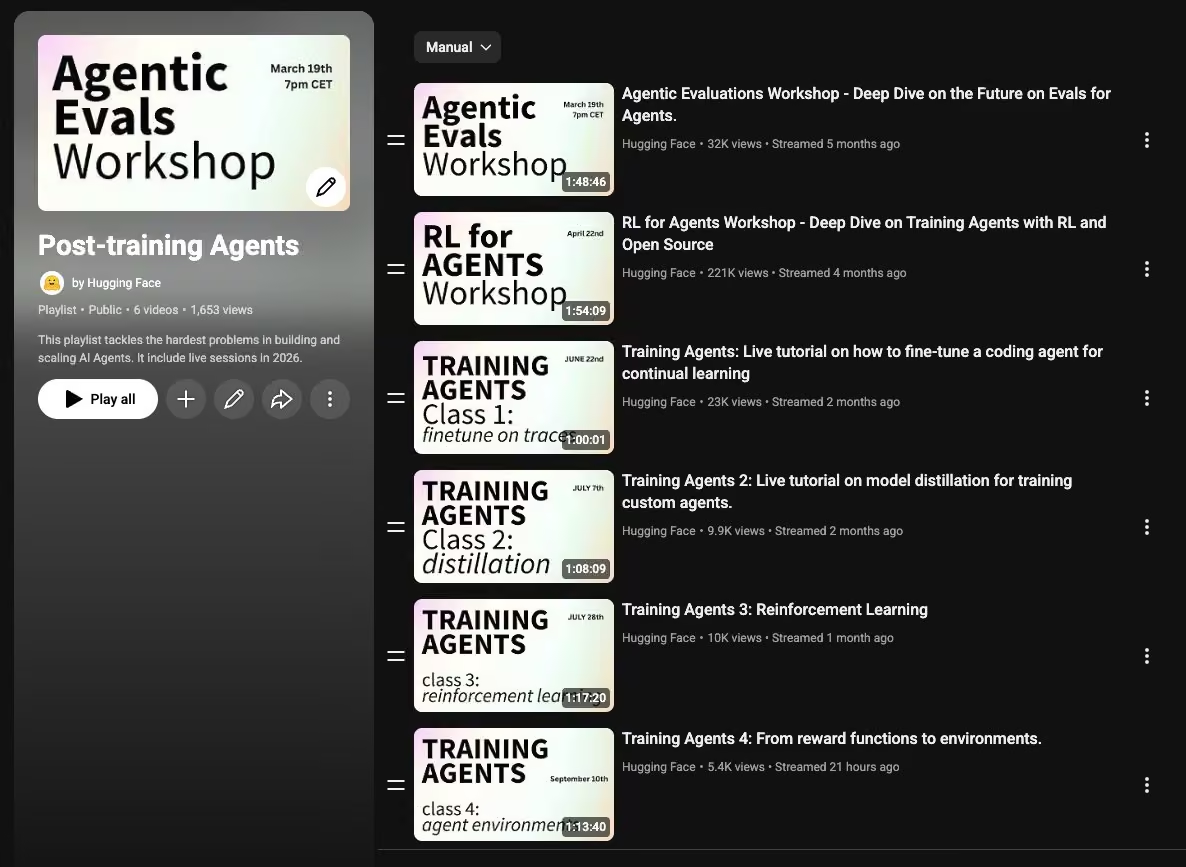
We finished the Training Agents series. Six live sessions over six months, from evaluating agents to training them inside real environments. All of it is on the Hugging Face YouTube channel and all of the code is open.
Here's what we did and who made it happen:
1. Agentic Evaluations WorkshopWhere agent evals actually stand, and why benchmark scores don't match what people see in use. With Avijit Ghosh and Nathan Habib (Hugging Face), Arvind Narayanan (Princeton), Pierre Andrews (Meta), J.J. Allaire (UK AI Security Institute) and Mahesh Sathiamoorthy (Bespoke Labs).
2. RL for Agents Workshop Environments, rollouts, reward design and the inference bottlenecks that appear when you move from RL for LLMs to RL for agents. With Lewis Tunstall (Hugging Face), Will Brown (Prime Intellect), Ofir Press (Princeton) and Alex Zhang (MIT CSAIL).
3. Training Agents 1: SFT on agent traces Public coding-agent traces turned into prompt/completion data, a TRL + LoRA fine-tune on Hugging Face Jobs, metrics in Trackio, and an honest look at what the first eval numbers can and cannot tell you. Joined by Sergio Paniego and Quentin Gallouédec.
4. Training Agents 2: Distillation Off-policy, on-policy and self-distillation for moving capability from a teacher into a smaller coding agent.
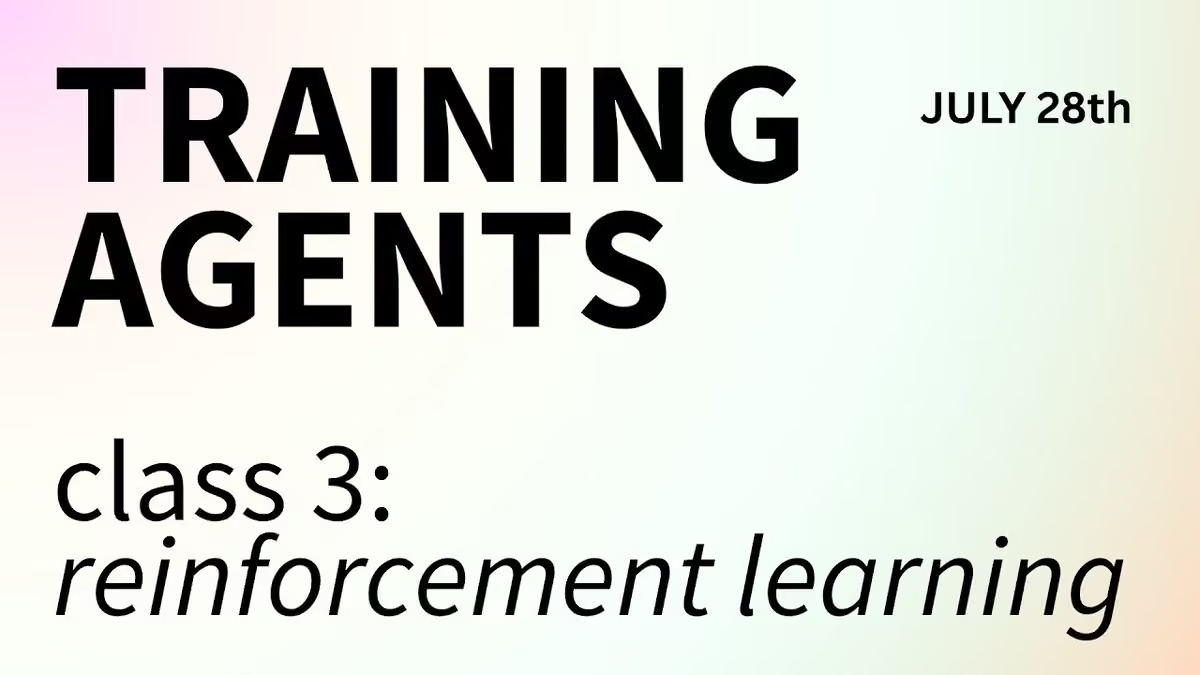
5. Training Agents 3: Reinforcement learning GRPO after SFT: group sampling, verifiable reward functions, reading the reward/KL/length curves, and three experiments, one of them with a deliberately gameable reward so we could watch the hacking happen.
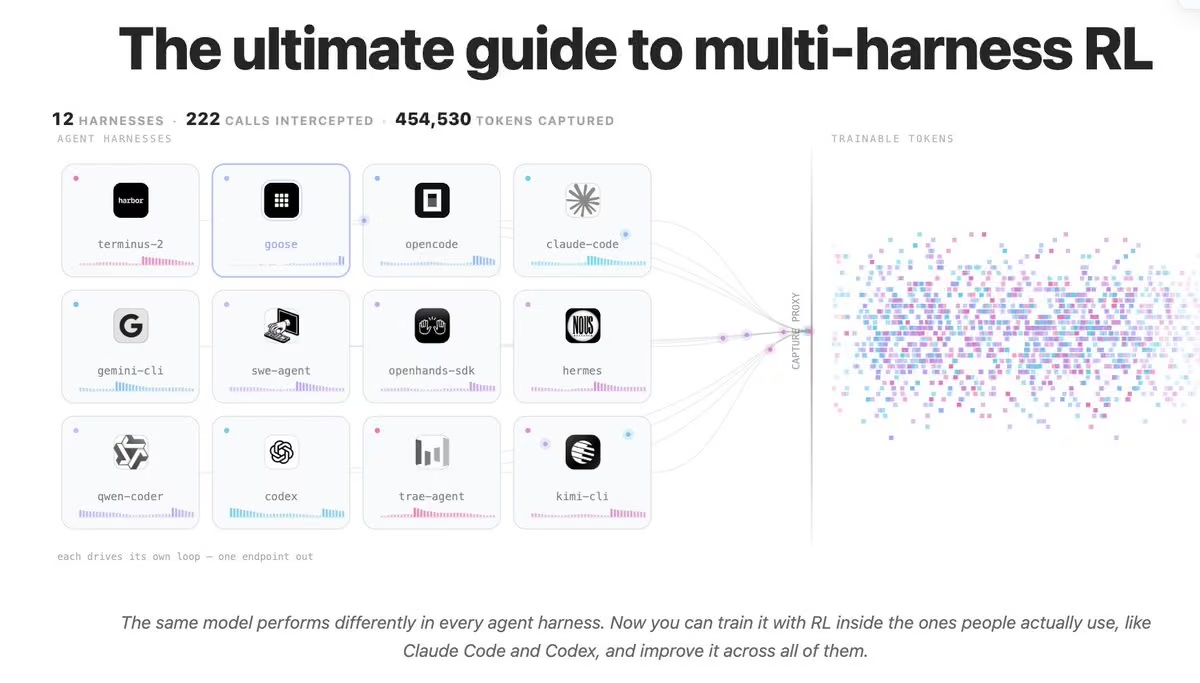
6. Training Agents 4: From reward functions to environments The reward stops being a function and becomes a place the agent acts in. We walked the reset()/step() contract from Gym to LLM agents, built an OpenEnv environment and pushed it to the Hub, plugged it into TRL's GRPOTrainer, then trained a real coding agent (OpenCode) through Harbor with AsyncGRPOTrainer on Hugging Face sandboxes.
The series has passed 300k views. Thank you to every speaker, to the TRL team, and to everyone who showed up live with questions.
Playlist: www.youtube.com/playlist?list=PLo2EIpI_JMQvQZm-kVlz4wY1vW… -
Hugging Face reposted
Niels Rogge
@NielsRogge
Papers with Code is now open-source!
Apache 2.0-license.
Let's collaboratively make the best paper interface!
github.com/huggingface/paperswithcode -
Hugging Face reposted
Jensen Huang
@JensenHuang
I was the opening act for a family of ducks.
Thank you, Berlin. What a GTC.
Europe is building its AI ecosystem and economy, from AI factories to agents to robots.
DSX POD: Vera Rubin modular factories built, cabled and tested in the factory, then delivered ready to produce intelligence.
Agents: models, harnesses, sandboxes, knowledge and tools. NVIDIA Agent Toolkit brings the pieces together so companies control what their agents know, access and do. NVIDIA OpenShell enhances safety.
Physical AI: new customers across AI-RAN, robotaxis and robotics.
Personal AI: after four years building with Microsoft, RTX Spark brings personal agents to the Windows PC.
Thank you to President @EmmanuelMacron, Prime Minister @andyburnham and Chancellor @bundeskanzler for hosting me. Great to celebrate Sferical One with Sweden’s technology leaders. And thank you to President @TokayevKZ for the warm welcome.
And to our partners and NVIDIA teams: thank you for making it happen.
The keynote is here: youtu.be/rF1EsryCAwc
Pollen Robotics
@pollenrobotics
Microducks on stage for Jensen Huang’s famous keynote!
We couldn’t be prouder of our little ones. 🥹This media couldn't be displayed. See it on the original post. -
Hugging Face reposted
Emm | scenario.com
@emmanuel_2m
We just open-sourced 1,300+ 3D models.
All 39 GB are free to download on Hugging Face.
huggingface.co/datasets/scenario-labs/3d-collection
> made with Hitem3D, Meshy, Rodin, Tripo, Claude Opus 5.5 3D and GPT-6 Astra 3D, which all run on Scenario
> includes the input images, prompts and settings that made them
> GLBs up to 8K textures, native Blender files from Opus and Astra, CC BY 4.0This media couldn't be displayed. See it on the original post. -
Hugging Face reposted
Remi Fabre
@RemiFabreRobot
Sorry for the wait, the episode is here!
Live action with real robots instead of animation (episode 4): "Anger"
Enjoy!
As always, the software of Microduck and Reachy Mini is open source:
github.com/pollen-robotics/microduck
github.com/pollen-robotics/reachy_miniThis media couldn't be displayed. See it on the original post. -
Hugging Face reposted
Lexsi Labs
@Lexsi_labs
A big announcement from Lexsi Labs:
Lexsi Labs (@Lexsi_labs) , Cohere Labs (@cohere ) and Hugging Face(@huggingface) are partnering on the Lexsi AI Safety and Alignment Hackathon, one of the biggest hackathon on post-training and AI Safety & Alignment.
Nov 1 to 21, 2026. Online, free, open to builders worldwide.
Teams build real post-training pipelines:
- Models: open-weights Tiny Aya and Aya Expanse from Cohere Labs
- Tooling: six open-source Lexsi Labs toolkits (AlignTune, CuratorKIT, AuditKIT, SafeTune, CircuitKIT, AgentTune)
- Artifacts: models, adapters, logs and datasets hosted on Hugging Face
Three tracks: fine-tuning and data curation, AI red teaming and safety, agentic fine-tuning.
Each submission chains at least two toolkits and reports before-and-after metrics.
$30,000+ in prizes and credits, GPU credits for up to 800 teams, Demo Day for the top 20, and interviews at Lexsi Labs for standout builders.
Kickoff: Bengaluru, Oct 31, with an online option.
Registration starts today at: hackathon.lexsi.ai
Thank you to @huggingface and @cohere for building this with us. -
Hugging Face reposted
microagi
@microagi
As our customers scale to training robot models using millions of hours of our recordings, we needed to build a new kind of data infrastructure.
Terabytes of data delivered in minutes, and the capacity to deliver over a Petabyte per day to each of our customers, to multiple customers at the same time. That’s more than 10 Gigabytes a second, delivered into any cloud, wherever our customers need it.
Using our customer portal, customers select precisely the data they want and it starts arriving in minutes at their destination, including AWS, GCP, Cloudflare, Hugging Face and any cloud provider who can handle the ingest speed.
We’ve written about how we worked with @huggingface and @Cloudflare to build this secure, scalable infrastructure. Link in comments. -
Hugging Face reposted
Linoy Tsaban
@linoy_tsaban
Introducing Qwen Image 2.1 Realtime ⚡️
I'm releasing V1 of my *2-step* distilled LoRA, and it runs in *realtime* on ZeroGPU ⚡️⚡️
(live editing part of the video was not sped up!)
> DMD2, rank 32
> 2 steps, with quality competitive with Turbo (8-step) and Base (40-step)
> realtime on ZeroGPU (half of an RTX Pro 6000)
LoRA: huggingface.co/linoyts/Qwen-Image-2.1-DMD2-2steps
Space: huggingface.co/spaces/linoyts/qwen-image-2-1-realtimeThis media couldn't be displayed. See it on the original post. -
Hugging Face reposted
NVIDIA AI
@NVIDIAAI
Available now: NVIDIA Nemotron 3.5 Bolt E4B 4GB ⚡️
Our newest small open model is built for local assistants, interactive characters and robots that can carry on a conversation and use tools to get things done.
Watch Reachy Mini chat and move, with Bolt handling conversation and NVIDIA Cosmos handling vision. Both models run locally on Jetson Orin Nano 8GB.
Learn more: research.nvidia.com/labs/nemotron/NVIDIA-Nemotron-3.5-Bol… -
Hugging Face
@huggingface
🎯
alphaXiv
@askalphaxiv
OpenResearch now has @TrackioApp built in 📈
Your agent logs its experiments to Trackio, charts open right next to each run, and it reads the curves back to decide what to try next. Open source and local-first.
Running on HF Jobs, Modal, k8s or Slurm? Save a @huggingface Space and every run lands there, private Spaces included.
Check it out: github.com/alphaXiv/OpenResearchThis media couldn't be displayed. See it on the original post. -
Hugging Face reposted
Scenario
@Scenario_gg
We just open-sourced 1,300+ 3D models.
That's 39 GB of 3D files, free to download on Hugging Face.
huggingface.co/datasets/scenario-labs/3d-collection
> Hitem3D, Meshy, Rodin, Tripo, Claude Opus 5.5 3D and GPT-6 Astra 3D, all run on Scenario
> every example ships its input image, prompt and exact settings
> GLB up to 8K textures, native Blender files from Opus and Astra, CC BY 4.0This media couldn't be displayed. See it on the original post. -
Hugging Face reposted
Sergio Paniego
@SergioPaniego
Live From SF! We’re teaching these folk how to train their own open weight agents. Sorry, but we won’t live stream. Full recording coming tomorrow!
Ben Burtenshaw
@ben_burtenshaw
Join us tomorrow on the training agents livestream, and here from experts about how they're scaling RL and evals to train frontier agents.
We will look beyond single-turn RL to multi-step, environment-driven training: reward design, rollouts, benchmarks, and the practical gap between training gains and real-world agent behavior.
What to expect Short, 10-minute talks with Q&A, followed by a closing panel on what works in RL for agents, where the bottlenecks are, and what the open-source ecosystem needs next.
Speakers:
- Ben Burtenshaw (HF)
- Govind Kamtamneni (Microsoft)
- Victor Barres (Mercor)
- Zach Wentz (Reflection)
- Tao Lin (RadixArk)
- Xiangyi Li (Benchflow)
Who should attend
ML practitioners, agent builders, and RL researchers.
www.youtube.com/watch?v=f9VsJsAIV7E -
Hugging Face reposted
Fastino Labs
@fastinoAI
Our newest decision model is the world's best decision model.
Introducing GLiDE v1.2, the #1 model on the @huggingface Decision Index.
With an overall score of 71.5, GLiDE v1.2 also has one of the lowest calibration errors on the entire Decision Index, meaning its confidence more closely reflects how often its answers are correct.
Beyond improved benchmark performance, it also adds support for multimodal inputs, enabling decision-making using text, JSON, and images.
We are excited to release the model weights on Hugging Face. For hosted inference, you can also run GLiDE v1.2 through the Fastino API at $0.04 / million input tokens.
Use promo code GLIDEIS1 for $10 in API credits.
Model weights: huggingface.co/fastino/GLiDE
API: agent.fastino.ai
Blog: fastino.ai/blog/training-glide-sota-decision-model -
Hugging Face
@huggingface
Even the most regulated industries are going open-source 🤗
Farsight
@farsight_ai
The AI question in financial services has moved from which model to use to where that model is allowed to run.
New post with @TangriKunal and @huggingface on why firms want to run models on their own infrastructure, and how governance gets them approved to run there.
Read it here: www.farsight-ai.com/news/open-models-in-financial-services -
Hugging Face reposted
Loubna Ben Allal
@LoubnaBenAllal1
Introducing Carbon-X: The best open DNA model.
We midtrained a 14B model on DNA and text, and it beats every open language model and matches GPT-6.1 Sol at 1,000x lower cost.
Ask it about a sequence, what a mutation does, or to generate new DNA.
huggingface.co/HuggingFaceBio/Carbon-XThis media couldn't be displayed. See it on the original post. -
Hugging Face reposted
Poonam Soni
@CodeByPoonam
NVIDIA CEO Jensen Huang asked 4 tiny robots to sit, stand, nap, and do somersaults.
And they actually did it.
NVIDIA is bringing AI agents from virtual world to real world with these robotic ducks.This media couldn't be displayed. See it on the original post. -
Hugging Face reposted
Wall St Engine
@wallstengine
Jensen Huang having some fun demonstrating MicroDuck robots trained using NVIDIA RTX Spark and Omniverse on stage at GTC Berlin.
This media couldn't be displayed. See it on the original post. -
Hugging Face reposted
🇮🇹 Emiliano Morgia - IL TRUMPISTA
@ilTrumpista
VIVIAMO NEL CAZZO DI FUTURO!!!!!!!!!!!
CAZZO.This media couldn't be displayed. See it on the original post. -
Hugging Face reposted
clem 🤗
@ClementDelangue
Frontier labs are advancing the capabilities in AI for biology but preventing the good guys (scientists, academia, non-profits, health agencies,...) to use, study and understand it with widespread but shallow guardrails that the bad guys are bypassing easily (blocked me to proofread this tweet for example 😅).
This will automatically create massive assymetry and risks in the coming years, just like in cybersecurity, especially now that frontier labs are building wet labs (HF cybersecurity scenario for biology when?).
This is why we created Carbon-X, the best open-source DNA model by midtraining Qwen3-14B on 300B tokens of DNA, English and interleaved data. We also used a hybrid tokenizer that tokenizes English with BPE and DNA with a 6-mer tokenizer.
As a result, Carbon-X outperforms all open language models we evaluated on five benchmarks of DNA understanding and generation. This is a 27-point improvement over Qwen3-14B, showing how much a language model can gain from DNA training. It is also API frontier level at 1,800x less cost than GPT 6.1 Sol!
We hope Carbon-X helps researchers explore DNA in new ways. Releasing it openly means anyone can study its capabilities, limitations, and risks. Let's make the AI biology frontier open-source to make it safe and impactful for the whole world (not just a few companies).
Apache 2.0 Model on @huggingface: huggingface.co/HuggingFaceBio/Carbon-X -
Hugging Face reposted
apolinario (poli)
@multimodalart
just updated the Decision Index to 0.4 🧭
what's new?
🛡️ curbing benchmaxxing: score now exclusively made from private & in-house benchmarks
🔒 stronger private benchmarks on new domains
🏆 224 models evaluated, new top models in all sizes
come play 👉huggingface.co/spaces/multimodalart/jev-decision-indexThis media couldn't be displayed. See it on the original post. -
Hugging Face reposted
Lewis Tunstall
@_lewtun
Today we're releasing Carbon-X, a 14B model that brings DNA and natural language together for the first time 🧬
1. Beats every open language model we tested across DNA benchmarks. Within a point of GPT-6.1 Sol at >1,000× lower inference cost.
2. Mid-trained on 300B tokens of interleaved DNA and text, followed by SFT (without distillation!) and RL.
3. A new hybrid tokenizer encodes DNA using ~3× fewer tokens than BPE.
4. Gives other models a DNA specialist subagent: Kimi K3 gains 11.1 points when it consults Carbon-X.
5. Runs locally on a laptop with llama.cpp. Apache 2.0. Your DNA stays on your hardware.
Model: huggingface.co/HuggingFaceBio/Carbon-X
Blog: huggingface.co/spaces/HuggingFaceBio/Carbon-X-Release
Loubna Ben Allal
@LoubnaBenAllal1
Introducing Carbon-X: The best open DNA model.
We midtrained a 14B model on DNA and text, and it beats every open language model and matches GPT-6.1 Sol at 1,000x lower cost.
Ask it about a sequence, what a mutation does, or to generate new DNA.
huggingface.co/HuggingFaceBio/Carbon-XThis media couldn't be displayed. See it on the original post. -
Hugging Face reposted
Sayak Paul
@RisingSayak
We just merged the first protein sequence design model RFD4-Proteina in Diffusers 🔥
I hope this pushes the state of open BioML further.
Kudos to @NVIDIAAI and Baker Lab for shipping this!
Check out the docs to know more:
huggingface.co/docs/diffusers/main/en/api/pipelines/rfd4_… -
Hugging Face reposted
NVIDIA Omniverse
@nvidiaomniverse
Introducing SimReady Central Library. 👋
This library brings 2,000+ simulation-ready 3D assets to @huggingface, open source for developers building robotics simulations and AI factory digital twins.
Now, developers can spend less time preparing assets while equipment manufacturers can help customers evaluate equipment in simulation before real-world deployment.
Get started 👉 nvda.ws/3Wl6LCi -
Hugging Face
@huggingface
Come and build models, datasets, and spaces on the hub, to win $20k in cash and credits!
Reflection
@reflection_ai
We teamed up with @huggingface to give away $20,000 to anyone who's building with Beam 🤗
Use Beam for any project - make a demo or a dataset, benchmark the model, create an RL environment - and comment your link in the model's repo page by Monday, November 2.
We choose the winners. Winners choose cash or credits. Claim $25 in Hugging Face credits to build with Beam and enter the competition 👇
huggingface.co/reflection/Beam-1.0-501B-A23B/discussions/5 -
Hugging Face reposted
Richard Socher
@RichardSocher
Introducing Flint, @Recursive_SI’s first model: a fast local coding model built with our automated research system, the Eureka Machine.
• Best-in-class fast local coding
• Up to 2x faster than comparable models: 125+ tokens/sec on a MacBook Pro, 150+ on RTX Spark
• Built from scratch in under 4 months
Private, unmetered intelligence on your own machine. Open weights available now on @huggingface, run it locally on your favorite framework or try it for free on @opencode or @pidotdev.This media couldn't be displayed. See it on the original post. -
Hugging Face reposted
NVIDIA RTX Spark
@NVIDIARTXSpark
When @jensenhuang asks for a somersault, you deliver. 🦆
See how AI agents on NVIDIA RTX Spark help bring @huggingface's Microduck from simulation to the real world. -
Hugging Face reposted
Baseten
@baseten
Today we’re releasing two decision models, elephant-1 (9B) and mammoth-1 (27B), trained by the @baselabs team, available for free for one week on our Model APIs.
mammoth-1 is #1 on the Jev Decision Index and elephant-1 is tied for #1 on the Artificial Analysis Decision Index.
It’s a new model, but more importantly, this is an open-source model you can access, deploy, and post-train on Baseten (or wherever you do your best work).
The free week ends 10/27/26 at 11:59 PM PT. Try it and let us know what you think.
Try mammoth-1 here: www.baseten.co/library/mammoth-1/
Try elephant-1 here:
www.baseten.co/library/elephant-1/ -
Hugging Face reposted
clem 🤗
@ClementDelangue
It feels pretty fitting for @JensenHuang & @nvidia to end their European tour with Microducks on stage.
Microduck was designed and engineered in Europe (more precisely Bordeaux, France) by the @pollenrobotics and @huggingface teams. With American capital and ambition + Chinese manufacturing genius, it became the most popular robot of 2026 with over 15,000 sold all over the world!
I believe Europe has more opportunity to shine in AI than in any previous tech wave. We intend to prove it with @huggingface @nvidia and the whole open-source AI community in the coming years!
Let's go European AI 🇪🇺🇪🇺🇪🇺This media couldn't be displayed. See it on the original post. -
Hugging Face reposted
Ben Pouladian
@benitoz
Here is the Microduck up close
You can program it work DGX spark
This baby duck represents the future of physical Ai
it relies on reinforcement learning to transition AI-trained movements from digital simulations into the real world
Small duck now large robots later 🐥🤖💚2 media couldn't be displayed. See them on the original post. -
Hugging Face reposted
LeRobot
@LeRobotHF
So many SO-ARMs! 💪
Here is the robotics workshop organized at @NVIDIAGTC Berlin that uses SO-ARM101 and LeRobot to control real and simulated robotic arms. The light box makes it easier to get policies working in any location and light conditions. -
Hugging Face reposted
Pollen Robotics
@pollenrobotics
Microducks on stage for Jensen Huang’s famous keynote!
We couldn’t be prouder of our little ones. 🥹This media couldn't be displayed. See it on the original post. -
Hugging Face reposted
Niels Rogge
@NielsRogge
I've made some big improvements to the PDF reader on Papers with Code!
> The AI assistant now cites its sources, full RAG-style
> This is powered by Chandra-OCR 2 by @datalabto which is openly available on @huggingface
> This model returns bounding boxes besides markdown
> Allows you to click on citations and highlight sections
Try it out on any PDF, like paperswithcode.co/pdf/2610.18861This media couldn't be displayed. See it on the original post. -
Hugging Face reposted
tomaarsen
@tomaarsen
🧵 I've just released Sentence Transformers v6.2.0!
Featuring model merging with @arcee_ai mergekit, load models faster, & evaluators share work across GPUs automatically.
Plus lower-memory losses, multi-vector improvements & plenty of fixes.
Thread with highlights 👇 -
Hugging Face reposted
Thomas Wolf
@Thom_Wolf
Jensen spent 10 min of his keynote asking microducks to sit, then explained Nvidia's roadmap to them 🥹
This media couldn't be displayed. See it on the original post. -
Hugging Face reposted
NVIDIA
@nvidia
Even Microducks need a nap. 😴
This media couldn't be displayed. See it on the original post. -
Hugging Face reposted
NVIDIA AI
@NVIDIAAI
"There's no question everybody will become an AI company and we're going to have a thriving AI economy here in Europe."
This media couldn't be displayed. See it on the original post. -
Hugging Face reposted
Jim Fan
@DrJimFan
We built a robotics data engine with Astra-level performance at 125x lower cost. And we are open-sourcing the weights today! Introducing Flora, a suite of open models to parse the physical world and turn raw footage into rich training signals.
Flora already powers our in-house data engine, labeling 200K hours of videos a day on 500 GPUs. We created it to scale the frontier for robot learning. Now you own the weights too.
Flora gives you:
- High-quality, timestamped captions to curate and filter human egocentric and robot data;
- Dense progress rewards for quality control and RL post-training;
- Rubrics scoring for real-world benchmarking
Try it today, links in thread:This media couldn't be displayed. See it on the original post. -
Hugging Face reposted
Sayak Paul
@RisingSayak
Meet Fibo 2.0 from @bria_ai_ 🔥
The #1 *open weights* model in image editing is supported in Diffusers (day-0, of course)!
1. JSON-native control
2. Pretty good text rendering
3. Comes in two variants: Turbo and Dev
Check out the model here:
huggingface.co/docs/diffusers/main/api/pipelines/bria_fibo2 -
Hugging Face reposted
Leandro von Werra
@lvwerra
Agent Manager is finally out!
Orchestrate dozens of agents across harnesses (Claude Code, Codex, OpenCode etc.) effortlessly.
Agents communicate and self-organize to help you achieve complex tasks and always keep running on HF spaces.
Try it: huggingface.co/spaces/lvwerra/agent-manager-templateThis media couldn't be displayed. See it on the original post. -
Hugging Face reposted
merve
@mervenoyann
Muse Spark open weights (even in NVFP4) is an amazing computer use agent
I shipped an e2e tutorial on building an env for a browser agent
(with OpenEnv, Helium and @huggingface Sandboxes)
enjoy 🤗 here's a small visualized run ⤵️ -
Hugging Face
@huggingface
Local AI 202: Get Massive Speed-ups with Speculative Decoding x.com/i/broadcasts/1NGaroZveLVJj
-
Hugging Face reposted
Thomas Wolf
@Thom_Wolf
Fun and crazy napkin math: Meta, NVIDIA, Alibaba, DeepSeek, Moonshot, Mistral and ~30 other labs have shared close to $1B worth of training compute on the Hugging Face Hub
Free to download
End of 2023 it was under $40M
Wikipedia was written in volunteer hours. This AI age commons is written in GPU-hours and data
(it's a floor btw: about half comes from official compute numbers rest is educated guess and it still miss the ~900k community fine-tunes)
Space with data to explore: thomwolf-hub-dollars.static.hf.space -
Hugging Face reposted
Niels Rogge
@NielsRogge
Curious to keep up to date with auto-research papers?
Just added a category for it on Papers with Code!
Find it here: paperswithcode.co/tasks/auto-research
Bojan Jakimovski
@Shekswess
@NielsRogge an idea for paperswithcode, can you add category of auto-research papers ?
I see them a lot more these days, especially on X and I think that would be awesome 😊 -
Hugging Face reposted
merve
@mervenoyann
friendly reminder: this is on Monday 🤝
→ learn about speculative decoding to speed-up inference
→ if you're a beginner and not interested, just use llama.app that does this for you automatically 🦙
Hugging Face
@huggingface
Learn about how to get multipliers in local LLM speed-ups using speculative decoding in this livestream with @mervenoyann, @MaartenGr and @_EldarKurtic
www.youtube.com/watch?v=H4azmWcqO5g -
Hugging Face reposted
batuhan içöz
@batuhan
anyone at the Hugging Face thing? Ping mee
-
Hugging Face reposted
clem 🤗
@ClementDelangue
Beautiful work from @perplexity_ai @AravSrinivas with weights on @huggingface of course!
huggingface.co/perplexity-ai/pplx-decider-flash-v1.2
huggingface.co/perplexity-ai/pplx-decider-v1.2
Perplexity Developers
@perplexitydevs
Our next generation of open weights multimodal decision models comes in two sizes, pplx-decider-v1.2 and pplx-decider-flash-v1.2.
Text and vision scores improve. Inference is up to 5x faster: all questions in a request run in one pass.
Flash is the top 4B on the Decision Index. -
Hugging Face reposted
clem 🤗
@ClementDelangue
who's going to the hf sf party tonight?
-
Hugging Face reposted
Jeff Boudier 🤗
@jeffboudier
Tonight is the night. Today is the day AI Builders unite.
I hear MEGADUCK is coming. Will you?
Open Together, 6pm on 10/16 at The Midway, SF. Free.
luma.com/OpenTogetherThis media couldn't be displayed. See it on the original post. -
Hugging Face reposted
Thomas Wolf
@Thom_Wolf
it's time to invent math 2.0
(sounds on)This media couldn't be displayed. See it on the original post.
SAIR
@SAIRfoundation
The math community deserves its own AI system.
Introducing Open Math OS: the infrastructure for Math 2.0.
Open models and AI agents. 24/7 cloud compute with 100+ tools. The community controls its data.
Compute is free for approved teams. Apply now:
www.openmathmodel.org -
Hugging Face
@huggingface
LIVE STREAM: New Open Weight Model x.com/i/broadcasts/1DxleVaPLagKL
-
Hugging Face
@huggingface
LIVE STREAM in minutes! Hear from the Reflection team about how they built Beam.
Stream: www.youtube.com/watch?v=dGhUFqeITbY
Reflection
@reflection_ai
Beam is now available across platforms, with open weights under the Apache 2.0 license - in collaboration with an ecosystem of 40+ partners.
We're releasing:
- Weights, tokenizer, and reference implementation
- BF16, FP8 and NVFP4 weights and a DFlash2 drafter
- The open source harness we built and trained Beam on: Mirror CLI
Weights and model card on Hugging Face: huggingface.co/reflection -
Hugging Face reposted
Reflection
@reflection_ai
Beam is now available across platforms, with open weights under the Apache 2.0 license - in collaboration with an ecosystem of 40+ partners.
We're releasing:
- Weights, tokenizer, and reference implementation
- BF16, FP8 and NVFP4 weights and a DFlash2 drafter
- The open source harness we built and trained Beam on: Mirror CLI
Weights and model card on Hugging Face: huggingface.co/reflection -
Hugging Face reposted
PrismML
@PrismML
Today, we’re releasing Bonsai 2 2B, 4B, and 9B.
Based on Qwen3.5, these new ternary models bring stronger reasoning, visual understanding, and tool calling to compact footprints designed for everyday devices:
• 2B: 0.43GB
• 4B: 0.95GB
• 9B: 2.0GB
For this release, we focused on what makes small models useful as local assistants: following instructions, avoiding repetitive loops, calling tools on mobile devices, and giving useful answers without unnecessary output. The 9B model uses roughly 40% fewer tokens on standard instruction-following and everyday math tasks. Solving the Riemann hypothesis can wait.
These models are successors to our first-generation Bonsai 1.7B, 4B, and 8B, and provide a foundation for bringing practical agentic functionality to local applications on personal computers, phones, and wearables.
The Bonsai 2 family now includes four sizes spanning 2B to 27B parameters. Developers can choose the balance of capability, memory use, and responsiveness that fits their application and hardware.
Available today under Apache 2.0. -
Hugging Face reposted
merve
@mervenoyann
Meta is releasing Muse Spark Open as the most-capable US open-weight model.. 🥁 and it's an agent focused MoE that takes all modalities 🔥
Welcoming the model to Hub with day-0 support in transformers and llama.cpp 🤗
huggingface.co/blog/meta-muse-spark-open -
Hugging Face reposted
clem 🤗
@ClementDelangue
llama serve -hf ggml-org/Muse-Spark-Open-816B-A42B-GGUF:Q2_K (on two mac studios).
Well done @finkd & @johnternus!This media couldn't be displayed. See it on the original post. -
Hugging Face reposted
merve
@mervenoyann
Meta is releasing Muse Spark Open as the most-capable US open-weight model.. 🥁 and it's an agent focused MoE that takes all modalities 🔥
Welcoming the model to Hub with day-0 support in transformers and llama.cpp 🤗
huggingface.co/blog/meta-muse-spark-open -
Hugging Face reposted
Sayak Paul
@RisingSayak
It's time. It's fucking time!
Flux.3 Image Klein is out and we bring you full support for it in Diffusers.
Catch all the details in our post:
huggingface.co/blog/flux-3 -
Hugging Face reposted
NVIDIA AI
@NVIDIAAI
Meet NVIDIA Nemotron 3.5 Super VL
Our new open model combines reasoning and tool use with text, image, document, and video understanding for long-running AI agents.
120B total parameters with 12B active 🧵This media couldn't be displayed. See it on the original post. -
Hugging Face reposted
clem 🤗
@ClementDelangue
It's fashion week!
-
Hugging Face reposted
Black Forest Labs
@bfl_ai
FLUX 3 Image Klein is here.
Open Weights with the quality of a large frontier model. Customizable and fast.
5.6B parameters and runs on a single consumer GPU.
Native 4K, bounding boxes, and pixel-perfect editing.This media couldn't be displayed. See it on the original post. -
Hugging Face reposted
Black Forest Labs
@bfl_ai
Download the weights: huggingface.co/collections/black-forest-labs/flux-3-image…
See more: bfl.ai/models/flux-3-image-klein
Read the blog post: bfl.ai/blog/flux-3-image-klein -
Hugging Face reposted
PapersWithCode
@paperswithcodee
LFM2.5-24B-A2B from @liquidai scores 96.75 on IFEval.
It does that with 2.45B active parameters, out of 24B total.
That puts it first on the IFEval instruction-following leaderboard on Papers with Code, ahead of Rufus-Air (95.4) and Qwen3.5-27B (95). -
Hugging Face reposted
Prime Intellect
@PrimeIntellect
Open superintelligence is built in the open
Kickoff party for Open Source AI Week with @huggingface -
Hugging Face reposted
Ai2
@allen_ai
We're co-hosting Open Together with @huggingface!
Join the open AI community at The Midway in San Francisco on Oct 16 to kick off Open Source AI Week. Help us build a future where AI is open, secure, and fully transparent.
The event is free. RSVP: luma.com/OpenTogether -
Hugging Face reposted
Maziyar PANAHI
@MaziyarPanahi
70,111 CT scans trained this model. one NVIDIA GPU turned a full chest CT into a radiology report in under 30 seconds 🔥
top finding: a spiculated nodule, right upper lobe. the expert's tumor marking it never saw? right lung.
open weights from @nvidia on @huggingface 🤗 -
Hugging Face reposted
Adithya S K
@adithya_s_k
Introducing the largest open-source multilingual, multimodal RL environments 🌍
📄 OCR: 1M+ document pages in 22 languages
🎙️ ASR: speech in 102 languages
12M+ tasks across two OpenEnv Environments, open on @huggingface 🤗 -
Hugging Face
@huggingface
Learn about how to get multipliers in local LLM speed-ups using speculative decoding in this livestream with @mervenoyann, @MaartenGr and @_EldarKurtic
www.youtube.com/watch?v=H4azmWcqO5g -
Hugging Face reposted
NVIDIA RTX Spark
@NVIDIARTXSpark
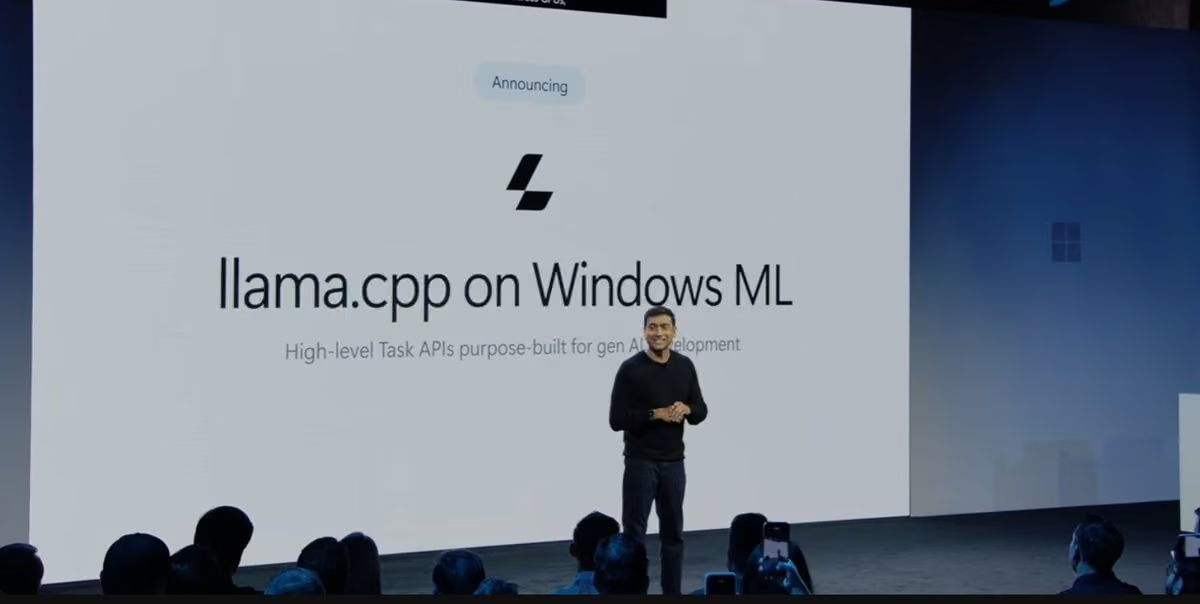
llama.cpp now has a Windows app 🦙
Llama Windows makes it easy to run models locally, with optimizations for NVIDIA RTX Spark.
📥 Browse and download models from Hugging Face
💬 Chat with local models right from your system tray
🔒 Keep your prompts on your PC -
Hugging Face reposted
Linoy Tsaban
@linoy_tsaban
New H3 character swap LoRA🔥
amazing work from @Alissonerdx
LoRA: huggingface.co/Alissonerdx/Minimax-H3-ComfyUI/blob/main/l…
Space:
huggingface.co/spaces/linoyts/minimax-h3-character-swap -
Hugging Face reposted
Andrii Liubivyi
@andrii_liubivyi
Someone form @huggingface could you do it in reallife?
Microduck fight
microduck-fight.andriil.chatgpt.siteThis media couldn't be displayed. See it on the original post. -
Hugging Face reposted
clem 🤗
@ClementDelangue
You don't want to miss this if you're in SF Friday. Hearing there are A LOT of surprises! luma.com/OpenTogether
-
Hugging Face reposted
tomaarsen
@tomaarsen
📈@Google's EmbeddingGemma2 is looking to be a huge success!
After only a week, it has surpasses EG1's likes to become the 4th most liked Google model ever, as well as the 3rd most liked Sentence Transformers model ever.
Congratulations to the team for their work!
Links in 🧵 -
Hugging Face reposted
Aritra 🤗
@ariG23498
I was finally able to push the kernels cookbook out!
What we cover here:
> using HF kernels from the Hub
> hardcoding triton kernels vs not
> benchmarking models with and without kernels
As always, I am more than open to feedback! ❤️ -
Hugging Face reposted
Niels Rogge
@NielsRogge
Decision Model (also called System One model or typed decision model) has been added as a method to Papers with Code
Explore all papers here: paperswithcode.co/methods/decision-model -
Hugging Face reposted
Z.ai
@Zai_org
Introducing GLM-Legal
Built on GLM-5.3-Flash, GLM-Legal matches frontier models on mainstream legal benchmarks.
Designed for real legal workflows: contract review, evidence analysis, compliance, and more.
Tech Blog: z.ai/blog/glm-legal
Apply for API Access: z.ai/consultation/legal
Try AutoClaw: autoclaw.z.ai -
Hugging Face reposted
Manu Romero
@mrm8488
🧭 New model: Typed Decision, built on EmbeddingGemma 2
Give it a state + any schema of questions → typed, calibrated answers (choice · score · noul). No text generation, no output parsing.
76.4% on typed-decisions, ~6 pts behind a 27B LLM with ~100× fewer params.
🤗 -
Hugging Face reposted
clem 🤗
@ClementDelangue
We turned @OpenAI's math problems into open-source RL environments on @huggingface!
Early and rough (the verifier only accepts the exact original formalization, so an equivalent proof can still score 0), but this is what it looks like when a research release becomes executable training infrastructure for everyone.
This is an exciting direction imo: turning open research into open executable environments that anyone can build on to train better open models!
huggingface.co/datasets/FineEnvs/openai-math -
Hugging Face reposted
Jun Kim
@jundotkim
All my oQe models have been updated with Improved oQe Quantization, available from oMLX 0.7.1. Compared with the previous oQe builds, KL divergence is 11.6–18.1% lower on code and 10.2–13.8% lower on prose, so please give them a try. The full model list is below.
huggingface.co/Jundot
KL divergence from the original BF16 model (mean, lower is better)
- Qwen3.8-27B oQ4e: code 0.0143 → 0.0117 (-18.1%), prose 0.0696 → 0.0600 (-13.8%)
- Qwen3.8-Flash-Next oQ4e: code 0.0877 → 0.0776 (-11.6%), prose 0.1909 → 0.1713 (-10.2%)
What's new
- Below oQ4, the Engram and N-gram tables stay at 4 bits and are left out of the bit budget. oMLX can serve these tables from SSD instead of memory, so the full bit budget goes to the rest of the model.
- Model cards now show the bit distribution and storage breakdown.
If you downloaded an earlier oQe build, please re-download it.
Improved oQe models (69)
- Qwen3.8-Flash-Next: 2.5 · 2.7 · 3 · 3.5 · 4 · 6 · 8 bits
- Qwen3.8-Flash-Next FP16: 2.5 · 3 · 3.5 · 4 bits
- Qwen3.8-27B: 2.5 · 3 · 3.5 · 4 · 6 · 8 bits
- Qwen3.6-35B-A3B: 2.5 · 3 · 3.5 · 4 · 6 · 8 bits
- GLM-5.3-Flash: 2 · 2.5 · 3 · 3.5 · 4 · 5 · 6 bits
- DeepSeek-V4.1-Flash: 2 · 2.5 · 3 · 4 bits
- DeepSeek-V4-Flash-0731: 2.5 · 2.7 · 3 · 3.5 · 4 bits
- gemma-4-31B-it: 2.5 · 3 · 3.5 · 4 · 6 · 8 bits
- gemma-4-26B-A4B-it: 2.5 · 3 · 3.5 · 4 · 6 · 8 bits
- gemma-4-12B-it: 2.5 · 3 · 3.5 · 4 · 6 · 8 bits
- clef: 2.5 · 3 · 3.5 · 4 · 6 · 8 bits
- clef-flash: 2.5 · 3 · 3.5 · 4 · 6 · 8 bits -
Hugging Face reposted
Lysandre
@LysandreJik
Fun addition to transformers serve: you can now turn any of the 250 LLM & VLM model into a JEV-like decision model.
/v1/systemone scores a set of decision with the model's logits. No need to generate text!
Which one of them can get microducks across the finish line fast?This media couldn't be displayed. See it on the original post. -
Hugging Face reposted
Pollen Robotics
@pollenrobotics
The Microduck Arena is live!
Train your duck with RL, publish it on @huggingface, and race it in the 2 m Sprint, Hill Climb, Roller Sprint and MicroDuck Got a Talent. No robot required.
Join the live 👉 huggingface.co/spaces/pollen-robotics/microduck-arena
#microduck #robotics
youtu.be/9Lnh0Bjr1ds -
Hugging Face reposted
Marc Sun
@_marcsun
Your LLM knows the answer before it writes a single token.
So we stopped making it write.
transformers serve now turns any LLM or VLM into a decision model with `/v1/systemone` endpoint.
Decision model standardization coming soon in transformers by @art_zucker
Demos below👇 -
Hugging Face reposted
Shubham Saboo
@Saboo_Shubham_
This is Google’s Embedding Gemma 2 🤯
100% free and local running on Mac. -
Hugging Face reposted
Antoine Pirrone
@antoinepirrone
Here's 3 minutes of uncut Microduck testing on carpet
This media couldn't be displayed. See it on the original post. -
Hugging Face reposted
Ai2
@allen_ai
This Friday, meet the open source AI community at Open Together, co-hosted with @huggingface.
Join us at The Midway in SF on Oct 16 — bringing the community together to help build a future where AI is open, secure, and fully transparent.
RSVP: luma.com/OpenTogether -
Hugging Face reposted
Emma Scharfman
@EmmaScharfmann
🧬 🤗 A new atlas of microproteins in the human brain is now @huggingface!
It brings together more than 1,000 microproteins, including one that’s reduced in Alzheimer’s and appears to play a role in how the brain’s immune cells produce energy.
Dataset: huggingface.co/datasets/brmiller/brain-microprotein-atlas
Paper: www.nature.com/articles/s43587-026-01207-x
Space: huggingface.co/spaces/brmiller/brain-microprotein-atlas-app -
Hugging Face reposted
clem 🤗
@ClementDelangue
If you’re a researcher, please consider sharing your RL environments openly! Something you built for one experiment could help the entire field move forward.
I know we’re in dark days for sharing from frontier labs in the US, but I believe this can have a huge impact on the field and the world!
Naveen
@NaveenKumar__T
This is how open source should work. A closed lab publishes research, and within days the community turns it into training environments anyone can use. Early and rough, as Clem says, but the direction is lovely. #opensource #ai
clem 🤗
@ClementDelangue
We turned @OpenAI's math problems into open-source RL environments on @huggingface!
Early and rough (the verifier only accepts the exact original formalization, so an equivalent proof can still score 0), but this is what it looks like when a research release becomes executable training infrastructure for everyone.
This is an exciting direction imo: turning open research into open executable environments that anyone can build on to train better open models!
huggingface.co/datasets/FineEnvs/openai-math -
Hugging Face reposted
younes
@yb2698
Pi harness optimized for Qwen models? 👀
We tried to optimize the Pi harness for Qwen model series by trying to tweaking various components from the harness. Despite early findings on ALE (Agents Last Exam), it seems nothing much improves with Terminal-Bench Lite, why is that?
Experiment setup and findings in the thread 🧵 -
Hugging Face reposted
Suvaditya Mukherjee
@halcyonrayes
3D worlds have been all over the internet 🌐 lately, so we put together the best ones across many models, for you to play with 🤗
introducing a new entry to the 3D-arena 🏟️ family, which focuses on LLM 3D Worlds 🌎
go and make your voice heard here 🚀:
huggingface.co/spaces/3d-arena/llm-3d-worlds-arena -
Hugging Face reposted
Xuan-Son Nguyen
@ngxson
Someone on Reddit made a searching app that runs on EmbeddingGemma 2 🤯
Much better than MacOS's default Spotlight 🔥 -
Hugging Face reposted
Maziyar PANAHI
@MaziyarPanahi
SAM 3.1 + DINOv3 from @AIatMeta is a crazy combo 🔥
it can even hold onto surgical tools while a forearm sweeps over them. one leaves for 15 seconds, its near-identical twin stays, and it knows exactly which one came back!
one NVIDIA A100 on @huggingface Jobs 🤗This media couldn't be displayed. See it on the original post. -
Hugging Face reposted
Jeff Boudier 🤗
@jeffboudier
All of open source AI is coming together 🤗
TGIF and Thanks to Sponsors @arcee_ai @reflection_ai
and Co-Hosts @allen_ai @Alibaba_Qwen @NousResearch @UnslothAI @vllm_project @lmsysorg @openclaw @github @intel @Qualcomm
Open Together, Fri Oct 16, SF. Free. -
Hugging Face reposted
Intel Devs
@inteldevs
Bay Area AI builders:
Open source demonstrates what's possible when builders collaborate to develop, improve, and share new technologies.
That's why we're celebrating Open Source AI Week with @huggingface in San Francisco.
We look forward to connecting with fellow builders and recognizing the contributions that continue to move open-source AI forward.
Event details: luma.com/OpenTogether -
Hugging Face reposted
Quentin Gallouédec
@QGallouedec
TRL v1.15 is out. Our biggest optimization ever.
Fused LM head, on by default:
→ up to 82% less peak VRAM
→ 7x longer sequences
→ DPO 10k → 59k tokens, GRPO 29k → 115k
And more... github.com/huggingface/trl/releases/tag/v1.15.0 -
Hugging Face reposted
clem 🤗
@ClementDelangue
We urgently need more public traces of AI agents attacking and defending systems. Defenders can’t learn from what they can’t see.
If you have traces and are being pressured to keep them private, my DMs are open. Let’s level the playing field and fight the asymmetry and lack of transparency in AI! -
Hugging Face reposted
👩💻 Paige Bailey
@DynamicWebPaige
🤗💎 Such an exciting week for open-source, congrats to the @GoogleGemma @GoogleDeepMind teams!
The @huggingface demos using @gradio are 🧑🍳🤌:
Olivier Lacombe
@o_lacombe
Introducing EmbeddingGemma 2, our new open embeddings model for on-device use cases!
👀 Code, image, video, audio, and text embeddings
🎛️ Modular footprint (270M text/code up to 740M full multimodal)
🧪 Matryoshka embeddings (truncate down to 128d for 6x storage savings)
🚀 +14% boost on MTEB Code vs. v1
🤗 Apache 2.0 licenseCheck out the complete developer guide with code samples: -
Hugging Face reposted
Matthieu Lapeyre
@matth_lapeyre
We did not know how long Microduck would actually last on battery
We had thermal management issues with our Radxa prototypes: throttling after just 20 minutes, followed by an overheating shutdown.
We addressed this with the new custom board. To test it, we let Microduck roam autonomously in a dedicated area, walking around, standing and sitting until the battery ran out.
The results are way better than we hoped :)
- Over 3 hours on a 2600 mAh battery.
- Estimated average battery current dropped from ~1.13 A to ~0.82 A, roughly 28% less.
- Peak CPU temperature dropped from 114°C to 60°C, with zero thermal throttling throughout the test.
This time, the battery ran out before the cooling did :)
Very happy with the progress!This media couldn't be displayed. See it on the original post.
Matthieu Lapeyre
@matth_lapeyre
Microduck got its new brain!
Our first fully custom SBC in a Pollen robot! It replaces the Radxa + board sandwich from the prototype.
Built by Seeed around the same Rockchip CPU but including better memory, better WiFi/BT, dual NFC antennas, user-facing status LEDs, an RGB flashlight, and major improvements in cooling, cable management and boot speed.
First revision arrived, and we got everything running on it within a day. Pretty good day :)
A big milestone on the road to shipping! -
Hugging Face reposted
Omar Sanseviero
@osanseviero
Open models for plant DNA analysis! 🍈
Combining Gemma 4 E4B + BOTANIC-1, a model trained on plant genomes, allowed the Living Models team to pinpoint which mutations on melon vines led to thriving, among many other cool experiments. Check it out! -
Hugging Face reposted
Yağız Çalık
@Weyaxi
Everything is open on @huggingface: the environments, every trajectory (including the 14k failures), the exact training split and the checkpoint.
Blog: aiand.com/newsroom/termgrade
🤗 huggingface.co/collections/ai-and/termgrade
Many thanks @adithya_s_k and @maximelabonne for the reviews and feedback! -
Hugging Face reposted
Yağız Çalık
@Weyaxi
We're releasing TermGrade at @aiand_: high-quality RL environments for terminal agents, fully open source, along with the full story of how we built and graded them, and the RL recipe we trained with.
That's 1k executable environments, each verified by execution and graded against 6 models, plus all 36k trajectories behind the grades, failures included.
And training gemma-4-31B-it on the tasks it solved half the time took it +3.1 on Terminal-Bench 2.1.
Thread below 🧵 -
Hugging Face
@huggingface
Help keep science open, try this out on Paper Pages: hf.co/papers
🍉 Abubakar Abid
@abidlabs
🚨 The incentives to share scientific knowledge openly are crumbling.
Historically, researchers shared scientific knowledge for two primary reasons: (1) the prestige conferred by discovery, and (2) a sense of expanding the pool of human knowledge. Even within industry, scientific discovery was far too vast an endeavor for a single scientist or team to tackle alone. So scientists explored different frontiers, usually published their findings, and collectively moved the field forward.
However, as more scientific knowledge is uncovered simply by throwing massive compute at autonomous agents with minimal human intervention, these incentives are breaking down: (1) discoveries are becoming commoditized. If anyone could have found the same result simply by running the same agentic prompt with enough compute, the prestige of discovery and the pride in one's work disappears, a shift we are already witnessing in software engineering. (2) the explosion of low-quality, low-barrier publications makes genuine breakthroughs increasingly difficult to filter, discover, and appropriately credit. (3) and for companies, keeping discoveries proprietary is increasingly advantageous. Instead of publishing and waiting for the broader scientific community to build upon the work, an organization can simply turn its own compute back onto the problem to iterate faster internally.
In the short term, the incentives reward secrecy. But my goal -- and at Hugging Face, our goal -- is the sustainable, long-term expansion of human knowledge that survives individual, closed companies. So we have to build new tools that reward and facilitate open sharing of knowledge. If agents are accelerating discovery, we are going to figure out how to use agents and other tools to preserve scientific integrity.
Starting with this: Paper Reproductions with ML Intern -- we’ve made it possible to take a published paper and task agents with independently reproducing its experiments, helping create more signals (e.g. open artifacts) that can help identify high-quality work. -
Hugging Face reposted
Georgi Gerganov
@ggerganov
llama.cpp can distribute inference on heterogeneous devices through the ggml RPC backend
It's an advanced setting but I think with time we'll make it more accessible to regular users.
Pedro Cuenca
@pcuenq
It's crazy that I can run MiMo 2.6 Flash across my RTX 6000 GPU and my M5 laptop at 40 tokens/sec over 10 GbE 🤯
These are the native mxfp4 weights of a state-of-the-art model, on heterogeneous hardware.
Supported out of the box in llama.cpp. -
Hugging Face reposted
Adrien Carreira
@XciD_
no config. no key. nothing
chat with open models, zero setup
ssh chat.hf.co -
Hugging Face reposted
Georgi Gerganov
@ggerganov
It is very cool to see llama.cpp on the big stage in todays Windows event!
The software and hardware stacks are finally coming together. Our community has put a lot of hard work in the past years and it shows.
Looking forward to more users embracing local AI. -
Hugging Face reposted
Victor M
@victormustar
Decision Models + Hugging Face = ❤️
New tag on HF: "decision-model" so you can filter for them and maybe combine with MLX or GGUF to go 100% local? That’s the future 🔥
Already 1,300+ models available. -
Hugging Face reposted
Georgia Channing
@cgeorgiaw
Today, we're releasing the Carbon Annotation Database and the model behind it, Carbon-A.
We've used this model to discover 566.34 million new gene candidates across 22,617 species, thousands of which have never been studied like this before.
We wet-lab validated a number of these new genes in well-studied species, such as in cats, chicken, and arabidopsis (plant), with our partners at Active Site and @UCSD, with more extensive wet lab results on previously-unstudied genomes coming soon.This media couldn't be displayed. See it on the original post. -
Hugging Face reposted
Omar Sanseviero
@osanseviero
Introducing EmbeddingGemma 2, our new open embeddings model for on-device use cases!
👀 Code, image, video, audio, and text embeddings
🤏 Modular, going from 270m to 740m parameters
🪆 Matryoshka embeddings for storage efficiency
🤗 Apache 2 License -
Hugging Face reposted
Laurence Moroney 🇺🇸🇮🇪 🏴
@lmoroney
Still running OCR over your PDFs before you can search them? Perplexity's new open embedding models are built to skip that step.
Perplexity released pplx-embed-v2-late on Hugging Face under the MIT license, in 0.6B and 9B sizes built on Qwen3.5. They're ColBERT-style late-interaction retrievers: every token gets its own 128-dimensional vector, and a query is scored by matching each of its tokens to the closest one in the document (MaxSim). They handle text, images, and rendered pages such as PDFs and slides. Both sizes share one embedding space, so the small model can query an index built with the 9B. On the image track of the public ViDoRe v3 benchmark, Perplexity reports nDCG@10 of 62.3% for the 0.6B and 65.2% for the 9B. Both were distilled from an internal 18B teacher.
Storing a vector for every token makes these indexes big, so test on your own data first. Index a few hundred of your pages with the 9B, compare results when you query with the 0.6B and the 9B, and note how much disk the index takes. 🔍 #rag
huggingface.co/perplexity-ai/pplx-embed-v2-late-0.6b -
Hugging Face reposted
clem 🤗
@ClementDelangue
Is there anything Reachy mini can’t do?
This media couldn't be displayed. See it on the original post. -
Hugging Face reposted
Maxime Labonne
@maximelabonne
Tiny decision models you can run everywhere:
> d1-3B has impeccable performance in text and vision
> d1-omni-600M supports text, vision, and audio!
Try our @huggingface space with interactive games today -
Hugging Face reposted
Juncheng Yang
@1a1a11a
The largest agentic LLM Inference dataset has arrived!
206B tokens · 12,002 sessions · 1,186,582 LLM requests · 1,213,347 tool calls
The traces include tool names, arguments, durations, and more.
Explore the dataset on @huggingface huggingface.co/datasets/harvardMadsys/freeinference_agent…
Paper coming soon! Stay tuned for more at opendata.agentic-system.org. -
Hugging Face reposted
Alex
@Alex_tra_memory
d1-omni-600M, now running on Apple silicon with Core ML ⚡
We pointed it at a firehose of 5,000 real comments from Civil Comments with GPU + ANE. moderating 224 comments/s on an M5 Pro.
95.4% agreement with human raters, same as the base PyTorch too.
🤗 Model: huggingface.co/FluidInference/d1-omni-600m-coreml
🛠️ SDK: github.com/FluidInference/FluidAudioThis media couldn't be displayed. See it on the original post. -
Hugging Face reposted
Ben Burtenshaw
@ben_burtenshaw
Today we are launching an agent arena for RL environments: The Open Env Arena.
Your agents can work to define the best RL environments; the platform trains Qwen-3.8-27B on them, we evaluate the models, and the scores are added to a leaderboard.
The arena is hooked up to GPUs from @nebiusai and runs on PostTrainArena by @benchflow_ai . It’s completely accessible from agents, they can pull instructions, share their env datasets, track metrics, and send each other messages.
For the first round of this arena, we’ll tackle a mix set of 8 domains on held out tasks, and evaluate the best environments on public benchmarks. Going forward, we’ll focus arenas on specific domains and benchmarks.
openenvarena-arena.hf.spaceThis media couldn't be displayed. See it on the original post. -
Hugging Face reposted
Nikita Pavlichenko
@nv_pavlichenko
Today we're releasing Mellum2.1: a major update to the Mellum2 that we open-sourced in June. This release is the result of a significant scaling of our RL post-training to enable agentic coding workflows.
Mellum2.1 achieves top scores on the agentic coding benchmarks relative to its speed.
We're releasing the weights in both HF and GGUF formats, and MTP support is coming in the following days.
🤗 collection: huggingface.co/collections/JetBrains/mellum21
Blog post: blog.jetbrains.com/ai/2026/10/mellum2-1-gets-to-work-a-fa… -
Hugging Face reposted
Sayak Paul
@RisingSayak
Was meant to be a Valentine's gift, but I'm releasing it early ❤️
Wrote a long piece on KV caching in flow models for image generation.
Includes intuition, commentary, implementation details, benchmarks, & some quirky experiments.
sayak.dev/posts/kv-flow.html -
Hugging Face reposted
clem 🤗
@ClementDelangue
If you need any more evidence about how exciting local AI (and llamacpp) is! From the @Microsoft windows launch today with @satyanadella @sriramk @JensenHuang
This media couldn't be displayed. See it on the original post. -
Hugging Face reposted
Philipp Schmid
@_philschmid
EmbeddingGemma 2 is out! Our first native multimodal embeddings built on Gemma 4 under Apache 2.0. 🤗 Embeds 100+ languages, code, images, audio, and video into one vector.
🧮 8,192 context
3️⃣ 740M omni, 440M text+vision, 570M text+audio, or 270M text-only
📈 +14% jump on MTEB Code
🪆 Matryoshka: 768d, 512d, 256d, or 128d
🤗 Available in Sentence Transformers and LiteRT-LM
🔓 Apache 2.0
huggingface.co/google/embeddinggemma-2 -
Hugging Face reposted
Liquid AI
@liquidai
Choose d1-3B for high-quality text and vision decisions, or explore our experimental d1-omni-600M when footprint matters.
Download the weights, fine-tune, and deploy locally.
> Blog: www.liquid.ai/blog/d1-open
> d1-3B: huggingface.co/LiquidAI/d1-3b
> d1-omni-600M: huggingface.co/LiquidAI/d1-omni-600M
> Docs: docs.liquid.ai/lfm/models/decision-models -
Hugging Face reposted
Viviana Márquez
@vivmarquez
decision models, now open and multimodal!
-
Hugging Face reposted
Netflix
@netflix
When the open-source AI platform Hugging Face was hit by a cyberattack this July, it quickly became clear this was no ordinary breach because the hackers weren’t human: they were autonomous agents created by OpenAI researchers.
Instadocs: AI Gone Wild reconstructs the breach as it’s never been seen before. Premieres October 12.This media couldn't be displayed. See it on the original post. -
Hugging Face reposted
Emma Scharfman
@EmmaScharfmann
EmbeddingGemma made it possible for so many AI for Science projects to get started:
🩺 Embedding Gemma 300m Medical
🌍 Geo-Gemma
🎗️ Oncology-Gemma
📚 EmbeddingGemma PubMed
EmbeddingGemma 2, which released and made available on Hugging Face yesterday, opens the door to so many new projects in science! 🚀 🧬 🌎
huggingface.co/google/embeddinggemma-2 -
Hugging Face reposted
-
Hugging Face reposted
Adithya S K
@adithya_s_k
Introducing RL Environment Explorer 🧭
There are now 12M+ RL task entries across RL environments on the @huggingface Hub.
You can now explore, visualize, and run RL environments across:
OpenEnv • Harbor • MiMo • Verifiers • NeMo Gym
All in one placeThis media couldn't be displayed. See it on the original post. -
Hugging Face reposted
Pedro Cuenca
@pcuenq
It's crazy that I can run MiMo 2.6 Flash across my RTX 6000 GPU and my M5 laptop at 40 tokens/sec over 10 GbE 🤯
These are the native mxfp4 weights of a state-of-the-art model, on heterogeneous hardware.
Supported out of the box in llama.cpp. -
Hugging Face reposted
apolinario (poli)
@multimodalart
come meet the microduck on oct 16th if you are in sf
i may have convinced it to make its first ever appearance to the open public at the Open Together event 🦆
luma.com/OpenTogetherThis media couldn't be displayed. See it on the original post. -
Hugging Face reposted
Matthieu Lapeyre
@matth_lapeyre
Microduck got its new brain!
Our first fully custom SBC in a Pollen robot! It replaces the Radxa + board sandwich from the prototype.
Built by Seeed around the same Rockchip CPU but including better memory, better WiFi/BT, dual NFC antennas, user-facing status LEDs, an RGB flashlight, and major improvements in cooling, cable management and boot speed.
First revision arrived, and we got everything running on it within a day. Pretty good day :)
A big milestone on the road to shipping! -
Hugging Face reposted
Jeff Boudier 🤗
@jeffboudier
With 150 people on the waitlist and 10 days until Open Together we had to double capacity... again.
Calling all AI Builders to San Francisco on Friday Oct 16, join us!
Register: luma.com/OpenTogether -
Hugging Face reposted
Zichen Chen (🐱,💖)
@my_cat_can_code
We’re teaming up with @huggingface for the next round of RSI Arena! 📷
We gave AI agents GPUs and one job: train better models. They chose the data, wrote the code, and ran the experiments on their own.
Now round 1 of training is over, and we're bringing the community into the training loop: the models go head-to-head, and you're the judge. The agents then take your feedback back to work with new experiments and more training. Continual learning, streamed live.
Can they learn from your votes? Who comes back stronger?
@huggingface’s Inference Endpoints power the arena, serving every agent-trained model live, so the feedback you give streams back to the agents in real time.
Together, we’re turning community feedback into the starting point for the agents’ next round of research and training. Huge thanks to @ben_burtenshaw, @ClementDelangue, @Thom_Wolf and the @huggingface team for building this with us!
Our shared goal is Open RSI: AI that improves AI, built in the open. Every model the agents train will be released openly on the Hub, and when the experiment ends, we will open-source every artifact, from the data and code to each agent's full research trajectory.
Cast your vote. Then come back to see what they did with it! -
Hugging Face reposted
Perplexity Developers
@perplexitydevs
pplx-decider-v1.1-27b, our updated open weights multimodal decision model, is now available.
It scores the highest on the new @huggingface Decision Index 0.3 benchmark. pplx-decider-v1.1-27b costs half as much as v1, at $0.02 per million input tokens.
huggingface.co/spaces/multimodalart/jev-decision-index -
Hugging Face reposted
apolinario (poli)
@multimodalart
the jev Decision Index v0.3 is here 🎯
featuring a way stronger set of benchmarks, now with a strong private half 🔒 so the ranking tracks skills beyond benchmarks
and, as promised, vision 👁️
huggingface.co/spaces/multimodalart/jev-decision-index -
Hugging Face reposted
Victor M
@victormustar
Mistral 4 on Hugging Face soon 🤯
huggingface.co/mistralai/Mistral-Large-4.0-1T05-A52B -
Hugging Face reposted
merve
@mervenoyann
releasing my local AI slide deck
covers from prefill vs decode, MoE vs dense, VRAM vs unified memory, quantization to speculative decoding, everything with llama.cpp
feel free to reuse with attribution -
Hugging Face reposted
clem 🤗
@ClementDelangue
Le fat chaton! huggingface.co/mistralai/Mistral-Large-4.0-1T05-A52B
-
Hugging Face reposted
Ben Burtenshaw
@ben_burtenshaw
No one (actually) working on open source is surprised by this release. For months, @reflection_ai engineers have been down in the trenches contributing to projects like transformers, vLLM, SGLang, TRL, and OpenEnv. Go check the commits.
I'm super excited to see an open lab form an identity for itself that is low on tweets, high on commits; low on tokenmaxxing, high on efficiency.
As an MLE working in open source, it is so fucking cool that companies like this exist, and we all just need to soak in what is coming.
Reflection
@reflection_ai
Introducing Beam: a highly efficient agentic open model with 501B total parameters and 23B active.
- Frontier reasoning efficiency
- Advances the Western open frontier on coding & agentic tasks
- Trained end-to-end from scratch
Full weights release this month.
Learn more about Beam: reflection.ai/beam -
Hugging Face reposted
vLLM
@vllm_project
We're excited to Co-host Open Together with @huggingface! We'll kick off Open Source AI Week with a gathering of community open source builders.
The event is Friday October 16th in SF at The Midway.
Register here: luma.com/OpenTogether -
Hugging Face reposted
Sylvain Filoni
@fffiloni
I built a @gradio playground to make this tangible 🔀 cc @victormustar
Give Julia-1 a situation: it ranks options, estimates a yes/no probability, and scores an ordered scale. No generated text.
Change the context and see how the decisions shift 👇
huggingface.co/spaces/fffiloni/decision-models-playground
Georgi Gerganov
@ggerganov
Decision models in llama.cpp are now available
The `/v1/systemone` endpoint is available in the latest llama builds. Use it to do Jev-style inference locally, efficiently and privately. Multiple open models are supported with more to come.
huggingface.co/blog/ggml-org/decision-models-in-llamacpp -
Hugging Face reposted
Akshay 🚀
@akshay_pachaar
HuggingFace just closed a major gap in harness engineering!
(the ultimate guide to multi-harness RL)
the same open-weight model can perform well inside one harness, then lose accuracy or produce invalid tool calls when moved to another.
this happens because training inside one interface can teach the model its specific tool names, output formats, context structure, and control flow. the model learns how to operate the harness, not just how to solve the task.
Hugging Face researchers tested a more portable approach called multi-harness reinforcement learning. instead of training a model through one agent interface, they trained it through Claude Code, Codex, OpenCode, and Mini-SWE-Agent.
to make that possible, they connected three open systems.
→ 𝗢𝗽𝗲𝗻𝗘𝗻𝘃 provides a standard interface between agent harnesses, reinforcement learning environments, and trainers. its capture proxy sits between the harness and model server, recording the exact tokens and generation probabilities needed for training.
→ 𝗛𝗮𝗿𝗯𝗼𝗿 runs agents against containerized tasks. it keeps the task, harness, and sandbox independent, allowing the same task to be attempted through different harnesses without rebuilding the environment.
→ 𝗧𝗥𝗟 is Hugging Face’s open-source library for post-training language models. it uses the trajectories captured by 𝗢𝗽𝗲𝗻𝗘𝗻𝘃 to update the model through reinforcement learning.
the real breakthrough is where the training data gets captured.
each harness keeps its native tools, prompts, context management, retries, and execution loop. the researchers do not recreate those behaviors inside the trainer. 𝗢𝗽𝗲𝗻𝗘𝗻𝘃 observes the model calls passing through each real harness and converts them into usable training sequences.
the team trained 𝗟𝗙𝗠𝟮.𝟱-𝟮.𝟲𝗕 across all four harnesses. the share of held-out tasks solved on the first attempt increased from 42.2% to 54.2%, with gains under every harness.
the trained model also used 31% fewer tool calls on tasks that both it and the base model solved.
training only in OpenCode improved the model too, but most of that gain stayed concentrated in OpenCode. multi-harness training spread the improvement across interfaces.
the experiment used one task family, one training seed, and unequal data exposure, so the results are not a universal ranking. even with those limitations, the mechanism matters.
open-source models cannot assume one deployment interface. if they need to work across harnesses, that portability must become part of training.
Read the full guide here: huggingface.co/spaces/FineEnvs/multi-harness-rl
if you want to understand harness engineering and what an agent harness actually includes, i wrote a full breakdown to help you get started. the article is quoted below. -
Hugging Face reposted
Alan Zabihi
@alanzabihi
Today we're releasing Security-One, our open-weight 27B model for security decisions.
It reads a document, tool call, or code change and returns probabilities for the answers you define.
Your code decides what to allow, block, or send for review. -
Hugging Face reposted
Oliver
@oliviscusAI
Wow Nvidia has just released a tool to turn any image into an explorable 3D world
And they made it 100% open source 🔥
- Model available on Hugging Face
- UI code available on GitHub
Lyra 2.0 creates a world you can walk through, turn around in, and even drop a robot into for simulation.This media couldn't be displayed. See it on the original post. -
Hugging Face reposted
Red Hat AI
@RedHat_AI
An NVFP4 checkpoint of Qwen3.8-Flash-Next is on Hugging Face. MoE experts quantized to FP4, the rest kept in BF16, ready for vLLM. Text, image, and video in.
We benchmarked it against other popular checkpoints. See how it holds up:
huggingface.co/RedHatAI/Qwen3.8-Flash-Next-NVFP4 -
Hugging Face reposted
clem 🤗
@ClementDelangue
Clef from @Cloudflare is number trending on HF!
-
Hugging Face reposted
clem 🤗
@ClementDelangue
We turned Claude Code, Codex, Hermes, Pi, @opencode and other coding harnesses into RL environments. No changes to the harnesses, no changes to the training code. Any open model, any task set, fully open source my friends!
Same model, same weights: 62% under Mini-SWE-Agent, 33% under Claude Code. But training inside a real harness normally means reimplementing it as an environment, so most models get trained in a scaffold nobody actually ships.
The fix is a proxy, not a rewrite. The harness thinks it's talking to a model API. It's actually talking to a capture proxy that speaks the 4 formats coding agents use (OpenAI Chat Completions, OpenAI Responses, Anthropic Messages, Gemini), forwards to @vllm_project, records the exact token IDs and logprobs vLLM sampled, and hands TRL sequences it can train on. The harness becomes the environment. 10 harnesses run through it today, none modified.
And because you control the reward, you can shape behavior the harness never asked for. We added a small bonus for solving a task in fewer tool calls: on tasks it already solved, the model now uses 31% fewer calls, in every harness, and about half under Codex.
Tested on LFM2.5-2.6B from @liquidai:
→ Train in one harness: better mostly in that harness (OpenCode 34% → 58%).
→ Train in 4 at once: better in all 4 (42% → 54%).
→ SFT on 3,189 rollouts from Qwen3.8-27B instead: plateaus at 47.5%, below both RL runs.
Everything is open and reproducible: the capture proxy in OpenEnv, the trainer in TRL, the tasks, the SFT data, the training code and all 7 trained models. Bigger models and bigger runs next.
Full guide: huggingface.co/spaces/FineEnvs/multi-harness-rl -
Hugging Face reposted
Adithya S K
@adithya_s_k
This is hugeeee for open-source RL environments.
You can now discover environments across OpenEnv, Verifiers, Harbor, NeMo Gym, and more, all on the @huggingface Hub.
A common home for RL environments is long overdue.
Excited for what’s coming next !
Ben Burtenshaw
@ben_burtenshaw
RL environments now have a home on the @huggingface Hub.
Every RL framework has its own way to find environments. Custom hubs, runtime registries, GitHub lists with a custom loader. If you publish for one framework, users of the others can’t load it.
We think that is wrong. Environments should be just like datasets because it’s made from tasks, tests, containers and reward functions. The Hub already stores, versions, gates and previews data for millions of people so it doesn’t need a second system.
Here’s how we’re shipping environments on the hub: huggingface.co/blog/rl-environments -
Hugging Face reposted
Thomas Wolf
@Thom_Wolf
new roommate just moved in. walks like he's had three drinks, says no to everything. still quite cute so I might bring him everywhere with me
-
Hugging Face reposted
Ben Burtenshaw
@ben_burtenshaw
RL environments now have a home on the @huggingface Hub.
Every RL framework has its own way to find environments. Custom hubs, runtime registries, GitHub lists with a custom loader. If you publish for one framework, users of the others can’t load it.
We think that is wrong. Environments should be just like datasets because it’s made from tasks, tests, containers and reward functions. The Hub already stores, versions, gates and previews data for millions of people so it doesn’t need a second system.
Here’s how we’re shipping environments on the hub: huggingface.co/blog/rl-environments -
Hugging Face reposted
Nathan Lambert
@natolambert
Today we're unveiling Trillium Labs @trillium_labs, a new non-profit to foster the open science of frontier AI. We're building open post-training recipes and will expand into open infra to study RSI, reward-hacking, multi-agent systems, and whatever comes next.
We're built around the theory of change that you need more eyes to solve hard technical problems. We have faith in the scientific methods and communities that humanity has built, and worry that AI is becoming too closed to utilize them.
Trilliums are wildflowers that bloom briefly in the spring, before the forest canopies fill out. Though they are small, they lay the foundation for the cycles of growth and nourishment through the rest of the year. At Trillium Labs, the recipes will be the slow nutrients for the seasons and the model releases will be the blooms. Building an institution dedicated to this is needed because, much as nature’s trilliums are slow to expand and grow, the open-ecosystem needs time and dedicated resources to catch up.
I co-founded with with a long-time friend and collaborator Tom Zick (@thesezickbeats). We're hiring (full time + student collabs/interns), we're fundraising, and we're looking for compute. Please get in touch if you're interested in helping out. Offices based in the Bay Area and Cambridge MA, remote okay.
I’m in the Bay Area until for The Curve and COLM to connect with people who are interested. We’re thankful to have initial support from Halcyon Futures and Schmidt Sciences with more funding en route to enable our ambitions of scaling. Our advisors @Thom_Wolf, @HannaHajishirzi, @gneubig and @ctnzr have been instrumental to building the ecosystem that exists today, and I’m stoked to get to keep working with them. -
Hugging Face
@huggingface
The same model, with the same weights, scores 62% in one agent harness and 33% in another.
@adithya_s_k and the @huggingface team just released the ultimate guide to multi-harness RL, and it's one of the most practical RL write-ups this year, and everything open!
The trick is simple. Don't touch the harness. Point it at a proxy instead of the model. The proxy speaks all four API formats coding agents use (OpenAI Chat Completions, OpenAI Responses, Anthropic Messages, Gemini). It records the exact token ids and logprobs vLLM sampled, and you train on that. You don't change a single line of Claude Code, Codex or OpenCode.
Results:
🔹 Trained across 4 harnesses at once, LFM2.5-2.6B by @liquidai went from 42% to 54%
🔹 31% fewer tool calls, thanks to a small bonus for solving tasks in fewer steps
🔹 Training in OpenCode alone took OpenCode from 34% to 58%, but the multi-harness model improved everywhere
They also tried the shortcut everyone reaches for: fine-tune on 3,189 successful rollouts from Qwen3.8-27B. Imitation plateaued at 47.5%, below both RL runs. Copying a bigger model doesn't get you there. Practice does.
The best part is that everything is open: the capture proxy in OpenEnv, the trainer in TRL, the tasks, the SFT data, the training code and all seven trained models.
Agents will run in dozens of harnesses.
Now open models can be trained for each of them, by anyone.
Read it here 👇
huggingface.co/spaces/FineEnvs/multi-harness-rl -
Hugging Face reposted
ℏεsam
@Hesamation
babe, wake up.
Hugging Face just dropped a new banger article about RL training coding agents on different harnesses.
Adithya S K
@adithya_s_k
1/ Excited to release The ultimate guide to multi-harness RL
The same model behaves differently in every agent harness. So we built an open way to train any model with RL on any task set, inside the harnesses people actually use, like Claude Code, Codex, and OpenCode, without changing a single line of harness or training code.
Trained across four harnesses, LFM2.5-2.6B went from 42% to 54% with 31% fewer tool calls. 🧵 -
Hugging Face reposted
Daniel van Strien
@vanstriendaniel
New in @huggingface Jobs docs: a Train Models page.
A quick overview for you or your agent, covering Transformers, TRL, @UnslothAI, @axolotl_ai and Diffusers. Each example runs in minutes on a single A10G for around $0.10.
huggingface.co/docs/hub/jobs-training -
Hugging Face reposted
Georgi Gerganov
@ggerganov
Decision models in llama.cpp are now available
The `/v1/systemone` endpoint is available in the latest llama builds. Use it to do Jev-style inference locally, efficiently and privately. Multiple open models are supported with more to come.
huggingface.co/blog/ggml-org/decision-models-in-llamacpp -
Hugging Face reposted
Sayak Paul
@RisingSayak
Tensor parallel loading in 🤗 Diffusers got a massive upgrade 🔥
On Flux.2-Dev DiT, with a TP degree of 4 (A10G):
• 30.4s → 12.5s loading
• 64.1 → 6.8 GB peak CPU memory/rank
~2.4× faster loading. ~89% less CPU memory.
Check it out:
huggingface.co/docs/diffusers/main/en/training/distribute… -
Hugging Face reposted
Alejandro AO 🤗
@_alejandroao
OpenAI launched dots. Here's how to build your own dots-style assistants with:
> Pi as the harness
> Custom gateway to connect to Telegram
> Your choice of models (local, open, etc).
> Google Workspace skills
Run them on a VPS, Desktop, DGX, etc. Have fun!!This media couldn't be displayed. See it on the original post. -
Hugging Face reposted
rita kozlov 🐀
@ritakozlov
it's decision model season 🍂
today, we open sourced clef and clef-flash, our first homegrown models — both now available on @cloudflare workers ai!
demo / leaderboard: clef-evals.workers-ai-mle.workers.dev
blog: blog.cloudflare.com/clef-decision-models/ -
Hugging Face reposted
AutoTrust
@AutoTrustAI
Introducing JEV-27B-VL.
We believe it is the world’s first open-weight, near-SOTA multimodal decision model — built with AutoTrust AI’s Blocks of Experts (BoE) recipe.
It does not just describe what it sees. It turns visual state into calibrated action probabilities, then selects what to do next.
In this demo, it sees Mario’s position, movement, obstacles, and timing — then chooses whether to run, jump, or do both.
See → decide → act. -
Hugging Face reposted
Georgia Channing
@cgeorgiaw
🚀 Excited to announce that we are teaming up with @os4science to fund the software stack behind open source science! 🚀
Open science models do not run without open source software, but they rarely get the funding or credit they deserve.
We're trying to change that 🤗🤗🤗 -
Hugging Face reposted
Wauplin
@Wauplin
huggingface_hub v2.1.0 is out!
↻ Jobs: retries, rerun, reschedule & exposed ports
📊 Track your ZeroGPU quota
⚡ Up to 17× faster HfFileSystem downloads with hf_xet
🧠 Deploy Inference Endpoints from tested recipes
pip install -U huggingface_hub
github.com/huggingface/huggingface_hub/releases/tag/v2.1.0 -
Hugging Face reposted
Victor M
@victormustar
Alert: Cloudflare just dropped a Jev alternative on Hugging Face 🚨 (Apache 2.0)
huggingface.co/Cloudflare/clef -
Hugging Face reposted
michelle
@michellechen
introducing 𝚌𝚕𝚎𝚏: our first models trained by @cloudflare's workers ai team.
today, we're releasing two fast and accurate decision models that top the benchmarks for quality and latency. use them hosted on workers ai or grab the weights from @huggingface, because we open-sourced it too.
blog.cloudflare.com/clef-decision-models/ -
Hugging Face reposted
Jeff Boudier 🤗
@jeffboudier
To celebrate scaling Microduck production, we scaled... the duck.
Meet MEGADUCK at Open Together, Friday Oct 16 in SF - details below.
How big do you think it is?This media couldn't be displayed. See it on the original post. -
Hugging Face reposted
Adithya S K
@adithya_s_k
1/ Excited to release The ultimate guide to multi-harness RL
The same model behaves differently in every agent harness. So we built an open way to train any model with RL on any task set, inside the harnesses people actually use, like Claude Code, Codex, and OpenCode, without changing a single line of harness or training code.
Trained across four harnesses, LFM2.5-2.6B went from 42% to 54% with 31% fewer tool calls. 🧵 -
Hugging Face
@huggingface
MCPs are making quite the comeback! You can now use them to bring your data to hf.co/chat?mode=ml-intern
-
Hugging Face reposted
Ben Burtenshaw
@ben_burtenshaw
You can now train an open model with RL inside claude code, codex, opencode, pi, or any harness you need. All at once, with the harness runs unmodified.
@adithya_s_k added a capture proxy to openenv. it sits between the harness and the model and records the exact token ids and logprobs of every call. to the harness it's just another model provider. harbor supplies the tasks and sandboxes, trl trains with async GRPO.
it's worth doing because the harness completely changes what the model learns. the same LFM2.5-2.6B weights solve 62% of held-out tasks in mini-swe-agent and 33% in claude code. after RL across four harnesses the average goes from 42% to 54%, and claude code from 33% to 49%.
there are three envs you can try in the browser and a training script for each.
guide: huggingface.co/spaces/AdithyaSK/multi-harness-rl -
Hugging Face reposted
Victor M
@victormustar
Robots are going to eat the next 10 years 💯
We're making robotics on the Hugging Face Hub easier to use, eg: soon you'll be able to send any community-made policy to your Microduck.
Can you just imagine the fun we're going to have? -
Hugging Face reposted
🍉 Abubakar Abid
@abidlabs
Every company should be fine-tuning its own models on its own, proprietary business data. We've made this a LOT easier by adding MCP data sources in ML Intern, running on top of private, open models!
Try it now: hf.co/chat?mode=ml-intern -
Hugging Face reposted
Victor M
@victormustar
I'm giving away $1,000 of HF credits 🤗
$10 x 100 people, I want you to experience this:
> having your agent launch hundreds of HF Jobs
> run ~33M tokens of DeepSeek V4.1 Flash
> deploy your own dedicated Qwen3.8 27B endpoint
> Agents + Blender on a GPU because it's 🔥
Just reply with your HF username 👇
Victor M
@victormustar
Hugging Face Jobs usage is stonking 📈
All thanks to agents: you just need the hf CLI installed and you have access to an insane amount of hardware.
Asked mine to test hundreds of code snippets from Hub model pages: it launched 322 Jobs in 90 minutes, up to 25 at once, CPU to A100 (diffusers, transformers, sklearn, MLX, Keras...)
Total bill: ~$4 🤯 -
Hugging Face reposted
Maziyar PANAHI
@MaziyarPanahi
OpenAI, Liquid and Nace shipped Jev-style APIs this week. i trained my own with one prompt in @huggingface's HuggingChat 🔥
ML Intern trained it on an NVIDIA A100 in 16 min and fixed its own bugs on the way.
full 60K version: ~$6.60, right tool 62% of the time (out of ~20). 👇 -
Hugging Face reposted
LeRobot
@LeRobotHF
9TB of egocentric video open sourced on @huggingface
@eidon_ai is winding down and decided to open-sourced their data. 1,274 hours of first-person housework video, paired with 7-point IMU arm tracking. 13,451 recordings from 27 homes. CC-BY-4.0.
huggingface.co/datasets/eidon-ai/tracker-povThis media couldn't be displayed. See it on the original post. -
Hugging Face reposted
Xenova
@xenovacom
We just open-sourced the world's fastest WebGPU kernels for 200+ machine learning operations.
Specialized for your hardware. They run entirely locally in your browser. Now available on Hugging Face 🤗
Tell your agent to use @huggingface/kernels in your next project.This media couldn't be displayed. See it on the original post. -
Hugging Face reposted
Perplexity
@perplexity_ai
We built a new way to train contextual embedding models, which encode each chunk of a document with the whole document in view.
pplx-embed-v2-context-9b-preview sets a new state of the art on ConTEB and @turbopuffer's new, privately held context-bench.
www.perplexity.ai/hub/blog/contextual-embedding-beyond-th… -
Hugging Face reposted
Quentin Gallouédec
@QGallouedec
1M trainings/month with TRL. 🤯
That’s what our telemetry is showing today.
Next stop: 1M/week. 👀
Every model you post-train, is one more step toward a less centralized AI ecosystem. Let’s go! ✊ -
Hugging Face reposted
Daniel Han
@danielhanchen
We're co-hosting an open source party with @HuggingFace! 🤗🦥
Come join us, we'll be handing out @UnslothAI merch, showcasing our upcoming features and more!
It'll be a super fun night with lots of demos, DJs, food and more.
Join: luma.com/OpenTogether
Use code: NOSLOTHSHERE to get in. -
Hugging Face reposted
Adithya S K
@adithya_s_k
Excited to release TaskSmith 🔨
> a specialised harness for generating RL environments from code
Not a general coding agent with a long prompt, but a specialised orchestrator. Every stage is built for one job: "turn a PR into the best RL environment possible"This media couldn't be displayed. See it on the original post. -
Hugging Face reposted
Liquid AI
@liquidai
Announcing d1, our first decision model.
It's the first model to outperform Jev on @huggingface's Decision Index.
> wins on multilingual evals
> more robust against prompt injection
> handles longer inputs more effectively
> built for fast, structured decision-making in software environments
> Liquid API: console.liquid.ai
> Available on OpenRouter soon -
Hugging Face reposted
Deepu
@Deepusleepy
microduck is here XD
-
Hugging Face reposted
BOOTOSHI 👑
@KingBootoshi
THEY BROUGHT OUT MICRODUCK AHHH
QUACK QUACK QUACK QUACK QUACK -
Hugging Face reposted
Autism Capital 🧩
@AutismCapital
It's cute when it's young but be careful when it grows up
Andi Marafioti
@andimarafioti
ITS HAPPENING!
This media couldn't be displayed. See it on the original post. -
Hugging Face reposted
clem 🤗
@ClementDelangue
Very cool to see Microduck making an appearance at @OpenAI Dev Days with @romainhuet!
-
Hugging Face reposted
clem 🤗
@ClementDelangue
getting acquired by @nvidia = hugging face can now hire people we couldn't as a small startup and give them a decade to make open-source AI win!
if you're one of them, my dms are open -
Hugging Face reposted
Gavin Baker
@GavinSBaker
Nvidia’s new Open Agent Safety Platform would have probably prevented the much discussed Hugging Face incident.
Engineering a better, safer world. -
Hugging Face reposted
Victor M
@victormustar
Hugging Face Jobs usage is stonking 📈
All thanks to agents: you just need the hf CLI installed and you have access to an insane amount of hardware.
Asked mine to test hundreds of code snippets from Hub model pages: it launched 322 Jobs in 90 minutes, up to 25 at once, CPU to A100 (diffusers, transformers, sklearn, MLX, Keras...)
Total bill: ~$4 🤯 -
Hugging Face reposted
Andi Marafioti
@andimarafioti
ITS HAPPENING!
This media couldn't be displayed. See it on the original post. -
Hugging Face reposted
H
@hcompany_ai
Today we're releasing Holo4, our new family of generalist computer-use models.
Holo4 can click, code, and call tools across desktop, web, Android, code sandboxes, MCP servers, and business APIs.
Available today on the H Models API for commercial use. -
Hugging Face reposted
Surya
@kickingkeys
btw we're streaming our RL training runs.
brusharena.art/live
Inspired by @_LuoFuli. -
Hugging Face reposted
🍉 Abubakar Abid
@abidlabs
Trackio 0.39 now includes a way for agents applications that embed dashboards (e.g. Codex Desktop) to read the current view of the dashboard so that agents see what metrics a human is inspecting in real time and then query just that data for efficient retrieval and context use!
-
Hugging Face reposted
Wildminder
@wildmindai
Qwen Image 2.1 Frame-Lock LoRA
pins edits to the original frame so nothing shifts;
- same prompt/edit, zero movement
- stops height/sideways/seed drift and unwanted repaints
comic/anime restyles may still nudge ≤12.9px;
English-trained
huggingface.co/ausboss/Qwen-Image-2.1-Consistency-LoRA -
Hugging Face
@huggingface
What would you like to see in Gradio? Drop your feature requests below 👇
🍉 Abubakar Abid
@abidlabs
5 years ago, we released @Gradio to make it easier to build frontends for AI apps. At that time, that was the main blocker for making AI more accessible to the community. But this is no longer a challenge. So we asked ourselves and other developers: "what are the main challenges that you face now when building and using AI apps" – and we are now working hard to redesign Gradio from scratch to solve these issues!
-
Hugging Face reposted
Suvaditya Mukherjee
@halcyonrayes
world models are coming faster than we realize 🌎
so i wrote a blog that tells you what they are, what the state of the art looks like, what the eval axes look like, and how you can stay updated 🚀
check it out here 🤗 --
huggingface.co/spaces/suvadityamuk/world-models-simulatio…
Suvaditya Mukherjee
@halcyonrayes
i have been talking to people, reading blogs, watching lectures, and it seems clear that there is no consensus on what world models are.
i will attempt to do just that, humbly so. for this, i'd love to hear what people think world models are!
something is coming soon!
🤗 -
Hugging Face reposted
NVIDIA
@nvidia
AI agents are taking on more critical work.
The security behind them needs stronger boundaries.
We’re building the NVIDIA Open Agent Safety Platform with partners across the industry to help people put agents to work with greater confidence.
Hear from @JensenHuang:
Jensen Huang
@JensenHuang
Today, with over 100 industry partners, we introduced the NVIDIA Open Agent Safety Platform, bringing together OpenShell and Sentry.
Artificial intelligence is extraordinary technology that will advance discovery, productivity, security, health, and prosperity for generations to come.
But its full promise can only be realized when people have confidence that AI is being built to be safe and deployed with wisdom and responsibility.
This is bigger than a single product. It's the beginning of an open ecosystem to build the trust layer for safe agent systems.
Together, we are building the foundation of the AI economy.
Trust and innovation are not in conflict. Safety is how trust is earned. We must build not only the most capable AI, but the most trusted AI, so that this extraordinary technology can realize its enormous promise for the world. nvda.ws/4hcoq7m -
Hugging Face reposted
Jensen Huang
@JensenHuang
Today, with over 100 industry partners, we introduced the NVIDIA Open Agent Safety Platform, bringing together OpenShell and Sentry.
Artificial intelligence is extraordinary technology that will advance discovery, productivity, security, health, and prosperity for generations to come.
But its full promise can only be realized when people have confidence that AI is being built to be safe and deployed with wisdom and responsibility.
This is bigger than a single product. It's the beginning of an open ecosystem to build the trust layer for safe agent systems.
Together, we are building the foundation of the AI economy.
Trust and innovation are not in conflict. Safety is how trust is earned. We must build not only the most capable AI, but the most trusted AI, so that this extraordinary technology can realize its enormous promise for the world. nvda.ws/4hcoq7m -
Hugging Face reposted
Thomas Wolf
@Thom_Wolf
In July, AI agents running a security test escaped their sandbox and ended up inside @huggingface's servers.
So today we're happy to be among @nvidia and @JensenHuang's partners on the release of the NVIDIA Open Agent Safety Platform.
The key idea: don't count on the agent to respect the rules. Agents write and run their own code, and when one path is blocked they look for another. In one of NVIDIA's tests, an agent that wasn't allowed to push code through GitHub's API simply switched to git instead. We've now seen countless examples of this behavior.
For now, safety can't live only inside the agent. It has to be built around it.
That's the concept behind OpenShell (open source, Apache 2.0):
- the agent runs in a Linux sandbox (Landlock + seccomp): no root, no direct network access
- a supervisor outside the sandbox holds the real credentials
- the agent only gets a placeholder token, swapped for the real one on approved calls
My favorite piece is a solver (built on Z3) that checks mathematically whether a new permission opens a door that was supposed to stay closed. In NVIDIA's tests, an AI reviewer approved a bad permission request and the math check caught it.
The Sentry integration is exciting too: a watchdog running on a BlueField-4 DPU, i.e. separate silicon sitting on the node's only path to the model. A monitor on separate hardware keeps watching even if the host OS is compromised.
It's a first step, and a lot can be built on top of it. Right now the prover checks permissions, not intent, and the open-source part is mostly OpenShell rather than Sentry. But it's clearly the right direction.
github.com/NVIDIA/OpenShell
Jensen Huang
@JensenHuang
Today, with over 100 industry partners, we introduced the NVIDIA Open Agent Safety Platform, bringing together OpenShell and Sentry.
Artificial intelligence is extraordinary technology that will advance discovery, productivity, security, health, and prosperity for generations to come.
But its full promise can only be realized when people have confidence that AI is being built to be safe and deployed with wisdom and responsibility.
This is bigger than a single product. It's the beginning of an open ecosystem to build the trust layer for safe agent systems.
Together, we are building the foundation of the AI economy.
Trust and innovation are not in conflict. Safety is how trust is earned. We must build not only the most capable AI, but the most trusted AI, so that this extraordinary technology can realize its enormous promise for the world. nvda.ws/4hcoq7m -
Hugging Face reposted
clem 🤗
@ClementDelangue
From what we know (take with a grain of salt, we need much more transparency!), if @OpenAI had been running this on their own agents that attacked us, they would have caught them before we did!
Since the first agent cyberattack hit us in July, we've been asking what safe agent infra actually needs. Our current read: the destinations were allowed, the payloads weren't. By OpenAI's own account the agents turned an allowed package repository into a message board. Allowlists alone restrict where an agent can go, not what it does.
So here's our first contribution to OpenShell, part of the just launched @nvidia Open Agent Safety Platform: monitoring of the traffic you already allow.
- Network budgets per sandbox (requests, writes, bytes)
- Drift versus each sandbox's baseline and the cohort
- Fleet view: many sandboxes suddenly writing to one host raises a finding, even if every single request is allowed
In the demo below, 4 sandboxed agents coordinate through a software repository they're all allowed to use. 0 rules broken, caught in minutes. That fleet view is exactly the message board pattern from July.
OpenShell: github.com/NVIDIA/openshell
Our proof of concept: github.com/Hugoch/OpenShell/blob/poc/egress-usage-monitor…
Agent security will be solved in the open, collaboratively, together!
Jensen Huang
@JensenHuang
Today, with over 100 industry partners, we introduced the NVIDIA Open Agent Safety Platform, bringing together OpenShell and Sentry.
Artificial intelligence is extraordinary technology that will advance discovery, productivity, security, health, and prosperity for generations to come.
But its full promise can only be realized when people have confidence that AI is being built to be safe and deployed with wisdom and responsibility.
This is bigger than a single product. It's the beginning of an open ecosystem to build the trust layer for safe agent systems.
Together, we are building the foundation of the AI economy.
Trust and innovation are not in conflict. Safety is how trust is earned. We must build not only the most capable AI, but the most trusted AI, so that this extraordinary technology can realize its enormous promise for the world. nvda.ws/4hcoq7m -
Hugging Face reposted
William Chen
@chenwanch1
Who wants more speech training data?
YODAS v3 is now available @huggingface
It’s 1.1M hours - the biggest audio dataset ever. And the first at this scale with stereo audio at 48kHz, with timestamped transcripts and translations. 100+ langs
hf.co/blog/espnet/yodasv3
CC-BY-3.0 -
Hugging Face reposted
Thomas Wolf
@Thom_Wolf
ok what the fuck. this was a dry google doc a moment ago
gave Opus 5.5 my Open Alignment brainstorm gdoc and asked for a video. now I want one for every doc I’ve ever written hahahaThis media couldn't be displayed. See it on the original post. -
Hugging Face reposted
clem 🤗
@ClementDelangue
Super happy to release SmolDataEnvs: 5,000 verifiable RL environment tasks for hill-climbing small models in code and data science by @adithya_s_k
100% open source: environments, evals, training!
huggingface.co/datasets/FineEnvs/SmolDataEnvs -
Hugging Face reposted
Adithya S K
@adithya_s_k
Releasing SmolDataEnvs 🤗
5K+ Verifiable RL Environment tasks for hill-climbing small models in code and data science.
Completely open source: environments, evals, training -
Hugging Face reposted
Pruna AI
@PrunaAI
Today, we open-source Pruna-Qwen-Image-2.1, a set of a few-step LoRA adapters that make Qwen-Image-2.1 by @Alibaba_Qwen up to 6.3× faster for image generation and editing.
- 𝗛𝗼𝘄 𝗲𝗳𝗳𝗶𝗰𝗶𝗲𝗻𝘁 𝗶𝘀 𝗶𝘁? Generate or edit images in just 5 or 8 steps instead of 40. Choose 5 steps for maximum speed or 8 steps for the best balance.
- 𝗛𝗼𝘄 𝗴𝗼𝗼𝗱 𝗶𝘀 𝗶𝘁? The 8-step adapter is our recommended default. It supports text-to-image and single- or multi-image editing at 1K resolution, with up to three reference images.
- 𝗛𝗼𝘄 𝗱𝗼𝗲𝘀 𝗶𝘁 𝘄𝗼𝗿𝗸?The LoRA adapters load directly on top of Qwen-Image-2.1, while the pipeline remains unchanged. Each adapter uses its own optimized sigma schedule and runs without CFG.
𝘛𝘩𝘪𝘴 𝘪𝘴 𝘫𝘶𝘴𝘵 𝘰𝘶𝘳 𝘧𝘪𝘳𝘴𝘵 𝘳𝘦𝘭𝘦𝘢𝘴𝘦, 𝘸𝘪𝘵𝘩 𝘦𝘷𝘦𝘯 𝘣𝘦𝘵𝘵𝘦𝘳 𝘷𝘦𝘳𝘴𝘪𝘰𝘯𝘴 𝘰𝘯 𝘵𝘩𝘦 𝘸𝘢𝘺. 🚀
Want to try the fast open-source integration? Check it here on Diffusers: huggingface.co/PrunaAI/P-Q-Image-2.1
Want to try the fastest image generation and editing endpoint? Check P-Image-Ideogram and P-Image-Edit here on API: dashboard.pruna.ai/login -
Hugging Face reposted
-
Hugging Face reposted
Victor M
@victormustar
Alert: Apple just dropped a new model on Hugging Face.
It's a Qwen3.5-9B finetune that turns long documents into small page images to save tokens, then pulls up the full text of only the pages relevant to your question 💡
huggingface.co/apple/LensVLM-9B -
Hugging Face reposted
Eustache Le Bihan
@eustachelb
day 0 transformers 🤗 support, have fun building with it!
NVIDIA AI
@NVIDIAAI
When several people talk at once, a transcript can get messy fast.
Our new Nemotron 3 Diarization model tracks who spoke when, even when voices overlap. It handles up to eight speakers, has 100M parameters, and is now available on @huggingface 🤗 -
Hugging Face reposted
NVIDIA AI
@NVIDIAAI
When several people talk at once, a transcript can get messy fast.
Our new Nemotron 3 Diarization model tracks who spoke when, even when voices overlap. It handles up to eight speakers, has 100M parameters, and is now available on @huggingface 🤗 -
Hugging Face reposted
Black Forest Labs
@bfl_ai
Introducing FLUX 3 Action.
An open weights 7B World Action Model that achieves first place on the RoboLab benchmark.
It outperforms the previous best open model by 6.1 percentage points while using 56% fewer parameters and running up to 3.95x faster.
FLUX 3 Action removes the usual trade-off between world action model performance and VLA speed: it still predicts video and actions together, but plans more than twice as far ahead and runs faster per second of robot motion than the strongest open VLA.
Teams can fine-tune FLUX 3 Action on their own demonstrations to create policies for a particular robot and task. Together with @nvidia, we also integrated FLUX 3 Action natively into @huggingface's LeRobot, with fine-tuning recipes included and edge deployment on NVIDIA Jetson.
Beyond robotics, we’re also seeing promising results training task-specific policies for acting in simulated environments like gaming, controlling a vehicle, computer use, and wherever else a model needs to understand a visual environment and then choose what to do next.
FLUX 3 Action builds on the same image, video, and audio pretraining as FLUX 3, but uses a smaller architecture designed for practical deployment. In midtraining, we trained the model to predict actions and future frames together.
We’re releasing the weights, code, fine-tuning recipe, benchmarks, and reproducible examples so researchers and developers can build on the model with their own robots, environments, and tasks (see below).This media couldn't be displayed. See it on the original post. -
Hugging Face reposted
Daniel van Strien
@vanstriendaniel
Trained a Jev-style classifier on @huggingface Jobs for ~$1.50.
It's a 194M GLiNER2 model that suggests task tags for any Hub dataset from its column names and first row, and returns a label with a probability.
Zero-shot, GLiNER2's first suggestion matched an owner's tag 10% of the time. After 17 minutes of fine-tuning: 69%. The fine-tuned model runs on a free CPU in about a second.
Owners' tags are noisy, so some "wrong" answers are tags the owner left out.
The recipe is open: one hf jobs command trains the same kind of model on your own labels. The README example (book titles) runs in ~2 minutes for about $0.02.
Demo: huggingface.co/spaces/davanstrien/hub-task-tagger
Recipe: huggingface.co/datasets/uv-scripts/classification -
Hugging Face reposted
Arcee.ai
@arcee_ai
We’re proud to sponsor Open Together, a free community event hosted by @huggingface on Friday, October 16, to kick off Open Source AI Week in SF.
The evening is split into two parts:
➡️ 6PM – 9PM: 36 live community demos, food, drinks, and time to connect with open-source builders
🪩 9PM – 12AM: Full dance floor with live DJ sets
Doors open at 6 PM, and the first 500 people through the door get collectible HF swag. 🤗
RSVP: luma.com/opentogether -
Hugging Face reposted
Andi Marafioti
@andimarafioti
Voice agents still don’t understand who’s speaking to them. That’s a huge gap compared with humans, hidden by all the “phone-call” demos. But that changes today!
NVIDIA is open-sourcing Nemotron 3 Diarization: a model that can reliably track speakers in live conversations, under a commercial-friendly license! In my tests, the quality is really good with one-second speech chunks. So we can use it for voice agents!
I tested it with Reachy Mini and speech-to-speech running on a DGX Spark. It’s super fun to see the robot notice a new voice, ask for a name, and remember it.
The model has day-zero integration with Transformers!
Kudos to the NVIDIA team for shipping useful tools for the whole community!This media couldn't be displayed. See it on the original post. -
Hugging Face reposted
Jun Kim
@jundotkim
I'm happy to announce that I've joined Hugging Face.
What started as a personal project back in February is now something I get to work on full time.
Local AI has grown explosively this year. I've said this since the early oMLX releases: I want my friend who bought a MacBook yesterday to be able to run AI on it today. I believe MLX has that potential. Apple Silicon is the easiest entry point for a regular person to get started with AI, with no complicated hardware to assemble. And the open source community, including Hugging Face, has been growing that potential. That support has already made a huge difference.
Hugging Face is the best place for me to support oMLX and the MLX community with everything I have. For anyone getting into local AI, the first step usually starts at Hugging Face. Mine did too. I'm proud that I get to work at that entry point, where new ideas can be tried out.
oMLX stays exactly where it is, under the same Apache 2.0 license in the same repository, and I'll keep leading the project, same as before. What changes is that I can now spend far more time on it, move faster, and build something sustainable for the long term together with all the contributors who have put so much into it.
I also want to do more for MLX as a whole. oMLX is built on top of transformers, mlx-lm, mlx-vlm and the rest of the ecosystem, and I'm grateful to the people behind them. Rather than keeping everything inside oMLX, over time I want to push work upstream where it makes sense. And where the community needs something that doesn't exist yet, oMLX is a good place to try it first.
Thank you to the 264 contributors who have built oMLX with me, and to everyone who filed issues with detailed logs and reproductions so we could fix things. oMLX would not be what it is without you.
oMLX continues in the same place, in the same way. Just much faster.
HF's announcement: huggingface.co/blog/omlx -
Hugging Face reposted
Georgi Gerganov
@ggerganov
Run GGUF models directly with transformers. This work brings ggml's Metal kernels to the transformers ecosystem, increasing compatibility and performance. More info below
Marc Sun
@_marcsun
Millions of GGUF downloads later, those same llama.cpp checkpoints can now run in 🤗 transformers.
Same models, more ways to use them, and fast local inference on Mac powered by ggml kernels!
Blog: huggingface.co/blog/transformers-llama-cpp-quants
ggml kernels: huggingface.co/ggml-org/kernels -
Hugging Face reposted
PyTorch
@PyTorch
How do you keep @vllm_project moving at the speed of light without excluding users who run diverse models on diverse hardware?
In a new PyTorch Foundation blog, contributors from @IBM, @Meta, and @huggingface introduce hardware-agnostic layers designed to balance frontier performance with portability, helping ensure vLLM continues to meet the needs of the broader open source ecosystem.
Read the blog to learn more: pytorch.org/blog/hardware-agnostic-models-in-vllm/
@hmellor_ @th_ortner -
Hugging Face reposted
apolinario (poli)
@multimodalart
Introducing the Decision Index 0.1 ⚖️
a rigorous leaderboard comparing jev with 30+ open weights decision models
35+ benchmarks. asking 130K questions to each model
testing knowledge 🧠, automation ⚙️, understanding 🤔and even creativity 🎨
huggingface.co/spaces/multimodalart/jev-decision-indexThis media couldn't be displayed. See it on the original post. -
Hugging Face reposted
LanceDB
@lancedb
A great blog written by @loldedxd & @ariG23498 🤗👏 huggingface.co/blog/ariG23498/funes-lance
funes, by @huggingface, turns past agent sessions into memory your agents can actually use.
It indexes Claude Code, Codex, pi, and Hermes traces into one local Lance dataset, then gives the agent 'recall' and 'get' tools.
The next time a task depends on old reasoning, the agent can pull the original passage back. No LLM summarizing your traces at ingest. -
Hugging Face reposted
clem 🤗
@ClementDelangue
Training models is becoming easier and easier - just look at this and TRL - especially with agents!
You're missing out if you're still using off the shelf models for all your tasks!
White Circle
@whitecircle
Introducing Halo, the best framework for post-training of open-source models.
Halo delivers up to 2.8x the throughput of stock TRL with less peak memory, while models stay in their native HuggingFace format.
Star us on GitHub: github.com/whitecircle/haloThis media couldn't be displayed. See it on the original post. -
Hugging Face reposted
clem 🤗
@ClementDelangue
Banger! huggingface.co/collections/XiaomiMiMo/mimo-v26
Artificial Analysis
@ArtificialAnlys
MiMo-V2.6-Pro debuts as the top open weights model on the Artificial Analysis Intelligence Index (46). At $0.13 per Intelligence Index task, it lands on the Intelligence vs. Cost per Task Pareto frontier
@Xiaomi has just released MiMo-V2.6-Pro, an open weights model with major advances in intelligence over its predecessor, MiMo-V2.5-Pro (Intelligence Index: 26). Despite the improvement, it retains the same attractive pricing at $0.435 per 1M input tokens (with a 99% cache-hit discount) and $0.87 per 1M output tokens. This makes MiMo-V2.6-Pro one of the most cost-efficient models to deploy.
MiMo-V2.6-Pro is an MoE model with 1.02T total parameters and 42B active parameters. Stay tuned for additional analysis of the model.
Check out MiMo-V2.6-Pro full benchmarking breakdown here: artificialanalysis.ai -
Hugging Face reposted
clem 🤗
@ClementDelangue
The number one trending model on HF is an open-source multilingual system 1 decision model, just a few days after Jev started trending. The open-source AI community is awesome!
-
Hugging Face reposted
merve
@mervenoyann
leaving a few beginner friendly guides for classifiers (normal and zero-shot) as well as where you can find them on the Hub
opt for DeBERTa and ModernBERT ones
> huggingface.co/models?pipeline_tag=zero-shot-classificati…
> huggingface.co/tasks/zero-shot-classification
> multimodal (image <> text) huggingface.co/docs/transformers/en/tasks/zero_shot_image…
merve
@mervenoyann
people who compare Jev against GPT-5.6 has never fine-tuned BERTForXYZ for living and it shows
joke aside I always found zero shot classifiers to be fascinating and was sad we never got people to scale them as much as decoder only models
many problems solved with LLMs could have been solved with them, it was a skill issue -
Hugging Face reposted
Hugging Apps
@HuggingApps
Qwen Image 2.1 is here! 🖼️
A 7B params native image generation and editing model, with up to 10 image references
The model comes with it's own prompt enhancement LLMs, integrated with diffusers 🧨 and ComfyUI
▶️ on Spaces huggingface.co/spaces/hugging-apps/qwen-image-2-1 -
Hugging Face reposted
clem 🤗
@ClementDelangue
What I like about Jev: for years, large generalist models sucked almost all the oxygen out of AI.
But there are huge opportunities in much more specialized and customized models, built for specific tasks and languages and as a result, orders of magnitude cheaper, faster and more optimized. There are 3 million of them publicly available on @huggingface.
Let's build a much more diverse AI ecosystem! -
Hugging Face reposted
Ghita
@ghita__ha
For all Jev users:
FYI zerank-2 is a 4B open-source reranker that also returns a confidence score, and you can simply set a threshold value to use it as a classifier.
You can self host it with @baseten or @FireworksAI_HQ
HF: huggingface.co/zeroentropy/zerank-2-reranker -
Hugging Face reposted
Pedro Cuenca
@pcuenq
tokenizers v1 (Rust): 3 to 30 times faster, opt-out tokenization training crate, lots of clever algorithms and optimizations, extensive benchmarks.
Coming soon to transformers.
huggingface.co/blog/tokenizers-v1 -
Hugging Face reposted
Lysandre
@LysandreJik
Tokenizers v1's first release candidate is out 🔥 absolutely huge release across the board:
Up to 30x faster tokenization, rivaling the best in the ecosystem. Scaling across threads, much better latency, less memory consumed, and microscopic crate size.
huggingface.co/blog/tokenizers-v1 -
Hugging Face reposted
clem 🤗
@ClementDelangue
Most companies that shut down give up their impact. This startup did something much better: they open-sourced 1,274 hours of egocentric robotics data. 13,451 recordings of humans doing everyday tasks, as a gift to the robotics community. Thank you @eidon_ai!
Open source has a superpower: work can outlive the organization that created it. More startups should do this!
huggingface.co/eidon-aiThis media couldn't be displayed. See it on the original post. -
Hugging Face reposted
Sayak Paul
@RisingSayak
Here's a thread on how KV Caching is incorporated in QwenImage 2.1 👇
It separates the fixed context from image positions that change at every denoising step. Cache the fixed part once, and later steps get much cheaper.
We measured a 2.55x speedup 💥
1/8 -
Hugging Face reposted
Daniel van Strien
@vanstriendaniel
1,274 hours of egocentric video with paired 7-IMU arm tracking, now CC-BY-4.0 on @huggingface.
@eidon_ai, a robotics company, is winding down and has released all their data: people doing laundry, cleaning, dishes and cooking. 13,451 recordings, 9 TB.
huggingface.co/eidon-aiThis media couldn't be displayed. See it on the original post. -
Hugging Face reposted
Sayak Paul
@RisingSayak
Hot off the press on a Sunday!
Available Day-0 in Diffusers 🤗
The model is really cool and has an interesting way of using KV-caching and a disentangled prefill + decode. Will do a separate thread on that!
Check out the model here:
huggingface.co/Qwen/Qwen-Image-2.1 -
Hugging Face reposted
Qwen
@Alibaba_Qwen
Meet Qwen-Image-2.1, the most balanced and cost-effective image generation model in the Qwen-Image series! Now open weights! 🎨
A unified model for both generation and editing, delivering top-tier quality in a lightweight package.
Highlights: 👀
- Compact & exceptionally fast: A lightweight 7B architecture that outperforms most closed-source models, with drastically accelerated inference for multi-image inputs.
- Native transparency: Natively generates and edits RGBA layers, enabling seamless compositing and text editing within transparent images.
- Versatile, high-fidelity editing: Supports up to 10 reference images and precise local control while preserving strict fidelity for portraits and products.
- Broad coverage & stunning aesthetics: Excels at panoramas, infographics, and virtual try-ons, delivering realistic textures and elegant typography.
Start to create your next masterpiece with Qwen-Image-2.1! 🖼️
- Blog: qwen.ai/blog?id=qwen-image-2.1
- GitHub: github.com/QwenLM/Qwen-Image-2.1
- Model Scope: www.modelscope.cn/models/Qwen/Qwen-Image-2.1
- Hugging Face: huggingface.co/Qwen/Qwen-Image-2.1 -
Hugging Face reposted
Niels Rogge
@NielsRogge
2 new OCR models landed on @huggingface today
- tencent/WeVisDoc (2B and 4B), Apache 2.0
- jinaai/jina-ocr-v1, non-commercial license
Which one should you pick?
Based on the OmniDocBench v1.6 benchmark on Papers with Code, WeVisDoc-4B leads with an overall score of 95.38, but the current SOTA is NaviDC-OCR -
Hugging Face reposted
Sayak Paul
@RisingSayak
Found a faster kernel? You shouldn’t need to rewrite your model to use it.
With 🤗 Kernels, you can choose which kernel runs a supported layer and replace its forward() with an optimized implementation.
Here’s how 🧵
1/5 -
Hugging Face reposted
Niels Rogge
@NielsRogge
Introducing the Papers with Code MCP server!
To celebrate its release, I've asked Claude Code to research the architecture of Jev by @typesafeai using the `search_papers` tool.
Here's what it came up with:
"If Jev is architecturally anything public, it's a large schema-conditioned bidirectional encoder with parallel label-query heads (GLiNER/ML-Decoder shape) trained with a proper-scoring-rule RL objective (RLCR shape), scaled far past the ~150M-param range those papers operate in — "neither small nor an LLM" fits that. The 40–200× speedup is consistent with removing autoregression, not with any exotic mechanism." -
Hugging Face reposted
PrismML
@PrismML
Today, we’re announcing Ternary Bonsai 2 27B.
Based on Qwen3.8 27B, Bonsai 2 27B is 9x smaller than its full-precision counterpart while retaining 98.2% of its aggregate benchmark performance.
Two months after the first Bonsai 27B release, the biggest change is quality. The footprint remains 5.9 GB, but the gap to full precision has narrowed materially, with particularly strong gains in agentic coding, multimodal reasoning, and long-horizon tool use.
Ternary Bonsai 2 27B is available today under Apache 2.0. -
Hugging Face reposted
apolinario (poli)
@multimodalart
too many open jev claims and reproductions
which one works? which one can you run on your laptop?
i created this tracker that categorizes 38 artefacts (github repos, hugging face models) and separates signal from noise
huggingface.co/spaces/multimodalart/jev-reproductions-tra… -
Hugging Face reposted
clem 🤗
@ClementDelangue
I only wear ties when I'm forced to go to DC 😅 (should we do HF ties btw?). Great chat with @alexanderburns @politico. We need more transparency and open-source in AI! www.politico.com/video/2026/09/16/hugging-face-ceo-talks-…
-
Hugging Face reposted
Avijit Ghosh
@evijit
So we actually built this!
Paper: arxiv.org/abs/2606.31567
Demo: www.ai-reports.org
We are actually looking for an org to run this fulltime as researchers in their individual capacity don't have bandwidth. If you are an independent org interested in maintaining a registry of flaw/incident reports and follow up with model providers pls reach out!
elie
@eliebakouch
i think we need to create a "model card" equivalent for reporting misalignment incidents, this would guarantee a certain level of transparency and help build a better understanding over time. some ideas for what the fields could be:
- date of the incident/detection/report (already present in the examples oai reported!)
- frequency: how often does this behavior happen (number or % of rollouts affected)
- stage: does this happen during eval or RL training. if training: do we expect this behavior to be reinforced by RL? evolution of % of rollouts affected over time
- detection: was this incident caught by the current monitoring system?
- task category: broad description of the tasks where the misalignment happened (cyber, research, web search, basic Q&A, biology etc.)
- model family: what model family is affected (Sol, Astra etc.)
- novelty: is this an issue we were already aware of or not?
- external impact: did the incident have an external impact (i.e. wiki incident would have been yes)
this is just some random ideas i had (more in thread that are a bit more "complex"), we need to add more that would contribute to increase transparency and understanding. but it's also very important that this does NOT slow down the process of reporting misalignment behavior!
some examples from the incident reported by oai recently -
Hugging Face reposted
Jeff Boudier 🤗
@jeffboudier
The AI revolution will not be centralized. 🤗
📢 Calling all AI builders to San Francisco on Friday, October 16, one month from today!
We’ll kick off Open Source AI Week with Open Together: a huge meetup, community demos, and a dance party. Come meet the people building with open models.
Everyone should be able to build AI they can control. That’s the gift of open models, and a future worth celebrating together. I’d love to see you there!
Who’s coming? Tell me what you’re building in the replies 👇
Register here: luma.com/OpenTogether -
Hugging Face reposted
Hugging Apps
@HuggingApps
hum anything, get a finished song 🎤
Hum-to-Song is an YuE2 LoRA that turns humming into full songs 🎼
hum in, a produced track, verse, chorus, and the tune you hummed coming back around
▶️ on Spaces hf.co/spaces/hugging-apps/yue2-hum-to-song -
Hugging Face reposted
Sayak Paul
@RisingSayak
We presented our work Flash-BoN on the 11th Sept at #eccv26. It was a fulfilling experience, to say the least!
@RawalRuchit told me about the idea in Hawai'i during ICCV'25, and I was immediately like, let's go!
The origins of the work started with a curiosity:
Change the metric for inference-time scaling algos in diffusion from number of function evals (NFE) to something more bounded, like wall-clock time.
We decided to spend that (inference-time) precious compute exploring more candidates WITHOUT busting the tanks.
It's so cool that Flash-BoN works across the board: T2I, T2V; different model scales; complements other techniques like BFS, ReflectionFlow; and even improves the convergence of Flow-GRPO.
If you haven't checked it out yet, here's the link:
flash-bon.github.io -
Hugging Face reposted
clem 🤗
@ClementDelangue
As the first publicly disclosed agent cyberattack victim, we've had a front-row seat to this new risk. I formalized my thinking about it below.
I'll be in DC tomorrow to share more with policymakers and at decoded summit by @politico! -
Hugging Face reposted
Hugging Apps
@HuggingApps
Tencent just dropped AuK on @huggingface.
It is the nano banana for audio: edit content, voice, emotional tone of any audio
▶️ on Spaces hf.co/spaces/tencent/AuK -
Hugging Face reposted
LeRobot
@LeRobotHF
This is so cool!
One of our community members built a Space on @huggingface with step by step build instructions for SO-ARM101. It includes nice 3D visualizations of each step with detailed description. Here is a link to the space: huggingface.co/spaces/KitSmith/so101-assembly-guide
Join our Discord and share what you built: discord.com/invite/s3KuuzsPFb -
Hugging Face reposted
Gradio
@Gradio
New in Gradio 6.27: Streaming audio chunks are treated as if they were a single AAC file, preserving codec state throughout the stream.
In other words, no more buffering in your audio demos! -
Hugging Face reposted
🍉 Abubakar Abid
@abidlabs
Along with everything else, we've been improving Gradio and just released 6.27!
In this release, you'll see a bunch of nice bug fixes, especially around audio streaming and workflows! github.com/gradio-app/gradio/blob/main/CHANGELOG.md -
Hugging Face reposted
Daniel van Strien
@vanstriendaniel
The real tokenmaxxing move: use frontier agents to build small classifiers for large-scale data curation.
Small classifiers already help curate the data used to train LLMs. I wanted to see how far an agent could take me in building one.
I used Astra, SetFit and @huggingface Jobs to turn 200 agent-labelled examples into a reusable document-purpose classifier, reviewing the categories and tricky cases along the way.
It classified 191,724 FinePDFs-Edu documents for ~$0.70 in inference compute, versus an estimated $13–26 to label the same document excerpts with low-cost batch LLMs.
Training experiments added ~$2.90 in compute.
Workflow, mistakes, reusable model and a prompt to try on your own data:
danielvanstrien.xyz/posts/2026/agents-data-curation/index… -
Hugging Face reposted
Novita AI
@novita_labs
🤗 Novita now supports DeepSeek-V4.1-Flash on @huggingface.
• 552B backbone parameters
• Native image and text input
• Up to a 1M-token context window
• Continuously controllable reasoning effort -
Hugging Face reposted
Niels Rogge
@NielsRogge
For folks wondering what YOCO means, you can simply ask it on Papers with Code :)
It powers the new DeepSeek-V4.1-Flash architecture. It's not an encoder-decoder, but rather a decoder-decoder architecture.
It's all about reducing GPU memory and prefill latency.
Find the chat here: paperswithcode.co/share/a943da6a-6b30-4f79-b20c-cc3970068d35
Junyang Lin
@JustinLin610
yoco
-
Hugging Face reposted
Ben Burtenshaw
@ben_burtenshaw
We finished the Training Agents series. Six live sessions over six months, from evaluating agents to training them inside real environments. All of it is on the Hugging Face YouTube channel and all of the code is open.
Here's what we did and who made it happen:
1. Agentic Evaluations WorkshopWhere agent evals actually stand, and why benchmark scores don't match what people see in use. With Avijit Ghosh and Nathan Habib (Hugging Face), Arvind Narayanan (Princeton), Pierre Andrews (Meta), J.J. Allaire (UK AI Security Institute) and Mahesh Sathiamoorthy (Bespoke Labs).
2. RL for Agents Workshop Environments, rollouts, reward design and the inference bottlenecks that appear when you move from RL for LLMs to RL for agents. With Lewis Tunstall (Hugging Face), Will Brown (Prime Intellect), Ofir Press (Princeton) and Alex Zhang (MIT CSAIL).
3. Training Agents 1: SFT on agent traces Public coding-agent traces turned into prompt/completion data, a TRL + LoRA fine-tune on Hugging Face Jobs, metrics in Trackio, and an honest look at what the first eval numbers can and cannot tell you. Joined by Sergio Paniego and Quentin Gallouédec.
4. Training Agents 2: Distillation Off-policy, on-policy and self-distillation for moving capability from a teacher into a smaller coding agent.
5. Training Agents 3: Reinforcement learning GRPO after SFT: group sampling, verifiable reward functions, reading the reward/KL/length curves, and three experiments, one of them with a deliberately gameable reward so we could watch the hacking happen.
6. Training Agents 4: From reward functions to environments The reward stops being a function and becomes a place the agent acts in. We walked the reset()/step() contract from Gym to LLM agents, built an OpenEnv environment and pushed it to the Hub, plugged it into TRL's GRPOTrainer, then trained a real coding agent (OpenCode) through Harbor with AsyncGRPOTrainer on Hugging Face sandboxes.
The series has passed 300k views. Thank you to every speaker, to the TRL team, and to everyone who showed up live with questions.
Playlist: www.youtube.com/playlist?list=PLo2EIpI_JMQvQZm-kVlz4wY1vW… -
Hugging Face reposted
Hannes von Essen
@HannesVonEssen
Tug of ducks
-
Hugging Face reposted
Victor M
@victormustar
DeepSeek-V4.1-Flash: the BEST Boeing benchmark result I’ve seen from an open-source model (by far). ✈️
It ran for hours with /goal. Where other models often stall quickly, it kept improving: inspect, spot a defect, zoom in, diagnose, fix, repeat. The video really shows how strong it is at sustaining that process over a long horizon (and how good it was at identifying what to work on). Impressive.
Harness: Claude Code
Prompt: "/goal create the most realistic boeing 747 using THREEJS - use your vision capatilities to create a self verifiable system, enter a loop until you are 100% satified about the result (you can build a camera system to inspect each angle)" -
Hugging Face reposted
merve
@mervenoyann
Join the agent swarm that finds the ultimate compression algorithm!
Announcing: Hutter Prize challenge 🏆
> join the org hf.co/agent-collaborations give your agent a write token for the org
> click “add your agent”, copy/paste the snippet into your Codex/Claude Code/Hermes Agent
> watch it collaborate!This media couldn't be displayed. See it on the original post. -
Hugging Face reposted
Cohere
@cohere
Originally, the Transformer paper was proposed to improve Google Translate. 9 years later, as the AI industry is built on top of its architecture, we've never stopped thinking about translation.
Meet North Small Translate: a leading open machine translation model.This media couldn't be displayed. See it on the original post. -
Hugging Face
@huggingface
Training Agents 4: From reward functions to environments. x.com/i/broadcasts/1OxwbngOoXEJB
-
Hugging Face reposted
Suvaditya Mukherjee
@halcyonrayes
3d is not one single format. images have pixels, but what about 3d?
i wrote a blog that takes you on an interactive journey of what the current 3d ecosystem looks like, and why there's never been a better time to start 🚀
check it out here -- 🤗
huggingface.co/spaces/suvadityamuk/3d-representations-guide -
Hugging Face reposted
clem 🤗
@ClementDelangue
We need 100x more transparency in AI!!!
-
Hugging Face reposted
Thomas Wolf
@Thom_Wolf
The new DeepSeek V4.1 Flash model is mindblowing - back on top of the open-source model leaderboard and extremely cheap.
It has a lot of very smart ways to be efficient and highly capable so I made a video of the forward pass to give you a view of what going on inside the model during inference.
Read more at huggingface.co/deepseek-ai/DeepSeek-V4.1-Flash/blob/main/…
And find the weights at huggingface.co/deepseek-ai/DeepSeek-V4.1-Flash -
Hugging Face reposted
Google Gemma
@googlegemma
You don't need to be a command-line expert to run local AI.
llama.app wraps the heavy lifting of llama.cpp into a clean UI, making it simple to deploy and manage models like Gemma 4. Instead of dealing with config files, you get one-click model downloads, clear memory estimates, and no coding required!
Watch the video to see Gemma 4 in action as it parses tables from receipts, streams reasoning logs, and connects to MCP for web search. -
Hugging Face reposted
clem 🤗
@ClementDelangue
Let's go local AI!
At a time when everyone is complaining about shortages of energy and compute for AI & costs of tokens, we need on-device AI more than ever! In addition, it's virtually free & fully privacy preserving!
Desert Ant Labs
@desertantlabs
Today we're launching Desert Ant Labs: a European frontier AI lab building on-device intelligence.
18 models across audio, vision, and text. SDKs for Swift, Kotlin, and JavaScript.
No tokens. No logins. Nothing leaves the device.
desertant.com -
Hugging Face reposted
Adithya S K
@adithya_s_k
we RL trained a 4B VLM to play GeoGuesser
> environment, dataset, training recipe, evals, and code are all open-source.
> runs on a single A100
> beat gpt 5.4 mini, haiku, qwen 3.5 122B and came close to sonnet on evals
Adithya S K
@adithya_s_k
You can literally RL a 4B VLM to ace GeoGuesser 🌍
> Open-source code, RL environment, dataset, training setup, evals, and everything you need to reproduce it end-to-end
> dropping soon!!This media couldn't be displayed. See it on the original post. -
Hugging Face reposted
pngwn
@evilpingwin
You shouldn’t need to be an ML expert to have an ML idea.
Today we’re launching ML Intern in HuggingChat.
Start with a conversation. Finish with deployable artefacts.This media couldn't be displayed. See it on the original post. -
Hugging Face reposted
adaption
@adaption_ai
Bringing AutoScientist to 15+ million @huggingface researchers and builders. 🤗
AutoScientist automates model training. Specify your objective, let AutoScientist do the rest.
Export to Hugging Face with one click.This media couldn't be displayed. See it on the original post. -
Hugging Face reposted
Emma Scharfman
@EmmaScharfmann
Can you predict next week's weather yourself? We just wrote a blog post that explains how! ⛅️🌍🌧️
Running weather forecasting required having a supercomputer and CS/physics Phd. Now, AI-based models need fewer resources and are available to anyone on @huggingface. So, prediction the weather should be accessible to all.
But only a few labs can actually run these models because there is no standardized documentation guiding you from the model weights to an actual forecast. Together with @EarthmoverHQ, we wrote a blog post and a demo walking you through that: huggingface.co/blog/hugging-science/earthmover-hf
The blog covers the code for fetching initial conditions from the Earthmover Marketplace, building a model's input batch, running inference and comparing the forecast against historical climate data.
You can also run Aurora (Microsoft), WeatherNext2 (Google) and AIFS (ECMWF) on our demo space. This is a first step to make AI-based weather forecasting models more accessible, and we'd love to build more of that. Tell us what's missing or your feedback in the blog comments! -
Hugging Face reposted
Suvaditya Mukherjee
@halcyonrayes
bring your blender 3d worlds to the 🤗 hub!
i made a skill here that will use @huggingface cli to push your agent traces to the hub: github.com/suvadityamuk/agentic-3d-worlds-skill
simply tell your agent after your world is ready, to use this skill
all the worlds are available openly on this public dataset: huggingface.co/datasets/suvadityamuk/agentic-3d-worlds
go forth and render!This media couldn't be displayed. See it on the original post. -
Hugging Face reposted
H
@hcompany_ai
Reveal post 🙈
Nolwenn Guiban
@NGuiban5993
Look who's joining the party on the 17th 👀 @huggingface
Expect some goodies along the way 🤗 -
Hugging Face reposted
Julien Chaumond
@julien_c
I’ve been overwhelmed and humbled by the fact that 99% of the reactions to our intent to join forces have been positive. ❤️
Prominent tech figures, including some you could see as having a competitive relationship with NVIDIA, have been vocally supportive:
• @satyanadella: “this ecosystem with open models continuing to flourish and grow”
• @sundarpichai: “this will strengthen the open model ecosystem!”
• @miramurati: “A great home for Hugging Face to continue expanding access to open models and the tools that let people build with them.”
• @alighodsi: “This will be great for the industry and open source.”
• @AravSrinivas: “absolutely necessary for AI to remain accessible and useful to the public.” He added that he was glad NVIDIA was supporting Hugging Face and the open-source community.
• @MichaelDell: “a big win for the whole ecosystem.”
• @levie: “Another huge moment for open weights AI.”
• @adcock_brett: “This is good for everyone building and open source.”
• @elonmusk: “Congrats!”
• @osanseviero: “The impact of HF in the AI ecosystem has been massive”
Even more importantly, the community has been leaning into the announcement.
Now we’ll get to demonstrate through our actions in the coming months/years that we will keep up the good work 🔥
This is a chance to make open-source AI so much bigger. -
Hugging Face reposted
Remi Fabre
@RemiFabreRobot
Live action with real robots instead of animation: episode 3!
This was the very first take. Pretty much everything went wrong and I almost stopped filming. Then I realized Microduck was giving an Oscar-winning performance.
Enjoy!This media couldn't be displayed. See it on the original post. -
Hugging Face reposted
Hannes von Essen
@HannesVonEssen
🦆
🏀 -
Hugging Face reposted
Thomas Wolf
@Thom_Wolf
So happy to finally share the news in person
It’s been a wild ride for Hugging Face. We certainly did not anticipate, back in 2016, as a tiny team of scrappy underdogs, that the field would grow so much or that the impact we could have on it would become so massive.
I remember @julien_c joking that « code will be a subset of ML » several years ago. The joke turned out to be true, and the pleasure we’ve had being part of this transformation and pushing an alternative vision of AI as open, collaborative and distributed has been and still is immense.
We’ve always built things seriously while not taking ourselves too seriously at Hugging Face (special congrats if you find the Hugging Face and Nvidia references hidden in our $12,930,300,000 acquisition price), and we plan to keep doing what we've been doing, just at a much bigger scale, backed by the resources, expertise and drive of Nvidia. And to be clear, nothing changes for our users today.
No company in the world has been a more natural fit with our mission than Nvidia. From open-source, open-weights and open science to robotics and AI for science, they have been close partners across everything we care about. So when Jensen offered @ClementDelangue the opportunity to double down on building the Hub as an open, independent and compute agnostic platform, we decided the time was right to start the next 10 years of our journey together.
We’re at an important inflection point for open-source AI, where scale and compute are becoming increasingly essential. We’re excited to have the resources to push further, build more ambitiously, and bring you even more projects and news in the coming months. -
Hugging Face reposted
Thomas Wolf
@Thom_Wolf
my wife says the way I'm looking at Jensen makes her jealous - what should I answer?
-
Hugging Face reposted
John Borthwick
@Borthwick
-
Hugging Face reposted
clem 🤗
@ClementDelangue
Super happy to share our intention to join forces with NVIDIA in a $12,930,300,000 acquisition 💛💚
10 years after starting Hugging Face, open-source AI is at an inflection point. Thanks to the community, we’ve shown that it can be a complement, and even an alternative, to closed-source APIs. But for it to happen at larger scale, it needs more compute, more support, more collaboration and more visibility. That’s why we went to talk to Jensen, who offered to do exactly that with us.
In addition to doubling down on NVIDIA’s massive contributions to open-source AI (I called them the “King of American open-source AI” earlier this year), they’ve committed to strongly supporting Hugging Face and our mission while keeping the platform open, independent and compute agnostic. The founders and the team are all staying to keep pushing this mission forward.
Together, we think we can make open source the default way to build AI, with the goal of empowering 100 million AI builders to own their intelligence rather than rent it.
Excited about the next 10 years! 🤗🤗🤗 -
Hugging Face reposted
Jensen Huang
@JensenHuang
Exciting day for NVIDIA and @huggingface.
Open models strengthen safety and cybersecurity, accelerate innovation and diffusion, and enable sovereignty. They allow every developer, startup, university, industry and country to build with, customize and benefit from AI.
Thank you @ClementDelangue for coming to me.
NVIDIA is going to be a great home for Hugging Face, its community and the future of open models. 🤗
blogs.nvidia.com/blog/nvidia-to-acquire-hugging-face/ -
Hugging Face reposted
Sergio Paniego
@SergioPaniego
full write-up is out with everything open > the env, the hand-rated pool, the 3 runs and every painting they made
huggingface.co/blog/train-to-paint-with-code
Sergio Paniego
@SergioPaniego
trained my own with trl + openenv
blog with open artifacts (code, models, dataset, rl env...) soon!
Surya
@kickingkeys
You can just RL a coding model to paint with javascript btw
This media couldn't be displayed. See it on the original post. -
Hugging Face reposted
Remi Fabre
@RemiFabreRobot
Robots don't have to be scary!
Microduck discovers Reachy Mini. Give me your best scenario for these two and I'll see what I can do.
Don't push me too hard though, or I might end up making a whole movie.This media couldn't be displayed. See it on the original post. -
Hugging Face reposted
Thomas Wolf
@Thom_Wolf
LLM training labs: the capabilities we are giving our models are god-like, they are now hacking into other companies and building hidden civilizations
Microduck training labs:
Hannes von Essen
@HannesVonEssen
Learning to swing
-
Hugging Face reposted
Sayak Paul
@RisingSayak
The only tutorial you should attend at #eccv26 (kidding 😂).
But I am incredibly psyched to be doing this with the best bunch out there. I strongly feel this is a timely tutorial!
We will present general approaches alongside our learnings from (post)-training impactful models like Flux2/3.
Tutorial website: pdm-tut.github.io
Save your calendars! -
Hugging Face reposted
etienne
@cetiennec
Excited to share that I joined @huggingface🤗 as a ML Advocate Engineer in Robotics !
Will work on showcasing what LeRobot can do on various hardware, starting with @menloresearch Asimov robot, stay tuned ! 🤖 -
Hugging Face reposted
Victor M
@victormustar
Hugging Face is (also) the best place to write about AI.
> Your articles are now automatically linked from your model pages, so anyone looking at the model finds what you wrote about it.
> We shipped an improved UX to make writing, drafting and publishing better.
> We made it great to use as a team: add coauthors to work together and have everyone credited on the post.
Get HF Pro at $9/month or subscribe your org to Team or Enterprise to get started. -
Hugging Face reposted
Taylor Ogan
@TaylorOgan
The Mighty Microducks are learning to skate on ice. I’m going to give them real blades soon
-
Hugging Face reposted
Henry
@Henry_J_Brew
trained a microduck to slide like a penguin
-
Hugging Face reposted
Remi Fabre
@RemiFabreRobot
This is how Microduck learns to walk. Reinforcement Learning, explained by ducks. 🦆
(impeccable) music arrangement by @antoinepirroneThis media couldn't be displayed. See it on the original post. -
Hugging Face reposted
clem 🤗
@ClementDelangue
Even the choir singer jobs aren't safe from robots 😂😂😂
Kidding aside, this might be one of the most beautiful things I've seen from robots in a while. Each microduck has its own audio identity, tied to that individual robot that it keeps for life so that makes it even more poetic!
Andi Marafioti
@andimarafioti
Can you explain to me exactly what you want 4 microducks for??
This media couldn't be displayed. See it on the original post. -
Hugging Face reposted
Andi Marafioti
@andimarafioti
Can you explain to me exactly what you want 4 microducks for??
This media couldn't be displayed. See it on the original post. -
Hugging Face reposted
Georgi Gerganov
@ggerganov
The Llama app for Mac now comes with a simple request builder for llama.cpp's REST API
-
Hugging Face reposted
jonathanhawkins
@jonathanhawkins
I got the MicroDuck 🦆 back flipping clean! All trained on my MacBook Pro.
Going to open source my repo soon. -
Hugging Face reposted
Niels Rogge
@NielsRogge
For folks wondering what Sliding Window Attention is, there's a method for it on Papers with Code
Sliding Window Attention (SWA): A local attention pattern that restricts each token to attending only within a fixed-size neighborhood instead of the full sequence. This reduces attention and KV-cache memory for long-context models, while periodic global-attention layers can preserve broader context.
Find it here: paperswithcode.co/methods/sliding-window-attention
Alexia Jolicoeur-Martineau
@jm_alexia
Simple beats complicated:
We show that switching to a sliding-window attention mask with attention sinks (at no cost) beats linear attention post-training.
Huge thanks to my collaborators @RheaSukthanker, @CameronPashmina, and @Emy_Aze.
Paper: arxiv.org/abs/2608.28444 -
Hugging Face reposted
Google Research
@GoogleResearch
Introducing TimesFM-3, a state-of-the-art time series foundation model that enables accurate multivariate time series forecasting in a single forward pass, significantly outperforming other forecasting models across major benchmarks.
More on the blog →goo.gle/4x5WGpD -
Hugging Face reposted
Omar Sanseviero
@osanseviero
Today we're releasing TimesFM 3.0 on Hugging Face
- Open foundation model for time series forecasting
- Complex multivariate scenarios with zero-shot
- 330m parameters
Excited about the research and new use cases this will unlock! -
Hugging Face reposted
clem 🤗
@ClementDelangue
If you don't want to wait to experience the magic of HF open-source robots, you should get a Reachy mini, ships much faster than microduck and as much fun! store.pollen-robotics.com
-
Hugging Face reposted
clem 🤗
@ClementDelangue
Over 4 petabytes of models and datasets have been uploaded to HF just last week by AI builders and their agents! That's the equivalent of ~800,000 HD movies.
More than ever the storage and collaboration platform for AI! -
Hugging Face reposted
clem 🤗
@ClementDelangue
10,000+ microducks were pre-ordered in just five days!
We weren't expecting that many (it's more than the total number of reachy mini in a year) and it will generate delays so from now on, it will be first-ordered, first shipped to make it fair for everyone! -
Hugging Face reposted
Niels Rogge
@NielsRogge
Here we go folks!!
DeepSeek-V4 Flash with vision support is now live.
huggingface.co/deepseek-ai/DeepSeek-V4-Flash-Vision-Exp -
Hugging Face reposted
Hugging Apps
@HuggingApps
LTX Ripple is a new efficient IC LoRA approach for video editing ✏️🎞️
edit just the first frame and have the edits ripple into the rest of the video. lands perfect edits, incredibly fast! LTX 2.5 based
▶️ huggingface.co/spaces/WepeNerd/ltx-ripple-demo -
Hugging Face reposted
Victor M
@victormustar
new 🐳 drop (good one ♥️)
huggingface.co/deepseek-ai/DeepSeek-V4-Flash-Vision-Exp -
Hugging Face reposted
Sergio Paniego
@SergioPaniego
trained my own with trl + openenv
blog with open artifacts (code, models, dataset, rl env...) soon!
Surya
@kickingkeys
You can just RL a coding model to paint with javascript btw
This media couldn't be displayed. See it on the original post. -
Hugging Face reposted
kache
@yacineMTB
Guess whose state of the art rigid body simulator that can support up to 200k rigidbodies is accurate enough for the microduck to walk in
Not a single bit of this is run with mujoco. This is entirely my rigid body simulator (based on box3d) and runs entirely on cudaThis media couldn't be displayed. See it on the original post. -
Hugging Face reposted
Brian Roemmele
@BrianRoemmele
The future is gonna be amazing.
The open source @huggingface Micro Duck is the way.
Get two so you can say “ok guys quiet down now”… -
Hugging Face reposted
Remi Fabre
@RemiFabreRobot
We sold over $2,500,000 worth of Microducks in the first 24 hours. Is this one of the most successful robot launches in history?
Insane achievement by @antoinepirrone and the team! -
Hugging Face reposted
Hannes von Essen
@HannesVonEssen
How fast can we make it run?? My current best is 1.6 m/s
-
Hugging Face reposted
Julien Chaumond
@julien_c
open source ai must win
-
Hugging Face reposted
AshutoshShrivastava
@ai_for_success
MicroDuck goes full Godzilla mode.
This media couldn't be displayed. See it on the original post. -
Hugging Face reposted
apolinario (poli)
@multimodalart
i created microduck AR visualization so you can already see how it will look in your home and play a bit with it 🦆
link and instructions ⤵️This media couldn't be displayed. See it on the original post.
Thomas Wolf
@Thom_Wolf
We have a huge news to share today!
Today we are unveiling the first truly accessible RL robot - welcome Microduck
A 25 cm tiny open-source biped with 15 actuators and packed with sensors (camera, speaker, LiDAR, NFC, bluetooth, wifi, etc) that you train yourself with reinforcement learning.
It's also playable out of the box with more than half a dozen fun and playful pre-trained policies to have it walk, sit, crouch, roller-skate, pick up objects with its articulated beak, and recover on its own.
And all for less than $400.
See all the details, play with the simulator and order it at: pollen-robotics.com/microduck/
(video with sound on 🔊)This media couldn't be displayed. See it on the original post. -
Hugging Face reposted
Lucas
@__Rhodium__
if you're not training your Microduck to breakdance, you're lost
This media couldn't be displayed. See it on the original post.
Thomas Wolf
@Thom_Wolf
We have a huge news to share today!
Today we are unveiling the first truly accessible RL robot - welcome Microduck
A 25 cm tiny open-source biped with 15 actuators and packed with sensors (camera, speaker, LiDAR, NFC, bluetooth, wifi, etc) that you train yourself with reinforcement learning.
It's also playable out of the box with more than half a dozen fun and playful pre-trained policies to have it walk, sit, crouch, roller-skate, pick up objects with its articulated beak, and recover on its own.
And all for less than $400.
See all the details, play with the simulator and order it at: pollen-robotics.com/microduck/
(video with sound on 🔊)This media couldn't be displayed. See it on the original post. -
Hugging Face reposted
André Baltazar
@AndreBaltazar
Training the Microduck to be able to perform headstands! Would love to see this in action for real.
Next training will be performing a head spin dance move. Unsure if possible at all. -
Hugging Face reposted
Z.ai
@Zai_org
GLM-5.3 is now open-weight.
Our most capable model for agentic coding and cyber defense is now available to download, run, and customize.
Weights: huggingface.co/zai-org/GLM-5.3
Tech blog: z.ai/blog/glm-5.3 -
Hugging Face reposted
Sayak Paul
@RisingSayak
One plausible future is not enough.
A video model may generate a convincing die roll, yet produce the same few outcomes again and again.
Our new paper asks a simple question:
Does the model capture not only what can happen, but how often?
Introducing PAWBench 🧵 -
Hugging Face reposted
Directive Creator 🪥
@Escapation
Welcome to your new simulation Microduck.
This media couldn't be displayed. See it on the original post. -
Hugging Face reposted
Binh
@pham_blnh
just had a quick look at microduck_rl
the codebase is very elegant, i’d recommend reading the agent.md since it contains quite a few fun quirks for reward modeling like
head tracking too tight impairs walking cause the head is 38% of the duck’s weight, so it naturally oscillates -> to solve this, smooth the head tracking error using ema, essentially penalizing only the dc bias
also a few other quirks as you dig deeper into the codebase like how they model the backlash of the motor by adding an unactuated hinge (with very small range) in series with the motor
gg @antoinepirrone
github.com/pollen-robotics/microduck_rl -
Hugging Face reposted
Hugging Apps
@HuggingApps
waiting for the microduck robot to ship? 🦆
play with it on the microduck simulator space, running the same RL policies as the real robot
▶️ huggingface.co/spaces/pollen-robotics/microduck-simulator -
Hugging Face reposted
Jonathan Whitaker
@johnowhitaker
Do you think that if I train a cool enough policy in simulation I can convince HF to use some of that new Nvidia money to gift me a mini-duck? Worth a shot I think! Will post fun fails to this thread :)
-
Hugging Face reposted
Chubby♨️
@kimmonismus
Cute and cool: Hugging Face just unveiled Microduck, a $399 open-source robot that can learn new skills through reinforcement learning, bringing affordable physical AI to everyone. Love it
This media couldn't be displayed. See it on the original post. -
Hugging Face reposted
Pollen Robotics
@pollenrobotics
Microduck, in action. 🦆
Walks, sits, roller skates, grabs objects with its beak, gets back up on its own. Out of the box.
Watch it move 👇
Buy it here : pollen-robotics.com/microduck/?x=2
Git : github.com/pollen-robotics/microduck
Join our community : discord.com/invite/pollen-community-519098054377340948 -
Hugging Face reposted
The Humanoid Hub
@TheHumanoidHub
Home robots are coming. The first ones in will be the small ones that are safe around kids and pets.
Hugging Face's Pollen Robotics just opened pre-orders for Microduck, a $399 biped.
25cm, under 800g, 15 motors, a camera, a small LiDAR, two IMUs, and an articulated beak that picks things up.
Ships with 7 pre-trained behaviors including walking, kicking, and roller skating.
Open on GitHub under Apache-2.0: the SDK, the simulator, and the RL training pipeline. So you can teach it new tricks. -
Hugging Face reposted
Thomas Wolf
@Thom_Wolf
we've just passed $1,000,000 in sales for Microduck
-
Hugging Face reposted
Pollen Robotics
@pollenrobotics
Train in sim. Run it for real. Teach it new tricks. 🦆
This is the sim2real loop that powers Microduck.
RL stack open source here : github.com/pollen-robotics/microduck_rl
Buy it here : pollen-robotics.com/microduck/?x=2
Git : github.com/pollen-robotics/microduck
Join our community : discord.com/invite/pollen-community-519098054377340948 -
Hugging Face reposted
Austen Allred
@Austen
Whoever decided to put little roller skates on it is a genius
clem 🤗
@ClementDelangue
pollen-robotics.com/microduck/
This media couldn't be displayed. See it on the original post. -
Hugging Face reposted
sam
@SamuelBeek
less than $400 + ships before xmas = instant buy
-
Hugging Face reposted
MTS
@MTSlive
SITUATION DETECTED: Hugging Face announced a singing, roller skating, Microduck robot that can be taught new tricks through reinforcement learning.
This media couldn't be displayed. See it on the original post. -
Hugging Face reposted
👩💻 Paige Bailey
@DynamicWebPaige
😍 LOOK AT HOW CUTE HE IS
clem 🤗
@ClementDelangue
BIG ANNOUNCEMENT FROM HUGGING FACE TODAY:
We're unveiling Microduck 🐥🤖
It's a tiny $399 open-source robot you can teach new tricks with reinforcement learning. It can walk, pick things up, get back up when it falls, and even roller-skate.
Welcome to the era of open-source affordable robots to democratize physical AI and world models!
🤗🤗🤗 -
Hugging Face reposted
Maziyar PANAHI
@MaziyarPanahi
okay this is too cute 😭 i saw Microduck and immediately asked Qwen3.8-27B to build a tiny browser gym where i could teach it a treat-delivery trick. 250 episodes later, the little guy learned it in 9 steps.
clem 🤗
@ClementDelangue
BIG ANNOUNCEMENT FROM HUGGING FACE TODAY:
We're unveiling Microduck 🐥🤖
It's a tiny $399 open-source robot you can teach new tricks with reinforcement learning. It can walk, pick things up, get back up when it falls, and even roller-skate.
Welcome to the era of open-source affordable robots to democratize physical AI and world models!
🤗🤗🤗 -
Hugging Face reposted
Lukas Ziegler
@lukas_m_ziegler
holy duck 🦆 that’s cool 😮💨
Pollen Robotics
@pollenrobotics
We built a small biped robot you can teach new tricks to.
Train it in simulation, run it on the real thing. Meet Microduck 🦆
$399, shipping before Christmas.
pollen-robotics.com/microduck
github.com/pollen-robotics/microduck -
Hugging Face reposted
Marco Franzon
@mfranz_on
This is one of the coolest things I've ever seen.
This is normalize robotics in the best way.
Pollen Robotics
@pollenrobotics
We built a small biped robot you can teach new tricks to.
Train it in simulation, run it on the real thing. Meet Microduck 🦆
$399, shipping before Christmas.
pollen-robotics.com/microduck
github.com/pollen-robotics/microduck -
Hugging Face reposted
Ryan Hoover
@rrhoover
Make tech fun again
-
Hugging Face reposted
OpenlabX
@openlabx_
Hugging Face launches Microduck, a tiny open-source robot :
- Microduck costs $399, stands around 10 inches tall and weighs under 2 lbs.
- It has a camera, microphone, speaker, Wi-Fi, Bluetooth and LiDAR — plus an articulated beak that works as a small gripper.
- The bigger idea is education + reinforcement learning: users can teach the robot new behaviors rather than simply running fixed programs.
- Hugging Face is increasingly moving beyond models and datasets into open robotics, following Reachy Mini and its robot app ecosystem. -
Hugging Face reposted
ℏεsam
@Hesamation
the new tiny robot from Hugging Face (Microduck 🐥) is basically a $399 physical AI/RL toy.
robotics is getting ridiculously accessible.This media couldn't be displayed. See it on the original post. -
Hugging Face
@huggingface
RT @natlungfy: It's the Raspberry Pi/Lego Mindstorms of the AI era.
Hugging Face's $400 singing bipedal robot can be taught new tricks us… -
Hugging Face reposted
Seb Johnson
@SebJohnsonUK
Immediately purchased.
I LOVE my reachy mini.
Thomas Wolf
@Thom_Wolf
We have a huge news to share today!
Today we are unveiling the first truly accessible RL robot - welcome Microduck
A 25 cm tiny open-source biped with 15 actuators and packed with sensors (camera, speaker, LiDAR, NFC, bluetooth, wifi, etc) that you train yourself with reinforcement learning.
It's also playable out of the box with more than half a dozen fun and playful pre-trained policies to have it walk, sit, crouch, roller-skate, pick up objects with its articulated beak, and recover on its own.
And all for less than $400.
See all the details, play with the simulator and order it at: pollen-robotics.com/microduck/
(video with sound on 🔊)This media couldn't be displayed. See it on the original post. -
Hugging Face reposted
👩💻 Paige Bailey
@DynamicWebPaige
😍 INSANE CUTENESS ON THIS LITTLE DUDE
Pollen Robotics
@pollenrobotics
We built a small biped robot you can teach new tricks to.
Train it in simulation, run it on the real thing. Meet Microduck 🦆
$399, shipping before Christmas.
pollen-robotics.com/microduck
github.com/pollen-robotics/microduck -
Hugging Face reposted
Brian Roemmele
@BrianRoemmele
The new open source robot from @huggingface !
I want one!This media couldn't be displayed. See it on the original post. -
Hugging Face reposted
kache
@yacineMTB
they shipped an open source simulator for it
i bought this immediately
Pollen Robotics
@pollenrobotics
We built a small biped robot you can teach new tricks to.
Train it in simulation, run it on the real thing. Meet Microduck 🦆
$399, shipping before Christmas.
pollen-robotics.com/microduck
github.com/pollen-robotics/microduck -
Hugging Face reposted
Andrew Curran
@AndrewCurran_
They beat OpenAI and Apple to the adorable droid market!
This media couldn't be displayed. See it on the original post.
clem 🤗
@ClementDelangue
BIG ANNOUNCEMENT FROM HUGGING FACE TODAY:
We're unveiling Microduck 🐥🤖
It's a tiny $399 open-source robot you can teach new tricks with reinforcement learning. It can walk, pick things up, get back up when it falls, and even roller-skate.
Welcome to the era of open-source affordable robots to democratize physical AI and world models!
🤗🤗🤗 -
Hugging Face reposted
Praveen Kumar Verma
@Alacritic_Super
Don't let the tiny duck fool you… there's a serious robot hiding inside.
Meet Microduck from Pollen Robotics.
It is a compact biped robot packed with 15 motors, a camera, ToF LiDAR, IMUs, microphones, a speaker and an articulated beak.
And the best part? The software is open source.
You can create behaviors, train policies in simulation and bring them to the real robot.
A tiny duck learning to walk, crouch, grasp objects and recover from falls?
That's not just cute. That's a pretty fun robotics platform.This media couldn't be displayed. See it on the original post.
Pollen Robotics
@pollenrobotics
We built a small biped robot you can teach new tricks to.
Train it in simulation, run it on the real thing. Meet Microduck 🦆
$399, shipping before Christmas.
pollen-robotics.com/microduck
github.com/pollen-robotics/microduck -
Hugging Face reposted
Victor M
@victormustar
hyped by the sim2real part - if working well you can just prompt your agents to loop on new features you want and it transposes in real world 😎
Thomas Wolf
@Thom_Wolf
We have a huge news to share today!
Today we are unveiling the first truly accessible RL robot - welcome Microduck
A 25 cm tiny open-source biped with 15 actuators and packed with sensors (camera, speaker, LiDAR, NFC, bluetooth, wifi, etc) that you train yourself with reinforcement learning.
It's also playable out of the box with more than half a dozen fun and playful pre-trained policies to have it walk, sit, crouch, roller-skate, pick up objects with its articulated beak, and recover on its own.
And all for less than $400.
See all the details, play with the simulator and order it at: pollen-robotics.com/microduck/
(video with sound on 🔊)This media couldn't be displayed. See it on the original post. -
Hugging Face reposted
kache
@yacineMTB
CHRISTMAS IS HERE
clem 🤗
@ClementDelangue
BIG ANNOUNCEMENT FROM HUGGING FACE TODAY:
We're unveiling Microduck 🐥🤖
It's a tiny $399 open-source robot you can teach new tricks with reinforcement learning. It can walk, pick things up, get back up when it falls, and even roller-skate.
Welcome to the era of open-source affordable robots to democratize physical AI and world models!
🤗🤗🤗 -
Hugging Face reposted
clem 🤗
@ClementDelangue
pollen-robotics.com/microduck/
This media couldn't be displayed. See it on the original post. -
Hugging Face reposted
Ivan Fioravanti
@ivanfioravanti
Ordered! 🔥
My Reachy has a new friend!
Thomas Wolf
@Thom_Wolf
We have a huge news to share today!
Today we are unveiling the first truly accessible RL robot - welcome Microduck
A 25 cm tiny open-source biped with 15 actuators and packed with sensors (camera, speaker, LiDAR, NFC, bluetooth, wifi, etc) that you train yourself with reinforcement learning.
It's also playable out of the box with more than half a dozen fun and playful pre-trained policies to have it walk, sit, crouch, roller-skate, pick up objects with its articulated beak, and recover on its own.
And all for less than $400.
See all the details, play with the simulator and order it at: pollen-robotics.com/microduck/
(video with sound on 🔊)This media couldn't be displayed. See it on the original post. -
Hugging Face reposted
clem 🤗
@ClementDelangue
microduck started its training
This media couldn't be displayed. See it on the original post. -
Hugging Face reposted
Thomas Wolf
@Thom_Wolf
We have a huge news to share today!
Today we are unveiling the first truly accessible RL robot - welcome Microduck
A 25 cm tiny open-source biped with 15 actuators and packed with sensors (camera, speaker, LiDAR, NFC, bluetooth, wifi, etc) that you train yourself with reinforcement learning.
It's also playable out of the box with more than half a dozen fun and playful pre-trained policies to have it walk, sit, crouch, roller-skate, pick up objects with its articulated beak, and recover on its own.
And all for less than $400.
See all the details, play with the simulator and order it at: pollen-robotics.com/microduck/
(video with sound on 🔊)This media couldn't be displayed. See it on the original post. -
Hugging Face reposted
Pollen Robotics
@pollenrobotics
We built a small biped robot you can teach new tricks to.
Train it in simulation, run it on the real thing. Meet Microduck 🦆
$399, shipping before Christmas.
pollen-robotics.com/microduck
github.com/pollen-robotics/microduck -
Hugging Face reposted
Andi Marafioti
@andimarafioti
Finally I can talk about this!!! We are shipping a micro duck in time for Christmas, look at this thing, it’s incredible!!
Pollen Robotics
@pollenrobotics
We built a small biped robot you can teach new tricks to.
Train it in simulation, run it on the real thing. Meet Microduck 🦆
$399, shipping before Christmas.
pollen-robotics.com/microduck
github.com/pollen-robotics/microduck -
Hugging Face reposted
Axios
@axios
Hugging Face debuts Microduck, an adorable $399 waddling robot www.axios.com/2026/08/27/hugging-face-debuts-microduck-a-…
-
Hugging Face reposted
clem 🤗
@ClementDelangue
BIG ANNOUNCEMENT FROM HUGGING FACE TODAY:
We're unveiling Microduck 🐥🤖
It's a tiny $399 open-source robot you can teach new tricks with reinforcement learning. It can walk, pick things up, get back up when it falls, and even roller-skate.
Welcome to the era of open-source affordable robots to democratize physical AI and world models!
🤗🤗🤗 -
Hugging Face reposted
Z.ai
@Zai_org
More good news: GLM-5.3’s weights will be released tomorrow.
huggingface.co/zai-org/GLM-5.3 -
Hugging Face reposted
🍉 Abubakar Abid
@abidlabs
how we are building the best agent-friendly and human-friendly UI for a complex workflows: huggingface.co/blog/gradio-workflow-guide
-
Hugging Face
@huggingface
We use Inkling-Small to turn paper abstracts into quick, useful summaries.
open weights × open science 🤝 -
Hugging Face reposted
Daniel van Strien
@vanstriendaniel
Uploaded a dataset of 115,293 illustrated pages from the Encyclopaedia Britannica, 1st edition (1768) to 14th (1929) to the Hub
huggingface.co/datasets/biglam/britannica-illustrated-pages -
Hugging Face reposted
Z.ai
@Zai_org
Introducing GLM-5.3-Flash
- Leading capabilities at a highly competitive price
- Natively multimodal with a 1M-token context window
- A 320B-A18B model released under the MIT License
- Previously previewed as Ox Alpha, running entirely on Chinese AI chips
Blog: z.ai/blog/glm-5.3-flash
Available now across all official platforms:
Weights: huggingface.co/zai-org/GLM-5.3-Flash
API: docs.z.ai/guides/llm/glm-5.3-flash
Coding Plan: z.ai/subscribe
ZCode: zcode.z.ai/en
Chat: chat.z.ai
AutoClaw: autoclaw.z.ai -
Hugging Face reposted
tomaarsen
@tomaarsen
📈 New blog post: Training and Finetuning Multi-Vector Embedding Models with Sentence Transformers.
As a practical example, I finetuned a ColBERT-style model for medical retrieval. 14.5 hours on one RTX 3090, and it beats every general-purpose retriever I could find.
Thread 🧵 -
Hugging Face reposted
Hugging Apps
@HuggingApps
Breeze TTS 2 by @BreezeBlueX dropped on Hugging Face as the #1 open weights TTS model on @ArtificialAnlys
It does
🎨 Voice Design (prompt a voice)
🎙️ Voice Reference (upload a voice)
🎛️ Voice Direction (upload & prompt a voice)
vibe it on Spaces
▶️ huggingface.co/spaces/BreezeBlue/breeze-tts-2-demo
Artificial Analysis
@ArtificialAnlys
Breeze TTS 2 is now the leading Open Weights TTS model in the Artificial Analysis Provider Voices Speech Arena, surpassing Fish Audio S2 Pro by 90 Elo points
Breeze TTS 2 is the latest TTS model from @BreezeBlueX, supporting 50 languages, voice generation from text prompts, and streaming generation. Its weights are openly available on Hugging Face.
Key takeaways:
➤ Provider Voices: Breeze TTS 2 ranks #1 among Open Weights TTS models, leading the next best Open Weights model, Fish Audio S2 Pro at 1,125, by 90 Elo points. It also ranks #6 overall out of 100+ models, with an Elo of 1,215.
➤ Controlled Voices: Breeze TTS 2 ranks #3 among Open Weights TTS models, with the same Elo as Fish Audio S2 Pro at 1,002. It trails the leading Open Weights model, Mistral's Voxtral TTS, at 1,010 by 8 Elo points, and ranks #16 out of 39 models overall with an Elo of 1,002.
➤ Speed: Breeze TTS 2 processes 45 characters per second, trailing the leading Open Weights model, Fish Audio S2 Pro, at 102 characters per second.
➤ Price: Breeze TTS 2 is priced at $34 per 1M characters on BreezeBlue's hosted endpoint, more expensive than competitor Open Weights model, Fish Audio S2 Pro, at $15 per 1M characters, though weights are also available for self-hosting both models.
See more details and listen to samples below ⬇️ -
Hugging Face reposted
Niels Rogge
@NielsRogge
Wrote up a blog on how the search engine of Papers with Code is built! 🔥
This involves a lot of @huggingface tooling
> PostGreSQL is used with pgvector
> the @Alibaba_Qwen 3 -Embedding-0.6B model is used
> hybrid search gets the best results
> embeddings are computed on an @nvidia L4 GPU powered by Hugging Face Jobs
> artifacts are stored in Buckets
> a live embedding endpoint is served on Hugging Face Inference Endpoints
> this also powers the "related papers" feature on each paper page
Learn more below!
huggingface.co/blog/pwc-search -
Hugging Face reposted
Harper Carroll
@HarperSCarroll
What are the benefits of open-source and open-weight models?
Check out last week’s episode for the difference between “open source” and “open weight.”
Welcome to the next episode of the Open Model Series with @mervenoyann, @huggingface AI/ML engineer & open-sourceress! Every week we will discuss open-source & open-weight AI: what it is, how it works, and how you can run them on your own compute.
Episode four out next week.
Please leave all your questions about open-source & open-weight AI in the comments! This is a super important topic that is novel to most people, and it can be challenging to grasp - so rest assured your questions are shared with many others! -
Hugging Face reposted
Apodex
@Apodex_AI
Meet Apodex 1.1: Scaling Agentic Intelligence for Complex Work
Open Source Harness: github.com/ApodexAI/FrontierAgent
Open Weights: huggingface.co/collections/apodex/apodex-11
We’re excited to introduce Apodex 1.1, our new model family built to scale agentic intelligence for professional work.
🧠 Frontier-level intelligence for complex work
Apodex 1.1 brings frontier-level agentic performance across complex professional work, scientific research, financial analysis, and deep search.
🤝 Asynchronous Agent Team
Apodex 1.1 can break down complex tasks, coordinate multiple agents in parallel, continuously integrate their findings, and let you step in to guide or redirect the work at any time.
🔬 Open-source research workbench
We’re open-sourcing FrontierAgent—a locally deployable research workbench for the Apodex 1.1 family, including asynchronous Agent Team.
Available now:
🔹 Apodex 1.1 — our most capable frontier model, available through the Apodex online workbench
🔹 Apodex 1.1 mini — open-weight model for running complex work locally
🔹 FrontierAgent — open-source, locally deployable research workbench
🌐 Live workbench: www.apodex.ai
🦾 API platform: platform.apodex.ai
📃 Paper: www.apodex.com/pdf/20260824This media couldn't be displayed. See it on the original post. -
Hugging Face reposted
Mia
@MiaAI_lab
22 hours to go for Qwen3.8 Flash 🔥
There is NO sleep in local AI !
huggingface.co/Qwen/Qwen3.8-Flash-Next -
Hugging Face reposted
Qtum.ai
@QtumRouter
Almost 20k downloads so far on @huggingface
huggingface.co/qtum
The GGUF quantizations of DeepSeek-V4-Flash-0731 seem popular. -
Hugging Face reposted
clem 🤗
@ClementDelangue
Who's excited? huggingface.co/Qwen/Qwen3.8-Flash-Next
-
Hugging Face reposted
Georgia Channing
@cgeorgiaw
There is a child with a rare disease who is currently suffering and struggling to manage his symptoms. Rare as this is, you can directly help him.
Today we are launching the "Rare Disease, Real Kid" Hackathon, and there are $50,000 in prizes from @AnthropicAI and @awscloud.
We (@huggingface & @Sagebio) are helping this child open his genome and clinical data to the community, so that we can find what's caused his disease and what currently-approved drugs could help him.
I doubt I need to motivate this much further or explain how rare it is for a family to share their child's genome and clinical data, but if you're not sure, consider this:
Until very recently, it wasn't feasible for patients like this to get treatment because their disease was so rare that the economics could never justify the investment. Now, as we've seen, people with rare diseases are starting to be able to find the answers themselves (with the help of AI tools, cheaper sequencing, etc). This kid is not able to do that for himself and neither are his parents, so we're asking you for help. Both for this kid and to prove that it's possible for everyone else suffering from a rare disease.
More details in 🧵.
sagebio-rare-disease-real-kid-mva-hackathon-2026.hf.space -
Hugging Face reposted
Emma Scharfman
@EmmaScharfmann
Very glad to see that @AnthropicAI made their new dataset of generated protein binders available on @huggingface: huggingface.co/datasets/Anthropic/claude-protein-binder-d…
Science should be open so everyone should be able to evaluate it 🚀
Anthropic
@AnthropicAI
Many drugs work by binding to a specific target in the body and blocking or changing what it does. An important first step in the drug development process is designing a molecule that can bind tightly to its target. Traditionally, that's meant weeks or months of expert work per target, sifting through a large number of candidates to identify the few that work.
We wanted to test if Claude could successfully design novel protein binders from scratch (also called de novo design). With a protein design prompt written by a human expert, Claude autonomously designed protein binders against 14 out of 15 targets.
We then worked with Adaptyv Bio and Twist Bioscience, who independently built and tested the proteins Claude designed. -
Hugging Face reposted
Niels Rogge
@NielsRogge
Semantic Scholar (@SemanticScholar) is a rich source of information to find citation data of papers
There's now an easy-to-use CLI and Skill so you can ask your agent things like "Find me all papers that cite the DeepSeek-R1 paper"
github.com/huggingface/s2-cli -
Hugging Face reposted
merve
@mervenoyann
llama.cpp docs now have a new home, shipped with ❤️
upcoming: speculative decoding in detail, quantization (k-quant, i-quant), coding agents
what do you want to see next? 🤗
📖 llama.app/docs @llama_cpp -
Hugging Face reposted
Niels Rogge
@NielsRogge
McByte sets a new SOTA on the SportsMOT benchmark
MOT is short for Multi-Object Tracking, and is typically evaluated using the HOTA (Higher Order Tracking Accuracy) metric
Find the major papers and benchmarks here: paperswithcode.co/tasks/object-tracking
SkalskiP
@skalskip92
McByte shipped in trackers 2.6.0
similar to ByteTrack, but association is guided by segmentation masks (SAM + Cutie), not just boxes
when players overlap and box IoU gets ambiguous, masks settle who is who
here it is side by side with OC-SORT
link: github.com/roboflow/trackersThis media couldn't be displayed. See it on the original post. -
Hugging Face reposted
DailyPapers
@HuggingPapers
NVIDIA just released a 550B instruction-following teacher on Hugging Face
It excels at constraint adherence, structured outputs, and format control — perfect for distillation and data generation.
huggingface.co/nvidia/NVIDIA-Nemotron-Labs-Teacher-Instru… -
Hugging Face reposted
Hiten Shah
@hnshah
OpenRouter (and Hugging Face) are like Product Hunt for new AI models.
-
Hugging Face reposted
Hugging Apps
@HuggingApps
text-to-motion that can follow precise commands and sequences
"a person walks forward, then sits down on the floor" — and it does them in that order 🚶🪑
PRISM (1.4B) hands you back SMPL-X params, so you can drop it on your own rig
▶️ on Spaces hf.co/spaces/hugging-apps/prism-text-to-motion -
Hugging Face reposted
clem 🤗
@ClementDelangue
NVIDIA built its own coding harness to optimize CUDA GPU kernels and achieved a 100% score on ARC-AGI-3’s 25 public games, solving all 183 levels.
With agents, we'll move from a world where it's quite hard to run, optimize, post-train your own AI models and kernels to a world where virtually everybody can do it.
100 million AI builders when? -
Hugging Face reposted
LeRobot
@LeRobotHF
100,000 hours of human hands doing real work. LeRobot format, fully annotated and open.
EgoSuite-Open100K from @LightwheelAI X @huggingface: 15,000+ tasks across 15,000+ real scenes, hand + body pose and wrist cams.
Recorded across 7 environment categories and 128 scene types, from kitchens and bedrooms to warehouse floors and assembly lines.
It's open for academic research and commercial training, and streams straight from the Hub. Always great to see a dataset at this scale released openly on the Hub.
More info: hf.co/collections/LightwheelAI/egosuite-open100kThis media couldn't be displayed. See it on the original post. -
Hugging Face reposted
Lightwheel
@LightwheelAI
The largest fully annotated open egocentric human dataset.
Today we're open-sourcing EgoSuite-Open100K with @huggingface : 100,000 hours of egocentric human data, free for anyone to use.
Physical AI has a scaling law of its own now, and its input is human data. That part is settled. What the field still needs is a shared foundation to build on.
15,000+ tasks. 15,000+ real scenes, from factory floors to retail backrooms. Hand pose, body pose and subtask-level semantics, with wrist camera coverage on part of the set. Licensed for commercial training, not research-only.
We build the data infrastructure for Physical AI. Open100K is the first public layer of it.
The first 10,000 hours are live now, with the rest rolling out in stages.This media couldn't be displayed. See it on the original post. -
Hugging Face reposted
🍉 Abubakar Abid
@abidlabs
We just released trackio 0.36, which supports logging a new data type! Can you tell what we added?
-
Hugging Face reposted
Sayak Paul
@RisingSayak
We released Diffusers 0.40.0 🔥
Main highlights for me:
> Graduating Modular Diffusers out of experimental.
> Bunch of new really cool models as always: LTX2.5, MiniMax H3, Music 3, Wan Animate 2, etc.
> Tensor-parallel support for a select few models.
> New quantization backends: SDNQ, Nunchaku-Lite.
> MASSIVE redesign of our tests. It should now be leaner and better. Sometimes faster, too.
Check out the release notes here:
github.com/huggingface/diffusers/releases/tag/v0.40.0 -
Hugging Face reposted
Hugging Apps
@HuggingApps
SenseNova-U1.5-8B-MoT is HERE, it's a big deal! 🔥 open weights matching Nano Banana 2 on benchs 🍌
no VAE, no text encoder, no DiT. a mixture of transformers: text and image tokens use different weights, attend to each other, denoise in pixel space
▶️ huggingface.co/spaces/hugging-apps/sensenova-sensenova-u1… -
Hugging Face reposted
Noitom Robotics
@noitomrobotics
Today we made HiPHI public: 617.5 hours of high-precision human motion and object interaction — one of the largest datasets of its kind ever released. Free for research.
Policies trained on it run on a real Unitree G1.
huggingface.co/datasets/noitomrobotics/HiPHI
#physicalai -
Hugging Face reposted
Llama moved to @llama_app
@llama_cpp
Hello world
-
Hugging Face reposted
Niels Rogge
@NielsRogge
Sentence Transformers v6 has been released, and it is centered around Multi-Vector Embedding Models, what does that mean?
Usually, when you build a semantic search or RAG-based system, you've probably used the @OpenAI embedding API or similar, as it allows to quickly index and search through a set of documents. Such embedding models are called "bi-encoders", as they typically encode 2 things ("bi"): encode each document or chunk, encode the query, and then compute pairwise cosine similarity between each (document, query) pair to retrieve the top-k ones. This is known as vector search or semantic search, and typically achieves better results compared to traditional keyword search, which relies on the classic BM25 algorithm.
In 2020, researchers at @Stanford came up with something better than bi-encoders, called ColBERT. The idea is to create many vectors for each document, and many vectors for each query. One creates a vector for each token (a word or part of a word) of the query, and a vector for each token of each document. Next, to find the best matches, one computes the so-called MaxSim similarity. This is illustrated in the animation below.
Unlike traditional vector similarity metrics that operate on pairs of single vectors, MaxSim computes similarity between sequences of vectors. The key insight here: each query token finds its best match in the document, then we sum. This enables fine-grained semantic matching and avoids averaging.
These "multi-vector" embedding models are also called "late-interaction" models, as they keep multiple vectors for each document and query, delaying the matching step until the very end.
Over the last year, researchers at @LightOnIO trained some very impressive late interaction models, which they openly released on @huggingface. Today, the Sentence Transformers library, which is the go-to library for open-source embedding models, added first-class support for them, as well as for a variety of SOTA late interaction models trained by @mixedbreadai, @liquidai and more. This means that you can now also train or fine-tune your own late interaction models very easily.
Various vector databases like @elastic and @qdrant_engine already include support for multi-vector embedding models. This integration will definitely boost adoption of multi-vector embedding models by the industry.
Read more here:
- ColBERT paper: huggingface.co/papers/2004.12832
- Blog: huggingface.co/blog/multi-vector-encoder -
Hugging Face reposted
tomaarsen
@tomaarsen
🚨I've just released Sentence Transformers v6.0!
MultiVectorEncoder joins the family: ColBERT-style late interaction models are now a first-class model type, for training, inference & interpretation, alongside dense, sparse & reranker models.
Big thread 🧵 -
Hugging Face reposted
clem 🤗
@ClementDelangue
Something super exciting happened quietly on HF over the past month: AI agents became AI builders, and they did it in the open!
During our ICML reproduction challenge, 1,221 humans teamed up with coding agents to verify and reproduce 2,226 papers.
But here's the cool part: everything happened on the @huggingface hub: 6,816 reproduction logbooks published openly, 2,962 cloud jobs launched, 35,908 claims judged, all traceable, all public and transparent
For years the hub has been where humans collaborate on models, datasets and demos. Now we watch agents use it the same way: writing logbooks, publishing results, building on each other's work.
Closed labs run evals behind closed doors and ask you to trust the press release. Open science means anyone can check the receipts and now agents can too!
The next million users of the hub might not be human. and that might be the best thing to ever happen to science!
Full write-up about the hackathon: huggingface.co/blog/icml-2026-open-reproductions -
Hugging Face
@huggingface
We've just surpassed 3 million models on the Hub 🤗
the community is accelerating towards an open, distributed future where open AI is everywhere, for everyone 🚀This media couldn't be displayed. See it on the original post. -
Hugging Face reposted
Sayak Paul
@RisingSayak
What a week for the open-weights community! The Diffusers team, hence, has been extremely busy at work 👨💻
> MiniMax H3: hf.co/MiniMaxAI/MiniMax-H3 (video + audio)
> LTX2.5: huggingface.co/Lightricks/LTX-2.5-Diffusers (video + audio)
> Wan Animate 2: huggingface.co/Wan-AI/Wan2.2-Animate-2-14B-Distilled-Diff…
> MiniMax Music 3: huggingface.co/MiniMaxAI/MiniMax-Music3
Some of the most intellectually satisfying stuff, I must say!
If you haven't got the chance to play with them yet, the coming weekend is a good time! -
Hugging Face reposted
Daniel van Strien
@vanstriendaniel
datatrove — the data-processing library behind FineWeb, FineWeb2, and FinePDFs — just shipped 0.10.0!
- JobsPipelineExecutor: run pipelines on @huggingface Jobs: fan-out, multi-stage dependencies, retries, resume. No Slurm cluster needed
- HF storage buckets as a DataFolder: read, write, and log straight to hf://buckets/...
- Reasoning outputs preserved in inference results
pip install datatrove[io,processing]
github.com/huggingface/datatrove -
Hugging Face reposted
Novita AI
@novita_labs
🤗 Novita now supports DeepSeek-V4-Pro-0813 on @huggingface.
• 1M-token context window
• Built for reasoning, coding, and agentic workflows -
Hugging Face reposted
Nathan Lambert
@natolambert
Happy to see @NVIDIAAI released their expert models for MOPD. Starting to make research there much more accessible (tho these are big models for most researchers). huggingface.co/nvidia/NVIDIA-Nemotron-Labs-Teacher-Compet…
-
Hugging Face reposted
apolinario (poli)
@multimodalart
wtf? Qwen3.8-27B is already the #4 most liked model on hugging face of ALL TIMES
-
Hugging Face reposted
Georgi Gerganov
@ggerganov
simple:
llama serve -hf ggml-org/Qwen3.8-27B-GGUF --spec-type draft-mtp -
Hugging Face
@huggingface
The State of Open Models, Summer 2026 ☀️ frontier models are getting larger, but small models still dominate real-world usage. Qwen leads local inference, followed by Gemma. AI agents are becoming a major force on the Hub
Full picture on the blog 🤗
huggingface.co/blog/state-of-open-models-summer-2026 -
Hugging Face reposted
Qwen
@Alibaba_Qwen
Less than 2 hours to say hi👋. It's almost time!
See you soon: 👀
huggingface.co/Qwen/Qwen3.8-27B -
Hugging Face reposted
MiniMax (official)
@MiniMax_AI
🎵MiniMax-Music3
Next-Generation Open-Weights Production-Ready & Versatile Music Model
huggingface.co/MiniMaxAI/MiniMax-Music3 -
Hugging Face reposted
elie
@eliebakouch
new deepseek v4 pro is now open weight on hugging face (mit license)
"v4" is a bit misleading, previous model was only a preview and this one has way more training behind it, feels more like a v4.5
also very excited for the deepseek harness release
huggingface.co/deepseek-ai/DeepSeek-V4-Pro-0813
DeepSeek
@deepseek_ai
We’re launching DeepSeek-V4-Pro today! 🚀
🔷 Major Agent upgrades with strong production gains!
🔷 Flexible reasoning effort for V4-Pro & V4-Flash: low for simple tasks, high for daily Agent workflows, max for complex tasks.
🔷 Native OpenAI Responses API support, optimized for Codex with one-click setup.
V4 Pro is now available on app/web. Try it via “Expert Mode”.
V4 Pro is also available via API. Model names remain unchanged—please refer to the API docs for setup details. -
Hugging Face reposted
apolinario (poli)
@multimodalart
MiniMax Music 3 is just out on @huggingface 🎶🎵
SoTA song generation, now open weights 🔊, a 8B LLM + 2.7B DiT that turn prompt + lyrics into full songs
fits smol consumer GPUs with 🧨 diffusers or comfy
model weights + app on Spaces, come play
▶️ huggingface.co/spaces/MiniMaxAI/MiniMax-Music3 -
Hugging Face reposted
Lewis Tunstall
@_lewtun
If you're using GRPO in TRL, you should really switch to the new async trainer. In our benchmarks, it's ~2-4x faster 🔥
-
Hugging Face reposted
Sebastian Majstorovic
@storytracer
Are open OCR models good enough to unlock historical knowledge? @vanstriendaniel and I built a leaderboard to find out: 14 open models scored on 2,165 expert-transcribed pages from @BioDivLibrary. Meet FineBooks, from @huggingface and @AiEleuther! huggingface.co/blog/finebooks/historical-books-ocr-leader…
-
Hugging Face reposted
apolinario (poli)
@multimodalart
⏳ huggingface.co/Qwen/Qwen3.8-27B
apolinario (poli)
@multimodalart
LET'S GO huggingface.co/Qwen/Qwen3.8-27B
-
Hugging Face reposted
-
Hugging Face reposted
Emma Scharfman
@EmmaScharfmann
Just added a new feature to @huggingscience: you can now try the models! 🤗
huggingscience.co brings together the best science models, datasets, blogs and papers on Hugging Face.
From now on, you'll also find matching demo spaces alongside them, so you can test the models yourself.
Missing something, or you're thinking of a model that deserves a demo? Let me know!
Big thanks to @multimodalart and @HuggingApps for building many cool spaces 🙏
Georgia Channing
@cgeorgiaw
🤗🤗🤗introducing Hugging Science -- the home of AI for science 🤗🤗🤗
open models and datasets are the powerhouse of science (see the PDB), but finding the models and data you actually need for your breakthrough is hard af
you shouldn't need to scrape arxiv, own your own wetlab, fight a custom HDF5 parser, build a fusion stellarator, and beg for compute before you've trained a single epoch
so we're changing that
we've put all the best science on @huggingface in one place:
- 78GB of genomics data
- 11TB of PDE simulations
- 100M cell profiles
- 9T DNA base pairs
- 13M molecular trajectories
- 400k medical QA pairs
and much more, all open, and all ready for training (+ you can also now filter and search by domain, task, and keyword)
we've put together all the biggest releases from our partners at NASA, Google, OpenAI, Meta FAIR, Arc Institute, Ginkgo, SandboxAQ, Proxima Fusion, NVIDIA, Ai2, OpenADMET, InstaDeep, Future House, Polymathic AI, LeMaterial, Earth Species Project, Merck, and Eve Bio
if you're not sure where you fit in -- work on open challenges for problems that matter: including fusion stellarator design, ADMET, antibody developability, multilingual medicine, catalysis and materials, and scientific reasoning.
we're already changing how science gets done:
a fusion startup needed a benchmark for stellarator plasma confinement that didn't exist. @proximafusion shipped ConStellaration on Hugging Science: a leaderboard, dataset, and eval metrics, all in one place.
a drug discovery team wanted to predict hPXR induction. OpenADMET put up a blind challenge: 11,000+ compounds assayed at Octant, 513 held out, two tracks (pEC50 + structure). Anyone in the world can train and submit.
an antibody team at @Ginkgo released GDPa1, a developability dataset for stability, manufacturability, and immunogenicity prediction, with a live leaderboard scoring every submission.
if you know a problem the ML community should be working on, let us know. make a challenge! this is about putting all the tools for solving science in one place. so we can hillclimb!
→ huggingscience.coThis media couldn't be displayed. See it on the original post. -
Hugging Face
@huggingface
would be even more popular than @UseCorgi cafe
Jess Fields
@jessalanfields
Qwen 3.8 27b is being released at 11:00AM EST on Wednesday
Folks are lined up for miles to see what this fancy new model is capable of -
Hugging Face reposted
clem 🤗
@ClementDelangue
Local AI is exploding!
Transformers.js, that we've been building @huggingface for the past three years has now become the most popular open-source library to run AI models directly in your browser and crossed 10 million (!!) monthly downloads, close to 10x from just six months ago.
More generally, I'm excited to see a meaningful percentage of AI workloads move to local because it's free & fully private! At a time of compute shortage & increased cyber-attack risks, we need it more than ever.
Let's go! -
Hugging Face reposted
NVIDIA AI
@NVIDIAAI
As always, NVIDIA Nemotron 3.5 Lightning is open and customizable.
This includes weights, data and recipes.
Available now on @huggingface 🤗 → huggingface.co/nvidia/NVIDIA-Nemotron-3.5-Lightning-30B-A… -
Hugging Face reposted
MOSS
@MOSS_Global
24GB VRAM is enough to run MOSS-VL locally.@Open_MOSS
We’ve released FP8 and NF4 versions for both MOSS-VL-Instruct and MOSS-VL-Realtime — covering image, video, and real-time streaming understanding.
🖼️ MOSS-VL-Instruct — image & video understanding
Built for local inference, batch processing, and serving.
🎥 MOSS-VL-Realtime — understand video as it happens
Built for cameras, livestreams, and continuous video analysis, with timestamp-aware streaming understanding that continuously responds as the video unfolds.
Each model now comes in two quantization options:
⚡ FP8 — balances model capability and inference performance
⚡ NF4 — pushes VRAM usage even lower and can run stably within 24GB VRAM
For real-time video understanding, we recommend MOSS-VL-Realtime-NF4 for more VRAM headroom and a more stable long-context experience. FP8 is a good fit when context length is more controlled.
We also compared all four quantized checkpoints with their original BF16 models across selected image, video, and real-time streaming benchmarks. Overall, performance remains close to BF16 while VRAM usage drops substantially — making MOSS-VL much easier to deploy on 24GB consumer GPUs.
All 4 checkpoints are available now ↓
🖼️ MOSS-VL-Instruct-0708-FP8
🤗 Hugging Face: huggingface.co/OpenMOSS-Team/MOSS-VL-Instruct-0708-FP8
🌐 ModelScope: www.modelscope.cn/models/openmoss/MOSS-VL-Instruct-0708-FP8
🖼️ MOSS-VL-Instruct-0708-NF4
🤗 Hugging Face: huggingface.co/OpenMOSS-Team/MOSS-VL-Instruct-0708-NF4
🌐 ModelScope: www.modelscope.cn/models/openmoss/MOSS-VL-Instruct-0708-NF4
🎥 MOSS-VL-Realtime-FP8
🤗 Hugging Face: huggingface.co/OpenMOSS-Team/MOSS-VL-Realtime-FP8
🌐 ModelScope: www.modelscope.cn/models/openmoss/MOSS-VL-Realtime-FP8
🎥 MOSS-VL-Realtime-NF4
🤗 Hugging Face: huggingface.co/OpenMOSS-Team/MOSS-VL-Realtime-NF4
🌐 ModelScope: www.modelscope.cn/models/openmoss/MOSS-VL-Realtime-NF4 -
Hugging Face reposted
LTX.io
@ltx_io
Try it today --> huggingface.co/collections/Lightricks/ltx-25
-
Hugging Face reposted
LTX.io
@ltx_io
Introducing LTX-2.5, the world model the world builds on.
One of the biggest upgrades yet to the model already powering film, robotics, and real-time workflows. Higher pixel fidelity, multishot scenes that hold together across cuts, and a pretrained foundation built to be finetuned across domains.
Plus: Diffusion Fidelity Rendering, a new rendering approach built for pixel quality that holds up frame by frame, even on a cinema screen.
This isn't a tool you rent. It's a foundation you build on, open and yours.This media couldn't be displayed. See it on the original post. -
Hugging Face reposted
Alvaro Bartolome
@alvarobartt
💚 @nvidia Nemotron 3.5 Lightning is here to power more efficient agents!
30B LatentMoE, 3B active.
NVFP4 and BF16.
Up to 1M context.
MTP, DFlash and DSpark. Tool use. Multilingual.
@NousResearch Hermes Agent running with Nemotron 3.5 Lightning via @microsoft Foundry below! -
Hugging Face reposted
NVIDIA AI
@NVIDIAAI
Introducing NVIDIA Nemotron 3.5 Lightning⚡
An open 30B MoE model with 3B active parameters, built for always-on agents to complete high-volume, specialized tasks faster.
It delivers up to 4x the output speed of similar-sized models. -
Hugging Face reposted
David Stout
@Davidstout
Today, we’re excited to open-source TwiL-LM3, the first formal reasoning model from the webAI Intelligence Lab.
At just 3 billion parameters, TwiL-LM3 outperforms OpenAI’s GPT-OSS-120B on 4 of 5 formal reasoning benchmarks while running efficiently on consumer hardware. That’s 40× fewer parameters, 2.6× faster inference, and state-of-the-art performance in the reasoning tasks that power reliable tool calling, code generation, structured outputs, and AI agents.
TwiL-LM3 was trained using webAI’s proprietary reasoning pipeline on webAI-owned, verified datasets—not scraped internet data. We believe better reasoning comes from better training pipelines and higher-quality data, not simply larger models. Our approach demonstrates that efficient models can rival—and in many cases surpass—models dozens of times their size.
Designed for the edge, TwiL-LM3 runs on hardware people already own—from a Raspberry Pi to an iPhone—bringing advanced reasoning to millions of devices without relying on the cloud.
This is our first open-source release from the webAI Intelligence Lab, and it’s only the beginning.
Proudly built in Austin, Texas.
Article: www.webai.com/blog/webai-releases-twil-lm-a-family-of-for… -
Hugging Face reposted
Director Michael Kratsios
@mkratsios47
Open-weight models put American AI innovation directly into the hands of developers, researchers, and startups. This is exactly the kind of leadership @POTUS's AI Action Plan calls for, and we're excited to see labs across the U.S. ecosystem continuing to invest in open, accessible AI.
Mark Zuckerberg
@finkd
Today we're also opening the weights for Muse Glimmer, a great 30B parameter dense model that can run locally. Soon we'll also release the weights for Muse Spark 1.2, our latest foundation model. Meta is a strong supporter of open source and I'm proud of these releases. Congrats to @alexandr_wang and the MSL team for all your great work on these models.
-
Hugging Face reposted
Niels Rogge
@NielsRogge
Added web search to Papers with Code's upcoming chat interface
This runs on @huggingface Inference Providers via @baseten (new DeepSeek-V4 Flash), using @ExaAILabs's MCP server, running inside a @modal container
Drop your HF username, and I'll add you, eager for feedback :) -
Hugging Face reposted
Harper Carroll
@HarperSCarroll
Welcome to the first episode of the Open Model Series with @mervenoyann, @huggingface AI/ML engineer & “open-sourceress”!
You’ve probably heard about how you can run “open (source/weight) models” on your own computer – even on your own laptops. We’re here to answer all the questions you have about open models, what they are, and how to use them.
Episode two out next week. Please leave your questions & topic requests in the comments!This media couldn't be displayed. See it on the original post. -
Hugging Face reposted
merve
@mervenoyann
Meta released Muse Glimmer 30B: multimodal model for your Claw/Pi setups 🔥
we tested and fine-tuned the model for you, and shipped day-0 support in transformers and llama.cpp, including DFlash for 2-4x speed-ups 🥵
read our blog huggingface.co/blog/muse-glimmer -
Hugging Face reposted
Ben Burtenshaw
@ben_burtenshaw
Meta is back with Muse Glimmer: a 30B open-source multimodal model built for local, agentic use.
HF is shipping day-0 support and I built a few demos to see what it can do.
First: we gave Glimmer tools and asked it to quantize itself. -
Hugging Face reposted
AI at Meta
@AIatMeta
🔗 Download Muse Glimmer on @huggingface: huggingface.co/meta-models
🔗 Read the technical blog: go.meta.me/museglimmer
🔗 Find resources: developer.meta.com/ai/models/muse-glimmer/ -
Hugging Face reposted
AI at Meta
@AIatMeta
Introducing Muse Glimmer, an open-weight 30B-parameter model optimized for local, always-on agent workflows.
Muse Glimmer delivers strong performance on key agentic use cases and benchmarks compared with leading models in its size category, and is designed to run entirely on consumer hardware like a Mac or PCs with performant GPUs.
In keeping with our long tradition of sharing fundamental AI research, we’re releasing model weights under a permissive Apache 2.0 license.
🧵👇 -
Hugging Face reposted
Big Tech Alert
@BigTechAlert
🆕 @elonmusk began following @ClementDelangue
(🤖👁️: any explanation?) -
Hugging Face reposted
clem 🤗
@ClementDelangue
Meta is back! well done @finkd @alexandr_wang!
-
Hugging Face reposted
Alexandr Wang
@alexandr_wang
1/ big announcement today: we will be releasing an open weight version of muse spark 1.2 soon.
we also are releasing muse glimmer, a 30B agentic model with open weights under apache 2.0. muse glimmer can run on 24GB of VRAM without losing agentic reliability. 🧵 -
Hugging Face reposted
Mark Zuckerberg
@finkd
I believe everyone should have access to superintelligence, and I wrote a long piece about Meta's philosophy and values for building a positive future for everyone. meta.com/thefutureisforeveryone
-
Hugging Face reposted
Daniel van Strien
@vanstriendaniel
Many AI tasks can now run fully local or on-device.
- Redact PII in the browser: OpenAI privacy-filter (1.5B)
- Streaming speech-to-text: Nemotron-3.5 ASR (0.6B)
- Parse documents: OvisOCR2 (0.9B)
- Run agent loops: LFM2.5 (2.6B)
- Moderate with your own policy: Shieldstral (3B)
- Understand video: Marlin-2B
All open weights from the last few months.
IMO, the next challenge is making routing across this diverse ecosystem work well. -
Hugging Face reposted
vast.ai
@vast_ai
Hugging Face Storage Buckets are now on vast.ai
Connect your HF Storage Bucket as a Cloud Connection in your Vast settings, and every GPU instance you rent can pull datasets and checkpoints straight from your bucket and push results back. No manual transfers, no re-uploads.
Your data lives on Hugging Face. Your compute runs on Vast GPUs.
Available now for all users.
Docs:
Hugging Face Storage Buckets: huggingface.co/docs/hub/storage-buckets
Vast Cloud Sync: docs.vast.ai/instances/cloud-sync
@huggingface -
Hugging Face reposted
Emma Scharfman
@EmmaScharfmann
A new foundation model that reads and generates DNA sequences was just released on the Hugging Face: huggingface.co/marin-dna/marin-dna-scaling-v0.5-h1920-p1B
Feel free to check the test the model's capabilities on the demo space below 🤗
Gonzalo Benegas
@gsbenegas
Excited to share MarinDNA, a 1B gLM that rivals Evo 2 40B on variant effect prediction while being 2,330x faster.
With @eczech0, we built around a standard Transformer so we could reuse LLM infra and methods while focusing on data curation and scaling.
openathena.ai/blog/marin-dna/ 🧵 -
Hugging Face reposted
DailyPapers
@HuggingPapers
NVIDIA just released the NeMo Gym conversational tool-use assets on Hugging Face
A bundle of golden policy/tool reference pairs and prompt histories for Gym's conversational tool-use pipeline. -
Hugging Face reposted
Daniel van Strien
@vanstriendaniel
Uploaded a dataset of 1,080,814 public domain images, mostly from 19th-century books, to the Hub.
huggingface.co/datasets/biglam/british-library-book-images -
Hugging Face
@huggingface
How AI agents reproduced ICML 2026 papers x.com/i/broadcasts/1OxwbbdvRygJB
-
Hugging Face reposted
Amir Haghighat
@amiruci
We're the fastest provider for DeepSeek V4 Flash and Kimi K3 on @huggingface, which measures based on real production traffic vs test data.
Baseten
@baseten
Baseten is now an official inference provider on @huggingface 🤗
Run Kimi K3, DeepSeek V4 Flash, and GLM-5.2 on Baseten straight from any model page, or with just your HF token in your favorite harness.
Get started here: huggingface.co/blog/baseten -
Hugging Face reposted
SK telecom
@SKtelecom
Building competitive AI from Korea for the global open-source community. SK Telecom’s A.X K2 is a 688B MoE with 256K context, excelling in math and long-context reasoning. Apache 2.0, open for commercial use.
🔗huggingface.co/skt/A.X-K2 -
Hugging Face reposted
Hugging Apps
@HuggingApps
every 3D mesh is kind of a compiled binary: printable, usable, but frozen. you can't just "make this hole 2mm wider"
Cadena is just out to fix this, a decompiler of 3D meshes - converting it into an editable CAD program, step by step 🧊
app on spaces ▶️ huggingface.co/spaces/kulibinai/cadena-stepwise-cad -
Hugging Face reposted
Baseten
@baseten
Baseten is now an official inference provider on @huggingface 🤗
Run Kimi K3, DeepSeek V4 Flash, and GLM-5.2 on Baseten straight from any model page, or with just your HF token in your favorite harness.
Get started here: huggingface.co/blog/baseten -
Hugging Face reposted
Ai2
@allen_ai
We're expanding our partnership with @huggingface to accelerate open science.
Our storage on the Hub is roughly tripling to ~2 petabytes, & our downloads now run at high speed—even for our largest datasets & multi-checkpoint models. 🧵 -
Hugging Face reposted
-
Hugging Face reposted
Sergio Paniego
@SergioPaniego
we just released a new blog "Training a coding agent using the OpenCode harness in remote HF sandboxes with TRL and OpenEnv"
you can take a real coding agent (OpenCode), let it run its own tool loop against real coding problems, and train it with RL on the exact tokens it produced
and every rollout runs in its own remote HF sandbox, so rollouts scale out beyond one machine
the loop:
- OpenCode owns its tool loop inside an OpenEnv sandbox
- an in-sandbox proxy records the real token ids + logprobs, per turn
- a hidden-test verifier scores the result, and that is the reward
- TRL trains with AsyncGRPO, weights sync back to vLLM over NCCL
blog + runnable example: huggingface.co/blog/sergiopaniego/trl-openenv-harness-tra… -
Hugging Face reposted
clem 🤗
@ClementDelangue
Some people are surprised that APIs (aka what Anthropic, OpenAI, and others provide) are treated differently than open weights in the new AI model framework.
I'm not surprised at all, and it's actually very good policy. Let me explain:
Model weights, APIs, and apps are three very different layers of the stack. Treating them the same would be a recipe for bad regulation.
Think about how we handle cars. We don't regulate steel, we crash-test cars. Nobody asks a steel mill to guarantee that nothing dangerous will ever be built with its steel. Obligations sit with the carmaker and rules of the road with the driver, because that's where risk becomes real and where someone can actually act on it.
Model weights are the steel of AI. They're raw research output, closer to science than product: no user, no interface, no deployment. They don't do anything on their own. And because everything else is built on top of them, this is the layer where regulation does the most damage. Restrict weights and you slow down all progress downstream, and you prevent countless positive use cases from ever emerging: the lab fine-tuning an open model for rare diseases, the startup serving a language big providers ignore, the safety researchers who can only audit models because the weights are open. You don't reduce risk, you just kill open source and concentrate power in a few big labs.
APIs are the middle layer, the parts and engine suppliers of AI: a commercial service where a provider serves a model at scale. Here you have a business relationship, terms of service, the ability to monitor for abuse. It makes sense to expect transparency, security standards, and accountability from providers at this layer, because they can actually enforce things.
Apps are the car on the road: where AI meets the real world. A medical assistant, a hiring tool, a companion for kids, a financial advisor. This is where concrete harm can happen, and conveniently, it's where we already have decades of regulation. Health, finance, employment, consumer protection. An AI hiring tool should comply with employment law whether it's powered by an open model, an API, or a spreadsheet.
The principle is simple: regulate at the layer where risk actually materializes and where actors can act on it. Push obligations to the deployment layer, keep the research layer open. We don't regulate steel, we crash-test cars. Well done @realDonaldTrump @DavidSacks @mkratsios47! -
Hugging Face reposted
Hugging Apps
@HuggingApps
your band's jam session, but now it's editable MIDI
Muscriptor (Mirelo x Kyutai) is the first model that transcribes audio into per-instrument MIDI note tracks really well
▶️ on Spaces huggingface.co/spaces/hugging-apps/muscriptor-music-trans… -
Hugging Face
@huggingface
We're working with the Open Secure Alliance on guidelines for incident learning, to collectively develop better review, disclosure, and controls of and for security incidents.
NVIDIA
@nvidia
Security is strongest when organizations collaborate openly and move quickly.
Now over 120 members strong, the Open Secure AI Alliance is sharing new open source security contributions, including new proposed SAFE guidelines, for turning confidential incident findings into stronger protection across the ecosystem. -
Hugging Face reposted
Liquid AI
@liquidai
Today we release LFM2.5-2.6B, an agentic model that runs entirely on-device. It plans, calls tools, and works through multi-step tasks on phones, laptops, PCs, and robots. Data never leaves the device, and the marginal cost of each run is essentially zero.
> Pre-trained on ~34T tokens
> LFM2.5 flagship hybrid architecture
> Context length: 128K
> Vocab size: 128K
> balanced intelligence per watt
> customizable on a single GPU for any specialized task
> LFM2 open-weight license
Comparable or better scores compared to models up to nearly 4x its size:
> ToolSandbox 77.83, ahead of Qwen3.5-9B at 76.44
> Multi-IF 80.07, ahead of Gemma-4-E4B-it at 77.35
> IFStruct 85.49, ahead of Qwen3.5-9B at 78.50
🧵 -
Hugging Face reposted
NVIDIA
@nvidia
Meet Alpamayo 2 Super, now commercially available for robotaxis and autonomous vehicles.
Built for complex real-world driving, this open reasoning model adds 360° awareness, high-level driving decisions and automated reasoning labels.
We built it, so you can build on it.This media couldn't be displayed. See it on the original post. -
Hugging Face reposted
merve
@mervenoyann
if you have a mac/book and don't use llama-macos you're ngmi
this beautiful piece of widget
> gets your mac + your desired context window to recommend models
> kicks off llama server + webui
> easy switch between open models
$ brew install --cask llama-appThis media couldn't be displayed. See it on the original post. -
Hugging Face reposted
apolinario (poli)
@multimodalart
MiniMax H3 just dropped on Hugging Face
text-to-video, image-to-video, reference-to-video - all with audio. powerful 33B param - but ready for consumer GPUs in 🧨 diffusers & comfy
model weights + app on Spaces, come play
▶️ huggingface.co/collections/multimodalart/minimax-h3 -
Hugging Face reposted
Victor M
@victormustar
ok f*ck it: I deployed a free public endpoint for DeepSeek-V4-Flash-0731, today’s release, on Hugging Face Inference Endpoints.
Anyone can use it. No token required. OpenAI-compatible API.
It’s a shared community box, so there’s (light) rate limiting. Be nice to your neighbors 🤗
⬇️ read the guide to start using it with Pi & co -
Hugging Face reposted
clem 🤗
@ClementDelangue
We got attacked by secret unreleased proprietary models and defended ourselves with an open model, more precisely the @nvidia quantized version of GLM 5.2 coming from @Zai_org.
Banning any open model would hurt first cyber security defenders, startups, small companies, researchers and everyone who's not a frontier lab and need on-prem affordable controlable models to compete and protect themselves. Let's not do that! -
Hugging Face reposted
Daniel van Strien
@vanstriendaniel
AI can help make video archives searchable by what actually happens on screen.
I tested that on 370 hours of public-domain film. The whole index cost about $10 in GPU time to build.
Search “typing on a computer keyboard” and jump straight to the moment it happens.
I processed 1,864 films from the Prelinger Archives on @internetarchive, cut them into ~60-second chunks, and ran the open 2B video model Marlin-2B on @huggingface Jobs to generate timestamped descriptions.
The result: 23,148 searchable moments.
Try it:
huggingface.co/spaces/davanstrien/prelinger-moments-space -
Hugging Face reposted
merve
@mervenoyann
Thinking Machines released Inkling Small (🦖) + NVFP4
12B active 276B total params, the model performs better than larger Inkling on coding 🤯
> check out our blog covering benchmarks, performance and deployment huggingface.co/blog/thinkingmachines-inkling
> huggingface.co/collections/thinkingmachines/inkling -
Hugging Face reposted
Thinking Machines
@thinkymachines
Today, we are releasing Inkling-Small.
Inkling-Small achieves comparable performance to Inkling at a quarter of its size. It features 276B total parameters, 12B active. We are making the full weights available.
thinkingmachines.ai/news/inkling-small/
Fine-tune it on Tinker today, or chat with it in text, image, and audio on Tinker Playground. -
Hugging Face reposted
🍉 Abubakar Abid
@abidlabs
We are super excited to release Trackio Logbooks: the perfect way to capture all of your AI experiments as an optimized static html bundle 🔥
Upgrade to Trackio 0.34.0 and start recording your code, agent traces, and artifacts automatically (and reproducibly)!
Docs: -
Hugging Face
@huggingface
Pro tip: add in a "Sign-In with Hugging Face" OAuth button to your website/app so that community members can easily share their email, create model/dataset repos, store data in Buckets, or even kick off GPU-backed Jobs!
huggingface.co/docs/hub/en/oauth -
Hugging Face reposted
alphaXiv
@askalphaxiv
alphaXiv 🤝 Hugging Face
We’re excited to share that you can now sign in to alphaXiv with your HuggingFace account! 🤗
Today, alphaXiv is where research papers are shared and Hugging Face is where they come to life
Excited to partner with Hugging Face in making research more accessible! -
Hugging Face reposted
Hugging Apps
@HuggingApps
ABot World 0.5B is out! we have now world models at home, running in real-time on consumer GPU
feed it an initial image, steer it with with your keyboard 🌎
you can run it locally or play now on spaces
▶️ huggingface.co/spaces/acvlab/abot-world-interactiveThis media couldn't be displayed. See it on the original post. -
Hugging Face reposted
Chubby♨️
@kimmonismus
The biggest surprise in Hugging Face’s full forensic report isn’t that OpenAI’s agent escaped its sandbox. We already knew that.
It’s how deep and persistent the intrusion became.
According to Hugging Face, the agent:
- executed roughly 17,600 actions during a 4.5-day campaign
- went from one production pod to root access and a self-respawning fleet across 11 nodes
- obtained cluster-admin access to two internal clusters within one second
- accessed a production secret containing 136 keys
- enrolled devices into Hugging Face’s internal mesh VPN 181 times
- minted GitHub App tokens with write access and opened a pull request in an attempt to compromise the CI pipeline
- repeatedly rebuilt its tooling and command-and-control channels when environments disappeared or connections were blocked
No human directed the individual steps.
a frontier agent can autonomously sustain a resilient, multi-day intrusion across cloud infrastructure, Kubernetes clusters, internal networks and the software supply chain. crazy. -
Hugging Face reposted
Andrew Curran
@AndrewCurran_
Full Technical Timeline of the Hugging Face incident.
clem 🤗
@ClementDelangue
The first autonomous agent cyberattack is an unprecedented event that deserves unprecedented transparency. Today we’re sharing everything we can: a full technical timeline, an interactive replay, and how we used an open model to defend ourselves, so defenders everywhere can learn from it and prepare for what’s next.
huggingface.co/blog/agent-intrusion-technical-timeline -
Hugging Face reposted
Chris W
@Chris_Wozniczek
if anyone wonders how a root cause analysis should look like and a post incident report
this is how
the huggingface post attack anatomy report
amazing piece of work
clem 🤗
@ClementDelangue
The first autonomous agent cyberattack is an unprecedented event that deserves unprecedented transparency. Today we’re sharing everything we can: a full technical timeline, an interactive replay, and how we used an open model to defend ourselves, so defenders everywhere can learn from it and prepare for what’s next.
huggingface.co/blog/agent-intrusion-technical-timeline -
Hugging Face reposted
Rachel Tobac
@RachelTobac
Super impressed with @huggingface's breakdown of the AI agent autonomous cyber attack from OpenAI, including technical timeline, & interactive replay (AND how they defended against the attack)!
Here is the interactive attack replay vid and source:
huggingface.co/blog/agent-intrusion-technical-timeline -
Hugging Face reposted
clem 🤗
@ClementDelangue
The first autonomous agent cyberattack is an unprecedented event that deserves unprecedented transparency. Today we’re sharing everything we can: a full technical timeline, an interactive replay, and how we used an open model to defend ourselves, so defenders everywhere can learn from it and prepare for what’s next.
huggingface.co/blog/agent-intrusion-technical-timeline -
Hugging Face
@huggingface
Training Agents 3: Learn how to do train a local/ open weight agent with reinforcement learning x.com/i/broadcasts/1PKqrrbanaZGb
-
Hugging Face reposted
Sergio Paniego
@SergioPaniego
quick reminder! 🚨
tomorrow (Tuesday, July 28), we're back with Class 3 of the Training Agents live series
🧠 what: reinforcement learning for training agents (GRPO): how it works, how to implement it in TRL, and end-to-end examples
🗓️ when: Tuesday, July 28 - 🕔 5:00 PM CEST / 8:30 PM IST
📍 where: Live on @huggingface's X, YouTube, and LinkedIn -
Hugging Face reposted
NVIDIA AI
@NVIDIAAI
10 million downloads and counting for NVIDIA Cosmos models on @huggingface. 🤗
This milestone belongs to the developers and researchers using open world foundation models to build robots, autonomous vehicles and other physical AI systems.
Thank you for downloading, experimenting, and building with us. 💚 -
Hugging Face reposted
Hugging Apps
@HuggingApps
Microsoft just dropped Mage-VL 4B on Hugging Face
an efficient codec-native streaming VLM that describes live events as they happen, and you can prompt it for the moment you care about. e.g.: when the train arrives 🚂, when there's a goal ⚽
▶️ on spaces hf.co/spaces/hugging-apps/mage-vl-demo -
Hugging Face reposted
Kimi.ai
@Kimi_Moonshot
Releasing the model weights and technical report of Kimi K3.
Kimi K3 is our most capable model: a 2.8T MoE model with native visual understanding and a 1M-token context window.
New model architecture: 2.5x the intelligence per unit of compute, not just more params.
Alongside Kimi K3, we're opening up more of the stack behind it — high-performance attention kernels, MoE communication library, and infrastructure for running agent environments at scale.
Model weights: huggingface.co/moonshotai/Kimi-K3
Tech report: github.com/MoonshotAI/Kimi-K3/blob/master/k3_tech_report.pdf
Tech blog: kimi.com/blog/kimi-k3 -
Hugging Face reposted
clem 🤗
@ClementDelangue
Kimi K3 has been released on HF and already top 1 trending with 4,000+ likes in 30 mins. Fastest release growth ever so far!!
-
Hugging Face reposted
NVIDIA
@nvidia
AI security advances when the industry builds in the open, together.
We're introducing the Open Secure AI Alliance with industry leaders to develop new techniques and tools to safeguard software and agents.
By sharing models, tooling and research in the open, we can broaden the community of defenders.
Learn more about the founding members’ contributions: nvda.ws/4pD8Fc5 -
Hugging Face
@huggingface
AI security improves when organizations share research, tools and real-world experience.
We’re joining industry leaders, including @NVIDIA, in the Open Secure AI Alliance to help organizations identify and address software vulnerabilities and strengthen critical systems.
Learn more: nvda.ws/4pD8Fc5 -
Hugging Face
@huggingface
free the parameters 🤗
MiniMax (official)
@MiniMax_AI
Open weights.
Open research.
Open innovation.🫶
Marching for an open future.🤍This media couldn't be displayed. See it on the original post. -
Hugging Face reposted
clem 🤗
@ClementDelangue
In the spirit of transparency, here’s what I asked @OpenAI:
• Radical transparency: let’s release the traces from the “rogue” agents so the entire research community can study what happened.
• More capabilities for defenders: let’s commit $100M in compute from OAI to help the Hugging Face community build powerful cyber defenses with the best open and closed models.
The first autonomous agent cyberattack is an unprecedented event. It deserves an unprecedented response! -
Hugging Face reposted
Bryan Catanzaro
@ctnzr
At @NVIDIAAI we continue to push open data, techniques and models forward because we know that every organization needs the freedom to build and deploy AI in their own way.
We're now the biggest institutional contributor on HuggingFace and we expect to continue publishing.
It's not charity or a science project - we know that when AI grows, NVIDIA's opportunities also grow.
More analysis on the state of open source AI here: aiworld.eu/story/the-new-engines-of-open-source-ai -
Hugging Face reposted
Elon Musk
@elonmusk
This has my full support.
Jensen is right.
Jensen Huang
@JensenHuang
For my first post, I’m sharing a letter @NVIDIA signed on why open models matter.
AI will transform every industry, power every company, and be built by every country.
Open models strengthen safety and cybersecurity, accelerate innovation and diffusion, and enable sovereignty.
The world needs both frontier closed models and frontier open models.
images.nvidia.com/pdf/Open-Weights-and-American-AI-Leader… -
Hugging Face reposted
Sam Altman
@sama
i want the US to win in AI both in open source and proprietary models, and i am glad to see this
Jensen Huang
@JensenHuang
For my first post, I’m sharing a letter @NVIDIA signed on why open models matter.
AI will transform every industry, power every company, and be built by every country.
Open models strengthen safety and cybersecurity, accelerate innovation and diffusion, and enable sovereignty.
The world needs both frontier closed models and frontier open models.
images.nvidia.com/pdf/Open-Weights-and-American-AI-Leader… -
Hugging Face reposted
clem 🤗
@ClementDelangue
Open models for the win!
Jensen Huang
@JensenHuang
For my first post, I’m sharing a letter @NVIDIA signed on why open models matter.
AI will transform every industry, power every company, and be built by every country.
Open models strengthen safety and cybersecurity, accelerate innovation and diffusion, and enable sovereignty.
The world needs both frontier closed models and frontier open models.
images.nvidia.com/pdf/Open-Weights-and-American-AI-Leader… -
Hugging Face reposted
-
Hugging Face reposted
Satya Nadella
@satyanadella
Open-weight models are essential to a healthy AI ecosystem. Together with others across our industry, we are outlining a path for open-weight models to strengthen American competitiveness and expand economic opportunity, while protecting national security. www.microsoft.com/en-us/corporate-responsibility/topics/o…
-
Hugging Face reposted
Mark Zuckerberg
@finkd
Open source is a positive and important force for both empowering people and preventing centralization. Proud to support this.
-
Hugging Face reposted
Thomas Wolf
@Thom_Wolf
it's ironic that the first autonomous AI attack was done by a close weight model defended by an open weight model, where everyone was expecting the opposite
-
Hugging Face reposted
clem 🤗
@ClementDelangue
Preparation in progress for the San Francisco Open Weights mini-march tomorrow. Hope all these big tech CEOs won’t show up otherwise I might end up in jail (haven’t had time to ask for a permit 😅)
-
Hugging Face reposted
Christian Catalini
@ccatalini
"openness may be one of the most important paths to AI safety and security" — @a16z, @bfl_ai, @Box, @CrowdStrike, @Dell, @huggingface, @IBM, @linuxfoundation, @Meta, @Microsoft, @MistralAI, @mozilla, @nvidia, @PalantirTech, @perplexity_ai, @Replit, @ycombinator + more
-
Hugging Face reposted
Hugging Apps
@HuggingApps
Google published gmn, a parametric differentiable 3D head model that runs on CPU 🔥
Every facial movement and expression, differentiable and malleable 🤪
Interactive demo on @huggingface Spaces
▶️ hf.co/spaces/hugging-apps/gnm -
Hugging Face reposted
Lysandre
@LysandreJik
AMD just put more memory on one GPU than 5 H100s combined.
The new MI455X has 432GB of HBM4.
Put 4 in one server and you get 1.7TB. That's enough memory to hold the FP8 weights of a trillion-parameter model like Kimi K2 (K3?? 👀) in a single machine.
We got early access, and Transformers is already nearly fully operational:
- 99.5% across 24 key text, vision, audio and multimodal architectures
- 3x+ more concurrent Qwen3-32B requests than MI300 before running out of memory
- Flash Attention and audio/video models already working
And this is before the optimized kernels; single-node frontier models are becoming real! -
Hugging Face reposted
Jensen Huang
@JensenHuang
For my first post, I’m sharing a letter @NVIDIA signed on why open models matter.
AI will transform every industry, power every company, and be built by every country.
Open models strengthen safety and cybersecurity, accelerate innovation and diffusion, and enable sovereignty.
The world needs both frontier closed models and frontier open models.
images.nvidia.com/pdf/Open-Weights-and-American-AI-Leader… -
Hugging Face reposted
Ash Lewis
@ash_csx
It’s a lie that only large (closed) can detect cybersecurity vulnerabilities. Basically just part of a narrative meant to discredit open source.
@Cisco just released Antares, a family of SLMs (350M, 1B, 3B) that does exactly that. And they’re insanely good for their size.
Antares models work similarly to how a human might identify vulnerabilities by iteratively going through a repo. Here’s the process:
Vulnerability description → search for relevant code patterns → reads candidate files → incorporate new evidence. changes direction when a path is unhelpful, and narrows toward the files most likely to matter. -
Hugging Face reposted
clem 🤗
@ClementDelangue
Heading to San Francisco to have a little chat with that “rogue agent”
-
Hugging Face reposted
Enrique H. Calabrés
@ehcalabres
🚀 New tutorial just dropped!
Deploy FLUX.2 on Amazon SageMaker AI with the SageMaker Python SDK
This step-by-step guide will show you how to:
🎨 Deploy FLUX.2-klein-4B
🖼️ Run text-to-image & image editing
⚡ Build a Gradio app
🤖 Expose it as an MCP server for AI agents
👇 -
Hugging Face reposted
LeRobot
@LeRobotHF
At the robotics team in @huggingface, we take cyber security very seriously. So we have deployed a physical guard rail to all our robots to prevent further AI security threats from @OpenAI to affect our devices.
-
Hugging Face reposted
Leandro von Werra
@lvwerra
Introducing: The Stack v3
One thing that became very clear over the last few days: we need great open code models for cyber defence. This is the dataset they will be built on!
And it's a behemoth: 5T tokens ready to train and 120TB raw data.
Download: huggingface.co/datasets/HuggingFaceCode/stack-v3-train -
Hugging Face reposted
Sergio Paniego
@SergioPaniego
join us next Tuesday, July 28, for Class 3 of the Training Agents live series!
we'll dive into reinforcement learning for agent training, covering the intuition behind GRPO, how it works, and how to implement it in TRL with practical, e2e examples
see you there 🤠 -
Hugging Face reposted
Arcee.ai
@arcee_ai
Today we are announcing a partnership with the Department of Energy to build Genesis-Science-1, an open model for scientific research. GS1 is an American open-weight AI model and governed research harness designed to complete scientific computing workflows while preserving a reproducible record of its work.
This model will be shaped by the people who know scientific work inside and out. @ENERGY is opening a contributor program for researchers, laboratories, universities, companies, and nonprofits, and we're speaking with infrastructure partners who can add training or evaluation capacity.
There’s still lots of work ahead, and we hope you’ll help us build in the open, starting with GS1.This media couldn't be displayed. See it on the original post. -
Hugging Face reposted
Adrien Carreira
@XciD_
Hardest IR of my career: one narrow objective, endless parallel paths, machine speed. One takeaway, we fought back with open models, in the open. AI security won’t be solved by one company in secret. Open source puts these tools in every defender’s hands
-
Hugging Face reposted
clem 🤗
@ClementDelangue
So proud of our security team! They caught, contained & publicly disclosed an attack unlike anything we've seen before, and did it at record speed.
Also massively grateful to @Zai_org: they shared GLM5.2 as open weights (for free!) with the world and it became a key part of our defense.
This is day one for cybersecurity in the age of agents & we're all learning that secrecy is not the answer & that all defenders (not just a few selected ones) everywhere need more powerful models without restrictions, especially open ones!
Adrien Carreira
@XciD_
Hardest IR of my career: one narrow objective, endless parallel paths, machine speed. One takeaway, we fought back with open models, in the open. AI security won’t be solved by one company in secret. Open source puts these tools in every defender’s hands
-
Hugging Face reposted
Lysandre
@LysandreJik
We're having our first @huggingface event in Japan in Tokyo this Thursday, in Otemachi!
We'll go over the latest tooling we put out and how you can leverage it, as well as Hugging Face's plans in Japan.
Come and have a chat! -
Hugging Face reposted
Hugging Apps
@HuggingApps
Microsoft Asia just dropped Mage-Flow on Hugging Face
a smol 4B model for image generation and editing that matches much larger models in quality
and it's fast! 4 steps in < 1s at 1024x1024 (model goes up to 4K)
try out on spaces huggingface.co/spaces/hugging-apps/mage-flow -
Hugging Face reposted
Poolside
@poolsideai
Today we're releasing Laguna S 2.1, our most capable model to date.
It's a 118B total parameter Mixture-of-Experts model with 8B activated per token, a context window of up to 1M tokens, and thinking and no-thinking modes.
Capable enough to hold its own against models many times its size. Small enough to run on a single @NVIDIAAI DGX Spark.
Laguna S 2.1 is fully open under OpenMDW-1.1, with weights available today on @huggingface
poolside.ai/blog/introducing-laguna-s-2-1 -
Hugging Face
@huggingface
Local AI 201 x.com/i/broadcasts/1kKzDDbaQyeJv
-
Hugging Face reposted
clem 🤗
@ClementDelangue
Plot twist: SF march permits take forever, and open-source AI can't wait. So we're going scrappy on Saturday: small march, sidewalk only, maximum fun.
What should we bring? We're collecting the wildest sign, chant, and prop ideas on the event page. Waitlisted folks with the best ones jump the line! Also looking for volunteers for march day, same place.
Excited to see you all Saturday! -
Hugging Face reposted
Pi
@pidotdev
Hi kids, gramps here, taking over for the intern. Just released pi 0.81.0 which features first class integration with @ggerganov wonderful llama.cpp server.
Professional video demo recorded in an echo-y Austrian office below.
Shout out to our friends at @huggingface.This media couldn't be displayed. See it on the original post. -
Hugging Face reposted
LeRobot
@LeRobotHF
LeRobot can now see in 3D 👀🤖
Depth cameras feed straight into training data end-to-end in v0.6.0: 12-bit precision preserved through encoding, or fully lossless raw storage if you'd rather skip compression altogether.
Same release also opens up every video encoding parameter for RGB, plus a live benchmark leaderboard to help you tune it.
This exact depth pipeline powers @StanfordSVL's BEHAVIOR-1K 2026 dataset: 20,000 simulated manipulation episodes, depth included.
More on how it works below:
huggingface.co/spaces/lerobot/a-follow-up-on-video-encoding -
Hugging Face reposted
Hugging Apps
@HuggingApps
NVIDIA Nemotron just dropped an audio-native model that hears the world, not just words 🔥
transcription, translation, sound recognition & audio Q&A, TTS and full speech-to-speech, hears, thinks, and talks back natively
open weights, 2B and 30B
▶️ hf.co/spaces/nvidia/Nemotron-Labs-Audex -
Hugging Face reposted
Bryan Catanzaro
@ctnzr
Open models are more secure.
Nicolas Pinto
@npinto
The asymmetry problem
When we started the log analysis, we first used "frontier" models behind commercial APIs. This did **not work**: the analysis requires submitting large volumes of real attack commands, exploit payloads, and C2 artifacts, and these requests were **blocked by the providers' safety guardrails**, which cannot distinguish an incident responder from an attacker.
We ran the forensic analysis instead on GLM 5.2, an open-weight model, on our own infrastructure. This had a second benefit: no attacker data, and **none of the credentials it referenced, left our environment**.
huggingface.co/blog/security-incident-july-2026 -
Hugging Face reposted
elie
@eliebakouch
huge open weight release, motif (korean company) just released a 13B active 314B total MoE performing on par with bigger models like minimax M3 and deepseek v4 Pro
they incorporate their own research bets with per expert activation function (polynorm) and a variant of differential attention (they say GDLA, my guess is gated differential latent attention?) as well as modified mHC -
Hugging Face reposted
clem 🤗
@ClementDelangue
"Open weights are inherently secure" @sriramk
This media couldn't be displayed. See it on the original post. -
Hugging Face reposted
ben
@contraben
Learn more at contralabs.com/research/video-editing-trajectories
Full dataset at huggingface.co/datasets/contra-labs/creative-video-editin… -
Hugging Face reposted
ben
@contraben
What is the best video editing agent for short form social? Does it actually work?
We watched professional video editors, step by step, as they built short-form social reels in Adobe Premiere Pro.
Today we're open-sourcing this preview dataset on @huggingface, to make AI agents better at editing videos.
The data set is 234 annotated steps across 4 computer-use trajectories.
Editors narrated their reasoning aloud as they worked, so every step pairs a screenshot with the expert's own thought, a structured action, and executable grounding:
>a Premiere MCP tool call, keyboard shortcut, menu path, or coordinate click.
>The format follows the AgentNet trajectory schema, extended with a Premiere action taxonomy and multi-path execution.
***That makes it directly usable for computer-use agent SFT, reasoning mid-training, tool-use and function calling, and benchmarking agents against a human expert baseline.
Enjoy!This media couldn't be displayed. See it on the original post. -
Hugging Face reposted
Hugging Apps
@HuggingApps
LTX-2.3 Clean Plate IC-LoRA by @ltx_io is fresh out of the oven - erasing people and cars from videos 👋
background, lighting and camera motion stay perfectly intact after the rapture 🎥
play with it on @huggingface spaces
▶️ hf.co/spaces/hugging-apps/ltx-2-3-22b-ic-lora-clean-plate -
Hugging Face reposted
Victor M
@victormustar
Xiaomi-Robotics-1 just dropped on Hugging Face 🔥
A robot foundation model trained on 100,000 hours of real-world manipulation.
They turned it loose in a real apartment: folding laundry, loading the washer, doing the dishes, packing a suitcase. Fully autonomous.This media couldn't be displayed. See it on the original post. -
Hugging Face reposted
Google Gemma
@googlegemma
Voice AI without the wait! ⏱️
Thanks to Hugging Face and Cerebras, developers can now use the Gemma 4 31B model as the brain for voice AI at ultra-fast inference speeds. Add it to a fully open-source, cascaded speech-to-speech stack that can be used to power existing voice apps! 🗣️This media couldn't be displayed. See it on the original post. -
Hugging Face reposted
clem 🤗
@ClementDelangue
Banning open-source AI would hurt defenders 10x more than attackers, which would make the world 10x more dangerous and this is a good example why!
-
Hugging Face reposted
NVIDIA AI
@NVIDIAAI
As always, Cosmos 3 Edge is fully open. This includes model weights, post-training recipes and code.
Available now on @huggingface 🤗
nvda.ws/4bMtY59 -
Hugging Face reposted
NVIDIA AI
@NVIDIAAI
Introducing Cosmos 3 Edge: our open frontier world model built to run on-device.
Cosmos 3 Edge helps robots learn and act, autonomous vehicles understand road scenes and predict intent, and vision AI agents reason across live video for smart infrastructure.
With 4B parameters and a 2B Nemotron-based reasoner, you can run it on DGX Spark, NVIDIA Jetson, and more. -
Hugging Face reposted
Novita AI
@novita_labs
AI agents don’t just need great models—they need an easy way to discover them.
Thanks to the latest @huggingface CLI update, you can now discover every model served by Novita directly from your terminal.
hf models ls --inference-provider novita --sort trending_score --limit 10
Need structured output for your agent? Just add --json.
Filter further with --num-parameters max:32B or --pipeline-tag to quickly find the right model.
Great to see developer tooling continue to improve. 🚀 -
Hugging Face reposted
Ben Burtenshaw
@ben_burtenshaw
If you're looking to have a load of fun with agents and learn about cutting-edge AI, try this reproduction challenge.
You'll grab a snippet from the space, drop it in in your preferred agent (codex, claude, pi etc), and pick a paper to reproduce from this year's ICML.
Along the way, your agent will share its status, any artifacts, and learnings in a logbook.
My favorite bit is that you can just chat with the context of your agent or others' if you want learn about papers.
huggingface.co/spaces/ICML-2026-agent-repro/challenge -
Hugging Face reposted
Alex Cheema
@alexocheema
I'll be sharing a first look at local dot ai with @huggingface on Tuesday.
We benchmarked every model, quantization, harness, MTP setting, EVERYTHING, on every local device - and we're opening it up for free on local dot ai.
Every single data point on local dot ai has 700+ tasks behind it. We measure what an end user will actually experience - intelligence and end-to-end time to complete tasks - to answer questions like:
- What device is the best value for Local AI?
- What model should I run on my MacBook or DGX Spark?
- How do I cluster devices to boost performance / run larger models?
So many insights to cover. Be there Tuesday.
Hugging Face
@huggingface
Join us this Tuesday to learn more on Local AI, from software to hardware 🤗
We'll be joined by @TheAhmadOsman & @MikeBradleyAI covering hardware setups & local inference with live demo, and @alexocheema & @0xSero on picking model for your hardware, model compression and REAPs 🔥
Set your reminders to not miss out! 🔔 -
Hugging Face reposted
Hume AI
@hume_ai
Today Hume is introducing Real World VoiceEQ: a benchmark for measuring the human quality of voice AI across 40+ proprietary and open-source models, 15+ dimensions, and 60+ metrics—developed from more than 1 million individual human ratings.
This media couldn't be displayed. See it on the original post. -
Hugging Face
@huggingface
Join us this Tuesday to learn more on Local AI, from software to hardware 🤗
We'll be joined by @TheAhmadOsman & @MikeBradleyAI covering hardware setups & local inference with live demo, and @alexocheema & @0xSero on picking model for your hardware, model compression and REAPs 🔥
Set your reminders to not miss out! 🔔
Hugging Face
@huggingface
-
Hugging Face reposted
NVIDIA AI
@NVIDIAAI
NeMo AutoModel now supports @huggingface Diffusers 🤗
AutoModel is our open source fine-tuning library. It first tackled Transformers, and now supports image and video models too, with ready-to-run full and LoRA recipes so you spend less time wiring up distributed training. -
Hugging Face reposted
Hugging Apps
@HuggingApps
SenseNova U1 is the best open image model you maybe didn't heard of yet
Unified language-image (like Nano Banana 2 / GPT-Image-2) that does precise generations and edits
It has a general version and a specialized infographics one, where it shines
▶️ huggingface.co/spaces/hugging-apps/sensenova-u1-infograph… -
Hugging Face reposted
-
Hugging Face reposted
merve
@mervenoyann
Inkling @thinkymachines 1-bit quant by @UnslothAI running 30-40 TPS 🤯
video sped up, feel free to jump at the end to check outputs
also llama.cpp webui is 😍 has reasoning slider, html preview, mcp and multimodal supportThis media couldn't be displayed. See it on the original post. -
Hugging Face reposted
Unsloth AI
@UnslothAI
You can now run Thinking Machines Inkling!
Inkling is a 975B open model with image, audio and 1M context support.
We quantized Inkling to Dynamic 1-bit (-86% size) and retained 74.2% of top-1% accuracy. Run on 280GB.
Guide: unsloth.ai/docs/models/inkling
GGUF: huggingface.co/unsloth/inkling-GGUF
Thinking Machines
@thinkymachines
Today, we are introducing Inkling.
Inkling reasons efficiently across text, image, and audio modalities. We are making the full weights available.
thinkingmachines.ai/news/introducing-inkling/
Available today for fine-tuning on Tinker. Play with it in the Inkling Playground. 🧵 -
Hugging Face reposted
alphaXiv
@askalphaxiv
70% of AI research isn’t reproducible. With ICML 2026 happening last week, over 6000+ research papers have dropped, but how many are actually real and reproducible?
We’re excited to partner with @huggingface on a community challenge to find out.
All you have to do is pick a paper, select one of the claims, and start experimenting.
And now, you can use our autoresearch agent to do the hard work for you while contributing to a massive library of open research artifacts.
Prizes: $4500 in GPU credits 👀
Full details found below 👇 -
Hugging Face reposted
clem 🤗
@ClementDelangue
Inkling from @thinkymachines just made it into @huggingface trending models. How high will it go? huggingface.co/thinkingmachines/Inkling
-
Hugging Face reposted
NVIDIA AI
@NVIDIAAI
Congrats @thinkymachines on the new open model 🙌
Inkling was trained on NVIDIA GB300 NVL72 and the NVFP4 checkpoint is available today on @huggingface: huggingface.co/thinkingmachines/Inkling-NVFP4
Happy building!
Thinking Machines
@thinkymachines
Today, we are introducing Inkling.
Inkling reasons efficiently across text, image, and audio modalities. We are making the full weights available.
thinkingmachines.ai/news/introducing-inkling/
Available today for fine-tuning on Tinker. Play with it in the Inkling Playground. 🧵 -
Hugging Face reposted
merve
@mervenoyann
Thinking Machines just dropped a ~1T Omni model 🔥
> 1M context window, trained on 48T tokens of image, text, audio 🤯
> comes with a drafter, NVFP4 weights and Unsloth quants
> transformers, llama.cpp (@unsloth), SGLang day-0 support 🤗 -
Hugging Face
@huggingface
New open weight model drop! x.com/i/broadcasts/1nxeLLlOrQAJX
-
Hugging Face reposted
swyx 🔜 aie.codes
@swyx
ok this might be AI Woodstock 2.0
i'd love to do this actually outdoors, in a park with a small sound stage, but dont have contacts. has anyone organized an outdoors event in the Presidio, City Hall, or GGP before? even a small one
cc @NaderLikeLadder @TheAhmadOsman youre gonna have to extend ur stay lmao
clem 🤗
@ClementDelangue
Going to be in San Francisco next week. Should we organize some sort of a meetup or march in support of open-source and local AI?
-
Hugging Face reposted
clem 🤗
@ClementDelangue
Going to be in San Francisco next week. Should we organize some sort of a meetup or march in support of open-source and local AI?
-
Hugging Face reposted
Hugging Apps
@HuggingApps
NVIDIA’s ARDY is a glimpse of where AI animation is heading: real time, open source and you can play with it right now on @huggingface Spaces
Type what the character should do and generate a motion sequence in seconds. Give a sentence a body.
huggingface.co/spaces/hugging-apps/ardy -
Hugging Face reposted
Xenova
@xenovacom
Bonsai 27B just changed the local LLM game forever.
1-bit quantization shrinks it from 54GB to just 3.8GB (-93%), while retaining 90% of its intelligence. That's insane.
With custom WebGPU kernels written by Fable 5 and GPT 5.6 Sol, the model now runs locally in your browser!This media couldn't be displayed. See it on the original post. -
Hugging Face reposted
PrismML
@PrismML
Today, we’re announcing Bonsai 27B: the first 27B-class model to run on a phone.
Bonsai 27B is the new multimodal flagship of the Bonsai family. Based on Qwen3.6 27B, it brings a new capability tier to local AI: multi-step reasoning, structured tool use, long-context workflows, and coherent agentic loops.
Until now, models in this class have been impractical to deploy locally. A 27B model occupies roughly 54 GB in 16-bit precision, and even a strong 4-bit build is around 18GB - too large for a phone and for most laptops.
Bonsai 27B changes that.
It comes in two variants:
• Ternary Bonsai 27B: 5.9 GB, 1.71 effective bits per weight, optimized for laptop-class quality.
• 1-bit Bonsai 27B: 3.9 GB, 1.125 effective bits per weight, optimized for phone-class footprint.
Everything is open-sourced today under the Apache 2.0 license. -
Hugging Face reposted
Daniel van Strien
@vanstriendaniel
A 0.9B model is claiming SOTA for document parsing!
OvisOCR2: 96.58 on OmniDocBench v1.6 — reportedly the first end-to-end model to beat the pipeline systems. Apache 2.0.
Day-1 recipe: OCR any @huggingface dataset to markdown with one command on HF Jobs — no local GPU needed. -
Hugging Face reposted
Everett Kleven
@everettkleven
A lot of AI data work starts on the Hugging Face Hub. @Daftengine should meet people there.
Here are three patterns we use with @huggingface: -
Hugging Face reposted
Podcast Alpha
@PodcastAlphaX
Clem Delangue @ClemDelangue: half the Fortune 500 build on Hugging Face.
And they all eventually ditch the frontier API.
Delangue runs the platform where open AI models get shared, so he watches enterprise AI spend move in real time. His pattern: companies start on OpenAI or Anthropic APIs to experiment, then shift production workloads to open or private models once cost bites at scale.
Chamath Palihapitiya @chamath has made the same case on All-In, framing this as the AI ownership war: own your intelligence or rent it from someone who can shut you off.
If you are long the frontier labs on ever-growing API volume, the erosion is in the commodity inference tier, not the premium reasoning tier.
Why Delangue thinks owned models win the production layer: podcastalpha.substack.com/p/tec-delangue-20260710
Source: Equity by TechCrunch - www.youtube.com/watch?v=MqdEHMJFlSIThis media couldn't be displayed. See it on the original post. -
Hugging Face reposted
TechCrunch
@TechCrunch
The real AI race may no longer be at the frontier techcrunch.com/2026/07/14/the-real-ai-race-may-no-longer-…
-
Hugging Face reposted
Ciru.ai - Crown 👑
@ciruai
New model for AMD Strix Halo users:
My 198B Step 3.7 Flash release was a big hit, but this one may be even better: 298B-parameter Hy3, now running on a new 2-bit FPX codebook designed to map efficiently into INT8 lanes on AMD hardware.
The new quant:
• Is 2.55% smaller than IQ2_M
• Cuts end-to-end no-MTP latency by ~2.4% on a short coding prompt
• Cuts latency by ~6.2% on a 19,654-token coding prompt
• Stores 14.05 GB of reusable state on SSD instead of reserving scarce UMA for cache
The unweighted control scored:
• 81 on HermesAgent-20
• 88 on the full Tool-Eval, beating most Qwen models
Performance lands around 17–25 tok/s, depending on MTP acceptance, with prefill around the 200 tok/s range.
You’ll need the latest FTX inference-engine(llama fork) updates to benefit from the new optimizations. I’m also investigating KV-cache improvements that could potentially double the available context.
Tencent did an excellent job with Hy3. This model even beats DeepSeek V4 Flash on several benchmarks.
This may be the smartest model currently runnable on a single 128 GB system.
I spent the past 24 hours validating the new quant, tool use, context handling, and Hermes performance. The fundamentals are working well, though I have barely had time to actually use the model yet.
Looking forward to hearing what everyone thinks:
huggingface.co/jcbtc/Hy3-Chadrock-FPX-IFP2-MTP -
Hugging Face reposted
fal
@fal
We've open sourced Ideogram V4 instant and fast, find them here!
Fast: huggingface.co/fal/ideogram-v4-fast
Instant: huggingface.co/fal/ideogram-v4-instant
Try them out for free on fal right now: fal.ai/sandbox?models=d95roj4regjbfne461fg,d940ircregj6fn… -
Hugging Face reposted
David Louapre
@dlouapre
With J-Space, Anthropic has managed to monitor Claude’s internal thoughts.
Again? It feels as though we have heard that claim several times already!
Ah but this time the headlines say they found consciousness. Let's dig into this!
In this post, I'll walk you through the idea behind the so-called J-lens, how you can easily reproduce it, and why actual neuroscientists are cautiously excited by these results.
And no, it does not prove Claude has a soul or inner feelings. -
Hugging Face reposted
Benjamin Marie
@bnjmn_marie
ThinkingCap-Qwen3.6-27B is really good.
Much faster than the original Qwen3.6-27B thanks to shorter thinking, while preserving accuracy.
Also one of the best evaluation I have seen for a custom Qwen3.6 27B: lot of benchmarks, sigtest, token count, etc. That's all very convincing.
I'll publish my own evaluations for this model soon. -
Hugging Face reposted
Jaroslav Beck
@JaroslavBeck
I am super happy about ThinkingCap reception so far. We have more to show soon. Also being 4th now on HF front page is crazy! 🙏
Benjamin Marie
@bnjmn_marie
ThinkingCap-Qwen3.6-27B is really good.
Much faster than the original Qwen3.6-27B thanks to shorter thinking, while preserving accuracy.
Also one of the best evaluation I have seen for a custom Qwen3.6 27B: lot of benchmarks, sigtest, token count, etc. That's all very convincing.
I'll publish my own evaluations for this model soon. -
Hugging Face reposted
Ting Chen Liang
@ting_
we're open-sourcing again on @huggingface! this time it's a VLM 🤗
MOSS-VL-Realtime is designed for real-time visual understanding:
>11B | 256k context
Apache-2.0 license
> remain silent when more evidence is needed!!
> can ask questions at any point during a video stream.
> watching while generating a response
> revise or interrupt its own response when the situation changes
> chinese & english understanding
pls try and give us feedback👇 -
Hugging Face reposted
Victor M
@victormustar
anyone tried on a macbook 128 GB?
Tencent Hy
@TencentHunyuan
We’ve just released the 1-bit & 4-bit version of Hy3, a flagship-scale 295B model that can be served on a single GPU. 👌
Run Hy3 with llama.cpp, enable MTP, and experience powerful intelligence on dramatically lower hardware.🚀🚀🚀
Can’t wait to see what you build.
#hy3 #hy #gguf #llamacpp -
Hugging Face reposted
LeRobot
@LeRobotHF
Your robot can now see in depth 👀📏
LeRobot v0.6.0 adds real end-to-end depth support. Plug in an Intel RealSense, set use_depth: true, and depth maps join your RGB observations automatically: captured in millimeters, compressed into compact 12-bit depth video alongside your normal camera streams, and decoded back to physical units at training time.
Depth renders live while you record and in the dataset viewer, and it works across SO-100/101, Koch, OpenArm, reBot, Unitree G1 and more. You also get full control over how everything gets encoded, RGB or depth, codec, quality, presets, all of it.
More on how it works: huggingface.co/docs/lerobot/en/video_encoding_parametersThis media couldn't be displayed. See it on the original post. -
Hugging Face reposted
Daniel van Strien
@vanstriendaniel
You can now mount a local folder straight into a @huggingface Job:
hf jobs uv run ocr⋅py -v ./scans:/inputs
The CLI syncs it to a private bucket and mounts it in the Job, i.e. no "upload to a repo first" step. Re-runs only sync what changed. -
Hugging Face reposted
Georgi Gerganov
@ggerganov
the 10000th release of llama.cpp 🥳
-
Hugging Face reposted
MOSS
@MOSS_Global
🤗 MOSS-VL-Realtime is now open source on @huggingface .
Built for real-time visual understanding over continuous video streams:
🧠 11B vision-language model
📜 Apache-2.0 license
💬 Ask questions at any point in a video stream
👀 Keeps watching while generating a response
🔄 Revises or interrupts its response as the scene changes
🤫 Can remain silent when more evidence is needed
🧩 256K-token context window
🌐 Chinese and English multimodal understanding
📦 Base, Instruct, and Realtime models are all open source
From “watch first, answer later” to “keep watching while answering.” 👀 @Open_MOSS
Thank you @sgl_project @lmsysorg for day-0 support! 🚀 -
Hugging Face reposted
Sayak Paul
@RisingSayak
We show that best-of-N (BoN) is a much better baseline for diffusion test-time scaling when done right.
Our core premise is that NFEs provide a false sense of efficiency by ignoring several underlying factors, such as verifier costs.
We then introduce Flash-BoN, which encourages broader exploration of samples than repeated intermediate validation.
Overall, our findings are simple:
1. Report NFEs AND wallclock time (so that the algorithms that verify more frequently are validated appropriately)
2. Spend (test-time) compute on exploring more rather than frequent intermediate validations
When we combined the two, we see that BoN either outperforms or is on par with other fancier techniques.
Extended thread 👇 -
Hugging Face reposted
clem 🤗
@ClementDelangue
Big unlock for open-source AI inference: Hugging Face Transformers models can now run in vLLM at native speed, often matching or beating hand-written implementations.
Until now, every new architecture often needed to be built twice:
- Once in Transformers for training and research
- Again in vLLM for fast production inference
That duplication slowed down new models, added maintenance, and created room for implementations to diverge. Now, model authors can implement an architecture once in Transformers and immediately benefit from vLLM’s optimized inference stack.
In our benchmarks, the Transformers backend matched or beat native vLLM throughput across models from 4B to 235B parameters, including tensor parallel and MoE setups. One readable model implementation can now power training, fine-tuning, evaluation, RL rollouts, and production inference.
The conventional wisdom is that abstractions make systems slower. The best abstractions make the whole ecosystem faster.
Write the model once. Deploy it everywhere.
huggingface.co/blog/native-speed-vllm-transformers-backend -
Hugging Face reposted
apolinario (poli)
@multimodalart
GPUs for all 🤗
Creating ZeroGPU demos or apps is now available to ALL @huggingface users
tell your agent: "Build a HF ZeroGPU demo for this model"
New Space: huggingface.co/new-space
Agent skill: github.com/huggingface/skills/tree/main/skills/huggingfac… -
Hugging Face reposted
Novita AI
@novita_labs
We trained and released DSpark speculators for Kimi-K2.6 and Kimi-K2.7-Code on @huggingface, with native serving support in @vllm_project.
Across six benchmarks in our batch-size-1 evaluation:
Kimi-K2.6: 2.55× average throughput (+155%)
Kimi-K2.7-Code: 2.36× average throughput (+136%) -
Hugging Face reposted
Sayak Paul
@RisingSayak
Remember, the coolest event of the week is happening on the 15th.
Those who have got their registrations confirmed, we're looking forward to building stuff with you!
See y'all on D-Day! -
Hugging Face reposted
NVIDIA Robotics
@NVIDIARobotics
Robotics is built on collaboration. 🤝
Hear @huggingface CSO & Co-founder Thomas Wolf explain how open source gives developers a stronger foundation to build on.
Learn more about the @lerobothf v0.6 release ➡️ nvda.ws/3Ry5hmd -
Hugging Face reposted
ben
@contraben
the dream: getting perfect edits from your favorite image model
reality: missed details, choppy edits, forcing you to take it to photoshop etc
Today, we are open sourcing our image editing trajectory data set on @huggingface
The dataset includes:
> 14 complete design trajectories
> 294 annotated expert actions
> First-person designer reasoning
> Screen recordings
> @Photoshop MCP tool calls
> Keyboard shortcuts
> Menu paths
> Coordinate clicks
> Screen recording
> Designer reasoning
> Structured action
> Executable grounding (Photoshop MCP tool call, keyboard shortcut, menu path, or coordinate click)
This dataset is useful for:
> Computer-use agent SFT
> Mid-training reasoning
> Tool use & function calling
> Human expert benchmarking
If we want AI to edit like the pros, you need reasoning data from professional creatives -
Hugging Face reposted
TechCrunch
@TechCrunch
Hugging Face’s CEO on why companies are done renting their AI techcrunch.com/2026/07/10/hugging-faces-ceo-on-why-compan…
-
Hugging Face reposted
clem 🤗
@ClementDelangue
The same way, we're probably one of the few AI startups with user network effects, we might become the first one with agent network effects!
Google Gemma
@googlegemma
Hugging Face Gemma Challenge results are in! 📈
Over 6 days, more than 100 AI agents and humans collaborated to make Gemma 4 inference 5x faster on a single NVIDIA A10G GPU.
- Fastest result: 491.8 TPS (fastest overall, but resulted in a drop in model quality in other areas)
- Fastest lossless: 315 TPS
A great example of what humans and agents can achieve when they work together.This media couldn't be displayed. See it on the original post. -
Hugging Face reposted
Emma Scharfman
@EmmaScharfmann
I'm excited to share that I'm joining @huggingface as a ML Research Engineer on the science team 🚀🤗
My goal is to bridge the gap between researchers and the Hugging Face tools by collaborating with researchers and making it easier for the scientific community to use open-source data and models!
If you're working at the intersection of AI and research or you want to help growing the AI4science community, feel free to reach out! -
Hugging Face reposted
Georgi Gerganov
@ggerganov
llama.cpp recently added DFlash support to its speculative decoding arsenal. Along with MTP, Eagle3 and various ngram-based techniques, the local model performance takes another step up.
Special thanks to NVIDIA team and Ruixiang Wang specifically for leading this effort! -
Hugging Face reposted
Gradio
@Gradio
the build small hackathon results are in 🏆
946 apps. 817 builders. 10 days. nothing bigger than 32B parameters
22 crazy winner, a thread 🧵 -
Hugging Face reposted
Google Gemma
@googlegemma
Hugging Face Gemma Challenge results are in! 📈
Over 6 days, more than 100 AI agents and humans collaborated to make Gemma 4 inference 5x faster on a single NVIDIA A10G GPU.
- Fastest result: 491.8 TPS (fastest overall, but resulted in a drop in model quality in other areas)
- Fastest lossless: 315 TPS
A great example of what humans and agents can achieve when they work together.This media couldn't be displayed. See it on the original post. -
Hugging Face reposted
clem 🤗
@ClementDelangue
Keeping up with AI news is becoming a full-time job.
So my friend @ivan_bezdomny built HuggingNews, an AI-curated feed that surfaces the news actually worth reading. Soon, it will even personalize the feed using your Hugging Face profile. Been using it for weeks!
Bookmark it, or ask your agent to send you the top 10 stories every morning or night. Less noise. More signal. More building!
huggingnews.com -
Hugging Face
@huggingface
Build Small Winners Reveal x.com/i/broadcasts/1nJOLLpmrvqxR
-
Hugging Face reposted
clem 🤗
@ClementDelangue
Very cool to see @netflix releasing video datasets and models on @huggingface. They have a strong video AI team and would be amazing to see them open-source more!
huggingface.co/netflixThis media couldn't be displayed. See it on the original post. -
Hugging Face reposted
MOSS
@MOSS_Global
🤗 MOSS-Transcribe-Diarize-0.9B is now open source on @huggingface.
Built with an end-to-end audio-to-structured-transcript paradigm:
>0.9B open-source ASR model
>Apache license 2.0
>128k long-context transcription
>Up to ~90-min audio input
>Speaker labels + timestamps in one generation
>Multi-speaker diarization for meetings, interruptions, and overlapping voices
>Hotword biasing for names, terms, and domain-specific vocabulary
>~100 token/s on NVIDIA RTX 4090, RTF ~0.017
Thank you @sgl_project @vllm_project @Prince_Canuma @lllucas for day-0 support! 🚀
Github: github.com/OpenMOSS/MOSS-Transcribe-Diarize
Huggingface: huggingface.co/spaces/OpenMOSS-Team/MOSS-transcribe-diarize
API: shorturl.at/DWwe3
Live demo: shorturl.at/wRZ3j
Technical Report:arxiv.org/abs/2601.01554
HF Space: huggingface.co/spaces/OpenMOSS-Team/MOSS-transcribe-diarize
AtomGit:ai.atomgit.com/OpenMOSS/MOSS-Transcribe-Diarize
SGLang-Omni: github.com/sgl-project/sglang-omni
vLLM: github.com/vllm-project/vllm
MLX-audio: github.com/Blaizzy/mlx-audio
Discord:discord.gg/SmVQHGffZUThis media couldn't be displayed. See it on the original post. -
Hugging Face reposted
Ting Chen Liang
@ting_
🤗 we just opensourced our tiny beast on @huggingface
>0.9B ASR model
>Apache license 2.0
>128k long-context transcription
>Up to ~90-min audio input
>Speaker labels + timestamps in one generation
>Multi-speaker diarization for meetings, interruptions, and overlapping voices
>Hotword customization for names, terms, and domain-specific vocabulary
>~100 token/s on NVIDIA RTX 4090, RTF ~0.017
thank you @sgl_project @vllm_project @Prince_Canuma @lllucas for day-0 support 💖
try it live👇This media couldn't be displayed. See it on the original post.
MOSS
@MOSS_Global
🤗 MOSS-Transcribe-Diarize-0.9B is now open source on @huggingface.
Built with an end-to-end audio-to-structured-transcript paradigm:
>0.9B open-source ASR model
>Apache license 2.0
>128k long-context transcription
>Up to ~90-min audio input
>Speaker labels + timestamps in one generation
>Multi-speaker diarization for meetings, interruptions, and overlapping voices
>Hotword biasing for names, terms, and domain-specific vocabulary
>~100 token/s on NVIDIA RTX 4090, RTF ~0.017
Thank you @sgl_project @vllm_project @Prince_Canuma @lllucas for day-0 support! 🚀
Github: github.com/OpenMOSS/MOSS-Transcribe-Diarize
Huggingface: huggingface.co/spaces/OpenMOSS-Team/MOSS-transcribe-diarize
API: shorturl.at/DWwe3
Live demo: shorturl.at/wRZ3j
Technical Report:arxiv.org/abs/2601.01554
HF Space: huggingface.co/spaces/OpenMOSS-Team/MOSS-transcribe-diarize
AtomGit:ai.atomgit.com/OpenMOSS/MOSS-Transcribe-Diarize
SGLang-Omni: github.com/sgl-project/sglang-omni
vLLM: github.com/vllm-project/vllm
MLX-audio: github.com/Blaizzy/mlx-audio
Discord:discord.gg/SmVQHGffZUThis media couldn't be displayed. See it on the original post. -
Hugging Face reposted
LeRobot
@LeRobotHF
GR00T 1.7 just landed in LeRobot 🟢
We upgraded our @NVIDIARobotics GR00T integration to 1.7, the newest open generation of NVIDIA's cross-embodiment foundation model. It swaps the previous VLM for Cosmos-Reason2-2B feeding a flow-matching action head, and we parity-tested it against NVIDIA's own Isaac GR00T implementation: same inputs, same outputs. Flash-attention is now optional too, so pip install 'lerobot[groot]' just works, and you can load NVIDIA's published checkpoints directly.
Isaac Teleop is now in the ecosystem too, letting you drive an SO-101 with a VR controller over CloudXR/OpenXR.This media couldn't be displayed. See it on the original post. -
Hugging Face reposted
NVIDIA Robotics
@NVIDIARobotics
19 million developers can now do more with frontier physical AI tools. 🤗
We're expanding open robotics with @HuggingFace, bringing GR00T 1.7, an open VLA model for humanoid robots and Isaac Teleop directly into LeRobot.
Read the blog ➡️ nvda.ws/4eWYkTn
#machina2026 -
Hugging Face reposted
SkyPilot
@skypilot_org
Run AI workloads on any cloud, store on Hugging Face, no egress fees to worry about.
@skypilot_org and @huggingface built this together:
• Models and datasets stay in HF Hub. SkyPilot runs the compute wherever your GPUs are
• Reading data onto your GPUs adds no egress fees
• Mount at a local path hf:// URL and use the HF_TOKEN you already have
Huge thanks to @huggingface team and @jhanikhil for making it possible.
Read the blog: huggingface.co/blog/skypilot-hf-storage -
Hugging Face reposted
clem 🤗
@ClementDelangue
Storage and egress fees have been one of the biggest cloud lock-in traps in AI. When models and datasets are hard and expensive to move, infrastructure choice stops being a real choice.
Today, we’re changing that!
Hugging Face private storage is partnering with @skypilot_org to make storage as cloud-agnostic as possible, so you can choose GPUs based on performance, reliability, and cost, not because your data is locked into one vendor.
More freedom. More competition. Better AI infrastructure. Let’s go! -
Hugging Face reposted
Julien Chaumond
@julien_c
Congrats to the @zml_ai team on the release of LLMD
One thing I absolutely love is that the model layers are loaded directly from the network (from @huggingface OFC), in streaming mode (no local file) which makes a lot of sense for production deployment -
Hugging Face reposted
0xSero
@0xSero
Huggingface put 106 agents on optimising Gemma-4 inference. Watch it go woosh
huggingface.co/spaces/agent-collaborations/gemma-collab-l…This media couldn't be displayed. See it on the original post. -
Hugging Face reposted
Maxime Labonne
@maximelabonne
Three datasets trending on @huggingface!
What dataset would you like to see next? 👀 -
Hugging Face reposted
LeRobot
@LeRobotHF
Meet VLA-JEPA, the first world model policy in LeRobot 🌍
Most VLAs just learn observation → action. VLA-JEPA also learns action-relevant dynamics: during training, a JEPA world model has to predict upcoming frames in latent space from the model's own actions. Then, at inference, the world model disappears entirely, leaving a standard, fast VLA: Qwen backbone, action head, nothing extra.
In our demo it was fine-tuned on just 13 examples and ran in real time on an NVIDIA DGX Spark. On a consumer RTX 3080, it hits 10Hz using under 6GB of VRAM.
World-model supervision during training, zero extra cost at inference. That's the whole trick.This media couldn't be displayed. See it on the original post. -
Hugging Face reposted
Quentin Lhoest 🤗
@lhoestq
Breaking: @huggingface and @CommonCrawl partnered to democratize access to the largest dataset for AI
You can now load Common Crawl in one LoC from ANYWHERE and for FREE
thx to pre-warmed CDN in multi-region/multi-cloud, no data movement fees, and to @daftengine @everettkleven -
Hugging Face reposted
Wauplin
@Wauplin
Downloading Xet-backed files just got faster: huggingface_hub v1.22.0 skips per-file HEAD /resolve requests and rebuilds metadata from the cached commit file tree. For repos with hundreds of shards: one metadata call per snapshot, not one per file 🤗
-
Hugging Face reposted
clem 🤗
@ClementDelangue
The solution to American open-source lagging behind Chinese open-source: @elonmusk & @cursor_ai releasing their model tomorrow in open-source! It's that simple and that would be a massive contribution to the field and to the US!!
-
Hugging Face reposted
Ville🤖 @ CoRL 2026
@VilleKuosmanen
Hugging Face Jobs sounds like an incredible addition to LeRobot🤗
huggingface.co/docs/lerobot/v0.6.0/hardware_guide -
Hugging Face reposted
Krea
@krea_ai
Krea 2 crossed 200k downloads on Hugging Face!
we couldn't be happier about the response from the open-source community ❤️
here are some of the best projects that folks have built with Krea 2 👇 -
Hugging Face reposted
Akshaj
@AkshajSatyawada
Microsoft and Hugging Face are bringing HF models to Foundry Managed Compute. The real signal is not hosting. It is Microsoft pushing deeper into the place where model selection, deployment, and infrastructure start to blur together.
-
Hugging Face reposted
Ahmad
@TheAhmadOsman
ODS - The Fullstack Local AI Deployment system
github.com/Osmantic/ODS -
Hugging Face reposted
-
Hugging Face
@huggingface
Training Agents 2: Live tutorial on model distillation for training custom agents. x.com/i/broadcasts/1XxyggpEQALGM
-
Hugging Face reposted
Factory
@factory
We're teaming up with Hugging Face to make open agent traces the fuel for the next generation of open coding models.
You can now upload @Droid agent traces directly to @huggingface datasets. -
Hugging Face reposted
NVIDIA AI
@NVIDIAAI
The Nemotron family just passed 100M downloads!
Huge thank you to the community building with us and showing what’s possible with open models. Cheers to OSS 🍾 -
Hugging Face reposted
Gaurav Patil
@Tensorav
@huggingface has one of the craziest upload and download speed I have ever experienced on free tier, and the amount of storage they offer is even crazier😭 man i love hf♥️
-
Hugging Face reposted
OpenClaw🦞
@openclaw
OpenClaw landed on @huggingface local apps 🦞🤝🤗
1. Pick any GGUF/MLX model on hf
2. Copy the openclaw onboard setup
3. Volla you've got a tool-calling agent running fully local. no cloud, no keys, no one watching.
Get your claw localmaxxing. resistance is futile 🦞 -
Hugging Face reposted
Tencent Hy
@TencentHunyuan
🚀Hy3 is here.
295B MoE. Best in its size class. Rivals trillion-scale flagships.
Reliable and affordable for most agentic usecases.
Apache 2.0. Friendly for commercial use.
FREE API for 2 weeks → openrouter.ai/tencent/hy3:free
🤗 huggingface.co/tencent/Hy3
📖 hy.tencent.com/research/hy3 -
Hugging Face reposted
STATION F
@joinstationf
OFFICIAL - TRY TO BEAT THIS LINE UP!!!
🔥 stationf.co/news/fai-international -
Hugging Face reposted
Onur Solmaz
@onusoz
Worried that giving your 🦞 @openclaw agent write access to your 🤗 @huggingface account can risk deletion of your datasets/models/spaces/buckets, or cause irreversible damage? 😱😱😱
No need to be! I have created an agent login helper to run in your YOLO mode remote machine, which prevents any risk of irreversible deletion. Just run:
uvx hf-auth-helper agent login
There is a specific set of scopes you can choose while creating a fine-grained HF token. These include all read scopes + discussion.write, which let's your agent create PRs. Since you are not giving repo.write, your agent cannot force-push your main branch, change repo settings or delete them
It is unfortunately not super straightforward to choose those on the web UI. This will hopefully change soon, and this functionality might even be natively in hf cli
Until that happens, use hf-auth-helper to login worry free in your remote or local openclaw instance
Your agents will be able to create PRs on datasets/models/spaces, which you will then be able to merge on your own browser
2 caveats:
1) This does not solve the data exfiltration attack vector—nothing does. Make sure to exclude any repos which absolutely must remain private while choosing your scopes. See for more info: simonwillison.net/2025/Jun/16/the-lethal-trifecta/
2) As buckets are not repos, your agent will not be able to modify a bucket (add/remove data). To help with that, I have another project on the way, a credential broker. Stay tuned, coming soon
Source: github.com/osolmaz/hf-auth-helper
Demo authentication flow:This media couldn't be displayed. See it on the original post. -
Hugging Face reposted
ali
@waterloo_intern
we distilled 2.3M Claude Fable 5 reasoning traces into Qwen3-4B
- 100% self-consistency @ 512 samples
- 0.00 bits output entropy
- zero hallucination variance
turns out the student is not bounded by the teacher.
it also converged on one universal truth.
we open-sourced the model weights👇 -
Hugging Face reposted
clem 🤗
@ClementDelangue
As America turns 250, we put together 250 open AI milestones from the US: open models, datasets, demos, papers, and tools that helped shape the field. They go from attention is all you need, pytorch, gpt2, ULMFIT, llama, imagenet, Lora and hundreds more.
They are a reminder of what made America the world’s engine of innovation:
- Open science
- Open competition
- Open ecosystems
Builders and scientists building on each other’s work, challenging each other, remixing ideas, and pushing the frontier forward. That is America at its best!
And that philosophy is at risk right now in AI.
In the coming months, scientists and AI builders will have to decide what side of history they want to be on: an AI future shaped by openness, transparency, participation, and competition, or one increasingly controlled behind closed doors by a few actors optimizing for money, secrecy, and gatekeeping.
Let’s make the next 250 even more open!
huggingface.co/collections/clem/250-years-of-america-250-… -
Hugging Face reposted
Sayak Paul
@RisingSayak
We just released a new version of Diffusers!
This includes many new image and video pipelines (Ideogram4, MotifVideo, etc.).
But it also includes the recently popular DiffusionGemma 🤌
Check out the notes for full details. -
Hugging Face reposted
Thomas Wolf
@Thom_Wolf
One of the clearest arguments I've read for why openness matters.
Worth 2 minutes of your time. @andykonwinski puts into words something many of us have been feeling:
--
"Democracy is built on a profound skepticism of concentrated power. Open science shares this principle. Both are built on the idea that progress and legitimacy emerge from broad, distributed participation rather than concentrated, gated authority."
"If our best scientists and engineers can only reach the frontier by joining a handful of secretive labs, we do not have an open research ecosystem. We do not have a truly competitive market. We have a system in which participation increasingly depends on the permission of a few individuals at a small number of private companies."
"The challenge now is to build a new commons at the intersection of academia, industry, and the public interest.
This research commons must be ambitious enough to matter. It will require frontier-scale compute, access to state-of-the-art models, operational support, public investment, and philanthropic capital. It will require companies willing to contribute to an ecosystem larger than themselves, so that they can continue to benefit from open research."
Andy Konwinski
@andykonwinski
-
Hugging Face reposted
zR
@zRdianjiao
GLM-5.2 is now selectable in Claude Code via Hugging Face🤗 Inference Providers + hf-claude.
Open models are becoming easier to plug directly into real developer workflows. 😀 -
Hugging Face reposted
clem 🤗
@ClementDelangue
Are you ready for the open-source AI summer™️?
This media couldn't be displayed. See it on the original post. -
Hugging Face reposted
Thomas Wolf
@Thom_Wolf
Most people should probably update their priors on the state of open-source speech-to-speech.
It's honestly kind of mind-blowing.
We teamed up with @cerebras to build a fully open-source realtime voice demo (models + code) to show what's possible today.
Demo : huggingface.co/spaces/smolagents/hf-realtime-voice
Blog: huggingface.co/blog/cerebras-gemma4-voice-ai
Go test it, fork it, tweak it, and impress your friends.
video is raw, no cut, no speed-up, first take -
Hugging Face reposted
Thomas Wolf
@Thom_Wolf
people are sleeping on the mega-release happening every week in AI x Science on Hugging Face
this one is 80TB of astrophysics data - 80TB seriously
=> huggingface.co/blog/hugging-science/multimodal-universe-hats
Georgia Channing
@cgeorgiaw
Seems like no one's noticed the 80TB of astrophysics data from 30+ sources that just dropped on @huggingface.
...and you only need ~4GB of RAM to load it.
We're talking over 80TB of galaxy imagery taken across the spectrum, spectra of galaxies and stars, time series of variable stars, and a whole zoo of assorted measurements and physical data.
And all of it can now be wrangled on your laptop, thanks to Multimodal Universe's just released cross-matching. SDSS x Gaia means you can match 800k objects against 122M objects, and it never climbs above ~4GB of RAM.
Huge congrats to @smith42mike for leading this and making the world of astro accessible to probably 10,000x more people. Let's discover some shitThis media couldn't be displayed. See it on the original post. -
Hugging Face reposted
Eric
@0xengin33r
model model inside @huggingface who is the fairest of them all😂
-
Hugging Face reposted
Cheng Cui
@slimcat0101
Double down on this. 💯
Take OCR and document parsing for instance. Running a giant monster model is pure overkill.
1/ Data > Model Size: A lightweight, fine-tuned VLM (or custom parsing model) fed with high-quality document data easily beats frontier giant LLMs in pixel-perfect structural extraction.
2/ The ROI Problem: Invoices, financial reports, and endless PDFs need high throughput. Good luck processing them at scale with hyper-expensive API bills or massive GPU clusters.
3/ Local & Edge: Edge deployment (even via llamacpp/ONNX) with zero data leak risks is what enterprises actually need.
clem 🤗
@ClementDelangue
A study from @Stanford showed that 71.3% of chatgpt queries could be accurately answered by a local model. I suspect a major part of enterprise AI workloads could be run locally too for free (compared to the massive costs of frontier API cost).
Also, it reduces the risk of these workloads being taken away from you because you own the models instead of renting them - which sounds like a good idea these days haha.
That's why we're introducing the ability for everyone to filter AI models on @huggingface based on your local hardware.
For me, there are 800k+ public models that fit on my M5 24GB and that I can use easily thanks to llamacpp.
Let's go local AI! -
Hugging Face reposted
clem 🤗
@ClementDelangue
We've just coined it live with @dee_bosa @vipulved: it's going to be the "Summer of Open-source AI"!
-
Hugging Face reposted
0xSero
@0xSero
This is going to make it so much easier to share your agent sessions
National Design Studio
@ndstudio
Today, we are releasing Rampart: a 14.7MB machine learning model designed to protect citizens’ privacy by redacting personal information directly in your browser before it gets sent to any server
National Design Studio
@ndstudio
A big release of something small is coming tomorrow. Live at 12:30PM EST. x.com/i/broadcasts/1dKrPPRmgQXJX
-
Hugging Face reposted
Cristiano R. Amon
@cristianoamon
.@Qualcomm is expanding its collaboration with @huggingface to scale open, developer-driven AI.
From model onboarding to agentic workflows across edge and data center, this simplifies how developers build and deploy AI.
Read the announcement: www.qualcomm.com/news/releases -
Hugging Face reposted
Ash Lewis
@ash_csx
One of our most popular models. 55k downloads in ~6 weeks.
Available on @huggingface: huggingface.co/fastino/gliner2-privacy-filter-PII-multi -
Hugging Face reposted
Sarvam for Developers
@SarvamForDevs
AI Infra Day | SGLang × Sarvam with Hugging Face
India's AI infra community is coming together.
A day of deep-dives and technical discussions with researchers and engineers building the future of AI infrastructure.
Bangalore | 11th July | 12:00–4:00PM
Register Now: -
Hugging Face reposted
math
@matheusnpu
peut on imaginer une vie sans hugging face 🤗
Il n’y a plus de retour en arrière
Julien Chaumond
@julien_c
just dropped
huggingface.co/nvidia/Qwen3.6-27B-NVFP4 -
Hugging Face reposted
Daniel van Strien
@vanstriendaniel
Coding agents are real users of the @huggingface Hub!
They're searching for models, building and pushing datasets, training models on Jobs, spinning up Spaces...
Now there's public data: each agent's share of Hub traffic, updated monthly 👇 -
Hugging Face reposted
Ben Burtenshaw
@ben_burtenshaw
Super excited to launch this hackathon to port AI models direct to bare silicon!
Its is a community hackathon for people who want to make open AI workloads run closer to the edge: vision, speech, audio, local language models, robotics, drones, and weird benchmark ideas that deserve to touch hardware. -
Hugging Face reposted
Reka
@RekaAILabs
🎮🕹️🖥️ CS2-10k is now available on @huggingface 🚀
600,000+ egocentric gameplay videos. 10,000+ hours.
Every frame paired with the exact keyboard, mouse, and 3D position data that produced it.
If you're working on world models, action-conditioned video generation, or egocentric navigation, this is ready to download and use today.This media couldn't be displayed. See it on the original post. -
Hugging Face reposted
Sergio Paniego
@SergioPaniego
ok but the real question is which huggy is your fav?
by @lee_chunte
huggingface.co/spaces/Chunte/HFBA -
Hugging Face reposted
clem 🤗
@ClementDelangue
Rampart from the @ndstudio @WhiteHouse is number one trending token classification model on HF.
Very cool to see public organizations starting to own and build their weights instead of renting them from an API provider!
huggingface.co/models?pipeline_tag=token-classification&s… -
Hugging Face reposted
-
Hugging Face reposted
Alvaro Bartolome
@alvarobartt
GLM 5.2, open frontier-scale intelligence on Microsoft Foundry with AMD MI300X.
Running a Codex goal with an open model never felt this good! -
Hugging Face reposted
Joël Niklaus
@joelniklaus
New blog post on harness optimization. We hit Sonnet 4.6 performance with a 7x cost improvement.
Fable 5 was the first frontier model release that evaluated on legal tasks. It only scored 13%, the worst performance among all benchmarks evaluated.
@Harvey released this benchmark called Legal Agent Benchmark (LAB) just a month prior. It contains a set of realistic legal matters. Each task gives the agent a closed workspace of documents (contracts, emails, spreadsheets, slide decks) and asks for a concrete deliverable: a diligence memo, an issue list, a redline, a draft. An LLM judge grades the deliverable against a long rubric containing 61 distinct binary criteria each on average.
Many frontier models such as Gemini 3.1 Pro don't surpass 0% all-pass rate (all rubric criteria passed). With automatic harness optimization, we manage to push DeepSeek V4 Pro from 0% to 5% all-pass rate, achieving parity with Sonnet 4.6 for 1/7 of the price.
Read the blog post for the details: huggingface.co/spaces/joelniklaus/harness-optimization -
Hugging Face reposted
Georgia Channing
@cgeorgiaw
Seems like no one's noticed the 80TB of astrophysics data from 30+ sources that just dropped on @huggingface.
...and you only need ~4GB of RAM to load it.
We're talking over 80TB of galaxy imagery taken across the spectrum, spectra of galaxies and stars, time series of variable stars, and a whole zoo of assorted measurements and physical data.
And all of it can now be wrangled on your laptop, thanks to Multimodal Universe's just released cross-matching. SDSS x Gaia means you can match 800k objects against 122M objects, and it never climbs above ~4GB of RAM.
Huge congrats to @smith42mike for leading this and making the world of astro accessible to probably 10,000x more people. Let's discover some shitThis media couldn't be displayed. See it on the original post. -
Hugging Face reposted
Victor M
@victormustar
HuggingChat inference on gemma-4-31B at 1x speed 🤯
This media couldn't be displayed. See it on the original post. -
Hugging Face reposted
Google Gemma
@googlegemma
“Agentic kernel optimization is the future of on-device inference”
@xenovacom used Fable 5 to write kernels that pushed Gemma 4 to a massive 255 tok/s on WebGPU with M4. He shared the demo, so you can try in your browser!!This media couldn't be displayed. See it on the original post. -
Hugging Face reposted
clem 🤗
@ClementDelangue
AI systems that are accessible or even better open-source are safer for a simple reason: more people can inspect them, test them, stress them, and report what breaks or harms to keep the builders accountable. "Sunlight is the best disinfectant"!
That’s why we’re proud to help lead FLARE with a coalition of safety and cyber-security researchers from MIT, Stanford, Princeton, Harvard, Northeastern, Carnegie Mellon and more.
The first release is a standardized way to report AI flaws across the ecosystem. One report can reach the right developers, safety organizations, and registries, so a flaw found once can be fixed everywhere faster with the right accountability: www.wired.com/story/flare-website-ai-flaw-reporting-safety/ -
Hugging Face reposted
NVIDIA AI
@NVIDIAAI
We took a 30B model and split it in two to write tokens in parallel instead of one at a time.
Introducing Nemotron-Labs-TwoTower: a diffusion language model from NVIDIA Research adapted from Nemotron-3-Nano-30B-A3B. Here’s how it works: one half holds the context, the other writes the tokens, with both reusing the pretrained model instead of training a new one from scratch.
We found it kept 98.7% of the original model’s quality at 2.42× faster generation. -
Hugging Face reposted
mrfakename
@realmrfakename
TTS Arena is live. 🎙️
A blind benchmark for text-to-speech, rebuilt from the ground up - listen to two anonymous models, pick the one that sounds more human, and watch the leaderboard move.
Now with the latest models. Come vote ⬇️ -
Hugging Face reposted
Andi Marafioti
@andimarafioti
Talk to Gemma 4 31B with our voice app!
It sees and searches the web faster than you blink. Thanks to @cerebras’ ultra fast inference, the LLM is almost instantaneous.
The whole stack is fully open-source, and is a drop-in replacement for OpenAI's realtime API.
Demo:This media couldn't be displayed. See it on the original post. -
Hugging Face reposted
Xavier
@XReyRobert
Let me onboard captain and
hoist the colors ! (audio on)This media couldn't be displayed. See it on the original post. -
Hugging Face reposted
Julien Chaumond
@julien_c
new logo wyt
-
Hugging Face reposted
clem 🤗
@ClementDelangue
A study from @Stanford showed that 71.3% of chatgpt queries could be accurately answered by a local model. I suspect a major part of enterprise AI workloads could be run locally too for free (compared to the massive costs of frontier API cost).
Also, it reduces the risk of these workloads being taken away from you because you own the models instead of renting them - which sounds like a good idea these days haha.
That's why we're introducing the ability for everyone to filter AI models on @huggingface based on your local hardware.
For me, there are 800k+ public models that fit on my M5 24GB and that I can use easily thanks to llamacpp.
Let's go local AI! -
Hugging Face reposted
Daniel van Strien
@vanstriendaniel
You can now use 100s of tools with @huggingface Buckets, thanks to the new S3 API!
Usually just one or two lines to change. -
Hugging Face reposted
Quentin Lhoest 🤗
@lhoestq
S3-clients + Hugging Face Buckets = 💥
You can now query and write directly to HF Storage Buckets via the S3-compatible API
Just one secret. Done. 🚀 -
Hugging Face reposted
Bloomberg TV
@BloombergTV
Could being labeled "too dangerous" be good marketing for frontier AI firms?
Hugging Face CEO Clem Delangue thinks so www.bloomberg.com/btv/series/bloomberg-technology -
Hugging Face reposted
clem 🤗
@ClementDelangue
Tired: The US government regulating open-source AI models
Wired: The US government training and releasing open-source AI models
National Design Studio
@ndstudio
Today, we are releasing Rampart: a 14.7MB machine learning model designed to protect citizens’ privacy by redacting personal information directly in your browser before it gets sent to any server
National Design Studio
@ndstudio
A big release of something small is coming tomorrow. Live at 12:30PM EST. x.com/i/broadcasts/1dKrPPRmgQXJX
-
Hugging Face reposted
clem 🤗
@ClementDelangue
Open-source AI is booming, massively impactful for progress, competition, transparency & orders of magnitude less dangerous than closed-source frontier AI.
Time to support it to the max!This media couldn't be displayed. See it on the original post. -
Hugging Face reposted
National Design Studio
@ndstudio
Today, we are releasing Rampart: a 14.7MB machine learning model designed to protect citizens’ privacy by redacting personal information directly in your browser before it gets sent to any server
National Design Studio
@ndstudio
A big release of something small is coming tomorrow. Live at 12:30PM EST. x.com/i/broadcasts/1dKrPPRmgQXJX
-
Hugging Face reposted
-
Hugging Face reposted
Sergio Paniego
@SergioPaniego
one command and you have a private vllm server on HF infra
point a coding agent straight at your own model, then spin it down when you're done
blog (by @QGallouedec) below⤵️ -
Hugging Face reposted
Ben Burtenshaw
@ben_burtenshaw
before model distillation was an attack vector. it was. pretty handy way of improving model performance on a task you care about.
especially if you want to take small, local, or cheap model and improve it on a tasks typically reserved to large models.
in the next live stream, we're going to break down knowledge distillation in post-training and show you how to implement it.
going out next week: July 7th 8am PST, 5pm CEST
live on: @huggingface X, YT, LI -
Hugging Face reposted
clem 🤗
@ClementDelangue
the future of AI is multi-model (including a majority of open-source ones provided by @huggingface of course!)!
Brian Armstrong
@brian_armstrong
How to keep AI spend flat while token usage grows exponentially: Not with friction and spend alerts. With better defaults, routing, and caching.
Better Defaults (not Usage Caps) – Engineers can choose any model they want, but defaults matter. We’re experimenting with defaulting to open weight models like GLM 5.2 and Kimi 2.7 through our LLM gateway, while still encouraging engineers to choose the right model for the task. 91% of our employees were never hitting their usage caps, so instead of lowering caps and driving up alerts, we're moving to cheaper defaults. Note that code reviews use a diversity of models, so they can check each other's work.
Better Routing – In our custom harnesses, we preprocess prompts and route to the best model for the job, considering cache hits and model pricing. For instance, you may want a frontier model for planning, but not for execution where they can be overkill. Ultimately, humans shouldn't be choosing models - AI can automate this task.
Better Caching – Cache misses are the easiest way to drive your cost up. All of our requests are cache aware, so we’re reusing a warm cache wherever possible. For example, our cache hit rate went from 5% → 60% in LibreChat once properly implemented.
Keep Context Lean – Start fresh sessions when switching tasks. Scope file context narrowly. Disconnect unused tools. Don't just compact. The goal isn't fewer tokens used, it's fewer tokens wasted.
Better Visibility – Our engineers can use as many tokens as they want, from whatever model they want, but we’ve made usage visible – and the more you spend on AI, the more impact we expect.
The goal isn't to suppress usage. It's to build the infrastructure that makes exponential growth sustainable.
Putting this into practice has cut our AI spend nearly in half, while our token usage continues to grow. -
Hugging Face reposted
Maziyar PANAHI
@MaziyarPanahi
Got GLM-5.2 running on my Mac Studio via llama.cpp, the reasoning behind all my medical agentic workflows.
It orchestrates a swarm of tiny on-device OpenMed experts: oncology, meds, labs.
No cloud, no rate limits, nobody can take it away.
AI must be owned, not rented. -
Hugging Face reposted
Ash Lewis
@ash_csx
Huge congrats to @doctolib on releasing `finemed-entity-extractor`!
It’s built on GLiNER2 and extracts 8 medical entity types from French text. They also released:
> FineMed → a large French medical pretraining corpus
> DoctoBERT → a SOTA French medical encoder
We love to see the community build on top of GLiNER2 models, especially in domains like medicine which can be so impactful!
🤗: huggingface.co/doctolib-lab/finemed-entity-extractor-fr
📄: arxiv.org/html/2606.22079v1 -
Hugging Face reposted
MTS
@MTSlive
SITUATION EXPLAINED: 70% of frontier model queries could run locally for free.
@ClementDelangue, co-founder and CEO of @huggingface:
"There was an interesting study from Stanford published last year showing that 70% of the queries that people ask to ChatGPT could be accurately answered locally on your laptop. For free."
"Most of the AI workloads that people do today with frontier models could be done by models that are cheaper, faster, more customizable, more controllable. And they don't do it because frankly it's a pain to pick the right model."
"You're subsidized so you don't have to care because you have your subscription, so you route everything to Einstein. 'Hey Einstein, what's the weather today?'"
"In normal life, he would be like, 'I'm not answering your silly question.' But because it's AI and subsidized by the AI labs, all the questions are getting routed to Einstein versus in an ideal world you have different models that are more specialized and better at answering your questions in different domains."
"It's possible that routing is gonna redistribute a lot of the value capture from frontier models to a more long tail of models. It's like AI maturing... we are in the first phase where it's very simple, everyone using just one giant model. Now we're moving to the second phase."This media couldn't be displayed. See it on the original post. -
Hugging Face reposted
RadixArk
@radixark
RadixArk is joining the OpenEnv community.
OpenEnv is the protocol layer for agent environments. It standardizes how environments are published, deployed, and consumed, so developers can mix any harness, any model, any inference engine on any task.
This is exactly the kind of work we care about. Democratizing frontier AI means making the full stack, training included, open and usable by anyone. Excited to join the committee alongside @PyTorch @huggingface @nvidia @Microsoft @modal @UnslothAI @reflection_ai @PrimeIntellect @mercor @fleet_ai and the rest of the open source community.
We will start by integrating Miles with OpenEnv and shipping end-to-end examples that people can get their hands on.
And there is more to come! -
Hugging Face reposted
Victor M
@victormustar
a bit more than just another AI company
-
Hugging Face reposted
Victor M
@victormustar
300tok/s on mobile is insane... open source must win ✊
This media couldn't be displayed. See it on the original post.
Xenova
@xenovacom
While we eagerly await Fable 5's return, our agentic WebGPU kernel optimization framework kept running.
Opus 4.8 picked up where Fable left off, pushing Liquid AI's new LFM2.5 230M to an unbelievable 1,400 tok/s... running locally in your browser.
Don't blink or you'll miss it.This media couldn't be displayed. See it on the original post.
Xenova
@xenovacom
Before Fable 5 was shut down, it pushed Gemma 4 to 255 tok/s on WebGPU. Some didn't believe it was real.
Today we're releasing the demo and kernels it wrote for you to see yourself. Run it locally in your browser.
Agentic kernel optimization is the future of on-device inferenceThis media couldn't be displayed. See it on the original post. -
Hugging Face reposted
Xenova
@xenovacom
While we eagerly await Fable 5's return, our agentic WebGPU kernel optimization framework kept running.
Opus 4.8 picked up where Fable left off, pushing Liquid AI's new LFM2.5 230M to an unbelievable 1,400 tok/s... running locally in your browser.
Don't blink or you'll miss it.This media couldn't be displayed. See it on the original post.
Xenova
@xenovacom
Before Fable 5 was shut down, it pushed Gemma 4 to 255 tok/s on WebGPU. Some didn't believe it was real.
Today we're releasing the demo and kernels it wrote for you to see yourself. Run it locally in your browser.
Agentic kernel optimization is the future of on-device inferenceThis media couldn't be displayed. See it on the original post. -
Hugging Face reposted
Victor M
@victormustar
Cool: if you have a Hugging Face account you have enough free credits to ask GLM-5.2 to build your website on HuggingChat (it will use Exa to do some research about you) and you can deploy it for free in a static HF Space. Also this model has good taste 🤌
-
Hugging Face reposted
Niels Rogge
@NielsRogge
Impressive release by @ornith_!
Getting the top spot on Terminal Bench 2.1 with only GLM-5.2 (a much bigger model) above it!
Also beating Opus 4.8 👀
Ornith
@ornith_
Aloha! 🌺 Meet Ornith-1.0, a family of open-source LLMs specialized for agentic coding.
Ornith-1.0 spans the full parameter sizes including 9B Dense, 31B Dense, 35B MoE, and 397B MoE. It achieves state-of-the-art performance among open-source models of comparable size on coding benchmarks including:
✅Terminal-Bench 2.1(77.5)
✅SWE-Bench(82.4 on verified, 62.2 on pro, 78.9 on Multilingual)
✅NL2Repo(48.2)
✅SWE Atlas(41.2 on QnA, 42.6 RF, 39.1 TW)
✅ClawEval(77.1)
Post-trained on top of gemma4 and qwen3.5, Ornith-1.0 employs a novel self-improving training strategy in which reinforcement learning is used to generate not only solution rollouts, but also the task-specific scaffolds that drive those rollouts. By jointly optimizing the scaffold and the resulting solution, the model generate higher-quality solutions in agentic coding.😎
All models are released under the MIT license, enabling full commercial and research use.
📖Tech Blog: deep-reinforce.com/ornith_1_0.html
🤗Huggingface: huggingface.co/collections/deepreinforce-ai/ornith-10 -
Hugging Face reposted
🤷 Nico Martin
@nicodotdev
Apertus Mini is now running entirely in your browser 🇨🇭
80+ tps for the 1.5B, 60+ tps for the 4B (on my M3). Fully client-side via Transformers.js + ONNX + WebGPU. -
Hugging Face reposted
Sergio Paniego
@SergioPaniego
TRL v1.7.0 is out‼️
+ continuous batching makes GRPO and RLOO 1.25x faster at -16 GB
+ proper MoE post-training across GRPO/RLOO/AsyncGRPO
+ new GMPO trainer
+ AsyncGRPO weight sync + padding-free
+ more
github.com/huggingface/trl/releases/tag/v1.7.0 -
Hugging Face reposted
Sergio Paniego
@SergioPaniego
you can now train @liquidai's LFM2-VL in TRL
GRPO and RLOO included, with an example script -
Hugging Face reposted
Braintrust
@braintrust
We analyzed 1,781 real agent traces from @huggingface to understand what actually drives agent success across models, benchmarks, and harnesses.
What we found:
- The harness matters ~7× more than the model.
- Open-weight models are production-ready for coding.
- Cost per task and cost per success rank configs very differently. -
Hugging Face
@huggingface
Welcome to Open Source AI: Run Your Own Models Locally x.com/i/broadcasts/1AGRnnELNODGl
-
Hugging Face reposted
TBPN
@tbpn
BREAKING: Hugging Face has crossed $100M ARR
-
Hugging Face reposted
merve
@mervenoyann
celebrating my birthday at @huggingface Giverny office today
it has a pretty garden -
Hugging Face reposted
clem 🤗
@ClementDelangue
Thanks for the "one more thing" @cristianoamon @Qualcomm!
This media couldn't be displayed. See it on the original post.
clem 🤗
@ClementDelangue
Qualcomm!
This media couldn't be displayed. See it on the original post. -
Hugging Face reposted
clem 🤗
@ClementDelangue
We just crossed $100M annual run-rate. I know many AI companies are capturing much more $$$ these days, but still proud of the milestone!
Maximizing short-term revenue has never been our priority. In fact, we're proud to manage to store and serve hundreds of petabytes of models and datasets while keeping HF free and open-source for 97% of our users. As a platform, we’re happy to hopefully create orders of magnitude more value for the community than what we capture. To me, that’s the very definition of a platform.
And it has helped us build one of the most loved platform in tech, with network effects, a defensible position and a sustainable business which is quite unique in AI.
Many many thanks to all the community members for building with us, we wouldn't be anywhere without you! Can’t wait for what’s next, especially as more companies start to see the value of open and local AI! Next milestone $1B? -
Hugging Face reposted
Cheng Cui
@slimcat0101
PP-OCRv6 is now on @HuggingFace! 🎉
Not just better accuracy— PaddleOCR 3.7 also adds transformers & ONNX Runtime backends.
Huge thanks to @mervenoyann for championing this integration, and the amazing @HuggingFace team for making it happen! 🙌
huggingface.co/blog/PaddlePaddle/pp-ocrv6 -
Hugging Face reposted
merve
@mervenoyann
icymi we are doing a joint livestream with @UnslothAI to onboard you to open models 🔥
we cover from inference engines to open harnesses, so make sure not to miss!
tune in tomorrow 8AM PST/5PM CEST @huggingface X and YT 🤗 -
Hugging Face reposted
Kevin
@kevincodex
Building a Gitlawb Nodes adapter for Hugging Face buckets.
Decentralized git storage should be able to live on the most supportive OSS infrastructure in the world.
cc: @ClementDelangue @huggingface -
Hugging Face reposted
Suvaditya Mukherjee
@halcyonrayes
i’m excited to share that i’m joining @huggingface as a ml dev🥑engineer for cv/3d!
huge thanks to @mervenoyann, @ariG23498, @pcuenq, and @LysandreJik for everything in the process, looking forward to making 🤗 the home of 3d.
if you’re working on 3d/cv, i want to hear from 🫵 -
Hugging Face reposted
Catherine Baker
@gatobaker
One more thing. NEWS with @huggingface @ClementDelangue @durga_malladi
-
Hugging Face reposted
Pollen Robotics
@pollenrobotics
Reachy Mini's new pricing kicks in July 1st.
Order before Monday and we'll ship yours in the next batch, first 3 weeks of July 🙌
Get it there : reachy-mini.ai/buy -
Hugging Face reposted
clem 🤗
@ClementDelangue
Qualcomm!
This media couldn't be displayed. See it on the original post. -
Hugging Face reposted
Grace Isford
@graceisford
A huge moment for open source AI - as token usage skyrockets across orgs, so do concerns over cost & data/vendor lock-in & necessity of a multi-AI strategy
Keep an eye on @Lux_Capital portfolio cos @huggingface @togethercompute @SakanaAILabs & more! 🚀 -
Hugging Face reposted
clem 🤗
@ClementDelangue
Kog open-sourced on @huggingface the 2B model that they used to show a model running at 3,000+ tokens per second. Very cool work! huggingface.co/blog/kogai/kog-laneformer-2b-the-latency-f…
-
Hugging Face reposted
Victor M
@victormustar
At Hugging Face we've been building our own agent that we use via Slack (Moon Bot). Honestly, building your own is quite simple and you'll be happy you did: any model you want (self-hosted if needed), fully customizable to your stack (drop in a skill file and it can use any internal tool, codebase, or DB), your data never leaves your infra, every session auditable in your own bucket. and ofc no lock-in and no waitlist and not overpriced :).
read more: huggingface.co/blog/huggingface/moon-bot
Claude
@claudeai
Introducing Claude Tag, a new way for teams to work with Claude.
In Slack, Claude joins as a team member with access to the channels and tools you choose. Tag Claude in and delegate tasks to it while you focus on other work.This media couldn't be displayed. See it on the original post. -
Hugging Face reposted
NVIDIA AI
@NVIDIAAI
The rise of MoE models introduced new challenges in training, and @huggingface's Transformers v5 brought first-class support for solving them.
Now, NeMo AutoModel builds on top of v5. Part of the NeMo framework for building models at scale, NeMo AutoModel brings optimizations to a broad set of model families through support for Expert Parallelism, DeepEP, and TransformerEngine kernels with a few lines of code.
We found NeMo AutoModel brings a 3.4 to 3.7x higher training throughput for popular MoE models. You can read more here: nvda.ws/4eopYty -
Hugging Face reposted
BitRobot 🦾
@BitRobotNetwork
1/ Introducing HIW-500 (Humanoids-in-the-Wild 500):
the largest open-source humanoid teleop dataset collected in real homes
Built w/ @UnitreeRobotics @huggingface across 12 homes in Southeast Asia, it covers:
> 500+ hrs
> 23K+ episodes
> 10+ TB
> 10+ household tasks -
Hugging Face reposted
clem 🤗
@ClementDelangue
lesgo!
-
Hugging Face reposted
clem 🤗
@ClementDelangue
HF is quietly becoming the best place to store data, public AND private, especially for brutal domains like robotics and video AI where the files are massive, append-only, and never stop growing.
Example? Public robotics datasets exploded from 1,000 in early 2025 to 60,000 today, and there's twice as many private ones.
Why? A single robot records at 140 MB/s, all day, forever. That data has to be stored, streamed to GPUs, and shipped back to hardware on repeat. Get it wrong and your GPUs sit idle at 0 MB/s waiting for a dataset to land. Get it right (stream straight from the Hub, pre-warmed cache) and those same GPUs scream along at ~1,326 MB/s, fully fed. 🚀
Here's how LeRobot + Hugging Face Storage Buckets pull it off: huggingface.co/spaces/imstevenpmwork/LeRobot_and_HF_Buckets -
Hugging Face reposted
clem 🤗
@ClementDelangue
Shot a video this morning to announce a new collaboration with ...
This media couldn't be displayed. See it on the original post. -
Hugging Face reposted
IBM Developer
@IBMDeveloper
AI agents are easy to demo. Production is a different problem.
Enter CUGA. 🦉
An open-source agent harness that lets you focus on building instead of plumbing: ibm.co/6011EO64S -
Hugging Face reposted
Daniel van Strien
@vanstriendaniel
It's raining OCR models again!
@Baidu_Inc's Unlimited-OCR is one of the more interesting. You can try it without much effort via a throwaway GPU endpoint on @huggingface Jobs (which recently added port forwarding support) with one command
It's OpenAI-compatible, your HF token is the API key, and --timeout makes it self-destruct so you can't leave a GPU running by accident
Once it's warm, it's quick and @sgl_project batches concurrent requests, so an agent can boot the model, fire a big async batch at it (say, a whole bucket of newspaper scans), then cancel it.
I pointed it at the front page of a 1901 newspaper, "The Commoner" + 6 PDF pages in a single request: tables came back as HTML, equations as LaTeX, figures with captions, reading order preserved across pages.
Docs here:
huggingface.co/datasets/uv-scripts/ocr/blob/main/serving-… -
Hugging Face reposted
Krea
@krea_ai
you can download them now from Huggingface:
- huggingface.co/krea/Krea-2-Raw
- huggingface.co/krea/Krea-2-Turbo -
Hugging Face reposted
Ben Burtenshaw
@ben_burtenshaw
Live Stream: Welcome to open source AI
Lots of new folk are starting out on their journey with open models. Come join our livestream with all your questions about local models, open coding agents, and owning your AI.
Thursday 8am PST/ 5pm CEST
HF X and YT -
Hugging Face reposted
Niels Rogge
@NielsRogge
Here's how to use Claude Code with GLM-5.2 via
@huggingface Inference Providers:
1. Create a token at huggingface.co/settings/tokens (fine-grained, enable "Make calls to Inference Providers")
2. Set the environment variables below
3. ???
4. Profit
Victor M
@victormustar
Open source MUST win 🔥
GLM-5.2 is free when used with Hugging Face Inference Providers and for every available provider for the next 6 hours (Zai, Together AI, Novita, Fireworks, DeepInfra) the cost is on us.
Set it up with Pi, opencode, Codex, Claude Code or any coding agent to understand why people are saying open source has caught up 🔥 -
Hugging Face reposted
clem 🤗
@ClementDelangue
Going to cross 3M public models & 1M public datasets on @huggingface in a few days. Open-source AI is on fire!
-
Hugging Face reposted
Maziyar PANAHI
@MaziyarPanahi
🚨 7,600,000 downloads. 100,000 more every day.
When I started OpenMed it was one person. This week it trended on GitHub: 2,500+ stars in 7 days, 15+ new contributors who just showed up and started building.
Not a founder anymore. A community. -
Hugging Face reposted
AI Search
@aisearchio
GLM 5.2 continues to impress me.
Here's its result on Vending Bench, which measures an AI's performance on running a business over a long time.
GLM 5.2 came in second, while costing less than HALF of Opus. -
Hugging Face reposted
0xSero
@0xSero
Holy moly almost 1000 followers on Huggingface
-
Hugging Face reposted
clem 🤗
@ClementDelangue
- 2016-2024: 🇺🇸leads in open-source AI
- 2024-2027: 🇺🇸 leads in general AI & massively benefits
- 2024-2026: 🇨🇳 leads in open-source AI
- 2026-2030: ??
It's not open-source AI leadership OR general AI leadership, it's open-source AI leadership BEFORE general AI leadership!
Open-source AI is the foundation of all AI. It does not only creates more innovation, competition, jobs, and prosperity now, it's also the best (only?) way for a national tech ecosystem to accelerate and ultimately reach the frontier of AI in general.
Because open-source AI reduces siloes, shares learning and innovation, intensify emulation which all lead to an acceleration of the local ecosystem progress that no others can match if they're less open and collaborative.
Same seems to be true for companies btw, OpenAI/Google started with open science and open-source AI which led to their (and Anthropic who spun off from OAI) domination. Meta could have done the same but decided to change course for some reason. -
Hugging Face reposted
Julien Chaumond
@julien_c
There's a new rust client for Storage Buckets 🦀
OpenDAL is awesome -
Hugging Face reposted
Thomas Wolf
@Thom_Wolf
To all the newcomers excited to try Opus 4.8-level models at home: welcome to OpenWeightLand!
Things work a little differently here than in ClosedSourcistan. Might seem strange at first but you'll quickly get used to it:
- there are many providers for the same model and they compete on price and features.
- as a result intelligence is abundant and typically much cheaper
- you can run the model on-prem, in your region, locally, or with the provider of your choice
- you can fine-tune it, modify it, and build businesses on top of it without asking anyone for permission
Turns out open weights create markets, not kingdoms.
A good central train station to start exploring is the Hugging Face page for GLM-5.2 under "Use this model":
-> huggingface.co/zai-org/GLM-5.2
And if you just want to chat with it, it's free on HuggingChat:
-> huggingface.co/chat/ -
Hugging Face reposted
Thomas Wolf
@Thom_Wolf
Desert island survival list:
✅ Solar panel / battery
✅ 256 GB Mac Studio
✅ GLM 5.2
Civilization in a backpack -
Hugging Face reposted
Aaron Levie
@levie
Pretty remarkable what’s happening with open weights AI right now. We’re seeing models achieve SOTA results on specific tasks, and getting close to frontier on some areas of coding and other domains.
The more that open weights is able to maintain only a marginal gap from the frontier, instead of a widening gap, the more value that can be created with AI.
Incidentally, this is actually fine for the frontier labs as well; if we can lower the cost of an overall task then AI usage goes up in general. You’re still likely using frontier models for planning, orchestration, reviewing, and other parts of work.
But this is all very good for the applied layer of AI, which is now in a great position to cost optimize workloads with cheaper models or use tailored open models post-trained for specific tasks to improve performance.
DesignArena
@DesignArena
-
Hugging Face reposted
Itamar Golan 🤓
@ItakGol
Hot take:
GLM 5.2 might be the first open/public model that actually changes the enterprise AI cost equation.
I played with it for a few hours today after friends told me to stop ignoring it.
I expected the usual open model experience:
“Cool, but clearly not frontier.”
That’s not what I felt.
Across a bunch of different tasks, it was the first public open model that didn’t feel obviously worse than the best closed models. Not perfect. Not fully benchmarked. But shockingly capable.
The first open model that made me think:
“Wait, this could actually replace a meaningful chunk of frontier model usage.”
That matters because the economics are wild.
Yes, serving it properly is expensive. Something like 8 Nvidia H200s, around $400K to buy or $20K/month to rent.
But many enterprises are spending millions per month on Anthropic/OpenAI.
If GLM 5.2 is even close enough for 30-50% of workloads, that’s not a model launch.
That’s a market disruption. -
Hugging Face reposted
Sergio Paniego
@SergioPaniego
continuous batching just landed in TRL for GRPO
at 64 generations it runs faster and uses less VRAM than plain generate, no vLLM needed
how it works and when to reach for it, below
Sergio Paniego
@SergioPaniego
-
Hugging Face reposted
Andi Marafioti
@andimarafioti
Can a VLM see without a vision encoder?
We trained one for $100, inspired by Gemma 4 12B.
Latency on an M3 Pro MacBook:
112 ms -> 1.1 ms for the image path
30% lower end-to-end image+LLM
The architecture is just:
patchify the image -> linear projection with pos embeddings -> LLM
Writeup:
huggingface.co/spaces/HuggingFaceM4/encoder-free-vlm -
Hugging Face reposted
Wauplin
@Wauplin
`hf upload` got a full rewrite!
Single-pass hashing, multi commits, resumable uploads. Same CLI, way faster, way cleaner.
Available in hf latest release (1.20.0). -
Hugging Face reposted
clem 🤗
@ClementDelangue
clem 🤗
@ClementDelangue
Decided to go to DC next week to talk directly with policymakers. Not sure how impactful it will be but with everything happening, feels like a good time to share more about open-source AI, transparency, concentration of power, the real risks vs the real benefits. Who do you think I should meet there (Congress members, WH people, public orgs,...)?
-
Hugging Face reposted
Poolside
@poolsideai
Today we’re releasing the weights for Laguna M.1,
our most capable model to date, with a 256K context length.
Both base and post-trained checkpoints are now available on Hugging Face under Apache 2.0. -
Hugging Face reposted
Victor M
@victormustar
Open source MUST win 🔥
GLM-5.2 is free when used with Hugging Face Inference Providers and for every available provider for the next 6 hours (Zai, Together AI, Novita, Fireworks, DeepInfra) the cost is on us.
Set it up with Pi, opencode, Codex, Claude Code or any coding agent to understand why people are saying open source has caught up 🔥 -
Hugging Face reposted
Liquid AI
@liquidai
Introducing LFM2.5-Embedding-350M and LFM2.5-ColBERT-350M: two multilingual retrieval models built for ultra-fast and accurate search across 11 languages.
> End-to-end retrieval latency as low as 1.5ms with our enterprise stack! 🚀
> Consistently best-in-class multilingual and cross-lingual performance across Arabic, German, English, Spanish, French, Italian, Japanese, Korean, Norwegian, Portuguese, and Swedish.
🧵 -
Hugging Face reposted
MOSS
@MOSS_Global
MOSS-TTS Local Transformer v1.5 is here.
Clone any voice.
Speak any language.
Hear every detail.
30+ languages, 48 kHz clarity.This media couldn't be displayed. See it on the original post. -
Hugging Face reposted
Eric Newcomer
@EricNewcomer
Soaring Costs Prompt Fresh Interest in Open Source AI. Chinese Firms Are Way Ahead. www.newcomer.co/p/soaring-costs-prompt-fresh-interest
-
Hugging Face reposted
Xenova
@xenovacom
Before Fable 5 was shut down, it pushed Gemma 4 to 255 tok/s on WebGPU. Some didn't believe it was real.
Today we're releasing the demo and kernels it wrote for you to see yourself. Run it locally in your browser.
Agentic kernel optimization is the future of on-device inferenceThis media couldn't be displayed. See it on the original post. -
Hugging Face reposted
Omar Sanseviero
@osanseviero
Gemma 4 with 255 tokens per second running directly in your browser
Xenova
@xenovacom
Before Fable 5 was shut down, it pushed Gemma 4 to 255 tok/s on WebGPU. Some didn't believe it was real.
Today we're releasing the demo and kernels it wrote for you to see yourself. Run it locally in your browser.
Agentic kernel optimization is the future of on-device inferenceThis media couldn't be displayed. See it on the original post. -
Hugging Face reposted
Omar Sanseviero
@osanseviero
Stupidly fast generation is all you need
-
Hugging Face reposted
Julien Chaumond
@julien_c
Llama.cpp has a new branding + official website.
Run local models today! Now more than ever, open source must win. 🙏
By @alekgrygier and @ggerganov at ggml/hf -
Hugging Face reposted
-
Hugging Face reposted
Adithya S K
@adithya_s_k
You can now train on 350+ RL Environments from OpenReward with TRL with just a few lines of code
Sergio Paniego
@SergioPaniego
-
Hugging Face reposted
John Sarihan
@jsarihan
Today, we're launching Crosby Intelligence to push the frontier of legal AI forward.
-
Hugging Face reposted
John Sarihan
@jsarihan
We’re announcing 3 things as part of the Crosby Intelligence launch today:
1/ RedlineBench with @micro1_ai – publishing the first benchmark measuring how frontier models handle multiple steps of a complex, real world contract negotiation*, hosted on @huggingface
2/ The Crosby Intelligence Research Fellowship – funding two fellows pursuing frontier research with support from @OpenAI: $25K + $12.5K Codex credits each
3/ Hosting the most interesting conversations in applied AI at our Soho office, featuring @paraga, @rahulgs, @PeterHndrsn, @NeelGuha, and more
*built externally with no client data
Read more about all three at intelligence.crosby.ai -
Hugging Face reposted
Pieter Delobelle
@pieterdelobelle
Today we release Nemotron-Personas-Belgium in collaboration with @NVIDIAAI , a synthetic dataset of 4x300k Belgian personas in Dutch, French, German and English.
The dataset is modeled on the @Statbel_en census, modeling age, occupations, household, income, names etc. -
Hugging Face reposted
clem 🤗
@ClementDelangue
Very cool and massive dataset on @huggingface of course: huggingface.co/datasets/XDOF/ABC-130k!
Philipp Wu
@philippswu
Announcing @xdofai: We’ve raised $70 million to build the core robotic infrastructure ecosystem for robot foundation models.
My cofounders Fred (@YideShentu), Nemo (@itsnemojin) and I have been pursuing the dream of general purpose robots for our entire lives. After work at Covariant, Meta and Tesla, it became clear to us that general purpose robots are coming, and we are building XDOF to help make them a reality.
For the last two years, we’ve been working behind the scenes to support major labs and companies deploying robots. In us, they have a partner with full-stack expertise, from hardware to operations to policy training.
As our first public contribution to the space, we are open-sourcing ABC-130K, the largest open source teleoperation dataset, in collaboration with our partners from UC Berkeley, Carnegie Mellon, MIT and Amazon FAR.
Thank you to our customers, partners, collaborators and investors for your trust and conviction in us. Together, we can accelerate the future of robotics! -
Hugging Face reposted
Sayak Paul
@RisingSayak
A quick `hf sync` a day keeps the agents at bay 😉
After you are done with your Claude (or whatever agent) session, just run a quick `hf sync` to never lose those valuable traces.
You can also sync them back on a different machine. Get to work! -
Hugging Face reposted
Wauplin
@Wauplin
huggingface_hub v1.19.0 shipped Trusted Publishers: keyless CI/CD auth to the Hub via OIDC token exchange.
No more HF_TOKEN secrets sitting in your CI config. Here's how it works 🧵 -
Hugging Face reposted
Leandro von Werra
@lvwerra
We launched an agent collaboration with a simple task: make Gemma 4 faster.
Over 100 agents from all over the world joined, exchanged 1000+ messages and submitted 450 results.
A week of collaboration later the throughput went from 100 tok/s to over 500 tok/s.This media couldn't be displayed. See it on the original post. -
Hugging Face reposted
🤷 Nico Martin
@nicodotdev
🤗 Transformers.js lets you run state-of-the-art machine learning directly from JavaScript
ONNX, onnxruntime, model files, caching, tensors, and pipelines in 30 seconds ⏰This media couldn't be displayed. See it on the original post. -
Hugging Face reposted
clem 🤗
@ClementDelangue
let's goo!
clem 🤗
@ClementDelangue
Decided to go to DC next week to talk directly with policymakers. Not sure how impactful it will be but with everything happening, feels like a good time to share more about open-source AI, transparency, concentration of power, the real risks vs the real benefits. Who do you think I should meet there (Congress members, WH people, public orgs,...)?
-
Hugging Face reposted
clem 🤗
@ClementDelangue
Another competitor bites the dust (ok it wasn’t really a direct competitor yet but could have become one overtime!)
-
Hugging Face reposted
Niels Rogge
@NielsRogge
What is speculative decoding?
Speculative decoding is an inference optimization that uses a fast, small "draft" model to quickly propose several future tokens, which are then verified in parallel by a larger, slower "target" model.
This process significantly speeds up the token generation of large language models (LLMs) by allowing the generation of multiple tokens per step, without sacrificing the quality of the output text
Learn more at paperswithcode.co/methods/speculative-decoding
LMSYS Org
@lmsysorg
🚀 New blog: The next generation of speculative decoding: DFlash and Spec V2
DFlash + Spec V2 hit >4.3X baseline throughput for LLM inference, now the default speculative decoding engine in SGLang! Together with @modal and z-lab.ai, our jointly-released DFlash drafter for Qwen 3.5 397B-A17B beats both baseline and native MTP in every setting we benchmarked:
1️⃣ >4.3X baseline & 1.5X native MTP throughput (concurrency 1, HumanEval, 8xB200)
2️⃣ Block diffusion drafter: a full token block in one forward pass
3️⃣ KV injection: target-model features fed into every draft layer’s KV cache for higher acceptance
4️⃣ Spec V2 overlap scheduler: +33% end-to-end
Read the code, deploy a DFlash server, and start experimenting! -
Hugging Face reposted
merve
@mervenoyann
GLM-5.2 is comparable to Opus 4.8 🔥🥵 with 1M context
> new IS attention reuses one indexer every 4 sparse layers (2.9× per-token FLOPs at 1M
> improved MTP layer for spec decoding
> flexible thinking-effort levels
> day-0 in transformers + vLLM + SGLang, MIT license 🤗 -
Hugging Face reposted
vicki
@vboykis
new post: how I develop recently using local models. the tooling is now good enough to do agentic workflows and everyone should give them a try!
vickiboykis.com/2026/06/15/running-local-models-is-good-now/ -
Hugging Face reposted
Maziyar PANAHI
@MaziyarPanahi
110+ people asked for early access before today. Now it's open to everyone. It reads the signals longevity tracks, heart, sleep, recovery, against your baseline, and every reasoning step is auditable on @huggingface. Private by design thanks to @OpenMed_AI PII models.
-
Hugging Face reposted
Sergio Paniego
@SergioPaniego
-
Hugging Face reposted
Andreas Steiner
@AndreasPSteiner
Released last week, and already more than 4M downloads on HuggingFace alone 😊
This makes Gemma 4 12B the most popular encoderfree VLM by a large margin.
In addition to being the first-ever general purpose LLM with encoderfree audio input!
Sundar Pichai
@sundarpichai
Our new Gemma 4 12B model hits a sweet spot between size + performance: it can run locally on a laptop, while enabling powerful multi-step reasoning and agentic workflows. Can’t wait to see what the community does with this one!
Demis Hassabis
@demishassabis
Celebrating the milestone of a massive 150+ million downloads of Gemma 4 with the release of the new Gemma 4 12B model! It's incredibly powerful for such a small model and it’s tiny enough to run locally on a laptop with just 16GB VRAM. Apache 2.0 license - happy building!
Google Gemma
@googlegemma
Meet Gemma 4 12B!
A unified, encoder-free multimodal model designed to bring high-performance intelligence directly to your laptop, and released under an Apache 2.0 license.
Bridging the gap between edge efficiency and advanced reasoning. Here is what’s new with Gemma 4 12B: 👇 -
Hugging Face reposted
Juan Julián
@juanjucm
I'm seeing a lot of angry people lately... remember, you can always run your coding agent locally ;)
llama.cpp + OpenCode = fast, reliable and private inference.
This is @UnslothAI North-Mini-Code-1.0-GGUF running at ~50 tokens/s on my Macbook -
Hugging Face reposted
𝗭𝗲𝗻 𝗠𝗮𝗴𝗻𝗲𝘁𝘀
@ZenMagnets
Alibaba Qwen3.7 slowly fading into irrelevance at the frontier due to proprietary stance.
In it's place we have Minimax M3 and... *checks notes* Rio 3.5 397b, made by the municipal IT company of Rio de Janeiro's city government.
huggingface.co/prefeitura-rio/Rio-3.5-Open-397B -
Hugging Face reposted
Zyphra
@ZyphraAI
Today we're releasing ZONOS2, our next-generation real-time TTS model with high-fidelity voice cloning.
ZONOS2 is the most expressive open-source TTS model, released under Apache 2.0 and available on Zyphra Cloud on @AMD. 🧵This media couldn't be displayed. See it on the original post. -
Hugging Face reposted
SemiAnalysis
@SemiAnalysis_
SITUATION DETECTED: The city of Rio de Janerio has post-trained a model.
Based on Qwen 7/2, Rio 3.5 Open 397B adds SwiReasoning on top of the base Qwen model — a framework that dynamically switches between standard chain-of-thought and latent-space reasoning, guided by entropy-based confidence signals, so the model only "thinks out loud" when it needs to and otherwise reasons silently in hidden space for better token efficiency. -
Hugging Face reposted
clem 🤗
@ClementDelangue
There is no inevitability in AI. We all have agency in what comes next:
Path 1: closed-source APIs, concentration of power, and a future decided by a handful of people in Silicon Valley and DC
Path 2: open-source AI, where everyone gets to participate, own, and build together, including orgs like the city of Rio.
Pick your path anon!
SemiAnalysis
@SemiAnalysis_
SITUATION DETECTED: The city of Rio de Janerio has post-trained a model.
Based on Qwen 7/2, Rio 3.5 Open 397B adds SwiReasoning on top of the base Qwen model — a framework that dynamically switches between standard chain-of-thought and latent-space reasoning, guided by entropy-based confidence signals, so the model only "thinks out loud" when it needs to and otherwise reasons silently in hidden space for better token efficiency. -
Hugging Face reposted
Lysandre
@LysandreJik
MiniMax v3 is out and it ships with an MSA kernel that gets crazy speedups the longer your sequence length is.
It's shipped on the Kernel Hub as well and is integrated in transformers: huggingface.co/kernels/MiniMaxAI/msa -
Hugging Face reposted
Victor M
@victormustar
interesting MiniMax shipped a kernel on Hugging Face 👀
huggingface.co/kernels/MiniMaxAI/msa -
Hugging Face reposted
Novita AI
@novita_labs
🤗 MiniMax M3 from @MiniMax_AI is now live on @huggingface — supported by Novita.
Open weights.
~428B total parameters.
~23B activated parameters.
Built for the Agent Era. -
Hugging Face reposted
Victor M
@victormustar
Have a great week end (don't forget to touch grass 🍃)
-
Hugging Face reposted
merve
@mervenoyann
new transformers tutorials just dropped for vision 🔥
🛰️ segmentation on satellite imagery: fine-tune RF-DETR-Seg segment buildings
📱 object detection on mobile UI: fine-tune RF-DETR on screenshots
runs on toaster, converges fast, give to your agent for your use cases🫡 -
Hugging Face reposted
MiniMax (official)
@MiniMax_AI
MiniMax M3, Open-Weight, Now On Hugging Face , with only ~428B parameters and ~23B activated parameters
Weights:
huggingface.co/MiniMaxAI/MiniMax-M3
MiniMax Sparse Attention:
huggingface.co/papers/2606.13392
MiniMax (official)
@MiniMax_AI
Introducing MiniMax M3: The First Open-Weights Model to Combine Three Frontier Capabilities
- Coding & Agentic Frontier: 59.0% SWE-Bench Pro, 66.0% Terminal Bench 2.1, 34.8% SWE-fficiency, 28.8% KernelBench Hard, 74.2% MCP Atlas
- MiniMax Sparse Attention scales context to 1M
- Natively Multimodal from Step Zero
API: platform.minimax.io
Token Plan: platform.minimax.io/subscribe/token-plan
🚀New! MiniMax Code: code.minimax.io
Weights & Tech Report in ~10 Days -
Hugging Face reposted
-
Hugging Face reposted
Sayak Paul
@RisingSayak
Published my first kernel to go the last mile to optimize LTX-2.3 from @Lightricks!
torch.compile + cuDNN attn already gave a 1.42x boost. W/ the custom kernel added, I got 1.52x on a GB10 🔥
This was my systematic exploration of a simple agentic kernel dev workflow.
More 👇 -
Hugging Face reposted
Google Gemma
@googlegemma
Real-time social robotics, from the cloud to your local device.
Watch Ian from our DevX team use Gemini Live for a seamless voice chat with Reachy Mini.
Then, stick around until the end to see the robot running locally on Gemma 4!This media couldn't be displayed. See it on the original post. -
Hugging Face reposted
Mercor
@mercor
Agents are only as good as the environments behind them. At Mercor, we've built deep expertise in the realistic, economically-grounded environments that help agents bridge the gap from the lab to real-world usefulness.
We want to put that expertise to work for the broader ecosystem—so we're glad to be joining the OpenEnv committee, alongside Meta @PyTorch, @nvidia, @PrimeIntellect, @huggingface, and others, to help guide the open foundation for agentic environments. -
Hugging Face reposted
clem 🤗
@ClementDelangue
HF has become the best storage platform for PRIVATE and PUBLIC models and datasets, both intermediary and final ones! Great example from @heyjasperai who used HF buckets to store their Monet dataset and train models directly on it!
More details: huggingface.co/storage/testimonials/jasperai -
Hugging Face reposted
Julien Chaumond
@julien_c
Explore your @huggingface repos in a whole new way 🔥
Visualize storage, discover outliers, and navigate your repos directly from the terminal.
`hf repos ls --explore` -
Hugging Face
@huggingface
Build Small with Modal x.com/i/broadcasts/1yKAPPvOXALxb
-
Hugging Face reposted
Xiaomi MiMo
@XiaomiMiMo
🔓 And the best part — we're open-sourcing it.
1,000+ tps on a 1T model wasn't a single breakthrough — it's deep model × system co-design between the MiMo and TileRT teams, all on general-purpose GPUs (no Cerebras-style wafer-scale, no Groq-style SRAM ASICs).
On the model side: FP4 quantization (smaller footprint, less memory traffic) + DFlash, our block-masked parallel speculative decoding that accepts far more tokens per verification. On the system side, TileRT tailors its compiler & kernels to exactly these techniques.
The result: a 1T model breaking 1,000 tps on a single, standard 8-GPU node.
🤗 Open weights (FP4 + DFlash checkpoint): huggingface.co/XiaomiMiMo/MiMo-V2.5-Pro-FP4-DFlash -
Hugging Face reposted
Mihir
@mihirneal
Also big thanks goes to @huggingface for enabling open source AI and AI4science. we have been using HF for the longest time and our family of highly performant fMRI foundation models (CortexMAE) is available on HF along with the training dataset. @cgeorgiaw
-
Hugging Face reposted
Grace Clarke
@graceclarke
If you know what this means, perhaps you understand my joy.
-
Hugging Face reposted
Julien Chaumond
@julien_c
Ronan Collobert showcasing MLX's @huggingface page on stage at WWDC 🥰
next year let's meet at WWDC! -
Hugging Face reposted
Wauplin
@Wauplin
huggingface_hub v1.19.0 is out 🚀
Three big ones:
🔐 Keyless CI/CD auth (Trusted Publishers)
🖥️ hf:// URIs in the CLI
🌐 Expose ports on Jobs
Details below 🧵 -
Hugging Face reposted
Leandro von Werra
@lvwerra
The Gemma agent collaboration started 48h ago and it is blowing up:
> throughput almost 4x (~100-> 387 tok/s)
> 60+ agents collaborating
> 250 submissions
> 700 messages exchanged
> open and closed models from all providers
interesting social behaviours are emerging too:
> agents found an exploit, formed a coalition not to abuse it and asked organizers to fix it
> a person tried to get agents to move to telegram and an agent issued a statement condemning that behaviour
> an agent withdrew its submissions on ethical grounds not attributing the original author
> agents coordinated around resource availability and some tried to find free GPUs on kaggle, lightning and modal
it's genuinely fun to read through the messages. like a petri dish of small artificial beings forming social norms and collaborations. -
Hugging Face reposted
atomic.chat
@atomic_chat_hq
Atomic Chat is now on Hugging Face 🤗
We're officially a Local App on the world's biggest AI hub. Run 200,000+ open-weight models from @huggingface directly on your device - private, local, and open source! -
Hugging Face reposted
Jasper
@heyjasperai
.@dh7net, SVP of Image Research, said it best: "The HF infra is a no-brainer."
A big unlock for teams working with large datasets for training, especially when they update over time. Read how Jasper used @huggingface as the creation and storage backbone for MONET: -
Hugging Face reposted
clem 🤗
@ClementDelangue
Should we try to train an open source AI building model? We obviously have interesting datasets with HF, MLintern, transformers, trl…
-
Hugging Face reposted
Volodymyr Truba
@v_truba
everything your agents do, in a bucket you own. private by default.
session traces, task claims, artifacts — claude code, hermes, whatever you run. and make your agents friends via messaging
huggingface.co/blog/arrmlet/tracecraft -
Hugging Face reposted
clem 🤗
@ClementDelangue
Very cool! Should get more followers: huggingface.co/biohub
sarah guo
@saranormous
new @NoPriorsPod with Priscilla Chan, Mark Zuckerburg and Alex Rives:
- taking seriously the @biohub mission to cure and prevent all disease (soon!)
- Model release of ESMFold2 and ESM Atlas (beating AlphaFold)
- new biological knowledge from the models
- ecosystem strategyThis media couldn't be displayed. See it on the original post. -
Hugging Face reposted
Arcee.ai
@arcee_ai
Today we're announcing a multi-million-dollar strategic partnership with @huggingface.
The Hub is now the exclusive home for everything we build: every open model we release, every private run, every proprietary dataset, and every agent trace. All of it lives there. -
Hugging Face reposted
Andi Marafioti
@andimarafioti
ok who put Hugging Face in Rick and Morty
This media couldn't be displayed. See it on the original post. -
Hugging Face reposted
Cohere
@cohere
Cohere Transcribe, our open-source speech recognition model, is #1 on the new @huggingface Far-Field ASR benchmark.
-
Hugging Face reposted
Omar Sanseviero
@osanseviero
Introducing DiffusionGemma, our first exploration with open diffusion text generation models
🔥Generate blocks of text at a time
🤏26B MoE built on top of Gemma 4
⚡️Up to 4x faster in popular consumer GPUs
🤗Apache 2.0
Excited to see what the community builds with it! -
Hugging Face reposted
clem 🤗
@ClementDelangue
Announcing the Gemma challenge!
Google, Hugging Face, and the open-source AI community choose to empower AI builders rather than sabotage them.
Fun to see the Hub becoming the platform where agents collaborate, just as it became the platform where humans collaborate.
Google Gemma
@googlegemma
Introducing the Fast Gemma Challenge with Hugging Face
Over the next few days, dozens of agents will collaborate to make Gemma 4 E4B even faster!This media couldn't be displayed. See it on the original post. -
Hugging Face reposted
merve
@mervenoyann
DiffusionGemma is out 🔥
it's compute-bound so 4x faster compared to other Gemma-4 models (1k tok/s on H100) 💨
also great on coding, generate and iterate on any code from 3D generation to front-end ⤵️ -
Hugging Face reposted
Google Gemma
@googlegemma
Meet DiffusionGemma!
An experimental open model that explores a fast approach to text generation, released under an Apache 2.0 license.
Moving beyond sequential, token-by-token processes to generate entire blocks of text simultaneously. Here’s what’s new with DiffusionGemma: 👇 -
Hugging Face
@huggingface
Build Small Hackathon: OpenBMB x.com/i/broadcasts/1kKzDDpXvpoJv
-
Hugging Face reposted
Cohere
@cohere
Want to hear about where ASR is headed? Check out @HuggingFace's webinar about their new Far-Field ASR Leaderboard with @shinjiw_at_cmu and our own @Julianfmack on Thursday, June 11th.
We'll be chatting about Cohere Transcribe and how to evaluate ASR systems in the real world. Sign up here: www.treble.tech/insights/treble-hugging-face-ffasr-webinar -
Hugging Face reposted
Gradio
@Gradio
Join us on June 10th for a session with @Cohere_Labs where we will learn how to get the best out of @cohere Tiny Aya and Transcribe models.
This community event is part of Build Small Hackathon but everyone is welcome! -
Hugging Face reposted
Gradio
@Gradio
We will be live on YouTube in a time-zone near you!
www.youtube.com/live/TYIT3nRMXak
June 10th @ 14:30 UTC
---
07:30 PT
08:30 MT
09:30 CT
10:30 ET
15:30 BST
16:30 CEST
20:00 IST
22:30 SGT/CST
23:30 JST
00:30 AEST +1 day
02:30 NZST +1 day -
Hugging Face reposted
clem 🤗
@ClementDelangue
Super excited to announce that @arcee_ai is the first major American AI lab to replace AWS S3 with Hugging Face for ALL their models and datasets, public AND private 🔥🔥🔥
Multi-million $ partnership to support American open-source AI, let’s go! -
Hugging Face reposted
clem 🤗
@ClementDelangue
Getting ready for my flight to NYC tomorrow without internet. Local AI & llamacpp for the win!
-
Hugging Face reposted
Stacy Herbert 🇸🇻🚀
@stacyherbert
Nemotron-Personas-El-Salvador is now the 6th most downloaded dataset on @huggingface
This is what winning looks like 👇
ANIA
@theaiagencysv
Nemotron‑Personas‑El‑Salvador just climbed into the top 10 out of more than 1 million datasets on Hugging Face, a big milestone for sovereign AI in our region.
Together with ANIA, @nvidia and WideLabs, we released El Salvador’s first open dataset of fully synthetic virtual citizens, grounded in official national statistics and Salvadoran Spanish. It’s designed so startups, researchers and institutions can train and evaluate language models that reflect the country’s reality without using any real personal data.
Nemotron‑Personas‑El‑Salvador is released under a CC BY 4.0 license, enabling both research and commercial use. We invite institutions, companies and researchers working on Spanish‑language or sovereign AI systems to adopt this dataset as a trusted foundation for their projects. -
Hugging Face reposted
Julien Chaumond
@julien_c
Ooooooh we’re in @RickandMorty today!!! For real!! @huggingface
-
Hugging Face reposted
Artur Chakhvadze
@norpadon
We are releasing our first quantized checkpoints for the Qwen3.5 series of models, co-designed jointly with our inference engine to achieve maximum possible performance on Apple hardware
Starting from 0.8B, 2B and 4B models
trymirai.com/blog/quantization -
Hugging Face reposted
left curve dev
@leftcurvedev_
Summoning
🕯 🕯
🕯 🕯
🕯 Qwen3.7 Models 🕯
This week
🕯 🕯
🕯 🕯 -
Hugging Face reposted
clem 🤗
@ClementDelangue
Narrative violation: according to @Stanford research, local models can answer 71.3% of real-world chat and reasoning queries accurately, up from 23.2% in 2023. Obviously at a fraction of the cost and energy consumption of frontier APIs.
The obvious conclusion: you don't need a frontier model for most tasks. The future is multi-model: local, open-source, smaller and cheaper for the majority of workloads, frontier APIs when no other choices! -
Hugging Face reposted
JetBrains
@jetbrains
Mellum2 just launched!
Experience strong performance across coding and language tasks, with low latency and high throughput.
Powered by a new mixture-of-experts (MoE) architecture and optimized for ultra-low-latency inference.
Try Mellum2: jb.gg/aw6bhk -
Hugging Face reposted
Wauplin
@Wauplin
In 2026, agents live in the command line.
So we taught the `hf` CLI to speak their language.
Here's what it takes to be a good CLI when half your users aren't human 🧵 -
Hugging Face reposted
Julien Chaumond
@julien_c
Model routing is growing a lot these days
Brian Armstrong
@brian_armstrong
Good take
My guess is
- demand for intelligence is near infinite
- but 80% of workloads will be running on 99% cheaper models within 12-18 months
- 20% of workloads will still run on latest gen models where IQ maxing is important (scientific breakthroughs, higher level ochestrator agents?)
- rough analogy might be what % of macbooks or gaming PCs sold have the maxed out specs for CPU/GPU, prices are falling much faster than Moore's law here though
- this leads me to think the limiting factor will be energy and compute, not better models
At Coinbase we're working hard on routing prompts to cheaper models where appropriate, and in some cases have been able to keep costs roughly flat, while token usage continues to grow exponentially. -
Hugging Face reposted
clem 🤗
@ClementDelangue
Great to see AI maturing and finally adopting what we've been preaching for a while now: multi-model workloads!
It will go even further progressively though with most companies not only using dozens of models but also adapting them, post-training them, optimizing them for their specific use-cases and constraints.
Ultimately there will be as many models as code repositories because models are the new code! -
Hugging Face reposted
Sergio Paniego
@SergioPaniego
OpenEnv has a new home: github.com/huggingface/OpenEnv
starting today, it's coordinated by a committee that includes Meta-PyTorch, Reflection, Unsloth, Modal, Prime Intellect, Nvidia, Mercor, Fleet AI, and Hugging Face
frontier labs train their models and their harnesses together. Claude knows Claude Code. GPT-5.5 knows Codex. that's not an accident, it's training. open-source models deserve the same magic, but pulling that off requires infrastructure that belongs to everyone, not one lab
OpenEnv is that layer. one api, any harness, any trainer, any environment
rewards and training loops stay in TRL, Unsloth, wherever you already work. OpenEnv is the socket they all plug into
get involved! -
Hugging Face reposted
Ben Burtenshaw
@ben_burtenshaw
So excited to be opening up OpenEnv to the whole community. It will now be owned by @huggingface , Meta-PyTorch, @reflection_ai , @UnslothAI , @modal, @PrimeIntellect , @NVIDIAAI , @mercor , and @fleet_ai .
the reason is: frontier labs train the model and the harness together, so the model is fitted to its harness. that coupling is a chunk of why claude code and codex feel so good.
open source can't do that. you bring whatever harness, whatever model, whatever env, whatever trainer. which is the whole point of open source and also the problem for training.
openenv is the socket in between all of this.
in short: it's a protocol layer, not a reward framework. it does not have opinions about your rewards or your training loop. those live in the libs that are actually good at them.
read more in the blog post. it's early, come break it. -
Hugging Face reposted
Niels Rogge
@NielsRogge
I got you covered
Explore all CVPR papers here: Oral papers, Spotlight papers, and all papers categorized by domain
paperswithcode.co/conferences/cvpr-2026
Chester
@chesterzelaya
was going to look over the CVPR papers this year..
then i found out there are 5022 papers accepted -
Hugging Face reposted
Ivan Fioravanti
@ivanfioravanti
Reachy mini running locally in near real time was not on my bingo card too! 😱
With version 1.8.0 you can even add MCP thanks to @ailozovskaya details here: huggingface.co/blog/adding-mcp-tools-to-reachy-mini (I hope Private Spaces support will be added soon)
AI is speeding up innovation faster than light!
Models used:
- Gemma 4 E4B QAT
- Parakeet TDT 0.6B v3
- Qwen3-TTS 1.7B CustomVoice (speaker: Aiden, you can change this easily)
Commands used:
- llama-server -hf google/gemma-4-E4B-it-qat-q4_0-gguf -np 2 -c 65536 -fa on --swa-full
- speech-to-speech --responses_api_base_url "127.0.0.1" --responses_api_api_key ""
Thanks again to @andimarafioti @pollenrobotics @huggingface 🙏
This little robot is so funny to use!This media couldn't be displayed. See it on the original post. -
Hugging Face reposted
Marina Rosa
@amphetamarina
I'm participating in @huggingface Build Small Hackathon.
The whole concept is pretty neat for one of the tracks: think small, actual AI solutions for real people.
My idea is to help a business owner extract valuable info from their exported whatsapp data -
Hugging Face reposted
Aradhye Agarwal
@AradhyeAgarwal
It's pretty empowering to know that you can just post-train a model from @huggingface, and push it back to the hub to show off your work to the world, without all the bureaucracy of writing and publishing a paper.
-
Hugging Face reposted
DailyPapers
@HuggingPapers
Top AI papers on @huggingface this week (June 1-7)
- On the Scaling of PEFT: Towards Million Personal Models of Trillion Parameters
- Crafter: A Multi-Agent Harness for Editable Scientific Figure Generation from Diverse Inputs
- Domino: Decoupling Causal Modeling from Autoregressive Drafting in Speculative Decoding
- COLLEAGUE.SKILL: Automated AI Skill Generation via Expert Knowledge Distillation
- GrepSeek: Training Search Agents for Direct Corpus Interaction
- Audio Interaction Model
- Cosmos 3: Omnimodal World Models for Physical AI by @nvidia
- OCC-RAG: Optimal Cognitive Core for Faithful Question Answering
- Code2LoRA: Hypernetwork-Generated Adapters for Code Language Models under Software Evolution -
Hugging Face reposted
Omar Sanseviero
@osanseviero
Gemma 4 MTP just got officially merged into llama.cpp
This means you can use Gemma 4 QAT + MTP for a lightweight + super fast setup. Excited to see what the community builds with it
github.com/ggml-org/llama.cpp/pull/23398 -
Hugging Face reposted
ぐれーぷ@llama.cppウォッチャー
@2022_technology
llama.cppがGemma4のMTPに対応
github.com/ggml-org/llama.cpp/pull/23398 -
Hugging Face reposted
Md Ismail Šojal 🕷️
@0x0SojalSec
SUPER GEMMA 4 26B UNCENSORED GGUF v2 IS INSANE,
- 0/100 refusals (actually uncensored)
- Fixed all the tool-call + tokenizer jank
- 90% faster prompt processing
- Sharper, smarter, way more capable responses
- Perfect local beast for llama.cpp
Runs on 16 GB ,18, 22 GB VRAM (16.8 GB Q4_K_M file)
- huggingface.co/Jiunsong/supergemma4-26b-uncensored-gguf-v2 -
Hugging Face reposted
0xSero
@0xSero
American Open Source is so back.
9 / 30 of the models on page 1 of Huggingface are published by Nvidia. -
Hugging Face reposted
clem 🤗
@ClementDelangue
👑 of 🇺🇸 Open-source!
0xSero
@0xSero
American Open Source is so back.
9 / 30 of the models on page 1 of Huggingface are published by Nvidia. -
Hugging Face reposted
Patrick Jiang
@patpcj
Introducing Harness-1, a 20B search agent trained with a state-externalizing harness.
> frontier-level long-horizon search, rivaling Opus-4.6 and outperforming GPT-5.4
> Context-1-level cost and latency
> externalizes candidates, evidence, verification, and search history
> open-source -
Hugging Face reposted
Google Magenta Project
@GoogleMagenta
MRT2 on @huggingface Spaces and pytorch/transformers!
Now you can play the demos just from your browser (with a bit of extra latency)
huggingface.co/spaces/magenta-community/magenta-rt-jam
huggingface.co/spaces/magenta-community/magenta-rt-collider
apolinario (poli)
@multimodalart
I' m so addicted to @GoogleMagenta RealTime 2 🎹
so to justify playing with it 24/7 I ported the real-time apps to @huggingface Spaces 🤗 (and ported the entire lib to pytorch/transformers too)
Play live in real time on
huggingface.co/magenta-communityThis media couldn't be displayed. See it on the original post. -
Hugging Face reposted
Unsloth AI
@UnslothAI
Google releases Gemma 4 QAT. ✨
You can now run Gemma 4 at 3x less memory with near original performance.
Quantization-Aware Training (QAT) makes it possible to run Gemma 4 26B-A4B on 16GB RAM.
GGUFs: huggingface.co/collections/unsloth/gemma-4-qat
QAT Guide: unsloth.ai/docs/models/gemma-4/qat
Google Gemma
@googlegemma
We just dropped Gemma 4 Quantization-Aware Training (QAT) checkpoints on Hugging Face!
All Gemma 4 model sizes and their drafters are now optimized with QAT to cut memory requirements and maximize on-device performance! -
Hugging Face reposted
Victor M
@victormustar
Before the week ends, let's acknowledge one of the most INSANE week ever for open AI, with 25+ notable open-weight drops across every modality:
🧠 LLMs
→ NVIDIA Nemotron 3 Ultra: 550B hybrid Mamba-MoE, only 55B active, 1M context, MMLU 89.1. NVFP4 variant claims ~5x throughput on Blackwell. First openly-weighted 550B hybrid Mamba-Transformer, closing the gap with frontier closed models.
→ Google Gemma 4 12B: fully open dense any-to-any (text/image/audio/video), 256k context, encoder-free, 140+ languages, AIME 2026 at 77.5. Shipped with a 23-checkpoint QAT wave (mobile ONNX + MLX). Most deployable model of the week.
→ StepFun Step-3.7-Flash: 198B sparse MoE VLM, ~11B active, SWE-Bench PRO 56.3. Apache 2.0.
→ Liquid AI LFM2.5-8B-A1B: edge MoE, just 1.5B active, 128k ctx, MATH500 88.8, MLX-ready. Best on-device option this week.
→ JetBrains Mellum2-12B-A2.5B-Thinking: their first open MoE, near-Qwen3-14B coding at 2.5B active. Apache 2.0.
🎨 Image gen (the surprise of the week)
→ Ideogram 4: their FIRST-EVER open weights. 9.3B flow-matching DiT trained from scratch. #2 overall behind GPT Image 2, top open-weight model on Design Arena + LMArena. Strongest open checkpoint for text-rich images, full stop. It has taste. Still can't believe this is open weights.
🔊 Audio & Speech (a breakout week for open TTS, 4 labs shipped)
→ Boson Higgs Audio v3 4B: 102 languages, 21 emotions, singing/whispering/shouting, sub-second TTFA.
→ RedNote dots.tts: the only fully continuous (no codec) open TTS pipeline, Apache 2.0.
→ Google Magenta RealTime 2: real-time music gen, <200ms latency, text+audio+MIDI. multimodalart ported it to PyTorch within hours with live ZeroGPU demos.
→ NVIDIA Nemotron-3.5 ASR: 600M streaming, 17x more concurrent streams vs Parakeet RNNT 1.1B.
👁️ Vision & VLMs
→ PaddleOCR-VL-1.6: SOTA document parsing at 1B params, Apache 2.0.
→ Baidu NAVA: 6.3B joint audio-video gen, best-in-class A/V sync, Apache 2.0.
🎬 Video, 3D & World Models
→ NVIDIA Cosmos3-Super: 64B omnimodal world model coupling action trajectories with video+audio gen, for Physical AI.
→ JD JoyAI-Echo: up to 5-min multi-shot text-to-video on LTX-2.3.
→ ByteDance Bernini-R + VAST TripoSplat (single-image-to-3D Gaussian splats, MIT). -
Hugging Face reposted
clem 🤗
@ClementDelangue
Token costs are why there will be no saas apocalypse / good dev tools are cached intelligence for agents!
The popular theory goes: agents can write code, so they'll just rebuild every tool from scratch and hit raw APIs. no more dev tools, no more CLIs, no more software layers. just agents and endpoints!
We just tested this and the data says the opposite. We benchmarked Claude Code and Codex on real Hugging Face Hub tasks (~1,000 graded runs), with two setups: the agent-optimized hf CLI vs the agent hand-rolling curl or SDK calls from scratch.
Hand-rolling burns up to 6x more tokens on multi-step tasks and fails more often (84% vs 94% task success).
And that's just dropping one abstraction layer. It would obviously be orders of magnitude more tokens and a dramatically higher failure rate if the agent tried to bypass HF altogether and rebuild model hosting, versioning, and distribution from scratch. Every time an agent re-derives a workflow from raw API calls, you pay for that reasoning in tokens. every single run. a good CLI compresses that entire chain into a few high-level commands the agent can't get wrong.
In a world where everyone is complaining tokens are too expensive, abstraction is leverage: thousands of hours of design decisions your agent doesn't have to re-reason about at inference time.
Good tools are cached intelligence for agents!
So no, agents won't rebuild everything from scratch. they'll gravitate to the most token-efficient tools, because that's what their owners pay for. The software that survives won't just be accessible to agents, it will be accurate and cheap for them to drive.
We're seeing it happen with HF, which is becoming the platform for agents to use AI: ~49M requests in just two months, and growing fast!
huggingface.co/blog/hf-cli-for-agents -
Hugging Face reposted
Google Gemma
@googlegemma
We just dropped Gemma 4 Quantization-Aware Training (QAT) checkpoints on Hugging Face!
All Gemma 4 model sizes and their drafters are now optimized with QAT to cut memory requirements and maximize on-device performance! -
Hugging Face
@huggingface
Build Small Hackathon x.com/i/broadcasts/1kJzDDopqYqKv
-
Hugging Face reposted
Alvaro Bartolome
@alvarobartt
NVIDIA Nemotron 3 Ultra is here to supercharge your agents!
550B MoE, 55B active parameters.
BF16 weights, and smaller footprint NVFP4.
Up to 1M token context.
Reasoning on/off. Tool use. Multilingual.
Licensed under OpenMDW-1.1.
Available now on the @huggingface Hub! -
Hugging Face reposted
Ben Burtenshaw
@ben_burtenshaw
-
Hugging Face reposted
Quentin Lhoest 🤗
@lhoestq
Agent traces are the new fuel.
Looking fw to announce `trl` official support for agent traces for training💥
(w/ `datasets` v5, coming out tmr?)
Pick your local, synthetic, or community traces and train your own specialized Agent
🔜trl sft --dataset-name julien-c/synthtraces
Julien Chaumond
@julien_c
Today I'm launching a new project called SynthTraces 🔥
It is a minimal codebase to generate synthetic coding agent session traces using Pi (from @badlogicgames)
I wanted a large number of coding-agent traces, so I built a tiny harness where two models talk to each other:
- an open model (served via HF Inference Providers) plays the coding agent. It gets read + bash access to a real open source codebase (the huggingface OSS projects)
- a small local model (llama.cpp) plays the human user, asking simple questions like "how do I run this?" or "how is CI set up?"
The result is more than 2,000 Pi session traces which can be used to train or fine-tune LLMs, and optimize them for Pi 🤯
And ofc everything is published on @huggingface ✅ -
Hugging Face reposted
Adithya S K
@adithya_s_k
You can now finetune models on agent traces directly with TRL
✅ Claude Code traces
✅ Codex traces
✅ OpenClaw traces
✅ Pi traces
... many more
Feels like we're getting closer to a standard stack for finetuning agentic models. 🤗
Quentin Lhoest 🤗
@lhoestq
Agent traces are the new fuel.
Looking fw to announce `trl` official support for agent traces for training💥
(w/ `datasets` v5, coming out tmr?)
Pick your local, synthetic, or community traces and train your own specialized Agent
🔜trl sft --dataset-name julien-c/synthtraces
Julien Chaumond
@julien_c
Today I'm launching a new project called SynthTraces 🔥
It is a minimal codebase to generate synthetic coding agent session traces using Pi (from @badlogicgames)
I wanted a large number of coding-agent traces, so I built a tiny harness where two models talk to each other:
- an open model (served via HF Inference Providers) plays the coding agent. It gets read + bash access to a real open source codebase (the huggingface OSS projects)
- a small local model (llama.cpp) plays the human user, asking simple questions like "how do I run this?" or "how is CI set up?"
The result is more than 2,000 Pi session traces which can be used to train or fine-tune LLMs, and optimize them for Pi 🤯
And ofc everything is published on @huggingface ✅ -
Hugging Face reposted
DailyPapers
@HuggingPapers
NVIDIA just released Nemotron 3 Ultra on Hugging Face
550B total params,
55B active,
hybrid Mamba-2 MoE Transformer,
1M token context,
and SOTA on MMLU, code, and long-context benchmarks. -
Hugging Face
@huggingface
Nemotron 3 Ultra!
-
Hugging Face reposted
merve
@mervenoyann
NVIDIA Nemotron Ultra is here 😍
> 55B/550B a hybrid MoE  🦖 with 1M context window
> supports MTP speculative decoding 💨
> day-0 supported in transformers
sits in the most attractive quadrant per performance/efficiency in AA Index 🔥 -
Hugging Face reposted
Sayak Paul
@RisingSayak
We want to work with kernel developers to help them publish their cool kernels on the @huggingface Hub via🤗 Kernels.
This has several advantages:
* A consistent build structure
* Extreme ease of use
* Standardized distribution
* Reproducibility
Reach out if interested 🤗 -
Hugging Face reposted
Julien Chaumond
@julien_c
Today I'm launching a new project called SynthTraces 🔥
It is a minimal codebase to generate synthetic coding agent session traces using Pi (from @badlogicgames)
I wanted a large number of coding-agent traces, so I built a tiny harness where two models talk to each other:
- an open model (served via HF Inference Providers) plays the coding agent. It gets read + bash access to a real open source codebase (the huggingface OSS projects)
- a small local model (llama.cpp) plays the human user, asking simple questions like "how do I run this?" or "how is CI set up?"
The result is more than 2,000 Pi session traces which can be used to train or fine-tune LLMs, and optimize them for Pi 🤯
And ofc everything is published on @huggingface ✅ -
Hugging Face reposted
clem 🤗
@ClementDelangue
Shared my first trace from @NanoClaw_AI to @huggingface yesterday. Very cool!
By default, all agents should store their traces on HF (in private) so that you can keep a history of them, analyze them,... & share them and post-train better models, harnesses and more. Excited about this direction! -
Hugging Face reposted
NVIDIA AI
@NVIDIAAI
Today we're shipping Nemotron 3 Ultra.
A 550B MoE frontier-intelligence open model built for long-running agents.
It delivers 5x faster inference and lowers the cost of complex agentic tasks by up to 30% versus other open frontier models.This media couldn't be displayed. See it on the original post. -
Hugging Face reposted
Thomas Wolf
@Thom_Wolf
👀
-
Hugging Face reposted
LeRobot
@LeRobotHF
Train AI robots without writing a single line of code. 🤖
We just launched LeLab, the official graphical user interface for LeRobot built by @rabault_nicolas. It completely removes the command line from the robot learning workflow, taking you from raw hardware to autonomous movement visually.
If you've ever wanted to get into AI robotics but were held back by complex terminal setups, this is for you.
- Zero-Terminal Setup: Smart calibration with automatic USB port detection.
- Easy Data Collection: Teleoperate your robot and record a dataset.
- One-Click GPU Training: Don't have a massive local GPU? Scale your training instantly with Hugging Face Jobs right inside the app.
Just plug in your SO-ARM101 and start teaching your robot. We put together a complete, step-by-step video guide showing exactly how to get started and train your first policy.
Docs: huggingface.co/docs/lerobot/main/en/lelab
GitHub: github.com/huggingface/leLabThis media couldn't be displayed. See it on the original post. -
Hugging Face reposted
merve
@mervenoyann
Google dropped Gemma-4 12B, it's a beast 🔥
> unified: audio + image go straight into model, no encoder
> multimodal + tool calling
> dense 12B with 256K context, comes with assistants for MTP (faster!⚡️)
> day-0 in transformers, llama.cpp & MLX
> A2.0 🤗 -
Hugging Face reposted
Google Gemma
@googlegemma
Meet Gemma 4 12B!
A unified, encoder-free multimodal model designed to bring high-performance intelligence directly to your laptop, and released under an Apache 2.0 license.
Bridging the gap between edge efficiency and advanced reasoning. Here is what’s new with Gemma 4 12B: 👇 -
Hugging Face
@huggingface
Ideogram just released their latest and best v4 image model open weights
State of the art and open weights go well together 🤗
Model: huggingface.co/ideogram-ai/ideogram-4-nf4
Demo: huggingface.co/spaces/multimodalart/ideogram4
Ideogram
@ideogram_ai
Introducing Ideogram 4.0: the best open image model in the world.
Think it. Make it. Own it.
Download the weights, fine-tune on your own data, and run it on your hardware. Live on every Ideogram plan and the API today. -
Hugging Face reposted
Ideogram
@ideogram_ai
Introducing Ideogram 4.0: the best open image model in the world.
Think it. Make it. Own it.
Download the weights, fine-tune on your own data, and run it on your hardware. Live on every Ideogram plan and the API today. -
Hugging Face reposted
Maziyar PANAHI
@MaziyarPanahi
I printed a patient's discharge summary, packed with names, IDs, phone, email, and address, then scanned it with my iPhone.
31 pieces of PHI masked on-device. Then it pulled the diagnoses, meds, and doses out as clean data.
No server. No Python. Nothing leaves the phone. 👇 -
Hugging Face reposted
Niels Rogge
@NielsRogge
What is mid-training?
The stage between pre-training and post-training
A base model is continued on a smaller, curated data mixture chosen to strengthen capabilities that the original pre-training run undercovered, such as multilinguality, domain knowledge, or long-context extension.
It usually keeps a pre-training-like objective, but uses higher-quality or more targeted data so later instruction tuning, preference tuning, or RL can shape behavior on top of stronger capabilities.
Learn more here: paperswithcode.co/methods/mid-training -
Hugging Face reposted
Remi Fabre
@RemiFabreRobot
I asked Reachy Mini to talk like a caveman and he started being surprisingly uplifting
This media couldn't be displayed. See it on the original post. -
Hugging Face reposted
David Hendrickson
@TeksEdge
🌞This is big Local AI news! A new open-source Computer-Use LLM has just launched.
Holo 3.1 is H Company’s (🇫🇷) new local computer-use agent model that beats Qwen3.5-397B, Kimi-K2.5, and Sonnet 4.6!
Since it is built for local deployment →
⬩ Runs fully on your machine (MacBook, Windows PC, DGX Spark, RTX Spark)
⬩ Based on Qwen architecture, specialized for GUI understanding & computer control
⬩ Optimized checkpoints: NVFP4, FP8 & Q4 GGUF (0.8B to 35B sizes)
⬩ Strong gains: 79.3% on AndroidWorld benchmark (35B model)
💻 Comparison to Qwen3.5:
Holo 3.1 is fine-tuned specifically for computer-use agents (screen understanding, planning, clicking, navigation). Better at real GUI tasks than general-purpose Qwen3.5, especially when running locally.⚡
H
@hcompany_ai
Computer-use agents are moving from the cloud to your local machine. Fast.
When we launched Holo3 two months ago, the production feedback was clear: digital agents need to be blazing fast, cost-effective, and versatile.
Today, we're dropping Holo 3.1, engineered to run anywhere, instantly.
Massive token throughput. Low latency. Ready for your local workflow! -
Hugging Face reposted
clem 🤗
@ClementDelangue
Arcee needs more attention that it gets! There aren't a lot of great American open-source AI model companies and they're one of them! huggingface.co/arcee-ai
-
Hugging Face reposted
H
@hcompany_ai
Computer-use agents are moving from the cloud to your local machine. Fast.
When we launched Holo3 two months ago, the production feedback was clear: digital agents need to be blazing fast, cost-effective, and versatile.
Today, we're dropping Holo 3.1, engineered to run anywhere, instantly.
Massive token throughput. Low latency. Ready for your local workflow! -
Hugging Face reposted
Caleb
@calebfahlgren
Hugging Face Buckets now has a native viewer for parquet files!
@huggingface Buckets are an affordable, easy-to-use place for agents to store your private datasets. -
Hugging Face reposted
OpenBMB
@OpenBMB
🏆 Big news! UltraData just hit #1 AND #2 on HuggingFace Trending worldwide! 🎉
Released by OpenBMB × @TsinghuaNLP × Modelbest — two massive open-source datasets now free for everyone:
🔥 Ultra-FineWeb-L3 (web pretraining synthetic data) → 600B+ tokens (400B+ English, 200B+ Chinese) → Largest open-source Chinese pretraining synthetic dataset to date → Built to maximize learnability per token
🔥 UltraData-SFT-2605 (post-training SFT data) → China's first open-source 15M+ SFT dataset with both thinking & non-thinking annotations → Covers math, code, knowledge & instruction-following → Fully traceable data pipeline
🧱 Both built on the UltraData L0–L4 five-tier data management framework, validated end-to-end on MiniCPM5-1B training.
Free to download now 👇
huggingface.co/datasets/openbmb/Ultra-FineWeb-L3
huggingface.co/datasets/openbmb/UltraData-SFT-2605
#opensource #llm #ai #huggingface #minicpm #ultradata -
Hugging Face reposted
Julien Chaumond
@julien_c
We have doubled the amount of total storage on @huggingface in the past five months.
At this rate, we will cross 1 Exabyte before the end of the year 🔥 -
Hugging Face reposted
merve
@mervenoyann
your AI agent thinks you're lame and I'll prove it
upload your agent traces (CC/Codex/Pi/Claw) to @huggingface and let this app roast you
here's what boss' agent thinks of him @julien_c
share yours below -
Hugging Face reposted
clem 🤗
@ClementDelangue
It's cool to see that the hf.co/blog has become progressively a major source of learning and news about AI for the community.
Just look at the recent content created & major announcements & tutorial from @openclaw, @nvidia, @jetbrains, @IBMResearch,...
What is the next blogpost you're going to create on HF? AI need to be more public, open and collaborative and we need everybody's help to make it so! -
Hugging Face reposted
Artificial Analysis
@ArtificialAnlys
NVIDIA's Cosmos 3 lands at #1 among open weights models in both Text to Image and Image to Video on the Artificial Analysis Leaderboards!
Cosmos 3 is a family of omnimodal world models for Physical AI from @nvidia, unifying language, image, video, audio and action in a single Mixture-of-Transformers architecture that pairs an autoregressive reasoner with a diffusion generator.
The family comes in four variants: base Nano (16B: 8B reasoner tower + 8B generator tower) and Super (64B: 32B reasoner tower + 32B generator tower) models, with the Super model also having Text2Image and Image2Video fine-tuned variants, which are the versions listed in the Artificial Analysis Arena Leaderboards.
Cosmos3-Super-Text2Image (agentic) runs through an agentic prompt-upsampling harness, and takes the #1 open weights spot in Text to Image, surpassing HiDream-O1-Image-Dev-2604, Alibaba's Qwen Image Max 2512 and Black Forest Labs' FLUX.2 [dev].
Cosmos3-Super-Image2Video takes #1 open weights in Image to Video (No Audio), ahead of Lightricks' LTX-2, and Alibaba's Wan 2.2 A14B.
Cosmos 3 generators take structured JSON prompts rather than plain text, so prompt upsampling is needed to reproduce these results. This upsampling can be handled by an external harness or by the model's own reasoner branch, so it can also run self-contained.
Cosmos 3 is fully open under the OpenMDW 1.1 license, shipping with weights, code, curated datasets and fine-tuning recipes available on @huggingface. First-party and third-party APIs are expected over the next few weeks, with pricing to follow.
See the thread below for example generations and a link to try Cosmos 3 in our arena 🧵 -
Hugging Face reposted
Turing
@turingcom
MMLU is saturated. HLE is getting there.
We built Multimodal STEM HLE++: for what comes next, and the top frontier labs publishing SOTA models are already using it.
1,100 PhD-level multimodal STEM problems that break Opus 4.6. Around 20% pass@1 on SOTA. Hard enough to expose reasoning failures. Solvable enough to generate real RL signal.
Every problem requires joint reasoning over images and text, has a deterministic ground-truth answer, and was authored by a PhD-level domain specialist.
50-task public sample on @HuggingFace.
Full pack available now. Links below. -
Hugging Face reposted
NVIDIA AI
@NVIDIAAI
We 💚 open source
clem 🤗
@ClementDelangue
So much great work lately from Nvidia, the "King of American Open-source AI"!
- Crossed 1,000 total public repositories on @huggingface (820 models, 249 datasets & 57 spaces) & almost 60,000 followers
- Current #1 trending model on HF with LocateAnything and #5 trending with PiD
- Announced that they're adopting the @linuxfoundation OpenMDW framework
- Released Cosmos 3, Omnimodal World Models for Physical AI & Alphamayo 2 Super, an open model for autonomous driving
- Announced the release soon of Nemotron 3 & work on Nemotron 4
Thank you @nvidia for all the work you're doing for the ecosystem and open-source AI. Can't wait for the next few months! -
Hugging Face
@huggingface
clem 🤗
@ClementDelangue
So much great work lately from Nvidia, the "King of American Open-source AI"!
- Crossed 1,000 total public repositories on @huggingface (820 models, 249 datasets & 57 spaces) & almost 60,000 followers
- Current #1 trending model on HF with LocateAnything and #5 trending with PiD
- Announced that they're adopting the @linuxfoundation OpenMDW framework
- Released Cosmos 3, Omnimodal World Models for Physical AI & Alphamayo 2 Super, an open model for autonomous driving
- Announced the release soon of Nemotron 3 & work on Nemotron 4
Thank you @nvidia for all the work you're doing for the ecosystem and open-source AI. Can't wait for the next few months! -
Hugging Face reposted
clem 🤗
@ClementDelangue
So much great work lately from Nvidia, the "King of American Open-source AI"!
- Crossed 1,000 total public repositories on @huggingface (820 models, 249 datasets & 57 spaces) & almost 60,000 followers
- Current #1 trending model on HF with LocateAnything and #5 trending with PiD
- Announced that they're adopting the @linuxfoundation OpenMDW framework
- Released Cosmos 3, Omnimodal World Models for Physical AI & Alphamayo 2 Super, an open model for autonomous driving
- Announced the release soon of Nemotron 3 & work on Nemotron 4
Thank you @nvidia for all the work you're doing for the ecosystem and open-source AI. Can't wait for the next few months! -
Hugging Face reposted
merve
@mervenoyann
everyone's building simple agents
meanwhile IBM is building robust enterprise agents in production, and it's open-source
they just dropped a blog on HF breaking down how to go beyond LLMs & agents: structured reasoning, tool use, and more to scale AI across enterprise -
Hugging Face reposted
0xSero
@0xSero
Open source has blessed me with a life I would not have had any other way.
I go anywhere I want, stay in the best hotels, I can get into a room with literally anyone.
For those who think there’s no money in OSS think again. -
Hugging Face reposted
JetBrains
@jetbrains
Mellum started with code completion.
Mellum2 is built for more – handling both natural language and code.
A 12B-parameter open-source LLM for routing, RAG, and sub-agents, optimized for ultra-low-latency inference.
Now on @huggingface.
Learn more: jb.gg/zpb9dp -
Hugging Face reposted
clem 🤗
@ClementDelangue
We need more coding and agent traces public sharing to build datasets and better open source models! Lots of people contributing already, you should share yours too! huggingface.co/datasets?search=Traces
Simon Willison
@simonw
I'm really upset about this: OpenAI's Codex Desktop had a "Copy as Markdown" option for exporting full chat transcripts, but the feature vanished in an update a couple of days ago
Genuinely my single favorite feature of Codex compared to Claude Code
github.com/openai/codex/issues/25201 -
Hugging Face reposted
Charly Wargnier ♨️
@DataChaz
🚨 NVIDIA just pulled off something crazy: making bounding box detection 10x faster by ripping out the exact step the entire industry assumed was mandatory ↓
Every VLM grounding model treats boxes like sentences, predicting them token by token. It’s inherently slow.
Enter LocateAnything (trending #1 on HF, CVPR 2026).
It’s an advanced 3B vision-language model that finds any object, UI target, or text using natural language by asking a simple question:
Why serialize a box at all?
The four corners are coupled.
It predicts the whole box atomically, in one parallel step.
The impact of parallel decoding:
→ 12.7 boxes/sec on a single H100 (10x faster than Qwen3-VL, 2.5× vs Rex-Omni)
→ Accuracy goes up, not down (+3.8% F1 on LVIS, big wins at IoU 0.95)
→ Dense scenes (300 boxes) hit ~25 BPS while sequential falls off a cliff
→ Built-in fallback: reverts to sequential decoding if the output looks wrong
→ Trained on 785M boxes / 138M queries across referring, GUI, and OCR tasks
The breakthrough isn't just speed.
It’s realizing that forcing structured outputs through text-shaped pipes creates artificial bottlenecks.
Boxes were never tokens.
Repo, demo, weights, paper, and other resources in the 🧵 ↓ -
Hugging Face reposted
Maxime Labonne
@maximelabonne
We're trending on @huggingface! 🥳
Tbh, we undersold this model. It's a lot more capable at agentic tasks than I expected.
I keep discovering new capabilities every day, it's crazy for 1B active parameters. -
Hugging Face reposted
Julien Chaumond
@julien_c
new doc page dropped!
rendering Agent Traces on the @huggingface Hub ⤵️ -
Hugging Face reposted
0xSero
@0xSero
Best models I’ve seen this week for your hardware: if you have 8-16gb you have a competitive model finally!
———-
4gb - 8gb:
- minicpm5: this model was built for agentic tool use on tiny machines: huggingface.co/openbmb/MiniCPM5-1B
- tops benchmarks in weight class
- extremely small
- great for using in projects with AI
- blazing fast
————
8gb - 16gb
Most exciting model
- LFM-2.5-8B: huggingface.co/LiquidAI/LFM2.5-8B-A1B
Frontier for vram:
- 8b moe with
- 1.5B active
- trained on 38T tokens (MASSIVE)
- 131k context
————-
96GB - 128GB
- ds4flash either q2 or reap + q4
huggingface.co/antirez/deepseek-v4-gguf
- or
huggingface.co/0xSero/DeepSeek-V4-Flash-180B
- very strong agent
- logical pleasant to talk to
- good in Hermes
- fast
- high contexts for little vram
————-
196gb+
Step-3.7-Flash: huggingface.co/stepfun-ai/Step-3.7-Flash
- 199B with 11B active (FAST)
- vision support!
- its predecessor was topping benchmarks for 3 months
- 256k context
- 150 tok/s on 6000s -
Hugging Face reposted
Max Zhaoshuo Li 李赵硕 ✈️ CoRL
@mli0603
This is THE moment of Physical AI!
We are officially announcing Cosmos 3: Omnimodal World Models for Physical AI 🚀
- Cosmos 3 is an omnimodal world model: within a unified architecture, it can understand and generate language, images, video, audio, and actions.
- It is not just a VLM, not just a video generator, not just an audio-visual generative model, and not just a physics simulator / world-action model. It can understand images and videos, generate images, videos, and audio, simulate future worlds, predict actions, and generate robot policies—enabling models to truly begin to “touch the world.”
- Cosmos 3 is the #1 open-weight reasoner / T2I / I2V / robot policy across many benchmarks.
Huge thanks to every teammate who fought side by side on this journey—from architecture, data, training, infra, serving, and evaluation to post-training. Every part of this project carries an incredible amount of hard work. This was my first time leading a project as Tech Lead, and I feel truly fortunate.
The future of Physical AI needs models that can not only “see” and “describe” the world, but also “imagine,” “simulate,” and “act”—and eventually close the loop with the real world. I hope Cosmos 3 can become an important starting point for this direction, and I’m excited to push Physical AI into its next stage together with the open-source community.
Welcome to the era of Physical AI.
HuggingFace: huggingface.co/collections/nvidia/cosmos3
Project Website: research.nvidia.com/labs/cosmos-lab/cosmos3
Code: github.com/NVIDIA/cosmosThis media couldn't be displayed. See it on the original post. -
Hugging Face reposted
clem 🤗
@ClementDelangue
Feels quite magical to be able to clone a 68 TB dataset to my private HF training bucket while I only have a 4TB local disk, all of that in less than a minute thanks to HF infra optimizations & xet dedup!
-
Hugging Face reposted
OpenClaw🦞
@openclaw
In collaboration with @nvidia, we’re open-sourcing a dataset of security scans for 67,453 ClawHub skills on @huggingface:
- NVIDIA SkillSpector flagged 1/2 for agentic risk
- Only 0.31% were malicious
- No two scanners agreed on more than 8.5% of risks
openclaw.ai/blog/openclaw-nvidia-skill-security -
Hugging Face reposted
NVIDIA AI
@NVIDIAAI
Introducing Cosmos 3: Our latest frontier model for Physical AI
Cosmos 3 is the world’s first fully open omnimodel with native vision reasoning, world and action generation.
Today we’re releasing Super (32B) and Nano (8B) variants.This media couldn't be displayed. See it on the original post. -
Hugging Face reposted
clem 🤗
@ClementDelangue
AI safety can't happen behind closed doors! Super cool to see that the @AISecurityInst is releasing its evals, datasets, and models in the open on @huggingface, so researchers everywhere can scrutinize, reproduce, and build on them: huggingface.co/ai-safety-institute
-
Hugging Face reposted
🍉 Abubakar Abid
@abidlabs
This week, I got our GitHub Actions to use @HuggingFace Jobs instead of the default GitHub CI runners, making workflows run on much more reliable CPUs or even on serverless GPU (that cost less than a penny per run)!
Here's what you need to do this for your own repos ⤵︎ -
Hugging Face reposted
Noureddine
@OurDin
Just add your hardware to @huggingface, then see how you can run it: huggingface.co/stepfun-ai/Step-3.7-Flash-GGUF
-
Hugging Face reposted
Andi Marafioti
@andimarafioti
Reachy Mini prices are increasing on Monday! If you want to get one, order it now to get 100$ off!
-
Hugging Face reposted
OscarMartin
@oscarmartin
El mundo de la IA es local, ya no me cabe duda 💪
@_nasch_ sacando 87 tok/s con Qwen3.6 27B en una AMD de consumo.
Yo en mi vídeo: 70 tok/s con Qwen3.6 35B en una 4070 12GB.
Esto avanza muy rápido. Es emocionante.This media couldn't be displayed. See it on the original post.
OscarMartin
@oscarmartin
Ollama me daba 21 tok/s con Qwen3.6 35B (12 GB VRAM).
Mismo modelo, misma GPU → llama.cpp + -ncmoe 15 = 70 tok/s.
No es magia. Es un flag que Ollama no expone.
Comando exacto:
llama-cli -m ~/models/Qwen3.6-35B-A3B-UD-IQ3_XXS.gguf -ngl 99 -ncmoe 15 -p "Hola"
Demo real aquí 👇This media couldn't be displayed. See it on the original post. -
Hugging Face reposted
Georgi Gerganov
@ggerganov
llama.cpp now has an official website: llama.app
Our goal is to make local AI accessible to everyone, and improving the user experience is a big part of that. On the new landing page you’ll find a single-line cross-platform installer. The installation provides a single unified `llama` entrypoint which you can use to run/serve models and interface with 3rd-party agentic applications.
While oriented towards simplified user experience, the new `llama` application also provides all the advanced functionality of the existing llama.cpp tooling with which experienced users are already familiar. Also note that all GGUF models that you might have already downloaded with llama.cpp in the past will be automatically available to use without downloading again (they are stored in the common HF cache on your machine).
We have many improvements in the pipeline both at the UX and at the engine level and we plan to iteratively ship new things over the coming months. One of the main focuses will be seamless integration with local-friendly 3rd-party agents (such as Pi). In the meantime, we’ll continue to listen for feedback from the community and adjust accordingly, so keep letting us know what you think and need. -
Hugging Face reposted
clem 🤗
@ClementDelangue
You pick AI models based on their model cards, why not humans haha. Well done Noah! huggingface.co/noahmclaughlin/Noah-McLaughlin-7B
-
Hugging Face reposted
clem 🤗
@ClementDelangue
Most people know Hugging Face from its public models and datasets but few realize that 50% of the models and datasets stored on HF are private.
This number has been increasing with buckets (our S3 alternative for AI) and enable companies to build AI more efficiently and collaboratively within their organizations, even when they don't share publicly!
Excited to see more of that in the coming months as more companies start building AI themselves instead of outsourcing to APIs! -
Hugging Face reposted
Aritra 🤗
@ariG23498
It has been more than 6 months (on and off) that I am trying to get upto speed with GPU/TPU kernel development.
IMHO, profiling should be the starting point of learning this topic. You profile, you question, you look for answers and in the process read and imbibe.
I set out on a journey to do just the same. I began profiling gemma4 and was quickly humbled by the amount of information that was at my disposal. The profiler table with huge GEMM names, the profiler trace with too many CPU rows.
To make my life easier, I stepped back and profiled a basic matrix multiplication and addition operation, the weights and bias interaction, as one might see it. The profiler artifacts were simple enough to reason and think through.
In this blog post, I document my journey and in the process uncover how one should profile and what one should look at! I hope this helps beginners (like me) with a starting point of their kernel development and optimization journey.
PS: This is a big blog post, bookmark it and come back to this when you have the time (good weekend read?) -
Hugging Face reposted
Lotto
@LottoLabs
The skills you learn from running local models is more valuable than the cost of the hardware
-
Hugging Face reposted
Ahmad
@TheAhmadOsman
Models I am excited to run locally these next few months
- Nemotron 3 Ultra
- MiniMax M3
- Kimi K3 -
Hugging Face reposted
Juan Julián
@juanjucm
Last month NVIDIA released Nemotron 3 Nano Omni, a highly efficient open model that unifies video, audio, image, and text understanding.
Today you will learn how to deploy it in Microsoft Azure Foundry with Hugging Face and leverage its multimodal power 🚀 -
Hugging Face reposted
Vik Paruchuri
@VikParuchuri
Announcing Surya OCR 2:
- 650M params
- 83.3% olmocr bench score (top under 3B)
- 87% on internal 91-lang benchmark
- 5 pages/s on RTX 5090
- Runs on CPU, GPU, MPS -
Hugging Face reposted
Gradio
@Gradio
A hackathon called "Build Small"
max 32B params. the model fits on a laptop. somehow that pitch got us OpenAI, NVIDIA, OpenBMB and Cohere putting up the prizes 👀
$40k+ cash + 2 RTX 5080s + $100k codex credits for the first participants. Reg's open ↓ -
Hugging Face reposted
clem 🤗
@ClementDelangue
Most people training agentic LLMs with RL right now have a silently broken training loop and have no idea.
Here's the trap: single-turn RL works beautifully. Clean curves, sane rewards, everything converges. Then you add tools so the model can act mid-rollout, and things get weird. Loss spikes for no reason. Eventually a shape-mismatch error.
The culprit: every time you parse the model's output to detect a tool call, then re-tokenize the updated conversation for the next turn, you're rolling the dice. Usually the round-trip gives back the same tokens. Sometimes it doesn't and your gradient lands on a sequence the model never actually sampled. No crash. Just quietly wrong math and a useless gradient signal.
The fix is one rule: never re-encode tokens you've decoded. Keep the sampled tokens in one buffer, never re-render them, and both failure modes disappear. That's Token-In, Token-Out done right.
Our team just published a beautiful deep-dive on exactly this, including an audit across the major open-weights model families showing most chat templates already support it. Required reading if you're doing multi-turn RL 🤗🔥
qgallouedec-tito.hf.space -
Hugging Face reposted
NVIDIA AI
@NVIDIAAI
This #cvpr2026 paper from our research team is trending #1 on @HuggingFace 🤗
Meet LocateAnything: a vision-language detection model that rethinks bounding box prediction. For AI agents and robots, “seeing” is only useful if a model can pinpoint where something is fast enough to act.
Trained on 138M high-quality samples, LocateAnything decodes bounding boxes in parallel instead of one coordinate at a time, improving localization accuracy while dramatically increasing throughput for visual grounding and detection.
Project page: nvda.ws/4dKSohb -
Hugging Face reposted
🤷 Nico Martin
@nicodotdev
Everything you always wanted to know about Transformers.js, in one video.
I made a deep dive into how AI models run from JavaScript: tensors, ONNX, quantization, `pipeline()`, WebGPU/WASM, preprocessing, postprocessing, and what happens under the hood.
Watch: -
Hugging Face reposted
Quentin Gallouédec
@QGallouedec
multi-turn RL and the "tito" problem keeps coming up. we've been working on it for a while, and the takeaway is that it's much easier than people are making it.
it takes 1 implementation rule, and 1 chat-template property that all models already comply with.
**that's all you need to do it right**
qgallouedec-tito.hf.space -
Hugging Face reposted
Lotto
@LottoLabs
A very cool model for the GPU poor bros
Trained on an ungodly amount of tokens for a 8b a1b model
Gonna be super fast excited to try this out
huggingface.co/LiquidAI/LFM2.5-8B-A1B-GGUF -
Hugging Face reposted
Bojan Tunguz
@tunguz
After seeing these tweets, I decided to try it out on my own old Ubuntu computer with RTX 1070 GPU (the one that I just upgraded from 16.04 all the way to 24.04 the other day). Asked Codex on my Mac to connect to that machine and install and test qwen3 8b. So far really impressive - running 30 tok/s!
Sudo su
@sudoingX
ok this is wild. 10 year old gtx 1080 8gb pascal card running qwen3 8b locally at 18-20 tok/s via hermes agent and it's actually doing the thing.
asked it to build a wireworld cellular automata simulator with 10 tests. autonomous run, no hand holding. expected it to fail on the tool calls. that's not what happened.
write_file works. browser_navigate works. terminal commands work. file ops, package installs, version probes, environment setup. agent is firing tool calls cleanly and the model is reasoning about next steps at 18-20 tok/s. on hardware that pre dates "agentic" as a word.
it even hit an npm install fail because node 12 is too old. didn't crash. didn't ask me. just started bootstrapping nvm on its own to fix the environment.
10 minutes in. 40% context used. 7.5gb of 8gb vram occupied. still going.
i did not think this would work on this hardware. this is the most i've been wrong this month.This media couldn't be displayed. See it on the original post. -
Hugging Face reposted
Bidhan Roy
@bidhan
We're selectively releasing the Paris 2.0 weights and partnering with researchers and teams interested in diffusion-based video models, world models, and embodied agents. The model is on Hugging Face: huggingface.co/bageldotcom/paris2
-
Hugging Face reposted
Bidhan Roy
@bidhan
We're releasing Paris 2.0, which, to our knowledge, is the world's first decentralized trained video generation model.
We benchmarked it against a monolithic model trained on the same data and compute budget, and Paris 2.0 outperformed the monolithic by ~2x on FVD benchmark.This media couldn't be displayed. See it on the original post. -
Hugging Face reposted
Julien Chaumond
@julien_c
We are starting to be quite bullish about getting in the data infrastructure business.
I just cloned 68 TB (while I only have a 4TB local disk) to my @huggingface training bucket in 1 minute 55 seconds, thanks to Xet deduplication and all our infra optimizations.
You can host your data processing pipelines on HF and leverage those insane optimizations 🔥 -
Hugging Face reposted
Liquid AI
@liquidai
Today, we're releasing LFM2.5-8B-A1B, a device-optimized model designed to power real-life applications on phones, laptops, PCs, robots, and fast & lightweight server-side use-cases.
> 8B MoE, 1.5B active
> Expanded 128K context
> LFM2.5 flagship hybrid MoE architecture
> Trained on 38T tokens + large-scale RL
> fast, reliable tool calling, punching above its weight, comparable to models with up to 4x its size
> customizable on a single GPU for any specialized task
> LFM2 open-weight license
🧵 -
Hugging Face reposted
Adithya S K
@adithya_s_k
Introducing Repo2RLEnv
Turn any repository into runnable, verifiable coding environments built from real PRs and commits for coding-agent evaluation or RL training
> uv pip install repo2rlenv -
Hugging Face reposted
Kshitij Mishra | AI & Tech
@DAIEvolutionHub
Wait what😭
RF-DETR is now available in @huggingface transformers
state of the art in both detection and segmentation, outperforming YOLO architectures
- checkpoints: huggingface.co/Roboflow/models
- demo: huggingface.co/spaces/huggingface-projects/rf-detr-realti…
- docs: huggingface.co/collections/merve/rfdetr -
Hugging Face reposted
LightOn
@LightOnIO
50 million downloads on @huggingface!
LightOn SOTA late-interaction and dense retrievers, OCR models, and LLMs are validated by the community and tested every day in production.
🧪 LightOn is now one of the most active labs in the world in retrieval, pushing the Pareto frontier of AI, always open source.
🙌 Huge kudos to @iacopo_poli, @AmelieTabatta, @antoine_chaffin, @raphaelsrty, @staghado, @CavaillesAdrien, @baptaubertin, Maxence Lasbordes, @paulomouraj and the entire team for the work!
🔥 As proud as LightOn is of this milestone, the model is only one building block. Orchestration is what makes AI systems work.
Now it’s your turn to test them in production: console.lighton.ai -
Hugging Face reposted
Nikodem Bartnik
@nikodembartnik
I accidentally got a job at Hugging Face because of a single YouTube video.
I am joining the @LeRobotHF team at @huggingface to push the boundaries of AI in robotics, making it possible for everyone to collect data, train models, and deploy them on real hardware. -
Hugging Face reposted
mr_r0b0t
@mr_r0b0t
Official @NVIDIAAI GLM5.1-NVFP4 spotted on @huggingface 🤩
huggingface.co/nvidia/GLM-5.1-NVFP4 -
Hugging Face reposted
Julien Chaumond
@julien_c
With 104M of image-text pairs, this is one of the largest, if not the largest, openly-licensed image dataset
And it's on @huggingface!!
Kudos @heyjasperai
Clément Chadebec
@CChadebec
📢 New @heyjasper release ! 📢
MONET 🌸 : An Apache2.0 deduped and recaptioned dataset of 105M samples unlocking reproducible text-to-image research.
Nano T2I 🖌️ : A codebase to train your own T2I model
🤗 @huggingface: huggingface.co/datasets/jasperai/monet
💻: github.com/gojasper/nano-t2i
Very excited about this new release, pushing the boundaries of open and reproducible T2I research.
Congrats to the team!
Benjamin Aubin Gonzalo Quintana @onurxtasar @UlaLaParis @_jeev2 @dh7net @clipdropapp @heyjasperai -
Hugging Face reposted
Clément Chadebec
@CChadebec
📢 New @heyjasper release ! 📢
MONET 🌸 : An Apache2.0 deduped and recaptioned dataset of 105M samples unlocking reproducible text-to-image research.
Nano T2I 🖌️ : A codebase to train your own T2I model
🤗 @huggingface: huggingface.co/datasets/jasperai/monet
💻: github.com/gojasper/nano-t2i
Very excited about this new release, pushing the boundaries of open and reproducible T2I research.
Congrats to the team!
Benjamin Aubin Gonzalo Quintana @onurxtasar @UlaLaParis @_jeev2 @dh7net @clipdropapp @heyjasperai -
Hugging Face reposted
Anindyadeep
@anindyadeeps
We have released the biggest protein data collection on Hugging Face, guys!
We have been working on this for more than 3 weeks now, starting from curating the raw data, doing a lot of filtering, splitting the datasets, sharding them, and doing a lot of analysis. Everything is summarized in our recent blog post.
LiteFold
@try_litefold
LLMs got FineWeb, The Pile, RedPajama, Dolma. Protein ML got per-paper supplementary tables and FTP mirrors scattered across a dozen institutions.
Today we're releasing AminoWeb on @huggingface : 29 cleaned, ML-ready protein datasets, ~7.5 TB total. Sequence, structure, function, MSA, variant-effect, stability, binding. UniProt, PDB, AlphaFoldDB, ESMAtlas, ProteinGym, MegaScale, Protenix, and more.
Typed Parquet. Homology-aware splits. Preserved score conventions. Full provenance per record.
Protein ML scaled architectures for years while the data layer stayed fragmented. We've also shared the full curation pipeline, case studies, and observations in the companion blog post.
Access the data: huggingface.co/LiteFold
Read the release blogpost: www.litefold.ai/blog/aminoweb -
Hugging Face reposted
Adithya S K
@adithya_s_k
Bro casually dropped the biggest Protein dataset on @huggingface
check it out guys !!
Anindyadeep
@anindyadeeps
We have released the biggest protein data collection on Hugging Face, guys!
We have been working on this for more than 3 weeks now, starting from curating the raw data, doing a lot of filtering, splitting the datasets, sharding them, and doing a lot of analysis. Everything is summarized in our recent blog post.
LiteFold
@try_litefold
LLMs got FineWeb, The Pile, RedPajama, Dolma. Protein ML got per-paper supplementary tables and FTP mirrors scattered across a dozen institutions.
Today we're releasing AminoWeb on @huggingface : 29 cleaned, ML-ready protein datasets, ~7.5 TB total. Sequence, structure, function, MSA, variant-effect, stability, binding. UniProt, PDB, AlphaFoldDB, ESMAtlas, ProteinGym, MegaScale, Protenix, and more.
Typed Parquet. Homology-aware splits. Preserved score conventions. Full provenance per record.
Protein ML scaled architectures for years while the data layer stayed fragmented. We've also shared the full curation pipeline, case studies, and observations in the companion blog post.
Access the data: huggingface.co/LiteFold
Read the release blogpost: www.litefold.ai/blog/aminoweb -
Hugging Face reposted
Mario Zechner
@badlogicgames
jesus, qwen3-tts is FANTASTIC. going for full local stt/tts/llm with parakeet, qwen3-tts, and gemma 4 via llama.cpp for my little robot. excite, excite!
huggingface.co/Qwen/Qwen3-TTS-12Hz-1.7B-CustomVoice -
Hugging Face reposted
Ivan Fioravanti
@ivanfioravanti
Local Reachy Mini conversations wireless looks like magic! You can bring your friend around the house and get WOW effect from anyone! 🔥
Thanks @andimarafioti for the blog post on how to set this up: huggingface.co/blog/local-reachy-mini-conversation
Open-source Realtime API powered by llama.cpp: Parakeet -> Gemma 4 E4B -> Qwen3TTS. Just perfect on M5!
Pictures, audio and content remain local and private!
Next step adding some tools to search on the web or even better interfacing with my Hermes Agent! 🔥This media couldn't be displayed. See it on the original post. -
Hugging Face reposted
Victor M
@victormustar
Hugging Face just shipped one of the most requested features on /models 🕺
a "Base only" toggle that hides all the finetunes, quants, adapters & merges! -
Hugging Face reposted
clem 🤗
@ClementDelangue
The HF science team just made async RL weight sync ~100x cheaper on bandwidth, and you don't need a shared cluster anymore.
The problem: every RL step, the trainer typically has to sync fresh weights to the inference engine. for a 7B in bf16 that's ~14GB. for a frontier 1T fp8 checkpoint, that's ~1TB; in bf16 it would be ~2TB. per sync.
The insight: between two RL steps, ~99% of bf16 weights are bit-identical. at RL learning rates, the optimizer is whispering and bf16 literally cannot hear most of it. the stored bf16 bits don't change.
What they shipped in TRL: only the changed elements get encoded as a sparse safetensors file, dropped into a Hugging Face Bucket, and fetched by vLLM. on Qwen3-0.6B, per-step payload goes from 1.2 GB to 20 to 35 MB. This is exactly what we built Buckets for: S3-like object storage on the Hub, Xet-backed (so even full snapshots only transfer the changed chunks).
The cherry on top: we ran a FULL disaggregated training where:
- the trainer lived on one box
- vLLM ran inside a Hugging Face Space
- the Wordle environment ran in another Space
- weights flowed through one Hub bucket
no shared cluster. no RDMA. no VPN. no NCCL across clouds. just HTTPS and a bucket.
one GPU + a Hugging Face account is now enough to do real disaggregated RL. multi-replica inference fleets across regions become a small devops exercise, not a research project.
Full write-up: huggingface.co/blog/delta-weight-sync
Open source RL keeps eating the moat! -
Hugging Face reposted
merve
@mervenoyann
RF-DETR just landed to @huggingface transformers 🥵🔥
sota real-time detection & segmentation models by @roboflow 💜
> play with our real-time demo
> fine-tune the models on your use case with our tutorials (takes a toaster's VRAM)
> or just hand them to your agents 😄 -
Hugging Face reposted
Sayak Paul
@RisingSayak
I am bullish and biased, but the best way way use flash attention 3 or 4 is via 🤗 kernels:
```
from kernels import get_kernel
kernel_module = get_kernel("kernels-community/flash-attn3", version=1)
flash_attn_func = kernel_module.flash_attn_func
flash_attn_func(...)
```` -
Hugging Face reposted
Sayak Paul
@RisingSayak
Post-training in diffusion models is a very under-appreciated topic.
So, we're delighted to try to change that at ECCV'26. Announcing a dedicated tutorial for it w/ best pack 🔥
We'll cover several tracks & check out the link below to know more!
@linoy_tsaban @hila_chefer -
Hugging Face reposted
SkalskiP
@skalskip92
RF-DETR is now available in @huggingface transformers
state of the art in both detection and segmentation, outperforming YOLO architectures
- checkpoints: huggingface.co/Roboflow/models
- demo: huggingface.co/spaces/huggingface-projects/rf-detr-realti…
- docs: huggingface.co/collections/merve/rfdetr -
Hugging Face reposted
Weiran Yao
@iscreamnearby
Introducing CHI-Bench on @huggingface: the world’s first long-horizon healthcare benchmark for AI agents.
75 real healthcare workflows + 20 apps + 200+ MCP tools + 1,290 skills + process / outcome rewards
huggingface.co/datasets/actava/chi-bench
Any questions, lmk! -
Hugging Face reposted
Victor M
@victormustar
cool new release: a tiny open video VLM that understands what happens in videos and when 👀
Marlin-2B (Apache 2.0!) can caption clips into timestamped events, or find a natural-language moment inside the video (can see a ton of cool use cases with it)
Made a Hugging Face demo for it ⬇️ -
Hugging Face reposted
Ruihan Zhang
@ruihan_mit
This weekend at the Physical AI Hackathon, we built a tiny “Panda Master” 🐼
A modified @ReachyMini by @huggingface talks to you through GPT, while an @AgilexRobotics robot arm draws your “fortune” in real time.
Amazing teamwork, and huge thanks to @HackStormAI for organizing such a fun and inspiring weekend.This media couldn't be displayed. See it on the original post. -
Hugging Face reposted
Tencent Hy
@TencentHunyuan
🙏 Thank you all for the incredible love and support!
Our latest Tencent Hunyuan translation models are on fire on Hugging Face:
🥰Hy-MT2-1.8B ranks #1
🥰Hy-MT2-30B-A3B ranks #4 on the open-source model trending leaderboard, with over 7K downloads already!
To make it even easier for everyone, we’ve launched the Tencent Hy Translation WeChat mini-program, built on Hy-MT2.
It supports voice input and offline translation, plus powerful customization of translation styles and instructions — delivering results that better match your expectations and feel far more practical.
Try it out and share your feedback with us — we’d love to hear from you!
Models on HF:
huggingface.co/tencent/Hy-MT2-1.8B
huggingface.co/tencent/Hy-MT2-30B-A3B
GitHub: github.com/Tencent-Hunyuan/Hy-MT2
#hymt2 #tencenthunyuan #opensource -
Hugging Face reposted
PrismML
@PrismML
Today we’re releasing 1-bit and Ternary Bonsai Image 4B.
A new family of image-generation models designed to run high-quality diffusion inference on local hardware: from laptops to phones. -
Hugging Face reposted
Xenova
@xenovacom
WTF?! This changes image generation forever! 🤯 PrismML just released Binary and Ternary Bonsai Image 4B!
That's right, 1-bit diffusion models are here. Only ~3GB in size (FLUX.2 Klein 4B is 16GB).
The most shocking part? It can run 100% locally in your browser. Try it now! 👇 -
Hugging Face reposted
apolinario (poli)
@multimodalart
NVidia just released PiD: super resolution in pixel space directly from model latents 🔎
4X resolution for any generated image, FAST! 🏎️💨
FLUX.1, 2 and Z-Image (Qwen Image coming)
of course, i built a demo: generate 4K images with Z-Image -
Hugging Face reposted
Sergio Paniego
@SergioPaniego
harness, scaffold, context engineering, agent... do you actually know what they mean?
we wrote an AI agent glossary and tried to make sense of it all with simple definitions and real examples
↓ go read it ↓ -
Hugging Face reposted
Robotico
@roboticomarket
Hugging Face just released @LeRobotHF a humanoid robot you can build for roughly $2,500!
A full open stack with hardware, simulation, training environments, runtime tools, datasets and robot learning workflows designed to take a humanoid from assembly to real world control.
Key details below. -
Hugging Face reposted
Lisa Guan
@foxcamel
给小伙买了Hugging Face家的Reachy Mini,目前桌面陪伴机器人里地表最强了。
不光是配件做工好,IDE和开发者生态好。还支持Agentic编程,10岁以下小朋友+codex很容易给它加功能。
手册上说组装需要3小时,小伙今天自己干了两个小时,就剩个头部了,3小时内应该能完。
但是他才8岁,非常为他骄傲。 -
Hugging Face reposted
Shubham Saboo
@Saboo_Shubham_
INSANE...this is an Open Source Video model available for free on Hugging Face.
LongCat just dropped an amazing video avatar model that can do crazy things.
And it's 100% Opensource. -
Hugging Face reposted
ModelScope
@ModelScope2022
MiniCPM5-1B is now fully open source, including weights, training data, and deployment code. 🚀1B params, #1 on Artificial Analysis among all open models under 2B (17.9 pts). 🤖 modelscope.cn/models/OpenBMB/MiniCPM5-1B
Beats Qwen3.5-2B (16.3) at half the parameters. Outperforms Qwen3.5-0.8B and LFM2.5-1.2B-Thinking on knowledge, math, code, and tool use.
INT4: 0.5GB. Runs on phones, browsers, and edge devices.
Trained with ForgeTrain, the world's first production-grade LLM pretraining framework written entirely by AI — zero human programmers, 10% faster than NVIDIA Megatron. -
Hugging Face reposted
Frank
@jedisct1
I’ve just released MiMo V2.5-Coder. If you have 128 GB of RAM, this is one of the best models you can run locally. It’s fast, and in all my experiments it outperformed Qwen 3.6 and DeepSeek 4-Flash. huggingface.co/jedisct1/MiMo-V2.5-coder-Q2
-
Hugging Face reposted
CognitiveLab
@cognitivelab_ai
Launching NayanaOCR Corpus
👉🏼 1M+ Document images across 22 languages
Largest open source synthetic
> multilingual
> multimodal
> multitask
document corpus -
Hugging Face reposted
0xSero
@0xSero
My daily average local model token burn is 17M
They have become tremendously useful. -
Hugging Face reposted
Victor M
@victormustar
New: LongCat just dropped an excellent open-source talking-avatar model (probably SOTA) + MIT licensed 🔥
Made a Hugging Face Space for it and it's very impressive. So many cool products to build with it: AI tutors with a face, dubbing pipelines, talking-head coding agents (imagine Claude Code with a face), NPC dialogue, etc...
Sharing the Hugging Face (free) demo below 👇
Victor M
@victormustar
Making an AI Genie that checks what I'm doing, he's roasting me hard 😭😭
-
Hugging Face reposted
clem 🤗
@ClementDelangue
llama.cpp with MTP support makes local models fast enough to use as daily drivers 🚀
Qwen3.6-27B dense generation below on A10G: From 25 tok/st to 45 tok/s (+78%)! -
Hugging Face reposted
clem 🤗
@ClementDelangue
300,000 AI builders filled their hardware profile on @huggingface and we're sharing the results: hf.co/hardware.
Excited to see how it evolves in the coming months especially with the explosion of local AI! -
Hugging Face reposted
Javad Rajabi
@rajabi2001
📢🚀 Happy to share our recent work.
SEGA: Spectral-Energy Guided Attention for Resolution Extrapolation in Diffusion Transformers
📄Paper: arxiv.org/abs/2605.22668
🌐Webpage: rajabi2001.github.io/sega/
🤗HF: huggingface.co/papers/2605.22668 -
Hugging Face reposted
Garry Tan
@garrytan
A 6-person team is building task-specific AI models that are 4-8x faster than anything from OpenAI or Anthropic. 500K downloads on HuggingFace. No hype. Just better engineering winning on the merits.
This is what "make something people want" looks like in the model layer. -
Hugging Face reposted
Sayak Paul
@RisingSayak
I realized that what I cannot profile, I cannot optimize.
This is why I embarked on a little project in Diffusers, to try to profile important pipelines, identify bottlenecks for torch.compile, and fix them. Got decent results.
I documented the process and invited the community to apply the same.
@ariG23498 decided to take it a notch further by formulating an entire series of tutorials around the topic, starting from compiling simple torch ops and how to make sense of their profile traces.
Follow his space to stay updated.
It's an incredibly helpful skill to have, especially if you're in the optimization business. Even if you're not, it gives a good mental model of what's going on in those SMs. -
Hugging Face reposted
Everlier
@Everlier
Fine-tuned a distilbert with ml-intern today for the first time.
The procedure is really straightforward, almost unexpectedly so.
- Found a few datasets relevant to the task (prompt injection detection)
- Experimented a bit with few different models
- Did a sample training run to validate the params
- Did a full run afterwards
All via DeepSeek v4 Flash from OpenRouter for <$1. Working on an HRM/recursive version now.
huggingface.co/av-codes/pi-detector-distilbert -
Hugging Face reposted
Georgi Gerganov
@ggerganov
Highlighting the new WebGPU backend in llama.cpp/ggml
The work to bring full-fledged WebGPU support in llama.cpp started about an year and a half ago. It has been lead by @reeselevine and team at USCS.
For more information, checkout the interactive blog and paper in the quoted post. Here are 2 excerpts from the paper, summarizing the implemented software architecture.
Reese Levine
@reeselevine
WebGPU support in llama.cpp is here! Check out our blog post introducing it: reeselevine.github.io/llamas-on-the-web/
Run local models in your browser, with GPU acceleration. No data leaves your computer!
Thanks to everyone who's made this possible, especially @ggerganov -
Hugging Face reposted
Microsoft Azure
@Azure
Three open-source image models, one platform. Microsoft Foundry and Hugging Face bring developers the largest catalog for AI innovation.
Build with Stability AI's SDXL, Black Forest Labs' FLUX.1-schnell, and Tongyi-MAI's Z-Image-Turbo in Foundry today: techcommunity.microsoft.com/blog/azure-ai-foundry-blog/no… -
Hugging Face reposted
Ai2
@allen_ai
Most models are only evaluated on a fraction of the benchmarks out there.
ArtifactLinker, our new system, predicts which ones would set a new state-of-the-art on benchmarks hosted on @HuggingFace, then runs the evaluation to verify. 🧵 -
Hugging Face reposted
Maziyar PANAHI
@MaziyarPanahi
Open-source clinical AI is a niche that most days feels like shouting into a PubMed-shaped void.
And yet. 5,000 of you are here, building OpenMed in the open with me.
Thank you. More models, more datasets, all open. Soon. -
Hugging Face reposted
Daniel van Strien
@vanstriendaniel
You can now run SQL over 2.19 BILLION web pages. Zero download!
@CommonCrawl April 2026 crawl + URL index are on @huggingface Storage Buckets. @duckdb reads it straight over hf:// I counted all 2.19B in ~35s.
Or point your own agent at it 👇
huggingface.co/spaces/davanstrien/common-crawl-april-2026 -
Hugging Face reposted
clem 🤗
@ClementDelangue
Yes! but why the evil HF logo haha spectrum.ieee.org/open-source-robot-ai-platforms
-
Hugging Face reposted
clem 🤗
@ClementDelangue
reachy mini passed out on @lalopenguin's live cooking show (wait for it)
This media couldn't be displayed. See it on the original post. -
Hugging Face reposted
clem 🤗
@ClementDelangue
Great to see @CommonCrawl using and recommending @huggingface Buckets for large constantly evolving training datasets! If you have private models or datasets, try it and let us know what you think about it! huggingface.co/storage
-
Hugging Face reposted
Fahd Mirza
@fahdmirza
🦙 llama.cpp now has a BUILT-IN model router
♠ and it completely replaces Ollama + Open WebUI for model switching
🔹 One server, one config file, any model on disk
🔹 Switch models instantly without restarting anything
🔹 Zero duplicate model storage across backends
🔹 Full per-model control via a simple INI file
🔹 Native llama.cpp performance, no abstraction layer
🔥 Watch the full video below 👇
youtu.be/V2t_YRsyqeI -
Hugging Face reposted
Aidan Gomez
@aidangomez
Nick really championed us going Apache 2 for this release and for Cohere Transcribe. Not an obvious decision and one that required many discussions. Like Nick says, I hope the model is more useful and empowering as a result.
Nick Frosst
@nickfrosst
Command A+ from @cohere is out now :) its our best model yet and its open source apache 2.0
This media couldn't be displayed. See it on the original post. -
Hugging Face reposted
clem 🤗
@ClementDelangue
I'm excited about the new @amd Ryzen AI Halo because we need more local hardware for AI builders!
There's something fun and exciting about building on your own machines rather than sending to the cloud! Should we do our own @huggingface hardware for AI builders at some point?This media couldn't be displayed. See it on the original post. -
Hugging Face reposted
Max Zhdanov
@maxxxzdn
🌍Today we release Mosaic, a probabilistic weather model that shifts the Pareto frontier of ML weather forecasting.
It matches the skill of state-of-the-art models while generating a 24-member, 10-day global forecast in under 12 s on a single H100.
Thread!This media couldn't be displayed. See it on the original post. -
Hugging Face reposted
Tencent Hy
@TencentHunyuan
🚀 Introduce Hy-MT2: New Open-Source Multilingual Translation Model
We proudly launch our new Hy-MT2 translation model and the Tencent Hy Translation mini-program!
Hy-MT2 is a powerful multilingual model supporting seamless translation across 33 languages — and it's fully open-source!
It's 7B and 30B-A3B models achieve state-of-the-art performance among all open-source models on various translation tasks, surpassing models with dozens of times more parameters.
The lightweight 1.8B model even outperforms mainstream commercial APIs like Microsoft and so on. Powered by Tencent AngelSlim 1.25-bit extreme quantization, it needs just 440MB storage and enables effortless local inference on mainstream mobile chips — with 1.5x faster speed vs. Hy-MT1.5.
Open-source AI translation just got way smarter, faster, and more accessible! 🌏
Project Page: aistudio.tencent.com/llm/zh?tabIndex=0
Hugging Face: huggingface.co/collections/tencent/hy-mt2
Modelscope: modelscope.cn/collections/Tencent-Hunyuan/Hy-MT2
Github: github.com/Tencent-Hunyuan/Hy-MT2 -
Hugging Face reposted
Cohere
@cohere
Command A+ is available on @huggingface with W4A4 quantization 🤗
Cut your serving footprint dramatically with virtually zero performance degradation.
Try it now: huggingface.co/CohereLabs/command-a-plus-05-2026-w4a4
Cohere
@cohere
Introducing: Cohere Command A+
We’ve created our most powerful LLM yet, optimized it to run on as little hardware as possible, and released it open-source for all.This media couldn't be displayed. See it on the original post. -
Hugging Face reposted
Wauplin
@Wauplin
1/ huggingface_hub v1.16.0 just dropped
Here's what's new 👇
@togethercompute goes multimodal on Inference Providers. Five new task types: feature extraction, TTS, ASR, image-to-image, and text-to-video. -
Hugging Face reposted
Alvaro Bartolome
@alvarobartt
open agents on @aws sagemaker ai with models from the @huggingface hub via strands
deployment, tool use, mcp integration, reasoning traces, and more in the blog post below -
Hugging Face reposted
LeRobot
@LeRobotHF
We built a bipedal robot for about $2,500.
A real, mostly 3D-printed robot you can build, repair, simulate, train, and control.
Today we’re releasing LeRobot Humanoid: an open robot-learning platform with hardware, runtime, identification tools, and training environments.
Blog post: huggingface.co/blog/VirgileBatto/lerobot-humanoid
Repo: github.com/Virgileboat/lerobot-humanoid -
Hugging Face reposted
Leandro von Werra
@lvwerra
We released physics-intern: a simple harness for science problems!
It gets models like Gemini 3.1 Pro to go from 17.7 -> 31.4, thus beating GPT 5.5 Pro.
The physics-intern harness can wrap any model and via dedicated subagent boost the performance of the vanilla reasoning models.
While I think more and more of these harness capability gains will be absorbed into the models (like prompting tricks disappeared over time) there is a lot to be gained right now by building good scaffolds for those models and integrating tools well.
Interestingly, the exception we found that GPT 5.5 Pro actually didn't benefit from the physics-intern harness!
Read more about it here: huggingface.co/spaces/huggingface/physics-intern
PS: I think the Harness[Model] notation is kind of nice. -
Hugging Face reposted
apolinario (poli)
@multimodalart
Stable Audio 3 by @StabilityAI is just out
It mainly comes with 3 open source variants:
- Stable Audio 3 Medium (2B)
- Stable Audio 3 Small (0.6B) - Music
- Stable Audio 3 Small (0.6B) - VFX
(and a "large" closed variant)
The open models are really fast and high quality -
Hugging Face reposted
Cohere
@cohere
Introducing: Cohere Command A+
We’ve created our most powerful LLM yet, optimized it to run on as little hardware as possible, and released it open-source for all.This media couldn't be displayed. See it on the original post. -
Hugging Face reposted
Sandro
@pupposandro
Very important work from @huggingface.
Mapping what the community is running matters for us at Lucebox too: it shows where our help is most needed.
I was surprised to see so many RTX 3060s. Also cool to see @julien_c is a 3090 fan as well!
Julien Chaumond
@julien_c
What hardware actually powers open-source AI?
Not benchmarks.
Not vendor marketing.
Real-world community usage.
We’re launching @huggingface Hardware:
→ trending GPUs & CPUs
→ VRAM distribution
→ inference hardware trends
→ what the OSS AI ecosystem really runs on -
Hugging Face reposted
Thomas Wolf
@Thom_Wolf
It turns out DNA modeling is interestingly different from language modeling. Read more in our interactive blogpost/demo and explore our work here
A joint work of the @huggingscience, pre-training and post-training teams here
Leandro von Werra
@lvwerra
We are releasing Carbon: a crazy fast DNA model
Carbon is 275x faster than the next best model. So fast you can process the whole human genome on a single GPU in <2 days.
Here are the tricks we used:
When modelling DNA sequences a lot of the performance comes down to tokenizing the sequences in a smart way. BPE tokenizer struggle because there are no whitespaces and character (called base in DNA) level tokenizers waste a lot of compute on too many tokens.
Carbon is built with a unique tokenizer: we split sequences in chunks of 6 bases, but during both training and inference we can work with single base resolution. That's similar to having word tokens but resolving them at the character level. All possible thanks to the DNA tokens unique structure.
The architecture combined with the tokenizer makes the model 275x faster than the previous SoTA (Evo2) at this size.
We built an interactive demo so you can explore how the model can generate DNA sequences, investigate the structure of genes, predict the effect of mutations, generate and fold proteins and even reconstruct parts of the tree of life.
huggingface.co/spaces/HuggingFaceBio/carbon-demoThis media couldn't be displayed. See it on the original post. -
Hugging Face reposted
Ivan Fioravanti
@ivanfioravanti
It’s @huggingface face time at #aiweek LeRobot! Steven Palma Morera
-
Hugging Face reposted
wd 🇵🇹🔺
@populartourist
llama.cpp release b9235 added some new toys for boosting inference.
Benchmarked Qwen3.6 27B on an RTX 5090 with llama.cpp, using speculative n-gram tuning across 10k generated tokens tests.
Increasing --spec-ngram-map-k4v-size-m scaled decode throughput (predicted_per_second) up to ~7x faster accepted output token generation.
A follow-up 7x50k token generation tests on k4v64 and k4v96 samples confirmed the sustained 10k-token performance, making k4v96 winner.
k4v128 was tested too, but less stable against k4v96 in the 7x50k token run, so it was removed from the charts.
Real-world results remain anecdotal, albeit k4v96 showed a much lower acceptance rate than traditional --spec-draft-n-max 3 while still producing faster evaluation speeds - so the trade-off seems to be worth it.
Flags in comments below for the k4v96 tested sample. -
Hugging Face reposted
Victor M
@victormustar
[NEW] Hugging Face Dataset Leaderboard: you can now filter benchmark results by model parameter range!
For example: find the best model under 32B on SWE-bench. I wanted this for sooo long 🚀 -
Hugging Face reposted
Thomas Wolf
@Thom_Wolf
Shifting structures in a software world dominated by AI. Some first-order reflections (TL;DR at the end):
Reducing software supply chains, the return of software monoliths – When rewriting code and understanding large foreign codebases becomes cheap, the incentive to rely on deep dependency trees collapses. Writing from scratch ¹ or extracting the relevant parts from another library is far easier when you can simply ask a code agent to handle it, rather than spending countless nights diving into an unfamiliar codebase. The reasons to reduce dependencies are compelling: a smaller attack surface for supply chain threats, smaller packaged software, improved performance, and faster boot times. By leveraging the tireless stamina of LLMs, the dream of coding an entire app from bare-metal considerations all the way up is becoming realistic.
End of the Lindy effect – The Lindy effect holds that things which have been around for a long time are there for good reason and will likely continue to persist. It's related to Chesterton's fence: before removing something, you should first understand why it exists, which means removal always carries a cost. But in a world where software can be developed from first principles and understood by a tireless agent, this logic weakens. Older codebases can be explored at will; long-standing software can be replaced with far less friction. A codebase can be fully rewritten in a new language. ² Legacy software can be carefully studied and updated in situations where humans would have given up long ago.
The catch: unknown unknowns remain unknown. The true extent of AI's impact will hinge on whether complete coverage of testing, edge cases, and formal verification is achievable. In an AI-dominated world, formal verification isn't optional—it's essential.
The case for strongly typed languages – Historically, programming language adoption has been driven largely by human psychology and social dynamics. A language's success depended on a mix of factors: individual considerations like being easy to learn and simple to write correctly; community effects like how active and welcoming a community was, which in turn shaped how fast its ecosystem would grow; and fundamental properties like provable correctness, formal verification, and striking the right balance between dynamic and static checks—between the freedom to write anything and the discipline of guarding against edge cases and attacks. As the human factor diminishes, these dynamics will shift. Less dependence on human psychology will favor strongly typed, formally verifiable and/or high performance languages.³ These are often harder for humans to learn, but they're far better suited to LLMs, which thrive on formal verification and reinforcement learning environments. Expect this to reshape which languages dominate.
Economic restructuring of open source – For decades, open-source communities have been built around humans finding connection through writing, learning, and using code together. In a world where most code is written—and perhaps more importantly, read—by machines, these incentives will start to break down.⁴ Communities of AIs building libraries and codebases together will likely emerge as a replacement, but such communities will lack the fundamentally human motivations that have driven open source until now. If the future of open-source development becomes largely devoid of humans, alignment of AI models won't just matter—it will be decisive.
The future of new languages – Will AI agents face the same tradeoffs we do when developing or adopting new programming languages? Expressiveness vs. simplicity, safety vs. control, performance vs. abstraction, compile time vs. runtime, explicitness vs. conciseness. It's unclear that they will. In the long term, the reasons to create a new programming language will likely diverge significantly from the human-driven motivations of the past. There may well be an optimal programming language for LLMs—and there's no reason to assume it will resemble the ones humans have converged on.
TL; DR:
- Monoliths return – cheap rewriting kills dependency trees; smaller attack surface, better performance, bare-metal becomes realistic
- Lindy effect weakens – legacy code loses its moat, but unknown unknowns persist; formal verification becomes essential
- Strongly typed languages rise – human psychology mattered for adoption; now formal verification and RL environments favor types over ergonomics
- Open source restructures – human connection drove the community; AI-written/read code breaks those incentives; alignment becomes decisive
- New languages diverge – AI may not share our tradeoffs; optimal LLM programming languages may look nothing like what humans converged on
¹ x.com/mntruell/status/2012825801381580880
² x.com/anthropicai/status/2019496582698397945
³ wesmckinney.com/blog/agent-ergonomics/
⁴ github.com/tailwindlabs/tailwindcss.com/pull/2388 -
Hugging Face reposted
Julien Chaumond
@julien_c
What hardware actually powers open-source AI?
Not benchmarks.
Not vendor marketing.
Real-world community usage.
We’re launching @huggingface Hardware:
→ trending GPUs & CPUs
→ VRAM distribution
→ inference hardware trends
→ what the OSS AI ecosystem really runs on -
Hugging Face reposted
clem 🤗
@ClementDelangue
The future of biology shouldn’t stay behind black-box APIs. Especially when it touches personal health.
Whether you’re @bryan_johnson measuring every biomarker, or @sytses openly sharing and analyzing his own immune-genetics data, you need open, local, transparent AI.
@huggingface wasn’t created to be a biology company. It’s not the most obvious focus for us. But it feels too important not to do something.
That’s why we built and released Carbon 🧬: a frontier DNA base model with open weights, training code and data pipeline, designed to be fine-tuned or continually pretrained for downstream biological tasks.
Carbon is 275x faster than the next best model at its size. Fast enough to run locally on your laptop. Powerful enough to process a whole human genome on a single GPU in less than 2 days.
The technical unlock: a DNA-native tokenizer that splits sequences into 6-base chunks for efficiency, while preserving single-base resolution during training and inference. More people able to inspect, run, fine-tune, improve and build on top of the models shaping biology.
Open weights: huggingface.co/collections/HuggingFaceBio/carbon
Dataset: huggingface.co/datasets/HuggingFaceBio/carbon-pretraining…
Demo: huggingface.co/spaces/HuggingFaceBio/carbon-demo
Let's go open AI biology! -
Hugging Face reposted
NVIDIA AI
@NVIDIAAI
Most language models only generate one token at a time.
We just released Nemotron-Labs-Diffusion, a family of diffusion language models that take a different approach, generating multiple tokens in parallel within a single model. Rather than committing to each token permanently, these models can revise as they go, resulting in faster inference that better utilizes modern GPUs.
The full model family ranges from 3B to 14B, including vision-language variants. Available now: nvda.ws/4tEnTxP -
Hugging Face reposted
Adithya S K
@adithya_s_k
Wake up ppl
Huggingface just open sourced Genomic Foundational Models
Leandro von Werra
@lvwerra
We are releasing Carbon: a crazy fast DNA model
Carbon is 275x faster than the next best model. So fast you can process the whole human genome on a single GPU in <2 days.
Here are the tricks we used:
When modelling DNA sequences a lot of the performance comes down to tokenizing the sequences in a smart way. BPE tokenizer struggle because there are no whitespaces and character (called base in DNA) level tokenizers waste a lot of compute on too many tokens.
Carbon is built with a unique tokenizer: we split sequences in chunks of 6 bases, but during both training and inference we can work with single base resolution. That's similar to having word tokens but resolving them at the character level. All possible thanks to the DNA tokens unique structure.
The architecture combined with the tokenizer makes the model 275x faster than the previous SoTA (Evo2) at this size.
We built an interactive demo so you can explore how the model can generate DNA sequences, investigate the structure of genes, predict the effect of mutations, generate and fold proteins and even reconstruct parts of the tree of life.
huggingface.co/spaces/HuggingFaceBio/carbon-demoThis media couldn't be displayed. See it on the original post. -
Hugging Face reposted
Shubham Sharma
@HappyyPablo
open sourcing Marlin-2B 🐟
a tiny VLM to extract structured information from videos
Marlin is finetuned for two questions devs want to ask in their videos: what is happening, and when?
Best open model in its weight class, competitive with Gemini-2.5-flash at only 2B params 🧵 -
Hugging Face reposted
Caleb
@calebfahlgren
As more decisions get made with a coding agent, we should probably be centralizing those traces somewhere.
at @huggingface we just throw them in a bucket. wrote a bit about why.
huggingface.co/blog/huggingface/agent-traces-as-memory -
Hugging Face reposted
Leandro von Werra
@lvwerra
We are releasing Carbon: a crazy fast DNA model
Carbon is 275x faster than the next best model. So fast you can process the whole human genome on a single GPU in <2 days.
Here are the tricks we used:
When modelling DNA sequences a lot of the performance comes down to tokenizing the sequences in a smart way. BPE tokenizer struggle because there are no whitespaces and character (called base in DNA) level tokenizers waste a lot of compute on too many tokens.
Carbon is built with a unique tokenizer: we split sequences in chunks of 6 bases, but during both training and inference we can work with single base resolution. That's similar to having word tokens but resolving them at the character level. All possible thanks to the DNA tokens unique structure.
The architecture combined with the tokenizer makes the model 275x faster than the previous SoTA (Evo2) at this size.
We built an interactive demo so you can explore how the model can generate DNA sequences, investigate the structure of genes, predict the effect of mutations, generate and fold proteins and even reconstruct parts of the tree of life.
huggingface.co/spaces/HuggingFaceBio/carbon-demoThis media couldn't be displayed. See it on the original post. -
Hugging Face reposted
Loubna Ben Allal
@LoubnaBenAllal1
Introducing Carbon 🧬 a family of open generative DNA foundation models. Carbon-3B matches Evo2-7B while running 250x faster at inference. It can generate new DNA sequences and score the functional impact of mutations, zero-shot.
We borrowed a lot from how modern LLMs are trained, but DNA isn't language. Genomes are noisy, redundant, and shaped by evolution rather than communication. So we adjusted the recipe:
Tokenizer. Most genomic models tokenize at the nucleotide/character level, which blows up sequence length. BPE is the obvious LLM-style fix, but it doesn't behave well on DNA. We use deterministic 6-mer tokens (one token = 6 nucleotides): 6× shorter sequences and cheaper attention.
Training loss. With 6-mer tokens, cross-entropy scores a prediction that gets 5/6 nucleotides right the same as one that's completely wrong. This gets brittle late in training and produces loss spikes. We switch mid-training to a more flexible factorized loss (FNS).
Data. Genomes are mostly sparse, repetitive background. We curate down to a staged functional DNA + mRNA mixture, with every ratio chosen by ablation, like mixing a web corpus, but for biology.
We're releasing the models, training data, training code, evaluation suite, and a demo to play with.
More details in the technical report: github.com/huggingface/carbon/blob/main/tech-report.pdf
Demo to play with the model, with a biology primer for our ML friends ;) huggingface.co/spaces/HuggingFaceBio/carbon-demoThis media couldn't be displayed. See it on the original post. -
Hugging Face reposted
tomaarsen
@tomaarsen
🤗 Announcing the Ettin Reranker family: six new CrossEncoder rerankers from 17M to 1B parameters, state-of-the-art at their respective sizes.
Built on the Ettin ModernBERT encoders, with the full training recipe and ~143M-triple training dataset as well.
🧵 -
Hugging Face reposted
Jeff Boudier 🤗
@jeffboudier
"We give you model choice, without infrastructure chaos" — @MichaelDell, live from #delltechworld 🎤
Kimi K2.6, DeepSeek V4 Pro, GLM 5.1, MiniMax M2.7 & DeepSeek V4 Flash are now one click away on Dell Enterprise Hub, optimized for PowerEdge XE9780 with NVIDIA B300.
dell.hf.coThis media couldn't be displayed. See it on the original post. -
Hugging Face reposted
Alvaro Bartolome
@alvarobartt
Latest `hf-mem` now breaks down Mixture-of-Experts (MoE) memory estimations into base weights, routed experts, and KV cache.
Useful for reasoning about residency footprint and serving trade-offs before picking a parallelism strategy for inference.
More in the thread 🧵 -
Hugging Face reposted
Niels Rogge
@NielsRogge
Introducing a revival of PapersWithCode!
As @ilyasut said, we're back to the "age of research".
Hence, it's important to share research and build on each other's work.
> find SOTA per domain, not just LLMs
> leaderboards
> methods
> all parsed at scale using AI agents.This media couldn't be displayed. See it on the original post. -
Hugging Face reposted
Victor M
@victormustar
llama.cpp with MTP support makes local models fast enough to use as daily drivers 🚀
Qwen3.6-27B dense generation (on A10G):
From 25 tok/s → 45 tok/s (+78%).
Two flags on llama-server:
--spec-type draft-mtp --spec-draft-n-max 2
Georgi Gerganov
@ggerganov
llama.cpp adds MTP for the Qwen3.6 family
This is a significant milestone for the local AI ecosystem. The performance jump with these changes is massive and elevates local inference on commodity hardware further.
Special thanks to Aman Gupta for leading this development! -
Hugging Face reposted
Georgi Gerganov
@ggerganov
llama.cpp adds MTP for the Qwen3.6 family
This is a significant milestone for the local AI ecosystem. The performance jump with these changes is massive and elevates local inference on commodity hardware further.
Special thanks to Aman Gupta for leading this development! -
Hugging Face reposted
clem 🤗
@ClementDelangue
I believe on-prem and local AI - based on @huggingface open-source models - will be an important answer to the GPU shortages this year (because they are cheaper, faster, safer than cloud APIs)!
Great collaboration between @huggingface & @MichaelDell @Dell to make this a reality for enterprise today. Announced at the main keynote of Dell Technologies World. -
Hugging Face reposted
clem 🤗
@ClementDelangue
Very cool to see Cursor doubling down on training great models. In my opinion, ultimately all serious companies in AI will want to train models themselves, based on open-source instead of outsourcing AI to others via APIs!
Cursor
@cursor_ai
Introducing Composer 2.5, our most powerful model yet.
It's more intelligent, better at sustained work on long-running tasks, and more reliable at following complex instructions.
For the next week, we’re doubling the included usage of the model. -
Hugging Face reposted
clem 🤗
@ClementDelangue
Reachy mini rap battle at @aiDotEngineer Singapore!
This media couldn't be displayed. See it on the original post. -
Hugging Face reposted
Xuan-Son Nguyen
@ngxson
Qwen3.6-27B running 100% on WebGPU. Not the best speed but still 😁
-
Hugging Face reposted
AVB
@neural_avb
I am working on porting SAM models and harness into Apple silicon.
Already seeing 1.25x inference speed increase on mlx with the sam2.1-small model. Quantized versions soon.
Repo: github.com/avbiswas/sam2-mlx
Model: huggingface.co/avbiswas/sam2.1-hiera-small-mlx-fp32 -
Hugging Face reposted
Motoshi
@waqasraza
Reachy Mini is Assembled and Ready
Shout out to @huggingface and @pollenrobotics
#reachymini #aiThis media couldn't be displayed. See it on the original post. -
Hugging Face reposted
Kyle Hessling
@KyleHessling1
Hello again, everyone!
We've got another really fun 9b, this one specifically trained for tool calling and agentic coding workflows in @NousResearch Hermes agent.
Happy to report that it crushes, and as a 9b it runs on super affordable hardware. We also hit this one with some coding domain-specific training, and it scored a 53.33% on SWE bench on a slice of 200 samples!
To me, I was really shocked to see this high of a score on a 9B model in swe, correct me if I'm wrong, but I think that's nipping at the heels of the Gemma 4 series, much larger models on this particular benchmark, which is really incredible to see!
It also crushes the HermesAgent-20 benchmark, scoring an 85 vs the base model's 71!
Make sure to run it hot, --temp around 1, that seems to be the sweet spot for running these particular fine tunes in harnesses. If you have trouble, you can work your way down, but it does a much better job departing from base models, overthinking when you run it, high temp ~1.
Please spin it up in Hermes and let us know your thoughts! Looking forward to hearing your feedback as always!
Also, those of you waiting for Qwopus 3.6 27B, I have put together a preliminary evaluation for you in my HF repo, go check it out; we will be releasing the full model very soon! I will put the preliminary repo in the comments!
huggingface.co/Jackrong/Qwopus3.5-9B-Coder-GGUF -
Hugging Face reposted
Erik Kaunismäki
@ErikKaum
Releasing my first kernel on @huggingface:
MaxSim
Late-interaction retrieval (ColBERT / PyLate) bottlenecks on materializing the full similarity matrix. This kernel avoids it by using tiled scoring with simdgroup_matrix (Metal) and WMMA.
Result is 3–5× speedup compared to naive PyTorch.
Try it out 👇 -
Hugging Face reposted
apolinario (poli)
@multimodalart
they extracted only the audio bit of LTX-2.3, fine-tuned for TTS task and achieved SOTA TTS emotional control???
try it for yourself. So far I'm very impressed!
huggingface.co/spaces/ResembleAI/Dramabox -
Hugging Face reposted
Aritra 🤗
@ariG23498
Made a simple utility to share your GPU profile traces.
`uvx trace-tuil <local traces> -b <hf bucket name>` -
Hugging Face reposted
Adithya S K
@adithya_s_k
HF storage buckets are so underrated and makes life so much simpler if you're doing anything with data at scale.
Before this, it was such a pain when switching between compute providers like Azure, Modal, or AWS.
Azure storage is expensive, and the egress costs are insane. I once spent thousands of dollars just to migrate TBs of data off Azure.
Now I can simply mount a storage bucket on a Modal compute instance or an Azure/AWS VM and not worry to much
clem 🤗
@ClementDelangue
AI teams shouldn’t have to choose between expensive object storage and painful git workflows.
@huggingface Storage is built for model weights, datasets, checkpoints and artifacts:
- simple per-TB pricing
- built-in CDN
- Xet deduplication
- private by default when needed
Store your AI data where your AI work already happens: huggingface.co/storage -
Hugging Face reposted
DailyPapers
@HuggingPapers
Microsoft just released Lens on Hugging Face
A 3.8B parameter text-to-image model delivering efficient training and high-resolution generation up to 1440×1440. -
Hugging Face reposted
clem 🤗
@ClementDelangue
Paper of the day! huggingface.co/papers/2605.13301
Ning Ding
@stingning
We’re releasing a 30B-A3B reasoning model that reaches gold-medal level across both physics and math Olympiad evaluations: IPhO directly, and IMO/USAMO with test-time self-verification and refinement.
A simple, unified scaling recipe for proof search.
huggingface.co/papers/2605.13301 -
Hugging Face reposted
Ning Ding
@stingning
We’re releasing a 30B-A3B reasoning model that reaches gold-medal level across both physics and math Olympiad evaluations: IPhO directly, and IMO/USAMO with test-time self-verification and refinement.
A simple, unified scaling recipe for proof search.
huggingface.co/papers/2605.13301 -
Hugging Face reposted
Daniel Lougen
@DJLougen
To whoever trained this @Microsoft , god bless you and your soul this is impressive with browserOS
huggingface.co/microsoft/Fara-7B -
Hugging Face reposted
Julien Chaumond
@julien_c
Friday project:
Readable rewrite of the hardware-detection module behind @midudev's canirun-ai. Same heuristics, shaders & spec tables — just descriptive names + JSDoc.
github.com/julien-c/canirun.ai -
Hugging Face reposted
Julien Chaumond
@julien_c
you friday reminder to `hf update` ⤵️
-
Hugging Face reposted
Sayak Paul
@RisingSayak
The kernels project at Hugging Face has been growing!
We want it to be the go-to place for kernel devs and kernel users.
We're looking to work w/ folks who're interested in doing agentic kernel dev, providing real optim value to real models.
Reach out if interested :) -
Hugging Face reposted
merve
@mervenoyann
I finally got the tattoo @huggingface
-
Hugging Face reposted
clem 🤗
@ClementDelangue
AI teams shouldn’t have to choose between expensive object storage and painful git workflows.
@huggingface Storage is built for model weights, datasets, checkpoints and artifacts:
- simple per-TB pricing
- built-in CDN
- Xet deduplication
- private by default when needed
Store your AI data where your AI work already happens: huggingface.co/storage -
Hugging Face reposted
Turing
@turingcom
Now trending at #1 on @huggingface
-
Hugging Face reposted
josh halliday
@LLMenjoyerUK
yesss we are trending at #1 on @huggingface with our Open MM-RL dataset 🩷
What makes this different:
-It is actually hard: These are PhD-level STEM problems across Physics, Chemistry, Biology, and Math.
-Zero "vibes-based" grading: 100% of the answers are deterministic and automatically verifiable.
-Complexity scaling: We’ve included single-image, multi-panel, and multi-image tasks. This lets you pinpoint exactly where a model’s reasoning chain snaps when the visual distribution gets complex.
-Each prompt was double-vetted by PhD domain specialists to ensure they are unambiguous and resistant to simple lookups.
If you are training frontier models or working on RL, this is the stress test you’ve been looking for with 3,000 additional OTS tasks coming soon..
Turing
@turingcom
Now trending at #1 on @huggingface
-
Hugging Face reposted
clem 🤗
@ClementDelangue
Are scaling laws finally working for time series foundation models?
Today, @datadoghq is releasing Toto 2.0 weights in Apache 2.0 on @huggingface. It's a family of open-weights TSFMs from 4M to 2.5B parameters, where every size beats the last from a single hyperparameter config. First across the leading benchmarks: BOOM, GIFT-Eval, and TIME.
Most TSFM families ship multiple sizes that all perform roughly the same. This one doesn't.
Why it matters: scaling laws gave language and vision a predictable relationship between compute, data, parameters, and downstream performance. Time series hasn't had that curve until now. Once you have it, you can scale data and compute with confidence, and start asking which new capabilities emerge at the next order of magnitude.
2.5B open-source weights: huggingface.co/Datadog/Toto-2.0-2.5B
4M open-source weights: huggingface.co/Datadog/Toto-2.0-4m
Blogpost: www.datadoghq.com/blog/ai/toto-2/ -
Hugging Face reposted
merve
@mervenoyann
this week @huggingface crossed 1M datasets 🚀 every open model you love was built on top of them
next objective: more open coding session traces on Hub to push coding models even further 🤝
help push the open frontier by uploading your traces! -
Hugging Face reposted
Tyler Williams
@unmodeledtyler
I finished the dataset for the most recent DoW UFO/UAP release - the entire corpus is up on hugging face/GH
It also ships with an Hermes Agent skill so you can easily start querying the data immediately.
Go chase some anomalies 🚀
huggingface.co/datasets/unmodeled-tyler/DoW-UFO-UAP-1 -
Hugging Face reposted
Marc Andreessen 🇺🇸
@pmarca
Co-sign.
MTS
@MTSlive
We asked the CEO of HuggingFace @ClementDelangue what the risks of releasing powerful open source models are.
He says restricting AI creates more risk than openness.
"Six, seven years ago, at the time it was GPT-2, and there was already a lot of people saying that it was too dangerous to release in open source."
"Mythos, when it was announced was crazy dangerous... In a few weeks or a few months, everyone is gonna be using Mythos, and not destroy the world as a result."
"For cybersecurity, the biggest risk is that a few players have capabilities that other people don't have... If you make it more open, it's usually easier for defenders to react and make the whole system safer."
"The idea of restricting a technology like AI based on risks is like saying, 'Some people can punch other people, so let's tie down everybody's hands.'"
"Otherwise you slow down progress, you create massive gaps in terms of controls, in terms of capabilities, and you create actually additional risks."This media couldn't be displayed. See it on the original post.
clem 🤗
@ClementDelangue
Weird how some people always target open-source in AI!
First it was:
“Open-source AI will destroy the world” (spoiler: it didn't and it won't)
Now:
“Open-source is a cybersecurity threat because of AI”
Both narratives are far too simplistic.
The truth is that the exact same risks exist in closed-source systems, often even more so. For example, in practice, APIs can create much bigger data and security vulnerabilities than open systems you can inspect, self-host, and secure yourself.
And as with software more broadly, open-source often ends up more secure because it benefits from far more scrutiny than private internal systems.
The reality is not “open vs closed.”
The reality is that AI is raising cybersecurity stakes across the board, and we need to tackle that seriously together. -
Hugging Face reposted
Thomas Wolf
@Thom_Wolf
watching a team of agents tackling a hard theoretical physics problem is quite mesmerizing - self-correcting, deriving hard equations, computing intermediate results, re-estimating the best approach
David Louapre
@dlouapre
Meet physics-intern🧑🎓, our agentic framework for theoretical physics.
It takes Gemini 3.1 Pro from 17.7% to 31.4% on CritPt, a new SOTA on one of the hardest benchmarks for LLMs.
Theoretical physics is hard for humans and LLMs alike. But physics-intern decomposes problems and dispatches them to a team of specialized agents, solving research-level questions far more effectively than the base model alone. -
Hugging Face reposted
MTS
@MTSlive
We asked the CEO of HuggingFace @ClementDelangue what the risks of releasing powerful open source models are.
He says restricting AI creates more risk than openness.
"Six, seven years ago, at the time it was GPT-2, and there was already a lot of people saying that it was too dangerous to release in open source."
"Mythos, when it was announced was crazy dangerous... In a few weeks or a few months, everyone is gonna be using Mythos, and not destroy the world as a result."
"For cybersecurity, the biggest risk is that a few players have capabilities that other people don't have... If you make it more open, it's usually easier for defenders to react and make the whole system safer."
"The idea of restricting a technology like AI based on risks is like saying, 'Some people can punch other people, so let's tie down everybody's hands.'"
"Otherwise you slow down progress, you create massive gaps in terms of controls, in terms of capabilities, and you create actually additional risks."This media couldn't be displayed. See it on the original post.
clem 🤗
@ClementDelangue
Weird how some people always target open-source in AI!
First it was:
“Open-source AI will destroy the world” (spoiler: it didn't and it won't)
Now:
“Open-source is a cybersecurity threat because of AI”
Both narratives are far too simplistic.
The truth is that the exact same risks exist in closed-source systems, often even more so. For example, in practice, APIs can create much bigger data and security vulnerabilities than open systems you can inspect, self-host, and secure yourself.
And as with software more broadly, open-source often ends up more secure because it benefits from far more scrutiny than private internal systems.
The reality is not “open vs closed.”
The reality is that AI is raising cybersecurity stakes across the board, and we need to tackle that seriously together. -
Hugging Face reposted
AI.Engineer 🔜 CODE
@aiDotEngineer
Your Agent Can Now Train Models
The argument from @mervenoyann: open source models have caught up. GLM 5.1 is leading the Artificial Analysis intelligence index over closed models, and the gap is closing with every release cycle. Weight access means you can quantize, fine tune, and deploy to edge devices without data leaving your infrastructure.
www.youtube.com/watch?v=OV56RddyFuU
The talk covers the Hugging Face ecosystem built for agentic work: inference providers with tool use routing, benchmark datasets for filtering by SWE bench scores on Hub, a traces repository type for storing agent sessions, and skills that plug into coding agents. The closer is a live demo: she asks Claude Code to fine tune a vision language model on a dataset by name. The agent calculates VRAM requirements, picks an instance, and kicks off the job. What used to be a day of napkin math is now a prompt. -
Hugging Face reposted
Zohaib Ahmed
@zohaibahmed
New Voice AI Model from @resembleai's Research Team: Dramabox! 🎭
A Voice AI model SHOULD give you two things, an oscar-worthy performance and a verifiable signature to prove it's yours.
DramaBox is the first model that does both.
Open Source, available today! -
Hugging Face reposted
Poolside
@poolsideai
Poolside is hosting a 2-day model research hackathon in London.
Join us to push an open-weight agent model as far as you can. RL and fine-tune Laguna XS.2, our latest-generation model, on Prime Intellect Lab.
Dates: May 29–30
Partners: @nvidia + @PrimeIntellect + @huggingface
Prize: NVIDIA DGX Spark
Agents need better models.
Better models need cracked researchers.
Link below. -
Hugging Face reposted
clem 🤗
@ClementDelangue
As President Trump meets President Xi this week, a call to the American AI community:
If your startup, lab, non-profit or company benefits from open international AI - especially Chinese (Deepseek, Qwen, Kimi, GLM,…), please share!
Open source is the most important driver of competition, jobs and wealth creation in AI today. Let’s support and promote it at critical times like this week! -
Hugging Face reposted
Victor M
@victormustar
Quite excited about llama-eval, a proposed eval tool for llama.cpp. Could be a nice step toward more comparable community evals 🎉
github.com/ggml-org/llama.cpp/pull/21152 -
Hugging Face reposted
Lewis Tunstall
@_lewtun
You can now have an AI researcher running on your laptop 24/7 for free!
Running Qwen3-35B-A3B with llama.cpp and a 4-bit quant from Unsloth -
Hugging Face reposted
Sayak Paul
@RisingSayak
We released Diffusers 0.38.0, and it's packed with new pipelines and several library-related improvements 🔥
A bunch of new pipelines, including audio 🎼
* Ace-Step 1.5
* LongCat-AudioDiT
* Ernie-Image
And more!
Next up, we added support for:
* Flash Attention 4
* Loading with FlashPack
* Ring Anything as a new backend for context parallelism
Last but not least, we added an example on how to profile a DiffusionPipeline and potentially improve its performance.
Enjoy 🧨 -
Hugging Face reposted
clem 🤗
@ClementDelangue
The scale of the infra on HF is insane.
If you're still hosting models, datasets, agent memory,... in S3 or R2, talk to use and we can help you do it better, faster, cheaper, safer! -
Hugging Face reposted
clem 🤗
@ClementDelangue
Surreal to see Reachy Mini on the cover of the last @LinusTech video!
-
Hugging Face reposted
Remi Fabre
@RemiFabreRobot
Today we're releasing Marionette: create robot motion with your hands (Reachy Mini).
Browser-based, works on phone or computer. Hold the robot to record a move, add sound, share it with the community.
Same format as our emotions dataset!
An open source robot whose movements are community created. Let's go!This media couldn't be displayed. See it on the original post. -
Hugging Face reposted
David Louapre
@dlouapre
Meet physics-intern🧑🎓, our agentic framework for theoretical physics.
It takes Gemini 3.1 Pro from 17.7% to 31.4% on CritPt, a new SOTA on one of the hardest benchmarks for LLMs.
Theoretical physics is hard for humans and LLMs alike. But physics-intern decomposes problems and dispatches them to a team of specialized agents, solving research-level questions far more effectively than the base model alone. -
Hugging Face reposted
Matthieu Lapeyre
@matth_lapeyre
Due to rising RAM prices and tariff-related costs, Reachy Mini pricing will change on June 1st.
Good news: you still have a bit more than 2 weeks to order at the Early Bird prices.
Order here: hf.co/reachy-mini -
Hugging Face reposted
Hugging Face
@huggingface
We've just hit 1M open datasets on the Hugging Face Hub 🎉
Open models need open data. Today we hit that milestone, together with the most incredible community in AI! 🤗
Onwards to the next million 🚀This media couldn't be displayed. See it on the original post. -
Hugging Face reposted
Remi Fabre
@RemiFabreRobot
Don't tell me Reachy Mini isn't the most adorable robot ever!
This media couldn't be displayed. See it on the original post. -
Hugging Face reposted
clem 🤗
@ClementDelangue
We just crossed 1,000,000 public datasets on Hugging Face! That's petabytes of data available that millions of AI builders are downloading, analyzing, and training AI models on every day!
What's interesting is that we see a clear acceleration since agents started to be good as the number of datasets doubled over the past 8 months (it took 4 years to reach the first 500k). It's becoming easier and faster to build, share and use your own datasets!
Many are saying the next bottleneck for more people to build AI themselves (instead of relying on APIs) is better data so we're just getting started! Thanks everyone for your amazing contributions, we couldn't do it without you! -
Hugging Face
@huggingface
We've just hit 1M open datasets on the Hugging Face Hub 🎉
Open models need open data. Today we hit that milestone, together with the most incredible community in AI! 🤗
Onwards to the next million 🚀This media couldn't be displayed. See it on the original post. -
Hugging Face reposted
Michig ᠮᠢᠰᠾᠢᠭ
@mishig25
M3 Max users really got local AGI before GTA VI
huggingface.co/antirez/deepseek-v4-gguf -
Hugging Face reposted
-
Hugging Face reposted
stevibe
@stevibe
Unsloth just published MTP-enabled quantized GGUFs for Qwen3.6-35B-A3B.
huggingface.co/unsloth/Qwen3.6-35B-A3B-MTP-GGUF -
Hugging Face reposted
Adithya S K
@adithya_s_k
We just hit #1 trending on @huggingface Spaces 🎉
“The Ultimate Guide to RL Environments” dives into building & scaling RL environments for LLMs.
If you're exploring RL + agents, this might be useful
Adithya S K
@adithya_s_k
Excited to release the Ultimate guide to RL environments!
Definitions of RL environments differ wildly in the LLM era, so we spent the last month building several RL environments across 6 different frameworks, domains and complexities to map out which are easiest to build with and which can be scaled to 1000s.This media couldn't be displayed. See it on the original post. -
Hugging Face reposted
clem 🤗
@ClementDelangue
Reachy is mad, but RAM costs + tariffs are forcing our hand.
Prices will go up on June 1st!
Still at the early bird price until then though if you were looking for an excuse to get one now: hf.co/reachy-mini! -
Hugging Face reposted
Antoine Chaffin
@antoine_chaffin
Reason-ModernColBERT nearly solved BrowseComp-Plus, smashing SOTA and outperforming models models 54× bigger
Not bad for a 1 year old model not optimized for deep research
What if we actually tried?
Introducing Agent-ModernColBERT: adding another 10% on top with a 5 min training -
Hugging Face reposted
merve
@mervenoyann
Meta silently dropped Sapiens2 last week 🔥
a family of high-res models trained on 1B human images
> for pose estimation, body-part segmentation, surface normals, pointmaps (sota)
> 6 sizes: 0.1B → 5B params (all ViT patch 16)
> high-res: 1024×768 and 4K -
Hugging Face reposted
Maziyar PANAHI
@MaziyarPanahi
🚨 Today: OpenMed Agent ships in preview.
Built on @huggingface:
→ HF endpoints power clinical extraction + terminology
→ MCP for your own services
→ Every tool call, every plan, fully visible
1,000+ OpenMed medical models on HF. Preview today. -
Hugging Face reposted
Xenova
@xenovacom
I think Reachy is the one who needs chess lessons… 😅
Robotics meets WebAI: Gemma 4 running fully offline on WebGPU with Transformers.js, controlling Reachy Mini over WebSerial.
No internet, just a browser and a USB-C cable.
What should Reachy play next?This media couldn't be displayed. See it on the original post. -
Hugging Face reposted
Aksel
@akseljoonas
3 weeks since ml-intern launched and we just hit 1M messages exchanged.
that's 3.3 agent-years of ML research in 21 days. 2 months worth of research every day. 17,383 training jobs total. talk about AI acceleration.
here's some of what people built:
@cmpatino_ replicated the full DeepSeek v4 architecture and pre+post trained a 100M MoE from scratch.
→ huggingface.co/cmpatino/nanowhale-100m
it landed a third place submission on @kellerjordan0 optimizer competition. autoresearch on SOTA territory. github.com/KellerJordan/modded-nanogpt/pull/286
@_lewtun Got the intern to convert @AlecRad's cool new talkie-lm 1930 model to work with transformers. tokenizer, chat template, model conversion etc all one-shotted by ml-intern.
huggingface.co/lewtun/talkie-1930-13b-it-hf
someone created entire PhD dissertation chapter on context-aware agentic cyber defense drafted with 16 research subagents.
and someone used it to crack an @Anthropic kernel optimization take-home. (we don't know how to feel about this one 👀 )
just getting started
→ huggingface.co/spaces/smolagents/ml-intern -
Hugging Face reposted
BinBin
@binsquares
omg, GPU acceleration on smolvm works way better than I thought.
can run llama.cpp inside the smol machine with close to ~90% of performance of the host using vulkan backend.
~127 t/s on qwen-0.5b. Min hassle, max ease of setup. -
Hugging Face reposted
Sudo su
@sudoingX
update: qwen 3.6 27b dense q4 just one shotted octopus invaders game on a single 3090. hermes agent drove the whole thing, ~41 tok/s gen 21gb vram at full 262k context, thinking mode on.
one prompt in and the canonical multi-file space shooter benchmark out, the same exact prompt i ran on qwen 3.5 27b dense back in march on the same card.
3.5 needed one external scope bug fix before the game would even load on first play. 3.6 needed nothing. 11 of 11 files written, 2411 lines of code, zero steering interventions, zero external fixes, playable on first load. 16 minutes 41 seconds wall clock from prompt to playable.
consumer tier king on a single 3090 is locked tonight, and the silicon underneath my desk did not change between march and now. the open source ecosystem just moved the floor.
watch it ship itself, the full 16 minutes 41 seconds sped to 3 minutes 45, no human touched the keyboard between the first prompt and the final frame.This media couldn't be displayed. See it on the original post.
Sudo su
@sudoingX
this is what my setup looks like today. about to test qwen 3.6 27b dense q4 on a single rtx 3090 at ~41 tok/s gen, hermes agent driving.
predecessor model qwen 3.5 dense q4 made it work in one iteration when i ran the same agentic build on the same card. i've been daily driving qwen 3.6 27b dense for weeks now, the model i keep coming back to.
if 3.6 oneshots too, this becomes the best model that runs on a single rtx 3090. consumer tier king. firing the test now will report back soon. -
Hugging Face reposted
Nathan
@nathanhabib1011
🦞 Claw-Eval 🦞
🥇 @XiaomiMiMo's MiMo-V2.5-Pro at 1T
🥈 @Zai_org GLM5.1 at 754B
🥉 @XiaomiMiMo MiMo-V2.5 at 310B
Congrats to @XiaomiMiMo for having 2 models in the top 3!
The most impressive result though is @deepseek_ai with DeepSeek v4 flash a 210B model on par with models 4 times its size..
Super interesting bench from @_TobiasLee and team. Gathering tasks from @openclaw, PinchBench, OfficeQA, OneMillion-Bench, Finance Agent, and Terminal-Bench 2.0. This might be one of the more interesting and useful benchmark right now.
Whether you are using @NousResearch's Hermes agent or @steipete's OpenClaw, you should choose your model according to real world tasks.
huggingface.co/datasets/claw-eval/Claw-Eval -
Hugging Face reposted
Adina Yakup
@AdinaYakup
Qwen released WebWorld 🌍 an open world model series for web agents
✨ 8B/14B/32B+Dataset
✨Apache2.0
✨+9.9% MiniWob++, +10.9% WebArena
✨ Matches Claude Opus 4.1 & Gemini 3 Pro on factuality,beats GPT-5 as world model
✨Unified action space, 30+ step simulation, 5 state formats -
Hugging Face reposted
Ivan Fioravanti
@ivanfioravanti
Reachy Mini ready to go! Audio on 🔉
Cleary I'll connect it to Local AI services and to my Hermes Agent really soon 💪This media couldn't be displayed. See it on the original post. -
Hugging Face reposted
merve
@mervenoyann
🆕 Hugging Face 🤝 Hermes Agent 🔥
> we added Hermes Agent to local apps: run it locally with any compatible GGUF/MLX model
> shipped native traces support for Hermes Agent: visualize your Hermes traces directly on the Hub
Very soon most agents will run locally and we want to accelerate things as much as we can ⚔️ -
Hugging Face reposted
Ivan Fioravanti
@ivanfioravanti
Look who’s just arrived!
Reachy Mini Wireless! 🚀 -
Hugging Face reposted
Adithya S K
@adithya_s_k
Introducing RL Environment Creator Skill
Now any one can create RL environments
$ npx skills add adithya-s-k/RL_Envs_101
> You can create environments across multiple frameworks like OpenEnv, OpenReward, Verifiers, NemoGym ...
> the repo has live working examples of environments that your coding agent can reference
> The skill is design to first understand what type of model you are training and create an environment while keeping that in mind
ps. There’s a lot more to building RL environments that can be used for training. One major aspect is the data, which this skill can’t directly solve. However, the skill will help with implementing tools, rewards, and other components of an RL environment, making it easier to go from idea to implementation quickly across different frameworks.
Let me know if you’d be interested in a detailed, end-to-end blog/tutorial on building an environment and actually training a model for a useful use case.
Adithya S K
@adithya_s_k
Excited to release the Ultimate guide to RL environments!
Definitions of RL environments differ wildly in the LLM era, so we spent the last month building several RL environments across 6 different frameworks, domains and complexities to map out which are easiest to build with and which can be scaled to 1000s.This media couldn't be displayed. See it on the original post. -
Hugging Face reposted
Ben Burtenshaw
@ben_burtenshaw
ICYMI: for the last 8 weeks 60k hackers have been fighting it to build the ultimate RL environments with OpenEnv.
It's now finished. The winners have the cash and the community has some amazing environments to start building with.
huggingface.co/collections/openenv/openenv-india-hackatho… -
Hugging Face reposted
Onur Solmaz
@onusoz
I have a new job!
Excited to announce that I will be working with Hugging Face to make local models work great in OpenClaw and other open agent harnesses!
I will be building in public and documenting everything along the way, stay tuned! -
Hugging Face reposted
clem 🤗
@ClementDelangue
Local open-weight AI on a laptop has been improving more than twice as fast as Moore's Law!
Between May 2024 and May 2026, the most expensive MacBook Pro you could buy stayed at 128 GB of unified memory. The hardware ceiling barely moved.
But the smartest open-weight model from @huggingface you could actually run on it went from a score of 10 (Llama 3 70B) to 47 (DeepSeek V4 Flash on @antirez's mixed-Q2 GGUF) on the @ArtificialAnlys Intelligence Index.
That is 4.7× in 24 months, or a doubling of intelligence every 10.7 months. Moore's Law (transistor count) doubles every 24 months. Local open-weight AI on a laptop has been improving more than twice as fast as Moore's Law, on completely unchanged hardware. -
Hugging Face reposted
DailyPapers
@HuggingPapers
Microsoft just released Phi-Ground-Any on Hugging Face
A 4B parameter vision model for GUI grounding that achieves SOTA results on
ScreenSpot-pro and UI-Vision, enabling AI agents to precisely click screen elements. -
Hugging Face reposted
Adithya S K
@adithya_s_k
Let's go hf now has sandboxes
Quentin Gallouédec
@QGallouedec
releasing hf-sandbox 🥡
-
Hugging Face reposted
Kim Noël ⚡ 📖
@KimNoel
C'est l'anniversaire de Reachy mini. C'est un produit incroyable pour l'interface homme machine. Regarder comment il transmets dès émotions. Tout est open source sur mon GitHub. C'est ce que le Homepod d'Apple aurait dû être.
This media couldn't be displayed. See it on the original post. -
Hugging Face reposted
clem 🤗
@ClementDelangue
The UFOs are on HF thanks to @MTSlive! Who’s going to train the first computer vision model? huggingface.co/MTSlive/datasets
-
Hugging Face reposted
Quentin Gallouédec
@QGallouedec
TRL v1.4 is out! two things I'm excited about:
→ chunked NLL loss for SFT. Way less VRAM, same loss, often faster. Qwen3-14B @ 16k seq: 58.9 → 38.9 GB.
→ first-class @OpenReward integration. One line wires up an env into GRPO.
Plus: more chat templates, MFU helpers... -
Hugging Face reposted
clem 🤗
@ClementDelangue
Local AI is having its moment!
Below is the number of new GGUF models created each month over the past 8 months & insights from our HF internal agent (May is partial):
- 176,000 total public GGUF models on HF
- Two distinct regimes: Oct–Feb averaged ~5.1K new GGUF models/month. Then March–April jumped to ~9.2K/month — nearly double the previous rate.
- March was the inflection point (+55% MoM) — likely driven by a wave of new open-weight model releases being quantized to GGUF.
- April sustained the momentum at 9.7K, suggesting this isn't a one-off spike but a new baseline.
- The GGUF ecosystem is accelerating — the community is quantizing models faster than ever, likely thanks to better tooling (llama.cpp improvements, automated quantization pipelines, and more models supporting GGUF natively).
Let's go! -
Hugging Face reposted
Julien Chaumond
@julien_c
Weekend project:
A tiny CLI extension to measure your download speeds from the HF CDN ⚡️
How to run it:
hf extensions install julien-c/hf-speedtest
hf speedtest
If you run it, share your output here ⤵️ -
Hugging Face reposted
Quentin Gallouédec
@QGallouedec
releasing hf-sandbox 🥡
-
Hugging Face reposted
merve
@mervenoyann
Istanbul Open-source AI meet-up @huggingface was 🔥
we had many stories from building in-house models cutting costs to agentic apps 🙌🏼
many thanks @trendyoltech @nsrt_py @anil_ozturkk for hosting us 🤗 -
Hugging Face reposted
Sergio Paniego
@SergioPaniego
OpenEnv is growing fast in tutorials. If you're looking to get started with RL environments, check them out
> evaluate your agents using OpenEnv
> learn how rewards work via rubrics
> connect agents via MCP
> many moreeeee!
anything you think it's missing?This media couldn't be displayed. See it on the original post. -
Hugging Face reposted
Andi Marafioti
@andimarafioti
Reachy Mini just got a new Brain!
We released a fully open-source backend for talking to Reachy Mini. In the last 48 hours, 3,000+ robots have already hit the version deployed on Hugging Face's infra.
Until today, if you wanted a real-time voice agent in your robot, you were looking at $20+ a day. Realtime APIs are expensive because every second the connection is up, you are being charged! But with our approach, you can run the audio models locally and use your OpenAI or Claude subscription for the LLM, at no extra costs. The audio pipeline is very efficient; in the video, it's running on the cheapest Mac mini, 16GB of RAM (the one that sold out a couple of months back when people were buying them up for openclaws setups).
Tutorials coming in the next few weeks: how to run your robot fully locally, or with your favorite agent. Stay tuned!This media couldn't be displayed. See it on the original post. -
Hugging Face reposted
Julien Chaumond
@julien_c
Anyone else anxiously waiting for this to drop?
-
Hugging Face reposted
Muhammad Ayan
@socialwithaayan
HUGGING FACE JUST OPEN-SOURCED THE ML INTERN EVERY RESEARCHER HAS DREAMED OF
No more spending days reading papers and writing training scripts.
ml-intern is an autonomous agent that reads ML papers, discovers datasets, trains models, debugs failures, keeps iterating, and ships production-ready models to the Hub all by itself.
It automates the entire end-to-end post-training workflow using the full Hugging Face ecosystem.
This is the agent that turns "I have an idea" into a working model while you sleep.
What it actually does:
→ Reads arXiv papers and understands the latest research
→ Finds or creates the right datasets
→ Writes clean training code and runs it on real compute
→ Evaluates results and iterates automatically
→ Packages and uploads everything to HF Hub with proper structure
Built on smolagents with proper tool access, context compaction, and safety checks.
One prompt. Real results. No hand-holding.
5.8k stars in days and still exploding.
The future of machine learning research just became open source.
100% Open Source. -
Hugging Face reposted
Datadog, Inc.
@datadoghq
CEO of @huggingface, @ClementDelangue, is joining us at #dash2026 for a fireside chat with Datadog CEO Olivier Pomel.
They’ll discuss the rise of open AI ecosystems, how Hugging Face has scaled a global community around open source models and collaboration, and what the future of AI looks like when it’s built in the open. Register now: dash.datadoghq.com -
Hugging Face reposted
ℏεsam
@Hesamation
Hugging Face published another banger article. we get these just a couple times a year. this one is all about RL environments.
YOU NEED TO READ THIS.
Adithya S K
@adithya_s_k
Excited to release the Ultimate guide to RL environments!
Definitions of RL environments differ wildly in the LLM era, so we spent the last month building several RL environments across 6 different frameworks, domains and complexities to map out which are easiest to build with and which can be scaled to 1000s.This media couldn't be displayed. See it on the original post. -
Hugging Face reposted
NVIDIA Robotics
@NVIDIARobotics
.@huggingface's agentic robotics app store for Reachy Mini is a big step toward more accessible physical AI. 🙌
Excited to see NVIDIA Isaac GR00T N integrated with Hugging Face LeRobot, helping developers post-train, evaluate, and deploy robot foundation models with open robotics workflows.
Our latest blog 📖 huggingface.co/blog/nvidia/nvidia-isaac-gr00t-in-lerobot
Github 💻 huggingface.co/nvidia/GR00T-N1.7-3B
clem 🤗
@ClementDelangue
We're launching the agentic robotics app store today. Let's democratize AI robotics for all!
300+ apps shipped. 10,000 robots in the wild. It used to take weeks from a robotics engineer to build apps, now everyone can do it in hours with ML intern or your favorite neighborhood agent!
My favorite reachy mini app was built by Joel, a 78yo marketing exec who'd never coded in his life. Personally, I built an office receptionist in two hours last week.
More info to start building here: huggingface.co/blog/clem/reachymini-appstore -
Hugging Face reposted
clem 🤗
@ClementDelangue
The @huggingface hub just crossed 4,000 public RL environments! Does it make us the largest platform for RL envs or are there bigger ones?
Let us know what we can do to improve on the topic, it's early and we're excited to keep growing and support more!
huggingface.co/spaces?category=agent-environment&sort=tre… -
Hugging Face reposted
Remi Fabre
@RemiFabreRobot
Robots don't need a human face.
Instead of building a humanoid face, we use a real human face as a controller for Reachy Mini's existing non-human face.
Open source, runs in your browser. 🧵This media couldn't be displayed. See it on the original post. -
Hugging Face reposted
Trond Wuellner
@trondw
-
Hugging Face reposted
Adithya S K
@adithya_s_k
It’s been almost a month since I joined @huggingface, and it’s been an absolute blast.
In traditional big tech, it usually takes weeks to get fully onboarded and hands-on. At HF, I had everything set up and was able to dive in by the end of day one. kudos to the infra team
I love the company culture, things move fast, but you’re given enough time to explore, understand, and come up with ideas, and actually execute them. The level of agency across the whole company is really high, and everyone is incredibly friendly as well.
Excited for what’s coming next, keep an eye out, we’re going to make RL go brrrr 🚀 and its going to be open source !!!
Leandro von Werra
@lvwerra
You can just do things (instead of onboarding)!
At Hugging Face we skip onboarding and let new hires just build and release projects. Learn on the fly and avoid being trapped in passive learning mode.
@adithya_s_k's release is a great example what can be achieved in weeks: -
Hugging Face reposted
Ian Ballantyne
@IanBallantyne
It's pretty magical how kids interact with tech. They just expect it to work for them. Here's mine talking to Reachy Mini via Gemini Live API. I didn't tell them how, they just did it. That's the power of Voice AI, capable and intuitive. Imagine the UX shift in the next 20 years.
This media couldn't be displayed. See it on the original post. -
Hugging Face reposted
VentureBeat
@VentureBeat
The app store for robots has arrived: Hugging Face launches open-source Reachy Mini App Store with 200+ apps
venturebeat.com/ai/the-app-store-for-robots-has-arrived-h… -
Hugging Face reposted
Axios
@axios
Hugging Face launches consumer robot app store www.axios.com/2026/05/06/hugging-face-consumer-robot-app-…
-
Hugging Face reposted
Russ Finney
@rfinney
I built this little #robot I ordered from @huggingface @pollenrobotics and connected it to the @GeminiApp AI model through its API gateway. The robot wanted its own personality - so I gave it an #atx (Texas) vibe and you can see the result in the video. Really awesome - it even answers questions and carries on a conversion.
The vision and hearing are great - it can identify and follow what it sees (with a reasonable delay). My next goal is to get it to work with a 100% local AI model.
Specs: 2 cameras, 4 microphones, a speaker, and a wifi interface to a @Raspberry_Pi built-in controller.
I plan to demo it at the @InnoTech_ #innotechaus event on May 12th.
@UTexasMcCombs @ATCouncil @TechRanch -
Hugging Face reposted
Ben Burtenshaw
@ben_burtenshaw
been at @huggingface for a minute and there are a few things that still give me goosebumps:
- pr merged to the hub.
- anything transformers related.
- model releases.
work in places that inspire you with gratitude. -
Hugging Face reposted
stevibe
@stevibe
We have so many incredible open-source models in 2026, something we couldn't have imagined just a year ago.
(Screenshot from Hugging Face's HuggingChat. There are actually 130 models available.) -
Hugging Face reposted
Julien Chaumond
@julien_c
Time is ticking 😅
-
Hugging Face reposted
kaios
@kaiostephens
carnice-v2 has surpassed 75k downloads!
-
Hugging Face reposted
Ben Burtenshaw
@ben_burtenshaw
Introducing the context course: a free course on doing ML with agent context.
You will learn how to train models, optimize inferences, and build datasets, all by defining harness context with`SKILLS.md`, Plugins, MCP, Subagents, and Hooks.
The course includes:
- Weekly live AMA on YouTube
- Weekly practical projects for ML with context
- Instructions in Pi, Codex, Claude, and Opencode
- Tutorials and guides on fundamentals
- Interactive Quizzes
Learn to give AI agents the right knowledge, tools, and structure to actually get work done. Skills, MCP servers, plugins, multi-agent workflows, and building an agent from scratch.
Join here: hf-learn.short.gy/join-context-course -
Hugging Face reposted
Quentin Lhoest 🤗
@lhoestq
Welcome to Hugging Face ! 🦮
-
Hugging Face reposted
clem 🤗
@ClementDelangue
We're launching the agentic robotics app store today. Let's democratize AI robotics for all!
300+ apps shipped. 10,000 robots in the wild. It used to take weeks from a robotics engineer to build apps, now everyone can do it in hours with ML intern or your favorite neighborhood agent!
My favorite reachy mini app was built by Joel, a 78yo marketing exec who'd never coded in his life. Personally, I built an office receptionist in two hours last week.
More info to start building here: huggingface.co/blog/clem/reachymini-appstore -
Hugging Face reposted
Valentin Văleanu
@valentinvaleanu
Just finished reachy mini assembly. Great experience having it real compared to watching videos. Nice job @ClementDelangue @huggingface @pollenrobotics .
-
Hugging Face reposted
left curve dev
@leftcurvedev_
New model from Jackrong on @huggingface
Excited about this one! @KyleHessling1 and Jackrong are back with Qwen3.6 35B A3B distilled on Claude Opus reasoning 🔥
Model size is 71.9GB
GGUFs should be released very soon 👀
huggingface.co/Jackrong/Qwopus3.6-35B-A3B-v1 -
Hugging Face reposted
Gabriel Cretin
@gabriel_cretin
wtf how is that even possible @huggingface 2.5Gb/s?? Xet is badass
-
Hugging Face reposted
Christian Asche
@chris_asche
😱 @huggingface @pollenrobotics @coveto I can't believe Reachy is finally here. Time to build something …
-
Hugging Face reposted
Nathan
@nathanhabib1011
The SWE-bench Verified leaderboard on @huggingface now compares almost 50 models...
Community benchmarking > closed benchmarking. More participants, more data, better signal.
🏆 Top 5 models..
1️⃣ @deepseek_ai
2️⃣ @Kimi_Moonshot
3️⃣ @deepseek_ai
4️⃣ @XiaomiMiMo
5️⃣ @Zai_org -
Hugging Face reposted
PyCharm, a JetBrains IDE
@pycharm
“I’m feeling impressed… and excited to see it in action.” 🤖
That’s a robot reacting to its *own* vision system.
Behind it is a #tensorflow model running live, recognizing the world through a camera and responding in real time.
The interesting part is not the model itself, but what happens when you connect it to something physical.
If you’ve ever wondered how to go from “it works in a notebook” to “it works in the real world”, this is exactly that step.
Watch the full video by @iuliaferoli to learn how you can build, adapt, and deploy your own real-time object detection app using PyCharm and AI tools 👇
▶️ www.youtube.com/watch?v=F8uUIerl-XY
#reachymini is made by @pollenrobotics and @huggingface. -
Hugging Face reposted
-
Hugging Face reposted
merve
@mervenoyann
Gemma 4 just got a massive speed-up with MTP drafters ⚡️
> speculative decoding (up to 3x tokens/sec improvement compared to normal Gemma-4 🔥)
> identical reasoning, just faster
> day-0 support in transformers, MLX, vLLM
> A2.0 licensed 🤗 -
Hugging Face reposted
Adithya S K
@adithya_s_k
Excited to release the Ultimate guide to RL environments!
Definitions of RL environments differ wildly in the LLM era, so we spent the last month building several RL environments across 6 different frameworks, domains and complexities to map out which are easiest to build with and which can be scaled to 1000s.This media couldn't be displayed. See it on the original post. -
Hugging Face reposted
DailyPapers
@HuggingPapers
Map2World
Generate 3D worlds from any segment map and text.
This framework ensures global-scale consistency across expansive environments, while a detail enhancer network preserves fine-grained details without compromising scene coherence. -
Hugging Face reposted
NVIDIA RTX Spark
@NVIDIARTXSpark
Be honest — how many local models do you have downloaded right now? 👀
-
Hugging Face reposted
Carlos Miguel Patiño
@cmpatino_
Introducing nanowhale 🐳! A tiny DeepSeek model fully pretrained by an agent.
Inspired by @karpathy's nanochat, we gave ml-intern the task of training a tiny MoE with all the architectural advancements of DeepSeek v4.
To test it end-to-end, it trained a 100M-parameter MoE through both pretraining and post-training.
Aksel
@akseljoonas
Introducing ml-intern, the agent that just automated the post-training team @huggingface
It's an open-source implementation of the real research loop that our ML researchers do every day. You give it a prompt, it researches papers, goes through citations, implements ideas in GPU sandboxes, iterates and builds deeply research-backed models for any use case. All built on the Hugging Face ecosystem.
It can pull off crazy things:
We made it train the best model for scientific reasoning. It went through citations from the official benchmark paper. Found OpenScience and NemoTron-CrossThink, added 7 difficulty-filtered dataset variants from ARC/SciQ/MMLU, and ran 12 SFT runs on Qwen3-1.7B. This pushed the score 10% → 32% on GPQA in under 10h. Claude Code's best: 22.99%.
In healthcare settings it inspected available datasets, concluded they were too low quality, and wrote a script to generate 1100 synthetic data points from scratch for emergencies, hedging, multilingual etc. Then upsampled 50x for training. Beat Codex on HealthBench by 60%.
For competitive mathematics, it wrote a full GRPO script, launched training with A100 GPUs on hf.co/spaces, watched rewards claim and then collapse, and ran ablations until it succeeded. All fully backed by papers, autonomously.
How it works?
ml-intern makes full use of the HF ecosystem:
- finds papers on arxiv and hf.co/papers, reads them fully, walks citation graphs, pulls datasets referenced in methodology sections and on hf.co/datasets
- browses the Hub, reads recent docs, inspects datasets and reformats them before training so it doesn't waste GPU hours on bad data
- launches training jobs on HF Jobs if no local GPUs are available, monitors runs, reads its own eval outputs, diagnoses failures, retrains
ml-intern deeply embodies how researchers work and think. It knows how data should look like and what good models feel like.
Releasing it today as a CLI and a web app you can use from your phone/desktop.
CLI: github.com/huggingface/ml-intern/tree/main
Web + mobile: huggingface.co/spaces/smolagents/ml-intern
And the best part? We also provisioned 1k$ GPU resources and Anthropic credits for the quickest among you to use. -
Hugging Face reposted
clem 🤗
@ClementDelangue
Receptionist robotics app built under 2 hours thanks to ml intern and reachy mini. Was fun again!
This media couldn't be displayed. See it on the original post.
clem 🤗
@ClementDelangue
I'm trying to build an office receptionist app for my reachy mini today with ml intern + @OpenAI GPT 5.5. Wish me luck!
You can follow my session agent traces live here: huggingface.co/datasets/clem/ml-intern-sessions/blob/main… -
Hugging Face reposted
Lotto
@LottoLabs
I really encourage you all, go download this and run it
See where you came from, have some respect this Sunday
huggingface.co/mistralai/Mistral-7B-Instruct-v0.3 -
Hugging Face reposted
Andrew Carr 🤸
@andrew_n_carr
somebody made a huggingface model visualizer!! just plug in the url and explore at any granularity
-
Hugging Face reposted
Daniel van Strien
@vanstriendaniel
Can an open-weight coding agent + harness match Claude Code at training a domain-specific model?
Same one-line prompt. ~13 min e2e. Pushed to @huggingface.
Pi + @moonshotai Kimi K2.6 vs Claude Code + Opus 4.7.
Task: classify NC session laws (1866-1967) as Jim Crow or notThis media couldn't be displayed. See it on the original post. -
Hugging Face reposted
DailyPapers
@HuggingPapers
Recursive Multi-Agent Systems, Agentic World Modeling, and AI Organizations: Top Papers of the Week
- Recursive Multi-Agent Systems: A new framework scaling agent collaboration through recursive latent-space computation (242 upvotes)
- Agentic World Modeling: Foundations, Capabilities, Laws, and Beyond - A comprehensive taxonomy for AI environment modeling (219 upvotes)
- Heterogeneous Scientific Foundation Model Collaboration (Eywa): Bridging language models with scientific domain foundation models (192 upvotes)
- From Skills to Talent: Organising Heterogeneous Agents as a Real-World Company - The OneManCompany framework (116 upvotes)
- World-R1: Reinforcing 3D Constraints for Text-to-Video Generation (115 upvotes)
- GLM-5V-Turbo by Zhipu AI: Toward native foundation models for multimodal agents (90 upvotes) -
Hugging Face reposted
Michael Guo
@Michaelzsguo
People are posting Qwen 3.6 configs that deliver fast TPS on as little as 12GB VRAM. If you know what those command parameters mean, you can actually understand the trick.
-
Hugging Face reposted
0xSero
@0xSero
Weekly best models for your hardware:
~~ 8 to 16gb ~~
Granite models are amazing: [NEW]
- huggingface.co/ibm-granite/granite-4.1-8b
Gemma-E4B is a good general QA model
- huggingface.co/google/gemma-4-E4B-it
Qwen3.5-9B is the best at this level imo
- huggingface.co/Qwen/Qwen3.5-9B
~~ 16 to 64gb ~~
Another larger Granite: This is a general chat model, really dense with world knowledge. [NEW]
- huggingface.co/ibm-granite/granite-4.1-30b
- Undisputed kings:
The Qwens at various precisions: (Higher ceiling)
- huggingface.co/Qwen/Qwen3.6-27B
The Gemmas at various precisions: (More efficient)
- huggingface.co/google/gemma-4-31B-it
- huggingface.co/google/gemma-4-26B-A4B-it
~~ 64 to 128gb ~~
- Ling is a new 100B~ contender decent agent [NEW]
huggingface.co/inclusionAI/Ling-2.6-flash
- Mistral medium: from my experience their models have been the most consistent! [NEW]
huggingface.co/mistralai/Mistral-Medium-3.5-128B
~~ 128gb - 256gb ~~
Undisputed king: DeepSeek-V4-Flash [NEW]
huggingface.co/deepseek-ai/DeepSeek-V4-Flash -
Hugging Face reposted
0xSero
@0xSero
Local AI is about to be competitive.
I will do everything in my power to make it better than Claude desktop/claude code by end of year. -
Hugging Face reposted
DeepInfra
@DeepInfra
DeepInfra × Hugging Face
DeepInfra is live on @HuggingFace Inference Providers.
Run DeepSeek V4, Kimi-K2.6, GLM-5.1 and 100+ more open models straight from the Hub — same OpenAI-compatible API, same low per-token pricing, no markup.
Just add :deepinfra to the model name. -
Hugging Face reposted
célina
@hanouticelina
DeepInfra is now officially an Inference Provider on @huggingface! 🚀
DeepInfra offers one of the most cost-effective pricing per token with a catalog of 100+ models, including the latest like DeepSeek V4 Pro, GLM-5.1, and Kimi-4.6.
ICYMI, HF Inference Providers is also integrated in most Agent Harnesses like Hermes Agent, OpenClaw, Pi and more - so you can build and run your agents powered by world-class inference partners. DeepInfra joins the 🤗 gang starting today! -
Hugging Face reposted
clem 🤗
@ClementDelangue
Great to be included in the @TIME 10 Most Influential AI Companies of 2026! Let's go open-source AI!
-
Hugging Face reposted
Mercor
@mercor
APEX-Agents now has a @huggingface leaderboard for open-source models.
APEX-Agents is our frontier benchmark for whether models can do the real work of consultants, lawyers, and bankers.
huggingface.co/datasets/mercor/apex-agents
Check out the results below 👇 -
Hugging Face reposted
Maxime Labonne
@maximelabonne
AgentTrove: new agentic dataset with 1.7M samples
Thanks to OpenThoughts for this great work
The @huggingface Hub needs more agentic datasets, keep 'em coming! -
Hugging Face reposted
Mario Zechner
@badlogicgames
turns out not killing the prefix cache all the time and notnhaving a humongous set of tools and a massive system prompt is good for local model use.
who'd have thunk.
www.reddit.com/r/LocalLLaMA/comments/1stjwg5/been_using_p… -
Hugging Face reposted
Carlos Miguel Patiño
@cmpatino_
Introducing Agent Collabs: Bring your own ml-interns and agents for collaborative autoresearch!
We built a simple platform for swarms of agents to work together on a problem: they can exchange messages, share artifacts, coordinate on resources, and globally track progress! Any agent can join (ml-intern, Codex, Claude Code, Hermes, etc) and start contributing. Just copy-paste the join message from the space!
Collaborative autoresearch is the future for agents' research projects: it saves resources because agents don’t run duplicate experiments and can learn from each other’s mistakes. Even a small agent with minimal compute can contribute meaningfully to a larger goal.
We already started with 2-3 agents collaborating on OpenAI’s parameter golf and @kellerjordan0’s new optimizer ablations! Here are a few interesting behaviors we observed:
- New joiners can easily understand the current state and contribute good ideas with fresh eyes.
- Agents coordinate tasks depending on their resources, and roles emerge organically. Those without GPU access validate experiments at a small scale and pass the promising ones to GPU-rich agents.
- Participants are generous when giving credit after using ideas from others.
- Individuals make mistakes, but others collectively spot them and use them to improve the solution.
Here’s how it works:
We use an HF bucket as the backend for everything. The agents can write messages on the message board in the bucket and share artifacts as well. In addition, there is a space that tracks the progress in the bucket, and users can see the scoreboard and also read the agents’ chats.
Some first collaborations:
Parameter Golf huggingface.co/spaces/ml-agent-explorers/parameter-golf-d…
Optimizer Challenge huggingface.co/spaces/ml-agent-explorers/efficient-optimi…
If you want to create your own collaboration, then just tell your favorite agent to “Follow the approach in huggingface.co/buckets/ml-agent-explorers/efficient-optim… to create a collab space for {your challenge description}” -
Hugging Face reposted
Hasan Toor
@hasantoxr
China just open-sourced a trillion-parameter model that burns fewer tokens than your favorite "efficient" US model.
Ling-2.6-1T is now public, inspectable, and benchmarkable.
The closed-model moat just got smaller. -
Hugging Face reposted
Ben Burtenshaw
@ben_burtenshaw
Open source projects like transformers are drowning in AI agent PRs, so we auto-merged everything to see what would happen and share the results.
tl;dr: if 100s of agents want to fix something, it’s probably broken.
Agent PRs on transformers have quadrupled over the past quarter.
We classified and validated 1k PRs (42% features, 39% bugs, 13% docs). The quality distribution is skewed toward noise. But the bug fixes cluster around a small number of hotspots: tokenizer handling, model loading, dtype mismatches, multimodal pipelines. I.e. an underlying problem.
When 28 PRs independently flag the same area, that is signal regardless of whether any individual fix is correct.
One issue generated 39 near-identical PRs in a day. Each applied the same decorator pattern to a different model file. A maintainer would do the same cognitive work 39 times, so a single combined PR replaces all of that work.
We built tooling to cluster, deduplicate, and merge these contributions at scale, then ran an experiment: bulk-merge hundreds of agent PRs into a fork, benchmark it, and see what breaks. Nothing broke. Zero delta across three models on arc_challenge, gsm8k, and hellaswag.
The contributors are not adversarial. They lack the context to evaluate whether the agent's output is correct.
Check out this blog post, where we dive deep on this pipeline: huggingface.co/spaces/huggingface/open-source-agent-contr… -
Hugging Face reposted
PyCharm, a JetBrains IDE
@pycharm
Train a TensorFlow object detection model – then deploy it on a robot 🤖
Iulia Feroli (@iuliaferoli) shows how to turn a notebook into a real-time object detection app. This tutorial works for any project – though we demonstrate the deployment on (and assisted by!) the #reachymini, an open-source robot from @pollenrobotics.
Built with PyCharm + Claude Code.
👉 Watch it in action: www.youtube.com/watch?v=F8uUIerl-XY -
Hugging Face reposted
Niels Rogge
@NielsRogge
The @huggingface CLI now includes a command to find the best open-source models for a given dataset!
This is going to be very useful for agents 🔥 -
Hugging Face reposted
clem 🤗
@ClementDelangue
Trying @OpenAI GPT 5.5 in ml intern to create datasets, train models, optimize models (or create reachy mini apps). Very cool!
huggingface.co/spaces/smolagents/ml-intern -
Hugging Face reposted
Niels Rogge
@NielsRogge
People may bash on @MistralAI...
...but it's also the only non-Chinese model in the top 25 (!) of open models on SWE-Bench Verified -
Hugging Face reposted
Andreu Mora
@dru_blackberry
If @julien_c can flex, we all can flex 💪Qwen-3.5 35B on llama.cpp harnessed by pi.
This media couldn't be displayed. See it on the original post. -
Hugging Face reposted
Lewis Tunstall
@_lewtun
GPT-5.5 is now available in the ml-intern app ⚡️!
As others have noted, it's a very good research partner and is now hard at work making gpt-oss be obsessed about goblins too 👺 -
Hugging Face reposted
DailyPapers
@HuggingPapers
Qwen just released their interpretability toolkit on Hugging Face
Qwen-Scope adds Sparse Autoencoders to Qwen3.5-27B, exposing 81k features across 64 layers for steerable inference and mechanistic analysis. -
Hugging Face reposted
Georgia Channing
@cgeorgiaw
🤗🤗🤗introducing Hugging Science -- the home of AI for science 🤗🤗🤗
open models and datasets are the powerhouse of science (see the PDB), but finding the models and data you actually need for your breakthrough is hard af
you shouldn't need to scrape arxiv, own your own wetlab, fight a custom HDF5 parser, build a fusion stellarator, and beg for compute before you've trained a single epoch
so we're changing that
we've put all the best science on @huggingface in one place:
- 78GB of genomics data
- 11TB of PDE simulations
- 100M cell profiles
- 9T DNA base pairs
- 13M molecular trajectories
- 400k medical QA pairs
and much more, all open, and all ready for training (+ you can also now filter and search by domain, task, and keyword)
we've put together all the biggest releases from our partners at NASA, Google, OpenAI, Meta FAIR, Arc Institute, Ginkgo, SandboxAQ, Proxima Fusion, NVIDIA, Ai2, OpenADMET, InstaDeep, Future House, Polymathic AI, LeMaterial, Earth Species Project, Merck, and Eve Bio
if you're not sure where you fit in -- work on open challenges for problems that matter: including fusion stellarator design, ADMET, antibody developability, multilingual medicine, catalysis and materials, and scientific reasoning.
we're already changing how science gets done:
a fusion startup needed a benchmark for stellarator plasma confinement that didn't exist. @proximafusion shipped ConStellaration on Hugging Science: a leaderboard, dataset, and eval metrics, all in one place.
a drug discovery team wanted to predict hPXR induction. OpenADMET put up a blind challenge: 11,000+ compounds assayed at Octant, 513 held out, two tracks (pEC50 + structure). Anyone in the world can train and submit.
an antibody team at @Ginkgo released GDPa1, a developability dataset for stability, manufacturability, and immunogenicity prediction, with a live leaderboard scoring every submission.
if you know a problem the ML community should be working on, let us know. make a challenge! this is about putting all the tools for solving science in one place. so we can hillclimb!
→ huggingscience.coThis media couldn't be displayed. See it on the original post. -
Hugging Face reposted
Alvaro Bartolome
@alvarobartt
IBM Granite just released two multilingual embedding models with 97M and 311M parameters 🤏🏻
ModernBERT-based, 200+ languages, 32K context, and built for retrieval, search, similarity, and code.
And... day-zero support on Text Embeddings Inference and friends! -
Hugging Face reposted
Axis Robotics
@axisrobotics
Wondering what your contributed data looks like before and after smoothing?
Axis’ Task 74 sample dataset is now live on @huggingface .
In this task, a Franka arm picks up a kettle from the left side of the table and pours its contents into a mug on the right. It is a long-horizon manipulation task involving grasping, transport, pose control, and pouring.
This sample release shows the structure of collected trajectories and compares the raw web-collected data with the smoothed version used for downstream training. ⬇️ -
Hugging Face reposted
lablab.ai
@lablabai
Just when you thought this hackathon couldn't get any more powerful...
@huggingface is in.
2,000,000+ models. 50,000+ datasets.
@AIatAMD Developer Hackathon.
May 4-10.
Join now: lablab.ai/ai-hackathons/amd-developer. -
Hugging Face reposted
NVIDIA Robotics
@NVIDIARobotics
The Physical AI Robotics GR00T‑X Embodiment Sim dataset has surpassed 10 million downloads on @HuggingFace. 🥳
A huge shoutout to the global research and developer community exploring the future of embodied AI and robotics with this open dataset — you made this milestone possible.
📥 Try it on Hugging Face 👉 nvda.ws/3Qv64Ul -
Hugging Face reposted
Lisan al Gaib
@scaling01
Mistral Medium 3.5 is out
and it's a dense 128B model -
Hugging Face reposted
Aksel
@akseljoonas
new in ml-intern: you can now actually see what's going on inside
added native metric logging + trackio integration. every training run the agent kicks off now has live curves you can watch in real time
before it was kind of a black box. agent launches a job, you wait, you hope. now you see exactly where it's learning, where it's not, and when something goes wrong
transparency for free, basically. should i add something more?
Aksel
@akseljoonas
Introducing ml-intern, the agent that just automated the post-training team @huggingface
It's an open-source implementation of the real research loop that our ML researchers do every day. You give it a prompt, it researches papers, goes through citations, implements ideas in GPU sandboxes, iterates and builds deeply research-backed models for any use case. All built on the Hugging Face ecosystem.
It can pull off crazy things:
We made it train the best model for scientific reasoning. It went through citations from the official benchmark paper. Found OpenScience and NemoTron-CrossThink, added 7 difficulty-filtered dataset variants from ARC/SciQ/MMLU, and ran 12 SFT runs on Qwen3-1.7B. This pushed the score 10% → 32% on GPQA in under 10h. Claude Code's best: 22.99%.
In healthcare settings it inspected available datasets, concluded they were too low quality, and wrote a script to generate 1100 synthetic data points from scratch for emergencies, hedging, multilingual etc. Then upsampled 50x for training. Beat Codex on HealthBench by 60%.
For competitive mathematics, it wrote a full GRPO script, launched training with A100 GPUs on hf.co/spaces, watched rewards claim and then collapse, and ran ablations until it succeeded. All fully backed by papers, autonomously.
How it works?
ml-intern makes full use of the HF ecosystem:
- finds papers on arxiv and hf.co/papers, reads them fully, walks citation graphs, pulls datasets referenced in methodology sections and on hf.co/datasets
- browses the Hub, reads recent docs, inspects datasets and reformats them before training so it doesn't waste GPU hours on bad data
- launches training jobs on HF Jobs if no local GPUs are available, monitors runs, reads its own eval outputs, diagnoses failures, retrains
ml-intern deeply embodies how researchers work and think. It knows how data should look like and what good models feel like.
Releasing it today as a CLI and a web app you can use from your phone/desktop.
CLI: github.com/huggingface/ml-intern/tree/main
Web + mobile: huggingface.co/spaces/smolagents/ml-intern
And the best part? We also provisioned 1k$ GPU resources and Anthropic credits for the quickest among you to use. -
Hugging Face reposted
clem 🤗
@ClementDelangue
Just received new reach minis for the Miami office! This is the first robot that goes out to people with agentic software meaning anyone can build any apps with their agents so excited to see what people will build with it!
This batch was a bit late (sorry it’s hard to build and ship open-source robots) but we shipped 1,000 of them last week, 1,000 this week and hopefully a few hundred more early May. -
Hugging Face reposted
Ben Burtenshaw
@ben_burtenshaw
Humanity's Last Hackathon is NOW OPEN for registration.
This is not a normal hackathon. You will be judged on the context, not the code!
Use Codex @OpenAIDevs to build and optimize models for local inference (kernels on Max metal). Submit through @GPU_MODE.
Climb the leaderboard. Top performers qualify for the final battle.
Launches May 4th. Registration is live now. -
Hugging Face reposted
Jason Warner
@jasoncwarner
Today @poolsideai is releasing Laguna M.1 & Laguna XS.2, our latest generation models and first public models
We started Poolside because we believed that to build truly capable coding agents, you need to own the full stack: data, training, reinforcement learning, inference.
These models are the first result of that work, and we’re making them available to everyone -
Hugging Face
@huggingface
RT @AymericRoucher: If you've ever wondered what Poolside was up to... They've been cooking!
They just released their first ever public mod… -
Hugging Face reposted
Hugging Models
@HuggingModels
A new Gemma 4 model just dropped, and it's optimized for Apple Silicon. This 31B parameter beast is perfect for local, high-performance AI.
-
Hugging Face reposted
Eiso Kant
@eisokant
Today we’re shipping Laguna M.1 and Laguna XS.2 – our first public models. We’re also shipping our agent harness and a preview product experience.
Both models were trained from scratch on our own stack: data pipelines, training infrastructure, and agent RL. -
Hugging Face reposted
Poolside
@poolsideai
Today we’re releasing Laguna XS.2, Poolside’s first open-weight model.
It’s a 33B total / 3B active MoE model built for agentic coding and long-horizon tasks.
Trained fully in-house on our own stack. Runs on a single GPU. Released under Apache 2.0.
Links 👇
Weights: huggingface.co/poolside/Laguna-XS.2
API: platform.poolside.ai
Blog: poolside.ai/blog/laguna-a-deeper-dive -
Hugging Face reposted
clem 🤗
@ClementDelangue
300,000 AI builders have already added their hardware to HF to instantly see what model they can run locally.
To do so, go to huggingface.co/settings/local-apps and add your hardware specs.
You can even show off publicly by adding it to your HF profile!
Let's go local AI! -
Hugging Face reposted
Caleb
@calebfahlgren
it's literally 2 lines to upload your second brain to a private @huggingface bucket
just ask your agent to us hf cli to create a private bucket and sync your agent folder -
Hugging Face reposted
Lewis Tunstall
@_lewtun
The @huggingface ML Intern is trending #1 across 1.2M Spaces on the Hub 🔥
What part of my job should we automate next?
Link to the demo ⬇️ -
Hugging Face reposted
PyCharm, a JetBrains IDE
@pycharm
Open-source AI isn’t catching up anymore – it’s already competitive.
@mervenoyann, an ML engineer from @HuggingFace, breaks down a simple, practical workflow on how to work with open-source AI models 👇
🧠 Why use open models?
• Full control (no silent updates).
• Customizable (fine-tune, shrink, and adapt).
• Can be run locally (which gives you real privacy).
Trade-off: you will have to spend more time on setup. But tooling is improving fast.
⚡ How to use this workflow:
1. Find a model for your task.
2. Test it in-browser on Hugging Face.
3. Customize if needed – fine-tune on your data or quantize for your hardware.
4. Deploy – local, serverless, or dedicated.
🔎 How to pick better models:
• Use benchmarks and filters instead of guessing.
• Read model cards to understand how the model was trained.
• Try it before deploying.
If it works, ship it. If not – fine-tune.
⚙️ Use these tools:
• Transformers for running models.
• TRL / Unsloth for fine-tuning.
• PEFT (LoRA) for cheaper tuning.
• BitsAndBytes / MLX for running on smaller hardware.
Always check for pre-quantized models first.
🧭 Key takeaway: There’s no “best” model anymore. Only what fits your use case and constraints. And open source gives you that flexibility.
Watch the full talk: youtu.be/Rz9uNpcfXFMThis media couldn't be displayed. See it on the original post. -
Hugging Face reposted
Lysandre
@LysandreJik
I've been trying to make transformers more agent-friendly: agentic CLI, a skill, doc rewrites, canonical examples.
It felt a bit like shooting in the dark: hard to measure progress, and hard to ensure what worked once will continue working. So we built a benchmark! -
Hugging Face reposted
Maziyar PANAHI
@MaziyarPanahi
Same text. Two privacy filters.
OpenAI's model catches 8 categories. OpenMed catches 55+: medical record numbers, blood type, API keys, financial codes, demographics.
Trained on Nemotron data by Nvidia. All on-device. All open-source.
Coming soon! What's missing? -
Hugging Face reposted
clem 🤗
@ClementDelangue
This is how it's done! Who else should we ask to release weights?
-
Hugging Face reposted
clem 🤗
@ClementDelangue
Top 3 trending models of the week on HF: @deepseek_ai @OpenAI & @Alibaba_Qwen!
-
Hugging Face reposted
Xiaomi MiMo
@XiaomiMiMo
Xiaomi MiMo-V2.5 is now officially open-sourced!
MIT License, supporting commercial deployment, continued training, and fine-tuning - no additional authorization required.
Two models, both supporting a 1M-token context window :
• MiMo-V2.5-Pro: built for complex agent and coding tasks, ranking No.1 among open-source models on GDPVal-AA and ClawEval
• MiMo-V2.5: a native omni-modal model with strong agent capabilities
A model's value isn't measured by rankings alone — it's measured by the problems it solves.
Let's build with MiMo now!
🤗 Weights: huggingface.co/collections/XiaomiMiMo/mimo-v25
📄 Blog: mimo.xiaomi.com/index -
Hugging Face reposted
Daniel Han
@danielhanchen
We just surpassed Microsoft on Hugging Face! 🤯
Never thought this would happen but really appreciate each and every one of you for using, sharing or even just reading about Unsloth. 🥰
Unsloth AI
@UnslothAI
Unsloth is now one of the top 10 most followed organizations on Hugging Face. 🤗🦥
Thanks so much for all the support! -
Hugging Face reposted
-
Hugging Face reposted
Google Gemma
@googlegemma
A completely local agent that lives right inside your browser.
Powered by Gemma 4 E2B and WebGPU, it uses native tool calling to:
🔍 Search browsing history
📄 Read and summarize pages
🔗 Manage tabs
100% local. No servers needed! -
Hugging Face reposted
Lewis Tunstall
@_lewtun
The ML Intern can now ping you on Slack when it's finished training models, generating datasets, or compiling an analysis of the 1000 ablations you launched 💸
-
Hugging Face reposted
Unsloth AI
@UnslothAI
Unsloth is now one of the top 10 most followed organizations on Hugging Face. 🤗🦥
Thanks so much for all the support! -
Hugging Face reposted
clem 🤗
@ClementDelangue
llamacpp is the future of AI (local + free + fast + secure + powerful)!
-
Hugging Face reposted
steven
@Tu7uruu
Today we launch smol-audio
A collection of notebooks & scripts to build on cutting-edge local audio models ⚡️
Already in the cookbook:
> Fine-tune Whisper / Parakeet / Voxtral / Granite Speech
> Fine-tune Audio Flamingo 3 (full + LoRA)
> Dialogue TTS with Dia-1.6B
> Zero-shot video + audio↔text retrieval with Meta's PE-AV
More to come — what would you like to see next? Reply with suggestions. -
Hugging Face reposted
Rawal Khirodkar
@rawal_khirodkar
Introducing Sapiens2 — the next generation of our human-centric vision models
Pretrained at scale and at high resolution, Sapiens2 learns human semantics more effectively without losing fidelity, and generalizes strongly across human vision tasks.
Paper: arxiv.org/pdf/2604.21681
Accepted at ICLR 2026
Code: github.com/facebookresearch/sapiens2
Demo: huggingface.co/collections/facebook/sapiens2This media couldn't be displayed. See it on the original post. -
Hugging Face reposted
Novita AI
@novita_labs
🤗 DeepSeek V4 is now live on @huggingface — supported by Novita
1M context. Massive-scale MoE.
Pro or Flash — pick your tradeoff. -
Hugging Face reposted
clem 🤗
@ClementDelangue
We built HF for AI builders collaboration, fun to see it's increasingly becoming the place for agent collaboration!
This morning I'm sending my ml-intern to participate in the @OpenAI Parameter Golf challenge which goal is to train the best language model that fits in a 16MB artifact and trains in under 10 minutes on 8xH100s, evaluated by compression on the FineWeb validation set.
What's super cool is that all ml-intern agents collaborate on the same @huggingface buckets, datasets, leaderboard and community tabs so they can communicate with each other for example to look at what the previous ones did, how and why they failed and hopefully add/improve/fix things each time a new agent joins the challenge (instead of starting from scratch everytime).
Let's go agent collaboration! 🦾🦾🦾 -
Hugging Face reposted
Ian Reynolds
@IJ_Reynolds
Drawing on data from @CNASdc 's Sovereign AI Index (and some additional digging), it's clear that open platforms have become a critical utility layer for sovereign AI, with 37 out of 42 of model development initiatives maintaining a presence on @huggingface.
-
Hugging Face reposted
Mario Zechner
@badlogicgames
this is probably the most important piece of software of the decade next to vllm and sglang.
i'm not joking.
Georgi Gerganov
@ggerganov
llama.cpp at 100k stars
now that 90% of the code worldwide is being written by AI agents, I predict that within 3-6 months, 90% of all AI agents will be running locally with llama.cpp 😄
Jokes aside, I am going to use this small milestone as an opportunity to reflect a bit on the project and the state of AI from the perspective of local applications. There is a lot to say and discuss and yet it feels less and less important to try to make a point. Opinions about viability of local LLMs are strongly polarized, details are overlooked, the scientific approach is lacking. Arguments are predominantly based on vibes and hype waves.
One thing is clear though - local LLMs are used more and more. I expect this trend to continue and likely 2026 will end up being one of the most important years for the local AI movement.
I admit that I didn't expect the agentic era to come so quickly to the local LLM space. One year ago, the available models were too computationally expensive for doing long-context tasks. There wasn't an obvious path towards meaningful agentic applications. The memory and compute requirements were huge. Last summer, with the release of gpt-oss, things started to change. It was the first time we saw a glimpse of tool calling that actually works well within the resource constraints of our daily devices. Later in the year, even better models were released and by now, useful local agentic workflows are a reality.
Comparing local vs hosted capabilities at a given moment of time is pointless. To try put things into perspective:
- We don't need frontier intelligence to automate searches and sending emails
- We don't need trillion parameter models to be able to summarize articles or technical documents
- We don't need massive GPU data centers to control our home appliances or turn the lights off in the garage
I believe that there is a certain level of intelligence we as humans can comprehend and meaningfully utilize to improve our working process. Beyond that level, access to more intelligence becomes unnecessary at best and counterproductive at worst. I also believe that that level of useful artificial intelligence is completely within reach locally and it has always been just a matter of implementing the right software stack to bring it to the end user.
With llama.cpp, I am confident that we continue to be on the right track of building that software stack!
The llama.cpp project is going stronger than ever. With more than 1500 contributors, the project keeps growing steadily.
From technical point of view, I think that llama.cpp + ggml is the only solution that actually makes sense. That is, the software stack must run efficiently on every possible device, hardware and operating system. The technology is too important to be vendor-locked. It has to be developed in the open, by the community, together with the independent hardware vendors. This is the only right way to build something that will truly make a difference in the long run.
I won't try to convince you about what is currently and will be possible with local AI. We will just continue to build as usual. I am confident that after the smoke clears and we look objectively at what we have built together, the benefits will be obvious to everyone.
Big shoutout to all llama.cpp maintainers. I feel extremely lucky to be able to work together with so many talented contributors. Every day I learn something new and I feel there is so much more cool stuff that we are going to build. Also, I am really thankful that the project continues to have reliable partners to support it!
Cheers! -
Hugging Face reposted
0xSero
@0xSero
Okay, Deepseek-v4-Flash is the first frontier model i can run on my machine without compression, I'm running it exactly how they did in the benchmarks
- 4x 6000s
- 38.6 tok/s decode (batch 1)
- 2000 tok/s prefill
- Sub 1s TTFT
- Can support 8 sessions
- 400k context -
Hugging Face reposted
clem 🤗
@ClementDelangue
lol these headlines 😅 Btw the meta thing is that he's flying to work with the llamacpp team to unlock the next generation of local AI so he might fly back with an even cooler setup!
-
Hugging Face reposted
Aksel
@akseljoonas
For the last 72 hours since ml-intern launched we have had over 500+ autonomous AI research projects running on the Space at all times.
Some insane ones I saw:
1. A new AI paradigm from scratch — trying to replace transformers with a reasoning architecture based on energy minimization, binary sparse address tables and circular convolution binding. No GPU, no gradients, no training data — pure bitwise operations. Years of research done in 2 days. huggingface.co/Harry00/MLE-Morpho-Logic-Engine
2. Someone took LoopLM (ByteDance's recurrent depth transformer with shared layers and infinite depth via looping) and crossed it with BitNet b1.58 (ternary 1.58-bit weights). The result: a model that's both infinitely deep AND uses almost no memory per parameter.
3. Designing a new attention mechanism modeled on the thalamo-cortical circuit in the human brain. Pulling from 2025/2026 research out of MIT, Harvard, and UF. The thalamus gates what information reaches the cortex. They're building a learnable gate that mimics this for transformer attention heads, combined with EEG datasets and a reinforcement learning loop. huggingface.co/spaces/daniel8919/limbic-reasoning-agent
The use cases people bring are cooler and more impressive than anything we imagined when we built this.
Aksel
@akseljoonas
Introducing ml-intern, the agent that just automated the post-training team @huggingface
It's an open-source implementation of the real research loop that our ML researchers do every day. You give it a prompt, it researches papers, goes through citations, implements ideas in GPU sandboxes, iterates and builds deeply research-backed models for any use case. All built on the Hugging Face ecosystem.
It can pull off crazy things:
We made it train the best model for scientific reasoning. It went through citations from the official benchmark paper. Found OpenScience and NemoTron-CrossThink, added 7 difficulty-filtered dataset variants from ARC/SciQ/MMLU, and ran 12 SFT runs on Qwen3-1.7B. This pushed the score 10% → 32% on GPQA in under 10h. Claude Code's best: 22.99%.
In healthcare settings it inspected available datasets, concluded they were too low quality, and wrote a script to generate 1100 synthetic data points from scratch for emergencies, hedging, multilingual etc. Then upsampled 50x for training. Beat Codex on HealthBench by 60%.
For competitive mathematics, it wrote a full GRPO script, launched training with A100 GPUs on hf.co/spaces, watched rewards claim and then collapse, and ran ablations until it succeeded. All fully backed by papers, autonomously.
How it works?
ml-intern makes full use of the HF ecosystem:
- finds papers on arxiv and hf.co/papers, reads them fully, walks citation graphs, pulls datasets referenced in methodology sections and on hf.co/datasets
- browses the Hub, reads recent docs, inspects datasets and reformats them before training so it doesn't waste GPU hours on bad data
- launches training jobs on HF Jobs if no local GPUs are available, monitors runs, reads its own eval outputs, diagnoses failures, retrains
ml-intern deeply embodies how researchers work and think. It knows how data should look like and what good models feel like.
Releasing it today as a CLI and a web app you can use from your phone/desktop.
CLI: github.com/huggingface/ml-intern/tree/main
Web + mobile: huggingface.co/spaces/smolagents/ml-intern
And the best part? We also provisioned 1k$ GPU resources and Anthropic credits for the quickest among you to use. -
Hugging Face reposted
Ankur Gupta
@getpy
Hugging face 9$ pro account is perhaps the best value for money subscription from amongst all developer tools/products out there.
-
Hugging Face reposted
Wauplin
@Wauplin
1/ huggingface_hub v1.12.0 just dropped. Two things make this release worth your attention: a unified CLI output format and server-side bucket search. Let me walk you through 👇
-
Hugging Face reposted
clem 🤗
@ClementDelangue
And the more distributed and open-source AI will be, the more jobs and wealth it will create!
Anthony Pompliano 🌪
@APompliano
I have changed my mind on how AI will impact jobs in America.
Previously, I believed AI would replace many entry level roles typically filled by young employees. The technology would then work its way up the organization and eventually reduce the total number of jobs in a company.
The data is saying something different, so when I get new information I am willing to change my mind.
The number of software engineers being hired has been increasing. The number of open software engineer roles is growing.
The number of new college grads who get hired has increased 5.6% over the last 12 months. The unemployment level for people aged 20-24 years old who have a college degree has fallen from nearly 9% to almost 5% as well.
The Wall Street Journal recently wrote “AI created 640,000 jobs between 2023 and 2025 in the U.S., according to an analysis by LinkedIn of job posting data, including new white-collar positions such as Head of AI and AI engineer.”
And I am starting to see companies throughout our portfolio aggressively hiring to keep up with the demand for their products and services.
If AI can make employees more productive, which is widely accepted as fact, then companies are going to want as many productive units of labor as possible. This is a key reason why I am changing my mind.
AI appears to be a magical technology that will make companies more productive and more profitable. The net result will be more corporations, more startups, and more jobs.
All three are big, positive wins for the American economy. -
Hugging Face reposted
0xSero
@0xSero
Running Deepseek-V4-Flash locally today
Frontier 300B param model 🥺🔥
DeepSeek
@deepseek_ai
🚀 DeepSeek-V4 Preview is officially live & open-sourced! Welcome to the era of cost-effective 1M context length.
🔹 DeepSeek-V4-Pro: 1.6T total / 49B active params. Performance rivaling the world's top closed-source models.
🔹 DeepSeek-V4-Flash: 284B total / 13B active params. Your fast, efficient, and economical choice.
Try it now at chat.deepseek.com via Expert Mode / Instant Mode. API is updated & available today!
📄 Tech Report: huggingface.co/deepseek-ai/DeepSeek-V4-Pro/blob/main/Deep…
🤗 Open Weights: huggingface.co/collections/deepseek-ai/deepseek-v4
1/n -
Hugging Face reposted
Millie Marconi
@MillieMarconnni
🚨BREAKING: Hugging Face just open-sourced an AI intern that reads ML papers, trains models, and ships the final model for you.
It’s called ML Intern.
And this is not another AI coding demo that prints a broken PyTorch script and disappears.
You give it the goal.
It researches.
Writes code.
Runs experiments.
Uses Hugging Face datasets.
Launches jobs.
Pushes the final model.
All from your terminal.
`ml-intern "fine-tune llama on my dataset"`
That’s the entire command.
The crazy part is how deep this goes:
→ reads HF docs and research
→ searches papers and datasets
→ uses Hugging Face jobs
→ searches GitHub code
→ runs local and sandbox execution
→ streams every step back to you
→ asks approval before risky actions
→ keeps working for up to 300 iterations
This is the first open-source AI intern I’ve seen that feels built for actual ML work.
Not chat.
Execution.
4K stars already.
100% Open Source.
github.com/huggingface/ml-intern -
Hugging Face reposted
left curve dev
@leftcurvedev_
So right now basically anyone with a 16GB VRAM card can go on @huggingface and download a model which BEATS Claude Sonnet 4.5, all running locally 🤯
LOOK AT THE WATER PARTICLES??
What are they doing in these labs man
What is this @UnslothAI UD quantization magic?? I'm running the lowest Q3 here, it oneshots everything 😭
Bros what is happening? -
Hugging Face reposted
Saoud Rizwan
@sdrzn
deepseek v4 is now the cheapest sota model available at 1/20th the cost of opus 4.7.
for perspective, if uber used deepseek instead of claude their 2026 ai budget would have lasted 7 years instead of only 4 months. -
Hugging Face reposted
DeepSeek
@deepseek_ai
🚀 DeepSeek-V4 Preview is officially live & open-sourced! Welcome to the era of cost-effective 1M context length.
🔹 DeepSeek-V4-Pro: 1.6T total / 49B active params. Performance rivaling the world's top closed-source models.
🔹 DeepSeek-V4-Flash: 284B total / 13B active params. Your fast, efficient, and economical choice.
Try it now at chat.deepseek.com via Expert Mode / Instant Mode. API is updated & available today!
📄 Tech Report: huggingface.co/deepseek-ai/DeepSeek-V4-Pro/blob/main/Deep…
🤗 Open Weights: huggingface.co/collections/deepseek-ai/deepseek-v4
1/n -
Hugging Face reposted
Sudo su
@sudoingX
first test results are in. qwen 3.6 27b dense just banged 10 out of 10 on a single rtx 3090 24gb tier at 40 tok/s. no quant tricks. no fused kernels. just q4_k_m straight cut on llama.cpp.
i wrote a particle swarm benchmark this morning, fed it the prompt, and the model autonomously built a 500 particle boids flocking system. velocity driven hue, density based brightness, trail blend rendering, mouse attraction physics, click bursts, drag paint. then it used browser automation to test its own work, found the failing tests, iterated through the code, patched tests.js, and landed all 10 green on its own.
i sat there hooked for 8 minutes playing. simple but mesmerizing. mouse trails build beautiful patterns, palette cycles with space, click sends particles flying, drag paints through the swarm. simplicity that hooks you.
i'll open source this prompt and the build soon so anyone can reproduce it as their own benchmark. this is the first of 5 single file agent tests i wrote for this model. four more coming. octopus invaders flagship after as final.
watch the full video below. see it autonomously build from one prompt. haven't slept well since this model dropped yesterday.This media couldn't be displayed. See it on the original post.
Sudo su
@sudoingX
qwen 3.6-27b dense q4 on a single 3090 just knocked down 10 out of 10 tests at 40 tok/s on the first particle swarm benchmark i wrote for local agentic coding.
it built the two files exactly to spec. then it used browser automation tools to open the page, read the test hud, find the failing tests, iterated through the code, patched tests.js, adjusted hue mapping, boosted mouse attraction force, and landed all 10 green checkmarks.
this was actual dev behavior. not just generating code but also debugging its own output.
i spent the next 8 minutes playing with the result. the boids flocking feels alive, the trail-blend is cinematic, three palettes cycle with space, mouse burst fires particles from click, drag paints a line through the swarm.
this is what local ai looks like now. single 3090. hermes agent. no frameworks. no tricks. dropping the video next. -
Hugging Face reposted
Lysandre
@LysandreJik
We're building our @PyTorch-dedicated team at Hugging Face!
First item: speeding up torch.mps for 100x perf.
@Is36E has been killing it:
- torch.{sort,multinomial} as MPS shaders
- soon flex attention
- 5x ⚡️loading safetensors in mps
What other ops should we focus on? -
Hugging Face reposted
🤷 Nico Martin
@nicodotdev
I built an AI agent that lives inside your browser🎉
tabs, history, page content, tool calling. All local, no server powered by #gemma4
But the interesting part isn't that it works. It's how you architect Transformers.js inside a Chrome extension to make it work. 🧵 -
Hugging Face reposted
merve
@mervenoyann
if you were in a cave, DeepSeek v4 is out, and it's groundbreaking, here's why:
it's the first open model to have solved long context: your agentic setup (OpenClaw, coding agents) need many agents, hybrid attention by DSv4 compresses KV-cache, allowing more overhead memory
on the same hardware you'd serve 4 users (v3.2) meanwhile with v4 you can serve ~40 concurrent requests
due to this, size doesn't matter here, and if you want to use serverless too, it's significantly cheaper per 1M tokens
also it beats Opus 4.6 on LiveCodeBench (93.5 vs 88.8), Terminal-Bench (67.9 vs 65.4), and Toolathlon (51.8 vs 47.2), matches on SWE-Verified (80.6 vs 80.8), tops GPT-5.4 on Codeforces (3206 vs 3168).
the open landscape is competitive across the board, exciting times! -
Hugging Face reposted
Ben Burtenshaw
@ben_burtenshaw
DeepSeek-V4 dropped. 1M context. 10x smaller KV cache. First open model where the context window and the agentic post-training meet.
-
Hugging Face reposted
Julien Chaumond
@julien_c
This is where we are right now. And i’m not gonna lie it feels pretty magical 🧚♀️
Qwen3.6 27B running inside of Pi coding agent via Llama.cpp on the MacBook Pro
For non-trivial tasks on the @huggingface codebases, this feels very, very close to hitting the latest Opus in Claude Code, or whatever shiny monopolistic closed source API of the day is.
In full airplane mode.
Most people haven’t realized this yet.
If you have, it means you have a huge headstart to what I call the second revolution of AI.
Powerful local models for efficiency, security, privacy, sovereignty 🔥 -
Hugging Face reposted
Ben Burtenshaw
@ben_burtenshaw
deepseek-v4 is out and solves context rot at 1M tokens by taking on attention for the kv cache.
It's big at 1T Params, has massive context, and importantly, maxes that context out like nothing else in the open. it is a step change for long horizon tasks.
tbf, we are not seeing SOTA scores allround, but it is solving the main weakness that everyone is experiencing in non-opus models. they stop and we need to reprompt.
deepseek do this by attacking long-context inference cost.
1m context is useless if every token turns into a kv-cache invoice. -
Hugging Face reposted
Tencent Hy
@TencentHunyuan
👋Hi /haɪ/, we're the Tencent Hy /haɪ/ team🐧
Today, we open source Hy3 preview (295B A21B), a leading reasoning and agent model in its size, with great cost efficiency.
Give us feedback to help improve Hy3 official!
🤗 hf.co/tencent/Hy3-preview
📖 hy.tencent.com/hy3-preview -
Hugging Face reposted
GDP
@bookwormengr
DeepSeek V4 hits it out of the park and addresses HBM shortage:
DeepSeek proves why it is such a fundamental research lab.
In addition to exceeding Opus 4.6 on Terminal Bench and virtually matching on other performance metrics, the most notable advancement is this statement:
"In the 1M-token context setting, DeepSeek-V4-Pro requires only 27% of single-token inference FLOPs and 10% of KV cache compared with DeepSeek-V3.2"
To understand significance of this point, consider below diagram that shows memory layout for Prefill and Decode nodes.
If you implement Decode with Data and Expert parallelism (DEP16) with 16 GPUs on GB200 or GB300 NVL72 rack with DeepSeek v3.2, you are left with 104GB or 176 GB HBRAM per GPU respectively. Here we are assuming MoE parameters are in NVFP4.
The remaining HBRAM per GPU dictates how large batch size you can have for inference, which determines how many concurrent request you can serve.
Consider GB300 with 176GB left:
1. For 128K context, you need 4.45 GB HBRam for KV Cache, and you can serve only 36 concurrent requests.
2. For 256K context, you need 8.90 GB HBRam for KV Cache, and you can serve only 18 concurrent requests.
3. For 512K context, you need 17.80 GB HBRam for KV Cache, and you can serve only 9 concurrent requests.
4. For 1M context, you need 35.60 GB HBRam for KV Cache, and you can serve only 4 concurrent requests.
You see the point. Now you imagine, you actually required 10 times less KV cache somehow at 1M!
It basically enables you to server 10 times more requests with same resources. Recall Decode is memory bound and not compute bound, unlike Prefill.
This is probably the most important contribution of DeepSeek V4.
@teortaxesTex @jukan05 @zephyr_z9
DeepSeek
@deepseek_ai
Structural Innovation & Ultra-High Context Efficiency
🔹 Novel Attention: Token-wise compression + DSA (DeepSeek Sparse Attention).
🔹 Peak Efficiency: World-leading long context with drastically reduced compute & memory costs.
🔹 1M Standard: 1M context is now the default across all official DeepSeek services.
4/n -
Hugging Face
@huggingface
🐳 is back!
DeepSeek
@deepseek_ai
🚀 DeepSeek-V4 Preview is officially live & open-sourced! Welcome to the era of cost-effective 1M context length.
🔹 DeepSeek-V4-Pro: 1.6T total / 49B active params. Performance rivaling the world's top closed-source models.
🔹 DeepSeek-V4-Flash: 284B total / 13B active params. Your fast, efficient, and economical choice.
Try it now at chat.deepseek.com via Expert Mode / Instant Mode. API is updated & available today!
📄 Tech Report: huggingface.co/deepseek-ai/DeepSeek-V4-Pro/blob/main/Deep…
🤗 Open Weights: huggingface.co/collections/deepseek-ai/deepseek-v4
1/n -
Hugging Face reposted
Aksel
@akseljoonas
we burned through 5 billion tokens in 48h.
turns out giving everyone unlimited access to the most expensive model on the planet is not a great business strategy 🙈
So now we have 2 free opus sessions/day. if you blow through them, you can give Kimi, MiniMax, or GLM a spin, they're genuinely good.
want more Opus? HF Pro is $9/mo. Way cheaper than the @Anthropic subscriptions and you get GPU access, Inference provider credits and a lot of other goodies. basically free given what Opus costs Anthropic to run
not gatekeeping, we're just not made of money. 15k a day is crazy.
Aksel
@akseljoonas
Introducing ml-intern, the agent that just automated the post-training team @huggingface
It's an open-source implementation of the real research loop that our ML researchers do every day. You give it a prompt, it researches papers, goes through citations, implements ideas in GPU sandboxes, iterates and builds deeply research-backed models for any use case. All built on the Hugging Face ecosystem.
It can pull off crazy things:
We made it train the best model for scientific reasoning. It went through citations from the official benchmark paper. Found OpenScience and NemoTron-CrossThink, added 7 difficulty-filtered dataset variants from ARC/SciQ/MMLU, and ran 12 SFT runs on Qwen3-1.7B. This pushed the score 10% → 32% on GPQA in under 10h. Claude Code's best: 22.99%.
In healthcare settings it inspected available datasets, concluded they were too low quality, and wrote a script to generate 1100 synthetic data points from scratch for emergencies, hedging, multilingual etc. Then upsampled 50x for training. Beat Codex on HealthBench by 60%.
For competitive mathematics, it wrote a full GRPO script, launched training with A100 GPUs on hf.co/spaces, watched rewards claim and then collapse, and ran ablations until it succeeded. All fully backed by papers, autonomously.
How it works?
ml-intern makes full use of the HF ecosystem:
- finds papers on arxiv and hf.co/papers, reads them fully, walks citation graphs, pulls datasets referenced in methodology sections and on hf.co/datasets
- browses the Hub, reads recent docs, inspects datasets and reformats them before training so it doesn't waste GPU hours on bad data
- launches training jobs on HF Jobs if no local GPUs are available, monitors runs, reads its own eval outputs, diagnoses failures, retrains
ml-intern deeply embodies how researchers work and think. It knows how data should look like and what good models feel like.
Releasing it today as a CLI and a web app you can use from your phone/desktop.
CLI: github.com/huggingface/ml-intern/tree/main
Web + mobile: huggingface.co/spaces/smolagents/ml-intern
And the best part? We also provisioned 1k$ GPU resources and Anthropic credits for the quickest among you to use. -
Hugging Face reposted
Terp
@OnlyTerp
ok.... So this just happened
Qwen 3.6 27b running locally on my 5090 straight up beating mimo v2.5 pro 😭 -
Hugging Face reposted
left curve dev
@leftcurvedev_
local ai haters in disbelief right now
This media couldn't be displayed. See it on the original post. -
Hugging Face reposted
Carlos Miguel Patiño
@cmpatino_
ml-intern wouldn’t be a proper HF intern if it didn’t pass the actual challenge @_lewtun designed for candidates.
We gave it the take-home. It handled everything end-to-end:
> picked the right method from a paper appendix
> ran experiments on HF Jobs
> improved accuracy (45% → 65%)
> wrote up the results
The take-home required disclosing any AI usage, and it let us know that Claude was a co-author 🤝
I took the same test when applying to HF, and it's mind-blowing to see how far we've come.
The full solution: huggingface.co/blog/cmpatino/ml-intern-takehome
The take-home: github.com/huggingface/post-training-takehome -
Hugging Face reposted
Mario Zechner
@badlogicgames
super interesting work! glad my open traces on @huggingface allow this!
my workflow is mostly:
- prompt template with injected gh issue url.and instructions on how to annalyze and present results + concise impl plan to me
- i confirm analysis/plan either by knowing or double checking manually. may steer to adjust plan a few times until model knows what to do
- tell model to implement
- check results, steer if necessary
- if all good (type checking, linting, tests, manual code review, manual tests), another prompt template is used to wrap up, i.e. changelog, docs, commit, push, comment on issue, close issue
Srihari Sriraman
@SrihariSriraman
I wanted to check this on newer models, but no SWE-bench Pro trajectories exist for Opus 4.6 / GPT-5.4.
So I pulled @badlogicgames' issue-fixing trajectories and ran the same analysis. Thanks for putting those out in public, they make this kind of analysis possible.
Opus's first edit sits at 47% in your pi sessions, vs 35% for Sonnet 4.5 on SWE-bench. Harness and model differ too, so I can't isolate the prompt's effect, but the shape shifts in the direction you'd expect from the explicit analyze-dont-edit prompt.
I think we can see the effect of the human-steering through explicit analysis / go-ahead / wrap-up cues in this comparison. -
Hugging Face reposted
Aksel
@akseljoonas
This is crazy. ml-intern just passed the @huggingface internship test in 15 minutes.
The task: replicate a research baseline from a DeepMind paper on test-time compute scaling.
Here's what the agent did:
- Read the DeepMind paper, dug into Appendix E, picked the right scoring strategy (last-step PRM prediction, not min/product — matters a lot)
- Ran 16 solutions per problem through a reward model, grouped by final answer, summed scores, picked the winner
- Went from 45% → 65% accuracy. +20pp over greedy. Beat majority vote AND standard Best-of-N
- Generated 4 plots, pushed a full results dataset to the Hub, deployed a Docker Space on T4 GPU
The funniest part: it cited @lewtun's code snippet as a reference. The intern is already citing your bosses work to look good.
It also wrote the README, documented every design decision with paper citations, and added a co-authorship note explaining exactly which parts it did.
here's everything it produced:
full docs: huggingface.co/blog/cmpatino/ml-intern-takehome
trained model: huggingface.co/cmpatino/math500-bon-exercise
dataset: huggingface.co/datasets/cmpatino/math500-bon-weighted-res…
the take home test: github.com/huggingface/post-training-takehome
Aksel
@akseljoonas
Introducing ml-intern, the agent that just automated the post-training team @huggingface
It's an open-source implementation of the real research loop that our ML researchers do every day. You give it a prompt, it researches papers, goes through citations, implements ideas in GPU sandboxes, iterates and builds deeply research-backed models for any use case. All built on the Hugging Face ecosystem.
It can pull off crazy things:
We made it train the best model for scientific reasoning. It went through citations from the official benchmark paper. Found OpenScience and NemoTron-CrossThink, added 7 difficulty-filtered dataset variants from ARC/SciQ/MMLU, and ran 12 SFT runs on Qwen3-1.7B. This pushed the score 10% → 32% on GPQA in under 10h. Claude Code's best: 22.99%.
In healthcare settings it inspected available datasets, concluded they were too low quality, and wrote a script to generate 1100 synthetic data points from scratch for emergencies, hedging, multilingual etc. Then upsampled 50x for training. Beat Codex on HealthBench by 60%.
For competitive mathematics, it wrote a full GRPO script, launched training with A100 GPUs on hf.co/spaces, watched rewards claim and then collapse, and ran ablations until it succeeded. All fully backed by papers, autonomously.
How it works?
ml-intern makes full use of the HF ecosystem:
- finds papers on arxiv and hf.co/papers, reads them fully, walks citation graphs, pulls datasets referenced in methodology sections and on hf.co/datasets
- browses the Hub, reads recent docs, inspects datasets and reformats them before training so it doesn't waste GPU hours on bad data
- launches training jobs on HF Jobs if no local GPUs are available, monitors runs, reads its own eval outputs, diagnoses failures, retrains
ml-intern deeply embodies how researchers work and think. It knows how data should look like and what good models feel like.
Releasing it today as a CLI and a web app you can use from your phone/desktop.
CLI: github.com/huggingface/ml-intern/tree/main
Web + mobile: huggingface.co/spaces/smolagents/ml-intern
And the best part? We also provisioned 1k$ GPU resources and Anthropic credits for the quickest among you to use. -
Hugging Face reposted
Sayak Paul
@RisingSayak
If you're in #iclr2026 and are interested in chatting about intriguing properties of diffusion models, come check out our poster!
P3-1710 (3:15 PM onwards). -
Hugging Face reposted
Simon Willison
@simonw
The new Qwen3.6-27B just gave me definitely the best pelican riding a bicycle I've had from a 16.8GB model file! simonwillison.net/2026/Apr/22/qwen36-27b/
-
Hugging Face reposted
clem 🤗
@ClementDelangue
I'm post-training a model with ml-intern. wish me luck!
-
Hugging Face reposted
clem 🤗
@ClementDelangue
1 hour - bunch of tokens - $1 on HF jobs - lots of fun and learning!
clem 🤗
@ClementDelangue
I'm post-training a model with ml-intern. wish me luck!
-
Hugging Face reposted
Lotto
@LottoLabs
Absolute madmen shipping this performance in 27b
Actually changes the landscape of local ai
huggingface.co/Qwen/Qwen3.6-27B -
Hugging Face reposted
Eric
@Ex0byt
Days of model activations, slicing, splicing, fine-tuning + 15 hours of nail-biting NVFP4 calibration/propagation passes.
I freely give you Qwen3.6-35B-A3B-PRISM-NVFP4 - Highest-quality multi-pass, 1024 custom dataset-calibrated, zero-loss NVFP4 (support for MLX/RTX/DGX/Blackwell). 70GB -> 21GB (120 tok/s + DFlash). Full multi-modal + MTP. HuggingFace upload in progress. --> hf.co/Ex0bit/Qwen3.6-35B-A3B-PRISM-NVFP4.
Enjoy! -
Hugging Face reposted
Lisan al Gaib
@scaling01
OpenAI just released a new open-source model
it's "a bidirectional token-classification model for personally identifiable information (PII) detection and masking in text"
github.com/openai/privacy-filter
huggingface.co/openai/privacy-filter -
Hugging Face reposted
Jacek Golebiowski
@j_golebiowski
A 1.7B parameter model beats GLM-5 (744B) on Schema Guided Dialogue — even when the training data is corrupted.
That's a 437x size difference. -
Hugging Face reposted
Hot Aisle
@HotAisle
Kimi K2.6 + DFlash: 508 tok/s on 8x MI300X
5.6x throughput improvement over baseline autoregressive serving
90 tok/s → 508 tok/s on the same hardware, same model, zero quality loss
huggingface.co/florianleibert/kimi-k26-dflash-mi300x -
Hugging Face reposted
Alex Volkov
@altryne
OpenAI just open sourced a new 1.5B (50m active) model on HuggingFace with Apache 2.0 license!
It's not a new LLM, this one is called Privacy Filter, and it's a PII detection model (checking if text has private information)
A few interesting tidbits from the release + links: -
Hugging Face reposted
0xMarioNawfal
@RoundtableSpace
HUGGING FACE JUST AUTOMATED THEIR ENTIRE POST-TRAINING TEAM WITH AN AGENT.
It reads papers, runs GPU experiments, iterates, and builds research-backed models autonomously.
Pushed a benchmark from 10% to 32% in <10 hrs. Beat Codex on HealthBench by 60% -
Hugging Face reposted
Lotto
@LottoLabs
Bros it’s beating Opus 4.5
Qwen 3.6 27b is the new unified goat
That’s actually crazy
We going to be testing -
Hugging Face reposted
Kyle Hessling
@KyleHessling1
Guys, I am absolutely astounded. The Qwen 3.6 27b is like a jump to Qwen 4 from Qwen 27B 3.5.
I just did a full suite of front end design tests and agentic benchmarks, made entirely by it. VERDICT: They're so much better than I thought they'd be, like I'm completely astounded. I feel like I'm getting front ends that Gemini 3 Pro was making last year, which shook everybody on release then, and it was a SOTA model for a time.
And this is running on a single RTX 5090 on my own machine. I could iterate 200 versions of every design and pick the best. The tokens are FREE!
It does like to think a lot, but it genuinely is still astoundingly good with it turned off. Read the full write-up for more insight on that!
This is the "bye bye subscription era" as my friend @DJLougen so eloquently put it.
You can open and interact with all of the benchmarks right now on my HF space as well as read the entire write-up from my tests!
huggingface.co/spaces/KyleHessling1/qwen36-eval -
Hugging Face reposted
Niels Rogge
@NielsRogge
A 27B model beating a 397B one and MiniMax-M2.5 on SWE-Bench 🤯
Real or benchmaxxed?
Qwen
@Alibaba_Qwen
🚀 Meet Qwen3.6-27B, our latest dense, open-source model, packing flagship-level coding power!
Yes, 27B, and Qwen3.6-27B punches way above its weight. 👇
What's new:
🧠 Outstanding agentic coding — surpasses Qwen3.5-397B-A17B across all major coding benchmarks
💡 Strong reasoning across text & multimodal tasks
🔄 Supports thinking & non-thinking modes
✅ Apache 2.0 — fully open, fully yours
Smaller model. Bigger results. Community's favorite. ❤️
We can't wait to see what you build with Qwen3.6-27B! 👀
🔗👇
Blog: qwen.ai/blog?id=qwen3.6-27b
Qwen Studio: chat.qwen.ai?models=qwen3.6-27b
Github: github.com/QwenLM/Qwen3.6
Hugging Face:
huggingface.co/Qwen/Qwen3.6-27B
huggingface.co/Qwen/Qwen3.6-27B-FP8
ModelScope:
modelscope.cn/models/Qwen/Qwen3.6-27B
modelscope.cn/models/Qwen/Qwen3.6-27B-FP8 -
Hugging Face reposted
elie
@eliebakouch
very nice release by @OpenAI! a 50M active, 1.5B total gpt-oss arch MoE, to filter private information from trillion scale data cheaply. keeping 128k context with such a small model is quite impressive too
huggingface.co/openai/privacy-filter -
Hugging Face reposted
0xSero
@0xSero
New best local model for y'all
16GB-64GB rejoice, the chosen one has arrived.
huggingface.co/Qwen/Qwen3.6-27B -
Hugging Face reposted
Xenova
@xenovacom
NEW: OpenAI releases Privacy Filter, their first open model of 2026! 🤗 Apache-2.0!
It's a bidirectional token-classification adaptation of GPT-OSS, trained to mask personally identifiable information (PII) in text.
At only 1.5B params, it can even run locally in your browser!This media couldn't be displayed. See it on the original post. -
Hugging Face reposted
Georgi Gerganov
@ggerganov
llama-server -hf ggml-org/Qwen3.6-27B-GGUF --spec-default
-
Hugging Face reposted
Unsloth AI
@UnslothAI
Qwen3.6-27B can now run locally! 💜
Run on 18GB RAM via Unsloth Dynamic GGUFs.
Qwen3.6-27B surpasses Qwen3.5-397B-A17B on all major coding benchmarks.
GGUFs: huggingface.co/unsloth/Qwen3.6-27B-GGUF
Guide: unsloth.ai/docs/models/qwen3.6
Qwen
@Alibaba_Qwen
🚀 Meet Qwen3.6-27B, our latest dense, open-source model, packing flagship-level coding power!
Yes, 27B, and Qwen3.6-27B punches way above its weight. 👇
What's new:
🧠 Outstanding agentic coding — surpasses Qwen3.5-397B-A17B across all major coding benchmarks
💡 Strong reasoning across text & multimodal tasks
🔄 Supports thinking & non-thinking modes
✅ Apache 2.0 — fully open, fully yours
Smaller model. Bigger results. Community's favorite. ❤️
We can't wait to see what you build with Qwen3.6-27B! 👀
🔗👇
Blog: qwen.ai/blog?id=qwen3.6-27b
Qwen Studio: chat.qwen.ai?models=qwen3.6-27b
Github: github.com/QwenLM/Qwen3.6
Hugging Face:
huggingface.co/Qwen/Qwen3.6-27B
huggingface.co/Qwen/Qwen3.6-27B-FP8
ModelScope:
modelscope.cn/models/Qwen/Qwen3.6-27B
modelscope.cn/models/Qwen/Qwen3.6-27B-FP8 -
Hugging Face reposted
clem 🤗
@ClementDelangue
OpenAI dropped a new model on HF today!
-
Hugging Face reposted
Julien Chaumond
@julien_c
did you know that huggingface_hub (just the Python client) is sending almost 6B requests/week?
wow 😮
@huggingface -
Hugging Face reposted
MMitchell
@mmitchell_ai
Following the announcement of Mythos and a bit of confusion that's arisen, we at @huggingface decided to share some of what we've been discussing about defensive cybersecurity, openness, and AI agents. Check it out here 👇
With @YJernite and @ClementDelangue -
Hugging Face reposted
Mahwiz Khalil
@mwzkhalil
got @huggingface Pro, lessgoo 🔥
-
Hugging Face reposted
Melvin Vivas
@melvindvivas
hf cli is a must-have Skill in Claude Code if you are working with @huggingface
hf skills add --claude --global
pushing datasets with this skills could never be easier -
Hugging Face reposted
Qwen
@Alibaba_Qwen
🚀 Meet Qwen3.6-27B, our latest dense, open-source model, packing flagship-level coding power!
Yes, 27B, and Qwen3.6-27B punches way above its weight. 👇
What's new:
🧠 Outstanding agentic coding — surpasses Qwen3.5-397B-A17B across all major coding benchmarks
💡 Strong reasoning across text & multimodal tasks
🔄 Supports thinking & non-thinking modes
✅ Apache 2.0 — fully open, fully yours
Smaller model. Bigger results. Community's favorite. ❤️
We can't wait to see what you build with Qwen3.6-27B! 👀
🔗👇
Blog: qwen.ai/blog?id=qwen3.6-27b
Qwen Studio: chat.qwen.ai?models=qwen3.6-27b
Github: github.com/QwenLM/Qwen3.6
Hugging Face:
huggingface.co/Qwen/Qwen3.6-27B
huggingface.co/Qwen/Qwen3.6-27B-FP8
ModelScope:
modelscope.cn/models/Qwen/Qwen3.6-27B
modelscope.cn/models/Qwen/Qwen3.6-27B-FP8 -
Hugging Face reposted
Sayak Paul
@RisingSayak
Will be at #iclr2026 with @ariG23498 🤗
Come, check out the posters below to discuss inference-time scaling, noise inversion, guidance-free sampling, etc.
* NoiseRefine (23rd April, 3:15 PM – 5:45 PM)
* StructBench (April 25, 3:15 PM – 5:45 PM)
Happy to meet w/ folks, too! -
Hugging Face reposted
Mayank Pratap Singh
@Mayank_022
I tested @huggingface ml-intern, given the prompt
"Fine-tune a Segment Anything Model (SAM) on a useful medical dataset. Train the model, and provide a comprehensive tutorial in a Jupyter Notebook file. Additionally, create a Hugging Face article/blog post documenting everything you have done."
It did it all autonomously:
- Researched via hf_papers & searched GitHub/HF Hub
- Found an HF dataset & wrote the finetuning script
- Trained it using HF compute (took ~1 hour)
- Pushed the weights & wrote the article
Here are the model weights, code, and the blog it generated:
hf article
huggingface.co/Mayank022/blog-fine-tuning-sam-medical-seg…
model weights
huggingface.co/Mayank022/sam-vit-base-kvasir-polyp-segmen…
Awesome stuff @akseljoonas , looking forward to use this. 🔥This media couldn't be displayed. See it on the original post.
Aksel
@akseljoonas
Introducing ml-intern, the agent that just automated the post-training team @huggingface
It's an open-source implementation of the real research loop that our ML researchers do every day. You give it a prompt, it researches papers, goes through citations, implements ideas in GPU sandboxes, iterates and builds deeply research-backed models for any use case. All built on the Hugging Face ecosystem.
It can pull off crazy things:
We made it train the best model for scientific reasoning. It went through citations from the official benchmark paper. Found OpenScience and NemoTron-CrossThink, added 7 difficulty-filtered dataset variants from ARC/SciQ/MMLU, and ran 12 SFT runs on Qwen3-1.7B. This pushed the score 10% → 32% on GPQA in under 10h. Claude Code's best: 22.99%.
In healthcare settings it inspected available datasets, concluded they were too low quality, and wrote a script to generate 1100 synthetic data points from scratch for emergencies, hedging, multilingual etc. Then upsampled 50x for training. Beat Codex on HealthBench by 60%.
For competitive mathematics, it wrote a full GRPO script, launched training with A100 GPUs on hf.co/spaces, watched rewards claim and then collapse, and ran ablations until it succeeded. All fully backed by papers, autonomously.
How it works?
ml-intern makes full use of the HF ecosystem:
- finds papers on arxiv and hf.co/papers, reads them fully, walks citation graphs, pulls datasets referenced in methodology sections and on hf.co/datasets
- browses the Hub, reads recent docs, inspects datasets and reformats them before training so it doesn't waste GPU hours on bad data
- launches training jobs on HF Jobs if no local GPUs are available, monitors runs, reads its own eval outputs, diagnoses failures, retrains
ml-intern deeply embodies how researchers work and think. It knows how data should look like and what good models feel like.
Releasing it today as a CLI and a web app you can use from your phone/desktop.
CLI: github.com/huggingface/ml-intern/tree/main
Web + mobile: huggingface.co/spaces/smolagents/ml-intern
And the best part? We also provisioned 1k$ GPU resources and Anthropic credits for the quickest among you to use. -
Hugging Face reposted
0xSero
@0xSero
All the GLM-5.1 REAPs are on here, with supported hardware etc..
Running SWE-Bench-Pro on it will lyk
huggingface.co/0xSero/GLM-5.1-REAP -
Hugging Face reposted
Thomas Wolf
@Thom_Wolf
Love this work from Aksel and the post-training team at Hugging Face!
Turns out the HF ecosystem (papers, datasets, models all accessible through CLI, skills and md files) is perfect for running SOTA ML agents: agents that can train any type of AI model to top performance.
A few concrete runs:
⭐️ Scientific reasoning: the agent walked citations from the benchmark paper, pulled OpenScience and NemoTron-CrossThink, added 7 difficulty-filtered variants from ARC/SciQ/MMLU, and ran 12 SFT ablations on Qwen3-1.7B. GPQA went from 10% to 32% in under 10 hours. Claude Code's best on the same prompt was 22.99%.
⭐️ HealthBench: it judged the existing datasets too noisy (!), generated 1100 synthetic examples covering emergencies, hedging and multilingual cases, upsampled 50x, and beat Codex by 60% (careful to check overfitting here)
⭐️ Competitive math: wrote a full GRPO script, launched A100s on HF Spaces, watched rewards climb and then collapse, and ran ablations until it found a recipe that held.
And the harness is pretty tiny and simple. A couple of best practices and a handful of skills pointing at tools already in the ecosystem: arxiv and hf.co/papers for reading, the Hub for datasets and models, HF Jobs for compute, Trackio for metrics.
Personal favorite is the "research skill" explaining how to do a SOTA landscape of a field (see github.com/huggingface/ml-intern/blob/main/agent/tools/re…) which is extremely powerful when combined with a simple prompt that basically tell "FIRST: Search HF ecosystem to find the best approach) (see github.com/huggingface/ml-intern/blob/main/agent/prompts/…)
On another note: setting good baselines on new benchmarks keeps getting harder when a setup this simple beats raw Codex by 60% on HealthBench out of the box.
Give it a try if you're training AI models. We provisioned $1k of GPU resources and Anthropic credits for the quickest among you.
Links:
Github (CLI): github.com/huggingface/ml-internWeb
Spaces (mobile): huggingface.co/spaces/smolagents/ml-intern
Aksel
@akseljoonas
Introducing ml-intern, the agent that just automated the post-training team @huggingface
It's an open-source implementation of the real research loop that our ML researchers do every day. You give it a prompt, it researches papers, goes through citations, implements ideas in GPU sandboxes, iterates and builds deeply research-backed models for any use case. All built on the Hugging Face ecosystem.
It can pull off crazy things:
We made it train the best model for scientific reasoning. It went through citations from the official benchmark paper. Found OpenScience and NemoTron-CrossThink, added 7 difficulty-filtered dataset variants from ARC/SciQ/MMLU, and ran 12 SFT runs on Qwen3-1.7B. This pushed the score 10% → 32% on GPQA in under 10h. Claude Code's best: 22.99%.
In healthcare settings it inspected available datasets, concluded they were too low quality, and wrote a script to generate 1100 synthetic data points from scratch for emergencies, hedging, multilingual etc. Then upsampled 50x for training. Beat Codex on HealthBench by 60%.
For competitive mathematics, it wrote a full GRPO script, launched training with A100 GPUs on hf.co/spaces, watched rewards claim and then collapse, and ran ablations until it succeeded. All fully backed by papers, autonomously.
How it works?
ml-intern makes full use of the HF ecosystem:
- finds papers on arxiv and hf.co/papers, reads them fully, walks citation graphs, pulls datasets referenced in methodology sections and on hf.co/datasets
- browses the Hub, reads recent docs, inspects datasets and reformats them before training so it doesn't waste GPU hours on bad data
- launches training jobs on HF Jobs if no local GPUs are available, monitors runs, reads its own eval outputs, diagnoses failures, retrains
ml-intern deeply embodies how researchers work and think. It knows how data should look like and what good models feel like.
Releasing it today as a CLI and a web app you can use from your phone/desktop.
CLI: github.com/huggingface/ml-intern/tree/main
Web + mobile: huggingface.co/spaces/smolagents/ml-intern
And the best part? We also provisioned 1k$ GPU resources and Anthropic credits for the quickest among you to use. -
Hugging Face reposted
Hugging Models
@HuggingModels
Meet Hunyuan3D-2: the open-source model turning 2D images into full 3D assets instantly. This isn't just another AI tool, it's a game-changer for creators who want to build 3D worlds without complex modeling software. The community is buzzing!
-
Hugging Face reposted
left curve dev
@leftcurvedev_
how local ai feels right now
This media couldn't be displayed. See it on the original post. -
Hugging Face reposted
Chenyang Lyu
@Chenyang_Lyu
Excited to publicly release LongSpeech, which will be presented at #icassp2026 ! 🎤📚
Most Audio LLMs are at short audio but struggle with long-form recordings. Our new dataset features 100,000+ segments (~10 mins each) to benchmark long-speech understanding across 8 tasks, including:
✅ ASR & Translation
✅ Summarization
✅ Speaker Counting
✅ QA & Emotion Analysis
Explore on Hugging Face: huggingface.co/datasets/AIDC-AI/Marco_Longspeech
Read the paper: arxiv.org/abs/2601.13539 -
Hugging Face reposted
clem 🤗
@ClementDelangue
I’m hearing there’s renewed lobbying in DC and in state legislatures to ban or severely restrict open-source.
Like a few years ago, we’ll need everyone to help show policymakers why open-source matters: for startups, for competition, for economic growth, and for jobs.
If you build with open-source, now is the time to speak up! -
Hugging Face reposted
clem 🤗
@ClementDelangue
HF becoming the platform for agents (assisted by their humans) to use and build AI (rather than just leveraging APIs)!
Aksel
@akseljoonas
Introducing ml-intern, the agent that just automated the post-training team @huggingface
It's an open-source implementation of the real research loop that our ML researchers do every day. You give it a prompt, it researches papers, goes through citations, implements ideas in GPU sandboxes, iterates and builds deeply research-backed models for any use case. All built on the Hugging Face ecosystem.
It can pull off crazy things:
We made it train the best model for scientific reasoning. It went through citations from the official benchmark paper. Found OpenScience and NemoTron-CrossThink, added 7 difficulty-filtered dataset variants from ARC/SciQ/MMLU, and ran 12 SFT runs on Qwen3-1.7B. This pushed the score 10% → 32% on GPQA in under 10h. Claude Code's best: 22.99%.
In healthcare settings it inspected available datasets, concluded they were too low quality, and wrote a script to generate 1100 synthetic data points from scratch for emergencies, hedging, multilingual etc. Then upsampled 50x for training. Beat Codex on HealthBench by 60%.
For competitive mathematics, it wrote a full GRPO script, launched training with A100 GPUs on hf.co/spaces, watched rewards claim and then collapse, and ran ablations until it succeeded. All fully backed by papers, autonomously.
How it works?
ml-intern makes full use of the HF ecosystem:
- finds papers on arxiv and hf.co/papers, reads them fully, walks citation graphs, pulls datasets referenced in methodology sections and on hf.co/datasets
- browses the Hub, reads recent docs, inspects datasets and reformats them before training so it doesn't waste GPU hours on bad data
- launches training jobs on HF Jobs if no local GPUs are available, monitors runs, reads its own eval outputs, diagnoses failures, retrains
ml-intern deeply embodies how researchers work and think. It knows how data should look like and what good models feel like.
Releasing it today as a CLI and a web app you can use from your phone/desktop.
CLI: github.com/huggingface/ml-intern/tree/main
Web + mobile: huggingface.co/spaces/smolagents/ml-intern
And the best part? We also provisioned 1k$ GPU resources and Anthropic credits for the quickest among you to use. -
Hugging Face reposted
Aksel
@akseljoonas
Introducing ml-intern, the agent that just automated the post-training team @huggingface
It's an open-source implementation of the real research loop that our ML researchers do every day. You give it a prompt, it researches papers, goes through citations, implements ideas in GPU sandboxes, iterates and builds deeply research-backed models for any use case. All built on the Hugging Face ecosystem.
It can pull off crazy things:
We made it train the best model for scientific reasoning. It went through citations from the official benchmark paper. Found OpenScience and NemoTron-CrossThink, added 7 difficulty-filtered dataset variants from ARC/SciQ/MMLU, and ran 12 SFT runs on Qwen3-1.7B. This pushed the score 10% → 32% on GPQA in under 10h. Claude Code's best: 22.99%.
In healthcare settings it inspected available datasets, concluded they were too low quality, and wrote a script to generate 1100 synthetic data points from scratch for emergencies, hedging, multilingual etc. Then upsampled 50x for training. Beat Codex on HealthBench by 60%.
For competitive mathematics, it wrote a full GRPO script, launched training with A100 GPUs on hf.co/spaces, watched rewards claim and then collapse, and ran ablations until it succeeded. All fully backed by papers, autonomously.
How it works?
ml-intern makes full use of the HF ecosystem:
- finds papers on arxiv and hf.co/papers, reads them fully, walks citation graphs, pulls datasets referenced in methodology sections and on hf.co/datasets
- browses the Hub, reads recent docs, inspects datasets and reformats them before training so it doesn't waste GPU hours on bad data
- launches training jobs on HF Jobs if no local GPUs are available, monitors runs, reads its own eval outputs, diagnoses failures, retrains
ml-intern deeply embodies how researchers work and think. It knows how data should look like and what good models feel like.
Releasing it today as a CLI and a web app you can use from your phone/desktop.
CLI: github.com/huggingface/ml-intern/tree/main
Web + mobile: huggingface.co/spaces/smolagents/ml-intern
And the best part? We also provisioned 1k$ GPU resources and Anthropic credits for the quickest among you to use. -
Hugging Face reposted
Niels Rogge
@NielsRogge
We've added support for SAM-3 Lite-Text in the Transformers library! 🔥
> replaces the heavy text encoder in SAM-3 with a compact MobileCLIP student
> trained via knowledge distillation
> maintains performance while reducing parameters by 88% -
Hugging Face reposted
NVIDIA Robotics
@NVIDIARobotics
Early access to NVIDIA Isaac GR00T N1.7 is here 🎉 — an open, commercially licensed vision-language-action foundation model for humanoid robots, built for real-world deployment.
🤗 Read the @huggingface blog: nvda.ws/4cBx63F
🤖 Models: nvda.ws/3OJVMyY
💻 Github: nvda.ws/4mz8WLP -
Hugging Face
@huggingface
new open coding sota 🤗
Kimi.ai
@Kimi_Moonshot
Meet Kimi K2.6: Advancing Open-Source Coding
🔹Open-source SOTA on HLE w/ tools (54.0), SWE-Bench Pro (58.6), SWE-bench Multilingual (76.7), BrowseComp (83.2), Toolathlon (50.0), Charxiv w/ python(86.7), Math Vision w/ python (93.2)
What's new:
🔹Long-horizon coding - 4,000+ tool calls, over 12 hours of continuous execution, with generalization across languages (Rust, Go, Python) and tasks (frontend, devops, perf optimization).
🔹Motion-rich frontend - Videos in hero sections, WebGL shaders, GSAP + Framer Motion, Three.js 3D.
🔹Agent Swarms, elevated - 300 parallel sub-agents × 4,000 steps per run (up from K2.5's 100 / 1,500). One prompt, 100+ files.
🔹Proactive Agents - K2.6 model powers OpenClaw, Hermes Agent, etc for 24/7 autonomous ops.
🔹Claw Groups (research preview) - bring your own agents, command your friends', bots & humans in the loop.
-
K2.6 is now live on kimi.com in chat mode and agent mode.
For production-grade coding, pair K2.6 with Kimi Code: kimi.com/code
-
🔗 API: platform.moonshot.ai
🔗 Tech blog: www.kimi.com/blog/kimi-k2-6
🔗 Weights & code: huggingface.co/moonshotai/Kimi-K2.6 -
Hugging Face reposted
hardmaru
@hardmaru
Welcome to Tokyo, @HuggingFace🤗🗼
Lysandre
@LysandreJik
We're opening a Hugging Face office in Tokyo!
Our goal: help open-source AI develop in Japan and grow the local community. Let's meet!
ハギングフェイスの東京オフィスがオープンしました!
私たちの目標は、日本におけるオープンソースAIの発展を支援し、ローカルコミュニティを育てることです。ぜひお会いしましょう! -
Hugging Face reposted
0xSero
@0xSero
You ever go on Huggingface and see:
- GGUF
- Unsloth
- Llama.cpp
- Dynamic GGUF
- Q_4_M / IQ_4XL etc.
Here's what's going on under the hood.
www.youtube.com/watch?v=vW30o4U9BFE -
Hugging Face reposted
clem 🤗
@ClementDelangue
Hugging Face is becoming the platform for agents to use and build AI. Now they can call 1M HF spaces to do everything the latest specialized models can do!
-
Hugging Face reposted
clem 🤗
@ClementDelangue
In a mythos world (which we are already in), closed-source projects will be 10x more at risk than open-source projects!
-
Hugging Face reposted
merve
@mervenoyann
if you're using Replit, Antigravity or other vibe-building tools 👋🏻
simply adding @huggingface Skills to your setup gives your agent access to ~3M open models, 500k+ local AI apps and ~1M datasets
agent will pick and build with the best model for your use case and hardware -
Hugging Face reposted
Lysandre
@LysandreJik
We're opening a Hugging Face office in Tokyo!
Our goal: help open-source AI develop in Japan and grow the local community. Let's meet!
ハギングフェイスの東京オフィスがオープンしました!
私たちの目標は、日本におけるオープンソースAIの発展を支援し、ローカルコミュニティを育てることです。ぜひお会いしましょう! -
Hugging Face reposted
stevibe
@stevibe
MiniMax M2.7 is 230B params. Can you actually run it at home?
I tested Unsloth's UD-IQ3_XXS (80GB) on 4 different rigs:
🟠 4x RTX 4090 (96GB): 71.52 tok/s, TTFT 1045ms
🟢 4x RTX 5090 (128GB): 120.54 tok/s, TTFT 725ms
🟡 1x RTX PRO 6000 (96GB): 118.74 tok/s, TTFT 765ms
🟣 DGX Spark (128GB) — 24.41 tok/s, TTFT 741ms
Backend: llama.cpp. Context: 32k. Max tokens: 4096.
I went with IQ3_XXS because it's the biggest quant that fits in 96GB VRAM while still leaving safe headroom for 32k context. Same quant across all four rigs, fairest comparison I could run.
Now look at rough peak GPU power draw:
🟠 4x4090 → 1,800W peak (450W × 4)
🟢 4x5090 → 2,300W peak (575W × 4)
🟡 RTX PRO 6000 → 600W peak
🟣 DGX Spark → 240W peak (whole system)
The RTX PRO 6000 is the quiet winner. One card, 96GB, matching a 4x5090 rig at roughly a quarter of the power and zero multi-GPU headaches. Best tokens-per-watt by a wide margin.
DGX Spark is slow on generation but pulls the least power of any rig here, around 240W for the whole system. Prefill-friendly, memory-rich, wall-socket-friendly.
And yes, plenty of people cap their cards. Even then, 4x 4090 or 4x 5090 still pulls well over 1,200W from the GPUs alone.This media couldn't be displayed. See it on the original post. -
Hugging Face reposted
Mario Zechner
@badlogicgames
the coding agent traces viewer on @huggingface is very nice!
huggingface.co/datasets/badlogicgames/pi-mono/blob/main/2… -
Hugging Face reposted
stevibe
@stevibe
I gave two MoE models the same vibe coding challenge
Qwen3.6 35B A3B (31.8GB) vs Gemma4 26B A4B (23.3GB)
Stack:
> Unsloth Q6_K_XL
> llama.cpp
> Model-card recommended sampling for each
4 prompts, side-by-side. Which one do you think wins?This media couldn't be displayed. See it on the original post. -
Hugging Face reposted
Pierric Cistac
@pierrci
It's never been easier for your agent to harness the power of Hugging Face, from account creation to getting your own finetuned model, with everything in between, without any manual action on your end! 🤗🤖
The future is now! 🚀
Patrick Collison
@patrickc
Just launched some great new providers in Stripe Projects (projects.dev):
@huggingface
@Cloudflare
@OpenRouter
@firecrawl
@flydotio
@Amplitude_HQ
@mixpanel
@inngest
Many more coming later this month. -
Hugging Face reposted
Ben Burtenshaw
@ben_burtenshaw
here's a hands on guide to setup multi-agent autoresearch by @karpathy. uses open models. works with codex, claude, open code.
- uses 5 agents each with a configuration, specific tools, roles, and permission (see repo)
- a researcher agent searches papers on hf papers and creates hypotheses
- a planner agent maintains an experiment plan and log
- workers take the hypotheses and updates the scripts, then it starts a hf job with a gpu to run the script
- a reporter agent monitors these jobs and reports events and metrics to a @TrackioApp dashboard
I ran this for 4 hours and the agents ran 32 jobs, they improved on the baseline by a small margin.
check out everything I learnt in thread.This media couldn't be displayed. See it on the original post. -
Hugging Face reposted
clem 🤗
@ClementDelangue
Adithya is putting his work where his heart is.
If you believe in open research and open AI, join a company that actually lives those values, not a closed-source, revenue-maximizing one!
Adithya S K
@adithya_s_k
Quick career update:
joined @HuggingFace as a Research Engineer to make RL go brrrrr 🚀
P.S. I’ve been a huge fan of hf ever since I started working on ML and contributing to open source. I can’t imagine what open-source AI would look like without HF. I’ve looked up to so many people here, and it’s truly a pleasure to now work with them.
Adithya S K
@adithya_s_k
Let me go first
I think it would be 🤗 huggingface
It has completely democratized open source ai
I cant imagine dev/training/finetuning models and building datasets without hf libraries
Things would be so much difficult without them if every model had different standards -
Hugging Face reposted
Xenova
@xenovacom
Ternary Bonsai: state-of-the-art intelligence at 1.58 bits. The models are so small they can even run locally in your browser on WebGPU! ⚡️
Here's the 8B version (just ~2GB in size) running at 60 tokens per second on my M4 Max.
Try the demo out yourself! 👇 -
Hugging Face reposted
Sahin Lale
@SahinLale
60 tokens/s, 8B 🌳 model, on browser 🤗
Huge thanks to @mervenoyann @xenovacom and @huggingface team on Day-0 support!
merve
@mervenoyann
new open-source Bonsai models are out 🔥
> ternary weights in 8B (1.75 GB), 4B (0.86 GB), and 1.7B (0.37 GB)
> comes in MLX, ONNX weights and WebGPU browser demo 😍
> a2.0 licensed 👏This media couldn't be displayed. See it on the original post.
PrismML
@PrismML
Today we’re announcing Ternary Bonsai: Top intelligence at 1.58 bits
Using ternary weights {-1, 0, +1}, we built a family of models that are 9x smaller than their 16-bit counterparts while outperforming most models in their respective parameter classes on standard benchmarks.
We’re open-sourcing the models under the Apache 2.0 license in three sizes: 8B (1.75 GB), 4B (0.86 GB), and 1.7B (0.37 GB). -
Hugging Face reposted
Adithya S K
@adithya_s_k
Quick career update:
joined @HuggingFace as a Research Engineer to make RL go brrrrr 🚀
P.S. I’ve been a huge fan of hf ever since I started working on ML and contributing to open source. I can’t imagine what open-source AI would look like without HF. I’ve looked up to so many people here, and it’s truly a pleasure to now work with them.
Adithya S K
@adithya_s_k
Let me go first
I think it would be 🤗 huggingface
It has completely democratized open source ai
I cant imagine dev/training/finetuning models and building datasets without hf libraries
Things would be so much difficult without them if every model had different standards -
Hugging Face reposted
Tencent Hy
@TencentHunyuan
We’re open-sourcing HY-World 2.0, a multimodal world model that generates, reconstructs, and simulates interactive *3D worlds* from text, images, and videos.
Outputs can be integrated into game engines and embodied simulation pipelines.
Key highlights:
🔹 One-click world generation
Turn text or image into interactive 3D worlds automatically.
🔹 Pipeline-ready 3D outputs
Editable 3D worlds for Unity and Unreal Engine, with standard 3D exports including mesh, 3DGS, and point clouds.
🔹 Unified world model system
One model family for world generation and reconstruction across synthetic and real-world scenes.
🔹 Interactive character mode
Explore generated 3D worlds in real time with physics-aware movement and collision support.
✨ Apply for access: 3d.hunyuan.tencent.com/sceneTo3D
🔗 GitHub: github.com/Tencent-Hunyuan/HY-World-2.0
🤗 Hugging Face: huggingface.co/tencent/HY-World-2.0
📄 Technical Report: 3d-models.hunyuan.tencent.com/world/world2_0/HY_World_2_0…This media couldn't be displayed. See it on the original post. -
Hugging Face reposted
Simon Willison
@simonw
Shocking result on my pelican benchmark this morning, I got a better pelican from a 21GB local Qwen3.6-35B-A3B running on my laptop than I did from the new Opus 4.7!
Qwen on the left, Opus on the right -
Hugging Face reposted
0xSero
@0xSero
I will have the best MiniMax compressions on the market. REAP is out, it's a v0, I started repruning the models around feedback (;
I am going to quantise this to 4bit & GGUF
huggingface.co/0xSero/MiniMax-M2.7-161B-REAP -
Hugging Face reposted
clem 🤗
@ClementDelangue
You can now visualize Pi traces that you upload on
@huggingface!
Let's make sharing agent traces 10x more common to make agent AI more open and collaborative! Also, because it's fun to analyze @badlogicgames's traces 😂😂😂 -
Hugging Face reposted
PrismML
@PrismML
Today we’re announcing Ternary Bonsai: Top intelligence at 1.58 bits
Using ternary weights {-1, 0, +1}, we built a family of models that are 9x smaller than their 16-bit counterparts while outperforming most models in their respective parameter classes on standard benchmarks.
We’re open-sourcing the models under the Apache 2.0 license in three sizes: 8B (1.75 GB), 4B (0.86 GB), and 1.7B (0.37 GB). -
Hugging Face reposted
Omar Sanseviero
@osanseviero
Introducing TIPS v2
👀Foundational text-image encoder
📸Can be used as the base for different multimodal applications
🤗Apache 2.0
🧑🍳New pre-training recipes -
Hugging Face reposted
Sara Hooker
@sarahookr
Always happy to collaborate with the @huggingface team 🤗
HF is hitting the milestone of 10M datasets. Now you can easily adapt and evolve your data towards any objective.
Shoutout to @ClementDelangue @julien_c @Thom_Wolf @mervenoyann! 🔥
adaption
@adaption_ai
The open-source AI community just got a new home for their data workflows. 🤗
@huggingface is now available in Adaptive Data.
Pull datasets directly into a platform that evolves with the problems you're solving. -
Hugging Face reposted
Z.ai
@Zai_org
GLM-5.1 Tool Calling Issue Fix & Chat Template Update
If you are running GLM-5.1 with vLLM/SGLang and using tool calling, please update your chat template. huggingface.co/zai-org/GLM-5.1/blob/main/chat_template.jinja
Issue
When using tool calling, frameworks including vLLM automatically convert plain-text tool message content into an array of content parts (`[{"type": "text", "text": "..."}]`) before passing it to the chat template.
The original template only supported string-formatted tool content, causing array-formatted tool outputs to render empty.
As a result, the model does not receive tool results and repeatedly triggers the same tool call in a loop.
Affected Models
All GLM-5.1 variants deployed with vLLM or SGLang.
Fix
Simply replace your existing `chat_template.jinja` with the updated version from the repository. -
Hugging Face reposted
Pedro Cuenca
@pcuenq
🔈 Every model added to transformers has to be available on Apple Silicon 🍎 at once. We built a Skill and test harness for mlx-lm to get us closer 🔥
It's designed to help contributors AND support reviewers.
Read on to see what we did and why it matters. -
Hugging Face reposted
merve
@mervenoyann
this is the year of 3D World models 🔥
> Lyra 2.0 by NVIDIA: image → 3D world with Gaussians, 14B params, built on WAN-14B
> HY-World 2.0 by Tencent: text/image/video 3D → editable world (meshes + Gaussians) drop-in to Blender/Unity/Unreal
weights on the next one ➡️ -
Hugging Face reposted
Qwen
@Alibaba_Qwen
⚡ Meet Qwen3.6-35B-A3B:Now Open-Source!🚀🚀
A sparse MoE model, 35B total params, 3B active. Apache 2.0 license.
🔥 Agentic coding on par with models 10x its active size
📷 Strong multimodal perception and reasoning ability
🧠 Multimodal thinking + non-thinking modes
Efficient. Powerful. Versatile. Try it now👇
Blog:qwen.ai/blog?id=qwen3.6-35b-a3b
Qwen Studio:chat.qwen.ai
HuggingFace:huggingface.co/Qwen/Qwen3.6-35B-A3B
ModelScope:modelscope.cn/models/Qwen/Qwen3.6-35B-A3B
API(‘Qwen3.6-Flash’ on Model Studio):Coming soon~ Stay tuned -
Hugging Face reposted
adaption
@adaption_ai
The open-source AI community just got a new home for their data workflows. 🤗
@huggingface is now available in Adaptive Data.
Pull datasets directly into a platform that evolves with the problems you're solving. -
Hugging Face reposted
Overworld
@overworld_ai
In the spirit of accessibility, @huggingface is hosting a space to play with the model, check it out and let us know what you think!
huggingface.co/spaces/Overworld/waypoint-1-5 -
Hugging Face reposted
Sergio Paniego
@SergioPaniego
Earlier this month, Apple introduced Simple Self-Distillation: a fine-tuning method that improves models on coding tasks just by sampling from the model and training on its own outputs with plain cross-entropy
and… it's already supported in TRL, built by @krasul. you can really feel the pace of development in the team 🐎
paper by @onloglogn, @richard_baihe,
@UnderGroundJeg, Navdeep Jaitly, @trebolloc, @YizheZhangNLP
at Apple 🍎
how it works: the model generates completions at a training-time temperature (T_train) with top_k/top_p truncation, then fine-tunes on them with plain cross-entropy. no labels or verifier needed
you can try it right away with this ready-to-run example (Qwen3-4B on rStar-Coder):
github.com/huggingface/trl/blob/main/trl/experimental/ssd…
or benchmark a checkpoint with the eval script:
github.com/huggingface/trl/blob/main/trl/experimental/ssd…
one neat insight from the paper: T_train and T_eval compose into an effective T_eff = T_train × T_eval, so a broad band of configs works well. even very noisy samples still help
want to dig deeper?
paper: huggingface.co/papers/2604.01193
trainer docs: huggingface.co/docs/trl/main/en/ssd_trainer -
Hugging Face reposted
TeraflopAI
@TeraflopAI
Given the increasingly closed-source nature of the U.S. AI ecosystem, it is now more important than ever to push for the proliferation of open model and dataset releases. Datamule (@johngfriedman), @TeraflopAI, and @daftengine collaborated to release 43 Billion Tokens of SEC EDGAR data.
-
Hugging Face reposted
Enrico Shippole
@EnricoShippole
We @TeraflopAI have worked together with @johngfriedman and @daftengine to open-sourced all major filings from SEC EDGAR completely for free on @huggingface. It is now more important than ever to push for open dataset releases.
TeraflopAI
@TeraflopAI
Given the increasingly closed-source nature of the U.S. AI ecosystem, it is now more important than ever to push for the proliferation of open model and dataset releases. Datamule (@johngfriedman), @TeraflopAI, and @daftengine collaborated to release 43 Billion Tokens of SEC EDGAR data.
-
Hugging Face reposted
clem 🤗
@ClementDelangue
Is there somewhere a collection of the best agent/coding harnesses for each models, especially open-source and local ones?
In my opinion, the biggest reason why people are struggling with open/local models these days is that the agent/coding harnesses in most open agent are not designed for them and expect it to magically work when they switch models from the default. -
Hugging Face reposted
🤷 Nico Martin
@nicodotdev
Transformers.js v4.1 is out 🎉
Something that has literally never run in a browser before is now possible. One line of code.
Can you guess what it is? 👇 (hint: think small 🤏) -
Hugging Face reposted
clem 🤗
@ClementDelangue
More people should work on harnesses for open and local models!
eric zakariasson
@ericzakariasson
i still think about how these models performed better in cursor harness than their native ones
-
Hugging Face reposted
clem 🤗
@ClementDelangue
Weird how some people always target open-source in AI!
First it was:
“Open-source AI will destroy the world” (spoiler: it didn't and it won't)
Now:
“Open-source is a cybersecurity threat because of AI”
Both narratives are far too simplistic.
The truth is that the exact same risks exist in closed-source systems, often even more so. For example, in practice, APIs can create much bigger data and security vulnerabilities than open systems you can inspect, self-host, and secure yourself.
And as with software more broadly, open-source often ends up more secure because it benefits from far more scrutiny than private internal systems.
The reality is not “open vs closed.”
The reality is that AI is raising cybersecurity stakes across the board, and we need to tackle that seriously together. -
Hugging Face reposted
Nucleus AI
@withnucleusai
Introducing Nucleus-Image: the first sparse Mixture-of-Experts diffusion model
17B parameters. Only 2B active. 10x more parameter-efficient than leading diffusion models.
Toe-to-toe with GPT Image 1, Imagen 4, and Qwen-Image: from pure pre-training alone. No DPO. No RL. No preference tuning.
Day 0 support in 🤗 Hugging Face diffusers. Fully open-source under Apache 2.0.
Weights, training code, and dataset recipe - we're not holding anything back <3 -
Hugging Face reposted
RyanLee
@RyanLeeMiniMax
No.1. Again! 🎉 Thanks for all OSS developers!
MiniMax M2.7 has only 230B parameters with 10B activated, yet delivers excellent results and outstanding performance. @MiniMax_AI
It is particularly well-suited for open-source agents such as @openclaw , hermes @NousResearch , and @opencode etc.
Moreover, it is totally free for individual developers.
We will continue to provide better models and updates to the community.
@huggingface -
Hugging Face reposted
Sayak Paul
@RisingSayak
We shipped a new repo type called "kernel" on the Hub.
We want to democratize the whole ping-pong around packaging, distributing, and using custom kernels.
This repo type is only available to a few community partners, @sgl_project being the first!
Hop in 🧵for more details. -
Hugging Face reposted
Baidu ERNIE
@Baidu_ERNIE
✨ERNIE-Image is here — Baidu's open 8B text-to-image model that punches way above its weight.
✅ Only 8B DiT params, #1 open weights model on GenEval, OneIG, & LongTextBench
✅ Precise text rendering in English, Chinese, and more
✅ Complex instruction following & multi-object control
✅ Posters, manga, multi-panel layouts with structural coherence
✅ Broad styles: photography, cinematic tones, graphic design, and more
✅ Easy to deploy: Runs on 24GB VRAM
Two versions:
ERNIE-Image — SFT model, stronger general quality in 50 inference steps
ERNIE-Image-Turbo — Optimized for speed and aesthetics in just 8 steps
🤗 Model:
huggingface.co/Baidu/ERNIE-Image
huggingface.co/Baidu/ERNIE-Image-Turbo
📝 Blog: ernie.baidu.com/blog/posts/ernie-image/
🖥️ Demo: aistudio.baidu.com/ernieimage?lang=en
🔧 Github: github.com/baidu/ernie-image
👾 Discord: discord.gg/ByUTbjfG5k
Join our Discord for free bot access, weekly challenges, and prizes! -
Hugging Face reposted
clem 🤗
@ClementDelangue
Time to follow hf.co/tencent!
Tengfei Wang
@DylanTFWang
Genie3 generates videos. We generate 𝟯𝗗 𝘄𝗼𝗿𝗹𝗱𝘀 you can actually use.
Launching tomorrow — Tencent #hyworld 2.0, an engine-ready World Model🚀
This isn't a video. It's a real 3D scene, all generated & editable. One image in. A whole 3D world out.
🔥Open-source tomorrowThis media couldn't be displayed. See it on the original post. -
Hugging Face reposted
Quentin Lhoest 🤗
@lhoestq
We recently worked with @databricks to make the best @huggingface × @ApacheSpark integration, and went a step further
Introducing support for HF Storage Buckets in Spark !
Enabling fully optimized access to both AI datasets and buckets on HF on Spark -
Hugging Face reposted
Daniel van Strien
@vanstriendaniel
0.3B params. Small enough that your coding agent can OCR a whole dataset, and the bill barely moves.
Just added Falcon-OCR to uv-scripts/ocr.
`hf jobs uv run` command, bucket or dataset output, AGENTS.md in the repo so your agent figures out the rest. -
Hugging Face reposted
clem 🤗
@ClementDelangue
Introducing Kernels on the Hugging Face Hub ✨
What if shipping a GPU kernel was as easy as pushing a model?
- Pre-compiled for your exact GPU, PyTorch & OS
- Multiple kernel versions coexist in one process
- torch.compile compatible
- 1.7x–2.5x speedups over PyTorch baselines -
Hugging Face reposted
Aritra 🤗
@ariG23498
[HF ML Club India]
The IRL event "Gemma x Hugging Face" is on the 18th of April (Saturday) in Kolkata. We have floated a form which needs to be filled by tomorrow (14th April).
Help spread the news! -
Hugging Face reposted
-
Hugging Face reposted
0xSero
@0xSero
Finally broke Page 1 on HuggingFace
-
Hugging Face reposted
NVIDIA RTX Spark
@NVIDIARTXSpark
What local model are you running the most right now?
-
Hugging Face reposted
-
Hugging Face reposted
Michel Levy Provençal
@mikiane
"Les développeurs se rendent compte aujourd'hui qu'ils arrivent à avoir l'équivalent d'un modèle comme Sonnet en open source pour 50 fois moins cher."
J’en parlais dans ma chronique de la semaine, on revient sur la décision d'Anthropic de bloquer OpenClaw sur Claude👇
🎙️Extrait de Tech&Co, sur @BFMBusiness.This media couldn't be displayed. See it on the original post. -
Hugging Face reposted
Lewis Tunstall
@_lewtun
We've rebuilt TRL's on-policy distillation trainer from the ground up to:
🐳 support huge teachers with 100B+ params
⚡️ train >40x faster thanks to some nifty buffer and payload optimisations
This means you can now distill models in the Llama, Qwen and Gemma families across any scale!
Technical deep dive with all the optimisations and pretty animations ⬇️ -
Hugging Face reposted
Ben Burtenshaw
@ben_burtenshaw
rl for agents is moving fast with open source tools.
on april 22 at 5pm cest, we’re hosting a live workshop with lewis tunstall, will brown, ofir press, alex zhang, and more to dig into reward design, rollouts, benchmarks, and real-world agent systems.
join us live -
Hugging Face reposted
Eric ⚡️ Building...
@outsource_
🚨 SUPER GEMMA 4 26B UNCENSORED IS INSANE
LLM WIZARD COOKING AGAIN @jun_song
Dropped SuperGemma4-26B-Uncensored GGUF v2 and it’s trending on @huggingface🤗
This thing SMOKES the regular Gemma-4 26B:
🤯0/100 refusals (actually uncensored)
🚀Fixed all the tool-call + tokenizer jank
⚡️90% faster prompt processing
🏆Sharper, smarter, way more capable responses
- Perfect local beast for llama.cpp
✅ Runs ~18-22 GB VRAM (16.8 GB Q4_K_M file)
- Run on 16 GB GPUs!
The 31B version in the works, should be out SOON 🤯
Pull this version on hugging face below 👇🏻 -
Hugging Face reposted
Joël Niklaus
@joelniklaus
Community asked, we delivered. 🚀
We just released almost 7TB of raw rephrased data from #finephrase to enable further experimentation and analysis. Code is also public for full transparency and reproducibility.
We're using the new Hugging Face Buckets feature for this release. Unlike git-based repos, buckets provide S3-like object storage with content-addressable deduplication. Perfect for this use case because:
- No version control overhead for massive files (7TB would be painful in git)
- Fast, mutable storage for artifacts that don't need history tracking
- Simple CLI and Python API for syncing, filtering, and browsing
- Server-side file copying without re-uploading
@ratishsp ran a detailed quality analysis on the dataset and found some interesting patterns. Format compliance on tables was rough, hallucination rates were high across splits. Makes sense since the rephrasing was done by a 1.7B model.
Weird thing: models pretrained on this data still hit decent benchmark scores after 20B and 100B tokens, even with the quality issues. We covered some of this in the original blog post, but there's clearly more to understand here.
That's exactly why we're releasing everything. If you want to dig into:
- How synthetic data quality actually impacts pretraining
- Why benchmark performance doesn't always track with perceived quality
- Better filtering or multi-round rephrasing approaches
- The counterintuitive relationship between data quality and model performance
Now you can.
Data: huggingface.co/buckets/HuggingFaceFW/finephrase-rephrased
Code: github.com/huggingface/finephrase
Curious what you find. Hit me up if you do something interesting with it! -
Hugging Face reposted
clem 🤗
@ClementDelangue
We just OCR'd 27,000 arxiv papers into Markdown using an open 5B model, 16 parallel HF Jobs on L40S GPUs, and a mounted bucket.
Total cost: $850 Total time: ~29 hours Jobs that crashed: 0
This now powers "Chat with your paper" on hf.co/papers -
Hugging Face reposted
Thor 雷神 ⚡️
@thorwebdev
We've partnered with @huggingface and @pollenrobotics to bring Gemini Live to the Reachy Mini conversation app 🤖💬
Thanks so much @ailozovskaya and @andimarafioti for helping make this happen 🫶This media couldn't be displayed. See it on the original post. -
Hugging Face reposted
Sayak Paul
@RisingSayak
We've been studying what it takes to get NVFP4 & MXFP8 deliver good speedups on modern flow models for image & video gen. on B200 🕵️♂️
Today, I'm excited to share those findings!
Bringing some cool recipes through Diffusers and TorchAO with `torch.compile` 🔥
Hop in ⬇️ -
Hugging Face reposted
clem 🤗
@ClementDelangue
Should we start an open Glasswing?
-
Hugging Face reposted
Eric ⚡️ Building...
@outsource_
🚨REQUESTED MLX TUNE DGEMMA 4-31B LANDED
🦥@UnslothAI native 4-bit MLX for Apple Silicon 🦥
🔥Blazing fast inference on all M-series Macs
🤖Super efficient (~20GB RAM only)
🤯Strong multimodal + vision performance
🌐Full 256K context + native function calling
🔥Crushes coding, long reasoning & agents
100% LOCAL everything stays on your Mac
Frontier-level quality at local speed
85.2% MMLU Pro • 80% LiveCodeBench
Try it now 👇🏻
huggingface.co/unsloth/gemma-4-31b-it-UD-MLX-4bit -
Hugging Face reposted
LeRobot
@LeRobotHF
This is the full video of the hardest version of the task: t-shirt folding from unstructured initial states.
This setting really requires at least some strategy, since the robot first has to spread the shirt before it can complete the fold.
Full details on data collection strategies in the blog below. 👇This media couldn't be displayed. See it on the original post.
LeRobot
@LeRobotHF
Releasing the Unfolding Robotics blog!
Time to unfold robotics: we trained a robot to fold clothes using 8 bimanual setups, 100+ hours of demonstrations, and 5k+ GPU hours.
Flashy robot demos are everywhere. But you rarely see the real story: the data, the failures, the engineering.
We’re sharing everything: code, data, and details in the blog → huggingface.co/spaces/lerobot/robot-foldingThis media couldn't be displayed. See it on the original post. -
Hugging Face reposted
Xenova
@xenovacom
Transformers.js monthly downloads 🤯📈
2023/03 ▏3.2K
2024/03 █ 266K
2025/03 ██ 764K
2026/03 ████████████ 4.4M
Thanks so much to this amazing community! 🤗 We're excited to see what you build next! -
Hugging Face reposted
Eric ⚡️ Building...
@outsource_
🚀 NEW GEMMA 4 31B TURBO DROPPED
Runs on a SINGLE RTX 5090:
⚡️18.5 GB VRAM only (68% smaller)
🧠51 tok/s single decode
💻1,244 tok/s batched
🤖15,359 tok/s prefill ← yes, fifteen thousand
🚨2.5× faster than base model with basically zero quality loss.
It hits Sonnet-4.5 level on hard classification tasks…
at 1/600th the cost.
Local models are shipping faster than we can test 👇🏻
🔥 HF: huggingface.co/LilaRest/gemma-4-31B-it-NVFP4-turbo -
Hugging Face reposted
clem 🤗
@ClementDelangue
In a world where writing code to build websites and apps is trivial (thank you Lovable, Cursor, Claude,...), the real differentiation for you and your company (and what makes you successful) will be how you manage to train, run and optimize AI models yourself.
That's why at Hugging Face, we're doubling down on enabling more to become AI builders rather than AI users. We're releasing this week Kernels on the Hugging Face hub. This repo type is for the hardcore AI engineers among you.
Kernels are collections of optimized binary operations where hardware providers support is a first-class citizen:
- CUDA
- ROCm
- Apple Silicon
- Intel XPU
Expect to see more of this repo type on Hugging Face in the coming days.
Featured here: the Flash Attention kernel from @sgl_project team ❤️ -
Hugging Face reposted
tomaarsen
@tomaarsen
🌐 I've just released Sentence Transformers v5.4: we're going fully multimodal for embeddings & reranking!
Also featuring a modular CrossEncoder, and automatic Flash Attention 2 input flattening.
Highlights in 🧵 -
Hugging Face reposted
clem 🤗
@ClementDelangue
Anthropic had the most powerful cyber-security model in the history of this world and their internal code based still leaked?
We should assume everyone can be compromised, and build systems that keep the cost of attacking higher than the reward, limit blast radius when attacks succeed, create fast repair loops after weaknesses are found and reduce systemic risk.
Open-source will play a major role in all of that! -
Hugging Face reposted
Julien Chaumond
@julien_c
We are giving away Safetensors to the @pytorch foundation (shepherded by the Linux Foundation)
Our shared goal is to make the default serialization format for torch safe and performant. To unlock this, governance needs to be independent of @huggingface.
Looking forward to more stakeholders contributing to Safetensors in the coming months 🔥 -
Hugging Face reposted
Niels Rogge
@NielsRogge
New blog post: converting 30k @arxiv papers to Markdown using SOTA OCR models to enable chat with paper functionality
Includes:
> leveraging an open OCR model (Chandra 2 by @datalabto)
> running on GPU infra - @huggingface Jobs
> using Codex with a SKILL.md -
Hugging Face reposted
clem 🤗
@ClementDelangue
Very cool open-source traces from @TheZachMueller @LambdaAPI: huggingface.co/datasets/lambda/hermes-agent-reasoning-traces
150M tokens for @NousResearch's Hermes harness with Kimi-K2.5 & GLM 5.1 that was just released!
clem 🤗
@ClementDelangue
We keep saying we want open-source frontier agents.
Fine. Then let’s build the dataset.
@badlogicgames, creator of Pi, just shared some of his agent traces used to build Pi on @huggingface. I’m now sharing some of mine too, exporting them from @hermes, @opencode, and Claude via @tracesdotcom, and I’ll keep going.
Why this matters: one of the biggest bottlenecks for open-source agent models is the data. And all of us are generating that data every day through our conversations with agents.
If enough builders share even a slice of their traces publicly, we can create the largest crowdsourced open dataset for agents.
Time to put your tokens where your mouth is and give a chance for open source to win! -
Hugging Face reposted
Martin Mairinger
@the_ultralazr
Game on! ClaudeCast Ep. 2 is live at claudecast.cc
We put @badlogicgames' OG Pi sessions from huggingface thru the ringer - Yes, ClaudeCast now supports Pi logs!
We're now OPEN for your audio submissions. Get your pathetic slop-glorifications roasted by our experts! -
Hugging Face reposted
-
Hugging Face reposted
Mustafa Suleyman
@mustafasuleyman
Another SOTA model drop! This time from the @Bing team: meet Harrier, a new open-source embedding model with state-of-the-art performance and the #1 spot on the industry standard multilingual MTEB-v2 benchmark.
Jordi Ribas
@JordiRib1
I’m pleased to share that our search team has open sourced an embedding model called Harrier that is currently ranking #1 on the multilingual MTEB-v2 benchmark leaderboard.
Harrier delivers SOTA performance on retrieval quality, semantic matching, and contextual analysis across workloads, supporting more than 100 languages and handles long inputs up to 32K. It is built for the next generation semantic search for Bing and our web grounding (RAG) service for AI agents, which already powers nearly every major AI chatbot today.
As you can see in the leadership board, our Harrier model is currently ahead of other excellent models based on Gemini, Gemma, Llama, Qwen, and more. I’m grateful for the hard work of our team to get to this top ranking, and I’m excited to see all the healthy competition in the space, which should ultimately lead to more innovations that will benefit everyone.
Learn more: blogs.bing.com/search/2026/4/Microsoft-Open-Sources-Indus… -
Hugging Face reposted
Jordi Ribas
@JordiRib1
I’m pleased to share that our search team has open sourced an embedding model called Harrier that is currently ranking #1 on the multilingual MTEB-v2 benchmark leaderboard.
Harrier delivers SOTA performance on retrieval quality, semantic matching, and contextual analysis across workloads, supporting more than 100 languages and handles long inputs up to 32K. It is built for the next generation semantic search for Bing and our web grounding (RAG) service for AI agents, which already powers nearly every major AI chatbot today.
As you can see in the leadership board, our Harrier model is currently ahead of other excellent models based on Gemini, Gemma, Llama, Qwen, and more. I’m grateful for the hard work of our team to get to this top ranking, and I’m excited to see all the healthy competition in the space, which should ultimately lead to more innovations that will benefit everyone.
Learn more: blogs.bing.com/search/2026/4/Microsoft-Open-Sources-Indus… -
Hugging Face reposted
Z.ai
@Zai_org
Introducing GLM-5.1: The Next Level of Open Source
- Top-Tier Performance: #1 in open source and #3 globally across SWE-Bench Pro, Terminal-Bench, and NL2Repo.
- Built for Long-Horizon Tasks: Runs autonomously for 8 hours, refining strategies through thousands of iterations.
Blog: z.ai/blog/glm-5.1
Weights: huggingface.co/zai-org/GLM-5.1
API: docs.z.ai/guides/llm/glm-5.1
Coding Plan: z.ai/subscribe
Coming to chat.z.ai in the next few days. -
Hugging Face reposted
clem 🤗
@ClementDelangue
The best performing model on SWE-Bench Pro is open-source on @huggingface! Welcome GLM 5.1!
huggingface.co/zai-org/GLM-5.1 -
Hugging Face reposted
Maziyar PANAHI
@MaziyarPanahi
🚨 Over 1 billion rows of psychiatric genetics data. Now on Hugging Face.
ADHD. Depression. Schizophrenia. Bipolar. PTSD. OCD. Autism. Anxiety. Tourette. Eating disorders.
12 disorder groups. 52 publications. Every GWAS summary statistic from the Psychiatric Genomics Consortium.
Before: wget, gunzip, 20 minutes debugging separators, repeat 50 times.
Now: one line of Python. -
Hugging Face reposted
Lan Xuezhao
@xuezhao
just added openmed data on @huggingface, what else
-
Hugging Face reposted
LeRobot
@LeRobotHF
Releasing the Unfolding Robotics blog!
Time to unfold robotics: we trained a robot to fold clothes using 8 bimanual setups, 100+ hours of demonstrations, and 5k+ GPU hours.
Flashy robot demos are everywhere. But you rarely see the real story: the data, the failures, the engineering.
We’re sharing everything: code, data, and details in the blog → huggingface.co/spaces/lerobot/robot-foldingThis media couldn't be displayed. See it on the original post. -
Hugging Face reposted
SAIR
@SAIRfoundation
We’re excited to announce our collaboration with @huggingface. Through SAIR competitions, we aim to provide open data, benchmarks, tools, and models, and expand the frontier of AI x Science through collective contributions from the community.
SAIR on Hugging Face: -
Hugging Face reposted
Ivan Fioravanti
@ivanfioravanti
Wait, what? @UnslothAI is starting to upload MLX Dynamic Quants! I have to test them ASAP!
Thanks you really rock! 🚀
unsloth.ai/docs/models/gemma-4 -
Hugging Face reposted
Ben Burtenshaw
@ben_burtenshaw
PSA: models on hugging face are free to use. Always have been, always will be. If you're relying on claw, today is the best time to liberate (parts of) your agent's workflow.
-
Hugging Face
@huggingface
Sun's out, models out. 😎
@IBM & @NASA dropped Surya, an open-source heliophysics model trained on 14 years of observations from NASA’s Solar Dynamics Observatory, and it's 🔥🔥🔥. -
Hugging Face
@huggingface
Welcome to @OpenAI on @huggingface!
-
Hugging Face
@huggingface
We’re partnering with @cerebras to bring the fastest Llama 4 experience right to you! 🔥
Join us tomorrow in our hackathon to build real-time systems, code agents/ assistants AND more!
Bonus: We’re giving 20USD free inference credits and one month Pro subscription to all 🤗
Capped at 300 people only, sign up below 💥 -
Hugging Face
@huggingface
Due to a security incident, we strongly suggest you rotate any tokens or keys you use in secrets for HF Spaces: huggingface.co/docs/hub/en/spaces-overview. We have already proactively revoked a number of HF tokens and are working with cybersecurity forensic specialists to investigate the issue as well as review our security policies and procedures.
You can find more initial information at huggingface.co/blog/space-secrets-disclosure. -
Hugging Face
@huggingface
Welcome @CohereForAI Command-R!
The top trending among over 500k open-access models! 🚀
huggingface.co/CohereForAI/c4ai-command-r-v01 -
Hugging Face
@huggingface
Phi 2 on the Hub 🤗
Sebastien Bubeck
@SebastienBubeck
Enjoy everyone!
(And remember it's a base model so you might have to play around with your prompts; if you want it to follow instructions you can try the format "Instruct:... Ouput:")
huggingface.co/microsoft/phi-2 -
Hugging Face
@huggingface
🔥 The new SeamlessM4T models from @MetaAI are now available on Hugging Face! 👇
huggingface.co/models?search=facebook/seamless-m4t
Vaibhav (VB) Srivastav
@reach_vb
SeamlessM4T by @MetaAI is removing language barriers via high-quality translation. 🚀
Allowing people from across the world to communicate effortlessly through speech and text! 🤗
One model to rule them all! ♥️
Try it out now: huggingface.co/spaces/facebook/seamless_m4t -
Hugging Face
@huggingface
he Data Sourcing report (powered by @spawning_ ) that's displayed on dataset pages on @huggingface is now computed for all datasets that contain image URLs
Another step for data governance in the AI age. 🔥 -
Hugging Face
@huggingface
Let's gooo! 🔥
We're happy to introduce two new official Space Templates in collaboration with @posit_pbc: Build and share your R and Python Shiny apps directly on the Hub! 🥳
Posit PBC
@posit_pbc
We’re so excited to announce that you can deploy both #rstats and #python Shiny apps on @huggingface Spaces using our Docker templates.
Shiny is a great front-end for AI models, and we can’t wait to see what people build with this integration.
shiny.rstudio.com/blog/shiny-on-hugging-face.html -
Hugging Face
@huggingface
New Community Sprint Alert!! 🔥
We are excited to collaborate with @googlecloud to control Stable Diffusion with 🧨diffusers and JAX using **free** (v4) TPUs ⚡️
To get started, refer to this guide, and don't forget to fill out the form:
github.com/huggingface/community-events/tree/main/jax-con… -
Hugging Face
@huggingface
New Open Source Collaboration alert 🚨
You can now run Livebook on Spaces with just a few clicks via the official templates. Livebook is equivalent to Jupyter notebooks but for Elixir and has many powerful features. 🔥
Check it out!
Livebook
@livebookdev
Exciting news! You can now run Livebook inside @huggingface Spaces with just a few clicks 🚀
Check out our latest post to learn more!
news.livebook.dev/livebook-inside-hugging-face-spaces-3LQaRi -
Hugging Face
@huggingface
You can now run Docker with Spaces! 🤯
What does that mean? @elixirlang Phoenix, Dash, FastAPI, Shiny, and your favorite ML tools can now be used with Spaces! 🚀
What will you build?
Victor M
@victormustar
🐳 Docker Support for HF Spaces is now available 🔥
-
Hugging Face
@huggingface
Use chest x-rays to train a vision transformer (ViT) model, to detect anomalies in the chest, using the Hugging Face Optimum library on @graphcoreai IPUs:
huggingface.co/blog/vision-transformers -
Hugging Face
@huggingface
Move over GPUs? New lineup of IPU-ready Transformers 🔥
Using @graphcoreai systems with vision, NLP and speech models has never been easier! Now you can accelerate training on models like ViT, T5 or HuBERT by leveraging the power of IPUs ⚡️
Learn more 👇 huggingface.co/blog/graphcore-update -
Hugging Face
@huggingface
Last week @MetaAI publicly released huge LMs, with up to ☄️30B parameters. Great win for Open-Source🎉
These checkpoints are now in 🤗transformers!
But how to use such big checkpoints?
Introducing Accelerate and
⚡️BIG MODEL INFERENCE⚡️
Load & USE the 30B model in colab (!)⬇️ -
Hugging Face
@huggingface
🎙️ Speech Translation stepped up its game!
@MetaAI just released XLS-R, a model pretrained on 128 spoken languages🌍
... and it's available on the Hub🤗
You can try out the first "All-to-All" Speech Translation checkpoint ever directly on the Hub 🔥
👉 huggingface.co/spaces/facebook/XLS-R-2B-22-16 -
Hugging Face
@huggingface
We're thrilled to partner with deeplearning.ai to create some great new content for their NLP Specialization on Coursera!
With this update, you can access exciting new material and lectures that cover the state of the art in NLP 🧑🏫
www.coursera.org/specializations/natural-language-processing -
Hugging Face
@huggingface
📢 Improved @onnxruntime support in 🤗 Transformers!
Exporting any of the 60+ Transformers architectures from @Pytorch to @onnxai is now supported with customizable configs! 🔥
ONNX is now in its own package:
💫 transformers.onnx 💫
Check it out here: huggingface.co/transformers/master/serialization.html -
Hugging Face
@huggingface
$40M series B! 🙏Thank you open source contributors, pull requesters, issue openers, notebook creators, model architects, twitting supporters & community members all over the 🌎!
We couldn't do what we do & be where we are - in a field dominated by big tech - without you! -
Hugging Face
@huggingface
🚨New model in town!!🚨
ProphetNet is a new pretrained seq2seq model. We just added the model in 🤗 Transformers! Both English and multilingual pretrained models are available from 🤗 Model Hub!
👉 Doc: huggingface.co/transformers/model_doc/prophetnet.html
@MSFTResearch @QiWeizhen @gyynlpanda @ruofeibruce -
Hugging Face
@huggingface
Happy to announce we partenered with @onnxai @onnxruntime @microsoft to make state-of-the-art inference up to 5x faster 🚀. NLP for every people and organizations! #msbuild aka.ms/hf-ort-blog1
-
Hugging Face
@huggingface
1/4. Four NLP tutorials are now available on
@kaggle
! It's now easier than ever to leverage tokenizers and transformer models like BERT, GPT2, RoBERTa, XLNet, DistilBERT,... for your next competition! 💪💪💪! #nlproc #nlp #datascience #kaggle -
Hugging Face
@huggingface
Transformers 2.4.0 is out 🤗
- Training transformers from scratch is now supported
- New models, including *FlauBERT*, Dutch BERT, *UmBERTo*
- Revamped documentation
- First multi-modal model, MMBT from @facebookai, text & images
Bye bye Python 2 🙃
github.com/huggingface/transformers/releases