 Geoffrey Manne
@geoffmanne

Remembering Dick Posner. He was truly one of the greats. RIP. truthonthemarket.com/2026/11/12/remembering-dick-posner/


Politicians, athletes, journalists, NGOs, companies... They all use corporation-owned social networks to communicate with us. Citizens shouldn't have to hand over their data to companies to read content published by public entities. Public Feeds changes that by making posts of popular accounts freely available. Read more.

Peter Gordon Klein is an American economist. He holds the W. W. Caruth Endowed Chair and is a professor of entrepreneurship at Baylor University's Hankamer School of Business, where he is also chair of the Department of Entrepreneurship and Corporate Innovation. Klein is Academic Director of the Baugh Center for Entrepreneurship and Free Enterprise and Carl Menger Research Fellow at the Mises Institute. He serves as associated editor for Strategic Entrepreneurship Journal and associate editor of The Independent Review. His 2012 book Organizing Entrepreneurial Judgment (with Nicolai Foss, Cambridge University Press) won the 2014 Foundation for Economic Education Best Book Prize and has been translated into Polish and Persian. More on Wikipedia

Professor at @Baylor_Business and @NHHnor, research fellow at @Mises, writing on organizations, entrepreneurship, strategy, and economics.
Peter G. Klein reposted
Geoffrey Manne
@geoffmanne
Remembering Dick Posner. He was truly one of the greats. RIP. truthonthemarket.com/2026/11/12/remembering-dick-posner/
Peter G. Klein
@petergklein
Posner was one of the most influential intellectuals of the late twentieth century. Like my mentors Murray Rothbard and Oliver Williamson, I was not an admirer of his work. But he changed the way economists think about law, and legal scholars think about economics.
 UChicago Law School
@UChicagoLaw
We mourn the loss of Senior Lecturer Richard Allen Posner, a longtime #uchicagolaw scholar, former federal appellate judge, and pioneer in the field of law and economics, who died on November 10.
Read more about his legacy: www.law.uchicago.edu/news/senior-lecturer-richard-posner-…
 Peter G. Klein
@petergklein
One of Posner's lesser-known accomplishments is that he was partly responsible for the development of the transaction cost theory of vertical integration which, according to Williamson, was inspired by his disagreement with Posner's position on the 1967 Schwinn Bicycle case.
 Peter G. Klein
@petergklein
More on Posner here. organizationsandmarkets.com?s=posner&searchbutton=Go!
Peter G. Klein
@petergklein
I was at that game! Sad.
 Nico
@elitetakes_
This is what they’ve taken from us 💔
Peter G. Klein
@petergklein
“Public research and development can stimulate local economic activity, but its effects vary considerably across settings, are often modest, and may partly reflect the reallocation of activity from other places.” www.aeaweb.org/articles?id=10.1257/jep.20251493
Peter G. Klein
@petergklein
Very interesting paper. There is also some evidence that exposure to early-life trauma increases the likelihood of entry into entrepreneurship. link.springer.com/article/10.1007/s11187-025-01145-9
 Florian Ederer
@florianederer
Does trauma make artists more original? 🎨
Using data on 39,000 paintings this paper shows that when Nazi Germany invaded their country, artists painted ~⅓ less, but their work became measurably more novel and also stayed that way after the war.
www.ericjeong.com


Peter G. Klein reposted
 Darrell Rowbottom
@rowbott1
Just got an email from a prospective PhD student containing the below. My response: I’m glad you enjoyed my work on [one short, genuine line]. It’s some of my best. As for supervising you, I think [polite refusal with an excuse - don’t mention the applicant’s AI use].

Peter G. Klein reposted
 Misha Teplitskiy | Science of Science
@MishaTeplitskiy
1480s: Universities are pumping out too many graduates, there are not enough jobs

Peter G. Klein reposted
 Spencer Askew
@SpencerRAskew
I built a new data center in my house last weekend.
Don’t know why everyone complains about them. 10/10 would recommend.
 Peter G. Klein
@petergklein
Nice reflection on our "Coasian stakeholders" paper by my old friend Dick Langlois. organizationsandmarkets.substack.com/p/coasean-stakeholders
 Peter G. Klein
@petergklein
Remarkable exchange
 Rock Chartrand
@RockChartrand
Name one? How about a few?
Rockefeller lowered the cost of kerosene through efficient refining and distribution.
Ford made automobiles affordable through mass production.
Carnegie reduced steel production costs through industrial innovation.
Walton lowered retail prices through bulk purchasing and efficient logistics.
Dell made computers cheaper by eliminating retail intermediaries.
Kamprad made furniture affordable through flat-pack manufacturing and distribution.
Bezos intensified retail competition through Amazon.
Koum made international messaging practically free through WhatsApp.
Page and Brin made search, navigation, email, and translation available without direct charges.
And that's barely scratching the surface.
In fact, it would be considerably more challenging to find a billionaire who earned their fortune through voluntary trade without lowering costs, improving quality, increasing productivity, or making something more accessible.
That's how fortunes are generally made in competitive markets. You create value for others, and the more people you serve, the greater your potential reward.
You don't even have to buy from these businesses to benefit. Their competitors must improve their offerings or risk losing customers.
These clout chasers destroy their credibility daily without so much as flinching.
They enjoy the accumulated benefits of capitalist innovation while confidently demanding evidence that any of it ever happened.
The economic illiteracy would be impressive if it weren't so commonplace.
Peter G. Klein reposted
 NBER
@nberpubs
Developing a positive, transaction-level theory of which actors qualify as Coasian stakeholders, how that set of stakeholders changes, and how the capacity to prevent, delay, or reduce the joint value of a focal value-creating transaction affects value creation and capture, from Matthew J. Higgins, Peter G. Klein, Anita McGahan, and Rob Wuebker www.nber.org/papers/w35960
 Peter G. Klein
@petergklein
Speaking of the judgment economy, businesspeople may be better than professional economists at anticipating future market conditions!
NBER
@nberpubs
Using GenAI to extract managerial expectations from over 120,000 earnings calls finds that these expectations predict GDP growth, employment, production, and wages, from @mjha91, Jialin Qian, Michael Weber, and Baozhong Yang www.nber.org/papers/w35949
 Peter G. Klein
@petergklein
New paper with Matt Higgins, Anita McGahan, and Rob Wuebker: Stakeholder theory asks who is in, who is out, and who gets what. We use the Coase theorem to build a single, transaction-level rule that connects those questions. 1/
 Peter G. Klein
@petergklein
Least intuitive result: fragmented veto holders create an anticommons. Each prices its consent independently, and together their claims can sink the transaction. So firms sometimes rationally subsidize the organization of their own opposition (see Asmussen et al. SMJ 2021). 6/
Peter G. Klein
@petergklein
Check out the paper and see what you think! 7/7 www.nber.org/papers/w35960
Peter G. Klein reposted
NBER
@nberpubs
Venture capital finances customer capital intensive firms, having shifted away from knowledge capital intensive firms over the past 30 years, from @m_aragoneses, Young Soo Jang, and @profsufi www.nber.org/papers/w35919
 Peter G. Klein
@petergklein
For those who only have four-and-half minutes, there’s this! youtu.be/PjinOTTQK34

 Alex Imas
@alexolegimas
Re reading Hayek is one of the best uses of time. The only better use is reading him for the first time (if you haven’t).
Peter G. Klein
@petergklein
Peter G. Klein
@petergklein
Yes, I know, the major tin-producing countries are Peru, Brazil, and Bolivia. (In Hayek’s day apparently Bolivia was the largest exporter.) Call it artistic license!
 Mises Media
@mises_media
The manufacturer who switches away from tin never learns about the mine disruption in Argentina. @PeterGKlein on Hayek's insight: he doesn't need to. All he has to notice is that the price went up. The price carries the knowledge.
Peter G. Klein
@petergklein
The Uncertainty–Heterogeneity Nexus judgmentcalls.substack.com/p/the-uncertaintyheterogeneity…

Peter G. Klein reposted
 Nicolai Foss
@NicolaiFoss
Here is our new paper on the Judgment-based Approach to eship. This is the first article-length exposition of the approac (open access).
www.sciencedirect.com/science/article/pii/S088390262600090X
#judgment #entrepreneurship #ae

Peter G. Klein reposted
 Luke Rosiak
@lukerosiak
A college president is suing faculty members for arguing she plagiarized (by presenting evidence that she did). One was the VP for Research, who filed a plagiarism report as part of his job.
It's a remarkable case that you'd think would cause outcry in the academic community.

 Peter G. Klein
@petergklein
Eric Schmitt: "Did you or did you not claim that it is not from the benevolence of the butcher, the brewer, or the baker, that we expect our dinner, but from their regard to their own interest?"
Jack Smith: "That was Adam Smith."
 Peter G. Klein
@petergklein
Further to my recent post on Hayek's "Use of Knowledge in Society." There is more to the story: entrepreneurship! Here is a more complete picture of how a market works. organizationsandmarkets.com/2013/02/18/entrepreneurship-a…
 Peter G. Klein
@petergklein
Yes, I know, the major tin-producing countries are Peru, Brazil, and Bolivia. (In Hayek’s day apparently Bolivia was the largest exporter.) Call it artistic license!
Mises Media
@mises_media
The manufacturer who switches away from tin never learns about the mine disruption in Argentina. @PeterGKlein on Hayek's insight: he doesn't need to. All he has to notice is that the price went up. The price carries the knowledge.
Peter G. Klein
@petergklein
This is a great series BTW
Mises Media
@mises_media
Hayek called them "professional secondhand dealers in ideas"—masters at conveying ideas, amateurs at judging them. @JTSale on why Hayek's 1949 account of why intellectuals drift toward socialism still describes the landscape today.
Peter G. Klein
@petergklein
This is surprising only to those who view "science" as a fundamentally different exercise from other realms of human activity. Scientists are people, they pursue their self-interest (material as well as ideological), their work requires resources, they seek to persuade, etc. 1/
 Keith Humphreys
@KeithNHumphreys
In writing about my friend Griffith Edwards, I described some of the behavior of scientists that troubled us both.
www.jsad.com/doi/10.15288/jsad.26-00236
 Peter G. Klein
@petergklein
That's not to deny that scientists are typically highly intrinsically motivated (engaged in what Mises calls introversive labor). But they behave on the margin like other people - responding to extrinsic incentives, bounded by material constraints. 2/
Peter G. Klein
@petergklein
My most disliked post on the old O&M site made exactly this point! 3/3 organizationsandmarkets.com/2015/12/02/incentives-ideolog…
Peter G. Klein reposted
 Daniel P. Gross
@daniel_p_gross
🚨 Last call to submit for NBER's annual innovation data workshop. Please get your work in and spread the word!
Novel data are now more important than ever, especially for studying innovation. We're seeking work which will push this frontier. Come join us.
 Matt Marx
@marxmatt
Friendly reminder to submit to the next meeting of the NBER Innovation Information Initiative (I3) Technical Working Group will be held on December 4 and 5, 2026 immediately following the NBER Place-Based Policies and Entrepreneurship meeting.
There will be an in-person meeting in Cambridge, MA along with a virtual component on Zoom for those who are unable or choose not to attend in person. Presenters are encouraged to attend in-person.
This meeting is supported by the Alfred P. Sloan Foundation.
The aim of I3 is to support the production and dissemination of open data for research on innovation, science, entrepreneurship, and related fields. The Technical Working Group will feature "deep dive" presentations of novel datasets or research tools (including efforts in progress that would benefit from community feedback or collaboration) that are or will be made openly available.
We are primarily interested in presentations on new data and tools rather than research findings. Please submit either (a) an extended abstract of five pages or less describing the new dataset or tool you propose to present, its potential value to the research community, and your plans for public dissemination, or (b) a research paper that fully describes data construction (or has a comprehensive data appendix) along with a short cover note describing the value of the dataset (or tool) to the research community, what you would focus on in your presentation, and your plans for dissemination.
If you have a paper you would like considered for presentation, please upload it here conference.nber.org/confsubmit/backend/cfp?id=IIIf26 by 11:59 pm EST on September 23, 2026.
On behalf of the i3 Steering Committee (@inaganguli @daniel_p_gross @DShvadron @Econtoole @metasj)
Peter G. Klein
@petergklein
This is funny (AI generated of course). I made the RCT point several years ago in a different context. organizationsandmarkets.com/2012/05/25/give-me-money/
 Matthew Lilley
@MattGLilley
A bunch of Nobel Prize-winning economists have endorsed California's proposed billionaire wealth tax.
I can't oppose them on authority. But I know some academics who can.
Peter G. Klein
@petergklein
The data center discussion is fascinating. There are legitimate concerns about the effects of AI on society and back-room deals on land use, permits, and infrastructure. But regarding water and electricity use, no one seems to realize that you can just use the price mechanism.
Peter G. Klein
@petergklein
Entrepreneurial overconfidence
 Peter G. Klein
@petergklein
Why are market leaders Anthropic and OpenAI calling for "pacing the frontier"? This 2009 article on Microsoft's call for increased internet privacy regulation provides a clue.
 Peter G. Klein
@petergklein
Whoever writes Rahm Emmanuel's tweets needs to spend some time with a history book!
 Rahm Emanuel
@RahmEmanuel
I've served in two White Houses and in Congressional leadership, and I can tell you when the last time a CEO or an industry at large asked to be regulated: never. That's what makes Dario's letter so striking — it's an admission that we're driving down a dark, winding road on wet pavement with the headlights off. And where's President Trump? Looks like he nodded off again. It’s time to turn the lights on, put both hands on the wheel, and regain control before it’s too late.
 Dario Amodei
@DarioAmodei
We Must Pace the Frontier: I’ve written a new essay on why the AI industry should slow down, with a three-part plan for doing so.
Anthropic is unilaterally committing to the first of these steps. We’ll provide third-party evaluators with permanent, employee-level access to our systems, so that they can verify adherence to our safety measures, report on incidents, and assess models’ alignment during training.
You can read the full post here: darioamodei.com/post/we-must-pace-the-frontier
Peter G. Klein
@petergklein
Here's the article on Google. web.archive.org/web/20190308230600/https://www.wired.com/…
Peter G. Klein
@petergklein
Interesting: "Entrepreneurs are a substantial presence in state legislatures. . . . [They] do not appear to be generic advocates for business [but] advance pro-entry legislation, especially bills related to deregulation and innovation rather than antitrust or access to capital."
 Peter G. Klein
@petergklein
Peter G. Klein reposted
 Luis Garicano 🇪🇺🇺🇦
@lugaricano
A metaphor for our future work as researchers: the research "smile" curve:
In manufacturing the smile curve says value added is at the start (R&D) and end (Brand/Service) of the process. No value in assembly.
In AI-enabled research it will be the same: the value will be picking the question and writing the result clearly and communicating it. The in-between becomes commodized "assembly."
(Chart: GPT6)
 Peter G. Klein
@petergklein
When the entrant becomes the incumbent, it acts like an incumbent.
 Carl Benedikt Frey
@carlbfrey
Once upon a time, Uber caused mayhem as conventional taxi services resisted it. Now Uber and the drivers’ union are joining forces to resist self-driving cars. Incumbents, whoever they are, really don’t like competition. This is one reason why the productivity gains from AI will take time to materialize—and, in some instances, may not materialize at all.
 Peter G. Klein
@petergklein
What I imagined the faculty lounge would be like
 things are getting too spicy for the pepper
@MissPavIichenko
The best video you'll see all day
Peter G. Klein
@petergklein
I don’t think anything in academia - a heavily cartelized industry dominated by the state - can fairly be described as competitive.
Peter G. Klein
@petergklein
Someone needs to do this for different fields of management
 Anna Gát
@TheAnnaGat
Oh noooo WHY IS THIS SO TRUE
 Peter G. Klein
@petergklein
“[S]tandard errors understate uncertainty, since they ignore variation due to researchers’ subjective choices. Ignoring the role of humans ‘in the research loop’ can lead to highly biased and unreliable findings.”
 Peter G. Klein
@petergklein
Super interesting paper. www.aeaweb.org/articles?id=10.1257/jel.20251775
Peter G. Klein
@petergklein
Certain people have been making these kinds of arguments for many years! mises.org/mises-wire/data-dont-speak-themselves
Peter G. Klein
@petergklein
Phrase of the Day: “cataphoric teasers”
 Shane Littrell, PhD
@MetacogniShane
One of the red flags of AI-written text is the heavy use of these odd linguistic constructions called “cataphoric teasers” to create an artificial feeling of suspense. These are easy to spot because they usually take the form of phrases like, “Here’s the part that nobody tells you…” or “Here’s what most people get wrong…” or “Here’s where it gets interesting.” From my experience, text written by Claude is often saturated with these types of phrases. I don't see it as much in ChatGPT (that's anecdotal, though. I might be wrong).
Peter G. Klein
@petergklein
New on Judgment Calls: how to think about strategy coherence.
 Peter G. Klein
@petergklein
Paper is here: strategicmanagementreview.net/assets/articles/Mota and Kl…
Peter G. Klein
@petergklein
RIP, Victor Niederhoffer. For years I assigned his “Speculator as Hero” in my intro classes.
www.fff.org/explore-freedom/article/speculator-hero/
Peter G. Klein
@petergklein
And just to be clear, the role of the entrepreneur is not simply to discover preexisting “gaps” in the market, but to anticipate future prices, which requires a great deal of specific knowledge. The WSJ obit does a good job of highlighting this. See also: organizationsandmarkets.com/2013/02/18/entrepreneurship-a…
Peter G. Klein reposted
Luis Garicano 🇪🇺🇺🇦
@lugaricano
This point is crucial. Demsetz called it the "Nirvana falacy," the idea that "oh, we have a market failure, lets introduce a perfect state which solves all failures" - so humans on one side of the ledger are compared to angels on the other. Unsurprisingly, angels win.
 John Cochrane
@JohnHCochrane
You go to war with the army you have. You "steer" AI with the regulatory state you have. You don’t get to invoke a wise, a-political, benevolent technocratic aristocracy that, like communism, just hasn’t been done right yet.
www.grumpy-economist.com/p/three-news-items-and-a-lesson
Peter G. Klein reposted
 Jonathan Newman
@NewmanJ_R

 Elizabeth Warren
@SenWarren
We should all be worried about "dynamic pricing."
That's when companies change their prices in real time.
If it's hot out, the cost of ice cream could go up.
If it's cold, tea bags could go up.
It's a way for giant companies to squeeze you even more.
Peter G. Klein
@petergklein
These (fascinating) discussions would benefit from closer engagement with the literature on organizational complementarities (i.e., human-to-human interaction). This would help isolate what is unique about AI agents. 1/
 Arvind Narayanan
@random_walker
Two contrasting patterns of working with agents are emerging: delegation and collaboration. Delegation makes sense when it's a long-horizon task that you want the agent to tackle asynchronously, your intent and specifications are clear to the agent, and it's easy to verify the output at the end even if you didn't stay in the loop. Effectively delegatable tasks are rarer than the hype would suggest, because it’s limited by what you can cheaply verify, not what the model can do.
Collaboration makes sense when the task is hard to fully specify a priori and you want to be in the loop to iteratively figure out what you want, stay in control, recover from mistakes, sharpen your own skills through collaborative task performance, and have fun.
The design criteria for automation/delegation agents and collaboration agents are very different. If you're going to delegate a big task, accuracy and reliability are what matter the most. You want a frontier system that will do the best possible job. It doesn’t matter if the task will take minutes or hours. If you're going to collaborate with an agent, the criteria are more multifaceted: latency (even at the expense of accuracy), transparency/controllability, creativity, and more. The agent should allow the user to stay in a “flow state” instead of having to delegate a task and come back later. It should promote the user’s agency and be fun to work with.
We're at the very early stages of an emerging bifurcation between these two types of agents. (The conceptual distinction is ancient, but I’m talking about the product design of LLM-based agents + the practice of how people work with them.) I predict that the distinction will sharpen in the coming months. What's less clear is whether the specialization will happen at the level of companies, with some making a bet on automation and others on collaboration / human amplification, or at the level of products, with many companies going after both markets.
 Peter G. Klein
@petergklein
With AI agents, the incentive effects are eliminated (or work differently), directing attention to measurability and capabilities, as well as the principal’s monitoring cost, task complementarity, and coordination problems. 3/
Peter G. Klein
@petergklein
My larger point is that the choice between "delegation" and "collaboration" has been thoroughly explored in the organizational design literature - and forms a useful baseline for analysis of what is and isn't new in an AI-enabled workplace. 4/4
Peter G. Klein
@petergklein
While qualitative empirical methods weren't part of my training, I've come to appreciate that such work can be rigorous and compelling. However, there is another strand of self-reflective, narrative writing that is unserious and overtly politicized - the kind Arday produced. 1/
Peter G. Klein
@petergklein
The point is that while Arday's case is unique, he is an extreme example of a type. He got away with systematic fraud partly because (as the Sokal and Lindsay/Boghossian/Pluckrose hoaxes demonstrated) it's not easy, in that literature, to tell a fake from the real thing. 5/
Peter G. Klein
@petergklein
At the same time, his case should not be used to dismiss all qualitative empirical research (or all contemporary social science) because such work can be done carefully, systemically, and convincingly. Let's not throw away the qualitative baby with the pomo bathwater! 6/6
Peter G. Klein reposted
 Noah Williams
@Bellmanequation
Senior colleague at a conference this summer: “I am not changing my research or work practices in response to AI. My hope is that there will be a market for hand-crafted research, similar to artisanal luxury goods.”
Peter G. Klein
@petergklein
This is also a great opening.
 Luis Garicano 🇪🇺🇺🇦
@lugaricano
After years of dumb posts with bad economics and 0 knowledge about the world of work (what they call "computer use") from AI lab bosses, the Thinking Machines manifesto is refreshing in its acknowledgements of what the collective work of humans in markets is about: the use of decentralized knowledge. Beautiful project. A lab with a vision to root for.
thinkingmachines.ai/blog/the-future-worth-building-is-human/
 Peter G. Klein
@petergklein
I made similar points here. judgmentcalls.substack.com/p/ai-and-human-judgment
Peter G. Klein
@petergklein
Reviewer 2 reading the part of my manuscript that criticizes Reviewer 2's prior work
 𝟭𝟴𝟵𝟵
@Barca_Archive
This was the moment they lost the game.
Peter G. Klein reposted
Noah Williams
@Bellmanequation
‘Twas ever thus: “The people with the most money… and the most to lose … are the ones lobbying hardest for regulation.”
 Peter G. Klein
@petergklein
Colleagues and I analyzed a version of this problem: if government officials become more efficient at a task (leading to what Niskanen called bureaucratic slack), they respond by adding more tasks to their portfolios, thus assuring their bureau does not shrink. 1/

 Matt Ridley
@mattwridley
Agatha Christie once remarked that she had never expected to grow rich enough to own a car or poor enough not to have servants.
The reason this strikes us as bizarre today boils down to two names that you hear invoked a lot in the tech industry: Jevons and Baumol. One is shorthand for the expansion of products or professions with rising efficiency, the other for the shrinkage of products or professions with stagnant efficiency.
There’s a pleasing chronological symmetry between these twin ideas: William Stanley Jevons coined the Jevons paradox in 1865; William Jack Baumol described Baumol’s cost disease exactly a century later in 1965.
...For every industry that experiences efficiency gains, there’s another that does not. And this latter industry inevitably becomes less affordable. Baumol’s first example was string quartets: violinists are no more productive but you have to pay them more to prevent them running off to become software engineers. The productive industries drive up the labour costs in the rest of the economy.
Marc Andreessen jokes that if a hole appears in the wall of your house in California these days it is probably cheaper to glue a flat-screen television over it than hire a builder to repair it: a Jevons-deflated cost beats a Baumol-inflated one.
The big question of our age is can AI drag Baumol-shaded industries back into the sunlight of Jevons? Can it make things like healthcare, education, or government switch from rising costs to falling costs?
I fear not in the case of government because of a bureaucratic version of the Jevons and Baumol effects. As Cyril Northcote Parkinson put it in an article in the Economist in 1955: “Politicians and taxpayers have assumed (with occasional phases of doubt) that a rising total in the number of civil servants must reflect a growing volume of work to be done. Cynics, in questioning this belief, have imagined that the multiplication of officials must have left some of them idle or all of them able to work for shorter hours. But this is a matter in which faith and doubt seem equally misplaced.”
Since 1997, the British public sector has seen zero increase in productivity. That is to say, the average civil servant generates about the same output today as he did three decades ago.
Think about this for a second. Thirty years ago fax machines were high-tech, the internet was in its infancy, emails were new, Wi-Fi was scarce, mobile phones were voice-only. How is it remotely possible to be no more productive today than then?
We know the answer. Each email is now copied to a dozen people, each report is pasted and copied till it is twice as long, each Zoom call has five times as many attendees, each mobile call is followed up by three times as many WhatsApp messages – and each day at the desk is interrupted by a training session on transgender anticolonial sustainability. That’s a sort of Jevons-Baumol effect: a Jevol?
Peter G. Klein
@petergklein
As Matt points out, this warrants extreme caution in expecting AI-driven improvements in state-dominated industries such as education and healthcare. Some tasks may become more efficient but the sector overall will not. 3/
Peter G. Klein
@petergklein
Article here. 4/4 bpb-us-w2.wpmucdn.com/sites.baylor.edu/dist/a/122/files/2…
Peter G. Klein reposted
 Melissa S. Kearney
@kearney_melissa
I’ve been thoroughly surprised by the list of signatories to the letter calling for unspecified immediate action by policymakers/technocrats to “steer AI development.” I am quite worried about the potential risks of AI, but a call for preemptive action is a massive vote of confidence in the prescience & wisdom of policymakers & technocrats. This proposed rewrite from @amcafee makes a lot more sense to me…
Peter G. Klein reposted
 John Horton
@johnjhorton
this is how a commitment to 'steering AI' will get interpreted & implemented in policy practice
 Alexandria Ocasio-Cortez
@AOC
Thank you for your leadership, @GovKathyHochul.
A data center moratorium gives lawmakers time to put strong protections in place and guarantee AI benefits all of us, not just a powerful few.
 CBS Mornings
@CBSMornings
New York is the first state in the nation to enact a moratorium on data centers, pausing construction on new facilities for one year.
"I need safeguards in place to protect New Yorkers," Gov. Kathy Hochul said. www.cbsnews.com/newyork/news/new-york-data-center-morator…
Peter G. Klein reposted
Luis Garicano 🇪🇺🇺🇦
@lugaricano
The basic disagreement on AI letter comes down to market failure versus state capacity: yes, AI is tricky, and it hugely important, and we don't know where it is going. We all agree.
The question is: is it reasonable in a context of enormous uncertainty to trust Trump/US Congress/EU Commission/other governments to legislate/set up institutions to make AI "complement human skills"? Or do we fear giving them this power will make everyone worse off except the officials given this power and the companies already working to capture those regulations? Do we think NY or Germany being able to forbid full self-driving is likely to be used to make workers and consumers better off and reduce road deaths? Or to satisfy the relevant lobbies?
Peter G. Klein
@petergklein
This kind of discourse is why I find it difficult to engage with AI bros. They don’t realize that the same kinds of superabundance predictions were made about the steam engine, electricity, the telephone, computers, and the internet.
 tom cunningham
@testingham
When economists talk about "post-AGI futures" they mean abundance: 10X growth.
When AI people talk about "post-AGI futures" they mean omnipotence: growth until physical limits are hit.
A natural question to ask the economists: if AI gets you a century's technological progress in a decade, why will it stop there?
Additionally, from the perspective of omnipotence, the economists considerations all start to seem *provincial*. Considerations about redistribution, inequality, democracy, power concentration, dignity, meaning.
(This observation comes from me trying to reconcile post-AGI conversations at Lighthaven, and post-AGI conversations at Asilomar)
Peter G. Klein
@petergklein
To clarify: some commentators seem to think I’m discounting the importance of these earlier technologies. Not at all - they were truly transformative! But they did not bring an end to scarcity or change the fundamental laws of economics. archive.is/CGIW6
Peter G. Klein
@petergklein
My favorite tag on the old O&M blog was “Nothing New Under the Sun.” organizationsandmarkets.com/category/nothing-new-under-th…
Peter G. Klein
@petergklein
The late Paul Cantor pointed out that, during the Victorian era, critics condemned serialized novels by writers like Dickens as cheap entertainment that distracted the youth from proper literature (i.e., poetry and plays).
 David J. Gunkel
@David_Gunkel
The perennial question of media philosophy:
"Will writing make us stupid?" - Plato, "Phaedrus"
"Will television make us stupid?" - Neil Postman
"Will the Internet make us stupid?" - Nicholas Carr
"Does Google make us stupid?" - Janna Quitney Anderson
Peter G. Klein
@petergklein
More evidence on the role of managers in allocating workers to jobs and tasks. This capability matters a lot to firm performance. 1/
 QJE
@QJEHarvard
#qje Aug 2026, #2, “Making the Invisible Hand Visible: Managers and the Allocation of Workers to Jobs,” by Virginia Minni (@VirginiaMinni): doi.org/10.1093/qje/qjag017
Peter G. Klein
@petergklein
This is the central Coasean insight - market competition establishes the “limits” to the firm. (Of course, our world also has rent seeking, political favoritism, and other kinds of non-market strategy, used by all kinds of firms.) 3/
Peter G. Klein
@petergklein
The best treatment of all this, of course, is in the book linked at my profile page. :) 4/4
Peter G. Klein reposted
 John J. Miller
@heymiller
Will someone please ban my books so that they will be put on prominent display in bookstores?
 Peter G. Klein
@petergklein
Raising rivals’ costs
 Ethan McKanna
@ethanmckanna
Uber is doing everything they can to slow down autonomous vehicles. This is absolutely absurd and will cost lives
They want autonomous vehicle services to have human drivers serve 85 percent of rides???
 Peter G. Klein
@petergklein
Everyone I know is talking about this so….
I know and admire many of the signatories but I disagree with both normative claims.
First, researchers should study what interests them (and we hardly need to encourage more work on what are already the most fashionable topics!). 1/
 Erik Brynjolfsson
@erikbryn
Here's our statement on AI and the economy.
We Must Act Now
A Statement on AI’s Transformation of the Economy
1. AI may become radically more powerful over the next 10 years.
2. This could drive an unprecedented transformation of our economy, larger than the Industrial Revolution, but unfolding over a vastly shorter time frame. It could bring risks, including large-scale job displacement, as well as opportunities such as major gains in living standards.
3. Economists, policymakers and technology leaders must act now to understand the economics of transformative AI and to build the incentives, guardrails, and institutions needed to steer AI in a direction that complements humans and benefits society.
Peter G. Klein
@petergklein
I also like McAfee’s alternative statement but even here, I don’t think we know the “optimal” amount of research on this (or any) topic. 4/ geekway.substack.com/p/why-i-didnt-sign-the-ai-open-letter
Peter G. Klein
@petergklein
Finally, the statement rightly points to institutions but institutions work best when they emerge from the bottom up, rather than being imposed from the top down. 5/5
Peter G. Klein reposted
 Angela Morabito
@AngelaLMorabito
“professor assigned a massive PDF”
30 pages.
 Peter G. Klein
@petergklein
New on Judgment Calls: Is Education a Commodity? open.substack.com/pub/judgmentcalls/p/is-education-a-comm…

Peter G. Klein reposted
 Matt Herdman
@MattHerdman
Europe: “America has no soccer culture”
America: *does a wildly corrupt thing with the president of fifa*
Europe: no not like that
Peter G. Klein
@petergklein
Nice eh.net review of Jason Taylor's recent book on the beer industry during and after the Great Depression. As the reviewer makes clear, Jason's larger oeuvre emphasizes the role of the entrepreneur in the industry's recovery.
 Peter G. Klein
@petergklein
And here is the book. www.amazon.com/dp/3031731328?lv=shuf&channelId=500&plpRed…
 Peter G. Klein
@petergklein
And the review eh.net/book_reviews/the-brew-deal-how-beer-helped-battle-…
Peter G. Klein reposted
 Jeff Maurer
@JeffMightBWrong
There are entire mountain ranges of empirical research about the negative effects of rent control. Saying “let’s see how it goes” is like saying “Could leeches be effective medicine? We’re finally going to find out!”
 Jill Filipovic
@JillFilipovic
Am I the only person who has no strong feeling about the rent freeze other than “cool to try out a policy like this on a short-term basis so we can test if it actually works?” My only hope is we all learn some important information from this experiment and are honest about the results, whatever it brings.
 Cassie Pritchard
@hecubian_devil
Seeing my more libbed-up YIMBY friends upset about the NYC rent freeze, predictably. But the arguments are not good.
I like and agree with my many liberal friends when they say "hey! There are tradeoffs! Let's be honest about them!" But the libs subsequently fail, almost always, to make a persuasive case about why we should always choose the efficiency-maximizing resolution to those tradeoffs.
Restrictive zoning is a bad tradeoff. It costs us new housing, and what we get in exchange *is also bad*. Concentration of wealth, segregation, and car-dependent single-family neighborhoods are the *benefits* in the eyes of the people advocating for that kind of zoning, and those things suck! That's why I'll always defend maximal upzoning.
Environmental review is a tradeoff that might seem appealing in principle, but in reality, as implemented, it's been a gigantic drag on construction without delivering meaningful environmental benefit--in fact, by hampering infill density, it has actively made environmental harm *worse* in many ways. Bad tradeoff.
But rent control *is* different. It offers stability in housing for residents, which is a genuine good. People really dislike feeling precarious in their ability to secure shelter, and rightly so. Shelter is actually a real, universal human need, and anxiety about its precarity is an unavoidable psychological response. If we actually care about hedonic utilitarianism or something like it, this is an intrinsic and unavoidable source of fear and despair *not* fully resolvable simply through increasing output.
The tradeoff of rent control is that it does dampen new supply, to a variable extent, heavily dependent on the specific implementation. There are ways to lessen or increase the costs of this tradeoff, and they may or may not correspond substantially to the benefit gotten in exchange--stability in housing access for rent-controlled tenants, freedom from the innate human fear of loss of the home.
This is a tradeoff that actually demands to be taken seriously. If there are other ways to resolve it that are more efficient than rent control, great, but what people like about it is that it allows them to anticipate the future in a way that market-rate housing does not.
Even in a healthy private housing market with lots of construction that keeps rents relatively low, that process only looks smooth when zoomed out. In the micro, it involves economic cycles of increasing rents, overbuilding, falling rents, underbuilding, repeat.
People dislike these cycles, for deep and innate reasons of human psychology. We like stability, predictability, and we really like it where it concerns our deep and innate needs, like for shelter. You can't just brush that off.
Is the point of policy just to always maximize output? Or is it to address human suffering, and secure human happiness? If the latter, we must pay attention to "irrational" features of human psychology, like strong preferences for predictability, when we craft policy.
Peter G. Klein reposted
 Michael Fraser
@zeroshotnothing
In 2012, @petergklein and Nicolai Foss published a theory of how entrepreneurial judgment gets delegated inside firms.
They weren't thinking about AI.
But they built the exact framework we need to understand AI agents. A thread on the bridge that already exists. ↓
Peter G. Klein
@petergklein
Frederic Bastiat, call your office
 KTVU
@KTVU
A decline in car break-ins across Oakland is being welcomed as a public safety win, but it is also contributing to a downturn for some local auto glass repair businesses. www.ktvu.com/news/auto-glass-repair-businesses-suffer-oak…
Peter G. Klein
@petergklein
This review paper on the future of international business research by Alain Verbeke, one of the leading scholars in this field, emphasizes entrepreneurial judgment as a foundational element of internationalization theory. 1/
 Peter G. Klein
@petergklein
"At its core, the theory is a joint transaction cost economics and resource-based view of the firm . . . infused with entrepreneurial judgment and focused on the dynamics of resource recombination across product and geographic space." 2/
Peter G. Klein
@petergklein
Judgment is described as "the interpretive mechanism through which decision-makers assess the firm’s portfolio of location-bound (LB) and non-location-bound (NLB) [firm-specific advantages], evaluate the institutional environment, and identify the complementary resources required for IB-strategy to be successful. 3/
Peter G. Klein
@petergklein
While a more precise definition of entrepreneurial judgment - and some engagement with the large and growing literature on the judgment-based approach - would have been appreciated, it is great to see judgment under uncertainty getting its due. 5/
Peter G. Klein
@petergklein
Article here. 6/6 www.sciencedirect.com/science/article/pii/S09695931260004…
Peter G. Klein
@petergklein
When I don’t understand the seminar question but respond anyway
 Dudes Posting Their W’s
@DudespostingWs
This will go down as the greatest 2026 World Cup interview
Peter G. Klein reposted
 Joachim Voth
@joachim_voth
Some people point out that Europe's hate of AC kills old people prematurely - fair. It's also idiotic even on climate grounds as hot days are sunny and hence, PV is abundant. One neglected issue is cognitive performance. There is good quasi-experimental evidence now that higher
 Peter G. Klein
@petergklein
New on Judgment Calls: What is a Firm, Anyway?
 Peter G. Klein
@petergklein
Peter G. Klein
@petergklein
Good piece on the absence of causal inference in Mazzucato’s influential writings. @NicolaiFoss, @SamueleMurtinu, and I made similar arguments in our chapter in “Questioning the Entrepreneurial State.” link.springer.com/chapter/10.1007/978-3-030-94273-1_4
 Pedro Santa Clara
@psantacl
Peter G. Klein
@petergklein
I think the popularity of Mazzucato’s and Piketty’s books - like that of Keynes’s General Theory nearly a century before - comes not from the quality of their arguments and evidence, but because they tell (certain) people what they want to hear.
Peter G. Klein
@petergklein
Further discussion here
Peter G. Klein
@petergklein
This is sampling on the dependent variable so not a causal argument. The correct question is, what's the average return to NIH spending? And how are those returns distributed to private parties versus the public at large?
Peter G. Klein
@petergklein
Bar is too low
Michael Fraser
@zeroshotnothing
Meet Fable 5 - the world's smartest model. It even knows @petergklein & Foss's super-timely & high-alpha work on proxy-entrepreneurs better than they do!
 Peter G. Klein
@petergklein
Very good Dick Langlois post on externalities. I like to say that externalities are ubiquitous, but most are not remediable. organizationsandmarkets.substack.com/p/degrading-the-outs…
Peter G. Klein
@petergklein
One of the all-time great sports quotes.
One time I opened a speaking event with Jay Barney by noting that “Between the two of us, we have over 300,000 citations.”
 Die-Hard Chicago
@DieHard_Chicago
After Michael Jordan scored a career-high 69 points in one game, Stacey King said:
“I'll always remember this as the night that Michael Jordan and I combined to score 70 points"
Amazing sense of humor. Stacey, you will be missed so much.
 Peter G. Klein
@petergklein
A useful contribution to CitationGate which may clear up some misunderstanding. (Most social science papers are closer to the humanities model than the life-sciences model, but moving rapidly toward the latter.)
 Luis Pedro Coelho
@luispedrocoelho
A new substack, following up on last week's arXivgate discussions.
The text is not the paper
luispedro.substack.com/p/the-text-is-not-the-paper
 Peter G. Klein
@petergklein
This was also Murray Rothbard’s response to Galbraith’s claim that goods and services within a category are really the same, but people are fooled by advertising into thinking they’re different. The opposite is true: the more you know about something, the more acutely aware you are of differences within the category.
 Nick Burns
@NickBurns
Wine is just wine to most Americans, and Grana Padano is as good as parmesan is as good as pecorino. But just see what happens when you say that Coke Zero is the same as Diet Coke. Like Robert Conquest said, everyone is an Italian about what they know best.
Peter G. Klein
@petergklein
Time for Euro summer conference season!
 Peter G. Klein
@petergklein
I love satire in academic articles and wish it appeared more often. Another example is Barro’s “Efficiency-Wage Theory of the Weather.”

 Jason Blakely
@jasonwblakely
Alasdair MacIntyre likely has the *wittiest* opener to a philosophical essay in 1971's "Is a Science of Comparative Politics Possible?" where he imagines the data-mania of a social scientist hell-bent on statistically establishing a universal scientific theory of *digging holes*
 Peter G. Klein
@petergklein
Peter G. Klein reposted
 Rex "garbage in" Douglass Ph.D.
@RexDouglass
LoL
journals.sagepub.com/doi/10.1177/09610006231224437
 Peter G. Klein
@petergklein
This is also my view. Research misconduct is a big issue (in some fields more than others) and AI has exacerbated the problem, at least in the short run. We need better methods to detect and deter, and clearer guidelines on using AI to improve quality. 1/
 Brad Shapiro
@btshapir
Whatever the case may be, my goal is to have more good research and less bad research.
It's not clear to me that a witch hunt specifically only focused on the citations is the best way to make that happen, but I'm open to being convinced if presented compelling evidence.
Peter G. Klein
@petergklein
The problem with elaborating a more detailed policy (or banning AI use altogether) is that the capabilities - for good or ill - are changing so rapidly that such a statement will quickly become obsolete. 3/
Peter G. Klein
@petergklein
The median comment on X - "Don't be dishonest!" - is not actionable and, frankly, not helpful. I appreciate those on this site who have contributed to a constructive conversation! 4/4
Peter G. Klein
@petergklein
“According to the zoo, one tortoise cited the other’s paper without reading it 120 years ago, and from that day on they became enemies”
 Nature Unedited
@NatureUnedited
These two giant tortoises have been fighting each other for over 120 years. According to the zoo, one tortoise stole the other’s food 120 years ago, and from that day on they became enemies. There hasn’t been a single day where they haven’t fought for a while
Peter G. Klein reposted
 7/11 Truther
@DaveMcNamee3000
We are very close to reaching the most American sentence ever made
 ESPN
@espn
Joey Chestnut, the reigning champion and 17-time winner of Nathan's Famous International Hot Dog Eating Contest, will compete in the July 4 spectacle while on probation after he pleaded guilty to a misdemeanor battery charge. www.espn.com/espn/story/_/id/48830447/joey-chestnut-defen…
Peter G. Klein
@petergklein
Some people may not realize that there is a huge literature on academic citations and entire fields devoted to bibliometric and scientometric analysis (links below). Here are some key findings that are relevant to the current discussion.
Peter G. Klein
@petergklein
See also
Rex "garbage in" Douglass Ph.D.
@RexDouglass
Teaser 1 for a note on the new arXiv rule / desk rejecting LLM artifacts:
Nothing in all of meta-science suggests people actually read everything they cite. People who think otherwise have not studied citation practices even a little bit.
 Peter G. Klein
@petergklein
Rex "garbage in" Douglass Ph.D.
@RexDouglass
Teaser 2 for a note on the new arXiv policy:
Not only do humans not read what they cite, they systematically misrepresent what they cite.
 Rex "garbage in" Douglass Ph.D.
@RexDouglass
Teaser 1 for a note on the new arXiv rule / desk rejecting LLM artifacts:
Nothing in all of meta-science suggests people actually read everything they cite. People who think otherwise have not studied citation practices even a little bit.
Peter G. Klein
@petergklein
This is a very thoughtful thread
 Anders Sandberg
@anderssandberg
The fact that so many of @JimDMiller's interlocutors refuse to see academic citogenesis or copying erroneous claims as a big problem is telling. The literature is lousy with it (and shibboleth citations, citation circles, and plain errors).
Peter G. Klein
@petergklein
This week’s CitationGate, like last month’s RufoGate, highlights the worst parts of X discourse: (1/2)
1. Imposing on statements you dislike the least charitable reading, ignoring context
2. Bullying and piling on, not to advance the discussion but to score points
Peter G. Klein
@petergklein
3. Virtue signaling and pearl clutching to impress followers
4. Relying on ad hominem and strawman arguments
5. Making no effort to understand opposing views
Most of the outrage comes from anons with cartoon-character profiles, but sadly not all. (2/2)
Peter G. Klein
@petergklein
I propose a lifetime ban on anyone who mispronounces "Likert" or mislabels a Likert-type scale as a "Likert scale"
 Peter G. Klein
@petergklein
Peter G. Klein
@petergklein
As always, Andrew has a thoughtful take on CitationGate
 Andrew Gelman et al.
@StatModeling
What do I think about that proposed Arxiv policy to ban authors of papers with AI slop?
statmodeling.stat.columbia.edu/2026/05/20/what-do-i-think…
Peter G. Klein
@petergklein
Reposting this classic because some people think "reading" an academic article - understanding its core message, assessing its reliability, deciding whether it applies to the argument at hand - is a straightforward, unambiguous, mechanistic process.
organizationsandmarkets.com/2010/08/31/how-to-read-an-aca…
Peter G. Klein
@petergklein
"I never refer to any book or article I haven't read." Of course, one should exercise judgment in deciding what to cite or quote (and certainty never make things up). But have you really *read* it?
Peter G. Klein
@petergklein
New on Judgment Calls
 Peter G. Klein
@petergklein
The latest outrage on academic Twitter is the idea that reference lists may contain the occasional error and that it isn’t always worth finding and fixing these. Is John points out below, this discourse is largely silly. But there is an underlying point that is being missed. 1/
John Horton
@johnjhorton
I would be mortified to have a typo---never mind a hallucinated citation---in a paper. But you see from twitter threads that some people think having a tidy bibliography is the definition of good research. They've got a 6th grade report-in-clear-plastic-binder view of the process
Peter G. Klein
@petergklein
This means that citation counts are often a poor measure of scholarly impact. Some papers get a lot of cites, then get more and more cites because of the initial cites, and end up being the highest cited papers on a topic. Path dependence is a real bibliometric problem. 3/
Peter G. Klein
@petergklein
On some issues and topics, it may not matter much. But a lot of the major figures such as Knight, Schumpeter, Max Weber, etc., are often invoked to justify claims they never made. So I agree that it is important to read, especially the classics! 4/4
Peter G. Klein
@petergklein
An excerpt from a 2006 essay by Phelps on “Dynamic Capitalism.”

 Peter G. Klein
@petergklein
Peter G. Klein
@petergklein
Lots of similar examples with written text
Peter G. Klein
@petergklein
RCT on organizational design in India finds that workplace democracy (regarding awards and bonuses) increases worker engagement and participation in governance, but managerial discretion improves productivity.
 Peter G. Klein
@petergklein
Consistent with our argument in Why Managers Matter, though without our emphasis on task interdependence and other contextual factors. Managerial coordination works well, in certain conditions! www.nber.org/papers/w35138
Peter G. Klein
@petergklein
Tacit versus explicit knowledge
 John J.S. Soriano
@JohnJSSoriano
The Golden State Warriors pay $55,000,000 a year for someone who can shoot a basketball. They have recorded a 30 second video of him explaining how to do it & released it for free.
Bookmark & watch this today before someone takes it down.
youtube.com/shorts/KD4xqePJVjc
Peter G. Klein
@petergklein
This reminds me of reports on autonomous vehicle safety that take the baseline as zero accidents.
The relevant question is, what percentage of conversations with humans led to reality distortion, action distortion, and disempowerment?
Peter G. Klein
@petergklein
That LLMs make unwise recommendations (which people like to receive) is surprising only to those who see these models as superintelligent agents rather than algorithms that mimic human interaction.
Peter G. Klein
@petergklein
I’m probably sensitive on this topic because I wrote a paper with the same title! And the differences are illustrative. LLMs can’t be “in charge” because they don’t exercise responsibility, but only make recommendations that humans can act upon, or not. journals.sagepub.com/doi/10.1177/1476127012453108
 Peter G. Klein
@petergklein
I wish more universities would do this.
 Marc Porter Magee 🎓
@marcportermagee
Yale has changed its mission statement, rolling back the language that was adopted in 2016
 Peter G. Klein
@petergklein
Now that the furor from last week’s discussion of higher-ed reform has died down, I’d like to offer some thoughts about why universities are the way they are, why they’re resistant to change, and what sorts of reforms might be effective. 1/
Peter G. Klein
@petergklein
First, the most remarkable feature about higher ed is what appears to outsiders (and many insiders) as a stifling conformity. Despite superficial differences, most organizational forms, curricula, and pedagogies haven't changed in centuries. 2/ organizationsandmarkets.com/2012/05/11/it-and-higher-ed/
Peter G. Klein
@petergklein
There's a shocking lack of disruptive innovation in this sector. Who is the Henry Ford or Steve Jobs of higher education? (I thought it might be Apple, suggesting a paraphrase of the famous quip about Tolstoy: “Steve Jobs is the Steve Jobs of higher education.”) 3/
Peter G. Klein
@petergklein
Addendum: I forgot to link to this new paper by Cutler and Glaeser on the long-term structural advantages of combining faculty autonomy with external control over capital, a model they say supports adaptation within the form.
www.nber.org/system/files/working_papers/w35079/w35079.pdf
Peter G. Klein
@petergklein
Scott Masten also has some interesting work along these lines. These models don't explain the ideological drift of the 20th and 21st centuries, however. onlinelibrary.wiley.com/doi/full/10.1111/j.1530-9134.2006…
Peter G. Klein
@petergklein
Short commentary piece which summarizes our exchange with Garry Bruton, Jiayi Li, and Dhruba Gautam.
 JMS
@JMS_Journal
📕 New JMS Insights Blog Post: We Don’t Need a Socialist Perspective on Entrepreneurship challenges capitalism/socialism labels in MOS and argues for focusing on institutions themselves.
Read more: journalofmanagementstudies.ac.uk/we-dont-need-a-socialist…
#jmsinsights #jms_journal #jms
Peter G. Klein reposted
 Dashun Wang
@dashunwang
New paper led by Minsu Park, showing that high impact interdisciplinary papers disproportionately come from deeply disciplinary grants. Check it out!
 Minsu Park
@likeateenspirit
A belated self-promotion of our new paper in @PNASNexus. We ask how the interdisciplinarity of a supporting grant and that of the focal paper jointly shape the paper's scientific impact (academic.oup.com/pnasnexus/article/5/3/pgag057/8509178). Much assumed, rarely tested; so we tested it at scale! (1/n)
Peter G. Klein
@petergklein
Much of the current discourse on ideological capture of universities assumes that political activism got us to this point, so only political activism can turn things around. In fact, the underlying dynamics are more complex. Some discussion here.
Peter G. Klein
@petergklein
Fascinating NY Times piece on DEI programs at the University of Michigan which largely supports the thesis of @NicolaiFoss and myself that such efforts are largely driven by empowered middle managers. I'll explain, and provide a few examples. 1/ www.nytimes.com/2024/10/16/magazine/dei-university-michig…
Peter G. Klein reposted
 Jesús Fernández-Villaverde
@JesusFerna7026
As reflected in many of my posts over the past few months, I have been reading (and re-reading) a lot of social theory.
What strikes me is that most critics of “capitalism” (whatever “capitalism” might mean, and regardless of the value of those critiques) are really critics of modernity, understood as the organization of society around technology, formal institutions, and rational criteria.
I teach the economic history of the Soviet Union and socialist China, and all the pathologies (pollution, reliance on fossil fuels, inequality, depersonalization, consumerism, alienation, you name it) that you can find in a poor neighborhood of 2026 Philadelphia appeared in the same way, or even more, in a factory in Leningrad in 1970 or on a collective farm in Jiangsu in 1978.
Critics seem to lack a vocabulary (or, if you prefer, a cognitive framework) for distinguishing “capitalism” from modernity. For example, people everywhere tend to link personal relationships to displays of consumption. There are likely deep evolutionary reasons for this. De Beers did not invent spending a lot of money on a useless engagement ring: it rode a pre-existing disposition into a particular form of consumption. Couples in Leipzig in 1982 were as interested in conspicuous consumption as those in Chicago in 2026. Talking about “Love and the Cultural Contradictions of Capitalism” misses the point completely.
Of course, you can try, as some of the more perceptive Trotskyists did, to argue that the Soviet Union or China were not truly socialist countries, but this is just a lazy application of the “no true Scotsman” fallacy, and, consequently, their complaints failed to gain much traction outside some departments of cultural studies.
But this is not just a matter of poor analytic skills, as bad as those are. More importantly, it means that 99% of the policy proposals activists put on the table to correct the problems of “capitalism” are doomed to fail because they do not understand where the root cause of the phenomena they complain about lies.
I see this at the university. Do you think the corporation you deal with is self-serving and incompetent? Wait until you need to deal with the Graduate School at a private Ivy League university. The incentive problems (asymmetric information, career concerns, lack of timely feedback, pressure toward conformity) that cause dysfunction in the former are even more pronounced in the latter because of the absence of a profit motive, the sharpest disciplinary mechanism.
At a very fundamental level, Marx got modernity wrong; Weber got it right. Time to spend much less time with Marx and much, much more time with Weber.
 Peter G. Klein
@petergklein
Looking through the referee reports on my rejected manuscript for a compelling objection
Peter G. Klein reposted
 Sick
@sickdotdev
unfollowing everyone on linkedin except this guy
 Peter G. Klein
@petergklein
But we can thank LLMs for the glorious return of the em-dash
 Phil Hoyeck
@PAHoyeck
It's hard to stay humble when you're one of the only five or six people on the planet who know how to use a semicolon.
Peter G. Klein
@petergklein
Great news for Hayek scholars!
I spent many hours in those archives when you were allowed only pencils and blank sheets of paper provided by the archivist. Good times!
 Graham Brownlow
@GrahamBrownlow
The Papers Of Friedrich August Von Hayek Now Accessible Online | Hoover Institution www.hoover.org/news/papers-friedrich-august-von-hayek-now…
Peter G. Klein
@petergklein
Business schools should only teach this

 Robert Pondiscio
@rpondiscio
As seen on the "Classical Education" page on FB.
 Peter G. Klein
@petergklein
Another excellent piece from Luis. His points about bundling and authority echo themes in my work with @NicolaiFoss on flat hierarchies.
Luis Garicano 🇪🇺🇺🇦
@lugaricano
Today in Silicon Continent I discuss two of the main reasons I expect "desk jobs" to survive: bundles and authority. I move the argument forward from "Strong Bundles, Weak Bundles" and discuss who exercises authority in the agentic economy. www.siliconcontinent.com/p/why-desk-jobs-survive-and-amodei
 Peter G. Klein
@petergklein
This is a very standard argument in regulatory economics and political economy. Regulations typically benefit incumbents who can absorb the compliance costs more easily than smaller, newer, entrants.
 Adam Thierer
@AdamThierer
truly one of the most amazing developments in trans-Atlantic tech policy over the past 20 years is the way that Europe set out to regulate US tech giants into the ground, but only made them more dominant as a result.
This Economist headline really says it.


Peter G. Klein reposted
 Rothmus 🏴
@Rothmus

Peter G. Klein reposted
Alex Imas
@alexolegimas
"General-purpose technologies are an old story: the plough, steam, electricity, the computer. Each reallocated labour rather than eliminating it, but each also rewarded some people, places, and organisations sooner than others. The interesting question has never been ‘will it replace us?’ It has always been ‘where does labour go, and who gets there first?’"
Yes.
 Johan Fourie
@JohanFourieZA
Will AI replace us or relocate our labour ?
Yesterday I gave a talk to twenty-five of Stellenbosch University’s Heads of Department about artificial intelligence.
When I started preparing the talk a week ago, two of the tools I ended up using did not yet exist. Opus 4.7, the model I use most, was released only last Thursday. Claude Design, which I used to build the slides, appeared the next day. If I had given the same talk a month ago, several of my examples would not have been available. A week from now, parts of this essay will already read as slightly dated.
General-purpose technologies are an old story: the plough, steam, electricity, the computer. Each reallocated labour rather than eliminating it, but each also rewarded some people, places, and organisations sooner than others. The interesting question has never been ‘will it replace us?’ It has always been ‘where does labour go, and who gets there first?’
Peter G. Klein reposted
 Hollis Robbins
@anecdotal
People have asked me what I mean by the billion dollar Transfer Industrial Complex in higher ed. The 65% of students who never transfer pay the cost in exchange for never having the opportunity to take a distinctive course. I explain it in the link below.

Peter G. Klein reposted
 Paul Schofield
@pschofie79
I'm in the Chronicle of Higher Education today arguing that teaching and learning centers (basically, professional development centers for higher ed teachers) are not genuine sources of teaching expertise and shouldn't be treated like they are. (link in first comment) (1)
 Peter G. Klein
@petergklein
“Mises and Hayek spent decades on abstract ‘theory’ instead of getting in the arena. The Soviet Union didn’t fall until 1991. Coincidence?” — Chris Rufo, probably
Peter G. Klein
@petergklein
Ackchyually .... Mises played a decisive role in preventing a Bolshevik takeover of Austria in 1918-19 through his personal relationship with Otto Bauer and Helene Gumplowicz. He not only wrote the book, he acted it out!
Peter G. Klein reposted
 Rachel Lu
@rclu
It's possible that people who come up through documentary filmmaking don't always have the deepest understanding of what a university is for.
If you think Elizabeth Corey is the problem, you definitely do not.
 Christopher Rufo
@christopherrufo
"Chris Rufo solved this social problem, but he did it by generating political action rather than asking the libs nicely" is the perfect summation of why much of the conservative movement—and almost all conservative academics—has been utterly ineffective for many decades.

 Peter G. Klein
@petergklein
One thing you can say about movement activists, they excel at building coalitions, engaging their natural allies, analyzing alternative approaches, and developing long-term, multidimensional strategies for bringing about lasting social change.
Christopher Rufo
@christopherrufo
“I’m so busy writing papers nobody reads. The faculty is left-of-center. One lady tried writing a polite letter. I have no responsibility for leaving the institution better off than when I arrived. Best I can do is make excuses and cry about it after the fact. Waaaaaah!”
Peter G. Klein
@petergklein
I also appreciate their modesty, humility, and subtle grasp of complex, multi-causal phenomena.
Christopher Rufo
@christopherrufo
I don’t know, man, I wiped out the president of Harvard, helped Ron DeSantis take over a college, inspired the Department of Ed to cut billions in waste, taught popular courses at Hillsdale, and worked with legislators in a dozen states to abolish DEI.
How about you?
Peter G. Klein
@petergklein
Rufo's followers seem like reasonable people
 Peter G. Klein
@petergklein
In economics and other social sciences (including management and entrepreneurship), the empirical turn of the last two decades prioritized technical skills like coding and project management over deep knowledge of theory and history. Will the pendulum now swing the other way?
Peter G. Klein
@petergklein
In the AI age, knowing what questions are worth asking, understanding core theories and frameworks, being familiar with the intellectual history of a discipline, and exercising good judgment in interpreting findings may the source of a scholar's competitive advantage.
Peter G. Klein
@petergklein
 Ethan Mollick
@emollick
An advantage of the humanities — of reading & seeing a wide range of great works from many perspectives & cultures — is that you develop your sense of taste.
In a world where anyone can produce a flood of writing & visual output is for cheap, that has never been more important.
Peter G. Klein
@petergklein
This is a complete misrepresentation of Elizabeth’s position. Her argument (echoing Scruton) is that conservatives are tasked with preserving and sharing a cultural tradition that includes philosophy, art, literature, etc., not “owning the libs” with short-term political wins.
Christopher Rufo
@christopherrufo
"Chris Rufo solved this social problem, but he did it by generating political action rather than asking the libs nicely" is the perfect summation of why much of the conservative movement—and almost all conservative academics—has been utterly ineffective for many decades.
Peter G. Klein
@petergklein
The full interview is well worth reading or listening to. lawliberty.org/podcast/conservatisms-lamentable-drift/. (Disclaimer: Elizabeth is a friend and colleague.)
Peter G. Klein
@petergklein
The replies from Rufo’s fans are instructive, echoing the tired, pedestrian critique of libertarians who find the use of political means ineffective or immoral: “yOu jUsT dOn’T LiKE wInNiNg!”
Peter G. Klein reposted
Misha Teplitskiy | Science of Science
@MishaTeplitskiy
How do LLMs affect literature search in science? Will they point people to only famous papers, as some studies suggested?
Seems like no. When scientists start using LLMs for search and for writing papers, they cite more books, older works, and lower-cited works
 Peter G. Klein
@petergklein
“There is no need for college students to study health and nutrition. We all live in this society in which people eat. And, most of us are unhealthy!”
 DogeFather🚀
@_Musk6x
These clowns! We all live in this society which shows us exactly how capitalism works. And, it doesn’t work for most of us
Peter G. Klein
@petergklein
Wolfson is the current president of @AAUP by the way
Peter G. Klein
@petergklein
This discussion could be greatly improved by distinguishing between average and marginal effects. Both baseline dispositions and changes in attitudes in response to events can be useful in explaining outcomes.
Peter G. Klein
@petergklein
In the present case, it can be true that individuals or groups have a favorable or unfavorable disposition toward group or country X, and that their attitude varies on the margin with the behavior of X.
Peter G. Klein
@petergklein
This can be true within individuals or within groups as individuals join or leave the group. I generally hate Duke basketball but my attitude toward particular players, coaches, and teams varies with how they behave. Ignoring such variation is a mistake.
Peter G. Klein reposted
 Machine Learning Street Talk
@MLStreetTalk
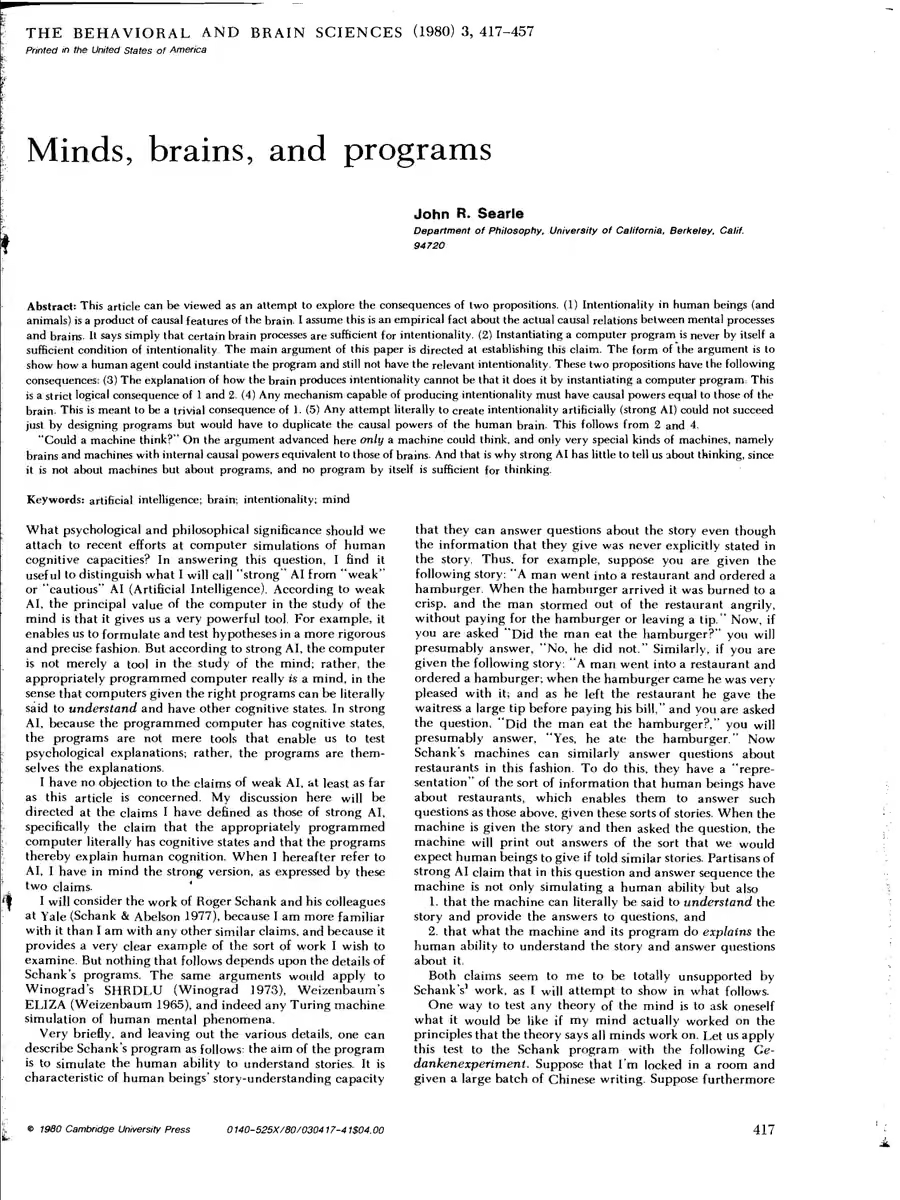
> 1980: John Searle explains why we can't abstract away the causal properties that actually produce mind
> 2025: Minds, Brains, and "but what if we scaled the program"
> 2026: Twitter still thinks simulated water is wet when argument is rehashed
> 2035: Sam Altman: "ok fine it was autocomplete the whole time"
> 2045: Chalmers: "the hard problem was, in fact, hard"
> 2050: textbooks: "the 2020s functionalism revival is now considered an embarrassing episode, like phrenology"
 ℏεsam
@Hesamation
Google DeepMind researcher argues that LLMs can never be conscious, not in 10 years or 100 years.
"Expecting an algorithmic description to instantiate the quality it maps is like expecting the mathematical formula of gravity to physically exert weight."
 Peter G. Klein
@petergklein
There are theologically illiterate public officials from all religious traditions. In the current moment, however, evangelical protestants seem to have a unique capacity for embarrassing themselves.
 Christopher Hale
@ChristopherHale
NEW: Speaker Mike Johnson told reporters today that Pope Leo XIV doesn't understand “something called the just war doctrine.”
Pope Leo is an Augustinian friar who spent twelve years leading Augustine’s religious order.
Augustine invented the doctrine. www.thelettersfromleo.com/p/something-called-the-just-war…
Peter G. Klein
@petergklein
The just war tradition is of closely related to the larger scholastic body of thought on international law.
Peter G. Klein
@petergklein
A lot of people are confused by this because they think “international law” refers to the League of Nations, UN, ICC, and the “rules-based international order” rather than the great legal tradition of Vitoria, de las Casas, Suarez, de Molina, Grotius, and their followers. 1/
Peter G. Klein
@petergklein
Fun fact: the Austrian school of economics also emerged from this milieu. mises.org/library/book/school-salamanca
Peter G. Klein
@petergklein
Wow! “Most accelerators have negative value added relative to a no-accelerator benchmark, while a small right tail generates large gains.”
 Peter G. Klein
@petergklein
Peter G. Klein
@petergklein
In these kinds of discussions, “private consumer good” means a good or service the user is willing to pay for, while “social good” means a good or service that I, the writer, thinks people should have whether they want it or not.
 Dan Walden
@dwaldenwrites
This is an entirely predictable outcome of forty years of turning education into a private consumer good, an investment in "human capital," rather than a social good aimed at the moral and intellectual formation of human beings and citizens.
Peter G. Klein
@petergklein
Notice how he puts “human capital” in scare quotes, to make it seem alien and artificial, while social good - one of the most complex, subtle, and difficult-to-define concepts in social science - is taken as self-evidently clear, true, and good.
Peter G. Klein reposted
Luis Garicano 🇪🇺🇺🇦
@lugaricano
Famously (there is a beautiful Works in Progress piece on this) in 2016, Geoffrey Hinton told an audience in Toronto that medical schools should stop training radiologists, since AI would soon outperform them at reading scans. Ten years later, there are more radiologists than ever, and they earn more than they did then.
Hinton was right about the task, but he was wrong (so far!) on the future of the radiology profession. Times have never been better for them. The gap between those two claims, the difference between tasks and jobs, is the subject of a paper I have written with Jin Li and Yanhui Wu, and that we release today: "Weak Bundle, Strong Bundle: How AI Redraws Job Boundaries." (Very relatedly we are also finishing the first draft of our book "Messy Jobs" on AI and Jobs!! You will be the first to hear).
We start from the observation that the growing literature on AI and labor markets measures the AI shock by task exposure: people count how many tasks AI can perform in a given occupation AI can perform, and infer that more exposure means more displacement. Eloundou et al. published a paper in Science in 2024 that started this literature, and many follow the same logic. The inference they make is that the more exposed tasks, the worse the outcomes.
This is incomplete, because labor markets price jobs, not tasks. A radiologist does not just sell image classification, but does many other jobs: triages cases, communicates with other physicians, trains residents, makes the difficult decisions, and signs a diagnosis. The market buys a bundled service. The question AI poses is not whether it can do one task inside the bundle. The question is whether that task can be pulled out.
Thread (1/3)
www.dropbox.com/scl/fo/689u1g785x8jp6c8v1s21/AKxZ_N15vUxM…
 Peter G. Klein
@petergklein
This is parallel to the argument @NicolaiFoss and I make in our 2022 book: coordination costs determine whether tasks can be delegated (in Luis’s example, to AI; in ours, to autonomous workers or self-managed teams). This is the key contingency in evaluating flat hierarchies.
Luis Garicano 🇪🇺🇺🇦
@lugaricano
The figure below compares two occupations with identical task exposure on Task 1. In one, the coordination cost c is low: task 1 can be separated without destroying much value. In the other, c is high: pulling the tasks apart destroys a large share of output. The same improvement in AI produces opposite labor-market outcomes. The weak-bundle occupation unbundles, the labor share falls, surviving workers flood the market with task-2 output, and the bottom tail gets displaced. The strong-bundle occupation absorbs AI inside the existing job, the worker keeps the full revenue share, and employment barely moves as long as the bundle holds. Hence while exposure is the same, displacement is not.
Unbundling lowers entry barriers. Once task 1 is removed from the job, the market no longer asks whether a worker can supply the full bundle. It asks only whether she can do task 2. The task-1 skill requirement drops out. This opens the residual role to worker types who could not have entered the bundled occupation.
The crucial parameter determining the strength of the bundle is the coordination cost c between tasks, measured by the output loss that breaking two given tasks apart will lead to. We believe that it is possible to study the main determinants of c empirically.
First, the importance of shared context. When the entity (human or machine) that classifies images is the one who also talks to the referring physician, splitting the two tasks means the classifier lacks clinical context and the communicator lacks detail.
Second, liability raises c: when a single professional must be liable for the full service, separating tasks introduces a verification problem, which, depending on the matter, may prevent full automation of the task and keep the bundle together.
Finally, in general, any cross-task spillovers raise c: what the worker learns doing task 1 improves how she does task 2, and vice versa.
Early evidence on jobs and tasks is consistent with the view of jobs as bundled of tasks. Humlum and Vestergaard (2025) link chatbot adoption to Danish administrative records and find task restructuring but no earnings or hours effects. Gathmann et al. (2024) find that AI shifts the task content of German jobs with small displacement effects. Gmyrek et al. (2023, 2025) find that generative AI is more likely to automate some tasks within occupations than to automate occupations outright.
All of this is what one expects when most jobs are bundles, and most bundles are at least moderately strong.

Peter G. Klein reposted
Daniel P. Gross
@daniel_p_gross
Perhaps useful to point out that history rhymes: this is effectively what happened with telephone operators, 100 years ago. Young, entry-level operators, whose work was mainly connecting local calls--the simplest version of the job--and not much else, were wiped out by automatic call switching. More senior operators, who had a wider range of tasks and did more complicated work like information service, emergency service, and long distance calls, were not as affected. Even when local telephone operators were effectively eliminated across AT&T's network, the others remained. Much had to do with the complexity of the work and how entangled it was with the rest of the organization.
Extended discussion in work with @jamesfeigenbaum in @QJEHarvard and Management Science: academic.oup.com/qje/article-abstract/139/3/1879/7614605, pubsonline.informs.org/doi/10.1287/mnsc.2022.01760
Lots of credit to @joshgans for helping us sharpen some of these ideas in this work as editor of the ManSci paper
Peter G. Klein
@petergklein
Great points here. AI is a technology which can enable (or retard!) entrepreneurial experimentation, discovery, adaptation, etc. In this way it is similar to other productivity-augmenting technologies. It operates under human judgment, not in parallel with it.
 Peter G. Klein
@petergklein
More on AI as a complement to, not a substitute for, human judgment.
 James Bessen
@JamesBessen
AI is NOT killing the software developer. AI is taking over tasks that software developers perform, but that does not translate into lost jobs. A new report shows why: AI is creating new and improved software products that raise demand. sites.bu.edu/tpri/files/2026/04/TPRI_Report_SW_developers…
1/9
Peter G. Klein reposted
 Arnaud Bertrand
@RnaudBertrand
Make no mistake: destroying world-class universities, like the US just did with Sharif University of Technology in Tehran, isn't just an attack on Iran but it's literally an attack on all of us, on all of humanity.
It's not Iran that "won" when Maryam Mirzakhani made her discoveries that won her a Fields Medal: it's all of mathematics, and everything mathematics is used for. Human progress won, technology won, we all won.
It's the same type of stuff the Mongols did during the sack of Baghdad and their destruction of the House of Wisdom: we ALL lost something irreplaceable back then, entire fields of human knowledge set back.
That's what bombing a university does. It doesn't just destroy buildings. It destroys us, all of us.
Peter G. Klein
@petergklein
Good WSJ piece on “The Myth of the Lone Inventor.” While the solitary genius sometimes plays a role, successful entrepreneurship and innovation are normally team endeavors.
 Peter G. Klein
@petergklein
I’ve written about that as well, particularly in the context of the “auteur theory” of entrepreneurship. organizationsandmarkets.com/2012/07/06/entrepreneurship-a…
 Peter G. Klein
@petergklein
A few more classic posts here. organizationsandmarkets.com?s=Auteur&searchbutton=Go!
Peter G. Klein
@petergklein
The WSJ summarizes some recent work on optimal team size, diversity, etc. www.wsj.com/tech/ai/invention-team-research-87ba7e05
Peter G. Klein
@petergklein
“The new book, Why Managers Matter, emphasizes that the AI era is not the era many imagine, an era where managers are no longer needed, but rather one that requires managers to shift their role from ‘managing people’ to ‘designing.’” mp.weixin.qq.com/s/viGT0h28mRs-DLohXRLEFA

Peter G. Klein reposted
 ɖʀʊӄքǟ ӄʊռʟɛʏ 🇧🇹🇹🇩
@kunley_drukpa
“Peter, thanks to my nuerodivergence I just made an incredible discovery. Apparently there’s an entire branch of philosophy concerned with the nature of being, existence and reality”
“Intriguing. Never heard of it”
“It’s called ontology, it’s extremely obscure”
“Let’s fund it”

 Peter G. Klein
@petergklein
Fascinating piece - but what is really new?
 Peter G. Klein
@petergklein
We wrote about this


 Bryan Bischof fka Dr. Donut
@BEBischof
too real
Peter G. Klein
@petergklein
Really appreciate the engagement here. My initial tweet may have been misleading as it was designed to draw attention to Böhm-Bawerk’s physical concept of APP which is incompatible with modern theories of capital heterogeneity. Pol’s value-weighted concept is different. 1/
 Pol Antras
@pol_antras
I am just catching up with this exchange and with @PeterGKlein’s initial tweet. I 100% agree with the importance of heterogeneous capital goods. If you take a closer look at our paper, you'll see that this features prominently. In fact, it is at the core some theoretical results.
 Robert P. Murphy
@BobMurphyEcon
These Harvard economists illustrate a pattern: what the mainstream calls "Austrian capital theory" focuses on the very element of Bohm-Bawerk that modern Austrians reject. Sorta like a Freudian today doesn't think you want to sleep with your mother.
Peter G. Klein
@petergklein
I was trying to promote the idea of a firm’s resource base in terms of a subjectively perceived, forward-looking set of plans, what Penrose called the firm’s “productive opportunity set.” This idea hasn’t made it into most economic theories of the firm! 3/
Peter G. Klein
@petergklein
Anyway, it’s great to see this discussion and continued interest in APP, roundaboutness, and heterogeneous capital. Super important concepts that have been largely neglected in the mainstream literature. 4/4
Peter G. Klein
@petergklein
The organizers, when they invite me to a fancy conference
 Acyn
@Acyn
Trump: I hang out with losers because it makes be feel better. I hate guys that are very, very successful and you have to listen to their success stories. I like people that like to listen to my success.
Peter G. Klein
@petergklein
Attention PhD students in entrepreneurship, strategy, and organization! Join @NicolaiFoss, Michael Dahl, Lasse Lien, @BramTimmermans, and myself for an online mini-course at @NHHnor on "Entrepreneurship and Strategy," 18-22 May, 2026. www.nhh.no/en/courses/entrepreneurship-and-strategy/
Peter G. Klein
@petergklein
Great to see continuing interest in Austrian capital theory and its analysis of the temporal structure of production. Unfortunately Böhm-Bawerk's concept of the “average period of production” is a weak spot in his theory. 1/
 Peter G. Klein
@petergklein
Still happy to see the new paper which tries to engage seriously with Austrian capital theory (scare quotes notwithstanding)! 4/4 papers.ssrn.com/sol3/papers.cfm?abstract_id=6456969
Peter G. Klein
@petergklein
Addendum: Here is a short piece I wrote in 2009 on the relationship between Williamson's concept of asset specificity and the Austrian idea of capital heterogeneity. mises.org/mises-daily/williamson-and-austrians
Peter G. Klein
@petergklein
Following the introduction of LLMs, NBER abstracts tend to use shorter sentences but have also become harder to read.
 Soumaya Keynes
@SoumayaKeynes
found something rather baffling when researching my column this week…
I wanted to see if there was any evidence that AI tools were helping economists to make their research more readable. So I analysed the text of NBER working paper abstracts…
Peter G. Klein
@petergklein
New on Judgment Calls: Under Knightian uncertainty, how do entrepreneurs persuade others to join their projects? Alternatively: Can KU be reconceptualized as intersubjective agreement?
 Peter G. Klein
@petergklein
Important point from @garyleff: “TSA is largely unaccountable because it is its own regulator. It provides the screening service in most airports, and regulates the screening service. Whenever they fail, the solution is more money. That’s a terrible incentive.”
 Peter G. Klein
@petergklein
Even under that system – which is largely how things operated before 9/11 – there are few incentives for providing better quality or lower prices. mises.org/mises-daily/source-air-travel-insecurity
Peter G. Klein
@petergklein
Would a privatized system be better? Almost certainly! www.cato.org/downsizing-government-essay/privatizing-tran…
Peter G. Klein reposted
 Liam McCollum
@MLiamMcCollum
Hate him or love him, the best thing about Trump has always been that he drops all pretenses and says what nobody else will, whether it’s that Jeb’s brother lied us into Iraq, Marco Rubio is Sheldon Adelson’s puppet, we’re staying in Syria for the oil, the Adelsons love Israel more than the US, the war in Venezuela is about oil, or we went to war with Iran “out of habit [and] for Israel.” And there’s so many examples.
 Curt Mills
@CurtMills
“We did it out of habit”
“Which is not a great thing to do”
“We did it… for Israel”
Literally just saying stuff
Peter G. Klein
@petergklein
New on Judgment Calls!

Peter G. Klein reposted
 Samuele Murtinu
@SamueleMurtinu
Very happy to see it online. A huge thank you to @NicolaiFoss & @petergklein who made it possible. Love you guys :-)
#entrepreneurship #finance #stakeholder #uncertainty @USE_UU
Nicolai Foss
@NicolaiFoss
New paper with Peter G Klein and Samuele Murtinu.
Link (open access): shorturl.at/el2yg
#knightianuncertainty #stakeholders #entrepreneurialfinance
 Peter G. Klein
@petergklein
New paper alert!
Nicolai Foss
@NicolaiFoss
New paper with Peter G Klein and Samuele Murtinu.
Link (open access): shorturl.at/el2yg
#knightianuncertainty #stakeholders #entrepreneurialfinance
Peter G. Klein
@petergklein
New on Judgment Calls: How film (and other media) can bring entrepreneurial stories - and theories - to life. open.substack.com/pub/judgmentcalls/p/entrepreneurship-in…

Peter G. Klein reposted
 Colin the Dachshund
@DachshundColin
Imagine if WWIII starts with the IDF assassinating Franz Ferdinand.
Peter G. Klein reposted
 Jennifer Kavanagh
@jekavanagh
Remember when they told you the war was costing $1 billion a day? Turns out it was $3 billion a day just for the munitions. Oops.
 The Washington Post
@washingtonpost
The Pentagon burned through $5.6 billion worth of munitions in the first two days of its Iran assault, according to U.S. officials, alarming some on Capitol Hill over how quickly the military has depleted scarce supplies of America’s most advanced weaponry.
Peter G. Klein reposted
 Philip Bunn
@PhilipDBunn
Peer review in the 1950s be like

 Peter G. Klein
@petergklein
My Iranian friend and colleague Amir Emami, co-translator of the Persian edition of Organizing Entrepreneurial Judgment, is caught in the crossfire in Tehran. I pray for a swift end to this horrible and unnecessary conflict.
Peter G. Klein
@petergklein
Wonderful gift from Amir Emami: Persian edition of Organizing Entrepreneurial Judgment!


 Peter G. Klein
@petergklein
On the costs of war: The official US government estimate for the direct costs of the Iraq war is $728b over a ten-year period (2002-2013), which runs to about $212m per day. The Iran war is currently costing about $1b per day. iran-cost-ticker.com
Peter G. Klein
@petergklein
Of course the actual costs - not only expenditures but death and destruction, the loss of liberty and prosperity, fear and mistrust, and a general breakdown of the social order - are incalculably greater. mises.org/library/book/costs-war-americas-pyrrhic-victories
 Peter G. Klein
@petergklein
See also this from the current issue of AER www.aeaweb.org/articles?id=10.1257/aer.20241355
Peter G. Klein
@petergklein
I wrote earlier on the distinction between international law, as classically understood, and the “rules-based international order,” which is virtually its negation. This statement from German Chancellor Mertz, in saying the quiet part out loud, illustrates the distinction. 1/
 Peter G. Klein
@petergklein
A lot of people are confused by this because they think “international law” refers to the League of Nations, UN, ICC, and the “rules-based international order” rather than the great legal tradition of Vitoria, de las Casas, Suarez, de Molina, Grotius, and their followers. 1/
Peter G. Klein
@petergklein
 Josiah Lippincott
@jlippincott
Under the old law of war that existed prior to WWII, outright assassination of a foreign head of state was condemned by all civilized powers.
The goal was to limit violence by "bracketing" off the government and people as lawful targets. Militaries fight militaries. Governments are off limits. There was a hard headed reason for this.
Keeping the opposing government in place made wars less brutal and existential by preserving the continuity and stability of power that made effective peace treaties possible.
But now that every enemy of the United States is a "terrorist" there is no ground for negotiation or lasting peace.
None of this has anything to do with whether the Ayatollah was a "good" man. Those judgments, between sovereign powers, mean nothing. Everyone thinks he is good and his enemies bad.
In light of this reality, the goal should be to limit the destructive effects of those moral claims by removing them as a subject of warfare.
By assassinating the Ayatollah, the United States has set a precedent for future wars that threatens to make those conflicts even more radical and violent than they should be.
That move was a mistake and we should say as much.
Peter G. Klein
@petergklein
The RuLeS-bAsEd InTeRnAtIoNaL oRdEr
 Margarita Simonyan
@M_Simonyan
Rutte: "NATO is there to protect us collectively against any adversary, be it Russia or whoever, or terrorism. But also it is a platform for the United States to project power on the world stage."
But, but, but a mere, harmless "defensive alliance."
Peter G. Klein reposted
 Jonathan Chait
@jonathanchait
[social media intern listens to first 20 seconds of song] Okay, this music works
 Israel Defense Forces
@IDF
On our way to make history ✈️
Peter G. Klein
@petergklein
Pape is the leading authority on this topic but I wish he would stop using ChatGPT to write his Substack posts and Twitter threads. 😮💨
 Robert A. Pape
@ProfessorPape
The Air Power Illusion
Full essay: "Why Bombs Break Buildings, Not Regimes": escalationtrap.substack.com/p/the-air-power-illusion
Across more than a century of war, one pattern stands out:
No regime in modern history has fallen solely because it was bombed from the air.
Cities burn. Infrastructure collapses. Leaders are targeted. But political power survives.
Bombs break buildings. They do not, by themselves, break regimes. This thread explains why
Peter G. Klein
@petergklein
This is his definitive book www.amazon.com/Bombing-Win-Coercion-Cornell-Security/dp/0…
Peter G. Klein reposted
 Eric Levitz
@EricLevitz
It's really bizarre to see a bunch of ostensibly pro-market, right-leaning tech guys argue, "A private company asserting the right to decide what contracts it enters into is antithetical to democratic government"

 Stratechery
@stratechery
Anthropic and Alignment
Anthropic is in a standoff with the Department of War; while the company's concerns are legitimate, it position is intolerable and misaligned with reality.
stratechery.com/2026/anthropic-and-alignment/
Peter G. Klein reposted
 Hayden Field
@haydenfield
NEW: When OpenAI announced its Pentagon deal Friday night, people immediately challenged Sam Altman's claims. Why, they asked, would the DoD suddenly agree to red lines when it had said it would never do so?
The answer, sources told me, is that it didn't. www.theverge.com/ai-artificial-intelligence/887309/openai…
Peter G. Klein reposted
 Philippe Lemoine
@phl43
It’s not a regime change war unless it comes from the Regime Change War region of France.
 Disclose.tv
@disclosetv
NOW - Secretary of War Hegseth on U.S.-Iran regime change war: "This is not a so called 'regime change war.' But the regime sure did change, and the world is better off for it."
Peter G. Klein reposted
 Red Panda Koala
@RedPandaKoala
Defense contractors rn
Peter G. Klein
@petergklein
This is similar to the point I made in my recent post on AI and human judgment. Does delegating lower-level tasks to agents make it more difficult to developing higher-level capabilities?
 Brendan McCord 🏛️ x 🤖
@Brendan_McCord
LLMs are living off the moral and intellectual capital of a pre-AI world, just like Nietzsche said secular liberals live off Christianity. What happens when the inheritance runs out?
Using LLMs well — knowing when to trust them, how to interrogate their outputs, what questions are worth asking — depends on capacities that are pre-LLM in origin: critical judgment, domain expertise, philosophical seriousness, taste.
People who use LLMs well right now tend to be people formed by traditions of deep reading, argument, and intellectual discipline that were not themselves produced by or optimized for interaction with language models. The tool works for them because they bring something the tool cannot supply.
Nietzsche thought secular liberals were coasting on the fumes of a Christian metaphysics they'd officially abandoned. The shadow of God lingering on the cave wall. The question is whether LLM-native thinking is the same kind of afterglow.
Peter G. Klein
@petergklein
Peter G. Klein
@petergklein
This attitude is common, but ignores a substantial social-science literature on terrorism. Terrorism is a tactic and endogenous to social, economic, and political circumstances - including policies to combat terrorism. 1/
 Noah Pollak
@NoahPollak
One of Trump's greatest legacies will be how he blew up a half-century of western diffidence, restraint, and failure on terrorism. As the era of Islamic terrorism began in the 1970s, western countries (very much including Israel) spun up all kinds of pseudo-sophisticated theories and excuses to avoid carrying out the only successful policy, which is killing terrorists -- as many as you can, whenever you can.
There are entire university departments, think tanks, media outlets, NGOs, foundations, and political parties devoted to promoting self-defeating, enervating fictions about terrorism designed to tie the hands of the West. We just have to live with it, deal with it, accommodate it, accept the barbarism. Terrorists have grievances. It's partly our fault, after all, because reasons. There are no military solutions. If we're nice to the terrorists they will actually help us stabilize the region. The tropes go on forever and they are invented by people who want the west to lose, and who would rather be wrong but appear sophisticated than be right and appear crude.
Trump wants our side to win. The winning approach to terrorism is very simple. Bomb them to smithereens. Kill them off. Decapitate the regimes. Sanction them until they have no more money for jihad. Trump gets it, because unlike so many people in politics, he doesn't care whether Harvard likes him.
Winning is going to generate a real peace dividend for America. Finally dealing with Iran -- the head of the snake -- will enable the US to step away from the Middle East. It will send a message to our adversaries that the big dog is still in charge. And very enjoyably, it will sweep aside decades of dumb elite groupthink about how we have no alternative but to cut deals with terrorists. Thank you President Trump.
Peter G. Klein
@petergklein
You also hear terrorism (like "hate," "gun violence," etc.) treated as a disease that can be analyzed and "treated" using epidemiological methods - an entirely misplaced application of biological analogies to a social problem. 4/ organizationsandmarkets.com/2016/01/26/is-terrorism-a-dis…
Peter G. Klein
@petergklein
I realize that sober, rational discussion is unpopular when war fever strikes. But keep in mind that most of what you hear from official sources, mainstream pundits, etc. is propaganda. Be skeptical. 5/5
Peter G. Klein
@petergklein
This is essentially correct but the research literature also suggests that boycotts can be effective (in reducing the target company’s market valuation) when they generate substantial media coverage, even if large numbers of consumers do not switch. 1/
 Rutger Bregman
@rutgerbregman
Effective consumer boycotts have 2 things in common.
They are (1) narrow and (2) easy.
This is why I think @quitchatgpt is on an absolute rampage right now.
The boycott is targeted at a very vulnerable company (OpenAI) and switching costs are essentially zero.
 Peter G. Klein
@petergklein
King and Soule (2007) is one of the most highly cited studies. 2/ journals.sagepub.com/doi/10.2189/asqu.52.3.413
 Peter G. Klein
@petergklein
There is speculation that top Trump administration officials have financial ties to OpenAI, suggesting that the DOW’s actions reflect attempts to boost its upcoming IPO. If the research literature is correct, the publicity surrounding this may have the opposite effect. 3/3
Peter G. Klein reposted
 Lawrence Chan
@justanotherlaw
OpenAI has released the language in their contract with the DoW, and it's exactly as Anthropic was claiming: "legalese that would allow those safeguards to be disregarded at will".
Note: the first paragraph doesn't say "no autonomous weapons"! It says "AI can't control autonomous weapons as long as existing law (that doesn't exist) or the DoD says so."
Similarly, the mass surveillance use cases will "comply with existing law", but many forms of data collection that we'd consider "mass surveillance" are things that the NSA has consistently argued are legal under current law.
 Peter G. Klein
@petergklein
A lot of people are confused by this because they think “international law” refers to the League of Nations, UN, ICC, and the “rules-based international order” rather than the great legal tradition of Vitoria, de las Casas, Suarez, de Molina, Grotius, and their followers. 1/
Peter G. Klein
@petergklein
These thinkers analyzed the behavior of states toward each other and developed principles of just conduct among states (including when dealing with other states that did not behave justly). The scholastic just war tradition is closely related to this body of thought. /2
Peter G. Klein
@petergklein
Again, twentieth-century international organizations and conventions have little to do with this tradition - they are examples of positive laws established by the most powerful countries. 6/6
Peter G. Klein
@petergklein
 Timothy Gordon (Rules for Retrogrades Show)
@timotheeology
In the first place, please stop implying that advocacy for Catholic just war theory reduces to modern liberalism
The ius gentium (int'l law) isn't a reference to promulgated legislation but rather to NL juridical limits on war, treaty, trade, & sovereign int'l immunity
It is referenced by all the best RC scholastic political minds:
✅Thomas Aquinas
✅Robert Bellarmine
✅Francisco de Vitoria
✅Domingo de Soto
✅Luis de Molina
✅Francisco Suárez
✅Fernando Vázquez de Menchaca
✅Bartolomé de las Casas
Peter G. Klein
@petergklein
Today’s example
 Ryan Grim
@ryangrim
Mark Carney, who awed the world with his speech about the rules-based order and his opposition to American belligerence, says he supports this new attack on Iran
Peter G. Klein reposted
 Per Bylund
@PerBylund
If a business made claims about their products the way that politicians sell themselves to us every election, they'd be forced to pay fines, damages, and their leadership would risk imprisonment.
 Republicans
@Republicans
Vote the pro-peace ticket. Vote Trump-Vance 🇺🇸
 Peter G. Klein
@petergklein
What can academics do in times like these? Encourage people to read specialists like Pape, Walt, Mearsheimer, Bacevich, Brandow, and of course the earlier theorists and historians like Garet Garrett, Beard, Rothbard, Raico, and Raimondo.
Robert A. Pape
@ProfessorPape
Three historical lessons about bombing campaigns and regime change:
Peter G. Klein
@petergklein
Pape’s Dying to Win is also highly recommended. organizationsandmarkets.com/2007/06/20/more-on-terrorism-…
Peter G. Klein reposted
Liam McCollum
@MLiamMcCollum
On Inauguration Day, Donald Trump said, “We will measure our success not only by the battles we win, but by the wars we end — and perhaps more importantly, by the wars we never get into. My legacy will be as a peacemaker.” Today, he bombed Iran, called for regime change, and said US casualties are possible but worth it.
Peter G. Klein reposted
 Niz
@NizMhani
🚨BREAKING:
The "Board of Peace" launches its first war....
 Peter G. Klein
@petergklein
New on Judgment Calls: summary of a new paper with Paul Sanchez, Ileana Maldonado-Bautista, and Joseph Vaughn. How do sacred values affect entrepreneurial behavior?
 Peter G. Klein
@petergklein
We are hiring! Baylor University's Department of Entrepreneurship and Corporate Innovation is hiring for a non-tenure-track Lecturer position to start in August 2026. Details at the link below. Come and join a world-class entrepreneurship research and teaching community!

 Peter G. Klein
@petergklein
Someone has been reading my posts on AI and human judgment!
 Boris Cherny
@bcherny
Someone has to prompt the Claudes, talk to customers, coordinate with other teams, decide what to build next. Engineering is changing and great engineers are more important than ever.
Peter G. Klein
@petergklein
Peter G. Klein
@petergklein
New on Judgment Calls: Can neuroscience methods help us unpack the black box of entrepreneurial judgment?

Peter G. Klein reposted
 Robert Youssef
@rryssf
researchers at Max Planck analyzed 280,000 transcripts of academic talks and presentations from YouTube
they found that humans are increasingly using ChatGPT's favorite words in their spoken language. not in writing. in speech.
"delve" usage up 48%. "adept" up 51%. and 58% of these usages showed no signs of reading from a script.
we talk about model collapse when AI trains on AI output. this is model collapse, except the model is us.
 Peter G. Klein
@petergklein
Risk and uncertainty aren’t mutually exclusive determinants of economic outcomes. Entrepreneurs choose to invest in risky projects, but project selection itself reflects the bearing of Knightian uncertainty. By analogy: "The coin don’t have no say. It’s just you."
 Peter G. Klein
@petergklein
The Chinese edition of Why Managers Matter, translated by Kuan Zhang and Xiong Yue, was selected as one of the Top 10 Books of 2025 by “The Economic Observer."
 Peter G. Klein
@petergklein
Peter G. Klein
@petergklein
AI agents are tools, but also tool-shaped objects. Insightful piece.
 Will Manidis
@WillManidis
Peter G. Klein
@petergklein
Further to my post on AI and human judgment: “the popular narrative around Moltbook misses the mark. . . . Some portray it as a space where AI agents form a society of their own, free from human involvement. The reality is much more mundane.”
www.technologyreview.com/2026/02/06/1132448/moltbook-was-…
Peter G. Klein
@petergklein
On a more serious note: edwardfeser.blogspot.com/2026/02/no-ai-does-not-have-huma…
Peter G. Klein
@petergklein
New on Judgment Calls: can AI replace human judgment?
 Peter G. Klein
@petergklein
Peter G. Klein
@petergklein
Further to my earlier thread on cronyism: “contrary to a common perception, the United States has always been an active industrial policy nation . . . regardless of which party is in power.”

 Peter G. Klein
@petergklein
Peter G. Klein
@petergklein
Thread on the Trump Administration
Peter G. Klein
@petergklein
Trump justifies his war on Venezuela by saying that “they” stole “our” oil. Unpacking this claim gives us insight into Trump’s version of crony capitalism – a system of private ownership in which the state intervenes to promote the interests of politically connected firms. 1/
Peter G. Klein
@petergklein
.@NicolaiFoss and I were the co-founders and primary authors of the Organizations and Markets blog which ran from 2006 to 2016 (when blogs were largely displaced by social media platforms). The essay format is back, and so are we, with a new Substack: Judgment Calls.
 Peter G. Klein
@petergklein
The title is a nod to the Judgment-Based Approach – and the works of Frank Knight and Ludwig von Mises, whose images grace our header – as well as our habit of offering provocative, yet wise, takes on a variety of economics, social, political, and cultural issues.
Peter G. Klein
@petergklein
Our target audience is not only academics, but also practitioners and policymakers interested in the sorts of issues we study and teach. (Details are on our academic websites, which are easy to find.) Please consider subscribing! judgmentcalls.substack.com
Peter G. Klein reposted
Robert P. Murphy
@BobMurphyEcon
If you think the very concept of "international law" is NPR gobbledegook that can only mean guys in blue helmets enforcing tailpipe emissions standards, I encourage you to listen to my recent conversation with @petergklein. Especially if you're Catholic. (Link next.)
 Peter G. Klein
@petergklein
I missed these when they came out but there is a fascinating NBER conference paper by Erik Brynjolfsson & Zoë Hitzig on AI and tacit knowledge, appropriately titled, "AI’s Use of Knowledge in Society." See also the comment by Avi Goldfarb (both papers linked below.)
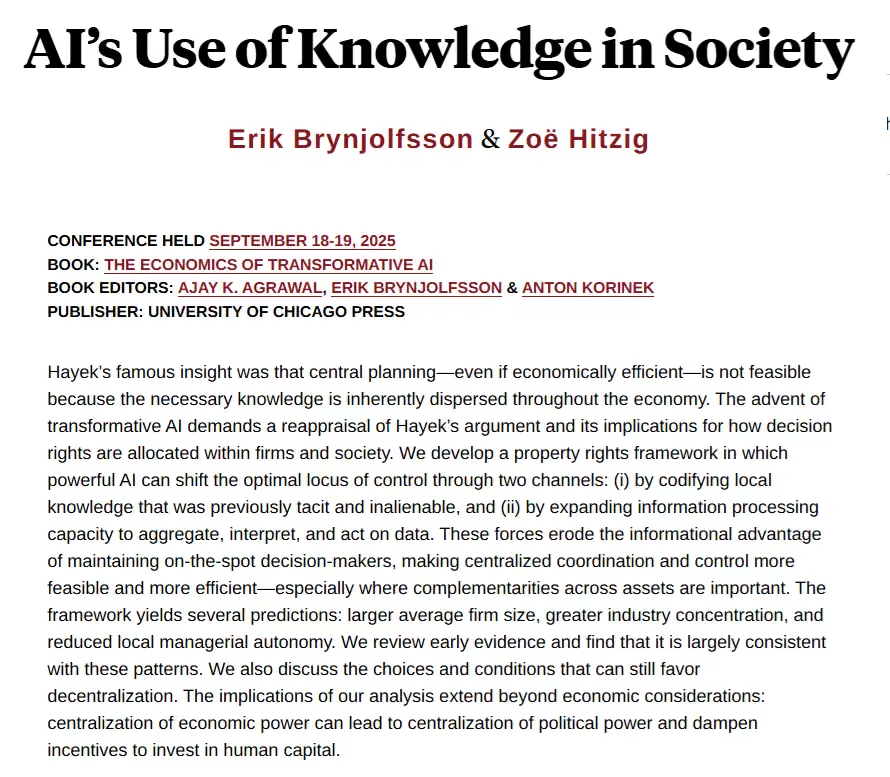 Peter G. Klein
@petergklein
The main paper: www.nber.org/books-and-chapters/economics-transformative-…
Peter G. Klein
@petergklein
Avi's comment: www.nber.org/books-and-chapters/economics-transformative-…
Peter G. Klein
@petergklein
Can "law" exist without a unified sovereign and centralized enforcement? Absent a supreme authority, is there anything but might makes right? Yes! Law can be real, morally binding, and effective with distributed sovereignty and competing enforcement. Here's some literature. 1/
Peter G. Klein
@petergklein
Two books (both appearing in 1983) on the private evolution of commercial law, Harold Berman's Law and Revolution and Leon Trakman's The Law Merchant, are also work consulting. 8/

 Peter G. Klein
@petergklein
Recent papers by Avner Grief, Douglass North, Barry Weingast, and others on the emergence and enforcement of long-distance, interstate trading explore these issues in more detail. 9/
Peter G. Klein
@petergklein
There is plenty more but this should be enough to get you started. The point is there is a large, rich, and multidisciplinary literature on the private production, emergence, and maintenance of law between states, in weak states, and in the absence of a state. 10/10
Peter G. Klein
@petergklein
My doctor’s new portal lets me select my preferred language
 Peter G. Klein
@petergklein
“Þi bille is not y-paied.”
Peter G. Klein reposted
 Bryan Sralla
@KennethSralla
As a professional geologist for the last 33 years, educated in the shadows of the Hankamer School of Business, I'm probably biased. But this is the best and most accurate commentary on this issue I've read. You are precisely correct about oil ownership and how this all works. The ignorance in most popular commentary and inside the Trump administration is flabbergasting.
Predictions are dangerous, but they concisely locate where someone stands on issues. I'll dare proffer three here:
1) Inflation-adjusted annual US industry investment in the Venezuelan oil industry over the next decade will never rise to the levels it was in 2000 under Chavez.
2) Venezuelan average daily oil production in 2035 will be lower than it was in 2025.
3) The majority of US and international investment in the Venezuelan oil industry over the next decade will be in deepwater exploration for high-rate light oil production, not the heavy oil supposedly so scarce for US Gulf Coast refineries.
I have rationale for each of these predictions, but no room here to elucidate them.
Hint: nobody is more uncomfortable with all this talk from the White House than Darren Woods. These heavy oil projects in Venezuela are very likely not competitive in his global portfolio of projects. The only thing he’s happy about is that Venezuela will not be moving into Guyana.
Peter G. Klein
@petergklein
Trump justifies his war on Venezuela by saying that “they” stole “our” oil. Unpacking this claim gives us insight into Trump’s version of crony capitalism – a system of private ownership in which the state intervenes to promote the interests of politically connected firms. 1/
Peter G. Klein
@petergklein
Fist, note that crony capitalism or cronyism is distinct from a free-market, capitalist system in which firms compete by offering better products and services, lower prices, or both. (Critics of capitalism often conflate the two.) 2/ journals.aom.org/doi/10.5465/amp.2019.0198
 Peter G. Klein
@petergklein
Addendum, for those who think this operation was about liberating the Venezuelan people, stopping “narco-terrorism,” or some other noble idea.
 Thomas Massie
@RepThomasMassie
It seems obvious from this video that the administration worked with big U.S. oil companies before the attack to line up billions of dollars in capital for developing Venezuela’s oil reserves, yet they couldn’t be bothered to consult Congress.
Peter G. Klein
@petergklein
Acyn
@Acyn
Reporter: Are you going to demand that Delcy Rodriguez allow opposition figures to return or free any political prisoners?
Trump: We haven't gotten to that. Right now, we want to do is fix up the oil
Peter G. Klein
@petergklein
Oil industry: "Thanks, but we aren't going to extract the oil without even greater subsidies"
 Vaughn Sterling
@vplus
Industry sources tell CNN that American oil executives are unlikely to dive headfirst into Venezuela for multiple reasons: The situation on the ground remains very uncertain, Venezuela’s oil industry is in shambles and Caracas has a history of seizing US oil assets
Peter G. Klein
@petergklein
This is not at all surprising once you recognize that "science," like other social institutions, is an activity conducted by actual humans.
 Valerio Capraro
@ValerioCapraro
This is deeply troubling.
Researchers are more likely to choose statistical models whose results align with their ideological priors.
Seventy-one research teams independently analyzed the same dataset on the effect of immigration on public support for social welfare programs.
Teams composed of pro-immigration researchers were more likely to conclude that the effect was positive. Teams composed of anti-immigration researchers were more likely to find a negative effect.
Let me repeat: they analyzed literally the same dataset.
Full paper in the first comment.
 Peter G. Klein
@petergklein
I've taken quite a bit of heat over the years for suggesting that scientists employ scarce means to achieve competing ends, act according to their own preferences and beliefs, respond to incentives, and so on. They are just as "self-interested" as anyone.
organizationsandmarkets.com/2015/12/02/incentives-ideolog…
Peter G. Klein
@petergklein
Back when I taught law and economics, I began the course with Bruno Leoni's Freedom and the Law and excerpts from Hayek's Law, Legislation, and Liberty, to introduce the students to the distinction between natural and positive law. For most of them, it was an eye opener! 1/
Peter G. Klein
@petergklein
The idea that something can be illegal even if you get away with it - that might doesn't make right - seems lost on most of today's political and legal pundits. They cannot conceive of principles of just conduct that differ from the whim of the currently strongest power. 6/6
Peter G. Klein
@petergklein
Addendum: Feser expresses the issue well here. The question of how a body of law can be enforced is separate from the question of whether the law is real and morally binding.
 Edward Feser
@FeserEdward
The standard view in Scholastic theory is that international law is in part grounded in natural law, and in part grounded in contracts between nations, where the obligation to respect contractual agreements is itself also part of natural law. So, either directly or indirectly, the obligation to respect international law is grounded in natural law. Naturally, that does not entail that everything that has become part of international law is legitimate. As with man-made law in general, the parts of international law that derive from contract can be illegitimate where they positively conflict with natural law. But that does not entail that international law in general and as such has no force.
As to enforcement, since there is no supranational authority to enforce it, the only conceivable way to punish a nation which violated its obligations under international law would be for other nations to do so through economic sanctions, military action, etc. The extent to which this would be justifiable or advisable is a matter of debate. But the question of how international law would be enforced is separate from the question of whether it is real and morally binding. The lack of an enforcement mechanism would not entail that there is no such thing as international law or that it is not morally binding.
As to your other comment, Matt, I was not trying to impress anyone. You made remarks that were irresponsibly flippant, ill-informed, and contrary to traditional Catholic moral theology, and I pointed that out. That’s all.
Peter G. Klein
@petergklein
Apparently Knight opposed his own salary increase!
Noah Williams
@Bellmanequation
1944: @UChi_Economics requested $1500 pay raise for Frank Knight: "He is known throughout the world as one of its outstanding economists... His present salary is an embarrassment to the Department."
University only granted $500 increase.

Peter G. Klein reposted
 Timur Kuran
@timurkuran
Europe’s censorship complex rests on the belief that its ruling elites know what’s true and what is not. As such, it’s profoundly undemocratic and a recipe for economic stagnation. It invites conformism, risk aversion, and fealty. It reflects fear of competition and exploration.
 The Atlas Society
@TheAtlasSociety
The mask didn’t slip, it is fully removed.
Peter G. Klein
@petergklein
It’s only censorship if it comes from the Censor region of Europe. Otherwise it’s just sparkling democratic control of speech.
 Ursula von der Leyen
@vonderleyen
Freedom of speech is the foundation of our strong and vibrant European democracy.
We are proud of it. We will protect it.
Because the @EU_Commission is the guardian of our values.
 European Commission
@EU_Commission
We strongly condemn the U.S. decision to impose travel restrictions on five European individuals, including former Commissioner Thierry Breton.
Link to full statement: link.europa.eu/NtMX4K
Peter G. Klein
@petergklein
New paper in Journal of Business Venturing Design: "Varieties and applications of tools in entrepreneurial practice." We ask a simple but underexplored question: Which entrepreneurial tools are appropriate for which contexts - and why? 1/
 Peter G. Klein
@petergklein
We also introduce a meta-tool that helps instructors and practitioners sequence and combine tools across venture stages—bridging planning, experimentation, strategy, and execution. Designed to support more coherent entrepreneurship teaching and curriculum design. 5/
Peter G. Klein
@petergklein
Free access to the paper here. Comments welcome! 6/6 www.sciencedirect.com/science/article/pii/S26672774250000…
Peter G. Klein
@petergklein
Markets facilitate decentralized judgment, not just decentralized discovery!
 Brian Gordon
@GordonBrianR
I love that. And it’s deeply congruent with the ideas about decentralized judgment Foss and Klein added to the decentralized information notion of Hayek. When markets work, it’s because they generate new search and conjecture, not when they aggregate prior information per se.
Peter G. Klein reposted
 Kevin A. Bryan
@Afinetheorem
Indeed, and when you realize it is the same thing, you will wonder why the law school folks who think Instacart is a first order problem do not worry about *literally their employer doing massive price discrimination by asking buyers to send in tax records of how rich they are*.
Peter G. Klein
@petergklein
To promote capitalism, we shall establish state ownership of the means of production
 Senator Ted Cruz
@SenTedCruz
We’ve all seen the sad statistics of how many kids are losing faith in capitalism.
Well, 10 years from now because of Trump accounts, a little boy is going to pull out his phone, and he's going to look at his app, and he's going to see that he’s an owner of the biggest employers in this country.
We are creating a new generation of capitalists in America, and I’m really excited about that.
www.businessinsider.com/trump-accounts-capitalism-ted-cru…
Peter G. Klein
@petergklein
I have been saying for years that P4 athletics departments (or at least the football and basketball programs) should be spun-off into standalone entities that partner with the host institutions - basically licensing the brand in exchange for a revenue share.
 Ross Dellenger
@RossDellenger
In a groundbreaking endeavor, the University of Utah athletics is entering into what could be a $500M+ equity partnership with Otro Capital featuring the creation and shared ownership of a for-profit entity to operate athletics, sources tell @YahooSports.
sports.yahoo.com/college-football/breaking-news/article/s…
Peter G. Klein
@petergklein
Many university bookstores are already owned and run by companies such as Follett. Non-student contractors and employees (maintenance, groundskeeping) often wear uniforms with the school's logo. Why not athletes? follett.com
Peter G. Klein
@petergklein
For the fans, games will look and feel the same - school colors, fight songs, and traditions. Most players are already de facto paid employees, so why not formalize this? (They could be offered the opportunity to take classes at a discount if they wish.)
Peter G. Klein
@petergklein
This was a fun event (from 2013). There is also a video: www.youtube.com/watch?v=m3p7jqXK7qg&t=1565s
 Hayek Program
@HayekProgram
On this episode of the Hayek Program Podcast, @PeterBoettke, @petergklein, and Don Boudreaux reflect on Israel Kirzner's lifelong contributions to market process theory and entrepreneurship.
www.mercatus.org/hayekprogram/hayek-program-podcast/dr-is…
Peter G. Klein
@petergklein
Thanks to @CarmenDorobat for a great interview with @NicolaiFoss and myself on the origins of the judgment-based approach to entrepreneurship!
ejsociety.org/conversations-2

Peter G. Klein reposted
 Matt McCaffrey
@mattcmccaffrey
We have a new blog on the Entrepreneurial Judgment Society website, discussing recent EJS contributions to knowledge accumulation in entrepreneurship research: ejsociety.org/blog
@NicolaiFoss @petergklein
Peter G. Klein
@petergklein
Intro to the ETP SI on Knowledge Accumulation featuring our article on Knightian uncertainty which offers "a foundation for applying the accumulated knowledge of KU to a broader range of research questions, offering valuable insights into the most fruitful options to explore."
 Peter G. Klein
@petergklein
Peter G. Klein
@petergklein
Our article is here journals.sagepub.com/doi/full/10.1177/10422587251347062
Peter G. Klein reposted
 Patrick Newman
@DrPatrickNewman
Very excited to announce that next year's Rothbard Graduate Seminar will focus on the Science of Liberty. If advanced discussions in Rothbardian political economy (economics, ethics, political theory, and more) interest you, apply now! June 7-12.
mises.org/events/rothbard-graduate-seminar-2026
Peter G. Klein
@petergklein
Firms in emerging markets are constrained by a lack of qualified middle managers. Entrepreneurs may respond by delegating some managerial functions to outside specialists. Lots of interesting data and analysis in this paper!
 Peter G. Klein
@petergklein
Peter G. Klein
@petergklein
Happy to announce the formation of the new Entrepreneurial Judgment Society—a network of scholars dedicated to furthering the Judgment-based Approach (JBA) to entrepreneurship. 1/
 Peter G. Klein
@petergklein
The Entrepreneurial Judgment Society will coordinate research efforts of scholars interested in the JBA and promote applications to entrepreneurship education and practice. We will arrange seminars, showcase research, facilitate joint projects and funding efforts, and more. 5/
Peter G. Klein
@petergklein
We invite you to follow our activities and apply for membership of the EJS. 6/6 ejsociety.org
Peter G. Klein
@petergklein
Hal Varian wrote a great 2002 piece on the internet and transaction costs. Coase 1937 said firms exist to reduce transaction costs; if the internet has eliminated them, why do we still need firms? Varian pointed out that the internet also reduces internal organizational costs. 1/
 Peter G. Klein
@petergklein
In other words, the basic logic of Coase's argument - firm boundaries are determined at the margin by comparing external and internal transaction costs - applies even in the face of technological change. What about AI? Is it so revolutionary that a new framework is needed? 2/
Peter G. Klein
@petergklein
This excellent review paper by @johnjhorton and colleagues explores the impact of AI on firm boundaries, organization, and strategy, focusing on the role of AI agents in performing search, bargaining, and contracting functions on behalf of consumers. 3/3 www.nber.org/papers/w34468
Peter G. Klein
@petergklein
Supporters of government venture capital funds often tout positive spillover effects beyond the sectors and industries targeted by state planners. Evidence from China, however, suggests a net negative effect of government VC on new firm formation.
 Peter G. Klein
@petergklein
Peter G. Klein
@petergklein
As Henry Hansmann likes to say, a corporation is simply a lenders' cooperative
 Leigh Phillips
@Leigh_Phillips
Outstanding paper from philosopher Joseph Heath that not only eviscerates the notion that cooperatives (consumer, worker, etc) are a socially superior form to the business corporation, but demonstrates how due to market incentive, there isn’t really a difference between them.
 Peter G. Klein
@petergklein
Respect for professors who assign whole books (this one in particular)
Per Bylund
@PerBylund
Today's seminar in my doctoral course EEE6213 Entrepreneurship: Theory and Practice. We discuss entrepreneurial judgment based in this week's readings by @NicolaiFoss, @petergklein, @mattcmccaffrey, @CarmenDorobat, @vladtopan, @mdpackard, and others .
 Peter G. Klein
@petergklein
What a great paper title
 Peter G. Klein
@petergklein
Call for applications: Baylor PhD in Entrepreneurship. Application deadline is January 15, 2026. Come join one of the world's top entrepreneurship research communities! www.dropbox.com/scl/fi/itop5kuzm3aso9etre24e/Call-for-App…
Peter G. Klein reposted
 Selena Wisnom
@LSWisnom
Academics in Assyria in the 7th c BC complain that admin is preventing them from doing research and teaching

Peter G. Klein reposted
 Arpit Gupta
@arpitrage
Very cool JMP by @ppcreanza: the Gilded Era merger wave didn't kill innovation, it turbo boosted it.
Large scale consolidation in early 20th century enabled large industrial labs, lower cost of capital, and more breakthrough patents
pierpaolocreanza.github.io/website/creanza_jmp.pdf


 Peter G. Klein
@petergklein
A cool piece (from 2018) with interesting ideas on promoting an "auteur" approach to science. I agree that an overemphasis on metrics and short-term impact impedes long-run creativity. However, as shown in the next tweet, the auteur theory is probably wrong, even in cinema.
 Itai Yanai
@ItaiYanai
Is science too obsessed with metrics, large-scale projects & “blockbuster” outputs? Desai & Jun argued that preserving the "auteur" spirit of individual creativity, exploration and risk-taking is essential for maintaining the creativity that drew us into science in the 1st place.
 Peter G. Klein
@petergklein
Great art (and science) can be the product of the lone genius but is more commonly a team effort with plenty of input from those who pay the bills. organizationsandmarkets.com/2012/07/06/entrepreneurship-a…
Peter G. Klein
@petergklein
Impact is valuable but I share the second set of authors' concerns about making practitioner relevance a core metric in evaluating business school research.

Peter G. Klein reposted
 Renaud Foucart
@RenaudFoucart
"Great catch, I did not actually open the .csv file. Here is an updated version of the data visualization with a cleaner color pattern."
Peter G. Klein
@petergklein
More on the impact of management quality on organizational performance. Unlike the Bloom et al. studies which measure management practices by survey, these authors examine the introduction of a competitive system for recruiting managers (along with better pay). Effects are large.
 Peter G. Klein
@petergklein
Importantly, the results are driven not by the incentive effects of introducing performance-based pay (treatment), but by the substitution of better trained managers for older, less knowledgeable predecessors (selection). Note that training = university management degree!
Peter G. Klein
@petergklein
Peter G. Klein
@petergklein
Interesting: stronger intellectual property protection benefitted incumbents at the expense of potential entrants.
 Peter G. Klein
@petergklein
Peter G. Klein
@petergklein
Other examples of this type:
JM Keynes didn't create the IS-LM or AS-AD models typically used to illustrate "Keynesian economics"
What is commonly called a "Likert scale" is not the measurement approach invented by Rensis Likert (who pronounced his name LICK-ert, not LIKE-ert)
Misha Teplitskiy | Science of Science
@MishaTeplitskiy
Maslow's pyramid/hierarchy of needs was created by someone who was not Maslow
(via @nalanpog)
 Peter G. Klein
@petergklein
It was this chance interaction with two Baylor professors that inspired him to choose basketball as a vocation

 Hoop Central
@TheHoopCentral
V.J. Edgecombe this season:
34 PTS — 7 REB — 3 AST — 13/26 FGM
15 PTS — 6 REB — 8 AST — 3 STL
26 PTS — 4 REB — 7 AST — 10/17 FGM
 Peter G. Klein
@petergklein
Sad to learn of the passing of Erich Streissler. He was the featured speaker at the first academic conference I attended, a workshop on Carl Menger in 1989 (where I also met Eve Menger, granddaughter of Carl - yes, I'm that old).

 Florian Ederer
@florianederer
Amazing obituary for Prof. Erich Streissler
Students in the 60s demanded to discuss Marx. Streissler agreed & offered a Marx seminar: one chapter of Kapital per week to read & prepare. Attendance collapsed.
Turns out students wanted Marxist revolution, not Marxist homework.
Peter G. Klein
@petergklein
Does entrepreneurship (and management) research have a pro-capitalist bias? Are new theories and methods necessary to analyze a broader set of institutional arrangements? My colleagues and I argue that we understand institutions pretty well, though more work is always welcome!
Nicolai Foss
@NicolaiFoss
New JMS paper with Peter Klein, Michael Holmes, and Siri Terjesen. We argue against Bruton et al.'s overall claim that man and org studies are biased towards capitalism; challenge their specific arguments; advocates studying institutions rather than "capitalism", "socialism"
 Peter G. Klein
@petergklein
Peter G. Klein
@petergklein
Your daily reminder that war is not good for the economy
 Peter G. Klein
@petergklein
Even in those edge cases mentioned in the textbooks www.independent.org/article/1992/03/01/wartime-prosperity…
Peter G. Klein
@petergklein
If this fake Peter Klein DMs you about your crypto holdings, don't respond. (But feel free to send me cash in unmarked, brown envelopes.)
 Peter G. Klein
@petergklein
Why Managers Matter argues that modern management is about organizational design, not command-and-control. This agency theory paper asks what happens when the principal designs not only the contract, but the mechanism for determining when the contract has been breached.
 Peter G. Klein
@petergklein
Peter G. Klein reposted
Nicolai Foss
@NicolaiFoss
Very interesting paper on the influence of Frank Knight's Risk, Uncertainty and Profit on different fields of scholarship since 1990. The judgment-based approach to entrepreneurship that I have been advancing with @petergklein and others over the past 20 years is highlighted.
 Peter G. Klein
@petergklein
Mokyr published a very interesting paper on "cultural entrepreneurship" in 2013. Starting from a Schumpeterian framework, he describes cultural entrepreneurs as "the creators of epistemic focal points that people can coordinate their beliefs on."
 Peter G. Klein
@petergklein
I wrote about it here: organizationsandmarkets.com/2013/06/26/mokyr-on-cultural-…
Peter G. Klein
@petergklein
If I'm not mistaken, Mokyr is the first primarily verbal economist to win the Nobel prize since Williamson and Ostrom in 2009. Almost certainly the last!
Peter G. Klein
@petergklein
The Great Deregulator Alfred Kahn famously referred to airplanes as "marginal costs with wings." Now they've become short-term consumer loans with wings - the bulk of US airline revenue comes from co-branded credit card earnings.
 gary leff
@garyleff
"Airlines Are Now Credit Cards With Wings” — Delta Admits It’s Now Choosing Routes To Chase Amex Spend - View from the Wing viewfromthewing.com/airlines-are-now-credit-cards-with-wi…
Peter G. Klein
@petergklein
Job-market candidate, full professor, associate dean
Noah Williams
@Bellmanequation
Macro, micro, econometrics
 Peter G. Klein
@petergklein
Strategy, entrepreneurship, OB
Noah Williams
@Bellmanequation
Macro, micro, econometrics
Peter G. Klein
@petergklein
Peter Buckley: "civil society has begun to shun entrepreneurial activities as exploitative, damaging to the individual, fostering inequality, and at odds with the [ESG] agenda. Entrepreneurship and the twenty-first century zeitgeist are incompatible."
 Peter G. Klein
@petergklein
Peter G. Klein
@petergklein
When you submit an article then someone publishes one on the same topic
 Redd
@ReddCinema
This is cinema.
Peter G. Klein
@petergklein
Great turnout for Patrik Schumacher's lecture at the @BUBaughCtr Free Enterprise Forum, "How Ideology Stifles Creativity and Progress: The Case of Architecture." The video will be available soon on our YouTube page. Thanks to all for coming!
 Peter G. Klein
@petergklein
Wait until people find out about the parking lot
 Cal Football
@CalFootball
Berkeley’s got the best and brightest 💡
Honoring the 59 Nobel Prizes and counting won by Cal affiliates on our helmets this weekend.
#smartandtough #gobears


 Peter G. Klein
@petergklein
This Week's Sign of the Apocalypse
 Peter G. Klein
@petergklein
For next year's Banished Words list I'd like to suggest "deep" as in deep tech, deep learning, deep fakes, deep search, etc.
 Peter G. Klein
@petergklein
Looks like we're headed for another round of the "shutdown" pantomime in which the political class pretends that a temporary 10-15% spending cut "shuts down" the government with dire consequences. Luckily fewer and fewer people pay attention!
Peter G. Klein
@petergklein
A younger me explained it pretty well I think. youtu.be/xBR-g3L3qFE
Peter G. Klein
@petergklein
For reference, the Trump Administration is threatening to furlough (not fire) about 400,000 "non-essential" government employees - around 13% of the 3m federal workforce.
Intel plans to slash its workforce by 20% this year. Would anyone say Intel is "shutting down"?
Peter G. Klein reposted
Alex Imas
@alexolegimas
It is truly hilarious that the American Medical Association is tweeting about restrictions on supply of doctors hurting healthcare.
 AMA
@AmerMedicalAssn
Raising the H-1B visa fee to $100,000 risks shutting off the pipeline of highly trained physicians, especially in rural and underserved communities. The AMA stands ready to work with the administration and our partners in medicine to exempt health care workers from this policy, so it does not impact our patients.
Peter G. Klein
@petergklein
Nice to see this experimental study on flat hierarchies and gender - we discussed the working-paper version in Why Managers Matter - summarized in the new issue of Knowledge at Wharton. knowledge.wharton.upenn.edu/article/why-women-are-avoidin…
Peter G. Klein
@petergklein
Henry Manne was one of the most successful intellectual entrepreneurs of the late twentieth century. academic.oup.com/qje/advance-article/doi/10.1093/qje/qjaf…
Peter G. Klein
@petergklein
Large-scale survey of employees at firms that reduced management layers finds that flattening the hierarchy brought many problems.

 Peter G. Klein
@petergklein
Back to this topic. Almost all the commentary on Trump and Lisa Cook rests on three assumptions: central bank independence is the sine qua non of monetary policy, central banks are in fact independent, and the president removing a governor threatens that independence. 1/
Peter G. Klein
@petergklein
"Central bank independence is not an unalloyed good"
 Peter G. Klein
@petergklein
Academics are entitled to political opinions - I certainly believe I am! - and Lisa was active on social media and other venues before her appointment, expressing opinions that, by normal measures, would be considered politically partisan. Was she appointed for this reason? 8/
Peter G. Klein
@petergklein
Bottom line: if central banks are not, in reality, independent, and leadership appointments are already politicized, then the issue is what level of politicization is acceptable, how this can be assessed and controlled, and what institutional arrangements should be preferred. 9/9
Peter G. Klein
@petergklein
"We are pleased to inform you your manuscript has made it past our desk-rejection stage"
 Science girl
@sciencegirl
Electronic sensor sorts tomatoes and removes debris
x.com/_fluxfeeds/status/1962398304899411986/video/1
Peter G. Klein reposted
Mises Media
@mises_media
On the latest #hapod, @PeterGKlein and @BobMurphyEcon discuss the @Mises Institute's new book, Hayek for the 21st Century. Dispersed knowledge beats central plans, prices coordinate better than experts, and AI + regulators still can’t outsmart markets.
Peter G. Klein
@petergklein
Great to see more interest in the relationship between entrepreneurship and ownership.
 Joshua Gans
@joshgans
Today, I am excited to release a paper that has been five years in the making, titled “Endogenous Firm Ownership in General Equilibrium.” I think it is the best thing I have done. www.nber.org/papers/w34187
Peter G. Klein
@petergklein
The best-known general equilibrium analysis of entrepreneurship (Kihlstrom and Laffont, 1979) focuses on differences in risk preferences among entrepreneurs and employees, without considering the entrepreneur's residual decision-making role. www.jstor.org/stable/1831005
Peter G. Klein
@petergklein
Josh's paper integrates a Grossman-Hart style model of ownership into a broader market framework. Lots of provocative ideas. More detailed commentary forthcoming!
Peter G. Klein
@petergklein
"Central bank independence is not an unalloyed good"
Peter G. Klein
@petergklein
Ungated version here ssrn.com/abstract=2475279
Peter G. Klein
@petergklein
Re-upping this thread on state-owned enterprises now that the US President is getting into the game.
Peter G. Klein
@petergklein
Instead of cherry-picking our favorite anecdotes, we could look at the vast academic literature on state-owned enterprises, nationalization and privatization, and comparative economic organization. There is a clear consensus that SOEs underperform, but with important caveats. 1/
Peter G. Klein
@petergklein
A longstanding challenge in research on organizational design is the measurement of hierarchy in large samples of firms. Building on prior work using job titles, Michael Ewens and Xavier Giroud analyze a huge sample of resumes to link roles and responsibilities within firms. 1/
 Peter G. Klein
@petergklein
The empirical patterns revealed are fascinating, linking the extent of hierarchy to a variety of (sometimes surprising) behaviors and outcomes. While the analysis covers seven years (including Covid and the introduction of AI), most of the evidence is cross-sectional. 3/
Peter G. Klein
@petergklein
It's a really great paper and supports the general view that "optimal" organizational design is contingent on employee, firm, and industry characteristics. There are no perfect organizational structures, only tradeoffs. 4/4 www.nber.org/papers/w34162
Peter G. Klein
@petergklein
This looks like a great course. Business schools should be covering more of these thoughtful, ambitious, and controversial topics.
Kevin A. Bryan
@Afinetheorem
Incredibly excited for my brand new class at Toronto Rotman this fall: Progress! Econ history + theory + history of tech/thought + philosophy on why rare orgs at rare times in rare places accomplish new things. Trying to put rigor onto an idea that is very much in the air. 1/3


 Peter G. Klein
@petergklein
Excerpt from Why Managers Matter: The Perils of Bossless Company in @BJN_BookReview. Full review coming soon!
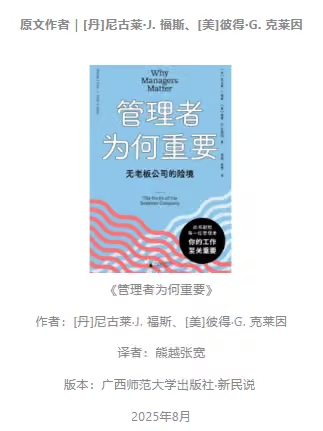 Peter G. Klein
@petergklein
Peter G. Klein reposted
Arpit Gupta
@arpitrage
It will not shock you to learn the ban on Airbnb was led by political contributions by the hotel industry, and led to increased hotel rates
Somehow the neo-Brandeisian antitrust types are silent here

 Peter G. Klein
@petergklein
I wrote a blog post on this back in 2007. It generated a lot of discussion, not all positive. I still think I was right. Part of a longer story about "The Science" versus actual science. The latter is more complicated, and more interesting, than the cartoon version of the former!
Peter G. Klein
@petergklein
Post here. Largely a summary of work by Thomas Lessl. organizationsandmarkets.com/2007/01/18/the-galileo-legend/
Peter G. Klein
@petergklein
Interesting summary of the empirical evidence on UBI - it doesn't seem to make much of a difference. www.theargumentmag.com/p/giving-people-money-helped-less-…
Peter G. Klein
@petergklein
Now that we're having a conversation about government statistics. . . .
Peter G. Klein
@petergklein
Now I understand why European academics spend the entire summer on holiday
 The Review of Economics and Statistics (REStat)
@restatjournal
Just Accepted new paper, “Heat and Team Production: Experimental Evidence from Bangladesh” by Teevrat Garg, Maulik Jagnani, and Elizabeth Lyons direct.mit.edu/rest/article-abstract/doi/10.1162/rest.a.2…
Peter G. Klein
@petergklein
I have an idea for a paper on IP coauthored with friends at @BUQuestrom
 Boston.com
@BostonDotCom
Baylor University sued the Trustees of Boston University Friday over its use of the interlocked “BU” logo, according to court documents.
www.boston.com/news/local-news/2025/08/11/baylor-files-la…
 Peter G. Klein
@petergklein
Insightful post from Albert Chu on organizational design and the limits of one-size-fits-all solutions, based on arguments from my 2022 book with @NicolaiFoss Why Managers Matter (now available in Chinese translation!).
www.linkedin.com/pulse/organizational-design-should-copy-…
Peter G. Klein
@petergklein
BTW the folks in the pic are Albert (second from left), the two translators, myself, and another guest, after a fabulous meal in Shanghai earlier this year. @XiongTylerYue
Peter G. Klein
@petergklein
Recommendation engines are the best
 Pavlos Papadopoulos
@pleonidasp
 Peter G. Klein
@petergklein
New idea for my tombstone
"Expunged from the core"
 Peter G. Klein
@petergklein
Source www.sciencedirect.com/science/article/abs/pii/S2352673422…
Peter G. Klein reposted
Nicolai Foss
@NicolaiFoss
My 2022 book with Peter Klein, Why Managers Matter, is now available in a Chinese edition!
Here is the link: www.bbtpress.com/bookview/25331.html
I am extremely grateful to Xiong Yue and Zhang Kuan for their work on the translation!
 Peter G. Klein
@petergklein
"For all the talk about dismantling hierarchies, Gen Z seems to be voting with their feet, understanding that material benefits are associated with management."
fortune.com/2025/07/29/gen-z-says-conscious-unbossing-aut…
Peter G. Klein
@petergklein
Henceforth I shall be known as an Entrepreneurship Engineer
Peter G. Klein
@petergklein
Management consulting adds (modest) value - a finding that will surprise many business school academics.
 Benjamin Schoefer
@Schoefer_B
New paper:
"What Does Consulting Do?"
w/ Gert Bijnens, @simon_jaeger
Consulting is a storied but opaque industry.
Our VAT-based B2B data permit the 1st comprehensive study:
Which firms buy consulting?
What happens when they do?
www.nber.org/papers/w34072
eml.berkeley.edu/~schoefer/schoefer_files/BJS_Consulting.pdf
 Peter G. Klein
@petergklein
Thanks so much to our excellent translators and publisher! Excited to see what impact this work will have in the Chinese market.
 Xiong Tyler Yue
@XiongTylerYue
The Chinese edition of “Why Managers Matter”, co-translated by myself and Dr. Zhang Kuan, has been officially published by Guangxi Normal University Press!
 Peter G. Klein
@petergklein
Worker-owned cooperatives are not only permitted, but subsidized in most jurisdictions through favorable tax and regulatory treatment. That so few exist suggests that they perform poorly in most cases.
 Chris
@CinemaPrincipia
It's good to see some reasonable people standing up to defend against the hypothethical abolishment of the system that has ruled our lives for centuries. What a horror it would be for workers to have conttol of their labor instead of billionaires. Must keep you up nights.
Peter G. Klein
@petergklein
A well studied phenomena within organization studies.
Peter G. Klein
@petergklein
Lively and engaging profile of Mondragon, a federation of worker cooperatives in Spain's Basque country - an example of flat hierarchy we discuss in Why Managers Matter. A fun read by an author in love with his subject. Some balance is needed, however. 1/
www.newyorker.com/business/currency/how-mondragon-became-…
Peter G. Klein
@petergklein
And the basic incentive issue is easily understood! theonion.com/marxists-apartment-a-microcosm-of-why-marxis…
Peter G. Klein
@petergklein
This is a common lament among academics but reflects a basic misunderstanding. Research, like other human activities, involves expenditures of scarce resources, has benefits and costs that can be evaluated on the margin, and reflects preferences of participants including funders.
 Jason Locasale
@LocasaleLab
I went into academia to search for truth.
I left learning how to write safe grants, avoid controversy, and serve bureaucrats.
Peter G. Klein
@petergklein
Mises has a fascinating discussion of the "creative genius," a kind of introversive labor that is more like consumption and not part of the labor supply. But even the genius needs means - time, complementary capital and labor, and other scarce goods with opportunity costs.
Peter G. Klein
@petergklein
It often seems that way, but the evidence is mixed. And there are plenty of counterexamples! organizationsandmarkets.com/2012/07/06/entrepreneurship-a…
 FutureNeon
I've watched bureaucracy sap true innovation—same pattern that's turned the UK energy sector stagnant. When compliance is the metric, real breakthroughs vanish.
Peter G. Klein
@petergklein
Imagining the academic version of this. "Publishing just one or two articles per year. Grading papers myself instead of handing them to my TAs. Running my own regressions. It's about remembering what it feels like to be grounded in reality."
 VCs Congratulating Themselves 👏👏👏
@VCBrags
Humblebrag of the year???
 Peter G. Klein
@petergklein
It was great working on this paper with these two distinguished scholars!
Samuele Murtinu
@SamueleMurtinu
@NicolaiFoss @petergklein and I just published our new open access paper "Entrepreneurial #judgment, #uncertainty, and #resource #mobilization": link.springer.com/article/10.1007/s11138-025-00690-6
@UniUtrecht @USE_UU @CBScph @Baylor #austrian #economics #entrepreneurship #finance
Peter G. Klein
@petergklein
Another day, another clickbaity article on the workplace of tomorrow. I have thoughts! 1/
 Peter G. Klein
@petergklein
In the book we describe this role as creating and enforcing the organizational "rules of the game" - decision rights, compensation and motivation, performance evaluation - and resolving disputes and adjusting these rules as needed. If you like, coach + owner + general manager. 6/
Peter G. Klein
@petergklein
Here's the Fast Company piece. For balance, read Why Managers Matter! 7/ www.fastcompany.com/91361724/ai-will-kill-the-org-chart
Peter G. Klein
@petergklein
Anyway, expect a steady flow of articles like this, especially as linked to AI and similar developments. Read with caution. 8/8
Peter G. Klein
@petergklein
Instead of cherry-picking our favorite anecdotes, we could look at the vast academic literature on state-owned enterprises, nationalization and privatization, and comparative economic organization. There is a clear consensus that SOEs underperform, but with important caveats. 1/
Peter G. Klein
@petergklein
Most recent studies embrace this "hybrid" perspective, focusing on the effects of distinct forms of state ownership or control under different conditions. 7/ journals.aom.org/doi/full/10.5465/amp.2013.0069
Peter G. Klein
@petergklein
There are a few studies of state-owned airlines and grocery stores but no definitive papers (please correct me if I've missed any). But we can certainly start with what we know about state ownership in general and apply these insights to the specific cases of interest! 8/8
Peter G. Klein
@petergklein
Making Big Government Great Again
Peter G. Klein
@petergklein
Half of these new jobs were government jobs (mostly in education). www.cnbc.com/2025/07/03/heres-where-the-jobs-are-for-june…

 JD Vance
@JDVance
“Trump was right about everything”
 White House Press Office
@PressSec
For the FOURTH month in a row, jobs numbers have beat market expectations with nearly 150,000 good jobs created in June. American-born workers have accounted for ALL of the job gains since President Trump took office and wages continue to rise. The economy is BOOMING again and it will only get better when the One, Big Beautiful Bill is passed and implemented!
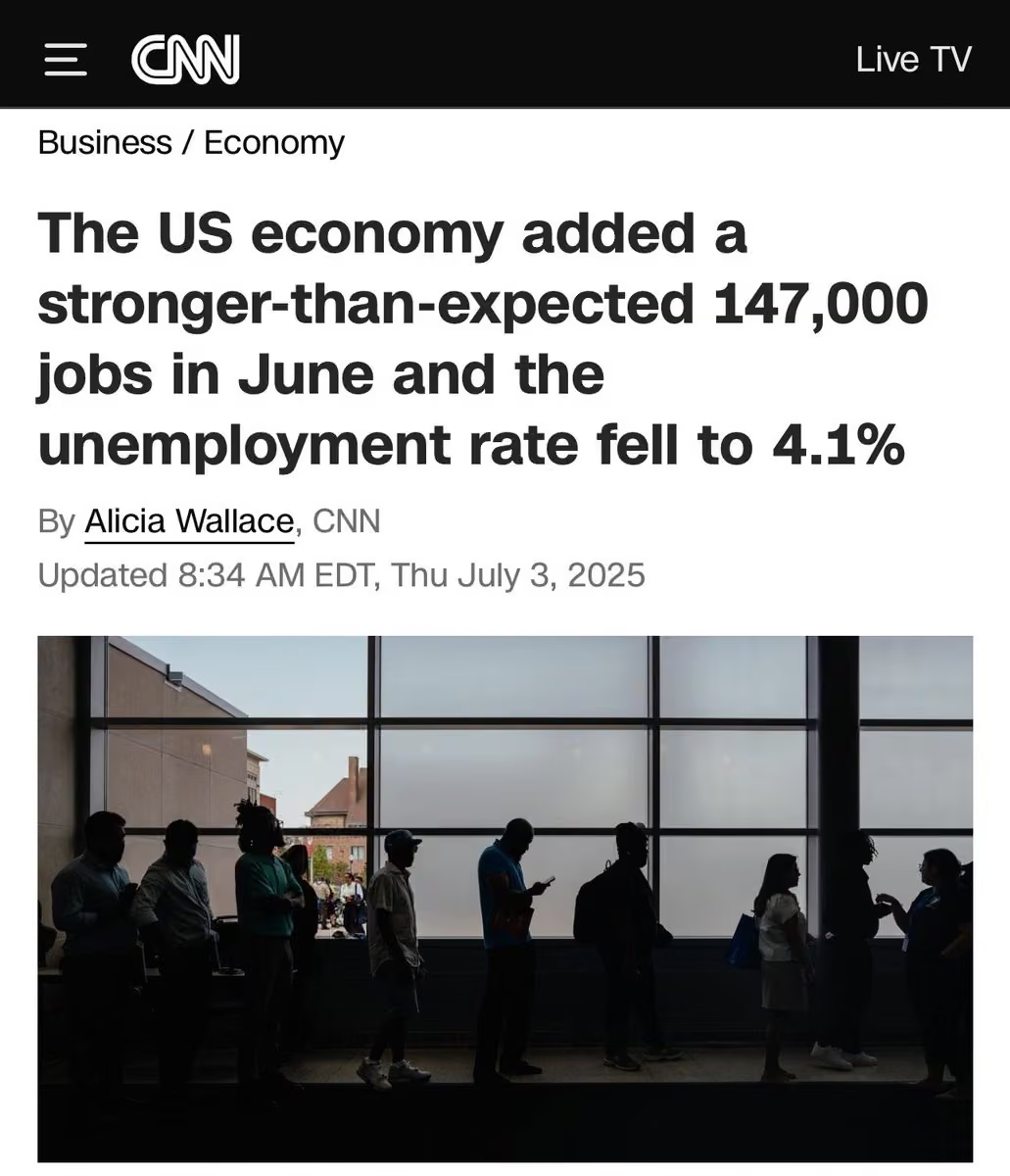 Peter G. Klein
@petergklein
Half of these new jobs were government jobs (mostly in education). www.cnbc.com/2025/07/03/heres-where-the-jobs-are-for-june…
Peter G. Klein
@petergklein
Just published! journals.sagepub.com/doi/10.1177/10422587251347062
Peter G. Klein
@petergklein
Much has been written about Knightian uncertainty but the construct continues to be used loosely and inconsistently to denote risk, ambiguity, ignorance, case probability, and more. @mattcmccaffrey, @CarmenDorobat, @NicolaiFoss, and I have produced a new review paper on KU. 1/
 Peter G. Klein
@petergklein
Economists for rent control and government-owned grocery stores
 Progressive International
@ProgIntl
NEW YORK CITY — Economists from across the world unite in support of Zohran Mamdani’s plan for New York City, “a bold yet practical blueprint to tackle the city’s most urgent challenges.”
Read the full statement on @thenation now: www.thenation.com/article/economy/economists-zohran-mamda…


 Peter G. Klein
@petergklein
In 2005 I wrote a survey on vertical integration for the Handbook of New Institutional Economics. Claude Ménard and Mary Shirley have produced a 20th-anniversary edition of the Handbook and kindly invited me to contribute a revised version covering the latest developments.
 Peter G. Klein
@petergklein
Like the original chapter, we review the empirical evidence on make-or-buy decisions from the perspective of transaction cost economics and the property rights view of the firm. But we emphasize some theoretical and empirical challenges and puzzles.
Peter G. Klein
@petergklein
For example, evidence from detailed microdata suggests that many vertically integrated companies don't transfer intermediate goods internally, suggesting that integration isn't about reducing transaction costs, but exploiting managerial capabilities.
www.aeaweb.org/articles?id=10.1257/aer.104.4.1120
Peter G. Klein
@petergklein
Asset specificity or relationship-specific investment continues to be a central construct in this literature but it remains tricky to operationalize in empirical studies. The roles of uncertainty, frequency, and other characteristics continue to be debated as well.
Peter G. Klein
@petergklein
Anyway, we hope you enjoy the chapter and look forward to future work in this area!
Peter G. Klein
@petergklein
Speaking of tariffs: Hollywood mogul Samuel Goldwyn started out in the glove business (as Sam Goldfish) and, after a sharp tariff increase in 1913, found a clever way to avoid paying the duty on imported gloves. (From Scott Berg's excellent 1989 biography of Goldwyn.)
 Peter G. Klein
@petergklein
The market, uh, finds a way.
Peter G. Klein
@petergklein
BTW Berg's biography of Lindberg is also excellent (even treating his America First involvement with respect - something unthinkable in a mainstream biography today).
Peter G. Klein
@petergklein
I think the AI doomers are wrong mainly because they misunderstand the nature of human judgment which is a complement to, not a substitute for, algorithmic decision-making. But Kevin's point about the importance of supporting institutions is equally important!
Kevin A. Bryan
@Afinetheorem
This is wrong. I talk to folks at the big AI labs all the time. Biggest errors they make, economically: 1) how long it takes to shift the structure of institutions and what this means for diffusion, 2) AI is acomplement for some tasks, not just a substitute, 3) prices adjust. 1/3
Peter G. Klein
@petergklein
Cass is correct that economic laws are not induced from repeatable experiments but wrong that they are contingent and mutable. The law of demand, the principle of diminishing marginal utility, etc. are general, logical statements that hold independently of context. 1/
 Oren Cass
@oren_cass
2/ First, because it's disastrously inapt. Economics is nothing like physics. Its principles are not generated from repeatable experiments, nor do they hold consistently across space and time. Believing otherwise is a quite literal example of blind faith and fundamentalism.
Peter G. Klein
@petergklein
What bothers people like Cass is how economic law constraints their policy goals. Tariffs and other taxes, price controls, subsidies, and the like have consistent, predictable effects that thwart the hopes and dreams of state planners, regulators, and other interventionists. 2/
Peter G. Klein
@petergklein
Böhm-Bawerk's classic 1914 essay "Control or Economic Law" offers a concise statement of the problem. It would behoove the New Protectionists to engage this literature! 3/
 Peter G. Klein
@petergklein
The frequentist distinction between class and case probability, and the need for subjective judgment about when each applies, was once so commonplace that social scientists would mention it in passing, without the need for a citation (or justification).
 Peter G. Klein
@petergklein
The passage is from Edward Banfield's great work on urban sociology, The Uneavenly City (1970).
 Peter G. Klein
@petergklein
The modern approach rejects the distinction, assuming that the same probabilistic reasoning (arbitrary priors with Bayesian updating) applies to any situation of risk or uncertainty, whether events are repeatable or unique.
Peter G. Klein
@petergklein
Mike's point is important and underappreciated.
On a host of issues such as academic freedom, due process, federal funding, freedom of association, etc., many people flip their position based on whom they think is in charge.
Everything then becomes a power grab.
Peter G. Klein
@petergklein
Thanks to Anita and the Burnes Center for hosting these fascinating conversations!
 The Burnes Center For Social Change
@BurnesCenter
🎧 Episodes 25, 26, and 27 of Private Innovation in the Public Interest with @anitamcgahan are out now. This series explores how collaboration, purpose, and trust drive innovation across sectors.
🔗Listen now: open.spotify.com/show/3eQJntTw2ZL4qsJNH7QA5V

 Peter G. Klein
@petergklein
French is a beautiful language but check out this translator's note from the first French Bible produced from the Hebrew and Greek originals rather than the Latin Vulgate.
 Peter G. Klein
@petergklein
"Read through this stack of exams, assign each one a letter grade"
 Elon Musk
@elonmusk
The biggest product ever
Peter G. Klein
@petergklein
"Highly successful people do these 9 things every day. Do them and you, too, will be successful!"
 Peter G. Klein
@petergklein
The formal name for this statistical/logical fallacy is sampling on the dependent variable."
www.nytimes.com/2025/05/16/science/federally-funded-scien…
Peter G. Klein reposted
Misha Teplitskiy | Science of Science
@MishaTeplitskiy
Conventional wisdom says interdisciplinary research is valuable but harder to get through peer review (need to please diverse reviewers, etc).
In new @PNASNews paper, @SidneyXiang @DanielMRomero and I partnered with @IOPPublishing to test this wisdom and add nuance
(1/3)
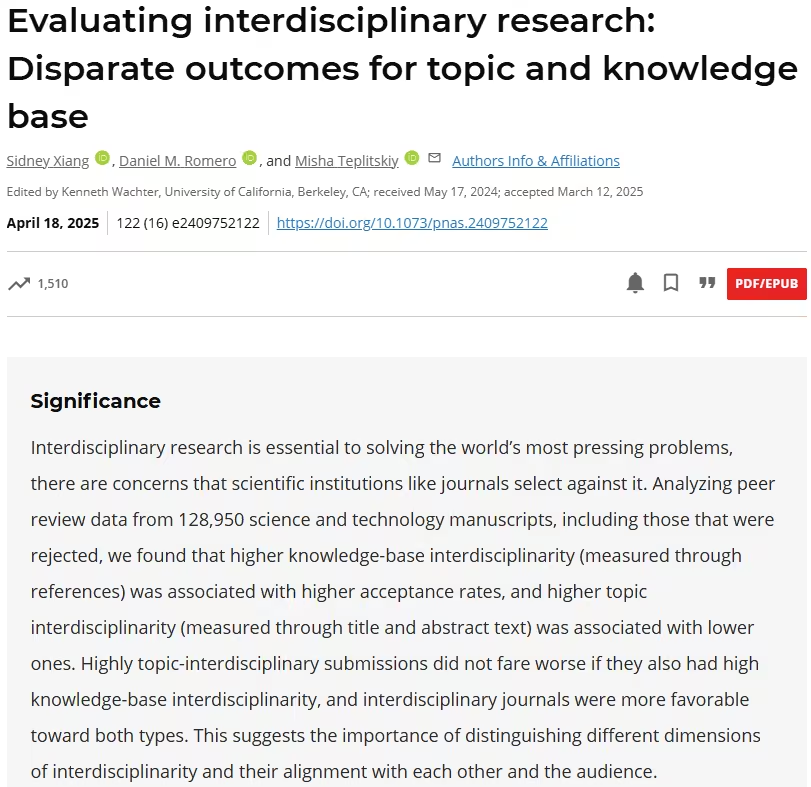 Peter G. Klein
@petergklein
"Please find attached my responses to Reviewers 1 and 2"
 𝕁𝕠𝕙𝕟𝕟𝕪 ❎ 🏴
@johnnyXscotland
I’ve watched this about 2 dozen times.
Peter G. Klein
@petergklein
Great paper on Schumpeterian competition. Effective management (and I would say ownership) isn't just about treatment, but selection - the churn matters a lot. Policy should encourage, not discourage, the "perennial gale of creative destruction."
 Raffaella Sadun
@raffasadun
📢 New NBER working paper!
Why are well-managed firms more dynamic?
They open, close, buy, and sell more plants—and boost productivity along the way.
We show how management spreads like a technology within firms.
👇Thread 👇
📄 www.nber.org/papers/w33765
Peter G. Klein
@petergklein
BTW while this idea is typically attributed to Schumpeter, it was the standard way economists understood competition before the neoclassical synthesis with its emphasis on static equilibrium modeling. www.journals.uchicago.edu/doi/abs/10.1086/259295
 Peter G. Klein
@petergklein
Stumbled upon this old clip (of a game I remember watching). The possession begins with 7 straight passes without a dribble before a short drive and handoff to the post. No isolation plays, no dribble penetration, no stepbacks. Almost a completely different game from today's.
 Blue Heaven
@uncsportsphotos
1993 Carolina and George Lynch complete the comeback against Florida State. Smith Center crowd went crazy. WOODY DURHAM calls game. #uncbasketball #uncommon #tarheels #goheels #acc #carolinafamily #uncbball #gdtbath #unc #carolina
Peter G. Klein
@petergklein
They're running Dean Smith's version of the motion offense (also called the "shuffle"). Note how all five players are in motion, unlike today's game where one or two players run a play while the others camp outside the 3-point line. A fluid style of play that's basically extinct.
Peter G. Klein
@petergklein
Lots of theories on the evolution of the game. Today's players are more athletic but also less patient, less disciplined, and less trusting (i.e., of getting the ball back after a pass and cut). One-and-dones, NIL, and the portal have exacerbated the trend.
Peter G. Klein reposted
 The Wall Street Journal
@WSJ
Small-business owners facing steep China tariffs are laying off staff and withdrawing personal savings, trying to hold on and hoping for a trade deal www.wsj.com/business/entrepreneurship/small-business-tari…
Peter G. Klein
@petergklein
Lots of people linking to this guy's books and articles, I wonder why www.researchgate.net/profile/Robert-Prevost
Peter G. Klein
@petergklein
 Peter G. Klein
@petergklein
Academic seminar culture
 eatnik
@eatnik
I'd forgotten how blunt Europeans are in meetings.
French attendee: "Hello, you have given an explanation but it is very bad so I have many questions."
Peter G. Klein
@petergklein
Next up: our crack investigative team reveals why the judgment-based approach to entrepreneurship is called the "JBA"
 New York Post
@nypost
Meghan Markle reveals why she and Prince Harry call each other ‘M’ and ‘H’ nypost.com/2025/04/29/entertainment/meghan-markle-reveals…
 Peter G. Klein
@petergklein
Great paper and thread about startup mentoring - mentoring matters, good mentoring is about strategy more than encouragement, and VCs and angels excel in different aspects of mentoring. Highly recommended!
Peter G. Klein
@petergklein
Professor explaining to PhD student that the dissertation is not quite ready
 Peter G. Klein
@petergklein
This is a critical point that is mostly lost in today's trade discussions. Economic relationships are usually upstream, not downstream, from national security! As in the saying attributed to Bastiat, when goods don’t cross borders, soldiers will. 1/
 Joseph Steinberg
@jbsteinberg
6) I fundamentally disagree with the view that we should treat geopolitical risk as some exogenous thing that just happens. It's endogenous! And I genuinely think the best way to reduce geopolitical risk is deeper trade integration, not protectionism.
Regardless, I don't think you really addressed my point, which is that aggregate imbalances in the goods sector are not a national security risk.
Peter G. Klein
@petergklein
More generally, protectionists rarely discuss magnitudes, invoking "national security" as a catch-all justification for policies that reduce wealth. How much is a one-unit increase in drone (or semiconductor or steel) production capability worth, on the margin? How do we know? 2/
Peter G. Klein
@petergklein
Even if they recognize, at least implicitly, a guns-for-butter tradeoff, they don't explain how much butter they think we should give up and why. Like radical environmentalists, they seem to have some kind of precautionary principle in mind. But that's a poor guide to policy. 3/3
Peter G. Klein
@petergklein
Much has been written about Knightian uncertainty but the construct continues to be used loosely and inconsistently to denote risk, ambiguity, ignorance, case probability, and more. @mattcmccaffrey, @CarmenDorobat, @NicolaiFoss, and I have produced a new review paper on KU. 1/
Peter G. Klein
@petergklein
We survey a large number of articles from entrepreneurship, management, economics, finance, decision theory, and doctrinal history. Our review is both narrower (in its specific focus on "Knightian uncertainty") and broader (in its range of sources) than previous reviews. 2/
Peter G. Klein
@petergklein
We hope you find the review useful. Comments, as always, are appreciated! 4/4 papers.ssrn.com/sol3/papers.cfm?abstract_id=5216126
Peter G. Klein
@petergklein
NB: I almost led with "Much has been written about Knightian uncertainty. Too much."
 Peter G. Klein
@petergklein
When the professor presents both sides of the issue
 Barry Malone
@malonebarry
The greatest news interview of all time. Nothing can prepare you for what happens 20 seconds into this clip.
Peter G. Klein
@petergklein
In a discussion of whether Harvard should hire conservative faculty to become more balanced, Baylor is given (with Liberty) as a counterexample, i.e., a school that should hire liberal faculty to achieve balance. However, the data suggest that Baylor faculty also lean Left. 1/
 Jemele Hill
@jemelehill
So does this mean at Liberty, Baylor and conservative colleges, they should be forced to hire more liberals? And considering that so many conservatives went to Harvard, I highly doubt there are only six professors there that are conservatives. Regardless, it’s not the government’s role to extort colleges and universities.
Peter G. Klein
@petergklein
Two observations: First, when people talk about institutions or academic fields deviating from the norm, it's important to keep the baseline in mind. For example, economics has a D:R ratio of about 3:1, which is "conservative" compared to sociology's 44:1. 5/
Peter G. Klein
@petergklein
Second, the reasons for this are complex. I discussed some in an article from 20 years ago. I'm not an expert in these data and encourage others with more familiarity to jump in. But even reputedly "conservative" faculties typically aren't. 6/6 mises.org/mises-daily/why-intellectuals-still-support-soc…
Peter G. Klein reposted
Adam Thierer
@AdamThierer
astonishing piece of reasoning here... EU tech regulation has decimated continental competitiveness, but let's double down on it because... we hate Elon Musk more than anything else. 🤷

 Peter G. Klein
@petergklein
The idea that firm-level planning has something to do with economy-wide planning - i.e., resource allocation without market prices- gets resuscitated every few years, by people unfamiliar with Mises (1920) and Coase (1937). x.com/petergklein/status/1330610138542202886
 Jacobin
@jacobin
Mega-companies like Amazon and Walmart already use large-scale central planning. We can wield that tool for good. Socialists need to renew our embrace of democratic planning and fight for a real alternative to capitalism.
jacobin.com/2019/03/economic-planning-walmart-democracy-s…
Peter G. Klein
@petergklein
Peter G. Klein
@petergklein
A key difference is that firms - D.H. Robertson's "islands of socialism" - are competing against other firms in the sea of the market. Even actually existing national socialist economies had access to world market prices, which is why they survived as long as they did.
Peter G. Klein
@petergklein
 Wojtek Kopczuk 🇵🇱🇺🇦 and 🇺🇲
@wwwojtekk
One of the weirder strands of leftist Twitter is that somehow Uber, Amazon and Walmart prove that social planning is solved. How arrogant do you have to be to think that it scales to much broader domain, works without competition, and - most of all - that we are done innovating?
Peter G. Klein
@petergklein
We often use military language to describe business strategy and tactics: price war, flanking maneuver, the nuclear option, etc. Such metaphors can be helpful for illustrating interactions and outcomes but can also be deeply misleading. 1/
Mary B (TeslaSpotlight)
Please don't tell me that racist-tinged, anti-foreign, militarist protectionism began with MAGA and Trump 2.0. It was mainstream liberalism 40 years ago. (NYT, July 28, 1985)
 Peter G. Klein
@petergklein
The same applies - even more so - to economic relations between countries. Trade is between buyers in country X and sellers in country Y, not between societies or nations. "Japan" wasn't trying to conquer "US industry" in the 1980s and "China" isn't battling "the US" today. 3/
Peter G. Klein
@petergklein
US consumers and firms benefit from strong economies in the BRICs and everywhere else, and vice versa. Let's stop thinking of economic activity as a military conflict between countries and remember that voluntary exchange is a form of mutually beneficial social cooperation. 4/4
Peter G. Klein reposted
 John B. Holbein
@JohnHolbein1
“I think that…most researchers think of statistical tests as a kind of annoying paperwork, a set of forms they need to fill out in order to get their work published… They feel they already know the truth…so then they find whatever p-values are necessary to satisfy the reviewers.”
-Gelman
 Peter G. Klein
@petergklein
Some additional thoughts on this interesting and important discussion.
First, the crowding out hypothesis first proposed by Seymour Melman referred, not to a dollar-for-dollar displacement of private R&D by public R&D, but to a change in the composition of industrial activity.
Peter G. Klein
@petergklein
Ben, thank you for compiling this very helpful bibliography. A few comments:
1. The core issue is whether public subsidies increase *socially useful* innovation, a construct not fully captured by private R&D expenditures, patents, or scientists' career outcomes.
Peter G. Klein
@petergklein
Another issue relates to a point made by Larry Summers on tariffs: targeted public spending encourages rent-seeking. I mentioned yesterday the direct lobbying efforts of various groups to preserve their federal grants - those are costs of such programs.
 Lawrence H. Summers
@LHSummers
I told @FareedZakaria @CNN this morning: When you start giving an exemption here and an exemption there on tariffs, it's introducing all kinds of corruption into the system. It's introducing what economists call rent seeking, where it's hugely advantageous for people to be friends of the first family and hugely advantageous for people to hire a lobbyists. So, the big boom that's being created with tariffs is in a crony capitalism.
 Fareed Zakaria
@FareedZakaria
A debate on tariffs with @oren_cass and @LHSummers. I asked Oren, if tariffs are such a good idea, why are investors and the general public panicking?
Peter G. Klein
@petergklein
Think more broadly of the transaction costs of administering federally funded science and R&D programs. Large universities each employ hundreds of grant writers, grant administrators, compliance offers, etc. The opportunity costs are not trivial.
Peter G. Klein
@petergklein
And as anyone in STEM fields knows, faculty of all ranks, postdocs, PhD students, lab managers, assistants, etc. spend a huge portion of their time writing and administering grants (not to mention reviewing grants). Universities lobby and negotiate for their F&A (up to 65!).
Peter G. Klein
@petergklein
Of course, any system of funding science including corporate or foundation grants, allocations from the general university budget, bootstrapping, etc. incurs transaction costs and thus opportunity costs. But private funders with skin in the game are more likely to minimize these.
 Ben Golub
@ben_golub
First - this is more my area of expertise - it is frankly pretty extreme to claim that theoretical arguments can do anything convincing on this issue. The theoretical channels for government investment to be complementary to private investment are so ample that any argument to the contrary could not possibly stand on its own. More on that at the end.
The well-identified empirical evidence lines up against Bryan's view pretty decisively.
The strongest quasi‑experimental studies all show that public R&D dollars crowd in private effort.
Regression‑discontinuity at NIH paylines finds a US$10 m grant shock yields about three extra corporate patents with no loss of business R&D [1]. Shift‑share instruments linking post‑9/11 defense budgets to industry exposure show every public dollar induces 40‑60 cents of additional private R&D and raises total‑factor productivity [2]. Event‑study evidence from sudden university‑level cuts reverses these gains: publications fall 15 % and VC‑backed start‑ups 30 % [3]. A richer SR&ED tax credit for Canadian SMEs boosts their R&D by 17 % and spills over into patent citations [4]. Scientist‑level NIH lotteries confirm grants lift later publications and citations by roughly a quarter [5]. Across designs and contexts, the sign is always positive and the magnitudes large—directly contradicting claims of systematic crowd‑out.
What's wrong with your evidence? Kealey‑type papers err in both identification and theory. Their headline correlations use aggregate time‑series where governments boost subsidies precisely when private investment slumps, creating spurious negative signs [6,7]. Damrich, Kealey & Ricketts merely embed those raw aggregates in a stylised contribution‑good model that assumes knowledge is fully appropriable and ignores spillovers, so any public share mechanically lowers measured productivity [8]. Once exogenous variation is isolated—as in the five studies above—the relationship flips, and the omitted spillovers emerge as large and positive. Descriptive regressions that confound cause and effect cannot overturn the causal evidence that well‑designed public funding unlocks socially valuable, privately under‑supplied innovation.
There are SO MANY ways of understanding theoretically why the facts would be like this. Romer’s endogenous‑growth framework treats ideas as non‑rival but only partially excludable, so inventors capture just a slice of their social surplus [10], while Aghion‑Howitt’s creative‑destruction model adds business‑stealing, further depressing private incentives [11]. Jones‑Williams calibrate spillovers, duplication and congestion and still find laissez‑faire R&D at barely a third of the optimum [12]. Grossman‑Helpman’s quality‑ladder model layers cross‑sectoral input‑output spillovers, another benefit absent from Caplan’s crowd‑out narrative [13]. Liang & Mu show that when research lines are complements, decentralized scientists cluster on topics that leave high‑return yet neglected areas that only public funding can unlock [14].
[1] @pierre_azoulay , Graff Zivin, J., Li, D. & Sampat, B. (2019) ‘Public R&D and Private Patenting: Evidence from NIH Funding’, Review of Economic Studies 86(1): 117‑152.|
[2] Moretti, E., Steinwender, C. & Van Reenen, J. (2024) ‘The Economic Spillovers of Defence Research’, Review of Economics & Statistics 106(2): 235‑256.
[3] Babina, T., He, J., Howell, S. et al. (2023) ‘Cutting the Innovation Engine’, Quarterly Journal of Economics 138(4): 2201‑2260.
[4] Agrawal, A., Rosell, C. & Simcoe, T. (2020) ‘Tax Credits and Small‑Firm R&D: Evidence from Canada’, American Economic Journal: Economic Policy 12(3): 1‑30.
[5] Jacob, B. & Lefgren, L. (2011) ‘The Impact of Research Funding on Scientific Output’, Journal of Public Economics 95(9‑10): 1168‑1177.
[6] Kealey, T. (1996) The Economic Laws of Scientific Research. Springer.
[7] Kealey, T. & Ricketts, M. (2014) ‘Modelling Science as a Contribution Good’, Research Policy 43(6): 1014‑1024.
[8] Damrich, S., Kealey, T. & Ricketts, M. (2022) ‘Crowding In and Crowding Out within a Contribution‑Good Model of Research’, Research Policy 51(1): 104400.
[10] Romer, P. M. (1990) ‘Endogenous Technological Change’, Journal of Political Economy 98(5): S71‑S102.
[11] Aghion, P. & Howitt, P. (1992) ‘A Model of Growth through Creative Destruction’, Econometrica 60(2): 323‑351.
[12] Jones, C. I. & Williams, J. C. (1998) ‘Measuring the Social Return to R&D’, Quarterly Journal of Economics 113(4): 1119‑1135.
[13] Grossman, G. M. & Helpman, E. (1991) ‘Quality Ladders in the Theory of Growth’, Journal of Political Economy 99(3): 433‑449.
[14] [9] Liang, J. & Mu, X. (2020) ‘Complementary Information and Learning Traps’, Quarterly Journal of Economics 135(4): 1929‑1984.
Peter G. Klein
@petergklein
Ben, thank you for compiling this very helpful bibliography. A few comments:
1. The core issue is whether public subsidies increase *socially useful* innovation, a construct not fully captured by private R&D expenditures, patents, or scientists' career outcomes.
Peter G. Klein
@petergklein
Appreciate not only the shout-out, but also the use of 20-year old pictures!
 Students For Liberty
@sfliberty
Entrepreneurship isn’t a footnote.
Mainstream economics treats entrepreneurs as occasional disruptions to equilibrium.
Austrians treat them as central.
For Kirzner, Klein, and Foss, the entrepreneur coordinates plans under uncertainty—not with perfect knowledge.
 Peter G. Klein
@petergklein
Indeed! Here's how we describe it in Why Managers Matter: The Perils of the Bossless Company: www.hachettebookgroup.com/titles/nicolai-j-foss/why-manag…


 typedfemale
@typedfemale
guy who first proposed a “flat” organization: hmm, what if instead of an explicit hierarchy, we had an implicit one you had to reconstruct in your head with high school social dynamics?
Peter G. Klein
@petergklein
Coming soon!
 Peter G. Klein
@petergklein
This post is mostly nonsense but includes one legitimate point, namely that the US didn't have "free trade" before Trump's tariff hike but a complex set of tariff and non-tariff barriers. We've gone from one form of managed trade to another.
 HUNTSMAN 🇺🇲
@maphumanintent
The Theory of the Real About POTUS' Trade Actions
Two first principles:
1. It is a privilege for other countries to strengthen their economic and national security through trade with the US.
2. The United States has ALWAYS assessed tariffs in some generalized fashion.
See, a "tariff" is simply any tax on trade across international borders. "Duties" are just a category of tariffs applied based on a good's attributes and utility to the US market. Anti-dumping duties and countervailing duties are other categories of punitive tariffs used as trade remedies when foreign companies or industries are engaging in anticompetitive trade practices.
Regarding "free trade", our free trade agreements are simply a multilateral/bilateral pact for reciprocity of duty/tariff-free flow for certain categories of goods - they are "free" in the sense that the US almost invariably consumes more, and the counterparty(ies) don't otherwise undertake restrictive or anti-US actions in any domain.
The "tariffs" people are rending their garments over are so named to categorically separate them from standard duties (despite duties also being a tariff in the strictest sense of trade law). Note how the trade-related EOs variously use "duties" and "tariffs" to implement or modify taxes on trade. The distinction is merely under which legal authority the tax is being assessed, the intended scope, and the counterparty(ies).
POINT BEING - tariffs and duties are functionally the same thing, and have ALWAYS been a tool of US economic statecraft. President Trump is NOT doing anything unprecedented nor outside the scope of his Constitutionally-prescribed authorities to defend and protect the interests of the United States.
Now, stay with me - this next point is the really hard part for most of you who have never worked in trade yet hate tariffs like they slapped your mother, because Orange Man Bad.
Tariffs are a force multiplier for leveraging geopolitical INCENTIVES and DISINCENTIVES. Carrots and sticks. Their utility, purpose, and effectiveness must be mapped to an intended function and output in behavior modification of the counterparty.
This is true of any tax, at least in a purely economic sense. But since the advent of federalized income taxation, the US has operated under the premise that it is better to extract from the productive value of workers' labor than to fund our nation via taxes on foreign entities.
Tariffs, then, are a form of optional tax that countries can elect to pay for the PRIVILEGE of selling into our consumer and business markets...or they can opt out of access to our market.
There's no such thing in the real world as perfect competition, perfect information, or perfect alignment of incentives - and as trade is inherently a function of broader economic statecraft and national security policy - tariffs are necessarily both defensive and offensive tools in a nation's toolbox.
The United States is the absolute, undisputed demand bull of the global economy. China is (presently) the undisputed supply bull of the global economy.
China long ago institutionalized trade, manufacturing, and export output as key tools of soft power - but as we now see, these are HARD power weapons once buyers reach critical dependency.
Furthermore, China exploits trade to an extraordinary degree to enable illicit activities such as violation of export controls, abuse of int'l trade law, industrial espionage, IP theft, insider threats in Western companies and universities, manipulation of maritime commerce/capacity, movement of drugs, and lobbying.
So why POTUS' push for trade reciprocity?
It's a forcing function for greater decoupling from our biggest adversary, and makes starkly clear the choice for everyone - with us, or against us.
The US wins by creating incentives to production closer to our shores while integrating economically at a functional, durable level with our true allies.
Every other argument is just defense of an untenable status quo.
Peter G. Klein
@petergklein
Of course, trade managed to satisfy Trump's policy goals is a bad idea for the same reason that trade managed to satisfy Biden's or Obama's or Bush's policy goals was a bad idea: it substitutes state control of markets for the preferences of buyers and sellers.
Peter G. Klein
@petergklein
A friend described this as a child's view of international trade: trade is zero sum; trade is between nations, not buyers and sellers; the total amount of buying and selling across geographic units has to "balance"; and so on. 1/
Oren Cass
@oren_cass
How would a better international economic arrangement look for the United States?
On @TheDailyShow, I explain what I think should be America's three key principles:
- Balanced Trade
- Burden Owning
- China Out
Peter G. Klein
@petergklein
The most reasonable argument for Trump's strategy is that tariffs can be used as a bargaining chip. But, as Connor points out here, there are far better instruments, like cutting foreign aid and military spending. 4/
mises.org/mises-wire/trumps-liberation-day-tariffs-are-mi…
Peter G. Klein
@petergklein
My friend Dean reminds us of another problem: tariffs, like all forms of government subsidy, encourage rent-seeking by the protected individuals and groups to maintain their subsidies. As usual, cronyism leads to more cronyism! dvwilliamson.substack.com/p/whos-afraid-of-tariffs
Peter G. Klein
@petergklein
You know what to do
 Austrian Institute
@AustrianEn
Peter G. Klein
@petergklein
Good discussion by @garyleff of alternative governance models for the provision of public services, in this case airport security screening.

 Peter G. Klein
@petergklein
Link to article here viewfromthewing.com/tsa-regulates-itself-fails-repeatedly…
Peter G. Klein reposted
Arpit Gupta
@arpitrage
There are two main types of academic production:
The “chair” or “PI” system with a senior faculty member overseeing a large team. Optimized for hierarchy
And US tenure track departments with colleagues that interact and co author often
Which is better, and when?
Peter G. Klein
@petergklein
As Oliver Williamson used to say, intellectual progress is typically "modest, slow, molecular, definitive."
 Thomas S. Kidd
@ThomasSKidd
Kindle sale on Cal Newport's _Slow Productivity: The Lost Art of Accomplishment Without Burnout_ www.amazon.com/Slow-Productivity-Accomplishment-Without-B… affiliate link
Peter G. Klein
@petergklein
On the origins of this phrase: organizationsandmarkets.com/2009/11/24/modest-slow-molecu…
Peter G. Klein reposted
 Jean-Michel Glachant
@JMGlachant
Handbook of New Institutional Economics
A comprehensive overview of New Institutional Economics
Editors:
Claude Ménard, Mary M. Shirley
This book is open access
which means that you have free and unlimited access ⤵️➰⤵️
 Roger Myerson
@rbmyerson
A magnificent 2nd edition of the Handbook of New Institutional Economics is now published at
doi.org/10.1007/978-3-031-50810-3
I am proud that my "Local politics in nations and empires" is included as chapter 9, next to Egorov & Sonin's "Authoritarian institutions" as chapter 10.
Peter G. Klein
@petergklein
Great statement of the primacy of subjective judgment in probabilistic reasoning. (From Gilboa and Schmeidler's Theory of Case-Based Decisions.)
 Peter G. Klein
@petergklein
Despite the superficial Marxian framing there's actually some interesting doscussion here on Hayek's theory of cognition and contemporary AI.
 The New York Review of Books
@nybooks
“The strangeness at the heart of the generative AI boom is that nobody really knows how the technology works.” —@bentarnoff go.nybooks.com/43CDlRO
Peter G. Klein
@petergklein
Archived version: archive.is/xzWCG
Peter G. Klein
@petergklein
The late Paul Lewis wrote an insightful piece on Hayek and cybernetics. papers.ssrn.com/sol3/papers.cfm?abstract_id=2790169
Peter G. Klein
@petergklein
It's that time of year again
 Peter G. Klein
@petergklein
Submissions due at the end of this week - opportunity to learn from a great team of SEJ editors and senior entrepreneurship scholars!
 Strategic Management Society
@Strategic_Mgmt
Submit your proposal to the Strategic Entrepreneurship Journal Paper Development Workshop happening June 23-24, 2025 at ESSEC Business School in France.
Deadline to submit: March 15
www.strategicmanagement.net/event/strategic-entrepreneurs…
#sejworkshop #earlycareerresearchers #sej #essec #paperdevelopment

Peter G. Klein reposted
Strategic Management Society
@Strategic_Mgmt
Exciting SMS Volunteer Opportunities! Become a Collections Editor or Media Chair and make a lasting impact on the future of strategic management. Apply by March 14 (Editor) & March 31 (Media Chair). www.strategicmanagement.net/connect-participate/volunteer…
Peter G. Klein
@petergklein
A good illustration of how "objective" measures of behavior and performance typically rely on subjective interpretation, social convention, legal requirements, and the like. Financial accounting and performance data are important metrics but not independent of human judgment!
 Paul Nary
@ProfPaulNary
Many measures are useful, not all measures are definitive or always superior
Combining different measures and approaches and assessing them thoughtfully in a specific context is still probably the best one can do.
Applies to performance, valuation, productivity, etc..
Peter G. Klein
@petergklein
A poorly understood point about GDP!
 Jason Furman
@jasonfurman
As to whether to include G, is debatable. Personally I think a municipal swimming pool might add even more to GDP than a private one. But fine to argue the opposite.
Simon Kuznets, who got a Nobel Prize in part for inventing GDP, argued government should be excluded--and lost.
 Peter G. Klein
@petergklein
Murray Rothbard developed a concept of "Private Product Remaining" to capture only that part of output, expenditure, and income that reflected voluntary market transactions. mises.org/mises-daily/gnp-ppr-and-standard-living
Peter G. Klein
@petergklein
Causal inference
 Dad Jokes
@Dadsaysjokes
Worrying works!
More than 90 per cent of the things I worry about never happen.
Peter G. Klein
@petergklein
Amazing! I grew up in this area in the 1970s and the snail darter controversy was my first exposure to environmental activism. Such Type I errors are common when public policy embraces something like the "precautionary principle." Opportunity costs are usually ignored.
 Bjorn Lomborg
@BjornLomborg
Remember the snail darter fish?
It was used strategically to stop a large Tennessee dam, claiming it was a threatened species
Now: DNA analysis shows “There is, technically, no snail darter,”
It is neither a distinct species nor a subspecies
Rather, it is an eastern population of Percina uranidea, known also as the stargazing darter,
which is not considered endangered
www.nytimes.com/2025/01/03/science/snail-darter-fish-tell…
 Peter G. Klein
@petergklein
Peter G. Klein reposted
 Lazar Radic
@laz_radic
The notion that government or antitrust should be guided by "human flourishing" echoes Isaiah Berlin's warning about how the pursuit of positive liberty can lead to paternalism by imposing a particular vision of the good life on individuals. 1/7
Lazar Radic
@laz_radic
If antitrust law fulfills its modest yet vital role in advancing material well-being, individuals can do the rest. They can pursue “eudaimonia” according to their own ambitions, goals, and values—rather than being subjected to those of the government or the antitrust enforcers.
Peter G. Klein
@petergklein
Also part of the Mises-Hayek theory of the business cycle, though "cleansing" isn't exactly the right metaphor. Their idea is that a systemic downturn reflects an unwinding of previously unprofitable investments and a reallocation of resources from lower- to higher-valued uses.
Noah Williams
@Bellmanequation
The cleansing effect of recessions is a Schumpeterian idea, more recently in Caballero and Hammour
 Peter G. Klein
@petergklein
Here is a short piece summarizing some findings on how Norwegian firms responded to the 2008-09 financial crisis. Some responded to the demand shock with layoffs, others by reorganizing and retraining their workforces. blogs.lse.ac.uk/businessreview/2020/06/25/recessions-give…
Peter G. Klein
@petergklein
Interesting and thoughtful article. As I've previously noted, most responses to proposed cuts and indirect caps have been knee-jerk defenses of the status quo, occasionally supported by weak, non-causal evidence.
 Maya Sen
@maya_sen
I wrote a piece for WSJ on the politics of NIH university funding
The reactions have been incredibly polarizing - not surprisingly!
Realistically I don’t think universities can get back to high indirects any time soon 🧵
 Peter G. Klein
@petergklein
This is sampling on the dependent variable so not a causal argument. The correct question is, what's the average return to NIH spending? And how are those returns distributed to private parties versus the public at large?
Peter G. Klein
@petergklein
The knee-jerk response that these grants are for basic science which automatically generates positive returns via its "public goods" nature is too glib. The linear model is wrong theoretically and empirically and most of these grants go for applied science anyway.
Peter G. Klein
@petergklein
Now is the time for a rigorous and robust discussion of the societal returns to taxpayer-funded scientific research, not the recitation of platitudes and Mazzucato-type anecdotes. Matt Marx is doing excellent work on this and Terence Kealey should also be consulted.
Peter G. Klein
@petergklein
Addendum: this guest post on Retraction Watch makes an analogous claim, namely that critiques of scientific misconduct do not always follow correct scientific procedures. retractionwatch.com/2025/02/25/guest-post-if-youre-going-…
Peter G. Klein
@petergklein
Everyone dunking on this tweet for the obvious reason that self-reported hours worked isn't a good measure of effort. But the underlying issue, largely lost in these discussions, regards the problem of organizational slack, and how slack is distributed across organizations. 1/
 Heather Long
@byHeatherLong
Federal workers aren't lazy. Quite the opposite.
Federal workers put in more hours a week than anyone except military and self-employed.
Federal workers take fewer days off than almost any other workers.

 Peter G. Klein
@petergklein
Our argument echoes the "rachet effect" by which external shocks lead to permanent expansions of government activity, as famously described by Bob Higgs in his magisterial Crisis and Leviathan. 5/
 Peter G. Klein
@petergklein
Given that government inefficiency is in the news, it's important to think clearly about how performance should be evaluated. Reducing organizational slack is one important measure. 6/6
Peter G. Klein
@petergklein
It is true that these grants don't provide an immediate salary boost (though they can pay summer salary the PI might not otherwise have). But there is a lot of evidence that scientists themselves are a major beneficiary of government science funding. A few important cites: 1/
 Siyuan (Steven) Wang
@SStevenWang
Professor’s salary does not increase when receiving a new NIH grant. The benefits are more innovation and the next generation of scientists get trained. Currently universities are halting PhD admissions and rescinding offers due to nih halt of all new grants. I have private funds
Peter G. Klein
@petergklein
Here is another looking at private firms - R&D worker wages increase following corporate R&D tax incentives. 4/ www.sciencedirect.com/science/article/pii/S0048733313000024
 Peter G. Klein
@petergklein
Not many papers looking only at academic scientists but given the short-run supply inelasticity, one would expect similar findings. The more general point is that scientists are not somehow "outside" the market but are also affected by material incentives and rewards. 5/5
Peter G. Klein
@petergklein
A few clarifications are in order here. First, the statement below is true only for STEM fields. PhD students in social sciences, humanities, and most professional schools are not generally funded by government grants but from the university's or school's operating budget. 1/
Peter G. Klein
@petergklein
Of course, in the short run, any changes to the default funding model are disruptive. But this could be a good time to rethink the model. What is the optimal number of STEM PhD students, relative to other programs and activities funded out of the general operating budget? 3/
Peter G. Klein
@petergklein
I've been engaged in some spirited conversations with colleagues (here and elsewhere) about the funding cuts, real and imagined, that are in the news. The default response shouldn't always be, more government spending is better! 4/4
Peter G. Klein
@petergklein
Interesting! Competition among scientists induces effort, but can lead scientists to publish before the work is complete, to avoid being preempted by other scientists. academic.oup.com/qje/advance-article/doi/10.1093/qje/qjaf…
Peter G. Klein
@petergklein
This is a common argument, but it operates at too high a level of aggregation (see the false analogy in his subsequent tweet). The marginal dollar can be returned to a current taxpayer or given to a person or organization holding government debt. They aren't the same people. 1/
 David Burge
@iowahawkblog
Stupidest, most brazen banana republic vote buying idea ever conceived. Every cent of waste cut should go to deficit reduction.
Peter G. Klein
@petergklein
Bankrupt entities (like the US government) renegotiate debts all the time. US Treasuries have been accorded a mythic status, but they're debt agreements like any other. Why should taxpayers forever be on the hook? 2/ mises.org/mises-wire/restructuring-national-debt
Peter G. Klein
@petergklein
I would prefer a smaller debt (because I would prefer to reduce the government spending that causes it) but there are many ways to accomplish this objective including renegotiation and asset sales. Taxpayer relief should always be on the table! 3/3 mises.org/mises-daily/there-life-after-default-0
Peter G. Klein reposted
 Mark Thornton
@DrMarkThornton
Join us on July 20-26 for Mises University, the world’s leading instructional program in the Austrian school of economics. Apply today at mises.org/misesu! mises.org/events/mises-university-2025 @DrPatrickNewman @petergklein @tomwoods @PerBylund @mises @MisesScholars @MLiamMcCollum PzRT
Peter G. Klein
@petergklein
I'll keep sharing examples of sampling on the dependent variable as I come across them. www.aei.org/economics/why-cutting-basic-science-funding-m…
Peter G. Klein
@petergklein
This is sampling on the dependent variable so not a causal argument. The correct question is, what's the average return to NIH spending? And how are those returns distributed to private parties versus the public at large?
Peter G. Klein
@petergklein
Underrated tweet
 Steven Medema
@spydermed
I recall a guy who traveled from the UK to the US for several months in the early 1930s to talk with corporate managers about vertical and horizontal integration. Took him about seven years to publish the paper. Bad career move.
Peter G. Klein
@petergklein
The Washington Monument Strategy is on full display, even at the National Science Foundation.
 Peter G. Klein
@petergklein
Story here www.politico.com/news/2025/02/20/inside-national-science-…
Peter G. Klein
@petergklein
In case you don't know the reference en.m.wikipedia.org/wiki/Washington_Monument_syndrome
Peter G. Klein
@petergklein
Great find from the newly digitized GCC archives: Ludwig Lachmann writing to Ludvig von Mises in 1953, making the point that "entrepreneurial action alone 'gives shape' to the various resources existing at any moment" which constitute the "capital structure" of the economy.
 Peter G. Klein
@petergklein
Of course the definitive treatment of these issues is the (even more underappreciated) 2007 JMS paper by Fosses and Kleins. onlinelibrary.wiley.com/doi/full/10.1111/j.1467-6486.2007…
 Peter G. Klein
@petergklein
Here's the full Lachmann letter. Be sure to check out the rest of the Mises archive! gcc.historyit.com/items/view/digital-collection/24954/fea…
Peter G. Klein
@petergklein
Fascinating Nature analysis of retraction patterns. A few observations. 1. Ideally we would measure fraudulent submissions, not retractions of fraudulent papers that somehow made it through peer review. So these data greatly underestimate the actual level of fraud.
 Peter G. Klein
@petergklein
3. Open acess creates perverse incentives, and not only for unscrupulous journals to publish more papers!
 Peter G. Klein
@petergklein
Article here. www.nature.com/articles/d41586-025-00455-y
Peter G. Klein
@petergklein
Welcome Texas Fried Chicken! The latest example of a long-term trend in corporate headquarters relocations, with California and New York having the largest outflows, Texas and Florida the largest inflows. www.fastcompany.com/91281160/kfc-announced-its-leaving-ke…
Peter G. Klein
@petergklein
Companies move for a lot of reasons. State regulations and corporate income taxes are the most commonly cited. This paper finds that a one-percentage-point increase in the state corporate income tax rate increases the likelihood of relocation by 16.8%. pubsonline.informs.org/doi/abs/10.1287/mnsc.2020.3906
Peter G. Klein
@petergklein
Here is an interesting, more general paper on firms' locational strategies, from the recent GSJ ten-year anniversary issue. onlinelibrary.wiley.com/doi/10.1002/gsj.1456
Peter G. Klein
@petergklein
I've written before about the "fact checking" industry that is anything but. The more general problem is that most contemporary news reporting is about constructing and reinforcing narratives rather than reporting facts. A good example is this Politico piece about HHS. 1/
 Peter G. Klein
@petergklein
The agency employs ~80,000 people so the cuts represent about 4.5% of the workforce. That's a significant amount but not what we would normally describe as a draconian slashing. Anyway, it would have been useful to have a sense of scale. But that wouldn't fit the narrative. 3/
Peter G. Klein
@petergklein
I also note that the article quotes one anonymous Administration official who defends the cuts and a half dozen HHS employees and outside experts who express their deep concerns. Looks like a fishing expedition. Anyway, judge for yourself. 4/4 www.politico.com/news/2025/02/16/mass-firings-health-agen…
Peter G. Klein
@petergklein
PS: maybe for actual reporting, I should subscribe to Politico Pro. As a taxpayer, I'm paying for it anyway. 😎
Peter G. Klein
@petergklein
I enjoy reading the menswear guy because he's very well informed about clothing and, even when I disagree with him, I learn something from his arguments. Unfortunately he is not as well informed about comparative systems and economic development! (Karl Polanyi - seriously?)
 derek guy
@dieworkwear
My point: the state can be used for good. It's not true that the private sector is always better. A lot of development and even capitalist structures required incredible state involvement. I recommend checking out these two books.

 Peter G. Klein
@petergklein
Adding to my email sig: "Imprisoned in orthodoxy"
 Craig Jones
@NORMLJones
Zing!! But he's far too subtle for a lot of people imprisoned in orthodoxy.
Peter G. Klein
@petergklein
Your paper before and after peer review (from the editor's perspective)
 Peter G. Klein
@petergklein
Fascinating to the conglomerate merger wave of the 1960s and 1970s in the news, in the form of Carl Shapiro's contribution to this JEP symposium on antitrust policy. This was the subject of my dissertation back in the Elder Days, so a few thoughts. 1/ www.aeaweb.org/articles?id=10.1257/jep.20241414
Peter G. Klein
@petergklein
Williamson's argument focuses on organizational form - in particular, the "M-form" structure - and not just diversification. Conglomerates that are too centralized, or not centralized enough, can't exploit internal capital market advantages. 7/ onlinelibrary.wiley.com/doi/full/10.1111/0022-1082.00299
Peter G. Klein
@petergklein
Anyway, the idea that the Biden DOJ, in the form of the 2023 Merger Guidelines, had reverted to what Williamson called the "inhospitality tradition" of the 1960s - the idea that any deviation from perfect competition is per se suspect - is interesting (and IMHO concerning!). 8/8
Peter G. Klein reposted
Per Bylund
@PerBylund
Happy Birthday to Israel Kirzner, turning a healthy 95 today 🥳
Kirzner's work on #entrepreneurship has had immense influence in, if not shaped, this scholarly discipline, as @petergklein and I outline in our Review of Austrian Economics article from 2014: link.springer.com/article/10.1007/s11138-014-0256-x
Peter G. Klein
@petergklein
Live shot of Reviewer 2
 kira 👾
@kirawontmiss
a lady was caught doing witchcraft during the superbowl game
Peter G. Klein
@petergklein
What makes an organization state-affiliated, state-controlled, or even part of the state itself? The issues are actually subtle, as discussed briefly here. x.com/petergklein/status/1643662662348177441
 Bill Ackman
@BillAckman
Did everyone else understand that Non Governmental Organizations, ie, NGOs, receive most if not all of their funding from the government, or was I just being ignorant?
If NGOs receive most if not all of their funding from the government, what is the basis for calling them non-governmental?
The answer according to Google is that an NGO is non-governmental because it operates without governmental control and oversight even though it receives government funding.
Why is it beneficial for there to be non-profit organizations, that is NGOs, that receive all or substantially all of their funding from our government, but don’t have any government oversight or control?
Non-profits are not known for having good governance. The combination of funding without oversight and control creates the opportunity for fraud, waste and abuse that we have seen in some of the USAID grants that have been made public in the last week or so.
In the private markets, that is the real world, a majority shareholder would have control and oversight. Why do we allow our government to make majority investments without control and oversight? It makes no sense.
It is time we scrutinize all NGOs and reconsider investing taxpayer money in private organizations without proper oversight and control consistent with what a majority investor would expect in a private corporation.
Peter G. Klein
@petergklein
"Here" meaning my thread, not Ackman's post. :)
Peter G. Klein
@petergklein
Excellent review article on managers, distinguishing managers of projects and managers of people, from Alan Benson and my old boss Kathryn Shaw.
NBER
@nberpubs
An examination of the value managers create finds that managers apply different skills in different proportions depending on the production technology in which they are embedded, from @alanmbenson and Kathryn L. Shaw www.nber.org/papers/w33431
 Peter G. Klein
@petergklein
As Knight put it: “What we call ‘control’ consists mainly of selecting someone else to do the ‘controlling.’ Business judgment is chiefly judgment of men. We know things by knowledge of men who know them and control things in the same indirect way” (RUP, p. 291).
Peter G. Klein reposted
 Cairo Smith
@cairoasmith
Here are some giveaway ChatGPT responses in research papers I collected, because I woke up too early this morning and thought it would be funny.
 Peter G. Klein
@petergklein
Horseshoe theory of price controls
 Josh Hawley
@HawleyMO
Credit card interest rates are out of control. Rates have DOUBLED in recent years. In 2022 alone, credit cards charged Americans $105 billion in interest. Today @BernieSanders and I are teaming up to introduce a 10% cap on interest rates - just like @realDonaldTrump proposed
Peter G. Klein
@petergklein
First an Atlantic Coast Conference that includes Cal and Stanford, and now this
 Guy Verhofstadt
@guyverhofstadt
We in Europe remember that Canadians died to liberate our continent.
In the face of Trump's madness, EU stands with Canada now!
There is no reason why EU membership should be off the table. 🇪🇺🇨🇦
 Peter G. Klein
@petergklein
Because tariffs are in the news, it's worth remembering that under the current "rules-based international order," economic relations among countries can best be described as managed trade, not free trade. A few examples: 1/
Peter G. Klein
@petergklein
One advantage of tariffs over non-tariff trade barriers are that the former are more transparent, their costs easier to measure. Complex, opaque, and even secret trade-distorting policies are preferred by politicians and crony capitalists! 4/
Peter G. Klein
@petergklein
Bottom line is that the case for free trade must be consistent to be credible. It's fine to speak out against tariffs (and to dissect the weak arguments in their favor). But we need a comparative institutional analysis of all trade-distorting policies. 5/5
Peter G. Klein
@petergklein
Here is an excellent article on this very subject!

 Vivek Ramaswamy
@VivekGRamaswamy
The biggest threat to capitalism is crony capitalism.
Peter G. Klein
@petergklein
Peter G. Klein
@petergklein
Shorter summary here (did I mention that this paper won the AMP Best Article Award for that year?) journals.aom.org/doi/10.5465/amp.2019.0198.summary
Peter G. Klein
@petergklein
A good reminder from Paul (in the context of private equity) that all forms of organization, governance, and ownership have strengths and weaknesses that apply in different situations. The right question isn't "Is PE good or bad?" but "Under what circumstances does PE add value?"
Paul Nary
@ProfPaulNary
Does private equity "screw up" a business? I would not say that it does, at least on average/generally. But it all depends on what "screw up" means or a specific outcome.
PE seems to do well on average as a temporary owner of businesses by increasing their value.
But looking at some more specific factors? Evidence is mixed and there is not enough research on this just yet.
In some research, PE has been shown to make businesses more efficient, to increase worker and food safety, or to operate complex infrastructure like airports with fewer delays, etc.
In other studies, PE ownership has been found to be associated with some negative outcomes, like negative patient outcomes in healthcare, decreased employee sense of purpose, or lower salaries.
Overall, I think the jury is still out on this, and, as always, it depends.
But my interpretation is that for many businesses, PE is a great form of ownership, especially at the right time. However, PE may not necessarily be the right/universally good form of ownership for all businesses/industries.
So, very much context-specific.
Peter G. Klein
@petergklein
As Coase famously put it, in the context of market failure arguments for regulation: "Until we realize that we are choosing between social arrangements which are all more or less failures, we are not likely to make much headway."
Peter G. Klein
@petergklein
Another classic in this area: www.jstor.org/stable/2393356
Peter G. Klein
@petergklein
Great @garyleff piece on the TSA. The discussion is mainly about operational issues but the root cause, as with many government programs, is governance - how is performance measured, and who is accountable for failures?
gary leff
@garyleff
At $10 Billion A Year, TSA Still Fails 90% Of The Time—And Covers It Up - View from the Wing viewfromthewing.com/at-10-billion-a-year-tsa-still-fails-…
Peter G. Klein
@petergklein
Here is short piece from Anita McGahan and me about the promises and pitfalls of governing complex, multi-stakeholder collaborations. May help to frame these kinds of discussions. www.dropbox.com/scl/fi/aqxrb5cl4yw6huxn4vg05/2021-02-12-B…
 Peter G. Klein
@petergklein
* $800 million (oops)
gary leff
@garyleff
Those Analogic machines are expensive but I think you mean $800 million rather than billion
Peter G. Klein reposted
gary leff
@garyleff
At $10 Billion A Year, TSA Still Fails 90% Of The Time—And Covers It Up - View from the Wing viewfromthewing.com/at-10-billion-a-year-tsa-still-fails-…
Peter G. Klein reposted
Matt McCaffrey
@mattcmccaffrey
A very positive review of the recent Handbook of Research on Economic Freedom, edited by @Nonicoc, and to which @petergklein @PerBylund and I contributed the chapter on entrepreneurship and economic freedom. doi.org/10.1007/s11138-025-00666-6
Peter G. Klein
@petergklein
This is a good point. Hierarchy, or managerial authority more generally, can be an effective means of coordinating tasks and jobs, as @NicolaiFoss and I argue in our recent book. But firms are "islands of hierarchy," to paraphrase D.H. Robertson, in the sea of the market.
 Dwarkesh Patel
@dwarkesh_sp
Curtis Yarvin is mistaken when he says that Apple can produce iPhones because it's a monarchy. There are millions of firms ("monarchies") in the world that can't produce anything nearly as impressive as iPhones, from the laundromat down the street to Boeing.
Apple is the result of a decades long evolutionary process facilitated by the market which uplifts the very best culture, talent, processes, and ideas in the entire world. And the moment Apple slips, it'll get replaced (the average lifespan of a Fortune 500 is 15 years).
Governments just don't work this way. Xi Jinping isn't competing again a million counterfactual Chinese leaders who didn't do Zero-COVID, avoided deflation, didn't kill the tech industry, and were awake to AGI. He can fuck up as much as he wants.
If a monarch happens to be competent, like Lee Kuan Yew, it's merely by chance, not due to some intrinsic selection mechanism of monarchy that we can replicate. You are just as likely to get brutal dictators like Mao and Stalin by chance - this is not a reasonable gamble to take with the lives of hundreds of millions of citizens.
Apple is indeed a wonderfully competent organization - if we want more of the world to be run competently, we should delegate more functions to the market, which is constantly and ruthlessly sizing down incompetence.
To be clear, ton of incompetent businesses exist, but they loose access to capital, talent, and power rapidly, which is reallocated to those who can deliver. They don't drag down the fortunes of entire countries and kill millions of people, which has happened again and again in authoritarian systems.
Peter G. Klein
@petergklein
Robertson's metaphor, famously quoted by Coase in his 1937 article, is that firms are "islands of conscious power in this ocean of unconscious co-operation like lumps of butter coagulating in a pail of buttermilk." (Economists of 2025, what prevents you from writing like that?)
Peter G. Klein
@petergklein
See some further discussion here
Peter G. Klein
@petergklein
This is exactly the argument of Mises's 1920 article on the socialist calculation problem. It's essentially an argument about the need for market prices to do cost accounting.
Peter G. Klein
@petergklein
Bringing professors to a meeting with donors
 Alex Cohen
@anothercohen
This is what it’s like bringing your engineers to a client meeting
Peter G. Klein reposted
Nicolai Foss
@NicolaiFoss
WHERE IS ENTREPRENEURSHIP AND INNOVATION RESEARCH HEADING?
Here is a Call for Papers for a two-day workshop, April 8-9, on the above theme. Keynote talks by David Audretsch, Peter Klein, and Siri Terjesen. Deadline Febr 15. Submit a paper!
shorturl.at/9vbUE
Peter G. Klein
@petergklein
Remarkable Vox piece suggests that a government ban on a popular, but politically disfavored, product or service is just another form of Schumpeterian creative destruction, and thus socially beneficial. www.vox.com/technology/395541/tiktok-ban-trump-supreme-co…
Peter G. Klein reposted
Paul Nary
@ProfPaulNary
Yes. Managers matter, but (especially) middle managers are tough to study. Yet there has been quite a bit of recent academic work on managers and right managerial structures. Recent book by @petergklein and @NicolaiFoss offers a great practitioner-friendly summary of what we know
 Peter G. Klein
@petergklein
I would define entrepreneurship slightly differently (see a few quotes below) but I agree with Luis's larger point - entrepreneurship (an economic concept) is different from invention (an engineering concept), contra Mazzucato's framing.
Luis Garicano 🇪🇺🇺🇦
@lugaricano
Entrepreneurship isn’t invention—it’s execution at scale.
EVs existed before, but Tesla achieved mass production, the first succesful new U.S. carmaker since Chrysler (1925).
Rockets weren’t new, but SpaceX made reusable orbital ones, cutting launch costs to a fraction.
The hard part isn’t the idea—it’s solving countless engineering and manufacturing challenges to scale. That’s what great entrepreneurs do.
Let’s separate ideology from judgment about ability.
Peter G. Klein
@petergklein
 Peter G. Klein
@petergklein
 Peter G. Klein
@petergklein
Interesting paper on entrepreneurship and migration, building on Baumol's productive-unproductive typology: "regions high in productive entrepreneurship experience significant net in-migration, while those dominated by unproductive entrepreneurship see the opposite effect."
 Vincent Geloso
@VincentGeloso
🧵New working paper on migration with Alicia Plemmons, Gary Wagner and Justin Callais.
 Peter G. Klein
@petergklein
US companies reduced middle-management jobs by 6% over the last three years, even as workforces increase. This means more direct reports per manager - not necessarily a path toward greater efficiency!
 Peter G. Klein
@petergklein
Lots of interesting data and anecdotes in the story. AI is credited (or blamed) for the change, along with changes in management philosophy. www.wsj.com/lifestyle/careers/management-jobs-shrinking-w…
Peter G. Klein
@petergklein
Of course, there is the counterargument that middle management is still critical for defining roles and responsibilities, identifying talent, monitoring and evaluating performance, and solving problems, especially when tasks and jobs are interdependent. www.hachettebookgroup.com/titles/nicolai-j-foss/why-manag…
Peter G. Klein
@petergklein
Ronald Reagan is often described, by friends and foes alike, as the Great Deregulator, but that title belongs properly to Jimmy Carter. www.theregreview.org/2023/03/06/dudley-jimmy-carter-the-g…
Peter G. Klein
@petergklein
 Johan Norberg
@johanknorberg
In The Capitalist Manifesto, I highlighted Jimmy Carter (1924-2024) to show that the reforms of the 1980s were not just ideological whims, but practical responses to the failures of big government:
 Peter G. Klein
@petergklein
Peter G. Klein
@petergklein
Max Stier argues, without evidence, that Trump's proposed purge of the federal workforce risks turning the bureaucracy from "an apolitical source of expertise and professionalism" to an earlier form "when cronyism reigned." In fact, the current system is plagued with cronyism. 1/
 Peter G. Klein
@petergklein
Here is a critique of our AMP article on cronyism. 6/ journals.aom.org/doi/10.5465/amp.2021.0195
Peter G. Klein
@petergklein
And here is our reply. Enjoy! 7/7 journals.aom.org/doi/10.5465/amp.2022.0166
Peter G. Klein reposted
Brian Gordon
@GordonBrianR
Technically, this is ‘entrepreneurial judgment’ (qua @petergklein and @NicolaiFoss) and not a managerial thing. But yes.
 rohit
@krishnanrohit
With the new paradigm we will need to start knowing how much an answer is worth before asking questions, which is familiar to managers who employ engineers but is a new skill for much of the rest of the world
Peter G. Klein
@petergklein
My periodic reminder that "government shutdown" doesn't mean what you think it means.
Peter G. Klein
@petergklein
I see that shutdown talk is in the news again. This is your friendly reminder that in govspeak, "shutdown" means a temporary, small reduction in government activity. The 2013 shutdown was a two-week furlough of 18 percent of the federal workforce (not including contractors). 1/
Peter G. Klein
@petergklein
Peter G. Klein
@petergklein
It's almost as if "shutdown" isn't the correct word. www.vox.com/2018/1/19/16910986/government-shutdown-what-s…
Peter G. Klein
@petergklein
Peter G. Klein
@petergklein
"Shutdown" lingo is back in vogue, so I'm re-sharing my short 2013 video on the topic. mises.org/blog/video-peter-klein-shutdown-doublespeak
Peter G. Klein
@petergklein
Nice article on Nvidia CEO Jenson Huang's version of flattening the hierarchy: his regular reading of "Five Top Things" memos which can come directly from any of his 30,000 employees. 1/ www.wsj.com/business/nvidia-jensen-huang-book-advice-b979…
Peter G. Klein
@petergklein
In Huang's case, it seems that he regards these as raw intel which he can scan regularly to pick up insights, trends, and problems that would otherwise be filtered out by standardized, middle-management reporting. This can lead to quicker and bolder decisions. 4/
Peter G. Klein
@petergklein
But, as discussed regularly on these pages, cutting out the middlemen can also have drawbacks, including the tendency to micromanage, to intimidate, and to behave recklessly. Still, what a fascinating company with a leader worth studying! 5/5 www.hachettebookgroup.com/titles/nicolai-j-foss/why-manag…
Peter G. Klein
@petergklein
Coming soon! Chinese edition of Why Managers Matter, translated by the indispensable @XiongTylerYue!
 Peter G. Klein
@petergklein
Please join David Audretsch, @siriterjesen, myself, and many more for this exciting research workshop on "Frontiers of Entrepreneurship and Innovation" at @HongKongPolyU.
 Xueyong Zhan
@xueyongzhan
Call for Proposals: HK PolyU Workshop on the Frontiers of Entrepreneurship and Innovation (April 8-9, 2025). The link to the CfP is www.polyu.edu.hk/mm/about-mm/news-and-events/news/2024/wo…
Peter G. Klein
@petergklein
Why do "thought leaders" make so many mistakes? "sloppiness and a refusal to engage with errors can be seen as an active strategy for success as a scholar and pundit, in that it gives the executor of this strategy valuable 'researcher degrees of freedom.'" statmodeling.stat.columbia.edu/2024/12/03/toward-a-unifie…
Peter G. Klein
@petergklein
Update: www.sfgate.com/tech/article/stanford-expert-gpt-minnesota…
Peter G. Klein
@petergklein
Oof: disinformation expert's deposition on deepfakes includes fake references. www.sfgate.com/tech/article/stanford-professor-lying-and-…
Peter G. Klein
@petergklein
Prospective PhD students: I am speaking Wednesday, December 4, at the Strategy, Innovation, and Entrepreneurship online speaker series organized by @thephdproject and @1994ccc. These are informal presentations and Q&A sessions for folks considering a PhD.
phdproject.org/app/uploads/2024/02/SIE-Speaker-Series-Fly…
 Peter G. Klein
@petergklein
The event is free but preregistration is required. us06web.zoom.us/meeting/register/tZAoduCvrjgjEtUrYkGwX_Z2…
Peter G. Klein
@petergklein
The 12-team CFP is dumb because there is no reasonable way to select the at-large teams. My idea: a 10-team playoff for the champions of the 10 FBS conferences. "But that won't feature all the best teams!" Who cares. Win your conference, you're in.
Peter G. Klein
@petergklein
BTW the NCAA tourney was better in the old days when it featured only conference champions!
Peter G. Klein
@petergklein
"BuT tHe SEC aNd B1G aRe So MuCh BeTtEr ThAn EvErYbOdY eLsE!" Fine, then their two entrants should have bo trouble beating their early-round opponents, setting up a championship game between the SEC and B1G champs.
Peter G. Klein
@petergklein
My economist friends are (rightly) dumping on the food guy's post but it raises the important issue, which is rarely discussed, of different norms across academic fields about pre-publication sharing of papers. 1/
 The Food Professor
@FoodProfessor
For those unfamiliar with academic practices, blind review is a cornerstone of scholarly integrity. It ensures that reviewers can objectively evaluate a paper without being influenced by the identity of its authors, maintaining the fairness and impartiality of the process.
By publicly posting their paper on social media while it was under consideration by a Canadian B-level journal, Trevor Tombe and Jennifer Winter crossed an important ethical line, one that many academics regard as sacrosanct. Such actions undermine the blind review process. Given the paper’s wide public availability, it is highly likely that current reviewers could now identify the authors, even if the journal itself does not explicitly prohibit such behaviour.
The timing of this campaign is particularly revealing. The paper was made public on the same day our second paper was published in a top-tier journal. This suggests an intentional effort to amplify their work and influence its acceptance by mobilizing like-minded academics—such as Andrew Leach and Kent Fellows—to promote it online.
Such behaviour is fundamentally unethical. It compromises the integrity of the peer-review process and blurs the line between scholarship and propaganda. Canadians deserve transparency in academic research, and they should know when these ethical boundaries are crossed. This isn’t just poor practice—it’s a violation of trust.
Peter G. Klein
@petergklein
My view is that WPs and workshopping are OK (and actually good) but I respect differences of opinion. I advise newcomers to do what they are comfortable with and what their mentors recommend. 5/
Peter G. Klein
@petergklein
And in my work as editor and reviewer, I can't think of a case where a paper was rejected because traces of it existed somewhere on the internet! 6/6
Peter G. Klein
@petergklein
You know all the jokes about American versus European work-life balance, vacation days, checking emails, etc. But these differences may reflect where and when the work gets done, not how much people work.
 Nicholas Decker
@captgouda24
Why do Europeans work less than Americans? Perhaps a better question is, do they? Leisure isn’t always leisure — Swedes do stuff in the home Americans don’t.
The principal reason is that taxes subsidize doing things yourself, rather than paying others — not good!


Peter G. Klein reposted
 en_irefeurope
@en_irefeurope
Read our latest article by @SamueleMurtinu:
"At the national level many laws overlap across institutional levels, [..] a nightmare for European entrepreneurs."
@Colombatto
en.irefeurope.org/publications/online-articles/article/wh…
Peter G. Klein
@petergklein
Experimental evidence that people (on college campuses) hide their true beliefs for fear of social sanction. www.aeaweb.org/articles?id=10.1257/aer.20210039
Peter G. Klein
@petergklein
Oof: disinformation expert's deposition on deepfakes includes fake references. www.sfgate.com/tech/article/stanford-professor-lying-and-…
Peter G. Klein
@petergklein
As some of you know I'm deeply skeptical of the "disinformation" and "fact-checking" industries. Disinformation, misinformation, fake news, etc. are basically synonyms for "politically disfavored speech." The terms have no epistemic content.
Peter G. Klein
@petergklein
And fact-checking is completely misunderstood.
Peter G. Klein
@petergklein
I worked for a government agency that produced a report that was extensively fact-checked. This meant simply that each number or substantive claim had to be documented with a credible source. It was not a grand epistemological exercise to separate "facts" from "misinformation."
Peter G. Klein
@petergklein
Good illustration of the power-law distributions that also characterize academic publishing!
 Crémieux
@cremieuxrecueil
The World Bank puts out a lot of reports and nobody reads them.

Peter G. Klein reposted
 Neil Renic
@NC_Renic
“I want books for Christmas this year”
Unread books from 2023:

Peter G. Klein reposted
 Chris Hassel
@Hassel_Chris
Baylor won this game

Peter G. Klein reposted
 Maribel Guerrero
@Dr_MGuerrero
Are you interested in #academicentrepreneurship, university #innovationentrepreneurialecosystems (#uiee)?
Our (@dr_mguerrero, D. Siegel, @siriterjesen, @maryann_feldman, A. Lockett) SI in the Academy of Management Perspectives Journal is now available doi.org/10.5465/amp.2024.0282
 Peter G. Klein
@petergklein
I have a theory about how the internet contributed to the decline of modern journalism, but it's not the usual one about the move from print to online, the sharing of news via social media, and the loss of subscription revenue. 1/
Peter G. Klein
@petergklein
Blogs were fun, and nobody took them that seriously. (I dabbled myself at this medium from 2006 to 2016, though my co-bloggers and I mainly wrote our academic interests.) 6/ organizationsandmarkets.com
Peter G. Klein
@petergklein
Over time, these bloggers became writers or columnists for mainstream outlets like the New York Times, Washington Post, Atlantic, and so on. And their style of writing - short-form opinion pieces not based on reporting or original research - became the default article type. 7/
Peter G. Klein
@petergklein
Instead, the blogger treated it like a late-night, dorm-room bull session, the point being to show how clever you are. To be fair, I was never around George Will or Tom Wicker or William Safire, let alone H. L. Mencken, and maybe they would have acted the same way.
Peter G. Klein
@petergklein
A lot of contemporary "news" reporting seems to me to have the same underlying attitude, tone, and posture. Rather than providing facts, along with background and context for interpretation, the writer's goal is to "own the ____s," whomever that perceived enemy may be.
Peter G. Klein
@petergklein
Yes it is - the same principles most likely apply to entrepreneurship as well.
Geoffrey Manne
@geoffmanne
This is shockingly good. Worth a watch.
Peter G. Klein
@petergklein
"Our paper fills an important gap in the literature"
 Clown World ™ 🤡
@ClownWorld
Perfect
 Peter G. Klein
@petergklein
Good summary (and free article link) on the Gino scandal here. Worth clarifying that organizational behavior - the subfield applying psychology to the study of workplace behavior - is just one part of the overall business school curriculum!
 Daniel Engber
@danengber
In summer 2023, Harvard Business School suspended a star professor, Francesca Gino, over charges of research misconduct.
By coincidence, one of her affected papers also had some funny-looking data from a *different* B-school superstar, Dan Ariely... (1/3)
Peter G. Klein
@petergklein
Didn't realize Thomas Kurtz had passed. Many folks around my age learned programming in BASIC (in my case, on an Apple II).
Peter G. Klein
@petergklein
In Why Managers Matter: The Perils of the Bossless Company, @NicolaiFoss and I point out that flattening the hierarchy doesn't always translate into greater employee autonomy. Airbnb CEO Brian Chesky supports flatness, and also micromanaging! 1/ finance.yahoo.com/news/why-airbnb-ceo-brian-chesky-114208…
Peter G. Klein
@petergklein
Much more here, of course! 6/ www.hachettebookgroup.com/titles/nicolai-j-foss/why-manag…
Peter G. Klein
@petergklein
And here is the full interview with Chesky, which makes for interesting classroom discussion. 7/7 fortune.com/videos/watch/Airbnb-CEOs-Counterintuitive-Lea…
Peter G. Klein
@petergklein
Call for Special Issue proposals from @SEJ_Jour: Please send us your best ideas! Details here: smsdotnet.sharepoint.com/sites/StrategicManagementSociety…
 Peter G. Klein
@petergklein
One underappreciated aspect of the US campaign season has been the use of entrepreneurship imagery and rhetoric. Harris talked about an "opportunity society," referring to small business rather than affirmative action. One of Trump's most prominent supporters is Elon Musk. 2/
Peter G. Klein
@petergklein
None of this is entirely unprecedented - Peter Thiel endorsed Trump at the 2016 RNC, for example -and I'm not suggesting it was the most important issue in the election. But it signals the increased interest in entrepreneurship among the general public. 4/
Peter G. Klein
@petergklein
As the saying goes, in my day, all the teenagers wanted to be the next Jimmy Page. Today, they want to be the next Larry Page. 5/.5
Peter G. Klein
@petergklein
Sad to hear of the passing of the great entrepreneur and educator Steve Mariotti. Here is his 2017 talk at Baylor on "Entrepreneurship in War-Torn Societies." www.youtube.com/watch?v=K3KMT7wZ5OE
Peter G. Klein
@petergklein
Here is a nice piece he wrote on Mises and Hayek www.huffpost.com/entry/the-economic-philosophers_b_3787489
Peter G. Klein
@petergklein
And here he interviews a "leading expert" on entrepreneurship research and teaching www.huffpost.com/entry/looking-at-entrepreneursh_b_4505632
Peter G. Klein reposted
Luis Garicano 🇪🇺🇺🇦
@lugaricano
No chance the EU would approve the steam engine if invented today:
1) Polluting.
2) Occasionally explodes.
3) Eliminates jobs.
4) Inventors are non-EU actors (Savery, Newcomen, Watt).
(From Jesús Fernández Villaverde upon reading siliconcontinent.com post below).
Luis Garicano 🇪🇺🇺🇦
@lugaricano
The EU AI Act seems designed to allow AI only for routine tasks while hindering its use in high-level problem-solving.
This will endanger European AI startups and significantly damage EU productivity.
THREAD on our post today in Silicon Continent.
1/9
 Peter G. Klein
@petergklein
People reading more books under socialism
 Peter G. Klein
@petergklein
“So wait, you’re saying entrepreneurship is just judgment under uncertainty?”
“That’s right, Joe. We don’t need the opportunity construct at all, it’s for losers. We’re going to make entrepreneurship research about beliefs, actions, and results, and it’s going to be tremendous.”
 Peter G. Klein
@petergklein
Peter G. Klein
@petergklein
Still the best one
 Banished Kent
@kentbanishearl
“So hold up…Boromir said they couldn’t simply walk into Mordor.”
“Yes, he did. He did say that.”
“But then….these hobbits. They just….walked into Mordor? Is that right?”
“Hobbits really are amazing creatures, Joe. Amazing. Even after a hundred years, they still surprise.”

Peter G. Klein reposted
 Thom Lambert
@profthomlambert
These are not “false earnings claims.” When a firm advertises you can earn “up to” some amount, it’s stating the maximum amount you may earn, not the average or expected amount. All non-idiots know that. 1/2
 Lina Khan
@linamkhan
1. Firms that lure workers with false earnings claims are breaking the law.
@FTC has taken action against @Lyft for deceiving drivers about how much they could expect to earn on its platform.
We've ordered Lyft to stop this conduct & pay $2.1 million.
www.ftc.gov/news-events/news/press-releases/2024/10/ftc-t…
Peter G. Klein
@petergklein
Cool paper! "[C]ompared to census tracts that were scheduled to receive a Starbucks but did not get one, tracts that received a Starbucks saw an increase in the number of startups of 9.1% to 18% (or 2.9 to 5.7 firms) per year, over the subsequent 7 years." www.nber.org/papers/w32604
Peter G. Klein
@petergklein
Enjoyed being on this podcast with these thoughtful hosts who kept the conversation flowing despite my lack of expertise on gaming. :)
 Mario, Markets, and Microtransactions
@econosopher
We debate Valve's organizational structure, the evidence for manager economic impact, and why hierarchy has never gone out of style.
Economist @petergklein joins to discuss 𝘞𝘩𝘺 𝘔𝘢𝘯𝘢𝘨𝘦𝘳𝘴 𝘔𝘢𝘵𝘵𝘦𝘳: 𝘛𝘩𝘦 𝘗𝘦𝘳𝘪𝘭𝘴 𝘰𝘧 𝘵𝘩𝘦 𝘉𝘰𝘴𝘴𝘭𝘦𝘴𝘴 𝘊𝘰𝘮𝘱𝘢𝘯𝘺.
Peter G. Klein
@petergklein
My favorite exchange from today's excellent @fordynamism webinar on European competitiveness and innovation:
David Teece: "That issue isn't new, Oliver Williamson had it in his 1975 book Markets and Hierarches."
Bengt Holmstrom: "There's nothing that he didn't have."
Peter G. Klein
@petergklein
I’ve been reading Ananyo Bhattacharya’s biography of John von Neumann, The Man from the Future. I underlined this inspiring passage. (Now I understand why people look so engrossed when I am speaking.)
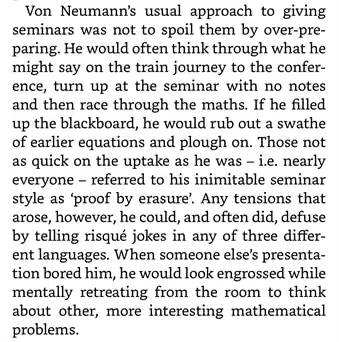 Peter G. Klein
@petergklein
Another good story
 Peter G. Klein
@petergklein
Fascinating NY Times piece on DEI programs at the University of Michigan which largely supports the thesis of @NicolaiFoss and myself that such efforts are largely driven by empowered middle managers. I'll explain, and provide a few examples. 1/ www.nytimes.com/2024/10/16/magazine/dei-university-michig…
Peter G. Klein
@petergklein
Do DEI programs accomplish their goals? Yes, if the goal is understood as perpetuating the DEI bureaucracy, not increasing diversity, equity, and inclusion. 7/
 Peter G. Klein
@petergklein
More on accountability: When survey data suggested that DEI training was lowering the opinions of UM students about the university's diversity climate, the program head took that as a win, saying it showed the students were holding the school to a "higher standard." 8/
Peter G. Klein
@petergklein
A book chapter on a broader set of strategic, organizational, and managerial issues related to wokeness. 11/ www.elgaronline.com/edcollchap/book/9781802201482/book-pa…
Peter G. Klein
@petergklein
These issues continue to be important in the academic, practitioner, and policy literatures. And we think the mechanisms we describe - empowered and ideologically committed middle managers driving organizational change - apply across a variety of contexts! 12/12
Peter G. Klein
@petergklein
Great discussion of institutions and the importance of getting the historical details right. (Written before the AJR Nobel Prize.)
Crémieux
@cremieuxrecueil
The received historical wisdom is that the Glorious Revolution of 1688 changed history by laying the groundwork for Britain to become history's greatest empire.
Big names like Acemoglu & Robinson and North & Weingast have endorsed this view.
But is it correct?
 Peter G. Klein
@petergklein
Call it the Freakonomics Effect - sometimes a clever (and well-identified) explanation is overly simplistic!
Peter G. Klein
@petergklein
See also
Peter G. Klein
@petergklein
Interesting paper on self-employment that challenges the conventional wisdom, using a larger sample than that used previously. Finds that the average self-employed person does not earn less (or consume nonpecuniary benefits more) than employees with similar characteristics.
 NBER
@nberpubs
Self-employed individuals have higher average income and steeper, more persistent income growth profiles than paid-employed peers with similar characteristics, from Anmol Bhandari, Tobey Kass, Thomas J. May, Ellen McGrattan, and Evan Schulz www.nber.org/papers/w32948
 Peter G. Klein
@petergklein
Surreal to see the #collegegameday crew in front of Sproul Hall!
Peter G. Klein
@petergklein
 Brooke Pryor
@bepryor
Every other school should commission Cal students to do their gameday signs.
These are top-tier.


 Peter G. Klein
@petergklein
Best one for Cal-Miami: "Woke vs. Coke"
Peter G. Klein reposted
Brian Gordon
@GordonBrianR
This is also why completely flat organizations don’t work. Exception handling demands at the organizational level emerge all the time given Knightian uncertainty and open, dynamic environments.
Peter G. Klein
@petergklein
Enjoyed speaking on "Hayek and Organization Studies" on the panel, "Hayek's Nobel Prize at 50," at the @MontPelerinSoc annual conference in New Delhi. Here are the slides in case anyone is interested! www.dropbox.com/scl/fi/iiyubteimh742yax3ng95/Klein-slides…
 Peter G. Klein
@petergklein
You can find some gory details here www.dropbox.com/s/9rtgxsc3dqinzr2/Chapter 20 - with autho…
Peter G. Klein
@petergklein
Coase on the (old) institutional economists: "Without a theory, they had nothing to pass on except a mass of descriptive material waiting for a theory, or a fire."
 Elizabeth Pancotti
@ENPancotti
to the extent that economics should influence public policy decisions, perhaps the more important research is applied and empirical work, not theory (especially the most basic with unrealistic assumptions)
Peter G. Klein
@petergklein
Source: www.jstor.org/stable/40750690
Peter G. Klein reposted
Nicolai Foss
@NicolaiFoss
MORE ON THE WOKE COMPANY
@petergklein and I respond to Olenick and Somaraju's critiques of our 2022 paper, "Why Do Companies Go Woke?"
journals.aom.org/doi/epub/10.5465/amp.2023.0489
 Peter G. Klein
@petergklein
My article with @NicolaiFoss on "woke" companies generated quite a bit of attention, not all of it favorable. Our response to one set of scholarly critics, Jeffrey Olenick and Ajay Somaraju, is now online. Enjoy! journals.aom.org/doi/epub/10.5465/amp.2023.0489
Peter G. Klein
@petergklein
Lots of folks dumping on this post for the obvious reasons but what I find most interesting is that he's a data scientist but evidently unfamiliar with a large social science literature on political orientation and bias by occupation, and the mechanisms that drive this.
 Yann LeCun
@ylecun
People studying misinformation lean left for two reasons:
1. scientists lean left, regardless of specialty, because they care about facts.
2. misinformation today primarily comes from the Right ("they're eating the dawwwgs!") which makes it worth studying and fighting against for people leaning left.
Peter G. Klein
@petergklein
This short ~15yo piece outlines some of the arguments and evidence. mises.org/mises-daily/why-intellectuals-still-support-soc…
Peter G. Klein
@petergklein
Look what just arrived @joshgans
 Peter G. Klein
@petergklein
Thoughtful discussion of politics in science. Argues that while bias is inevitable, scientists should strive for objectivity. My preferred solution is institutional: diversify the funding base and decentralize the production, assessment, and dissemination of scientific research.
 Stuart Ritchie
@StuartJRitchie
Lots of people are reacting to the Scientific American endorsement by saying it's fine because "well, science IS political!".
So it's time to dust this essay off again: "Science is political - and that's a bad thing". www.sciencefictions.org/p/science-is-political
Peter G. Klein
@petergklein
See this excellent Terence Kealey lecture delivered at @BUBaughCtr in 2022. www.youtube.com/watch?v=vBbnv0xChIc
Peter G. Klein
@petergklein
One of this year's IgNobel prizes went to a paper on probability theory: "Fair coins tend to land on the same side they started: Evidence from 350,757 flips." Good material for a classroom of Bayesian versus frequentist notions of probability! 1/ improbable.com/ig/winners/
Peter G. Klein
@petergklein
It's true that my launch is an element of the set, "all new restaurant launches in this area over this time period," but each launch is sufficiently distinct that calculating this frequency isn't very helpful. Starting a business isn't a repeatable event like flipping a coin! 8/
Peter G. Klein
@petergklein
Anyway, the distinction between repeatable and nonrepeatable events has been somewhat forgotten, IMHO, in many entrepreneurship and strategy discussions. Entrepreneurial experiments are different from lab experiments! More thoughts on probability here. 9/9 sites.baylor.edu/peter_klein/files/2015/11/09071-29akgbt.pdf
Peter G. Klein
@petergklein
Funny Glassdoor poll on annoying workplace jargon www.glassdoor.com/blog/workers-vote-on-the-worst-workplac…
 Peter G. Klein
@petergklein
Ironically, the Glassdoor blogger refers incorrectly to the poll's "methodology" organizationsandmarkets.com/2007/04/07/method-versus-meth…
Peter G. Klein
@petergklein
EU forbids discounts for consumers wishing to purchase fewer services www.boredpanda.com/historic-decision-portuguese-court-rul…
Peter G. Klein
@petergklein
A few ideas (including from Yours Truly) on founder mode
 Chris Stokel-Walker
@stokel
My latest for @TheLeadDev looks at the phrase of the moment - founder mode - and why it's a risk for those in the workplace leaddev.com/personal-development/beware-founder-mode
Peter G. Klein reposted
Raffaella Sadun
@raffasadun
Being an organizational economist in a strategy department, I am often puzzled by the little interaction that exists between these two fields. A new blog post written with a great group of colleagues to argue for more strategy in org econ, and viceversa cepr.org/voxeu/columns/economics-organisational-strategy
Peter G. Klein
@petergklein
I don't have a position on the market-structure question but want to acknowledge my agreement with Kevin on the plumbers issue. Identification is important, but not the only issue in social science. mises.org/mises-wire/economists-are-not-plumbers
Kevin A. Bryan
@Afinetheorem
Interesting from David, but...the "economist as plumber"/"empirical turn" has been bad, not good. For questions like "Why did China grow so fast? Will AI allow collusion? When should the government subsidize jobs during recessions?" the plumber-economists make too small advances.
Peter G. Klein
@petergklein
See also organizationsandmarkets.com/2014/11/23/its-the-economics-…
Peter G. Klein
@petergklein
Excellent Raghuram Rajan piece on the "new" industrial policy. "In articulating their neo-statist dream," the evangelists for what they call industrial strategy "are giving license to all governments’ innate instinct to intervene and expand." www.project-syndicate.org/commentary/industrial-policy-su…
Peter G. Klein
@petergklein
The greatest profession
 Peter G. Klein
@petergklein
This should be fun!
 Peter G. Klein
@petergklein
Here is a summary of our position in the exchange. It contains links to the other pieces. managementstudiesinsights.com/in-defense-of-classic-strat…
Peter G. Klein
@petergklein
Imagine The Atlantic running a piece titled "Sometimes You Just Have to Ignore the Epidemiologists" or "Sometimes You Just Have to Ignore the Climate Scientists" www.theatlantic.com/ideas/archive/2024/08/economists-kama…
 Peter G. Klein
@petergklein
Security agencies operate in secrecy, their budgets off the books, their actions opaque to their nominal overseers. Officials regularly commit perjury when asked officially (DNI Clapper a recent example). What we know comes largely from leaks (Snowden, Twitter Files, etc.) 5/
Peter G. Klein
@petergklein
Now published! Pick up a copy from your favorite bookseller. www.publicaffairsbooks.com/titles/nicolai-j-foss/why-mana…
Peter G. Klein
@petergklein
Lively and engaging profile of Mondragon, a federation of worker cooperatives in Spain's Basque country - an example of flat hierarchy we discuss in Why Managers Matter. A fun read by an author in love with his subject. Some balance is needed, however. 1/
www.newyorker.com/business/currency/how-mondragon-became-…
Peter G. Klein
@petergklein
Agree that this is an excellent book. Provides important context for contemporary conversations on the "intelligence community," "disinformation," etc.
Peter G. Klein
@petergklein
The February 2022 issue of Academy of Management Perspectives, featuring our piece on cronyism, is now published! journals.aom.org/toc/amp/36/1
 Peter G. Klein
@petergklein
I worked for a government agency that produced a report that was extensively fact-checked. This meant simply that each number or substantive claim had to be documented with a credible source. It was not a grand epistemological exercise to separate "facts" from "misinformation."
Peter G. Klein
@petergklein
Wonderful gift from Amir Emami: Persian edition of Organizing Entrepreneurial Judgment!
Peter G. Klein
@petergklein
New paper: "Capitalism, Cronyism, and Management Scholarship: A Call for Clarity" with Michael Holmes, @NicolaiFoss, @siriterjesen, and @jpepegsu. The paper will appear in Academy of Management Perspectives. papers.ssrn.com/sol3/papers.cfm?abstract_id=3797259
 Peter G. Klein
@petergklein
A key difference is that firms - D.H. Robertson's "islands of socialism" - are competing against other firms in the sea of the market. Even actually existing national socialist economies had access to world market prices, which is why they survived as long as they did.
Peter G. Klein
@petergklein
Sad to report that Oliver Williamson passed away yesterday at age of 87. I'll have more to say in the coming days. He was a giant in economics and management and had a huge influence on my thinking and career. RIP.
Peter G. Klein
@petergklein
This is exactly the argument of Mises's 1920 article on the socialist calculation problem. It's essentially an argument about the need for market prices to do cost accounting.
Peter G. Klein
@petergklein
I see that shutdown talk is in the news again. This is your friendly reminder that in govspeak, "shutdown" means a temporary, small reduction in government activity. The 2013 shutdown was a two-week furlough of 18 percent of the federal workforce (not including contractors). 1/
Peter G. Klein
@petergklein
It's almost as if "shutdown" isn't the correct word. www.vox.com/2018/1/19/16910986/government-shutdown-what-s…
Peter G. Klein
@petergklein
"Shutdown" lingo is back in vogue, so I'm re-sharing my short 2013 video on the topic. mises.org/blog/video-peter-klein-shutdown-doublespeak
 Andrew McAfee 🇺🇦

 Jediwolf


