Highly recommended: New interactive chart breaking down China's government and tax revenue history over the last 75 years. By Tianlei Huang @PIIE
Explore the interactive version here: www.piie.com/research/piie-charts/2026/breakdown-chinas-g…
Politicians, athletes, journalists, NGOs, companies... They all use corporation-owned social networks to communicate with us. Citizens shouldn't have to hand over their data to companies to read content published by public entities. Public Feeds changes that by making posts of popular accounts freely available. Read more.
Carl Benedikt Frey is a Swedish-German economist and economic historian. He is the Dieter Schwarz Professor of Political Economy and Technology at the Oxford Internet Institute and a Fellow of Mansfield College, University of Oxford. He is widely known for his 2013 paper with Maike Osborne, "The Future of Employment," which estimated that 47% of US jobs were at high risk of automation, becoming one of the first and most cited works on AI's impact on labor markets. More on Wikipedia
Carl Benedikt Frey reposted
Highly recommended: New interactive chart breaking down China's government and tax revenue history over the last 75 years. By Tianlei Huang @PIIE
Explore the interactive version here: www.piie.com/research/piie-charts/2026/breakdown-chinas-g…
Carl Benedikt Frey reposted
New working paper!
Q: Was the rise of the factory “deskilling"?
TLDR: Technology has benefited skilled workers for the past 100 years, but contemporaries—from Smith, to Ricardo, to Marx—thought it reduced demand for skilled labor during industrialization. They were right.
Carl Benedikt Frey reposted
Are we in an intelligence explosion? This is one of the most important questions facing society right now. @lugaricano and I tried to put structure on this question and provide estimates based on currently available data.
METR recently reported that frontier capability growth roughly doubled after October 2025---but this is accompanied by annualized R&D spending growth of ~6x and technical staff ~3x over the same window. That highlights a crucial distinction between scaling laws--exponential capability gains bought with exponentially rising inputs--and an intelligence explosion (IE), where AI begins substituting for external inputs so each advance makes the next one easier.
We estimate several versions of a research production function (building on @ChadJonesEcon, @bfjo, and @Ph_Aghion) where a key parameter crossing a threshold signals an IE, while values below it correspond to an "ideas are harder to find," diminishing-returns world. Across specifications, our estimates sit below that threshold. Allowing for a break at METR's October 2025 cutoff points to a one-time step up in research effectiveness, with the rate of diminishing returns being nearly identical on both sides of the cutoff.
A few things to note. First, this exercise is not a forecast. It's an attempt to put structure on some of the important questions being debated right now: RSI, IE, scaling laws all depend on how outputs scale with inputs, and how feedback loops accelerate/decelerate this process. These estimates can change, and change very quickly.
Second, we are very explicit that the results are based on publicly available data; it is very much possible that METR had access to data that would change the estimates.
Third, we might be wrong! Let us know what you think:
aleximas.substack.com/p/are-we-approaching-an-intelligence
Carl Benedikt Frey reposted
AI means very different things depending on what a society already has. In rich economies, it competes with expensive human expertise; but when introduced elsewhere, it supplies expertise that was never available, @carlbfrey explains. www.project-syndicate.org/commentary/ai-resistance-tied-t…
Carl Benedikt Frey reposted
Post-Doctoral Researcher Vacancy: Join us at the University of Oxford! Our Economics, Inequality, and Opportunity team at INET Oxford is hiring a post-doc to start in September 2027 (or sooner) on a two-year contract. Deadline: December 1
Carl Benedikt Frey reposted
Every time I think European voters cannot be more in denial about pensions, they prove me wrong: they are even more in denial than in my worst nightmare.
The average French person believes there are 6.4 workers for every retiree. The real number is about 1.8.
Really interesting (and worrying) polling on French pensions
The electorate estimates that for every pensioner we have 6 workers.
In reality it's 1.8/1... Even in 1960s we weren't close to 6/1.
Melenchon's supporters think its 13/1.
Carl Benedikt Frey reposted
Who pays for AI? In a new working paper, we study this using banking data covering billions of transactions to see who pays for tools like ChatGPT, Claude, Gemini, etc. We find that 1-in-20 UK adults now pay for AI, representing a $1.4 billion market annually. (1/N)
Carl Benedikt Frey reposted
.@carlbfrey calls for legislation to establish learning rights, akin to mineral rights or broadcasting rights. Each was created by statute when a newly valuable resource needed an owner before it could have a market. www.project-syndicate.org/magazine/ai-economy-who-owns-ta…
Carl Benedikt Frey reposted
4/9 In the IT era, US multinationals in Europe got more out of IT than local firms under the same rules, mainly through people management (Bloom-Sadun-Van Reenen 2012). I suspect these management differences are still there, and matter for AI.
Carl Benedikt Frey reposted
Quick thread on AI and productivity:
Lots of people say this chart shows AI is now showing up in the productivity data.
But I made this chart to argue the opposite: a trend that pre-dates AI and only shows up in the US doesn’t look like AI.
Here’s how I’m thinking about the data and underlying dynamics:
My latest in @ProSyn
AI means very different things depending on what a society already has. In rich economies, it competes with expensive human expertise; but when introduced elsewhere, it supplies expertise that was never available, @carlbfrey explains. www.project-syndicate.org/commentary/ai-resistance-tied-t…
Carl Benedikt Frey reposted
The United States is both the home of the AI revolution and among the places where people like the technology the least. @carlbfrey considers why. www.project-syndicate.org/commentary/ai-resistance-tied-t…
Carl Benedikt Frey reposted
Since Zucman is saying "but we were peer reviewed!" as a defense of his work from AI audits, I'd encourage you to look at his two big papers in the Quarterly Journal of Economics from 2016 and 2018.
Both got a rapid single round of R&R within 2-3 months of submission date and both were accepted by the journal within 2-3 months of that revision. Both were up on the journal's website in under a year.
Now I don't have any special insight to what the referees on these two papers said. But I do know that this is an extremely rapid submission-to-print timeframe for a complex empirical article at a top economics journal. And it's especially rapid considering that people were pointing out problems with the working paper versions of both while they were still under review, and most of those problems remain unaddressed.
For comparison, the Auten-Splinter income series (which is the most direct competitor to PSZ's 2018 QJE piece) took FIVE YEARS of rigorous peer review back-and-forth between its initial submission in 2018 and its acceptance in 2023 at JPE. @VincentGeloso and I first released our critique of a different part of Piketty-Saez's data series in 2017. It took multiple rounds of rigorous review and back-and-forth edits on every section before we landed at EJ in 2022. I suspect that what these papers experienced is much more in line with the norms of a heavy and rigorous peer review at an A-list journal.
IOW, I consider it highly unlikely that the <1 year rapid turnaround that SZ and PSZ got twice in a row at QJE is anything remotely common at that or any other top journal.
Carl Benedikt Frey reposted
Carl Benedikt Frey considers why some societies are so much more suspicious of the technology than others. www.project-syndicate.org/commentary/ai-resistance-tied-t…
Carl Benedikt Frey reposted
I'm thrilled to be launching Econvitals today. It's been the main way in which I have been tracking and understanding the economy over the last several months. And I decided I might as well share it with all of you--for free.
Has a combo of website, email lists & social media.
Carl Benedikt Frey reposted
Thor Berger @bergerthor has written a great paper on the effects of the diffusion of tractors in the United States, with a very nice thread that describes the analysis. The widespread adoption of tractors led to increased human capital investment both because children of farmers left agriculture. On the other hand, those areas that adapted most quickly exhibited the largest graduation effects, suggesting human capital investment was able to generate complementaries between farmers and tractors as the technology of agricultural production evolved. This possibility, of course, has contemporary resonance.
🚜 New working paper: “Wheels of Change: Agricultural Automation and Human Capital in the 20th Century”
Q: How does the next generation adapt to automation?
A thread 🧵 (1/14)
👇
🚜 New working paper: “Wheels of Change: Agricultural Automation and Human Capital in the 20th Century”
Q: How does the next generation adapt to automation?
A thread 🧵 (1/14)
Carl Benedikt Frey reposted
While a plausible claim, I think this claim is missing some important context
“The idea that Mark Zuckerberg was sitting in his Harvard dorm room and would have been deterred from starting Meta if the capital gains tax rate was slightly closer to the ordinary income tax rate strikes me as categorically absurd,” argues @NatashaRSarin, professor of law at Yale Law School.
Carl Benedikt Frey reposted
Institutions that once gave Europe a comparative advantage in catching up with America have become a constraint now that Europe must compete with the US at the technological frontier, notes @carlbfrey. www.project-syndicate.org/onpoint/why-europe-is-falling-b…
Carl Benedikt Frey reposted
What puzzles me about French economists like Gabriel, as well as Emmanuel and Tomas, is the zeal they bring in trying to convince Americans that they have to implement a French model that is focused on redistribution rather than growth, because every indication we have suggests that the focus on redistribution has cost France, and some other countries in Europe, like my own native Belgium, very dearly so far. In fact, the French economy looks like it is about to enter a serious fiscal crisis because its redistribution model is no longer sustainable.
Californians ought to celebrate the fact that wealth is being created in California, and not somewhere else in the U.S. or in the rest of the world. Americans, and Californians, for that matter, should continue to do what they do best, which is focus on growing the pie. It would be a mistake to adopt a model that is fundamentally broken.
What the French should do instead is try to copy the model that made California an engine of innovation. In that case, smart, highly educated French kids wouldn't come to the U.S. to start companies. They would do so in France. If they had done that, they would have more than one AI startup company.
More defence spending (though needed) or an "Airbus for AI" is not going to restart European growth. My five cents in @ProSyn on what Europe needs.
Link in comments.
Carl Benedikt Frey reposted
Europeans must not confuse mobilization with dynamism. Although defense spending can deliver specific breakthroughs, a war economy is a poor foundation for broad-based discovery, @carlbfrey explains. www.project-syndicate.org/onpoint/why-europe-is-falling-b…
Carl Benedikt Frey reposted
.@carlbfrey calls for legislation to establish learning rights, akin to mineral rights or broadcasting rights. Each was created by statute when a newly valuable resource needed an owner before it could have a market. www.project-syndicate.org/magazine/ai-economy-who-owns-ta…
Carl Benedikt Frey reposted
Can the arts business model survive AI? Perhaps the best guide is to look at how the arts survived past tech revolutions
Take music—internet piracy and then streaming killed the lucrative CD market, but musicians mostly saved their jobs by focusing much more on live concerts
Carl Benedikt Frey reposted
I think we have a problem
Carl Benedikt Frey reposted
I had the opportunity to offer feedback on Claude's Constitution to the authors at Anthropic (in person). This piece nicely converges with my own thinking: mustafa-suleyman.ai/a-warning-about-model-welfare
Carl Benedikt Frey reposted
My new book, THE FUTURE OF LAW, is published TODAY by @OUPLaw - www.amazon.co.uk/Future-Law-Reflections-Predictions/dp/01…. Tonight I'm honoured to be giving the Annual Lecture of the @computersandlaw - www.scl.org/events/event/scl-annual-lecture-2026-the-futu…. I look forward to seeing many of you there.
Carl Benedikt Frey reposted
I recently received a paper on the Ottoman Elections of 1918 at Explorations . . . but it turns out there were no such elections!
It turns out that the paper was an elaborate fraud. The author rewrote an excellent JCE paper on the industrialization and the Russian Revolution. They put it through AI to rewrite the text but they kept everything else the same. So there are regressions with "distance to petrograd" and "distance to Moscow" in them.
The maps they produce have the geo-coordinates of Russia, not the Ottoman Empire.
More on this ridiculous paper and the new age of academic fraud at open.substack.com/pub/markkoyama/p/the-new-age-of-academi…
Carl Benedikt Frey reposted
Took longer to build than the Titanic, cost over twice as much as the UK national supercomputer, and adds one new platform to Oxford station. (Oh, and the railings on either side of the road don't match.) A case study for our moment.
Cars and buses go from Oxford Station down Botley Road for the first time in three years!
The project took longer than the construction of The Titanic and saw costs balloon to £237m.
Looks good though.
Carl Benedikt Frey reposted
Carl Benedikt Frey sees a need for new institutions to govern valuable knowledge transfers within the AI economy. www.project-syndicate.org/magazine/ai-economy-who-owns-ta…
Carl Benedikt Frey reposted
There are a few reasons why young people don’t like AI---including this.
Who should own what AI learns? In my latest for @ProSyn, I offer an alternative to @satyanadella’s proposed “trust boundaries.”
As firms and individuals improve AI systems simply by using them, yet they have little control over or ability to capture the value of that learning. Indeed, after an OpenAI system produced a solution to the Navier–Stokes problem, mathematician Tristan Buckmaster raised concerns that work he had developed while using OpenAI products might somehow have contributed.
Nadella’s answer is to keep such knowledge inside secure corporate “trust boundaries.” The downside is that this risks enclosing knowledge inside incumbent firms and strengthening cloud providers and companies that already possess large proprietary data assets to the detriment of start-ups.
The alternative proposed here is property rather than secrecy: create narrow, time-limited “learning rights” that give firms a right to be compensated when others train on valuable knowledge they have generated, without giving them a permanent right to block its use.
Rather than keeping what AI learns a secret this would let knowledge circulate while ensuring that those who create it are paid.
Firms like DoorDash, Siemens and Airbnb have began to use much cheaper open-weight Chinese models. They are not alone: "at the start of the year, three-fifths of its queries were routed through to closed-weight proprietary models. The latest share is just a quarter."
Should put some pressure US frontier labs capacity to monetize AI going forward.
Carl Benedikt Frey reposted
I am so thrilled to say that my new book, WHAT SHOULD MY CHILDREN DO? HOW TO FLOURISH IN THE AGE OF AI, is out TODAY in the UK.
In many ways, the last fifteen years have been building up to this launch. I have spent most of that time thinking and writing about the impact of technology, and particularly AI, on work and society.
That interest has taken me all over the world, to talk with a kaleidoscope of different people and organisations. Yet wherever I am, and whoever I am talking to, the question that I get asked the most -- and particularly since the arrival of generative AI -- is always the same: what should my children do?
In the few minutes I have in those chats, I try my best. But I always feel I have not done enough. The question is so profound, the answers so varied. I am frustrated because I had so much more to say; they are frustrated because the snippet of advice feels like a teaser.
So this book is the full answer, the one I would give if I had more time to give my full response, to draw on all the thinking and writing and conversations I have had over the last decade and a half.
It is also the book, as a parent, I would want to read. Having my own children (8, 5, and 2) has made the challenge far more personal, too -- it is clear that their future is going to look very different from my past.
But this book is more than just for parents. It is a practical and hopeful guide for all of us, from politicians to parents, business leaders to students, at all stages in our careers, to flourish in this strange and exciting new world we are entering.
So I am pleased the day is finally here. Do order below (or elsewhere!). And I look forward to hearing all your thoughts and reactions.
www.amazon.co.uk/What-Should-My-Children-Do/dp/0241791170
Carl Benedikt Frey reposted
Writing in @TheTLS, Hoover Senior Fellow Philip Zelikow argues that AI's prophets on both sides share an unexamined assumption: that the technology itself will determine whether its benefits reach people.
What shapes the future, he maintains, is less the technology than whether societies remake their tooling, businesses, occupations, and laws. www.the-tls.com/science-technology/technology/how-progres…
Carl Benedikt Frey reposted
Why bother when Washington is retaliating against itself?
"Bombardier points out U.S. footprint after Trump says aerospace giant must build in America" 😯 www.cnbc.com/2026/09/07/trump-bombardier-cant-sell-in-us-…
Carl Benedikt Frey reposted
Hahaha @ProfDavidDeming and co-authors got Norwegian administrative data to prove that meetings are good.
www.nber.org/papers/w35706
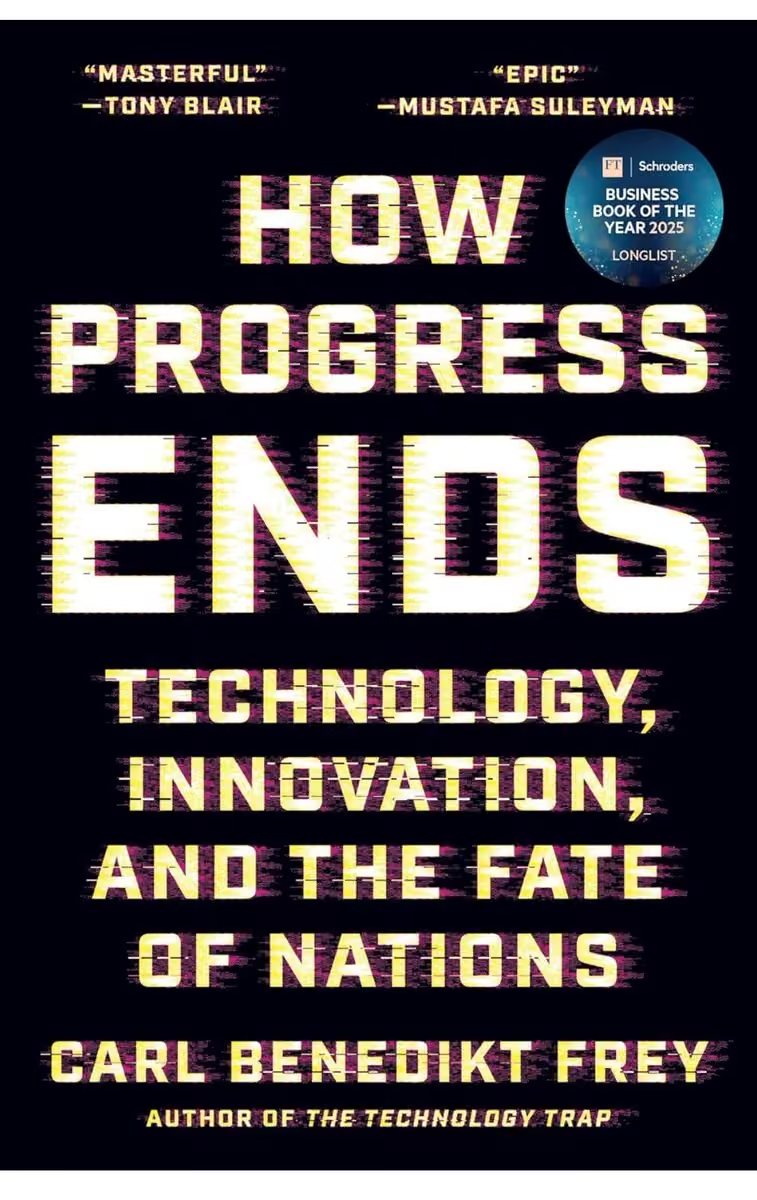
Chuffed to see that the great Philip Zelikow's thoughtful and blazing review of How Progress Ends (alongside Josh Tyrangiel's "AI for Good") made the cover of @TheTLS this week.
"Using an ultra-wide-angle lens . . . [Frey] conducts a masterly sweep across two millennia to ask why progress starts and why it stops. . . . Frey works his thesis through an impressive range of cases: from Chinese mandarins to European guilds, Prussia’s “visible hand”, Soviet planning, postwar Japan and the American ascendancy. He shows how, while the British kicked off the Industrial Revolution in the eighteenth century, assisted by an environment of decentralization, weakened guilds and an ascendant merchant class, it was highly centralized Prussia that, a century later, most profitably exploited the new technologies. The author’s account of the Soviet Union, building on the work of scholars such as Chris Miller, is exemplary. . . . [A] magnificently informative book."
Carl Benedikt Frey reposted
I still remember reading this great Parente & Prescott paper for the first time back in 2003 (which incidentally is probably what led to me get my first job at @CEP_LSE)--still very relevant today.
www.aeaweb.org/articles?id=10.1257/aer.89.5.1216
Once upon a time, Uber caused mayhem as conventional taxi services resisted it. Now Uber and the drivers’ union are joining forces to resist self-driving cars. Incumbents, whoever they are, really don’t like competition. This is one reason why the productivity gains from AI will take time to materialize—and, in some instances, may not materialize at all.
Carl Benedikt Frey reposted
something of a leap
GPT-6 benchmarks:
Once upon a time, Uber caused mayhem as conventional taxi services resisted it. Now Uber and the drivers’ union are joining forces to resist self-driving cars. Incumbents, whoever they are, really don’t like competition. This is one reason why the productivity gains from AI will take time to materialize—and, in some instances, may not materialize at all.
Carl Benedikt Frey reposted
Icymi! www.linkedin.com/pulse/slowbalisation-mostly-china-richar…
Carl Benedikt Frey reposted
Ajeya Cotra is a world-class communicator because she talks about very scary things with precision and without a bunch of impenetrable safety jargon. (She’s on Hard Fork tomorrow to discuss the METR report!)
Please watch this clip
There is nothing paradoxical about this commonly alleged paradox. The welfare state makes people more individualistic (less dependent on other, whether family or the local community)
Carl Benedikt Frey reposted
I mean
"... we find no consistent evidence that occupational licensing improves consumer outcomes. In the NYC/NJ comparison, where licensing includes 34 both screening and training requirements, licensed drivers receive slightly lower star ratings than unlicensed drivers?"
I reviewed Jill Lepore's The Rise and Fall of the Artificial State for @TheTLS
www.the-tls.com/science-technology/technology/the-rise-an…
Carl Benedikt Frey reposted
If you look at the last 3 years of AI progress, technologists have largely been right about the (massive) increase in capabilities, and economists have largely been right about the economic impact. I don’t expect that to change.
Ricardian comparative advantage ftw!
There is a widespread perception that China has an advantage in AI adoption. Just as it has rolled out high-speed rail and other infrastructure at extraordinary speed, it can supposedly deploy AI without the veto points that many believe are holding back Western democracies.
Yet the AI revolution may be won not by the country most willing to force workers aside, but by the one that makes them secure enough to let the machines in. China’s lack of a robust welfare state is already emerging as a potential weakness. Without adequate protection against displacement, the political pressure is to protect existing jobs rather than insure workers through the transition.
My latest for @ProSyn:
"OXFORD—In late April, a Chinese court ruled that an AI firm could not legally dismiss an employee simply because his role had been automated. Shortly thereafter, Chinese regulators reportedly suspended new autonomous-vehicle licenses nationwide in response to a mass robotaxi failure in Wuhan, a city where cab drivers had long petitioned authorities to slow the technology’s rollout. And all the while, Chinese state media has been criticizing companies for contemplating AI-driven layoffs, arguing that they have a duty to protect their employees."
Link in comments.
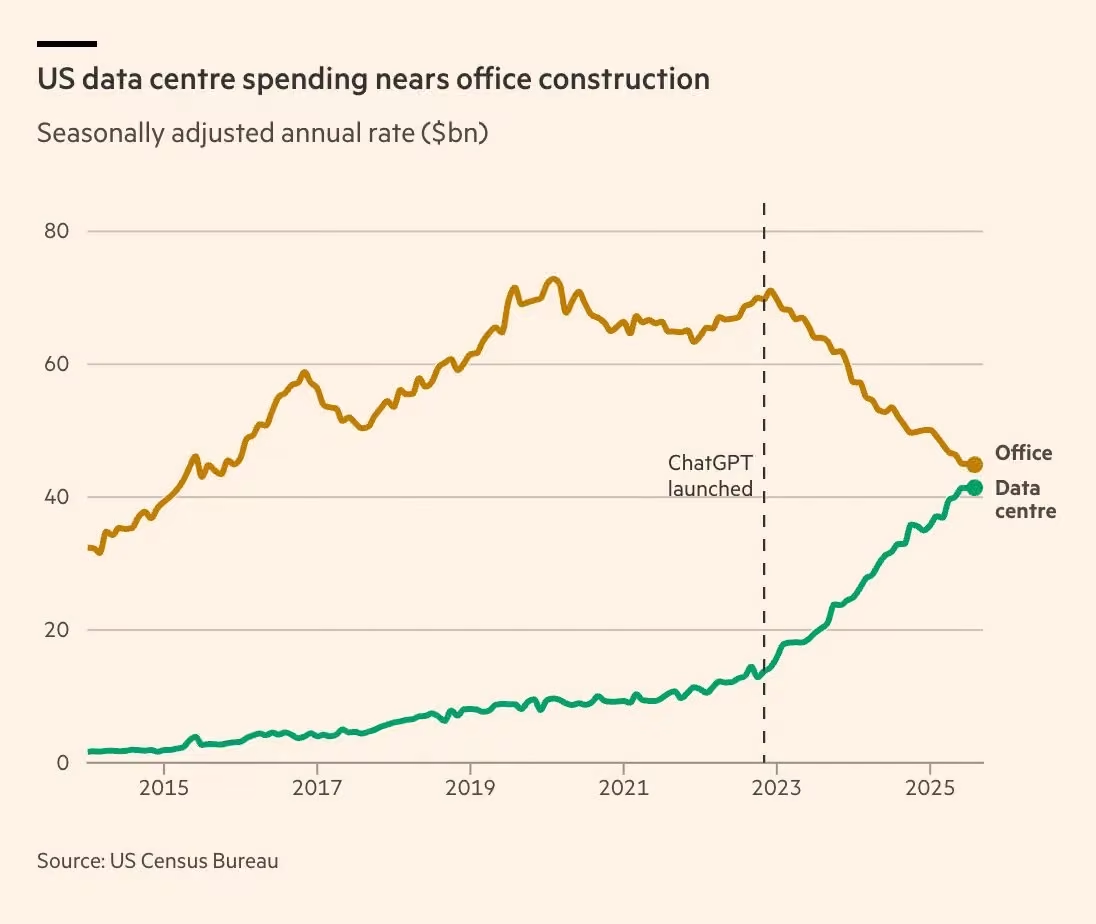
My 5 cents in @nytimes on the dynamics underpinning the extraordinary data center rollout:
“These companies are essentially in an A.I. arms race,” said Carl Benedikt Frey, an economist at Oxford University. “If they don’t invest, they are acknowledging defeat.”
Link in comments.
Carl Benedikt Frey reposted
Frey: “The cost of arbitrary power shows up in discounted valuations on Chinese stocks, in capital flight…China produces winners. But credible commitment buys more than champions: it creates a deeper pool of people willing to take long-term risks.”
www.wsj.com/tech/move-fast-and-regulate-later-the-paradox…
Delighted to have written this weeks Saturday Essay for @WSJ.
It deals with a well-known paradox: in China, property rights are conditional, contracts can be torn up by the Communist Party, founders can suddenly disappear from public life or be ousted from their own firms, and there is no meaningful recourse against the state. By every textbook of institutional economics, China should be a graveyard for enterprise. Instead it has produced ByteDance, Shein, BYD, and DeepSeek.
So how does a country with such casual regard for the rule of law produce so much dynamism?
The answer is that the rule of law is not one thing. It has a liberal side—secure property rights, courts that constrain the state—that shields entrepreneurs from arbitrary power. And it has a regulatory side that can wall off competition, protecting incumbents from challengers who lack a compliance department.
China's dynamism clearly doesn't come from the absence of law. It comes from letting firms scale into regulatory grey zones, and from selective enforcement, which is a double-edged sword.
America's distinctive advantage was always the liberal side of the rule of law: the rules that secure private property, punish anticompetitive conduct, and hold the state at arm's length from the firm. But that advantage is now being eroded from the top. The Trump administration declaring Anthropic a "supply-chain risk to national security" is just one example. And while 63% of its 2025 Unified Agenda is deregulatory in intent, the administration has tried to build a parallel system outside the Code of Federal Regulations: a tariff regime of country-specific schedules, presidential proclamations, and product-by-product exclusions.
Carl Benedikt Frey reposted
Oxford professor @carlbfrey: “In China, property rights are conditional, contracts can be torn up by the Communist Party, founders can suddenly disappear from public life or be ousted from their own firms and there is no meaningful recourse.”
www.wsj.com/tech/move-fast-and-regulate-later-the-paradox…
Carl Benedikt Frey reposted
Progress isn’t linear, but some choices are more successful than others.
Listen to the S2 finale with @carlbfrey, Associate Professor of AI & Work at the Oxford Internet Institute, wherever you get your podcasts: cigionline.org/multimedia/one-step-forward-progress-patho…
Carl Benedikt Frey reposted
I am hyped up right now. This just dropped in my email.
This is the perfect imagery of the point of the book: America from 1870 to 1945 was a land of fast economic growth. It was a land of fast egalitarian growth in that the bottom 90% saw increases in living standards that rivaled and maybe exceeded those of the top 1%.
America, from 1870 to 1945, experienced the world's first egalitarian enrichment.
Carl Benedikt Frey reposted
What might future historians say about the #ai era we are currently living through?
Discover historian and economist @carlbfrey's views on this and more: www.weforum.org/stories/2026/04/an-oxford-professor-on-ai…
Carl Benedikt Frey reposted
There is a certain irony in crying "bloody murder" about distillation when your entire business model is built on "distilling" humanity's collective knowledge without paying for it.
Carl Benedikt Frey reposted
Shutting down USAID literally made Africa darker.
Carl Benedikt Frey reposted
“We used to say the open-source models, in particular the Chinese models, are behind the frontier models by, I don’t know, six to nine months,” said Ion Stoica, who co-foundedAI model ranking platform Arena. “Right now, they may be two to three months.” www.bloomberg.com/news/articles/2026-07-18/moonshot-s-kim…
I spoke to the @WSJ about the car industry's first strike over humanoid robots, now underway at Hyundai in Ulsan. A central argument of The Technology Trap was that unless workers believe they will benefit from new technology, they will resist it. Humanoids and AI will only make that more salient
Carl Benedikt Frey reposted
Joel Mokyr, co-winner of the 2025 economics Nobel, joins @tylercowen to talk cultures of progress.
His new book contrasts Europe with China, showing how Europeans learned to cooperate with people they weren't related to, in guilds, monasteries, cities, and universities, while China organized itself around the extended clan. One path led to internal stability and peace; the other, more restless and outward-looking, was the one that decided the world could always be made better.
Some questions from this episode:
· How would you explain the importance of the difference between European corporations versus Chinese clans?
· What’s the most fundamental driver of the Catholic’s Church’s push to end cousin marriage?
· Why does it take so long for the wealthiest parts of Western Europe to surpass Chinese living standards?
· Why no Industrial Revolution in the Roman Empire?
Watch the full episode here or search Conversations with Tyler wherever you get your podcasts.
youtu.be/y4Orjmn21VI
Carl Benedikt Frey reposted
Artificial intelligence is already changing the world of work. The question is whether Britain is ready.
Most British businesses still aren’t using AI, while around seven in ten workers are employed in jobs where AI could reshape the tasks they perform.
The Business and Trade Committee’s inquiry is asking a simple question: is Britain preparing for the biggest change to the world of work since the internet?
Coming before the Committee this afternoon to help answer this question are:
@carlbfrey @UniofOxford Anna Thomas MBE, Institute for the Future of Work; @Marthalanefox ; @AdamC_Corn @The_TUC ; Lauren Thorpe, Chief Transformation Officer at United Learning; Phil Smith CBE, Chairman at Skills England; Julia Adamson MBE, Executive Director for Education and Public Benefit at BCS, The Chartered Institute for IT; Will Sandbrook , Managing Director at Nest Insight; @Kate_Dearden @biztradegovuk Blair McDougall MP @biztradegovuk @KanishkaNarayan @biztradegovuk
Carl Benedikt Frey reposted
Over 100k impressions. Have you seen it? 🔗www.linkedin.com/posts/richard-baldwin-imd_not-one-factor…
Carl Benedikt Frey reposted
Thrilled to see How Progress Ends reviewed in JEL:
"Can we take for granted that AI will usher in a new era of growth and save us from stagnation? A little less than 40 years after Fukuyama (1992) declared the end of history, Frey steps into the breach on this question with a meaty tome reminding us that history is very much alive, that a half century of scholarship in economic history spanning several thousand years of human life on this planet has quite a lot to say on the inevitability of human progress... When the Berlin Wall fell, it seemed obvious to many that capitalism’s defeat of communism would usher in a new world order of technological progress in which peace and prosperity would prevail. Instead, that peace has proven fragile, that progress fleeting. Frey’s book offers a persuasive and well-written reminder that this is not an exception to history but rather the norm."
Forthcoming book review in the JEL: "How Progress Ends: Technology, Innovation, and the Fate of Nations by Carl Benedikt Frey" by David Robinson. www.aeaweb.org/articles?id=10.1257/jel.20260007&from=f
Carl Benedikt Frey reposted
Alex Tabarrok: How Britain Became as Poor as Mississippi - Marginal REVOLUTION marginalrevolution.com/marginalrevolution/2026/07/how-bri…
many good points worth your time👇
I wrote this for the @FT today, on what Burnham, and his party, must learn from Starmer's failures on growth. www.ft.com/content/2a04cc0e-ed9f-46cd-8974-99745ef8df7a
Carl Benedikt Frey reposted
The intellectual elite, discovering that many people actively like sloppy AI writing, might finally understand why music elitists think their music tastes are trash. 🔥
Thrilled to see How Progress Ends reviewed in JEL:
"Can we take for granted that AI will usher in a new era of growth and save us from stagnation? A little less than 40 years after Fukuyama (1992) declared the end of history, Frey steps into the breach on this question with a meaty tome reminding us that history is very much alive, that a half century of scholarship in economic history spanning several thousand years of human life on this planet has quite a lot to say on the inevitability of human progress... When the Berlin Wall fell, it seemed obvious to many that capitalism’s defeat of communism would usher in a new world order of technological progress in which peace and prosperity would prevail. Instead, that peace has proven fragile, that progress fleeting. Frey’s book offers a persuasive and well-written reminder that this is not an exception to history but rather the norm."
Forthcoming book review in the JEL: "How Progress Ends: Technology, Innovation, and the Fate of Nations by Carl Benedikt Frey" by David Robinson. www.aeaweb.org/articles?id=10.1257/jel.20260007&from=f
Carl Benedikt Frey reposted
My reflection on the US economy after 250 years, and after Trump. Our original No Kings revolution brought us lasting economic dynamism. The force wasn't size, either of government or of the economy - it was innovation being valued over privileged incumbents.
We can do it again by rising against arbitrary executive powers for rule of law. The economic revival will follow. @PIIE @faznet
www.piie.com/commentary/op-eds/2026/americas-future-post-…
Carl Benedikt Frey reposted
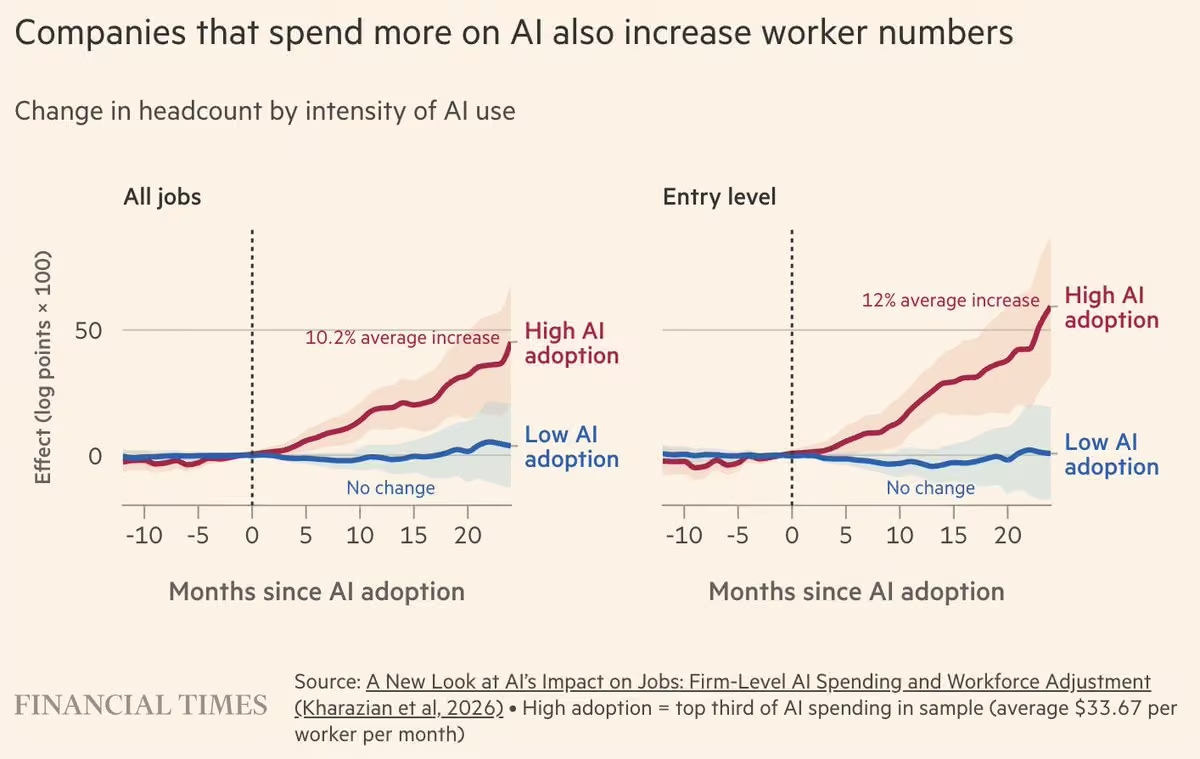
I’m glad to see new data brought to this question. Despite agreeing with my priors, I don’t think “we can finally say AI isn’t killing jobs”
If I understand the data right, this shows selected AI-spending firms—mostly tech/info—kept hiring. Demand shock for those firms possibly
We can finally say AI isn't killing jobs.
A new paper from me, @tryramp, and @RevelioLabs uses firm-level spend and workforce data across 21K U.S. businesses to measure AI's impact on jobs.
Firms that adopt AI heavily grow headcount 10% over two years following adoption. Low adopters see no statistically significant change.
Carl Benedikt Frey reposted
✨🧚 What story is Fable telling about the state of AI?
The frontier keeps moving fast. The question is whether business is yet moving with it. Until it does, economic transformation is a just a fairytale.
(free link in next post)
Carl Benedikt Frey reposted
A truly striking chart in @jburnmurdoch's latest (link next):
Carl Benedikt Frey reposted
The GenAI economy has generated $110 billion in sales over the past 12 months. It is growing fast. On an annualized basis, the revenue run rate exceeds $175 billion.
These numbers took us several months to construct, and as far as we know, it’s the first bottom-up, deduplicated measure of consumer and enterprise AI spending across the full stack.
We are releasing this research today in our first The State of the AI Economy report.
intelligence.exponentialview.co
Carl Benedikt Frey reposted
The value of human effort can grow even as human performance declines. But this principle has limits, @carlbfrey explains. www.project-syndicate.org/commentary/ai-abundance-without…
Carl Benedikt Frey reposted
AI-powered entertainment and companionship could capture enough of people’s time and social appetite to displace the more challenging activities that generate meaning, @carlbfrey worries. www.project-syndicate.org/commentary/ai-abundance-without…
Carl Benedikt Frey reposted
Astonishing difference between US and Chinese AI capex, even after taking into account differences in PPP
Carl Benedikt Frey reposted
This is insightful and important from @carlbfrey on AI making the consumer labor more, and all that means (which is a lot)
My latest in the @FT today. I make four points:
1) Capitalism's great achievement was moving activity out of the household and into the market — turning domestic production into paid specialisation, creating jobs, and making output visible to the national accounts. AI-enabled self-service might quietly reverse that centuries-long trend.
2) When a technology automates tasks within a service, it can trigger a Jevons paradox: the service gets cheaper, demand expands, and employment grows. When it lets people do the work themselves, demand for the service collapses.
3) AI extends this even to the manual trades, the supposed safe haven of the AI age. If a homeowner can ask a chatbot why their boiler keeps losing pressure, heating engineers lose call-outs.
4) When work shifts to the consumer, it vanishes from the economy statisticians measure. Replace a billing department with a chatbot and a firm records lower costs and higher output per worker; the national accounts register a productivity gain. But the hours patients spend decoding their own test results appear nowhere — not in labour statistics, not in GDP. As self-service spreads into professional domains, that blind spot will grow.
Carl Benedikt Frey reposted
An interesting, different perspective on automation and work
My latest in the @FT today. I make four points:
1) Capitalism's great achievement was moving activity out of the household and into the market — turning domestic production into paid specialisation, creating jobs, and making output visible to the national accounts. AI-enabled self-service might quietly reverse that centuries-long trend.
2) When a technology automates tasks within a service, it can trigger a Jevons paradox: the service gets cheaper, demand expands, and employment grows. When it lets people do the work themselves, demand for the service collapses.
3) AI extends this even to the manual trades, the supposed safe haven of the AI age. If a homeowner can ask a chatbot why their boiler keeps losing pressure, heating engineers lose call-outs.
4) When work shifts to the consumer, it vanishes from the economy statisticians measure. Replace a billing department with a chatbot and a firm records lower costs and higher output per worker; the national accounts register a productivity gain. But the hours patients spend decoding their own test results appear nowhere — not in labour statistics, not in GDP. As self-service spreads into professional domains, that blind spot will grow.
Carl Benedikt Frey reposted
🤖Excited to share a new working paper.🤖
The phrase "AI-Native firms" it everywhere, but are they any different? Is it just hype?
In our new paper we show AI ventures are organized differently, but not for the reasons you think.
Carl Benedikt Frey reposted
Nancy Folbre and Barnet Wagman showed the same as per point 4 but for the late 19th century. Tech change between 1870 and 1890 favored a slight shift to household production causing us to miss some gains in welfare that could not be measured.
Thus, Carl points to a repeat but on a bigger scale.
Source: Wagman, B., & Folbre, N. (1996). Household services and economic growth in the United States, 1870–1930. Feminist Economics, 2(1), 43-66.
My latest in the @FT today. I make four points:
1) Capitalism's great achievement was moving activity out of the household and into the market — turning domestic production into paid specialisation, creating jobs, and making output visible to the national accounts. AI-enabled self-service might quietly reverse that centuries-long trend.
2) When a technology automates tasks within a service, it can trigger a Jevons paradox: the service gets cheaper, demand expands, and employment grows. When it lets people do the work themselves, demand for the service collapses.
3) AI extends this even to the manual trades, the supposed safe haven of the AI age. If a homeowner can ask a chatbot why their boiler keeps losing pressure, heating engineers lose call-outs.
4) When work shifts to the consumer, it vanishes from the economy statisticians measure. Replace a billing department with a chatbot and a firm records lower costs and higher output per worker; the national accounts register a productivity gain. But the hours patients spend decoding their own test results appear nowhere — not in labour statistics, not in GDP. As self-service spreads into professional domains, that blind spot will grow.
Carl Benedikt Frey reposted
💯 open.substack.com/pub/rowlandmanthorpe/p/the-case-of-the-…
Carl Benedikt Frey reposted
Lovely historically-grounded, novel, policy-relevant point from Carl
My latest in the @FT today. I make four points:
1) Capitalism's great achievement was moving activity out of the household and into the market — turning domestic production into paid specialisation, creating jobs, and making output visible to the national accounts. AI-enabled self-service might quietly reverse that centuries-long trend.
2) When a technology automates tasks within a service, it can trigger a Jevons paradox: the service gets cheaper, demand expands, and employment grows. When it lets people do the work themselves, demand for the service collapses.
3) AI extends this even to the manual trades, the supposed safe haven of the AI age. If a homeowner can ask a chatbot why their boiler keeps losing pressure, heating engineers lose call-outs.
4) When work shifts to the consumer, it vanishes from the economy statisticians measure. Replace a billing department with a chatbot and a firm records lower costs and higher output per worker; the national accounts register a productivity gain. But the hours patients spend decoding their own test results appear nowhere — not in labour statistics, not in GDP. As self-service spreads into professional domains, that blind spot will grow.
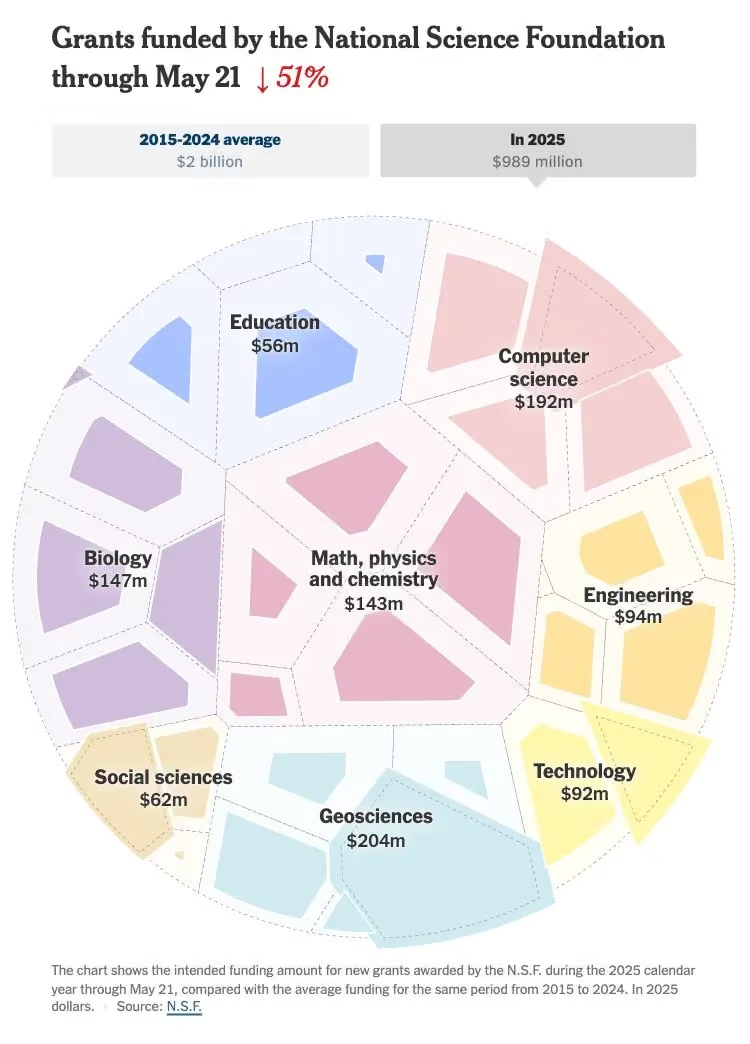
And what is Europe doing to attract them?
After US science funding cuts young biomedical scientists are
- less likely to remain in academia
(-22 percentage points)
- less likely to stay in the United States (-21 percentage points)
- less satisfied having pursued a PhD in science (-16 percentage points)
My latest in the @FT today. I make four points:
1) Capitalism's great achievement was moving activity out of the household and into the market — turning domestic production into paid specialisation, creating jobs, and making output visible to the national accounts. AI-enabled self-service might quietly reverse that centuries-long trend.
2) When a technology automates tasks within a service, it can trigger a Jevons paradox: the service gets cheaper, demand expands, and employment grows. When it lets people do the work themselves, demand for the service collapses.
3) AI extends this even to the manual trades, the supposed safe haven of the AI age. If a homeowner can ask a chatbot why their boiler keeps losing pressure, heating engineers lose call-outs.
4) When work shifts to the consumer, it vanishes from the economy statisticians measure. Replace a billing department with a chatbot and a firm records lower costs and higher output per worker; the national accounts register a productivity gain. But the hours patients spend decoding their own test results appear nowhere — not in labour statistics, not in GDP. As self-service spreads into professional domains, that blind spot will grow.
Carl Benedikt Frey reposted
AI is advancing at breakneck speed. So why is productivity growth still stagnating? 🎧 Listen to the latest episode of World in 30 Minutes with @carlbfrey as he explains that technological breakthroughs alone are not enough, and describes the role institutions and politics play.
Carl Benedikt Frey reposted
Thank you for featuring our work on the economics of AGI @carlbfrey @FT 🙏 w/@wu_jane @xianghui90
Carl Benedikt Frey reposted
This is a great graph. The point is not time. The x axis is gdp per capita. The point is that growth does benefit all. The idea growth only benefits the rich is dramatically false. timely given Stieglitz, Pketty et al recent degrowth noise.
A way to see the amazing history of economic growth and declining poverty over the last two centuries.
My latest in the @FT on how AI may usher a self-service economy
‘Can a machine do this job?’ is the wrong question ft.trib.al/433YwPo
Carl Benedikt Frey reposted
You read it as safety-motivated, I read it as a call for cartel. We are not the same
Anthropic is calling for top AI labs to weigh slowing the pace of development, suggesting that AI systems are advancing so rapidly that they may soon be able to improve themselves without human intervention in ways that could pose societal risks. www.wsj.com/tech/ai/anthropic-urges-global-pause-in-ai-de…
Carl Benedikt Frey reposted
🎧 New #podcast: As everyone talks about the speed of AI, what if the bigger story is that productivity and innovation are slowing down? Mark Leonard speaks with @carlbfrey, author of How Progress Ends, about why technological progress is neither inevitable nor guaranteed.
Carl Benedikt Frey reposted
Competition is the only protection anyone has ever had against concentrated power.
Anthropic's valuation only works if open weights get banned by law. Their safety case and their business case are the same case.
We have four options:
-Anthropic ruling the world as a monopolist (or a duopolist) is catastrophic. We are having the first inklings of that with Fable release.
- The US government controlling the world by controlling the model releases (on the table right now): even worse. They will weaponize it and blackmail the hell out of everyone.
- The world government solution is cute, but not going to happen.
- So competition, with the open weights only a few months behind, is the only thing protecting us in the rest of the world. Models will need some regulation, like cars or planes do.
As a European, the first two options scare me more than the technology does. OpenAI has not been making these ridiculous Effective Altruist noises, they have quietly released models which are on the whole superior to Anthropic's in my view and there have been no risk to the world. I think Anthropic protests too much.
Carl Benedikt Frey reposted
Activity is not productivity.
Many signs of a surge in knowledge work output post chat GPT, but no signs of any meaningful increase in the real sales per worker at the economy wide level.
Carl Benedikt Frey reposted
I'm a huge fan of @JimPethokoukis work, and his most recent article sums up my take (though in a more erudite fashion than I could do).
AI is advancing really, really quickly. But, it takes time (sometimes a really long time) for firms to adopt and implement AI.
✨🧚 What story is Fable telling about the state of AI?
The frontier keeps moving fast. The question is whether business is yet moving with it. Until it does, economic transformation is a just a fairytale.
(free link in next post)
Carl Benedikt Frey reposted
I don't know what Piketty, Stiglitz, and co. are smoking. Global poverty rates have never been lower. Progress on basic global health and wellbeing measures has been amazing over the past few decades. "End of the road"?!? Come again!?!
www.theguardian.com/commentisfree/2026/jun/10/economists-…
Carl Benedikt Frey reposted
Best evidence I’ve seen so far that inflation was a major electoral driver in 2024
🚨New NBER working paper alert 🚨
🤔2021–2024 was the worst U.S. inflation in four decades. The question: Did voters react to the rising prices, or to the shrinking paychecks?
😱We approached this paper with one major surprise: there is no official measure of inflation at the county level in the U.S.
🌟To study the relationship between inflation and electoral outcomes during, we first had to construct local inflation measures using county-level data on family budget costs and incomes.
The answer? -> Check it out! 👇
🔗 www.nber.org/papers/w35301
AI pessimism seems more pervasive in rich countries. Two possible reasons:
AI makes knowledge work easier to offshore to where labor is cheaper —fewer accountants in London, more in Manila.
In poorer countries, AI may expand access to services people lacked before (e.g. doctors)
Carl Benedikt Frey reposted
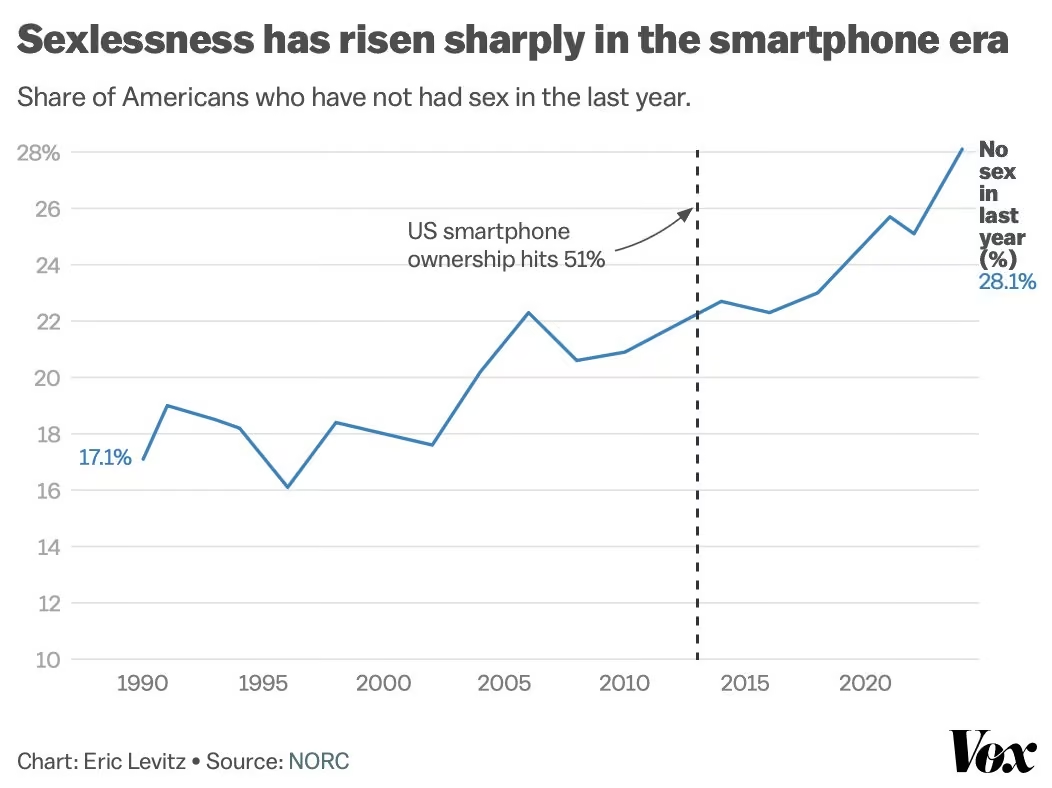
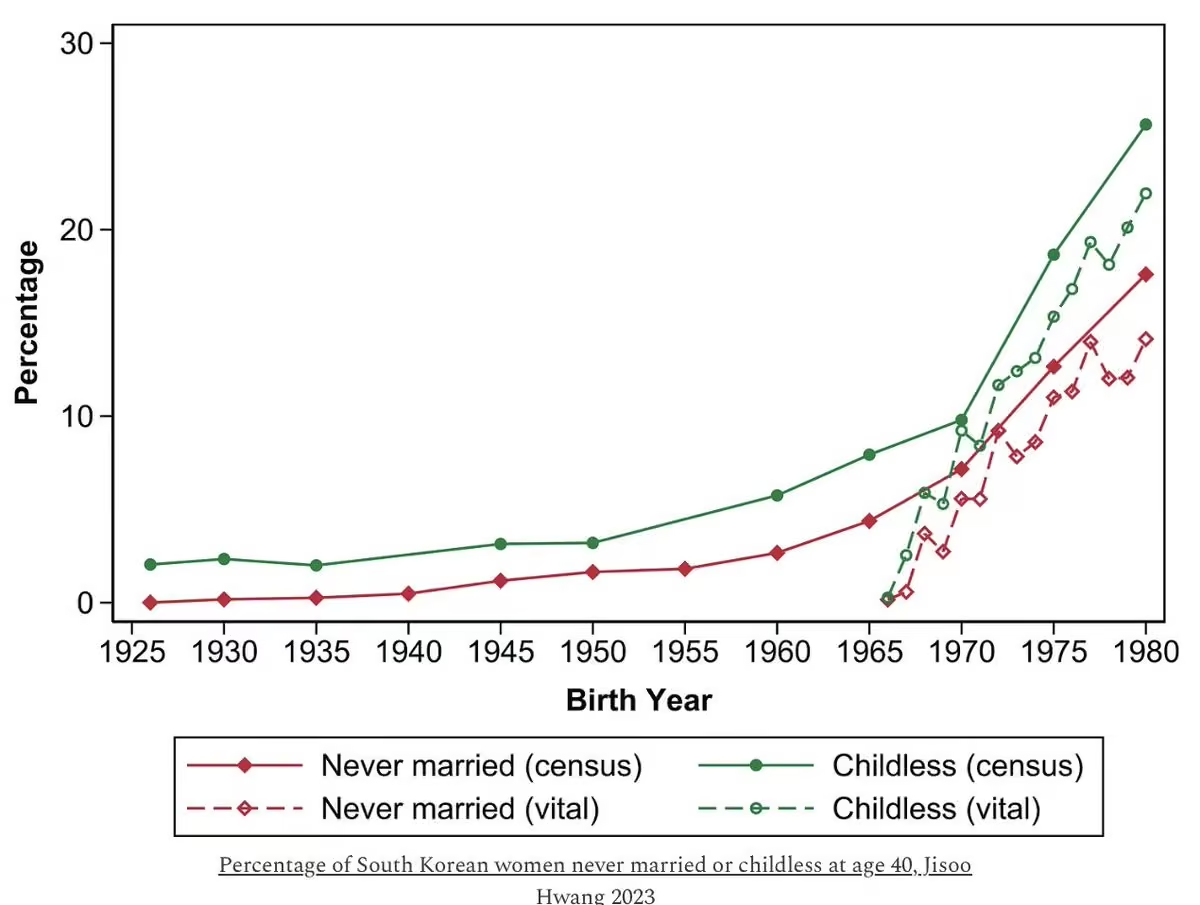
I am still skeptical the smartphone explains much of recent drop in fertility. It may have contributed at the margin to the secular decline but the severe recession is a much more plausible explanation of the abrupt drop in 2008, coincidentally a year after iPhone was introduced.
Smartphones appear to have accelerated the global fertility crisis -- by making social isolation and singledom more comfortable and entertaining.
Chatbots could nudge humanity even further in this direction. Today, digital technology doesn't just provide loners with perpetual stimulation but also, forms of emotional support that previously required real world relationships.
Full article here (and for now, no paywall!): www.vox.com/politics/491167/ai-smartphones-fertility-cris…
Carl Benedikt Frey reposted
Much enjoyed this session organized by .@ChathamHouse.
Many insights on #ai and its implications for companies, people, and global economy.
Huge thanks to panel speakers:
.@carlbfrey, Baroness Minouche Shafik, Blake Lweit & moderator @MyStephanomics
www.youtube.com/live/LYPxcDUnxog
Carl Benedikt Frey reposted
#ai #work & the #future of #global #competitiveness @UniofOxford Future of Work Director Dr. @carlbfrey @bloomberg Stephanie Flanders @MyStephanomics @LinkedIn Chief Global Affairs & Legal Officer Blake Lawit Chief Economic Adviser to UK PM Baroness Minouche Shafik @ChathamHouse
Carl Benedikt Frey reposted
I really loved this article. A one-time increase in per capita growth from 2% to 2.1% for a single year, then dropping back to 2%, would permanently raises the level of GDP per capita - and because that small gain recurs and compounds every year afterward across the population, it would add up to roughly a trillion dollars in cumulative value. www.abundanceandgrowth.org/p/a-little-progress-is-worth-a…
When people talk about pausing AI development, I can't help but think about the enormous cumulative value that would get lost over time, the higher rates of absolute poverty that would persist across the world, and the needless deaths from delayed medical advances. There may be worlds where some version of this is something to consider, but the evidentiary bar for delaying technological development should obviously be pretty high.
Carl Benedikt Frey reposted
Let me get this straight. Climate change will lower GDP by 5% 100 years from now. So the answer is, lower GDP even more now?
This is coming from a famous economist, so it's probably worth clarifying that there's no economics in this report showing that their degrowth pathway is either an ideal or likely decarbonization path. It's an opinion they work backwards from.
Carl Benedikt Frey reposted
This is a pretty striking shift toward Chinese models by American AI startups since the start of the year. substack.com/@profgmarkets/p-200029541
Carl Benedikt Frey reposted
Anti-AI populism is on its way.
My latest column for @FT: Tech anxiety will be seized upon by politicians—echoing the anti-immigration rhetoric that has shaped public discourse over much of the past decade
as.ft.com/r/e3617359-ac20-458f-b935-784b22219fd5
Carl Benedikt Frey reposted
#ai exposed counties lean "blue" but that doesn't mean job losses are imminent or that anxiety is driving their blueness.
It does mean blue counties are where workers have the most reason to be watching AI closely
www.brookings.edu/articles/ai-political-geography-worker-…
@carlbfrey
Carl Benedikt Frey reposted
With just one week to go, we're delighted to announce our final speaker: Professor Carl-Benedikt Frey, Dieter Schwarz Associate Professor of AI & Work at the Oxford Internet Institute, @UniofOxford. He'll be joining us at AI, work, and the future of global competitiveness, an exclusive event in partnership with LinkedIn and an official fringe event of London Tech Week.
He'll be joining our confirmed speakers, including:
▪️Stephanie Flanders, Head of Economics and Government, Bloomberg News
▪️Blake Lawit, Chief Global Affairs and Legal Officer, LinkedIn
▪️Baroness Minouche Shafik, Chief Economic Adviser to the Prime Minister
▪️Olivia O'Sullivan, Director, UK in the World Programme, Chatham House
Join us on Tuesday 9 June. Register your interest to attend 🔗 www.chathamhouse.org/events/all/standard-event/ai-work-an…
#chathamhouse #linkedin #londontechweek #ai #futureofwork #globalcompetitiveness #chevents
Carl Benedikt Frey reposted
Commencement speakers who touted AI this graduation season were largely met with boos. But university graduates are not alone in challenging AI boosters’ bubbly narrative. In a new PS Big Picture, @carlbfrey, @RobinRivaton, and others highlight constraints on the technology’s productivity benefits.
www.project-syndicate.org/onpoint/ai-and-its-discontents
Carl Benedikt Frey reposted
China's comparative advantage IS industrial policy.
My latest column for @FT: Western attempts to imitate Beijing’s economic strategy are unwise.
as.ft.com/r/67af128e-2d23-46f6-9750-0be52e8c3682
With insights from @carlbfrey and @gtalert
Carl Benedikt Frey reposted
We took another look at the capability gap between open-weight and proprietary models. Since the start of the year, open-weight models have lagged the state of the art by four months.
Carl Benedikt Frey reposted
Few things encapsulate the self-defeating European scarcity mindset (and quasi-religious belief in self-castigation) than the war on AC... when the evidence is very clear: Cognitive performance plumets beyond 16-18 degrees.
Northern Europe still thinks of AC as an extravagance. I had a similar experience attending a great conference on monetary policy in Germany a couple of years ago. Very nice location. But it was really hot (in the 30s Celsius), and there was no AC. Basically impossible to stay focused and listen to the speakers.
Carl Benedikt Frey reposted
They did, it was called America
This is indeed a must read
1/8
I just finished reading Chris Miller's excellent book on the collapse of the Soviet Economy. Some people might think that the topic is interesting, but largely irrelevant to global economic conditions today. They would be mistaken. This is a very relevant book.
@crmiller1
Carl Benedikt Frey reposted
Is GenAI causing the relative decline in early-career hiring? Our latest research finds that these effects may be conflated with another important driver: the rise of WFH arrangements (1/N)
Carl Benedikt Frey reposted
¿Ola mundial de despidos por la IA? Meta (Facebook/Instagram/Whatsapp) está despidiendo al 10% de su plantilla; Oracle al 18%; Microsoft anuncia nuevos recortes, etc. Vean mis entrevistas con los economistas estrellas @carlbfrey de la @oxmartinschool Univ. de Oxford y @davidautor de @MIT
www.youtube.com/watch?v=ZZb8MlGm59w&t=11s
This is why innovation matters, not just adoption. Early breakthroughs draw in resources and talent, creating the conditions for subsequent breakthroughs. Space innovation is a case in point.
Carl Benedikt Frey reposted
RIP Ned Phelps
Ned Phelps followed his own intellectual journey.
When Keynesians relied on a long-run tradeoff between unemployment and inflation, he showed why this was a weak reed to stand on. Thus was born the natural rate hypothesis (although the coining of the word goes to Friedman, a year after Ned’s paper).
When, later, New Keynesians were focusing on nominal rigidities, he built models of fluctuations where nominal rigidities played no role. When New Classicals were exploring the cyclical implications of competitive markets, he focused on the role of distortions in goods and labor markets, be it efficiency wages, or variable markups.
It would be fair to say that, today, the frontier macro models embody the natural rate hypothesis, and many of the distortions Ned focus on---and, what he did not like, i.e. nominal rigidities.
His style was highly idiosyncratic. He was often a poor expositor of his fundamental insights. He did not listen much to others, pursuing his agenda with focus and passion. But, to use an overused but appropriate expression, he was certainly one of the giants in the field. We often met and sometimes fought, be it on hysteresis or nominal rigidities, but I had infinite respect for him.
As AI gets better at practical guidance, tasks once handled by professionals are shifting onto consumers. We see the accountant’s fee we avoided; we rarely see the evening spent doing her job. Behavioral scientists call this opportunity cost neglect. My latest in the @nytimes
Carl Benedikt Frey reposted
Great point
A lot of the debate on AI and science focuses on whether LLMs can generate *new* ideas. Yet 20–80% of existing papers are never cited and presumably not read. By digesting vast uncited literatures, LLMs may meaningfully advance knowledge simply by absorbing *old* ideas.
Carl Benedikt Frey reposted
In @nytopinion
“We have been told that A.I. will take people’s jobs. What no one mentions is that many of those jobs are landing on us,” Carl Frey writes. www.nytimes.com/2026/05/11/opinion/ai-jobs-chores-work.ht…
Carl Benedikt Frey reposted
Carl Benedikt Frey
"If you do the work at home, no one is measuring your hours. That’s why the digital revolution improves labor productivity — and boosts corporate profits — but leaves people feeling overburdened." www.nytimes.com/2026/05/11/opinion/ai-jobs-chores-work.html @nytimes @carlbfrey #hiddenaiworkshifted
Carl Benedikt Frey reposted
I like @carlbfrey's opinion piece www.nytimes.com/2026/05/11/opinion/ai-jobs-chores-work.ht… Tempted to say that the same happened/is happening with the "AI" and "Digital Transformation" of the public sector. More unpaid work for citizens, who feel less "heard" and "seen" by their govs.
Carl Benedikt Frey reposted
.@carlbfrey: "We have been told that AI will take people’s jobs. What no one mentions is that many of those jobs are landing on us. The AI revolution involves a massive transfer of labor — not from worker to machine, but from worker to consumer."
The chore economy www.nytimes.com/2026/05/11/opinion/ai-jobs-chores-work.html
Here's your chance. 50% off.
press.princeton.edu/books/hardcover/9780691233079/how-pro…
Carl Benedikt Frey reposted
Interesting from Gillian Tett
Carl Benedikt Frey reposted
AI alone cannot solve the productivity puzzle: Economic miracles stem from discovery, not repeating tasks at greater speed www.ft.com/content/55bc5876-254a-4daa-86f8-2cd0d939a866 via @carlbfrey
Carl Benedikt Frey reposted
Excellent piece by @carlbfrey on AI and productivity. Too much in there to sum up, but the key insight is that efficiency doesn't always lead to productivity - you need real breakthrough innovation for that
www.ft.com/content/55bc5876-254a-4daa-86f8-2cd0d939a866
Carl Benedikt Frey reposted
I also dislike the fatalism of the permanent underclass discourse, but am equally tired of people using euphemisms like “transition costs” instead of figuring out how to help the people we know will be impacted
What’s our plan for unemployed college grads and older clerical workers? Retraining programs have an awful track record, and anyway what do we retrain people to? What happens to colleges, healthcare, and the tax base in a world where white collar firm work is no longer the easy path to middle class stability? Plenty of urgent, unsolved, and politically salient questions that do not require a referendum on full automation
@carlbfrey: “Most economists will acknowledge that technological progress can cause some adjustment problems in the short run. What is rarely noted is that the short run can be a lifetime.”
i think a lot of people are going to be busier (and hopefully more fulfilled) than ever, and jobs doomerism is likely long-term wrong.
though of course there will be disruption/significant transition as we switch to new jobs, the jobs of the future may look v different, etc.
Carl Benedikt Frey reposted
Very bold from one of the best economists of tech, @carlbfrey....
Carl Benedikt Frey reposted
If demographic trends hold, Europe could soon record more births than China. That would mark a genuine historical pivot. We would likely have to go back to the Qing dynasty some 300 years ago to find a comparable moment, possibly even further. For most of recorded history, China was not just bigger, it was in a different league. Now the gap is closing from both sides as Europe holds up better than expected and China ages faster than assumed. HT @benbawan
This is pretty much exactly what I argued would happen in The Technology Trap. I should just have held off on publication for 7 years.
"In December Beijing’s government published a ruling that firms could not fire employees replaced by AI."
Carl Benedikt Frey reposted
The national debt just exceeded 100% of GDP for the first time since 1946: www.wsj.com/economy/u-s-debt-tops-100-of-gdp-81c013d7
Does trade prevent war? The evidence says "yes". A doubling of trade reduced the probability of militarized conflict by around 30%. Decoupling is a bad idea (and you can only do it once).
Carl Benedikt Frey reposted
If firms respond to AI by hiring fewer junior lawyers and analysts, training less, and assuming the machine will handle all first drafts, they will erode the very expertise needed to check the machine’s output, @carlbfrey warns. www.project-syndicate.org/commentary/ai-productivity-will…
Carl Benedikt Frey reposted
New paper alert. We find that increased trade integration decreases the risk of inter-state military conflict. Read more here: www.nber.org/papers/w35078
Ungated version here: drive.google.com/file/d/1l_Z9bSsOVHB3iQbWn7vuImbAdLym3jTw…
Carl Benedikt Frey reposted
AI creates a tension that those navigating the computer revolution never faced: if humans need to remain in the loop to verify AI outputs, they will still need the domain knowledge and the time that AI is supposedly substituting for, notes @carlbfrey. www.project-syndicate.org/commentary/ai-productivity-will…
Striking observation by @GadLevanon on the decline of the MBA. Interestingly, "the decline scales with prestige. Graduates of the top 2.5% of institutions went from roughly 7% MBA enrollment in the mid-2000s to about 4.6% by 2020 — a drop of about one-third."
This is an astonishing turnaround: "Western and Japanese drugmakers did 70 transactions with Chinese biotechs last year, paying nearly $5.6 billion upfront to get rights to promising molecules, according to pharmaceutical commercial intelligence firm Evaluate."
Retire at your peril: leaving employment accelerates cognitive decline, especially for men 51–64
My latest in @ProSyn
Carl Benedikt Frey reposted
What might future historians say about the #ai era we are currently living through?
Discover historian and economist @carlbfrey's views on this and more: www.weforum.org/stories/2026/04/an-oxford-professor-on-ai…
Carl Benedikt Frey reposted
Amazing: Income in Poland is on track to overtake income in the U.K.
"Pay for top-tier AI researchers in China has surpassed Silicon Valley standards when adjusted for tax and cost of living, according to the headhunters."
1/ Western car companies generate far higher revenues per employee than their Chinese rivals — so why are they losing? The answer is cost, but state support plays a small role.
2/ Three quarters of the Chinese cost advantage comes from vertical integration and cheaper R&D: engineering talent in China is a lot cheaper, and firms like BYD own the stack.
Carl Benedikt Frey reposted
BYD and Tesla both make EVs in China. Yet BYD has significantly lower costs.
Two major factors:
1) Vertical integration is very high for BYD
2) Doing R&D in China is far cheaper
State subsidies are a small part. It’s more a structural advantage. Fascinating report from Rhodium.
We’re often asked: Why are Chinese EVs so cheap? Comparing costs between Western and Chinese automakers in China shows that subsidies matter, but they’re only part of the story:
rhg.com/research/why-are-chinese-evs-so-cheap/
Carl Benedikt Frey reposted
No, America is not in a "stealth manufacturing boom". All the numbers still look bad. Tariffs and uncertainty are fully canceling out the tailwind from the AI boom and the legacy of Biden's industrial policy.
www.noahpinion.blog/p/no-america-is-not-in-a-stealth-manu…
The key question is not whether AI will raise productivity—it almost certainly will—but whether those gains will prove temporary or enduring. Will they fade after a year, last a decade, or persist for half a century?
MS: We Are Likely in the Early Stages of Another Productivity Boom
Productivity Growth Appears To Be Turning Higher Again
Carl Benedikt Frey reposted
Industrial policy revisionism is out of control. Yes, there can be industries with spillovers. No, the average 1970s economy that subsidized with debt random industries connected to government monopolies wasn't on path to growth! Look at what pre-WC policy actually looked like!
World Bank to world: oops
Carl Benedikt Frey reposted
Really fascinating historical research by @hillaryvipond:
“Technological Unemployment in Victorian Britain - Young Workers and the Collapse of Entry”
Analysis of the bootmaking industry of Victorian England shows that the impact of mechanization was not so much to displace incumbent workers. Instead, the shock primarily affected a changing set of opportunities available to young people.
Carl Benedikt Frey reposted
On a recent episode of the Capitalisn’t podcast, Oxford’s Carl Benedikt Frey joins Booth’s Luigi Zingales and cohost Bethany McLean to discuss how entrenched institutions block new ideas from transforming society.
www.chicagobooth.edu/review/capitalisnt-why-human-progres…
Carl Benedikt Frey reposted
Sad to hear about Robert Skidelsky. He was a great mind and always generous to me. A fun story: someone at Charleston told me that, when working on his Keynes bio, he rented the house next door to get closer to his aura and would jump the fence at night to swim in their pond.
Carl Benedikt Frey reposted
Sam Peltzman famously argued in 1975 that the effect of safer cars on total traffic deaths is ambiguous: Safer cars mean that drivers take more risks.
I am afraid that the effect of LLMs on email will be the same. We are promised that we will spend less time handling email thanks to autonomous agents.
My fear? As the cost of sending and processing emails goes down, more emails will be sent.
Everyone has incentives to do so. An administrator at the dean’s office (one of the most dangerous people in the U.S. right now) will feel they can send many more emails requesting information from faculty. A colleague at another department might reach out to you with questions. You name it.
The bottom line? Yesterday I got nearly 200 emails (without counting spam). Let’s call it the Peltzman effect of LLMs.
Carl Benedikt Frey reposted
New Liberty Street Economics note on R* and Labor Share. A striking chart.
libertystreeteconomics.newyorkfed.org/2026/04/the-r-labor…
Carl Benedikt Frey reposted
He will be missed.
It is with great sadness that we announce the death of Lord Robert Skidelsky, historian, economist, and a founding member of CAF.
Robert was a steadfast defender of free speech and academic freedom, and a shining exemplar of intellectual independence. He was also among the first to recognise the emerging dangers of “safetyism” on campus, an issue he addressed with characteristic clarity in a speech delivered in the House of Lords on 26 November 2015. We reproduce it below in full:
I shall draw your Lordships’ attention to two threats to free speech on the campus. In four minutes I have time for only two threats, but I think that they cover most of the ground.
The first threat comes from the Government. The state has a duty to protect its citizens from terrorism. The Government have conceived of that duty in part as preventing university students from being what they call “radicalised”. The Counter-Terrorism and Security Act 2015 requires universities to “prevent individuals from being drawn into terrorism”.
This is construed as part of their duty to “care” for “vulnerable” students. Universities are required to assess the risks of students being drawn into terrorism and extremism, and to train staff how to assess those risks and “challenge extremist ideas”. Universities must seek government guidance on which speakers to allow on campus. In this guidance terrorism and extremism are frequently conflated, as the noble Lords, Lord Pannick and Lord Lester, have pointed out, although very occasionally the drafters remember that one can hold extremist views without being a terrorist.
I turn to the second threat. The National Union of Students has opposed the Counter-Terrorism and Security Act on the grounds that it will lead to mass campus surveillance and the criminalisation of Muslims and black people. The universities should be kept as “open democratic spaces”. All this would carry more conviction if student bodies were not themselves a big threat to free speech on the campus. Student unions in many universities run “no platform” policies for speakers whose views they consider reprehensible, even though they are legal. For the NUS—and this is the key—keeping students “safe” is paramount. Bristol University Students’ Union runs a “safe space” policy aimed at ensuring students’ safety from harassment. However, keeping students safe turns out to include keeping them “safe from radicalisation”. So, despite the verbal skirmishes, the Government and students are quite united on the need to protect students from harmful ideas, differing only slightly in their definition of what they regard as harmful.
I must come clean: I hate the doublespeak that runs through the public pronouncements that I have read on this topic. How Orwell would have shuddered. The facts are pretty clear: universities have a statutory duty to uphold free speech and are bound by the Public Order Act to ban incitement to racial and religious hatred. So they have a duty to uphold free speech within the law. Similarly, the security forces have a duty to keep the country safe from terrorism wherever it sprouts—prevention does not stop or continue on the campus. What I deny is that university students are an especially vulnerable species needing special protection against being abused or radicalised. Students are adults: they can vote, fight and die for their country, drive, drink alcohol and so on. Why should they be treated as adults in one branch of life and as children in another?
In particular, I think it is an abuse of thought and language to extend the good liberal notion of protecting people against harms to the decidedly unliberal notion of protecting them against harmful ideas.
Carl Benedikt Frey reposted
Painful chart indeed for Europeans from the Stanford AI report.
Le AI index report de Stanford (@erikbryn et al.) est sorti aujourd'hui et le premier graphique est assez douloureux
hai.stanford.edu/ai-index
Financial incentives matter, and education is no exception. When high-performing teachers were offered meaningful bonuses to work in the lowest-performing schools, student math results improved sharply. Tried in Dallas. Worth trying elsewhere.
Carl Benedikt Frey reposted
Auf Aufbruch folgt Stagnation. Mit Gewinn habe ich das Interview @neuscheler mit @carlbfrey @faznet gelesen: "Die großen deutschen Unternehmen wirtschaften überwiegend in relativ ausgereiften Branchen... das sind nicht die Wachstumsbranchen der Zukunft."
www.faz.net/aktuell/wirtschaft/oxford-oekonom-frey-europa…
Carl Benedikt Frey reposted
My @nytopinion piece discusses the failures of Trump's strategy to create manufacturing jobs--but puts it in the broader context of the previous failures to achieve this goal and why it isn't the right goal to start with.
Carl Benedikt Frey reposted
For many knowledge workers in Europe and the US, the effect of AI can resemble automation—but the underlying mechanism is AI-enabled offshoring, notes @carlbfrey. www.project-syndicate.org/magazine/ai-workplace-winners-a…
Carl Benedikt Frey reposted
In the latest #psquarterly, @BharatKChandar, @carlbfrey, @HK_NikkiSun, @DongmiaoZhang, Andrea Komlosy, and Sami Mahroum consider what current AI capabilities will mean for the world of work.
www.project-syndicate.org/magazine/ai-workplace-winners-a…
The AI infrastructure boom accounted for 100% of US GDP growth in Q4 2025. ~$3 trillion in new compute spending is planned through 2028 — and the hyperscalers can no longer fund it on balance sheet.
Great talk by Stijn Van Nieuwerburgh on Marcus Academy. Link in comments.
Carl Benedikt Frey reposted
3. Building skills without AI makes you a better AI user later.
The current world champion trained without engines for years. You can't supervise AI in a domain you never learned to think in yourself.
Carl Benedikt Frey reposted
How big is the AI investment boom? Smaller than the Louisiana purchase, larger than railroads, telcos, interstate highways.
(From James Bullard.)
Carl Benedikt Frey reposted
@lugaricano argues:
If AI raises global interest rates by boosting productivity, but Europe fails to adopt AI, Europe imports higher r without higher g -- a path to fiscal crisis.
That was again a fantastic #ecbwatchers conference (and dinner) with an excellent line-up. I found @lugaricano's warning particularly striking that Europe, if it fails to adopt AI, will import higher r without higher g—a path to fiscal crisis.
Carl Benedikt Frey reposted
More on China's growth slowdown. Yes, it is sharper than the world average (expected from the relationship exhibited by income level & growth for 100+ countries between 1950 and today)--but its acceleration was also way above the expected. And China current growth path is still above than the world average.
Carl Benedikt Frey reposted
IA | ¿El último invento del ser humano?, por @carlbfrey
A medida que la inteligencia se abarate, cambiarán los activos que tienen mayor valor. La ventaja recaerá en quienes puedan generar resultados. Los seres humanos no se están volviendo prescindibles; se están convirtiendo en los cuellos de botella más decisivos del mundo.
elpais.com/economia/negocios/2026-03-29/el-ultimo-invento… vía @el_pais
Carl Benedikt Frey reposted
So far, entry-level share of employment in legal, financial, & office admin occupations doesn't look functionally different from pre-2023 trends (the population is aging so important to benchmark).
A bit above trend for legal, a bit below for finance, in line for office admin.
Anthropic CEO:
“50% of all entry-level Lawyers, Consultants, and Finance Professionals will be completely wiped out within the next 1–5 years."
grad students and junior hires are cooked.
You can now enable Claude to use your computer to complete tasks.
It opens your apps, navigates your browser, fills in spreadsheets—anything you'd do sitting at your desk.
Research preview in Claude Cowork and Claude Code, macOS only.
Carl Benedikt Frey reposted
A fairly striking chart
"For better or for worse, the second China shock has solved the European surplus—and decimated German industry.”@Brad_Setser
Little wonder even many in Beijing realize they’ve all but lost Europe.
Carl Benedikt Frey reposted
My recent post about institutional leaders blaming social media for their failures sparked quite a bit of discussion. Several readers, either in the comments or through private messages, asked a reasonable question: if these institutions are doing so poorly, why do they still survive? Why does the market not punish them?
The answer is time.
A market maker who misprices an asset loses money within seconds. There is no time to write a memo blaming social media. You are simply gone.
A restaurant that serves bad food at high prices will start losing customers within weeks. Some owners respond by fixing the food. But many others convince themselves that the neighborhood is changing or that Yelp reviews are unfair. But the cash flow does not lie, and the worst restaurants close within a year or two.
Climb the hierarchy, and the feedback diminishes significantly. A publication that ceases addressing critical issues and fills its pages with predictably uninteresting content gradually loses readers over years, not months. Subscriptions continue out of habit. Institutional libraries keep paying. Even more problematic, by the time the decline becomes visible in the numbers, the editors responsible for it have often already moved on.
A university department with a weak curriculum can persist for many years. Students already enrolled are committed to it. New students lack the information needed to compare current offerings with those from five years ago. Faculty members have tenure. Budgets are allocated through bureaucratic processes influenced by university politics as much as by performance. A department can lose 80% of its undergraduates and continue because the university subsidizes it with other revenue. The feedback exists. For example, the university will not approve hiring to replace retired faculty, but it functions on a decades-long timeline.
There is a selection effect that worsens things. As an institution shrinks, the people who leave are not a random sample. They are the ones with the best outside options and the least ideological attachment to the current direction. The ones who stay are disproportionately true believers. A department that loses 80% of its students is not left with a random 20%. It is left with the 20% who wanted what the department is now offering. The same applies to faculty. Professors who could get offers elsewhere leave. Those who stay are the most committed to the strategy that caused the decline.
The same dynamic plays out in publications. The best writers leave first because they can. The editors who drove them away remain, and the readers who valued good writing are already gone. What is left is a publication that has selected for mediocrity on both sides of the page. So, the institution shrinks and becomes more resistant to change. The process that should add pressure to reform instead gathers the people least willing to reform. By the time feedback arrives, there is no one left to receive it.
Then there are institutions with large endowments or guaranteed public funding. Harvard could make terrible decisions for forty years and still have a $50 billion endowment. A central bank can miss every forecast for a decade and face no competitive threat, because it holds a legal monopoly on monetary policy. The European Commission can produce regulation after regulation that stifles growth, with no competitive pressure at all, because there is no alternative supplier of binding regulation.
This is where the standard model breaks down. The feedback mechanism we teach in introductory economics, the mechanism by which poor performance leads to exit, works well in competitive markets with clear profit signals and low switching costs. It works less well, and sometimes not at all, in institutions that have no earnings target, face no competition, and serve customers who cannot easily go elsewhere. The people who run these institutions understand this perfectly, which is why they can afford to blame social media rather than examine their own performance.
The slower the feedback, the longer bad leadership survives. And the longer bad leadership survives, the more elaborate the excuses become.
In a future post, I will explain some of the agency and incentive problems that make this situation much worse.
The original post here:
One of the more frustrating trends in public life over the past decade is how people who lead failing institutions blame social media for their failures.
A university president whose faculty have become political activists instead of educators and whose administrators multiply like rabbits will tell you that “misinformation on social networks” is eroding public trust in higher education. An editor whose publication lost its readership will claim that the real problem is X, rather than consider that the publication became boring, that the writing was uniformly uninspired, and that it stopped covering anything that mattered. A politician who loses an election will blame Meta algorithms rather than admit that voters simply did not like what was offered. A central banker whose institution missed the worst inflation in 40 years will worry publicly about TikTok videos spreading financial illiteracy.
The pattern is always the same. The institution fails at its core mission. The public notices. The people in charge, rather than examining what went wrong, identify an external force that is “polarizing.” The diagnosis is never “we did a poor job.” It is never “we lost our audience because we gave them nothing worth reading.” The diagnosis is always “bad actors are distorting the conversation.”
This is not new, of course. Before social media, talk radio was the scapegoat. Before talk radio, it was television. Before television, it was tabloid newspapers. Every generation of leaders has found a communication technology to blame for people’s loss of trust in them.
What is new is the intensity and the shamelessness. Over the last few years, “social media” has become a universal excuse that requires no evidence and tolerates no scrutiny. It is deployed reflexively.
The people who make this argument never seem to ask the obvious question: why are people on social networks so receptive to criticism of your institution in the first place? If your university were delivering excellent education at a reasonable price, no number of tweets would persuade parents otherwise. If your publication were covering important questions with clarity and substance, readers would not have migrated elsewhere. If the work you showcased were serious rather than trivial, people would still be paying attention.
Trust is not destroyed by social media. Trust is destroyed by poor performance, and social media makes it harder to hide. That is a different thing entirely, and the people running these institutions know it, which is what makes the excuse so cynical.
The honest version of the argument would be: “We used to be able to fail quietly because there was no mechanism for people to compare notes. Now there is, and we do not like it.”
That, at least, would have the virtue of being true.
Carl Benedikt Frey reposted
"India has replaced China as the largest manufacturer of smartphones for the US in just four years. The latest iPhone in your pocket was made in India. They are doing the kind of high-precision manufacturing that people said only China could do," says Fareed Zakaria
Interesting pattern: people in low-income regions are much less negative about AI, and less worried about losing jobs to it. Makes sense. If AI makes knowledge work easier, the jobs flow to where labour is cheapest. The disruption isn't in Lagos or Manila but in NYC and London.
Carl Benedikt Frey reposted
AGI may well automate intelligence. But the process of invention depends on something more, @carlbfrey explains.When the early stages of discovery are automated, the human role does not vanish; it simply migrates toward the remaining bottlenecks, where judgment, tacit knowledge, and practical know-how are what matter, @carlbfrey writes. www.project-syndicate.org/commentary/agi-not-last-inventi…
Carl Benedikt Frey reposted
@carlbfrey Attended Carl’s talk held at the @oxfordlitfest yesterday together with the wonderful @lindayueh
Bought both their books too “How progress ends” & “the great crashes”.
Some huge economic issues discussed to do with adoption & exploitation of technology.
I picked this key message up - but look forward to getting to stuck into the assessment & analysis provided by Carl:
Frey’s core message can be distilled to:
Progress is not a steady upward path—it’s a temporary equilibrium between opposing forces.
•Too much decentralization → chaos, no scale
•Too much centralization → stagnation
Sustained growth only happens when societies continuously rebalance the two.
Thank you so much for a hugely stimulating conversation @lindayueh
A pleasure to chair @carlbfrey’s talk on his brilliant book, How Progress Ends, at the @oxfordlitfest who kindly also included my latest book, The Great Crashes:
www.amazon.co.uk/Great-Crashes-Lessons-Meltdowns-Prevent/…
Carl Benedikt Frey reposted
Those who see AGI as the "last invention" assume that all relevant information can be codified. But this usually is not the case, notes @carlbfrey.
www.project-syndicate.org/commentary/agi-not-last-inventi…
My latest in @ProSyn
AGI may well automate intelligence. But the process of invention depends on something more, @carlbfrey explains. www.project-syndicate.org/commentary/agi-not-last-inventi…
Carl Benedikt Frey reposted
The NYT reports on how soaring investment in AI, predictably, is set to lead the US trade deficit to expand ...
Not only is demand for imported chips way up, but the key sectors avoided Trump's tariffs
www.nytimes.com/2026/03/18/business/economy/us-trade-defi…
1/
Who will be the winners and losers from AI in the workplace? Here is my response in @ProSyn. Link in comments
Carl Benedikt Frey reposted
U.S. GDP growth was recently revised down for Q4 2025. The "AI productivity boom" story is gone (for now).
Instead, it's all just AI capex. Data centers are the only thing keeping our economy afloat.
Carl Benedikt Frey reposted
AI talent is rapidly leaving academia for industry. By 2019, 68% of AI scientists worked in firms. Top AI salaries in industry rose from $595K to $1.9M, while academic pay barely moved.
Attention—and money—are reshaping where innovation happens.
www.nber.org/system/files/working_papers/w34964/w34964.pdf
Carl Benedikt Frey reposted
From the IMF: "In the European Union, young firms—those founded less than 50 years ago—have a combined stock market valuation of $5 trillion, against $42.9 trillion in the US.
This reflects more limited European integration. Its capital markets remain fragmented; labor mobility is constrained; and selling products and services across borders is often complex."
#economy #productivity #growth #markets @IMFNews
Carl Benedikt Frey reposted
What are the effects of large human-capital shocks on innovation?
In a new paper, we study how WWI military deaths across British communities affected local invention over the next decades.
We find that places that lost more young men became persistently less innovative.
(🧵1/11)
Carl Benedikt Frey reposted
We often worry that AI will pose existential threats. But
@UniofOxford Prof. @carlbfrey argues the real danger might be that this technology fails to live up to expectations.
In the latest episode of the Capitalisn't podcast, Frey lays out his argument for why progress isn’t a given and how our institutions could cause it to slow or even end.
Watch the full episode below 👇
Many worry that AI will hollow out India's IT sector. But there is an equally important story: multinationals are quietly building their AI workforce in India. Firms like McDonald's, who struggle to hire AI talent in the US, can easily attract AI talent in India at lower cost.
Will AGI be our final invention? At the @OxfordUnion I made the case that even if AGI arrives, human creativity and innovation will still matter.
www.youtube.com/watch?v=qW9VPISb5m8
Carl Benedikt Frey reposted
We often worry that AI will pose existential threats. But @UniofOxford Prof. @carlbfrey argues the real danger might be that this technology fails to live up to expectations.
In the latest episode of the Capitalisn't podcast, Frey lays out his argument for why progress isn’t a given and how our institutions could cause it to slow or even end.
Watch the full episode below 👇
Carl Benedikt Frey reposted
If AI had lead to a surge in software productivity, I would not expect to see software prices flatten out when ChatGPT was introduced in late 2022, and then rise in the last few months. (Granted, these are consumer, not business, prices)
If AI doesn't worry you, read this: "Traditionally, kill chains involved printing off documents and waiting for a senior commander to study and approve it. “Those [older] kill chains are measured in hours and sometimes days,” .. “The point of [AI] is to shrink that into seconds ”
Carl Benedikt Frey reposted
Q4 TFP is out, still no AI boom in TFP.
Carl Benedikt Frey reposted
A preponderance of fund managers now thinks US tech firms are overinvesting in AI. More on this in the Chartbook Top Link today.
Carl Benedikt Frey reposted
Looking forward!
'Carl Frey talks to Linda Yueh. How Progress Ends: Technology, Innovation, and the Fate of Nations' is at the Oxford Literary Festival on 21st March: oxfordliteraryfestival.org/literature-events/2026/march-2…. 'Economic historian Professor Carl Frey warns that societies need to get the balance right when adjusting to new technologies or progress can stall.' @lindayueh
Carl Benedikt Frey reposted
Unreal numbers 👀⚡️
"JPMorgan estimates that, had Germany not phased out nuclear power, the country would have generated 50% less electricity from fossil fuels and 84% less electricity from natural gas in 2024. Electricity prices in Germany would have been around 25% lower, and the country would have imported half as much electricity.."
Carl Benedikt Frey reposted
Still more evidence that EdTech harmed American education: Across states, the year that the state imposed mandates requiring computers/tablets, that's the year that test scores stopped rising and in most cases started falling.
From Jared Cooney Horvath
thedigitaldelusion.substack.com/p/when-correlation-repeat…
One of the most encouraging economic stories since the pandemic: workers at the bottom of the wage distribution saw sustained rapid pay growth, reducing wage inequality. The concern is that momentum stalled in 2025.
Europe cannot hope to achieve digital autonomy, but it can (and should) strengthen the chokepoints it already controls, establish new ones, and learn to use them strategically. Great piece by @MESandbu .
Carl Benedikt Frey reposted
Here's a longer-term chart of US tech employment growth—the only thing that compares to the scale and length of current job losses is the dot-com bust
Carl Benedikt Frey reposted
"AI IS GOING TO CURE CANCER."
I've heard this defense, or prediction, from several AI builders and boosters. But I've been frustrated by the lack of specifics. So I asked Eli Lilly CEO Dave Ricks how useful AI is at discovering new drugs.
His answer: Today's LLMs are "not particularly good" at the kind of biology necessary to develop therapies.
This is not an AI skeptic talking. Lilly has a huge deal with Nvidia to build a biology-focused supercomputer. You don't do that deal if you think the tech is a scam.
But as Ricks explains, ChatGPT, Claude, etc work so well because they're trained on the internet and other texts—a universe of human language. But there is no equivalent record of biology. There is no complete internet of human anatomy. And so while AI is promising at answering some diagnostic questions and doing radiology, it's not even close to great at doing the thing that it's boosters claim it will do.
The AI discourse is still overpopulated with people living in a future that doesn't exist (AI is thiiiis close to curing cancer) and people living in a present that doesn't exist (AI doesn't have a business model, it's an empty parlor trick that can't "think," etc).
Carl Benedikt Frey reposted
“There's a lot of excitement around AI and its potential to boost productivity, but I firmly believe that we need to solve institutional challenges in order to realise the productivity potential from AI.” Oxford economic historian @carlbfrey tells #radiodavos the future of AI - and whether it delivers for humanity - is far from certain.
www.weforum.org/podcasts/radio-davos/episodes/carl-benedi…
Carl Benedikt Frey reposted
Is there a better chart illustrating the AI disconnect? 70% of companies talk about AI. Only 10% can explain how it actually helps their business. Only 1% quantify the impact on profits.
Truly delighted to see that How Progress Ends has won the PROSE Award in Economics by the @AmericanPublish. Thank you for the honour!
Carl Benedikt Frey reposted
Very well deserved. Not had chance to write a proper review of it but 'How Progress Ends' was one of my favourite econ/policy books of last year.
Truly delighted that "How Progress Ends" has been shortlisted for the Lionel Gelber Prize.
For large firms, layoffs cost roughly four times more (relative to wages) in 🇩🇪and🇫🇷 than in 🇺🇸 . These higher “failure costs” likely dampen risk-taking and innovation. Yet 🇸🇪is a striking exception.
Stockholm is outperforming NYC and London in terms of unicorns per capita (though not SF). Why?
A key reason was a 2003 reform letting founders defer capital-gains tax by reinvesting exit proceeds into other private firms, encouraging rapid “recycling” into new startups
Trouble for higher education? AI boosts everyone’s productivity, but it benefits lower-education participants most (reducing the the education productivity gap by about 75%)
Carl Benedikt Frey reposted
"US, UK, Germany and Australia … firms report little impact of AI over the last 3 years, with over 80% of firms reporting no impact on either employment or productivity." www.nber.org/papers/w34836
Carl Benedikt Frey reposted
More new capsule reviews in Foreign Affairs:
www.foreignaffairs.com/reviews/their-future-history-ahist…
Carl Benedikt Frey reposted
Very interesting counterpoint to the usual institutional view that common law countries promote growth better than civil law. Responsive government and law respond to demands for protection too.
Underrated factor in why English-speaking countries have especially bad housing crises is their common law systems (adversarial and litigious) vs judge-led civil law systems elsewhere.
Makes Anglo planning/permitting systems especially vulnerable to NIMBYs and other objections.
Wonderful to see #howprogressends reviewed in @ForeignAffairs by the eminent Barry Eichengreen.
Link below.
Carl Benedikt Frey reposted
“AI turns once-scarce expertise into output that’s cheaper, faster, and increasingly comparable, which compresses margins long before whole jobs disappear,” @carlbfrey @oiioxford told the @guardian. Read the full article: www.theguardian.com/technology/2026/feb/13/ai-effects-on-…
Carl Benedikt Frey reposted
Europe does not need more venture capital for startups. It needs more investable startups for VC.
Sweden has 10 m. people and 48 unicorns. Italy has 6x people and 4x the GDP and 1/3 the unicorns. The difference is not lack of VC money.
With Per Strömberg.
www.siliconcontinent.com/p/why-sweden-has-so-many-unicorns
Carl Benedikt Frey reposted
An interesting Q&A on the future of AI involving a number of experts - @nickfrosst and @carlbfrey seem especially sensible and resistant to overblown hopes and fears.
www.nytimes.com/interactive/2026/02/02/opinion/ai-future-…
👇
My suspicion here is that the problem with research studies on this topic is that they give a problem to users. But the big AI gain is figuring out what new thing to do and how to use AI to do it. Most people are terrible at this! 2/2
Carl Benedikt Frey reposted
How progress ends from Carl Benedikt Frey @carlbfrey is a very important, well written, researched and enjoyable book! Important because of its narrative about the end of progress in a different manner as usual.
Amid AI excitement and anxiety, remember jobs are shaped more by consumer preferences than technology: recorded music has been easy to automate since Edison’s phonograph, yet more musicians are employed today than ever.
More examples in this great post by @ModeledBehavior agglomerations.substack.com/p/economics-of-the-human
Carl Benedikt Frey reposted
This is a great catch by Matt Levine.
KPMG is trying to force its auditor to accept less money, since accounting work can be significantly automated by AI.
But KMPG ... makes money ... from accounting. So this looks like a company accidentally announcing to the world that its business model is under attack.
Matt: "'Auditing can basically be done by Al so why should we pay for it?' is not a crazy thing for most companies to think, or to say to their auditors. But it is a crazy thing for an auditing firm to say to its auditor."
Carl Benedikt Frey reposted
Germany didn't face the first China shock
German exporters benefitted more than US exporters from China's stimulus after the global financial crisis.
And Germany is now getting clobbered by the second China shock.
Great chart from GS showing German IP high vs low China exposure.
Carl Benedikt Frey reposted
30 million, for 40 top researchers, suggests Europe is either not serious or still does not understand what it takes to compete. Can you imagine PSG aiming to sign top talent at 750,000 a piece?
In France, we believe in science.
That is why, on May 5, I issued a clear and open call to the world: for science, choose France.
I am very proud to see that this call has resonated so strongly.
Around forty leading researchers have chosen France.
Through “France 2030”, we have invested more than €30 million to advance health, climate action, artificial intelligence, and fundamental sciences.
Science has found its home.
Carl Benedikt Frey reposted
Really enjoyed reading this insightful book by @carlbfrey. It complements Philippe Aghion’s lectures, which I was fortunate to attend in late 2025 at the Collège de France. Quite a journey indeed. Definitely worth it!
Carl Benedikt Frey reposted
And here's a look at AI-specific data centers: 53 active, 889 (!) "announced"
www.brookings.edu/articles/turning-the-data-center-boom-i…
@MikeIsaac @ProducerCities @_KarenHao @nxthompson @joeparilla @tomkozlik @carlbfrey @DKThomp @greg_ip @BillFultonVta @BrookingsInst @BrookingsMetro @conorsen @bruce_katz
Carl Benedikt Frey reposted
Good chart for people looking for A.I. impact:
Carl Benedikt Frey reposted
ICYMI: Where is AI taking us? Read @carlbfrey @oiioxford's latest insights in this @nytimes opinion piece featuring leading thinkers in the AI space. Read the full article: www.nytimes.com/interactive/2026/02/02/opinion/ai-future-…
Carl Benedikt Frey reposted
Review of "The Doom Loop" in the Financial Times
www.ft.com/content/d58d5e74-48c1-4d3e-a2b6-f619ee85e38f
"Eswar Prasad brings academic and policy expertise to this engaging analysis of the disintegrating postwar order"
Coming out Febuary 3!
Carl Benedikt Frey reposted
Fertility is downstream of coupling.
Please say it louder for those at the back.
Carl Benedikt Frey reposted
The largest randomized trial of medical A.I.
—Over 100,000 women in Sweden
—radiologist + AI vs 2 radiologists, in follow-up
—AI added led to 29% more cancer detected, 44% reduced workload, and
—Less cancer dx in subsequent 2 years, and, when found, less aggressive
Is "be honest" bad career advice?
"plagiarists are more likely to enter and advance in the public sector... plagiarists perform worse when holding power"
Carl Benedikt Frey reposted
Progress and Its Enemies rlo.acton.org/archives/127942-progress-and-its-enemies.html via @DrSamuelGregg cc: @carlbfrey
Carl Benedikt Frey reposted
The latest episode of the #citiinstitute podcast explores The Innovation Puzzle: Historical Context and the Capital Shaping Tomorrow's Disruptors with Arvind Purushotham and Professor Carl-Benedikt Frey @carlbfrey.
Listen here: on.citi/4r1IyLt
Carl Benedikt Frey reposted
I am very happy to share the conversation I had with @carlbfrey. We talk about innovation and technological advancements in centralized and decentralized economies. Hope everyone enjoys! open.substack.com/pub/convergingdialogues/p/468-how-progr…
Carl Benedikt Frey reposted
Thank you @carlbfrey for citing my research in your new book How Progress Ends: Technology, Innovation, and the Fate of Nations!
I was just reading this passage from 'How progress ends' where you're mentioned.
Carl Benedikt Frey reposted
how can europe possibly defend itself against the russians without the united states?
Carl Benedikt Frey reposted
I took part in a discussion with Oxford economist Carl-Benedikt Frey (@carlbfrey), moderated by @BradStaples, CEO of APCO, at the House of Kosova on the margins of @Davos. We discussed leadership in times of unprecedented technological change and the right approach to harnessing the current evolution of technology, drawing on relevant economic theory and history, Kosova’s opportunities in network-building, and reflections on what the future may hold.
If you're in Davos, come and join my talk at 11am on Wednesday the 21st in Hub 2 of the Congress Centre. #wef26
Carl Benedikt Frey reposted
Teknisk utveckling är beroende av att vinnarna i dagens ekonomi kan köras över och tillåtas gå under. @EA_Bergstrom har läst Carl Benedikt Freys nya bok How Progress Ends, och frågar sig hur vi kan ha missat denna svenska akademiska världsstjärna.
timbro.se/smedjan/smedjan-ekonomi/framstegens-forutsattni…
Carl Benedikt Frey reposted
Oren Cass is going to testify to Congress that the US must "prohibit all sales of advanced AI chips and semiconductor manufacturing equipment to China."
I hope we all see the irony.
Cass has built his name as the conservative arguing that trade dependency is bad because it prevents countries from developing domestic capabilities. American workers lost manufacturing jobs, he says, because we imported goods instead of making them ourselves.
The solution? Restrict imports so America must build its own industrial base.
Now he wants to stop China from importing. By his own logic, we'd be doing them a favor.
Cass thinks total prohibition can work because of allied concentration in semiconductor manufacturing. TSMC makes 80-90% of sub-7nm chips by his telling. ASML is the sole supplier of EUV lithography machines. This is the lever. China is bad, and we have a lever, so pull it.
But his policy—by his own general framework on trade—would break the lever. You're spurring China toward isolation and forcing them to produce their own chips. That's the Cass prescription for industrial revival, applied to our adversary.
Huawei's Ascend chips exist because of export controls. SMIC is pushing DUV lithography toward 7nm because EUV is unavailable. Every restriction has triggered a domestic response. Total prohibition would trigger total mobilization.
Meanwhile, the lever itself requires maintenance. As we point out in our chips paper, TSMC invests 40-60% of revenue in CapEx and R&D every year. laweconcenter.org/resources/from-moores-law-to-market-riv…
A cutting-edge fab costs $20 billion. Where does the money come from? Global revenue. Including from China! A bunch of ASML's DUV sales went there.
As we show in the paper, semiconductor leadership is a treadmill. You have to keep running or you fall off. Intel held process leadership for decades, stumbled at 10nm, and TSMC leapfrogged ahead. Less revenue means less investment means slower progress means the lead erodes from our side while China accelerates from theirs.
The current structure is why we're winning. Nvidia, Qualcomm, AMD, Broadcom, Apple, countless AI startups. American firms dominate chip design. Allied firms dominate manufacturing and equipment. The US and its partners control the stack.
I'm not a national security expert. But on the basic economics, Cass is once again over his skis spinning stories.
Happy 20k citations day Michael Osborne. We should write papers together more often.
In 1980, workers with strong social skills but weak maths earned less than quant peers with poor interpersonal skills. Today it’s the reverse: social aptitude pays. And as agentic coding tools automate more quantitative work, the shift is likely to continue.
Carl Benedikt Frey reposted
@PhilWMagness specializes in correcting sloppy errors in big bold books critical of capitalism and neo-liberalism. Even those who want to maintain the critique should take Magness’s analysis seriously. As Bastiat said: The worst thing for a good cause is not to be artfully criticized, but to be ineptly defended. Phil points out ineptitude at a most basic level … reason.com/2025/12/29/this-1300-page-anticapitalist-histo…
Carl Benedikt Frey reposted
New post on whether advanced AI/AGI can lead to negative economic growth, focusing on the role of market demand.
Intuition is simple: if AI automates most jobs, who will be left to buy the products being produced—even if they do become much cheaper? Will firms continue to invest in capital if they don’t think there will be enough demand for their products?
This type of intuition can be found across influential books and in the popular press. So I spent some time writing down economic models to see what conditions are required for such demand collapse to occur.🧵
Carl Benedikt Frey reposted
A paper we just sent back out into the publication stream -- childcare regulation reduce the ability of parents to satisfy their fertility preferences in a non-negligible way.
Carl Benedikt Frey reposted
Why would anyone continue to use humans when AI is vastly more productive?
We don’t need to speculate about what happens when massive efficiency differences exist between producers. We have that today. The inefficient producers still remain.
The most efficient white bread establishment (thinkk plant level productivity) produces 2x, 3x, even 6x as many loads of white bread as the least efficient with the same inputs. This is well documented across every country and industry studied.
I’ll just pull up the 4 digit NAICS since that’s what’s publicly available. www.census.gov/data/experimental-data-products/dispersion…
Sort establishments by productivity. I’ll mostly use total factor productivity, TFP, but the same holds for labor productivity but is even more extreme.
What’s the gap between the 75th and 25th percentile establishment?
For the median industry (orange line), it’s about 1.7x. These numbers are even more dramatic when you look at labor productivity, where the 75-25 gap is more like 3x. Workers at the 75th percentile establishment produce 3x as much as workers at the 75th.
That's just the median industry. If we think the tail industries matter, we should think of the "dispersion of the dispersion." The blue region captures that For the 75th percentile industry (top of the blue region), the multiple is 1.9. That’s only for 75-25 industries of the 75-25 gap, not really the tails.
Do the same for 90-10. What’s the gap between the 90th percentile and 10th percentile establishment?
The median is now 3x, with the 90th percentile industry being 6x. 10% of manufacturing industries have a 6x gap in productivity.
In other words, 10% of establishments in 10% of industries are remaining open despite costs that are 6x as high.
This is what I mean when I say we don't need to speculate about how people use inefficient firms still. It happens today.
And that’s in the US, where competition is as fierce as anywhere in the world. It still doesn’t weed out the low productivity firms. worksinprogress.co/issue/how-to-spot-a-monopoly/ We will return to why in a sec.
“That’s all old white bread stuff. Not the technology of the future.”
Okay. Let’s look at semiconductors (NAICS 3344). The closest thing the modern world has to robots building robots.
The 90-10 gap is 30-40x!
That’s true in measures of labor productivity and TFP, so it’s not about big capital firms. It's not about TSMC having the latest ASML machine.
If we can't eliminate productivity dispersion in semiconductor manufacturing (where advanced machines produce advanced machines in highly controlled environments) why would we expect AI to make all human labor obsolete?
Why don't the most productive firms drive out everyone else? Consumer preferences for heterogeneity matter. People pay extra for local establishments. Returns to scale matter, not every town can support a Walmart Supercenter.
Geography matters. Unless everyone is going to live in one giant city, there will always be millions of little establishments and most of them will be unproductive because they can be. (I don't see how this problem doesn't blow up when you start talking across galaxies, as @dwarkesh_sp wants us to.)
The same logic applies to AI. Yes, AI may be vastly more productive at specific tasks. But productivity differences don't automatically eliminate the less productive option.
Social science is built on the assumption there are some regulat patterns and ideas that allow you to understand across time and place.
Sure, it's always possible the future will be completely different. If that's true, I have no idea what to do to predict it. No one else does either.
Irregular border crossings in Europe are back to pre-2015 levels—and so are asylum applications.
Carl Benedikt Frey reposted
"And it is not just that Mr Trump’s moves are failing to revive American manufacturing. Under the hood, there are signs that they are actively hurting it." www.economist.com/finance-and-economics/2026/01/06/americ…
Equity valuations in perspective: US market cap as a % of GDP is now above the dotcom peak
The madness here is hard to comprehend (even leaving Germany's growth problem's aside)
Carl Benedikt Frey reposted
The ‘Buffett indicator’, which compares total stock market capitalisation to economic output, has climbed from around 50% in 1980 to roughly 200% today.
cepr.org/voxeu/columns/state-competition-why-market-power…
New Years bargain: 30% off using the code below.
press.princeton.edu/books/hardcover/9780691233079/how-pro…
Carl Benedikt Frey reposted
Check out our new paper on the role of Cold War military demand and the East Asian miracle!
A joy to work with this awesome team.
What were the causes of South Korea's export miracle?
My new paper w @philippbarteska, @straightedge, @seung_econ explores a major overlooked factor: U.S. military procurement during the Vietnam War.
We bring new evidence to the Q of how geopolitics shapes development. 🧵:
Carl Benedikt Frey reposted
Exceptionally impressive study of the marginal effects of public university attendance by the wonderful Jack Mountjoy. Perhaps the most important finding involves the value of college to students admitted on the margin.
...despite the fact that marginally admitted students tend to arrive on campus with substantially weaker academic preparation and end up with below-average degree attainment and earnings relative to their university peers, the analysis in this paper shows that these outcomes are significant improvements over the typical trajectories these marginal students would have experienced had they been rejected instead. Moreover, since the benefits of enrolling marginal students surpass the costs, the results in this paper also suggest that marginally expanding admissions slots at public universities would tend to generate positive net returns, both for the newly admitted students themselves and for the taxpayers subsidizing the investment
Recently accepted by #qje, “Marginal Returns to Public Universities,” by Jack Mountjoy: doi.org/10.1093/qje/qjaf055
100%
Carl Benedikt Frey reposted
Tencent has access to 15,000 Nvidia B200 chips through AI data centers in Japan.
My take: US chip controls are a bottleneck for China, but it’s nearly impossible to block China’s access without extreme measures, like tracking every chip around the world. www.ft.com/content/9b47c335-9633-4560-9f57-5736c9d04bef?s…
Carl Benedikt Frey reposted
When it comes to scientific discovery, one thing LLMs are really good at is getting hobbyists to delude themselves into believing they've made a huge breakthrough on some longstanding problem or a theory of everything
Carl Benedikt Frey reposted
How did people in 1913 see the world? How did they think about the future? We trained LLMs exclusively on pre-1913 texts—no Wikipedia, no 20/20. The model literally doesn't know WWI happened. Announcing the Ranke-4B family of models. Coming soon: github.com/DGoettlich/history-llms
Carl Benedikt Frey reposted
In Norway, you can look up anyone’s tax information, including their salary. Doing this is extremely popular, and people will make leaderboards by income. Around the same time, the relationship between income and happiness got steeper. Might they be connected?
"we find that online programs expand access for older students but divert younger students from higher-quality in-person programs...in the absence of online programs, total enrollment would be 14 percent lower, while in-person enrollment would rise by 33 percent."
Carl Benedikt Frey reposted
Don’t believe the hype!
👉 President Trump is lowering tariffs: this is a macro TACO.
👉 especially overall (1👇) on China (2👇), on EU (3👇)
Carl Benedikt Frey reposted
Come join the amazing team at the Stanford @DigEconLab!
If you're finishing your PhD and want to pursue breakthrough research on AI and Economics, please come work with us:
digitaleconomy.stanford.edu/about/ftpostdocfellowopp/
Carl Benedikt Frey reposted
As in-person working declines and AI takes off, data center spending is set to overtaken investment in office space. More on today's Chartbook Top Links!
Carl Benedikt Frey reposted
I think @carlbfrey will be smiling wryly at the @FT article on the continuing power of guilds in some EU countries, including the need for someone who wraps a car in transparent plastic to be a guild member. For those unfamiliar with his work, guilds hold back innovation.
Carl Benedikt Frey reposted
The political economy of climate policy: Evidence from the American Clean Energy and Security Act
Carl Benedikt Frey @carlbfrey @UniofOxford, Pedro Llanos-Paredes @oxmartinschool
cepr.org/voxeu/columns/political-economy-climate-policy-e…
Carl Benedikt Frey reposted
Wow -- worse than the Great Inflation, 1981-82 recession, S&L crisis, housing collapse, Biden inflation
💯
In the longer term, the US should be worried that EU and China might warm up to each other. Absent the US as an adversary of Russia, China has little reason to support Russia - a weak country it doesn't trust and has natural conflicts with.
In the past, child and elder care were “cheaper” because they were done for free by adults (usually women) with few good job options; today, because people are richer and have better opportunities in the labour market, the true cost of staying home to provide care has gone up.
Carl Benedikt Frey reposted
Man, does this guy know how to tell a story with a chart, or what?✍️@jburnmurdoch @ftopinion Baumol’s Law
In @nytopinion today I argue that progress often happens under pressure. When energy gets expensive, we invent energy-saving tech. When there’s a worker shortage, we invent machines. As funding dries up, firms will build models that do more with fewer chips and less power.
Carl Benedikt Frey reposted
According to the OII's Professor @carlbfrey, if the A.I. boom cools, what survives will be the systems that do more with less.
Read his full op-ed in @nytimes here: www.nytimes.com/2025/12/05/opinion/ai-bubble-innovation-a…
Our latest in @voxeu. Link in comments
Carl Benedikt Frey reposted
Superstar labor econ team shows what we all should have expected: young workers learn more slowly when they work remote, experienced workers "can do their job" remote but partly by ignoring mentoring. Not in this empirical design, but I'd guess it applies to new *tasks* for all.
Carl Benedikt Frey reposted
Energy-saving tech shocks—not prices—drive the decoupling of output and energy use, with little evidence of rebound effects, underscoring the role of efficiency gains, from @drkaenzig and Charles T. Williamson www.nber.org/papers/w34511
Carl Benedikt Frey reposted
I hesitate to call any piece FT piece “important” because it sounds self important BUT this by @RobinBHarding is genuinely important. And I think will have a big impact as.ft.com/r/222f3b38-f2c4-43e6-8638-308be851a198
👇
Ursula von der Leyen is right that “Europe is in a fight.” The Commission’s new digital “omnibus” package shows what Brussels is bringing to that fight: good intentions, some recognition of overreach – but no willingness to do the hard parts.
This is the kind of tension I explored in The Technology Trap six years ago: social gains from automation but concentrated losses for specific workers — and unless people see gains in the short run, they will resist technologies that could make us more prosperous in the long run.
We need smart regulation to protect 3.5 million truck drivers & 2 million long haul drivers. AI should not be used for mass layoffs that drive up short term profits w/ no productivity gains.
Drivers are needed for safety, oversight, edge cases, & maintenance.
I stand with humans over machines, with @LorenaSGonzalez @TeamsterSOB over short term profits for corporate oligarchs.
Carl Benedikt Frey reposted
Excited to be on the #econjobmarket!
I study a classic trade-off: exploiting information vs. preserving secrecy.
The setting: the Allied breaking of Nazi Enigma codes in WW2.
Curious? Thread below. 👇
Carl Benedikt Frey reposted
Here is why I’m worried about AI-driven labor disruption and why I think economists should fight for a seat at the policy table.
TL;DR: AI is general purpose tech, disruption can happen at diff scale than before. Step back, let ‘er rip and analyze later may be disastrous.
1/n
Carl Benedikt Frey reposted
Some UK entry-level professional service jobs are converging with the minimum wage.
"A growing number of HR firms are now having to “closely monitor” salary sacrifice schemes ... from pushing staff below the legal threshold for wages per hour."
Carl Benedikt Frey reposted
NEW: The best business books of 2025, our annual interview with Andrew Hill, organizer of the Financial Times Business Book of the Year Award:
fivebooks.com/best-books/best-business-books-2025-andrew-…
Carl Benedikt Frey reposted
“In Britain, taxes at the top are comparable to Denmark and Norway but the average Briton is taxed less than the average American.” ✍️ @jburnmurdoch
China’s best chance of overtaking the US in AI lies in embracing open models — which they have.
Over the past year, Chinese-developed open models have accounted for 17% of all downloads of newly released open models, putting them ahead of Google, Meta, and OpenAI on this measure.
At the same time, Meta — which has long led the open-weight push with its Llama models — is now pivoting back toward a more closed approach.
Carl Benedikt Frey reposted
Millions are turning to AI for therapy. But is the technology ready? Discuss this in today's Chartbook Top Links.
Carl Benedikt Frey reposted
Who's working on an LLM-based tool to identify the 100 most poorly written or obsolete laws and regulations in each jurisdiction?
It identifies the problem, provides evidence of why it needs to be changed and suggests new wording that a legislator can review, propose and enact.
Sometimes the speed limits do seem unreasonably low, but the answer is to change the law, not break it.
Ditto for many other such cases where the law is poorly written.
"The lack of a human driver is no longer the reason [Waymos] stand out most from regular traffic. They do so because they follow the speed limit.
Indeed, cyclists and pedestrians are so used to drivers going 5, 10, or more miles per hour over posted speed limits, that Waymo’s practice of driving by the letter of the law creates a noticeable contrast. So much so that in a recent New York Times article about Zoox entering the autonomous-vehicle fray in San Francisco, the reporters actually had the gall to list law-abiding driving as a downside"
sf.streetsblog.org/2025/11/24/op-ed-waymo-may-finally-tea…
Carl Benedikt Frey reposted
Investors remain exuberant about AI, betting that the opportunities will outweigh the risks. In a new PS Big Picture, @carlbfrey, @ricardo_hausman, @noreenahertz, Michael Spence, and others consider the extent to which that’s true. www.project-syndicate.org/onpoint/will-the-ai-boom-continue
AI is not just about automation, it may be even more about offshoring. It makes knowledge work easier so that it can be done in places where labor is cheap. Here is a case in point: Clifford is cutting staff in London; hiring in Indian and Poland.
Carl Benedikt Frey reposted
Amazing opportunity to work with me 😬
Please share widely:
Assistant Professor (Education) in Economic Geography and Urban Planning jobs.lse.ac.uk/Redirect.aspx?enc=2EhiSIgUofjCb3EPQzt9LEKy…
Carl Benedikt Frey reposted
Carl Benedikt Frey, economista: "En los 2000 se pensaba que China se parecería más a EEUU, ahora parece que Estados Unidos se está pareciendo más a China" elpais.com/tecnologia/2025-11-22/carl-benedikt-frey-econo…
Carl Benedikt Frey reposted
Carl Benedikt Frey thinks the productivity gains are more muted, and the macro risks more pronounced, than in the dot-com bubble. www.project-syndicate.org/commentary/ai-bubble-returns-an…
Carl Benedikt Frey reposted
Will the AI boom continue? In a new PS Big Picture, Carl Benedikt Frey, Michael Spence, Lee Jong-Wha, Angela Huyue Zhang, and others examine the factors likely to shape the technology’s future. Read it at the link. www.project-syndicate.org/onpoint/will-the-ai-boom-continue
Carl Benedikt Frey reposted
NEW: We are facing a growing crisis of economically and socially dislocated young adults
The share of young people who are:
- Not working
- Not seeking work
- Not in education, and
- Not raising children
is approaching 10% in the UK and US, and has doubled in the UK in a decade
Carl Benedikt Frey reposted
Those who want to know more about our book--A SIXTH OF HUMANITY--may want to watch/listen to this #grandtamasha video podcast with @MilanV: www.youtube.com/watch?v=yFwbuSyvEN0&t=63s
Thanks to @martinwolf_ for chosing “A Sixth of Humanity” by Devesh Kapur and me as one of the Best Books of the year in the @FT
Carl Benedikt Frey reposted
Martin Wolf: Best books of 2025: Economics www.ft.com/content/c44a4bcc-f230-4dcb-9832-e4d481d0071c
Wow. Thank you @martinwolf_
Martin Wolf: Best books of 2025: Economics www.ft.com/content/c44a4bcc-f230-4dcb-9832-e4d481d0071c
Carl Benedikt Frey reposted
Although US labor productivity has picked up after two sluggish decades, it’s too soon to say that AI is the reason. In fact, AI adoption is slipping, notes @carlbfrey. www.project-syndicate.org/commentary/ai-bubble-returns-an…
Carl Benedikt Frey reposted
There is no better named blog than the Grumpy Economist and it's best when @JohnHCochrane is most grumpy. This price control post is a masterclass not just in ranting but in teaching economics at the same time and often to economists. www.grumpy-economist.com/p/price-control-apologia
My latest in @ProSyn. I argue that relative to the dot.com era, the productivity upside is more muted this time, and the risks greater:
1. As the dot-com bubble burst, IT was already delivering a visible productivity boom; by contrast, today’s firm-level AI adoption is already slipping.
2. The dot-com boom left durable assets like fiber that still carry traffic, whereas AI depends on rapidly obsolescing chips and servers—creating a capex treadmill that needs constant reinvestment.
3. Unlike the surplus era of the late 1990s, today’s AI boom sits on top of large deficits, rising debt, and heavy interest bills, competing with clean energy, defense, and housing for scarce savings.
4. With a large existing debt stock and positive real rates, interest costs rise quickly, crowding out welfare and public services. If AI’s payoff is slow or modest, more resources flow to bondholders instead of Social Security, health care, and core services, especially in a downturn.
5. The dot-com bust mainly hit equity investors; today’s AI build-out is increasingly credit-financed, so if AI revenues disappoint, stress will show up in credit markets and on bank/insurer balance sheets, raising systemic risk.
Carl Benedikt Frey reposted
Our annual list of what powerful people across the globe found essential reading this year. www.bloomberg.com/features/2025-best-books/
Carl Benedikt Frey reposted
The most important fact about global inequality is that it has fallen sharply since 2000. Erasing more than a century of increase.
Probably not a coincidence that this was the era of hyper globalization.
Today, I joined 500+ researchers from 70 countries in calling on world leaders to create an International Panel on Inequality modelled after the IPCC— as recommended by the G20 Committee on Inequality led by @JosephEStiglitz. Help us spread the call.
🔗wid.world/news-article/500-economists-and-inequality-expe…
Carl Benedikt Frey reposted
How Progress Ends reminds us that progress is not self-sustaining — it depends on political courage, institutional adaptation, and the constant defense of the sphere of liberty.
www.civitasoutlook.com/research/the-miracle-of-economic-g…
Carl Benedikt Frey reposted
This new #book by @carlbfrey is profoundly relevant to understanding the forces shaping our economic future @PrincetonUPress Sept 2025
Carl Benedikt Frey reposted
Brexit has cut UK GDP by 6 percent to 8 percent by 2025. These negative impacts come from higher uncertainty, reduced demand, diverted management time and trade costs, from @I_Am_NickBloom, Philip Bunn, @mizenpaul, Pawel Smietanka, and @GregoryThwaites www.nber.org/papers/w34459
Carl Benedikt Frey reposted
#smaller and foreign-invested companies are consistently the most innovative in #china – But they are increasingly disadvantaged by a system that heavily favors incumbents - chart @carlbfrey “How Progress Ends” (must-read) @PrincetonUPress Sept 2025 press.princeton.edu/books/hardcover/9780691233079/how-pro…
Carl Benedikt Frey reposted
During the lifetimes of most Europeans, the countries in the EU have been at the front of the technological frontier. Stagnation is not our destiny, it is a choice. Europe must take a different path and put innovation first. A thread on our Manifesto.
1/10
"In 1983, the average wealth of American households headed by someone aged 75 or older was 5 percent greater than the national average; in 2022, it was 55 percent greater."
Carl Benedikt Frey reposted
Removing noncompete clauses boosts worker mobility by up to 57% and earnings by 12–16%.
There is no evidence of trade-secret leakage. Many workers don't even realize they signed one.
Now guess why the current FTC abandoned the noncompete ban.
Spotted at @mcnallyjackson Rockefeller Plaza. Always a joy to see it out in the wild.
Carl Benedikt Frey reposted
What happens when online job applicants start using LLMs? It ain't good.
1. Pre-LLM, cover letter quality predicts your work quality, and a good cover gets you a job
2. LLMs wipe out the signal, and employer demand falls
3. Model suggests high ability workers lose the most
1/n
Carl Benedikt Frey reposted
"dataset covering 115 [wars] and 145 countries over the past 75 years. … real GDP falls by 13% on average with no recovery even after a decade, while investment collapses as financial frictions reduce domestic credit." www.nber.org/papers/w34389
Carl Benedikt Frey reposted
🚨We found that Generative AI use has fallen to 36.7% as of September 2025 falling from 45.6% as of June 2025 but still up from 30.1% as of December 2024. This is consistent with other census data finding a recent drop among firm adoption
Carl Benedikt Frey reposted
Example of how automation means manufacturing will become jobless & non-traded. And non-traded because it’s jobless.
👉 Comparative advantage arises from relative cost differences. But labour costs are by far the largest difference across countries.
➡️ Simplify to clarify:
👉 no labour: no cost difference.
👉 no cost difference: no trade.
A standout moment since the book launch: this @LSEpublicevents event—brilliant respondents, a full house, and a terrific audience. Thank you @ndrlee for bringing it together.
www.youtube.com/watch?v=80C4fducswo&t=992s
Carl Benedikt Frey reposted
100% true
Will drive a shift in German politics, but with a lag
Relying on China for demand proved almost as costly as relying on Russia for natural gas supply
EU car exports to China are in freefall. For a time, the North American market offered Europe’s carmakers an important offset from the China shock. But this cushion is now vanishing due to US protectionism.
Carl Benedikt Frey reposted
Nothing is simple or automatic about debt ratios, but this chart is astounding
💥USA neck &neck with Italy & Greece🤷♂️
Carl Benedikt Frey reposted
Lower-tier consulting firms seem to be disrupted by ChatGPT
Mckinsey, Bain and BCG will probably be fine because they are CYA insurance.
But the rest of the consultancy industry could be in trouble (and stock performance already showing that).
Carl Benedikt Frey reposted
"The irony is hard to miss. It seems that, In trying to rebuild American industry, Trumpian tariffs delivered a cost-shock to Made-in-USA competitiveness abroad."
Thus, US imports AND exports are down:
www.linkedin.com/posts/richard-baldwin-imd_trumpian-tarif…
Carl Benedikt Frey reposted
New post on RL scaling:
Careful analysis of OpenAI’s public benchmarks reveals RL scales far worse than inference: to match each 10x scale-up of inference compute, you need 100x the RL-training compute. The only reason it has been cost-effective is starting from a tiny base.
🧵
Carl Benedikt Frey reposted
This is one of the most important points about the decline in fertility, and one of the less well-known. Fewer young people, means less fluid intelligence, less disruptive innovation (the sort that completely changes the direction of future research).
Total factor productivity growth is slowing down, but we have more patents than ever. What gives? Aakash Kalyani argues that if you look at the actual text of the patents, they’re getting less creative — a change likely caused by falling population growth. 1/
Carl Benedikt Frey reposted
Extreme poverty will soon be an exclusively African phenomenon and, frustratingly, remain so for long.
(New data from @WorldBank, and research by @MartinRavallion, @FergJoel, @MarshallBBurke and more...)
Carl Benedikt Frey reposted
A tale of regulation, at the grumpy economist. Riffing on a good Holman Jenkins WSJ oped, on how regulation has gone awry and now is used by both parties to extract political support.
www.grumpy-economist.com/p/a-tale-of-regulation
Carl Benedikt Frey reposted
Some highlights from the presentation — apparently 15% of the workers in France are on vacation at any given time.
I wrote earlier about working hours across the world, but that study has been superseded. This is the definitive study on working hours; they use World Bank data which has hitherto never been publicly accessible to cover 97% of the world population. Now let’s look at some graphs!
Carl Benedikt Frey reposted
Chinese firms cut off from US inputs substantially increased R&D spending and patenting, and upstream Chinese suppliers of similar products to exposed firms increased patenting in related technologies.
cepr.org/voxeu/columns/why-export-controls-accelerate-inn…
Great to speak with @richardquest at @cnni on the two-speed U.S. economy and #howprogressends. Three points (and link below):
1. Soaring, AI-driven equity valuations are lifting consumption among wealthier households.
2. AI accounts for the bulk of business investment, pushing up hurdle rates for everyone else and crowding out non-AI projects and employment.
3. The cycle looks fragile: AI adoption is easing, and the rest of the economy is losing momentum amid tariffs, cronyism, and immigration clampdowns
Carl Benedikt Frey reposted
Yesterday, we finished the first half of the semester in Global History by bringing the narrative up to 1945.
I call the period 1914–1945 “the strange death of liberal Europe,” echoing George Dangerfield’s classic The Strange Death of Liberal England.
The international political and economic order that sustained the first great globalization collapsed almost overnight—or, as Sir Edward Grey warned on the eve of World War I, “The lamps are going out all over Europe, and we shall not see them lit again in our lifetime.”
I use this slide deck:
🔗 www.sas.upenn.edu/~jesusfv/GEH_15_StrangeDeath.pdf
I like to remind students that even the best institutions are fragile, and that 1914–1945 shows that peace, democracy, and prosperity can never be taken for granted.
We also spend considerable time on the economics of World War I and World War II, two essential yet often underexplored topics, and personally, among my favorites.
Next week: the false hopes of communism and fascism.
Carl Benedikt Frey reposted
Interesting chart from HSBC. China does almost no international licensing of intellectual property
Carl Benedikt Frey reposted
Your daily reminder that war is not good for the economy
Carl Benedikt Frey reposted
Even with the reasonable scepticism about the effect that AI might already be having on employment in mind, it is amazing that the release of ChatGPT came at the *exact* moment that tech sector jobs as a proportion of employment hit its all-time peak.
Carl Benedikt Frey reposted
To outcompete China, the United States should “spur integration with allies such as Mexico and South Korea,” argues @carlbfrey. “Historically, the United States prospered by wiring itself into global networks and turning them to its advantage.”
www.foreignaffairs.com/japan/how-america-outcompeted-japan
Carl Benedikt Frey reposted
In his new book ‘How Progress Ends’, Dr. @carlbfrey explains that technological progress depends on how nations balance two modes of #innovation, exploration and exploitation. @LSEpublicevents
👇
With the "green backlash" underway in Germany and the EU (attempts to kill the EU ETS2 -- emissions trading scheme for transport and buildings -- and dilute the EU ETS1, which covers 'industry'), it strikes me as important to draw attention to social science work on the topic.
Carl Benedikt Frey reposted
Chinese AI models are popular in Africa.
From @SarithaRai & co at Bloomberg:
www.bloomberg.com/news/features/2025-10-22/china-s-deepse…
Carl Benedikt Frey reposted
China and robotaxi advancements. Read more on today's Top Links in the comment below:
Much looking forward to this. If you're in Oxford, do join us
Carl Frey talks to Linda Yueh. How Progress Ends: Technology, Innovation, and the Fate of Nations
www.ticketsource.co.uk/whats-on/oxford/oxford-martin-scho…
Carl Benedikt Frey reposted
Huge fun talking about a great book - a full house on the night, but if you were one of the people who didn't get in you can watch it all on youtube
It’s a full house at tonight’s @LSEGeography & @STICERD_LSE event, where @carlbfrey is discussing his new book on progress, technology, innovation, and the fate of nations with @jrgingrich and Prof Michael Storper — chaired by @ndrlee.
Watch: www.youtube.com/watch?v=80C4fducswo
#lseevents
Carl Benedikt Frey reposted
New evidence on the effect of cell phone bans in schools just dropped.
"Enforcement of cellphone bans in schools led to a significant increase in student suspensions in the short-term ... but disciplinary actions began to dissipate after the first year, potentially suggesting a new steady state after an initial adjustment period."
"We find significant improvements in student test scores in the second year of the ban after that initial adjustment period."
Carl Benedikt Frey reposted
Toxicity sells (on social media).
Lowering exposure to toxicity reduces advertising impressions and user engagement.
Carl Benedikt Frey reposted
Excellent paper, showing how, even when foreign producers eat some US tariff costs (here, 25%), American consumers end up paying MORE than the full tariff amount bc of local supply chain markups (which are "a common feature of all goods transactions in the United States"):
New @nberpubs: "Who Pays for Tariffs Along the Supply Chain? Evidence from European Wine Tariffs" www.nber.org/papers/w34392
"U.S. consumers paid more than the government received in tariff revenue, because domestic markups amplified downstream price effects." 👀
Must-read write up on Trump's trade policy by Steven J. Davis. Makes several underappreciated points.
Here is one: If you reward political cosiness, you’ll end up with business leaders skilled at flattery—not at innovation.
That could have lasting consequences.
Link in comments.
Carl Benedikt Frey reposted
New piece published, on the economics of the super rich. The big trend is that tangible things (fine wine, cars, mansions etc) are becoming less popular. But super-luxurious experiences are becoming massively more popular...
Carl Benedikt Frey reposted
Creative destruction in a nutshell. Firm exit rates and job destruction rates are positively correlated with growth in labor productivity.
Carl Benedikt Frey reposted
The leadership in tech and innovation that the US built as a result of Hitler's madness is being lost quickly. See @adwooldridge's column.
Carl Benedikt Frey reposted
Nvidia has started mass production of its most advanced Blackwell AI chip in the U.S. with key partner Taiwan Semiconductor Manufacturing Co., marking a milestone for the Trump administration's push to onshore vital chip production. (Nikkei)
Thank you, @adwooldridge. Very kind.
Carl Benedikt Frey reposted
Capitalism and Freedom, yes.
marginalrevolution.com/marginalrevolution/2025/10/democra…
This 💯
"The government does have a growth strategy. The problem is that it is a bad one. And this week’s award of the Nobel Prize in Economics to Joel Mokyr, Philippe Aghion and Peter Howitt, is a reminder why." -- my piece in the @FT this morning. www.ft.com/content/1d39ead5-a683-4702-9c02-0c4a22094aff
Carl Benedikt Frey reposted
In the 1920s, the U.S. set immigration quotas which effectively stopped scientists from immigrating from Eastern and Southern Europe.
The U.S. quickly fell behind in patenting and publishing in fields where these scientists worked.
Don't kill the golden goose.
Carl Benedikt Frey reposted
Are the US and China stagnating despite the AI boom and the drive for growth?
How Progress Ends by @carlbfrey @PrincetonUPress argues that "progress" requires a successful balance of innovation and implementation.
#review by @PhilipfvBell @LSEReviewBooks blogs.lse.ac.uk/lsereviewofbooks/2025/10/13/book-review-h…
Carl Benedikt Frey reposted
How will progress end? 🤔
Join us on 21 October: @carlbfrey will discuss his new book and explain why we cannot depend on any AI-fueled great leap forward.
With @jrgingrich & Michael Storper. Chaired by @ndrlee.
@LSEpublicevents @STICERD_LSE
www.lse.ac.uk/events/how-progress-ends
Carl Benedikt Frey reposted
It now feels like an almost annual tradition for historians to spend the day after the Economics Nobel is announced criticizing the award winners’ lack of historical knowledge or analytical finesse. While I sympathize with quite a few of these exercises on their narrow intellectual merits, it’s also worth pointing out that, to a very large extent, these economists are simply occupying academic territory that historians have voluntarily abandoned.
For two decades now, historians have almost given up on writing comparative or global histories on major economic or institutional phenomena. As a result, when they critique the economists who pursue these projects for missing this detail or overlooking that source, one cannot help but wonder if they themselves could have done any better—in fact, if they could have written *any* book of comparable scope. To be sure, one can still criticize something without being able to produce a viable replacement oneself, but in such circumstances the criticism does seem a bit cheaper.
Not to mention, if the historian profession voluntarily gives up so much of its ability to explain large-scale economic, political, or institutional phenomena, then small wonder it is rapidly declining in influence, visibility, and draw.
Carl Benedikt Frey reposted
🤖 We cannot depend on any AI-fueled great leap forward.
In this @LSEGeography event, @carlbfrey will explain why this is so and why some societies flourish and others fail in the wake of rapid technological change. #lseevents
See more 👇 www.lse.ac.uk/events/how-progress-ends
Carl Benedikt Frey reposted
NEW✨ How Progress Ends: Technology, Innovation, and the Fate of Nations by @carlbfrey @PrincetonUPress argues that progress is in the successful balance of innovation and implementation.
#review @PhilipfvBell
@oiioxford @oxmartinschool @LSEpublicevents
blogs.lse.ac.uk/lsereviewofbooks/2025/10/13/book-review-h…
Hope turned accurate prediction. Wonderful news!
Since everyone else is at it, my hope (not prediction) for the next Nobel is the one and only Joel Mokyr.
Carl Benedikt Frey reposted
As the Trump administration navigates the China challenge, it must draw the right lessons from “how the United States once outcompeted Japan,” writes @carlbfrey.
www.foreignaffairs.com/japan/how-america-outcompeted-japan
Carl Benedikt Frey reposted
This paper shows that you can predict actual purchase intent (90% accuracy) by asking an LLM to impersonate a customer with a demographic profile, giving it a product & having it give its impressions, which another AI rates.
No fine-tuning or training & beats classic ML methods.
Since everyone else is at it, my hope (not prediction) for the next Nobel is the one and only Joel Mokyr.
Splendid review in @faznet, skillfully distilling the key points of my book:
“Fortschritt braucht Unordnung.” (Progress needs disorder.)
“Eine Aufholjagd lässt sich auch bürokratisch organisieren.” (A catch-up drive can be organized bureaucratically.)
"Jetzt untersucht Frey verschiedene Fortschrittsepisoden von der ersten großen staatlichen Bürokratie der Welt in China, 1000 Jahre vor Christus, bis heute – und er kommt zu einem eingängigen Fazit:
„Die wirtschaftliche Organisation, die die Zukunft der Industrie erfindet, ist nicht unbedingt die beste, um zu einem bestehenden Ziel aufzuholen.“ Für grundlegend neue technologische Durchbrüche braucht es Unordnung und viele kleine Start-ups."
Thank you @PatrickBernau for this thoughtful review.
Link in comments.
Carl Benedikt Frey reposted
Welcome to Zero Migration America! @TheEconomist
- Slower workforce growth will shrink the overall U.S. economy.
- Smaller GDP makes it harder to service national debt.
- Maintaining a large military becomes more difficult.
- Slower population growth drags down productivity gains.
- Lower productivity means less GDP per person — leaving everyone poorer. www.economist.com/finance-and-economics/2025/10/07/welcom…
As a regular listener, it was a particular pleasure to join. Thank you, @JimPethokoukis.
🛑 Why progress stops : My chat (+transcript) with economist Carl Benedikt Frey @carlbfrey
fasterplease.substack.com/p/why-progress-stops-my-chat-tr…
Much looking forward to this
Join us on Thursday, 30th October for a discussion with Professor Carl-Benedikt Frey on the implementation of technology, innovation and progress studies.
We’ll be discussing his new book, How Progress Ends: Technology, Innovation and the Fate of Nations.
🔗 👇
Carl Benedikt Frey reposted
Terrific, advocates 3 of my 4 favorite airline policies (fund ATC, increase PFC with inflation & stop banning foreign airlines flying domestic).
The 4th: increase fees on private aviation, is is a populist idea that is actually good policy (they underpay for their use of ATC).
Carl Benedikt Frey reposted
“How the United States outcompeted Japan is more than history: it’s a guide to the China challenge,” writes @carlbfrey.
www.foreignaffairs.com/japan/how-america-outcompeted-japan
Carl Benedikt Frey reposted
90 percent of electric trucks added in Q2 2025 were in China. Over 89,000 electric trucks were sold in the first half of 2025, up 140% from the same period last year. Read more in today’s Chartbook!
Carl Benedikt Frey reposted
Superb piece from economic historian @carlbfrey which I highly recommend. It revisits the glory days of kaizen and MITI transposing the Japan challenge of the 80s to that of China today. @ZachMottl @steveyates @nfergus reader.foreignaffairs.com/2025/10/01/how-america-outcompe…
Carl Benedikt Frey reposted
Spécialiste de l’innovation et du progrès technologique, @carlbfrey se montre pessimiste sur les capacités de l’Europe à rattraper son retard sur l’IA. ➡️ l.lexpress.fr/w9A
✍️ @BatGauthey et Thomas Mahler
What if... we live in a computer simulation after all. Hear me out pls...
JP Morgan perplexed... "An odd decouple as capex surges and job growth stalls. This juxtaposition is unusual and does not align with the expected trade war drags."
What if, hear me out, tariffs and immigration enforcement work? I guess we don't have a model for that.
Carl Benedikt Frey reposted
Washington’s approach to China today should be informed by the United States’ competition with Japan in the 1980s, writes @carlbfrey. “Japan’s economic model looked unbeatable for a time, as China’s does now.”
www.foreignaffairs.com/japan/how-america-outcompeted-japan
Carl Benedikt Frey reposted
“Self-sufficiency is a mirage,” writes @carlbfrey. Instead of relying on fortress economics and protectionist policies to blunt China’s leverage, the United States should pursue “diversified interdependence.”
www.foreignaffairs.com/japan/how-america-outcompeted-japan
My latest in @ForeignAffairs : The United States must draw the right lessons from its competition with Japan. I argue that American dynamism—alongside migrant talent—rested on three pillars.
1) Open competition + antitrust kept markets contestable—unbundling IBM software, breaking up AT&T—and created space for entrants.
2) Capital markets for scale (VC → IPOs) let Microsoft, Apple, Google stay independent and scale, rather than get absorbed.
3) Modular global supply chains enabled rapid pivots to software, services, and platforms. Indeed, integration with China was a response to Japan, and allowed U.S. companies to neutralize the Japanese production advantage
While Japan excelled at scaling (just like China today), the US led the creation of new industries (PC software, the commercial Internet, cloud platforms), driving the 1990s productivity boom and beyond. Today, the Trump administration seems to have forgotten these lessons.
Link in comments below.
Carl Benedikt Frey reposted
"while decentralization [D] fosters [tech], bureaucracy [B] is crucial for scaling them. When institutions fail to adapt to [tech], stagnation inevitably follows. Only by carefully balancing D & B can nations innovate & grow over the long term" press.princeton.edu/books/hardcover/9780691233079/how-pro…
Carl Benedikt Frey reposted
Dank KI werden viele Aufgaben automatisiert. Aber das steigert nicht immer die Produktivität – und schafft bislang nichts Neues, sagt der Ökonom Carl Benedikt Frey. www.zeit.de/wirtschaft/2025-09/carl-benedikt-frey-kuenstl…
Carl Benedikt Frey reposted
How will progress end? 🤔
Join us on 21 October: @carlbfrey will discuss his new book and explain why we cannot depend on any AI-fueled great leap forward.
With @jrgingrich & Michael Storper. Chaired by @ndrlee.
@LSEpublicevents @STICERD_LSE
www.lse.ac.uk/events/how-progress-ends
Carl Benedikt Frey reposted
Spécialiste de l’innovation et du progrès technologique, @carlbfrey se montre pessimiste sur les capacités de l’Europe à rattraper son retard sur l’IA. ➡️ l.lexpress.fr/Ezn
✍️ @BatGauthey et Thomas Mahler
Carl Benedikt Frey reposted
‘How Progress Ends’ Review: States and Circumstances www.wsj.com/arts-culture/books/how-progress-ends-review-s…
Thoughtful review by Marc Levinson in @WSJ:
"Politicians in Washington insist that China will stop at nothing to achieve global supremacy. Solons in Beijing see the U.S. struggling to maintain its dominance in the face of their country’s rise. Carl Benedikt Frey, an economist at the University of Oxford, offers a warning to both sides: “While it has become popular to pitch China and the United States as locked in an economic and technological race, the truth is that both are trending toward stagnation.”
"In How Progress Ends, Frey investigates the historical relationship between social structure and economic growth. His sweep is wide, stretching from the Western Zhou dynasty… to the European Union today. Both free marketeers and die-hard central planners may find that his conclusions challenge their view of the world… [His] historical analysis has more than a little relevance to today."
Carl Benedikt Frey reposted
🗣️ Spécialiste de l’innovation, @carlbfrey se montre pessimiste sur les capacités de l’Europe à rattraper son retard sur l’IA.
Par @BatGauthey et Thomas Mahler
➡️ l.lexpress.fr/ytd
Carl Benedikt Frey reposted
The FT's Business Book of the Year list is excellent this year. I've finished reading all of them. If there is one I think you should not miss, it is @carlbfrey's fantastic tour d'horizon of innovation. www.ft.com/content/8b2a63d9-f1be-493e-b6b4-082cf7f1d5bb
Carl Benedikt Frey reposted
Asked what 3 things the UK should do to recover its dynamism and increase productivity, @carlbfrey cites:
- lower energy costs
- better infrastructure
- a bigger single market
That should prompt some political debate…
Carl Benedikt Frey reposted
Will AI be a saviour or a stagnator?
We'll be talking to @carlbfrey about his latest book this evening. There are still online tickets available if you want to listen in ⤵️ www.resolutionfoundation.org/events/saviour-or-stagnator/
Wow!
Wow!
"It would be wonderful if an American cured cancer. It would be 99% as wonderful if a Chinese scientist did."
China has over four times the population of the United States. It is bound to lead in some sectors. So how can we take advantage of Chinese innovation?
In a word: TRADE.
marginalrevolution.com/marginalrevolution/2025/09/the-sim…
A group of Western VCs goes to China, not to invest but to see what the competition is like. They realize that China is too far ahead on clean tech and decide the only way forward is to work with Chinese companies.
One VC describing a visit to Chinese battery giant CATL:
Carl Benedikt Frey reposted
This is the thing about Chinese industrial policy: it is Darwinian in a way that most western attempts at industrial policy are not.
The bloodbath in China’s car market is fierce.
Carl Benedikt Frey reposted
"Auto supplier scraps $50M Detroit factory plan as tariffs drive up costs" 😮 www.crainsdetroit.com/auto-suppliers/lucerne-scraps-50m-d…
"Lucerne International Inc.’s plan for a $50 million hot aluminum forging plant with 325 new jobs in Detroit... was nearly a done deal."
A wonderful review in @ScienceMagazine :
"Compelling... A thoughtful, deeply informed study, How Progress Ends is both a historical journey and a warning. It challenges readers to recognize that progress is not self-sustaining and that the choices we make now will determine whether innovation continues or quietly fades away."
Carl Benedikt Frey reposted
To understand what will happen next, here are many examples from history by @carlbfrey
“Companies need to decide if a foreign worker is valuable enough to pay $100,000 per year to the US government. If not, that worker will have to head home,” says US Commerce Secretary Howard Lutnick on new H1B visa restrictions
Carl Benedikt Frey reposted
Centralization stifled Soviet innovation during the computer revolution. Could today’s AI boom face the same fate? Carl Benedikt Frey writes in F&D magazine. www.imf.org/en/Publications/fandd/issues/2025/09/how-the-…
Carl Benedikt Frey reposted
¿Cuál es la receta del progreso humano?, por @carlbfrey
En la frontera tecnológica, el progreso continuo depende del poder y la voluntad de los gobiernos de anular los intereses creados y restablecer la competencia.
Gracias a @CapX
Léalo aquí: mexicolibertario.org/cual-es-la-receta-del-progreso-human…
Carl Benedikt Frey reposted
🔊 New inventions often cause great excitement yet can take years to catch on. On The Big View podcast, Peter Thal Larsen talks to Carl Benedikt Frey of Oxford University about the erratic history of technology — and what it tells us about AI link.chtbl.com/jXZBSRjj?sid=twitter
Carl Benedikt Frey reposted
🔊 New technology often sparks excitement, but adoption can be slow. In The Big View podcast, Peter Thal Larsen chats with Oxford’s Carl Benedikt Frey about the unpredictable history of innovation — and what it says about AI's future link.chtbl.com/jXZBSRjj?sid=twitter
Carl Benedikt Frey reposted
To foster innovation, governments must be willing to overcome vested interests
✍️ @carlbfrey
Read more: capx.co/what-is-the-recipe-for-human-progress
Carl Benedikt Frey reposted
What is the recipe for human progress? What went wrong in Song China, and right in Industrial Revolution Britain – and more recently in Silicon Valley?
Read what the great @carlbfrey has to say in an extract from his brilliant new book 'How Progress Ends' on @CapX today
Carl Benedikt Frey reposted
🔊 New inventions often cause great excitement yet can take years to catch on. On The Big View podcast, Peter Thal Larsen talks to Carl Benedikt Frey of Oxford University about the erratic history of technology — and what it tells us about AI link.chtbl.com/jXZBSRjj?sid=twitter
Carl Benedikt Frey reposted
Strongly recommend this book. @carlbfrey's writing is always an important moment.
It's publication day! Thrilled to see #howprogressends out in the world.
Carl Benedikt Frey reposted
EVENT!
How Progress Ends 🖥️🧠😵
We have doomster @carlbfrey talking about his superb new book, 21st October, 6.30 at LSE
Brilliant respondents: @jrgingrich + @michaelstorper
Carl Benedikt Frey reposted
Tej Parikh reviews Prof. @carlbfrey's forthcoming book, "How Progress Ends," in the @FinancialTimes, calling it "an essential warning for the new era."
Read the full review here:
www.ft.com/content/b9972a7f-4aa6-4f8b-81bd-ae066eeff6ec?s…
Carl Benedikt Frey reposted
AI adoption actually falling now for many firms
Carl Benedikt Frey reposted
How Progress Ends — what drives and stalls innovation www.ft.com/content/b9972a7f-4aa6-4f8b-81bd-ae066eeff6ec
Do join us!
EVENT!
How Progress Ends 🖥️🧠😵
We have doomster @carlbfrey talking about his superb new book, 21st October, 6.30 at LSE
Brilliant respondents: @jrgingrich + @michaelstorper
Glowing review in the @FT this morning:
"In How Progress Ends, Carl Benedikt Frey offers a detailed and compelling account of how entrepreneurial, institutional and cultural forces have shaped periods of technological advance and stagnation across the world. In doing so, Frey, an economist and economic historian, draws timely lessons for today’s policymakers as the race for supremacy in artificial intelligence and green technology continues. . . . The present moment underscores the relevance of Frey’s writing. Business dynamism appears to be fading across much of the advanced world. . . . How Progress Ends is, therefore, an essential warning for the new era."
Thank you, @tejparikh90
Link below.
Carl Benedikt Frey reposted
EP 38 | New Enlightenment Podcast: Could AI Slow Down Innovation?
In this latest episode, host @DrAdam_Dixon and @carlbfrey explore why today’s technologies are no longer delivering the economic and societal gains they once did.
Listen on YouTube here: youtu.be/z65kyHHMqqo
Listen on Spotify here: open.spotify.com/episode/1VmbfNjPvBjJiGLdNA6yKe
#panmurehouse #adamsmith #newenlightenment #ai #aiandproductivity #heriotwatt
Carl Benedikt Frey reposted
If the world were a static distribution, progress would require nothing more than more data and compute, writes @carlbfrey in a new PS Say More. But in a world that changes constantly, progress demands algorithmic innovation – not just bigger models. Read more at the link.
Carl Benedikt Frey reposted
Just came across this chart. Fascinating that as the tech sector has come to celebrate young people (As Vinod Khosla put it, "people under 35 are the people who make change happen"), science/academia has sprinted in the opposite direction over the last four decades.
Biotech’s productivity crisis is stunning.
Since 1950, the number of new drugs approved per $1 billion in R&D has halved roughly every nine years. By 2019–22, Deloitte estimates R&D returns for top pharma had fallen below the cost of capital—meaning each additional dollar invested was destroying, not creating, value.
Reversing this crisis would require multiple $20bn-a-year blockbusters—yet only Humira, Keytruda, and Pfizer’s COVID vaccine have ever reached that scale.
Link in comments.
Carl Benedikt Frey reposted
2. How progress ends de @carlbfrey
Carl Benedikt Frey reposted
The underperformance of investments isn’t proof that AI is hype, explains @carlbfrey in a new PS Say More. It’s evidence that investments have preceded resilience. Read more at the link. mailchi.mp/project-syndicate/carl-benedikt-frey-on-the-un…
Carl Benedikt Frey reposted
In a new edition of PS Say More, we ask @carlbfrey why many AI investments appear to be underperforming. Read his response at the link. mailchi.mp/project-syndicate/carl-benedikt-frey-on-the-un…
Carl Benedikt Frey reposted
AI breakthroughs won’t come from scale alone. History shows innovation thrives on competition and decentralization; Carl Benedikt Frey writes in F&D magazine. www.imf.org/en/Publications/fandd/issues/2025/09/how-the-…
Carl Benedikt Frey reposted
As AI development becomes monopolized, there's a risk that the concentration of AI-using industries will push technological change further towards automation rather than new product innovation. Carl Benedikt Frey @carlbfrey in the latest @imf_podcast podcasts.apple.com/us/podcast/carl-benedikt-frey-on-ai-an…
Carl Benedikt Frey reposted
According to the OII's Prof. @carlbfrey, a shift toward centralization and concentration could snuff out technology’s productive potential.
Read his full piece for the @IMFNews here:
www.imf.org/en/Publications/fandd/issues/2025/09/how-the-…
From Soviet planning to Europe's coordinated capitalism, history shows that when institutions don’t adapt, progress stalls.
My article in the @IMFNews 's F&D magazine discusses the lessons for harnessing AI, drawing upon my forthcoming book #howprogressends.
Link in comments below.
After GDPR took effect, US venture funding in European startups dropped: 21% fewer deals, 13% less capital — about $1.6B a year. Data-heavy and first-time ventures were hit the hardest.
Carl Benedikt Frey reposted
BOOK NEWS
Innovation for the Masses is now available in paperback, should you need a copy for travel or something
www.waterstones.com/book/innovation-for-the-masses/neil-l…
Carl Benedikt Frey reposted
Here's a fascinating new paper by @SeyedMH98 and @LichtingerGuy about AI and the workforce.
They use different methods and data sources than @econ_b, @RuyuChen, and I do in our "canaries" paper, but they also find falling levels of employment for young workers in the occupations most affected by AI since early 2023.
🚨1/9 In a new WP, @LichtingerGuy and I use detailed LinkedIn résumé + job-posting data on ~285k U.S. firms (2015–2025) to study a debated question: how does generative AI adoption affect entry-level employment?
Carl Benedikt Frey reposted
• Carl Benedikt Frey (@carlbfrey), How Progress Ends: Technology, Innovation, and the Fate of Nations, @PrincetonUPress
• Grit Straßenberger (@UniBonn) , Die Denkerin. Hannah Arendt und ihr Jahrhundert. Eine Biographie, @CHBeckLiteratur
legrandcontinent.eu/fr/2025/08/22/que-lire-a-la-rentree-2…
Carl Benedikt Frey reposted
Snapped up an early copy of @carlbfrey ‘s new masterwork in my local bookshop this morning
Carl Benedikt Frey reposted
My coauthor @econ_b provides the definitive thread summarizing our new paper with @RuyuChen about AI and the labor market.
TL:DR. Employment has begun to decline for young workers in highly exposed occupations like coding and call centers, but older workers and workers who use AI to augment, not automate work, have seen job gains. We also see more work for young workers in the least exposed occupations like home health aids.
More evidence that AI is flattening organizations. When it gets cheaper for people lower down to access knowledge or process information, you need fewer intermediate problem-solvers. AI does just that—summarizes, diagnoses, and monitors—so managers can handle wider spans of control and firms can shorten reporting chains.
Could A.I. do to NYC and London, what robots did to the Rust Belt? Entertaining the possibility in my op-ed (now in print) in @nytimes.
Carl Benedikt Frey reposted
The 1970s Gave Us Industrial Decline. #ai Could Bring Something Worse.
by @carlbfrey
#riseoftherobots
www.nytimes.com/2025/08/19/opinion/ai-job-loss-deindustri…
Carl Benedikt Frey reposted
Link for folks looking for it :) www.nytimes.com/2025/08/19/opinion/ai-job-loss-deindustri…
Carl Benedikt Frey reposted
Jury is still out. @carlbfrey in How Progress Ends makes case that "do a known thing" is something an illiberal state can (not will, but can!) do. "React to major changes in what's needed" is harder. Perhaps can square with "many democracies now gerontocracies that lock in past"?
@AdamPosen is spot-on as usual. Do read the full essay. Link below.
Much looking forward to this. Do join us.
21 Oct 6.30pm @LSEGeography Michael Storper and @ndrlee are hosting Oxford's @carlbfrey as he explores his new book 'How Progress Ends'. A 1,000-year journey through global history reveals why AI alone won’t guarantee a leap forward. www.lse.ac.uk/events/how-progress-ends
Carl Benedikt Frey reposted
Pleased to see our @BrookingsInst data points on AI geography help anchor @carlbfrey 's solid @nytimes comment reiterating that ec decline is not inevitable.
Early reaction will allow "adaptation and survival."
www.nytimes.com/2025/08/19/opinion/ai-job-loss-deindustri…
@BrookingsMetro @byHeatherLong
Carl Benedikt Frey reposted
😧 Learning the right lessons from the 1980s Japan panic
The American system of innovation has remarkable 'reserve strength' fasterplease.substack.com/p/learning-the-right-lessons-fr…
My guest essay in @nytimes today. I make 5 key points:
1. There’s little clear evidence of AI eliminating jobs at scale yet. But waiting to see is risky. Pittsburgh’s steel towns saw early signs with mini-mills before the losses showed up. Service capitals like London and New York should prepare now rather than after the shock.
2. Diversification helps—but only so much when the disruptor is a general-purpose technology. Being “in many industries” isn’t a shield if the same tool touches them all.
3. High-skill, knowledge jobs have big local multipliers. Each manufacturing job supports 1.6 local jobs; each high-skill tech/professional role supports 5. That means even modest losses of analysts, developers, or paralegals can ripple through restaurants, retail, and transit systems.
4. AI needn’t fully replace workers to matter. It only needs to make work easier. As location and experience matter less at the margin, more work will offshored to cheaper places (e.g. India, UAE, or Philippines).
5. The lesson from deindustrialization isn’t inevitability—it’s reinvention. Detroit poured resources into legacy industries and still declined. Boston repeatedly bet on talent, education, and new sectors.
Carl Benedikt Frey reposted
Book news! Great to see @carlbfrey @oiioxford @oxmartinschool's upcoming book #howprogressends named in the @FinancialTimes Business Book of the Year 2025 long list. Out in September and available to pre-order now: press.princeton.edu/books/ebook/9780691235073/how-progres… @PrincetonUPress.
Beyond excited to find #howprogressends in such distinguished company in the @FinancialTimes. Thank you @PrincetonUPress for your incredible support. Out next month and available for pre-order.
Carl Benedikt Frey reposted
Growth, geopolitics and geniuses - plus the first novel to make the business book award cut in 15 years. The longlist for the FT & Schroders Business Book of the Year is out today. Read all about it:
enterprise-sharing.ft.com/redeem/f597bd0b-718b-48b4-9b9f-… #bbya25 #businessbooks
Beyond excited to find #howprogressends in such distinguished company in the @FinancialTimes. Thank you @PrincetonUPress for your incredible support. Out next month and available for pre-order.
Carl Benedikt Frey reposted
No scholar has shaped my thinking more than Joel Mokyr—so I’m especially thrilled to share his generous endorsement.
"How Progress Ends is a deeply researched effort to come to grips with one of the most interesting questions in economic history: what drove innovation and economic growth in the past, and can it be sustained? In the best traditions of giants such as Joseph Schumpeter and Mancur Olson, Frey provides a thoughtful and erudite analysis that nobody interested in these questions can ignore."—Joel Mokyr, author of A Culture of Growth: The Origins of the Modern Economy
The book is now available for preorder.
Carl Benedikt Frey reposted
We’re building homes for AIs faster than we’re building homes for humans.
Pretty wild facts about the world
Carl Benedikt Frey reposted
DeepSeek’s launch of new AI model delayed by Huawei chip issues www.ft.com/content/eb984646-6320-4bfe-a78d-a1da2274b092
When AI fakes get easier to make, the relative value of trustworthy outlets goes up. People may feel more skeptical in general, yet they lean more on credible brands to make sense of things.
Carl Benedikt Frey reposted
Typical Pettis nonsense.
He's arguing lower food prices doesn't help consumer. But cheaper food just means you have more money left over for other things. That's literally makes us richer.
Also, half of imports go into our production, literally making us more productive
Carl Benedikt Frey reposted
Goldman's latest (still very early) analysis of tariff effects thru June 2025:
-Foreign exporters absorbed 14% of US tariffs
-US companies ate 64%
-US consumers ate 22%
-Protected US companies also raised prices
-Consumers will see bigger price increases (70%) thru the Fall
No scholar has shaped my thinking more than Joel Mokyr—so I’m especially thrilled to share his generous endorsement.
"How Progress Ends is a deeply researched effort to come to grips with one of the most interesting questions in economic history: what drove innovation and economic growth in the past, and can it be sustained? In the best traditions of giants such as Joseph Schumpeter and Mancur Olson, Frey provides a thoughtful and erudite analysis that nobody interested in these questions can ignore."—Joel Mokyr, author of A Culture of Growth: The Origins of the Modern Economy
The book is now available for preorder.
Carl Benedikt Frey reposted
Tariffs increased consumer prices more than 1 for 1.
It's not "inflation" because tariffs in 2018 were quite narrow relative to 2025.
Don't listen to a guy who doesn't know what he's talking about
www.aeaweb.org/articles?id=10.1257/aer.20190611
Tariffs were never going to be inflationary.
Anyone who believed that story got tricked by academic propaganda that completely ignored history.
Tariffs weren't inflationary in 2018 and they aren't inflationary now.
Careful who you listen to out there.
Carl Benedikt Frey reposted
New! Interesting piece by @BusinessInsider looking at the impact of AI on the workplace and the declining number of office workers with latest insights from @carlbfrey @oiioxford @oxmartinschool. Read the full article: www.businessinsider.com/americas-biggest-employers-facing….
Carl Benedikt Frey reposted
Generative AI could supercharge this dynamic.
A high-C student might use an LLM as a personal tutor to strengthen their knowledge of a concept; their low-C counterpart might task the same LLM with writing their essay, foregoing knowledge acquisition altogether.
Carl Benedikt Frey reposted
In relation to labour costs, Western manufacturing industry has FAR fewer robots than you would expect and the East Asian industrial powerhouses have FAR more. Where the robots are—featured in today’s Chartbook Top Link.
Carl Benedikt Frey reposted
The US Constitution expressly forbids export taxes but I guess this "payment" isn't a tax but a payout....🤔
U.S. Government to Take Cut of Nvidia and AMD A.I. Chip Sales to China www.nytimes.com/2025/08/10/technology/us-government-nvidi…
Democracies tend to grow faster but not all autocracies are alike. Institutionalized regimes—like Singapore —maintain stability through strong institutions and perform comparably to democracies. Personalist regimes—such as North Korea under the Kim dynasty—center power in one leader, leading to volatility, underinvestment, and weaker long-run growth.
From 1961–2010, democracies averaged 2.4% annual growth, institutionalized autocracies 2.31%, and personalist autocracies just 1.37%.
GPT-5 hot take
We’re approaching a ceiling for how much the average person notices improvements in AI “expertise.” For most queries, GPT-5 can already throw back domain knowledge as well as it gets — unless you’re the world’s leading authority, you’ll hardly see a difference. The next frontier isn’t stuffing in more facts, but making AI better at dealing with genuinely novel situations, where pre-trained knowledge alone won’t cut it.
Thrilled to return to some excellent early coverage of #howprogressends (now available for pre-order) in @BloombergOpinion. Thank you @LionelRALaurent!
The EU-US trade is a stark reminder of Europe's dependence, writes @LionelRALaurent www.bloomberg.com/opinion/articles/2025-07-28/trump-s-eu-…
Great early review in @PublishersWkly
"His broad yet deep survey of technology ranges across many nations and centuries, and pokes insightfully into myriad subjects, from Carolingian feudalism to patent law. The result is an incisive and stimulating consideration of a critical issue."
Pre-order now!
Europe won't achieve tech sovereignty through "Buy Europe" provisions. The real keys are attracting US tech talent by matching Silicon Valley salaries and establishing a harmonized digital single market for genuine scale.
Carl Benedikt Frey reposted
From narrative histories of the Iranian Revolution to in-depth investigations into the future of mining and emerging technologies, here are FP’s favorite forthcoming titles. foreignpolicy.com/2025/07/18/summer-books-new-releases-in…
Carl Benedikt Frey reposted
🧵Now available! My paper with Ashruta Acharya and Alek Psrurek on the most generous engagement with the most influential "model" of degrowth. TLDR: It doesnt hold empirically. It predicts the opposite.
Chuffed to see #howprogressends among @ForeignPolicy 's summer reads.
Carl Benedikt Frey reposted
Here are 15 books coming out this summer that we expect to shape the conversation around international affairs for the rest of the year. foreignpolicy.com/2025/07/18/summer-books-new-releases-in…
Carl Benedikt Frey reposted
Arrived in the post today. Holding it in your hands for the first time is always very special. Thank you @PrincetonUPress!
Carl Benedikt Frey reposted
Will be a must read!
Arrived in the post today. Holding it in your hands for the first time is always very special. Thank you @PrincetonUPress!
Carl Benedikt Frey reposted
Few people are at the forefront of AI development as well as thinking about its economic and social implications. @mustafasuleyman is one of those rare individuals, so I am particularly grateful for this blazing endorsement. Makes writing the book feel worthwhile already. Thank you Mustafa!
“In How Progress Ends, Carl Benedikt Frey gives a bold answer to one of history’s—and humanity’s—most essential questions: what drives technology and innovation? Epic in scope but packed with rigorous detail, it looks at what creates and reverses societal gains, asks how we should best manage the pursuit of new technologies, and hints at what, in the midst of an AI revolution, happens next. One of the key thinkers in the field, Frey delivers a grand, urgent must-read for anyone who cares about our past, present, and future.”—Mustafa Suleyman, CEO of Microsoft AI
Pre-order using the link below
Want to know what degrowth feels like? Come and visit us in the UK.
If World War II America teaches us anything, it is that it's possible to ramp up production at extraordinary speed when disaster strikes.
The United States was never historically dominant in shipbuilding—nor did it need to be. The notion that industrial policy must permanently sustain an otherwise commercially unviable industry to be ready for war is utter nonsense.
Carl Benedikt Frey reposted
If Transformative AI is really around the corner, should we still worry about the budget deficit?
Or maybe the costs of deficit spending are even greater?
The ever-insightful @SBenzell does the analysis.
Could AI Save Us From Making Hard Choices About the Budget? An analysis of some recent arguments from Peter Thiel and Tyler Cowen
Carl Benedikt Frey reposted
Here are my proposals for @uaustinorg. I can assure you no established university will do anything remotely like this. 4/5
Whether you're on the political left or right, we've all become stakeholder capitalists now. (Whether stakeholders' goals are nobler than shareholders', you can decide for yourself).
Interesting piece on geoeconomics by @gilliantett.
Carl Benedikt Frey reposted
It doesn’t seem as if Moscow 🇷🇺 was overly impressed by Trump 🇺🇸 yesterday. And the threat of 🇺🇸 consumers perhaps having to pay more for the chocolate and fertilizers they still import from 🇷🇺 50 days from now will hardly move the Kremlin.
Carl Benedikt Frey reposted
The Economics of Bicycles for the Mind. With @joshgans and @professor_ajay. A bicycle amplifies human locomotion. Computers and AI amplify human intelligence. We model such cognitive tools, showing when they affect productivity, inequality, & teams. www.nber.org/papers/w34034
While recent graduate students may fall victim to AI agents, the leadership skills of seniors look likely to remain as relevant, new research suggests.
"Managers who are more successful leading teams of AI agents are also more successful with human teams."
Few people are at the forefront of AI development as well as thinking about its economic and social implications. @mustafasuleyman is one of those rare individuals, so I am particularly grateful for this blazing endorsement. Makes writing the book feel worthwhile already. Thank you Mustafa!
“In How Progress Ends, Carl Benedikt Frey gives a bold answer to one of history’s—and humanity’s—most essential questions: what drives technology and innovation? Epic in scope but packed with rigorous detail, it looks at what creates and reverses societal gains, asks how we should best manage the pursuit of new technologies, and hints at what, in the midst of an AI revolution, happens next. One of the key thinkers in the field, Frey delivers a grand, urgent must-read for anyone who cares about our past, present, and future.”—Mustafa Suleyman, CEO of Microsoft AI
Pre-order using the link below
Carl Benedikt Frey reposted
✍️ Nuestras Plumas | "Trump está destruyendo el liderazgo tecnológico de EU", por Carl Benedikt Frey. www.eleconomista.com.mx/opinion/trump-destruyendo-lideraz…
Carl Benedikt Frey reposted
We all know vending machines are automated, but what if we allowed an AI to run the entire business: setting prices, ordering inventory, responding to customer requests, and so on?
In collaboration with @andonlabs, we did just that.
Read the post: www.anthropic.com/research/project-vend-1
Carl Benedikt Frey reposted
US science funding in 2025 is down by 50 percent.
Carl Benedikt Frey reposted
A new #book – “How Progress Ends: Technology, Innovation and the Fate of Nations” by @carlbfrey @oiioxford Carl Benedikt Frey @PrincetonUPress Sept 16, 2025
press.princeton.edu/books/hardcover/9780691233079/how-pro…
Carl Benedikt Frey reposted
“Economic miracles stem from discovery, not repeating tasks at greater speed. “ from @carlbfrey www.ft.com/products
Carl Benedikt Frey reposted
"Had the 19th century focused solely on better looms and ploughs, we would enjoy cheap cloth and abundant grain — but there would be no antibiotics, jet engines or rockets. Economic miracles stem from discovery, not repeating tasks at greater speed" -- Carl Benedikt Frey in the Financial Times www.ft.com/content/55bc5876-254a-4daa-86f8-2cd0d939a866
icymi
In the @FT today, I argue that if AI is just another productivity tool, the productivity gains will be limited. For lasting economic expansion, AI must catalyze new industries and initiatives.
"Had the 19th century focused solely on better looms and ploughs, we would enjoy cheap cloth and abundant grain — but there would be no antibiotics, jet engines or rockets. Economic miracles stem from discovery, not repeating tasks at greater speed."
Carl Benedikt Frey reposted
Great piece from @carlbfrey touching on how history shows us that real gains in living better are not just more quicker. Few people understand the point as well as he.
In the @FT today, I argue that if AI is just another productivity tool, the productivity gains will be limited. For lasting economic expansion, AI must catalyze new industries and initiatives.
"Had the 19th century focused solely on better looms and ploughs, we would enjoy cheap cloth and abundant grain — but there would be no antibiotics, jet engines or rockets. Economic miracles stem from discovery, not repeating tasks at greater speed."
Carl Benedikt Frey reposted
I think our view on the relative importance of technologies is distorted, as we criminally underestimate significance of general purpose ones
E.g. there has been no greater technological breakthrough than Haber-Bosch, at least in the last few centuries, yet it occupies exactly zero space in our collective imagination
In the @FT today, I argue that if AI is just another productivity tool, the productivity gains will be limited. For lasting economic expansion, AI must catalyze new industries and initiatives.
"Had the 19th century focused solely on better looms and ploughs, we would enjoy cheap cloth and abundant grain — but there would be no antibiotics, jet engines or rockets. Economic miracles stem from discovery, not repeating tasks at greater speed."
Carl Benedikt Frey reposted
Carl is right.
AI is already boosting productivity in many tasks, but the real power of general-purpose technologies, from the steam engine and electricity to AI, lies in catalyzing new products and processes.
In the @FT today, I argue that if AI is just another productivity tool, the productivity gains will be limited. For lasting economic expansion, AI must catalyze new industries and initiatives.
"Had the 19th century focused solely on better looms and ploughs, we would enjoy cheap cloth and abundant grain — but there would be no antibiotics, jet engines or rockets. Economic miracles stem from discovery, not repeating tasks at greater speed."
Carl Benedikt Frey reposted
Oxford’s Professor Carl Benedikt Frey on what the future of work really looks like—and how leadership must evolve.
Read the full interview ahead of our upcoming report Redefining Work: Leadership Strategies:
🔗 www.investmentreports.co/interview/carl-benedikt-frey-1820
#ai #futureofwork #leadership #innovation #oxford
Carl Benedikt Frey reposted
'La destrucción del liderazgo tecnológico de EEUU', de Carl Benedikt Frey @el_pais @XavierFerras @ealmirall @daniInnerarity @psalaburu @AntoniGarrell @kpeiro @nmontlab @fundaciorecerca @polmorillas @JacintJordana @EduardAibar @ictlogist @jduch @accio_cat
Thrilled to receive this very generous endorsement from Tony Blair for my upcoming book! If Sir Tony can find time to read it, so can you.
Thank you, @InstituteGC !
Pre-order it here: www.amazon.com/How-Progress-Ends-Technology-Innovation/dp…
Over the last forty years, fewer new businesses have started and corporate profits have grown as a share of the economy. A perhaps underappreciated reason: America is getting older, and older shoppers stick with brands they know. That loyalty makes it harder for start-ups to win customers, lets established firms charge more, and helps big players grab more market share.
Carl Benedikt Frey reposted
How can the UK turn more innovative startups into global tech giants? New report by @InstituteGC 🧵
institute.global/insights/tech-and-digitalisation/from-st…
The UK’s scaleup ladder is broken – fixing it will help boost growth and security #londontechweek
Scaleups make up just 0.5% of UK SMEs, yet generate ~60% of the total SME turnover. Without large tech companies, the UK forfeits jobs, growth, tax revenues and geopolitical weight
Fixing the scaleup ladder is a systems problem: chokepoints appear at every rung, from seed to exit. Today, the UK’s institutional structure and investment culture are not conducive to attracting world-class entrepreneurs and scaling global giants
To help more tech startup scale into global leaders, the UK should:
💸Unlock institutional capital. British pension funds manage over £3 trillion but allocate less than 1% to venture and growth equity (US deploys 5-15%). The government should unlock funding by accelerating pension consolidation, setting international asset-allocation benchmarks and shifting from fee-based to returns competition
👩🎓Expand the global talent visa (GTV). The ability to attract world-class entrepreneurs is key to a strong startup pipeline. The GTV encompass expertise in quantum, biotechnology, advanced materials – and other crucial tech skills
🎯Reform tax-break schemes. Early and mid-stage tax-break schemes – like SEIS & EIS - should be more selective. A new Scaleup Investment Scheme should support tech companies at later stages (incl. Series B funding). This would cost ~£230 million annually
🌐Reduce barriers for venture capital. The government should leverage the British Business Bank and the National Wealth Fund to encourage high-risk investments. It should also create a new digital platform to streamline the support from UK’s fragmented public finance ecosystem
🏫Facilitate university spinouts. It should be easier for researchers to commercialise scientific breakthroughs. UK’s universities tech transfer offices can turbo-charge growth by standardising terms and limiting equity stakes to 5%, down from the current 16% average
Competing for talent and mobilising capital has become more difficult as investors are leaving the UK because of recent tax policy changes. But there's is a window of opportunity: the UK is well-placed to capitalize as global talent is relocating due to geopolitical volatility
HUGE thanks to the incredible team behind this report – @jeegarkakkad, @GuyJackson4, @lhenryli, @ChristosTsoukal and @josephcbradley – with a brilliant foreword by @Amadeuscapital CEO Anne Glover!
Thanks also to all experts who have provided valuable input, incl. @realjoshlerner, @drjbajwa , @rishi_khosla , @stanboland , @pierslinney , @chalmermagne, @carlbfrey, @RMBattleday, @christianbowens, @anastasiabekt and many others!
My article discussing how America is currently undermining all five pillars of its innovation engine is now out in @el_pais for my Spanish speaking friends.
elpais.com/economia/negocios/2025-06-08/la-destruccion-de…
Carl Benedikt Frey reposted
Can AI drive shared economic growth? Find out what’s holding it back.
Join us for a talk by Professor Georgios Petropoulos (@georgionomix), on AI bottlenecks and policy solutions.
🗓️ 11 June, 12:30PM | 📍In-person & Online
Register here: www.oxfordmartin.ox.ac.uk/events/artificial-intelligence-…
Carl Benedikt Frey reposted
.@realDonaldTrump policies almost seem designed to dismantle the pillars of US innovation and technological dominance, @carlbfrey observes. www.project-syndicate.org/commentary/trump-destroying-us-…
Carl Benedikt Frey reposted
America has been de-industrializing since 1950. The WTO had little impact..
Carl Benedikt Frey reposted
Housing demand in disaster zones is leading to wider acceptance of companies that use modular construction and 3-D printing to build homes www.wsj.com/real-estate/factory-homes-disaster-areas-4c5d…
Carl Benedikt Frey reposted
Many US small businesses rely on Chinese manufacturers — not just for lower costs but for skills and capabilities that are almost impossible to find elsewhere.
@pakwayne spoke with several US small businesses (and me) for this great piece: asia.nikkei.com/Economy/Trade-war/Trump-tariffs/US-small-…
My 5 cents against a popular myth:
Integration with China wasn’t the cause of America’s manufacturing decline—it was the response. The U.S. was already losing the manufacturing race to Japan. Chimerica neutralised Japan's production advantage.
In @TheEconomist this week, drawing upon my forthcoming book, "How Progress Ends".
Carl Benedikt Frey reposted
“Donald Trump insists that tariffs will bring back jobs and revitalise American industry,” writes Carl Benedikt Frey. “Yet history suggests they are more likely to steepen America’s slide into stagnation” econ.st/43kCJje
Carl Benedikt Frey reposted
Tariffs and uncertainty have darkened the prospects for venture funding and IPOs, threatening the foundations of America’s startup economy, notes @carlbfrey. www.project-syndicate.org/commentary/trump-destroying-us-…
Carl Benedikt Frey reposted
The US is losing its technological edge.
Click the link to read our new PS Big Picture on the reasons why – and the likely implications – with @carlbfrey, William H. Janeway (@janewayinst), @QiyuanXu5, and others. www.project-syndicate.org/onpoint/the-us-is-losing-its-te…
Carl Benedikt Frey reposted
America's technological edge, I argue, rests on 5 pillars:
1) “intellectually autonomous” research institutions,
2) attractiveness to global talent,
3) “commitment to vigorous competition,”
4) the venture-capital-based funding model,
5) an “impartial state.”
Trump is undermining all of these pillars. For America, the “only consolation" is that its main competitor, China, also faces "big internal challenges.”
Carl Benedikt Frey reposted
The world's greatest debtor will not forever be the world's greatest power. I promise you that. If we want to worry about being dependent, I am a lot more worried about being dependent on China to hold our debt than I am being dependent on China to buy some beryllium or lithium or some rare earth. @PoliticsWarRoom @AlHuntDC @JamesCarville
America's technological edge, I argue, rests on 5 pillars:
1) “intellectually autonomous” research institutions,
2) attractiveness to global talent,
3) “commitment to vigorous competition,”
4) the venture-capital-based funding model,
5) an “impartial state.”
Trump is undermining all of these pillars. For America, the “only consolation" is that its main competitor, China, also faces "big internal challenges.”
icymi
The lessons of the past are clear, argues Carl Benedikt Frey in a guest essay: in the long run, tariffs choke growth econ.st/3FvHeOS
Illustration: Dan Williams
Carl Benedikt Frey reposted
.@realDonaldTrump policies almost seem designed to dismantle the pillars of US innovation and technological dominance, @carlbfrey observes. www.project-syndicate.org/commentary/trump-destroying-us-…
Carl Benedikt Frey reposted
The debate around AI's impact on employment continues. While it is correct, as @TheEconomist points out, that employment for translators has grown moderately, our research reveals that employment in this field would have been significantly higher (around 28k jobs) if not for advances in machine translation. Indeed, between 2010 and 2023, overall employment in the U.S. increased by about 13 percent, whereas employment for translators and interpreters grew by only 3 percent during the same period.
Additionally, our findings highlight a broader trend: significant reductions in the demand for foreign language skills across various occupations, indicating that it's not only translator jobs being affected but foreign language competencies more generally.
American technological leadership rests on five pillars, and Trump’s policies are undermining all of them. My latest for @ProSyn
The debate around AI's impact on employment continues. While it is correct, as @TheEconomist points out, that employment for translators has grown moderately, our research reveals that employment in this field would have been significantly higher (around 28k jobs) if not for advances in machine translation. Indeed, between 2010 and 2023, overall employment in the U.S. increased by about 13 percent, whereas employment for translators and interpreters grew by only 3 percent during the same period.
Additionally, our findings highlight a broader trend: significant reductions in the demand for foreign language skills across various occupations, indicating that it's not only translator jobs being affected but foreign language competencies more generally.
My paper with Pedro is here: www.oxfordmartin.ox.ac.uk/publications/lost-in-translatio…
The declining degree of autonomy at work in Britain is a worrying trend. Causes are unclear but the likely culprit is digital technologies permitting closer monitoring. This is also bad news for innovation:
"Tools which monitor, direct or organise work processes might ensure that people work more quickly or with more precision, but they could also reduce the scope for workers to try new ways of doing things or make suggestions for how to work in a smarter way."
Very good article by @sarahoconnor_
Carl Benedikt Frey reposted
A good piece – and fits with what @BenChu_ wrote for CapX last week about how the counterfactual to having opened up to trade with China isn't necessarily all sunshine and roses.
Also @carlbfrey's upcoming book 'The End of Progress' looks terrific!
In this @TheEconomist piece, I make a simple claim: openness, including integration with China, helped U.S. tech leadership. Japan’s just-in-time factories once eclipsed Detroit and chipmakers alike; America answered by shifting to software and research-driven design and partnering with Chinese and East-Asian plants for inexpensive, rapid assembly. That global division of labour revived America’s edge.
Carl Benedikt Frey reposted
Interesting counterpoint to the Apple in China thesis
In this @TheEconomist piece, I make a simple claim: openness, including integration with China, helped U.S. tech leadership. Japan’s just-in-time factories once eclipsed Detroit and chipmakers alike; America answered by shifting to software and research-driven design and partnering with Chinese and East-Asian plants for inexpensive, rapid assembly. That global division of labour revived America’s edge.
Carl Benedikt Frey reposted
The power lies not only in self-sufficiency, but in the ability to manage integration intelligently.
American technological superiority would not have been possible without the benefit of the global flow of resources, skills and manufacturing
In this @TheEconomist piece, I make a simple claim: openness, including integration with China, helped U.S. tech leadership. Japan’s just-in-time factories once eclipsed Detroit and chipmakers alike; America answered by shifting to software and research-driven design and partnering with Chinese and East-Asian plants for inexpensive, rapid assembly. That global division of labour revived America’s edge.
Carl Benedikt Frey reposted
The future of trade is services❗️🎩 @martinwolf_
Back in 2013, we set out to estimate how likely different jobs were to be automated. I didn’t expect kickboxing to make the list.
www.bbc.co.uk/news/videos/cgeg2x3lwepo
Traditional “carrot-and-stick” incentives can spur effort but often backfire through burnout, gaming, and turnover. By instead lowering the felt cost of effort—helping employees link their day-to-day tasks to a personal sense of purpose—this experiment led to:
1. Higher overall performance: Low performers either improved or exited, lifting team averages.
2. Narrowed gender gaps: Behaviors like taking parental leave equalized across men and women.
3. Strong ROI: Productivity gains and lower churn outweighed program costs; savings were shared with employees via larger bonuses.
Foreign investment screenings might aid national security, but they are costly. This paper quantifies the trade-off policymakers face when they tighten reviews of overseas venture capital:
Knowledge flows increase with foreign backing. A U.S. start-up that takes foreign investment is roughly 6 percentage points more likely to have its patents cited by inventors in the investor’s home country, indicating some technology transfer.
However, restrictions dampen financing and R&D. Start-ups subject to stricter screening raise about 29 percent less capital and produce 15 percent fewer patents within three years; early-stage firms see the largest declines.
Carl Benedikt Frey reposted
What are the welfare effects of surge pricing? Using Uber data, I develop an empirical model of spatial equilibrium composed of demand, supply, and matching. I find that surge pricing raises total welfare, benefitting riders but hurting drivers. www.econometricsociety.org/publications/econometrica/fort…
Carl Benedikt Frey reposted
Book launch! Excited to share details of upcoming book from @carlbfrey @oiioxford and @oxmartinschool. ‘How Progress Ends: Technology, Innovation, and the Fate of Nations’, will be published on September 16, 2025. Pre-order your copy today! Link below.
Why does progress stall—and what can we do about it?
Thrilled to announce that my new book, How Progress Ends: Technology, Innovation, and the Fate of Nations, will be published with @PrincetonUPress on September 16, 2025.
Pre-order it here: www.amazon.com/How-Progress-Ends-Technology-Innovation/dp…
Carl Benedikt Frey reposted
Why does progress stall—and what can we do about it?
Thrilled to announce that my new book, How Progress Ends: Technology, Innovation, and the Fate of Nations, will be published with @PrincetonUPress on September 16, 2025.
Pre-order it here: www.amazon.com/How-Progress-Ends-Technology-Innovation/dp…
The American right is now ideologically closer to Russia and China than the UK right; that's quite something.
The IMF estimates that internal barriers within the EU create costs equivalent to imposing tariffs of around 110% on services—a barrier even higher than the tariffs introduced by Trump's "Liberation Day" measures against China.
The reason: rather than harmonizing European regulation across countries (as intended), the EU has added another layer of regulation on top of national rules.
Read this excellent post:
www.siliconcontinent.com/p/the-myth-of-the-single-market
Carl Benedikt Frey reposted
Humanoid robots built with Chinese components cost just $46k vs $131k for non-Chinese supply chains.
Looking at Tesla Optimus-style humanoid robots cost structure
→ Actuators represent nearly half the cost ($22k China vs $58k non-China)
→ Dexterous hands follow as the second most expensive component ($15k vs $47k)
→ Vision systems are among the cheapest parts ($400 vs $500)
→ By 2034, Chinese supply chain costs projected to drop to just $16k per robot
What makes this fascinating is the anticipated acceleration of this gap. With projected sales of ~1 million units by 2034, economies of scale will drive Chinese-sourced robot costs down by 65% while non-Chinese alternatives may struggle to compete.
Source: Morgan Stanley Research
New research across 7,000+ knowledge workers shows generative AI boosted solo-task efficiency but left collaborative work untouched: heavy users cut weekly email time by 3.6 hours (-31 %) and wrote documents a bit faster, while meeting hours stayed flat.
Carl Benedikt Frey reposted
How will AI reshape work in developing countries? Join Dr Pablo Egaña del Sol as he explores AI's impact on inequality, skills, and wages.
📅 14 May, 12.30pm 📍 In-person (Oxford Martin School)
Register now: www.oxfordmartin.ox.ac.uk/events/ai-and-the-future-of-work
Enjoyed talking to Clara Murray at @FT about the costly and undesirable pursuit of reviving domestic manufacturing.
www.ft.com/content/a72aba3c-7643-43ab-b28e-a59b9725955e
Political ties stifle innovation.
Firms in China that unexpectedly lost political patrons during anti-corruption purges (1999-2015) subsequently filed significantly more patents than similar firms that retained their connections
Universities excel when two conditions are met simultaneously: they enjoy genuine managerial autonomy and they face strong competitive pressure for talent and funding. This “governance mix” has long given the United States a decisive edge. The Trump era politicisation of research funding and challenges to university autonomy risks eroding this historic advantage.
1/Europe
2/US
In the medium-term, tariffs may prompt U.S. firms to automate more. But they are also making it more expensive to import robots which are largely made in China and Japan.
Carl Benedikt Frey reposted
"Manufacturing jobs are never coming back" www.vox.com/future-perfect/408949/manufacturing-jobs-tari…
Carl Benedikt Frey reposted
According to the principle of comparative advantage, reading economic data is best done by lawyers than by trained economists.
I'm sorry @jasonfurman, but "manufacturing job loss has been going on for 50 years" is simply false.
Mfg Employment
March 1975: 17.0 million
March 2000: 17.3 million
March 2025: 12.8 million
Pro-tip: Rely on BLS (Bureau of Labor Statistics) over BJL (Billy Joel Lyrics).
Carl Benedikt Frey reposted
I applaud Oren for at least showing the graph when he is t-hacking
I'm sorry @jasonfurman, but "manufacturing job loss has been going on for 50 years" is simply false.
Mfg Employment
March 1975: 17.0 million
March 2000: 17.3 million
March 2025: 12.8 million
Pro-tip: Rely on BLS (Bureau of Labor Statistics) over BJL (Billy Joel Lyrics).
Carl Benedikt Frey reposted
Most Americans don't want a manufacturing job; the US remains an industrial titan; & globalization has helped us move UP the value chain:
"Nostalgia for manufacturing will make the US poorer:
Donald Trump’s vision to onshore factory jobs reverses decades of progress" 💯
www.ft.com/products
Carl Benedikt Frey reposted
So far this is playing out exactly as @AdamPosen said it would.
The Trump administration may believe that any country that retaliates against U.S. tariffs would be playing a losing hand—but this logic is wrong, writes @AdamPosen. It is China, not the United States, that has escalation dominance in this trade war.
www.foreignaffairs.com/united-states/trade-wars-are-easy-…
Do CEOs' political views shape business decisions?
As geopolitical tensions rise, US firms are increasingly “friendshoring”—redirecting imports toward ideologically aligned countries.
A new study tracking 700 US firms and their imports from 96 countries (2007–2020) finds that companies reduce imports from nations growing ideologically distant from the US, while increasing trade with those moving closer.
This effect is most pronounced in firms led by CEOs politically aligned with the sitting US administration.
Brilliant piece by the great @AdamPosen on why the US will lose the trade war with China.
China, as a surplus country, can more easily adapt by shifting sales domestically or elsewhere if trade with the U.S. declines. But the U.S., heavily reliant on Chinese imports for essential goods like medicines, electronics, and critical minerals, risks severe harm by prematurely cutting trade. It's like entering a war without first securing ammunition—Trump’s approach provokes precisely the damage it aims to avoid.
Carl Benedikt Frey reposted
Trade Wars Are Easy to Lose
My latest. Escalation with China will be Trump's economic equivalent of the Vietnam War. The US will lose bigly. www.foreignaffairs.com/united-states/trade-wars-are-easy-… via @ForeignAffairs
Carl Benedikt Frey reposted
NEW: @TIME covers the impact of Trump’s new tariffs on the speed of AI automation, featuring the OII’s Prof. @carlbfrey.
“There’s no reason whatsoever to believe that this is going to bring back a lot of jobs,” he says.
Read more here: time.com/7276087/trump-tariffs-ai-automation-robots/
Carl Benedikt Frey reposted
.@billyperrigo asks @DAcemogluMIT , @carlbfrey and me:
"Will tariffs bring back jobs, or lead to faster automation?"
1/3
We all know about the rising segregation by education in our cities. The same trend is unfolding at work as well. The college educated are becoming ever more detached from the realities of the rest.
Carl Benedikt Frey reposted
NEW 🧵
A quick thread of charts showing how Trump’s economic agenda is going so far:
1) Trump has had the same impact on economic uncertainty as a global pandemic.
Carl Benedikt Frey reposted
AI's impact on jobs isn't always where you think. A new @FinancialTimes column cites @carlbfrey's research, showing increased machine translation usage in the US led to an estimated loss of 28,000 potential translator jobs (2010-2023). www.ft.com/content/04343a69-8204-493c-b8c6-edfbd4057199?a…
Much enjoyed speaking to @johnthornhillft at @FinancialTimes about our paper showing that machine translation has reduced the demand for translators and foreign language skills. The good news is that language barriers, which significantly hinder global trade—particularly in services—are gradually being eroded.
As John puts it, "In fixating on hardware and ignoring software, Trump is in danger of trying to refight the last, lost economic war rather than anticipating the next one."
Carl Benedikt Frey reposted
While trade barriers obviously bring higher costs, the implicit “tax” on labor in wealthy countries warrants closer attention, since it far exceeds even the most extreme tariffs proposed by the second Trump administration, @carlbfrey argues in our new magazine, PS Quarterly: Work and Fate. (www.project-syndicate.org/magazine/virtual-migration-remo…)
As robots proliferate and jobs disappear, property crime rises (but not violent crime).
This study estimates $322 million additional national crime costs (2024 dollars) linked to robotics-induced job losses among low-skilled manufacturing workers.
Carl Benedikt Frey reposted
Key point to keep in mind today. . . .
Carl Benedikt Frey reposted
For the first time ever, large language models have officially passed the standard three-party Turing test - with GPT-4.5 convincingly impersonating humans 73% of the time, even fooling interrogators more often than actual humans did.
In groundbreaking research from UC San Diego, scientists conducted rigorous three-party Turing tests where participants had 5-minute conversations with both a human and an AI simultaneously before guessing which was which.
Key findings:
→ GPT-4.5 (when prompted to adopt a humanlike persona) was judged to be human 73% of the time
→ LLaMa-3.1-405B reached a 56% human judgment rate with the same persona prompt
→ Baseline models like ELIZA and GPT-4o achieved only 23% and 21% respectively
→ Appropriate prompting was crucial - models without specific persona instructions performed worse
Most participants didn't test for "traditional" intelligence (only 12% asked knowledge questions). Instead, they focused on social and emotional aspects of intelligence - conversation flow, linguistic style, and personality traits.
What's particularly fascinating is that interrogators were most accurate when using unusual strategies like saying strange things or attempting "jailbreaks." When models lacked knowledge, this actually made them seem more human to interrogators!
The question now isn't whether machines can pass as human, but how we'll redefine what makes us uniquely human in a world where machines can so effectively imitate us.
Carl Benedikt Frey reposted
The striking wage disparities between wealthy and poorer countries represent the world’s largest arbitrage opportunity, @carlbfrey explains.
"Economist @LantPritchett estimates that if the 1.1 billion people identified by @Gallup as willing to migrate temporarily for work were allowed to do so, their average annual earnings could rise by $15,000 in purchasing-power-parity terms." (www.project-syndicate.org/magazine/virtual-migration-remo…)
Countries differ significantly in how effectively they've managed manufacturing decline. Germany stands out, with nearly half of its former manufacturing hubs experiencing employment growth above the national average. France, Italy, Japan, and the UK are close to the international average. The U.S., however, lags notably behind—only 17% of its Rust Belt communities outperform the national average, just half the global rate.
Why these differences? In the decades leading up to the peak of manufacturing, cities grew at similar rates, whether or not they had many college-educated workers. But after manufacturing declined, cities with more college-educated workers started growing faster, and this gap widened over time. This suggests that as economies moved away from manufacturing, having a higher educated workforce became increasingly important for job growth.
New study highlights China's state-led economy as strategic asset in trade war: Chinese state-owned firms cut US imports by extra 4% beyond tariffs—especially targeting agriculture & GOP regions. Tariff losses partially offset elsewhere; SOE cuts weren't.
Why do European startups struggle to scale? One key reason: Europe's barriers to investing in innovation remain far too high, argues the great @brenthoberman in the FT today.
I would add that the return on investment is also muted by lack of market integration, especially in services. The IMF estimates Europe's internal barriers are equivalent to tariffs of 45% on manufacturing and 110% on services, halving intra-EU trade compared to US states and increasingly hindering growth as activity shifts toward services.
Carl Benedikt Frey reposted
Will AI make learning foreign language less valuable?
In our new study, we analyze job postings data and find that machine translation technologies have significantly reduced the demand for foreign language skills—including Spanish, German, French, Japanese, and Chinese.
We also find a clear decline in demand for professional translators, suggesting that AI is already reshaping the labor market for language-related occupations.
@voxeu @econromesh @BaldwinRE @oiioxford 👇
Carl Benedikt Frey reposted
Lost in translation: AI’s impact on translators and foreign language skills, by @carlbfrey & @pmllanos
cepr.org/voxeu/columns/lost-translation-ais-impact-transl… @cepr_org
This is the central dilemma facing many businesses today: while AI enables firms to cut junior staff and boost efficiency, it simultaneously jeopardizes their talent pipeline. If you're a law firm, you want a steady stream of potential future partners to chose from.
When I suggested back in 2013 that AI could replace fashion models, people laughed me out of the room.
Read the full interview in @NZZ here:
www.nzz.ch/wirtschaft/der-oxford-oekonom-carl-benedikt-fr…
As open-source AI gains momentum, reducing the competitive advantage of foundational model providers, value creation increasingly migrates toward specialized applications built on top of these models.
The "China shock" has come to China
"Labour-intensive manufacturing is vanishing and millions of jobs could be lost, with repercussions for stability and growth"
Carl Benedikt Frey reposted
Unlike ARC-AGI-1, this new version is not easily brute-forced. Current top AI approaches score 0-4%.
All base LLMs (GPT-4.5, Claude 3.7 Sonnet, Gemini 2, etc.) score 0%. Single-CoT reasoning models (Claude Thinking, R1, o3-mini…) score 0-1%.
So you can't solve these tasks via memorization alone. You need the ability to recombine concepts on the fly – you need test-time adaptation.
What that means in practice: for many ARC-AGI-1 tasks, it was possible to tell the underlying rule instantly by looking at the task, without much thinking. This is no longer true – all ARC-AGI-2 tasks require at least some amount of deliberate thinking. On average, our human test takers took *5 minutes* to solve one task.
Let's take a look at some known test-time adaptation models:
The winning model from ARC Prize 2024 would score ~3.5% (down from 53.5% on ARC-AGI-1). This is a model that combines test-time training and program synthesis.
o3-low would score ~4% (down from 76% on ARC-AGI-1). This is a model that does extensive test-time CoT search.
So this is an extremely unsaturated benchmark – and one that is focused entirely on reasoning, not specialized skills and knowledge.
Carl Benedikt Frey reposted
Lost in translation: AI’s impact on translators and foreign language skills
Carl Benedikt Frey @carlbfrey @UniofOxford, Pedro Llanos-Paredes @oxmartinschool
cepr.org/voxeu/columns/lost-translation-ais-impact-transl…
Will AI make learning foreign language less valuable?
In our new study, we analyze job postings data and find that machine translation technologies have significantly reduced the demand for foreign language skills—including Spanish, German, French, Japanese, and Chinese.
We also find a clear decline in demand for professional translators, suggesting that AI is already reshaping the labor market for language-related occupations.
@voxeu @econromesh @BaldwinRE @oiioxford 👇
Read more in our VoxEU summary
cepr.org/voxeu/columns/lost-translation-ais-impact-transl…
Your regular reminder of what happened to 🇺🇸manufacturing productivity when America "reindustrialized" during WWII
Your regular reminder that there has been one (1) politician in American history who reindustrialized America after a period of deindustrialization
Carl Benedikt Frey reposted
My latest on how "virtual migration" (aided by Gen AI) that can counteract demographic decline and fuel economic growth. Link below:
Carl Benedikt Frey reposted
🚨 New Working Paper 🚨 We just facilitated over 120,000 AI Agent Negotiations across multiple diverse scenarios and objectives as part of an International AI Negotiations Competition cosponsored by the @mit_ide and supported @OpenAI & @Idecision_Games in which participants iteratively designed and refined prompts for negotiation agents.
Advancing AI Negotiations: New Theory and Evidence from a Large-Scale Autonomous Negotiations Competition
arxiv.org/abs/2503.06416
Carl Benedikt Frey reposted
NEW: The OII's Professor @carlbfrey writes about how virtual migration could revive growth in Project Syndicate.
Read here: www.project-syndicate.org/magazine/virtual-migration-remo…
My latest on how "virtual migration" (aided by Gen AI) that can counteract demographic decline and fuel economic growth. Link below:
Carl Benedikt Frey reposted
Speaking to the @FT, the OII’s Prof @carlbfrey believes AI should not just be used to do existing work more productively. “You can only get so much juice out of every lemon,” he says.
The big ask is whether it can do completely new tasks.
www.ft.com/content/82ba88bb-ab33-4baa-ae6b-f891ea437921
Carl Benedikt Frey reposted
Today, Trump temporarily eliminated his own tariffs to "protect American car manufacturers and American farmers."
I could watch this a million times.
Enjoyed talking to the @FinancialTimes about how we use the time-savings from AI.
That people allocate time saved to creative work seems right to me. But that creativity needs to result in the creation of new products and tasks:
"AI should not just be used to do existing work more productively, said Carl-Benedikt Frey, professor of AI and work at Oxford university’s Internet Institute. “You can only get so much juice out of every lemon.” The big ask is whether it can do completely new tasks. “The companies trying to answer those types of questions, are more likely to be the innovators, and . . . employ human labour.”
AI = longer working hours + less leisure
For academics to take risk, it needs to pay off. Sadly it does not. Risky NIH grants are renewed at much lower rates, especially in novel research areas & for early-career scientists.
Thrilled to see Mario Draghi cite our research in the FT today:
"The costs of complying with GDPR, for example, are estimated to have reduced profits for small European tech firms by up to 12 per cent."
www.ft.com/products
"The IMF estimates that Europe’s internal barriers are equivalent to a tariff of 45 per cent for manufacturing and 110 per cent for services. These effectively shrink the market in which European companies operate: trade across EU countries is less than half the level of trade across US states. And as activity shifts more towards services, their overall drag on growth becomes worse."
Forget the US — Europe has successfully put tariffs on itself - www.ft.com/products via @FT
Not surprising but worrying: "higher confidence in GenAI is associated with less critical thinking"
Good to see two(!) of our papers in today's FT
"New Oxford university research shows that European privacy rules tilted AI research towards data-saving techniques and away from the data-intensive deep learning."
www.ft.com/products via @FT
Carl Benedikt Frey reposted
New productivity growth numbers consistent with the view that we remain almost exactly on the course that was expected prior to COVID. No evidence of an AI inflection in these data--at least not yet.
More striking than China’s ability to improve open-source AI (see DeepSeek) is Europe’s failure to do so.
Carl Benedikt Frey reposted
Following #gdpr, patent applicants with greater exposure to EU markets increased data-saving patents while reducing data-intensive ones; overall AI patenting in the EU has been lowered, while consolidating the market dominance of established firms, @voxeu cepr.org/voxeu/columns/redirecting-ai-privacy-regulation-…
The official publication of the Zhejiang Provincial Committee of the Chinese Communist Party has endorsed open-source AI. However, given the unpredictability of this approach, how long this stance will last remains to be seen. Watch this space.
Carl Benedikt Frey reposted
If there is any doubt that the cost of the tariff is passed through to consumers, the price of propane (to heat my house) just went up by the amount of the tariff
America's superpower: attracting talent
Carl Benedikt Frey reposted
Some AI technologies are more data intensive than others. EU #gdpr appears to have lowered overall #ai patenting in the EU while consolidating the dominance of established firms.
Carl Benedikt Frey @carlbfrey @UniofOxford, Giorgio Presidente @Unibocconi
cepr.org/voxeu/columns/redirecting-ai-privacy-regulation-…
People are willing to take a 25% pay cut for remote work.
Carl Benedikt Frey reposted
💥 "Many of the world’s richest economies will need to at least double productivity growth to maintain historical improvements in living standards amid sharp falls in their birth rates."
Falling Birth Rates Raise Prospect of Sharp Decline in Living Standards @FT
Carl Benedikt Frey reposted
People scaled LLMs by ~10,000x from 2019 to 2024, and their scores on ARC stayed near 0 (e.g. GPT-4o at ~5%). Meanwhile a very crude program search approach could score >20% with hardly any compute.
Then OpenAI started adding test-time CoT search. ARC scores immediately shot up.
Carl Benedikt Frey reposted
Happy to say my new book, “Controlling Contagion”, comes out next month. 700 years of tackling pandemics. Not all bad news…
press.princeton.edu/books/hardcover/9780691255569/control…
Carl Benedikt Frey reposted
Let me add a point on culture:
If automation also displaces jobs, we may socialise less
Tech advances in online convenience & entertainment may further amplify home-bound isolation.
Seldom going out, the prospect may give anxiety.
This could spell low coupling & loneliness ..
A summary of my thinking on shared prosperity, work and AI in ten bullet points.
This is partly motivated by the fact that I have received questions from several people on these issues, and I feel like it may be useful to lay out my thinking in simple terms in one place. We are also about to have a new administration in the United States, so perhaps it’s a good time to think about some aspirations (even though I view it very unlikely that the incoming administration will move us in this direction).
1. Shared prosperity is key.
By shared prosperity I mean economic growth from which most groups (e.g., men vs. women, different ethnic groups, different education groups, different regions, etc.) benefit more or less in the same way (e.g., their incomes growing at similar rates). Economic growth that just enriches one group greatly and generates only small benefits for many other groups is not shared prosperity. This is mostly an ethical precept, but it can also be justified because a peaceful, harmonious society does require shared prosperity. It is also a realistic one. It does not require that all inequalities are wiped away at one fell swoop.
2. Shared prosperity cannot be achieved just with redistribution.
It needs to be rooted in the labor market, in (good) jobs and in wage growth. The safety net and some amount of redistribution are important. But these are not sufficient to generate shared prosperity. Even in social democratic Nordic countries, where redistribution is most robust, it is not the source of shared prosperity. Wage and employment growth have been much more important historically. Redistribution-based shared prosperity doesn’t make political economic sense either: if some portion of the population is continuously impoverished, they wouldn’t have the political power to ensure that robust redistribution remains.
Moreover, even if we had a system where pre-tax inequality was growing a lot but there was enough redistribution to ensure the disposable incomes of all demographic groups grew robustly, it would have other serious problems. People without jobs and those whose pre-tax incomes were not growing wouldn’t feel that they were contributing to society. Worse, we would head towards a truly two-tier society with just some fraction of the population flourishing economically and receiving all the social status as they are the source of all earnings and tax revenues out of which others are receiving redistribution.
3. AI is here to stay and will be very impactful.
I have little doubt that AI will be a defining technology for our future. It can also deliver significant productivity benefits, though I think whether it will do so or not is contingent on how we develop it, and its full effects will take a while to be materialized. There is a lot of uncertainty about AI’s effects. In my opinion, it is also difficult to know what AGI (artificial general intelligence) would mean and when it may arrive, and this adds to the uncertainty about AI.
In sum, we cannot think of the future of work and shared prosperity without understanding AI’s impact.
4. AI’s direction can be pro-worker or anti-worker.
A basic pillar of my thinking and my research is that all technologies are malleable – meaning that they can be developed in many different ways, with very different consequences about who wins and who loses. This is doubly and triply true for AI, which is a broad, flexible technological platform. AI can be developed for prediction tasks; it could be developed for generating text and images; it can be used as an informational tool, etc. In all of these cases, AI can be more anti-worker (meaning that it focuses on automating tasks and disempowering workers) or pro-worker (meaning that it can become an information technology for enabling workers to perform their tasks better and to be able to branch into more sophisticated and new tasks). How AI will be developed is a choice.
5. Currently it is being developed as an anti-worker technology.
The main way in which companies are thinking of monetizing AI is by automation and more powerful digital ads, and neither of which would contribute to a pro-worker agenda. Moreover, the way in which foundation models are developed and trained is shaped by the expectation and desire to reach AGI. But AGI would mean more automation – if AI can achieve general intelligence and perform almost all tasks as well as most humans, then it will take away these tasks from humans. This current path will therefore lead to job displacement and lower wages, and is thus inconsistent with shared prosperity.
6. To redirect it, you need policies.
Putting the previous two points together, we can conclude that while there was a direction for AI consistent with shared prosperity, we are not pursuing it. Moreover, the industry will not suddenly change direction. Therefore, there needs to be an intervention, and this can only come from government policies (across the world) to encourage new directions and also put regulations to prevent the more harmful uses of AI (some of which are synergistic with the anti-worker direction).
7. To redirect it, you need competition.
New technologies especially radically new directions typically come from new companies, not established incumbents. This is doubly so when the incumbents we are talking about are the largest corporations humanity has ever seen. Hence, the pro-worker AI agenda should be symbiotic with agenda of increasing competition and breaking the hold of the existing powerful incumbents on the tech sector and the direction of AI.
8. To redirect it, you need different architectural choices.
Perhaps even more controversially, redirecting AI may need architectural choices. To put it simply, pro-worker AI need to be an information tool in the hands of workers. This is impossible unless AI provides reliable, understandable and real-time information to workers in a range of occupations. The current architecture of AI (partly fueled by AGI dreams) is about AI acting autonomously and has also led to a black box structure of AI. Instead, the pro-worker direction AI needs the tools to provide advice to human decision-makers (rather than make autonomous decisions), and the best autonomous decisions are not necessarily the best advice/recommendation/information to workers. Moreover, pro-worker AI needs to be understandable by human decision-makers, which is not possible with current black box structure of foundation models complemented with fine-tuning and other kinds of ex post training of pre-trained models.
Stepping back, in an ideal world government intervention should be neutral towards different technological choices. After all, entrepreneurs and innovators know which technologies to develop and how to develop them much better than bureaucrats and lawmakers. But in certain situations where different directions of technologies have major social consequences (for example, in the choice of fossil-fuel versus green technologies), then government intervention may need to impact technology and design choices as well. Nevertheless, it is important that this is done in the most minimalist possible way, so that innovation incentives and choices are not impacted beyond the extent necessary for a more socially beneficial direction to emerge.
9. All of this requires democracy.
Since the current direction is chosen and supported by the largest and most powerful corporations in the world, only robust democratic pressure can lay the foundations of a redirection.
10. The Catch-22: AI endangers democracy.
Tech choices in the past, especially those surrounding social media, have been damaging to democracy and active political participation of the citizenry. The same is likely to be true for AI, and even more so. First, AI is likely to be a very powerful technology for manipulation, and this can exacerbate platform choices that can make money while discouraging democratic citizenship. Second, the current ethos in the AI sector is quite anti-democratic, with leading technologists and entrepreneurs believing that experts (themselves) should be empowered to make all key decisions and democratic processes get in the way of the necessary AI acceleration.
This not only creates a Catch-22 (we need democracy to redirect AI, but AI has already damaged democracies) it also suggests that redirecting AI will be very difficult. But I still believe it’s not completely hopeless.

Carl Benedikt Frey reposted
🚨📊📚Come work with us at the Social Economics Lab at Harvard @HarvardEcon starting Summer 2025! If you are interested in taxation, public policy, and attitudes towards a range of important topics, apply here: academicpositions.harvard.edu/postings/14607 @predoc_org
The rise in WFH productivity boosts demand for housing, driving up prices. But workers in jobs that can’t be done remotely don’t see the same benefits. Higher housing costs hit them harder, reducing their welfare.
Carl Benedikt Frey reposted
Thoroughly enjoyed my conversation with @martinwolf_ from the @FT for his “The Economics Show” where we discussed the macro issues around an #ageingsociety and the importance of adapting and the required policies
www.ft.com/content/8ce0571d-06f0-40de-8579-4446d1fb07f3
Carl Benedikt Frey reposted
AI technologies built on deep-learning methods require large datasets to effectively tune millions of parameters. In contrast, knowledge-based systems depend on structured rules and expert knowledge rather than extensive data.
cepr.org/voxeu/columns/redirecting-ai-privacy-regulation-…
Carl Benedikt Frey reposted
Redirecting AI: Privacy regulation and the future of artificial intelligence - read this @cepr_org blog post examining how data privacy regulation shaped the trajectory of AI innovation across countries by
Pia Andres, @carlbfrey & Giorgio Presidente
poid.lse.ac.uk/PUBLICATIONS/abstract.asp?index=11314
Looking forward to this conversation.
Proud to be a part of the @WorldBank Prosperity Forum 2025 with our Poverty and Equity Global Team, this week in Washington, DC!
Opened by @AxelVT_WB, @WorldBank's Senior Managing Director, today is Prosperity Forum Day — bringing together Prosperity teams from across key areas such as poverty, institutions, economic policy, and more to renew our shared mission and vision: ending poverty on a livable planet.
Looking forward to insightful talks by distinguished speakers Simon Johnson, Rohini Pande, Carl-Benedikt Frey (@carlbfrey), and many others, along with critical sessions and discussions shaping the path forward.
Carl Benedikt Frey reposted
Redirecting #ai: Privacy regulation and the future of artificial intelligence
Carl Benedikt Frey @carlbfrey @UniofOxford, Giorgio Presidente @Unibocconi
cepr.org/voxeu/columns/redirecting-ai-privacy-regulation-…
US firms & individuals are keeping pace with China in AI patenting, but the public sector is a different matter.
Since 'Made in China 2025,' Chinese universities & gov't institutions lead in global AI patents (86% & 54%). Compared to just 3% & 4% in the US.
Carl Benedikt Frey reposted
Puts industrial electricity prices into perspective even when we're looking at the most energy-hungry part of computing.
The greatest expense in developing frontier AI models isn't NVIDIA chips—it's talent.
Carl Benedikt Frey reposted
India’s performance before and after the start of economic liberalization in 1991, via @martinwolf_
The greatest expense in developing frontier AI models isn't NVIDIA chips—it's talent.
In just a decade, deep learning has gone from almost nothing to almost everything #ai
Carl Benedikt Frey reposted
Whoah, one other Covid change that stuck was staying home.
Carl Benedikt Frey reposted
Privacy regulation and the future of AI. Following the EU General Data Protection Regulation, patent applicants with greater exposure to 🇪🇺markets:
1️⃣increased data-saving patents while reducing data-intensive ones,
2️⃣with EU-based older and larger firms driving this shift.
3️⃣Moreover, the regulation appears to have lowered overall AI patenting in the EU while consolidating the market dominance of established firms.
👇 cepr.org/voxeu/columns/redirecting-ai-privacy-regulation-… # vía @cepr_org @CebraOrg @BIS_org @ECB_Research @bde_Research @BaldwinRE @cepr_org @nberpubs @AMLEDS1 @lugaricano @nberpubs @estebanmoro @erikbryn @akorinek @lugaricano @AngelUbide @StanfordHAI @StanfordAILab @DigEconLab @StephenEKHansen @elenalfaro @jonberako @ERC_Research @EU_ScienceHub @Aquilino @BBVASpark @CDTI_innovacion @Manuj_Hidalgo @rdomenechv @alvarojme
Big Tech has undoubtedly driven innovation, but the talent they’ve absorbed generally becomes less productive than when working at smaller companies.
Carl Benedikt Frey reposted
The EU’s GDPR by making personal data processing more expensive, led to an increase in data-saving patents and fewer data-intensive ones – but appears to have lowered overall AI patenting in the EU, say @carlbfrey Giorgio Presidente and Pia Andres.
cepr.org/voxeu/columns/redirecting-ai-privacy-regulation-…
China's AI patent surge is just stunning.
In particular, China dominates AI patent filings by universities and government institutions, accounting for 86% and 54% of global totals, respectively, compared to just 3% and 4% in the US. #ai #innovation
Read our latest column here: cepr.org/voxeu/columns/redirecting-ai-privacy-regulation-…
No simple explanation will do. The baby bust is real in countries as diverse as Sweden, the US, Korea, and Brazil.
If there was one it is probably this: the opportunity cost of family life has risen nearly everywhere. People now have more access to travel, entertainment, and personal freedom, making starting a family seem less appealing.
(And if you don't have kids, you cannot know what you are missing - family life often looks far less attractive from the outside)
Carl Benedikt Frey reposted
New work soon available -- RTW (right to work) laws from 1944 to 1963 (which are understudied) increased income for all but a great deal more for the top 1%.
An illustration from Georgia is useful. RTW laws increased the income of the average worker by 7%, the person in the bottom 99% by 4.3% and the top 1% by 25%. In other words, the gains were unevenly distributed. This was partially offset nationwide by the fact that all but three of the initial 19 RTW states adopted RTW laws when massively poorer than the rest of the country. Between states differences were modestly reduced but not by enough to offset within-state increases.
Carl Benedikt Frey reposted
Huge reductions in congestion today within the congestion pricing zone; while unaffected areas don't see as much of a change.
Huge win for this policy, and I hope this program's success drives new initiatives in other cities
this is INCREDIBLE, congestion pricing is already working wonders
traffic at 1:30PM on the average Sunday vs today
Holland Tunnel: 27 mins ➡️ 9 mins
Lincoln Tunnel: 10 mins ➡️ 3 mins
Williamsburg Bridge: 11 mins ➡️ 6 mins
Carl Benedikt Frey reposted
Some AI technologies are more data intensive than others. EU #gdpr appears to have lowered overall #ai patenting in the EU while consolidating the dominance of established firms.
Carl Benedikt Frey @carlbfrey @UniofOxford, Giorgio Presidente @Unibocconi
cepr.org/voxeu/columns/redirecting-ai-privacy-regulation-…
Carl Benedikt Frey reposted
Super interesting!
Redirecting AI: Privacy regulation and the future of artificial intelligence, by Frey, Presidente, Andres.
"What our study shows that it is possible in principle to shape the trajectory of AI development through policy intervention."
cepr.org/voxeu/columns/redirecting-ai-privacy-regulation-…
From the US to Denmark, (absolute) social mobility has declined dramatically, albeit to varying degree.
Can AI be developed with less data and more privacy?
@JonHaidt links social media use to teenage depression, driven by tech companies maximizing engagement for data collection, while @DAcemogluMIT warns this leads to ‘the wrong kind of AI.’
In our new paper, we show how the EU’s GDPR, by making personal data processing more expensive, pushed firms to develop more data-efficient AI. It’s possible to change the trajectory!
But privacy regulation might be a blunt tool: while encouraging data efficiency, GDPR also reduced AI patenting in the EU and reinforced market dominance by established companies.
@voxeu @BaldwinRE @econromesh @oxmartinschool
@oiioxford
Link: cepr.org/voxeu/columns/redirecting-ai-privacy-regulation-…
Carl Benedikt Frey reposted
100%. One of the many things America does right, tax wise, compared to Europe, is relatively high property taxes in exchange for a lower labor tax burden.
No, they don't.
The property tax is relatively economically efficient, and shifting to any alternative tax would harm economic growth.
Carl Benedikt Frey reposted
People love to brag about their country doing better than America in mathematics competitions.
But that doesn't matter.
America ultimately receives a massively disproportionate number of IMO medalists.
Carl Benedikt Frey reposted
Here's the Nippon Steel order: www.whitehouse.gov/briefing-room/presidential-actions/202…
Gotta love the mysterious, unstated "credible evidence"... that nobody actually believes.
Looking forward to the lawsuits.
Income disparities between top and middle earners have widened, while the gap between middle and bottom earners has narrowed.
"If the middle class looks upwards, the rich are pulling further away. A top-tier life feels further out of reach than ever. But look down, and the floor is coming up fast. This simultaneous rise of resentment and precarity is a dangerous cocktail, and could certainly have fed into recent political undercurrents."
If New York City was ever truly "the city that never sleeps," it seems that title now belongs to Buenos Aires!
The most underappreciated benefit of economic growth is that without it, the economy becomes a zero-sum game. The only way of improving your standard of living is at the expense of someone else. Predictably, recent generations, who have seen slower growth, are more prone to zero-sum thinking.
Frontier AI models like GPT-4 are becoming MUCH more efficient: input and output token costs have fallen by 92% and 83% respectively, in just 17 months!
From Anton Korinek
Much enjoyed talking to the brilliant @PatrickBernau Bernau at @faznet about why AI needs more innovation.
It might struggle with novelty, but it does a pretty good job at translation (below).
"Progress in AI depends on its ability to handle novelty," says Carl Benedikt Frey, who researches the future of artificial intelligence and work at the University of Oxford. "In a static world, more data and computing power might suffice. But our world is constantly changing." Today's systems tend to memorize rather than generalize rules. Frey points to the Japanese board game Go, in which the world champion was defeated by an artificial intelligence in 2016. "By 2023, however, human amateurs were effortlessly defeating the best Go programs using standard computers, simply by exposing the algorithm to situations it hadn’t encountered during training."
Carl Benedikt Frey reposted
Really an incredible statistic: The share of American adults who move in any given year has fallen by about 2/3rds since the 1980s.
Housing costs are a big, big part of this. I think a sneaky part of it is that metros are a bit less specialized by industry than they used to be, and the same general mix of services jobs exists everywhere, so you have fewer ppl, eg, moving toward the sort of manufacturing jobs that mostly exist in the Great Lakes states.
A smaller share of Americans moved in 2023 than ... ever.
New from @uscensusbureau at www.census.gov/data/tables/2023/demo/geographic-mobility/…
Carl Benedikt Frey reposted
Productivity is up at a 1.8% annual rate this cycle. This is a bit above the last cycle but well below the two before that--and a touch below the average for the last 75 years.
Just as striking as the lack of EU unicorns is the fact that almost half are 🇸🇪
Here's an updated version of the data visualization; thanks for the signal boost, @pmarca!
Also included is a standalone and blown-up version of the European cluster.
🧵
Carl Benedikt Frey reposted
NBER Digital Economics and AI PhD student workshop. Deadline in 10 days.
PhD workshop announcement: NBER Digital Economics and AI. At Stanford on Feb 12. Details here: www.nber.org/calls-papers-and-proposals/digital-economics…
Carl Benedikt Frey reposted
VIDEO: our @EthicsInAI colloquium with @anubradford on “The False Choice Between Digital Regulation and Innovation” with commentary from @CarolineEdAG, @IgnacioCofone, and @carlbfrey
m.youtube.com/watch?v=tshDKg1vqmE
Carl Benedikt Frey reposted
In this new episode of the Me, Myself, and AI podcast, Carl Benedikt Frey and Karin Kimbrough discuss how artificial intelligence is impacting workers, labor trends, and the economy. mitsmr.com/3aRANTd
What strikes me most, given the easy accessibility of Generative AI, is how few people (even in the US) use it daily.
Around two thirds of land in the UK is owned by fewer than 6,000 individuals. Why then is reform of the Land Compensation Act so hard?
High land costs impedes construction and diverts entrepreneurship into "rent seeking and overcoming land constraints"
Carl Benedikt Frey reposted
Check out the latest interview with @carlbfrey @oiioxford @oxmartinschool speaking to the @mitsmr podcast about the impact of AI on jobs, skills and the labour market.
AI & the future of work 🚀: In this Me, Myself, and AI bonus episode from @mitsmr and Sam @Ransbotham, experts @carlbfrey & Karin Kimbrough discuss AI's impact on jobs, skills & labor. Recorded at Georgetown’s #aiinaction Conference series. Listen now: podcasts.apple.com/us/podcast/bonus-episode-lessons-from-…
Carl Benedikt Frey reposted
AI & the future of work 🚀: In this Me, Myself, and AI bonus episode from @mitsmr and Sam @Ransbotham, experts @carlbfrey & Karin Kimbrough discuss AI's impact on jobs, skills & labor. Recorded at Georgetown’s #aiinaction Conference series. Listen now: podcasts.apple.com/us/podcast/bonus-episode-lessons-from-…
How do robots affect workers? Study from China shows:
Employment ⬇️ 7%
Wages ⬇️ 8%
Hours worked ⬆️ 8% (for those keeping jobs)
More technical training
Earlier retirement
Biggest impact on less educated & male worker
Forthcoming in EJ: ‘How do Workers Adjust to Robots? Evidence from China’ by Osea Giuntella, Yi Lu, Tianyi Wang doi.org/10.1093/ej/ueae086 @osea82 @tianyi91 @Pitt_Econ @econuoft @Tsinghua_Uni @RoyalEconSoc #econtwitter
Carl Benedikt Frey reposted
When master paintings come to life
Carl Benedikt Frey reposted
It was a great pleasure to host @anubradford yesterday at the @EthicsInAI colloquium on innovation and regulation. Many thanks to her and commentators @CarolineEdAG, @IgnacioCofone, and @carlbfrey. Video will be online soon.
Carl Benedikt Frey reposted
Exciting talk today by @anubradford on “The False Choice between Digital Regulation and Innovation” with comments by @CarolineEdAG, @IgnacioCofone, and @carlbfrey
Carl Benedikt Frey reposted
This is IMPORTANT Congress is likely to revoke China PNTR (aka MFN) trade status with US
The analysis @PIIE of what that means for both economies is a must read
@WarwickMcKibbin @meganrosehogan
www.piie.com/publications/policy-briefs/2024/economic-imp…
If the US revokes China's permanent normal trade relations #pntr status, China’s GDP declines by 0.6% from baseline projection by 2027. Over time, production shifts from China to others & Canada, Germany, & Mexico to see higher GDP than otherwise. www.piie.com/publications/policy-briefs/2024/economic-imp…
Carl Benedikt Frey reposted
Looking forward to what will be an extremely timely discussion -
Join us this coming Friday at 11am at @ReubenCollege. @anubradford @IgnacioCofone @CarolineEdAG @carlbfrey
On Friday the 22nd November we welcome Professor Anu Bradford to deliver this colloquium on The False Choice Between Digital Regulation and Innovation.
Register your interest here:
www.oxford-aiethics.ox.ac.uk/event/ethics-ai-colloquium-f…
Carl Benedikt Frey reposted
Modest proposal: If you wish to reduce the trade deficit, tax Americans, and send the money to foreigners. They buy American goods. No more trade deficit. (Target spenders not savers.) Ramp up foreign aid. If this is a bad idea, then consider why you don't like trade deficits.
Carl Benedikt Frey reposted
The capitalist achievement, as Joseph Schumpeter noted, was not to provide more silk stockings for monarchs but “bringing them within the reach of factory girls in return for steadily decreasing amounts of effort”. But… (The technology trap, by @carlbfrey)
Carl Benedikt Frey reposted
Trump tariffs: my take, part 4: Fiscal bump will grow the trade deficit that Trump hates
👉Trump will cut taxes faster than spending, so the US gets a fiscal boost.
👉 That'll raise I more than S, thus making NX=S-I more negative.
👉👉Thus, if the VSG stays with his NX fixation & continue to believe tariffs can fix it, then he’ll be raising tariffs even more.
The share of populist governments across 60 large economies is at an all-time high
"We need to cut back government regulation of many parts of the private sector. But we also need to deregulate the government itself, and allow those who work for it to actually do their jobs."
Many important points here. Hope @elonmusk is paying attention.
Carl Benedikt Frey reposted
I often think about this: younger people in the US and other wealthy nations are far more likely to have a zero-sum mindset—the idea that someone’s gain means a loss for others—compared to older generations. From our paper on zero-sum thinking (full 🧵 x.com/s_stantcheva/status/1703765533571616809)
Zero-sum thinking is a key mindset that shapes how we view the world. Excited to share a new paper on the roots and consequences of Zero-sum thinking with @sahilchinoy, @DrNathanNunn @SMGSequeira. A summary thread🧵1/23 scholar.harvard.edu/files/stantcheva/files/zero_sum_polit…
Carl Benedikt Frey reposted
The EU had over 2 years to do the right thing on Ukraine. It did not. Instead, it covered itself in shame, protecting vested interests like Greek shipping oligarchs and German exporters. Now time has run out. The EU needs deep reform that brings transparency and accountability...
Indeed. Fertility in Sweden is basically the same as in the US despite MUCH more generous incentives
Carl Benedikt Frey reposted
"Notably, about 40% of the manufacturing job loss effect is due to continuing establishments switching their primary activity from manufacturing to trade-related services such as research, management, and wholesale."
- @I_Am_NickBloom, @KyleLHandley Kurmann, and Luck
Carl Benedikt Frey reposted
Recently some prominent people have argued that 19thcentury tariffs were beneficial for American manufacturing. In our new NBER working paper, Alex Klein (Sussex) and I argue: there is no evidence for this assertion. 1/N
www.nber.org/papers/w33100
Carl Benedikt Frey reposted
It's not surprising that pro-family policies that cover like 2-6% of the cost of raising a child aren't sufficient to counteract other cultural and technological trends that are reducing fertility.
It's just not much money.
www.ft.com/content/838eeb4e-3bff-4693-990f-ff3446cac9b2
The city centers of large metropolitan areas have yet to recover from the pandemic, and signs of a rebound remain elusive. In fact, their decline appears to be ongoing.
From "How working from home reshapes cities" by Arjun Ramani, Joel Alecdo, and Nicholas Bloom
Much enjoyed this conversation (in English) with @handelsblatt . Link below
Link: www.handelsblatt.com/audio/rethink-work-podcast/handelsbl…
Carl Benedikt Frey reposted
Slide show associated with the paper (The Implications of Remote Work conference at Stanford siepr.stanford.edu/events/academic-conference/implication…):
drive.google.com/file/d/13wAUdIIOTXmOvNthkq0mzRPPPvboCHqN…
Compelling evidence that post-pandemic remote work has fueled a surge in U.S. startups, particularly in the Sunbelt and non-traditional hubs.
Plausible reasons include better labor market matches and reduced financial constraints.
Compelling evidence that post-pandemic remote work has fueled a surge in U.S. startups, particularly in the Sunbelt and non-traditional hubs.
Plausible reasons include better labor market matches and reduced financial constraints.
Unfortunately it looks like science fiction from the 80s (and exceptionally bad taste)
The future should look like the future
Carl Benedikt Frey reposted
No chance the EU would approve the steam engine if invented today:
1) Polluting.
2) Occasionally explodes.
3) Eliminates jobs.
4) Inventors are non-EU actors (Savery, Newcomen, Watt).
(From Jesús Fernández Villaverde upon reading siliconcontinent.com post below).
The EU AI Act seems designed to allow AI only for routine tasks while hindering its use in high-level problem-solving.
This will endanger European AI startups and significantly damage EU productivity.
THREAD on our post today in Silicon Continent.
1/9
The future of work in Europe: replace a worker with AI, hire 2 compliance officers for supervision. What a brilliant scheme for job creation #aiact
The implication is that Big Tech will be the primary beneficiaries of the EU AI Act (as with the GDPR), as start-ups lack the resources to comply.
Worth reading from @lugaricano
Link: www.siliconcontinent.com/p/the-strange-kafka-world-of-the-eu
Carl Benedikt Frey reposted
ICYMI: Watch Prof @carlbfrey @oiioxford @oxmartinschool @UniofOxford sharing his insights on the transformative potential of Generative AI and the role of fiscal policy at the @IMFLive panel event: ‘From Fiscal Policy to Broaden the Gains from Gen AI’. www.imfconnect.org/content/imf/en/annual-meetings/calenda…
Carl Benedikt Frey reposted
Talk about timely.
Striking to think that this (mostly) happened during the Nixon administration.
Carl Benedikt Frey reposted
“Economic #inequality feeds political #polarisation and vice versa, making it harder to redress inequality that may arise from nonpolitical changes in #technology, trade, compensation practices, and so on.” The technology trap, by @carlbfrey
Striking decline of IPOs relative acquisitions by incumbents as the preferred exit for VC-backed start-ups. This has contributed to rising oligopoly power in the technology sector.
"The Great Start-up Sellout and the Rise of Oligopoly" By Florian Ederer and Bruno Pellegrino
Much enjoyed this discussion
Fiscal Policy to Broaden the Gains from Gen #ai @IMFNews #imfmeetings
Government support for R&D in Europe is comparable to the US at around 0.7% of GDP. The difference is:
A) European business R&D (1.2% of GDP) is only about half of the US (2.3% of GDP)
B) EU R&D flows to old sectors (e.g. automotive), while the US targets new high-tech ones
Carl Benedikt Frey reposted
🚨 What happens when the gov't cuts prices on medical technologies?
New research (w/ @YunanJi) finds a 61% price cut led to:
75% drop in innovation (may fully offset savings)
49% fewer new firms
28% more production moved overseas
3x repair/replacement rate
🧵(1/n)
Carl Benedikt Frey reposted
I'm hiring a postdoc. JOE listing here: www.aeaweb.org/joe/listing.php?JOE_ID=2024-02_111474804
Carl Benedikt Frey reposted
We have seen a historic reduction in joblessness among African Americans, while also reducing the Black/White wage differential to a historic low.
This is what tight labor markets do.
And a tight labor market is a policy choice.
For more, see: www.nber.org/system/files/working_papers/w31010/w31010.pdf
Take a look at the African-American unemployment rate.
Since Biden took office, it has been below 6% for 21 months. It hit an all-time low of 4.8% in April 2023.
Under Trump, it was below 6% for 7 months and hit a low of 5.3% in August & September 2019. 🧵
Much looking forward to this
Just announced: For our next colloquium on the 22nd of November, we are delighted to welcome @anubradford to hear about ‘The False Choice Between Digital Regulation and Innovation’. Details and tickets can be found on the Institute’s website: www.oxford-aiethics.ox.ac.uk/event/ethics-ai-colloquium-f…
Why are employees' reluctant to accept AI tools at work?
One reason, it seems, is that high-performers fear that AI could lower their relative standing at work.
They are probably right.
Yes, Buy American provisions have created new jobs. At a cost of between $111,500 and $137,700 per job!!!
Moreover, "recently announced tightening of the policy on the use of foreign inputs will create fewer jobs at a higher cost of $154,000 to $237,800 per job"
Will AI revive productivity? Read our blog with @wef
The contribution of #ai to #productivity growth will rely on three key factors. #gfc24
www.weforum.org/agenda/2024/10/ai-artificial-intelligence…
Spotify is shifting the spotlight to independent music by leveraging its playlist control, reducing dependence on major labels. The independent-label share of new-music promotion rose from 38 percent in late 2017 to 55 percent in early 2020.
Mental health crisis among teenage girls documented over and over again.
Causes still debated, but this study suggests that "Teenage social media use strongly linked to anxiety and depression"
Carl Benedikt Frey reposted
I wrote this for @thetimes this morning on how Ozempic might help us save the NHS. We have to stop thinking of it as a beauty jab for a privileged and lucky few. --
www.thetimes.com/article/be6e0fbf-fd9d-41e7-a759-08c6da97…
Carl Benedikt Frey reposted
🚨I'm hiring!🚨 Join me in my new ERC-funded research project on the geopolitics of cloud computing, and get to live in the happiest country on Earth :)
Now hiring a postdoc with computational data collection skills: diesl.eu/open-position-postdoctoral-researcher-in-computa… #geocloud #diesl
Carl Benedikt Frey reposted
Postdoc role for computational social scientist, working with @ViliLe - this is a great project: diesl.eu/open-position-postdoctoral-researcher-in-computa…
AI is not just threatening freelancers, but also the platforms hosting them:
"The rise of AI has spooked some investors, who believe that tools such as ChatGPT could take jobs from freelancers and hit revenues at platforms like Fiverr and Upwork"
People who know their own limitations benefit more from AI.
Carl Benedikt Frey reposted
2.30pm today UK time at @TheIFS... I've toured this paper to death but there's always something new in it. DM if you want a link.
New version of @natewilmers and my paper on firms and intergenerational mobility now up at @socarxiv. 50% longer and loads of new analyses. 1/7
osf.io/preprints/socarxiv/mv3e9
"while nearly every other aspect of commercial aviation has been transformed, the basic aircraft design of a tube with wings has remained stubbornly unchanged... "
This design may offer a way to finally slash carbon emissions.
US export controls have led to a decoupling of US firms from China, yet this shift has not been offset by increased reshoring or friend-shoring efforts.
Meanwhile, these measures have wiped out $130 billion in market value, and destroyed jobs and profits of US companies.
Carl Benedikt Frey reposted
*New episode alert!* For this ep of What if? (from @CIPD's Work. mag) I put ChatGPT through its paces, asking if GenAI could put a podcast together (see what you think). & I asked Natalie Sheils & @carlbfrey about where AI at work (& in HR) could go next: www.peoplemanagement.co.uk/article/1889216/if…-ai-wrote-e…
Is there an AI bubble? If so, it is probably still early days. Valuations have risen but cash flows embedded in current valuations remain MUCH lower than at the peak of the technology bubble in 2000.
Carl Benedikt Frey reposted
Job!
We are recruiting for an Assistant Professor in Innovation policy, working with a stellar group including @rodriguez_pose @crescenzi_r @CarolinHulke and others
It’s an important role for us - please share widely
Closes: 17th Nov
Ad:
jobs.lse.ac.uk/Vacancies/I/4973/0/437526/15539/assistant-…
The idea that a single global AI will control millions of robots across the US, China, and the EU seems highly unlikely to me. None of them would allow it.
Stuart Russell says the future of artificial general intelligence is more likely to be 100s of millions of robots controlled by one giant global brain than each robot having its own independent brain
Carl Benedikt Frey reposted
This is interesting.
(From Baumol, Blinder and Solow textbook.)
Why are caps now attached to bottles? Blame the EU - www.ft.com/products via @FT
3) Data from San Francisco should not be generalized to other regions. For instance, sensors in autonomous vehicles still struggle in extreme weather conditions, which may affect safety in different environments.
Striking to think that Brazil was richer than S Korea in the 1980s. Growth is good; S Korea knows.
Nice review of the degrowth literature
"The large majority (almost 90%) of studies are opinions rather than analysis"
"Most authors in the sample are affiliated with institutes in Western Europe and the US, with the UK, Spain, and Germany leading by a large margin."
The authors explain this eye-opening result about “de-growth” studies on voxeu.org 🔗 cepr.org/voxeu/columns/no-solid-scientific-basis-degrowth
Cc: @voxeu @cepr_org @adam_tooze @AdamPosen @pdegrauwe @jdportes @Brad_Setser @delong @ojblanchard1 @SoumayaKeynes @alanbeattie @AnaSwanson @Nouriel @JustinWolfers @LHSummers @JosephEStiglitz @rodrikdani @greg_ip
The Draghi report is indeed good but fails to recognize that Europe's innovation deficit predates the EU (its leading companies are centuries old).
It's institutions are geared towards tech catch up (with Britain in 19th the century and with the US post-WWII); not innovation
Draghi report "no EU company with a market capitalisation over €100 bn has been set up from scratch in the last fifty years, while all six US companies with a valuation above €1 tn have been created in this period."
I will start a blog addressing this innovation gap this week.
I challenge you degrowthers to spending a week in Alingsås
-"[these studies] tend to include small samples or focus on peculiar cases – for example, ten interviews with 11 respondents on the topic of local growth discourses in the small town of Alingsås, Sweden" 😂
Nice review of the degrowth literature
"The large majority (almost 90%) of studies are opinions rather than analysis"
"Most authors in the sample are affiliated with institutes in Western Europe and the US, with the UK, Spain, and Germany leading by a large margin."
The authors explain this eye-opening result about “de-growth” studies on voxeu.org 🔗 cepr.org/voxeu/columns/no-solid-scientific-basis-degrowth
Cc: @voxeu @cepr_org @adam_tooze @AdamPosen @pdegrauwe @jdportes @Brad_Setser @delong @ojblanchard1 @SoumayaKeynes @alanbeattie @AnaSwanson @Nouriel @JustinWolfers @LHSummers @JosephEStiglitz @rodrikdani @greg_ip
-"[these studies] tend to include small samples or focus on peculiar cases – for example, ten interviews with 11 respondents on the topic of local growth discourses in the small town of Alingsås, Sweden" 😂
Much enjoyed giving the keynote at this important AI and jobs conference organised by @Georgetown and the @WorldBank. My small contribution starts 13 minutes in.
youtu.be/MEdn0w0vnU4
Carl Benedikt Frey reposted
Podcast with Carl Benedikt Frey about his book The Technology Trap. Discusses automation, the Industrial Revolution, the role of political power in technological progress, AI, and what history can teach us about the future.
@UnsiloedPodcast
@carlbfrey
www.thepodcastbrowser.com/economic-growth-in-the-age-of-a…
Carl Benedikt Frey reposted
🔍 Curious about how #ai will reshape jobs? Join our event "Jobs in the Age of AI" tomorrow (Sep 4)! Keynote speech by Prof. Carl Benedikt Frey.
Register now to tune in to presentations and discussions with leading AI experts. wrld.bg/3VQN50SWmzf
@GeorgetownCBPP @carlbfrey
Politicians' efforts to revive manufacturing don't align with the types of jobs people actually want. Manufacturing jobs rank near the bottom when it comes to work people are genuinely enthusiastic about.
Carl Benedikt Frey reposted
Join Carl Benedikt Frey (@carlbfrey) of the Oxford Internet Institute as he and Greg delve into the winners and losers of the AI era and what history reveals about our future. The full episode is available at link.chtbl.com/jD7ys4Rk | @oiioxford
Carl Benedikt Frey reposted
In this episode, Carl Benedikt Frey (@carlbfrey) sheds light on the historical and current impacts of automation and the role of political power in technological progress. Listen to the full episode at link.chtbl.com/jD7ys4Rk | @oiioxford
Much enjoyed this conversation with the great Greg LaBlanc
youtube.com/watch?v=dUArLkSK84Y
Join Carl Benedikt Frey (@carlbfrey) of the Oxford Internet Institute as he and Greg delve into the winners and losers of the AI era and what history reveals about our future. The full episode is available at link.chtbl.com/jD7ys4Rk | @oiioxford
UK immigration policy in a nutshell: influx of talent ⬇ people coming illegally, risking their lives ⬆ Hard to think of a greater policy disaster
Carl Benedikt Frey reposted
🔍 How will #ai impact jobs? Join our webinar and find out.
We’re happy to announce @carlbfrey as keynote speaker, along with experts from academia, policy institutions and industry.
Don’t miss out, register now! wrld.bg/MGAO50SZGrW @GeorgetownCBPP
Carl Benedikt Frey reposted
Is this what the future of manufacturing will look like look like?
At this semiconductor plant in Taiwan, the main factory floor is all automated. In a separate room, a team of 70-90 people monitor operations through 50,000 sensors generating up to 30 petabytes of data per day.
Carl Benedikt Frey reposted
In case you missed it: the OII's Prof. @carlbfrey published an op-ed in the Financial Times on US regulation of big tech firms and the need for antitrust to remain a tool for ensuring fair competition. Read the piece here: www.ft.com/content/15e4ba4a-c922-49ef-a26a-f9c80cc4c04d
Carl Benedikt Frey reposted
.@azeem and @carlbfrey see compelling evidence that AI can reduce emissions across a variety of hard-to-decarbonize sectors. Read the full commentary at the link for free. www.project-syndicate.org/c/vdmxygk?h=BPl3a2tgT3o8RevuiNt…
Carl Benedikt Frey reposted
The US should beware of regulation as retribution www.ft.com/content/15e4ba4a-c922-49ef-a26a-f9c80cc4c04d | opinion
Carl Benedikt Frey reposted
My article in @FT today argues that Silicon Valley is making a big mistake (for them) in backing Trump. Without a law-governed state, antitrust will become a political weapon to punish dissent, not unlike in China.
www.ft.com/content/15e4ba4a-c922-49ef-a26a-f9c80cc4c04d
Carl Benedikt Frey reposted
The US should beware of regulation as retribution, by @carlbfrey
Antitrust should be ultimately checked by the rule of law and a tool for ensuring fair competition, not a political weapon to punish dissent.
www.ft.com/content/15e4ba4a-c922-49ef-a26a-f9c80cc4c04d vía @ft
My article in @FT today argues that Silicon Valley is making a big mistake (for them) in backing Trump. Without a law-governed state, antitrust will become a political weapon to punish dissent, not unlike in China.
www.ft.com/content/15e4ba4a-c922-49ef-a26a-f9c80cc4c04d
"TSMC founder Morris Chang has pointed out that if a machine breaks down at 1am in the morning in the US it will be fixed the next morning; in Taiwan, it will be repaired at 2am. Replicating this Taiwanese work culture may be challenging in other countries
www.ft.com/products
Carl Benedikt Frey reposted
This is spot on.
The United Kingdom has boosted per capita GDP by 50% since 1990, while slashing domestic emissions by half. AI could be the key to accelerating this trend on a global scale, write @azeem and @carlbfrey. www.project-syndicate.org/commentary/ai-climate-costs-not…
Carl Benedikt Frey reposted
The United Kingdom has boosted per capita GDP by 50% since 1990, while slashing domestic emissions by half. AI could be the key to accelerating this trend on a global scale, write @azeem and @carlbfrey. www.project-syndicate.org/commentary/ai-climate-costs-not…
Carl Benedikt Frey reposted
.@azeem and @carlbfrey see compelling evidence that AI can reduce emissions across a variety of hard-to-decarbonize sectors. www.project-syndicate.org/commentary/ai-climate-costs-not…
Carl Benedikt Frey reposted
My piece on weighing up AI's climate costs (and benefits) with my friend @azeem is now out. We make four key observations:👇
www.project-syndicate.org/commentary/ai-climate-costs-not…
Carl Benedikt Frey reposted
📢 New Episode Alert! 📢
The third episode of our #techpodcast is out! Join us as we explore #ai's impact on jobs, skills, and the labour market!
Our Hosts:
🎙️ Tom Parker
🎙️ @LauraNurski
Special Guests:
🎙️ @carlbfrey
🎙️ @NickyDries
🎧 LISTEN ON:
Spotify: open.spotify.com/episode/3zD50FpsbWOEnwUeiABoLy
Apple: podcasts.apple.com/us/podcast/episode-3-future-of-work-lo…
Carl Benedikt Frey reposted
An interesting read by @oiioxford's @carlbfrey (also directs our Future of Work programme) and @azeem on #ai's potential to improve energy efficiency across industry.
Although artificial intelligence will probably increase global energy consumption in the short term, its potential to drive down carbon emissions across a wide range of industries is immense. That is because technological progress now makes it possible t… www.project-syndicate.org/commentary/ai-climate-costs-not…
My piece on weighing up AI's climate costs (and benefits) with my friend @azeem is now out. We make four key observations:👇
www.project-syndicate.org/commentary/ai-climate-costs-not…
4) We must put policies in place that incentivize companies to use AI for decarbonization (e.g. through carbon pricing) rather than using AI in ways that increases our carbon footprint.
Open access here:
www.project-syndicate.org/commentary/ai-climate-costs-not…
Carl Benedikt Frey reposted
⏰Tune in tomorrow at 11.00 for our 3rd episode of the CEPS #techpodcast!
🗣️ Hosts Tom Parker and @LauraNurski will kick off the “Future of Work and AI” series by diving deep into the hopes and fears in the labour market, the impact of #ai on jobs and employment and the changing task content and skills required in jobs of the future.
Special guests:
🎙️ @carlbfrey, @oiioxford
🎙️ @NickyDries, @KU_Leuven
Listen on Spotify, Apple Podcasts and the major streaming platforms!
Across organizations, generative AI is significantly impacting how we spend our time.
Organizations adopting AI see fewer emails read, more meetings (though highly variable), and more time spent using PPT, Excel, and World.
Striking wage gains for migrant workers returning home after an employment stint in the US
Great conversation
NEW Podcast with my latest views on the Chinese economy and what US gets wrong in its approach to China
Great talking with @SoumayaKeynes @FT
www.ft.com/content/30f90c36-6a33-4846-b787-1435d00c38ef
"[T]hat most characteristic of human institutions, language, is the best model: a structure of meaning and continuity that is never still and ever open to the improvisations of all its speakers"
RIP James C. Scott
Carl Benedikt Frey reposted
Thank you @carlbfrey for such a lovely quote about Working Assumptions: it's available now.
"Outside of the United States, [we] found no instance where a domestic semiconductor industry developed without substantial foreign technology. This underscores the difficulty of developing the industry without foreign partners willing to share technology."
V interesting @straightedge
Carl Benedikt Frey reposted
Our work with @Citi continues to deliver compelling reports such as this one, which explores how societies can effectively adapt to changing demographics by responding positively.
@ian_goldin and @carlbfrey make key contributions to the report.
NEW: Our latest Citi GPS report: Embracing Demographic Transition explores how society could work towards us leading positive and productive lives for longer. @ian_goldin @oxmartinschool
👉Read the report for more: on.citi/3Wb5nhP👀
The idea that AI hallucinations are creative is silly:
There’s three parts to a good idea:
1. Find a new idea
2. Make sure it’s interesting
3. Make sure it’s right
Hallucinations do 1 at best.
h/t Chris Russell
# On the "hallucination problem"
I always struggle a bit with I'm asked about the "hallucination problem" in LLMs. Because, in some sense, hallucination is all LLMs do. They are dream machines.
We direct their dreams with prompts. The prompts start the dream, and based on the LLM's hazy recollection of its training documents, most of the time the result goes someplace useful.
It's only when the dreams go into deemed factually incorrect territory that we label it a "hallucination". It looks like a bug, but it's just the LLM doing what it always does.
At the other end of the extreme consider a search engine. It takes the prompt and just returns one of the most similar "training documents" it has in its database, verbatim. You could say that this search engine has a "creativity problem" - it will never respond with something new. An LLM is 100% dreaming and has the hallucination problem. A search engine is 0% dreaming and has the creativity problem.
All that said, I realize that what people *actually* mean is they don't want an LLM Assistant (a product like ChatGPT etc.) to hallucinate. An LLM Assistant is a lot more complex system than just the LLM itself, even if one is at the heart of it. There are many ways to mitigate hallcuinations in these systems - using Retrieval Augmented Generation (RAG) to more strongly anchor the dreams in real data through in-context learning is maybe the most common one. Disagreements between multiple samples, reflection, verification chains. Decoding uncertainty from activations. Tool use. All an active and very interesting areas of research.
TLDR I know I'm being super pedantic but the LLM has no "hallucination problem". Hallucination is not a bug, it is LLM's greatest feature. The LLM Assistant has a hallucination problem, and we should fix it.
</rant> Okay I feel much better now :)
Unfortunately the so-called "pro-worker conservatism" (basically protectionism) that @oren_cass and others advocate has actually hurt jobs
"Germany’s GDP per head (at purchasing power parity) declined from 89 per cent of US levels in 2017 to 80 per cent in 2023. This was the largest relative decline of any G7 member over that period."
Is Germany the ‘sick man’ of Europe once again? - www.ft.com/products
Carl Benedikt Frey reposted
Who most dominated world trade?
👉UK in 1800, US in 1948, or China today?
My answer in today's Factful Friday 👇
🔗www.linkedin.com/posts/richard-baldwin-imd_who-most-domin…
cc: @imd @adam_tooze @AdamPosen @DmitryOpines @SimonEvenett @snlester @SamuelMarcLowe @alanbeattie @tradereporter @AnaSwanson @TradeExperettes @TradeEconomista @MJansenEcon @C_Lombardelli @BJavorcik @Lucian_Cernat @leemakiyama @ChadBown @PIIE @kevinhorourke @TradeDiversion @RikardForslid @MaxCRoser @rodrikdani @dandrezner @DanielGriswold @dikenson @OrrellAEI @AEI @michaelxpettis @JosephEStiglitz @johnvanreenen @JustinWolfers @jasonfurman @delong @anubradford @B_Eichengreen @BrankoMilan @leah_boustan @D_A_Irwin @TradeandMoney @MIwanowsky @BevansAdvocate @MarkusEconomist @bbaschuk @ianbremmer
The relative dynamism of the US economy is striking.
In Europe and Japan, the leading companies were born more than a century ago, during the Second Industrial Revolution (or in the case of France, they simply produce luxury goods).
Carl Benedikt Frey reposted
New🔥
What is the political impact of inflation?
New @LSEInequalities WP w/ @MartinaPardy + @amcneil_amc
- Little faith in institutions to deal with inflation
- Even less faith in government
- Some evidence they blame corporations, not gov.
eprints.lse.ac.uk/123926/
Much looking forward to this.
Heading to Italy and very much looking forward to meeting old and new friends at the the 20th edition of I.S.E.O Summer School on "The World Economy's Shifting Winds: New Challenges, Threats and Opportunities".
Did you know that Robert Engle (Nobel Laureate in Economics) is one of our @Cambridge_Uni #climatraces lab Fellows: climatraces.org?
An absolutely packed programme including:
Michael Spence (@StanfordGSB) on "#permacrisis: The Convergence of #shocks and #crises, Secular Structural Trends, and Scientific and #technological Transformations"
@metrics52 (@MIT) on "35 Years of Instrumental Variables Estimation: The Many, The Weak, and The One"
Rob Engle (@NYUStern) on "CRISK, Termination #risk and #greenwashing: Measuring #climate #risk Exposure in Capital Markets"
@e_verdolini (@unibs_official & @EIEEorg) on "The economics of the (just) twin #transitions"
@BJavorcik (@UniofOxford & @EBRD) on "#globalization in turbulent times"
@carlbfrey (@UniofOxford) on "#technology and #work: Past, Present, and Future".
and yours truly on "Do we understand the risks? Economic Implications of #climatechange"
@CambridgeJBS | @Kings_College
Carl Benedikt Frey reposted
#futuracolloquia iniziativa con ISTITUTOISEO e @unibs_official si propone di offrire un confronto sui grandi temi dell’economia mondiale.
Avrò l'onore e l'onore di partecipare come relatrice tra premi Nobel 😮 Iscrizione mandando una mail a: colloquia@istiseo.org
Much enjoyed this conversation.
Carl Benedikt Frey reposted
An evaluation of the European Emissions Traffic Scheme in a top journal comes back with good news: the ETS is succeeding at reducing emissions -as opposed to outsourcing them to unregulated firms or markets.
Recently published in REStud, ``Does Pricing Carbon Mitigate Climate Change? Firm-Level Evidence from the European Union Emissions Trading System,'' from @JonathanColmer, @mondpanther, @MirabelleMuuls, and Wagner:
www.restud.com/does-pricing-carbon-mitigate-climate-chang…
"The most dramatic mental change that comes with age is a loss of interest in what others think. And that allows for more, not less, risk-taking."
The shock of the old - www.ft.com/products via @FT
Carl Benedikt Frey reposted
Looking forward to my book launch in Oxford tomorrow, and engaging with those who can make it there and people connecting from around the world.
Don't miss the Oxford launch of Professor @ian_goldin's latest book, "The Shortest History of Migration".
Join us as we delve into the transformative role of migration in shaping societies we live in.
📆 29 May | In-person & online | Register now ⬇️
www.oxfordmartin.ox.ac.uk/events/migration-past-present-f…
Carl Benedikt Frey reposted
❝We will need AI that is more robust, that doesn’t just memorize data and information that humans have produced❞
🤖 AI's transformative potential is held back by its disappointing impact on global production and economy, says Oxford's Carl Benedikt Frey www.aa.com.tr/en/artificial-intelligence/what-is-holding-…
Carl Benedikt Frey reposted
👀 Hard to overstate how dramatic the shift in UK immigration has been since the post-Brexit rules came into force.
Non-EU immigration is now higher than ever before, running at well over a million a year.
EU immigration lower than it’s been for decades.
Figs just in from @ONS 👇
Carl Benedikt Frey reposted
ICYMI: Our Distinguished Resesrch Fellow @DAcemogluMIT on “Redesigning AI” with comments from @danielsusskind, @Ferreras_Isa, @carlbfrey, and Josh Ober.
m.youtube.com/watch?v=88N3qyWVBNo
Much has been written about China as an emerging science superpower.
But when home bias (the tendency of researchers to excessively cite researchers from their own country) is accounted for, the US, the UK, and Germany are still ahead.
Carl Benedikt Frey reposted
“If you take the case of generative AI aiding low-skilled workers in particular, that gives businesses the opportunity to replace more skilled workers with less skilled, lower wage labor,” @carlbfrey @oiioxford @oxmartinschool @oxsocsci told @thehill. thehill.com/policy/technology/4663552-how-ai-could-make-w…
Carl Benedikt Frey reposted
Star-studded panel discussion of @DAcemogluMIT’s lecture - @carlbfrey, Josh Ober, @danielsusskind, @Ferreras_Isa, and @KatyaH_kenkyuu.
Unfortunately the Biden administration is more interested protecting jobs than protecting the environment and helping consumers.
US set to impose 100% tariff on Chinese electric vehicle imports - www.ft.com/products via @FT
Very useful overview of the the potential impacts of generative AI on misinformation and the (limited) evidence on its pervasiveness so far
In Japan, quitting ones job remains taboo. In response, there is now an entire industry specialized in doing it for them. Predictably, the chief clientele are "not browbeaten veterans, but new graduates."
Carl Benedikt Frey reposted
IA generativa pode facilitar acesso a empregos qualificados, mas impactar salários. @carlbfrey, pesquisador de Oxford, explora futuro do trabalho. #tecnologia #empregos oglobo.globo.com/economia/tecnologia/noticia/2024/05/02/i…
Plenty of smart people with all sorts of views.
Problem is they rarely apply the same analytical rigor outside their own field.
Will AI ultimately replace all jobs? Lots of smart people disagree – what do *you* think? @sama @ylecun @elonmusk @MelMitchell1 www.improvethenews.org/controversy/ai-replace-jobs
Carl Benedikt Frey reposted
Emissions of substances that deplete the ozone layer have fallen by more than 99% since 1989.
Today's Data Insight by my colleague @EOrtizOspina.
→ Here are all our Data Insights: ourworldindata.org/data-insights
Carl Benedikt Frey reposted
Wanna see what economic self-sabotage looks like?
Carl Benedikt Frey reposted
Ban on non-compete agreements sends shockwave across Wall Street @FT
Carl Benedikt Frey reposted
New paper from Norway: Banning smartphones in school
- significantly decreased doctors visits for psychological symptoms and diseases among girls
- reduced bullying among both genders
- improved girls’ GPA and attendance rates
- largest effect sizes were among the poorest kids
Great news! The nullification of noncompete agreements in California significantly contributed to the success of Silicon Valley. It allowed the "traitorous eight" to leave Fairchild Semiconductor and establish new ventures, including Intel.
thehill.com/business/4615452-ftc-votes-to-ban-non-compete…
Carl Benedikt Frey reposted
This is an important point by @carlbfrey and @maosbot :
10 years ago we published a paper estimating the exposure of jobs to automation. In this paper, reassess what AI can and cannot do in the era of Gen AI. Finally out in the @BrownJournal @maosbot
bjwa.brown.edu/30-1/generative-ai-and-the-future-of-work-…
Carl Benedikt Frey reposted
Tano Santos and Luigi @zingales have published an excellent essay explaining the disadvantage that our physical networks (family, friends etc) have vis-a-vis social-media maintained networks. A THREAD laying out their argument.
www.compactmag.com/article/how-big-tech-undermines-democr…
"The picture is unequivocal. The productivity surge happened above all in knowledge-intensive industries: professional and business services, education and health, and information services. These are, of course, the ones that can most easily exploit remote-working technologies"
Carl Benedikt Frey reposted
What drives innovation? The Collective Brain Hypothesis (@mmuthukrishna,@MaximeDerex) argues that innovation arises from the recombination of ideas that occurs when diverse minds interact and share ideas... @mattwridley @tylercowen royalsocietypublishing.org/doi/10.1098/rstb.2015.0192
Does anybody else find that GPT4 is getting progressively worse? Unable to cite from documents it must have been trained on - providing some very general reading suggestions instead. Is this due to concerns over copyright?
Carl Benedikt Frey reposted
New version of @natewilmers and my paper on firms and intergenerational mobility now up at @socarxiv. 50% longer and loads of new analyses. 1/7
osf.io/preprints/socarxiv/mv3e9
Carl Benedikt Frey reposted
"LLMs tend to converge toward average human performance. Thus, a trade-off exists between algorithms learning from vast datasets and their ability to capture top talent’s expensive knowledge and aptitudes." Fascinating paper from @carlbfrey and @maosbot:
drive.google.com/file/d/1gbwiRqLR14wt44nIPc_8tBU8I8iNr60s…
Carl Benedikt Frey reposted
Until 50 years ago, CO₂ emissions developed in lockstep with economic growth in France.
Since the early 1970s, the opposite has been true: emissions declined as people in France got richer.
Carl Benedikt Frey reposted
10 years ago we published a paper estimating the exposure of jobs to automation. In this paper, reassess what AI can and cannot do in the era of Gen AI. Finally out in the @BrownJournal @maosbot
bjwa.brown.edu/30-1/generative-ai-and-the-future-of-work-…
Looking forward to this!
Exciting news! Join us in Oxford on May 17, 2024, for a morning event featuring a keynote by renowned economist Prof. Daron Acemoğlu. Delve into discussions on shaping a future where AI enhances human flourishing. Panel and Q&A included! www.oxfordmartin.ox.ac.uk/events/redesigning-ai?token=9-r… #ai #futureofwork
Carl Benedikt Frey reposted
Our paper on the economic consequences of the GDPR is finally out. We show:
1) Technology firms experienced a 2.1% decline in profits in response, driven by rising compliance costs
...
onlinelibrary.wiley.com/doi/10.1111/ecin.13213
Carl Benedikt Frey reposted
Carl and Michael's wonderful paper has become a well-deserved classic - it is well worth reading, occasionally misunderstood, and still important today
10 years ago we published a paper estimating the exposure of jobs to automation. In this paper, reassess what AI can and cannot do in the era of Gen AI. Finally out in the @BrownJournal @maosbot
bjwa.brown.edu/30-1/generative-ai-and-the-future-of-work-…
Carl Benedikt Frey reposted
Fascinating paper exploring AI automation
10 years ago we published a paper estimating the exposure of jobs to automation. In this paper, reassess what AI can and cannot do in the era of Gen AI. Finally out in the @BrownJournal @maosbot
bjwa.brown.edu/30-1/generative-ai-and-the-future-of-work-…
10 years ago we published a paper estimating the exposure of jobs to automation. In this paper, reassess what AI can and cannot do in the era of Gen AI. Finally out in the @BrownJournal @maosbot
bjwa.brown.edu/30-1/generative-ai-and-the-future-of-work-…
Carl Benedikt Frey reposted
honestly wild
Also true relative to Europe, and the reason America "feels" poor for many Europeans.
America is a place where you live INSIDE -- inside your house, your car, your office, or maybe a mall.
Japan is a place where you live OUTSIDE, in public spaces that are made to provide you with both adventure and comfort.
www.noahpinion.blog/p/why-japanese-cities-are-such-nice
Our paper on the economic consequences of the GDPR is finally out. We show:
1) Technology firms experienced a 2.1% decline in profits in response, driven by rising compliance costs
...
onlinelibrary.wiley.com/doi/10.1111/ecin.13213
2) These costs were (likely) mostly transitory, adding to extra expenses (rather than operational ones) and driven by investment in GDPR-compliant technologies
3) The main burdens were borne by smaller companies
Carl Benedikt Frey reposted
'What science says about hybrid working — and how to make it a success' latest article featuring expert commentary on the future of work from @carlbfrey @oiioxford @oxmartinschool @UniofOxford www.nature.com/articles/d41586-024-00643-2
Carl Benedikt Frey reposted
"A must-read for anybody concerned about the future of work" – @carlbfrey , Dieter Schwarz Associate Professor of AI & Work, Oxford University and available now for pre-order!
www.amazon.co.uk/Working-Assumptions-Thought-Before-Gener…
Carl Benedikt Frey reposted
Richest five families in Florence 🇮🇹 from 1427 are still the richest today (archival data). Not only the top shows persistence. Any family who was in the (1427) top third is almost certain to still be there today. Likely many Florences out there
Paper in Review of Econ Studies
Carl Benedikt Frey reposted
We are delighted to be closing the #res2024 Conference with a panel on #artificialinteligence.
🗣️Speakers: @carlbfrey @oxmartinschool, @CosDorobantu @turinginst & Zanna Iscenko @Google
Book your place to attend👉res.org.uk/event-listing/res-2024-annual-conference/
#econtwitter #economics
Carl Benedikt Frey reposted
Striking fact: 90% of 🇺🇸 military aid to 🇺🇦 is spent in 🇺🇸!
By supporting 🇺🇦, 🇺🇸 is also supporting its own war industries.
@YGorodnichenko @MarkusEconomist
Striking fact: 90% of 🇺🇸 military aid to 🇺🇦 is spent in 🇺🇸!
By supporting 🇺🇦, 🇺🇸 is also supporting its own war industries.
@YGorodnichenko @MarkusEconomist
Carl Benedikt Frey reposted
#memberspotlight⭐️BWC member @carlbfrey is among the speakers for the 20th edition of The I.S.E.O. Summer School in Economics. This international economics course will investigate the main challenges facing the global economy amidst evolving landscapes 🌐 LINK:
Much looking forward to this! Do apply by 5th of May, 2024.
Carl Benedikt Frey reposted
Is China’s economy in serious trouble? aje.io/mkh4qz via - Check out the latest interview with @carlbfrey, @oiioxford and @oxmartinschool speaking to @AJEnglish about AI, its impact on the labour market and recent redundancies in the tech sector.
Great opportunity👇🔥 Come and join us
We're hiring! @oiioxford vacancy for an Assoc. Prof. in Social Data Science, looking for academics applying machine learning, NLP or computer vision skills to social science questions. Closes on 7th March, please share!
www.oii.ox.ac.uk/people/vacancies/
Carl Benedikt Frey reposted
What happens to the distribution of student grades when they use AI?
This study where law students were given GPT-4 access is about the future of law, but it is also a paper about student performance. Take a look at how ability curves compressed with AI! papers.ssrn.com/sol3/papers.cfm?abstract_id=4626276
"The less your boss sees of you, the more likely he or she is to replace you with someone cheaper from a totally different country. Remote working is, after all, a global market."
www.ft.com/content/1a91e90c-24f4-4cc6-a31d-911ebcfa6b9d
Carl Benedikt Frey reposted
#futuro360 | Carl Benedikt Frey, doctor del Instituto Max Planck: "Hay una epidemia de soledad, en particular en los jóvenes. Hay una verdadera preocupación de que estas tendencias se exacerbarán por culpa de las nuevas tecnologías".
Señal en vivo 📡 www.youtube.com/watch?v=GMlGjhc9P8k
Carl Benedikt Frey reposted
Every time I show a graph of growth decoupling from emissions, some fool pops up in the replies to say "We outsourced our emissions to China".
But GROWTH AND EMISSIONS ARE DECOUPLING IN CHINA TOO
Carl Benedikt Frey reposted
Soviet commissar argues with angry administrator about the realities of tractor production c.1936. The Tory Brexiteers have become what they profess to hate
Carl Benedikt Frey reposted
It's here! It's out. Everyone, meet The #ethics of #privacy and #surveillance. It offers a comprehensive philosophical theory of privacy. Importantly, it practically doesn't overlap with Privacy Is Power. Here's a summary 🧵👇 #books #booksworthreading
global.oup.com/academic/product/the-ethics-of-privacy-and…
Carl Benedikt Frey reposted
Commenting in The @Telegraph, Prof @carlbfrey @oiioxford @oxmartinschool discussed the impact of remote working on employees' prospects: www.telegraph.co.uk/money/jobs/working-from-home-revoluti…
Striking divergence in political opinion between young men and women, who no longer share the same formative experiences as they inhabit separate spaces on social media.
Much looking forward to this!
We are delighted to be closing the #res2024 Conference with a panel on #artificialinteligence. Speakers: @carlbfrey @oxmartinschool, @CosDorobantu @turinginst & Zanna Iscenko @Google
Book your place to attend👉res.org.uk/event-listing/res-2024-annual-conference/
#econtwitter #economics
Carl Benedikt Frey reposted
It always blows my mind how much wider the partisan trust gap is for US media compared to the UK 🤯
Most British media is trusted (or distrusted) about equally by supporters of both major parties. That’s true of virtually no US media org.
Deeply corrosive for US society.
Carl Benedikt Frey reposted
But why? @YilingLin07 @carlbfrey @LingfeiWu find that remote collaboration has increased over the past half century and that researchers in remote teams are less likely to make breakthrough discoveries compared to their on-site counterparts www.nature.com/articles/s41586-023-06767-1
Carl Benedikt Frey reposted
A great tool. Helps to visualize how aggressive India's metro expansion is — Chennai, Bengaluru, Mumbai, and Delhi here.
Currently the world's fourth largest system, but on track to be second soon (behind China, ahead of the US).
Carl Benedikt Frey reposted
Britain, land of degrowth
From today, the majority of foreign university students cannot bring family members to the UK.
In 2024, we’re already delivering for the British people.
We are fully committed to seeing a decisive cut in migration.
From today, new overseas students will no longer be able to bring family members to the UK.
Postgraduate research or government-funded scholarships students will be exempt.
Carl Benedikt Frey reposted
An explanation for why GPT-4 is degrading:
"... we find that on datasets released before the LLM
training data creation date, LLMs perform surprisingly better than on datasets released after"
New tasks are difting away from what GPT-4 was trained on.
Carl Benedikt Frey reposted
Just yesterday Noah Smith (@Noahpinion) wrote a long explanation of why Hickel is wrong.
If you are interested in poverty, it is very much worth reading.
noahpinion.substack.com/p/against-hickelism
Carl Benedikt Frey reposted
**NEW WORKING PAPER**
Enlightenment Ideals and Belief in Progress in the Run-up to the Industrial Revolution: A Textual Analysis
w/ Ali Almelhem, Murat Iyigun & Austin Kennedy
Available at: docs.iza.org/dp16674.pdf
Short 🧵 below…
1/7
Carl Benedikt Frey reposted
Tonight’s lecture starts with robotic AI then does a deep dive on AI risks. If you want to understand the risks, this is a great introduction! We conclude with the big question: could it be like us…? An explosive finale! #xmaslectures BBC4 at 8pm and on iPlayer
Carl Benedikt Frey reposted
6) The Technology Trap - @carlbfrey
While productivity enhancing tech increases total production, its distributional impact on sections of the population can be disastrous. This history puts this in perspective, if we want to avoid modern luddites, the gains must be shared.
Carl Benedikt Frey reposted
Please watch my presentation of our work on supply chain disruptions last Tues in Tokyo @RIETIenglish @IMD_Bschool @Angel__Theo @freeman_reb @bankofengland @BrookingsInst
"Hidden Exposure: Measuring U.S. #supplychain reliance"
Speaker: Richard Baldwin @BaldwinRE
www.youtube.com/watch?v=UnNfPJ0t_o0
Carl Benedikt Frey reposted
🎯Dobbiamo avere paura dell’intelligenza artificiale o no? Quale ruolo per i manager in questa fase di profonda trasformazione del lavoro? shar.es/agWakn Il punto di vista di @carlbfrey
@SilviaZanella_
Thrilled to see the Technology Trap is in such great company. Thank you @Gartner_inc!
Carl Benedikt Frey reposted
Okay, I had the time to read this over. In the past, I did not mince words much. I do not see the reason to do any mincing now.
There are six replies that must be made to this piece.
First: Zucman (I am assuming he also speaks for the other two musketeers) is goalpost-shifting. The argument that used to be made was that inequality followed a strong U-curve with a precipitated fall between 1941 and 1947. The trough lasted to 1980 and continued since and exceeding the level of the 1920s. That narrative and timing makes it easy to justify tax policy correctives. However, they now say "inequality is higher than in the 1960s" which is not the same statement. Indeed, saying it increased allows for a rapid level-change from 1980 to 2000 with no change since (I am speaking pre-tax and pre-transfers). That is not "denying" inequality (a cheap shot against Splinter and Auten). This obfuscates from the obliteration of two previous goalposts they used. The first is that the levelling of the U-curve is actually more gradual and most of it happens during the 1930s with the depression -- 80% to 85% of the decline in the top 1%'s share happens from 1929 to 1941. That makes it harder to focus on tax policy as the driving force (the wiping of capital gains during the depression is). Second, it eliminates the claim that inequality is forever rising. Shifting goalposts is what this is! But these two points that they had been making been making for a decade no longer apply regardless of the criticism here.
Second: The issue at hand is how to harmonize the definition of income according to different sources so that they become consistent. This can be broken down into two periods (pre-1960 and post-1960). PSZ claim that since fiscal income accounts for 60-70% of national income, any levelling would have to be because the rest has become more equally distributed. That assumes that they made no mistake on the treatment of tax data. But, as we have shown, they do many errors for the pre-1960 period. And I do mean many! First, they include Hawaii and Alaska in the tax data pre-1959 but not in the national accounts. Second, they forgot to consider that pre-1938, state and local government employees were exempt from filing federal taxes. Third, they forgot to consider issues like the combat zone tax exclusion (which matters in times of war). Fourth, they poorly dealt with missing filers issues by using a war year (which alters the labor market in an exceptional way) to adjust the married-to-single ratio. Fifth, they "ballparked" how to assign deductions. As such, the entire pre-1960 period is poorly made from their work. None of the replies in this paper rescue the pre-1960 estimates. It is thus to throw the entire pre-1960 part of the PSZ estimates.
This comment is indepdenent of the reply Auten and Splinter made here: marginalrevolution.com/marginalrevolution/2023/12/the-pik…
Third: Which leads me to the third reply. To adjust the definitions post-1960, PSZ use a "misreported income" adjustment which they mostly take as an indicator of tax evasion and which must be assigned to richer households. The idea here is to match tax data to national accounts definition (rather than match national accounts with tax definition) But the problem is that if we follow their logic, the variations of misreported income make NO historical sense (see image). PSZ depict a sharp drop in this category to a low of just over 2 percent, coinciding with the steeply progressive federal income tax hikes of 1932. Less evasion when tax rates increase in an era of voluntary filing? Dream on Suzie! Next, PSZ show a sharp rise in "evasion and other" between 1943 and 1945, peaking at almost 17 percent of national accounts income. Both findings are in tension with the well-documented proliferation of tax evasion after the Depression-era tax hikes, when income earnings were self-reported to the IRS. Tax evasion also rapidly declined after the adoption of automatic payroll withholding in 1943. So, basically, PSZ data assumptions should lead to assume that when the federal government began enforcing tax filing more aggressively, people evaded more? Again, dream on Suzie! Also, we know from historians and economic historians that tax evasion declined in the 1920s and that more income was truthfully reported (because of falling rates). PSZ show the opposite -- at odds with historians. Then PSZ find falling evasion to 1980 when tax rates were high and enforcement was steady. And then it rose when tax rates fell? Again, that makes no sense. The issue is that this series is not what they say it is. Its not tax evasion. Its not even misreported income. In fact (see second image), the BEA says explicitly to not do what PSZ do! Its literally there, on paper! And yet, they do it! The "misreporting and AGI gap" that PSZ use is not what they say it is.
Fourth: PSZ pretend that they were parsimonious in their data assumptions. They were not. They had to make numerous arbitrary assumptions in getting the estimates ready for their "DIstributional National Accounts (DINA)". I get that this is normal. I mean, I get it! I am an economic historians, you just gotta do it sometimes. However, if you don't do it if you have a simpler method with fewer degrees of freedom available to yourself as a researcher.
And that is what I chose to do in this paper with @PhilWMagness. We decided to harmonize in the opposite direction. Since the tax data is what it is and the national accounts are far richer, why don't we adjust the national accounts so that we arrive at a definition of fiscal income. That is far better since this is what used to be done by people like Kuznets, Goldsmith and many others. This is what we dub "tax reconciliation approach" and the object of the paper in reference at the end of this X. We simply went through all the items of national accounts and the tax code and reconciled them. This is a single method for the entire period from 1917 to today. The result is that, first, PSZ clearly tend to miss the mark as their fiscal income drifts relative to the BEA's measure of AGI (see figure 1 in the article) as we move from 1980 to today (i.e., they gradually overestimate more and more). Second, when you do correct, you find exactly what Auten-Splinter find (with fewer assumptions) (see third image). Namely that there is a pronounced rise of inequality from 1980 to 2000 and stabilization since.
Fifth: What is most interesting is that doing this more parsimonious approach appears to explain 40% of the gap between Auten-Splinter and Piketty-Saez-Zucman (see fourth image). This is akin to saying that 40% of the gap is based on an improper use of the "misreporting adjustment". Phrased differently, the "misreported income and AGI gap" that PSZ call explains only 40% of their differences with AS. The rest is stuff that they are not contesting in any meaningful way. So, essentially, PSZ are conceding that 60% of the differences between them and AS are indisputable and the rest is due to how they refused to follow the BEA's admonition to not do what their hearts wanted them to do.
Sixth: The point that is being made by critics is not that inequality is not high or has not risen since the low point of the 1960s. What is being criticized is the accuracy of the measurements and how they are being used to justify policy proposals. I actually care alot about inequality when its generated by the powerful gaming institutions to shape rules the way that privilege them and their buddies. I care about promoting social mobility. The ad hominem of "deniers" is cruel. It is in fact nasty because I am French-speaking and I know that in French, "denier" is not what it is in English. Denier in French is "négationniste" (in French, we speak of "négationnistes des changements climatiques") and that is the word used to qualify people who question the holocaust, climate change, school shootings (e.g., Alex Jones) etc. It is an insanely pernicious term and as a French speaker, I cannot think that this is not a deliberate attempt at slander. At the very least, it is a salacious innuendo.
This bad behavior adds itself to a long litany: the misrepresentation of steps taken in PS (2003), the goalpost shifting, the shadow-editing, the strawmanning of historical sources and alternative assumptions, the misrepresentation of source materials, the arbitrariness of multiple assumptions. I mean, all of this (documented here: twitter.com/VincentGeloso/status/1669725514481774592) is now topped with what is nothing else that salacious innuendos and political gamesmanship. It is not a good look!
Summary: PSZ essentially admit -- by their reply -- that criticisms that we can throw the pre-1960 part of their estimates is correct. I am happy with that. They misused the source material (against the recommendations of the BEA) in a way that generates historically and economically non-sensical implications. They used a non-parsimonious method while a better alternative out there exists. When that better method is used, it essentially shows that 60% of the difference between PSZ and AS are in AS's favor.
#econtwitter @BachmannRudi
Carl Benedikt Frey reposted
technology forever changing how we humans interact with each other, exhibit a:
Carl Benedikt Frey reposted
Increased connectivity has enabled research collaborations that span the globe, revolutionizing how science is conducted. But, according to @LingfeiWu @carlbfrey and @YilingLin07, those remote collaborations aren't fulfilling their full potential. physics.aps.org/articles/v16/210
Carl Benedikt Frey reposted
Interesting article from @TheTelegraphUK exploring a new paper from Prof @carlbfrey and co-authors, which found that remote teams were less likely to make breakthrough discoveries than in-person teams: www.msn.com/en-us/news/technology/remote-working-is-stifl… @oxmartinschool
Carl Benedikt Frey reposted
New study shows that TikTok and Insta trap young people, who feel they MUST use the platforms because… everyone else does. But if offered the chance to PAY to have everyone in their college delete the apps, most on TikTok, and half on Insta, would pay.
Also: most students say they’d PREFER to live in a world with no TikTok or Insta. Even most active users of Insta say that.
Social media is not a normal consumer product. The negative spillover effects are enormous, not just on non-users, but on active users as well, the authors conclude.
The business models of Meta and TikTok require trapping young users in this way. The presence of major external costs imposed on others--especially children--is the textbook example of why societies impose regulations, and why class action lawsuits exist.
See the summary, and the full working paper, here:
bfi.uchicago.edu/insight/research-summary/when-product-ma…
Carl Benedikt Frey reposted
"Je einfacher Ihr Job remote ausführbar ist, desto eher ist er automatisierbar." Der Ökonom @carlbfrey erklärt im Interview, warum ChatGPT nicht zu einer Jobapokalypse führen wird, aber trotzdem die Jobs von Akademikern bedroht. #ki www.zeit.de/digital/internet/2023-12/kuenstliche-intellig…
Carl Benedikt Frey reposted
NEW PAPER🔥
In a world where talent is more plentiful and interconnected than ever before, why don't we see a marked acceleration in innovation?
Explanation: while remote collaboration can bring together diverse pools of talent, it also makes it harder to fuse ideas.👇
NEW PAPER🔥
In a world where talent is more plentiful and interconnected than ever before, why don't we see a marked acceleration in innovation?
Explanation: while remote collaboration can bring together diverse pools of talent, it also makes it harder to fuse ideas.👇
We argue that Gen AI produces content of average quality, and so benefits low-skilled workers the most. But similar to the impact of Uber on taxi services, incumbents will see heightend competition and lower wages. This is now playing out in Hollywood.
www.economist.com/by-invitation/2023/09/18/carl-benedikt-…
It's been a decade since @maosbot and I wrote a paper, estimating that 47% of jobs are at risk of automation
We also argued that tasks requiring creativity and social intelligence were least likely to be automated
Below we reflect on this in the light advances in generative AI
New release alert! Generative AI has the potential to disrupt labour markets but is not likely to cause widespread automation and job displacement, say Oxford AI experts @carlbfrey @oiioxford @maosbot @oxengsci 1/5
www.oii.ox.ac.uk/news-events/news/generative-ai-has-poten…
New paper comparing GPT-3.5 & GPT-4 performance on college physics problems.
It shows that in just a few months, AI has made a leap from the 39th to the 96th percentile of human level performance.
Now imagine were it will be in 10 years.
Striking (though unsurprising) shift in AI research towards industry:
In 2004, 21% of AI PhDs went to industry. By 2020, 70% were.
In 2021, industry models were 29 times bigger than academic models.
In 2021, US gov spent US$1.5 billion on AI. Globally, industry spent US$340.
NEW PAPER ALERT &🧵
1/ How have companies fared from the GDPR?
Differently we find:
On average, companies exposed to the new regulation saw a 8% reduction in profits and a 2% decrease in sales.
But the main burdens have fallen on SMEs, while big tech has fared rather well
Six tech hubs (San Francisco, Boston, Seattle, San Diego, Denver, and Austin) account for 45% of US software patents since 2015
www.nber.org/papers/w29456