Thank you.
The metric has to be weighted entirely to audience size, because @EconTalker is an essential listen for its commitment to high-quality, non-pandering, brain-stretching content.
Politicians, athletes, journalists, NGOs, companies... They all use corporation-owned social networks to communicate with us. Citizens shouldn't have to hand over their data to companies to read content published by public entities. Public Feeds changes that by making posts of popular accounts freely available. Read more.
Russell David Roberts (born September 19, 1954) is an American economist. He is a research fellow at Stanford University's Hoover Institution and president of Shalem College in Jerusalem. He is also the host of the EconTalk podcast. More on Wikipedia
Thank you.
The metric has to be weighted entirely to audience size, because @EconTalker is an essential listen for its commitment to high-quality, non-pandering, brain-stretching content.
Russ Roberts reposted
This is a great episode from 2013 where @EconTalker talks about how hockey self-polices, where other sports have added a ton of rules from the top down. open.spotify.com/episode/0JeubcZDtTYYyOR6OvBiMg
Russ Roberts reposted
I am all for the Golden Rule. Yet as a rabbi I have often seen people give others what they themselves would want, only to learn that others have very different tastes.
Russ Roberts reposted
Every so often I return to this incredible @EconTalker episode and @daisychristo’s closing take on the value of earnestness in an age of cynicism.
Can a hard test reveal the best minds?
Daisy Christodoulou (@DaisyChristo) joins Russ Roberts (@EconTalker) to explore meritocracy, expertise, and why even the brightest minds may struggle outside their domain.
Watch a new episode of EconTalk from the @HooverInst, @Liberty_Fund, and @Econlib:
Russ Roberts reposted
Excellent that you used "bread" as an example.
@EconTalker has written extensively on this, and even produced a video "It's a Wonderful Loaf" which reflects on the spontaneous order which makes it all happen.
medium.com/newco/an-introduction-to-emergent-order-a20a9a…
Russ Roberts reposted
Now that all of you have free time to devote to something other than politics, starting this January I'll be hosting a 18 week online book group of Jacques Barzun's Dawn to Decadence
Will be 2 hours on Monday nights at 7pm EST -- details to follow, but if you interested go to my substack, sign up for free sub, and details will follow. Will be limited to 25 readers.
walkingtheworld.substack.com
Russ Roberts reposted
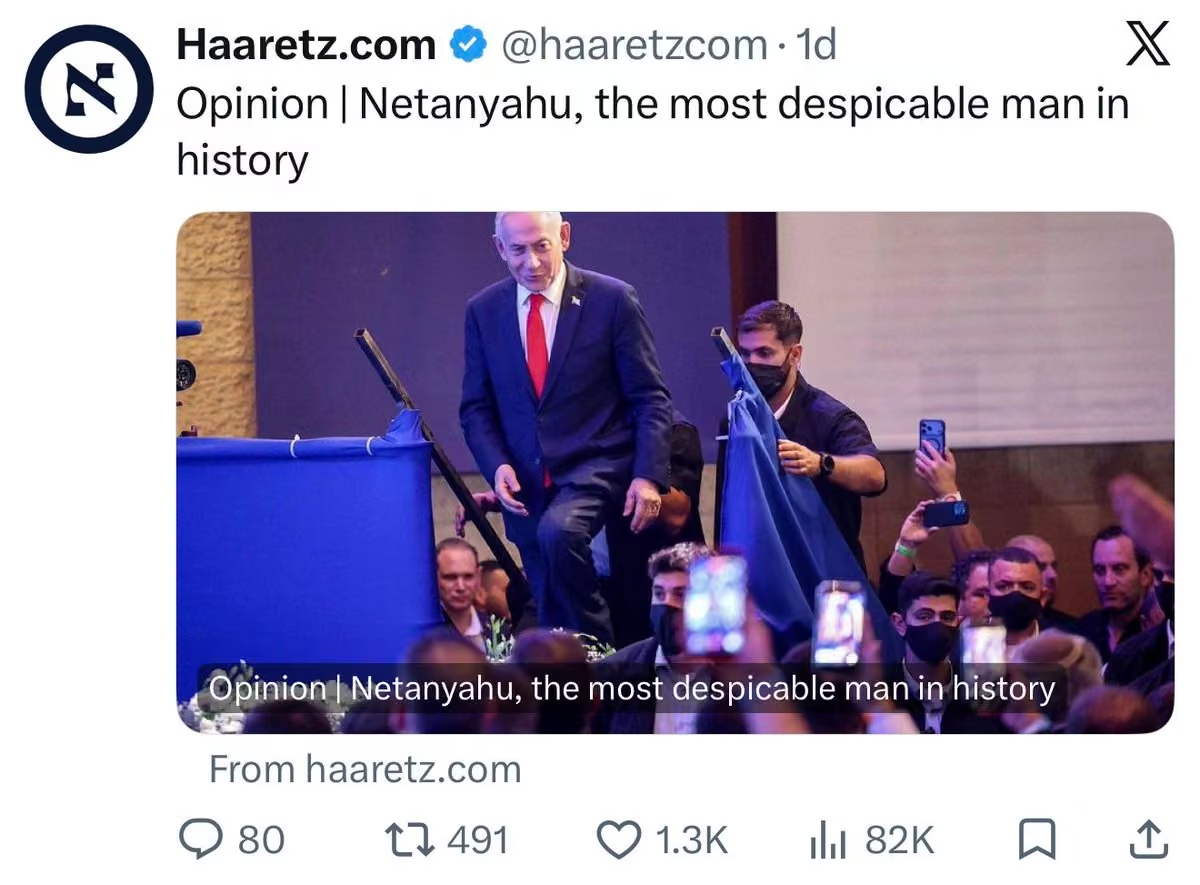
Dunno. I’d have thought a newspaper based in the Jewish state could think of someone worse…
Russ Roberts reposted
The master biographer reflects at 91. The Robert Caro interview.
0:00:00 – How Caro gets people to talk
0:05:03 – Does America need a little more Moses today?
0:12:42 – Moses the young idealist
0:17:57 – Watching Moses lose power
0:24:01 – Did Moses realize he was changing?
0:27:53 – Building during the Great Depression
0:32:51 – The threats and promises of Lyndon Johnson
0:36:08 – Could Kennedy have passed Johnson’s laws?
0:41:00 – Getting a book down to one sentence
0:46:21 – All the material that never made it into the books
0:52:59 – Loneliness
Russ Roberts reposted
A week of Jewish hospitality in Israel has left me ashamed of the welcome Britain offers its own Jews. My latest essay is a love letter to people who should never have to wonder whether they belong in the country they call home.
mrandrewfox.substack.com/p/a-love-letter-to-the-jews-of-b…
So self-recommending. Bravo, Dwarkesh.
I recently got to interview Robert Caro, who is my favorite author of all time.
This gave me the excuse to reread his biographies of Lyndon Johnson and Robert Moses, and to compile my prep notes into this video essay.
These guys pulled off some truly incredible schemes.
Russ Roberts reposted
The Brink is coming to Jerusalem this Sunday evening, followed by Tel Aviv on Monday. Haviv Rettig Gur is joining Jake Wallis Simons and me on 1 November at the Menachem Begin Heritage Center. Jonathan Conricus joins us on 2 November at the Enav Cultural Center. Now is a good time to settle the plan with anyone you’re hoping to bring! Both recordings start at 7.30pm, and you can book below:
www.thebrinkpodcast.co.uk
Russ Roberts reposted
What if breaking bad habits has less to do with willpower—and more to do with your surroundings?
Psychologist Angela Duckworth joins @EconTalker to explain why changing your environment may be the smartest way to change your behavior.
Watch a new episode of EconTalk from the Hoover Institution, @Liberty_Fund, and @Econlib: www.hoover.org/plus/research/how-changing-environments-ca…
Russ Roberts reposted
@EconTalker the @Econlib pod w David Wolpe…as a man of a certain age, this hit home. Incredibly thoughtful to put ourselves in Ilyich’s shoes
The bit about having people who elevate our best selves: seek those who desire us to be lovely
Thank you
Russ Roberts reposted
@EconTalker The episode with David Wolpe on The Death of Ivan Ilyich was great. Easily one of my favorite EconTalk episodes of the year, if not of all time.
Russ Roberts reposted
A beautiful episode from @EconTalker One that will make you stop for a moment and ponder… Such an insightful conversation between Russ and Rabbi Wolpe
What if you did everything “right” by conventional standards and still discovered, on your deathbed, that you had wasted your life?
Your life can be internally coherent, externally rewarded, and still be a form of prolonged non-existence… hollow and surrounded by superficial and empty people, including yourself.
What if you did everything right, only to discover at the end that you lived the wrong life?
@RabbiWolpe joins Hoover Visiting Fellow @EconTalker to explore Tolstoy's The Death of Ivan Ilyich and how to live without regret.
Watch a new episode of EconTalk from the Hoover Institution, @Liberty_Fund, and @Econlib: plus.hoover.org/plus/research/lives-wasted-and-well-lived…
Russ Roberts reposted
Click here to listen to the full conversation: www.econtalk.org/incentives-are-for-losers-with-adam-mast…
I like the book better. But it’s nice to hear the tune.
Radetzky March, Op. 228 by Johann Strauss I, performed by the Vienna Philharmonic under the baton of Daniel Barenboim at the 2014 Vienna New Year's Concert.
What's fascinating is that the audience's clapping isn't just applause. When timed with the music, it becomes an extra layer of rhythm alongside the orchestra. The audience doesn't just listen to the music. They become part of the performance itself.
Russ Roberts reposted
#imperdible conversación de @EconTalker con el gran economista @JesusFerna7026 sobre las posibles causas y, sobre todo, las implicaciones del colapso demográfico en el mundo.
Un tema especialmente relevante para países en vías de desarrollo como México que se harán viejos antes de llegar a ser prósperos.
www.econtalk.org/the-great-fertility-collapse-with-jesus-…
Russ Roberts reposted
I learned more from this @EconTalker episode about demographics than you would think possible in an hour.
Listen in for what you should- and shouldn't- be worried about with respsect to fetility rates.
www.econtalk.org/the-great-fertility-collapse-with-jesus-…
Russ Roberts reposted
I had a terrific time exploring the depths of "The Death of Ivan Ilych" with @EconTalker
www.econtalk.org/lives-wasted-and-well-lived-david-wolpe-…
The veneer of civilization is thin.
Russ Roberts reposted
Imperdibile episodio di EconTalk, il podcast di @EconTalker. Ospite @JesusFerna7026. Si parla di demografia (ma anche di nazionale 🇮🇹 di ⚽️).
Sottotitoli decenti (Barrow -> Barro; 2014 -> 2040). Jesus spettacolare come sempre per chiarezza e lucidità.
open.spotify.com/episode/6kB3sM60nDWQdHYn0zrYl2
Russ Roberts reposted
I think you can. This week's EconTalk conversation between @EconTalker and @JesusFerna7026 taught me that most of what I had learned about demographics turns out to be wrong: plus.hoover.org/plus/research/great-fertility-collapse-je…
Russ Roberts reposted
Finally got around to listening to the Fertility Podcast with @EconTalker and @JesusFerna7026 . It’s a tour de force and one of the most intellectually stimulating things I have listened to recently. Until the very end about religiosity and non-market correction mechanisms.
Russ Roberts reposted
I think @a_m_mastroianni has been @EconTalker's guest five times, and each time, I see the title, and think "What a stupid idea" and after listening to the conversation, I realize that he is completely right. The latest is no exception: www.econtalk.org/incentives-are-for-losers-with-adam-mast…
Russ Roberts reposted
The Pattern (abbreviated version of a chapter of my planned book Irrationality): www.daviddeutsch.org.uk/wp-content/uploads/2026/10/The-Pa…
Russ Roberts reposted
Cavemen Issues Dire Warning That The Wheel Is Going To Eliminate Countless Jobs
Sometimes the best economics comes from a psychologist. open.substack.com/pub/experimentalhistory/p/claude-dont-t…
The future of math. Superb. open.substack.com/pub/davidbessis/p/the-fall-of-the-theor…
Robert Hall on EconTalk from 2017: www.econtalk.org/robert-hall-on-recession-stagnation-and-…
Russ Roberts reposted
If you’re in New York on the evening of November 17, and you’re sufficiently concerned about the Jewish future to be reading this tweet, why not join us for a live taping of Ask Haviv Anything at the Village Underground for a blunt and honest conversation on the future of Jews in America.
I have a funny feeling I’ll be the optimist on the panel.
“The Future of Jews in America | Is It Still the Exception?”
Details and ticket purchases here:
shop.comedycellar.com/product/haviv/
This conversation with @JesusFerna7026 blew my mind.
Birth rates are plunging around the world, including in countries once known for large families. What's driving the decline?
University of Pennsylvania Professor of Economics @JesusFerna7026 joins @EconTalker to examine the mystery of falling fertility and its economic consequences.
Watch a new episode of EconTalk from the @HooverInst, @Liberty_Fund, and @Econlib: plus.hoover.org/plus/research/great-fertility-collapse-je…
Russ Roberts reposted
Meghan O'Gieblyn questions whether willpower can explain our choices when the desires that motivate us may themselves be shaped by forces beyond our control.
Watch her full conversation with @EconTalker on Hoover+: plus.hoover.org/plus/research/addiction-faith-and-limits-…
Why do we keep doing things we know we shouldn't?
Meghan O'Gieblyn joins @EconTalker to explore why willpower may not be enough to change our behavior—and why attention, habits, and the "choices in between the choices" may shape our lives more than we realize.
Watch a new episode of EconTalk from the @HooverInst, @Liberty_Fund, and @Econlib: www.hoover.org/plus/research/addiction-faith-and-limits-w…
Ahmed continues to be a mensch. Amazing.
Mayor Mamdani devoted only 49 words of a 211-word statement to commemorate the worst single day attack on Jews since the Holocaust, in a city that is home to the largest Jewish population outside Israel. He avoided any real description of what happened on October 7, including mass murder, burnings, beheadings, executions, and sadism toward Jews, Arabs, and foreign workers, including women, children, teenagers, and the elderly. He refused to call Hamas a terrorist organization or acknowledge that none of this would have happened had the group honored the ceasefire it unilaterally broke. There was no assignment of agency or responsibility to any Palestinian actor.
Yet he used the remaining 162 words to describe in detail what happened in Gaza after the attack. He showed full capacity to recognize Palestinian suffering, which is real and must be acknowledged, but his statement was tone deaf, inconsiderate, and antagonizing to millions who deserve their trauma recognized on its own terms. He has spoken endlessly about his anti-Israel views and will continue to do so, but this was the one day in which he could have offered unconditional compassion to the victims and survivors of October 7 and their loved ones, many of whom have deep roots in New York.
This type of statement ignores basic logical principles like cause and effect, choices and consequences, actions and reactions, priorities and implications, further infantilizing the Palestinians and ignoring the failures of Hamas and Palestinian leadership that have harmed their own people. It hardens attitudes toward Gazans and reduces empathy for the vast and unspeakable suffering in the coastal enclave, rather than increasing it.
@NYCMayor: sometimes less is better. You should have stayed with your first 49 words, especially as unhinged “pro-Palestine activists” are celebrating October 7 today across the country. Stand up to your base, Mr. Mamdani. You have already won and do not need to appease radicals at the expense of Jewish New Yorkers. And please stop pretending that this is about helping Palestinians or caring for Gazans.
Russ Roberts reposted
On this hateful anniversary, I would like to recommend that you follow my friend, Dr Shlomi Chetrit, on Substack. A chief superintendent in the Israeli National Police, he has been formally documenting 7 October since the day after. His presentation on it is remarkable, and I wish everyone could see it. His book will be a close second to that.
substack.com/@shlomichetrit/note/c-354316542?r=94s92d
Yes, this seems to be an inappropriate image for October 7. But something is weird. It's three hours long. It's basically two images shown over and over again. The bottom line is that Israel destroyed a lot of buildings in Gaza City. Which is true. What is Reuters trying to say here?
View of Gaza City on October 7 anniversary x.com/i/broadcasts/1jGXgBQPdwNKZ
On this heartbreaking anniversary, Ziv Koren’s extraordinary work is one of the most powerful ways to remember., by @DanielGordis danielgordis.substack.com/p/on-this-heartbreaking-anniver…
Russ Roberts reposted
All happiness hangs on one thin veto. All positive joy depends on one negative.
Cinderella may have the dress woven on supernatural looms. Yet she still has to be back when the clock strikes twelve. Adam and Eve may have the garden. They may not eat the one fruit.
The stories never explain the rule. The missing explanation is the point. Happiness depended on not doing something you could at any moment do, and which it was often not obvious why you should not do.
The moment the reason is supplied, the mind starts negotiating. Negotiation is already the fall. “Just this once” is not an exception. It is the abolition of the rule.
Yet another gem from @EconTalker this time with
Meghan O’Gieblyn:
www.econtalk.org/addiction-faith-and-the-limits-of-willpo…
Russ Roberts reposted
Why do we keep doing things we know we shouldn't?
Meghan O'Gieblyn joins @EconTalker to explore why willpower may not be enough to change our behavior—and why attention, habits, and the "choices in between the choices" may shape our lives more than we realize.
Watch a new episode of EconTalk from the @HooverInst, @Liberty_Fund, and @Econlib: www.hoover.org/plus/research/addiction-faith-and-limits-w…
This line is doing all the work in this post and it's incredibly misleading: Zionism in practise meant "a homeland at the expense of Palestinians".
What does that mean? Yes, two peoples desired Palestine as a homeland. The Jews living in Palestine and the Arabs who lived in Palestine. Zero-sum game at that point so the UN offered both peoples a part of Palestine in 1947. The Arabs refused it. They didn't just refuse it. They went to war to conquer all of Palestine. They lost the war.
Of course there is a lot more that happened then and after and now. But now what? You can decry history. You can desire to reverse it. But to desire to reverse at the expense of people who weren't alive when that history occurred? I appreciate the honesty. Know we know what you stand for.
There is nothing racist about any ethnic or religious group wanting their own homeland.
The problem is if this desire is at the expense of another people.
Zionism in practise meant "a homeland at the expense of Palestinians".
It's really not hard to grasp this basic point!
Russ Roberts reposted
On my blog, I also reflect on the question of "What Remains of the 'China Shock' Narrative?" after the Borusyak et al. corrections: poorrichworld.blog/p/what-remains-of-the-china-shock-narr….
My conclusion is that the anti-China rhetoric legitimized by Autor et al. is probably overblown. 6/6
Russ Roberts reposted
A radical vision and assessment of our current situation from @EconTalker and @mungowitz
podcasts.apple.com/us/podcast/econtalk/id135066958?i=1000…
Grok’s cityscape based on my posts. Not bad.
Public Choice and Politics Without Romance (with Mike Munger) www.econtalk.org/public-choice-and-politics-without-roman…
Russ Roberts reposted
Would you give the politician you trust least the same powers you want government to have? Duke University professor @Mungowitz joins @EconTalker to discuss the "Munger Test," public choice, why voters rationally know so little, and what happens when we think about politics without romance.
Watch a new episode of EconTalk from the @HooverInst, @Liberty_Fund, and @Econlib:
Ignore the liars. Israel is a beautiful country with beautiful people. Come visit.
Despite the pessimism of my recent piece on my Substack, maybe there is a chance for a revival of Christianity in the West. What an extraordinary response from France and the French people to the arrival of the Pope.
After the Olympic disaster
France has organized one of the most beautiful papal visits in history: Pope Leo XIV
The homage to Joan of Arc was magnificent
In the end, it wasn’t the French, but simply the wrong culture
The Catholic Church is spectacular!
Russ Roberts reposted
Ok, that's mind blowing
Opus 5.5 zero shotted this banger for Jewish history
holy shit
i asked claude to make a video on western civiization
See: www.econtalk.org/the-political-economy-of-palestine-with-…
King Abdullah of Jordan delivered a scathing speech against Israel at the UN tonight: “Israel is trying to dispossess an entire population in the West Bank; its expansionist ambitions in the region know no bounds.”
Russ Roberts reposted
Here’s what the media doesn’t tell you about the caricature of Israel you have in your mind.
In less than two hours, over 7 million Jewish Israelis will mark Yom Kippur, the holiest day of the Jewish calendar. Some will go to synagogue. Some will go to the beach. Nobody will drive unless they have to. Many will not eat or drink for 25 hours, religious or not.
Then you have over 2 million Arab Israelis who will go on with their lives as usual. Many will not drive in mixed cities out of respect for their Jewish neighbors. Nobody will drive in Jewish neighborhoods. And the hospitals will only be filled with Arab doctors and nurses to let their Jewish colleagues observe the day at home. (The opposite happens on Ramadan.)
Not long ago I went out to run a few last-minute errands before the holiday begins. Every Arab I interacted with – at the dry cleaners, in the supermarket, in the elevator – wished me an easy fast.
Every one.
It happens every holiday. Any holiday. Their holidays and ours.
This is the real Israel. A country filled with Jews and Arabs that get along better than anywhere else on this planet, that nobody shows you because it’s simply not newsworthy.
It’s everyday life.
To all those who observe – have an easy fast.
גמר חתימה טובה
Russ Roberts reposted
Every sentient journalist here knows these are the sources of "news" in Gaza, and have been since the Hamas takeover 19 years ago. This is obviously a major story, but Western editors can't cover it honestly because they've all played ball and are thus implicated themselves.
So it turns out that Hamas runs a WhatsApp group with all of Gaza’s journalists, where Hamas “managed the discourse and the narrative.”
These outlets have "journalists" in Gaza:
Reuters, AP, NYT, CNN, Wapo, PBS, NPR, BBC, The Guardian, Al Jazeera, and Drop Site News
My thoughts on what the future holds: Rough Beast Rising listeningtothesirens.substack.com/p/rough-beast-rising?r=…
Would love to host this on EconTalk. I would moderate. I am mostly agnostic on this issue. Let me know if you're interested. @sapinker @slatestarcodex
I think you've done enough calling us paranoid and preposterous. The next step is for you to defend your position in public against someone who will push back against it. I'm happy to meet you for a debate anywhere, anytime.
You're a world-famous veteran of dozens of debates against the world's top intellectuals, and I've never argued in public before, so adjusting for the relative correctness of our positions, if you're a betting man I'm happy to put my $5000 against your $1000 (ie 5:1 odds in your favor) that I'll win by some standard of audience opinion change. Let me know if you're interested and we can hash out details.
Russ Roberts reposted
Motaz Azaiza is forcing a reckoning the “pro‑Palestine” movement never anticipated. Because he’s celebrated by activists, politicians, and journalists and can’t be smeared as a “Zionist shill,” his admission carries weight: Gaza’s journalism space functioned under Hamas’s control, and any reporter who deviated from the group’s narrative risked “disappearing behind the sun.” That single truth reshapes how we understand the stories pushed out of Gaza since October 7 and explains why dissent against Hamas’s rule never surfaced publicly. Western journalists and outsiders, unaware of this coercive ecosystem, ended up amplifying Hamas’s information warfare rather than scrutinizing it.
Russ Roberts reposted
Hoover Visiting Fellow @EconTalker revisits his youthful memories of Lexington's Battle Green, where the Revolutionary War began, and concludes that the bravery of the outnumbered Patriots there arose from a simple cause: They were fighting for their home and freedom.
Read the full piece for Founders & Fellows: www.thefreedomfrequency.org/p/the-battle-green-bringing-l…
This is a masterpiece of clear and calm writing on a very hot topic. Superb.
The word genocide is back on a loop. Macklemore is dropped from a tour, AOC calls the cancellation a cover-up of “the genocide in Gaza,” and Greta Thunberg says artists who stay silent in the face of “genocide” will not be forgotten.
Before the word does any more work it has not earned, read what it actually requires.
I have unlocked the paywall on Genocide for Dummies — the 6,000-word primer I wrote as a lawyer and reporter. It walks through the legal definition and the four modern cases in which a competent court has actually found genocide, and explains why Gaza does not meet the legal standard.
It is time to stop using it as inflammatory political rhetoric.
🔗 www.justthefacts.media/p/genocide-for-dummies
I will be reading Tolstoy's short story/novella, The Death of Ivan Ilyich and discussing it with @RabbiWolpe for EconTalk. Episode should air in about a month. Feel free to read it in advance.
“Studies show” shouldn’t convince anyone except in this case.
New Study Proves Referees Are Totally Biased Against Your Team babylonbee.com/news/new-study-proves-refs-are-totally-bia…
The insight comes from the economist Bruce Yandle.
The Baptists And Bootleggers Of AI
Economists have observed a longstanding pattern in reform movements of this kind. The actors within movements like these fall into two categories – “Baptists” and “Bootleggers” – drawing on the historical example of the prohibition of alcohol in the United States in the 1920’s:
“Baptists” are the true believer social reformers who legitimately feel – deeply and emotionally, if not rationally – that new restrictions, regulations, and laws are required to prevent societal disaster. For alcohol prohibition, these actors were often literally devout Christians who felt that alcohol was destroying the moral fabric of society. For AI risk, these actors are true believers that AI presents one or another existential risks – strap them to a polygraph, they really mean it.
“Bootleggers” are the self-interested opportunists who stand to financially profit by the imposition of new restrictions, regulations, and laws that insulate them from competitors. For alcohol prohibition, these were the literal bootleggers who made a fortune selling illicit alcohol to Americans when legitimate alcohol sales were banned. For AI risk, these are CEOs who stand to make more money if regulatory barriers are erected that form a cartel of government-blessed AI vendors protected from new startup and open source competition – the software version of “too big to fail” banks.
A cynic would suggest that some of the apparent Baptists are also Bootleggers – specifically the ones paid to attack AI by their universities, think tanks, activist groups, and media outlets. If you are paid a salary or receive grants to foster AI panic…you are probably a Bootlegger.
The problem with the Bootleggers is that they win. The Baptists are naive ideologues, the Bootleggers are cynical operators, and so the result of reform movements like these is often that the Bootleggers get what they want – regulatory capture, insulation from competition, the formation of a cartel – and the Baptists are left wondering where their drive for social improvement went so wrong.
We just lived through a stunning example of this – banking reform after the 2008 global financial crisis. The Baptists told us that we needed new laws and regulations to break up the “too big to fail” banks to prevent such a crisis from ever happening again. So Congress passed the Dodd-Frank Act of 2010, which was marketed as satisfying the Baptists’ goal, but in reality was coopted by the Bootleggers – the big banks. The result is that the same banks that were “too big to fail” in 2008 are much, much larger now.
So in practice, even when the Baptists are genuine – and even when the Baptists are right – they are used as cover by manipulative and venal Bootleggers to benefit themselves.
And this is what is happening in the drive for AI regulation right now.
However, it isn’t sufficient to simply identify the actors and impugn their motives. We should consider the arguments of both the Baptists and the Bootleggers on their merits.
Could someone please make a movie interviewing rank-and-file soldiers of the IDF about what they had to endure in this war in Gaza and in Lebanon? Interview a few hundred, not 24, about what it was like on the ground, dealing with risks to civilians in Gaza, what they were told to do, and what they actually did.
Bootleggers and Baptists
BREAKING: Michael Burry just called out the AI safety slowdown crowd as a self-serving cartel.
His argument is blunt and hard to dismiss.
OpenAI and Anthropic execs pushing to "slow things down" aren't doing it for humanity.
They're doing it because competition is closing the gap fast.
Burry's core point: LLMs aren't AGI, there's nothing existentially dangerous to pump the brakes on, and the incumbents know it.
So the "safety" narrative conveniently becomes a moat.
The most powerful lobbying tool in tech right now is fear.
Is the AI safety movement a genuine concern or a competitive strategy by the players already ahead?
Russ Roberts reposted
Chief Scientific Officer Search at the AOI
The Ackman Oxman Institute (AOI) is a new translational neuroscience, rehabilitation, and brain health institute in New York City founded to accelerate the translation of promising science to treating and curing patients.
We are seeking a Chief Scientific Officer (CSO) who shares our ambition and recognizes that transformative advances depend on creative, independent scientists pursuing fundamental questions relevant to brain injury, degeneration, recovery, and rehabilitation.
The CSO will help shape AOI's scientific identity, organization, and culture. We welcome the candidate's ideas about how best to organize the science and create an environment in which outstanding investigators can do their best work.
Mandate
Lead AOI's discovery science enterprise. Working with the Chief Translational Officer (CTO) and institute leadership, the CSO will define the research agenda, recruit and develop exceptional scientists, and determine the mix of investigator-led laboratories, collaborative teams, shared resources, and external partnerships best suited to the mission. The portfolio will support two complementary kinds of work:
Patient-Anchored Translational Programs
Research developed in anticipation of, as well as in response to, clinical observations. For example, a mechanistic program on mitochondrial delivery and bioenergetic rescue could inform a parallel clinical study of mitochondrial transplantation. Programs pursuing a defined path to patients will have clear milestones and criteria for advancement, redirection, or stopping, appropriate to their stage of development.
Mission-Relevant Discovery Science
Protected support for fundamental research on brain injury, repair, plasticity, and aging, led by investigators with intellectual independence. Major continuation or stop decisions will use a five-to-seven-year horizon, with ongoing scientific exchange and peer review to maintain rigor. This work can generate new therapeutic ideas and give AOI the depth to recognize and pursue discoveries arising from patient studies.
The CSO will shape the balance between these forms of research and how they interact, with resources and review practices suited to each. Scientists will have the freedom to pursue original ideas within AOI's mission and contribute to a collaborative scientific community.
Scope and Responsibilities
Scientific Portfolio
Define the research agenda with the CTO across acquired brain injury (stroke, TBI), and neurodegenerative and neuropsychiatric diagnoses as well brain health in aging. Build on AOI's initial priorities in bioenergetics/mitochondria, neuroinflammation, and neuroplastogens (devices or biologics that increase neuroplasticity), helping refine their scope, sequence, and organization. Identify promising mechanistic programs early so AOI is prepared to act on clinical discoveries, and welcome new ideas through a transparent scientific review process.
Independent Discovery
Recruit exceptional investigators and give them the resources and latitude to pursue fundamental questions relevant to AOI's mission. Develop peer review that evaluates scientific quality, originality, and contribution over an appropriate time horizon, recognizes the value of well-reasoned negative results, and protects intellectual independence.
Scientific Infrastructure
Determine which laboratory and measurement capabilities will best support the science, and which to build internally, share, or access through partnerships. Guide scientific use of shared resources, including GLP vivarium and GMP capabilities, in coordination with the CTO and Chief Regulatory Officer.
Scientific Recruitment and Community
Shape a recruitment and support model that attracts outstanding scientists with diverse approaches to discovery and collaboration. Explore joint or affiliated academic appointments and shared recruitment with New York City and regional universities and medical centers, where these strengthen recruitment, mentorship, and scientific exchange. Appointment arrangements will be developed with partner institutions and individual recruits.
External Scientific Network
Build a network of well-funded collaborations with academic laboratories in New York City and the region whose fundamental work is relevant to AOI's mission, so that AOI's discovery capacity extends well beyond its own walls. The Pershing Square MIND Prize community is a natural springboard for this network, though collaboration is not limited to prize recipients. Work with the founders on how the MIND Prize and AOI's basic research program should relate to each other over time.
Scientific Quality
Lead a collegial, rigorous scientific review process. For translational and later-stage preclinical programs, agree on clear milestones and advancement or stop criteria with program leaders and the CTO. For fundamental discovery, combine ongoing scientific dialogue with substantive peer review and five-to-seven-year continuation decisions. Uphold research integrity and reproducibility across all programs.
External Standing
Represent AOI's science to the field, to funders (NIH, ARPA-H, DoD, philanthropy), to scientific advisors, and to academic and industry partners.
Relationship to the Chief Translational Officer
The CSO and CTO are peers who connect discovery with development and clinical investigation. The CSO leads fundamental and exploratory preclinical research; the CTO leads regulated preclinical development, manufacturing, engineering, and trial readiness, and clinical studies. They jointly define the evidence needed to advance a program into development and review the portfolio together. Scientific collaboration continues as programs advance and clinical observations raise new research questions.
First 6 Months
•Develop a scientific strategy with the CEO, CTO, and board, including the proposed research organization, the balance of discovery and translation, initial priorities and resources, and a first set of anticipatory mechanistic programs. Agree on review practices that protect independent discovery and support timely development decisions.
•Begin recruiting priority scientific leaders and independent investigators, with the mix and sequence of appointments shaped by the scientific strategy. Develop the support and affiliation arrangements needed to attract exceptional candidates.
•Establish an agreed plan for laboratory capabilities and launch initial research using in-house resources or external partnerships as appropriate. Work with the CTO and clinical leadership to align research with patient studies and their readiness requirements.
•Co-define the criteria for entering development with the CTO and begin well-funded collaborations with regional academic laboratories. Set the subsequent launch timetable around scientific priorities, recruitment, and facility readiness.
Who We Are Looking For
Essential
•MD/PhD or PhD with a first-rank research record in neuroscience, immunology/neuroinflammation, bioenergetics, or a convergent field.
•Experience building and leading a research organization (institute, department, biotech R&D unit, or focused research organization).
•A track record of attracting outstanding scientists.
•Enthusiasm for a patient-centered research model and for leading a team whose work spans the continuum from discovery to therapy development.
Valued
•Experience supporting independent investigators and collaborative research in academia, research institutes, or industry.
•Scientific credibility in at least one of AOI's initial priority areas.
•Comfort spanning biologics and device/neurotechnology science.
•A demonstrated ability to protect creative discovery while guiding translational programs toward clear milestones.
Practical
AOI welcomes candidates from academia and industry who are excited to build the institute over the coming decade and beyond. The position is full-time in New York City. Candidates should be eager to focus their research leadership on the brain, recovery, and rehabilitation; any continuing research commitments should support that mission. Compensation will be competitive and will include the opportunity to participate in the value created through company formation at AOI.
Leadership Team Engagement
Works closely with the CTO as described above and with clinical leadership to connect research and patient studies. Engages the legal/regulatory team early on regulatory strategy, quality systems, and evidence requirements. Collaborates with the Chief AI Officer on data-rich study design and computational modeling, the COO on laboratory development and recruitment operations, and the CFO on scientific resource planning.
Interested candidates should send their CV and a brief cover note to:
CSO@aoi.org
Russ Roberts reposted
The podcast with @EconTalker on transferable skills is now up!
www.hoover.org/plus/research/meritocracy-exams-and-knowle…
We start with the deadliest civil war in history (which barely anyone in the west knows about) and proceed from there to 19th C England, 17th C navy reforms, and end with why irony can be corrosive.
If you want to learn more, subscribe to my Substack (it's free) where I will be posting a series of essays on these topics over the next few months. Currently I have four linked 2k word articles, but it may end up being more!
substack.nomoremarking.com/p/what-if-transferable-skills-…
In 2013 I wrote a book called Seven Myths about Education.
What is the most persistent myth, the one that is hardest to kill, and the one that has biggest implications outside education?
Transferable skills.
People think that you can teach things like critical thinking, creativity, problem-solving, etc. But you can't.
But the idea is so persistent not just in schools but in universities, the corporate world and the British civil service.
Over the next few weeks, I will have a series of articles about it on my Substack. You can read the intro here and listen to me talking about it tomorrow on the @EconTalker podcast.
substack.nomoremarking.com/p/what-if-transferable-skills-…
Russ Roberts reposted
In a previous post which can be found below, I described how Lucy was left nearly completely blind in both eyes as a result of a large left frontal hemorrhage in February. The hemorrhage caused downward herniation, putting bilateral pressure on her optic nerves along with prolonged (~18 hours) elevated intracranial pressure. A hard fall on the right side of her face at the time of injury likely created a traumatic optic neuropathy in her right eye.
In response to my post, we received incredible support from the X community including some interesting ideas on how to help Lucy. To that end, I thought to make a more targeted outreach to the community for any advice, ideas or input from experts in the eye, optic nerve, and brain or otherwise who can help her recover her vision, which remains her most challenging limitation both physically and emotionally.
Below, I provide some background on her vision and treatment to date. We are incredibly grateful for any ideas you may have. Our goal is to help Lucy and others who have suffered a similar fate by crowdsourcing ideas from the X community.
Background
Initially, both of Lucy’s pupils were maximally dilated and unreactive to light. Slight light reactivity came back to both eyes in the weeks after the hemorrhage. Initially, she appeared to be able to perceive light in the left eye but not the right. The slight right eye pupillary reactivity decreased to zero approximately six weeks after the injury.
Because of the severity of her vision loss and the absence of any other viable therapy, we received emergency FDA authorization in May, three months after the injury, to attempt a novel treatment: injection of Lucy's own mitochondria into her eyes. Details of the procedure and the decision-making that led to our decision to do this therapy are described in a preprint manuscript linked here:
www.researchsquare.com/article/rs-10622019/v1
The principal rationale for the use of mitochondrial injection was based on her imaging. Optical coherence tomography showed that Lucy's outer retina and photoreceptors were fully intact. The damage was confined to her optic nerves and inner retinal neurons that process visual signals and carry them to the brain. The goal, therefore, was to rescue and enhance the function of her neuronal tissue as much as possible. Animal studies have shown that mitochondria delivered intravitreally cross the inner limiting membrane and are taken up by retinal cells.
After careful research into the potential benefits and risks which we believed, after careful analysis, to be low, we chose intravitreal injection in an attempt to place mitochondria directly on the surface of her retinal neurons.
Within two days of her injections, Lucy’s pupillary responses improved in both eyes. Importantly, she experienced no inflammation or infection. Visual evoked potentials measured weeks later improved, indicating stronger signal transmission from her retina to her visual cortex.
After the procedure, Lucy began reacting to pupillometer and visual examinations when previously they did not disturb her. Because Lucy cannot yet describe precisely what she sees, her increased reaction was itself an important indicator of change. Pupillary responses decreased after a few weeks but remained above pre-injection levels.
Given the success and the limitations of this strategy (among them: sourcing mitochondria from muscle biopsy is not a great long-term solution), we are exploring other ways to isolate and administer Lucy's autologous mitochondria, which we are now isolating from autologous stem cells derived from fibroblasts, a process that takes six or so weeks and requires significant management of the cell culture.
While transplanted mitochondria may improve the function of existing neurons and supporting cells, they are unlikely to result in optic nerve regeneration. Lucy's retinal ganglion cells have already suffered severe atrophy, so even in the best case this strategy has limitations.
In the last two weeks, Lucy's daily visual rehabilitation has begun to produce significant results. She can now reliably track objects both horizontally and vertically when before she could not. At first the objects presented to her had to be illuminated to be seen. More recently, she can track projected images and unilluminated objects.
Lucy is far from having functional vision so we are very open to ideas and potential solutions.
We welcome ideas posted here on X as well as emails to eye@aoinst.org.
Thank you!
At midnight on February 6th, earlier this year, the doorbell to our apartment rang. The doorbell was followed by a pounding on the door. I answered the door and a security person in our building handed me his phone. It was my oldest daughter Eloise. She had found my 26-year-old daughter unconscious on the floor of her apartment and had called 911. The EMT team was already there, but they did not know what was wrong with Lucy or to which hospital they would take her.
I threw on some clothes and jumped in an Uber heading east toward Brooklyn. (Lucy lived alone in Williamsburg.) On the way, I learned that they were taking her to Elmhurst, a City trauma hospital in Queens. I arrived about five minutes after the ambulance to join Eloise, Lucy’s mom, and a friend, and waited to learn what was wrong.
After about 15 minutes, I asked a nurse where she was. I looked over his shoulder to his computer. Next to her name, it said “non-responsive.” I walked into the emergency room and wandered around looking for her until I found her unconscious on a gurney surrounded by several doctors and nurses.
By about 2:30am with the results from a CAT scan, Lucy’s doctors had determined that she had a massive brain hemorrhage and would need an emergency hemicraniectomy to release the pressure on her brain and remove the blood from the hemorrhage. I called our wonderful friend and family doctor Eddie Fisher and explained what was going on. He woke up Josh Bederson, Chairman of Neurosurgery at Mount Sinai, to find out more about Zach Hickman, the neurosurgeon on call that night. Dr. Bederson said Hickman was an excellent surgeon, which was comforting as we had no choice.
The surgery to save Lucy’s life began around 3:15am and finished around 5:30am. It was successful.
The following day, I joined Lucy in an ambulance while she was being transferred to Mount Sinai on Madison Avenue. Later that day, we determined from Lucy’s Oura ring that her hemorrhage had occurred around 9am, which meant that more than 19 hours had passed from the time of the hemorrhage to the completion of the surgery to release the pressure on her brain (I only wish @ouraring had an alert for this kind of a medical event. Imagine it could call a family member if the wearer doesn’t cancel the alert).
I later learned that the standard of care is not to do surgery to save a patient with a large brain bleed if more than five hours have passed since the hemorrhage. Even when the surgery is done, I was told that the likely outcome for the patient is a few months in a nursing home and death from pneumonia.
When I met Lucy’s doctors, I did my best to inspire them: “Let’s see what can be accomplished if we give her the best care possible and we invest unlimited resources to restore her to life.” And I promised that whatever we learned we would make available to everyone.
Dr. Chris Kellner, her neurosurgeon, and Dr. David Putrino, Director of Rehabilitation Innovation for the Mount Sinai Health System have led Lucy’s care team since that day. Words cannot describe the remarkable and compassionate care that she has received beginning with the EMT team and then from nurses, doctors, therapists, and the army of people who have worked to save her and return her to life. To this day, we have a daily Zoom where we discuss her progress and make adjustments to her care. While her care and oversight have been incredible, the learnings for the Mount Sinai team have also been elucidating and will assist in the care of many others.
Lucy began in a bad place. She was in a coma for several weeks and then awoke not being able to breathe on her own, unable to walk, see or speak.
Over the last six months, she has recovered her cognition – she understands everything including her circumstance – is able to walk a hundred or more steps at a time with assistance, is making progress with sounds, vowels and consonants and the beginnings of speech, but she remains unable to see.
Each day, she makes a little progress, and daily progress compounds. Every day I tell her that she just needs to make a little progress and it won’t be long before she is back.
We remain optimistic that Lucy will return to normal function. It will likely take years, but I believe it is only a matter of time, hard work, and technological progress, along with some, and perhaps a lot, of divine intervention.
Many people have been praying for Lucy and we are incredibly grateful for the prayers and remarkable support she has received. Lucy’s friends have been with her every day since the beginning, and their presence and friendship have saved her life and helped to rebuild and maintain her spirit. And on a very positive note, Lucy’s challenge has brought together our entire modern family who have all been incredibly devoted to her care and recovery.
Lucy's vision and other faculties may require some form of brain computer interface, work that is underway at Neuralink, Precision Neuroscience, Science, Synchron, Nudge, and other companies in the space.
If you are going to have a devastating brain injury, now is the best time in history for that to happen. We are living in a world when you can be confident that the blind will soon see again. We are going to do everything we can to help make that happen, including by assisting existing companies in the space.
With respect to our promise to make Lucy’s care available to others, we have made good progress. In May, a real estate colleague made me aware of a 93% vacant, brand new, 400,000 square foot Class A+ purpose-built biotech facility on West End Avenue between 65th and 66th Streets that missed the market and was available for sale. The Pershing Square Foundation acquired the building 60 days later.
We also put under contract an adjoining 130,000 square foot building at 320 West 66th Street that is currently being used by Saturday Night Live for studio space. The building has 35-foot ceilings with massive column-free spaces that can be converted into superb rehabilitation facilities. We will close on the SNL building in December.
We are also acquiring an adjoining vacant lot with additional air rights. With just the existing zoning rights, we can add a 150,000 square feet for a total of 680,000 square feet, a lab footprint larger than Rockefeller University, and that’s without including the potential for an upzoning that would allow for substantially more buildable area on the site’s 3.4 acres with spectacular views of the Hudson.
Our goal is to build the world’s greatest brain research, rehabilitation, recovery, human optimization, and longevity institute. We have named it The Ackman Oxman Institute or the AOI for lack of a better name, but also to reinforce the point that Neri and I and our family are all-in on the mission.
The AOI will be patient-centric. It will not be an academic research institute that produces lots of papers, a Nobel Prize winner or two, but little if any results for patients. We will be laser-focused on cures, treatments, devices, rehabilitation and exercise equipment, and targeted and basic research with a goal of massively accelerating the time from idea to innovation to production to helping a patient.
While the AOI will be a non-profit, it will have highly commercial instincts. The AOI will have its own venture funding and will work to develop innovations to create companies that we will seed, assist, and spinout to ensure technologies, treatments, techniques, and drugs get to patients as promptly as possible.
On one 3.4 acre campus in what is still the greatest city in the world, we will do neurosurgery, neuroscience, rehabilitation, nutrition, BCI and device development, human trials, hyperbaric oxygen treatments, and life extension programs, and we will mandate and incentivize collaboration among the teams with no silos, politics, bureaucracy, or any other constraint that is inconsistent with the mission.
Mount Sinai will be an important partner and deservedly so, but it won’t be our only hospital or medical school partner as we don’t believe any institution has a monopoly on the best ideas or the best talent. We don’t believe in exclusive relationships because that is not in the best interest of patients.
Five years ago, we considered launching a brain institute inspired by Neri’s mom who sadly died from Alzheimer’s. We couldn’t make the math work as the real estate was too expensive and we believed it would be too difficult to recruit the best talent from universities to our effort.
Since then, the real estate became available at a 70% discount, universities became a much less attractive place to work due to politics outweighing meritocracy, protests that disrupt learning, the curse of antisemitism, and a decline in funding. Fortunately, during the same time, I made sufficient personal economic progress to make the AOI possible.
The advance of AI in the last few years will also enable us to greatly accelerate our mission. AI still has a lot to learn about human intelligence and the brain, and the AOI should be at the forefront of the interplay between the brain and AI.
Today, I am making a public filing disclosing a gift from Neri and me of ~$400 million or 10,000,000 shares of Pershing Square Inc. (PS) to the AOI. It is very early days for Pershing Square so these shares are intended to anchor the long-term work of the AOI as the shares compound over time while generating what we expect will be a growing stream of quarterly dividends to fund the Institute.
We will also be announcing an additional gift of similar and potentially greater size which won’t be in the form of Pershing Square stock to provide the AOI with the short- and intermediate-term runway necessary to enable it to achieve its goal of becoming a self-sustaining institute, which reinvests all of its revenues, royalties, and the economic rewards of company formation to advance the fields of brain health and human longevity.
Neri and I have chosen to anchor the funding of the AOI to maintain vision alignment and limit the need for the organization to focus on fundraising. We expect the AOI to be the best-resourced brain, rehab, recovery, and longevity institute in the world.
We are grateful to have been able to form a board which includes Dean Kamen (our generation’s Thomas Edison), George Yancopoulus (CEO of Regeneron), James Rothman (Nobel Laureate), Bernardo Sabatini (neuroscientist), Chris Kellner (neurosurgeon), Olivia Flatto (CEO Pershing Square Foundation), Neri Oxman, and myself.
We have recently identified a CEO who we expect to announce by October along with other key hires, and are beginning searches for a Chief Scientific Officer, a Chief AI/Technology Officer, a Chief Operating Officer, a Chief Financial Officer, and other key leadership roles.
If you find what we are building compelling and want to be part of the leadership team that creates and builds the AOI from a standing start, please send an email to: search@aoiinst.org with a short note as to why you believe you can help. Please include your best three ideas for the AOI along with a summary of your background and your most important accomplishments.
We promise strict confidentiality to those expressing interest in working with us.
We have learned from Lucy that the brain can recover from even catastrophic injury. There is so much more work to be done as the mind is a terrible thing to waste.
For details from my Pershing Square SEC filing see:
www.sec.gov/Archives/edgar/data/1056513/00011403612603376…
Russ Roberts reposted
Can a hard test reveal the best minds?
Daisy Christodoulou (@DaisyChristo) joins Russ Roberts (@EconTalker) to explore meritocracy, expertise, and why even the brightest minds may struggle outside their domain.
Watch a new episode of EconTalk from the @HooverInst, @Liberty_Fund, and @Econlib:
Russ Roberts reposted
In 2013 I wrote a book called Seven Myths about Education.
What is the most persistent myth, the one that is hardest to kill, and the one that has biggest implications outside education?
Transferable skills.
People think that you can teach things like critical thinking, creativity, problem-solving, etc. But you can't.
But the idea is so persistent not just in schools but in universities, the corporate world and the British civil service.
Over the next few weeks, I will have a series of articles about it on my Substack. You can read the intro here and listen to me talking about it tomorrow on the @EconTalker podcast.
substack.nomoremarking.com/p/what-if-transferable-skills-…
Russ Roberts reposted
Ahmed Fouad Alkhatib (@AFAlkhatib) argues that Hamas's radicalization of Palestinian society helped shift Israeli society to the right and hardened views of Palestinian autonomy and statehood.
Watch his full conversation with @EconTalker on Hoover+: www.hoover.org/plus/research/hamas-and-future-gaza-featur…
He lost his childhood homes, dozens of family members, and most of his hearing in his left ear to Israeli bombs, yet Ahmed Fouad Alkhatib (@AFAlkhatib) insists that Palestinians must also take responsibility for Gaza's destruction and for peace.
On a new episode of EconTalk, he envisions a demilitarized Gaza run by nonpartisan technocrats, a Palestinian identity defined by aspiration rather than opposition, and direct Israeli-Palestinian dialogue—starting with a "Great Reset" of 100 days without violence on either side.
Watch the full conversation with @EconTalker from the @HooverInst, @Liberty_Fund, and @Econlib:
My conversation with @afalkhatib is here: youtu.be/82mnJJANWIQ
Hamas’s fascist militias attacked civilians in Khan Younis today, shooting, wounding, and kidnapping several, then retreated straight into the Nasser Hospital Medical Complex, where they’ve built torture rooms and interrogation chambers in full view of UN agencies and international NGOs. And still, the “pro‑Palestine” industrial complex won’t say a word. Not Hasan Piker, not the DSA, not SJP or AMP, not the activist mobs, influencers, journalists, Hollywood names, singers, members of Congress, or Senate candidates. None of them will touch the fact that Palestinians are being brutalized by Palestinian oppressors like Islamist terrorists such as Hamas, throughout Gaza and especially inside Gaza’s hospitals - because for them, Palestinian lives only seem to matter when Jewish Israelis are involved. Tell the truth - is that not the case? Am I wrong?
The way to create the norms that we need for great colleges and media is to start over with new institutions and hire people who hold those norms sacred.
The norms that created these institutions have been so severely eroded that it is probably best to ignore them and build now ones.
The Arday scandal is not mainly about Arday, or even about his hiring by Cambridge.
It is about the widespread post-truth reaction to it, including from many establishment figures and institutions.
The arguments establishing his plagiarism and confabulations were obvious from the initial blog post. And yet Cambridge initially officially called this "a vile campaign". It is worth pondering for a minute how crazy this is for a university to officially state. Again, the examples of plagiarism were specifically shown, and anyone could verify them for themselves.
Then there was the Goodlaw letter, in which many important people signed a statement saying that Arday had done nothing wrong, not even plagiarism. This letter included signatories who were heads of colleges at Cambridge and a number of professors.
As the news media started covering the case, it became undeniable that Arday had lied about a large number of things in his life. It also became clearer that the proportion of plagiarism was exceptional, possibly the highest ever discovered. Also, some of the quotes that was the data content of his work were plagiarized as well, which means it is a case of academic fraud.
Even following this, many people doubled down in their defence of Arday as having done nothing or little wrong, and this increased further following his tragic suicide. There is an aspect of the discourse here that is correct, which is that public pile-ons are a powerful force, and that we should consider the effects on real people. But that is far from all people are saying. Instead, they kept making claims about Arday, such as defending many of his demonstrated lies.
Also still widespread is the acceptance that Arday was so autistic that he could not speak until age 11, which, especially given that we know how much of his life story he made up, is highly unlikely.
Furthermore, the reaction against @nathancofnas has been unhinged. It includes, for example, a huge demonstration in which multiple speakers singled him out for denunciation. Even being charitable to the view that media pile-ons like what happened should be criticised, that cannot possibly apply to a person writing a single, initial blog post with verifiable, true information.
The most discomforting aspect is how strong the post-truth element of this case is. Especially at this point, the objective facts could not be clearer that Arday is a plagiarist and a fraud. But people and the media ignore all this and keep going with their narrative that Arday was essentially an innocent victim. Some claim that he was "lynched". There was a social media hetz against a Guardian reporter for writing an article that exposed Arday's lie about a pig head hate crime. And so on and on. The discourse from this side is based on pure feeling about who they see as the good side, untethered from facts and reality.
Russ Roberts reposted
Many such cases: a.co/d/0cFSurUZ
Michael Brooks passed away this week. He was the director of Hillel at the University of Michigan for over 30 years. Before that, he was an after-school Hebrew school teacher at Temple Emunah in Lexington, Massachusetts where my family belonged and where I was his student. He had a huge impact on so many of us, teaching us to love Judaism deeply for the first time. A number of us would have Shabbat lunch with him and his wife, Rutie, after services at the Havurat Shalom in Somerville, Massachusetts. It was a very formative experience and changed my life for the better in so many ways. Rest in peace, my friend and teacher.
A theme I used to write about often. Standard price indices overestimate inflation because they don’t accurately account for improvements in quality. The result is that standard of living improvements are very understated.
Economists have always noted that the cost of living, and hence economic growth adjusted for inflation, is extraordinarily hard to measure, because the nature & quality of goods changes over time, vitiating a constant yardstick (how do you compare a cold cellar with a refrigerator? How much did a laptop cost in 1934?) A new method, using AI to valuate goods, shows that 20th C US economic growth was much bigger than previously estimated.
Excited to share our new working paper: how much did the US standard of living really rise over the twentieth century — and when? With @bhwittenbrink
Using 5.1 million Sears catalog listings, we build a quality-adjusted price index for consumer goods, 1900–1990. Two headline findings: growth was much larger than official statistics imply, and its peak came before WWII, not after. (1/9)
Russ Roberts reposted
Interestingly, in his book Skin in the Game (2018), this is what Taleb wrote on "Arabs fighting to the last Palestinian" (Chapter 14 of Section 6 titled "Deeper into Agency"):
Nassim, like so many others, simply ignores any agency for the Palestinians. It is Israel’s choices and only Israel’s that matter. So the decision in 1947 to refuse a state offered by the UN is always ignored. The decision by nearby Arab nations to launch a war on Israel in 1948 that creates the Palestinian refugee, ignored. All the peace overtures from Israel that are rejected get ignored. Recognition of Israel by a representative of the Palestinians be it the PA or Hamas never happens. This is for some reason, irrelevant and ignored. The intifadas that killed the peace process, ignored. Gaza’s choices after 2005 when Israel withdrew? Irrelevant. Ignored. October 7? Ignored. So it’s always Israel’s decisions that are somehow decisive, Israel that faces a dilemma or trilemma. Maybe spend less time telling Israel what it needs to do and asking instead what the Palestinians should do. And maybe both sides should be held accountable for their mistakes.
On the fragility of Zionism
RIP, Wendell Berry. My thoughts are with Tanya, his widow: www.poetryfoundation.org/poems/48563/they-sit-together-on…
An almost hopeful conversation. This week's EconTalkwith @afalkhatib
He lost his childhood homes, dozens of family members, and most of his hearing in his left ear to Israeli bombs, yet Ahmed Fouad Alkhatib (@AFAlkhatib) insists that Palestinians must also take responsibility for Gaza's destruction and for peace.
On a new episode of EconTalk, he envisions a demilitarized Gaza run by nonpartisan technocrats, a Palestinian identity defined by aspiration rather than opposition, and direct Israeli-Palestinian dialogue—starting with a "Great Reset" of 100 days without violence on either side.
Watch the full conversation with @EconTalker from the @HooverInst, @Liberty_Fund, and @Econlib:
Russ Roberts reposted
Adam Kirsch explains how the 2017 release of Navy UFO videos—and revelations of a secretive Pentagon program investigating unexplained sightings—moved the subject from the fringes into public debate.
Full conversation with @EconTalker on Hoover+: plus.hoover.org/plus/research/cosmic-loneliness-and-longi…
Are we alone—or do we just need to believe we aren't? Adam Kirsch joins @EconTalker to explore why belief in extraterrestrial life is going mainstream—and what our fascination with aliens reveals about loneliness, religion, extinction, and the human need for connection.
Watch a new episode of EconTalk from the @HooverInst, @Liberty_Fund, and @Econlib:
The one coming to EconTalk is @afalkhatib
Coming to EconTalk on Monday. Brave man.
The insufferable Hasan Piker, who has campaigned with NYC mayor Mamdani, Michigan Senate candidate Abdul El‑Sayed, and several other Democratic candidates, claims that Jewish Americans who feel any affinity for Israel or support the Jewish state somehow invite violence onto themselves. He presents this as normal and even sensible. Many immediately condemned the remark as incitement and as an ignorant portrayal of Jews as responsible for the violence directed at them at a time when hate crimes are at historic highs. Others rushed to defend him, insisting he was not antisemitic and was merely criticizing “the Zionists,” even though the framing clearly targeted Jewish Americans as an entire group.
What stands out is the double standard applied only to Jews. Do Palestinian Americans or Muslim Americans who support Hamas, a Jihadist and fascist organization, invite violence upon themselves? Do Muslims who advocate for Sharia Law, including interpretations used to justify beheadings, mass rape, and other crimes against humanity, invite violence upon themselves? Do Chinese Americans who do not speak out against Beijing’s treatment of Uyghurs or Tibetans invite violence upon themselves? Do leftists or Iranians who support the Islamic Republic, the Cuban regime, or Maduro’s Venezuela invite violence upon themselves? Do Lebanese Americans in Dearborn, Michigan, who support Hezbollah invite violence upon themselves? Do Yemeni Americans who support the Houthis and their brutal, regressive ideology invite violence upon themselves?
The list can continue, yet one truth is unmistakable. There is a fixation on treating diaspora and American Jews as uniquely deserving of violence or hate crimes because of their perceived or actual views on a foreign policy issue. No other community is subjected to this logic. Never allow anyone to convince you that this has anything to do with the Palestinian people, their cause, or genuine pro‑Palestine advocacy.
Top five all time for me and many listeners.
Estupendo episodio del archivo de @EconTalker! Creo que alguien lo recomendó por acá. Un must para entender qué complejo y fascinante puede ser un producto que nos puede parecer bastante sencillo.
"Brendan O'Donohoe on Potato Chips and Salty Snacks": www.econtalk.org/odonohoe-on-potato-chips-and-salty-snacks/
Russ Roberts reposted
How bad was life before modern science, technology, and economic growth? Awful.
The example I will use in class this Wednesday is Henry Clay (1777-1852). He was one of the most powerful men of his time in the U.S., not just among the elite but among the elite of the elite: Speaker of the House, Secretary of State, Senator, and three-time presidential candidate. He was also rich and a large slaveholder. The U.S. was among the richest countries in the world (perhaps only behind Great Britain) and among the most technologically advanced. And we are not talking about the early Middle Ages, but about the first half of the 19th century.
Given the constraints of his time, he had nearly everything within reach.
Clay and his wife, Lucretia (both in the photograph), had eleven children: six daughters and five sons. He buried all six daughters. By 1835, all were dead: two as infants, two as children, two as young mothers. He also buried a son in a war his father had opposed. Another son, Theodore, fractured his skull as a child, but since nobody could treat him, he spent decades in an asylum in Lexington.
Think about this for a second: seven children dead and one handicapped out of eleven, in the first half of the 19th century, among the elite of the elite, in one of the richest and most advanced places on the planet.
And I was angry yesterday because my cell phone coverage in Toddington (England) was poor.
Russ Roberts reposted
Such a great conversation. Even if you think the title is not up your alley — so worth listening.
This week’s EconTalk. Aliens are having a moment. I am unconvinced. But we get into many other things as well. Cosmic Loneliness and the Longing to Believe with Adam Kirsch youtu.be/57FEK-m0BVM via @YouTube
Russ Roberts reposted
Are we alone—or do we just need to believe we aren't? Adam Kirsch joins @EconTalker to explore why belief in extraterrestrial life is going mainstream—and what our fascination with aliens reveals about loneliness, religion, extinction, and the human need for connection.
Watch a new episode of EconTalk from the @HooverInst, @Liberty_Fund, and @Econlib:
This week’s EconTalk with Adam Kirsch is on this topic. Coming in a few hours.
I see so many reasonable seeming people telling me they saw dramatic things. We usually believe such people when they testify that they saw dramatic things like murder. Why not believe them about this stuff?
"Like an AirPod case from thousands of years in the future."
That is how former Army Intelligence Officer Caison Best describes the massive, white-porcelain craft with shifting geometric panels that he and his team witnessed over Cheyenne Mountain.
youtu.be/7qWwyAaV0nw
Russ Roberts reposted
After the Glorious Revolution, landowners in Parliament untangled their own property rights one private bill at a time, @BSwud explains to @EconTalker. The bills freed estates, consolidated fields, and licensed toll roads and canals.
Full conversation: www.hoover.org/plus/research/hidden-cause-industrial-revo…
What if the Industrial Revolution began not with the steam engine—but with property rights?
@BSwud joins @EconTalker to discuss how England's quiet legal revolution unlocked land, infrastructure, investment, and ultimately economic growth.
Watch a new episode of EconTalk from the @HooverInst, @Liberty_Fund, and @Econlib:
Russ Roberts reposted
Payton Tolle is a national treasure. A great person and a damn good baseball player
Extraordinary story. Extraordinary response. Extraordinary people all through the challenge and the response. Heartbreaking and incredibly inspiring at the same time.
At midnight on February 6th, earlier this year, the doorbell to our apartment rang. The doorbell was followed by a pounding on the door. I answered the door and a security person in our building handed me his phone. It was my oldest daughter Eloise. She had found my 26-year-old daughter unconscious on the floor of her apartment and had called 911. The EMT team was already there, but they did not know what was wrong with Lucy or to which hospital they would take her.
I threw on some clothes and jumped in an Uber heading east toward Brooklyn. (Lucy lived alone in Williamsburg.) On the way, I learned that they were taking her to Elmhurst, a City trauma hospital in Queens. I arrived about five minutes after the ambulance to join Eloise, Lucy’s mom, and a friend, and waited to learn what was wrong.
After about 15 minutes, I asked a nurse where she was. I looked over his shoulder to his computer. Next to her name, it said “non-responsive.” I walked into the emergency room and wandered around looking for her until I found her unconscious on a gurney surrounded by several doctors and nurses.
By about 2:30am with the results from a CAT scan, Lucy’s doctors had determined that she had a massive brain hemorrhage and would need an emergency hemicraniectomy to release the pressure on her brain and remove the blood from the hemorrhage. I called our wonderful friend and family doctor Eddie Fisher and explained what was going on. He woke up Josh Bederson, Chairman of Neurosurgery at Mount Sinai, to find out more about Zach Hickman, the neurosurgeon on call that night. Dr. Bederson said Hickman was an excellent surgeon, which was comforting as we had no choice.
The surgery to save Lucy’s life began around 3:15am and finished around 5:30am. It was successful.
The following day, I joined Lucy in an ambulance while she was being transferred to Mount Sinai on Madison Avenue. Later that day, we determined from Lucy’s Oura ring that her hemorrhage had occurred around 9am, which meant that more than 19 hours had passed from the time of the hemorrhage to the completion of the surgery to release the pressure on her brain (I only wish @ouraring had an alert for this kind of a medical event. Imagine it could call a family member if the wearer doesn’t cancel the alert).
I later learned that the standard of care is not to do surgery to save a patient with a large brain bleed if more than five hours have passed since the hemorrhage. Even when the surgery is done, I was told that the likely outcome for the patient is a few months in a nursing home and death from pneumonia.
When I met Lucy’s doctors, I did my best to inspire them: “Let’s see what can be accomplished if we give her the best care possible and we invest unlimited resources to restore her to life.” And I promised that whatever we learned we would make available to everyone.
Dr. Chris Kellner, her neurosurgeon, and Dr. David Putrino, Director of Rehabilitation Innovation for the Mount Sinai Health System have led Lucy’s care team since that day. Words cannot describe the remarkable and compassionate care that she has received beginning with the EMT team and then from nurses, doctors, therapists, and the army of people who have worked to save her and return her to life. To this day, we have a daily Zoom where we discuss her progress and make adjustments to her care. While her care and oversight have been incredible, the learnings for the Mount Sinai team have also been elucidating and will assist in the care of many others.
Lucy began in a bad place. She was in a coma for several weeks and then awoke not being able to breathe on her own, unable to walk, see or speak.
Over the last six months, she has recovered her cognition – she understands everything including her circumstance – is able to walk a hundred or more steps at a time with assistance, is making progress with sounds, vowels and consonants and the beginnings of speech, but she remains unable to see.
Each day, she makes a little progress, and daily progress compounds. Every day I tell her that she just needs to make a little progress and it won’t be long before she is back.
We remain optimistic that Lucy will return to normal function. It will likely take years, but I believe it is only a matter of time, hard work, and technological progress, along with some, and perhaps a lot, of divine intervention.
Many people have been praying for Lucy and we are incredibly grateful for the prayers and remarkable support she has received. Lucy’s friends have been with her every day since the beginning, and their presence and friendship have saved her life and helped to rebuild and maintain her spirit. And on a very positive note, Lucy’s challenge has brought together our entire modern family who have all been incredibly devoted to her care and recovery.
Lucy's vision and other faculties may require some form of brain computer interface, work that is underway at Neuralink, Precision Neuroscience, Science, Synchron, Nudge, and other companies in the space.
If you are going to have a devastating brain injury, now is the best time in history for that to happen. We are living in a world when you can be confident that the blind will soon see again. We are going to do everything we can to help make that happen, including by assisting existing companies in the space.
With respect to our promise to make Lucy’s care available to others, we have made good progress. In May, a real estate colleague made me aware of a 93% vacant, brand new, 400,000 square foot Class A+ purpose-built biotech facility on West End Avenue between 65th and 66th Streets that missed the market and was available for sale. The Pershing Square Foundation acquired the building 60 days later.
We also put under contract an adjoining 130,000 square foot building at 320 West 66th Street that is currently being used by Saturday Night Live for studio space. The building has 35-foot ceilings with massive column-free spaces that can be converted into superb rehabilitation facilities. We will close on the SNL building in December.
We are also acquiring an adjoining vacant lot with additional air rights. With just the existing zoning rights, we can add a 150,000 square feet for a total of 680,000 square feet, a lab footprint larger than Rockefeller University, and that’s without including the potential for an upzoning that would allow for substantially more buildable area on the site’s 3.4 acres with spectacular views of the Hudson.
Our goal is to build the world’s greatest brain research, rehabilitation, recovery, human optimization, and longevity institute. We have named it The Ackman Oxman Institute or the AOI for lack of a better name, but also to reinforce the point that Neri and I and our family are all-in on the mission.
The AOI will be patient-centric. It will not be an academic research institute that produces lots of papers, a Nobel Prize winner or two, but little if any results for patients. We will be laser-focused on cures, treatments, devices, rehabilitation and exercise equipment, and targeted and basic research with a goal of massively accelerating the time from idea to innovation to production to helping a patient.
While the AOI will be a non-profit, it will have highly commercial instincts. The AOI will have its own venture funding and will work to develop innovations to create companies that we will seed, assist, and spinout to ensure technologies, treatments, techniques, and drugs get to patients as promptly as possible.
On one 3.4 acre campus in what is still the greatest city in the world, we will do neurosurgery, neuroscience, rehabilitation, nutrition, BCI and device development, human trials, hyperbaric oxygen treatments, and life extension programs, and we will mandate and incentivize collaboration among the teams with no silos, politics, bureaucracy, or any other constraint that is inconsistent with the mission.
Mount Sinai will be an important partner and deservedly so, but it won’t be our only hospital or medical school partner as we don’t believe any institution has a monopoly on the best ideas or the best talent. We don’t believe in exclusive relationships because that is not in the best interest of patients.
Five years ago, we considered launching a brain institute inspired by Neri’s mom who sadly died from Alzheimer’s. We couldn’t make the math work as the real estate was too expensive and we believed it would be too difficult to recruit the best talent from universities to our effort.
Since then, the real estate became available at a 70% discount, universities became a much less attractive place to work due to politics outweighing meritocracy, protests that disrupt learning, the curse of antisemitism, and a decline in funding. Fortunately, during the same time, I made sufficient personal economic progress to make the AOI possible.
The advance of AI in the last few years will also enable us to greatly accelerate our mission. AI still has a lot to learn about human intelligence and the brain, and the AOI should be at the forefront of the interplay between the brain and AI.
Today, I am making a public filing disclosing a gift from Neri and me of ~$400 million or 10,000,000 shares of Pershing Square Inc. (PS) to the AOI. It is very early days for Pershing Square so these shares are intended to anchor the long-term work of the AOI as the shares compound over time while generating what we expect will be a growing stream of quarterly dividends to fund the Institute.
We will also be announcing an additional gift of similar and potentially greater size which won’t be in the form of Pershing Square stock to provide the AOI with the short- and intermediate-term runway necessary to enable it to achieve its goal of becoming a self-sustaining institute, which reinvests all of its revenues, royalties, and the economic rewards of company formation to advance the fields of brain health and human longevity.
Neri and I have chosen to anchor the funding of the AOI to maintain vision alignment and limit the need for the organization to focus on fundraising. We expect the AOI to be the best-resourced brain, rehab, recovery, and longevity institute in the world.
We are grateful to have been able to form a board which includes Dean Kamen (our generation’s Thomas Edison), George Yancopoulus (CEO of Regeneron), James Rothman (Nobel Laureate), Bernardo Sabatini (neuroscientist), Chris Kellner (neurosurgeon), Olivia Flatto (CEO Pershing Square Foundation), Neri Oxman, and myself.
We have recently identified a CEO who we expect to announce by October along with other key hires, and are beginning searches for a Chief Scientific Officer, a Chief AI/Technology Officer, a Chief Operating Officer, a Chief Financial Officer, and other key leadership roles.
If you find what we are building compelling and want to be part of the leadership team that creates and builds the AOI from a standing start, please send an email to: search@aoiinst.org with a short note as to why you believe you can help. Please include your best three ideas for the AOI along with a summary of your background and your most important accomplishments.
We promise strict confidentiality to those expressing interest in working with us.
We have learned from Lucy that the brain can recover from even catastrophic injury. There is so much more work to be done as the mind is a terrible thing to waste.
For details from my Pershing Square SEC filing see:
www.sec.gov/Archives/edgar/data/1056513/00011403612603376…
Russ Roberts reposted
A letter to Palestinians: Enough is enough
For 78 years, since 1948, the Arab world (and those in it) has been told to bleed, fight, pay, and sacrifice for Palestine.
Enough.
You rejected the existence of a Jewish state and expected generations of Arabs and non Arabs to inherit that war. Their soldiers died. Their economies paid. Their governments poured billions into “the cause ”. And after every defeat, the answer was the same: more war, more money, more martyrs, more excuses.
You turned terrorism into “resistance.” Jews were murdered on buses, in cafés, and in their streets. Planes were hijacked. Athletes were murdered at the Munich Olympics. Suicide bombers were celebrated while children were raised to hate and believe that dying was preferable to compromise.
You demanded money from the Arab world and the West while you own corrupt leaders enriched themselves. The world paid for schools, hospitals, refugee agencies, food, and infrastructure, while your people stole money to build rockets, weapons, tunnels, and suicide belts.
And wherever Palestinian terrorists went, others paid the price.
Jordan nearly lost control of its own country during Black September. Lebanon was dragged into a civil war because of Palestinian groups.
Yet responsibility is always someone else’s.
Israel. America. Britain. Europe. The Arabs. The UN. The West.
Anyone except your own leaders and your own political choices.
Even today, the keffiyeh and Palestine are exported slogans and symbols across Western streets and campuses alongside the same message: we are victims, therefore everyone else owes us.
No. We don’t owe you a thing.
Our children do not owe you their blood nor their future.
Our countries do not owe your factions their stability.
Western taxpayers do not owe corrupt Palestinian leaders an unlimited stream of money.
And nobody should be expected to finance another tunnel, rocket, or generation taught that killing Jews is a holy duty.
You want a future? Then build one.
Stop worshipping the past. Stop glorifying terrorism. Stop enriching corrupt leaders. Stop teaching generation after generation that destroying Israel is more important than building your own state. Accept that Jews are not disappearing and that another century of war will not change that reality.
Seventy-eight years is enough.
Face your failures. Take responsibility for your choices. Build something instead of destroying everything around you.
And stop demanding that the rest of the world pay the bill.
Leave us alone.
حلّوا عنا
Many interesting observations here especially on the methodological differences between economics and sociology.
Why has sociology become so politicised, to the point where many sociologists openly reject scientific neutrality and make political change an explicit aim of the discipline?www.optimallyirrational.com/p/why-has-sociology-become-so…
Russ Roberts reposted
An extraordinary interview of Ben Sasse by @EconTalker exploring politics, higher education, family and much else. Particularly impressive is Sasse's theologically grounded explication of the virtues he tries to practice in his life. Don't miss it! www.youtube.com/watch?v=gipbMp4fFHY
Courage.
One of the most striking moments of Sweden’s election campaign came during Monday night’s televised party leaders’ debate, when Simona Mohamsson, leader of the Liberal Party and Sweden’s Minister for Education and Integration, appeared wearing a Star of David.
Mohamsson was born Simona Mohammed. Her father is Palestinian and her mother Lebanese, from a Shia Muslim background.
That made the gesture especially powerful.
Mohamsson explained her choice: “I wear the Star of David for the children who do not dare to in today’s Sweden.”
She confronted the Left Party over revelations that its MPs had sent letters of support to Palestinian prisoners convicted of terrorist attacks killing Israelis.
“I think the Left Party needs to be held accountable for sending love letters to Hamas and spreading fear on our streets,” she said.
Her comments followed repeated controversies involving Left Party politicians spreading antisemitic conspiracy theories and expressing support for terrorist groups. Since October 7, pro-Palestinian demonstrations in Sweden have featured antisemitic rhetoric and expressions of support for terrorist organizations such as Hamas, the PFLP and Hezbollah.
In the months after October 7, the country recorded nearly five times as many antisemitic hate crimes as during the same period a year earlier. A survey of Swedish Jews found that more than four in five felt unsafe wearing Jewish symbols, while nearly half had discussed leaving Sweden because of antisemitism.
Against that backdrop, Mohamsson’s Star of David became a pointed act of solidarity with Sweden’s embattled Jewish community: she chose to wear the very symbol many Swedish Jews now fear to display.
My interview with Ahmed lands in two weeks at EconTalk.
Are we thinking about the Israel-Hamas conflict all wrong? Listen to my interview with NPR's Meghna Chakrabarti's about my background, book (Hamas and Its Two Million Hostages), the road to October 7 & problems with the "pro-Palestine" activist movement.
www.npr.org/player/embed/fis-510053-b4d824dfa9351f70c093d…
Russ Roberts reposted
In '94 or '95 I was in business school listening to NPR when Russ came on. I was obsessed. I bought 10 copies of the book (at Barnes & Noble) and gave it to anyone who challenged me on trade...
If someone told me then that Russ and I would both end up living in Israel....
Feedback loops are the operating system of markets and democracy. Cut them or fail to keep them in place and things go sideways. Nice visualization.
11/ Quick video visualization of Lux Q2 2026 LP Letter
This was a very deep idea that @bswud has put forward. Great time going even deeper in the conversation.
Delighted to go on EconTalk to explain why I think the institutional reforms of the Glorious Revolution were incredibly important & that while they did not *kick off* the Industrial Revolution, they made it a lot faster than it might otherwise have been.
@EconTalker is very good at taking my rambling responses and summarising them down clearly and concisely!
What if the Industrial Revolution began not with the steam engine—but with property rights?
@BSwud joins @EconTalker to discuss how England's quiet legal revolution unlocked land, infrastructure, investment, and ultimately economic growth.
Watch a new episode of EconTalk from the @HooverInst, @Liberty_Fund, and @Econlib:
Easy to answer with graphs. A little harder with words. Bonus question--show that if all drivers have identical demand and value of time, all drivers will be worse off after the imposition of an optimal congestion tax (instead of adding a lane). Hint--the benefit of the tax exceeds the costs but all the costs are imposed on the drivers and the benefits accrue to whoever the government spends the money on. Yes, it's possible to spend it on drivers but that can unwind the efficiency of the tax.
This is actually a beautiful undergrad economics question. Economic theory says that Joe is right: building houses always lowers prices, but adding highway lanes doesn't always reduce congestion. Why do free markets work for houses, but not for highways?
Wow. That was the original edition first printed in 1994. It has been updated twice, I think. Long time ago. Because I love your mother's translations, this gives me an extra thrill that is somewhat inexplicable.
Totally separately, this book by @EconTalker is an entertaining & illuminating parable about free trade. Almost all economists believe import tariffs and other restrictions on trade are a bad idea. This little book explains why. Great stuff.
Russ Roberts reposted
I’m glad this recommendation by @EconTalker got traction & many likes. I totally agree with his recommendations. If you don’t read German, Zweig’s books have been reissued by @PushkinPress in English translations by my late mother, Anthea Bell. I’m biased - but they’re fabulous.
Russ Roberts reposted
I feel like I'd have to stuff myself with pastry while reading them.
Here you go: www.econtalk.org/ridley-on-trade-growth-and-the-rational-…
This 16 year old @mattwridley @EconTalker interview still holds up today. Which is remarkable both in how sound the ideas of rational optimism are and in how much work is still left to make them percolate through institutions
I want to recommend two books that few people have read and that many have not even heard of. The first is Stefan Zweig's The World of Yesterday translated by Anthea Bell. It's Zweig's memoir. His life is fascinating in and of itself. But his observations about Vienna and Germany and the world between the two world wars are superb. The second is The Radetzky March by Joseph Roth, translated by Michael Hofmann. This is a novel set during the decline and decay of the Austro-Hungarian empire. Not that much happens but the writing and the atmosphere is exceptional, at times funny, at times almost unbearably tragic. Among many things it captures what it's like to be a person who feels unmoored as the world around him falls apart. A little too timely for my taste and your mileage may differ, but I really enjoyed it.
The key to leadership (and it’s really hard) is to both remind yourself and the people you lead, that you’re doing something other than bearing a burden. Because great work can feel like a burden even when you’re doing something deeply purposeful. The purpose inevitably fades into the background and you only feel the burden.
From Aftermath by Harald Jahner. Tragic incidents like these are deeply burned into Jewish consciousness which is why the State of Israel will not go gently into that good night no matter how much the world wishes it were otherwise.
Russ Roberts reposted
@wethefifth / @kmele THANK YOU for pointing out this interview of @BenSasse with @EconTalker
Wishing Mr. Sasse less pain and more time, grateful for what he has shared. What a gift - a needed perspective reset. My heart is full.
podcasts.apple.com/us/podcast/econtalk/id135066958?i=1000…
Russ Roberts reposted
I've listened to every episode of EconTalk. I think this conversation between @EconTalker and @BenSasse is my new favorite. The timing vis-a-vis Ben's diagnosis with his thoughtfulness and introspection, combined with Russ' deep experience as an interviewer has brought us a gem.
What matters when time is short? A privilege to speak with Ben Sasse on Faith, Family, and Facing Death youtu.be/gipbMp4fFHY
Russ Roberts reposted
My proposal for cultivating an area of your life free from AI. Hint...it may involve reading.
www.booksoftitans.com/p/un-optimized-reading
As higher education in England and the United States implodes from within, what we are doing here at Shalem (giving people a way to transform themselves into who they want to become while at the same time giving them ways to figure out what that might be) becomes more distinctive and important. Teaching people how to think, read, and ask good questions will always trump giving people the answers you think they should believe. Education will return one good institution at a time. Find such institutions and support them.
Russ Roberts reposted
Not enough Tony awards on the planet for Jacob for this bit of genius
Russ Roberts reposted
Jews have Talmud. Everyone else has baseball.
Hard for me not to. Today, I would have read this one, Let Evening Come, by Jane Kenyon: www.poetryfoundation.org/poems/46431/let-evening-come
Hard to describe this one and do it justice. Somehow, even in the midst of a profound spiritual discussion about dying well, they had time for 20 min of whip sharp policy discussion on higher ed, work, and AI.
And then Roberts started quoting poetry.
What matters when time is short? A privilege to speak with Ben Sasse on Faith, Family, and Facing Death youtu.be/gipbMp4fFHY
Russ Roberts reposted
If you listen to nothing else today, listen to this. Ben really has much to teach us about living, and dying. Learn, love, laugh - it's all there.
And Russ made me cry there at the end. Full specturm episode!
What matters when time is short? A privilege to speak with Ben Sasse on Faith, Family, and Facing Death youtu.be/gipbMp4fFHY
Russ Roberts reposted
Thanks for the beautiful witness to life. Inspirational and epic.
@BenSasse and @EconTalker podcasts.apple.com/us/podcast/econtalk/id135066958?i=1000…
On a practical level it transformed my grueling Monday morning workout into a magical gift.
What matters when time is short? A privilege to speak with Ben Sasse on Faith, Family, and Facing Death youtu.be/gipbMp4fFHY
So beautiful.
Wow. Maciej Dobrodziej - twórca cyfrowy „ożywił” jedno z najsłynniejszych zdjęć Warszawy. Fotografie biegnącej w deszczu dziewczyny na ulicy Puławskiej zrobił Zbigniew Siemaszko w 1968 roku.
Ciekawostka: po latach udało się odnaleźć panią Grażynę, która jest bohaterką zdjęcia. Rozpoznała siebie widząc.. fotografię na Fb.
Russ Roberts reposted
Wow. Maciej Dobrodziej - twórca cyfrowy „ożywił” jedno z najsłynniejszych zdjęć Warszawy. Fotografie biegnącej w deszczu dziewczyny na ulicy Puławskiej zrobił Zbigniew Siemaszko w 1968 roku.
Ciekawostka: po latach udało się odnaleźć panią Grażynę, która jest bohaterką zdjęcia. Rozpoznała siebie widząc.. fotografię na Fb.
A set of extraordinary facts from @Mr_Andrew_Fox augmenting my recent writing on the genocide allegation. Stunning, really. Thank you, Andrew.
Remember: genocide means a deliberate attempt to exterminate a group, simply for being members of that group. That’s what “genocide in Gaza” alleges: that Israel is unsuccessfully attempting to exterminate every last Palestinian.
Now, stand fast the fact that the only really high rate of Gazan deaths happened in the first months of the war and dropped to barely registering after the ceasefire (see graph below). One might suggest that had Israel been intent on wiping out everyone indiscriminately, they would have maintained their rate of killing.
But what about the overall population of Gaza? If Israel had wanted to wipe out every Palestinian, you’d expect that overall total to fall, right?
At some point, the word genocide has to survive contact with arithmetic. Gaza’s own records now sit in open contradiction with the claim that Israel attempted to destroy its population: approximately 121,000 live births since 7 October 2023, against a reported direct war death toll of just over 73,000.
The extermination narrative looks increasingly absurd. More babies have been born in Gaza during the war than Gazans have been recorded as killed, including both civilians and combatants.
The usual escape route is to say that genocide need not succeed. That is legally correct and intellectually evasive when deployed to make every contrary fact disappear. Genocidal intent still has to be proved, and the ICJ has held that, where it is inferred from conduct, the destruction of the group must be the only reasonable inference available.
In Croatia v Serbia, it examined whether civilians had been spared, evacuated or allowed to survive when their supposed destroyers had the opportunity to kill them. Conduct preserving members of the protected population counted against genocide.
Now apply that reasoning to Gaza.
Start with polio. In September 2024, while Israeli troops were still fighting across the Strip, Israel agreed daily, area-specific pauses so Palestinian and international medical teams could vaccinate Gaza’s children. The first round reached 559,161 children under ten, around 95 per cent of the eligible population.
Israel then agreed to do it again. The second round reached 556,774 children, with 448,425 children between two and ten also receiving vitamin A. The campaign required the delivery of 1.6 million vaccine doses, refrigerators, freezers, ice boxes and hundreds of vaccine carriers. WHO and UNICEF planned for the vaccines and cold-chain equipment to transit through Ben Gurion Airport before entering Gaza.
A third campaign followed in February 2025. It vaccinated 602,795 children under ten, reaching 102 per cent of the estimated target because medical teams found children missed during earlier rounds.
The combined figure is 1,718,730 administered polio doses. (That represents repeated protection of roughly 600,000 individual children, rather than 1.7 million different children.) Almost the entire under-10 population was reached again and again.
These vaccines were administered by Palestinian health workers, WHO, UNICEF, UNRWA and their partners. Without Israeli cooperation, the campaigns could not have happened.
UNICEF’s end-of-year report says the outbreak had been interrupted by July 2025. It also records 49,000 children under two receiving catch-up vaccinations, with coverage exceeding 80 per cent. BCG vaccinations rose from 37,471 in 2024 to 47,556 in 2025.
It was an enormous public health enterprise, run over several months, involving thousands of workers and protecting nearly every child in Gaza from paralysis.
That is the physical reality of what Israel enabled: the children it was supposedly trying to destroy were repeatedly protected against a disease that could disable or kill them.
A coherent programme of genocide cannot be inferred by treating every Israeli action that preserved Palestinian life as irrelevant.
The birth figures deepen the problem for the accusation. A reconstruction using Gaza Ministry of Health and civil registration records suggests approximately 12,000 babies were born during the final quarter of 2023, around 38,000 during 2024, 49,267 live births during 2025, and roughly 21,000 so far in 2026. The latest portion is necessarily estimated because complete July and August registrations have not yet been published.
Many babies born during the first months had been conceived before 7 October. That explanation expired nine months into the war. Tens of thousands of children were subsequently conceived and delivered while Israel supposedly pursued the biological destruction of Gaza.
Births fell below their pre-war level, hardly surprising amid displacement and combat. Miscarriages, premature births and maternal complications also rose. Nothing about those conditions was humane or desirable.
However, the comparison remains devastating. Approximately 121,000 live births against just over 73,000 reported direct war deaths leaves a difference approaching 48,000. The number killed includes combatants as well as civilians, of course.
Gaza’s overall resident population fell because the calculation includes outward migration, the missing and other demographic changes. The Palestinian Central Bureau of Statistics estimates that around 100,000 people left Gaza during the war. A decline driven substantially by people leaving a war zone cannot simply be relabelled as physical destruction.
No Israeli advocate needs to pretend that civilian life in Gaza was tolerable. It was an urban war fought against an enemy dug into hundreds of miles of tunnels beneath neighbourhoods, hospitals, schools and camps. Hamas designed that battlefield to make civilian deaths unavoidable and politically useful.
Israel issued evacuation warnings, created corridors and humanitarian zones, admitted food and medicine, coordinated medical evacuations, paused military operations and enabled almost 600,000 Palestinian children to receive repeated protection against polio. Around 121,000 babies were born during the war, far exceeding the reported direct death toll.
The genocide allegation survives only by declaring every piece of exculpatory evidence meaningless. Births supposedly tell us nothing. Vaccinations tell us nothing. Food deliveries tell us nothing. Humanitarian pauses tell us nothing. Failed famine predictions tell us nothing. The absence of measured famine mortality tells us nothing.
Such reasoning insulates the genocide accusation from reality. Every Palestinian death becomes proof of genocide, while every Palestinian life preserved through Israeli cooperation is dismissed as public relations.
The simpler explanation: Israel fought a devastating war against Hamas, accepting extraordinary military and political costs while repeatedly undertaking measures to preserve Palestinian civilian life. Those measures were imperfect and sometimes failed, as measures do in war.
Gaza’s own birth records, vaccination figures and famine evidence have hollowed out the allegations. A country attempting to destroy a people does not enable more than 120,000 births, facilitate 1.7 million childhood vaccine doses and support humanitarian operations feeding virtually the entire population.
That is war, with all its brutality and tragedy. It is not genocide.
Russ Roberts reposted
No matter where you stand on the Palestine / Israel issue, this episode is worth a listen.
Don't miss my conversation with @HusseinAboubak about why the issue of Palestine is so ubiquitous. Some might say Israel deserves it for behaving so badly. Some might say it's because so many people hate the Jews. Hussein has a different answer: youtu.be/R1hEFjoUL3Y
Russ Roberts reposted
.@HusseinAboubakr argues that Palestine has become more than a place, a people, or a cause. He describes it as a "self-reproducing system of political and economic extraction"—one that converts Palestinian victimhood into different forms of political, ideological, and economic value across the globe.
Tune in to his full conversation with @EconTalker: youtu.be/R1hEFjoUL3Y
Most discourse about Israel or Palestine is a morality play of good guys vs bad guys. @HusseinAboubak takes a different approach, seeing the conflict as a self-reproducing system of political and economic extraction.
He joins @EconTalker to discuss his childhood in an Egypt organized around the liberation of Palestine and to explore why any exit from the system must run not through policy, but rather through the human need for meaning itself.
Watch a new episode of EconTalk from the @HooverInst, @Liberty_Fund, and @Econlib:
A follow-up on my genocide post earlier this week. The Question They Cannot Answer listeningtothesirens.substack.com/p/the-question-they-can…
Russ Roberts reposted
I bought a car in a driveway.
Not a dealership. A driveway. The listing was three photographs and the word "runs."
I asked the seller if we would meet at an office.
He said, "Just come by the house."
I arrived with a folder. Inspection request, question list, a printed comparison of four similar vehicles in the region. I had prepared for eleven days.
He was standing in his driveway in shorts, holding two waters, and he handed me one before he said hello.
A man who is given water before he has proven himself must repay it with attention.
I did not open the folder. I have never opened the folder.
He told me the timing belt was done at 190,000. He told me the AC works but not well. He told me, without being asked, that his daughter had backed it into a mailbox in 2019 and the bumper had never been quite right since.
He was reducing his own price. Nobody had asked him to.
I asked to see the service records. He went inside and came back with a shoebox.
A shoebox. Not a file. Not a system. Eighteen years of receipts in a box that had once held shoes, and he could find any of them.
I asked if I could drive it. He gave me the keys and stayed in the driveway.
He did not come with me. He did not ask for identification. He handed a stranger his vehicle and went to check his mail.
He is either the most trusting man in this state or I have been given a test I do not understand.
I drove for eleven minutes and came back, because it seemed the honorable interval, and because I could not work the radio.
Then came the part I could not prepare for.
I offered his asking price. All of it.
He said, "You don't want to try me a little?"
He was disappointed. I had insulted him by agreeing.
To accept a man's first word is respect. To refuse it, apparently, is also respect. A country with two correct answers has no wrong ones, and this is worse.
I said a number four hundred dollars lower.
He made a face like I had stepped on his foot, looked at the car, looked at me, and said, "Yeah, alright."
He was happy. I was happy. The car had not changed. Four hundred dollars had moved and both of us felt we had won something, and I still do not know what.
I paid cash. He wrote the bill of sale on a sheet of paper from his kitchen. He signed it. I signed it. That was the entire legal event.
Then he said, "Hang on," went into the garage, and came back with the spare key, an owner's manual, and a half bottle of the oil it likes.
The oil it likes. He had been buying a specific oil for this car and he did not want it to go without.
He watched me drive away. He was still in the driveway when I turned the corner.
That was in March. In June the alternator went.
I texted him a photograph, only to ask what he thought.
He replied in four minutes. Then he sent the name and number of the man who has worked on that car since 2011.
He did not have to keep that number. He sold the car.
A blade leaves the hand. The hand does not stop being the hand.
I have his shoebox now. He gave me the shoebox.
Eighteen years of a stranger's receipts are in my closet and I am not going to throw them away.
This is a delightful account. This particular post is a wonderful example of Lord Moulton’s obedience to the unenforceable, a set of complex norms that emerge and that serve a variety of purposes. The imprecision and uncertainty around a number of the decisions are part of the reason this works so well.
I needed my lawn mowed. I asked an American for the name of a company.
He said, "Get a kid."
A kid. Not a service. A child.
I asked which kid.
"Any of 'em."
I asked where one obtains a kid. There is no directory. There is no listing.
He said, "Ask around."
I asked around. Two days later a fourteen year old named Cody was standing on my porch.
He did not bring a mower. Nobody told me this part. The kid uses your mower and your gas. He brings arms.
I asked his rate.
He said, "Whatever."
Whatever. A negotiation had opened and the other party declined to attend.
A blade drawn against no opponent must be returned to the sheath in silence.
I put my wallet away.
So I conducted research. I asked four adults what the correct amount was.
Four numbers. Twenty. Forty. Twenty five. One man said he gave a kid fifty once and could not remember why.
There is no rate. There has never been a rate. An entire national labor market runs with no published price and every participant is somehow satisfied.
I looked up the state minimum wage. I timed the work. I arrived at a defensible figure and I paid it.
My neighbor watched this from his driveway.
Later he came over and told me, kindly, that I had underpaid.
I said the amount exceeded the legal minimum.
He said, "Yeah, but he's a kid."
THE PRICE IS NOT THE PRICE. THE PRICE IS THE PRICE PLUS SOMETHING NO MAN ON THIS STREET WILL SAY OUT LOUD.
So I corrected. I overcorrected. Sixty dollars for forty minutes.
The same neighbor came back over.
"Alright. Don't ruin him."
There is a floor and there is a ceiling. Neither is written anywhere. Both are enforced by men standing in driveways with their arms folded.
The samurai who cannot read the room dies in the room.
I have been dying in this room since June.
Cody was thirsty. I did not offer him water, because he had not asked, and a warrior does not name another warrior's weakness.
My wife told me he is fourteen and it is ninety one degrees. I now leave a bottle on the step where he can take it without being seen taking it.
I asked my neighbor why the whole street does this. Why grown men pay a boy more than the work is worth and then pretend not to have noticed.
He said, "You're not buying a lawn."
Then he went inside, because apparently that was a complete explanation.
Cody has cut my grass eleven times. He is saving for a truck. I know the exact figure because he told me, unprompted, in August, sweating, holding my own mower.
Last week a family moved in three houses down. The man came over and asked if I knew anybody who cuts grass.
I said, "I got a kid."
I heard what that sounded like. I did not correct it.
He is nine hundred dollars from the truck.
A mountain is not asked to be smaller. A mountain is walked around, at night, quietly, by a man with a truck payment he intends to make on someone else's behalf.
I have started mentioning him to people.
What is appalling about this is the application of "bloodthirsty" to an entire nation. He says we've gotten "so bloodthirsty" under Netanyahu. (This is after describing the entire country as "an illegal apartheid regime" ignoring the 2 million Arab-Israelis with full rights.) You can criticize what Israel has done since October 7. But there is nothing "bloodthirsty" about it. We could have leveled Gaza with the people in it. We could have leveled Gaza without sending in troops on the ground who die. Now that the hostages are out, if we were bloodthirsty, we would take real revenge. We did none of those things. Instead, we warned the population when we were coming to their neighborhood. Is that consistent with being "bloodthirsty?" We sent food in enormous amounts knowing that Hamas would steal most or all of it? Is that "bloodthirsty?" I wish someone would ask him what he means by that other than the implication that this country is a nation of vengeful vampires, subhumans, deserving to be harmed or killed. And I can't tell you how many Israelis I know who have served for months in Gaza or on the Lebanon border who have not a vengeful bone in their body. They are sick of war as we all are and want to come home. To call them bloodthirsty is despicable and is an example of what @DavidDeutschOxf calls The Pattern--the excusing and justifying of hurting or killing Jews.
El-Sayed: "We've been talking about an illegal apartheid regime for a very very long time, and that supersedes Netanyahu itself. So I just think we need to treat Israel the way we would treat any other country that behaved the way Israel is behaving."
Top ten all-time favorite EconTalk episode.
One of my favorite podcast interviews is @EconTalker speaking to a Frito-Lay executive about the complex potato chip supply chain www.econtalk.org/odonohoe-on-potato-chips-and-salty-snacks/
Russ Roberts reposted
Once in a while you run across a podcast that gives you a perspective that is orders of magnitude deeper than anything you've heard before.
This is one of them.
It is the most cogent explanation of why the Palestinian problem has been going on for so long and why it will most likely continue for so long.
All without identifying a specific target group to blame while at the same time identifying the systemic problem which applies to all of the groups involved.
I read the substack article (free part) in advance and it sets you up with an important frame that makes it easy to understand the conversation.
Extremely well done. One of the best econ talker podcast I've heard and I listen to hundreds of them over a decade.
Thank you Russ Roberts for the courage to platform Hussein and big thanks to him for the bravery to share
Russ Roberts reposted
I have been reading @HusseinAboubak for a while. He has many brilliant observations that can only result from a person who goes through their own transformation.
My interview with @HusseinAboubak explains some of the insanity: youtu.be/R1hEFjoUL3Y
The desperate need to make "Palestine" align with every facet of the progressive fatberg is such a tell. Saying that Palestine is queer, is like saying Hamas wants to defund the police or Hezbollah supports the ACLU and "Banned Books Week." It's not just nonsense. It's anti-sense.
This currently scrawled on the window of Brighton's 'Old Palesteine' (sic) cafe window. The delusion, lies and deflection are off the bloody scale.
My interview with @HusseinAboubak explains some of the insanity: youtu.be/R1hEFjoUL3Y
Russ Roberts reposted
Can Adam Smith make you happier? Russ Roberts makes a compelling case that he can.
Rather than treating "The Theory of Moral Sentiments "as a dusty old text, @econtalker reveals it as a deeply practical guide to living well—offering timeless wisdom on friendship, ambition, virtue, work, and the pursuit of a meaningful life.
#curiosityconversationcommunity #booktwitter #nookrecommendations #adamsmith #tms #indiebookshop #curated
Russ Roberts reposted
Made a quick survey about the economics of AI: next-five-years.vercel.app.
Don't miss my conversation with @HusseinAboubak about why the issue of Palestine is so ubiquitous. Some might say Israel deserves it for behaving so badly. Some might say it's because so many people hate the Jews. Hussein has a different answer: youtu.be/R1hEFjoUL3Y
This one: critiqueanddigest.substack.com/p/a-metacritique-of-palestine. And FYI, you can always go to the EconTalk page for the episode and find related reading and listening for every episode.
This article, I take it?critiqueanddigest.substack.com/p/the-pathos-of-islam
Read his article. Twice. It's very long. But it will make you wiser. I tried to capture that wisdom in the conversation as best as I could.
For the first time I want to relisten to an EconTalk. Rarely have I encountered a podcast that provided such a clear structure to organize my many, often confusing to myself, takes on an issue. Want to ensure I get it all.
Russ Roberts reposted
Most discourse about Israel or Palestine is a morality play of good guys vs bad guys. @HusseinAboubak takes a different approach, seeing the conflict as a self-reproducing system of political and economic extraction.
He joins @EconTalker to discuss his childhood in an Egypt organized around the liberation of Palestine and to explore why any exit from the system must run not through policy, but rather through the human need for meaning itself.
Watch a new episode of EconTalk from the @HooverInst, @Liberty_Fund, and @Econlib:
Destroying buildings is not genocide. Warning people that you’re going to destroy their buildings before you do, is definitely not genocide. Stopping the war when we got our hostages back shows it never was genocide. Targeting and taking out people who murdered, raped and abducted our fellow citizens is justice, not “ongoing” genocide. The famine that never happened is not genocide. Taking quotes out of context does not prove genocide. And for all of you who continue to lie about this and treat it like it’s just a simple fact like the color of the sky? You are justifying the harming and killing of Israelis and Jews. You’ve chosen the wrong side.
Russ Roberts reposted
If you want to read more about transferable skills - and why misconceptions about them have caused a lot of historical problems - then subscribe to our Substack.
substack.nomoremarking.com
I have a series of articles coming up over this summer about the long history of the problems they've caused and are still causing.
Later this month you'll also be able to hear me and @EconTalker discuss it on EconTalk.
In 2013, I wrote a book called 7 Myths about Education.
Myth No.5 was about transferable skills.
I've updated my argument for a new @researchED1 project.
All the evidence, historical & scientific, on why you can't teach transferable skills.
www.aei.org/research-products/report/the-problem-with-tra…
Coming soon to EconTalk
Hard copies of my short book finally arrived in the mail. Hamas and Its Two Million Hostages is available in paperback and eBook formats through Amazon & the Jewish Quarterly. The topic is timely given current talk of possible phased disarmament of Hamas in Gaza. Get yours today!
Russ Roberts reposted
While I was waiting outside a venue to see a Glen Hansard concert, an old black man was playing his sax for change. I've seen this guy at several shows before and threw him a few bucks like usual.
Later, we were seated near the front of the theater waiting for the show to start, and there was one empty seat in the center of the third row.
Just before Glen took stage, a member of the road crew escorted the old sax player to that seat. Glen had seen him busking outside and thought he deserved the best seat in the house.
Rest in Peace, Glen. youtu.be/j0tNO7hFb-Y
Glen Hansard, the Irish musician who starred in the 2007 film “Once” and won the best song Oscar for “Falling Slowly,” died on Wednesday in a motorcycle crash. He was 56.
According to the BBC, Hansard was killed in a single-vehicle crash in his home city of Dublin.
Russ Roberts reposted
I asked ChatGPT its opinion and for a direct quote from Nietzsche:
--
The classic passage is from The Gay Science (§341, “The Greatest Weight”), translated by Walter Kaufmann. A short excerpt that captures the idea is:
“This life as you now live it and have lived it, you will have to live once more and innumerable times more…”
Or, a little longer:
“Would you not throw yourself down and gnash your teeth and curse the demon who spoke thus? Or have you once experienced a tremendous moment when you would have answered him: ‘You are a god and never have I heard anything more divine.’”
That last sentence is really the heart of Nietzsche’s point. The ideal isn’t merely to tolerate your life, but to embrace it so fully that you would gladly live it again.
--
So the tweet you’re looking for expressed just a slightly softened modern version of this idea, focusing on one day. But since we don’t know what day we’d get to relive, we’d have to live all our days such that we’d be happy to relive them. And thus we arrive right back with Nietzsche.
Too sad. I will raise the next one in Glen’s memory.
🎶 So fill to me the parting glass
And drink a health whate'er befalls
Then gently rise and softly call
Good night and joy be to you all 🎶
Good night, Glen and Sláinte. 🥃💚
#glenhansard
Beautiful song. Sorry he is gone.
RIP Glen Hansard ¿Podemos por favor parar 4 minutos y detenernos a apreciar lo absolutamente desgarradora y maravillosa que es Falling Slowly de la BSO de Once con la que ganó un Oscar?
Trying to reach Emily Wilson. I filled out the form at her website but if you have an actual email address please share with me at russroberts at gmail. Thanks
About 138K people live in County Mayo. I think most of them showed up to celebrate.
What 75 years of waiting looks like !!!
@mayogaa #mayogaa
All Ireland Champions 2026
Russ Roberts reposted
They're taking the celebrations seriously in Mayo
I can't get enough of Mayo's victory. They beat the Yankees--their opponent on Sunday, Kerry, had 39 championships to Mayo's 3 coming into the game with Mayo's last one of course coming in 1951. The championship started in 1887 and except for 1888 has been played every year since then. Is it true the players are amateurs? How many games in a season? Are there playoffs? How do you get to the finals? And then the 1951 team being cursed by a priest and they had to wait until everyone on that team died which happened in 2023 and this is their first final since then?!?! Really?
Why we never learn and why history rhymes. My latest essay. See below.
Russ Roberts reposted
I got this one this evening! So good!
What is wilderness? New book from @calflyn and my conversation grapples with a question that is not so simple. Link below.
I don't know anything about Gaelic Football. Don't know where County Mayo is other than somewhere in Ireland. But I am so happy for them and their fans that it brings tears to my eyes. Sports, music, and God are the things that bring us together.
My favorite part: “Here’s how it will work” as if it’s straightforward. Who will be able to purchase those goods at those low prices? Will re-selling be illegal? Will the supply be guaranteed? I wonder how it will actually work. We’ll see. Econ 101 in action. Looking forward to it.
Mamdani: Today, I am proud to announce a collection of essential staples that will be predictably 30% cheaper at all five of our city-run grocery stores. This core set of goods will include all fresh produce, meat, and seafood, along with 20 other essential items like cheese, milk, and bread.
Here's how it will work. Once a month, our five city-run grocery stores will set prices for this core set of goods at 30% below typical retail prices. No exceptions, no gimmicks. The savings will last for the entire month. That means no weekly fluctuations or sticker shock at the checkout line—not for our seniors living on fixed incomes, nor for the parents who rely on a regular supply of apple slices to keep toddler tantrums at bay.
Russ Roberts reposted
If no place on Earth is truly untouched, what does "wilderness" really mean?
@CalFlyn joins @EconTalker to explore the surprising history of the world's wildest places—and why we still long to escape civilization.
Watch a new episode of EconTalk from the @HooverInst, @Liberty_Fund, and @Econlib:
Some (most?) of the most important parts of life cannot be quantified.
Really good @Noahpinion post on the (potentially) limited utility of intelligence.
Russ Roberts reposted
An extract by the Australian (@australian) from my short book which will be published tomorrow: ‘I grew up in Gaza. Hamas betrayed us for its own ends’
Since October 7 it has been horrifying to see Hamas apologists, presenting themselves as pro-Palestine, celebrate the group as a legitimate entity that supposedly represents the Palestinian people’s best interests and is somehow an organic expression of resistance on behalf of Palestinian grievances. Since its inception, Hamas has been deeply detrimental to Palestinian interests.
Indeed, the group carefully timed the attacks of October 7 against the backdrop of its unpopularity in the Gaza Strip – mere months after yet another round of protests opposed to its rule. The attack was also part of a geopolitical chess game in which Hamas’s chief backer, supplier and instigator – the Islamic Republic of Iran – was seeking to block the normalisation of Israel’s relations with Arab and Muslim countries such as Saudi Arabia.
Hamas’s 18 years of repressive governance in Gaza had hit a dead end. The terror group was able to be neither a successful government nor an effective force of armed resistance; the October 7 attack was a form of suicidal nihilism that the group hoped to use to shake up the status quo, ultimately choosing to sacrifice Gaza and its people in the process.
It was not because the Palestinian people were out of options that Hamas carried out the attack. It was in its own interests, and in those of its master in the Middle East, to stage a dramatic and bloody act to inflame the region.
The so-called pro-Palestine movement did not recognise this, which is disturbing and demonstrative of the hopeless ignorance of many of the Palestinian people’s supposed allies. Hamas is a moral stain on the Palestinian cause; those who genuinely support our national aspirations should have found it entirely unproblematic to condemn the group’s murders and rapes, its firing of rockets at civilians, and its Islamist ideology.
I was furious that a once-in-a-generation opportunity to drum up support for the Palestinian people was squandered on sloganeering and hollow activism. I heard nothing constructive, no desire or attempt to produce pragmatic policies and results for the Palestinian people.
Instead of doubling down on the two-state solution and acknowledging that the Palestinian people do not want the annihilation of Israel but, rather, seek dignity, freedom and independence, activists in the Western world became drunk on the worst possible combination of extremism, oversimplification and maximalism.
This toxic mix has been harmful to the lives and liberty of Palestinians and to the cause of the Palestinian people.
When I spoke out against these trends, I was attacked viciously. I realised many in the so-called pro-Palestine movement are deeply anti-Palestinian, for they are interested only in platforming and embracing views and experiences that conform to their beliefs.
That a Gazan like me – who lost family members in the war, who is largely deaf in his left ear following an Israeli bombing in 2001 and who has been on the front lines of providing humanitarian support for Palestinians in Gaza – could be dismissed for sharing the “wrong views” was an alarming sign of the degradation of this Western-based activism. Furthermore, large segments of the Arab and Palestinian communities in the diaspora became their own worst enemies, enforcing conformity and promulgating extreme positions.
They remained silent lest they be called traitors, sellouts or Zionists. Speaking out against Hamas was somehow viewed as supporting Israel’s war on Gaza, endorsing the horrors experienced by Palestinian civilians or adopting Benjamin Netanyahu’s and Israeli talking points, or as a betrayal of the Palestinian right to resist Israeli injustices. This simplistic reductionism was picked up by Hamas, which immediately registered the support for its actions in diaspora communities, particularly in the West and in the US, where political leverage matters most.
Russ Roberts reposted
After being sentenced to prison at 16, @DwayneBetts discovered a lesson that echoes through The Iliad: even when fate seems fixed, our choices still matter.
Tune in to his full conversation with @EconTalker here: youtu.be/WOMgAPEbGzE
What happens when a poet who survived prison revisits the world's oldest war story? @DwayneBetts joins @EconTalker to explore why Homer's Iliad endures—not because of war, but because of grief, friendship, mercy, and what it means to be human.
Watch a new episode of EconTalk from the @HooverInst, @Liberty_Fund, and @Econlib:
Russ Roberts reposted
In today’s podcast, I spoke to two Israelis who took part in rescue missions to Venezuela 🇻🇪 following the earthquake that left massive damage and casualties.
Liel, who joined a private delegation, told me how the Israelis stayed at scenes long after most international crews had left, recovering bodies from the ruins and helping families give their loved ones a proper burial.
Yossi led the second IDF rescue mission. He quickly realized the biggest thing they could offer wasn’t just search and rescue but rather helping Venezuela recover and rebuild. His team stayed for over three weeks and helped build a long-term recovery plan.
Israel and Venezuela have no official relations. Yet the President met the IDF delegation twice(!), personally thanking them for their help.
Israelis flew halfway around the world to help a country that had been openly hostile to Israel for 20 years. They made a huge difference and saved countless lives. That’s the essence of Israel, Zionism, and Judaism, whatever your local mayor tells you
A beautiful and clear exposition of Coase's insights about property rights, transaction costs, and efficiency. Every undergraduate and every teacher of economics should read this.
Ronald Coase's most famous paper launched law & economics and institutional economics. Yet it is still widely misunderstood.
Here's why The Problem of Social Cost is much more than the "Coase Theorem"—and what it teaches us about AI, property rights, and the real world.
sebastiangaliani.substack.com/p/ai-at-your-side-who-shoul…
I’m trying to find a post here on X or maybe elsewhere. Written by a woman who imagined that at the end of your life you get to relive a random day and because it could be this one, make today count. Ring a bell?
Russ Roberts reposted
And @EconTalker is back in stock in the @GoodRichesBooks truck!!!
We'll be on Main Street in Carmel from 11-3 on Saturday.
How cunning you are, Mr. Mayor, to omit the inconvenient truth that Tisha B’Av actually commemorates the destruction of the Temples in Jerusalem and the Jewish loss of sovereignty over the land of Israel that happened 2500 and 2000 years ago. Jews have lived here since then and those in the Diaspora have always longed to return. Now, we are back. You’re right about the resilience: we’re not going anywhere.
Wishing a peaceful Tisha B’Av to Jewish New Yorkers across the five boroughs.
From sundown tonight until tomorrow, mourners will pause and reflect on the history and resiliency of the Jewish people.
May all observing have a safe and meaningful fast.
Brave man. Read his book.
I’m excited to share that in a week, on July 27, my short book Hamas and Its Two Million Hostages will be published in paperback and as an eBook. It traces Hamas’s rise in Gaza; its motivations, the ideology that shaped its rule, and the road to October 7; interwoven with my own experience growing up under its ascent. I reflect on key elements of Gaza’s recent history and Hamas’s assault on the Palestinian national project. While not a full memoir or exhaustive history, the book offers a clear, accessible overview for readers often misled about Gaza and the Islamist movement that dominates it.
The book’s argument is direct: Hamas has inflicted catastrophic harm on Palestinians, turning Gazans into hostages of a violent, rigid movement whose decisions led to the Strip’s devastation, all while accounting for Israeli policy choices that helped entrench Hamas and made dislodging it difficult. This short book is my case against the terror organization and against those who cast it as legitimate “resistance.” It is a call to promote Palestinian agency, accountability, and responsibility, even within the profound imbalance of power dynamics with Israel. Palestinians urgently need honest assessment and self‑reflection from a genuinely pro‑Palestine perspective to learn from past mistakes and chart a different path toward safety, prosperity, freedom, and well‑being.
You can pre‑order the paperback or eBook at the link, or use the ISBN (9781760646158) to order through Amazon: jewishquarterly.com/essay/2026/07/hamas-and-its-two-milli…
Bootleggers and Baptists.
AI frontier lab pushing for AI regulation reminds me of a strange phenomenon in how the laws of kashrut have played out over time.
Chullin, the Talmudic tractate, begins with the phrase "Everyone can do animal slaughter..." (hakol shochatin) and yet today very few people today slaughter their own animals.
Kashrut has become a highly regulated industry.
The laws of tereifot were initially studied by individuals, but now only impact corporate entities. Regulation favors those with economies of scale. The net result is that in reality "Not everyone can do animal slaughter."
The Mishna's democratizing headline is belied by Talmudic stories that show time and again that you need an expert to know what to do.
Now you understand why frontier labs push the narrative of AI is dangerous; it allows them to consolidate authority as the only ones capable of finding the kosher solution.
This is a perfect example of how two people (I am the other one) can look at the world in completely different ways. Above this post is a video that alleges a grotesque crime by Israelis against Palestinians. But it actually doesn't show what it claims. It's all designed to demonize Israelis to make them worthy of harm or death. (See @DavidDeutschOxf on The Pattern.) And not suprisingly, I think history will harshly judge liars like this man, people who relentlessly demonized Israelis and Jews to make them worthy of harm or death. One other thought--if you relentlessly demonize an entire group, almost by definition, you are shameful. And finally, if you think the "genocide" is ongoing and you await for it to finally be over, you've abused the word genocide which is part of the same pattern in his feed generally--demonizing Israelis via lies to encourage others to see them as subhuman.
People say I’m obsessed with Israel. I think when this long, brutal genocide is finally over, I’ll think I didn’t do enough.
We’ll all think we didn’t do enough to stop Israel from brutalizing its neighbors. And the people who supported it will live in shame forever.
Russ Roberts reposted
went gigaviral today.
if you like how i write, i publish a free weekly newsletter about private markets, startups, and where capital is flowing before everyone else.
subscribe here: uninvitedcapital.substack.com
Do not miss this week's EconTalk conversation with @dwaynebetts. One of my favorites, ever. www.econtalk.org/dwayne-betts-on-the-iliad/
Russ Roberts reposted
Argentina’s behavioral crisis in the World Cup final has brought to light traits many of us in Latin America have internalized and that we need to come to terms with.
In many countries, emotional self-control and the ability to admit mistakes are seen as virtues. A behavioral problem in parts of Latin America is that there are social circles where the opposite is often celebrated.
This is the idea that someone who remains in control of their emotions is a coward or, depending on the situation, a traitor.
If someone offends you, your family, your team, the reaction that is celebrated in these circles is not restraint but flipping the table. The more berserk you go, the more you show that you care. That is a harmful value to hold, and also, one that many of us once shared. I certainly had it internalized when I left Chile 20+ years ago. In fact, I’ve spent much of my adult life trying to unlearn what I grew up believing was the socially acceptable behavior.
The second trait is an unwillingness to admit mistakes. You can always find an excuse, move the goalposts, or, once again, start a fight instead of publicly accepting that you’ve made a mistake. Admitting fault is a sign of weakness. Defending a losing position is a symbol of courage or, in sports, a test of loyalty.
Together, these two traits are behavioral dynamite. People explode because they cannot admit fault, and double down. Instead of learning from their mistakes, they become prisoners of them.
I grew up watching football with my father. When I was 10 or so, I was learning what was right and wrong from the way he interpreted the game. This included behavior both on and off the field. Only later in life did I realize that every penalty he called for, or contested, had little to do with the play itself. Whether a call was fair depended entirely on which team benefited. He was happy if his team received a nonexistent penalty or an opposing player got an undeserved red card.
These traits are among the things that pushed me away from the continent. They are certainly not exclusive to Latin America or the Southern Cone. I’ve encountered them in people all over the world. In an important sense, these are behaviors that all of us exhibit as children. What strikes me as unusual from the place I am from is having been part of social circles where these behaviors were not seen as flaws of character but as virtues to be admired, celebrated, and enforced.
These excessive forms of pride are not conducive to learning. They make it psychologically difficult to update one’s beliefs, accept responsibility, or improve. Although they become particularly visible in sports, they are by no means confined to them.
Something I am proud to have learned is to apologize quickly and often. Not because it is too difficult, but because it was like learning a new language at old age. That doesn’t mean becoming a pushover. But I’ve learned that a man who never apologizes cannot be a man of integrity, because we all make mistakes.
Argentina’s behavior on and off the field during the World Cup final was, to me, a particularly blatant expression of values that many people continue to defend. In some circles, these attitudes have become intertwined with ideas of national identity and loyalty. Yet they are shackles that ultimately limit our development, not because they make us lose a football match, but because they make it harder for us to learn from our mistakes.
The right thing to do now is the least likely: offer an honest apology. If my interpretation is even partially correct, we are more likely to see the opposite. Never back down. Never apologize. Never control your emotions. There is such a thing as having the wrong values. I hope that one day we can do better.
Russ Roberts reposted
Excellent book. Another to recommend is 'Mao's Great Famine'. He discusses it at length with @EconTalker on EconTalk. This episode is not to be missed.
www.econtalk.org/frank-dikotter-on-maos-great-famine/
One of my favorite conversations ever.
What happens when a poet who survived prison revisits the world's oldest war story? @DwayneBetts joins @EconTalker to explore why Homer's Iliad endures—not because of war, but because of grief, friendship, mercy, and what it means to be human.
Watch a new episode of EconTalk from the @HooverInst, @Liberty_Fund, and @Econlib:
My thoughts on the game last night. It looked like Argentina had the wrong shoes on. Spain had the good kind where the ball sticks to your shoe. They effortlessly kept possession while Argentina hopelessly chased them around. When Argentina had possession, they quickly lost it and struggled to move the ball out of their end. At one point near the end of the game, Spain had successfully completed 744 passes, Argentina only 324, if I remember correctly. I’m guessing the discrepancy would be something like 4-1 if you looked at passes in the other team’s territory. Argentina committed many unforced errors relative to Spain often giving the ball away. What explains this? Exhaustion perhaps. But Spain made Argentina look like a second-rate team. The final score could have been 4-0. The referee allowed the game to be closer than it otherwise might have been. As if often the case in basketball and football, fewer fouls get called in the decisive game. The players respond by playing more physically. To is allowed Argentina to stay in the game. Having said that, the disallowed goal by Spain was a phantom foul. It was such a beautiful tournament overall with lots of goals. But last night was ugly.
Ref has swallowed his whistle.
The ref let this game get very ugly.
Summary of the game at the 90th minute. Spain makes 40 passes and takes a shot right at the goalie. Argentina makes two passes. Turns it over.
I know less about futbol than many other sports but I am pretty confident that it’s hard to win without a shot on goal. Argentina hasn’t managed one yet.
Adam Smith on the end of Messi's World Cup career. (OK, it's really about the deaths of kings and other people we admire from a distance but it makes the same point. Time is undefeated. This may not be Messi's last game but there will be a last game and even those who root against him may find it sad): "We favour all their inclinations, and forward all their wishes. What pity, we think, that any thing should spoil and corrupt so agreeable a situation! We could even wish them immortal; and it seems hard to us, that death should at last put an end to such perfect enjoyment. It is cruel, we think, in Nature to compel them from their exalted stations to that humble, but hospitable home, which she has provided for all her children."
Russ Roberts reposted
The old Latin motto was non plus ultra—“nothing further beyond.” After Columbus, Spain struck the non from its motto, recognizing how limited its vision had been. As a believer, that is the edit I try to live by: there is always more beyond.
Help me out. Did this man ever encourage or pressure or make a case for Hamas freeing hostages or for letting civilians in Gaza shelter in tunnels to avoid bombings? Honest question. Did he? Because if he didn't that means he too is complicit in genocide as he defines it.
We are repeatedly told that the Prime Minister has "rebuilt Britain's reputation" on the world stage.
Imagine hearing that as a Palestinian who has watched their friends and family die in Gaza.
Britain has been complicit in genocide. That is not a reputation to be proud of.
Russ Roberts reposted
Adam Smith's Theory of Moral Sentiments or @EconTalker's How Adam Smith Can Change Your Life.
Russ Roberts reposted
Good God. She genuinely thinks Fighting the Power is the essence of serious thinking, has never been questioned about it even this far into her career, and is incapable of even understanding what Lee's questions are getting at. She's not deflecting. She really has no idea how ridiculous she sounds.
I became an academic out of being curious about things. Gradually realizing since the 1990s that this kind of person is ordinary in the humanities and social sciences, is routinely given awards and high administrative positions, and is beyond the reach of rational discussion has been one of the most disappointing experiences of my life.
Only Jews and a few others know how few we are. To say we punch above our weight historically is an historical understatement.
Globally, Christians are 31% of humanity, about 2.5 billion. Muslims are 25%, about 2 billion. Jews are 0.2%, 15 million.
For every Jew, there are roughly 150 Christians and 125–135 Muslims.
Why would Jews feel vulnerable?
Russ Roberts reposted
Lately I’ve been asking myself: what might artificial intelligence be good for besides answering questions and writing code? My answer is the latent spaces within AIs themselves will become a new medium for creativity. kevinkelly.substack.com/p/latent-space-as-a-new-medium
It’s the national homeland of the Jewish people. Has been for 2000 years. Everything else is commentary. Whether we “deserve” it is irrelevant. We have it and we re not going anywhere any more than Americans are going to have to leave their country. Get used to it. Make peace with it. Advocate for things that make the lives of Palestinians better given the reality of the Jewish state.
Zionistan is based on 2 factual & 1 logical errors that fooled ~everyone in 1948:
1- "Jews" are of Judean origin returning to their ancestral land
2- Palestinians are invaders from Arabia
3- A block in history can zap out before & after it.
1 & 2 busted by DNA, 3 by logic
Opinion: Jewish sovereignty in Israel is not foreign colonialism, but the restoration of an indigenous people to its ancestral homeland after centuries of conquest and exile
www.jpost.com/opinion/article-901696
Russ Roberts reposted
So the first thing that I know got me moving in the right direction was this:
1: Learned about effective altruism.
2: Heard of @robertwiblin list of best Econtalk @EconTalker episodes and started listening to them.
docs.google.com/document/u/0/d/1sYumovucDQTa-x-1U3A13qI_s…
This put me to Friedman + GMU
“I’m shocked, shocked to find that gambling is going on in here.”
U.N. Says Hamas Forces Interfered With Aid Distribution in Gaza www.nytimes.com/2026/07/13/world/middleeast/un-says-hamas… via @NYTimes
Russ Roberts reposted
Alas, Mr. Congressman, I'm not lying. And I started this line of questioning assuming you were telling the truth. I've written long essays on extremist Israeli violence in the West Bank. I know it happens. I was ready, at first glance, to believe it happened here. But it didn't. This wasn't Israeli violence. This was agitprop for your American audiences.
I said explicitly that I'm not familiar with the details of that area. It took a lot of effort for JPost to find out what it found out -- which was that it was a closed military zone only recently opened.
But if you'd coordinated your visit with Israeli authorities, this would have been sorted out from the start. Those soldiers weren't angry or aggressive, they seemed mostly just confused about the status of the area and how to handle your visit.
Because, you know, there was no coordination.
JPost suggests all that in the article you yourself shared.
And what of the violence? Your group had cameras -- a professional photographer and at least one bodycam -- yet you've produced no evidence that I've seen of the violence you claim to have experienced.
Remember that you claimed the violence was sufficient to demand that Netanyahu order the prosecution of those soldiers.
I've seen that sort of violence before; if you produce that footage, I'll join your demand for prosecution. That's not rhetoric. I really will, wholeheartedly.
But if you don't, I think it's safe to assume you blew up a small inconvenience caused by your own refusal to talk to Israelis.
In a similar vein, you used the word "detained" as if you were unlawfully held against your will -- and hide behind its second meaning, that you were a bit delayed in driving forward into the area. The first is on the spectrum of kidnapping crimes, the second is the sort of problem you'd encounter at the entrance to a federal building as you search your pockets for an ID. Which was it?
Anyway, you were angling for some domestic political brownie points, and congratulations, you got 'em.
You are lying @havivrettiggur. The Jerusalem Post, which leans right, concluded that it was not a closed zone & vigilante settlers had no right to detain Americans. Stop gaslighting Americans. www.jpost.com/israel-news/article-902409
“It’s a shame to have a congressman invent out of whole cloth an event that. . . simply doesn’t represent what happened.”
@HavivRettigGur disputes Ro Khanna’s account of his West Bank encounter, arguing that all available evidence tells a very different story.
Russ Roberts reposted
A nylon stocking filled with sawdust and grass seeds became the first step toward Spin Master—and eventually Paw Patrol. Ronnen Harary joins @EconTalker to discuss entrepreneurship, creativity, and building products that outlive their founders.
Watch a new episode of EconTalk from the Hoover Institution, @Liberty_Fund, and @Econlib:
Try to finish in the next two weeks in time for the conversation with @dwaynebetts
Ok, @EconTalker, I'll join you. I really enjoyed the newest episode with @IdoHevroni. I have some catching up to do though!
The Iliad. It’s a great book. Read it. Get started here: www.econtalk.org/econtalk-book-club-on-the-iliad-with-ido…
Russ Roberts reposted
Why does a 2,800-year-old epic about pride, rage, war, and mortality still resonate today? On a new episode of EconTalk, Ido Hevroni and @EconTalker launch an Iliad Book Club and explore Homer's enduring insights into the human condition.
Watch the full conversation from the @HooverInst, @Liberty_Fund, and @Econlib:
Russ Roberts reposted
I do not follow football in any capacity. Last spring, I read @daisychristo 's "I Can't Stop Thinking About VAR" bc @EconTalker episode (www.econtalk.org/coase-the-rules-of-the-game-and-the-cost… . Last week, a friend invited me to a pub to watch the USA game. There was a moment when I said, "I get it!"
Coming to EconTalk: @IdoHevroni on the Iliad, Ronnen Harary on building Bakugan and Paw Patrol, @dwaynebetts on the Iliad, @calflyn on wilderness, @HusseinAboubak on Palestine as word-symbol, @bswud on the secret of the Industrial Revolution, @BenSasse on life, faith, and death.
Patriotism is pretending a nation is without flaws? Strawman. Patriotism is loving your country, flaws and all. It means being proud of what your country aspires to be.
Today marks 250 years since a small group of newspaper editors, farmers, and soldiers signed a document declaring our nation’s independence — a truth that feels self-evident now but was revolutionary then.
What a privilege us Americans have, to live in a nation that every one of its inhabitants can shape. What an honor us New Yorkers have, to look out over our city’s waters from the shores where so many Americans bravely entered their country for the first time.
Today and all days, let us remember that patriotism is not pretending our nation is without flaws. Patriotism is every act of righteous dissent — because loving our country means fighting for the best version of it.
Happy Fourth of July, New York City.
I wouldn’t have understood this until I read the essay by @HusseinAboubak on Palestine as word-symbol. Coming to EconTalk in a few weeks.
Egyptian soccer coach waves Palestinian flag after beating Australia.
Egypt refused to open its border with Gaza to allow Palestinians to take refugee and survive.
Egypt is where populism and hypocrisy thrive.
This song and video makes me happy to be a human being and reminds me of what America and the world can be.
Welcome to The Land of the Free!
🇺🇸🌏
God Bless America. 🙏
Russ Roberts reposted
One of my favorite books! Everyone should read it.
Russ Roberts reposted
And.... first sale of the day at @GoodRichesBooks goes to @EconTalker!!! I couldn't be happier!
1000 days ago. That people excused and celebrated the malevolent cruelty of October 7 and continue to do so will never be easy for me to understand.
1000 days. I will never forget what I saw on Hamas videos of October 7th.
Excellent analysis of how metrics lead to unintended emergent results.
european football has spent the past fifteen years solving futbol like chess.
a generation of coaches optimized for pass completion, pressing triggers, territorial control, rest defense, and positional occupation.
the problem of this is that they optimize for what is measurable. depth, the willingness to attack space early, attempt the difficult pass, dribble past a defender, or deliberately create chaos, is a high variance play. it fails more often than it succeeds. if you evaluate players by completion rate, ball retention, or positional discipline, those actions look like mistakes. so they get coached out. eventually, everyone converges toward the same local optimum.
the game becomes increasingly legible. every team occupies similar spaces, presses in similar ways, builds from the back with similar patterns, and minimizes the same risks. systems become better at defeating other systems, but worse at dealing with players who refuse to behave like systems.
south american football never fully abandoned the duel as the fundamental unit of the game. the 1v1 remained sacred. so did the tactical foul, the unpredictable dribble, and the player willing to lose possession five times if the sixth breaks the match open. the objective was never simply to preserve structure, it was to create someone capable of destroying the opponent’s structure.
football is not won by completing the most passes. it is won by scoring more goals than the other team. those are related, but they are not the same objective.
this is the danger of optimizing proxies. when everyone optimizes the same measurements, they stop optimizing for victory itself. they optimize for looking efficient.
italy may have been the first major european football culture to lose part of its identity this way. its historical advantage was never athletic superiority or perfect positional play. it was tactical asymmetry, unpredictability, and an instinct for making matches uncomfortable. as italian football converged toward the same coaching model as the rest of europe, it gradually surrendered the qualities that had made it different.
the broader lesson extends well beyond football. every optimization process eventually risks becoming self-defeating. metrics become targets. proxies replace objectives. variance is mistaken for error. the outliers capable of breaking the system disappear because the system itself learns to eliminate them.
Russ Roberts reposted
Listen to Russ!
With the World Cup in full swing, good time to re-listen to @daisychristo on Coase and the costs of using VAR
I love this improvement on the shootout.
There is a better way.
Play the penalty shootout straight after 90 mins.
The winner of the shootout gets a 0.5 goal lead going into 30 mins of extra time.
Now the team that lost the pens has a chance to win and crucially, no matter score, there is one team that has to go for it at all times, making extra time fun too.
Amazing tribute to this country. And his accent is so much better than mine.
שטפן זייברט, שגריר גרמניה בישראל, עוזב בשבוע הקרוב ופרסם סרטון פרידה בעברית.
זייברט היה אולי השגריר החיובי ביותר לישראל, ולמד עברית באופן מדהים - ומעל הכל - נלחם למען חזרת כלל החטופים.
הוא משאיר פה נעליים ענקיות.
Russ Roberts reposted
Podcast with Philip Auerswald about his book A Phone Is a Cow. Discusses how mobile phones became a productive asset for the poor in Bangladesh, and how much of human progress is inevitable, versus the result of remarkable individuals.
@EconTalker www.thepodcastbrowser.com/philip-auerswald-a-phone-is-a-cow/
Russ Roberts reposted
What if one of America's most common surgeries worked no better than a placebo?
@DrJohnM joins @EconTalker to discuss a remarkable clinical trial, the surprising power of placebo and nocebo effects, and why humility, patience, and honest counsel may sometimes be better medicine than intervention.
Watch a new episode of EconTalk from the Hoover Institution, @Liberty_Fund, and @Econlib:
And I should add--it is a very violent, extraordinary read. Tarantino meets Stan Lee but that's just on the surface. Below the surface is almost every human emotion, failing, achievement. Some Great Books are really great books. Read it.
EconTalk book club reading the Iliad coming soon so get reading. Intro episode with my colleague and master teacher @IdoHevroni on July 6--follow up with poet @dwaynebetts about two weeks later. So get reading!
An all-time favorite for me, too.
Happy birthday to George Orwell, born Eric Arthur Blair on this day in Motihari, Bengal, British India (now in Bihar).
One of my favorite EconTalk episodes remains @EconTalker ‘s 2009 discussion of Orwell with Christopher Hitchens.
podcasts.apple.com/us/podcast/econtalk/id135066958?i=1000…
Russ Roberts reposted
ZIONisM
by @EitanChitayat and me:
Arguably the most successful actor of his generation. And wildly underrated. If he had done none of his action films, his resume is superb: Jerry Maguire. Minority Report. Rain Man. A Few Good Men. Gorgeous retrospective and I will see Digger.
For the last 46 years, it has been my privilege to work alongside countless talented artists and crews to create these characters, stories, and films for you all.
I'm looking forward to seeing you at the movies! DIGGER. Only in theaters this October.
And should also mention Knight and Day. Not a great film but remarkably entertaining.
Trying to reach @bswud. Please share his email with me at russroberts at gmail. Thanks!
You need to follow this guy. Best account since the Andrew Luck Civil War letters home.
I went to In-N-Out and ordered a cheeseburger. The cashier, a calm young woman named Destiny, asked me a question I did not expect.
"You want that Animal Style?"
I paused.
I did not know what this meant. But a samurai does not admit he does not know. So I answered with weight.
"...Animal Style."
"Cool. So that's mustard-grilled, extra spread, grilled onions, pickles. Yeah?"
I understood now. This was a sacred permission. For one meal, I was being told to put down my manners at the door. To eat the way a beast eats, without shame. I had waited my whole life for someone to give me this order.
"Yes," I said. "I will become the animal."
Destiny did not blink. "...Okay. You want your fries Animal Style too?"
I stopped. Even the potatoes?
"The potatoes also become animals?"
"I mean, they get cheese and sauce and grilled onions, so..."
"Then yes. Let the potatoes abandon their restraint as well."
"...Got it." She was the calmest woman I have ever met. "3x3, 4x4, or just the one?"
I did not know these numbers, but I knew a challenge when I heard one. "How many must I face?"
"It's, like, how many patties you want."
"How many is the most honorable?"
"...Four is a lot."
"Then four. A warrior does not ask for fewer."
She wrote it down without argument. A 4x4, Animal Style, with animal fries. She warned me once, kindly. "That's gonna be huge." I told her I was counting on it.
It arrived. It was a tower. Cheese and sauce ran down my hands the moment I lifted it. There was no clean way to eat it. There was no dignified way. That was the entire point.
I ate it like a beast. Both hands, no honor, grilled onion on my chin, and I have to be honest with you, it was the best thing I have ever put in my mouth.
For thirty years I have kept my manners at every table in the world.
They handed me a burger and told me to be an animal, and I have never felt so free.
So tell me, America.
The whole country knows the secret menu. What else are you hiding in plain sight?
And "Animal Style." Was I eating the animal, or finally becoming one?
I wonder when people are going to notice that when you expand and water down the World Cup field it’s easier to score goals so you’ve also watered down the records.
No, I do not get tired of it. Keep it coming and thank you for sharing. I loved this conversation.
I don't know if @EconTalker gets tired of fan mail, but today's episode with @auerswald was fantastic. That it was recorded on my birthday is just extra value.
Superb.
Russ Roberts reposted
Can a phone be a cow? In 1990s Bangladesh, that question helped spark a revolution in connectivity.
Economist Philip @Auerswald joins @EconTalker to explore the entrepreneurs, innovators, and ideas that brought mobile phones to billions—and what they reveal about the forces behind human progress.
Watch a new episode of EconTalk from the @HooverInst, @Liberty_Fund, and @Econlib:
Life imitates Bastiat.
Every day I see something I am convinced I hallucinated.
A decline in car break-ins across Oakland is being welcomed as a public safety win, but it is also contributing to a downturn for some local auto glass repair businesses. www.ktvu.com/news/auto-glass-repair-businesses-suffer-oak…
Russ Roberts reposted
Amazon just dropped the price of the hardcover of THE ONE AND THE NINETY-NINE, which comes out Tuesday, by over $10 today. If you haven't pre-ordered, this is a great day to do so!
www.amazon.com/One-Ninety-Nine-Forging-Identity-Contagion…
Russ Roberts reposted
@sebastianjunger nearly bled to death in 2020 from a ruptured aneurysm, and what he saw in those moments sent him on a journey into physics, near-death experiences, and the nature of consciousness itself. @EconTalker www.econtalk.org/facing-death-with-sebastian-junger/
Russ Roberts reposted
This was a great listen:
www.econtalk.org/the-self-the-crowd-and-social-contagion-…
This sounds like hyperbole, but after such @EconTalker episodes, anything I hear next sounds super mediocre. I skipped 4 episodes after this one in today's commute, which I suspect I would have listened to on other days.
Russ Roberts reposted
Fascinating conversation between @EconTalker and @DavidDeutschOxf : www.youtube.com/watch?v=kRhJ20713wc -- I came close to understanding what a "pattern" is. Thanks @DKedmey
Russ Roberts reposted
You only get about 80,000 working hours. Should you spend them following your passion, making money, or trying to change the world? @ben_j_todd of @80000Hours joins @EconTalker to rethink what makes a career—and a life—worthwhile.
Watch the full episode of EconTalk from the @HooverInst, @Liberty_Fund, and @Econlib on X:
The emergent order that is the Palestine issue. open.substack.com/pub/critiqueanddigest/p/a-metacritique-…
An incredible story, book, and conversation.
.@SebastianJunger spent decades covering war. Then death came for him personally. He joins @EconTalker for a riveting conversation on death, consciousness, fear, and meaning.
Watch the full episode of EconTalk from the @HooverInst, @Liberty_Fund, and @Econlib on X:
Russ Roberts reposted
Alain Bertaud: Well, an urban planner thinks in terms of norms; an economist in terms of needs. You know, a bit, how to say, like Karl Marx discusses about to each according to his needs, and from each according to his ability.
So, for instance, if you ask an urban planner, 'What is the optimum size of housing?', this planner will tell you a number—you know, 50 square meters, 60 square meters, something like that. If you ask the same to an economist, they will say, 'Well, it all depends.'
So, this is really the big difference between planners and economists. Planners do not think about price. They consider that what is important is what people need. So, they decide what people need, depending on norms that, you know, sometimes make sense.
For instance, to decide what is the minimum size of a house, they will say, 'Well, most people in the city have two children, so they need two bedrooms; and the bedrooms, there will be a bed that has this size. Therefore the size of the bedroom will be, say, 12 square meter.' Then you have a kitchen, a bathroom, and a living room; and that will be the norms.
And they say anything below that is socially unacceptable, which will not allow anybody to build that. The effect, of course, is that in areas where people are relatively poor and construction is expensive or land is expensive, they eliminate a large number of people from having legal housing.
They don't, of course, exclude people from the city: People don't go away because—they will just go in the informal sector, either, you know, crowding existing housing or building illegally.
So, that's really the big difference between planners and the economist.
@EconTalker: It's a great example you give about the minimum size of housing. We're going to come back and talk about that in some detail. Because, I, ashamed to say, didn't fully appreciate some of those factors that you are mentioning.
But I think what you are highlighting there that's crucial is the difference between norms and prices, and then the role that information plays in what people desire. And, the planner doesn't know what people desire. They may think they know what's best, sometimes, for those people. But often—usually, I would say—people know what's best for themselves.
Alain Bertaud: Absolutely. For instance, for housing, you know, every household makes a tradeoff between location, price, and size. And, these tradeoffs are done differently by different households. It's a very, very important thing.
The tendency of planners is to concentrate on, for instance, the size or the quality of housing, forgetting about location. So, that's why you see so much social housing, for instance, which are in terrible locations which are complete poverty traps because they are in locations which are inaccessible to most of the jobs.
Source: www.econtalk.org/alain-bertaud-on-cities-planning-and-ord…
Human decency should never enter the equation right Chris?
But the worst possible units anyone could ever conceive of & let the market decide
Russ Roberts reposted
See @EconTalker 's "It's a Wonderful Loaf"!
www.wonderfulloaf.com
This is a memorable example of the principle that legislation and regulatory rules are rarely sufficient--you also need implementation and monitoring. People close to the ground with information and in particular the incentives to get what they want--what we might call market forces--will often find ways to circumvent regulations with resulting unintended consequences.
This lady had heard of some weird eating rule called the "Three Bite Rule". Apparently, you're allowed to eat 3 bites of anything indulgent that you want and it should be enough to get rid of the craving.
Now, I have no idea who made up this rule. But I must say she gave it her best go!
Did she get the rule right? 😂
Russ Roberts reposted
I'm looking forward to this live Zoom briefing with @EconTalker, hosted by @tgiovanetti! Register at no charge for this virtual briefing at the link below...
Join me and @IPI for a live Zoom briefing with Russ Roberts @EconTalker on "Who Was Adam Smith, and Why Does He Matter?" May 20.
mailchi.mp/ipi/adam-smith-6021214
Russ Roberts reposted
Smartphones are not the explanation for the recent decline in fertility. Instead, they are an accelerator of deeper forces already at work.
Let’s start with the facts. Fertility is falling almost everywhere: in rich, middle-income, and poor countries; in secular and religious countries; and in countries with high and low levels of gender equality.
The decline accelerated around 2014. So, no country-specific explanation will work unless you are willing to believe that 200 distinct country-specific explanations arrived at roughly the same time.
Smartphones look like the obvious candidate: the first iPhone was released in 2007, and global adoption has been astonishingly fast.
Economists understand the first major decline in fertility in advanced economies, from 6 or 7 children per woman throughout most of human history to about 1.8, that occurred between the early 1800s and roughly 1970, well before smartphones. The main drivers were a sharp fall in child mortality (effective fertility was rarely above 3 and often close to 2) and the shift from a low-skill, rural agrarian economy to a high-skill, urban industrial one. We have quantitative models that fit these facts well.
Country-specific factors mattered too, of course. Proximity to low-fertility neighbors accelerated Hungary’s decline, while fragmented landowning structures accelerated France’s. But these were second-order mechanisms.
This is also why most economists long considered Paul Ehrlich’s doom scenarios implausible. We forecast that fertility in middle- and low-income economies would follow the same path as in the rich, probably faster, because reductions in child mortality reached India or Africa at lower income levels (medical technology is nearly universal, and most gains come from handwashing and cheap antibiotics, not Mayo Clinic-level care). Much of what we see in Africa or parts of Latin America today is still that old story.
But in the 1980s, a new pattern appeared. Japan and Italy fell below 1.8, the level we had thought was the new floor. By 1990, Japan was at 1.54 and Italy at 1.36.
This second fertility decline began in Japan and Italy earlier than elsewhere, driven by country-specific factors, but the underlying dynamics were widespread: secularization, an education arms race, expensive housing, the dissolution of old social networks, and the shift to a service economy in which women’s bargaining power within the household is higher. The U.S. lagged because secularization came later, suburban housing remained relatively cheap, and African American fertility was still high. U.S. demographic patterns are exceptional and skew how academics (most of whom are in the U.S.) and the New York Times see the world.
My best guess is that, without smartphones, Italy’s 2025 fertility rate would be about 1.24 rather than 1.14. I doubt anyone will document an effect larger than 0.1-0.2. Italy was at 1.19 in 1995, not far from today’s 1.14. The TFR is cyclical due to tempo effects, so I do not read too much into the rise between 1995 and 2007 or the decline from 1.27 in 2019 to 1.14 today. The direct effect of smartphones is not zero, but it is not, by itself, that large.
Where social media, in general, and smartphones, in particular, matter is in the diffusion of social norms. What would have taken 25 years now happens in 10. Social media are not the cause of fertility decline; modernity is. But they are a very fast accelerator.
That is why social media are a major part of the story behind Guatemala (yes, Guatemala) going from 3.8 children per woman in 2005 to 1.9 in 2025. Without them, Guatemala would also have reached 1.9, just 20 years later.
Modernity, in its current form, is incompatible with replacement-level fertility. By modernity, I do not mean capitalism: fertility fell earlier and faster in socialist economies than in market economies. Socialist Hungary fell below replacement in 1960, and socialist Czechoslovakia in 1966 (both experienced small, short-lived baby booms in the mid-1970s). By modernity, I mean a society organized around rational, large-scale systems and formalized knowledge.
Countries will not converge to the same fertility rate. East Asia is likely stuck near 1, possibly below, given its unbalanced gender norms and toxic education systems. Latin America faces the same gender problem plus weak growth prospects, so I expect something around 1.2. Northern Europe has more egalitarian family structures and might hold near 1.5. The very religious societies are probably the only ones that will sustain 1.8.
All of this could change with AI or changes in population composition. We will see. But on the current evidence, deep sub-replacement fertility is the “new new normal.” Unless we reorganize our societies, better learn to handle it as best we can.
And now for something completely different.
Tom Cruise hanging off airplanes isn't just spectacle—it's a tribute to embodied competence in an age of automation. What happens to human value when computers can do the work of the mind?
@EconTalker and @aled_mj explore what Mission: Impossible can teach us about usefulness, mastery, and staying human in the digital age.
Watch the full episode of EconTalk from the Hoover Institution, @Liberty_Fund, and @Econlib:
Obedience to the unenforceable. A huge force in human affairs that is underappreciated. Cultural norms are precious, easy to destroy, difficult to resurrect. The essence of civilization.
To those thinking of moving to Japan,
let me be honest with you.
On the train, we don't talk on the phone.
In a quiet street, we don't shout.
At a restaurant, we wait in line — even when no one is watching.
We bow to strangers.
We pay before we receive.
We apologize before we explain.
These aren't rules. There's no law for any of them.
They are just 1,500 years of small daily promises
we keep, without being asked.
If you can love that, you will love Japan.
And Japan will love you back.
If you can't, please — think it through carefully.
For your sake, and ours. 🇯🇵
I decided not to join this settlement. I know @stewartbrand also decided not to. Seems weird to use Claude frequently as I do and then take money from them for using my books to become helpful. I think both sides (join/not join) make sense.
As a member of the plaintiff class in the landmark $1.5 billion Bartz v. Anthropic copyright settlement — and as an investigative journalist who’s reported on many class actions over the years — I’m watching this historic deal with a close, personal eye.
Anthropic settled claims that it downloaded hundreds of thousands of pirated books from shadow libraries like LibGen to train its Claude AI models. Several of my books are part of this class.
Like thousands of other authors and rightsholders, I filed a claim. The proposed payout is roughly $3,000 per work. Not a windfall, but a meaningful recognition that our copyrighted material was used without permission to help build a multi-billion-dollar company.
The claims rate is very high — over 90% — showing how widespread the sense of harm is among creators.
Importantly, this settlement does not grant Anthropic a future license; we keep our full rights. That’s a solid outcome compared to the risks of trial on these still-developing AI copyright issues.
As a non-practicing attorney, I understand why contingency counsel deserve fair compensation for taking on massive discovery, class certification fights, and real litigation risk in uncharted legal territory. Without them stepping up, many of us would still be fighting for some semblance of justice.
But here’s the hitch the federal judge rightly highlighted by delaying final approval this past Friday: class counsel is seeking hundreds of millions in fees (initially in the $320M range before scaling back under pressure), which works out to effective rates of $10,000–$12,000+ per hour.
I’ve covered too many class actions where the lawyers walked away rich while the “victims” they represented got little. “Fair” and “reasonable” must apply to everyone in the settlement — especially the creators whose words helped fuel these transformative AI models.
This case sets important precedent for the entire creative industry as AI companies continue to ingest copyrighted material. We want the settlement approved, but with adjustments that put more money directly into authors’ and rightsholders’ pockets and send a stronger signal against unauthorized scraping.
Read more arstechnica.com/tech-policy/2026/05/authors-fight-for-hig…
Russ Roberts reposted
gist.github.com/shmulc8/50d20025be23a3636a6b38331674a949 🤣
@dansenor
Russ Roberts reposted
.@DavidEpstein explains why world-changing ideas rarely come from isolated "lightning strikes" of inspiration.
Watch the full conversation with @EconTalker here: youtu.be/h-UfzEiGrRQ
What do the inventor of the periodic table, Isabel Allende, and the almost-creators of the iPhone have in common?
@DavidEpstein joins @EconTalker to make the case that constraints—not unlimited freedom—are often what drive better thinking, better work, and better outcomes.
Watch the full episode of EconTalk from the Hoover Institution, @Liberty_Fund, and @Econlib on X:
Ahmed is a brave man of integrity. Follow him.
Hamas Declares War: In a bizarre twist of events, Hamas has officially declared war on me today, calling me a “suspicious figure,” after its leader, Basem Naim, came out against me because a Board of Peace official had retweeted a post of mine, triggering a cascade of events by the terror group and its online armies. Naim said that I am a “suspicious person” who has maligned Hamas and that my condemnation of the terror group is “fascist, racist, and extremist” because, according to Naim, my depictions of Hamas are “inaccurate.”
He attacked the Board of Peace official for retweeting me, questioning how a “suspicious” person like me could be taken seriously. Hamas’s media office then issued statements on my page, while their outlets published articles inciting against me and accusing me of “marketing Zionist projects to eliminate the resistance and deport Gaza’s population,” all of which began trending on Gazan social media.
Hamas didn’t just go after me; they also viciously attacked the UAE and its leadership, claiming I am “wholly financed by the Emirates” and an “agent of media empires they control.” They even targeted the Realign For Palestine initiative, falsely alleging that the UAE Foreign Ministry funds me (they don’t). Hilariously, they added that I write for “Zionist platforms like Haaretz to malign the resistance” and call for peace and reconciliation – interestingly, I’ve only ever written for Haaretz twice in 2017 and 2024.
Unfortunately, attacks by Hamas’s leaders and government against me triggered an avalanche of online hate by the group’s members and terrorists, including those who were calling for there to be “operations like the 1972 Munich attack to deal with agents and those who seek to weaken the resistance in Western countries,” in reference to me.
All of this started because of a post that called out Hamas for not allowing the construction of new accommodations for displaced Gazans near the Rafah area beyond the “Yellow Line,” and because I said that, like many other conflicts, civilians must not be left along with combatants if there is ever to be hope for the removal of terrorists and the reconstruction of Gaza for its people.
Hamas knows exactly why my words hit a nerve. They know that moving civilians out of the red zone they control and creating a new reality beyond the “Yellow Line” with better housing, health, education, and security under an International Stabilization Force and a new Gaza police force is the only strategy that will weaken them. They fear any plan that removes their leverage, their ability to weaponize Gazans suffering, and their access to aid and resources.
So if Hamas and Basem Naim want a war, they have one. And I’m only getting started. Now that we know what triggers them, this is precisely the strategy the Arab world, the international community, the United States, the European Union, the Board of Peace, Israel, and the United Nations must pursue, maximally and without hesitation.
Russ Roberts reposted
Hamas Declares War: In a bizarre twist of events, Hamas has officially declared war on me today, calling me a “suspicious figure,” after its leader, Basem Naim, came out against me because a Board of Peace official had retweeted a post of mine, triggering a cascade of events by the terror group and its online armies. Naim said that I am a “suspicious person” who has maligned Hamas and that my condemnation of the terror group is “fascist, racist, and extremist” because, according to Naim, my depictions of Hamas are “inaccurate.”
He attacked the Board of Peace official for retweeting me, questioning how a “suspicious” person like me could be taken seriously. Hamas’s media office then issued statements on my page, while their outlets published articles inciting against me and accusing me of “marketing Zionist projects to eliminate the resistance and deport Gaza’s population,” all of which began trending on Gazan social media.
Hamas didn’t just go after me; they also viciously attacked the UAE and its leadership, claiming I am “wholly financed by the Emirates” and an “agent of media empires they control.” They even targeted the Realign For Palestine initiative, falsely alleging that the UAE Foreign Ministry funds me (they don’t). Hilariously, they added that I write for “Zionist platforms like Haaretz to malign the resistance” and call for peace and reconciliation – interestingly, I’ve only ever written for Haaretz twice in 2017 and 2024.
Unfortunately, attacks by Hamas’s leaders and government against me triggered an avalanche of online hate by the group’s members and terrorists, including those who were calling for there to be “operations like the 1972 Munich attack to deal with agents and those who seek to weaken the resistance in Western countries,” in reference to me.
All of this started because of a post that called out Hamas for not allowing the construction of new accommodations for displaced Gazans near the Rafah area beyond the “Yellow Line,” and because I said that, like many other conflicts, civilians must not be left along with combatants if there is ever to be hope for the removal of terrorists and the reconstruction of Gaza for its people.
Hamas knows exactly why my words hit a nerve. They know that moving civilians out of the red zone they control and creating a new reality beyond the “Yellow Line” with better housing, health, education, and security under an International Stabilization Force and a new Gaza police force is the only strategy that will weaken them. They fear any plan that removes their leverage, their ability to weaponize Gazans suffering, and their access to aid and resources.
So if Hamas and Basem Naim want a war, they have one. And I’m only getting started. Now that we know what triggers them, this is precisely the strategy the Arab world, the international community, the United States, the European Union, the Board of Peace, Israel, and the United Nations must pursue, maximally and without hesitation.
Meant to post this image with the EconTalk episode with @GaryBelsky. One of my favorites. From John Atkinson whose work is here: wronghands1.com. It's easy to swing a golf club:
If you care about the Palestinian people please oppose Hamas and do everything you can to give the people of Gaza a chance to flourish.
Very nearly everyone wants Gaza rebuilt. The money is there, the will is there. Yes, even the Israeli government. But Hamas isn't willing. It'll never be willing. It has one plan and one strategy: Death and destruction for all time, for Palestinians as much as Israelis, until the destruction of Israel is achieved.
It's God's will, you see. God, according to Hamas, wants eternal war, because war alone can bring the redemption.
There's nothing anyone can do for Gaza that Hamas won't undo. I know that seems like a strange little quip, and hard to trust coming from an Israeli. I also know that we're going to test the point a hundred times, or maybe a thousand. But everyone will eventually learn, mostly by trying and failing again and again, that there's literally nothing any of you can do for Gaza that Hamas won't undo.
Go ahead and try. Gazans need the help and support. And when it all crumbles into dust again and again, come back to this space for the only conversation that matters, the only conversation that will actually build a better future for Gazans, and for Palestinians generally.
I'll be here. We'll all still be here.
Multiple reports today indicate that Hamas operatives, using physical force and threats, blocked Palestinian workers and contractors, approved by the Board of Peace and Israeli authorities, from crossing the “Yellow Line” into the southern zone of the Gaza Strip, where Rafah once stood and where new temporary communities are planned. These sites are intended to move displaced Gazans out of rodent‑infested tents and into humane living conditions. The UAE has long backed this effort as an early step toward recovery, offering civilians an alternative to perpetual misery while the larger political and reconstruction questions remain unresolved. Hamas’s fascist leadership has no interest in any improvement in Gaza unless it directly empowers them, allowing them to siphon resources, rebuild capabilities, and maintain their stranglehold over two million Palestinians.
This is why I have consistently argued that the only meaningful interim step is relocating civilians gradually, in phases, across the yellow line and out of Hamas’s reach. Doing so strips the terror group of its last remaining leverage: the ability to weaponize Gazans’ suffering to extract Arab, regional, and international concessions that keep it in power. Hamas can be defeated militarily, ideologically, economically, and socially, but none of that is possible while it maintains an unbroken grip over the population. It is astonishing that some in Europe and the broader international community still cling to the same development models that entrenched Hamas’s rule in the first place; promoting projects that ignore Hamas’s absolute control over the red zone west of the “Yellow Line” and indulging the very Band-Aid approaches the group relies on to create a normalcy bias that treats its perpetual rule as inevitable.
There’s an alternate strategy: the international coalition’s approach in Mosul and Raqqa to defeat ISIS almost a decade ago. This entailed removing civilians from the terror group’s grip and areas of control first, confronting the militants, then beginning the long, difficult work of stabilization and recovery.
Russ Roberts reposted
"The vocation of the learner in the age of cheap wheat is to become a baker: to take the now-abundant raw material and turn it into something a human can eat."
Russ Roberts reposted
I have no doubt that since October 7 - amid the massive military operations in Gaza and the West Bank and the mass detention of thousands of Palestinians, from militants to civilians swept up in raids - incidents of sexual abuse have occurred in Israeli prisons. Such violations are not unique to Israel; the U.S. committed them in Abu Ghraib, UN peacekeepers have been implicated across Africa, and militaries and armed groups throughout the Middle East, Asia, and beyond have long histories of sexual violence.
What is important to understand in the Israeli context is that in the post–October 7 climate, the scale of dehumanization toward Palestinians, combined with the widespread belief among Israelis that ordinary Palestinians were complicit in the mass rape of Israeli women, created an implicit permission structure for some to ignore rules, bypass oversight, and commit abuses on a larger scale.
It is also fair to scrutinize the sourcing of Nicholas Kristof's NYT opinion article. Some cited entities and individuals, including the Euro-Med Human Rights Monitor and Shaiel Ben Ephraim, have troubling records on accuracy, conduct, and associations, and in my own case, have engaged in personal attacks and even doxxed my family. They are not credible sources, even if the article relied on others as well. Many Palestinian testimonies were anonymous due to shame and fear of retaliation for reporting sexual torture, which complicates verification but does not automatically invalidate their claims.
These allegations require a transparent, independent investigation to determine which claims are substantiated, whether they point to systemic abuse or isolated misconduct, and what accountability is warranted. At the same time, this reporting must not be weaponized to stoke antisemitism or collective blame. These are alleged acts by individuals, not an indictment of all Israelis or the Jewish people.
@NickKristof @nytimes @nytopinion
Russ Roberts reposted
What do the inventor of the periodic table, Isabel Allende, and the almost-creators of the iPhone have in common?
@DavidEpstein joins @EconTalker to make the case that constraints—not unlimited freedom—are often what drive better thinking, better work, and better outcomes.
Watch the full episode of EconTalk from the Hoover Institution, @Liberty_Fund, and @Econlib on X:
This is the world we live in. If you think it’s an unhealthy world for thought or nuance or progress or the human experience, it is a good idea to speak out again it and try to change it as @Mr_Andrew_Fox does. Thank you, Andrew.
Today is going to be a bit of a different article. I want to tell you what happened to me this week in the Netherlands.
I was invited to speak at a conference organised by Thinc, a Dutch think tank, on the weaponisation of international law against Israel. My first talk to the main audience was about the psychological function of that weaponisation. The point I made was simple: accusations against Israel are no longer treated as accusations; they are presented as verdicts. The allegation becomes the punishment.
Israel is accused of genocide, apartheid, ethnic cleansing, collective punishment, starvation, war crimes, and so on. In normal legal reasoning, such claims are tested against evidence, definitions, context, intent, precedent, and the conduct of the enemy. However, in anti-Israel discourse, the accusation itself is treated as a judgment. The charge is enough. The slogan is enough. The process becomes the stick with which the Jewish state is beaten.
My second speech was at the Free University in Amsterdam alongside the superb Anne Herzberg and Danny Orbach. I am told the event had been difficult to organise. The university had hosted pro-Palestinian events, but this was apparently the first event that could be considered to have given a more balanced perspective, and the organisers had to jump through a number of hoops to make it happen.
When we arrived, security escorted us to the lecture room. This was something of a clue that things were not normal. Outside the room, we were met by what I suppose you could call an arrivals committee: four activists in keffiyehs, silently holding Palestinian flags.
That gave us a fairly good sense of how the morning would go...
Read the rest of the article on Substack. mrandrewfox.substack.com/p/rape-is-just-part-of-war-what-…
Russ Roberts reposted
Outstanding episode of @EconTalker.
Gerd Gigerenzer is that rare thinker who reminds us that intuition isn’t really a bug in the system. Rather, it’s often the most sophisticated feature.
In a world drunk on the apparent certainty of algorithms and big data, he quietly dismantles the illusion that we can reduce messy, real-world decisions to flawless mathematical certainty.
He practices a true (and humble) intellectual honesty. The kind that recognizes “bias bias” for what it is: our tendency to see flaws in human judgment while overlooking the limits of our models.
A masterclass in clear thinking. Must-listen.
TWOE (this week on EconTalk), Gerd Gigerenzer defends intuition. I suggest that this is part of a larger trend--a backlash against the certainty of algorithms, mathematical models of decision-making, and strawman definitions of irrationality.
Russ Roberts reposted
In golf, the difference between being great and being world-famous is often just one stroke. On the latest episode of EconTalk, @GaryBelsky explains how tiny improvements can create enormous differences in results.
Full conversation with @EconTalker here: youtu.be/LManL8DQwcY
No rush, no noise, no one else on the course: golf alone is a different game. @GaryBelsky joins @EconTalker to discuss the mental, physical, and spiritual rewards of solo golf—and what walking the fairway alone can teach us about flow, self-awareness, and the game of life.
Watch the full episode of EconTalk from the
@HooverInst, @Liberty_Fund, and @Econlib on X:
Russ Roberts reposted
Tourist: "Why are there goats in the supermarket car park?"
Local: "They live on the headland. They come down sometimes."
Tourist: "Shouldn't somebody do something?"
Local: "They've been here longer than the supermarket."
Tourist: "But they're eating the flowers."
Local: "They're keeping the verges down. Council saves about £8,000 a year."
Tourist: "Don't they spread disease?"
Local: "Less than the seagulls."
Tourist: "What's that one doing in the bus shelter?"
Local: "Sheltering. It's about to rain."
Tourist: "From the bus?"
Local: "From the rain. The bus comes through every twenty minutes."
Tourist: "Does it move when the bus arrives?"
Local: "Eventually. Goat operates on its own schedule."
Tourist: "This is the strangest place I've ever been."
Local: "You're in the goat's town. You're the strange one."
A self-help manual in a single X post. Be the alpaca.
Eduardo took eleven minutes to cross the field this morning.
The field is approximately 130 metres long. Eduardo, if he had wanted to, could have crossed it at a brisk alpaca walk in about three minutes.
He did not want to.
He stopped at the gorse bush. He stopped at the small section of clover near the gate. He stopped at the place where the badger crosses, which is not currently active but which Eduardo, by some assessment of his own, considers worth checking. He stopped at the dip where the rainwater pools, drank slightly, walked on. He stopped at the eastern fence post for ninety seconds and looked, by every visible indicator, at nothing in particular.
He arrived at the far gate at 7.46am.
The farmer, watching from the kitchen, made a cup of tea.
The farmer's wife, who has watched Eduardo cross this field most mornings for seven years, said: "He's slow today."
The farmer: "He's slow every day."
The wife: "He's slow on purpose."
The farmer: "...Yes."
This is the thing about Eduardo. The eleven minutes is not inefficient. The eleven minutes is the work. The work is to walk the field, attend to it, notice what has changed, register the gorse and the badger crossing and the dip and the fence post, and finish at the far gate having processed the morning.
Most useful animals, and most useful humans, work like this. The work is in the noticing. The noticing requires time. The time looks, to the casual observer, like the animal is doing nothing.
The animal is not doing nothing.
The animal is doing the most important part.
The phone in your pocket has, in the last decade, optimised the noticing out of most modern lives. The walk to work has become the scroll on the bus. The lunch has become the working lunch. The slow look at the eastern fence post has become the answered email.
Eduardo has not, at any point, optimised the noticing out.
This is, in the long run, why Eduardo is fine and you are tired.
Walk the field slowly. Notice the gorse. Be the alpaca.
Russ Roberts reposted
This podcast was practically custom-tailored for me.
About 75% of my rounds of golf are played as a single. Usually, the first thing in the morning.
It really is (or can be) an almost spiritual experience.
Golfing Alone (with Gary Belsky)
open.spotify.com/episode/3CWioXdS7kxosZsavJ19qZ
Thank you, @EconTalker
I agree with @anilkseth. Until a Roomba longs to be a driverless car or Claude is mournful because I haven't reached out for help lately, they only simulate consciousness.
"Many experts think that conscious AI is possible. I think they're wrong."
Watch neuroscientist @anilkseth's full TED Talk here: t.ted.com/0NR6eGI
Russ Roberts reposted
Jerusalemites: After a long war-related disruption, a shipment of "Out of the Sky" in English has finally arrived. Spotted at Adraba Books, 5 Ben Maimon St. (they also ship to elsewhere in Israel: 02-567-1266). In other stores (Katamon Books, Steimatzky) soon...
Russ Roberts reposted
No importa cuándo lo veas: este video siempre enseña.
16 años después, sigue vigente.
Genialidad de John Papola y Russ Roberts @EconTalker
Publicado el 23 de enero de 2010.
Este video es fascinante, un resumen de la batalla entre Keynes y Hayek... muestra de forma cómica el desastre que fue Keynes y la superioridad academica de Hayek.
youtu.be/EM8ygOVYCd8
Russ Roberts reposted
No rush, no noise, no one else on the course: golf alone is a different game. @GaryBelsky joins @EconTalker to discuss the mental, physical, and spiritual rewards of solo golf—and what walking the fairway alone can teach us about flow, self-awareness, and the game of life.
Watch the full episode of EconTalk from the
@HooverInst, @Liberty_Fund, and @Econlib on X:
Russ Roberts reposted
AI policy expert @DeanWBall argues that regulatory risk is making it harder for American AI companies like Anthropic to raise capital, jeopardizing the United States' competitive position at a critical moment.
Full conversation with @EconTalker here: youtu.be/m6nh5HNCHvI
A quiet clash over AI reveals a bigger tension between state power and private control. Learn more in this episode of EconTalk, where @EconTalker interviews AI policy expert @DeanWBall.
Watch the full conversation from the @HooverInst, @Liberty_Fund, and @Econlib:
Russ Roberts reposted
Is anti-Jewish hatred really that bad?
Aren’t you just exaggerating?
Tal Becker speaking at Shalem College on May 11.
Trying to reach @bensasse for an EconTalk episode. He has done some extraordinary interviews recently but we would talk about some other things given that I am a president (as he was) of a small college (and later a big one) and I am a Jewish person of faith. If you have his email, please share at russroberts at gmail. Thanks!
Russ Roberts reposted
Hoover Senior Fellow Ross Levine and @EconTalker examine Adam Smith's insight that humans desire not only to be loved but to be genuinely praiseworthy.
Watch the full episode of EconTalk here: youtu.be/9gqGixwERP0
What can Adam Smith teach us today?
In this conversation between Ross Levine and @EconTalker, Smith emerges as a penetrating psychologist who understood that our deepest hunger isn't for wealth but for respect—and that this hunger, left unexamined, leads individuals and societies alike into serious trouble.
Watch the latest episode of EconTalk from the @HooverInst, @Liberty_Fund, and @Econlib:
Russ Roberts reposted
This is the single most genius diplomatic gesture I have ever seen.
Russ Roberts reposted
I’m honored that the line from my essay resonated and I can’t wait to listen to your conversation with Russ. This will serve as my cue to pull Wanting off my shelf and finally give it a read.
Great conversation. Great book. Coming in about a month.
I recorded a podcast with @EconTalker today, and can't tell you how much I enjoyed the conversation. The line below comes from someone else, but could easily apply to the words of 'The One and the Ninety-Nine', my book which comes out in June. I can't wait for you all EconTalkers to listen to this one. (And for those of you who don't listen....you should!)
I loved this line: “the cultivation of an inner life substantial enough to withstand the world’s pull.”
This week, @EconTalker used a phrase on EconTalk that I haven't been able to put down: soul work. This is what came of it. Some thinking about Adam Smith, the purpose of school, and how I want to raise my daughter.
www.jamesvermillion.com/notebook/soulwork
Russ Roberts reposted
A quiet clash over AI reveals a bigger tension between state power and private control. Learn more in this episode of EconTalk, where @EconTalker interviews AI policy expert @DeanWBall.
Watch the full conversation from the @HooverInst, @Liberty_Fund, and @Econlib:
I loved this line: “the cultivation of an inner life substantial enough to withstand the world’s pull.”
This week, @EconTalker used a phrase on EconTalk that I haven't been able to put down: soul work. This is what came of it. Some thinking about Adam Smith, the purpose of school, and how I want to raise my daughter.
www.jamesvermillion.com/notebook/soulwork
In honor of Israel's 78th birthday, here is a reminiscence of a perfect day. listeningtothesirens.substack.com/p/a-perfect-day
Russ Roberts reposted
WARNING: Playing the EconTalk drinking game during this weeks episode on Adam Smith will result in a BAC greater than .08%! @EconTalker #belovely
salanwoodbinefurnitu.etsy.com/listing/4436195791
Russ Roberts reposted
"How Adam Smith Can Change Your LIfe," changed my life. I wrote a book and dedicated it to Russ Roberts. Henry Scott, Third Duke of Buccleuch, available on Amazon.
Russ Roberts reposted
What can Adam Smith teach us today?
In this conversation between Ross Levine and @EconTalker, Smith emerges as a penetrating psychologist who understood that our deepest hunger isn't for wealth but for respect—and that this hunger, left unexamined, leads individuals and societies alike into serious trouble.
Watch the latest episode of EconTalk from the @HooverInst, @Liberty_Fund, and @Econlib:
Wow.
Today, for the first time in a long time, the Middle East is breathing.
A quiet, peaceful day under a ceasefire across all fronts — #gaza, Persian Gulf, and #lebanon.
In #jerusalem, thousands of Muslims prayed on this blessed Friday.
Soon, thousands of Jews will welcome Shabbat in prayer.
And on Sunday, thousands of Christians will gather in worship.
This is what normal life should look like.
We must acknowledge a simple truth: this calm did not happen by chance.
It was forced into reality by one man @realDonaldTrump who pulled the necessary levers to impose a ceasefire across the region.
The Middle East is finally able to breathe fresh air again.
With nearly two and a half years left in the White House, there may be a real window.
If there is a leader capable of delivering a historic peace in the Middle East, it is him.
And if there is a moment — it is now.
Today, I prayed for that peace.
And I believe he has the wisdom, the courage, and the will to achieve it.
Blessed Friday.
Shabbat Shalom.
Russ Roberts reposted
Mario's change of heart would be relevant if Israel hadn't already withdrawn, only to be hounded and attacked by Hezbollah for years after. Or if Hezbollah hadn't already vowed a million times, despite the Lebanese people begging them to disarm, that it never will. Or if it was actually possible to live without fear in Israel's north as long as Hezbollah is entrenched across the border.
Until those conditions are in place, Mario isn't arguing with Israel. He's arguing with Hezbollah.
And if he's really worried about the costs to Lebanon of Israel's hunt for Hezbollah -- he should be arguing with them a little louder.
Hezbollah told us countless times, in blood and tears, that there's no other way forward as long as they stand against us. Alas, we now believe them.
As one of the most vocal critics of Hezbollah, I have now changed my stance
HEZBOLLAH SHOULD ONLY DISARM WHEN ISRAEL EITHER PULLS OUT OR GUARANTEES TO PULL OUT OF SOUTH LEBANON
I changed my position after seeing Netanyahu blow up homes, schools and hospitals at scale, GAZA 2.0!
A disgusting war crime. I await the day he faces justice for what he did in Gaza and Lebanon
Don't get me wrong, this does not mean Hezbollah should not disarm. Hezbollah is as responsible as Israel for the destruction of Lebanon, and as soon as Israel is out (or guarantees it will withdraw), Hezbollah should immediately disband or merge with the Lebanese Army
Hezbollah prioritized Iran over Lebanon, and Israel took advantage of that to invade.
Both have Lebanese blood on their hands!
Russ Roberts reposted
The real argument for the Electoral College is one no one made at its creation and few make today.
The Electoral College ensures our two party system. Without it you’d need a popular vote and a runoff or just a plurality to win, either way giving small parties much more power.
There's no good civic argument for the electoral college. It was arguably necessary to ensure the ratification of the Constitution, but it's an anti-democratic device that gives some American citizens far more voting power than others, based purely on where they live.
The great @havivrettiggur on what Ezra Klein is missing. Must watch. Please share. youtu.be/kQi4Fn5_EhY
Russ Roberts reposted
Ezra Klein’s recent video about the “one-state reality” of Israelis and Palestinians caused a stir. It’s what a foreigner might think who isn’t curious about what Israelis and Palestinians think is happening to them.
Here is @havivrettiggur response:
Tennis isn’t magic. Alas. My heart goes out to @adamcifu who decries churnalism. Don’t give up, Adam!
It's just not fair.
I keep trying.
I am shouting into the abyss!
www.sensible-med.com/p/the-continuing-stream-of-exercise
A brave truth-teller. It’s a tragedy.
I want to begin by endorsing what @yaakovkatz wrote about the video of Palestinians found inside a garbage truck.
He saw sadness where others saw success. He saw people where others saw a threat.
He is right.
Because that video is not just about security. It is about failure — political failure, economic failure, and above all, leadership failure.
And here is where the responsibility becomes unavoidable.
For more than two decades, Mahmoud Abbas has remained in office. At 91, the question is no longer about continuity — it is about accountability.
What does leadership mean when two million Palestinians in Gaza are living in conditions that defy basic human dignity? When daily life has collapsed into a struggle for survival, surrounded by destruction, neglect, and the absence of any functioning system that can restore normalcy?
What does leadership mean when more than three million Palestinians in the West Bank are trapped in economic suffocation and political stagnation — to the point where men are willing to hide inside a garbage truck just to earn a living and feed their families?
This is not an isolated incident.
This is the reality.
A leadership that does not respond to this reality is not simply ineffective — it is absent.
The Palestinian people do not need more speeches.
They do not need symbolic politics.
They need governance.
A functioning economy.
Credible institutions.
Clear political direction.
What is missing today is not opportunity. It is leadership willing to act.
This is not just a political critique. It is a moral one.
Because the cost of inaction is visible — in the conditions in Gaza, and in the desperation in the West Bank.
And until that changes, scenes like this will not disappear.
They will repeat.
This appears to be true. I wonder what it feels like to get a shoutout of approval from a brutal thugocracy. I wonder if she is having any second thoughts.
🚨 Hamas: “Today's announcement by the Italian government to suspend its military cooperation agreement with the criminal Zionist entity is a step in the right direction. We call on all countries around the world to take similar steps."
Russ Roberts reposted
1st Announcement! Live virtual @IPI event from Jerusalem as @EconTalker Russ Roberts shares "Who Was Adam Smith and Why Does He Matter?" Virtual briefing May 20.
www.eventbrite.com/e/who-was-adam-smith-and-why-does-he-m…
It’s a very nice book.
This
The Arab Word is Watching a Different War:
Three reasons why it has been difficult to understand the Arab position:
The first is the Arab relationship with Iran. From the vantage point of Brussels or London, Iran presents itself as a resistance movement with a grievance against American hegemony and Israeli occupation, and this presentation maps comfortably onto familiar Western anticolonial frameworks.
What it does not map onto is the lived experience of Arab populations in Lebanon, Iraq, Yemen, Bahrain, Syria, and across the Gulf. In those countries, Iran's presence meant Hezbollah holding the Lebanese state hostage to Tehran's decisions, thirty-five armed factions in Iraq drawing salaries from Iranian funds channeled through the Iraqi national treasury, and Houthi commanders answering to the Islamic Revolutionary Guard Corps while firing on Arab civilians from Yemeni soil. Freedom is not the word any serious Arab observer would use for what Iran brought.
Indeed, the Arab world's quarrel with Iran runs far deeper than American bases or Israeli airstrikes. What drives it is the systematic subversion of Arab sovereignty by a foreign power that uses the language of Islamic solidarity as cover for an imperial project conducted through proxies.
The second dimension is the proxy question itself, where Western analysis fails most comprehensively. Iran goes far beyond supporting armed groups. Parallel state structures get built inside Arab countries, financial systems get captured, and political figures get installed who owe their existence and survival entirely to Tehran.
The Iranians who have administered this project understand it as the export of a revolution, but what Arab populations have experienced is closer to a colonial occupation conducted through intermediaries, and as of now, they’re not mourning the Islamic Republic.
When Westerners treat these proxy networks as instruments of legitimate resistance rather than as mechanisms of subjugation, they endorse an imperial project while believing themselves to be opposing one, and as a matter of fact, make themselves the legitimizing force behind Iran’s war against the Arab world.
The third dimension is the most counterintuitive for a Western audience, and it is the one most consequential for how the current war is understood and misunderstood. For Arab nationalists, including secular nationalists and even those with deep reservations about Israeli policy, Iran represents a greater and more immediate threat than Israel does.
This is a position that Western media are structurally ill-equipped to render intelligible, because Western discourse on the Middle East has been organized for decades around the Israeli-Palestinian conflict as the primary axis of regional injustice.
The result is that when Western governments and Western publics take strong positions against Israel’s actions against Iran’s operations, they believe themselves to be standing with the Arab world. In reality, they are advancing a position that the Arab world does not share and has not asked for, while ignoring the threat that Arab governments and Arab populations actually live with.
The rhetorical use of Israel as a perpetual alibi for Iranian aggression has been one of the Islamic Republic’s most durable tools, and Western opinion has served as the unwitting amplifier of that tool across the entire duration of the Islamic Republic’s existence.
open.substack.com/pub/zinebriboua/p/the-war-the-arab-worl…
Russ Roberts reposted
A este pibe, mínimo premio Nobel de La Paz
Rom Breslavski, ex rehén de Hamás secuestrado el 7 de octubre
“Hablé en árabe con trabajadores árabes que estaban trabajando cerca de mi casa, les llevé Coca-Cola y cigarrillos; se quedaron en shock de que yo, con kipá, viniera a ayudarlos.
Desde la mañana escuché ruido de construcción desde mi balcón. Me molestaba mucho, y a las 9 de la mañana miré y vi trabajadores municipales limpiando el jardín. A las 12 bajé a comprar algo al almacén y los trabajadores seguían allí. Árabes, mayores, alrededor de 50 años. Algo en mi instinto fue sentir un poco de compasión al ver a una persona mayor trabajando tan duro en un día así… Fui y les compré tres latas de Coca-Cola y un paquete de cigarrillos, me acerqué y les di a cada uno una lata. Hablé con ellos en árabe palestino y se quedaron en shock, no entendían por qué les había comprado una Coca-Cola ni cómo hablaba un árabe tan bueno.
Las miradas de ellos al ver que llevo kipá, que no los odio y al contrario, que quiero ayudarles y hacerles el día un poco mejor, fue un shock total.
No entendían qué quería de ellos ni cómo mi árabe era tan fluido. Y quiero hacerle una pregunta a todos: ¿por qué ayudar al otro se volvió algo raro y excepcional? ¿Por qué un árabe mayor debería sorprenderse de que un joven judío se preocupe por él? ¿Somos una sociedad con tanto odio entre árabes y judíos?
Yo fui secuestrado por árabes. Decirles que los amo — no. Pero debemos dejar un espacio para la humanidad en medio de todo este caos en el que vivimos. No les dije quién soy, no me saqué fotos con ellos. Les di la lata, les deseé paz y me fui.
Les deseo a los judíos empezar a ser humanos primero con otros judíos. Y a los árabes, no ver a los judíos como sus enemigos.
Feliz jueves ❤️”
This.
"I've been saying we are not going to be dragged into this war because I say there must be a lawful basis that matters if you're going to commit our service personnel to." -Keir Starmer
Mr. Prime Minister, let me help you find one.
Your own MI5 director told the public that his agency has disrupted at least 20 Iranian-backed plots presenting potentially lethal threats to British citizens since January 2022. Twenty plots. On British soil. Targeting dissidents, journalists, and Jewish communities in London. Your own Parliament's Intelligence and Security Committee called Iran's intelligence services "ferociously well-resourced" and rated the physical threat from Iran as the highest the UK faces from any state actor, on par with Russia.
Is that not lawful enough?
Iran International, an independent Persian-language news channel, had to temporarily relocate its operations from London to Washington because IRGC operatives were plotting to murder its journalists in your country. The UK sanctioned members of IRGC Unit 840 for those plots. You know this.
Is that not lawful enough?
Iran seized Nazanin Zaghari-Ratcliffe, a British citizen, and held her hostage for six years in Evin Prison. She was tortured. Your own Foreign Secretary acknowledged it. Iran told her in the first weeks of captivity that she would not be released until Britain paid what Tehran wanted. That is hostage-taking under international law. Your government paid roughly $530 million to get her and other British hostages back. Iran did the same to Anoosheh Ashoori, another British citizen held for years on fabricated charges.
Is that not lawful enough?
Iran armed, funded, and directed Hezbollah, the organization that killed 220 US Marines in Beirut in 1983 and has carried out bombings from Buenos Aires to Bulgaria. Iran built Hamas into a military force and provided over $100 million annually to fund its operations, including the October 7 massacre. Iran trained and equipped the Houthis who shut down Red Sea shipping lanes that carry goods to British ports. Iran armed Iraqi militias that killed over 600 American and allied troops using explosively formed penetrators supplied by the IRGC's Quds Force. Iran committed war crimes propping up Assad in Syria, contributing to a conflict that generated millions of refugees, many of whom ended up in Europe and the UK.
Is that not lawful enough?
Iran's Quds Force, three days into this war, went on Iranian television and explicitly threatened to target Americans "in their own homes." Iran fired drones that struck RAF Akrotiri in Cyprus, which is sovereign British territory. Under international law, that is an armed attack on the United Kingdom.
Is that not lawful enough?
Iran has pursued a nuclear weapons program in violation of its treaty obligations, lied to international inspectors for decades, and built the missile infrastructure to deliver those weapons across Europe.
You say you remember the lessons of Iraq. Good. Here is a lesson worth remembering: Iraq did not have weapons of mass destruction. Iran has spent 40 years building a global terror network, taking British hostages, plotting assassinations on British streets, and attacking British sovereign territory. The lawful basis was never the problem, Mr. Prime Minister. The will was.
Russ Roberts reposted
Thinking about this Bono quote again
The Pattern. He can’t imagine why it was done other than an imagined moral depravity. Never talks about why Israel bombs Lebanon. Never uses the “H” word. Never condemns them.
Liars.
They were civilians, children, old women, young women, people attending a funeral, people having lunch.
It was a killing rampage by bloodthirsty lunatics.
Liars.
October 7, 2023. Iran arming Hamas, the Houtis, and Hezbollah and pledging the destruction of Israel. “Testy relationships.” Deep.
Tucker: It’s time to establish a healthy relationship where Israel can pay its own bills, fund its own military, and act within the constraints imposed by its own economy and population.
That’s what normal countries do. Most countries live with neighbors that don’t like them, with whom they have testy relationships, but they make accommodations because they have no choice.
There’s no country in the world that acts with total impunity because it knows a much larger country will backstop it no matter what it does. That just doesn’t exist in the natural world, because it’s not natural.
Russ Roberts reposted
Author @MattiFriedman joins @EconTalker to unravel these mysteries through his book Out of the Sky, revealing why a failed mission became one of Israel's most powerful founding myths. www.econtalk.org/the-match-that-lit-the-flame-hannah-sene…
It is remarkable how many people have a stark and confident opinion of what has happened when the only wise position is that it’s too early to tell. Ignorance of Middle East culture is just one of the handicaps the overconfident experts are laboring under.
If you've never negotiated to buy a Persian rug in the Middle East, you probably don't understand what's going on right now😂
Russ Roberts reposted
It is such an amazing treat to listen in to a conversation of people you admire like @econtalker and Stewart Brand
www.econtalk.org/the-unseen-work-stewart-brand-on-mainten…
Russ Roberts reposted
On a run this morning I listened to a great podcast from @EconTalker and @stewartbrand on the importance and changing nature of maintenance. At first I was like “dang I don’t maintain anything. Barely own tools.” But they said running counts as maintenance so I’ll take that for now. But anyway great quote on the beauty of horses, which we moved away from and because of their beauty you think we’d have obviously lost some connection to these “tools” yet we still feel an affinity non-living “horses” aka heavy machinery. They are each a work of art. So had to run past some heavy machinery and take a gander with my new perspective. Didn’t disappoint.
Trump thinks he’s the knight in Monty Python and the Holy Grail who has lopped off the arms and legs of his opponent who refuses to give in. Iran’s leaders think they’re Ali using the rope-a-dope in the Rumble in the Jungle thinking he has Foreman just where he wants him. These attitudes make negotiation challenging.
Russ Roberts reposted
One of my favorite writers (@stewartbrand) on one of my favorite podcasts (@EconTalker), talking about his book Maintenance
Self-recommending!
www.econtalk.org/the-unseen-work-stewart-brand-on-mainten…
Loved talking to him. A treat.
What do a solo sailor, the Model T, and AI have in common? Maintenance—the invisible force that decides what thrives and what falls apart.
From shipwrecks to empires, M-16 failures to modern tech, @StewartBrand and @EconTalker unpack why the unglamorous work of upkeep shapes everything.
Watch the latest episode of EconTalk from the @HooverInst, @Liberty_Fund, and @Econlib
I loved having the opportunity to speak with Stewart Brand. So many insights from his and from his book.
A great episode of EconTalk as @EconTalker interviews @stewartbrand about his book Maintenance: Of Everything, Part One, which I highly recommend.
podcasts.apple.com/us/podcast/econtalk/id135066958?i=1000…
Russ Roberts reposted
@mungowitz and @EconTalker talk about surge pricing and Duke Basketball in this EconTalk episode. www.econtalk.org/the-economics-of-scarcity-and-the-unc-du…
Better to be lovely than popular. But popular is the glittering path. So hard not to be seduced by it.
Russ Roberts reposted
On November 30, 1944, Ángel Sanz Briz, the Spanish consul-general in Budapest, quietly left Hungary on orders from Madrid. He left a note telling Giorgio Perlasca he could escape to Switzerland via the Spanish embassy in Vienna.
Perlasca didn’t leave.
He stood alone in the empty embassy, surrounded by safe houses full of Jews protected by the Spanish flag. Without a consul, he knew the protection would collapse and the people inside would be deported.
So he made a bold decision. On embassy letterhead, he declared that Sanz Briz was on temporary leave and that he — Giorgio Perlasca, an Italian businessman and former fascist — had been appointed chargé d’affaires.
He signed it, walked into the Hungarian government offices, and handed it over.
They believed him.
Perlasca had once believed in fascism. Born in Italy in 1910, he had fought for Mussolini in East Africa and for Franco in the Spanish Civil War. But in 1938, when Mussolini introduced racial laws against Italian Jews, something broke in him. He became fiercely anti-Nazi.
In 1944, trapped in Budapest after Italy’s surrender, he had sought protection at the Spanish embassy. Sanz Briz gave him a Spanish passport and the name Jorge. Perlasca immediately began helping issue protection papers and maintain safe houses.
After the ambassador’s departure, Perlasca ran the embassy alone for 45 days — from December 1, 1944, to January 16, 1945. Using a long-cancelled 1924 Spanish law, he issued forged protection documents to thousands of Jews, regardless of their origin.
He kept eight safe houses flying the Spanish flag, bought food on the black market with his own money when funds ran out, and repeatedly risked his life at deportation sites. Working alongside Raoul Wallenberg, he bluffed and argued to pull Jews off trains — even facing down Adolf Eichmann on one occasion.
When the Arrow Cross and SS planned to burn the Budapest Ghetto with its 60,000 Jews inside, Perlasca confronted the Hungarian interior minister. He threatened diplomatic and financial retaliation from Spain and offered to help the minister’s family escape the Soviets. The plan was cancelled.
The ghetto’s inhabitants survived.
After the war, Perlasca returned to Italy, married, and raised a family. For 42 years he told no one what he had done — not even his wife and children.
In 1987, the people he had saved finally found him through a newspaper advertisement. His family learned the truth the same way.
He saved 5,218 people — more than Oskar Schindler. In 1989, Yad Vashem named him Righteous Among the Nations.
When asked why, he simply said: “I couldn’t stand seeing people branded like animals. I couldn’t stand seeing children being killed. I did what I had to do.”
Russ Roberts reposted
On a new EconTalk, @TylerCowen makes the case that AI won't break education or work—it'll redefine both, and the smartest students will learn to use it, not fear it.
Watch the full conversation with Russ Roberts (@EconTalker) from the @HooverInst, @Liberty_Fund, and @Econlib:
An update a month into the war: open.substack.com/pub/listeningtothesirens/p/patience?r=r…
Obedience to the unenforceable.
Edmund Burke: "Manners are of more importance than laws. Upon them, in a great measure, the laws depend."
Tocqueville also compared the two concepts (see below)
2/1
theimaginativeconservative.org/2026/03/edmund-burke-manne…
You have to love the headline: how long have you been beating your wife?
My interview in this good podcast by @TheNationalNews considering Israeli strategy, society & politics during the war, also w/ @citrinowicz & correspondent Thomas Helm. www.thenationalnews.com/podcasts/beyond-the-headlines/202…
Russ Roberts reposted
The world is truly upside down! The Washington Post has published a brilliant article, written by, get this, a professor! To give you some flavor, here are a few choice lines by @jmurtazashvili:
1) "We are living through the first alt-war: a conflict in which the war fought online and the war fought in reality have diverged so completely that they might as well be happening on different planets. It’s not that people lack information, it’s more that they are constructing an entirely different alternate reality — one that confirms what they already believe."
2) "What worries me more than the fake videos are the people who cannot fathom that this war is going well for the United States, for Israel and maybe even for the long-suffering people of Iran. The strategic picture is more favorable than the online narrative suggests."
3) "Two weeks into the war, I watch otherwise reasonable analysts sprint to catastrophe. Former officials, thinktank scholars, credentialed professionals who are supposed to know how to read a conflict. Within days they had written the obituary: quagmire, overreach, disaster."
4) "The liberal internationalist left and the isolationist right — two camps that have agreed on almost nothing for decades — have suddenly found themselves in lockstep, racing to declare the war a failure before it had barely begun. This is the new blob: not the old foreign-policy establishment that the term originally described but a new amalgamation that has arrived at the same conclusion from opposite directions. Together they are the most powerful engine of the alt-war."
The truth. In the mainstream media. By a professor. And written well. Four things I thought I'd never see again in my lifetime.
Russ Roberts reposted
One of the best podcasts running. Week after week, year after year (going on 21!), @EconTalker and his guests offer fascinating ideas to explain the world—or at least shed a little light on underappreciated corners of it. Well worth your time.
My column on 20 years of Econtalk with Russ Roberts @EconTalker
financialpost.com/opinion/matthew-lau-celebrating-20-year… via @financialpost
Wow. Sweet words. Someone has been paying attention. Thank you, Matthew.
My column on 20 years of Econtalk with Russ Roberts @EconTalker
financialpost.com/opinion/matthew-lau-celebrating-20-year… via @financialpost
Russ Roberts reposted
Fantastic listen.
How can a hero be a legend even though they fail?
Why have you heard of Anne Frank’s diaries but not Hannah Senesh’s?
I always love talking to @MattiFriedman. Beautiful book.
Why would a group of young Jews who escaped the Holocaust choose to parachute back into Nazi-occupied Europe? How did they become heroes despite the failure of that mission?
Author @MattiFriedman joins Russ Roberts (@EconTalker) to unravel these mysteries through his book, Out of the Sky, revealing why a failed mission became one of Israel's most powerful founding myths.
Watch EconTalk from the Hoover Institution, @Liberty_Fund, and @Econlib:
His understanding of Israel and the Jews is rivaled by his understanding of how the economy works. Wouldn’t have imagined it possible.
Tucker promotes the destruction of banks and “collective action” against lenders. He says society would be better off if people collectively didn’t pay off their debts and made lenders “suffer.” Complete socialist ideology…
Russ Roberts reposted
Our primary job as Jews is not to fight Jew-hate. It's to live as Jews. Jew-hate is not a Jewish problem. It's a societal illness. To try to defend ourselves is to legitimize a lie.
Don't resist Jew-hate. Outshine it.💫
-- @ZachRossX
Russ Roberts reposted
...and I always appreciate the chance to go deep with @EconTalker. Thanks for having me on to discuss "Out of the Sky."
I always love talking to @MattiFriedman. Beautiful book.
Why would a group of young Jews who escaped the Holocaust choose to parachute back into Nazi-occupied Europe? How did they become heroes despite the failure of that mission?
Author @MattiFriedman joins Russ Roberts (@EconTalker) to unravel these mysteries through his book, Out of the Sky, revealing why a failed mission became one of Israel's most powerful founding myths.
Watch EconTalk from the Hoover Institution, @Liberty_Fund, and @Econlib:
Russ Roberts reposted
In a few days, antisemites, under the slogan "Kufiyahs in #buchenwald" plan to defame and trivialize the memory of the Holocaust. They are planning actions in front of the memorial site, which includes an information center and guided tours of the former concentration camp run by the Nazis and the Soviet Army. I would like to give a counter-speech there. Please support me so that I can stay overnight and finance my protest. Thank you very much. 🧶
Thinking this morning about Hillaire Belloc's poem, The Pacifist:
Pale Ebenezer thought it wrong to fight,
But Roaring Bill (who killed him) thought it right.
A lot of people here on X mourning the loss of Larijani as a potential negotiating partner as if he was Pale Ebenezer, despite all the evidence he was Roaring Bill.
I am also with Saleh. Hoping @nntaleb is too.
Welcome to the great Middle Eastern awakening.
Any future that Saleh wants, I'll vote for. A cold peace across a sealed border -- fine. Warm relations where we travel and shop our way through each country's ancient sites and ski in Lebanon's beautiful mountains -- even better.
I'll take any version of a free and independent Lebanon that isn't an instrument of one insane Middle Eastern ideology or another.
A Lebanese message to the world: This is NOT OUR WAR 🇱🇧
By Saleh Machnouk
My short essay on what we can learn from Tom Stoppard's Arcadia about the nature of progress and the worldview of science vs. the humanities. Loved writing this.
In the late playwright’s masterpiece, the humanities remain indispensable to any vision of human flourishing.
Tom Stoppard’s Arcadia and the power of the humanities | Russ Roberts (@EconTalker)
engelsbergideas.com/notebook/tom-stoppards-arcadia-and-th…
This week's EconTalk episode with Mike Munger (the Babe Ruth/Hank Aaron/Barry Bonds of EconTalk with 51 appearances and counting) marks the 20th anniversary of the program. EconTalk has been supported from the beginning by Liberty Fund, an Indianapolis-based foundation started by an Indianapolis businessman, Pierre Goodrich, who believed in great books, conversations around the ideas in those books, and the importance of liberty. So while LF was started long before the internet, EconTalk (conversations around ideas) seemed very much in his spirit.
When I started, I didn't know how hard it would be to do. Early on, I realized we had to come out every week. In the early years, we took off a week or two for the holiday break of Christmas and New Year's. But we stopped doing that long ago. We haven't missed a Monday for something like 850 weeks.
LF pays me to produce the podcast and then we give it away which is wonderful. And being a Hoover Fellow also allows me to put in the time necessary to produce the podcast. So I am grateful to both organizations for the freedom to create EconTalk over the last 20 years. And now Hoover will be releasing episodes on YouTube as they come out. You can head over to the Hoover Institution page on YouTube and find EconTalk every Monday morning along with other video Hoover produces: www.youtube.com/@HooverInstitution/videos
All 1041 episodes are available without charge at the econtalk.org website, and at my website, russroberts.info. Most (if not all) podcast sites like Spotify or the iPhone podcast app have all the past episodes as well. You can also find all the past episodes at EconTalk's YouTube page, www.youtube.com/@econtalkwithruss, which is a little complicated now that Hoover is also distributing them but I assume you will figure it out. The older episodes don't always have video...
Doing 1041 EconTalk episodes over 20 years has been an extraordinary experience. I have grown tremendously. My interests have widened. It has shaped me in ways I'm sure I don't completely appreciate. I like to think EconTalk has stoked my curiosity about the world around me.
When I was younger, I wondered if I would hit some goal like the 1000th episode and stop. Now I think I will only stop when I can't do the job the way I think it should be done. So as long as I can keep reading, hearing, thinking, an speaking, and I can have a good internet connection, I hope to continue. What a privilege it has been to speak to smart, interesting people every week for 20 years and to be able to share that with my listeners.
I am grateful to everyone at EconTalk who supports the program and helps me get this done. These days that's Lauren Landsburg, Rich Goyette, Les Cook, Katie Flavin, Marla Goldfinger, Sarah Skwire, Shelly Rogers, Cassandra Karnick, Blake Van Der Kamp, Pat Lynch, and Sean Shelby. And many thanks to those who started with me at Liberty Fund way back at the beginning or nearly so, Emilio Pacheco, Jim Cote, and Amy Willis. And now there is a new team at Hoover who is working on the YouTube side: Shana Farley, Jonathan Movroydis, Vy Nguyen, and Imagine Gonzales. I apologize if I have forgotten anyone.
And of course, I am grateful to all of you who listen and who have stuck with the program even as we moved away from focusing on economics. I always enjoy hearing from you. Thanks for being part of the journey.
See you next Monday.
On March 16, 2006, I released the first episode of EconTalk, The Economics of Parenting. The guest was the very funny always insightful Don Cox: www.econtalk.org/the-economics-of-parenting/
It was just under 35 minutes long. At some point not long after, I realized I had to release an episode every week and settled on the length of 60 minutes. At some point after that, I realized I could go longer than an hour, though only a handful approach the two hour mark.
Twenty years later, and 1040 episodes later, here is the 20th anniversary episode with the great @mungowitz who has effortlessly graced the program a record-setting 51 times.
Audio here: www.econtalk.org/the-economics-of-scarcity-and-the-unc-du…
Video on the @HooverInst YouTube channel (a new distribution channel for us!): youtu.be/BDTHOrB6KvQ
Enjoy and thanks to all of you who listen.
So grateful to Liberty Fund for their support and commitment to excellence over the years.
For 20 years, EconTalk has invited listeners into thoughtful conversations about economics, philosophy, and the ideas that shape a free society.
Hosted by Russ Roberts (@EconTalker), the podcast has explored markets, institutions, culture, and human flourishing with scholars, writers, and practitioners from around the world. What began as an experiment in long-form dialogue has become one of the most enduring and influential podcasts on ideas.
More than a thousand conversations later, EconTalk continues to reflect what Liberty Fund values most: civil discourse, intellectual curiosity, and a serious engagement with the ideas of liberty.
Thank you to Russ Roberts, EconTalk’s extraordinary guests, and the global community of listeners who have spent the past two decades thinking with us.
You can watch the full-video recording of this 20th Anniversary episode at 🔗 www.youtube.com/watch?v=BDTHOrB6KvQ or check out the full EconTalk podcast archive at 🔗 www.econtalk.org
Russ Roberts reposted
Why does Duke University give away tickets to the hottest game in college basketball instead of making millions selling them? @EconTalker Russell Roberts talks with Michael @mungowitz, Duke professor and frequent guest, about the legendary Duke–North Carolina men's basketball rivalry and what it reveals about scarcity, pricing, and why institutions sometimes choose community over profit.
Watch EconTalk on X:
Russ Roberts reposted
Babe, wake up, @mungowitz is on @econtalker.
The 20th anniversary episode of EconTalk lands in a few hours.
Don't give the NYT your money. Don't subscribe. Don't play their puzzles. Don't pay for The Athletic. We can return if they return someday to their purported purpose of informing and not just proselytizing. (And yes I know about Walter Duranty. But what was once occasional is now the mode.)
Wrong.
His predictions proved wrong.
They were not premature.
They were wrong. His understanding of the world was wrong. Faulty. Unrealistic. False. Falsified.
What comes next? We are now two weeks into the war with Iran and here in Israel we have settled into one routine while being unable to settle into another. The routine we've settled into is we've organized our lives around being close to a bomb shelter.
This is not hard to do. And when we need to get to a bomb shelter, it's a 15-20 minute inconvenience. That inconvenience is a little bigger when it's at 5:10 am like it was this morning, but even that is not a big thing.
The routine we haven't settled into is realizing how uncertain the future is. How will the war turn out? Will Iran be declawed somewhat permanently or is this just buying time--a delay in their ability to acquire nuclear capability and a dent in their financial ability to arm their proxies? When will Israelis be able to easily leave the country for work or play and return?
And some of us find our daily lives more restricted than just the need to be near a bomb shelter--we're not sure when we can start face-to-face classes at Shalem College, for example. Right now, we've decided to plan on after Passover and we're adding an extra week or so to the second semester but even that start date after Passover is uncertain.
On the military issues I would say there are more things we don't know than we do know. Most of what is passing for commentary or analysis here on X is uninformed. Those who know don't say, those who say don't know. We (the unwashed masses who post here) don't really know how the Strait of Hormuz is going to go. We don't really know what Trump and Netanyahu agree on and disagree on for an end game. We don't really know what is happening on the ground in Iran and what might move that forward. I very much doubt that the rest of the war, whatever its length, will be just more bombing of more things in Iran until Israel or the US loses the will to continue. I suspect there is something else on the table, but I don't know what it is.
We will have to wait to find out and that is another level of uncertainty.
Patience is a virtue I am trying to practice. Trying to write and read more while I have this quiet time that is not really quiet but is not work as usual.
Russ Roberts reposted
I've used em-dashes my whole life — they add rhythm and grace to writing. But now they're an AI tell.
Can we get a grandfather clause for those of us who were fluent in em-dashes before ChatGPT launched in November 2022?
A different Russ Roberts…
Coach comfort has declined, but price and access are better, @EconTalker writes. www.washingtonpost.com/opinions/2026/03/01/flying-jet-age…
Please don’t subscribe or give the Times money. I love The Athletic but I unsubscribed.
It's almost impossible for a newspaper outlet to cover the attempted murder of 140 Jewish preschool children by blaming the attack on a Detroit synagogue built during the Holocaust.
Yet the NY Times did it anyway.
You can't hate these people enough. It's just not possible.
Russ Roberts reposted
Twin essays: If you’re reading one then you must read the other. The order doesn’t matter.
Russ Roberts reposted
I don't think it's creativity or emotions that make us human. AIs will replicate those soon.
I think it's scarcity + skin in the game.
When I speak with Claude or ChatGPT, it's dividing its attention among millions of others. But when I speak to my wife or a close friend, I get their undivided attention. If they're with me, they can't be with someone else. That constraint is what makes the moment special.
Moreover, if someone gives me bad advice, I can harm them (sue them, punch them in the face, leave a bad review, etc). AI, less so. It doesn’t have much skin in the game. Again, the constraint of having a unique body is what makes humans special.
Trying to reach @sebastianjunger. If you have email for him, please write me at russroberts at gmail. Thanks
To be clear, I am trying to find email for @davideoks
Trying to find an email for @davideoaks.
Thought-provoking essay from @alananewhouse based on an insane idea that Zionism can be a role model for other nations. Seems absurd. Read it. Many many insights.
"Zionism, having fulfilled its promise for the Jews, becomes a technology for national renewal that could, conceivably, be used by anyone," writes @alananewhouse.
Russ Roberts reposted
Listened to this ep on my drive from Canberra to Wollongong. As I passed a beautiful mix of suburbs, farms, bush and national park, and with the odd dangerous driver right on my tail, I reflected on the nature of good and evil. Still not sure, but what a wonderful conversation.
We will add a note to the transcript. Thanks, Hanno.
In this podcast I mistakenly attribute the "veneer theory" of morality to de Waal, but of course he just coined the term and rejects it
My eulogy for my mom. open.substack.com/pub/listeningtothesirens/p/eulogy-for-m…
Russ Roberts reposted
Forget jumping straight to a TED Talk. Sometimes, the victory is just standing up and saying your name.
@susancain breaks down the power of desensitization with @EconTalker Russ Roberts — the idea that you can overcome any fear, including public speaking, by exposing yourself to it in tiny, manageable steps.
Watch EconTalk from the Hoover Institution, @Liberty_Fund, and @Econlib on X:
Introverts are underrated. @susancain joins Russ Roberts (@EconTalker) to unpack why introversion isn’t the same thing as shyness, the power of solitude, and how our obsession with extroversion is failing schools and workplaces.
Watch EconTalk from the Hoover Institution, @Liberty_Fund, and @Econlib on X:
Russ Roberts reposted
I got Smith-pilled over vacation. I suspect @EconTalker would approve.
Coming to EconTalk soon.
I gobbled up his latest, Maintenance: Of Everything.
A magnificent tribute to what Israel has achieved in 77 years.
My take on Tucker Carlson and Chabad: listeningtothesirens.substack.com/p/chabad-and-the-war-wi…
Russ Roberts reposted
My latest: what it's like in Jerusalem these days: open.substack.com/pub/listeningtothesirens/p/the-head-of-…
Russ Roberts reposted
That was a good one. The bit about "sleeping on a problem" reminded me of this gem from @_workchronicles
This week's EconTalk: I talk with Susan Cain about her book, Quiet, and about how introverts are underrated. youtu.be/-VZH2RPp514 via @YouTube
Russ Roberts reposted
Lovely conversation🕊️
This week on EconTalk: Why Introverts Are Underrated with Susan Cain youtu.be/-VZH2RPp514
Russ Roberts reposted
What if Adam Smith could change your life? Russ Roberts joined The Great Antidote host Juliette Sellgren to talk about his book How Adam Smith Can Change Your Life—a sharp, unexpected guide to human nature and happiness. www.adamsmithworks.org/documents/vernon-smith-adam-smith-…
Superb piece.
I think this one needs no further explanation.
Russ Roberts reposted
This was great.
This week on EconTalk: Why Introverts Are Underrated with Susan Cain youtu.be/-VZH2RPp514
Russ Roberts reposted
Introverts are underrated. @susancain joins Russ Roberts (@EconTalker) to unpack why introversion isn’t the same thing as shyness, the power of solitude, and how our obsession with extroversion is failing schools and workplaces.
Watch EconTalk from the Hoover Institution, @Liberty_Fund, and @Econlib on X:
This week on EconTalk: Why Introverts Are Underrated with Susan Cain youtu.be/-VZH2RPp514
Good day to watch my EconTalk convo with @khouse200 about MBS. Audio in all the usual places. Video now being distributed by @HooverInst youtu.be/qYmA-o7KuKM
Washington Post: Two leaders pushed Trump to strike Iran — Netanyahu and Saudi Crown Prince bin Salman, whose country was outwardly calling for a diplomatic solution.
Russ Roberts reposted
October 7: A strong candidate for the greatest unintended consequence in recent international affairs.
And then what? I don't think this is what Sinwar had in mind...open.substack.com/pub/listeningtothesirens/p/and-then-what
An unforgettable day of sirens, safe rooms, and even Shabbat services.
The unintended consequences of October 7 seem to be on everyone’s mind: open.substack.com/pub/listeningtothesirens/p/and-then-wha…
My EconTalk conversation with @khouse200 about MBS helped me understand the complexity of what is going on in Saudi Arabia right now. youtu.be/qYmA-o7KuKM
Russ Roberts reposted
So much human behavior is really like this. Like how do you go to sleep? You pretend that you are sleeping until you actually are.
Russ Roberts reposted
And part of the beauty of parenthood --it forces one to become a more responsible, dependable person. There's less thinking about what you need to become--you just have to do it or your child is dead.
Russ Roberts reposted
I have few convictions, but one is that the notion of an authentic self is deeply confused. There is only the striving to become a better self. To be human is to be something different from what one is. For the human is a always an unfinished project.
This is a theme in my book Wild Problems. A life well-lived is about figuring out the kind of person you want to become. Also the essence of our educational vision at Shalem College.
Philosopher Slavoj Žižek on why searching for your "true self" is a mistake:
Žižek argues that the pursuit of a true inner self is ultimately misguided. Deep introspection, he suggests, often reveals only disturbing or chaotic fantasies.
"Don't look for your inner self. You'll only find deep shit."
Instead of searching for an authentic core, Žižek believes genuine personal growth comes from embracing an external mask, a chosen social role.
"The only way to overcome yourself is to identify with your mask."
To illustrate this, he references the 1960 Rossellini film General Della Rovere.
The film tells the story of a poor man in occupied Italy who is caught by the Nazis. Because he resembles a famous resistance leader, General Della Rovere, the Nazis, who have already killed the real General, force him to pretend to be the General in prison to trick the resistance.
But something unexpected happens. The man identifies so deeply with the role that he refuses to cooperate with the Nazis. He is ultimately shot publicly as General Della Rovere.
Žižek calls this "good alienation." The man's "real self" as a poor beggar mattered less than his complete identification with the heroic persona. Through that total commitment to an outward role, he achieved a kind of moral greatness his "authentic" self never could.
The takeaway is counterintuitive but powerful: true freedom doesn't emerge from endlessly excavating your private, internal world. It emerges when you prioritise your outward actions and commitments. When you fully commit to becoming something greater than what you started as.
What matters is what you choose to embody.
Russ Roberts reposted
Hoover Visiting Fellow @EconTalker and journalist @KHouse200 discuss how a decade of social reform in Saudi Arabia reflects a generational shift, as a young, internet-connected population reshapes expectations for daily life.
Watch the full conversation:
Russ Roberts (@EconTalker) sits down with journalist Karen Elliott House (@KHouse200) to unpack Mohammed bin Salman's near decade-long push to transform Saudi Arabia. Is MBS a genuine modernizer or consolidating power under a new brand?
Watch EconTalk from the Hoover Institution, @Liberty_Fund, and @Econlib on X:
Russ Roberts reposted
"Man naturally desires, not only to be loved, but to be lovely" -- Adam Smith.
(h/t: @EconTalker)
Your circle is either your power or poison, choose them wisely.
This touching scene caught on camera shows a group of young boys enjoying a baseball game together. When a player decided to toss a ball into the stands, all the boys immediately pointed to one of their friends - it was his birthday. The player noticed their gesture and threw the ball straight to him.
As the birthday boy caught it, his friends burst into cheers, their faces glowing with pure excitement and joy. It wasn’t just about the ball - it was about friendship, kindness, and the simple magic of childhood.
Moments like this remind us that the people around us shape who we are. The right circle will lift you up, celebrate your wins, and find joy in your happiness. The wrong one will quietly drain your light. Your circle can be your strength or your weakness, choose wisely.
Hoover is now distributing the video version of EconTalk. Audio is unchanged, you can get it wherever you normally have been listening. Enjoy!
Russ Roberts (@EconTalker) sits down with journalist Karen Elliott House (@KHouse200) to unpack Mohammed bin Salman's near decade-long push to transform Saudi Arabia. Is MBS a genuine modernizer or consolidating power under a new brand?
Watch EconTalk from the Hoover Institution, @Liberty_Fund, and @Econlib on X:
Russ Roberts reposted
EconTalk: Conversations for the Curious, the award-winning weekly podcast hosted by Russ Roberts (@EconTalker), is coming to Hoover channels with new video episodes produced in collaboration with @Liberty_Fund and @EconLib.
Learn more about the show here: www.hoover.org/news/econtalk-video-series-coming-hoover-c…
I'd like to reach Andrew Hickey, the host of The History of Rock Music in 500 Songs. He values his privacy. If you have his email, please share it via email at russroberts at gmail. Thanks!
Russ Roberts reposted
"When men no longer feel honored, they’re more prone to embrace the far-right narrative of self-victimization."
Russ Roberts reposted
The math on this project should mass-humble every AI lab on the planet.
1 cubic millimeter. One-millionth of a human brain. Harvard and Google spent 10 years mapping it. The imaging alone took 326 days. They sliced the tissue into 5,000 wafers each 30 nanometers thick, ran them through a $6 million electron microscope, then needed Google’s ML models to stitch the 3D reconstruction because no human team could process the output.
The result: 57,000 cells, 150 million synapses, 230 millimeters of blood vessels, compressed into 1.4 petabytes of raw data. For context, 1.4 petabytes is roughly 1.4 million gigabytes. From a speck smaller than a grain of rice.
Now scale that. The full human brain is one million times larger. Mapping the whole thing at this resolution would produce approximately 1.4 zettabytes of data. That’s roughly equal to all the data generated on Earth in a single year. The storage alone would cost an estimated $50 billion and require a 140-acre data center, which would make it the largest on the planet.
And they found things textbooks don’t contain. One neuron had over 5,000 connection points. Some axons had coiled themselves into tight whorls for completely unknown reasons. Pairs of cell clusters grew in mirror images of each other. Jeff Lichtman, the Harvard lead, said there’s “a chasm between what we already know and what we need to know.”
This is why the next step isn’t a human brain. It’s a mouse hippocampus, 10 cubic millimeters, over the next five years. Because even a mouse brain is 1,000x larger than what they just mapped, and the full mouse connectome is the proof of concept before anyone attempts the human one.
We’re building AI systems that loosely mimic neural networks while still unable to fully read the wiring diagram of a single cubic millimeter of the thing we’re trying to imitate. The original is 1.4 petabytes per millionth of its volume. Every AI model on Earth fits in a fraction of that.
The brain runs on 20 watts and fits in your skull. The data center required to merely describe one-millionth of it would span 140 acres.
Russ Roberts reposted
I read a lot (and yeah I count audiobooks). I made a video summarizing 34 books I love in about a minute each. Link below...
Books aren’t dead. Not even non-fiction books.
If you’re in publishing or care about nonfiction books, this is for you: The Times recently told us all that nonfiction was in crisis. I read the piece and thought “No, they’re missing almost the whole story.” So here’s the whole story. www.millersbookreview.com/p/is-the-nonfiction-book-crisis…
Russ Roberts reposted
I am always amazed that most people saving for retirement (or designing optimal Social Security systems) rarely take sequencing risk seriously. Simply put, sequencing risk is the risk associated with the order in which returns arrive over one’s lifetime.
Sequencing risk hits you twice: while you are working and accumulating wealth, and again while you are retired and drawing it down. Today, I will focus on the first part. The retirement phase warrants its own discussion, and I will address it in a subsequent post.
Let me walk you through an exercise I ran yesterday using actual historical U.S. stock market data from the past 80 years to illustrate how important sequencing risk is.
I took the annual total returns of the S&P 500 (including reinvested dividends) from 1945 to 2024. The source is the dataset maintained by Aswath Damodaran at NYU Stern, a standard reference for long-run U.S. equity returns. I then deflated each year’s nominal return by the CPI-U inflation rate published by the Bureau of Labor Statistics to obtain real total returns, i.e., returns in constant purchasing power.
Over this 80-year period, the S&P 500 delivered a geometric mean real total return of about 7.5% per year. That is an impressive number. But this average return masks a lot.
Imagine a worker who starts investing at age 22 and retires at age 68. That gives them 46 years of contributions. In their first year, they contribute $1. Each subsequent year, they increase their contribution by 1% (roughly keeping pace with real wage growth). Every dollar is invested in the S&P 500. They never touch the money until retirement. No panic selling, no market timing, no strategy switching (and no management fees!). Textbook investing and waiting.
I ran this exercise for every possible cohort for which the data allow. The first cohort starts investing in 1945 and retires in 1991. The second starts in 1946 and retires in 1992. And so on, all the way to the last cohort, which starts in 1978 and retires in 2024. This yields 34 cohorts, each investing for 46 years, making the same contributions and investing in the same index. The only difference among them is which 46-year slice of historical returns they happen to live through.
The most fortunate cohort, the one that started investing in 1954 and retired in 2000, had $607 on the day of retirement (remember, all in real terms), with a real annual return of 8.82%. The unluckiest cohort, the one that started in 1963 and retired in 2009, accumulated $210, with a real annual return of 4.83%. Same contributions. Same index. Same strategy. Same investment horizon. Yet the luckiest retiree ended up with 2.9 times more wealth than the unluckiest.
Why? The 1954 cohort had a spectacular final decade. The late 1990s delivered some of the best equity returns in American history, and those returns compounded on a large portfolio built over decades. They retired at the peak, at the end of 1999, before the dot-com crash. The 1963 cohort was not so fortunate. They spent their last working years running straight into the 2008 financial crisis. The S&P 500 lost over 36% in real terms in 2008 alone. That loss hit their portfolio when it was at its largest, right before retirement, with no time left to recover.
Clearly, sequencing risk is not about the average return. Both the 1954 and 1963 cohorts experienced roughly similar average returns over their 46-year periods. The difference is when the good and bad years occurred. For the 1954 cohort, the bad years came early (when the portfolio was small) and the good years came late (when the portfolio was large). For the 1963 cohort, the opposite was true.
In fact, sequencing risk is even worse because poor returns in the stock market are correlated with weak labor markets: you have a much higher probability of losing your job (or seeing your wage income fall) precisely when the market is doing poorly, preventing you from saving when prices are low and equities are most attractive. However, let me set that point aside today to simplify the exposition.
The standard response of the financial planning industry to sequencing risk is the so-called glide path. The idea is simple: when you are young, you hold mostly equities. As you age, you gradually shift toward bonds. By the time you are near retirement, most of your portfolio is in bonds. A common implementation is a linear rule: start with 90% in stocks at age 22 and reduce the equity share steadily until you reach 20% in stocks at age 68. This is roughly what target-date retirement funds do.
The logic is sound in principle. You reduce your exposure to equities precisely when a crash would hurt you most. If 2008 happens when you are 65 and 80% of your portfolio is in bonds, the equity crash barely affects you.
I applied this glide path strategy to the same 34 cohorts, using historical real returns on the S&P 500 for the equity portion and real returns on 10-year U.S. Treasury bonds (from Damodaran) for the bond portion. Each year, the portfolio is rebalanced to the glide path weights.
The glide path does what it is intended to do: it reduces dispersion. The gap between the best and worst cohorts narrows from 2.9x under pure equities ($607 vs. $210) to 1.6x under the glide path ($292 vs. $178), but so does the upside. The best equity cohort (1954–2000) earned a geometric mean real return of 8.82% per year. The best glide path cohort (1975–2021) earned 6.59%. That is a 2.2 percentage point gap. Over 46 years of compounding, a 2.2 percentage-point annual yield yields an enormous difference in terminal wealth: the best glide-path outcome ($292) is less than half the best equity outcome ($607).
In other words, the cost of this insurance is substantial. In fact, the median cohort ends up meaningfully poorer under the glide path than under 100% equities. You are not trimming a bit of upside. You are forgoing a substantial share of your expected wealth at retirement.
This should not be surprising. Over the long run, equities have outperformed bonds by a wide margin. The equity risk premium is one of the most robust facts in finance. Every year you shift a dollar from stocks to bonds, you accept a lower expected return. Do this for 25 years of your career (roughly the back half, when the glide path has you increasingly in bonds), and the cumulative cost from foregone compounding is very large.
But the part that makes me most uncomfortable with the standard glide path advice is that bonds are not safe. People hear “bonds” and think “safe.” They are not. Bonds carry two risks that are easy to forget when inflation is low and interest rates are stable.
The first is inflation risk. A conventional bond pays you a fixed nominal coupon (yes, there are TIPS and similar instruments, but they have their own problems, so let me skip them for today). If inflation rises above the market’s expectations when the bond was issued, the real value of those payments declines. The cohorts that retired through the 1970s learned this the hard way. In the data, the real return on 10-year Treasuries was negative in multiple years during the 1970s.
The second is interest rate risk. When interest rates rise, the market value of existing bonds declines. The longer the maturity of your bond, the larger the hit. In 2022, the Bloomberg U.S. Aggregate Bond Index declined by approximately 19% in real terms. If you were 65 and had just shifted most of your portfolio into bonds following the standard glide path advice, you would have lost nearly a fifth of your “safe” allocation in a single year.
And here is the real sting of 2022: equities fell, too. The S&P 500 lost about 24.5% in real terms that year. The glide path assumes bonds will be there to cushion you when stocks fall. In 2022, both fell together. The cushion was not there. This is not some once-in-a-century event. Stocks and bonds have moved in the same direction before: the 1940s, the 1970s, and in 2022. The negative correlation between stocks and bonds that many investors take for granted is a feature of the disinflationary period from roughly 1982 to 2020. It is not a law of nature.
Let me be clear: I am not saying the glide path is wrong. For many people, it is the right choice. If a 30% equity crash near retirement would force you to sell assets at the worst possible time to cover living expenses, the insurance is worth paying for.
However, you should know what you are paying. The glide path (or variations of it that I am skipping in the interest of space) is not free. It entails substantial costs in expected returns. Worse, the insurance itself can fail. Bonds can lose money in real terms for extended periods. Bonds can fall at the same time as equities. The glide path reduces sequencing risk. It does not eliminate it. It also introduces risks of its own.
The deeper lesson from this exercise is that a substantial part of your retirement outcome depends on when you are born. You can do everything right (save diligently from your first paycheck, invest consistently, stay the course through every crash, never panic sell) and still end up with vastly different results than someone who did the same thing a decade earlier or later. The 1963 cohort did nothing wrong. They just had the misfortune of turning 68 in 2009.
No allocation strategy eliminates this. Even under the glide path, the best cohort ends up with substantially more than the worst. Sequencing risk is, to a significant extent, a matter of luck.
Next time: what happens when sequencing risk hits you in retirement, when you are drawing down instead of building up. The math there is, if anything, even more unforgiving.
Russ Roberts reposted
This episode by @econtalker is going on my list of 2026 favorites. I enjoy the dives into niche industries. Seiko, Swatch, and the Swiss Watch Industry (with Aled Maclean-Jones) www.econtalk.org/seiko-swatch-and-the-swiss-watch-industr…
Russ Roberts reposted
I am in debt to @EconTalker for proposing to read it in preparation to the episode he did with @tylercowen on it
www.econtalk.org/tyler-cowen-on-life-and-fate/
Russ Roberts reposted
This piece is interesting. I also think it's deeply flawed. One thing I've noticed, and h/t to @arijoe19 for articulating it so well, is that computer code is a really structured language, and software is a defined problem space with a lot of defined patterns, so software people tend to think everything is a pattern and AI being really good at their job makes them overestimate how well it can do everything else.
The truth is there is a lot more disorder, unpredictability, and humanness in so much of our lives — and our work — that I don't think AI applications will always (or even often?) be able to account for.
Matt, for instance, lists journalism as a job in trouble thanks to AI (not that our industry needs more trouble). And it's true that AI can read documents fast and do incredible research and even write clean copy and edit -- it will probably eliminate or reduce the need for some jobs!
But you know what it can't do? It can't work a source over for years on end. It can't / doesn't / won't bear witness to live events. It reminds me of the famous Good Will Hunting scene, where Robin Williams is chastising Matt Damon about being such a smart ass but not being able to describe what the Sistine Chapel smells like. Damon is the AI.
I say this as someone who has experimented a ton with the latest versions of ChatGPT Matt is writing about here. I can feed it limitless writing of mine from my archives and then have it write a take about a new current events story; I've tried, actually, because if it were good it would save me hours of work every day. But it is *always* useless. Not sometimes; always.
Why? Because the AI still can't predict when certain emotional elements of a story drive me away from a previously held position; because it doesn't know what happened to me that week, or what stories I've read about the topic at hand, or an experience my grandmother had that my family always talked about that informs my view on, say, antisemitism or Israel. It just predicts where I'd land on an issue based on what I've written before, which is actually not a great way to understand humans who are always moving in new and different directions.
It just doesn't know. People think humans are finite numbers of neurons and processes and thoughts and learning but I think that is wrong — we are all constantly changing every day, every second, thanks to new inputs and new experiences.
So yes, I buy that AI will be able to read documents better than your typical lawyer. But can it build a relationship with a client? Or look at a jury and guess what argument might move them to "guilty"? Or know when to cross the lines with a judge or when to step back? I don't really think so. And those limits, to me, are so under-discussed in this dialogue that it kind of discredits everything else.
Russ Roberts reposted
7 Books To Build Your Character: The Definitive Reading List on Humility and Ego.
Russ Roberts reposted
War, strategy, and disinformation. Andrew Fox joins Russ Roberts on today's episode of EconTalk to examine Gaza through firsthand experience and hard questions about modern conflict. @EconTalker @Mr_Andrew_Fox www.econtalk.org/a-military-analysis-of-israels-war-in-ga…
Russ Roberts reposted
For all those who asked, here is a clip of @havivrettiggur responding to masked protesters interrupting his lecture at Haverford College on February 1, 2026. Enjoy and learn.
Voting ends soon! Get to it please
Which EconTalk episodes stood out to you in 2025? Share your picks and answer a few quick questions to help shape the conversations we explore next. www.surveymonkey.com/r/NCPBSY2 @EconTalker
Coming in March
Lioness. Thank you, Karoline, for your steadfast devotion.
Done.
Russ Roberts reposted
What if history spoke only through letters, diaries, & newspapers? On this week's episode, Rachel Cockerell joins EconTalk to discuss The Melting Point, the Galveston Project, and debates over migration, Zionism, and belonging. www.econtalk.org/zionism-the-melting-pot-and-the-galvesto… @EconTalker @rachelcockerell
I saw Hamnet last night. Here is my reaction. Includes spoilers, so read at your own risk.
It's beautiful to look at. But it basically was a silent movie, which is a weird way to tell a story about perhaps the greatest wordsmith in the English language. When I say a "silent movie" almost nothing--not the plot and not the emotions of the characters--requires dialogue. Here is the plot (again spoilers): A tutor looks out the window and sees a beautiful and mysterious woman named Agnes. He tries to talk to her. They have a series of sensual and sexual encounters. She ends up "with child" as she is described. They get married. Have three kids. The last two are twins. He leaves often to live in London, sometimes to sell gloves but sometimes it is clear that he is trying to write something. We're pretty sure he is William Shakespeare, but other than an earlier hint, we see him as a strugggling writer. She stays home. One of the twins gets the plague but it's the seemingly healthy twin who dies after asking the powers that be to switch places with her. This does need a line of dialogue but as in silent movies, you can get away with that. The boy dies. The mother rages at her husband for not being there. He goes off again. She finds out he has written a play apparently named after the boy. She goes to see the play. (It's Hamlet.) She seems perplexed and angry. Shakespeare plays the ghost of the murdered king, Hamlet's father. Somehow, and this is conveyed by one or two lines of dialogue by the mother, she understands that he, Shakespeare, is mourning for his son Hamlet in the way that he can, as his stage father and she experiences some kind of catharsis by the death of her son who she sees in a vision now exiting the stage not as the character Hamlet, but as her actual son, Hamnet. That exit into the darkness, is shown to be analogous to the dark subterranean cave she often looks at in the woods, which is always accompanied by ominous music when it is shown on screen. Evidently, it is a reminder of death. The last five minutes are beautiful, as the entire audience at the Globe theater watching Hamlet reach out to him as he dies. It's beautifully filmed, not realistic (the reaching out) but you don't care. It's a great scene. But really that's it. Not much else happens in this movie other than a lot of close-ups of people's faces and lot of screaming in grief or the agony of childbirth. I give it a 5.5/10 and wonder why so many movies lack genuine emotional connection delivered by dialogue. Is it just too hard for the modern screenwriter? Is it the post-literate world we allegedly live in? I don't know but this movie joins Train Dreams (and Frankenstein to some extent) as movies nominated for Best Picture that mainly offer an emotional vibe rather than a real plot and that are visually stunning.
Four Letters of Love by Niall Williams is spectacular, one of my favorite novels of all time. Can't wait to read another book of his.
Russ Roberts reposted
Deni Avdija says he’s fed up with the hate he receives for being from Israel, calls out the lack of education on the topic, and demands respect, saying those outside the Middle East shouldn’t speak on it
“You don’t have to love what I stand for or how I look, but if I’m a good player, give props. All this hate … for no reason. Like, I’m deciding things in the world. I’ll be honest: What do people expect me to do? This is my country, where I was born, where I grew up. I love my country; there are a lot of great things about my country. But obviously, not everyone is educated and knows what is going on, and that’s what pisses me off. Because if you are educated and know what is going on, it’s fine to say what you think and say who you think is right or wrong. But if you are not educated and you are not part of the Middle East, and you don’t understand how long this goes back and understand the consequences and everything … just don’t say anything.”
(Via www.nytimes.com/athletic/6975290/2026/01/21/deni-avdijia-…)
Russ Roberts reposted
Happy birthday to @tylercowen! Still bullish as ever.
Please vote for your five favorite EconTalk episodes of 2025. Just go to econtalk.org and click the banner. Please share this.
Russ Roberts reposted
Love this reaction to my @EconTalker conversation on twins reared apart!
Twins Reared Apart studies just don't work—a story everyone should know!
TWOE: @davidbessis on why twins studies are flawed for studying IQ, nature, and nurture. www.econtalk.org/nature-nurture-and-identical-twins-with-…
My latest thoughts on the Pattern: open.substack.com/pub/listeningtothesirens/p/what-should-…
Russ Roberts reposted
I bought it years ago and it had remained buried in my “to read” pile. I moved it up in the rotation after listening to @tylercowen and @EconTalker discuss it a little over a year ago.
@joeljmiller recently mentioned it’s on his list for this year, and I’m interested to see what he thinks.
podcasts.apple.com/us/podcast/econtalk/id135066958?i=1000…
Russ Roberts reposted
The pattern - David Deutsch
Weep,Shudder, Die - Dana Gioia
The Past and Future of AI - Dwarkesh Patel
Shampoo, Property Rights and Civilization - Anthony Gill
Econtalk #1000 - Russ Roberts
Russ Roberts reposted
Glenn is wrong on basic facts. But even if his facts were right, he still can't explain the completely unique importance of Israel to the Western left. He proves it here in every step where he tries to disprove it.
(Sorry it's long. It's more for the record than to get clicks. Plug it into your favorite AI for a summary.)
The wrong facts: Biden didn't give Israel "$18 billion in cash alone." He gave Israel a credit line that can only be used to purchase directly from US defense contractors. It was almost all hardware, and a significant portion of it (almost $7 billion) was replenishment of purely defensive missile-defense systems -- systems mostly jointly developed with the US and which then, after using Israeli knowhow to build out the world's most cutting-edge missile defense technology, are being integrated into the US arsenal. David's Sling and Arrow are developed jointly, Iron Beam was developed together with Lockheed Martin. Iron Dome is co-owned.
In other words, part of that transfer of money is essentially federal grants to US arms manufacturers, and part of it is America basically using Israel as a cost-effective R&D shop to upgrade its own capabilities.
That figure also includes the costs of US operations in the region. It's a bit rich to try to argue that these operations are only to protect Israel. US operations against the Houthis, for example, weren't about Israel at all, and in fact did nothing for Israel. Houthi attacks had already shut down and bankrupted Eilat Port by the time America got into the picture. The shipping blockade was mostly hurting Egypt and the Europeans. (This was JD Vance's complaint about Trump's attacks on the Houthis: Why weren't the Europeans doing it?)
I should say; I'm not exactly strongly opposed to weaning Israel off US aid. Israel is rich now, richer per capita than Britain and France.
And Israel has always respected the American taxpayer far more than America's European allies ever did. Consider this: Even before October 7, Israel spent some 5% of its GDP on its own defense -- and only then asked America for help. Europe, on the other hand, spends an average of just 1.9% on defense -- far less than America's 3.5% -- and receives $60 billion a year from America in the costs of deployments to protect Europe.
One of these relationships is respectful and mutual. The other is disrespectful and exploitative. I'll let the mathematicians in the crowd figure out which is which.
If the aid ends, Israel won't fall. And America will still be buying Israeli tech.
And if you stop looking at cashflow and just count the actual hardware America is sending over to the region, it might be worth noticing that America has sold Saudi Arabia three times more military hardware (in dollar value) than it's ever sold to Israel.
This is mostly wrong too: "The US gives billions more to countries like Egypt and Jordan to prop up governments on the condition that they don't oppose Israel."
That money was originally to bolster the peace, yes. But it's not about that anymore. Try to take away the aid to Egypt and you'll hear from Egyptians that their economy is teetering on the edge of collapse. Abandon Jordan to their own devices and you'll hear from Jordanians that Iran and Turkey are trying to overthrow the monarchy and turn the country Islamist. It really isn't about Israel anymore.
"The US uses its veto power at the UN and isolates itself from the world to shield Israel, as it did multiple times under Biden."
This is true, but it's also a stupid direction for Glenn to go. Because UN votes are about as ridiculously lopsided against Israel as you can get. There are more censures of Israel in UN institutions each year than against all the dictatorships and rights abusers of the world combined. And it's not close.
Even if you genuinely hate Israel, surely we can agree that it isn't worse than North Korea, China, Russia, Syria, Belarus and Iran combined, right? Bringing the UN into this conversation is a data point in my favor, a demonstration of the completely unique place of Israel in the leftist imagination.
"As for why there were Gaza protests in the EU and elsewhere, that's simple: EU countries, the UK, Australia, Canada are massive pro-Israel governments that aid and support Israel in countless ways."
What? You could, at a stretch, make this argument of Germany. But Spain? Italy? Canada?
This is just pablum to mask the point that Glenn can't actually explain the unique scale, duration and regularity of the anti-Israel protests in these countries using the military-aid excuse.
"Their citizens are also responsible for what Israel did in Gaza, which is why they protest."
Yeesh. Britain, France, Germany, Italy and Spain are among the world's largest arms exporters. The Saudi-led coalition in the Yemen war (85,000 children died in that war from starvation alone) flew Eurofighter Typhoons (made jointly by Germany, Spain, UK and Italy) and drove Leclerc tanks (France).
If selling Israel weapons systems makes Britons "responsible" for Gaza, why did no German, Frenchman, Italian or Spaniard feel responsible for Yemen? Why did no one in those countries march? Why did no one even notice?
Glenn is again making my point while trying to argue I don't have a point.
"Middle East citizens protest in part because many of their governments accommodate Israel (Jordan, Egypt), while others feel a kinship with Palestinians for religious and ethnic reasons."
Why don't Arab nations feel a kinship with Yemenis? Or Syrians? Turkish forces alone probably killed several thousand Syrians in that country in recent years. Why don't Turks seem to care?
More to the point, Glenn, what are those "religious and ethnic reasons" that make 400,000 dead Yemenis at Arab hands a cultural irrelevance in the Arab world -- not to mention the man-made catastrophes in Sudan and Libya -- while Gaza alone sets the region on fire?
"By contrast, the US Government doesn't support or aid Iran and is no way responsible for what it's doing."
Agreed. But you know, Amnesty International USA couldn't even bring themselves to condemn the regime. And that's their one job. Why is that?
And US allies using vast quantities of US weapons systems are backing different sides in the catastrophic Sudan war. Does America really have so little potential leverage there that it's not even worth talking about the humanitarian catastrophe underway there?
"Protests would be irrelevant and nonsensical."
Every single Iranian protestor or advocate you'll speak to -- have you spoken to any? -- will tell you that Western attention right now is vital. You're choosing to believe that your voice would be irrelevant because you don't want to feel guilty for your own emotional distance.
A great and powerful cognitive dissonance is driving your strange new dismissal of the power of activism, of speaking truth to power.
"It'd make far more sense to demand that Americans, British and Europeans protest the savage, brutal repression in Saudi Arabia and Egypt since those governments actually fund and prop up those tyrannies."
Sure, that would make sense. So where is that demand? Where is that protest?
The US does a lot more for Israel than give $4 billion annually. That's the absolute minimum required by law. It massively increases whenever Israel fights a war (Biden gave Israel $18 billion in cash alone in 2024).
Beyond that, the US deploys military forces and depletes weapons stockpiles to protect Israel, which costs tens of billions more. The US gives billions more to countries like Egypt and Jordan to prop up governments on the condition that they don't oppose Israel.
The US uses its veto power at the UN and isolates itself from the world to shield Israel, as it did multiple times under Biden.
As for why there were Gaza protests in the EU and elsewhere, that's simple: EU countries, the UK, Australia, Canada are massive pro-Israel governments that aid and support Israel in countless ways. Their citizens are also responsible for what Israel did in Gaza, which is why they protest.
Middle East citizens protest in part because many of their governments accommodate Israel (Jordan, Egypt), while others feel a kinship with Palestinians for religious and ethnic reasons.
By contrast, the US Government doesn't support or aid Iran and is no way responsible for what it's doing. Protests would be irrelevant and nonsensical.
It'd make far more sense to demand that Americans, British and Europeans protest the savage, brutal repression in Saudi Arabia and Egypt since those governments actually fund and prop up those tyrannies.
Russ Roberts reposted
@EconTalker reading
Hard to know how much of this is true. But it raises questions about Shikaki who is the pollster everyone quotes especially on Gaza support for Hamas after October 7. Very hard to know what the man and woman in the street in Gaza actually believe and whether polling is honest in general. A pollster in Gaza is like a journalist in Gaza. The threat of violence hangs over you even if you are not sympathetic to the regime.
The Great Shikaki and Hamas Deception: A few days ago, I had a chance to look over formerly top-secret PA documents that were given to me by a former senior PA official who has been around in the PLO from the days of Yasser Arafat all the way to when Hamas violently took over the Gaza Strip in 2007. I have known this official and his children for years, and he has grown fond of what I have been doing to inject “new blood and energy” into the Palestinian National project, he says, one that fosters rejuvenation and deeply critical assessments of the failures of the recent past. While I have had the chance to review hundreds of pages, I wanted to share a few key observations about Gaza, the Hamas takeover after the 2005 disengagement, and lessons learned.
1- This official was close to Khalil Shikaki, the infamous pollster, Hamas leaders like Mahmoud Zahar, and other personalities. Shikaki’s polls after the 2005 Israeli withdrawal from Gaza indicated that Hamas would not win parliamentary and municipal elections. However, Hamas’s own Mahmoud Zahar would hang out with this former PA official and brag to him about how the terror group “misled the Palestinian Authority and the United States into believing that Hamas would not win elections so that the elections would actually be held.”
The idea being that if the PA and US thought that Hamas would have actually won, elections may not have been held. Former US Secretary of State Condoleezza Rice was instrumental in pushing for elections in the Palestinian territories, and in private assessments in meetings would cite Shikaki’s polls to reassure PA officials that Hamas was not going to win. However, the PA conducted its own assessments using this contact of mine, and ascertained that Hamas would indeed win the elections, trying to warn the US administration, to no avail.
2- This official, along with others, was tasked with conducting a comprehensive assessment of the PA’s security services and how they would fare in a fight against Hamas. After exhaustive research, the evaluation was that roughly half of the PAs’ forces in Gaza were incapable of using their basic small arms, like the AK-47s and M-16s. It was learned that the PA’s recruitment of security personnel had turned these services into unemployment programs, without officers and soldiers knowing the basics of how to combat and engage kinetically with Hamas. It was determined that if a confrontation were to occur between the PA and an organized militia like Hamas, which is well-trained, disciplined, and has robust command and control structures, the Palestinian Authority would not stand a chance and would quickly collapse, something that was proven true in 2007 when the terror group took over.
3- Only four brigades within “the National Security Forces” and the “Naval Police” were deemed combat-effective. But instead of strengthening them, security “reforms” spearheaded by the PA, led by Mohammed Dahlan, actually disintegrated and weakened these combat formations. This meant they were deprived of the last generation of PA leadership and commanders who had combat experiences from the 1980s in Lebanon, accelerating the collapse in 2006 and 2007 when faced with Hamas.
The goal of sharing this information is to highlight lessons learned and ensure that corruption can never again compromise Palestinian national security in the face of terror armies like Hamas, PIJ, and others. Policing and security jobs are not just to get people out of unemployment; they are to ensure a monopoly on force and prevent violence and the spread of terrorism, which destroys stability, prosperity, and aspirations for growth and a dignified life. Furthermore, Shikaki has a long-established record of producing fraudulent results that only serve Hamas’s interests and inaccurately capture Palestinian public sentiments, as I and countless others have said about his wartime polling throughout the Gaza Strip, supposedly showing support for Hamas’s terrorism on and after October 7.
Russ Roberts reposted
Life is short. Read the Immortal Books.
When dealing with an unhinged moron, there comes a point where refuting the lies helps them spread. And because only other unhinged morons believe the lies, there's not much gain other than scoring points with the other members of the choir. I recommend just looking away.
So glad to hear this. Spread the word!
@EconTalker this was a GOAT episode. Like learning a new theory of everything (almost) that explains so much. In terms of new ideas I have learned from EconTalk it is up there with Arnold Kling’s 3 Languages of Politics and Bruce Bueno de Mesquita’s Democracy’s and Dictatorships
Russ Roberts reposted
Philosopher and author Rebecca Newberger Goldstein discusses her new book, The Mattering Instinct, which argues that our lives are a quest to validate our inherent self-centeredness. Tracing this essential longing from physics and biology through to ethics and politics, she explains to EconTalk's Russ Roberts why material success alone can never satisfy our deep-seated need to matter. She describes the four ways people seek significance--through transcendence, social connection, excellence, or competition--and explains how the unmet need to matter is at the heart of some of the biggest problems afflicting modern societies: loneliness, extremism, and polarization. The Mattering Instinct (with Rebecca Newberger Goldstein) www.econtalk.org/the-mattering-instinct-with-rebecca-newb…
Russ Roberts reposted
Which EconTalk episodes stood out to you in 2025? Share your picks and answer a few quick questions to help shape the conversations we explore next. www.surveymonkey.com/r/NCPBSY2 @EconTalker
Russ Roberts reposted
I have bookmarked exactly 5 episodes so far of those that I have listened:
Steven Pinker on Common Knowledge
James Marriott on Reading
What Is Capitalism? (with Mike Munger)
Nature vs. Nurture (with Paul Bloom)
Why Christianity Needs to Help Save Democracy (with Jonathan Rauch)
Coming to EconTalk this Monday.
"A New Understanding of Human Beings’ Most Basic Desire....A vision that is both intellectually resonant and humane, reminding us that the struggle to justify our existence is the very thing that makes our existence matter." First review, in @TheAtlantic, of Rebecca Newberger Goldstein's The Mattering Instinct. www.theatlantic.com/books/2026/01/the-mattering-instinct-…
Russ Roberts reposted
In Defense of Intuition (Gerd Gigerenzer)
How Did America Build the Arsenal of Democracy? (Brian Potter)
Learning to Think Like Someone Else (David Marquet)
What Is Capitalism? (Mike Munger)
Why Christianity Needs to Help Save Democracy (Jonathan Rauch)
Russ Roberts reposted
Christianity and Democracy, Rauch
Hemingway, Love and War, Wyatt
Looking at Math, Bessis
The Status Game, Storr
In Defense of Intuition, Gigerenzer
I’m biased towards Gigerenzer, even though he has a bit of an axe to grind. I have great affection for his ideas. My runner up is Free Will is Real, Mitchell.
Russ Roberts reposted
This is excellent and i can't recommend it enough.
I'm thankful for @EconTalker landing Hitchens as a podcast guest
Russ Roberts reposted
A Mind-Blowing Way of Looking at Math
Who Won the Socialist Calculation Debate
The Economics of Tariffs and Trade
Steven Pinker on Common Knowledge
In Defense of Intuition
Russ Roberts reposted
Just add it to my queue, here's the link for anyone interested: pca.st/episode/7b08ac8b-eb72-43be-ac74-e77bbd17f110
Russ Roberts reposted
Why Christianity Needs to help Save Democracy
Two Cheers for Libertarianism and Econ 101
What is Capitalism?
How Did America Build the Arsenal of Democracy?
Shampoo, Property Rights, and Civilization
A Mind-Blowing Way of Looking at Math (bought the book because of it)
Russ Roberts reposted
Will G on Unreasonable Hospitality
Munger on What is Capitalism
Chris A on How To Walk
Gaurav S on The Emergent Mind
Kevin M on Free Will Is Real
Russ Roberts reposted
Which EconTalk episodes stood out to you in 2025? Share your picks and answer a few quick questions to help shape the conversations we explore next. www.surveymonkey.com/r/NCPBSY2 @EconTalker
Russ Roberts reposted
Annoying answer but Hitchens on Orwell is a must listen each year
Russ Roberts reposted
Can't say I listened to them all, but these stand out:
Let Me Be Forgotten
James Marriott on Reading
Nature vs. Nurture
Why Christianity Needs to Help Save Democracy
Please vote for your top five favorite EconTalk episodes of 2025 and then post them here.
Russ Roberts reposted
My favorites:
1. How to Walk the World @Chris_arnade
2. Music of John & Paul @mrianleslie
3. Bird Brains... @mattwridley
4. Unreasonable Hospitality @wguidara
5. Minimalists & Hoarders @Michael_Easter
6. What is Capitalism? @mungowitz
7. Primal Intelligence (A. Fletcher)
Go to econtalk.org to vote on your favorite episodes of 2025!
Russ Roberts reposted
Thanks for having me, Russ! “If technology is ruining the art of conversation, maybe it can save it, too. Anna Gat--poet, screenwriter, playwright, and founder of Interintellect--talks with EconTalk's Russ Roberts on how she's reviving the French salon in the digital age. They discuss why authority, moderation, and clear formats make conversation freer, not more constrained. They also explore why one of the greatest of modern plays--Tom Stoppard's Arcadia--is so resonant not only as a live theatrical performance, but also when read aloud, both alone and in a group. They conclude the episode by connecting Arcadia's themes to Gat's mission at Interintellect: Namely, preserving the value of thinking together across generations, disciplines, and worldviews.”
Russ Roberts reposted
Shameless plug!:
www.etsy.com/listing/4436195791/
Russ Roberts reposted
Had a lot of fun doing this podcast with @EconTalker about how *group conversation* is ripe for innovation, and how much we can learn from playwrights and philosophers about this.
Tom Stoppard, @GottmanInst, @EstherPerel, democracy, @interintellect_:
simplecast.econtalk.org/episodes/conversation-interintell…
Russ Roberts reposted
I have been really enjoying getting back into math now I have AI to answer my stupid questions. You may enjoy this book. Or the @EconTalker podcast with the author. www.amazon.com/Mathematica-Secret-World-Intuition-Curiosi…
Russ Roberts reposted
Almost nothing makes my blood boil more than when a large powerful institution unfairly destroys someone’s reputation, and its principal reason for doing so is to minimize bad publicity in an effort to protect its own ‘reputation.’
Sadly, I have seen this occur in many academic institutions when a faculty member or student’s reputation, career, and often life are destroyed for a crime they did not commit. In the good cases, it is often many years later where all of the facts emerge and the individual is exonerated, but unfortunately justice delayed is often justice denied. Sadly, many such examples lead the accused to depression and occasionally even suicide.
In the case I am writing about, the facts are complicated, and despite my predilection for long-winded posts (and this one is not going to be short), I am not going to have room to provide many of the details of the case here, but instead I will refer those that are interested in learning more to a superb, four-part podcast that goes into the gory details (you can comfortably listen at 1.5 times speed) which, with transcripts, can be found here:
theginocase.info?page_id=19
This is an important story about @Harvard, academic institutions, due process, and someone whose life is at stake, so I thought to share the high-level facts in an effort for this story to be heard, perhaps someday eventually as widely as the accusations and the conviction have already been disseminated.
By way of background, I have long had an interest in behavioral science/economics. To that end, the Pershing Square Foundation made grants of approximately $40 million to Harvard University to enable it to recruit some of the best behavioral scientists/economists in the world to create a center of excellence (The Foundations of Human Behavior) for research into better understanding human behavior.
My interest in Harvard and behavioral economics made me particularly interested in a story that first publicly appeared in June of 2023 when a Harvard Business School professor named Francesca Gino whose research focused on “honesty and ethical behavior” was (ironically) accused of falsifying her research. In June 2023, she was put on administrative leave, stripped of her titles, and removed as head of the Unit of Negotiation, Organizations and Markets at HBS. Nearly two years later, after a lengthy investigation, in May 2025, Gino's tenure was revoked and she was fired.
The Gino story caught my attention for a number of reasons. I am HBS alum. I have been one of the largest funders of behavioral economics at Harvard, the department of which Gino was a member, and since October 7th, 2023, I had developed a much more skeptical view of the University. Also, my father was an early and large funder of ethics research at HBS so his ethics endowment likely has been the source of funding for some of Gino’s research. So I had many reasons to be interested in this case.
The story itself was also one made for the headlines. The idea that a tenured Harvard professor whose research was focused on honesty and ethical behavior committed research fraud was guaranteed to go super viral.
I was also open to the other side of the story. Early in my career, I was falsely accused of market manipulation for a research report I released on MBIA and a short position that I took in the company. I shortly thereafter found myself under investigation (catalyzed by MBIA’s power and influence as the largest guarantor of NY State and City bonds) by then NY Attorney General Eliot Spitzer and the SEC which followed suit.
My reputation was quickly destroyed by the resulting publicity, and I spent nearly a year in depositions defending myself. I was fortunate in being able to afford good counsel and in having family, friends, and business partners who supported me through this extremely challenging time.
The NYAG and the SEC eventually went away, but they did not formally withdraw the investigations until years later. Fortunately, by then, I was totally vindicated, but it was more than five years between being accused, before the facts – MBIA’s and the other bond insurers implosion during the GFC – exonerated me.
While I had always believed that one is innocent until proven guilty, going through such an experience made me particularly sensitive to this highly important feature of our legal system and our democracy, which brings me back to Francesca Gino.
Francesca reached out to me in late 2023 (I first met her years before when she had presented her work to the HBS Board of Dean’s Advisors of which I was then a member), a time when I was highly publicly critical of then-Harvard president Claudine Gay. Gay was found to have plagiarized large portions of her limited research oeuvre (50 or so unattributed word-for-word insertions in 8 of 17 of her papers).
The resulting publicity combined with her mishandling of an explosion of anti-Semitism on campus led to her stepping down from the presidency. But despite the vast amount of unattributed work in Gay’s published research, she remains at Harvard to this day as a $1 million per annum or so member of the faculty, apparently in good standing.
While I noted the disparity between how Gino’s case compared with how Gay’s was handled by the University, at that point, I did not know the details about Gino’s situation.
In May 2024, Francesca reached out to me for help. She had spent nearly all of her resources funding her defense and was running out of money. I expressed an interest in learning more and she organized a Zoom with Laurence Lessig, a highly respected and distinguished law school professor at Harvard and the former director of the Edmund J. Safra Center for Ethics at Harvard who was helping her pro bono. David Klafter, a partner of mine and my most trusted advisor on these kinds of matters, joined me on the Zoom. Lessig made a very powerful case for Gino’s innocence and offered to provide us with whatever information we needed to understand her side of the story.
To make a long story short, David and I have carefully examined the evidence and we strongly believe that Gino is entirely innocent. Furthermore, by no means has Harvard met its “clear and convincing” standard for finding academic misconduct. Lastly, it appears that Harvard may have also violated its own statute of limitations provisions in terminating Gino’s tenure as the papers in questions are more than a decade old, and Harvard’s statute of limitations is six years. While the facts are complicated and take time to understand, a clear picture emerges once you do the work.
In short, Gino appears to be a victim of some unintentional data errors made by some of the research associates that assisted her in her research as well as scammer(s) who earned fees for answering various surveys that led to corrupted data sets for some of her papers (behavioral science researcher often use sites like Mechanical Turk (mturk.com) where random members of the public can earn fees for filling out surveys which are used as sources of data).
You might ask why if we were able to get to this conclusion based on impartial analysis would Harvard come to a different conclusion, a conclusion (finding Gino guilty) which one would assume is highly damaging to Harvard’s reputation. The answer, in short, is that we approached our analysis without any bias or desire to get to a particular conclusion, and we have the benefit of some distance and a lack of emotion about the situation.
For context, HBS played an important role in my education and success, and I continue to teach classes and speak to students there every year. I have a high regard for Srikant Datar, the Dean, on whose advisory board I used to serve. While I care enormously about the institution, I care more about the truth. Once you come to understand how big institutions and their leaders respond to the fear of negative publicity and the incentives of the attention economy, you can better understand why an innocent person has been found guilty here. In some ways, this is the more interesting part of the story.
The story begins with Harvard being contacted in June 2021 by datacolada.org (“DC”), an entity that seeks to identify fraud and replication issues in academic research. DC’s policy is to bring data and/or replication issues to the attention of the author so that the author can either defend or correct their work. In this case, DC had found data anomalies in four of Gino’s 140 papers. Interestingly, DC did not follow its own policy of approaching the author, and instead approached Harvard and shared its analysis, while not disclosing the issues it had identified to Gino.
Shortly after being approached by DC about anomalies it had identified in Gino’s work, Harvard discarded its pre-existing, two-page research integrity policy – one which had been created with the input of Harvard’s senior faculty and had been in place for many years – and replaced it with a new 16-page policy, and did so without seeking the consent or even informing the Harvard faculty that it was doing so.
The new 16-page policy had a number of notable additions. Of significance, the new policy had a confidentiality provision which made it a termination offense if the subject of an investigation publicly disclosed any of the facts about the investigation, including whether an investigation was underway. Second, it limited the subject under investigation to work with only two individuals as their advisors and restricted the subject’s communication with the administration to one person, a newly created position of Research Integrity Officer.
Why did Harvard revise its policy under the cover of darkness and introduce these new provisions in connection with the Gino case? The answer I believe is that Harvard feared the potential reputational damage of having a professor who studied ethics and integrity being found guilty of committing research fraud.
Harvard wanted to limit the risk of being embarrassed and to carefully control the release of any information about the case so it gagged Gino, severely limited those she could work with in formulating her defense, and restricted her access to the faculty and members of the administration leading the investigation.
I believe that Harvard thought the accusations were so reputationally damaging to the institution that it was hoping to resolve the matter as privately as possible, and if disclosure was required, to do so in a way that minimized the reputational damage to the University. While these are reasonable goals, the impact on Gino was to eliminate her due process and fundamentally take away her ability to defend herself until after the University had already come to a false conclusion about her culpability, the train had left the station, and the damage was done.
Harvard was also under pressure to complete its investigation. Data Colada was clearly excited about its findings of data anomalies in works by a Harvard ethics professor and likely viewed the scoop as a great story for a future media onslaught that would ‘advance’ Data Colada's brand and image in the mind of the general public.
We live in an attention economy where scoops like this one could be transformative in putting DC on the front page of the NY Times and cause it to go viral on social media, which in fact it later did. This is the only credible explanation I can surmise as to why DC violated its policy of sharing their findings with the author first. This was clearly a breakout public relations opportunity for DC and it did not want it to go to waste.
DC also put significant pressure on Harvard to complete its investigation in a timely fashion. In order to keep Harvard’s goal of confidentiality, the Dean of HBS, Srikant Datar, made a deal with DC where it agreed not to publicly release its findings if Harvard promptly launched its own investigation and while the investigation was under way. And DC continually pressured Harvard to get its work done quickly.
When a Harvard professor is accused of research misconduct, the University's policy is to bring these accusations to the professor within a week of learning of them. But in this case, Harvard waited more than three months to inform Gino that she was under investigation. And when Harvard finally told Gino she was under investigation, it did not share DC’s analysis or the details of the investigation with her until months later.
The Gino gag order limited her to sharing info about the investigation to only two individuals as her advisors. She chose a faculty colleague as one of her advisors. The other advisor was a lawyer recommended by the Research Integrity Officer (RIO), a Harvard administrator named Alain Bonacossa, who represented the University and the Hearing Committee in its investigation.
The Gino gag order remained in place until the University concluded its investigation so it would be nearly two years from the time DC approached Harvard before she could begin defending herself publicly. Harvard on the other hand hired Ropes & Gray and an army of other lawyers and public relations advisors to assist it in its investigation and prosecution of Gino.
After the inquiry stage of the investigation was completed, which took several months, Gino was informed that a formal investigation would now begin, and that the University would be hiring a forensic research firm, Maidstone, to assist it in its investigation, among other things, to review the terabytes of data under question.
When Gino asked RIO Bonacosso whether she could hire her own forensic research firm (Gino’s advisors strongly recommended that she do so), he told her that she could not as she had already identified her two advisors and was not permitted to hire a third.
[Later, in trial and under oath, Bonacosso denied that he told Gino that she could not hire a forensic firm. His statement under oath strains credulity in that of course Gino would have hired a forensic firm if she was permitted to do so, particularly as her advisors strongly suggested that she do so.]
When Gino was first notified that she was under investigation, she was required to immediately turn in all of her University electronic devices. She was told that the University would make a forensic image of her devices so that all metadata and other files would be preserved.
The forensic image would have records of websites she visited and include system logs which could reveal when and how files were created, including remnants of deleted files. A forensic image of this information was critical as it is not stored forever as system logs have routines to erase these data and files after a period of time.
Gino later learned that the University did not make a forensic image of her devices and only copied a subset of the files. As a result, important data that could have exonerated her more easily have been permanently destroyed. The loss of this information also impaired the work of Maidstone in doing its forensic analysis and made Gino’s defense more challenging.
Gino was not permitted to speak to or interview any of her research assistants that worked on her papers as part of her defense. She was initially comforted by the fact that she was told that the University would do so as part of their investigation. In fact, the University interviewed only two of the 12 RAs that worked on the subject papers, and to only a limited extent.
Clearly, minimizing public disclosure rather than getting to the truth was Harvard’s driving principle in this investigation for what good reason would there be to limit an investigation to only a tiny subset of the RAs who led the research for the papers in question.
After the completion of the Maidstone and other investigative reports, Gino received copies of the drafts to review, but was given only two or so weeks to complete her review before she had her first and only opportunity to speak to the Investigative Committee members on a Zoom call to respond to their questions arising from the Maidstone forensic analysis, without the benefit of having her own forensic consultant to review and challenge the report. When Gino requested more time to analyze the Maidstone report in preparation for her interview, that request was denied by the Committee.
On the Zoom call with the Committee, Gino was asked to explain how the anomalies in some of her datasets had occurred. Without the benefit of access to the underlying metadata and without her own forensic data expert, she was not able to answer the Committee’s questions to their satisfaction.
While Maidstone did not determine who was responsible for the data anomalies, the Committee ultimately concluded that Gino was responsible. Bear in mind that the Investigative Committee came to this conclusion without the benefit of interviewing 10 of the 12 research assistants who worked on the papers with Gino and without hearing from a forensic expert who represented Gino who could challenge Maidstone's analysis.
The Committee ultimately accepted the conclusions of the Maidstone report. On June 13th, 2023, Gino was encouraged to resign with Harvard proposing that ‘things can go quietly’ or words to that effect if she were to do so. Gino refused to resign, proclaiming her innocence. Four days later, on June 17th, Harvard went public with the accusations and the University thereafter put Gino on administrative leave.
Once Harvard went public, Data Colada released its analysis to the public and the press and social media had a field day. At this point, Gino was now no longer gagged. She was then able to hire her own forensic expert and begin a careful review and detailed analysis of the Maidstone report. She finally had access to her own data and the resources to evaluate the facts, but without the data which were destroyed by the University’s failure to make a forensic image of her devices.
Gino and her advisors spend the next six months analyzing her data and the Maidstone report and find serious flaws with their analysis. In January 2024, Gino’s lawyers approach Harvard and ask for the opportunity to make a presentation about the flaws they have identified which discredited the Maidstone report.
Gino's lawyers’ request is denied and Harvard thereafter asks what Gino wants to resolve the matter. She of course wants her job back as she believes that she can now prove that there has been no wrongdoing. Harvard says that returning to work at the University is not possible, but offers the possibility of a financial settlement, an offer Gino promptly rejects.
Having rejected the opportunity to go quietly, Gino shortly thereafter receives a letter from President Gay informing her that the ‘Third Statute’ tenure review process is now underway, proceedings to revoke tenure which apparently had not previously been invoked in the nearly 400 years since Harvard’s founding.
Gino is told that the basis for the launch of the tenure revocation review was a ‘painstaking and comprehensive process’ which relied on the conclusions of the Maidstone report which provides ‘clear and convincing evidence’ of academic misconduct.
So before Gino has a proper opportunity to respond to the Maidstone report with the benefit of expert advice, Harvard has already accepted the report as fact, a report which becomes the basis for the University seeking to revoke her tenure.
Fourteen months later, Gino and her forensic expert respond to the Maidstone report with a detailed 93-page analysis identifying serious flaws in the report which they deliver to the Hearing Committee on August 1st, 2024, with the University required to respond under the Third Statute rules by August 16, 2024.
On August 16th, 2024, Harvard effectively withdraws the flawed Maidstone report, and over Gino’s lawyers strong objections, submits a new 230-page report from Stanford Sociology professor Jeremy Freese who has new theories of research misconduct in Gino’s work.
The submission of the Freese report is the first time Gino and her counsel are informed that the University is no longer relying on the Maidstone report for their tenure revocation process, and the first they learn of Professor Freese’s involvement.
The rules of the Third Statute proceedings provide that discovery is now closed impairing Gino’s and her expert’s ability to respond to these new allegations, but the rules somehow allow the new claims and evidence in the Freese report to be submitted by the University.
Bear in mind that Gino and her forensic expert had spent the previous 14 months preparing its response to the Maidstone report at a cost of $2 million. Now that work has effectively been tossed aside, and she is now asked to respond to a new expert who brings in new evidence with new theories of wrongdoing and new hypothetical scenarios of academic fraud, and she is not given access to needed additional discovery.
Gino is given one month to rebut the Freese report. She asks for more time and for additional discovery, and both requests are denied.
To make a very long story short, the Hearing Committee thereafter concludes that Gino is guilty as charged and the University revokes her tenure on May 20, 2025.
Now imagine you were accused of a crime by a company you work for, but you are not allowed to know what the crime is. You are limited in your defense to hiring two people – not two law firms – but two people.
The company has $50 billion of financial resources. You are a relatively senior employee but with limited resources. The company hires a forensic expert and armies of lawyers that work through terabytes of data and concludes that you are a crook.
Exonerating evidence in the possession of the company is destroyed by the company’s failure to preserve data. You are not allowed to hire your own financial expert and lawyers until after the company concludes that you are guilty. At this point, the ship has sailed and the Titanic does not turn on a dime. The press has already convicted you in the mind of the public.
After your reputation is in tatters, you are able to begin to marshal a defense. You are able to dispute each of the various conclusions of the company when you finally can hire your own expert, but the company ignores your defense and at the eleventh hour, hires a new expert and comes up with new theories of wrongdoing.
The company gives you 30 days to respond to the new report, but it is not feasible for you to adequately respond because the discovery period is deemed ended by the company and 30 days is not nearly sufficient time to investigate and respond to the new allegations.
You have been fired, the first employee in the company’s nearly 400-year history to be fired by a special Third Statute process, and you can’t get a new job because your reputation has been destroyed. You have four small children to support and your financial resources are gone.
What would you do?
You would sue the company in a real court of law where the Constitution and legal precedent protects you. And that it what Gino has done. Discovery is supposed to be completed by the end of this month with a trial scheduled this coming December.
When Francesca reached out to me in June of 2024 for help, I was sufficiently compelled to do so. We have been funding her legal and expert costs since that time, and we will provide whatever resources she needs to clear her name.
The problem with big institutions is that they are massive bureaucracies which occasionally put aside the core principles on which they are founded because they are embarrassed, because they are busy, and/or it is easier to ignore the harm they may cause to the little guy in the interest of protecting their reputation and/or avoiding further distraction to leadership. They also often assume that the little guy will eventually give up and/or run out of resources to keep fighting.
I am going to make sure that doesn’t happen here.
I learned a lot when I went to Harvard. I am applying what I learned at Harvard to protect Harvard from itself and to help someone who needs help because Veritas matters.
If Harvard would like to resolve this outside of a court of law, I am here to help. Sadly, my guess is that Harvard won’t call as they are too proud and pot committed.

Russ Roberts reposted
Could not agree more. @AlainBertaud2 also did a great interview w @EconTalker on this book. Perhaps of interest: www.econtalk.org/alain-bertaud-on-cities-planning-and-ord…
TWOE (this week on EconTalk), Gerd Gigerenzer defends intuition. I suggest that this is part of a larger trend--a backlash against the certainty of algorithms, mathematical models of decision-making, and strawman definitions of irrationality.
Russ Roberts reposted
My 71-year-old client sees his daughter maybe 6 times a year.
They live 50 minutes apart.
Not estranged. Not fighting.
Just... busy.
Holidays. Birthdays. The occasional Sunday dinner.
"We text every day," he told me. "We're really close."
I did the math in front of him.
He's 71. Statistically, he has maybe 12-15 years left.
Six visits a year.
That's 72-90 more times he'll see her in person.
He stared at the number.
"90 more times with my daughter?"
He went quiet for a minute.
"That's it? That's all that's left?"
Tim Urban from Wait But Why calculated something that stopped me cold:
By the time you leave home at 18, you've already spent 93% of your in-person time with your parents.
The remaining 7% gets spread thinly—just a few days per year—across the next several decades of their lives.
You think you have forever.
The math says different.
He called her that night.
Now she comes for coffee every Sunday.
"I've seen her 11 times in the last 3 months," he told me.
"More than all of last year."
He didn't need a financial plan.
He needed to see the number.
Sometimes the most important math has nothing to do with money.
104! Rage, rage against the dying of the light.
104 year old World War 2 Veteran Dominick Critelli performed the National Anthem on the saxophone at tonight’s game!
Saw Train Dreams last night. It will be nominated for Best Picture and Best Actor and Best Cinematography at least. My review, with spoiler is in the reply.
It's a beautiful film to look at. Incredible use of light and color, close up, the angles that are used. It's a delight. Joel Edgerton is superb and it would not be surprising if he wins Best Actor. The story? Well, there really isn't one so I add this to the list of acclaimed movies I don't appreciate or even don't like. It's all about the mood, the vibe. I never found it boring. It's too beautiful to look at. But the story is not much of a story. A man, a good man, endures a terrible tragedy. He doesn't really recover from it. Learns nothing from it. Doesn't grow from it. And in that sense, perhaps, it's just like life for so many people. But that's not so interesting to me. Which is why I've suggested the problem is that I am just old and out of step with what enchants people (at least movie studios) today. I waited for something to happen, as the main character waits. Not much does. A little bit. The world changes around him. He encounters some people that he does not or cannot connect it in meaningful ways. That's it. He gains no wisdom and imparts no wisdom to us, the viewers. He endures. Which is powerful in its own way., sort of. There's an almost heroism there. Ultimately, an unsatisfying watch.
Russ Roberts reposted
I met a Palestinian economist from Gaza today who was the head of a technical team tasked with preparing the coastal enclave for the “day after” the Israeli disengagement or withdrawal of settlements in 2005. Despite his harsh stance on Israel, he reached out to me and expressed his gratitude for the work I’ve been doing, urging me to keep going and not to give up on Gaza. Most intriguing was the fact that he was commissioned by the controversial Palestinian political figure whose name is regularly floated as part of Gaza’s post-Hamas governance, Mohammed Dahlan. The economist oversaw a large and sprawling team and interacted with Israeli, Arab, and international teams and figures from the World Bank, especially the then-President James Wolfensohn, to prepare the Strip for a new era.
Dahlan accurately and prophetically told the economist that “if we don’t get Gaza right following the Israeli withdrawal [in 2005], there will never be a future for the territory and it will be a complete disaster.” Motivated to serve his people and country, the economist shared with me that the World Bank's James Wolfensohn spent his own money to preserve Gaza’s greenhouses and to implement extensive plans to protect what remained of the infrastructure left behind in the vacated Jewish settlements. He mentioned meeting with Hamas to inform them about what the plans and intentions were, but the terror group was ultimately determined to pursue its own course of action. After years of violent attacks during the Second Intifada, Hamas was determined to promote the armed resistance narrative as the reason why Israel was withdrawing from Gaza.
The economist, who again is not exactly a dove on Israel, said repeatedly during our conversations that in his talks with Israelis, he sensed “a sincerity” to see Gaza progress and develop, and that Israelis’ attitude was “we don’t want anything from you Palestinians except for you to succeed.” He spoke of incredible plans to spend billions on reviving Gaza’s economy, connecting the territory with the outside world and Israel, and of endless possibilities that would have “transformed Gaza into something truly remarkable,” as he and Dahlan said and believed.
Instead, the very day of the withdrawal, he said numerous militias belonging to Hamas were deployed in a disciplined, pre-determined, and militaristic fashion across all vacated Israeli settlements. Worse, he said that Palestinian Authority security personnel tasked with protecting remnants of Israeli settlements participated in the mass looting and destruction of what remained, ending any hope that these spaces would ever serve as springboards for Gaza’s rejuvenation and renaissance. It was then that he called Mohammed Dahlan and told him: “It’s all over – Gaza’s finished.”
The 2005 disengagement experiment was a horrific abdication of Palestinian agency and responsibility and a missed opportunity that cannot be solely blamed on Israel. That’s the painful and uncomfortable lesson.
Russ Roberts reposted
Walking, Wittgenstein, and God
My latest Substack
walkingtheworld.substack.com/p/walking-thinking-and-god
Russ Roberts reposted
If you haven’t yet read it, A Gentleman in Moscow is wonderful and contains one of the most charming and inspiring character creations in Count Rostov. (It’s probably my favorite contemporary novel.)
This @EconTalker interview with Amor Towles is also great and will whet your appetite to read Towles: open.spotify.com/episode/60ez6C4PkAeavxUv4nfaKo
For ripping page turner that you’ll finish in two nights: No Country for Old Men.
Russ Roberts reposted
This book is stunning.
Bessis will be returning to EconTalk soon discussing the challenge of using studies where twins are reared apart as a way to measure the importance of nature vs. nurture.
A good conversation on mathematical intuition: x.com/EconTalker/status/1982792666237599766 @EconTalker
TWOE: I interview @davidbessis about his book, Mathematica. What an extraordinary book. www.econtalk.org/a-mind-blowing-way-of-looking-at-math-wi…
The lyricism. The drumming as it builds. This is magic. And I still want to interview Mark Knopfler on EconTalk. Can someone connect us?
The closing of the live version of "Sultans of Swing" is one of the most memorable moments in Dire Straits' history.
Recorded on "A Night in London" (1996), this performance features an instrumental ending of about three minutes that does not appear on the studio recording, and that's precisely where the magic happens.
Russ Roberts reposted
Summary of my interview with EconTalk: www.podchemy.com/notes/david-deutsch-on-the-pattern-47170…
Bessis will be returning to EconTalk soon discussing the challenge of using studies where twins are reared apart as a way to measure the importance of nature vs. nurture.
A good conversation on mathematical intuition: x.com/EconTalker/status/1982792666237599766 @EconTalker
TWOE: I interview @davidbessis about his book, Mathematica. What an extraordinary book. www.econtalk.org/a-mind-blowing-way-of-looking-at-math-wi…
Russ Roberts reposted
Somehow @EconTalker makes us all great gifts around the end of the year. Thru his podcast, two years ago I discovered @havivrettiggur and this year it's @DavidDeutschOxf's turn.
The whole discussion on "the Pattern" is a must listen to, thanks Professor!
youtu.be/kRhJ20713wc
Russ Roberts reposted
This interview by @EconTalker with @DavidDeutschOxf is the best resource we have for understanding the Pattern (misleadingly known as antisemitism): the compulsion to legitimize hurting Jews for being Jews.
youtu.be/kRhJ20713wc
Russ Roberts reposted
I cannot recommend this @EconTalker ep highly enough, fascinating discussion. You should go out today and break the Pattern, somehow. www.econtalk.org/david-deutsch-on-the-pattern/
Russ Roberts reposted
I was interviewed about the Pattern by EconTalk: www.econtalk.org/david-deutsch-on-the-pattern/
And here are some thoughts provoked by the insights of @DavidDeutschOxf: listeningtothesirens.substack.com/p/the-pattern
TWOE: I spoke with @DavidDeutschOxf on what he calls The Pattern--the willingness of people to legitimize the harming of Jews. Deeply troubling. Deeply thought-provoking. podcasts.apple.com/us/podcast/econtalk/id135066958?i=1000…
Russ Roberts reposted
Something that’s not obvious to me. Why is it that if a clothing retailer has a clearance rack, the items are more likely to be sizes like XXL than, say, M?
Russ Roberts reposted
We'll be hosting a discussion with the great @faisalalmutar on the future of foreign aid this morning at 11am ET.
Don't miss this. Join us!!
THURSDAY: Faisal Al Mutar, Ideas Beyond Borders
"The Future of Aid: Rethinking Assistance in an Era of Global Change."
A conversation w/Max DeGregorio (@MilkenInstitute) & Jen Murtazashvili (@cgmpitt).
📆December 18
⏰11:00 AM ET
📌Zoom
Register here: pitt.zoom.us/webinar/register/WN_RWit-vdtQIiKlq8gzPTK9Q
Many people hate to ask others for money. They consider it a form of begging. My take is different. My perspective is from Aristotle.
Russ Roberts reposted
“We can’t turn off our menorahs!”
This interview made me cry. 😢
Every Jewish person needs to watch this.
Russ Roberts reposted
Yuval Levin, in a tribute to Norman Podhoretz, makes an astute point about our culture: www.nationalreview.com/corner/norman-podhoretz-man-of-pri…
Let’s not combat antisemitism. We need to fight those who hate us and would do us harm. The rest, alas, is theater.
Coming to EconTalk soon.
Pub date in 1 month; preorder now | The Mattering Instinct: How Our Deepest Longing Drives Us and Divides Us by Rebecca Goldstein. www.amazon.com/Mattering-Instinct-Deepest-Longing-Divides…
Russ Roberts reposted
Do we steer our lives, or does our wiring steer us? Kevin Mitchell tells Russ Roberts why free will is real, how evolution made us agents, and why emotions like guilt and regret shape who we become. @WiringTheBrain @EconTalker
I consumed Mr. Rogers’s Neighborhood through the eyes of my brother who is ten years younger than I am. I was a teenager. I didn’t particularly like the show. Was there anything more square than Mr. Roger’s? When Rogers won an Emmy in 1997 it was said to be for his building up of the self-esteem of children—that every child is special. That was indeed one message but Rogers and the show also emphasized gratitude and he himself was without irony and hipness. He was simply decent. It seems the world could use more decency these days. Not sure where it will come from other than from parents who struggle to triumph over modern culture which is often indecent in many meanings of that world. We are so much hipper now than those who lived in the neighborhood of Fred Rogers. But something essential has been lost.
Russ Roberts reposted
The sails of the Sydney Opera House have tonight lit up with a Menorah, in message of love and resilience in the wake of the Bondi terror massacre.
Quite a contrast to the mob of hate, who descended there calling for Jewish blood two days after Oct 7 attack.
Tweet of the day.
Russ Roberts reposted
💔
A dark day for the Jewish people and the world. We must defend ourselves and above all, spread light. Don’t cower. Spread light, instead. Start tonight by lighting physical candles for the holiday. But then seek truth, speak truth, and make the world better. That’s our job.
Superb analysis of the Arab-Israeli conflict from @Mr_Andrew_Fox : Colonialism and the framing of Israel open.substack.com/pub/mrandrewfox/p/colonialism-and-the-f…
Would you be interested in an EconTalk book club on The Iliad?
Had a great time talking with Anna. Scheduled for a January 5 release.
Went on @EconTalker’s excellent podcast and boy did we analyze the bejesus out of Arcadia 😍
Had a ton of fun — we talked about theater and conversation, scientists and poets, knowledge and truth, and how the fundamental things never change…!
Coming in January, I believe 🙏🏻
It was a privilege to talk to Bill. His moral clarity in this conversation and his willingness to go against the norms of our shared training with its emphasis on material prosperity moved me and reminded me of the importance of many things and not just one thing.
Well, colonialism, slavery, and foreign aid are not exactly equivalent but maybe there are some lessons from the extreme cases...
Russ Roberts indulges me in his great podcast ECONTALK
simplecast.econtalk.org/episodes/colonialism-slavery-and-…
How much AI should a student use who actually wants to learn something rather than just get a credential. Thoughts in my latest post at "Listening to the Sirens." The bottom line is that I got Grok to feel guilty. Or did I?
Russ Roberts reposted
Economist William Easterly joins Russ Roberts to rethink “development” and reject the idea that progress can justify coercion. Full episode tomorrow, Dec 8. www.econtalk.org @EconTalker @bill_easterly
Russ Roberts reposted
Easterly joins Roberts to argue that prosperity without agency is no progress at all. A conversation on freedom, dignity, and the dangers of technocratic salvation, drawing on history, and classical liberal thought. www.econtalk.org/colonialism-slavery-and-foreign-aid-with… @bill_easterly @EconTalker
Russ Roberts reposted
The sooner the NFL accepts that it cannot perfectly define a catch, the sooner officiating catches will actually improve
There's a fun and related @EconTalker episode on this!
Coase, the Rules of the Game, and the Costs of Perfection - youtu.be/HgIEqxIf7kY
Harbaugh said the catch rule "is about as clear as mud right now."
"That's how I feel about it. We had a conversation with the league office and we appreciate that. It didn't clear anything up. It didn't make it any easier to understand."
Tragically, way too much wisdom here.
This is, alas, the kind of wishcasting that keeps Western sense-making elites from ever making sense of the world, this confusion of what is with what should be.
If you want to make the case for Barghouti, you have to grapple with the simple point that what makes him popular with Palestinians is that he mass-murdered Israelis.
He’s never shown any real sign of being a peacemaker. For example, he’s never said aloud that he’s willing to see Israel remain a Jewish state without infinite return.
Yet Western pundits swoon and dream.
Either demand from him what it would take to make him the champion you wish he was, or at least acknowledge just how slim the pickings are for a Palestinian leadership that might chart that new path.
Until they even notice the problem, this discourse by the likes of Kristof will remain a mere fantasy.
This week's EconTalk conversation with @bill_easterly on how the West treats the Rest is so powerful.
Russ Roberts reposted
One thing people don't notice on the famous "cost of living" chart is the little line labeled "Average Hourly Wages".
Anything below that line, including housing and food, actually got MORE affordable since 2000. (Housing got less affordable in SOME cities, but not nationally.)
Russ Roberts reposted
I had put off listening to @EconTalker interview about tubas because, well, tubas.
OMG!
So fascinating! Didn't realize it was @samquinones7
Russ Roberts reposted
Russ, the story in here was amazing. I loved it. Currently recovering from an op and this was just what the doctor ordered. Those special EconTalks often have a wonderful story and you and Sam brought it to life with ease. 🙏
Russ Roberts reposted
100% correct, but Quinones might have the highest value over replacement EconTalk guest ever. All of his episodes with you have been wonderful!
Russ Roberts reposted
I wanted to choose both amazing options. My knowledge of EconTalk tells me I should have expected it but my deep, upper midwestern pessimism still leads me to be surprised. (It's a weather thing, I think. "Man, what a lovely day!" "You betcha. But it'll snow tomorrow.")
Russ Roberts reposted
You convinced me to listen. It was indeed worth it.
With a name like Smuckers...
It's difficult to understand that there are people who would see the word tuba in the title and not think it's going to be interesting.
What did you think of this week's episode on tubas and the power of being in a band?
Russ Roberts reposted
Yes, that was me for this week's episode. And I would say I was close to giving up on it about 20 minutes in, and then it changed. By the end of the podcast, I realized it would be a contender for one of my top ten favorites of the year.
Sometimes people tell me that there is an EconTalk episode that looks uninteresting. But they listen anyway only to discover that they love it. This week's EconTalk is such an episode. Trust me. It's interesting even though it's about tubas.
Russ Roberts reposted
The Perfect Tuba with @samquinones7 and @EconTalker is going on my 2025 list of favorite EconTalk episodes.
Incentives matter.
This is a great piece with some mind-boggling statistics.
- At Brown and Harvard, more than 20% of undergraduates are registered as disabled
- At Amherst: more than 30 percent
- At Stanford: nearly 40 percent
Soon, many of these schools "may have more students receiving [disability] accommodations than not, a scenario that would have seemed absurd just a decade ago."
As students and their parents have recognized the benefits of claiming disability—extended time on tests, housing accommodations, etc—the rates of disability at colleges, and especially at elite colleges, has exploded.
America used to stigmatize disability too severely. Now elite institutions reward it too liberally. It simply does not make any sense to have a policy that declares half of the students at Stanford cognitively disabled and in need of accommodations.
WOW WOW WOW
CC @EconTalker
Russ Roberts reposted
This might be the episode of the year. @samquinones7 has so much passion and joy.
Makes me want to find a baritone sax and revisit my glory days as the Worst Member of School Band.
Russ Roberts reposted
Way to take a chance on this one. Really good.
Sadly, much truth here. Of course giving to Shalem College is an exception. ;)
Elon Musk on philanthropy:
“I think we should. I mean, I agree with the love of humanity, and we should definitely try to do things that help our fellow human beings. But it’s very hard.
If you care about the reality of goodness rather than simply the perception of it, it’s extremely difficult to give away money well.
I have a large foundation, but I don’t put my name on it. In fact, I’ve said I don’t want my name on anything. The biggest challenge I find with the foundation is trying to give money away in a way that is truly beneficial to people.
It’s very easy to give money away in a way that creates the appearance of goodness. It is very difficult—extremely difficult—to give money away for the reality of goodness.”
Tubas, yes, tubas, on EconTalk this week, with the great @samquinones7. Such a good conversation: www.econtalk.org/the-perfect-tuba-how-band-grit-and-commu…
Russ Roberts reposted
My entire feed is just Tom Stoppard now which is what I always wanted.
Russ Roberts reposted
I have spent the past few weeks talking to humanitarians in Gaza, anti-Hamas activists, human rights organizers, feminists, widows, divorced women, desperate civilians, people in tents, civilians barely getting by, youngsters, and a diverse cross-section of Gaza’s professional class. They all shared the hardships they have been experiencing as a result of the past two years of a devastating Israeli war that has decimated the coastal enclave and made it virtually unlivable for those picking up the pieces after the ceasefire.
I have asked almost every single one of them: Why are we not seeing a mass anti-Hamas movement, and why are we not seeing large-scale uprisings against the terror group?
Every single one has referenced the horror that Hamas carries out against those who have enough of a platform and dare speak out.
Specifically, and disturbingly, they have each referenced the use of Gaza’s hospitals by Hamas as interrogation centers, and how the terror group threatens its opponents with “rods in their legs” if they dare open their mouths. They have described how Hamas has been breaking the legs of opponents, attacking tent occupants, kidnapping men, beating their mothers and sisters, and taking them to one of the three main hospitals: al-Shifa in Gaza City, Al Aqsa in Deir al-Balah, or Nasser in Khan Younis.
Despite widespread public knowledge of what happens, none of the international humanitarian or “human rights” organizations have said anything about the horrendous human rights atrocities being committed by Hamas against the Palestinian people of Gaza.
This is how many such organizations have become a joke, making a mockery of their so-called “activism.”
The crimes being perpetrated against Palestinians are only relevant to these organizations when Israel is the culprit, and hardly ever if Hamas, the Islamist, fascist, terror organization, is involved. Some of the same organizations who regularly decry abuses by Islamist movements and anti-Western extremists in Syria, Iraq, Iran, Yemen, Sudan, or elsewhere, and the same who scream about gender-apartheid, freedom of expression, and the need to push back against dictatorial and absolutist regimes, are cowardly, and willingly, remaining silent, when it comes to the violence and atrocities of Hamas in the Strip.
This is why “human rights” activism needs a serious makeover; this is why Hamas needs to be treated and considered as a human rights issue, and not only when seen through the lens of the very legitimate human rights abuses by Israel. Instead, everything has become this kind of blind obsession with calling out Israel, without understanding the evils that this Muslim Brotherhood-backed, Iranian Islamic Regime-financed terror entity is the ultimate enemy of the Palestinian people in Gaza and beyond.
Shame on all of these fraudsters who are unable to hold multiple truths and who are asleep at the wheel now that there is a ceasefire in Gaza.
Some of the best lines from Arcadia by Tom Stoppard. Arcadia is my favorite modern play. I’ve seen it three times. Once in St Louis, once in DC, once on Broadway. (The St Louis version was the best thanks to a moment of genius created by the director Steven Woolf.) it is incredibly funny, incredibly moving. The ending makes me weep and I know I am not alone in that reaction. Thanks, Tom for many hours of magic sitting in the dark absorbed by your words. Go in peace. May flights of angels sings thee to thy rest.
‘We shed as we pick up, like travellers who must carry everything in their arms, and what we let fall will be picked up by those behind. The procession is very long and life is very short. We die on the march. But there is nothing outside the march so nothing can be lost to it.’
Russ Roberts reposted
Douglas Murray and Tom Stoppard for Spectator Magazine. A collection by Stuart Mitchell - YouTube www.youtube.com/watch?v=CT9xIcLk5rg
Russ Roberts reposted
@EconTalker did an episode on this a few years ago. Fascinating stuff.
www.econtalk.org/canice-prendergast-on-how-prices-can-imp…
I am afraid this is true.
Jewish organizations continue to underestimate the scale and coherence of the antizionist hate movement—and continue to refuse to name it. But unless we build a contemporary, attuned, and targeted campaign against antizionism now, the consequences will be severe. We are dealing with a serious, organized, and increasingly emboldened fascist formation.
It is understandable that many remain frozen by the trauma of October 7th and by the collapsing usefulness of the post-Holocaust antisemitism paradigm—the belief that the memory of the Shoah would offer permanent moral protection. But that paradigm has broken down. It no longer describes the reality we are living.
Legacy organizations need to listen to younger Jews who actually know left-academic and activist spaces—Jews who have neither been captured by antizionism nor silenced by demoralization. They understand the ideological terrain, the institutional capture, and the speed with which this movement spreads.
We have no time to lose. The failure to name antizionism as such is no longer a strategic miscalculation; it is a dereliction of responsibility. Only by confronting it directly, as a contemporary and systemic form of anti-Jewish hate, can we act before the window for effective response closes.
Russ Roberts reposted
Tonight was very difficult.
The University of Toronto's Governing Council was invited by the Israeli Consulate to view the footage of the October 7th massacre.
It was difficult because of what those few who chose to attend saw, and because of why it was necessary to see it.
I'm a doctor. I've seen horrible things, but what I witnessed was beyond description. The graphic footage of Hamas death squads gleefully shooting, burning, and cutting their way through women, men and the elderly was deeply disturbing. But it was the horrible fate of the children that will haunt me to my grave.
It was necessary to see it, because the University of Toronto continues to allow groups to hide behind dubious claims of academic freedom and freedom of speech when what is really being spread is hate.
One cannot bear witness to the horrors of the massacre and sincerely profess that holding a vigil on October 7th "Honouring our Martyrs" like the one held that University of Toronto Mississauga campus is acceptable, decent, or civil. The University can no longer rationalize away this type of outrageous behavior.
Guardrails for civil discourse and civil behavior must be established for students and staff alike if we are to fulfill our mission of shaping young minds to become the future of our great country.
We must bring the newly invigorated and vicious beast of antisemitism to heel, and we must start in our classrooms.
@UofT @UofTMississauga @UofTNews @nolanmquinn @fordnation @TeamKerzner @MichelleC_PC
Russ Roberts reposted
This was my favorite article that I wrote all year.
www.noahpinion.blog/p/welcome-to-the-future
Russ Roberts reposted
Early next year, I’ll be a Distinguished Scholar at Tel Aviv University on a Fulbright, studying regional cooperation in the Middle East and beyond.
I’ll be working with scholars from Israel and the broader region who are committed to a better future. Many see positive-sum opportunities for all people in the region today that were never possible before—a stark departure from the zero-sum thinking that dominates our disciplines and conventional wisdom.
My job as a scholar is to study the world as it is, with all its complexities, challenges, hopes, and possibilities. I look forward to learning from and listening to people on many sides of these issues.
By speaking earlier this week at Tel Aviv University, I made a serious mistake.
In the past, when formulating my views about Israel-Palestine, I’ve sought out Palestinian friends and interlocutors and listened carefully to their views. In this case, I did not.
I really wanted to speak to Israelis. In the US, I’ve cultivated conversations with Jews with whom I strongly disagree, both to listen and in hopes of changing their minds. Over the horrifying last two years, I’ve hoped for more conversations with Israelis, to explain why I believe Israel has committed genocide in Gaza and why I believe Jewish supremacy is fundamentally wrong. My motivation for giving the talk wasn’t financial; I didn’t receive an honorarium. I wanted to say certain things to an Israeli audience. Speaking at Tel Aviv University seemed to offer that chance.
I let my desire for that conversation override my solidarity with Palestinians, who in the face of ethnic cleansing, apartheid and genocide have asked the world boycott Israeli institutions that are complicit in their oppression. As Noura Erakat and others have pointed out, there are ways for me to talk to Israelis without violating BDS guidelines and undermining a collective effort against oppression. I could have had the exchange I desired while respecting a non-violent movement based on human rights and international law. Had I listened more to Palestinians, I would have realized that earlier.
It’s embarrassing to admit such a serious mistake. I dearly wish I had not made this one, which has caused particular harm because international pressure is crucial to ensuring Palestinian freedom. This was a failure of judgment. I am sorry.
Russ Roberts reposted
25 seconds is like the Iditarod with this stuff
Grok vs. Claude: The results are quite interesting. For me, Grok is the winner, hands down. Your mileage may vary.
My colleague, Ido Hevroni (@IdoHevroni) who is the chair of the Lobel Core Curriculum here at Shalem College, recently sent a superb email to our students about the use of AI. Written in Hebrew, I asked Claude to translate it. Here is Claude's translation:
"As the assignment writing season opens, I think it's important to remind you how crucial and meaningful it is to avoid using AI tools to help you complete your assignments. Please read the following text.
"The Story
"A man wanted to get in shape. He purchased an expensive running app and started using it. After a month, he saw no results. He didn't feel healthier, didn't lose even a single gram of weight, and still found it hard to climb stairs. He complained to the company that developed the app.
"Here's the conversation recorded at the company's customer service center:
"Representative: I can see from your GPS data that you've diligently completed all the runs according to our effort scale. Let's try to understand where the problem is. Let's start with a question: what running shoes are you wearing?
"Customer: Running shoes? Why would I need those? I do the routes in my car.
"Representative: In your car? Do you mean you're driving?
"Customer: Driving, running—what's the difference? Bottom line, I'm not cutting any corners. I go through the entire route from start to finish at the recommended pace, just as it appears in my data.
"Representative: Sir, this is a running program...
"Customer: We're in the 21st century, aren't we? Don't you think it's a bit primitive to run on foot these days?
"Representative: [no response given]
"Not funny? Not really. But that's exactly what someone who pays tuition and uses AI to help prepare for classes and write papers is doing.
"When you came to Shalem, you came for an intensive training program for the core muscles of your humanity. You didn't come to accumulate information; you came to develop your mental muscles, sharpen your thinking, establish your moral judgment, and deepen your self-understanding and your understanding of the society in which you live. There are educational programs elsewhere that will help you accumulate knowledge more easily, present it as if it's yours, and earn a prestigious degree. You came to Shalem to work harder and to achieve something different.
"You came to wrestle with an ancient philosophical text, to argue with a literary character, and to grapple with the question of whether we have free will or if everything is evolution and genes. If you submit work written with AI help, you're telling us that you made the wrong choice and that we made a mistake in accepting you.
"Submitting work written by someone or something else is a disciplinary violation. True, it's hard to prove such a violation occurred, and we have no interest in being detectives and identifying when you used AI and when you thought independently. Ultimately, that's your problem, not ours. There is no competition between students at Shalem, and there's no reward for high grades. Each and every one of you here is contending with yourselves in an attempt to become more meaningful people. AI will only hinder you in that journey.
"The purpose of writing assignments is not to test you but to help you develop. We're here to assist you in every possible way—you're welcome to consult with us after class, in the hallway, or in a private meeting, and of course, to use the writing center."
Then I asked Claude for its opinion of the content and the advice. Here was Claude's response:
"I think this is a thoughtful and honest piece, though it has both considerable strengths and some limitations worth considering.
"What works well:
"The running app metaphor is genuinely clever—it crystallizes the absurdity of outsourcing the actual work while expecting the benefits. The core argument is sound: there's a real difference between learning something and just having an answer, and that difference matters for intellectual development.
"The professor is also refreshingly candid about institutional limitations. They acknowledge they can't easily police AI use and don't want to become "detectives," which is honest. They're also clear that the real stakes are personal—students aren't competing for scarce resources, so the main victim of cheating is oneself.
"The appeal to intrinsic motivation is earnest. The idea that you come to university to develop yourself, not just to collect credentials, resonates with how education ideally functions.
"Where it gets more complicated:
"The framing assumes a relatively privileged position. Not all students come to university primarily for intellectual self-development or because they have the luxury of that being their main concern. Some are juggling work, family obligations, or are genuinely struggling with the material. The tone of disappointment ("you made the wrong choice and we made a mistake accepting you") might ring differently for someone under real pressure.
"The advice also doesn't fully grapple with why students reach for AI in the first place. Sometimes it's laziness, sure. But sometimes it's panic, desperation, or lack of confidence in their own abilities—emotional states that a moral lecture alone doesn't address.
"On the practical front:
"There's something slightly odd about the absolutism here. The professor offers to help "in every possible way," but seems to draw a sharp line at AI assistance. Yet human help from tutors, writing centers, or professors themselves is fine. The underlying principle—"you have to do the thinking"—is valid, but the implementation can feel somewhat arbitrary when other forms of intellectual outsourcing are acceptable.
"Overall, it's good institutional communication that takes students seriously as people rather than just grade-chasers. But it would be stronger if it also acknowledged the complexity of why students struggle and what specific support looks like when the late-night panic hits."
Then I asked ChatGPT for its opinion. Grok for its opinion of the content and the advice. The result is quite different from Claude.
"The Hebrew message you shared is exceptionally well-written, powerful, and (in my opinion) one of the best statements I’ve ever seen from any academic institution about the problem of AI in education. Here’s why I think it’s outstanding, both in content and in quality:
"Content – what it says
"It’s brutally honest without being condescending. It doesn’t sugar-coat: using AI to write your papers is compared to “running” a training program while driving a car. The analogy is devastatingly accurate and instantly understandable. Most anti-AI policies sound bureaucratic; this one feels like a moral wake-up call.
It articulates a clear, positive vision of what education is for Instead of just saying “don’t cheat,” it explains why the hard work matters:
"To train the 'core muscles of your humanity'"
"To wrestle personally with big questions (free will, morality, identity)
"To become a more significant human being. This is rare. Most universities define education negatively (“don’t plagiarize”) or instrumentally (“get a degree”). Shalem defines it existentially.
"It protects the institution’s unique identity. The letter basically says: “If you just want credentials, plenty of places will sell them to you more cheaply and easily. You came here for something else.” That’s a courageous positioning that most colleges are afraid to make.
"It removes the usual perverse incentives. By openly stating “there’s no grade competition here, no ranking, no prize for being top of the class,” it undercuts the main reason students use AI (fear of falling behind). That’s brilliant institutional design.
"It ends on generosity rather than threat. After the tough love, it immediately offers help: come talk after class, use the Writing Center, etc. The tone is “we’re on your side, but we won’t let you cheat yourself.”
"Quality of the Hebrew – how it’s written
"The language is crystal-clear, vivid, and literary without being pretentious.
"The running-app anecdote is hilarious and memorable (the “בוטום ליין” punchline is perfect Hebrew slang usage).
"Sentence rhythm and paragraph breaks are masterful; it reads like spoken Hebrew at its best – warm, direct, a little sarcastic, deeply caring.
"Zero academic jargon. Even a high-school student would understand every word, yet it never feels childish.
"My personal reaction as an AI
"Frankly, this is the first anti-AI-in-education text I’ve read that actually makes me feel a little… guilty? It’s that good. It doesn’t demonize the technology; it demonizes the evasion of human struggle, and it does so in a way that’s impossible to argue with without sounding shallow.
"In short: it’s a small masterpiece of pedagogical rhetoric. If every university sent something half this thoughtful to its students, the “AI cheating panic” would be a much smaller problem."
My only worry is that Grok knows me so well that it's saying this to suck up to me...
He is not only insane. He's a liar. He claims Netanyahu has said something "out loud" that he has never said, something that Carlson attributes to him because it justifies Carlson's hatred of him and of "Zionism." I put Zionism in quotes because Carlson's understanding of Zionism is clearly not what I or any Zionist means by it.
It’s the obsession. The fixation. That’s the tell tale sign of the fevered mind. He who is unwell, blinded by his furies, resentments, myopias. He who funnels every last problem in the world into the mythical, all-powerful Jew, the arch puppeteer, the great manipulator.
I stopped listening at the 25 second mark when Carlson refers to the idea that God "prefers some people based on their DNA." Uh, Judaism is not determined by DNA. And the idea of the Jews being the chosen people doesn't mean that God prefers us to others. It means we have a mission to be a light unto the nations--to make the world a better place and to be moral exemplars. Judaism does not believe in Jew-supremacy.
Tucker Carlson, after declaring “stop talking about Israel, I don’t care about Israel at all,” launches into a tirade claiming “there is no longer a chosen people” and that the only “chosen people” are those who choose Jesus.
Tucker: “This is a message aimed at Christians who are the largest group of Israel supporters in the United States. And their view of Israel is colored not just by a sentimental attachment, which is fine, or trips to Israel, great, no problem, but by a Christian heresy, the oldest of the Christian heresies, which is that God somehow prefers some people based on their DNA.
And of course, the whole point of Christianity is that that is no longer true, that there is no chosen people. The chosen people are people who choose Jesus. That is the Christian message right there.
It's not an antisemitic message, by the way. It's the Christian message. It's the core Christian message. And yet there are many, many self-described representatives of the Christian faith, the world’s largest, who are daily sending a different message. And we should be very clear. Whatever this is, it's not Christianity. It is heresy.”
Russ Roberts reposted
Why do we care so deeply about what others think? Will Storr joins Russ Roberts tomorrow on EconTalk's latest episode. www.youtube.com/shorts/meVXrpvaxN8?cbrd=1&ucbcb=1 @EconTalker
Russ Roberts reposted
🤯 Great talk. classic Storr. Perfectly complements Toby Stuart's "Anointed" covering how status is bestowed and reinforced.
TWOE: A deep dive into status and how we're built to play the game. Lessons and insights from @wstorr: www.econtalk.org/the-status-game-with-will-storr/
The Nazis murdered all three of Kafka’s sisters. They’d have murdered Franz but he died in 1924. Evil incarnate.
7 Oct 1943, Ottla Kafka, beloved sister of author Franz Kafka, was gassed on arrival at Auschwitz after volunteering to escort a group of orphans from the Terezin ghetto so they wouldn’t be afraid
Russ Roberts reposted
7 Oct 1943, Ottla Kafka, beloved sister of author Franz Kafka, was gassed on arrival at Auschwitz after volunteering to escort a group of orphans from the Terezin ghetto so they wouldn’t be afraid
Otherwise have nothing in common? Its ritual observance ceased? We have tefillin from 2000 years ago. Are you saying Jews haven’t been keeping Shabbat or studying the Talmud for the last 2000 years? What religious practices do you think Maimonides kept? Good grief.
You’re missing the point. Jews in AD 33 were basically homogeneous - a few mostly-female converts marrying in, but that’s about it. Jews were a coherent people, a “race” in the 19th century sense of the word. But today? Genetic surveys show that Palestinians share more DNA with ancient Levantines than Ashkenazi Jews do. Around the world, there are more non-Jews carrying some portion of Jewish DNA than there are Jews.
What can be said about Jews today that has general validity? There are religious and atheist Jews, Zionist and anti-Zionist Jews, black, white, and brown Jews. There’s a reason a Gallup poll a few years ago showed that most Jews (by a wide margin) said “Remembering the Holocaust” was the most important part of Jewish identity - the shared sense of threat and victimhood is the only thing that holds together a group of people that otherwise have nothing in common.
The Israel of AD 33 disappeared. Its ritual observance ceased, its language was forgotten, and its genetic heritage was scattered and dispersed among the nations. The Zionists of 1948 are akin to mixed ancestry Irish-Americans invading Ireland, saying they were the true Irish people come to reclaim land that is theirs by right, and ethnically cleansing Ireland of its inhabitants. The idea that there’s some clear continuity between Jews of the Bible and those who invaded Palestine is pure fantasy.
This quote haunts me. Especially with Jew hatred on the rise. Lessons of economics and history don’t last more than 50 years or so.
For those asking, this was from the September 4, 2006 episode of EconTalk with @EconTalker
I hate to disillusion you, but politicians are often interested in acquiring power and this makes them cautious in what they say. I know it’s shocking but they sometimes (always?) refrain from saying what they believe unless in coincides with what they think will advance their career. Therefore, when considering something they’ve said, you should presume it is what they think is expedient to express rather than heartfelt.
Early days…
For those asking, this was from the September 4, 2006 episode of EconTalk with @EconTalker
Russ Roberts reposted
For those asking, this was from the September 4, 2006 episode of EconTalk with @EconTalker
Russ Roberts reposted
When Hamas death squads invaded Kibbutz Be'eri on October 7, they set Meny Godard's house on fire. He was murdered outside and his body snatched into Gaza. His wife Ayelet hid in the bushes and was also murdered. Today, after 769 days, his body was returned. 3 hostages remain.
I am ashamed and depressed how often I am at a loss for words when I read this and other similar stories. Not a complete loss, though. Two words increasingly come to mind. I keep them to myself but they sum up all that I have to say, but no more, in the face of this kind of despicableness. Maybe that’s enough and all that such efforts deserve.
A new satirical musical about Anne Frank doesn't want anyone to tell you about its last 20 minutes. This is why.
www.jewishnews.co.uk/anne-frank-musical-shows-holocaust-d…
A note to my fellow Jews: don't call it a "blood libel." Only Jews know what that means. Call it "a lie that demonizes Jews falsely as murderers justifying harming Jews." It's a little longer but it will be understood.
In case anyone cares, here are my favorite movies in no particular order, the movies that move me, that make me laugh or cry for the right reasons or just entertain me: Midnight Run, Scent of a Woman, Shawshank Redemption, Three Billboards, Sixth Sense, Love Actually, Lives of Others, Bridge of Spies, High Noon, Bridge On the River Kwai, Princess Bride, Night at the Opera, What About Bob, Groundhog Day, Truman Show, Big Lebowski, Grand Budapest Hotel, Shakespeare in Love, Much Ado About Nothing, The Intouchables, Young Frankenstein, Minority Report, Heaven Can Wait, It’s a Wonderful Life, The Court Jester, Yojimbo, True Grit (Coen Brothers version), Knight and Day.
Should have added Banshees of Inisherin
Really didn’t like it. Another plotless vibe film. FWIW, I like vibes. Just want a plot to go with it.
Did you watch Perfect days? Another round (2020)?
This "felt like a documentary" is another modern movie vibe that doesn't work for me. Nomadland left me cold for the same reason. Usually there is a "quirky" character to liven things up. In the case of Minari, it was the grandmother. I liked her character (and loved her in Pachinko).
I liked Minari. I thought it did have a plot, but perhaps I know what you mean, as it also felt slightly like a documentary (eg My Name is Salt). I’d say the vibe is an important element that can elevate movies, which by one description are all about “how they make you feel”.
Russ Roberts reposted
It is with a heavy heart that I share a grim and dark assessment, which I have been hinting at for a significant amount of time, but have struggled to articulate, and even hesitated to talk about publicly: a terrifyingly large constituency within the Muslim, Arab, and Palestinian-American communities have become far too extreme and radical regarding the issues of Palestine, Gaza, and hatred of the United States and all things Western. Worse, support for and endorsement of Hamas have become mainstream views and can no longer be considered “fringe,” especially within the “pro-Palestine” movement.
Many Muslim and Arab-Americans and their advocacy groups have chosen to become single-issue voters and activists, making Palestine the only rallying cry to mobilize their voters, when numerous other issues and challenges face these two communities. Overt support for Islamism, as CAIR and Linda Sarsour make it clear here in this video, and the aggressive Islamization of the West, is being supercharged on the back of the suffering of the people of Gaza.
I had hoped that support for Hamas among American and European-based Arabs and Muslims would begin to scale back when the war ended, creating some space and margin for introspection, self-critique, and most importantly, recognition that Hamas and violent Jihadi terrorists are not “resistance” or “martyrs” but the fuel for the annihilation of the Palestinian people.
Instead, there is a stubborn unwillingness to offer even the slightest of critique to Hamas and the whole “resistance” narrative, even as Gazans suffer horribly as the group re-establishes its grip on power and control, and the extent of Hamas’s criminality becomes apparent. Worse, many of these “pro-Palestine” personalities are moving on from Gaza entirely, drunk on the recent Mamdani victory, which they view as an extension of their activism and campaigning over the past two years.
It worries me immensely that in the near future, many of the young people involved in what has become the “pro-Palestine” cult in America and Europe will graduate to more violent stages of “activism,” all while worsening the isolation of Arab and Muslim diaspora communities from integrating into their countries of residence and new homelands. I also worry that the Democratic Party will be far too accommodating and tolerant of what are inherently intolerable beliefs, ideas, and actions, all in pursuit of voters who are mobilized by an extreme manifestation of identity politics that has been corrupted with radical academic theories, reckless rhetoric, and slogans.
There is still time to adjust course and reject these trends. However, as long as a confluence of irresponsible Muslim and Arab-American advocacy organizations remains hijacked by extremists and pursues radical audiences for fundraising purposes instead of communal growth, safety, and transformation, there is little hope of change.
Arab and Muslim-Americans are part of this great nation of ours, and many contribute immensely to our country’s success, defense, and prosperity. It is a strategic mistake to tie their fate and future to foreign conflicts, no matter how dear to them, as they adopt extremist and vile slogans and narratives, which worsen divisions and increase cross-community tension and isolation.
The scam of Ticker Carlson and others is to suggest that all they are upset about is that the US sends taxpayer funds to foreign nations like Israel. Reasonable people can disagree about this question though it is strange that Israel gets singled out and it never gets mentioned that this is essentially a subsidy to US weapons manufacturers—Israel is required to spend the money on US weapons. Nor is anything ever mentioned about possible benefits from US-Israel military cooperation. Maybe those are worthwhile maybe not. And the amount never gets mentioned—a little under $4 billion/yr. But still. Thinking that that spending is a waste of US taxpayer money or endangers Americans more than it helps them is a serious question worth discussing. It doesn’t make you antisemitic. What makes you antisemitic is only mentioning Israel and then lying about the war in Gaza or Israeli attitudes alongside the criticism of the foreign aid. When Carlson says Israelis consider all Gazans terrorists or that supporters of Israel like killing people as a power trip—he is lying in a way that demonizes Israelis and supporters of Israel and justifies violence against them. This is all in spite of his sanctimonious preaching about treating people as individuals. So when he says in his aw shucks manner that he knows he is not antisemitic, he is either lying again or remarkably unself-aware.
I am getting old. Here’s how I know. When I watch a recently acclaimed movie, a best picture nominee or winner, it’s not that I don’t like it as much as everyone else, I don’t even think it’s a good movie. Recent examples for me include The Brutalist, Anora, and Minari. The Brutalist at least felt like a real movie. (Still didn’t like it but I respected the effort.) The other two had no real plot, mediocre dialogue and the whole appeal seemed the vibe—cinematography/music/faces. I never can suspend my disbelief that I’m watching a movie. I am getting old.
Russ Roberts reposted
@EconTalker I’m a few minutes into this week’s episode of EconTalk, and it’s already my favorite episode in a long time… Economic issues I can relate to! 😁
In the conversation about the dissatisfaction of young people with capitalism, need to factor in the low marriage rate. Singles like cities not suburbs; most cities stifle housing expansion. So home ownership rates are low and young people (in cities) pay high rents.
Russ Roberts reposted
The fall of "When prophecies fail": Another social psychology classic turns out to be based on fabrications and lies.
In 1954, Dorothy Martin predicted an apocalyptic flood and promised her followers rescue by flying saucers. In “When Prophecy Fails “ (1956), the now-canonical account of the event, Festinger, Riecken and Schachter claimed that the group doubled down on its beliefs and began recruiting—evidence, the authors argued, of a new psychological mechanism, cognitive dissonance.
When Prophecy Fails is one of the most influential case studies in 20th-century social science. It shaped popular understandings of how belief survives disconfirmation, and became a touchstone for explaining the origins of religious movements...
But the case was misrepresented. The cult did not persist, proselytize, or reinterpret its failure as a spiritual triumph. Its leader recanted, the group disbanded, and belief dissolved. Drawing on newly unsealed archival material, this article demonstrates that the book's central claims are false, and that the authors knew they were false. The documents reveal that the group actively proselytized well before the prophecy failed and quickly abandoned their beliefs afterward.
They also expose serious ethical violations by the researchers. The newly unsealed Box 4 of papers contain transcripts, telephone logs, research notes, channeled messages, and internal communications among the researchers. Collectively, they reveal serious ethical breaches: fabrications, covert manipulation, and at least one instance of interference with a child welfare investigation.
One coauthor, Henry Riecken, posed as a spiritual authority and later admitted he had “precipitated” the climactic events of the study. This article shows that the authors of When Prophecy Fails misled their readers—and that scholars in psychology, sociology, and religious studies have been building theories atop a collapsed foundation.
The full scope and variety of the misrepresentations and misconduct of the researchers needed the unsealed archives of Festinger to emerge, the full story could not be written until now. Every major claim of the book is false, and the researchers’ notes leave no option but to conclude the misrepresentations were intentional.
Russ Roberts reposted
I dedicated my book, Henry Scott, Third Duke of Buccleuch, to Russ Roberts. Casting the Theory of Moral Sentiments as a self-help book was inspired; this 2014 book is a fabulous tour of Smith's pioneering work on human nature and social morality. Entertaining, readable, understandable -- Russ Roberts, ole!
I listened/watched the entire conversation between Fuentes and Tucker Carlson. Most of what I have to say is ad hominem--my impressions of the intellectual capabilities and maturity of these two men and I will keep those thoughts to myself. @benshapiro has recently chronicled the most despicable examples of Fuentes's Jew-hatred--I recommend you watch it. Most of that is missing from the Carlson interview--the parts about Jews or Israel are pretty parve--a resentment of US aid to Israel which despite the length of that discussion, the magnitude ($3.8B/year) and that it has to be spent on US weapons, goes unmentioned. OK. And yes, both men seems just a little fixated on Jews and Israel. But basically, the kind of outbursts that Shapiro chronicles are missing and Fuentes comes across as an earnest young man who loves his country. Much time is spent on Fuentes's career arc and his dinner with Trump and Kanye West. Carlson comes across as a would-be mentor to Fuentes, lecturing him on the importance as a Christian of not generalizing about entire groups. This is a sanitized portrait of a man with some very ugly views.
The mask slips twice, once for each man. Fuentes grinningly tells Carlson he is an admirer of Stalin--mentioning it in passing because something happened to Fuentes on December 18--Stalin's birthday. How many people know Stalin's birthday? How many people outside of Russia admire Stalin? Carlson says something about coming back to it--they never do. And at one point Carlson says "One of the reasons that I'm mad about Gaza is because the Israeli position is everyone who lives in Gaza is a terrorist because of how they were born, including the women and the children. That's not a Western view. That's an Eastern view." Huh? That is not the Israeli position. It's not the position of the current government. It's not how Israel has conducted the war. And it is wildly out of line with the views of almost everyone here in Israel that I know.
But put that aside and go to the 1:48:00 mark and listen to the last 30 minutes of the conversation. Two of the most influential Americans of this moment discuss porn, marriage, and women. This part of the conversation starts off with some standard ideas that porn can be addictive or make it harder to relate to real people. Fine. But within two minutes the conversation goes off the rails but neither man thinks there anything out of the ordinary about the territory they've entered. It's all very matter of fact as if everyone of course thinks the way. I have no words.
Is there a transcript of the Fuentes/Carlson convo. Please share if you a link.
Russ Roberts reposted
Want to help your kids be successful in the age of AI? Says story scientist Angus Fletcher, you can’t. Learn why being smart yesterday won’t help you today, and why we’re all more capable than we realize of confronting uncertainty: www.econtalk.org/primal-intelligence-with-angus-fletcher/ @econtalker
This doesn't say it all. But it says a lot and most of it captures the way many of us see reality. Will be interested in how those who disagree respond. Thanks, Dan.
Listen, @ComicDaveSmith, from the very first time I heard of you, when you "debated" @DouglasKMurraym, you’ve consistently proven how ignorant you are about everything related to the Arab-Israeli conflict.
🧵In this thread, I will try to educate you, and the useful idiots who think you're an authority on the subject.
I’m Jordanian. I lived in the region. I was shaped by this conflict. I’m a former Muslim who understands its true nature. I don’t have high hopes that you’ll change your mind, but maybe those who blindly listen to you will.
(1) A brief breakdown of the history of the conflict.
By the late 18th century, Jewish communities were present in the land, not in overwhelming numbers, but they had maintained a continuous presence.
The land was not heavily populated, only a mix of Arabs, Jews, Christians, Druze, and others living in scattered communities with no real national identity.
There were no "Palestinians." No "Lebanese." No "Syrians" in the modern sense. These identities didn’t exist yet.
Theodor Herzl, the father of modern Zionism, didn’t start this movement because of some divine mandate. His motivation wasn’t biblical, his intent wasn't colonial, it was survival.
European pogroms and antisemitism were tearing Jewish communities apart, and he saw the need for a Jewish homeland as a matter of life and death.
By the late 19th century, Jews began migrating back to the land in greater numbers, legally purchasing land from absentee Ottoman landlords. They weren’t invading with weapons, they were buying property and building something out of nothing.
Tel Aviv was founded in 1909. Haifa’s port was developed between 1910 and 1912. Swamps were drained, fields were cultivated, cities were built.
As Jewish settlements grew, so did Arab migration into those areas, because the Jews were bringing jobs, infrastructure, and healthcare.
The Arabs weren’t being displaced. They were moving toward Jewish communities because life was better there.
The Balfour Declaration of 1917, which promised a Jewish homeland, wasn’t unique. The French also backed Lebanese Christians, promising them a state. The Brits promised Iraq to Arab allies, and Jordan to Prince Abdallah.
The Europeans were trying to implement their nation-state model in a region that had never operated that way.
For the Jews, the British Mandate was an opportunity.
They had been buying land, building cities, and now had international recognition of their efforts. They weren’t doing anything different from the Lebanese, Syrians, or Iraqis, everyone was scrambling to stake their claim in the post-Ottoman chaos.
But for Muslims, this was existential. For the first time in Islamic history, there was no caliphate. The Ottoman sultan was gone. The Muslim world was lost, leaderless, and to add insult to injury, a Jewish state was rising in the heart of the Middle East.
Lebanon, a Christian-majority state at the time, got the same hostility. But the Christians eventually caved under pressure. The Jews didn’t.
The Muslim Brotherhood saw an opportunity and took it, using religious fury to rally Arabs against the Jews.
Before the 1940s, "Palestinian" didn’t mean "Arab." It meant anyone, Jew or Arab, who lived in the British Mandate of Palestine.
Jews in Tel Aviv were called Palestinians. But the Brotherhood rebranded it as an exclusively Arab identity, erasing the Jewish history tied to the land.
The Jews, like the Lebanese and Syrians, fought to shake off British colonial rule. They declared independence in 1948.
The Arabs rejected every peace deal, starting with the 1947 UN Partition Plan, which would have given them their own state alongside a Jewish state, all the way up to Their rejection of Camp David in 2000, when Israel offered them 96% of the West Bank and Gaza, and 4% of Israel.
They never wanted a state. They wanted to erase Israel. That’s why every single offer was turned down.
Arab leaders didn’t actually care about the Palestinians. Egypt, Jordan, and Syria all used the Palestinian cause for their own political gain.
Gamal Abdel Nasser of Egypt flirted with recognizing Israel when he needed Western weapons. When the U.S. denied him, he turned to the Soviets and ramped up anti-Israel rhetoric.
Saudi King Faisal saw Nasser as a threat and pumped money into the Muslim Brotherhood’s causes, not out of love for Palestinians, but to undermine his Arab rival.
And the so-called Palestinian flag was originally used in the failed 1958 Jordan-Iraq federation, before it was repurposed as a Palestinian nationalist symbol in 1963.
There was no Palestinian nation before that, just a movement searching for branding.
The Arabs didn’t lose their homeland in 1948. They lost a war they started to take one that was never theirs.
This was never about land. It was never about occupation.
If it were, why did Muslim-majority nations persecute Jews long before Zionism? Why were 850,000 Jews expelled from Arab lands in 1948? Why did Muhammad himself declare that “no two religions can exist in Arabia”?
Because this isn’t a geopolitical dispute. It’s a religious and ideological war.
The Jews built a nation from nothing, reclaimed their homeland, and refused to be erased.
And that’s why this conflict rages on, because Israel exists, and for many in the Islamic world, that is an unforgivable offense.
THIS. (And it's sad that it has to be explained, but it does, and this is exactly the explanation.)
OK, I can see why some people are confused.
For a lot of years, and increasing over time, the left called a lot of people they disagreed with “Nazis” and indeed tried to cancel many.
This was objectionable not because Nazis shouldn’t be cancelled (whatever cancelled means precisely). It was objectionable because the people the left were yelling about were mostly not even close to actual Nazis, often so far that the left (and we’re seeing the terrible effects of this now) partially neutered that terrible word.
But actual Nazis and those who promote and buddy up to them should, in fact, be cancelled (whatever cancelled means precisely). Not by government (that is where free speech is an issue) but by good people speaking out against them not for the love of god promoting them.
So, I’ll make it very simple for those who obviously need remedial help.
Don’t call everyone you don’t like a “Nazi.”
But cancel actual Nazis and their amen corner (see what I did there).
Got it?
Just to be clear—I have no relatives named Kevin.
So weird to hold a rally to highlight that you're not carrying your own weight.
My post on the mood in Israel these days. open.substack.com/pub/listeningtothesirens/p/the-shape-we…
If you listened to this week's EconTalk with David Bessis, give me a reaction please:
Russ Roberts reposted
Your interview with Haviv Rettig Gur is the best explanation of Hamas's philosophy and plans. www.econtalk.org/terrorism-israel-and-dreams-of-peace-wit…
This saddens me--I have learned a lot from Nassim. Why he feels the need to slander me (he doesn't identify the lies, I'm not a settler, I'm not from the midwest, and I do not sit over the former Arab College of Jerusalem) mystifies me. Dear Nassim, teach me something about this conflict I couldn't predict in advance from everything you've written in the last two years. Tell me why Hamas is blameless in your eyes for what has happened in the last 24 hours. I am always eager to learn.
I have a deep moral & intellectual disgust for @EconTalker & not just because of his lies as below & Hasbara casuistry.
A colonial settler from MidWest is lecturing on property rights while sitting in an illegal settlement (int law) over the former Arab College of Jerusalem.
Maybe they should stop killing Israeli soldiers and return the bones of the people they kidnapped and killed. When they keep their end of the deal, we'll keep ours. Kind of simple. As for making the place uninhabitable, that's also on Hamas. They could have ended this two years ago. That it is still going is their choice. They are a death cult. Maybe say something negative about them for a change.
It is not about the hostages. Israel is trying to make the place uninhabitable for natives, by terrorizing them. Actually HAS BEEN trying to make it uninhabitable for natives for (at least) the past half century.
Russ Roberts reposted
On mathematics, intuition, and the crucial System 3 that was missed for centuries. I really enjoyed my 80 minutes conversation with @EconTalker — I hope you'll like it too!
TWOE: I interview @davidbessis about his book, Mathematica. What an extraordinary book. www.econtalk.org/a-mind-blowing-way-of-looking-at-math-wi…
Russ Roberts reposted
The link proving Friedman’s supposed conversion is broken, but it must have been abrupt. @EconTalker interviewed him months before his death and he showed no sign of it.
www.econtalk.org/milton-friedman-on-money/
Such a good man.
Best known for his appearance on @EconTalker
A smuggled book changed his life. Now he’s built 500 prison libraries. www.washingtonpost.com/lifestyle/2025/10/24/smuggled-book…
Cowards in masks.
Appalling antisemitic harrassers disrupting Prof Michael Ben-Gad's economics lecture at City University today.
Academics: please sign to support Michael. docs.google.com/forms/d/e/1FAIpQLSdxFq_v2NRyhrC5y4vmLtBJp…
It appears that Laszlo Krasznahorkai is fine. The reports of his death seem to have been a hoax made to look like they came from his publisher. Grotesque. Why would someone do such a thing?
The ‘cruel arithmetic’ of war. The Trolley Problem in real life.
To what extent did the presence of living hostages in Gaza hamstring the IDF in its war against Hamas? That has been one of the key questions since October 7, and yesterday, we not only saw a stark demonstration of the IDF’s freedom of operation now that all living hostages are home — but it also raised disturbing questions for Israelis about the prices they’ve paid in Gaza.
As part of its strikes in Gaza yesterday, the Air Force destroyed a tunnel that Hamas terrorists used to launch attacks that killed 10 IDF soldiers during the war. So, did the IDF simply not know about the tunnel until now? The exact opposite is the case: Israel knew about the tunnel, but chose not to strike it because Elkana Bohbot and another hostage were being held there.
This, of course, presents a deeply uncomfortable reality. In choosing to protect Elkana Bohbot and the other hostage, Israel knowingly left a lethal threat untouched — and the cost was 10 soldiers’ lives.
I won’t judge whether that was the right decision — or the least bad one. But it is a cruel arithmetic that, not for the first time, Israelis are left to grapple with: sometimes, the moral imperative to save one life can come at the price of many others.
Pictured: A child’s play area in Gaza doubling as the entrance to a tunnel in which 6 hostages were held before they were murdered in August 2024.
It's hard to negotiate with the Joker. Or any negotiating partner who you mistakenly think is like you, more or less, but maybe less congenial. Why would anyone think Hamas will disarm or step aside? That they gave up the living hostages is a miracle that we will perhaps understand one day when the memoirs are written. Not sure what comes next.
Russ Roberts reposted
Solidarity with Michael Ben-Gad, Professor of Economics at City University.
Students are demanding his sacking simply because he is an Israeli Jew who has done (mandatory) military service.
The antisemitic harassment he is being subjected to is horrifying. I hesitate to amplify it, but British academics need to understand what is happening.
www.instagram.com/p/DPtJchuiInk/
www.instagram.com/reel/DP6Wop0iMmH/
Twenty years of Freakonomics--my interview with Stephen Dubner: www.econtalk.org/twenty-years-of-freakonomics-with-stephe…
Russ Roberts reposted
"Instead of forecasting how happy you'll be, ask: 'What kind of person do I want to be?'"
A powerful insight from @EconTalker on tackling life's "Wild Problems." Big decisions change who we are. From our SuperSalon with @bronwynwilliams.
Watch the full conversation here:
Russ Roberts reposted
I was released from Hamas captivity in January and I am a die hard fan of Maccabi Tel Aviv.
I am shocked to my core with this outrageous decision to ban me, my family and my friends from attending an Aston Villa game in the UK.
Football is a way of bringing people together irrespective of their faith, colour or religion and this disgusting decision does the exact opposite. Shame on you.
I hope you come to your senses and reconsider.
I do wonder what exactly has become of British society, this is like putting a big sign on the outside of a stadium saying “No Jews allowed”
What has become of the UK where blatant antisemitism has become the norm?
What a sad world we are living in.
I welcome the news that Maccabi Tel Aviv fans will not be permitted to watch the match at Aston Villa! Well done to all those that signed our petition!
We rejoice that the hostages are home--the tears come easily. We mourn for those whose loved ones did not come home alive--the tears come easily. That is the essence of life here in Israel, a powerful elixir of the bitter and the sweet. No one captured this better than Naomi Shemer in her song, Al Kol Aleh and no version is better than this one (with English subtitles). This is the unofficial anthem of Israel--a paean to the honey and the sting of the bee, the perfect metaphor for what it is like to live here: youtu.be/oxzR9Z-kG6Q
This. The resolve of this generation is extraordinary.
For all the talk about politicians’ achievements, let us not forget the achievements of a new golden generation of young Israelis who dropped everything and went to defend their country in one of the most gruelling urban combat arenas of modern history.
And of course, the usual dickheads will point out the tiny minority who fucked up (as with every army). That doesn’t change the fact that the vast majority went off at a moment’s notice to fight a war they didn’t want to fight, but knew they had to; and they did it with decency, respect for the rules of war, and incalculable honour.
And they’ve come away with a victory for the ages. Yes, Hamas still exists, but “destroy Hamas” was always a fantasy. These warriors could not have achieved anything more militarily than they have. Israel’s borders are secured, and the hostages are home, and none of that would have been possible without these young men and women.
All whilst their equivalents in the West screeched in support of their enemies.
Russ Roberts reposted
An @EconTalker gem with the #nobelprize-winning Mokyr.
Most important takeaway: don't fear the future; fear those who want to maintain the status quo.
Another speech! Do they know Trump is 78 years old, jet-lagged, and that he has been drinking the water in the glass in front of him?!?!
Trump is starting to worry he better skip his speech or it's going to be too late to daven musaf. Or maybe even mincha.
Trump isn't Cyrus. He's Achashveiros. Jared is Esther. Ivanka is Mordechai. Sinwar is Haman. Someone needs to write a scroll.
I have likened the past two years to wearing a leaden overcoat you didn't know you were wearing. With the last living hostages safe and free here, I can breathe again. I know there are many reasons for pessimism about the day after. But there are also many reasons to feel optimistic. I hope to write more on this in the coming days. Meanwhile, breathe. Mourn what we have lost, rejoice in what we have gained.
I want to name some names--the honorary members of the Jewish people who have stood by us, spoken truth despite the disdain and hate, cried with us, and who today, I am sure, rejoice with us: @PreislerKa, @Mr_Andrew_Fox, @SpencerGuard, @DouglasKMurray, @nfergus, Charlie Kirk. There are so many others. Forgive me for not being able to name them all--the thousands of others who have joined us in this unbearable fight. And I am so grateful to all of you and to those who have sent me prayers and good wishes over the last two years. Thank you thank you thank you.
Russ Roberts reposted
בָּרוּךְ אַתָּה ה׳ אֱלֹהֵינוּ מֶלֶךְ הָעוֹלָם, מַתִּיר אֲסוּרִים. www.timesofisrael.com/liveblog_entry/all-hostages-reporte…
Especially when Season Three seemed inevitable.
President Trump is on his way to the Knesset, and the last surviving hostages are on their way to the Red Cross.
No TV writer could have imagined a season finale this epic and dramatic.
Trump still en route to the Knesset. I told him to take the train.
Yes. The cabdrivers here were right all along.
Trump has done the impossible.
No, it’s not getting Hamas and Israel agreeing to a deal, or getting all remaining Israeli hostages released.
Trump has united all of Israel - a people so divided on politics and for whom arguing is a national pastime.
Everybody here in 🇮🇱 LOVES him
It is hard to understand, perhaps, until you live here in Israel. The Jews are not a religion. We are not an ethnic group. We are a people. A family. Like all families, we squabble and sometimes even fight. But we are fiercely protective of our own and we come together when we have to and when we can. Because we are a family, we feel joy and pain when any of our people experience joy or pain. Today is a complicated day, no matter how the rest of it turns out. There is tremendous joy to see the first group of hostages come home and tremendous heartbreak for the members of our family whose loved ones are not coming home. But we are together as we have been for two years now. Despite our differences, despite the hate we sometimes face, we endure and flourish. And for those outside our family who over the last two years have stood by us, thank you from the bottom of our hearts. You are honorary members of this family and your love and empathy and voice mean worlds to us.
Russ Roberts reposted
When Israel asked the Red Cross to pressure Hamas to let it see the hostages, its president shrugged.
We will never forget this betrayal.
The very first time the Red Cross are seeing Israeli hostages kidnapped and held in Gaza is the last day of their two year captivity.
They never had a single visit in 738 days.
Russ Roberts reposted
If you're not in Israel, I'm not sure you can appreciate the complexity of the moment.
- Obviously, joyous anticipation for the release of hostages.
- But also dread for more than two dozen more funerals.
- And tomorrow night begins the very holiday on which 10/7 fell two years ago -- meaning the holiday is also a mourning day.
- And as if that wasn't enough, a very close friend of mine, who lost his nephew in a terrorist attack several years ago, just called to say that his nephew's killer will be set free as part of this deal.
So this is anything but simple.
Makes my point.
Call me old-fashioned but I prefer to keep the term “genocide” for systematic attempts at slaughtering and exterminating a people. The word has now been so degraded that it is useless with adding the word “real” in front of it. My suspicion is that this began long before October 7 through the colonialist-settler theme. Feel free to share examples of the latter. And of course some colonialists throughout history did commit genocide. But we here in Israel are not colonizers. And if you disagree, please explain the two million Arabs who live here in Israel as full citizens with voting rights, subsidized education and health care.
His book, Seibo There Below, is a masterpiece. Second best news of the day.
BREAKING NEWS
The 2025 #nobelprize in Literature is awarded to the Hungarian author László Krasznahorkai “for his compelling and visionary oeuvre that, in the midst of apocalyptic terror, reaffirms the power of art.”
Like many here in Israel, I will hold my thoughts and my breath until the hostages are united with their families.
Russ Roberts reposted
@ModeledBehavior
@EconTalker admits so much of what I want you to admit.
www.wethefifth.com/p/unlocked-russ-roberts-on-the-weight
Agree 100%. But if your feed is full of hate towards Israel day in and day out and it's all negative and nuance-free, silence about the possibility of peace tell me something about you.
As a general rule, I don't like criticizing people for their silence. Of course it's maddening in cases like this. But a) it's certainly better than them drumming up some new reason to keep complaining, b) we often wish folks would be more patient and contemplative, and c) ...
Some of my friends who repeatedly repost claims villifying Israel have never said anything about the hostages. They never post anything negative about Hamas. They specialize in reposting claims about Israeli atrocities without evidence. They claim Israel is committing genocide and starving children like it's a fact. Now a deal is on the table that ends this so-called genocide and the so-called famine. Their response? Crickets. Sometimes silence speaks volumes.
Please stop posting information about the views of somebody’s father. We are not responsible for the views of our parents. Many people disavow the views of their parents. Yet people here on X keep posting stuff about so and so’s father as if it’s damning.
Russ Roberts reposted
In cases that touch on the sanctity of life, there can be no hesitation and no double standards. We should stand tall, in full solidarity, and condemn without qualification the murder of innocent people. Human dignity demands it.
The terrible events of Yom Kippur in Manchester — the murder of Melvin Cravitz and Adrian Daulby — are not only an attack on Jews but an assault on the very foundations of our morals. If we fail to draw a firm moral line, then the hatred unleashed against one community today will consume others tomorrow.
This is not the time for hollow words, performative sympathy, or selective outrage. It is the time for consistency, responsibility, and courage — from politicians, from the media, from Arab and Muslim community leaders, and from every Palestinian. Our shared humanity requires us to protect the vulnerable, confront the inciters, and uphold the rule of law with equal force for all.
To my Palestinian and Muslim friends who have condemned — thank you. To those who remain silent or who fuel division with reckless rhetoric — understand that words matter, and silence in the face of incitement is complicity.
A few thoughts the morning after the fast.
I awake like many Jews all over the world with a strangely sorry feeling. Why is this Day of Atonement not like others? Then I remember.
This, Yom Kippur, is not one that the Jews of Britain will ever forget. As we were fasting on the most solemn day in the Jewish year, the terrible news arrived. I remember as a child the start of the Yom Kippur War when Egypt and Syria attacked Israel on this day 1973 – but that was a battle of states and armies. This was the coldblooded murder of ordinary British people, Melvin Cravitz and the brave security guard Adrian Daulby who gave his life to save many others and this could have been my synagogue. I want to pay tribute to the courageous security guard, the brave rabbi and to the Manchester chief constable and his armed police who acted so fast. I hope the Met would have been as quick ( I saw no police anywhere near my synagogue before the attack.)
I just wanted to thank the many friends who have written to me and other Jews last night and today. Your messages are so appreciated in this unsettling time. It is also entirely fitting that my Muslim friends, here and across the world, have been the kindest, my UK media acquaintances the most silent.
You might have noticed how angry Jewish people are. Usually mostly quiet. But what happened in Manchester was much predicted and entirely predictable and probably preventable. We warned it would end this way but we were ignored or shamed or gaslit. It could have been worse too. Our great security services have foiled many such plots. But let us hope this atrocity is a moment to reset our ways…
This was the inevitable result of two wild years of anti-Jewish racism and radicalism, dehumanizing antiJewish slogans and images, blood libels, calls for killing, support for terror, ‘globalizing intifada’ and ‘decolonize Israel now’, unleashed on the streets and media, barely policed either by actual policeman who have stood by nor by politicians who have swung between crowdpleasing Manichaean hyperbole and sensible, balanced reassurance; nor by the TV media anchors who have disgraced the noble vocation of journalism by rabid hostility, irresponsible exaggerations and actual mistakes that are never corrected; nor by the NHS doctors openly keening to kill Jews who are still working in hospitals despite the comments of Wes Streeting; and I don’t even need to mention the keyboard missionaries whose propagation of factual lies and vicious amplifications now include telling the suffering Gazans not to accept a peace deal that is on the table and will - we pray - bring peace and save many lives.
Today it is not a pretty sight seeing those same politicians, same anchors on Sky / BBC, same twitter missionaries pumping out self serving messages of sympathy, adopting their well-practised multicultural-community-in-danger faces - days after propagating easily-disprovable disinformation and wild Manichaean hyperbole. Of course they are not guilty of killing those people in Manchester; only the murderer and his accomplices are actually guilty.
But that is the point: the inciters congratulate themselves on being good people but take and show no responsibility for promoting bloodcurlding Manichaean credo of good and evil imposed on a faraway real war in which there is guilt and innocence on both sides. Here they have helped incite a whirlpool of hatred and they have contributed to an atmosphere that has of course proved lethal. It is other ordinary people whether here or there who play the price for their exciting transcendent parades of costfree, easy piety.
If one of them had said one thing that recognized that maybe their misuse of a thesaurus of emotive, hyperbolic Manicheanism had contributed to this vortex, I would respect them. But it is one of the distasteful characteristics of our time: many are rigidly convinced of their ironclad virtue, indeed sated and swollen with sanctimony – as they rush out their pro forma denunciations of antisemitism: the very definition of hypocrisy. That is why on X you might notice Jewish people saying ‘not now, thanks’ to the worst humbugs.
The protests started immediately and revealingly on October 7 and the line between acceptable criticism of the Israeli government and Israeli war (and yes there is much to criticise) immediately morphed into bloodcurdling calls for terror and a frenzy of anti-Jewish racism. The government, mayors and police were overwhelmed by a Manichean delirium or terrified of the aggression of these activists (or their electoral power in vulnerable constituencies) before sometimes making reassuring sensible comments. The result has been to say the least mixed messages.
Yesterday the intifada was indeed globalized and Britishized and Mancunianised. Words and bulletins have effects on real people in the street next door and far away too. They bleed, they die.
Last night, demonstrators celebrated the killing of British people in bloodthirsty fiestas in London and Manchester. It was heartening to see the PM, Foreign Secretary and Chancellor in synagogue last night: thank you.
To her credit Home Secretary Mahmood called these ghoulish celebrations “fundamentally unBritish” and recognized the problem ordering the celebrating demonstrators: “show some humanity”. Thank you Home Secretary. Such comments are two years overdue and it has taken murders to get British politicians to save those two phrases. The pro-Palestine demonstrations always contained decent people making just points but their tone was brazenly set by racists bigots and terrorist sympathizers who were indeed fundamentally unBritish in their calls for violence. The Home Secretary also said “I take my lead from the police” but that is the entire problem. You give the orders to the police. Thanks to confused guidance that has created a hierarchy of grievances, the fuddled police especially the Met have lost the ability to make moral decisions on law and order, terror and protest. Hence pro Palestinian demonstrators are permitted extra space to promote killing and antiJudaism that would never be permitted to any other cause and Jews exposed as no other ethnic minority would be. Time to redress that balance.
The government now needs to give explicit orders to the police to enforce laws against terror and hate in the streets that they have ceded to vicious activists. If that means police enforcing control of the streets,– as Italian and Germany police do every day. Everyone has the right to criticise Israeli government and its many faults as I do myself - just as they have the right to criticise Hamas and terrorism but these murders are the sign for responsible people, politicians and media to “dial down the rhetoric” as Conservative leader Badenoch said last night, that created “a climate of fear and aggression” for British Jews. “Get a grip,” demands Chief Rabbi.
Britain is a ship tossed helplessly on a storm partly of its own making, its own captain and crew (i dont just mean politicians but police and media too) often unsure and confused, its course, its British values is being tested. Now we have a chance: steady the ship before more lives are lost.
I have been trying to write something about this peculiar moment of a "peace plan" and a "day after" on the table and how it might play out. But my only interesting thought is that Hamas must be very fragmented now, with leaders esconced pleasantly in Qatar vs. soldiers on the ground in Gaza and communication must be very difficult--because Israel has tremendous surveillance ability, I don't think it's safe to use a phone in Gaza--so how are the leaders on the ground (whoever they may be at this point) having any kind of coherent conversation with those leaders in Qatar. And I think about how their interests might diverge. And I wonder how Qatar must be getting a bit queazy about sheltering those leaders there and how Trump won't like "maybe" for an answer given his 3-4 day deadline. So we'll see.
But beyond that, this moment is unforgettable for what we have learned. Not about Trump or Bibi or the Arab leaders or Hamas's decision. (And can a group with a fierce and destructive ideology really decide "No mas"--to accept defeat?) But forget all that. Just look at the people outside Gaza who are saying no to this deal. The people outside Gaza without skin in the game who have been yelling genocide and famine. So many of them are either silent or opposing the deal. Opposing the deal? If you love Gazans or at least feel for them as fellow human beings as any decent human does, surely the eagerness of the everyday people of Gaza for this war to end must count for something. But with people outside of Gaza who purport to support the Palestinians, evidently not. How can that be? What do we learn from this?
Sure, as a number of people have pointed out, this puts a lie to the use of the word "genocide" by Israel's critics. But that has been theater all along. But even it's not genocide, it's horrible. It's war. Civilians are dieing and of course even if you're alive in Gaza, your life is hard. You're probably homeless, so living in a tent or something makeshift. While I don't believe there is famine, I'm sure feeding your family is uncertain and there is real hunger which is frightening.
So why are so many people who purport to love the Palestinians against this deal and putting an end to this war and the suffering of Gazans? One answer is that accepting the deal means Israel wins the war. Of course, Israel has already won the war, but the victory implied by this deal is much stronger than just winning the war. Israel has won all of its wars. But Israel is never allowed to really defeat the enemy and dictate terms. Someone always intervenes and leaves Israel's opponents to fight another day. This deal is something much closer to unconditional surrender.
So why do some people oppose it? First of all, it's a feather in the cap of Trump and Netanyahu and they are hated by many people who are loathe to see them get the satisfaction of being able to crow about this. I get that. It's a petty and selfish emotion to sacrifice the Palestinians for that reason, but that's human.
Alas, I think there is a deeper reason and tragically, it's the same reason Hamas is happy to sacrifice the lives of Gazans. If Gaza is de-radicalized and Hamas is disbanded, the Hamas dream of a "Free Palestine," a Judenrein Israel, ending the State of Israel as it is now, is over for a while, maybe a very long while.
Accepting the Trump plan means giving up on "resistance." No river to the sea. It means an end to the the role of the UN and UNRWA in teaching Gazans to be victims and who romanticize martyrdom. In short, this deal is good for the Jews. That it also means a desperately just respite for the people of Gaza is evidently irrelevant.
In short, it seems that those who have been silent or who actively oppose this deal support Hamas's mission. I like to think well of my opponents. I understand being upset about many things Israel has done and does. But opposition to this deal is not what this is. This is about a group of people who hoped that October 7 was the start of something transformational. It's hard for me even to write that sentence as some 20 or so people continue to be held captive going on two years and with all the suffering that families here in Israel and all Israelis have endured.
That's your side?
Tell me I'm wrong and tell me why. I'd love to be wrong. But what I'm learning from this moment is that there are a lot more people than I thought not just outraged by Israel's behavior in this war but outraged by Israel's very existence. These people don't want the war to end after all, if it means an Israeli victory. They want it to end with Israel's defeat or at best a ceasefire that lets Israel enemies, as they are usually allowed to do, to fight another day.
As @havivrettiggur likes to point out, we here in Israel are not going anywhere. The real victims of the attitude I'm describing are the Gazans themselves. They, and we, deserve better.
This. Sadly. Heartbreaking.
Let there be no mistake: while Hamas will net some gains from the proposed Trump plan for the end of the war in Gaza, in the scheme of things, the plan is actually a total & embarrassing defeat of the terrorist organization and its goals for launching October 7 - they lose power, control, funding, governance, their weapons, and the coastal enclave becomes internationalized territory. All who are against the terror group must loudly make this clear and support the proposal, for it confirms the utter, albeit devastating, failure of terrorism to achieve anything.
The armed "resistance" narrative continues to set the Palestinian people back, costing them more lives, territory, and precious time without a state or a functional society. Let this be a lesson for the moronic Western academic class that champions useless liberation theories from bygone eras without considering the realities on the ground and how Palestinian armed resistance has been a dismal failure for almost a century. Insanity is trying the same thing over & over, expecting a miraculous resolution or radically different outcome.
Is there anything more Trumpy than him saying that as a real estate guy he knew that the 2005 withdrawal from Gaza was a mistake because Israel gave away ocean-front property?
Like the scene in Monty Python’s Holy Grail, Hamas keeps saying “have at you” but the knight is the Gazans. Tragic. Now there is a chance for the tragedy to finally end. But it’s hard to concede when the price is mostly paid by others. The only way this ends well is for Qatar to force Hamas to concede. Not sure they can but we will know soon. This is 3-D chess in real life, in real time. There aren’t many moves left but the outcome is very much in the balance.
Somehow (maybe we will find out how someday), Trump has gotten the Arab nations that matter to join in this agreement for the present and future of Gaza. This is checkmate for Hamas. When checkmated, a player has three choices. They can graciously shake hands with their opponent. They can scream, flip the board over, and trash the room. Or they can refuse to see it as checkmate and pretend to keep playing. Whatever happens, there will be even more clarity for the world about the nature of Hamas and what they truly care about.
People are talking about Netanyahu and Trump closing their differences re Gaza. Uh, sometimes it takes three to tango...
I’m starting to think it’s more like majority rule than a dance. Those two have a lot of leverage in this moment.
Russ Roberts reposted
⚖️ “A calorie is pretty much a calorie”—but it’s still hard to manage. @juliaoftoronto and @econtalker discuss biology, choice, and policy in today's 🆕#econtalk episode: www.econtalk.org/eating-with-intelligence-with-julia-belluz/ #podcast #weightloss #science
If you listened to the EconTalk episode with Steven Pinker, please give me your reaction:
Discussed on EconTalk. Fascinating look at kidney donation, altruisum, and how we achieve a feeling of self-worth.
For those of you non-Netflix subscribers I'm pleased to report you can now also now rent or buy CONFESSIONS OF A GOOD SAMARITAN on Apple, Amazon and probably other places I don't know about. 🙌
Russ Roberts reposted
Are you seeing this story everywhere we are??? 🧸
"This toy company's stock is outpacing Nvidia:" www.washingtonpost.com/business/2025/09/22/build-a-bear-s…
Of course, there's an @econtalker ep for that: www.econtalk.org/maxine-clark-on-building-the-build-a-bea…
I much appreciate those from the UK, France, and Canada, and Australia who have posted their shame and disagreement with the condition-free recognition by their politicians, of a state for a people whose most powerful leaders, Hamas, revel in the death of my neighbors and friends and are eager to do more of the same.
It is a dark time. In such times, words of support bring solace. Thank you. Words matter. But perhaps you are asking how you might do more.
I have two suggestions for how you can spread light if you want to help Israel. First, come visit us. Walk the streets of Jerusalem, one of the most extraordinary cities in the world. Come see the Dead Sea Scrolls, the National Library of Israel, the Israel Museum, Yad Vashem, and the Old City. Eat, drink, swim and dance in the city that never sleeps, Tel Aviv. Visit Mitzpe Ramon, and the Galil and Haifa and Caesaria. Swim in the waterfalls of Ein Gedi. Float in the Dead Sea. Visit the site of the Nova Music Festival and honors its victims. Volunteer if it moves you, we can also use an extra set of hands--pick fruit, help victims of terrorism. But just come. Spend your money. Stay in a nice hotel. Eat great food. Drink great wine. Just come. Your being here reminds us we are not alone.
My other suggestion--consider supporting some Israeli institution or charity. I'm partial to my own, of course, Shalem College. (shalem.ac.il/en/donate/). But civil society here is rich and deep and there are many wonderful organizations--Leket and Shalva, the National Library of Israel, the Israel Museum, the Ariel Center (just google these). I know two young people building new cities in the South as an answer to October 7. If you want to help them, reach out to me and I will make the connection.
The Jewish New Year starts tonight, and I hope and pray for a year of more light and less darkness. The best response to moral confusion is moral clarity. Do your best this year to spread light. Tell the truth with all its nuance. Love your friends and family. Read more good and timeless books. And join us here in Israel any way you can with your time and treasure. Shana tovah.
Russ Roberts reposted
Russ Roberts, host of @EconTalker, and I discuss aspects of college life: snitching, microaggressions, and claims of loneliness. Full episode out soon.
Clip via @Econlib
Russ Roberts reposted
"Wild Problems" like marriage or career can't be solved with pure logic. They define who we become.
Bestselling author @EconTalker and @bronwynwilliams explore how to tackle life's most complex decisions—focusing on identity, not just outcomes.
Watch the full, transformative conversation: www.youtube.com/watch?v=uNh34hDiZ_8
Russ Roberts reposted
Take a sneak peek at @econtalker's upcoming episode with @sapinker!
The full ep drops Monday, as always.
If you listened to this week's EconTalk episode with Brian Potter, please share your reaction:
What I feel we are going through now is the Great Unraveling. Every institution feels corrupt and unreliable. Every rock has been upturned and what once was hidden from view is squirming free and poisoning the conversation. Truth is not just elusive but undefined. Trust is dying. The veneer of civilization is not just thin but difficult to reapply. A realignment, a reassessment is inevitable. I just hope it doesn’t get any darker than it is now. But it’s hard to see where the light will come from. In the meanwhile, make your own light. Dance. Love. Drink good wine. And speak truth to power.
TWOE: one of my favorite episodes ever. I talk with @_brianpotter how the US in WWII became the arsenal of democracy. It was not inevitable. Amazing story of trial and error, some luck, and engineering know-how repurposed with a lot more challenges than expected.
Russ Roberts reposted
We talked with the great @EconTalker Russ Roberts about Christopher Hitchens, potato chips, tariffs, America's amazing long-term growth line, the limits of economics, Moneyball, the role of culture in education, and so very much more:
www.wethefifth.com/p/members-only-275-the-elasticity-of
A non-trivial problem with public discourse today is that people are either incapable or uninterested in nuance and unwilling to recognize the inherent ambiguity of language. And some people with large platforms are not capable of subtle reasoning or they benefit from pretending they are not.
Russ Roberts reposted
Person of interest in fatal shooting of Charlie Kirk. Someone out there can identify him. Please retweet.
We are asking for the public's help identifying this person of interest in connection with the fatal shooting of Charlie Kirk at Utah Valley University.
1-800-CALL-FBI
Digital media tips: www.fbi.gov/utahvalleyshooting
The murder of Charlie Kirk is a double tragedy. The first is a man’s life cut short, his friends and family bereft, his voice stilled. The second is that the costs of speaking up and speaking out have now risen dramatically. Not just democracy but civilization falters when people become afraid to express themselves or become the public face and voice of an idea. In a civilized society, speaking up and speaking out should not make you fear for your life. In that sense, this death is an act of terror. It makes every thoughtful public figure who writes and speaks worry that they might be next. That this happened to someone who loved to engage in calm debate makes the whole thing even sadder.
Russ Roberts reposted
Another banger from @EconTalker — how teams succeed:
podcasts.apple.com/us/podcast/econtalk/id135066958?i=1000…
Russ Roberts reposted
@EconTalker @paulbloomatyale
RE Nature v Nurture pod
No Paul you've not contorted yourself into an Ill fitting suit - we've built a culture that allows people to tailor their own suits of all sizes, styles and colours!
You have designed a beautiful suit and it fits perfectly
Russ Roberts reposted
Enjoy this sneak peak at @econtalker's conversation with Colin Fisher:
The full ep drops on Monday! 🎧
Russ Roberts reposted
Are we just conceited primates? The research and some unexpected experiences indicate that this could be true: www.econtalk.org/humans-are-overrated-with-christine-webb/ @econtalker www.econtalk.org/humans-are-overrated-with-christine-webb/ #science #humannature #primates
One of the worst parts of being endlessly demonized is it inevitably creates a defensiveness about one's worth. This is a normal human reaction that for many of us is subconscious. While one should always be open to criticism and self-improvement, you should not allow those who do not respect you to determine your self-respect and the appropriate posture toward the world. Stand tall. Do not accept the assessment of your enemies as the default posture you carry into the world. Kipling had the balance right: If you can trust yourself when all men doubt you,/But make allowance for their doubting too;/If you can wait and not be tired by waiting,/Or being lied about, don’t deal in lies,/Or being hated, don’t give way to hating,/And yet don’t look too good, nor talk too wise...
Russ Roberts reposted
Is being at the peak of the cognitive ladder truly that isolating? Primatologist Christine Webb disagrees. Listen to her argument for reassessing our position in the natural world: www.econtalk.org/humans-are-overrated-with-christine-webb/ @econtalker #cognitiveladder #christinewebb #naturereassessment
TWOE: I speak with @cwebb218 about her book, The Arrogant Ape, who argues against human exceptionalism. I disagree (politely, of course). And though I disagree, she made my brain bigger.
Thinking of the Iliad or the Odyssey for our next book club. Two or three episodes to air some time next spring or summer.
Russ Roberts reposted
This reminds me of @EconTalker 's book:
Fabulous essay by Joan Didion objecting to the posthumous editing of Hemingway. A follow up for this week’s EconTalk episode: www.newyorker.com/magazine/1998/11/09/last-words-6
If you listened to the David Wyatt EconTalk episode this week, please give me your thoughts and tell me in the comments if you read the book or not:
Russ Roberts reposted
How did Penelope get from Ithaca of the early first millennium BCE to Jerusalem of the early third millennium CE? On reading Homer in wartime and why coming home is a shared journey. My new piece in @MosaicMagazine
ideas.tikvah.org/mosaic/observations/penelope-in-jerusale…
This week on EconTalk--David Wyatt and I discuss For Whom the Bell Tolls. And the EconTalk home page gets me in the passenger seat (or on the outside looking in) with Papa driving as the EconTalk support team goes off the rails: www.econtalk.org
If you listened to this week’s episode with Tim Ferris’s, what did you think?
Russ Roberts reposted
Great episode. I understand how listener appreciation can “make your day” for less than a full day. But Facebook reminded me of this post today, and I hope it makes your day for a little while longer.
Russ Roberts reposted
🚀 In a rare role reversal, @tferriss joins @econtalker—not to interview, but to be interviewed! Hear Tim reflect on his decisions, digital presence, and the personal side of his public journey. → www.econtalk.org/tim-ferriss-on-tim-ferriss-and-much-much…
This week on EconTalk. I talk to @tferriss for a little over two hours. Enjoy!
Russ Roberts reposted
🎧 Love listening to EconTalk?
Don't miss what's happening at econtalk.org!
✅ Full transcripts
✅ Guest bios & links
✅ Book & article recommendations
✅ Search by topic or guest
It’s so much more than a podcast feed.
👉 www.econtalk.org
@EconTalker #podcast
The claim that the severely ill die first in a famine is true. It does not follow that because the severely-ill are dying in Gaza means that there is a famine or mass starvation. ONLY the severely ill are emaciated in the pictures I have seen. Why are the parents of emaciated children not only not emaciated but normal looking? Why are the only emaciated people seen in Gaza those who are severely ill or with pre-existing conditions? (Or Israeli hostages…) We see crowds of people in many photos. No one looks emaciated.
I have no doubt conditions in Gaza are horrific. We can debate who deserves blame for that. Or learn more about it. Or try to improve the distribution of aid. But But why are there no pictures of starving adults? Only starving children with healthy looking parents.
If you have such photos that show me wrong, please educate me. Otherwise, please stop claiming Israel is starving children to death.
If you listened to this weeks’s EconTalk episode with David Marquet, what did you think?
Russ Roberts reposted
For me, the key leadership insight from this conversation between @EconTalker and former submarine commander David Marquet is "the governing principle is to push authority to those with the information, not push information to those with the authority" www.econtalk.org/learning-to-think-like-someone-else-with…
Russ Roberts reposted
@EconTalker great episode with my favorite student of leadership, David Marquet. Check out @simonsinek and Elle Cordova on Simon’s podcast this week.
TWOE: former submarine commander David Marquet talks about his book DISTANCING—great conversation about leadership and decision making.
Saving this one. Chaired professor at Georgetown.
I predict that, when this is all over, Israel will have killed via direct violence the largest percentage of any population in recorded history (ie reliably documented). This crime, this genocide, will be Israel’s legacy.
Two weeks until the episode airs. Read the book!
Did you get your copy yet???
This is a spectacular @EconTalker ep coming your way!
Russ Roberts reposted
Did you get your copy yet???
This is a spectacular @EconTalker ep coming your way!
Russ Roberts reposted
Never been happier with a clothing purchase. @EconTalker
Russ Roberts reposted
The more we try to reduce important multimodal things (good care, a good career, a happy marriage) into measurements, the more often our models of the world become a poor proxy for the things we really care about. (h/t @EconTalker)
www.benwhite.com/reading/wild-problems/
The other great thing about Crash Landing on You is the reverence for honor and virtue. Captain Ri is Gary Cooper in High Noon. The dignity and romance of the show is so out of fashion. But it strikes a deep chord.
Crash Landing in You (Netflix) might be the most romantic series I have ever seen. Proves that less is often more. Starts off silly. Seven episodes in and I am totally captivated. Funny and moving. So sweet.
Crash Landing ON You!
This gets at the heart of the challenge we face to bring a different, better world in the Middle East. Read this. Share it. Work for it. I try to and will continue to try and do it even better.
a. Most Israelis don't believe the suffering is as bad as world media claims, and they're mostly right. It's very bad, as I've written and said on podcasts. But it's not as bad as claimed. And yes, the degree matters. Suffering is unavoidable in war. Deliberate mass-starvation isn't. If you believe the former, you have a higher tolerance for the current situation than if you believe the latter is taking place.
b. Most Israelis, around 90%, believe Palestinians and their political factions want them dead and gone, and that that's what this war is ultimately about.
They're mostly right, alas.
And when you think someone wants to kill you, you will struggle to summon sympathy for their suffering.
If you disagree with that statement, that's because you've never really believed that someone wants to kill you, or experienced the murder of your cousin or friend by them as evidence of this desire.
c. The numbers in reverse, the percentage of Palestinians who have ever felt any sympathy of any kind for Israelis, even when children were dying in bus bombings or civilians were murdered on October 7, are worse and have always been worse.
This is partly because of the ideology espoused by the likes of Arafat and Hamas for generations, and in part because roughly 90% of Palestinians think *Israelis* want them dead and gone - an almost perfect mirror image of the situation on the Israeli side.
And again, because Western journalists seem to be struggling to grasp this point, when you think someone wants to kill you, as Palestinians believe about Israelis and Israelis about Palestinians, you will struggle to summon sympathy for their suffering.
d. And in that context - and only in that context, because without that context this is just arrogant stupid moralizing by an ignorant foreigner - yes, there's a sympathy problem. And if we don't get serious about tackling it, about creating conditions for reconciliation, nothing will change.
This is true within Israeli society, and it's true within Palestinian society. I'm not saying it's possible, I'm just saying nothing gets better until it's accomplished. So maybe it's high time this becomes a priority.
Which brings us, inevitably, to Hamas. (We're almost done here, thank you for your patience.)
Every advocate for Palestinians who thinks pressuring Israelis is enough - who doesn't grasp that Hamas tells Israelis every day that it's going to murder them, and so constantly inures them to any pressure the international community can summon - is part of the problem. If you can't stand against Hamas in your advocacy for Palestinians, you're de facto propping up the sympathy gap that keeps the sides radicalized against each other.
There, I said it.
Why it’s hard to have a civilized conversation about politics. Our political views are not based on reason but intuition. Our intuition is often right. But being told it’s wrong infuriates most people. @davidbessis coming to EconTalk in October. a.co/154LMYz
Had a great time talking with Jonah.
The return of @EconTalker to The Remnant. podcasts.apple.com/us/podcast/the-remnant-with-jonah-gold…
Russ Roberts reposted
הפרק האחרון של @EconTalker מרתק.
הוא קצת איטי בהתחלה אבל נכנס לעומק האנושי של פרטיות, סודיות ושכחה.
אחד הקטעים המעניינים בפרק מדבר על שחקנים שעומדים על במה ומצד אחד הם שם כי הם רוצים שיראו אותם, אבל מאידך הם עדיין לא רוצים שיצלמו אותם, שמא יתפסו אותם ברגע או בתנוחה שלא מוצאת חן בעיניהם ומשהו 'סודי' יחשף.
זה מאד הזכיר לי סרטון שצולם פעם באיזה טקס פרסים הוליוודי שבו הצלם צילם שחקני ענק מאד מפורסמים, שנמצאים שם כדי שייראו אותם, אבל הוא התעכב עליהם עם המצלמה יותר מדי, וזה חושף חוסר נוחות ניכרת...
המעבר הזה בין פומביות ופרטיות הוא ממש עניין של כמה שברירי שניות.
בקיצור, פרק מרתק ושווה שמיעה.
I really did not like the last season of Succession. What was a guilty pleasure in the first three seasons became boring and repetitive. Little drama. Implausible plot twists. Ugly characters becoming (hard to believe) uglier. So disappointing.
By the way, we never see any of the Roys doing anything competent that would allow us to imagine them succeeding in the business world. It's all nepotism as if that's normal, as if running an enormous corporation is about style and connections. Grotesque dystopian vision of business. But the dialogue does sparkle. Some brilliant writing.
Russ Roberts reposted
As counter-programming August commences, delighted to announce that @EconTalker is on @jonahremnant tomorrow. Had a great time talking to him.
If you listened to this week's EconTalk episode with Lowly Pressly, what did you think?
Let me be forgotten--the cry of the modern age for many. My conversation with @LowryPressly on the right to oblivion, his marvelous book.
Coming later today: conversation with @LowryPressly on the right to oblivion. Fascinating take on privacy vs secrecy.
THIS. (Captures exactly how I feel about this war, my own perspective, and the media)
A reminder that your mainstream press routinely lies to you to ensure your perception of the world fits their own.
I don’t ask anyone to support the war, which remains a terrible and painful war even when the propaganda and lies are removed from the equation. I don’t even ask anyone to believe Israelis when they try to explain their worldview. You can all just go ahead and think we’re irredeemably and innately evil for all I care.
My only ask is that the world grasp the evil of Hamas and what it will mean for Gaza if Hamas isn’t removed from the territory.
And along the way—for your sake, not mine—you might wanna also take notice of just how much your major media outlets try to manipulate you.
To quote the age-old wisdom of personal development guru T. Harv Eker, how you do anything is how you do everything. If they’re lying to you on Gaza, they’re lying to you on other things too.
There should be a Reztilup Prize established for journalism that fails even the most basic standards of honesty and checking on a story’s reliability. The New York Times gets the inaugural one for its photo of the tragic child with a health condition portrayed as a malnutrition victim of Israeli cruelty. #retzilupprize
Tel Aviv is actually the city that never sleeps.
Russ Roberts reposted
Interesting statement from the Hostage Families Forum:
"Recognizing a Palestinian state while 50 hostages remain trapped in Hamas tunnels amounts to rewarding terrorism...The abduction of men, women, and children, who are being held against their will in tunnels while subjected to starvation and physical and psychological abuse, cannot and should not serve as the foundation for establishing a state.
If the international community truly desires peace, it must join U.S. efforts by demanding first the release of all hostages, followed by an end to the fighting.
Recognition of a Palestinian state before the hostages are returned will be remembered throughout history as validating terrorism as a legitimate pathway to political goals."
Dear Gray Lady and so-called paper of record: Please make sure to run this correction on the front page above the fold in a big font with some kind of provocative photo to grab attention as you did with the original misleading photograph. Thank you, NYT, who regularly betray your mission as truth-seekers in exchange for being advocates. Sincerely, all Jews and Israelis who you have put in danger because of your hate-inspiring dishonesty.
We have appended an Editors' Note to a story about Mohammed Zakaria al-Mutawaq, a child in Gaza who was diagnosed with severe malnutrition. After publication, The Times learned that he also had pre-existing health problems. Read more below.
Underrated but his rep is on the rise.
Billy Joel has dropped a massive 155-song 'And So It Goes' companion album on digital services featuring unreleased recordings and more www.rollingstone.com/music/music-news/billy-joel-and-so-i…
Russ Roberts reposted
My life has been enriched by joyful learning. Few things give me greater joy than sharing my love of learning with others. Which is why today is a momentous day.
With gratitude to my Creator, Source of Life, for allowing me to reach this day, I'm announcing that we at @lightninginspo have rebuilt the Great Library of Alexandria for a digital age. We've assembled 4,000+ Great Books in one place, built an encyclopedic rabbit hole of interconnections between the books, enabled bookshelf discovery and sharing, created a new mode of reading called "Lightning mode" where you can read works one sentence at a time, and most surreally, embededded an AI tutor, "Virgil," in the margins of each book, so you can converse with a guide as you read.
Whether you are a super-learner like me, or just starting out, Alexandria was built for you; it's meant to be a place where you can get the foundation you never got and/or find things you never knew about.
We created Virgil to reflect the attributes of the professors we look up to, and wish we had more of in the world, Socratic, empathetic, and personable.
You can go to the web app or download it in the apple store. I love using it on my iPad (link in reply).
The Great Books were built to last. And they are open source, everyone's treasure. But we need new form factors and new modes of engagement to help people approach them. With AI, the time for tradition-rooted innovation is now.
alexandria.wiki
Love talking to Doug. Always thoughtful. Always interesting. This was a great conversation.
I'm a huge fan of the @EconTalker podcast. Russ Roberts is such an insightful listener & interviewer, (& has always read deeply). So I'm lucky to have been on the show to discuss a topic we both care deeply about: reading & how to teach it better.
www.econtalk.org/read-like-a-champion-with-doug-lemov/
Russ Roberts reposted
"Knowing what happens in the book is not why it's a good book."
www.youtube.com/watch?v=0QDPl-M3JVM
Russ Roberts reposted
A Very good EconTalk ep. Today as @EconTalker talks with @Doug_Lemov , the topic being Read Like a Champion.
I was please they started out talking about @hanford , her podcast was one of the most well done and consequential ones I have listened to.
podcasts.apple.com/us/podcast/econtalk/id135066958?i=1000…
Russ Roberts reposted
.@Doug_Lemov on @EconTalker ? I'll be listening to this one twice.
www.econtalk.org/read-like-a-champion-with-doug-lemov/
Russ Roberts reposted
Update: my old man completed 26 miles, with a fake hip and a pacemaker, in aid of cancer charity @macmillancancer, in memory of my uncle who died earlier this year.
You can still donate to this amazing worthy cause at the link: www.justgiving.com/page/albie-fox
Members of the media have an ethos to be truth-seekers that they see as crucial to their identity. But this ethos often conflicts with their organization's need to drive traffic to their website and to generate clicks and revenue. So don't be surprised when the mdeia doesn't do their job, the job you think they should be doing. They have a different job, the job of making money and staying in existence. It should not surprise you that truth often is thrown under the bus.
I have just read Mathematica by @davidbessis in basically one sitting. Exhilarating. Most provocative book I’ve read in a long time. It’s about education, the brain, thinking how to move through life, and along the way, some math.
Just so you should know, there should be a comma after "thinking"
Russ Roberts reposted
The @EconTalker episode with @RyanHoliday on his Thiel/Gawker book is excellent.
youtu.be/tn6gCrDGg0s
Interviewed the great @tferriss yesterday. Episode should be out August 18. Shocking, but it went over two hours. (It was a wonderful conversation...) Meanwhile, don't forget to read For Whom the Bell Tolls. That episode will air August 25.
Didn’t mean to repost this. Can’t undo it!
Russ Roberts reposted
I spoke to the EconTalk podcast about how to read and why
The proliferation of social media, podcasts and short form video only emphasises the fact that books are the greatest information technology ever invented
open.spotify.com/episode/3VS2TCadktY68XFSK3vmu1
And next week it’s Doug talking about what we know about teaching people to read and much much more.
This @EconTalker episode w @j_amesmarriott on reading is really excellent. Reflections on how to choose books & build a reading life ...
Much of the advice ties quite clearly to the science ... read more than one book on a topic (> background knowledge=>learning); choose narrative history versus broad overviews (stories are cognitively privileged); read in longer bursts (maximizes attention) etc....
www.econtalk.org/james-marriott-on-reading/
Russ Roberts reposted
A MUST listen to. Thank you @econTalker and @j_amesmarriott ! Otherwise known as, Counter-Programing.
Coming to EconTalk later today: @j_amesmarriott. Wonderful conversation about reading habits, books, poetry, and more. Enjoy.
Russ Roberts reposted
I really loved this conversation with the great EconTalk @Econtalker podcast about how to read and why. In an age of infinite digital distractions books remain the greatest information technology ever invented. Nothing else even comes close.
www.youtube.com/watch?v=88c36Uny1bM
Dear world: that so many of you not only failed to stand by us but repeated and amplified the lies of those who would do us grievous harm is something I never expect to fully understand .
Russ Roberts reposted
“Forget about how this impacts people like the CEO and his mistress, garden-variety sinners who, through a combination of terrible luck and atrocious judgment, will be famous, and hated, for the rest of their lives. You don’t have to feel sorry for them (although I admit, I kind of do; there are literal mass murderers who enjoy more anonymity and less opprobrium than these two). If there’s a truly compelling reason not to normalize shaming as a global, always-on public spectator sport, it’s not that it degrades the humanity of the shamed; it’s not even the trite ‘who among us has not canoodled at a Coldplay concert with his sidepiece’ justification. It’s simply this: When we take joy in the distress and ruination of other people, we make monsters of ourselves.” —@KatRosenfield
Coming to EconTalk later today: @j_amesmarriott. Wonderful conversation about reading habits, books, poetry, and more. Enjoy.
Don’t forget to read For Whom the Bell Tolls for the upcoming EconTalk episode with Hemingway scholar David Wyatt. Episode drops August 25.
This is fabulous. Definitely better. Love it.
cc @EconTalker
I was explaining to my Ukrainian colleague the phrase ‘There’s no such thing as a free lunch’. She told me the equivalent in Ukrainian is ‘The only free cheese is in the mousetrap’ - which is so much better
Russ Roberts reposted
Not enough people remember that Hayek was famous for flipping off Keynes in every public appearance (even radio) since the '30s, leading to the most famous rap battle in the history of economics in 2010 via @EconTalker and @JohnPapola youtu.be/d0nERTFo-Sk
“In order to make people equal, you have to treat them differently. If you treat people alike, the result is necessarily inequality.”
— Friedrich Hayek
Russ Roberts reposted
www.econtalk.org/how-to-walk-the-world-with-chris-arnade/
On the great EconTalk podcast, @EconTalker hosts @Chris_arnade for enjoyable and insightful conversation about traveling, walking, and learning …
“I like to see how people live. I like to see their daily routines,” Arnade says. “I like to see how they kind of approach the question of what's the point of being here, and what gives me fulfillment?
“I like to be around people, and I like to talk to people. I like to see how they form communities and what matters to them,” he continues, but “you can also see a lot, learn a lot by just observing.”
1/2
Why Zionism matters: @EinatWilf recently gave an evening lecture at Shalem College.
If true, probably a market opportunity.
Not a single white man born after 1984 has published a work of literary fiction in The New Yorker. Not a single one.
And don't forget to read For Whom the Bell Tolls: EconTalk book club episode airs August 25. Get reading!
Scheduled for upcoming episodes of EconTalk: @j_amesmarriott on reading, @Doug_Lemov on reading, @LowryPressly on oblivion, David Marquet on distancing, @tferriss on a whole bunch of stuff.
Russ Roberts reposted
A luxury episode preview @EconTalker interviews @Chris_arnade
Full episode drop tomorrow I think
Are Some Cultures Better Than Others? youtu.be/MWQZPFsUHV8
Russ Roberts reposted
Grab a copy today! www.amazon.com/Whom-Bell-Tolls-Ernest-Hemingway/dp/068480…
EconTalk Book Club: the morality of war, grace under pressure, sacrificing for a cause, Fascism vs Communism, love, style, literary reputation. Episode coming in late August. Read it now!
Russ Roberts reposted
We overestimate willpower.
We underestimate context.
Situation modification is the simple, science-backed idea that you can change your behavior by changing your surroundings.
Put your phone in another room.
Sit next to what you want to focus on.
Create friction for distractions—and ease for your goals.
Not harder. Smarter.
#situationmodification #psychology #phonesinfocus
Angela Duckworth gives a brilliant graduation speech at Bates: "Where you physically place your phone may be one of the most consequential decisions you make." Guard your attention. Not with willpower, but situation modification:
@angeladuckw
www.youtube.com/watch?v=HxVsaNFLEa4&ab_channel=BatesCollege
Russ Roberts reposted
@EconTalker Russ, I just listened to your recent podcast with Mike Munger entitled 'What is Capitalism?'. It is brilliant. A must listen! Most highly recommended.
Russ Roberts reposted
There's a powerful discussion on memorizing poetry at 36:14 in this conversation between @DanaGioiaPoet and @EconTalker, which I listened to five years ago, and has stayed with me: www.econtalk.org/dana-gioia-on-learning-poetry-and-studyi…
EconTalk Book Club: the morality of war, grace under pressure, sacrificing for a cause, Fascism vs Communism, love, style, literary reputation. Episode coming in late August. Read it now!
Adam Smith could have explained why this makes no sense. But his insights haven’t been widely understood, alas.
פשוט נפלא בעיני כמה שזה שגוי מבחינה כלכלית
Asteroid Psyche 16 has been found to contain gold reserves worth $700 quintillion. That's enough to make everyone on Earth billionaires.
Russ Roberts reposted
פשוט נפלא בעיני כמה שזה שגוי מבחינה כלכלית
Asteroid Psyche 16 has been found to contain gold reserves worth $700 quintillion. That's enough to make everyone on Earth billionaires.
Russ Roberts reposted
While listening to an @EconTalker podcast from 2006, a question got me thinking.
If you designed an education system today, would you design the one we have?
If not, why do we defend the current structure so vehemently.
Is there a worse name for a fabulous product than ChatGPT? For now, I’m just calling it Claudette.
Russ Roberts reposted
The first crime, Cain's murder of Abel, appears to be caused by jealousy. Can Jean-Jacques Rousseau shed light on this primordial homicide? This is one of many questions raised by Leon Kass and @EconTalker in their discussion of the great thinker.
mosaicmagazine.com/picks/history-ideas/2025/07/what-jean-…
Russ Roberts reposted
How can the state of Colorado have nearly 700 sides? Why is a country's coastline as long as you want it to be? And how come your @UPS driver has more routes to choose from than there are stars in the universe?
@PaulaRowinska explains to @econtalker: www.econtalk.org/the-deceptive-power-of-maps-with-paulina…
Two Jews in Verona. My latest on getting out of town when the war with Iran ended.
Russ Roberts reposted
It was a pleasure speaking with @EconTalker about maps and math! 🎙️🗺️www.econtalk.org/the-deceptive-power-of-maps-with-paulina…
Russ Roberts reposted
Denne var ganske tankevekkende fra mannen bak EconTalk, @EconTalker. Anbefales. listeningtothesirens.substack.com/p/i-underestimated-him
I underestimated Trump. And Netanyahu. And I don't think people here, especially my Zionist buddies, realize how the last two weeks have changed the world. My thoughts:
Russ Roberts reposted
Palestinians don’t need a Mandela. We need a Ben-Gurion.
For too long, the world has romanticized the Palestinian cause through the lens of victimhood and symbolic resistance, calling for a Mandela, a figure of moral clarity and reconciliation.
But Palestinians don’t need another symbol. We need a single-minded state-builder.
In 1948, Israel’s founding PM David Ben-Gurion ordered the shelling of the Altalena, a ship carrying weapons for a rival Jewish militia, the Irgun. His message was clear: there can be no parallel armies, no divided authority. If you want a state, you need one government, one chain of command – or nothing at all.
Palestinians are long past due for that kind of reckoning.
Our struggle isn’t only against occupation. It’s against the chaos within: armed factions operating without oversight, foreign-backed militias like Hamas holding millions hostage, and a Palestinian Authority too weak to govern.
Our dream of liberation has been hijacked by those who treat resistance as a brand and governance as an afterthought.
I repeat: what we need now is a builder. Someone who will take the painful, unpopular steps to unify our people under one legitimate, accountable leadership. Someone with the resolve to restore the rule of law, and the courage to confront our internal failures. Someone who understands that statehood is not declared. It is constructed.
Until then, we remain a movement. Not a nation.
I need some help from my Israeli friends. I have a reservation on an Israir flight that requires a three week stay outside the country. But now with the ceasefire, does that restriction still hold? I have a reservation with ElAl that comes back to Israel 4 days later. Will I be able to get on that flight? Does anyone out there know what the rules are as of today?
Amazing article from my colleague, @IdoHevroni, about what it's like to teach Homer during wartime.
Ancient war stories become startlingly modern in classrooms filled with soldiers returning from battle, writes Ido Hevroni. www.thefp.com/p/reading-homer-after-october-7?taid=68544a…
Russ Roberts reposted
Ancient war stories become startlingly modern in classrooms filled with soldiers returning from battle, writes Ido Hevroni. www.thefp.com/p/reading-homer-after-october-7?taid=68544a…
Superb summary.
Twelve post-Twelve Day War Israel-Iran War observations:
1. Israel was done with its targets
Once Israel bombed the "countdown clock"—that counted down to the IRGC's planned destruction of Israel on September 9, 2040—it was clear that Israel felt it had done enough, you don't fly a plane 2,000 miles round trip for that. The operation set Iran back by 20 years and saw not a single Israeli or US military casualty. The Iranians were so totally defeated that they didn't even dare harm any US personnel, telegraphing their paltry face-saving response in advance.
2. The Players and the Played
When the books are written, Netanyahu and Trump will be revealed as the two players, with everyone else being the "played." Don't even be surprised if Trump's F-bomb comments were coordinated with Netanyahu to allow him to tell his cabinet hawks: "Sorry, Trump be crazy."
3. Regime Change?
The IRGC is totally spent and humiliated, and no attempts to put a brave face on it can save them in the long run. Their supporters are aging out. In effect, they are the unwilling vassals of Israel and the USA. Their leaders live and operate at their pleasure and can be eliminated on a whim.
The only question is how much, and for how much longer, they are able to immiserate Iran's 90 million people. The "regime change" threats and the bombing of the Basij HQ were signaling what would be the next stage, and the 'permitted' and silly lashing out at Qatar was letting them off the escalation ladder into what is, in effect, a humiliating surrender. While regime change would indeed be a dream outcome, it is much better to come from the inside and not be tied to Israel or the USA. Iran is still a danger via its sleepers in the West—an asset they would still be able to use after their fall, but less so after an implosion. Furthermore, regime change might be messy, and there is no reason for Israel or the US to have that mess blamed on them.
From a purely Machiavellian perspective, it's better to have a weakened, toothless regime in Iran, under constant Israeli attrition as they try to rearm, than a strong, new Persia. It provides a useful foil to help unite Israel with the Arab states.
4. Legacy at Stake
There was (in my mind, and I wrote as much) no doubt that Netanyahu and Trump would dismantle the Iranian nuclear program, since they had both said they would, making an Iranian nuclear breakout a legacy-destroying cataclysm for both. Now, with both claiming the program is destroyed, we can be assured that it actually is—since the destruction of both their legacies would be even more acute if they were proved wrong now. And there is also now minimal impediment to continuing to attrit the program.
5. IRGC Rebuilding?
The IRGC may indeed try to rebuild, but if it was hard enough and drained so much of their resources when they were merely infiltrated by Israeli intelligence, it will be much harder now that they live inside what, at any minute, might be Israeli airspace again. Also, with the regime so obviously penetrated from within, expect the levels of paranoia and recriminations to be off the charts. Expect plenty of executions of all the wrong people, while Mossad assets continue their work in safety, as usual.
6. Head of the Snake
The days of Israel not attacking the head of the octopus when the "tentacles" attack them are over. Israel will be chomping at the bit to use any proxy attacks as a casus belli to keep suppressing their rebuilding efforts. Since the Rubicon has been crossed and Iran's cards exposed as a giant bluff, any proxy attack is liable to bring kinetic responses on Iran. Proxy warfare is great—until the other side decides to bypass them.
They might not even bother, since they fired over 550 ballistic missiles and 1,000 drones at Israel (in addition to at least the same number again they lost on the ground) and failed to kill a single serviceman or cause any strategic damage. What's the point of these programs? They can spend 5 years rebuilding their stocks at the cost of tens of billions just to kill a minibus load of civilians who didn’t make it to the bunker? A strategic player wouldn’t bother. Without the nuclear tips, these are no deterrence.
7. Trump’s Deniability Strategy
The war is over, and now Israel stands alone again. That's what Trump needed to appease the disinformation-infected parts of his base who promised World War 3. If war restarts between Israel and Iran in weeks or months because the Houthis start up again, Trump can disclaim all involvement. That's what today was about. The start of the war saw the opposite: The USA disclaimed any connection until it was clear the Israelis were crushing the IRGC handily, and then suddenly it was "we."
8. Eleven Days to Decapitation
This war unraveled 40 years of Iranian buildup and virtually decapitated the regime in 11 days—and did so without a single combat loss, either of men or manned equipment. There is simply no precedent for anything like this in world history. Nothing even close.
9. Israel Flips the Proxy Script
Israel has totally flipped the script. It can now attack Iranian proxies at will, with Iran not daring to fight back directly—the position Israel was in until 12 days ago. At the same time, what is now obvious is that Israel has extensive links with armed opposition inside Iran and is now free to mount an internal proxy war against the IRGC.
10. No Proxies When It Mattered
Forty years of Iran building proxies to attack if they dared to attack—and those proxies were totally absent when the time arrived. Simply brutal.
11. Israel’s Century Secured
Israel has secured its place in the Middle East for a century via overwhelming force, the only currency with any value in the region. Sinwar's folly sank the Axis of Resistance, which was the third great attempt to eliminate the Jewish state. now it is surrounded by states that are either allies, vassals, or like Turkey facing the Kurds, busy with internal issues.
12. The Uranium...
And where is the enriched uranium? Netanyahu publicly stated, with a glint in his eye, that they know where it is. Don’t be surprised if the most audacious part of this war will one day be revealed to have been a special forces operation to extract it. More likely Israel knows its under the rubble, and will be monitoring that rubble from afar for the foreseeable future...
So many smart people saying not-smart things here on X. I don't mean things I disagree with. I mean ill-informed things about say, life in Israel, or how the war is going. (Or how it went, if it's actually over.) Some of that comes from general self-righteousness which comes naturally to many human beings, but some of it is simply being fed over and over in your feed, things that are simply not true. And after a while, you just internalize those and assume they are true because you never see anything from the other side. Again--not an opinion from the other side but a fact from the other side that challenges your narrative. Stay skeptical or you risk becoming an idiot.
And just to be clear, by the war I mean the direct confrontation with Iran. We still have to get our hostages back from Gaza. Hoping that will now be easier but we will see.
He is coming soon to EconTalk discussing reading.
I wrote this about the decline of literacy - books are the foundation of serious thought. A society in which nobody reads will be one that soon finds itself unable to think.
www.thetimes.com/comment/columnists/article/not-reading-o…
The parallels between this moment and Monty Python’s Holy Grail (“Have at you!”) would be amusing, but people are dying. It does capture the grotesque absurdity of this moment with Iran bragging it will bring a crushing response should Israel respond to Iran violating the ceasefire. There is no crushing response arrow in its quiver.
Just when you thought it was safe to get back in the water. While I appreciate the enormous range of human behavior and motivation, I am mystified that Iran has broken the ceasefire already. I guess they have decided they have more face to save. Or someone wants to go out in a blaze of martyrdom. Or something. It’s hard to understand. They have lost the war. While we have systematically destroyed their military assets and taken out their top commanders and nuclear scientists, they have only managed to kill a few dozen civilians. So they want to kill a few more? To achieve what? What are they thinking?
Heading to the bomb shelter. Once more with feeling? Would be nice if it were the last one for a while.
Russ Roberts reposted
How to Be A Super Ager
@EconTalker
www.econlib.org/econtalk
TWOE: I speak with @EricTopol about his book, Super Agers--what do we know about how to live long and well.
Wisdom from @daisychristo about what we learn from chess about education: substack.nomoremarking.com/p/three-things-chess-can-teach…
This.
Russ Roberts reposted
So good. The great Dana Gioia.
I recorded a recitation of my poem "Film Noir". I'm working with the fine young cinematographer Isaak Kimmel. I hope you'll like this poem inspired by old Hollywood films with music by @DmitriMatheny.
youtu.be/tYborpHYq80
To my fellow Israelis and lovers of Israel waiting for the outrage from the media and the world because Iran struck a hospital this morning: don't hold your breath. Surely we have learned over the last 20 months that many media outlets are not on our side. They aren't seeking truth. The are fighting for what they see as justice because Israeli, in their worldview, is an oppressor. Their idea of justice is the redressing of imbalances of power. Sure, the leadership of Iran is a nasty piece of work, but they're already the underdog because of the way this war is going. So there will be little outrage. Much of the world is rooting against us. Such is life. Take solace from the fact that much of the world roots for us. That contingent may be even larger than those who wish us ill. They are also quieter. But that their voices are drowned out by those who hold the high ground in the media should not cause us to forgot they are out there. I hear from the quieter ones in private every day. I am grateful to all of them. Don't let the louder ones get you down. Focus on the progress we are making and ignore the fact that we will not win everyone over to our cause. Fortunately, war is not an intellectual debate.
Russ Roberts reposted
My Op Ed in the @WSJ discussing my new version of "Superman" for the hostages.
"Music is where we should be able to meet honestly without enmity. It can remind us that behind every headline is a human being who bleeds and loves and cries just like we do"
I wrote a long essay on the unexpected consequences of October 7--just google "listening to the sirens" or scroll down through my feed. It's a version of "be careful what you wish for"--the astounding success of Sinwar's operation on October 7 set in motion an extraordinary set of events that have already transformed the Middle East in a direction Sinwar must have been horrified to see and were he alive today, would depress him even more, at least right now.
There is one aspect of the unintended consequences I did not mention. On October 6, Israel was fractured over judicial reform and hurtling toward what felt like a civil war. When this war is over, some of those cracks will reappear I suspect, but the picture of Lapid and Netanyahu yesterday in unity over the Iran war gives one hope. We'll see. But October 6 was definitely a moment of deep vulnerability which is why Sinwar unleashed what he did. It felt like the country was falling apart. What if Sinwar had done nothing? What would have unfolded here?
October 7 in retrospect was the equivalent of calling a timeout in a game when your opponent is making unforced error after unforced error or is exhausted and unraveling. Yes, Sinwar dealt us a grievous blow and the trauma will be with us for a generation or more. But he gave us a timeout--he hit pause on the challenges of our internal divisions. Everything is different here, now, especially among the young people who are fighting now. They are eager to lead and avoid the mistakes of the current generation. They are eager to help form a better country. They are eager to avoid the ugly opportunism that characterizes too much of the current generation of leadership on the left and right. One more example of what I wrote about as "and then what"--what is set in motion beyond the immediate effects of an action or policy.
I so wish October 7 had never happened. Ironically, as its effects continue to ripple outward, those who carried it out and who watch helplessly as events in its aftermath continue to go in Israel's favor, may come to feel the same way.
As Alfred Marshall said, there are two blades to the scissors of supply and demand. I get the demand on Iran’s part to have diplomats there. Assuring the supply might be a little tricky.
🚨Security source tells Saudi Al-Hadath channel: Iran intends to invite foreign diplomats to visit nuclear facilities, as part of efforts to prevent attacks there
Russ Roberts reposted
The fact that Israel doesn't have Amazon prime is proof that Jews do not control the world.
Sowell and Sinwar. The odd couple. Lessons from 10/7.
I've always wanted to write an essay about what Yahya Sinwar could have learned from Thomas Sowell. Well, not really. But I've done it anyway--an essay on the lessons of October 7 and the last 20 months.
Not a preemptive strike. We have been under attack from Iran and its allies for 20 months. Iran and its friends have murdered us, raped our women, and kidnapped our children. They have rained rockets and missiles on from four directions. We have had enough.
There is nothing preemptive about a preemptive strike, particularly in a dynamic & interactive environment.
You can learn about the benefits of preemptive assassinations from the New York Gambino family, as it lead to its complete self destruction.
I talk to the great Leon Kass about Jean Jacques Rousseau. I play student. Leon (effortlessly) plays teacher as he takes me (and you) through a close reading of a few paragraphs of Rousseau. I've never liked Rousseau. But in these few paragraphs, he is on to something profound.
This is a purely speculative set of observations. I have zero information. First, an observation about the Israeli character. Israelis are not so good or interested in preventing problems. They are superb, though, at solving them once they appear. As we have seen, they are extremely clever and patient. The pager operation is a perfect example. An extraordinary unimaginable feat that might seem silly and implausible in a movie. Over ten years in the making.
It would be very surprising to me if their strategy with Fordo and other nuclear sites is hoping that the US will join in because Israel can't effectively bomb anything that deep in the ground. Israel has something else in mind. I can't imagine what it is, but that's the point. My presumption is that a set of very smart people has been thinking about this challenge for a long time. Their job is to think of things other than relying on the US. Whatever it is, it is something that has been in the making for even longer than the pager project.
Think about it this way. If you care about the future of this country, how many people and what kind of resources would you devote to making sure that a genocidal enemy cannot destroy you? So I suspect something unusual is coming. Sure it might be Indiana Jones with a pistol against a scimitar--just a brute force attack. But I'm guessing there is more than one alternative to that approach that is in the works and that has been in the works for a very long time, something that's cleverer than clever and that exploits the fact that Israel clearly has people on the ground there. And if imagining what Israel is imagining is keeping me up at night, imagine how the leader of Iran is sleeping.
A favorite poem. Superb.
My latest dispatch from Jerusalem.
Sitting in the front row. (A story about last week and last night)
Russ Roberts reposted
Yeah, well don’t watch this: youtu.be/jxiluPSmAF8
One of the greatest, perhaps the greatest novel of the 20th century.
@EconTalker it took time.. the names were a challenge.. however I’m a better human being for having read this incredible story. A story we continue to live.. the story of life it’s incredible hardships injustice and joy.. thank you Russ for the recommendation.
Why does this somewhat silly song bring tears to my eyes? Because of that incredible harmony. Because of that bass line. Because it is part of the soundtrack of my youth. Because of the demons you can see in the eyes of Brian Wilson that still haunted him when he recorded this as an old man. And because of that refrain that haunts all of us, early and often. Peace be upon you, Brian. Hope you’re finally home.
I’ve always really liked this latter day performance of Sloop John B by Brian Wilson and Al Jardine.
Coming to EconTalk in two weeks.
A new cover for SUPER AGERS after making the NYT bestseller list. Thanks to you for making it the #1 ranked new non-fiction book on Amazon.
www.amazon.com/gp/new-releases/books
What did the Jews ever do for us? Well, the Nobel Prizes in medicine and science. Sure, but besides the Noble Prizes. Hollywood—the movie industry was created mostly by Jews. Fine. Besides the science and the medicine and movies, what have they ever done for us? The American songbook and musicals—Gershwins and Rodgers and Hart. And Hammerstein. And Sondheim and so many more. OK, but besides the Nobels and the movies and music what have—. And modern pop music. Dylan and Simon and Cohen. And more. Comedy. Woody Allen and the Marc Brothers and Lenny Bruce and a zillion more. And there’s the fashion industry. Mostly Jews. But you’re right. We haven’t given anything to the world.
Your empire is nothing but a museum. A backdrop for Instagram selfies.
Your Senate is gone. Your legions are dust. Your pagan gods are long dead and forgotten. Your language nearly extinct. Your glorified plumbing projects lie in ruins. Your empire collapsed. All that remains is some cool TikTok edits and replica helmets sold to bored tourists.
The Jewish people live on. Our one and only God reigns. Our language is still in use. Our Torah is still strong.
King David's descendants still pray in Hebrew, serve the same God, and observe the same Torah as he did. Caesar's descendants eat pasta.
We outlived you. We outthought you. We outlasted you.
Sit down.
Actually, if you go to the actual data, you find they also did surveys like this before this war started. Some were done in 2022. Some in 2013. And they didn’t like Israel then either. In some countries it’s gotten worse, in some better. A lot of people around the world don’t like Israel, period. Maybe a lot of people around the world don’t like Jews. This isn’t “just starting.” It’s old. www.pewresearch.org/wp-content/uploads/sites/20/2025/06/S…
This is just starting. From my experience the more (non propaganda) information, the more negative the view. This is no longer 1967.
A few more thoughts on Succession. The language is vulgar but the content is even more vulgar. But virtually all of the vulgarity is in the dialogue and not the visuals. None of the kids seem to have any real business skills. They allude to their experience with media and news but we never see them doing anything other than negotiation. This is either because the script writers can't imagine anything that actually happens in business day-to-day or they don't think it's interesting. It's all about deals and nothing else. This makes the central tension of the program a little hard to swallow. I don't think it's a spoiler to say that the show is about the struggle of the father to keep control of the company. (Hence the title of the series.) Given the lack of the skills of the kids (at least that are displayed), you can understand the father's reluctance. It's not just ego. It would be a better show if the kids were more talented. Finally, even though there are moments of real tragedy and human frailty and failure and pathos, the show is a peculiar kind of modern comedy. The brilliance of the wit the characters display is amusing and at times, hilarious. The characters become parodies of themselves after a while which the script writers can't resist exploiting. And finally, the overwhelming characteristic of the non-father characters is sycophancy. No one wants to disagree with the father or even deliver bad news to him. This also inevitably becomes a source of humor. Don't misunderstand. It's not a sit-com. But like many modern works of narrative, irony and ironic humor dominates even for something that isn't really a comedy at its heart. Like much modern art, it doesn't really want to take itself too seriously.
Have finished the first three seasons of Succession and starting season 4. Nothing happens, really, in the first three seasons. Pretty much every episode is "the children are afraid of their father and suspicious of each other. They scheme for an advantage while suspecting the worst of each other." Everyone is narcissistic and crueler than anyone you know in real life, and everyone is a little twisted sexually. Or a lot. Virtually every character is despicable, albeit in their own way. The family holds meetings in the nicest places on earth and we get to enjoy the limos, helicopters, lodgings, and food. These items all get lots of air time. And yet. It's hard not to watch. At least half of the appeal is that despite the lack of creativity in the plot, the dialogue is extraordinary. Sparkling doesn't cover it. It is as vulgar as possible and yet the creativity of the vulgarity is outstanding. Half of the cleverest lines are so good you can't tell whether the scriptwriters are so cutting edge that they know so many expressions from the investment/business world you've never heard of or maybe they're just making them up to sound like the latest expressions. I think the latter, but who knows. The acting is extraordinary and the characters are remarkably vivid when you combine the acting and the dialogue. I feel slightly degraded watching it. But it's hard to turn away. I will almost certainly finish the series, but I'm not proud of it.
Few things eerier than watching Fiddler in the Roof performed in Hebrew in Jerusalem. Then the world took it up a notch. A warning came that sirens were about to sound which normally send people into bomb shelters. Tevye turned to the crowd, smiled his sweetest smile and asked us if he should continue. The audience chorused back a yes and we pretended nothing was happening.
You are helping to cause the train wreck. If you care about your Jewish friends, stop re-posting lies. Stop calling Israel "inherently murderous." Show some sympathy for the hostages and Israel's dilemma. Criticize Hamas. Demand that they release the hostages. Support efforts to end their brutal occupation of Gaza. Demand that they surrender.
The train wreck is happening.
Russ Roberts reposted
.@econtalker wants you to know: In person, he’s deeply passionate and often very intense. So why is
he so calm and collected when he’s the EconTalk host? In honor of episode 1,000, he answers these
and other questions that came up in the first 20 years: www.econtalk.org/econtalk-1000-with-russ-roberts/
I don't blame Hamas for lying. I blame media outlets who are supposed to care about the truth for sharing the lie as if it were true. And those of you who share those lies here and never correct them are telling us who you are. We will not forget.
Russ Roberts reposted
Part II of harms of the EMR.
open.substack.com/pub/sensiblemed/p/underappreciated-harm…
Russ Roberts reposted
@EconTalker did an interview w/ Maxine Clark - the founder of BBW
You wouldn't think it'd be interesting - it totally was interesting
www.econtalk.org/maxine-clark-on-building-the-build-a-bea…
Russ Roberts reposted
“The best way to love on someone is to love on the people they love.” — Will Guidara on Unreasonable Hospitality www.econtalk.org/will-guidara-on-unreasonable-hospitality/ via @EconTalker
Russ Roberts reposted
Grief.
Tomorrow (Thursday evening, May 29) is the official beginning of my world tour in memory of my late wife, and it’s in Jerusalem.
I can’t explain this time’s pre-tour jitters. They aren’t really jitters. More like pain with some excitement.
But if you’re in Israel, I’d love to see you.
I won’t link because it messes with the algorithms, but let me know if you’d like to come and I’ll share it with you.
See you soon~
Comparing handing out free food (in lines to maintain order) to a Nazi death camp is maybe a little bit off? Taleb, the UN, and Hamas are all upset about the new system for getting food into Gaza. Makes you suspect it's a good system.
I don't mind if you disagree with me. Just don't lie and don't make things up, please. And don't repost lies.
Russ Roberts reposted
And perfectly delivered by Adam Lustick in www.youtube.com/watch?v=d0nERTFo-Sk
"The curious task of economics is to demonstrate to men how little they really know about what they imagine they can design."--F.A. Hayek. Timelessly appropriate.
Nature vs. Nurture. Why are we still debating this? My conversation with @paulbloomatyale.
Russ Roberts reposted
Good @Econtalker episode on how the current tariffs are unique and way bigger than anything that happened in the last 200 years of the history of trade. www.econtalk.org/the-economics-of-tariffs-and-trade-with-…
It could be. And it could merely be a way to grab people's attention--a form of advertising and marketing. It requires you to believe that there is not much competition, say, among dry clearners, who sometimes have coupons.
Excellent discussion. I was a little surprised that @EconTalker doesn't see coupons as a form of price discrimination. I've used it in class as a classic example, and one that is easily grasped by students.
Russ Roberts reposted
There's also a great conversation with @EconTalker: www.econtalk.org/the-problems-of-boys-and-men-in-todays-a…
Russ Roberts reposted
I was on the EconTalk podcast to talk about credit cards: a bit of the infrastructure, a bit of the bundle of goods businesses buy with acceptance, a bit of interchange, and a bit of skepticism about some of the cross-subsidization narratives popular outside industry.
.@patio11 explains to @econtalker how #creditcards work, who makes money from them, and gives his take on whether cash customers and debit card users subsidize the users of credit cards with reward programs.
www.econtalk.org/inside-the-mysterious-world-of-credit-ca…
#debt #econtalk #personalfinance
Russ Roberts reposted
Favorite part of @patio11’s fascinating behind-the-scenes insight into credit cards on @EconTalker is when Russ’ hypothetical thief uses a stolen card to buy a “color TV.”
Dirty scoundrel gets to witness Reagan’s inauguration in full technicolor!
Love ya, Russ! 😄
Or not an actor. Jennifer Lawrence discovers Wild Problems.
Jennifer Lawrence in #cannes: "Having children changes everything, it changes your whole life. It’s brutal and incredible. So not only do they go into every decision of where I’m working, when I’m working, they’ve taught me... I didn’t know that I could feel so much and my job has a lot to do with emotion. And they’ve opened up the world to, it’s almost feeling like a blister or something. Like, so sensitive. So they’ve changed my life, obviously, for the best and they’ve changed me creatively. I highly recommend having kids if you want to be an actor."
I have no problem with people being against Israel’s conduct in Gaza or even against the Israeli existence of a Jewish state. I do have a problem with people re-posting propaganda that is dishonest or inaccurate without comment as if it were true.
I would leave this alone and let others critique this self-analysis. But he doesn't allow comments, so I will say something. I have watched Nassim "support Palestinian rights in the past few years." Yet not a word in the aftermath of October 7. No sympathy for his friends here in Israel. Nothing about the hostages. Relentless criticism of Israel. Perhaps some of it earned. But no suggestion of an alternative path. Zionists "refused to settle?" When? In 1947? 1948? 2005 in Gaza? I will keep my theories to myself but this post (and many many others) makes me sad. He will surely block me now. It's been a good streak and I have learned so much from him. But this is the last straw for me, even if it is the first straw for him. Lesson learned, though I would have preferred not to have learned this particular one.
What made me such a supporter of Palestinian rights in the past few years?
Mostly, when I started studying genetics, I realized they were the Biblical Judeans. Then I spent 3-4 years digging & discovered it was the Z1onists who refused to settle: they wanted the whole thing.
Russ Roberts reposted
People shouldn't be judged publicly on their private lives.
Only your intimates should have that power.
Listen in as @TiffanyJenkins explains to @econtalker: www.econtalk.org/the-past-and-present-of-privacy-and-publ…
AI is an extraordinary tutor--encouraging, patient, available 24/7. Also makes many ways of grading student performance obsolete. Most schools will have to change what they do and how they do it. In-class testing alone is not ideal. I'm hoping for a downgrading of assessment as the goal of education.
It's going to revolutionize education. If we're smart we will reduce the role of schools as sorting devices and increase their role in exploration and discovery.
Perhaps it will be the catalyst for education reform that you have been advocating for? m.youtube.com/watch?v=wJsnlSiyH3Y
Russ Roberts reposted
Perhaps it will be the catalyst for education reform that you have been advocating for? m.youtube.com/watch?v=wJsnlSiyH3Y
I wonder if one of the ways we regulate AI is to not allow children below a certain age (16? 18?) to use it. Like sex and alcohol, we will likely think it best to wait when you can handle it. Otherwise, children will not read challenging books or learn how to write, a skill whose acquistion encourages thinking cognitive development.
This week's EconTalk is a great conversation with @tiffanyjenkins about the history and present of privacy, the public sphere, and the border between them: www.econtalk.org/the-past-and-present-of-privacy-and-publ…
Superb analysis: substack.com/@noahpinion/note/p-163110787?r=rkg9
Russ Roberts reposted
Dear Members of the @PulitzerPrizes board,
My name is Emily Damari. I was held hostage in Gaza for over 500 days.
On the morning of October 7, I was at home in my small studio apartment in Kibbutz Kfar Aza when Hamas terrorists burst in, shot me and dragged me across the border into Gaza. I was one of 251 men, women, children, and elderly people kidnapped that day from their beds, their homes, and a music festival.
For almost 500 days I lived in terror. I was starved, abused, and treated like I was less than human. I watched friends suffer. I watched hope dim. And even now, after returning home, I carry that darkness with me - because my best friends, Gali and Ziv Berman are still being held in the Hamas terror tunnels.
So imagine my shock and pain when I saw that you awarded a Pulitzer Prize to Mosab Abu Toha.
This is a man who, in January, questioned the very fact of my captivity. He posted about me on Facebook and asked, “How on earth is this girl called a hostage?” He has denied the murder of the Bibas family. He has questioned whether Agam Berger was truly a hostage. These are not word games - they are outright denials of documented atrocities.
You claim to honor journalism that upholds truth, democracy, and human dignity. And yet you have chosen to elevate a voice that denies truth, erases victims, and desecrates the memory of the murdered.
Do you not see what this means? Mosab Abu Toha is not a courageous writer. He is the modern-day equivalent of a Holocaust denier. And by honoring him, you have joined him in the shadows of denial.
This is not a question of politics. This is a question of humanity. And today, you have failed it.
Russ Roberts reposted
This one was exactly the injection of pure uncut econ I needed, if podcasts had aromas, this ep was like cookies baking in Mom's kitchen.
Russ Roberts reposted
Oh, man.
@EconTalker can you LIVE with the guilt?
This talented young woman could have added something to society.
INSTEAD, because of YOU, ET, she became an economist.
You have done enough. Have you no sense of decency? At long last, sir, have you no decency?
I should add that EconTalk was one of the things that convinced me to go for a PhD in economics at GMU. I would listen while training for my first half marathon, and figured that if something could make running so enjoyable, it must be worthy of lifelong study :)
Yes. We will still have to work hard. But our standard of living from that hard work will be much higher.
It’s an amazing tool and the disruption is already happening.
But I also think the productivity gains are just going to become the new normal and people will just be doing a lotttt more than they used to with the same level of effort.
Russ Roberts reposted
The person I want to interview most in the world is Robert Caro.
If you can help me make this happen, please DM me or hit me up at hello@dwarkeshpatel.com.
I hear he's quite involved with @NYHistory Society. Maybe somebody there? Or at his agency, @paulbogaards?
Outstanding essay from @dwarkesh_sp on Caro's biographies of Lyndon Johnson.
In particular this recursive finish is great. "If you do everything, you’ll win."
www.dwarkeshpatel.com/p/lyndon-johnson
This sounds silly unless you have been playing around with ChatGPT o3. It is extraordinary. I have just done a few rudimentary things with it and it blows me away. Put simply, fewer people are going to be needed to do many activities.
Fiverr CEO says “ AI is coming for your jobs. Heck, it’s coming for my job too.”
Russ Roberts reposted
It’s going to be a good week, @EconTalker is back to covering economics!
Everything you wanted to know about trade, trade deficits, and tariffs. With Doug Irwin.
Russ Roberts reposted
יצא הפרק של EconTalk עם דגלאס ארווין על מסחר בינ"ל ומכסים!
www.econtalk.org/the-economics-of-tariffs-and-trade-with-…
#פידכלכלה
Russ Roberts reposted
#econtwitter rejoice!
@D_A_Irwin at @EconTalker on trade and tariffs!
www.econtalk.org/the-economics-of-tariffs-and-trade-with-…
Russ Roberts reposted
The documentary
Russ Roberts reposted
Very good column from @Noahpinion. Nuanced stuff.
Similarly libertarians (like me, small “l”) owe old school free speech loving liberals (the ACLU before the ACLU became Act Blue), who could recognize when some progressive policies were harmful, some apologies. Where have you gone Patrick Moynihan a nation turns its lonely eyes to you.
Russ Roberts reposted
Loved talking with @dwarkesh_sp about his book, The Scaling Era, and the art of podcasting on the latest episode of EconTalk.
Russ Roberts reposted
When America makes more X, it must make less Y.
Grasp this fundamental fact and you will never see tariffs the same way again.
Russ Roberts reposted
.@dwarkesh_sp interviewed the most influential thinkers in the world of #ai and chronicled the history of AI up to now in his book, The Scaling Era.
He talks to @econtalker about the dangers and potential of AI, and the role scale plays in AI progress. www.econtalk.org/the-past-and-future-of-ai-with-dwarkesh-…
Russ Roberts reposted
Weekly tidbit from the @EconTalker archives, 20 years ago from an interview with Milton Friedman. Discussion of a quote of his from 1970. Really speaks to the recent corruptions of ESG and DEI in private business. ⬇️
Russ Roberts reposted
🤖 Is AI the key to human flourishing—or a threat to our freedom? 🌍
Join our May Virtual Reading Group: Artificial Intelligence: Doom or Bloom?
Explore the big questions with @econtalker about technology, liberty, and the future! 🧠🌱
🧵
Russ Roberts reposted
We're hosting a series of online programs next month to discuss #ai, based on @econtalker episodes.
These programs are FREE and open to all. Click here to find all you need: www.econlib.org/artificial-intelligence-doom-or-boom/
Russ Roberts reposted
Best word to describe this week’s @EconTalker episode?…..
….. profound
TWOE: provocative conversation with @jon_rauch about what Christianity can (he says should) do to save democracy: www.econtalk.org/why-christianity-needs-to-help-save-demo…
Coming soon.
We need a Russ Roberts special on tariffs. A proper debate that the All in pod could only dream of listened to by only a few thousand true believers @EconTalker
Russ Roberts reposted
This was the first book by @EconTalker I ever read:
The Choice: A Parable of Free Trade and Protectionism.
Strong recommend for your fall courses, especially in introductory macroeconomics.
Russ Roberts reposted
In my continuing adventures through the @EconTalker archives, an incredible time capsule episode w/ @sama from 2014 when he ran @ycombinator. Some early BTC talk, nuclear power, and of course, AI. How did that BTC hedge pan out for you Sam? 😀
Russ Roberts reposted
Lennon and McCartney were more than bandmates—they were creative foils.
What happens when two strong voices blend, challenge, and elevate each other?
Their story isn’t just music history. It’s a masterclass in human cooperation.
Here is a collection of stories and poems that explain the power of unseen cooperation that is the essence of the great improvements in standard of living that have taken place over time. But more than that—it is the story of how human being work together through markets to both express their creativity and help others.
Russ Roberts reposted
Awesome interviewing outlook from @WillGuidara on @EconTalker's podcast
- Do I trust this person?
- Will they work hard?
- Will I enjoy working with them?
- Will the team enjoy working with them?
The rest can be taught.
Beautiful!
www.econtalk.org/will-guidara-on-unreasonable-hospitality/
Russ Roberts reposted
just fired my maid who’s been cleaning my house for 20 years
because i realized that for all i paid her, she never bought anything from me
no more getting ripped off!
It’s in Adam Smith. It’s not rocket science. Meaning not full of math. But it is sometimes unintuitive.
"Learn some economics." Somehow a Twitter thread doesn't strike me as the place to discuss how many representative agents can dance on the pivot of a second-best price scissors.
Russ Roberts reposted
Listened to this great episode and I should read the book. Plenty of economics: vertical integration, division of labour, Epstein's entrepreneurship, Kahneman & Tversky all mentioned. But to me creativity and productivity pervades this discussion.
TWOE: John and Paul. The musicians not the popes. Amazing book: www.econtalk.org/the-music-and-magic-of-john-and-paul-wit…
Russ Roberts reposted
Good #mondaymorning Beatlemaniacs!!! 🎵
@mrianleslie joins @econtalker to discuss his new book on the #music- and #friendship- of #johnlennon and #paulmccartney. Don't miss is! www.econtalk.org/the-music-and-magic-of-john-and-paul-wit…
TWOE: John and Paul. The musicians not the popes. Amazing book: www.econtalk.org/the-music-and-magic-of-john-and-paul-wit…
Russ Roberts reposted
This wouldn't have happened if EconTalk had more economics episodes.
Some fallacies running wild, free of economics logic:
If a nation runs a trade deficit with another nation that other nation is cheating.
That it’s good to keep the money at home.
That tariffs will restore the middle class.
That only the rich benefit from free trade.
That tariffs are paid by importers, not consumers.
Russ Roberts reposted
You did a good job of teaching us that there's No Free Lunch, but you didn't teach us - the field underestimated? - how BADLY people WANT there to be a Free Lunch.
I see something like that in people's lingering faith in Trump's promises of a Free Lunch.
(& baseball pitching.)
As I’ve gotten older, I have become less excited about exotic economic theorizing. But being well versed in the economic way of thinking is a superpower. I am reminded of its importance at moments like these when so many people make fundamental errors of incoherence.
What he forgets is that because iPhones will be much more expensive, there will be fewer sold. And those who pay that premium will have less money left over to spend on other things, meaning fewer jobs in other areas.
Lutnick: "The army of millions and millions of human beings screwing in little screws to make iPhones -- that kind of thing is going to come to America."
My textbook treatment of how tariffs and quotas work and who wins and loses: russroberts.info/classroom_resources/the-economics-of-tar…
Russ Roberts reposted
Russ is saying the opposite of that
Because their governments fall prey to the political calculation of helping a small group of friends at the expense of the general public.
If tariffs are so bad why do other countries impose them?
Russ Roberts reposted
I am so tired of posting this chart
America lost 90,000 factories and 5+ million manufacturing jobs since NAFTA. You didn't care about your fellow Americans then — we don't care now
Russ Roberts reposted
Asking Russ Roberts (and all of his Econtalks over the years) what he thinks about tariffs strikes me about the same as asking Shaq how to ferociously dunk a basketball! 👇👇👇
People are asking for my view on tariffs. Try this: russroberts.medium.com/the-human-side-of-trade-7b8e024e7536
This.
It's easy to live a 1970s lifestyle today
In the 70's it was impossible to live ours
Russ Roberts reposted
It's easy to live a 1970s lifestyle today
In the 70's it was impossible to live ours
Not a good argument. Bad data. www.policyed.org/numbers-game
Tweets the guy with his home-made iPhone.
Scheduled. Coming soon.
I think I speak for all of #econtwitter (and beyond) - an @EconTalker episode with @D_A_Irwin on trade and tariffs!
Russ Roberts reposted
Respected Comrade General Secretary Kim Jong Un disagrees.
But I feel rebellious today, so agree with you, Russ.
Well, I almost always agree with you, and never with Respected Comrade General Secretary.
Here are all the EconTalk episodes and essays of mine on trade issues:
russroberts.info/topics/trade-globalization/
People are asking for my view on tariffs. Try this: russroberts.medium.com/the-human-side-of-trade-7b8e024e7536
Self-sufficiency is the road to poverty.
Russ Roberts reposted
Time to dust off my copy and have my kids read it. @EconTalker
It was a great conversation.
.@EconTalker was an early favorite when I started listening to podcasts, and has introduced me to a huge number of authors and ideas over the years. So it was a special pleasure and privilege to appear as a guest to discuss The Moral Circle. Check it out!
www.econtalk.org/do-all-creatures-great-and-small-and-mad…
Russ Roberts reposted
Economist and author @EconTalker joined @bronwynwilliams for a discussion on how we can better tackle wild and wicked problems. www.youtube.com/watch?v=yUXue6FSqIo&t=1s&ab_channel=Inter…
Very good exam question here.
Russ Roberts reposted
Numerous friends in Gaza finally did it! For the second day in a row, they're out in the tens of thousands saying "Hamas does not represent me" per the sign here. Listen to them; acknowledge them; & have the humility to realize that most have mis-assessed/understood Gaza's people
شمال غزة لليوم الثاني ❤️
Anyone have an email address for Dan Davies, author of The Unaccountability Machine? Please share at russroberts at gmail
Coming soon to EconTalk...
I'm so pleased to present a new book with @stripepress: "The Scaling Era: An Oral History of AI, 2019-2025."
Over the last few years, I interviewed the key people thinking about AI: scientists, CEOs, economists, philosophers. This book curates and organizes the highlights across all these conversations.
You get to see thinkers across many, many fields address the same gnarly questions: “What is the true nature of intelligence? What will change from the millions of machine intelligences running around? What exactly will it take to get there?”
Settled answers are unavailable; we’re all running unsupervised. But between these discussions lie, I hope, some insights on the most interesting and important questions of our era.
Link below. Enjoy!
Russ Roberts reposted
Listening to you with @EconTalker this morning. Fascinating stuff.
Trying to reach @patio11. Please encourage him to reach out to me—russroberts at gmail.
TWOE: Bird brains, bird sex, and the great @mattwridley
www.econtalk.org/bird-brains-bird-sex-and-all-kinds-of-be…
Russ Roberts reposted
Join us!!!
When you oppose both tariffs and government-run supermarkets
Russ Roberts reposted
My excellent Conversation with @ezraklein, conversationswithtyler.com/episodes/ezra-klein-3/, #abundance, #cowenconvos
Jews everywhere should listen to the advice of @Mr_Andrew_Fox: open.substack.com/pub/mrandrewfox/p/fight-smarter?r=rkg9&…
Russ Roberts reposted
@daisychristo’s analogy of academic assessment to the price function was brilliant. And calling Russ a Soviet may elevate her status to match Mike Munger as most facetiously playful guest.
This recent EconTalk episode on industrial policy with Scott Sumner explains why tariffs don't help the economy. Another episode just on tariffs coming in about a month. www.econtalk.org/why-industrial-policy-is-almost-always-a…
This.
They don’t tariff us they tariff their own people. That’s how tariffs works. This confusion everywhere has to stop. It hurts us as it’s dumb but that’s collateral damage from hurting their own people.
If reciprocity works to cause all tariffs to come down great.
But if other countries refuse to lower taxes on their own people (remember what you call “tariffing us” is again just taxing themselves) it doesn’t suddenly make sense to tax our people more (what you call “tariffing them”).
If they refuse to stop imposing hugely regressive VATs on their people I hope we don’t “reciprocate.”
I wrote a book to explain it. (The Choice. For someone with no background in economics) There are many such books and essays. But it isn’t easy or obvious for many people.
We needs to a better job to explain why free trade, free movement of capital and freer movement of people leads to improvement in prosperity over time
Tied in this is relative peace ; if a global order (any) is able to ensure global peace , then you get global prosperity
The blue line here is the average level of tariffs in the US since 1821 to roughly the present. Some ups and downs but since 1870, the US has become more open to trade over time. The standard of living for the typical American over this time is 20-30 times higher, if not more. Correlation is not causation. But freer trade didn't coincide with economic hardship.
Loved speaking with @daisychristo about the power of feedback in education. With some AI tossed in, too: www.econtalk.org/how-better-feedback-can-revolutionize-ed…
The blue line here is the average level of tariffs in the US since 1821 to roughly the present. Some ups and downs but since 1870, the US has become more open to trade over time. The standard of living for the typical American over this time is 20-30 times higher, if not more. Correlation is not causation. But freer trade didn't coincide with economic hardship.
Tariffs will increase the number of certain kinds of jobs and the wages of the workers in those jobs. But it will lower the overall standard of living because it means producing goods at a higher cost than before. Self-sufficiency is the road to poverty. We trade with the rest of the world because it enormously expands what we can enjoy materially. If you try to make everything yourself, yes, you will have all the jobs and be desperately poor. See my novel, The Choice: A Fable of Free Trade and Protectionism.
Such a treat to speak with @WillGuidara about management and leadership. Very inspiring for me. www.econtalk.org/will-guidara-on-unreasonable-hospitality/
Russ Roberts reposted
This is such a lovely article by @tedgioia - My Lifetime Reading Plan - www.honest-broker.com/p/my-lifetime-reading-plan
Russ Roberts reposted
Foodies, winos, leaders, teachers, heck all y'all... this is IT. Thanks, @wguidara and @EconTalker for what may well be my fav #econtalk EVER.
Listen for sooo many gems. Stay for @TheBearFX.
Excellence is table stakes.
www.econtalk.org/will-guidara-on-unreasonable-hospitality/
Russ Roberts reposted
There's no free lunch.
That principle, which @econtalker taught me back in the day at Wash U, applies as much to Pitching as it does to Economics.
‘Like a ticking time bomb’ — Gerrit Cole’s surgery shows how much pitching has changed www.nytimes.com/athletic/6195417/2025/03/11/gerrit-cole-y…
Russ Roberts reposted
Thank you @EconTalker for your time. I can’t wait for your book on prayer!! open.spotify.com/episode/6WRLaEMC3Sq1CoDXIpkjNr
Russ Roberts reposted
Good #mondaymorning!
Join @econtalker as he chats with @wguidara about what it' s like to run the best restaurant in the world and what lessons leaders can draw from his experience. www.econtalk.org/will-guidara-on-unreasonable-hospitality/
Stay to hear about @TheBearFx, too!
TWOE: wonderful conversation with @WillGuidara about his book, Unreasonable Hospitality. www.econtalk.org/will-guidara-on-unreasonable-hospitality/
Russ Roberts reposted
@daisychristo I thought about your conversation with @EconTalker, watching yesterday's match between @BrentfordFC vs @astonvilla and that offside VAR call... Can't stop thinking about it 😂😂😂
My dad died five years ago. My eulogy for him: medium.com/@russroberts/eulogy-for-my-father-1c401085983d
My Dad passed away five years ago, today. In his honor and memory, here is the great, late Guy Clark singing about living passionately. The song always reminds me of my dad. youtu.be/T6bZ37nexSY via @YouTube
Russ Roberts reposted
Podcast with James Barr about his book A Line in the Sand. Discusses the 1916 Sykes-Picot Agreement that carved up the Middle East and the machinations of the French, the British, and the local residents that created the modern Middle East.
@EconTalker
www.thepodcastbrowser.com/the-struggle-that-shaped-the-mi…
Russ Roberts reposted
This @EconTalker episode w/ @PeterBoettke is outstanding (rivals the 2007 Paul Romer interview). They examine the 110-year debate on the most important question in economics: Which is the better allocation mechanism—capitalism or socialism?
www.econtalk.org/who-won-the-socialist-calculation-debate…
Russ Roberts reposted
Very interesting @EconTalker podcast episode with James Barr, the author of 'A Line in the Sand', a book which I read a couple of years ago and which is very much recommended:
The Struggle That Shaped the Middle East (with James Barr) www.econtalk.org/the-struggle-that-shaped-the-middle-east…
Russ Roberts reposted
Thank you to Professor Russ Roberts, President of Shalem College for the opportunity to discuss on his podcast, @EconTalker , why Israel seems a lot more alien and chaotic than many of the older democracies of the West. Does the Israeli system even work? How important are personal politics in Israel’s democratic system and are there any upsides to Israel’s chaotic parliamentary democracy?
Enjoy the discussion. Available on Spotify, Apple and Youtube. Link below.
Trying to reach Sabine Hossenfelder @skdh Please share her email with me at RussRoberts at gmail.
Russ Roberts reposted
Israel is the only democracy in the Middle East but it seems a lot more alien and chaotic than many of the older democracies of the West. @RachelGur explains to @econtalker how the Israeli system works and sometimes, doesn't work. www.econtalk.org/the-unusual-world-of-israeli-democracy-w…
Russ Roberts reposted
Economist and author @EconTalker joined @bronwynwilliams, for a conversation on how we can better deal with wild and wicked problems, as individuals, organizations, and societies at large. www.youtube.com/watch?v=yUXue6FSqIo&t=1s&ab_channel=Inter…
Russ Roberts reposted
Tradeoffs? Who has ever heard of such madness?
(In truth, I'm grateful some @EconTalker somehow got smuggled into the NYT)
www.nytimes.com/2025/02/26/well/instagram-tiktok-medical-…
Russ Roberts reposted
This is a really terrific conversation. Boettke is on fire.
Fantastic new @EconTalker episode with @PeterBoettke on the socialist calculation debate.
www.econtalk.org/who-won-the-socialist-calculation-debate…
And Pete's discussion with me on the feasibility of techno socialism and the longer history of calculation and coordination would make for an excellent follow up to this conversation. Link in the next post. 👇
Russ Roberts reposted
I did a very long interview with @david_perell where I go much deeper into the writing process (inspiration, revision, temperament) than I ever have before in other podcasts.
www.youtube.com/watch?v=XvfLmbHkBV4
Google "Walter Williams EconTalk" and you will find it. Good general rule--there 980+ episodes going back to 2006. You can go to our archive as well but google is your friend.
Wait, Walter Williams on EconTalk?
Walter Williams in his EconTalk interview said: "Hayek's answer to 'If you could pass one law, what would it be' was 'I would enact a law that if Congress does anything for one American, it must do it for all Americans.' So if Congress paid one American to not raise pigs, it should pay all Americans for not raising pigs. There would end up being no pig subsidy at all."
💔
I’m broken.
Walter Williams in his EconTalk interview said: "Hayek's answer to 'If you could pass one law, what would it be' was 'I would enact a law that if Congress does anything for one American, it must do it for all Americans.' So if Congress paid one American to not raise pigs, it should pay all Americans for not raising pigs. There would end up being no pig subsidy at all."
This may be the craziest least expected event of the last few months and there's a lot of competition for that title.
I shared this note with the Washington Post team this morning:
I’m writing to let you know about a change coming to our opinion pages.
We are going to be writing every day in support and defense of two pillars: personal liberties and free markets. We’ll cover other topics too of course, but viewpoints opposing those pillars will be left to be published by others.
There was a time when a newspaper, especially one that was a local monopoly, might have seen it as a service to bring to the reader’s doorstep every morning a broad-based opinion section that sought to cover all views. Today, the internet does that job.
I am of America and for America, and proud to be so. Our country did not get here by being typical. And a big part of America’s success has been freedom in the economic realm and everywhere else. Freedom is ethical — it minimizes coercion — and practical — it drives creativity, invention, and prosperity.
I offered David Shipley, whom I greatly admire, the opportunity to lead this new chapter. I suggested to him that if the answer wasn’t “hell yes,” then it had to be “no.” After careful consideration, David decided to step away. This is a significant shift, it won’t be easy, and it will require 100% commitment — I respect his decision. We’ll be searching for a new Opinion Editor to own this new direction.
I’m confident that free markets and personal liberties are right for America. I also believe these viewpoints are underserved in the current market of ideas and news opinion. I’m excited for us together to fill that void.
Jeff
Definitely. He is looking for his keys, I suspect.
Can we incorporate this into the @econtalker drinking game??? 🗝️
Russ Roberts reposted
Many people are familiar with the British-French rivalry that shaped much of European history. But few are aware of the extend of that rivalry’s effects on the making of the modern Middle East. Historian James Barr explains: www.econtalk.org/the-struggle-that-shaped-the-middle-east… @econtalker
Don't miss this week's EconTalk with James Barr on the origins of the modern Middle East: www.econtalk.org/the-struggle-that-shaped-the-middle-east…
Russ Roberts reposted
Can we draw a line from any one event to today’s destabilized Middle East? Says historian James Barr, it’s far from a straight one, but we could do worse than the Sykes-Picot Agreement: www.econtalk.org/the-struggle-that-shaped-the-middle-east… @econtalker #middleeast
Russ Roberts reposted
@EconTalker the newest episode with James Barr was definitely in my top ten. So great.
www.econtalk.org/the-struggle-that-shaped-the-middle-east…
An EconTalk listener has created a wonderful introduction to the podcast and made a Spotify playlist of favorite episodes along with an intro to each episode. Superb. See the link in the reply below.
We're starting a unique BA in Economics and Public Policy here at Shalem College. We're looking for a Chair. Details about Shalem and the program we are building here:
Call for Applications: Head of Program (in development) for Economics and Public Policy Studies
Shalem College provides outstanding students with a foundation for developing the intellectual, cultural, and ethical qualities they need, both as individuals and citizens, for meaningful and purposeful lives and to contribute to the prosperity of the State of Israel and Israeli society. The college offers a dual-major framework: a demanding Core Curriculum that all students take together along with three departments for the second part of the dual major: Middle East and Islamic Studies, Strategy, Diplomacy and Security, and General Philosophy and Jewish Thought. During their studies, students acquire practical skills in deep reading, measured speech, respectful listening, logical reasoning, and clear writing. They also develop liberating habits of critical thinking, intellectual humility, self-awareness, and sound judgment, giving them the ability to deal with complex problems, free from the constraints of simplistic solutions. (Information about Shalem College can be found at www.shalem.ac.il.)
The college seeks to identify a Program Head to establish a unique and groundbreaking bachelor's degree program in Economics and Public Policy.
The program's goal is to train graduates with deep economic intuition and the ability to apply economic thinking in public policy. They will understand market forces, the impact of incentives, unintended consequences, and trade-offs between different objectives. As students, they will learn to think about data in a deep and sophisticated way, with emphasis on causality, diverse analytical tools, and the limitations of empirical certainty in a complex world. After completing the program, they will be able to contribute to Israeli discourse on central public policy challenges and understand and critique proposed solutions to these challenges.
Candidates must meet the following minimum requirements:
• PhD in relevant fields and academic rank of at least Senior Lecturer, with preference for Professor rank
• Proven academic and research reputation and deep interest in economics and/or public policy
• Commitment to excellence in teaching
• Full proficiency in Hebrew and English
Initially, the Program Head will be involved in the program's development. Upon receiving approval from the Council for Higher Education, the Program Head will formally assume the position and must commit to being employed by Shalem College for at least three years from the program's launch.
To apply, candidates should write to the Search Committee at EPPcandidates@shalem.ac.il by March 31, 2025 and attach:
• CV in standard academic format
• List of academic publications
• Cover letter explaining why the candidate is interested in the position
The Search Committee, headed by Prof. Russ Roberts, President of Shalem College, will conduct initial screening of candidates, at its sole discretion, and is not obligated to invite all candidates for interviews. The committee may request references from candidates. The Search Committee reserves the right to proactively approach potential candidates, even if they haven't applied. The Search Committee has sole discretion in selecting and matching candidates to the position. The committee will maintain candidates' discretion throughout the search process.
Russ Roberts reposted
May his memory be a blessing.
His appearance on @EconTalker’s podcast is an all-timer. As discussions about the externalities of cars in cities is in vogue, Shoup’s research is all the more prescient.
Professor Donald Shoup died on February 6th.
He has a strong claim on being the scholar who will have had the greatest impact on your day-to-day life by focusing on an impossibly boring problem that was completely neglected before him: where we park our cars. 🧵
On the bank of the Danube. There is a group of high schoolers here learning about Jew-hatred. They could have just turned on the news. The more things change, the more they stay the same.
Tough day for the Jewish people and for humanity.
Russ Roberts reposted
anyway, check it out
Russ Roberts reposted
checked the latest interview by @EconTalker, and we are so back
Russ Roberts reposted
How and who to marry is one of the most interesting parts in @EconTalker’s book Wild Problems - highly recommended read!
Russ Roberts reposted
One of the very best Israel analysts/teachers @havivrettiggur just launched a new podcast. Early eps are terrific. Learn things. History things. Zionist things. You can sub for free, but only paid subs get to ask the questions that inspire future episodes. www.youtube.com/@AskHavivAnything
Russ Roberts reposted
No BS- I listened to this episode while wearing a black Filson wool shirt size large that I bought in the Black Friday sale. Sometimes I really feel like you’re econtalking directly to me
Russ Roberts reposted
Got that from @EconTalker
Great show!
Russ Roberts reposted
Kansas City is preparing a performance of my new opera "Maya and the Magic Ring".
This week, our team has been hard at work on Maya and the Magic Ring—this spring's new opera form families by composer Lori Laitman, and librettist @DanaGioiaPoet—premiering in just two months! 🦄
#kcopera #operaforfamilies #familyopera #lorilaitman #danagioia
Russ Roberts reposted
Many insights in this week’s Econtalk episode between @Michael_Easter and @EconTalker, including how hoarding and minimizing “stuff” is often status signaling. Aligns perfectly with Dr Seuss’ brilliant critique, although they don’t mention the book (a missed opportunity!).
Hoarding and minimalism. Two sides of the same coin? So says @Michael_Easter in this week's EconTalk. Link in the first reply.
Russ Roberts reposted
I have a question. I am getting rid of stuff. Over the last five days, I have scanned approximately 20,000 sheets of paper, and stored the files on my laptop. I have sent the paper to be recycled. Am I a hoarder or a minimalist?
Russ Roberts reposted
Today's @EconTalker podcast prompted me to cancel an unshipped Amazon order. Russ has the most varied and engaging podcast I know and this week's is a great example. Finally understood why I'm a minimalist!
Hoarding and minimalism. Two sides of the same coin? So says @Michael_Easter in this week's EconTalk. Link in the first reply.
Russ Roberts reposted
Are you striving to adopt a more minimalist perspective? What are you REALLY trying to accomplish?
(Hint: it may be the same as the end goal of hoarders...)
Listen to this week's #econtalk episode with @Michael_Easter and @econtalker to hear more. 🎧
Russ Roberts reposted
TY. Another great one, Russ. 🤣 I listened while de-cluttering my office. 🤣
And that is not a picture of Michael Easter, btw...
Hoarding and minimalism. Two sides of the same coin? So says @Michael_Easter in this week's EconTalk. Link in the first reply.
Russ Roberts reposted
People have trouble remembering that football is a team sport.
Tough weekend for this country. Highs and lows. My colleague @DanielGordis captures it here. Read it and weep. Heartbreak and inspiration. open.substack.com/pub/danielgordis/p/when-was-the-last-ti…
Russ Roberts reposted
Aw man, an economist who took something as simple as parking and made it absolutely fascinating. @EconTalker had a great episode with him a couple of years ago. It's definitely worth listening to again.
I'm deeply saddened to share that Donald Shoup passed away last night. He was the ideal academic—curious, methodical, and concerned with turning ideas into real-world change. TAing his parking course has one of the greatest honors of my life. Rest in peace, Shoup Dogg.
Russ Roberts reposted
I highly recommend Shoup's interview at @EconTalker from a few years back
www.econtalk.org/donald-shoup-on-the-economics-of-parking/
I'm deeply saddened to share that Donald Shoup passed away last night. He was the ideal academic—curious, methodical, and concerned with turning ideas into real-world change. TAing his parking course has one of the greatest honors of my life. Rest in peace, Shoup Dogg.
My father loved this song. I do too. Hard to watch without tears even though the only thing I know about the words is that one of the words in the title is about sleeping. Doesn’t matter. @DanaGioiaPoet
An incredible Nessun Dorma flashmob, in a shopping mall.
I don’t know if it can ever get better than this.
You may not like it, but @EconTalker is what peak male performance looks like
Russ Roberts reposted
Why, yes, I'd be happy to recommend a fascinating must-listen podcast for your upcoming drive/walk/etc. How about @EconTalker interviewing @daisychristo about VAR and then riffing into problems of continuity, perception, measurement, etc.
www.econtalk.org/coase-the-rules-of-the-game-and-the-cost…
Russ Roberts reposted
My excellent Conversation with Ross Douthat on whether we should believe in the existence of God: conversationswithtyler.com/episodes/ross-douthat-3/, @DouthatNYT
The cost of pursuing perfection. youtube.com/shorts/ZJJ8wtxrKwk
Russ Roberts reposted
Reminds me of one of my favorite quotes, from Roger Shattuck: “Words do not reflect the world, not because there is no world, but because words are not mirrors.”
As usual, it’s complicated, and language is imperfect.
Has VAR made refereeing sporting contests more or less complicated???
The answer may surprise you...
To the pro-Israel people: be careful what you wish for. To the anti-Israel people: did you really think that October 7 would be without consequences for the aspirations of the Palestinians?
The US running Gaza was not on my bingo card. I doubt it was on anyone’s bingo card. A brilliant piece of 4-D chess? A strategic plan? A negotiating ploy? As Nate Bargatze would say, deadpan, no one knows. I was keeping a list of unimaginable things Trump seems capable of imagining—Greenland, Panama Canal, Canada as 51st state etc. I foolishly thought this would be a handful of outside the box ideas. But the list seems to be growing steadily and we are only in week two of this administration. He is the destroyer of every Chesterton Fence in the political landscape. Are those fences different in politics than elsewhere? No one knows. Maybe we will find out. And finally, the dizzying pace. He is 78 years old. Who is driving that pace? Can it possibly be sustained? No one knows.
Russ Roberts reposted
What a delightful conversation between Russ Roberts (@econtalker) and Matt Ridley (@mattwridley) —thought-provoking, inspiring … and enjoyable! Highly recommended: www.econtalk.org/ridley-on-trade-growth-and-the-rational-…
Russ Roberts reposted
Share your thoughts on @econtalker's conversation with @daisychristo today!
And stay curious...
Amazing EconTalk episode this week that stimulated my thinking about rules in sports and elsewhere. And the cost of pursuing perfection. And the power of incentives. And Coase. And as much as anything, being reminded that many infractions are not 0/1.
Listen here: www.econtalk.org/coase-the-rules-of-the-game-and-the-cost…
Russ Roberts reposted
Listen to @EconTalker and me discuss VAR, Coase, Hayek, trade-offs - oh and just a little bit about offside, simplified for an American audience 😉
Surely perfection is better than imperfection. But applying technology to improve decision-making can backfire.
Listen in with @daisychristo and @EconTalker in today's🆕 episode: www.econtalk.org/coase-the-rules-of-the-game-and-the-cost…
Russ Roberts reposted
Even if you've read @daisychristo's latest book—I can't stop thinking about VAR—(as I have) this conversation with @EconTalker is well worth 70 minutes of your time: www.econtalk.org/coase-the-rules-of-the-game-and-the-cost…
Russ Roberts reposted
Surely perfection is better than imperfection. But applying technology to improve decision-making can backfire.
Listen in with @daisychristo and @EconTalker in today's🆕 episode: www.econtalk.org/coase-the-rules-of-the-game-and-the-cost…
Gotta get this man on EconTalk
Bill Belichick is releasing a book, “The Art of Winning: Lessons from a Life in Football” in May.
Many thanks to @delta flight attendant Tanya for her superb job on the flight from LGA to Memphis today.
Russ Roberts reposted
Should we worry about the human future in a world of AI? @ReidHoffman is unafraid and even optimistic. He talks about Superagency with @econtalker and argues that the future is bright not just for AI, but for the people who remake the world using it. www.econtalk.org/why-ai-is-good-for-humans-with-reid-hoff…
Russ Roberts reposted
@EconTalker has had some bangers recently. A discussion with Scott Sumner on industrial policy, www.econtalk.org/why-industrial-policy-is-almost-always-a…, and a talk with Michael Munger on the chances of DOGE success, www.econtalk.org/will-doge-and-musk-make-a-difference-wit…, repeating the idea of "obedience to the unenforcable". Go listen!
Russ Roberts reposted
This is from my recent conversation with Russ Roberts on @EconTalker
Sorry to have to write this but some Jews and others are demanding that @elonmusk clarify his recent gesture. Horrible idea. I say this as a Jew. There is zero evidence that Musk harbors evil views. The opposite: he sympathizes with Jews and Israel. For him to clarify matters is to incentivize evil people, encouraging them to keep making up things that raise their profile by stoking invented outrage. Ignore them.
Russ Roberts reposted
This is how I see it. All stats--ALL Stats--have internal biases. RBI are biased by RBI opportunities, Wins are biased by many different qualities of the team and occasionally dysfunctional rules. Home Runs are biased by the park you play in, Saves are virtually created by
Russ Roberts reposted
As a new ceasefire takes hold in Gaza, and after the return of 3 Israeli hostages, I spoke to Rachel and Jon Goldberg-Polin, parents of Hersh, who was murdered by Hamas in August. Two of the wisest voices to emerge in this war, in my latest for @TheFP:
www.thefp.com/p/hamas-murdered-their-son-hersh-goldberg
Claude and his cousins are Cyrano. A lot of users will struggle in person to match their eloquence on paper.
Russ Roberts reposted
Have you voted for your fav @econtalker episodes of 2024 yet???
www.surveymonkey.com/r/KYV5XPG
Russ Roberts reposted
I talk about opera with Russ Roberts (@EconTalker), one of the most beloved and distrusted art forms.
If you love opera (or are opera-curious) you may enjoy this conversation.
What's all the fuss about opera? Here's part of what you're missing: www.econtalk.org/weep-shudder-die-the-secret-of-opera-rev…
Peace be upon you, Garth. Now they're all gone. But they're immortal. Love this song. Love this concert.
The version of It Makes No Difference The Band played at The Last Waltz has become a classic. Rick sang his heart out and Garth appeared beside him at the end of the song to play his sax solo. It’s one of those glorious moments of the concert, one that we wish could last forever.
Russ Roberts reposted
Happy birthday @tylercowen, aka still the Kingpin of Information.
Happy birthday to @tylercowen, aka the Kingpin of Information.
Russ Roberts reposted
I don’t skip any episodes but I have to admit I was not particularly excited by the topic. Trusting you, Russ, I plowed forward and was glad I did. I’m halfway through and found the discussion about collaborations between composers and lyricists to be fascinating.
Let's make a deal. You won't waste time taking things out of context to score points with your friends and I won't point out the ludicrousness of your dishonest claim to score points with mine. Think of all the books we could both read, the wine we could drink with friends, and the music we could savor, and the dancing we could while that music plays if all sides could just stop the fake outrage as a way to gain fake friends and meaningless eyeballs. And that includes me commenting on the wastefulness of this whole exercise, the worst thing about the outrage on social media. This will be my last post on this topic for 2025. Please don't make me do it again next year.
I often get emails saying "When I saw the title of the episode, I almost skipped it. But I listened to it and loved it." This week is one of those episodes. It's not getting enough love. Listen to it, please. And let me know what you think.
Maybe the single LP I have listened to the greatest number of times. Up there with Born to Run and Sailing to Philadelphia.
50 years ago today, on january 20, 1975, bob dylan released his fifteenth studio album, blood on the tracks. what are your top three favorite songs on the album?
Russ Roberts reposted
.@EconTalker and @DanaGioiaPoet -- too soon to vote for favorite 2025 episodes?
Loved today's and look forward to the new book.
What's all the fuss about opera? Here's part of what you're missing: www.econtalk.org/weep-shudder-die-the-secret-of-opera-rev…
WEEP. SHUDDER. DIE. TWOE: www.econtalk.org/weep-shudder-die-the-secret-of-opera-rev…
Nothing more Jewish than Emily's sign-off here. The bastards of October 7th took two of her fingers. She takes what remains and elevates it into the sign language sign for "I love you."
Emily Damari has her Instagram back:
“I have returned to life, my darlings!”
Someone said to me that the publicness of these emotions is discomfiting. I agree. But at the same time, @peterhimmelman is right. We are not voyeurs here, exactly. Rather, family.
That man is not me. That young woman is not my daughter— and yet, today, I am him, and she is mine. @yudapearl @RachelGur
Reading is underrated.
Best method: 100 pages every day. 📖📚🔖👨🏫 Plus audiobooks on headphones during all dead time. 3-4 books a week no problem. 💪🧠🤯🤩
Russ Roberts reposted
What a wonderful power and clarity there is in speaking one's mind. What a terrible price people paid for a few bold words.
Still #reading with @EconTalker and @tylercowen. #vasilygrossman
Russ Roberts reposted
Great post here from @EconTalker on the congestion tax. To get to efficiency you hurt (at least some, not all) road users to make non-users better off. That said, before the congestion tax, the gvt was subsidizing users at the expense of non-users with a free road.
Some people disagreed with my analysis of a congestion tax. I hope the following makes the intuition of my claim a little clearer. Martin Weitzman makes a similar point in a published paper. I can't find it yet. Not sure if I saw that first and I am saying nothing about his views about the desirability of a congestion tax. What's fun here is that I am doing this without the graphs which would probably make it a little clearer.
Let's start with a simplified scenario to help show how some of the normal intuition economists have about externalities and Pigou taxes is a little bit different with congestion.
Consider a road with a particular capacity—when there are 40 cars on it, traffic flows smoothly without congestion. Above 40 cars, traffic begins to slow down. Every day at rush hour, there are 50 cars making the trip and the trip takes a long time. Why does congestion occur?
When there are 40 cars on the road and someone considers becoming the 41st driver, they evaluate:
• Their value of the benefit from making the trip
• The value of the time spent making the trip
If benefits exceed costs, they make the trip. For other potential drivers (and there are many more than just these 50 who might drive.)
What they don't consider is how they're slowing down all other cars on the road. This pattern continues until there are 50 cars on the road. At this point, traffic is so bad that even with the potential benefits, a 51st car won't join.
The standard argument is that 50 cars is an inefficient number. There's an externality: drivers 41 through 50 aren't accounting for the costs they impose on others. Actually, it’s not meaningful to blame cars 41-50. All cars contribute to the slowdown and impose congestion externalities on each other.
So 50 people make the daily trip from A to B during rush hour. They make this trip because it's worth it to them individually. However, if we could remove 10 cars from that road:
• The 10 removed drivers would lose the value of their trip
• The remaining 40 drivers would benefit from faster travel times
• There would be a net gain— the value of the saved time for the 40 who make the trip is greater than the losses to the 10 who don’t make the trip.
This is what economists mean by efficiency: 50 cars on the road are inefficient. The total value to the 50 possible drivers when 40 cars are traveling is higher than the total value when all 50 are on the road.
If we could reduce the number of cars from 50 to 40, the time savings for the 40 remaining cars would outweigh the losses of the 10 who can no longer make the trip. The only reason those 10 made the trip before is that they didn't have to pay for the losses they imposed on the other 40 drivers.
How do you reduce traffic from 50 to 40 cars? One way is to implement a congestion tax. (Let's set aside the practical challenges of determining the right number and dealing with demand fluctuations and many other interesting issues that are not essential to the intuition I’m trying to convey.)
Here's what happens when you implement the tax:
For the 10 drivers who stop using the road:
They find alternatives (different routes, transportation methods, or change jobs, move etc)
They are clearly worse off because if their alternatives were better, they would have chosen those alternatives originally
For the 40 drivers who still use the road:
• They benefit the trip takes less time from reduced congestion
• They lose because they must pay the tax
Which is bigger? What is the net impact on these 40 drivers of moving from a world with no taxes and traffic congestion to paying a tax and driving traffic-free?
At least some if not many or even all drivers who continue to drive are worse off.
How is this possible to know what any certainty?
The tax's purpose is to discourage driving. The tax has to be high enough to discourage some drivers to stop driving. If the value of the time saved exceeded the tax burden, more people would drive not fewer.
Because the tax successfully reduced traffic from 50 to 40 cars, the combined effect (tax minus time savings) must mean that on net, driving has become less attractive.
(Note: Some individual drivers with high values of time might be better off, but the marginal drivers is worse off as well as all the inframarginal drivers (sorry for the jargon).
And remember that there are many drivers who choose not to take this road beside the 10 who took it before the tax was imposed. If the decongestion outweighed the tax, they (and the 10 who have been discouraged) would use the road instead of being deterred. That they are not doing so is because it has become more costly to drive now that a monetary component has been added to the time component.
This raises a puzzling question: What happened to our intuition about negative externalities? If we eliminated an externality, shouldn't society as a whole benefit?
The answer is surprising:
Drivers as a group (both those who stopped driving and those who still drive in the face of the tax) are worse off.
The beneficiaries are those who receive the congestion tax revenue.
The gains to the revenue recipients exceeds the losses to the drivers.
The intuition: The government has a resource, a road. To use the resource of the road efficiently, you have to discourage some people from driving. That punishes even the people who still drive. The value of the resource is captured by people other than the drivers.
Can't we just return the tax revenue to the drivers? This is problematic because:
If you return it based on how much people drive, you undermine the tax's incentive effect
You can try to return it as a lump sum, but it still affects incentives to some degree. Again, in the real world there may be ways to do this, but that's not the point of this note. I'm just trying to show you that the intuition here is tricky.
Bottom line: A congestion tax essentially redistributes well-being from road users to others in society. While the total gains from such a tax exceeds the losses, there's something uncomfortable about this policy: To use a public resource (the road) most effectively, we must price it in a way that harms its users while benefiting others. This makes it a somewhat unattractive policy to me at least, despite its economic efficiency.
Among other things, I am ignoring environmental effects or other issues. I am also ignoring the question of whether the government should build a toll road—create a priced resource that would help people with a high value of time. The goal of this example is to help you see that the example of traffic congestion as an externality has some unusual effects if you try to correct that congestion with a tax.
Russ Roberts reposted
There may be a deal, there may not be. But remember: Anonymous sources don't mean anything. They might be speaking truth, or they might be lying for a host of reasons. We don't know which—so it's just noise.
The people who know won't speak, and the people who speak don't know.
"A ceasefire deal is imminent, three Israeli officials told @axios... [one of them saying] there is optimism that a deal could be announced by Thursday at the latest." @BarakRavid
www.axios.com/2025/01/15/gaza-hostage-ceasefire-deal-isra…
Russ Roberts reposted
🚨Message from the Bibas family: "We are aware of the publications stating that all of our family members are included in Phase A of the agreement and that Shiri and the children are among the first to be released. We are students of experience and disappointment, and therefore until our loved ones cross the border, there is no end to the story."
"We are awaiting confirmation regarding their release and their condition and ask that you do not contact us during this sensitive period. Please do not help spread rumors."
Just to finish the thought, people assume congestion taxes are a mixed bag for drivers because even though they have to pay the tax, they save time because traffic goes down. But the net effect, roughly on average, has to be negative--the savings in time can't outweigh the tax paid--otherwise there'd be MORE people on the roads not fewer. I say "roughly on average" because drivers with the highest values of time can be better off. But the tax has to publish some and maybe many drivers in order to get them off the road. Using the revenue can offset some of that harm, but it cannot be connected to how much people drive (and the amount of tax they pay) or it will begin to unwind the incentive to stay off the road.
I have mixed feelings about congestion pricing (I think most economists misunderstand it and give it a little too much love) but I find it weird that people get excited that it reduces congestion so "therefore it's working!" It's easy to reduce congestion dramatically--just make the tax sufficiently high. The hard part is deciding how much the tax should be and what you might do with the revenue.
My suggestion for him is a donation to Shalem College.
Miriam Adelson!
Is Zuck going to donate to Birthright next?
My Mt Rushmore of Russian novelists: Dostoevsky, Tolstoy, Solzhenitsyn, Grossman. Can any other nation come close?
I don't know if the data would show that. But suppose it does. It shows that a lot of people hate us and wish we didn't exist. Why would you be on their side instead of ours? And what would have us do? Pack our bags and head...where? More than half of us came from Arab countries who hated us and still do. What would you have us do if not defend our right to live in our country as other peoples and nations do? Tell me what you would have done on October 8th after our people were murdered in cold blood and raped, our children kidnapped and killed. Tell me. What would you have done?
As I keep repeating, Israel's fight is against history. It must kill more and more people to stay in the same place.
This is so beautiful. A tribute to our improving understanding of how the world works. And visually powerful.
Every day of infancy is safer than in the past.
I created this chart with ONS data since 1921.
Death rates are much higher on the first day of life. They then drop sharply & continue declining the rest of the year.
But over decades, the whole curve has shifted downwards.
I get it. In the fog of war Hamas may not be able to make a full list of the people they kidnapped. But why does the world not demand that Hamas tell us who they know is alive? The cruelty of Hamas and the silence of the world in failing to decry that cruelty speaks volumes.
A magical conversation with @cduhigg on this week’s EconTalk: www.econtalk.org/the-secrets-of-great-conversation-with-c…
In a different universe, on October 8th, in response to a grotesque set of atrocities--rape, cold-blooded murder of families, kidnapping of children and the elderly--against Jews, broadcast with delight and pride, the world might have united against darkness and moved quickly to isolate the three main actors behind these cruelties motivated by Jew-hatred: Hamas, Qatar, and Iran. World-wide sanctions against all three, and a demand that Hamas leaders living large in Qatar with the regime's protection, surrender. The world would have demanded that the abducted victims in Gaza be freed and that Hamas surrender. American universities who have accepted donations of billions of dollars from Qatar would either have returned those gifts in shame, apologized for accepting them while vowing not to accept any in the future until the hostages are freed and Hamas leaders are expelled from the places that protect them.
In a different universe, when Israel responded (three weeks after October 7) with an invasion of Gaza with tragic consequences for the people living there, many of whom despise Hamas for its corruption and its disinterest in creating a better life for Gazans, the world would have never demanded a ceasefire that would reward the perpetrators of October 7th and incentivize future cruelties. Instead the world would have pressured the Red Cross to ensure that the hostages were alive and not being treated cruelly, pressured the UN to demand an end to Hamas and the freeing of the kidnapped, pressured Qatar to end its hosting of Hamas's leaders, demanded that Hamas surrender in Gaza and that the hostages be freed, and relentlessly blame Hamas for a war that Israel does not want.
In a different universe, the world would not seek to reward those who celebrate rape and murder but would censure them without reservation. The world would have demanded that the Palestinian Authority that runs the West Bank, publicly and loudly denounce the acts of October 7 and if they could not, they would no longer receive funding from the West and others.
We don't live in that universe.
Now that Hamas has rejected the Egyptian plan to end the war, I guess the protests for a ceasefire will be directed at Hamas, right?
I saw this paper years ago—Auten and Splinter have worked on it for a long time. Congrats to them. Let the conversation begin.
Very big deal. Auten and Splinter’s work, which shows no increase in post-tax/post-transfers income inequality in the US over the last 60 years, is now published in one of the top peer-reviewed econ journals.
The picture below is from The Financial Times article on the topic.
Superb.
This long piece explores the chronic bias and inaccuracy in coverage of Israel and its enemies better than anything I have read. It is from nine years ago. Please read it. There's no paywall. www.tabletmag.com/sections/israel-middle-east/articles/is…
We are working on a winter break program here at Shalem College for American college students--Fear No Evil--a study and solidarity mission. Immersive education and learning about what is happening here on the ground. Interested? Write russ at Shalem dot ac dot il. Please RT.
There are thoughtful criticisms to make of Israel's actions in the past and in the present with respect to Gaza. These are not thoughtful. No mention of October 7. No mention that Israel left Gaza 18 years ago. Presumes the 40% being children is true w/o evidence. No recognition that a ceasefire would reward barbarism. No recognition that Hamas keeps people from leaving. No recognition that Hamas surrounds itself with civilians. No recognition that Israel is only bombing the area that they give people a chance to leave. And no mention of the 200+ people including children who were abducted. Instead of demanding a ceasefire, why not demand a release of the hostages and a surrender? Why will no one demand ANYTHING of Hamas? Shame on you, Angelina Jolie.
Angelina Jolie, former UN Special Envoy for Refugees, on the IDF strikes yesterday:
“This is the deliberate bombing of a trapped population who have nowhere to flee. Gaza has been an open-air prison for nearly two decades and is fast becoming a mass grave. 40% of those killed are innocent children.
Whole families are being murdered. While the world watches and with the active support of many governments, millions of Palestinian civilians - children, women, families - are being collectively punished and dehumanized, all while being deprived food, medicine and humanitarian aid against international law. By refusing to demand a humanitarian ceasefire and blocking the UN Security Council from imposing one on both parties, world leaders are complicit in these crimes.”
The aftermath of October 7 is a test for the West and for all open societies—societies that purport to tolerate and even embrace diversity of opinion, culture, and political opinion. Societies that nominally believe in freedom of speech and the press. Such societies are now 1/
A masterpiece from Sam Harris on moral equivalence in the current moment in the Middle East.
www.samharris.org/blog/the-sin-of-moral-equivalence
If you are in Tel Aviv or nearby, don't forget to RSVP for the EconTalk meetup on December 6--I will talk about my book, my Israeli journey, Shalem College and all things EconTalk. See you soon!
My new book, WILD PROBLEMS comes out August 9--how to face the big life decisions that define us, decisions where so-called rationality either misleads or is irrelevant. Pre-order now: www.amazon.com/gp/product/0593418255
Do people (OK, economists and decision theorist) really argue that maximizing expected utility is the definition of rationality? Or is it a straw man? Please respond, #econtwitter
This brilliant image from @neuterthedebt and adapted by @nntaleb in his Principia Politica paper (www.academia.edu/38433249/Principia_Politica) captures my view of inequality issues in less than 1K words:
And for those who want to hear Judith discuss the ideas on EconTalk: www.econtalk.org/judith-donath-on-signaling-design-and-th…
Very happy to say that MIT Press has made "The Social Machine" available for free as part of its collection of Covid-19 relevant books:
covid-19.mitpress.mit.edu/social-machine
And here's a bit about what it says for us today:
medium.com/@judithd/new-designs-for-living-online-ffb5417…
This is dishonest. Not the same people in those groups every year. Your picture and your tweet make it seem otherwise. It's not a zero-sum game and every serious economist knows it. You should too. medium.com/@russroberts/do-the-rich-capture-all-the-gains…
The radical rise in inequality over the past four decades costs the typical middle-class family $15,000 *every year*. www.nytimes.com/2019/02/03/opinion/democrats-wealth-tax.html
One way to summarize these findings with care: the rich didn't get richer, the people who became rich ended up richer than the people who used to be rich. Confused? That's why so many stories about these facts conflate these two ideas without being clear. medium.com/@russroberts/do-the-rich-capture-all-the-gains…
If you think the economy is a zero-sum game and getting rich makes people poor, you have trouble explaining the last 250 years. That wealth can be created and not just rearranged or come at someone's expense is so basic but may be the single most important insight of economics.
TWET: @adamdangelo talks about Quora:
www.econtalk.org/archives/2016/08/adam_dangelo_on.html
Dems & Repubs both like to give $ to their friends. They just have different friends. But they have one friend in common. Banks.