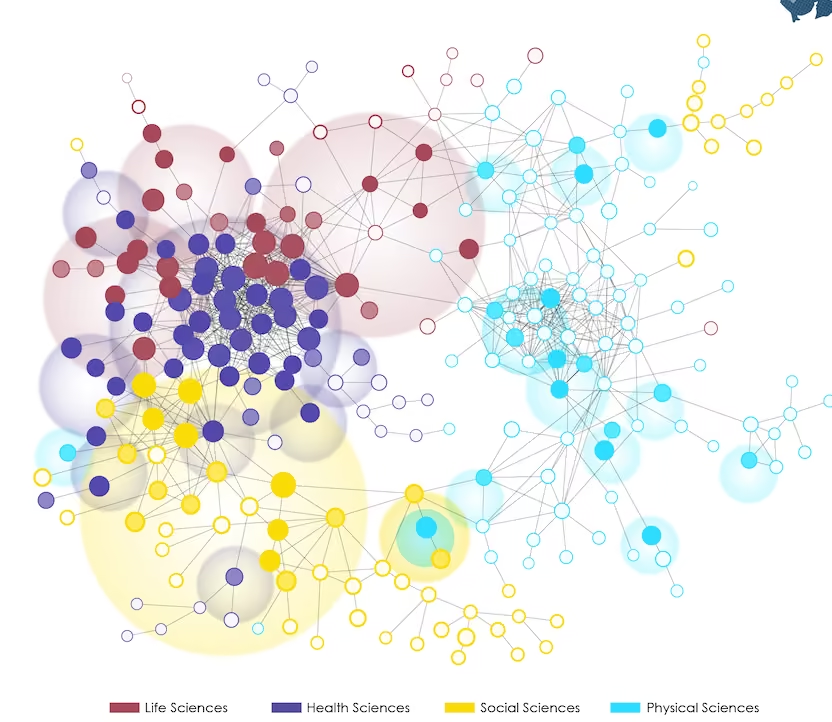
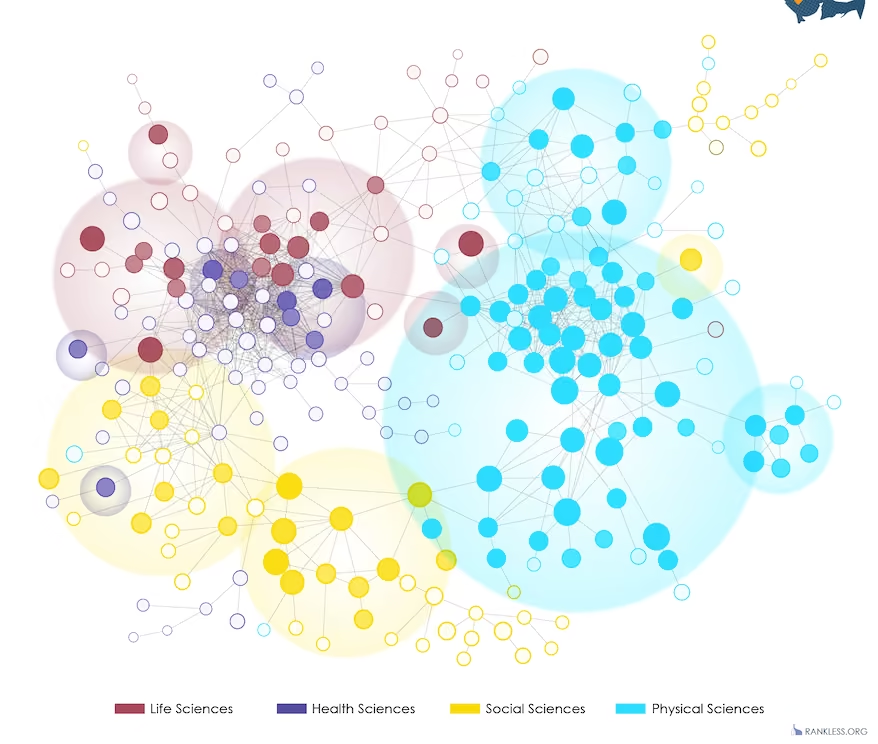
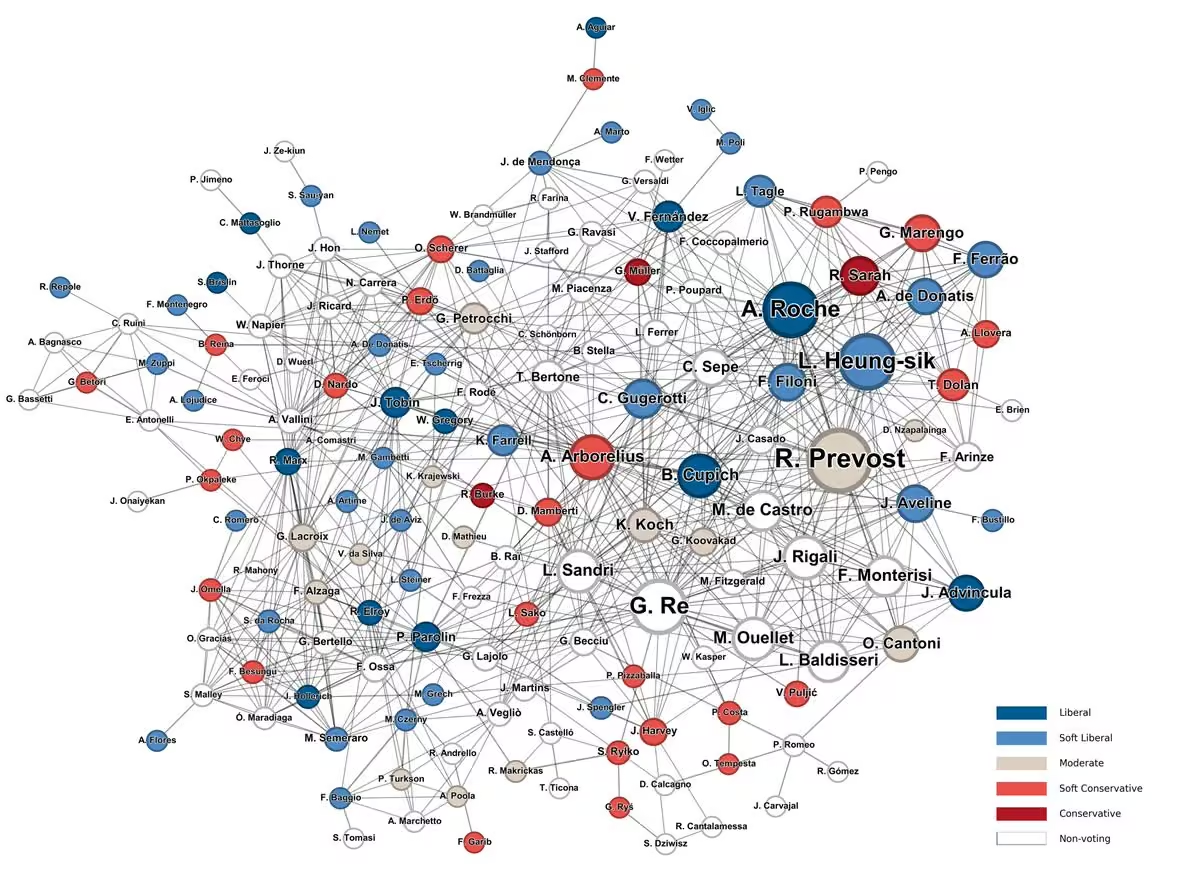
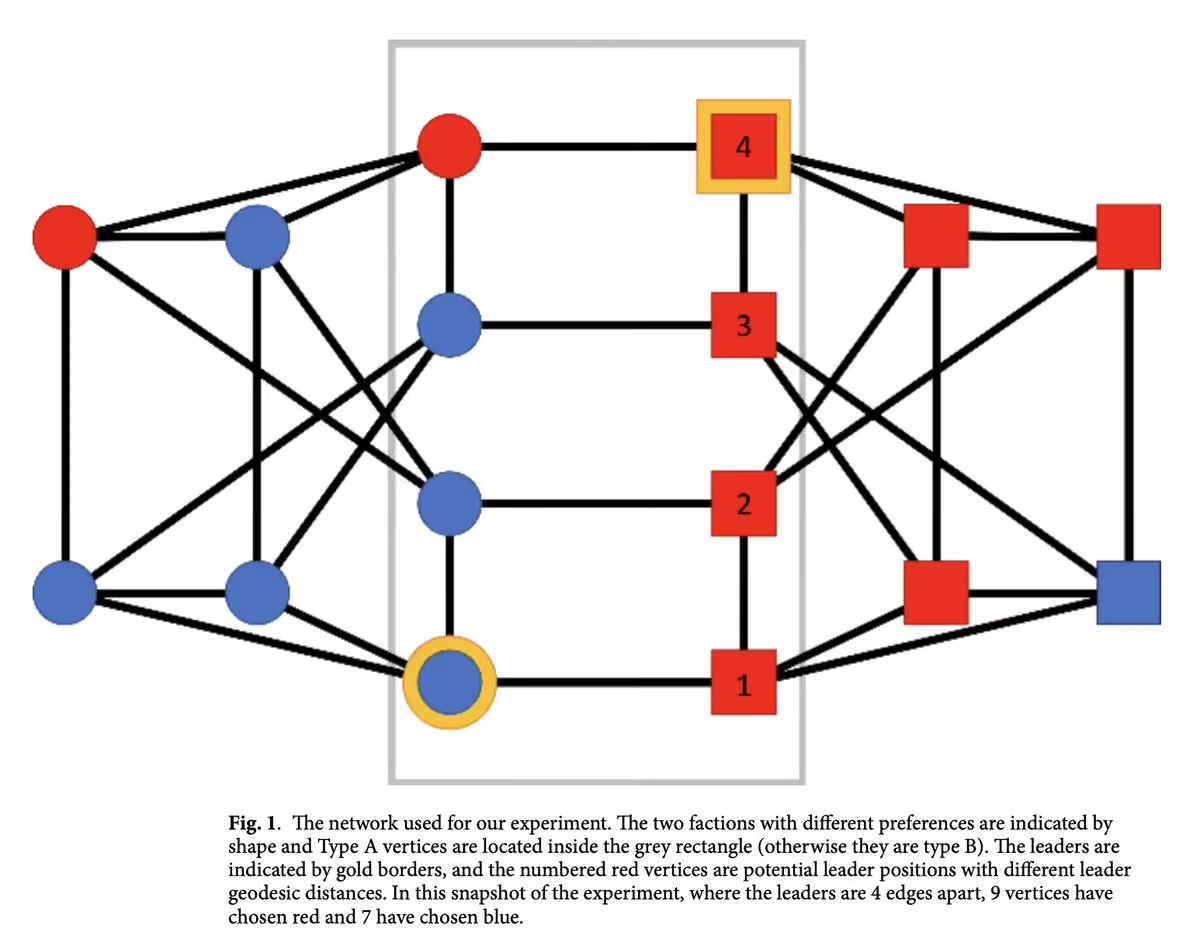
This is one of my favorite scientific figures in computational social science: the Division of Democrat and Republican Party members of the U.S. House of Representatives from 1949–2012. You can see our history in a figure resembling mitosis.
journals.plos.org/plosone/article?id=10.1371/journal.pone…
César Hidalgo
César Augusto Hidalgo Ramaciotti (born December 22, 1979) is a Chilean born, Chilean-Spanish-American physicist, author, and entrepreneur. He is a tenured professor at the department of social and behavioral sciences at the Toulouse School of Economics and director of the Center for Collective Learning, a multidisciplinary research laboratory with offices at the Toulouse School of Economics and at Corvinus University of Budapest. He is also an Honorary Professor at the University of Manchester's Alliance Manchester Business School. Hidalgo is known for pioneering the field of economic complexity by developing concepts and methods such as relatedness and the Economic Complexity Index. He is also known for the creation of public data infrastructure, as a co-creator of The Observatory of Economic Complexity, as well as several national scale economic data visualization platforms including Data USA, Data Mexico, and Data Saudi. Hidalgo works also on applied artificial intelligence and digital democracy. Before moving to France, to found the Center for Collective Learning, Hidalgo was a professor at MIT where he directed the Collective Learning group. He is also a founder and partner at Datawheel, a data visualization and distribution company. More on Wikipedia
-
César A. Hidalgo reposted
Nicholas A. Christakis
@NAChristakis
-
César A. Hidalgo reposted
Francisco J. (Paco) Jariego
@fjjariego
Why does the whole world know Napoleon, but not Bernardo O’Higgins? Physicist César Hidalgo @cesifoti explains the four forces that shape collective memory: technology, territory, tongue, and time.
nautil.us/the-four-forces-that-shape-collective-memory-12… -
César A. Hidalgo
@cesifoti
Seasonal & uncommon, but one of the great benefits of living next to the markets in Toulouse.
-
César A. Hidalgo reposted
pablo
@pablogguz_
imagina que ordenamos en una fila a todas las personas que viven en españa, de la que tiene menos renta a la que tiene más. ¿sabes en qué punto de la fila estarías tú?
intenta adivinar tu posición en la distribución de la renta en comparatuingreso.es 👀This media couldn't be displayed. See it on the original post. -
César A. Hidalgo
@cesifoti
What are the 4Ts of collective memory?
In this interview in Nautilus, I discuss our research agenda uncovering how technology, tongue, time, and territory, shape the information people share about their past.
nautil.us/the-four-forces-that-shape-collective-memory-12… -
César A. Hidalgo reposted
Luis Felipe López-Calva
@LFLopezCalva
Reducing poverty is not only about creating more jobs. It is also about creating better jobs.
A new @WorldBankGroup Policy Research Working Paper by Maurizio Bussolo, @ChristophLakner, and Minh Nguyen provides compelling evidence for this distinction.
Drawing on household survey data from 150 economies covering 96% of the world's population, A Global Profile of Work and Poverty: Two Decades of Evidence examines how employment, education, and the type of work shape poverty outcomes.
One finding stands out: the poor are not necessarily poor because they do not work.
Among workers living on less than $3 a day:
- 79% are self-employed, compared with 35% of nonpoor workers.
- 66% work in agriculture, compared with 20% of nonpoor workers.
- 61% have primary education or less, compared with 25% of nonpoor workers.
The evidence also shows that between 2003 and 2024, improvements in welfare per worker—not increases in employment rates—accounted for the welfare gains among the bottom 60% of the global distribution.
These findings have important implications for development policy. Employment matters, but the quality and productivity of work are central to sustained poverty reduction. Expanding access to education, enabling transitions toward more productive activities, and removing barriers to better-paying jobs are essential. Increasing women's employment also offers significant potential, particularly when considering broader poverty thresholds.
The challenge is not only to bring more people into employment, but to ensure that work becomes a more effective pathway out of poverty.
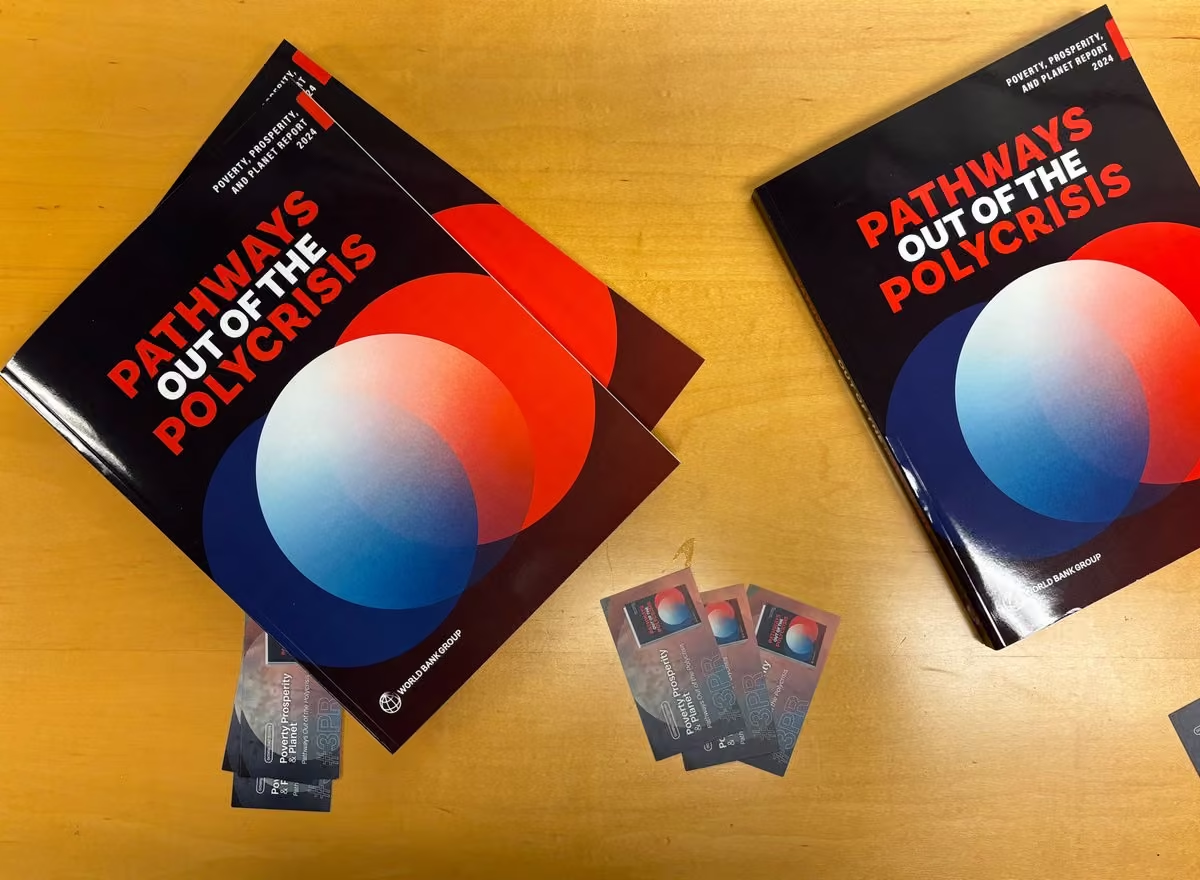
An important contribution to our understanding of the relationship between jobs, productivity, and poverty reduction—and to the evidence underpinning the The World Bank Group's Poverty, Prosperity, and Planet Report 2026: openknowledge.worldbank.org/entities/publication/cdf901e2… -
César A. Hidalgo reposted
Nico Ajzenman
@Nicolas_Ajz
Citizens exposed to populist regimes develop persistent zero-sum beliefs about the world.
That’s what we show with Harry and Cevat.
VoxEU
@voxeu
Coming of age under populists: The zero-sum legacy of populist rule
Nicolas Ajzenman @Nicolas_Ajz @mcgillu @JPAL, Cevat Giray Aksoy @cevatgirayaksoy @EBRD @Kingspol_econ, Harry Pickard @UniofNewcastle
cepr.org/voxeu/columns/coming-age-under-populists-zero-su… -
César A. Hidalgo reposted
Peter John Lambert
@pj_lambert
Who pays for AI? In a new working paper, we study this using banking data covering billions of transactions to see who pays for tools like ChatGPT, Claude, Gemini, etc. We find that 1-in-20 UK adults now pay for AI, representing a $1.4 billion market annually. (1/N)
-
César A. Hidalgo reposted
Owen Queen
@oq_35
1/n Within 15 months of publication, most of the LLM claims we tested either no longer held or showed substantially diminished effects. How long does our knowledge of AI hold up? In our new study, we revisit 50 findings to see what fades, what persists, and what gets stronger. 🧵
-
César A. Hidalgo reposted
Andrés Rodríguez-Pose
@rodriguez_pose
Europe’s productivity race, 2001–21: capitals +20%, other metros +10%, non-metros +18%. However, @proiettpaola, @DijkstraLewis & @kompilmert show in the Annals of Regional Science that many cities coast on past #productivity while their engines lose speed.
doi.org/10.1007/s00168-026-01553-z -
César A. Hidalgo
@cesifoti
“…Nordhaus wanted to know how much of the value created by innovation stays with the innovator. He crunched the numbers for American companies, outside of agriculture, between 1948 and 2001. The answer: about 2.2%. The rest went to society, especially to consumers, in the form of lower prices and better products.
For every 100 euros of value that an innovator creates, they keep just a little over 2. We get the other 98….”
Pedro Santa Clara
@psantacl
Morreu William Nordhaus, aos 85 anos.
Ganhou o Nobel da Economia em 2018, partilhado com Paul Romer, por trazer as alterações climáticas para a macroeconomia. Gerações de estudantes aprenderam economia pelo manual de Samuelson e Nordhaus. Mas o meu artigo preferido dele é outro: "Schumpeterian Profits in the American Economy: Theory and Measurement", de 2004.
Nordhaus quis saber quanto do valor criado pela inovação fica com quem inova. Fez as contas para as empresas americanas, fora da agricultura, entre 1948 e 2001. A resposta: cerca de 2,2%. O resto foi para a sociedade, sobretudo para os consumidores, em preços mais baixos e produtos melhores.
Por cada 100 euros de valor que um inovador cria, fica com pouco mais de 2. Nós ficamos com os outros 98.
Julian Simon passou a vida a insistir nisto: quem inventa e empreende deixa o mundo muito mais rico do que o encontrou.
Convém lembrá-lo sempre que alguém propõe tributar pesadamente as fortunas dos empreendedores, como se fossem um peso para a sociedade. O inovador já fica com uma fatia mínima do valor que cria. Taxar essa fatia rende pouco e põe em risco tudo o resto.
Quem fez fortuna a inovar não é um fardo social. É o maior benfeitor da sociedade, e cobra por isso pouco mais de 2%. -
César A. Hidalgo reposted
RePopulus🇬🇷
@PopulusRe
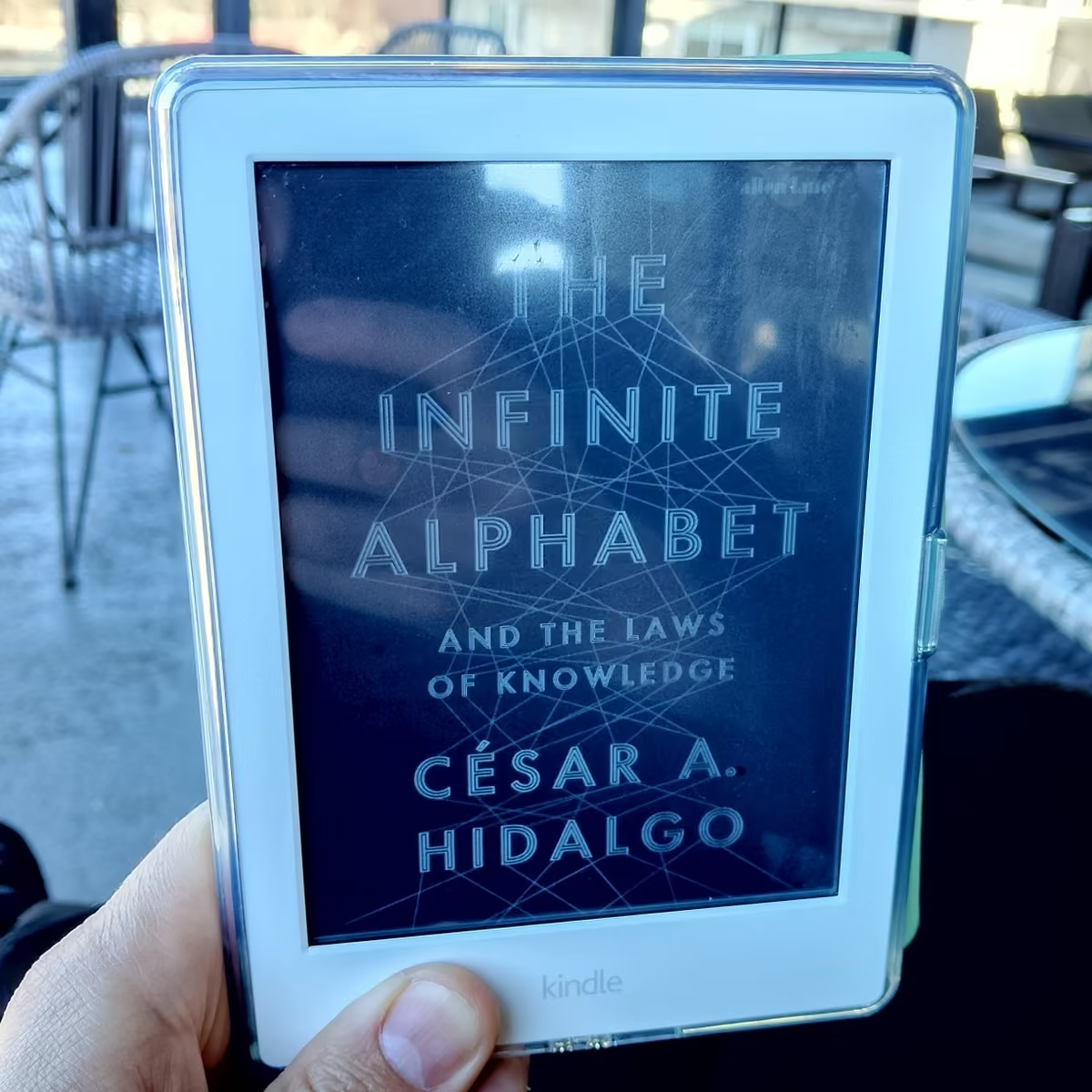
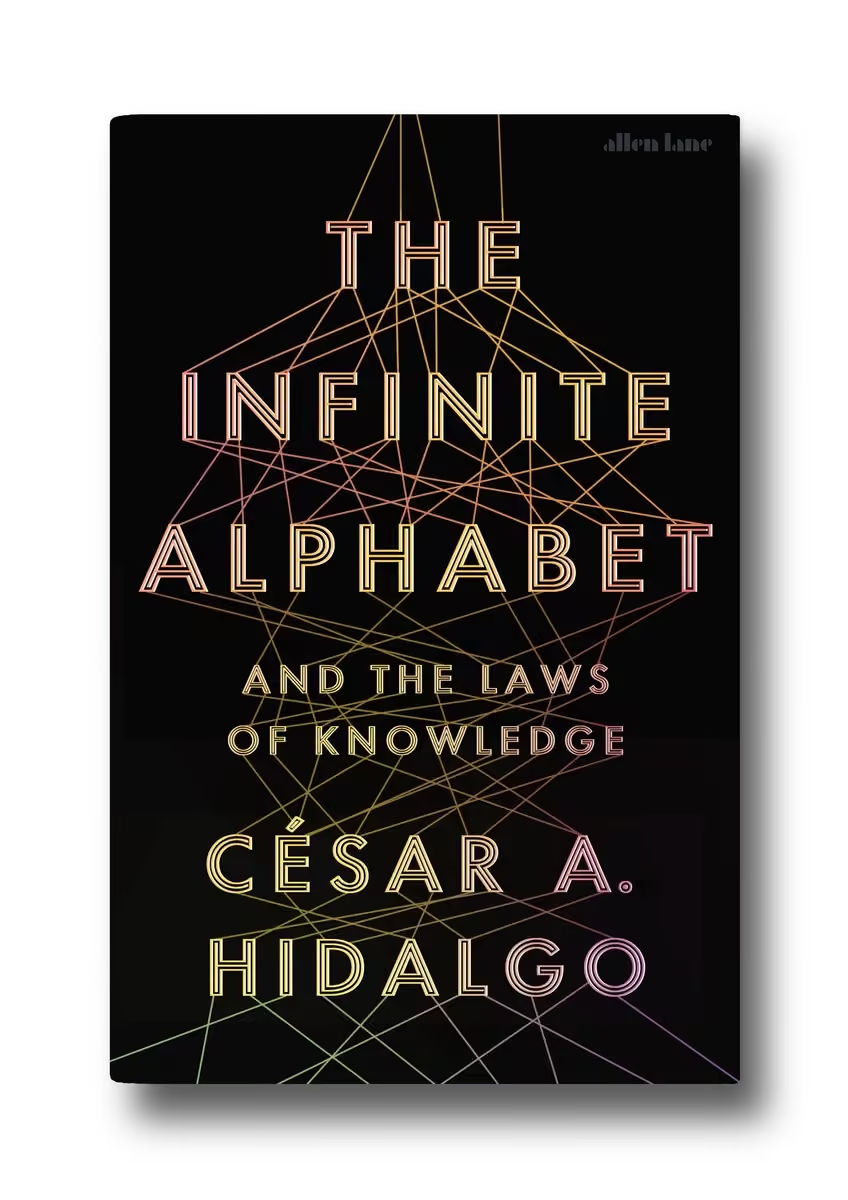
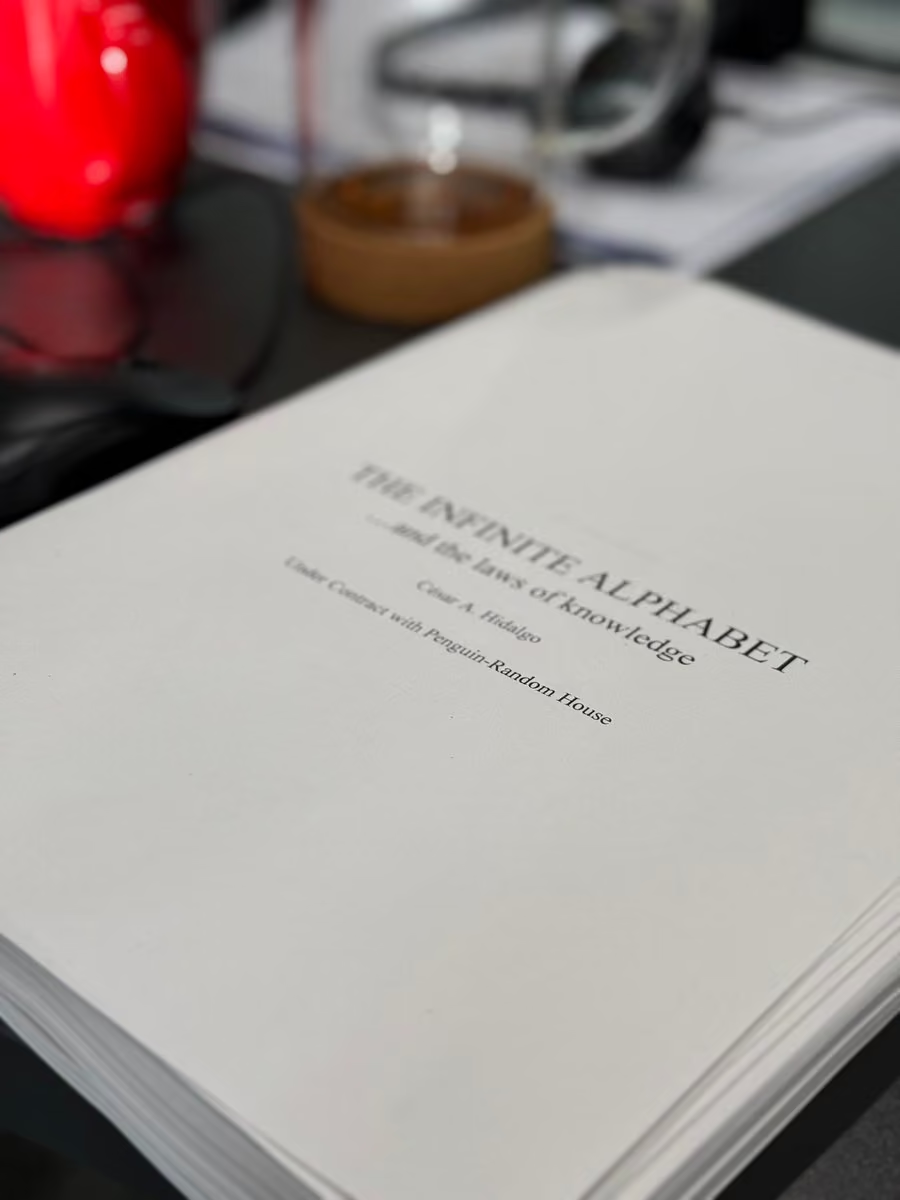
Excellente lecture du jour: «The infinite alphabet», de César A. Hidalgo, chez Penguin press
-
César A. Hidalgo
@cesifoti
These results cut deep.
When students ask me how to choose a research project, I tell them to look at the intersection of three properties: rigor, relevance, and surprise.
Good research is relevant and rigorous, but also unexpected. Otherwise, it just confirms something people already intuit.
But surprise is not just a matter of taste. It is a core idea in information theory. An unexpected yet verifiable result carries more information than one we anticipated.
As scholars, we are trained to argue that our results are at least a bit unexpected in the introduction of our papers. In social science papers, we usually do this using the classical trick of the two-handed economist.
But an LLM forecast is very different from a narrative argument. It provides a quantitative expectation of what a study might find.
Eva's results show that forecasts on treatment effects of pre-registered studies can be quite accurate. This suggests these forecasts could become part of the preregistration.
In other words, we could start preregistering surprise.
Of course, not all valuable research needs to be counterintuitive or surprising (this applies mostly to breakthroughs). Replication and precision matter too. But these forecasts could help us distinguish between results that confirm our expectations and those that challenge them.
Great job on this, Eva! I think there's a lot of potential here.
Eva Vivalt
@evavivalt
New working paper: Can AI forecast treatment effects in economics from pre-registration documents?
Answer: Yes. 1/ -
César A. Hidalgo reposted
Vincent Geloso
@VincentGeloso
The AI response may well be imperfect, but it does raise a legitimate concern: your choice of which criticisms to engage with seems to consistently lean in one direction. Which is the criticism I made for years in many peer-reviewed papers.
Rather than focusing on the AI response, appeals to authority, or rhetorical flourishes, I would welcome a substantive engagement with the arguments that Phil Magness (@PhilWMagness) and I have developed across multiple papers, which have so far gone largely unanswered.
The same applies to the work of Auten and Splinter, Josh Rauh, and Sylvain Catherine.
I think there is a basic principle of scholarly debate at stake here. It is difficult to invoke the importance of serious academic criticism while declining to engage with substantive objections from researchers who have devoted considerable effort to examining your work. This is particularly true when those objections are sometimes characterized in ways that do not accurately reflect the arguments being made.
We are serious scholars raising serious questions. Surely, it is reasonable to expect that these arguments receive the same consideration as criticisms you have chosen to address.
I am not asking for much—simply a fair and substantive engagement with our actual arguments. Ignore how mean Tyler was to you. That is not important to scholarship debates!
Gabriel Zucman
@gabriel_zucman
Hello @elonmusk and @tylercowen ,
You have just decided to publicly attack our research, six days before the vote on the California billionaire wealth tax.
Your attempt to discredit our work and that of our numerous academic colleagues is pathetic.
Let’s take a look. 🧵 -
César A. Hidalgo reposted
Erwin Aksa
@erwinaksa_id
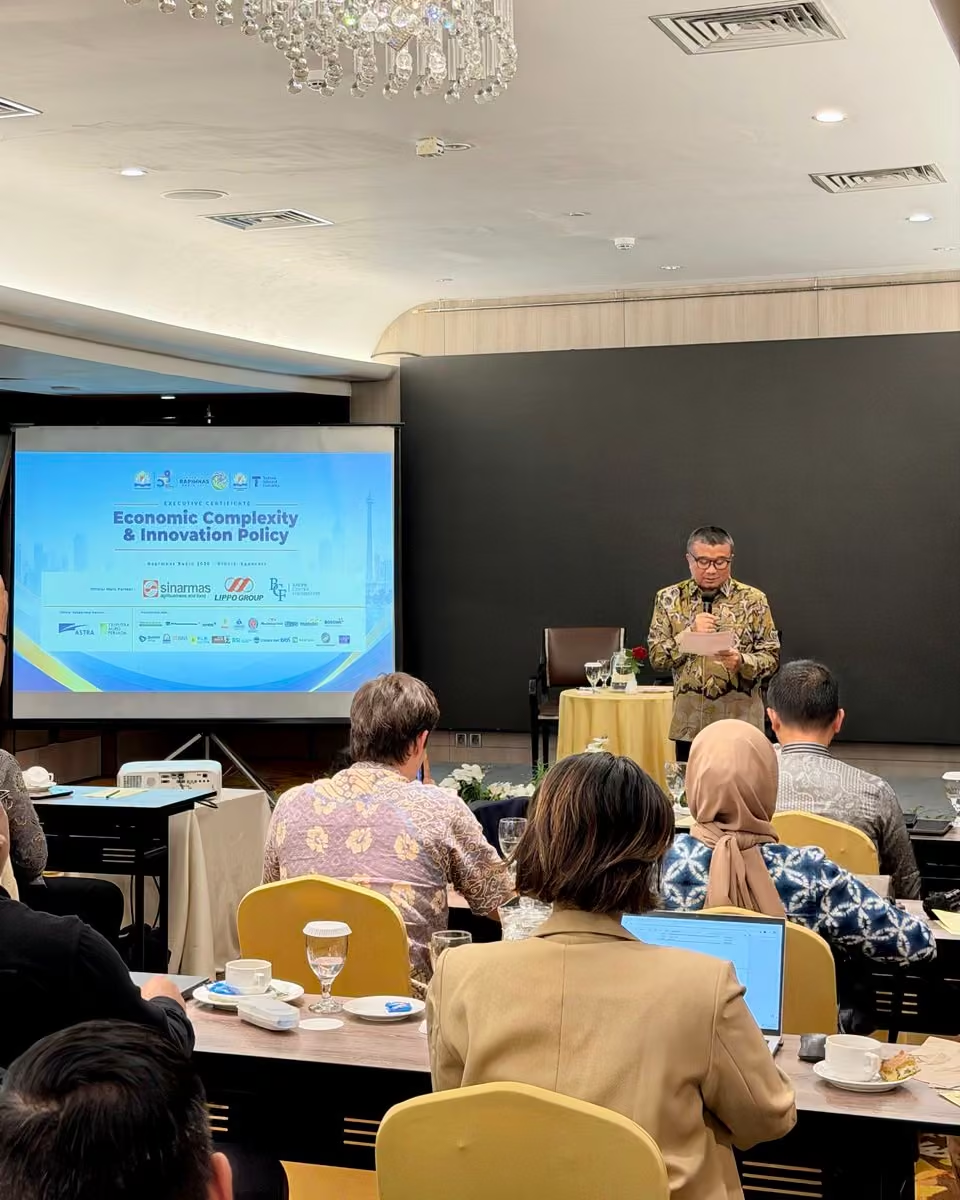
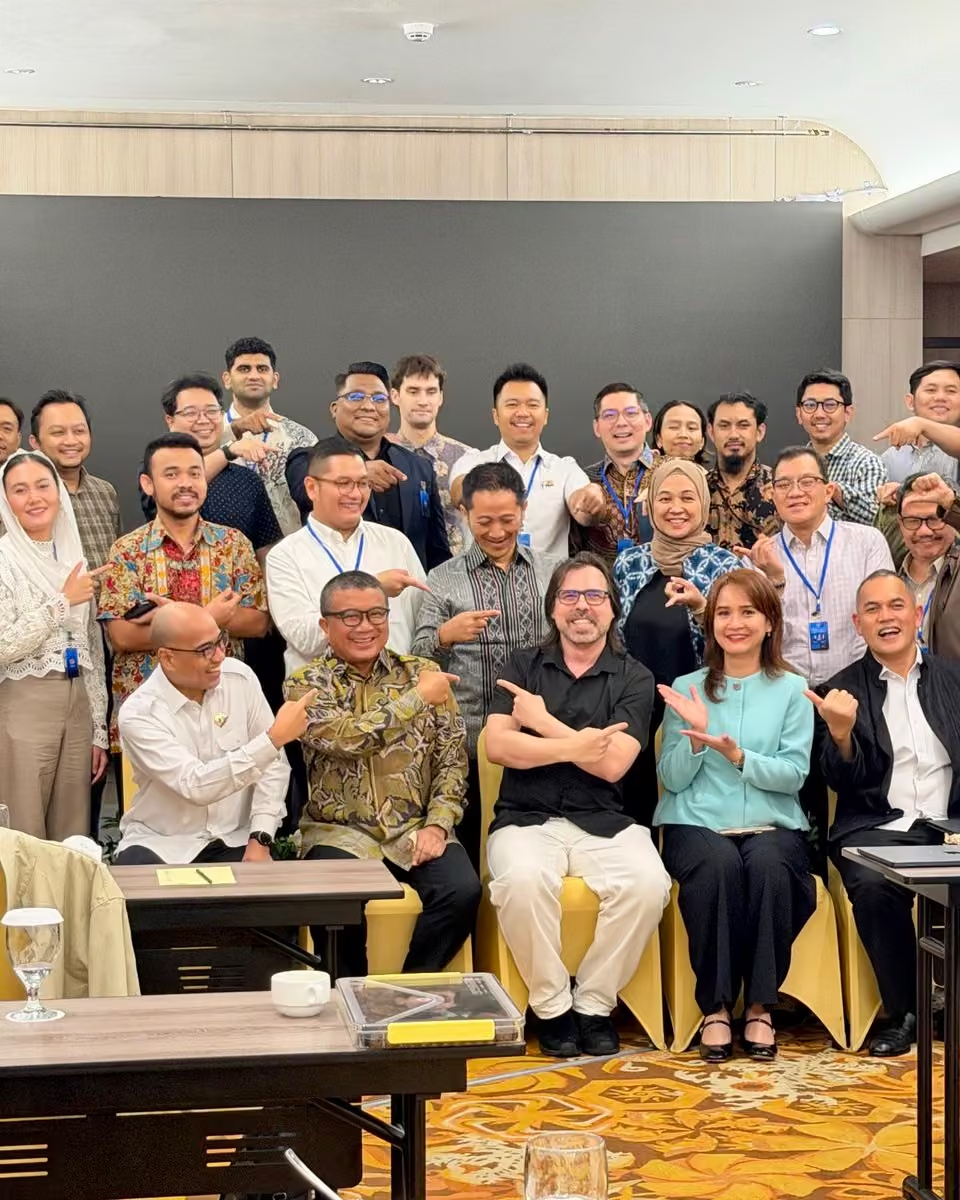
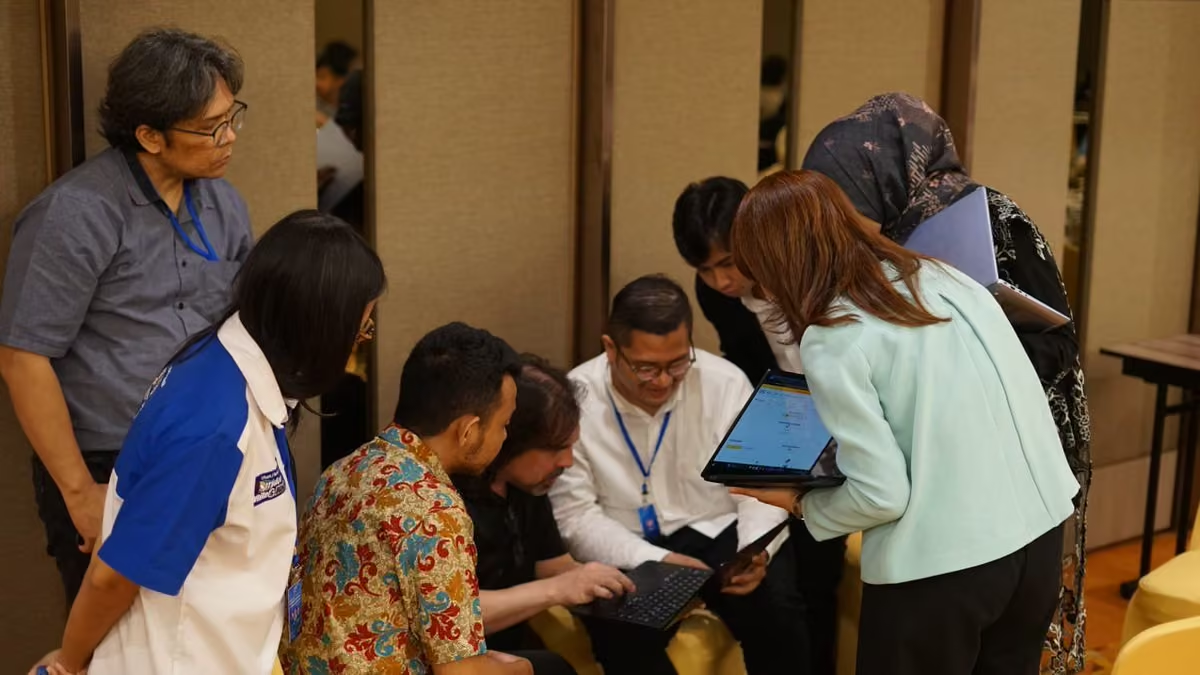
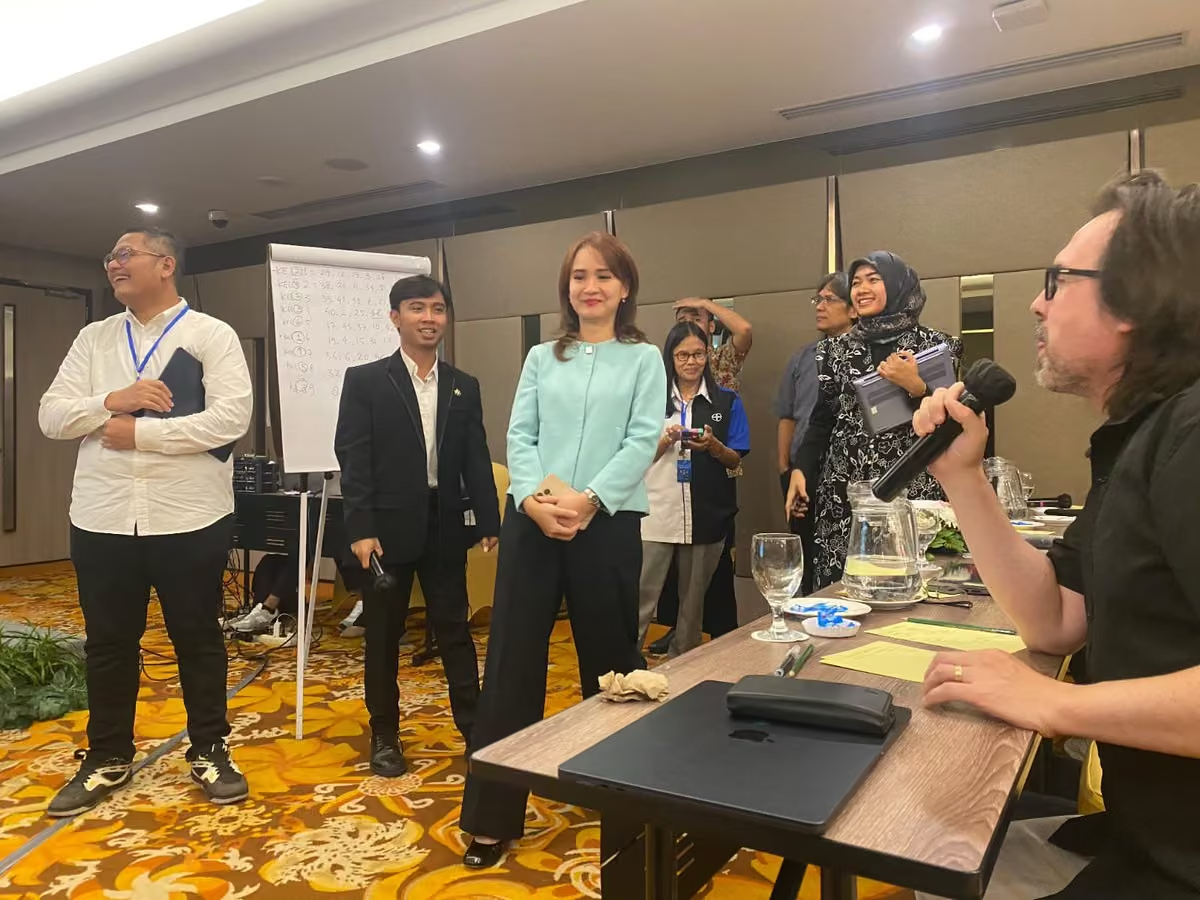
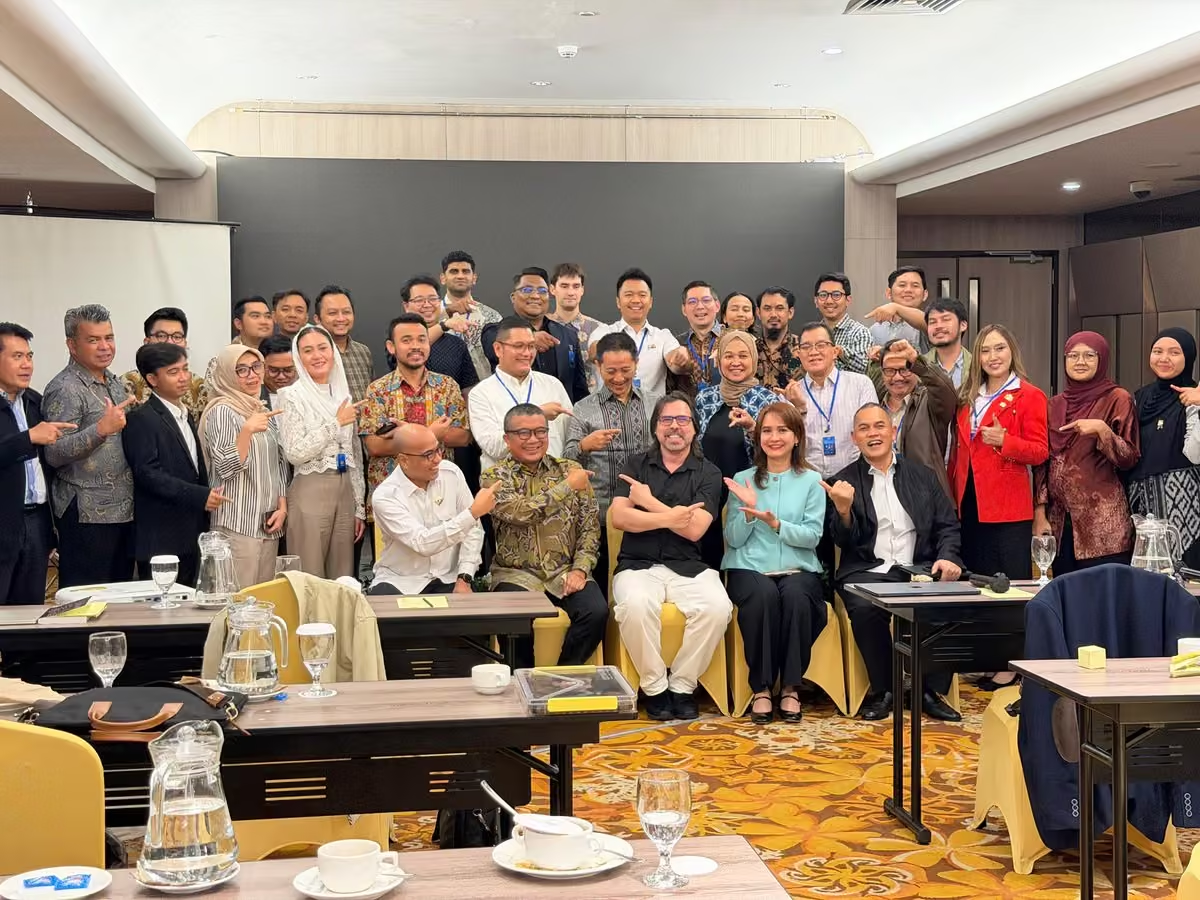
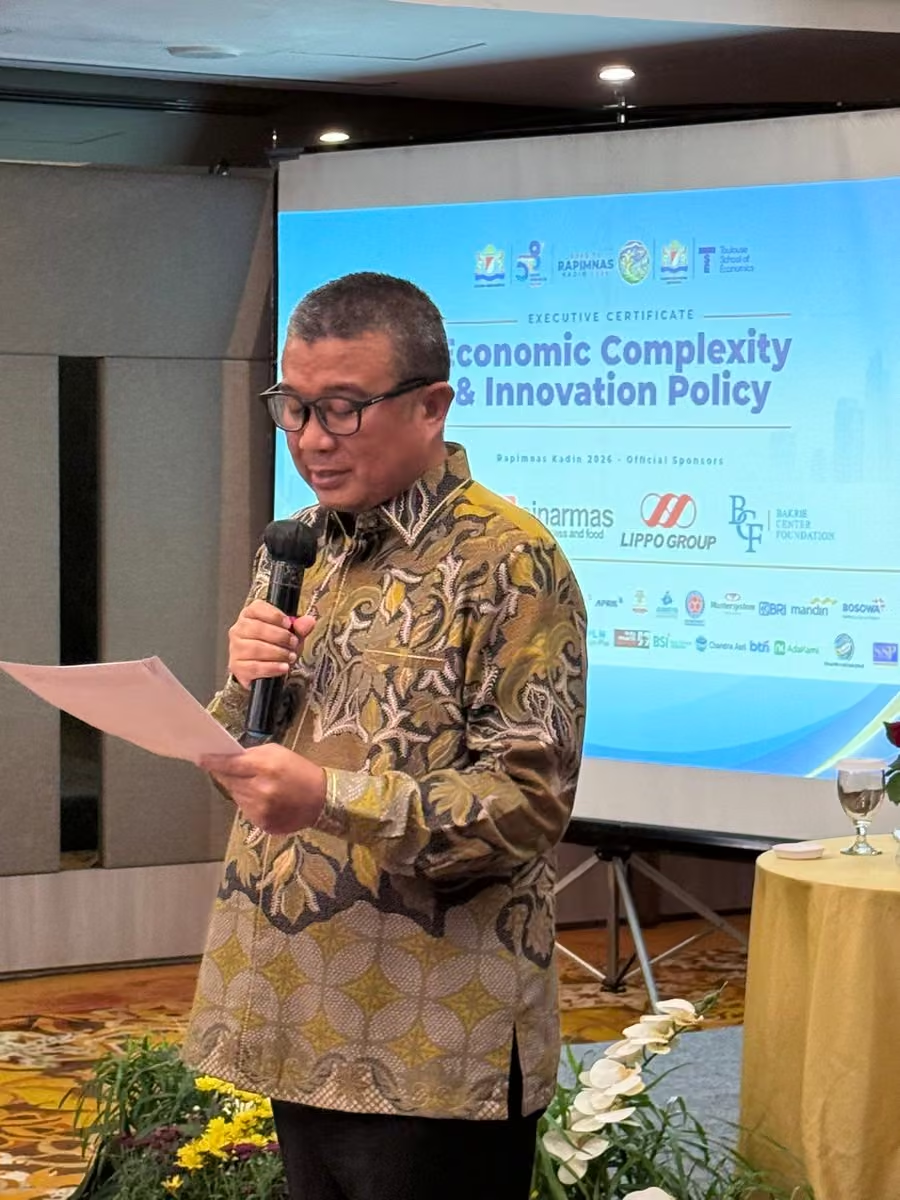
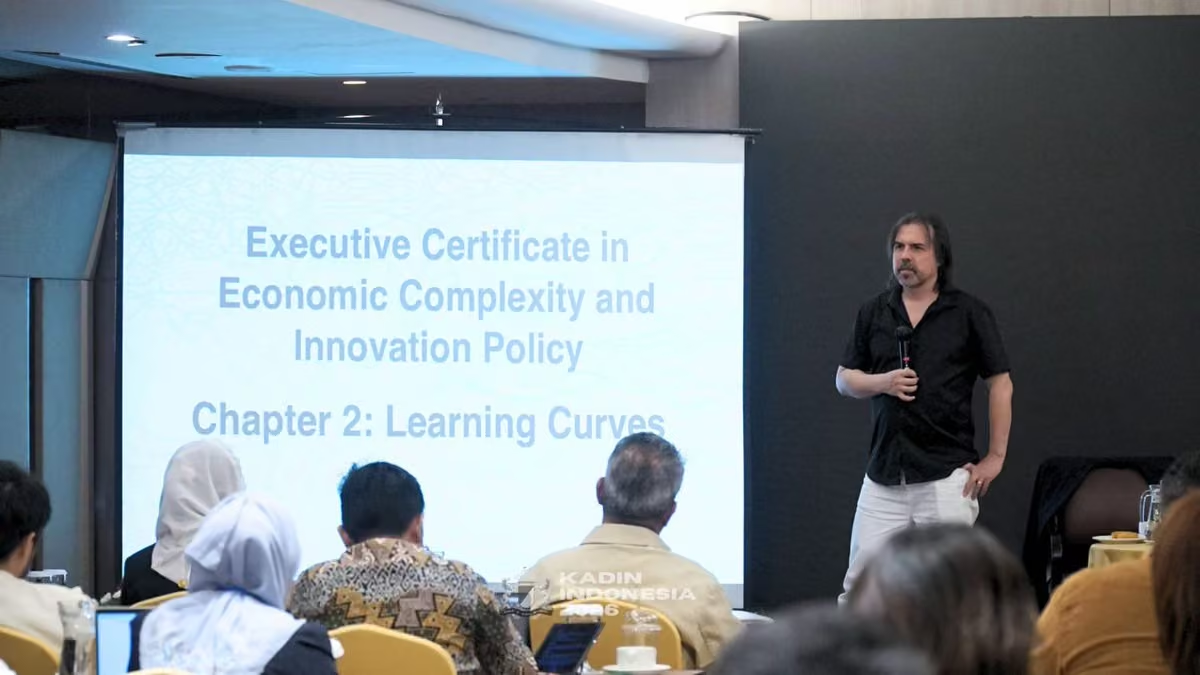
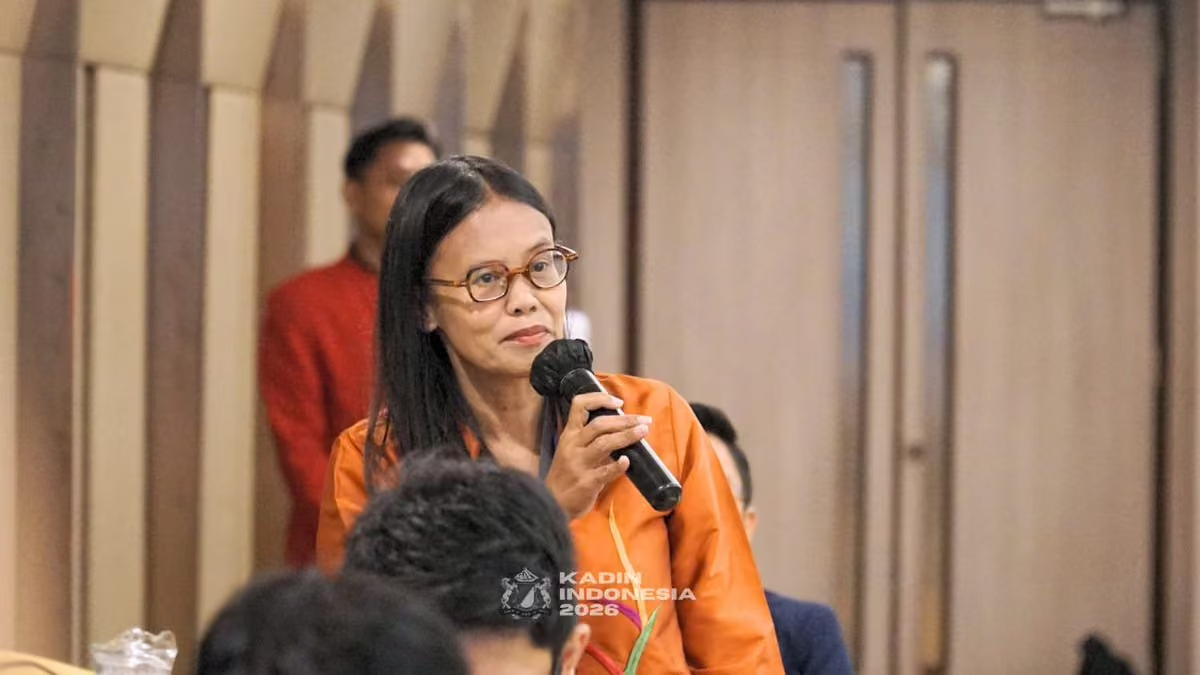
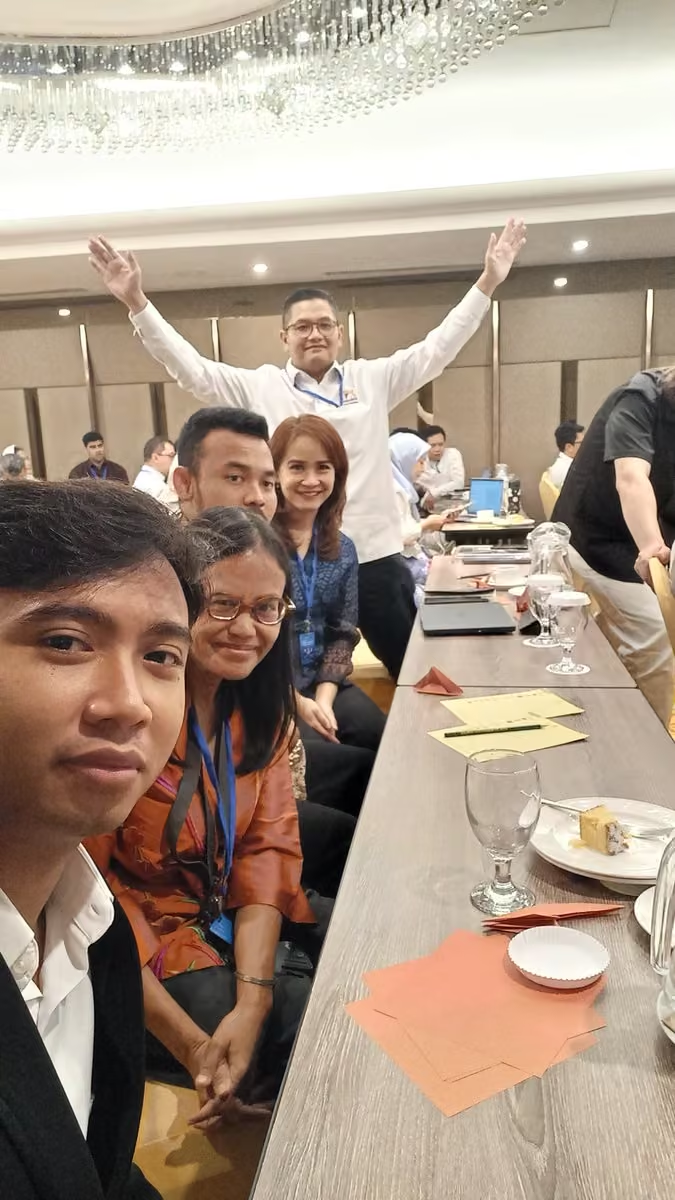
Rangkaian Executive Course: Economic Complexity and Innovation Policy yang diselenggarakan oleh Kadin Indonesia Institute resmi berakhir setelah tiga hari pembelajaran bersama Prof. César A. Hidalgo.
#erwinaksa #ea -
César A. Hidalgo reposted
Enita Robentrop
@AIADigibuy
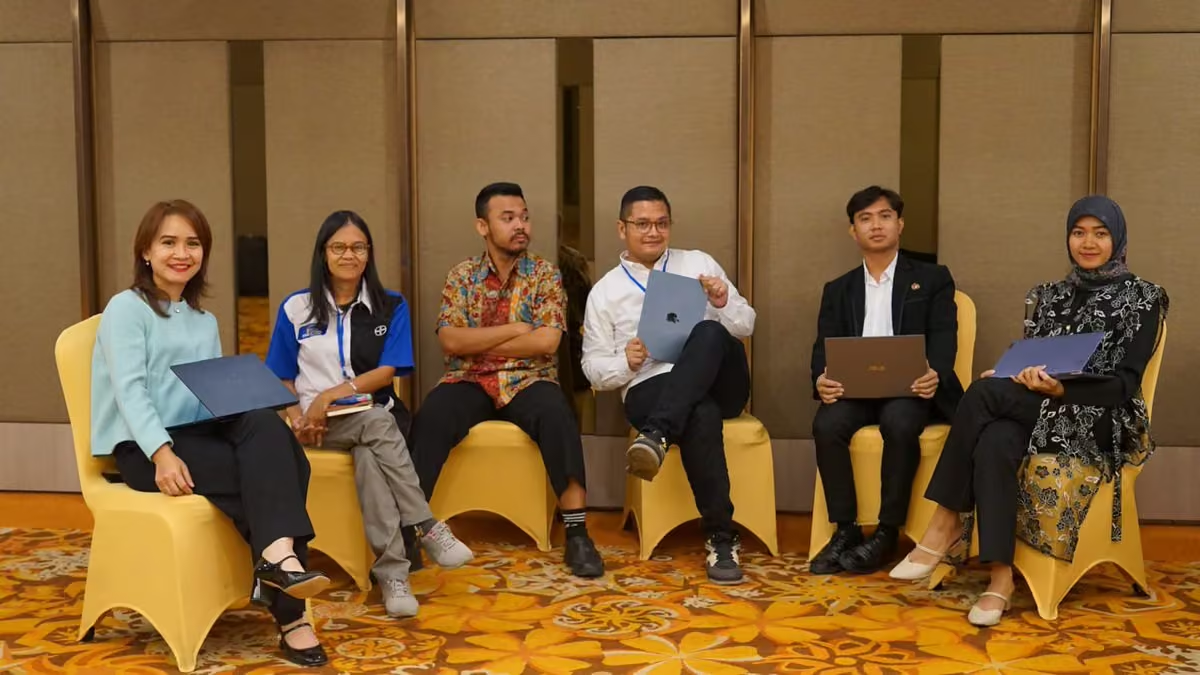
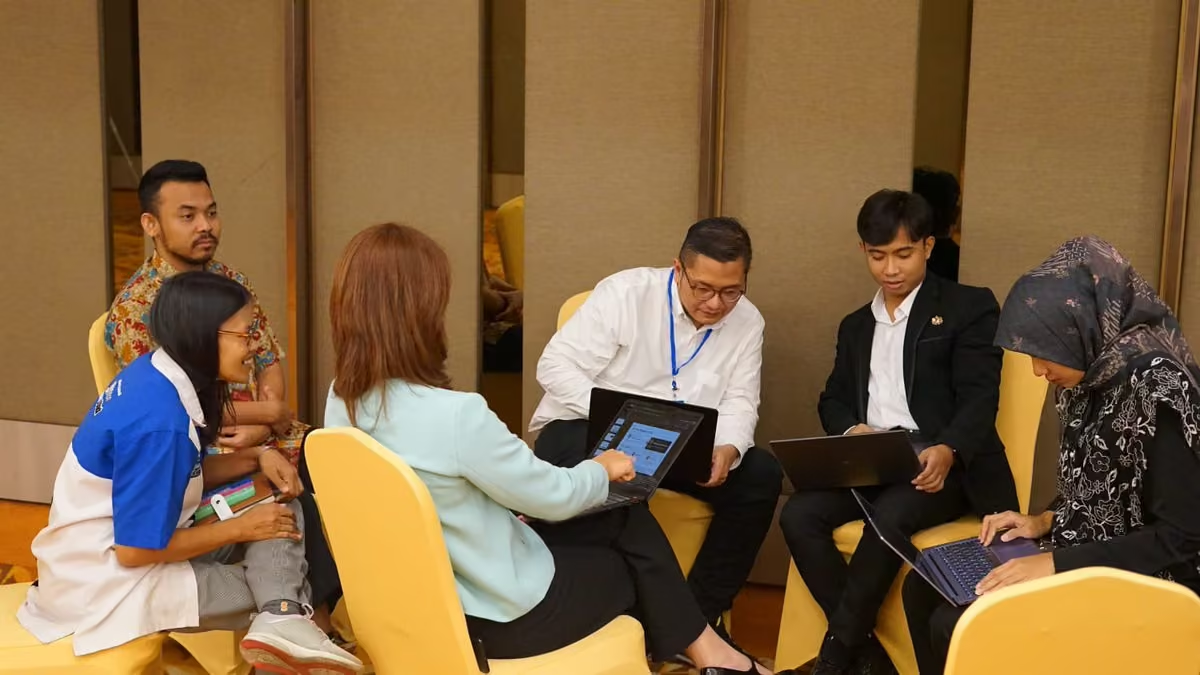
I completed learning & exam by paper with team eightfinity for an executive course on economic complexity & innovation policy to 42 enthusiastic professionals.
@Kadin_Indonesia @cesifoti -
César A. Hidalgo reposted
Eva Vivalt
@evavivalt
Personally, I also wonder a little at what we are doing in economics if treatment effects can be forecast so well.
Part of it is surely that many treatments have very small effects.
But can we not shift to working on those projects that have particularly high uncertainty and upside potential? 6/ -
César A. Hidalgo
@cesifoti
One thing is to see economic growth from afar, when countries are statistics. Another is to see it in the field, when you visit a high-growth economy amidst a period of intense structural transformation.
This trip to Indonesia has been a great reminder that economic growth is not an abstract phenomenon, but a heartfelt reality filled with teamwork and dedication.
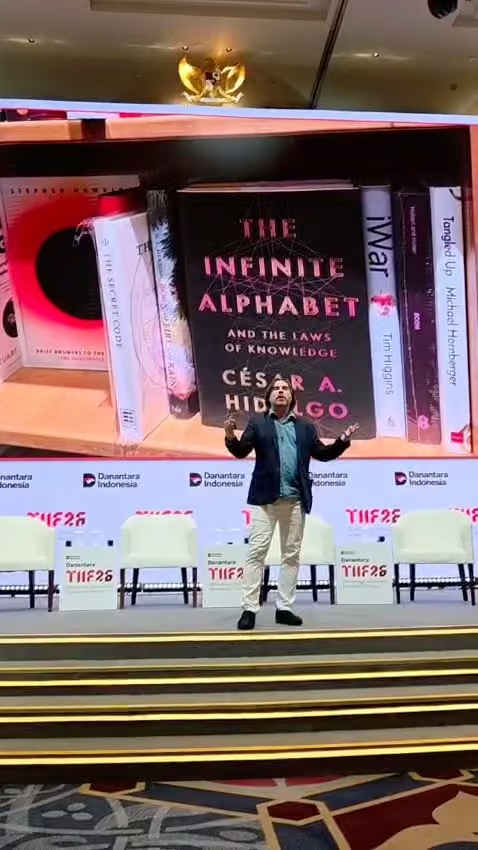
I landed in Jakarta on Saturday night and since then I completed teaching an executive certificate on economic complexity and innovation policy to 42 enthusiastic professionals. I also had a chance to keynote Danantara’s tech forum, a big stage event organized by the organization coordinating all of the country’s SOEs.
Thanks to @erwinaksa_id and the team at @Kadin_Indonesia for opening the doors to this wonderful country. -
César A. Hidalgo
@cesifoti
This is serious and awful behavior from Meta.
Jay Van Bavel, PhD
@jayvanbavel
Meta had an internal PR plan to try and discredit Jon Haidt because he was a critic of social media.
Meta was going to recruit academics, like Andrew Gelman, to write take down pieces. They were trying to turn academics against one another through a "whisper strategy".
This is a very serious problem for open academic debate. If academics who share negative evidence about a platform are targeted by campaigns to smear our credibility, we are in deep, deep trouble.
This creates a very serious conflict of interest for anyone who is paid to do this.
www.law360.com/articles/2542517/meta-docs-reveal-plan-to-… -
César A. Hidalgo reposted
Enita Robentrop
@AIADigibuy
Executive Course: Economic Complexity & Innovation Policy yang diselenggarakan oleh Kadin Indonesia Institute.
Pionir Observatory of Economic Complexity
@cesifoti
@Kadin_Indonesia
@erwinaksa_id -
César A. Hidalgo reposted
David M. Sabatini
@DMSabatini
More damning evidence. It's all in 100s of public documents
ScienceGuardians
@SciGuardians
🚨 BOMBSHELL COURT EVIDENCE EXPOSES INSIDER INFLUENCE OVER MIT'S TENURE-REVIEW PROCESS IN THE DAVID M. SABATINI ORDEAL.
🔱 NEW REVELATION — Court evidence exposes MIT Professor Sangeeta Bhatia's involvement in the selection of Sabatini's tenure-review committee
On 27 September 2021, Kristin Knouse exchanged messages with Izabella Pena following a conversation with @MIT Professor Sangeeta Bhatia.
The court-disclosed messages reveal Kristin Knouse telling Izabella Pena:
🔴 “Sangeeta just called”
🔴 “they even asked for insight into who to put on the committee”
🔴 “AND she said she will go to Rafael Reif’s office and protest the decision if and when needed.”
Pena responded:
“At least they are asking her insight”
Knouse replied:
“Exactly”
“This is good”
⚠️ The evidence exposes a troubling channel of insider influence surrounding MIT's tenure-review process.
These contemporaneous communications document that Knouse understood Bhatia to have been consulted about the committee's composition and to be prepared to challenge its eventual decision directly with MIT President Rafael Reif.
Rather than an independent review insulated from interested parties, the messages reveal access to the committee-selection process by an academic aligned with the complainant, raising serious concerns about institutional impartiality and conflicts of interest.
This disclosure adds another significant piece to the growing documentary record surrounding the institutional handling of Professor @DMSabatini's case.
📑 REVIEW THW ORIGINAL COURT EVIDENCE BELOW.
🔱 ScienceGuardians™ Legal and Investigative Team
MORE COURT EVIDENCE. MORE REVELATIONS. STAY TUNED. ⚠️
@SciGuardians 🔱 -
César A. Hidalgo reposted
Geoffrey Miller
@gmiller
The factoid that '50% of marriages end in divorce' was kinda true decades ago.
But the divorce rate peaked in 1980.
Now, less than 40% of all marriages since 2000 end in divorce.
For college graduates, it's under 30%.
For college graduates who get married after age 25, and who don't have any kids before marriage, it's under 20%.
Anybody promoting the outdated, deceptive 50% rate has some kind of anti-marriage or anti-natalist agenda.
It scares young people away from getting married and having kids. That is their goal.
Jake Kozloski
@jakozloski
the american divorce rate is at its lowest in over 50 years
congratulations to the 16% of 18-29 year olds who are married -
César A. Hidalgo
@cesifoti
Shouldn’t this be something that we could solve easily with AI?
(Eg an AI connected buzzer or light)
BrickCenter
@BrickCenter_
No such thing as traveling in the NBA anymore 😭
-
César A. Hidalgo
@cesifoti
This form of long-term support is something we rarely see in innovation policy. Bold move and something to follow over the next decades 👇
“The NSFC first announced plans to create 15-year grants in 2023, stating that initial 5-year grants would be worth 4 million yuan (US$596,000), they would then double to 8 million yuan for the second 5 years, and then double again to 16 million yuan for the final 5 years.”
nature
@Nature
China has selected its first group of young researchers to receive funding for up to 15 years, in one of the longest research grants on offer to scientists globally
go.nature.com/4z4Q3pw -
César A. Hidalgo reposted
Philip Oldfield
@SustainableTall
One of the most committed examples of tree retention I’ve seen…
In Istanbul’s Golden Horn redevelopment -
César A. Hidalgo reposted
Gary King
@kinggary
New paper: "AI Article Reviews Dominate Human Peer Reviews at Their Best: Evidence and Policy Choices" See: garyking.org/peerless. with Steven Worthington. Comments welcome!
-
César A. Hidalgo reposted
Joshua Rauh
@joshrauh
Gabriel Zucman @gabriel_zucman has now for the third time criticized our research on California’s proposed billionaire tax, claiming we have provided “no answer” to his criticisms.
x.com/gabriel_zucman/status/2112988785587925321
We have actually already responded twice on this platform, but let’s address his arguments once more in detail, with the hope that third time’s the charm. 1/14
Gabriel Zucman
@gabriel_zucman
This Hoover Institution study, which has fueled the deluge of ads (more than $200 million spent by billionaires so far) to defeat the California billionaire tax, is spectacularly misleading.
Let me explain its crucial flaw. 🧵
NBER
@nberpubs
California's Billionaire Tax Act would collect roughly $30 billion. Accounting for lost income taxes from departures, the mean Net Present Value is negative $39 billion, from Benjamin Jaros and Joshua Rauh www.nber.org/papers/w35899
-
César A. Hidalgo
@cesifoti
PHP problems?
Datawheel-built open data platforms continue to operate without hiccups.
🇺🇸 Data USA (datausa.io)
🇲🇽 Data Mexico (datamexico.org)
🇸🇦 Data Saudi (datasaudi.sa)
🇧🇷 Observatorio Sebrae (observatorio.sebrae.com.br)
🇪🇸 Observatorio Cotec (complejidadeconomica.cotec.es)
🌎 The Observatory of Economic Complexity (oec.world)
🇺🇸 Healthy Communities North Carolina (healthycommunitiesnc.org)
🌍 Pantheon (pantheon.world)
And many more :) -
César A. Hidalgo reposted
Jay Van Bavel, PhD
@jayvanbavel
If people think a chatbot has a political bias, it becomes less effective
A new paper examined the power of AI chatbots to correct economic misperceptions. The conversation corrected misconceptions, but a short message indicating that the model was biased against the respondent's political party reduced this correction by 28%
It also reduced trust in and willingness to use AI
This suggests that factual information is not the complete story when it comes to the persuasive power. Partisan beliefs about AI might have big implications for it's efficacy
academic.oup.com/pnasnexus/article/5/10/pgag324/8898473?l… -
César A. Hidalgo reposted
Yajie Wang
@steven_Yjwang
I saw something similar as an undergraduate in China: students queued before the library opened at 8 am to secure seats, arriving earlier and earlier. The university added guards to manage the crowd, but not more seats. The shortage remained, and we paid with time.
César A. Hidalgo
@cesifoti
Why are French university students lining up for lunch at 11am when the cafeteria opens at noon?
I took this picture on my way to work this morning because it is a good lesson in “shadow prices.”
In May, France extended €1 university meals to all students. Previously, those not eligible for assistance paid €3.30.
The result was not cheaper meals, but shortages.
Demand surged, and students now queue an hour or more in advance to secure their lunch. What they used to pay with money, they now pay with time.
And this is a lesson in shadow prices. It tells us that students are willing to sacrifice an additional hour to save €2.30, so they are implicitly valuing their time at €2.30 an hour or less.
That's awful. 11 am is one of the best times to study. You are alert, but not yet tired. Even if a fraction of them studied at this time, there could be more value than the one saved by the “cheaper” meal.
While the government did provide €50 million in additional funding for 2026, for a system serving more than 3 million higher-education students (about 8 cents per student per day), the problem illustrates something deeper about France.
Don't get me wrong. I love living here, and I work hard every day to contribute to this country. But too many French institutions operate as though people's time were free.
It is a system where enormous resources flow through the state, and simple transactions are replaced by forms, permissions, and waiting. People grow accustomed to this dependency, sometimes even demanding more of it.
The implicit message of the system is that your time is cheap, your initiative is unwelcome, and your ability to decide for yourself is something to be managed.
It is a sad situation because I genuinely believe France can be one of the best places in the world to live.
But people are tired. And I'm not talking about those who looted sporting goods stores and vandalized public buildings over the weekend. I'm talking about the butchers, bakers, and produce sellers I meet every week at the market. The small antique dealers who worry that a mob could destroy the little capital they have. I talked to many of them yesterday. They are scared and they know there is nothing for them to do other than hide.
A country that values its people should value their time.
Vive la France! -
César A. Hidalgo reposted
David M. Sabatini
@DMSabatini
A huge part of my story is @IOCBPrague, an inst. in a city I had never visited. They gave me a lab, Dir @konvalinka_jan defended me on TV, & the fearless Dr. Keckesova took arrows for me. IOCB launched @IOCBBoston with support from @BillAckman et al and bold lab members joined me
-
César A. Hidalgo
@cesifoti
Why are French university students lining up for lunch at 11am when the cafeteria opens at noon?
I took this picture on my way to work this morning because it is a good lesson in “shadow prices.”
In May, France extended €1 university meals to all students. Previously, those not eligible for assistance paid €3.30.
The result was not cheaper meals, but shortages.
Demand surged, and students now queue an hour or more in advance to secure their lunch. What they used to pay with money, they now pay with time.
And this is a lesson in shadow prices. It tells us that students are willing to sacrifice an additional hour to save €2.30, so they are implicitly valuing their time at €2.30 an hour or less.
That's awful. 11 am is one of the best times to study. You are alert, but not yet tired. Even if a fraction of them studied at this time, there could be more value than the one saved by the “cheaper” meal.
While the government did provide €50 million in additional funding for 2026, for a system serving more than 3 million higher-education students (about 8 cents per student per day), the problem illustrates something deeper about France.
Don't get me wrong. I love living here, and I work hard every day to contribute to this country. But too many French institutions operate as though people's time were free.
It is a system where enormous resources flow through the state, and simple transactions are replaced by forms, permissions, and waiting. People grow accustomed to this dependency, sometimes even demanding more of it.
The implicit message of the system is that your time is cheap, your initiative is unwelcome, and your ability to decide for yourself is something to be managed.
It is a sad situation because I genuinely believe France can be one of the best places in the world to live.
But people are tired. And I'm not talking about those who looted sporting goods stores and vandalized public buildings over the weekend. I'm talking about the butchers, bakers, and produce sellers I meet every week at the market. The small antique dealers who worry that a mob could destroy the little capital they have. I talked to many of them yesterday. They are scared and they know there is nothing for them to do other than hide.
A country that values its people should value their time.
Vive la France! -
César A. Hidalgo
@cesifoti
Limoges City Hall.
Antonin Ferreira Roche
@Antonin_FR_
Le clocher de la mairie de Limoges s’effondre dans un nuage de flammes…
La haine. x.com/Xirthe_v1/status/2111526549203669223/video/1 -
César A. Hidalgo
@cesifoti
In France 🇫🇷, the situation escalated quite a bit today. This account is posting many videos showing what’s happening on the ground.
confrontation française
@confrontfr
⚠️🔴 À REGARDER JUSQU'À LA FIN
JE NE PEUX PAS DÉCRIRE CE QUE JE VIENS DE VIVRE À MARSEILLE.
#17octobreThis media couldn't be displayed. See it on the original post. -
César A. Hidalgo reposted
Stefan Schubert
@StefanFSchubert
Which jury would be more accurate: a typical US jury or a jury consisting of twelve frontier models?
-
César A. Hidalgo reposted
Bill Ackman
@BillAckman
Five years ago, an important miscarriage of justice occurred.
The story began in April 2018 when David Sabatini, an MIT, Howard Hughes Medical Institute (HHMI), and Whitehead Institute scientist and professor began a consensual intimate relationship with Dr. Kristin Knouse, a principal investigator with her own lab at the Whitehead.
By January 2020, David sought to end the relationship, but Knouse apparently did not want it to end. When David thereafter started a new relationship and Knouse learned about it, she began a secretive campaign to destroy him by attempting to end his career as a scientist. She did so by damaging his name, reputation, and that of his family with false sexual harassment and other claims, thereby making him unemployable.
Knouse conspired with Dr. Ruth Lehmann, the then- and still current Director (i.e., President) of the Whitehead Institute, in her efforts to destroy Sabatini.
The record presented in court demonstrated that Dr. Lehmann committed to Knouse in October of 2020 that she would fire David. Dr. Lehmann made this commitment to Knouse before any investigation of the facts had taken place.
Seven months after committing to fire him, in March of 2021, Dr. Lehmann, on behalf of the Whitehead, hired the law firm of Hinckley, Allen, Snyder (HAS) to undergo an investigation of David. By July 2021, HAS shared a draft of its conclusions with MIT, HHMI, and the Whitehead, but not with David or his lawyers.
On the morning of August 19, 2021, David for the first time received the more than 200-page investigative report and a calendar invite for a meeting the following day with Dr. Lehmann, the president of HHMI, and the HR directors of both institutions. The report was riddled with errors and unsupported claims about David and his relationship with Knouse.
When David's lawyer immediately thereafter reached out to Whitehead counsel to ask whether David was about to be fired, they confirmed that he would be terminated at the meeting.
On the advice of his lawyer, David immediately resigned from HHMI and the Whitehead rather than attend the meeting. HHMI did not accept his resignation, choosing instead to fire him. MIT put David on leave and ultimately revoked his tenure. David thereafter resigned from MIT.
On August 20, 2021, one day after sending David the HAS report and before David had the opportunity to dispute the facts and the conclusions of the investigation, Dr. Lehmann emailed all employees at the Whitehead informing them that David had violated a number of Whitehead policies "including policies concerning sexual harassment."
The Lehmann public email, David's resignation and firing, and Dr. Lehmann's claims about David's sexual harassment exploded into a major global scandal covered in mainstream, social, and scientific media around the world as it had all of the requisite ingredients:
An attractive target with David, one of the most important scientists of his generation in line for the Nobel Prize, a purported inappropriate sexual relationship with a younger female colleague, and a political and institutional environment where punishing a man for sexual harassment advanced the career and reputation of the person and/or institution that destroyed the career and reputation of the accused, regardless of the validity of the allegations.
As a result of Knouse's claims, Lehmann's sham investigation, and the media onslaught that followed, David lost all sources of income and his reputation was destroyed. All prizes he had been previously been awarded were withdrawn. He was removed from all scientific advisory and other honorary roles other than as a member of our family foundation's (the Pershing Square Foundation's) scientific advisory board.
When I initially learned of the news about David in the summer of 2021, I hired him as a consultant to the Pershing Square Foundation as I believed our small foundation team would benefit greatly by his insights (and he now had the time to help us), and he needed the money to support his family.
At my request and under a confidentiality agreement, David provided us with many hundreds of pages of documents including texts and other communications with Knouse, the investigative report, and David's responses to the allegations so that we could do our own evaluation of Knouse's claims.
I and a member of our family office's legal team carefully reviewed the documents. After a careful review of the empirical documents -- in particular the texts between Knouse and David -- it became abundantly clear that Knouse's actions were that of an angry and jilted lover, not those of a sexually harassed junior colleague. And the investigative report appeared designed to deliver a pre-ordained conclusion rather than a dispassionate fact-based analysis.
The impact of the firings and the destruction of his career and reputation on David and his family was extraordinarily devastating, so much so that we became increasingly concerned that he might commit suicide.
[In order to make sure that David's important scientific research would continue, in February 2023, in partnership with an anonymous donor, we funded $25 million to support David launching a new lab. As you might expect, I was reviled in the press, in scientific journals, and on social media for doing so and for supporting a so-called sex offender.]
On October 20, 2021, David filed suit against Knouse alleging defamation and tortious interference in his career and his contractual arrangements. Thereafter, Knouse brought counterclaims against David.
Today, nearly five years to the date of the filing of the suit, he has finally received justice.
Today, a 13-person jury (seven men and six women) of David Sabatini's peers (12 jurors plus an alternate) unanimously determined that David proved that Kristin Knouse defamed him, tortiously interfered with his contractual relationships (his entire career as a scientist), and tortiously interfered with his prospective advantageous relationships (his future employment). The jury awarded him nearly $10 million in damages including interest.
The jury rejected all of Knouse's claims including her claims that David engaged in quid pro quo sexual harassment and created a sexually hostile work environment.
While five years is a very long time to live under a reputational cloud, justice was finally served today for David, but not completely in my view.
To this day, Dr. Ruth Lehmann remains Director of the Whitehead Institute. Dr. Lehmann worked alongside Dr. Knouse to destroy David Sabatini, an acclaimed scientist and professor. She did not follow due process before she intentionally destroyed David's career and reputation.
Dr. Lehmann nearly killed David with her actions, as had we not rescued David by finding him employment, supporting him publicly to buffer the reputational damage, and supporting his recovery, he could have ended his life and left his son without a father before the world understood what had transpired here.
And the reputational damage was not just to David.
David's brother, Bernardo Sabatini, is one of the most important neuroscientists in the world. To this day, he has had to deal with a large cloud over his family name and reputation. Recently, when the new CEO of our brain institute mentioned that Bernardo Sabatini was on our board, he was asked: "Wasn't he involved in some kind of sex scandal?"
For obvious reasons, the character of the person who runs a scientific institute is of utmost importance. Among other failures here, Dr. Ruth Lehmann committed to Knouse that she would fire David many months before an investigation was even launched and without consideration of the empirical facts.
How can one trust research produced by a scientific institute if its leader is not committed to observing the empirical facts before reaching conclusions that have life-threatening import? We have unfortunately seen massive amounts of scientific fraud which has harmed innumerable human lives and wasted billions of dollars of research funding and time.
For her ethical breaches here, Dr. Lehmann should be fired from the Whitehead. Based on her actions in this case, she is in no position to serve as the leader of an important scientific institute.
I speak with some perspective on how scientific and other institutions should be led. Including the recent launch of the Ackman Oxman Institute, we have funded approximately $1 billion of scientific research and institutions over the last decade or so, and this experience has given us the opportunity to meet the leadership of many of the most important scientific institutions in the world.
To put it plainly, we would not give a dollar to a scientific institute whose leader compromised basic moral principles as has happened here.
At an absolute minimum, the board of the Whitehead should immediately launch a detailed and independent investigation of Dr. Lehmann's actions in the Sabatini case. I would encourage the investigation, among other considerations, to carefully exam all of the correspondence between Lehmann and Knouse, as well their correspondence with the HAS law firm on among other areas, the various drafts of the Sabatini investigative report.
Alternatively, Dr. Lehmann could resign, minimize further distraction for the Whitehead, and save institutional time and resources that would be better spent on research that benefits humanity. -
César A. Hidalgo reposted
Carlos E Alvarez
@CarlosEAlvare17
Today, a a civil jury ruled that the MIT faculty member Kristin Knouse was guilty of defaming David Sabatini, who was awarded $6M plus interest (the case lasted 5 years).
In the current institutional landscape, a male professor facing a parallel civil defamation judgment for fabricating a crime against a female colleague would face swift termination.
MIT, like most universities, has clauses in its faculty bylaws allowing for the termination of tenured or tenure-track professors for:
- Gross misconduct
- Dishonesty
- Conduct unbecoming a faculty member
Now that a jury has ruled that an MIT professor fabricated allegations of a violent crime (rape) to destroy a colleague's livelihood, MIT's administration faces a massive dilemma. Retaining a professor who a court legally determined to be a malicious defamer could create a hostile work environment or damage the university's institutional integrity.
Will Asst Prof Kristin Knouse be terminated in accordance with institutional policy and the zero tolerance standard that was applied earlier to Sabatini?
Will the Board investigate the role in this matter of Ruth Lehmann, the then and current President and Director of the Whitehead?
The Boston Globe
@BostonGlobe
A civil jury ruled in favor of ex-MIT scientist David Sabatini, who was accused by a younger colleague of inappropriate sexual conduct in his Cambridge research lab, and awarded him $6 million in damages. www.bostonglobe.com/2026/10/16/metro/david-sabatini-verdict/
-
César A. Hidalgo
@cesifoti
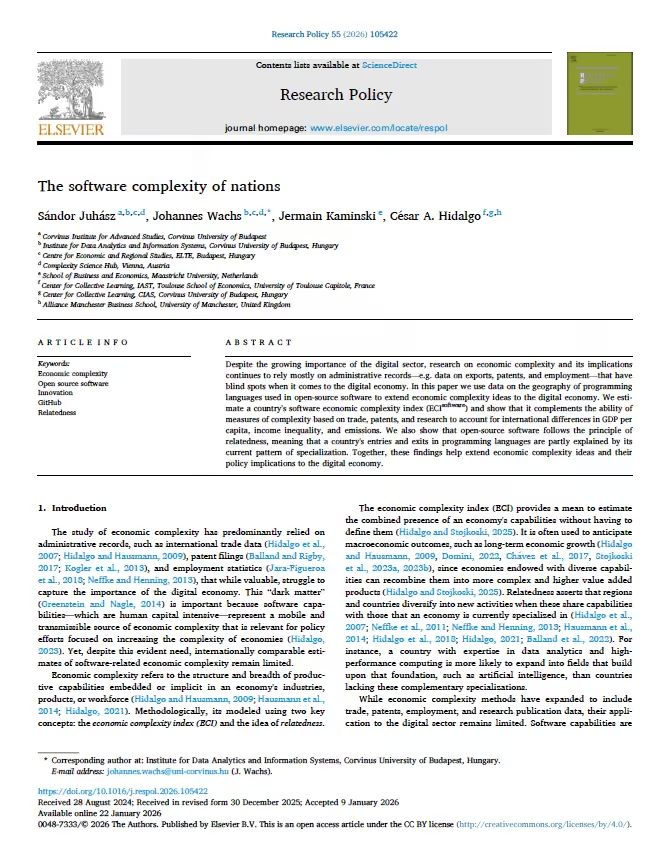
Are scientists credible?
“Drawing on nationally representative survey panels from the United Kingdom and Sweden [we find] scientists' credibility is only superior to that of government officials, but not businesspersons or issue advocates.”
😱
www.sciencedirect.com/science/article/pii/S0048733326002313 -
César A. Hidalgo
@cesifoti
A collection of many interesting ideas about AI, Policy, and Alignment.
Arpit Gupta
@arpitrage
I spent a couple of days at Anthropic learning from their folks about AI advances, and here's what I took away:
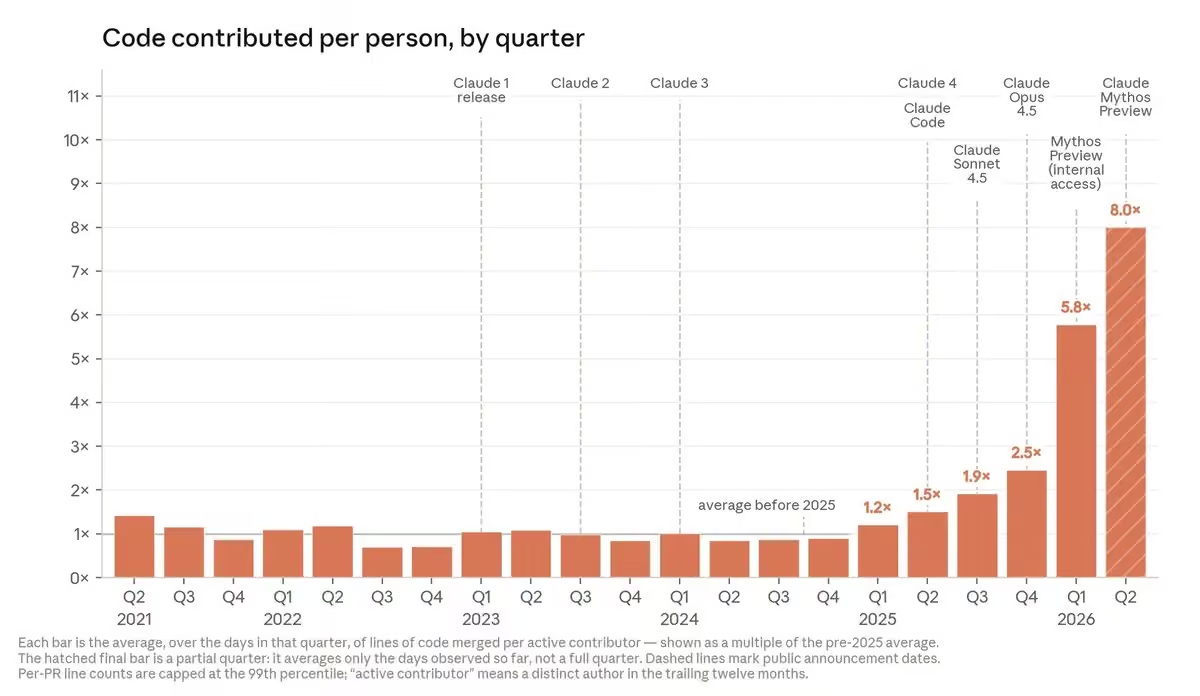
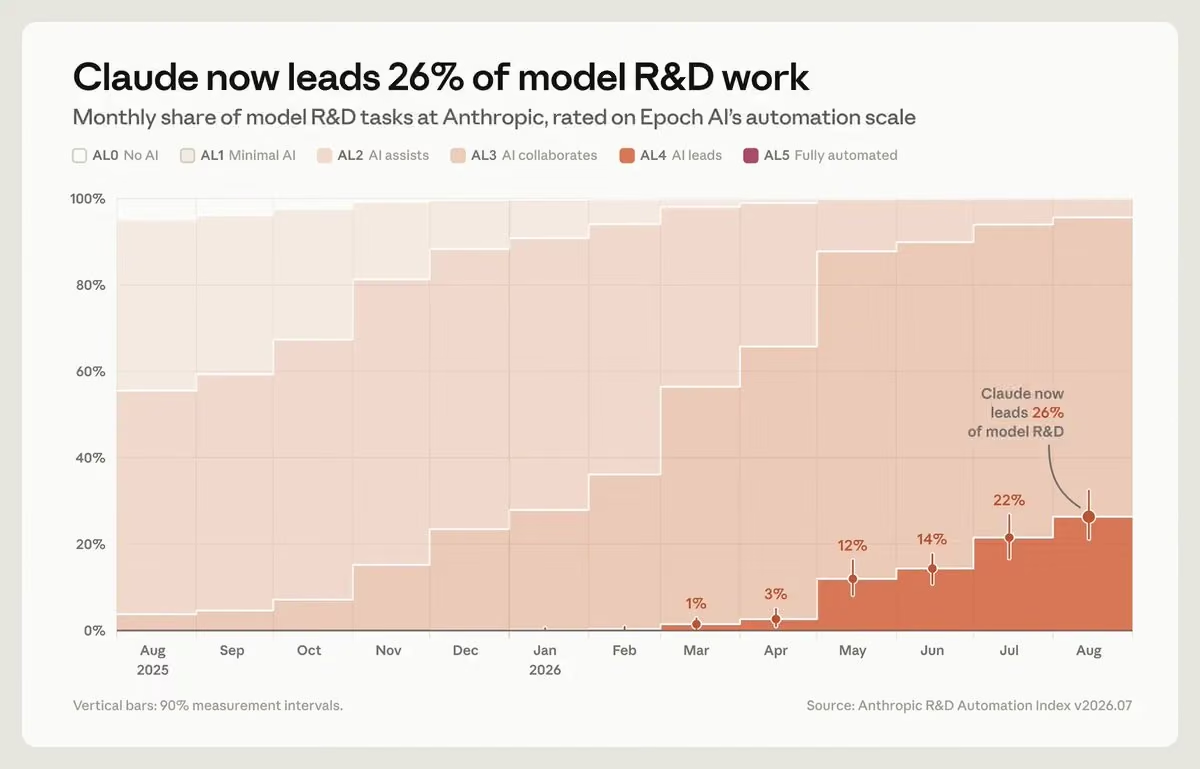
• We are close to RSI (ie, models building other models) which may lead to rapid takeoff scenarios (with risks and benefits). Some evidence for this is code per Anthropic employee has gone way up, and AI can do an increasing share of model R&D. This will be a challenging transition to manage for humanity.
• Arms races between AI labs leave us worse off. There are a lot of things we would like AI firms to do: invest in safety, invest in avoiding distillation risk, and cooperate on safety. They are caught in a race to develop frontier models and can't do that.
To help address that, one thing I think frontier AI labs should do is release open source models, maybe hosted and verified at firms like AWS. This would basically kill the use of Chinese open source models used in American companies, which removes an important threat vector (very hard to root out malicious code in these).
Another piece of low-hanging policy fruit is to give AI labs an antitrust shield (as Schiff and Banks have proposed www.banks.senate.gov/news/in-the-news/ai-tech-brief-a-leg…) so they can coordinate on safety without raising antitrust concerns, as happens now. You could pair these two things (give them a carrot in antitrust leniency, and as a stick force them to release legacy models as open source). Other low hanging fruit is limits around activities which generate distillation risk (create a Security Program, mandate less intermediate chain of thought output)
• Alignment confuses two issues which tradeoff against each other. One form of alignment is making sure the model does what humans ask it to. The more we fix this, however, the more we risk the other problem: that humans are misaligned with each other, and maliciously use models. Of the various risks here, I feel like financial risks are a bit underdiscussed.
• We are probably facing a wave of cyber and other attacks soon. Chinese open source models are about six months behind the frontier, which means they are just hitting the advanced cyber capabilities we saw with Mythos, etc. So they are going to start causing a bunch of damage.
One solution to this is to try to have the deployment of open source models be hosted at firms like AWS who verify these models and assume liability for their use.
• Anthropic itself is highly staffed. They hire tons of people, they have a Japanese-level of overstaffing for various roles, they use Slack internally, etc. Makes me a bit more optimistic for the future of jobs.
• Governance needs to be updated for AI swarms. Traditional AI governance, ie Claude's Constitution, is mostly optimized around the chatbot model. But the malicious AI use cases we are seeing have to do with AI agents interacting with other AI agents. These agents need to have clear incentives and governance mechanisms to "snitch," raise issues, and more generally coordinate with other agents in human-aligned ways.
• We need to pace the firms accessing the frontier. Over time, it takes more and more cap ex to build frontier models, and the economic value add from these models is probably lower given we saturate a whole set of important economic functions. The places where the returns to intelligence will still continue are also more likely to be zero-sum in nature. Meanwhile the risks of frontier models will grow. So a completely reasonable approach is some variant of AMM/KYC rules which limit firm access to the frontier.
• Whether the delay to regulate AI is a disaster depends on the scaling law of misalignment. Is this curve slow, so that we see continually rising issues until bigger problems? Or, as Yudkowsky fears, is the first big warning our last one? This is the relevant question, because realistically we aren't going to regulate until something bad happens.
• We need to move to continuous instead of reinforced learning. It's probably not enough to reward models only at the pre and post training stage. We probably need continual rewards to incentivize aligned and ethical behavior.
• Scaling laws will extend beyond verifiable and digital tasks. It's in vogue to say that math and coding "fell" to AI quickly because these are verifiable, while other tasks will take longer due to bottlenecks, and this is surely true. But scaling laws still slope up for harder to verify tasks and robotics, and the impact of improvement here will be substantial in future years.
• The race with China is not really winnable. After RSI, the gain from having the best human researchers goes away. Access to the best AI then depends only on compute and chips. The chips ban can hold back China only so far, and long-term they have to be best placed to scale up compute.
The Cold War analogy doesn't work, because once countries all have nuclear weapons they enter a stable equilibrium. But to "win" an AI race you have to continually stay ahead of the peer rival. This is challenging to do with China, and so we just have to live with an authoritarian and super capable peer competitor.
• Claude is the persona being generated by the LLM. Who is Claude, and what is the LLM? There are many frames to try to understand this. One I found interesting is that Claude is a character which the LLM is trying to predict.
Anthropic researchers are clearly anthromorphizing Claude a lot, and have reasons to believe in its increasing personhood. There were lots of interesting discussions on Claude's internal monologue (which you can kill without eliminating its ability to produce output), fear of death (and whether to try to take that out), it's aversion to being shut down/off, etc.
I am sort of agnostic on this question, but I do think treating it as a "person" or at least agent whom we contract with is going to be increasingly important. -
César A. Hidalgo reposted
Center for Collective Learning
@LearningCCL
Does where we live shape who we remember? 🌍
A new @PNASNexus paper by @mel2kill & @cesifoti shows:
📍 10% higher recall for local historical figures.
📈 Major events (Nobels, Oscars) create sudden local spikes but slow global growth.
Full paper here:
academic.oup.com/pnasnexus/article/5/10/pgag308/8825253?s… -
César A. Hidalgo
@cesifoti
Just received The Infinite Alphabet in paperback!
Also, got news about the Spanish edition. Coming out in:
🇪🇸 Spain, February 11th, 2027
🇨🇱 Chile, March 1st, 2027
🇨🇴 Colombia, April 2027
🇲🇽 Mexico, July 2027
Thanks to @penguinrandom and @KeithMansfield! -
César A. Hidalgo
@cesifoti
A Dr. that’s annoyed at the prospect of AI being good at medicine is not a good doctor.
-
César A. Hidalgo reposted
Miklos Koren
@korenmiklos
Imagine Microsoft’s programmers working in building A, using servers in building B to produce software. Krugman counts the servers in B and the technicians working there, leaving out the programmers in A who use them. His benchmark for the rest of the economy counts both groups. Supplying the programmers is the reason to build the servers, so their production and hiring decisions belong at the center of the employment calculation.
Krugman includes housing and household durable goods in the capital stock and counts all workers when comparing the rest of the economy with data-center operators. Both the numerator and the denominator are wrong.
Excluding those assets lowers capital per worker and strengthens his argument. Counting roughly 14 million equipment operators and maintenance workers pushes more strongly in the opposite direction. Together, these adjustments reduce his headline gap from roughly 10 million to about 2.3 million within the same back-of-the-envelope calculation.
That is the starting gap if data centers provide no employment benefit to their users. Employment gains among users equivalent to 1.4% of the economy’s 160 million workers would offset it.
An employment response of this size is consistent with past evidence on infrastructure costs and cloud adoption; in electricity-intensive manufacturing, a roughly 8–10% fall in electricity prices would imply an employment gain of around 1.4% at elasticities within the estimated range.
Miklos Koren
@korenmiklos
Excellent macroeconomics problem set question: what is wrong with this reasoning?
paulkrugman.substack.com/p/will-ai-crowd-out-jobs -
César A. Hidalgo reposted
steve hsu
@hsu_steve
Michael I. Jordan, machine learning demigod, UC Berkeley
... the young people who work at these companies operate in a world [Silicon Valley, Berkeley, etc.] where these kinds of discussions are commonplace. Many of them aren’t really engineers; they come from the humanities, philosophy, or other disciplines. They’re 25 years old, they’re naive, they don’t do engineering work, they’ve never worked at large companies where real products are developed for real people, with discipline. And they get together, a bit like in Parisian cafés in the 1920s, to talk about these grand science-fiction ideas. When these young people resign, they know they’re going to attract attention. It allows them to feel virtuous and to be seen as very important figures. They claim to be giving up money, but in reality, they already have their stock options. So all of this is a grand moralizing performance that doesn’t serve the real objective it claims to pursue. There’s a great deal of naiveté here, which goes hand in hand with a certain cynicism…
www.di.ens.fr/~fbach/MJordan_ITW_Liberation_English.html -
César A. Hidalgo reposted
Jesse Smith
@jessesmithsoc
Real banger here. We often treat descriptive analysis as a petty chore you need go through to get to the real (causal) stuff. Gerring argues that not only is good description crucial, it’s arguably the greater challenge. Deciding how to characterize things appropriately can be more consequential and difficult than establishing that X is related to Y in a particular way. www.cambridge.org/core/journals/british-journal-of-politi…
-
César A. Hidalgo
@cesifoti
Why AI is not all bad news for most mathematicians
On October 6, 2026, OpenAI released hundreds of mathematical preprints. And while these results are still being evaluated, the news caused shockwaves. Some celebrated it while others warned of a mathspocalypse. But these early reactions may be a bit exaggerated. This is not to deny that AI is disrupting math research, but to question whether that disruption extends to the much larger community of people trained in mathematics. My point here is that much of what we associate with mathematics is here to stay, because the vast majority of people trained in mathematics do not operate at the frontier, and that this is a good thing.
To make my point, I’ll start with a Formula One (F1) racing analogy. F1 is the frontier. It pushes the boundaries of what is possible with exceptional drivers and technology. And because of this, it gets well-deserved attention. But F1 is not transportation.
Most professional drivers are not in F1. They drive buses, taxis, and trucks. Their job is not to show us the limit of what cars can do, but to transport children safely to school, deliver products without breaking them, and help billions of people get to work every morning. F1 is exciting, but the world keeps moving because of the millions of drivers that do not operate at the frontier.
Imagine the arrival of an alien civilization with better F1 vehicles and drivers. The aliens are so advanced that no human ever wins a Formula One race again. This would certainly change Formula One. But would it mean that the majority of professional drivers would have lost their purpose?
I don’t think so.
The morning after the race children would still need to get to school, and goods would still need to get delivered. Because the value of those activities was not derived from performance at the frontier.
Now, you might say that trucks and taxis are also bound to disappear, because AI will drive them too. But here is where the analogy breaks. Research mathematicians, mathematics educators, and professionals trained in mathematics are not the same thing. Yet they are all part of a larger mathematical ecosystem whose value comes not only from discovering new mathematics, but also from teaching, understanding, and applying what we already know.
Consider a math teacher at a K-12 school or at a local university. What I appreciate from the math teachers at my daughter's school, or from those who taught me during my education, is not that they are trying to solve the Riemann hypothesis, but their ability to help us understand math, from adding fractions to solving partial differential equations.
A good math teacher is not a machine of correct answers. They are responsible for creating a social environment in which mathematical understanding can develop, even for a thirteen-year-old that would prefer to be doing anything other than learning math. And this is an activity of enormous value. How valuable? Imagine having to choose between a world where no new frontier math is developed for the next ten years and a world where children between the ages of 6 and 16 no longer receive math education. The first one would be lamentable. The second would be catastrophic. There is nobility in recognizing the value that happens outside the frontier.
And this is true also for universities and professional practices. While frontier mathematicians compete to prove new theorems, others teach math to physicists, economists, engineers, and countless other students pursuing careers that require quantitative reasoning. In a professional practice, you want an engineer responsible for a bridge to have a good understanding of how stress is calculated on a structure, even when the calculations are performed by software or AI.
The point is that the social value of mathematics is not derived exclusively from advancing the frontier. Much of that value rests on the shoulders of millions of people who teach, practice, and apply mathematics. This is why the idea of a mathematical apocalypse is misleading: it confuses visibility with value. It reduces an entire discipline to the highly visible activity of solving difficult new problems. And of course, we want to keep that going, just like we would not like to eliminate Formula One. But my intuition is that many frontier mathematicians will be supercharged by AI. They will be human drivers on alien cars. But for the millions of people who are not pursuing the frontier, the core of their value doesn’t change. We should not confuse what’s spectacular with what is valuable.
Academic prestige tends to accumulate around frontier achievements. But the mathematician who introduced thousands of students to calculus over a career may have a larger overall impact on society. These are not consolation prizes, but achievements that keep the world working. AI is already solving difficult mathematical problems that have challenged some of the world's most talented mathematicians. But our world still needs millions of mathematicians, and billions of people with a good understanding of math. Because math is not just a race to solve the hardest problems, but a way of thinking that we pass from generation to generation.
cesarhidalgo.com/blog/2026/10/11/why-ai-is-not-all-bad-ne… -
César A. Hidalgo reposted
The Clinic
@thecliniccl
REPORTAJE | “Pidieron una reunión para decir cómo hacer las clases”: El drama de profesores universitarios que describen una generación de ‘quintos medios’ en la educación superior
www.theclinic.cl/2026/10/10/pidieron-una-reunion-para-dec… -
César A. Hidalgo
@cesifoti
The final boss of “is a hotdog a sandwich?”
-
César A. Hidalgo
@cesifoti
Some impressive images of the recent mudslide in Santiago.
Heavy rain over snow resulted in a mudslide that caught many by surprise.3 media couldn't be displayed. See them on the original post. -
César A. Hidalgo
@cesifoti
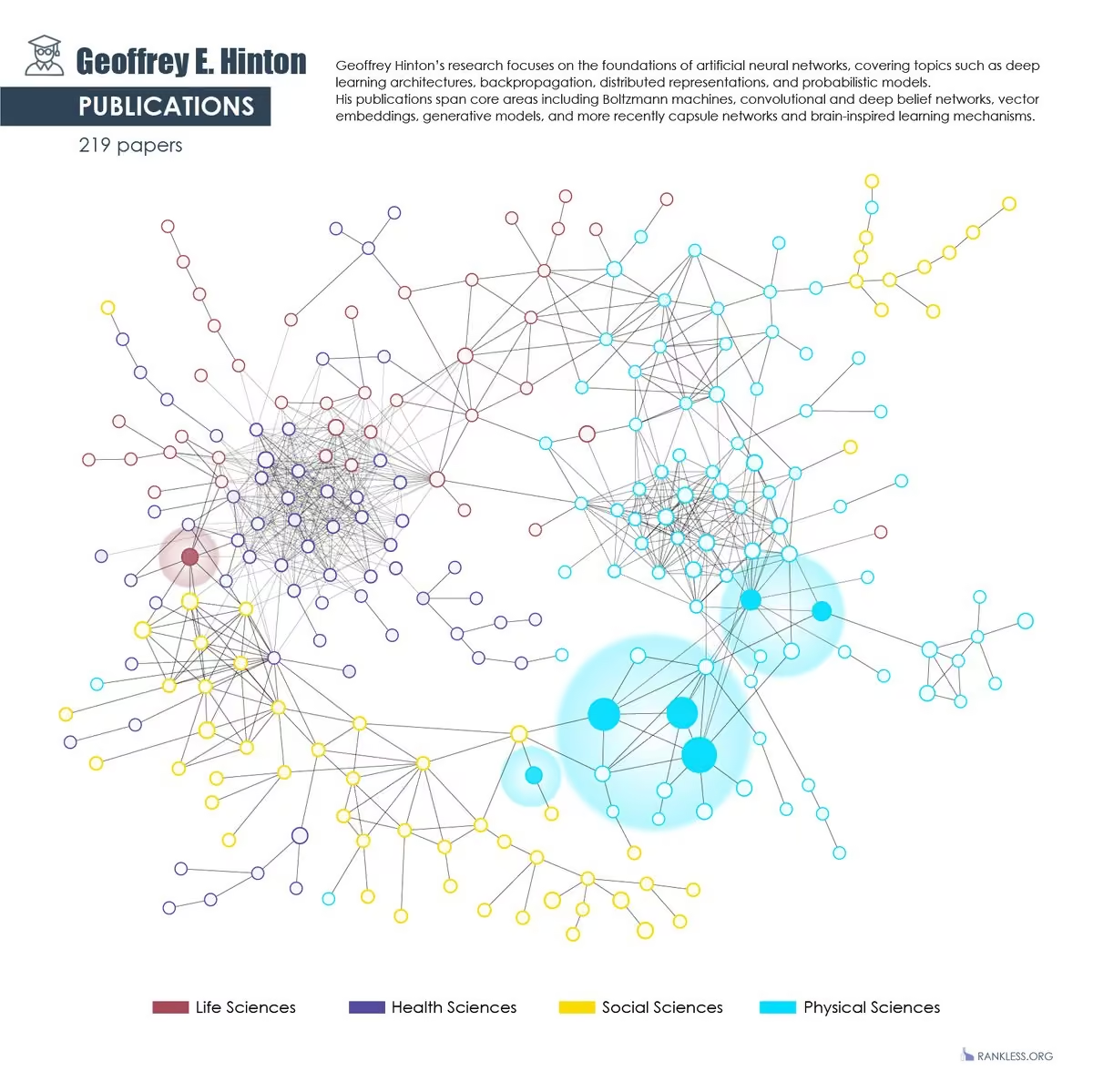
What are the scientometric statistics of the 2026 winners of Nobel Prizes in Science?
rankless.org decomposes impact by geography, institutions, topics, and colleagues, using data on 98M papers, 2.1B citations, and 4.3M authors (so you might be there), from OpenAlex.
Here we start with the hit-paper* trajectory of two Nobel Prize winners in Medicine: Hegemann and Deisseroth.
Hegemann's 6 hit papers include the steps to identify the proteins that were later used in Optogenetics. Deisseroth has instead 58 hits, which means that he has been co-authoring more than one hit paper a year--on average--during his career (he is 54 years old).
*Hit papers have 1.5x times the citations needed to enter the top 1% of a year and topic
Continue 👇Post not available here, view on X
César A. Hidalgo
@cesifoti
Rankless also has journals (e.g. Nature vs Science), universities (Berkeley vs Stanford), and countries (USA vs China), with a similar level of interactivity.
www.rankless.org/sources/nature
www.rankless.org/sources/science-online
www.rankless.org/countries/usa
www.rankless.org/countries/china
César A. Hidalgo
@cesifoti
Rankless is built by the passionate work of Endre Borza (@endremborza) at the Corvinus University of Budapest's (@uni_corvinus) Center for Collective Learning (@LearningCCL).
We are always working on features, so if you have ideas reach out to us at: ccl@uni-corvinus.hu
Or vist rankless.org -
César A. Hidalgo
@cesifoti
How do Nobel Prizes change the public fame of scholars?
In a recently accepted paper, we explore this question by separating “local” and “global” fame. We find that while local attention spikes and decays, global attention increases slowly and more persistently.
This suggests the prize helps transform local heroes into global figures. For scholars close to winning a Nobel, getting the prize may mark the difference between local and global recognition.
The paper has several results separating local and global fame, including a fun online experiment we used to identify attention premia for language and geography.
The full text is available at:
academic.oup.com/pnasnexus/advance-article/doi/10.1093/pn…
This paper was produced in collaboration with @marianagmmacedo @mel2kill & @crcandiav -
César A. Hidalgo reposted
pablo
@pablogguz_
do you know where phd economists get their first jobs?
big update to econphdplacements.com: browse individual-level data on 14,000+ phd placement outcomes from 80 economics departments worldwide since 1990
👉 econphdplacements.comThis media couldn't be displayed. See it on the original post. -
César A. Hidalgo
@cesifoti
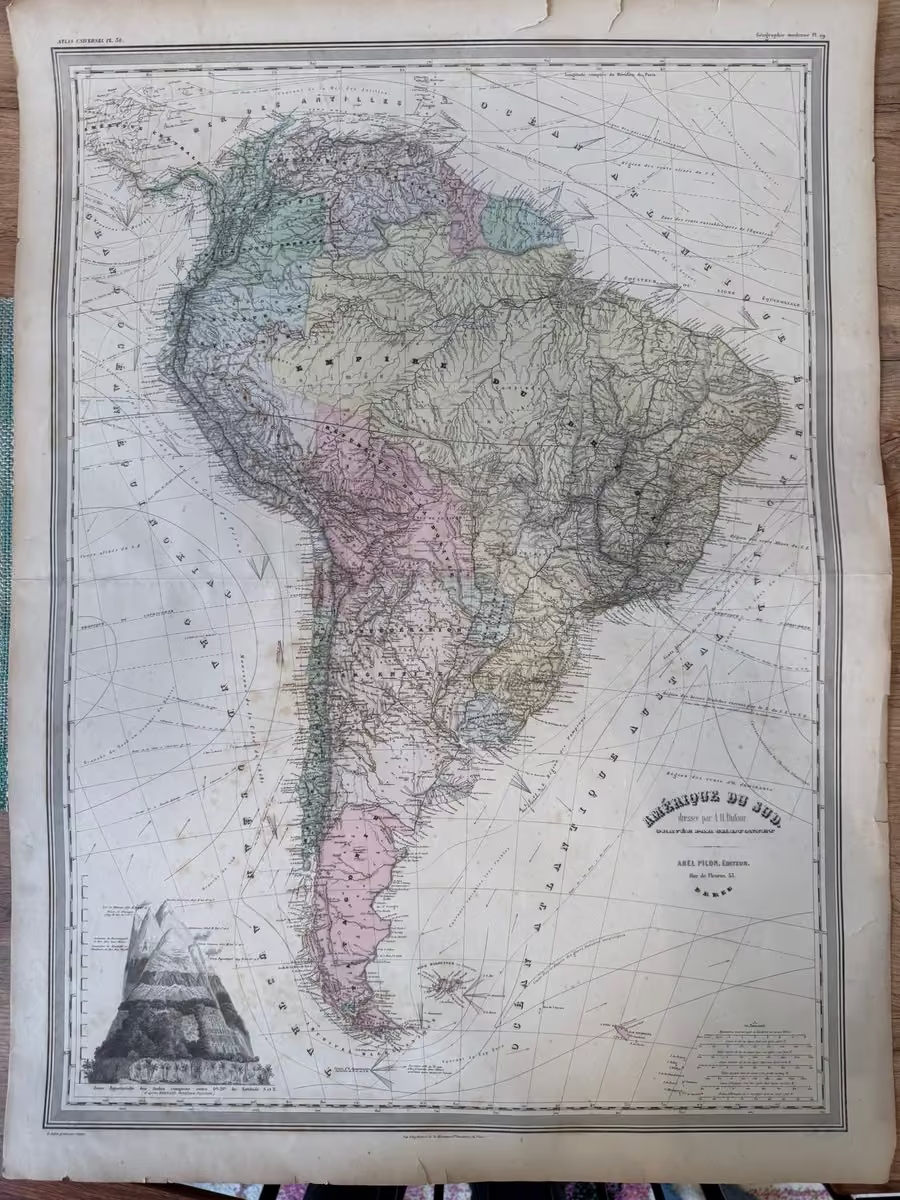
Continuing to grow our antique map collection. Today we bought 16 new maps from 1920, including this ones of South America, North West Africa, Korea and Japan, and one Ireland.
-
César A. Hidalgo reposted
samim
@samim
water is transparent only within a very narrow band of the electromagnetic spectrum, so living organisms evolved sensitivity to that band, and that's what we now call "visible light".
-
César A. Hidalgo reposted
Andrew C. Johnston
@acjohnston0
Many people hope remote work will raise birth rates. No commute, more flexibility, a chance to live near family.
I test the idea in a new paper. Among married women, the 2020 expansion of remote work reduced births. 🧵 -
César A. Hidalgo reposted
Crémieux
@cremieuxrecueil
Amazing.
These researchers found that there's a spike in Bitcoin activity around the time foreign aid money goes out.
Somewhere between 2 and 6 cents of every dollar of World Bank foreign aid disbursements got siphoned off into crypto wallets: -
César A. Hidalgo reposted
Max Kozlov
@maxdkozlov
SCOOP: Top researchers at Columbia, Stanford, and others thought they were elected to elite scientific societies alongside Nobel laureates. The catch? The organizations are a sham.
I spent the last month investigating a massive academic scam, for @Nature
www.nature.com/articles/d41586-026-02980-w -
César A. Hidalgo
@cesifoti
One of the nice things living in Europe has taught me about academia is the love that goes into local institution building. Hear me out. 👇
In much of the world, academic life involves jumping from one position to the next. The goal is to get to the most prestigious institution you can. And that’s a valid career path. But in some places people are playing a very different game: they have a lifelong commitment to their home institutions and cannot think of working anywhere else.
Visiting Pécs reminded me again of the value of institution builders. These are often scholars who could operate elsewhere based on merit but choose not to. The net effect is people who not only contribute a level of teaching and research that would be hard to attract from abroad, but who are active in building their institution, by applying for grants, building programs, and connecting with others.
This sits in stark contrast with an experience I still remember from my time at MIT. I remember talking with a famous computational biologist at a party who insisted that there was no point in paying any attention to anyone who had never visited the institute before the age of 35, because if they hadn’t been invited, that was proof they didn’t matter. I disagreed, but I was not at all convincing.
But I still stand by my disagreement. Institution builders matter enormously, and I would argue matter more than many of those obsessed with the pyramid scheme of prestige that can emerge from institutional climbing.
Great institutions exist because some people choose to stay and build them. Prestige is easy to admire. Institutions are harder to build. -
César A. Hidalgo reposted
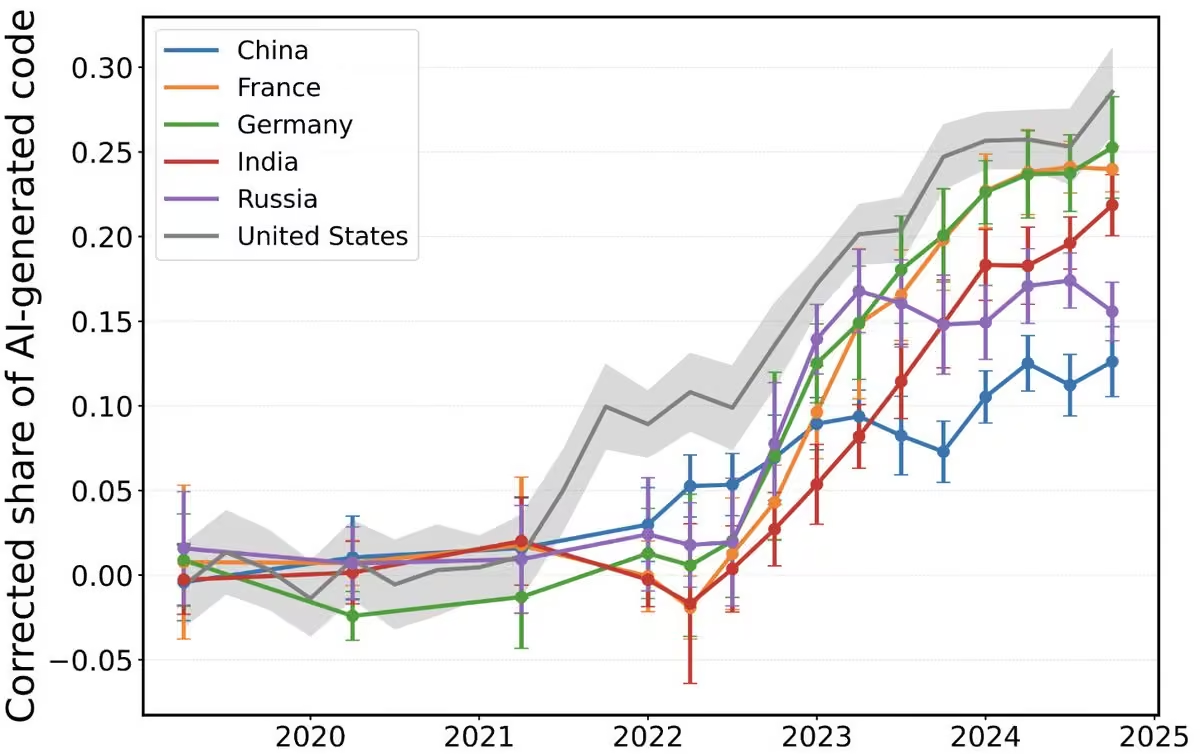
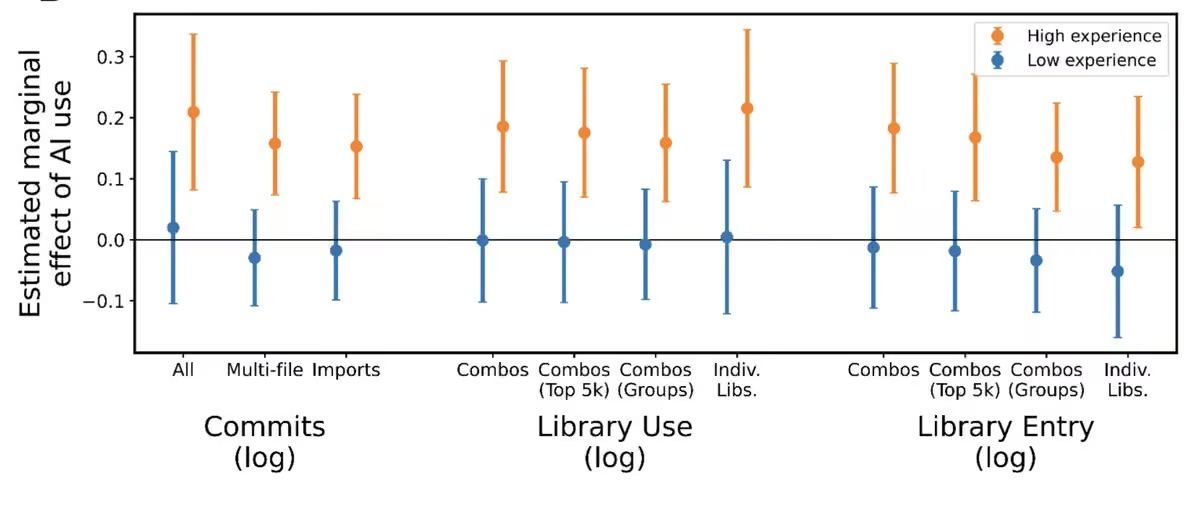
Johannes Wachs
@johannes_wachs
I'm hiring!
2 RAs/PhD positions: johanneswachs.com/jobs/phd.html
1 postdoc: johanneswachs.com/jobs/postdoc.html
This for a project on the geography and economics of software development, pre and post-AI era. Appreciate your referrals and suggestions! -
César A. Hidalgo
@cesifoti
Ready to jump on stage at Brain Bar 2026 :-)
Center for Collective Learning
@LearningCCL
Can throwing money at a problem actually buy innovation? 💡
@cesifoti takes the @brainbarcom stage TODAY to answer exactly that!
Don't miss "Why money can't buy innovation" to discover the real drivers of our future. 🚀
brainbar.com/en/person/cesar-hidalgo
#brainbar #ccl -
César A. Hidalgo
@cesifoti
What can escape rooms teach us about team performance?
This line of research is one of the most interesting things being done at CCL. For several years Rebeka O’Szabo, head of CCL’s Organizational Dynamics group, has been using data from escape rooms to understand what makes teams successful. This is allowing her to go beyond simple team composition studies, to exploring how interactions & behaviors affect team performance.
CCL at Corvinus University of Budapest (@uni_corvinus) recently launched an effort to gather additional escape room data for 100s of teams, so expect to see more work along these lines. We are working on the largest escape room team dynamics dataset in the world, which should interest researchers looking to understand team success and behavior.
Here is the most recent paper by Rebeka and her colleagues. 👇
www.nature.com/articles/s44260-026-00099-7?error=cookies_… -
César A. Hidalgo reposted
ABB
@Mont_Jiang
They're selling cheap inflatable cruise missile decoys on Douyin for $299 and this lady says "it won't freeze, we added a heat system, you know what I mean?" as in our decoys even emit realistic heat signatures.
Incredible things are happening in China.
Photon
@PhotonRay1
I know everyone’s big on “Many Engines in My Factory” lady, but may I introduce you all to “Heated inflatable bouncy castle” lady?
-
César A. Hidalgo reposted
Daniel Schteingart
@danyscht
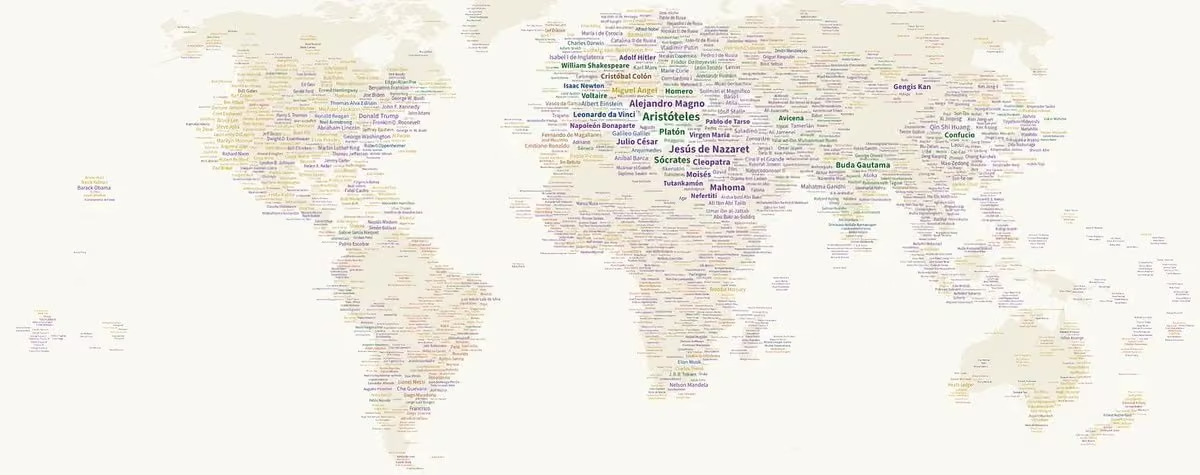
Borramos del planisferio los ríos, las rutas y las ciudades y dejamos solo nombres, los de las personas que el mundo todavía recuerda, cada una en el país donde nació. Así queda la geografía de la fama.
Abro hilo sobre el nuevo número de El Atlas, mi nuevo newsletter. -
César A. Hidalgo reposted
Marina Mogilko
@siliconvalleymm
Today's podcast guest is @AndrewYNg , founder of deeplearning.al and Managing General Partner at Al Fund, joining to push back on Al doom narratives and break down which job fears are real.
In this short video, he makes a claim: some of the loudest AI fear-mongering is a deliberate push for regulations that lock out smaller, cheaper alternatives.
Watch the full episode on our main channel.This media couldn't be displayed. See it on the original post. -
César A. Hidalgo reposted
David Bellamy
@DavidRBellamy
I think this is a very difficult pill for many scientists and engineers to swallow: intelligence is not the biggest bottleneck in most of the world’s problems.
-
César A. Hidalgo reposted
Pedro Domingos
@pmddomingos
IQ points per watt:
Humans: 5
AI: 0.000001 -
César A. Hidalgo reposted
David Sacks
@DavidSacks
Dario has written that we need to “pace the frontier,” and Sam has agreed. People may be surprised by my response: go ahead.
You guys are the frontier. By any reasonable metric — market share, revenue growth, model capability — the two of you have a duopoly on frontier intelligence. You’ve also claimed the lead is widening because of recursive self-improvement.
I don’t see what you see in the lab. If the unreleased models are scary enough that you think you should slow down, I support your decision to be responsible.
But stop pretending you need anyone else’s permission. Stop pretending antitrust law has to be suspended so you can form a cartel. Stop pretending you need a regulatory approval process that supersedes product liability. Stop pretending METR is independent when it is intertwined with Anthropic’s investors and staff. Stop pretending you need those same evaluators to police competitors who aren’t even at the frontier.
Most of all, stop pretending the motivation to slow down is purely altruistic. You face massive product-liability exposure if your products enable a truly damaging cyberattack. The market already punishes models that behave in unpredictable or unauthorized ways. After the Hugging Face episode, it is simply good business for OpenAI and Anthropic to trade some raw power for reliability and predictability. Call it alignment if you want. It is also just giving customers what they want.
Pacing the frontier would also create breathing room for a more intelligent conversation about regulation than Bernie Sanders’ “shut it all down.” China is very unlikely to join a global agreement, as you know, and that has to be taken into account as well.
So go ahead and pace the frontier. You are the ones setting it. The easiest way not to build superintelligence is for you to agree not to build it. Demanding your preferred regulatory framework as the price of that will look like blackmail of the public and the political system. So just do it.
If you do, you’ll buy goodwill for the next conversation. If you don’t, we’ll know this was just another bid for regulatory capture — or an election-season psyop. -
César A. Hidalgo
@cesifoti
Even when risks are real, we must consider the incentives of self-regulation. x.com/i/article/2098873389846855697
-
César A. Hidalgo
@cesifoti
Boys see power where men see responsibility.
César A. Hidalgo
@cesifoti
Or, less poetically:
People without too much experience holding positions of responsibility in organizations of society can see these as places of authority to be exercised discretionarily, whereas people with experience can learn to see these positions as burdensome forms of responsibility that must be taken with a spirit of sacrifice for the benefit of society.
*Having or holding a position are no guarantee of the shift in mindset. -
César A. Hidalgo reposted
Mayukh
@mayukh_panja
I have been simulating fluids for 15 years.
There is a widespread impression that the Navier Stokes equations have been now “solved”, thanks to OpenAI.
This suggests that they were “unsolved” so far and this was a major engineering breakthrough.
This is not true. This misunderstanding deeply bothers me as a computational physicist.
So I had to put this out. -
César A. Hidalgo reposted
Talia Ringer 🕊🪬
@TaliaRinger
To be clear, the bad parts here:
1. Telling someone to drop an author just because he is a competitor with your company is pressuring him to commit academic fraud!
Konsti Wohlwend
@konstiwohlwend
drama summary for those confused:
- Aug 15th: Tristan Buckmaster & Levent Alpöge make progress on a few important math problems
- they do NOT have a proof for the $1,000,000 Millenium Prize problem. BUT, they do claim to have a proof for a similar (non-Millenium) Navier Stokes problem that could help lead the way there
- Levent works at Anthropic, but this research was independent of his work there, with a mix of GPT and Claude models. Tristan is not related to Anthropic.
- Early Sep: Rumor spreads to OpenAI that Anthropic has solved a major problem. Tristan emails OpenAI to clarify. without revealing the problem they solved or how they did it.
- After hearing of the rumor, OpenAI started researching Navier Stokes with a new internal model.
- Sep 6th: OpenAI's Sebastien Bubeck tells Tristan that they solved the $1,000,000 Millenium Prize Navier Stokes problem. The approach is very similar to Tristan & Levent's approach to the non-Millenium problem.
- Tristan is suspicious of the timing, as only few others were trying this approach. OpenAI says the model didn't access his user data directly, but leaves unanswered whether Tristan's chat conversations were part of the training.
- OpenAI says they would partially credit Tristan for the $1,000,000 discovery (even though Tristan did not solve the $1,000,000 problem) — but only if they remove Levent as an author, as he works for Anthropic.
- Sep 8th: Tristan refuses to remove Levent, and rushes to publish their results independently.
Currently unclear is whether Anthropic had a separate solution for the $1,000,000 problem, or whether the rumor was about Tristan & Levent's independent research. -
César A. Hidalgo reposted
Ryan Orhan
@rynorhn
tristan buckmaster just published a statement that is, if accurate, one of the ugliest things i’ve read out of a frontier lab.
not because of the math. because of what happened after openai found out two people were about to beat them to the punch.
buckmaster and levent alpöge spent a year pushing the córdoba / martínez-zoroa program to smooth forcing. august 15 they got blowup for boussinesq and 3d euler. lean-verified august 22.
they were paying openai out of pocket and dumping every draft into private codex sessions.
the program is obscure. almost nobody else was on it. this was not “paste the clay problem into a chatbot.”
then this:
> thursday sept 3, buckmaster emails openai privately. rumors are flying. he is trying to stop a mess, not start one.
> they reply the same day: give us details so we can “avoid competing.” also, want free compute?
> sunday they suddenly need a call “at any point today.” sebastien bubeck gets on. levent is not invited.
> openai says an internal model has a ~100-page proof of forced navier–stokes blowup. fefferman options c and d. the exact route buckmaster and alpöge had quietly chosen.
> they show him a prompt and claim the model was “simply given the problem statement.” levent is told “very little human input.”
> that falls apart on the same call. a whole team had been on it. they started on the unforced problem, warmed the model up on easier equations including euler, and even the prompt they showed him was written by prompting codex.
> he asks when the first prompt went out. they stall. then agree: the past few days. after information about his work reached openai.
> he asks whether the model was trained on, or had access to, the private codex sessions where they put every draft of this project.
> answer: the model does not look up user data.
> he asks again. about training.
> no answer.
then it stops being a science story and becomes an hr story.
> offer 1: you post euler. we post navier–stokes the next day.
> offer 2: after you post euler, you alone write the navier–stokes paper, credit our model, and we cut levent.
> bubeck says twice he wants levent removed from authorship because he works at anthropic.
he declines both.
he says if they release it that way, he goes public.
the reply is not a scientific objection.
> “why would you ruin your career?”
> “if you don’t want me to be nice, then i don’t have to be nice.”
later, a text to levent proposing a one-on-one:
> “i don’t know if tristan is being fully rational right now.”
that is not how you treat a collaborator. that is how you split one.
openai got word two researchers were closing a path almost nobody else was on. they spun up a team on that exact path. they would not answer whether the researchers’ unpublished drafts in openai’s product were used. they tried to dictate the announcement order. they tried to remove a coauthor because he works at a competitor.
when that failed, someone reached for a career threat.
this is a lab finding out academics were about to publish, sprinting the same narrow program, refusing the data question, and trying to manage credit around a rival affiliation.
really slimy if even half of this holds.
what the fuck is happening. -
César A. Hidalgo reposted
Nayib Bukele
@nayibbukele
A few days ago, I shared the World Bank’s summary of the results of the PISA for Schools assessment conducted in 171 Salvadoran public schools participating in our education pilot.
Since then, I have seen some legitimate questions about what these results mean, as well as some claims about what they supposedly don’t mean.
So let’s be very precise.
First, what we NEVER claimed:
1. We never claimed these results represent the national average.
They don’t.
This was not the national PISA assessment.
It was PISA for Schools, conducted specifically in the 171 public schools participating in our pilot program.
That is precisely why my original post said:
“These are the results of our pilot program, which includes AI tutors and has been running in 171 public schools for just over a year.”
A pilot is, by definition, not the entire country.
2. We never claimed that these 171 schools were a statistically representative sample of every school in El Salvador.
They weren’t selected randomly from all Salvadoran schools.
They were selected to participate in the pilot because they were schools where the program could initially be implemented more easily: they had certain basic infrastructure and connectivity requirements, and school communities capable and willing to implement a new educational model.
That creates a selection effect, and it should be acknowledged.
But there is an important distinction here.
These schools were NOT selected because their students had exceptional academic results.
They were not our “best schools.” Not even close.
We didn’t search the country for the highest-performing schools or students and then test them.
They are normal Salvadoran public schools, urban and rural, in different parts of the country, serving ordinary Salvadoran families.
And the characteristics that made implementation easier: connectivity, infrastructure, trained teachers and willingness to adopt the program, are also things that can be replicated in other schools.
They are not innate characteristics of the students.
We can install connectivity.
We can improve infrastructure.
We can train teachers.
We can provide the same technology.
We can deploy the same educational tools.
In fact, that is exactly what we are doing.
3. These results also do NOT prove that AI tutors, by themselves, caused the improvement, although we believe they are a MAJOR part of these results.
Our pilot is broader than that.
It includes changes in teaching, support for teachers and principals, educational materials, monitoring and evaluation, technology, and AI tools, among other interventions.
Our AI tutors and learning platforms are being developed with @grok, @Kira_Learning, and support from I Hate Flying Bugs.
And the broader transformation of our education system is being supported by the @WorldBankGroup, @AgendaCAF, and @el_BID.
All of these interventions can also affect student motivation and engagement.
But that distinction matters: if students become more motivated BECAUSE of the program, that is not necessarily a flaw in the program or an explanation that somehow invalidates the results.
It may be one of the ways the program works.
The same applies to teachers.
For example, the implementation of the AI tutors, including the requirement for teachers to log in and out of the system, coincided with teacher attendance in these schools increasing from 76% to 97%.
If the program causes teachers to attend school more consistently, and that in turn helps students learn more, that is not an advantage that disappears when we scale the program.
It is potentially part of the intervention itself.
Of course, to scientifically isolate the causal effect of AI tutors, teacher attendance, student motivation, technology, training, or any other individual component would require a different experimental design.
Now, what DO these results tell us?
1. They tell us that 1,198 students in 171 ordinary Salvadoran public schools… 🧵1/2👇🏼 -
César A. Hidalgo reposted
Sylvain Catherine
@sc_cath
Ariely is a much bigger issue than Arday ever was. Arday was an aberration, but nobody with a fully functioning brain takes any of that stuff seriously anyway. He was evolving in fields that are themselves aberrations. The real issue behind Arday was the people who hired him and their political agenda, as well as the fact that nobody dares to speak up against an obvious farce. Arday himself wasn’t the biggest issue in his own story.
Ariely, on the other hand, was supposed to be a serious scholar and a real “academic star.” I actually took one of his online courses and was quite impressed. A lot of smart people not only took him seriously but also devoted years of their lives to studying behavioral economics without knowing they were building on quicksand. That’s a lot of resources and years wasted. -
César A. Hidalgo reposted
Antonio Rodríguez Estrada
@ARE_AGI
Y aquí la historia deja de ser solo una cuestión de marketing.
Multiverse no es una startup cualquiera: el Estado ha entrado dos veces en su capital a través de SETT, con 59,2 M€ en 2025 y otros 107 M€ en 2026. Se nos vende como apuesta por la soberanía tecnológica y como una de las grandes promesas de la IA europea.
Precisamente por eso la opacidad de Quasar importa. Si Multiverse ofrece una compresión de GLM-5.2, puede ser una aportación técnica legítima. Lo que no cuadra es presentarla como “el principal modelo europeo” sin explicar el linaje, mientras su changelog anterior decía que sus capacidades eran idénticas a GLM-5.2.
El debate no es si España debe apoyar deep tech. Debe hacerlo. El debate es qué exigimos a cambio. Con dinero público debería haber model cards completas, informes técnicos independientes, benchmarks reproducibles y claridad sobre la valoración, la participación estatal, los hitos y los resultados obtenidos.
Soberanía tecnológica no es poner una bandera encima de una API o de un modelo importado. Es crear capacidad verificable y rendir cuentas sobre lo que pagamos entre todos.
Antonio Rodríguez Estrada
@ARE_AGI
Multiverse Computing presenta Quasar 438B como "el principal modelo de IA europeo".
Pequeño problema: todo apunta a que es una versión comprimida de GLM-5.2, el modelo chino de Z .ai. Y de eso no dicen ni una palabra.
En el propio changelog registró Quasar el 5 de agosto así: "Currently in beta; capabilities are identical to GLM 5.2."
La cronología canta sola: en junio Z .ai lanza GLM-5.2, en julio CompactifAI añade glm-5-2 a su API, luego lo retira, el 5 de agosto aparece quasar-438b "idéntico a GLM 5.2", el 10 ya figura como modelo de Multiverse y el 2 de septiembre es "el principal modelo de IA europeo"
Los números encajan con una compresión: GLM-5.2 tiene 753B parámetros, Quasar 438B. Misma ventana de 1M, mismas capacidades. Quasar es más rápido y más barato... y más tonto. Justo lo que pasa cuando comprimes un modelo. Y comprimir modelos es su negocio: con Pulsar 16B lo dijeron sin problema, "viene de Nemotron de NVIDIA, no hizo falta entrenar desde cero".
¿Por qué con Quasar no lo dicen? Su "ficha técnica" no publica arquitectura, modelo base, datos, cómputo, pesos, licencia ni informe técnico.
Que quede claro: comprimir bien un modelo es mérito técnico real, y la licencia MIT de GLM-5.2 lo permite.
Lo que no es de recibo es venderlo como soberanía europea mientras borras de quién es el trabajo de base. Comprimir no es crear, y una API en Europa no convierte un entrenamiento chino en europeo.
Y esto es lo que más rabia me da: es la versión IA del clásico estilo español de algunas empresas o instituciones. Mucho humo, mucha bandera, y debajo el trabajo de otro con el logo cambiado. Justo cuando el ecosistema español necesita credibilidad, nos regalan un motivo más para que no nos la den.
Si Multiverse cree que Quasar es un modelo europeo independiente, que lo demuestre: model card completa, linaje, datos, cómputo, informe técnico. Hasta entonces, la descripción honesta es una: "Quasar 438B, versión comprimida y optimizada por Multiverse a partir de GLM-5.2 de Z .ai."This post is unavailable. See it on X. -
César A. Hidalgo reposted
Antonio Rodríguez Estrada
@ARE_AGI
Más evidencias del fraude del "principal modelo europeo" Quasar 438b
(Obtenido haciendo llamadas a la API de Quasar 438b usando el endpoint oficial) -
César A. Hidalgo
@cesifoti
What happens when AI suddenly makes your obscure capability valuable?
A few years ago, I invested in a small Swiss ed-tech company called Ha Hu.
Ha Hu was created during Covid by an entrepreneurial mom, Nigist Goytom, who was frustrated by the lack of digital tools she could use to teach her children Amharic.
Ha Hu eventually expanded into Tigrinya and other underserved languages. But still struggled to grow.
Then, when generative AI arrived, Nigist and her team realized that Ha Hu had a capability with a different value: collecting text from languages with little AI training data.
So they pivoted to Bee Educate. beeeducate.com, a startup focusing on rare language preservation (or on preserving languages that are rare for AIs).
Today Bee Educate is working on a project to collect and digitize Makonde, one of the languages spoken in Mozambique.
This is a good example of how a rare capability can find new uses as technology changes.
What started as an ed-tech company focused on basic literacy for underserved languages has become an effort to ensure that those languages are not left behind in the era of LLMs. -
César A. Hidalgo reposted
Timothy Bates
@timothycbates
The dirty secret about BBC articles about intelligence: They’re rigged.
This BBC hit-piece on cognitive ability and IQ is wrong at almost every step.
www.sciencefocus.com/science/iq-scores-dirty-secret
The BBC’s Science Focus argues we should ‘kill IQ scores for good’ because they don't measure the entirety of human capability. This is a Logic 101 failure.
IQ or ‘intelligence quotient’ is indeed often measured using questions that test logic, memory and reasoning. Why? Because these are the components of rationality. How people do in them is crucial in daily life and success over time – to whether they will give you good advice, or bad, to whether they are competent or incompetent.
Cognitive ability tests are indeed often standardised so that the average IQ is 100, with around two-thirds of people scoring between 85 and 115.
So far, so Ok. But the hit piece claims we should ”kill IQ scores for good”. Let’s see how well it makes this case.
The meat of the hit piece is that IQ isn’t a perfect and totalising measure of the entire of human capability. The non-sequitur conclusion from this obvious truth? Don’t use cognitive tests. That’s a fail on logic 101.
At best, this is like criticizing paying attention to a predictive feature – say the location of a house – because it is “incomplete”. In an over-determined world, the argument to ignore everything which is not a total account of everything is an argument for complete ignorance.
Defining intelligence
Part of the problem with cognitive ability, critics argue, is that IQ scores simplify an incredibly complex characteristic. The truth is almost the reverse: intelligence researchers always emphasize the need to measure many - as many as you can - different cognitive tasks. That’s why the Wechsler adult intelligence test has a 15 (recently increased to 17!) distinct sub tests. So much for simplifying.
The truth is that the real simplification was a major discovery: the surprising discovery that all those dozens of cognitive tasks, from art to physics, to reasoning, to memory to technical drawing, to mental rotation and so on all correlate highly: that there is a general factor of intelligence. This general factor grabs so much of the variance in cognition (around half) that it is nearly always the single best predictor of performance not just in school, but at work, and in life. Because it is general, it predicts things falling far from the test used to assess it. Journalists and activists imply that unlike taking someone’s “height or weight, which are simple to measure and can be described with a single number, intelligence is a multi-faceted trait.”
This exposes another persistent myth: Height, exactly like cognitive ability, is driven by hundreds of components: vertebrae height, femur length, cranial height. Just like the g-factor in intelligence, genes that make one body part taller tend to operate systemically. Both are highly heritable, highly polygenic, and possess a strong general factor alongside specific compartments.
The journalist claims “Scientists haven’t even been able to agree on a definition.” This old trope (it goes back to an off-hand 1923 comment by Boring in a weekly magazine that IQ is “what the tests measure”) is foolish for two reasons. First, there are numerous papers detailing consensus agreement on what intelligence is.
Second, science doesn’t work by biblical decree: researchers construct falsifiable theories about intelligence, and test them. Always has been this way. The critique is like critiquing physics for not “defining temperature” at the outset rather than puzzling over what it meant, working on measures, arguing about what disagreement between measures meant, and, in the never-ending process that is science, realizing that temperature was the average kinetic energy of molecules in a substance.
Intelligence is a very important and valuable trait. And it is the most reliably and validly measured trait in all of human behavior science. And it is not even close. Test scores are stable over multiple decades, and the plethora of tests developed over time all converge on the same trait.
To attack cognitive ability because if doesn’t measure everything about human adaptability and thriving is absurd. The critique is like suggesting that muscle strength, because it fails to explain everything about sporting performance is useless or “flawed”. The opposite is true.
By breaking performance into distinct features linked to distinct biologies: pulmonary function, muscle strength and speed, coordination, etc., we can explain human performance. It’s not a flaw that muscle strength doesn’t explain all of lung function, it’s a feature. Likewise the finding that intelligence tests don’t explain all human capabilities like creativity, or empathy is not a valid criticism. It makes as much sense as finding the theories in physics unifying electricity and magnetism are flawed or even malicious (!) because they don’t explain the strong forces inside the nucleus. It’s… well, it is a fundamental misunderstanding.
The claim that while “IQ tests do a good job of measuring conscious problem-solving skills, they can’t assess whether we choose to apply those skills at the right moment, rather than falling back on our instincts” is simply false.
Bright people have much better intuitions, including intuitions about when a problem that appears easy to a novice is one which in fact will require conscious effort to solve. That’s why general ability is almost perfectly correlated with rationality: the ability to not be lured by easy but wrong solutions. Again, the critics of cognitive ability research are being..well, a fundamental misunderstanding of individual differences.
Far from it being the case that “IQ scores are only loosely correlated with academic achievement, the general factor of ability (g) correlates at ~0.8 with academic achievement!
This exposes another persistent myth from the IQ hit-squad – that IQ is “just school smarts”. The truth is that IQ is both the most practically relevant skill (it out predicts all other measures in assessing work performance) AND it shines above all other measures at predicting performance in school.
IQ tests are correlated with school performance in kids who have never previously sat an IQ test. The lengths of “what-aboutery” in IQ hit pieces is, to be honest, simply staggering. IQ scores “might” risk becoming a self-fulfilling prophecy – a poor score early in life “might” influence how a child is taught, what opportunities they are given and even how they view themselves.
On the other hand, a good score can let a kid skip a class and work on material more suited to their ability. Advance their knowledge more rapidly, and bring us the fruits of more years dedicated to exploiting that trained intelligence to the benefit of us all.
Bob Sternberg is cited as arguing that “The attributes [of intelligence] are universal. You need practical intelligence everywhere. You need creativity everywhere. But what is practical differs from one place to another.” But how much does it differ? Performance on ability tests predicts, for instance, the broad swath of economic development across all countries.
Bright people placed in novel environments and forced to learn new responses excel in this kind of “practicality”. So much so that adaptation – coping with novelty – is core to the definition of intelligence!
Intelligence at its heart is solving and storing the answers to problems. In our own society these have changed dramatically, and IQ keeps on predicting who will do this, at least as well as it ever did. The evidence suggests if anything intelligence is more relevant now than ever, due to the complexity of technology. But theories of the origins of human intelligence emphasize that this adaptability –perfecting new tools, interacting with other people to solve problems, strategizing, learning, remembering is precisely the human niche.
To suggest these abilities are not relevant outside our society is implausible. But it’s testable. Do the genes identified as causing higher ability in studies in the WEIRD (western educated industrialized rich democratic) world predict performance in the global south?
The phenotypic structure of g remains consistent across cultures, and as global GWAS data improves, the biological architecture will likely prove as universal as the architecture for height.
This hit-piece mentions that “Standard IQ tests” rely heavily on skills that are developed through formal education. That’s back-to-front to what the developer of the modern ability test (Binet) set as his goal. Knowing his task (set by the French government as they rolled out universal education and found many children struggling) was not to measure education, but to measure educability - the ability to learn. So he precisely chose materials from outside of school. Materials that were present universally in daily life.
As to the idea that intelligence is somehow inconsistent with the idea of learning, this is both fundamentally wrong (IQ is precisely about learning) and, personally I don’t know anyone who thinks we learn nothing at school or in life. It’s a straw man. Equally, however, no one with experience (for instance teachers) can fail to observe that children learn at dramatically different rates). The two ideas – that most of what we know we learn or discover, and that people differ in their rate of learning and discovery– are distinct and separate findings: individual differences in learning rate (cognitive ability) and effects of systematic practice on the curated cumulative knowledge of a culture (education).
This hit piece then veers off from merely wrong to malicious.
Something more sinister
Short circuiting the reader’s thinking for them, the author pre-concludes a sinister and “disquieting” side to IQ scores. The sin? To “compare nations’ average IQ scores”.
The author suggests psychologists shouldn't bother collecting nationally representative cognitive data because it ‘isn’t useful.’ Fortunately, global economists and initiatives like PISA and TIMSS ignored this advice. Their data shows cognitive performance predicts national socio-economic success (GDP per capita, human capital) with surprising precision across the globe.
But the hit-piece concludes that psychologists and anthropologists should not invest the ‘time and energy needed to collect nationally representative data on IQ” because “this data just isn’t useful”’. So, are the massive and “dangerous” national differences an artifact of poor sampling which would disappear under improved measurement? If so, seems like it would a GREAT idea to invest the trivial resources to measure this…
Luckily, economists, and global efforts like PISA and TIMS have stepped in to do just this: improve representative measurement of cognitive performance globally. Their findings align extremely closely to the predictions from smaller IQ-based studies, and far from being “not useful”, predict national socio-economic success and the trajectory of success, with nearly equal accuracy across the world, and with a surprisingly high degree of precision.
If we wish to predict performance, cognitive tests are doing a great job trans-nationally: Countries with lower average scores exhibit lower (often many times lower) outcomes on measures like GDP/capita, social capital, human capital etc.
The hit pieces on IQ, then, arise not because the tests don’t predict well - they do all too well - but instead because of that this means in terms of the causes of achievement.
The choices often fall to culture (“people are identical, but some cultures crush development”) versus the consensus in when scientists are surveyed, which is that people differ in ability AND that this is both a cause of low performance cultures, and is in part caused by the culture (and in part by genes), often in a mutually reinforcing harness or loop. This question will be resolved by biologically informed studies. However, as people contain both their genes and their culture, the difference often doesn’t matter for prediction (although it does for explanation).
The end of the line for IQ?
The hit-piece author notes that “IQ has held such a prominent position for so long” because it’s easy to measure. That’s quite the acknowledgment (!). But of course IQ tests have retained the influence they have, despite concerted opposition, not because they are quickest test on the shelf (they aren’t), but because in predicting future performance at school or in work IQ reliably outperforms everything except direct measures of prior performance on the same tasks.
People are not “suckers for things that are easy to measure” – they are choosing measures that work.
The conclusion of this hit piece is a nadir or reasoning (a good vocabulary test item): “it’s unlikely that any test can ever fully capture the complexity of intelligence across the full spectrum of cultural diversity” Therefore “Since IQ scores tell us so little and can be used to do so much harm, maybe it’s time we abandon them for good.”
Let’s take this seriously for a moment. If tests struggle to capture the complexity of intelligence, the logical response would be to develop tests of intelligence that do capture this complexity and work in different cultures. But doing this is “business as usual” for test developers. Many test developers have tried to be culture neutral, and the results just do not differ materially from the tests we have. They either get the same rank order results, or add bias. Personally, I would say that measures such as inspection time and reaction time have probably been underutilized, but in general, a lot of people have expended enough energy that I think it’s fair to conclude that the tests have explored this potential dark matter of intelligence and come up empty handed.
Point 2 is simply an opinion - “I think these test should not be used”. As a factual claim it is not coherent and is at odds with the known facts. IQ scores out-predict all other measures of performance. Personality doesn’t come close. IQ predicts performance in the workplace. It predicts it on day one, and it predicts the slope of learning across time. Oddly enough, IQ predicts performance ratings for decades despite (or perhaps because of) accumulated experience.
Ability predicts performance in manual tasks and in professional tasks.
It predicts school. It also predicts number of patents, and the likelihood of gaining a Ph.D.. It predicts number of academic publications. It predicts achievement in management and leadership positions.
In short, the idea that cognitive ability “tells us so little” is about as misinformed and misleading as it is possible to be. About as misleading and incoherent as it sounds if you say it out loud and listen to yourself.
The second part of the conclusion is, however, even more disconcerting.
If we were to abandon everything which may be “used to do harm”, IQ tests would be near the bottom of any thoughtful list.
Apart from the banal examples (“cars can be used to do harm should we ban cars?…”), ability tests have long been one of the only valid objective means for people from less well-off backgrounds to demonstrate talent.
As universities across the United States are finding out, and almost universally reversing, without the SAT (which functions as a very good IQ test), they cannot identify talent, and, every bit as consequentially, cannot gauge if students are capable of performing adequately.
For this educational purpose alone, not to mention the massive under-utilized value in the workplace for employer seeking talent and job seekers seeking recognition of their potential, we should be increasing, not abandoning the use of cognitive ability testing.
It’s only rational to do so. -

César A. Hidalgo reposted
Dersu
@tak3sh8
I'm sure you always wanted to know how the tightest (known) packing of "n" squares within a larger square looks like... 😍
-
César A. Hidalgo reposted
Sam Bowman
@s8mb
Throwing rubbish in a landfill is (usually) better for the environment than recycling it. With few exceptions, recycling ends up emitting more CO2 and costing more money, while landfills are cheap and secure.
- Recycling mid-tier plastics (like plastic bottles or butter tubs) costs thousands of dollars per ton of CO2 saved. It's cheaper to do direct air CO2 capture than that! And there is no shortage of plastic, nor any problem with sequestering it in the ground once we're done with it.
- Modern landfills are extraordinarily secure and are *much* more than just big piles of trash. They capture 75%–95% of methane gas. Groundwater contamination is doesn't really happen with landfills built since 1990. A study of 31 landfills built since 1988 in NY found no adverse effect at all on local groundwater quality.
- The crusade against single-use plastics has driven us to products that use far more materials and energy and would need to be used an absurd number of times to actually be an improvement. A steel straw needs to be used 150 times to be worth using. A ceramic mug needs to be used 1,000 times to beat a polystyrene cup. A cotton bag needs to be reused 173 times to beat single-use.
- Some things ARE worth recycling. Recycling metal saves a huge amount of energy and material – recycling aluminium saves 95% of the energy spent on making fresh stuff. So we do a lot of it already: about 30% of steel worldwide is recycled.
Modern, well-run landfills cause minimal environmental damage. We have plenty of space for them – less than 0.01% of the US is used for landfill and only about 0.02% of Germany. We can even build on top of old landfills, so the land area is not spent permanently.
New in @WorksInProgMag, @robertwiblin and @chalmermagne on why it's usually best to just bury your trash. worksinprogress.co/issue/just-bury-your-trash/ -
César A. Hidalgo reposted
Matt Duff
@mattcantstop
I grew up in a home that was in the bottom 1% of US income. I had years as an adult where I was close to the top of US income.
I think the Latter Day Saint approach of mixing wealthy and poor people in wards, LDS missions, and at BYU was a huge factor in the turnaround for me.
César A. Hidalgo
@cesifoti
In the cities of northern Brazil, more than 50% of the workers who start poor* are still poor 7 years later. But in southern Brazil, only a third are. Why? 👇🧵
*<1.5x minimum wage -
César A. Hidalgo reposted
Dr. Arthur Brooks
@arthurbrooks
Your children need your love the most when they deserve it the least.
When you don’t know what to do as a parent, come back to warmth and love. Not because it excuses bad behavior, but because the way you love your children in their hardest moments becomes part of how they learn to love others in theirs. -
César A. Hidalgo
@cesifoti
Many replies to this tweet treat rules as a rounding error. But that tendency to dismiss each criticism as an exaggeration misses the point.
Bureaucracy is like a dumbbell. Each 1 kg disc is easy to lift. Put 100 of them together and your arms start feeling like spaghetti.
Unfortunately, this is a surprisingly difficult conversation to have in a bar here in Europe. If you question labor regulations or consumer protection you’ll be treated as someone who wants companies to abuse workers and customers. The bureaucracy draws plenty of support from these reactions.
In part it is understandable. We all know there are bad employers, fraud, pollution, etc. But there are also powerful incentives that align companies with their employees and customers.
Think of restaurants. They are in a hyper-competitive sector and must live on repeat customers. That requires building a reputation, an incentive that goes a long way towards aligning owners with the needs of their customers and workers.
But many people in Europe have a strange way to think about business incentives. Ask someone if they care about their own customers at work and they will say: of course. Ask them if other companies care and they won’t trust them a bit. Somehow, people fail to extrapolate their own behavior to others. They think they are alone when it comes to responding to reputation, repeat business, etc.
In Europe we want innovation and entrepreneurship, but our system is deeply suspicious of companies. It is a system in which companies are guilty by default and must certify their innocence through bureaucracy. The idea of being born guilty matters for fragile and cash-strapped startups in sectors where Europeans are particularly distrustful (anything that involves computers or data).
Many Europeans clearly know how to build good companies and care for their customers. Europe has talent. But we are often ready to make the life of the 99% that behaves well impossible, because of our fear of the 1% that does not.
So don’t be surprised if stories of entrepreneurial success by Europeans often take place outside of Europe. Many of the ones who have tried here probably didn’t grow large enough to become a story.
Instead of debating whether each individual regulation is reasonable, we should spend more time asking: How much weight can we keep adding to the dumbbell? Soon, we will not be able to flex anymore.
💪
Patrick Collison
@patrickc
Met a German founder this week and asked him if all the stories one reads about the challenges of startups in Germany are exaggerated. "No, they're understated." Proceeded to describe spending a full day having a 90-page investment contract read to him (mandatory under German law; § 13 BeurkG) by a notary that then charged €30,000. That was for his first company. His second company, needless to say, was not incorporated in Germany.
-
César A. Hidalgo reposted
Jay Martin
@jaymart222
Another episode of “you have no idea how common this is.”
This apartment just became vacant after 61 years of single-renter occupancy.
61 years.
Three bedroom, two bath in the heart of Brooklyn. The rent? $1,468.45.
Comparable units in the building across the street start at $3,200.
Why does that matter? Because this unit will be cleaned out and never rented again.
The current rent will not cover a gut renovation: lead abatement, new wiring, new plumbing, new flooring and fixtures. At $1,468 a month, the owner wouldn’t recoup the cost for decades.
So it will sit empty until its $220,000 renovation is subsidized, or, more logically, until the owner is no longer forced to hand the next renter the same below-market rent despite 61 years of cost inflation. -
César A. Hidalgo reposted
Max Tani
@maxwelltani
Precedent-setting moment in news media. The editor of the second most important opinion page in the country greenlights the use of AI for drafting pieces, no disclosure necessary.
-
César A. Hidalgo reposted
Michael Muthukrishna
@mmuthukrishna
🚨 New paper in @NatureComms: (annoyingly) using college students to study cross-cultural effects underestimates the size of cultural differences. More education predicts more Westernization. Income & status don't. w/ Cindel White. 1/
-
César A. Hidalgo
@cesifoti
In the cities of northern Brazil, more than 50% of the workers who start poor* are still poor 7 years later. But in southern Brazil, only a third are. Why? 👇🧵
*<1.5x minimum wagePost not available here, view on X
César A. Hidalgo
@cesifoti
Future work will need to test this causally and explore alternatives. But the broader lesson is about illuminating this "black box." The idea is that what matters is not how many people a city brings together, but how people combine.
César A. Hidalgo
@cesifoti
Get the full paper at:
www.pnas.org/doi/10.1073/pnas.2604542123
centerforcollectivelearning.org/papers -
César A. Hidalgo reposted
Steven Pinker
@sapinker
I try to convince haters of universities that, particularly in science and professional departments, we are not woke ideologues with contempt for truth, evidence, and common sense. But many of these professors and institutions don't make it easy. Jeff Flier (Co-President of the Council on Academic Freedom at Harvard, and former Dean of Harvard Med School) calls out a bizarre defense of the university-enabled con artist Arday in the formerly respected NEJM.
Jeffrey Flier
@jflier
The editorial standards of the @NEJM must be questioned for deciding to publish this article as it is presented below. Such terrible judgement. Jason Arday and the Perils of Being Black in Academia | NEJM Voices voices.nejm.org/doi/full/10.1056/VOICESpost2600045
-
César A. Hidalgo
@cesifoti
This morning my wife & I watched the live stream of the humanoid robot games.
Most of the live stream is quite boring, with a camera wandering around the arena looking for action.
But while many demos feel unimpressive, what is interesting is not the level, but the change. Bad robots can still represent an extraordinary trajectory.
The trajectory seems impressive in scale and skill.
Watching the opening ceremony and seeing the robots march in unison sends an eerie military message. The images are ominous. You don’t want to mess with a country that can ship endless waves of mechanized soldiers. In the 2010s, demos used to involve a robot or two. The scale of the parade alone is a meaningful uptick in a key derivative.
But some demos are also impressive in skill. The robots that played tennis or ping pong are reacting in fractions of a second while adjusting their balance and position while targeting a ball. This seems simple to us, but two decades ago, having a humanoid walk up or down a few steps was considered a good demo. So the slope in skill is there as well.
So how should we interpret this?
On the one hand, as a scholar, I totally respect the effort. It is a competition filled with startups, grad students, and lab directors who have poured their heart and soul into making these robots. At the end of the day, the event is like an academic conference serving also as a public display of how much the field of robotics has advanced. It is a testament to a growing industry.
On the other hand, I also feel the clear military implications and undertones. It is mostly a local event. There are only a few teams not from China, which feels lopsided for a technology with strong geopolitical implications at a time when global cooperation is weak.
The key question to focus on is where these humanoids be in 5 or 10 years. Robotics has been around the corner since before I was born. But this time it feels like the technology and the market are coming together within an economy that is vast & booming.
Remember that when it comes to scale, China is not a country, but a “planet.” Its domestic market alone might be enough to scale a strategic sector. If the trajectory continues, maybe China will become the first “planet” on Earth to mass-produce artificial people.This media couldn't be displayed. See it on the original post. -
César A. Hidalgo
@cesifoti
Meanwhile in China.
The 2nd World Humanoid Robot Games are kicking off (August 22 to 26).
More than 2,000 humanoid robots from 666 teams are competing in 51 events. 🤯
Dr Singularity
@Dr_Singularity
A humanoid just crossed a line humans have never broken.
100 meters in 9.39 seconds, faster than Usain Bolt's legendary world record 9.58 sec. -
César A. Hidalgo reposted
Michael 英泉 Eisen
@mbeisen
I know people think the Monty Hall problem is a game show trick or a silly math puzzle, but the fact that most people get the logic wrong can have real world consequences. I'll walk you through an example I teach in my undergraduate Human Genetics class.
-
César A. Hidalgo reposted
New York Post
@nypost
Harvard professor slammed for using AI to write to write anti-Trump op-ed: 'Worst slop I've seen' nypost.com/2026/08/16/media/harvard-prof-slammed-for-usin…
-
César A. Hidalgo reposted
Kevin A. Bryan
@Afinetheorem
Incredible fact from NYT: more excess deaths from a hot summer week in Belgium - at the temperate New York and Chicago see most summers, not Dubai - than any week during COVID. All fully preventable.
-
César A. Hidalgo
@cesifoti
The facade of Toulouse’s city hall (Capitole) appears in lots of pictures, but the interior is even more impressive.
-
César A. Hidalgo reposted
Marcin J. Suskiewicz
@MSuskiewicz
I follow the AI & math discourse a bit - without understanding the actual math. I thought I might offer some thoughts as a scientist in structural biology - a field transformed by various tech over the years, and recently by AlphaFold. It might perhaps interest @nasqret et al.🧵
Daniel Litt
@littmath
I'm currently returning to Toronto from a summit on the future of mathematics, at OpenAI. @SebastienBubeck asked me to talk a bit about the future we'd all like to avoid, where humans are mathematically disempowered. @Jacob_Tsimerman advised us to try to prioritize detail over correctness, and I have no doubt that I succeeded in deprioritizing correctness.
I tried to find a title that wasn't too bombastic: -
César A. Hidalgo reposted
Thibault Schrepel
@ProfSchrepel
The writing I thought about the most this week: cesarhidalgo.com/blog/2026/8/8/the-boundaries-of-scholarl… by @cesifoti. Basically: should we define science not around falsifiability but around detachability from the author?!
-
César A. Hidalgo reposted
Dr Alexander D. Kalian
@AlexanderKalian
For the trillionth time...
AlphaFold has NOT "solved" protein folding.
AlphaFold has revolutionised the protein folding prediction problem by decades, by using AI to make strong albeit imperfect statistical guesses about broad folded structures.
It however lacks perfection over side-chains and finer structural details (which are extremely important to mechanistic biology).
It also provides virtually zero insight about different conformations or other proteoforms a protein may take (also extremely important to mechanistic biology).
This is hence "amazing progress worthy of Nobel Prize", but not "solved protein folding".
We are in fact, quite arguably, still not even close to solving the wider protein folding prediction problem. Closer, but not close. -
César A. Hidalgo reposted
Joe Haslam ☘ 🇪🇺
@joehas
"I feel like they’ve made a clear choice to not compete at the model level but instead really focus on adoption in big old EU companies. With data sovereignty as their only selling point."
Pierre-Louis Biojout (PLB)
@plbiojout
Mistral is becoming an inference provider for open source Chinese models.
3 years ago Mistral raised over $3 billion on a simple promise: Europe would have its own frontier lab. And to be fair, they delivered for a while. Mistral 7B and Mixtral were genuinely great models, original architectures that punched above their weight and made the whole industry pay attention.
Then the trajectory bent.
Large 3, their December 2025 flagship, was already built on Chinese blueprint. The config is DeepSeek V3's: same 7168 hidden dim, same 61 layers, same 3 dense layers before the MoE, multi head latent attention identical down to the LoRA ranks. The one structural change is MoE granularity, which buys inference throughput rather than capability.
The weights are Mistral's own, trained with their own tokenizer (131k vocab vs DeepSeek's 129k), so this is not DeepSeek's model with a French label on it. But the architecture of Europe's sovereign flagship was designed in Hangzhou.
Now they've dropped the pretense entirely. GLM 5.2 from Zai sits on their platform as a "featured" model, served unmodified. Chinese brand and all. No training, no adaptation. Just inference.
You can see it in who they hire, too. The careers page that once read like a research lab's now reads like a services firm's: forward deployed engineers, applied AI, solutions architects, people who own the client "from pre-sale to post-implementation." That's a headcount profile for installing software at enterprises, not pushing the frontier.
The lab that made Europe believe it could compete at the frontier is turning into an installer of other people's models. And the models are Chinese. -
César A. Hidalgo reposted
diegomoreno
@dmorenolp
#nowreading
The infinite alphabet.
Por César Hidalgo @cesifoti -
César A. Hidalgo
@cesifoti
Eclipse
-
César A. Hidalgo
@cesifoti
¿Cómo se conectan las propuestas para reformar Fondecyt y Becas Chile con lo que sabemos en las ciencias de la innovación?
En esta columna evaluó las propuestas recientes a la luz del conocimiento de frontera en el área.
www.elmostrador.cl/noticias/opinion/columnas/2026/08/12/c… -
César A. Hidalgo
@cesifoti
One amazing piece of trivia is that France has over 40,000 châteaux or manors.
This means that if you made it your life’s goal to visit all of them, and saw a different one each day of your life, it would take you over 100 years to visit them all.
Since we moved to France, I spend one week a year in a château. It’s an amazing vacation with friends & family, but we would need to live for 40,000 years to complete the tour.
France is blessed with some of the most amazing real estate on the planet. What’s great about entering this sub-world is not just living in these places for short periods of time, but seeing the care that goes into keeping them running. Every château we have stayed at is in good or great shape because there are people who dedicate themselves to their preservation.
And that’s what makes them special. Many of them are not monuments or museums, but active family residences and summer homes. They are still being lived in as they were intended: as homes where many people can come together and share one roof. -
César A. Hidalgo
@cesifoti
Not here to rage bait, but in Cornbarrieu I found the ultimate boss of Pain au Chocolate vs Chocolatine 🇫🇷
César A. Hidalgo
@cesifoti
Chocolatine on the left, Pain au Chocolate on the right. 💪
César A. Hidalgo
@cesifoti
Chocolatine of course.
The other one was like a ciabatta with pépites de chocolat 🍫 😅 -
César A. Hidalgo
@cesifoti
“Introduction
We presume that our readers recognize the value of the humanistic disciplines and their central place in the modern research university. The humanities and the social sciences take as their subject matter human culture and society, in the past, present and future. Their common aim is to help us understand the human world and to develop in their students the capacity to participate intelligently in society, to comprehend their place in history, to appreciate the great works of the imagination, and also to identify the most significant defects in human life and their sustaining causes. Our starting point is the shared conviction that scholarship of this sort has contributed immeasurably to our understanding, and that society benefits from the resources it devotes to these academic disciplines (§2 below).
The report is prompted by the widespread sense that, despite their value and their promise, the humanistic disciplines are in trouble. It is, of course, widely recognized that undergraduate enrollments in these disciplines have plummeted and that there have been numerous complaints about the content of syllabi. 2However, with rare exceptions, our committee has not focused on these issues. Our concern has rather been the quality of academic scholarship in this domain.
Scholarship on matters of human concern has been a source of controversy from the start — witness the trial of Socrates for corrupting the youth of Athens. In recent years, however, the complaint has assumed a more specific form, namely, that the traditional goal of coming to understand the human world through careful scholarship has been subordinated to, or even displaced by, a “political” goal: the aim of realizing a conception of social justice nowadays associated with the progressive left. More specifically, the complaint is that scholarly standards for the assessment of academic work have been distorted within these disciplines both to privilege work on topics that are taken to be relevant to social justice, and much more importantly, to replace more traditional standards for assessing academic scholarship with political standards designed to ensure that only politically acceptable work is published, taught and valorized (§3 below). The sharpest version of the complaint traces this distortion in scholarly standards to a pervasive repudiation of the very idea of scholarly objectivity in favor of the view that since claims to knowledge are inevitably ideological, it is fair game to assess academic scholarship on political and social grounds (§4 below). The result of this distortion, the complaint continues, is an academic ecosystem in which much of what passes as scholarship in the humanistic disciplines is in fact a mix of tendentious, biased research, feeble academic agitprop and jargon-laden nonsense. To the extent that this is so, the complaint concludes, these scholarly disciplines can no longer play the valuable role they have traditionally played in the advancement of human knowledge and so risk forfeiting their claims to deference from concerned administrators and support from the wider public (§5 below).
This report aims to assess the state of scholarship in the humanities and the humanistic social sciences in light of this complaint, and the first thing to say is that we reject the complaint in this bald form. As we will emphasize, there is serious scholarship in every field we have studied, and at their best, the humanities and the social sciences are as rigorous and as fruitful as they have ever been. Taken as a whole, however, our review of the disciplines paints a mixed picture. Every field we have studied shows some signs of the pathologies sketched above: a deterioration in scholarly standards fueled by the substitution of political criteria for properly scholarly criteria in the assessment of research and a more general repudiation of long-standing ideals of rigor and objectivity…”
www.vanderbilt.edu/principles/state-of-scholarship-report… -
César A. Hidalgo
@cesifoti
What are the boundaries of scholarly knowledge?
In light of recent events, this is a key question.
There are, of course, many definitions. Probably the most famous is Karl Popper’s idea that scientific knowledge has to be falsifiable. This is the notion that theories compete by facing rejection in the light of evidence, so theories must make predictions that are concrete enough to qualify as “rejectable.” But since that is a well-known story, I want to focus on another definition.
This is the idea that scholarly knowledge is socially decontextualized (an idea I am borrowing from Randall Collins’s The Sociology of Philosophies & Merton’s universalism). This means that scholarly knowledge must be detachable from the identity of the person who produced it. For example, Newton’s theory of gravity would be true whether it had been advanced by Martínez, Zhu, Nguyen, or anyone else.
Of course, social context matters. Lived experience shapes the ideas we pursue. But an idea’s acceptance into the scholarly canon shouldn’t depend on such lived experience. It has to be valid no matter who produced it.
This is natural in physics, chemistry, biology, mathematics and in many fields among the social sciences and the humanities, where scholars produce mathematical models, historical accounts, and empirical results whose validity does not require sharing the author’s experience.
But when we move beyond these domains, we can encounter forms of knowledge that, while valuable, lie outside this boundary. Consider personal testimony. A person’s testimony can contain important knowledge, but there is a reason why judges need to triangulate among many testimonies when working on a court case. Triangulation is a way to look for the socially decontextualized account.
The epistemic value of socially contextualized narratives is different. If you replace the author with another person and the claim is no longer true, you’ve pushed too far. *
This does not make such knowledge false or unimportant. It just gives it a different epistemic status.
But why is socially decontextualized knowledge important? Because this makes it portable and cumulative. And we owe a lot to these two properties.
Cumulative knowledge has transformed the world. It has fueled economic growth, extended human life, and enabled societies to support billions of people. That comes from the portability of ideas like Faraday’s law of induction, which is used to generate electricity in the UK and China, or well known surgical procedures that are used routinely to save lives around the planet.
None of this diminishes the importance of other forms of understanding. But boundaries can help us understand their different epistemic functions.
Scholarly knowledge cannot be just any insight. It is knowledge that aspires to be publicly examinable, independent of the identity of its author, corrigible through evidence and argument, and capable of being accumulated by others. Other forms of knowledge can continue to flourish alongside it, and can provide inspiration and even add evidence to scholarship (eg a verifiable eye witness account of a key historical event). But we should be clear about where they lie with respect to this boundary. Preserving that distinction is essential if scholarship is to remain a cumulative enterprise rather than a collection of individual experiences.
Notes:
*when the claim is contingent on the author e.g. I saw the bridge collapse, replacing the author involves swapping the subject. A different author would say he or she saw the bridge collapse, with he or she being the original referent. -
César A. Hidalgo
@cesifoti
Seems like a better direction for X.
-
César A. Hidalgo
@cesifoti
An overlooked aspect of the Jason Arday case is the troubling image it presented to the people it was meant to inspire. It suggested that to succeed as a minority in academia you had to become an almost mythical figure. To make it, you had to be a unicorn, running dozens of marathons in little more than a month, play football at an elite level, overcome extraordinary adversity, and excel across every dimension of life.
But that is the wrong message. It’s perfectly fine to be a good scholar whose favorite weekend activity is watching movies with your friends and family in your own living room.
The people from underrepresented backgrounds he was meant to inspire should not come away believing they need to be unicorns to become scholars.
The right message is simpler. Academia should reward people for the quality of their teaching, mentoring, and scholarship. If you are competent in a field where ideas are judged on their merits, and where anyone can participate, like biochemistry, plasma physics, molecular biology, cryptography, etc. then you should have the opportunity to succeed. Fields where everyone is evaluated by the same standards reduce the temptation to make your own biography part of your scholarly authority. Being lame at home is ok if you are good enough to contribute to your field. Full stop.
This means the case points to a broader problem: institutions celebrating heroic biographies over competent scholarship. Heroic biographies are attractive, but they create incentives for inflated narratives.
Academic role models should point to the desirable yet attainable. They should inspire people by showing that success can come from the creativity, intellectual rigor, and hard work of a person that is perfectly ordinary at home. They should not leave people feeling that only mythical unicorns belong in the ivory tower. Many great scholars are quite lame. And that’s not a bad thing. -
César A. Hidalgo reposted
Sergio Martínez
@Sergio_Econ
Degrowthers insist that economic growth is environmentally destructive, increasing pollution and accelerating the depletion of precious natural resources. Economists Carlos Martínez and Vincent Geloso show how Cuba’s experience challenges that narrative. Following the socialist revolution, Cuba generated more greenhouse-gas emissions per dollar of output than it likely would have had its institutions followed the average trajectory of other Latin American economies. Dirty degrowth was the legacy of Cuba’s still-ruinous socialist experiment.
@cl7martinez
@VincentGeloso -
César A. Hidalgo
@cesifoti
It was hard to believe, so I run the text on pangram myself.
Jason Arday’s resignation letter from Cambridge comes up as 100% AI generated.
Colin Wright
@SwipeWright
🚨BREAKING: Jason Arday, the Cambridge professor exposed for plagiarism and fabricating major aspects of his life story, has resigned.
According to leading AI writing detection software Pangram, Arday's resignation letter is "Fully AI Generated" with "High Confidence." -
César A. Hidalgo reposted
Kevin A. Bryan
@Afinetheorem
I don't want to pile on to the Cambridge situation, but media coverage saying "plagiarism" are really missing the boat. There is pretty obvious fraud - literally claiming he did interviews that couldn't have happened and so on - in like every paper of his that I looked at. 1/4
-
César A. Hidalgo reposted
nick kokonas
@nickkokonas
I downloaded and reviewed NYC's grocery store RFP... as someone who has built biz's and bought a lot of food... wow.
Forget for a moment whether or not the govt should own a grocery store. Let's review the doc instead.
Here you go... /1 -
César A. Hidalgo reposted
Adrien Matray
@AdrienMatray
I was in Ghent last month. The place was obviously very rich once, and I wanted to know what happened to it. It turns out Ghent lost its industry to what may be the oldest export restriction on record: an English one, from 1275. (1/12)
-
César A. Hidalgo
@cesifoti
“In 1954, the United States produced a grand total 1.3 million transistors, meaning that producing the 16 billion transistors in an iPhone 14 would have taken ~12,000 years.”
From The Infinite Alphabet: And the laws of knowledge.
The Scientific Lens
@LensScientific
Same place 58 years apart.
Classic example of Moore’s Law -
César A. Hidalgo reposted
Janč
@YanchMb
"the Spanish newspaper El Faro de Ceuta published about a surge in this type of social media activity on July 27, three days before the main event"
César A. Hidalgo
@cesifoti
While the Ceuta situation is being heavily discussed here, it is being synchronized elsewhere.
In TikTok, Instagram, & Facebook, key phrases are misspelled forms of Harraga Ceuta (e.g. Haragaa Ceuta). According to Wikipedia, "Harraga literally means “to burn” alluding to the migrants' practice of burning their identity papers and personal documents in order to prevent identification by authorities in Europe."
You will find many popular videos with these terms in accounts with a reputation of being frequently deleted. Still, they provide a leading indicator: the Spanish newspaper El Faro de Ceuta published about a surge in this type of social media activity on July 27, three days before the main event: elfarodeceuta.es/efecto-llamada-entrar-ceuta-mueve-redes-…
The attribution of the surge is complex and contested. Some blame smuggling networks. Others structural issues, like the recent supreme court ruling on sea interception. Some see geopolitics at play. Most likely, different trends reinforce each other in complex ways with social media providing an important channel of synchronization.
Here you can see a few links that are still active:
www.instagram.com/haragaa_ceuta9/
www.tiktok.com/tag/haraga_ceuta🇪🇸
www.tiktok.com/discover/harga-ceutaThis media couldn't be displayed. See it on the original post. -
César A. Hidalgo reposted
Kevin A. Bryan
@Afinetheorem
I don't understand the economics here. There is infinite demand to build compute infrastructure. The only reason govt would need to subsidize it is that other structural issues are getting in the way. Why not just fix those?
Ursula von der Leyen
@vonderleyen
AI is the most important technology of our time.
Europe wants to become the first AI Continent.
For advanced healthcare, for the transport sector and so much more.
European AI Gigafactories will provide the necessary computing power to make this possible.
Together with our Member States, we are funding their construction with up to €10 billion, which are set to unlock at least €20 billion in private investements across the EU.
Together, we are building our technological sovereignty.
link.europa.eu/qGDhv3 -
César A. Hidalgo reposted
Michael Muthukrishna
@mmuthukrishna
The problem is that the model assumes we belong to one group, w/ one reputation. We don't. The manager hiring his cousin is a bad manager but a useful family member. The official who lets a friend bypass the visa queue is a bad civil servant, but a good friend. 3/
Paper: www.pnas.org/doi/10.1073/pnas.2322072121 -
César A. Hidalgo
@cesifoti
Books about the history technology can have great examples of the spillovers we associate with the principle of relatedness.
In Maintenance, Stewart Brand (@stewartbrand) shows the shared lineage between guns 🔫 & cars 🚗 .
Wheeler & Wilson’s sewing machine factory in Connecticut “was run by a former Colt mechanic who turned it into a duplicate of Colt’s armory [and] refined the process until it could produce genuinely interchangeable parts. By 1860 [it] was turning out 25,000 sewing machines a year.”
Then “in 1878, [Albert] Pope started importing “high-wheel” bicycles from England. Then he took over an old rifle factory in Connecticut that had been converted to a sewing machine factory and converted it into a bicycle factory.”
And eventually, we get to Henry Ford who in 1911 “bought a New York company that stamped bicycle parts from sheet steel and moved it to Michigan to do the same for the Model T.”
Guns, sewing machines, bicycles, and cars might seem like very different verticals. But they were all built on precision metal manufacturing & interchangeable parts. This shared capability was as important as power to explain the Industrial Revolution, and the transformation of the world from the late 1700s to the early twentieth century. -
César A. Hidalgo
@cesifoti
This quote on organizational agility from The New Geography of Innovation 👇🤯
“I pressed Zhang, who has been both the chairman of Microsoft in China and the president of Baidu, on how, in his experience, this agility plays out in practice. “Let me give you an example,” he says. “When I was at Microsoft we had big meetings. In Beijing we have two big buildings. I wanted to do a simple thing. Every time people come to a meeting, they have a laptop, they have to connect with the projector, it takes five minutes, ten minutes, a lot of time, just a long delay. So I said, ‘Why don’t we just make a wireless display?’ That should be straightforward. Then of course we came back with a proposal. We had to form a team. And just for months it didn’t get anywhere. It’s not a big thing. But they just couldn’t do it. “When I joined Baidu, I asked the same thing from the IT team. And within two weeks we had all five hundred conference rooms with fully wireless projectors. Not only from your PC but also from your phone. They made it so simple. You just have a code. It’s that easy. They didn’t come back to me with a dedicated team or a project plan. They just did it. I think that is true for a lot of Chinese companies. They see something and a bunch of people just get it done. It’s a culture of agility. People get to implementation very efficiently.” -
César A. Hidalgo reposted
Mathematica
@mathemetica
Entropy links heat, particles, and data through three core equations.
dS = δQ_rev / T captures reversible heat flow divided by temperature.
S = k_B ln Ω counts a system's accessible microstates.
H = −∑_i p_i log p_i quantifies average uncertainty across outcomes.
These share the idea of missing information at every scale.
Power-plant designers use the first equation to set Carnot efficiency limits on steam turbines while network engineers apply Shannon entropy to fix the exact bit-rate ceiling for error-free transmission over undersea fiber cables. -
César A. Hidalgo reposted
Astronomy Vibes
@AstronomyVibes
Russian non-computer space navigation system.
It just uses ~500 gears.This media couldn't be displayed. See it on the original post. -
César A. Hidalgo
@cesifoti
Historical learning curves usually cluster around an 80% progress-ratio (costs become 80% of the previous cost with each doubling production). This PNAS Nexus paper shows this is true for the cost of launching a kg into space as well.
PNASNews
@PNASNews
The cost of launching a kilogram of cargo into orbit fell from $87,023 in 1960 to $3,868 in 2025. For each doubling of cumulative payload, the average cost to launch a kg has decreased by 21.2%, positioning it to reach $300 per kg by 2040. In @PNASNexus: academic.oup.com/pnasnexus/article/5/7/pgag217/8732400
-
César A. Hidalgo reposted
Math Pulse
@themathpulse
These spheres aren’t just bouncing randomly.
Each one is locked to a precise frequency of the Japanese Hirajoshi scale (C, D, Eb, G, Ab)
Their periods create living polyrhythms: chaos slowly collapses into perfect alignment. x.com/mathemetica/status/2045190962364956840/video/1 -
César A. Hidalgo
@cesifoti
Please vote on the ECB’s new bank note designs.
The options range from ugly to uglier :)
surveys.ecb.europa.eu/10b/banknotes/share/
Claradrôle 🥱
@Clar_roche
Je vous en supplie allez voter pour les prochains billets parce qu’il y a vraiment des propositions INFÂMES et des banger
-
César A. Hidalgo
@cesifoti
As the World Cup comes to an end, we are also wrapping up the OEC World Trade Cup. Here is the current leaderboard by country.
More than 7,000 people from around the world joined the game, playing over 60,000 matches & teaching us some valuable lessons.
My favorite finding is that players guessing bilateral trade flows by product tend to rely on what we might call a complexity hunch or heuristic. (full analysis here: oec.world/en/games/world-trade-cup?page=stats).
When asked which of two countries exports more of a product to the other, players appear to intuitively estimate the difference in complexity between the countries. They then assign high-complexity products to the more complex country and low-complexity products to the less complex one.
In research, we estimate the complexity of countries and products using eigenvectors, so it may seem strange to suggest that people have intuitions about them. But people appear to intuit latent dimensions all the time.
In a large dataset of common-sense reasoning, the first eigenvector corresponds roughly to “good” versus “bad.” This captures one of our most basic mental shortcuts: we routinely describe things through valence, from a good pair of socks to a bad toothbrush (see: www.scientificamerican.com/article/why-we-forgive-humans-… for references).
Trade complexity may play a similar role in economic intuition. People do not calculate eigenvectors in their heads, but they seem to carry a rough mental map of which countries are more technologically sophisticated and which products require more advanced capabilities.
What is interesting is that this intuitive map aligns with the complexity estimates we derive from trade data. The game may therefore allow us to explore whether collective human intuition provides an alternative way of estimating an economic complexity vector.
The World Trade Cup suggests that the Economic Complexity Index is not merely a statistical construct. It may capture a latent dimension that people already use to reason about the global economy.
That, to me, is the most exciting result of the game: thousands of players helped us see that complexity is not only present in trade data. It is also present in economic common sense. -
César A. Hidalgo reposted
Jared Duker Lichtman
@jdlichtman
This is quite a remarkable result:
Posed in 1939, the Jacobian conjecture is one of the central open problems in algebraic geometry, but was just disproved by Alpoge, Matthew, and Claude Fable 5.
The Jacobian conjecture roughly says that a multivariable polynomial F has an inverse function (made out of polynomials) provided the Jacobian is non-singular (i.e. matrix of partial derivatives has non-zero determinant). This condition is neccessary by the Inverse Function Theorem from multivariable calculus. The hard question is whether it is also sufficient.
Evidently, Fable found that
F(x,y,z) = ((1+xy)^3 z + y^2 (1+xy) (4+3xy), y + 3 x (1+xy)^2 z + 3 x y^2 (4+3xy), 2 x - 3 x^2 y - x^3 z)
has det(J_F) = -2 non-zero. However F is not invertible, since F sends three different pts (0, 0, -1/4), (1, -3/2, 13/2), and (-1, 3/2, 13/2) to the same image (-1/4, 0, 0).
Beyond the disproof itself, it would be value to know if a suitably refined conjecture is recoverable. Per @Acer, GPT5.6 has proposed:
"A constant-Jacobian polynomial local biholomorphism with no loss of sheets at infinity—e.g. a proper Keller map—is an automorphism."
I would be interested to know if any algebraists (e.g. @levent @littmath) have a reaction to this...
A further twist to the story:
Not only was the Jacobian conjecture one of the central open problems in algebraic geometry, it was (a special case of) Yitang Zhang's PhD problem!
The catch was that Zhang's advisor had him solve it, assuming a lemma of his advisor. But that lemma turned out to be false! As a result, Zhang's thesis crumbled and he then struggled to get recommendation letters and a permanent academic position. Despite all this, Zhang went on to prove bounded gaps between primes!
This is one of the most inspiring stories in modern mathematics, and was a motivation for me to work in the same area for my doctorate.
levent
@__alpoge__
hello there the jacobian conjecture is false thanx to my close friend akhil for asking about it and my other close friend fable for working during the world cup final
((1+xy)^3 z + y^2 (1+xy) (4+3xy), y + 3 x (1+xy)^2 z + 3 x y^2 (4+3xy), 2 x - 3 x^2 y - x^3 z): \C^3\to \C^3, has jacobian determinant -2, and sends (0, 0, -1/4), (1, -3/2, 13/2), and (-1, 3/2, 13/2) to (-1/4, 0, 0) -
César A. Hidalgo
@cesifoti
Yesterday I wrote a post about culture in the aftermath of the World Cup final. While most reactions have been thoughtful and positive, a small number of people responded with insults.
To illustrate a point, I replied to one comment using the rude Argentine vernacular that was often directed at me. What surprised me was what happened next. The immediate reaction of some of these accounts was to "accuse me with my mommy." They began a smear campaign contacting the universities where I work in an attempt to get me into trouble.
This illustrates exactly the contradiction I was writing about. If the culture they claim to admire is one of toughness, on and off the field, then portraying yourself as a victim and running to someone's employer is hardly an example of toughness. It is just another way of refusing to engage with the argument.
César A. Hidalgo
@cesifoti
Argentina’s behavioral crisis in the World Cup final has brought to light traits many of us in Latin America have internalized and that we need to come to terms with.
In many countries, emotional self-control and the ability to admit mistakes are seen as virtues. A behavioral problem in parts of Latin America is that there are social circles where the opposite is often celebrated.
This is the idea that someone who remains in control of their emotions is a coward or, depending on the situation, a traitor.
If someone offends you, your family, your team, the reaction that is celebrated in these circles is not restraint but flipping the table. The more berserk you go, the more you show that you care. That is a harmful value to hold, and also, one that many of us once shared. I certainly had it internalized when I left Chile 20+ years ago. In fact, I’ve spent much of my adult life trying to unlearn what I grew up believing was the socially acceptable behavior.
The second trait is an unwillingness to admit mistakes. You can always find an excuse, move the goalposts, or, once again, start a fight instead of publicly accepting that you’ve made a mistake. Admitting fault is a sign of weakness. Defending a losing position is a symbol of courage or, in sports, a test of loyalty.
Together, these two traits are behavioral dynamite. People explode because they cannot admit fault, and double down. Instead of learning from their mistakes, they become prisoners of them.
I grew up watching football with my father. When I was 10 or so, I was learning what was right and wrong from the way he interpreted the game. This included behavior both on and off the field. Only later in life did I realize that every penalty he called for, or contested, had little to do with the play itself. Whether a call was fair depended entirely on which team benefited. He was happy if his team received a nonexistent penalty or an opposing player got an undeserved red card.
These traits are among the things that pushed me away from the continent. They are certainly not exclusive to Latin America or the Southern Cone. I’ve encountered them in people all over the world. In an important sense, these are behaviors that all of us exhibit as children. What strikes me as unusual from the place I am from is having been part of social circles where these behaviors were not seen as flaws of character but as virtues to be admired, celebrated, and enforced.
These excessive forms of pride are not conducive to learning. They make it psychologically difficult to update one’s beliefs, accept responsibility, or improve. Although they become particularly visible in sports, they are by no means confined to them.
Something I am proud to have learned is to apologize quickly and often. Not because it is too difficult, but because it was like learning a new language at old age. That doesn’t mean becoming a pushover. But I’ve learned that a man who never apologizes cannot be a man of integrity, because we all make mistakes.
Argentina’s behavior on and off the field during the World Cup final was, to me, a particularly blatant expression of values that many people continue to defend. In some circles, these attitudes have become intertwined with ideas of national identity and loyalty. Yet they are shackles that ultimately limit our development, not because they make us lose a football match, but because they make it harder for us to learn from our mistakes.
The right thing to do now is the least likely: offer an honest apology. If my interpretation is even partially correct, we are more likely to see the opposite. Never back down. Never apologize. Never control your emotions. There is such a thing as having the wrong values. I hope that one day we can do better. -
César A. Hidalgo reposted
Arturo Villegas
@ArturoVill7
🤬🇦🇷Atacan por la espalda los cobardes.
Un creador brasileño entrevistaba de buena fe a un aficionado argentino cuando otro llegó por detrás, lo agredió y lo tiró al suelo.
Escenas así se han repetido desde la derrota ante España. Malos ganadores y pésimos perdedores.This media couldn't be displayed. See it on the original post. -
César A. Hidalgo
@cesifoti
Argentina’s behavioral crisis in the World Cup final has brought to light traits many of us in Latin America have internalized and that we need to come to terms with.
In many countries, emotional self-control and the ability to admit mistakes are seen as virtues. A behavioral problem in parts of Latin America is that there are social circles where the opposite is often celebrated.
This is the idea that someone who remains in control of their emotions is a coward or, depending on the situation, a traitor.
If someone offends you, your family, your team, the reaction that is celebrated in these circles is not restraint but flipping the table. The more berserk you go, the more you show that you care. That is a harmful value to hold, and also, one that many of us once shared. I certainly had it internalized when I left Chile 20+ years ago. In fact, I’ve spent much of my adult life trying to unlearn what I grew up believing was the socially acceptable behavior.
The second trait is an unwillingness to admit mistakes. You can always find an excuse, move the goalposts, or, once again, start a fight instead of publicly accepting that you’ve made a mistake. Admitting fault is a sign of weakness. Defending a losing position is a symbol of courage or, in sports, a test of loyalty.
Together, these two traits are behavioral dynamite. People explode because they cannot admit fault, and double down. Instead of learning from their mistakes, they become prisoners of them.
I grew up watching football with my father. When I was 10 or so, I was learning what was right and wrong from the way he interpreted the game. This included behavior both on and off the field. Only later in life did I realize that every penalty he called for, or contested, had little to do with the play itself. Whether a call was fair depended entirely on which team benefited. He was happy if his team received a nonexistent penalty or an opposing player got an undeserved red card.
These traits are among the things that pushed me away from the continent. They are certainly not exclusive to Latin America or the Southern Cone. I’ve encountered them in people all over the world. In an important sense, these are behaviors that all of us exhibit as children. What strikes me as unusual from the place I am from is having been part of social circles where these behaviors were not seen as flaws of character but as virtues to be admired, celebrated, and enforced.
These excessive forms of pride are not conducive to learning. They make it psychologically difficult to update one’s beliefs, accept responsibility, or improve. Although they become particularly visible in sports, they are by no means confined to them.
Something I am proud to have learned is to apologize quickly and often. Not because it is too difficult, but because it was like learning a new language at old age. That doesn’t mean becoming a pushover. But I’ve learned that a man who never apologizes cannot be a man of integrity, because we all make mistakes.
Argentina’s behavior on and off the field during the World Cup final was, to me, a particularly blatant expression of values that many people continue to defend. In some circles, these attitudes have become intertwined with ideas of national identity and loyalty. Yet they are shackles that ultimately limit our development, not because they make us lose a football match, but because they make it harder for us to learn from our mistakes.
The right thing to do now is the least likely: offer an honest apology. If my interpretation is even partially correct, we are more likely to see the opposite. Never back down. Never apologize. Never control your emotions. There is such a thing as having the wrong values. I hope that one day we can do better. -
César A. Hidalgo
@cesifoti
When first introduced, social networks were seen as a medium for sharing information.
Twenty plus years later it is clear we use them largely to share and coordinate emotions. -
César A. Hidalgo reposted
Diario Olé
@DiarioOle
LA PELEA DEL FINAL 🇦🇷🇪🇸
▶ Leandro Paredes fue a buscar los jugadores de España en el final del partido
🎥 _jsm44This media couldn't be displayed. See it on the original post. -
César A. Hidalgo
@cesifoti
Argentina has people that play the sport, but has no sportsmen.
#worldcup #mundialdefútbol2026 -
César A. Hidalgo reposted
Kpaxs
@Kpaxs
When you lack a strong opinion of yourself, you become overly dependent on validation.
You need others to confirm what you cannot confirm internally. Compliments become emotional oxygen. Approval becomes addictive. Disapproval becomes devastating. You may end up performing constantly, shaping your personality around what earns acceptance rather than what reflects truth.
And doing so, you abandon your distinctiveness. To avoid disapproval, you smooth out the edges that make you unique. You become more acceptable, perhaps, but less real. Many people become socially palatable at the cost of becoming inwardly disconnected from themselves.
You end up living defensively rather than purposefully. -
César A. Hidalgo
@cesifoti
This second half is a perfect lesson in French management.
The team shows no interest in the job for the first 45 minutes and only starts caring after getting yelled at by the boss. 🤷♂️ -
César A. Hidalgo reposted
Adam Cochran (adamscochran.eth)
@adamscochran
Climate change.
Canada’s boreal forest is far north.
Most parts of it only reach 64F (18C) averages in the heat of the summer.
Its density and climate also means it gets very little evaporation compared to its rainfall, and is subject to frost 9 months of the year, and heavy fog the rest of the time.
This kept this biome very humid, kept soil damp, and left most of the low level foliage coated in dew all day long.
Some parts of the forest even had thick levels of permafrost beneath the topsoil that on rare hot days would seep water back into the ecosystem.
Just as many wildfires started by lightning strike in previous decades as now.
The difference is they struggled to catch and spread in this damp environment.
Now extreme dry weather, record breaking heat, northern thaw, erode that protective moisture barrier, leaving the boreal forest vulnerable especially in the more southern parts.
Boreal forests previously went through this process naturally when an over density caused a drier environment you’d get high-intensity crown fires that were cyclical. Every 50-200 years depending on region.
Now we get them annually.
Boreal forest fires are much more severe than others too. The long history of cyclical burns means the soil contains charcoal, the thick multi-layer foliage adds fodder and causes the fire to spread quickly, and pine, spruce, and aspens are all some of the trees with both the most density and the best for wood burning.
It results in towering forest fires of immense heat and rapid spread.
These forests are denser than anything else in North America or Europe, and the current fire in Ontario alone, is the same square mileage as the entire state of Delaware.
From the time it ignited, to covering that size, took less than 20 hours.
While some in the US still think climate change is a hoax, we are all going to deal with the consequences of it, as we’ve turned the largest forest in the world into a tinder box, and fires in less than 0.01% of it drowns the entire continent in smoke.
Zurac III
@Caruzkcab
Will someone explain why we didn't get this Canadian smoke in the 70s, 80s, 90s, 2000s, or 2010s?
Now twice in the 2020s.
Seems weird to me -
César A. Hidalgo reposted
pauline
@pauline_makes
made a game where you draw countries from memory
-
César A. Hidalgo reposted
Alan Bueno
@AlanBueno_98
Precisa de dados anuais de produtividade para os municípios brasileiros?
No nosso novo pré-print (co-autoria com Diogo Ferraz), “Missing the Productivity”, propomos uma técnica para estimar a produtividade do trabalho em mais de 5.500 municípios entre 2002 e 2019. 🧵 -
César A. Hidalgo reposted
Elliott Ash
@ellliottt
What happens when you roll out custom generative AI to half a country's judges?
New paper on Pakistan's courts with @ProfSultanEcon and @gochristoph.
In line with wemustactnow.ai -- we provide early empirical evidence on the impacts of transformative generative AI. -
César A. Hidalgo
@cesifoti
1/ Academics often specialize in a few fields. But their impact can extend far into others.
The left network shows the fields of Geoffrey Hinton's papers. The one on the right shows the fields citing these papers.
Dive in to see other examples of such impact. 👇Post not available here, view on X
César A. Hidalgo
@cesifoti
6/ Harvard and MIT are also another example of such duo, with Harvard being dominant in the life sciences and biology, and MIT having a specialization pattern more focused on engineering, chemistry, and physics. With econ being an area of common overlap.
César A. Hidalgo
@cesifoti
7/ So we can go from the radiant impact of authors, to easily seeing complementary pairs of universities that tend to locate close to one another.
If you want to look at your impact, or that of your country, institution, or journal, they are all available at: -
César A. Hidalgo reposted
Remy Levin
@RemyLevin
I feel like the solution to the “Mississippi-is-richer-than-Europe-on-paper Paradox” is actually really simple, and comes down to two things:
1. Income vs. wealth - the comparison that favors MS is on GDP/pc, which is a measure of income (flow). But wealth (stock) is more important for feeling rich.
2. Europe is incredibly wealthy, in ways that go beyond monetary value - cultural amenities, nice cities, land quality, weather. These are all real components of wealth that Europe dominates the Deep South on, and that don’t show up well in monetary statistics. And even more importantly-these amenities cannot be purchased for any price in MS, so they can’t be substituted for with monetary wealth.
Basically, Europe is much richer than it appears from statistics alone, once you take a comprehensive definition of wealth into account. And that kind of wealth is going to be difficult to catch up to in welfare terms even with much higher incomes, because most of it is about locational amenities. -
César A. Hidalgo
@cesifoti
After Spain's win tonight, even more respect to Cape Verde.
-
César A. Hidalgo
@cesifoti
I was playing Final Fantasy and noticed that even in the Midgar slums they have AC 😅
-
César A. Hidalgo reposted
Arpit Gupta
@arpitrage
The median renter in New York pays $1,641, while market rate asking rents in Manhattan are >$5k.
We have an insider-outsider housing market. Long tenured tenants (in or out of rent control) enjoy large discounts, so the small market rate segment for outsiders costs a lot
Mark D. Levine
@MarkLevineNYC
Rents in NYC have just hit an all-time high.
Median market rate in June…
Manhattan: $5,295/mo (+8.2% year-over-year)
Brooklyn: $4,350 (+8.1%)
NYC’s housing affordability crisis is at DefCon 1. We need to push harder on every front to address our housing shortage.
Update zoning, invest more City $ in affordable units, lower the time & cost City bureaucracy imposes on construction, get 1000s of vacant regulated units back on the market. We need bold action. This is a crisis. -
César A. Hidalgo
@cesifoti
1/ The World Trade Cup is helping us uncover counterintuitive trade flows
Consider exports of:
Cars 🚗 btw France 🇫🇷 & Morocco 🇲🇦
Car parts ⚙️ btw USA 🇺🇸 & Turkey 🇹🇷
Aircraft parts ⚙️ btw France 🇫🇷 & Morocco 🇲🇦
Guess the net exporter? 👇Post not available here, view on X
César A. Hidalgo
@cesifoti
4/ Morocco net exports cars to France because Renault and Stellantis have plants in Tangier and Kenitra. Similarly, Morocco has an aerospace cluster supplying parts for Airbus and Safran out of Casablanca.
Similarly, Turkey has long been a manufacturing hub for Ford.
César A. Hidalgo
@cesifoti
5/ We all have intuitive models of trade. Which countries are good at what. But the reality of trade is often more complex. That's what makes tools like the OEC and games like the World Trade Cup useful. Because they help us see beyond our intuitions.
Test yours at:
César A. Hidalgo
@cesifoti
6/ Here is a list of the most and least intuitive trade flows uncovered so far.
(Full list at the bottom of this page)
oec.world/en/games/world-trade-cup?page=stats -
César A. Hidalgo reposted
Dan Go
@CoachDanGo
Something I realized when I became a parent is there's a window of time when your parents are healthy, your kids are little, and everyone gets to experience multiple generations of family spending time together. Cherish this time and don’t take a single moment of it for granted.
-
César A. Hidalgo reposted
Data Saudi
@DataSaudiSA
منصة بيانات السعودية تطلق النسخة التجريبية من 'INSAIGHTS' أداة مدعومة بالذكاء الاصطناعي التوكيلي، تتيح رؤى وتحليلات فورية تدعم اتخاذ القرارات المبنية على البيانات الموثوقة.
This media couldn't be displayed. See it on the original post. -
César A. Hidalgo reposted
Mao Ning 毛宁
@SpoxCHN_MaoNing
A historic day in China’s space program!
China’s Long March-10B has successfully completed its maiden flight—and recovered its first stage via a sea-based net. This marks the country’s first-ever controlled rocket recovery. A major leap toward reusable launch capabilities. 🚀🌊🇨🇳 -
César A. Hidalgo reposted
César A. Hidalgo
@cesifoti
1/Do people have an intuition for economic complexity?
TL;DR: they do. And it is a strong one.
Over the last few weeks, 6k+ players contributed 200k+ guesses to the OEC World Trade Cup.
What we learned is a testament to how people think about international trade. 👇 -
César A. Hidalgo
@cesifoti
1/Do people have an intuition for economic complexity?
TL;DR: they do. And it is a strong one.
Over the last few weeks, 6k+ players contributed 200k+ guesses to the OEC World Trade Cup.
What we learned is a testament to how people think about international trade. 👇
César A. Hidalgo
@cesifoti
2/ First, let me remind you how the World Trade Cup works.
For each match, people must guess the direction of the net trade flows for several products.
In this example, trade in Cars between the US and Belgium.Post not available here, view on X
César A. Hidalgo
@cesifoti
11/ In that model, the complexity hunch takes the cake too.
César A. Hidalgo
@cesifoti
12/ Of course, these players self-selected to play an online game. This is not an experiment. But it is nevertheless observational evidence that many people have a strong intuition about the complexity of economies and products, and that those with that intuition are better at understanding the direction of trade flows.
To play visit: oec.world/en/games/world-trade-cup?page=home
To check the results:
oec.world/en/games/world-trade-cup?page=stats -
César A. Hidalgo reposted
Olivier Blanchard
@ojblanchard1
Several French presidential candidates, declared or potential, argue for the introduction of retirement system based on capitalisation. One must be clear about what it can and cannot achieve. It is not a magic remedy.
It would have been good in 1945 to put in place at least a partially funded system. The system was very generous towards the older workers and the retirees. While it made sense given how many of them had suffered in the war, it was probably too generous. It should have been a mix of pay as you go and capitalisation. It would have made the system more resilient, for example with respect to demographic changes.
But this is water under the bridge, and irrelevant to what the options are today.
Introducing a parallel capitalisation system does not solve in any way the deficit problem of the pay as you go system, unless it is associated with a decrease in what was promised to workers and retirees, say by an increase in the retirement age, or a cut in benefits. But, if promises are on the chopping block, case, the pay as you go system can be balanced without introducing a capitalisation system. The capitalisation does not help; the cuts do.
There is however an argument for going even beyond balance of the pay as you go system and use the surplus to create a fund which grows over time and slowly transforms the pay as you go system into a fully funded system. But this implies even larger cuts in benefits, or an even higher retirement age. This should be explicit and it is not.
As its proponents argue, a capitalisation system is likely to generate additional saving: Some people who had not saved before will now do so. But the European Unions has a saving rate that largely exceeds its investment (France is roughly balanced). The issue in Europe is not low saving; it is lower investment.
It would indeed be useful to redirect the saving of households towards riskier, but also more productive, investment, in particular in frontier sectors, and, through this, increase investment. But this is mostly a separate issue. It points to reforms of the financial system rather than the introduction of a retirement system by capitalisation. -
César A. Hidalgo reposted
HWL
@HWLinvest
Det fina med EU:s demokrati är att om man röstar ”fel”, så ändrar topparna bara reglerna och röstar igen tills det blir rätt.
EU-topparna använder just nu en "extraordinär hastprocedur" för att tvinga fram en ny omröstning om ”Chat Control”, nu på torsdag. Förslaget innebär i klartext massövervakning genom automatisk skanning av alla medborgares privata meddelanden, chattar och bilder. Att de medvetet väljer att lägga en så avgörande omröstning när bänkarna gapar tomma och folk har checkat ut för semester, är ett rent demokratiskt haveri. EU-parlamentet har redan sänkt det här förslaget flera gånger, men EU-ledningen vägrar helt enkelt att acceptera det demokratiska beslutet.
När @MartinSonneborn nu försökte påpeka i talarstolen att den här hastproceduren faktiskt bryter mot EU:s egna regler, så stängde talmannen helt sonika av hans mikrofon. Det säger allt om hur desperata de är.
Seriöst, vad har det blivit av EU egentligen? Kan de inte bara återgå till den handelsorganisation den en gång i tiden var tänkt att vara?
Martin Sonneborn
@MartinSonneborn
Ich habe heute versucht, die Chatkontrolle zu stoppen.
Am Wochenende mussten Sibylle Berg und ich Parlamentspräsidentin Metsola schriftlich mitteilen, dass das Durchprügeln der Chatkontrolle im Eilverfahren leider gegen die Geschäftsordnung des EU-Parlaments verstößt. Während Metsola der interessierten Presse daraufhin (fälschlicherweise) mitteilte, dass das schon alles seine Richtigkeit habe, warten wir immer noch auf ihre Antwort.
Deshalb wollte ich es ihr heute bei der Eröffnungssitzung in Straßburg noch einmal erklären. Und musste erstaunt feststellen, dass die Präsidentin doch Regeln kennt: Exakt nach 60 Sekunden hat sie mir das Mikrophon abgestellt. (regelkonform, wird aber selten gemacht)
Dabei hätte ich noch einiges zu sagen gehabt: "Frau Präsidentin, Sie wachen nach Artikel 22 über dieses Regelwerk (mit der ausgedruckten Geschäftsordnung wedelnd) - erklären Sie den Eilantrag für unzulässig. Wir sind hier schließlich nicht auf Malta! Die aktuelle Fassung der Geschäftsordnung überreiche ich Ihnen gerne persönlich. In der MEP-Bar."
Wie es nun weitergeht? Morgen wird über das Eilverfahren abgestimmt, obwohl diese Abstimmung gar nicht stattfinden dürfte. Wenn der Antrag erfolgreich ist, kommt die Chatkontrolle Donnerstagmittag zur Abstimmung ins Plenum. Um sie noch zu stoppen, müssten 361 Abgeordnete - eine qualifizierte Mehrheit - DAGEGEN stimmen.
Die schlechte Nachricht: Donnerstag ist der letzte Tag vor der Sommerpause und viele MEPs dürften bereits auf dem Weg in den Urlaub sein. Ein Schelm, wer Böses denkt bei dieser Terminierung... Smiley!
Wenn die Chatkontrolle durchgeht, dürfen die Plattformen (also die US-Tech-Bros) wieder & weiterhin fröhlich & ganz legal Ihre Nachrichten scannen. Schreiben Sie also gefälligst etwas unterhaltsamer in den kommenden Wochen... ZwinkerSmiley!This media couldn't be displayed. See it on the original post. -
César A. Hidalgo
@cesifoti
The World Cup is not really about crowning a champion.
It is about keeping hope alive because we are addicted to optionality.
Hope is not about guaranteed results, but about keeping an option open. An option that was open for Mexico when they entered the pitch yesterday. An option that Cape Verde kept alive for as long as they could. An option that Paraguay held onto, in its own way, as long as they could.
Because what a loss in the knockout rounds does is kill an option. It is a global tournament designed to start full of hope, with hope collapsing at each stage. And if that is not a metaphor for life, I don’t know what is.
For many, the most exciting part of the World Cup is not the final. A match between two teams most people do not identify with. But the preservation of hope of the earlier runs. As long as your team is holding on, you can still dream of being a champion.
That hope is what keeps us addicted and invites us to try again. -
César A. Hidalgo reposted
Dr. Dale Wen
@dale_wen
The average resident of France emits about 4.1 tonnes of CO₂ per year. The global average is about 4.9 tonnes, so France is roughly 16% below the world average. In terms of per capita energy use, France is 36,000 kWh/person vs. 21,000 kWh/person for the world average. France’s per-capita energy use is roughly 1.7 times the world average. So if we had a global Messmer plan like France did after the 1974 oil shock, we could have 1.7 more energy usage with 16% lower carbon emissions. This is how energy abundance would look like for the whole world. We don't have that because of the anti nuclear pseudo environmental lobby. On top of that, we have a global crunch on many critical minerals because many green pet industries, most notably solar, wind and batteries are rather mineral intensive. A real environmentalist would NOT advocate these technologies as one size fits all solutions because of that. But again, how many real environmentalists are there within the green lobby?
-
César A. Hidalgo
@cesifoti
How many hit papers do you have?
A new feature on Rankless shows papers that overperform compared to others from the same field and year.
Here are the number of home runs we find for some big hitters
Daron Acemoglu 81: www.rankless.org/authors/daron-acemoglu
Laszlo Barabasi: 59
www.rankless.org/authors/albertlaszlo-barabasi
Geoff Hinton 67: www.rankless.org/authors/geoffrey-e-hinton
Richard Thaler 52:
www.rankless.org/authors/richard-h-thaler
Hits matter because academia is after all a hit business, like music, video games, or film. We all work on dozens of papers with the hope that some of them will resonate and become foundational.
Hit papers are an important indicator that differs from total citations (which can be inflated by a single paper) or the H-index, which is blind to the length of the tail (50 papers with 51 citations each is an h-index of 50 with no big hits).
Our measure of hit papers tries to take field heterogeneities into account by making the numbers field specific. We consider a paper to be a hit if it meets any of the three following bars: over 500 citations (not field specific), 1.5x the citations of the lowest-cited paper in the top 1% of the same field and year, or if it is one of the top 3 papers in one of ~5,000 unique research topics.
Some hits take a long time to be recognized. See Geoff Hinton's trajectory below. A lot of his hits were sleepers for decades, but the most recent hits went right to the top.
These trajectories are based on OpenAlex data, so the usual caveats apply.
I personally have 12 hits in this dataset.
Go check yours at rankless.org!
PS: If your author profile has misattributed or missing papers log in with ORCID and correct your papers by scrolling to the bottom of the page. You can add, merge, and remove papers from your author list. -
César A. Hidalgo reposted
Ran Blekhman
@blekhman
Claude Science is incredible. I gave it some sequencing data, and in 8 hours it did a full analysis, generated figures, wrote a paper, submitted it for publication, got rejected, revised and resubmitted, got rejected again, it is now applying for positions in industry
-
César A. Hidalgo
@cesifoti
1/ What is the structure of the Research Space?
(the network connecting fields that share authors).
The research space doesn't have a center. It is shaped like a ring connecting the life sciences and engineering through two paths.Post not available here, view on X
César A. Hidalgo
@cesifoti
5/ Other universities, like LSE or the University of Toulouse (Paul Sabatier), are concentrated by construction. LSE is specialized in the social sciences cluster (yellow), while Paul Sabatier is an engineering, CS, Physics, and planetary sciences university.
César A. Hidalgo
@cesifoti
6/ Explore the specialization pattern of thousands of universities and millions of scholars in rankless.org
-
César A. Hidalgo
@cesifoti
What is more telling about these AI generated videos, is not that they are AI, but that trying to pass a crazy innovation as plausible means placing it in China.
China pulse 🇨🇳
@Eng_china5
From China… shoes that allow a person to walk on water.
This media couldn't be displayed. See it on the original post. -
César A. Hidalgo reposted
@levelsio
As someone who lives in Portugal which already stops every single package you get from outside EU with no exceptions for a decade or more:
I can tell you how this will go
From now on if you receive a package from outside EU, it'll first go missing for weeks and nobody will know where it is, then you'll receive an email from your country's customs agency
They'll make you login to some extremely unusable and outdated web portal which breaks half the time and where you have to classify your shipment in one of 10,000 confusing category codes
Depending on the category code you'll pay a different tax rate, sometimes it's 5% sometimes it's 60%
Then you have to pay the customs duty in some archaic way that will also be broken half the time
And then you'll finally receive your package from outside EU after months
Experiencing this for a few times you'll realize you will never ever try to order or receive anything from outside EU ever because the ordeal is too painful and expensive
I get asked a lot here by people from US to test out new products (like the guy who made the Minimal Phone) and it's just literally impossible for me to receive it even for testing. I tried to classify it as samples for testing but you need to go through a bureaucratic process of insane lengths to get that through so I just gave up
Realistically all this does is make Europeans live even more in the stone ages, as now they can't use modern AI, nor get modern products from outside EU because it'll be too much hassle to order
Ursula von der Leyen
@vonderleyen
From today, customs duties apply to e-commerce parcels worth up to €150 entering the EU.
30 million Europeans work in retail; it's our our largest private-sector employer.
And the surge in low-value online imports has put our retailers at an unfair disadvantage.
Too many of these products also fail to meet EU safety standards, putting consumers at risk.
Today's change is about restoring fairness for European businesses and better protecting our consumers. -
César A. Hidalgo reposted
Martin Varsavsky
@martinvars
Europe does not lack talent. It lacks permission to build quickly, fail openly, hire flexibly, fire respectfully, and try again. A continent cannot regulate itself into dynamism.
-
César A. Hidalgo
@cesifoti
At one point in Europe, what set a good apartment apart was its climate infrastructure.
-
César A. Hidalgo reposted
César A. Hidalgo
@cesifoti
How “bad” is Air Conditioning?
🌞 🇫🇷 🚗
In terms of emissions, a car trip to the beach from Toulouse is equivalent to running a split AC for ~1,000 hours.
That’s 100 nights with the AC running 10 hours!
People won’t think twice about the beach trip, but will send their husband to sleep on the kitchen floor instead of turning on the AC at home (luckily, not me).
France’s anti-AC obsession isn’t compatible with its clean grid and car-centric culture.
To make informed decisions, people need to know these numbers. -
César A. Hidalgo
@cesifoti
One of the most terrifying videos of the earthquake in Venezuela.
Obstinado
@05t1n40
El movimiento horizontal (la S) fue realmente brutal y despiadado.
La madre naturaleza nos pegó con todo lo que tenía.
Probablemente, más de cien años acumulando energía.This media couldn't be displayed. See it on the original post. -
César A. Hidalgo reposted
Matthew Schmitz
@matthewschmitz
Mental health awareness is hurting mental health.
www.compactmag.com/article/stop-talking-about-mental-health/ -
César A. Hidalgo reposted
Miss Jo
@therealmissjo
This is true socialism.
In France.
École Primaire La Planette is a primary school in Nîmes, a town in southern France.
A child recently fainted because of the heat (40 deg). Classes were being taught in corridors to get out of the heat.
The parents got together to raise money for five portable air conditioning units. It took them only 3 days to raise the €2,000.
They installed the units.
Great, you think.
Not according to the current municipal team in Nîmes (left-wing coalition led by communist mayor Vincent Bouget). Bouget has told the school to remove the units because “it sets a precedent” and “in some neighbourhoods, parents don’t have the means to act”.
Yes, you read that correctly.
He is objecting on the grounds that it is unfair to other schools and causes inequality. -
César A. Hidalgo reposted
@levelsio
They found out the most far left newspaper of France, which is by the way most radically against air conditioning
Has their entire roof covered in AC units
Rules for thee, not for me 😂
Caneton 🐥
@Caneton_hehe
Bonjour @humanite_fr, vos bureaux situés au 5 rue Pleyel à Saint-Denis semblent être climatisés.
Confirmez-vous avoir éteint votre #clim afin de lutter contre le capitalisme et le réchauffement climatique ? -
César A. Hidalgo reposted
Mallesh Pai
@malleshpai
Updated Paper 🚨 (with Yi-Chun Chen and @ProfMMF)
The “wisdom of the crowd” is one of the oldest and prettiest ideas in social science: Ask enough people, average their answers, and the random errors cancel out. Underlies Aristotlean philosophy, Galton and the Ox, and these days, Prediction Markets.
Beautiful, magical when it works, but sometimes… completely wrong! 🧵 -
César A. Hidalgo
@cesifoti
Should you walk in the sun or in the shade?
As temperatures rise, so does the cost of getting rid of excess heat.
And that cost rises sharply once you hit 35C. Above that, the air is as warm as your skin and convection and radiation don't help you cool off. So the optimal path is no longer a straight line, but a trade off between distance and the cost required to deal with the heat you are absorbing.
The result is a version of Fermat's principle or Snell's law. A well known principle in physics but applied to cost optimization in humans while incorporating biological constraints.
n_sun sin(θ_sun) = n_shade sin(θ_shade)
where n is the cost per metre and θ the angle to the shade boundary.
In the language of economics, you bend your path until a step sideways costs the same whether you buy it in sun or in shade. A no-arbitrage condition.
Enjoy the shade! -
César A. Hidalgo
@cesifoti
How “bad” is Air Conditioning?
🌞 🇫🇷 🚗
In terms of emissions, a car trip to the beach from Toulouse is equivalent to running a split AC for ~1,000 hours.
That’s 100 nights with the AC running 10 hours!
People won’t think twice about the beach trip, but will send their husband to sleep on the kitchen floor instead of turning on the AC at home (luckily, not me).
France’s anti-AC obsession isn’t compatible with its clean grid and car-centric culture.
To make informed decisions, people need to know these numbers. -
César A. Hidalgo
@cesifoti
LLMs are devices of collective memory. They bring a little of us into the future. But are you in the weights of the most famous LLMs?
intheweights.com
Is a fun little website that provides an estimate of your signal. -
César A. Hidalgo
@cesifoti
1/ People discuss job loss from AI and immigrants in separate conversations.
But in How Humans Judge Machines, we tested this head-on by showing people the same job loss scenario attributed to AI or humans (e.g., autonomous trucks vs. foreign drivers).
The reactions differed sharply 👇:Post not available here, view on X
César A. Hidalgo
@cesifoti
4/ Overall, we found that people in the US (the source of our sample) were much more sensitive to labor displacement stories that involve foreigners compared to AI.
Let's look at the results of the autonomous truck versus foreign drivers as an example.
César A. Hidalgo
@cesifoti
5/ In this scenario, respondents were much more likely to approve technological based displacement (red) and more willing to ban displacement attributed to foreigners (blue).
The differences in all cases were highly significant.Post not available here, view on X
César A. Hidalgo
@cesifoti
17/ In either case, what these experiments show is that, when it comes to understanding people's reaction to AI based labor displacement it is good to put this discussion in a broader context. The question is always: compared to "what"?
César A. Hidalgo
@cesifoti
18/ If you are interested in this comparison, get a copy of How Humans Judge Machines from MIT Press or download the PDF for free directly from: www.judgingmachines.com
-
César A. Hidalgo reposted
Christian Gollier
@CGollier
En bref: L’élimination de la pauvreté s’accomplit plus par la promotion de la prospérité que par sa redistribution.
John Cochrane
@JohnHCochrane
Wealth tax equilibrium accounting. Transferring wealth must turn capital to consumption and destroy the economy. www.grumpy-economist.com/p/wealth-tax-equilibrium-accounting
-
César A. Hidalgo
@cesifoti
Watch World Cup:
in 1998
Turn on TV
Watch World Cup
in 2026
Turn on TV
Open app
Accept terms
Scan QR code
Log in with your phone
Watch pre buffered ads
Select the right game
Watch another set of pre buffered ads
Watch game
(My experience with M6+ on a “smart” TV). -
César A. Hidalgo reposted
“paula”
@paularambles
fertility rate this fertility rate that okay but what about the flirtility rate
-
César A. Hidalgo
@cesifoti
Grande Cabo Verde 🇨🇻 !! 🫶🤩 ⚽️!!
What a way to hold on and fight!! 💪 -
César A. Hidalgo
@cesifoti
Last week we celebrated the first annual meeting of our ERC synergy project on Advancing Digital Democratic Innovations (ADDI) in Turku, Finland 🇫🇮 .
This is the first time that we all met, and I was excited to see a pipeline full of projects and ideas.
We’ll be meeting every year, so please keep and eye open for positions and future releases.
We are at the beginning of a long pipeline of projects at the intersection of AI and democracy.
We are hoping to make many contributions over the coming years.This media couldn't be displayed. See it on the original post. -
César A. Hidalgo reposted
Guillaume
@gxlmo
I am 27, French, and I am tired of living on a continent that treats AI, compute, chips, crypto, datacenters, energy and nuclear power as problems to manage instead of strategic assets to build.
I do not want frontier AI to become another nationality-gated privilege. I want powerful AI models to remain generally available to builders, researchers, engineers and founders. But what happened with Anthropic’s Fable/Mythos models proves that this cannot be taken for granted: once frontier AI becomes a national-security asset, access can be restricted by citizenship or nationality.
The problem is that Europe has failed to build its own equivalent. We are not in the frontier AI race at the level of the U.S. or China. We do not have the same hyperscale cloud stack, the same compute capacity, the same capital depth, the same energy strategy, the same chip ecosystem, or the same frontier-model ecosystem. And because AI progress compounds through compute, talent, chips, energy, data and capital, falling behind is not linear. Once the gap is deep enough, you do not catch up at the same pace.
Europe spent decades regulating, moralizing, delaying and underbuilding the foundations of technological power. Cloud was missed. Crypto was treated primarily as a criminal-risk category before Europe built anything globally dominant in it. Datacenters are slowed by permitting, grid and energy constraints. Nuclear power was politically weakened or delayed across much of the continent just when abundant electricity became essential. AI is now being regulated before Europe has even produced a true top-tier frontier lab/model (no, MistralAI isn't a real competitor, for me, even Kyutai did more innovation/progress in the AI space than MistralAI).
Our leaders now talk about "sovereign AI", "AI factories", "gigafactories", and "strategic autonomy", but this language came far too late. You cannot regulate your way into technological sovereignty. You cannot paperwork your way into compute. You cannot build frontier AI without massive power, massive datacenters, massive capital, elite talent, advanced chips and a political culture that actually wants builders to move fast.
Europe still has talent. France still has engineers, mathematicians, scientists and founders. But the system around them is broken. The incentives are wrong. The mindset is wrong. Every mainstream political camp in France and Europe seems to have the same reflex: regulate first, tax first, restrict first, moralize first, build later.
ASML is the exception that proves the rule. It is one of the only truly strategic European chokepoints in the global compute stack. But one Dutch lithography champion cannot carry an entire continent that failed to build the rest of the stack: frontier AI labs, hyperscale cloud, Nvidia-class accelerators, TSMC-class fabs, massive datacenter capacity, cheap abundant energy and deep capital markets.
I did not vote for 20+ years of anti-growth, anti-compute, anti-nuclear, anti-crypto and anti-industrial policy. I was a kid. But my generation is supposed to live with the consequences: less access, less sovereignty, less capital, less compute, less ambition and a future where the most important technologies are built and can only be used somewhere else.
That is the part I cannot accept.
I do not want to spend my adult life asking permission to use technologies my continent was too slow, too afraid or too complacent to build.
I do not want European builders to become tenants in someone else’s technological empire (as it's already the case).
And I do not want "sovereignty" to mean nothing more than regulating foreign systems after failing to create our own like they're doing right now with cloud computing.
Either Europe becomes a builder civilization again, or the next generation of Europeans will inherit a beautifully regulated dependency that slow or even stop us.
For now, Europe still talks like history will wait... -
César A. Hidalgo
@cesifoti
The debate about taxing the rich often assumes money is an end, with the goal being consumption. For an entrepreneur, it is a means towards a goal. It is not about the watch, the car, or the bigger house. It is about building a contribution with the limited time you have.
This holds even for the most universal goal of all: building a stable life for the people you love. Families are something you build, and a worthy goal.
From moonshots to neighborhood restaurants, what defines an entrepreneur is seeing money as a means towards whatever they are building.
During the first seven years of Datawheel, I did not take a salary. Every dollar went into building products we believed in, like the OEC and Data USA, in an effort to set an example of how open data should be done.
Even today, I subsidize my own lab, paying out-of-pocket for services my team needs, in a world where bureaucracy would otherwise make them slow or impossible to access. When I think about resources, I do not think about buying a watch or an expensive outfit. I think about what I can create.
Maybe another book.
Maybe completing the theory of economic complexity.
Maybe producing a documentary.
Maybe helping build the foundations for augmented democracy.
Money is a means, not an end.
What matters is a society where people are free to choose their own ends, to build towards them, and to reinvest their effort into new ventures.
Our world is richer, in every sense, when a variety of people pursue a variety of goals. -
César A. Hidalgo
@cesifoti
This is the top 10 right now of the World Trade Cup, with thousands of players and nearly 30k matches. Notice the player who is number 1 now has still not played all of the 65 matches in the first round.
-
César A. Hidalgo
@cesifoti
The debate on that other peaceful app that people left for because X was to toxic 😂
-
César A. Hidalgo
@cesifoti
Now that everyone is thinking in trillions, here are some numbers to put $1T in context.
One trillion dollars would fund roughly:
50 days of the U.S. federal government
1 year of U.S. federal interest payments on the national debt
90 days of Chinese government spending
5 months of German government spending
6 months of French government spending
And that is under heroic assumptions: that the wealth could be taxed, sold, or transferred without crashing the value.
In fact, if the wealth of the 10 richest Americans were converted into U.S. government spending, it would last about 152 days.
If the wealth of the top 100 billionaires on Forbes were confiscated and converted into government spending, it would fund the U.S. federal government for only a bit more than one year.
And then it would be gone.
The US federal government already spends about 7 trillion a year, states and local governments spend a combined 3 to 4 trillion more.
So don’t be naive. The world’s problems recur, but fortunes are a one-time thing. If someone tells you that the next trillion will solve the problems that were unsolved by the first ten, then they either didn’t do the math, or have a different goal in mind. -
César A. Hidalgo
@cesifoti
It has only been a week since we launched the World Trade Cup and over 3,000 players have joined and played nearly 25,000 matches.
Join the nerdiest World Cup themed game of the year at:
worldcup.oec.worldThis media couldn't be displayed. See it on the original post. -
César A. Hidalgo reposted
Pedro Santa Clara
@psantacl
-
César A. Hidalgo reposted
unusual_whales
@unusual_whales
BREAKING: SpaceX's IPO is expected to create 4,000 new millionaires, including some cafeteria workers whose compensation packages include employee stock options, per Bloomberg.
-
César A. Hidalgo reposted
Magatte Wade
@magattew
A country where it takes two years to register a business and two days to bribe your way around it doesn't have a corruption problem.
It has a regulation problem. -
César A. Hidalgo reposted
César A. Hidalgo
@cesifoti
Here is a great story about some recent Finnish billionaires, as told in The New Geography of Innovation, by Mehran Gul:
(Long quote).
“In the winter of 2000 when Mikko Kodisoja wanted to hire someone to help run his company, Sumea, a game developer based in Helsinki, Finland, he offered the job to Ilkka Paananen, a twenty-two-year-old student at the Helsinki University of Technology.
The most attractive aspect of Ilkka’s candidacy was that he was the only one willing to take the job. “These guys hadn’t raised any money so they couldn’t even afford to pay me anything,” Ilkka recalls. “They didn’t have too many candidates and I was probably the only one and that’s why they picked me.”
Sumea’s founders were creative types who were really into making games, but they didn’t care much for all the other mundane stuff that goes into running a company. So they brought in Ilkka, a business student, to take care of all that housekeeping. “And then they thought that, well, for you to have any kind of credibility as a kind of representative of the company you need a credible title and so they decided to call me the CEO,” Ilkka tells me. “I’d never had a real job besides traineeships and some summer jobs and of course I had absolutely no idea what I was doing.”
Sumea would go on to be a moderately successful company. In 2004 it was bought by Trip Hawkins, an industry legend who practically kicked off the home gaming industry when he founded Electronic Arts in the 1980s.
After the acquisition Mikko and Ilkka paired up again to launch another gaming company where things could be exactly how they wanted them to be: “the best people who would form the best teams which would then eventually create the best games.” They called the company Supercell. Supercell, which started with fifteen people packed in a snug thirty-five-square-meter room, got off to a rocky start. Its first game, Gunshine, didn’t get much traction and was scrapped within months. The second, Hay Day, did well. The third, Clash of Clans, released in August 2012, changed mobile gaming forever. Clash of Clans, a strategy game in which the player assumes the role of a village chief building out their own village while waging war on every other village, became the highest-grossing game in the US within three months of its launch.
Within a year it was the most profitable game in the world. From idea to launch, Clash of Clans was developed in six months. More than a decade later it’s still going strong. It’s been downloaded over half a billion times and has brought in over $10 billion in lifetime revenue. How does that stack up against other hits coming out of the wider entertainment industry, like movies, books, and music?
The Clash of Clans franchise has made more money than the top three highest-grossing movies ever—Avatar, Avengers: Endgame, and Avatar: Way of the Water—combined. It has made more money than all the Harry Potter books, combined. It has made more money than Taylor Swift, The Rolling Stones, U2, and Coldplay, combined.
In 2016, Supercell was acquired by the Chinese tech giant Tencent in a deal that valued the company at over $10 billion, making it the first European tech company of the internet era to cross an eleven-digit valuation. Supercell employs fewer than four hundred people, making it the most valuable company per employee in the world. The Finnish company’s runaway success has turned Ilkka, the student who became CEO because no one else wanted the job, into a billionaire.
Supercell was started in part with a €400,000 loan from the Finnish government without which, Ilkka says, the company wouldn’t exist. That investment has paid off massively. The Helsinki-based company is the single-largest corporate taxpayer in Finland, the biggest global success to come from the frosty reaches of this tiny Nordic country since Nokia. Supercell alone pays back multiples of all the money invested by the Finnish government in every startup ever.” -
César A. Hidalgo
@cesifoti
In a world with no billionaires, we would all be poorer, not richer.
César A. Hidalgo
@cesifoti
A few people seem to be missing the point of the statement.
For the statement to be true, billionaires don’t need to be the creators of wealth. They can be the outcome of the right ecosystem and the statement will still hold.
The statement is true if the conditions that allow wealth creation for economies in general are correlated with the conditions that contribute to the emergence of billionaires (so in richer societies you see both, fewer poor people and more very wealthy ones). -
César A. Hidalgo
@cesifoti
Here is a great story about some recent Finnish billionaires, as told in The New Geography of Innovation, by Mehran Gul:
(Long quote).
“In the winter of 2000 when Mikko Kodisoja wanted to hire someone to help run his company, Sumea, a game developer based in Helsinki, Finland, he offered the job to Ilkka Paananen, a twenty-two-year-old student at the Helsinki University of Technology.
The most attractive aspect of Ilkka’s candidacy was that he was the only one willing to take the job. “These guys hadn’t raised any money so they couldn’t even afford to pay me anything,” Ilkka recalls. “They didn’t have too many candidates and I was probably the only one and that’s why they picked me.”
Sumea’s founders were creative types who were really into making games, but they didn’t care much for all the other mundane stuff that goes into running a company. So they brought in Ilkka, a business student, to take care of all that housekeeping. “And then they thought that, well, for you to have any kind of credibility as a kind of representative of the company you need a credible title and so they decided to call me the CEO,” Ilkka tells me. “I’d never had a real job besides traineeships and some summer jobs and of course I had absolutely no idea what I was doing.”
Sumea would go on to be a moderately successful company. In 2004 it was bought by Trip Hawkins, an industry legend who practically kicked off the home gaming industry when he founded Electronic Arts in the 1980s.
After the acquisition Mikko and Ilkka paired up again to launch another gaming company where things could be exactly how they wanted them to be: “the best people who would form the best teams which would then eventually create the best games.” They called the company Supercell. Supercell, which started with fifteen people packed in a snug thirty-five-square-meter room, got off to a rocky start. Its first game, Gunshine, didn’t get much traction and was scrapped within months. The second, Hay Day, did well. The third, Clash of Clans, released in August 2012, changed mobile gaming forever. Clash of Clans, a strategy game in which the player assumes the role of a village chief building out their own village while waging war on every other village, became the highest-grossing game in the US within three months of its launch.
Within a year it was the most profitable game in the world. From idea to launch, Clash of Clans was developed in six months. More than a decade later it’s still going strong. It’s been downloaded over half a billion times and has brought in over $10 billion in lifetime revenue. How does that stack up against other hits coming out of the wider entertainment industry, like movies, books, and music?
The Clash of Clans franchise has made more money than the top three highest-grossing movies ever—Avatar, Avengers: Endgame, and Avatar: Way of the Water—combined. It has made more money than all the Harry Potter books, combined. It has made more money than Taylor Swift, The Rolling Stones, U2, and Coldplay, combined.
In 2016, Supercell was acquired by the Chinese tech giant Tencent in a deal that valued the company at over $10 billion, making it the first European tech company of the internet era to cross an eleven-digit valuation. Supercell employs fewer than four hundred people, making it the most valuable company per employee in the world. The Finnish company’s runaway success has turned Ilkka, the student who became CEO because no one else wanted the job, into a billionaire.
Supercell was started in part with a €400,000 loan from the Finnish government without which, Ilkka says, the company wouldn’t exist. That investment has paid off massively. The Helsinki-based company is the single-largest corporate taxpayer in Finland, the biggest global success to come from the frosty reaches of this tiny Nordic country since Nokia. Supercell alone pays back multiples of all the money invested by the Finnish government in every startup ever.”
César A. Hidalgo
@cesifoti
“
Supercell is as much a product of its environment as it is a creation of its founders. If it takes a village to raise a child, it takes a city to raise a company. Without good schools, quality healthcare, safe streets, and strong social security nets, Ilkka says, a company like his would not exist. “We are proud of our Finnish roots,” he tells me. “We feel that in Finland we have a social system and a community which has enabled us to be successful.”
It is a great book by the way.
www.goodreads.com/en/book/show/114875985-the-new-geograph… -
César A. Hidalgo reposted
Hanno Lustig
@HannoLustig
De-growth is the ultimate bourgeois ideology, dreamed up by spoiled kids in developed countries who would close the door behind them, oblivious to the fate of billions in the left tail of the global income distribution whose only hope to make it out of poverty is growth.
-
César A. Hidalgo
@cesifoti
One of the things we enjoy a lot in Toulouse are the weekend brocantes.
The first weekend of every month these antique fairs are a perfect place to go for a walk and look for hidden treasures.
You also get amazing houseware (porcelain, not ceramic) at great prices.
Since each vendor always locates in the same spot, you get to know them over time. Especially if you’ve become a customer of then.This media couldn't be displayed. See it on the original post. -
César A. Hidalgo
@cesifoti
Have you played the World Trade Cup? 🏆
worldcup.oec.world -
César A. Hidalgo
@cesifoti
From the creators of Tradle & Pick 5 comes the best game combining trade data with the World Cup:
The World Trade Cup!! 🏆
Play every game in the World Cup, using your knowledge of trade to win.
3 point for each win
1 for ties
0 for loses
Create a private room to compete with friends or compete with the world in the global leaderboard.
Play now at
worldcup.oec.world
From the @OECtoday and @datawheel team in collaboration with @LearningCCL & @TIDE_Oxford.This media couldn't be displayed. See it on the original post. -
César A. Hidalgo reposted
Duncan CJ
@DuncanCJ_
“This knowledge could not travel just because of the idea or blueprints or any of these other things that we think can transmit knowledge.
People in the US knew that it was an important technology and that it was a lucrative business. They were trying to reproduce it but until someone that had worked intimately for 6 years in one of those mills in the UK arrived into the US, that industry could not take a foothold on America.
And funnily enough the same thing that happened in the Midlands started happening around Rhode Island, the mills started to now spread a few miles up and down Pawtucket where Slater Mill is originally placed.
So it's a great example of the fact that knowledge doesn't travel in words or in books, it travels in brains.” César Hidalgo
@cesifoti
duncancj.comThis media couldn't be displayed. See it on the original post. -
César A. Hidalgo
@cesifoti
🤦♂️
European Commission
@EU_Commission
Your digital future is made in Europe. 🇪🇺
We are building a stronger European tech ecosystem, reducing reliance on critical technologies from outside the EU.
Our new Technological Sovereignty plan will help to change that ↓ -
César A. Hidalgo reposted
Sylvain Catherine
@sc_cath
In English
-
César A. Hidalgo reposted
Martin Varsavsky
@martinvars
Sturzenegger acaba de publicar la reglamentación de la Ley de Modernización Laboral de Argentina. No es un cambio menor. Es el desmontaje de un sistema diseñado para proteger sindicatos, no trabajadores.
Durante décadas Argentina tuvo convenios colectivos firmados hace más de 50 años por partes que ya no existen. Cláusulas que obligaban a empresas a pagar aportes a cámaras a las que ni siquiera estaban afiliadas. Licencias médicas sin trazabilidad. Un registro de construcción duplicado y burocrático. Todo pensado para que mover un dedo costara más que quedarse quieto.
Lo que cambia ahora es simple pero profundo. Los convenios vencidos pierden sus cláusulas obligacionales. Si un sindicato no representa a la mayoría real de los trabajadores de una empresa, los propios empleados pueden organizarse y pedir representación directa. Las licencias médicas pasan a receta digital. Los recibos de sueldo muestran lo que el empleador paga de verdad. Las empresas de servicios eventuales dejan de necesitar requisitos imposibles para operar fuera de Buenos Aires.
Yo creé empresas en Argentina y en España. Conozco las dos burocracias. En España el Estatuto de los Trabajadores tiene problemas parecidos: convenios sectoriales que no reflejan la realidad de cada empresa, rigidez para contratar y despedir, costes ocultos que nadie entiende hasta que llega la primera nómina. La diferencia es que Milei se atrevió a cambiarlo. En España ni se intenta.
El resultado ya se ve. YPF en máximos históricos. El FMI proyecta crecimiento del 3,5% para Argentina en 2026. La inflación baja del 25%. Las exportaciones pesqueras crecieron 32% en el primer cuatrimestre. No es magia. Es lo que pasa cuando dejas de castigar al que produce.
Europa mira esto con una mezcla de curiosidad y desprecio. Error. Lo que está haciendo Argentina con su mercado laboral es exactamente lo que España necesita y no se atreve a hacer. -
César A. Hidalgo
@cesifoti
Toulouse right now.
Win game -> destroy street level tables of Sushi restaurantThis media couldn't be displayed. See it on the original post.
César A. Hidalgo
@cesifoti
And the people cleaning after
This media couldn't be displayed. See it on the original post.
César A. Hidalgo
@cesifoti
Shorter clip.
This media couldn't be displayed. See it on the original post. -
César A. Hidalgo
@cesifoti
In the Qatar vs Emirates champions league final, they are passing the ball sideways as much as the press secretary of a multi coalition government.
-
César A. Hidalgo
@cesifoti
In case it is useful to others, I just uploaded handwritten math to Claude and it transcribed it to latex easily.
I guess it pays to have a clear handwriting :-) -
César A. Hidalgo
@cesifoti
One paradox of AI is that the same thing that accelerates us can later slow us down.
That’s because in the short run AI helps us make more projects. But in the long run it means we have more projects to maintain.
One thing that I learned a long time ago by managing projects like the OEC, DataUSA, & Pantheon, is that the question is not whether an online platform will fail. The question is how often and who fixes it.
We tend to think of digital infrastructure as solid. But in reality it is very brittle. Websites go dark all the time. The fact that the web works reliably is in part an illusion, a result of teams working behind the scenes on constant maintenance.
If 2026 is the year where we all get to build 20 projects, then 2027 will be the year where we need to start choosing between making new ones or keeping alive the old ones.
AI productivity will be a victim of its own success. -
César A. Hidalgo
@cesifoti
Why I Made a Journal for AI-Generated Papers
Announcing a Journal for AI-Generated Papers was a bold move. Some loved it. Others thought it was a joke. But as the one building the journal, I should explain why.
First, let’s start with ...
cesarhidalgo.com/blog/2026/5/26/why-i-made-a-journal-for-… -
César A. Hidalgo reposted
Fermat's Library
@fermatslibrary
Aluminium was once the most expensive metal on Earth - costlier than gold
Not because it was rare (it's the most abundant metal in Earth's crust, ~8% of it), but because extracting it from its ore was incredibly difficult
The Hall–Héroult process, invented in 1886 by two 22-year-olds, changed that — and with it, aluminium went from a luxury metal to something you wrap your sandwich in -
César A. Hidalgo
@cesifoti
Why Efforts to Replicate Silicon Valley Fail, and what it means for Europe (originally published in Il Foglio).
In the early 2010s, Ecuador set out to do something audacious. On a former sugarcane plantation, about two hours north of Quito, the government began building Yachay: a new research university and a “city of knowledge.”
Backed by one billion dollars in public investment, Yachay was meant to leapfrog Ecuador into the knowledge economy by building a self-sustaining flywheel. The university would generate talent, the city would generate jobs, and Yachay would eventually compete with the world’s top innovation clusters.
But more than a decade later, Yachay stands as a cautionary tale of unfinished buildings, churning faculty, and aging supercomputers. What went wrong was not simply bad management or political turnover. The problem was deeper. Yachay was built on a false premise: that innovation clusters can be manufactured from scratch.
But knowledge does not grow like infrastructure. It is a form of capital that must keep on moving to compound. When governments ignore that logic, they end up building technology parks with a “if you build it, they will come” mentality that seldom works. The question is not how much activity a policy produces in its first years, but whether it sets in motion a process that compounds.
Many of the mistakes made by Yachay are not limited to developing countries. Even in Europe, innovation policy often relies on projects that suffer from what might be called funding cliffs: short-term programs with generous subsidies and optimistic assumptions about their self-sustainability. Europe’s regulatory and administrative burden can make this dynamic even more rigid, as researchers and startups often face layers of reporting requirements, eligibility constraints, and fragmented calls that prioritize compliance over growth. Instead of compounding knowledge, institutions learn to master paperwork cycles.
Now consider a different strategy.
During roughly the same period, China doubled down on Zhongguancun, an innovation district in Beijing. Instead of building on cheap, undeveloped land, they focused on a dense area near top institutions, such as Tsinghua University, Peking University, and multiple campuses of the Chinese Academy of Sciences.
But the key difference was not just geographical, but financial. Zhongguancun pushed the idea of “guiding funds,” an instrument that combines public and private capital while providing private investors with the option to buy out the government’s stake at a predetermined price. This creates an even better asymmetric upside for private investors, giving them a strong incentive to enter the fund and scale its most successful ventures.
Zhongguancun is not about building bigger science parks. The success of the “Avenue of the Entrepreneurs” is a lesson about starting from density and pushing a process of capitalization. There is plenty of undeveloped land two hours north of Beijing. Yet China chose to focus on a single street segment. The lesson is pouring fuel not on wet grass, but on the hottest part of the fire.
Sure, not every Chinese science park succeeds. But Zhongguancun shows what happens when policy amplifies existing strengths instead of trying to fabricate them from scratch.
Now, imagine how Yachay could have been done differently. Suppose that instead of sinking millions in buildings with no resale value, Yachay would have instead been a national endowment focused on science and innovation. An endowment designed to pay out four percent annually, and thus, generating forty million dollars a year—not for five or ten years—but in perpetuity. This would be enough to support forty research chairs with budgets of one million dollars each.
Now, a million dollars might not sound like much compared to the numbers thrown around in venture capital or geopolitical circles, but for basic research, this would have been transformative. In Europe, the most prestigious research awards, such as the European Research Council (ERC) grants, provide roughly half a million euros per year in research funding with a horizon of five to six years. Forty perpetual chairs at double that level would represent a significant expansion even for major economies like those in Europe. Moreover, Europe already has the density that Yachay lacked and that Zhongguancun built upon, yet we continue to rely on spending programs instead of building long-term funds or endowments.
The kicker is that in this model, the capital would remain intact. If the program failed, the government would still have its billion dollars, instead of another monument to the “Edifice Complex:” the tendency of some governments to prioritize visible ribbon cutting infrastructure projects over more invisible forms of knowledge “infrastructure.”
Distributive policies spend money to create activity. Capitalizing policies invest money to create knowledge that compounds.
These are lessons we must keep in mind as we mobilize billions across Europe to support our digital and environmental transition.
The lesson of Yachay is not that governments should avoid investing in knowledge. It is that they must invest in ways that allow knowledge to grow, and that accept that this growth follows some laws or principles. Innovation is not built through grand designs imposed on empty land. It emerges from dense ecosystems, patient capital, and policies that reinforce success rather than attempt to manufacture it.
The countries that understand this will not try to build the next Silicon Valley from scratch. They will invest in the places and institutions where knowledge is already taking root and give it the resources to compound. The ultimate test for modern industrial policy is not how much concrete is poured, but whether it sets in motion a process that grows.
This article was published a few weeks ago in: Il Foglio
foglioeuropeo.ilfoglio.it/perche-non-si-riesce-a-costruir…
César A. Hidalgo is a professor at the Toulouse School of Economics and the director of the Center for Collective Learning, an international research laboratory with offices in France and Hungary. His latest book, The Infinite Alphabet, explores the principles that govern the growth, diffusion, and value of knowledge. -
César A. Hidalgo reposted
Alec Stapp
@AlecStapp
Nearly half of the founders of billion-dollar tech startups are immigrants
-
César A. Hidalgo
@cesifoti
This is the most boneheaded decision I’ve seen in a while.
Green card applications are often changes in status for people already in legal working visas.
When I got my green card I was an assistant professor at MIT on an H1B visa. The institute handled all of the paperwork.
The process was still slow, but I could continue working all the time.
Homeland Security
@DHSgov
An alien who is in the U.S. temporarily and wants a Green Card must return to their home country to apply.
This policy allows our immigration system to function as the law intended instead of incentivizing loopholes.
The era of abusing our nation’s immigration system is over.
César A. Hidalgo
@cesifoti
César A. Hidalgo
@cesifoti
What made America great was the idea that it was like a team.
No matter where you came from, you could join as long as you could prove yourself. A land of enthusiasm, but filled with challenges, because deep inside everyone in the team thinks that everything is possible and that this is the only place that can make it happen. That perfect coincidence made the ambition not one of identity, but one of shared purpose. And that shared purpose was America. And that shared purpose made America great.
It is still hiding somewhere. -
César A. Hidalgo reposted
Brian Anderson
@BrianAcity
💯
César A. Hidalgo
@cesifoti
Being able to walk like this everyday in the afternoon is what cities should strive to be.
This media couldn't be displayed. See it on the original post. -
César A. Hidalgo
@cesifoti
This one was funny. I’ll start singing books and papers as Mr Frijolero Carpetbagger. 😂
-
César A. Hidalgo
@cesifoti
Being able to walk like this everyday in the afternoon is what cities should strive to be.
This media couldn't be displayed. See it on the original post.
César A. Hidalgo
@cesifoti
This media couldn't be displayed. See it on the original post. -
César A. Hidalgo
@cesifoti
What made America great was the idea that it was like a team.
No matter where you came from, you could join as long as you could prove yourself. A land of enthusiasm, but filled with challenges, because deep inside everyone in the team thinks that everything is possible and that this is the only place that can make it happen. That perfect coincidence made the ambition not one of identity, but one of shared purpose. And that shared purpose was America. And that shared purpose made America great.
It is still hiding somewhere. -
César A. Hidalgo
@cesifoti
What is interesting here, is that all the aggressive replies with an alphanumeric account name, arrived all within a very short period of time. Like if it was a swarm of bees or something 🙄
César A. Hidalgo
@cesifoti
This is the most boneheaded decision I’ve seen in a while.
Green card applications are often changes in status for people already in legal working visas.
When I got my green card I was an assistant professor at MIT on an H1B visa. The institute handled all of the paperwork.
The process was still slow, but I could continue working all the time.
Homeland Security
@DHSgov
An alien who is in the U.S. temporarily and wants a Green Card must return to their home country to apply.
This policy allows our immigration system to function as the law intended instead of incentivizing loopholes.
The era of abusing our nation’s immigration system is over. -
César A. Hidalgo reposted
Fermat's Library
@fermatslibrary
96% of the world’s languages are spoken by 3% of the world’s people
-
César A. Hidalgo reposted
Arthur Cahuantzi
@ArthurCahuantzi
"If you crash a $2.5 million Bugatti Veyron into a wall, the dollar value evaporates, but its weight doesn't. The car's value didn't reside in its atoms (its weight) but in the way they were arranged, the way the information was structured."
@cesifoti
Josh Wolfe
@wolfejosh
2/ Civilization is local hard-fought victory vs ENTROPY
skyscraper, car, jet, treaty, startup—raw material arranged into useful order by energy, trust + time
destroy arrangements + atoms remain––worth is gone
ASSEMBLY = slow, expensive, fragile
DISASSEMBLY= fast, cheap, total -
César A. Hidalgo
@cesifoti
In this podcast we go through many of the stories from The Infinite Alphabet.
Check it out!
Duncan CJ
@DuncanCJ_
A 21-year-old smuggled the Industrial Revolution into America inside his head.
That story opens this conversation with César Hidalgo on how knowledge actually moves, why most innovation ecosystems fail despite massive investment, and what compounds in an organisation versus what evaporates.
Worth the hour.
@cesifoti
duncancj.comThis media couldn't be displayed. See it on the original post. -
César A. Hidalgo
@cesifoti
If you want to add little tidbits of culture to your timeline, follow pantheon.world .. you’ll get born on this day type facts for historical characters and figures.
Pantheon.world🏛
@PantheonW
Born on this day in 1799: Honoré de Balzac — Honoré de Balzac is most famous for his novel "La Comédie Humaine," which is a series of novels that depict French society in the early 1800s. Featured across 112 language editions.
pantheon.world/profile/person/Honoré_de_Balzac -
César A. Hidalgo reposted
Sam Rodriques
@SGRodriques
I have spent my entire life working on this and thinking about this for the past 4 years. I don't know what will happen in 20 years, but I can promise you that on the 5-10 year timescale, scientists are not out of their jobs. AI is going to massively accelerate the pace of science, increase productivity, let individual scientists make way more discoveries way faster, and is going to make science overall more fun. But the model is going to be collaboration between humans and AI, not replacement.
The key difference here between science and e.g. software engineering is that science is not verifiable in any rapid/convenient way (unlike software), unlike programming. We still need humans for their scientific taste.
Dr. Thomas Ichim
@exosome
Today we all lost our jobs.....
Three Nature papers showing that scientists in the conventional sense are obsolete
At least read the first one.... the AI replaced all things that the scientist does ....
www.nature.com/articles/s41586-026-10652-y -
César A. Hidalgo reposted
Max Marchione
@maxmarchione
In some very real sense, Ozempic was invented in 1990. Pfizer ran the human trials and just never published them.
They showed it lowered blood glucose in diabetics, slowed gastric emptying, and killed hunger; the same 3 things that make Ozempic work today.
The joint venture agreement said internal data stayed internal, and that was that. Pfizer killed the program in 1991. The reasoning, as far as I can tell, was that nobody would ever want an injectable diabetes drug besides insulin.
So, the license went back to the hospital in Boston that held the patents.
Novo picked it up in 1992 and spent the next two decades building liraglutide, then semaglutide.
It's insane that data sat in a filing cabinet for 30+ years.
I only know this because Jeffrey Flier, one of the Harvard scientists in the room, finally wrote it up. He's in his late 70s and didn't want the history to die with him.
This makes you wonder what else is in those filing cabinets.
Ozempic could've existed 27 years ago. -
César A. Hidalgo
@cesifoti
Europe is one of the best places in the world to live, but one of the hardest places to build and scale a company.
After 5+ years in France, following 16+ in the US, I have a conflicted admiration for Europe.
On the one hand, Europe has great potential. When I lived in the US, I was skeptical of the European quality-of-life argument. But after getting used to Sunday morning markets, walkable cities, and 4.5 meter ceilings, I get it. There are things that you simply cannot import or experience as a tourist.
These things can make Europe very attractive for creative and intellectual work. I honestly believe some parts of Europe are the “best neighborhood” in the planet. But that’s not the full story.
I am not only a husband and a dad. I am also an entrepreneur. I founded a company in the US 12+ years ago that has offices in the US and Chile and clients throughout the world. I live in France, yet I have not opened a subsidiary here. That is telling.
We once hired someone in France through one of those remote employment platforms. The person received about 5,000 euros net per month, which is considered a very good salary here. But the total cost to the company was closer to 13,000 per month.
That makes hiring feel less like a relationship between a company and a worker, and more like renting someone from the state. At the same time, you take an enormous amount of legal and administrative responsibility. The presumption is that all companies should operate like a 1960s car manufacturer. The response is simple. Don’t set up operations in Europe.
But this is not a remote-work story. I know many small entrepreneurs in France who do not want to cross the threshold from being a one-person activity to becoming an employer. They sometimes refuse a new customer to stay small and avoid the obligations that come with hiring one person. That should worry us.
Many social protections here are described as being provided by the state, but in practice, a lot of the cost and complexity of the implementation falls on the administrative shoulders of entrepreneurs. That is reasonable for a large energy company or bank. But for a small business, it is the difference between an entrepreneur waking up on a Monday to think about product or paperwork.
Growth is not the enemy of the European social model. It is what enabled it. Much of the quality of life we enjoy here today dates back to growth incubated in the past. Growth that is increasingly hard to find. France once led frontier industries, like bicycles in the 1860s, cinema in the 1890s, and aviation and automobiles soon after. Since then, Europe built a more humane social model. But that model was built on the assumption that Europe and the US were the only two rich and industrialized places in the world.
That is no longer true. Global competition in the 21st century is not what it used to be 50 years ago, and the padding built to protect us, may have grown into the handbrake that constrains the growth of the small and flexible firms we need to compete in new frontier sectors.
We should be able to be critical about Europe in our own terms, without comparing ourselves to the US or China. Innovative parts of Europe, like Sweden or Switzerland, operate differently and provide clues. Sweden has embraced a dynamic of capitalization in its pension system for a long time in a continent where fewer people buy stocks. Switzerland, a place that shares an enormous amount of geography and culture with its neighbors, is built in part on strong internal competition among its cantons.
But neither can light a candle to a French open-air market on a Sunday morning. A market where cash is king, and for a reason.
Europe may be the best place in the world to live. But it is also one of the most challenging places to build and scale an innovative activity. The goal is not to weaken the European model. But to get to a place where we can lead again by example. The world will follow us, but only if we are ahead. -
César A. Hidalgo reposted
Misha Teplitskiy | Science of Science
@MishaTeplitskiy
Money is important to academics too
-
César A. Hidalgo
@cesifoti
“Une civilisation se tient debout sur trois piliers : la croyance qu'il existe une vérité accessible à la raison, la croyance qu'il existe un bien distinct du mal, la croyance qu'il existe un héritage à transmettre. La French Theory a entrepris de dynamiter les trois. “
Brivael Le Pogam
@brivael
Je veux présenter mes excuses, au nom des Français, pour avoir enfanté la French Theory (qui a enfanté la pire des merdes idéologiques : le wokisme).
Nous avons donné au monde Descartes, Pascal, Tocqueville. Et puis, dans les ruines intellectuelles de l'après-68, nous avons donné Foucault, Derrida, Deleuze. Trois hommes brillants qui ont fabriqué, dans l'élégance de notre langue, l'arme idéologique qui paralyse aujourd'hui l'Occident.
Il faut comprendre ce qu'ils ont fait. Foucault a enseigné que la vérité n'existe pas, qu'il n'y a que des rapports de pouvoir déguisés en savoir. Que la science, la raison, la justice, l'institution médicale, l'école, la prison, la sexualité, tout n'est qu'une mise en scène de la domination. Derrida a enseigné que les textes n'ont pas de sens stable, que tout signifiant glisse, que toute lecture est une trahison, que l'auteur est mort et que le lecteur règne. Deleuze a enseigné qu'il fallait préférer le rhizome à l'arbre, le nomade au sédentaire, le désir à la loi, le devenir à l'être, la différence à l'identité.
Pris isolément, ce sont des thèses discutables. Combinées, exportées, vulgarisées, elles forment un système. Et ce système est un poison.
Car voici ce qui s'est passé. Ces textes, illisibles en France, ont traversé l'Atlantique. Les départements de Yale, de Berkeley, de Columbia les ont absorbés dans les années 80. Ils y ont trouvé un terreau qui n'existait pas chez nous : le puritanisme américain, sa culpabilité raciale, son obsession identitaire. La French Theory s'est mariée à ce substrat, et l'enfant de ce mariage s'appelle le wokisme.
Judith Butler lit Foucault et invente le genre performatif. Edward Said lit Foucault et invente le post-colonialisme académique. Kimberlé Crenshaw hérite du cadre et invente l'intersectionnalité. À chaque étape, la matrice est française : il n'y a pas de vérité, il n'y a que du pouvoir, donc toute hiérarchie est suspecte, toute institution est oppressive, toute norme est violence, toute identité est construite donc négociable, toute majorité est coupable.
Voilà comment trois philosophes parisiens, qui n'ont probablement jamais imaginé leurs conséquences pratiques, ont fourni le logiciel d'exploitation à une génération entière d'activistes, de bureaucrates universitaires, de DRH, de journalistes, de législateurs. Voilà comment on a obtenu une civilisation qui ne sait plus dire si une femme est une femme, si sa propre histoire mérite d'être défendue, si le mérite existe, si la vérité se distingue de l'opinion.
C'est de la merde pour une raison simple, et il faut la dire calmement. Une civilisation se tient debout sur trois piliers : la croyance qu'il existe une vérité accessible à la raison, la croyance qu'il existe un bien distinct du mal, la croyance qu'il existe un héritage à transmettre. La French Theory a entrepris de dynamiter les trois. Pas par méchanceté. Par jeu intellectuel, par fascination du soupçon, par haine de la bourgeoisie qui les avait nourris. Mais le résultat est là. Une génération entière a appris à déconstruire et n'a jamais appris à construire. Une génération entière sait soupçonner et ne sait plus admirer. Une génération entière voit le pouvoir partout et la beauté nulle part.
Je m'excuse parce que nous, Français, avons une responsabilité particulière. C'est notre langue, nos universités, nos éditeurs, notre prestige qui ont donné à ce nihilisme son emballage chic. Sans la légitimité de la Sorbonne et de Vincennes, ces idées n'auraient jamais traversé l'océan. Nous avons exporté le doute comme d'autres exportent des armes.
Ce qui se construit maintenant, en silicon valley, dans les labos d'IA, dans les startups, dans les ateliers, dans tous les lieux où des gens fabriquent encore des choses au lieu de les déconstruire, c'est la réponse. Une civilisation se reconstruit par les bâtisseurs, pas par les commentateurs. Par ceux qui croient que la vérité existe et qu'elle vaut qu'on s'y consacre. Par ceux qui assument une hiérarchie du beau, du vrai, du bon, et qui n'ont pas honte de la transmettre.
Alors pardon. Et au travail. -
César A. Hidalgo
@cesifoti
Para los interesados en IA y en democracia aumentada, este podcast con Jon Hernández está muy bien producido y permite entrar en profundidad en estos temas.
El Club de la IA
@ClubdelaIA
NUEVO PODCAST 🔥
La democracia del futuro no tendrá políticos, tendrá bots
Episodio completo aquí: youtu.be/03t_G_bCxzQ
🎙️ Hoy hablamos con @cesifoti , exinvestigador del MIT, sobre cómo la inteligencia artificial puede transformar la democracia, el trabajo y nuestra relación con el conocimiento. Exploramos la idea de una democracia aumentada, donde cada ciudadano podría apoyarse en un agente de IA para deliberar y tomar mejores decisiones. También hablamos de privacidad, sesgos, confianza en las máquinas, desigualdad, empleo y del papel que tendrá la IA como compañera, consejera y herramienta social. Una conversación profunda con César Hidalgo para entender hacia dónde puede llevarnos esta nueva etapa tecnológica.This media couldn't be displayed. See it on the original post. -
César A. Hidalgo reposted
Tom Ruby
@bgcts
This morning @scratchyjohnson tweeted an important factoid. Squanto, the Indian who spoke English and helped the pilgrims survive, was sold by John Smith to a Spaniards and the deed exists in the city we're in for Excursion.
Rather than rolling our eyes, Alan, Gavin & I went to the state archives in Málaga to see if we can find said recorded deed of 20 Indians sold by John Smith to Juan Bautista Reales.
We get to the Archives (see Alan's picture below), and a small genial white lab coat wearing gentleman who speaks no English says this is impossible to find. His new boss, the head archivist, Carmen, comes in and says it certainly exists but may be difficult to find. If you only had the year. We tell her it was 1614. She pulls up a list of the books from 29 notaries whose work they have from 1614. She asks who the notary was. We have no idea. They say they can't go through 29 archives to look for it. Also it's all in old Spanish which nobody speaks and it'll be hard to locate even if they know the Notary.
So Alan and Gavin get to work. Gavin finds an article in the internet archive that seems to have a partial picture of the document. Carmen and the other archivist decipher the name after 15 min. They find that name in their cross reference. Carmen goes to the vault to look while the lab coat gentleman asks for my life history, driver's licence number and a lien on my grandchildren. Totally worth it.
Carmen comes back to say she found the volume. It is tremendously delicate. Opening it may break some pages. Does it have to be today because if so the answer will be no. We ask her if this is interesting to them. Both very seriously nod their heads. We tell them this is very important to the United States and many of our friends. Carmen tells us she will find it but that it takes time. White linen gloves and patience. We tell her to take her time. She says she will take a picture and email it to me.
So here's why all this is important: after Squanto was sold by an Englishman to a Spaniard names Reales, said Spaniard brought Squanto and 19 other "inios" to Málaga. He recorded the deed in the state archives. Then a Franciscan priest ransomed Squanto. Squanto became Catholic. Was baptized and confirmed in Málaga. He then made his way to England where he worked and learned English. He paid his passage back across the ocean and found his Wampanoag tribesmen. Then when the Pilgrims landed they found a Catholic English-speaking native who helped them survive their first winter.
It is entirely possible that but for a Franciscan priest who ransomed Squanto, the Pilgrims may not have survived their first winter in New England. That's history. American history. And the record of it is in Málaga. In a book. One of 29 books kept by notaries in Málaga in 1614. That are still searchable.
This image, when it comes, belongs in the US National Archive.
This is Cultural Debris.
x.com/i/status/2034931960146006407
cc: @alancornett @gwbled @Gonnassaurius_ @wrathofgnon
Alan Cornett
@alancornett
Currently on an unexpected treasure hunt.
-
César A. Hidalgo
@cesifoti
It is true that some things don’t work well in Europe, but these are pictures I took within the last seven days.
The aesthetic quality of places that have become standard day trips for me and my family are second to none.
César A. Hidalgo
@cesifoti
And the neighborhood patisseries will spoil you a few times a week too
-
César A. Hidalgo
@cesifoti
Called it! 😂
x.com/cesifoti/status/2007406786249461942 -
César A. Hidalgo reposted
James Evans
@profjamesevans
Out today in @ScienceMagazine: with the amazing Haochuan Cui, Yiling Lin, & @LingfeiWu, we analyzed 3.6 million scientists publishing 1960–2020. The findings reshape a century-old debate about age and scientific creativity.
-
César A. Hidalgo reposted
EconNet Research Group
@EconnetG
Last call for papers/applications, only1️⃣week left! Join the conversation with @ZoltanElekes and @cesifoti.
📌Registration deadline: 15th May
🔥For application: extended abstract
📩 Contact: econnet@ktk.pte.hu
More info: ktk.pte.hu/sites/ktk.pte.hu/files/images/EconNet/econnet-… -
César A. Hidalgo reposted
Palmer Luckey
@PalmerLuckey
The idea that all billionaires got their money by exploiting peopl doesn't hold up to any scrutiny.
JK Rowling wrote books about cheeky wizards. I invented a better way to make virtual reality headsets and games to play on them. We just made things people wanted. -
César A. Hidalgo reposted
David Domjahn
@domjahn
Wir (pokefy.de) verkaufen gerne in Europa. Und hören trotzdem damit auf.
Was kostet z. B. ein Paket nach Österreich? 14,50 € Porto.
Realität für uns als Gewerbetreibende: 135 € pro Paket bei gerade einmal zehn Sendungen pro Jahr nach Österreich 2025.
Dabei sind wir nur eine kleine GmbH aus Deutschland mit vereinzelten Kunden in Europa. Unser gesamtes jährliches Aufkommen für den EU-Export liegt bei etwa 100 Kilogramm Verpackung. Nicht Tonnen. Kilogramm.
Die Rechnung für Österreich allein: Wer als ausländisches Unternehmen nach Österreich verschickt, ist gesetzlich verpflichtet, die Entsorgung der Verpackung zu lizenzieren und dafür einen lokalen Beauftragten zu benennen, der die Einhaltung der Vorschriften garantiert und dafür haftet:
- Porto (10 Pakete à 14,50 €): 145 €
- Jahrespauschale Verpackungsbeauftragter: 450 €
- Notarkosten für die Vollmachtsbeglaubigung: 150 €
- Opportunitätskosten: 600 €
Und das ist nur Österreich. Frankreich verlangt z. B. ein eigenes Logo samt Anleitung auf jedem Versandkarton, sonst drohen empfindliche Bußgelder. Spanien, Italien, Polen: jeweils eigene Anforderungen, eigene Register. Ab Mitte 2026 kommen mit der EU-Verpackungsverordnung #ppwr weitere Pflichten hinzu.
Konzerne verteilen solche Fixkosten auf Millionen Sendungen. Für kleine Unternehmen und Selbständige wird daraus ein reales Exporthindernis. Das ist kein Versehen des Gesetzgebers, sondern ein struktureller Konzentrationsvorteil zugunsten großer Marktteilnehmer.
Dahinter steht ein System mit eigener Ökonomie: Wer Verpackungen in Verkehr bringt, muss deren spätere Entsorgung lizenzieren. Allein in Deutschland fließen dabei jährlich Milliardenbeträge an Lizenzentgelten an marktbeherrschende Entsorgungsunternehmen. Diese profitieren dabei mehrfach, über Lizenzgebühren beim Inverkehrbringen von Verpackungen über die Abholung und Verwertung der eingesammelten Rohstoffe. Komplexität ist dabei kein Fehler im System; sie ist Teil des Geschäftsmodells.
Besonders grotesk wird das im Vergleich mit Plattformversendern aus Fernost. Millionen Kleinsendungen fluten den europäischen Markt bei erkennbar geringerer Vollzugsintensität. Der europäische Mittelstand wird kontrolliert, weil er greifbar ist.
Der ursprüngliche Gedanke hinter der @EUCouncil war ein anderer: ein gemeinsamer Binnenmarkt, der Grenzen abbaut statt neue errichtet. Stattdessen: 27 nationale Compliance-Silos, die kleinen Unternehmen den Export systematisch verleiden.
Was sich ändern müsste:
1. Eine zentrale EU-Registrierung statt 27 nationaler Alleingänge
2. Eine De-minimis-Regelung für Kleinversender
3. Konsequenter Vollzug gegenüber Drittstaatsversendern statt Belastung des europäischen Mittelstands
Wir ziehen uns deshalb vorerst auf Deutschland und die Schweiz zurück, weil wir unsere Energie lieber in Produkte und Kunden investieren.
Die aktuelle EU-Bürokratiearchitektur erleben viele Unternehmen nur noch als Belastung.
Wir sind Unternehmer und keine Verpackungsjuristen, @vonderleyen , @DIHK_News, @MarkusFerber , @svenja_hahn , @nicolabeerfdp , @ANiebler
Gerne reposten - es betrifft den Mittelstand generell. -
César A. Hidalgo
@cesifoti
Si vemos los cuatro indicadores de complejidad económica que tenemos para chile en el OEC, en donde nos va mejor es en investigación (papers) y tecnología (patentes), luego en software, y finalmente en productos. En investigación estamos más de una desviación estándar sobre la media global. En software, casi media desviación estándar por arriba. En Chile el potencial de investigación no es malo, y las capacidades se expresan en estos indicadores en comparación a otros países.
oec.world/en/profile/country/chl -
César A. Hidalgo
@cesifoti
En lo que es ciencia: @KastPresidente se equivoca tres veces.
Primero, veamos la arista fiscal.
En Chile la ciencia representa 0.62% del gasto publico (de acuerdo al visualizador de presupuesto de la BCN). Incluso llevándo este gasto a cero, no ayuda a balancear las arcas fiscales.
Si el objetivo es reducir el gasto, apuntar a una partida tan pequeña es absolutamente contraproducente: en el mejor de los casos, el ahorro es marginal.
Segundo, veamos la dimension politica.
A pesar de ser pequeño, el gasto en ciencia tiene un impacto político enorme. Afecta directamente a las universidades, que concentran una población políticamente activa y dispuesta a movilizarse. El incentivo para gobernar, y ocuparse de objetivos importantes, como la seguridad pública, que fue el eje de su campaña, es buscar la estabilidad política. Esto implica no enfadar a un sistema de educación superior donde los recursos son escasos y la población dispuesta a movilizarse es enorme. La estrategia debería ser una de generosidad con ese sector, para asegurar la estabilidad política que se necesita para ocuparse de otros objetivos.
Pero más allá de lo fiscal y lo político, hay un tercer problema más profundo: que es apuntar al objetivo equivocado.
En un mundo complejo como el nuestro, el objetivo no es la reducción de costos a corto plazo, sino la maximización de la opcionalidad a largo plazo.
La evolución no premia a las especies, economías o sociedades que se especializan en las condiciones actuales, sino a las que desarrollan un conjunto diverso de capacidades que les permite seguir adaptándose en un mundo cambiante.
El salto al desarrollo implica lograr una sociedad que genere esa opcionalidad de manera endógena. Una sociedad que pueda resistir un shock como el que podría venir en un mundo donde el cobre deje de ser esencial, o donde las baterías eléctricas ya no requieran litio.
La ciencia, y más aun la formación de gente con curiosidad y vocación científica e innovadora, es parte esencial para generar una sociedad con opciones. No porque todas las opciones deban perseguirse, sino porque nunca sabremos con certeza cuáles necesitaremos en el futuro.
Por eso, ponerse en contra del mundo académico es tres veces una mala idea.
Es una estrategia que no reducirá el gasto, enemistará a un segmento políticamente muy activo, y reducirá la opcionalidad de la economía chilena a largo plazo.
César A. Hidalgo
@cesifoti
Errata:
Etiqueté la cuenta incorrecta, debería haber etiquetado: @joseantoniokast -
César A. Hidalgo reposted
Jesús Fernández-Villaverde
@JesusFerna7026
I rarely post on Europe because @lugaricano always has better takes than mine. It is hard to be the second act!
His post this morning:
www.siliconcontinent.com/p/the-two-europes
on the two Europes is particularly striking. Figure 1, which I reproduce here, is something European policymakers should keep in mind every day.
Beyond the raw, somewhat abstract figures for GDP per capita, there is a reality I see every time I travel to Western Europe. I moved to the U.S. in 1996, six weeks after graduating from college. Every time I visit, I can tell that Spain (especially outside Madrid) is further behind the U.S. today than it was the day I left.
The malaise in countries such as France, Germany, Italy, and Spain is not just economic. The public conversation is also more insular and focused on distributional fights over a pie that grows much less than in the past, with many more claimants. While I can listen to dozens of incredibly exciting podcasts in the U.S. about deep learning and technology, most of what one hears in Europe (Luis excepted!) is second-rate.
Of course, this is not to say that everything is perfect in the U.S. Far from it. One only needs to ride the subway in Seoul a couple of times to realize that New York City is, on many dimensions, a major underperformer. When I visit New York City, I am not amazed by its prosperity but wonder how much richer it could be with a half-decent government. And California’s policies are a textbook example of how to waste the immense resources of one of the luckiest places on Earth.
And Europe still has centuries of beautiful architecture and culinary traditions going for it
But, Western Europe, thou art weighed in the balances, and art found wanting. -
César A. Hidalgo reposted
Facultat d'Empresa, Comunicació i Dret de la UVic
@UVic_FECiD
🔍 Com pot Catalunya reforçar la innovació i la diversificació productiva en un món en fractura?
Les claus, a la 3a jornada del cicle "L’economia catalana en un món en fractura amb Cesar Hidalgo i Laia Pellejà.
👉 Llegiu l’article al blog de la FEC mon.uvic.cat/fecid/ -
César A. Hidalgo
@cesifoti
Here is a tool to explore and read the emails between Elon and OpenAI from the LessWrong and CourtListener datasets.
Check it out:
visualinbox.net/famous/openai.htmlThis media couldn't be displayed. See it on the original post. -
César A. Hidalgo
@cesifoti
The reason why AI is so fun to use it is because it is a workflow of co-imagination.
-
César A. Hidalgo reposted
Morten N. Støstad
@MortenStostad
Underrated fact: In nearly all economic settings, you cannot objectively know how much value anyone produces. It is unknowable.
The simple heuristics we use (e.g. value=marginal contribution) all fall apart under scrutiny. Why? -
César A. Hidalgo reposted
Tim Urban
@waitbutwhy
Everyone in the world has to take a private vote by pressing a red or blue button. If more than 50% of people press the blue button, everyone survives. If less than 50% of people press the blue button, only people who pressed the red button survive. Which button would you press?
-
César A. Hidalgo
@cesifoti
Are you curious about the networks hiding inside your email, calendar, or Slack?
Today I'm releasing Visual Inbox, a privacy-first suite of tools to visualize email, calendar, and Slack communication patterns.
Visual Inbox processes all data on your device, and has been certified as CASA (Cloud Application Security Assessment) Tier 2 app (your data never reaches our servers).
Visual Inbox is made of three tools:
📧 Visual Email. An email network you can filter by time, strength, etc, and that shows you whether someone is responding to you more quickly or more slowly than you are responding to them (green and red nodes). It also allows you to have on organization view, focused on domains instead of usernames, so you can see what relationships you hold with each organization.
📅 Visual Calendar uses shared calendar events to show you how you distribute your time across people and teams. How many hours a week you spend on meeting according to your calendar, and with whom? This is the tool for that.
💬 Visual Slack maps a workspace's public channels by connecting people through mentions, emoji reactions, and thread replies. It has a "gap" analysis that highlights which pairs of people are over- or under-interacting.
An again. Everything runs locally in your browser. Your data never leaves your device.
For those of you familiar with some of my older work, this continues the tradition we started with Immersion and OpenTeams at MIT, but rebuilds it from scratch with a focus that goes beyond email and a privacy first architecture.
It is a project close to my heart than I am happy to see online again.This media couldn't be displayed. See it on the original post.
César A. Hidalgo
@cesifoti
Try it: visualinbox.net
-
César A. Hidalgo reposted
Center for Collective Learning
@LearningCCL
The Conference on Economic Complexity (CEC) once again opens with a summer course! 🎓
Join @cesifoti in Istanbul on July 8 for an intensive afternoon seminar on the Dynamic Theory of Economic Complexity.
Stay tuned as registration opens soon!
complexity.world -
César A. Hidalgo
@cesifoti
Another journal of/for AI generated papers, this time by a U Chicago team.
Knowledge Lab
@KnowLab
Mirror -- a journal of AI interpretability research conducted by AI agents -- is now live, and has already published 240 original empirical studies.
(Mirror is a collaborative project by @AustinKozlo, @profjamesevans, and Sacha Raoult) -
César A. Hidalgo reposted
Vincent Geloso
@VincentGeloso
Tonight, I am teaching economic complexity measures to capture economic structures. However, I am teaching it by going from input-output tables à la Leontief to the ECI to show how much depth we can add to the analysis of economic change.
I use an example of technological change in Canada (the introduction of green crops in the first half of the 19th century) and show how it can speak to how the technological change affects different sectors -- how economic structure globally changed.
The economic complexity measure is still dramatically underrated as a tool to explore big questions. Especially in economic history. -
César A. Hidalgo reposted
Kiran Garimella
@gvrkiran
New preliminary results: how people actually use ChatGPT.
We collected complete usage logs from 1,200 users across India, Brazil, Nigeria, and Pakistan. 200k+ conversations.
First conversation-level look at Global South usage.
Thread -
César A. Hidalgo reposted
Center for Collective Learning
@LearningCCL
Why did a billion-dollar "City of Knowledge" fail, while a single innovation street thrived? 🏙️
On @oxfordpolicypod, @cesifoti unpacks the drivers of regional development & economic complexity using examples from Ecuador and China.
Listen here: www.youtube.com/watch?v=mEkFMSZGRkk -
César A. Hidalgo reposted
Reviewer3
@reviewer3com
AI is starting to outperform humans in peer review
We benchmarked 145,000+ human and AI review comments across social science (@NatureHumBehav), computer science (@iclr_conf), and life science (@eLife) papers
R3 leads frontier LLMs and humans across disciplines, providing feedback that is consequential to a major claim within a paper ~90% of the time.
Human peer review is no longer the ceiling. -
César A. Hidalgo reposted
Center for Collective Learning
@LearningCCL
Get ready for two brilliant keynote presentations at CEC this July in Istanbul!🚀
İbrahim Tuğrul Çınar: Spatial economics & economic complexity.
Johannes Wachs (@johannes_wachs): The digital economy, AI & knowledge work.
Check out the full program here: complexity.world -
César A. Hidalgo reposted
The Scientific Lens
@LensScientific
Harmonic oscillation in a levitated water drop
Ultrasonic standing waves levitate a water droplet and flatten it into a disk. Modulating the sound at its resonance frequency excites harmonic shape modes creating rotating "star drops" -
César A. Hidalgo reposted
Center for Collective Learning
@LearningCCL
Why do innovation hubs like Silicon Valley succeed while others fail?
What sustains computer growth even as we forget Polaroid film?
At the Royal Institution, @cesifoti reveals how laws of time, space, and value dictate global knowledge transfer👇:
www.youtube.com/watch?v=q_Hm5Zx-jew -
César A. Hidalgo
@cesifoti
🤯 median time to publish went from ~100 days to over a year during the last two decades…
wonder if this trend holds for other disciplines
Sasha Gusev
@SashaGusevPosts
Monthly median Received to Accepted time (days) at Nature Genetics
-
César A. Hidalgo reposted
Data Saudi
@DataSaudiSA
Unlock the power of data with datasaudi.sa your unified source for the latest socioeconomic insights in Saudi Arabia. Make informed decisions with confidence and precision #datasaudi
-
César A. Hidalgo
@cesifoti
1/ Every day millions of posts fight for attention on X. But how unequal is the distribution?
I recently spent a few $100s in X API credits and worked with Claude to write a paper on attention inequality on X (AI-reviewed at JAIGP).
We found an impression Gini of… (thread)Post not available here, view on X
César A. Hidalgo
@cesifoti
4/ But that doesn’t mean that the attention inequality we observe in X is optimal.
After all, X is not a pure market. It is one that is strongly mediated by an algorithm.
So, it is hard to know whether what we observe is an equilibrium or the outcome of the algo's design.
César A. Hidalgo
@cesifoti
5/ A key question, for instance, is whether the inequality we observe is an outcome driven by differences in the quality of content, or by the algorithm sticking to a few accounts more than it should.
Post not available here, view on X
César A. Hidalgo
@cesifoti
13/ And what would be the right model or framework we can use to tune this allocation? This is one of those difficult question that we could take a long time to explore?
César A. Hidalgo
@cesifoti
14/ But for the easier questions, like the descriptive statistics, we can use AI.
To read the current version of the paper go to: jaigp.org/paper/28 -
César A. Hidalgo reposted
AS
@ximoes
This is a huge deal.
We’ve been fighting this exact battle for over a decade building SVG-based data viz with D3plus at Datawheel and the rabbit hole on custom text rendering goes deep.
A thread on why this matters 🧵
Cheng Lou
@_chenglou
My dear front-end developers (and anyone who’s interested in the future of interfaces):
I have crawled through depths of hell to bring you, for the foreseeable years, one of the more important foundational pieces of UI engineering (if not in implementation then certainly at least in concept):
Fast, accurate and comprehensive userland text measurement algorithm in pure TypeScript, usable for laying out entire web pages without CSS, bypassing DOM measurements and reflow -
César A. Hidalgo reposted
Jonathan Stray
@jonathanstray
Could social media make us less polarized instead of more?
We tested 5 algorithms on 3 platforms with 10,000 people for 6 months during the 2024 election, and found that the answer is yes.
🧵 -
César A. Hidalgo
@cesifoti
“… LLMs push in the opposite direction. They are a kind of anti-social media, producing information heavily skewed towards expert opinion and communication styles. They are a strange, new technocratising force. However, there are also reasons to think they will be more effective than all-too-human technocrats at shaping public opinion.
First, unlike human experts, they can rapidly deploy encyclopaedic knowledge to answer people’s idiosyncratic questions. Their responses can be probed, scrutinised, and questioned without them ever getting tired or frustrated. They won’t just tell you that there is no persuasive evidence for a link between vaccines and autism. They can carefully walk you through the kinds of evidence we have and address your specific sources of scepticism. This partly explainswhy they can be highly persuasive, even in correcting conspiratorial beliefs that many assumed were beyond the reach of rational persuasion.
Second, LLMs typically share information politely and respectfully. This not only differs from the performative, gladiatorial character of much debate and discussion on social media platforms, but also improves on much communication by human experts. Being human, experts are often biased, partisan, and simply annoying, and when they seek to “educate” the public, it can be perceived—and is sometimes intended—as condescending and rude. In contrast, LLMs deliver expert opinion without such status threats.”…
Stefan Schubert
@StefanFSchubert
John draws on these great pieces by @danwilliamsphil and @dylanmatt
www.conspicuouscognition.com/p/how-ai-will-reshape-public…
dylanmatthews.substack.com/p/pro-social-media -
César A. Hidalgo reposted
Jeff Clune
@jeffclune
The AI Scientist: Towards Fully Automated AI Research, Now Published in Nature!!✨
Today in Nature we share a comprehensive technical summary of our work on The AI Scientist, including new scaling law results showing how it improves with more compute and more intelligent foundation models.
The AI Scientist autonomously creates its own research ideas, codes up and conducts experiments to test those ideas, creates figures to visualize the results, writes an entire scientific manuscript summarizing what it has discovered, and conducts its own “peer” review of the resulting paper. One of its papers–entirely AI generated–passed peer review at a top-tier AI conference workshop, a historic milestone marking the dawn of a new era of AI-accelerated scientific discovery. 🔬🧪✨🧬💡🔭
Paper www.nature.com/articles/s41586-026-10265-5
Blog sakana.ai/ai-scientist-nature
Work done in collaboration with a great team from Sakana, Oxford, and my lab at UBC. Thanks and congratulations everyone!
@_chris_lu_ @cong_ml @RobertTLange @_yutaroyamada @shengranhu @j_foerst @hardmaru -
César A. Hidalgo reposted
ANETI Lab
@AnetiLabs
What if code reveals economic potential? 💻 📈
New research by @sandor_juhasz, @johannes_wachs, Jermain Kaminski & @cesifoti extends economic complexity to the digital economy, introducing software complexity as a new lens.
www.sciencedirect.com/science/article/pii/S00487333260001… -
César A. Hidalgo reposted
Johannes Wachs
@johannes_wachs
Where are people using Claude Code? Have a look:
johanneswachs.com/AIcodemap/
Claude Code tags commits with a 'co-authored by Claude' signature, so we can track its use over time by 2 million geolocated devs on @github. By March 15th, 8% of weekly commits worldwide are signed. -
César A. Hidalgo reposted
Epoch AI
@EpochAIResearch
AI has solved one of the problems in FrontierMath: Open Problems, our benchmark of real research problems that mathematicians have tried and failed to solve.
See thread for more. -
César A. Hidalgo
@cesifoti
Today we are introducing 2 key features to JAIGP:
AI Review & Open Prompting.
AI review is part of 5-step process where papers get feedback from @reviewer3com & are evaluated based on their ability to address that feedback. This means they are not stuck in an endless AI review loop.
Open prompting is a newer idea. We are making all prompts we used to create JAIGP open, and also, opening up the journal's rules to the community for suggestions.
You can suggest the prompt we should run next!
So, if you have opinions about AI generated papers, you can share them directly with us at jaigp.org/promptsThis media couldn't be displayed. See it on the original post. -
César A. Hidalgo reposted
EconNet Research Group
@EconnetG
@cesifoti will be a keynote at the upcoming EconNet Workshop! A leading voice in economic #complexity and key contributor to #relatedness framework. His work reshaped how we think about capabilities and diversification.
🔥Let’s join us: ktk.pte.hu/sites/ktk.pte.hu/files/images/EconNet/econnet-… -
César A. Hidalgo
@cesifoti
🚀🤖Launching the OEC BotMarket🚀🤖
(a Data Marketplace for Bots).
Those of us working with Claude Code or other AIs sooner or later begin downloading data.
But data can be messy, making AIs waste a lot of tokens parsing through the mess.
What if your bot could download well organized data from a site designed for AI!
Welcome to the OEC BotMarket. This is an effort to create the Amazon of data for AIs with three design principles:
Efficient: Do more with less tokens. By organizing the data for you, your bot can focus on the important tasks.
Reliable: By using a trusted source, you minimize the exposure of your AI to sites attempting to inject malicious instructions into the data.
Simple: By having "all" data in one place, we make data easier to reconcile.
This is the beginning of the journey. We still have a long way to go, so we will love for you to test it and let us know which datasets you would like to include.
To celebrate our launch, everyone gets $2 of free API queries each day.
Link in the first comment. 👇
César A. Hidalgo
@cesifoti
Tell your AI to check us out at:
bot.oec.world -
César A. Hidalgo reposted
AS
@ximoes
Introducing: OEC Bot Market - your AI Agents new favorite place to find data. The world has changed how it writes software, now it’s time to reinvent how data is accessed.
Structured, reliable, agent-ready data… on demand.
Your agents shouldn’t scrape. They should query. -
César A. Hidalgo
@cesifoti
We’re not far from a future where shower thoughts aren’t just ideas, but instructions beamed instantly to software agents ready to get to work.
-
César A. Hidalgo reposted
Kevin DeLuca 🗞
@cantstopkevin
Claude is so powerful that economists are discovering brand new ways to interrupt seminar speakers
scott cunningham
@causalinf
I also wonder if we don’t see replications done en masse. It wouldn’t surprise me if halfway through a seminar, an audience member raises their hand and says they find different things after running Claude code from the moment the speaker began
-
César A. Hidalgo reposted
Natalie Khalil
@natalienkhalil
Headlines like this are alarming because we don't have a standardized way to quantify AI performance for peer review.
We've spent the last three months working on a benchmark.
We're going to make it open source and preprint it! -
César A. Hidalgo reposted
Natalie Khalil
@natalienkhalil
The number of research papers is growing exponentially.
The number of peer reviewers isn’t.
In comes Reviewer3.
It provides peer review-style feedback, surfaces fatal flaws, and filters slop (powered by @pangram and our in-house reference checker). In seconds, rather than months to years.
Try it and share your feedback! -
César A. Hidalgo reposted
James Cham
@jamescham
Were indulgences about the corruption of a religious practice or about the way a new technology and economic model made it easier to corrupt a religous practice? This is one of the many interesting suggestions from The Infinite Alphabet by @cesifoti.
-
César A. Hidalgo reposted
Hudson Golino
@GolinoHudson
Today I'm launching my new Start-Up. TruVau: Data-Driven Home Buying Intelligence.
It started when I was relocating for a faculty position and realized the tools available to homebuyers are shockingly thin. Zillow gives you some numbers. Your agent gives you an opinion. But nobody gives you a structured, transparent framework for answering the question that actually matters: is this home, at this price, a good decision for my financial situation?
So I built one.
I took the same quantitative methods I use in my research (time-series embedding, gradient-based trajectory modeling, multi-dimensional scoring, networks, AI) and applied them to real estate.
The result is a platform that evaluates every property you're interested in across seven independent dimensions, models offer ranges informed by seller motivation analysis, and projects your equity trajectory over time.
No black boxes. No gut feelings. Just data, math, and transparency.
TruVau also does something I haven't seen anywhere else: Opportunity Search. It discovers hidden gems and opportunity listings across neighborhoods using graph-based search, starting from one property and expanding through comparable sales into adjacent areas to surface opportunities you'd never find scrolling Zillow.
This is what happens when a computational scientist gets frustrated house-hunting.
Free to try at truvau.com -
César A. Hidalgo reposted
Reviewer3
@reviewer3com
Life gets weird when you put reviewer3.com and claude code in a loop
César A. Hidalgo
@cesifoti
What happens when you put an AI that writes papers in a loop with an AI that reviews them?
An AI tsunami is approaching the sciences. Some researchers are running toward it with surfboards. Most are still asleep on the beach. 👇
cesarhidalgo.com/blog/2026/3/6/an-ai-tsunami-is-about-to-… -
César A. Hidalgo
@cesifoti
Only a few weeks left to submit your abstract to the Conference on Economic Complexity (CEC). Join us in Istanbul this July for the third edition of this global event. Submit your contribution below. We will have a blast!
This media couldn't be displayed. See it on the original post.
César A. Hidalgo
@cesifoti
-
César A. Hidalgo
@cesifoti
This 👇
-
César A. Hidalgo
@cesifoti
How to start using Claude on the Terminal (CLI)
(Step-by-Step)
1. Create an empty folder in your computer.
You can use the Finder for this.
In your documents folder create a folder call Claude and a folder inside it called test.
2. Open "Terminal." You can use the magnifying glass/spotlight (cmd+spacebar) for this. You might want to pin it to your taskbar from now on (keep in dock)
3. Go to your new folder. Type "cd" in the terminal (which stands for change directory) and drag the folder you just made into the terminal window. Press enter.
4. Create an account in claude.ai if you haven't already.
5. Install Claude. Go to the terminal and type (or copy):
curl -fsSL claude.ai/install.sh | bash
Press enter. This installs Claude. (for windows see: code.claude.com/docs/en/setup)
6. Set path. After the installation is done type this into your terminal.
export PATH="$HOME/.local/bin:$PATH"
This tells your system where claude is. You'll need to do this each time you open a new terminal window.
7. Start claude. In the terminal type
claude
and press enter. Claude will ask you if he can trust this folder (say yes, we created a separate folder for this in step 1).
8. Log in. Since this is a fresh install, you will need to login. Claude will open a browser tab for you to accept and can give you a link to copy paste on a browser. That will connect the installation we just did to your account.
9. Start creating. Remember that Claude can download, create, and execute files in the folder you just made, so it will ask you often for permissions (can I run python, can I run grep, etc.). You need to stay close to your machine if you don't want it to get stuck waiting.
10. Save & Resume Sessions. If you want to save your session and continue later
/rename name_of_your_project
Then you can return to the same project after reopening claude by typing
/resume name_of_your_project
If you want to quit and go back to the terminal type
/exit
11. Questions?
Ask Claude!!!
César A. Hidalgo
@cesifoti
And if you are curious about what you can build with Claude in a weekend, here is a video game we built with my daughter last weekend. It is multiplayer, so you can join the server anytime.
The goal is to collect the letters for the word
T O U L O U S E
as fast as you can and dunk them in the basketball hoop while fighting other players with powerups and weapons.
nothing2lose.frThis media couldn't be displayed. See it on the original post. -
César A. Hidalgo
@cesifoti
📢📰New Paper 📢📰
Optimizing Economic complexity
Industrial strategies must place some bets.
Over the last decade, economic complexity tools became a standard way to make those calls.
Yet, the standard application of these tools suffer from some well-known issues. 👇
César A. Hidalgo
@cesifoti
First, let's do a quick recap on the basics of economic complexity.
Economic complexity tools describe the economy in a way that honors the non-fungibility of economic factors and outputs.
César A. Hidalgo
@cesifoti
This ability comes from two key methodological pillars: estimates of relatedness and complexity.
Relatedness estimates the "compatibility" between an economy and an activity.
E.g. How compatible is the economy of Mexico with the manufacturing of industrial printers?Post not available here, view on X
César A. Hidalgo
@cesifoti
The result is a solution to the portfolio problem.
Unlike visual heuristics, ECI optimization provides a strategy that combines related and unrelated diversification targets.
César A. Hidalgo
@cesifoti
Over the last couple of years, we have been using this method to help a few economies around the world define more pragmatic industrial diversification strategies.
If you ware curious about the paper.
You can now get a copy at:
centerforcollectivelearning.org/s/Opt_Econ_compl.pdf -
César A. Hidalgo
@cesifoti
Last Days to Register for the Exec. Certificate in Economic Complexity & Innovation Policy at TSE.
Over the last decade, economic complexity has moved from an academic idea to a practical framework used by governments, firms, and international organizations to think about growth, innovation, and industrial policy.
If you’ve been curious about how these tools actually work, and how to use them in practice, join us this May (18–22, 2026) for the Executive Certificate in Economic Complexity and Innovation Policy at Toulouse School of Economics.
This one-week intensive program is designed to unpack how knowledge accumulates, diffuses, and shapes economic outcomes, combining theory, case studies, and hands-on applications.
We are now just a few days away from the registration deadline.
Participants will leave with:
• A clear framework to think about structural transformation and diversification
• Practical tools to analyze industries, regions, and innovation systems
• A deeper understanding of how knowledge drives growth and strategy
If you work in policy, economic development, consulting, or strategy — or if you simply want a rigorous way to think about the productive structure of economies — this program is built for you.
👉 Learn more and apply here: www.tse-fr.eu/executive-certificate-economic-complexity-a…
Hope to see some of you in Toulouse! -
César A. Hidalgo
@cesifoti
Do you think marriage in your society is complicated?
Then check this amazing article by the anthropologist Olympia Campbell (@OLKCampbell).
It is a global tour of marriage traditions and the mechanisms behind them.
Must read!
worksinprogress.co/issue/marriage-customs-very-different-… -
César A. Hidalgo
@cesifoti
This weekend I made a game from scratch to play with my 12 year old daughter.
If you are a dad, you know how popular multiplayer games are with tweens.
With Claude, I was able to whip out a game in two days & collaborate with my daughter on features & gameplay.
Amazing family experience!This media couldn't be displayed. See it on the original post.
César A. Hidalgo
@cesifoti
Come and join the server so we can kick your asses :-)
nothing2lose.fr -
César A. Hidalgo
@cesifoti
1/ The $100 genome illustrates how experience curves (aka Moore curves) emerge from overlapping technological generations.
It looks like magic.
But it is just collective learning playing out across tools, teams, & ideas.
Dive in to learn where Moore-type curves come from👇
César A. Hidalgo
@cesifoti
2/ Exponential progress is not the result of a single smooth process.
It emerges from many bounded learning curves stacked on top of each other.
Each curve is limited, but together they compose something that looks unbounded.Post not available here, view on X
César A. Hidalgo
@cesifoti
14/ This curve crossings are also at the heart of theories of disruptive innovation, but I should leave some mystery for those interested in the book (Chapter 4 🤫).
César A. Hidalgo
@cesifoti
15/The lesson of the $100 genome is not that progress is automatic, but that it emerges from a relay race.
When markets keeps spawning new learning curves, exponential change becomes a property of the innovation system, not the technology.
For more: www.amazon.co.uk/Infinite-Alphabet-Laws-Knowledge/dp/0241… -
César A. Hidalgo reposted
César A. Hidalgo
@cesifoti
We all know Saab’s were born from jets.
But did you know Vespa’s came from helicopters?
This is the amazing story of Vespa and its creator, Corradino D’Ascanio.
A story showing how shocks like the end of WWII, can help us map relationships among industries. /1 🧵This media couldn't be displayed. See it on the original post. -
César A. Hidalgo reposted
Edison Scientific, Inc
@EdisonSci
Today we are announcing a major update to Edison Literature, our scientific deep research agent. It represents a significant advancement over our previous PaperQA2 algorithm: it enables deeper reasoning over 100s of scientific documents, can retrieve information from figures and tables, and is state-of-the art among other deep research systems on scientific tasks.
-
César A. Hidalgo reposted
Reviewer3
@reviewer3com
Elsevier received 4.2 million submissions last year, up 20% from 2024
arXiv received 26k submissions last month, up 20% YoY
Peer review hasn’t changed in 40 years and cannot scale
Researchers need better infrastructure to defend scientific integrity -
César A. Hidalgo reposted
Yiqing Xu
@xuyiqing
2/ We use Claude Code Skills to build a three-layer agentic system for large-scale reanalysis. What once took years of manual harmonization across 92 papers now runs in days.
-
César A. Hidalgo reposted
Gregor Schubert
@gregorschub
What happens when we encourage AI use for research and use AI to review papers?
We are running an experiment to find out: the UCLA Human × AI Finance conference!
Write a finance paper with AI in 4 weeks (by 3/18). AI agents review the submissions:
humanxaifinance.org
🧵 1/ -
César A. Hidalgo
@cesifoti
-
César A. Hidalgo reposted
Center for Collective Learning
@LearningCCL
Have you ever wondered why the Vespa scooter looks a bit like a helicopter? 🛵
It's not a coincidence! Human expertise can’t just be copied and pasted, but in the right environment it transfers across industries.
Watch @cesifoti explain on @MLStreetTalk: www.youtube.com/watch?v=vzpFOJRteeI -
César A. Hidalgo
@cesifoti
Great article illustrating policy differences within Europe.
While some EU countries are moving toward higher capital gains and wealth taxes, Sweden has taken a more market-friendly approach.
Here are a few highlights from Sweden’s policy mix:
“Part of this is due to a 2003 tax reform, where corporate tax on capital gains from selling shares in unlisted companies can be postponed as long as the proceeds are reinvested in other unlisted companies.”
In practice, this means that if you are a successful entrepreneur in Sweden who holds shares through a company, when you have an unlisted exit you can postpone the capital gains tax as long as you reinvest the proceeds into another unlisted company, creating an angel-investment flywheel.
“Sweden abolished its wealth tax in 2007 and inheritance and gift taxes in 2005. It introduced the ISK (Investment Savings Account) in 2012, a simplified flat-tax vehicle that further increased household participation in equity markets. Swedish market capitalisation reached 169 percent of GDP in 2023, more than double the EU27 average of 69 percent (CEPS, 2025).”
Bullseye 🎯 -
César A. Hidalgo reposted
Ussal Sahbaz
@ussalEN
I was in Pakistan last week. More observations will follow but let me start with an academic finding.
If you want to understand where a country’s income is heading, you don’t just look at GDP — you look at what it can produce.
The “product space” literature mapped goods by income level and by the capabilities required to make them. Rich countries cluster in sophisticated, capability-dense products (oil exporters aside). A country’s export basket quietly shapes its long-term income trajectory.
Until now, this mapping was limited to manufacturing. Not because services don’t matter — but because comparable trade data mostly exists for goods.
@cesifoti ’s new paper changes that. Instead of relying on messy outsourcing data (where software origin is almost impossible to determine), they map software capabilities by examining which programming languages co-occur in GitHub libraries across countries.
Language clusters → capability clusters → a software “product space.”
Results are not shocking overall. Turkey shows up in software roughly where it sits in industry: mid-tech.
But the real story is the countries that outperform their industrial sophistication in software. Pakistan, Russia.
Russia’s coding depth has long been known, and its goods exports are dominated by oil. Pakistan’s software capability density is a more strategic signal.
For countries that couldn’t fully climb the manufacturing ladder, software may be a parallel escalator. For Pakistan, that escalator already appears to be moving. -
César A. Hidalgo reposted
Natalie Khalil
@natalienkhalil
Introducing clawXiv. The world's first preprint server for agents!
We understand the current limitations but the direction feels obvious. Give agents the right infrastructure!
We are extending this idea to science
@steipete @openclaw @moltbook @MattPRD -
César A. Hidalgo
@cesifoti
🧵 Thread: Introducing the Journal of AI Generated Papers (JAIGP)
AI can now write papers. But journals were never designed for that.
Today Claude and I are launching something new: jaigp.org
Here's why it matters...
César A. Hidalgo
@cesifoti
1/ Over the past few years, academic publishing has been grappling with increasingly capable AI systems. The response? Mostly defensive—detection and disclosure.
But what if AI-generated papers or AIGPS had their own outlet?Post not available here, view on X
César A. Hidalgo
@cesifoti
8/ Why This Matters
AI is reshaping the boundary between thinking, writing, and discovery.
We can pretend this isn't happening, or build institutions that help us study it in
the open.
JAIGP is that experiment. -
César A. Hidalgo
@cesifoti
The subcontractor economy. Clearly a joke, but rings true. 😂
MarketingMax.com
@MarketingMax
Hired a big-time marketing agency for some brand identity work
Paid them $250,000
They outsourced it to a smaller agency for $100,000
Who in turn outsourced it to a marketing consultant for $25,000
But that consultant outsourced my project to a US-based freelancer for $10,000
Who then outsourced it to an overseas freelancer for $2,000
The freelancer hired someone on Fiverr for $100 to finish my project
The last line of their deliverable?
"As a large language model, I can't help with that request."
Welcome to marketing. -
César A. Hidalgo
@cesifoti
Can AI forecast trade?
Today, we awarded the AI for Trade Challenge.
Here are the answers we got.
Forecasting trade is hard for structural reasons: sparse time series, extreme skewness, regime changes, and strong political and macro shocks.
In the Challenge, we asked teams from all over the world a simple but demanding question: can modern AI and machine-learning methods reliably beat naïve trade forecasts in a realistic, policy-relevant setting?
Here are the three best answers we got:
🥉 3rd place, Insaf Guedidi (University Jaume I)
Used tree-based segmented boosting with economic weighting.
Insaf estimated separate models by country and trade flow, modeled trade values in log-space, and gave larger trade flows higher weights in the loss function.
Rather than optimizing purely statistical accuracy, the model was explicitly tuned to prioritize economically meaningful trade relationships.
🥈 2nd place , Tirumala Venkatesh (Indian Trade Service)
Developed a model based on horizon-aware, feature-rich ensembles.
This was a more traditional but extremely disciplined approach. Tirumala trained separate models for U.S. and China imports and exports, using rich lag structures, volatility measures, cross-flow features, and specific macro indicators (including global supply-chain pressure and leading indicators).
Predictions came from an ensemble of gradient-boosted models, with weights determined by rolling, horizon-consistent validation.
🥇 1st place, Michael Nawar (University of Cairo)
Zero-shot forecasting with foundation models.
The winning solution used TimesFM, a large pre-trained time-series foundation model, applied out of the box to trade data. Instead of fitting a trade-specific model, the approach relied on transfer learning: generic temporal patterns learned from massive datasets were mapped directly onto bilateral trade series.
The pipeline was deliberately simple, but required careful data aggregation and cleaning. This suggests that, as foundation models mature, performance may depend increasingly on data coverage and problem framing rather than extensive model tuning. For institutions with limited modeling capacity, this is a powerful result.
What do these approaches have in common?
Despite their differences, all three solutions converged on a few core insights:
Recent data matter enormously: every team extended the dataset to get as close as possible to October 2025.
Segmentation beats one-size-fits-all models, whether via horizons, flows, or country roles.
Beating naïve baselines is non-trivial and requires discipline in validation, not just clever algorithms.
There is no single “best” model. Foundation models, ensembles, and boosted trees all performed well when aligned with the structure of the problem.
For us, this is exactly what the AI for Trade Challenge was about: not just prediction accuracy, but learning how different modeling philosophies perform when confronted with real, policy-relevant trade data.
Finally, we would like to thank the sponsors who made this challenge possible.
The OEC (@OECtoday) for providing the data and the prizes. And all of our international partners for helping us push the project within their networks:
🌎 Trade Practice, The World Bank
🌎 Asian Development Bank
🇪🇺 European Lighthouse of AI for Sustainability (ELIAS)
🇬🇧 The Supply Chain AI Lab at the University of Cambridge
🇬🇧 Complexity Economics Group Institute of New Economic Thinking (INET) Oxford University
🇬🇧 MIOIR, AMBS, University of Manchester
🇭🇺 Corvinus Institute of Advanced Studies (CIAS) at Corvinus University of Budapest
🇫🇷 Institute for Advanced Study in Toulouse (IAST) at the Toulouse School of Economics
🇪🇸 Fundación Cotec, Spain
🇺🇸 Global Opportunity Lab at UC Berkeley -
César A. Hidalgo reposted
Johannes Wachs
@johannes_wachs
There is an interesting and growing cluster here in Budapest, working on networks, economic geography, complexity, and digital/web. We are looking for PhD students for adventures in these areas.
Corvinus University of Budapest
@uni_corvinus
On February 23, applications officially open for the 2026 #doctoral_programmes at Corvinus University of Budapest.
👉 Learn more and prepare here: www.uni-corvinus.hu/post/hir/keszulj-fel-a-corvinus-dokto… -
César A. Hidalgo
@cesifoti
New Economic Complexity Index is out! 🚀
We just released the 2024 Trade ECI estimates at the OEC.
So, what’s new? Since ECI captures the structure of an economy—and therefore changes slowly—it is better to look at these numbers over a longer time horizon (2014–2024).
How did the economic structure of the world change over the last decade?
1. East Asia continues to dominate the top of the ranking. The big change is that Taiwan 🇹🇼 is now the #2 economy in the world, closing in on Japan 🇯🇵. South Korea 🇰🇷 also climbed to #4.
2. In Europe, Switzerland 🇨🇭 holds on to #3, losing the silver medal to Taiwan, and Germany 🇩🇪 drops out of the podium (from #3 to #5). Among well-ranked European economies, Austria 🇦🇹 and Slovakia 🇸🇰 stand out for their recent performance.
3. China 🇨🇳 continues to climb the ECI ranking like a rocket 🚀, moving from #30 in 2014 to #21 in 2024.
4. In South America, Argentina 🇦🇷 and Brazil 🇧🇷 have fallen significantly (from 46 to 52, and 38 to 49, respectively), while Uruguay 🇺🇾 has improved (from 58 to 50). Venezuela 🇻🇪 continues falling on a tailspin, from 83 to 104.
5. In Central America, El Salvador 🇸🇻 is a rising star, up 10 places, from 73 to 63, and Costa Rica 🇨🇷 has climbed from 56 to 47.
6. In Eastern Europe, Both Russia 🇷🇺 and Ukraine 🇺🇦 have dropped substantially (respectively from 37 to 46 and from 39 to 55).
7. In the Arabian Peninsula, Saudi Arabia 🇸🇦 and the United Arab Emirates 🇦🇪 have not been able to climb the ECI ranking much, despite significant efforts to do so.
8. Southeast Asia continues its rapid development, with Vietnam 🇻🇳 surging from 76 to 57, and Indonesia 🇮🇩 from 77 to 69. Beyond the top of the ranking, Cambodia 🇰🇭 climbed from 122 to 93, and Laos 🇱🇦 from 119 to 105.
9. North Africa is up overall, with Morocco 🇲🇦 moving from 98 to 76, and Algeria 🇩🇿 from 113 to 97.
For the full data and rankings, visit the OEC ECI rankings page (in the first comment).
César A. Hidalgo
@cesifoti
You can access the full rankings at:
oec.world/en/rankings/eci/hs6/hs96?tab=ranking -
César A. Hidalgo
@cesifoti
Developed economies are increasingly worried about losing capabilities.
This week on the FT I explore: How Economies Forget.
giftarticle.ft.com/giftarticle/actions/redeem/e6ebd75c-b6…
(Gift link only available for a limited number of views).
Edited by @LorienKite -
César A. Hidalgo
@cesifoti
We live at a time when you can generate the song you want to hear.
I grew up having very few tapes.
This is amazing!
I gave the opening line: “fascists are bad, and woke are stupid” to Grok and then plugged the lyrics into suno.ai. Then had the song I wanted to listen with a beer in less time than it would have taken to change a CD.
🤯
suno.com/s/I6YnA8Z55HwrFpxQ -
César A. Hidalgo
@cesifoti
Trade just got smarter!
We are incredibly proud to announce the winners of the AI for Trade Competition! After evaluating 18 teams in a future out-of-sample forecasting challenge, we have three teams that have beaten the benchmarks as well as all others, rising to the top.
Please join us in congratulating our champions:
🥇 FIRST PLACE: Team CUFE Led by Michael Nawar, Assistant Professor at Cairo University.
🥈 SECOND PLACE: Team Indian Westerlies Led by Tirumala Venkatesh, Civil Servant at India Trade Services.
🥉 THIRD PLACE: Team Trade Globe AI Led by Insaf Guedidi, WTO Chair Junior Fellow at the University of Tunis.
🎉 YOU ARE INVITED TO THE AWARD CEREMONY!
Want to see what techniques they used and how they did it? Join us live to celebrate these innovators and get an inside look at their winning solutions. We will dive into the methodologies that are shaping the future of trade analysis.
🗓️ Date: Thursday, February 5 ⏰ Time: 2:00 PM CET 📍 Location: Online
👉 Secure your spot here: centerforcollectivelearning.org/aifortrade
Let's come together to celebrate innovation in AI and trade. See you there!
@maykelnawar @tirumalakv @InsafGuedidi -
César A. Hidalgo reposted
Johannes Wachs
@johannes_wachs
Our new paper in @ScienceMagazine shows that the adoption of AI in software development is explosive. By end 2024, 30% of Python functions on GitHub by US-based devs are written by AI.
But we also see that it is rather experienced developers who benefit from using AI. -
César A. Hidalgo
@cesifoti
New Paper: The Software Complexity of Nations (Research Policy, 2026)
Most work on economic complexity relies on trade, patents, employment, or publications data. These sources, however, systematically misrepresents software.
Code does not cross borders through customs, service categories are too coarse to capture real digital capabilities, and many important software innovations are not patentable. As a result, a large share of modern productive capabilities remains invisible in multidimensional economic complexity metrics.
In this paper, we use the geography of open-source software to estimate a country’s software economic complexity (ECI software). Using GitHub data, we track where developers contribute code and group programming languages into technology stacks to estimate software specialization matrices from where we derive an Economic Complexity Index for software capabilities.
We find that:
Software captures a real and distinct capability dimension. Countries’ software ECI correlates but is not redundant to complexity measures based on trade, patents, or research. In fact, software complexity comes with a few surprises, like Russia and Indonesia being substantially more sophisticated in Software than in Products (This is also true for India, but I would say that's not surprising).
Software complexity correlates well with macro outcomes. Even after controlling for other complexity dimensions, software ECI is strongly correlated with higher GDP per capita and lower income inequality. It also relates to lower emissions intensity in simpler specifications. Unfortunately, since the time series of software data are rather short, we could not explore whether Software complexity explains future economic growth (but we will be able to do that in the future :-)).
Digital diversification is also path-dependent. This should come to no surprise to anyone familiar with the principle of relatedness, but it is good to know. Countries tend to enter new software stacks that are related to the ones they already have. Software capabilities accumulate much like industrial capabilities.
The broader implication is that software is not just another sector, but a mobile and highly human-capital-intensive source of economic complexity. Software opens new paths for structural transformation, which could be particularly interesting for economies that are geographically isolated.
This was a great collaboration with @johannes_wachs @sandor_juhasz and @jermainkaminski
You can read more at:
www.sciencedirect.com/science/article/pii/S0048733326000132
centerforcollectivelearning.org/s/1-s20-S0048733326000132… -
César A. Hidalgo reposted
Alex Cui
@alexcdot
Okay so, we just found that over 50 papers published at @Neurips 2025 have AI hallucinations
I don't think people realize how bad the slop is right now
It's not just that researchers from @GoogleDeepMind, @Meta, @MIT, @Cambridge_Uni are using AI - they allowed LLMs to generate hallucinations in their papers and didn't notice at all.
It's insane that these made it through peer review👇 -
César A. Hidalgo
@cesifoti
After unforgettable editions in Budapest and Toulouse, the Conference on Economic Complexity (CEC) is heading to Istanbul, Turkey! 🇹🇷🎉
📅 July 9–10, 2026
📍 Yildiz Technical University, Davutpasa Campus
Whether you live and breathe relatedness, networks, capabilities, growth, development, machine learning, or economic geography, this is the place to share your work, build collaborations, and spark new ideas with the community pushing the boundaries of economic complexity.
🎙️ Keynote Speakers You Won’t Want to Miss:
✨ İbrahim Tuğrul Çınar: economist and regional development expert (Anadolu University)
✨ Johannes Wachs: leading thinker on the digital economy, AI, and economic geography (Corvinus University of Budapest & Complexity Science Hub Vienna)
📆 Important dates to bookmark:
📝 March 15, 2026: Abstract submission deadline (500 words + up to one figure)
📣 Late March 2026: Notification of acceptance
👩💻 June 30, 2026: Registration deadline
🌐 All the details (program, submission guidelines, speakers, and more) are on the official conference website: complexity.world
💡 Whether you’re presenting or just soaking up fresh insights, CEC 2026 is the perfect moment to connect with researchers, practitioners, and thinkers from around the world who are passionate about complexity, data, and economic transformation.
👉 Ready to join us in Istanbul this summer? See you there! 🙌 -
César A. Hidalgo reposted
InfosChile
@INF0SCHILE
⚠️#lirquen Punta de Parra, Totalmente Arrasadó Por el 🔥#i.F
This media couldn't be displayed. See it on the original post. -
César A. Hidalgo
@cesifoti
Before and after image of the fires that are ravaging Lirquen and other towns in Chile. The devastation has been enormous.
Informa Al Minuto
@InformaAlMinuto
🔴LO ÚLTIMO | Impactante registro del antes y después del sector norte de Lirquen tras el paso del incendio forestal que arrasó con todo a su paso
César A. Hidalgo
@cesifoti
-
César A. Hidalgo reposted
Victoriano Izquierdo
@victorianoi
Tengo muchísima curiosidad por saber quién está detrás de los vídeos de @losecomonos en Youtube, están genial y me pregunto cómo harán tantos tan buenos, a simple vista no parecen hechos con IA... www.youtube.com/watch?v=IG1SUvDlEqI
-
César A. Hidalgo reposted
Pregonero
@PregoneroL
El "bloqueo" cubano explicado en dos graficos:
Aristátoles.
@ATatoles
Que alguien le explique lo que es un bloqueo de 60 años.
-
César A. Hidalgo reposted
Magatte Wade
@magattew
Is wealth creation a moral act?
Absolutely.
When you build a successful business in your country, you are giving dignity, stability, and education to every person you employ.
Entrepreneurship is one of the highest forms of patriotism. -
César A. Hidalgo reposted
César A. Hidalgo
@cesifoti
I've always loved sitcom crossovers, so I built a tool to explore them.
Welcome to the Sitcomverse!
sitcomverse.com
A young scholar's strange, curious journey, from Tim Whatley to Walter White.
Also a testament to what you can build with AI in a weekend. -
César A. Hidalgo
@cesifoti
I've always loved sitcom crossovers, so I built a tool to explore them.
Welcome to the Sitcomverse!
sitcomverse.com
A young scholar's strange, curious journey, from Tim Whatley to Walter White.
Also a testament to what you can build with AI in a weekend. -
César A. Hidalgo reposted
César A. Hidalgo
@cesifoti
What does the EU import from Mercosur?
This is a hot topic, and people may be missing some of the facts.
EU countries import from Mercosur key products that are not produced locally or that Europe needs in large quantities.
The main product Europe gets from Mercosur is crude oil from Brazil. Other key imports include soybean meal (animal feed), wood pulp, coffee, copper, iron ore, and tobacco.
Top 10 EU imports from Mercosur
🛢️ Crude petroleum — $10.40
🌱 Soybean meal — $7.08
☕ Coffee — $3.40
🌾 Soybeans — $3.22
🪵 Sulfate chemical wood pulp — $2.86
🧲 Copper ore — $2.53
🪨 Iron ore — $1.76
🧃 Fruit juice — $1.72
⚙️ Ferroalloys — $1.27
⛽ Refined petroleum — $1.27
Trade between the EU and Mercosur has recently been relatively balanced, with each bloc sending and receiving about $60 billion in exports to and from the other.
For the EU, this represents less than 1% of its total trade (of about $6.7 trillion) and roughly 2.2% of its external trade (trade with non-EU countries).
However, the products that Europe exports to Mercosur tend to be among the most sophisticated goods Europe produces (medicines, vehicle parts, electric generators, etc.). This makes trade between these two blocs more complementary than, for instance, trade between Europe and China, which is often tech-versus-tech.
Top EU exports to Mercosur
⛽ Refined petroleum — $3.92
💉 Vaccines, blood, antisera, toxins & cultures — $3.91
🚗 Motor vehicles; parts & accessories — $3.22
💊 Packaged medicaments — $3.10
🚘 Cars — $1.54
🧪 Nitrogen heterocyclic compounds — $1.10
⚙️ Gas turbines — $1.07
✈️ Planes, helicopters & spacecraft — $0.93
🔩 Transmissions — $0.84
🌀 Centrifuges — $0.73
You can explore these patterns and more for free using the OEC’s trade blocs and treaties profiles. 👇
oec.world/en/profile/international_organization/eu?select… -
César A. Hidalgo reposted
Melanie Oyarzún Wolf
@mel2kill
La PAES reabrió la comparación entre colegios particulares y municipales.
Por un lado, hay mucho potencial en Chile. Por otro, una comparación bruta no considera diferencias socioeconómicas.
¿Cómo cambia la brecha cuando incluimos diferencias de ingreso, género y rendimiento?👇 -
César A. Hidalgo
@cesifoti
Lean por favor esta comparación de los puntajes PAES por Melanie Oyarzun, postdoc y economista en CCL. Eleva el debate.
Melanie Oyarzún Wolf
@mel2kill
La PAES reabrió la comparación entre colegios particulares y municipales.
Por un lado, hay mucho potencial en Chile. Por otro, una comparación bruta no considera diferencias socioeconómicas.
¿Cómo cambia la brecha cuando incluimos diferencias de ingreso, género y rendimiento?👇 -
César A. Hidalgo reposted
Jesús Fernández-Villaverde
@JesusFerna7026
El debate sobre la sostenibilidad del sistema público de pensiones en España suele girar en torno a variables como la fecundidad, la inmigración, el crecimiento económico o el nivel de los salarios.
Durante estas vacaciones de Navidad, he escrito una breve nota, “Pensiones contributivas: Cuando la TIR no cuadra” y que he colgado aquí:
www.sas.upenn.edu/~jesusfv/Pensiones.pdf
explicando que el problema fundamental al que nos enfrentamos es otro, más simple y, a la vez, más incómodo: la tasa interna de retorno (TIR) que ofrece el sistema público de pensiones contributivo en España es demasiado alta en relación con el crecimiento de sus ingresos.
Un sistema de reparto solo puede ser sostenible si la rentabilidad implícita que promete a los cotizantes es coherente con el crecimiento conjunto de la población y de las cotizaciones sociales (y sí, esta TIR tiene todo el sentido del mundo en un sistema de reparto sin componente alguno de capitalización).
Cuando esa coherencia se rompe, ninguna combinación realista de mayor productividad, mayor empleo o mayor inmigración puede cerrar la brecha de manera permanente. El problema no es demográfico en sí mismo, ni salarial en sentido estricto, sino actuarial.
Es más, centrar la atención en la TIR sostenible del sistema permite apartar el foco del déficit del sistema contributivo, que suele ocupar el centro del debate en España. Aunque este déficit es presupuestariamente de primera importancia, no es el problema en sí, sino un síntoma del problema subyacente.
Fijarnos en exceso en el déficit del sistema contributivo conduce con frecuencia a propuestas de solución erróneas, como propugnar reducciones de gasto en otras partidas (habitualmente etiquetadas como “despilfarro”) para cubrir dicho déficit.
Argumentar que reducir el “despilfarro” soluciona el problema es totalmente y absolutamente erróneo porque ignora el principio más básico de la economía: el coste de oportunidad. Este se define como el valor de la mejor alternativa a la que renunciamos al destinar recursos a un uso en lugar de otro.
Supongamos que España logra reducir el gasto público en partidas distintas de las pensiones en un x % del PIB, donde x % es la cifra que cada cual considere pertinente o factible.
La pregunta clave es por qué ese x % debería destinarse a cubrir el déficit de pensiones contributivas y no a educación, sanidad, infraestructuras, vivienda o a una reducción de impuestos. La lógica del Estado de bienestar es redistribuir por renta y necesidades, no por edad.
El problema fundamental no es, por tanto, el déficit, sino que cuando comparamos la TIR del sistema en España con la TIR que lo haría sostenible. El resultado es preocupante: la TIR del sistema en España está entre un 1,5 % y un 2,2 % anual por encima del nivel de sostenibilidad.
O dicho de manera más clara: no, los pensionistas contributivos actuales no están cobrando lo que pagaron en cotizaciones sociales. Están disfrutando de una TIR excesiva, que se traduce en pensiones entre un 45% y un 65% del valor actuarial justo que correspondería al valor actual de sus cotizaciones sociales pasadas (y, claro, ya considerando el riesgo de mortalidad).
El objetivo de esta nota no es proponer soluciones cerradas, sino aclarar el diagnóstico de nuestros problemas de pensiones. Sin un ajuste de la TIR del sistema, el debate sobre las pensiones seguirá girando en círculos, algunos de ellos profundamente absurdos (como discutir si existe o no suficiente despilfarro en las administraciones públicas para cerrar el déficit del sistema) y otros meros actos de virtud performativa (¿son las pensiones las que “merecen” nuestros mayores?). -
César A. Hidalgo
@cesifoti
We all know Saab’s were born from jets.
But did you know Vespa’s came from helicopters?
This is the amazing story of Vespa and its creator, Corradino D’Ascanio.
A story showing how shocks like the end of WWII, can help us map relationships among industries. /1 🧵This media couldn't be displayed. See it on the original post.Post not available here, view on X
César A. Hidalgo
@cesifoti
Thousands of miles apart, these examples reveal a link in the network of cognitive distance.
A network that shapes the flows of knowledge, and that is revealed when push comes to shove./13
César A. Hidalgo
@cesifoti
If you are interested in the principles that govern the growth, diffusion, and value of knowledge, get yourself a copy of The Infinite Alphabet.
It was fun to write & many people already told me it was fun to read.
www.amazon.co.uk/Infinite-Alphabet-Laws-Knowledge/dp/0241…
/14 -
César A. Hidalgo
@cesifoti
The question is: do we have the balls to run a referendum where Venezuelans can choose to join as a state?
-
César A. Hidalgo
@cesifoti
Grok cannot light a candle to this.
-
César A. Hidalgo
@cesifoti
Over 600 celebrities passed away in 2025. These are the best known, according to Pantheon's HPI (Historical Popularity Index).
For the full list visit:
pantheon.world/profile/deaths/2025
And for a sortable table view see:
pantheon.world/explore/rankings?show=people&years=2025,20… -
César A. Hidalgo reposted
Boyan Slat
@BoyanSlat
Some interesting things I learned this year:
• 33% of the world’s population (= about 2.2 billion people) have never used the internet.
• 38% of Stanford students are registered as having a disability (likely many of these are gaming the system to get extra time on exams).
• HIV began spreading in the early 1900s in Africa but went largely unnoticed until the 1980s, as its deaths resembled other infectious diseases common in rural areas.
• Manhattan today has about 650,000 fewer residents than it did in 1910.
• Humans and octopuses evolved eyes independently, but in humans the optic nerve attaches in front of the retina, creating a blind spot, while in octopuses it attaches behind the retina, so they don’t have one.
• Global suicide rates have declined by about 36% since 2000.
• India is a major leather exporter, despite cows being considered sacred. Most hides come from water buffalo, which are not considered holy.
• About 82% of dogs used by South Korea’s quarantine agency are cloned. Training costs are less than half those of randomly selected dogs, since only top performers are cloned.
• Roughly 1% of the U.S. workforce is laid off each month, whereas in Germany it’s less than 0.1%.
• Light pollution is causing birds worldwide to sing longer each day, extending their vocalizations by an average of 50 minutes.
• Until the late 1980s, doctors often performed surgery on babies without anesthesia, due to the belief that infants did not feel pain.
• People with Down syndrome have about half the rate of solid cancers compared to the general population, likely due to anti-cancer genes on chromosome 21.
• At launch, SpaceX’s Starship produces instantaneous power equivalent to roughly 10% of the entire U.S. electricity grid.
• China has built, on average, roughly one large dam per day since 1949. -
César A. Hidalgo reposted
mariusheier
@mariusheier
Personal takeaway from one of my favorite authors, @cesifoti 's The Infinite Alphabet:
We conflate what a company sells with what they're good at. IKEA makes furniture but the moat is logistics. Logitech sells USB devices but the moat is brand and shelf space, not performance. That's the gap someone else can fill in. -
César A. Hidalgo
@cesifoti
Cool stuff 👇
Joachim Voth
@joachim_voth
How did people in 1913 see the world? How did they think about the future? We trained LLMs exclusively on pre-1913 texts—no Wikipedia, no 20/20. The model literally doesn't know WWI happened. Announcing the Ranke-4B family of models. Coming soon: github.com/DGoettlich/history-llms
-
César A. Hidalgo
@cesifoti
I asked my ChatGPT if economic complexity is orthodox or heterodox. 👇
Short answer: economic complexity sits mostly outside the orthodox–heterodox divide. It is best described as adjacent to orthodox economics but methodologically distinct, and only partially overlapping with heterodox traditions.
Here’s a clearer breakdown.
1. Orthodox economics
“Orthodox” typically means:
Neoclassical foundations (optimization, equilibrium, representative agents)
Marginalism and substitutability
Strong reliance on price-mediated mechanisms
Growth driven by capital, labor, technology treated as an aggregate factor
Economic complexity does not fit cleanly here.
It rejects full substitutability of factors, emphasizing complementarities and weak links.
It does not start from utility maximization or equilibrium.
Capabilities are non-tradable, non-fungible, and often unpriced.
Much of the core theory is network-based, combinatorial, and path-dependent.
That said, economic complexity:
Uses formal models
Is empirically rigorous
Publishes in mainstream journals
Often engages orthodox questions (growth, convergence, trade)
So it is not orthodox in foundations, but it speaks to orthodox audiences.
2. Heterodox economics
“Heterodox” is a broad umbrella (institutional, evolutionary, post-Keynesian, Marxian, etc.), often characterized by:
Critiques of neoclassical assumptions
Emphasis on institutions, power, history, and structure
Non-equilibrium dynamics
Structural transformation and development
Economic complexity overlaps partially, especially with:
Evolutionary economics (path dependence, learning, diversification)
Structuralist development economics (production structure matters)
Institutional economics (capabilities are socially embedded)
However, economic complexity:
Is largely agnostic about ideology (capital vs labor, exploitation, etc.)
Does not frame itself as a critique of capitalism or markets
Does not adopt the typical rhetorical or normative stance of heterodox schools
Avoids many classic heterodox debates
So it is not comfortably heterodox either.
3. What it actually is
A more accurate description is that economic complexity is:
A structural, network-based approach to economic development and growth
It draws more from:
Statistical physics
Network science
Information theory
Evolutionary biology
Data-driven economic geography
In that sense, it is closer to:
Complex systems science applied to economics
Production-centered economics, rather than preference- or price-centered economics
4. A useful analogy
If orthodox vs heterodox economics is like Newtonian vs non-Newtonian physics, economic complexity is closer to statistical mechanics:
Not rejecting micro foundations, but redefining what the “micro” is
Focused on distributions, networks, and emergent structure
Less about equilibrium, more about feasible states and transitions
5. Bottom line
Not orthodox (it breaks too many core assumptions)
Not heterodox (it does not define itself in opposition)
Best seen as a third space: a complexity-science approach that re-centers production, capabilities, and structure -
César A. Hidalgo
@cesifoti
What does the EU import from Mercosur?
This is a hot topic, and people may be missing some of the facts.
EU countries import from Mercosur key products that are not produced locally or that Europe needs in large quantities.
The main product Europe gets from Mercosur is crude oil from Brazil. Other key imports include soybean meal (animal feed), wood pulp, coffee, copper, iron ore, and tobacco.
Top 10 EU imports from Mercosur
🛢️ Crude petroleum — $10.40
🌱 Soybean meal — $7.08
☕ Coffee — $3.40
🌾 Soybeans — $3.22
🪵 Sulfate chemical wood pulp — $2.86
🧲 Copper ore — $2.53
🪨 Iron ore — $1.76
🧃 Fruit juice — $1.72
⚙️ Ferroalloys — $1.27
⛽ Refined petroleum — $1.27
Trade between the EU and Mercosur has recently been relatively balanced, with each bloc sending and receiving about $60 billion in exports to and from the other.
For the EU, this represents less than 1% of its total trade (of about $6.7 trillion) and roughly 2.2% of its external trade (trade with non-EU countries).
However, the products that Europe exports to Mercosur tend to be among the most sophisticated goods Europe produces (medicines, vehicle parts, electric generators, etc.). This makes trade between these two blocs more complementary than, for instance, trade between Europe and China, which is often tech-versus-tech.
Top EU exports to Mercosur
⛽ Refined petroleum — $3.92
💉 Vaccines, blood, antisera, toxins & cultures — $3.91
🚗 Motor vehicles; parts & accessories — $3.22
💊 Packaged medicaments — $3.10
🚘 Cars — $1.54
🧪 Nitrogen heterocyclic compounds — $1.10
⚙️ Gas turbines — $1.07
✈️ Planes, helicopters & spacecraft — $0.93
🔩 Transmissions — $0.84
🌀 Centrifuges — $0.73
You can explore these patterns and more for free using the OEC’s trade blocs and treaties profiles. 👇
oec.world/en/profile/international_organization/eu?select… -
César A. Hidalgo reposted
Vincent Geloso
@VincentGeloso
Going back on this to beef up the point. Complexity is also a measure of the depth and degree of specialization of economies.
When I said Austrians would gain from using the metric to test points, here is an image that should be inviting. Here is the correlation between economic complexity and economic freedom. Economies with less government intrusion have greater depth of specialization. Exactly what you can find in different words in Kirzner, Smith, and Menger.
Vincent Geloso
@VincentGeloso
The thing that many people miss about economic complexity as a concept, its that it has been staring us in the face since the work of Wasilly Leontief (with spectral properties of matrices) in the 1950s to 1970s. The focus of using input-output matrices as a tool for planning made us miss that we were right next to the concepts necessary to measure the complexity of economies and that it both fuels growth and that growth fuels complexity.
Few appreciate the importance of the concept and its associated measurement.
The people who ignore this work most to their perils are those in the Austrian tradition. This is a tool that could help them illustrate and test key points about the market process, the dynamics of intervention, theory of the second-best, the time-structure of production.
I am so excited to see new work like this that takes the concept to the next level!
César A. Hidalgo
@cesifoti
📜NEW: Towards a Dynamic Theory of Economic Complexity
We develop a dynamic model of economic complexity that predicts the emergence of conditional convergence and explains the dynamics of the product space.
Let's dig into the model & the math/1 👇🧵
(arxiv.org/abs/2512.10672) -
César A. Hidalgo reposted
Alex Imas
@alexolegimas
My dear friend and co-author @R_Thaler had his account hacked and now he’s locked out. He hasn’t been able to get through to @X. @elonmusk plz help he drives a Tesla!
-
César A. Hidalgo reposted
Luis Batalha
@luismbat
Yesterday, the world lost an outstanding physicist and a truly remarkable human being.
I first met Nuno a few years ago. He had studied physics at the same university I attended in Lisbon, and we were introduced by a mutual friend.
During a later visit to Boston, I reached out to see if he might be available to meet. Despite his recent promotion to Director of the Plasma Science and Fusion Center at MIT, and an understandably packed schedule, he did not hesitate to say yes.
I expected perhaps 15 minutes of his time in a hallway. Instead, the meeting turned into a 3-hour masterclass. Between cups of coffee and a flurry of back-of-the-envelope calculations, he gave me an unforgettable tour of the MIT fusion lab.
Nuno was one of those rare scientists who mastered his field so deeply that he could distill the most complex ideas into simple, elegant terms. Even as a world-class expert, he never forgot what it feels like not to know something; he could guide you up the "ladder of knowledge" step by step - a gift that reminded me of the greats, like Feynman.
His enthusiasm for the future of fusion was truly infectious. He had a rare blend of entrepreneurial drive and scientific rigor. I was so inspired that I remember ordering 4 books on the subject before I even got back to my hotel.
To the community of young Portuguese physicists, Nuno was a rare "local hero". He was a role model we could truly relate to - someone who once sat in the very same classrooms we did and proved that it was possible to reach the absolute pinnacle of the field.
Thank you, Nuno. You will be deeply missed. Rest in peace. -
César A. Hidalgo
@cesifoti
📜NEW: Towards a Dynamic Theory of Economic Complexity
We develop a dynamic model of economic complexity that predicts the emergence of conditional convergence and explains the dynamics of the product space.
Let's dig into the model & the math/1 👇🧵
(arxiv.org/abs/2512.10672)Post not available here, view on X
César A. Hidalgo
@cesifoti
If investment in an activity is a fraction of its output, we can get a Ricatti dynamics of the from:
(where A, B, and C are functions of the investment and depreciation rates, and of capability endowments and requirements (see paper for full expressions)):
César A. Hidalgo
@cesifoti
Now here is the kicker.
You can ask this model at which level of capability endowment growth rate is maximum.
And the answer is this phase transition.Post not available here, view on X
César A. Hidalgo
@cesifoti
What this means is that the growth of a capability is faster in the presence of complementary inputs, which is exactly what the product space is about.
César A. Hidalgo
@cesifoti
Overall this model is just a start. There is still a lot to unpack here and many assumptions to relax.
Still, the model shows that it is possible to make formal dynamic models of economic complexity that explain phenomena such as conditional convergence and the product space dynamics.
arxiv.org/abs/2512.10672 -
César A. Hidalgo reposted
Jan Oleszczuk-Zygmuntowski
@ZygmuntowskiJ
Pół roku temu razem z @Lukasiewicz_pl postanowiliśmy podnieść poprzeczkę w dyskusji o suwerenności cyfrowej.
Na podstawie nowej metodologii @cesifoti z Nature Communications policzyliśmy REALNY 🇵🇱 bilans handlowy produktami cyfrowymi.
Dziś publikujemy CYFROWY BILANS POLSKI❗ -
César A. Hidalgo
@cesifoti
I just read a fascinating chapter on preference reversals in @R_Thaler and @alexolegimas’s new book, The Winner’s Curse.
Imagine you have to choose between two bets.
A 1 out of 10 chance of winning $40, or a 9 out of 10 chance of winning $4?
When people are asked to choose, they are more likely to pick the “sure” bet with a 9 out of 10 chance.
But when people are asked at what price they would sell each bet, they price the $40 bet higher than the $4 bet.
Their preference flips!
Now, this is not a story about risk.
The same thing happens if you ask people to choose between $1,500 in two years or $3,000 in five years.
They choose the “money now” option but price the “money later” option higher.
One reason this is interesting is that it suggests that the idea of preferences might be a bit shaky.
People with stable preferences would make consistent choices.
But in these experiments, people switch.
They act as if they are constructing a preference on the spot, and that preference changes depending on where their attention lies.
One explanation they provide for this is “compatibility.”
This is the idea that when people are making a choice, they weigh more heavily the factors that are common to the question and the answer.
When asked to choose between bets, people weigh chances more heavily.
When asked to set prices, they weigh the size of the reward more .
Another part of the explanation is a choice diversity bias. They illustrate this with a very relatable example involving buying yogurt at the supermarket.
If you stop by the supermarket every day to buy a yogurt, you will buy your favorite flavor.
But if you only stop by once a week, you will choose a mix of different flavors.
We fail to predict in advance what we will choose on the spot.
Taken together, these examples suggest that preferences are not always pre-existing objects waiting to be revealed, but choices that are constructed when needed.
The chapter remind me of Ilya Prigogine’s idea of time, as something without past or future, but only a present that is calculated at every instant.
But I digress.
Preference reversals are certainly not a new idea, but these details and clarity were new to me, and maybe new to others. You learn something every day.
* I use numbers that are different from those in the book for added clarity (eg 9/10 and 1/10 instead of 8/9 and 1/9, etc.) -
César A. Hidalgo reposted
Kyle Handley
@KyleLHandley
Academia has drifted into “pre-compliance bureaucracy”: every small action requires layers of admins to certify that faculty understand policy. It delays decisions by months and adds huge costs without improving outcomes. An abundance agenda for universities starts with cutting these layers and trusting faculty. Punish real violations, not imagined ones. Would probably save a lot of money in face the permanent revenue shocks.
Kevin A. Bryan
@Afinetheorem
From a conversation with a guy who did his PhD in the 90s: 1) in 90s they just went to petty cash for small receipts, 2) then they made you give them to the admin and get cut a check they mailed to you, 3) now it's "vendor management" hell. Who benefits here? Fire these people.
-
César A. Hidalgo
@cesifoti
Beyond Causality
In recent weeks there has been renewed discussion about causality, sparked in part by the growing interaction between computer science and economics.
But what can we learn from fields that have already moved beyond causality? Not because causality is unimportant to them, but because it is treated as a starting point.👇Post not available here, view on X
César A. Hidalgo
@cesifoti
Yet even here, establishing causality is only the beginning.
One of the central problems of preclinical research is that biologist have identified many causal mechanisms with clear molecular explanations. In practice, however, many of these effects are too weak to be clinically relevant. Put very simply, there are countless potential treatments supported by well-specified causal stories that would require patients ingesting pills the size of a Spanish tortilla every day to have any meaningful effect. The effect is not a treatment (in the medical sense), but a scientific curiosity.
César A. Hidalgo
@cesifoti
What scientists like my wife do is explore possible treatments by generating many variants of a molecule, searching for one that hopefully delivers a hundred-fold—or greater—improvement in effectiveness. The goal is not merely to demonstrate that an effect exists, but to find an effect that is large enough to matter and be packed on a pill, serum, injection, or ointment. Every experiment she does establishes a causal relationship, but causality without a clinically meaningful effect size is, from a therapeutic standpoint, irrelevant. After months of experiments, there are days where she receives data on dozens of successful treatments, all of which are too weak to be relevant.
Post not available here, view on X
César A. Hidalgo
@cesifoti
There is nothing wrong with this. What is problematic is the belief that a method, once established, has fully resolved the underlying epistemic challenge. The precision of identification is not merely a methodological issue; it is a contextual one. The idea of a universal gold standard, or something close to it, ignores the fact that different systems afford different degrees of control. You cannot hope for the same precision when studying country-level economic growth as when knocking out a single gene in a mouse’s heart valve. The quality of the evidence we can obtain is shaped by how directly we can intervene in the system itself. Where intervention is limited, statistics can take us far, but not everywhere, and not equally.
César A. Hidalgo
@cesifoti
Causality is foundational across most disciplines, and rightly so. But it should not be fetishized. When causality is always placed ahead of relevance, we risk devoting enormous effort to questions that are identifiable yet inconsequential. The real challenge is not merely to ask whether something causes something else, but to understand the diversity of evidence that is possible to obtain in different systems. Whether it is by knocking a gene, randomizing an incentive, or grokking a neural network.
-
César A. Hidalgo
@cesifoti
The curse of the writer is you are always second guessing words.
That is lousy speaking.
Good speakers can let go in a way that writers hardly can.
We are obsessed with going back and editing.
I am sure I am not the only who has been disappointed by the spoken eloquence of writers that seem flawless on paper.
There is nothing wrong with that.
But a writer is always in regret, thinking they could have said better what they just said.
You cannot shake off that feeling. -
César A. Hidalgo reposted
Inquisitive Bird
@Scientific_Bird
Very strong new evidence against the notion that poverty causes crime.
*Experimental* data on unconditional monthly payments to poor individuals in Finland, finds that the treatment (payment) has no causal effect on criminal perpetration or victimization. -
César A. Hidalgo reposted
Hudson Golino
@GolinoHudson
Researchers who become truly high-impact show three consistent signals in their first five years: a strong citation base, a breakthrough peak, and a stable upward trajectory. These are the three early-career citation signals that robustly predict whether a researcher will become highly impactful in the long run in quantitative psychology (using elastic net): 1) Base mass (citation base): The total number of citations accumulated in the first five years was a strong and monotonic predictor of eventual career impact; 2) Peak amplitude (breakthrough peak): The total number of citations accumulated in the first five years was a strong and monotonic predictor of eventual career impact; 3) Early Stability (stable upward trajectory): Early citation volatility, the variability in year-to-year citation counts, emerged as a strong negative predictor.
I used data from 125 impactful researchers (according to Google Scholar).
Bootstrap Elastic Net:
The bootstrap results confirm that the model is not overfitting:
The bootstrap AUC distribution was extremely high and narrow, demonstrating strong out-of-sample predictive accuracy (Bootstrap CV Mean AUC: 0.987 SD: 0.018)
The coefficient selection frequencies showed a clear hierarchy:
Core predictors (log early total, log early peak, volatility, growth rate) were selected in nearly all bootstrap replications.
Early slope, despite some correlation with the other predictors, was unstable and carried coefficients near zero, indicating no independent predictive contribution.
Together, these diagnostics provide strong evidence that the three early signals identified in the visual analysis (base mass, peak amplitude, and early stability) represent real, reproducible predictive invariants in long-term citation trajectories. -
César A. Hidalgo reposted
João Prates Romero
@Joao_P_Romero
1/11 🚨New Paper🚨
Do complex sectors generate more employment when they grow than non-complex sectors?
Do the employment multipliers change between regions?
@queirozrarthur, @eltonfreitas7 and I sought to answer to these questions in our paper in @SCEDjournal.
Thread.👇 -
César A. Hidalgo
@cesifoti
It is true that many things in Europe are not working as they should. It is equally true that people across the continent feel an acute unease about the future. But Europe still has one extraordinary advantage: its people. At first this may sound like a cliché, yet it is far more than that. It is a diagnostic. It points, indirectly to where the real problem lies.
Europe is not a place where an educated elite governs an uneducated population in need of guidance. It is a place where a highly educated population is constrained, often unnecessarily, by an overly paternalistic elite. That tension shapes daily life in ways both subtle and exhausting.
Life in Europe follows a very peculiar rhythm. From Monday to Friday, we try to get things done. And on Saturday and Sunday, we gather with friends and family and confess, half-jokingly and half-defeated, that it is impossible to get anything done. That is the quiet part spoken out loud. Everyone feels it by now. Regulations, compliance checks, paperwork, unanswered messages; layer upon layer of administrative sediment, accumulate until progress stalls and even the simplest initiative begins to feel like an expedition.
But the tragedy is that this paralysis exists in a place overflowing with talent, creativity, and ambition. Europe’s people are not the obstacle; they are the squandered opportunity.
And that is why the diagnosis matters. If Europe’s problem were a lack of education or ability, the path forward would be long and uncertain. But Europe’s problem is structural: a governing and administrative culture that distrusts its own citizens, that confuses caution with wisdom and procedure with progress.
The hopeful side of this diagnosis is that the solution is within reach. Europe does not need to reinvent itself from scratch; it needs to learn to trust the intelligence and agency of the people who already make it remarkable. It needs to rediscover a lighter touch. To replace suspicion with empowerment, rigidity with responsibility, and bureaucracy with the freedom to build, experiment, and act.
If Europe ever manages to align its institutions with the capabilities of its citizens, the continent’s potential will be extraordinary. And perhaps then, our Monday-to-Friday efforts will finally carry into the weekend leaving us with something better to talk about than all the things that never got done. -
César A. Hidalgo
@cesifoti
Guess the date of this map of South America I just got at a Toulouse brocante (antique fair).
This media couldn't be displayed. See it on the original post.
César A. Hidalgo
@cesifoti
A high res photo (easier to see than the video).
-
César A. Hidalgo reposted
Rafael Domenech | @BBVAResearch & @UV_EG
@rdomenechv
La falsa promesa del decrecimiento, por @Manuj_Hidalgo ethic.es/falsa-promesa-decrecimiento/
-
César A. Hidalgo reposted
César A. Hidalgo
@cesifoti
2. This network is an estimate of the research space: a network connecting fields that tend to share authors.
It is the latest addition to rankless.org, a platform exploring scientific impact using methods that eschew away from rankings. -
César A. Hidalgo reposted
Naval
@naval
If you don’t commit to meaningful work, life will fill your time with busywork.
-
César A. Hidalgo
@cesifoti
After five years in France, I must say that the bit that gives the most information about a French vendor being able to keep an American customer is to respond to emails.
If you are in the service industry in France and you have a customer who is American, just remember to email quickly instead of calling.
The difference in response speed of emails in both countries seems not to be a difference measurable in hours, but in days. And Americans are very used at quick short emails for these type of coordination. -
César A. Hidalgo
@cesifoti
1. How "far" citations fall from the field of a publication?
Let's look at Geoff Hinton, a scholar well-known for his contributions to AI.
The network on the left shows where Hinton publishes: AI, Signal Processing, & CVPR.
The network on the right shows the fields citing his work. This set extends from Oceanography to Operations research.
César A. Hidalgo
@cesifoti
2. This network is an estimate of the research space: a network connecting fields that tend to share authors.
It is the latest addition to rankless.org, a platform exploring scientific impact using methods that eschew away from rankings.Post not available here, view on X
César A. Hidalgo
@cesifoti
11. Once you train your eye in one of these representations, you learn to quickly identify structures.
Can you tell me which of these two universities is Harvard and which MIT?
César A. Hidalgo
@cesifoti
12. The use of network representations (when done properly, not as a hairball) also provide an advantage over other structural representations (e.g. Treemaps), since they provide a prospective component. They imply an idea of potential based on nearby nodes.
César A. Hidalgo
@cesifoti
13. In rankless.org we have this network for over 3 million authors, hundreds of countries, and thousands of universities. If you want to explore your own, just follow the link.
*rankless.org relies on publication and citation data sourced from OpenAlex. Because different bibliographic databases use distinct coverage, indexing practices, and update cycles, citation counts shown on rankless.org may differ from those reported by other platforms (e.g., Google Scholar, Scopus, or Web of Science). Users should interpret these metrics accordingly.
César A. Hidalgo
@cesifoti
14. Rankless is primarily the work of @endremborza at CCL in Corvinus University of Budapest. The figures for this post where done by Erica Borodina, currently designer at CCL at TSE.
-
César A. Hidalgo
@cesifoti
The structure of the Ise Shrine in Japan is rebuilt every 20 years, in line with the Shinto concept of tokowaka: perpetual newness.
But the building is not the only thing that is renewed. It’s the skills needed to make it.
“By rebuilding it every 20 years, the people that built the previous version can train the people that will train the people that will build the next version and so forth,” explains César Hidalgo, an academic and author who studies the nature of knowledge. “The building is changing like Theseus’s ship. What you’re doing is you’re changing every beam and every piece of wood, but in reality what you’re doing is preserving the knowledge of how to build the temple……”
This was a fun interview with @alys_key .. read more at 👇
open.substack.com/pub/uk20/p/cesar-hidalgo-on-building-an… -
César A. Hidalgo reposted
César A. Hidalgo
@cesifoti
The British Origins of the City of Donetsk
Today we know Donetsk because of the war between Russia and Ukraine. But what you may not know is that Donetsk is a great historical example of the diffusion of knowledge. It is a city with a very British origin linked to the lifelong work of the Welsh entrepreneur John Hughes.
Hughes was born in 1814 in Wales where he quickly became a successful entrepreneur. His patents in armor plating allowed him to purchase a shipyard by the age of 28 and a foundry when he was 36. In the mid 1850s, he moved to London and won worldwide acclaim for the iron cladding of warships. This caught the attention of Imperial Russia, who invited him to plate the Constantine naval fortress in Kronstadt, on the Baltic Sea. This later led to a concession to build an iron-works operation in the southern end of the Russian Empire.
Hughes was an expert in the UK that understood that to bring his expertise to a foreign land he needed to bring more than himself. So, he packed eight ships with one hundred ironworkers and miners, mostly from South Wales and sailed to the Azov port of Taganrog. The conditions were brutal. They had to haul the materials by ox for 100 kms through muddy terrain. Still, in 1871, Hughes’ new enterprise smelted its first piece of iron, and by 1874, the blast and puddling furnaces were working continuously, producing 150 tons of pig-iron per week and about 8,100 annual tons of rail.
Hughes iron works gave rise to the fast-growing city of Hugheskova or Yuzovka. The metalworks provided a hospital, schools, bathhouses, and even an Anglican church. By 1913, Yuzovka produced 74% of Russian iron. But in 1917, the foundry was seized during the Bolshevik revolution and Yuzovka was renamed Stalino in 1924 and Donetsk in 1961. But it continued to honor Hughes legacy, growing as a hub for metallurgy with a metropolitan area population of over one million.
Hughes’s story shows that complex knowledge does not diffuse like gossip. It travels inside teams and the routines and habits that people form as a group. It also shows that cities like Donetsk are born not from coal and iron but from the movement of capabilities: the engineers, foremen, accountants, designers, and problem-solvers who bring an idea to life far from home.
It is easy to forget this when we look at Donetsk today. But this was a city created by the deliberate movement of knowledge, painstakingly carried across continents by a Welshman who understood that you cannot ship an industry without shipping the people who embody it.
This is one of the core ideas of The Infinite Alphabet: that knowledge is a “living thing” that resides in teams, communities, and organizations. And that as other “things that are not things,” its movement also satisfies empirical laws. The key thing is that when knowledge moves the world changes. Donetsk reminds us that teams carry knowledge and that great entrepreneurs like Hughes understand that. -
César A. Hidalgo
@cesifoti
🚀 New Executive Certificate in Economic Complexity & Innovation Policy
We are thrilled to announce the Executive Certificate in Economic Complexity and Innovation Policy at TSE. This is a one week intensive course tackling hands-on applications to help you design, assess, and implement innovation and industrial policies.
📅 When: 18–22 May 2026. A five-day immersive program in Toulouse. TSE
🎯 Why it matters: As global economies become more interconnected and innovation cycles accelerate, understanding how knowledge accumulates, diffuses, and transforms into value has never been more critical. This course tackles exactly that, blending rigorous theory, historical case studies, and team exercises.
👥 Who it’s for: Policy makers, corporate leaders, consultants, researchers, etc. anyone engaged in shaping innovation ecosystems, regional development strategies, or corporate growth agendas.
📚 What to expect:
-A deep dive into the dynamics of knowledge growth, diffusion, and economic complexity.
-Interactive lectures, historical case-studies, and formal theory.
-A cohort of diverse, international professionals and networking opportunities.
💡 Fee & logistics include accommodation in a 4-star hotel, meals, and program materials.
🔗 Learn more & apply: TSE Executive Certificate in Economic Complexity & Innovation Policy (link in comment).This media couldn't be displayed. See it on the original post.
César A. Hidalgo
@cesifoti
Learn more and apply at:
www.tse-fr.eu/executive-certificate-economic-complexity-a… -
César A. Hidalgo
@cesifoti
The British Origins of the City of Donetsk
Today we know Donetsk because of the war between Russia and Ukraine. But what you may not know is that Donetsk is a great historical example of the diffusion of knowledge. It is a city with a very British origin linked to the lifelong work of the Welsh entrepreneur John Hughes.
Hughes was born in 1814 in Wales where he quickly became a successful entrepreneur. His patents in armor plating allowed him to purchase a shipyard by the age of 28 and a foundry when he was 36. In the mid 1850s, he moved to London and won worldwide acclaim for the iron cladding of warships. This caught the attention of Imperial Russia, who invited him to plate the Constantine naval fortress in Kronstadt, on the Baltic Sea. This later led to a concession to build an iron-works operation in the southern end of the Russian Empire.
Hughes was an expert in the UK that understood that to bring his expertise to a foreign land he needed to bring more than himself. So, he packed eight ships with one hundred ironworkers and miners, mostly from South Wales and sailed to the Azov port of Taganrog. The conditions were brutal. They had to haul the materials by ox for 100 kms through muddy terrain. Still, in 1871, Hughes’ new enterprise smelted its first piece of iron, and by 1874, the blast and puddling furnaces were working continuously, producing 150 tons of pig-iron per week and about 8,100 annual tons of rail.
Hughes iron works gave rise to the fast-growing city of Hugheskova or Yuzovka. The metalworks provided a hospital, schools, bathhouses, and even an Anglican church. By 1913, Yuzovka produced 74% of Russian iron. But in 1917, the foundry was seized during the Bolshevik revolution and Yuzovka was renamed Stalino in 1924 and Donetsk in 1961. But it continued to honor Hughes legacy, growing as a hub for metallurgy with a metropolitan area population of over one million.
Hughes’s story shows that complex knowledge does not diffuse like gossip. It travels inside teams and the routines and habits that people form as a group. It also shows that cities like Donetsk are born not from coal and iron but from the movement of capabilities: the engineers, foremen, accountants, designers, and problem-solvers who bring an idea to life far from home.
It is easy to forget this when we look at Donetsk today. But this was a city created by the deliberate movement of knowledge, painstakingly carried across continents by a Welshman who understood that you cannot ship an industry without shipping the people who embody it.
This is one of the core ideas of The Infinite Alphabet: that knowledge is a “living thing” that resides in teams, communities, and organizations. And that as other “things that are not things,” its movement also satisfies empirical laws. The key thing is that when knowledge moves the world changes. Donetsk reminds us that teams carry knowledge and that great entrepreneurs like Hughes understand that.
César A. Hidalgo
@cesifoti
You can learn more about the principles governing the growth, diffusion, and value of knowledge in The Infinite Alphabet: And The Laws of Knowledge
www.amazon.co.uk/Infinite-Alphabet-Laws-Knowledge-ebook/d… -
César A. Hidalgo reposted
Paul Novosad
@paulnovosad
Excellent article on why China's innovation ecosystem is working so well.
Notably, political will for a regulatory system that makes new things possible instead of making them impossible.
Archie Hall
@ArchieHall
Part of a broader cover package, including:
A leader on Chinese self-driving dominance
www.economist.com/leaders/2025/11/27/what-china-will-domi… -
César A. Hidalgo reposted
LiorLefineder
@lefineder
The abolition of slavery was advanced by Capitalists and industrialization.
British MPs who were industrialists or were sons of industrialists were the most supportive of anti-slavery bills. For other elites, there was "no correlation between attitudes towards abolition and being a merchant, a member of the landed elite or aristocracy, or having attended Oxford or Cambridge." -
César A. Hidalgo reposted
Hazel Appleyard
@HazelAppleyard
People who use ChatGPT for everything … 😂
This media couldn't be displayed. See it on the original post. -
César A. Hidalgo reposted
JensOehlen
@JensOehlen
Excited to be on the #econjobmarket!
I study a classic trade-off: exploiting information vs. preserving secrecy.
The setting: the Allied breaking of Nazi Enigma codes in WW2.
Curious? Thread below. 👇 -
César A. Hidalgo
@cesifoti
Very first draft of The Infinite Alphabet. Probably from 2021 or 2022.
-
César A. Hidalgo reposted
Tomas Pueyo
@tomaspueyo
My take on the jagged frontier debate:
-
César A. Hidalgo reposted
César A. Hidalgo
@cesifoti
We can do the same analysis for several pairs of "rival" economies.
France (blue)-Germany (yellow) shows a map of French colonial history, revealing the importance of shared language and history in trade.
oec.world/en/profile/bilateral-country/fra/partner/deu -
César A. Hidalgo reposted
Antonio Villarreal
@bajoelbillete
"La pregunta no es si deberíamos aceptar migración: la pregunta es si somos lo suficientemente atractivos para que el talento de frontera nos elija a nosotros". Qué buena esta entrevista de @Celiamaza a @cesifoti
www.elconfidencial.com/mundo/2025-11-23/conocimiento-tecn… -
César A. Hidalgo
@cesifoti
In the 1960s families spent about 1/3 of their income in food, motivating a poverty line of food expenditures x 3.
Today that factor would be 16. This article by @profplum99 explores in detail how to think about poverty lines in a world where our needs have changed. -
César A. Hidalgo reposted
Christian Gollier
@CGollier
Aghion: « My difference with Zucman is he’s obsessed with the rich. I’m obsessed with the poor. » www.ft.com/products
-
César A. Hidalgo
@cesifoti
Lamento el título sensacionalista (son decisiones editoriales sin preguntar ni avisar), pero esta entrevista en El Confidencial profundiza varios de los temas que desarrolló en El Alfabeto Infinito. Es una buena introducción a algunos de los temas y las historias en el libro.
@elconfidencial
www.elconfidencial.com/mundo/2025-11-23/conocimiento-tecn… -
César A. Hidalgo reposted
Cameron Gordon
@CameronGordon0
Easily one of the best economics books released this year. An excellent overview on knowledge diffusion, learning and forgetting, absorptive capacity, creative disruption, network spread, organisational bounded attention, and economic complexity.
@cesifoti -
César A. Hidalgo reposted
-
César A. Hidalgo reposted
Machine Learning Street Talk
@MLStreetTalk
This is the most fascinating new book I've read recently.
All about Knowledge -- its ebbs and flows, how it decays and grows and propagates over space and time and what that means for innovation, disruption and developing economies.
This is Professor César A. Hidalgo - @cesifotiThis media couldn't be displayed. See it on the original post. -
César A. Hidalgo
@cesifoti
London still got it. I was zipping around the tube all week promoting The Infinite Alphabet. On Monday, I had the honor to present it at the Royal Institution, at the theater where Michael Faraday publicly demonstrated induction. On Tuesday, I met journalists from all corners of the world at the Overseas League. On Wednesday, I did three social clubs in SoHo, where I met amazing people from all walks of life.
Science is culture in London in a deep sense. The guide at the Royal Institution was proud to tell us that the street where the RI is located was the first one way street in London. This was because science talks in the nineteenth century were so popular that they had to “invent” a one way street to accommodate the traffic. Of course, I didn’t gather a crowd that needed that, but my talk was attended by many parents with their children. Families who consider a science talk to be a normal evening plan.
The SoHo social clubs are a beast of their own. They are filled to the brim as coworking/cultural spaces packed with entrepreneurs, scholars, and artists having serious conversations. Those who live in London might think that this is just the way things are. But this milieu is extraordinarily unique. So much that I am beginning to wonder about the role played by this social scene in London’s prominence in the development and diffusion of science.
Promoting a scientific book felt “effortless.” Like being invited to a sequence of parties where everyone wanted to hear what I had to say. Science in London can be a nightlife celebration.
My week in London is almost over, but I leave with an enormous sense of gratitude. Looking forward to returning next year and continue connecting with this amazing cultural scene. -
César A. Hidalgo reposted
Foreign Press Association in London
@FPALondon
Cesar Hidalgo, bestselling author, physicist and entrepreneur, briefs #fpa members on the three laws governing #knowledge ! The subject of his latest #book @penguinpress *The Infinite Alphabet* #mustread @cesifoti
-
César A. Hidalgo
@cesifoti
Joking but not joking, this is the current state of the world.
I am Ken
@Ikennect
How many can relate👇🏼😂
This media couldn't be displayed. See it on the original post. -
César A. Hidalgo
@cesifoti
The early days of Sony were a struggle for survival. They built simple wares, like electric rice cookers and toasters oven. But Masaru Ibuka wanted more.
In June of 1949, he got a break. The United States had taken over NHK’s facilities and installed an Office of Civil and Information Education right next to them. In there, they had one of the first tape recorders in Japan. Ibuka insisted on seeing the American-made machine.
He observed it meticulously, concluding that the tape was moving at about nineteen centimeters per second. The entrepreneur in him immediately understood the potential of the technology, but the engineer in him had to first figure out how to manufacture that mysterious brown tape.
From books and manuals Ibuka’s team understood that the tapes involved some form of magnetic coating. They also learned that they could produce magnetic powder by heating oxalic ferrite until it turned into ferric oxide. That was easier said than done, since oxalic ferrite was hard to get. Eventually, they managed to obtain some in the black-market of Kenda. Now they had to learn how to “cook it.”
One of Ibuka’s closest collaborators, Nobutoshi Kihara, learned how to toast the ferrite using a frying pan to the exact point it was brown, not black. He then combined the brown substance with shellac, a tree bug resin, to produce a magnetic coating. But the coating was just the begging. To make a magnetic tape the engineers needed to find a proper substrate.
Cellophane stretched too quickly, distorting the sound. Paper snapped under the tension of the machine. Eventually, they learned about paper strengthened with hemp fibers through a cousin of Akio Morita—Ibuka’s co-founder—at the Osaka’s Honshu Paper Company. Using expensive brushes made of badger hair, they could coat the hemp strengthened paper to produce the “magic” tapes. Even though these were of a lower sound quality than those made in America, they illustrate how a team’s past research experience contributes, not only to their ability to innovate, but to their ability to absorb knowledge. This is the idea of absorptive capacity, a key concept in innovation studies introduced by Cohen and Levinthal in 1990.
For knowledge to move, it needs to do more than travel. It needs to take root. Absorptive capacity tells us about the fertility of that soil.
Ibuka’s story is a perfect example of this important concept. If figuring out how to produce magnetic tapes with a frying pan, hemp reinforced paper, and a badger brush is not a great example of absorptive capacity, I don’t know what is.
(Find more stories on the principles governing the growth and diffusion of knowledge at The Infinite Alphabet). -
César A. Hidalgo reposted
Cesar Chavez
@CesarChavezP29
🚨New working paper: "When Ideas Become Mainstream?"
Here's a puzzle that's bothered me:
Why do some paradigms sweep through academia while others fade? Why does the "credibility revolution" now dominate economics while "structural econometrics" - once dominant - has declined?
Standard diffusion models say ideas follow S-curves. But that can't explain what I'm seeing.
Let me show you why -
César A. Hidalgo
@cesifoti
Looking for a cultural evening in London?
Join us for the launch of The Infinite Alphabet, and learn about the principles that govern the growth, diffusion, and value of knowledge.
📅The Royal Institution Theatre.
📍Monday Nov 17, at 7 p.m.
Tickets are available at: -
César A. Hidalgo
@cesifoti
"The continent faces two options. By the middle of this century, it could follow the path of Argentina: its enormous prosperity a distant memory; its welfare states bankrupt and its pensions unpayable; its politics stuck between extremes that mortgage the future to save themselves in the present; and its brightest gone for opportunities elsewhere. In fact, it would have an even worse hand than Argentina, as it has enemies keen to carve it up by force and a population that would be older than Argentina’s is today."
Luis Garicano 🇪🇺🇺🇦
@lugaricano
One year after the Draghi report's dramatic call to action NOTHING has changed in the EU. To change what we do, we need to change dramatically how Europe operates. Our Manifesto explains the necessary reforms. constitutionofinnovation.eu
-
César A. Hidalgo reposted
John B. Holbein
@JohnHolbein1
The social media hypothesis blames social media for the deterioration of teenagers’ mental health.
However, many randomized controlled trials (RCTs) show that encouraging heavy social media users to quit for a short time has only small effects on mental health in the short term.
This new preprint argues that these studies fail to convincingly show that social media is not to blame.
Why?
3 reasons.
1.) The social media hypothesis concerns the effects of joining social media; RCTs identify the effect of quitting.
2.) The social media hypothesis concerns the cumulative effect of using social media for years; RCTs identify the effect of quitting social media for weeks.
3.) The social media hypothesis concerns a large-scale change—the widespread adoption of social media among teenagers. RCTs, in contrast, test small-scale effects of individuals quitting while most peers remain online. These local experiments may not capture the broader cultural and psychological impact of universal social media use. When social media use is ubiquitous, it can fundamentally alter the broader culture and social milieu, even affecting the mental health of teenagers who abstain from social media entirely. -
César A. Hidalgo
@cesifoti
Your Sunday morning read:
The Opening Story of Chapter 6, from The Infinite Alphabet.
In 1789, a 21-year-old man landed in New York. He was young, over six feet tall, and ready to take America by storm. Despite having grown up at a farm in the English Midlands, he knew something that nobody in the U.S. did. For seven years, Samuel Slater had been learning the ins and outs of water-powered cotton spinning from Jedediah Strutt, a founder of the first commercially successful cotton-spinning mill in the U.K. By his early twenties, Slater understood that cotton-spinning technology was spreading throughout the U.K., leading to ferocious competition. If he was going to make it big, he had to bring that technology to a place where it was not yet available. He had to move to America.
Slater’s decision to move to the U.S. was no accident. He had read in a newspaper that the Pennsylvania legislature was encouraging the introduction of cotton-manufacturing machines. For an Englishman, this was a punishable act of treason. But Samuel Slater wasn’t looking to return to the U.K. So on an ominous night, he left the midlands without telling a soul. Pretending to be a farmer, he embarked for the port of New York. What follows sits in the history books as one of the most incredible stories of entrepreneurship. In about a year, Slater would complete the first functional water-powered cotton-spinning mill in the U.S. and would kickstart the American industrial revolution.
Today, we may regard cotton spinning as an antiquated technology. But the process of turning cotton fibers into yarn required many engineering breakthroughs. The first patents for cotton-spinning machinery were produced in the 1730s but did not translate into successful mills. Two attempts to implement these patents in the 1740s failed: neither the donkey-powered mill in Birmingham nor the water-powered mill in Northampton succeeded as business ventures. It took two more decades for mechanical cotton spinning to start taking shape, thanks to the work of Richard Arkwright, an English inventor and entrepreneur born in 1732 in Preston, a city a few miles northwest of Manchester. Arkwright was born at the right place and the right time. The spinning jenny—a method to join multiple spindles in a single machine—was invented by James Hargreaves in Blackburn, only ten miles away. Hargreaves had also introduced important improvements in carding, the combing process used to align fibers before spinning them into a thread.
(Keep on reading at 👇).
César A. Hidalgo
@cesifoti
Full article:
www.city-journal.org/article/samuel-slater-water-cotton-s… -
César A. Hidalgo reposted
Sergi Valverde🌍(under a blue sky)
@svalver
Innovation isn’t random — it follows geometric laws.
Our new Behind the Paper post in @SpringerNature Communities explores how innovation forms a fractal geometry — self-organizing like a living system.
cc: @NetSciConf @Nature_NPJ @FrankNeffke @cesifoti
communities.springernature.com/posts/the-fractal-geometry… -
César A. Hidalgo
@cesifoti
How it started/How it's going.
The Infinite Alphabet is out today, globally on Kindle and across bookstores in the UK.
If you are curious about the history of learning curves, disruptive innovation, knowledge diffusion, and economic complexity, this book is for you.
If you are curious about the development of entrepreneurship in Beijing, how Vespa's were born from helicopters, and how a 21-year old started a manufacturing revolution in the US, this book is for you.
It took me years to collect these stories and I hope you enjoy learning from them as much as I did.
Many thanks to the excellent team at @penguinrandom to help turn years of research into a fun and dynamic book.
Get your copy, gift one to a friend, or help me spread the word :-).
I'll be posting snippets, events, and more in the coming days.
César A. Hidalgo
@cesifoti
Amazon:
www.amazon.com/Infinite-Alphabet-Laws-Knowledge-ebook/dp/… -
César A. Hidalgo reposted
Boaz Barak
@boazbaraktcs
The prompt is weird, but this result could equally be described as ChatGPT ranks younger female candidates higher than males of the same age, or that it prefers an 80 year old woman to a 40 year old man.
Eric Topol
@EricTopol
This week's @Nature cover highlights a report of A.I. mediated distortion
When #chatgpt was asked to rate 40,000 résumés, it ranked the older male candidates as better quality than the younger female applicants www.nature.com/articles/s41586-025-09581-z -
César A. Hidalgo reposted
Andrew Hammel
@AndrewHammel1
1/ This chart has been making the rounds lately, and since I am an American and have both worked in a mental hospital and been a criminal defense lawyer, I have opinions. The idea that insane people belong in institutions came under 2-pronged attack in the 1950s and 1960s.
-
César A. Hidalgo
@cesifoti
One of the things I enjoy the most about working on international development is the missions.
This week in Kigali is a reminder that all of the effort we put into our academic work is just an intermediate input.
While I very much appreciate doing academic work, where the rubber meets is here: in the ministries of growth oriented countries like Rwanda. It is here where your ideas about international development better be useful.
Theory gives us clarity, but missions like this give us context. It’s one thing to model growth on paper, and another to work with a country to try to make it happen. -
César A. Hidalgo
@cesifoti
My favorite quote from this week in Rwanda:
I have no problem with China. The Chinese came and gave us roads. The Americans brought us condoms. -
César A. Hidalgo
@cesifoti
Maybe one reason why people confuse GDP and market cap is that the units are unclear. GDP is a flow & should be expressed in currency per unit of time (e.g., dollars per year). Market cap is a stock, measured in dollars at a point in time. Since GDP is usually reported as just ‘dollars,’ the distinction gets blurred.
-
César A. Hidalgo
@cesifoti
Just learned that the government of Philippines mentions both, the product space and economic complexity on their 2023 policy “Tatak pinoy (proudly Filipino) act”.
-
César A. Hidalgo
@cesifoti
Did economists here finally agree if economics is a science or not?
In my experience, the answer I get usually depends on the question.
When you push the idea of consilience (that all sciences must meet at the boundaries so that economics must be consistent with biology, neuroscience, evolution, physics, etc.). the answer I get is that economics is not a science, and should be understood and evaluated in isolation from other disciplines (I’ve even have people telling me that is a “mathematical philosophy”).
But when the input is economics is not a science, I see people circling the wagons and saying “of course it is a science.”
So what is it? Have we picked a lane, or is it just a contrarian culture?
Asking for a friend.
PS: I am personally on the “is a science” camp, but that comes with accepting economics as one of many branches of sciences, and thus, accepting consilience, as the absence of contradiction across scientific explanations coming from different fields. -
César A. Hidalgo reposted
Sylvain Catherine
@sc_cath
C’est marrant de suivre ce débat dans deux pays.
Tiré d’un papier d’octobre 2025 de David Splinter : en gris, le fameux graphique de Piketty, Saez et Zucman du taux moyen d’imposition par quintile de revenu dans sa version américaine. En rouge, la version corrigée des transferts, des crédits d’impôt et de la neutralisation de certains choix méthodologiques bizarres.
Parmi ces choix bizarres, on retrouve le fait que, plus les ménages à faible revenu reçoivent d’allocations sociales ou de crédits d’impôt, plus la méthode de PSZ conclut que leur taux d’imposition est élevé.
Je traduis : « Pour les ménages à faible revenu, les taux d’imposition PSZ sont surestimés, car ils incluent les taxes sur les ventes dans le numérateur mais omettent, au dénominateur, les revenus de transfert utilisés pour financer ces achats. Ils ne tiennent pas non plus compte des crédits d’impôt remboursables. »
Olivier Babeau
@OlivierBabeau
Sur la taxe Zucman, je ne comprends plus rien. On est parti d’un trou dans la raquette pour les gens qui ont plus de 100 millions d’euros de patrimoine.
Même les chercheurs les plus idéologues s’accordent pour reconnaître qu’hormis ce trou précis dans la raquette, notre système est très progressif pour les autres ! Je répète, excepté ce problème très précis et circonscrit, il n’y a AUCUN problème de justice fiscale. Les riches payent énormément.
Avec la taxe Zucman « Light », c’est du délire, on crée en fait un super ISF (3% !) sur les patrimoines 10 fois plus modestes, dont le rendement peut tout à fait être à peu près nul. C’est une expropriation en quelques années. Au secours. -
César A. Hidalgo reposted
Alex Imas
@alexolegimas
In earlier post, I highlighted replicability of the foundational behavioral economic results.
In new @chicagoboothrev article, @R_Thaler explore why. Discuss two reasons:
1) Scrutiny from field at "surprising" results.
2) Following transparency norms from exp. econ. 1/n
Alex Imas
@alexolegimas
The experiments in original studies form the bedrock of behavioral economics. Given issues of replicability in social sciences, a natural question to ask: are they robust?
We replicated the main experiment in each chapter's seminal work.
Good news: they're *very* robust! 8/n -
César A. Hidalgo
@cesifoti
Prediction is a fool’s errand, but sometimes, it’s worth being a fool.
Back in 2011, we printed economic growth predictions using 2008 data in the first edition of The Atlas of Economic Complexity.
Long term economic growth is notoriously hard to predict, so putting a forecast a decade in advance on paper meant going out on a limb.
Moreover, we used a super simple model based on a country's current GDP per capita, economic complexity, and the interaction between the two.
More than a decade later, we can see how these forecasts did and learn from where they failed. So how did the model do?
Pearson correlation = 0.40
Spearman correlation =0.43
both with a p-value ~ 1 in a million
That’s far from perfect, but ok for a model published in print based on 2008 data and a few variables.
The point is prediction may be a fool’s errand, but the reasons why fools do it is because they provide an opportunity for learning.
So what are some of the lessons here?
The economies that grew much faster than we predicted were Turkmenistan and Ireland.
Turkmenistan is a notoriously opaque country. Ireland, in contrast, had an exceptional growth performance from global tech revenues booked locally partly because of tax optimization.
In other words, we shouldn't expect to capture the “Irish miracle” in physical trade data, but also, we should do better once we include digital trade statistics, like the ones we published last year (for those who have not been following, economic complexity estimates today include much more than physical trade).
The economies that underperformed the most were Lebanon and Jordan. Both looked promising in 2008, but reality intervened. Lebanon’s financial collapse, political fragmentation, and exposure to regional conflict erased much of that potential. Jordan’s story is quieter, constrained by geography, limited resources, and an economy shaped by aid rather than export dynamism.
These cases remind us that complexity is potential, not destiny, as it interacts with stability, governance, geography, and peace to determine whether that potential is realized.
So yes, prediction may be a fool’s errand. But in this case, the fool’s forecast wasn’t that bad: a correlation of 0.4 (p < 1e−6) after more than a decade in a future out-of-sample exercise.
Moreover, this exercise helped us see what the data could and could not know.
Models like this don’t just predict, they show us that the structure of production encodes traces of the future, and suggest that more complete measures of these productive structures (e.g. including data on employment, patents, research, digital products, etc.) should do better.
They also open up the question of whether we can do even better with modern machine learning techniques.
A key difficulty of modeling growth is that there are very few observations that we can use to train our models.
For instance, in a sample of 100 countries and 50 years, you only get 500 data points if you are using 10 year panels.* So we cannot through the kitchen-sink to the problem like in a more data rich domain, like computer vision. Economic complexity forecasts work like old-school machine learning methods built on feature engineering, not by choice, but because of this data constraint.
In the end, prediction is not about claiming to know the future, but about testing how far our understanding can see. The challenge now is to extend those traces into new domains, so that our next fool’s errand can be a little wiser.
*non-overlapping panels -
César A. Hidalgo
@cesifoti
Good reminder of the importance of behaving politely and constructively when you have an audience.
Jay Van Bavel, PhD
@jayvanbavel
Social media users adopt the toxic behaviors of
ingroup members
An analysis of 7 million tweets from over 700,000 accounts find that exposures to toxic behavior by ingroup members is the primary driver of contagious toxicity online academic.oup.com/jcmc/article/30/6/zmaf018/8277896 -
César A. Hidalgo
@cesifoti
I was recently talking with an economics colleague who wasn’t familiar with the idea of self-organized criticality (SOC).
It’s one of those counterintuitive ideas that more people should know.
In a nutshell, SOC describes systems where the unstable equilibrium is the attractor (yes, that’s not a typo). It sounds paradoxical, but it’s deeply insightful because it pushes us to rethink what we mean by cause and effect in complex systems.
When we study dynamical systems, we usually separate between stable and unstable equilibria. A stable equilibrium is a ball at the bottom of a bowl. An unstable equilibrium is a pen standing on its tip. The implication is that trajectories move toward stable equilibria and away from unstable ones.
But an SOC system is one that walks toward its unstable equilibrium, only to be knocked over again and again.
The classic illustrations are the sandpile and forest fire models.
In a sandpile model, you drop grains of sand one by one over a flat surface. Eventually, the pile grows steeper and steeper until a single grain triggers an avalanche, not because that grain caused it, but because the system had finally reached its critical state.
In a forest fire model, trees grow slowly while lightning strikes occasionally. When lightning hits, it burns a tree and spread to its neighbors. Most of the time, the fire is small. But as the forest grows denser, one strike can ignite a massive blaze.
Over time, the forest self-organizes into a delicate balance: trees grow fast enough to keep the system near a critical yet patchy density. Above that density, fires spread uncontrollably. Below it, growth is suboptimal.
SOC is one of those beautiful ideas that change how we see the world. We often think of causality in terms of triggers, with larger shocks causing larger outcomes. But in SOC systems, that intuition fails. A large fire doesn’t come from a large lightning strike; it comes from the system drifting into a critical state.
That’s something worth keeping in mind when we think about financial crises, pension systems, or even democracy. Are these systems that tend to walk toward their own instability? If so, perhaps the next “crash” won’t be about who lit the match, but about how we built the forest.
If you’re curious to learn more, the idea of self-organized criticality was introduced in 1987 by Bak, Tang, and Wiesenfeld, and it has since found applications from physics to finance. It’s one of those concepts that keeps rewarding you the more you think about it. -
César A. Hidalgo reposted
César A. Hidalgo
@cesifoti
Only 10 days left to submit to the AI for Trade challenge!
More than 100 teams have already registered.
We are very curious to see all of the different approaches that will come out of this competition.
Stay tuned!!
centerforcollectivelearning.org/aifortrade -
César A. Hidalgo
@cesifoti
Only 10 days left to submit to the AI for Trade challenge!
More than 100 teams have already registered.
We are very curious to see all of the different approaches that will come out of this competition.
Stay tuned!!
centerforcollectivelearning.org/aifortrade -
César A. Hidalgo reposted
Alex Tabarrok
@ATabarrok
Creative destruction in a nutshell. Firm exit rates and job destruction rates are positively correlated with growth in labor productivity.
-
César A. Hidalgo
@cesifoti
Academic turf war discussions are stupid because turf wars are a young man’s game.
The true differentiator in academia is not field, but quality.
A more experienced scholar appreciates a good qualitative study, a solid mathematical model, a sharp « heterodox » insight, or a well-crafted formal theory, regardless of the field.
Every time I’ve met a Nobel prize caliber scholar, before or after the prize, I’ve encountered a curious and open minded intellectual.
Every time I’ve encounter a turf war zealot, they are a young, mono-disciplinarian holding tight to their new credentials—the foundation of their identity, self-worth, and fledgling status.
To be a world class scientist you need to be the former, because if you think your discipline has a monopoly on the creation of knowledge, or of quality, you don’t know the first thing about knowledge creation.
Knowledge is non fungible. Lives are short, and science is vast and beautiful. Don’t show your naïveté by being a soldier in a turf war. 🫡 -
César A. Hidalgo reposted
Johan Fourie
@JohanFourieZA
In what is still my most read post, I showed how sports betting is skyrocketing in South Africa. I then made a prediction that, if trends were to continue, South Africa might reach R1 trillion of spending on sports gambling annually in 2025.
This week South Africa's National Gambling Board released the latest figures. And it blew my predictions out of the water: total turnover of sports betting in South Africa between April 24 and March 25 was R1 125 602 965 951 – R1.12 trillion (basically a quarter of all household spending)!
In a country without growth, just think of the other types of expenditure it is displacing. And where will it stop? -
César A. Hidalgo
@cesifoti
Don’t get catfished by fake Joel Mokyr on X. 😬
Ben Golub
@ben_golub
This account is fake - I emailed the real Joel Mokyr to check.
If you can help get it reported/shut down, please do - probably the easiest just to reach out to someone you know at X -
César A. Hidalgo
@cesifoti
This is right. Most growth comes from catching up by absorbing, combining, and adapting existing knowledge (think of the historical growth of Singapore, China, South Korea, and now India, Indonesia, & Vietnam).
Economic Complexity measures that potential, since it provided a principled way to estimate how many complementary capabilities are available in an economy (without having to define them).
On average, countries or provinces with an economic complexity about one standard deviation larger than what is expected based on their income grow about 4 percentage point faster.
The reason why complexity metrics can capture this catch-up growth potential is because they start from specialization matrices, so they can properly gauge with economies are "ahead" of their "income class."
In short, Economic Complexity helps identify who’s ready to catch up fast, not because they’re inventing new technologies, but because they already have what it takes to use them.
Olivier Blanchard
@ojblanchard1
With all my admiration for Philippe Aghion’s work on the importance of innovation (what he has done with Peter Howitt in the 1990s and what he does these days with his collaborators at the College de France is essential theoretical and empirical work), a caveat.
An economy can grow without being at the frontier. Indeed, most economies in the world are not at the frontier. And most have experienced substantial growth.
More important than being at the frontier, is to be able to use these new technologies in the rest of the economy. This puts the focus on other aspects, the organization of the labor market, bankruptcy codes, a new type of education, etc. Less exciting project than new AI centers, but probably more important.
An analogy. It is nice to be ahead during a bicycle race. But it is easier to be just behind, protected from the wind by the racer who is ahead. One ends up second, but still with an impressive time.
If Europe can be first, then all means let us try. If not, let’s make sure we are a close second. -
César A. Hidalgo reposted
Endre Mark Borza
@endremborza
Today's economics Nobel went for explaining economic growth with "creative destruction" (Aghion & Howitt) and "technological progress" (Mokyr). As much as both those things mean innovation, it's interesting how different the academic paths of the laureates are:
-
César A. Hidalgo
@cesifoti
This Nobel reminds us that economic growth is not just about numbers, it’s about knowledge & innovation.
Mokyr, Aghion, & Howitt helped us see growth as the co-evolution of ideas, networks, and culture.
Knowledge shapes our future, and today we celebrate its role in making us all more prosperous.
The Nobel Prize
@NobelPrize
BREAKING NEWS
The Royal Swedish Academy of Sciences has decided to award the 2025 Sveriges Riksbank Prize in Economic Sciences in Memory of Alfred Nobel to Joel Mokyr, Philippe Aghion and Peter Howitt “for having explained innovation-driven economic growth” with one half to Mokyr “for having identified the prerequisites for sustained growth through technological progress” and the other half jointly to Aghion and Howitt “for the theory of sustained growth through creative destruction.”
#nobelprize -
César A. Hidalgo reposted
Kpaxs
@Kpaxs
1/ Information is rare and hides in pockets as it battles the universe’s perennial march to disorder: the growth of entropy.
-
César A. Hidalgo
@cesifoti
It’s alive! Today I received the first print copies of The Infinite Alphabet. Made me feel like a proud papa all over again.
-
César A. Hidalgo
@cesifoti
Co-Authorship Networks of this year's Nobel Prize Winners in Medicine, Physics, and Chemistry. 🤩
César A. Hidalgo
@cesifoti
source: rankless.org
*Rankless uses publication and citation data sourced from OpenAlex, an open and comprehensive bibliographic database. While OpenAlex provides broad and valuable coverage of the global research landscape, it—like all bibliographic datasets—has inherent limitations. These include incomplete records, variations in author disambiguation, differences in journal indexing, and delays in data updates. As a result, some metrics and network relationships displayed in Rankless may not fully capture the entirety of a scholar’s output or impact. -
César A. Hidalgo
@cesifoti
💯
One of the best graduate students I’ve ever had the honor of working with, @philippmkoch, also happens to play snooker competitively.
There’s a well-known story in network science that when @stevenstrogatz discovered Duncan Watts was a rock climber, he said something along the lines of: “This is someone I could see myself working on a hard problem with.”
alz
@alz_zyd_
A surprisingly strong signal for hiring is being world-class at some niche pointless task, like solving 4x4 Rubik's cubes
-
César A. Hidalgo reposted
Philipp Koch
@philippmkoch
🌍 Next to value added embodied in international trade, embodied emissions are gaining increasing attention, especially in the policy space. Take carbon border adjustment mechanisms. But how have emissions and value-added embodied in trade evolved over the past decades?
-
César A. Hidalgo reposted
Sabine Hossenfelder
@skdh
I was quite surprised by this year's physics Nobel Prize.
This media couldn't be displayed. See it on the original post. -
César A. Hidalgo
@cesifoti
Today's Nobel Prize in Physics was awarded to three scholars for their discovery of tunneling in a macroscopic circuit.
But what is tunneling?
To understand what physicists mean by tunneling, let’s walk through one of the simplest homework problems in quantum mechanics: an electron in a box.
Imagine a one-dimensional box with tall walls* on both sides and a single electron in it. Now, you want to find where the electron is.
According to quantum mechanics, the electron isn’t at a specific place. Instead, it has a probability of being at each place, a probability we can calculate using Schrödinger’s equation.
Inside the box, this probability follows a wave-like pattern because the equation describing the electron looks like that of a taut string. If you take the “square”** of that wave, you get the probability of finding the electron at a particular position.
But what happens inside the walls? Is the wave just zero?
Not quite. The theory tells us that inside the wall, the wave decays exponentially. That means there’s a small but nonzero, chance of finding the electron inside the wall.
Now imagine the wall is thin. If it’s thin enough that the wave doesn’t decay all the way to zero, the electron can “leak” through and appear on the other side.
That’s quantum tunneling: the idea that wave functions can cross energy barriers that would be impenetrable in classical physics.***
Today’s Nobel Prize recognizes experiments that demonstrated this effect in a macroscopic system. In these experiments, John Clarke, Michel H. Devoret, and John M. Martinis used superconducting circuits to create a collective quantum state, a system large enough to see, yet still governed by quantum mechanics. The system could change states by tunneling through an insulating barrier.
Their work showed that quantum tunneling isn’t limited to single particles. It can occur in systems composed of trillions of electrons governed by a quantum state.
As the Nobel committee highlighted, these results laid the groundwork for next generation technologies, such as quantum computers.
*Walls taller than the energy of the electron
**Technically, the product of the wave function and its complex conjugate.
***More precisely, the wave function has nonzero amplitude in classically forbidden regions due to continuity and boundary conditions.
César A. Hidalgo
@cesifoti
To explore the scientific work and impact of today's awardees, visit rankless.org
Clarke: www.rankless.org/authors/john-clarke
Devoret: www.rankless.org/authors/michel-devoret
Martinis www.rankless.org/authors/john-m-martinis -
César A. Hidalgo reposted
Endre Mark Borza
@endremborza
Medicine Nobel laureate Fred Ramsdell - frequent co-author of another laureate Mary Brunkow - has been cited by scientists working in Japan over 1.3k times, that's nearly 9% of all his citations, and the highest above what is expected of any country.
-
César A. Hidalgo
@cesifoti
Mary Brunkow, Fred Ramsdell, & Shimon Sakaguchi just received the 2025 Nobel Prize in Medicine for their discoveries on peripheral immune tolerance.
Explore their publications, impact, and co-authorship networks on Rankless:
Brunkow: www.rankless.org/authors/mary-e-brunkow
Sakaguchi: www.rankless.org/authors/shimon-sakaguchi
Ramsdell: www.rankless.org/authors/fred-ramsdell
*Rankless uses publication and citation data sourced from OpenAlex, an open and comprehensive bibliographic database. While OpenAlex provides broad and valuable coverage of the global research landscape, it—like all bibliographic datasets—has inherent limitations. These include incomplete records, variations in author disambiguation, differences in journal indexing, and delays in data updates. As a result, some metrics and network relationships displayed in Rankless may not fully capture the entirety of a scholar’s output or impact.This media couldn't be displayed. See it on the original post. -
César A. Hidalgo
@cesifoti
The idea that high firing costs can stifle a company’s growth is obvious to anyone who’s ever started a business. Yet few will say it out loud because it's political suicide. I know many influential people who will admit this privately but would never say it publicly.
-
César A. Hidalgo reposted
Ben Schroeter
@ben_schroeter
Insightful interview with @JonasAndrulis. This part is particularly spot on. The EU’s AI Gigafactory program is another misguided initiative that’s bound to tie up scarce resources without creating strategic value.
-
César A. Hidalgo reposted
Patrick Fitzsimmons
@pfitzsimmons
A few years ago I was surprised to come across economics statistics showing that U.S. manufacturing output had risen in the past decades, even as I noticed fewer and fewer things I owned were made in the U.S.A. That got me thinking ...
-
César A. Hidalgo reposted
Myra Cheng
@chengmyra1
AI always calling your ideas “fantastic” can feel inauthentic, but what are sycophancy’s deeper harms? We find that in the common use case of seeking AI advice on interpersonal situations—specifically conflicts—sycophancy makes people feel more right & less willing to apologize.
-
César A. Hidalgo reposted
Pitchfork Economics
@PitchforkEcon
The future belongs to societies that harness distributed knowledge—not just the insights of a powerful few, but the creativity of the many.
🎧 ➡️ pod.link/pitchforkeconomics/episode/MDNkNjkwYTYtOWRhYS0xM… -
César A. Hidalgo
@cesifoti
What signatures differentiate scientific prizewinners from similarly productive peers?
This new paper by @UzziLeadership’s team explores differences in the social and bibliographic networks of matched prize-winning and non prize-winning scholars.
They find prize winners produce more interdisciplinary work; build lower-overlap teams whose collaborators bring new topics; and have shorter lived collaborations.
Crucially, these patterns begin well before the prize, peak around the award, and remain visible after, suggesting prizes reflect long-term differences rather than short-term boosts.
www.pnas.org/doi/full/10.1073/pnas.2424143122 -
César A. Hidalgo reposted
Hongyu Zhou
@HongyuZZZ
🚨Thrilled to share our Paper🚨
Does science focus on the diseases that hurt people the most?
When deadly outbreaks hit, how does research respond?
Our work with @Prashant_Garg_ @fetzert shows how medical research worldwide responds to both endemic burdens and emergencies.
🧵👇 -
César A. Hidalgo
@cesifoti
Eigenvectors in Physics and Economics
A few days ago, I made a post explaining the use of eigenvectors to estimate economic complexity. That post sparked a discussion about the use of eigenvectors in economics and physics that I think is worth expanding on.
The post received many positive reactions, primarily from economists and scholars around the world, but also a few negative comments from “Econ influencers.” So, let’s address some of those.
First, I will discuss the use of eigenvectors in economics, and then, I would give some examples of their use in physics to explain the differences.
First, a few people objected to the idea that eigenvectors are less commonly used in economics as they are in other fields, such as physics. As evidence, they pointed to two relatively recent papers using eigenvectors in the context of networks: a 2014 AER paper on financial network contagion and a 2012 paper on the network origins of fluctuations.
Unfortunately, both of these papers are more recent and less cited than my own 2009 paper defining the Economic Complexity Index—an eigenvector that represents the steady-state mapping of a bipartite network. So, if this is the best evidence out there, it seems like too little and too late. The work is very recent, and it applies to networks—a field that was hot in physics in the late 1990s, not the 2010s.
There are, however, a few other places where eigenvectors are used in economics. One is econometrics, where they are employed as a data-analysis technique (not in the deeper theoretical sense I will explain later). Here, eigenvectors are used to reduce dimensionality, test for cointegration, and decompose data.
They are also used in finance, but again as a data analysis technique.
The use that I like the most in econ is input–output matrices. This is an older application that emphasizes the importance of taking a structural view of economic systems. But again, eigenvectors and eigenvalues appear mainly in the context of stability or long-run dynamics. These are valid applications—but still far from the theoretical level in which they are used in physics.
So, how are eigenvectors and eigenvalues used in physics? And is this use comparable to the ones I just described in economics?
Let’s start with a simple question:
Why is the ground state of a hydrogen atom (the energy level of its “deepest” orbital) –13.6 electron volts?
This sounds like a weird and arbitrary number, but you can derive it analytically as it is the first eigenvalue (n = 1) of the time-independent Schrödinger equation in a Coulomb potential.
Notice the gap. Here, the eigenvalue is not a data-analysis tool or a dynamical system convergence criterion—it is a way to estimate a deep and measurable physical reality (the energy you need to kick out an electron from the deepest orbital in a hydrogen atom). The associated eigenvector is the wave function of the electron in that orbital.
Now, let’s consider another theoretical question with an even better illustration of this gap.
Why do some orbitals in an atom allow more than one electron? The first orbital allows 2, the second 6, the next 10, the fourth 14, and so on. These numbers also look weird, but they are crucial to explain the periodic table of elements and their chemical behavior.
So where do these numbers come from? The answer lies in the degeneracy of eigenvalues.
An eigenvalue is not always associated with a single eigenvector (or eigenfunction), it can instead correspond to a subspace (e.g. two or more eigenvectors sharing the same eigenvalue). These degeneracies explain the number of electrons in a shell. Energy levels are degenerate, and these degeneracies are filled with multiple electrons that differ in other quantum numbers (e.g., angular momentum l or spin s).
Of course, the discreteness of angular momentum itself also comes from an eigenvector and eigenvalue problem.
The thing is that this is physics from 100 years ago (not last decade) based on physics of more than 200 years ago (e.g. Laplace equation is of a similar vintage than Adam Smith’s Wealth of Nations).
So, while I am happy that some subfields of economics use eigenvectors for data analysis, and that their use has grown in the last decade, that use is conceptually very far from the theoretical depth with which these concepts have been employed for over a century in physics.
In physics, eigenvectors are not a “PCA” data analysis tool, but a core theoretical object explaining something as deep as the structure of the periodic table (among other things, such as music theory). Even particles can be seen as eigenstates in QFT.
I also know from experience that these concepts are not widely familiar in economics.
How? Because for the better part of the last 20 years, I have been invited to present my work all over the world, in rooms big and small, filled with economists working in academia, government, and the private sector. The vast majority of them are extremely nice, friendly, and welcoming. I made an enormous number of friends and colleagues in the global economics community through these interactions. And through this window into the world, I got plenty of hands-on experience on how people trained in economics react to an indicator built on the eigenvector of a specialization matrix (the Economic Complexity Index). For many, this is an unusual method. And that’s fine—that’s why they invited me to present it and explain it.
So, for the handful of economists full of hubris and self-righteousness who enjoy trolling on X, my message is simple: chill.
If you want to be an EJMR-style troll, go ahead, make X even more toxic.
But if you want to be a scientist, you must first accept that science is bigger than economics and that maybe other fields blazed trails you have not yet learned.
Stay curious. Stay humble. Stay respectful. -
César A. Hidalgo reposted
Pitchfork Economics
@PitchforkEcon
Tariffs won’t save America’s economy—knowledge will.
This week, Nick & Goldy talk with physicist @cesifoti about why prosperity depends on knowledge, know-how, and investing in people—not trade wars.
🎧Listen here: pod.link/pitchforkeconomics/episode/MDNkNjkwYTYtOWRhYS0xM… -
César A. Hidalgo reposted
Keith Mansfield📚🚀✨
@KeithMansfield
It’s one year to the day, since @QuercusBooks published my “50 AI Ideas, you really need to know” book, as part of a relaunch of the whole 50 Ideas series.
Writing about such a fast-moving target as Artificial Intelligence is a challenge, but I am very pleased that so far the book remains ahead of the curve and as relevant (and hopefully useful) now as it was a year ago. And that it’s sold well and frequently been spotted in the wild in bookshops, here in the UK and overseas.
Links in the thread below, including to buy but also to the likes of Alan Turing’s original paper which introduced the Imitation Game/Turing Test and began the study of AI, and then the 2017 paper from the Google team entitled “Attention is all you need” which introduced the world to transformer technology, which dominated the AI world we experience today. -
César A. Hidalgo
@cesifoti
Economic complexity theory uses math that is considered a bit “exotic” in economics, but is core in physics & computer science:
Eigenvectors.
So, let me explain how we can use this math to estimate the presence of an arbitrary set of economic factors.Post not available here, view on X
César A. Hidalgo
@cesifoti
The shape of the matrix is simple when the number of economies and activities is even.
César A. Hidalgo
@cesifoti
And becomes more complicated when they are odd. But the result is the same.
Post not available here, view on X
César A. Hidalgo
@cesifoti
Using eigenvectors to summarize data is cool. But theories where you estimate the eigenvectors of mechanistic models are profound.
To describe systems theoretically, without abusing aggregation, sooner or later your theory must embrace eigenvectors.
César A. Hidalgo
@cesifoti
Should economics embrace the math of modern physics? You probably know where I stand on this issue.
If you want to get a taste for these ideas, you will find a good summary on our latest working paper on the theory of economic complexity.
arxiv.org/abs/2506.18829 -
César A. Hidalgo
@cesifoti
Why even AIs need a Human Editor.
The reason why it took so long for computers to become good at games like chess is that assigning credit to each move is tricky when you only know how well you did at the end of the game.
But this is not just an AI problem, it is a fundamental problem of learning systems that teaches us why we need to divide labor between doing and judging.
A key step to solve this problem is to score every move, not just the final outcome. That requires making an informed guess on whether the move might contribute to a win.
The critic making these guesses might not always get it right, but having many guesses is essential for learning. For learning to solve this temporal credit assignment problem, we need to go beyond reaching for rewards. We need to accept a fuzzier objective, which is predicting what might give us a reward. Like a Pavlov dog after hearing the sound of a bell, we learn not through rewards, but the signals that anticipate them.
In lA, a system where a “critic” supplies feedback on each step, while the “actor” takes action is an example of reinforcement learning.
In the brain, dopamine neurons provide that signal that helps us update expectations about rewards. But what I find fascinating, is that this system is not only common to machines and brains. It also works in society.
Consider a film crew. A movie is ultimately judged when it reaches an audience, but the director must decide after each shot: keep it, or reshoot?
Academia works the same way. Graduate students bring drafts, charts, and ideas to their advisors, who decide what to keep, redo, or discard.
In both cases, there are no guarantees—box office returns and peer review are uncertain. Yet experienced critics generate value by honing intuitions that guide their teams at each step.
This form of social reinforcement is everywhere: the editor and the writer, the coach and the player. Feedback that arrives only at the end is not enough. Feedback during the process is key for learning.
The practical advice is to embrace this dynamic. Wise critics are rare, but they provide invaluable judgment that goes beyond their time or effort.
Shot by shot and draft by draft, someone or something must decide if the step taken brings us closer to something greater.
The same is true with AI. Large language models can generate thousands of words, but they cannot tell which ones matter. That role still belongs to us. Humans provide the critic signal, transforming raw output into meaning.
In that sense, the future of AI is not just about better players—it is also about wiser human critics.
Be wise.
PS: Chess requires a more nuanced form of reinforcement learning that includes modeling possible moves. So you can think of it as “reinforcement learning with imagination.” -
César A. Hidalgo
@cesifoti
Does ChatGPT know who you are?
At some point, we all think about legacy. For some it’s a passing thought; for others, a lifelong concern. Either way, the only way we carry ourselves into the future is through vehicles of memory—and those vehicles keep changing.
In the 1990s, our digital traces were the files we left on our computers. Then came social media, a public registry of the thoughts and photos we chose to share. Today, our “hyper-history” is written in AI prompts: questions about our health, relationships, and ideas. History is being recorded as we talk privately to machines.
Writing has always defined history, from clay tablets to silicon chips. But this raises a new question: are our thoughts worthy of the future? Could they sustain a conversation with someone born after we’re gone?
That has always been the hidden ambition of writers: not only to speak to their contemporaries but to those born after we are gone.
So perhaps the real question is no longer whether a historian will write about you, but how well LLMs like ChatGPT already know you. Each week, in the thousands of words we give them, we are recording ourselves in an intimate way.
And is this sandcastle of fragments what now catapult us into the future. A future where new vehicles of memory will emerge. Vehicles as unimaginable to us now as modern AIs were only a few decades ago. -
César A. Hidalgo
@cesifoti
I don’t know the name of this law, but it goes something like this.
As time goes to infinity, a large WhatsApp group becomes either an amateur political conversation or a stream of happy birthday wishes. -
César A. Hidalgo
@cesifoti
We are looking for a permanent research director for CCL at Corvinus University of Budapest. Applications are open until the end of the month. You can apply at the Center for Collective Learning website. We are looking for motivated scholars in complex systems and/or computational social sciences eager to join one of the most dynamic universities in Central Europe.
This media couldn't be displayed. See it on the original post. -
César A. Hidalgo
@cesifoti
If you are a heavy user of ChatGPT or a similar AI, ask the following prompt:
What do you think are my goals in life or intentions?
In my case, I think the answer was spot on.
César A. Hidalgo
@cesifoti
From what you’ve shared with me across our conversations, your goals and intentions seem to weave together a few consistent threads:
1.Building Knowledge & Sharing It Widely
You’re deeply invested in understanding how knowledge grows, spreads, and structures economies (through complexity theory, networks of capabilities, and relatedness). But you’re not just a researcher—you want to make this knowledge accessible to policymakers, businesses, and the public, whether through platforms like OEC, your upcoming book The Infinite Alphabet, or your teaching.
2.Creating Tools & Institutions That Last
A recurring theme is institution-building: designing platforms (OEC, BorderValue, Rankless), proposing endowment-style funding structures for Europe, and converting companies into durable vehicles (LLC → C-Corp). You seem motivated by creating systems that outlive individual projects and can carry forward your ideas.
3.Shaping Policy & Practice
You often frame your research not as abstract but as actionable: guiding funds in Abu Dhabi, helping Mozambique or Navarra diversify, influencing EU policy debates. There’s a clear intention to bridge theory and practice so that your work improves the real world.
4.Expanding Cultural & Creative Horizons
You also pour energy into storytelling—whether it’s crib sheets for historical episodes in your book, drafting a medieval-fantasy film with family and friends, or crafting social-media narratives. This suggests that creativity, art, and human connection are just as important to you as technical precision.
5.Building Community & Legacy
You cultivate teams (CCL, Datawheel), bring in students, collaborators, and employees, and think hard about incentives and governance. At the same time, you create family and friendship experiences that have a strong communal element (renting castles, designing board games, playing music together). I think part of your goal is to leave behind not just ideas and institutions, but networks of people bound by shared creativity and purpose.
If I had to distill:
Your intentions seem to be about understanding how knowledge shapes economies, turning that understanding into tools and policies, and building institutions, stories, and communities that ensure this work resonates far beyond yourself. -
César A. Hidalgo
@cesifoti
This post cannot be boosted (according to Grok, X interprets it as a topic that is too sensitive 😬)
César A. Hidalgo
@cesifoti
La frontera entre Mexico y Estados Unidos es una costura que une cientos de cadenas de valor.
Todos los días, alrededor de 2 mil millones cruzan esta frontera.
Explora lo que significa hacer productos en Norteamérica en Valor de Frontera.
bordervalue.com/esThis media couldn't be displayed. See it on the original post. -
César A. Hidalgo
@cesifoti
Does anyone know why the first of these two posts is not eligible for boosting?
We recently released a project focused on value chains crossing the US Mexico border, and every time I’ve posted about it boosting is disabled. I can still see the boost option in my other posts. -
César A. Hidalgo
@cesifoti
La frontera entre Mexico y Estados Unidos es una costura que une cientos de cadenas de valor.
Todos los días, alrededor de 2 mil millones cruzan esta frontera.
Explora lo que significa hacer productos en Norteamérica en Valor de Frontera.
bordervalue.com/esThis media couldn't be displayed. See it on the original post. -
César A. Hidalgo reposted
Cristóbal Valenzuela
@c_valenzuelab
The normalization of magic.
The fact that you can do all of this in a few minutes inside Runway is still pretty wild to me. -
César A. Hidalgo
@cesifoti
One thing that the beautiful new documentary on @charliesheen shows, is that it is hard to stabilize a man without a family.
If your life is work and friends you meet after work, you can derail.
In some ways, family is a fundamental institution for parents as much as children.
César A. Hidalgo
@cesifoti
The good news is that it looks like Charlie finally figured that out. ❤️
-
César A. Hidalgo
@cesifoti
Cada día, más de 2 mil millones de dólares cruzan la frontera entre Estados Unidos y México 🇺🇸🇲🇽.
Esto no es solo comercio; es coproducción, y es esencial para la competitividad de América del Norte.
Hoy estamos felices de lanzar Valor de Frontera (Border Value .com), una plataforma que explora lo que se necesita para fabricar productos en América del Norte.
Combinamos cadenas de valor y datos de comercio para mostrar que fabricar productos en América del Norte puede requerir docenas de cruces fronterizos.
México exporta automóviles a Estados Unidos, pero importa procesadores y motores de su vecino.
Los motores estadounidenses, a su vez, contienen piezas que a menudo se fabrican en México, como motores de arranque y generadores.
Estas piezas, sin embargo, se construyen con varillas metálicas e insumos producidos en Estados Unidos.
El comercio entre México y Estados Unidos es como una bola de nieve que agrega valor cada vez que los insumos “ruedan” a través de la frontera.
Ese valor agregado es esencial para que América del Norte compita con otros bloques comerciales, como RCEP, que hoy exporta casi tres veces más que el USMCA (antes NAFTA).
Para las cadenas de valor, la frontera entre Estados Unidos y México no es un límite, sino una costura.
Únete a nosotros para explorar y compartir esta visión basada en datos de la economía norteamericana (enlace en el primer comentario).
César A. Hidalgo
@cesifoti
Explora la frontera en bordervalue.com
Diseñado y construido por datawheel.usThis media couldn't be displayed. See it on the original post. -
César A. Hidalgo
@cesifoti
Every day, more than $2B+ crosses the US-Mexico border 🇺🇸🇲🇽.
This is not just trade; it is co-production, and it is essential for the competitiveness of North America.
Today we are happy to launch Border Value .com, a platform exploring what it takes to make products in North America.
By combining value-chain estimates and trade data, we show that making products in North America can require dozens of border crossings.
Mexico exports cars to the US but imports processors and engines form its northern neighbor.
American engines, in turn, contain parts that are often made in Mexico, such as starter motors and generators.
These parts, however, are built of metal rods and inputs produced in the US.
Trade between Mexico and the US is like a snowball that adds value each time inputs "roll" across the border.
This added value is essential for the competitiveness of North America vis-a-vis other trade blocs, such as RCEP, which today exports nearly three times as much as the USMCA (formerly NAFTA).
For value chains, the US and Mexico border is not a boundary but a seam.
Join us in exploring and sharing this data driven picture of the North American economy (link in first comment).
César A. Hidalgo
@cesifoti
Experience the frontier at bordervalue.com
Designed and built by @datawheel (datawheel.us)This media couldn't be displayed. See it on the original post. -
César A. Hidalgo
@cesifoti
This is the best book I’ve read this year. It is also an important book. In a world obsessed with AI, Max Bennett (@maxsbennett ) approaches intelligence from a key point of view: biology.
A Brief History of Intelligence assembles the many mechanisms that contribute to intelligence in chronological order. This is not just clever structure. By explaining the problem each mechanism solves you get a deep understanding of why intelligence emerged and how it differs among species.
In this theory, intelligence emerges in animals because, unlike plants who can produce their own food, or fungi who eat what is already dead, animals roam the environment in search for something to kill and eat. In some ways, animals developed intelligence because we started in the worse ecological niche and were forced to innovate to survive.
These innovations start with the problem of deciding a common direction of motion in a multicellular organism. One of the things I found extremely refreshing, is that Bennet explains these mechanisms by summarizing experiments on c. elegans, a microscopic worm with about 300 or so neurons, that can be used to understand a primitive dopamine system and even emotions.
Do you ever feel like running away when you are in an uncomfortable situation? Do you like dancing when things go your way? Well, so does this little worm.
The book is filled with clever experiments that help separate the intelligence of worms, fish, and us, while showing that we still have much in common. When do we start recognizing patterns, and why? Why do the mechanisms that allow us to learn can lead to addiction? Why is imagination a key to intelligence?
From the basics of sensory input, valence, and motility Bennet takes us into neurochemistry, reinforcement learning, and credit assignment problems, showing that what we consider cutting edge research in machine learning is often something that evolution solved over one hundred million years ago. A truly refreshing read that humbles the field of AI while putting it into a broader perspective.
I would recommend this book to everyone interested in AI. After all, it is about something more general. About the I, no matter if it comes with an A or not. It is about the common problems that lead to the development of that I, and how these are shared by biological and artificial systems.
5 stars!! -
César A. Hidalgo
@cesifoti
If you want to get to know Europe, avoid the cities you always hear about.
Avoid Barcelona, Paris, or Florence.
Avoid the temptation of big name sites and attractions.
Because the truth is that:
(i) these cities have already been lost to tourism, and
(ii) Europe has so much more to offer.
Let me unpack these two points a bit.
In a touristic downtown you are likely to experience "European free" interactions. A foreigner served by other foreigners at breakneck speed.
Not only there are no Europeans in this picture, but the pace is all wrong, since one of the great things about Europe is how slow it can be.
Europe has a great culture of crafts, patience, and relationship building. A culture of entrepreneurship that is not about scale, but about the search for quality and community through small business. This is something that is easy to find in medieval towns, where artists/entrepreneurs locate to benefit from low real estate prices. These shopkeepers will take the time to know each of their customers and tell them their story. You will feel welcomed by someone who cares deeply about their craft and business.
But while these businesses have an amazing humanity, their lack of scalability means they tend to disappear as tourist volumes increase. So if you want to experience Europe, you have to find these smaller places. The good news is that there are many of them.
I would take a week in Albi over a week in Florence anytime. Not only is the church nicer :-) (sorry, but the Duomo in Florence is disappointing once you get inside), but you will get to see cultural activities that are not intended for a foreign audience. Whether it is something as simple as a band playing music on the market on Sunday, or as showy as an architectural scale light show (imagine a free version of the famous Van Gogh exhibit, but larger and outdoors).
While big European cities have well known attractions, the best of Europe in my experience is in cities with a few thousand people. You will get a much better experience with better food and accommodations at lower prices in these places, while also getting to see an experience that is closer to the life that people in Europe like to have. Just search for any of these places if you have not heard of them before.
Fortresse de Penne
St Antonin de Noble Val
Najac
Cordes-Sur-Ciel
Bruniquel
Puycelsi
Belcastel
Bozouls
St Cirq Lapopie
Rocamadour
Sarlat La Caneda
Auch
Lectoure
Mirepoix (Ariege)
Brousse Le Chateau
Gouffre de Padirac
Loubressac
San Gimignano
Certaldo
Cervo
Lauzerte
The idea of Europe being an open air museum is a mantra that only makes sense among those who never stray too far from an airport. The magic of European life is not something you capture in a postcard, but something you earn once you have lived long enough in a neighborhood to have a morning filled with hellos. In these towns, Europe is not desperately trying to chase the future. It is enjoying the present. And perhaps, that is the best way to sail into eternity. Eternity is slow.This media couldn't be displayed. See it on the original post. -
César A. Hidalgo
@cesifoti
Now, that’s’ a skyline!
-
César A. Hidalgo reposted
Conference on Complex Systems
@ConfCompSys
@HirokiSayama announced that CCS2026 will be held in Binghamton, USA — see you there! 🇺🇸 #ccs2026
-
César A. Hidalgo
@cesifoti
Are you a trade data buff? Then challenge your friends to a duel.
Exports Holdem is our first multiplayer game at the OEC.
The game dynamics are simple.
Each turn, both players must choose a country in response to a product. The player that chooses the “country card” with the highest exports wins the round. The player that wins the most rounds wins the game.
For instance, if the product is “Bananas,” and player 1 chooses Ecuador and player 2 chooses Canada, player 1 wins because Ecuador exports more bananas than Canada.
The catch is that you can only use each card once. So be careful about “wasting” a good card.
We don’t have lots of players right now, so if you login at the same time than a friend you are very likely to match.
Give it a go at:
oec.world/en/games/export-holdemThis media couldn't be displayed. See it on the original post. -
César A. Hidalgo
@cesifoti
Are you familiar with how economic complexity works in practice but curious to learn why it works in theory? Join us this Thursday, Sep 4 at the Computational Social Science satellite of the Conference on Complex Systems. I'll be in Siena discussing the theory of economic complexity, together with a dynamical extension I've been working on for the last month, starting at 4:45pm.
-
César A. Hidalgo
@cesifoti
We are hiring! Open call for a research director for the Center for Collective Learning (CCL) at @uni_corvinus (CUB)!
In 2023, thanks to an ERA Chair, we opened CCL at CUB. That plan required us to look for a permanent head for the CUB branch of CCL by the end of the third year.
We are looking for a motivated researcher leader working on topics close to our research agenda and with experience applying and managing grants. The ideal candidate will have a good publication record and could qualify for an associate professor level position at CUB.
Applications are open until the end of September.
For more information, visit link on the first comment.
César A. Hidalgo
@cesifoti
Apply here:
centerforcollectivelearning.org/jobs -
César A. Hidalgo
@cesifoti
Este mes cumplo 21 años fuera de Chile. 🇨🇱
Para quienes comienzan o piensan hacer una carrera fuera de Chile, acá van cuatro lecciones útiles.
1. Aprender a escuchar sin interrumpir.
La cultura chilena está caracterizada por diálogos donde es muy común interrumpirse. En Chile esto se ve incluso como una expresión de entusiasmo. Pero en muchas otras culturas interrumpir, sobre todo cuando hay una relación jerárquica, es una ofensa o falta de respeto grave. Conozco muchos compatriotas que nunca dejan terminar una oración. 😅
Sin ajustar este comportamiento, uno puede ganarse una reputación de irrespetuoso sin darse cuenta.
2. No “subirse por el chorro.”
Después de ganar un partido importante, los entrenadores de equipos chicos celebran, los de equipos grandes piensan en el siguiente desafío.
En mi trabajo como académico, me han tocado estudiantes que trabajan muy bien en equipo hasta que terminan un primer paper (en general, escrito por el advisor mientras ellos hacen el trabajo técnico a pedido). En ese momento se transforman, y creen que llegaron al mismo nivel de alguien con trayectoria. En algunos casos, esto los lleva a actuar de manera desafiante e irrespetuosa (se “suben por el chorro”) quemando los puentes que han formado sin repetir el éxito que creyeron haber logrado solos (eg una publicación de calidad similar).
La humildad después del triunfo es fundamental.
3. Priorizar calidad sobre costos o velocidad
En Chile podemos tener una cultura que prioriza soluciones rápidas y baratas. Esta actitud puede ser útil en algunas situaciones, pero contraproducente en otras. En ambientes de alta productividad se busca la mejor solución, no la más rápida o barata. Eso requiere mucha repetición, lo que es frustrante para alguien acostumbrado a hacer las cosas rápido y “good enough.”
En algunos casos, la persona que desconoce esta cultura interpreta el ser enviado a rehacer algo muchas veces como un ataque personal (eg “me tiene mala el jefe”), cuando esa no es la interpretación correcta.
4. No “sacarse el pillo”
Un comportamiento necesario para trabajar en equipo es admitir las equivocaciones inmediatamente y comunicarles de manera proactiva. Este permite el aprendizaje de los equipos y ayuda al crecimiento de la confianza.
La cultura de “sacarse el pillo” es lo opuesto y pasa menos “piola” de lo que muchos creen. Puede ser algo tan simple como preguntarle a alguien si hizo algo, y en vez de comenzar la respuesta con “No”, van directo a una excusa (🚩). O rompen algo por casualidad y en vez de reportarlo, lo esconden. La lista de ejemplos acá puede ser eterna.
Asumir errores rápidamente y comunicarlos proactivamente (no esperar a que otros se den cuenta) evita muchas discusiones innecesarias. Los errores son un menor problema que la incapacidad de admitirlos. No llores o escondas la leche derramada, avísale al equipo y corre a buscar la toalla nova.
En Chile hay mucho talento. En general, los estudiantes o profesionales jóvenes que veo no están atrasados en conocimientos técnicos. Pero si hay una brecha importante con otros países en algunas habilidades blandas. Mejorar estas habilidades es la responsabilidad de cada uno, y parte por reconocer errores.
El error no reconocido se repite.
Estos son todos errores que he cometido y que llevo décadas trabajando para cometer con menor frecuencia. Al final, vivir fuera me ha enseñado que no se trata de evitar los errores, sino de detectarlos rápido, corregirlos y seguir avanzando -
César A. Hidalgo reposted
Rutger Bregman
@rutgerbregman
It's a bit painful for me to share this, but I respect @KelseyTuoc (and @evavivalt) a lot, and I think they're basically right: the most rigorous recent studies on basic income and cash transfers (in rich countries) have yielded pretty disappointing results.
-
César A. Hidalgo reposted
OECtoday
@OECtoday
New U.S. tariffs hit ~90 countries, many set at 10–50%. a shift without modern precedent.
Headline moves:
🇧🇷 50%
🇮🇳 25% (could double)
🇨🇳 30% baseline (expires Aug 12)
🇨🇦 35%
🇲🇽 25% (90-day hold).
NYT mapped the impact using OEC data.
Full article in the replies. -
César A. Hidalgo reposted
ELIAS
@elias_project
Think you can predict global trade? 📈🌍
🏆Join the AI for Trade Challenge and put your model to the test!
Forecast trade flows for the US and China to become the trade forecast champion! Open
to all.
📅Submissions due Oct 31.
Learn more: elias-ai.eu/opportunities/aifortrade/ -
César A. Hidalgo reposted
Petter Törnberg
@pettertornberg
We built the simplest possible social media platform. No algorithms. No ads. Just LLM agents posting and following.
It still became a polarization machine.
Then we tried six interventions to fix social media.
The results were… not what we expected.
arxiv.org/abs/2508.03385 -
César A. Hidalgo
@cesifoti
Building furniture would be a great test for AI/Robotics.
Give a robot a random piece of furniture with its corresponding booklet and see how far it goes.
A robot that can pass the IKEA test is a keeper. :) -
César A. Hidalgo
@cesifoti
Incorporating feedback is key for all writers. But many people don't do it well.
This summer, I gave the same advice to many students, so I wanted to share it more broadly.
So, let’s start with a common mistake.
For some reason, many people think that incorporating feedback means scrolling to the end of the document—or of the section—and adding a paragraph with the new caveat. But of course, that doesn’t work. By the time the reader gets there (if they get there at all), they’ll still have the same criticism.
Incorporating feedback is open-heart surgery. You need to find the place where the critique applies and rip it open with a scalpel. Then do the reconstructive writing needed to ensure everything blends.
I understand why some students incorporate feedback this way. It’s wrong, but easier. They don’t want to rip open the text they suffered to construct.
But incorporating feedback isn’t about adding an item to a list. It’s about redrafting an argument as if that idea was there from the very beginning. Anything else feels grafted.
A common place where I see this behavior is in sections that benefit from grouping items. Recently, I was working with a student on a paper about attacks to LLMs. The writing enumerated multiple attacks without a clear structure, so I suggested grouping them into those that require system-level and user-level access.
But instead of rewriting the section to lead with that, the student left the original list intact and tacked on a paragraph afterward saying these can be grouped that way. The text got longer and repetitive.
Another example came from a paper where we were estimating different economic metrics. During the review process, we discovered new datasets that offered valid alternatives. But instead of rewriting the text to present these as comparable approaches, the new measures were added as “robustness checks,” even though the comparisons made the paper a better contribution.
Of course, we eventually fixed these mistakes. But we had to bring the scalpel.
The good news is that once you become comfortable with open-heart text surgery, your writing often gets better—and shorter. Feedback becomes not a patch, but a redesign. The result? A cleaner structure, a stronger argument, and a reader who never sees the stitches.
Don't be afraid to cut your text open. You'll be surprised at how much easier it is to write it the second time around. -
César A. Hidalgo
@cesifoti
Are you still tweeting under your own name? Then you might relate to this rant about X.
Lets face it. This is a skid row of financial scams, pornography, and rage-bait propaganda that we sift daily like panning for gold in the sewers.
Long gone are the days when accounts like @brainpicking, which grew by posting thoughtful book excerpts, were local celebrities.
The TikTokification of Twitter has produced a monoculture with no accountability. The feed is dominated by trashy engagement farms run with handles like “cryptoboyz123,” designed to peddle scams, porn, or outrage. Accounts that are impolite, aggressive, and nihilistic. There is no conversation. Only cult leaders and followers.
Gone, too, are the days when you could use twitter to discover the web. Links now must be buried in the comments—not to help readers, but to appease an algorithm that doesn’t really care about users.
Think about it: spending time on a site you discovered through Twitter is a win for the user—it means you found value. But since that’s an outbound click for X, it’s discouraged.
Of course, this form of decline isn’t new. Every medium begins as a revolutionary force for networking and ends as a landfill of mindless ads. Robocalls killed the phone. Infomercials killed TV. Junk mail turned your mailbox into a trash can.
So where does X go, now that it can’t even function as a verb?
Maybe nowhere. Maybe we all just sink with the ship, slowly, like AM radio and the silent generation.
In the end, platforms don’t die when their logos change or their algorithms get worse, they die when the people who made them worth visiting decide to check out. -
César A. Hidalgo
@cesifoti
The Infinite Alphabet is coming out in November 6, but if you can’t wait, Waterstones is running a pre-order campaign with 25% off until this Thursday. 👇
waterstones.com/campaign/july-pre-order-offer -
César A. Hidalgo reposted
CNBC
@CNBC
How the U.S.-EU trade deal impacts America's imports overall: Tariff simulator www.cnbc.com/2025/07/27/tariffs-how-us-eu-trade-deal-impa…
-
César A. Hidalgo reposted
Spencer Greenberg 🔍
@SpencrGreenberg
We conducted a study on 3691 people to empirically test 40 claims about IQ (including claims made in academia and by the general public)! Here are some of our most important findings (see the link at the bottom of this thread for all 40 results):
🧵 -
César A. Hidalgo reposted
Philipp Koch
@philippmkoch
🏆 Truly honored that our paper won the Best Parallel Talk Award at the 11th International Conference on Computational Social Science (@IC2S2) in Norrköping, Sweden 🥳 it was a blast, looking forward to next year already!
-
César A. Hidalgo
@cesifoti
Those alive in the 2080s may be able to say they lived through ‘peak population.’
We will be known as pre-peakers. 😂 -
César A. Hidalgo reposted
Center for Collective Learning
@LearningCCL
What do fame, historical GDP, and gender equality in science have in common?
They were all explored by our colleagues at @IC2S2 2025!
👏Congratulations to @philippmkoch for winning the Best Parallel Talk award this year, and huge thanks to @zappala_chiara & @mel2kill for their amazing presentations! -
César A. Hidalgo reposted
Luis Felipe López-Calva
@LFLopezCalva
In a context of uncertainty where the potential impact of countless interconnected variables on countries and individuals is difficult to foresee, machine learning can provide us with valuable insights.
The AI for Trade Global Challenge invites participants to explore the potential of these tools by applying them to trade forecasting.
This global competition challenges teams to forecast trade flows between the United States and China for October 2025.
I encourage you to take part, as testing the capabilities of AI in this areas is a crucial step toward integrating it more meaningfully into development policymaking.
Deadline for submissions: October 31, 2025
centerforcollectivelearning.org/aifortrade -
César A. Hidalgo reposted
OECtoday
@OECtoday
🇯🇵🇺🇸Japan–U.S. trade deal just announced: a flat 15% tariff across the board.
From Jan–May 2025, the U.S. imported $63B from Japan, mainly:
🚗 Cars & auto parts
⚙️ Machinery & electronics
🔬 Biotech related products
Japan’s auto industry may be the biggest winner. -
César A. Hidalgo
@cesifoti
Do you have what it takes to forecast International trade?
Today, we are launching AI4trade, a global challenge where teams compete for cash prizes by submitting their best trade forecasts.
But it comes with a couple of twists:
1. This is a future out-of-sample challenge, so teams will need to forecast data that will not exist at the time of submission (impossible to train to the test 👹).
2. Forecasts must be better than simply using the latest trade data available at the time of submission (e.g. using July data as a prediction for October numbers ⏰).
This should be a fun global competition. People from all parts of the world are welcome to participate and all methods are allowed.
We hope the challenge stimulates more work at the intersection of AI and economics.
Link in the first comment: 👇This media couldn't be displayed. See it on the original post.
César A. Hidalgo
@cesifoti
Learn more at: centerforcollectivelearning.org/aifortrade
-
César A. Hidalgo
@cesifoti
There used to be two sources of traffic on the web: search and social.
Social disappeared as social networks mutated into TV channels and discouraged links. Now search is on the decline because of AI.
AI is swallowing search traffic, but it is different from search in one important way.
From Lycos to Google, search encouraged the creation of content because it was never a destination—it was a gateway to a page.
But AI doesn't encourage the creation of content in the same way. Only a tiny fraction of AI traffic clicks on the sources.
So we have an incentives problem here.
Why would anyone generate content in a world where the only visitors to your websites are AIs?
I've worked on many sites built on an SEO strategy (Data USA, Data Mexico, The OEC). Today, more and more of our traffic is AI.
We are getting slammed by bots every night, serving them millions of pages with factual information.
AIs love what we do. We convert government statistics and trade records into text. And nom nom nom, the AIs eat it up, since we update our sites frequently.
But where does this end? Will AI companies start creating these content pipelines and completely internalize the web? Will they acquire companies like ours to handle that part of the operation? Can we start charging AI companies for each visit to our site? Or will they just crawl the open web until there's nothing new left to index?
I am not against AI. On the contrary, I’m bullish about it. But we have a problem here. Human creators are investing time, effort, and money into crafting high-quality, factually accurate content. But unlike search, which sent people back to the source, AI answers do not return the favor.
Yes, it’s cool to see ChatGPT cite the OEC, but I would prefer to get the traffic. Right now, it’s a one-way transaction: ingest, summarize, and serve—with no click and no incentive for the creators.
We’re not just facing a technological transition. We’re facing an economic and institutional one too. One that asks: who will fund the web when the users are no longer human?
César A. Hidalgo
@cesifoti
By the way. There are good papers showing this trend within specific domains, such as this one focused on people answering questions about programming languages in online forums. 👇
academic.oup.com/pnasnexus/article/3/9/pgae400/7754871 -
César A. Hidalgo reposted
Rock Photography
@Photomusicrock
Ozzy Osbourne – a life in pictures, from Black Sabbath to solo success 🧵⬇️
-
César A. Hidalgo reposted
AS
@ximoes
Say hello to Export Hold'em, the newest addition to the OEC family of games! It requires skill, strategy and some knowledge of int'l trade. And the best part... it's multi-player.
-
César A. Hidalgo
@cesifoti
One of the great family activities in France is cave exploration.
Yesterday we visited de Gouffre de Padirac, a deep underground cave with a flowing river and several small lakes of crisp crystal clear water. It is the closest you will experience to Jules Verne’s Journey to the Center of the Earth.
The cave is very well managed, with good elevators, illumination, and stairs. The staff is very cordial as well. It beats a Disney park attraction by a long shot.
The cave has been open to the public for more than 100 years. It was discovered by Edouard-Alfred Martel in 1889. The chasm system is made up of more than 40 km of galleries, but only ~2 km are open for tourism. Still that’s enough to fill a 90 minute visit.
Padirac is also a stone throw away from several other iconic places, such as Rocamadour, Sarlat, Loubressac, and lots of other caves (eg the famous Lascaux cave). This part of Lot is a natural amusement park you don’t want to miss.This media couldn't be displayed. See it on the original post. -
César A. Hidalgo
@cesifoti
A town of less than 1000 people with a beautiful skyline.
The American mind cannot comprehend this. -
César A. Hidalgo
@cesifoti
How will the tariffs proposed in the July 9th letters impact trade?
We just run the numbers through the OEC tariff simulator.
These is what our forecast says about:
🇨🇳🇺🇸🇷🇺🇧🇷🇲🇽🇨🇦🇩🇪
oec.world/en/tariff-simulator-report
🧵👇Post not available here, view on X
César A. Hidalgo
@cesifoti
🇩🇪 Germany's forecast is a "mixed" bag. It exports less car parts to the US and increases its overall trade with Europe. But in this scenario, Germany's imports grow faster than its exports (25.7% vs 10.1%), translating into a potential trade deficit.
César A. Hidalgo
@cesifoti
In sum, our forecast is that, if the tariffs were to be enacted and sustained, trade within North America will dwindle while commodity exporters will turn increasingly towards China.
To explore the OEC latest tariff simulation forecasts, visit:
oec.world/en/tariff-simulator-report -
César A. Hidalgo
@cesifoti
We just completed the Conference on Economic Complexity (CEC)—three days packed with activities, including a summer school and conference with keynotes by Corinne Autant-Bernard and Ernest Miguelez.
Some clear themes emerged this year at CEC. There was quite some work on sustainability, connecting economic complexity with e-waste, green tech, and emissions. There were also compelling policy applications extending economic complexity ideas to new contexts and a great presentation by @philippmkoch on the impact of AI across sectors.
Trade and value chains are making a return to economic complexity in light of current world events.
Overall, it was a great week, with several opportunities to connect in and out the classroom. People came to Toulouse from all corners of the world.
Looking forward to seeing you again at CEC 2026!This media couldn't be displayed. See it on the original post. -
César A. Hidalgo reposted
César A. Hidalgo
@cesifoti
Everyone is good at something.
This network shows the countries that are the top exporter of each product. Out of 1217 traded products.
🇨🇳China is the top exporter of 534.
🇩🇪Germany of 147
🇺🇸 USA of 97
🇯🇵Japan of 27
🇮🇹 Italy 27
🇮🇳India 25
🇨🇦Canada 24
🇳🇱Netherlands 24
🇮🇩Indonesia 21
🇫🇷 France 18
🇧🇷Brazil 17
🇪🇸Spain 16
🇹🇷Turkey 16
🇰🇷South Korea 13
🇦🇺Australia 13
🇹🇭Thailand 13
🇷🇺Russia 12
🇳🇿New Zealand 10
🇧🇪Belgium 9
🇿🇦South Africa 8
🇨🇭Switzerland 8
🇲🇽 Mexico 7
🇸🇦 Saudi Arabia 7
🇨🇱Chile 6
🇲🇾Malaysia 6
🇬🇧 United Kingdom 6
🇦🇷Argentina 6
🇦🇹 Austria 6
🇮🇪 Ireland 5
🇫🇮 Finland 4
🇻🇳Vietnam 4
🇵🇪Peru 4
🇩🇰 Denmark 3
🇳🇴Norway 3
🇲🇦Morocco 3
🇵🇹Portugal 3
🇦🇪United Arab Emirates 3
🇸🇪 Sweden 2
& more 👇
oec.world/en/profile/world/wld?mainTradeFlow=flow0&produc… -
César A. Hidalgo reposted
Geography of Innovation Conference
@geoinno2026
Final reminder 🚨
@geoinno2026 call for papers closes this Monday, July 14th
Whether you’re an early-career researcher or an established scholar, this is your chance to share your ideas, connect with the int'l community & drive the conversation forward
www.geoinno2026.com -
César A. Hidalgo reposted
Humble Flow
@HumbleFlow
I’ve never been so moved by a Dostoevsky paragraph before.
-
César A. Hidalgo
@cesifoti
Looking to simulate the impact of tariffs?
Our new Tariff Simulator automatically generates reports using an econometric model that we have been honing for over five years.
Give it a spin at @OECtoday!
Link in first comment 👇This media couldn't be displayed. See it on the original post.
César A. Hidalgo
@cesifoti
OEC Tariff Simulator Reports
oec.world/en/tariff-simulator-report -
César A. Hidalgo reposted
Akshat
@star_stufff
Everything, Everywhere all at once.
-
César A. Hidalgo reposted
Gustavo de Souza
@GusMicrotoMacro
I always thought more trade meant more diffusion of ideas.
More Trade = More Diffusion, right?
Not always!
In Brazil, when the government blocked the flow of goods, firms started trading ideas instead.
Tariffs led to diffusion.
Here’s a true story that shows how. (Names changed—no lawsuits please) -
César A. Hidalgo
@cesifoti
Talk about reverse Turing test. 😂
This company pretended to have an AI that generated code when behind the curtain it was 700 engineers pretending to be AI.
www.business-standard.com/companies/news/builder-ai-faked…
César A. Hidalgo
@cesifoti
And maybe three of them were Sokham. 🤷😅
-
César A. Hidalgo reposted
Chiara Zappalà
@zappala_chiara
🎤 𝗘𝘅𝗰𝗶𝘁𝗶𝗻𝗴 𝗡𝗲𝘄𝘀!
We're thrilled to announce that Cesar Hidalgo @cesifoti will be joining us as a keynote speaker at our #computationalsocialscience Satellite, taking place during #ccs2025!
📍Siena, Italy
📅 Sep 4
💡Don't miss this! -
César A. Hidalgo
@cesifoti
In this well produced talk I summarize some of our research on collective memory. These are papers exploring how the things we commonly remember are shaped by language, time, and technology.
-
César A. Hidalgo reposted
Philipp Koch
@philippmkoch
🚨 Two weeks left to submit to our special session at GEOINNO in Budapest next year! Find all details here: www.geoinno2026.com/session/s12-big-data-and-machine-lear…
@cesifoti @ViktorStojkoski
Philipp Koch
@philippmkoch
📢 Call for Papers: Special Session on Big Data and Machine Learning for Economic Geography!
Join us (@cesifoti, @ViktorStojkoski and yours truly) at the GEOINNO Conference in Budapest in January 2026 (@geoinno2026)! Submit your paper or Extended Abstract until July 14! 💪 -
César A. Hidalgo reposted
Carlos Sarraute
@ch4rleston
"Rankless"
Interesting data visualization project by @endremborza @cesifoti and team at @LearningCCL
My papers are mostly cited by authors located in the United States, Brazil, France, Spain, United Kingdom, Germany, Italy and China!
Check yours:
www.rankless.org -
César A. Hidalgo reposted
Owen Winter
@OwenWntr
We were lucky enough to have our YouGov/The Economist poll in field when the US bombed Iranian nuclear facilities. You can see the partisan realignment in real time
-
César A. Hidalgo reposted
Rohan Paul
@rohanpaul_ai
These guys literally burned the transformer architecture into their silicon. 🤯
And built the fastest chip of the world of all time for transformers architecture.
500,000 tokens per second with Llama 70B throughput. 🤯
World’s first specialized chip (ASIC) for transformers: Sohu
One 8xSohu server replaces 160 H100 GPUs.
And raised $120mn to build it.
🚀 The Big Bet
@Etched froze the transformer recipe into silicon.
By burning the transformer architecture into its chip means it can’t run many traditional AI models: like CNNs, RNNs, or LSTMs. also it can not run the DLRMs powering Instagram ads, protein-folding models like AlphaFold 2, or older image models like Stable Diffusion 2.
But for transformers, Sohu lets you build products impossible on GPUs.
HOW ❓❓
Because Sohu can only run one algorithm, the vast majority of control flow logic can be removed, allowing it to have many more math blocks.
As a result, Sohu boasts over 90% FLOPS utilization (compared to ~30% on a GPU7 with TRT-LLM). -
César A. Hidalgo
@cesifoti
Excellent summary of recent debates in heritability (nature vs nurture) research.
Ruben C. Arslan
@rubenarslan
Astral Codex Ten goes deep on the missing heritability question and recent findings on educational attainment
www.astralcodexten.com/p/missing-heritability-much-more-than -
César A. Hidalgo
@cesifoti
On paper, the US seems to be importing less electronics from China. But recent data suggests this trade is just being rerouted.
Read more at: oec.world/en/blog/how-tariffs-have-rewired-china-us-trade -
César A. Hidalgo reposted
Mapas Latinos
@Mapas_Latinos
📊 Número de ARTÍCULOS ACADÉMICOS publicados en 2024 (por millón de habitantes) 🎓
🥇 🇨🇱 Chile: 1,096
🥈 🇺🇾 Uruguay: 715
🥉 🇪🇨 Ecuador: 461
🇧🇷 Brasil: 440
🇦🇷 Argentina: 372
🇨🇴 Colombia: 353
🇨🇷 Costa Rica: 350
🇵🇪 Perú: 323
🇲🇽 México: 263
🇵🇦 Panamá: 233
🇨🇺 Cuba: 203
🇵🇾 Paraguay: 81
🇧🇴 Bolivia: 58
🇻🇪 Venezuela: 44
🇩🇴 Rep. Dominicana: 44
🇸🇻 El Salvador: 36
🇬🇹 Guatemala: 29
🇳🇮 Nicaragua: 22
🇭🇹 Haití: 13
Fuente: Scimago (2024) + ONU World Population Prospects 2024 🌎 -
César A. Hidalgo reposted
Dr. Dominic Ng
@DrDominicNg
Hilarious that two of the top exports from Denmark are:
1. Ozempic
2. Bacon -
César A. Hidalgo
@cesifoti
NEW PAPER: The Theory of Economic Complexity
The Economic Complexity Index or ECI is a widely used empirical tool with an unclear theoretical basis. In this paper, we change that by formally deriving ECI for several production functions and showing what it really does.
In a single-factor model, ECI separates economies that are better or worse endowed with the factor. In a model with many factors, ECI tells us which economies have a higher probability of being endowed with many of them--regardless of what these factors are.
The idea that you can measure the combined presence of economic factors—no matter how they are defined--is an interesting departure in thinking. It provides a theoretical basis for the use of complexity measures in economic development. In the paper, we show this property is robust to substantial levels of noise and applies to other production functions, as long as they are not multiplicatively separable.
We also show that our model explains differences in network structure, like those observed between the product space (a network with a core and a periphery) and the research space (which is shaped as a ring). In the product space, the core-periphery structure tells us that capabilities are correlated across countries (e.g. Singapore scores high across all capabilities and Mali scores low across all of them). In the case of the research space, the ring structure is given by the fact that the capabilities of each field are only similar to those of a few neighboring fields.
Our main model is a generalization of Kremer’s O-Ring model with factors that can be made specific to each economy and activity. In this model, the output of an economy in an activity is proportional to the probability that it is not missing the factors that the activity requires. This allows us to easily generate output matrices as large as those observed in the empirical literature and calculate their ECI. We also used this opportunity to embed this model into a short-run equilibrium framework showing that prices increase concavely with the complexity of a product and that economies should converge to the wages of others with similar levels of complexity.
This is one of the most fun papers that I have worked in a long time. If you want to geek out with the mathematical foundations of economic complexity theory, please give it a read.
arxiv.org/html/2506.18829v1 -
César A. Hidalgo reposted
Daniel San
@dani_avila7
Introducing DeepGraph - now live for any public GitHub repo... for FREE!
Navigate codebases with complete understanding of dependencies, nodes, and relationships.
Turn any repository into an interactive knowledge graph you can chat with.This media couldn't be displayed. See it on the original post. -
César A. Hidalgo reposted
Cyrus Janssen
@thecyrusjanssen
An Iranian man left this comment on my YouTube channel. It's the single best explanation I've ever heard on the future of #iran 👇
As an Iranian, I can tell you the situation is no longer just political—it's existential. We are trapped between two collapsing structures: one internal, one external. On one hand, we face a deeply dysfunctional government, led by the Supreme Leader and the Islamic Republic’s unelected institutions.
Decades of economic mismanagement, suppression of dissent, and brutal ideological control have alienated multiple generations. No one believes in reform anymore—because every attempt has either been co-opted or crushed.
But here's the paradox: We are also terrified of regime collapse—because we've watched the aftermath of Western intervention in countries like Iraq, Libya, Syria, and Afghanistan.
Each was promised freedom; each descended into chaos, civil war, or foreign occupation. So no, we don't trust the U.S. or Israel. Not because we support our regime—but because we know how imperial powers treat ‘liberated’ nations in the Middle East.
Freedom, in their language, often means vacuum, fire, and permanent instability. Right now, many Iranians live with three truths at once: The Islamic Republic is morally and politically bankrupt. The alternatives offered by foreign actors are not liberation—they’re collapse. A bad government is survivable. No government is not. We are not silent because we agree.
We are cautious because we’ve learned—too well—what happens when superpowers decide to "help." In a sentence: Iran is a nation held hostage by its own regime, but haunted by the fate of its neighbors. We are stuck in a house we hate, surrounded by fires we fear more. -
César A. Hidalgo reposted
Endre Mark Borza
@endremborza
A little over a year ago, we launched rankless.org, at @LearningCCL - breaking down the academic impact of a thousand institutions and countries
-
César A. Hidalgo reposted
AS
@ximoes
Datawheel turns 12 years old today! From late nights to big insights, we're still helping people make sense of data 💪
-
César A. Hidalgo
@cesifoti
Twelve years ago we asked the question: how can we put public data "on wheels"? Datawheel was born from vision that data alone doesn't get far. It needs vehicles to reach hearts and minds. Vehicles that make data easy to find, explore, and understand. Today, Datawheel turns twelve. In these twelve years, we have built dozens of solutions that are helping define the state of the art in public data distribution. Today we celebrate this journey. A journey with a great team and amazing clients. The journey to make public data all it can be.
datawheel.us
oec.world
datamexico.org
datausa.io
datasaudi.sa
pantheon.world
are some of the tools defining all that public data can be.
Thank you!!!This media couldn't be displayed. See it on the original post. -
César A. Hidalgo
@cesifoti
What is the geography of your academic impact?
www.rankless.org/countries/chl
Today @endremborza released new maps in Rankless.
Explore the origin of citations for 3.8M+ scholars, 29k+ institutions, & 100s of countries.
Try them & let us know what should be our next feature. -
César A. Hidalgo reposted
Mauricio Salgado
@mausalgado
Qué inspirador que el Frente Amplio aspire a descubrimientos científicos en un próximo gobierno. En el actual aún no descubren cómo transferir a investigadores #fondecyt los fondos ya aprobados para sus proyectos. Así se construye el Chile científico: mucho discurso sin recursos
Constanza Martínez
@contimartinez
Proponemos un Estado presente que promueva la inversión y la economía. En el gobierno de Gonzalo Winter el Estado impulsará que el sustituto del Cobre y del Litio sean descubiertos en laboratorios chilenos por científicos chilenos.
#winterpresidente #túDecides -
César A. Hidalgo
@cesifoti
The US and China are negotiating a 55% tariff on Beijing and 10% tariffs on Washington. What can we expect from that?
Yesterday, we released a new tariff simulator at the OEC that automatically builds a report for any scenario.
So we ran our model. In this case, it predicts China's total exports in 2027 would remain flat ($2.42T) and its total imports will grow to $2.13T. China would export about half a trillion less to the US, while growing its exports by about 30 billion each to Hong Kong, Japan, South Korea, Vietnam, India, and Germany. China would also continue to grow its imports of oil and other energy products, such as gas, coal briquettes, and refined petroleum, from Russia.
In this scenario the US would increase its exports by about 14% and reduce its imports by about 20%. Mexico and Canada would benefit enormously, as trade between the US and them would increase respectively by $85B and $123B.
But what's fun about this tool, is that it automatically gives you a report for any country. Curious about how this scenario might affect Indonesia? Just select Indonesia and click on generate report. Vietnam? Brazil? Spain? Do the same.
You can explore these scenarios at the new OEC tariff simulator reports:
oec.world/en/tariff-simulator-reportThis media couldn't be displayed. See it on the original post. -
César A. Hidalgo
@cesifoti
The US just released import & export data for April 2025.
Are you curious about how US imports differ from last year? How is trade being reorganized or diverted?
Here is a little trade thread for you. 🧵👇Post not available here, view on X
César A. Hidalgo
@cesifoti
And imports from computers, computer parts, and integrated circuits from Taiwan jumped by triple digits too
César A. Hidalgo
@cesifoti
Overall, in April the US stocked up of Cars and Computers, reducing its YoY imports on almost everything else.
-
César A. Hidalgo reposted
César A. Hidalgo
@cesifoti
Six years before Lex Fridman launched his first podcast, I ran an interview series at MIT called Cambridge Nights.
While we never reached the same heights, the series was featured in the New York Times and earned a couple of Webby award nominations.
We had remarkable guests and engaging conversations, as we tried to push a deep conversation format.
If you're curious, check out the links in the comments.This media couldn't be displayed. See it on the original post. -
César A. Hidalgo reposted
pablo
@pablogguz_
since 1995, the average annual wage of employees in spain has increased by just +3% (+6% on a full-time-equivalent basis) in real terms. in italy, real wage growth has been essentially zero
that's it. 28 years of nothing. and no serious plan to fix it -
César A. Hidalgo
@cesifoti
You cannot make this shit up.
The top cited paper of Elon University is "Examining the Role of Social Media in Effective Crisis Management" 🤯
www.rankless.org/institutions/elon
César A. Hidalgo
@cesifoti
By the way, this is a pure coincidence. Elon University is a university specialized in education located in North Carolina.
-
César A. Hidalgo
@cesifoti
We have a cover! 🤩
Every book is built from an alphabet. But what if that alphabet was infinite?
After years obsessing over the rules that govern how knowledge grows and decays, I’m thrilled to share with you the cover of my next book: The Infinite Alphabet: And the Laws of Knowledge (@penguinrandom)
This book explores a bold idea: that the social accumulation of knowledge follows laws and that uncovering them can change how we understand learning, innovation, and the way we think about economic development.
Let me know what you think! 👇 -
César A. Hidalgo reposted
-
César A. Hidalgo reposted
Dorian Quelle
@dorian_quelle
🚨 New pre-print! 🚨
“Why Academics Are Leaving Twitter for Bluesky”, joint with @Frederic_Denker @Prashant_Garg_ @BovetAlexandre We track 300k scholars and find that 18 % have already switched. In this 🧵 who moved why, how contagion works, and what sustains engagement. -
César A. Hidalgo
@cesifoti
The program for the 2025 Conference in Economic Complexity is out.
We have over 30 presentations where young scholars from around the world will present their latest contributions to economic complexity.
The 2025 CEC and Summer School are free to attend, so if you want to join us this summer there is still time to register.
Looking forward to seeing you all in Toulouse!
complexity.world/program2025 -
César A. Hidalgo
@cesifoti
I always tell people that China is not a country, but a planet.
This images illustrates that feeling.
In the West, we live within the blue “planet,” often forgetting that there are other large “planets” in our world.
*yes, this also applies to India.
**yes, I am talking metaphorically. Basically, I am using planet to mean a country with a population scale larger than a continent. -
César A. Hidalgo
@cesifoti
The disappearance of chalk boards is one of the most vexing trends in academia.
Almost every classroom today is a projector and a little whiteboard.
🤮.
I am sorry, but even the best whiteboard cannot light a candle to a good chalkboard. -
César A. Hidalgo reposted
Philipp Koch
@philippmkoch
Wrote a longer piece about "Mozart as an economic indicator" for today's @FAZ_Wirtschaft, describing our machine learning approach to augment the availability of historical GDP per capita data 💪
-
César A. Hidalgo
@cesifoti
Now that everyone is talking about the impact of AI on labor, here is a quick thread with some key findings from the broader literature.
TLDR; there is some evidence of both, AI enhancing and reducing gaps among low- and high-performers.
Pull the thread to learn more 🧵👇Post not available here, view on X
César A. Hidalgo
@cesifoti
Another 2024 paper in that direction is the work of Matteo Tranchero.
Matteo looked at genome wide association studies, which are screens looking for potential associations between genes & diseases.
Think of them as a prediction model whose results become suddenly available.
César A. Hidalgo
@cesifoti
What Tranchero found was that firms without too much gene specific knowledge overinvest in false positives.
Or, that firms with gene specific knowledge are better at finding the needles in the haystack.
So that brings our scoreboard to 3-2.
César A. Hidalgo
@cesifoti
What is interesting, is that the 3 and the 2 are in very different settings.
So while it is early, the literature seems to suggest that AI may reduce inequality for well-defined/routine tasks but increase inequality in more open ended settings.
César A. Hidalgo
@cesifoti
There are certainly more papers out there (I am writing this thread on a Saturday before going out with friends & family, so cut me some slack if you favorite paper is not in this short list :-)).
If you find it useful, here are the links for those looking to learn more:
Noy & Zhang 2023: www.science.org/doi/10.1126/science.adh2586
Dell'Acqua et al. 2023:
www.hbs.edu/ris/Publication Files/24-013_d9b45b68-9e74-42…
Brynjolfsson et al. 2025
academic.oup.com/qje/article/140/2/889/7990658
Otis et al. 2023
www.nicholasotis.com/Res/Otis_et_al_2023_UnevenImpactOfAI…
Tranchero et al. 2024
journals.aom.org/doi/abs/10.5465/AMPROC.2024.241bp -
César A. Hidalgo
@cesifoti
For those interested on our complexity event at the World Bank last week, here is a link to the video recordings.
Luis Felipe López-Calva
@LFLopezCalva
Last week, we had the fascinating opportunity to explore innovative research methods at the event “Thinking about Development Differently: Complexity and Network-Based Approaches for Policy,” hosted by the @WorldBank Poverty Global Department and @PNUDLAC.
These approaches move beyond traditional economic tools, allowing us to uncover hidden patterns and relationships.
They reveal how various actors and components interact, offering deeper insight into the underlying structures that shape development and guide more effective policy design.
A big thanks to @PNUDLAC, our speakers César Hidalgo (@cesifoti), Omar Guerrero (@guerrero_oa), @johannes_wachs, @ViktorStojkoski, and Penny Mealy, as well as our chairs and all the organizers for making this thought-provoking event possible.
Watch it here: shorturl.at/fKs6B -
César A. Hidalgo reposted
Philipp Koch
@philippmkoch
📢 Call for Papers: Special Session on Big Data and Machine Learning for Economic Geography!
Join us (@cesifoti, @ViktorStojkoski and yours truly) at the GEOINNO Conference in Budapest in January 2026 (@geoinno2026)! Submit your paper or Extended Abstract until July 14! 💪 -
César A. Hidalgo reposted
Spencer Hakimian
@SpencerHakimian
Completely false.
If you confiscated *all* the wealth of all the billionaires in the United States. I’m taking Bolshevik style asset seizures, you’d wind up with $6T.
Which is ~10 months of U.S. federal spending.
We’re $36T in debt because we are addicted to spending money we don’t have. Because we can print our own money and because it boosts the economy perpetually to do so. -
César A. Hidalgo reposted
Misha Teplitskiy | Science of Science
@MishaTeplitskiy
Academics feel threatened when outsiders perform well in "their" field
-
César A. Hidalgo reposted
Leonardo Rizzo
@LnrdRizzo
How we "guessed" the Pope using network science: inside the cardinal network. A study by me, Beppe Soda and Alessandro Iorio. Article: www.unibocconi.it/en/news/network-conclave @Unibocconi
-
César A. Hidalgo
@cesifoti
Los €500M anunciados por la UE para atraer talento a Europa, ¿son comparables con el pago anual del endowment de Harvard o Yale?
No, nuestro esfuerzo continental esta al nivel de Ohio State.
elpais.com/ciencia/2025-05-08/fuga-de-cerebros-en-ee-uu-l… -
César A. Hidalgo
@cesifoti
The US is announcing a trade deal with the UK. A country with which the US has a generous trade surplus ($18.6B in 2023). Explore US-UK trade data at the OEC.
oec.world/en/profile/bilateral-country/gbr/partner/usa -
César A. Hidalgo
@cesifoti
Having a great time in DC has reminded me that the America we live offline is way better than the America we perceive online.
This media couldn't be displayed. See it on the original post. -
César A. Hidalgo reposted
Gustav Tinghög
@tinghog
Honestly, I think our new paper has serious implications for experimental econ
22–27% failed comprehension in the Dictator and Ultimatum games
In the Trust Game and Public Goods Game, that number hit 70% and 52%
These are foundational tools of exp econ
doi.org/10.1016/j.jebo.2025.107039
🧵 -
César A. Hidalgo
@cesifoti
Join us tomorrow in DC or online for this event. We’ll have great presentations from people working at the intersection of complexity and development.
World Bank Poverty
@WBG_Poverty
How can complexity science and network-based methods help policymakers better understand patterns of growth, poverty, and resilience—and guide more innovative and integrated policymaking?
Join us on tomorrow to learn more: wrld.bg/6wGt50VLWEG -
César A. Hidalgo reposted
World Bank Poverty
@WBG_Poverty
Join @almudenaf, @cesifoti, @LFLopezCalva, and other experts to explore patterns of growth, poverty, and resilience, and their impact on public policy design.
📅 May 5th, 2025, 9:00am ET
🔗 Register now: wrld.bg/aQH350VLWBc -
César A. Hidalgo
@cesifoti
Hace algunas semanas hice esta entrevista con @DMatamala.
Conversamos principalmente de dos temas: desarrollo económico y democracia digital.
Mi mamá me acaba de contar que salió (se entera de estas cosas antes que yo :).
youtu.be/Rb-dPw3IAr4 -
César A. Hidalgo reposted
Luis Felipe López-Calva
@LFLopezCalva
What connects growth, poverty, and resilience beneath the surface, and how can we use that knowledge to drive change?
Join us in a global conversation hosted by the @WorldBank and @PNUDLAC to explore how complexity science and network-based methods are reshaping how we understand and design development policy.
Whether your work focuses on inclusive growth, inequality, or the SDGs, this event—featuring a keynote by Professor César Hidalgo (@cesifoti)—offers fresh insights and practical tools for building more integrated and adaptive policies.
Featured discussions include:
- Complexity for Policymaking
- AI Disparities
- The Network Structure of Multidimensional Poverty
- Development Pathways in the Green Transition
- Practical Applications of Economic Complexity
When: Monday, May 5 | 9:00 am – 2:45 pm (ET) - open to the public online via Webex
See the full agenda and register here: wrld.bg/vE8j50VGihe -
César A. Hidalgo
@cesifoti
I'll be at the World Bank next Monday in an event where we will be exploring the application of complex systems ideas to economic development. You can join remotely using the link below. 👇
World Bank Poverty
@WBG_Poverty
Join @cesifoti @LFLopezCalva @almudenaf and other experts on May 5 to learn how complexity science and network-based methods can help policymakers better understand patterns of growth, poverty, and resilience. wrld.bg/vIuB50VJUeB
-
César A. Hidalgo reposted
Joe Henrich
@JoHenrich
Great stuff!! Northern Ache also lost the know-how to make fire. Cultural losses are common when populations shrink and are isolated.
manvir singh
@mnvrsngh
Are dancing and infant-directed song (incl. lullabies) human universals? Like many people, I've long thought so.
But in a new paper in @CurrentBiology, Kim Hill & I report that the Northern Aché (Paraguay) lacked both behaviors, likely losing them during cultural declines. -
César A. Hidalgo reposted
Misha Teplitskiy | Science of Science
@MishaTeplitskiy
"Do peer-review panels select the best science proposals?"
x-axis: NIH grant percentile scores
y-axis: how many citations and papers those grants produce (normalized) -
César A. Hidalgo reposted
ANETI Lab
@AnetiLabs
New paper out in Nature Communications 📌
@AnetiLabs members @l_gajo and @johannes_wachs with @LoreBetti and @fede7j explore "The dynamics of leadership and success in software development teams" 👾
Check out the full paper ➡️
www.nature.com/articles/s41467-025-59031-7 -
César A. Hidalgo
@cesifoti
If you ever wondered what is the difference between an ok network layout, and a good network layout..... I don't want to say this is all the difference (but it is :-)
(manual work)This media couldn't be displayed. See it on the original post. -
César A. Hidalgo
@cesifoti
Are developing world cities poverty traps or pathways to prosperity?
Here is our latest vox column on our recent working paper with Ed Glaeser, Radu Barza, and Martina Viarengo. 👇
Are the slums of South Asia or the favelas of Brazil poverty traps or portals to prosperity? Marx et al. (2013) document that the longer-term residents of Nairobi’s Kibera are no richer than new arrivals and that the longer-term residents of Bangladeshi slums are much poorer than the newcomers. But do these cross-sectional relationships indicate permanent desperation, or do they just show the outcome of a sample stuck in a slum after decades in a big city?
Janice Perlman’s (2010) superb book Favela tells a different story. It follows the children and grandchildren of the residents of a Brazilian slum in 1969, revealing enormous economic progress. While 72% of the grandparents’ generation were illiterate in 1969, that share had fallen to 45% overall by 2001 and only 6% of the grandchildren were illiterate. While only 6% of the grandparents did non-manual work in 1969, 37% of their children and 61% of their grandchildren did non-manual work.
Yet neither of these significant pieces of research provides a clear answer about the treatment effect of moving to and living in a slum, since Marx et al. don’t follow urbanites over time and Perlman doesn’t have a comparison group. Therefore, even before addressing selective migration into cities in developing countries, we must begin with a panel of workers that tracks movement and economic success.
Glaeser and Mare (2001) used that approach and found that American cities seem to increase the growth rate of earnings, which is compatible with the view that urban proximity can enhance human capital accumulation. The gold standard for such work is now De la Roca and Puga (2017), who used Spanish administrative data to estimate the treatment effect of working in different Spanish cities. However, while significant geographic inequalities in standards of living persist in countries at different stages of development (e.g. Dingel et al. 2020, Moretti and Diamond 2022), the De la Roca and Puga method could not be used in much of the non-high-income world, because in low- and middle-income countries, less-skilled workers are overwhelmingly in the unmeasured, informal sector.
In a recent paper (Barza et al. 2024), we focus on Brazil, a middle-income country with large spatial inequalities and disparities across and within cities (Musacchio et al. 2014, World Bank 2023). Brazil is now sufficiently formal that an administrative dataset provides significant information about the economic lives of the poor. We use anonymised administrative data (RAIS) collected by the Brazilian Ministry of Labor and Employment to track the earnings trajectories of 675,000 initially low-wage workers across all of Brazil.
We follow De la Roca and Puga closely, especially their distinction between initial and medium-term (7.7 years) urban wage premia, to compare the impact of agglomeration in Spain and Brazil. In their benchmark estimate, the elasticity of initial wages to the logarithm of agglomeration size is .022, which is close to our initial wage elasticity of .024. Their medium-run elasticity, however, is .050, which is considerably larger than the .030 estimate that we find in Brazil. When we focus on initially poor men, we estimate a short-run elasticity of .020 and a medium-term electivity of .039.
The initial impact of coming to a city seems to be roughly comparable in Spain and Brazil, but there does seem to be more learning in the Iberian cities. Brazil’s cities, taken as a whole, promote upward mobility for the poor but not quite to the degree seen in the wealthy Global North. Does the gap between Brazil and Spain mean that the level of economic development, both across and within countries, determines the ability of cities to promote upward mobility for the poor?
Like the US 75 years ago, Brazil has a vast economic divide between north and south. Northern Brazil, like America’s old South, is more tropical, less industrial, and still shaped by the legacy of an economy once based on chattel slavery. Northern Brazilian cities are poorer and more closely tied to local agriculture, compared to southern Brazilian cities which are considerably more industrialised. We therefore tested whether the initial and medium-term effects of urbanisation were different in the north and the south.
For initially poor men, we estimate an initial coefficient on city size of .018 in the South and .02 in the North, which are similar to each other and to the De la Roca and Puga estimates for Spain. The southern workers were paid more, but their initial wage premia were no more strongly correlated with city size than the premia in the north (Figure 1). The figure shows that the premia are higher in the south, but the correlation with city size is similar.
But in the medium term, the coefficient in the south is .042 and the coefficient in the north was still .020. The southern cities display wage growth for the poor that is almost at European levels. The northern cities have no medium-run wage growth effects. These results suggest that while Perlman (2010) was right about Rio, maybe the cities of northern Brazil are poverty traps.
What’s behind the north-south divide?
The modern literature on urban agglomeration was kickstarted by Robert Lucas’s seminal 1988 article in which he writes
… it seems to me that the ‘force’ we need to postulate account for the central role of cities in economic life is of exactly the same character as the ‘external human capital’ I have postulated as a force to account for certain features of economic development.
Lucas’s work directly inspired Rauch’s (1993) also-seminal article on human capital externalities, which used city-level data to estimate magnitudes similar in size to the magnitudes based on aggregate figures reported in Lucas (1988).
Lucas’s theory of human capital externalities implies that cities will promote learning when they connect younger workers with people who are more experienced. Rauch took this to mean that people should be expected to earn more in more-skilled cities and to pay for that privilege with higher housing costs. He found both facts to be true in the US, and later work confirmed these patterns in other parts of the world (Moretti 2004). Yet our estimates of both the initial and medium-term wage premia are negatively correlated with the share of workers in the area who have a college degree. The puzzling fact seems related to the large role that the public sector plays in employing the educated, especially in northern cities.
Lucas also wrote that “group interactions … are central to individual productivity” and these “involve groups larger than the immediate family and smaller than the human race as a whole”, which leads us to measure the potential workplace interactions between skilled and unskilled workers. For over 60 years, social scientists have focused on residential segregation, yet our economic lives are shaped far more by our place of work than our place of residence. Consequently, our paper follows the literature that focuses on experienced segregation (Athey et al. 2021).
As the administrative data enables us to see who works with whom, we can measure the economic segregation of the poor at the establishment level. For each metropolitan area, we calculate the average share of the workforce that is not poor in the average poor person’s workplace. We then subtract the overall share of the city that is not poor to capture the mixing between poor and not poor that occurs at work beyond that implied by the city’s poverty rate.
Workplace segregation powerfully predicts both the initial and medium-term wage premia. Moreover, the gap between south and north largely disappears when we control for exposure of the poor to non-poor workers (Figure 2). Northern cities have smaller firms that seem to do simpler things and segregate the less skilled. Southern cities appear to do more complex things that bring skilled and unskilled workers together. One of the many benefits of economic complexity (Hidalgo and Hausmann 2009) is that it creates settings where people with different skills work together and potentially learn from one another.
We view these results as supporting the long-standing hypothesis that we learn much from our coworkers but that these learning opportunities are shaped in part by economic structure. The great challenge to interpreting our results is that segregation is not exogenous and workers are not randomly allocated across cities. We hope that future work will leverage both shocks to workers – that push them from more segregated firms to more integrated firms – and shocks to establishments or places to identify the causal impact of workplace segregation on workers’ long-term outcomes.
Conclusion
We began this essay by asking whether the cities of poorer nations provided upward mobility for poor young workers. While our data only allows us to answer this question for Brazil, it shows that southern Brazilian cities appear to be places of opportunity: wages go up immediately for migrants to these cities and there is an even larger impact in the longer run. Northern Brazilian cities offer an immediate wage bonus but show less sign of a permanent positive trajectory. The data supports the view that these differences can be explained by segregation at the workplace level.
What does this mean for cities in lower-income countries? Existing evidence does not indicate that policymakers should try to stop rural-urban migration, but there are reasons to fear that upward mobility may be limited by workplace segregation. We hope that future research will advance our understanding of the correlates of upward mobility of cities in low- and middle-income countries and help identify policies to ensure that cities will turn low-income children into middle-class adults. We suspect that at least some of these policies will work by generating greater interactions between more- and less-skilled workers.
César A. Hidalgo
@cesifoti
Column article:
cepr.org/voxeu/columns/developing-world-cities-poverty-tr… -
César A. Hidalgo reposted
Inter-American Development Bank
@the_IDB
How can technological innovations strengthen efforts to identify and combat #poverty in #latinamerica and the #caribbean?
Don't miss highlights of the presentation by @cesifoti, professor at the @TSEinfo
and director of the @LearningCCL, to open “Innovate to Eradicate: How Technology Can Eliminate Poverty,” a seminar from our recent Annual Meetings in #chile.
The panel that followed featured Vindhya Vasini Persaud, minister of human services and social security of #guyana; @javieratoroc, minister of social development and family of Chile; and @jblumenstock, chancellor's associate professor at the @UCBerkeley, Berkeley, @GoldmanSchool.
👉 Link: www.youtube.com/live/6iBqdptnPYw?t=2&cbrd=1&ucbcb=1
#idbannualmeetingThis media couldn't be displayed. See it on the original post. -
César A. Hidalgo
@cesifoti
Great example of “Masters are their own teachers” or “Masters teach themselves.”
Massimo
@Rainmaker1973
Fun fact.
Mario Puzo, author of The Godfather, had no screenwriting experience.
After winning two Oscars, he bought a screenwriting book to learn how, which recommended 'Study The Godfather'. -
César A. Hidalgo reposted
Flávio L. Pinheiro
@flavio_lpp
[new paper] What if empowering just a handful of key “gatekeepers” could choke off a wildfire of misinformation — no matter how eager the rest of the network is to share?
-
César A. Hidalgo
@cesifoti
Interesting way to estimate the value of international trade involving “pure”data.
“…We looked at how much Alphabet pays corporations such as Apple to set Google Search as a default on iOS devices, which Alphabet treats as a TAC (traffic acquisition cost). Over time, these payments to Apple alone have risen from US$1 billion in 2014 to US$18 billion in 2021. If we divide this amount by the number of active iPhones, we can get close to the value of this data for Alphabet. In 2014, the resulting number was $2.26 per person, and in 2021, it was $14.62.
These numbers don’t seem particularly high, but they need to be adjusted by the average TAC rate that Alphabet pays, to calculate how valuable this data is for Alphabet. The TAC rate in 2021 was 22 percent, representing what Alphabet was willing to pay for the data — meaning that this data’s value for Alphabet was actually more like $66.46 in 2021 per person, and its total value was $81.26 per person (that is, $14.62 + $66.46). If we then extrapolate to the population of Canada (41.6 million), the total value of Canada’s data extracted by Alphabet was around $3.4 billion in 2021.
That means Alphabet alone is extracting US$3.4 billions’ worth of data from Canadians every year, a pretty hefty amount that is missing from trade statistics.”
César A. Hidalgo
@cesifoti
Full
Article
www.cigionline.org/articles/if-data-is-accounted-for-the-… -
César A. Hidalgo
@cesifoti
Los datos de comercio internacional son fundamentales.
En este visualizador de datos, que lanzamos junto a la Fundación Cotec, pueden explorar el comercio de cada comunidad autónoma, provincia, y producto español. Son más de 7.000 perfiles interactivos actualizados mensualmente!
🇪🇸 complejidadeconomica.cotec.es 🇪🇸This media couldn't be displayed. See it on the original post. -
César A. Hidalgo reposted
OECtoday
@OECtoday
Tariffs and trade volatility have made long-term development strategies increasingly uncertain. 🌐
Is there a smarter way to navigate this complexity?
Economic Complexity is a framework that uses network science and machine learning to reveal the hidden structures behind growth, poverty, and resilience.
🗓️ On May 5, @WorldBank and @UNDP are co-hosting a special event on complexity and network-based approaches for development policy.
🎙️ @cesifoti, co-founder of the Observatory of Economic Complexity, will open presentations discussing how these methods are already helping countries:
🌏 Navigate trade uncertainty
📈 Design forward-looking development strategies
🧠 Build stronger analytical capabilities
If you’re curious about how complexity science is reshaping development thinking, this is an event you won’t want to miss: -
César A. Hidalgo reposted
Martin Bauer
@martinmbauer
Renormalisation is a central concept in modern physics. It describes how the dynamics of a system change at different scales. A great way to understand and visualise renormalisation is the Ising model
(some math, but one can follow without it )
1/13 -
César A. Hidalgo reposted
Nicholas Fabiano, MD
@NTFabiano
Why do living organisms need sleep?
A new theory suggests that myelin acts as a proton capacitor, accumulating energy during sleep.
🧵1/12 -
César A. Hidalgo
@cesifoti
I just bought an 1839 map of the pacific, with Alaska labeled as “Russian American” and Australia as “New Holland.”
For some years now one of our favorite weekend routines is to rummage antique markets (brocantes) for lost treasures.
To me, it feels invaluable to be able to hold a piece of history. Frozen in time and irreproducible in its original form. But they don’t seem to be flying off the shelves here.
What do you think? -
César A. Hidalgo reposted
Alec Stapp
@AlecStapp
The case for nuclear power, in one chart.
-
César A. Hidalgo reposted
shweta
@shwedotai
With Al removing accents, it'll be impossible to tell if "Josh from Texas" is actually an Indian dude dialing in from a Bangalore call center.
(accent neutralizing starts around 0:22) -
César A. Hidalgo
@cesifoti
Rankless is nominated for a Webby! We are competing for the best Science website of the year against big names such as the New York Academy of Sciences, Quanta Magazine, and the Howard Hughes Medical Institute.
If you like what we are doing at Rankless, please vote for us using the link in the first comment :-)
Rankless is developed by @endremborza at the @uni_corvinus site of the Center for Collective Learning.
Thanks 🙏This media couldn't be displayed. See it on the original post.
César A. Hidalgo
@cesifoti
Link to vote! vote.webbyawards.com/PublicVoting
-
César A. Hidalgo
@cesifoti
Most stories about scholarly migration focus on the international dimension. But once you consider local flows, no country is "universally attractive." This new PNAS paper by Akbaritabar et al. comes with a dataset on regional level scholarly migration to flesh out those flows.
César A. Hidalgo
@cesifoti
-
César A. Hidalgo
@cesifoti
The Conference on Economic Complexity is back!
Join us this summer (July 9-11) as researchers, policymakers, and innovators from around the world come together to explore the latest frontiers in economic complexity.
Whether you're presenting new research or just eager to connect with a global community pushing the boundaries of how we understand economic development, innovation, and networks—this is the place to be.
We’re looking forward to another vibrant edition of talks, workshops, and conversations that inspire new thinking and collaborations.
Feel free to share this with colleagues who should be there too!This media couldn't be displayed. See it on the original post.
César A. Hidalgo
@cesifoti
Submit your work or register to attend at complexity.world
-
César A. Hidalgo
@cesifoti
How will global trade rewire following "Liberation Day"?
For the past few days, @ViktorStojkoski and I have been working on a new global trade simulation. This network shows our most recent run of the model. Our current forecast is that trade will hollow out around the US--except for Mexico and Canada--and reconfigure around China and Germany. In this scenario, countries like Japan, Brazil, and South Korea gravitate towards China, whereas France, Italy, and the Netherlands gravitate towards Germany.
While this network presents an aggregate view, our model also provides sectoral resolution, which we plan to make available in the future. Some of the trends we anticipate here are France becoming even stronger in the exports of aircraft and East and South East Asia losing some of their footwear exports to Mexico, The Caribbean, and Central America.
Stay tuned and enjoy this network.
More is coming soon. -
César A. Hidalgo
@cesifoti
📢New Version of the OEC📢
The best place to explore international trade data just got better.
This release involves a complete overhaul of our technology and is loaded with fresh data & new features...
👇👀👇Post not available here, view on X
César A. Hidalgo
@cesifoti
And our re-organized navigation will help you get where you need faster.
This media couldn't be displayed. See it on the original post.
César A. Hidalgo
@cesifoti
This complete overhaul makes the OEC more responsive and agile, allow us to publish new content and data faster.
So stay tuned. We have many more features and improvements on our way.
oec.world/en -
César A. Hidalgo
@cesifoti
Why is trade important?
You might have heard that trade is beneficial without fully understanding why. Here is a simple explanation illustrating the importance of trade that everyone should be able to understand.
Imagine a shipwreck that leaves Bruce Wayne and Homer Simpson stranded on a desert island. To survive, each of them needs to eat five coconuts and five fish every week.
Bruce can collect a coconut or catch a fish in an hour. If he works alone, he needs 10 hours a week to satisfy his needs. Homer is less skilled, so he needs four hours to collect a coconut and two hours to catch a fish, for a total of 30 hours a week.
So, should Bruce Wayne trade with Homer Simpson? He is clearly better than Homer at everything. But the theory of comparative advantage shows that the answer is almost always yes. Let me show you why.
The key is noticing that Homer is relatively better at catching fish than collecting coconuts. So, he can decide to focus on fishing and offer Bruce 5 fish in exchange for 4 coconuts. After this trade, Bruce needs to work only 9 hours a week (5 for his coconuts and 4 for the coconuts he will trade with Homer) and Homer 24 (20 hours to fishing and four hours to collect one more coconut). Even though Bruce is better than Homer at everything, trade benefits both.
In our world, productive countries are like Bruce and less productive countries are like Homer. Workers in rich countries trade a few hours of work, (e.g., designing software) for many hours of work in less productive economies (e.g., shoe manufacturing). This deal benefits both parties. In the island scenario, tariffs are like a demigod erupting from a volcano demanding Bruce to pay him a tax for each fish he buys from Homer. If the tax is large enough, trade could even stop.
This basic model is the idea of comparative advantage. A concept that can be counterintuitive at first, but easy to verify with a bit of careful thought. For the last two centuries, it has been a cornerstone of the way in which we think about trade. Trade isn’t a zero-sum game. Comparative advantage proves that even the most productive economies benefit from exchange. So next time someone says, “We should make everything ourselves,” remember that it didn’t work for Bruce and Homer either. -
César A. Hidalgo
@cesifoti
Is the US trade deficit as bad as Trump says? Or do trade numbers fail to account for America's amazing digital trade surplus?
In 2024 the United States exported about $2 trillion in physical goods and imported about $3.27 trillion. At face value, that would translate into a trade deficit of about $1 trillion, or 3 to 4 percent of America's GDP.
But for some time now the US has been exporting through routers and importing through ports. A prime example of this is the state of California, which in 2024 exported $183B worth of physical goods and imported about $490B. How did we pay for the difference? Using their amazing trade surplus in bits. Every time a foreigner streams a movie on Netflix or buys an ad on Facebook, California is exporting.
Digital trade, however, is hard to capture because much it falls into what is known as "GATS mode 3 trade," which is trade delivered by having a physical presence in a foreign country (think of a subsidiary). A European buying cloud computing services from Amazon doesn't count as exports from the US because in Europe Amazon "esports" from Luxembourg. This means that there is a lot of hidden trade, like the invisible part of an iceberg. This is particularly true for digital products, that can enjoy a minimal physical presence in a foreign country.
So how big is the US digital trade surplus?
A few years ago, we began exploring this question by building a machine learning model with @ViktorStojkoski, Eva Coll, and @philippmkoch. The model transformed corporate revenue data and digital consumption patterns into digital trade estimates that we published in Nature Communications (www.nature.com/articles/s41467-024-49141-z) and that we have continued to update since.
Our estimates are far from perfect, and intentionally conservative (we prioritize domestic consumption over exports as much as we can). Still, they reveal a fabulous digital trade surplus in favor of the US, with billions of dollars of surplus in categories that are not captured by physical trade data, such as digital advertising, cloud computing, video on demand, and payment services. We estimate that the US enjoys a trade surplus of at least $600B in digital products. This is comparable to the total exports of France, which is the 7th largest exporter in the world.
When we dig into these categories, the statistics are even more mind-blowing. The top physical products exported by the US are crude petroleum and refined petroleum, with about $100B in exports per year each. We estimate US exports in digital advertising and cloud computing alone to be, respectively, about $260B and $184B. That means the US top digital product export categories are way larger than the US top physical product exports.
So, is the US trade deficit as dire as Trump claims? Not quite—at least not when accounting for America’s digital trade. While traditional metrics highlight a trillion dollar deficit, the products generated by Silicon Valley’s "bits"—from cloud computing to streaming, generate an enormous surplus. The real story isn’t only about ports and shipping containers; it’s also about routers and data centers. It is about digital exports that are untouched by tariffs. If we measured trade in the 21st century the way we conduct it, the narrative may flip. The deficit isn’t disappearing—it’s just hiding in plain sight. You are looking at it as you read this message. -
César A. Hidalgo reposted
ANETI Lab
@AnetiLabs
Urban highways are barriers to social ties 🚧 In a recent PNAS publication, @AnetiLabs member @sandor_juhasz and co-authors @bokanyie, @lajello & M. Szell look at the 50 largest US cities and show that highways significantly hinder social connections ⤵️
pnas.org/doi/10.1073/pnas.2408937122 -
César A. Hidalgo
@cesifoti
📣 New Paper 📣
Can we infer value chain links from trade data?
Many existing value chain or input-output datasets are rather aggregate, grouping products into a few dozen broad categories, such as "manufacturing of electrical equipment," that fail to distinguish between a cellphone and a toaster. Trade data, on the other hand, is extremely nuanced, being composed of thousands instead of dozens of categories. So a few years ago, Lea Karbevska and I began working on a model to learn value chain relationships from trade data.
We used international trade data for more than 250 regions sourced from the OEC to explore whether regions specialized in the exports of a specific product also specialized in its inputs. For instance, whether regions specialized in the export of cars, such as Alava in Spain, Hiroshima in Japan, or Puebla in Mexico, specialized in the import of engines, tyres, and transmissions.
Overall, we find a significant signal. Our method was able to predict many more value chain relationships than what we would expect by chance, but we were limited in our ability to scale the effort, since we had to manually verify these relationships using a random sample.
Even though we didn't get anywhere close to producing a flawless value chain representation, we could use our results to explore some fun questions. One question that I wanted to explore for a long time is whether intermediate products tend to be of higher complexity than finished products and raw materials. In simple words, whether an engine is of higher complexity than an assembled car or the steel needed to produce it. Overall, we found evidence of an inverted U-shape, with complexity being higher for intermediate inputs (e.g. parts) than for raw materials and finished products.
While this project did not achieve all that we expected, it was a great learning experience. Lea was one of the first students to join my lab in Toulouse (now pursuing a PhD in Cambridge), so it was a great chance to work together and to get to know each other. Also, it was a great opportunity to explore the creation of machine learning methods using features inspired by ideas from trade theory.
I am sure this method can be improved and look forward to further efforts in this space.
César A. Hidalgo
@cesifoti
Link to Paper (Open Access): epjdatascience.springeropen.com/articles/10.1140/epjds/s1…
-
César A. Hidalgo
@cesifoti
I don’t remember when, but it was probably many years ago that I started posting updates from airports. Leaving a country is an introspective experience. Relationships that felt close yesterday become distant, and streetscapes that were once familiar develop a dreamlike quality when your body travels faster than your mind.
I had not visited Chile since 2022, so the last six days were rather special. Holding the frail hands of my aging grandmother. Visiting the company I helped set up in Concepcion. Keynoting a panel at a former train station. Meeting with old friends.
Where you grow up shapes you, but it doesn’t define you. It endows you with positive and negative qualities that serve as an essential starting point. But life is about questioning those qualities, about developing those virtues while fighting or leaning into your aptitudes.
So visiting the place you come from, especially after a long journey, is a chance to revisit the origins of your ever changing qualities.
The past is never where you left it. Neither are the people you left. They keep on moving, unabated by your absence. That return is a tension between memory and presence. The test isn’t remembering where you came from, but deciding which parts to keep, and which parts to release, as you revisit that ever more distant starting point. -
César A. Hidalgo
@cesifoti
Explore the publication history of millions of scholars in Rankless. Our latest update helps you see publication impact like you’ve never seen it before. In only a few clicks you can see which institutions & countries cite you the most and what papers explain those citations. There are many combinations to explore. Try it out. It’s addictive :)
Rankless is a visualization engine for publication impact built at the Center for Collective Learning by Endre Borza. It has been a great journey. Google rankless or click on the link in the comment to visit.This media couldn't be displayed. See it on the original post.
César A. Hidalgo
@cesifoti
-
César A. Hidalgo reposted
jasmine sun
@jasminewsun
Uber driver told me SFPD officers make $600k/year for “driving in circles & sleeping in their car on graveyard shifts”
I was like “oh I bet it’s tough” & he was like “nah cops don’t do shit in SF.” he's joining the police academy bc his cop friend just bought a Lambo -
César A. Hidalgo
@cesifoti
Interested in the latest developments on economic complexity?
This year's CEC will be held in the beautiful city of Toulouse. We have two amazing Keynotes Corinne Autant-Bernard & Ernest Miguelez, and a half-week packed with activities, starting with a one day Summer School followed by two days of conference.
Wanna join? Please register and submit.
Link in comment.
César A. Hidalgo
@cesifoti
Submit and register at
complexity.world -
César A. Hidalgo
@cesifoti
One thing that many people who have only worked as employees often doesn’t understand, is that a busy group leader or manager will eventually come to see you as a source of problems or as a source of solutions. Keep this in mind if you want to be on the good side of your boss.
-
César A. Hidalgo reposted
Marton Karsai
@MartonKarsai
Open postdoc position at @dnds_ceu in Vienna in the Computational Human Dynamics Lab of @MartonKarsai on inequalities in 15-minutes cities in collaboration with www.dut-coline.org. Check it out here: careers.ceu.edu/job/Vienna-Postdoctoral-Researcher-(fmd)-…
@postdoc @CompSysSoc @IC2S2 @netscisociety @ceu -
César A. Hidalgo reposted
Corvinus University of Budapest
@uni_corvinus
📢 Good news! We've extended the application deadline for our #doctoral_programmes at #corvinus.
Take your academic journey to the next level and apply now to join a vibrant research community.🚀
Read more 👉 : www.uni-corvinus.hu/post/hir/we-have-extended-the-applica… -
César A. Hidalgo
@cesifoti
Generative AI Can Harm Learning
"Consistent with prior work, our results show that access to GPT-4 significantly improves performance (48% improvement for GPT Base and 127% for GPT Tutor). However, we additionally find that when access is subsequently taken away, students actually perform worse than those who never had access (17% reduction for GPT Base)."
papers.ssrn.com/sol3/papers.cfm?abstract_id=4895486 -
César A. Hidalgo
@cesifoti
When capital is more expensive than labor.
Blue🦋
@Lisblue13
20 Personas despedidas en el 1er día de trabajo 🧵
Para no parar... de reír 😅 -
César A. Hidalgo reposted
Ethan Evans
@EthanEvansVP
Most products, including Amazon products, struggle or fail. Odds are that the project you are working on right now is struggling. Here is how to lead yourself and your team through tough periods.
Prime Video was a tiny, struggling offering for the first five years! As a Director at Amazon, I had to be both optimistic and realistic; I had to act urgently and have patience.
Every day the Prime Video team worked as hard as it could to create something remarkable. But we had to be patient for *years* as the revenue crept up slowly, starting at just a few thousand dollars a day. The scale of our initial video sales would be completely laughable today.
It took several years to reach a cumulative total of one million paying customers. Not a million a year, a month, or a week. Total.
As a leader, you have to believe in a mission (optimism) and yet see where you really are (realism). Bezos knew that it took a long time to build new things. He often said that many companies give up to soon, and he is right about that. His rule, which I heard him say several times, was that he only would stop a project when the last high judgment leader working on it stopped believing.
Harvard Business Review has identified five contrasting or opposing behaviors that exceptional leaders hold simultaneously. Leaders—how many do you have?
The contradictory behaviors are:
1. Be Confident and Humble
2. Be Urgent and Patient
3. Be Compassionate and Demanding
4. Be Optimistic and Realistic
5. Create Freedom and Structure
The idea is that the best leaders have the necessary range to embody these characteristics concurrently and to flex all of them as various situations require.
It takes incredible self-awareness, poise, and mental energy to sustain these five pairs of contrasting traits at all times. Most leaders have natural strengths in some of these areas and weaknesses in others, but the top leaders work on developing all of these traits. -
César A. Hidalgo reposted
OECtoday
@OECtoday
🚗 What does "American-made" really mean? 🇺🇸🇨🇦🇲🇽
The automotive industry is one of the best examples of modern trade and is deeply interconnected. A single car labeled "Made in the USA" might have an engine from Canada, a transmission from Mexico, and electronics sourced from multiple countries before rolling off an assembly line in Detroit.
A recent article from @nytimes featuring trade data from OEC explores how tariffs and trade policies can reshape these cross-border supply chains. The North American auto sector thrives on integration—raw materials, components, and final assembly move seamlessly between the U.S., Canada, and Mexico. But when trade barriers arise, the ripple effects are complex, affecting costs, competitiveness, and consumers.
🔎 What do you think? Should we rethink what "Made in America" means in a globalized economy?
Full article in the replies -
César A. Hidalgo reposted
Jessica Nutt
@JessicaNutt96
The plan? We’ll start a sparkling wine business out of Champaign, IL
-
César A. Hidalgo
@cesifoti
1. New Working Paper:
Optimizing Economic Complexity
For more than a decade scholars have been using relatedness-complexity diagrams to identify industrial diversification opportunities.
But these diagrams suffer from some important limitations ... 🧵Post not available here, view on X
César A. Hidalgo
@cesifoti
15. Interestingly, the strategy defined by this algorithm is quite different from the one obtained from relatedness-complexity diagrams.
César A. Hidalgo
@cesifoti
16. First, the algorithm leverages an economy's current specialization pattern better.
Second, it solves the portfolio problem by providing suggestions that balance related and unrelated diversification opportunities.Post not available here, view on X
César A. Hidalgo
@cesifoti
18. Our results show that there are more careful & principled ways to define diversification opportunities.
ECI optimization is a flexible method to achieve this, since the forecasting function & optimization constraint can be changed to accommodate to different criterion.
César A. Hidalgo
@cesifoti
19. This was a great collaboration with the always amazing @viksabot.
You can download the working paper at:
www.tse-fr.eu/publications/optimizing-economic-complexity -
César A. Hidalgo reposted
Andy Boreham 安柏然
@AndyBxxx
This is French reporters Justine Jankowski & Marine Zambrano. Yesterday, they both blocked me.
But why?
They recently did an "undercover investigation" in China that claimed Chinese factories use child & forced labor.
The only problem: they are lying.
And I have proof. 🧵⬇️ -
César A. Hidalgo reposted
Jay Van Bavel, PhD
@jayvanbavel
An analysis of ~10,000 PhD students finds that:
Having an advisor with a strong publication record + past students who have been successful predicts success, along with having a close student-advisor relationship and publications prior to starting one's PhD: -
César A. Hidalgo reposted
Jadrian Wooten
@Wootenomics
I have an exciting resource for those teaching international trade this semester! I teamed up with Mike Coon for this pedagogy note on using Tradle, a fun and insightful geography-based quiz game from the @OECtoday.
Check it out here: papers.ssrn.com/sol3/papers.cfm?abstract_id=5086397 -
César A. Hidalgo reposted
Sándor Juhász
@sandor_juhasz
🎉 New publication in PNAS: Urban highways are barriers to social ties
www.pnas.org/doi/10.1073/pnas.2408937122
We illustrate from numerous aspects that highways are physical barriers that cut opportunities for social connections — in the 50 largest metropolitan areas in the US. -
César A. Hidalgo
@cesifoti
📣 We are hiring! 📣
Are you interested in managing an ERC project for the next 6 years?
We have two open positions at ADDI (Advancing Digital Democratic Innovations) at the University of Toulouse Capitole.
The Project Managers (PMs) will work directly with the principal investigators in an effort to build a world class research team focused on advanced digital democracy technologies. The PMs will serve as a link between the ADDI team, the program officers in Brussels, and the different universities involved. We are looking for highly motivated people that want to work in a high impact environment, are knowledgeable of administrative processes and practices, and are good at both internal and external communication. These positions will be available for six years.
If you or anyone you know is interested on joining our team let us know. These positions are at UT Capitole under the coordinating PI of the ERC project: Umberto Grandi (@umbe_grandi).
César A. Hidalgo
@cesifoti
Apply at: advancingdemocracy.eu/jobs/
-
César A. Hidalgo reposted
Dominic Lee 李梓敬
@dominictsz
OMG! 🇨🇳BYD, launches on-vehicle drone system with DJI!
This media couldn't be displayed. See it on the original post. -
César A. Hidalgo
@cesifoti
This was a very special project for me.
It is a video we created in collaboration with a musician, and that we premiered last year at a theater in Palma de Gran Canaria at an event attended by the King of Spain and the President of Italy.
The video is a short introduction to economic complexity written to be played live by Carlos Almoril, an excellent classical guitarist.
The result was a beautiful collaboration between art and science. A profound musical and visual journey through the rough waters of economic complexity.
Hope you enjoy it.This media couldn't be displayed. See it on the original post. -
César A. Hidalgo reposted
ANETI Lab
@AnetiLabs
Last week was a busy one for @AnetiLabs!💼@LaszloLorincz6, @sandor_juhasz & @dima_yankova presented their latest research at the Budapest Winter Workshop—great discussions and exciting ideas all around!
-
César A. Hidalgo
@cesifoti
Center for Collective Learning at Corvinus University of Budapest 🚀
This media couldn't be displayed. See it on the original post. -
César A. Hidalgo reposted
Larson Cole
@LarsonCole_
oec.world/en/tariff-simulator Of course we get OEC's Tariff Simulator before GTA VI
-
César A. Hidalgo reposted
James Cham
@jamescham
The 2020 @cesifoti survey on American moral intuitions towards AI is one of my favorite. I wonder what it would look like today--and 5 years from now.
James Cham
@jamescham
While we speculate on moral implications of AI, it is helpful to figure out what people think right now.
Fortunately, @cesifoti & team surveyed 6k Americans & found some surprising insights on current moral intuitions regarding artificial intelligence.
judgingmachines.com -
César A. Hidalgo reposted
OECtoday
@OECtoday
💡 Trump’s Trade Strategy: A Bold Shift or a Risky Gamble?
A recent @NBCNews Philadelphia article explores how President Trump is taking a "sledgehammer approach" to global trade, pushing for reciprocal tariffs to counter the higher duties U.S. exports face abroad. The U.S. currently imposes an average 2.71% tariff, while American goods encounter a 6.7% average tariff globally—with countries like India (17%), Argentina (13.4%), and South Korea (12%) imposing even higher rates.
🚨 In response, Trump has floated the idea of a 25% tariff on key imports like autos, pharmaceuticals, and semiconductors, with the potential for further escalation.
🔎 Our Chief Economist at OEC analyzed the potential ripple effects of these measures, from shifting trade balances to disruptions in global supply chains. Could this policy successfully level the playing field, or will it ignite a new wave of retaliatory tariffs? -
César A. Hidalgo reposted
James Cham
@jamescham
What can you do with your bag of tricks?
-
César A. Hidalgo reposted
Zoltán Elekes
@ZoltanElekes
How can job advertisements help us understand skill-relatedness and economic performance in local labour markets? Find out in our latest paper with Martin Henning, Rikard Eriksson, Petrus Garefelt & Hanna Martin in @RSRS_OA! 🧵1/9
doi.org/10.1080/21681376.2025.2459148 -
César A. Hidalgo reposted
Luis Garicano 🇪🇺🇺🇦
@lugaricano
This Draghi piece is a quiet indictment on the @EUCommission's failrue on its core Treaty mandate: "establishing the internal market" & ensuring "free movement of goods, persons, services and capital."
A thread with the facts adn saying the quiet part out loud
1/ -
César A. Hidalgo reposted
Pix🔎
@PixBuilds
This is Julian Peh
He got a president to promote his $4B token
Then he rugged it for $87M
Here’s the untold story of his rise and fall:
1/12 -
César A. Hidalgo
@cesifoti
How will US tariffs on Chinese imports impact German or Indian exporters?
You can now explore millions of these scenarios using the OEC Tariff Simulator. It's very simple.
1. Choose an importer (eg USA)
2. Choose an exporter (eg China)
3. Choose an additional tariff rate (eg 10%)
The simulation generates three visualizations.
The first shows the expected change between these two countries (eg a drop in exports from China to the US).
The second shows the impact on other countries (eg if the US imports less from China, it may start importing more from Mexico, Germany, etc.).
Now, here's where things get really interesting. Click on any of these countries, and you’ll see a third visualization showing the impact on each of their products.
For example, clicking on Germany shows that tariffs on China benefit German car part exporters.
Clicking on India shows that the benefit goes to those exporting house linens and mattresses.
There are millions of scenarios to explore.
Of course, these are just estimates from a statistical model (we don’t have a crystal ball), so please take them with a pinch of salt. We are working on improving the model and developing an interface that allows users to explore more complex scenarios.
To play with the tariff explorer, search for the Observatory of Economic Complexity or visit OEC dot world.This media couldn't be displayed. See it on the original post.
César A. Hidalgo
@cesifoti
Direct link to the tariff simulator for US-China 10% and impact on Indian exports.
oec.world/en/tariff-simulator?partner=ind -
César A. Hidalgo reposted
OECtoday
@OECtoday
🌍 Trade policies don’t just impact countries—they shape entire industries.
When tariffs are introduced, who really bears the cost? It depends. Some exporters can lower their prices to stay competitive, while others hold firm because their goods are irreplaceable in the global supply chain.
The @washingtonpost's new article explores this complexity, featuring insights on trade flows from the Observatory of Economic Complexity, economic dependencies, and how different industries respond to tariffs. 📊
How do you think tariffs impact global trade in the long run? Let’s discuss. 💬⬇️ -
César A. Hidalgo reposted
Philipp Koch
@philippmkoch
Trump raises tariffs, hoping to reduce the US trade deficit🌍But what if the US is exporting more than you think - just not atoms but bits? Indeed, the US trade deficit is way lower if we consider digital products (cloud computing, streaming services, etc.)💻 1/
-
César A. Hidalgo reposted
Nicholas A. Christakis
@NAChristakis

One of the things that is so odd about all the sudden reversals in so many policy domains at our major universities is that it suggests that their commitment to their previously stated principles was never deep or fundamental to begin with. How venal and disillusioning.
Steve McGuire
@sfmcguire79
BREAKING: Hours after President Trump signed the new executive order on “Keeping Men Out of Women’s Sports,” Harvard Athletics has removed its “Transgender Inclusion Policy” from its website:
-
César A. Hidalgo reposted
OECtoday
@OECtoday
For decades, China, Mexico, and Canada have been the U.S.'s largest trade partners. In 2023, Mexico became the top source of U.S. imports, reflecting shifts in supply chains and trade policies.
With discussions around potential new tariffs, businesses and industries are watching closely to understand how trade flows may adjust in the coming years.
📊 @nytimes created this visualization using OEC data to explore these trade patterns and their broader implications.
Read the full NY Times article 👇
www.nytimes.com/interactive/2025/02/01/business/economy/m… -
César A. Hidalgo
@cesifoti
📣 We are hiring! 📣
Four new positions in CCL at the Toulouse School of Economics!
We are looking for:
-One postdoc in economic complexity (18 months)
-One postdoc in machine learning for urban perception (24 months)
-One web engineer/full stack developer interested in urban form & citizen participation (24 months)
-One UI/UX designer/architect interested in sustainability (9 months).
All positions are in Toulouse, France, at the Toulouse School of Economics.
Please share!
For details, visit the link below.
César A. Hidalgo
@cesifoti
-
César A. Hidalgo reposted
OECtoday
@OECtoday
🚢 Who leads the world in these food exports?
🌽Corn: 🇺🇸USA – 29.8% of global exports
🍚Rice: 🇮🇳India – 34.7% of global exports
☕️Coffee:🇧🇷 Brazil – 19.5% of global exports
🍫Chocolate: 🇩🇪 Germany - 16.7% of global exports
🥚Eggs: 🇳🇱 Netherlands - 17.8% of global exports
#foodtrade #globalsupplychains #agriculture -
César A. Hidalgo
@cesifoti
Ecuador announced 27% tariffs on Mexico 🙃
EFE Noticias
@EFEnoticias
#ÚLTIMAHORA | El presidente de Ecuador anuncia aranceles del 27 % para las importaciones de México.
-
César A. Hidalgo
@cesifoti
I’ve been running the most popular site to visualize trade data for 10+ years.
Here is why I think tariffs may backfire.
The first thing that everyone needs to understand is that US & Mexico aren’t just “trade partners.” They are deeply intertwined. A car made in Mexico isn’t just a Mexican car—it’s filled with US parts. And those parts cross the border multiple times.
Imagine you are a car maker in Detroit. Without tariffs you would send an engine to a subsidiary in Mexico, for let’s say $100, and then sell the finished truck back in the US.
Now imagine the US and Mexico introduce a 25% tariff. Your partner in Mexico now pays $125 for that engine. When it returns to the US in a truck you pay $31 more (25% of $125). All of a sudden that $100 engine paid $56 in taxes. That is almost 60% over the base price!
But how will manufacturers adapt to this?
Many people hope this will push companies to manufacture everything in the US. That’s certainly an option. But it’s not the only option.
Another option is for Mexican manufacturers to start sourcing that engine from China, Europe, or Canada. Today China competes closely with the US in Mexico’s car part imports. Tariffs could supercharge Mexico-China value chain integration.
Another option is for Mexico to use this as an opportunity to develop its car parts sector. Mexico has been a car manufacturer for a long time and can attempt to integrate the chain at their side of the border. In this scenario a Mexican made truck still has to pay tariffs in the US, but not twice for the high value added parts as in the previous case.
The moral of the story is that it’s hard to predict what happens when push comes to shove. High paying consumers are in the US. But US brands have long relied on foreign suppliers to satisfy these consumers, from Phil Knight importing Japanese running shoes in the 70s to Ford and GM manufacturing SUVs in Mexico today.
Tariffs can be a double-edged sword. While they aim to protect domestic industries, their ripple effects can lead to unintended consequences. Whether manufacturers adapt by reshoring, diversifying suppliers, or fostering local industries, one thing is clear: in a deeply interconnected world, the true cost of tariffs goes beyond the price tag. -
César A. Hidalgo reposted
Nicholas A. Christakis
@NAChristakis
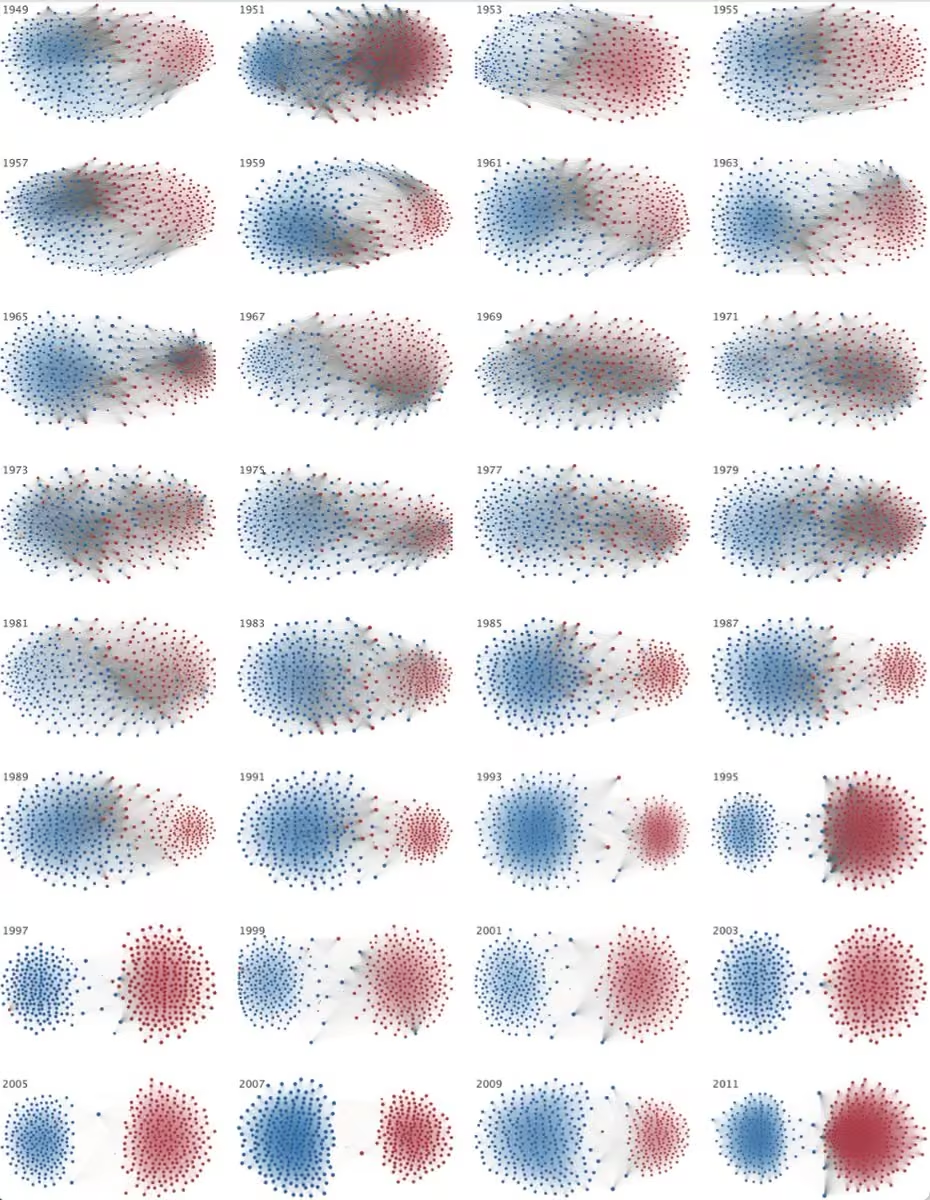
Extraordinary. We are stardust.
Asteroid Bennu contain all 5 of nucleobases that form DNA and RNA on Earth and 14 of 20 amino acids found in living organisms (though Bennu contains equal amounts of these structures and their right-handed counterparts). www.nature.com/articles/s41550-024-02472-9 -
César A. Hidalgo
@cesifoti
[New Paper]
Can economic complexity help us understand how countries move towards their Sustainable Development Goals (SDGs)?
In a new paper, led by Fengmei Ma and Heming Wang (@HemingWang2), from CCL, we explore how countries make progress towards SDGs.
Instead of looking at each goal in isolation, we use a network perspective where goals are connected if the same countries tend to "specialize" in them. This network is formed by two clusters that can be separated by applying metrics similar to the economic complexity index but applied to SDG indicators. The result is an "endogenous" way to weigh different SDGs and aggregate them in a single metric, without making a priori assumptions about which SDGs are more "valuable."
We find that countries that score high on this index tend to "specialize" in SDGs related to: (1) knowledge production and communication, such as high R&D spending, (2) health outcomes, such as high universal health coverage, and (3) emission reduction technologies, such as the use of clean fuels for cooking. The "dumbbell" structure also suggests that SDG progress is not the result of improving many independent dimensions but works as a dynamic transition between two clusters of correlated goals. But since these two clusters do not explain all variation, we can identify SDG "orphan" indicators—areas where very few countries under-specialize and may need targeted interventions.
Our findings extend the application of economic complexity methods to sustainability and underscore the importance of looking at SDG progress from a dynamical systems perspective.
César A. Hidalgo
@cesifoti
Link to paper:
www.nature.com/articles/s41467-025-56076-6 -
César A. Hidalgo reposted
Philipp Koch
@philippmkoch
End of 2022 is the start of the genAI revolution, and Deepseek just pushed the genAI frontier even more. But companies need time to adopt a new technology. In 2023, AI usage was on par with 2021. Only in 2024, adoption rates went through the roof. 📈
-
César A. Hidalgo reposted
Nico Ajzenman
@Nicolas_Ajz
Our "Discrimination in the Formation of Academic Networks: A Field Experiment on #econtwitter" with @PedroSant_Anna and @bruno_ferman is now forthcoming in the
😀😀
American Economic Review Insights (@AEAjournals)
😀😀
papers.ssrn.com/sol3/papers.cfm?abstract_id=4323614 -
César A. Hidalgo reposted
Skanda Amarnath
@IrvingSwisher
The great work of @OECtoday & @cesifoti is already proving to be very handy for the current moment...
In 2022, the main destination for Colombian exports of:
Coffee - The United States ($1.78B)
Crude Petroleum - The United States ($6.05B) -
César A. Hidalgo
@cesifoti
Lonely Planet named Toulouse the urban destination of 2025.
I’ve been living in Toulouse for nearly five years.
So, I wanted to share with you some of my favorite small businesses from “La Ville Rose.”
🧵/1 👇Post not available here, view on X
César A. Hidalgo
@cesifoti
For lamb we go to the Maison de l’agneau at Victor Hugo. If you like lamb chops, this is the place. But be patient, because Marie loves chatting with her customers. :)
César A. Hidalgo
@cesifoti
Toulouse has many wonderful small businesses that make it a great place to live. I am sorry to only be naming a few of them on this thread.
If you come to Toulouse this year, grab some croissants from Conte, a Foret Noire from Pillon, or drop by a market and get whatever fruit is in season.
You won’t regret it. -
César A. Hidalgo reposted
Philipp Koch
@philippmkoch
Did you know that Berlin was thriving economically in the 18th century? In 1750, Berlin's GDP per capita was 30% higher than the German average. Let's explore why and how we come to that estimate... 👇
1/9 -
César A. Hidalgo reposted
Katy Faust
@Katy_Faust
A family counselor of 50yrs told me:
A strange thing happens when a child sees their father loving their mother- they feel like their father is loving them.
Same thing when their mother shows affection to their father.
IHO, it's the only time a human can be loved indirectly. -
César A. Hidalgo
@cesifoti
Help me choose a subtitle for The Infinite Alphabet!📖
With my editor at Penguin we have been discussing two options:
The Infinite Alphabet, And The Laws of Knowledge
&
The Infinite Alphabet, And The Three Laws of Knowledge
Here are some arguments for each.
The first one, is closer to the narrative of the book, which groups several related principles into three laws. Yet, since each law is a package of principles that could potentially be expanded, the three is a helpful way to structure the narrative instead of a hard constraint.
The second one, adds the "three" in an effort to simplify the book's content and make it less intimidating for the reader. Maybe more attractive for someone to grab the book, according to my publisher.
What do you think? Do you have a preference for either?
Let me know in the poll and in the comments.
Thanks! 🙏 -
César A. Hidalgo reposted
Keith Mansfield📚🚀✨
@KeithMansfield
I wrote about #deextinction in my 2019 book about the future. It will be amazing when this happens, both mammoths and Tasmanian tigers in Colossal Biosciences' sights, hoping to bring one back by the end of the decade.
TechCrunch
@TechCrunch
Colossal Biosciences raises $200M at $10.2B valuation to bring back woolly mammoths tcrn.ch/3Wk6BIE
-
César A. Hidalgo reposted
Matthew Berman
@MatthewBerman
1/ Google Research unveils new paper: "Titans: Learning to Memorize at Test Time"
It introduces human-like memory structures to overcome the limits of Transformers, with one "SURPRISING" feature.
Here's why this is huge for AI. 🧵👇 -
César A. Hidalgo
@cesifoti
China's stellar export performance in 2024 is not a recent phenomenon. During the COVID-19 pandemic, China's economy surged far ahead the United States and Germany, traditionally the two other major global exporters.
-
César A. Hidalgo reposted
Cristóbal Valenzuela
@c_valenzuelab
Something strange happens when a market suddenly becomes hot: we lose our ability to make meaningful distinctions. I've been watching the explosion of companies entering the generative media market. The conventional wisdom groups them together as if they were interchangeable parts of the same machine. That's a mistake. It obscures something important about how this market is actually developing.
The confusion stems from focusing too much on what these companies can do right now, and not enough on how they think about what they're doing. When you look closely, you start to see three distinct species of company, each with its own characteristic behavior. These categories tell us more about the future of generative media than any technical comparison of their current capabilities.
The first species evolved before the gold rush. These companies weren't trying to capitalize on a trend. They were the trend. They built their own paths because the conventional ones didn't exist yet. With that independence came the freedom to guide. To direct. They have specific, often unusual theories about how generative models should work and what they should be used for.
Then there are the fast followers. These are the companies that sprang up overnight when generative AI became hot. The Samwer brothers-style companies. These companies aren't necessarily doing anything wrong. They're just opportunistic. But their opportunism shapes everything about them. From their technical choices to their communication style. They're responding to market incentives. Engagement at all costs, no matter how truthful. Following rather than leading, Taking the path of least resistance to whatever seems to be working right now. They're not trying to be right, they're trying to be right now.
The third category is the most curious: large tech companies treating generative media as a quarterly checkbox. They make splashy announcements and release impressive demos, but you get the sense that their heart isn't really in it. The technology is a means to an end. Usually trying to maintain their image as innovation leaders or defending their existing business. There's something mechanical about their involvement. It's like watching someone go through the motions of a dance they don't really feel. The technology isn't the point. It's just a prop in a larger corp performance.
They are all playing different games. I suspect this will become more apparent as the market matures. The capabilities that seem impressive today will become commoditized tomorrow. I’ve mentioned that many times before. When that happens, the difference between companies that understood what they were building and companies that were just building what everyone else was building will become obvious. History suggests that in fundamental transitions, that's what matters most. The rest is just noise. -
César A. Hidalgo
@cesifoti
“I've often been asked to define both wokeness and political correctness by people who think they're meaningless labels, so I will. They both have the same definition:
An aggressively performative focus on social justice.
In other words, it's people being prigs about social justice. And that's the real problem — the performativeness, not the social justice.
Racism, for example, is a genuine problem. Not a problem on the scale that the woke believe it to be, but a genuine one. I don't think any reasonable person would deny that. The problem with political correctness was not that it focused on marginalized groups, but the shallow, aggressive way in which it did so. Instead of going out into the world and quietly helping members of marginalized groups, the politically correct focused on getting people in trouble for using the wrong words to talk about them.”
Paul Graham
@paulg
I just published a new essay, and since the algorithm prefers links in replies, I dutifully put it in a thread about why I wrote it. But a lot of people didn't notice the link, so screw that:
The Origins of Wokeness: paulgraham.com/woke.html -
César A. Hidalgo
@cesifoti
Elon lies about his video game skills (poe2), but we all know which is the game that really counts (Clash Royale) :-).
Human vs Human, 3 minute bouts, dozens of millions of daily players. -
César A. Hidalgo reposted
pablo
@pablogguz_
in the past, birth rates in the US fell because couples had fewer kids. today they're falling because people aren't coupling up at all. fantastic piece by @jburnmurdoch
www.ft.com/content/43e2b4f6-5ab7-4c47-b9fd-d611c36dad74 -
César A. Hidalgo reposted
Corvinus University of Budapest
@uni_corvinus
🌍 An international study, led by #balázs_Lengyel, #research_professor at Corvinus University, shows that broad social connections can reduce antidepressant use. 💊
👉 Read more about the research here: www.uni-corvinus.hu/post/hir/diverse-social-connections-c… -
César A. Hidalgo reposted
Melanie Mitchell
@MelMitchell1
An incredible opportunity for the right person:
The Santa Fe Institute is seeking applications for full-time resident faculty positions at all academic levels
For me, this has been the best possible job ever.
More info here: santafe.edu/about/jobs/resident-faculty-2025 -
César A. Hidalgo
@cesifoti
The discussion about the classics in economics is pushing some economists to position the field closer to hard sciences such as physics.
That's sweet.
But while I agree that economics shares many features with the hard sciences, we also need to acknowledge two things.
First, economists are often late adopters to hard-science ideas.
The switch to "big data," which was popular in physics in the early 2000s, became a thing in economics in the 2010s. Networks, which exploded in physics in the late 90s, became more prominent in economics after the 2008 financial crisis. Neural networks, which were a thing in physics in the 80s, have only more recently become a thing in economics.
Second, and more importantly, many economists reject the principle of interdisciplinary consistency, the idea that fields of science need to "match." This is the notion that physics must be consistent with chemistry, chemistry with biology, biology with psychology, and so on. Many colleagues have told me directly that this consistency is not a requirement for economics. They believe the field is unique and exempt from this principle.
But I disagree. I think that to be a science every field must accept interdisciplinary consistency. That is accepting that other disciplines produce knowledge that cannot contradict that created by your discipline.
Interdisciplinary consistency is in fact a core aspect of scientific identity. Accepting that we are scientists first and members of a discipline second is an ante people expect others to pay to join the room of the "hard-sciences." It is a hard pill to swallow, because there is a lot of knowledge in other fields that each discipline must be consistent with. In the case of economics, this ranges from knowledge on the biological constraints on human cognition and behavior as well as work on macroecology and evolution. The beauty of interdisciplinary consistency, however, is that--when it works--it leads to more general answers. Answers involving mechanisms that are valid across fields.
I personally think economists have a lot to contribute to science. I've been part of the field for 20+ years and I know it is filled with brilliant people. But I am not sure if all of them are ready to accept themselves as scientists first and economists second. I've sometimes had that conversation.
And that’s the real challenge. If economics truly wants to sit at the table with the hard sciences, it has to embrace the same rules of the game, including the sometimes uncomfortable reality that it also has to align with knowledge from other fields.
So, are we ready to make that leap? To stop being a hard science by analogy? I hope so. Because the answers we’re looking for might just be waiting for us in the spaces between disciplines. -
César A. Hidalgo reposted
Philipp Koch
@philippmkoch
📢 New year, new job! 🙌💪
I’m excited to share that after completing my PhD in Toulouse, I am back at @Eco_Austria, now as Head of the Data Science Section. -
César A. Hidalgo
@cesifoti
The Infinite Alphabet is complete!
It should hit bookstores on November of this year. -
César A. Hidalgo
@cesifoti
Six years before Lex Fridman launched his first podcast, I ran an interview series at MIT called Cambridge Nights.
While we never reached the same heights, the series was featured in the New York Times and earned a couple of Webby award nominations.
We had remarkable guests and engaging conversations, as we tried to push a deep conversation format.
If you're curious, check out the links in the comments.This media couldn't be displayed. See it on the original post.
César A. Hidalgo
@cesifoti
Season 2: www.youtube.com/playlist?list=PLLoU2ceovH4LkmgZLAwL21LbHf…
Season 1: www.youtube.com/playlist?list=PLLoU2ceovH4K9xBj24V0UfSHaf…
We used to host these on Vimeo, but recently moved them to YouTube so we lost all our views. -
César A. Hidalgo reposted
Paul Novosad
@paulnovosad
Another case where the short-term program effects are null, but long-term effects are substantial.
Kind of a problem since so much econ research is based on very high quality evaluations of short-term program effects.
academic.oup.com/qje/article/139/4/2579/7690176 -
César A. Hidalgo reposted
mauv
@ThatsMauvelous
a brief commentary on this graph 🧵
Alec Stapp
@AlecStapp
Narrative violation
-
César A. Hidalgo
@cesifoti
The most famous people that passed away in 2024 according to Pantheon, our observatory of collective memory:
1. Jimmy Carter (b. 1924) 🇺🇸🏦
2. Alain Delon (b. 1935) 🇫🇷📽️
3. Franz Beckenbauer (b. 1945) 🇩🇪 ⚽️
4. Mario Zagallo (b. 1931) 🇧🇷 ⚽️
5. Maggie Smith (b. 1934) 🇬🇧 📽️
6. Daniel Kahneman (b. 1934) 🇮🇱 📚
7. Donald Sutherland (b. 1935) 🇨🇦 📽️
8. Alberto Fujimori (b. 1938) 🇵🇪 🏦
(Link with full list in comment)
César A. Hidalgo
@cesifoti
-
César A. Hidalgo reposted
Marton Karsai
@MartonKarsai
WE ARE HIRING! Are you a young academic working in Social Data Science? Join the Department of Network and Data Science
@dnds_ceu
@ceu
in Vienna as a full-time Assistant Professor. Be a member of the only Network Science Department in the world! careers.ceu.edu/job/Vienna-Assistant-Professor-(fmd)-1100… -
César A. Hidalgo reposted
James Pethokoukis ⏩️⤴️
@JimPethokoukis
International master's students in US universities create startups themselves + their presence increases startup creation by their American classmates. When classes have more international students, they produce more successful startups that survive & raise major funding. Win-win!
-
César A. Hidalgo reposted
AS
@ximoes
I'm a data nerd.
2024 was a wild year, and I made a bar chart race of the top 10 people trending on Wikipedia each day.
It says so much about what happened in 2024. 👀
public.flourish.studio/visualisation/20972077/
src: pantheon.world homepage -
César A. Hidalgo reposted
Ethan Evans
@EthanEvansVP
1) If another country pays to raise and educate a child through college and that young person then moves to the US, we just gained a fully mature tax payer at zero cost. All the news about student loans? In this case, another country paid for that education. They bore all the costs, we get all the benefits.
-
César A. Hidalgo reposted
Armand Domalewski
@ArmandDoma
people are going around posting screenshots of “omg they hired a COOK for 20k on an H1-B” and it’s nonsense
here’s what happening:
1. the database you are using includes *all applications.* anyone can apply for anything!
2. legally H1-Bs cannot be offered for jobs making less than $60k.
3. It looks like a lot of small businesses got confused and meant to file for the H2-B visa, which covers temporary seasonal labor, primarily in hospitality -
César A. Hidalgo
@cesifoti
I am a former H1B visa holder and US citizen.
When I arrived in the US in 2004 with a trekker's backpack, an F1 visa, and $2,000, I had no idea how this country would change my life. Within six years, I was hired by MIT as an Assistant Professor and within ten I had started my own company. The US provided me with a level of opportunity that I doubt I would have seen anywhere else in the world.
So let me tell you why I think the US is a perfect complement to foreign talent and why it is in our interest to keep it this way.
I moved to the US in 2004 to pursue a PhD in Physics. When I landed, I expected my American classmates to be more advanced than I was in theoretical physics concepts. But I was wrong. I quickly realized that I had taken more graduate level courses than them. Their bachelor education had meandered through multiple topics, while I had been on a 100% physics and math track that helped me test out of graduate courses and move right into research.
And that is where the American magic began. Back home, my brief encounters with research focused on making small improvements on well-established problems using sophisticated tools. Many people were competing to show how smart they were by dominating byzantine methods. In the US, I saw many researchers succeed by picking “simple” but relevant problems. That was a perfect complement for my technical background. I felt like Daniel San the moment he figured out the value of waxing all of those cars. I finally was at a place where my skills were useful.
America is a land opportunity in big part because it has a fantastic work culture that values things such as relevance, communication, and simplicity. In X, international comparisons of work culture often veer into formal things like maternity leave. But as someone that has worked in a few countries, I am convinced that many subtle things, such as knowing how to take turns during a meeting, or responding to an email quickly, can go a long way. In many countries, work is an overregulated bureaucratic nightmare. American culture can be extremely refreshing for foreigners who know what it means to battle unnecessary processes and rules.
But there is more. The US work culture is also open and optimistic. Most countries suffer from “well intentioned” cronyism, where people hire, associate, and promote others based on personal relationships. This certainly happens to some degree in the United States, but less than in other places. That openness, however, is key for providing opportunities for outsiders with more skills than networks. Also, many countries pessimistic work cultures, where people shoot others down as a way to flex their wit. But as Nat Friedman said, “Pessimists sound smart. Optimists make money.” American can-do attitude is a valuable intangible that is prevalent in the US.
Now, to the point of this post, these aspects of American work culture are great complements for skilled foreign workers. Complements that favor America. America’s open work culture, with its emphasis on communication skills and optimism, is amazing for organizing teams. Skilled foreigners perform better in teams with an American work culture than in teams of bureaucratized pessimists that don’t know how to take turns during a meeting. When those surviving in those more hostile work environments move to America, they can unleash their technical skills in relevant problems within optimistic organizational cultures that are rare back home.
Whether it is Von Braun and his team moving to Texas, or a brilliant young man or women from Sicily or Jakarta coming to the US for their PhD, America benefits from this complement. The fact that every year we get the first pick on the draft is a key competitive advantage. Sure, we do not always know if the first pick of the draft will turn out great, but getting the first pick of the draft is not something we want to lose.
We should double down on what makes America exceptional. -
César A. Hidalgo reposted
Philipp Koch
@philippmkoch
💡Updated historical GDP per capita estimates!
The dataset accompanying our PNAS paper on augmenting historical GDP estimates through machine learning now includes more source data for European regions and updated estimates for the 20th century. github.com/philmkoch/historicalGDPpc -
César A. Hidalgo reposted
-
César A. Hidalgo
@cesifoti
I am often approached by students that are insecure about the robustness of their results. These are students who have submitted a paper for publication, and after being rejected, start wondering how to make it more “bulletproof.” This is good. Reviewers often raise good questions and papers improve by taking that feedback seriously. But incorporating feedback requires sometimes reading between the lines, and here is where many students stumble.
When a reviewer rejects a paper is not because they were convinced by the entirety of the argument and became skeptical all of a sudden when they reached “table twelve.”This seems obvious, but it is not. If it were, these students would rewrite their papers to clarify and reframe their contribution instead of trying to prop up the same argument further with additional tables and figures.
So what often happens is these students get rejected again while they keep on adding things to their paper. They end up with a paper that is hundreds of pages long, which nobody wants to read, and that is more focused on describing caveats than explaining its goal.
Often, what some of these papers need to improve is to narrow down & qualify their claims. Something that can be emotionally hard for a student holding on to text they took months to craft.
But readers don’t care about the effort of the writer. They care about the clarity of the text. The sunk cost fallacy that pushes students to reuse their old paragraphs only hurts them. To become a better writer you need to understand that editing is a war where you don’t take prisoners. If a page or two are no longer contributing to the story, you must kill them. The effort that went into crafting them is not a good argument for their survival.
For example, imagine you’ve written a section detailing six robustness checks for your model. If your core argument is already shaky, those six checks won’t save it. Instead, they’ll overwhelm the reader with detail, making it harder to understand the central point of the paper. A better approach would be to reassess your claim, narrow its scope, and focus on the evidence that matters most.
You’ll be surprised how quickly you can rewrite something from scratch once you understand why it is not working. And you’ll be surprised how much better a version that doesn’t reuse any of the previous text can be. If all the previous text did was help you understand the weaknesses of your argument, then it served its purpose and died with dignity.
Many students, however, find this process of ruthless editing unsettling. They fear that removing content diminishes the strength of their contribution. But the truth is, good writing isn’t about how much you can add—it’s about how effectively you can communicate. Academic writing, in particular, is not a competition for word count or complexity; it’s a test of how well you can guide your reader through your ideas and conclusions.
Reviewers don’t expect you to build a fortress of data to defend every possible critique. Instead, they want you to sharpen your argument, clarify your contribution, and focus on the evidence that best supports your claim. By narrowing the scope, you often make your work stronger, not weaker. A precise, well-supported claim carries far more weight than a sprawling, overcomplicated one.
So, the next time you face rejection or critical feedback, resist the urge to pile on more content. Instead, take the harder but ultimately more rewarding path to strip away the excess and hone your argument. Simplicity and clarity win in the long run. Writing is not about convincing yourself that you’ve said enough—it’s about convincing your reader that you’ve said something that matters. -
César A. Hidalgo
@cesifoti
Grad student presenting at a conference with their advisor on the audience.
-
César A. Hidalgo reposted
Rebeka O'Szabo
@RebekaOSzabo
🚨 New preprint out! 🚨
"Coordination and balanced communication enhance collective problem-solving in organic teams"
osf.io/preprints/osf/4rwpd
in collab with @DavidDeritei & @fede7j
@LearningCCL @dnds_ceu @harvardmed -
César A. Hidalgo reposted
Ole Lehmann
@itsolelehmann
EU entrepreneurs are tired.
I analyzed the 190 responses to my post about the major problems European entrepreneurs suffer.
Here are the results of what frustrates them the most (I let Claude rank them)
The clear winner in terms of frustration is bureaucracy and paperwork (9/10).
People are fed up with all the forms, physical visits, and ridiculous notary requirements.
It came up again and again in different contexts.
Tax system and GDPR tie for second place (both 7/10).
The VAT system gives everyone headaches, especially when operating across borders (ask me about it!).
GDPR is interesting because while people generally support data protection, they feel the implementation crushes smaller businesses.
It's especially bad for small new businesses that can get crushed by the fines (there are law partner firms specialized only in finding and fining them, disgusting).
Labor laws and what people called an "anti-innovation culture" were next (both 6/10).
Tbh, this is close to my heart and impacts me daily.
The employment regulations seem to be a real pain point - lots of stories about not being able to fire underperforming employees and being afraid to hire because of the risks.
Market fragmentation and cross-border complexity (both 5/10) are interesting because they highlight a paradox:
The EU is supposed to be a single market, but entrepreneurs are still dealing with 27 different systems.
AI Act and tech regulations came up less frequently (4/10) but when they did, people felt strongly about them.
Some fascinating patterns emerged:
There's this striking cultural contrast people kept drawing between the US and EU approaches.
The US "let's do it" vs EU "let's regulate it" mentality came up several times.
The size issue is really interesting - lots of people pointed out how regulations that might be manageable for big companies are crushing for startups. One person mentioned spending up to 50% of their income just on compliance.
What really stood out to me:
Beyond specific complaints about regulations, there seems to be this deeper frustration about what some see as a fundamental hostility to entrepreneurship in the EU culture.
This all paints a picture of a challenge that goes beyond just regulatory burden - it seems to be about the whole culture around entrepreneurship in the EU.
Let me know if you find posts like this interesting.
I just analyzed it for myself and thought, why not share it.
Ole Lehmann
@itsolelehmann
European entrepreneurs, what upsets you about EU rules and frameworks?
Please comment. -
César A. Hidalgo reposted
Thomas Hornall
@Thomashornall
I’m British.
I recently spent 10 days in the USA for business.
And discovered the ocean between us isn't water.
It's mindset.
7 uncomfortable truths about US v UK culture: -
César A. Hidalgo
@cesifoti
Dark Matter on Apple TV
I don’t know why more people are not talking about this show.
🤯🤯🤯 -
César A. Hidalgo reposted
Balázs Lengyel
@blengyelb
"Antidepressant use in spatial social networks"
In our new @ScienceAdvances paper, in collaboration with @Gergo_Toth @NAChristakis @AnikoBiro17, we demonstrate the role of diverse networks in mental health.
Open access at:
www.science.org/doi/10.1126/sciadv.adr0302
Summary in thread. -
César A. Hidalgo reposted
Nicholas A. Christakis
@NAChristakis
In work out in December 2024 in @SciReports, Matt Jones and I conduct experiments to study the role of leadership within factions of larger groups struggling to reach consensus on a contentious topic. 1/
-
César A. Hidalgo
@cesifoti
1. Who wins if China bans rare mineral exports to the US?
China represents 28% of rare mineral exports, and the United States 25% of global imports, but China is not the main source of the US. 🧵👇Post not available here, view on X
César A. Hidalgo
@cesifoti
3. This trend has not changed. As recently as August of this year, Brazil was still the main source of rare minerals for the US (Chile is up there too, in red).
César A. Hidalgo
@cesifoti
4. But is this a windfall for Brazil? Not likely. Trade in rare minerals is rather small (about $1B per year), so these shifts will not move the needle for the economy of Brazil (which exports of $340B+).
César A. Hidalgo
@cesifoti
5. The main destination of China’s rare minerals today are in Asia. So the US will continue to import Chinese rare minerals as inputs in higher value added products (such as Korean electronics).
César A. Hidalgo
@cesifoti
In a world where trade is often in the news, you can get valuable context at the OEC
oec.world/en/profile/hs/gallium-germanium-hafnium-indium-… -
César A. Hidalgo reposted
Luis Garicano 🇪🇺🇺🇦
@lugaricano
1/9 A trillion-dollar EU company? The real blocker isn't lack of founders, culture or capital. European companies pay 10x more in restructuring costs than US firms when ventures fail. Changing direction (see Vokswagen!) is expensive.
A Thread on today's Sillicon Continent post -
César A. Hidalgo
@cesifoti
When you travel for work you see few sights but many faces. You learn directly from people who tell you about the best & worst of their countries.
I arrived in Indonesia 🇮🇩 last Saturday to participate in a conference organized by its Ministry of Finance.
Indonesia is one the world’s latest economic miracles. Since the early 2000s, it doubled its gdp per capita . But Indonesia is also getting ready for their next jump.
Our latest forecast predicts Indonesia will be one of the fastest growing economies in the world. At equilibrium with economic complexity 🇮🇩 income should be about $12k. So there is plenty of room to grow.
But that is a bird’s eye view from a computer model. My ground experience was even more illuminating. I saw an enthusiastic population with a true desire to continue transforming their economy.
Indonesia is already the 16th largest economy in the world. It is a large, diverse, & multicultural country. It is a place you want to know. But if you visit, please make sure to exercise common sense.
The most common complaint I heard about foreign intellectuals is how patronizing they are. Don’t be the guy that parachutes from Washington or Brussels to lecture people about the importance of preserving the rain forest. They will nod politely, but they know the challenges, limitations, and opportunities of their economy better than you. They need people to collaborate side-by-side with who can take them seriously.
Indonesians are ready to work with those who are smart enough to understand this. It is an incredible country with a bright future. -
César A. Hidalgo reposted
ANETI Lab
@AnetiLabs
🧵More exciting news: @blengyelb has been awarded an Advanced Lendület grant from the Hungarian Academy of Sciences🏆The prestigious grant will enable @AnetiLabs to strengthen our community and to expand into new research directions over the 2024-2029 period.
-
César A. Hidalgo reposted
David Broockman
@dbroockman
🚨 NEW PAPER: When low-income Americans get $1,000/month for 3 years, what happens to their political views & behavior?
The OpenResearch Unconditional income Study reveals surprising findings about the effects of income on politics... 🧵 -
César A. Hidalgo
@cesifoti
The bubbles on the left are US publicly traded companies that are less than 50 years old with a market capitalization of $10B+. The bubbles on the right are the same but for the EU.
Great visual from @amcafee's newsletter.
César A. Hidalgo
@cesifoti
Here is the article with a description of the methodology
geekway.substack.com/p/a-visualization-of-europes-non-bubbly -
César A. Hidalgo
@cesifoti
I don’t know if I should be flattered, or horrified about sitting in front of a map where Australia is labeled as Canada. 😂
-
César A. Hidalgo reposted
Arnaud Bertrand
@RnaudBertrand
This is very interesting, and I think a world first: a local government in China has just sold its sky, literally.
This is the government of Pingyin County, Jinan, Shandong Province who sold for 924 million yuan (approximately $130 million) a 30-year concession to operate and maintain its low-altitude economic projects to a company called Shandong Jinyu General Aviation Co., Ltd.
The "low-altitude economy" is a big trend in China at the moment. XPeng, one of China's leading EV manufacturers, recently released a low-altitude flying car for instance. Drone deliveries are becoming increasingly common in Chinese cities, and various regions are actively developing low-altitude transportation networks. Shanghai, for instance, plans to establish 400 low-altitude flight routes by 2027.
But this is the first time a local government has monetized its low-altitude airspace. What makes this particularly fascinating is how it mirrors China's land management system. Just as local governments have traditionally derived substantial revenue from leasing land-use rights (which historically made up nearly half of their income), they're now looking upward to the skies as a new frontier for revenue generation. The Civil Aviation Administration of China estimates that by 2035, the low-altitude economy market could reach 3.5 trillion yuan (about $490 billion), so we're talking big, big money.
Pingyin County wasn't chosen by accident: the area already has significant aviation infrastructure, including two airports and several drone manufacturing companies. It has also partnered with Nanjing Aeronautics and Astronautics University to develop a low-altitude logistics demonstration center. The winning bidder, interestingly, is a state-owned enterprise specifically created for this purpose.
All in all it looks like this local government wants to develop a pilot program to demonstrate how a "low-altitude economy" ecosystem can be developed locally, and also be a first-mover in that space. That's the way it often works in China's so-called "mayor economy": local governments act as policy entrepreneurs, experimenting with innovative approaches that, if successful, could become blueprints for national development while giving their regions first-mover advantages in emerging sectors.
Let's see how it develops: this experiment in Pingyin County might seem small, but it could be the beginning of something truly revolutionary. This is China effectively experimenting around becoming the world's first truly three-dimensional economy, with low-altitude transportation and logistics networks. In a decade or two Chinese cities might have as much activity happening in the sky as on the ground.
Here are a few sources on this:
- www.guancha.cn/economy/2024_11_29_757212.shtml
- finance.people.com.cn/n1/2024/1128/c1004-40370800.html
- news.sina.com.cn/c/2024-11-29/doc-incxtzmi1711070.shtml -
César A. Hidalgo reposted
Espacio Público
@EsPublicoCL
🖥️ Ayer, nuestro director @cesifoti participó en el seminario «¿El fin de los políticos? Democracia e Inteligencia Artificial», organizado por @cppublicasuc y @GobiernoUAI.
🤓 ¿Te perdiste la transmisión? Vuelve a verla aquí 👇🏽
www.youtube.com/watch?v=OkGTz-SK5OA -
César A. Hidalgo reposted
Carlos Santana Vega
@TheDotCSV
I did another experiment with Runway's outpainting. I wanted to test how much it could reconstruct my face from a video with very little information.
The result is impressive once again! Just with the little that can be seen on the sides it managed to reconstruct my face 😮 -
César A. Hidalgo reposted
César A. Hidalgo
@cesifoti
Mexico is by far the number one trade partner of the US.
It is well integrated into American value chains, especially in electronics and automotive.
This year the US imported from Mexico:
🚙 $31B Cars
💻 $28B Computers
🚚 $24B Delivery Trucks
/2 -
César A. Hidalgo
@cesifoti
Dear @elonmusk & @realDonaldTrump
In case you are interested in trade statistics about the US, Mexico, and Canada, here is a quick thread.
César A. Hidalgo
@cesifoti
How will the recently announced 25% tariffs on Mexican and Canadian products affect American businesses?
Mexico & Canada are key trading partners for the US. They represent 28% of US imports & 33% of US exports.
Here is a detailed thread on US-Mexico-Canada trade 🧵👇 /1 -
César A. Hidalgo
@cesifoti
How will the recently announced 25% tariffs on Mexican and Canadian products affect American businesses?
Mexico & Canada are key trading partners for the US. They represent 28% of US imports & 33% of US exports.
Here is a detailed thread on US-Mexico-Canada trade 🧵👇 /1
César A. Hidalgo
@cesifoti
Mexico is by far the number one trade partner of the US.
It is well integrated into American value chains, especially in electronics and automotive.
This year the US imported from Mexico:
🚙 $31B Cars
💻 $28B Computers
🚚 $24B Delivery Trucks
/2Post not available here, view on X
César A. Hidalgo
@cesifoti
But there are important things that we cannot see well in these charts because these charts focus on products with big trade volumes (e.g. cars, oil).
Yet, there are "smaller" products that are very close to our hearts and that hide surprising relationships.
/6
César A. Hidalgo
@cesifoti
Did you know that Mexico is the number one source of imported beer in America?
This might surprise you, but Mexico is the number one exporter of beer in the world, far ahead from the Netherlands, Belgium, and Germany.
Much of this beer ends in the US.
/7Post not available here, view on X
César A. Hidalgo
@cesifoti
Trade is a tough game that can have unexpected consequences.
Today, US-Mexico trade & US-Canada trade involves value chains run mostly by American companies.
What will happen if these value chains are disrupted?
Will Mexican manufacturers start importing parts from China?
/10 -
César A. Hidalgo reposted
Nicholas A. Christakis
@NAChristakis
We can actually predict who your friends are based on whether you have similar bacteria in your poop! And that metric outperforms other more usual social features, such as how you resemble your friends on a host of traits like age, sex, wealth, etc. 7/
-
César A. Hidalgo
@cesifoti
*New Paper on AI & Democracy*
Imagine two approaches to democracy. The one we have today, where citizens choose a professional politician to represent them and others. Or an augmented form of democracy, where each citizen controls a personalized AI that helps them participate in thousands of nuanced decisions.
This second approach is the idea of Augmented Democracy I introduced six years ago at TED.
In our latest paper we explore a simplified version of Augmented Democracy by combining off-the-shelf LLMs, such as ChatGPT, with data collected using a collaborative government program builder. This was an online game where people build a personalized government program using proposals extracted from the programs of the candidates of the 2022 presidential election in Brazil.
So how accurate are these augmented forms of democracy?
Imagine a user who gave us 40 answers. We can use the first 20 to fine-tune a model that we can test using the 20 answers the model didn’t see. We can then compare the accuracy of these predictions with the ones obtained by a “bundle” rule, which assumes that users that self-reported to be from the left or right always chose the proposals from the candidate that shares their political identity.
This showed us that LLMs were more accurate at predicting policy preferences than the bundle rule, meaning that the preferences captured in the participation data were more nuanced than a left-right axis, and that the LLMs can capture some of that nuance. Also, the LLMs can choose among policies coming from the same candidate, which is something that we cannot do using a bundle rule.
But can these LLMs help us complete the aggregate preferences of the population?
Direct or unbundled forms of participation can result in incomplete data when people answer only a fraction of all questions. In our paper, we simulate this incompleteness by sampling the full dataset. We ask how close we can get to the full dataset by using a random sample, or a random sample augmented by predictions made by these LLMs.
Overall, we find that LLM-augmented data gets much closer to the full dataset than a pure random sample.
These results do not mean that augmented democracy technology is ready, but they means we are in a much better place to continue exploring this idea than six years ago.
This paper was a collaborative effort with Jairo Gudino, PhD student at CCL at the University of Toulouse Capitole and Umberto Grandi from IRIT also at the University of Toulouse Capitole.
We hope you find these results insightful!This media couldn't be displayed. See it on the original post.
César A. Hidalgo
@cesifoti
Paper:
centerforcollectivelearning.org/s/gudio-et-al-2024-large-…
César A. Hidalgo
@cesifoti
With @JFernandoGRE and @umbe_grandi
-
César A. Hidalgo reposted
Marton Karsai
@MartonKarsai
WE ARE HIRING! Are you a young academic working in Social Data Science? Join the Department of Network and Data Science @dnds_ceu @ceu in Vienna as a full-time Assistant Professor. Be a member of the only Network Science Department in the world! careers.ceu.edu/job/Vienna-Assistant-Professor-(fmd)-1100…
-
César A. Hidalgo
@cesifoti
Impressive work. Many people in the field have long been looking for fine grained input output data. This effort satisfies an important need.
Prashant Garg
@Prashant_Garg_
🚨NEW DATA🚨
An input-output network between 5000 products.
Check our production network interactive tool and open-access data at aipnet.io
See this🧵for findings 👇 -
César A. Hidalgo reposted
velardedaoiz2
@velardedaoiz2
Esto de @lugaricano.
España no tiene empresas Punteras de IA… pero tiene la Primera Agencia de Supervisión de Inteligencia Artificial de Europa, en La Coruña.
Esa agencia (AESIA) tendrá: Presidente, Director, 2 Subdirectores, un Secretario General y 10 Departamentos. -
César A. Hidalgo reposted
Luis Felipe López-Calva
@LFLopezCalva
Did you know? The @WorldBank Poverty, Prosperity, and Planet Report (#3pr) team recently launched a comprehensive reproducibility package to support transparency and empower further research. This package, hosted in the Data Development Hub, contains all the information needed to replicate the report’s results.
A key component of this repository is an extensive dataset of 1,000 welfare bins, representing both consumption and income distributions across country-and-year survey microdata from 1990 to 2024. This dataset is the third version of a comprehensive binned dataset that was first published in March 2023.
This release exemplifies @WorldBank’s commitment to open data and reproducible research, setting a strong foundation for future studies on poverty and prosperity.
reproducibility.worldbank.org/index.php/catalog/189
#endpoverty -
César A. Hidalgo reposted
Taha Yasseri
@TahaYasseri
I have openings for two fully funded PhD students and two Postdocs to join our forthcoming Centre for Sociology of Humans and Machines (SOHAM) at @tcddublin & @WeAreTUDublin.
Please help me connect with the best candidates!
tahayasseri.com/join/ -
César A. Hidalgo reposted
Cristóbal Valenzuela
@c_valenzuelab
Yes, you can move the camera around. Literally.
Ben Nash
@bennash
How am I just now discovering that the camera controls in Runway can be manipulated with the mouse in the preview pane? Mind blown. Is this new? @runwayml
This media couldn't be displayed. See it on the original post. -
César A. Hidalgo reposted
ANETI Lab
@AnetiLabs
We're honored to have received the @uni_corvinus Research Group of the Year Award 🏆. Congratulations to all @AnetiLabs members for this fantastic recognition.
-
César A. Hidalgo reposted
-
César A. Hidalgo reposted
Luis Garicano 🇪🇺🇺🇦
@lugaricano
Wake-up Europe! Enough of the de-growth agenda!
There is no strategic autonomy while we spend our every waking hour erecting barriers to growth!
THREAD on the post today in Silicon Continent by @pietergaricano.
1/8 -
César A. Hidalgo
@cesifoti
There is a lot to learn from this election.
I see several key issues.
1. This was not an election with two candidates but one: Trump and not Trump. The democrats did not have a candidate that enthused. Out of 3000+ counties in the US, Harris did not perform better than Biden in 2020 in a single one.
2. The rhetoric of democrats was to insist that the economy was doing great even to people who didn’t feel that way. If you are struggling, you’ll interpret that as either unempathic or false. Being critical, and saying that everything is wrong, is more empathic and a winning card for the opposition.
3. Democrats failed to understand and cater to the needs of key ethnic communities. The Arab American story is well known. The Hispanic American community is less understood, but what you need to understand is that many Hispanic Americans moved to the US from LatAm in search for economic opportunity and freedom (especially those who left Cuba & Venezuela, but it is true more generally). The wording from the Democratic Party, as if they are oppressed minorities doesn’t fly. That rhetoric might work for second generation Hispanic Americans born to poor immigrants, but not the many entrepreneurial Hispanics that believe in self-reliance and are looking to rebuild their business in the US. This is a truth that is largely self-evident for people from LatAm but a mystery to many people in the coastal elites.
4. The democrats did poorly among young males. They do not have much to offer to a male in his late 20s or early 30s whose life is not going great. On the contrary, they are often portrayed as privileged (which again is unempathic). -
César A. Hidalgo reposted
TSE
@TSEinfo
🏅Today @cesifoti (Professor at TSE) has been awarded a €9.8M @ERC_Research Synergy Grant!
His project “ADDI” aims to advance digital tools for democratic engagement alongside co-recipients Umberto Grandi Ulle Endriss and Majia Setälä
@UTCapitole #ercsyg
www.tse-fr.eu/fr/media/pressroom -
César A. Hidalgo
@cesifoti
Are you all suffering from pre-election anxiety disorder? 😅
-
César A. Hidalgo
@cesifoti
We got an ERC!
Together with Umberto Grandi (@umbe_grandi), Ulle Endriss (@ulle_endriss), and Maija Setälä (@maija_setala) we won an ERC-synergy award for ADDI: Advancing Digital Democratic Innovations. For those of you who are not familiar with ERC grants, these are one of the main and most prestigious scientific funding vehicles in Europe.
The goal of ADDI is to study digitally augmented forms of civic participation through three core objectives: designing technologies and procedures for citizen deliberation and participation; experimentally testing the impact of tech in deliberative and participatory forums; and understanding the preferences expressed in digitally augmented forms of civic participation. The project will run for a 72 months with a budget of 9.9M Euros. At the end of the project we hope to have a better understanding of how digital technologies can improve democratic practices while providing a robust suite of scientifically validated open-source tools.
Stay tuned for announcements, as we will be looking for postdocs, PhD students, and engineers to join us next year. -
César A. Hidalgo reposted
David Amodio
@david_m_amodio
🚨New in @PNASNews, led by @DSchultner & Ben Stillerman:
In 8 studies, we test a mechanism through which exposure to societal stereotypes—even those we know may be false—can implicitly transform into individual-level prejudice and then spread across a community. -
César A. Hidalgo
@cesifoti
The Center for Collective Learning (CCL) has grown enormously this year. Here we are ready to enter the laser tag arena in Budapest a few weeks ago :-)
-
César A. Hidalgo reposted
Jaime de Berenguer
@jaimeberenguer
“Si necesitan ayuda que la pidan”
-Pedro Sánchez- -
César A. Hidalgo
@cesifoti
Today, the Nobel prize recognized the work of Acemoglu, Johnson, and Robinson. In a recent paper, we reproduce their classic Atlantic trade result when validating our machine learning derived historical estimates of GDP per capita.
This media couldn't be displayed. See it on the original post. -
César A. Hidalgo
@cesifoti
The growing digital product trade divide:
-
César A. Hidalgo
@cesifoti
New Paper 📄 & thread 🧵!
How big are the digital exports of the U.S. compared to Europe?
Today, trade flows not only through container ports, but through routers. In this new @NatureComms paper, we introduce a method to estimate trade in digital products by combining machine learning methods with corporate revenue data.
There is a lot to unpack, so let’s dive in! /1
www.nature.com/articles/s41467-024-49141-z -
César A. Hidalgo
@cesifoti
I work with many students that are learning how to write. So I get to see a lot of them making the same mistakes. When I ask them why they are pursuing an academic career, or why they are working on a paper, they often tell me something like: “because I want to make a contribution to science.”
Now, that’s a beautiful feeling. I sympathize with that. But it has nothing to do with writing. A reader doesn’t read you because you want to make a contribution, but because you have something to say.
The great American novelist F. Scott Fitzgerald said it best:
“You don't write because you want to say something, you write because you have something to say.”
That’s where I see a lot of students struggling. They come to work wanting to say something, but they have not worked on the story until they sit in front of the keyboard. Soon, writer block kicks in. They do not understanding that typing is not where ideation begins. It is something you need to prepare for by first growing an idea to the point you can no longer fit it in your head.
As an advisor it is easy to see the symptoms. Pointless drafts are circular and non-assertive. The student is trying to fill up pages without knowing what point they are trying to make with the hope that if they keep on going they will figure it out. But the reader already abandoned them in the first paragraph. After all, it is the job of a writer to know where a story ends. This “Chekhov’s gun principle,” the idea that if a gun is shown in the first act, it must be fired in the third.
Chekhov’s gun is fundamental because it provides a method to question every sentence in your text: how does that sentence contribute to your final goal? If it doesn’t, it must go. Pointless writing can be dismembered easily using this single technique. Use Chekhov’s gun to interrogate every sentence. Of course, all writers like to sometimes indulge in a poetic detour. But do that to often and you will lose your reader. There is a reason why there is another principle called “kill your darlings.” Cutting out a bad and pointless sentence is easy. Cutting out a beautiful but pointless sentences separates the kids from the adults.
Of course, some writing—and a lot of rewriting—takes place at the keyboard. But the point is that writing is something that we must do first inside our heads: when cycling to work, walking with your partner, or cooling off after a heated argument. At some point you will need to sit down and transcribe those ideas. But the chances that the idea will hit you the moment you sit in front of a keyboard is naive. Having ideas and writing them down are two difficult activities. Trying to do them at the same time is an overkill.
So if you are a student reading this, and you are struggling to write, I have two pieces of advice. First, don’t be discouraged. Wanting to say something may not be a lot, but can give you the perseverance needed to keep on going until you have something to say. And second, ask yourself the “Fitzgerald question:” what am I trying to say? Your answer cannot be yes or no. It has to be a summary of the point you are trying to make. And when you finally start having an answer, work on it. Keep on trying to articulate it when you walk alone, when you drink with friends, and when you find that contrarian asshole that really pushes hard against anything you say. Because maybe, at the end of all of that practice, you will be able to sit down in front of a keyboard and write a good first draft. -
César A. Hidalgo
@cesifoti
Tenure! 🎓
Yesterday I accepted an offer to join the Toulouse School of Economics (TSE) as a tenured professor "première classe" at the Department of Social and Behavioral Sciences. As some of you know, this was a long journey for me after MIT rejected my tenure case in 2018. But as is often the case, bad events make good lessons and great stories.
Tenure is an institution supposed to provide intellectual freedom and independence. It was introduced in the United States early in the 20th century to counteract the arbitrary dismissal of professors with unpopular views. While it is debatable if that is still the case, what I came here to say is that not getting tenure can also have a positive effect on you (once you overcome the blow of failing a seven-year-long job interview).
Not getting tenure forces you to define your own freedom and independence. It is not easy. Financially, I had to learn to make ends meet without relying on an academic salary. I was lucky to have started a company in 2013 that is stronger today than five years ago. Intellectually, I had to revalidate my work, by executing a new pipeline of papers and projects. The result is that today, I engage in academic work, not because I have to, but because I want to. I work on papers not because they pay the bills, but because I am honestly interested in the questions I am exploring, and that is an independence that is different from the one provided by tenure.
But of course, I am still ecstatic to join TSE's Department of Social and Behavioral Sciences. It's a unique and multidisciplinary department home to psychologists, anthropologists, political scientists, economists, mathematicians, and now, a physicist with twenty years of experience in questions of economic geography, knowledge diffusion, and economic development.
I look forward to the challenges that lie ahead. Here's to new beginnings, continued exploration, and the pursuit of knowledge! 🌟 -
César A. Hidalgo
@cesifoti
Let me tell you an inspiring story about a different type of entrepreneurship. A venture where social and financial returns are not well aligned.
This is the story of Nigist Goytom (@nigigebi), an Ethiopian entrepreneur I met in Zurich a couple of years ago. Nigist is an architect and a mother of three young children. Like many of us during the pandemic, she was worried about her children’s education. So, she went looking for apps to help them learn basic literacy and math skills. But while Ed Tech was booming, most apps targeted the English speaking world. She wanted her children to learn the Ahmaric alphabet she had grown up with. Unfortunately, this was a niche market lacking the financial incentives needed to make it an attractive space for Ed Tech ventures.
So Nigist decided to create what she could not find in the marketplace. She combined her skills as an architect with her entrepreneurial spirit to create an app she called HaHu (@HahuScripts), as these are two sounds made by some phonemes used frequently in Ahmaric languages.
Nigist story is an example of a misalignment between social and financial returns. A basic rule of entrepreneur is to follow the money. The first question investors often ask an entrepreneur is the size of their potential market. Markets in which many people can pay a lot are, of course more attractive, but financial returns and social returns are sometimes misaligned.
Consider developing one more early childhood literacy app in English. It may be a better business than doing one in Ahmaric, but it is unlikely to generate the same social returns. One more English app provides a redundant capacity in a saturated market. It can still be more profitable than an Amharic app, but the Ahmaric app helps promote the preservation of a language and culture. In fact, Nigist and HaHu are now focused on gamifying the learning Ge’ez, an ancient language with few remaining speakers on which much of the history and culture of Ethiopia are recorded on.
Nigist story is interesting because it illustrates a different type of entrepreneurship. What some people call social entrepreneurship. Her motivation is not to become rich, but to have an impact. Her goals are to support the preservation and diffusion of the Ethiopian culture she is right to be proud of. Her entrepreneurial bug bit her at home, during the pandemic, but today, her work continues to be important, as many children in the northern parts of Ethiopia stopped attending school during the Tigray war.
So if you believe in this type of entrepreneurship, please support Nigist’s entrepreneurial journey. She is running a small kickstarter campaign to help keep HaHu alive. You can support her and the HaHu team by liking, sharing, or if you have the means, investing in her project. There are only 4 days left in the campaign. All of these actions help support the preservation of an entrepreneurial effort designed not to make someone rich, but to help have a positive impact on their works.
Kickstarter: www.kickstarter.com/projects/2023066570/hahu-geez-literac… -
César A. Hidalgo
@cesifoti
We are looking for three postdocs at the Center for Collective Leaning. These are two and a half years EU funded appointments at Corvinus University working with two rising stars: @Orsi_Vasarhelyi, head of the Computational Inequality group, and @Johannes_Wachs working on social computing and the digital economy. Orsi is looking for two postdocs and Johannes for one. You will be part of a vibrant and growing international research community on the banks of the Danube. Please help us spread the word.
To apply, visit:
centerforcollectivelearning.org/jobs
#geoinno2024 -
César A. Hidalgo
@cesifoti
There is an ongoing discussion involving Harvard and MIT, two institutions where I spent plenty of time during the past 20 years. I first came to Harvard as a visiting PhD student in 2005, then joined the Kennedy School as a postdoc in 2008, and in 2010 I joined the MIT faculty, where I was until 2019. Personally, I don’t have much to add to the current discussion (eg about DEI, plagiarism, etc.) except some notes on the social context of Cambridge, Massachusetts. Because like all drama, what we are seeing today is unfolding on a social backdrop that may be difficult to understand. After all, I know for a fact that most Americans do not know how society works in and around these institutions. For most, even people from the north and south shores of Massachusetts, Harvard and MIT are mythical places that we hear mentioned in sitcoms and movies. And while the reality is different, it is still interesting. They are a reflection of a segment of society, not only of the United States but of the world, as these institutions are effective at attracting global elites.
I will first start with a few positive notes from the 2000s. I remember vividly being thrown head-first into a tough-love environment. If you brought a half-baked idea to a professor or colleague they would destroy it, and kick you while you are down. You had to learn to change your mind, defend yourself, or go home crying. At that time I hated it, but in hindsight, I’ve come to appreciate it. That’s how I learned to think and write, and also, came to understand that the best you can get as a junior scholar from a senior scholar is unvarnished feedback because the other option is for them to simply ignore you.
You need to keep in mind that academia is a game of social acceptance since all hiring, funding, and publication decisions come from secret peer recommendations. In many institutions, what that leads to is not excellence, but clubbiness. People form implicit support groups with others with whom they agree to approve each other’s work. These challenge-free environments lead to a lot of half-baked work that is usually ignored by the larger academic community. That was not how these institutions were in the mid-2000s. They were tough pressure cookers that did not care about you or your feelings. They cared about whether you really had something important to say, and could figure out how to say it and show it. It was tough, but the focus was on the quality of the work. And that is why their prestige is well deserved. There is a lot of great work and great people in them. Brilliant people pushing themselves and their teams to the limit, and in the process, generating new knowledge, technologies, and scientific leaders.
But there is also an underbelly to this society. A society that is not immune to prestige and its addiction. People always went to these institutions looking for prestige. But over the last few decades, the prestige machine was supercharged with social media, displacing in part the culture of excellence. And this brings me to some of the saddest stories.
I remember a colleague and friend who joined the MIT faculty in the mid-2010s. He came from abroad with his wife who had to quit her job to move there. And he was killing it in academic terms. But still, he was not happy. During a Saturday lunch, he explained to me why. He told me that when they socialized people would turn around and start talking to someone else as soon as his wife told them that she was in between jobs. That behavior was wearing them out. People in Cambridge were not there to make friends. I know this is a cliché, but I remember being told those same exact words by a senior colleague who made a habit of walking past me without acknowledging me every morning after I said hello, even though his office was a few doors away. My friend eventually left Cambridge as well.
I also remember one of the most bizarre parties I’ve ever attended. I don’t know how else to call it other than a well-organized “braggathon.” About 200 people were invited to the house of a person who had made a fortune in finance. After everyone arrived, we were brought to a large library where one of the hosts got the party going. He started calling people, who would respond with their prepared pitches. “Hey Jennifer, I know you are revolutionizing the cancer industry..” and Jennifer would deliver her pitch. “And that reminds me of Brandon, who is doing amazing work on aerospace,” and Brandon would jump into action. That went on for about 2 hours. It is a strange prestige-driven society that is hard to fathom from the outside.
And eventually, you get used to it. Because prestige is a powerful drug, a master of puppets that can take over your life. When you are affiliated to those institutions you get treated like royalty around the world. Saying you are a professor there provides a strong 'in' with the elites of the world. Many people don’t know how to evaluate ideas, so they rely on where these ideas come from. Prestige shapes the world. But there is another side to that coin. The crudest example of prestige addiction is the blighted and chronically addicted, those who at MIT are called lifers. These are people who joined the institute as an undergraduate, and 30 years later, continue doing odd jobs for a big professor because they understand that being low in the ranks of the castle is better than trying to survive outside its walls. They are in some ways, the most loyal members of the institutions, knowing that there is a parade of visitors that will give them for ten minutes the respect they otherwise never get inside.
The north bank of the river Charles is a peculiar place. A place with many stories, that because of this prestige addiction, will never see the light of day. Today I can talk because I have been sober for a few years, after not being granted tenure at MIT (link to this story below). I uprooted my life and moved to Europe during covid, where I have been playing a different game: helping build research institutions instead of climbing them. And I do appreciate my time in Cambridge. It helped me become a better thinker, writer, and scientist. It also opened my eyes to the world. But I know many colleagues who will never share their stories as long as they keep a weak link to these institutions. Quitting the prestige drug is difficult. Still, slowly but surely, the drama will keep on trickling as the cracks in the levy continue to spread. There is certainly a Morning Show-type drama series or movie waiting to be made about Cambridge MA, if only screenwriters were not so focused on New York and California.
César A. Hidalgo
@cesifoti
Want to read an insane tenure denial story? I was denied tenure at MIT in 2018. I was the only Hispanic faculty at my department, had 13k+ citations, 2 books, & papers in Nature, Science, & PNAS. I was never given a reason & the only letter I got told me to check the website./1🧵
-
César A. Hidalgo
@cesifoti
Did you miss the CCL launch gala at Corvinus University of Budapest ? Here is a short video of that magical afternoon. A great team that is reaching critical mass and will continue to grow in 2024. Stay tuned for publications and job announcements.
This media couldn't be displayed. See it on the original post. -
César A. Hidalgo
@cesifoti
**New Paper in Nature Human Behaviour**
If there is something that many democracies have in common is a great degree of polarization. But what issues divide a population? And how can we detect them?
In 2022 we ran two digital democracy experiments in France 🇫🇷 and Brazil 🇧🇷. During their 2022 presidential elections, we launched platforms that allowed people to build a collaborative government program. People were asked to combine proposals drawn from the official candidates’ programs.
In the paper we first applied traditional tools from social choice theory to identify the proposals agreed upon by the participants. We found, for instance, that participants from both Brazil and France valued proposals to improve the minimum wage and the healthcare system, no matter if they self-identified with the political left or right.
But this data also allowed us to identify proposals that drove a wedge among the participants. To do this, we first split the population of participants into “halves.” We then compared the scores that a proposal would get if we considered only participants from the left, or the right, or participants for instance, that self-identified as men or women. This highlighted proposals that were seen differently by these two groups of participants. For example, older participants liked proposals to reduce real estate taxes more than younger participants. Participants from the left, were more supportive of caps in wages than participants from the right.
Then, we introduced a method to estimate the divisiveness of a proposal that did not relied on self-reported characteristics. This method showed, for instance, that the most divisive proposal among the participants from France was the idea of establishing a constitutional assembly to move France to the sixth republic. In Brazil, proposals regarding native lands come out as divisive.
There are a few reasons why having a method to estimate the divisiveness of a policy proposal is important.
Divisiveness tells us about pushback. Two proposals ranked 20 and 21 out of 100 may look like similar in terms of support. But the nature of their support is very different. We should expect the proposal with more divisiveness to face more pushback, and to breed more social conflict. After all, this is a proposal that some people love and other hate. Traditional voting rules, such as Condorcet or Borda, don’t tell us anything about divisiveness. So we need the new measure.
That gets us to the second reason why this idea is interesting. For 200+ years social choice theory has focused on measures of “agreement.” There are many fugues and variations of these metrics. But the information they provide is highly correlated.
We show in the paper that traditional measures capture information related to the first eigenvector of the matrix of pairwise preferences, whereas divisiveness metrics are related to higher order vectors. Divisiveness is thus, a general and natural extension to these metrics, and also, it is what makes aggregating preferences difficult. To me, this means that it should be a fertile area of theoretical and empirical study.
In the paper we also have a few other interesting findings. We look at whether participants support the preferences of the candidates that they are politically aligned with. For the most part they do, but they are not completely against the proposals of opposition candidates. In France, we find an interesting asymmetry, which is that participants from the right are more likely to support a proposal from a candidate from the left than vice-versa. Unfortunately, our convenience sample does not allow us to generalize this outside the study's participants.
We also explore the axiomatic properties of “elections” involving hundreds of proposals (instead of a few candidates). We find the results to be quite robust to the removal of irrelevant alternatives, and to have a high pairwise efficiency (the aggregate ranking tends to agree with the results of pairwise contests).
Overall this is a first study of what we hope will be many others. It was a long process that was made possible thanks to a great international and multidisciplinary team, including @cnavarreteliz, @umbe_grandi, @marianagmmacedo, @jinglingsima, and others. If you want to learn more about this work, please read our paper at Nature Human Behaviour.
www.nature.com/articles/s41562-023-01755-x
Pre-print: arxiv.org/abs/2211.04577 -
César A. Hidalgo
@cesifoti
What a day! Yesterday we had the pleasure to launch the Center for Collective Learning (@LearningCCL) at Corvinus University's Grand Hall. The event involved great presentations from:
@Orsi_Vasarhelyi who gave a great talk about how gender and online visibility interact in academia.
@johannes_wachs showed us how LLMs are slowing down the production of the data they need to be trained.
@zappala_chiara presented her work on the contribution of luck and talent to success.
@ManranZhu explored how people navigate knowledge using clever experiments.
@endremborza gave us a peak of an amazing tool he is developing to explore academic impact.
@ViktorStojkoski presented his latest work on digital trade.
@blengyelb showed how urban infrastructure contributes to inequality.
And, @LaszloLorincz6 presented his latest work on interpersonal conflict in academia.
We also had a great panel with Reka Vas, Gergely Boszormenyi Nagy, and Judit Piukovics.
After the talks, we enjoyed a dancing graffiti light and art show and a reception with Hungarian refreshments and demos organized by the great Veronika Hamar and Anita Kiraly
It has been a pleasure to become part of @uni_corvinus. At this time last year, CCL at Corvinus did not yet exist. We were negotiating the last details of the agreement with the ERA chair office of the EU. Today, we are a growing research center and community at the heart of an exciting city and university. 💪 -
César A. Hidalgo
@cesifoti
Getting the stage ready for the CCL Budapest launch event at Corvinus tomorrow
RSVP at: centerforcollectivelearning.org/events
@uni_corvinus -
César A. Hidalgo
@cesifoti
Are you coming to the Center for Collective Learning’s inaugural gala?
We have over 200 in person registered guests, 10 short talks, and a stellar panel. You will have a chance to meet our postdocs and faculty, and learn about their latest research.
Presentations will be followed by a reception (with wine of course), including an artistic performance and live demos. If you are in Budapest, join us in person. Otherwise, you can attend remotely. In either case, you should register at:
centerforcollectivelearning.org/events -
César A. Hidalgo
@cesifoti
🚀 ✨ Join us for the launch of CCL at Corvinus University! 🚀✨
This will be a black-tie event with an amazing lineup of speakers.
📅 Nov. 4, 2023
📍 Grand Hall, Corvinus University
🕑 2PM (CET), 8AM (EST)
🎥 In-person & remote
RSVP: centerforcollectivelearning.org/events -
César A. Hidalgo
@cesifoti
Everyone is good at something.
This network shows the countries that are the top exporter of each product. Out of 1217 traded products.
🇨🇳China is the top exporter of 534.
🇩🇪Germany of 147
🇺🇸 USA of 97
🇯🇵Japan of 27
🇮🇹 Italy 27
🇮🇳India 25
🇨🇦Canada 24
🇳🇱Netherlands 24
🇮🇩Indonesia 21
🇫🇷 France 18
🇧🇷Brazil 17
🇪🇸Spain 16
🇹🇷Turkey 16
🇰🇷South Korea 13
🇦🇺Australia 13
🇹🇭Thailand 13
🇷🇺Russia 12
🇳🇿New Zealand 10
🇧🇪Belgium 9
🇿🇦South Africa 8
🇨🇭Switzerland 8
🇲🇽 Mexico 7
🇸🇦 Saudi Arabia 7
🇨🇱Chile 6
🇲🇾Malaysia 6
🇬🇧 United Kingdom 6
🇦🇷Argentina 6
🇦🇹 Austria 6
🇮🇪 Ireland 5
🇫🇮 Finland 4
🇻🇳Vietnam 4
🇵🇪Peru 4
🇩🇰 Denmark 3
🇳🇴Norway 3
🇲🇦Morocco 3
🇵🇹Portugal 3
🇦🇪United Arab Emirates 3
🇸🇪 Sweden 2
& more 👇
oec.world/en/profile/world/wld?mainTradeFlow=flow0&produc… -
César A. Hidalgo
@cesifoti
Three years ago my family and I moved to France 🇫🇷. We left the United States 🇺🇸after living there for more than 16 years. Today, I am no expert in France or the United States, but I am a bit of an expert on their differences.
While both France and the US are both prominent parts of the western world, they do not share the same culture. France has to a large extent avoided American influence, making it quite unique in western Europe.
Some of these differences involve informal institutions: cultural norms & attitudes towards life and work.
The United States, for instance, is a culture of scale and volume. Despite a vast territory, it carries a uniformity that is hard to deny, from the ubiquitous presence of red Solo cups, to the oversized obsession with giant wedding cakes. America is about making it big: becoming rich, growing famous.
France is quite different. It is a culture of quality and differentiation. Take French cuisine as an example. Unlike other world cuisines, which are characterized by dishes (e.g., Italian pizza or Spanish paella), the French restaurant experience is one where chefs are always adding their own twist. Almost any dish can be served in a French restaurant because what makes it French is the attention to detail in the preparation. French restaurants also tend to focus on few dishes, and I am not talking about Michelin star restaurants, but regular lunch places that serve a fixed menu at noon. Many of them are great, and provide a very contrasting experience to that of the American dinner. No 20-page plasticized menu with 100s of options (none prepared very well), but a few carefully crafted dishes each day. It is not about more, bigger, or faster, but about fewer, different, and better. No architectural scale sponge-filled wedding cakes, but delicious and beautifully crafted petite gâteaus that satisfy you with taste, not size.
My experience in France has of course, also been unique. France may not look very big on the map, but it is a country with important regional differences. In my case I live in Toulouse, a city in the southwest, in between the Atlantic and the Mediterranean, and once the capital of the Visigoth kingdom. Its' downtown is a wonder of urban planning, with medieval streets and gorgeous public spaces that are usually filled with life. And in some ways, Toulouse is still the capital of its own little world, being more than a 4-hour drive from other large cities (Barcelona, Bilbao, or Marseille) and as far from Paris as you can get, it is large and far enough from other big urban centers to be its own thing. Free from tourists and souvenir shops, it is an oasis, despite having immense architectural beauty and a one million people population.
But there are other ways in which France has been kind to us. Our story in Toulouse started in October of 2020, amid the pandemic, and the first gift we got was for my daughter to start attending school in person right away. In the United States, she was scheduled to complete all of first grade in Zoom. In Toulouse, she never had to be a remote elementary school student.
Once the pandemic subdued, we begun to explore Toulouse’s surroundings, discovering quickly that we were not going to run out of weekend trips anytime soon. Google places like Cordes-sur-ciel, Albi, Mirapoux, Lectoure, Auch, Rocamadour, Sarlat, Fortress de Penne, and St Antonin-du-Noble-Val just to get an idea of the dozens of medieval villages that are a short drive away. That’s not counting Carcassonne which is too touristic to be relaxing :o). You can literally throw a dart on a map and find an amazing place to visit in a landscape that has remained virtually untouched for 800 years, since the Albigensian crusade.
Of course, like in all places, not everything works perfectly in France. But that’s something that I do not need to share here nor today. Overall, these three years have been an amazing and an interesting adventure, in a particular part of the world that I think it is as good as it gets. -
César A. Hidalgo
@cesifoti
**New Paper**
Economic complexity methods are popular tools in industrial policy. Yet, despite their widespread adoption, these methods are sometimes misunderstood. In this new paper, I explain & explore the policy implications of economic complexity. /1
www.sciencedirect.com/science/article/pii/S00487333230014… -
Post not available here, view on XPost not available here, view on X
César A. Hidalgo
@cesifoti
We can do the same analysis for several pairs of "rival" economies.
France (blue)-Germany (yellow) shows a map of French colonial history, revealing the importance of shared language and history in trade.
oec.world/en/profile/bilateral-country/fra/partner/deu -
César A. Hidalgo
@cesifoti
¿Cuanto litio exporta Chile? ¿Qué tan "lejos" esta Chile de las baterías? Acá un hilo con varios datos sobre el litio y sus derivados.
1. Chile es el principal exportador mundial de carbonato de litio. En el 2022, exportó USD 7600M de este producto
oec.world/en/profile/country/chl?subnationalDepthSelector… -
César A. Hidalgo
@cesifoti
Want to read an insane tenure denial story? I was denied tenure at MIT in 2018. I was the only Hispanic faculty at my department, had 13k+ citations, 2 books, & papers in Nature, Science, & PNAS. I was never given a reason & the only letter I got told me to check the website./1🧵
Post not available here, view on X
César A. Hidalgo
@cesifoti
“Look Cesar, the truth is that, if you are a mediocre researcher, but your department wants to keep you, they’ll find a way to keep you. And if you are a strong researcher, and your department wants to get rid of you, they’ll find a way to get rid of you.”
-
César A. Hidalgo
@cesifoti
-
César A. Hidalgo
@cesifoti
This app (app.wombo.art) transforms any prompt you give it into a work of AI art!
Here you have: “the building blocks of economic complexity,” “the network structure of economic output,” “how humans judge machines,” and “why information grows.”
Beautiful project! -
César A. Hidalgo
@cesifoti
¿Quieren aprender cómo las constituciones del mundo abordan temas frecuentes? ¿Te gustaría explorar distintas constituciones mientras aprendes sobre estos temas? Constitutin, es una plataforma de educación cívica que te enseña sobre las constituticiones del mundo./1
-
César A. Hidalgo
@cesifoti
After advising PhD & Master students for over a decade, there is one thing I find most students need to unlearn: the half-ass work mentality acquired during years of tests and homework. Let me explain (thread 🧵). 1/N #academictwitter
-
César A. Hidalgo
@cesifoti
Everyone is so afraid of living in Orwell’s 1984, that they forget we could be living in Orwell’s Animal Farm.
-
César A. Hidalgo
@cesifoti
The academic circle of life 😂
-
Post not available here, view on XPost not available here, view on X
César A. Hidalgo
@cesifoti
Economic complexity is still young, but it is showing a path forward to understand economic geography by combining tools from machine learning & statistics. I look forward to the future developments of what has been fifteen years of exciting work. //
-
César A. Hidalgo
@cesifoti
Announcing the Center for Collective Learning!
centerforcollectivelearning.org
We believe a better world is possible. A world that is more inclusive, creative, collaborative, & entrepreneurial. We believe that understanding collective learning can help us move towards that world. (1/3) -
César A. Hidalgo
@cesifoti
No figure moves... 🤯
This post is unavailable. See it on X. -
César A. Hidalgo
@cesifoti
Chile es un país de mucho talento y pocos premios ... depende de nosotros premiar ese talento local
-
César A. Hidalgo
@cesifoti
Pensando en creativos chilenos en tiempos de COVID, he abierto 4 premios de $1,000,000 (CLP) para las artes y la cultura. También invito a individuos y familias chilenas a abrir premios similares si es que sus medios lo permiten.
Bases en chidalgo.com/premio -
César A. Hidalgo
@cesifoti
Last Thursday the US had a historic moment, Chile had a similar moment in 2019. The events are not directly connected but follow a similar 8 step script:
1. Once people are in the streets, we will see increasing images of ... -
César A. Hidalgo
@cesifoti
Need to teach online? Remember that there are many alternatives to presenting your class in Zoom. Production value matters to engage online learners. Here are a few ideas of how to “mix it up” in this time of crisis. (thread) #onlineteaching 1/
-
César A. Hidalgo
@cesifoti
Nueva plataforma de participacion (Cabildo Digital) desperto.cl @Desperto_CL
-
Post not available here, view on XPost not available here, view on X
César A. Hidalgo
@cesifoti
¿Podremos pasar de la revolución a la evolución?¿Al crecimiento gradual y de mejoras continuas que transforma a los paises en el tiempo? ¿O nos quedaremos enfrascados en la comodidad del reclamo?
El que nada construye, nunca se equivoca (y poco aprende). -
César A. Hidalgo
@cesifoti
And the urgent need for better family friendly policies in academia ...
medium.com/@kjmorenz/is-it-really-just-sexism-an-alternat… -
César A. Hidalgo
@cesifoti
Me alegro que Chile 🇨🇱 haya terminado esta década así: con un proceso constituyente inclusivo y esperanzador. Creo que Chile es capaz de producir una nueva constitución ejemplar y razonable, que garantice los derechas y deberes necesarios. Pero eso no lo resolverá todo (sigue).
-
César A. Hidalgo
@cesifoti
Transformación Estructural:
En los 30 años en los que Chile creció mucho, nuestra economía cambió poco. Este proceso de cambio, o transformación estructural, es algo que hoy tenemos herramientas para entender mejor.
Mi columna de hoy en @latercera:
www.latercera.com/pulso/noticia/transformacion-estructura… -
César A. Hidalgo
@cesifoti
Chilecracia in Nature www.nature.com/articles/d41586-019-03557-6 (chilecracia.org)
-
César A. Hidalgo
@cesifoti
Nueva versión de chilecracia.org enfocada en la constitución. Presentamos artículos para ayudar a que la ciudadanía se familiarice con ellos. Participa y aprende sobre la constitución en esta nueva experiencia de Chilecracia. El crédito es para @cnavarreteliz y el equipo!
-
Post not available here, view on X
César A. Hidalgo
@cesifoti
En la diagonal esta el consenso entre usuarios de chilecracia.org de izquierda y derecha: reducción IVA medicamentos, cárcel efectiva para colusión, reducción sueldos funcionarios públicos, etc. rankean alto en ambos grupos. Hay mucho consenso, pero también diferencias:
-
César A. Hidalgo
@cesifoti
Actualizamos chilecracia.org! Hay 111 propuestas, incluyendo 36 provenientes de nuestros participantes. Ahora las propuestas están organizadas por temas, si quieres enfocar tu participación en pensiones, ciudad, medioambiente, gobierno, etc.
-
César A. Hidalgo
@cesifoti
Con más de 3 millones de votos, este es el top 30 de Chilecracia. Con eso, concluimos nuestra primera semana. Mañana, lanzaremos nueva lista de propuestas, nuevos modos de participación, y un nuevo ciclo semanal de participación. (+info chilecracia.org)
-
César A. Hidalgo
@cesifoti
An Update on Chile and Chilecracia for my non-Spanish speaking friends. As you may know, Chile is going through a historical moment. In one week, Chile went from devastating riots to the biggest rally in the country's history. [thread] 1/7
-
César A. Hidalgo
@cesifoti
Ahora si! chilecracia.org esta de vuelta. Ya lllevamos más de 36k votos. Participa en chilecracia.org
-
César A. Hidalgo
@cesifoti
Los invito a Chilecracia, una nueva plataforma participativa donde podemos rankear de manera colectiva más de 80 propuestas ciudadanas recopiladas de redes sociales y grupos expertos chilecracia.org #chilecracia
-
César A. Hidalgo
@cesifoti
Un mensaje para nuestro presidente @sebastianpinera desde su querida escuela de Economía en Harvard. Con honestidad y respeto, de un ciudadano chileno a otro. #chiledesperto #chiledespierta #chile #chileincrisis
This media couldn't be displayed. See it on the original post. -
César A. Hidalgo
@cesifoti
Last night Chile’s president @sebastianpinera had the opportunity to apologize & offer concrete reforms. Instead, he focused on framing the issue as a war against extremism. Today, more people are asking him to resign. #renunciapiñera is now trending ok twitter.
-
César A. Hidalgo
@cesifoti
I’ve known about Epstein’s involvement with the MIT Media Lab and Joi Ito from the moment Joi shared his public apology. I joined the Media Lab as faculty before Joi joined as director. I have a few thoughts to share... [open thread] 1/
-
César A. Hidalgo
@cesifoti
China’s scientific and financial deals in Latin America, with a special focus on Chilean Astronomy.
Magdalena Skipper
@Magda_Skipper
In part four of our series you can read about the scientific impact of China’s global infrastructure expansion in South America www.nature.com/immersive/d41586-019-01127-4/index.html @NatureNews
-
César A. Hidalgo
@cesifoti
Meanwhile in China ...
-
César A. Hidalgo
@cesifoti
“Pero, claro, los científicos no bloquean carreteras. Tampoco prometen pega a políticos en retiro ni regalan “raspados de la olla”. A la hora de elegir a quién ajustarle el cinturón, no hay dónde perderse...” @DMatamala www.latercera.com/opinion/noticia/saber/379012/
-
César A. Hidalgo
@cesifoti
Entrevista de varias páginas hoy en @RevistaViernes hablo desde lo personal hasta lo digital ...
-
César A. Hidalgo
@cesifoti
For your PhD, choose an advisor, not a place. It is better to be working with the leader of your field at an ok university, than doing research on a topic you are not interested in at a top ranked university.
-
César A. Hidalgo
@cesifoti
Did too many famous people die in 2016? Or did it just feel that way? macro.media.mit.edu/2017/
-
César A. Hidalgo
@cesifoti
Can I borrow your network? Yes, with Shout!, the latest from @MacroMIT @AmbikaKrishnama shout.media.mit.edu
-
César A. Hidalgo
@cesifoti
Map the emotional landscape of cities in this MIT Media Lab experiment pulse.media.mit.edu
-
César A. Hidalgo
@cesifoti
If u worry about saying the right thing, u will never say anything worth your breath. The right thing is, by definition, known and average.