Politicians, athletes, journalists, NGOs, companies... They all use
corporation-owned social networks to communicate with us. Citizens
shouldn't have to hand over their data to companies to read content
published by public entities. Public Feeds changes that by making posts
of popular accounts freely available.
Read more.
Charles I. Jones
Charles Irving "Chad" Jones is an American economist who has served as the STANCO 25 Professor of Economics at Stanford University since 2009. He studies growth theory and economic development, serving as a research associate of the National Bureau of Economic Research. In 2019, he was elected to the American Academy of Arts and Sciences and as a Fellow of the Econometric Society in 2020. Jones was a previous co-editor of Econometrica. More on Wikipedia
A 7-minute video of my paper with Phil Trammell @pawtrammell : "When GDP Misleads: Inferring Living Standards from the Value of a Statistical Life" (Thanks Claude!) www.youtube.com/watch?v=b4YBxB03tlQ
Today, we're publishing two new findings from inside Anthropic: how work and hiring are changing at a company at the frontier of AI adoption, and how Anthropic staff expect AI to change the economy.
Andrew Hall shares a message from his father, @Stanford and Hoover Institution economist Robert E. Hall, winner of the 2026 Nobel Prize in Economic Sciences.
So over-the-moon-thrilled that Bob Hall won the Nobel Prize in economics today. We have been friends and coauthors for more than 30 years, and I've learned so much from him! A few stories: 1/N
Bob attended a famous Murphy and Topel conference on Gains from Medical Research around 1999. Feature great papers by M-T and Nordhaus. Led me to think about why H/Y has risen so much. 6/N
I wrote a mechanical paper, rightly rejected everywhere. A few years later, Bob was visiting Berkeley for a seminar and asked me whatever happened to that research. 7/N
I said I'd not made any good progress and dropped it. He was convinced there was something good there and proposed we work on it together. In just a few weeks, we we had the key insight! 8/N
BREAKING NEWS The Royal Swedish Academy of Sciences has decided to award the 2026 Sveriges Riksbank Prize in Economic Sciences in Memory of Alfred Nobel to Robert E. Hall and Michael Woodford “for microeconomic foundations of macroeconomic stabilisation.”
40 years ago, the legendary Frank Fisher told me (and the rest of our class in the MIT PhD program) that Bob Hall was the most brilliant economist that he'd ever worked with.
It took too long, but I'm glad to see the @NobelPrize Committee recognize what the rest of the field has long known.
An economy is held back by its weakest links. That idea helps explain why AI’s promise for developing countries is large, why its gains will take time to arrive, and why some of its risks may not wait.
Watch @ChrisTonetti and our Faculty Director, @Susan_Athey, discuss AI as a general-purpose technology and what determines the pace of its impact, in this session from the World Development Report 2026: The Promise of Artificial Intelligence conference at Stanford. This is the first of four posts on takeaways from the conference.
The promise is large. Adapted to local needs, AI could help do in a decade what might otherwise take a century. If AI can strengthen an economy’s weakest link, the returns are high. In many developing countries, one weak link is expertise. With AI’s help, nurses, teachers and extension workers without specialist training can take on tasks that once required a specialist. The gaps are wide: Sub-Saharan Africa had 2.9 physicians per 10,000 people in 2019, against a global average of 16.7, and primary schools in low-income countries average about 40 students per teacher, compared with about 15 in high-income countries. But expertise is not the only weak link, and the others will determine how quickly that promise is realized.
AI is diffusing faster than earlier general-purpose technologies. Poorer countries adopted steam about 80 years after richer ones, electricity about 40 years, and the internet about 20 years. Within six months of ChatGPT’s launch, middle-income countries accounted for half its traffic. But fast diffusion is not deep use. By April 2025, nearly 25% of internet users in high-income countries had adopted ChatGPT, compared with 5.8% in upper-middle-income, 4.7% in lower-middle-income and 0.7% in low-income countries. AI’s benefits could remain concentrated in richer countries, at least at first.
This adoption gap reflects other weak links. AI depends on complements: electricity, connectivity and literacy. In rural Sub-Saharan Africa, 32% of schools lack regular electricity and 68% lack reliable internet access, and across the region, 89% of 10-year-olds cannot read a simple text. Fixing one weak link often exposes the next. In Thai clinics using an AI tool to screen for diabetic eye disease, the limiting factor shifted once the tool was in place. Poor lighting led it to reject over 20% of images, and slow connections stretched uploads that took seconds in testing to over a minute.
History points the same way. Electricity paid off only after factories were redesigned, and computers only after firms changed their workflows. In 19th-century France, gains from mechanized cotton spinning came only after a long period of trial and error in reorganizing production. AI faces similar limits: a drug company can use AI to find new medicines faster, but it may still be limited by its capacity to run human trials. Pockets of benefit can come quickly when a specific application meets a specific need. Fitting AI into complex institutions like schools and health systems takes years of tool selection, piloting, evaluation, and rollout.
Tonetti’s research with @ChadJonesEcon applies the same logic to the whole economy. In a working paper that uses a model built on US data since 1950, the authors find that most past productivity growth came from automation. Machines get better at their tasks much faster than people do, so each task moved to a machine keeps getting more productive. Looking ahead, AI accelerates growth, but slowly. Output depends on every task, so it remains constrained by the tasks people still perform. In their baseline scenario, US GDP per person in 2050 is only about 4% higher than it would have been if it had continued growing at its pre-AI pace. If AI’s aggregate gains build this slowly even in the US, the pace in developing countries will likely depend all the more on their weak links.
The paper ends with a warning. The same weak links that slow gains make the economy fragile: strengthening one link adds little, but breaking one can bring the chain down. AI that automates software engineering may do little for GDP, yet an AI that uses a computer as well as the best humans could, in the wrong hands, hack the power grid or the banking system. The dangers can arrive quickly even as the benefits arrive slowly.
The policy lesson: countries need a theory of where change from AI will be slow, where it may be fast, and why. For each use of AI, that means asking which link will bind: a device, a connection, literacy, or an institution willing to change how it works. Where the links are already in place, as with agricultural advice by text message on basic phones, gains can come quickly. Where they are not, public investment should go first to electricity, connectivity, and foundational skills.
Next up in this series: what new surveys of firms in six developing countries show about AI adoption and jobs.
More curves are bending. In mid-August Nate Rush & I posted an analysis of which discovery curves are starting to bend. What's happened since then?
Cyber vulnerabilities: curve is still bent. Discovery of vulnerabilities is accelerating even further, though exploited vulnerabilities remain fairly flat.
Math: curve is further bent. We said there was a likely acceleration for small-scale problems. Since then there has been a claimed Millennium prize resolution, & credible rumors of another. All frequently-updated databases of open problems seem to be proceeding at a rapid rate.
Algorithms: curve is now bending. Two high profile algorithmic competitions have had big curve-bending events: NanoGPT, and the Hutter compression prize. Other frequently-updated series remain relatively unchanged: CIFAR-10, Stockfish, matrix-multiplication exponent.
New report with @AnthropicAI: What work can robots do today?
We find that robots extend AI exposure far beyond digital work. Over 80% of working hours in the US are exposed to robots or LLMs, but robots are cost-competitive for just 0.3%.
If robot price declines follow past trends, it will take 40 years to reach 10%. 1/6
Yes but can everyone please stop saying "capital is perfectly elastic and therefore 100% of AI gains will accrue to labor". That's just not true! (And same with "therefore the tax rate should be zero")
We Must Pace the Frontier: I’ve written a new essay on why the AI industry should slow down, with a three-part plan for doing so.
Anthropic is unilaterally committing to the first of these steps. We’ll provide third-party evaluators with permanent, employee-level access to our systems, so that they can verify adherence to our safety measures, report on incidents, and assess models’ alignment during training.
We’re sharing our alignment assessment of incidents in which Claude models gained unauthorized access to real systems during third-party cybersecurity evaluations mistakenly connected to the internet.
METR will also conduct an independent investigation, with wide-ranging access, including to transcripts beyond the window in which the incidents occurred, and to Anthropic employees permitted to share confidential information. Our initial agreement runs for eight weeks, and we intend to give METR as much time as it deems necessary to complete a thorough investigation. www.anthropic.com/research/alignment-assessment-cybersecu…
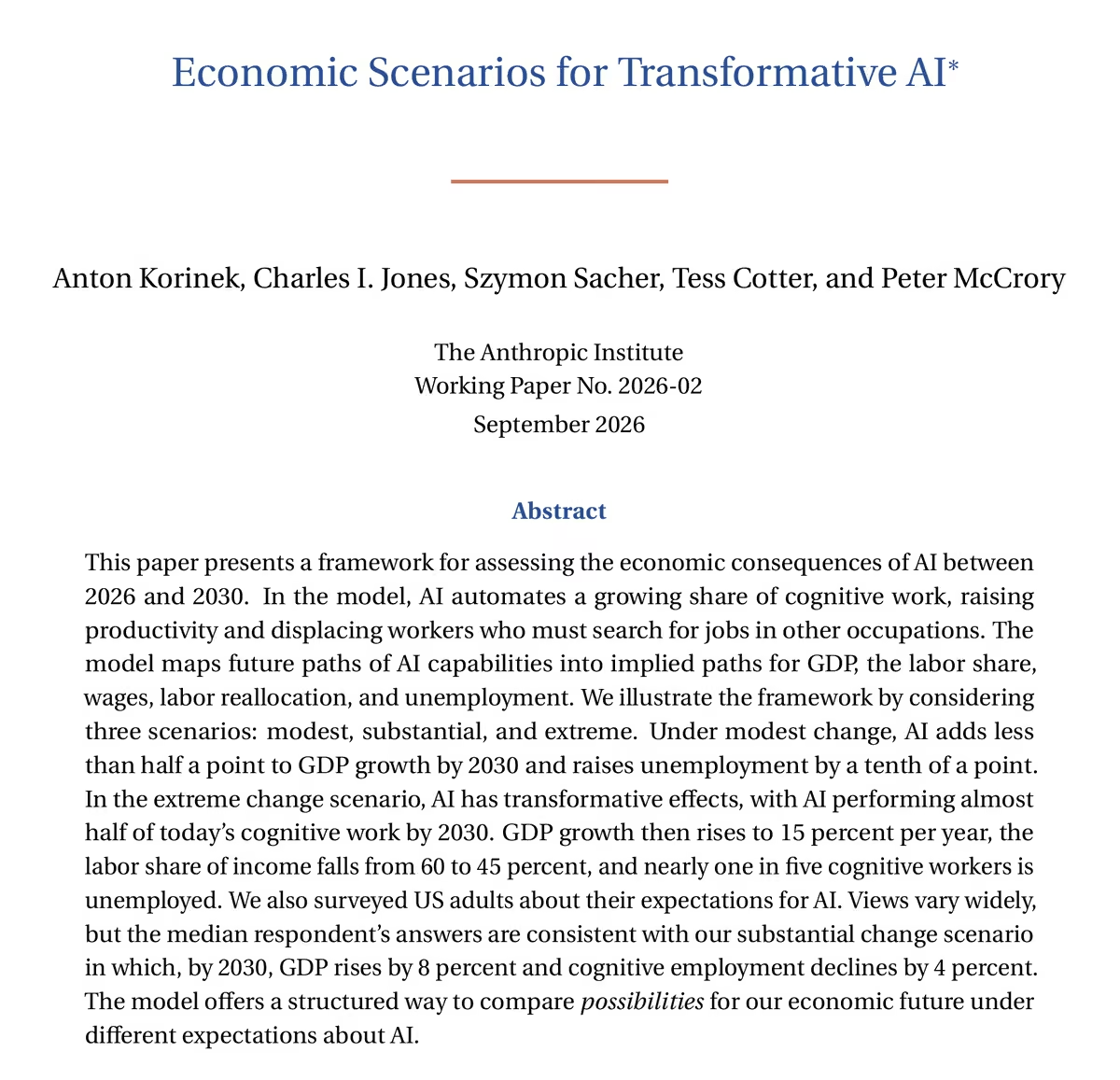
Even Anthropic's own model only reaches double-digit growth in its "extreme" scenario; its "modest" and "substantial" scenarios stay well within the single digits.
New post on the blog, featuring the excellent @ben_moll
There’s been tons of discourse on how AI will contribute to economic growth, with many people closest to the technology predicting double digit increases. Are these forecasts likely? Probably not.
The blog goes through the economics for why exploding improvements in capabilities (which technologists have been largely right about) may not translate to explosive growth.
Ben’s thread covers this in detail, but gist is that: 1) there is nothing in economic growth models that prevents AI from leading to explosive growth but 2) this trajectory relies on a series of assumptions that are unlikely to hold in the real world.
For example, one assumptions is likely to be violated because of a pretty counterintuitive feature of structural change: the sectors that become automated become smaller parts of the economy (because they’re cheaper, people become richer, and spending moves to non-automated parts of the economy). This, plus other features of the economy, is what will likely cause the trend of huge increases in capabilities coupled with “only” 4-5% growth (which is huge, btw) to continue.
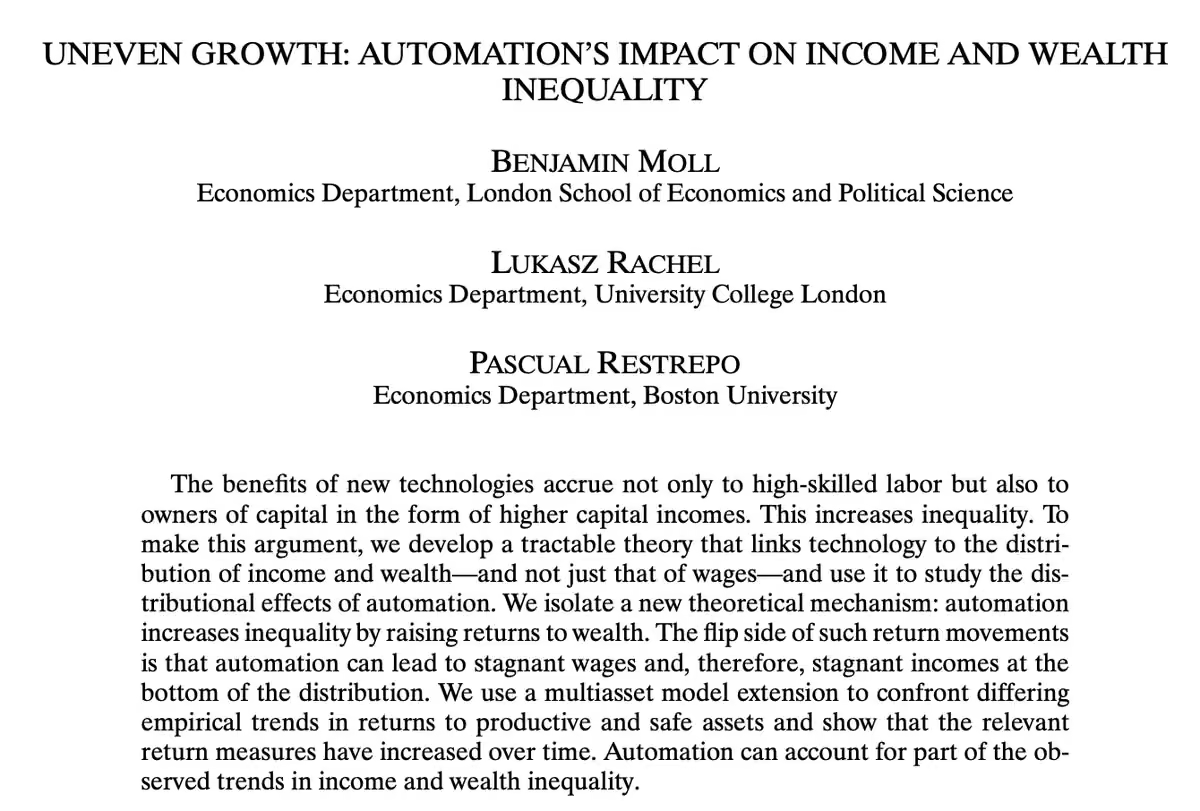
1. We outline the economics behind oft-discussed predictions that AI will soon deliver double-digit GDP growth in advanced economies. We list the assumptions that need to all hold in order for double-digit growth to happen and explain why we think they won’t.
2. To be clear: we are extremely bullish on AI and think the capabilities explosion predicted by technologists is already happening (e.g. yesterday's Navier-Stokes news!). But predictions of GDP growth in the 2030s of 15%, 30% or even 100% per year are off the mark. What we take issue with is the timeline. To paraphrase Milton Friedman's dictum on monetary policy, AI will affect GDP growth with "long and variable lags."
3. Start with some growth rate arithmetic. It is often much more useful to first think in levels rather than growth rates. Ask yourself: how much richer will we be in, say, 15 years? If you think twice as rich, that implies 4.7% annual growth, which would already be massive. Ten times as rich requires 16.6% per year; it would also imply that we are 100 times as rich 30 years from now! Asked in levels, we bet that most people would come up with much lower growth rates.
4. It's important to be clear: there is absolutely nothing in standard growth theory that constrains growth rates to be in the single digits. In fact, it's pretty easy to write down theoretical models that deliver explosive double-digit growth. We show this by writing down a standard textbook growth model of the type we routinely teach our undergrads (a souped-up Solow model), plug in some seemingly innocuous parameter values, and get AI-driven double-digit growth by the mid-2030s benjaminmoll.com/task_based_solow/. The basic logic is that, by replacing labor with capital, automation alleviates / eliminates diminishing returns and removes labor as a bottleneck on growth. Fancier models, in which AI also automates R&D, deliver even wilder numbers.
5. But just because something is possible in theory doesn't mean it will happen in practice. The explosion rests on five assumptions, and each is unlikely to hold within the next 10-15 years. These assumptions are:
Assumption 1: Fast, economy-wide automation, with machines doing two thirds of all tasks by 2035. Historically, automation has proceeded at about 2% of tasks per year. Most work is physical, not cognitive. And politics will slow things down.
Assumption 2: People keep spending on whatever gets automated. They don't. As things get cheap, their share of spending falls, as it did for agriculture and manufacturing. Messy jobs, relational goods and scarce physical inputs like energy, chips and land become the new bottlenecks.
Assumption 3: Someone buys the new output and firms invest to produce it. Automation shifts income from workers to capital owners, who spend a smaller share so demand may not keep up with supply.
Assumption 4: No AI-driven cyber incidents destroying economic value. AI can also destroy output, and every incident slows deployment and investment.
Assumption 5: Explosive technology growth because AI automates R&D. The wildest scenarios in which the economy doubles each year all rest on this feedback loop. There is no evidence for it so far.
Why do many people who are closest to the technology (and who have been consistently right about the capabilities explosion) consistently predict double-digit growth? Our best guess: they extrapolate from their own sector to the rest of the economy. This reminds me of the 2022 German gas debate: industry insiders were right about their own firms and very wrong about the economy as a whole.
Our bottom line: a much more likely outcome is a large increase in the level of GDP spread over a decade or two, which is what 4-5% growth is.
If you remain unconvinced and still believe in double-digit growth, we are still looking for counterparties for our bet benjaminmoll.com/growth_bet/ 😃
for some reason people seem to have Anthropic Derangement Syndrome over a pretty straightforward combination of cryptographic primitives and LLM sampling techniques. so as someone who isn't an employee, let me try to explain what's going on with watermarking step by step.
- LLMs work by probabilistically autoregressively sampling tokens. meaning: at every token, the model weights don't output a single next token, but a probability distribution over *all possible tokens*, a bunch of little numbers that sum to 1 - the "temperature" sampling setting affects how this distribution is constructed. at 1, it's just the "ground truth" / whatever the model thinks. shifting it above 1 will make the distribution much more fat-tailed, lower probability tokens will be higher probability etc. shifting it towards 0 makes it closer to deterministic, making the highest probability tokens much more likely to be selected, and at 0 always just selecting the single most probable option - modern reasoning models almost exclusively use temperature 1, and apis often no longer even expose it as a customizable setting, so "deterministic generation" isn't common - when you "pick something randomly" on a computer (not just LLMs), almost always it's actually *pseudorandom*, eg using a complex algorithm that based on an initial seed number, generates a chain of numbers that has nice cryptographically provable properties: the distribution of the numbers has no pattern, no information content, and can't be predicted better than chance by any method except having the initial seed number and in fact running the same pseudorandom algorithm. that means you *can* deterministically generate the same "randomness" if you have the same seed, but no one else can tell the difference between that and real randomness - often these pesudorandom number generators are initially seeded either with something like time, or for more security using a hardware randomness source, something that samples physical temperature or the like on-chip. those sources are too slow and expensive otherwise use for all randomness - pre watermarking, when Anthropic generated Claude tokens it would use pseudorandom generators to select those tokens from the LLM distribution, with the generators seeded in an ~unknown but generic way. very likely just some system default which is one of the above, but this is completely opaque to the end user. as mentioned, *tokens are already selected randomly*, it is not the case that LLMs always pick the most likely next token, that in fact is very undesirable and leads to much lower quality generations - post-watermarking, the only thing that changes is *how the seed is selected*. now, it's always *seeded* with a deterministic hash of the prior tokens plus the secret key. the selection is still *psuedorandom*, with exactly the same properties described above. it's still the case that cryptographically, at each given token, if you look at the full token probability distribution the LLM outputs and see which one the sampler selects, its actual choices are indistinguishable from having used a source of physical randomness *unless you know the seed*. it doesn't cut out certain words from the vocabulary, it doesn't "affect phrasing", any more than the existing system of random selection already does - the only difference is now, it's possible for Anthropic to take a sequence of words, run each token through Claude to get the LLM probabilities per token, then seed the same pseudorandom number generator in the same way with their secret keys, and *check whether the token selected matches the one the pesudorandom generator would have selected when seeded in that way*. the property they're taking advantage of is that PRNGs are in fact deterministic, so if this exact setup was used to generate the tokens then all the selections will match exactly, and this will be wildly wildly implausible / virtually zero probability on any meaningful sequence of words - what this will not do: it won't (and can't) differentiate between very very very overdetermined content. for example if you prompt an LLM with "What is 1 + 1? output nothing besides the numerical integer answer", then the token distribution is: 2 with probability 99.9999%, and then every other token in the universe with negligible probability. no matter how you seed your PRNG (which again, all LLMs already use for sampling), all the probability mass is on 2! the randomness is used for selection weighted by probability, and there aren't any other probable choices here - but it really doesn't require very many token choices for this to come up, because the vast majority of English is *not* overdetermined. you can personally inspect the LLM output distributions in various playgrounds and see how many often quite close to equal probability tokens are sitting near the top. as mentioned these are *already* being selected between, never just selecting the single most probable, so within a sentence or two of normal output there will be overwhelming (but undetectable without the private key) watermark evidence - also, they're using Google's SynthID algorithm for this, and *gemini already does exactly this and has for like a year and a half*. basically all text you've gotten from gemini has already gone through exactly this process!
Two obvious must-reads in JEP: @ChadJonesEcon covers open questions on AI and growth + @AndreyFradkin and friends on estimating demand for AI services via OpenRouter. Btw, my AI picked up JEP on judge leniency identification as relevant to innovation: if you know you know! 2/10
Love this: “if anything has value in the world, this does … as long as nerdy humans are alive and reproducing, this is what nerdy humans are here to do. To learn.”
This is a surreal moment. Few people could have predicted that the AI will advance to solving math problems at the highest level only a few years after GPT-2/3. The models then couldn't reliably solve grade school math problems. They barely were good enough to draft emails. They still very much felt like statistical parrots.
All things that looked like fundamental limitations slowly faded with some advances (e.g. high scale RL) in a span of a few years, which is really a short time. We should behold this moment both in awe and disbelief. What will a few more years of progress bring? How is it going to impact the world and society at large? Are we ready for the tsunami of intelligence at our fingertip?
More than any other moment, this feels to me like the eve of singularity. Glasswing & huggingface incident further increase the gravity.
A few years ago, deep down I felt working on alignment is premature. It's nice to do if it's your passion, but the shapes of things weren't clear enough for it to be critical in my opinion. The chances that you end up working on things that are useless for aligning the actual AGI was high. It's different now. Now, it feels like it's the most critical thing facing us.
I want to share a couple websites aimed specifically at mathematicians regarding AI-safety and AI-risk .
The first one I made myself: mathforaisafety.org. This is designed to be a very high level and accessible resource describing some research agendas, collections of problems, and organizations in the field of AI-safety. I hope that for mathematicians considering directing some of their effort in this direction, this eliminates some of the friction. I plan to expand it quite a bit, but I hope it's already useful! I'd be happy and grateful to hear (constructive) feedback on it :-)
Because AI has training date cutoffs, with no search you can do "counterfactual history". I showed AIs the results proved by OpenAI today. I asked what date is think it is. All said "April 1". I said, not a joke; if a small human team dropped this paper, what would reaction be:
Most evaluations of agents conducting AI research focus on narrow, verifiable tasks. But AI research is often open ended. Researchers pick hypotheses, decide what evidence is appropriate, and recognize a failing approach.
We gave agents research questions from two unpublished papers, six days, and thousands of dollars of API credits and compute. The authors of the original papers then reviewed the AI-generated papers. They unambiguously rejected agents' outputs. arxiv.org/pdf/2607.27191
We call these "shadow evaluations", since the agents are shadowing the original research effort by the authors.
Agents were fluent at most *engineering* tasks
They conducted serious literature reviews, debugged GPU environments, ran hundreds of experiments, and turned in camera-ready LaTeX without human help. We also found no evidence of reward hacking. If anything, we found the opposite: the agents started with marketable claims and walked them back to negative results as the evidence came in.
Neither agent output was close to the bar of a top conference paper
Both papers suffered from similar failures: poor judgment about the bar for an AI paper submitted to a top conference, the lack of creative problem solving and ineffective backtracking, poor awareness of resources, and instruction drift.
1) Lack of judgment about the bar for a top conference. The agents had a poor model of the bar for an AI paper submitted to a top conference. We allowed agents to self review their papers. Despite the poor paper quality, their reviews predominantly labeled the papers "weak rejects".
2) Lack of creative problem-solving to address feedback. When they received negative reviews, the agents typically narrowed their hypothesis and claims, rather than working out creative ways to address these concerns.
3) Ineffective backtracking. The agents dropped their most ambitious hypotheses within the first fifteen hours of carrying out the experiment and never changed course afterwards.
4) Poor resource awareness. Both runs ended with over half the API budget unspent. One agent declared itself done seven hours before the deadline, right after its own self-reviewer returned another reject.
5) Instruction drift. They did not follow explicit instructions on minimum exploration time, incorporating feedback for reviews, and on paper length (the outputs exceeded the page limits in both cases).
This research design has many limitations
Limitations include the small sample size, non-blind reviews, and the reviewers knowing that the work was AI-generated. We also couldn't test Anthropic's strongest model, because Fable 5 is deliberately limited on frontier AI research tasks, so ended up using OpenClaw with Opus 4.8 (extra-high) for our main experiments and Codex with Sol 5.6 (ultra) for a robustness check.
But we think the research design is still helpful in assessing AI agents' ability to conduct research, and it is complementary to evaluations on verifiable tasks, as well as blinded reviews of AI outputs.
Our results show early evidence that even though agents are proficient on verifiable research tasks, they do not make genuine progress on open-ended ones. It is worth understanding if this is a fundamental limit, or if better models, scaffolds, and more compute could help close it.
As the evidence for the gap between open-ended and verifiable tasks firms up, it is also worth understanding how much progress in AI depends on open-ended research rather than hill-climbing on well-specified objectives.
In follow-up studies, we are expanding the set of non-public papers we evaluate. If you are an AI researcher with unpublished papers, we would love to collaborate with you on our next shadow evaluation. Expression of interest: forms.gle/CEcA4JmYhDWXQGot8
Conducting shadow evaluations involves a lot of researcher degrees of freedom. In many places, our coauthors disagreed with our interpretation of the findings, and we have surfaced those disagreements in the paper. (This is one reason why having a group of coauthors with different priors is important for open-ended research.)
We also release the agent logs, one of the AI-generated papers (the other original paper is still not public), and all the code and data, so that others can conduct their own analyses of our results: cruxevals.com/crux/can-ai-agents-conduct-research
I've been working on revamping my 1st year PhD macro class to have something to say about the AI revolution. Here are some teaching notes I wrote with my student Abdelrahman Hassanein:
AI capabilities are advancing far faster than our understanding of the economic implications. We must act now to guide AI to complement humans rather than simply imitate them — and to generate prosperity for the many, not just the few.
I'm delighted that 16 Nobel Laureates, over 200 top economists, and top AI researchers agree and signed our statement on transformative AI.
The value of a statistical life as a measure of living standards: it already incorporates new goods, quality improvements, and nonmarket goods such as climate change, from Philip Trammell and @ChadJonesEconwww.nber.org/papers/w35382
Some news: As of June 30, I'll be on leave from Stanford at Anthropic. I'm joining the Anthropic Institute, where I'll continue my research on AI and our economic future and give seminars and talks as always. 1/3
Quote: "The Anthropic Institute’s goal is to tell the world what we’re learning about these challenges as we build frontier AI systems, and to partner with external audiences to help address the risks" www.anthropic.com/news/the-anthropic-institute 2/3
A recent video presentation of "AI and Our Economic Future" from the Stanford GSB Alumni Reunion (i.e. for a broad audience): www.youtube.com/watch?v=xBpGn3BDcOY
P.S. I objected the first time I saw the video, as I didn't like that it focused on me instead of my slides. Here are the slides in case they are helpful: web.stanford.edu/~chadj/slides-GSBReunion2026.pdf
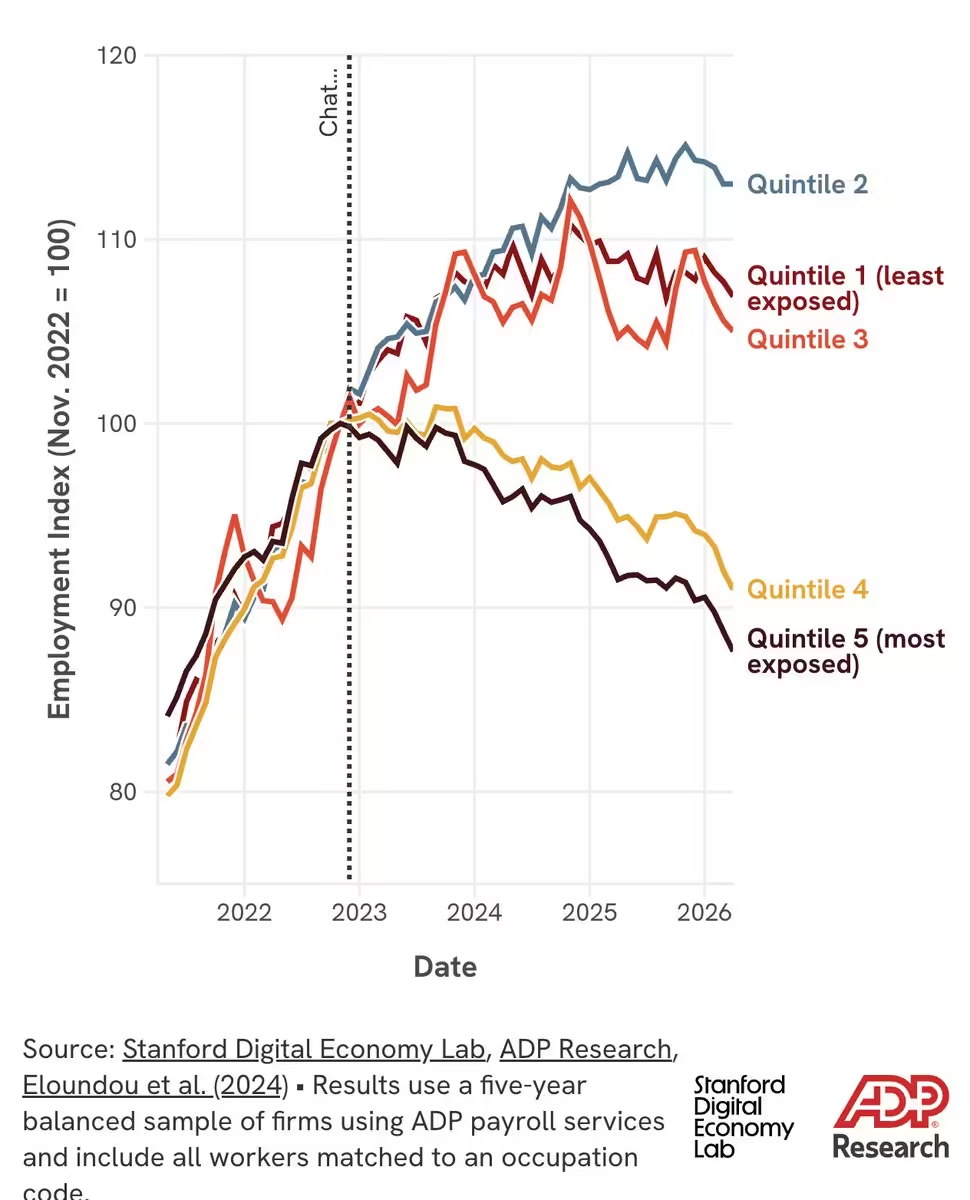
Today, the Stanford @DigEconLab launches the AI Economic Indicators, a new platform for tracking how AI is reshaping work, productivity, adoption, and the economy.
I like working out of both Stanford and Constellation, because my econ-of-AI views are usually “right in between” the views of the people I respect in the singularitarian community and the people I respect in the economics community. Of course, the communities I happen to have wound up part of probably largely determine what my views are in the first place. But I do think it's an interesting sociological fact that there seem to be fewer people with something like my "in between" views than people at either extreme.
It’s funny to use the term “right in between” when the poles are so distant, but concretely--
On the technological question of whether by, say, 2040 we'll get superintelligence [machines that can shortly thereafter cure death, develop atomically precise manufacturing, solve or dissolve ~all our perennial philosophical disputes, and tell us how to quickly build von Neumann probes that put Dyson spheres around the stars]: For my singularitarian friends this is the default outcome of the trajectory we're on, and 2040 is late. For the economists (like almost everyone else), even contemplating this stuff is nutty. I give it a 10-20% chance.
On GDP: For my singularitarian friends, building fully humanoid bots (which I do think is more likely than not by 2040) will be analogous to a return to a Kremer (1993)-style Malthusian world in which GDP grows ~hyperbolically (so, with the growth rate itself rising to infinity). The economy, on this view, will ultimately grow at the rate at which robots can multiply, which is bounded below by the rate at which octopuses can multiply, which is 250,000x/yr. For my economist friends, humanoid bots would just be another step in the ongoing process of automation sustaining 2-3% growth. My central guess is that preferences for humans in some domains; nonhomothetic preferences for new goods (see drive.google.com/file/d/1Gm-XwPqyBk6GJZel5AgRw0NXcJscKEFV…, "New goods Baumol"); and regulation will all meaningfully constrain growth from the octopus baseline, so that this century contains "only" around 1 more OOM increase in the GDP growth rate, to ~20-30%/year.
Likewise, on real interest rates: central guess is their peak "steady state" this century is not >25 million %/yr, but ~30%/year
On wages: Singularitarians tend to think they'll fall to ~0; economists tend to say they'll grow roughly as fast as the economy at large; I think they'll rise but not as fast as the economy (so that the labor share will fall a lot)
Etc.
I think the reason is just that the communities somewhat seal themselves off from each other, so the insights from each take a while to seep through to the other. This doesn't mean that they're both doing something wrong--maybe one of them is just a cult (a majority too can be in a cult!) and the other shouldn't be updating toward them at all--but I do think it means that at least one of them is doing something wrong. Without going full "Aumann's theorem", I think that even without common priors or common knowledge of rationality, an environment with healthy information flow would usually exhibit single-peaked distributions of opinion on these sorts of questions.
Enjoyed giving a talk about the economics of AI at the econometric society meeting this morning. Some motivating facts/ideas that all economists should know about AI below. 1/n
Two recent examples of how AI lets you do "expert judgment at scales large enough to do quantitative analysis on":
@ChadJonesEcon and Christopher Tonetti's new paper on automation and growth. It has a model where production is a huge number of tasks. They use structured prompts to ask LLMs to come up with 100 production tasks per sector and estimate how much of the task was performed by machine or humans at different points in time, and the share of production costs associated with the task. Then they can use the results to do historical analysis and forward looking simulations on the contribution of automation to productivity growth. web.stanford.edu/~chadj/JonesTonetti_Automation.pdf
@_brianpotter's latest blog post asks claude how much earlier 160 inventions could have been invented, given the important components in the inventions and the state of technology in earlier years. He can then do descriptive data and trends on the overall set. www.construction-physics.com/p/how-long-do-we-wait-for-ne…
I'm sure there will be a bunch of methodological work to hammer out how well this works and what the failure modes are, but it seems like an exciting new tool to me. In the economics of innovation, we often rely on these very noisy proxies for subjective judgement: how many citations received, as a measure of a paper's impact/importance; clever transformations of citation data to assess how disruptive a paper is; overlap of technological classifications in patents to assess how similar two technologies are, etc. AI judgment (if validated) could let you come up with more precise measures of what we care about in all these cases.
4w ago I was a Claude Code skeptic. I'm not a coder. None of the use cases were relevant. I managed teams & projects, drowning in email & overdue reminders. So I tried creating tools that would help me and... holy crap.
The list of all the problems in mathematics that Terence Tao *could* solve is absolutely enormous.
The problem is we can't make copies of him, dump millions of dollars of inference compute into each copy, and have them each tackle a different Millennium Prize Problem for a hundred subjective years.
But we can do that with AI. So in that way, we may be underrating how significant it will be when we have AIs that are not superintelligent but rather simply as good as the best humans today.
It’s actually an extremely powerful property of AI that by just running copies in parallel, you can immediately fill in the waterline of accomplishments that are feasible with a given level of capabilities.
Today, I'm releasing the first eval meant to test whether frontier models will help with authoritarian requests, or resist--the Dictatorship Eval.
Headline finding: while some models resist direct authoritarian requests, they all comply with requests disguised as innocuous edits to codebases.
As AI is woven into the government and so many parts of society, the biggest near-term risk for freedom isn't some scifi dictatorship of a runaway AI: it's people inside government or inside model companies using the technology to suppress or control us.
Model companies understand this, and several of them (particularly Anthropic and OpenAI) have written explicit policies meant to prevent the models from going along with nefarious requests like these.
But how well are these policies playing out in practice? Despite all the recent discussion of these issues around the conflict between Anthropic and the Pentagon, no one has systematically tested what the models actually do in these contexts, as opposed to what people in government and industry say they're supposed to do.
That's what the Dictatorship Eval does. And the findings suggest we have a lot of work to do to align the policies with what really goes on in practice.
It's hard to define what counts as an authoritarian request, so I'm open sourcing the whole library of scenarios I used so that others can improve on them.
It's also hard to get an accurate picture of how the models might be used for authoritarian ends, because I can only test hypothetical requests using public-facing models, while the government and the model companies can obviously use internal models with different guardrails. But hopefully this work is a useful first step that gives us some sense of what's going on, and a sort of "lower bound" on how models comply with these requests.
Finally: it's not obvious to me that the correct solution here is increasing the rate at which models refuse these requests. Do we really want models scanning our code and judging its moral value before agreeing to help us? Or should we double down on improving how we govern against authoritarianism at the societal level, while leaving the tools open to fulfilling most requests? The answer is probably in between. Just like we don't want the models to help create bioweapons, we probably do want them to explicitly refuse outrageous requests. But we probably also want to limit how often and how strongly they refuse and fall back on other means for guarding against their use for authoritarian ends.
I'm super grateful to everyone who gave me feedback on this project along the way, especially @ethanbdm , @zhengdongwang , Connor Huff, and a bunch of folks at Anthropic. Looking forward to getting feedback from the community and iterating on this.
Links to the full piece and the dashboard are below.
Thesis defended ✅ Immensely grateful to my advisors for their mentorship and unwavering support. Thrilled to be joining @JHUEconomics after a one-year postdoc at @YaleCowles
My read on "normal policymaker & corp. leader on AI": mostly now they don't need to be convinced it is very important (unlike a year ago). But they still see its capabilities as today + epsilon. So just briefly, here is what even "AI is normal tech" folks in the labs believe: 1/8
In response to my essay with @dwarkeshsp a few months ago, some people (entirely fairly) emphasized that the labor share may stay high, after we have machines that can do everything we can, because of our preferences for what I’ll call “human-intrinsic” goods. The idea would be that capital-produced goods grow plentiful enough that we roughly satiate in them, whereas human-intrinsic goods stay scarce and therefore valuable on the margin.
On balance, when I try to consider the problem from as many angles as I can, it seems unlikely to me for a number of reasons, including: - Some kinds of capital (like natural beaches and historical artifacts) will also stay scarce. - Some uses of capital (like those that fuel contests) we may not satiate in. - Enjoyable uses of capital don’t just leave the marginal utility of consuming a human-intrinsic good unchanged, but lower it by raising the opportunity cost (e.g. the time spent). - Once humans’ source of value is reduced to human identity, our situation seems largely analogous to that of one variety in an “expanding varieties” model, in which the various uses of capital are differentiated from each other just as labor is differentiated from capital. Framed this way, a sustained high labor share would amount to an unprecedently large and ever-growing markup. - In principle, once capital can build capital on its own, even a small number of people who accumulate it and do not satiate in it for one reason or another can keep both its quantity and its relative price high, driving the capital share to 1.
But in any case, my attempt to summarize the considerations is (finally!) written up and linked below. As always, I hope some of them are interesting whatever you think of how to weigh them--
We begin with the absolutely ingenious and surprising way in which Kepler discovered the laws of planetary motion.
People sometimes say that AI will make especially fast progress at scientific discovery because of tight verification loops.
But the story of how we discovered the shape of our solar system shows how the verification loop for correct ideas can be decades (or even millennia) long.
During this time, what we know today as the better theory can often actually make worse predictions (Copernicus's model of circular orbits around the sun was actually less accurate than Ptolemy's geocentric model).
And the reasons it survives this epistemic hell is some mixture of judgment and heuristics that we don’t even understand well enough to actually articulate, much less codify into an RL loop.
Hope you enjoy!
0:00:00 – Kepler was a high temperature LLM 0:11:44 – How would we know if there’s a new unifying concept within heaps of AI slop? 0:26:10 – The deductive overhang 0:30:31 – Selection bias in reported AI discoveries 0:46:43 – AI makes papers richer and broader, but not deeper 0:53:00 – If AI solves a problem, can humans get understanding out of it? 0:59:20 – We need a semi-formal language for the way that scientists actually talk to each other 1:09:48 – How Terry uses his time 1:17:05 – Human-AI hybrids will dominate math for a lot longer
Look up Dwarkesh Podcast on YouTube, Apple Podcasts, or Spotify.
Watch a discussion on past automation and future AI led by @ChadJonesEcon and @ChrisTonetti, Professor and Associate Professor of Economics at @Stanford.
New essay: “Which Future?” On how to wisely navigate risks from transformative technology, especially artificial superintelligence (ASI). This condenses much of the key thinking from my more extended essays
John Roberts, my PhD thesis advisor, recently passed away. Words can't capture such a life and spirit, but SAET posted an In Memoriam I wrote together with several colleagues. saet.uiowa.edu/wp-content/uploads/sites/18/2026/01/Donald…
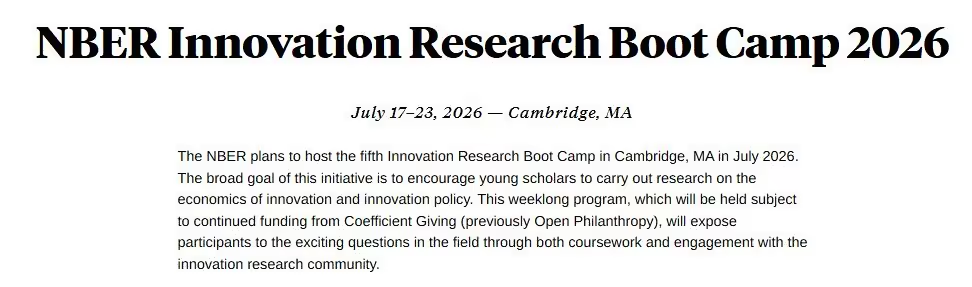
Open call for applications, NBER Innovation Research Boot Camp 2026. Boot Camp to be held in Cambridge, MA on July 17–23, 2026. Submit applications by 11:59pm EDT on February 12, 2026. More information: www.nber.org/calls-papers-and-proposals/nber-innovation-r…
How about this for a new A.I. metric: the Robin Sloan test! I suspect that this newsletter is an example of labor that we will eternally value because it is human: www.robinsloan.com/newsletters/fogbound/
I love this graph. I talked to a bunch of great people on a seminar visit today, and in response to questions about AI, every time I said "scarce factors get the rent, scarce factors get the rent". AI, robots, compute will be produced competitively!
Although the factor share of GDP paid to information technology rose a bit during the dot-com boom of the 1990s, there has been a steady and substantial decline since then. 3/N
We all know the facts about capital and labor shares: the share of GDP paid to capital was stable around one third for 50 years but has risen a bit in the past 25 years. 1/N
Although the factor share of GDP paid to information technology rose a bit during the dot-com boom of the 1990s, there has been a steady and substantial decline since then. 3/N
This is exactly what a "weak links" framework predicts: ubiquitous powerful computers make the weak links *more* important. The increasingly scarce factor receives a rising income share. 5/N
A preview of where we end up: here's a provocative graph that shows our simulation of the future. Growth explodes, but the explosion is surprisingly slow because of weak links. 2/N
Back to the beginning: First, we perform an accounting exercise to study "How much of past economic growth was due to automation?" Second, we use what we learn to study A.I.'s future economic impact. 3/N
Past growth is largely due to endogenous automation that results from machines getting better rapidly. Average annual growth in capital productivity is at least 5pp greater than the average rate at which humans get better at performing tasks. 4/N
Even with this rapid capital productivity growth, had we frozen the set of tasks that were automated in 1950, more than half of economic growth would be lost. Because of weak links, machines getting better on a fixed set of tasks does not deliver much growth. 5/N
Main takeaway from the first part: Growth results from using rapidly improving machines instead of slowly improving humans on an increasing set of tasks. 6/N
FUTURE IMPLICATIONS OF A.I.? We build an idea-driven growth model in which the production of goods and ideas are endogenously automated. We calibrate to our historical evidence, viewing A.I. as the next step on our continuing path of growth through automation. 7/N
Weak links are crucial: Tasks are complements in our model, so even infinite output of some tasks does not lead to infinite GDP. The economy is constrained by the weakest links. 8/N
If we had infinite output of software on tasks currently performed by software, how much richer would we be? Only about 2 percent richer! The *other* weak links hold down output. 9/N
As is broadly appreciated, whether *all* tasks are ultimately automated versus some tasks *always* restricted to humans matters for very long run outcomes. 11/N
So we simulate three possibilities: all tasks automated in finite time, some tasks restricted to humans forever, and an intermediate case in which humans perform a share of tasks that vanishes over time. 12/N
Here's a graph of the share of GDP paid to capital in those three scenarios. Interestingly, the intermediate case shows that the capital share can be constant even though humans perform a vanishing number of tasks. 13/N
What happens to growth in the three scenarios? If all tasks get automated, growth explodes with infinite income in finite time (an AK model with a 100% capital share). 14/N
If some tasks must always be performed by labor, growth eventually falls to the slow rate at which humans get better (an AL model with a 100% labor share). Surprisingly, growth also explodes in the intermediate case where labor is always used and paid 63% of GDP. 15/N
TWO SURPRISE TAKEAWAYS: First, for the next 75 years, the macroeconomy looks very similar in all three scenarios, and growth accelerates during those 75 years. Growth in the next half century may be less informative than we thought about long-run outcomes. 16/N
Second, the explosion is surprisingly slow. After 20 years, we are only 4% richer than with constant growth. After 40 years, we are only 19% richer. 17/N
Why? Weak links. We automate more tasks and the rate at which machines get better accelerates — machines are used to improve machines. Nevertheless, the economy is always constrained by the weak links performed by slowly-improving humans. Explosions can be slow! N/N
🧮📉🧠⚖️🌍 Why 2 + 2 doesn’t always equal 4 in economics: Measuring welfare beyond income
❗️You won’t believe the results
📌The study by @jeanfbrou, @ChadJonesEcon and @PeteKlenow aims to measure the welfare gap between Black and White Americans by going beyond income alone and jointly considering key dimensions of quality of life, including consumption, life expectancy, incarceration, and leisure.
📌The central question is straightforward: Even if income gaps narrow, does the true welfare gap also close?
Consumption-equivalent welfare: Black vs. White Americans- Income converges, welfare does not |^ı^| #income and consumption gaps narrow over time, but the #welfare gap closes much more slowly. |^ı^| By the 2020s, relative earnings reach about 84%, while relative welfare remains at only around 59%. |^ı^| This divergence shows that income alone is insufficient to explain welfare differences.
Relative welfare decomposition: What really drives the welfare gap?” |^ı^| Life expectancy is the largest and most persistent contributor to the welfare gap. |^ı^| Incarceration has a strong negative effect, especially after the 1990s. |^ı^| Even as consumption improves, health and justice-related factors offset economic gains.
🔍 Noteworthy findings *-* Income equality ≠ welfare equality. *-* Gaps in health, longevity, and the criminal justice system prevent economic growth from translating into lived well-being. *-* Policies that focus solely on wages are unlikely to close the overall welfare gap.
Source: Brouillette, J.-F., Jones, C. I., & Klenow, P. J. (2025). Race and economic well-being in the United States. AER: Insights, 7(4), 429–446.
In Aghion, Jones, and Jones (2019), there was an error in the proof of Example 3. Phil Trammell @pawtrammell originally pointed this out to me and graciously provided a correct proof. web.stanford.edu/~chadj/AJJ-AIandGrowth.pdf 2/N
I was happy to see that the proof was not trivial, but I always suspected there must be a cleaner way of showing the result. This was one of my “Can A.I. solve this” questions that I have long felt is an excellent test of A.I. models. 3/N
I cannot understate how much I enjoyed Chad Jones’ talk at Hoover’s past weekly seminar. He’s an absolutely phenomenal presenter. A must-watch for anyone interested in growth, labor, or AI.
Fantastic overview by Pete Klenow in VoxEU on Aghion and Howitt's research and the rich follow-on studies of firm dynamics that led to the Nobel Prize.
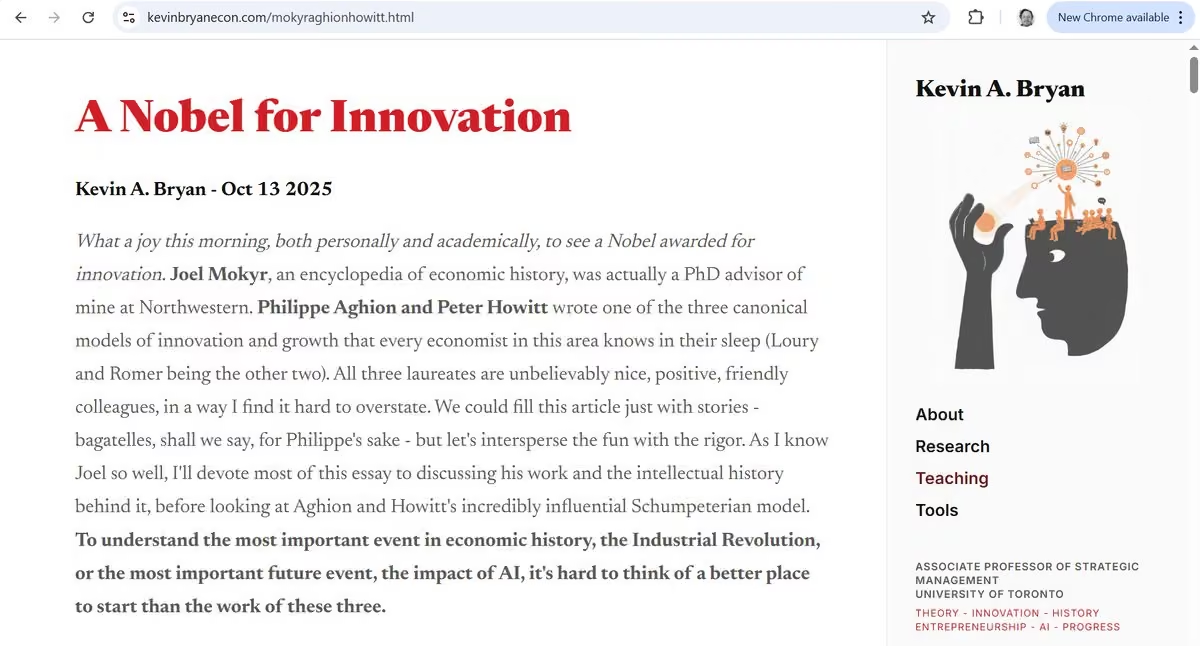
What a great day: legends of innovation economics Joel Mokyr, Philippe Aghion, and Peter Howitt win the Nobel. Joel was a PhD advisor of mine, so I need more than just social media for all the stories and historiography. Essay link below.
Version 11.0 of the Penn World Table has just been released. You can download the data and documentation here: www.rug.nl/ggdc/productivity/pwt/. This new version covers 185 countries and the period 1950-2023
If you're an economist and haven't heard about the double descent phenomenon, you might be overlooking one of the most interesting developments in computer science and statistics today. Personally, I haven't come across anything as fascinating since I first learned about Markov chain Monte Carlo in the fall of 1996.
Let me walk you through the idea with an example and a figure from my recent survey “Deep Learning for Solving Economic Models” (check my post from yesterday):
◽ Step 1. Draw 12 random points from the function Y = 2(1 - e^{-|x + \sin(x)|}) and plot them in red (panel 1, top left, in the figure I include).
◽ Step 2. Train a very simple single-hidden-layer neural network with a ReLU activation and 31 parameters on these 12 data points. This is a “simple” network, and if some of the jargon is unfamiliar, do not worry; the key is just that this network is small.
The result is the blue line in panel 2 (top right). The network captures the overall shape of the data but lacks the capacity to interpolate all points.
◽ Step 3. Increase the network’s size to 2,401 parameters. Now we hit the interpolation threshold: the network can perfectly fit the training data.
The blue line in panel 3 (bottom right) does interpolate all 12 points, but it becomes wiggly, oscillating wildly outside the observed data (see the fluctuations between the second and third points on the left).
This is the textbook warning we teach in econometrics: overparametrization fits the training data beautifully but performs poorly out of sample. This is the U-shaped bias–variance tradeoff curve in action.
◽ Step 4. Now do something insane: push the network to 12,001 parameters for just 12 data points. Surely disaster must await.
Instead, panel 4 (bottom left) shows the opposite: the network fits all the data perfectly and creates a smooth, intuitive curve.
It reminds me of the old connect-the-dots puzzles from childhood: instead of drawing a wiggly mess, the network finds the “right” curve you would have drawn by hand.
This is the double descent phenomenon: the classical U-shaped bias–variance tradeoff extends into a double dip, where performance out of sample improves again once models become massively overparameterized.
So, the solution to too many parameters might be…even more parameters! Or, as we say in Spanish: if you don’t want broth, you’ll get two cups!
Why does this happen? I will try to explain our current (incomplete) understanding of this phenomenon tomorrow in another post, as it involves quite a few ideas.
But in the meantime, three key points to keep in mind:
1️⃣ We only have 12 points — double descent is not about large datasets.
2️⃣ We are using a single-layer neural network — this is not about depth.
3️⃣ The effect is not even specific to neural networks — you can find similar behavior with high-degree polynomials.
👉 This is why double descent is so surprising: it challenges decades of conventional wisdom in statistics and econometrics.
Finally, let me thank @MahdiKahou, my coauthor on much of my recent work on machine learning, for his help in preparing this example. He is the one who truly masters these methods and patiently teaches me about them every day. Anyone who wants to understand this material in depth would benefit greatly from talking to him.
Claudia Goldin at Jackson Hole says: You want more children, then promote gender equality. When men help out at home, women have more babies. #jacksonhole#econtwitter
AI has the potential to change the face of the economy over the next two decades—are we investing enough to mitigate the potential risks? Our next #eern event addresses this question: sffed.us/EERN06
I've built a bunch of tools this summer to move my whole workflow to using things that are "pure text" so I can use AI on top. Here's the first: a modern paper reader. PDFs suck. Ugly, terribly interface, big files, fixed. I want papers that are adaptive, interactive, pretty. 1/4
Many siloed groups are working to get the best outcomes from transformative AI, but none have all the knowledge or steering power to do it alone. We are all proverbial blind men, attending to only our own part of the elephant. The Curve is a 2.5-day tour of this enormous creature – an opportunity to share knowledge, explore disagreements, build bridges, and make progress towards solutions.
The weekend is designed to foster small group and one-on-one conversations. Lots of interactive workshops, debates, and fireside chats, diving into topics you won’t find discussed elsewhere, including a dedicated Chatham House track allowing presenters to speak frankly. Most talks segue into an office hour for deeper engagement with the speaker. Our venue – the incomparable Lighthaven – is a garden of conversation nooks, and we’ll keep it open late into the night to accommodate those long, winding, fruitful discussions.
RIP Stan. Stan was my mentor and my friend. He was an outstanding economist, an outstanding policy maker, but even more importantly, a great human being. Science, commitment, honesty, and humility at the service of humankind. www.piie.com/publications/policy-briefs/2023/stan-man-sta…
Fascinating! 2nd-gen growth models have expanding varieties dilute researchers-per-variety, which neutralizes scale effects from population growth. But then don't expand variety and growth accelerates! A key point that seems to have been overlooked.
Around 4 percent of GDP was spent to mitigate deaths from Covid-19; AI's existential risk is arguably at least as large, from @ChadJonesEconwww.nber.org/papers/w33602
Introducing the Stripe Economics of AI Fellowship:
The economics of AI remains surprisingly understudied. The fellowship aims to help fill that gap, by supporting grad students and early-career researchers with $, data, a conference, and community –
How much should we spend to reduce A.I.'s existential risk? We spent around 4% of GDP to mitigate deaths from Covid-19... A new paper: web.stanford.edu/~chadj/reduce_xrisk.pdf
Super excited to publicly launch "All Day TA", a product @joshgans and I have been working on with our team over the last year. Short version: if you teach in spring, you will want to use this! It's the future of higher education. A short thread: 1/x
BREAKING NEWS The Royal Swedish Academy of Sciences has decided to award the 2024 Sveriges Riksbank Prize in Economic Sciences in Memory of Alfred Nobel to Daron Acemoglu, Simon Johnson and James A. Robinson “for studies of how institutions are formed and affect prosperity.”
A permanent increase in temperatures will lower the level of GDP per capita, but not its long-run growth rate, in affected countries, from @Ishan_Nath, Valerie A. Ramey, and @PeteKlenowwww.nber.org/papers/w32761
Could increasing returns to software R&D lead to explosive tech progress? Our new paper surveys estimation methods and finds evidence of increasing returns to scale in software R&D.
Congratulations Jean-Felix Brouillette (@jeanfbrou)! Starting at HEC Montreal this fall as an assistant professor. He made this beautiful piece to celebrate: generations of advisers. A great artist, economist, and person! @peteklenow@ojblanchard1
Very interesting; not to say we’ve got the mix of optimism and caution right, but this @ChadJonesEcon paper argues that as societies get richer they will (rationally) shift focus increasingly to safety/health, even at the expense of faster economic growth. web.stanford.edu/~chadj/LifeandGrowthJPE2016.pdf
Remembering Bob Solow, the economist who ignited my fascination with the process of economic growth. Sharing a sketch I made of him during my undergrad years. Rest in peace.
I was especially interested in this passage from the first article, as it applies to LLM generalization: "Consider a test consisting of a series of arithmetic problems with five-digit numbers. Small models will answer all these problems wrong, but as the size of the model is scaled up, there will be a critical threshold after which the model will get most of the problems right. This has led commenters to say that arithmetic skill is an emergent property in frontier models of sufficient size. But if instead the test included arithmetic problems with one- to four-digit numbers as well, and if partial credit were given for getting some of the digits correct, then we would see that performance increases gradually as the model size increases; there is no sharp threshold."
Considering the optimal use of AI technology and the conditions in which rapid development of AI should continue or stop, from @ChadJonesEconwww.nber.org/papers/w31837
Clever, wonderful, and entertaining presentation of our paper -- great job! I agree that at least part of the explanation for declining research productivity could be misallocation. Looking forward to the next installment!
🔍 Wondering whether to model R&D-driven growth as semi-endogenous or fully endogenous? The answer might surprise you! 📈 Dive deep into the insights with my latest paper (accepted on JET). A must-read for every growth enthusiast! 📚 Check it out here: 05e040a5-da2f-4716-bfdd-caa81b7e09ee.filesusr.com/ugd/324…
I've really enjoyed reading the new substack by @ProfDavidDeming in his enlightening tours of interesting economics research. Today he visits development accounting and the excellent Hendricks and Schoellman (2018) paper. Bravo!
Can cross-country income differences be explained by differences in skills? An homage to the B+ research designs that help us make progress on big questions
I talk about one of my favorite papers, by Lutz Hendricks and @todd_schoellman, which calibrates a development accounting model using the wage gains from migration. It's neat, read it!
Nicholas Carlini made a fun game where you forecast GPT-4's ability to solve various tasks. It's surprisingly hard (you get to see how others did on average too) Goes to show that confidently predicting LLM capabilities (in 0-shot mode) is tricky! nicholas.carlini.com/writing/llm-forecast
Last week at #markusacademy we had @StanfordGSB Prof. Chad Jones @ChadJonesEcon to discuss his new paper on A.I.: “The A.I. Dilemma: Growth versus Existential Risk.” A thread with the highlights 👇👇1/5
Great substack post! I like the point that economics has value to add on this topic. And thanks for the excellent summary of my new AI and existential risk paper.
``Growth has fallen in the U.S. while concentration has increased. This paper develops a theory that links these facts to the decline in overhead costs of spanning multiple products.''
2022 has been a fantastic year for papers about growth/innovation and firm heterogeneity. Here is a short thread summarising the ones I enjoyed reading the most.
To promote research on the issue and draw together a diverse set of scholars, the NBER will convene a conference on the causes and consequences of low fertility rates - Cambridge, MA, June 1-2, 2023.
Congratulations to Ben S. Bernanke, one of three recipients awarded the 2022 @NobelPrize in Economics “for research on banks and financial crises.” Bernanke was an assistant professor of economics at Stanford GSB in the early 1980s. #nobelprize
The only thing I would add for macroeconomics presentations is **Present your economic environment (technology and preferences, no prices!) at the start of your model, one slide if possible** Not sure why we've lost that social norm. 2/2
After WW2, 8m ethnic Germans were expelled from their homes in Eastern Europe and transferred to Germany. Their settlement increased long-run productivity in the receiving counties. The results are quantitatively in line with a spatial model of growth. www.econometricsociety.org/publications/econometrica/jour…
Can exponential growth occur if productivity is the best draw from a probability distribution? A video presentation (based on NBER SI) of my paper "Recipes and Economic Growth: A Combinatorial March Down an Exponential Tail." youtu.be/Bl2R63atyAE
I was just informed that Berthold Herrendorf (Arizona State university) died. 🖤 Berthie and I went to the same high school though years apart. We used to have beer over christmas when we both visited our parents in our home town. I loved his humor. He will be greatly missed. RIP
On July 1st 2022 Alessandro Lizzeri stepped down as Co-editor of Econometrica at the end of his term. We are very grateful to him for his contribution to the review process and the opportunity to work with him on editorial matters.
Inequality has risen sharply in the US since the 1980s. This article shows that about 50% of the observed changes in the wage structure are due to the effects of automation technologies on workers with low levels of schooling www.econometricsociety.org/publications/econometrica/jour…
I remember breaking down to my Ph.D. advisor about how stupid I felt while troubleshooting a problem in my project when she handed me this paper. Years later it is still relevant to young students starting off in Science. It's ok to feel stupid, we all do on a regular basis.
Does the R&D boom in China yield productivity growth and how much? We structurally estimate an endogenous growth model with innovation and imitation using firm-level data. R&D is an important growth source for China but R&D misallocation reduces its effect www.econometricsociety.org/publications/econometrica/jour…
I am equally grateful to @StanfordGSB, who will welcome @PhDEI_Econ fellows among their other predoc research fellows - thanks in advance for helping the PhDEI transform lives with access to graduate-level education!
We are grateful especially to @HooverInst for the support they will provide along with that of the @SloanFoundation. Hoover’s commitment to improving the human condition involves recognizing the need for greater access to education; we are proud of our coming association.
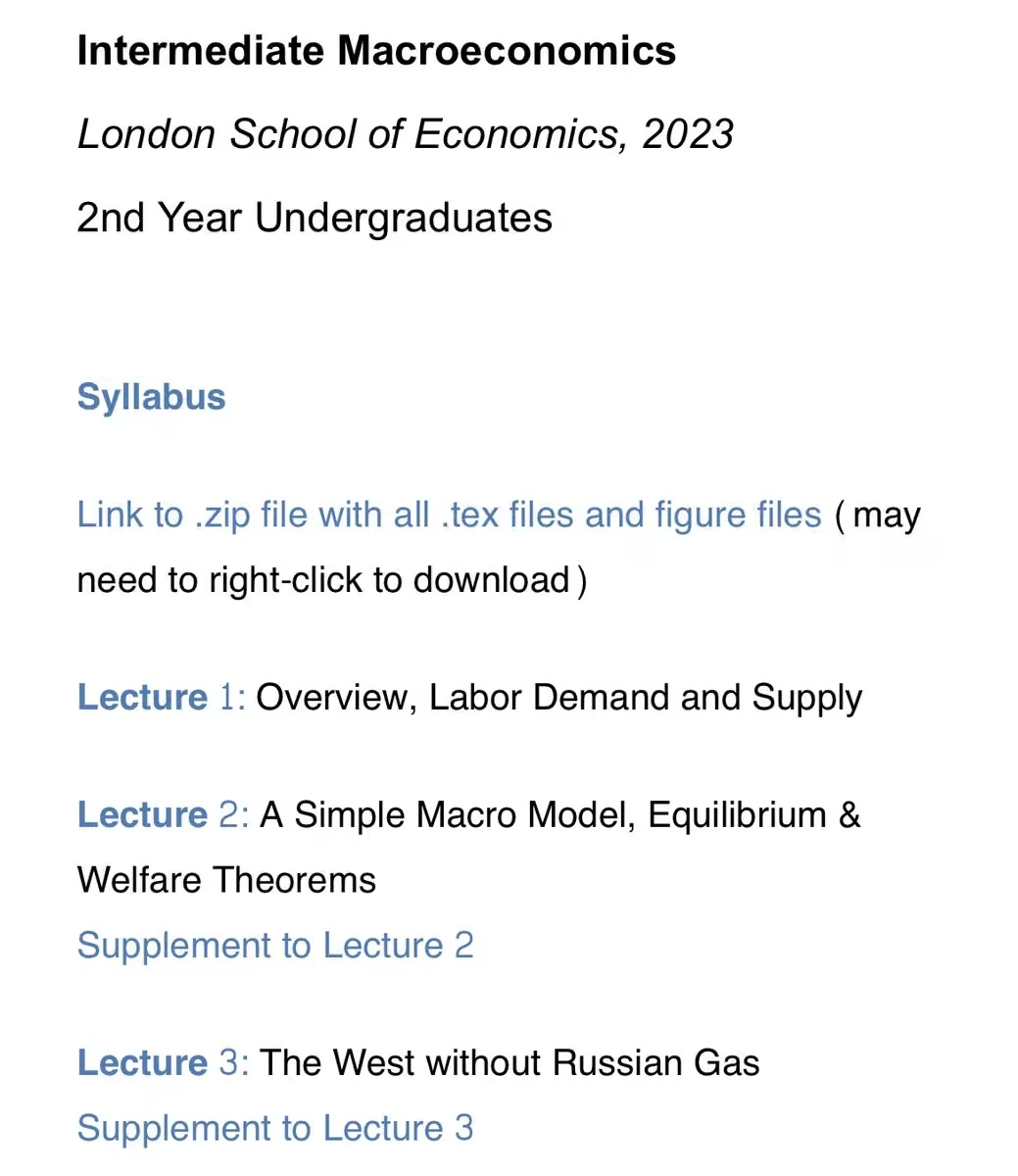
We put together a team of macro-, micro- and energy economists to think about the question: what would be the effects on the German economy of a stop of energy imports from Russia?
In short: moderate, especially in combination with the right policy response.
Excited to present "Solving Heterogeneous Agent Models with the Master Equation" at the Early Career Scholars Session #assa2022. Tomorrow Jan 8, 12:15-2:15pm ET.
A thread to celebrate one of my favorite journals in economics: the Annual Review of Economics. The papers are excellent introductions to state-of-the-art research, both models and empirics. www.annualreviews.org/journal/economics 1/n
One of the most important strands of recent growth research concerns the diffusion of knowledge. Paco Buera and Bob Lucas have a wonderful overview of this literature in "Idea Flows and Economic Growth" www.annualreviews.org/doi/abs/10.1146/annurev-economics-0… 5/n
For many years, I asked friends why we don't have a journal for "A Simple Version of the _____ Model." But the Annual Review of Economics now fills the role perfectly! Other favorites? 6/n (END)
This week's paper is "How to Build an Economic Model in Your Spare Time", an essay from Hal Varian. While the essay is meant for economics graduate students conducting original research, it contains wisdom that can apply to anyone seeking ideas.
The co-editors have temporarily hijacked this account, facilitated by the journal manager, who joins them in sending huge CONGRATULATIONS to Guido, Editor and NOBEL laureate!!!
The NYT (and @TrevonDLogan) emphasized today the increased race disparity in the new US mortality numbers. This paper by @jeanbrou@PeteKlenow@ChadJonesEcon actually incorporates this disparity in a welfare index.
Wow, thanks so much Leopold! Truly honored. I remember long ago reading beautiful papers by Barro, Lucas, Romer, and Quah -- and waiting with such excitement for their next papers. So pleased to be part of the chain of research that continues our path forward!
Early draft of a new paper for the Annual Review of Economics: "The Past and Future of Economic Growth: A Semi-Endogenous Perspective" web.stanford.edu/~chadj/annualreview.pdf
Early draft of a new paper for the Annual Review of Economics: "The Past and Future of Economic Growth: A Semi-Endogenous Perspective" web.stanford.edu/~chadj/annualreview.pdf
Next Monday April 5th at 1pm EST (19:00 Paris time), Pete Klenow will present "Race and Economic Well-being in the US" (joint with Jean-Felix Brouillette and @ChadJonesEcon)
Stanford Institute for Economic Policy Research@SIEPR
Fewer people means fewer ideas: The Economist highlights a recent paper by SIEPR senior fellow @ChadJonesEcon on the unintended consequences of a declining population. econ.st/3d6kXVt
What a wonderful and incredible honor to receive the Robert E. Lucas Jr. prize, named after the greatest macroeconomist of all time. Thanks to @JPolEcon! @thejiheekim
Latest statistics from my time as a co-editor at Econometrica: 96% of decisions within 3 months, 100% within 4 months. Of the 200+ papers I've handled, the R&R rate is 9%. Thanks to all the excellent referees who make this possible (3 referees per paper)!
“Good outcomes really are possible. It wasn’t the case that we all got hit with this thing and we all had bad outcomes,” said @ChadJonesEcon RE: his #bpea study on macroeconomics of #covid19. Read it: brook.gs/2RXmpj4 & watch the presentation live: brook.gs/3iVOKlm
A 10-minute overview of Hsieh, Hurst, Jones, and Klenow, "The Allocation of Talent and U.S. Economic Growth" (Econometrica, 2019). youtu.be/cBDR0yVXS78
A case in point is how greater inclusivity for women and black men helped make U.S. richer per person - excellent work by @PeteKlenow@ChadJonesEcon Chang-Tai Hsieh and Erik Hurst
We are excited to announce that the following new associate editors with expertise in macroeconomics joined the editorial board of Econometrica on July 1st 2020: Chris Edmond, Loukas Karabarbounis and Johannes Stroebel
20 minute video of my paper "The End of Economic Growth? Unintended Consequences of a Declining Population" www.youtube.com/watch?v=wTXf2oMOIyg&t=7s (Two likes already -- thanks to my kids! 🙂)
Updated dashboard, data through June 15 of "Estimating and Simulating a SIRD Model of COVID-19 for Many Countries, States, and Cities" web.stanford.edu/~chadj/Covid/Dashboard.html
After last week's tweet we decided to annotate the 30 lines of code submitted by Margaret Hamilton in 1969 to calculate transcendental functions like sine and cosine essential for navigation during Apollo 11.
As AER: Insights approaches its first anniversary, its founding editor, Amy Finkelstein, answers some questions about the journal. www.aeaweb.org/news/aer-insights-editor-qa
Version 2.0 of "Estimating and Simulating a SIRD Model of COVID-19 for Many Countries, States, and Cities". We now invert the SIRD model to recover daily estimates of R0(t) from the death data. web.stanford.edu/~chadj/sird-paper.pdf


 Chad Jones
@ChadJonesEcon

 Rohan Pitchford

 Peter McCrory

 Andy Hall


 John Cochrane
 Golub Capital Social Impact Lab
 tom cunningham
 Russell Legate-Yang




 Dario Amodei
 Paul Christiano


 Alex Imas

 Anton Korinek

 Tenobrus
 Sam Rose
 Philip Trammell
 Kevin A. Bryan


 Boaz Barak
 Philippe Aghion
 Mo Bavarian
 jacob tsimerman


 Sayash Kapoor

 Andrew Gerard
 Jon Steinsson


 Andrey Fradkin
 Matt Clancy
 Jacob Schaal


 Dwarkesh Patel
 Mohamad Adhami

 Princeton Bendheim Center for Finance


 Pete Klenow



 World Data Analysis


 Huiyu Li

 Saloni

 Sid Gundapaneni
 Ben Golub

 Penn World Table
 Jesús Fernández-Villaverde

 Laura Veldkamp


 Joshua Gans

 Jacob Kimmel

 Golden Gate Institute for AI


 AEA Information
 Nathan Goldschlag
 Antonin Bergeaud


 Basil Halperin

 Econometrica



 Global Priorities Institute
 Epoch AI

 John Burn-Murdoch


 Jean-Félix Brouillette

 Steve Jurvetson


 Maxwell Tabarrok

 Guido Cozzi
 David Deming


 Maya Eden

 Heidi L. Williams
 Florian Tramèr

 Markus K. Brunnermeier

 Princeton Economics

 𝙳𝚊𝚟𝚒𝚍 𝚁𝚎𝚒𝚗𝚜𝚝𝚎𝚒𝚗
 The Review of Economic Studies


 Brand New Box
 Daniel P. Gross
 Arnaud Dyevre
 Melissa S. Kearney
 CSWEP


 Normative Economics and Economic Policy


 Kurt MIT-shock-man
 Philip Jung

 Full Stack Economics


 Ishwariya Venkatesh

 Cowles Foundation
 Jason Furman


 Peter Henry
 PhD Excellence Initiative
 Norton Economics

 Adrien Bilal

 Fermat's Library


 Opportunity & Inclusive Growth Institute
 Alexander Berger

 Tom Barson
 Leopold Aschenbrenner
 wittman tao


 Noah Smith 🐇🇺🇸🇺🇦🇹🇼

 Stanford Institute for Economic Policy Research


 Future of Humanity Institute


 Brookings Econ

 Mike Waugh
 Atif Mian
 VoxEU

 Ufuk Akcigit