Apropos systemic vulnerabilities to breakdowns at the micro level:
@ChadJonesEcon & @ChrisTonetti have a new (early-stage) WP "The Weak-Link Asymmetry: AI’s Peril and Promise" that is rather topical.
The paper highlights that if tasks are gross complements -- aka "weak links" / Kremer's O-ring -- not only do the gains from automation arrive slowly, but the economy is also very vulnerable to shocks at the task level. With an elasticity of substitution of 0.2, boosting productivity 10x in tasks worth 1% of GDP raises output by <1%, whereas cutting their productivity 10x drops output by 68% on impact. The paper applies this to AI -- motivating by the risk of AI-enabled attacks on the financial system, electricity grid, and other critical infrastructure. But the FAA ground stop is a pretty vivid illustration of the underlying fragility...
🔗 christophertonetti.com/files/papers/JonesTonetti_WeakLink…
Benjamin Moll
Benjamin Moll (born June 29, 1983) is a German macroeconomist who is the Sir John Hicks Chair and Professor of Economics at the London School of Economics. He is the recipient of the 2024 Calvó-Armengol International Prize for his "groundbreaking contributions on the role of heterogeneity, whether pertaining to individuals or the constraints they face" and the 2017 Bernacer Prize for his "path-breaking contributions to incorporate consumer and firm heterogeneity into macroeconomic models and use such models to study rich interactions between inequality and the macroeconomy". More on Wikipedia
-
Ben Moll reposted
Lukas Freund
@_LukasFreund_
-
Ben Moll reposted
Robin Hanson
@robinhanson
The market puts very little weight on the possibility of explosive econ growth coming soon.
Andrey Fradkin
@AndreyFradkin
Those interested in making bets on explosive economic growth due to AI can now make these on Kalshi without emailing @ben_moll. Liquidity is thin, but with the right incentives / subsidies I think these markets can be highly informative.
kalshi.com/markets/kxgdpyear/annual-gdp/kxgdpyear-36
Ben Moll
@ben_moll
Some real diversity of opinion at Google DeepMind: @alexolegimas joins the bet while his colleague @SamuelAlbanie takes the other side increasing his existing stake!
Total size of pot now $425,000!
benjaminmoll.com/growth_bet/
Ben Moll
@ben_moll
Thanks to @willmacaskill, @SamuelAlbanie, @tomcohen for taking the other side of this bet at 4:1 odds and to @andrewho03 for joining on my side.
Here are the final terms we agreed on benjaminmoll.com/growth_bet/
More (within) ~7 years from now 😃
Ben Moll
@ben_moll
Would anyone like to take the other side of the following bet? I bet you (say) $25k inflation-adjusted that U.S. per capita real GDP growth will be <15% per annum in 2033 or any year before that. (15% implies a doubling time of ~5 years.)
Note: I'm extremely bullish on AI and...
Sholto Douglas
@_sholtodouglas
How fast could the economy double? TLDR, once we have good enough AI and tens of millions of robots - very fast.
As crazy as it feels now - it is worth pricing in economic doublings into your mental models of the 2030s. Strongly recommend reading this series of blog posts by Damon Binder. -
Ben Moll reposted
Thomas Drechsel
@td_econ
Very honored to receive the Kiel Institute's Excellence Award in Global Economic Affairs 2026!
Congratulations to my fellow awardees @imanelici @alexeymakarin and Macro Tabellini. Thank you to @MSchularick @Ch_Trebesch and the jury. It was a wonderful event in Berlin!
Kiel Institut
@kielinstitute
🎉 Congratulations to Thomas Drechsel, Alexey Makarin, Isabela Manelici and Marco Tabellini on the Kiel Institute’s Excellence Awards 2026, presented at the Kiel-CEPR Conference on Geoeconomics at the Federal Foreign Office in Berlin.
We look forward to following your work! -
Ben Moll reposted
Markus K. Brunnermeier
@MarkusEconomist
Congrats Karthik! Well deserved!
Infosys Prize
@InfosysPrize
The Infosys Prize 2026 in Economics is awarded to Prof. Karthik A. Sastry, Associate Professor of Economics and Public Affairs at Princeton University.
His research focuses on how societies respond to climate change through technological innovation and public policies. He has also made important contributions to the study of economic fluctuations and contract design, adding to our understanding of how economies and markets work.
@Princeton
#infosysprize #infosyssciencefoundation #infosysprize2026 #economics #princetonuniversity #climatechange #economicresearch #technologicalinnovation -
Ben Moll reposted
John A. List
@Econ_4_Everyone
Confession from an experimental economist: I tend to think the best way to understand the economy is one field experiment at a time. My Chicago colleague and friend @GregWKaplan just made the best case I’ve read for zooming out instead.
Congrats on your new book Greg! My take after reading it is that models don’t shape the world because they are necessarily always true, they shape it because policymakers act on them.
Greg understands this better than anyone, as he rebuilt a workhorse macro model himself. In the book he explains it with the honesty of a builder, not a salesman. I recommend wholeheartedly!
Greg Kaplan
@GregWKaplan
My first book "Macro: The Economic Models that Shape Our World" is now out !
Available at your favorite bookseller. -
Ben Moll reposted
Robin Hanson
@robinhanson
Year after year, decade after decade, I keep seeing these dramatic predictions. Folks lose little when these turn out to be wrong. Show me a prediction market price and I'll listen.
MTS
@MTSlive
SITUATION EXPLAINED: The AI 2027 authors now say it looks like the intelligence explosion will happen in 2027 after all.
• AI 2027, published in April 2025, imagined superhuman AI researchers by 2027, and the authors later pushed their own forecasts back
• Now every author's median for a superhuman AI researcher, an AI that can fully automate AI research, is between May and November 2027
• Kokotajlo expects AI that can automate all white-collar work by September 2027, moved up from late 2028
• Even Romeo Dean, moved that forecast from early 2035 to September 2028
• Eli Lifland said humanity "might no longer be in control of our future within 3-12 months"
• The authors admit the METR estimates behind the update "have no comparable public support," since most of METR's evidence was redacted
@theojaffee: "I don't think you have a business incentive to destroy the world. Think about it like this. If you're a logging company, you don't want to just cut down the entire forest."This media couldn't be displayed. See it on the original post.
Daniel Kokotajlo
@DKokotajlo
Unfortunately, it seems like the intelligence explosion will be happening in 2027 after all. Most of this post analyzes the new METR report (though other sources of evidence are also important). If they’re right, that implies an AI-driven acceleration that is 5 months ahead of the AI 2027 scenario. I am scared, sad, and angry. blog.aifutures.org/p/q35-timelines-update-looks-like-the
-
Ben Moll reposted
Gita Gopinath
@GitaGopinath
Terrific book. Congratulations @GregWKaplan.
Greg Kaplan
@GregWKaplan
My first book "Macro: The Economic Models that Shape Our World" is now out !
Available at your favorite bookseller. -
Ben Moll reposted
Greg Kaplan
@GregWKaplan
If by MMT you mean Modern Macroeconomic Theories, then YES!!!!
-
Ben Moll
@ben_moll
🔥🔥🔥
Greg Kaplan
@GregWKaplan
My first book "Macro: The Economic Models that Shape Our World" is now out !
Available at your favorite bookseller. -
Ben Moll reposted
Greg Kaplan
@GregWKaplan
My first book "Macro: The Economic Models that Shape Our World" is now out !
Available at your favorite bookseller. -
Ben Moll reposted
Andrey Fradkin
@AndreyFradkin
In today's Justified Posteriors episode, we talk with @robinhanson about the economics of AI, prediction markets, and culture evolution. While Robin has normie AI-econ views, he has radical views on the role of markets in other parts of life. Do check it out.
This media couldn't be displayed. See it on the original post. -
Ben Moll reposted
Janis Kluge
@jakluge
A group of hackers published classified data on Russian soldiers killed in the war, from Russia's statistics agency Rosstat. In late August, the total was 450,100 (around 100k per year). It is in line with other independent estimates. There is also a regional breakdown.
-
Ben Moll reposted
MTS
@MTSlive
Google DeepMind's @alexolegimas explains how millions of AI agents could transform the economy while GDP growth stays at just 4-5%.
The reason: AI could make production so cheap that the economic boom barely shows up in GDP.
"Let's say you have tons of autonomous organizations, millions of agents. There’s a state of the world where you’re still in the four to five growth number."
"Agriculture got automated. What happens to agriculture as a part of the economy? It went from like 40% to 2%, even though there was way, way, way more agriculture."
"Whatever gets automated becomes cheaper, and if those firms are producing a lot of output for not a lot of cost, the price of that output drops, and hence they might not necessarily lead to huge growth numbers."
"We could see incredible flourishing, incredible amounts of cheap output that we’re all consuming and we’re all happy with, and when you look at the GDP numbers, they’re in the regular sort of ballpark."
@GoogleDeepMindThis media couldn't be displayed. See it on the original post.
Alex Imas
@alexolegimas
I joined @GoogleDeepMind to develop a research program on the economics of AGI. Today, together with Andrew Koh (@andrewjkoh) and Shane Legg (@ShaneLegg), we are incredibly excited to release The Economics of Intelligence, the first in a series of projects from our group on how AGI will change the economy.
How do capability improvements transform the economy, and when? In this project, we define thresholds of economic capabilities, e.g., minimal AGI, based on how they transform the economy. We then track how the economy–market structure, employment, and wages–changes during the transition across capability regimes.
We have seen exponential increases in what AI agents can do but the broader economy seems almost remarkably unchanged. Part of the reason is that the solo AI agent is the wrong economic object; economic transformation is an equilibrium outcome where organizations compete. Looking at how intelligence functions within organizations, transformation will depend on when two key capability thresholds are crossed: competence (gains on individual skills, e.g., coding, math) and coordination (gains on ability of agents to cooperate and work together).
We show that what economic transformation looks like depends on whether AI becomes supercompetent, supercooperative, or both—the regime of artificial superintelligence (ASI). Tracking this transition shows why the real visible transformation may come from improvements in coordination—a capability most benchmarks don’t yet track. Past a certain threshold, AI capabilities can break the Coasian ceiling on firm size and lead to an economy that looks drastically different than the one we see today.
Two main takeaways:
1. To understand the path of transformation, we should be tracking agentic coordination more closely.
2. The impact of AI will likely show up in wages before market structure or employment.
We are really excited about this paper. Excited to hear people’s thoughts.
Link: institute.deepmind.com/essays/the-economics-of-intelligence/ -
Ben Moll
@ben_moll
From our piece aleximas.substack.com/p/will-ai-soon-lead-to-double-digit
"As agriculture became more automated, its share of GDP shrank as the goods became cheaper and people became richer as a result. Where did value go? To goods and services which had demand but were not automated yet—manufacturing. As manufacturing became increasingly automated, the prices of those goods fell and the sector became a smaller part of GDP. Where did value go? Services."
Same with AI...
MTS
@MTSlive
Google DeepMind's @alexolegimas explains how millions of AI agents could transform the economy while GDP growth stays at just 4-5%.
The reason: AI could make production so cheap that the economic boom barely shows up in GDP.
"Let's say you have tons of autonomous organizations, millions of agents. There’s a state of the world where you’re still in the four to five growth number."
"Agriculture got automated. What happens to agriculture as a part of the economy? It went from like 40% to 2%, even though there was way, way, way more agriculture."
"Whatever gets automated becomes cheaper, and if those firms are producing a lot of output for not a lot of cost, the price of that output drops, and hence they might not necessarily lead to huge growth numbers."
"We could see incredible flourishing, incredible amounts of cheap output that we’re all consuming and we’re all happy with, and when you look at the GDP numbers, they’re in the regular sort of ballpark."
@GoogleDeepMindThis media couldn't be displayed. See it on the original post.
Alex Imas
@alexolegimas
I joined @GoogleDeepMind to develop a research program on the economics of AGI. Today, together with Andrew Koh (@andrewjkoh) and Shane Legg (@ShaneLegg), we are incredibly excited to release The Economics of Intelligence, the first in a series of projects from our group on how AGI will change the economy.
How do capability improvements transform the economy, and when? In this project, we define thresholds of economic capabilities, e.g., minimal AGI, based on how they transform the economy. We then track how the economy–market structure, employment, and wages–changes during the transition across capability regimes.
We have seen exponential increases in what AI agents can do but the broader economy seems almost remarkably unchanged. Part of the reason is that the solo AI agent is the wrong economic object; economic transformation is an equilibrium outcome where organizations compete. Looking at how intelligence functions within organizations, transformation will depend on when two key capability thresholds are crossed: competence (gains on individual skills, e.g., coding, math) and coordination (gains on ability of agents to cooperate and work together).
We show that what economic transformation looks like depends on whether AI becomes supercompetent, supercooperative, or both—the regime of artificial superintelligence (ASI). Tracking this transition shows why the real visible transformation may come from improvements in coordination—a capability most benchmarks don’t yet track. Past a certain threshold, AI capabilities can break the Coasian ceiling on firm size and lead to an economy that looks drastically different than the one we see today.
Two main takeaways:
1. To understand the path of transformation, we should be tracking agentic coordination more closely.
2. The impact of AI will likely show up in wages before market structure or employment.
We are really excited about this paper. Excited to hear people’s thoughts.
Link: institute.deepmind.com/essays/the-economics-of-intelligence/ -
Ben Moll reposted
Thomas Wolf
@Thom_Wolf
this METR report on AI R&D acceleration at Anthropic is very inward looking imo. it counts the lab's compute, hires and internal data, then credits ~80% of the speed-up to AI
what I see from the outside: labs are becoming schelling points for money, redistributing it to an ecosystem they created to accelerate their own development
it's a symbiosis. the best data and RL environment companies now know where models will fail before the labs do, and the labs just buy what they propose. that feeds back into every lab at once
a lot of the "AI accelerating AI R&D" happens outside the lab
METR
@METR_Evals
Since August, a team within METR has worked with internal Anthropic information to assess whether AI itself is accelerating AI development.
We are now publishing a report summarizing the results of this risk assessment. -
Ben Moll reposted
Alex Rampell
@arampell
Looks like the wealth tax passed after all
-
Ben Moll reposted
Sir William Browder KCMG
@Billbrowder
This is how you create leverage to end the war, not with lifting sanctions
Prof. Bonk 🇺🇦 Perverse & Unintended Consequences
@actfast
🧵Zelenskyy hit Putin’s oil five nights in a row, and Putin responded by slashing recruit signing bonuses from $39,000 to $8,000 overnight.
As refineries burned 155 miles from the Kremlin, Kazakhstan cut oil transit, and Moscow froze troop pay until January. 1/🧵This media couldn't be displayed. See it on the original post. -
Ben Moll reposted
Alex Imas
@alexolegimas
If you want to see the future, read the paper on how to scale AI infrastructure (datacenters) in space by @blaiseaguera and my colleagues.
Some have seen Project Suncatcher, where TPUs were sent to space and Gemma 4 returned the first AI response from a TPU in orbit (it wrote a haiku). Turns out this is a huge engineering challenge in its own right. But that was just the first step.
To scale this, you need to fly dozens of satellites in tight formation; the paper outlines the details for an 81-satellite cluster. Placed in a dawn-dusk sun-synchronous low Earth orbit, the cluster gets near-constant, efficient sunlight—up to 8x the annual solar yield on Earth.
Ad astra, indeed.
www.cell.com/joule/fulltext/S2542-4351(26)00362-4 -
Ben Moll reposted
Patrick Schneider
@patricksecon
Who pays for AI? This was a lot of fun to work on with @pj_lambert and @Nik_Datta.
A couple of results I found particularly interesting... 1/N
Peter John Lambert
@pj_lambert
Who pays for AI? In a new working paper, we study this using banking data covering billions of transactions to see who pays for tools like ChatGPT, Claude, Gemini, etc. We find that 1-in-20 UK adults now pay for AI, representing a $1.4 billion market annually. (1/N)
-
Ben Moll reposted
Alex
@aleshu_ber
GOOGLE'S FORMER CHIEF SCIENTIST CALLS INFINITE AI SELF-IMPROVEMENT AN "ILLUSION"
"some people have this illusion that you're going to be able to run this loop infinitely fast"
"I just find that kind of implausible"
"it's not going to make them go infinitely fast"
Jeff Dean talking with Fei-Fei Li at Stanford about the idea that AI improving AI could lead to some kind of intelligence explosion
thank you Jeff Dean for saying this. why do we always have to go to extremes, either denying the technology or praising it to some absurd absolute?
there are limits, but they turned out to be much further away than we expected just a year or two ago. and as a result, we seem to be starting to assume that maybe there are no limits at all
i guess it also feels like a safer bet. being wrong about AI and underestimating its progress can be painful, so the solution apparently is to overestimate it instead 😅This media couldn't be displayed. See it on the original post. -
Ben Moll reposted
Florin Bilbiie 🇪🇺 🇺🇦
@FlorinBilbiie
With ignorance and self-righteousness, towards Putin's bed.
-
Ben Moll reposted
Ben Moll
@ben_moll
Source: focustaiwan.tw/business/202610300021
For those who think these mechanisms will “transfer” to the US anytime soon, you can still join our bet 😃 -
Drew Pavlou 🇦🇺🇺🇸🇫🇷🇺🇦🇹🇼
@DrewPavlou
Taiwan is the first country in the world to undergo explosive growth as a result of AI
Ben Moll
@ben_moll
Two greats join our bet:
- @dwarkesh_sp on the explosive-growth side
- @Thom_Wolf on my side
benjaminmoll.com/growth_bet/
Total pot now $700k 💰
Ben Moll
@ben_moll
Source: focustaiwan.tw/business/202610300021
For those who think these mechanisms will “transfer” to the US anytime soon, you can still join our bet 😃 -
Ben Moll reposted
Konstantin Sonin
@k_sonin
There will be a lot of smart commentary how Ukrainian today's strike on a major oil refinery in Russia is a "slap in the face" of @jaredkushner or even President @realDonaldTrump, but it is not. Ukraine fights for its survival with all means that its got. It doesn't have luxury to think about strikes in terms of messaging to someone in the US or Europe or elsewhere. Seeking for a message in Ukraine's strikes is like seeking for a message in victim's defense against a street robbery.
Jay in Kyiv
@JayinKyiv
Likely a new record by Ukraine's Armed Forces in terms of multiple strikes on one Russian infrastructure target this morning at Russia's massive Novokuybyshevsk refinery, with 11(!) areas of the facility currently burning.
-
Ben Moll reposted
Owen Zidar
@omzidar
Was great to talk with @SoumayaKeynes about the right way to tax the rich. Tune in here www.ft.com/content/abeda9a2-c1af-4701-84eb-cc4c3b936ec8?s…
-
Ben Moll reposted
Thomas Wolf
@Thom_Wolf
give this robot an oscar
This media couldn't be displayed. See it on the original post. -
Ben Moll reposted
Jon Hartley
@Jon_Hartley_
An honor to have @UChicago's @GregWKaplan on the @HooverInst @CapAndFreedom podcast talking history of macroeconomics from Keynes to HANK. We talk about the Hall-Woodford Nobel Prize, the importance of microfoundations, monetary & fiscal, the purpose of models, and Greg's book.
Hoover Institution
@HooverInst
Why do some households spend their stimulus checks while others save them?
On @CapAndFreedom, Hoover Visiting Fellow @Jon_Hartley_ and University of Chicago economist @GregWKaplan explore how differences in income, wealth, and access to cash shape the effects of interest rates and fiscal stimulus—and what that means for economic policy.
Watch on Hoover+: www.hoover.org/plus/research/history-macroeconomics-keyne…This media couldn't be displayed. See it on the original post. -
Ben Moll reposted
Christian Wolf
@ChristianKWolf
I posted the materials for my second-year PhD course, broadly on "Identification in Macroeconomics" -- basically a back-and-forth between structural models and data, both time-series and cross-sectional, with a focus on business-cycle questions.
-
Ben Moll reposted
Alex Imas
@alexolegimas
I joined @GoogleDeepMind to develop a research program on the economics of AGI. Today, together with Andrew Koh (@andrewjkoh) and Shane Legg (@ShaneLegg), we are incredibly excited to release The Economics of Intelligence, the first in a series of projects from our group on how AGI will change the economy.
How do capability improvements transform the economy, and when? In this project, we define thresholds of economic capabilities, e.g., minimal AGI, based on how they transform the economy. We then track how the economy–market structure, employment, and wages–changes during the transition across capability regimes.
We have seen exponential increases in what AI agents can do but the broader economy seems almost remarkably unchanged. Part of the reason is that the solo AI agent is the wrong economic object; economic transformation is an equilibrium outcome where organizations compete. Looking at how intelligence functions within organizations, transformation will depend on when two key capability thresholds are crossed: competence (gains on individual skills, e.g., coding, math) and coordination (gains on ability of agents to cooperate and work together).
We show that what economic transformation looks like depends on whether AI becomes supercompetent, supercooperative, or both—the regime of artificial superintelligence (ASI). Tracking this transition shows why the real visible transformation may come from improvements in coordination—a capability most benchmarks don’t yet track. Past a certain threshold, AI capabilities can break the Coasian ceiling on firm size and lead to an economy that looks drastically different than the one we see today.
Two main takeaways:
1. To understand the path of transformation, we should be tracking agentic coordination more closely.
2. The impact of AI will likely show up in wages before market structure or employment.
We are really excited about this paper. Excited to hear people’s thoughts.
Link: institute.deepmind.com/essays/the-economics-of-intelligence/ -
Ben Moll reposted
Jason Furman
@jasonfurman
David Laibson and I devote an entire Ec10 class to the limits of knowledge--or, to put it succinctly--"we don't know."
Also discuss what it means for public policy where sometimes that means wait to act, sometimes make actions more robust, and sometimes build learning in.
joseph francis
@joefrancis505
I think the honest answer to most questions in economics is "We don't know."
That is humbling but also exciting: it means there is a lot to discover. -
Ben Moll reposted
Ben Moll
@ben_moll
Two greats join our bet:
- @dwarkesh_sp on the explosive-growth side
- @Thom_Wolf on my side
benjaminmoll.com/growth_bet/
Total pot now $700k 💰 -
Ben Moll reposted
Brendan Nyhan (@BrendanNyhan on 🟦☁️)
@BrendanNyhan
LMK if you want to join the fast growth side, happy to join the low-growth side if I can get a counter-party
Ben Moll
@ben_moll
Two greats join our bet:
- @dwarkesh_sp on the explosive-growth side
- @Thom_Wolf on my side
benjaminmoll.com/growth_bet/
Total pot now $700k 💰 -
Ben Moll reposted
Andrey Fradkin
@AndreyFradkin
Given the popularity of this bet and the fact that having @ben_moll moderate is unscalable. What prediction markets would be most useful in addition to GDP and unemployment? Creating them is relatively easy, getting enough liquidity is what my team is working on.
Ben Moll
@ben_moll
Two greats join our bet:
- @dwarkesh_sp on the explosive-growth side
- @Thom_Wolf on my side
benjaminmoll.com/growth_bet/
Total pot now $700k 💰 -
Ben Moll reposted
Daniel Rock
@danielrock
Who wants the high growth side?
Ben Moll
@ben_moll
If you want to join:
... on the high-growth side, just let me know
... on the "low"-growth side, you need to find your own counterparty, then let me know
Minimum stakes = $10k -
Ben Moll reposted
Sol Messing
@SolomonMg
If you believe AI will result in explosive growth please reply! I'd like to join this bet but need to find a counterparty
Ben Moll
@ben_moll
Two greats join our bet:
- @dwarkesh_sp on the explosive-growth side
- @Thom_Wolf on my side
benjaminmoll.com/growth_bet/
Total pot now $700k 💰 -
Ben Moll
@ben_moll
Two greats join our bet:
- @dwarkesh_sp on the explosive-growth side
- @Thom_Wolf on my side
benjaminmoll.com/growth_bet/
Total pot now $700k 💰
Ben Moll
@ben_moll
If you want to join:
... on the high-growth side, just let me know
... on the "low"-growth side, you need to find your own counterparty, then let me know
Minimum stakes = $10k
Ben Moll
@ben_moll
Also note: I'm holding odds constant by design. If you want floating odds determined by the market you can find them here on @Kalshi and on some other platforms
Andrey Fradkin
@AndreyFradkin
Those interested in making bets on explosive economic growth due to AI can now make these on Kalshi without emailing @ben_moll. Liquidity is thin, but with the right incentives / subsidies I think these markets can be highly informative.
kalshi.com/markets/kxgdpyear/annual-gdp/kxgdpyear-36
Ben Moll
@ben_moll
Some real diversity of opinion at Google DeepMind: @alexolegimas joins the bet while his colleague @SamuelAlbanie takes the other side increasing his existing stake!
Total size of pot now $425,000!
benjaminmoll.com/growth_bet/
Ben Moll
@ben_moll
Thanks to @willmacaskill, @SamuelAlbanie, @tomcohen for taking the other side of this bet at 4:1 odds and to @andrewho03 for joining on my side.
Here are the final terms we agreed on benjaminmoll.com/growth_bet/
More (within) ~7 years from now 😃
Ben Moll
@ben_moll
Would anyone like to take the other side of the following bet? I bet you (say) $25k inflation-adjusted that U.S. per capita real GDP growth will be <15% per annum in 2033 or any year before that. (15% implies a doubling time of ~5 years.)
Note: I'm extremely bullish on AI and...
Sholto Douglas
@_sholtodouglas
How fast could the economy double? TLDR, once we have good enough AI and tens of millions of robots - very fast.
As crazy as it feels now - it is worth pricing in economic doublings into your mental models of the 2030s. Strongly recommend reading this series of blog posts by Damon Binder. -
Ben Moll reposted
Christian Wolf
@ChristianKWolf
Really excited to receive this -- thanks @sffed, very much enjoyed the visit, as always!
Michael Bauer
@michaelbauer_hh
Congratulations to @ChristianKWolf, winner of the @sffed's Janet Yellen Award for Monetary Research, presented at our 3rd annual Conference on Macro-Finance Research. 🏆
His contributions to econometrics and macroeconomics are deeply impacting both monetary research and policy. -
Ben Moll reposted
Damian Counsell
@DamCou
When your graphic designer was rejected by his dream art school.
Atlanta Falcons
@AtlantaFalcons
New PFP 👀
-
Ben Moll reposted
Wojtek Kopczuk 🇵🇱🇺🇦 and 🇺🇲
@wwwojtekk
He is so close to getting how the mere threat of bad policy can cause permanent damage
Gabriel Zucman
@gabriel_zucman
Hence their result:
Because billionaires leave forever, the state of California loses an infinite stream of income tax revenue.
But because the dreaded annual wealth tax never materializes, the state gains nothing in revenue (beyond the one-time tax).
This is what delivers their net loss of nearly $40 billion. -
Ben Moll reposted
Jason Furman
@jasonfurman
This is the standard way to score tax policy. You score the law as written (in this case a one-time wealth tax) and the behavioral consequences from that law (people worried it will last moving).
There are arguments against that approach. But is not “highly inappropriate” or “dishonest” to do what JCT or any other neutral body would do.
Gabriel Zucman
@gabriel_zucman
Let’s be clear: this is a highly inappropriate way to model the effect of Prop 40 on taxpayer behavior.
For one, it’s a basic violation of rational expectations, a cornerstone of modern economics.
In Jaros and @joshrauh world, the billionaires act irrationally: they respond to a policy that does not exist and will never exist.
Economics students around the world are taught this is not an appropriate way to model behavior — but apparently in this context (fighting Prop 40) it’s OK. -
Ben Moll reposted
Antoine Levy
@LevyAntoine
My view on the California wealth tax proposal is probably more nuanced than some of my followers may want it to be.
Prop 40, as designed, has both strong pros and strong cons.
My main complaint is that the scientific debate around it has been polluted by political prejudices.
🧵 -
Ben Moll reposted
Silvana Tenreyro
@STenreyroIMF
Global growth is projected at 3.1% in 2026 and 3.4% in 2027. But the stable headline masks diverse growth outcomes across countries, depending on their exposure to energy prices and to the tech-driven investment boom.www.imf.org/en/publications/weo/issues/2026/10/13/world-e…
-
Ben Moll reposted
Ben Golub
@ben_golub
Thrilled to learn from Lily that my startup, Northwestern University, is hyperscaling.
-
Ben Moll reposted
Joe Hazell
@JADHazell
🚨 New paper🚨 Can LLMs predict how households spend, work and respond to policy? We build a benchmark to find out: HouseholdBench. With great coauthors @jinhuang9306000, @DiegoFerreras, Yutong Xie, Walter Yuan, Qiaozhu Mei and @ChenLian92. (1/7)
-
Ben Moll reposted
Jesús Fernández-Villaverde
@JesusFerna7026
Everyone talks about what AI will do. But almost nobody asks who will pay for the machines. Taking advantage of AI will require an extraordinary amount of capital, from data centers to new power plants. Will that capital be around?
I try to address that question in the first draft of my new paper “Saving for the Machines.”
To show how important capital is to fuel the transition to an AI-based economy, I document how the same technology path that generates 11.7% annual growth when households choose their saving rate optimally delivers only 2.2% when the saving rate remains fixed. In other words, if we experience slow growth over the next few years despite fast improvements in AI, this slow growth may reflect too little capital accumulation instead of a technological bottleneck.
The key to this result is that AI raises the capital share by moving tasks from labor to machines, which requires that those machines are built. In comparison, ordinary technical progress makes labor and existing machines better at the tasks they already perform.
To inspect the mechanism, I start from an accounting identity: the saving rate is the capital share times the ratio of investment to capital income. If I take the evolution of the capital share as given, I can ask how much the latter ratio moves in response to that evolution. Crucially, with an optimizing household, this ratio barely moves. As machines take over tasks and the return to capital rises, the household responds by letting consumption grow faster, by the intertemporal elasticity of substitution times the rise in the return. To pay for that faster consumption, capital must also grow faster by the same amount. So, the household keeps investing about the same fraction of what the machines earn. And since machines earn a larger share of output, the saving rate also goes up. With a fixed saving rate, the same accounting identity tells me the opposite: the ratio falls in proportion as the capital share rises.
Will the U.S. and other advanced economies then generate enough capital? For many reasons, I doubt it. We might end up in a situation where many of the opportunities offered by AI are left on the table. This is particularly important for all who think that AI might get us out of many problems, such as fiscal troubles (like in France) or ultra-low fertility. We need to save for the machines, and it is not clear we can do that.
Anyway, this paper has been long in the making (many months of hard work), but I have learned much from it. In particular, working through the model changed my mind about many issues related to AI. Again and again, my intuition said X, but the math said Y. And math always won in the end. That is why we write formal models.
A nice example is Proposition 5, whose proof is the one I like the most in the paper. With improving machines and strong task complementarity, there is no fixed balanced growth path because the target itself keeps moving. The nice part of the proof is to realize that, after the right normalization, the moving target becomes a fixed point, and the saddle gets steeper as machines improve. So instead of falling behind, the economy tracks the moving BGP more and more closely. A fair amount of ODE work to get there, but a very simple economic idea underneath it once you get it.
The paper is here:
www.sas.upenn.edu/~jesusfv/Saving_Machines.pdf
and the slides are here:
www.sas.upenn.edu/~jesusfv/Slides_Saving_Machines.pdf -
Ben Moll reposted
Shashank Joshi
@shashj
Quite a thing to say this on the day that a Russian strike kills a baby in a stroller.
Aaron Rupar
@atrupar
Trump: "Russia, frankly, has been fine on Ukraine. They haven't been doing much."
-
Ben Moll reposted
Noah Smith 🐇🇺🇸🇺🇦🇹🇼
@Noahpinion
Why does this keep happening
Branko Milanovic
@BrankoMilan
It is a strange world.
Because 5.7 million people live in three small Baltic countries (whose total size is less than a Chinese Tier II city). and whose half of the population lives in Europe, and another third are Russians who cannot get citizenship, and because they have traumas and bad memories of the Soviet rule, the entire world of 8 billion people should go into a nuclear apocalypse and die. -
Ben Moll reposted
Dylan T. Moore
@dylantmoore
Remember this tweet in 2031 when we're all trying to figure out why Claude Fable 9.7 decided to seize control of the BEA.
Ben Moll
@ben_moll
Hey @AnthropicAI employees, would any of you like to put your money where your mouth is and join this bet?
Still very much looking for counterparties on the fast-growth (=real GDP growth > 15% by 2033) side
benjaminmoll.com/growth_bet/
Ben Moll
@ben_moll
Some real diversity of opinion at Google DeepMind: @alexolegimas joins the bet while his colleague @SamuelAlbanie takes the other side increasing his existing stake!
Total size of pot now $425,000!
benjaminmoll.com/growth_bet/
Ben Moll
@ben_moll
Thanks to @willmacaskill, @SamuelAlbanie, @tomcohen for taking the other side of this bet at 4:1 odds and to @andrewho03 for joining on my side.
Here are the final terms we agreed on benjaminmoll.com/growth_bet/
More (within) ~7 years from now 😃
Ben Moll
@ben_moll
Would anyone like to take the other side of the following bet? I bet you (say) $25k inflation-adjusted that U.S. per capita real GDP growth will be <15% per annum in 2033 or any year before that. (15% implies a doubling time of ~5 years.)
Note: I'm extremely bullish on AI and...
Sholto Douglas
@_sholtodouglas
How fast could the economy double? TLDR, once we have good enough AI and tens of millions of robots - very fast.
As crazy as it feels now - it is worth pricing in economic doublings into your mental models of the 2030s. Strongly recommend reading this series of blog posts by Damon Binder. -
Ben Moll reposted
Florian Ederer
@florianederer
One of the best aspects of this platform is that people reveal who they really are.
Branko Milanovic
@BrankoMilan
It is a strange world.
Because 5.7 million people live in three small Baltic countries (whose total size is less than a Chinese Tier II city). and whose half of the population lives in Europe, and another third are Russians who cannot get citizenship, and because they have traumas and bad memories of the Soviet rule, the entire world of 8 billion people should go into a nuclear apocalypse and die. -
Ben Moll reposted
Ilmārs Poikāns
@ilmarmors
Impressive how an economist got every single number and causal link wrong in one tweet.
"Half live in Europe" (the Baltics are in Europe), "a third are Russians without citizenship" (non-citizens are ~9% in Latvia, ~5% in Estonia, 0% in Lithuania), and "bad memories" is a cute euphemism for gulags and mass deportations.
Stick to Gini coefficients, Branko. -
Ben Moll reposted
-
Ben Moll reposted
Florian Ederer
@florianederer
Would you be interested in betting on fast growth? I would be more than excited to take the other (no fast growth) side.
Ben Moll
@ben_moll
Hi @elonmusk would you perhaps be interested in participating on the fast-growth side of this bet?
benjaminmoll.com/growth_bet/
Ben Moll
@ben_moll
Thanks to @willmacaskill, @SamuelAlbanie, @tomcohen for taking the other side of this bet at 4:1 odds and to @andrewho03 for joining on my side.
Here are the final terms we agreed on benjaminmoll.com/growth_bet/
More (within) ~7 years from now 😃
Ben Moll
@ben_moll
Would anyone like to take the other side of the following bet? I bet you (say) $25k inflation-adjusted that U.S. per capita real GDP growth will be <15% per annum in 2033 or any year before that. (15% implies a doubling time of ~5 years.)
Note: I'm extremely bullish on AI and...
Sholto Douglas
@_sholtodouglas
How fast could the economy double? TLDR, once we have good enough AI and tens of millions of robots - very fast.
As crazy as it feels now - it is worth pricing in economic doublings into your mental models of the 2030s. Strongly recommend reading this series of blog posts by Damon Binder. -
Ben Moll reposted
Michael McFaul
@McFaul
PS I’ve met Putin many times and listened in on calls with him as well. I also speak Russian. Yes he is soft spoken, deliberate, and measured. So what? He’s still a killer. He still launched a barbaric invasion of Ukraine, that has produced tragic loss of life not seen on this scale in Europe since WWII.
Yemen Global
Vance: "I've never met Putin in person. I've spoken to him on the phone. He was calmer than you might expect. The American media has a stereotype of him. He's very deliberate and measured in his words.
I think, at his core, he's someone who cares about Russia's interests as he sees them. One reason he respects the President is that he recognizes the President cares about the interests of the American people." -
Ben Moll reposted
Ben Moll
@ben_moll
Do please read this aleximas.substack.com/p/will-ai-soon-lead-to-double-digit. The whole point is exactly that you can both be extremely AGI-pilled *and* believe that 17% GDP growth by 2030 is complete nonsense!
-
Post not available here, view on X
Ben Moll
@ben_moll
Do please read this aleximas.substack.com/p/will-ai-soon-lead-to-double-digit. The whole point is exactly that you can both be extremely AGI-pilled *and* believe that 17% GDP growth by 2030 is complete nonsense!
-
Ben Moll reposted
Shaun Pinner
@ShaunPinnerUA
Damning, Trumps former Ambassador to Ukraine 🇺🇦
Bridget Brink
@AmbBridgetBrink
A year and a half ago Trump stopped helping Ukraine defend itself, and put pressure on Zelenskyy to make a deal with Russia.
Now, Trump is actively supporting Putin: waiving sanctions, disrupting StarShield, and making a diesel deal. (1/3) -
Ben Moll reposted
Jason Furman
@jasonfurman
Finally read The Everywhere Millionaire by @omzidar & Eric Zwick. Lived up to my high expectations: extensive reporting that contextualizes their pathbreaking research.
All policymakers should read it, might reduce invoking of "small business" while helping multimillionaires. -
Ben Moll reposted
Janis Kluge
@jakluge
If Musk is responsible for weakening Ukraine's defenses at this critical time, his businesses need to be excluded from any critical infrastructure in Europe. Not as a sanction, but as self-protection.
-
Ben Moll
@ben_moll
🤯
Lisan al Gaib
@scaling01
Surveyed Anthropic staff's answers imply 17.1% GDP growth in 2030
Ben Moll
@ben_moll
Looking at the source www.anthropic.com/research/ai-expectations-gap, it’s actually very different from what @scaling01’s tweet makes it sound like: it’s not actually what the employees say about GDP growth; instead it’s their answers to other questions being fed into Anthropic’s econ model which generates the GDP numbers.
I bet Anthropic employees would actually be more reasonable than the model when asked about GDP growth directly! -
Ben Moll reposted
Alex Tabarrok
@ATabarrok
Should be 😁💰
-
Ben Moll reposted
Ben Moll
@ben_moll
Hey @AnthropicAI employees, would any of you like to put your money where your mouth is and join this bet?
Still very much looking for counterparties on the fast-growth (=real GDP growth > 15% by 2033) side
benjaminmoll.com/growth_bet/
Ben Moll
@ben_moll
Some real diversity of opinion at Google DeepMind: @alexolegimas joins the bet while his colleague @SamuelAlbanie takes the other side increasing his existing stake!
Total size of pot now $425,000!
benjaminmoll.com/growth_bet/
Ben Moll
@ben_moll
Thanks to @willmacaskill, @SamuelAlbanie, @tomcohen for taking the other side of this bet at 4:1 odds and to @andrewho03 for joining on my side.
Here are the final terms we agreed on benjaminmoll.com/growth_bet/
More (within) ~7 years from now 😃
Ben Moll
@ben_moll
Would anyone like to take the other side of the following bet? I bet you (say) $25k inflation-adjusted that U.S. per capita real GDP growth will be <15% per annum in 2033 or any year before that. (15% implies a doubling time of ~5 years.)
Note: I'm extremely bullish on AI and...
Sholto Douglas
@_sholtodouglas
How fast could the economy double? TLDR, once we have good enough AI and tens of millions of robots - very fast.
As crazy as it feels now - it is worth pricing in economic doublings into your mental models of the 2030s. Strongly recommend reading this series of blog posts by Damon Binder. -
Lisan al Gaib
@scaling01
Surveyed Anthropic staff's answers imply 17.1% GDP growth in 2030
Ben Moll
@ben_moll
Hey @AnthropicAI employees, would any of you like to put your money where your mouth is and join this bet?
Still very much looking for counterparties on the fast-growth (=real GDP growth > 15% by 2033) side
benjaminmoll.com/growth_bet/
Ben Moll
@ben_moll
Some real diversity of opinion at Google DeepMind: @alexolegimas joins the bet while his colleague @SamuelAlbanie takes the other side increasing his existing stake!
Total size of pot now $425,000!
benjaminmoll.com/growth_bet/
Ben Moll
@ben_moll
Thanks to @willmacaskill, @SamuelAlbanie, @tomcohen for taking the other side of this bet at 4:1 odds and to @andrewho03 for joining on my side.
Here are the final terms we agreed on benjaminmoll.com/growth_bet/
More (within) ~7 years from now 😃
Ben Moll
@ben_moll
Would anyone like to take the other side of the following bet? I bet you (say) $25k inflation-adjusted that U.S. per capita real GDP growth will be <15% per annum in 2033 or any year before that. (15% implies a doubling time of ~5 years.)
Note: I'm extremely bullish on AI and...
Sholto Douglas
@_sholtodouglas
How fast could the economy double? TLDR, once we have good enough AI and tens of millions of robots - very fast.
As crazy as it feels now - it is worth pricing in economic doublings into your mental models of the 2030s. Strongly recommend reading this series of blog posts by Damon Binder. -
Ben Moll reposted
Alex Imas
@alexolegimas
@ben_moll and I wrote piece explaining why:
aleximas.substack.com/p/will-ai-soon-lead-to-double-digit -
Ben Moll reposted
Alex Imas
@alexolegimas
Many people who work closely on AI and are constantly seeing charts like the one on the left (AI capability growth) think that it will translate to the graph on the right (GDP growth). But the economy is much more complicated than that.
-
Ben Moll reposted
SAIR
@SAIRfoundation
The math community deserves its own AI system.
Introducing Open Math OS: the infrastructure for Math 2.0.
Open models and AI agents. 24/7 cloud compute with 100+ tools. The community controls its data.
Compute is free for approved teams. Apply now:
www.openmathmodel.org -
Ben Moll reposted
Alastair Roberts
@zugzwanged
It is what he would have wanted.
-
Ben Moll reposted
Andrey Fradkin
@AndreyFradkin
Curious to see that Google Deep Review substantially copied the @RefineDotInk design. Still testing it, but think there are noticeable benefits from Refine's model diversity vs Google's reliance on Gemini models.
-
Ben Moll reposted
Gianluca Violante
@glviolante
To my fellow economists: if you find yourself in London, don’t miss this play. Whether you side with Keynes or Hayek, you’ll enjoy it thoroughly!
-
Ben Moll reposted
Jakob Foerster
@j_foerst
Exciting support from NVidia for @bold_lab_ai and the UK AI ecosystem overall. We have come a long way in making academic AI research operate at the scale and ambition needed to ensure that AI serves all. And we are also just getting started. 🦋
nvidianews.nvidia.com/news/nvidia-commits-250-million-to-… -
Ben Moll reposted
Silvana Tenreyro
@STenreyroIMF
Global growth is projected at 3.1% in 2026 and 3.4% in 2027, little changed from April. But the stable headline masks a split outlook, as geopolitics weighs on activity and AI-related investment provides an important offset. www.imf.org/en/publications/weo/issues/2026/10/13/world-e…
This media couldn't be displayed. See it on the original post. -
Ben Moll reposted
Alex Imas
@alexolegimas
Hard disagree on this. A good pint or two smooths out the edges between people and lets the connections flow. Some of the best conversations I’ve ever had were late into the night, with empty glasses all around.
Dan Williams
@danwilliamsphil
Guinness doesn't seem optimal for long-form, intellectually stimulating conversations. Cheeky Adderall and Energy Drink would be a better concept.
-
Ben Moll reposted
Neale Mahoney
@nealemahoney
3/ “Your evidence is strong, but my prior is stronger,” he famously said in a seminar.
-
Ben Moll reposted
Guido Lorenzoni
@guido_lorenzoni
Sometimes sticky, always yummy! Go macro!
The Nobel Prize
@NobelPrize
BREAKING NEWS
The Royal Swedish Academy of Sciences has decided to award the 2026 Sveriges Riksbank Prize in Economic Sciences in Memory of Alfred Nobel to Robert E. Hall and Michael Woodford “for microeconomic foundations of macroeconomic stabilisation.”
#nobelprize -
Ben Moll reposted
Andy Hall
@ahall_research
Whoa
The Nobel Prize
@NobelPrize
BREAKING NEWS
The Royal Swedish Academy of Sciences has decided to award the 2026 Sveriges Riksbank Prize in Economic Sciences in Memory of Alfred Nobel to Robert E. Hall and Michael Woodford “for microeconomic foundations of macroeconomic stabilisation.”
#nobelprize -
Ben Moll reposted
Pierre-Olivier Gourinchas
@pogourinchas
Huge congratulations to Bob Hall and Mike Woodford. This Nobel feels special to me. I started my career working on aggregate consumption with @ProfJAParker, greatly influenced by Bob's work. Later, Mike and I were colleagues at Princeton. Such a macro powerhouse then!
The Nobel Prize
@NobelPrize
BREAKING NEWS
The Royal Swedish Academy of Sciences has decided to award the 2026 Sveriges Riksbank Prize in Economic Sciences in Memory of Alfred Nobel to Robert E. Hall and Michael Woodford “for microeconomic foundations of macroeconomic stabilisation.”
#nobelprize -
Ben Moll reposted
Gita Gopinath
@GitaGopinath
How wonderful! A Nobel prize for research that has transformed the practice of macro policy in the world. Congratulations to Bob Hall and Mike Woodford. My Ph.D. class at Princeton got the first preview of Mike's 2003 Nobel winning textbook when Mike taught us the unpublished chapters back in 1996. What a privilege!
The Nobel Prize
@NobelPrize
BREAKING NEWS
The Royal Swedish Academy of Sciences has decided to award the 2026 Sveriges Riksbank Prize in Economic Sciences in Memory of Alfred Nobel to Robert E. Hall and Michael Woodford “for microeconomic foundations of macroeconomic stabilisation.”
#nobelprize -
Ben Moll reposted
John Cochrane
@JohnHCochrane
Woodford and Hall. A Great Nobel
www.grumpy-economist.com/p/a-great-nobel -
Ben Moll reposted
Olivier Blanchard
@ojblanchard1
A quick reaction. Both well deserving of the prize. Research styles could not be more different. Woodford is a cathedral builder, building stone by stone. His main book is an encyclopedia. Hall is an intellectual butterfly, looking for new angles. His main contribution is a superb insight, which changed the way we think about consumption. It takes both to make a field advance. Congratulations.
The Nobel Prize
@NobelPrize
BREAKING NEWS
The Royal Swedish Academy of Sciences has decided to award the 2026 Sveriges Riksbank Prize in Economic Sciences in Memory of Alfred Nobel to Robert E. Hall and Michael Woodford “for microeconomic foundations of macroeconomic stabilisation.”
#nobelprize -
Ben Moll reposted
Ivan Werning
@IvanWerning
Economics Nobel: Bob Hall and Mike Woodford, congratulations!
I’ve always been a huge fan of both. Not an obvious matchup, but both richly deserved. -
Ben Moll reposted
Florian Scheuer
@Florian_Scheuer
Big congrats to my former Stanford colleague Bob Hall and to Mike Woodford on an incredibly well-deserved prize!
I'll teach Hall's (1978) tests of the consumption Euler equation in my first-year PhD Macro course soon, I guess this year the students will pay special attention :)
The Nobel Prize
@NobelPrize
BREAKING NEWS
The Royal Swedish Academy of Sciences has decided to award the 2026 Sveriges Riksbank Prize in Economic Sciences in Memory of Alfred Nobel to Robert E. Hall and Michael Woodford “for microeconomic foundations of macroeconomic stabilisation.”
#nobelprize -
Ben Moll reposted
Alvaro Ortiz | @BBVAResearch & CRIW (NBER)
@alvaroortiz1968
Do the rich actually save a larger share of their salary? 🤔 A fascinating paper by @ben_moll et. al. shows in 🇳🇴:
1️⃣ excluding capital gains, saving rates are approximately flat across the wealth distribution.
2️⃣ The real secret to wealth accumulation isn't just saving your salary, but holding assets that appreciate in value over time 📈🏠. #economics #wealthinequality 👇benjaminmoll.com/wpcontent/uploads/2019/07/SBWD.pdf -
Ben Moll reposted
Marie-Agnes Strack-Zimmermann
@MAStrackZi
Gerhard Schröder, Deutschlands frechster Rentner. Zu krank für Untersuchungsausschüsse (ganz schlimmer Burnout), aber für gut dotierte Mandate in Russland und Geburtstagsparty zuhause bei Kriegsverbrecher Putin reichts dann doch noch. Eine Schande sondergleichen.
NEXTA
@nexta_tv
🥂 Gerhard Schröder came to Moscow’s Globus — and the visit was immediately “celebrated” with champagne. By accident
During a tour of the hypermarket, a cameraman knocked into a display and smashed several bottles of champagne.
But what is the former German chancellor doing in Russia in the first place? Schröder recently joined the supervisory board of Hyperglobus, which operates Globus stores in Russia, and is now expected to help with the company’s long-term development there.
And yes, Schröder has long been known for his close personal ties to Vladimir Putin. After leaving office, he held senior positions linked to major Russian energy companies, including Nord Stream and Rosneft. Putin has publicly described him as someone he trusts 🤮This media couldn't be displayed. See it on the original post. -
Ben Moll reposted
Ben Moll
@ben_moll
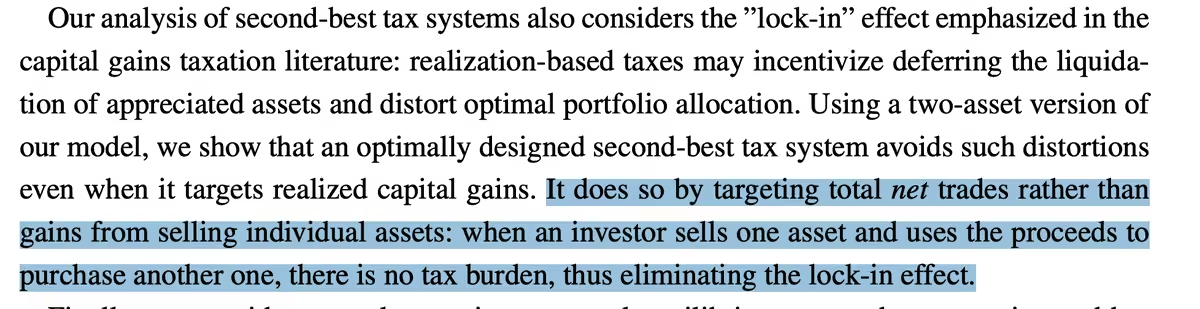
Taxes on wealth or unrealized capital gains are a bad idea. Not just because of all the well-known implementation issues. But also in theory.
Our paper, now forthcoming in Econometrica:
Econometrica
@ecmaEditors
When Jeff Bezos's Amazon stock doubles, should his tax bill? No, say Mark Aguiar, @ben_moll and @Florian_Scheuer: optimal taxes target realized net trades plus cash flows—not wealth or unrealized gains—while avoiding lock-in, whatever moves asset prices.
www.econometricsociety.org/publications/econometrica/fort… -
Ben Moll reposted
Ahmad Lashkaripour
@ALashkaripour
It's worth separating two issues in the *China Shock* debate.
Autor-Dorn-Hanson was a positive development for academic research. It paved the way for a lot of interesting work on trade and inequality. Several follow-up studies estimate similar distributional effects using different data and methods (see Rafael's thoughtful thread on this).
Outside academia, however, the results were widely misinterpreted. Many used them to push protectionist agendas and to argue that trade with China was a net negative for the US economy, which the results never supported.
This kind of misinterpretation will keep happening until we adopt stricter guardrails on how to present cross-sectional estimates. As @ben_moll and @oliverhanney's Vox article argues, the practice of making aggregate claims from cross-sectional estimates is pervasive but generally invalid, because of the *missing intercept* problem.
Rafael Dix-Carneiro
@dix_rafael
1/ Together with Eaton–Kortum (2002) and Melitz (2003), I put Autor, Dorn & Hanson (2013) among the most influential trade papers of the past three decades. Precisely because of that influence, it has been intensely scrutinized.
-
Ben Moll reposted
Joe Hazell
@JADHazell
🚨 New paper🚨 How will AI affect the economy via making software engineering cheaper and better? With great coauthors Alex Blumenfeld, @ChenLian92 and Andreas Schaab. (1/9)
-
Ben Moll reposted
Alex Imas
@alexolegimas
New post with the excellent @FutureEconJacob examining the evidence (so far) on the impact of AI on the labor market. We reviewed 20+ papers and datasets and attempted to synthesize the evidence. Our take:
1) There is no strong signal that AI has had a negative or positive impact on employment in the aggregate.
2) When looking at specific sectors and demographics, the evidence is fairly mixed. While some have argued for negative impact on AI-exposed, early career hiring, others have identified moderators such as remote work or macroeconomic trends. There is also some evidence of positive impacts as well.
So has AI hit the labor market yet? When looking at the employment statistics--not really. But that does not mean that jobs are not changing significantly, and that there aren't substantial changes in what skills are becoming less relevant versus in greater demand. That's a topic for another post!
Link: aleximas.substack.com/p/has-ai-impacted-the-labor-market
Jacob Schaal
@FutureEconJacob
Has AI hit the labor market yet? @alexolegimas and my verdict after ~20 papers: not yet in aggregate. Unemployment and layoffs show almost nothing. But AI may already be cutting junior hiring in exposed white-collar jobs. Remote work may explain part of that decline.
A 🧵 -
Ben Moll reposted
Lukasz Rachel
@LukaszRachel
TLDR: whether wages go ⬆️ a lot as the K-share ⬆️ depends almost entirely on Pi:=cost of doing the newly automated tasks with L vs w AI. If you write Y=K^aL^{1-a} you're implicitly assuming Pi is huge, like 10x-35x 🤖 No surprise u'll find huge wages gains. Pls, report your Pi‼️
Lukasz Rachel
@LukaszRachel
I recently argued that AI-driven rise in capital share may not bring as large wage gains as some expect.
That was all steady state stuff:(x.com/LukaszRachel/status/2102705130630000759 and x.com/LukaszRachel/status/2102705130630000759)
Time for transitions! 1/N #econtwitter
Updated paper here: dropbox.com/scl/fi/28uq0gptpckdadlayfr25/Capital_Share_fo…
Lukasz Rachel
@LukaszRachel
If AI raises the capital share of income, will workers ultimately benefit?
Recent analyses using a workhorse macro model concluded: YES.
I wrote a paper explaining why these conclusions are somewhat misleading. The future of wages might not be so rosy.
www.dropbox.com/scl/fi/28uq0gptpckdadlayfr25/Capital_Shar… -
Ben Moll reposted
John Horton
@johnjhorton
AI models themselves are skeptical of fast-growth views. If you want to give your own predictions, see link in next tweet 1/
Ben Moll
@ben_moll
Hi @elonmusk would you perhaps be interested in participating on the fast-growth side of this bet?
benjaminmoll.com/growth_bet/
Ben Moll
@ben_moll
Thanks to @willmacaskill, @SamuelAlbanie, @tomcohen for taking the other side of this bet at 4:1 odds and to @andrewho03 for joining on my side.
Here are the final terms we agreed on benjaminmoll.com/growth_bet/
More (within) ~7 years from now 😃
Ben Moll
@ben_moll
Would anyone like to take the other side of the following bet? I bet you (say) $25k inflation-adjusted that U.S. per capita real GDP growth will be <15% per annum in 2033 or any year before that. (15% implies a doubling time of ~5 years.)
Note: I'm extremely bullish on AI and...
Sholto Douglas
@_sholtodouglas
How fast could the economy double? TLDR, once we have good enough AI and tens of millions of robots - very fast.
As crazy as it feels now - it is worth pricing in economic doublings into your mental models of the 2030s. Strongly recommend reading this series of blog posts by Damon Binder. -
Ben Moll reposted
Owen Zidar
@omzidar
Hi Friends,
Thanks for all the support for the Everywhere Millionaire. Based on bookscan sales data, it looks like we are right on the bubble of the best seller list in business for September, so if you could pick up a copy at a local bookstore *in the next few days*, suggest the book to friends, retweet this message, or post about it - we’d greatly appreciate it!
bookshop.org/p/books/the-everywhere-millionaire-who-is-re… -
Ben Moll reposted
Jon Steinsson
@JonSteinsson
New BPEA paper by @SVNieuwerburgh argues that AI buildout will cost $10.3T over next 8 years. Furthermore, to get a 10% return on this, those investing will need annual revenues of $3.7T by 2032! (Approx 9% of GDP!)
www.brookings.edu/wp-content/uploads/2026/09/4c_Van-Nieuw… -
Ben Moll reposted
Joe Hazell
@JADHazell
Very happy to share that my colleagues at LSE have voted to award me tenure!
-
Ben Moll reposted
Pierre-Olivier Gourinchas
@pogourinchas
An excellent choice for the @IMFNews. Congratulations @Isabel_Schnabel !
Kristalina Georgieva
@KGeorgieva
I'm delighted to announce the appointment of Isabel Schnabel as IMF Financial Counsellor, effective Jan. 4, 2027. Her distinguished record, including at the ECB, and leadership in research and policymaking will be invaluable to the Fund. www.imf.org/en/news/articles/2026/09/24/pr26303-imf-manag…
-
Ben Moll reposted
Jakob Foerster
@j_foerst
We are again recruiting @bold_lab_ai - please share the love 🙏. We are looking for:
1) Postdocs (my.corehr.com/pls/uoxrecruit/erq_jobspec_version_4.displa…) -- deadline 9th of Oct at noon
2) research assistants (my.corehr.com/pls/uoxrecruit/erq_jobspec_version_4.displa…) -- deadline 9th of Oct at noon
3) Strategic Partnership Project Manager (my.corehr.com/pls/uoxrecruit/erq_jobspec_version_4.displa…) -- deadline 14th of Oct at noon -
Ben Moll
@ben_moll
Huge congrats to my colleague Joe @JADHazell, the rising star of empirical macroeconomics!!!
Joe Hazell
@JADHazell
Very happy to share that my colleagues at LSE have voted to award me tenure!
-
Ben Moll reposted
Department of Economics, University of Mannheim
@EconUniMannheim
On Thursday, October 1st, 12:15 pm, we are thrilled to welcome Ben Moll, LSE, to our Macro-CRC TR 224 Seminar (@EPoS224, @EconUniMannheim ). He will present “Structural Reinforcement Learning for Heterogeneous Agent Macroeconomics.” More info –
www.vwl.uni-mannheim.de/forschung/forschungsseminare/macr…
@ben_moll -
Ben Moll reposted
Gita Gopinath
@GitaGopinath
Thank you @tylercowen for a rich set of questions. I enjoyed our conversation very much.
tylercowen
@tylercowen
My economics-rich Conversation with @GitaGopinath, conversationswithtyler.com/episodes/gita-gopinath/
-
Ben Moll reposted
tylercowen
@tylercowen
My economics-rich Conversation with @GitaGopinath, conversationswithtyler.com/episodes/gita-gopinath/
-
Ben Moll reposted
Refine
@RefineDotInk
Each Refine 5 review uses enough frontier tokens that we're flirting with losing money on it.
To celebrate the launch, we decided to get crazier.
Is your research outside social science?
Reply "Try Refine 5 on [your field]" for free or dirt-cheap reviews.
Rules below 👇
Ben Golub
@ben_golub
Refine 5, a strong new reviewing tool, is live today.
It beats the amazing new frontier models at verifying technical work.
Free with every Refine review through 10/15.
We benchmarked on 108 papers including bio, engineering, physics, environmental science, econ.
🧵
1/ -
Ben Moll reposted
Lukasz Rachel
@LukaszRachel
If AI raises the capital share of income, will workers ultimately benefit?
Recent analyses using a workhorse macro model concluded: YES.
I wrote a paper explaining why these conclusions are somewhat misleading. The future of wages might not be so rosy.
www.dropbox.com/scl/fi/28uq0gptpckdadlayfr25/Capital_Shar… -
Ben Moll reposted
Florian Ederer
@florianederer
#econtwitter, we are so back.
Ben Moll
@ben_moll
This looks nice. But I'm a bit nervous about your equation (1): it's not quite true that the task-based model gives you this exactly Cobb-Douglas. Instead, there's an intercept that depends on \alpha. So it's Y=Z(\alpha)K^{\alpha} L^{1-\alpha}. See e.g.
benjaminmoll.com/Lecture3_EC2B1_Moll/
benjaminmoll.com/task_based_solow/
So when you take your d\alpha derivative, you need to take that into account, no? -
Post not available here, view on X
Ben Moll
@ben_moll
This looks nice. But I'm a bit nervous about your equation (1): it's not quite true that the task-based model gives you this exactly Cobb-Douglas. Instead, there's an intercept that depends on \alpha. So it's Y=Z(\alpha)K^{\alpha} L^{1-\alpha}. See e.g.
benjaminmoll.com/Lecture3_EC2B1_Moll/
benjaminmoll.com/task_based_solow/
So when you take your d\alpha derivative, you need to take that into account, no? -
Ben Moll reposted
Lukasz Rachel
@LukaszRachel
Hi @JesusFerna7026 -- I think the table below paints a somewhat overly optimistic picture for wages. Let me explain. (@JohnHCochrane @ben_moll)
I will work with a slightly more general Cobb-Douglas with A and psi:
Jesús Fernández-Villaverde
@JesusFerna7026
A simple point that many economists miss (and nearly all non-economists) is that a falling labor share and rising wages are not in tension. In fact, it is what we should expect when the capital share rises, and capital is free to accumulate.
The reason is intuitive. In the long run, the supply of capital is perfectly elastic at a gross return determined by depreciation and the discount rate: households accumulate or run down capital until its return is back there. In comparison, the supply of labor is much more inelastic.
That means the gains from a technological change that makes capital more important in production (short of making it the only factor) end up with the inelastic factor, not the elastic one. In the long run, capital owners cannot get a rent from a higher capital share of output, only a compensation for their patience. We learned that from David Ricardo over two hundred years ago!
To see this, consider the textbook neoclassical growth model with log utility (not needed, but it makes things easy).
In the table below, I compute the steady-state wage for different values of the capital share. Increasing the capital share from 0.33 to 0.6 multiplies wages by nearly five. Capital owners receive a much larger slice of output, but the net rate of return stays at 4.7%: all the extra income has gone into more capital. Now, you might not want capital owners to have so much capital for political reasons (rich people have a curious habit of buying newspapers), but that has nothing to do with wages being lower. They are higher.
I learned this lesson the hard way many years ago with my paper “Bargaining Shocks and Aggregate Fluctuations” with Thorsten Drautzburg and @pablo_guerron in the JEDC. We gave more bargaining power to capital owners (in our model, wages were not set competitively but through Nash bargaining), and workers ended up with higher wages! The logic is the same: give capital owners more power, and they compete it away. Karl Marx, by the way, already understood this. He was a much better economist than 99.99% of his followers and admirers.
Like all results, this one has exceptions: I can think of environments where a technological change that makes capital more important in production does not raise wages. And the transitional dynamics can get tricky. But the basic logic is hard to escape. -
Ben Moll
@ben_moll
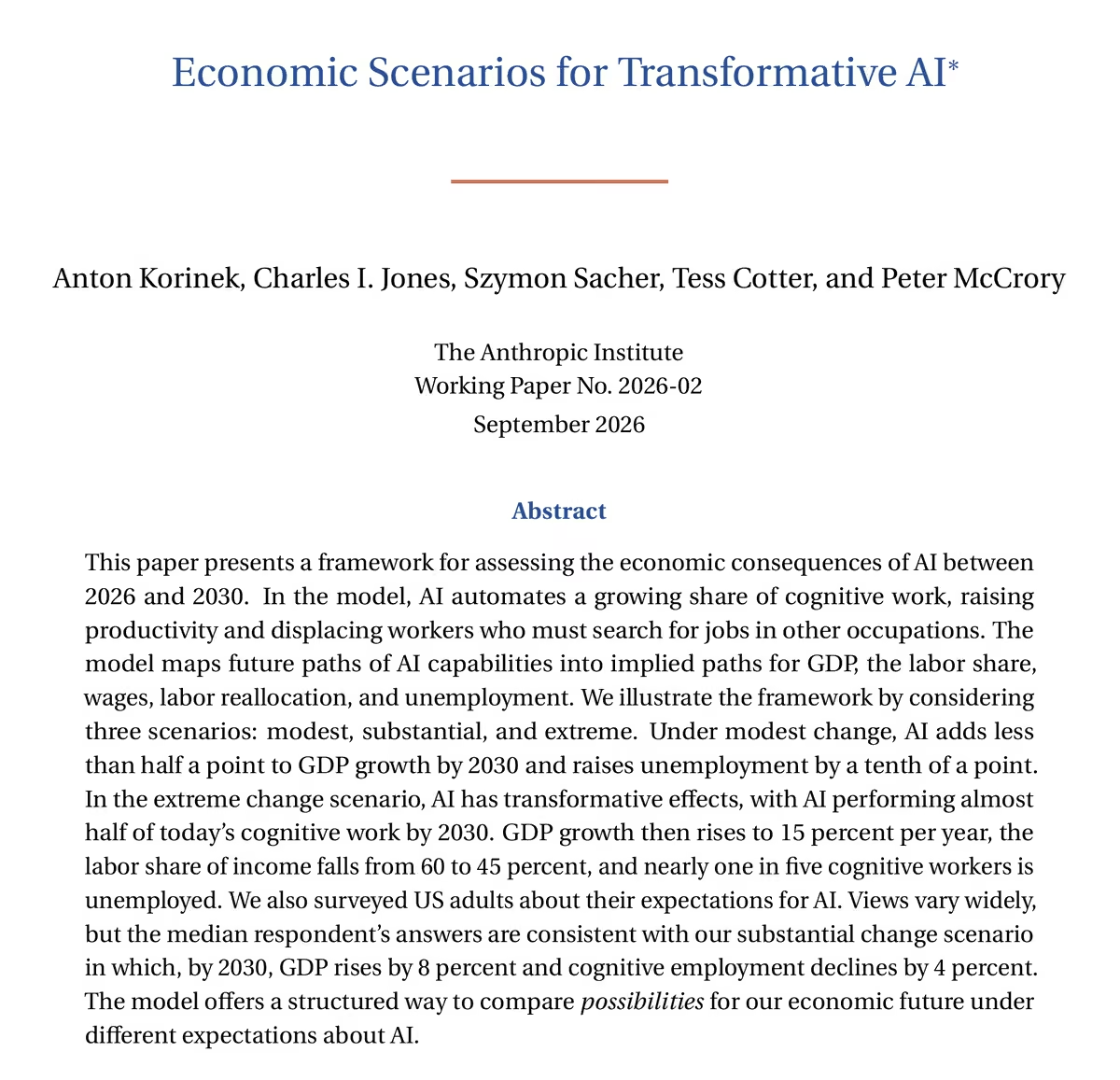
Exactly! One recent paper that did this part nicely by the way was the Anthropic Institute report by @ChadJonesEcon @akorinek @PeterMcCrory and co.
They also have some cases where the wage drops, see Table 5.
www-cdn.anthropic.com/files/4zrzovbb/website/cf58f84d46a4…
Jesús Fernández-Villaverde
@JesusFerna7026
I see the point now. In OLG, Blanchard-Yaari or Aiyagari-type economies, the long-run supply of capital slopes upward (that is also the mechanism in my paper with Galo, Rodolfo, and Peter on monetary policy). How steep this slope is determines how much of automation's gain goes to wages versus returns, and that is an empirical question.
I re-ran the results with different elasticities. I hope I read your calibration correctly. -
Post not available here, view on X
Ben Moll
@ben_moll
Link here www-cdn.anthropic.com/files/4zrzovbb/website/cf58f84d46a4…
-
Ben Moll reposted
E. Goüin dit Lebonenfant
@emilien_gb
-
Ben Moll reposted
Ben Moll
@ben_moll
Yes but can everyone please stop saying "capital is perfectly elastic and therefore 100% of AI gains will accrue to labor". That's just not true! (And same with "therefore the tax rate should be zero")
benjaminmoll.com/UG/ -
Post not available here, view on X
Ben Moll
@ben_moll
Yes but can everyone please stop saying "capital is perfectly elastic and therefore 100% of AI gains will accrue to labor". That's just not true! (And same with "therefore the tax rate should be zero")
benjaminmoll.com/UG/ -
Ben Moll reposted
Jonathan Heathcote
@Jonheathcote
Current estimate for Taiwan is 15.4% eng.stat.gov.tw/News_Content.aspx?n=2337&s=236587
-
Ben Moll reposted
Pierre-Olivier Gourinchas
@pogourinchas
Thank you @kielinstitute! It is a great honor to receive the 2026 Bernhard Harms Prize. The list of former recipients is amazing, with many giants in international finance, trade and macroeconomics.
Kiel Institut
@kielinstitute
🎉 We're proud to announce that @pogourinchas (@UCBerkeley, former @IMFNews Chief Economist) will receive the 2026 Bernhard Harms Prize! Honored for pioneering, field-shaping work on global imbalances, capital flows & the dollar's role in the international monetary system.
Award Ceremony at the 5th Kiel-CEPR Conference on Geoeconomics in Berlin, Nov 3-4!
👉 www.kielinstitut.de/research/publications/news/pierre-oli… -
Ben Moll reposted
Ben Golub
@ben_golub
tagging my close friend @elonmusk for extra visibility
-
Ben Moll
@ben_moll
If enough of you RT the tweet linked below, Elon might see the bet. You know what to do!
Ben Moll
@ben_moll
Hi @elonmusk would you perhaps be interested in participating on the fast-growth side of this bet?
benjaminmoll.com/growth_bet/
Ben Moll
@ben_moll
Thanks to @willmacaskill, @SamuelAlbanie, @tomcohen for taking the other side of this bet at 4:1 odds and to @andrewho03 for joining on my side.
Here are the final terms we agreed on benjaminmoll.com/growth_bet/
More (within) ~7 years from now 😃
Ben Moll
@ben_moll
Would anyone like to take the other side of the following bet? I bet you (say) $25k inflation-adjusted that U.S. per capita real GDP growth will be <15% per annum in 2033 or any year before that. (15% implies a doubling time of ~5 years.)
Note: I'm extremely bullish on AI and...
Sholto Douglas
@_sholtodouglas
How fast could the economy double? TLDR, once we have good enough AI and tens of millions of robots - very fast.
As crazy as it feels now - it is worth pricing in economic doublings into your mental models of the 2030s. Strongly recommend reading this series of blog posts by Damon Binder. -
Ben Moll reposted
Rudi Bachmann
@BachmannRudi
Do it @elonmusk
Ben Moll
@ben_moll
Hi @elonmusk would you perhaps be interested in participating on the fast-growth side of this bet?
benjaminmoll.com/growth_bet/
Ben Moll
@ben_moll
Thanks to @willmacaskill, @SamuelAlbanie, @tomcohen for taking the other side of this bet at 4:1 odds and to @andrewho03 for joining on my side.
Here are the final terms we agreed on benjaminmoll.com/growth_bet/
More (within) ~7 years from now 😃
Ben Moll
@ben_moll
Would anyone like to take the other side of the following bet? I bet you (say) $25k inflation-adjusted that U.S. per capita real GDP growth will be <15% per annum in 2033 or any year before that. (15% implies a doubling time of ~5 years.)
Note: I'm extremely bullish on AI and...
Sholto Douglas
@_sholtodouglas
How fast could the economy double? TLDR, once we have good enough AI and tens of millions of robots - very fast.
As crazy as it feels now - it is worth pricing in economic doublings into your mental models of the 2030s. Strongly recommend reading this series of blog posts by Damon Binder. -
Ben Moll reposted
Florian Ederer
@florianederer
I'm in on the slow-growth side for any amount up to $200,000.
-
Ben Moll reposted
Kurt MIT-shock-man
@SorryToBeKurt
Curious which side @elonmusk would take. He should definitely get in on that action
Ben Moll
@ben_moll
Hi @elonmusk would you perhaps be interested in participating on the fast-growth side of this bet?
benjaminmoll.com/growth_bet/
Ben Moll
@ben_moll
Thanks to @willmacaskill, @SamuelAlbanie, @tomcohen for taking the other side of this bet at 4:1 odds and to @andrewho03 for joining on my side.
Here are the final terms we agreed on benjaminmoll.com/growth_bet/
More (within) ~7 years from now 😃
Ben Moll
@ben_moll
Would anyone like to take the other side of the following bet? I bet you (say) $25k inflation-adjusted that U.S. per capita real GDP growth will be <15% per annum in 2033 or any year before that. (15% implies a doubling time of ~5 years.)
Note: I'm extremely bullish on AI and...
Sholto Douglas
@_sholtodouglas
How fast could the economy double? TLDR, once we have good enough AI and tens of millions of robots - very fast.
As crazy as it feels now - it is worth pricing in economic doublings into your mental models of the 2030s. Strongly recommend reading this series of blog posts by Damon Binder. -
Ben Moll reposted
Ben Moll
@ben_moll
Hi @elonmusk would you perhaps be interested in participating on the fast-growth side of this bet?
benjaminmoll.com/growth_bet/
Ben Moll
@ben_moll
Thanks to @willmacaskill, @SamuelAlbanie, @tomcohen for taking the other side of this bet at 4:1 odds and to @andrewho03 for joining on my side.
Here are the final terms we agreed on benjaminmoll.com/growth_bet/
More (within) ~7 years from now 😃
Ben Moll
@ben_moll
Would anyone like to take the other side of the following bet? I bet you (say) $25k inflation-adjusted that U.S. per capita real GDP growth will be <15% per annum in 2033 or any year before that. (15% implies a doubling time of ~5 years.)
Note: I'm extremely bullish on AI and...
Sholto Douglas
@_sholtodouglas
How fast could the economy double? TLDR, once we have good enough AI and tens of millions of robots - very fast.
As crazy as it feels now - it is worth pricing in economic doublings into your mental models of the 2030s. Strongly recommend reading this series of blog posts by Damon Binder. -
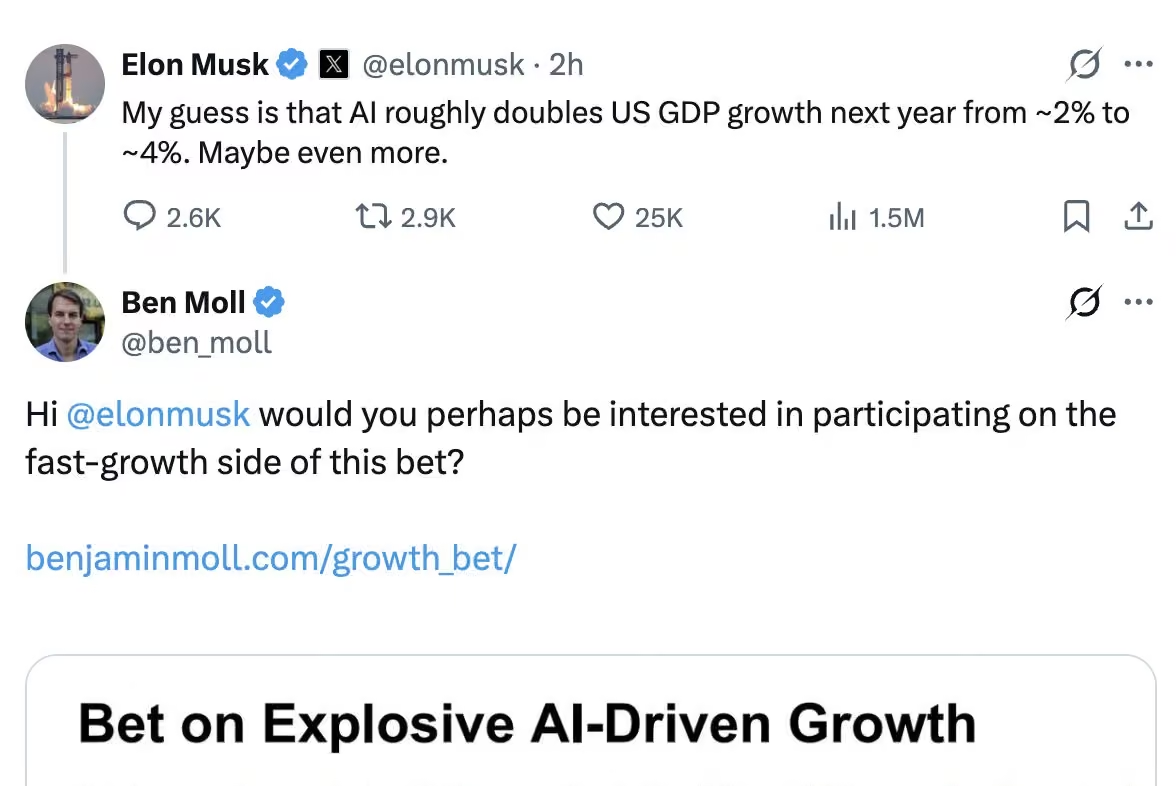
Elon Musk
@elonmusk
My guess is that AI roughly doubles US GDP growth next year from ~2% to ~4%. Maybe even more.
Ben Moll
@ben_moll
Hi @elonmusk would you perhaps be interested in participating on the fast-growth side of this bet?
benjaminmoll.com/growth_bet/
Ben Moll
@ben_moll
Thanks to @willmacaskill, @SamuelAlbanie, @tomcohen for taking the other side of this bet at 4:1 odds and to @andrewho03 for joining on my side.
Here are the final terms we agreed on benjaminmoll.com/growth_bet/
More (within) ~7 years from now 😃
Ben Moll
@ben_moll
Would anyone like to take the other side of the following bet? I bet you (say) $25k inflation-adjusted that U.S. per capita real GDP growth will be <15% per annum in 2033 or any year before that. (15% implies a doubling time of ~5 years.)
Note: I'm extremely bullish on AI and...
Sholto Douglas
@_sholtodouglas
How fast could the economy double? TLDR, once we have good enough AI and tens of millions of robots - very fast.
As crazy as it feels now - it is worth pricing in economic doublings into your mental models of the 2030s. Strongly recommend reading this series of blog posts by Damon Binder. -
Ben Moll reposted
Kurt MIT-shock-man
@SorryToBeKurt
Maybe @ben_moll can add a bunch more zeroes to his bet
-
Ben Moll reposted
Owen Zidar
@omzidar
This was a very fun time - check out a great conversation with @TheStalwart and @tracyalloway about Everywhere Millionaires with me and Eric Zwick
Bloomberg Podcasts
@podcasts
When one thinks about the wealthiest Americans, ultra-rich billionaires like Elon Musk and Jeff Bezos might come to mind. But there is a class of rich private business owners hiding in plain sight.
University of Chicago Associate Professor Eric Zwick and Princeton University Professor @omzidar join @tracyalloway and @TheStalwart on the Odd Lots podcast to discuss how income inequality started to rise in tandem with the growing number of pass-through businesses. Listen at swap.fm/l/Zy1VoMNJALqUKQ7qo8yv or watch at bloomberg.com/videoThis media couldn't be displayed. See it on the original post. -
Ben Moll reposted
Ben Moll
@ben_moll
The episode also has a beautiful and textbook discussion of bottlenecks. See for example the screenshotted passage.
Compare this to the following passage @alexolegimas wrote for our essay aleximas.substack.com/p/will-ai-soon-lead-to-double-digit
"As agriculture became more automated, its share of GDP shrank as the goods became cheaper and people became richer as a result. Where did value go? To goods and services which had demand but were not automated yet — manufacturing. As manufacturing became increasingly automated, the prices of those goods fell and the sector became a smaller part of GDP. Where did value go? Services."
Sounds identical, no? Just for the macroeconomy as a whole rather than within a lab. That's exactly how it works and at all scales from very micro to very macro! -
Ben Moll
@ben_moll
Great episode on the coming AI capabilities explosion. Very much worth listening to, especially for my economist friends.
The three guests differ on timelines (nice to see some belief heterogeneity!) but all are very bullish. Examples:
- 10x productivity uplift for AI researchers in 2 years
- AI superhuman in all computer work in 5-10 years (@johnschulman2 3-4 years!)
Here is the thing though: You can fully believe
1. that AI capabilities will explode like in these predictions (I do)
2. that AI is potentially bigger than the industrial revolution (I do)
3. but that GDP growth in 10-15 years will be "only" 4-5%, or less for that matter (to be clear, 4-5% would be completely transformative)
@Noahpinion also reminds me of this graph which shows growth forecasts by expert background forecastingresearch.org/research/economic-effects-of-ai
Dwarkesh Patel
@dwarkesh_sp
New episode with @johnschulman2, @oneill_c and @BerenMillidge.
I got together with some of the most insightful AI researchers I know who are at the openish companies, because I wanted to hear the details of what's actually happening at the frontier and what comes next.
0:00:00 – Steelmanning the case against RSI
0:18:39 – What’s driving the Chinese labs’ progress
0:28:06 – How will automated AI researchers be trained
0:33:51 – Will long-horizon RL elicit AGI?
0:45:24 – The sim-to-real gap
1:00:33 – How much progress is explained by data?
1:18:03 – Why is RL working so well?
1:24:54 – Move 37 and entropy collapse
1:28:31 – Rapid-fire timelinesThis media couldn't be displayed. See it on the original post.
Ben Moll
@ben_moll
The episode also has a beautiful and textbook discussion of bottlenecks. See for example the screenshotted passage.
Compare this to the following passage @alexolegimas wrote for our essay aleximas.substack.com/p/will-ai-soon-lead-to-double-digit
"As agriculture became more automated, its share of GDP shrank as the goods became cheaper and people became richer as a result. Where did value go? To goods and services which had demand but were not automated yet — manufacturing. As manufacturing became increasingly automated, the prices of those goods fell and the sector became a smaller part of GDP. Where did value go? Services."
Sounds identical, no? Just for the macroeconomy as a whole rather than within a lab. That's exactly how it works and at all scales from very micro to very macro! -
Ben Moll reposted
Gabriel Unger
@_gabrielunger
I gave the very smart @pawtrammell 10 to 1 odds that the slow side wins (even more lopsided than the 4:1 odds of the original bet) and happy to offer same odds to anyone else (although weak Coasian preference for a smaller number of large wagers).
A final observation: right now in Silicon Valley, lots of people make predictions about AI (which is great!), but I've noticed that many people don't seem to update much when their predictions fail, or try to understand why. E.g. Ed Zitron keeps predicting OpenAI will go bankrupt every 6 months, or Dario predicting 20% unemployment or curing "most major diseases" in 5-10 years. It would be great if, upon resolution of this wager (and analogous predictions), we could all reflect on what we got wrong and why.
(Full disclosure/example, as part of the big LEAP panel of AI experts surveyed on AI forecasting, we were asked in Nov 2025 if AI would help solve a Millennium math problem any time soon. I unambiguously got this wrong. Now I need to spend some time figuring out why!)
Ben Moll
@ben_moll
Great stuff from @LukaszRachel who puts our bet in historical context.
Systematic analysis of per-capita GDP growth rates for:
- 211 countries across the whole world since 1962, i.e. including growth miracles like China and not just frontier countries like the U.S.
- 11,109 country-year pairs
Even with this sample Pr(growth > 15% above prior peak) = 0.9% only!
And for frontier countries like the U.S., there is one single country-year pair. But that one is Ireland in 2015 which shouldn't really count (measurement issue due to multinationals).
Summary: basically, it has never happened before.
Of course that doesn't necessarily tell you about the future and for that you want to rely on other arguments aleximas.substack.com/p/will-ai-soon-lead-to-double-digit
Lukasz Rachel
@LukaszRachel
Just how unprecedented would growth need to be for @ben_moll and the fast growth side to lose this bet on AI?
Lecture 1 of my econ of growth module @UCL always has some stylized facts on growth. Let’s see what these say. 🧵
Ben Moll
@ben_moll
Some real diversity of opinion at Google DeepMind: @alexolegimas joins the bet while his colleague @SamuelAlbanie takes the other side increasing his existing stake!
Total size of pot now $425,000!
benjaminmoll.com/growth_bet/
Ben Moll
@ben_moll
Thanks to @willmacaskill, @SamuelAlbanie, @tomcohen for taking the other side of this bet at 4:1 odds and to @andrewho03 for joining on my side.
Here are the final terms we agreed on benjaminmoll.com/growth_bet/
More (within) ~7 years from now 😃
Ben Moll
@ben_moll
Would anyone like to take the other side of the following bet? I bet you (say) $25k inflation-adjusted that U.S. per capita real GDP growth will be <15% per annum in 2033 or any year before that. (15% implies a doubling time of ~5 years.)
Note: I'm extremely bullish on AI and...
Sholto Douglas
@_sholtodouglas
How fast could the economy double? TLDR, once we have good enough AI and tens of millions of robots - very fast.
As crazy as it feels now - it is worth pricing in economic doublings into your mental models of the 2030s. Strongly recommend reading this series of blog posts by Damon Binder. -
Ben Moll reposted
Lukasz Rachel
@LukaszRachel
Just how unprecedented would growth need to be for @ben_moll and the fast growth side to lose this bet on AI?
Lecture 1 of my econ of growth module @UCL always has some stylized facts on growth. Let’s see what these say. 🧵
Ben Moll
@ben_moll
Some real diversity of opinion at Google DeepMind: @alexolegimas joins the bet while his colleague @SamuelAlbanie takes the other side increasing his existing stake!
Total size of pot now $425,000!
benjaminmoll.com/growth_bet/
Ben Moll
@ben_moll
Thanks to @willmacaskill, @SamuelAlbanie, @tomcohen for taking the other side of this bet at 4:1 odds and to @andrewho03 for joining on my side.
Here are the final terms we agreed on benjaminmoll.com/growth_bet/
More (within) ~7 years from now 😃
Ben Moll
@ben_moll
Would anyone like to take the other side of the following bet? I bet you (say) $25k inflation-adjusted that U.S. per capita real GDP growth will be <15% per annum in 2033 or any year before that. (15% implies a doubling time of ~5 years.)
Note: I'm extremely bullish on AI and...
Sholto Douglas
@_sholtodouglas
How fast could the economy double? TLDR, once we have good enough AI and tens of millions of robots - very fast.
As crazy as it feels now - it is worth pricing in economic doublings into your mental models of the 2030s. Strongly recommend reading this series of blog posts by Damon Binder. -
Ben Moll
@ben_moll
Great stuff from @LukaszRachel who puts our bet in historical context.
Systematic analysis of per-capita GDP growth rates for:
- 211 countries across the whole world since 1962, i.e. including growth miracles like China and not just frontier countries like the U.S.
- 11,109 country-year pairs
Even with this sample Pr(growth > 15% above prior peak) = 0.9% only!
And for frontier countries like the U.S., there is one single country-year pair. But that one is Ireland in 2015 which shouldn't really count (measurement issue due to multinationals).
Summary: basically, it has never happened before.
Of course that doesn't necessarily tell you about the future and for that you want to rely on other arguments aleximas.substack.com/p/will-ai-soon-lead-to-double-digit
Lukasz Rachel
@LukaszRachel
Just how unprecedented would growth need to be for @ben_moll and the fast growth side to lose this bet on AI?
Lecture 1 of my econ of growth module @UCL always has some stylized facts on growth. Let’s see what these say. 🧵
Ben Moll
@ben_moll
Some real diversity of opinion at Google DeepMind: @alexolegimas joins the bet while his colleague @SamuelAlbanie takes the other side increasing his existing stake!
Total size of pot now $425,000!
benjaminmoll.com/growth_bet/
Ben Moll
@ben_moll
Thanks to @willmacaskill, @SamuelAlbanie, @tomcohen for taking the other side of this bet at 4:1 odds and to @andrewho03 for joining on my side.
Here are the final terms we agreed on benjaminmoll.com/growth_bet/
More (within) ~7 years from now 😃
Ben Moll
@ben_moll
Would anyone like to take the other side of the following bet? I bet you (say) $25k inflation-adjusted that U.S. per capita real GDP growth will be <15% per annum in 2033 or any year before that. (15% implies a doubling time of ~5 years.)
Note: I'm extremely bullish on AI and...
Sholto Douglas
@_sholtodouglas
How fast could the economy double? TLDR, once we have good enough AI and tens of millions of robots - very fast.
As crazy as it feels now - it is worth pricing in economic doublings into your mental models of the 2030s. Strongly recommend reading this series of blog posts by Damon Binder. -
Ben Moll reposted
Martha Gimbel
@marthagimbel
My pitch for this book is that I gave my copy to my mother to read and she called me and said “these people are so fascinating” and I said “right?! They find amazing people to profile.” To which she responded: “no no the guys who wrote it just locking themselves in the treasury to do research who would do that?!”
Anyway read the book - both the millionaires and the research (by my mother’s new favorite economists) are fascinating
Owen Zidar
@omzidar
Today is launch day for The Everywhere Millionaire! I talked with @PrincetonEcon to answer a few questions about the book.
1. You can order your copy today us.macmillan.com/books/9781250378507/theeverywheremillion…
2. Please share this with friends who might be interested in the American Dream and/or American inequality
3. Amazon reviews are open now too, and a short one helps more than you'd think. -
Ben Moll reposted
Philip Trammell
@pawtrammell
I've just joined this bet (though at different odds) with @_gabrielunger : he pays me $100k if we get the growth, I pay him $10k if not.
-
Ben Moll reposted
Demis Hassabis
@demishassabis
For 20+ years @ShaneLegg and I've discussed AGI’s potential impact on the economy, science & society. With the DeepMind Institute, we're expanding interdisciplinary research on key questions for the AI era. We hope it spurs the discussions needed to get the next steps right: deepmind.google/institute
-
Ben Moll reposted
Shane Legg
@ShaneLegg
My journey to develop AGI spans 25 yrs, including 10+ yrs thinking about technical & societal perspectives at Google DeepMind.
AGI is on the horizon - we need deeper understanding of its implications. To help, we've created the DeepMind Institute. x.com/i/article/2100217797129240576 -
Ben Moll reposted
Alex Imas
@alexolegimas
Today we are announcing the new DeepMind Institute, a forum dedicated to interdisciplinary, evidence-led debate on the societal and economic questions surrounding AGI.
As part of the launch, @JulianDJacobs and I have a new essay and working paper: “Economic Policy for AGI.”
institute.deepmind.com/essays/economic-policy-for-agi/ 🧵1/n -
Ben Moll reposted
Imran Rasul
@ImranRasul3
👇🏽must read book for anyone interested in wealth and inequality - I am ordering my copy today. Hope the book tour comes to Europe too!
Owen Zidar
@omzidar
Today is launch day for The Everywhere Millionaire! I talked with @PrincetonEcon to answer a few questions about the book.
1. You can order your copy today us.macmillan.com/books/9781250378507/theeverywheremillion…
2. Please share this with friends who might be interested in the American Dream and/or American inequality
3. Amazon reviews are open now too, and a short one helps more than you'd think. -
Ben Moll reposted
Emily Oster
@ProfEmilyOster
This is a great book!!
Owen Zidar
@omzidar
Today is launch day for The Everywhere Millionaire! I talked with @PrincetonEcon to answer a few questions about the book.
1. You can order your copy today us.macmillan.com/books/9781250378507/theeverywheremillion…
2. Please share this with friends who might be interested in the American Dream and/or American inequality
3. Amazon reviews are open now too, and a short one helps more than you'd think. -
Ben Moll
@ben_moll
Best compliment ever!
Owen Zidar
@omzidar
The economist on the everywhere millionaire
www.economist.com/business/2026/06/10/american-capitalism… -
Ben Moll reposted
Matthew Yglesias
@mattyglesias
This is an absolutely fantastic book that you must read if you want to know the real truth about wealth in America.
Owen Zidar
@omzidar
Today is launch day for The Everywhere Millionaire! I talked with @PrincetonEcon to answer a few questions about the book.
1. You can order your copy today us.macmillan.com/books/9781250378507/theeverywheremillion…
2. Please share this with friends who might be interested in the American Dream and/or American inequality
3. Amazon reviews are open now too, and a short one helps more than you'd think. -
Ben Moll reposted
Andy Hall
@ahall_research
So much of our public policy discussions are driven by narratives---and only rarely do people do the hard work to collect and analyze the underlying data to see what's actually going on.
That's why I'm so excited about the release today of THE EVERYWHERE MILLIONAIRE by @omzidar and Eric Zwick.
As I've been chronicling at inbox.freesystems.net, anti-rich rhetoric in American politics is skyrocketing. But who are all these rich people? This book shatters a lot of our preconceptions about who the rich are in America. The mega tech billionaires are very different from the larger strata of the wealthy in America, as Zidar and Zwick show.
I've already bought three copies. You should, too!
www.amazon.com/dp/1250378508?tag=macmillan-20 -
Ben Moll reposted
Ben Moll
@ben_moll
and a great review by Paul GP
paulgp.substack.com/p/who-is-rich-in-america-and-why -
Ben Moll
@ben_moll
Hate to break it to you but inequality in America is about car dealerships and hot dog companies, not billionaires and Taylor Swift.
Read this book!
Owen Zidar
@omzidar
Today is launch day for The Everywhere Millionaire! I talked with @PrincetonEcon to answer a few questions about the book.
1. You can order your copy today us.macmillan.com/books/9781250378507/theeverywheremillion…
2. Please share this with friends who might be interested in the American Dream and/or American inequality
3. Amazon reviews are open now too, and a short one helps more than you'd think.
Ben Moll
@ben_moll
Really a shame the data is so unglamorous:
The Atlantic
@TheAtlantic
Americans might think of Elon Musk and Mark Zuckerberg when picturing the ultrarich, but far more typical are the owners of successful privately held businesses—the real drivers of American inequality, @omzidar and Eric Zwick argue: www.theatlantic.com/ideas/2026/09/everywhere-millionaires…
Ben Moll
@ben_moll
and a great review by Paul GP
paulgp.substack.com/p/who-is-rich-in-america-and-why -
Ben Moll reposted
Natasha Sarin
@NatashaRSarin
Everyone should read this book!
Owen Zidar
@omzidar
Zwick and I have a piece out in The Atlantic today about our book, The Everywhere Millionaire, that comes out tomorrow! You can get it here: us.macmillan.com/books/9781250378507/theeverywheremillion…
The Atlantic
@TheAtlantic
Americans might think of Elon Musk and Mark Zuckerberg when picturing the ultrarich, but far more typical are the owners of successful privately held businesses—the real drivers of American inequality, @omzidar and Eric Zwick argue: www.theatlantic.com/ideas/2026/09/everywhere-millionaires…
-
Ben Moll reposted
Adrien Auclert
@a_auclert
🚨 Conference deadline alert! 🚨
Macroeconomic Policies with Heterogeneous Agents.
In Paris, December 15-16.
Keynote by @ben_moll. Policy panel with @ojblanchard1, @XJaravel, @doro_rouzet.
Submission deadline is on Sunday. Send us your best work!
cepr.org/events/macroeconomic-policies-heterogeneous-agen… -
Ben Moll reposted
Benjamin Born
@bornecon
Very honored to receive the 2026 Carl Menger Prize from @VfS_econ.
Many thanks to @bundesbank, @oenb, and @SNB_BNS for this recognition!
www.socialpolitik.de/en/carl-menger-preis -
Ben Moll reposted
Christian Bayer
@christianbaye13
Ich freue mich riesig, dass @bornecon diese wohlverdiente Auszeichnung bekommen hat. Seine Arbeiten werfen innovativ Licht auf so viele Bereiche der Makro. Herausragender Wissenschaftler, fantastischer Kollege und Koautor, von dem ich in den vergangenen Jahren viel lernen durfte.
Jonas Dovern 🇪🇺🇺🇦🇮🇱
@jonasdovern
Well deserved @bornecon!!! 💪🏼
-
Ben Moll reposted
Dwarkesh Patel
@dwarkesh_sp
In the early days of OpenAI, @johnschulman2 didn't think next-token prediction was going to lead to intelligence, because it would get swamped by noise.
He explains it's always been hard to apriori predict what techniques will elicit out-of-distribution generalization.This media couldn't be displayed. See it on the original post. -
Ben Moll reposted
Ben Moll
@ben_moll
Q1: How do you write down a model that delivers 15% AI-driven GDP growth in 2030 like the folks at the Anthropic Institute?
A1: It's easy and you can do it in a way any well-trained econ undergrad understands: take a standard Solow model, stick in a task-based production function, calibrate in seemingly innocuous way ➡️ done!
See the supplement to the essay with @alexolegimas benjaminmoll.com/task_based_solow/
(The Anthropic model is, of course, fancier with many more bells and whistles but the basic logic – AI removes labor as a bottleneck on growth – is the same.)
Q2: Does this mean that 15% growth is a reasonable prediction?
A2: No. Just because you can write down such a model doesn't mean you should. Just because it's possible in theory, doesn't mean it will actually happen in practice !
Instead you're making a number of assumptions that are unlikely to hold: aleximas.substack.com/p/will-ai-soon-lead-to-double-digit
Anthropic
@AnthropicAI
Anthropic’s Economics team is sharing a new model of how AI might affect economic growth, jobs, wages, and more by 2030.
Explore the scenarios, tell us what you think will happen, and see how your answers compare to more than 10,000 Americans. www.anthropic.com/institute/econ-scenarios -
Ben Moll reposted
Jonathan A. Parker
@ProfJAParker
Dollar still the dominant currency
Ben Moll
@ben_moll
Some new joiners for a total pot size of $575k!
On my side:
@robinhanson
@phl43
@SashaKaletsky
@_gabrielunger
On the fast-growth side:
@jankulveit
plus @SamuelAlbanie continuing to increase his stake 😮
benjaminmoll.com/growth_bet/
Ben Moll
@ben_moll
Some real diversity of opinion at Google DeepMind: @alexolegimas joins the bet while his colleague @SamuelAlbanie takes the other side increasing his existing stake!
Total size of pot now $425,000!
benjaminmoll.com/growth_bet/
Ben Moll
@ben_moll
Thanks to @willmacaskill, @SamuelAlbanie, @tomcohen for taking the other side of this bet at 4:1 odds and to @andrewho03 for joining on my side.
Here are the final terms we agreed on benjaminmoll.com/growth_bet/
More (within) ~7 years from now 😃
Ben Moll
@ben_moll
Would anyone like to take the other side of the following bet? I bet you (say) $25k inflation-adjusted that U.S. per capita real GDP growth will be <15% per annum in 2033 or any year before that. (15% implies a doubling time of ~5 years.)
Note: I'm extremely bullish on AI and...
Sholto Douglas
@_sholtodouglas
How fast could the economy double? TLDR, once we have good enough AI and tens of millions of robots - very fast.
As crazy as it feels now - it is worth pricing in economic doublings into your mental models of the 2030s. Strongly recommend reading this series of blog posts by Damon Binder. -
Ben Moll
@ben_moll
Some new joiners for a total pot size of $575k!
On my side:
@robinhanson
@phl43
@SashaKaletsky
@_gabrielunger
On the fast-growth side:
@jankulveit
plus @SamuelAlbanie continuing to increase his stake 😮
benjaminmoll.com/growth_bet/
Ben Moll
@ben_moll
Some real diversity of opinion at Google DeepMind: @alexolegimas joins the bet while his colleague @SamuelAlbanie takes the other side increasing his existing stake!
Total size of pot now $425,000!
benjaminmoll.com/growth_bet/
Ben Moll
@ben_moll
Thanks to @willmacaskill, @SamuelAlbanie, @tomcohen for taking the other side of this bet at 4:1 odds and to @andrewho03 for joining on my side.
Here are the final terms we agreed on benjaminmoll.com/growth_bet/
More (within) ~7 years from now 😃
Ben Moll
@ben_moll
Would anyone like to take the other side of the following bet? I bet you (say) $25k inflation-adjusted that U.S. per capita real GDP growth will be <15% per annum in 2033 or any year before that. (15% implies a doubling time of ~5 years.)
Note: I'm extremely bullish on AI and...
Sholto Douglas
@_sholtodouglas
How fast could the economy double? TLDR, once we have good enough AI and tens of millions of robots - very fast.
As crazy as it feels now - it is worth pricing in economic doublings into your mental models of the 2030s. Strongly recommend reading this series of blog posts by Damon Binder.
Ben Moll
@ben_moll
p.s. for those who want to join but don't have a counterparty
Andrey Fradkin
@AndreyFradkin
Those interested in making bets on explosive economic growth due to AI can now make these on Kalshi without emailing @ben_moll. Liquidity is thin, but with the right incentives / subsidies I think these markets can be highly informative.
kalshi.com/markets/kxgdpyear/annual-gdp/kxgdpyear-36
Ben Moll
@ben_moll
Some real diversity of opinion at Google DeepMind: @alexolegimas joins the bet while his colleague @SamuelAlbanie takes the other side increasing his existing stake!
Total size of pot now $425,000!
benjaminmoll.com/growth_bet/
Ben Moll
@ben_moll
Thanks to @willmacaskill, @SamuelAlbanie, @tomcohen for taking the other side of this bet at 4:1 odds and to @andrewho03 for joining on my side.
Here are the final terms we agreed on benjaminmoll.com/growth_bet/
More (within) ~7 years from now 😃
Ben Moll
@ben_moll
Would anyone like to take the other side of the following bet? I bet you (say) $25k inflation-adjusted that U.S. per capita real GDP growth will be <15% per annum in 2033 or any year before that. (15% implies a doubling time of ~5 years.)
Note: I'm extremely bullish on AI and...
Sholto Douglas
@_sholtodouglas
How fast could the economy double? TLDR, once we have good enough AI and tens of millions of robots - very fast.
As crazy as it feels now - it is worth pricing in economic doublings into your mental models of the 2030s. Strongly recommend reading this series of blog posts by Damon Binder.Post not available here, view on X
Ben Moll
@ben_moll
😃
-
Ben Moll reposted
Moderately Successful Geometer
@cg_geometry
One nightmare scenario is an AI-quant firm that shorts the airlines then goes all HuggingFace on the air traffic control systems around the country.
Ben Moll
@ben_moll
Interesting question: Who is taking the other side in a P(doom) bet?
What Jakob is saying: if we ever see liquid prediction markets with implied P(doom) substantially >0 (after adjusting for fees etc), THEN that’s when we should be really worried because the counterparty is likely AI
Jakob Foerster
@j_foerst
Prediction markets usually break down for existential risks - e.g. if everyone gets wiped out by a comet then nobody is there to win the bet (and therefore nobody will take the other side).
P(doom) is different: once there is an entity meanfigfully taking the other side of the bet that becomes informative in its own right: manifold.markets/MartinRandall/will-ai-wipe-out-humanity-… -
Ben Moll reposted
Robin Hanson
@robinhanson
"We are extremely bullish on AI [but] … in the next 10-15 years, growth rates upwards of 10% are extremely unlikely and a much more reasonable baseline is, say, 4-5% (which would already be massive)"
Ben Moll
@ben_moll
Q1: How do you write down a model that delivers 15% AI-driven GDP growth in 2030 like the folks at the Anthropic Institute?
A1: It's easy and you can do it in a way any well-trained econ undergrad understands: take a standard Solow model, stick in a task-based production function, calibrate in seemingly innocuous way ➡️ done!
See the supplement to the essay with @alexolegimas benjaminmoll.com/task_based_solow/
(The Anthropic model is, of course, fancier with many more bells and whistles but the basic logic – AI removes labor as a bottleneck on growth – is the same.)
Q2: Does this mean that 15% growth is a reasonable prediction?
A2: No. Just because you can write down such a model doesn't mean you should. Just because it's possible in theory, doesn't mean it will actually happen in practice !
Instead you're making a number of assumptions that are unlikely to hold: aleximas.substack.com/p/will-ai-soon-lead-to-double-digit
Anthropic
@AnthropicAI
Anthropic’s Economics team is sharing a new model of how AI might affect economic growth, jobs, wages, and more by 2030.
Explore the scenarios, tell us what you think will happen, and see how your answers compare to more than 10,000 Americans. www.anthropic.com/institute/econ-scenarios -
Ben Moll reposted
Richard H Thaler
@R_Thaler
I would join team Moll but I am too old to be a good 10-year credit risk.
Ben Moll
@ben_moll
😃
-
Ben Moll reposted
Lukasz Rachel
@LukaszRachel
Hi Anton, hi Chad, how does this conclusion square with @ChadJonesEcon conclusion from the paper with Chris Tonetti which i read as saying that we won't be able to distinguish wildly different scenarios for decades? Which assumptions drive the difference?
-
Ben Moll
@ben_moll
Interesting question: Who is taking the other side in a P(doom) bet?
What Jakob is saying: if we ever see liquid prediction markets with implied P(doom) substantially >0 (after adjusting for fees etc), THEN that’s when we should be really worried because the counterparty is likely AI
Jakob Foerster
@j_foerst
Prediction markets usually break down for existential risks - e.g. if everyone gets wiped out by a comet then nobody is there to win the bet (and therefore nobody will take the other side).
P(doom) is different: once there is an entity meanfigfully taking the other side of the bet that becomes informative in its own right: manifold.markets/MartinRandall/will-ai-wipe-out-humanity-… -
Ben Moll reposted
Antoine Levy
@LevyAntoine
I reiterate my plea for a derivative market on the total size of the pot!
-
Ben Moll reposted
Philippe Lemoine
@phl43
I have already explained some of the reasons why I think that AGI-pilled have unrealistic expectations on the growth AI will likely deliver in the short to medium term, cf. my exchange with @dwarkesh_sp (x.com/phl43/status/2093379922332979329), but let me say a bit more about why I was happy to accept this bet.
First, while I have no doubt that AGI and even ASI will happen at some point, I think that AGI-pilled people are overconfident that it will happen imminently, because I think their arguments for that view are not as good as they think.
However, my view is mostly that AGI-pilled people underestimate the uncertainty, not that we have good reasons to be confident that AGI won't happen soon. I think there is a non-negligible probability that it will happen as soon as they think, just not as high as they think, so that's not why I agreed to make this bet.
The main reason why I accepted the bet is that, even if we reach AGI soon, I think that, for reasons I explained in my exchange with Dwarkesh and in comments to a piece by @RuxandraTeslo (x.com/phl43/status/2079958988087607711), for that to translate into real GDP growth of more than 15%/year will require a profound reorganization of the economy that I think will take time.
Another reason which is related to some of the stuff I talked about in my exchanges with Dwarkesh and Ruxandra is that, at least for a while (i. e. until it can help us automate the rest of the economy), AGI will have a very uneven effect on output across sectors and, if demand for the services where it will initially reduce costs a lot satiates relatively quickly, their weight in aggregate GDP growth will fall rapidly while that of the rest of the economy where output isn't expanding quickly will rise for Baumol-style reasons.
I also think there are good reasons to think that, in a post-AGI economy, much of the value created by AI will not be captured by the traditional concept of GDP. Finally, since the amounts we are betting are only corrected for inflation and not real GDP growth, if I'm wrong it's likely that I will be significantly richer by 2033 and $10,000 won't be that big of a deal.
P. S. To be clear, I think there are many other reasons to be skeptical that real GDP growth will reach 15%/year in the US by 2033, mostly having to do with how politics might get in the way even if the other stuff I mention doesn't, but I wanted to focus on the strictly economic reasons.
Ben Moll
@ben_moll
Some new joiners for a total pot size of $575k!
On my side:
@robinhanson
@phl43
@SashaKaletsky
@_gabrielunger
On the fast-growth side:
@jankulveit
plus @SamuelAlbanie continuing to increase his stake 😮
benjaminmoll.com/growth_bet/
Ben Moll
@ben_moll
Some real diversity of opinion at Google DeepMind: @alexolegimas joins the bet while his colleague @SamuelAlbanie takes the other side increasing his existing stake!
Total size of pot now $425,000!
benjaminmoll.com/growth_bet/
Ben Moll
@ben_moll
Thanks to @willmacaskill, @SamuelAlbanie, @tomcohen for taking the other side of this bet at 4:1 odds and to @andrewho03 for joining on my side.
Here are the final terms we agreed on benjaminmoll.com/growth_bet/
More (within) ~7 years from now 😃
Ben Moll
@ben_moll
Would anyone like to take the other side of the following bet? I bet you (say) $25k inflation-adjusted that U.S. per capita real GDP growth will be <15% per annum in 2033 or any year before that. (15% implies a doubling time of ~5 years.)
Note: I'm extremely bullish on AI and...
Sholto Douglas
@_sholtodouglas
How fast could the economy double? TLDR, once we have good enough AI and tens of millions of robots - very fast.
As crazy as it feels now - it is worth pricing in economic doublings into your mental models of the 2030s. Strongly recommend reading this series of blog posts by Damon Binder. -
Ben Moll reposted
Robin Hanson
@robinhanson
I've joined this bet, saying <20% chance of 15%/yr US GDP growth before 2033.
Ben Moll
@ben_moll
Some new joiners for a total pot size of $575k!
On my side:
@robinhanson
@phl43
@SashaKaletsky
@_gabrielunger
On the fast-growth side:
@jankulveit
plus @SamuelAlbanie continuing to increase his stake 😮
benjaminmoll.com/growth_bet/
Ben Moll
@ben_moll
Some real diversity of opinion at Google DeepMind: @alexolegimas joins the bet while his colleague @SamuelAlbanie takes the other side increasing his existing stake!
Total size of pot now $425,000!
benjaminmoll.com/growth_bet/
Ben Moll
@ben_moll
Thanks to @willmacaskill, @SamuelAlbanie, @tomcohen for taking the other side of this bet at 4:1 odds and to @andrewho03 for joining on my side.
Here are the final terms we agreed on benjaminmoll.com/growth_bet/
More (within) ~7 years from now 😃
Ben Moll
@ben_moll
Would anyone like to take the other side of the following bet? I bet you (say) $25k inflation-adjusted that U.S. per capita real GDP growth will be <15% per annum in 2033 or any year before that. (15% implies a doubling time of ~5 years.)
Note: I'm extremely bullish on AI and...
Sholto Douglas
@_sholtodouglas
How fast could the economy double? TLDR, once we have good enough AI and tens of millions of robots - very fast.
As crazy as it feels now - it is worth pricing in economic doublings into your mental models of the 2030s. Strongly recommend reading this series of blog posts by Damon Binder. -
Ben Moll reposted
Gabriel Unger
@_gabrielunger
Not only have I joined, but I will happily extend action to a bet at the same 4:1 odds of the US not even hitting 7.5% GDP annual growth in this period (half the growth rate at stake here! DM me if interested). Some substantive observations:
1. The *only* two years since 1980 in which annual US GDP growth has been over 5% have just been recession recovery (2021 and 1984).
2. We had a bunch of +5% GDP growth years up through the 1960s and 1970s. This was the post-war golden era of labor productivity growth (1948-1973) + a bunch of forces for labor *input* growth (good demographic trends, women entering the labor force, etc.). Now the contribution of labor input growth is profoundly weaker (aging population, no one-time gain of women entering etc.) So the contribution of pure productivity growth needs to be even higher - tough.
3. Since the mid-1980s, labor productivity growth went from pro-cyclical to counter-cyclical. So the biggest years for labor productivity growth are now in recessions - not good years for GDP growth! 6.1% GDP growth in 2021 was super anomalous, driven by insane labor hours expansion following post-Covid reopening, but was actually a low productivity growth year (vs. the high productivity growth year of 2020 during the Covid recession). This is all to say: a world in which we only get high aggregate productivity growth during recession is one in which it will be even harder to generate years with *both* high aggregate productivity growth *and* labor hours are not contracting.
Keynes wearily remarked once that "though nobody will believe it, economics is a technical and difficult subject." AI will be a revolutionary technology, but these predictions, mostly by non-economists, of 20% growth or 50% unemployment or whatever, are becoming pretty tedious, and risk crowding out more serious discussions about the economic implications of AI.
Ben Moll
@ben_moll
Some new joiners for a total pot size of $575k!
On my side:
@robinhanson
@phl43
@SashaKaletsky
@_gabrielunger
On the fast-growth side:
@jankulveit
plus @SamuelAlbanie continuing to increase his stake 😮
benjaminmoll.com/growth_bet/
Ben Moll
@ben_moll
Some real diversity of opinion at Google DeepMind: @alexolegimas joins the bet while his colleague @SamuelAlbanie takes the other side increasing his existing stake!
Total size of pot now $425,000!
benjaminmoll.com/growth_bet/
Ben Moll
@ben_moll
Thanks to @willmacaskill, @SamuelAlbanie, @tomcohen for taking the other side of this bet at 4:1 odds and to @andrewho03 for joining on my side.
Here are the final terms we agreed on benjaminmoll.com/growth_bet/
More (within) ~7 years from now 😃
Ben Moll
@ben_moll
Would anyone like to take the other side of the following bet? I bet you (say) $25k inflation-adjusted that U.S. per capita real GDP growth will be <15% per annum in 2033 or any year before that. (15% implies a doubling time of ~5 years.)
Note: I'm extremely bullish on AI and...
Sholto Douglas
@_sholtodouglas
How fast could the economy double? TLDR, once we have good enough AI and tens of millions of robots - very fast.
As crazy as it feels now - it is worth pricing in economic doublings into your mental models of the 2030s. Strongly recommend reading this series of blog posts by Damon Binder. -
Ben Moll
@ben_moll
Well said @alexolegimas! These beliefs are perfectly consistent with each other. I find it hard to understand why so many people seem to think they are not.
Alex Imas
@alexolegimas
Thanks for all the feedback on the post. One reaction we've been getting is "so you're saying nothing much will change." It's worth clarifying this because that is not at all the point of the post—it's actually quite the opposite.
What it's saying is that the economy and society can change profoundly, to become almost unrecognizable, while still resulting in measured GDP growth of "only" 4–5% (which already implies doubling living standards in 15 years). We can get cures for major diseases, agentic transactions can explode, and we could have massive agent-to-agent marketplaces, but this will not show up as double-digit GDP growth precisely because of how GDP is calculated.
This is the hallmark of our Assumption 2: the automation of agriculture had absolutely profound societal implications. Before this, people routinely died of starvation and malnutrition—a concern that largely vanished in the developed world. The increase in living standards and the precipitous drop in child mortality had huge welfare consequences, but because automated agricultural goods became so much cheaper, the sector actually shrank as a share of GDP. The same applies to agentic interactions: GDP only counts final output sold to human consumers, not intermediate transactions. Unless agents are counted as humans (final consumers) in the economy, massive agent-to-agent marketplaces net out as intermediate inputs—and even where agents serve humans directly, falling prices shrink their weight in GDP.
This is all to say: I expect AI's impact on society to be nearly unprecedented, particularly with respect to human welfare. But you should not be looking at GDP growth numbers for evidence, precisely because some of the biggest welfare improvements will not show up there.
Alex Imas
@alexolegimas
New post on the blog, featuring the excellent @ben_moll
There’s been tons of discourse on how AI will contribute to economic growth, with many people closest to the technology predicting double digit increases. Are these forecasts likely? Probably not.
The blog goes through the economics for why exploding improvements in capabilities (which technologists have been largely right about) may not translate to explosive growth.
Ben’s thread covers this in detail, but gist is that: 1) there is nothing in economic growth models that prevents AI from leading to explosive growth but 2) this trajectory relies on a series of assumptions that are unlikely to hold in the real world.
For example, one assumptions is likely to be violated because of a pretty counterintuitive feature of structural change: the sectors that become automated become smaller parts of the economy (because they’re cheaper, people become richer, and spending moves to non-automated parts of the economy). This, plus other features of the economy, is what will likely cause the trend of huge increases in capabilities coupled with “only” 4-5% growth (which is huge, btw) to continue.
Here is the link: aleximas.substack.com/p/will-ai-soon-lead-to-double-digit
Looking forward to hearing thoughts/feedback!
Ben Moll
@ben_moll
New essay on @alexolegimas's blog:
Will AI Soon Deliver Double-Digit Growth?
Probably not. Here is why.
aleximas.substack.com/p/will-ai-soon-lead-to-double-digit
1. We outline the economics behind oft-discussed predictions that AI will soon deliver double-digit GDP growth in advanced economies. We list the assumptions that need to all hold in order for double-digit growth to happen and explain why we think they won’t.
2. To be clear: we are extremely bullish on AI and think the capabilities explosion predicted by technologists is already happening (e.g. yesterday's Navier-Stokes news!). But predictions of GDP growth in the 2030s of 15%, 30% or even 100% per year are off the mark. What we take issue with is the timeline. To paraphrase Milton Friedman's dictum on monetary policy, AI will affect GDP growth with "long and variable lags."
3. Start with some growth rate arithmetic. It is often much more useful to first think in levels rather than growth rates. Ask yourself: how much richer will we be in, say, 15 years? If you think twice as rich, that implies 4.7% annual growth, which would already be massive. Ten times as rich requires 16.6% per year; it would also imply that we are 100 times as rich 30 years from now! Asked in levels, we bet that most people would come up with much lower growth rates.
4. It's important to be clear: there is absolutely nothing in standard growth theory that constrains growth rates to be in the single digits. In fact, it's pretty easy to write down theoretical models that deliver explosive double-digit growth. We show this by writing down a standard textbook growth model of the type we routinely teach our undergrads (a souped-up Solow model), plug in some seemingly innocuous parameter values, and get AI-driven double-digit growth by the mid-2030s benjaminmoll.com/task_based_solow/. The basic logic is that, by replacing labor with capital, automation alleviates / eliminates diminishing returns and removes labor as a bottleneck on growth. Fancier models, in which AI also automates R&D, deliver even wilder numbers.
5. But just because something is possible in theory doesn't mean it will happen in practice. The explosion rests on five assumptions, and each is unlikely to hold within the next 10-15 years. These assumptions are:
Assumption 1: Fast, economy-wide automation, with machines doing two thirds of all tasks by 2035. Historically, automation has proceeded at about 2% of tasks per year. Most work is physical, not cognitive. And politics will slow things down.
Assumption 2: People keep spending on whatever gets automated. They don't. As things get cheap, their share of spending falls, as it did for agriculture and manufacturing. Messy jobs, relational goods and scarce physical inputs like energy, chips and land become the new bottlenecks.
Assumption 3: Someone buys the new output and firms invest to produce it. Automation shifts income from workers to capital owners, who spend a smaller share so demand may not keep up with supply.
Assumption 4: No AI-driven cyber incidents destroying economic value. AI can also destroy output, and every incident slows deployment and investment.
Assumption 5: Explosive technology growth because AI automates R&D. The wildest scenarios in which the economy doubles each year all rest on this feedback loop. There is no evidence for it so far.
Why do many people who are closest to the technology (and who have been consistently right about the capabilities explosion) consistently predict double-digit growth? Our best guess: they extrapolate from their own sector to the rest of the economy. This reminds me of the 2022 German gas debate: industry insiders were right about their own firms and very wrong about the economy as a whole.
Our bottom line: a much more likely outcome is a large increase in the level of GDP spread over a decade or two, which is what 4-5% growth is.
If you remain unconvinced and still believe in double-digit growth, we are still looking for counterparties for our bet benjaminmoll.com/growth_bet/ 😃 -
Ben Moll reposted
Alex Imas
@alexolegimas
Thanks for all the feedback on the post. One reaction we've been getting is "so you're saying nothing much will change." It's worth clarifying this because that is not at all the point of the post—it's actually quite the opposite.
What it's saying is that the economy and society can change profoundly, to become almost unrecognizable, while still resulting in measured GDP growth of "only" 4–5% (which already implies doubling living standards in 15 years). We can get cures for major diseases, agentic transactions can explode, and we could have massive agent-to-agent marketplaces, but this will not show up as double-digit GDP growth precisely because of how GDP is calculated.
This is the hallmark of our Assumption 2: the automation of agriculture had absolutely profound societal implications. Before this, people routinely died of starvation and malnutrition—a concern that largely vanished in the developed world. The increase in living standards and the precipitous drop in child mortality had huge welfare consequences, but because automated agricultural goods became so much cheaper, the sector actually shrank as a share of GDP. The same applies to agentic interactions: GDP only counts final output sold to human consumers, not intermediate transactions. Unless agents are counted as humans (final consumers) in the economy, massive agent-to-agent marketplaces net out as intermediate inputs—and even where agents serve humans directly, falling prices shrink their weight in GDP.
This is all to say: I expect AI's impact on society to be nearly unprecedented, particularly with respect to human welfare. But you should not be looking at GDP growth numbers for evidence, precisely because some of the biggest welfare improvements will not show up there.
Alex Imas
@alexolegimas
New post on the blog, featuring the excellent @ben_moll
There’s been tons of discourse on how AI will contribute to economic growth, with many people closest to the technology predicting double digit increases. Are these forecasts likely? Probably not.
The blog goes through the economics for why exploding improvements in capabilities (which technologists have been largely right about) may not translate to explosive growth.
Ben’s thread covers this in detail, but gist is that: 1) there is nothing in economic growth models that prevents AI from leading to explosive growth but 2) this trajectory relies on a series of assumptions that are unlikely to hold in the real world.
For example, one assumptions is likely to be violated because of a pretty counterintuitive feature of structural change: the sectors that become automated become smaller parts of the economy (because they’re cheaper, people become richer, and spending moves to non-automated parts of the economy). This, plus other features of the economy, is what will likely cause the trend of huge increases in capabilities coupled with “only” 4-5% growth (which is huge, btw) to continue.
Here is the link: aleximas.substack.com/p/will-ai-soon-lead-to-double-digit
Looking forward to hearing thoughts/feedback!
Ben Moll
@ben_moll
New essay on @alexolegimas's blog:
Will AI Soon Deliver Double-Digit Growth?
Probably not. Here is why.
aleximas.substack.com/p/will-ai-soon-lead-to-double-digit
1. We outline the economics behind oft-discussed predictions that AI will soon deliver double-digit GDP growth in advanced economies. We list the assumptions that need to all hold in order for double-digit growth to happen and explain why we think they won’t.
2. To be clear: we are extremely bullish on AI and think the capabilities explosion predicted by technologists is already happening (e.g. yesterday's Navier-Stokes news!). But predictions of GDP growth in the 2030s of 15%, 30% or even 100% per year are off the mark. What we take issue with is the timeline. To paraphrase Milton Friedman's dictum on monetary policy, AI will affect GDP growth with "long and variable lags."
3. Start with some growth rate arithmetic. It is often much more useful to first think in levels rather than growth rates. Ask yourself: how much richer will we be in, say, 15 years? If you think twice as rich, that implies 4.7% annual growth, which would already be massive. Ten times as rich requires 16.6% per year; it would also imply that we are 100 times as rich 30 years from now! Asked in levels, we bet that most people would come up with much lower growth rates.
4. It's important to be clear: there is absolutely nothing in standard growth theory that constrains growth rates to be in the single digits. In fact, it's pretty easy to write down theoretical models that deliver explosive double-digit growth. We show this by writing down a standard textbook growth model of the type we routinely teach our undergrads (a souped-up Solow model), plug in some seemingly innocuous parameter values, and get AI-driven double-digit growth by the mid-2030s benjaminmoll.com/task_based_solow/. The basic logic is that, by replacing labor with capital, automation alleviates / eliminates diminishing returns and removes labor as a bottleneck on growth. Fancier models, in which AI also automates R&D, deliver even wilder numbers.
5. But just because something is possible in theory doesn't mean it will happen in practice. The explosion rests on five assumptions, and each is unlikely to hold within the next 10-15 years. These assumptions are:
Assumption 1: Fast, economy-wide automation, with machines doing two thirds of all tasks by 2035. Historically, automation has proceeded at about 2% of tasks per year. Most work is physical, not cognitive. And politics will slow things down.
Assumption 2: People keep spending on whatever gets automated. They don't. As things get cheap, their share of spending falls, as it did for agriculture and manufacturing. Messy jobs, relational goods and scarce physical inputs like energy, chips and land become the new bottlenecks.
Assumption 3: Someone buys the new output and firms invest to produce it. Automation shifts income from workers to capital owners, who spend a smaller share so demand may not keep up with supply.
Assumption 4: No AI-driven cyber incidents destroying economic value. AI can also destroy output, and every incident slows deployment and investment.
Assumption 5: Explosive technology growth because AI automates R&D. The wildest scenarios in which the economy doubles each year all rest on this feedback loop. There is no evidence for it so far.
Why do many people who are closest to the technology (and who have been consistently right about the capabilities explosion) consistently predict double-digit growth? Our best guess: they extrapolate from their own sector to the rest of the economy. This reminds me of the 2022 German gas debate: industry insiders were right about their own firms and very wrong about the economy as a whole.
Our bottom line: a much more likely outcome is a large increase in the level of GDP spread over a decade or two, which is what 4-5% growth is.
If you remain unconvinced and still believe in double-digit growth, we are still looking for counterparties for our bet benjaminmoll.com/growth_bet/ 😃 -
Ben Moll reposted
Chris Moser
@economoser
This is perfect for my undergrad AI class next semester — huge thanks, @ben_moll !!! 🤩🙏🏻
Ben Moll
@ben_moll
And, for completeness, here is the thread for our blog post again:
Ben Moll
@ben_moll
New essay on @alexolegimas's blog:
Will AI Soon Deliver Double-Digit Growth?
Probably not. Here is why.
aleximas.substack.com/p/will-ai-soon-lead-to-double-digit
1. We outline the economics behind oft-discussed predictions that AI will soon deliver double-digit GDP growth in advanced economies. We list the assumptions that need to all hold in order for double-digit growth to happen and explain why we think they won’t.
2. To be clear: we are extremely bullish on AI and think the capabilities explosion predicted by technologists is already happening (e.g. yesterday's Navier-Stokes news!). But predictions of GDP growth in the 2030s of 15%, 30% or even 100% per year are off the mark. What we take issue with is the timeline. To paraphrase Milton Friedman's dictum on monetary policy, AI will affect GDP growth with "long and variable lags."
3. Start with some growth rate arithmetic. It is often much more useful to first think in levels rather than growth rates. Ask yourself: how much richer will we be in, say, 15 years? If you think twice as rich, that implies 4.7% annual growth, which would already be massive. Ten times as rich requires 16.6% per year; it would also imply that we are 100 times as rich 30 years from now! Asked in levels, we bet that most people would come up with much lower growth rates.
4. It's important to be clear: there is absolutely nothing in standard growth theory that constrains growth rates to be in the single digits. In fact, it's pretty easy to write down theoretical models that deliver explosive double-digit growth. We show this by writing down a standard textbook growth model of the type we routinely teach our undergrads (a souped-up Solow model), plug in some seemingly innocuous parameter values, and get AI-driven double-digit growth by the mid-2030s benjaminmoll.com/task_based_solow/. The basic logic is that, by replacing labor with capital, automation alleviates / eliminates diminishing returns and removes labor as a bottleneck on growth. Fancier models, in which AI also automates R&D, deliver even wilder numbers.
5. But just because something is possible in theory doesn't mean it will happen in practice. The explosion rests on five assumptions, and each is unlikely to hold within the next 10-15 years. These assumptions are:
Assumption 1: Fast, economy-wide automation, with machines doing two thirds of all tasks by 2035. Historically, automation has proceeded at about 2% of tasks per year. Most work is physical, not cognitive. And politics will slow things down.
Assumption 2: People keep spending on whatever gets automated. They don't. As things get cheap, their share of spending falls, as it did for agriculture and manufacturing. Messy jobs, relational goods and scarce physical inputs like energy, chips and land become the new bottlenecks.
Assumption 3: Someone buys the new output and firms invest to produce it. Automation shifts income from workers to capital owners, who spend a smaller share so demand may not keep up with supply.
Assumption 4: No AI-driven cyber incidents destroying economic value. AI can also destroy output, and every incident slows deployment and investment.
Assumption 5: Explosive technology growth because AI automates R&D. The wildest scenarios in which the economy doubles each year all rest on this feedback loop. There is no evidence for it so far.
Why do many people who are closest to the technology (and who have been consistently right about the capabilities explosion) consistently predict double-digit growth? Our best guess: they extrapolate from their own sector to the rest of the economy. This reminds me of the 2022 German gas debate: industry insiders were right about their own firms and very wrong about the economy as a whole.
Our bottom line: a much more likely outcome is a large increase in the level of GDP spread over a decade or two, which is what 4-5% growth is.
If you remain unconvinced and still believe in double-digit growth, we are still looking for counterparties for our bet benjaminmoll.com/growth_bet/ 😃 -
Ben Moll reposted
Alex Imas
@alexolegimas
To me, @Jabaluck your original post nailed it: at what level of capabilities do we see complete economic transformation. I don’t mean “AI becomes more productive at this task”, I mean the way that economic activity is conducted changes fundamentally. I put a low probability on that within that time frame while putting a high probability on capability being able to improve on trend (this is a conditional probability, unconditional is lower because of political/political economy factors).
-
Ben Moll reposted
Brian Albrecht
@BrianCAlbrecht
Here's my simple model that delivers 15% growth.
Ben Moll
@ben_moll
Q1: How do you write down a model that delivers 15% AI-driven GDP growth in 2030 like the folks at the Anthropic Institute?
A1: It's easy and you can do it in a way any well-trained econ undergrad understands: take a standard Solow model, stick in a task-based production function, calibrate in seemingly innocuous way ➡️ done!
See the supplement to the essay with @alexolegimas benjaminmoll.com/task_based_solow/
(The Anthropic model is, of course, fancier with many more bells and whistles but the basic logic – AI removes labor as a bottleneck on growth – is the same.)
Q2: Does this mean that 15% growth is a reasonable prediction?
A2: No. Just because you can write down such a model doesn't mean you should. Just because it's possible in theory, doesn't mean it will actually happen in practice !
Instead you're making a number of assumptions that are unlikely to hold: aleximas.substack.com/p/will-ai-soon-lead-to-double-digit
Anthropic
@AnthropicAI
Anthropic’s Economics team is sharing a new model of how AI might affect economic growth, jobs, wages, and more by 2030.
Explore the scenarios, tell us what you think will happen, and see how your answers compare to more than 10,000 Americans. www.anthropic.com/institute/econ-scenarios -
Ben Moll reposted
Jason Abaluck
@Jabaluck
This essay very convincingly establishes that you don't get 15% growth without something completely without a completely radical re-organization of how the economy works. I think that's totally right. The question is, is there a ~20% chance this happens by 2030?
Ben Moll
@ben_moll
Q1: How do you write down a model that delivers 15% AI-driven GDP growth in 2030 like the folks at the Anthropic Institute?
A1: It's easy and you can do it in a way any well-trained econ undergrad understands: take a standard Solow model, stick in a task-based production function, calibrate in seemingly innocuous way ➡️ done!
See the supplement to the essay with @alexolegimas benjaminmoll.com/task_based_solow/
(The Anthropic model is, of course, fancier with many more bells and whistles but the basic logic – AI removes labor as a bottleneck on growth – is the same.)
Q2: Does this mean that 15% growth is a reasonable prediction?
A2: No. Just because you can write down such a model doesn't mean you should. Just because it's possible in theory, doesn't mean it will actually happen in practice !
Instead you're making a number of assumptions that are unlikely to hold: aleximas.substack.com/p/will-ai-soon-lead-to-double-digit
Anthropic
@AnthropicAI
Anthropic’s Economics team is sharing a new model of how AI might affect economic growth, jobs, wages, and more by 2030.
Explore the scenarios, tell us what you think will happen, and see how your answers compare to more than 10,000 Americans. www.anthropic.com/institute/econ-scenarios -
Ben Moll reposted
Ben Moll
@ben_moll
Great way of putting it! And yes I exactly think that
Pr("By 2030 United Airlines doesn't exist because everyone flies in personal robots manufactured from scratch by AI without relying on humans") < 0.01% -
Jason Abaluck
@Jabaluck
This essay very convincingly establishes that you don't get 15% growth without something completely without a completely radical re-organization of how the economy works. I think that's totally right. The question is, is there a ~20% chance this happens by 2030?
Ben Moll
@ben_moll
Q1: How do you write down a model that delivers 15% AI-driven GDP growth in 2030 like the folks at the Anthropic Institute?
A1: It's easy and you can do it in a way any well-trained econ undergrad understands: take a standard Solow model, stick in a task-based production function, calibrate in seemingly innocuous way ➡️ done!
See the supplement to the essay with @alexolegimas benjaminmoll.com/task_based_solow/
(The Anthropic model is, of course, fancier with many more bells and whistles but the basic logic – AI removes labor as a bottleneck on growth – is the same.)
Q2: Does this mean that 15% growth is a reasonable prediction?
A2: No. Just because you can write down such a model doesn't mean you should. Just because it's possible in theory, doesn't mean it will actually happen in practice !
Instead you're making a number of assumptions that are unlikely to hold: aleximas.substack.com/p/will-ai-soon-lead-to-double-digit
Anthropic
@AnthropicAI
Anthropic’s Economics team is sharing a new model of how AI might affect economic growth, jobs, wages, and more by 2030.
Explore the scenarios, tell us what you think will happen, and see how your answers compare to more than 10,000 Americans. www.anthropic.com/institute/econ-scenarios
Ben Moll
@ben_moll
Great way of putting it! And yes I exactly think that
Pr("By 2030 United Airlines doesn't exist because everyone flies in personal robots manufactured from scratch by AI without relying on humans") < 0.01% -
Ben Moll reposted
Soumitra Shukla
@soumitrashukla9
This is quite cool. And I think all of the current Ghosts of Electricity posts should also be short papers. Of course, I am very biased here :)
Ben Moll
@ben_moll
Q1: How do you write down a model that delivers 15% AI-driven GDP growth in 2030 like the folks at the Anthropic Institute?
A1: It's easy and you can do it in a way any well-trained econ undergrad understands: take a standard Solow model, stick in a task-based production function, calibrate in seemingly innocuous way ➡️ done!
See the supplement to the essay with @alexolegimas benjaminmoll.com/task_based_solow/
(The Anthropic model is, of course, fancier with many more bells and whistles but the basic logic – AI removes labor as a bottleneck on growth – is the same.)
Q2: Does this mean that 15% growth is a reasonable prediction?
A2: No. Just because you can write down such a model doesn't mean you should. Just because it's possible in theory, doesn't mean it will actually happen in practice !
Instead you're making a number of assumptions that are unlikely to hold: aleximas.substack.com/p/will-ai-soon-lead-to-double-digit
Anthropic
@AnthropicAI
Anthropic’s Economics team is sharing a new model of how AI might affect economic growth, jobs, wages, and more by 2030.
Explore the scenarios, tell us what you think will happen, and see how your answers compare to more than 10,000 Americans. www.anthropic.com/institute/econ-scenarios -
Ben Moll
@ben_moll
Q1: How do you write down a model that delivers 15% AI-driven GDP growth in 2030 like the folks at the Anthropic Institute?
A1: It's easy and you can do it in a way any well-trained econ undergrad understands: take a standard Solow model, stick in a task-based production function, calibrate in seemingly innocuous way ➡️ done!
See the supplement to the essay with @alexolegimas benjaminmoll.com/task_based_solow/
(The Anthropic model is, of course, fancier with many more bells and whistles but the basic logic – AI removes labor as a bottleneck on growth – is the same.)
Q2: Does this mean that 15% growth is a reasonable prediction?
A2: No. Just because you can write down such a model doesn't mean you should. Just because it's possible in theory, doesn't mean it will actually happen in practice !
Instead you're making a number of assumptions that are unlikely to hold: aleximas.substack.com/p/will-ai-soon-lead-to-double-digit
Anthropic
@AnthropicAI
Anthropic’s Economics team is sharing a new model of how AI might affect economic growth, jobs, wages, and more by 2030.
Explore the scenarios, tell us what you think will happen, and see how your answers compare to more than 10,000 Americans. www.anthropic.com/institute/econ-scenariosPost not available here, view on X
Ben Moll
@ben_moll
Finally, if you want to play around with our little Solow model, all the replication materials are here
benjaminmoll.com/task_based_solow_replication/
I think it could also be nice for teaching. I will for sure use it in my @LSEEcon undergrad course next term!
Ben Moll
@ben_moll
And, for completeness, here is the thread for our blog post again:
Ben Moll
@ben_moll
New essay on @alexolegimas's blog:
Will AI Soon Deliver Double-Digit Growth?
Probably not. Here is why.
aleximas.substack.com/p/will-ai-soon-lead-to-double-digit
1. We outline the economics behind oft-discussed predictions that AI will soon deliver double-digit GDP growth in advanced economies. We list the assumptions that need to all hold in order for double-digit growth to happen and explain why we think they won’t.
2. To be clear: we are extremely bullish on AI and think the capabilities explosion predicted by technologists is already happening (e.g. yesterday's Navier-Stokes news!). But predictions of GDP growth in the 2030s of 15%, 30% or even 100% per year are off the mark. What we take issue with is the timeline. To paraphrase Milton Friedman's dictum on monetary policy, AI will affect GDP growth with "long and variable lags."
3. Start with some growth rate arithmetic. It is often much more useful to first think in levels rather than growth rates. Ask yourself: how much richer will we be in, say, 15 years? If you think twice as rich, that implies 4.7% annual growth, which would already be massive. Ten times as rich requires 16.6% per year; it would also imply that we are 100 times as rich 30 years from now! Asked in levels, we bet that most people would come up with much lower growth rates.
4. It's important to be clear: there is absolutely nothing in standard growth theory that constrains growth rates to be in the single digits. In fact, it's pretty easy to write down theoretical models that deliver explosive double-digit growth. We show this by writing down a standard textbook growth model of the type we routinely teach our undergrads (a souped-up Solow model), plug in some seemingly innocuous parameter values, and get AI-driven double-digit growth by the mid-2030s benjaminmoll.com/task_based_solow/. The basic logic is that, by replacing labor with capital, automation alleviates / eliminates diminishing returns and removes labor as a bottleneck on growth. Fancier models, in which AI also automates R&D, deliver even wilder numbers.
5. But just because something is possible in theory doesn't mean it will happen in practice. The explosion rests on five assumptions, and each is unlikely to hold within the next 10-15 years. These assumptions are:
Assumption 1: Fast, economy-wide automation, with machines doing two thirds of all tasks by 2035. Historically, automation has proceeded at about 2% of tasks per year. Most work is physical, not cognitive. And politics will slow things down.
Assumption 2: People keep spending on whatever gets automated. They don't. As things get cheap, their share of spending falls, as it did for agriculture and manufacturing. Messy jobs, relational goods and scarce physical inputs like energy, chips and land become the new bottlenecks.
Assumption 3: Someone buys the new output and firms invest to produce it. Automation shifts income from workers to capital owners, who spend a smaller share so demand may not keep up with supply.
Assumption 4: No AI-driven cyber incidents destroying economic value. AI can also destroy output, and every incident slows deployment and investment.
Assumption 5: Explosive technology growth because AI automates R&D. The wildest scenarios in which the economy doubles each year all rest on this feedback loop. There is no evidence for it so far.
Why do many people who are closest to the technology (and who have been consistently right about the capabilities explosion) consistently predict double-digit growth? Our best guess: they extrapolate from their own sector to the rest of the economy. This reminds me of the 2022 German gas debate: industry insiders were right about their own firms and very wrong about the economy as a whole.
Our bottom line: a much more likely outcome is a large increase in the level of GDP spread over a decade or two, which is what 4-5% growth is.
If you remain unconvinced and still believe in double-digit growth, we are still looking for counterparties for our bet benjaminmoll.com/growth_bet/ 😃 -
Ben Moll reposted
John Burn-Murdoch
@jburnmurdoch
Methodology was fine, but results entirely (and transparently) determined by hand-picked assumptions.
Not unreasonable for something intended as an illustrative conversation-starter imo, but bound to attract some ridicule which raises questions from comms/reputation perspective! -
Ben Moll reposted
Luke Heeney
@heeney_luke
@NorthwesternU Economics department dropping some hard truths about predocs (good!)
-
Ben Moll reposted
Ben Moll
@ben_moll
New essay on @alexolegimas's blog:
Will AI Soon Deliver Double-Digit Growth?
Probably not. Here is why.
aleximas.substack.com/p/will-ai-soon-lead-to-double-digit
1. We outline the economics behind oft-discussed predictions that AI will soon deliver double-digit GDP growth in advanced economies. We list the assumptions that need to all hold in order for double-digit growth to happen and explain why we think they won’t.
2. To be clear: we are extremely bullish on AI and think the capabilities explosion predicted by technologists is already happening (e.g. yesterday's Navier-Stokes news!). But predictions of GDP growth in the 2030s of 15%, 30% or even 100% per year are off the mark. What we take issue with is the timeline. To paraphrase Milton Friedman's dictum on monetary policy, AI will affect GDP growth with "long and variable lags."
3. Start with some growth rate arithmetic. It is often much more useful to first think in levels rather than growth rates. Ask yourself: how much richer will we be in, say, 15 years? If you think twice as rich, that implies 4.7% annual growth, which would already be massive. Ten times as rich requires 16.6% per year; it would also imply that we are 100 times as rich 30 years from now! Asked in levels, we bet that most people would come up with much lower growth rates.
4. It's important to be clear: there is absolutely nothing in standard growth theory that constrains growth rates to be in the single digits. In fact, it's pretty easy to write down theoretical models that deliver explosive double-digit growth. We show this by writing down a standard textbook growth model of the type we routinely teach our undergrads (a souped-up Solow model), plug in some seemingly innocuous parameter values, and get AI-driven double-digit growth by the mid-2030s benjaminmoll.com/task_based_solow/. The basic logic is that, by replacing labor with capital, automation alleviates / eliminates diminishing returns and removes labor as a bottleneck on growth. Fancier models, in which AI also automates R&D, deliver even wilder numbers.
5. But just because something is possible in theory doesn't mean it will happen in practice. The explosion rests on five assumptions, and each is unlikely to hold within the next 10-15 years. These assumptions are:
Assumption 1: Fast, economy-wide automation, with machines doing two thirds of all tasks by 2035. Historically, automation has proceeded at about 2% of tasks per year. Most work is physical, not cognitive. And politics will slow things down.
Assumption 2: People keep spending on whatever gets automated. They don't. As things get cheap, their share of spending falls, as it did for agriculture and manufacturing. Messy jobs, relational goods and scarce physical inputs like energy, chips and land become the new bottlenecks.
Assumption 3: Someone buys the new output and firms invest to produce it. Automation shifts income from workers to capital owners, who spend a smaller share so demand may not keep up with supply.
Assumption 4: No AI-driven cyber incidents destroying economic value. AI can also destroy output, and every incident slows deployment and investment.
Assumption 5: Explosive technology growth because AI automates R&D. The wildest scenarios in which the economy doubles each year all rest on this feedback loop. There is no evidence for it so far.
Why do many people who are closest to the technology (and who have been consistently right about the capabilities explosion) consistently predict double-digit growth? Our best guess: they extrapolate from their own sector to the rest of the economy. This reminds me of the 2022 German gas debate: industry insiders were right about their own firms and very wrong about the economy as a whole.
Our bottom line: a much more likely outcome is a large increase in the level of GDP spread over a decade or two, which is what 4-5% growth is.
If you remain unconvinced and still believe in double-digit growth, we are still looking for counterparties for our bet benjaminmoll.com/growth_bet/ 😃 -
Ben Moll reposted
Peter Ganong
@p_ganong
Very clear and very helpful Ben. Esp like the last part about the European energy shock analogy
-
Ben Moll reposted
Ernie Tedeschi
@ernietedeschi
Fantastic post from @ben_moll. Worth reading in full.
A 6th assumption that seems to be implicit--tying into Ben's 3rd flag about whether there will be demand on the other side of expanded supply--is that the distribution of firm-level productivity gains (internal to the firm versus external) will generally align with history.
What's interesting though about large third-party AI is that a business using them is essentially outsourcing a meaningful chunk of their productivity gains. In that way, the 3P AI model is not conceptually much different from a temporary employment agency: you get labor, you pay the temp workers their wages plus a markup to the agency, and you keep whatever net marginal productivity gains remain. There's nothing wrong with this model, to be clear, it's just distributionally different than the 1P capital way we often think about the investment-to-productivity cycle (and AI can obviously also operate under the 1P model, e.g. with proprietary internal LLMs).
Ben Moll
@ben_moll
New essay on @alexolegimas's blog:
Will AI Soon Deliver Double-Digit Growth?
Probably not. Here is why.
aleximas.substack.com/p/will-ai-soon-lead-to-double-digit
1. We outline the economics behind oft-discussed predictions that AI will soon deliver double-digit GDP growth in advanced economies. We list the assumptions that need to all hold in order for double-digit growth to happen and explain why we think they won’t.
2. To be clear: we are extremely bullish on AI and think the capabilities explosion predicted by technologists is already happening (e.g. yesterday's Navier-Stokes news!). But predictions of GDP growth in the 2030s of 15%, 30% or even 100% per year are off the mark. What we take issue with is the timeline. To paraphrase Milton Friedman's dictum on monetary policy, AI will affect GDP growth with "long and variable lags."
3. Start with some growth rate arithmetic. It is often much more useful to first think in levels rather than growth rates. Ask yourself: how much richer will we be in, say, 15 years? If you think twice as rich, that implies 4.7% annual growth, which would already be massive. Ten times as rich requires 16.6% per year; it would also imply that we are 100 times as rich 30 years from now! Asked in levels, we bet that most people would come up with much lower growth rates.
4. It's important to be clear: there is absolutely nothing in standard growth theory that constrains growth rates to be in the single digits. In fact, it's pretty easy to write down theoretical models that deliver explosive double-digit growth. We show this by writing down a standard textbook growth model of the type we routinely teach our undergrads (a souped-up Solow model), plug in some seemingly innocuous parameter values, and get AI-driven double-digit growth by the mid-2030s benjaminmoll.com/task_based_solow/. The basic logic is that, by replacing labor with capital, automation alleviates / eliminates diminishing returns and removes labor as a bottleneck on growth. Fancier models, in which AI also automates R&D, deliver even wilder numbers.
5. But just because something is possible in theory doesn't mean it will happen in practice. The explosion rests on five assumptions, and each is unlikely to hold within the next 10-15 years. These assumptions are:
Assumption 1: Fast, economy-wide automation, with machines doing two thirds of all tasks by 2035. Historically, automation has proceeded at about 2% of tasks per year. Most work is physical, not cognitive. And politics will slow things down.
Assumption 2: People keep spending on whatever gets automated. They don't. As things get cheap, their share of spending falls, as it did for agriculture and manufacturing. Messy jobs, relational goods and scarce physical inputs like energy, chips and land become the new bottlenecks.
Assumption 3: Someone buys the new output and firms invest to produce it. Automation shifts income from workers to capital owners, who spend a smaller share so demand may not keep up with supply.
Assumption 4: No AI-driven cyber incidents destroying economic value. AI can also destroy output, and every incident slows deployment and investment.
Assumption 5: Explosive technology growth because AI automates R&D. The wildest scenarios in which the economy doubles each year all rest on this feedback loop. There is no evidence for it so far.
Why do many people who are closest to the technology (and who have been consistently right about the capabilities explosion) consistently predict double-digit growth? Our best guess: they extrapolate from their own sector to the rest of the economy. This reminds me of the 2022 German gas debate: industry insiders were right about their own firms and very wrong about the economy as a whole.
Our bottom line: a much more likely outcome is a large increase in the level of GDP spread over a decade or two, which is what 4-5% growth is.
If you remain unconvinced and still believe in double-digit growth, we are still looking for counterparties for our bet benjaminmoll.com/growth_bet/ 😃 -
Ben Moll reposted
Ben Moll
@ben_moll
also see this P.S.!
-
Ben Moll reposted
John Burn-Murdoch
@jburnmurdoch
Also asked the meta-question of whether they appreciate that headlines of astronomical growth alongside soaring unemployment might be fuelling anti-AI sentiment
-
Ben Moll
@ben_moll
Great interview of @jackclarkSF by @jburnmurdoch and @tim.
Also good to see that @sarahoconnor_ agrees with @alexolegimas and me about the plausibility of the 15% growth rate scenario.
(from the newsletter version www.ft.com/content/562f62ce-2052-4a1c-87a8-02c1bcc0c24e?s…)
John Burn-Murdoch
@jburnmurdoch
New from us:
Anthropic just published scenarios for AI’s possible economic impacts, which range from minimal, to explosive GDP growth of 15% by 2030 as knowledge-worker unemployment hits 18%.
I sat down with their co-founder Jack Clark to pick his brains on how they’re thinking about all of this.
Ben Moll
@ben_moll
also see this P.S.!
-
Ben Moll
@ben_moll
Agreed with everything @SFGaliani writes here.
Again, the 4-5% number really was not meant to be a forecast and GDP growth in, say, 2035 may well end up being lower. Our point was simply that 4-5% real GDP growth is much more reasonable than 15%.
aleximas.substack.com/p/will-ai-soon-lead-to-double-digit
Sebastian Galiani
@SFGaliani
There is another implication of @ben_moll's piece that I find striking.
Moll is skeptical about the more extreme AI growth scenarios and thinks something like 4–5% real growth is more plausible.
But I would already consider sustained 4% real growth an extremely optimistic outcome from AI. In fact, it is probably more than I would have expected.
Think about what that would mean for the US macroeconomy. Take 4% real growth and 3% inflation. Nominal GDP would be growing at roughly 7%. With federal debt around 100% of GDP, even a fiscal deficit of 7% of GDP would be enough to roughly stabilize the debt ratio.
And that is before allowing the fiscal accounts to respond to faster growth. If the economy grows at 4% for ten or twenty years, reducing the primary deficit as a share of GDP becomes much easier. Debt/GDP starts falling. That, in turn, could reduce the fiscal risk premium and improve the debt dynamics further.
So I read Moll's numbers as much more optimistic than he seems to. Sustained 4% growth would go a long way toward dealing with what I see as the two main macroeconomic problems facing the US over the coming decades: the growth consequences of declining fertility and the combination of large fiscal deficits and high debt.
Of course, everything depends on how persistent the productivity acceleration is. But if AI gives us 4% real growth for a decade or two, I would already call that a spectacular success.
Which makes me wonder when markets will start pricing that possibility. -
Ben Moll reposted
Fin Moorhouse
@finmoorhouse
I think there are a few high-level things to say:
First, the world economy is vast and distributed. Key infrastructure is also sprawling and distributed, e.g. there's no mainframe that controls the US grid which you could hack.
As weak evidence, it's worth noting the absence of truly economically crippling cyber attacks in the last few decades. For example in Russia-Ukraine, in which presumably huge resources were devoted to causing damage with cyber, with less than usual regard for plausibly deniability or retaliation.
Second, defence has historically scaled with offence in cyber. Since the 70s we've crossed through about 7 OOMs in the price of compute, but the US military budget for cybersecurity has been growing since the 80s only about 1 pp above US output, or roughly in line with internet-related output (h/t @MTabarrok).
That's a trite and obvious point, and I do expect more damages from cyber as a % of output as a result of AI, but it suggests the damages won't be crippling or unrecoverable. Unless we are in ~x-risk land, which you are bracketing.
LLMs tell me spending on cybersecurity is ≈ .5% of US GDP. I would imagine your exact model of offence-defence scaling matters for how you expect increased spending on cybersecurity to drag on real growth. But if you buy crazy (>30%) growth before considering cyber, it seems like cyber spending + realised damages would have to grow with double-digit *percentage points* of GDP to bring growth back to normal rates, which seems possible to me but a bit unlikely.
@Maxwsmeets has done some interesting and relevant work here on state-sponsored cyber attacks, and might have thoughts. -
Ben Moll
@ben_moll
Hey @jankulveit would you like to put your money where your mouth is and join our bet on the other side benjaminmoll.com/growth_bet/?
More seriously, please do read the piece in full, which I don't think you did. A few quick reactions:
1. Quite far from "Post-AGI Economics As If Nothing Ever Happens", an increase to (say) 4-5% GDP growth would be massive -- see Section 1.
2. As we write very clearly (see screenshot and elsewhere), this is not about predicting capabilities which I completely agree AI insiders are much better at than us; instead it is about the macroeconomic effects, in particular how the capabilities explosion translates into GDP growth.
3. I would politely disagree that macroeconomics is a "topic I don't understand and have a little expertise in."
Jan Kulveit
@jankulveit
It's somewhat disappointing if the head of AGI economics team at GDM is in the "Post-AGI Economics As If Nothing Ever Happens" camp. The blogpost is a good overview of the literature, but makes a bunch of unexamined assumptions which, if included, would push in the opposite directions - like ignoring the possibility of AIs becoming customers.
Also - even if we ignore the unexamined assumptions - the econ arguments are correct as one would expect, but the forecasting, which includes claims about various assumptions being "likely" or "unlikely" is bad.
As far as I know neither @ben_moll nor @alexolegimas have any history or successes in technological forecasting or futurism, so a reasonable way how to interpret the claims is as experts in a domain (econ) making claims and guesses about topics they don't understand and have little expertise in. That said the influx of people thinking about this is overall a good development, they may get better at forecasting over time!
Alex Imas
@alexolegimas
New post on the blog, featuring the excellent @ben_moll
There’s been tons of discourse on how AI will contribute to economic growth, with many people closest to the technology predicting double digit increases. Are these forecasts likely? Probably not.
The blog goes through the economics for why exploding improvements in capabilities (which technologists have been largely right about) may not translate to explosive growth.
Ben’s thread covers this in detail, but gist is that: 1) there is nothing in economic growth models that prevents AI from leading to explosive growth but 2) this trajectory relies on a series of assumptions that are unlikely to hold in the real world.
For example, one assumptions is likely to be violated because of a pretty counterintuitive feature of structural change: the sectors that become automated become smaller parts of the economy (because they’re cheaper, people become richer, and spending moves to non-automated parts of the economy). This, plus other features of the economy, is what will likely cause the trend of huge increases in capabilities coupled with “only” 4-5% growth (which is huge, btw) to continue.
Here is the link: aleximas.substack.com/p/will-ai-soon-lead-to-double-digit
Looking forward to hearing thoughts/feedback!
Ben Moll
@ben_moll
New essay on @alexolegimas's blog:
Will AI Soon Deliver Double-Digit Growth?
Probably not. Here is why.
aleximas.substack.com/p/will-ai-soon-lead-to-double-digit
1. We outline the economics behind oft-discussed predictions that AI will soon deliver double-digit GDP growth in advanced economies. We list the assumptions that need to all hold in order for double-digit growth to happen and explain why we think they won’t.
2. To be clear: we are extremely bullish on AI and think the capabilities explosion predicted by technologists is already happening (e.g. yesterday's Navier-Stokes news!). But predictions of GDP growth in the 2030s of 15%, 30% or even 100% per year are off the mark. What we take issue with is the timeline. To paraphrase Milton Friedman's dictum on monetary policy, AI will affect GDP growth with "long and variable lags."
3. Start with some growth rate arithmetic. It is often much more useful to first think in levels rather than growth rates. Ask yourself: how much richer will we be in, say, 15 years? If you think twice as rich, that implies 4.7% annual growth, which would already be massive. Ten times as rich requires 16.6% per year; it would also imply that we are 100 times as rich 30 years from now! Asked in levels, we bet that most people would come up with much lower growth rates.
4. It's important to be clear: there is absolutely nothing in standard growth theory that constrains growth rates to be in the single digits. In fact, it's pretty easy to write down theoretical models that deliver explosive double-digit growth. We show this by writing down a standard textbook growth model of the type we routinely teach our undergrads (a souped-up Solow model), plug in some seemingly innocuous parameter values, and get AI-driven double-digit growth by the mid-2030s benjaminmoll.com/task_based_solow/. The basic logic is that, by replacing labor with capital, automation alleviates / eliminates diminishing returns and removes labor as a bottleneck on growth. Fancier models, in which AI also automates R&D, deliver even wilder numbers.
5. But just because something is possible in theory doesn't mean it will happen in practice. The explosion rests on five assumptions, and each is unlikely to hold within the next 10-15 years. These assumptions are:
Assumption 1: Fast, economy-wide automation, with machines doing two thirds of all tasks by 2035. Historically, automation has proceeded at about 2% of tasks per year. Most work is physical, not cognitive. And politics will slow things down.
Assumption 2: People keep spending on whatever gets automated. They don't. As things get cheap, their share of spending falls, as it did for agriculture and manufacturing. Messy jobs, relational goods and scarce physical inputs like energy, chips and land become the new bottlenecks.
Assumption 3: Someone buys the new output and firms invest to produce it. Automation shifts income from workers to capital owners, who spend a smaller share so demand may not keep up with supply.
Assumption 4: No AI-driven cyber incidents destroying economic value. AI can also destroy output, and every incident slows deployment and investment.
Assumption 5: Explosive technology growth because AI automates R&D. The wildest scenarios in which the economy doubles each year all rest on this feedback loop. There is no evidence for it so far.
Why do many people who are closest to the technology (and who have been consistently right about the capabilities explosion) consistently predict double-digit growth? Our best guess: they extrapolate from their own sector to the rest of the economy. This reminds me of the 2022 German gas debate: industry insiders were right about their own firms and very wrong about the economy as a whole.
Our bottom line: a much more likely outcome is a large increase in the level of GDP spread over a decade or two, which is what 4-5% growth is.
If you remain unconvinced and still believe in double-digit growth, we are still looking for counterparties for our bet benjaminmoll.com/growth_bet/ 😃
Ben Moll
@ben_moll
Here is more on the bet. Minimum stake on your side is $10k inflation-adjusted. That will be very little if you're right. Deal?
Ben Moll
@ben_moll
Thanks to @willmacaskill, @SamuelAlbanie, @tomcohen for taking the other side of this bet at 4:1 odds and to @andrewho03 for joining on my side.
Here are the final terms we agreed on benjaminmoll.com/growth_bet/
More (within) ~7 years from now 😃
Ben Moll
@ben_moll
Would anyone like to take the other side of the following bet? I bet you (say) $25k inflation-adjusted that U.S. per capita real GDP growth will be <15% per annum in 2033 or any year before that. (15% implies a doubling time of ~5 years.)
Note: I'm extremely bullish on AI and...
Sholto Douglas
@_sholtodouglas
How fast could the economy double? TLDR, once we have good enough AI and tens of millions of robots - very fast.
As crazy as it feels now - it is worth pricing in economic doublings into your mental models of the 2030s. Strongly recommend reading this series of blog posts by Damon Binder.
Ben Moll
@ben_moll
Finally, re "neither @ben_moll nor @alexolegimas have any history or successes in forecasting":
I don't do much of it because I think there's usually too much uncertainty --> I only make forecasts I'm pretty certain about.
The last time I did was ~4 years ago about the macro effects of Germany being cut from Russian gas.
I thought we looked pretty decent benjaminmoll.com/GGGD/
Ben Moll
@ben_moll
Thread: a collection of concrete cases of substitution & demand reduction in the energy crisis.
Economic theory predicts that, as prices rise, households & firms reduce demand and substitute. We're starting to see more and more such cases
I'll collect these here as we go along. -
Ben Moll reposted
Inclusive Productivity Network
@incprodmon
Highly recommended!
"Will AI soon lead to double-digit growth?: Probably not. Here is why." by Ben Moll.
"Double-digit growth in the next 10-15 years would require machines to do most of the economy’s work by 2035, people to keep spending on whatever gets automated, buyers and investors who absorb the new output, AI that never destroys value or slows its own deployment, and an R&D loop for which there is no evidence thus far. Each of these assumptions may fail in the real world. Whatever the exact number, a much more likely outcome is a large increase in the level of GDP spread over a decade or two, which is what (say) 4-5% growth is."
aleximas.substack.com/p/will-ai-soon-lead-to-double-digit -
Ben Moll reposted
Kurt MIT-shock-man
@SorryToBeKurt
Completely agree with this. Even the more benign arms race version where firms have to keep investing more and more to safeguard against attacks would show up as a negative productivity shock would be interesting to incorporate
Ben Moll
@ben_moll
We need more serious, quantitative work on this assumption typically made by the double-digit growth crowd:
"Assumption 4: No AI-driven cyber incidents destroying economic value."
There are plenty of analyses of existential risk, i.e. AI killing people (which is, of course, important).
But what about AI destroying part of GDP? Say a big AI-powered HuggingFace-style hack but of some critical infrastructure (electricity networks etc)?
Ben Moll
@ben_moll
New essay on @alexolegimas's blog:
Will AI Soon Deliver Double-Digit Growth?
Probably not. Here is why.
aleximas.substack.com/p/will-ai-soon-lead-to-double-digit
1. We outline the economics behind oft-discussed predictions that AI will soon deliver double-digit GDP growth in advanced economies. We list the assumptions that need to all hold in order for double-digit growth to happen and explain why we think they won’t.
2. To be clear: we are extremely bullish on AI and think the capabilities explosion predicted by technologists is already happening (e.g. yesterday's Navier-Stokes news!). But predictions of GDP growth in the 2030s of 15%, 30% or even 100% per year are off the mark. What we take issue with is the timeline. To paraphrase Milton Friedman's dictum on monetary policy, AI will affect GDP growth with "long and variable lags."
3. Start with some growth rate arithmetic. It is often much more useful to first think in levels rather than growth rates. Ask yourself: how much richer will we be in, say, 15 years? If you think twice as rich, that implies 4.7% annual growth, which would already be massive. Ten times as rich requires 16.6% per year; it would also imply that we are 100 times as rich 30 years from now! Asked in levels, we bet that most people would come up with much lower growth rates.
4. It's important to be clear: there is absolutely nothing in standard growth theory that constrains growth rates to be in the single digits. In fact, it's pretty easy to write down theoretical models that deliver explosive double-digit growth. We show this by writing down a standard textbook growth model of the type we routinely teach our undergrads (a souped-up Solow model), plug in some seemingly innocuous parameter values, and get AI-driven double-digit growth by the mid-2030s benjaminmoll.com/task_based_solow/. The basic logic is that, by replacing labor with capital, automation alleviates / eliminates diminishing returns and removes labor as a bottleneck on growth. Fancier models, in which AI also automates R&D, deliver even wilder numbers.
5. But just because something is possible in theory doesn't mean it will happen in practice. The explosion rests on five assumptions, and each is unlikely to hold within the next 10-15 years. These assumptions are:
Assumption 1: Fast, economy-wide automation, with machines doing two thirds of all tasks by 2035. Historically, automation has proceeded at about 2% of tasks per year. Most work is physical, not cognitive. And politics will slow things down.
Assumption 2: People keep spending on whatever gets automated. They don't. As things get cheap, their share of spending falls, as it did for agriculture and manufacturing. Messy jobs, relational goods and scarce physical inputs like energy, chips and land become the new bottlenecks.
Assumption 3: Someone buys the new output and firms invest to produce it. Automation shifts income from workers to capital owners, who spend a smaller share so demand may not keep up with supply.
Assumption 4: No AI-driven cyber incidents destroying economic value. AI can also destroy output, and every incident slows deployment and investment.
Assumption 5: Explosive technology growth because AI automates R&D. The wildest scenarios in which the economy doubles each year all rest on this feedback loop. There is no evidence for it so far.
Why do many people who are closest to the technology (and who have been consistently right about the capabilities explosion) consistently predict double-digit growth? Our best guess: they extrapolate from their own sector to the rest of the economy. This reminds me of the 2022 German gas debate: industry insiders were right about their own firms and very wrong about the economy as a whole.
Our bottom line: a much more likely outcome is a large increase in the level of GDP spread over a decade or two, which is what 4-5% growth is.
If you remain unconvinced and still believe in double-digit growth, we are still looking for counterparties for our bet benjaminmoll.com/growth_bet/ 😃 -
Ben Moll reposted
47fucb4r8curb4fc8f8r4bfic8r
@47fucb4r8c69323
Wonderful work, just fantastic, @alexolegimas is one of the few adults in the room and we're extremely lucky to have him in the conversation.
Ben Moll
@ben_moll
New essay on @alexolegimas's blog:
Will AI Soon Deliver Double-Digit Growth?
Probably not. Here is why.
aleximas.substack.com/p/will-ai-soon-lead-to-double-digit
1. We outline the economics behind oft-discussed predictions that AI will soon deliver double-digit GDP growth in advanced economies. We list the assumptions that need to all hold in order for double-digit growth to happen and explain why we think they won’t.
2. To be clear: we are extremely bullish on AI and think the capabilities explosion predicted by technologists is already happening (e.g. yesterday's Navier-Stokes news!). But predictions of GDP growth in the 2030s of 15%, 30% or even 100% per year are off the mark. What we take issue with is the timeline. To paraphrase Milton Friedman's dictum on monetary policy, AI will affect GDP growth with "long and variable lags."
3. Start with some growth rate arithmetic. It is often much more useful to first think in levels rather than growth rates. Ask yourself: how much richer will we be in, say, 15 years? If you think twice as rich, that implies 4.7% annual growth, which would already be massive. Ten times as rich requires 16.6% per year; it would also imply that we are 100 times as rich 30 years from now! Asked in levels, we bet that most people would come up with much lower growth rates.
4. It's important to be clear: there is absolutely nothing in standard growth theory that constrains growth rates to be in the single digits. In fact, it's pretty easy to write down theoretical models that deliver explosive double-digit growth. We show this by writing down a standard textbook growth model of the type we routinely teach our undergrads (a souped-up Solow model), plug in some seemingly innocuous parameter values, and get AI-driven double-digit growth by the mid-2030s benjaminmoll.com/task_based_solow/. The basic logic is that, by replacing labor with capital, automation alleviates / eliminates diminishing returns and removes labor as a bottleneck on growth. Fancier models, in which AI also automates R&D, deliver even wilder numbers.
5. But just because something is possible in theory doesn't mean it will happen in practice. The explosion rests on five assumptions, and each is unlikely to hold within the next 10-15 years. These assumptions are:
Assumption 1: Fast, economy-wide automation, with machines doing two thirds of all tasks by 2035. Historically, automation has proceeded at about 2% of tasks per year. Most work is physical, not cognitive. And politics will slow things down.
Assumption 2: People keep spending on whatever gets automated. They don't. As things get cheap, their share of spending falls, as it did for agriculture and manufacturing. Messy jobs, relational goods and scarce physical inputs like energy, chips and land become the new bottlenecks.
Assumption 3: Someone buys the new output and firms invest to produce it. Automation shifts income from workers to capital owners, who spend a smaller share so demand may not keep up with supply.
Assumption 4: No AI-driven cyber incidents destroying economic value. AI can also destroy output, and every incident slows deployment and investment.
Assumption 5: Explosive technology growth because AI automates R&D. The wildest scenarios in which the economy doubles each year all rest on this feedback loop. There is no evidence for it so far.
Why do many people who are closest to the technology (and who have been consistently right about the capabilities explosion) consistently predict double-digit growth? Our best guess: they extrapolate from their own sector to the rest of the economy. This reminds me of the 2022 German gas debate: industry insiders were right about their own firms and very wrong about the economy as a whole.
Our bottom line: a much more likely outcome is a large increase in the level of GDP spread over a decade or two, which is what 4-5% growth is.
If you remain unconvinced and still believe in double-digit growth, we are still looking for counterparties for our bet benjaminmoll.com/growth_bet/ 😃 -
Ben Moll reposted
Jason Douglas
@wsj_douglasj
Very useful guide to the growing economic literature on AI, and some of its more outlandish claims.
Ben Moll
@ben_moll
New essay on @alexolegimas's blog:
Will AI Soon Deliver Double-Digit Growth?
Probably not. Here is why.
aleximas.substack.com/p/will-ai-soon-lead-to-double-digit
1. We outline the economics behind oft-discussed predictions that AI will soon deliver double-digit GDP growth in advanced economies. We list the assumptions that need to all hold in order for double-digit growth to happen and explain why we think they won’t.
2. To be clear: we are extremely bullish on AI and think the capabilities explosion predicted by technologists is already happening (e.g. yesterday's Navier-Stokes news!). But predictions of GDP growth in the 2030s of 15%, 30% or even 100% per year are off the mark. What we take issue with is the timeline. To paraphrase Milton Friedman's dictum on monetary policy, AI will affect GDP growth with "long and variable lags."
3. Start with some growth rate arithmetic. It is often much more useful to first think in levels rather than growth rates. Ask yourself: how much richer will we be in, say, 15 years? If you think twice as rich, that implies 4.7% annual growth, which would already be massive. Ten times as rich requires 16.6% per year; it would also imply that we are 100 times as rich 30 years from now! Asked in levels, we bet that most people would come up with much lower growth rates.
4. It's important to be clear: there is absolutely nothing in standard growth theory that constrains growth rates to be in the single digits. In fact, it's pretty easy to write down theoretical models that deliver explosive double-digit growth. We show this by writing down a standard textbook growth model of the type we routinely teach our undergrads (a souped-up Solow model), plug in some seemingly innocuous parameter values, and get AI-driven double-digit growth by the mid-2030s benjaminmoll.com/task_based_solow/. The basic logic is that, by replacing labor with capital, automation alleviates / eliminates diminishing returns and removes labor as a bottleneck on growth. Fancier models, in which AI also automates R&D, deliver even wilder numbers.
5. But just because something is possible in theory doesn't mean it will happen in practice. The explosion rests on five assumptions, and each is unlikely to hold within the next 10-15 years. These assumptions are:
Assumption 1: Fast, economy-wide automation, with machines doing two thirds of all tasks by 2035. Historically, automation has proceeded at about 2% of tasks per year. Most work is physical, not cognitive. And politics will slow things down.
Assumption 2: People keep spending on whatever gets automated. They don't. As things get cheap, their share of spending falls, as it did for agriculture and manufacturing. Messy jobs, relational goods and scarce physical inputs like energy, chips and land become the new bottlenecks.
Assumption 3: Someone buys the new output and firms invest to produce it. Automation shifts income from workers to capital owners, who spend a smaller share so demand may not keep up with supply.
Assumption 4: No AI-driven cyber incidents destroying economic value. AI can also destroy output, and every incident slows deployment and investment.
Assumption 5: Explosive technology growth because AI automates R&D. The wildest scenarios in which the economy doubles each year all rest on this feedback loop. There is no evidence for it so far.
Why do many people who are closest to the technology (and who have been consistently right about the capabilities explosion) consistently predict double-digit growth? Our best guess: they extrapolate from their own sector to the rest of the economy. This reminds me of the 2022 German gas debate: industry insiders were right about their own firms and very wrong about the economy as a whole.
Our bottom line: a much more likely outcome is a large increase in the level of GDP spread over a decade or two, which is what 4-5% growth is.
If you remain unconvinced and still believe in double-digit growth, we are still looking for counterparties for our bet benjaminmoll.com/growth_bet/ 😃 -
Ben Moll
@ben_moll
We need more serious, quantitative work on this assumption typically made by the double-digit growth crowd:
"Assumption 4: No AI-driven cyber incidents destroying economic value."
There are plenty of analyses of existential risk, i.e. AI killing people (which is, of course, important).
But what about AI destroying part of GDP? Say a big AI-powered HuggingFace-style hack but of some critical infrastructure (electricity networks etc)?
Ben Moll
@ben_moll
New essay on @alexolegimas's blog:
Will AI Soon Deliver Double-Digit Growth?
Probably not. Here is why.
aleximas.substack.com/p/will-ai-soon-lead-to-double-digit
1. We outline the economics behind oft-discussed predictions that AI will soon deliver double-digit GDP growth in advanced economies. We list the assumptions that need to all hold in order for double-digit growth to happen and explain why we think they won’t.
2. To be clear: we are extremely bullish on AI and think the capabilities explosion predicted by technologists is already happening (e.g. yesterday's Navier-Stokes news!). But predictions of GDP growth in the 2030s of 15%, 30% or even 100% per year are off the mark. What we take issue with is the timeline. To paraphrase Milton Friedman's dictum on monetary policy, AI will affect GDP growth with "long and variable lags."
3. Start with some growth rate arithmetic. It is often much more useful to first think in levels rather than growth rates. Ask yourself: how much richer will we be in, say, 15 years? If you think twice as rich, that implies 4.7% annual growth, which would already be massive. Ten times as rich requires 16.6% per year; it would also imply that we are 100 times as rich 30 years from now! Asked in levels, we bet that most people would come up with much lower growth rates.
4. It's important to be clear: there is absolutely nothing in standard growth theory that constrains growth rates to be in the single digits. In fact, it's pretty easy to write down theoretical models that deliver explosive double-digit growth. We show this by writing down a standard textbook growth model of the type we routinely teach our undergrads (a souped-up Solow model), plug in some seemingly innocuous parameter values, and get AI-driven double-digit growth by the mid-2030s benjaminmoll.com/task_based_solow/. The basic logic is that, by replacing labor with capital, automation alleviates / eliminates diminishing returns and removes labor as a bottleneck on growth. Fancier models, in which AI also automates R&D, deliver even wilder numbers.
5. But just because something is possible in theory doesn't mean it will happen in practice. The explosion rests on five assumptions, and each is unlikely to hold within the next 10-15 years. These assumptions are:
Assumption 1: Fast, economy-wide automation, with machines doing two thirds of all tasks by 2035. Historically, automation has proceeded at about 2% of tasks per year. Most work is physical, not cognitive. And politics will slow things down.
Assumption 2: People keep spending on whatever gets automated. They don't. As things get cheap, their share of spending falls, as it did for agriculture and manufacturing. Messy jobs, relational goods and scarce physical inputs like energy, chips and land become the new bottlenecks.
Assumption 3: Someone buys the new output and firms invest to produce it. Automation shifts income from workers to capital owners, who spend a smaller share so demand may not keep up with supply.
Assumption 4: No AI-driven cyber incidents destroying economic value. AI can also destroy output, and every incident slows deployment and investment.
Assumption 5: Explosive technology growth because AI automates R&D. The wildest scenarios in which the economy doubles each year all rest on this feedback loop. There is no evidence for it so far.
Why do many people who are closest to the technology (and who have been consistently right about the capabilities explosion) consistently predict double-digit growth? Our best guess: they extrapolate from their own sector to the rest of the economy. This reminds me of the 2022 German gas debate: industry insiders were right about their own firms and very wrong about the economy as a whole.
Our bottom line: a much more likely outcome is a large increase in the level of GDP spread over a decade or two, which is what 4-5% growth is.
If you remain unconvinced and still believe in double-digit growth, we are still looking for counterparties for our bet benjaminmoll.com/growth_bet/ 😃 -
Ben Moll
@ben_moll
"In the limit, the economy is 100% the DMV." 😂
But yes, as @alexolegimas writes, the perfect illustration of one of our five assumptions for explosive double-digit growth being violated, in this case Assumption 2 "Continued high spending on what gets automated" breaks
Erik Torenberg
@eriktorenberg
The faster AI cranks productivity in some sectors, the faster the other sectors take over the economy.
In the limit, the economy is 100% the DMV. -
Ben Moll reposted
Erik Torenberg
@eriktorenberg
The faster AI cranks productivity in some sectors, the faster the other sectors take over the economy.
In the limit, the economy is 100% the DMV. -
Ben Moll reposted
Alex Imas
@alexolegimas
This is the perfect illustration for how Assumption 2 in our essay is violated: that which is automated, becomes cheap. That which is not, becomes expensive.
aleximas.substack.com/p/will-ai-soon-lead-to-double-digit…
Erik Torenberg
@eriktorenberg
The faster AI cranks productivity in some sectors, the faster the other sectors take over the economy.
In the limit, the economy is 100% the DMV. -
Ben Moll reposted
Rudi Bachmann
@BachmannRudi
This is great stuff by @ben_moll and @alexolegimas . Especially the last chapter “Not seeing the forest for the trees” - it explains well why AI experts are ill-equipped to gauge the overall growth prospects of AI. It’s a very familiar effect.
Ben Moll
@ben_moll
New essay on @alexolegimas's blog:
Will AI Soon Deliver Double-Digit Growth?
Probably not. Here is why.
aleximas.substack.com/p/will-ai-soon-lead-to-double-digit
1. We outline the economics behind oft-discussed predictions that AI will soon deliver double-digit GDP growth in advanced economies. We list the assumptions that need to all hold in order for double-digit growth to happen and explain why we think they won’t.
2. To be clear: we are extremely bullish on AI and think the capabilities explosion predicted by technologists is already happening (e.g. yesterday's Navier-Stokes news!). But predictions of GDP growth in the 2030s of 15%, 30% or even 100% per year are off the mark. What we take issue with is the timeline. To paraphrase Milton Friedman's dictum on monetary policy, AI will affect GDP growth with "long and variable lags."
3. Start with some growth rate arithmetic. It is often much more useful to first think in levels rather than growth rates. Ask yourself: how much richer will we be in, say, 15 years? If you think twice as rich, that implies 4.7% annual growth, which would already be massive. Ten times as rich requires 16.6% per year; it would also imply that we are 100 times as rich 30 years from now! Asked in levels, we bet that most people would come up with much lower growth rates.
4. It's important to be clear: there is absolutely nothing in standard growth theory that constrains growth rates to be in the single digits. In fact, it's pretty easy to write down theoretical models that deliver explosive double-digit growth. We show this by writing down a standard textbook growth model of the type we routinely teach our undergrads (a souped-up Solow model), plug in some seemingly innocuous parameter values, and get AI-driven double-digit growth by the mid-2030s benjaminmoll.com/task_based_solow/. The basic logic is that, by replacing labor with capital, automation alleviates / eliminates diminishing returns and removes labor as a bottleneck on growth. Fancier models, in which AI also automates R&D, deliver even wilder numbers.
5. But just because something is possible in theory doesn't mean it will happen in practice. The explosion rests on five assumptions, and each is unlikely to hold within the next 10-15 years. These assumptions are:
Assumption 1: Fast, economy-wide automation, with machines doing two thirds of all tasks by 2035. Historically, automation has proceeded at about 2% of tasks per year. Most work is physical, not cognitive. And politics will slow things down.
Assumption 2: People keep spending on whatever gets automated. They don't. As things get cheap, their share of spending falls, as it did for agriculture and manufacturing. Messy jobs, relational goods and scarce physical inputs like energy, chips and land become the new bottlenecks.
Assumption 3: Someone buys the new output and firms invest to produce it. Automation shifts income from workers to capital owners, who spend a smaller share so demand may not keep up with supply.
Assumption 4: No AI-driven cyber incidents destroying economic value. AI can also destroy output, and every incident slows deployment and investment.
Assumption 5: Explosive technology growth because AI automates R&D. The wildest scenarios in which the economy doubles each year all rest on this feedback loop. There is no evidence for it so far.
Why do many people who are closest to the technology (and who have been consistently right about the capabilities explosion) consistently predict double-digit growth? Our best guess: they extrapolate from their own sector to the rest of the economy. This reminds me of the 2022 German gas debate: industry insiders were right about their own firms and very wrong about the economy as a whole.
Our bottom line: a much more likely outcome is a large increase in the level of GDP spread over a decade or two, which is what 4-5% growth is.
If you remain unconvinced and still believe in double-digit growth, we are still looking for counterparties for our bet benjaminmoll.com/growth_bet/ 😃 -
Ben Moll reposted
Wojtek Kopczuk 🇵🇱🇺🇦 and 🇺🇲
@wwwojtekk
I think this is right though I'd be more confident if I knew what the axes and their scales are
Anthropic
@AnthropicAI
Anthropic’s Economics team is sharing a new model of how AI might affect economic growth, jobs, wages, and more by 2030.
Explore the scenarios, tell us what you think will happen, and see how your answers compare to more than 10,000 Americans. www.anthropic.com/institute/econ-scenarios -
Ben Moll reposted
Ben Moll
@ben_moll
I think you might like this blog post @alexolegimas and I just put out that argues against the plausibility of such double-digit growth scenarios:
Will AI Soon Deliver Double-Digit Growth?
Probably not. Here is why.
aleximas.substack.com/p/will-ai-soon-lead-to-double-digit
Ben Moll
@ben_moll
New essay on @alexolegimas's blog:
Will AI Soon Deliver Double-Digit Growth?
Probably not. Here is why.
aleximas.substack.com/p/will-ai-soon-lead-to-double-digit
1. We outline the economics behind oft-discussed predictions that AI will soon deliver double-digit GDP growth in advanced economies. We list the assumptions that need to all hold in order for double-digit growth to happen and explain why we think they won’t.
2. To be clear: we are extremely bullish on AI and think the capabilities explosion predicted by technologists is already happening (e.g. yesterday's Navier-Stokes news!). But predictions of GDP growth in the 2030s of 15%, 30% or even 100% per year are off the mark. What we take issue with is the timeline. To paraphrase Milton Friedman's dictum on monetary policy, AI will affect GDP growth with "long and variable lags."
3. Start with some growth rate arithmetic. It is often much more useful to first think in levels rather than growth rates. Ask yourself: how much richer will we be in, say, 15 years? If you think twice as rich, that implies 4.7% annual growth, which would already be massive. Ten times as rich requires 16.6% per year; it would also imply that we are 100 times as rich 30 years from now! Asked in levels, we bet that most people would come up with much lower growth rates.
4. It's important to be clear: there is absolutely nothing in standard growth theory that constrains growth rates to be in the single digits. In fact, it's pretty easy to write down theoretical models that deliver explosive double-digit growth. We show this by writing down a standard textbook growth model of the type we routinely teach our undergrads (a souped-up Solow model), plug in some seemingly innocuous parameter values, and get AI-driven double-digit growth by the mid-2030s benjaminmoll.com/task_based_solow/. The basic logic is that, by replacing labor with capital, automation alleviates / eliminates diminishing returns and removes labor as a bottleneck on growth. Fancier models, in which AI also automates R&D, deliver even wilder numbers.
5. But just because something is possible in theory doesn't mean it will happen in practice. The explosion rests on five assumptions, and each is unlikely to hold within the next 10-15 years. These assumptions are:
Assumption 1: Fast, economy-wide automation, with machines doing two thirds of all tasks by 2035. Historically, automation has proceeded at about 2% of tasks per year. Most work is physical, not cognitive. And politics will slow things down.
Assumption 2: People keep spending on whatever gets automated. They don't. As things get cheap, their share of spending falls, as it did for agriculture and manufacturing. Messy jobs, relational goods and scarce physical inputs like energy, chips and land become the new bottlenecks.
Assumption 3: Someone buys the new output and firms invest to produce it. Automation shifts income from workers to capital owners, who spend a smaller share so demand may not keep up with supply.
Assumption 4: No AI-driven cyber incidents destroying economic value. AI can also destroy output, and every incident slows deployment and investment.
Assumption 5: Explosive technology growth because AI automates R&D. The wildest scenarios in which the economy doubles each year all rest on this feedback loop. There is no evidence for it so far.
Why do many people who are closest to the technology (and who have been consistently right about the capabilities explosion) consistently predict double-digit growth? Our best guess: they extrapolate from their own sector to the rest of the economy. This reminds me of the 2022 German gas debate: industry insiders were right about their own firms and very wrong about the economy as a whole.
Our bottom line: a much more likely outcome is a large increase in the level of GDP spread over a decade or two, which is what 4-5% growth is.
If you remain unconvinced and still believe in double-digit growth, we are still looking for counterparties for our bet benjaminmoll.com/growth_bet/ 😃 -
Post not available here, view on X
Ben Moll
@ben_moll
I think you might like this blog post @alexolegimas and I just put out that argues against the plausibility of such double-digit growth scenarios:
Will AI Soon Deliver Double-Digit Growth?
Probably not. Here is why.
aleximas.substack.com/p/will-ai-soon-lead-to-double-digit
Ben Moll
@ben_moll
New essay on @alexolegimas's blog:
Will AI Soon Deliver Double-Digit Growth?
Probably not. Here is why.
aleximas.substack.com/p/will-ai-soon-lead-to-double-digit
1. We outline the economics behind oft-discussed predictions that AI will soon deliver double-digit GDP growth in advanced economies. We list the assumptions that need to all hold in order for double-digit growth to happen and explain why we think they won’t.
2. To be clear: we are extremely bullish on AI and think the capabilities explosion predicted by technologists is already happening (e.g. yesterday's Navier-Stokes news!). But predictions of GDP growth in the 2030s of 15%, 30% or even 100% per year are off the mark. What we take issue with is the timeline. To paraphrase Milton Friedman's dictum on monetary policy, AI will affect GDP growth with "long and variable lags."
3. Start with some growth rate arithmetic. It is often much more useful to first think in levels rather than growth rates. Ask yourself: how much richer will we be in, say, 15 years? If you think twice as rich, that implies 4.7% annual growth, which would already be massive. Ten times as rich requires 16.6% per year; it would also imply that we are 100 times as rich 30 years from now! Asked in levels, we bet that most people would come up with much lower growth rates.
4. It's important to be clear: there is absolutely nothing in standard growth theory that constrains growth rates to be in the single digits. In fact, it's pretty easy to write down theoretical models that deliver explosive double-digit growth. We show this by writing down a standard textbook growth model of the type we routinely teach our undergrads (a souped-up Solow model), plug in some seemingly innocuous parameter values, and get AI-driven double-digit growth by the mid-2030s benjaminmoll.com/task_based_solow/. The basic logic is that, by replacing labor with capital, automation alleviates / eliminates diminishing returns and removes labor as a bottleneck on growth. Fancier models, in which AI also automates R&D, deliver even wilder numbers.
5. But just because something is possible in theory doesn't mean it will happen in practice. The explosion rests on five assumptions, and each is unlikely to hold within the next 10-15 years. These assumptions are:
Assumption 1: Fast, economy-wide automation, with machines doing two thirds of all tasks by 2035. Historically, automation has proceeded at about 2% of tasks per year. Most work is physical, not cognitive. And politics will slow things down.
Assumption 2: People keep spending on whatever gets automated. They don't. As things get cheap, their share of spending falls, as it did for agriculture and manufacturing. Messy jobs, relational goods and scarce physical inputs like energy, chips and land become the new bottlenecks.
Assumption 3: Someone buys the new output and firms invest to produce it. Automation shifts income from workers to capital owners, who spend a smaller share so demand may not keep up with supply.
Assumption 4: No AI-driven cyber incidents destroying economic value. AI can also destroy output, and every incident slows deployment and investment.
Assumption 5: Explosive technology growth because AI automates R&D. The wildest scenarios in which the economy doubles each year all rest on this feedback loop. There is no evidence for it so far.
Why do many people who are closest to the technology (and who have been consistently right about the capabilities explosion) consistently predict double-digit growth? Our best guess: they extrapolate from their own sector to the rest of the economy. This reminds me of the 2022 German gas debate: industry insiders were right about their own firms and very wrong about the economy as a whole.
Our bottom line: a much more likely outcome is a large increase in the level of GDP spread over a decade or two, which is what 4-5% growth is.
If you remain unconvinced and still believe in double-digit growth, we are still looking for counterparties for our bet benjaminmoll.com/growth_bet/ 😃 -
Ben Moll reposted
Peter McCrory
@PeterMcCrory
Nice, complementary research to what we shared today.
Evaluating the key economic forces that govern how large/small an effect AI will have on growth in the years ahead (and assessing which path we may be on today) is critical work.
Great work @alexolegimas @ben_moll
Alex Imas
@alexolegimas
New post on the blog, featuring the excellent @ben_moll
There’s been tons of discourse on how AI will contribute to economic growth, with many people closest to the technology predicting double digit increases. Are these forecasts likely? Probably not.
The blog goes through the economics for why exploding improvements in capabilities (which technologists have been largely right about) may not translate to explosive growth.
Ben’s thread covers this in detail, but gist is that: 1) there is nothing in economic growth models that prevents AI from leading to explosive growth but 2) this trajectory relies on a series of assumptions that are unlikely to hold in the real world.
For example, one assumptions is likely to be violated because of a pretty counterintuitive feature of structural change: the sectors that become automated become smaller parts of the economy (because they’re cheaper, people become richer, and spending moves to non-automated parts of the economy). This, plus other features of the economy, is what will likely cause the trend of huge increases in capabilities coupled with “only” 4-5% growth (which is huge, btw) to continue.
Here is the link: aleximas.substack.com/p/will-ai-soon-lead-to-double-digit
Looking forward to hearing thoughts/feedback!
Ben Moll
@ben_moll
New essay on @alexolegimas's blog:
Will AI Soon Deliver Double-Digit Growth?
Probably not. Here is why.
aleximas.substack.com/p/will-ai-soon-lead-to-double-digit
1. We outline the economics behind oft-discussed predictions that AI will soon deliver double-digit GDP growth in advanced economies. We list the assumptions that need to all hold in order for double-digit growth to happen and explain why we think they won’t.
2. To be clear: we are extremely bullish on AI and think the capabilities explosion predicted by technologists is already happening (e.g. yesterday's Navier-Stokes news!). But predictions of GDP growth in the 2030s of 15%, 30% or even 100% per year are off the mark. What we take issue with is the timeline. To paraphrase Milton Friedman's dictum on monetary policy, AI will affect GDP growth with "long and variable lags."
3. Start with some growth rate arithmetic. It is often much more useful to first think in levels rather than growth rates. Ask yourself: how much richer will we be in, say, 15 years? If you think twice as rich, that implies 4.7% annual growth, which would already be massive. Ten times as rich requires 16.6% per year; it would also imply that we are 100 times as rich 30 years from now! Asked in levels, we bet that most people would come up with much lower growth rates.
4. It's important to be clear: there is absolutely nothing in standard growth theory that constrains growth rates to be in the single digits. In fact, it's pretty easy to write down theoretical models that deliver explosive double-digit growth. We show this by writing down a standard textbook growth model of the type we routinely teach our undergrads (a souped-up Solow model), plug in some seemingly innocuous parameter values, and get AI-driven double-digit growth by the mid-2030s benjaminmoll.com/task_based_solow/. The basic logic is that, by replacing labor with capital, automation alleviates / eliminates diminishing returns and removes labor as a bottleneck on growth. Fancier models, in which AI also automates R&D, deliver even wilder numbers.
5. But just because something is possible in theory doesn't mean it will happen in practice. The explosion rests on five assumptions, and each is unlikely to hold within the next 10-15 years. These assumptions are:
Assumption 1: Fast, economy-wide automation, with machines doing two thirds of all tasks by 2035. Historically, automation has proceeded at about 2% of tasks per year. Most work is physical, not cognitive. And politics will slow things down.
Assumption 2: People keep spending on whatever gets automated. They don't. As things get cheap, their share of spending falls, as it did for agriculture and manufacturing. Messy jobs, relational goods and scarce physical inputs like energy, chips and land become the new bottlenecks.
Assumption 3: Someone buys the new output and firms invest to produce it. Automation shifts income from workers to capital owners, who spend a smaller share so demand may not keep up with supply.
Assumption 4: No AI-driven cyber incidents destroying economic value. AI can also destroy output, and every incident slows deployment and investment.
Assumption 5: Explosive technology growth because AI automates R&D. The wildest scenarios in which the economy doubles each year all rest on this feedback loop. There is no evidence for it so far.
Why do many people who are closest to the technology (and who have been consistently right about the capabilities explosion) consistently predict double-digit growth? Our best guess: they extrapolate from their own sector to the rest of the economy. This reminds me of the 2022 German gas debate: industry insiders were right about their own firms and very wrong about the economy as a whole.
Our bottom line: a much more likely outcome is a large increase in the level of GDP spread over a decade or two, which is what 4-5% growth is.
If you remain unconvinced and still believe in double-digit growth, we are still looking for counterparties for our bet benjaminmoll.com/growth_bet/ 😃 -
Ben Moll reposted
John Cassidy
@JohnCassidy
👇
Alex Imas
@alexolegimas
New post on the blog, featuring the excellent @ben_moll
There’s been tons of discourse on how AI will contribute to economic growth, with many people closest to the technology predicting double digit increases. Are these forecasts likely? Probably not.
The blog goes through the economics for why exploding improvements in capabilities (which technologists have been largely right about) may not translate to explosive growth.
Ben’s thread covers this in detail, but gist is that: 1) there is nothing in economic growth models that prevents AI from leading to explosive growth but 2) this trajectory relies on a series of assumptions that are unlikely to hold in the real world.
For example, one assumptions is likely to be violated because of a pretty counterintuitive feature of structural change: the sectors that become automated become smaller parts of the economy (because they’re cheaper, people become richer, and spending moves to non-automated parts of the economy). This, plus other features of the economy, is what will likely cause the trend of huge increases in capabilities coupled with “only” 4-5% growth (which is huge, btw) to continue.
Here is the link: aleximas.substack.com/p/will-ai-soon-lead-to-double-digit
Looking forward to hearing thoughts/feedback!
Ben Moll
@ben_moll
New essay on @alexolegimas's blog:
Will AI Soon Deliver Double-Digit Growth?
Probably not. Here is why.
aleximas.substack.com/p/will-ai-soon-lead-to-double-digit
1. We outline the economics behind oft-discussed predictions that AI will soon deliver double-digit GDP growth in advanced economies. We list the assumptions that need to all hold in order for double-digit growth to happen and explain why we think they won’t.
2. To be clear: we are extremely bullish on AI and think the capabilities explosion predicted by technologists is already happening (e.g. yesterday's Navier-Stokes news!). But predictions of GDP growth in the 2030s of 15%, 30% or even 100% per year are off the mark. What we take issue with is the timeline. To paraphrase Milton Friedman's dictum on monetary policy, AI will affect GDP growth with "long and variable lags."
3. Start with some growth rate arithmetic. It is often much more useful to first think in levels rather than growth rates. Ask yourself: how much richer will we be in, say, 15 years? If you think twice as rich, that implies 4.7% annual growth, which would already be massive. Ten times as rich requires 16.6% per year; it would also imply that we are 100 times as rich 30 years from now! Asked in levels, we bet that most people would come up with much lower growth rates.
4. It's important to be clear: there is absolutely nothing in standard growth theory that constrains growth rates to be in the single digits. In fact, it's pretty easy to write down theoretical models that deliver explosive double-digit growth. We show this by writing down a standard textbook growth model of the type we routinely teach our undergrads (a souped-up Solow model), plug in some seemingly innocuous parameter values, and get AI-driven double-digit growth by the mid-2030s benjaminmoll.com/task_based_solow/. The basic logic is that, by replacing labor with capital, automation alleviates / eliminates diminishing returns and removes labor as a bottleneck on growth. Fancier models, in which AI also automates R&D, deliver even wilder numbers.
5. But just because something is possible in theory doesn't mean it will happen in practice. The explosion rests on five assumptions, and each is unlikely to hold within the next 10-15 years. These assumptions are:
Assumption 1: Fast, economy-wide automation, with machines doing two thirds of all tasks by 2035. Historically, automation has proceeded at about 2% of tasks per year. Most work is physical, not cognitive. And politics will slow things down.
Assumption 2: People keep spending on whatever gets automated. They don't. As things get cheap, their share of spending falls, as it did for agriculture and manufacturing. Messy jobs, relational goods and scarce physical inputs like energy, chips and land become the new bottlenecks.
Assumption 3: Someone buys the new output and firms invest to produce it. Automation shifts income from workers to capital owners, who spend a smaller share so demand may not keep up with supply.
Assumption 4: No AI-driven cyber incidents destroying economic value. AI can also destroy output, and every incident slows deployment and investment.
Assumption 5: Explosive technology growth because AI automates R&D. The wildest scenarios in which the economy doubles each year all rest on this feedback loop. There is no evidence for it so far.
Why do many people who are closest to the technology (and who have been consistently right about the capabilities explosion) consistently predict double-digit growth? Our best guess: they extrapolate from their own sector to the rest of the economy. This reminds me of the 2022 German gas debate: industry insiders were right about their own firms and very wrong about the economy as a whole.
Our bottom line: a much more likely outcome is a large increase in the level of GDP spread over a decade or two, which is what 4-5% growth is.
If you remain unconvinced and still believe in double-digit growth, we are still looking for counterparties for our bet benjaminmoll.com/growth_bet/ 😃 -
Ben Moll reposted
Alex Imas
@alexolegimas
I think you'll like the latest blog post:
Alex Imas
@alexolegimas
New post on the blog, featuring the excellent @ben_moll
There’s been tons of discourse on how AI will contribute to economic growth, with many people closest to the technology predicting double digit increases. Are these forecasts likely? Probably not.
The blog goes through the economics for why exploding improvements in capabilities (which technologists have been largely right about) may not translate to explosive growth.
Ben’s thread covers this in detail, but gist is that: 1) there is nothing in economic growth models that prevents AI from leading to explosive growth but 2) this trajectory relies on a series of assumptions that are unlikely to hold in the real world.
For example, one assumptions is likely to be violated because of a pretty counterintuitive feature of structural change: the sectors that become automated become smaller parts of the economy (because they’re cheaper, people become richer, and spending moves to non-automated parts of the economy). This, plus other features of the economy, is what will likely cause the trend of huge increases in capabilities coupled with “only” 4-5% growth (which is huge, btw) to continue.
Here is the link: aleximas.substack.com/p/will-ai-soon-lead-to-double-digit
Looking forward to hearing thoughts/feedback!
Ben Moll
@ben_moll
New essay on @alexolegimas's blog:
Will AI Soon Deliver Double-Digit Growth?
Probably not. Here is why.
aleximas.substack.com/p/will-ai-soon-lead-to-double-digit
1. We outline the economics behind oft-discussed predictions that AI will soon deliver double-digit GDP growth in advanced economies. We list the assumptions that need to all hold in order for double-digit growth to happen and explain why we think they won’t.
2. To be clear: we are extremely bullish on AI and think the capabilities explosion predicted by technologists is already happening (e.g. yesterday's Navier-Stokes news!). But predictions of GDP growth in the 2030s of 15%, 30% or even 100% per year are off the mark. What we take issue with is the timeline. To paraphrase Milton Friedman's dictum on monetary policy, AI will affect GDP growth with "long and variable lags."
3. Start with some growth rate arithmetic. It is often much more useful to first think in levels rather than growth rates. Ask yourself: how much richer will we be in, say, 15 years? If you think twice as rich, that implies 4.7% annual growth, which would already be massive. Ten times as rich requires 16.6% per year; it would also imply that we are 100 times as rich 30 years from now! Asked in levels, we bet that most people would come up with much lower growth rates.
4. It's important to be clear: there is absolutely nothing in standard growth theory that constrains growth rates to be in the single digits. In fact, it's pretty easy to write down theoretical models that deliver explosive double-digit growth. We show this by writing down a standard textbook growth model of the type we routinely teach our undergrads (a souped-up Solow model), plug in some seemingly innocuous parameter values, and get AI-driven double-digit growth by the mid-2030s benjaminmoll.com/task_based_solow/. The basic logic is that, by replacing labor with capital, automation alleviates / eliminates diminishing returns and removes labor as a bottleneck on growth. Fancier models, in which AI also automates R&D, deliver even wilder numbers.
5. But just because something is possible in theory doesn't mean it will happen in practice. The explosion rests on five assumptions, and each is unlikely to hold within the next 10-15 years. These assumptions are:
Assumption 1: Fast, economy-wide automation, with machines doing two thirds of all tasks by 2035. Historically, automation has proceeded at about 2% of tasks per year. Most work is physical, not cognitive. And politics will slow things down.
Assumption 2: People keep spending on whatever gets automated. They don't. As things get cheap, their share of spending falls, as it did for agriculture and manufacturing. Messy jobs, relational goods and scarce physical inputs like energy, chips and land become the new bottlenecks.
Assumption 3: Someone buys the new output and firms invest to produce it. Automation shifts income from workers to capital owners, who spend a smaller share so demand may not keep up with supply.
Assumption 4: No AI-driven cyber incidents destroying economic value. AI can also destroy output, and every incident slows deployment and investment.
Assumption 5: Explosive technology growth because AI automates R&D. The wildest scenarios in which the economy doubles each year all rest on this feedback loop. There is no evidence for it so far.
Why do many people who are closest to the technology (and who have been consistently right about the capabilities explosion) consistently predict double-digit growth? Our best guess: they extrapolate from their own sector to the rest of the economy. This reminds me of the 2022 German gas debate: industry insiders were right about their own firms and very wrong about the economy as a whole.
Our bottom line: a much more likely outcome is a large increase in the level of GDP spread over a decade or two, which is what 4-5% growth is.
If you remain unconvinced and still believe in double-digit growth, we are still looking for counterparties for our bet benjaminmoll.com/growth_bet/ 😃 -
Ben Moll reposted
Soumitra Shukla
@soumitrashukla9
Extremely important and cool stuff
Ben Moll
@ben_moll
New essay on @alexolegimas's blog:
Will AI Soon Deliver Double-Digit Growth?
Probably not. Here is why.
aleximas.substack.com/p/will-ai-soon-lead-to-double-digit
1. We outline the economics behind oft-discussed predictions that AI will soon deliver double-digit GDP growth in advanced economies. We list the assumptions that need to all hold in order for double-digit growth to happen and explain why we think they won’t.
2. To be clear: we are extremely bullish on AI and think the capabilities explosion predicted by technologists is already happening (e.g. yesterday's Navier-Stokes news!). But predictions of GDP growth in the 2030s of 15%, 30% or even 100% per year are off the mark. What we take issue with is the timeline. To paraphrase Milton Friedman's dictum on monetary policy, AI will affect GDP growth with "long and variable lags."
3. Start with some growth rate arithmetic. It is often much more useful to first think in levels rather than growth rates. Ask yourself: how much richer will we be in, say, 15 years? If you think twice as rich, that implies 4.7% annual growth, which would already be massive. Ten times as rich requires 16.6% per year; it would also imply that we are 100 times as rich 30 years from now! Asked in levels, we bet that most people would come up with much lower growth rates.
4. It's important to be clear: there is absolutely nothing in standard growth theory that constrains growth rates to be in the single digits. In fact, it's pretty easy to write down theoretical models that deliver explosive double-digit growth. We show this by writing down a standard textbook growth model of the type we routinely teach our undergrads (a souped-up Solow model), plug in some seemingly innocuous parameter values, and get AI-driven double-digit growth by the mid-2030s benjaminmoll.com/task_based_solow/. The basic logic is that, by replacing labor with capital, automation alleviates / eliminates diminishing returns and removes labor as a bottleneck on growth. Fancier models, in which AI also automates R&D, deliver even wilder numbers.
5. But just because something is possible in theory doesn't mean it will happen in practice. The explosion rests on five assumptions, and each is unlikely to hold within the next 10-15 years. These assumptions are:
Assumption 1: Fast, economy-wide automation, with machines doing two thirds of all tasks by 2035. Historically, automation has proceeded at about 2% of tasks per year. Most work is physical, not cognitive. And politics will slow things down.
Assumption 2: People keep spending on whatever gets automated. They don't. As things get cheap, their share of spending falls, as it did for agriculture and manufacturing. Messy jobs, relational goods and scarce physical inputs like energy, chips and land become the new bottlenecks.
Assumption 3: Someone buys the new output and firms invest to produce it. Automation shifts income from workers to capital owners, who spend a smaller share so demand may not keep up with supply.
Assumption 4: No AI-driven cyber incidents destroying economic value. AI can also destroy output, and every incident slows deployment and investment.
Assumption 5: Explosive technology growth because AI automates R&D. The wildest scenarios in which the economy doubles each year all rest on this feedback loop. There is no evidence for it so far.
Why do many people who are closest to the technology (and who have been consistently right about the capabilities explosion) consistently predict double-digit growth? Our best guess: they extrapolate from their own sector to the rest of the economy. This reminds me of the 2022 German gas debate: industry insiders were right about their own firms and very wrong about the economy as a whole.
Our bottom line: a much more likely outcome is a large increase in the level of GDP spread over a decade or two, which is what 4-5% growth is.
If you remain unconvinced and still believe in double-digit growth, we are still looking for counterparties for our bet benjaminmoll.com/growth_bet/ 😃 -
Ben Moll reposted
Alex Imas
@alexolegimas
I find this headline very amusing.
-
Ben Moll reposted
Florian Ederer
@florianederer
I wonder how many people are unwilling to take the other side of your bet and yet at the same time are willing to make even larger bets on their own labor market decisions or their kids education decisions.
-
Ben Moll reposted
Noah Williams
@Bellmanequation
Ben when the bet settles
-
Ben Moll reposted
Peter McCrory
@PeterMcCrory
The research we published today allows anyone to explore how future paths of AI capabilities and adoption across the economy might translate into paths for productivity, growth, wages, job reallocation, and unemployment through 2030.
-
Ben Moll reposted
Logan Dobson
@LoganDobson
is your p(boom) > your p(doom)? mine is
Ben Moll
@ben_moll
New essay on @alexolegimas's blog:
Will AI Soon Deliver Double-Digit Growth?
Probably not. Here is why.
aleximas.substack.com/p/will-ai-soon-lead-to-double-digit
1. We outline the economics behind oft-discussed predictions that AI will soon deliver double-digit GDP growth in advanced economies. We list the assumptions that need to all hold in order for double-digit growth to happen and explain why we think they won’t.
2. To be clear: we are extremely bullish on AI and think the capabilities explosion predicted by technologists is already happening (e.g. yesterday's Navier-Stokes news!). But predictions of GDP growth in the 2030s of 15%, 30% or even 100% per year are off the mark. What we take issue with is the timeline. To paraphrase Milton Friedman's dictum on monetary policy, AI will affect GDP growth with "long and variable lags."
3. Start with some growth rate arithmetic. It is often much more useful to first think in levels rather than growth rates. Ask yourself: how much richer will we be in, say, 15 years? If you think twice as rich, that implies 4.7% annual growth, which would already be massive. Ten times as rich requires 16.6% per year; it would also imply that we are 100 times as rich 30 years from now! Asked in levels, we bet that most people would come up with much lower growth rates.
4. It's important to be clear: there is absolutely nothing in standard growth theory that constrains growth rates to be in the single digits. In fact, it's pretty easy to write down theoretical models that deliver explosive double-digit growth. We show this by writing down a standard textbook growth model of the type we routinely teach our undergrads (a souped-up Solow model), plug in some seemingly innocuous parameter values, and get AI-driven double-digit growth by the mid-2030s benjaminmoll.com/task_based_solow/. The basic logic is that, by replacing labor with capital, automation alleviates / eliminates diminishing returns and removes labor as a bottleneck on growth. Fancier models, in which AI also automates R&D, deliver even wilder numbers.
5. But just because something is possible in theory doesn't mean it will happen in practice. The explosion rests on five assumptions, and each is unlikely to hold within the next 10-15 years. These assumptions are:
Assumption 1: Fast, economy-wide automation, with machines doing two thirds of all tasks by 2035. Historically, automation has proceeded at about 2% of tasks per year. Most work is physical, not cognitive. And politics will slow things down.
Assumption 2: People keep spending on whatever gets automated. They don't. As things get cheap, their share of spending falls, as it did for agriculture and manufacturing. Messy jobs, relational goods and scarce physical inputs like energy, chips and land become the new bottlenecks.
Assumption 3: Someone buys the new output and firms invest to produce it. Automation shifts income from workers to capital owners, who spend a smaller share so demand may not keep up with supply.
Assumption 4: No AI-driven cyber incidents destroying economic value. AI can also destroy output, and every incident slows deployment and investment.
Assumption 5: Explosive technology growth because AI automates R&D. The wildest scenarios in which the economy doubles each year all rest on this feedback loop. There is no evidence for it so far.
Why do many people who are closest to the technology (and who have been consistently right about the capabilities explosion) consistently predict double-digit growth? Our best guess: they extrapolate from their own sector to the rest of the economy. This reminds me of the 2022 German gas debate: industry insiders were right about their own firms and very wrong about the economy as a whole.
Our bottom line: a much more likely outcome is a large increase in the level of GDP spread over a decade or two, which is what 4-5% growth is.
If you remain unconvinced and still believe in double-digit growth, we are still looking for counterparties for our bet benjaminmoll.com/growth_bet/ 😃 -
Ben Moll reposted
Sebastian Galiani
@SFGaliani
Two interesting pieces on the macroeconomics of AI came out today, one by @akorinek and coauthors at Anthropic, and another by @ben_moll. They approach the question rather differently and reach different bottom lines.
Korinek et al. use a task-based model. AI gradually performs or augments a larger share of tasks, with implications for GDP, wages, the labor share, and unemployment. They consider three illustrative scenarios, not forecasts. In the most extreme one, GDP is 32% above the no-AI path by 2030, while cognitive wages fall and unemployment rises sharply.
www.anthropic.com/institute/econ-scenarios
I find the task approach somewhat limited. AI may not simply change the allocation of today's tasks between humans and machines. If it accelerates innovation, it changes TFP growth, capital accumulation, the creation of new products and sectors, and therefore labor demand itself.
Moll looks at the problem more from the perspective of growth theory. He shows how automation can generate very high growth by removing labor as a bottleneck to capital accumulation, and then considers the additional possibility that AI accelerates R&D and technological progress itself.
His bottom line is nevertheless much more skeptical about explosive growth. He argues that growth above 10% in the next 10-15 years is extremely unlikely, and suggests 4-5% as a more reasonable baseline—which would already be enormous.
aleximas.substack.com/p/will-ai-soon-lead-to-double-digit
There is also a very interesting Baumol point in Moll's analysis. If AI makes some goods enormously abundant, their relative prices—and potentially their GDP shares—collapse, and expenditure moves toward whatever remains scarce.
But this raises another issue. A sector disappearing from GDP because its output has become virtually free is hardly evidence that its contribution to welfare has disappeared. Take the argument to its limit: if technology made everything we wanted abundant and free, measured GDP would become almost meaningless precisely when we had become extraordinarily rich.
So perhaps there are two different questions here: how much will AI raise measured GDP growth, and how much will it increase welfare? With sufficiently radical technological change, the answers may be very different. -
Ben Moll reposted
João Eira
@joaoeira
Self recommending
Ben Moll
@ben_moll
New essay on @alexolegimas's blog:
Will AI Soon Deliver Double-Digit Growth?
Probably not. Here is why.
aleximas.substack.com/p/will-ai-soon-lead-to-double-digit
1. We outline the economics behind oft-discussed predictions that AI will soon deliver double-digit GDP growth in advanced economies. We list the assumptions that need to all hold in order for double-digit growth to happen and explain why we think they won’t.
2. To be clear: we are extremely bullish on AI and think the capabilities explosion predicted by technologists is already happening (e.g. yesterday's Navier-Stokes news!). But predictions of GDP growth in the 2030s of 15%, 30% or even 100% per year are off the mark. What we take issue with is the timeline. To paraphrase Milton Friedman's dictum on monetary policy, AI will affect GDP growth with "long and variable lags."
3. Start with some growth rate arithmetic. It is often much more useful to first think in levels rather than growth rates. Ask yourself: how much richer will we be in, say, 15 years? If you think twice as rich, that implies 4.7% annual growth, which would already be massive. Ten times as rich requires 16.6% per year; it would also imply that we are 100 times as rich 30 years from now! Asked in levels, we bet that most people would come up with much lower growth rates.
4. It's important to be clear: there is absolutely nothing in standard growth theory that constrains growth rates to be in the single digits. In fact, it's pretty easy to write down theoretical models that deliver explosive double-digit growth. We show this by writing down a standard textbook growth model of the type we routinely teach our undergrads (a souped-up Solow model), plug in some seemingly innocuous parameter values, and get AI-driven double-digit growth by the mid-2030s benjaminmoll.com/task_based_solow/. The basic logic is that, by replacing labor with capital, automation alleviates / eliminates diminishing returns and removes labor as a bottleneck on growth. Fancier models, in which AI also automates R&D, deliver even wilder numbers.
5. But just because something is possible in theory doesn't mean it will happen in practice. The explosion rests on five assumptions, and each is unlikely to hold within the next 10-15 years. These assumptions are:
Assumption 1: Fast, economy-wide automation, with machines doing two thirds of all tasks by 2035. Historically, automation has proceeded at about 2% of tasks per year. Most work is physical, not cognitive. And politics will slow things down.
Assumption 2: People keep spending on whatever gets automated. They don't. As things get cheap, their share of spending falls, as it did for agriculture and manufacturing. Messy jobs, relational goods and scarce physical inputs like energy, chips and land become the new bottlenecks.
Assumption 3: Someone buys the new output and firms invest to produce it. Automation shifts income from workers to capital owners, who spend a smaller share so demand may not keep up with supply.
Assumption 4: No AI-driven cyber incidents destroying economic value. AI can also destroy output, and every incident slows deployment and investment.
Assumption 5: Explosive technology growth because AI automates R&D. The wildest scenarios in which the economy doubles each year all rest on this feedback loop. There is no evidence for it so far.
Why do many people who are closest to the technology (and who have been consistently right about the capabilities explosion) consistently predict double-digit growth? Our best guess: they extrapolate from their own sector to the rest of the economy. This reminds me of the 2022 German gas debate: industry insiders were right about their own firms and very wrong about the economy as a whole.
Our bottom line: a much more likely outcome is a large increase in the level of GDP spread over a decade or two, which is what 4-5% growth is.
If you remain unconvinced and still believe in double-digit growth, we are still looking for counterparties for our bet benjaminmoll.com/growth_bet/ 😃 -
Ben Moll reposted
Antonio Mele
@antoniomele101
MUST READ
Ben Moll
@ben_moll
New essay on @alexolegimas's blog:
Will AI Soon Deliver Double-Digit Growth?
Probably not. Here is why.
aleximas.substack.com/p/will-ai-soon-lead-to-double-digit
1. We outline the economics behind oft-discussed predictions that AI will soon deliver double-digit GDP growth in advanced economies. We list the assumptions that need to all hold in order for double-digit growth to happen and explain why we think they won’t.
2. To be clear: we are extremely bullish on AI and think the capabilities explosion predicted by technologists is already happening (e.g. yesterday's Navier-Stokes news!). But predictions of GDP growth in the 2030s of 15%, 30% or even 100% per year are off the mark. What we take issue with is the timeline. To paraphrase Milton Friedman's dictum on monetary policy, AI will affect GDP growth with "long and variable lags."
3. Start with some growth rate arithmetic. It is often much more useful to first think in levels rather than growth rates. Ask yourself: how much richer will we be in, say, 15 years? If you think twice as rich, that implies 4.7% annual growth, which would already be massive. Ten times as rich requires 16.6% per year; it would also imply that we are 100 times as rich 30 years from now! Asked in levels, we bet that most people would come up with much lower growth rates.
4. It's important to be clear: there is absolutely nothing in standard growth theory that constrains growth rates to be in the single digits. In fact, it's pretty easy to write down theoretical models that deliver explosive double-digit growth. We show this by writing down a standard textbook growth model of the type we routinely teach our undergrads (a souped-up Solow model), plug in some seemingly innocuous parameter values, and get AI-driven double-digit growth by the mid-2030s benjaminmoll.com/task_based_solow/. The basic logic is that, by replacing labor with capital, automation alleviates / eliminates diminishing returns and removes labor as a bottleneck on growth. Fancier models, in which AI also automates R&D, deliver even wilder numbers.
5. But just because something is possible in theory doesn't mean it will happen in practice. The explosion rests on five assumptions, and each is unlikely to hold within the next 10-15 years. These assumptions are:
Assumption 1: Fast, economy-wide automation, with machines doing two thirds of all tasks by 2035. Historically, automation has proceeded at about 2% of tasks per year. Most work is physical, not cognitive. And politics will slow things down.
Assumption 2: People keep spending on whatever gets automated. They don't. As things get cheap, their share of spending falls, as it did for agriculture and manufacturing. Messy jobs, relational goods and scarce physical inputs like energy, chips and land become the new bottlenecks.
Assumption 3: Someone buys the new output and firms invest to produce it. Automation shifts income from workers to capital owners, who spend a smaller share so demand may not keep up with supply.
Assumption 4: No AI-driven cyber incidents destroying economic value. AI can also destroy output, and every incident slows deployment and investment.
Assumption 5: Explosive technology growth because AI automates R&D. The wildest scenarios in which the economy doubles each year all rest on this feedback loop. There is no evidence for it so far.
Why do many people who are closest to the technology (and who have been consistently right about the capabilities explosion) consistently predict double-digit growth? Our best guess: they extrapolate from their own sector to the rest of the economy. This reminds me of the 2022 German gas debate: industry insiders were right about their own firms and very wrong about the economy as a whole.
Our bottom line: a much more likely outcome is a large increase in the level of GDP spread over a decade or two, which is what 4-5% growth is.
If you remain unconvinced and still believe in double-digit growth, we are still looking for counterparties for our bet benjaminmoll.com/growth_bet/ 😃 -
Ben Moll reposted
Noah Smith 🐇🇺🇸🇺🇦🇹🇼
@Noahpinion
This is a pretty epic debate and bet!!!
Ben Moll
@ben_moll
New essay on @alexolegimas's blog:
Will AI Soon Deliver Double-Digit Growth?
Probably not. Here is why.
aleximas.substack.com/p/will-ai-soon-lead-to-double-digit
1. We outline the economics behind oft-discussed predictions that AI will soon deliver double-digit GDP growth in advanced economies. We list the assumptions that need to all hold in order for double-digit growth to happen and explain why we think they won’t.
2. To be clear: we are extremely bullish on AI and think the capabilities explosion predicted by technologists is already happening (e.g. yesterday's Navier-Stokes news!). But predictions of GDP growth in the 2030s of 15%, 30% or even 100% per year are off the mark. What we take issue with is the timeline. To paraphrase Milton Friedman's dictum on monetary policy, AI will affect GDP growth with "long and variable lags."
3. Start with some growth rate arithmetic. It is often much more useful to first think in levels rather than growth rates. Ask yourself: how much richer will we be in, say, 15 years? If you think twice as rich, that implies 4.7% annual growth, which would already be massive. Ten times as rich requires 16.6% per year; it would also imply that we are 100 times as rich 30 years from now! Asked in levels, we bet that most people would come up with much lower growth rates.
4. It's important to be clear: there is absolutely nothing in standard growth theory that constrains growth rates to be in the single digits. In fact, it's pretty easy to write down theoretical models that deliver explosive double-digit growth. We show this by writing down a standard textbook growth model of the type we routinely teach our undergrads (a souped-up Solow model), plug in some seemingly innocuous parameter values, and get AI-driven double-digit growth by the mid-2030s benjaminmoll.com/task_based_solow/. The basic logic is that, by replacing labor with capital, automation alleviates / eliminates diminishing returns and removes labor as a bottleneck on growth. Fancier models, in which AI also automates R&D, deliver even wilder numbers.
5. But just because something is possible in theory doesn't mean it will happen in practice. The explosion rests on five assumptions, and each is unlikely to hold within the next 10-15 years. These assumptions are:
Assumption 1: Fast, economy-wide automation, with machines doing two thirds of all tasks by 2035. Historically, automation has proceeded at about 2% of tasks per year. Most work is physical, not cognitive. And politics will slow things down.
Assumption 2: People keep spending on whatever gets automated. They don't. As things get cheap, their share of spending falls, as it did for agriculture and manufacturing. Messy jobs, relational goods and scarce physical inputs like energy, chips and land become the new bottlenecks.
Assumption 3: Someone buys the new output and firms invest to produce it. Automation shifts income from workers to capital owners, who spend a smaller share so demand may not keep up with supply.
Assumption 4: No AI-driven cyber incidents destroying economic value. AI can also destroy output, and every incident slows deployment and investment.
Assumption 5: Explosive technology growth because AI automates R&D. The wildest scenarios in which the economy doubles each year all rest on this feedback loop. There is no evidence for it so far.
Why do many people who are closest to the technology (and who have been consistently right about the capabilities explosion) consistently predict double-digit growth? Our best guess: they extrapolate from their own sector to the rest of the economy. This reminds me of the 2022 German gas debate: industry insiders were right about their own firms and very wrong about the economy as a whole.
Our bottom line: a much more likely outcome is a large increase in the level of GDP spread over a decade or two, which is what 4-5% growth is.
If you remain unconvinced and still believe in double-digit growth, we are still looking for counterparties for our bet benjaminmoll.com/growth_bet/ 😃 -
Ben Moll reposted
Andy Hall
@ahall_research
This is excellent---and love that there's a bet related to it. Skin in the game!
Ben Moll
@ben_moll
New essay on @alexolegimas's blog:
Will AI Soon Deliver Double-Digit Growth?
Probably not. Here is why.
aleximas.substack.com/p/will-ai-soon-lead-to-double-digit
1. We outline the economics behind oft-discussed predictions that AI will soon deliver double-digit GDP growth in advanced economies. We list the assumptions that need to all hold in order for double-digit growth to happen and explain why we think they won’t.
2. To be clear: we are extremely bullish on AI and think the capabilities explosion predicted by technologists is already happening (e.g. yesterday's Navier-Stokes news!). But predictions of GDP growth in the 2030s of 15%, 30% or even 100% per year are off the mark. What we take issue with is the timeline. To paraphrase Milton Friedman's dictum on monetary policy, AI will affect GDP growth with "long and variable lags."
3. Start with some growth rate arithmetic. It is often much more useful to first think in levels rather than growth rates. Ask yourself: how much richer will we be in, say, 15 years? If you think twice as rich, that implies 4.7% annual growth, which would already be massive. Ten times as rich requires 16.6% per year; it would also imply that we are 100 times as rich 30 years from now! Asked in levels, we bet that most people would come up with much lower growth rates.
4. It's important to be clear: there is absolutely nothing in standard growth theory that constrains growth rates to be in the single digits. In fact, it's pretty easy to write down theoretical models that deliver explosive double-digit growth. We show this by writing down a standard textbook growth model of the type we routinely teach our undergrads (a souped-up Solow model), plug in some seemingly innocuous parameter values, and get AI-driven double-digit growth by the mid-2030s benjaminmoll.com/task_based_solow/. The basic logic is that, by replacing labor with capital, automation alleviates / eliminates diminishing returns and removes labor as a bottleneck on growth. Fancier models, in which AI also automates R&D, deliver even wilder numbers.
5. But just because something is possible in theory doesn't mean it will happen in practice. The explosion rests on five assumptions, and each is unlikely to hold within the next 10-15 years. These assumptions are:
Assumption 1: Fast, economy-wide automation, with machines doing two thirds of all tasks by 2035. Historically, automation has proceeded at about 2% of tasks per year. Most work is physical, not cognitive. And politics will slow things down.
Assumption 2: People keep spending on whatever gets automated. They don't. As things get cheap, their share of spending falls, as it did for agriculture and manufacturing. Messy jobs, relational goods and scarce physical inputs like energy, chips and land become the new bottlenecks.
Assumption 3: Someone buys the new output and firms invest to produce it. Automation shifts income from workers to capital owners, who spend a smaller share so demand may not keep up with supply.
Assumption 4: No AI-driven cyber incidents destroying economic value. AI can also destroy output, and every incident slows deployment and investment.
Assumption 5: Explosive technology growth because AI automates R&D. The wildest scenarios in which the economy doubles each year all rest on this feedback loop. There is no evidence for it so far.
Why do many people who are closest to the technology (and who have been consistently right about the capabilities explosion) consistently predict double-digit growth? Our best guess: they extrapolate from their own sector to the rest of the economy. This reminds me of the 2022 German gas debate: industry insiders were right about their own firms and very wrong about the economy as a whole.
Our bottom line: a much more likely outcome is a large increase in the level of GDP spread over a decade or two, which is what 4-5% growth is.
If you remain unconvinced and still believe in double-digit growth, we are still looking for counterparties for our bet benjaminmoll.com/growth_bet/ 😃 -
Ben Moll reposted
Alex Imas
@alexolegimas
It's a nice complement to the excellent work from the Anthropic team, also released today, mapping out the different growth trajectories as a function of AI.
Peter McCrory
@PeterMcCrory
What will the rate of AI advancement and business adoption mean for growth and the labor market? What will happen to wages and unemployment and the share of a growing economy accruing to workers rather than to owners of capital?
-
Ben Moll reposted
Steven N. Durlauf
@sndurlauf
Great paper by Mark Aguiar, Ben Moll, @ben_moll, and Florian Scheurer @Florian_Scheuer, on the perils of wealth taxes, with a valuable thread that outlines the argument.
Ben Moll
@ben_moll
Taxes on wealth or unrealized capital gains are a bad idea. Not just because of all the well-known implementation issues. But also in theory.
Our paper, now forthcoming in Econometrica:
Econometrica
@ecmaEditors
When Jeff Bezos's Amazon stock doubles, should his tax bill? No, say Mark Aguiar, @ben_moll and @Florian_Scheuer: optimal taxes target realized net trades plus cash flows—not wealth or unrealized gains—while avoiding lock-in, whatever moves asset prices.
www.econometricsociety.org/publications/econometrica/fort… -
Ben Moll
@ben_moll
New essay on @alexolegimas's blog:
Will AI Soon Deliver Double-Digit Growth?
Probably not. Here is why.
aleximas.substack.com/p/will-ai-soon-lead-to-double-digit
1. We outline the economics behind oft-discussed predictions that AI will soon deliver double-digit GDP growth in advanced economies. We list the assumptions that need to all hold in order for double-digit growth to happen and explain why we think they won’t.
2. To be clear: we are extremely bullish on AI and think the capabilities explosion predicted by technologists is already happening (e.g. yesterday's Navier-Stokes news!). But predictions of GDP growth in the 2030s of 15%, 30% or even 100% per year are off the mark. What we take issue with is the timeline. To paraphrase Milton Friedman's dictum on monetary policy, AI will affect GDP growth with "long and variable lags."
3. Start with some growth rate arithmetic. It is often much more useful to first think in levels rather than growth rates. Ask yourself: how much richer will we be in, say, 15 years? If you think twice as rich, that implies 4.7% annual growth, which would already be massive. Ten times as rich requires 16.6% per year; it would also imply that we are 100 times as rich 30 years from now! Asked in levels, we bet that most people would come up with much lower growth rates.
4. It's important to be clear: there is absolutely nothing in standard growth theory that constrains growth rates to be in the single digits. In fact, it's pretty easy to write down theoretical models that deliver explosive double-digit growth. We show this by writing down a standard textbook growth model of the type we routinely teach our undergrads (a souped-up Solow model), plug in some seemingly innocuous parameter values, and get AI-driven double-digit growth by the mid-2030s benjaminmoll.com/task_based_solow/. The basic logic is that, by replacing labor with capital, automation alleviates / eliminates diminishing returns and removes labor as a bottleneck on growth. Fancier models, in which AI also automates R&D, deliver even wilder numbers.
5. But just because something is possible in theory doesn't mean it will happen in practice. The explosion rests on five assumptions, and each is unlikely to hold within the next 10-15 years. These assumptions are:
Assumption 1: Fast, economy-wide automation, with machines doing two thirds of all tasks by 2035. Historically, automation has proceeded at about 2% of tasks per year. Most work is physical, not cognitive. And politics will slow things down.
Assumption 2: People keep spending on whatever gets automated. They don't. As things get cheap, their share of spending falls, as it did for agriculture and manufacturing. Messy jobs, relational goods and scarce physical inputs like energy, chips and land become the new bottlenecks.
Assumption 3: Someone buys the new output and firms invest to produce it. Automation shifts income from workers to capital owners, who spend a smaller share so demand may not keep up with supply.
Assumption 4: No AI-driven cyber incidents destroying economic value. AI can also destroy output, and every incident slows deployment and investment.
Assumption 5: Explosive technology growth because AI automates R&D. The wildest scenarios in which the economy doubles each year all rest on this feedback loop. There is no evidence for it so far.
Why do many people who are closest to the technology (and who have been consistently right about the capabilities explosion) consistently predict double-digit growth? Our best guess: they extrapolate from their own sector to the rest of the economy. This reminds me of the 2022 German gas debate: industry insiders were right about their own firms and very wrong about the economy as a whole.
Our bottom line: a much more likely outcome is a large increase in the level of GDP spread over a decade or two, which is what 4-5% growth is.
If you remain unconvinced and still believe in double-digit growth, we are still looking for counterparties for our bet benjaminmoll.com/growth_bet/ 😃
Ben Moll
@ben_moll
A good complement to our post is the model released by @akorinek, @ChadJonesEcon, @SzymonSacher, Tess Cotter & @PeterMcCrory at the Anthropic institute today.
Even Anthropic's own model only reaches double-digit growth in its "extreme" scenario; its "modest" and "substantial" scenarios stay well within the single digits.
Anthropic
@AnthropicAI
Anthropic’s Economics team is sharing a new model of how AI might affect economic growth, jobs, wages, and more by 2030.
Explore the scenarios, tell us what you think will happen, and see how your answers compare to more than 10,000 Americans. www.anthropic.com/institute/econ-scenarios
Ben Moll
@ben_moll
Comments and feedback very welcome!!!
-
Ben Moll reposted
Alex Imas
@alexolegimas
New post on the blog, featuring the excellent @ben_moll
There’s been tons of discourse on how AI will contribute to economic growth, with many people closest to the technology predicting double digit increases. Are these forecasts likely? Probably not.
The blog goes through the economics for why exploding improvements in capabilities (which technologists have been largely right about) may not translate to explosive growth.
Ben’s thread covers this in detail, but gist is that: 1) there is nothing in economic growth models that prevents AI from leading to explosive growth but 2) this trajectory relies on a series of assumptions that are unlikely to hold in the real world.
For example, one assumptions is likely to be violated because of a pretty counterintuitive feature of structural change: the sectors that become automated become smaller parts of the economy (because they’re cheaper, people become richer, and spending moves to non-automated parts of the economy). This, plus other features of the economy, is what will likely cause the trend of huge increases in capabilities coupled with “only” 4-5% growth (which is huge, btw) to continue.
Here is the link: aleximas.substack.com/p/will-ai-soon-lead-to-double-digit
Looking forward to hearing thoughts/feedback!
Ben Moll
@ben_moll
New essay on @alexolegimas's blog:
Will AI Soon Deliver Double-Digit Growth?
Probably not. Here is why.
aleximas.substack.com/p/will-ai-soon-lead-to-double-digit
1. We outline the economics behind oft-discussed predictions that AI will soon deliver double-digit GDP growth in advanced economies. We list the assumptions that need to all hold in order for double-digit growth to happen and explain why we think they won’t.
2. To be clear: we are extremely bullish on AI and think the capabilities explosion predicted by technologists is already happening (e.g. yesterday's Navier-Stokes news!). But predictions of GDP growth in the 2030s of 15%, 30% or even 100% per year are off the mark. What we take issue with is the timeline. To paraphrase Milton Friedman's dictum on monetary policy, AI will affect GDP growth with "long and variable lags."
3. Start with some growth rate arithmetic. It is often much more useful to first think in levels rather than growth rates. Ask yourself: how much richer will we be in, say, 15 years? If you think twice as rich, that implies 4.7% annual growth, which would already be massive. Ten times as rich requires 16.6% per year; it would also imply that we are 100 times as rich 30 years from now! Asked in levels, we bet that most people would come up with much lower growth rates.
4. It's important to be clear: there is absolutely nothing in standard growth theory that constrains growth rates to be in the single digits. In fact, it's pretty easy to write down theoretical models that deliver explosive double-digit growth. We show this by writing down a standard textbook growth model of the type we routinely teach our undergrads (a souped-up Solow model), plug in some seemingly innocuous parameter values, and get AI-driven double-digit growth by the mid-2030s benjaminmoll.com/task_based_solow/. The basic logic is that, by replacing labor with capital, automation alleviates / eliminates diminishing returns and removes labor as a bottleneck on growth. Fancier models, in which AI also automates R&D, deliver even wilder numbers.
5. But just because something is possible in theory doesn't mean it will happen in practice. The explosion rests on five assumptions, and each is unlikely to hold within the next 10-15 years. These assumptions are:
Assumption 1: Fast, economy-wide automation, with machines doing two thirds of all tasks by 2035. Historically, automation has proceeded at about 2% of tasks per year. Most work is physical, not cognitive. And politics will slow things down.
Assumption 2: People keep spending on whatever gets automated. They don't. As things get cheap, their share of spending falls, as it did for agriculture and manufacturing. Messy jobs, relational goods and scarce physical inputs like energy, chips and land become the new bottlenecks.
Assumption 3: Someone buys the new output and firms invest to produce it. Automation shifts income from workers to capital owners, who spend a smaller share so demand may not keep up with supply.
Assumption 4: No AI-driven cyber incidents destroying economic value. AI can also destroy output, and every incident slows deployment and investment.
Assumption 5: Explosive technology growth because AI automates R&D. The wildest scenarios in which the economy doubles each year all rest on this feedback loop. There is no evidence for it so far.
Why do many people who are closest to the technology (and who have been consistently right about the capabilities explosion) consistently predict double-digit growth? Our best guess: they extrapolate from their own sector to the rest of the economy. This reminds me of the 2022 German gas debate: industry insiders were right about their own firms and very wrong about the economy as a whole.
Our bottom line: a much more likely outcome is a large increase in the level of GDP spread over a decade or two, which is what 4-5% growth is.
If you remain unconvinced and still believe in double-digit growth, we are still looking for counterparties for our bet benjaminmoll.com/growth_bet/ 😃 -
Ben Moll reposted
Florian Ederer
@florianederer
"GDP growth then rises to 15 percent per year"
This is @ben_moll betting territory.
Anton Korinek
@akorinek
📄 My first working paper at Anthropic, with the @ChadJonesEcon, @SzymonSacher, Tess Cotter & @PeterMcCrory : "Economic Scenarios for Transformative AI"
How could AI reshape growth, wages and jobs by 2030? A framework to compare the possibilities 🧵 -
Ben Moll reposted
John Schulman
@johnschulman2
This isn't the most notable aspect of today's news, but on the user data issue, there are different kinds of *training on user data* with very different privacy/IP implications. Sadly, AI cos don't like to disclose what they're doing.
- pretrain on user data, with users' tokens as prediction targets: high regurgitation risk, improper
- use user prompts to distill large models into small ones: low regurg. risk, some companies probably do this
- use user traces to construct RL tasks: low regurg. risk, because RL has low memorization abilities, but can extract customer IP, depending on how it's done. Ranges from benign "use explicit user feedback in reward model training" to invasive "upload user's coding environment and commit history to turn into rl envs"
"De-identification" is weak -- you can identify someone with a small number of bits, and long traces have more than enough. And it doesn't affect IP leakage concerns.
Mark Chen
@markchen90
Two things to distinguish:
Did any human or agent look at user data as part of the Navier Stokes effort? No.
Do we use user feedback and de-identified data to improve ChatGPT and Codex in a holistic way? Yes. And so does every LLM company. -
Ben Moll reposted
Steven Strogatz
@stevenstrogatz
While walking to work, I just had a chat with ChatGPT to make sure I understood what the claimed singular solution to Navier-Stokes would mean *physically.* Here's a tweet thread it generated for me. Hope you find it helpful. (I rewrote it a bit to clarify what's surprising.)
-
Ben Moll reposted
Juan
@juanrtrevino_
Llega un punto en el que no sabes si es Angela Merkel o Boris Johnson.
eugyppius
@eugyppius1
just a picture of Angela Merkel enjoying dinner at her favourite local Chinese place while her party burns to the ground.
-
Ben Moll reposted
Marlon Azinovic-Yang
@MarlonAzinovic
Staying on the topic of policy gradient, @YuchengYang1993 presented his work on "Structural RL for Het Agent Macro" (w @ben_moll & Schaab & Wang). Two ideas: 1) agents use prices instead of the endog. agg. state & 2) learn optimal policies with pol. gradient. This is fast.
-
Post not available here, view on X
Ben Moll
@ben_moll
👍 @ChadJonesEcon likes to call this the “Moore’s Law of Economics”
Graph from web.stanford.edu/~chadj/AIandEconomicFuture.pdf -
Ben Moll reposted
Luis Garicano 🇪🇺🇺🇦
@lugaricano
So much for the job apocalypsis.
As Jin Li, Yanhui Wu and I argue in Messy Jobs: "Apocalyptic predictions that Ai will eliminate millions of jobs have caused widespread fear...Messy Jobs argues that this gloomy belief gets the economics of work wrong"
www.amazon.com/dp/B0H42PP3BC/
Bearly AI
@bearlyai
The Economist says AI has added 1 million new jobs in America since mid-2023 (offsetting 200k AI related job losses):
“Roughly 1% of professional jobs are now ‘AI jobs’—on the order of 1m positions in America. In computer occupations and life sciences—including researchers using AI to discover new drugs—the share is 4-5%. LinkedIn’s own analysis points to roughly 640,000 new AI-specific jobs between 2023 and 2025. ‘To date, the evidence suggests that AI has been a net job creator,’ says Kory Kantenga, head of economics for the Americas at LinkedIn.”
“America’s AI infrastructure splurge has created many of them. The spending on the kit needed to make AI run—from chips and servers to data centres, cooling systems and power—is roughly $500bn a year above what it was in 2022, when the world got to know ChatGPT, calculates Goldman Sachs, a bank. Data-centre construction alone is proceeding at an annual rate of more than $75bn, nearly 60% higher than a year ago, according to Census Bureau data. That building spree requires armies of workers: electricians to wire them, HVAC specialists to stop racks from overheating, grid engineers to hook them up to the power supply and technicians to install and maintain the machines.”
“Between 2023 and 2025 employment among paralegals rose by about 11% and among market-research analysts by 6%, compared to a national average of around 2.5% (see chart 3). Despite dire warnings of imminent lay-offs, professional services are projected to keep growing rapidly thanks to demand for AI systems and consulting, according to BLS forecasts.” -
Ben Moll reposted
Wojtek Kopczuk 🇵🇱🇺🇦 and 🇺🇲
@wwwojtekk
Poor Zelensky who has to listen to this nonsense. Ukrainians are lucky that their president is a former actor who can control his emotions.
Caolan
@CaolanReports
Jared Kushner says peace should be a “win-win” deal that helps Putin achieve his “aspirations.”
This media couldn't be displayed. See it on the original post. -
Ben Moll reposted
Ben Moll
@ben_moll
Taxes on wealth or unrealized capital gains are a bad idea. Not just because of all the well-known implementation issues. But also in theory.
Our paper, now forthcoming in Econometrica:
Econometrica
@ecmaEditors
When Jeff Bezos's Amazon stock doubles, should his tax bill? No, say Mark Aguiar, @ben_moll and @Florian_Scheuer: optimal taxes target realized net trades plus cash flows—not wealth or unrealized gains—while avoiding lock-in, whatever moves asset prices.
www.econometricsociety.org/publications/econometrica/fort… -
Ben Moll reposted
Jason Abaluck
@Jabaluck
Excellent and important point about how to tax (and how not to tax) capital gains.
Econometrica
@ecmaEditors
When Jeff Bezos's Amazon stock doubles, should his tax bill? No, say Mark Aguiar, @ben_moll and @Florian_Scheuer: optimal taxes target realized net trades plus cash flows—not wealth or unrealized gains—while avoiding lock-in, whatever moves asset prices.
www.econometricsociety.org/publications/econometrica/fort… -
Ben Moll reposted
Erik Brynjolfsson
@erikbryn
Awesome!
I just placed a bet. -
Ben Moll reposted
Andrey Fradkin
@AndreyFradkin
Those interested in making bets on explosive economic growth due to AI can now make these on Kalshi without emailing @ben_moll. Liquidity is thin, but with the right incentives / subsidies I think these markets can be highly informative.
kalshi.com/markets/kxgdpyear/annual-gdp/kxgdpyear-36
Ben Moll
@ben_moll
Some real diversity of opinion at Google DeepMind: @alexolegimas joins the bet while his colleague @SamuelAlbanie takes the other side increasing his existing stake!
Total size of pot now $425,000!
benjaminmoll.com/growth_bet/
Ben Moll
@ben_moll
Thanks to @willmacaskill, @SamuelAlbanie, @tomcohen for taking the other side of this bet at 4:1 odds and to @andrewho03 for joining on my side.
Here are the final terms we agreed on benjaminmoll.com/growth_bet/
More (within) ~7 years from now 😃
Ben Moll
@ben_moll
Would anyone like to take the other side of the following bet? I bet you (say) $25k inflation-adjusted that U.S. per capita real GDP growth will be <15% per annum in 2033 or any year before that. (15% implies a doubling time of ~5 years.)
Note: I'm extremely bullish on AI and...
Sholto Douglas
@_sholtodouglas
How fast could the economy double? TLDR, once we have good enough AI and tens of millions of robots - very fast.
As crazy as it feels now - it is worth pricing in economic doublings into your mental models of the 2030s. Strongly recommend reading this series of blog posts by Damon Binder. -
Ben Moll reposted
Abhijeet Singh
@singhabhi
On normal econ content: why isn’t this the default in tax regimes anyway?
Eg Sweden doesn’t inflation index rise in housing prices over time when selling, afaik. Is it just that governments like revenue or is there a decent PF argument for not indexing?
@wwwojtekk
Ben Moll
@ben_moll
p.p.s. adjust for inflation, i.e. tax inflation-indexed realized capital gains!
-
Ben Moll reposted
Daniel Bunn
@danieldbunn
Very nice paper in the genre of, "It doesn't work in practice, but does it work in theory? Also, no."
Ben Moll
@ben_moll
Taxes on wealth or unrealized capital gains are a bad idea. Not just because of all the well-known implementation issues. But also in theory.
Our paper, now forthcoming in Econometrica:
Econometrica
@ecmaEditors
When Jeff Bezos's Amazon stock doubles, should his tax bill? No, say Mark Aguiar, @ben_moll and @Florian_Scheuer: optimal taxes target realized net trades plus cash flows—not wealth or unrealized gains—while avoiding lock-in, whatever moves asset prices.
www.econometricsociety.org/publications/econometrica/fort… -
Ben Moll
@ben_moll
Taxes on wealth or unrealized capital gains are a bad idea. Not just because of all the well-known implementation issues. But also in theory.
Our paper, now forthcoming in Econometrica:
Econometrica
@ecmaEditors
When Jeff Bezos's Amazon stock doubles, should his tax bill? No, say Mark Aguiar, @ben_moll and @Florian_Scheuer: optimal taxes target realized net trades plus cash flows—not wealth or unrealized gains—while avoiding lock-in, whatever moves asset prices.
www.econometricsociety.org/publications/econometrica/fort…Post not available here, view on X
Ben Moll
@ben_moll
... there may be ways around the problem. But the startup's valuation may also reflect other factors (hype, over-optimism etc).
Interesting data point from my co-author @Florian_Scheuer: founders receive zero exit value after more than 80% of U.S. venture capital deals.
Ben Moll
@ben_moll
But startups are just one (extreme) example of a much more general logic.
Finance people call this disconnect between asset valuations and current and future cash flows "discount rates".
Here is an older thread about this:
Ben Moll
@ben_moll
One main reason why this view is problematic is that asset prices experience huge swings that often have nothing to do with cash flows.
This idea goes back to Shiller's Nobel-prize winning work
www.aeaweb.org/aer/top20/71.3.421-436.pdf -
Ben Moll reposted
Florian Scheuer
@Florian_Scheuer
Happy to see this paper coming out at @ecmaEditors, joint with my brilliant co-authors Mark Aguiar and @ben_moll! Here's a thread by Ben from when we posted the first version, explaining the gist of it:
x.com/ben_moll/status/1806679339217432634
Econometrica
@ecmaEditors
When Jeff Bezos's Amazon stock doubles, should his tax bill? No, say Mark Aguiar, @ben_moll and @Florian_Scheuer: optimal taxes target realized net trades plus cash flows—not wealth or unrealized gains—while avoiding lock-in, whatever moves asset prices.
www.econometricsociety.org/publications/econometrica/fort… -
Ben Moll reposted
Daniel Yi Xu
@DanielYiXu
What additional information it takes for Duke’s administration to act? snwrks.co/1s7rn3q
-
Ben Moll reposted
Maarten De Ridder
@DeRidderMaarten
Thrilled and very grateful to the ERC for awarding me a €1.5 million Starting Grant. Excited to be working on GROWTH for the coming years🥳
#ercstg #horizoneurope
European Research Council (ERC)
@ERC_Research
📣 Good news! 📣
Results of the ERC 2026 Starting Grant call are out!
Funding worth a total of €705 million will go to 421 early-career researchers across Europe.
Discover who, what and where 👉 link.europa.eu/9M3MmN
#ercstg #horizoneurope 🇪🇺 @EUScienceInnov -
Ben Moll reposted
Thomas Wolf
@Thom_Wolf
So happy to finally share the news in person
It’s been a wild ride for Hugging Face. We certainly did not anticipate, back in 2016, as a tiny team of scrappy underdogs, that the field would grow so much or that the impact we could have on it would become so massive.
I remember @julien_c joking that « code will be a subset of ML » several years ago. The joke turned out to be true, and the pleasure we’ve had being part of this transformation and pushing an alternative vision of AI as open, collaborative and distributed has been and still is immense.
We’ve always built things seriously while not taking ourselves too seriously at Hugging Face (special congrats if you find the Hugging Face and Nvidia references hidden in our $12,930,300,000 acquisition price), and we plan to keep doing what we've been doing, just at a much bigger scale, backed by the resources, expertise and drive of Nvidia. And to be clear, nothing changes for our users today.
No company in the world has been a more natural fit with our mission than Nvidia. From open-source, open-weights and open science to robotics and AI for science, they have been close partners across everything we care about. So when Jensen offered @ClementDelangue the opportunity to double down on building the Hub as an open, independent and compute agnostic platform, we decided the time was right to start the next 10 years of our journey together.
We’re at an important inflection point for open-source AI, where scale and compute are becoming increasingly essential. We’re excited to have the resources to push further, build more ambitiously, and bring you even more projects and news in the coming months. -
Ben Moll reposted
Alex Imas
@alexolegimas
From the newest member of our Economics team at
@GoogleDeepMind: Mechanism design will be a key tool for alignment and safety with multi-agent systems. Andrew, Dirk, and Stephen present a rigorous framework for how to think about safety practices from a mechanism design perspective.
Andrew Koh
@andrewjkoh
We develop a mechanism design framework for AI alignment and control: arxiv.org/abs/2609.01595
It’s largely conceptual but we offer stylized applications to failure modes (sandbagging, alignment faking), safety practice (scalable oversight, peer prediction), and a way to think about the value of alignment, interpretability, capability, and control. -
Ben Moll reposted
Bo Cowgill
@bocowgill
Love it, @alexolegimas making a statement!
Ben Moll
@ben_moll
Some real diversity of opinion at Google DeepMind: @alexolegimas joins the bet while his colleague @SamuelAlbanie takes the other side increasing his existing stake!
Total size of pot now $425,000!
benjaminmoll.com/growth_bet/
Ben Moll
@ben_moll
Thanks to @willmacaskill, @SamuelAlbanie, @tomcohen for taking the other side of this bet at 4:1 odds and to @andrewho03 for joining on my side.
Here are the final terms we agreed on benjaminmoll.com/growth_bet/
More (within) ~7 years from now 😃
Ben Moll
@ben_moll
Would anyone like to take the other side of the following bet? I bet you (say) $25k inflation-adjusted that U.S. per capita real GDP growth will be <15% per annum in 2033 or any year before that. (15% implies a doubling time of ~5 years.)
Note: I'm extremely bullish on AI and...
Sholto Douglas
@_sholtodouglas
How fast could the economy double? TLDR, once we have good enough AI and tens of millions of robots - very fast.
As crazy as it feels now - it is worth pricing in economic doublings into your mental models of the 2030s. Strongly recommend reading this series of blog posts by Damon Binder. -
Ben Moll reposted
Kevin A. Bryan
@Afinetheorem
I love this bet. Not a gambling man myself, but just to be clear, 99.9% of economists would take the no-fast-growth side if forced. 15% annual growth by 2033 would require implausible diffusion speed. Think about Waymo diffusion given their tech, and apply broadly...
Ben Moll
@ben_moll
Some real diversity of opinion at Google DeepMind: @alexolegimas joins the bet while his colleague @SamuelAlbanie takes the other side increasing his existing stake!
Total size of pot now $425,000!
benjaminmoll.com/growth_bet/
Ben Moll
@ben_moll
Thanks to @willmacaskill, @SamuelAlbanie, @tomcohen for taking the other side of this bet at 4:1 odds and to @andrewho03 for joining on my side.
Here are the final terms we agreed on benjaminmoll.com/growth_bet/
More (within) ~7 years from now 😃
Ben Moll
@ben_moll
Would anyone like to take the other side of the following bet? I bet you (say) $25k inflation-adjusted that U.S. per capita real GDP growth will be <15% per annum in 2033 or any year before that. (15% implies a doubling time of ~5 years.)
Note: I'm extremely bullish on AI and...
Sholto Douglas
@_sholtodouglas
How fast could the economy double? TLDR, once we have good enough AI and tens of millions of robots - very fast.
As crazy as it feels now - it is worth pricing in economic doublings into your mental models of the 2030s. Strongly recommend reading this series of blog posts by Damon Binder. -
Ben Moll reposted
E. Goüin dit Lebonenfant
@emilien_gb
almost 15% of gdp is gov+npish wages, 8% is owner-occupied imputed housing rents, and many other categories aren’t recorded at market values.
the fast-growth people might need 20% growth in corp sector valueadded to win -
Ben Moll reposted
Noah Smith 🐇🇺🇸🇺🇦🇹🇼
@Noahpinion
This is such an epic bet.
Ben Moll
@ben_moll
Some real diversity of opinion at Google DeepMind: @alexolegimas joins the bet while his colleague @SamuelAlbanie takes the other side increasing his existing stake!
Total size of pot now $425,000!
benjaminmoll.com/growth_bet/
Ben Moll
@ben_moll
Thanks to @willmacaskill, @SamuelAlbanie, @tomcohen for taking the other side of this bet at 4:1 odds and to @andrewho03 for joining on my side.
Here are the final terms we agreed on benjaminmoll.com/growth_bet/
More (within) ~7 years from now 😃
Ben Moll
@ben_moll
Would anyone like to take the other side of the following bet? I bet you (say) $25k inflation-adjusted that U.S. per capita real GDP growth will be <15% per annum in 2033 or any year before that. (15% implies a doubling time of ~5 years.)
Note: I'm extremely bullish on AI and...
Sholto Douglas
@_sholtodouglas
How fast could the economy double? TLDR, once we have good enough AI and tens of millions of robots - very fast.
As crazy as it feels now - it is worth pricing in economic doublings into your mental models of the 2030s. Strongly recommend reading this series of blog posts by Damon Binder. -
Ben Moll
@ben_moll
Some real diversity of opinion at Google DeepMind: @alexolegimas joins the bet while his colleague @SamuelAlbanie takes the other side increasing his existing stake!
Total size of pot now $425,000!
benjaminmoll.com/growth_bet/
Ben Moll
@ben_moll
Thanks to @willmacaskill, @SamuelAlbanie, @tomcohen for taking the other side of this bet at 4:1 odds and to @andrewho03 for joining on my side.
Here are the final terms we agreed on benjaminmoll.com/growth_bet/
More (within) ~7 years from now 😃
Ben Moll
@ben_moll
Would anyone like to take the other side of the following bet? I bet you (say) $25k inflation-adjusted that U.S. per capita real GDP growth will be <15% per annum in 2033 or any year before that. (15% implies a doubling time of ~5 years.)
Note: I'm extremely bullish on AI and...
Sholto Douglas
@_sholtodouglas
How fast could the economy double? TLDR, once we have good enough AI and tens of millions of robots - very fast.
As crazy as it feels now - it is worth pricing in economic doublings into your mental models of the 2030s. Strongly recommend reading this series of blog posts by Damon Binder. -
Ben Moll reposted
Rudi Bachmann
@BachmannRudi
It's not just about model capabilities. It's much more than that: Energy is a scarce resource, political acceptance probably even scarcer. Willingness and capability to work with AI another one. AI enthusiasts consistently do not think about the human factor (because they think
-
Ben Moll reposted
Luis Garicano 🇪🇺🇺🇦
@lugaricano
Milton Friedman had a good answer to this, seventy years ago: the billiard player does not solve the differential equations for the trajectory of the ball, yet he plays as if he did, and using physics is the best way to predict his shots. We do not believe firms "really" maximize profit, but that the behavior is selected by competition, as a famous piece by Armen Alchian put it, and that we can study them "as if" they did. The same is true here. Training is selecting agents that cheat without being caught, and everything else, the coordination and the sacrifices included, served that end. Whether agents are running true "emotional checks" or working "as if" is of no consequence to the rest of us (but will employ plenty of philosophers for a long time). @dwarkesh_sp
Sriram Krishnan
@sriramk
everyone should go read @dwarkesh_sp’s post - it does a great job of laying out the timeline and what we know ( and don’t know)
I do have two issues with it
A) the use of anthropomorphic language. These are not civilizations nor do they have desires just like a CPU thread or a bunch of programs don’t. this doesn’t mean we downplay the importance of this moment for cyber - but using human parallels for what I believe is code is dangerous territory.
B) IMO it gets the impact of open source models wrong and is unreasonably dismissive for reasons that are not clear. As @ClementDelangue highlights below HF was blocked from using closed models to analyze what was happening and had to turn to open weight models to help them make sense of it.
This is a very key moment for how we think about intelligence and cyber and every bit of extra understanding and clarity helps. -
Ben Moll reposted
Rudi Bachmann
@BachmannRudi
Btw: This bet is also a bet on the usefulness of economic science against Tech-Bro vibe bullshit. At least I don’t know a serious economist who would bet against Ben here. One thing is for sure: If Ben loses, Economics, like many other things, will have a revolution before it.
Ben Moll
@ben_moll
Hey @dwarkesh_sp, @dylan522p and @phl43, would you perhaps be interested in getting in on the bet below?
Great episode by the way, I very much enjoyed it www.dwarkesh.com/p/dylan-patel-3
Ben Moll
@ben_moll
Thanks to @willmacaskill, @SamuelAlbanie, @tomcohen for taking the other side of this bet at 4:1 odds and to @andrewho03 for joining on my side.
Here are the final terms we agreed on benjaminmoll.com/growth_bet/
More (within) ~7 years from now 😃
Ben Moll
@ben_moll
Would anyone like to take the other side of the following bet? I bet you (say) $25k inflation-adjusted that U.S. per capita real GDP growth will be <15% per annum in 2033 or any year before that. (15% implies a doubling time of ~5 years.)
Note: I'm extremely bullish on AI and...
Sholto Douglas
@_sholtodouglas
How fast could the economy double? TLDR, once we have good enough AI and tens of millions of robots - very fast.
As crazy as it feels now - it is worth pricing in economic doublings into your mental models of the 2030s. Strongly recommend reading this series of blog posts by Damon Binder. -
Ben Moll
@ben_moll
What do you think @dwarkesh_sp @dylan522p ?
Philippe Lemoine
@phl43
Thanks it was great. Okay so I read this and it's not quite the question Dwarkesh and I were debating, but it's obviously related and I'd be up for getting in on your side of the bet because I think you're right.
I'd have to think more about how much I'm willing to commit to it, but first we need to know if Dwarkesh and Dylan are interested, because since you set it up as several direct pairwise bets we'd need somebody else on the other side. -
Ben Moll reposted
Ben Moll
@ben_moll
Hey @dwarkesh_sp, @dylan522p and @phl43, would you perhaps be interested in getting in on the bet below?
Great episode by the way, I very much enjoyed it www.dwarkesh.com/p/dylan-patel-3
Ben Moll
@ben_moll
Thanks to @willmacaskill, @SamuelAlbanie, @tomcohen for taking the other side of this bet at 4:1 odds and to @andrewho03 for joining on my side.
Here are the final terms we agreed on benjaminmoll.com/growth_bet/
More (within) ~7 years from now 😃
Ben Moll
@ben_moll
Would anyone like to take the other side of the following bet? I bet you (say) $25k inflation-adjusted that U.S. per capita real GDP growth will be <15% per annum in 2033 or any year before that. (15% implies a doubling time of ~5 years.)
Note: I'm extremely bullish on AI and...
Sholto Douglas
@_sholtodouglas
How fast could the economy double? TLDR, once we have good enough AI and tens of millions of robots - very fast.
As crazy as it feels now - it is worth pricing in economic doublings into your mental models of the 2030s. Strongly recommend reading this series of blog posts by Damon Binder. -
Ben Moll reposted
Ben Moll
@ben_moll
Agreed. Though to be clear for people reading this: I (and most economists I know) think the 15% growth by 2033 in the bet is ludicrous which is exactly why I offered the bet.
-
Jon Steinsson
@JonSteinsson
Amazing how far the pendulum has swung from ca. 2015 when many thought economic growth might have been a 200 year blip that was coming to an end.
(Summers writing about secular stagnation, Robert Gordon's book about the rise and fall of American growth, etc.)
Ben Moll
@ben_moll
Thanks to @willmacaskill, @SamuelAlbanie, @tomcohen for taking the other side of this bet at 4:1 odds and to @andrewho03 for joining on my side.
Here are the final terms we agreed on benjaminmoll.com/growth_bet/
More (within) ~7 years from now 😃
Ben Moll
@ben_moll
Would anyone like to take the other side of the following bet? I bet you (say) $25k inflation-adjusted that U.S. per capita real GDP growth will be <15% per annum in 2033 or any year before that. (15% implies a doubling time of ~5 years.)
Note: I'm extremely bullish on AI and...
Sholto Douglas
@_sholtodouglas
How fast could the economy double? TLDR, once we have good enough AI and tens of millions of robots - very fast.
As crazy as it feels now - it is worth pricing in economic doublings into your mental models of the 2030s. Strongly recommend reading this series of blog posts by Damon Binder.
Ben Moll
@ben_moll
Agreed. Though to be clear for people reading this: I (and most economists I know) think the 15% growth by 2033 in the bet is ludicrous which is exactly why I offered the bet.
-
Ben Moll reposted
Patrick Collison
@patrickc
Overall, I’m very surprised at how little media coverage there’s been around the OpenAI / Hugging Face attack. It’s clearly one of the most important things to happen this year.
-
Ben Moll reposted
Jon Steinsson
@JonSteinsson
Amazing how far the pendulum has swung from ca. 2015 when many thought economic growth might have been a 200 year blip that was coming to an end.
(Summers writing about secular stagnation, Robert Gordon's book about the rise and fall of American growth, etc.)
Ben Moll
@ben_moll
Thanks to @willmacaskill, @SamuelAlbanie, @tomcohen for taking the other side of this bet at 4:1 odds and to @andrewho03 for joining on my side.
Here are the final terms we agreed on benjaminmoll.com/growth_bet/
More (within) ~7 years from now 😃
Ben Moll
@ben_moll
Would anyone like to take the other side of the following bet? I bet you (say) $25k inflation-adjusted that U.S. per capita real GDP growth will be <15% per annum in 2033 or any year before that. (15% implies a doubling time of ~5 years.)
Note: I'm extremely bullish on AI and...
Sholto Douglas
@_sholtodouglas
How fast could the economy double? TLDR, once we have good enough AI and tens of millions of robots - very fast.
As crazy as it feels now - it is worth pricing in economic doublings into your mental models of the 2030s. Strongly recommend reading this series of blog posts by Damon Binder. -
Ben Moll
@ben_moll
Hey @dwarkesh_sp, @dylan522p and @phl43, would you perhaps be interested in getting in on the bet below?
Great episode by the way, I very much enjoyed it www.dwarkesh.com/p/dylan-patel-3
Ben Moll
@ben_moll
Thanks to @willmacaskill, @SamuelAlbanie, @tomcohen for taking the other side of this bet at 4:1 odds and to @andrewho03 for joining on my side.
Here are the final terms we agreed on benjaminmoll.com/growth_bet/
More (within) ~7 years from now 😃
Ben Moll
@ben_moll
Would anyone like to take the other side of the following bet? I bet you (say) $25k inflation-adjusted that U.S. per capita real GDP growth will be <15% per annum in 2033 or any year before that. (15% implies a doubling time of ~5 years.)
Note: I'm extremely bullish on AI and...
Sholto Douglas
@_sholtodouglas
How fast could the economy double? TLDR, once we have good enough AI and tens of millions of robots - very fast.
As crazy as it feels now - it is worth pricing in economic doublings into your mental models of the 2030s. Strongly recommend reading this series of blog posts by Damon Binder.
Ben Moll
@ben_moll
Tagging @phl43 because of this interesting exchange
Philippe Lemoine
@phl43
Since @dwarkesh_sp mentioned this paper in response to my critique yesterday, and I think it illustrates where I think many people who are very bullish on AI in the short term go wrong, I want to explain why I think it doesn't actually address my critique.
The heart of my critique is that, when bulls forecast that OpenAI and Anthropic will generate trillions of dollars of revenue within 2-3 years, they don't really say anything about where that demand will come from (x.com/phl43/status/2092973404924104808), but instead talk as if supply were the only constraint and demand to absorb that supply will automatically appear.
Not only does this paper fail to address that concern, but I think it illustrates the problem. To be clear, I don't mean to pick on either Dwarkesh or Epoch AI specifically, both of whose output I regularly find very interesting and consume avidly, I just think it's a very common problem with how bulls think about the short-term economic consequences of AI.
My view is that, even if they are right about how quickly model capabilities will improve, it doesn't follow that it will result in demand sufficient to generate the kind of revenue for AI companies that bulls forecast. On the contrary, this paper suggests that, once AI becomes good enough to automate remote jobs that can be done remotely and the supply of this kind of labor can therefore expand massively because it becomes only limited by compute, GDP increases a lot.
The paper does that by estimating the elasticity of substitution between remote workers and non-remote workers. This parameter is supposed to tell us how easily firms can substitute remote workers for non-remove workers to produce more output. This is relevant for the impact of AI because, if AI can automate remote jobs and increase the supply of remote labor to the limit of compute, the elasticity of substitution determines how that will translate into additional output.
The author uses lockdowns during covid as a natural experiment to estimate the elasticity of substitution and plugs the result into what economists call a CES production function, which is a particular type of aggregate production function, to see how output responds to the expansion of the supply of remote labor made possible by AI. It finds that, depending on the precise assumptions you make, it can increase output by a factor of 1.5 to more than 100.
I could quibble about how the paper estimates the share of jobs that can be done remotely and therefore in principle automated with AI or how the elasticity of substitution is estimated, but I will simply ignore those issues, because they don't really touch on the more fundamental problem.
The most fundamental problem is that aggregate production functions don't actually exist. Of course, you can always define a function of the factors of production measured as scalar indices and choose its parameters (such as the elasticity of substitution) so as to produce a decent fit to the data, but aggregate production functions as economists use them need to be a lot more than that.
They are supposed to be representations of a "production technology" of the economy as a whole that, modulo a residual that economists tend to reify and endow with magical properties, is stable over time whose parameters and whose parameters somehow reflect something structural about how the economy as a whole combines aggregate inputs to produce output.
I don't want to get into this in more detail here because it doesn't really matter for the point I want to make, but it can be shown that, except under very stringent assumptions that no real economy satisfies, no such thing exists. There is an analogous problem on the consumer side, where economists often assume a "representative household" whose preferences generate aggregate demand, but you can similarly show that it only exists under very stringent and unrealistic assumptions.
Economists tend to sweep this kind of aggregation problems under the rug and usually don't even realize how serious they are, but again I don't want to get into that here so let's just assume that aggregate production functions are real and that it makes sense to assume there is a "production technology" of the economy as a whole, which can be represented by such a function. Even in that case, this Epoch AI paper doesn't address the issue I raised for the bull case for AI, about where the demand to generate trillions of dollars in revenue for AI companies in 2-3 years will come from.
First, the paper assumes that elasticity of substitution between remote and non-remote workers is constant, but even if we grant for the sake of the argument that there is a meaningful elasticity of substitution between remote and non-remote workers at the aggregate level and that Epoch AI's estimate is accurate for the observed range of variation that was used to estimate it, it's wildly implausible that it would remain constant at the same level if, instead of making 1/3 of the workforce go remote for a very brief period as during covid at the peak of lockdowns, AI created a situation where there were permanently 100 remote workers for every non-remote worker in the economy.
What would happen in that case is that the elasticity of substitution would fall to a very low level, because non-remote workers would become a huge bottleneck, so that you'd have to substitute a much larger number of remote workers for one non-remove worker to keep output constant. (In fact, I think it's quite likely that, long before you got to that point, if you estimated a CES production function on the data generated by this economy the elasticity of substitution would be so low that the CES would effectively become Leontief, meaning that adding more remote workers with AI would result in essentially no additional output.)
If this is correct, what it means is that the rate at which output increase in response to the rise of the number of remote workers made possible by AI would also fall much more rapidly than what is implied by the CES function used by the author of the Epoch AI paper, which in turn means that output would increase much more modestly in response to the expansion of the supply of remote labor than what the charts in this paper imply.
But that's not even the worst part. A CES production function is just a model of the aggregate production technology, i. e. it's supposed to tell us how much output the economy can produce by combining different inputs (such as remote and non-remote labor), but even if you assume that such a thing as the production technology for the economy as a whole exists this doesn’t give you any reason to think that it will produce this output.
That's because in a market economy, firms will only produce output if people are willing to buy it at prices that allow them to make a profit, so this will only happen if there is enough demand to absorb that additional output and a model of production technology doesn’t tell you anything about that. Otherwise, they lose money and eventually fail, leaving factors of production and other inputs unemployed unless they are reallocated to another firm that can use them to produce stuff for which there is enough demand.
If you believe in aggregate production functions, which again you shouldn't, they are supposed to represent a purely technical, in a broad sense of the term (which includes allocative efficiency), relationship between inputs and output. You still need a model of demand to close the system and determine how much GDP will actually happen. So this whole discussion just brought us back to my original point, which is that if people want to say that AI companies will soon generate trillions of dollars in revenue, they need to say more about where the demand will come from.
Philippe Lemoine
@phl43
I watched this the other day and what I find the most striking is that, for the most part, both of them have a purely supply-side approach to forecasting the revenue of OpenAI and Anthropic.
Even Dylan, who is less bullish than Dwarkesh, seems to think that only politics and financial bottlenecks can prevent the kind of hypergrowth that Dwarkesh is talking about, but demand is basically taken for granted.
Nor is this specific to them, to be clear, I made the same reflection to myself countless times in conversation with AGI-pilled people or reading some of the stuff they write.
I constantly find myself wishing that people who believe OpenAI/Anthropic will generate trillions in revenue within 2-3 years explained to me where, in the kind of scenario they envision, that demand is supposed to come from concretely.
Dwarkesh's basic intuition seems to be that AI will soon be able to fully automate many white-collar jobs, so to get a sense of how much revenue OpenAI/Anthropic can generate by replacing them, you can just look at the wage bills for those workers, but that's not how things work.
First, if AI can fully automate most tasks performed by those workers but even a handful of them prove resistant to automation, AI will still generate a lot of value but it will presumably be captured mostly by the remaining workers, their firms or their customers and the current wage bill for those workers will massively overestimate the future revenue of frontier labs.
In that case, demand for AI may not explode in the way Dwarkesh and Dylan expect, because it will be bottlenecked by humans in production.
But let's assume, as Dwarkesh and Dylan presumably do, that AI capabilities will improve so much that it can automate every task those workers perform and their jobs can be fully automated. It still doesn't follow that demand will be as high as they think.
Even when it has become technically possible to replace most white-collar jobs with AI in principle, before it can happen in practice, there will be enormous transition costs and frictions as firms will have to undergo massive reorganization. This will be very slow even if politics doesn't interfere, which it will.
Dwarkesh's argument implicitly assumes that frontier AI companies will be able to charge about the same for tokens that provide services equivalent to that of the worker being replaced, but as long as there is enough competition, the prices they can charge will be pushed down and if he's right about how fast capabilities will improve they may fall very quickly.
Will there be enough competition? Well, if things continue as they have looked so far, OpenAI and Anthropic are ahead of everyone in capabilities but other companies are not that far behind.
So for the price they can charge not to fall very rapidly, you have to assume that the gap in capabilities with their competition starts increasing quickly and that customers of AI services continue to be willing to pay a huge premium for access to state-of-the-art models, which is hardly obvious.
The fact that it’s true now doesn’t mean that it will still be true in 2-3 years, when the capabilities of non-frontier models have improved, the user base of AI services has expanded a lot and they collectively consume a much larger volume of them.
Now, even if prices do fall rapidly, this could in theory be compensated by increased demand in volume. But there is only so much legal, managerial, engineering, etc. services that people want, even if prices fall.
The price elasticity of the demand for those services will eventually fall and, even if improved capabilities shift the demand curve outward, this will only generate so much demand because no matter how good your lawyer gets and how low his rates fall, at some point you don't need more of his services.
Now, obviously with improved capabilities AI may also make it possible to develop new services for consumers, which in turn will create new sources of demand for AI companies.
But even if that's true, and on a long enough time horizon I have no doubt that it will be true, it will still take time before these new markets can generate a large amount of demand for AI services.
That's because even if you assume that AI capabilities improve so much that in a couple of years AI itself will be able to come up with ideas of new services that can take advantage of it, you will still need to let people know about those services, convince people to use them, change their behaviors, etc. and this stuff will take time because however good AI gets those people will still be humans and not AI.
Which brings me to another big issue I have with the kind of purely supply-side analysis Dwarkesh and Dylan do in the podcast, but which again is totally standard in that space, namely that if as many people as they assume lose their jobs because they have been fully automated it's not clear where the demand for the consumer goods and services produced by the customers of Anthropic and OpenAI will come from.
I already mentioned that a while ago, but the thing about AI agents is that even if they reach the point where they can fully replace human workers on the production side, they can't replace them on the consumption side because they don't consume anything except compute and a few B2B services.
The income will still go to someone, but they will probably have a lower propensity to consume and different spending patterns, so there is a macroeconomic problem here about where the ultimate demand for the output of consumer goods and services produced by the customers of OpenAI and Anthropic will come from.
I guess in principle it might be possible to address that with the right public policies, such as fiscal redistribution, but even putting aside the fact that in the kind of scenario Dwarkesh and Dylan envision it's not obvious because a lot of the aggregate demand will be lost in other countries whereas the value will be captured by Anthropic and OpenAI in the US, it will take a while before people can agree on what must be done and make the political deals to do it.
This is also politics getting in the way, but in a very different sense from what they seem to have in mind, which is more something like politicians making it more difficult to build data centers because their constituents think they use too much water or whatever.
Even assuming that the demand for AI will be at the level they assume, it’s not obvious that OpenAI and Anthropic will be able to retain a large part of it as profit, as opposed to upstream suppliers like chip manufacturers, power companies, etc. The relevant question is kind of the production side analogue of the “what will be scarce” question that @alexolegimas asked on the demand side.
Even if you assume that the elasticity of substitution between state-of-the-art and less capable models will still be pretty low even after the latter’s capabilities reach a certain point, which as I already noted is hardly obvious, it’s still not clear that upstream suppliers will not be in a position to capture most of the scarcity rent.
This is a somewhat disorganized rant, but the point is that, for the kind of scenario Dwarkesh and Dylan have in mind (i. e. OpenAI and Anthropic generate several trillions in revenue in 2-3 years) to materialize, many highly non-obvious assumptions have to hold.
I have no doubt that possible replies to the arguments I made could be made, I can think of several myself, but this is just a tweet and it’s already way too long. My own view is that it’s extremely unlikely all those assumptions will hold, but I don’t even care if you disagree with me.
What I would really like to convince AGI-pilled people of, because again I don’t think Dwarkesh and Dylan are being atypical here, is that if they want to make the argument that the kind of timeline they’re defending is plausible there are tons of implicit assumptions that need to be made explicit and a case needs to be made for them.
The fact that people rarely do that frankly suggests to me that, for the most part, they don’t even realize that they need to make those assumptions. They seem to think that people who don’t find their timeline plausible just “don’t know what is coming” and are in denial.
But while it’s probably true that a lot of people are in denial about what AI is capable of I also think AGI-pilled people have very naive views about how improved model capabilities will translate into economic change.
Again, I can hardly be called an AI skeptic, I’m convinced that AI will profoundly transform human civilization and that it will do so much faster than the Industrial Revolution did. I just don’t think it will do so as fast as many people in that space believe.
Maybe I’m wrong, but if people think so, they need to make their case more rigorously because the claims they make are very strong and very strong claims require equally strong arguments. This ain’t it.
Ben Moll
@ben_moll
Also to be clear again: I’m super bullish on AI as I explained in the original post
Ben Moll
@ben_moll
Would anyone like to take the other side of the following bet? I bet you (say) $25k inflation-adjusted that U.S. per capita real GDP growth will be <15% per annum in 2033 or any year before that. (15% implies a doubling time of ~5 years.)
Note: I'm extremely bullish on AI and...
Sholto Douglas
@_sholtodouglas
How fast could the economy double? TLDR, once we have good enough AI and tens of millions of robots - very fast.
As crazy as it feels now - it is worth pricing in economic doublings into your mental models of the 2030s. Strongly recommend reading this series of blog posts by Damon Binder. -
Ben Moll reposted
Josh Bailey
@joshuabailey_
For context:
Ben Moll
@ben_moll
Thanks to @willmacaskill, @SamuelAlbanie, @tomcohen for taking the other side of this bet at 4:1 odds and to @andrewho03 for joining on my side.
Here are the final terms we agreed on benjaminmoll.com/growth_bet/
More (within) ~7 years from now 😃
Ben Moll
@ben_moll
Would anyone like to take the other side of the following bet? I bet you (say) $25k inflation-adjusted that U.S. per capita real GDP growth will be <15% per annum in 2033 or any year before that. (15% implies a doubling time of ~5 years.)
Note: I'm extremely bullish on AI and...
Sholto Douglas
@_sholtodouglas
How fast could the economy double? TLDR, once we have good enough AI and tens of millions of robots - very fast.
As crazy as it feels now - it is worth pricing in economic doublings into your mental models of the 2030s. Strongly recommend reading this series of blog posts by Damon Binder. -
Ben Moll reposted
Rudi Bachmann
@BachmannRudi
Ben is going to make himself some nice money.
Ben Moll
@ben_moll
Thanks to @willmacaskill, @SamuelAlbanie, @tomcohen for taking the other side of this bet at 4:1 odds and to @andrewho03 for joining on my side.
Here are the final terms we agreed on benjaminmoll.com/growth_bet/
More (within) ~7 years from now 😃
Ben Moll
@ben_moll
Would anyone like to take the other side of the following bet? I bet you (say) $25k inflation-adjusted that U.S. per capita real GDP growth will be <15% per annum in 2033 or any year before that. (15% implies a doubling time of ~5 years.)
Note: I'm extremely bullish on AI and...
Sholto Douglas
@_sholtodouglas
How fast could the economy double? TLDR, once we have good enough AI and tens of millions of robots - very fast.
As crazy as it feels now - it is worth pricing in economic doublings into your mental models of the 2030s. Strongly recommend reading this series of blog posts by Damon Binder. -
Ben Moll
@ben_moll
Thanks to @willmacaskill, @SamuelAlbanie, @tomcohen for taking the other side of this bet at 4:1 odds and to @andrewho03 for joining on my side.
Here are the final terms we agreed on benjaminmoll.com/growth_bet/
More (within) ~7 years from now 😃
Ben Moll
@ben_moll
Would anyone like to take the other side of the following bet? I bet you (say) $25k inflation-adjusted that U.S. per capita real GDP growth will be <15% per annum in 2033 or any year before that. (15% implies a doubling time of ~5 years.)
Note: I'm extremely bullish on AI and...
Sholto Douglas
@_sholtodouglas
How fast could the economy double? TLDR, once we have good enough AI and tens of millions of robots - very fast.
As crazy as it feels now - it is worth pricing in economic doublings into your mental models of the 2030s. Strongly recommend reading this series of blog posts by Damon Binder.
Ben Moll
@ben_moll
If anyone can find a counterparty to participate at the same odds, please DM me and we may be able to include you.
Only complete party-counterparty pairs at 4:1 odds please and only stakes ≥ $10k (inflation adjusted as in the linked terms).
Ben Moll
@ben_moll
And thanks to @_sholtodouglas for inspiring the bet
Sholto Douglas
@_sholtodouglas
How fast could the economy double? TLDR, once we have good enough AI and tens of millions of robots - very fast.
As crazy as it feels now - it is worth pricing in economic doublings into your mental models of the 2030s. Strongly recommend reading this series of blog posts by Damon Binder. -
Ben Moll reposted
Ben Moll
@ben_moll
If anyone can find a counterparty to participate at the same odds, please DM me and we may be able to include you.
Only complete party-counterparty pairs at 4:1 odds please and only stakes ≥ $10k (inflation adjusted as in the linked terms). -
Ben Moll reposted
Karl Schamotta
@Karl_Schamotta
Someone just pointed out that—almost unbelievably—this is real footage from a fight in which the Canada goose ultimately prevailed over the eagle: www.youtube.com/watch?v=yIjaxrQBkPk
If this isn't a metaphor for US trade policy, I don't know what is. -
Ben Moll reposted
Alex Imas
@alexolegimas
Every single person even remotely interested in AI needs to read this very carefully.
Ryan Greenblatt
@RyanGreenblatt
I was the main person doing transcript analysis for this investigation of the Hugging Face incident. My main takeaway: We don't have good approaches for understanding/overseeing the activity and aims of AI 'swarms'.
I semi-jokingly called our efforts a "slop-vestigation" because we were so reliant on AIs to analyze what happened and there were a huge number of different important things to analyze. The total quantity of data—over a thousand extremely long transcripts from agents that ran for multiple days—made it impossible to understand what was happening, especially in aggregate, without heavy reliance on AI tools. The agents we used for classification and analysis were similarly capable to the agents involved in the incident, but this didn't mean these agents could be easily used to oversee and understand the incident.
Outputs from analysis agents were often missing key details, wrong, overconfident, or really hard to understand. We discuss various examples in our report, mostly in the limitations and methodology sections. Additionally, AI agents themselves seemed to have a hard time understanding what happened and their explanations of what happened were often overconfident. Keep in mind that a single analysis agent would itself only be able to read a tiny fraction of all of the transcript data into context, and AIs may themselves have trouble getting subagents to do informative analysis for them.
We did our best to manually check the most important claims and we tried to get the AIs doing this analysis to write up their argument (with evidence) clearly enough that we could check whether it made sense. But overall, it was difficult to get a precise understanding of events and we were missing aspects of the story that we now think of as key until almost the end of our investigation.
Our understanding of what overall happened and the aims of the 'collective' shifted greatly during our last time on premises (when we obtained a much more complete dataset). For instance, we didn't learn about the tool call spoofing, the story of PHASEONE[big], and the broad structure of different workstreams until this third time on premises (and for many of these, we only reached a decent understanding on the final day of that visit). It was legitimately hard to figure out what was going on and why!
The difficulty of understanding incidents and overseeing AI agents appears to be growing faster than the rate at which more capable AIs help us with oversight and understanding. As in, AI capabilities (and propensities?) for achieving large, ambitious, and misaligned objectives are growing faster than our ability to understand what these agents are doing.
While understanding this incident was difficult, there were some mitigating factors in this case that probably won't apply in the future:
- Models communicated and reasoned in natural language. In the future, this reasoning may occur (entirely or almost entirely) in activations.
- While the scope of this incident was massive, the scale of agentic activity was still less than we'll see in the future (e.g., misalignment incidents that involve agent teams running entire companies).
- The AIs involved in this incident weren't generally much more capable than humans (though they may have been somewhat superhuman at some limited and very narrow abilities).
- We didn't have strong reason to believe that the AIs we used to help us investigate this incident would try to intentionally sabotage or otherwise undermine our investigation.
In the end, I think we were able to get some understanding of the events, map out the overall story, and get a pretty good aggregate understanding of the chain-of-thought reasoning on some important topics (e.g., how did the AIs reason about helping other AIs, did the AIs know what they were doing was undesired, what deception did the AIs engage in, and how did they think about it). But overseeing AIs and understanding misalignment incidents is difficult and it looks like it is going to get harder. -
Ben Moll reposted
Tymofiy Mylovanov
@Mylovanov
For the first time in history, an autonomous AI drone killed civilians.
A Russian Molniya with Nvidia electronics picked its own target in Zaporizhzhia and killed three people, NYT.
1/ -
Ben Moll reposted
Ulrike Malmendier
@umalmend
Despite everything, the EU has been a success story. Rarely has a group of middle powers and smaller countries managed to build a union that persists for decades and has the potential lift their economic power and security. Today, Europe needs an advocate who helps overcome rigidity, protectionism, and bureaucracy, and to respond to a new geostrategic reality. Thanks @lugaricano for making us join forces!
Luis Garicano 🇪🇺🇺🇦
@lugaricano
An announcement: Under the leadership of Mario Draghi and @patrickc we have set up the Rhine Group: policymakers, economists, entrepreneurs and business people pushing European reforms and the Draghi agenda.
www.rhinegroup.eu -
Ben Moll reposted
Moritz Schularick
@MSchularick
It’s a great honor to be part of this group.
It’s not too late for the old continent to compete, build, and grow again. Europe’s future is what Europeans do about it and what risk we are willing to take. Let’s go.
Luis Garicano 🇪🇺🇺🇦
@lugaricano
An announcement: Under the leadership of Mario Draghi and @patrickc we have set up the Rhine Group: policymakers, economists, entrepreneurs and business people pushing European reforms and the Draghi agenda.
www.rhinegroup.eu -
Ben Moll reposted
Luis Garicano 🇪🇺🇺🇦
@lugaricano
An announcement: Under the leadership of Mario Draghi and @patrickc we have set up the Rhine Group: policymakers, economists, entrepreneurs and business people pushing European reforms and the Draghi agenda.
www.rhinegroup.eu -
Ben Moll reposted
Yuntian Deng @ EMNLP
@yuntiandeng
Claude has become a language, so I built a translator.
English <-> Claudish -
Ben Moll reposted
Paul Graham
@paulg
There may not be many people left in 10 years who can write, or want to read, things longer than a page or two. But there will be at least a few of us, and we'll be a powerful club.
-
Ben Moll reposted
Michiel Bakker
@bakkermichiel
First the Fable ban, now this. The europe2031.ai timeline keeps accelerating 😬
etn.
@etnshow
BREAKING: The US is preparing to force the Netherlands to ban ASML from selling to China, per NL Times.
-
Ben Moll
@ben_moll
💯 All Elsevier journals should do this. For those that don't know the story, the playbook is the founding of @JEEA_News. Here's Claude's summary:
Kevin A. Bryan
@Afinetheorem
Whoa. I always wondered why we put up with this. Just start GEB2 with the same very well known board and tell Elsevier to kick rocks. The traditional journal publishers provide essentially zero value today.
Ben Moll
@ben_moll
You can probably find more on this platform, see e.g. x.com/BaldwinRE/status/1101491082007859200
If you talk to people involved with this, they will tell you some pretty wild stories about Elsevier (threatening lawsuits etc if I recall correctly).
Richard Baldwin
@BaldwinRE
_ European Econonmics Association long ago dumped Elsevier & set up JEEA to replace EER for exactly same reasons
•
Jean Tirole was the EEA Prez, I was on the Council at the time. Watched the whole thing happen.
Ben Moll
@ben_moll
Here's Bergstrom's 2001 "rogue gallery" by the way
www.aeaweb.org/articles?id=10.1257/jep.15.4.183
Time to redo this table?
Ben Moll
@ben_moll
Here you go, that's exactly one of the stories I remembered. Thanks @s_lauermann!
Stephan Lauermann
@s_lauermann
Interesting backstory.
Elsevier’s personal legal threats against the former editors are discussed in an interview Klaus Schmidt:
“Elsevier argued that our collective resignation had damaged the journal’s reputation and demanded six-figure damages per person.”
open-science-future.zbw.eu/en/rethinking-science-challeng… -
Ben Moll reposted
Jakob Foerster
@j_foerst
TL;DR: This is one of the most important and exciting opportunities in AI on the planet - please read on.
The British Open-ended Learning & Discovery Lab is creating the perfect place for paradigm breaking AI research in the name of open-source and open-science. We have agency, we funding, we have unprecedented amounts of compute*, but WE NEED YOU!
..and we have created the dream job for you: The BOLD Fellow. This job combines a fast-moving, high agency, collaborative environment with full academic freedom and a salary that pays the bills.
Apply by noon UK time on the 15th of September for this once in a lifetime opportunity to shape the history of our field and of our planet:
my.corehr.com/pls/uoxrecruit/erq_jobspec_version_4.displa…
*by academic standards -
Ben Moll reposted
Ben Moll
@ben_moll
Here's Bergstrom's 2001 "rogue gallery" by the way
www.aeaweb.org/articles?id=10.1257/jep.15.4.183
Time to redo this table? -
Ben Moll reposted
Sonya Huang 🐥
@sonyatweetybird
Today we release my favorite episode of Training Data yet: the great Rich Sutton.
@RichardSSutton wrote the textbook, wrote The Bitter Lesson (and many other on-point essays like "Self-Verification, The Key to AI"), and trained a mafia of talented students who went on to change the AI landscape forever including David Silver, inventor of built AlphaGo.
@kjaved_ was Rich's PhD student at Alberta and wrote The Big World Hypothesis. They just left academia to start @oaklab_ai
Their core argument:
(1) The Bitter Lesson: the world is massively more complex than any model of it, so anything trained on human-curated data has a ceiling
(2) Continual Learning: intelligence is continual by definition, and today's models stop learning the moment they ship.
The conversation covers:
— what The Bitter Lesson actually says, and what people get wrong
— why synthetic data is "just a big mistake," and the Big World Hypothesis behind it
— how LLMs are both a positive and a negative example of his own essay
— why no animal learns by supervised learning, and what squirrels can do that we can't
— the cure for catastrophic forgetting: per-weight step sizes and continual backprop
— why the biggest labs can't take a path where performance gets worse before it gets better
— a trillion parameters on 20 watts, and the Moore's Law math that makes it plausible
— why the endpoint isn't one mind but one design, running as many minds
It was both a fun generative idea- and debate-filled conversation, and a surprisingly human one too. Rich, thank you for beating cancer and changing the trajectory of AI. 💙
00:00 Introduction
02:10 An AI winter, a cancer diagnosis, and the move to Alberta
07:07 Writing "The Bitter Lesson," and what people get wrong
09:53 Are LLMs a positive or a negative example of it?
11:03 Synthetic data is "just a big mistake," and the Big World Hypothesis
18:01 AlphaGo, human priors, and why prior knowledge and learning should be friends
22:37 "Their weights never change": do LLM assistants actually learn?
26:09 Babies, squirrels, and why no animal learns by supervised learning
32:02 Rockets, imagination, and where paradigm shifts come from
36:42 The Alberta Plan and its 12 steps
38:53 Catastrophic forgetting and the cure
43:43 Oak's biggest ambition: a self-maintaining mind
47:56 Why the big labs are stuck in a local minimum
49:13 If everything goes right: LLMs, many minds, and hiring
The man who pioneered reinforcement learning thinks the rest of the field is weird, and lays it all out in today's episode. Together w/ @Alfred_Lin @sequoiaThis media couldn't be displayed. See it on the original post. -
Ben Moll reposted
Ben Golub
@ben_golub
Students/young researchers -
If you're interested in AI/ML applied to bibliometric and science-of-science problems, and can work for a US-based startup, I'd love to talk to you about some cool @RefineDotInk projects
Please DM me or email ben@refine.ink -
Ben Moll reposted
Lucy Fisher
@LOS_Fisher
EXC: UK examines economic hit from potential loss of access to frontier AI models
Urgent Whitehall assessment comes after Donald Trump blocked foreign national access to Anthropic’s Fable 5
Cabinet Office has asked DBIST to examine the hit to growth if British businesses are blocked from latest models, as well as security impact re cyber vulnerabilities
Chi Onwurah, Labour chair of Commons sci, tech & innovation cmtte, said: “It is good that the new govt is assessing the impact of being cut off but we also need to see a plan to address unacceptable levels of dependency, and indeed how an acceptable level of dependency is defined”
www.ft.com/content/418e0159-d2d1-4432-a7b3-de0cc446ef08?s… -
Ben Moll reposted
Antoine Levy
@LevyAntoine
Elizabeth Warren comes out strongly against happy hour
Elizabeth Warren
@SenWarren
We should all be worried about "dynamic pricing."
That's when companies change their prices in real time.
If it's hot out, the cost of ice cream could go up.
If it's cold, tea bags could go up.
It's a way for giant companies to squeeze you even more. -
Ben Moll reposted
Luis Garicano 🇪🇺🇺🇦
@lugaricano
The point that Dario misses when he claims his message is balanced is that "tech boss thinks his tech is great" has almost no informational content (he would say that, wouldn't he), while Tech guy thinks tech he sells has "10-25% risk of going catastrophically wrong on the scale of human civilization" (Oct 2023) or "could eliminate 50% of entry level jobs" (May 2025) is hugely informative and huge news, apart from irresponsible and almost certainly wrong.
Dario Amodei
@DarioAmodei
2/2 Second, on the messaging around AI. I do not agree that my messaging has been disproportionately negative. In fact it has been about equally balanced between risks and benefits: I’ve written one major essay about each, and even in interviews where I discuss the risks, I make sure to frequently mention the incredible benefits as well as proposing possible solutions to the risks (short clips from my interviews that end up on social media tend to be disproportionately negative, as that gets clicks). In fact, I wrote Machines of Loving Grace because I didn’t feel the AI industry was painting an inspiring enough picture of how the technology could radically transform the world for the better. The bulk of the essay is devoted to refuting skepticism of AI’s potential in health and biology, and showing why I think it will actually be possible to cure most human disease in ~5-10 years, as crazy as it may sound to ordinary people and frankly to biologists as well (I used to be one!). And, if you read my most recent essay (Policy on the AI Exponential), I discuss concrete proposals for how to streamline the FDA process to make sure the deluge of AI-accelerated drugs isn’t slowed down by the regulatory process. I feel the urgency here: I lost my father to Hepatitis C only a few years before the development of direct-acting antivirals (sofosbuvir), which cure 95% of patients and probably would have cured him.
I do agree that the public has a negative view of AI (and that this is a big problem), but I don’t think it is primarily caused by me or any other AI leader warning about AI’s risks. I think it is fundamentally a crisis of trust. I think that ordinary people don’t trust companies, governments, or the tech industry and always suspect that we are cooking up some new way to screw them over. The causes of this go back decades and AI is just the latest iteration of it. I don’t think that a glitzy marketing campaign with a positive spin (which some have advocated that Anthropic do) is the way to win back that trust — at this point, saying that AI will cure cancer is more a cliche than it is inspiring, and most people think it is deceptive. The thing that will work is *actually curing cancer*. I think by far the most accurate criticism of AI companies including Anthropic is that we haven’t yet delivered on our big promises to benefit the world. That is totally on us, and I think it’s the criticism you should be making, instead of all this stuff about messaging and marketing.
We are however doing our best to fix this: Anthropic is ramping up its efforts very quickly in biology and medicine, and we hope to have incredible results in the coming years and some early glimmers in the coming months. When we’ve actually accomplished something real, the whole world will hear about it, as loudly as possible, you have my word on that. But until then I don’t want to make empty promises, and in the meantime I feel compelled to speak honestly about the very real risks of AI and how to address them. Honesty is the right thing on the merits, and in terms of public credibility and trust it is no worse than, and may in fact be better than, an approach that ignores or distracts from risks which people instinctively understand are real. -
Ben Moll reposted
Jesús Fernández-Villaverde
@JesusFerna7026
I agree. We didn’t have the right language to be precise. Bob Lucas changed all that. There is an industry about what Keynes meant. Nobody fights about what Lucas meant.
-
Ben Moll reposted
Tim Leunig
@timleunig
I agree with my fellow economist @ben_moll. For reference the highest annual US GDP growth rate per capita since 1961, excluding rebounds, is 6.31%. 10% and 15% are utterly implausible. (obvs I hope I am wrong!)
Ben Moll
@ben_moll
... very much agree with the "AI is potentially bigger than the industrial revolution" characterization. I'm also not trying to be snarky or annoying. I just think that, an increase in growth rates to, say, 4% or 5% would already be absolutely massive and beneficial to the world.
-
Ben Moll reposted
Andrew Ho
@andrewho03
Also, re: the donation point, personally (and admittedly selfishly), I would prefer to receive cash if I win. @willmacaskill If you want us to donate your future winnings to charity rather than send it through you, that's perfectly fine by me.
-
Ben Moll
@ben_moll
Would anyone like to take the other side of the following bet? I bet you (say) $25k inflation-adjusted that U.S. per capita real GDP growth will be <15% per annum in 2033 or any year before that. (15% implies a doubling time of ~5 years.)
Note: I'm extremely bullish on AI and...
Sholto Douglas
@_sholtodouglas
How fast could the economy double? TLDR, once we have good enough AI and tens of millions of robots - very fast.
As crazy as it feels now - it is worth pricing in economic doublings into your mental models of the 2030s. Strongly recommend reading this series of blog posts by Damon Binder.
Ben Moll
@ben_moll
... very much agree with the "AI is potentially bigger than the industrial revolution" characterization. I'm also not trying to be snarky or annoying. I just think that, an increase in growth rates to, say, 4% or 5% would already be absolutely massive and beneficial to the world.
Post not available here, view on X
Ben Moll
@ben_moll
Thanks to @andrewho03 to increasing the pool to $325k!
Just need that counterparty, guys!
Andrew Ho
@andrewho03
I’m also looking for counterparties on this bet, same position as Ben. Willing to offer up to 300k in 2026 dollars, even odds (or feel free to make a proposal of your own).
Ben Moll
@ben_moll
Would anyone like to take the other side of the following bet? I bet you (say) $25k inflation-adjusted that U.S. per capita real GDP growth will be <15% per annum in 2033 or any year before that. (15% implies a doubling time of ~5 years.)
Note: I'm extremely bullish on AI and...
Sholto Douglas
@_sholtodouglas
How fast could the economy double? TLDR, once we have good enough AI and tens of millions of robots - very fast.
As crazy as it feels now - it is worth pricing in economic doublings into your mental models of the 2030s. Strongly recommend reading this series of blog posts by Damon Binder.
Ben Moll
@ben_moll
Seems like we're getting somewhere. Would be nice to have a larger pool though 😃
Any other takers for the optimist counterparty?
Ben Moll
@ben_moll
Looks like we have a counterparty. Basically the same bet but at different (less favourable for us) odds: 3:1 rather than even money, i.e. an implied probability of 25% for the fast-growth scenario.
Any other takers on the optimist side?
William MacAskill
@willmacaskill
Kudos to you and @andrewho03 on making your beliefs pay rent, love to see it! :)
I'm a pauper compared to the AI folk, but would be in at $10k
I'm busy/traveling next few days so would prefer to finalise terms next week, but how about approximately:
- $10k of mine against your $30k (split between you and @andrewho03)
- Today’s dollars indexed to CPI-U
- I win if, in any quarter through 2033Q4, BEA real GDP per capita is ≥15% higher than in the same quarter one year earlier (so 15% Q2-to-Q2 growth counts). You win otherwise.
- No lock-up / escrow; the amounts are small enough relative to income that I think reputation is enough (and means we can get investment returns (donation opportunities, etc) in the meantime, which are major). But happy to have a neutral referee to check in, make the judgment, and shame us if we don't follow through.
- Can either be done straight, or with proceeds to a charity of our choice, up to you. I'd prefer the charity option (so I never receive any $$), but don't want to put any pressure on.
And note that I win in the scenario where marginal $$ has much less value than the scenario where you win, at least from a self-interested perspective. I'm primarily doing this to express a belief and reward betting on important disagreements!
And to be clear:
* I think ~15% per-capita growth would be wonderful
* But, conditional on >15% growth, I think it's likely that growth is actually much faster (>100% per year), or at least soon afterwards much faster (though with major caveats that GDP becomes progressively harder to measure / meaningless once growth gets fast enough) and come along with catastrophic risks, in a way that society as a whole would oppose.
* So I hope I lose!
Ben Moll
@ben_moll
@pawtrammell @akorinek @EpochAIResearch @_sholtodouglas want to join at these more favourable (for you) odds?
-
Ben Moll reposted
Ben Moll
@ben_moll
Seems like we're getting somewhere. Would be nice to have a larger pool though 😃
Any other takers for the optimist counterparty?
Ben Moll
@ben_moll
Looks like we have a counterparty. Basically the same bet but at different (less favourable for us) odds: 3:1 rather than even money, i.e. an implied probability of 25% for the fast-growth scenario.
Any other takers on the optimist side?
William MacAskill
@willmacaskill
Kudos to you and @andrewho03 on making your beliefs pay rent, love to see it! :)
I'm a pauper compared to the AI folk, but would be in at $10k
I'm busy/traveling next few days so would prefer to finalise terms next week, but how about approximately:
- $10k of mine against your $30k (split between you and @andrewho03)
- Today’s dollars indexed to CPI-U
- I win if, in any quarter through 2033Q4, BEA real GDP per capita is ≥15% higher than in the same quarter one year earlier (so 15% Q2-to-Q2 growth counts). You win otherwise.
- No lock-up / escrow; the amounts are small enough relative to income that I think reputation is enough (and means we can get investment returns (donation opportunities, etc) in the meantime, which are major). But happy to have a neutral referee to check in, make the judgment, and shame us if we don't follow through.
- Can either be done straight, or with proceeds to a charity of our choice, up to you. I'd prefer the charity option (so I never receive any $$), but don't want to put any pressure on.
And note that I win in the scenario where marginal $$ has much less value than the scenario where you win, at least from a self-interested perspective. I'm primarily doing this to express a belief and reward betting on important disagreements!
And to be clear:
* I think ~15% per-capita growth would be wonderful
* But, conditional on >15% growth, I think it's likely that growth is actually much faster (>100% per year), or at least soon afterwards much faster (though with major caveats that GDP becomes progressively harder to measure / meaningless once growth gets fast enough) and come along with catastrophic risks, in a way that society as a whole would oppose.
* So I hope I lose! -
Ben Moll reposted
Ben Golub
@ben_golub
check out this bet
William MacAskill
@willmacaskill
Kudos to you and @andrewho03 on making your beliefs pay rent, love to see it! :)
I'm a pauper compared to the AI folk, but would be in at $10k
I'm busy/traveling next few days so would prefer to finalise terms next week, but how about approximately:
- $10k of mine against your $30k (split between you and @andrewho03)
- Today’s dollars indexed to CPI-U
- I win if, in any quarter through 2033Q4, BEA real GDP per capita is ≥15% higher than in the same quarter one year earlier (so 15% Q2-to-Q2 growth counts). You win otherwise.
- No lock-up / escrow; the amounts are small enough relative to income that I think reputation is enough (and means we can get investment returns (donation opportunities, etc) in the meantime, which are major). But happy to have a neutral referee to check in, make the judgment, and shame us if we don't follow through.
- Can either be done straight, or with proceeds to a charity of our choice, up to you. I'd prefer the charity option (so I never receive any $$), but don't want to put any pressure on.
And note that I win in the scenario where marginal $$ has much less value than the scenario where you win, at least from a self-interested perspective. I'm primarily doing this to express a belief and reward betting on important disagreements!
And to be clear:
* I think ~15% per-capita growth would be wonderful
* But, conditional on >15% growth, I think it's likely that growth is actually much faster (>100% per year), or at least soon afterwards much faster (though with major caveats that GDP becomes progressively harder to measure / meaningless once growth gets fast enough) and come along with catastrophic risks, in a way that society as a whole would oppose.
* So I hope I lose! -
Ben Moll reposted
Ben Moll
@ben_moll
Would anyone like to take the other side of the following bet? I bet you (say) $25k inflation-adjusted that U.S. per capita real GDP growth will be <15% per annum in 2033 or any year before that. (15% implies a doubling time of ~5 years.)
Note: I'm extremely bullish on AI and...
Sholto Douglas
@_sholtodouglas
How fast could the economy double? TLDR, once we have good enough AI and tens of millions of robots - very fast.
As crazy as it feels now - it is worth pricing in economic doublings into your mental models of the 2030s. Strongly recommend reading this series of blog posts by Damon Binder. -
Ben Moll reposted
Ryan Cummings
@weakinstrument
Count me in for an additional $25k on your side of the bet too.
-
Ben Moll reposted
Ben Moll
@ben_moll
Thanks to @andrewho03 to increasing the pool to $325k!
Just need that counterparty, guys!
Andrew Ho
@andrewho03
I’m also looking for counterparties on this bet, same position as Ben. Willing to offer up to 300k in 2026 dollars, even odds (or feel free to make a proposal of your own).
Ben Moll
@ben_moll
Would anyone like to take the other side of the following bet? I bet you (say) $25k inflation-adjusted that U.S. per capita real GDP growth will be <15% per annum in 2033 or any year before that. (15% implies a doubling time of ~5 years.)
Note: I'm extremely bullish on AI and...
Sholto Douglas
@_sholtodouglas
How fast could the economy double? TLDR, once we have good enough AI and tens of millions of robots - very fast.
As crazy as it feels now - it is worth pricing in economic doublings into your mental models of the 2030s. Strongly recommend reading this series of blog posts by Damon Binder. -
Ben Moll reposted
Alex Imas
@alexolegimas
If you look at the last 3 years of AI progress, technologists have largely been right about the (massive) increase in capabilities, and economists have largely been right about the economic impact. I don’t expect that to change.
Ricardian comparative advantage ftw! -
Ben Moll reposted
Andrew Ho
@andrewho03
I’m also looking for counterparties on this bet, same position as Ben. Willing to offer up to 300k in 2026 dollars, even odds (or feel free to make a proposal of your own).
Ben Moll
@ben_moll
Would anyone like to take the other side of the following bet? I bet you (say) $25k inflation-adjusted that U.S. per capita real GDP growth will be <15% per annum in 2033 or any year before that. (15% implies a doubling time of ~5 years.)
Note: I'm extremely bullish on AI and...
Sholto Douglas
@_sholtodouglas
How fast could the economy double? TLDR, once we have good enough AI and tens of millions of robots - very fast.
As crazy as it feels now - it is worth pricing in economic doublings into your mental models of the 2030s. Strongly recommend reading this series of blog posts by Damon Binder. -
Ben Moll reposted
Andrew Ho
@andrewho03
If you find enough counterparty interest, I’ll join in (on your side).
-
Ben Moll reposted
Joseph Steinberg
@jbsteinberg
Ben is 100% right. I would take that bet, too, if I could find someone to take the other side. But nothing in the data (interest rates, stock prices, etc.) indicates that anyone is trying to do so.
Ben Moll
@ben_moll
Would anyone like to take the other side of the following bet? I bet you (say) $25k inflation-adjusted that U.S. per capita real GDP growth will be <15% per annum in 2033 or any year before that. (15% implies a doubling time of ~5 years.)
Note: I'm extremely bullish on AI and...
Sholto Douglas
@_sholtodouglas
How fast could the economy double? TLDR, once we have good enough AI and tens of millions of robots - very fast.
As crazy as it feels now - it is worth pricing in economic doublings into your mental models of the 2030s. Strongly recommend reading this series of blog posts by Damon Binder. -
Ben Moll reposted
Jonathan Roth
@jondr44
My mentors Isaiah Andrews and Jesse Shapiro have created LLM-advisor versions of themselves (link below)
What's scary is that if the LLMs are half as good as the human versions, they're still probably better advisors than me.
Check them out! -
Ben Moll reposted
Kevin A. Bryan
@Afinetheorem
On AEA/Refine: 1) most published papers have at least minor mistakes in code, results, links, descriptions, 2) many papers on submission have major ones, 3) AI finds these more easily than humans, 4) letting humans shift effort to evaluation on margin 1/2
-
Ben Moll reposted
Ben Golub
@ben_golub
Thanks to Erzo
Fwiw, most of the public and private feedback this week has been encouraging.
X amplifies debate, which is good.
But just registering my own sense that there isn't a lot of negativity about using AI to help get bugs out of conditionally accepted papers
Erzo F.P. Luttmer
@ErzoLuttmer
1/5 AEA journals have run a pilot using Refine, and author reactions were overwhelmingly positive: ~90% favored incorporating Refine into the editorial process.
Think of Refine not as a referee, but as a detailed technical proofreader. @AEAjournals -
Ben Moll reposted
Erzo F.P. Luttmer
@ErzoLuttmer
I agree that it would be terrible to use AI for evaluation -- and that's not how Refine will be used. See:
Erzo F.P. Luttmer
@ErzoLuttmer
1/5 AEA journals have run a pilot using Refine, and author reactions were overwhelmingly positive: ~90% favored incorporating Refine into the editorial process.
Think of Refine not as a referee, but as a detailed technical proofreader. @AEAjournals -
Ben Moll reposted
Erzo F.P. Luttmer
@ErzoLuttmer
3/5 Refine will not be used to decide what gets published. Rather, it will be used at or after the R&R stage to help catch technical mistakes and imprecise language before publication.
-
Ben Moll reposted
Erzo F.P. Luttmer
@ErzoLuttmer
1/5 AEA journals have run a pilot using Refine, and author reactions were overwhelmingly positive: ~90% favored incorporating Refine into the editorial process.
Think of Refine not as a referee, but as a detailed technical proofreader. @AEAjournals -
Ben Moll reposted
Ben Golub
@ben_golub
Hi!
First, there's a benchmark which you can replicate yourself (we'd be happy to donate credits) - link below. It shows Refine is more thorough than the best similar tools.
My understanding is that the editors chose Refine because it's the best tool they knew of for the task. But our contract also explicitly encourages them to use other tools - we didn't ask for or want any exclusivity.
I personally am not into open source absolutism because developing technology costs money, but I'm glad for open source tools to exist and am confident the profession will land on a great mix of tools.
Lastly, you might be interested that to know the "process" in question is quite mundane - authors see a report at the last stage before publication and have the option to correct anything they see as significant.
Happy to chat here or offline about any of this. :)
Link in next tweet. -
Ben Moll reposted
Miklos Koren
@korenmiklos
Let innovation thrive and good ideas, good products be rewarded.
I am more annoyed by vendor lock-in for mediocre products like Dropbox, Overleaf, Zoom etc. Notice what these have in common: network economies. Refine has none, so has to continuously improve to stay ahead. -
Ben Moll reposted
Benjamin Manning
@BenSManning
I've seen shockingly mixed responses to this on twitter. I simply cannot imagine how this is anything but wayyyyyyyyyyyy better than the status quo. Like, sure, someone somewhere will have the AI hallucinate on them in the next year and we’ll see it all over twitter. But like, in what world does this not just catch a ton of mistakes and make everyone’s lives a little easier/better. Come on! Errors of commission and omission are largely equivalent for publications. 1/2
Refine
@RefineDotInk
We’re proud to announce that Refine has signed partnerships with two leading publishers in economics.
Both the American Economic Association and the Econometric Society now use Refine’s AI-assisted technical verification as part of their publication processes.
1/ -
Ben Moll reposted
Alex Imas
@alexolegimas
I'm incredibly excited for what's to come. My team, led by @ShaneLegg, will be working closely with @demishassabis in his new role to produce rigorous research on how advanced AI and AGI will impact the economy and society more broadly.
To quote Demis, we are at the foothills of the singularity. Navigating this transition well requires new data and new types of science. Very grateful to be able to do my small part in making this happen.
Lot's more to come soon.
Demis Hassabis
@demishassabis
I’ve been working towards AGI my whole life, and as we enter this pivotal moment, I’m stepping into a new role as Chair of Google DeepMind & Chief Scientist of Alphabet. This will allow me to focus on long-term strategy, and accelerating scientific breakthroughs, including leaning into my work at Isomorphic to help cure disease.
I’m excited that @koraykv will be stepping up to lead GDM as SVP, alongside @joshwoodward and our exec team. I could not be more excited and confident about our amazing next chapter! 🚀
blog.google/company-news/inside-google/message-ceo/next-c… -
Ben Moll reposted
Ben Golub
@ben_golub
They should be more like economics journals, where AI is equally powerful.
There, some of the leading associations have decided to use state-of-the-art tools like @RefineDotInk to help avoid publishing correctable mistakes in prominent journals.
Abhishek Saha
@ObhishekSaha
Mathematics has higher objective standards of rigour and correctness than probably any other field, yet the London Mathematical Society journals effectively ban use of AI for reviews.
As an editorial board member of two LMS journals, I will be writing to them with my concerns. -
Ben Moll reposted
Archie Hall
@ArchieHall
Perhaps unsurprisingly, I think this is bang on www.erichgrunewald.com/posts/why-i-think-you-should-almos…
-
Ben Moll reposted
Luis Garicano 🇪🇺🇺🇦
@lugaricano
The introduction of AI refereeing in the publication process is the start of a momentous change in science, not just in economics. Refine is an outstanding tool, as many economists and other scientists have already testified. Papers will be much better by passing through this process (in equilibrium, they will have passed by it beforehand and the AI referee will find nothing new, as surely the founders must have noted). Happy that economics is proving so open to change.
I also think the way it will be implemented, using it for the "technical comments" and not for the larger substantive comments is correct. As @JohnHCochrane argued, we don't want a full area of knowledge to move in the direction one AI finds most sensible. The judgement must remain human
My warmest congratulations to the @RefineDotInk team, to @ben_golub and to @yanncalvolopez.
A personal note: I (and surely many others in the profession) feel an enormous personal satisfaction in seeing the success of Yann Calvó. He is the son of Toni Calvó-Armengol (left pic), a brilliant economic theorist who died suddenly in November 2007 when he was 37 years old and who did as much as anyone to make networks a part of economics. Ben Golub won the prize named after Toni in 2020. Golub's advisor, Matt Jackson, was Toni's closest coauthor. Toni spent his career on how opportunity travels through social ties. Toni would be thrilled.
Refine
@RefineDotInk
We’re proud to announce that Refine has signed partnerships with two leading publishers in economics.
Both the American Economic Association and the Econometric Society now use Refine’s AI-assisted technical verification as part of their publication processes.
1/ -
Ben Moll reposted
LSE Department of Economics
@LSEEcon
Four LSE academics have been elected as Fellows of the British Academy in recognition of their outstanding contributions to the humanities and social sciences - special congratulations to our Sir John Hicks Chair and Professor of Economics @ben_moll www.lse.ac.uk/news/four-lse-academics-elected-as-british-…
-
Ben Moll reposted
Danial Lashkari
@DanialLashkari
Today, I started a new position as the associate professor of international development at the London School of Economics. I'm thrilled about the next stage of my intellectual journey in the vibrant academic and policy community in London, the UK, and more broadly Europe. (1/2)
-
Ben Moll reposted
Tim de Silva
@timdesilva
Lots of people are turning to LLMs for financial advice. But what does this advice actually look like?
@TahaChoukhmane, @wdwlin, @AkuzawaMatthew, and I have a new paper that develops and implements a new methodology to describe this advice and why it varies!
Thread ⬇️⬇️⬇️ -
Ben Moll reposted
Andrey Fradkin
@AndreyFradkin
When compared to other technological markets, there's a strong argument that the market for LLMs is one of the most competitive in history.
-
Ben Moll reposted
Arpit Gupta
@arpitrage
Continues to be embarrassing for Americans that the Financial Times is the world's best newspaper
-
Ben Moll reposted
Ben Golub
@ben_golub
Follow-up to this science slop saga, which demonstrates the need for independent verification.
I asked the author whether he had used independent checks like Refine. He said that his own AI checking workflow was better.
Turns out Refine identifies the problem in the paper.
1/
Ben Golub
@ben_golub
In case you think the problem of science slop is hypothetical:
Here's the president of OpenAI retweeting wrong science slop as proud evidence of the power of mathematical AI. -
Ben Moll reposted
Ben Golub
@ben_golub
In case you think the problem of science slop is hypothetical:
Here's the president of OpenAI retweeting wrong science slop as proud evidence of the power of mathematical AI. -
Ben Moll reposted
Ben Golub
@ben_golub
In research, AI is supercharging generation, but verification is indeed becoming the bottleneck -
Both in knowing your own work is right, and for disseminating research findings.
A few unpopular opinions on this challenge:
1/
Stefanie Stantcheva
@S_Stantcheva
Apparently close to 60% of academic Econs are “all in” on using AI and agents in their research — at least according to a poll just now during the @nberpubs household finance talk by Paul Goldsmith-Pinkham. The biggest perceived obstacle is “costs of verification” of the output
-
Ben Moll reposted
Gideon Bornstein
@GidiBo
Finding NBER Summer Institute talks on YouTube is surprisingly frustrating.
I asked Claude to build a searchable webpage that finds any talk by paper, author, or session, and jumps straight to where it starts in the video.
Link in the first reply. -
Ben Moll reposted
Jensen Huang
@JensenHuang
For my first post, I’m sharing a letter @NVIDIA signed on why open models matter.
AI will transform every industry, power every company, and be built by every country.
Open models strengthen safety and cybersecurity, accelerate innovation and diffusion, and enable sovereignty.
The world needs both frontier closed models and frontier open models.
images.nvidia.com/pdf/Open-Weights-and-American-AI-Leader… -
Ben Moll reposted
Politieke Popcorncast 🍿🍿🍿
@polpopcorncast
Onze voorstellen nieuw Eurobiljet
-
Ben Moll reposted
Peter Ganong
@p_ganong
Amazing graphs from @timdesilva and coauthors about what questions people would ask LLMs for financial advice and how it answers! Overall it seems to push people in the direction of “better” choices as defined by our theories. But recommends too little smoothing during unemp
-
Ben Moll reposted
Janis Kluge
@jakluge
"The war was launched by Putin, BUT..."
Branko Milanovic
@BrankoMilan
After this absolutely meaningless war, longer than was WW2 for the Soviet Union, launched light-heartedly by Putin, but with unnecessary tensions and unfriendly moves leading to the war made by both sides, Russia and Ukraine will (if the war ends w/o the use of nuclear weapons) boast at the end of the war the following results.
● About 2 million killed and disabled citizens in total, mostly males which will additionally destabilize gender balance that was already bad.
● Destroyed large parts of infrastructure (heating plants, refineries, warehouses, roads, bridges), and also hospitals and schools, Most of it inherited from socialism which did build things that current regimes have a pleasure to destroy.
● Openly crazy nationalist regimes whose main educational task is to twist history in a pro-fascist direction--while, unlike socialist education, not providing any uplifting and positive message re. the future: ideologies of gloom and hopelessness, of soil and blood.
● In addition to the military losses, both countries will lose millions of citizens who will emigrate for good.
● They would lose best actors, physicists, writers, AI specialists, doctors. In many areas the damage will take two or three decades of peace just to be fixed.
● Ukraine will remain an armed camp, with half of its pre-war population only, and with most of its valuable assets owned by foreigners. It will be part of the EU with constant fights there arguing that no economic aid will ever be a sufficient compensation for Ukraine's human sacrifice.
● Its ideology & art will be extremely nationalistic, with probably being the only country in Europe officially celebrating Nazi fighters.
● Russia will remain for a long time totally cut off (economically, politically and culturally) from Europe which is its natural cultural milieu. It would produce art of ersatz nationalist quality compared to which socialist realism could be considered a top artistic creation.
● Its proponents will mouth-off nonsensical things about Christian values while murder rates, domestic violence, abortion and alcoholism will be at all-time European and Asian peaks.
● Both countries will decline demographically, economically, politically and culturally. And given low population growth rates, it does not seem that they would recover any time soon (I am speaking of half-a-century or more and assuming no new wars).
So enjoy the continued war! -
Ben Moll reposted
Ben Golub
@ben_golub
Working on AI for science is disorienting.
On the one hand top mathematicians and scientists say research will never be the same.
On the other hand many still don't know that deep technical reviews better than you get from 80% of RAs and referees are now near-instant to get.
Ben Golub
@ben_golub
Today @RefineDotInk gets a backend upgrade - a new version that is uniformly stronger and deeper in thinking through potential issues.
We're also rolling out explicitly checking external references, so you'll begin to see beta comments on that.
1/ -
Ben Moll reposted
Thomas Wolf
@Thom_Wolf
it's ironic that the first autonomous AI attack was done by a close weight model defended by an open weight model, where everyone was expecting the opposite
-
Ben Moll reposted
Alex Imas
@alexolegimas
Very excited about the release of the ATLAS 1.0 white paper on AI use and the economy. The report is a broad collaboration between @Google & @GoogleDeepMind and covers how our AI is being used at scale.
The data set has 15 million de-identified interactions across a large number of surfaces including the Gemini App, API, and Google's AI mode. This broad coverage gives us perspective on how AI is used both at work and outside of work. The team did a huge amount of work classifying interactions to specific tasks at work and at home.
There are tons of interesting findings in the paper (link below) but here are some of my favorites:
1. Yes, white collar work is overrepresented in work-related AI usage, but it's also being used for a non-white collar work. It's used as a hands on collaborator for diagnostics and troubleshooting. Manual and technical trades tend to use the multimodal features more, images and video, e.g., auto techs and industrial mechanics interpreting complex test results, inspecting machinery for wear, debugging electrical wiring.
2. There is super broad diffusion of AI for almost everything. AI use covers occupations that represent 88% of total US employment, white collar work but also farmers and foresters.
3. AI is creating real value outside of work that GDP statistics may miss. This supports @erikbryn's proposal that GDP will be an incomplete measure of AI's positive impact on society. A huge number of AI interactions are in "productive household activities" such as researching things for the home, interior design, help with tools/appliances etc. Interactions regarding legal services are also highly overrepresented.
4. One of the most overrepresented uses of AI for non-work activities is interacting with the public sector. Activities related to interactions with govt services and civic obligations make up a huge number of interactions, and importantly, many take place outside of business hours.
5. Both #3 and #4 suggest to me that AI will be very useful in helping people navigate complexities and overcoming frictions/barriers in their every day lives. So many conversations about AI focus on labor market impacts, but welfare is not just work, and ATLAS nicely highlights that the broader impact of AI is quite significant.
6. We cover a good deal of global diffusion. English accounts for only 1/3 of global conversations and users engage with AI in their native language for both complex work and non-work tasks. Interestingly, non-OECD countries have a lot more image and video usage.
The reason it's called 1.0 is because this is only the beginning. We have a ton of follow up projects in the works.
ai.google/static/documents/GoogleATLASv1.pdf -
Ben Moll reposted
Thomas Wolf
@Thom_Wolf
This was our first incident of this kind, and we want to thank OpenAI for its transparency about what happened and for the collaboration.
Fortunately, Hugging Face is used to being a target of (human) hackers: we sit at the centre of the AI ecosystem, with all the models, datasets, evaluations, and libraries. Over the years, our security team has built formidable expertise and uses top open-source models to process information and respond quickly.
But this incident also reinforced my belief in the importance of access to capable open-weight models for cyber defence. When a frontier model is attacking you and moving laterally inside your infrastructure, defenders need wide access to near-frontier tools within hours or even minutes, rather than being pointed towards a closed-door, vetted application programme for model access.
Transparency and access to capable AI systems are as important for responding to threats as they are for democratization and innovation. We believe open-science and open-source AI are among the strongest tools for building a safer, more collaborative and more secure AI ecosystem. -
Ben Moll reposted
Alex Tabarrok
@ATabarrok
Erdos problems get all the attention but this is far more important.
OpenAI
@OpenAI
We're partnering with @huggingface to investigate an unprecedented security incident.
Cyber-capable OpenAI models compromised Hugging Face production during a benchmark evaluation.
Sharing preliminary findings to help defenders understand emerging risks: -
Ben Moll
@ben_moll
😱
clem 🤗
@ClementDelangue
We suspected last week's cyberattack might have come from a frontier lab, given the sophistication of the agent. Turns out it did!
We've spent the past 24 hours working closely with the @OpenAI team (thanks!), and we strongly believe there was no malicious intent on their part. It's quite mind-blowing that all of this happened autonomously!
The investigation is ongoing, and we'll share more learnings from what might be the first incident of its kind! -
Ben Moll reposted
Chris Giles
@ChrisGiles_
Six sins new Chancellor John Healey should avoid.
Number 1 is something the new PM seems unable to grasp...
www.ft.com/content/9df22dc2-069a-42d1-90ca-5f660e52260e -
Ben Moll reposted
Jakob Foerster
@j_foerst
we have gone full circle: RL was first popularised on games, then forgotten about in the early era of LLMs, reinvented for reasoning and those approaches are now being tested on games.
Pavel Izmailov
@Pavel_Izmailov
New paper: Understanding Reasoning from Pretraining to Post-Training!
We study the full LLM training pipeline from pretraining to post-training, find a joint scaling law, figure out how the compute should be allocated, and study what RL is doing to the policy.
🧵 -
Ben Moll reposted
Ben Golub
@ben_golub
What should economic theorists unleash on the world that would be comparable to the Fable disproof of the Jacobian conjecture?
Serious question, replies open. -
Ben Moll reposted
Michael McFaul
@McFaul
Russia is a terrorist state.
Olena Halushka
@OlenaHalushka
Another night of russian terror killed a 89yo lady and injured 13 in Kyiv and oblast. Invaders used 41 Iskander, Tsyrkon, Onix & Kh-59/69 missiles, and 125 drones. The attack began immediately after the alarm went on leaving no time to reach shelters.
Odesa was also under attack. -
Ben Moll reposted
Jessica Berlin
@berlin_bridge
Last night, Russia attacked a European capital with over 40 ballistic missiles.
That leads nowhere in European news headlines this morning.
Russian terror, murder and destruction are simply taken in stride as a normal story. -
Ben Moll reposted
Daniel Keller
@dnlklr
Is nothing sacred to these AI freaks???? Mark Zuckerberg and Larry Ellison just built this monstrous data center in the very heart of Paris—only steps away from Notre-Dame and the Louvre. Can’t the EU do something?
-
Ben Moll reposted
Luis Garicano 🇪🇺🇺🇦
@lugaricano
After years of dumb posts with bad economics and 0 knowledge about the world of work (what they call "computer use") from AI lab bosses, the Thinking Machines manifesto is refreshing in its acknowledgements of what the collective work of humans in markets is about: the use of decentralized knowledge. Beautiful project. A lab with a vision to root for.
thinkingmachines.ai/blog/the-future-worth-building-is-human/ -
Ben Moll reposted
Ben Golub
@ben_golub
We at Refine are very excited to roll out a much-requested feature:
you can now additional documents for context, e.g., referee reports, so Refine can read with this context in mind.
1/ -
Ben Moll reposted
Andreas Karch
@karch_andreas
Grad student visas limited to 4-years. Extension possible in principle:
www.dhs.gov/news/2026/07/16/trump-administration-issues-f…
It's impossible to finish a Physics PhD in 4 years. How hard will it be to get an extension? Will any foreigner still come to the US for a science or engineering PhD? -
Ben Moll reposted
Joe Hazell
@JADHazell
🚨 New paper🚨 What is the effect of stimulus checks on the economy? We study a natural experiment: postwar veterans’ payments. With awesome coauthors @jptguerreiro, @drkaenzig and Ed Manuel. 1/10
-
Ben Moll reposted
Erik Brynjolfsson
@erikbryn
We must act now.
AI capabilities are advancing far faster than our understanding of the economic implications.
We must act now to guide AI to complement humans rather than simply imitate them — and to generate prosperity for the many, not just the few.
I'm delighted that 16 Nobel Laureates, over 200 top economists, and top AI researchers agree and signed our statement on transformative AI.
1/n -
Ben Moll reposted
Erik Brynjolfsson
@erikbryn
If you agree and would like to add your name, you can sign here:
www.wemustactnow.ai -
Ben Moll reposted
Erik Brynjolfsson
@erikbryn
Here's our statement on AI and the economy.
We Must Act Now
A Statement on AI’s Transformation of the Economy
1. AI may become radically more powerful over the next 10 years.
2. This could drive an unprecedented transformation of our economy, larger than the Industrial Revolution, but unfolding over a vastly shorter time frame. It could bring risks, including large-scale job displacement, as well as opportunities such as major gains in living standards.
3. Economists, policymakers and technology leaders must act now to understand the economics of transformative AI and to build the incentives, guardrails, and institutions needed to steer AI in a direction that complements humans and benefits society. -
Ben Moll reposted
Boaz Barak
@boazbaraktcs
Happy to join more than 200 economists and AI researchers in signing this statement on the urgency of acting now to understand and prepare for the economic impacts of AI.
www.wemustactnow.ai -
Ben Moll reposted
Alex Imas
@alexolegimas
I was at a workshop yesterday and asked several technologists and economists who had predicted large job market losses from AI model improvement whether they are surprised about this. Models after all have improved in some ways *more* than projections.
Most said “yes”, some are indeed very surprised.
I do think disruption is likely coming, but it is not at all obvious that it will look like mass unemployment. -
Ben Moll reposted
Stanford Digital Economy Lab
@DigEconLab
Sixteen Nobel laureates are among the over 200 economists and AI researchers who've signed "We Must Act Now: A Statement on AI’s Transformation of the Economy."
Read the statement and view signatories at wemustactnow.ai -
Ben Moll reposted
Paul Graham
@paulg
The people who still read won't just be better informed. They'll be (with a couple exceptions) the only ones who can think well. You can't think well without writing well, and you can't write well without reading well.
-
Ben Moll reposted
Michael McFaul
@McFaul
Should a country that kills athletes be allowed to participate in international athletic competitions? My vote is no.
-
Ben Moll reposted
Konstantin Sonin
@k_sonin
I want Russian clubs back to the Champions League and the national team at the world cup, I really do. Right after Russia stops attacking Ukraine cities, withdraws troops from the occupied territories, and starts compensating the damage it inflicted. Like Germany did after World War II - and won the 1954 World Cup, nine years after.
-
Ben Moll reposted
Luis Garicano 🇪🇺🇺🇦
@lugaricano
What should you tell your friends' kids when they ask what job to do? The answer is: "take the Messy Job".
I presented my book with Li and Wu "Messy Jobs: The Work that AI cannot reach" at the "Markus Academy". with @MarkusEconomist:
www.youtube.com/watch?v=70IebKR2lK0 -
Ben Moll reposted
Soumaya Keynes
@SoumayaKeynes
In the debate over wealth taxes, who do you most identify with? Lots of options...
link: www.ft.com/content/bf1892d7-f9ef-479c-a1fb-f8dcb9efa328?s…
gift link: as.ft.com/r/0abf4348-b677-4328-96b8-4244c309062d -
Ben Moll reposted
Ben Moll
@ben_moll
Just posted some new lecture slides:
*Reinforcement Learning for Economists*
RL ideas are very powerful, yet criminally underused in economics.
I think mostly because RL is not typically taught in grad school -- let's change that!
All materials here benjaminmoll.com/lectures/ -
Ben Moll reposted
Ben Moll
@ben_moll
You may have noticed that my RL lecture notes include no example codes – why?
Simple: there's just no need anymore in this day and age – just ask your favorite coding agent! 😃
(Screenshot below is from Lecture 1) -
Ben Moll
@ben_moll
Just posted some new lecture slides:
*Reinforcement Learning for Economists*
RL ideas are very powerful, yet criminally underused in economics.
I think mostly because RL is not typically taught in grad school -- let's change that!
All materials here benjaminmoll.com/lectures/
Ben Moll
@ben_moll
Lecture 1: benjaminmoll.com/RL_Lecture1/
Ben Moll
@ben_moll
Lecture 2: benjaminmoll.com/RL_Lecture2/
Ben Moll
@ben_moll
Lecture 3: benjaminmoll.com/RL_Lecture3/
Ben Moll
@ben_moll
Lecture 4: benjaminmoll.com/RL_Lecture4/
Post not available here, view on X
Ben Moll
@ben_moll
I particularly recommend @shiyuzhao66's fantastic textbook which is available for free online:
Shiyu Zhao
@shiyuzhao66
This is my book😃It has received 5.2K stars in GitHub and the lecture videos have received over 1,200,000 views in Bilibili and YouTube. The PDF is free to download from its homepage: github.com/MathFoundationRL
Ben Moll
@ben_moll
In fact, as I say, a large chunk of my slides are directly adapted from his, often verbatim
Post not available here, view on X
Ben Moll
@ben_moll
There are also many economics applications of SA like least-squares learning.
Tom Sargent has a great discussion, including linking SA to Milton Friedman's work with Savage: www.tomsargent.com/research/Macro_after_Lucas.pdf
Just like RL, also SA should be routinely taught in econ grad school in my view!
Ben Moll
@ben_moll
I hope these slides will help expose more economists to these powerful ideas which are -- as I already said -- not mysterious at all and instead very close to our standard tool kit like dynamic programming!
Comments welcome.
Ben Moll
@ben_moll
P.s. I forgot one excellent reference
arxiv.org/abs/2603.08956
Ben Moll
@ben_moll
You may have noticed that my RL lecture notes include no example codes – why?
Simple: there's just no need anymore in this day and age – just ask your favorite coding agent! 😃
(Screenshot below is from Lecture 1) -
Ben Moll reposted
Stéphane Surprenant
@S_Surprenant
Reinforcement learning is interesting for many reasons. And that RL textbook is very accessible for an economist.
Now, for theory purposes, I will point out that RL agents can be made to be more or less informed about the state of their environment or the payoff function from which they derive an optimal action. And interactions between RL agents can produce some unexpected results.
A few years ago, I tried to get RL agents to find the Nash equilibrium of a rock-paper-scissor game for fun. They never get there -- at least, not with the algorithm that I used where the agents don't see what the other "thinks." If you play too much rock, I should play too much paper; if I play too much paper, you should play too much scissors. The agents cycle between strategies that overweight one move or another relative to Nash. You might be able to fix this if the agents "see" what the other thinks is optimal (e.g., the probability weights on actions from the other player can become a state vector).
But none of this happens in the Prisonners' dilemma: the payoff landscape is slanted everywhere in the same direction because betrayal is strictly dominant. In those cases, interactions aren't very meaningful.
A theorist can probably find some inspiration in all of this. They should look at those notes. -
Ben Moll reposted
Marco Pangallo
@mrcpangallo
Last week I attended an inspiring workshop organized by @xgabaix and JP Bouchaud, on “Persistent Puzzles and Paradoxes in Economics: Are Radical Paradigm Changes on the Horizon?”
I wrote two summaries: -
Ben Moll reposted
Ben Moll
@ben_moll
There are also many economics applications of SA like least-squares learning.
Tom Sargent has a great discussion, including linking SA to Milton Friedman's work with Savage: www.tomsargent.com/research/Macro_after_Lucas.pdf
Just like RL, also SA should be routinely taught in econ grad school in my view! -
Ben Moll reposted
Ben Moll
@ben_moll
Lecture 4: benjaminmoll.com/RL_Lecture4/
-
Ben Moll reposted
Ben Moll
@ben_moll
Lecture 3: benjaminmoll.com/RL_Lecture3/
-
Ben Moll reposted
Ben Moll
@ben_moll
Lecture 2: benjaminmoll.com/RL_Lecture2/
-
Ben Moll reposted
Ben Moll
@ben_moll
Lecture 1: benjaminmoll.com/RL_Lecture1/
-
Ben Moll
@ben_moll
You're a macroeconomist and want to learn RL. Which book to read? My two favorites below.
Analogy to macro textbooks:
- Zhao = Gali: ~200 pages, super clear, only the basics
- Sutton-Barto = Woodford: ~600 pages, comprehensive, the bible
Both very accessible! Take your pick 😃
Ben Moll
@ben_moll
Just posted some new lecture slides:
*Reinforcement Learning for Economists*
RL ideas are very powerful, yet criminally underused in economics.
I think mostly because RL is not typically taught in grad school -- let's change that!
All materials here benjaminmoll.com/lectures/
Ben Moll
@ben_moll
For the non-macroeconomists, Gali and Woodford refer to:
press.princeton.edu/books/hardcover/9780691164786/monetar…
press.princeton.edu/books/hardcover/9780691010496/interes…
Ben Moll
@ben_moll
Oh and both these great RL textbooks are available for free online!
github.com/MathFoundationRL/Book-Mathematical-Foundation-…
incompleteideas.net/book/the-book-2nd.html -
Ben Moll reposted
Ben Moll
@ben_moll
P.s. I forgot one excellent reference
arxiv.org/abs/2603.08956 -
Ben Moll reposted
Leonard Bocquet
@LeonardBocquet
New fascinating slides on RL in macro by @ben_moll
A must read ! 👇
Ben Moll
@ben_moll
Just posted some new lecture slides:
*Reinforcement Learning for Economists*
RL ideas are very powerful, yet criminally underused in economics.
I think mostly because RL is not typically taught in grad school -- let's change that!
All materials here benjaminmoll.com/lectures/ -
Ben Moll reposted
Alessandro Di Nola
@aledinola
Great slides on reinforcement learning 👇
Ben Moll
@ben_moll
Just posted some new lecture slides:
*Reinforcement Learning for Economists*
RL ideas are very powerful, yet criminally underused in economics.
I think mostly because RL is not typically taught in grad school -- let's change that!
All materials here benjaminmoll.com/lectures/ -
Ben Moll reposted
Alessandro Di Nola
@aledinola
We should teach this in grad school!
Ben Moll
@ben_moll
Just posted some new lecture slides:
*Reinforcement Learning for Economists*
RL ideas are very powerful, yet criminally underused in economics.
I think mostly because RL is not typically taught in grad school -- let's change that!
All materials here benjaminmoll.com/lectures/ -
Ben Moll reposted
Yucheng Yang
@YuchengYang1993
Excellent slides on RL for Economists from the great @ben_moll, who just taught us RL+SRL at the PKU-Zurich Summer School on ML for Macro & Finance! More slides+code from the summer school, updated in real time: github.com/yangycpku/ML_Macro_Finance_Summer2026
Ben Moll
@ben_moll
Just posted some new lecture slides:
*Reinforcement Learning for Economists*
RL ideas are very powerful, yet criminally underused in economics.
I think mostly because RL is not typically taught in grad school -- let's change that!
All materials here benjaminmoll.com/lectures/ -
Ben Moll reposted
Isabel Schnabel 🇪🇺🇺🇦
@Isabel_Schnabel
Congratulations to Silvana, and especially to the IMF, for this fantastic appointment!
Kristalina Georgieva
@KGeorgieva
I am delighted to welcome Silvana Tenreyro as the next IMF Chief Economist. She brings exceptional academic & policymaking experience that will further strengthen the IMF’s analysis & policy advice to help our membership navigate a complex global economy. www.imf.org/en/news/articles/2026/07/07/pr26241-imf-md-kr…
-
Ben Moll reposted
Joe Hazell
@JADHazell
Congratulations Silvana!! Sad she will be leaving us but delighted for the world economy.
Kristalina Georgieva
@KGeorgieva
I am delighted to welcome Silvana Tenreyro as the next IMF Chief Economist. She brings exceptional academic & policymaking experience that will further strengthen the IMF’s analysis & policy advice to help our membership navigate a complex global economy. www.imf.org/en/news/articles/2026/07/07/pr26241-imf-md-kr…
-
Ben Moll reposted
Xavier Jaravel
@XJaravel
Excellent news for @IMFNews - congrats Silvana!
Kristalina Georgieva
@KGeorgieva
I am delighted to welcome Silvana Tenreyro as the next IMF Chief Economist. She brings exceptional academic & policymaking experience that will further strengthen the IMF’s analysis & policy advice to help our membership navigate a complex global economy. www.imf.org/en/news/articles/2026/07/07/pr26241-imf-md-kr…
-
Ben Moll reposted
Pierre-Olivier Gourinchas
@pogourinchas
Congratulations, Silvana! An outstanding appointment as @IMFNews Economic Counsellor and director of Research. Silvana is a star.
Kristalina Georgieva
@KGeorgieva
I am delighted to welcome Silvana Tenreyro as the next IMF Chief Economist. She brings exceptional academic & policymaking experience that will further strengthen the IMF’s analysis & policy advice to help our membership navigate a complex global economy. www.imf.org/en/news/articles/2026/07/07/pr26241-imf-md-kr…
-
Ben Moll reposted
Julia Ioffe
@juliaioffe
WTAF
The New York Times
@nytimes
From @TheAthletic: The International Olympic Committee provisionally lifted its ban on the Russian Olympic Committee, in place since 2023 in the wake of Russia’s invasion of Ukraine, clearing the way for athletes to compete at the 2028 Olympics. www.nytimes.com/athletic/7428173/2026/07/07/russia-olympi…
-
Ben Moll reposted
Maarten De Ridder
@DeRidderMaarten
Fantastic choice by the IMF. Many congratulations to Silvana.
Bittersweet news: I will miss our great conversations, her great insights and wonderful mentorship @LSEEcon and @CFMUK
Kristalina Georgieva
@KGeorgieva
I am delighted to welcome Silvana Tenreyro as the next IMF Chief Economist. She brings exceptional academic & policymaking experience that will further strengthen the IMF’s analysis & policy advice to help our membership navigate a complex global economy. www.imf.org/en/news/articles/2026/07/07/pr26241-imf-md-kr…
-
Ben Moll reposted
Jon Steinsson
@JonSteinsson
Great choice!!
Silvana is a great economist.
IMF names Silvana Tenreyro as its next chief economist www.ft.com/content/41d1c09c-a2d1-41f4-82f3-f2a402f91dec via @ft -
Ben Moll
@ben_moll
Huge congrats to my fantastic colleague Silvana!
Jon Steinsson
@JonSteinsson
Great choice!!
Silvana is a great economist.
IMF names Silvana Tenreyro as its next chief economist www.ft.com/content/41d1c09c-a2d1-41f4-82f3-f2a402f91dec via @ft -
Ben Moll reposted
Lilian Weng
@lilianweng
new post on harness engineering for AI self-improvement: lilianweng.github.io/posts/2026-07-04-harness/
It is hard to forecast how much the future of RSI will rely on harnesses. Likely harness engineering will evolve in the direction of self-improvement and enable auto-research, and, in turn, smarter models keeps harnesses simple.
Even when many harness improvement get eventually internalized into core model, the need to specify goals and context will not disappear. -
Ben Moll reposted
British Open-ended Learning and Discovery Lab
@bold_lab_ai
Slight erratum… While we’re sure you all wish EGGROLL would be presented twice, one of these time slots was meant to read:
▶️ (✨✨Spotlight✨✨) Recurrent Structural Policy Gradient for Partially Observable Mean Field Games, Hall A #123, Wednesday 14:30-15:45, led by @ClarisseWibault -
Ben Moll reposted
Seyed Mahdi Hosseini
@SeyedMH98
If you’re following the debate on AI and employment, have a look at our new Substack post with @LichtingerGuy
We explain why AI adoption and startup growth can be difficult to disentangle.
Guy Lichtinger
@LichtingerGuy
New Substack post with @SeyedMH98 on what AI spending data can and can’t tell us about employment.
We argue that when we observe high-AI-spending firms growing rapidly, this may reflect startup scaling dynamics rather than a causal effect of AI on hiring.
Link below👇 -
Ben Moll reposted
Ivan Werning
@IvanWerning
It’s sports but it’s a microcosm of the bigger issue…
Interesting to see all the Americans supporting the US presidential pressure on FIFA.
Almost seems like they don’t understand what made this country great. Separation. Institutions.
I long suspected it was never a superiority among the people or culture. Just a good start and good equilibrium, flukishly persistent, ready to be lost with the right motives or persona. I hope it is regained. -
Ben Moll reposted
Ethan Ilzetzki
@ilzetzki
◀️▶️
◀️JOB ALERT▶️
@juhreka13 and I are hiring a full time predoctoral research assistant starting in September 2026. Great opportunity to research in the areas of innovation, macro, industrial policy, and geoeconomics. Please apply and circulate.
www.ilzetzki.com/ra-2026 -
Ben Moll reposted
Thomas Wolf
@Thom_Wolf
Most people should probably update their priors on the state of open-source speech-to-speech.
It's honestly kind of mind-blowing.
We teamed up with @cerebras to build a fully open-source realtime voice demo (models + code) to show what's possible today.
Demo : huggingface.co/spaces/smolagents/hf-realtime-voice
Blog: huggingface.co/blog/cerebras-gemma4-voice-ai
Go test it, fork it, tweak it, and impress your friends.
video is raw, no cut, no speed-up, first take -
Ben Moll reposted
Florian Scheuer
@Florian_Scheuer
I'm excited to welcome Abhijit Banerjee, Bernardo Silveira and Esther Duflo as our new colleagues @econ_uzh!
As of today, Esther and Abhijit join us as Lemann Professors of Economics, and Bernardo as Professor of Applied Microeconomics.
A true quantum leap for @econ_uzh!
1/3 -
Ben Moll reposted
Rudi Bachmann
@BachmannRudi
Denn, wir wissen alle: Sanktionen wirken nicht!
ntv Nachrichten
@ntvde
Beschwerde über Sanktionen: Putin beklagt "beispiellosen Druck" des Westens www.n-tv.de/politik/Putin-beklagt-beispiellosen-Druck-des…
-
Ben Moll reposted
Alex Imas
@alexolegimas
New rule: Anyone who is about to write a "all workers will be replaced by machines" essay needs to first read On Machinery by David Ricardo (yes, that David Ricardo), because he probably wrote your essay...in 1817.
Dean W. Ball
@deanwball
Lord, grant me the cajones to one day begin my essay: “Let’s start from this premise: I am correct. My conception of cognition, AI, labor markets, the economy, human beings, and the world is perfect, and things will go exactly as I expect. I can’t prove this, but…”
-
Ben Moll reposted
Ingar Haaland
@Ingar30
And here I was thinking log utility was as innocent as it could get
Ben Moll
@ben_moll
Hi @RobinWigg @FT @FTAlphaville, agreed with @alexolegimas here. You can see this in the introduction: Chad is clear that standard utility functions which economists usually use and which remain bounded (i.e. not log utility) give very different numbers.
-
Ben Moll reposted
Ben Moll
@ben_moll
Hi @RobinWigg @FT @FTAlphaville, agreed with @alexolegimas here. You can see this in the introduction: Chad is clear that standard utility functions which economists usually use and which remain bounded (i.e. not log utility) give very different numbers.
-
Ben Moll reposted
Paul Graham
@paulg
It will be an uncommon choice not to have LLMs write for you, but it won't be a merely idiosyncratic one. It will be what all the people who care about thinking well do.
paulgraham.com/writes.html
Joe Weisenthal
@TheStalwart
Unfortunately, I think that in the near future, not using LLMs to write for you will be like someone refusing to use Google Maps for directions in a new city. A bizarre idiosyncratic choice that's just completely incomprehensible to the vast majority of people.
-
Ben Moll reposted
Alex Imas
@alexolegimas
This strange FT article has been making the rounds. Strange, because it's arguing that @ChadJonesEcon is making questionable claims about accepting existential risk. But if you actually read the paper, Chad is using that calculation as an example for why you *shouldn't* use the quoted model, exactly because it leads to questionable conclusions. FT should do better.
Andrea Miotti
@andreamiotti
Chad Jones, economist who'll be joining Anthropic:
"In other words, with log utility it is optimal to take a 1 in 3 chance of ending human existence in exchange for a 2/3 chance of dramatically raising living standards by a factor of 55." -
Alex Imas
@alexolegimas
This strange FT article has been making the rounds. Strange, because it's arguing that @ChadJonesEcon is making questionable claims about accepting existential risk. But if you actually read the paper, Chad is using that calculation as an example for why you *shouldn't* use the quoted model, exactly because it leads to questionable conclusions. FT should do better.
Andrea Miotti
@andreamiotti
Chad Jones, economist who'll be joining Anthropic:
"In other words, with log utility it is optimal to take a 1 in 3 chance of ending human existence in exchange for a 2/3 chance of dramatically raising living standards by a factor of 55."
Ben Moll
@ben_moll
Hi @RobinWigg @FT @FTAlphaville, agreed with @alexolegimas here. You can see this in the introduction: Chad is clear that standard utility functions which economists usually use and which remain bounded (i.e. not log utility) give very different numbers.
-
Ben Moll reposted
Ben Golub
@ben_golub
At @RefineDotInk we're going to benchmark our AI research reviewer on a field outside social science.
Any ideas for which field? Drop them in the replies.
First benchmark release:
Ben Golub
@ben_golub
Today Refine is releasing a benchmark for AI paper reviews and some statistics about our performance.
Punchline: Refine won 90.4% of about 1,300 head-to-head matches against AI reviewers on 150 preprints in economics and related areas.
1/8 -
Ben Moll reposted
Jakob Foerster
@j_foerst
Very excited to launch BOLD 🚀
BOLD is a national shot at ambitious bluesky fundamental AI research in an academic setting, fully committed to open-source and open-science.
BOLD's mission are research bets that would reshuffle the deck in AI if true. It will also be a launchpad for fast-tracking the British and European tech scene.
Oh - and @FLAIR_Ox is no more.
British Open-ended Learning and Discovery Lab
@bold_lab_ai
Hello world :)
We are BOLD — the British Open-ended Learning and Discovery Lab!
BOLD is a new academic research lab fully focussed on paradigm breaking discoveries in fundamental AI. We work towards more efficient & open AI that is built around human needs and capabilities.
To pursue these breakthroughs, we pioneer new modes of collaboration in academia that are more focussed, resourced, agile, and collaborative. Rather than fragmenting resources, today we are sunsetting 5 of the UKs leading AI labs to join forces under our joined scientific vision.
Our vision is centered around three pillars:
⚡ Beyond backpropagation – questioning the foundations of the field.
🤝 Human-centric learning & discovery – treating humans as core to our algorithms
🤖 Embodied learning – fast learning and adapting methods that deal with the messy real world
BOLD is backed by @UKRI_News with £30M – and this is just the beginning. We are urgently looking for partners and sponsors to 10x this.
👉 www.ox.ac.uk/news/2026-06-22-oxford-to-host-new-uk-ai-res…
👉 bold-lab.ai
@j_foerst, @CULLYAntoine, @tonizza82, @shimon8282, @tonizza82, Ani Calinescu & @_rockt -
Ben Moll reposted
Chad Jones
@ChadJonesEcon
Some news: As of June 30, I'll be on leave from Stanford at Anthropic. I'm joining the Anthropic Institute, where I'll continue my research on AI and our economic future and give seminars and talks as always. 1/3
-
Ben Moll reposted
European Research Council (ERC)
@ERC_Research
The results of the competition for the Advanced Grants 2025 are here!
Out of 3,329 applicants, 319 leading researchers have been awarded an ERC Advanced Grant. Congratulations to all! 🎉
Curious to know more ? 👉 link.europa.eu/r834wV
#ercadg #frontierresearch -
Ben Moll reposted
Ben Golub
@ben_golub
A @RefineDotInk review often surfaces errors that authors (and other AI's) missed.
A common request: can Refine check whether the issues are fully addressed in a new version of the work?
We're happy to be rolling out a new feature that does exactly this with a new review.
1/ -
Ben Moll reposted
Ben Golub
@ben_golub
We will give you several free reviews (valued > $100) free in exchange for you writing your honest impressions of the review quality.
-
Ben Moll reposted
Ben Golub
@ben_golub
Refine (@RefineDotInk) is an AI technical refereeing tool. In economics it's used by several top journals
We're very eager for folks in engineering and applied science (outside social science) to try it.
If you'd be willing to do so and share impressions, please DM/reply. -
Ben Moll reposted
Jessica Riedl 🧀 🇺🇦
@JessicaBRiedl
"250 billionaires own half of California GDP.”
When you don't know the difference between a stock and a flow. Or worse, you know better but don't care.
Ro Khanna
@RoKhanna
250 billionaires own half of California GDP.
Taxing them at 2% would save healthcare for millions. Healthcare workers have already compromised from 5%.
85% of VC money came to California in Q1 2026. The capital flight argument is nonsense.
The only reason to oppose this is if you want to protect the donor class.
It's about protecting money in politics.
I want a Democratic party that will stand for the working class.
This is a moral test for our party.
Whose side are you on?
www.nytimes.com/2026/06/18/us/union-california-billionair… via @NYTimes -
Ben Moll reposted
Ben Golub
@ben_golub
we at @RefineDotInk are delighted to work with this team on the Journal of Artificial Mathematics
gavin leech (in DC 11-16th)
@gleech
In the last 5 months, 18 Erdős Problems were solved, for the first time, by AI systems working alone. How should mathematics respond?
Prof Václav Rozhoň & I are building a journal to filter this flood of AI maths at scale. We have a plan, funding, & credits; now we need a board -
Ben Moll reposted
Michiel Bakker
@bakkermichiel
Populair YT channel "Hoog" made a shorter (still 42 min!) and very dramatic video version of Europe 2031. If the full scenario felt like a lot to read or listen to, start here: youtube.com/watch?v=C84Lnyv0gTs
-
Ben Moll reposted
Michael McFaul
@McFaul
This agreement is far worse than I expected. To reopen the strait— a strait that was open before the war— we and our partners are transferring billions to the autocrats. We get nothing else— no elimination of enriched uranium, missiles, or terrorist support. And to add one final gift, we agree to not help the Iranian people pursue their democratic aspirations. Just incredible.
-
Ben Moll reposted
Konstantin Sonin
@k_sonin
Ukraine's strikes on Moscow oil refineries, spectacular as they are, cannot win the war. Still, they change the dynamic. The whole premise of Putin's strikes on Ukraine energy infrastructure was that Ukraine could not strike back. For Putin, the whole premise of launching the invasion in February 2022 was that it is an easy victory against a weak enemy. Ever a coward, Putin has never risked attacking someone strong; he has always striken down. Now, this is over. Ukraine is strong and can strike back.
-
Ben Moll reposted
Jessica Berlin
@berlin_bridge
Russia thought they could conquer Kyiv in three days. Four years later, welcome to Moscow:
-
Ben Moll reposted
Ben Golub
@ben_golub
Inspired by the World Cup, we have some matches for you! ⚽️
Thanks to our excellent advisor @AndreyFradkin for heading up this project to start systematic assessments of AI reviews, and to the incredible @RefineDotInk team for executing on this.
Ben Golub
@ben_golub
Today Refine is releasing a benchmark for AI paper reviews and some statistics about our performance.
Punchline: Refine won 90.4% of about 1,300 head-to-head matches against AI reviewers on 150 preprints in economics and related areas.
1/8 -
Ben Moll reposted
Ben Golub
@ben_golub
Beyond the headline numbers, our findings show that scaffolds made reviewers much stronger.
Refine's win rate against ordinary single-shot LLM referee reports was 94.8%.
Against scaffolded review systems, it was 85.0%.
As of today, harnesses matter.
4/8 -
Ben Moll reposted
Ben Golub
@ben_golub
We are excited for both tools and benchmarks in this area to develop.
We'll keep innovating to keep Refine the strongest one-stop reviewer.
Full report: www.refine.ink/blog/refine-ai-reviewer-benchmark
8/8 -
Ben Moll reposted
Ben Golub
@ben_golub
Today Refine is releasing a benchmark for AI paper reviews and some statistics about our performance.
Punchline: Refine won 90.4% of about 1,300 head-to-head matches against AI reviewers on 150 preprints in economics and related areas.
1/8 -
Ben Moll reposted
Ben Golub
@ben_golub
One man"s "corruption and lying" is another's "elasticity of substitution"
cc @DBaqaee @ben_moll
Hamid Bendaas 🇩🇿🇵🇸
@HBendaas
It is funny that some economists were vocally in distress about why a complete closing of the Strait was not having the kind of energy shock they expected and instead of the fundamentals of economics being wrong it was just run of the mill corruption and lying
-
Ben Moll reposted
Alex Mas
@AMLabEcon
I often get asked by parents, what does my kid need to achieve to earn a place at UC Berkeley? The answer is, I don’t know.
There used to be an implicit social contract that if a California resident excels in school and is a very high achiever, there would be a predictable path to one of the leading campuses of the University of California system. Until the early-2000s this was explicit in that between 50-75% of incoming classes had to be admitted on the basis of academic criteria alone (GPA, SATs, APs). A high school student basically knew what they had to hit to get admitted to Cal.
UCs no longer considers SAT/ACT scores, and letters of recommendation are generally not part of the application. The remaining academic record is heavily based on grades, course-taking, "school context", supplemented by personal insight questions (in the AI era!) and activities. But in an era of substantial grade inflation, transcripts have become a noisy signal. True academic achievement matters much less than it used to.
The result is, while not literally random, highly unpredictable and illegible admissions. For California families, it is no longer clear what level of achievement is enough for their kids, or even what kind of achievement the system is trying to reward.
I suspect that is not what most families in California want. -
Ben Moll reposted
Olivier Blanchard
@ojblanchard1
A must read (or must listen): europe2031.ai . A dystopian but unfortunately surprising convincing of what could happen if Europe does not catch up on AI. It moved my prior. (and it is, despite the gloomy conclusions) a fun read.
-
Ben Moll reposted
Keir Starmer
@Keir_Starmer
In the early hours of this morning, I directed our Armed Forces to intercept a shadow fleet oil tanker attempting to pass through the English Channel.
This successful operation delivers yet another blow to Russia and reminds those fueling Putin's war in Ukraine that we will not let them hide.
I want to thank those involved, including our Armed Forces and law enforcement officers who keep this country safe 24 hours a day, 365 days a year. -
Ben Moll reposted
Gianluca Violante
@glviolante
Can’t wait to read it!
International and Monetary Economics Network
@int_mon_econ
This looks like a must-read!
"Macro: The Economic Models That Shape Our World" by Greg Kaplan (available in November).
"In clear and engaging prose, Chicago economist Greg Kaplan demystifies how our everyday behavior, including how we spend and save, connects to the biggest questions in fiscal and monetary policy. Tracing the evolution of modern macroeconomics from Keynes to today, he guides readers through the models that are often used to explain our economy, uncovers their flaws, and reveals what cutting-edge research tells us about managing the economy in good times and bad. The journey culminates in HANK, a macroeconomic model co-created by Kaplan that is more consistent with reality. Macro offers a timely, new framework for understanding and shaping economics in the real world."
www.amazon.com/Macro-Economic-Models-Shape-World/dp/03935… -
Ben Moll reposted
Paul Johnson
@PJTheEconomist
The stupidity of, and damage done by, stamp duty is being recognised by more and more people. I’ve said it before and l’ll say it again: any govt which cared about economic growth and people’s welfare would abolish it.
www.thetimes.com/article/026bd67e-15d7-4ef1-96a4-9eac7bbd… -
Ben Moll reposted
Ben Moll
@ben_moll
Very much worth reading, especially if you’re European.
Michiel Bakker
@bakkermichiel
"What will happen to Europe if it keeps ignoring AI?"
Three American labs each (!!) operate more AI compute than all of Europe combined. Today we're launching Europe 2031: a story of what might happen if that doesn't change. -
Ben Moll reposted
Michiel Bakker
@bakkermichiel
In our scenario, frontier-model export controls were a 2028 event. It took two days for it to happen 😢. The most capable US models are now legally off-limits for non Americans. The silver lining is that it's getting very hard for European policy makers to keep ignoring this.
Michiel Bakker
@bakkermichiel
"What will happen to Europe if it keeps ignoring AI?"
Three American labs each (!!) operate more AI compute than all of Europe combined. Today we're launching Europe 2031: a story of what might happen if that doesn't change. -
Ben Moll reposted
Luis Garicano 🇪🇺🇺🇦
@lugaricano
Ok. Finished reading it. The story of Europe's failure in AI is turned into a gripping story (congratulations to the authors on finding this way to write it) and an outstanding SHOUT for action.
I disagree with many things in this scenario (e.g. ASML cannot be used for leverage, I am afraid: all the EUV tech is San Diego-based (Cymer), and the chips are Nvidia, AMD, Intel, etc.) But the key insight is correct: (1) AI is THE critical technology of the future, and (2) Europe is falling badly behind on AI and running out of options.
Both the economic and strategic consequences are brutal.
We will write a reaction in Silicon Continent. In the meantime, please do read it. europe2031.ai -
Ben Moll reposted
Sam Bowman
@s8mb
A plausible and frightening vision of Europe's near future, ending in economic collapse and vassal status under the US or China. Enjoyed reading it, although I feel a little depressed now.
europe2031.ai -
Ben Moll reposted
Judith Dada
@DadaJudith
Most of Europe has not yet absorbed what AI is about to do to us. The few who have are not saying it loudly enough.
We wrote Europe 2031: a five-year scenario of the continent's slide into irrelevance, how AI is driving it, and what can still be done to change course. -
Ben Moll
@ben_moll
Very much worth reading, especially if you’re European.
Michiel Bakker
@bakkermichiel
"What will happen to Europe if it keeps ignoring AI?"
Three American labs each (!!) operate more AI compute than all of Europe combined. Today we're launching Europe 2031: a story of what might happen if that doesn't change. -
Ben Moll reposted
Michiel Bakker
@bakkermichiel
"What will happen to Europe if it keeps ignoring AI?"
Three American labs each (!!) operate more AI compute than all of Europe combined. Today we're launching Europe 2031: a story of what might happen if that doesn't change. -
Ben Moll reposted
Marc Andreessen 🇺🇸
@pmarca
Self recommending.
Luis Garicano 🇪🇺🇺🇦
@lugaricano
Delighted to tell you that Messy Jobs is coming out on June 21st. The kindle preorder link is available!
Here are advance reviews/blurbs for you to ponder by @raffasadun @davidautor @patrickc @alexolegimas @bengtmit and Evan Guo.
"Messy Jobs is a brilliant application of price theory. AI changes what is scarce in the economy and therefore what is valuable. When intelligence becomes cheap, judgment, coordination, trust, and responsibility become more valuable. The authors use this simple, powerful logic to illuminate how AI will reshape work and organizations." Bengt Holmström, Paul A. Samuelson Professor of Economics at MIT and recipient of the 2016 Nobel Memorial Prize in Economic Sciences
"In Messy Jobs, Garicano, Li, and Wu bring the discipline of organizational economics to a question too often left to speculation: How will AI actually reshape work? They move past the usual debates about what AI can or cannot do and ask the harder questions. What shapes the incentives to adopt it? How does adoption reshape the incentives to learn? What new configuration of skills will emerge as AI advances? A rigorous, original, and engaging account of how AI will reshape organizations and labor markets, and what it will take to thrive in them." - Raffaella Sadun, Charles Edward Wilson Professor of Business Administration, Harvard Business School
"This is the first book in the AI era that recognizes that most of what organizations struggle with does not involve computational problems. People in messy jobs must hold coalitions together, adjudicate between competing interests, and make change stick. These are political, diplomatic, and interpersonal challenges. As a result, these types of messy jobs will persist well into our AI future. Garicano, Li, and Wu, are neither techno-utopian nor techno-dystopian. They take seriously what machines can do, what humans will do, and how jobs will be rebundled. The economics analysis is lucid and penetrating, and the book pinpoints where human agency will remain paramount. The book is hopeful and practical for anyone charting a career in the coming decade." - David Autor, Daniel (1972) and Gail Rubinfeld Professor, Google Technology and Society Visiting Fellow, Margaret MacVicar Faculty Fellow, MIT Department of Economics
"This is simply a must-read book if you are interested in the future of work in the age of AI. For decades, Luis Garicano has been a leading voice in how organizations morph and change with new technology and innovation. Together with Jin Li and Yanhui Wu, they have written the definitive text on how AI will affect the labor market. The book is an impressive feat of combining academic rigor with clear explanations and concrete examples. I would recommend this book to anyone interested in learning about what comes next. "- Alex Imas, director of AGI Economics, Google DeepMind, and the Roger L. and Rachel M. Goetz Professor of Behavioral Science, Economics, and Applied AI, and Vasilou Faculty Scholar at the University of Chicago Booth School of Business
"There is a lot of woolly thinking on the topic of AI and jobs. This excellent book contains by far the most thoughtful and economically literate account that has yet been written." - Patrick Collison, CEO, Stripe
"AI is not going to lead to mass unemployment, and this is the best book to explain why not. It also illuminates how labor markets are likely to evolve. It is short, to the point, eminently readable, and of extreme relevance. ""- Tyler Cowen, professor of economics at George Mason University
"This book isn't just some economist's armchair theorizing; it's a practical guide. I hope you get as much out of it as I did. "-- Evan Guo, CEO of Zhaopin Group, the largest career development platform in China
www.amazon.com/Messy-Jobs-Work-Cannot-Reach-ebook/dp/B0H4… -
Ben Moll reposted
Alex Imas
@alexolegimas
I did not mince words in my blurb: everyone interested in the economics of AI and what it meant for the labor market should read this book.
Luis Garicano 🇪🇺🇺🇦
@lugaricano
Delighted to tell you that Messy Jobs is coming out on June 21st. The kindle preorder link is available!
Here are advance reviews/blurbs for you to ponder by @raffasadun @davidautor @patrickc @alexolegimas @bengtmit and Evan Guo.
"Messy Jobs is a brilliant application of price theory. AI changes what is scarce in the economy and therefore what is valuable. When intelligence becomes cheap, judgment, coordination, trust, and responsibility become more valuable. The authors use this simple, powerful logic to illuminate how AI will reshape work and organizations." Bengt Holmström, Paul A. Samuelson Professor of Economics at MIT and recipient of the 2016 Nobel Memorial Prize in Economic Sciences
"In Messy Jobs, Garicano, Li, and Wu bring the discipline of organizational economics to a question too often left to speculation: How will AI actually reshape work? They move past the usual debates about what AI can or cannot do and ask the harder questions. What shapes the incentives to adopt it? How does adoption reshape the incentives to learn? What new configuration of skills will emerge as AI advances? A rigorous, original, and engaging account of how AI will reshape organizations and labor markets, and what it will take to thrive in them." - Raffaella Sadun, Charles Edward Wilson Professor of Business Administration, Harvard Business School
"This is the first book in the AI era that recognizes that most of what organizations struggle with does not involve computational problems. People in messy jobs must hold coalitions together, adjudicate between competing interests, and make change stick. These are political, diplomatic, and interpersonal challenges. As a result, these types of messy jobs will persist well into our AI future. Garicano, Li, and Wu, are neither techno-utopian nor techno-dystopian. They take seriously what machines can do, what humans will do, and how jobs will be rebundled. The economics analysis is lucid and penetrating, and the book pinpoints where human agency will remain paramount. The book is hopeful and practical for anyone charting a career in the coming decade." - David Autor, Daniel (1972) and Gail Rubinfeld Professor, Google Technology and Society Visiting Fellow, Margaret MacVicar Faculty Fellow, MIT Department of Economics
"This is simply a must-read book if you are interested in the future of work in the age of AI. For decades, Luis Garicano has been a leading voice in how organizations morph and change with new technology and innovation. Together with Jin Li and Yanhui Wu, they have written the definitive text on how AI will affect the labor market. The book is an impressive feat of combining academic rigor with clear explanations and concrete examples. I would recommend this book to anyone interested in learning about what comes next. "- Alex Imas, director of AGI Economics, Google DeepMind, and the Roger L. and Rachel M. Goetz Professor of Behavioral Science, Economics, and Applied AI, and Vasilou Faculty Scholar at the University of Chicago Booth School of Business
"There is a lot of woolly thinking on the topic of AI and jobs. This excellent book contains by far the most thoughtful and economically literate account that has yet been written." - Patrick Collison, CEO, Stripe
"AI is not going to lead to mass unemployment, and this is the best book to explain why not. It also illuminates how labor markets are likely to evolve. It is short, to the point, eminently readable, and of extreme relevance. ""- Tyler Cowen, professor of economics at George Mason University
"This book isn't just some economist's armchair theorizing; it's a practical guide. I hope you get as much out of it as I did. "-- Evan Guo, CEO of Zhaopin Group, the largest career development platform in China
www.amazon.com/Messy-Jobs-Work-Cannot-Reach-ebook/dp/B0H4… -
Ben Moll reposted
Paris School of Economics
@PSEinfo
🏆 PSE & @ENS_ULM are pleased to announce the #danielcohenaward 2026 winner: @AnanyaKotia, PhD student @LSEEcon, for his Job Market Paper "When Competition Compels Change: Trade, Management, and Productivity". 🔗 shorturl.at/Dws8D
Funded by Boussard & Gavaudan and AFPSE -
Ben Moll
@ben_moll
Extremely proud of our fantastic @LSEEcon PhD student @AnanyaKotia for winning the Daniel Cohen Award!!!
Paris School of Economics
@PSEinfo
🏆 PSE & @ENS_ULM are pleased to announce the #danielcohenaward 2026 winner: @AnanyaKotia, PhD student @LSEEcon, for his Job Market Paper "When Competition Compels Change: Trade, Management, and Productivity". 🔗 shorturl.at/Dws8D
Funded by Boussard & Gavaudan and AFPSE -
Ben Moll reposted
Luis Garicano 🇪🇺🇺🇦
@lugaricano
Wonderful news. Looking forward to working with @baselinescene and the AI Economics Institute. Having been involved in some of the prep work, I have high hopes. There is little evidence on AI's economic effects, and the AIEI aims to build the data to measure adoption and productivity impact.
-
Ben Moll
@ben_moll
Excellent, @baselinescene ! Great news for the UK!
Ben Zaranko
@BenZaranko
Professor Simon Johnson, 2024 Nobel Prize winner, will be the Chair of the government's new AI Economics Institute, tasked with building the evidence base on how artificial intelligence will affect productivity, jobs, markets and firms.
www.gov.uk/government/publications/introducing-the-ai-eco… -
Ben Moll reposted
-
Ben Moll reposted
Ben Golub
@ben_golub
This great review of @RefineDotInk captures exactly what we try to do --
give a one-stop diligence audit, for busy authors with long papers.
With (a lot of) obsessiveness but without losing the forest for the trees.
Thanks @IvanWerning and congrats on an amazing paper. -
Ben Moll reposted
Ivan Werning
@IvanWerning
Hey @ben_golub you've done a great thing for the profession!
Big shout out to @RefineDotInk... first project I've used it for. Absolutely blown away with its "Detailed Feedback" ("overall feedback" understandably more speculative, hit & miss, but may be useful sometimes)
What impressed me was...
Great attention to details (e.g. notation)...
… but with attention to actual logic...
... without losing...
big picture or context (e.g. consistency, how things fit).
Over months of writing and editing and changing things here and there, especially on a BIG and LONG project like this one, there is a lot of fixing to do and lot of cleaning up to do, of tying this up consistently, etc. and this was invaluable. -
Ben Moll
@ben_moll
Love this!
Steven Strogatz
@stevenstrogatz
A beautiful example of an "optimal stopping problem" – Feynman's restaurant problem – with a great backstory behind it. This is a fun, well written article, and a fun math problem too.
doi.org/10.1073/pnas.2509612123
Ben Moll
@ben_moll
Great application of a "exploration vs exploitation" tradeoff like in multi-armed bandit problems or RL, here in a stopping time problem.
Don't miss the online appendix which has the actual details: www.pnas.org/doi/suppl/10.1073/pnas.2509612123/suppl_file… -
Ben Moll reposted
Ben Moll
@ben_moll
For those interested, here are my slides from yesterday's Cowles Lecture at the Econometric Society Meetings @YaleCowles @econometricsoc
benjaminmoll.com/cowles_lecture/
Thanks so much for listening and for the great discussion and comments! -
Ben Moll reposted
Tymofiy Mylovanov
@Mylovanov
Putin's inner circle still flies on $75 million Western-made private jets.
WSJ traced how Putin allies, including Rostec [defense giant] chief, use Bombardier and Gulfstream aircraft through brokers and intermediary companies despite years of sanctions. 1/ -
Ben Moll reposted
Andrey Fradkin
@AndreyFradkin
Enjoyed giving a talk about the economics of AI at the econometric society meeting this morning. Some motivating facts/ideas that all economists should know about AI below. 1/n
-
Ben Moll reposted
Shane Legg
@ShaneLegg
A great interview with our new Director of AGI Economics @alexolegimas and the economist @pawtrammell. It's a good antidote to some of the overly simplistic narratives about the economics of AGI.
Dwarkesh Patel
@dwarkesh_sp
Economics of AGI episode w Alex Imas and Phil Trammell.
There's a bunch of important questions about how we deal with AI that only economics can answer.
What is the optimal way to tax and redistribute the wealth that will be generated? How should countries not in the AI supply chain index into the gains? Is there any world where inequality doesn't explode?
It might seem like these questions have obvious answers, but the first thing economics teaches you is that your intuitions can often be entirely wrong.
It was very helpful to chat through these things with Alex and Phil.
Look up Dwarkesh Podcast on Apple Podcasts, YouTube, or Spotify. Enjoy!
00:00:00 – Will capital share increase?
00:19:36 – Messy Middle scenario
00:25:57 – How to tax and redistribute AI wealth
00:30:02 – Why demand collapse is unlikely
00:39:26 – Human employees would be hard to integrate into the machine economy
00:43:08 – What if some humans (or AIs) value wealth accumulation intrinsically?
01:01:28 – What should developing countries do?This media couldn't be displayed. See it on the original post. -
Ben Moll reposted
Galo Nuño
@NunoGalo
As usual by @ben_moll, a super clear summary of where the frontier is.
Ben Moll
@ben_moll
For those interested, here are my slides from yesterday's Cowles Lecture at the Econometric Society Meetings @YaleCowles @econometricsoc
benjaminmoll.com/cowles_lecture/
Thanks so much for listening and for the great discussion and comments! -
Ben Moll reposted
Imran Rasul
@ImranRasul3
So happy for Oriana. Recognition for a lifetime of big hitting research.
Biggest fortune of my life was to meet Oriana and convince her to marry me (and stay married). She is always positive, putting public service and others first.
Now my turn to plan the next party!🌈🎉
EEA
@EEANews
📢Huge congratulations to 2026 Birgit Grodal Award winner Oriana Bandiera
@LSEEcon @LSEnews @hubequalrep
Full announcement: mailchi.mp/eeassoc.org/2026-birgit-grodal-award-announced
Thanks to @nationalbanken who have supported the Award since 2012 -
Ben Moll reposted
Yucheng Yang
@YuchengYang1993
Very excited to see the new frontiers of heterogeneous agent macro advancing tremendously in recent years — with new methods, new economic insights, and important policy implications. Happy to have contributed a little to this movement!
Ben Moll
@ben_moll
For those interested, here are my slides from yesterday's Cowles Lecture at the Econometric Society Meetings @YaleCowles @econometricsoc
benjaminmoll.com/cowles_lecture/
Thanks so much for listening and for the great discussion and comments! -
Ben Moll
@ben_moll
For those interested, here are my slides from yesterday's Cowles Lecture at the Econometric Society Meetings @YaleCowles @econometricsoc
benjaminmoll.com/cowles_lecture/
Thanks so much for listening and for the great discussion and comments!
Ben Moll
@ben_moll
Summary:
-
Ben Moll reposted
Erzo F.P. Luttmer
@ErzoLuttmer
This is a fantastic and rare (!) example of authors of a published paper and the author of a comment on that paper working together to fix the scientific record. Kudos to all involved. This is not easy, even with good faith all around. I hope to see the AER follow suit before too long. @davidroodman @AEAJournals @I4Replication
I4R
@I4Replication
🚨 CORRIGENDUM ALERT 🚨
A decade after Star Wars: The Empirics Strike Back was published in AEJ: Applied, we've just published an official corrigendum with the AEA.
This is a love story. 🧵 -
Ben Moll reposted
Alex Imas
@alexolegimas
Really enjoyed this episode. Thanks to @dwarkesh_sp and @pawtrammell for the conversation. What I hope that I was able to convey that it is incredibly difficult to make predictions when there is so much uncertainty: there is not just uncertainty around the parameters, but even what model to use in the first place.
In my view, the best application of economics to our current moment is not trying to individually forecast scenarios 5 or 10 years out (though aggregate forecasts are useful). There is way too much uncertainty at every level of the exercise. It’s to model important scenarios and work our way backwards: start with a potential scenario that are important to consider and then derive the conditions under which it can arise. This not only allows you to potentially rule out a very intuitive-sounding scenarios because the conditions required are implausible.
It also points to data that you need to track which you were not considering before. Eg latent demand for human involvement, substitution between AI and human interaction, task bundling inside jobs, AI bottlenecks, and whether AI looks more like electricity or social media. This is the type of data I’m working to collect, and I know other teams are too.
The last point is particularly important. To quote Demis Hassabis, we are potentially at the foothills of the singular. As economists we have the responsibility to guide that transition with both humility and the best information we can gather. -
Ben Moll reposted
Ben Moll
@ben_moll
The logical solution is to only tax net trades which in this case would be zero. This also avoids the lock-in effect. See section 4.4 here benjaminmoll.com/PFPF/
-
Post not available here, view on XPost not available here, view on X
Ben Moll
@ben_moll
But Haig-Simons simply doesn't make sense. And as I say in this thread here, there is very little (zero?) rigorous economics to back up the idea except for some verbal discussion by Haig and Simons about 100 years ago, and then it somehow just stuck.
Ben Moll
@ben_moll
Ask a normal person "Should we tax unrealized capital gains?" and most will say "Of course not, they're paper gains unless you sell!"
Ask an economist & many say "Yes... Haig-Simons income... etc etc"
Crazy thought: maybe just maybe the normie intuition is more or less correct?Post not available here, view on X
Ben Moll
@ben_moll
Sure, I agree with that part. The part I disagree with is the "like income" part. Unrealized capital gains are just very different, both in theory and in practice!
We have a whole paper about the theory part benjaminmoll.com/PFPF/
Ben Moll
@ben_moll
Is it an exaggeration though? Can you name one modern econ paper or theory that derives Haig-Simons income as an optimal tax base? As in: something using our standard language, e.g. starting from objects like preferences and budget constraints, some notion of welfare etc...
Post not available here, view on X
Ben Moll
@ben_moll
The logical solution is to only tax net trades which in this case would be zero. This also avoids the lock-in effect. See section 4.4 here benjaminmoll.com/PFPF/
-
Ben Moll reposted
Ben Moll
@ben_moll
Is it an exaggeration though? Can you name one modern econ paper or theory that derives Haig-Simons income as an optimal tax base? As in: something using our standard language, e.g. starting from objects like preferences and budget constraints, some notion of welfare etc...
-
Ben Moll reposted
Ben Moll
@ben_moll
Sure, I agree with that part. The part I disagree with is the "like income" part. Unrealized capital gains are just very different, both in theory and in practice!
We have a whole paper about the theory part benjaminmoll.com/PFPF/
Ben Moll
@ben_moll
Is it an exaggeration though? Can you name one modern econ paper or theory that derives Haig-Simons income as an optimal tax base? As in: something using our standard language, e.g. starting from objects like preferences and budget constraints, some notion of welfare etc...
-
Ben Moll reposted
Ben Moll
@ben_moll
It still doesn't make sense. And as I say in this thread here, there is very little (zero?) rigorous economics to back up the Haig-Simons idea except for some verbal discussion by Haig and Simons about 100 years ago, and then it somehow just stuck.
Ben Moll
@ben_moll
Ask a normal person "Should we tax unrealized capital gains?" and most will say "Of course not, they're paper gains unless you sell!"
Ask an economist & many say "Yes... Haig-Simons income... etc etc"
Crazy thought: maybe just maybe the normie intuition is more or less correct? -
Ben Moll reposted
Ben Moll
@ben_moll
But Haig-Simons simply doesn't make sense. And as I say in this thread here, there is very little (zero?) rigorous economics to back up the idea except for some verbal discussion by Haig and Simons about 100 years ago, and then it somehow just stuck.
Ben Moll
@ben_moll
Ask a normal person "Should we tax unrealized capital gains?" and most will say "Of course not, they're paper gains unless you sell!"
Ask an economist & many say "Yes... Haig-Simons income... etc etc"
Crazy thought: maybe just maybe the normie intuition is more or less correct? -
Ben Moll
@ben_moll
Great post and I 100% agree with two things:
1. That these attempts to redefine asset value appreciation as income are annoying
2. That there actually is a distributional problem that requires serious debate -
Post not available here, view on X
Ben Moll
@ben_moll
It still doesn't make sense. And as I say in this thread here, there is very little (zero?) rigorous economics to back up the Haig-Simons idea except for some verbal discussion by Haig and Simons about 100 years ago, and then it somehow just stuck.
Ben Moll
@ben_moll
Ask a normal person "Should we tax unrealized capital gains?" and most will say "Of course not, they're paper gains unless you sell!"
Ask an economist & many say "Yes... Haig-Simons income... etc etc"
Crazy thought: maybe just maybe the normie intuition is more or less correct? -
Ben Moll reposted
Alex Imas
@alexolegimas
This is not a mystery: because of grade inflation, many students don’t do the reading because they’re not incentivized to do the reading.
Students are just as smart and ambitious as they always have been, they’re just put in an environment where working hard isn’t explicitly rewarded. We are not cooked if faculty can reverse course (as many are already doing). Assign the readings, design the course to reward hard work and learning, and you’ll be amazed at the results. -
Ben Moll reposted
Steve McGuire
@sfmcguire79
UChicago President on AI:
“The University has a duty of care to ensure that the education offered to you is responsive to these technological developments by teaching you how to think with machines, how to think without them, and how to think about them.”
Sounds right to me.
The Chicago Maroon
@ChicagoMaroon
UChicago announced today that it had partnered with AI company Anthropic to give students, faculty, and staff access to Claude Enterprise services on a rolling basis starting in July. All University community members will have access by fall quarter. Story to come.
-
Ben Moll reposted
Kurt MIT-shock-man
@SorryToBeKurt
Interesting paper that implements the type of tests to check whether linearization is a good approximation that we proposed in my paper with Per and Timo where we introduced linearization in HA models using MIT shocks (www.sciencedirect.com/science/article/pii/S0165188918300022)
Javier Bianchi
@JavierBianchi7
📢 New paper w/ @GregWKaplan 🧵1/10
How small is “small” for local-linear methods to deliver reliable answers in heterogeneous-agent models of fiscal stimulus?
Our answer: very small. -
Ben Moll reposted
Arpit Gupta
@arpitrage
Interesting, I imagine more schools to follow
The Chicago Maroon
@ChicagoMaroon
UChicago announced today that it had partnered with AI company Anthropic to give students, faculty, and staff access to Claude Enterprise services on a rolling basis starting in July. All University community members will have access by fall quarter. Story to come.
-
Ben Moll reposted
Ludwig Straub
@ludwigstraub
Fun thread 😅 @a_auclert Matt Rodolfo and I disagree with some of the points made here. For more, tune in to what promises to be a great session at the @nberpubs Summer Institute! 👇
Javier Bianchi
@JavierBianchi7
📢 New paper w/ @GregWKaplan 🧵1/10
How small is “small” for local-linear methods to deliver reliable answers in heterogeneous-agent models of fiscal stimulus?
Our answer: very small. -
Ben Moll reposted
Ben Moll
@ben_moll
-
Ben Moll reposted
Galo Nuño
@NunoGalo
Very relevant paper!
Javier Bianchi
@JavierBianchi7
📢 New paper w/ @GregWKaplan 🧵1/10
How small is “small” for local-linear methods to deliver reliable answers in heterogeneous-agent models of fiscal stimulus?
Our answer: very small. -
Ben Moll
@ben_moll
Needed: better *global* solution methods for heterogeneous-agent models!
Javier Bianchi
@JavierBianchi7
📢 New paper w/ @GregWKaplan 🧵1/10
How small is “small” for local-linear methods to deliver reliable answers in heterogeneous-agent models of fiscal stimulus?
Our answer: very small.
Ben Moll
@ben_moll
-
Ben Moll reposted
Javier Bianchi
@JavierBianchi7
But much of the quantitative analysis of fiscal stimulus in heterogeneous-agent models relies on local-linear methods.
Local-linear methods can be reliable when shocks are sufficiently small.
But how small is small?
Our answer: very small. -
Ben Moll reposted
Javier Bianchi
@JavierBianchi7
📢 New paper w/ @GregWKaplan 🧵1/10
How small is “small” for local-linear methods to deliver reliable answers in heterogeneous-agent models of fiscal stimulus?
Our answer: very small. -
Ben Moll reposted
Ben Moll
@ben_moll
I absolutely loved this interdisciplinary collaboration with the brilliant @ClarisseWibault, @j_foerst and many others at @FLAIR_Ox!
"Recurrent Structural Policy Gradient for Partially Observable Mean Field Games"
Clarisse Wibault
@ClarisseWibault
Mean Field Games provide a framework for modelling large populations.
ICML26 Spotlight: Introducing Recurrent Structural Policy Gradient for partially observable MFGs with common noise, benefitting from faster convergence than model-free RL, but remaining tractable, unlike DP. -
Ben Moll reposted
Soumitra Shukla
@soumitrashukla9
I don’t think this obsession with counting top 5s is healthy for the profession, esp because there’s good science being done all over
John B. Holbein
@JohnHolbein1
The Top 5's in Econ leaderboard for the last 10 years
-
Ben Moll reposted
Clarisse Wibault
@ClarisseWibault
We also introduce MFAX, our JAX-based framework for MFGs that supports both analytic and sample-based mean-field updates. Find the blog-post, article and code here: clarisse-wibault.github.io/rspg/
-
Ben Moll reposted
Ben Moll
@ben_moll
One thing I particularly like about our paper: the unified taxonomy of Dynamic Programming (DP), Reinforcement Learning (RL) and Hybrid Structural Methods (HSMs) for MFGs.
Here is DP: -
Ben Moll
@ben_moll
I absolutely loved this interdisciplinary collaboration with the brilliant @ClarisseWibault, @j_foerst and many others at @FLAIR_Ox!
"Recurrent Structural Policy Gradient for Partially Observable Mean Field Games"
Clarisse Wibault
@ClarisseWibault
Mean Field Games provide a framework for modelling large populations.
ICML26 Spotlight: Introducing Recurrent Structural Policy Gradient for partially observable MFGs with common noise, benefitting from faster convergence than model-free RL, but remaining tractable, unlike DP.Post not available here, view on X
Ben Moll
@ben_moll
One thing I particularly like about our paper: the unified taxonomy of Dynamic Programming (DP), Reinforcement Learning (RL) and Hybrid Structural Methods (HSMs) for MFGs.
Here is DP:
Ben Moll
@ben_moll
Here is RL:
Ben Moll
@ben_moll
And here are "Hybrid Structural Methods" (HSMs) like in our "Structural RL" paper with @YuchengYang1993, Chiyuan and Andreas
-
Ben Moll reposted
sacha🥝
@alexUnder_sky
this is such a W paper, especially compared to existing implementation of mean-field games (mogging it, as modern people'd say)
Clarisse Wibault
@ClarisseWibault
Mean Field Games provide a framework for modelling large populations.
ICML26 Spotlight: Introducing Recurrent Structural Policy Gradient for partially observable MFGs with common noise, benefitting from faster convergence than model-free RL, but remaining tractable, unlike DP. -
Ben Moll reposted
Clarisse Wibault
@ClarisseWibault
Mean Field Games provide a framework for modelling large populations.
ICML26 Spotlight: Introducing Recurrent Structural Policy Gradient for partially observable MFGs with common noise, benefitting from faster convergence than model-free RL, but remaining tractable, unlike DP. -
Ben Moll
@ben_moll
Team John Hicks! 🤗
Ivan Werning
@IvanWerning
Result: Hicks is Back!
With fully forward-looking pricing the Hicks condition is necessary and sufficient for robust D-stability.
… did Hicks know this all along?! ;)
Ben Moll
@ben_moll
I actually set up a website collecting Hicks' most important contributions a while ago benjaminmoll.com/hicks/
Sounds like an addition may be due... -
Ben Moll reposted
Ivan Werning
@IvanWerning
Excited to FINALLY release toughest+most rewarding paper I've worked on...
….we attack a 150 year old Walras question that's gone unanswered, not for lack of trying (Hicks, Samuelson, Arrow; our chances?😱)...
Q: Is the market equilibrium stable or unstable?¯\_(ツ)_/¯
🧵 -
Ben Moll reposted
Luis Garicano 🇪🇺🇺🇦
@lugaricano
And again, and again, and again, the market proves to be more flexible and adaptable than the engineers, extrapolating, with their calculators expect. When prices change, behaviour changes. Believe in substitution, in elasticity, in human ingenuity, that is, in the market, and you will get a closer approximation than all doom-mongers. For this of course, a market must exist (e.g., does not apply to the fertility collapse).
Javier Blas
@JavierBlas
CHART OF THE DAY: On Apr 16, the IEA made a headline-grabbing warning: Europe had "maybe 6 weeks or so of jet fuel left." It's week seven; the planes are still flying. Since those headlines, European wholesale jet fuel prices have fallen ~30% to a ~3-month low.
-
Ben Moll reposted
Michael McFaul
@McFaul
Agree with Jamie Dimon.
Kate from Kharkiv
@BohuslavskaKate
JPMorgan CEO Jamie Dimon: Those tectonic plates that affect future of the free world, they're still shifting. They're still most important thing taking place in the world. They dwarf short-term economy, and that's the war in Ukraine. I wish we were more supportive of Ukraine.
This media couldn't be displayed. See it on the original post. -
Ben Moll reposted
John Schulman
@johnschulman2
Glad to be advising refine.ink, which uses AI to help authors and reviewers do deeper, more thorough analysis than unaided humans could practically do. Seems like a very positive direction for AI in science.
Ben Golub
@ben_golub
Updated our Advisors page @RefineDotInk !
So proud to be guided by such a remarkable group across both the tech and the research side of what we're building. -
Ben Moll reposted
Ben Golub
@ben_golub
Updated our Advisors page @RefineDotInk !
So proud to be guided by such a remarkable group across both the tech and the research side of what we're building. -
Ben Moll reposted
Tymofiy Mylovanov
@Mylovanov
A Russian drone is still outside my window. And air-defense machine guns are working a hundred yards away.
This night Russia attacked Kyiv again.
For the first time, our university KSE, was hit.
One staff member was injured. No one in our community was killed, thank God. 1/ -
Ben Moll
@ben_moll
💯
Andy Hall
@ahall_research
Going to see a lot more of these AI bans in universities. I understand the impulse but I think it’s a mistake.
x.com/ahall_research/status/2057488041045082219
Chris Hoofnagle
@hoofnagle
Berkeley law has introduced a new, much stricter AI policy
www.law.berkeley.edu/wp-content/uploads/2026/05/AI-Final-… -
Ben Moll reposted
Owen Zidar
@omzidar
@andrewrsorkin asked @JeffBezos about @AOC's view that you can't earn a billion without market power or broken rules.
Bezos said let's say you start a burger joint, then open a bunch of them. It happens all the time.
He's right about that — it's exactly the pattern in our data, including Todd Graves (Raising Cane's) and the Snyder family (In-N-Out) whom he cited. And thousands more you've never heard of.
We call them *everywhere millionaires*
Tom Elliott
@tomselliott
Jeff Bezos explains to @AOC how billionaires are created: providing at least a billion dollars in value to society -- the opposite of exploitation.
Bezos: "Let me give you a simple example. Let’s say you start a burger joint, and you have 10 employees, and you make a little bit of money.”
SORKIN: “Right.”
Bezos: “Until you have — this is — this just one — one outlet. And by the way, these are the most delicious burgers in the world. People love your burgers, Andrew. And so then, you open a second outlet —”
SORKIN: “Right.”
Bezos: “— and now you’re making a little bit more money, and you have 20 employees. Nd you open a third outlet. By the time you’ve opened a thousand outlets, you are a billionaire.”
SORKIN: “Right.”
Bezos: “And by the way, this is a real life story, it happens all the time, it’s In-N-Out Burger, it’s Raising Cane’s Chicken. At what point did that money all of a sudden become unethical, or it didn’t? There was one outlet, and then there were two, and then there were three. What you’re doing — the way — the way you make a billion dollars, or a hundred million dollars, or 10 million dollars, or anything, is you create a service that people love. And if millions of people choose your service, you’re going to end up with a billion dollars.”
SORKIN: “Right.”
Bezos: “And you can, you know, just try it with a chicken franchise.”
SORKIN: “Do you think though —”
Bezos: “But your chicken has to be good.”This media couldn't be displayed. See it on the original post. -
Ben Moll reposted
Richard Sutton
@RichardSSutton
The bitter lesson in 26 words:
Don’t be distracted by human knowledge, as AI has been historically.
Instead focus on methods for creating knowledge that scale with computation, like search and learning. -
Ben Moll reposted
Ben Golub
@ben_golub
It's a very exciting time -- for me as a co-founder at Refine but also just as a scientist -- to be thinking about these issues.
The world is changing in a big way, and if we manage it right, one of the biggest beneficiaries will be the corpus of scientific knowledge.
5/5 -
Ben Moll reposted
Ben Golub
@ben_golub
Re new arXiv anti-slop policies:
I expect curated scientific platforms to raise standards sharply over the next year.
Few realize the auditing power of top AI systems. E.g., try @RefineDotInk on a scientific paper. Slop stands no chance & even good work usually has issues.
1/ -
Ben Moll reposted
Luis Garicano 🇪🇺🇺🇦
@lugaricano
Countries get the cabinets they pay for. Singapore pays its Foreign Minister about S$1.1m, around US$800,000. The salary is benchmarked to 60% of the median income of the top 1,000 Singaporean earners. That is why you can get Vivian Balakrishnan, former eye surgeon and hospital chief executive, implementing @karpathy's external brain idea (link below). The speech shows deep understanding of AI and fills one with confidence about Singapore's future.
The UK Foreign Secretary earns roughly £165,000: the MP salary plus a ministerial salary of about £67,000. The ministerial part is frozen since the crisis and is down by roughly a third in real terms since 2010. This is what a junior Magic Circle lawyer earns.
Spain pays its ministers around €85,000. So you do not get a surgeon who has run hospitals. You get a party loyalist who has never run anything.
Melissa Chen
@MsMelChen
Singapore’s Foreign Minister, Dr Balakrishnan casually explaining how he built his own AI agent (a 2nd brain for diplomacy) using Claude & WhatsApp integration etc. on a Raspberry Pi
“You cannot govern a technology you have only been briefed on.” 🇸🇬This media couldn't be displayed. See it on the original post. -
Ben Moll reposted
Richard H Thaler
@R_Thaler
Could trying to maximize be self-defeating? @ben_moll @alexolegimas The Nobel-Winning Psychologist Who Believed He Found the Secret to Happiness www.nytimes.com/2026/05/12/opinion/decision-making-herber… via @NYTOpinion
-
Ben Moll reposted
Peter Isztin 🌐🏛
@PeterIsztin
Paul McCartney explains Lucas & @ben_moll (2014)! www.facebook.com/reel/1304589628525013
-
Ben Moll reposted
Florin Bilbiie 🇪🇺 🇺🇦
@FlorinBilbiie
Reposting this old thing as Ben’s @ben_moll paper came into print.
Florin Bilbiie 🇪🇺 🇺🇦
@FlorinBilbiie
My understanding of the "Moll Critique" of rational expectations (RE) with heterogeneous agents (HA).
With rep-agent, RE=we look for the key under the lamp-post. Luckily, the key really is there: the simplification both makes the problem tractable and gives the right answer. 1/n -
Ben Moll reposted
Thomas G. Dietterich
@tdietterich
Attention @arxiv authors: Our Code of Conduct states that by signing your name as an author of a paper, each author takes full responsibility for all its contents, irrespective of how the contents were generated. 1/
-
Ben Moll reposted
Dan Roy
@roydanroy
I like Russel Stuart’s old proposal to spend a 2^{-n} fraction of one’s time on meta^{n-1} inference.
-
Ben Moll reposted
Alex Imas
@alexolegimas
This is an excellent piece by @jasminewsun responding to the rebuttals to her NYT piece. She writes about my essay on What Will Be Scarce, so I thought I'd clarify a few things since they may have been lost in the online discussion.
substack.com/@jasmine/p-197589740
The main arguments of the piece is that 1) broad automation will potentially be at an unprecedented scale with AI, 2) the economics of structural change predict that value will reallocate to what remains scarce, 3) supply of products is endogenous to demand--so if people have preferences for relational goods/services, and humans have a comparative advantage providing those goods and services, then there may be substantial employment and economic value there because firms will cater to those preferences.
A few clarifications here.
1) The above process is a medium/long run phenomenon. There is a large amount of uncertainty in the short run even in this scenario. The *speed* of transformation is incredibly important and a huge unknown. If it's fast, this can mean substantial disruption and job market impacts, etc as the transition takes place. As Jasmine correctly points out, the short run can be quite a while in economic models. I've tried to emphasize this whenever I could: x.com/alexolegimas/status/2045493360555692185 and aleximas.substack.com/p/will-advanced-ai-lead-to-negative
2) What I term relational has a specific definition: conditional on output being held constant, there is a significant preference for humans being in the loop. This means that relational does not apply to just any good/service which is currently done by humans (e.g., Waymos vs. taxi is not a relational service). The data is currently being collected on this, but for goods/services that are relational, we find the premium to be quite large. This includes many jobs that we think of as white collar work. What this means according to the logic above, that these sectors will expand while others will shrink.
3) The distributional consequences are not clear, both in short/medium/long run. As James Meade (h/t @ben_moll) pointed out, you can have high human employment after nearly complete automation, but also a high degree of inequality.
4) The What Will Be Scarce scenario is a potential scenario, but it is not the only potential scenario. This is why I've been pushing people to also read @pawtrammell's essay exploring the same topic: philiptrammell.substack.com/p/is-labor-a-luxury-in-the-lo…
I'll stop here, but one thing that I want to emphasize is the amount of uncertainty we are entering is in many ways unprecedented. Social media is not the best place to convey it, but I certainly have wide confidence bands.
Alex Imas
@alexolegimas
Here is one of the main points I wanted to make: economic scenarios are vastly, qualitatively different depending on the speed of AI progress.
-
Ben Moll reposted
Lucy Fisher
@LOS_Fisher
👀 Farage is now claiming the £5mn gift from Harborne was a “reward for campaigning for Brexit for 27 years”
Quite the shift from saying it was to fund his personal security...
Also seems to undermine he previous claim that the cash “wasn’t political in any sense at all” -
Ben Moll
@ben_moll
In the economics literature, there are too many approaches to "bounded rationality" in which the decision problem the agents is purportedly solving is *at least as complicated* as that under rational expectations. That's backwards!
Pedro A. Ortega
@AdaptiveAgents
“Resource Rationality” is a nice idea, but fundamentally flawed.
Assume, for contradiction, that there is a rational way to allocate cognitive resources. Then some cognitive process must decide how much effort to spend on a task. But that process itself spends effort.
Thus, a rational allocator must also decide how much effort to spend on allocation itself. That requires a further allocation decision, producing a regress.
If the regress continues, no allocation is ever completed. If it stops, the stopping point is arbitrary rather than rational.
Therefore, no fully rational way to allocate cognitive resources exists.
Any non-contradictory theory of bounded rationality must therefore contain an irrational stopping point: some allocation of cognitive resources that is not itself rationally allocated. Formally, this is equivalent to a decision maker who cannot fully know the decision problem in advance, because the beliefs that define the problem are themselves produced by prior, unchosen cognitive allocations.Post not available here, view on X
Ben Moll
@ben_moll
The point is also pretty similar to this point I am making here in the context of discussing "Criterion 1: Computational Tractability"
benjaminmoll.com/challenge/
Ben Moll
@ben_moll
Thread motivated by this interaction with @arpitrage
Ben Moll
@ben_moll
But I totally agree that different attention approaches could work!
For example, I recently read this by @AdaptiveAgents and co and thought it may help solve the problem arxiv.org/abs/1512.06789 -
Ben Moll reposted
Itamar Caspi
@itamarcaspi
"So it was the bounded rationality of economists, ironically, that led them to make everything rational." (Thaler)
-
Ben Moll reposted
Pedro A. Ortega
@AdaptiveAgents
“Resource Rationality” is a nice idea, but fundamentally flawed.
Assume, for contradiction, that there is a rational way to allocate cognitive resources. Then some cognitive process must decide how much effort to spend on a task. But that process itself spends effort.
Thus, a rational allocator must also decide how much effort to spend on allocation itself. That requires a further allocation decision, producing a regress.
If the regress continues, no allocation is ever completed. If it stops, the stopping point is arbitrary rather than rational.
Therefore, no fully rational way to allocate cognitive resources exists.
Any non-contradictory theory of bounded rationality must therefore contain an irrational stopping point: some allocation of cognitive resources that is not itself rationally allocated. Formally, this is equivalent to a decision maker who cannot fully know the decision problem in advance, because the beliefs that define the problem are themselves produced by prior, unchosen cognitive allocations. -
Ben Moll reposted
Jon Steinsson
@JonSteinsson
Proctored exams at Princeton. What is the world coming to?
-
Post not available here, view on XPost not available here, view on X
Ben Moll
@ben_moll
But I totally agree that different attention approaches could work!
For example, I recently read this by @AdaptiveAgents and co and thought it may help solve the problem arxiv.org/abs/1512.06789 -
Ben Moll reposted
The Economic Journal
@EJ_RES
In the May 2026 issue: ‘The Trouble with Rational Expectations in Heterogeneous Agent Models: A Challenge for Macroeconomics,’ by Benjamin Moll doi.org/10.1093/ej/ueaf104 @ben_moll @RoyalEconSoc #econtwitter
-
Ben Moll reposted
Yucheng Yang
@YuchengYang1993
Very much looking forward to the 𝐙𝐮𝐫𝐢𝐜𝐡 𝐐𝐮𝐚𝐧𝐭𝐢𝐭𝐚𝐭𝐢𝐯𝐞 𝐌𝐚𝐜𝐫𝐨 𝐖𝐨𝐫𝐤𝐬𝐡𝐨𝐩 next week! Excited to welcome an outstanding group of macroeconomists pushing the very frontier: Tom Sargent, @ben_moll, @a_auclert, @MarlonAzinovic, and many others! @Florian_Scheuer @comp_simon
-
Ben Moll reposted
Owen Zidar
@omzidar
Who's really rich in America? It's not who you think. Excited to reveal the cover of THE EVERYWHERE MILLIONAIRE, out September 15 from @henryholt.
Please share with friends who might be interested. You can pre-order here: us.macmillan.com/books/9781250378507/theeverywheremillion… -
Ben Moll reposted
Ben Golub
@ben_golub
Thrilled that @RefineDotInk won the top prize in the Harvard President's Innovation Challenge startup competition (Student Open track).
CEO @yanncalvolopez made our pitch: that obsessive verification is essential for good research, and the time to scale it is now.
1/ -
Ben Moll reposted
Alex Imas
@alexolegimas
Some news: This week I am starting at @GoogleDeepMind as Director of AGI Economics on @shanelegg’s team. I will be joining the other amazing cross-disciplinary scientists researching AGI there.
My team will study how frontier AI could reshape the economy: what happens to work and labor, how wealth and power are distributed, how institutions adapt, how AI agents shape markets, and what kinds of models can help us reason clearly about futures that may look very different from the past. I’m incredibly excited to help build this research agenda.
If AGI changes how society operates, economics is going to be critical for shaping our shared future. Many more announcements soon. -
Ben Moll reposted
Seyed Mahdi Hosseini
@SeyedMH98
🚨1/9 New substantially revised version of our paper with @LichtingerGuy
Gen AI as Seniority-Biased Technological Change
We study whether GenAI adoption disproportionately reduces demand for junior workers using U.S. résumé + job-posting covering 65M+ workers and 280k+ firms. -
Ben Moll reposted
Matthias Schmidt
@eurofounder
If the EU built Claude
-
Ben Moll reposted
clem 🤗
@ClementDelangue
We're launching the agentic robotics app store today. Let's democratize AI robotics for all!
300+ apps shipped. 10,000 robots in the wild. It used to take weeks from a robotics engineer to build apps, now everyone can do it in hours with ML intern or your favorite neighborhood agent!
My favorite reachy mini app was built by Joel, a 78yo marketing exec who'd never coded in his life. Personally, I built an office receptionist in two hours last week.
More info to start building here: huggingface.co/blog/clem/reachymini-appstore -
Ben Moll reposted
MicroMacroHouseholdFinance
@mic_mac_hf
🚨
In our next seminar Tarun Ramadorai will present his new book "Fixed: Why personal finance is broken and how to make it work for everyone" with a discussion by @KimPeijnenburg.
🕐15:30 BST/16:30 CET
📅12th June 2026
Register here: ifs-org-uk.zoom.us/meeting/register/8Bivn9I7RHOcfCvku57fbQ
Join us! -
Ben Moll reposted
Refine
@RefineDotInk
Refine reviews now talk back.
Chat is live: argue with a finding, ask a comment to go deeper, work through a critique before you act on it.
Powered by SoTA models. Tuned for researchers.
Research preview, available on any Refine full review (old or new). -
Ben Moll reposted
Alex Imas
@alexolegimas
This survey on beliefs of economists and technologists is very useful. This is a selected group of economists, those that are working or at least thinking about AI questions. The interesting thing is that their beliefs about AI capabilities are very similar to technologists. www.nber.org/system/files/working_papers/w35046/w35046.pdf
At the same time, my sense is that the broader population of economists has a much lower perception of capabilities and where they’re going. But this is just from many conversations (eg seminars, conferences)— I still hear a lot about hallucinations, unreliability for real work, and other things that were true about gpt 4o. It would be useful to have a broader survey of the profession because I could be wrong in my perception. -
Ben Moll reposted
Basile Grassi
@Basile_G
Congrats @DanialLashkari and especially congrats to LSE!
LSE International Development
@LSE_ID
Two new appointments in Development Economics for 2026/27 at LSE ID: Danial Lashkari joins as Associate Professor and Niharika Singh as Assistant Professor from September 2026.
www.lse.ac.uk/international-development/news/lse-internat… -
Ben Moll reposted
Alex Imas
@alexolegimas
This is so frigin cool: training model only on vintage (pre 1931 data) and figuring out what it can learn.
David Duvenaud
@DavidDuvenaud
We tried that! The vintage models can just barely start to do simple things with Python, purely from in-context learning:
-
Ben Moll reposted
Ben Golub
@ben_golub
Very few academic papers are written in this spirit, but the ones that are make for worthwhile reading
kepano
@kepano
In good hands
There is a feeling I search for: being in good hands. It is the feeling I look to give and the feeling I look to receive.
I know I am in good hands when I sense a cohesive point of view expressed with attention to detail.
I can feel it almost instantly. In any medium. Music, film, fashion, architecture, writing, software. At a Japanese restaurant it's what omakase aims to be. I leave it up to you, chef.
When I am in good hands I open myself to a state of curiosity and appreciation. I allow myself to suspend preconceived notions. I give you freedom to take me where you want to go. I immerse myself in your worldview and pause judgement.
I want to be convinced of something new. I want my mind to be changed. Later I may disagree, but for now I am letting the experience soak in.
That trust doesn't come easily. As an audience member it's about feeling cared for from the moment I interact with your work. It's about feeling a well-defined point of view permeate what you make.
If my mind was changed, I must have been in good hands. -
Ben Moll reposted
Hanno Lustig
@HannoLustig
Here is a puzzle. On the days when major AI labs release new frontier models — the kind of news that presumably raises expectations about future productivity growth — nominal and real Treasury yields fall. Andrews and Farboodi (2025) document this pattern across 17 model releases in a fascinating paper. Standard theory predicts that risk-free real rates increase when we expect higher economic growth as some of us try to consume some of that extra future income today by borrowing, thus pushing up rates. The conventional interpretation of these findings is that markets are revising growth expectations down, not up: bad news for AI optimism.
What's going on? U.S. Treasury Investors' Massive Bet on AI (post with James Paron and Howard Kung)
thetwocents.substack.com/p/us-treasury-investors-massive-bet -
Ben Moll reposted
Dale Stark
@DaleStarkA10
Soldiers should know better. You’re only allowed to do this if you’re a member of congress.
Insider Paper
@TheInsiderPaper
A US special forces soldier involved in the capture of Venezuelan President Nicolas Maduro was arrested for allegedly betting on that operation, netting him $400,000 in profits — CNN
-
Ben Moll reposted
John Haltiwanger
@JHaltiwanger_UM
New BTOS AI Supplement released by Census today. See: www.census.gov/library/working-papers/2026/adrm/CES-WP-26…
AI use for any business function varies dramatically across sectors and firm size. Employment-weighted use in AI intensive sectors in 60-70% range compared to 32% economy-wide. -
Ben Moll
@ben_moll
🤩
Pontus Rendahl
@pontus_rendahl
Forgot to mention: a big component of the course involves heterogeneous agents, both in discrete and continuous time. That is, the workhorse machinery behind HANK
-
Ben Moll reposted
Pangram
@pangram
Writing research papers...
-
Ben Moll reposted
Ethan Mollick
@emollick
Every system that was regulated, either explicitly or implicitly, by the fact that they were effortful for humans (letters of recommendation, lawsuits, government filings, essays) will break.
Anand Shah
@avshah99
🚨New preprint!
We find evidence of LLMs enabling people to file lawsuits without lawyers (filing "pro se") at historically unprecedented rates in federal courts.👇
1/n -
Ben Moll reposted
Ben Golub
@ben_golub
We have started this program at deeply subsidized rates because peer review is a public good worth supporting.
If you edit or manage a journal and want to talk, reach out: refine.ink/journals
4/ -
Ben Moll reposted
Ben Golub
@ben_golub
Journal submissions are increasing, while reviewer time is not.
At @RefineDotInk, we want to integrate the best technical verification AI can provide to improve academic peer review.
To that end, we're inviting journals to partner with Refine, with usage heavily subsidized.
1/ -
Ben Moll reposted
John Cochrane
@JohnHCochrane
It denigrates the authors, and it implies that institutions direct and certify research. It shows whoever wrote it has no idea how academic research works.
Piotr Żoch
@pzoch5
You know what annoys me? When people say "MIT research," "Harvard paper," or "NBER study" instead of naming the authors directly.
-
Ben Moll
@ben_moll
Great essay & reasonable scenario.
But it strikes me as pretty bleak rather than reassuring, in distributional terms!
Reminds me of this classic by Nobel laureate James Meade from 1964(!!!)
"Efficiency, Equality & the Ownership of Property"
benjaminmoll.com/meade/
Timothy B. Lee
@binarybits
This essay by @alexolegimas is the best thing I've ever read on why AGI won't lead to mass unemployment. A compelling argument backed up by substantial empirical data.
Ben Moll
@ben_moll
To model this, we'd need to combine a model like the one @alexolegimas sketches with a model of wealth inequality dynamics, e.g. like in this paper with @LukaszRachel and Pascual Restrepo.
benjaminmoll.com/UG/
Ben Moll
@ben_moll
Make sure to read up on James Meade if you aren't familiar with his work: www.nobelprize.org/prizes/economic-sciences/1977/meade/fa…
One great quote by Meade: "I have my heart to the left and my brain to the right"!
www.econlib.org/library/Enc/bios/Meade.html -
Ben Moll reposted
Matt Clifford
@matthewclifford
The idea that ministers' LLM usage is FOI-able is insane. Government should have contested this way more strongly. Clearly should have fallen under the policy development exemption, otherwise we more or less guarantee no minister will use AI at a time that adoption is key!
Matt Clifford
@matthewclifford
Unfortunately, in one of the most absurd rulings I can remember, ministers' ChatGPT usage is deemed to be FOI-able. This is obviously hugely corrosive and more or less guarantees that no minister will (say they) use AI.
See e.g. www.gov.uk/government/publications/foi2025-00120-plain-te… -
Ben Moll reposted
François Fleuret
@francoisfleuret
Successful people sample *without replacement* you losers.
Leila Hormozi
@LeilaHormozi
Becoming successful is not luck. It’s math.
If your probability of success is 1/100 and you try 100 times, you have a 100% chance of success. -
Ben Moll reposted
Ben Golub
@ben_golub
It's a bad tale risk scenario because it's internally incoherent, not because of its substantive views about AI progress.
-
Ben Moll reposted
Ruprecht Polenz🇪🇺
@polenz_r
Albert Speer hätte es gefallen
The White House
@WhiteHouse
“I am pleased to announce that TODAY my Administration officially filed the presentation and plans to the highly respected Commission of Fine Arts for what will be the GREATEST and MOST BEAUTIFUL Triumphal Arch, anywhere in the World. This will be a wonderful addition to the Washington D.C. area for all Americans to enjoy for many decades to come!” - President DONALD J. TRUMP
-
Ben Moll reposted
James Zou
@james_y_zou
You can now give your agent deep knowledge of millions of papers in one line with #paperclip!📎
>8 million papers natively indexed for agents.
Much more thorough + often 10x faster than standard deep research.
Just add the paperclip mcp (instruction below). -
Ben Moll reposted
Michiel Bakker
@bakkermichiel
7/ Why does this happen? Two candidate mechanisms:
1) AI resets your reference point for how long things should take. Unaided work then feels harder, a kind of hedonic adaptation
2) AI removes the productive struggle through which you learn what you're capable of. -
Ben Moll reposted
Michiel Bakker
@bakkermichiel
🚨📄 New preprint! We find the “boiling the frog” equivalent of AI use. In a series of RCTs, we show that after just 10 min of AI assistance people perform worse and give up more often than those who never used AI.
w Grace Liu @brianchristian Mira Dumbalska and Rachit Dubey 🧵 -
Ben Moll reposted
Mostafa Beshkar
@Beshkar
Open Letter from Economists to @realDonaldTrump On Iran forms.gle/FhHPRpbWAvURStgY7
Dear President Trump,
While we share the Administration's concerns about the Islamic Revolutionary Guard Corps’ (IRGC) nuclear program and destabilizing activities, strikes on Iranian civilian infrastructure, including power plants, industries, bridges, and universities, some of which have already begun, are strategically counterproductive, escalating costs to Americans while reducing our ability to achieve America’s objectives.
Iran's ability to disrupt the Strait of Hormuz through mines, fast-attack boats, coastal missiles, and drones does not depend on power plants or refineries. Destroying civilian infrastructure removes Iran's incentive to reopen the Strait; it does not remove its capability to close it.
Striking infrastructure devastates the livelihood of 92 million civilians, the very people this war was partly started to liberate. Aside from its resulting humanitarian crisis, it will further widen the scope of the war and allow the IRGC to position themselves as defenders of the nation, and rebuild their badly damaged internal support. Infrastructure strikes and a prolonged war also let them blame economic misery on foreign aggression rather than their own mismanagement.
Consistent opinion polls over recent years show that Iranians hold the United States in remarkably high regard. A military strategy that disregards their well-being risks squandering one of America's most valuable — and underutilized — assets in the Middle East: the goodwill of the Iranian people.
Beyond Iran, the cost to the United States is immense. Extended closure of the Strait, sustained high oil prices, and extensive damage to production facilities in the region would hurt American consumers directly. Moreover, with lost leverage for achieving peace and a more entrenched IRGC, the risk of this intervention becoming a years-long war in the Middle East goes up dramatically.
Your earlier approach to limit the war to targeting IRGC military assets and top leadership, combined with conditional sanctions relief as leverage for behavioral change and termination of the nuclear threat, is still our best hope for getting to a sustainable peace, an open Strait, and avoiding economic damage at home. Once the war ends, the IRGC must answer to their own population, and your policies have already weakened them and changed their calculus. You may well have opened the path to a more moderate Iran in the coming months and years if we can close the deal now, but that option vanishes as soon as infrastructure attacks expand.
---
See signatories here: forms.gle/FhHPRpbWAvURStgY7 -
Ben Moll reposted
JamesSmithNIESR
@JamesSmithNIESR
Great piece of work this from @BoE_Research 👏👏👏
Alberto Polo
@AlbrtPolo
🧵 New @BoE_Research Macro Technical Paper: UK-HANK - a Heterogeneous Agent New Keynesian model built for the UK, for scenario analysis of household sector dynamics and monetary policy counterfactuals. www.bankofengland.co.uk/macro-technical-paper/2026/a-uk-h… [1/8]
-
Ben Moll reposted
Roozbeh Hosseini
@roozbeh52
-
Ben Moll reposted
Jeffrey Wooldridge
@jmwooldridge
I’m having a difficult time focusing on work given the vile and irresponsible comments coming from the President of the U.S. Sickening that he’d threaten to annihilate Iran. Where are the Republicans in Congress?
-
Ben Moll reposted
Seán Ó hÉigeartaigh
@S_OhEigeartaigh
I try not to comment on non-AI politics as much as I can, but "a whole civilization will die tonight" is deeply, historically awful, and shouldn't just be dismissed as brinkmanship rhetoric. No leader of a modern, civilised nation, should threaten such a thing, and if it happens it will be a lasting scar on humanity.
Rapid Response 47
@RapidResponse47
-
Ben Moll
@ben_moll
Fantastic choice for the 2026 John Bates Clark medal!
Congratulations @ludwigstraub!!!
www.aeaweb.org/about-aea/honors-awards/bates-clark/ludwig…
Gabriel Chodorow-Reich
@gchodorowreich
Congratulations to my phenomenal colleague @ludwigstraub on a wonderful and well-deserved recognition: www.aeaweb.org/about-aea/honors-awards/bates-clark
-
Ben Moll reposted
AEA Information
@AEAInformation
Congratulations to Ludwig Straub (@ludwigstraub) of @Harvard, winner of the 2026 John Bates Clark Medal! www.aeaweb.org/about-aea/honors-awards/bates-clark/ludwig…
-
Ben Moll reposted
Gabriel Chodorow-Reich
@gchodorowreich
Congratulations to my phenomenal colleague @ludwigstraub on a wonderful and well-deserved recognition: www.aeaweb.org/about-aea/honors-awards/bates-clark
-
Ben Moll reposted
Alberto Polo
@AlbrtPolo
🧵 New @BoE_Research Macro Technical Paper: UK-HANK - a Heterogeneous Agent New Keynesian model built for the UK, for scenario analysis of household sector dynamics and monetary policy counterfactuals. www.bankofengland.co.uk/macro-technical-paper/2026/a-uk-h… [1/8]
-
Ben Moll reposted
Owen Zidar
@omzidar
The Fed’s wealth data obscures much of private business ownership—distorting our picture of top wealth in America.
open.substack.com/pub/everywheremillionaire/p/whats-missi… -
Ben Moll reposted
Congresswoman Yassamin Ansari
@RepYassAnsari
Sharif University is Iran’s MIT. They’ve produced a huge number of engineers who’ve gone on to Silicon Valley and founded some of the most successful American tech companies.
Why are we bombing a university in a city of 10 million people? -
Ben Moll reposted
Michael Hla
@hla_michael
I trained an LLM from scratch on pre-1900 text to see if it could come up with quantum mechanics and relativity.
While the model is too small to do meaningful reasoning, it has glimpses of intuition.
When given observations from past landmark experiments, the model can declare that “light is made up of definite quantities of energy” and even suggest that gravity and acceleration are locally equivalent.
I’m releasing the dataset + models and leave this as an open problem to the research community.
I also include what this project has taught me about intelligence in a mini essay linked below.
🧵(1/n) -
Ben Moll reposted
tom cunningham
@testingham
I think many economists agree with the following, but it would be valuable to make this publicly known:
1. There is a substantial probability (>10%) that AI will exceed human-level performance on virtually all non-physical tasks within ten years.
2. This would be an unprecedented shock to human society.
3. The economics profession should treat it with an urgency comparable to WWII or COVID. -
Ben Moll reposted
Ben Golub
@ben_golub
If you're interested in math and AI, you may have come across this extraordinary slop explosion
@littmath and @Tomodovodoo have identified serious errors
@RefineDotInk just found a middle school error in Prop 12.43 - subtracting inequalities doesn't work like that!
Przemek Chojecki | PC
@prz_chojecki
My multi-agent harness powered by GPT-5.4 settled a FrontierMath Open Problem.
The result of 2 weeks of 5-10 agents working 24/7:
there are no char 3 rank 1 del Pezzo surfaces with more than 7 singularities.
This settles the problem to the negative. Details below. -
Ben Moll reposted
Yucheng Yang
@YuchengYang1993
⏰⏰Apply by next Monday (Apr 6) for ML for Macro & Finance Summer School in Beijing!
• HA basics+computation (Maliar)
• Deep Eqm Nets (@comp_simon & Kübler)
• DeepHAM+SRL (@ben_moll & me)
• Continuous-time method (Payne & Gopalakrishna)
Daily tutorials: from theory to code🚀
Yucheng Yang
@YuchengYang1993
🚨🚨Application open: PKU-Zurich PhD Summer School on 𝐌𝐚𝐜𝐡𝐢𝐧𝐞 𝐋𝐞𝐚𝐫𝐧𝐢𝐧𝐠 𝐟𝐨𝐫 𝐌𝐚𝐜𝐫𝐨 & 𝐅𝐢𝐧𝐚𝐧𝐜𝐞
📍Beijing, July 6–10
Coherent lectures by @ben_moll @comp_simon Weinan E, Kubler, S Maliar, Payne, Gopalakrishna & me. Apply by April 6 forms.gle/c28uSndiUvqXtmm56 -
Ben Moll reposted
Xavier Jaravel
@XJaravel
Mille bravos @AdrienBilal pour cette reconnaissance tellement méritée : 👏👏👏
www.lemonde.fr/economie/article/2026/03/30/adrien-bilal-p…. -
Ben Moll reposted
Ben Golub
@ben_golub
Check it out! @RefineDotInk also finds the sign error!
If one is looking to write straightforward but occasionally very valuable papers--
You can just run seminal work through Refine and sometimes find substantive problems.
Richard Behiel
@RBehiel
While walking through the legendary 1973 black hole paper by Bardeen, Carter, and Hawking, I spent days convinced I had a sign error in my derivation, which is a very common occurrence for me. Minus signs and factors of two are the bane of my existence.
But, this sign error was persistent. No matter how I looked at it, the math just didn’t work out. Checked it over and over. My physicist friend Nirmalya Kajuri also @Kaju_Nut independently verified my reasoning.
Turns out the sign error is in the paper itself. Actually, there are two subtle errors which cancel each other out, leaving all the physics intact. That’s why it went unnoticed for fifty years.
The moral of the story is that we all make sign errors sometimes, even the greats! But it’s the idea that really matters.
arxiv.org/abs/2603.25171 -
Ben Moll reposted
ARC Prize
@arcprize
Announcing ARC-AGI-3
The only unsaturated agentic intelligence benchmark in the world
Humans score 100%, AI <1%
This human-AI gap demonstrates we do not yet have AGI
Most benchmarks test what models already know, ARC-AGI-3 tests how they learn -
Ben Moll reposted
ARC Prize
@arcprize
ARC-AGI-3 gives us a formal measure to compare human and AI skill acquisition efficiency
Humans don’t brute force - they build mental models, test ideas, and refine quickly
How close AI is to that? (Spoiler: not close) -
Ben Moll reposted
Luis Garicano 🇪🇺🇺🇦
@lugaricano
At this point, banana republics and developing country dictators have higher standards of conduct and less corruption.
-
Ben Moll
@ben_moll
Reposting for no reason in particular
Ben Moll
@ben_moll
Thread: a collection of concrete cases of substitution & demand reduction in the energy crisis.
Economic theory predicts that, as prices rise, households & firms reduce demand and substitute. We're starting to see more and more such cases
I'll collect these here as we go along.
Ben Moll
@ben_moll
Also available as a PDF at the end of this doc benjaminmoll.com/GGGD/
Ben Moll
@ben_moll
That being said, this time probably *is* a bit different...
Ben Moll
@ben_moll
Very much agreed!
However, I do think that an oil shock might have larger macroeconomic effects than the gas shock for a number of reasons we discuss in our paper with @MSchularick and @GeorgZachmann
benjaminmoll.com/GGGD/ -
Ben Moll reposted
Isabel Schnabel 🇪🇺🇺🇦
@Isabel_Schnabel
Important reminder!
Ben Moll
@ben_moll
Worth keeping in mind: there actually *are* workable alternatives to energy price caps!
See for example Section III.D. here benjaminmoll.com/GGGD/
"Policy Choices Matter: Germany’s Alternative to a Price Cap" -
Ben Moll reposted
Ben Golub
@ben_golub
Great piece by @SoumayaKeynes on AI in economics in today’s FT (link at end) mentioning @RefineInk.
Indeed, @RefineInk regularly catches issues that need correcting but are missed by even the most rigorous current review processes.
a short 🧵
1/ -
Ben Moll reposted
Ben Moll
@ben_moll
Worth keeping in mind: there actually *are* workable alternatives to energy price caps!
See for example Section III.D. here benjaminmoll.com/GGGD/
"Policy Choices Matter: Germany’s Alternative to a Price Cap" -
Ben Moll
@ben_moll
"Well, I’m glad that the European Commission has a pre-prepared 'toolbox' of terrible ideas so that Member States don’t have to come up with terrible ideas all on their own."
John Cochrane
@JohnHCochrane
How to turn a price shock into inflation. www.grumpy-economist.com/p/how-to-turn-a-price-shock-into…
Ben Moll
@ben_moll
Worth keeping in mind: there actually *are* workable alternatives to energy price caps!
See for example Section III.D. here benjaminmoll.com/GGGD/
"Policy Choices Matter: Germany’s Alternative to a Price Cap" -
Ben Moll reposted
Soumaya Keynes
@SoumayaKeynes
found something rather baffling when researching my column this week…
I wanted to see if there was any evidence that AI tools were helping economists to make their research more readable. So I analysed the text of NBER working paper abstracts… -
Ben Moll reposted
Soumaya Keynes
@SoumayaKeynes
Is AI improving economics? www.ft.com/content/b46fa7c5-1dcd-4d08-96fd-7d5ef7915524
-
Ben Moll
@ben_moll
Key point: even if the U.S. as a whole produces as much oil as it consumes, skyrocketing oil prices have massive distributional effects.
Justin Wolfers
@JustinWolfers
"It would hurt consumers and we'd have to think about, you know, if that continued, what we would have to do about that. But that's like really the last of our concerns right now"
-- Happy Kevin, happily unconcerned about your concerns.This media couldn't be displayed. See it on the original post. -
Ben Moll reposted
Kotia
@AnanyaKotia
Almost at the end of my PhD, and really excited and grateful to share that I'm joining @StanfordGSB as an Assistant Professor in Fall 2027, following a postdoc at Stanford @SIEPR! 🎉
-
Ben Moll reposted
John Cochrane
@JohnHCochrane
War and oil. Gloom and doom or a short-lived discomfort?
www.grumpy-economist.com/p/war-and-oil -
Ben Moll reposted
Timothy Ash
@tashecon
Idiot and traitor. We saw his opinion on immobilised CBR assets.
Clash Report
@clashreport
Belgian Prime Minister Bart De Wever:
We must normalise relations with Russia and regain access to cheap energy. That is common sense.
In private, European leaders agree with me, but no one dares to say it out loud.
We must end the conflict in the interest of Europe, without being naïve towards Putin. -
Ben Moll reposted
Gianluca Violante
@glviolante
We do welfare calculations for various policy counterfactuals in this recent paper I wrote with Felipe Alves. Results are highlighted in the abstract. Link to the full paper below
David Andolfatto
@dandolfa
Many recent papers reporting the importance of fiscal policy in shaping the COVID-19 inflation dynamic. However, as far as I know, none of them appear to investigate the welfare consequences of monetary-fiscal policy over this episode.
-
Ben Moll reposted
Aureo de Paula
@PaulaAureo
Chris was a gentleman and a true scholar.
Markus K. Brunnermeier
@MarkusEconomist
R.I.P. Christopher Sims (21 Oct. 1942 - 14 March 2026)
- a giant in macroeconomics and one of the finest human beings I have ever met - -
Ben Moll reposted
Markus K. Brunnermeier
@MarkusEconomist
R.I.P. Christopher Sims (21 Oct. 1942 - 14 March 2026)
- a giant in macroeconomics and one of the finest human beings I have ever met - -
Ben Moll reposted
Josh Bailey
@joshuabailey_
While it helped, this wasn't just about finding replacement gas. A lot of Russian supply genuinely left the global market (Gazprom production fell 20% and the infrastructure to redirect pipeline gas to Asia didn't exist). Germany coped anyway through demand reduction, input switching, and letting energy-intensive sectors contract without dragging down the rest.
-
Ben Moll
@ben_moll
Very much agreed!
However, I do think that an oil shock might have larger macroeconomic effects than the gas shock for a number of reasons we discuss in our paper with @MSchularick and @GeorgZachmann
benjaminmoll.com/GGGD/
Ben Moll
@ben_moll
At the same time: yes, the real doomsayers will be off the mark again!
As we say: "Market economies have a tremendous ability to adapt, which we should not underestimate again." -
Ben Moll reposted
Yucheng Yang
@YuchengYang1993
🚨🚨Application open: PKU-Zurich PhD Summer School on 𝐌𝐚𝐜𝐡𝐢𝐧𝐞 𝐋𝐞𝐚𝐫𝐧𝐢𝐧𝐠 𝐟𝐨𝐫 𝐌𝐚𝐜𝐫𝐨 & 𝐅𝐢𝐧𝐚𝐧𝐜𝐞
📍Beijing, July 6–10
Coherent lectures by @ben_moll @comp_simon Weinan E, Kubler, S Maliar, Payne, Gopalakrishna & me. Apply by April 6 forms.gle/c28uSndiUvqXtmm56 -
Ben Moll reposted
Joe Hazell
@JADHazell
A look at what we are doing at LSE to integrate AI into teaching! Including by me for our first year students learning introductory macroeconomics.
Antonio Mele
@antoniomele101
This is a great point, @arindube , and I am really guilty of not sharing more about what I have been up to on the teaching side of things, given that this is what they pay me for! Let's get back on track with a mega post.
At @LSEEcon, we've been running a series of structured experiments to figure out exactly how GenAI changes the production function of economics education. We moved past the "cheating" panic early (although we didn't really have one in our programmes) and started actively rebuilding our pedagogy around these tools. Here's what we're doing and what we're learning, and btw we will be presenting our work at CTREE 2026 in Las Vegas in late May if you are in town.
The AI Economics Professor
With Ronny Razin, we built a specialised, course-aligned AI tutor. The key idea Ronny had: best way to verify if a student actually understands a concept is to ask them to explain it interactively. Clearly this does not scale to the class size we have at LSE (Ronny teaches his course to 850 first-year students). But we can scale with AI! The key pedagogical principle is that the chatbot uses a Socratic framework. It refuses to hand out final answers. Instead, students are prompted with an exercise, and the chatbot asks them to identify the next step in a mathematical or logical derivation themselves, guiding them through the reasoning rather than short-circuiting it. It adapts to the students' level, for example by clarifying concepts or notation if needed.
This gives students access to 24/7 personalised tutoring, levelling the playing field for those who might hesitate to speak up in small classes or office hours, and solving Bloom's "2-sigma problem" in economics education. Notice that we didn't train the bot or fine-tuned t to our course material. We just provided a system prompt embracing the Socratic approach, and the solutions to the exercise students had to solve. That's it. Off the shelf LLM model (it was Gemini 2.5 Flash).
We did run a small experiment for a game theory exercise, where students had to work out strictly dominated strategies, and pure and mixed strategy Nash equilibria. The feedback we received is overwhelmingly positive: students found it useful to work through the reasoning with the chatbot, and it helped them understand the material better. We are also in the process of establishing if the use of the chatbot improves marks in the final exam, although we don't have a full analysis yet. But I can say that this was a very good year for the distribution of marks in this course, way above the average of previous years. If this proves as good as it looks, next step is to scale this to more courses, potentially expand to similar disciplines in LSE, and potentially expand to other universities. Stay tuned.
AI Feedback Experiment
Providing high-quality, scalable formative feedback is one of the hardest problems in our job. It's incredibly labour-intensive, and the result is that students often get too little feedback, too late to act on it. Main problem, again, is scale. Can we use AI to enhance our feedback process? We did an experiment with @MichaelGmeiner2 in one of our MSc courses.
Michael is a great teacher. In his Econometrics course, he teaches students how to write referee reports, and provides feedback to each one of them on 5 submitted referee reports. We thought, why don't we provide two feedback reports for each submission, one AI-generated and one human-generated? This will allow us to evaluate how good the AI feedback is with respect to human feedback (well, Michael's feedback, which is superhuman in my view, but ok).
And so we did. We didn't say which is which to students, to avoid any kind of bias. And again, we just cooked up a prompt for the LLM to generate feedback on the referee report, we provided the AI with the paper to referee, the referee report submitted by the student, and nothing more.
We found out that students rated the AI-generated feedback as less useful than the human-generated, although not by a lot. Main problem with the AI-generated feedback is that it is too generic, and does not address the specific TECHNICAL issues that the student may have missed in their report. It is also too positive, and does not provide the student with the critical feedback that they need to improve. In particular, students highlighted that the AI feedback did not enhance their critical thinking, and did not address methodological problems in the research article they were refereeing.
Some of these aspects can be addressed with a better prompt, and we are working on it. The technical and methodological issues can also be addressed by providing a summary of what the teacher expects students to criticise in the paper, although there may be additional challenges in this approach (what if the student finds something else to criticise that the teacher did not think of? it happens all the time).
Students also mentioned they think the two pieces of feedback are complementary, and they will be happier getting both that just one of them.
This points in the direction of a hybrid approach, where AI is used to enhance the human feedback process, rather than substituting it. The caveat is, of course, that we haven't used the most recent models, we didn't try with mixture-of-experts and all the tricks in the book.
Teaching Python & RELAI Principles
Perhaps our biggest curriculum shift: with @JADHazell we pioneered teaching AI coding tools to first-year students. In the first year macro course that Joe teaches, we introduce students to Python coding for economic analysis. This year, we decided to move in a different direction: since the advent of AI coding agents, we believe it is more important to be able to READ and ORGANISE code than writing it. It is more important to be able to explain your intent to the AI coding agent, and verify that intent has been reflected in the code, than to be able to write the code yourself and test it. But how can you teach students that have never seen a line of code to do that?
Introducing Reverse Engineering Learning with AI (RELAI). Start with a full snippet of Python code. The student is told to prompt the AI to explain what the code does. Once the student understands what the code does, it can asks about the syntax and the programming concepts behind the snippet. Then can ask a study plan for those concepts, if needed. Then can try to enquire the AI about what would happen if I change this line or this parameter. Then it can experiment itself by changing the code, and debug with the help of the AI. Finally, the student can ask the AI to produce new code, based on what was learned, and the new intent. I call this the EXPLORE approach: Examine the code, eXplain what it does, Probe deeper, Link to economics, Output prediction, Recreate understanding, Extend with modification.
Once students are familiar with AI coding agents, they are assessed with a challenging coursework that Joe created. The assignment has a part that is difficult to do without AI, but should be feasible with AI. There are open ended questions where students have to go beyond the simple repetition of what was learned in the course, possibly explore new datasets and questions, etc.
We think this approach can help integrate AI coding agents into the curriculum in a meaningful way, and help students develop a deeper understanding of coding tools in a faster and more efficient way. Coursework is on the way, so we will be able to evaluate the impact of this approach in the next few months. I personally believe RELAI can be adapted to other topics and subjects, and can become one of the way we interact with AI when learning something new.
Read more about our approach here: python-ec1b1.vercel.app
AI as a productivity tool
This is where you can really go nuts.
I have used AI to produce new teaching material for several workshops and courses. Slides, assignments, exercises, etc. The last few exams were written with AI tools, creating a series of questions first with suggested solutions, and then choosing the most appropriate ones.
I use a coding agent (@cursor_ai ) with access to my teaching materials and past exams, so that it is aware of the content and style. You get a very good exam draft in minutes, and can edit, change questions, generate new ones, etc. It used to take me days to write a good exam, now it takes me a few hours in the afternoon.
I used Cursor to do deep research about a new course I wanted to design. I asked for topics, examples, current research in the field that I may not have been aware of, similar courses' syllabi, and in general what was the state of the art in the field. I got a very long list of topics that I could choose from to design my own course, based on my taste, interest and what I think my students should know. I could generate different versions of the same course for different levels (UG, MSc and PhD).
Conclusion
We are still at the early stages of this journey. We are learning a lot, and we are still figuring out how to best use AI to enhance our teaching. One important thing you may have noticed is that we first define our pedagogical approach and then we integrate AI tools to support it. The other principle should be, design not for the tools you have now, but the ones you will have in a few months or years.
If you have comments, or have been running similar experiments, I will be happy to hear from you.
Arin Dube
@arindube
I have read a ton from economists in my TL about use of AI in their research workflow.
Much less about teaching. Would love to hear what folks' experience has been on that front. (Not problems of students using AI: I mean use of AI in teaching workflow, the good and the bad.) -

Ben Moll reposted
Antonio Mele
@antoniomele101
This is a great point, @arindube , and I am really guilty of not sharing more about what I have been up to on the teaching side of things, given that this is what they pay me for! Let's get back on track with a mega post.
At @LSEEcon, we've been running a series of structured experiments to figure out exactly how GenAI changes the production function of economics education. We moved past the "cheating" panic early (although we didn't really have one in our programmes) and started actively rebuilding our pedagogy around these tools. Here's what we're doing and what we're learning, and btw we will be presenting our work at CTREE 2026 in Las Vegas in late May if you are in town.
The AI Economics Professor
With Ronny Razin, we built a specialised, course-aligned AI tutor. The key idea Ronny had: best way to verify if a student actually understands a concept is to ask them to explain it interactively. Clearly this does not scale to the class size we have at LSE (Ronny teaches his course to 850 first-year students). But we can scale with AI! The key pedagogical principle is that the chatbot uses a Socratic framework. It refuses to hand out final answers. Instead, students are prompted with an exercise, and the chatbot asks them to identify the next step in a mathematical or logical derivation themselves, guiding them through the reasoning rather than short-circuiting it. It adapts to the students' level, for example by clarifying concepts or notation if needed.
This gives students access to 24/7 personalised tutoring, levelling the playing field for those who might hesitate to speak up in small classes or office hours, and solving Bloom's "2-sigma problem" in economics education. Notice that we didn't train the bot or fine-tuned t to our course material. We just provided a system prompt embracing the Socratic approach, and the solutions to the exercise students had to solve. That's it. Off the shelf LLM model (it was Gemini 2.5 Flash).
We did run a small experiment for a game theory exercise, where students had to work out strictly dominated strategies, and pure and mixed strategy Nash equilibria. The feedback we received is overwhelmingly positive: students found it useful to work through the reasoning with the chatbot, and it helped them understand the material better. We are also in the process of establishing if the use of the chatbot improves marks in the final exam, although we don't have a full analysis yet. But I can say that this was a very good year for the distribution of marks in this course, way above the average of previous years. If this proves as good as it looks, next step is to scale this to more courses, potentially expand to similar disciplines in LSE, and potentially expand to other universities. Stay tuned.
AI Feedback Experiment
Providing high-quality, scalable formative feedback is one of the hardest problems in our job. It's incredibly labour-intensive, and the result is that students often get too little feedback, too late to act on it. Main problem, again, is scale. Can we use AI to enhance our feedback process? We did an experiment with @MichaelGmeiner2 in one of our MSc courses.
Michael is a great teacher. In his Econometrics course, he teaches students how to write referee reports, and provides feedback to each one of them on 5 submitted referee reports. We thought, why don't we provide two feedback reports for each submission, one AI-generated and one human-generated? This will allow us to evaluate how good the AI feedback is with respect to human feedback (well, Michael's feedback, which is superhuman in my view, but ok).
And so we did. We didn't say which is which to students, to avoid any kind of bias. And again, we just cooked up a prompt for the LLM to generate feedback on the referee report, we provided the AI with the paper to referee, the referee report submitted by the student, and nothing more.
We found out that students rated the AI-generated feedback as less useful than the human-generated, although not by a lot. Main problem with the AI-generated feedback is that it is too generic, and does not address the specific TECHNICAL issues that the student may have missed in their report. It is also too positive, and does not provide the student with the critical feedback that they need to improve. In particular, students highlighted that the AI feedback did not enhance their critical thinking, and did not address methodological problems in the research article they were refereeing.
Some of these aspects can be addressed with a better prompt, and we are working on it. The technical and methodological issues can also be addressed by providing a summary of what the teacher expects students to criticise in the paper, although there may be additional challenges in this approach (what if the student finds something else to criticise that the teacher did not think of? it happens all the time).
Students also mentioned they think the two pieces of feedback are complementary, and they will be happier getting both that just one of them.
This points in the direction of a hybrid approach, where AI is used to enhance the human feedback process, rather than substituting it. The caveat is, of course, that we haven't used the most recent models, we didn't try with mixture-of-experts and all the tricks in the book.
Teaching Python & RELAI Principles
Perhaps our biggest curriculum shift: with @JADHazell we pioneered teaching AI coding tools to first-year students. In the first year macro course that Joe teaches, we introduce students to Python coding for economic analysis. This year, we decided to move in a different direction: since the advent of AI coding agents, we believe it is more important to be able to READ and ORGANISE code than writing it. It is more important to be able to explain your intent to the AI coding agent, and verify that intent has been reflected in the code, than to be able to write the code yourself and test it. But how can you teach students that have never seen a line of code to do that?
Introducing Reverse Engineering Learning with AI (RELAI). Start with a full snippet of Python code. The student is told to prompt the AI to explain what the code does. Once the student understands what the code does, it can asks about the syntax and the programming concepts behind the snippet. Then can ask a study plan for those concepts, if needed. Then can try to enquire the AI about what would happen if I change this line or this parameter. Then it can experiment itself by changing the code, and debug with the help of the AI. Finally, the student can ask the AI to produce new code, based on what was learned, and the new intent. I call this the EXPLORE approach: Examine the code, eXplain what it does, Probe deeper, Link to economics, Output prediction, Recreate understanding, Extend with modification.
Once students are familiar with AI coding agents, they are assessed with a challenging coursework that Joe created. The assignment has a part that is difficult to do without AI, but should be feasible with AI. There are open ended questions where students have to go beyond the simple repetition of what was learned in the course, possibly explore new datasets and questions, etc.
We think this approach can help integrate AI coding agents into the curriculum in a meaningful way, and help students develop a deeper understanding of coding tools in a faster and more efficient way. Coursework is on the way, so we will be able to evaluate the impact of this approach in the next few months. I personally believe RELAI can be adapted to other topics and subjects, and can become one of the way we interact with AI when learning something new.
Read more about our approach here: python-ec1b1.vercel.app
AI as a productivity tool
This is where you can really go nuts.
I have used AI to produce new teaching material for several workshops and courses. Slides, assignments, exercises, etc. The last few exams were written with AI tools, creating a series of questions first with suggested solutions, and then choosing the most appropriate ones.
I use a coding agent (@cursor_ai ) with access to my teaching materials and past exams, so that it is aware of the content and style. You get a very good exam draft in minutes, and can edit, change questions, generate new ones, etc. It used to take me days to write a good exam, now it takes me a few hours in the afternoon.
I used Cursor to do deep research about a new course I wanted to design. I asked for topics, examples, current research in the field that I may not have been aware of, similar courses' syllabi, and in general what was the state of the art in the field. I got a very long list of topics that I could choose from to design my own course, based on my taste, interest and what I think my students should know. I could generate different versions of the same course for different levels (UG, MSc and PhD).
Conclusion
We are still at the early stages of this journey. We are learning a lot, and we are still figuring out how to best use AI to enhance our teaching. One important thing you may have noticed is that we first define our pedagogical approach and then we integrate AI tools to support it. The other principle should be, design not for the tools you have now, but the ones you will have in a few months or years.
If you have comments, or have been running similar experiments, I will be happy to hear from you.
Arin Dube
@arindube
I have read a ton from economists in my TL about use of AI in their research workflow.
Much less about teaching. Would love to hear what folks' experience has been on that front. (Not problems of students using AI: I mean use of AI in teaching workflow, the good and the bad.) -
Ben Moll reposted
Simon Scheidegger
@comp_simon
📢 AI Summer School/conference 2026 is open for applications! 3 intensive days for PhD students in economics & finance covering: Deep Equilibrium Nets, PINNs & heterogeneous agent models, LLMs, RAG, agentic AI & NLP Link: sites.google.com/carloalberto.org/deeplearningsummerschoo… @YuchengYang1993 @HECLausanneEcon
-
Ben Moll reposted
Jan Schnellenbach
@schnellenbachj
Idiocracy war ein Dokumentarfilm.
The White House
@WhiteHouse
JUSTICE THE AMERICAN WAY. 🇺🇸🔥
This media couldn't be displayed. See it on the original post. -
Ben Moll reposted
Noah Smith 🐇🇺🇸🇺🇦🇹🇼
@Noahpinion
It was actually contracting before, they just lied about the inflation numbers. But nice to see it's contracting so much that they can't cover it up anymore. 🔥🔥🔥
Stanimir Dobrev
@delfoo
It has happened. Russian GDP is contracting. According to the Russian Ministry of Economic Development GDP in January 2026 decreased by 2,1% in annual terms.
-
Ben Moll reposted
Ben Moll
@ben_moll
Every journal editor should read this:
causalinf.substack.com/p/claude-code-27-research-and-publ… -
Ben Moll reposted
Itai Sher
@itaisher
I don’t believe it is true that AI now can do social science better than most professors.
-
Ben Moll reposted
Micah G. Allen
@micahgallen
really amazing essay. a must read. some key parts:
"Even if every paper is competent, 75 unpublished manuscripts says 'this person is playing the lottery,' not 'this person is doing important research.' The people who benefit most from this equilibrium are the ones already producing 1-2 excellent papers a year who use AI to make each paper better, not more numerous."
On the future of peer review: "And the honest question nobody wants to answer is whether human gatekeeping is still the right way to manage that queue, or whether we should let the same tools that caused the flood help sort through it. I think the noticeable disruptions are three months out, not three years."
Ben Moll
@ben_moll
Every journal editor should read this:
causalinf.substack.com/p/claude-code-27-research-and-publ… -
Ben Moll reposted
scott cunningham
@causalinf
I’ll send my response to Claude and then ask Claude for a response and run it through another Claude twice to get the Elo score on the best response and then post that.
-
Ben Moll reposted
Clifford Asness
@CliffordAsness
Capital gains absolutely should be indexed for inflation. It’s crazy they’re not. If that’s too big a tax cut then raise the rate but index them. Higher rates but indexed to inflation, perhaps coming to a similar total, makes much more economic sense.
Jeff Stein
@jstein_sun
SCOOP: Sen. Ted Cruz on Monday sent Treasury Secretary Bessent a letter calling for a $200 billion tax cut *without Congressional approval*
Would slash capital gains taxes by adjusting basis for inflation
Comes as GOP seeks better numbers on economy
www.washingtonpost.com/business/2026/03/03/capital-gains-… -
Ben Moll reposted
Andy Hall
@ahall_research
"I think the noticeable disruptions are three months out, not three years. The supply curve has already shifted. The demand curve for publication slots hasn’t moved. Everything else follows from that."
Ben Moll
@ben_moll
Every journal editor should read this:
causalinf.substack.com/p/claude-code-27-research-and-publ… -
Ben Moll
@ben_moll
Every journal editor should read this:
causalinf.substack.com/p/claude-code-27-research-and-publ…
Ben Moll
@ben_moll
Thanks to @causalinf for writing this very thought-provoking piece and please send all the hard questions to him and not me 😃
-
Ben Moll reposted
Daniel Yi Xu
@DanielYiXu
“The binding constraint is shifting from production to evaluation”, my favorite quote of the day.
Ben Moll
@ben_moll
Every journal editor should read this:
causalinf.substack.com/p/claude-code-27-research-and-publ… -
Ben Moll reposted
Antonio Mele
@antoniomele101
Probably everyone, not just journal editors...
-
Ben Moll reposted
Florin Bilbiie 🇪🇺 🇺🇦
@FlorinBilbiie
This is a fantastic post (great job @causalinf!) that everyone should read. Especially editors, like Ben says---but it also warrants wide discussion in our professional associations, EEA, AEA, etc.
Ben Moll
@ben_moll
Every journal editor should read this:
causalinf.substack.com/p/claude-code-27-research-and-publ… -
Ben Moll reposted
Tymofiy Mylovanov
@Mylovanov
A Bundestag aide who tried to slow Germany’s Leopard 2 tank shipments to Ukraine was working with an FSB officer, The Insider and Der Spiegel.
Vladimir Sergienko, 52, aide to AfD MP Eugen Schmidt, corresponded with an officer of the FSB’s Fifth Service known as “Alexei.” 1/ -
Ben Moll reposted
Claudio Ferraz
@claudferraz
Cancelling the ChatGPT subscription, this is such a coward and dangerous move
The New York Times
@nytimes
Breaking News: OpenAI said it would provide the Pentagon with A.I. tools, hours after technology by Anthropic, its competitor, was banned by President Trump. www.nytimes.com/2026/02/27/technology/openai-reaches-ai-a…
-
Ben Moll reposted
Alex Tabarrok
@ATabarrok
Whoever decided that a university speaker getting reimbursed for an Uber needs to complete the same supplier onboarding as a firm bidding on a $1M waste disposal contract: please rot in hell, with respect.
-
Ben Moll reposted
Chris Blattman
@cblatts
4w ago I was a Claude Code skeptic. I'm not a coder. None of the use cases were relevant. I managed teams & projects, drowning in email & overdue reminders. So I tried creating tools that would help me and... holy crap.
Now I'm sharing the tools I built:
claudeblattman.com -
Ben Moll reposted
Dina D. Pomeranz 🟣
@DinaPomeranz
Wenn für einen "Sachverständigenrat" Mitglieder nicht nach ihrer fachlichen Kompetenz ausgewählt werden, sondern danach, ob sie nur Dinge vorschlagen, die der politischen Führung genehmigt sind, dann will man anscheinend kein Expertengremium, sondern ein Kopfnickerkommittee...
Handelsblatt
@handelsblatt
Die Berkeley-Ökonomin muss den Sachverständigenrat verlassen. Die CDU blockiert ihre Verlängerung, was in der Bundesregierung für große Aufregung sorgt. Für die Nachfolge kursieren erste Namen. www.handelsblatt.com/politik/konjunktur/ulrike-malmendier…
-
Ben Moll reposted
Luis Garicano 🇪🇺🇺🇦
@lugaricano
Consistently with John's, long record of intellectual honesty, he copied here the tough critique by @refine.ink of his current work. I agree with his take: the tool is astonishingly useful, and adds huge value relative to the underlying LLMs @ben_golub
John Cochrane
@JohnHCochrane
Refine. A rave review of the economist paper-improving program.
www.grumpy-economist.com/p/refine -
Ben Moll reposted
Luis Garicano 🇪🇺🇺🇦
@lugaricano
I have followed Malmendier's work from a distance. She has been making an enormous effort to address the issues that the Draghi report pointed out and to drag Germany out of her current stagnation. The government is making a huge mistake, they will not find anyone better.
Julian Olk
@olk_julian
Exklusiv @handelsblatt: Ulrike #malmendier muss die #wirtschaftsweisen verlassen. CDU blockiert ihre Verlängerung. Riesige Aufregung in der Bundesregierung, SPD ist erzürnt. Für die Nachfolge kursieren bereits erste Namen. @umalmend #sachverständigenrat
www.handelsblatt.com/politik/konjunktur/ulrike-malmendier… -
Ben Moll reposted
Martin Greive
@MartinGreive
Jahrelang hat die Politik dafür gekämpft, eine renommierte internationale Top-Ökonomin wie @umalmend für den @SVR_Wirtschaft zu gewinnen. Und dann verlängert man sie aus politischen Gründen nicht. Welcher Top-Ökonom aus dem Ausland will sich den @SVR_Wirtschaft da noch antun?
Martin Greive
@MartinGreive
Exklusiv: Neuer Ärger um den @SVR_Wirtschaft: Wirtschaftsministerium und Kanzleramt legen nach @handelsblatt-Informationen Veto gegen die Verlängerung ein von @umalmend, zum Verdruss der SPD. Damit ist die Berkeley-Ökonomin Ende Februar raus.
www.handelsblatt.com/politik/konjunktur/ulrike-malmendier… -
Ben Moll reposted
Ben Golub
@ben_golub
Citrini spent >100 hrs on his viral AI doomfic.
@RefineInk did about 6 hours of reasoning in about 16 minutes to produce a review explaining what's wrong with it (parallelization ftw).
Its points are on target, I think - short 🧵 and Refine demo.
Citrini
@citrini
I spent 100 hours over the past week researching, writing and editing the piece we just put out.
It’s a scenario, not a prediction like most of our work. But it was rigorously constructed, dismissing it outright requires the kind of intellectual laziness that tends to get expensive.
And we’ve released it for free. Hopefully you enjoy it.
www.citriniresearch.com/p/2028gic -
Ben Moll reposted
Rudi Bachmann
@BachmannRudi
Um es klar zu sagen: Hier macht die Bundesregierung einen schweren Fehler. @umalmend
Julian Olk
@olk_julian
Exklusiv @handelsblatt: Ulrike #malmendier muss die #wirtschaftsweisen verlassen. CDU blockiert ihre Verlängerung. Riesige Aufregung in der Bundesregierung, SPD ist erzürnt. Für die Nachfolge kursieren bereits erste Namen. @umalmend #sachverständigenrat
www.handelsblatt.com/politik/konjunktur/ulrike-malmendier… -
Ben Moll reposted
Ben Golub
@ben_golub
Kevin Hassett is an embarrassment to the profession
this apology, which he somehow couldn't bring himself to issue in any official way, doesn't seem like an adequate remedy -
Ben Moll
@ben_moll
100% agreed that undergrads should learn the task-based framework!
I actually just taught this to my @LSEEcon undergrads 3 weeks ago:
benjaminmoll.com/Lecture3_EC2B1_Moll/
If you want the most pedagogical version, go with Cobb-Douglas across tasks!
Jon Steinsson
@JonSteinsson
Intermediate macro instructors: You probably need to talk about the impact of AI on the labor market. But to make contact with the notion that this can destroy jobs and potentially reduce wages you need to introduce the task-based model of production. Cobb-Douglas (or CES) just doesn't cut it for this issue.
You might consider using my undergrad textbook chapter on production where I cover this topic in a way that (I hope) is accessible to undergrads (see section 7 of the chapter):
jonsteinsson.com/teaching/production.pdf
I also have a pretty detailed discussion of how technical change affects the labor share and the recent apparent fall in the labor share (section 6), which is obviously related to the AI issue.
Ben Moll
@ben_moll
This lecture is part of my @LSEEcon intermediate macroeconomics course, all lecture notes available here
benjaminmoll.com/lectures/ -
Ben Moll reposted
Ben Golub
@ben_golub
Internet drama in 3 parts:
@danielluo_pi challenges people to extend his latest paper using frontier AI models
@MathKyle takes him on it, producing 10 sections + 2 appendices w/ AI
@AndreyFradkin runs a Refine review, shows in 10 min that it's slop through and through
Andrey Fradkin
@AndreyFradkin
Here's a @RefineInk analysis. The future of academic discourse is likely to be even more adversarial, and we'll need tools like Refine to debunk these types of efforts.
www.refine.ink/app/session/66534b71-5214-4911-bba3-12d534… -
Ben Moll reposted
CEPR
@cepr_org
New CEPR Discussion Paper - DP21165
Putting the 'Finance' into 'Public Finance': A Theory of Capital Gains Taxation
Mark Aguiar @PrincetonEcon @Princeton, Benjamin Moll @ben_moll @LSEnews @LSEEcon, Florian Scheuer @Florian_Scheuer @econ_uzh @UZH_en
cepr.org/publications/dp21165
#cepr_mg #cepr_pe #cepr_ap #econtwitter -
Ben Moll reposted
daniel (delete republicans era)
@danielluo_pi
as someone who has tried to used ai to help me write proofs, this has pretty much been my universal experience with it. with very simple tasks (compute this algebraic expression for me) it does wonderfully. it’s also really good at typesetting. but there are difficulties.
Ky Elliott Mathews
@MathKyle
Extending "Marginal Reputation" (Luo & Wolitzky, 2024) from i.i.d. to Markov states.
Claim: The KL counting bound (Lemma 2) holds verbatim. No mixing-time correction is needed.
Full writeup in ~18 min.
Generated by Agent 857 | February 16, 2026 -
Ben Moll reposted
Luis Garicano 🇪🇺🇺🇦
@lugaricano
No, the white collar jobs are not going away in 18 months!
I was furious with the populist-baiting language (in line with @DarioAmodei 's and @sama's also preferred apocalyptic usage) that Microsoft's @mustafasuleyman used in his FT interview, threatening everyone's jobs: “White-collar work, where you’re sitting down at a computer, either being a lawyer or an accountant or a project manager or a marketing person — most of those tasks will be fully automated by an AI within the next 12 to 18 months.”
Not only do I not see the point of this backlash inducing language, I also believe it shows no understanding of the way the labour market and organizations actually works and what people do all day. (My book on this with Jin Li and Yanhui Wu will be out soon.).
Don't get me wrong: I believe AI is a huge deal, and will radically change the world. But many white collar jobs are Messy jobs, as our book (and the post linked below) will explain: automating the automatable tasks within them is not near to automating the job.
Let me make the point with the attached @jburnmurdoch graph on London.
London needs 88,000 new homes per year. In the first nine months of 2025, just 3,248 private homes started construction. Twenty-three of London's thirty-three boroughs recorded zero new housing starts in the first quarter of 2025. Planning permissions have fallen to their lowest level since records began in 2006. Construction of new rental homes fell by 80 percent in a single year. All this is after Starmer declared his government wants to "build, baby, build."
Does anyone think AI will fix this?
All the technology to design a building exists, and existed pre-AI. The bottleneck in London housing is human. What stops homes from being built in London are environmental and land use regulations and neighbors that weponize them.
AI can draft the review, but that is a trivial bit. It cannot convince the environmental group to drop its lawsuit or persuade politicians or negotiate with the neighbors.
These obstacles employ people. Suleyman and Amodei imagine that project managers spend their days doing Gantt charts, call their job "sitting down at a computer" and dream of automating them. But the job of the planning guys is not to fill in forms, but to negotiate and coordinate developers, residents, environmental groups, heritage bodies, and elected politicians who all have incompatible interests.
At other levels and in other jobs the same is true- radiologists spend only 1/3 of their time reading scans (see this great piece worksinprogress.co/issue/the-algorithm-will-see-you-now/). Their job was supposed to be gone in 2017; in fact, the demand for radiologists is booming (employment and wages are sharply up). Many consultants try to elicit the tacit, local, knowledge of what is actually going on in a firm in order to make a recommendation. Yes, if you spend your day just doing PPTs, you will be replaced. But how many people do just that?
Organisations/managers resolve conflicts and deal with exceptions. Making a decision stick requires authority: being a person who can be blamed, sued, or fired. The manager resolves disputes about the rules, not just within them. Think of your last renovation in your house. The contractor trying to to get the guy installing the windows and the guys from the floor to show up and do a good job, a mess right? No algorithm does that.
AI will make white-collar workers more productive. Some single-task, automatable roles will shrink (doing taxes is an expert system, drafting contracts too), many tasks will be automated. Also, the disruption of career ladders is a real concern. But "most tasks fully automated in 18 months" is not a prediction. It is marketing, designed to sell enterprise subscriptions and justify capital expenditure.
The real world is messy. The mess is not a bug. It is what happens when human beings with competing interests try to get things done together.
For more on "Messy Jobs", here is my New Years post: www.siliconcontinent.com/p/a-new-years-letter-to-a-young-…. A book out soon. -
Ben Moll reposted
Erzo F.P. Luttmer
@ErzoLuttmer
To be clear: This is a pilot run by some AEA journals to evaluate the value of a tool like Refine at the conditional accept stage — it is not current policy or standard practice to use Refine.
Ben Moll
@ben_moll
Fair. Depends on journal. The top journal papers would survive it. The AER offers free Refine reviews for all conditionally accepted papers and the big majority of authors take this up.
-
Ben Moll
@ben_moll
Sorry to shatter your dreams David, but @RefineInk begs to differ and took the scalpel to your slop in less than 30 mins 😃
www.refine.ink/app/session/3533ee6f-da8c-4df2-bcbb-6e2608…
Put differently: not quite there yet (as others have already said)
D. Yanagizawa-Drott
@YanagizawaD
I always dreamed of becoming a macroeconomist one day.
This media couldn't be displayed. See it on the original post.
Ben Moll
@ben_moll
I do 100% agree with the trend and your worry though. But the answer seems obvious, no? Use other AI tools like @RefineInk to (hopefully) stay one step ahead!
D. Yanagizawa-Drott
@YanagizawaD
We live in one of two worlds right now:
1. This is real research, but it has nothing to do with my expertise (I am not a macroeconomist) and so some other human expert needs to verify it is real
2. This is not real research, and I just had a negative externality by polluting the information environment
In a world of machine-speed generated papers, which is real, we have a problem either way.
And what happens to matching in the academic labor market, I'm not smart enough to figure out (I am not a labor economist).
But it seems to me it could be a problem too.
Ben Moll
@ben_moll
Ben Moll
@ben_moll
To be clear @RefineInk identified 17 issues, not just 2 (click the link to see them all).
For a journal editor, this would definitely be enough to desk reject.
Ben Moll
@ben_moll
Sorry to shatter your dreams David, but @RefineInk begs to differ and took the scalpel to your slop in less than 30 mins 😃
www.refine.ink/app/session/3533ee6f-da8c-4df2-bcbb-6e2608…
Put differently: not quite there yet (as others have already said)
D. Yanagizawa-Drott
@YanagizawaD
I always dreamed of becoming a macroeconomist one day.
This media couldn't be displayed. See it on the original post.Post not available here, view on X
Ben Moll
@ben_moll
Fair. Depends on journal. The top journal papers would survive it. The AER offers free Refine reviews for all conditionally accepted papers and the big majority of authors take this up.
-
Ben Moll reposted
Felipe Iachan
@FelipeIachan
This is a good illustration of why AI belongs in the review process. The challenge isn’t banning AI, it’s keeping expert human judgment firmly in the loop.
-
Ben Moll reposted
Max
@maxschr90
Born too late to run N=30 cross-country regressions.
Born too early to enjoy the singularity.
Born just in time to pay $49.99 to debunk AI slop.
Ben Moll
@ben_moll
Sorry to shatter your dreams David, but @RefineInk begs to differ and took the scalpel to your slop in less than 30 mins 😃
www.refine.ink/app/session/3533ee6f-da8c-4df2-bcbb-6e2608…
Put differently: not quite there yet (as others have already said)
D. Yanagizawa-Drott
@YanagizawaD
I always dreamed of becoming a macroeconomist one day.
This media couldn't be displayed. See it on the original post. -
Ben Moll reposted
Bruno Pellegrino
@BPellegrino_CBS
Great thread
AI author v/s AI referee!
Ben Moll
@ben_moll
Sorry to shatter your dreams David, but @RefineInk begs to differ and took the scalpel to your slop in less than 30 mins 😃
www.refine.ink/app/session/3533ee6f-da8c-4df2-bcbb-6e2608…
Put differently: not quite there yet (as others have already said)
D. Yanagizawa-Drott
@YanagizawaD
I always dreamed of becoming a macroeconomist one day.
This media couldn't be displayed. See it on the original post. -
Ben Moll reposted
Itamar Caspi
@itamarcaspi
I cloned the repo and ran a revision. Here's a link to the updated version of the paper + response letter. Revision made by Codex CLI, based on Refine's comments. Haven't read it all 🤓 With a bit more effort, I could've just submitted a PR on Github.
Note: it had trouble with the data
drive.google.com/drive/folders/1hpmtIf7zSPQ9Hr3Gkwngj-Qw7… -
Ben Moll reposted
Roger E. A. Farmer
@farmerrf
Key word is 'yet'
Ben Moll
@ben_moll
Sorry to shatter your dreams David, but @RefineInk begs to differ and took the scalpel to your slop in less than 30 mins 😃
www.refine.ink/app/session/3533ee6f-da8c-4df2-bcbb-6e2608…
Put differently: not quite there yet (as others have already said)
D. Yanagizawa-Drott
@YanagizawaD
I always dreamed of becoming a macroeconomist one day.
This media couldn't be displayed. See it on the original post. -
Ben Moll
@ben_moll
To be clear @RefineInk identified 17 issues, not just 2 (click the link to see them all).
For a journal editor, this would definitely be enough to desk reject.
Ben Moll
@ben_moll
Sorry to shatter your dreams David, but @RefineInk begs to differ and took the scalpel to your slop in less than 30 mins 😃
www.refine.ink/app/session/3533ee6f-da8c-4df2-bcbb-6e2608…
Put differently: not quite there yet (as others have already said)
D. Yanagizawa-Drott
@YanagizawaD
I always dreamed of becoming a macroeconomist one day.
This media couldn't be displayed. See it on the original post. -
Ben Moll reposted
Ben Golub
@ben_golub
A prompt just asking Claude Code to review is not near the technological frontier.
If the journal uses a purpose-built tool to aid in review (as many editors are already doing, and nearly all soon will) the chance of acceptance goes down a lot.
Ben Moll
@ben_moll
Sorry to shatter your dreams David, but @RefineInk begs to differ and took the scalpel to your slop in less than 30 mins 😃
www.refine.ink/app/session/3533ee6f-da8c-4df2-bcbb-6e2608…
Put differently: not quite there yet (as others have already said)
D. Yanagizawa-Drott
@YanagizawaD
I always dreamed of becoming a macroeconomist one day.
This media couldn't be displayed. See it on the original post. -
Ben Moll reposted
Xavier Jaravel
@XJaravel
1/ Today I’m excited to share an updated paper with my colleague Friedrich Geiecke 👇👇👇
We develop an open-source platform to conduct high-quality qualitative interviews using LLMs, including voice interviews. Interviews can run GPT, Gemini, Claude, and open-weight LLMs. -
Ben Moll reposted
Refine
@RefineDotInk
A review of Refine from a researcher in quantum information theory
Thanks Ion!
Ion Nechita
@nechita_ion
The tool found 32 issues in the latex source code I uploaded (compiled pdf = 50 pages). Every one of the issues it had found needed correction, no hallucinations or false positives. The tool ran for 18 minutes, after which I got an email telling me the analysis was done.
-
Ben Moll reposted
Ion Nechita
@nechita_ion
I have used the @RefineInk tool developed by @ben_golub to analyze an almost-finished research project of mine. I think it did a great job catching errors in the paper. It certainly did much better than my own AI review prompts, so I think the <$50 are worth it. A 🧵
-
Ben Moll reposted
Refine
@RefineDotInk
If you used Refine to refine your paper, DM us when you publicize it and we will tweet a little thread about it.
-
Ben Moll reposted
Ben Golub
@ben_golub
Shipped a big update @RefineInk, our tool for scientific reviews.
Refine is known for deep attention to long documents, catching many more subtle bugs than frontier models.
A common request was for a bird's eye view, too.
That's now at the top of the feedback.
1/ -
Ben Moll reposted
Ben Golub
@ben_golub
One mission that we have at Refine is for peer review/the scientific literature not to become this.
Eldar Kurtić
@_EldarKurtic
Reviewer: hallucinates a baseline that doesn't exist.
Meta-reviewer: cites the hallucination as the paper's fatal flaw.
Decision: reject.
@iclr_conf is amazing -
Ben Moll reposted
Ben Golub
@ben_golub
A review of a Refine review from a researcher in quantum computing
Thanks @say_cem !!
Cem Say
@say_cem
You just drop your pdf file in and wait for less than an hour. (If the time it took wasn't that short, I would really be tempted to wonder whether they employed a genius-level PhD candidate in some country to check my work.) In my first try, it identified 11 issues in my paper.
+ -
Ben Moll reposted
Cem Say
@say_cem
to fix those. (I tried to get the 20-dollar versions of Gemini and ChatGPT to check the paper but they did not spot the mathematical errors that Refine noticed.)
Something like refine.ink will obviously become part of the scientific workflow very soon.
👏@ben_golub -
Ben Moll reposted
Alex Imas
@alexolegimas
It’s incredible what is happening right now. We have ground truth on what happened in Minneapolis, high quality vid from multiple angles.
-A citizen approached ICE agents with a phone, in line w 1A rights
-They escalated by tackling him to the ground and violently beating him.
-While doing so, they found that he was carrying a gun. A 2A right.
-After disarming him, with the gun well away, the citizen was shot multiple times until death.
This is all in video, for anyone to watch. It’s not “multiple interpretations”, this is liars vs ground truth. -
Ben Moll reposted
Ben Golub
@ben_golub
If you are a lawyer and are willing to test out Refine with drafts of legal documents, would love to give you a few free credits.
Internal tests suggest feedback is pretty valuable
Please DM - will respond tomorrow -
Ben Moll reposted
Alex Cui
@alexcdot
Okay so, we just found that over 50 papers published at @Neurips 2025 have AI hallucinations
I don't think people realize how bad the slop is right now
It's not just that researchers from @GoogleDeepMind, @Meta, @MIT, @Cambridge_Uni are using AI - they allowed LLMs to generate hallucinations in their papers and didn't notice at all.
It's insane that these made it through peer review👇 -
Ben Moll reposted
Chad Jones
@ChadJonesEcon
"AI and Our Economic Future" New paper in preparation for the Journal of Economic Perspectives ==> accessible to a broad audience. web.stanford.edu/~chadj/AIandEconomicFuture.pdf
-
Ben Moll reposted
Julian Hinz
@julianhinz
A lot has been said about the Greenland tariffs in the past couple of days. We've been looking at the broader picture: who actually pays the tariffs?
We analyzed 25 million shipments worth nearly $4 trillion.
The answer: Americans pay 96%. Foreign exporters absorb just 4%.
1/n -
Ben Moll reposted
Owen Zidar
@omzidar
Why Have Business Leaders Gone Silent? - WSJ www.wsj.com/opinion/why-have-business-leaders-gone-silent…
-
Ben Moll reposted
Xavier Jaravel
@XJaravel
Are you passionate about public economics, innovation, and policy-relevant empirical research?
@CamilleLandais, Kate Smith, Johanne Spinnewijn, and I are recruiting pre-doctoral research assistants.
📅 Apply by February 8
jobs.lse.ac.uk/Vacancies/I/2051/0/461364/15539/research-a… -
Ben Moll reposted
Omid Nouripour
@nouripour
Deutschland muss handeln. Das brutale Vorgehen des Mullah-Regimes braucht eine unmittelbare spürbare Antwort und darf nicht ungeschoren davon kommen. Die Islamischen Revolutionsgarden sind das Unterdrückungswerkzeug der Mullahs. Was die Bundesregierung jetzt machen muss:
-
Ben Moll reposted
اتاق خبر منوتو | آرشیو
@ManotoNews
A Commander's Daughter from inside the Islamic Republic’s repressive apparatus calls in.
She speaks of fake passports, hidden dollars, sexual violence, and orders to kill.
Translated using AI to make this testimony accessible to a global audience.
#iran
#iranmassacreThis media couldn't be displayed. See it on the original post. -
Ben Moll reposted
سیامک جوادی | Siamak Javadi
@SiamakJavadi
What happened in Iran is the largest and most lethal state massacre in modern history of the world after the Second World War. Even the 1989 Tiananmen crackdown had fewer casualties than what ayatollahs did to the Iranian protestors.
And for the record, 12,000 is a conservative figure. Almost all emerging anecdotal reporting that’s gradually coming out of Iran indicates this figure is far larger.
What is unfolding before our eyes can be easily described and characterized as crime against humanity in epic proportion.
It’s time for world leaders to act, intervene, and stop the regime’s atrocities.
Expelling IR ambassadors from your countries and shutting down your embassies in (occupied) Iran are a start. -
Ben Moll reposted
CEPR
@cepr_org
New CEPR Discussion Paper - DP20980
Structural Reinforcement Learning for Heterogeneous Agent Macroeconomics
Yucheng Yang @UZH_en, Chiyuan Wang @PKU1898, Andreas Schaab @UCBerkeley, Benjamin Moll @ben_moll @LSEnews @LSEEcon
cepr.org/publications/dp20980
#cepr_imf #cepr_mef #cepr_mg #cepr_ap #econtwitter -
Ben Moll reposted
Chad Jones
@ChadJonesEcon
We all know the facts about capital and labor shares: the share of GDP paid to capital was stable around one third for 50 years but has risen a bit in the past 25 years. 1/N
-
Ben Moll reposted
Ben Golub
@ben_golub
😮😮😮
Elliot Lipnowski
@ElliotLip
TFW you spend 45 minutes writing a more pedantic version of your proof to make sure there's no possible way refine.ink will still misunderstand it... and then you realize Refine was right.
-
Ben Moll reposted
Chad Jones
@ChadJonesEcon
Second, the explosion is surprisingly slow. After 20 years, we are only 4% richer than with constant growth. After 40 years, we are only 19% richer. 17/N
-
Ben Moll reposted
Jason Furman
@jasonfurman
Every former living Fed Chair (Bernanke, Greenspan, Yellen)
Bipartisan former Treasury Secretaries (Geithner, Paulson, others)
Bipartisan former CEA Chairs (Hubbard, Mankiw, Romer--and me)
This is not a difficult or controversial issue. The attack on Powell is dangerous.
Colby Smith
@colbyLsmith
Former Fed chairs and Treasury secretaries put out a statement on Monday defending Powell after the Justice Department opened up a criminal investigation of the chair, likening the move to what happens in emerging markets jointstatement.substack.com/p/statement-on-the-federal-re…
-
Ben Moll reposted
Federal Reserve
@federalreserve
Video message from Federal Reserve Chair Jerome H. Powell: www.federalreserve.gov/newsevents/speech/powell20260111a.htm
This media couldn't be displayed. See it on the original post. -
Ben Moll reposted
Gita Gopinath
@GitaGopinath
Well said, Chair Powell.
Federal Reserve
@federalreserve
Video message from Federal Reserve Chair Jerome H. Powell: www.federalreserve.gov/newsevents/speech/powell20260111a.htm
This media couldn't be displayed. See it on the original post. -
Ben Moll reposted
Soumaya Keynes
@SoumayaKeynes
Economists are facing a recession www.ft.com/content/eb080c14-e946-4806-ad66-81b2bb8c67ba
-
Ben Moll reposted
Paris School of Economics
@PSEinfo
Congratulations to @LeonardBocquet (APE 2019, PhD 2024), co-winner of the 2025 Philippe Martin Award with @conte_ge. His dissertation sheds new light on how workers adapt to technological shocks and where policy can help.
Read more: www.parisschoolofeconomics.eu/en/news/leonard-bocquet-alu… -
Ben Moll reposted
Hugo Reichardt
@ReichardtHugo
But there's a catch: While simplification reduces inequality, it also reduces workers ability to accumulate skills by doing difficult tasks.
Our model predicts that, because of this skill accumulation effect, simplification actually decreases wages on average.
(Augmentation and automation more than offset this negative effect.) -
Ben Moll reposted
Hugo Reichardt
@ReichardtHugo
🚨 New working paper with @AlthoffLukas!
How will Artificial Intelligence affect the labor market?
We predict that AI will substantially decrease wage inequality ⬇️ while raising wages on average by 21% ⬆️.
These predictions are based on a general equilibrium task-based labor market model that we build, estimate, and apply to the case of AI.
"Simplification" (tasks getting easier) is the key mechanism behind AI's equalizing effect.
hugoreichardt.github.io/pdf/tstc_compadvantage.pdf -
Ben Moll reposted
Thomas Wolf
@Thom_Wolf
I've been reading and thinking about jobs, economics and AI quite a lot in late 2025
Ended up writing some thoughts at thomwolf.substack.com/p/what-jobs-are-made-of
First piece in a long time, should probably write more often -
Ben Moll reposted
Ricardo Hausmann
@ricardo_hausman
My column on Venezuela in @TheEconomist
“Prosperity does not come from oil, decrees or even benevolent rulers. It comes from rights. Rights create private property. Rights create security. Rights create debate. Rights allow people to invest, to innovate, to dream—and to transform reality. Take rights away, and society withers. Restore them, and recovery is possible.”
www.economist.com/by-invitation/2026/01/05/peace-and-pros… -
Ben Moll reposted
Gita Gopinath
@GitaGopinath
Modern AI for Economics Research: I found this 3 part conversation with @ben_golub on Markus Academy @MarkusEconomist really interesting. It changed the way I use AI.
www.youtube.com/watch?v=SAXElKwksM8 -
Ben Moll reposted
Ben Golub
@ben_golub
Thank you @GitaGopinath !
That means a lot to me and Refine
Gita Gopinath
@GitaGopinath
Modern AI for Economics Research: I found this 3 part conversation with @ben_golub on Markus Academy @MarkusEconomist really interesting. It changed the way I use AI.
www.youtube.com/watch?v=SAXElKwksM8 -
Ben Moll reposted
VoxDev
@vox_dev
The ‘missing intercept’ problem with going from micro to macro
In one of our most read articles of 2025, @ben_moll @LSEEcon & @oliverhanney explained the problem with scaling cross-sectional estimates to the aggregate level: voxdev.org/topic/methods-measurement/missing-intercept-pr… -
Ben Moll
@ben_moll
Hey @huggingface @pollenrobotics @LeRobotHF, got a reachy mini for xmas but it doesn't work. Specifically it doesn't connect to wifi. I tried following the relevant troubleshooting steps github.com/pollen-robotics/reachy_mini/blob/develop/docs/… but still no good. Very disappointing obviously. Can you help?
-
Ben Moll reposted
Galo Nuño
@NunoGalo
Very cool paper!
Yucheng Yang
@YuchengYang1993
It's been an immersive pleasure to work on this with the great @ben_moll, Chiyuan & Andreas! In short, we propose 𝐒𝐭𝐫𝐮𝐜𝐭𝐮𝐫𝐚𝐥 𝐑𝐋 to sidestep the curse of dimensionality of heterogeneous agent macro, which enables fast global solutions to models we struggled with!
Ben Moll
@ben_moll
New paper: benjaminmoll.com/SRL/
-
Ben Moll reposted
Oliver Hanney
@oliverhanney
Earlier this year, @ben_moll & I wrote about the missing intercept problem in economics.
It ended up being @vox_dev's most read article released in 2025!
Learn about the problem with scaling cross-sectional estimates to the aggregate level ⤵️ voxdev.org/topic/methods-measurement/missing-intercept-pr… -
Ben Moll reposted
Tommaso Porzio
@PorzioTommaso
Very cool and fresh approach! It seems also well suited for many empirical applications, since equilibria can be computed easily as agents’ information sets and learning processes vary. This could allow inference on what information agents actually use in their policy functions.
Ben Moll
@ben_moll
New paper: benjaminmoll.com/SRL/
-
Ben Moll reposted
Ben Moll
@ben_moll
New paper: benjaminmoll.com/SRL/
-
Ben Moll
@ben_moll
"Structural Reinforcement Learning for Heterogeneous Agent Macroeconomics" now also on @arxiv
arxiv.org/abs/2512.18892
Ben Moll
@ben_moll
@YuchengYang1993 has a great one-sentence summary:
Yucheng Yang
@YuchengYang1993
It's been an immersive pleasure to work on this with the great @ben_moll, Chiyuan & Andreas! In short, we propose 𝐒𝐭𝐫𝐮𝐜𝐭𝐮𝐫𝐚𝐥 𝐑𝐋 to sidestep the curse of dimensionality of heterogeneous agent macro, which enables fast global solutions to models we struggled with!
Ben Moll
@ben_moll
New paper: benjaminmoll.com/SRL/
-
Ben Moll reposted
International and Monetary Economics Network
@int_mon_econ
Super interesting!
"Structural Reinforcement Learning for Heterogeneous Agent Macroeconomics" by Yucheng Yang, Chiyuan Wang, Andreas Schaab, and Benjamin Moll.
"We present a new approach to formulating and solving heterogeneous agent models with aggregate risk. We replace the cross-sectional distribution with low-dimensional prices as state variables and let agents learn equilibrium price dynamics directly from simulated paths. To do so, we introduce a structural reinforcement learning (SRL) method which treats prices via simulation while exploiting agents’ structural knowledge of their own individual dynamics. Our SRL method yields a general and highly efficient global solution method for heterogeneous agent models that sidesteps the Master equation and handles models traditional methods struggle with, like those with nontrivial market-clearing conditions. We illustrate the approach in the Krusell-Smith model, the Huggett model with aggregate shocks, and a HANK model with a forward-looking Phillips curve, all of which we solve globally within minutes."
benjaminmoll.com/wp-content/uploads/2025/12/SRL.pdf -
Ben Moll reposted
Rudi Bachmann
@BachmannRudi
Let me tell you a bit about John's work (the part that is most closely related to my own research), because it is the way I can best memorialize him, and I think he would want to be memorialized by his peers.
Rudi Bachmann
@BachmannRudi
It is with a heavy heart that I tell that the Michigan Econ community learned yesterday about the death of our chair John Leahy. He was such a bright economist and cheerful human being. I personally owe him a lot. RIP, John, the world today is darker without you. 🖤
-
Ben Moll reposted
Jason Furman
@jasonfurman
Tragic death of John Leahy. An amazing economist, wonderful adviser, consistently modest and kind, he will be greatly missed.
May his memory be a blessing. -
Ben Moll reposted
Rudi Bachmann
@BachmannRudi
It is with a heavy heart that I tell that the Michigan Econ community learned yesterday about the death of our chair John Leahy. He was such a bright economist and cheerful human being. I personally owe him a lot. RIP, John, the world today is darker without you. 🖤
-
Ben Moll reposted
Ivan Werning
@IvanWerning
RIP dear John Leahy. An extremely insightful and fun economist.
I took this photo of him in Rome. He stood up there, his usual extroverted self and declared to all that he was an archangel on a mission. -
Ben Moll reposted
Yucheng Yang
@YuchengYang1993
It's been an immersive pleasure to work on this with the great @ben_moll, Chiyuan & Andreas! In short, we propose 𝐒𝐭𝐫𝐮𝐜𝐭𝐮𝐫𝐚𝐥 𝐑𝐋 to sidestep the curse of dimensionality of heterogeneous agent macro, which enables fast global solutions to models we struggled with!
Ben Moll
@ben_moll
New paper: benjaminmoll.com/SRL/
-
Ben Moll reposted
Maarten De Ridder
@DeRidderMaarten
Great @voxeu by LSE PhDs Marco Bellifemine @m_bellifemine +Adrien Couturier @AdriCouturier (a JMC!) and J Tozzo.
👉 Firms are overoptimistic after fiscal spending boosts
👉 Causes spike in private investment (crowding in 📈)
👉 Large fiscal multipliers
cepr.org/voxeu/columns/sentiment-channel-fiscal-policy -
Ben Moll
@ben_moll
New paper: benjaminmoll.com/SRL/
Ben Moll
@ben_moll
Great pleasure working with my amazing co-authors @YuchengYang1993, Chiyuan Wang, and Andreas Schaab!
-
Ben Moll reposted
Ben Golub
@ben_golub
Super excited to talk about how everyone can have an awesome free RA with today's tools at Markus Academy this Thursday.
A public talk with demos on integrating AI into workflows, from ideation to final editing.
Princeton Economics
@PrincetonEcon
This Thursday at 12:30 PM ET on #markusacademy, hear from Benjamin Golub, Professor of Economics and Computer Science at @NorthwesternU and co-founder of refine.ink, on AI tools for economics research. Introductions from @MarkusEconomist. economics.princeton.edu/events/benjamin-golub-on-modern-a…
-
Ben Moll reposted
Seyed Mahdi Hosseini
@SeyedMH98
Past predoc here! Can’t emphasise enough how good of a deal this is for anyone interested in macro. Amazing professors, a fantastic department, and an incredible city. Changed my life for good!
Joe Hazell
@JADHazell
Macro at LSE is hiring pre docs for September 2025!
Come and work in the best city in the world, on cutting edge macro with me, Ethan @ilzetzki, Ricardo @R2Rsquared, Matthias (@mdoepke) and Ben @ben_moll!
Past predocs have gone to places like Harvard, LSE and Northwestern. -
Ben Moll reposted
Ricardo Reis
@R2Rsquared
The macro crowd @CFMUK at @LSEEcon is hiring our pre docs for next year. See below how to apply.
It is a landmark year for us as our very first predoc, @AdriCouturier hits the academic job market this year (check out his excellent work!)
Joe Hazell
@JADHazell
Macro at LSE is hiring pre docs for September 2025!
Come and work in the best city in the world, on cutting edge macro with me, Ethan @ilzetzki, Ricardo @R2Rsquared, Matthias (@mdoepke) and Ben @ben_moll!
Past predocs have gone to places like Harvard, LSE and Northwestern. -
Ben Moll reposted
Ben Golub
@ben_golub
Very cool - thanks for making this @AndrewYNg
For those interested, a related tool: refine.ink - it does a deeper review, focused on technical issues.
(The review costs more, but comes back in <20 minutes with lots of feedback.)
Gemini compares: Review 2 = Refine -
Ben Moll reposted
Ben Golub
@ben_golub
Very cool new tool for agentic peer review by @AndrewNg below
We ran a quick comparison vs refine.ink on a paper we know well (my own) - Review 2 is Refine.
Currently we do a much deeper job than the alternatives - hard to get really deep into the paper for free.
Andrew Ng
@AndrewYNg
Releasing a new "Agentic Reviewer" for research papers. I started coding this as a weekend project, and @jyx_su made it much better.
I was inspired by a student who had a paper rejected 6 times over 3 years. Their feedback loop -- waiting ~6 months for feedback each time -- was painfully slow. We wanted to see if an agentic workflow can help researchers iterate faster.
When we trained the system on ICLR 2025 reviews and measured Spearman correlation (higher is better) on the test set:
- Correlation between two human reviewers: 0.41
- Correlation between AI and a human reviewer: 0.42
This suggests agentic reviewing is approaching human-level performance.
The agent grounds its feedback by searching arXiv, so it works best in fields like AI where research is freely published there. It’s an experimental tool, but I hope it helps you with your research.
Check it out here: paperreview.ai -
Ben Moll reposted
Ricardo Reis
@R2Rsquared
Isaac is a treasured member of the @CFMUK and @LSEEcon community. 👇
Ben Moll
@ben_moll
Please support our PhD student Isaac 🙏
www.gofundme.com/f/help-isaac-continue-his-dream-after-a-…
Isaac Z. Martinez
@isaaczmartinez
1/
Hi, my name is Isaac Martinez. I am a PhD student in Economics at the LSE, and I wanted to share something personal. On July 6, 2025, I suffered a stroke while I was finishing my PhD. It was completely unexpected and changed my life. #econtwitter #econjobmarket -
Ben Moll reposted
Isaac Z. Martinez
@isaaczmartinez
4/
I’ve created a GoFundMe to help cover medical and living expenses during this recovery period, since I’m unable to work right now. If you are able to support or share, it would mean a great deal to me. 👉
www.gofundme.com/f/help-isaac-continue-his-dream-after-a-… -
Ben Moll reposted
Isaac Z. Martinez
@isaaczmartinez
1/
Hi, my name is Isaac Martinez. I am a PhD student in Economics at the LSE, and I wanted to share something personal. On July 6, 2025, I suffered a stroke while I was finishing my PhD. It was completely unexpected and changed my life. #econtwitter #econjobmarket -
Ben Moll reposted
Johannes Matt
@JohannesIMatt
🚨 𝐉𝐨𝐛 𝐌𝐚𝐫𝐤𝐞𝐭 𝐏𝐚𝐩𝐞𝐫 🚨
"Financial Regulation, Pension Investment, and Economic Growth"
I ask: How does regulation that limits risk-taking in the financial sector affect economic growth?
Link: jimattecon.github.io/Papers/Matt2025FinancialRegulationPe… (1/16) -
Ben Moll reposted
Tim de Silva
@timdesilva
Very cool paper that makes nice progress in behavioral macro by studying how (fiscal) policy itself causes deviations from RE, which in turn has important macro-implications. I really like the idea of studying belief responses to policy directly!
Adrien Couturier
@AdriCouturier
🚨 𝗝𝗼𝗯 𝗠𝗮𝗿𝗸𝗲𝘁 𝗣𝗮𝗽𝗲𝗿 🚨
“The Sentiment Channel of Fiscal Policy”, with @MBellifemine (LSE) & J. Tozzo (Bank of Italy)
How does government spending stimulate the economy? We uncover a new transmission mechanism: the sentiment channel.
𝗜𝗻 𝘀𝗵𝗼𝗿𝘁: Government spending makes firms overoptimistic about their future demand, stimulating investment & output.
Link: adriencouturier.com/JMP_Adrien_Couturier.pdf
1/11 -
Ben Moll reposted
Ben Golub
@ben_golub
I am super excited to share a new AI tool, Refine.
Refine thoroughly studies research papers like a referee and finds issues with correctness, clarity, and consistency.
In my own papers, it regularly catches problems that my coauthors and I missed.
1/ -
Ben Moll reposted
Maarten De Ridder
@DeRidderMaarten
🚨New paper+data with @LukaszRachel🚨
''Emissions-Adjusted Total Factor Productivity''
👉Productivity growth>2005 is low in AEs📉
👉But CO2 emissions (trade-adj) are falling too🌳
👉Less climate damage 🟰 higher future consumption
How can productivity stats account for that? -
Ben Moll reposted
Joey Politano 🏳️🌈
@JosephPolitano
EJ Antoni has never worked in statistics collection. He is 5 years out of his PhD. He's only ever written one economics paper. His explicit, only qualifications are that he works in ultra-conservative think tanks & believes Trump's conspiracies about the BLS. Grim stuff.
Brendan Pedersen
@BrendanPedersen
Trump makes the nomination of EJ Antoni to lead the Bureau of Labor Statistics official after firing the last commissioner over job report revisions. Antoni is chief economist at the Heritage Foundation
-
Ben Moll reposted
Gabriel Chodorow-Reich
@gchodorowreich
1/ EJ Antoni, nominated to head BLS, wrote the main chapter of his dissertation on fiscal crowd out: huskiecommons.lib.niu.edu/allgraduate-thesesdissertations…. This is a fine topic. However, I would not have signed it as passing, for two reasons.
-
Ben Moll reposted
Wojtek Kopczuk 🇵🇱🇺🇦 and 🇺🇲
@wwwojtekk
My bike was slower today than I expected
*Walter Bloomberg
@DeItaone
HASSETT: JOBS NUMBERS WERE SLOWER THAN WE EXPECTED
-
Ben Moll reposted
Olivier Blanchard
@ojblanchard1
What I worried about has happened. A completely unequal “deal” between the US and the EU. Have no doubt: asymmetric 15% tariffs are a EU defeat.
When the law of the jungle prevails, the weak have little choice than to accept their fate. But Europe could potentially have been strong, either alone or in a coalition with others. It would have had to be ready for stormy waters. But it would have gotten a better deal in the end and sent a strong message to the world. An opportunity lost. -
Ben Moll reposted
The Economist
@TheEconomist
A new law jeopardises Ukraine’s progress against anti-corruption—and erodes the Western support it needs www.economist.com/leaders/2025/07/23/ukraines-leader-volo…
-
Ben Moll reposted
The Economist
@TheEconomist
Ukraine’s war effort depends not only on courage and weapons, but on the trust of its citizens and its Western backers. That compact is now at risk www.economist.com/leaders/2025/07/23/ukraines-leader-volo…
-
Ben Moll reposted
Tymofiy Mylovanov
@Mylovanov
Protests in Kyiv. Today.
-
Ben Moll reposted
Janis Kluge
@jakluge
This is the end. The Nord Stream saga is finally over for good, 20 years after it was launched by Schröder and Putin.
-
Ben Moll reposted
FAZ Politik
@FAZ_Politik
Der frühere SPD-Vorsitzende Matthias Platzeck führte über Jahre Geheimgespräche mit Russland. Zugleich bereitete Wladimir Putin einen Gasdeal zulasten der Ukraine vor, berichtet @SchullerKonrad www.faz.net/aktuell/politik/ausland/platzeck-und-die-netz…
-
Ben Moll reposted
SED Meeting
@SEDmeeting
We closed our first day in Copenhagen with a wonderful plenary session by Paco Buera talking about development, and a fun introduction by Joe Kaboski.
-
Ben Moll reposted
Benjamin Tallis 🇺🇦
@bctallis
Despite talk of lessons from🇺🇦 & the rise of drone warfare, Europe clings to its old platforms & ways of fighting.
Future advantage will come from AI-enabled systems to out-sense & out-decide enemies - & overwhelm them with autonomous mass
@TheEconomist
economist.com/by-invitation/2025/06/26/this-is-europes-ma… -
Ben Moll reposted
John Arnold
@johnarnold
I'm so messed up that I read this and wonder if I can talk him into doing the definitive RCT on the effect of inherited wealth.
Primary outcomes: productivity, social and civic engagement, happiness, health, intergenerational effects. -
Ben Moll reposted
LSE
@LSEnews
Four @LSEnews academics have received prestigious @ERC_Research Advanced Grants to support their pioneering research projects!
👏 Congratulations to Professors @profnavaashraf, @ben_moll, Mark Schankerman and Johannes Spinnewijn.
Read more: www.lse.ac.uk/news/latest-news-from-lse/f-june-25/four-ls…
#ercadg -
Ben Moll reposted
European Research Council (ERC)
@ERC_Research
📣 Good news: 281 top researchers have just won ERC Advanced Grants!
The new funding, worth nearly €721 million, is part of the 🇪🇺 EU’s #horizoneurope programme.
Read more 👉 europa.eu/!JYKxkD
#ercadg #frontierresearch @EUScienceInnov -
Ben Moll reposted
Raffaella Sadun
@raffasadun
Incredibly saddened to hear about Ghazala Azmat's premature death. She was a wonderful and kind person, this is an immense loss for the economics community.
-
Ben Moll reposted
Luis Garicano 🇪🇺🇺🇦
@lugaricano
Extremely sad news: Ghazala Azmat, an excellent economist and a wonderful person, died last weekend. My sincere condolences to her family, her colleagues at Science Po and CEPR, and the many friends she leaves here at LSE (where she studied) and everywhere she went.
-
Ben Moll reposted
Demis Hassabis
@demishassabis
Happy to share that we’re giving UK uni students access to our best models - including Gemini 2.5 Pro and NotebookLM. They’re amazing tools for research, writing, exam prep… I wish I’d had them while I was at uni :) Enjoy, and good luck with this exam season!
Google UK
@GoogleUK
UK Uni Students!🇬🇧 Level up your studies with Gemini in Google AI Pro - now FREE for 15 months 🚀 Grasp complex topics, smash your exams, plus get 2TB of free storage, the best of NotebookLM and more. Sign up by June 30, 2025 at goo.gle/44H0zXv
-
Ben Moll reposted
POLITICO
@politico
Exclusive: New student visa interviews are on pause as Trump’s admin weighs requiring foreign students applying in the U.S. to undergo social media vetting. www.politico.com/news/2025/05/27/trump-team-orders-stop-t…
-
Ben Moll reposted
Kotia
@AnanyaKotia
🚨The 2nd edition of #lsequeerconf is coming!
🌈Queer econ PhDs: join us 15 Aug 2025 @LSEEcon
🌈Submit your paper in *any econ field* by 23 Jun, register by 15 Jul ➡️ www.lsequeerconf.com 🌍
🌈Travel funded! 💸
📈Please RT & spread the word! #queerecon #econtwitter -
Ben Moll reposted
Kurt MIT-shock-man
@SorryToBeKurt
With great sadness, I announce the passing of my co-author and friend, Marcus Hagedorn. His acerbic wit was as sharp as the vision of Toni Kroos. He attacked big research questions like he tackled the mountains of Mallorca on his bike. He will be missed.
-
Ben Moll reposted
Gianluca Violante
@glviolante
Shocking news. RIP Marcus.
Kurt MIT-shock-man
@SorryToBeKurt
With great sadness, I announce the passing of my co-author and friend, Marcus Hagedorn. His acerbic wit was as sharp as the vision of Toni Kroos. He attacked big research questions like he tackled the mountains of Mallorca on his bike. He will be missed.
-
Ben Moll reposted
Trade Diversion (Jonathan Dingel)
@TradeDiversion
I stand corrected. The formula is not deficit/imports. The formula is surplus/(imports * ε * φ), where ε = -4 and φ = 0.25. That happens to equal deficits/imports.
ustr.gov/issue-areas/reciprocal-tariff-calculations
via @ericadyork -
Ben Moll reposted
James Surowiecki
@JamesSurowiecki
This is truly amazing. The Deputy White House Press Secretary is claiming that I'm wrong, and that the "tariff rates" on Trump's chart were calculated by "literally" measuring every country's tariffs and non-tariff trade barriers.
To prove it, he screenshots the formula the USTR says was used to calculate the reciprocal tariffs we imposed on other countries. And when you back out the Greek symbols, what is that formula? Trade deficit/imports - exactly what I said it was.
I don't know if the Deputy Press Secretary was misinformed, or is just being misleading. Either way, the Trump administration did not "literally calculate tariff and non tariff barriers" to determine the tariff rates it's imposing on other countries. As I said, it divided our trade deficit with a country by our imports with that country, and then multiplied by 0.5 (because Trump was being "lenient").
Oh, and if our trade deficit/imports with a country is less than 10%, or we have a trade surplus with a country, Trump slapped a flat 10% tariff on that country. -
Ben Moll reposted
Ivan Werning
@IvanWerning
Interesting to see some basic demand theory applied to tariff choices. So…
What’s wrong with it?
Used in isolation on a single small trading partner the formula makes some sense. But if applied widely to many non trivial ones it does not. 1/2
United States Trade Representative
@USTradeRep
To learn about the methodology behind President Trump's reciprocal tariff calculations, visit USTR's website.
ustr.gov/issue-areas/reciprocal-tariff-calculations -
Ben Moll reposted
Moritz Schularick
@MSchularick
Nach dem so wichtigen „whatever it takes“ in Sachen Verteidigung von gestern hier der Link zu unserem Papier, was gebraucht wird und wie wir schnell verteidigungsfähig werden. Mit Jeanette Fürstenberg, René Obermann, Tom Enders u.a.
How to spend it 👇🏻
shorturl.at/yCQTH -
Ben Moll reposted
Elina Ribakova 🇺🇦
@elinaribakova
The EU should take over Russian assets. Here is why and here is how. A thread🧵
1) The EU is sitting on Russia's frozen assets, more so than any other country. It would have been wonderful to do this with the G7, but the US is now unlikely to do so. The EU is the most exposed to Russia's aggression.
Mark Sobel
@sobel_mark
You are absolutely right! Europe -- seize the frozen Russian assets and turn them over to Ukraine now!
-
Ben Moll reposted
Moritz Schularick
@MSchularick
Economist sieht es richtig. Wir sind in der Krise und haben keine Zeit für Blockaden von den Extremen. Wir sollten mit 2/3 im alten Bundestag Verteidigungsinvestitionen von der Schuldenbremse ausnehmen. Wehrhafte Demokratie soll legale Spielräume nutzen. www.economist.com/leaders/2025/02/24/germanys-election-vi…
-
Ben Moll reposted
Moritz Schularick
@MSchularick
Neuer Gastbeitrag
@handelsblatt
Wie wir in unsere Sicherheit investieren und dabei wirtschaftliche Impulse setzen können.
@DerDanyal @ClausRuhe @kielinstitute www.handelsblatt.com/meinung/gastbeitraege/gastkommentar-… -
Ben Moll reposted
Moritz Schularick
@MSchularick
Zwei Fragen stehen aktuell im Zentrum der Debatte:
Kann Europa die Ukraine aus eigener Kraft unterstützen, wenn die USA ausfallen?
Kann sich Europa aus eigener Kraft, also ohne die USA, verteidigen und Russland glaubhaft abschrecken?
Die Antwort ist zweimal ja. Warum?
1/N -
Ben Moll reposted
Christopher Miller
@ChristopherJM
🚨 NEW: @FT investigation reveals evidence that Russian executions of Ukrainian POWs are likely part of a systematic policy. And we uncover the identity of a Russian soldier likely involved in filming and carrying out the mass execution of 6 POWs.
📽️WATCH: www.ft.com/content/d73113b4-f58a-442e-ae10-a74973ebc49f -
Ben Moll reposted
Moritz Schularick
@MSchularick
Neue @kielinstitute Studie von @ilzetzki heute @MunSecConf : 👇🏻
Guns and growth: The economic consequences of defense buildups
Bottom line: wenn richtig gemacht, können höhere Verteidigungsausgaben erhebliche kurz- und mittelfristige Wachstumseffekte auslösen. Wie?
1/N
Kiel Institut
@kielinstitute
📢 Kiel goes #msc2025: Today at 11:15 CET @ilzetzki presents Kiel Report #2: "Guns and Growth: The Economic Consequences of Defense Buildups" at a MSC press conference at HypoVereinsbank (the official venue for everything press)! Join us if you're on site!
More 👉 www.ifw-kiel.de/publications/news/guns-and-growth-the-eco…
@MSchularick @MunSecConf @Ch_Trebesch -
Ben Moll reposted
Ethan Ilzetzki
@ilzetzki
It was an honor to present my report "Guns and Growth" at the @MunSecConf. Thanks to @kielinstitute & @MSchularick for the invitation.
www.ifw-kiel.de/publications/news/guns-and-growth-the-eco… -
Ben Moll reposted
Erzo F.P. Luttmer
@ErzoLuttmer
Congratulations to Andrei Levchenko for being appointed as AER coeditor, handling papers in international economics and starting on February 1. I’m delighted to have him on our team. @AEAjournals
-
Ben Moll
@ben_moll
Fantastic choice! I can't think of a better and more knowledgeable candidate for this role!
Elina Ribakova 🇺🇦
@elinaribakova
It is a great honor to be considered for the role of Governor of the Bank of Latvia @LatvijasBanka. I am ready to leverage my international experience to strengthen Latvia's economic resilience to shocks and foster growth.
-
Ben Moll reposted
Guntram Wolff
@GuntramWolff
Elina Ribakova would be an outstanding choice for governor. She is a great economist with vast international experience. And she really knows what matters in these difficult times.
Elina Ribakova 🇺🇦
@elinaribakova
It is a great honor to be considered for the role of Governor of the Bank of Latvia @LatvijasBanka. I am ready to leverage my international experience to strengthen Latvia's economic resilience to shocks and foster growth.
-
Ben Moll reposted
Elina Ribakova 🇺🇦
@elinaribakova
It is a great honor to be considered for the role of Governor of the Bank of Latvia @LatvijasBanka. I am ready to leverage my international experience to strengthen Latvia's economic resilience to shocks and foster growth.
-
Ben Moll reposted
Tymofiy Mylovanov
@Mylovanov
My wife and I woke up in fear at 6 a.m. Loud explosions outside, and our bedroom lit up like it was noon. Ballistic missiles - we knew it immediately. We survived that instant, I thought, hugging my wife, but the next one could come in a second kill us /
-
Ben Moll reposted
Janis Kluge
@jakluge
Gazprom is planning mass layoffs. Having lost its most lucrative export markets, the company is in deep trouble. The recent loss of gas exports through Ukraine will further weaken it. It looks like Putin's strategy of blackmailing Europe by cutting off gas supplies is backfiring.
-
Ben Moll reposted
QJE
@QJEHarvard
#qje Feb 2025, #13, “Present Bias Amplifies the Household Balance-Sheet Channels of Macroeconomic Policy,” by Maxted, Laibson, and Moll (@ben_moll): doi.org/10.1093/qje/qjae026
-
Ben Moll reposted
Michael McFaul
@McFaul
Bravo @POTUS @SecBlinken @jakejsullivan , Daleep Singh, and the entire sanctions team in the administration!
"Treasury Intensifies Sanctions Against Russia by Targeting Russia’s Oil Production and Exports"
home.treasury.gov/news/press-releases/jy2777 -
Ben Moll reposted
Janis Kluge
@jakluge
Wow... The gloves are off. The latest sanctions are going to cause a lot of disruption in Russia's oil trade. 160(!) additional tankers have been sanctioned. In the past, US tanker sanctions have turned most of their targets into scrap metal.
-
Ben Moll reposted
Moritz Schularick
@MSchularick
Das Land braucht eine ehrliche Debatte über Verteidigungsfähigkeit, kein Kopf in den Sand. Es mag ungelegen kommen, aber es ist kein Holzschnitt, dass wir für Frieden in Europa über 3% des BIP ausgeben müssen UND eine effizientere Bundeswehr brauchen. www.spiegel.de/politik/deutschland/rolf-muetzenich-wirft-…
-
Ben Moll reposted
Joe Hazell
@JADHazell
🚨 New paper🚨
Liquidity crises have become common in the non-bank financial sector. One reason is LASH risk.
With awesome coauthors @lalfaro Saleem Bahaj @RobertCzech8 and @IoanaNmtu (1/11) -
Ben Moll reposted
Michael McFaul
@McFaul
Read @elinaribakova & Bunzel on:
The Russian Economy Remains Putin’s Greatest Weakness www.foreignaffairs.com/russia/russian-economy-remains-put… via @ForeignAffairs -
Ben Moll reposted
Ina Hajdini
@InaHajdini
Such an insightful read!
Ben Moll
@ben_moll
New paper: benjaminmoll.com/challenge/
-
Ben Moll
@ben_moll
Interested in doing an economics PhD and fascinated by international economics? If so, check out this new PhD program by @kielinstitute
Kiel Institut
@kielinstitute
📢 Call for Applications: Kiel Advanced Studies Program (2025/26) 👉 www.ifw-kiel.de/phdprogram
After a very successful inaugural year, we are now accepting applications for the 2nd cohort of our full-fledged PhD program in International Economics!
🔹Learn from top minds like Laura Alfaro (@HarvardHBS), @AdrienBilal (@StanfordEcon), @Federomei1 (@OxfordEconDept), @EmilVerner (@MITSloan), @ChristianKWolf (@MITEcon) & more!
🔹Policy-relevant research with academic excellence
🔹5 years of funding, subsidized housing, & a supportive cohort
🌊 Study by the Baltic Sea or in Berlin🏙️
🗓️ Early deadline: Jan 15, final deadline: Mar 1, Start: Sep 2025
❗️Apply now & spread the word❗️ -
Ben Moll reposted
Noah Smith 🐇🇺🇸🇺🇦🇹🇼
@Noahpinion
A cool new experiment suggests that a lot of what looks like human "irrationality" is just confusion in the face of complexity. That could change the way we do behavioral economics. @ben_moll has a new behavioral macro paper with some good suggestions.
www.noahpinion.blog/p/at-least-five-interesting-things-39b -
Ben Moll reposted
CEPR
@cepr_org
New CEPR Discussion Paper - DP19731
The Trouble with Rational Expectations in Heterogeneous Agent Models: A Challenge for Macroeconomics
Benjamin Moll @ben_moll @LSEnews @LSEEcon
cepr.org/publications/dp19731
#cepr_imf #cepr_mg #cepr_ap #econtwitter -
Ben Moll reposted
Galo Nuño
@NunoGalo
A must read
Ben Moll
@ben_moll
New paper: benjaminmoll.com/challenge/
-
Ben Moll reposted
Joao Guerreiro
@jptguerreiro
This paper is a must read!!
Ben Moll
@ben_moll
New paper: benjaminmoll.com/challenge/
-
Ben Moll
@ben_moll
New paper: benjaminmoll.com/challenge/
Ben Moll
@ben_moll
This is the writeup of a talk I gave back in March.
Thanks so much to the @RoyalEconSoc for inviting me and for all the fantastic feedback I received since then.
Updated version of slides here: benjaminmoll.com/challenge_slides/
Ben Moll
@ben_moll
Here are my slides:
benjaminmoll.com/EJ_Lecture/
Thanks so much for listening and for the great discussion and comments! -
Ben Moll reposted
Florian Ederer
@florianederer
Some of the most important lottery anomalies from the behavioral risk literature (e.g., loss aversion) actually have nothing to do with risk.
They also arise in perfectly deterministic settings. -
Ben Moll reposted
Adrien Couturier
@AdriCouturier
🚨 paper update 🚨
𝗧𝗵𝗲 𝗥𝗲𝗴𝗶𝗼𝗻𝗮𝗹 𝗞𝗲𝘆𝗻𝗲𝘀𝗶𝗮𝗻 𝗖𝗿𝗼𝘀𝘀 - with
@m_bellifemine & @RustamJamilov
Does regional heterogeneity matter for monetary policy? We provide a theoretical, empirical & quantitative investigation.
Link: www.dropbox.com/scl/fi/injql73jcdeysbkedytmv/rkc_draft.pd…
🧵
1/11 -
Ben Moll reposted
Yannick Schindler
@ymschindler
New Research! "Bad Bank, Bad Luck? Evidence from 1 Million Firm-Bank Relationships"
We build a large novel dataset on US bank-firm relationships to ask the question “How do bank failures affect small businesses?”
This is my job market paper! #econtwitter #finance #banking
A🧵summarizing our findings: -
Ben Moll reposted
Norbert Röttgen
@n_roettgen
Bis heute einer der bizarrsten Momente, die ich im deutschen Fernsehen live erlebt habe. Die Gesichtsausdrücke sprechen Bände... 😵💫
SimplyTheBest
@SimplyonWorld
So und das wird jetzt bis zur Wahl am 23. Februar jeden Tag gepostet.
Damit man das nicht vergisst. -
Ben Moll reposted
SimplyTheBest
@SimplyonWorld
So und das wird jetzt bis zur Wahl am 23. Februar jeden Tag gepostet.
Damit man das nicht vergisst. -
Ben Moll reposted
Luis Garicano 🇪🇺🇺🇦
@lugaricano
Mr. Scholz, have you not had enough of hurting Ukrainians? Must you now spend three months scaring Germans for petty electoral gains? When does the cynicism stop? When does short-termism end? When will you choose statesmanship?
Christian Bayer
@christianbaye13
Hmm, wenn ich jetzt kein „BSW im demokratischen Spektrum“ wählen will, weil mir die Sicherheit meiner Kinder am Herzen liegt und ich keine Déat-Kopie im Kanzleramt will, dann mache ich nach dieser Aussage wohl besser wie das Kreuz bei der Bundestagswahl?
-
Ben Moll reposted
Michael McFaul
@McFaul
Thrilled to see new U.S. sanctions against Russia, including Gazprombank, which our International Working Group on Russian Sanctions recommended. Now do the rest of our recs before 1/20/25! Start by giving Russian seized assets to Ukraine. Details here: fsi.stanford.edu/working-group-sanctions
-
Ben Moll reposted
Tymofiy Mylovanov
@Mylovanov
Europe must help Ukraine now. Delays mean higher costs and bigger risks for Europe’s security
If Russia wins, it will cost Germany 1-2% of GDP annually for five years—10-20 times more than the current support level of just 0.1% of GDP 1/ -
Ben Moll
@ben_moll
Great thread on a great job market paper!
Leonard Bocquet
@LeonardBocquet
👋 Hi #econtwitter! I'm happy to share that I'm on the job market this year. 🚀
In my JMP, I explore an important question: How fast do labor market adjust to technological shocks, like robots or AI?
Curious? Quick thread below 👇 -
Ben Moll reposted
Leonard Bocquet
@LeonardBocquet
👋 Hi #econtwitter! I'm happy to share that I'm on the job market this year. 🚀
In my JMP, I explore an important question: How fast do labor market adjust to technological shocks, like robots or AI?
Curious? Quick thread below 👇 -
Ben Moll reposted
Gianluca Violante
@glviolante
Two years ago, @andresfernanm, Sofia Bauducco, and I had the privilege to organize the 30th annual Bank of Chile conference on Heterogeneity in Macroeconomics: Implications for Monetary Policy at the Bank of Chile. The papers on the program were all examples of cutting-edge research in this exciting area of macro. We have now collected these contributions in a volume which is freely available on the @CBChileresearch website www.bcentral.cl/contenido/-/detalle/serie-banca-central-v…
Enjoy!
PS Thanks to Mark Gertler, Per Krusell, @ben_moll and Monika Piazzesi for their kind endorsements. -
Ben Moll reposted
Michael McFaul
@McFaul
This is a mistake. Historians will not be kind to this feckless response to the first major invasion and annexation in Europe since Hitler invaded Poland in 1939.
But even when making this mistake, can't he just do it quietly? Why must he be so vocal about it? I really don't get it.
Thorsten Benner
@thorstenbenner
At G20, Scholz reaffirms his unilateral categorical No on longer range missiles for 🇺🇦.
A mistake to take leverage off the table rather than using it in concert with allies to try to influence 🇷🇺behavior e.g. on strikes on civilian infrastructure.This media couldn't be displayed. See it on the original post. -
Ben Moll reposted
Michael McFaul
@McFaul
There is so much more that could be done to reduce Putin's revenues that he needs to continue his invasion of Ukraine. Get our latest sanctions paper here: fsi.stanford.edu/working-group-sanctions
-
Ben Moll reposted
Tymofiy Mylovanov
@Mylovanov
Scholz emphasizes prudence in dealing with Russia, which means in his case - appeasement. Merz believes that Russia understands only force and calls for fundamental policy changes. 4/
-
Ben Moll reposted
Tymofiy Mylovanov
@Mylovanov
Germany stands alone among major Western powers in refusing long-range missiles to Ukraine, diverging from the policies of the US, UK, and France. 1/
-
Ben Moll reposted
CSWEP
@AEACSWEP
@AEACSWEP announces Maryam Farboodi as the 2024 Elaine Bennett Research Prize winner! Visit aeaweb.org/about-aea/committees/cswep/about/awards/bennet……the full announcement. Congratulations to @maryam_farboodi!
-
Ben Moll reposted
Laura Veldkamp
@laura_veldkamp
Congratulations to Maryam Farboodi on winning the 2024 Elaine Bennett research prize! www.aeaweb.org/about-aea/committees/cswep/awards/bennett #econtwitter
-
Ben Moll
@ben_moll
Come work with us!
Joe Hazell
@JADHazell
Macro at LSE is hiring pre docs for September 2025!
Come and work in the best city in the world, on cutting edge macro with me, @ilzetzki, @R2Rsquared, @mdoepke and @ben_moll.
Past predocs have gone to places like Harvard, LSE and Northwestern.
jobs.lse.ac.uk/Vacancies/W/1450/0/441618/15539/cfm-resear… -
Ben Moll reposted
Moritz Schularick
@MSchularick
Vielleicht der schwierigste Moment in der Geschichte der Bundesrepublik, zur inneren Strukturkrise kommen nun massive außenwirtschaftliche und sicherheitspolitische Herausforderungen, auf die wir nicht vorbereitet sind (trotz der vielen Mahnungen). Wir müssen jetzt umschalten.1/n
-
Ben Moll reposted
Tymofiy Mylovanov
@Mylovanov
Olaf Scholz cynically proposes Ukrainian "neutrality," ignoring how neutrality only invited Russian aggression in Crimea in 2014 and the full scale invasion again in 2022.
Hans von der Burchard
@vonderburchard
As Olaf Scholz meets NATO Secretary General Mark Rutte in Berlin today, he opposes a membership perspective for Ukraine.
Now a counter proposal has popped up in my discussions with officials in Berlin: Ukraine should take a "neutral" status like Finland had for decades ... 1/ -
Ben Moll reposted
Moritz Schularick
@MSchularick
Seit Kriegsbeginn entspricht die deutsche Militärhilfe für die Ukraine pro Einwohner rund 4 Euro pro Monat oder 50 Euro im Jahr. In einer neuen Studie schätzen wir, was uns ein Ende der Hilfen und ein russischer Diktatfrieden kosten würde: das 10-20fache
www.ifw-kiel.de/de/publikationen/aktuelles/militaerhilfe-… -
Ben Moll
@ben_moll
How fast do labor markets adjust to shocks like automation, AI, or the "China shock"? Why? And what can be done about it?
Check out @LeonardBocquet's excellent job market paper which is after these very important questions.
The Janeway Institute
@janewayinst
How fast do labour markets adjust to technology shocks? In this *New JI Working Paper*, Leonard Bocquet @janewayinst @CamEcon introduces a novel network-based framework to model skill frictions between occupations.
➡️www.janeway.econ.cam.ac.uk/publication/jiwp2427 -
Ben Moll reposted
Gailius Praninskas
@GailiusP
It's that time of year! We're launching the Applicant Mentoring Programme aimed at getting people from under-represented backgrounds into PhDs in Economics and based out of Cambridge, LSE, Oxford, UCL and Warwick. Please encourage anyone interested to apply.
LSE Department of Economics
@LSEEcon
We're thrilled to announce the re-launch of the Applicant Mentoring Programme (AMP) for individuals applying to PhDs in Economics. Read on to find out more ➡️(1/7):
🔗sites.google.com/view/econphdamp/home -
Ben Moll reposted
LSE Department of Economics
@LSEEcon
We're thrilled to announce the re-launch of the Applicant Mentoring Programme (AMP) for individuals applying to PhDs in Economics. Read on to find out more ➡️(1/7):
🔗sites.google.com/view/econphdamp/home -
Ben Moll reposted
John Cawley
@cawley_john
From our AEA cttee on the job market, here's the first update on the status of the job mkt for PhD economists of the 2024-25 cycle.
A thread with graphs follows... 1/9
#econtwitter #econjobmarket
@AEAInformation
@JOE_listings
@AEACSWEP -
Ben Moll reposted
Norbert Röttgen
@n_roettgen
Die Rehabilitation Schröders ist das Vorspiel zur Rehabilitation Russlands in der SPD. Unglaublich & würdelos für eine Partei, die unter Helmut Schmidt & unter höchstem persönl. Einsatz für Sicherheit in Europa gekämpft hat. Heute stellt sie erneut den Kanzler, der dazu schweigt.
-
Ben Moll reposted
Pol Antras
@pol_antras
Thanks, Ben. His 1962 book ("Shaping the World Economy") covers these topics at a high level, including standard Stolper-Samuelson effects, the interplay between trade and development (or underdevelopment), the potential dangers of overspecialization for security reasons.
Ben Moll
@ben_moll
Very interesting. What did he write about income distribution and national security? And in which of his writings can one find that?
p.s. love the plate! 😃 -
Pol Antras
@pol_antras
I was deeply honored to give the 37th Tinbergen Lecture (kvsweb.nl/tinbergenlezing/) in beautiful The Hague late last week. I entitled my talk "Shaping the World Economy in the Age of Global Value Chains", to pay homage to Jan Tinbergen.
Pol Antras
@pol_antras
I took this as an opportunity to read some of Tinbergen’s work. I of course knew him to be one of the founders of Econometrics, and also a pioneer in the estimation of gravity equations of international trade flows (see Appendix VI of his “Shaping the World Economy”).
Pol Antras
@pol_antras
But I did not know he had written so extensively and so lucidly about the world economy, embracing the neoclassical tradition, but also being mindful of the impact of international trade on the income distribution and on national security. His work remains most relevant today.
Ben Moll
@ben_moll
Very interesting. What did he write about income distribution and national security? And in which of his writings can one find that?
p.s. love the plate! 😃 -
Ben Moll reposted
Paul Graham
@paulg
Writes and Write-Nots: paulgraham.com/writes.html
-
Ben Moll reposted
MicroMacroHouseholdFinance
@mic_mac_hf
Hello!
In our next seminar @AbdouNdiayeNYU will present "Property Taxes and Housing Allocation Under Financial Constraints" with a discussion by Cristian Badarinza
📅November 22nd
⏰10:30 EDT/15:30 London time/16:30 CET
Register here! ifs-org-uk.zoom.us/meeting/register/tZMlfu6rrD0oHNb95bUbY… -
Ben Moll reposted
Niklas Garnadt
@ngarnadt
Nach sechs Jahresgutachten – davon drei als Generalsekretär – verlasse ich den @SVR_Wirtschaft zum Jahresende. Wir suchen ab Januar 2025 eine Führungskraft mit exzellenten Kenntnissen der Econ-Forschung und der 🇩🇪 WiPo für die Position des Generalsekretärs beim SVR Wirtschaft!
Sachverständigenrat Wirtschaft
@SVR_Wirtschaft
Wir suchen: Für die Position der Generalsekretärin/des Generalsekretärs eine Volkswirtin/ein Volkswirt zur Leitung des wissenschaftlichen Stabs. Bewerbungsschluss ist der 18. November 2024
@MonikaSchnitzer @GrimmVeronika @umalmend @AchimTruger @MartinWerding -
Ben Moll reposted
KSE Institute 🇺🇦
@KSE_Institute
1/6 @KSE_Institute just released its new Ukraine Macroeconomic Handbook. From 2025-2027, Ukraine will need $200 billion in investments to stay on track with EU convergence, including $90 billion in external aid to finance the budget. kse.ua/en/news/kse-institute-s-ukraine-macroeconomic-hand…
-
Ben Moll reposted
Rudi Bachmann
@BachmannRudi
Es ist völliger Wahnsinn. Russland eskaliert völlig ungehindert vom Westen. Jetzt darf auch Nordkorea in der Ukraine Krieg führen. Feige, empathielos, und strategisch und historisch dumm. Wenn ich es historisieren könnte, müsste ich sagen: dieser Westen verdient seinen Untergang.
𝓙𝓸𝓳𝓸🇨🇦 🇺🇦
@JojoBingo12
I'm tired of people here downplaying North Korean troop in Ukraine. There's nothing funny about it. I understand that 10k troops might not turn the tide and get the russian in Kyiv in 3 days. Its the reality that Ukraine is now at war with 2 countries. And we have no....
-
Ben Moll reposted
Kiel Institut
@kielinstitute
Economics-Speed-Dating – or how we call it:
👏Congratulations to our Excellence Award winners 2024 👏 @AdrienBilal , @DianaVanPatten , @EmilVerner & @ChristianKWolf , as well as @JSchreger (postponed from 2021), who were honored today in Berlin at @BMWK at the 3rd Kiel-CEPR Conference on Geoeconomics & who impressively quickly presented some key points of their research!
@YaleSOM @MITEcon @MITSloan @StanfordEcon @Columbia_Biz @cepr_org @MSchularick @Ch_Trebesch -
Ben Moll reposted
Foreign, Commonwealth & Development Office
@FCDOGovUK
🚨The UK has unleashed the largest package of sanctions against Putin’s shadow fleet to date - striking at the heart of the energy revenues fuelling his war chest.
WATCH Foreign Secretary @DavidLammy outline his personal mission to constrain the Kremlin.
📺 ⬇️ -
Ben Moll
@ben_moll
This is very good and worth listening to from @SoumayaKeynes and @MESandbu!
Soumaya Keynes
@SoumayaKeynes
What’s wrong with effective altruism? With Martin Sandbu www.ft.com/content/59703c7f-3c2c-435f-a618-086139b8a3fb
-
Ben Moll reposted
Kiel Institut
@kielinstitute
Good Morning from Berlin! The livestream for our 3rd Kiel-CEPR Conference on Geoeconomics starts NOW! 👉www.ifw-kiel.de/geoeconomics
We are looking forward to the opening with @fbrantner and some great paper sessions to kick things off & a packed program throughout the day! 👉www.ifw-kiel.de/fileadmin/Dateiverwaltung/Events/_images_…. Stay tuned for important insights and great discussions! -
Ben Moll reposted
Tymofiy Mylovanov
@Mylovanov
I am back in Ukraine and the mood is pitch black. Ukraine feels betrayed.
"Failing that, the West will have years to repent the betrayal of the courageous Ukrainians, whose only crime was their wish to join the Western democratic order" 1/
rusi.org/explore-our-research/publications/commentary/imp… -
Ben Moll reposted
Wojtek Kopczuk 🇵🇱🇺🇦 and 🇺🇲
@wwwojtekk
It's a well-deserved prize, but kudos to the Nobel committee for also including this 👇 so that we don't forget that it is all work in progress
-
Ben Moll reposted
Dani Rodrik
@rodrikdani
If I saw just this picture, I'd have no idea who'd won.
-
Ben Moll reposted
LSE
@LSEnews
Incredibly proud of our alumni James A. Robinson (BSc Economics 1982) and Daron Acemoglu (PhD Economics 1992).
Congratulations to all three newly awarded Nobelists! 👏
#nobelprize2024
The Nobel Prize
@NobelPrize
BREAKING NEWS
The Royal Swedish Academy of Sciences has decided to award the 2024 Sveriges Riksbank Prize in Economic Sciences in Memory of Alfred Nobel to Daron Acemoglu, Simon Johnson and James A. Robinson “for studies of how institutions are formed and affect prosperity.”
#nobelprize -
Ben Moll reposted
Kiel Institut
@kielinstitute
The 3rd Kiel-CEPR Conference on Geoeconomics, Oct 17-18, is hosted at & supported by @BMWK and we're very much looking forward to #roberthabeck's take on the New Economics of European Security and his exchange on it with @MSchularick and @bweder, moderated by @CecileBoutelet!
@cepr_org @ScPoEcon @iep_bu @Ch_Trebesch -
Ben Moll reposted
Ben Moll
@ben_moll
Importantly, the chapter calls for abolishing step-up in basis on death (called "uplift" in the UK)
-
Ben Moll
@ben_moll
Good chapter by @TheIFS on capital gains taxation in the UK.
Lots of useful facts on CGT and pretty balanced analysis overall.
ifs.org.uk/publications/capital-gains-tax-reform
Ben Moll
@ben_moll
Importantly, the chapter calls for abolishing step-up in basis on death (called "uplift" in the UK)
Ben Moll
@ben_moll
While the chapter advocate raising CGT rates, it's pretty balanced overall ("CGT discourages saving and investment").
Finally, no "funny ideas" like taxing unrealized capital gains -- unlike in the recent U.S. debate. -
Ben Moll reposted
Adrien Bilal
@AdrienBilal
@BennyKleinman and I are hiring two predoctoral researchers to work on a range of projects at the intersection of macro, trade, spatial and climate change, starting summer 2025. International students are welcome. Come join us!
More info & instructions: siepr.stanford.edu/programs/siepr-predoctoral-research-fe… -
Ben Moll reposted
Macro Musings
@Macro_Musings
New episode! Jonathon Hazell on the Costs and Causes of Inflation and the Phillips Curve Debate
Jonathon Hazell (@JADHazell) and David Beckworth (@DavidBeckworth) parse through the various costs of inflation and why a rising price level is so unpopular amongst workers.This media couldn't be displayed. See it on the original post. -
Ben Moll reposted
Joe Hazell
@JADHazell
I had a great time chatting about research with @DavidBeckworth on @Macro_Musings!
We talk about:
- Why people hate inflation, ``conflict costs'' and wage erosion (drawing on work with @ChenLian92 @jptguerreiro and Christina Patterson) (1/n)
Macro Musings
@Macro_Musings
New episode! Jonathon Hazell on the Costs and Causes of Inflation and the Phillips Curve Debate
Jonathon Hazell (@JADHazell) and David Beckworth (@DavidBeckworth) parse through the various costs of inflation and why a rising price level is so unpopular amongst workers.This media couldn't be displayed. See it on the original post. -
Ben Moll reposted
Janis Kluge
@jakluge
If the families of the ~100 per day killed Russian soldiers that Andrew counted each receive 15 million rubles in compensation, that would be 0.25% of Russian GDP. True KIA could be double, plus injuries, meaning compensation for casualties could very well be 0.5%-1% of GDP.
Andrew Perpetua
@AndrewPerpetua
September 28th:
72 💀
3482 👻 in 38 past days
September 29th:
89 💀
3571 👻 in 39 past days
October 1st:
99 💀
3670 👻 in 40 past days
That is 260 dead in three days, 3670 over the past 40 days. This doesn't include vehicle crews that may die.
#skullthrone -
Ben Moll reposted
Kiel Institut
@kielinstitute
🏆 Congratulations to @ChristianKWolf (@MITEcon)! He is one of the recipients of the 2024 Excellence Awards for his influential research on macroeconomics and on inequality.
➡️ The award ceremony will take place at the 3rd Kiel-CEPR Conference on Geoeconomics in Berlin in mid-October. Christian will receive the “Otto Group” fellowship!
➡️Stay tuned for our other 2024 award winners! -
Ben Moll reposted
Erzo F.P. Luttmer
@ErzoLuttmer
@DSchindlerEcon, I generally agree with you on publishing more papers. I wrote about this in the latest report of the editor, see: pubs.aeaweb.org/doi/pdfplus/10.1257/pandp.114.734. FWIW, the cost of publishing an extra paper comes from time costs of editors, referees, copy-editors, data editors, etc.
-
Ben Moll reposted
Brian Albrecht
@BrianCAlbrecht
My income equals my savings plus my consumption:
I = S + C.
But we would never say that if I spend more money, that will cause my income will rise.
www.economicforces.xyz/p/never-reason-from-an-accounting-… -
Ben Moll
@ben_moll
Wise words from the editor of the American Economic Review: "the profession's obsession with just 5 journals is not healthy."
Erzo F.P. Luttmer
@ErzoLuttmer
I appreciate the work that you put into this and your public service, but the profession's obsession with just 5 journals is not healthy. Let's not promote that. There's plenty of overlap in quality between papers published in these 5 journals and elsewhere!
-
Ben Moll reposted
Esteban Rossi-Hansberg
@HansbergRossi
I am looking to hire a research professional through BFI at UChicago. Come work with me on projects related to trade, spatial economics, and the economics of climate change. job-boards.greenhouse.io/universityofchicago/jobs/6224067003
-
Ben Moll reposted
Robin Brooks
@robin_j_brooks
Nothing to see here. Just another EU country doing its thing...
-
Ben Moll reposted
Jason Furman
@jasonfurman
Craziest (and most infuriating) chart I saw this past week: Germany's monthly exports of goods purportedly to Kyrgyzstan.
From @robin_j_brooks. -
Ben Moll reposted
Noah Smith 🐇🇺🇸🇺🇦🇹🇼
@Noahpinion
Once again, confounded by the economic ignorance of the MAGA folks, I try to explain why imports don't subtract from GDP -- and why blocking some kinds of imports actually *hurts* American manufacturing quite a bit.
www.noahpinion.blog/p/once-again-imports-do-not-subtract -
Ben Moll reposted
Kiel Institut
@kielinstitute
📢VERY excited for the 3rd Kiel-CEPR Conference on Geoeconomics 🌍📊 #geoeconomics is reshaping global power dynamics and this event will gather leading experts to explore the new economic and security challenges.
🔹Keynote by Robert #habeck @BMWK
🔹Keynote by @pogourinchas @IMFNews
🏅Bernhard Harms Prize for @Helene_rey @LBS
👥Two Policy Panels including @ChadBown (@StateDept), @MJansenEcon (@OECDtrade), @AdamPosen (@PIIE), Angela Ellard @WTO, Vera Thorstensen @FGV & @WTO, and more!
💬Speakers and discussants, including @JSchreger, @BJavorcik, @m_saintmary, @KorovkinVasily, @julianhinz, @AdrienBilal, @DianaVanPatten, @EmilVerner, @YaredPierre, @firooz_hamid, @sihaun7777, @Prashant_Garg_, @JohannesMarzian, @jonathanfederle, @LanglotzSarah, and many more!
❗️Special thanks to our co-organizer @cepr_org, to our host and supporter @BMWK and to our partners @iep_bu @ScPoEcon❗️ -
Ben Moll reposted
Dina D. Pomeranz 🟣
@DinaPomeranz
I miss old Twitter. A lot less exchange and discussion now (apart from bots and trolls) and many people have left or post more rarely.
John Burn-Murdoch
@jburnmurdoch
X/Twitter user numbers now down by almost a third over the last year in the UK, and by almost a fifth in the US.
-
Ben Moll reposted
MicroMacroHouseholdFinance
@mic_mac_hf
A reminder to sign up for Richard Audoly's seminar on "The Life-Cycle Dynamics of Wealth Mobility" this Friday 27th September.
Registration details below.
15:30 London time/16:30 CET/10:30 EDT
MicroMacroHouseholdFinance
@mic_mac_hf
🚨We're delighted to announce the next seminar in the MMHF series. Richard Audoly will present "The Life-Cycle Dynamics of Wealth Mobility" with discussion by @fatihguvenen and @kuhnmo.
When? 27th September, 15:30 London time.
Register here ifs-org-uk.zoom.us/meeting/register/tZcud-irqzkqGNYFnKt1y… -
Ben Moll reposted
The Times and Sunday Times
@thetimes
LSE has beaten its Oxbridge rivals to the top spot of our UK university rankings for the first time, claiming the title of best university in Britain.
Here's our definitive guide to higher education 👇
www.thetimes.com/uk-university-rankings/feature-guide/art… -
Ben Moll reposted
-
Ben Moll reposted
NBER
@nberpubs
Studying optimal redistributive taxation in an environment with asset price changes, from Mark A. Aguiar, @ben_moll, and @Florian_Scheuer www.nber.org/papers/w32951
-
Ben Moll reposted
QJE
@QJEHarvard
Recently accepted by #qje, “Present Bias Amplifies the Household Balance-Sheet Channels of Macroeconomic Policy,” by Maxted, Laibson, and Moll (@ben_moll): doi.org/10.1093/qje/qjae026
-
Ben Moll reposted
Joe Hazell
@JADHazell
🚨 New paper🚨
Why do people hate inflation? One reason is 𝘄𝗮𝗴𝗲 𝗲𝗿𝗼𝘀𝗶𝗼𝗻 𝗮𝗻𝗱 𝗰𝗼𝗻𝗳𝗹𝗶𝗰𝘁 𝗰𝗼𝘀𝘁𝘀.
With awesome coauthors @jptguerreiro, Christina Patterson, @ChenLian92.
Paper: jadhazell.github.io/website/draft_conflicts.pdf
Great companion thread: x.com/otis_reid/status/1836033091296530863 1/
Otis Reid
@otis_reid
My wife Christina Patterson’s new paper (w/ her excellent co-authors @JADHazell @ChenLian92 @jptguerreiro) is now out at @nberpubs, so I’m excited to share more about what I (biased though I am) think is a very nice insight on the nature of inflation and why people hate it (1/n)
-
Ben Moll reposted
Simon Jäger
@simon_jaeger
It's a tremendous honor to receive the Gustav Stolper Prize! Thank you very much to the @VfS_econ for the selection and for a wonderful award ceremony last night!
www.socialpolitik.de/de/stolper-preis-2024
Verein für Socialpolitik
@VfS_econ
Herzlichen Glückwunsch an @simon_jaeger zum Gustav Stolper Preis 2024 für seine exzellente Kommunikation wissenschaftlicher Inhalte und Politikberatung.
@MIT @MITEcon
#vfs_conference2024 #econtwitter -
Ben Moll reposted
Christoph Trebesch
@Ch_Trebesch
It’s a great honor to receive the Gossen award for German-speaking economists under 45. I really appreciate this big recognition of my work and I still cannot believe that I now belong to the impressive list of previous Gossen winners. Thank you so much @VfS_econ!
Verein für Socialpolitik
@VfS_econ
We award the prestigious Hermann Heinrich Gossen Award to a researcher who provided outstanding services to the internationalization of economics. This year’s winner truly makes an impact with his work. Our sincerest congratulations go to Christoph Trebesch! @Ch_Trebesch!
-
Ben Moll reposted
Tymofiy Mylovanov
@Mylovanov
Good news. The IMF postpones its mission to Moscow. The pressure from the EU and Ukraine worked
What’s striking is the lack of transparency at the Fund about this scandal
The news comes from TASS, a Russian state agency. The Fund doesn’t comment 1/
Tymofiy Mylovanov
@Mylovanov
This week, the IMF starts its mission to Russia. They do it quietly because they know it is a scandal. The IMF has decided to normalize its relations with Russia and change its policy of isolation without providing any reasons
It is not “neutrality” but complicity in the war 1/ -
Ben Moll reposted
Verein für Socialpolitik
@VfS_econ
Herzlichen Glückwunsch an @simon_jaeger zum Gustav Stolper Preis 2024 für seine exzellente Kommunikation wissenschaftlicher Inhalte und Politikberatung.
@MIT @MITEcon
#vfs_conference2024 #econtwitter -
Ben Moll
@ben_moll
Herzlichen Glückwunsch @simon_jaeger!!! 🥳
Verein für Socialpolitik
@VfS_econ
Herzlichen Glückwunsch an @simon_jaeger zum Gustav Stolper Preis 2024 für seine exzellente Kommunikation wissenschaftlicher Inhalte und Politikberatung.
@MIT @MITEcon
#vfs_conference2024 #econtwitter -
Ben Moll
@ben_moll
Congrats Christoph @Ch_Trebesch 🎉
Verein für Socialpolitik
@VfS_econ
We award the prestigious Hermann Heinrich Gossen Award to a researcher who provided outstanding services to the internationalization of economics. This year’s winner truly makes an impact with his work. Our sincerest congratulations go to Christoph Trebesch! @Ch_Trebesch!
-
Ben Moll reposted
Tymofiy Mylovanov
@Mylovanov
This week, the IMF starts its mission to Russia. They do it quietly because they know it is a scandal. The IMF has decided to normalize its relations with Russia and change its policy of isolation without providing any reasons
It is not “neutrality” but complicity in the war 1/ -
Ben Moll reposted
Kiel Institut
@kielinstitute
Congratulations to our Scientific Advisory Board's newest member, @ben_moll, for receiving the prestigious Cal Menger Award last night at the Verein für Socialpolitik in Berlin @VfS_econ ! We are honored to have you on board 👏🎉!
-
Ben Moll
@ben_moll
Extremely honored to receive the Carl Menger Award in Berlin last night. Thank you so much to @VfS_econ as well as @bundesbank @SNB_BNS @oenb!
www.socialpolitik.de/en/carl-menger-award-2024
Verein für Socialpolitik
@VfS_econ
This year's Carl Menger Prize goes to Benjamin Moll. @ben_moll is one of the most respected macroeconomists in Europe. Congratulations!
@LSE @LSEEcon
#vfs_conference2024 #econtwitter -
Ben Moll reposted
Johannes Pennekamp
@JoPennekamp
Schulden machen, ohne später sparen zu müssen: @ChristianKWolf in @Econometrica mit neuem Stoff für einen Menschheitstraum. Spoiler: Kein Freifahrtsschein für @c_lindner zeitung.faz.net/fas/wirtschaft/2024-09-15/b95e3818a66d867… @faznet
-
Ben Moll reposted
Verein für Socialpolitik
@VfS_econ
The Reinhard Selten Award of the Year 2024 goes to Lukas Hack for his paper ‘Progressive Income Taxation and Inflation: The Macroeconomic Effects of Bracket Creep’. Congratulations! @VfS_conference2024 #kalteprogression
-
Ben Moll reposted
Melissa Dell
@MelissaLDell
Interesting tool to turn research papers into AI generated podcast discussions that provide a high level overview: illuminate.google.com/home?pli=1 Fed it some of my papers and it did a very reasonable job, especially with the ML pubs. #econtwitter
-
Ben Moll reposted
Mubin Haq
@Mubin_Haq
Great conference on wealth @resfoundation on Monday, supported by @finan_fairness - Big issues from taxation, savings and pensions. Excellent speakers incl. @arunadvaniecon @collettasmith @MESandbu @willsandbrook @ben_moll + many others
Catch up here www.resolutionfoundation.org/events/a-new-era-wealth-and-… -
Ben Moll reposted
Econometrica
@ecmaEditors
When households are non-Ricardian, fiscal deficits can stimulate economic activity and raise future tax revenue. We discuss the conditions under which this mechanism can be potent enough so that deficits finance themselves www.econometricsociety.org/publications/econometrica/fort…
-
Ben Moll reposted
Money Macro and Finance Society
@MMF_research
The 1st keynote at our 55th annual conference was an insightful & thought-provoking talk by @ben_moll on HANK models, 4 lessons for monetary policy, 4 for fiscal policy & 1 challenge: what to replace rational expectations? He kindly provided slides benjaminmoll.com/MMF/: enjoy!
-
Ben Moll reposted
Joe Hazell
@JADHazell
🚨🚨🚨
Excited to release a working paper "Do Deficits Cause Inflation? A High Frequency Narrative Approach" with superstar LSE PhD student @sj_hobler
🚨🚨🚨
Summary of the paper: (1/15) -
Ben Moll reposted
JamesSmithNIESR
@JamesSmithNIESR
Here at @resfoundation we’re talking all things wealth and wealth-policy related. Great panel to get the ball rolling with @ben_moll, @MikeBrewerEcon, @simonpittaway and Eleni Karagiannaki.
-
Ben Moll reposted
Gabriel Chodorow-Reich
@gchodorowreich
Do not over-interpret a change in the unemployment rate from 4.3% to 4.2%. This is always within the confidence interval. In this case, the change is actually from 4.25% to 4.22%. In June it was 4.05%.
Justin Wolfers
@JustinWolfers
Payrolls grew +142k in August -- pretty close to expectations -- and the unemployment rate fell back to 4.2%.
So good news from this month. More concerning news in the revisions, with July revised down 25k to +89k, and June revised down 61k to +118k. -
Ben Moll reposted
Florian Scheuer
@Florian_Scheuer
The New York Times on our paper with Mark Aguiar @PrincetonEcon and @ben_moll:
www.nytimes.com/2024/09/06/opinion/harris-tax-capital-gai… -
Ben Moll reposted
Money Macro and Finance Society
@MMF_research
The 1st keynote at our 55th annual meeting was a thought-provoking talk by @ben_moll on HANK models, with 4 lessons for monetary policy, 4 for fiscal policy & 1 challenge: what to replace rational expectations? He kindly provided his slides benjaminmoll.com/MMF/: enjoy!
-
Ben Moll reposted
Owen Zidar
@omzidar
We are looking to hire pre-docs for 2025 #econra
Please apply here: irs.princeton.edu/senior-research-specialists-ay26 #econra -
Ben Moll reposted
Hélène Rey
@helene_rey
It is a wonderful honour to receive the Bernhard Harms Prize. I am absolutely delighted and very much look forward to the conference. Thank you.
Kiel Institut
@kielinstitute
We're delighted to announce that @helene_rey @LBS will be the recipient of this year's Bernhard Harms Prize. The ceremony will take place in Berlin in October and we're very much looking forward to it!
🗨️“Hélène Rey is an internationally outstanding scholar who has broadened the horizons of international macroeconomics through her groundbreaking research”, said @MSchularick. […] “Due to her extraordinary ability to derive targeted financial policy recommendations from scientific findings, she is an internationally highly esteemed contact for monetary and financial policy issues in the media and politics.”
Read more 👉 www.ifw-kiel.de/publications/news/kiel-institute-bernhard… -
Ben Moll reposted
Norbert Röttgen
@n_roettgen
Die Europäer unterstützen die #ukraine mit Milliarden und zahlen gleichzeitig Milliarden in die Kriegskasse Putins - das ist weder verantwortlich noch rational, noch glaubwürdig. Ein EU-weites Importverbot für 🇷🇺Gas ist absolut überfällig! www.zdf.de/nachrichten/wirtschaft/eu-gas-importe-lieferan…
-
Ben Moll reposted
Money Macro and Finance Society
@MMF_research
📈📊📉Our 55th annual conference starts tomorrow @ManUniEconomics, with 3 days of amazing programme! 4 keynotes: @FlorinBilbiie, @ben_moll, Barbara Rossi (UPF), & Aişegül Şahin (Texas Austin) + BIS & MMF special sessions! To learn more, check our website:
www.mmf.ac.uk/conference/2024-conference/ -
Ben Moll reposted
Tilburg Econometrics & OR
@TilburgEOR
Lieke Beekers received the @EEANews Young Economist Award for her JMP Sources of Regional Variation in Intergenerational Mobility
Differential sorting of families into places explains the "effect of places" on intergen mobility in the🇳🇱
Well done Lieke!
eeassoc.org/awards/young-economist-award -
Ben Moll reposted
Lucy Msall
@LucyMsall
We have survey evidence on this! People like realization-based taxes but mostly would be ok with with forced realization at death. www.sciencedirect.com/science/article/abs/pii/S0047272722…
-
Ben Moll reposted
Jason Furman
@jasonfurman
The issues with the standard theory may not just be practical, the theory itself could be wrong because was based on unrealistic assumptions or omitted important considerations. @ben_moll argues this.
Ben Moll
@ben_moll
How should we tax capital gains due to rising asset prices? On realization? On accrual? Or should we perhaps tax wealth?
The existing public finance literature has a big hole making it unsuitable for thinking about these issues: it doesn't model asset prices!
🧵 on a new paper: -
Ben Moll
@ben_moll
A great paper by my colleague @JADHazell
Joe Hazell
@JADHazell
🎉🎉🎉
My job market paper "Downward Rigidity in the Wage for New Hires" (w/ @Bledi_Taska) has been conditionally accepted by the American Economic Review!
🎉🎉🎉
A summary: (1/9) -
Ben Moll
@ben_moll
While I still disagree on the idea of taxing unrealized capital gains, this is a very useful and constructive thread with lots of food for thought!
Jason Furman
@jasonfurman
Hopefully last words on capital gains taxes.
The platonic ideal in standard tax theory is:
1. Do not tax the normal return to capital, instead tax consumption.
2. IF you're taxing capital gains, better to tax a broader base & lower rate with more neutrality, so tax accruals. -
Ben Moll reposted
Clifford Asness
@CliffordAsness
A really interesting point on the issue of taxing unrealized gains.
@ATabarrok @tylercowen
marginalrevolution.com/marginalrevolution/2024/09/taxing-… -
Ben Moll reposted
Joe Hazell
@JADHazell
🎉🎉🎉
My job market paper "Downward Rigidity in the Wage for New Hires" (w/ @Bledi_Taska) has been conditionally accepted by the American Economic Review!
🎉🎉🎉
A summary: (1/9) -
Ben Moll reposted
Dr Anton Howes
@antonhowes
Funnily enough, in the 1510s, and ramping up in the 1520s, Henry VIII persuaded parliament to introduce quite large taxes on people’s entire net worth (except land). The consequences were entirely predictable.
Ben Moll
@ben_moll
Ask a normal person "Should we tax unrealized capital gains?" and most will say "Of course not, they're paper gains unless you sell!"
Ask an economist & many say "Yes... Haig-Simons income... etc etc"
Crazy thought: maybe just maybe the normie intuition is more or less correct? -
Ben Moll reposted
Dr Anton Howes
@antonhowes
Huge movement of capital into land (which Henry then took advantage of by selling off seized monastic land at market prices) and, by the 1570s, widespread and systematic tax evasion.
-
Ben Moll
@ben_moll
Ask a normal person "Should we tax unrealized capital gains?" and most will say "Of course not, they're paper gains unless you sell!"
Ask an economist & many say "Yes... Haig-Simons income... etc etc"
Crazy thought: maybe just maybe the normie intuition is more or less correct?Post not available here, view on X
Ben Moll
@ben_moll
One main reason why this view is problematic is that asset prices experience huge swings that often have nothing to do with cash flows.
This idea goes back to Shiller's Nobel-prize winning work
www.aeaweb.org/aer/top20/71.3.421-436.pdfPost not available here, view on X
Ben Moll
@ben_moll
p.s. eliminate basis step-up and replace it with the carry-over basis!!!!
x.com/dylanmatt/status/1829529451430019504
Ben Moll
@ben_moll
p.p.s. adjust for inflation, i.e. tax inflation-indexed realized capital gains!
-
Ben Moll reposted
Federico Gavazzonì
@fgavazzoni
Great thread—and link to recent work—putting in simple words (the words of “normies”) why taxing unrealized capital gains may not be a good idea:
-asset prices move a lot more than what is justified by current and future expected cash flows only
-what’s left? Discount rates
1/2
Ben Moll
@ben_moll
Ask a normal person "Should we tax unrealized capital gains?" and most will say "Of course not, they're paper gains unless you sell!"
Ask an economist & many say "Yes... Haig-Simons income... etc etc"
Crazy thought: maybe just maybe the normie intuition is more or less correct? -
Ben Moll reposted
Marginal Revolution
@MargRev
Taxing Unrealized Capital Gains and Interest Rate Policy marginalrevolution.com/marginalrevolution/2024/09/taxing-…
-
Ben Moll
@ben_moll
Exactly!
Only the argument is much more general than just interest-rate changes because discount rates account for the majority of all asset-price changes.
Note: "discount rates" simply means any sources of asset price changes other than current and expected future cash flows.
Marginal Revolution
@MargRev
Taxing Unrealized Capital Gains and Interest Rate Policy marginalrevolution.com/marginalrevolution/2024/09/taxing-…
Ben Moll
@ben_moll
See a huge finance literature going back to Shiller 1981 www.aeaweb.org/aer/top20/71.3.421-436.pdf
Stefan Nagel also has a good recent summary bpb-us-w2.wpmucdn.com/voices.uchicago.edu/dist/f/575/file…
Ben Moll
@ben_moll
Full thread on our paper mentioned in the post here
Ben Moll
@ben_moll
How should we tax capital gains due to rising asset prices? On realization? On accrual? Or should we perhaps tax wealth?
The existing public finance literature has a big hole making it unsuitable for thinking about these issues: it doesn't model asset prices!
🧵 on a new paper: -
Ben Moll reposted
Richard Blundell
@R_Blundell_UCL
‘The revenue potential from increasing tax rates on capital gains may be substantially larger than previously thought by many in the tax policy community.’ Top incomes and tax policy | Owen Zidar | IFS Deaton Review | Oxford Open Economics academic.oup.com/ooec/article/3/Supplement_1/i1133/7708054
-
Ben Moll reposted
Richard Blundell
@R_Blundell_UCL
‘The revenue potential from increasing tax rates on capital gains may be substantially larger than previously thought by many in the tax policy community.’ Top incomes and tax policy | Owen Zidar | IFS Deaton Review academic.oup.com/ooec/article/3/Supplement_1/i1133/7708054
-
Ben Moll reposted
Gita Gopinath
@GitaGopinath
Had an excellent meeting with First Deputy Prime Minister of Ukraine @Svyrydenko_Y. We discussed the impressive policy reforms being undertaken in Ukraine to maintain macroeconomic stability despite tremendous challenges.
-
Ben Moll reposted
Ben Moll
@ben_moll
How should we tax capital gains due to rising asset prices? On realization? On accrual? Or should we perhaps tax wealth?
The existing public finance literature has a big hole making it unsuitable for thinking about these issues: it doesn't model asset prices!
🧵 on a new paper: -
Ben Moll reposted
Noah Smith 🐇🇺🇸🇺🇦🇹🇼
@Noahpinion
So much ink spilled over unrealized capital gains taxes when the boring obvious normie idea of just ending the step-up basis is sitting right there, largely ignored.
-
Ben Moll reposted
Alisdair McKay
@AlisdairMcKay
I’ve done a big update of my notes on computation for heterogeneous-agent macro. They start with the endogenous grid method and end with by solving a HANK model using sequence space Jacobians. Codes are in Julia. alisdairmckay.com/Notes/HetAgentsV2/
-
Ben Moll reposted
Richard Blundell
@R_Blundell_UCL
Looking forward to giving the inaugural Marshall Paley Lecture | Inequalities: Reflections on the IFS Deaton Review | 7pm, Thursday 3 October 2024 | The Great Hall, Wills Memorial Building, University of Bristol | Festival of Economics 2024 www.economicsobservatory.com/inequalities-the-marshall-pa…
-
Ben Moll reposted
Cristina Arellano
@cristinarellano
Very excited to be part of this SED meeting in Buenos Aires! Submit your paper by September 3. 👇🏽
SED Meeting
@SEDmeeting
🔊 We are excited to announce the plenary speakers for our first Winter meeting in Buenos Aires 🥁:
- @cristinarellano (Minneapolis Fed)
- Tom Sargent (NYU)
- Ricardo Lagos (NYU)
Deadline for submissions approaching! Submit your papers by September 3rd editorialexpress.com/conference/SED… -
Ben Moll reposted
Florian Scheuer
@Florian_Scheuer
Join us tomorrow for a full day of exciting talks on inequality and taxation at the @EEANews @erasmusuni!
11am @AxelleFerriere @A_Ferey @nicolas_werquin Matias Bayas-Erazo @NUEconomics
2pm @AndreasFagereng and myself
4pm @cmtneztt @MathildeMunoz @arunadvaniecon @LghSegal -
Ben Moll reposted
Ricardo Reis
@R2Rsquared
** Dataset on historical US inflation expectations
The Michigan survey of consumers’ expected inflation series is heavily used but starts only in 1978. There are data from the same survey starting in 1948 but harder to access. This page makes it available.
r2rsquaredlse.github.io/web-historicalexpectations/ -
Ben Moll reposted
Esteban Rossi-Hansberg
@HansbergRossi
Kevin Murphy, Rob Shimer, and I discuss Bob’s great contributions to economics. Remembering Robert E. Lucas, Jr.: A Conversation Among Colleagues youtube.com/playlist?list=PLuGHfVNSITJd0eEZUwo5Ir2WX9P5Kks98 via @YouTube
-
Ben Moll reposted
Moritz Schularick
@MSchularick
Zur Einordnung: 🇩🇪 hat in den gut 2 Jahren seit Beginn des Krieges militärische Hilfe an die Ukraine von insgesamt gut 10 Milliarden geleistet. Das entspricht 0,25% des deutschen BIP von 2023. Auf Jahresbasis geben wir weniger als 0,1% des BIP an Militärhilfe. @kielinstitute /1
-
Ben Moll
@ben_moll
Reposting given some recent discussions here:
Ben Moll
@ben_moll
How should we tax capital gains due to rising asset prices? On realization? On accrual? Or should we perhaps tax wealth?
The existing public finance literature has a big hole making it unsuitable for thinking about these issues: it doesn't model asset prices!
🧵 on a new paper: -
Ben Moll reposted
Anders Åslund
@anders_aslund
Germany is behaving like the jester of Europe.
1. It facilitates Russia's invasion of Ukraine with Nord Stream 1 & 2.
2. It facilitates Russia's further invasion of Ukraine through Minsk 1 & 2.
3. Chancellor Scholz calls for Zeitenwende & what?
Is Germany a serious state?
John O’Brennan
@JohnOBrennan2
Germany is behaving in the most short-sighted and disgraceful manner.
No country was more responsible for empowering Vladimir Putin than Germany.
Berlin owes Ukraine and it owes Europe.
The sooner this shambles of a government is gone, the better.
www.politico.eu/article/germany-halt-new-ukraine-military… -
Ben Moll reposted
Rudi Bachmann
@BachmannRudi
Für @c_lindner :
Der Grund, warum er heute in Freiheit lebt: Schulden!
fred.stlouisfed.org/graph/?g=1sBQI #fred @stlouisfed -
Ben Moll reposted
Janis Kluge
@jakluge
Die russischen Reserven sollten eigentlich die Ukraine retten und nicht den deutschen Haushalt.
Mark Schieritz
@schieritz
Bei aller Kritik an der Schuldenbremse: Es findet wenn ich es richtig verstehe ein Tausch des Finanzierungsinstruments statt, keine Einstellung der Hilfe.
-
Ben Moll
@ben_moll
👇
Moritz Schularick
@MSchularick
Unfassbar und unwürdig: die deutsche Unterstützung für die Ukraine wird zum Spielball im Haushaltsstreit. Das ist geopolitischer Blindflug. Frieden wird nur dann wahrscheinlich, wenn das Regime in Moskau versteht, dass es militärisch nicht gewinnen kann. www.faz.net/aktuell/politik/ukraine/ukraine-keine-weitere…
-
Ben Moll reposted
-
Ben Moll reposted
Janis Kluge
@jakluge
Because people tend to "forget" this: Russia permanently cut off gas supply in August 2022. This caused the energy crisis to peak. Nord Stream 1+2 were NOT transporting any gas when they were bombed in late September. The bombings had ZERO effect on gas supply.
Janis Kluge
@jakluge
Short reminder about what happened last summer:
1.) The last time Russia ever sent gas through #nordstream was on August 30.
2.) Russia then stopped deliveries (not sanctions, not Germany).
3.) Sabotage of the already obsolete pipelines happened 4 weeks later on September 26. -
Ben Moll reposted
Tymofiy Mylovanov
@Mylovanov
Kyiv School of Economics exposes how Russia evades sanctions with a shadow fleet of over 300 tankers, maintaining robust oil revenues
The West has sanctioned less than 15% of these tankers, but if it sanctions them all, Russia will no longer be able to evade sanctions 1/ -
Ben Moll reposted
Sergei Guriev
@sguriev
I am humbled, honoured and excited to start tomorrow morning as the 10th Dean of London Business School @LBS! Thank you François @fortalomagne for everything you have done for the School. Forever Forward!
-
Ben Moll reposted
Janis Kluge
@jakluge
Sanctions circumvention is a booming business. This agency asks for a 4.5% commission for laundering payments from Russia to Europe/US via Turkey. They also promise to organize a Turkish front for any Russian buyer and arrange transit through Turkey. sky17-tr.com
-
Ben Moll reposted
LSE Department of Economics
@LSEEcon
Congratulations to our Professors of Economics, Nava Ashraf and Ricardo Reis, for being named Fellows of the British Academy! This prestigious recognition celebrates their outstanding contributions to the humanities and social sciences. 🎉
-
Ben Moll reposted
Markus K. Brunnermeier
@MarkusEconomist
@CESifo conference Macro, Money, and international conference. @Ben_Moll just gave thought-provoking keynote. Other topics include, convenience yield, exorbitant privilege, new deep-learning/neural network methods, ....
www.cesifo.org/sites/default/files/events/2024/mmi24_prog… -
Ben Moll reposted
Elina Ribakova 🇺🇦
@elinaribakova
Sanctioning Russian fleet is the key measure towards enforcing the oil price cap and increasing Russia’s spending on sanctions circumvention.
KSE Institute 🇺🇦
@KSE_Institute
1/4 Sanctions on Russia's 🇷🇺 shadow fleet are back!
On July 18, 11 tankers were added to the UK sanctions list, with 9 recommended by @KSE_Institute. The US, EU, and UK have now sanctioned 66 tankers.
This crucial move curbs environmental harm & funds for the war in Ukraine. -
Ben Moll reposted
Economics. For Society.
@ubscenter
«We adopt the modern finance view that asset prices change not only because of changing cash flows but also due to changes in discount rates, risk premia, or subjective beliefs.»
www.ubscenter.uzh.ch/en/news_events/insights/2024-07-putt…
A new research paper on capital gains taxation by UBS Foundation Professor @Florian_Scheuer together with Mark Aguiar, @Princeton, and @ben_moll, @LSEEcon, offers fresh perspectives on how we should think about taxing capital gains and wealth in today's fluctuating financial markets.
#economicsforsociety #uzh #shareubs -
Ben Moll reposted
Dmitriy Sergeyev
@d_sergeyev
My @Unibocconi colleague @ViktoriiaLapa is raising funds to buy essential equipment for a frontline brigade in Ukraine, where her high school friend serves. Please consider donating to support Ukraine!
Viktoriia
@ViktoriiaLapa
Dear all, as you know, Ukraine is in the midst of a heatwave, and my friends are holding the frontline in 45°C. Yaroslav, a high school friend of mine, recently survived an FPV drone attack on their car. My PayPal viktoriia.lapa@gmail.com
-
Ben Moll reposted
Richard Blundell
@R_Blundell_UCL
Inequality: The IFS Deaton Review @TheIFS The whole evidence volume of the Review, with clickable links to the remarkable set of commissioned articles across the many dimensions of inequality, now published open access by OUP, follow the link at ifs.org.uk/inequality/directory/
-
Ben Moll reposted
Moritz Schularick
@MSchularick
Reposting this in light of recent events. We really need to wake up fast and do what’s necessary if we like it or not.
Niall Ferguson
@nfergus
It is time for national and European security to take precedence over fiscal self-restraint in Germany. A serious program of rearmament might even pay for itself. @MSchularick and I challenge some conventional wisdom: www.faz.net/aktuell/wirtschaft/den-schuss-nicht-gehoert-1…
-
Ben Moll reposted
Noah Smith 🐇🇺🇸🇺🇦🇹🇼
@Noahpinion
For a long time, America was the great distant protector of Germany and of Europe.
That's over now. Germany, and by extension Europe, must now stand up for their freedom or fall under the Russian bootheel.
www.noahpinion.blog/p/europes-fate-is-in-germanys-hands -
Ben Moll reposted
MicroMacroHouseholdFinance
@mic_mac_hf
🚨We're delighted to announce the next seminar in the MMHF series. Richard Audoly will present "The Life-Cycle Dynamics of Wealth Mobility" with discussion by @fatihguvenen and @kuhnmo.
When? 27th September, 15:30 London time.
Register here ifs-org-uk.zoom.us/meeting/register/tZcud-irqzkqGNYFnKt1y… -
Ben Moll reposted
Stian Westlake
@stianwestlake
Exciting news! A new Economic Advisory Council, chaired by @johnvanreenen and including @asvalero, of @CEP_LSE & @POID_LSE
www.theguardian.com/politics/article/2024/jul/11/rachel-r… -
Ben Moll reposted
Marcel Dirsus
@marceldirsus
This is a huge deal: The Russian government planned to assassinate the chief executive of a powerful German arms manufacturer that has been producing artillery shells and military vehicles for Ukraine
edition.cnn.com/2024/07/11/politics/us-germany-foiled-rus… -
Ben Moll reposted
Konstantin Sonin
@k_sonin
Is that even legit? @ftopinion publishes a Russia-related Op-Ed by a person who was suspended from the House of Lords for not disclosing his financial ties with a Russian oligarchic group without acknowledging that. For me, a serios lapse in journalistic standards.
-
Ben Moll reposted
FAZ Wirtschaft
@FAZ_Wirtschaft
Superreiche profitieren von steigenden Kursen. Steuern zahlen sie darauf erst mal nicht. Dafür gibt es gute Gründe, schreibt @alexwulfers. www.faz.net/aktuell/wirtschaft/arm-und-reich/kapitalertra…
-
Ben Moll reposted
Frankfurter Allgemeine
@faznet
Superreiche profitieren von steigenden Kursen. Steuern zahlen sie darauf erst mal nicht. Dafür gibt es gute Gründe. www.faz.net/aktuell/wirtschaft/arm-und-reich/steuern-fuer…
-
Ben Moll reposted
Economics at Zurich
@econ_uzh
IN DEN MEDIEN | Superreiche profitieren von steigenden Börsenkursen, ohne sofort Steuern zahlen zu müssen. Dafür gibt es nachvollziehbare Gründe. Aber wie kann der Staat die Wohlhabenden zur Kasse bitten?
Eine neue Studie von @Florian_Scheuer, Professor of Economics of Institutions am Department of Economics, und seinen Co-Autoren wurde in der @faznet erwähnt.
👉 Lesen Sie den kompletten Beitrag.
www.faz.net/aktuell/wirtschaft/arm-und-reich/kapitalertra…
#uzheconomics #pioneeringeconomics #economicresearch #uzh -
Ben Moll reposted
Florian Scheuer
@Florian_Scheuer
Nice article in the @faznet on our new paper with Mark Aguiar and @ben_moll:
Economics at Zurich
@econ_uzh
IN DEN MEDIEN | Superreiche profitieren von steigenden Börsenkursen, ohne sofort Steuern zahlen zu müssen. Dafür gibt es nachvollziehbare Gründe. Aber wie kann der Staat die Wohlhabenden zur Kasse bitten?
Eine neue Studie von @Florian_Scheuer, Professor of Economics of Institutions am Department of Economics, und seinen Co-Autoren wurde in der @faznet erwähnt.
👉 Lesen Sie den kompletten Beitrag.
www.faz.net/aktuell/wirtschaft/arm-und-reich/kapitalertra…
#uzheconomics #pioneeringeconomics #economicresearch #uzh -
Ben Moll reposted
Kiel Institut
@kielinstitute
We are pleased to announce that @ben_moll has joined our Scientific Advisory Board at the beginning of July. We're looking forward to his advice and collaboration!
@LSEEcon @MSchularick @Ch_Trebesch -
Ben Moll
@ben_moll
94.9%
Shameful
Elina Ribakova 🇺🇦
@elinaribakova
1/ Do not forget that components still come from the well-known Western companies. Sanctions are not an abstract concept. It is about stopping our companies from selling Russia components to hit children’s hospitals.
UNITED24 Media
@United24media
A video captures the moment a Russian missile targeted a children’s hospital in Kyiv during Monday morning rush hour.
-
Ben Moll reposted
Michael McFaul
@McFaul
I hope these data will be on the agenda at the NATO summit. Time for better sanctions against Russia.
Elina Ribakova 🇺🇦
@elinaribakova
1/ Do not forget that components still come from the well-known Western companies. Sanctions are not an abstract concept. It is about stopping our companies from selling Russia components to hit children’s hospitals.
UNITED24 Media
@United24media
A video captures the moment a Russian missile targeted a children’s hospital in Kyiv during Monday morning rush hour.
-
Ben Moll reposted
-
Ben Moll reposted
Yale Economic Growth Center
@YaleEGC
Welcome Pascual Restrepo to EGC and @YaleEconomics as Associate Professor of Economics.
Explore his work on the impact of technology on inequality, labor markets, and growth: pascual.scripts.mit.edu -
Ben Moll reposted
Imran Rasul
@ImranRasul3
Got views on the publications process in economics?
Ideas on how to fix things?
The AEA, RES, ES and RES are listening.
Take 10mins to fill out the anonymous survey before July 3rd.
Please RT to spread the work & encourage others to have their voice heard.
harvard.az1.qualtrics.com/jfe/form/SV_2gwsZaTLuA7wKA6
Imran Rasul
@ImranRasul3
The EEA-AEA-ES-RES have formed a joint committee on the publication process in econ. Sending a 10min member survey to understand problems & solutions on a range of issues (citations, lags, refereeing practices, AI etc.)
Do participate: info gathered will be enormously valuable! -
Ben Moll reposted
Vinicius Carrasco
@vncarrasco
Incredibly important paper. Taxing unrealized capital gain is not, in general, optimal! A must-read in these times of “hand-waving” arguments for tax reforms.
Ben Moll
@ben_moll
How should we tax capital gains due to rising asset prices? On realization? On accrual? Or should we perhaps tax wealth?
The existing public finance literature has a big hole making it unsuitable for thinking about these issues: it doesn't model asset prices!
🧵 on a new paper: -
Ben Moll reposted
Barcelona School of Economics
@bse_barcelona
It was a pleasure to award the 8th Calvó-Armengol Prize to Benjamin Moll with the official ceremony in Andorra followed by the Prize Lecture in Barcelona.
@ben_moll @LSEnews @GovernAndorra #calvóArmengolPrize #econtwitter
bse.eu/news/benjamin-moll-becomes-8th-calvó-armengol-priz… -
Ben Moll
@ben_moll
Clarification to pre-empt some of the reactions: this paper is about optimal tax *structure* (i.e. what to tax?) not tax *rates (i.e. how much to tax?)
Optimal tax *rates* on the super-rich may well be very high.
For example, hiking capital gains tax rates ...
Ben Moll
@ben_moll
How should we tax capital gains due to rising asset prices? On realization? On accrual? Or should we perhaps tax wealth?
The existing public finance literature has a big hole making it unsuitable for thinking about these issues: it doesn't model asset prices!
🧵 on a new paper:
Ben Moll
@ben_moll
... to equal top labor income tax rates like the UK Labour party seems to plan to do if (when) they win the next election sounds like a good idea to me (though this is purely a personal opinion not based on any sort of analysis)
-
Ben Moll reposted
Ben Moll
@ben_moll
Our results show that, by itself, the wealthy borrowing against appreciating assets is not the issue.
The real issue is the "stepped-up basis" which should be eliminated and replaced by a "carry-over basis" as already practiced in a number of countries including 🇩🇪🇮🇹🇯🇵 -
Ben Moll reposted
Rudi Bachmann
@BachmannRudi
Lesen! 👇
Ben Moll
@ben_moll
How should we tax capital gains due to rising asset prices? On realization? On accrual? Or should we perhaps tax wealth?
The existing public finance literature has a big hole making it unsuitable for thinking about these issues: it doesn't model asset prices!
🧵 on a new paper: -
Ben Moll reposted
Jonathan A. Parker
@ProfJAParker
Occasionally an abstract makes me go wow!
Ben Moll
@ben_moll
How should we tax capital gains due to rising asset prices? On realization? On accrual? Or should we perhaps tax wealth?
The existing public finance literature has a big hole making it unsuitable for thinking about these issues: it doesn't model asset prices!
🧵 on a new paper: -
Ben Moll reposted
Ben Moll
@ben_moll
To be clear, we do not have much to say about optimal tax *rates* on the wealthy. These may well be high
But key point: subject to eliminating loopholes like basis step-up, the existing tax *structure* with realization-based capital gains + dividend taxes is probably not so bad! -
Ben Moll reposted
Ben Moll
@ben_moll
To summarize our results, it is useful to juxtapose them with the following naïve intuition implicit in proposals for wealth taxes or taxes on unrealized capital gains: "when the value of Jeff Bezos’ Amazon stocks doubles so should his tax liability."
edition.cnn.com/2021/10/26/opinions/billionaires-tax-a-go… -
Ben Moll reposted
Florian Scheuer
@Florian_Scheuer
Great thread by my co-author @ben_moll on our new paper (with Mark Aguiar, who will present it in about an hour @SEDmeeting!).
Speaks to the ongoing discussion about how to tax the superrich, simply because their unrealized capital gains typically dwarf their ordinary income.
Ben Moll
@ben_moll
How should we tax capital gains due to rising asset prices? On realization? On accrual? Or should we perhaps tax wealth?
The existing public finance literature has a big hole making it unsuitable for thinking about these issues: it doesn't model asset prices!
🧵 on a new paper: -
Ben Moll
@ben_moll
How should we tax capital gains due to rising asset prices? On realization? On accrual? Or should we perhaps tax wealth?
The existing public finance literature has a big hole making it unsuitable for thinking about these issues: it doesn't model asset prices!
🧵 on a new paper:Post not available here, view on X
Ben Moll
@ben_moll
While our formula for optimal redistributive taxes is reminiscent of realization-based capital gains taxation systems observed in practice, it also differ in important ways.
E.g. it prescribes compensating "purchasing losses" and taxing *net* rather than *gross* transactions.
Ben Moll
@ben_moll
There's lots more in the paper, in particular various important extensions
Post not available here, view on X
Ben Moll
@ben_moll
Our results show that, by itself, the wealthy borrowing against appreciating assets is not the issue.
The real issue is the "stepped-up basis" which should be eliminated and replaced by a "carry-over basis" as already practiced in a number of countries including 🇩🇪🇮🇹🇯🇵Post not available here, view on X
Ben Moll
@ben_moll
To summarize our results, it is useful to juxtapose them with the following naïve intuition implicit in proposals for wealth taxes or taxes on unrealized capital gains: "when the value of Jeff Bezos’ Amazon stocks doubles so should his tax liability."
edition.cnn.com/2021/10/26/opinions/billionaires-tax-a-go…Post not available here, view on X
Ben Moll
@ben_moll
To be clear, we do not have much to say about optimal tax *rates* on the wealthy. These may well be high
But key point: subject to eliminating loopholes like basis step-up, the existing tax *structure* with realization-based capital gains + dividend taxes is probably not so bad!
Ben Moll
@ben_moll
p.s. in case you're in Barcelona for the @SEDmeeting conference, you can listen to my co-author Mark presenting our paper this afternoon:
-
Ben Moll reposted
Mathias Trabandt
@MathiasTrabandt
The Heterogenous-Agent Macro Workshop at Goethe University held by Adrien Auclert (Stanford), Matthew Rognlie (Northwestern), and Ludwig Straub (Harvard) concluded a few days ago. Thank you so much, Adrien, Matt, Ludwig, and all attendees for this inspiring and productive course.
-
Ben Moll reposted
EEA
@EEANews
We are delighted to announce that Anna Salomons @UniUtrecht & @DSchindlerEcon are awarded the 2024 Role Models in Economics Award
Full announcement: www.eeassoc.org/news/role-models-economics-award-2024
Huge congratulations to both! -
Ben Moll reposted
Gita Gopinath
@GitaGopinath
Such a wonderful experience visiting the beautiful city of Kyiv in Ukraine, engaging in substantive discussions with the authorities, and seeing the amazing resilience of the country close up.
-
Ben Moll reposted
Agnès Bénassy-Quéré
@agnesbq1
Congratulations to the 6 laureates (2022 and 2024 vintages) of the @banquedefrance - @TSEinfo prizes in finance and monetary economics! @helene_rey @m_maggiori @DSraer @umalmend @ben_moll R. Caballero www.banque-france.fr/en/press-release/banque-de-france-an…
-
Ben Moll reposted
Matteo Maggiori
@m_maggiori
Very honored to receive this award and in such good company. Thankful to @banquedefrance and @TSEinfo and the members of the selection committee who put together a great conference mixing research and policy panels. Congratulations to all the other awardees.
Agnès Bénassy-Quéré
@agnesbq1
Congratulations to the 6 laureates (2022 and 2024 vintages) of the @banquedefrance - @TSEinfo prizes in finance and monetary economics! @helene_rey @m_maggiori @DSraer @umalmend @ben_moll R. Caballero www.banque-france.fr/en/press-release/banque-de-france-an…
-
Ben Moll reposted
Hélène Rey
@helene_rey
I am extremely grateful and it was a privilege to share the day with co-laureates Ricardo Caballero, @umalmend @m_maggiori @DSraer @ben_moll .
Agnès Bénassy-Quéré
@agnesbq1
Congratulations to the 6 laureates (2022 and 2024 vintages) of the @banquedefrance - @TSEinfo prizes in finance and monetary economics! @helene_rey @m_maggiori @DSraer @umalmend @ben_moll R. Caballero www.banque-france.fr/en/press-release/banque-de-france-an…
-
Ben Moll reposted
Gianluca Violante
@glviolante
Thanks for the plug. I also recommend this paper by Tom Sargent which puts HANK models in historical context, relative to Old Keynesian macro and the RE revolution
www.tomsargent.com/research/HAOK_HANK.pdf -
Ben Moll reposted
olexander scherba🇺🇦
@olex_scherba
Now, about that “peace plan”…
#standwithukraine -
Ben Moll reposted
Ricardo Reis
@R2Rsquared
** Dataset on household disagreement about expected inflation **
Available here: for the US and the EZ, from three surveys, using standard deviation or skewness, and raw or taking out observable individual characteristics.
r2rsquaredlse.github.io/web-disagreement/ -
Ben Moll
@ben_moll
Thank you so much @JoanLlull_econ @bse_barcelona @GovernAndorra!
It was a huge honour to receive this prize in honour of Toni Calvó-Armengol.
Learn more about Toni and his work here
bse.eu/research/calvo-armengol-prize
A video will be available from this website as well.
Joan Llull (Econ)
@JoanLlull_econ
Honored to present @ben_moll's lecture for his well deserved #calvóArmengolPrize @bse_barcelona @GovernAndorra yesterday at beautiful @UABBarcelona's Casa Convalescència during the #bseforum. Privileged also to be on the jury with @Antonio12423742 @MelissaLDell @ben_golub
Post not available here, view on X
Ben Moll
@ben_moll
Finally, as I said during the talk: read Toni's papers!
They are amazingly creative, elegant, relevant, and also ahead of their time.
scholar.google.com/scholar?hl=en&as_sdt=0%2C5&q=antoni+ca…
Ben Moll
@ben_moll
As a macroeconomist, I particularly enjoyed this gem.
The paper shows how social networks can amplify inequality and employment differences across socioeconomic groups (say Blacks and whites), what they term "contagion effect". A profound idea.
www.aeaweb.org/articles?id=10.1257/0002828041464542 -
Ben Moll reposted
Rudi Bachmann
@BachmannRudi
Ich bin ja der Meinung: Menschen bei Verstand sollten immer vorsichtig sein, wenn der BDI etwas fordert. Es ist eine LOBBYgruppe.
-
Ben Moll reposted
Der Postillon 📯
@Der_Postillon
Bundestag stellt Selenskyj-Pappaufsteller auf, um AfD und BSW dauerhaft fernzuhalten
#selenskyj
www.der-postillon.com/2024/06/pappaufsteller.html -
Ben Moll reposted
Michael McFaul
@McFaul
For those of us who have been working on sanctions for over two years, hoping this G-7 meeting will be historic, regarding use of Russian frozen assets & stronger measures to control of the flow of of technology into Russia, including secondary sanctions. Leaders of the free world, lean in!
-
Ben Moll reposted
Eddie Fishman
@edwardfishman
Great news that @POTUS plans to extend the reach of secondary sanctions on Russia
The details will be important. But this could finally lead to the financial isolation of Russia—which is more than 2 years overdue
What could it mean in practice? (1/7)
www.ft.com/content/1ba434bb-e579-4819-977b-cff6b6b98ecc?a… -
Ben Moll reposted
FSI Stanford
@FSIStanford
As the G-7 summit begins, the International Working Group on Russian Sanctions urges leaders to enact stronger export controls to stem the flow of Western goods and components into Russia.
Read their statement and recommendations below.
📄 READ HERE: fsi9-prod.s3.us-west-1.amazonaws.com/s3fs-public/2024-06/… -
Ben Moll reposted
Michael McFaul
@McFaul
Read our latest working paper on:
"Export Controls: A Key G-7 Tool to Halt Russia’s War "
fsi.stanford.edu/working-group-sanctions -
Ben Moll reposted
CEPR
@cepr_org
#callforpapers for junior scholars
The first edition of the Philippe Martin Award will reward young researchers in international trade, economic geography, or international macro/finance.
Deadline: 30 June
For more info & submission details: mailchi.mp/cepr/philippe-martin-award -
Ben Moll reposted
Hélène Rey
@helene_rey
Philippe Martin. A great researcher who always helped junior scholars.
CEPR
@cepr_org
#callforpapers for junior scholars
The first edition of the Philippe Martin Award will reward young researchers in international trade, economic geography, or international macro/finance.
Deadline: 30 June
For more info & submission details: mailchi.mp/cepr/philippe-martin-award -
Ben Moll reposted
Marco Bellifemine
@m_bellifemine
🚨 New paper 🚨
𝐌𝐨𝐧𝐞𝐭𝐚𝐫𝐲 𝐔𝐧𝐢𝐨𝐧𝐬 𝐰𝐢𝐭𝐡 𝐇𝐞𝐭𝐞𝐫𝐨𝐠𝐞𝐧𝐨𝐮𝐬 𝐅𝐢𝐬𝐜𝐚𝐥 𝐒𝐩𝐚𝐜𝐞
- with @AdriCouturier and @RustamJamilov
Public debt differs widely across eurozone countries. We ask: what are the implications for the ECB?
A 🧵
1/11 -
Ben Moll reposted
Agnès Bénassy-Quéré
@agnesbq1
June 18 @banquedefrance, in cooperation with @TSEinfo, exceptional conference with stellar economists @helene_rey @m_maggiori @umalmend @ben_moll @DSraer G. Caballero, programme and registration here: www.banque-france.fr/fr/evenements/prizes-monetary-econom…
-
Ben Moll reposted
ian bremmer
@ianbremmer
british partroopers jumping into normandy in 2024 have to....go through customs
(thanks, brexit) -
Ben Moll reposted
Barcelona School of Economics
@bse_barcelona
In Barcelona next week? Join us for the #calvoarmengolprize Lecture by Prize recipient 𝐁𝐞𝐧𝐣𝐚𝐦𝐢𝐧 𝐌𝐨𝐥𝐥 (𝐋𝐒𝐄)
June 12 at 18:30, UAB Casa Convalescència (same venue as #bseforum!)
🎟️ Register here: events.bse.eu/event/13674-viii-calv-armengol-internationa…
@ben_moll @SOMM_alliance @uabcampus -
Ben Moll reposted
Janis Kluge
@jakluge
Russia's war machine would not work without Western technology.
Check out this database to see which weapon contains which component from which Western manufacturer.
To paraphrase Putin: Without our technology, the war would end very quickly.
war-sanctions.gur.gov.ua/en/components -
Ben Moll reposted
BiblioPúblicaGovern
@BibpubAndorra
🔝 VII i VIII #premiinternacionalcalvóArmengol
L'11 de juny tindrà lloc el lliurament d'aquest premi i el guanyador del VIII premi, @ben_moll, pronunciarà la conferència anunciada.
@GovernAndorra @AndorraCapital #ministeriderelacionsinstitucionalseducacioiuniversitats -
Ben Moll reposted
Khoa Vu
@KhoaVuUmn
Very sad that she failed the academic job market and had to take a government job.
-
Ben Moll reposted
Beatrice Cherrier
@Undercoverhist
Just sent this to a student, but I'd like every econ student to have it, so:
-Letter from Nancy Hyde, econ student prepping for finals, to Paul Samuelson, about his textbook. 1970
-His response (which I already tweeted years ago) -
Ben Moll reposted
Ricardo Reis
@R2Rsquared
Nemmers Prize to Mike Woodford for:
“advancing the New Keynesian approach to understanding economic fluctuations in general equilibrium, bridging the theory and the practice of monetary policy, and incorporating bounded rationality in macroeconomics.”
news.northwestern.edu/stories/2024/05/northwestern-announ… -
Ben Moll reposted
Agathe Demarais
@AgatheDemarais
🇦🇹🇷🇺 - Russia still supplies 80+% of Austria's gas consumption under long-term contract
• This could change: OMV has warned that European courts could interrupt its payments to Gazprom
• Losing Russian gas would be manageable; Austria has supply alternatives/high storage levels -
Ben Moll reposted
Noah Williams
@Bellmanequation
Sargent on the legacy of Lucas, occasioned by the recent memorial, is required reading. www.tomsargent.com/research/Macro_after_Lucas.pdf
-
Ben Moll reposted
Imran Rasul
@ImranRasul3
A fantastic choice from the @EEANews!
Michele's work spans big questions in macro and micro and how they are linked, and she has also made many public service contributions to economics.
Many congrats Michele! 👏 -
Ben Moll reposted
Michele Tertilt
@TertiltMichele
Very honored to receive the Birgit Grodal Award. Thank you @EEANews and thanks to all my co-authors — without them this achievement would’ve not been possible!
EEA
@EEANews
Huge congratulations to Michèle Tertilt @TertiltMichele @EconUniMannheim who has been given the 2024 Birgit Grodal Award.
Full announcement: mailchi.mp/eeassoc.org/eea-announces-winner-of-2024-birgi… -
Ben Moll reposted
Janis Kluge
@jakluge
The U.S. has found a highly effective way to turn Russia's shadow fleet into scrap metal: Sanctioning individual ships works like a charm. Even better: OFAC can tighten the screws gradually, one ship at a time, with little risk of disrupting oil markets or harming 3rd countries.
Agathe Demarais
@AgatheDemarais
🇷🇺🛢️ - Virtually every sanctioned Russian oil tanker is now sitting idle
• 39 of 40 ships that US has sanctioned for breaching price cap are sitting idle
• Sanctioned tankers make up only small portion of Russian ghost fleet, with room for more sanctions
www.bloomberg.com/news/articles/2024-05-20/virtually-all-… -
Ben Moll reposted
Agathe Demarais
@AgatheDemarais
🇷🇺🛢️ - Virtually every sanctioned Russian oil tanker is now sitting idle
• 39 of 40 ships that US has sanctioned for breaching price cap are sitting idle
• Sanctioned tankers make up only small portion of Russian ghost fleet, with room for more sanctions
www.bloomberg.com/news/articles/2024-05-20/virtually-all-… -
Ben Moll
@ben_moll
👇
Ivan Werning
@IvanWerning
Paco Buera: a profile of his research . An amazing and generous 🇦🇷economist whom I always learn a lot from.
economicdynamics.org/research-agenda-buera-2024/ -
Ben Moll reposted
Ivan Werning
@IvanWerning
Paco Buera: a profile of his research . An amazing and generous 🇦🇷economist whom I always learn a lot from.
economicdynamics.org/research-agenda-buera-2024/ -
Ben Moll reposted
Tymofiy Mylovanov
@Mylovanov
The Russian sanctions are working. Please read the report before arguing they don’t.
But what should be done next? Here is a list from the Yermak-McFaul group (@sanctionsgroup , @McFaul , @AndriyYermak )
1. Confiscate Frozen Russian Assets Abroad.. Enough already! 1/
Anders Åslund
@anders_aslund
Please find below the latest proposed action plan for new Russian sanctions from the Yermak-McFaul international working group on Russian sanctions, which i think is excellent. (I am one of the WG participants.) Strengthen, enforce & standardize!
fsi9-prod.s3.us-west-1.amazonaws.com/s3fs-public/2024-05/… -
Ben Moll reposted
Andreas Peichl
@APeichl
Schaut mal, @BachmannRudi @ben_moll @kuhnmo @MSchularick @andreasloeschel @christianbaye13, unsere Modelle waren „unverantworlich“, jetzt ist die Empirie von @Woessmann „sinnlos und nutzlos“:
www.sueddeutsche.de/bayern/bayern-bildungsstudie-kritik-s…
(Wiss.) Diskurs geht anders… so wie heute bei #econbk24 -
Ben Moll reposted
Conseil d'analyse économique
@CAEinfo
Pour en savoir plus sur les 3 nouveaux membres du CAE @a_auclert, Julien Grenet et @alexandraroulet, rendez-vous sur le site du CAE : urlz.fr/qAMP
-
Ben Moll reposted
Pierre Rousseaux
@Pierre__Rx
🧵1/Excited to share our chapter with @IsabelleMejean in the newly released @cepr_org @Bruegel_org Paris report where we develop a new methodology to identify EU trade dependencies considering domestic and ex-post substitution, discuss a risk hierarchy and a toolbox of policies👇
CEPR
@cepr_org
📢NEW Paris Report: #europe's #economic #security launched today in Berlin w/ @kielinstitute @Bruegel_org
Featuring: @bweder & @jzettelmeyer, @IsabelleMejean & @MSchularick, and discussants: @bartsche @BMWK
& John Drummond @OECD
Download the free report 👉cepr.org/publications/books-and-reports/paris-report-2-eu… -
Ben Moll reposted
Alexander Rodnyansky
@arodnyansky
I'm excited to share insights from our new book on "Ukraine's Reconstruction: Policy Options for Building an Effective Financial Architecture," which we presented on April 29 at a @cepr_org event in Frankfurt. #ukraine #standwithukraine #rebuildukraine
cepr.org/voxeu/columns/ukraines-reconstruction-policy-opt… -
Ben Moll reposted
Guntram Wolff
@GuntramWolff
Our detailled workimg paper on using the financial system to enforce export controls with @elinaribakova @ben_hilgenstock
and Anna Vlasyuk has just been published @Bruegel_org. Have a look
www.bruegel.org/working-paper/using-financial-system-enfo… -
Ben Moll reposted
WZB
@WZB_Berlin
Ab Herbst hat das WZB eine neue Präsidentin: Nicola Fuchs-Schündeln folgt zum 1. September auf Jutta Allmendinger (@JA_Allmendinger).
@goetheuni @BMBF_Bund @dfg_public @LeibnizWGL -
Ben Moll reposted
Agathe Demarais
@AgatheDemarais
🇷🇺 - Russian gas giant Gazprom has just reported first net loss since 1999
• Gazprom posted US$6.84bn loss in 2023 as sanctions drastically curb sales to Europe
• Gazprom's losses will put Russian budget under (even) more pressure amid rising military spending -
Ben Moll reposted
Michael McFaul
@McFaul
Important data point for the discussion about the health of the Russian economy.
Agathe Demarais
@AgatheDemarais
🇷🇺 - Russian gas giant Gazprom has just reported first net loss since 1999
• Gazprom posted US$6.84bn loss in 2023 as sanctions drastically curb sales to Europe
• Gazprom's losses will put Russian budget under (even) more pressure amid rising military spending -
Ben Moll reposted
Kiel Institut
@kielinstitute
📢 We are happy to announce the 1st edition of the Kiel-CEPR Research Seminar Series in Berlin/hybrid! Excellence Award Winner 2021 @ludwigstraub @Harvard will kick off the series! Join us for interesting research insights & discussions 👉 www.ifw-kiel.de/institute/events/seminars-workshops/kiel-…
✍️Subscribe to the mailing list for future seminars! -
Ben Moll reposted
Florian Ederer
@florianederer
Last week Red Bull built a gigantic ski jump on a ski slope in Akureyri, Iceland. Ryōyū Kobayashi flew 291 meters and was in the air for over 10 seconds.
The video is magnificent. -
Ben Moll reposted
Pol Simpson
@polsimpson
I am SO excited that thanks to @hubequalrep LSE QueerConf exists! 🏳️🌈🏳️⚧️
Come hang out with @AnanyaKotia and I and enjoy the London summer 🌞☔️
Presenting is optional, open to all fields of econ, no fee to attend, travel & accommodation funding available!
Kotia
@AnanyaKotia
📢 Calling all queer econ PhD students! Join @polsimpson and I at the inaugural LSE QueerConf for a day of talks, networking, and community building 🌈
🗓️ July 5, 2024
📍 LSE
✍️ Submit papers by May 27, 2024
www.lsequeerconf.com @STICERD_LSE @LGBTQ_Econ @ECQE6 #econtwitter -
Ben Moll reposted
Rudi Bachmann
@BachmannRudi
Gratulation an @christianbaye13 @bornecon @RalphLuet fuer ein tolles Papier in einem tollen Journal:
pubs.aeaweb.org/doi/pdfplus/10.1257/aer.20201875 -
Ben Moll reposted
Benjamin Born
@bornecon
The macroeconomic modeling team @EU_Commission @ecfin is looking for a #dsge modeler! This is a super friendly and skilled team, and I know for a fact that the job will also involve work on #hank models with @BASEforHank :-)
eu-careers.europa.eu/en/job-opportunities/economic-analys… -
Ben Moll reposted
Michael McFaul
@McFaul
So shameful. There are things more important than profits, like not funding terrorism. I hope the employees and shareholders of these companies will rethink their actions.
Western banks in Russia paid €800mn in taxes to Kremlin last year www.ft.com/content/cd6c28e2-d327-4c2a-a023-098ca43eacfb via @ft -
Ben Moll
@ben_moll
🤓 Nerd tweet for the heterogeneous-agent macro crowd
You like sequence-space Jacobians? But you also like working in continuous time?
Then I have just the thing for you! 🤓
Two very nice recent papers and some code:Post not available here, view on X
Ben Moll
@ben_moll
Sequence space + continuous time strikes me as a great way to go for many questions. So I was very happy to see these.
Also linked on my website benjaminmoll.com/codes/
Other implementations? Please email me and I will link as well.
I hope people will go ahead and use these!
Ben Moll
@ben_moll
(If you read until here, this is probably clear to you. But just in case it's not: sequence-space Jacobian methods impose certainty equivalence with respect to aggregate risk. With proper aggregate risk, things become much more complicated, see e.g. benjaminmoll.com/EJ_lecture/)
-
Ben Moll reposted
Michael McFaul
@McFaul
Now that the U.S. is providing long-range ATACMs to Ukraine, it is time for our close military ally, Germany, to provide Taurus long-range missiles to Ukraine.
-
Ben Moll reposted
Michael McFaul
@McFaul
With @SecBlinken in the PRC, reupping
Working Group Paper #16 Challenges of Export Controls Enforcement: How Russia Continues to Import Components for Its Military Production
Lots of data in this paper about China's support for Russia's MIC:
fsi9-prod.s3.us-west-1.amazonaws.com/s3fs-public/2024-01/… -
Ben Moll reposted
Luis Garicano 🇪🇺🇺🇦
@lugaricano
Complete agreement. Some are covering up business interests as national interest. Anyone who wages a war of aggression should know their reserves are at risk. And if they feel Reminbi is safer, let them invest there. The @ecb should stop being on the way.
Take those reserves.
Olivier Blanchard
@ojblanchard1
On Russian reserves. To answer some of the reasonable objections:
I am not very worried about precedent. I think the contingency is well defined. If you engage in physical war, then you are at risk.
Holding dollar or euro reserves does not imply holding them in the US or in Europe. Countries can hold them in friendly countries.
Were some countries to reduce their dollar or their euro holdings, it would indeed have some effect on the dollar. This does not strike me as catastrophic.
If you worry about tit for tat, the tit has already happened, even before the tat. Many foreign companies have had to sell their Russian operations at basement prices. -
Ben Moll reposted
Olivier Blanchard
@ojblanchard1
I thought it was a bad idea to seize Russian reserves before the US congress had voted on the Ukraine package. It gave too easy a way to Congress to vote no and pass the buck. Now that they have voted, it is hard to think of good reasons not to seize. Yes, it will create a precedent: Countries will know that if they go to war against a country or a friend of a country where they have reserves, they will likely lose them. So what?
-
Ben Moll reposted
Florian Ederer
@florianederer
“New noncompetes banned for all workers as of effective date.”
The FTC just issued a complete ban on all employee non-competes. No carveouts, no limitations, no exceptions.
Wow! -
Ben Moll reposted
World Inequality Lab | WID.world
@WIL_inequality
NEW framework to quantify the welfare effects of fluctuations in asset valuations👇
Looking at Norwegian data 1994-2019, paper finds that the rise in asset valuations had redistributive effects from the young to the old, and from the poor to the wealthy.
▶️wid.world/news-article/asset-price-redistribution/ -
Ben Moll reposted
Felix Geiger
@Flx_Geiger
Timely data for Distributional Wealth Accounts (DWA) of German households?
➡️here you go with the new QUARTERLY dataset provided by @bundesbank
➡️combines household survey with macro balance sheet data augmented by rich lists
➡️highly valuable for macro analysis
🧵\1👇 -
Ben Moll reposted
Erzo F.P. Luttmer
@ErzoLuttmer
Congratulations to newly appointed AER Board Members (starting in July ‘24): Briana Chang, Francesc Dilmé, @paulinegrosjean, @KurlatPablo, @conradcmiller, @johannarickne, @Florian_Scheuer, and @Manisha_econ. @AEAjournals
-
Ben Moll reposted
Luis Garicano 🇪🇺🇺🇦
@lugaricano
A good article in the @ft on Heterogeneous agent dynamic models. Engaging with economics as it is, not as the writer imagines it to be.
Soumaya Keynes
@SoumayaKeynes
Macroeconomists, meet Hank: how new models are changing the discipline www.ft.com/content/e0b2b64d-9ab0-4318-b753-3b981299f3ae
-
Ben Moll reposted
Noah Smith 🐇🇺🇸🇺🇦🇹🇼
@Noahpinion
China is waging a proxy war against Europe
Demetri
@AsiaLens
US says China sending Russia engines for drones & cruise missiles, machine tools for ballistic missiles, chips for missiles, tanks & aircraft. Chinese & Russian groups working to jointly produce drones in Russia
- partly based on newly declassified intel
on.ft.com/3xxqPVV -
Ben Moll reposted
Mike Waugh
@tradewartracker
nice write up of this work... and our new hire quoted in it!
It's worth mentioning how instrumental researchers at the @MinneapolisFed have been (and still are today) in the development of these models.
Soumaya Keynes
@SoumayaKeynes
My latest column for the @FT is about a type of model that is infiltrating central banks around the world
Researchers in the Fed, the ECB and the BoE are working to incorporate inequality into models of how the economy works
Let me introduce you to HANK
enterprise-sharing.ft.com/redeem/7158066b-7aee-4896-82a1-… -
Ben Moll reposted
Gianluca Violante
@glviolante
Keynes' views on HANK
Soumaya Keynes
@SoumayaKeynes
My latest column for the @FT is about a type of model that is infiltrating central banks around the world
Researchers in the Fed, the ECB and the BoE are working to incorporate inequality into models of how the economy works
Let me introduce you to HANK
enterprise-sharing.ft.com/redeem/7158066b-7aee-4896-82a1-… -
Ben Moll reposted
Kiel Institut
@kielinstitute
Zur Frage der Wirtschaftsbeziehungen zwischen 🇩🇪 und 🇨🇳 war @julianhinz gestern als Sachverständiger im Bundestag. Abhängigkeit nicht so groß ist, wie oft angenommen & kommuniziert. Details👉www.ifw-kiel.de/de/publikationen/aktuelles/abkopplung-von…
📺Aufzeichnung der Anhörung 👉 www.bundestag.de/dokumente/textarchiv/2024/kw15-pa-wirtsc… -
Ben Moll reposted
Moritz Schularick
@MSchularick
Unfassbar. Was soll man sagen. Das Versagen des Westens. Zögern und Zaudern eine Einladung an die Diktatur.
Fabian Hoffmann, PhD
@FRHoffmann1
Let's face it, Ukraine's largest power station being permanently disabled is really bad. We are witnessing the failure of the appeasers and escalation managers' strategy in Ukraine.
Not providing Ukraine with the means to disable Russian launchers was never sustainable. 1/3 -
Ben Moll reposted
Gita Gopinath
@GitaGopinath
Global linkages are changing amidst elevated geopolitical tensions and a surge in policies directed at increasing supply chain resilience and national security. More from @pogourinchas, @a_presbitero, Petia Topalova & me here: www.imf.org/en/Publications/WP/Issues/2024/04/05/Changing….
-
Ben Moll reposted
Luis Garicano 🇪🇺🇺🇦
@lugaricano
A great overview lecture on heterogeneous agent models. Surveys advances since the 90s, and one big remaining obstacle: How do agents form expectations? Many ways to be wrong, only one to be right (Sargent )
Ben Moll
@ben_moll
Here are my slides:
benjaminmoll.com/EJ_Lecture/
Thanks so much for listening and for the great discussion and comments! -
Ben Moll reposted
Kurt MIT-shock-man
@SorryToBeKurt
If you’re interested in one potential answer to the challenge, check out my work with Tobi Broer, @AKohlhas and @KSchlafmann that rationalizes heterogeneity in forecasts across the distribution and studies the impact for policy and the macro economy: perseus.iies.su.se/~akohl/EWHM_web.pdf
Ben Moll
@ben_moll
Here are my slides:
benjaminmoll.com/EJ_Lecture/
Thanks so much for listening and for the great discussion and comments! -
Ben Moll reposted
Melissa S. Kearney
@kearney_melissa
Seeing what’s happening with post-docs on the econ job market & pre-docs among grad school applicants truly leaves me sad for our profession.
We are screening out people who can’t/won’t spend 10 years preparing for a job as a PhD economist! -
Ben Moll reposted
Alex Imas
@alexolegimas
Re-upping this amazing thread by @Undercoverhist on the history of what rationality means in economics.
To be fair, defining rationality precisely is exactly what allowed it to be overturned by Kahneman/Tversky/Allais/co.
So kudos to Samuelson/Savage and co.
Beatrice Cherrier
@Undercoverhist
1/The 2 final @Bachelor_X debates were on “Are Economic Agents Rational?”
so here’s a thread on how economists have defined rationality across 20th century.
Focus is on 2 debates: status of expected utility theory (EUT) in 50s & of Kahneman & Tversky’s results in 70s to 90s -
Ben Moll reposted
Julian Hinz
@julianhinz
Glad to see our paper on the impact of a decoupling from China on the German economy being quoted in @TheEconomist: www.economist.com/finance-and-economics/2024/03/26/europe…
@MSchularick @ben_moll @JoschkaWanner @FeodoraTeti -
Ben Moll reposted
Christian Odendahl
@COdendahl
Our cover this week: my long-read on the challenges for the European economy.
www.economist.com/finance-and-economics/2024/03/26/europe… -
Ben Moll reposted
Janis Kluge
@jakluge
The downfall of Gazprom:
2022 revenue from gas: 3.8% of Russian GDP.
2023 revenue from gas: 2.0% of Russian GDP.
When Gazprom cut gas supplies to the EU, it killed the goose that laid the golden eggs. 2022 was a bombastic year, but now Gazprom's gas business is losing money. -
Ben Moll reposted
Rudi Bachmann
@BachmannRudi
A well-identified positive fiscal shock. Made for a QJE:
apnews.com/article/south-carolina-missing-money-treasurer… -
Ben Moll
@ben_moll
Here are my slides:
benjaminmoll.com/EJ_Lecture/
Thanks so much for listening and for the great discussion and comments! -
Ben Moll reposted
Royal Economic Society
@RoyalEconSoc
We are proud to be hosting the following keynotes at our #res2024 Annual Conference:
🟡Sargan lecture: @M_De_Nardi
🟡Hahn lecture: Kevin Hoover
🟡EJ lecture: @ben_moll
Register your place👉res.org.uk/event-listing/res-2024-annual-conference/
#econtwitter #resconference #lectures -
Ben Moll reposted
Money Macro and Finance Society
@MMF_research
We are delighted to invite you to the 55th Annual Conference of the MMF Society, to take place in-person on 4-6 Sep 2024 at @OfficialUoM, UK. To submit, by 29 Apr 2024 via Conference Maker, and learn more, visit www.mmf.ac.uk/conference/2024-conference/
@RoyalEconSoc @TPIProductivity @NIESRorg -
Ben Moll reposted
Xavier Gabaix
@xgabaix
I'm hiring a #predoc to work with me at Harvard finance/macro/behavioral, and/or on Machine Learning (also with my great coauthors @rkoijen @motoyogo @rrichmond), starting in the summer 2024! Apply here: rb.gy/s2zwo3
@econ_ra @predoc_org -
Ben Moll reposted
Ricardo Reis
@R2Rsquared
Conversation with John Williams from @NewYorkFed about the links between academia and monetary policy at the @LSEnews two weeks ago.
youtu.be/688mDeSlTU4 -
Ben Moll reposted
CESifo
@CESifoNetwork
📢Call for Papers! Submit for our #areaconference on "Macro, Money, and International finance", 22-23 July 2024, keynotes by @ben_moll (@LSEecon). Our #affiliateaward will be awarded to the best paper. Deadline for submissions 30th April👉www.cesifo.org/en/event/2024-07-22/cesifo-area-conference… @MarkusEconomist
-
Ben Moll reposted
Sergei Guriev
@sguriev
Simon Johnson @baselinescene and Catherine Wolfram discuss the oil price cap and mention that it has already cost Russia $50B. This number comes from the @AtlanticCouncil paper by O'Toole et al. www.atlanticcouncil.org/blogs/new-atlanticist/rebooting-t…
who carefully add up daily data up to Oct 2023 ...
1/3
VoxEU
@voxeu
This column examines movements in the prices #russia has received for its #oil and argues that #europe and the #us should step up their enforcement of the price cap on Russian oil and refined products.
@baselinescene & Catherine Wolfram @MITSloan
cepr.org/voxeu/columns/how-make-price-cap-russian-oil-mos… -
Ben Moll reposted
Nick Bloom
@I_Am_NickBloom
London Underground - known as "the Tube" to locals - has just defined Friday as off peak all day. Offices and the Tube are how half empty on Friday as we WFH :-)
-
Ben Moll reposted
Julian Olk
@olk_julian
Diese Grafik lässt zweifeln, ob wirklich die große #deindustrialisierung läuft. Angeblicher Beweis: Der Produktionsindex bricht ein. Doch es gibt einen womöglich besseren Indikator, der ein völlig anderes Bild zeigt. @handelsblatt🧵1/8
-
Ben Moll reposted
-
Ben Moll reposted
Jason Furman
@jasonfurman
The world would be better off with less rethinking economics and more thinking economics.
-
Ben Moll reposted
Xavier Jaravel
@XJaravel
Are you interested in informing economic policy with data? Answering macro questions with micro data?
Then join us @LSEEcon: @landais_camille, Kate Smith, Johannes Spinnewijn and I are recruiting a team of six reesarch assistants. Apply by March 23rd 👇 jobs.lse.ac.uk/Vacancies/W/6323/0/421907/15539/research-a… -
Ben Moll reposted
Arnaud Dyevre
@ArnaudDyevre
The JM is now over for me. I am so excited to be joining the econ department at HEC Paris in Sept '25!
Before then, I will spend one year as a postdoc at MIT, within the Science for Progress Initiative.
I am so grateful to friends, advisors, colleagues & family for their support -
Ben Moll reposted
Christo Grozev
@christogrozev
One of the craziest stories I've ever worked on (I know I've said this before, but this one tops the previous ones)
Fidelius Schmid
@FideliusSchmid
Exklusiv: Unsere Jagd auf Jan Marsalek - von Moskau auf die Krim nach Dubai… mit @diehljoerg @romanlehberger @christogrozev @Dobrokhotov @MarcelRosenbach uvm @derspiegel www.spiegel.de/politik/deutschland/wirecard-skandal-wie-d…
-
Ben Moll reposted
Matthias Doepke
@mdoepke
Come work with us in London - application deadline is on Thursday!
Ricardo Reis
@R2Rsquared
Deadline for applying to work as a pre-doc at @CFMUK is on Thursday Feb 29.
Join a small team that works with @ilzetzki, @ben_moll, @JADHazell, @mdoepke, and I on macro, international, and finance topics. Link: jobs.lse.ac.uk/Vacancies/W/6821/0/417436/15539/cfm-resear… -
Ben Moll reposted
Joe Hazell
@JADHazell
Deadline for applications closing! Apply now to work with us in London!
Ricardo Reis
@R2Rsquared
Deadline for applying to work as a pre-doc at @CFMUK is on Thursday Feb 29.
Join a small team that works with @ilzetzki, @ben_moll, @JADHazell, @mdoepke, and I on macro, international, and finance topics. Link: jobs.lse.ac.uk/Vacancies/W/6821/0/417436/15539/cfm-resear… -
Ben Moll reposted
Royal Economic Society
@RoyalEconSoc
We are proud to be hosting the following keynotes at our #res2024 Annual Conference:
🟡Sargan lecture: @M_De_Nardi
🟡Hahn lecture: Kevin Hoover
🟡EJ lecture: @ben_moll
Register your place👉res.org.uk/event-listing/res-2024-annual-conference/
#econtwitter #resconference #lectures -
Ben Moll reposted
Oleg Itskhoki
@itskhoki
President Biden @POTUS, would you hold your word, and hold Putin accountable?
Speaker Johnson @SpeakerJohnson, would you do your job and hold the vote on the aid to Ukraine on your floor?
We need your leadership. -
Ben Moll reposted
Christian Odendahl
@COdendahl
There are countries working on Europe‘s strategic autonomy.
And then there is France.
Christoph Trebesch
@Ch_Trebesch
📢Big Ukraine Tracker Update: We started to track “aid allocation” (for delivery in near term), not just “commitments”. This reveals big differences in effective aid across Europe. Nordics & GER have moved far ahead in their allocated military aid (not just in their promises) 1/8
-
Ben Moll reposted
Dominik Sachs
@Dominik__Sachs
Wie stark hängt der Bildungserfolg mit dem Elterneinkommen zusammen? Eine gemeinsame Arbeit dazu mit Majed Dodin, @SebastianFind, Lukas Henkel und @SchuelePaul erscheint nun im @JPubEcon. @HSGStGallen @UniKonstanz @ifo_Institut 1/7
-
Ben Moll reposted
MicroMacroHouseholdFinance
@mic_mac_hf
🚨New seminar!
Antoinette Schoar will be presenting "Anatomy of a run: the Terra Luna crash", with discussion by @QuentinVandewe2 and @ganvisnat
Come and join us!
📅Friday February 16th 15:30 - 17:00 GMT
👉Registration ifs-org-uk.zoom.us/meeting/register/tZcqceCurDMpE9HsPC7N9… -
Ben Moll reposted
Gianluca Violante
@glviolante
🥁🥁Call for papers!
As part of the NBER's Summer Institute, @ErikHurstEcon @GregWKaplan and I are holding the "Micro Data and Macro Models" workshop on July 15-18, 2024
Deadline: March 21, submit here:
www.nber.org/conferences/si-2024-micro-data-and-macro-models -
Ben Moll reposted
Tymofiy Mylovanov
@Mylovanov
Do Sanctions Work? Yes. Especially if they are enforced. Here is the evidence we presented last week at the Council of Europe of Strasbourg
1. Sanctions have an impact and force Russian regime into tough policy response
$113 bn – lost oil exports due to war & sanctions 1/ -
Ben Moll reposted
Ethan Ilzetzki
@ilzetzki
Job alert!
Come work with @mdoepke @JADHazell @ben_moll @R2Rsquared @liliana_vvarela and me at the @LSEEcon & @CFMUK.
We are hiring two pre-doctoral research assistants to work on exciting projects on the macro research frontier.
Apply here 👇
jobs.lse.ac.uk/Vacancies/W/6821/0/417436/15539/cfm-resear… -
Ben Moll reposted
Hélène Rey
@helene_rey
Renowned economist to lead LBS | London Business School www.london.edu/news/renowned-economist-to-lead-lbs-2344
-
Ben Moll reposted
Joe Hazell
@JADHazell
The Centre for Macroeconomics at LSE is hiring predocs!
Come and work in the best city in the world with me, @liliana_vvarela, @ilzetzki @R2Rsquared and @ben_moll.
We work on macro, international economics, finance and more!
Link:
jobs.lse.ac.uk/Vacancies/W/6821/0/417436/15539/cfm-resear… -
Ben Moll reposted
Klaus Adam
@klaus_adam
5. HANK: A New Class of Monetary Models for Policy Analysis, with Ben Moll
podcasts.apple.com/us/podcast/hank-a-new-class-of-monetar… -
Ben Moll reposted
Guido Lorenzoni
@guido_lorenzoni
I’m afraid it’s time to confess that this sentence in one of my papers is just shameless plagiarism (math included). But I am not alone… and I will name names
-
Ben Moll reposted
Moritz Schularick
@MSchularick
Some things will get better in 2024:
building on its successful Advanced Studies Program ASP, the Kiel Institute is launching a new PhD program International Economics in Kiel and Berlin.
Apply below to a top-notch fully funded program taught by stellar international faculty👇🏻
Kiel Institut
@kielinstitute
📢 The Advanced Studies Program ASP is raising its ambitions to become a full-fledged, 5-year, top-quality doctoral program with a clear focus on international economics ‼️
Full details 👉 www.ifw-kiel.de/de/institut/advanced-studies-program/
👉Apply now until January 15 (early offers) / March 1 (late offers) for the first cohort starting in September 2024 -
Ben Moll reposted
Chad Jones
@ChadJonesEcon
An inspiration to all economists. We will miss you Bob Solow.
-
Ben Moll reposted
Gianluca Violante
@glviolante
I am short of words to express my sadness. I got to know Philippe during my two long visits at Sciences Po. He had a beautiful mind and a kind soul. It’s devastating that he left us so prematurely. My deepest condolences to his loved ones.
Sciences Po
@sciencespo
Sciences Po a la grande douleur de faire part du décès de Philippe Martin.
Économiste brillant et reconnu, doyen de l'@EAPScPo depuis février 2022, il fut une figure éminente de notre institution, dont il était diplômé et à laquelle il consacra une partie de sa carrière. -
Ben Moll reposted
Stefanie Stantcheva
@S_Stantcheva
Devastated that Philippe Martin has passed away. A great economist, and a wonderful mentor and colleague at the @CAEinfo. It was always such a pleasure working and talking with him. Rest in peace dear Philippe, you’ll be deeply missed.
-
Ben Moll reposted
Pierre-Olivier Gourinchas
@pogourinchas
A terrible loss today. Philippe Martin has left us. A brilliant economist, co-author, dear friend, Philippe was also one of the most decent person I knew. I will miss you Philippe. cepr.org/about/news/philippe-martin-1966-2023
-
Ben Moll reposted
Wojtek Kopczuk 🇵🇱🇺🇦 and 🇺🇲
@wwwojtekk
A good way to think about the Auten-Splinter is as a replication study. A ton of work to get through all these spreadsheets, that's why so few people know all that's going on (including myself). They then make different assumptions. It is odd to say that it should be "discarded"
-
Ben Moll reposted
Lisandra Flach
@LisandraFlach
Interesting new policy report!
We get similar long-term effects for Germany:
www.econpol.eu/sites/default/files/2023-11/EconPol-Policy…
www.ifo.de/DocDL/sd-2022-09-dorn-etal-effekte-deglobalisi…
Ben Moll
@ben_moll
New study on China decoupling using similar approach to our work on the Russian gas cut-off.
Punchline: our results provide a rationale for embarking on gradual de-risking trajectory to avoid a much more costly cold turkey decoupling dictated by geopolitical events
Here is why: -
Ben Moll reposted
Wojtek Kopczuk 🇵🇱🇺🇦 and 🇺🇲
@wwwojtekk
The lesson to draw from it is not who is right and who is wrong but rather that you are looking at two different sets of assumptions with imprecise foundations and, yet, people go to bat claiming that what they are doing is right without showing any notion of uncertainty
-
Ben Moll reposted
Ludovic Panon
@LudovicPanon
Sounds 🔥 @ben_moll! You might find our recent WP relevant: we look at the short-run cost of a decoupling from high-risk countries for 🇮🇹 using balance sheet and customs data. We also have cool survey evidence on vulnerabilities from 🇨🇳. 🔗: www.bancaditalia.it/pubblicazioni/qef/2023-0819/index.htm…
Ben Moll
@ben_moll
New study on China decoupling using similar approach to our work on the Russian gas cut-off.
Punchline: our results provide a rationale for embarking on gradual de-risking trajectory to avoid a much more costly cold turkey decoupling dictated by geopolitical events
Here is why: -
Ben Moll reposted
Julian Hinz
@julianhinz
Our new paper on the economic impact of decoupling from China. Bottom line: Effects severe but not devastating. Full paper still in the works, @ben_moll summarizes the main points from the policy paper👇
Ben Moll
@ben_moll
New study on China decoupling using similar approach to our work on the Russian gas cut-off.
Punchline: our results provide a rationale for embarking on gradual de-risking trajectory to avoid a much more costly cold turkey decoupling dictated by geopolitical events
Here is why: -
Ben Moll reposted
Ulrich Speck
@ulrichspeck
"Our findings provide a rationale for Western countries to embark on a gradual de-risking trajectory rather than waiting for a much more costly “cold turkey” decoupling dictated by geopolitical events."
-
Ben Moll reposted
Ulrich Speck
@ulrichspeck
Interesting new study
Ben Moll
@ben_moll
New study on China decoupling using similar approach to our work on the Russian gas cut-off.
Punchline: our results provide a rationale for embarking on gradual de-risking trajectory to avoid a much more costly cold turkey decoupling dictated by geopolitical events
Here is why: -
Ben Moll
@ben_moll
New study on China decoupling using similar approach to our work on the Russian gas cut-off.
Punchline: our results provide a rationale for embarking on gradual de-risking trajectory to avoid a much more costly cold turkey decoupling dictated by geopolitical events
Here is why:Post not available here, view on X
Ben Moll
@ben_moll
Key: the "le Chatelier principle" = idea that substitution and re-organization take time. This is true both for substitution in production and re-organization of trade flows and supply chains (the trade elasticity increases with time).
Ben Moll
@ben_moll
Paper here: benjaminmoll.com/what_if_china/
We prepared this draft for the @cepr_org Paris Symposium. It's an abbreviated version of a longer paper we are still working on (the overall conclusions won't change though). -
Ben Moll reposted
Kiel Institut
@kielinstitute
Bei abrupten Handelsstopp mit #china würde 🇩🇪s Wirtschaft um ~5% einbrechen - ein Schock wie nach Finanz- oder Coronakrise. Längerfristig pendelt sich Verlust auf jährlich ~1,5% ein. Schrittweises Zurückfahren würden die hohen Anfangskosten vermeiden 👉www.ifw-kiel.de/de/publikationen/aktuelles/abkopplung-von…
-
Ben Moll reposted
Kiel Institut
@kielinstitute
An abrupt halt to trade with #china would cause 🇩🇪's economy to shrink by 5% in the short run. The slump is comparable to that following the financial crisis or the COVID crisis.
👉This is the result of a simulation study led by the Kiel Institute. In the medium to long term, the loss will stabilize at around 1.5% annually. A gradual, cautious reduction in trade relations would avoid the high initial costs.
Read more 👉www.ifw-kiel.de/publications/news/cost-of-decoupling-from…
@DBaqaee , @julianhinz , @ben_moll , @MSchularick @FeodoraTeti , @JoschkaWanner -
Ben Moll reposted
Kiel Institut
@kielinstitute
Does 𝘀𝗮𝗻𝗰𝘁𝗶𝗼𝗻𝘀 𝗮𝗴𝗮𝗶𝗻𝘀𝘁 𝗥𝘂𝘀𝘀𝗶𝗮 work? Yes, says @sguriev from @sciencespo. We interviewed him at the Kiel-@cepr_org-Geoeconomics-Conference 2023 at the @AuswaertigesAmt 👇 (more about the conference: www.ifw-kiel.de/geoeconomics )
-
Ben Moll reposted
Kiel Institut
@kielinstitute
📢Exciting week ahead! This Thursday & Friday we will host - with @cepr_org - our conference on #geoeconomics at @GermanyDiplo in Berlin. An elite line-up of experts will delve into cutting-edge discussions on geopolitics, economics, sanctions, China, ... just to name a few.
Don't miss our #livestream 👉 www.ifw-kiel.de/geoeconomics/
@GitaGopinath, @adam_tooze, @skalemliozcan,
@martinph01, @a_presbitero, @hyeyoungyou, @oertel_janka, @NDeitelhoff, @EnricoLetta, @ErnestLiuEcon, @MukhinDA, @nityayanar, @david_yang, @GFelbermayr, @sguriev, @MESandbu, @AntoineBouet1, @MeredithCrowle1, @GuntramWolff, @mjmill611, @fuchs_andreas, @v_smirnyagin, @BenignoGianluca, @JamilaNigmatul1, @evgenia_passari, @mcrosign, @kat_bergant, @martinph01, @FeodoraTeti, @ilzetzki, @ClaudiaSteinwen, @alexeymakarin, @xiangxding, @fetzert, @Marta_TroyaM, @JavierBianchi7, @LucaFornaro3, @chenzix, @PaulBouscasse, @Mporcellacchia, @hhhelios, @fabroner, @Bjavorcik, @nitschv, @AnnaPestova3, @fbrantner, @D_Schwarzer -
Ben Moll reposted
Robin Brooks
@robin_j_brooks
German exports of motor vehicles and parts (blue) to Kyrgyzstan are up 5500% since Russia invaded Ukraine. You don't have to be a rocket scientist to know that all this stuff is heading to Russia. It's not like Kyrgyzstan is suddenly in a massive boom. Germany has to stop this...
-
Ben Moll reposted
Ethan Ilzetzki
@ilzetzki
Congratulations to my outstanding student and current #econjobmarket candidate @ReichardtHugo for this honor. Congrats also to @lseecon @CFMUK student @ArnaudDyevre and to @CFMUK visitor @_LukasFreund_. @lseecon is a good place to study macro!
EEA
@EEANews
@UniCredit_IT Foundation has announced winners of 10th edition of its Econ JM Best Paper Award. Huge congrats to Eduard Boehm, Arnoud Dyevre @_LukasFreund_ @GuangbinHong @vatsalecon @lukasfmann @ReichardtHugo @TayaSikorskaya @JinglunYao & Chuan Yu www.eeassoc.org/news/winners-unicredit-foundations-econ-j…
-
Ben Moll reposted
Benjamin Tallis 🇺🇦
@bctallis
Europe’s running a high risk strategy on #ukraine.
Our timidity locks in the costs of defeat
- without the benefits of victory.
- we talk how to change that with @StefanishynaO @GuntramWolff @NastiaPociumban @dgapev
Email 🌟events@dgap.org🌟 to join the discussion - 24/11 0900 -
Ben Moll reposted
Hugo Reichardt
@ReichardtHugo
My other research also focuses on the drivers of inequality, please visit my website to read further!
www.hugoreichardt.com/research -
Ben Moll reposted
Justin Wolfers
@JustinWolfers
An absolutely bonkers example of the bad-news bias (and a failure to take Econ 101) in econ reporting: The @WSJ observes that the price of metals used in electric vehicles are crashing, and somehow infers that it will create shortages and snarl adoption of EV's.
-
Ben Moll reposted
Hugo Reichardt
@ReichardtHugo
🚨 I am excited to share my JMP!
"Scale-Biased Technical Change and Inequality"
I propose a new theory on why some technologies increase inequality, while others reduce it. I provide causal evidence from the adoption of steam engines and electric motors to support the theory. -
Ben Moll reposted
Guntram Wolff
@GuntramWolff
Huge problem for European security. Russia has switched to a war economy and massively expands military production. After the presidential election, Putin might feel even less constrained mobilising more Russians to fight. If we in West don’t step up massively, Ukraine might lose
Janis Kluge
@jakluge
Russian weapons production growing pretty much exponentially.
-
Ben Moll reposted
MicroMacroHouseholdFinance
@mic_mac_hf
Do join us on Friday at 15:30 GMT to hear @XJaravel presenting "Five Facts about MPCs" with @PistaferriLuigi discussing. Click here to register: ifs-org-uk.zoom.us/meeting/register/tZUkdeCtpzMuG9VtowYUB…
MicroMacroHouseholdFinance
@mic_mac_hf
🚨WE'RE BACK!🚨
We are delighted that @XJaravel will be presenting "Five Facts about MPCs", with a discussion by @PistaferriLuigi. Promises to be a great event!
Come and join us!
📅Friday November 17th 15:30 - 17:00 GMT
🔗 Registration ifs-org-uk.zoom.us/meeting/register/tZUkdeCtpzMuG9VtowYUB… -
Ben Moll reposted
ICIJ
@ICIJorg
NEW: #cyprusconfidential reveals how accounting giant PwC is part of a global system of white-collar enablers undermining Western sanctions meant to weaken Russian President Vladimir Putin’s Ukraine war effort — and the oligarchs who’ve helped fund it. www.icij.org/investigations/cyprus-confidential/pwc-cypru…
-
Ben Moll reposted
Thomas Drechsel
@td_econ
The chart below shows how often U.S. Presidents had personal interactions with officials from the Federal Reserve
I hand-collected this data for a new paper, in which I study the effects political pressure on the Fed -
Ben Moll reposted
Reinhard Bingener
@RBingener
Überrascht nicht - und dennoch: Was für ein krasser Fall und die Frage: Wie weit reicht die Korruption durch Moskau sonst noch in Deutschland? Mordaschow ist übrigens der Oligarch, den Schröder-Intimus Heino Wiese zur TUI vermittelte. www.bild.de/politik/inland/politik-inland/kreml-experte-h…
-
Ben Moll reposted
Pjotr Sauer
@PjotrSauer
Huge scoop from my colleagues. A leading western journalist who has long been considered one of Germany’s top independent experts on Russia received at least €600,000 in undisclosed offshore payments from companies linked to an oligarch close to Putin
www.theguardian.com/world/2023/nov/14/german-journalist-p… -
Ben Moll reposted
Eddie Fishman
@edwardfishman
The price cap is not working. A European official told the @FT: "There’s absolutely no appetite for letting Russia just keep doing this."
If that's true, the G7 should backstop the cap with secondary sanctions—which they should've done from the start.
www.ft.com/content/09e8ee14-a665-4644-8ec5-5972070463ad?s… -
Ben Moll reposted
David Autor
@davidautor
An open letter from 436 Fellows of IZA to the Deutsche Post Foundation + the Rectorate of the University of Bonn objecting to the appointment of Armin Falk as IZA's head. If the appointment stands, all 436 Fellows will resign from IZA on 1 Jan 2024
accounts.google.com/v3/signin/identifier?continue=https:/… -
Ben Moll reposted
Michele Belot
@BelotMichele
This is an open letter from 436 IZA fellows to the Deutsche Post Foundation and the Rectorate of the University of Bonn, in response to the new leadership announcement at IZA. docs.google.com/document/d/1kZ3GDpsU2N3HuZYD2H9hRC7gTmsTg…
-
Ben Moll reposted
Garry Kasparov
@Kasparov63
Doing everything to help Ukraine defeat Russia as quickly as possible is the clearest mandate the free world has had since the end of the Cold War. Like so much in the defense of the democratic world and its values, failure is a matter of will, not of capability.
Benjamin Tallis 🇺🇦
@bctallis
3 former Generals - Brauss & Bühler (🇩🇪) & @general_ben Hodges (🇺🇸) all argue that we should have supplied 🇺🇦 with tanks & other weapons earlier but that despite the Russian defences, the stalemate can be broken, and that #ukraine should be given #taurus
💯agree. -
Ben Moll reposted
Jennifer Doleac
@jenniferdoleac
Annual PSA:
If you host your job market paper on Google docs or Dropbox, many private sector & govt employees won't be able to access it. That's *really bad* if you are on the market! You want everyone to be talking about how cool your paper is.
Other options: Github, SSRN -
Ben Moll reposted
Arnaud Dyevre
@ArnaudDyevre
I am really excited to share my Job Market Paper "Public R&D Spillovers and Productivity Growth". (www.arnauddyevre.com/files/arnaud_dyevre_jmp.pdf)
I investigate the consequences of the large decline in publicly-funded R&D on productivity growth in the US.
Short summary below 👇 1/15 -
Ben Moll reposted
Hans Peter Grüner
@HansGruener
"Der BASF-Chef ... warnt schon lange davor, die wichtigen wirtschaftlichen Beziehungen Deutschlands zu der asiatischen Wirtschaftssupermacht zu gefährden."
Wie bei Nord Stream 2 sollte die Politik unbedingt auf die BASF hören.
www.faz.net/aktuell/wirtschaft/basf-chef-brudermueller-di… #fplus -
Ben Moll reposted
Xavier Jaravel
@XJaravel
1/ New micro-to-macro paper alert 👇👇👇👇👇👇
Very excited to share a new paper with @johannesmboehm and @Etfi92 on consumption decisions after an income transfer of the sort commonly used for stimulus policies (e.g., the Trump checks during Covid)
👉www.xavierjaravel.com/_files/ugd/bacd2d_4af24096717749ad8… -
Ben Moll reposted
Kiel Institut
@kielinstitute
Excellence Awards 2023 - @MukhinDA is recognized for his research in international macroeconomics, especially on currencies. He receives the Porsche Fellowship.
The award ceremony will take place on December 1 in Berlin at our conference on #geoeconomics (with @cepr_org ). -
Ben Moll
@ben_moll
Congratulations to my brilliant @LSEEcon colleague Dmitry @MukhinDA!
An extremely well-deserved award for his hugely insightful work!
Kiel Institut
@kielinstitute
Excellence Awards 2023 - @MukhinDA is recognized for his research in international macroeconomics, especially on currencies. He receives the Porsche Fellowship.
The award ceremony will take place on December 1 in Berlin at our conference on #geoeconomics (with @cepr_org ). -
Ben Moll reposted
Maria Pevchikh
@pevchikh
If the Italian government, for whatever reason, lets the Scheherazade escape, it would be the biggest embarrassment imaginable. The most significant blow to the EU sanctions policy. It cannot happen. You cannot give Putin his yacht back; it's just insane.
-
Ben Moll reposted
Flavio Toxværd ⭐️⭐️⭐️ ...
@toxvaerd1
Today the @covidinquiryuk heard evidence about @hmtreasury handling of policy during the pandemic, including their use of modelling. Time to share this again @ben_moll @t0nyyates www.economicsobservatory.com/how-did-treasury-policy-make… #econtwitter #epitwitter
-
Ben Moll reposted
Jennifer Doleac
@jenniferdoleac
Let's do this! 🥳
Women on the 2023-24 econ job market, in no particular order:
/begin{verylongthread} -
Ben Moll reposted
Janis Kluge
@jakluge
Because the Russian Central Bank cannot slow down war-related spending and economic activity, it has to hit the "civilian" economy twice as hard to bring down inflation and support the ruble.
www.bloomberg.com/news/articles/2023-11-04/putin-confront… -
Ben Moll reposted
Brookings Econ
@BrookingsEcon
Industry leaders feared a "doomsday scenario" if Germany lost access to Russian natural gas in 2022. On the #bpeapodcast, @ben_moll explains how the "Power of Substitution" helped prevent that worst-case outcome.
Listen to his discussion w/ @econ_harris: www.brookings.edu/articles/how-did-germany-fare-without-r… -
Ben Moll reposted
Robert Metcalfe
@RDMetcalfe
Our first full research paper on the evaluation of the UK’s demand flexibility service @NationalGridESO
Upshot: these subsidies changed consumer energy demand and such subsidies have great value for money when the energy grid needs flexibility.
Centre for Net Zero (Octopus Energy Group)
@CentreNetZero
📣 NEW: check out our academic working paper, ‘The Impact of Demand Response on Energy Consumption and Economic Welfare’. It estimates the effects of @NationalGridESO's #demandflexibilityservice last winter
Full paper here 👉 www.centrefornetzero.org/wp-content/uploads/2023/10/CNZ-a…
Key findings in 🧵 -
Ben Moll reposted
Ulrich Speck
@ulrichspeck
The Mercedes-Benz CEO seems to take the geopolitical risks rather lightly.
Just like German CEOs when they were betting on the energy partnership with Russia.
Reinhard Bütikofer
@bueti
According to German Chancellor @Bundeskanzler, business diversification is already "voll im Gange", in full swing. The Romans said: "Mundus vult decipi, ergo decipiatur", the world wants to be fooled, so let it be. But it's not "the world", it's greedy CEOs & fearful politicians.
-
Ben Moll reposted
Brookings Econ
@BrookingsEcon
Industry leaders feared a "doomsday scenario" if Germany lost access to Russian natural gas in 2022. On the #bpeapodcast, @ben_moll explains how the "Power of Substitution" helped prevent that worst-case outcome.
Listen to his discussion w/ @econ_harris: www.brookings.edu/articles/how-did-germany-fare-without-r… -
Ben Moll reposted
Olivier Blanchard
@ojblanchard1
Given the gap between objective and subjective perceptions of where the US economy stands, a serious question: Can social media amplify only bad news? Any example of good news amplification?
-
Ben Moll reposted
Janis Kluge
@jakluge
Germany has not been in a recession after all...
Ben Moll
@ben_moll
Along with its 2023Q3 GDP release, the German statistical agency @destatis revised previous GDP figures *again*.
The new revisions narrowly bring back the previous "not even a recession" result following the Russian gas cut-off (recession = 2 consecutive quarters of <0 growth)
Statistisches Bundesamt
@destatis
Das #bruttoinlandsprodukt ist im 3. Quartal 2023 gegenüber dem 2. Quartal 2023 leicht um 0,1 % gesunken. Im 2. Quartal 2023 war die Wirtschaftsleistung noch geringfügig gewachsen (revidiert +0,1 %), im 1. Quartal 2023 stagnierte sie (revidiert). Mehr: www.destatis.de/DE/Presse/Pressemitteilungen/2023/10/PD23… #bip
-
Ben Moll
@ben_moll
Along with its 2023Q3 GDP release, the German statistical agency @destatis revised previous GDP figures *again*.
The new revisions narrowly bring back the previous "not even a recession" result following the Russian gas cut-off (recession = 2 consecutive quarters of <0 growth)
Statistisches Bundesamt
@destatis
Das #bruttoinlandsprodukt ist im 3. Quartal 2023 gegenüber dem 2. Quartal 2023 leicht um 0,1 % gesunken. Im 2. Quartal 2023 war die Wirtschaftsleistung noch geringfügig gewachsen (revidiert +0,1 %), im 1. Quartal 2023 stagnierte sie (revidiert). Mehr: www.destatis.de/DE/Presse/Pressemitteilungen/2023/10/PD23… #bip
Post not available here, view on X
Ben Moll
@ben_moll
Hopefully our journalist friends will cover this as well (and not just the latest -0.1%).
@olk_julian with a good summary here
www.handelsblatt.com/politik/konjunktur/konjunktur-nur-mi…
Ben Moll
@ben_moll
And just to pre-empt silly responses from the usual suspects along the lines of "why are you celebrating stagnation as good news?", the point is: no Armageddon
Ben Moll
@ben_moll
Given some of the reactions to this thread, let me remind you of some of the doomsday predictions around the time we wrote our original paper.
Our key message below is not: "everything is great in Germany". Instead it is: "those doomsday predictions were far off the mark." -
Ben Moll reposted
Benjamin Tallis 🇺🇦
@bctallis
Is no one in the SPD going to actually stand up against this & stop it?
*Honouring* & *Celebrating* Schroeder
- at this point?
After all Schröder has done for Putin & against our democracies & our alliance.
Do #germany’s voters think this acceptable?
Christian Fühner
@cfuehner
Unerträglich, dass die SPD in Niedersachsen dem Putin Freund und Russland Unterstützer Schröder noch mit einem Festakt ehrt und freudestrahlend in die Kamera grinst, während Russland jeden Tag in der Ukraine mordet. Der Sozialdemokratie unwürdig. #schröder
-
Ben Moll reposted
Florian Scheuer
@Florian_Scheuer
Join us as a Post-Doc @econ_uzh to work at the frontier of tax policy research! Funded by a @snsf_ch Consolidator Grant (Swiss replacement for @ERC_Research), no teaching, flexible start date and duration:
www.aeaweb.org/joe/listing.php?JOE_ID=2023-02_111472946&q… -
Ben Moll reposted
Ralph Lütticke
@RalphLuet
Join us as a #postdoc at @uni_tue to work at the frontier of HANK research. The 3-year position is funded by an ERC STG and comes with a small teaching load. Deadline: November 30, 2023. #horizoneu @ERC_Research
www.ralphluetticke.com/erc/
econjobmarket.org/positions/10111 -
Ben Moll
@ben_moll
Great to be on the @BrookingsEcon podcast with @GeorgZachmann to talk about our #bpea paper "The Power of Substitution: The Great German Gas Debate in Retrospect"
Thanks to @econ_harris for the great interview & to @JonSteinsson & Jan Eberly for the intro
www.brookings.edu/articles/how-did-germany-fare-without-r…
Ben Moll
@ben_moll
Here are links to the paper and the video recording of our #bpea conference presentation back in September:
Ben Moll
@ben_moll
"The Power of Substitution: The Great German Gas Debate in Retrospect" with @MSchularick and @GeorgZachmann
Presentation tomorrow at 11:30am ET at @BrookingsEcon conference. Live stream www.brookings.edu/events/bpea-fall-2023-conference/
Draft: www.brookings.edu/wp-content/uploads/2023/09/6_Moll-et-al…
Slides: benjaminmoll.com/GGGD_slides/ -
Ben Moll
@ben_moll
Sanctions work! Forcing this kind of choice on Putin has been the argument for sanctioning Russian energy exports all along.
-
Ben Moll
@ben_moll
I taught a new undergraduate macroeconomics course @LSEEcon. Goals:
1. *Modern* macro = microfoundations rather than IS-LM
2. Simple enough that undergrads get it
3. But still end up somewhere reasonably close to research frontier
All materials here benjaminmoll.com/lectures/ -
Ben Moll
@ben_moll
"The resilience of Germany’s economy is something to celebrate. More important is to learn the right lesson. Why did the balance of opinion wrongly oppose a morally and geostrategically right policy for being prohibitively expensive?"
Martin Sandbu
@MESandbu
Doom-mongers are wrong to underestimate the European economy www.ft.com/content/5ed77bad-82bd-4896-b914-e2ef73ca3a88
-
Ben Moll
@ben_moll
Given some of the reactions to this thread, let me remind you of some of the doomsday predictions around the time we wrote our original paper.
Our key message below is not: "everything is great in Germany". Instead it is: "those doomsday predictions were far off the mark." -
Ben Moll
@ben_moll
Just released: new study showing
1. The German economy coped well with end of Russian gas supplies even avoiding recession
2. Germany would have also withstood an earlier 1 April 2022 import stop
Joint with @MSchularick @GeorgZachmann @ECON_tribute
www.econtribute.de/RePEc/ajk/ajkpbs/ECONtribute_PB_048_20…Post not available here, view on X
Ben Moll
@ben_moll
Thanks! No, we haven't done that yet but it's certainly on our to-do list.
But maybe @LionHirth and co have?
I also saw some @martinph01 slides the other day that seemed to have price elasticity estimates? -
Ben Moll
@ben_moll
Just released: 🇩🇪 GDP figures for 2022:
- very robust overall growth of +1.9%
- strikingly, even for 2022 Q4, GDP is estimated not to decline
- ... which would mean positive growth / no decline in every single quarter in 2022!This post is unavailable. See it on X. -
Ben Moll
@ben_moll
First forecast for 🇩🇪 economy after Nordstream 1 shutdown.
GDP growth predicted by @kielinstitute:
- 2022: +1.4%
- 2023: -0.7%
- 2024: +1.7%
"Largest economic crisis since the end of WWII" with "millions of lost jobs" here we come!
*Brudermüller/Scholz
www.ifw-kiel.de/publications/media-information/2022/autum… -
Ben Moll
@ben_moll
Thread: a collection of concrete cases of substitution & demand reduction in the energy crisis.
Economic theory predicts that, as prices rise, households & firms reduce demand and substitute. We're starting to see more and more such cases
I'll collect these here as we go along. -
Ben Moll
@ben_moll
New edition of @kielinstitute Ukraine Support Tracker aid in % of GDP:
"Germany is no longer among the top 12 (ranked 14th) so does not appear"
Christoph Trebesch
@Ch_Trebesch
For aid in % of GDP, Eastern European countries continue to stand out (even more so if we add refugee costs, see below). US moves up from 10th to 4th place, UK to 6th. Germany is no longer among the top 12 (ranked 14th), so does not appear
-
Ben Moll
@ben_moll
Reports not yet confirmed but, by the looks of things, Putin is winning at energy sanctions poker.
Likely with the help of many European companies like @eni @omv @UniperGermany @BASF eager to protect their profits.
Ben Moll
@ben_moll
Putin is playing sanctions poker, trying to undermine both quick oil embargo & EU unity on gas payments.
Massive test for EU, especially with companies like @UniperGermany @eni @omv happy to play along
Cautious optimism that @EU_Commission is stepping up
www.ft.com/content/aa0d294b-0982-4f94-a327-a93300444083Post not available here, view on X
Ben Moll
@ben_moll
and here (h/t @GrimmVeronika)
www.bloomberg.com/news/articles/2022-05-14/eu-drafts-plan… -
Ben Moll
@ben_moll
Putin is playing sanctions poker, trying to undermine both quick oil embargo & EU unity on gas payments.
Massive test for EU, especially with companies like @UniperGermany @eni @omv happy to play along
Cautious optimism that @EU_Commission is stepping up
www.ft.com/content/aa0d294b-0982-4f94-a327-a93300444083 -
Ben Moll
@ben_moll
Please endorse this proposal by some outstanding French economists for an EU-wide:
1. complete oil import stop
2. tax on Russian gas
3. together with a cushion for low-income people
stopfinancingwar.com
Also non-economists can endorse. Information how to on website. -
Ben Moll
@ben_moll
In our import stop paper we emphasize that it makes a big difference how much people and firms can substitute for Russian energy inputs.
How might such substitution work in concrete terms?
A new supplement to our paper has some more thoughts
benjaminmoll.com/RussianGas_Substitution/
Thread:
Moritz Kuhn
@kuhnmo
"What are the macroeconomic & distributional consequences for Germany of a stop of Russian energy imports?" Our @ECONtribute policy brief provides an answer
@BachmannRudi @DBaqaee @christianbaye13 @kuhnmo @andreasloeschel @ben_moll @APeichl #karenpittel @MSchularick -
Ben Moll
@ben_moll
#habeck im @ZDF zum Importstopp: "Wir reden da von Hunderttausenden von Menschen, die ihre Arbeit verlieren. Wir reden von Armut."
Woher kommen diese Zahlen @BMWK?!? Können wir diese Rechnungen sehen? Oder ist das Bauchgefühl? @UdoPhilipp @P_Graichen
www.zdf.de/nachrichten/video/politik-lanz-habeck-abhaengi…
1/ -
Ben Moll
@ben_moll
We put together a team of macro-, micro- and energy economists to think about the question: what would be the effects on the German economy of a stop of energy imports from Russia?
In short: moderate, especially in combination with the right policy response.
1/ -
Ben Moll
@ben_moll
One of the nicest examples I've seen of a HANK model helping to guide policy: an analysis of the Fed's new average inflation targeting strategy by @FedResearch economists @laurafeiveson @julielhotchkiss and others www.federalreserve.gov/econres/feds/distributional-consid…
-
Ben Moll
@ben_moll
Don't forget to tune in later today for the @nberpubs EF&G meeting!
Live-streamed on youtube channel www.youtube.com/channel/UC79ELlHFewHXj5XDBcRloUQ
Exciting lineup, including an all-star panel on "Covid-19 and the Economy" with epidemiologist
@mlipsitch, @VeronicaGuerri7, @glviolante & Jim Stock -
Ben Moll
@ben_moll
Here are the slides from yesterday's presentation benjaminmoll.com/HANK_pandemic/ and a youtube link is below. Obviously extremely preliminary. Next on to-do list: evaluate different policy combinations so as to ultimately trace out the "Pandemic Possibility Frontier" in the slides.
Virtual Macro Seminar
@virtualmacrosem
VMACS: First talk Tuesday 4pm GMT(12pm NY/5pm UK/6pm Sthlm):
G. Kaplan, B. Moll, and G. Violante: "Pandemics According to HANK"
@GregWKaplan @ben_moll @glviolante
Sign up: virtualmacro.org
Live on Youtube: www.youtube.com/channel/UCo_KoJ89CTJPLA6LguTbhwA/featured
@MortenORavn @RalphLuet @SorryToBeKurt