 Michael McFaul
@McFaul

Read @RushDoshi :
www.foreignaffairs.com/united-states/china-misreading-moment

Politicians, athletes, journalists, NGOs, companies... They all use corporation-owned social networks to communicate with us. Citizens shouldn't have to hand over their data to companies to read content published by public entities. Public Feeds changes that by making posts of popular accounts freely available. Read more.
Rush Doshi is an American political scientist currently serving as an assistant professor of security studies at Georgetown University's School of Foreign Service. He is also senior fellow for China and director of the Initiative on China Strategy at the Council on Foreign Relations (CFR). He served at the White House National Security Council (NSC) in the Biden administration as Director and later Deputy Senior Director for China and Taiwan from 2021 to March 2024. More on Wikipedia

Asst Professor, Georgetown • Director, CFR China Strategy Initiative • Biden NSC '21-24 • Wrote The Long Game: China's Grand Strategy to Displace American Order
Rush Doshi reposted
Rush Doshi reposted
 Scott Paul
@ScottPaulAAM
Excellent analysis by @RushDoshi on Trump, Xi, and what the future may hold. www.foreignaffairs.com/united-states/china-misreading-moment via @ForeignAffairs
Rush Doshi reposted
 Kunal Shah 🗽
@realKunalAShah
Worth a read from @RushDoshi
reader.foreignaffairs.com/2026/11/17/is-china-misreading-…
Rush Doshi reposted
 Joel Atkinson
@Joel_P_Atkinson
@RushDoshi on rare earths "Shortages of yttrium, used for jet engines and gas turbines, have forced some suppliers to suspend production. Chipmakers are running short of scandium. All of this strengthens the arguments of those who believe Beijing never intended to honor Busan"

Rush Doshi reposted
Joel Atkinson
@Joel_P_Atkinson
"If Washington concludes that China will weaponize rare earths no matter what the United States does, the case for American restraint may fall apart, and with it the détente that has bought Beijing the time it prizes."
www.foreignaffairs.com/united-states/china-misreading-moment
Rush Doshi
@RushDoshi
Trump and Xi will meet in Shenzhen Thursday. In today’s @ForeignAffairs, I argue that the so-called “detente” they struck a year ago is now under severe strain. Busan is cracking over rare earths, a new Democratic Congress will check Trump, and the Nvidia scandal is triggering new export controls. After a year of calm, we may be in for a period of tension.
Beijing has used the detente to press its advantage. It is locking in its industrial leadership, coercing its neighbors, and keeping rare earth flows tight to keep the U.S. on a tight leash. Meanwhile, the U.S. has been accommodating.
But Beijing is overreaching. If the United States believes Beijing will throttle rare earths no matter what it does, there is little reason for continued restraint. With the trade truce expiring January 10, time is running out for the two leaders to extend or preserve it. The meeting in Shenzhen, and the next one in Miami in December, are the last few opportunities to stabilize.
--
A summary of the key points:
1) Chinese scholars see the current detente as temporary. Chen Dongxiao calls the detente a “tactical truce.” Wu Xinbo said it was “tactical stability” that is “neither sustainable nor solid.” And Shen Weizhong, a former Chinese foreign ministry official, says: “The more time we have, the better prepared we might be towards a final showdown on Taiwan or maybe another trade war.”
2) Chinese scholars believe China’s strength built the detente, not diplomacy. Wang Yong called the trade war “a tipping point in terms of strength.” Wu writes it “is not the result of the U.S. side having a change of heart or showing goodwill, but was won by China through arduous striving and struggle.” Wang Yong of Peking University calls the trade war’s outcome “a tipping point in terms of strength.”
3) Chinese scholars credit Trump personally for American conciliation. Chen Dongxiao points to his “distinct and unique decision-making style.” Zhao Minghao writes that Trump “admires power and prefers to engage with the leaders of powerful countries.” Others write he would "readily sacrifice" Taiwan. They want to lock in the current stability, as Xi declared, for three years and beyond.
4) Trump has indeed been accommodating so far. He kept tariffs on China well below the cap. He paused entity listings for the longest period since 2008. He let advanced AI chips flow to China and its Southeast Asian cutouts. And he held up arms sales to Taiwan and offered only muted support to Japan and the Philippines under Chinese pressure.
5) Beijing is pulling up the tech ladder and preparing for the next fight. New State Council orders threaten foreign firms that cut ties with Chinese partners. Exit bans keep key talent and their families in the country. Export controls on manufacturing equipment keep others from catching up. National security regulations on scientific publication protect domestic know-how. And rare-earth licenses force foreign buyers to hand over customer lists and production details, giving China a map of chokepoints.
6) Beijing is taking advantage of American conciliation to press its advantages in Asia, breaking past precedent. A China Coast Guard crew clubbed a Philippine sailor near Second Thomas Shoal. They blocked a resupply mission during Xi’s state visit to Washington, breaking a two-year agreement. Japan now faces the broadest coercion campaign in more than a decade, existentially threatening some of its manufacturers. And around Taiwan, the PLA fired rockets closer to the island than ever before. Washington has largely stood by.
7) Beijing is breaking the Busan agreement. Washington has complied with the terms of the Busan agreement, suspending the Affiliates Rule and lowering tariffs, but Beijing has throttled the supply of rare-earth minerals and magnets to the United States. U.S. officials say China has delivered only about two-thirds of what it promised, and trade data suggest the shortfall is larger still. Shortages of yttrium, used for jet engines and gas turbines, have forced some suppliers to suspend production. Chipmakers are running short of scandium. Beijing believes strength built detente, and more strength will preserve it - not backfire.
8) The way forward at Shenzhen. The two sides are unlikely to save the truce at Shenzhen. We should expect few breakthroughs on agriculture, aviation, or even AI despite the need. But the leaders should at least announce they are working to extend the truce ahead of the December meeting in Miami.
If they fail, and tensions mount, there is a growing risk of runaway escalation.
www.foreignaffairs.com/united-states/china-misreading-moment

Rush Doshi reposted
 Lori Wallach
@WallachLori
Congress‘s ability to do this kind of quality investigation & analysis to support policymaking was mainly killed when Gingrich became House Speaker & gutted committee budgets, OTA, study groups & more.
Why would a rising Dem majority trash this unique capacity on a key issue?!
Rush Doshi
@RushDoshi
One of the most important bipartisan Congressional reports on China in years, and its out of the Select Committee whose very existence is now in doubt.
The report discusses how China’s industrial targeting poses existential challenges to American industry and jobs absent policy change.
Notable from @RoKhanna: “Over decades, the CCP has identified strategic industries and technologies, and sought to dominate them. Unfortunately, America’s workers, communities, and security have paid the price. As China intensifies its efforts to win the innovation competition and monopolize key supply chains, we must learn from the past and invest in the future.”
One of our only ways out of that, as Kurt Campbell and I argue, is with investment and protection from China’s export capacity at home and “allied scale” with partners abroad to pool markets, capital, tech, and know-how.
But there’s also a role for diplomacy with Beijing. We need explain, as hard as the task may be, that what we are doing is not intended to be a hostile provocation but is instead the kind of necessary protection for our workers and industries that they too have pursued for decades.
chinaselectcommittee.house.gov/media/reports/rigging-the-…
Rush Doshi reposted
 Dr Arvind Virmani
@dravirmani
18/oxbridge This a standard Oxbridge debating trick, which one has been warning about for years (🧵☝🏽): Put up a straw man, hint that this is your opponents position, demolish the straw man. QED
Rush Doshi
@RushDoshi
In a thoughtful piece, @thomaswright08 warns that some calling for a meaningful debate on China policy (which we should have) seem to argue with strawmen rather than policy as it was, and they tend to be light on specific areas of contrast. This makes it harder to have a real debate.
“Critics of strategic competition tend to compare their preferred strategy to a straw-man version of it, rather than the managed competition approach that was pursued during the Biden administration. This makes it very difficult to have a real debate that reflects the nuances and complexities involved….A common theme of these pieces is that the default U.S.-China strategy in Congress and much of Washington is all-out competition that eschews coexistence and diplomacy.”
He puts forward ten questions to help heighten the policy contrast.
thomasjwright.substack.com/p/lets-have-a-real-debate-on-c…


Rush Doshi reposted
 Ryan Evans
@EvansRyan202
Good piece
Rush Doshi
@RushDoshi
In a thoughtful piece, @thomaswright08 warns that some calling for a meaningful debate on China policy (which we should have) seem to argue with strawmen rather than policy as it was, and they tend to be light on specific areas of contrast. This makes it harder to have a real debate.
“Critics of strategic competition tend to compare their preferred strategy to a straw-man version of it, rather than the managed competition approach that was pursued during the Biden administration. This makes it very difficult to have a real debate that reflects the nuances and complexities involved….A common theme of these pieces is that the default U.S.-China strategy in Congress and much of Washington is all-out competition that eschews coexistence and diplomacy.”
He puts forward ten questions to help heighten the policy contrast.
thomasjwright.substack.com/p/lets-have-a-real-debate-on-c…
Rush Doshi reposted
 Gregory C. Allen
@Gregory_C_Allen
I feel extremely confident that this will reveal that many think tank reports are sponsored by Nvidia without that being disclosed. It's not a crime to sponsor reports, but some institutions are likely operating in violation of their own disclosure rules. Has Nvidia received a "retain all internal and external communications" letter from the government yet?
 Bill Bishop
@niubi
Congressional investigations of Nvidia should also include inquiries into who and which organizations the company, and/or Jensen Huang personally, funded in DC and NYC to influence the discourse around chip exports to the PRC. If you took their money but did not disclose, now would be a good time to do so. It will only look worse later. Nothing wrong with taking that money, but lots wrong if you took those dollars and argued positions that supported Nvidia/Huang without disclosing that you took that money
Rush Doshi
@RushDoshi
Will China retaliate against the new interim final rule on remote access? Or will they instead work around it?
The NSC had this to say last week about PRC retaliation:
Per @nickschifrin: “We do not negotiate American export controls. These are national security matters that we develop in the administration and interagency process....The Chinese publicly have stated that they're not involved with smuggling and they are not really involved with remote access either….Us closing these loopholes should not be something that generates countermeasures….It would be it would be completely disproportionate, given their existing restrictions [on the import of US chips], [if] we close[d] a loophole to get at an issue that the Chinese themselves say that they're not doing.”
It does seem the stressors on the Busan truce are mounting. I'll have piece out about all this tomorrow.
Rush Doshi reposted
Bill Bishop
@niubi
sad, excellent piece from @benthompson . This line should not be ignored. “There are whispers that Megaspeed’s ultimate customer was not, or not just, Alibaba, but also the Chinese military. These are whispers, to be clear; it was the affairs that were enough, at least publicly, to lead to Huang’s resignation.”
 Stratechery
@stratechery
Obituaries
The demise of Jensen Huang was the end of a great many things, including Nvidia’s long-term prospects, the AI bubble, and the exceptional way in which the U.S. viewed itself in the world.
stratechery.com/2026/obituaries/
Rush Doshi reposted
 Chris McGuire
@ChrisRMcGuire
NEW: The Department of Commerce just published new AI and semiconductor export control regulations that close some major loopholes in existing export controls. The regulation includes new rules to: (1) counter Chinese smuggling of AI chips; (2) restrict Chinese companies from renting access to AI chips; and (3) block Chinese chip designers from making AI chips at TSMC.
These rules are a major step forward. They still contain some key gaps that need to be filled urgently in a follow-up rule, namely, they do not block Chinese companies from buying AI chips inside the United States or renting access to AI chips at US-based data centers. However, this rule will help and is the first good-faith effort to actually close loopholes in export controls in a year and a half. Hopefully more will follow.
1. Countering Chinese smuggling of AI chips. The rule expands export controls on AI chips to five new countries: Singapore, Malaysia, Thailand, Indonesia, and Brazil. It does not block AI chip orders to these countries, but requires a US government review (unless it is a US company that meets certain requirements). This is a massively needed step. Singapore, Malaysia, Thailand, and Indonesia have been the second, fourth, fifth, and eighth biggest importers of AI chips this year.
The rule doesn’t cover Taiwan itself, where chip smuggling is a massive issue (exports of AI chips to China are still not illegal under Taiwanese law), and still doesn’t prevent AI chip sales to Chinese companies in the United States, which somehow remain legal. Ultimately, large orders of AI chips by untrusted companies in any country should require a license to fully combat smuggling, as Chinese companies will move to buy AI chips anywhere there isn’t a license requirement. But this is a start.
2. Restricting Chinese companies from renting access to AI chips. The rule creates a new remote access control that restricts companies from providing Chinese companies with remote access to AI chips. It requires a US export license to provide Chinese companies with access to 12 million TPP or more (equivalent to ~200 of the most advanced Blackwell chips, or ~800 H100 chips). This applies to chips already shipped, as well as all future shipments. Some of these requirements even apply retroactively; Commerce says existing rules already barred data supplying a majority of a data center’s compute to Chinese companies, and tells companies that violated this to self-disclose. This effectively kills the business of neoclouds like Megaspeed that exist to provide remote access to large amounts of AI compute to China.
The biggest gap is the remote access controls do not apply to data centers in the United States. So Chinese companies can legally train on large numbers of Blackwells at data centers in Northern Virginia. This gap should be closed immediately with a new rule that uses Commerce’s US persons authority to capture this activity. The rule also exempts recommendation algorithms, so impact will depend on enforcement. Last, new authorities included in the text of the AI Overwatch Act would strengthen Commerce's ability to enforce these controls--that bill should pass immediately.
3. Blocking Chinese chip designers from making AI chips at TSMC. The rule closes loopholes in existing controls that Chinese companies are likely exploiting to illicitly make AI chips at TSMC or Samsung. Specifically, it now requires any Chinese chip designer who is seeking to make a 16/14nm or more advanced chip at TSMC/Samsung to get a U.S. export license, and restores old rules that weren’t being enforced until now that require any untrusted company anywhere in the world to get a license to make an AI chip at TSMC or Samsung. This is a significant upgrade.
Overall, this is a major step forward to countering Chinese smuggling of and access to advanced AI chips. The work here is not done, as there are some critical loopholes that remain open and need to be closed in a follow-up rule (namely those related to activities inside the United States). Commerce should move extremely quickly to close these. But this is the first time in over 18 months that the administration is starting to take export controls seriously, and does represent a meaningful step forward.
Last, the fact that the Commerce press release says this rule was “written by and at the direction of the Department of Treasury and the National Security Council” is remarkable and unprecedented. I have never seen a BIS rule that was not written by BIS. That implies that Commerce was dragged kicking and screaming over the finish line by the White House and Treasury, and instructed to publish this rule rather than the rumored weaker one that it preferred. Remarkable.
Rush Doshi
@RushDoshi
In a thoughtful piece, @thomaswright08 warns that some calling for a meaningful debate on China policy (which we should have) seem to argue with strawmen rather than policy as it was, and they tend to be light on specific areas of contrast. This makes it harder to have a real debate.
“Critics of strategic competition tend to compare their preferred strategy to a straw-man version of it, rather than the managed competition approach that was pursued during the Biden administration. This makes it very difficult to have a real debate that reflects the nuances and complexities involved….A common theme of these pieces is that the default U.S.-China strategy in Congress and much of Washington is all-out competition that eschews coexistence and diplomacy.”
He puts forward ten questions to help heighten the policy contrast.
thomasjwright.substack.com/p/lets-have-a-real-debate-on-c…
Rush Doshi
@RushDoshi
The Trump administration just dropped new remote access rules, no doubt spurred by the Nvidia scandal.
In the first paragraph, they made Commerce publish a line effectively indicating the Administration’s lack of faith in Commerce.
Remarkable.
www.bis.gov/press-release/bis-issues-rule-addressing-remo…
 Rush Doshi
@RushDoshi
Many, particularly US allies, will be watching for any differences between the Quad leaders summit and the China-Russia-US trilateral — time, agenda, pageantry, warmth, readouts and so on. Stakes are high.
 Phelim Kine “老 康“
@PhelimKine
Trump's long-awaited Quad leaders' mtg — his 1st ever across both his administrations w/the leaders of Japan, India and Australia — will total about 55 minutes. To quote the inimitable @kenmoriyasu: "That’s 'Hello, how are you? The Quad is important. Goodbye.' Times four."
 Dylan Johnson
@ASDylanJohnson
This is an utterly ridiculous take.
@SecRubio has formally met with the Quad foreign ministers five times in the past two years — with three meetings in the past six months.
The Secretary’s first official call in office was to the Quad.
We have regular monthly Quad sherpa calls and meetings.
And we are working to formalize a Quad Leaders Summit at ASEAN next week.
Fake News!


 Phelim Kine “老 康“
@PhelimKine
"The Quad represents an opportunity to collectively confront the Chinese Communist Party, and it’s being missed — Trump’s mistreatment of all three countries has prevented any progress." www.politico.com/news/2026/11/14/trump-asia-pacific-quad-…
Rush Doshi
@RushDoshi
From @MiraRappHooper and @elyratner in today’s NYT opinion.
www.nytimes.com/2026/11/16/opinion/china-us-trump-asia-mi…
 Rush Doshi
@RushDoshi
One of the most important bipartisan Congressional reports on China in years, and its out of the Select Committee whose very existence is now in doubt.
The report discusses how China’s industrial targeting poses existential challenges to American industry and jobs absent policy change.
Notable from @RoKhanna: “Over decades, the CCP has identified strategic industries and technologies, and sought to dominate them. Unfortunately, America’s workers, communities, and security have paid the price. As China intensifies its efforts to win the innovation competition and monopolize key supply chains, we must learn from the past and invest in the future.”
One of our only ways out of that, as Kurt Campbell and I argue, is with investment and protection from China’s export capacity at home and “allied scale” with partners abroad to pool markets, capital, tech, and know-how.
But there’s also a role for diplomacy with Beijing. We need explain, as hard as the task may be, that what we are doing is not intended to be a hostile provocation but is instead the kind of necessary protection for our workers and industries that they too have pursued for decades.
chinaselectcommittee.house.gov/media/reports/rigging-the-…
Rush Doshi reposted
Chris McGuire
@ChrisRMcGuire
Stunning report. At this point it seems like Howard Lutnick and Jeff Kessler are just outright defying the President's orders on export controls. The President apparently ordered Secretary Lutnick to crack down on China's access to controlled AI chips in Southeast Asia--and reportedly has ordered this three separate times--and they're just...not doing it.
Why is Lutnick refusing to act? Why is he allowing China to continue to get AI chips via Southeast Asia? At this point, Lutnick isn't just protecting Nvidia, he's straight up protecting Chinese companies--reportedly against the wishes of the President and the entire rest of the Cabinet. Is Lutnick personally benefitting from China getting access to AI chips?
This is a total breakdown inside the administration on a major national security issue. There has to be accountability for this. Congress obviously will investigate, but how is it that the President's own appointees are just refusing to execute the President's orders? I've never seen anything like this.
 Axios
@axios
SCOOP: President Trump authorized a crackdown on companies suspected of diverting Nvidia's advanced AI chips to China on Thursday, but one administration official repeatedly stood in the way: Commerce Secretary Howard Lutnick. www.axios.com/2026/11/11/trump-lutnick-nvidia-china-chip-…
Rush Doshi reposted
 Jennifer Harris
@jennifermharris
Is China no longer flooding the world with artificially cheap goods? Has it stopped circumventing US export controls?
 Nicholas Wu
@nicholaswu12
New - Some Democrats on the House Foreign Affairs Committee are encouraging leaders to scrap the China committee
Ami Bera: "we’ve already got a Foreign Affairs Committee, we’ve already got the Subcommittee on Asia and the Pacific..."
w/ @Eleanor_Mueller
www.semafor.com/article/11/11/2026/house-democrats-lobby-…
Rush Doshi reposted
 Matt Stoller
@matthewstoller
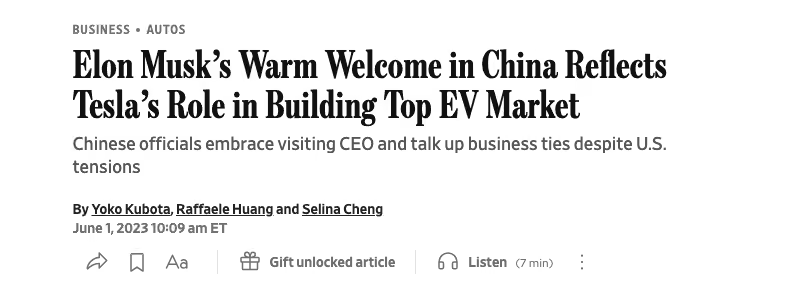
The scandal with Nvidia CEO Jensen Huang is not about sex and spies, it's about corporate America selling out this country to the Chinese government. Elon Musk did it too.
Rush Doshi reposted
 Lorand Laskai
@lorandlaskai
Commerce hasn’t added a single company to the Entity List in over a year.
That’s the longest stretch without using the trade blacklist in nearly two decades, possibly longer.
It’s not just Megaspeed. It’s a complete shutdown of all regular business. The lights are functionally off at BIS.
 Garrison Lovely
@GarrisonLovely
Wow, the Commerce Dept still hasn't banned the company tied to the suspected Chinese spy from buying advanced AI chips.
Before this was a news story, I guess there's some argument for not tipping anyone off by blocking the company, but not doing it now?
Nvidia also says it stopped selling to the company for over a year, but Megaspeed is STILL listed as an Nvidia Cloud Partner.
Gift link: giftarticle.ft.com/giftarticle/actions/redeem/e04a0b85-c3…

 Demetri
@AsiaLens
SCOOP - US commerce department delays decision on #megaspeed’s possible inclusion on trade blacklist
www.ft.com/content/afb6c960-a910-4d67-9588-73ba3bea5b06 via @ft
Rush Doshi reposted
 The Midas Project
@TheMidasProj
🚨NEW: Dozens of accounts defending Jensen Huang after his affair with an alleged Chinese spy appear to be fake.
They are part of a much wider pro-Nvidia campaign, linked to an Israeli influence firm that says it shut down last year…
But the accounts never stopped posting. 🧵
 Rush Doshi
@RushDoshi
Yes, this is right. Absent policy action, even a slowing Chinese economy will eventually wrest away US industries like aviation and biotechnology just as they have the electrical stack and autos.
The question, then, is what industries will be left for American workers? And would American AI leadership even solve this problem on a time frame that matters?
 Kyle Chan
@kyleichan
Emirates president on China challenging Boeing and Airbus:
“If anybody’s got the will to do it, the Chinese have...They’ve slaughtered the auto market with EVs, they’ve upended so many industries, why would aviation be any different for them?” www.bloomberg.com/news/articles/2026-11-10/can-china-upen…
Rush Doshi reposted
 Jordan Schneider
@jordanschneider
@ChrisRMcGuire answers: www.chinatalk.media/p/the-spy-who-leased-me

 Patrick McKenzie
@patio11
FWIW I think the proper focus of attention is "Intentionally diverted X% of compute to China in a fashion designed to obscure this, in the interests of China and against that of U.S., while being blessed by individuals responsible for and/or influential in U.S. policy."
Rush Doshi reposted
 Yasheng Huang 黄亚生
@YashengHuang
One difficulty for Jensen is having to explain his insistence to sell to Megaspeed when there was a huge backlog of orders for his chips. He could have sold his chips to these customers easily and as lucratively rather than getting himself into this complicated situation.
Rush Doshi reposted
 Jerusalem
@JerusalemDemsas
Let me get this straight:
1) NVIDIA CEO is in a relationship with a Chinese spy
2) Said Chinese spy worked for a company under investigation for smuggling banned chips to China
3) NVIDIA's top lawyer is poking around the federal investigation of said Chinese spy's company
Hearings!!! Now!!!
 Rush Doshi
@RushDoshi
This is crazy. The Commerce Department inquiry into Megaspeed was halted after Nvidia intervened.
Context: Jensen Huang was allegedly romantically involved with a Megaspeed executive believed to be a Chinese spy, and Megaspeed is the cutout providing US compute to China.

 Joe Weisenthal
@TheStalwart
*NVIDIA INTERVENED IN US PROBE OF MEGASPEED: NYT
Rush Doshi
@RushDoshi
Source:
 Ana Swanson
@AnaSwanson
New: The Commerce Dept investigation into Megaspeed, the firm led by the Chinese spy who had a relationship with Jensen Huang, was suddenly suspended last year after an interaction between Nvidia and a top Commerce Department official. www.nytimes.com/2026/11/09/business/economy/nvidia-megasp…
Rush Doshi
@RushDoshi
Watch this space.
 Senator Chris Coons
@ChrisCoons
I'm not interested in investigating people just because I don't like them. I want to investigate them because I suspect they've put our national security at risk, they've been breaking the law, and they are lying to the American people.
Rush Doshi reposted
Senator Chris Coons
@ChrisCoons
I'm not interested in investigating people just because I don't like them. I want to investigate them because I suspect they've put our national security at risk, they've been breaking the law, and they are lying to the American people.
Rush Doshi reposted
Ana Swanson
@AnaSwanson
New: The Commerce Dept investigation into Megaspeed, the firm led by the Chinese spy who had a relationship with Jensen Huang, was suddenly suspended last year after an interaction between Nvidia and a top Commerce Department official. www.nytimes.com/2026/11/09/business/economy/nvidia-megasp…
Rush Doshi
@RushDoshi
Notable from @SenWarren.
 Elizabeth Warren
@SenWarren
NVIDIA’s CEO just confirmed a relationship with a suspected Chinese spy.
Congress is back today. We have legislation ready to go to stop advanced AI chips from fueling China’s military.
Let’s get this done.
 Face The Nation
@FaceTheNation
There is “bipartisan support in the Banking Committee” to limit chipmakers’ ability to export chips to China, says Sen. Elizabeth Warren (D-MA), the committee's ranking member.
“I'm on bipartisan bills in order to put more restraints on the ability to export our chips to China. In fact, we have worked on a bipartisan basis to try to stop Donald Trump from encouraging Nvidia, permitting Nvidia to send these chips to China,” she says.
Rush Doshi reposted
Elizabeth Warren
@SenWarren
NVIDIA’s CEO just confirmed a relationship with a suspected Chinese spy.
Congress is back today. We have legislation ready to go to stop advanced AI chips from fueling China’s military.
Let’s get this done.
Face The Nation
@FaceTheNation
There is “bipartisan support in the Banking Committee” to limit chipmakers’ ability to export chips to China, says Sen. Elizabeth Warren (D-MA), the committee's ranking member.
“I'm on bipartisan bills in order to put more restraints on the ability to export our chips to China. In fact, we have worked on a bipartisan basis to try to stop Donald Trump from encouraging Nvidia, permitting Nvidia to send these chips to China,” she says.
Rush Doshi reposted
Chris McGuire
@ChrisRMcGuire
Great to be on @CNBCMorningCall with @MorganLBrennan this morning to discuss the latest developments regarding Nvidia, Megaspeed, and export controls--and what this means for export control policy going forward. Thank you for having me on!
Rush Doshi
@RushDoshi
Recommend this thoughtful piece from @RebeccaLissner and @MiraRappHooper on U.S. policy towards Taiwan.
www.foreignaffairs.com/taiwan/recipe-disaster-taiwan-liss…
Rush Doshi reposted
 Edward Wong
@ewong
I can see Trump saying soon that US intelligence agencies also run honey traps all the time, so what's the big deal.
Rush Doshi
@RushDoshi
Seems hard to believe but apparently Jensen Huang may go with Trump to APEC where, notably, he’ll meet with Xi.
Reporter: Should Jensen Huang stay on as CEO of Nvidia.
Trump: Oh yeah sure.
Reporter: Is he going to go with you on your trip to Asia next week?
Trump: I don't know but I'd certainly take him. I haven't heard he's done anything wrong. He dealt with somebody but you know so does everybody else.
Rush Doshi reposted
 Senator John Cornyn
@JohnCornyn
Happy Diwali to all those celebrating!
I'm proud to see Texas talent represented in this year's Diwali Forever stamp. The artwork was created by Houston-area artist Sangita Bhutada, with photography by Houston-area photographer Bijay Dixit. Congratulations to both on this recognition.
www.stampsforever.com/stamps/diwali-2026
Rush Doshi reposted
Demetri
@AsiaLens
Paul - Last week Nvidia was saying nothing to see. Then I report that US intel believes Jensen had an affair. 2 days later Jensen admits to an affair. Salacious part was true.
My story did not say there was evidence of anything else. It said the US intel community believed she was working for MSS. If you have evidence to counter that, I'm all ears.
 Paul Triolo
@pstAsiatech
I was talking about the salacious part. And I was and continue to be right. Still no evidence of anything other than an affair.
Rush Doshi reposted
Senator John Cornyn
@JohnCornyn
Congressional oversight investigation needed
Senator John Cornyn
@JohnCornyn
U.S. Cleared Nvidia Chips to Chinese Firms With Empty Offices and Troubling Ties www.nytimes.com/2026/11/07/business/economy/nvidia-chips-… via @NYTimes
Rush Doshi
@RushDoshi
Seems hard to believe but apparently Jensen Huang may go with Trump to APEC where, notably, he’ll meet with Xi.
Reporter: Should Jensen Huang stay on as CEO of Nvidia.
Trump: Oh yeah sure.
Reporter: Is he going to go with you on your trip to Asia next week?
Trump: I don't know but I'd certainly take him. I haven't heard he's done anything wrong. He dealt with somebody but you know so does everybody else.
Rush Doshi
@RushDoshi
Kyle is absolutely right. And it seems there will be, and quite likely a bipartisan one.
Kyle Chan
@kyleichan
There should be a Congressional investigation. www.nytimes.com/2026/11/08/technology/nvidia-investigatio…
Rush Doshi reposted
 Michael McCaul
@RepMcCaul
This is a classic move from the CCP’s playbook — and another example of why it can never be trusted. The U.S. should immediately pause the shipment of advanced AI chips to China until we can get to the bottom of this incident and ensure our national security is not being undermined.
 CNN
@CNN
Nvidia's board launches an independent investigation into CEO Jensen Huang over concerns he was the "target of a foreign intelligence effort." www.cnn.com/2026/11/08/business/nvidia-investigation-ceo-…
 Rush Doshi
@RushDoshi
Warren: "I'm on bipartisan bills in order to put more restraints on the ability to export our chips to China. In fact, we have worked on a bipartisan basis to try to stop Donald Trump from encouraging Nvidia, permitting Nvidia to send these chips to China."
Face The Nation
@FaceTheNation
There is “bipartisan support in the Banking Committee” to limit chipmakers’ ability to export chips to China, says Sen. Elizabeth Warren (D-MA), the committee's ranking member.
“I'm on bipartisan bills in order to put more restraints on the ability to export our chips to China. In fact, we have worked on a bipartisan basis to try to stop Donald Trump from encouraging Nvidia, permitting Nvidia to send these chips to China,” she says.
Rush Doshi
@RushDoshi
These three people shut down Jake Lang when he stormed a Diwali event.
Outright bigotry offends most people because it’s indecent and fundamentally un-American.

 Jonathan Choe
@choeshow
HAPPENING NOW: Absolutely chaotic scene as conservative activists Jake Lang and Thomas Allen storm a Diwali Hindu celebration at the Seattle Center Armory.
They held signs that read, "Deport All Dot Heads" and "Stop Hindu Replacement of Christians."
I just spoke to both men who say they are concerned about American culture being overrun by false idol worshippers and H1-B fraudsters.
Lang and Allen say they will be targeting other locations in the city this weekend.
They have yet to announce details of their plans due to possible retaliation by Antifa and other far-left activists.
Stay tuned.
@JakeLang|@Tommy4Trump420
Rush Doshi reposted
 Michael Pettis
@michaelxpettis
1/2
Caixin: "“It took me a long time to make up my mind, because I’m a deep believer in open trade,” Pascal Lamy told Caixin. But he believes that China’s combination of industrial subsidies, weak domestic consumption and price competitiveness across supply chains has distorted the traditional logic of comparative advantage."
www.caixinglobal.com/2026-11-07/weekend-long-read-europe-…
Rush Doshi
@RushDoshi
Paul, appreciate the reply and enjoyed the back-and-forth. You have not contested the central point of this exchange: Beijing is non-compliant with Busan while Washington has complied with it. Indeed, you even admit that Beijing is now linking Busan to issues outside of it, even though this too is a violation of Busan. Notably, to me at least, you finally acknowledge that tariffs may have triggered the 2025 escalation, which is welcome.
A few replies:
First, you've once again appealed to your own authority without clarifying it. As I raised earlier, if that authority is based on your work helping clients obtain MOFCOM licenses, I think it is fair for readers to ask whether your need for MOFCOM access influences your ability to be objective in public discussions about China's policy, Busan, and MOFCOM. It doesn't mean you are wrong, but it does warrant disclosure and clarification when you are citing your own experience as a source of authority, as you do multiple times here.
Second, the entire debate was about whether Beijing was compliant with Busan. You never respond to the arguments I offered on how Beijing was non-compliant with Busan, including the general-license commitment and MOFCOM's own December general licenses. You seem to concede the point Beijing is non-compliant when you write, "And yes, issues not officially part of the Busan process are at clearly at play, this is obvious to those who know where to look." Indeed, it is obvious! If Beijing is now linking Busan to items outside of Busan, it shows they are not compliant with Busan. Thank you.
Third, earlier you claimed that the U.S. licensing backlog might be as existentially threatening for China's economy as the rare earth mineral and magnet throttling was for the U.S. economy. This was always dubious, and you now admit "it turns out that rare earths and magnets are more of a 'chokepoint' technology than semiconductors and SME." Exactly, so this shows you are wrong to justify Beijing's non-compliance with Busan with reference to the licensing issue, which was neither part of Busan nor proportionate.
Fourth, I am glad you have also shifted your position on what caused Beijing's 2025 rare earth escalation. Now you admit that "of course the tariffs may have been a trigger" in Beijing's 2025 rare earth escalation. In your last post, and for over a year, you have suggested Biden's semiconductor export controls in 2022 were what caused Beijing's response to Trump in 2025. This was always a stretch, or perhaps a kind of motivated reasoning since you (and your clients) oppose the export controls. But you have not been able to explain why China's rare earth actions were narrow and targeted under Biden and massively disruptive and sweeping under Trump. The reason, obviously, is indefensible tariff escalation by Washington, which was at the heart of Busan.
Fifth, despite conceding that tariffs were the trigger, you argue this is still all really about 2022, writing, "there is no evidence Beijing intended to play the rare earth card in serious way before October of 2022. None." This is a bold statement, dripping with confidence, but entirely bereft of evidence. Indeed, there is plenty of evidence against it. Let me list just some of it.
(A) You totally ignore that in Trump's first term, China made these threats. Xi even visited a rare earth magnet maker and the People's Daily reported it and noted China's ability to strike back, saying, "don't say we didn't warn you." Again, that was in response to tariffs.
(B) As we all know, China did play the card against Japan in 2010 and then consolidated the industry to strengthen its ability to play the card again.
(C) There are plenty of authoritative and semi-authoritative writings from PRC presses speculating about using rare earths, or even pharmaceuticals, against the United States for political reasons dating back to the Obama and Trump administrations.
(D) Of course, China did not play the card at any point in 2022, 2023, and 2024 the way it did in 2025, which suggests perhaps semiconductor export controls were not a sufficient trigger and you are overindexing on 2022.
You further claim they built the regime under Biden, which is only partly right: (1) they actually began assembling it before Biden, and (2) they didn't need a legal regime to throttle rare earths, so the construction of "the weapon" is less critical than the decision to use it. You claim this was inevitable without acknowledging, again, that Beijing could have used it sooner, did not use it sooner, and was reticent to do so even in 2025. Again, this was about Trump's existentially threatening tariffs.
Sixth, you argue Biden officials ignored the risks of Beijing's retaliation when they pursued export controls and assumed none would be forthcoming. I'm not sure who you talked to, but the Biden administration expected Beijing would retaliate to export controls and chose to manage those responses with diplomacy, unlike the Trump administration, which poured fuel on the growing fire. This is why Beijing's response under Biden was targeted controls on gallium, germanium, graphite and antimony and why, under Trump, it went in a far more sweeping and dramatic direction, threatening the supply of all rare earths to the United States.
Paul Triolo
@pstAsiatech
As always, appreciate the repartee. Everything I noted is accurate, and reflects the reality on the ground, rather than an assessment of what should be happening or is not happening. The situation is much more complex than described here, as Beijing views all of the issues as connected, and this explains why things are currently playing out the way they are. I left out a lot of detail here that is required to understand the full picture.
Also, the Biden administration was warned early on about exactly how Beijing would retaliate to an escalation of the type that occurred in October 2022, and chose to ignore it. At the time the line I heard frequently was “anything China tries to do to retaliate for the export controls will hurt China more than the US. Wow was that wrong as you admit with the gun analogy, which is still inaccurate of course. It turns out that rare earths and magnets are more of a “chokepoint” technology than semiconductors and SME. But there is no evidence Beijing intended to play the rare earth card in serious way before October of 2022. None.
And of course the tariffs may have been a trigger but they were clearly not the reason Beijing had the licensing regime in the works. If a Harris administration had rolled out more export controls, as it almost certainly would have, Beijing would have responded in just this way. There is no conceivable world where this would not have happened. All the tariffs did was move up the timeline. Any serious student of Beijing, its redlines, how the Chinese systems works, and the underlying motivations understands this.
The challenge now is avoiding any further “escalate to de-escalate” actions, and having a realistic and deeper understanding of why Beijing seeks to maintain leverage, while allowing most of the flow of materials to happen for clearly civilian end uses. And yes, issues not officially part of the Busan process are at clearly at play, this is obvious to those who know where to look.
Rush Doshi
@RushDoshi
Paul, thanks for the reply here. I often enjoy our exchanges, online and in-person, so please see this in that spirit.
I do think much of what you have written is misleading, incomplete, or in some cases, inaccurate.
To begin, a general point. You dismiss others and appeal to your own authority by stating you are "in the trenches" on this issue. By that, do you mean you're actively helping clients secure licenses from MOFCOM, as you've mentioned elsewhere? If that's the case, I do wonder whether your analysis essentially defending MOFCOM here is at all shaped (even implicitly) by your need for continued MOFCOM access. Doesn't mean you are wrong, but since you're the one who raised the point, it warrants clarification.
On the substance, a few points:
(1) You claim, as always, that the Chinese decision to play the rare earths card wasn't about Trump but was about Biden. But a few replies.
(A) It's true China built the licensing regime over time beginning in 2020 (beginning under Trump), but it's also true they did not pull the trigger until Trump's liberation day tariffs in 2025. In fact, their April actions came two days after those tariffs, and they were in the same package as the 34% retaliatory tariff. This was about tariffs, and later, the affiliates rule.
(B) Under Biden, China never threatened to cut off rare earths to the entire US or global economy. They did so *only* under Trump because he took tariffs to 145% and they were backed into corner. Even now, Beijing officials indicate it was a hard decision they made in the moment. By the way, many admit it was modeled off our sanctions and not export controls because it targeted something so fundamental.
(C) It is true China took some rare earth actions in response to semiconductor controls under Biden. But you know well there is absolutely no comparison between the limited controls they took under Biden and the massive, globally disruptive ones they announced under Trump. The scale of licensing slowdown is wholly different, too.
(2) I suspect the reason you keep saying China's rare earths actions in 2025 were about Biden and not Trump is because you want to undercut the case for US export controls on semiconductors. It seems like motivated reasoning since you and your clients oppose those controls. Separately, your claim that the controls don't work, which was empirically questionable earlier, is particularly thin today, when we've learned that the Chinese government ran an espionage operation against Nvidia's CEO to undercut that same policy.
(3) Your framing treats the PRC's rare earth leverage as a reaction to others. Let's retire this idea. Jessica's piece, in my view and as I've argued elsewhere, is incomplete here. It is true that Beijing didn't plan weaponization in the 1980s and 1990s, but they then did so in the late 2000s ahead of its deployment against Japan. They then used it in 2010 against Japan. They even say so in primary sources. The idea that the formal regime was built beginning in 2020 doesn't detract from the idea they were already applying this tool earlier.
(4) Your oddly spirited defense of China’s non-compliance at Busan rests on two claims: that “we still do not know what China agreed to do,” and that Beijing only had to issue licenses under its own regulations, meaning Busan just required it to hold off on the October controls but allowed it to keep going on the April regime. Both are questionable responses. The basic bargain was clear: China suspended its October controls in exchange for lower US tariffs and suspension of the Affiliates Rule. Interestingly, the US fact sheet also said China agreed to issue general licenses for rare earths and other critical minerals to US end users and their suppliers worldwide, and Beijing didn't deny that. You say the current case-by-case throttling is just fine, but it's contrary to a general license which would mean blanket authorization. Notably, Beijing's actions disconfirm your interpretation. Weeks after Busan, as you well know, MOFCOM began issuing a new category of general licenses to magnet makers, replacing case-by-case approvals. Why create a new licensing channel if the deal only meant returning to the post-April status quo? It's a bizarre reading to say China's April actions were totally off the table: it makes sense only if you now are trying to justify Beijing's non-compliance.
(5) Nor has Beijing delivered on October. MOFCOM’s suspension of its October controls expires November 10. The US says the truce runs to January 10, but Beijing has published no extension to January 10, and we're coming up on the deadline in two days. If China considers itself bound, it should say so in writing, right? The fact it hasn't is interesting.
(6) You bring up military end use, but you know (from your own clients) as well as I do that Beijing isn't just throttling military end users. You then say it's a pipe dream to go back to pre-April 2025. Perhaps, but that isn't really the point. The point is that China isn’t delivering what it agreed to at Busan.
(7) I did say “US companies are not getting licenses.” But if you read the context, you'd know I didn't mean an absolute ban was in place but rather that some companies are struggling to get them, which is why export volumes are down (you and I are in fact cite the same figures here). I think you cherrypicked for a cheap shot reply and didn't look at the whole context.
(8) It is odd that you claim that the US backlog of licenses justifies China violating the Busan agreement. That backlog was not part of Busan. It's quite a reach to justify Beijing's non-fulfillment of Busan by pointing to a third issue that was longstanding.
(9) You disputed my claim that China's Busan non-compliance poses serious risks to the US economy while the US backlog on licenses (which is not relevant for Busan) is not existential for China's economy. You dispute it with two points, both which are dubious.
(A) The first thing you do is say that the licensing backlog may in fact be existential for Chinese companies. You do not prove this, and even if it were true for some companies, the backlog does not directly target a massive segment of the entire economy like manufacturing. Put differently, the United States has no licensing block on something as elemental as rare earths. And as for your points on chips, the United States has in fact licensed billions in chip exports to China. None of this should matter though, because the licensing backlog at Commerce was not part of Busan.
(B) The second claim you make, after saying China faces big threats from our licensing backlog, is to say the US *does not* face a major economic disruption from China's rare earth controls. You argue rare earths access is not a gun to the head of the US economy, and instead of showing why that is true, you simply say it is too complicated to explain and we should take your word for it. This is a bizarre claim: no one else, not Beijing, not Washington, and not industry would agree with you. Moreover, Beijing understands this is serious leverage and that’s why it used it. Just consider that several high-employment manufacturing sectors, autos above all, faced shutdowns last year. You say the US economy is mostly services, so who cares? That's quite an argument! Even a services economy can’t absorb mass plant closures from a shortage of rare earths, and manufacturing isn't a trivial sector (probably at least 10% of GDP). Indeed, the fact this mattered is the very reason there was a Busan deal in the first place.
In sum, I don't find much of what you wrote accurate or compelling. And I do think the proximity to the issue you enjoy, far from being validating, raises questions.
I'll end there.
Paul Triolo
@pstAsiatech
Yes, lets indeed worth correcting the scene here, as this is too important issue in US China relations to be mischaracterized. The perspective here is from someone in the trenches on the issues on a day to day basis, rather than from people who are assessing at a healthy distance, and may not appreciate the nuance of the situation.
First. The Chinese export control licensing regime announced in April 2025 was not a response to the tariffs. As Jessice Chen Weiss and Gloria Xiong lay out brilliantly in the FA piece, the critical minerals controls started in the Biden administration, and really only in earnest in response to the October 2022 US export controls. www.foreignaffairs.com/china/how-china-found-most-potent-…
For people who talk to Chinese officials regularly, the answer was even more clear that the rare earths were a direct, and of course delayed, response to the complexity and sweeping nature of the US controls in 2022, 2023, and 2024. It took MOFCOM and other Chinese ministries time to gain control of a fractious and complex industry of suppliers and traders.
One Chinese official commenting in 2026 noted that China’s addition licensing requirements rolled out in October 2025, were the key piece in “China’s full response to the October 2022 US controls.” So anyone trying to still argue that the Trump tariffs were the cause of Chinese rare earths regime is simply engaging in wishful thinking. The facts on the ground tell another story. In any case, no country could have even an incomplete licensing regime in place after just a few days, so the planning and preparation, including controls on gallium, germanium, graphite, indium, and other critical minerals well predates April 2025.
Second, “China was supposed to let rare earths flow, and they have not” is a fairly wildly inaccurate characterization of the reality on the ground. We still do not know exactly what China agreed to do, there was not statement from the Chinese side specific to rare earth licensing. What we know, again, from first had experience and not unsubstantiated conjecture, is that Beijing agreed to issue licenses, as the US does on controlled items, according to China’s export controls regulations. These regulations state that exports of rare earths and magnets are prohibited for military and defense industrial end use. So, China was not “supposed to” do anything, other than abide by its own regulations. The idea that the situation would go back to what held prior to April 2025 is a pipedream, and the fact that people continue to assert this shows how out of tough with reality they remain.
“US companies are not getting licenses.” This may be the most patently inaccurate of assertions here. Even USTR Greer and Treasury Secretary Bessent acknowledge that roughly 2/3 of licenses are being issued. I know personally of dozens of licenses for critical components and materials issued by MOFCOM just over the past month. MOFCOM has not issued guidance formally extending the suspension of its October 2025 rare earth controls. Until last Thursday, the Commerce Department had not issued a formal Federal Register notice of the extension of its suspension of the Affiliates Rule. Important context.
Third, the reason many people, not just Kyle, in industry rightly raise the issue of the massive backlog of BIS licenses that have not been issued to US companies, is that it seems rather strange to be criticizing MOFCOM for its licensing process, which is just as much, or more complex than that of BIS, and ignoring the licensing process in Washington. Of course these are not part of the formal process, but the are part of what every company impacted by licensing delays experiences, and some US companies are on both ends of these delays. Hence from an industry point of view, the US government should be raising these licensing issues in the context of asking about China’s licensing process. More important context.
Fourth, how does a former US government official know that “the licensing queue…is not existential for Chinese companies? Talk to any of them recently? The licencing queue, coupled with other existing controls, which many believe have produced more damage to US companies than any national security gain, are in fact existential to Chinese companies, and further controls, such as the MATCH Act, are clearly so. But understanding the linkages here is critical, and it is this broader context that matters here.
“But rare earths access is a gun to the head of the entire US economy.” Wow, quite the hyperbole. Understanding how wrong this is would be complex and take some time to explain, and also requires understanding of multiple complex supply chains.
First of all, a licensing regime is just that, a licensing regime. Were the US controls in October 2022 “a gun to the head of the entire Chinese economy?” One could make an argument that they were, even more so than with rare earths and the US economy. China responded with the rare earth controls, suggesting that the US controls were pretty serious.
“The entire economy”” Well, first of all, as noted, the vast majority of licenses are being issued, things are not as easy as they were before the licensing regime, but licenses are being issued, so no, not the “entire economy.” Hint, much of the US economy is services, not advanced manufacturing. What would be more accurate is to say that there are no licenses being given for rare earths and magnets for military and defense industrial end use. Just as the US is controlling semiconductors with potential military end uses. This is what great powers do.
So what does this all mean?
Yes, without real understanding in Washington that Beijing can and will respond to any escalation, and wants to see the Busan truce extended until the end of the Trump administration, we are in a world where the relationship will not be very stable, strategic, let alone constructive. But lets be clear about the causes of the situation, once you start weaponizing supply chains without a clear understanding of the potential consequences, you have to live with the consequences. Here we are.
Note: implementation of the Affiliates Rule and China's October 2025 controls and rare earths and magnets would be catastrophic for global supply chains. Here is the real gun held to the head of the global economy. So why don't both sides rescind the rules completely? That would show real strategic thinking. End Thread.
Rush Doshi
@RushDoshi
This raises an interesting question. The Trump administration feels Beijing has not fulfilled the Busan agreement. Others disagree.
So who is right? And what does this mean for the next few months and for next year?
It's worth first setting the scene. The Trump administration erred in starting a trade war, taking tariffs on China to 140%, and then folding abruptly when Beijing retaliated with rare earths. That resulted in the Busan deal with Beijing last year. But it implementation is mixed.
First, the United States was supposed to suspend the affiliates rule and lower tariffs, and it did. The affiliates rule remains suspended, and on tariffs, as @Brad_Setser notes, "the U.S. has actually over delivered on its Busan commitments (the term 2 tariffs fell to 12.5%, well below the 20% cap)." SCOTUS played a role, of course.
Second, China was supposed to let rare earths flow, and they have not. The administration claims, and data indicates, that those flows are below what they should be by 30-50%. U.S. companies are not getting licenses. US consultancies and trade associations are trying to help them navigate MOFCOM. What's more, the "truce" was extended to January 10, and as far as I can tell MOFCOM hasn't issued a guidance formally extending the suspension date of its rare earth controls.
Third, the items Kyle (and others ) raise aren't part of the deal. Clearing the BIS license queue was never part of Busan, and even so, the US did license H200 exports. Implementation of the 30-for-30 tariff cuts are not part of Busan either, and they were designed to take effect after going through domestic processes, by MOFCOM's own admission.
Fourth, there is a lack of proportionality here, too. The licensing queue and thirty-for-thirty deal are not existential for Chinese companies. But rare earths access is a gun to the head of the entire US economy.
So what does all this mean?
In November, Trump and Xi will have an awkward meeting in Shenzhen. In December, they'll have an awkward meeting in Miami. And then in January, they won't have any meetings. The truce will expire on January 10th.
Barring an extension at one of the upcoming summits, we are looking at a period of possible economic tension and escalation in January without a summit on the horizon to put the brakes on a spiral.
So if 2026 was the year of so-called detente, 2027 may bring something different. I don't think this is priced in by analysts or the markets.
 Kyle Sullivan
@kylej_sullivan
Slow pace of China’s REE and CM exports, but no mention of U.S. foot dragging on implementing tariff reductions, or wait for it, the billions of dollars in export licenses sitting on Kessler’s desk. Got it.
Rush Doshi
@RushDoshi
Bessent and Greer spoke with He Lifeng. Frustration seems to be growing with the slow pace of the PRC's rare earth minerals and magnet exports.
"Secretary Bessent emphasized the importance of China fully and immediately implementing its commitments made in Busan"

Rush Doshi reposted
 Paul Heer
@PaulJHeer
Re: "intolerable levels of corruption and compromise in China policy." No one should be surprised if Trump's approach to China is like his approach to most other countries: focused more on his financial opportunities than on US national security.
Rush Doshi reposted
 Susan Rice
@AmbassadorRice
This is insane. Huge national security threat. WTAF?
Chris McGuire
@ChrisRMcGuire
The story keeps getting crazier. To recap everything that has been reported so far:
- The US intelligence community discovered that Jensen Huang, the CEO of the largest company in the world, was sleeping with Alice Huang, a Chinese spy and an executive at Megaspeed. (FT)
- Multiple independent investigations have concluded that Megaspeed is likely a Chinese cutout, which helps Chinese companies access AI chips or circumvent export controls. (NYT and Bloomberg)
- The US intelligence community also concluded that Alice Huang’s goal was to convince Jensen to lobby the U.S. government to loosen export controls on advanced AI chips. (NYT)
- The intelligence community relayed this information to “a small group of top US government officials” earlier this year. (FT)
- Over the last year, Jensen Huang has repeatedly lobbied the U.S. government to loosen export controls on advanced chips. @BISgov has done so, not only by permitting the export of H200 chips to China, but also not enforcing export controls that would have required a license for exports of the most advanced Blackwell chips to Megaspeed and Southeast Asia.
- Although @CommerceGov leadership was presumably briefed on this information by the U.S. intelligence community, @BISgov has taken no actions to tighten controls on Megaspeed or Southeast Asia.
- Megaspeed remains a preferred cloud partner of Nvidia, and continues to receive Nvidia Blackwell chips despite employing a Chinese spy who reportedly is romantically engaged with the CEO of Nvidia.
- Tens of billions of dollars worth of AI chips have been exported to Southeast Asia this year alone, and Malaysia and Singapore are now two of the four largest importers of AI chips in the world.
What is going on here??? We need answers. The question of who gets the most advanced AI chips in the world is literally the defining strategic question of our time. And not only does it seem like the MSS may be directly influencing the debate on export controls in the United States, but also @CommerceGov is refusing to listen to the warnings of the IC on this issue. What is a POSSIBLE good explanation for why Megaspeed is still receiving chips? Why is there not a license requirement for AI chip shipments to all of Southeast Asia? This is beyond strange at this point.
The fallout from this story will be massive. Obviously, the motivations underpinning Nvidia’s policy views opposing export controls must now all be questioned. But also, how did @BISgov sit on this information and has still taken no actions? We need answers.
Demetri
@AsiaLens
US intelligence agencies believe @Nvidia CEO Jensen Huang had romantic relationship with alleged Chinese spy
as.ft.com/r/97c2f9f7-ad2e-44bb-8642-f60b19f19c54
Rush Doshi
@RushDoshi
Good time to keep in mind this important research from @SamBresnick and the CSET team.
 Sam Bresnick
@SamBresnick
1/3 @Nvidia spokespeople are (again!) claiming (falsely!) that its products are not aiding China's military modernization. We @CSETGeorgetown have a bunch of evidence that, in fact, the PLA wants to buy a range of Nvidia chips, including those that are export-controlled.
 Rush Doshi
@RushDoshi
Paul, thanks for the reply here. I often enjoy our exchanges, online and in-person, so please see this in that spirit.
I do think much of what you have written is misleading, incomplete, or in some cases, inaccurate.
To begin, a general point. You dismiss others and appeal to your own authority by stating you are "in the trenches" on this issue. By that, do you mean you're actively helping clients secure licenses from MOFCOM, as you've mentioned elsewhere? If that's the case, I do wonder whether your analysis essentially defending MOFCOM here is at all shaped (even implicitly) by your need for continued MOFCOM access. Doesn't mean you are wrong, but since you're the one who raised the point, it warrants clarification.
On the substance, a few points:
(1) You claim, as always, that the Chinese decision to play the rare earths card wasn't about Trump but was about Biden. But a few replies.
(A) It's true China built the licensing regime over time beginning in 2020 (beginning under Trump), but it's also true they did not pull the trigger until Trump's liberation day tariffs in 2025. In fact, their April actions came two days after those tariffs, and they were in the same package as the 34% retaliatory tariff. This was about tariffs, and later, the affiliates rule.
(B) Under Biden, China never threatened to cut off rare earths to the entire US or global economy. They did so *only* under Trump because he took tariffs to 145% and they were backed into corner. Even now, Beijing officials indicate it was a hard decision they made in the moment. By the way, many admit it was modeled off our sanctions and not export controls because it targeted something so fundamental.
(C) It is true China took some rare earth actions in response to semiconductor controls under Biden. But you know well there is absolutely no comparison between the limited controls they took under Biden and the massive, globally disruptive ones they announced under Trump. The scale of licensing slowdown is wholly different, too.
(2) I suspect the reason you keep saying China's rare earths actions in 2025 were about Biden and not Trump is because you want to undercut the case for US export controls on semiconductors. It seems like motivated reasoning since you and your clients oppose those controls. Separately, your claim that the controls don't work, which was empirically questionable earlier, is particularly thin today, when we've learned that the Chinese government ran an espionage operation against Nvidia's CEO to undercut that same policy.
(3) Your framing treats the PRC's rare earth leverage as a reaction to others. Let's retire this idea. Jessica's piece, in my view and as I've argued elsewhere, is incomplete here. It is true that Beijing didn't plan weaponization in the 1980s and 1990s, but they then did so in the late 2000s ahead of its deployment against Japan. They then used it in 2010 against Japan. They even say so in primary sources. The idea that the formal regime was built beginning in 2020 doesn't detract from the idea they were already applying this tool earlier.
(4) Your oddly spirited defense of China’s non-compliance at Busan rests on two claims: that “we still do not know what China agreed to do,” and that Beijing only had to issue licenses under its own regulations, meaning Busan just required it to hold off on the October controls but allowed it to keep going on the April regime. Both are questionable responses. The basic bargain was clear: China suspended its October controls in exchange for lower US tariffs and suspension of the Affiliates Rule. Interestingly, the US fact sheet also said China agreed to issue general licenses for rare earths and other critical minerals to US end users and their suppliers worldwide, and Beijing didn't deny that. You say the current case-by-case throttling is just fine, but it's contrary to a general license which would mean blanket authorization. Notably, Beijing's actions disconfirm your interpretation. Weeks after Busan, as you well know, MOFCOM began issuing a new category of general licenses to magnet makers, replacing case-by-case approvals. Why create a new licensing channel if the deal only meant returning to the post-April status quo? It's a bizarre reading to say China's April actions were totally off the table: it makes sense only if you now are trying to justify Beijing's non-compliance.
(5) Nor has Beijing delivered on October. MOFCOM’s suspension of its October controls expires November 10. The US says the truce runs to January 10, but Beijing has published no extension to January 10, and we're coming up on the deadline in two days. If China considers itself bound, it should say so in writing, right? The fact it hasn't is interesting.
(6) You bring up military end use, but you know (from your own clients) as well as I do that Beijing isn't just throttling military end users. You then say it's a pipe dream to go back to pre-April 2025. Perhaps, but that isn't really the point. The point is that China isn’t delivering what it agreed to at Busan.
(7) I did say “US companies are not getting licenses.” But if you read the context, you'd know I didn't mean an absolute ban was in place but rather that some companies are struggling to get them, which is why export volumes are down (you and I are in fact cite the same figures here). I think you cherrypicked for a cheap shot reply and didn't look at the whole context.
(8) It is odd that you claim that the US backlog of licenses justifies China violating the Busan agreement. That backlog was not part of Busan. It's quite a reach to justify Beijing's non-fulfillment of Busan by pointing to a third issue that was longstanding.
(9) You disputed my claim that China's Busan non-compliance poses serious risks to the US economy while the US backlog on licenses (which is not relevant for Busan) is not existential for China's economy. You dispute it with two points, both which are dubious.
(A) The first thing you do is say that the licensing backlog may in fact be existential for Chinese companies. You do not prove this, and even if it were true for some companies, the backlog does not directly target a massive segment of the entire economy like manufacturing. Put differently, the United States has no licensing block on something as elemental as rare earths. And as for your points on chips, the United States has in fact licensed billions in chip exports to China. None of this should matter though, because the licensing backlog at Commerce was not part of Busan.
(B) The second claim you make, after saying China faces big threats from our licensing backlog, is to say the US *does not* face a major economic disruption from China's rare earth controls. You argue rare earths access is not a gun to the head of the US economy, and instead of showing why that is true, you simply say it is too complicated to explain and we should take your word for it. This is a bizarre claim: no one else, not Beijing, not Washington, and not industry would agree with you. Moreover, Beijing understands this is serious leverage and that’s why it used it. Just consider that several high-employment manufacturing sectors, autos above all, faced shutdowns last year. You say the US economy is mostly services, so who cares? That's quite an argument! Even a services economy can’t absorb mass plant closures from a shortage of rare earths, and manufacturing isn't a trivial sector (probably at least 10% of GDP). Indeed, the fact this mattered is the very reason there was a Busan deal in the first place.
In sum, I don't find much of what you wrote accurate or compelling. And I do think the proximity to the issue you enjoy, far from being validating, raises questions.
I'll end there.
Paul Triolo
@pstAsiatech
Yes, lets indeed worth correcting the scene here, as this is too important issue in US China relations to be mischaracterized. The perspective here is from someone in the trenches on the issues on a day to day basis, rather than from people who are assessing at a healthy distance, and may not appreciate the nuance of the situation.
First. The Chinese export control licensing regime announced in April 2025 was not a response to the tariffs. As Jessice Chen Weiss and Gloria Xiong lay out brilliantly in the FA piece, the critical minerals controls started in the Biden administration, and really only in earnest in response to the October 2022 US export controls. www.foreignaffairs.com/china/how-china-found-most-potent-…
For people who talk to Chinese officials regularly, the answer was even more clear that the rare earths were a direct, and of course delayed, response to the complexity and sweeping nature of the US controls in 2022, 2023, and 2024. It took MOFCOM and other Chinese ministries time to gain control of a fractious and complex industry of suppliers and traders.
One Chinese official commenting in 2026 noted that China’s addition licensing requirements rolled out in October 2025, were the key piece in “China’s full response to the October 2022 US controls.” So anyone trying to still argue that the Trump tariffs were the cause of Chinese rare earths regime is simply engaging in wishful thinking. The facts on the ground tell another story. In any case, no country could have even an incomplete licensing regime in place after just a few days, so the planning and preparation, including controls on gallium, germanium, graphite, indium, and other critical minerals well predates April 2025.
Second, “China was supposed to let rare earths flow, and they have not” is a fairly wildly inaccurate characterization of the reality on the ground. We still do not know exactly what China agreed to do, there was not statement from the Chinese side specific to rare earth licensing. What we know, again, from first had experience and not unsubstantiated conjecture, is that Beijing agreed to issue licenses, as the US does on controlled items, according to China’s export controls regulations. These regulations state that exports of rare earths and magnets are prohibited for military and defense industrial end use. So, China was not “supposed to” do anything, other than abide by its own regulations. The idea that the situation would go back to what held prior to April 2025 is a pipedream, and the fact that people continue to assert this shows how out of tough with reality they remain.
“US companies are not getting licenses.” This may be the most patently inaccurate of assertions here. Even USTR Greer and Treasury Secretary Bessent acknowledge that roughly 2/3 of licenses are being issued. I know personally of dozens of licenses for critical components and materials issued by MOFCOM just over the past month. MOFCOM has not issued guidance formally extending the suspension of its October 2025 rare earth controls. Until last Thursday, the Commerce Department had not issued a formal Federal Register notice of the extension of its suspension of the Affiliates Rule. Important context.
Third, the reason many people, not just Kyle, in industry rightly raise the issue of the massive backlog of BIS licenses that have not been issued to US companies, is that it seems rather strange to be criticizing MOFCOM for its licensing process, which is just as much, or more complex than that of BIS, and ignoring the licensing process in Washington. Of course these are not part of the formal process, but the are part of what every company impacted by licensing delays experiences, and some US companies are on both ends of these delays. Hence from an industry point of view, the US government should be raising these licensing issues in the context of asking about China’s licensing process. More important context.
Fourth, how does a former US government official know that “the licensing queue…is not existential for Chinese companies? Talk to any of them recently? The licencing queue, coupled with other existing controls, which many believe have produced more damage to US companies than any national security gain, are in fact existential to Chinese companies, and further controls, such as the MATCH Act, are clearly so. But understanding the linkages here is critical, and it is this broader context that matters here.
“But rare earths access is a gun to the head of the entire US economy.” Wow, quite the hyperbole. Understanding how wrong this is would be complex and take some time to explain, and also requires understanding of multiple complex supply chains.
First of all, a licensing regime is just that, a licensing regime. Were the US controls in October 2022 “a gun to the head of the entire Chinese economy?” One could make an argument that they were, even more so than with rare earths and the US economy. China responded with the rare earth controls, suggesting that the US controls were pretty serious.
“The entire economy”” Well, first of all, as noted, the vast majority of licenses are being issued, things are not as easy as they were before the licensing regime, but licenses are being issued, so no, not the “entire economy.” Hint, much of the US economy is services, not advanced manufacturing. What would be more accurate is to say that there are no licenses being given for rare earths and magnets for military and defense industrial end use. Just as the US is controlling semiconductors with potential military end uses. This is what great powers do.
So what does this all mean?
Yes, without real understanding in Washington that Beijing can and will respond to any escalation, and wants to see the Busan truce extended until the end of the Trump administration, we are in a world where the relationship will not be very stable, strategic, let alone constructive. But lets be clear about the causes of the situation, once you start weaponizing supply chains without a clear understanding of the potential consequences, you have to live with the consequences. Here we are.
Note: implementation of the Affiliates Rule and China's October 2025 controls and rare earths and magnets would be catastrophic for global supply chains. Here is the real gun held to the head of the global economy. So why don't both sides rescind the rules completely? That would show real strategic thinking. End Thread.
Rush Doshi
@RushDoshi
This raises an interesting question. The Trump administration feels Beijing has not fulfilled the Busan agreement. Others disagree.
So who is right? And what does this mean for the next few months and for next year?
It's worth first setting the scene. The Trump administration erred in starting a trade war, taking tariffs on China to 140%, and then folding abruptly when Beijing retaliated with rare earths. That resulted in the Busan deal with Beijing last year. But it implementation is mixed.
First, the United States was supposed to suspend the affiliates rule and lower tariffs, and it did. The affiliates rule remains suspended, and on tariffs, as @Brad_Setser notes, "the U.S. has actually over delivered on its Busan commitments (the term 2 tariffs fell to 12.5%, well below the 20% cap)." SCOTUS played a role, of course.
Second, China was supposed to let rare earths flow, and they have not. The administration claims, and data indicates, that those flows are below what they should be by 30-50%. U.S. companies are not getting licenses. US consultancies and trade associations are trying to help them navigate MOFCOM. What's more, the "truce" was extended to January 10, and as far as I can tell MOFCOM hasn't issued a guidance formally extending the suspension date of its rare earth controls.
Third, the items Kyle (and others ) raise aren't part of the deal. Clearing the BIS license queue was never part of Busan, and even so, the US did license H200 exports. Implementation of the 30-for-30 tariff cuts are not part of Busan either, and they were designed to take effect after going through domestic processes, by MOFCOM's own admission.
Fourth, there is a lack of proportionality here, too. The licensing queue and thirty-for-thirty deal are not existential for Chinese companies. But rare earths access is a gun to the head of the entire US economy.
So what does all this mean?
In November, Trump and Xi will have an awkward meeting in Shenzhen. In December, they'll have an awkward meeting in Miami. And then in January, they won't have any meetings. The truce will expire on January 10th.
Barring an extension at one of the upcoming summits, we are looking at a period of possible economic tension and escalation in January without a summit on the horizon to put the brakes on a spiral.
So if 2026 was the year of so-called detente, 2027 may bring something different. I don't think this is priced in by analysts or the markets.
Kyle Sullivan
@kylej_sullivan
Slow pace of China’s REE and CM exports, but no mention of U.S. foot dragging on implementing tariff reductions, or wait for it, the billions of dollars in export licenses sitting on Kessler’s desk. Got it.
Rush Doshi
@RushDoshi
Bessent and Greer spoke with He Lifeng. Frustration seems to be growing with the slow pace of the PRC's rare earth minerals and magnet exports.
"Secretary Bessent emphasized the importance of China fully and immediately implementing its commitments made in Busan"
Rush Doshi reposted
Ana Swanson
@AnaSwanson
Commerce approved a company called New Matrix this year to assemble Nvidia's H200 chips into AI servers. But when the Times visited the site of its listed office, it was mysteriously vacant. People there had no records of this company.
Ana Swanson
@AnaSwanson
New: Trump administration cleared Nvidia H200 chips to Chinese firms with empty offices and military ties www.nytimes.com/2026/11/07/business/economy/nvidia-chips-…
Rush Doshi
@RushDoshi
Investigations seem likely, per the next Chair of SFRC.
Senator Chris Coons
@ChrisCoons
The more I learn about the insane relationship between the Trump Administration, Chinese spies, and AI billionaires, the more I’m convinced there is nothing this administration does that isn’t corrupt. Congress will investigate and get answers.
Rush Doshi reposted
Senator Chris Coons
@ChrisCoons
The more I learn about the insane relationship between the Trump Administration, Chinese spies, and AI billionaires, the more I’m convinced there is nothing this administration does that isn’t corrupt. Congress will investigate and get answers.
Rush Doshi
@RushDoshi
More calls for an investigation into possible corruption at the heart of US China and AI policy, this time from @JerusalemDemsas
Jerusalem
@JerusalemDemsas
There is no better avenue for incoming House & Senate Dems to take than hearings on wtf is going on with NVIDIA + Trump corruption + AI policy in the U.S.
It has the virtue of riding the wave of anti-tech populism and directing that energy towards the productive need to stop selling these chips to China.
 Caleb Watney
@calebwatney
And there it is
giftarticle.ft.com/giftarticle/actions/redeem/468bd17d-f4…

 Rush Doshi
@RushDoshi
If the reporting is right, this is the most significant story in US China policy in years.
If the USG knew Jensen Huang had a romantic relationship with a Chinese spy and looked the other way, all while that spy ran a company backdooring US compute to China, it warrants a Congressional investigation.
There may be an innocent explanation to all this.
But if not, then it reveals intolerable levels of corruption and compromise in China policy - to the detriment of AI safety.
Demetri
@AsiaLens
Here is a fresh link to the Jensen Huang Chinese spy story 👇
www.ft.com/content/a55a2a22-4479-4f93-a445-6147a5c6d790?s…

 Demetri
@AsiaLens
US intelligence agencies believe @Nvidia CEO Jensen Huang had romantic relationship with alleged Chinese spy
as.ft.com/r/97c2f9f7-ad2e-44bb-8642-f60b19f19c54
Rush Doshi
@RushDoshi
To quote Xi Jinping, "the world is experiencing great copes unseen in a century."
 BuccoCapital Bloke
@buccocapital
Everyone saying “Oh Jensen got got. Jensen fell for the honeypot”
Ever consider he knew the whole time? That actually HE was honeydicking China and feeding them false intel?
It’s a new Cold War. There’s levels to this. Don’t jump to conclusions. Don’t rule out a honeydick
Rush Doshi
@RushDoshi
These guys will drive the right directly into the ground.
Harmeet Dillon is a longstanding Trump ally and, obviously, an American citizen. But to this segment of the right, she’s a “demon worshipper.”
 Joel Webbon
@JoelWebbon
Demon worshipper. Get out of my country.
 Harmeet K. Dhillon
@HarmeetKDhillon
Update — these children deleted their racist post.
I had constraints in government on what I could say. They are over.
Harmeet K. Dhillon
@HarmeetKDhillon
Stay classy, kids.
 Notre Dame College Republicans
@NDRepublicans
Good riddance. Moving forward, we don't need any more demon worship at the RNC either.
 Breaking911
@Breaking911
BREAKING: Harmeet Dhillon resigns as DOJ assistant attorney general for civil rights -FOX
Rush Doshi reposted
 Shehzad Qazi
@shehzadhqazi
“Barring an extension at one of the upcoming summits, we are looking at a period of possible economic tension and escalation in January without a summit on the horizon to put the brakes on a spiral.”
Rush Doshi
@RushDoshi
This raises an interesting question. The Trump administration feels Beijing has not fulfilled the Busan agreement. Others disagree.
So who is right? And what does this mean for the next few months and for next year?
It's worth first setting the scene. The Trump administration erred in starting a trade war, taking tariffs on China to 140%, and then folding abruptly when Beijing retaliated with rare earths. That resulted in the Busan deal with Beijing last year. But it implementation is mixed.
First, the United States was supposed to suspend the affiliates rule and lower tariffs, and it did. The affiliates rule remains suspended, and on tariffs, as @Brad_Setser notes, "the U.S. has actually over delivered on its Busan commitments (the term 2 tariffs fell to 12.5%, well below the 20% cap)." SCOTUS played a role, of course.
Second, China was supposed to let rare earths flow, and they have not. The administration claims, and data indicates, that those flows are below what they should be by 30-50%. U.S. companies are not getting licenses. US consultancies and trade associations are trying to help them navigate MOFCOM. What's more, the "truce" was extended to January 10, and as far as I can tell MOFCOM hasn't issued a guidance formally extending the suspension date of its rare earth controls.
Third, the items Kyle (and others ) raise aren't part of the deal. Clearing the BIS license queue was never part of Busan, and even so, the US did license H200 exports. Implementation of the 30-for-30 tariff cuts are not part of Busan either, and they were designed to take effect after going through domestic processes, by MOFCOM's own admission.
Fourth, there is a lack of proportionality here, too. The licensing queue and thirty-for-thirty deal are not existential for Chinese companies. But rare earths access is a gun to the head of the entire US economy.
So what does all this mean?
In November, Trump and Xi will have an awkward meeting in Shenzhen. In December, they'll have an awkward meeting in Miami. And then in January, they won't have any meetings. The truce will expire on January 10th.
Barring an extension at one of the upcoming summits, we are looking at a period of possible economic tension and escalation in January without a summit on the horizon to put the brakes on a spiral.
So if 2026 was the year of so-called detente, 2027 may bring something different. I don't think this is priced in by analysts or the markets.
Kyle Sullivan
@kylej_sullivan
Slow pace of China’s REE and CM exports, but no mention of U.S. foot dragging on implementing tariff reductions, or wait for it, the billions of dollars in export licenses sitting on Kessler’s desk. Got it.
Rush Doshi
@RushDoshi
Bessent and Greer spoke with He Lifeng. Frustration seems to be growing with the slow pace of the PRC's rare earth minerals and magnet exports.
"Secretary Bessent emphasized the importance of China fully and immediately implementing its commitments made in Busan"
Rush Doshi
@RushDoshi
I'm not sure about this.
First, the Trump administration doesn't seem to be to be acting as if it has the upper hand. They fear the Busan deal is breaking and they are trying to negotiate a way out.
Second, Beijing knows well what tools the US has left, and has not yet used, and they are concerned about them. So there's an incentive on both sides to fix this.
If in 2025 the US miscalculated and pushed Beijing into rare earths coercion, in 2027 I think the risk is Beijing miscalculates and pushes Washington into further escalation.
Kyle Sullivan
@kylej_sullivan
Busan truce or otherwise, the bigger picture is the US still thinks it’s negotiating from a position of strength where it’s clear China is content with managing rare earth flows at its own pace. Low cost to them and outsize impact on US industry. Beijing has little incentive to heed to US demands now. In the meantime, US inaction on export licenses to China is surrendering China’s market to our competitors.
Rush Doshi
@RushDoshi
This raises an interesting question. The Trump administration feels Beijing has not fulfilled the Busan agreement. Others disagree.
So who is right? And what does this mean for the next few months and for next year?
It's worth first setting the scene. The Trump administration erred in starting a trade war, taking tariffs on China to 140%, and then folding abruptly when Beijing retaliated with rare earths. That resulted in the Busan deal with Beijing last year. But it implementation is mixed.
First, the United States was supposed to suspend the affiliates rule and lower tariffs, and it did. The affiliates rule remains suspended, and on tariffs, as @Brad_Setser notes, "the U.S. has actually over delivered on its Busan commitments (the term 2 tariffs fell to 12.5%, well below the 20% cap)." SCOTUS played a role, of course.
Second, China was supposed to let rare earths flow, and they have not. The administration claims, and data indicates, that those flows are below what they should be by 30-50%. U.S. companies are not getting licenses. US consultancies and trade associations are trying to help them navigate MOFCOM. What's more, the "truce" was extended to January 10, and as far as I can tell MOFCOM hasn't issued a guidance formally extending the suspension date of its rare earth controls.
Third, the items Kyle (and others ) raise aren't part of the deal. Clearing the BIS license queue was never part of Busan, and even so, the US did license H200 exports. Implementation of the 30-for-30 tariff cuts are not part of Busan either, and they were designed to take effect after going through domestic processes, by MOFCOM's own admission.
Fourth, there is a lack of proportionality here, too. The licensing queue and thirty-for-thirty deal are not existential for Chinese companies. But rare earths access is a gun to the head of the entire US economy.
So what does all this mean?
In November, Trump and Xi will have an awkward meeting in Shenzhen. In December, they'll have an awkward meeting in Miami. And then in January, they won't have any meetings. The truce will expire on January 10th.
Barring an extension at one of the upcoming summits, we are looking at a period of possible economic tension and escalation in January without a summit on the horizon to put the brakes on a spiral.
So if 2026 was the year of so-called detente, 2027 may bring something different. I don't think this is priced in by analysts or the markets.
Kyle Sullivan
@kylej_sullivan
Slow pace of China’s REE and CM exports, but no mention of U.S. foot dragging on implementing tariff reductions, or wait for it, the billions of dollars in export licenses sitting on Kessler’s desk. Got it.
Rush Doshi
@RushDoshi
Bessent and Greer spoke with He Lifeng. Frustration seems to be growing with the slow pace of the PRC's rare earth minerals and magnet exports.
"Secretary Bessent emphasized the importance of China fully and immediately implementing its commitments made in Busan"
Rush Doshi reposted
 Eric Wallerstein
@ericwallerstein
a restart in tensions (or deterioration in the detente) is definitely underdiscussed on the street.
trade policy too narrowly discussed thru 1) goods inflation and central bank reaction functions, and 2) selling dollars.
broaden your horizons. think about the impact to growth and uncertainty.
cc: Tiff Macklem
Rush Doshi
@RushDoshi
This raises an interesting question. The Trump administration feels Beijing has not fulfilled the Busan agreement. Others disagree.
So who is right? And what does this mean for the next few months and for next year?
It's worth first setting the scene. The Trump administration erred in starting a trade war, taking tariffs on China to 140%, and then folding abruptly when Beijing retaliated with rare earths. That resulted in the Busan deal with Beijing last year. But it implementation is mixed.
First, the United States was supposed to suspend the affiliates rule and lower tariffs, and it did. The affiliates rule remains suspended, and on tariffs, as @Brad_Setser notes, "the U.S. has actually over delivered on its Busan commitments (the term 2 tariffs fell to 12.5%, well below the 20% cap)." SCOTUS played a role, of course.
Second, China was supposed to let rare earths flow, and they have not. The administration claims, and data indicates, that those flows are below what they should be by 30-50%. U.S. companies are not getting licenses. US consultancies and trade associations are trying to help them navigate MOFCOM. What's more, the "truce" was extended to January 10, and as far as I can tell MOFCOM hasn't issued a guidance formally extending the suspension date of its rare earth controls.
Third, the items Kyle (and others ) raise aren't part of the deal. Clearing the BIS license queue was never part of Busan, and even so, the US did license H200 exports. Implementation of the 30-for-30 tariff cuts are not part of Busan either, and they were designed to take effect after going through domestic processes, by MOFCOM's own admission.
Fourth, there is a lack of proportionality here, too. The licensing queue and thirty-for-thirty deal are not existential for Chinese companies. But rare earths access is a gun to the head of the entire US economy.
So what does all this mean?
In November, Trump and Xi will have an awkward meeting in Shenzhen. In December, they'll have an awkward meeting in Miami. And then in January, they won't have any meetings. The truce will expire on January 10th.
Barring an extension at one of the upcoming summits, we are looking at a period of possible economic tension and escalation in January without a summit on the horizon to put the brakes on a spiral.
So if 2026 was the year of so-called detente, 2027 may bring something different. I don't think this is priced in by analysts or the markets.
Kyle Sullivan
@kylej_sullivan
Slow pace of China’s REE and CM exports, but no mention of U.S. foot dragging on implementing tariff reductions, or wait for it, the billions of dollars in export licenses sitting on Kessler’s desk. Got it.
Rush Doshi
@RushDoshi
Bessent and Greer spoke with He Lifeng. Frustration seems to be growing with the slow pace of the PRC's rare earth minerals and magnet exports.
"Secretary Bessent emphasized the importance of China fully and immediately implementing its commitments made in Busan"
Rush Doshi
@RushDoshi
This raises an interesting question. The Trump administration feels Beijing has not fulfilled the Busan agreement. Others disagree.
So who is right? And what does this mean for the next few months and for next year?
It's worth first setting the scene. The Trump administration erred in starting a trade war, taking tariffs on China to 140%, and then folding abruptly when Beijing retaliated with rare earths. That resulted in the Busan deal with Beijing last year. But it implementation is mixed.
First, the United States was supposed to suspend the affiliates rule and lower tariffs, and it did. The affiliates rule remains suspended, and on tariffs, as @Brad_Setser notes, "the U.S. has actually over delivered on its Busan commitments (the term 2 tariffs fell to 12.5%, well below the 20% cap)." SCOTUS played a role, of course.
Second, China was supposed to let rare earths flow, and they have not. The administration claims, and data indicates, that those flows are below what they should be by 30-50%. U.S. companies are not getting licenses. US consultancies and trade associations are trying to help them navigate MOFCOM. What's more, the "truce" was extended to January 10, and as far as I can tell MOFCOM hasn't issued a guidance formally extending the suspension date of its rare earth controls.
Third, the items Kyle (and others ) raise aren't part of the deal. Clearing the BIS license queue was never part of Busan, and even so, the US did license H200 exports. Implementation of the 30-for-30 tariff cuts are not part of Busan either, and they were designed to take effect after going through domestic processes, by MOFCOM's own admission.
Fourth, there is a lack of proportionality here, too. The licensing queue and thirty-for-thirty deal are not existential for Chinese companies. But rare earths access is a gun to the head of the entire US economy.
So what does all this mean?
In November, Trump and Xi will have an awkward meeting in Shenzhen. In December, they'll have an awkward meeting in Miami. And then in January, they won't have any meetings. The truce will expire on January 10th.
Barring an extension at one of the upcoming summits, we are looking at a period of possible economic tension and escalation in January without a summit on the horizon to put the brakes on a spiral.
So if 2026 was the year of so-called detente, 2027 may bring something different. I don't think this is priced in by analysts or the markets.
Kyle Sullivan
@kylej_sullivan
Slow pace of China’s REE and CM exports, but no mention of U.S. foot dragging on implementing tariff reductions, or wait for it, the billions of dollars in export licenses sitting on Kessler’s desk. Got it.
Rush Doshi
@RushDoshi
Bessent and Greer spoke with He Lifeng. Frustration seems to be growing with the slow pace of the PRC's rare earth minerals and magnet exports.
"Secretary Bessent emphasized the importance of China fully and immediately implementing its commitments made in Busan"
Rush Doshi reposted
 Peter Mattis
@PLMattis
It's been pretty clear for a while that Beijing has been slow-rolling the Busan "consensus"/"agreement", while taking a lot of actions not covered explicitly, such as other inputs, equipment, and talent.
I think this area is a good example of where PRC leadership thinks more in terms in systems than the US tends to do.
Demetri
@AsiaLens
SCOOP -- US warns China it must ‘immediately’ meet terms of Busan trade deal (#uschinascoop). Comes as Xi Jinping prepares to host Trump at Apec in Shenzhen.
www.ft.com/content/391bb785-0247-4c39-b53b-35007187d603
Rush Doshi
@RushDoshi
Bessent and Greer spoke with He Lifeng. Frustration seems to be growing with the slow pace of the PRC's rare earth minerals and magnet exports.
"Secretary Bessent emphasized the importance of China fully and immediately implementing its commitments made in Busan"
Rush Doshi reposted
 Nicholas Kristof
@NickKristof
Me talking outside my office in 2015 with a teenage Joshua Wong (along with Martin Lee). Joshua has already spent the last six years in prison for supporting democracy, and China just sentenced him to an additional 10 years. www.hrw.org/news/2026/11/05/hong-kong-joshua-wong-gets-ne… Will Trump raise this with Xi?
 Rush Doshi
@RushDoshi
One concrete measure of how "loud" the PLA is relative to the rest of the system: the number of vice chairmen with published memoirs and selected works.
Liu Huaqing, Zhang Zhen, Chi Haotian, Zhang Wannian, and others.
 Morrisan15
@morris_que14
The myth that the PLA operates in a culture of secrecy is almost complete BS. The reason this myth persists is because the people who analyse the PLA in the West don't know Chinese. The actual PLA is a very 'loud' institution where officers are brash about their ideas
 Rush Doshi
@RushDoshi
A policy that makes us safer.
 Director Michael Kratsios
@mkratsios47
Today, we released the National Policy for Nucleic Acid Synthesis Screening to protect American biotechnology innovation while reducing the risk of misuse.
This policy establishes a new, government-wide screening requirements for synthetic DNA and the equipment used to make it. It will ensure companies selling nucleic acid sequences and synthesis equipment know their customers and prevent the malicious use of these materials and tools.
This policy strengthens our Nation’s biosecurity posture by establishing rigorous U.S. government-wide procurement screening and physical security standards for synthetic biology. It replaces outdated “self-attestation” systems with robust, independent verification. It creates a dynamic, SI-powered screening layer that assesses the biological risk from nucleic acid sequences, allowing the U.S. to anticipate and prevent malicious use and help stop dangerous gain-of-function research.
@NIST will issue rigorous new screening standards and @HHSGov and @USDA will certify synthetic biology providers. Together, these measures will strengthen American biosecurity, safeguard responsible innovation, and establish a global standard for safe and transparent synthetic biology tools and research.

Rush Doshi reposted
 Jonathan Stivers
@jonstivers
"Constructive Strategic Stablity" is just a policy of holding back real actions to compete & counter China. @MichaelKovrig succinctly said "Beijing wants a Washington that competes less, within limits the CCP defines, for long enough that the power balance keeps shifting its way"
Rush Doshi
@RushDoshi
I've heard from many in Beijing that they like Trump's accommodating China policy. But this quote is quite striking:
"The Chinese are very realistic that a new president might be very different (from Trump)," said Shen Weizhong, a former Chinese Foreign Ministry official.
"But if we can have two more years of stability, that's already a good thing for China ... The more time we have, the better prepared we might be towards a final showdown on Taiwan or maybe another trade war," added Shen, who now works for Beijing-based think tank Global Governance Institution.
 Reuters China
@ReutersChina
The midterm drubbing of Donald Trump's Republicans may strengthen China's hand in trade talks with Washington, but Beijing is unlikely to revel in the misfortunes of a US president whose successor could prove less accommodating. www.reuters.com/world/china/trumps-political-humbling-sig…
Rush Doshi
@RushDoshi
I've heard from many in Beijing that they like Trump's accommodating China policy. But this quote is quite striking:
"The Chinese are very realistic that a new president might be very different (from Trump)," said Shen Weizhong, a former Chinese Foreign Ministry official.
"But if we can have two more years of stability, that's already a good thing for China ... The more time we have, the better prepared we might be towards a final showdown on Taiwan or maybe another trade war," added Shen, who now works for Beijing-based think tank Global Governance Institution.
Reuters China
@ReutersChina
The midterm drubbing of Donald Trump's Republicans may strengthen China's hand in trade talks with Washington, but Beijing is unlikely to revel in the misfortunes of a US president whose successor could prove less accommodating. www.reuters.com/world/china/trumps-political-humbling-sig…
Rush Doshi reposted
 afra wang
@afrazhaowang
they say you need to unleash your wildest dream in this age
i really don’t yearn for a post-agi future. i yearn for a free China
Rush Doshi reposted
Michael Pettis
@michaelxpettis
1/5
Yao Yang, former dean of Peking University’s National School of Development, and one of the most prominent economists in China, has traditionally been fairy optimistic (at least in public) about China's economic prospects and someone who always firmly rejected the Japanization thesis.
That makes his recent interview all the more interesting as an indication of the seeming change this year in the way prominent economists (and perhaps policymakers) are seeing the economy.
www.sinification.org/p/conversations-an-interview-with-yao
Rush Doshi reposted
 James A. Lewis
@james_a_lewis
This took years to get, the Germans were originally skeptical, but the evidence of risk is overwhelming. China has wired the world for sound but countries can still shrink risk by limiting Huawei
Rush Doshi
@RushDoshi
Notable: Germany is considering new bans on Huawei in their telecom infrastructure.
 Finbarr Bermingham
@fbermingham
Berlin is preparing a far-reaching ban on Chinese network technology from German mobile networks
5G base stations will be classified as "security-relevant" for the first time. "A ban on base stations manufactured in China could lead to a de facto exclusion of Huawei & ZTE"
 Rush Doshi
@RushDoshi
Notable: Germany is considering new bans on Huawei in their telecom infrastructure.
Finbarr Bermingham
@fbermingham
Berlin is preparing a far-reaching ban on Chinese network technology from German mobile networks
5G base stations will be classified as "security-relevant" for the first time. "A ban on base stations manufactured in China could lead to a de facto exclusion of Huawei & ZTE"
Rush Doshi
@RushDoshi
Strong piece on paths to collective economic resilience from @edwardfishman, Bunzel, and Levi.
Appreciate the reference to our piece on why the alliance system will survive and evolve beyond the current moment — an argument buttressed in part by the midterm results.
 Foreign Affairs
@ForeignAffairs
The United States and its allies should establish a “formal economic security alliance that establishes collective defense against economic coercion,” argue Theodore Bunzel, @edwardfishman, and Addar Levi.
www.foreignaffairs.com/japan/how-america-can-counter-chin…
Rush Doshi
@RushDoshi
Not only did this obviously racist play not work, it backfired spectacularly.
 Bo French
@bofrench
I heard UT graduation this year looked like this. I didn’t believe it. The problem is now obviously far worse than anyone imagined.

Rush Doshi reposted
 Paul Mozur 孟建國
@paulmozur
Went on CNN for this nice piece on the Chinese spy plot involving Nvidia chief Jensen Huang. Even got to tell the story of going to check out Megaspeed’s Singapore offices a year ago. Despite billions in chip orders, I found the office almost totally empty, raising big questions.
 Will Ripley
@willripleyCNN
In Taipei and DC, questions swirl around the woman in pink. Linked to what the New York Times calls a “Chinese spy plot.” How did she get so close to Nvidia CEO Jensen Huang? NYT says “Trump was briefed and took no action.” We speak with @paulmozur on @OutFrontCNN
Rush Doshi
@RushDoshi
“There’s something about the mindset of really hardcore Star Trek fans that’s very difficult to describe to people who don’t share that fandom….There has never been another television show like Star Trek: The Next Generation, and there might never be one again. It is the greatest TV show ever made, not by dint of a difference in degree, but because of a difference in kind. It is a drama of pure optimism. Every other show tries to thrill us by showing us how bad or how ridiculous or how exciting someone else’s world could be; Star Trek: TNG thrills us by showing us how beautiful our own world could become.”
 Noah Smith 🐇🇺🇸🇺🇦🇹🇼
@Noahpinion
"Picard realizes that the highest application of intelligence is not to thwart your enemies, but to design a world in which you and they can live in mutually beneficial coexistence."
www.noahpinion.blog/p/farewell-my-captain
Rush Doshi
@RushDoshi
Might just be my timeline, but it’s truly heartening to see so many tributes to Patrick Stewart, Picard, and The Next Generation.
Rush Doshi
@RushDoshi
The more realistic answer is probably allied scale. Not easy, but much more plausible than quadrupling the US population.
 Garrett Wright
@garrxttt
Palmer Luckey warns America cannot compete with China’s population advantage forever through innovation alone: “We need 1 BILLION Americans minimum. Probably more like 2 or 3 billion.” 🇺🇸🇨🇳
“Yes, we need to get our act together. We need to do better at manufacturing, at defense, all these things. But everything is just biting around the margins if we’re 350 million people and they’re 2 billion people who are roughly the same.
How exceptional do we have to be to achieve a 10-to-1 ratio forever, in perpetuity? It’s not practical. It’s not logical.
I would say it’s even possibly a racist thing to believe that we can be so much better than China and the Chinese people that we’ll just beat them with a tiny fraction of the population.
We need to do better with what we’ve got. But we also just need a lot more people. We need 1 billion Americans minimum, probably more like 2 or 3 billion, with better demographics and better natural resources.
The Dutch once had the most powerful navy in the world. They didn’t lose that position because they fell behind on factories or shipbuilding. They became economically irrelevant.”
Both countries are competing with respect to declining birth rates. Both nations must be more willing to have children and expand the population growth exponentially over the next decade. The current economic path is unsustainable if our labor force begins to shrink even with artificial intelligence on the rise.
Rush Doshi reposted
 Noah Gordon
@noah_gordon_
China is quietly ordering its wind industry to rip out European components and replace them with Chinese ones, while it complains about European plans to discriminate against Chinese suppliers.
Great data work by @OSW_eng


Rush Doshi reposted
 Steve Yates (葉望輝)
@SteveYates
A father’s worst phone call came on October 18, 2023.
My daughter Christina overdosed on a counterfeit Xanax laced with fentanyl. What followed were 12 days from the trauma center to the ICU to hospice — and her final breath on October 30.
This is our story. Not a statistic. Not a talking point. A family.
Part 1 of a special series on Nation States with Yates. I hope it helps prevent another family from living it.
Listen here:
www.iheart.com/podcast/1119-nation-states-with-yates-3333…
#fentanylcrisis #fentanylawareness

Rush Doshi reposted
 Kate O'Keeffe
@Kate_OKeeffe
NEW: Four founders of leading Chinese AI company z.ai worked on research in a joint project with an institute British intelligence accused of having “very strong ties” to China’s main spy agency
www.bloomberg.com/news/articles/2026-10-19/z-ai-founders-… with @eastland_maggie
Rush Doshi reposted
 Chris Murphy 🟧
@ChrisMurphyCT
Read this. An advertisement for a new American industrial policy. China will eat our lunch without one.
 Robert Friedland
@robert_ivanhoe
Chinese export controls now extend beyond refined critical metals to specialized industrial equipment, including tunnel boring machines (TBMs).
TBMs are the most common way of building underground road and rail infrastructure... and they are also increasingly used in mining.
TBMs have been used in underground mine development at several copper, coal and platinum-group-metal operations in the US, Australia, and South America.
Over the past 20 years, Chinese-produced TBMs have grown from ZERO to 60-70% of the global market share, producing approximately 250-300 TBMs per year... approximately half of which are exported. So, we suspect that this news will cause a PANIC in the global TBM market.
We plan to use a TBM at our Santa Cruz copper project in Arizona to develop mine access from the surface. Fortunately for us, the US has its own TBM manufacturer, @Robbins_Co, and earlier this year we purchased a 9.3-metre diameter Robbins TBM for Santa Cruz.
So this news won't disrupt our development plans at @ivanhoeelectric... others may not be as fortunate.
www.reuters.com/world/asia-pacific/china-commerce-ministr…
Rush Doshi reposted
Robert Friedland
@robert_ivanhoe
Chinese export controls now extend beyond refined critical metals to specialized industrial equipment, including tunnel boring machines (TBMs).
TBMs are the most common way of building underground road and rail infrastructure... and they are also increasingly used in mining.
TBMs have been used in underground mine development at several copper, coal and platinum-group-metal operations in the US, Australia, and South America.
Over the past 20 years, Chinese-produced TBMs have grown from ZERO to 60-70% of the global market share, producing approximately 250-300 TBMs per year... approximately half of which are exported. So, we suspect that this news will cause a PANIC in the global TBM market.
We plan to use a TBM at our Santa Cruz copper project in Arizona to develop mine access from the surface. Fortunately for us, the US has its own TBM manufacturer, @Robbins_Co, and earlier this year we purchased a 9.3-metre diameter Robbins TBM for Santa Cruz.
So this news won't disrupt our development plans at @ivanhoeelectric... others may not be as fortunate.
www.reuters.com/world/asia-pacific/china-commerce-ministr…
Rush Doshi
@RushDoshi
Exactly this — Beijing isn’t going to indulge our requests for investment with tech transfer, especially when other markets will accept final assembly.
Kyle Chan
@kyleichan
China: We believe in openness and cooperation on technology and development—unlike some countries.
China: We’re planning to place export controls on an additional 40 technologies, covering AI, biotech, and solar.
Rush Doshi
@RushDoshi
To be clear, I support testing the idea. I’m just realistic about the probabilities of success.
Rush Doshi reposted
 Gabrielle Sierra
@GabSierraWrites
Roughly 95 percent of U.S. ibuprofen imports come from China. Prefer acetaminophen? About 70 percent. @RushDoshi and @OliviaWKosloff join me on @CFR_org Why It Matters podcast to discuss this and oh so much more. podcasts.apple.com/us/podcast/side-effects-may-include-de…
Rush Doshi reposted
 CFR China Strategy Initiative
@CFR_China
.@danwwang, author of Breakneck: China’s Quest to Engineer the Future, and research fellow at @HooverInst discussed long-term competition between the U.S. and China with @RushDoshi during the C.V. Starr & Co. Lecture on China. Watch the conversation: www.youtube.com/watch?v=c9cn54ZiNXs
Rush Doshi
@RushDoshi
My take after a few days in the ROK this week is that the Korean government is opposed to SK making this investment in the US.
They’d rather this investment be made in Korea, particularly in certain politically relevant constituencies.
Bill Bishop
@niubi
SK Hynix conditions new US factory on more US chip equipment exports to China, sources say www.reuters.com/world/asia-pacific/sk-hynix-conditions-ne… But the ROK government does not want SK Hynix to make this US investment, so the US government would be naive to agree to this proposal
Rush Doshi reposted
Lorand Laskai
@lorandlaskai
Beijing’s biggest coup in recent years is convincing western analysts that it’ll burn down the global economy if liberal democracies take actions that are in their self-interest.
I don’t think China will shut down the global SME industry in response to MATCH. Here’s why:
 Martin Chorzempa 马永哲
@ChorzempaMartin
This is what Match act proponents are missing. If China is fully shut off from machines, they can and will shut off the flow of critical material to US/NL/JP equipment makers and then production grinds to a halt. No one will get them.
Kyle Chan
@kyleichan
China has mapped out supply chains for targets for its export controls.
www.bloomberg.com/news/articles/2026-10-14/eu-set-to-lift…

Rush Doshi reposted
 Council on Foreign Relations
@CFR_org
“I feel like the United States used to be an engineering state—when I’m walking around cities like New York, you know, it really feels like we’re walking through the ruins of a formerly great industrial civilization that our grandparents’ generation built. And so this is where I hope that we can do a little bit more thinking about how do we build better, a little bit more like the Chinese,” says @danwwang, research fellow at the Hoover Institution.
Rush Doshi reposted
 Jennifer Doshi Welch
@geoeconjennie
#bloombergneweconomy Forum is in India for the first time — and we’re bringing you an inside look.
Join us for a special virtual briefing, live from the Forum. @becca_wasser, @lyndsayhoward, @chetnakum, Shantanu Jaiswal of @BloombergNEF and I will be digging into the event's defining debates and exclusive remarks from global leaders — plus previewing new research from Bloomberg Economics and BloombergNEF.
- Wednesday, Oct 14
- Starting at 2:45 PM IST*
- No Terminal subscription required
More information and registration: events.bloombergevents.com/event/website/af0357af-e0dc-49…
* We will have a broadcast for Europe/US time zones. Stay tuned for details!
 Rush Doshi
@RushDoshi
An interesting proposal for allied scale in AI
 Sam Winter-Levy
@SamWinterLevy
In @ForeignPolicy, @anton_d_leicht and I make the case for compute-for-access deals: allies host data center sites for U.S. labs struggling to build at home, in exchange for guaranteed access to frontier AI. The data centers are the enforcement mechanism—a credible commitment to anchor allies in the U.S. tech stack. (Guest link ⬇️)

Rush Doshi reposted
 Anton Leicht
@anton_d_leicht
America might get to AGI before it manages to reindustrialise. That means there's room for an international version of 'industrial AI', where America makes the tokes and its allies build chips, robots, and missiles.
(1) America needs allied factories. The US only accounts for 15% of global manufacturing, China for 32%; but the US+allies have 43%. @RushDoshi argues this should generally motivate 'allied scale', but it's particularly urgent in AI. If a country of geniuses in a datacenter is supposed to cure cancer or beat China, someone still has to manufacture the cures or produce the drones at scale.
(2) American reindustrialisation alone is not enough. The US economy seems afflicted by 'AI Dutch Disease', absorbing all its capital and capacity into more and more AI buildout (also discussed this week by @DKThomp!). Allies that can't build AGI have no better alternative, their economies are less dominated by the build-out, so they're better-suited to scale up manufacturing.
(3) Allies need American models. Proprietary industrial data is valuable. But it's a complement, not a substitute, for frontier AI: it's most valuable for building post-training pipelines on top of powerful general-purpose models. Allowing for US integration is the only way to make use of this data before it becomes obsolete due to synthetic data down the road.
(4) It's still very hard to stabilise this deal. Allies are worried that Americans siphon off all their IP; Americans are worried that their models get commodified. Figuring out a good deal is the most important next step; I suspect it's (a) exclusive joint ventures between allied industrial firms and American labs with (b) proprietary post-training of specialised models that don't leave the premises of the specific JV.
(5) Waiting makes the deal worse. If allies keep dismissing American AI progress, and Americans keep hoping they can go it alone, we all lose out: allies will have to come crawling back and get a much worse deal later on, and America loses out on years of highly productive industrial integration.
Much more in this week's piece: writing.antonleicht.me/p/alliance-engine

 Derek Thompson
@DKThomp
I’d love economists to take a crack at this theory that the US is experiencing a mini-Dutch Disease effect from AI.
My big-picture thesis about AI economics right now is that while the discussion about AI safety and existential risk is important, AI’s construction is changing the world faster than its capabilities.
 John Arnold
@johnarnold
This.
from @DKThomp
 Rush Doshi
@RushDoshi
Manufacturing construction spending down 25% while data center production is up 65%.
 Jason Furman
@jasonfurman
This is what crowd out looks like.
 Rush Doshi
@RushDoshi
Tune in tomorrow for the C.V. Starr annual lecture at CFR featuring the always thoughtful @danwwang!
CFR China Strategy Initiative
@CFR_China
On October 8 at 11am ET, @danwwang, author of Breakneck: China’s Quest to Engineer the Future, and research fellow at @HooverInst, will discuss long-term competition between the U.S. and China with @RushDoshi during the C.V. Starr & Co. Lecture on China.
www.cfr.org/event/c-v-starr-co-annual-lecture-on-china
Rush Doshi reposted
Shehzad Qazi
@shehzadhqazi
If anything that position is in line with what Wall Street and corporate America want and regularly lobby for from tariff cuts to reversing export controls to diluting outbound investment restrictions.
Rush Doshi
@RushDoshi
The idea that you must choose between peace and reciprocal trade is a false choice.
What is most amusing about this post is that its premise is factually wrong. “Escalate to deescalate” is not the Trump China strategy nor was it Biden’s strategy — it is Europe’s emerging strategy. Are Europeans pursuing a “forever war” with China by protecting themselves from rare earth coercion?
Europe is right to consider new tools. They want reciprocal trade, China is threatening them with rare earth coercion if they pursue industrial policies that resemble China’s own, so they need to deter that threat.
Instead of sensible self-defense, Jake argues, it is better to “address root causes,” whatever that means. But that position effectively suggests Europe and the US must let their industrial bases die and their working people lose their jobs rather than prepare to respond to China’s pressure.
That is a position he has advanced before. See the article below, in which Jake argues restrictions on PRC EVs are “dangerous” — yet another effort to tar sensible protection as pro-war.
But Jake is on an island. Neither Europe nor Japan nor Korea nor Congress nor American organized labor agree with him. And for good reason.
It’s a stretch to call any of those views progressive. Neoliberal sounds about right, though.

 Jake Werner
@jwdwerner
Refusing to address the root causes of conflict and then futilely seeking victory by “escalating to deescalate” is the core dynamic behind every forever war.
Jake Sullivan Democrats are still hoping to join neoconservative Republicans to get the forever war with China going.
Rush Doshi
@RushDoshi
When Beijing weaponized rare earths in October 2025, many in the Trump administration considered “escalating to deescalate” by targeting Chinese banks, software exports, and SME exports.
Trump decided against it.
Almost exactly a year later, Europe is building its own escalatory capacity.
Will Europe’s gambit work? They must first create the tool, then make it credible. Even if they did, it would be better to do all this with Washington, harnessing “allied scale.”
The irony is the US and EU roles have reversed. In the past, the US pursued tough China trade policies and Europe held back. Now, Europe may pursue those policies while the US holds back.
Rush Doshi reposted
Rush Doshi
@RushDoshi
I’m genuinely surprised you aren’t aware of these economic threats from China to Europe — threats which have helped reshape German trade policy and which are alluded to in the Merz/Macron letter. Might I suggest you follow this issue more closely before labeling people who do follow it, and propose economic remedies widely shared in allied capitals, as advocates of “forever war” in bed with neocons.
Of course the US and Europe should align on responses to rare earth coercion from China. It’s very odd to suggest that doing so is “forever war.” Even the Europeans want this alignment on trade. Are they Cold Warriors for seeking deterrent tools?
The idea that allies should not align on economic security is very strange. Though it suits Beijing well. The proponents of allied coordination on China trade vastly outnumber those few, like you, who evidently think self-defense is wrong, alliances should be disbanded, and the right and proper course is a kind of noble industrial suicide for the sake of “peace,” which once again is a false choice.
And I think I’ve rendered your views correctly on economic matters. Indeed, the more we engage on this topic the more I find it hard to distinguish your views from old school neoliberalism; they seem clearly on the wrong side of industrial unions and labor on the most important international economic questions of the day.
Rush Doshi reposted
Rush Doshi
@RushDoshi
It’s a very odd stance rooted in several analytical errors:
1) He is basically suggesting that allied coordination on China’s rare earths coercion is a kind of “forever war.”
2) He seems to misunderstand too that no one is actually advocating escalation in this case. They are advocating for the collective deterrent capacity that comes from being able to escalate if needed, and that deterrence is stronger when coordinated.
3) He fails to understand that the US isn’t pursing this strategy. Europe is doing so alone.
Many others have spelled this out, like Victor Cha.
 Rush Doshi
@RushDoshi
The idea that you must choose between peace and reciprocal trade is a false choice.
What is most amusing about this post is that its premise is factually wrong. “Escalate to deescalate” is not the Trump China strategy nor was it Biden’s strategy — it is Europe’s emerging strategy. Are Europeans pursuing a “forever war” with China by protecting themselves from rare earth coercion?
Europe is right to consider new tools. They want reciprocal trade, China is threatening them with rare earth coercion if they pursue industrial policies that resemble China’s own, so they need to deter that threat.
Instead of sensible self-defense, Jake argues, it is better to “address root causes,” whatever that means. But that position effectively suggests Europe and the US must let their industrial bases die and their working people lose their jobs rather than prepare to respond to China’s pressure.
That is a position he has advanced before. See the article below, in which Jake argues restrictions on PRC EVs are “dangerous” — yet another effort to tar sensible protection as pro-war.
But Jake is on an island. Neither Europe nor Japan nor Korea nor Congress nor American organized labor agree with him. And for good reason.
It’s a stretch to call any of those views progressive. Neoliberal sounds about right, though.
Jake Werner
@jwdwerner
Refusing to address the root causes of conflict and then futilely seeking victory by “escalating to deescalate” is the core dynamic behind every forever war.
Jake Sullivan Democrats are still hoping to join neoconservative Republicans to get the forever war with China going.
Rush Doshi
@RushDoshi
When Beijing weaponized rare earths in October 2025, many in the Trump administration considered “escalating to deescalate” by targeting Chinese banks, software exports, and SME exports.
Trump decided against it.
Almost exactly a year later, Europe is building its own escalatory capacity.
Will Europe’s gambit work? They must first create the tool, then make it credible. Even if they did, it would be better to do all this with Washington, harnessing “allied scale.”
The irony is the US and EU roles have reversed. In the past, the US pursued tough China trade policies and Europe held back. Now, Europe may pursue those policies while the US holds back.
Rush Doshi
@RushDoshi
I’m genuinely surprised you aren’t aware of these economic threats from China to Europe — threats which have helped reshape German trade policy and which are alluded to in the Merz/Macron letter. Might I suggest you follow this issue more closely before labeling people who do follow it, and propose economic remedies widely shared in allied capitals, as advocates of “forever war” in bed with neocons.
Of course the US and Europe should align on responses to rare earth coercion from China. It’s very odd to suggest that doing so is “forever war.” Even the Europeans want this alignment on trade. Are they Cold Warriors for seeking deterrent tools?
The idea that allies should not align on economic security is very strange. Though it suits Beijing well. The proponents of allied coordination on China trade vastly outnumber those few, like you, who evidently think self-defense is wrong, alliances should be disbanded, and the right and proper course is a kind of noble industrial suicide for the sake of “peace,” which once again is a false choice.
And I think I’ve rendered your views correctly on economic matters. Indeed, the more we engage on this topic the more I find it hard to distinguish your views from old school neoliberalism; they seem clearly on the wrong side of industrial unions and labor on the most important international economic questions of the day.
Rush Doshi
@RushDoshi
It’s a very odd stance rooted in several analytical errors:
1) He is basically suggesting that allied coordination on China’s rare earths coercion is a kind of “forever war.”
2) He seems to misunderstand too that no one is actually advocating escalation in this case. They are advocating for the collective deterrent capacity that comes from being able to escalate if needed, and that deterrence is stronger when coordinated.
3) He fails to understand that the US isn’t pursing this strategy. Europe is doing so alone.
Many others have spelled this out, like Victor Cha.
Rush Doshi reposted
 François Godement
@FGodement
The irony: DT's 180• turns on China have persuaded Europe that no common action can be reliably sought and that Europe alone must leverage its own trade weight. Since China also judges DT unreliable, they must worry about another 180• turn - following Europe this time! 2/2
Rush Doshi reposted
Kunal Shah 🗽
@realKunalAShah
This is happening while Airbus is preparing to expand its technology transfer and operations in China.
A little schizophrenic policy there..
Rush Doshi
@RushDoshi
Remarkable to see Merz and Macron call for a tool to cut China out of the EU market if it wields rare earth export controls against Europe.
They call for “an instrument which would give us the ability to counter cases where third countries deliberately seek to undermine the restoration of a level playing field and fair market conditions by political or economic means leading to severe and systematic distortions of our internal market” and that would allow “an immediate cut-off from the internal market if needed” of countries engaging in such behavior.
Finbarr Bermingham
@fbermingham
Less than 2 years after Berlin tried to get other capitals to vote against tariffs on Chinese EVs, it is now demanding a mechanism that could cut China off from the EU market altogether. Who had this on their bingo card?
We are not in Kansas any more!
Rush Doshi
@RushDoshi
When Beijing weaponized rare earths in October 2025, many in the Trump administration considered “escalating to deescalate” by targeting Chinese banks, software exports, and SME exports.
Trump decided against it.
Almost exactly a year later, Europe is building its own escalatory capacity.
Will Europe’s gambit work? They must first create the tool, then make it credible. Even if they did, it would be better to do all this with Washington, harnessing “allied scale.”
The irony is the US and EU roles have reversed. In the past, the US pursued tough China trade policies and Europe held back. Now, Europe may pursue those policies while the US holds back.
Rush Doshi
@RushDoshi
Remarkable to see Merz and Macron call for a tool to cut China out of the EU market if it wields rare earth export controls against Europe.
They call for “an instrument which would give us the ability to counter cases where third countries deliberately seek to undermine the restoration of a level playing field and fair market conditions by political or economic means leading to severe and systematic distortions of our internal market” and that would allow “an immediate cut-off from the internal market if needed” of countries engaging in such behavior.
Finbarr Bermingham
@fbermingham
Less than 2 years after Berlin tried to get other capitals to vote against tariffs on Chinese EVs, it is now demanding a mechanism that could cut China off from the EU market altogether. Who had this on their bingo card?
We are not in Kansas any more!
Rush Doshi reposted
 Sander Tordoir
@SanderTordoir
Today marks a watershed moment for EU China policy.
Merz and Macrons letter to UvdL calls for far more ambitious trade defence measures, and a kill switch to close off EU market if needed.
Paris and Berlin want real pushback to Chinas growth model, undervalued currency.
 Rush Doshi
@RushDoshi
Agree, one of the best episodes of any China podcast in quite some time. Raised as many questions as answers, and kudos to @jordanschneider for curating and navigating them.
Kyle Chan
@kyleichan
Adding my praise for this ChinaTalk interview with Logan Wright on his new book Broken China: www.chinatalk.media/p/logan-wright-on-broken-china

Rush Doshi reposted
 Jordan McGillis
@jordanmcgillis
This is a provocative essay from @RushDoshi and (the terminally offline) Kurt Campbell. I agree with it in many respects.
I think, however, that the authors understate the space for maneuver the U.S. still enjoys within its collection of overlapping alliances and partnerships. While very few single allies are alone indispensable for the U.S., for dozens of such countries the U.S. is of singular importance. This weakens their argument.
The Greenland Affair would seem to illustrate this point. I'm not a Mean Tweet Enjoyer, but the wielding of raw power in an imbalanced relationship seems to have succeeded in this instance. Detractors will cry that Trump didn't get what he really wanted, that Denmark and Greenland outwitted him, and that the changes are only marginal.
But changes at the margin are what public policy is mostly about. These particular changes (notably, that Greenland, if it should ever go independent, agrees not to leave NATO and become a potential Cuba-like thorn in the side of the U.S.) are for the better from the American perspective and are not markedly for the worse from that of Greenland or Denmark. In other words, it's net positive.
Of course, this was a small test. More consequential will be the running dispute with Canada. Setting aside my own national affiliation and policy predilections, it is a case that will — one way or the other — titillate students of international power politics for decades.

 Foreign Affairs
@ForeignAffairs
“Dire as the moment appears, the United States’ alliances will survive the Trump shock for reasons the headlines miss,” argue Kurt Campbell and @RushDoshi.
www.foreignaffairs.com/united-states/how-alliances-surviv…
Rush Doshi reposted
Finbarr Bermingham
@fbermingham
Remarkable shift in German industry thinking on China. From new BDI paper:
“Even if de-risking entails costs, including in the form of counter-reactions, passivity would in the long term be economically considerably more costly & irresponsible from a security-policy perspective”

 Rush Doshi
@RushDoshi
Notable from Amb. Perdue, particularly so soon after the state visit.
 U.S. Ambassador to China David Perdue
@USAmbChina
 Rush Doshi
@RushDoshi
Amusingly dishonest and cowardly. At least Fuentes says what he believes.
His previous point was that assimilation really wasn’t enough for many concerned Americans who have what he claims are entirely natural preferences for racial homogeneity. He suggested we should respect and accommodate that preference for homogeneity.
Now, having faced backlash over that flirtation with overt racial argumentation, he says what he really is calling for is just assimilation and reduced migration.
He knows, or should know, that assimilation doesn’t work if your claim is racial characteristics are defining. And arguing for reduced immigration doesn’t require emphasizing racial characteristics either.
 Jonathan Keeperman
@L0m3z
This is has gotten a lot of attention, and unsurprisingly raised the hackles of people who for decades have refused to address the problem of mass immigration, and who consider America nothing more than a free-economic zone. Good.
Fortunately, the political solution to the growing resentments and social and political discord created by the unprecedented surge of mass immigration––across the entire West btw––is very straightforward, and despite the hysterical fever dreams of those mentioned above, entails virtually zero harm to anyone:
We can simply turn off the immigration spigot, deport anyone who is not supposed to be here or who doesn't want to be here, and let assimilation do its work.
Jonathan Keeperman
@L0m3z
This week, @christopherrufo tackle the Indian Question.
Among other things, this episode cuts to the heart of longstanding foundational political disputes that are simply unreconcilable, but which can longer be brushed aside. Namely that some people (perhaps most people) prefer to live in a homogenous society, and as America tips toward a majority-minority country, that fundamental preference is under threat.
For a long time, liberals, who have more cosmopolitan preferences, have been able to pathologize the desire for homogeneity and subdue any explicit political effort to maintain a white majority in the country.
A great many conservatives are no longer willing to be silent on this question. They are going to actively assert their preferences, and Indians, while relatively small in total number are nonetheless the fasting growing foreign born demographic in the country and the most conspicuous element of the 21st century mass immigration regime, and are therefore the inevitable flashpoint for this debate.
*This episode we also took input from our Indian/South Asian friends @balajis, @razibkhan, @Indian_Bronson, and a secret 4th Indian.
Rush Doshi
@RushDoshi
Not even remotely beating the allegations.
 Chris Hayes
@chrislhayes
“the Indian Question.”
Jonathan Keeperman
@L0m3z
This week, @christopherrufo tackle the Indian Question.
Among other things, this episode cuts to the heart of longstanding foundational political disputes that are simply unreconcilable, but which can longer be brushed aside. Namely that some people (perhaps most people) prefer to live in a homogenous society, and as America tips toward a majority-minority country, that fundamental preference is under threat.
For a long time, liberals, who have more cosmopolitan preferences, have been able to pathologize the desire for homogeneity and subdue any explicit political effort to maintain a white majority in the country.
A great many conservatives are no longer willing to be silent on this question. They are going to actively assert their preferences, and Indians, while relatively small in total number are nonetheless the fasting growing foreign born demographic in the country and the most conspicuous element of the 21st century mass immigration regime, and are therefore the inevitable flashpoint for this debate.
*This episode we also took input from our Indian/South Asian friends @balajis, @razibkhan, @Indian_Bronson, and a secret 4th Indian.
Rush Doshi reposted
 Ishaan Tharoor
@ishaantharoor
Had the pleasure of moderating a really incisive @CFR_org discussion with some of its very thoughtful fellows who are focused on China
CFR China Strategy Initiative
@CFR_China
ICYMI: @ishaantharoor unpacks the Trump-Xi Summit with @RushDoshi, @DavidMSacks1, @ZongyuanZoeLiu, @rightsduff, and @ChrisRMcGuire. Watch here: www.cfr.org/event/media-briefing-unpacking-the-trump-xi-s…
Rush Doshi
@RushDoshi
The fact that Beijing has placed travel restrictions on the families of AI professionals is shocking.
Strongly suggests they are also unlikely to allow foreign investment abroad if it entails meaningful technology transfer.
 Bloomberg
@business
China has expanded overseas travel restrictions for top AI professionals in private firms to include the families of key personnel www.bloomberg.com/news/articles/2026-09-28/china-broadens…
Rush Doshi
@RushDoshi
Glad to share a few thoughts with @semafor’s Andy Brown for his column on the Trump-Xi Summit.
As I said after the October summit in Busan last year, the tectonic plates are shifting.
The reason why is that both Washington and Beijing believe Xi has defining leverage with rare earths, even if the truth is more complex. Perception, in this case, has become reality.
The result is temporary stability. But the time we are buying is being better used by Beijing.

 Rush Doshi
@RushDoshi
In @jonczin’s defense, we hardly know exactly why Zhang was purged and there are good reasons not to take Xi at face value.
It’s not as if Leninist regimes are typically honest about the rationale for purges.
And it’s not as if all those who take bribes are purged.
 Kyle 🚄
@KyleTrainEmoji
XI JINPING: I fired a guy for taking bribes
THE ATLANTIC: it's a complete mystery why Xi fired this guy. We'll probably never know. Anyway it makes me think of a TV show I saw once
 Jon Czin
@jonczin
And I managed to smuggle a Game
of Thrones reference into my piece for @TheAtlantic.

Rush Doshi reposted
 Joseph Torigian
@JosephTorigian
When Xi Jinping's father Zhongxun visited DC, he said that the world would be peaceful if America and China could work together, and face turmoil if not, but he was apparently bored when a tour guide talked about Jeffersonian principles (from Party's Interests Come First)
 Rush Doshi
@RushDoshi
Glad we have provoked a very substantive debate on the important question of students in China. I have a slightly different view here.
My belief is the risks to students are of course real. The MSS also takes independent action on these matters, sometimes without central direction. That increases risks further.
All of this is why we did not renew some of these programs after Trump.
But I have long believed that the best way to de-risk programs is to have leader-level commitments that certain named programs should be insulated from pressures. In that system, leader authority goes a long way, and action against a program Xi has backed at a summit risks embarrassing him. It is not foolproof, but it is more meaningful than an MFA-level agreement.
From that perspective, are government programs an asset or a liability? I would suggest an asset, as they are the most likely programs to be added to a deliverable list and the easiest to connect to bilateral relations. So Fulbright, CLS, Boren should could go forward. Students on them should be trained on navigate the risks they will encounter.
Yes, there may be some issues with the "letter" of PRC law. But what matters more is whether a leader-level political commitment that supersedes it.
Of course, others will have different positions on that path forward, so again, glad to trigger some debate here.
Peter Mattis
@PLMattis
It can matter a great deal. The security clearance process has problem with time in the PRC. And for good reason. Most Americans would be shocked by what draws MSS attention or who will interest them.
I don't think shaping is the most important issue.
My biggest concern is that a govt-sponsored student, e.g. Fulbright or Boren, is practically breaking PRC state security laws and regulations almost by definition. This is a basic safety issue.
There are lots of way to promote Americans spending time in the PRC and having first-hand experience while balancing the concerns. We just don't do them.
Rush Doshi
@RushDoshi
Good points here from Peter, too:
Peter Mattis
@PLMattis
1. The US has a lot of different needs. Professors in China studies probably low on priority list compared to govt and business. Easy to prepare people so that they can have both China time and careers that require some security sensitivity; we just don't do it on anything other than an individual ad hoc basis.
2. China studies has been losing the foundational layer of language students since 2013. That's the bigger problem for what you're describing.
2a. The ending of China Fulbright, for example, had to do with some specific concerns at the time. It's not coincidental that a lot of long-time China hands left around a similar, because there were pretty legitimate concerns about a list of Americans for when Beijing wanted a US version of the "Two Michaels".
3. The issues are far bigger and more personally or individually consequential than censorship or even opaque enforcement, e.g. the weaponization of perfectly normal friendships.
4. There are lots of ways to properly prepare people appropriately, especially on govt scholarship or with service requirements. We don't do them. This is stupid.
5. The US Govt has no thought through the potential responses it should have for protecting students/researchers if things go badly. Maybe it should do this before encouraging a lot more students.
6. Any other reading of what I have written than "Be smart. Be prepared. Go there. Interact. Get outside the bubble. Learn." is pretty much cherry picking. My problem is that people want to skip the "Be smart. Be prepared." parts and pretend like we don't have to consider them for an important part of the talent pipeline we need.
Rush Doshi
@RushDoshi
Interesting to hear this point from @AngelicaOung. I think it is right.
 Jonathan Cheng
@JChengWSJ
.@AngelicaOung: “A unilateral announcement of non-defense would put Taiwan in a bad bargaining position vis a vis the mainland. Even those who would wish to see…‘one country two systems’…would not wish for Taiwan to go to the bargaining table so naked.”
taipology.substack.com/p/retreat-from-the-first-island-chain
Rush Doshi
@RushDoshi
Indeed, it seems that the negotiations are not done. Perhaps learning from May?
Back then, the U.S. side released deliverables that the Chinese side had not confirmed, which was awkward.
 Dennis Wilder偉德寧
@dennisw5
We will just have to wait. Does this mean the trade negotiations will continue into the weekend?
 CNBC
@CNBC
Details on the U.S.-China trade negotiations are expected Monday, U.S. Trade Representative Jamieson Greer told CNBC on Friday.
More details: cnb.cx/4z0JFiD
Rush Doshi reposted
 Mike Mazarr
@MMazarr
@RushDoshi is 100% right. We need to protect US students + safeguard research security on our side + release those wrongly held. But that can be done. Walling ourselves off from China + condemning every PRC exchange initiative on its face ignores the American route to advantage:
Rush Doshi
@RushDoshi
I’m usually not attacked for being naive on China. But I believe strongly in sending students, with appropriate protections, to China. I was one of these students.
I cannot see why our piece should be controversial, but realize there are some who believe all exchanges should be halted. I am not among them.
Here is our argument:
-Longstanding federal programs that encourage US students to learn about China — like Fulbright, CLS, and Boren — should be funded by the US government. We had similar exchanges with the Soviets, and of course with China, in the past.
- Given growing risks to students in China, those participating in these programs must be protected from harassment or threats of arbitrary detention, which are growing, and which are why these programs were difficult to renew in the past.
- But there is a way out. Summits provide an opportunity to achieve commitments that protect these programs and their students. Trump should (1) elevate these programs into leader-level deliverables, and (2) reach formal (or, more likely, informal) agreements to insulate them from politics. The former sends a signal not to touch these programs and the latter sustains it.
- As part of this effort, Min Zin and other scholars and students arbitrarily detained or exit banned by China must be released.
- We did not write this in the piece, but obviously these efforts should be accompanied by proper orientation and training for students before they visit China. That was also the case for these programs in the past. It is more criticism now.
We have done all this before. It has worked before too. Leader-level recognition of certain programs in China can provide protection.
The US desperately needs China expertise. After a surge among millennials, what expertise we did have faces a cliff as students lose interest in and opportunities for studying China and Chinese.
That is a problem.
Rush Doshi reposted
 Heather Hurlburt
@natsecHeather
wwnorton.com/books/Hawks-Doves-and-Owls/
Once upon a time Graham, Nye and Carnesale were owls.
Rush Doshi
@RushDoshi
Jackie is a colleague so this was all in the spirit of good faith debate.
One clarification: I am not a China hawk.
Maybe an owl?
The hawks attacked what we did in the last admin, and the doves did too, so there must be some space in the middle a a good number of us inhabit.
 Daniel Bovensiepen
@bovensiepen
It’s a bit sad that the China hawks are picking each other’s eyes out.
The problem with the singular stand “China needs to be stopped” is that everything else moves to the backseat and every hawk needs to be seen as the most aggressive one. Very unproductive strategic style.
Rush Doshi
@RushDoshi
I’m usually not attacked for being naive on China. But I believe strongly in sending students, with appropriate protections, to China. I was one of these students.
I cannot see why our piece should be controversial, but realize there are some who believe all exchanges should be halted. I am not among them.
Here is our argument:
-Longstanding federal programs that encourage US students to learn about China — like Fulbright, CLS, and Boren — should be funded by the US government. We had similar exchanges with the Soviets, and of course with China, in the past.
- Given growing risks to students in China, those participating in these programs must be protected from harassment or threats of arbitrary detention, which are growing, and which are why these programs were difficult to renew in the past.
- But there is a way out. Summits provide an opportunity to achieve commitments that protect these programs and their students. Trump should (1) elevate these programs into leader-level deliverables, and (2) reach formal (or, more likely, informal) agreements to insulate them from politics. The former sends a signal not to touch these programs and the latter sustains it.
- As part of this effort, Min Zin and other scholars and students arbitrarily detained or exit banned by China must be released.
- We did not write this in the piece, but obviously these efforts should be accompanied by proper orientation and training for students before they visit China. That was also the case for these programs in the past. It is more criticism now.
We have done all this before. It has worked before too. Leader-level recognition of certain programs in China can provide protection.
The US desperately needs China expertise. After a surge among millennials, what expertise we did have faces a cliff as students lose interest in and opportunities for studying China and Chinese.
That is a problem.
Rush Doshi
@RushDoshi
Jackie is a colleague so this was all in the spirit of good faith debate.
One clarification: I am not a China hawk.
Maybe an owl?
The hawks attacked what we did in the last admin, and the doves did too, so there must be some space in the middle a a good number of us inhabit.
Daniel Bovensiepen
@bovensiepen
It’s a bit sad that the China hawks are picking each other’s eyes out.
The problem with the singular stand “China needs to be stopped” is that everything else moves to the backseat and every hawk needs to be seen as the most aggressive one. Very unproductive strategic style.
Rush Doshi
@RushDoshi
I’m usually not attacked for being naive on China. But I believe strongly in sending students, with appropriate protections, to China. I was one of these students.
I cannot see why our piece should be controversial, but realize there are some who believe all exchanges should be halted. I am not among them.
Here is our argument:
-Longstanding federal programs that encourage US students to learn about China — like Fulbright, CLS, and Boren — should be funded by the US government. We had similar exchanges with the Soviets, and of course with China, in the past.
- Given growing risks to students in China, those participating in these programs must be protected from harassment or threats of arbitrary detention, which are growing, and which are why these programs were difficult to renew in the past.
- But there is a way out. Summits provide an opportunity to achieve commitments that protect these programs and their students. Trump should (1) elevate these programs into leader-level deliverables, and (2) reach formal (or, more likely, informal) agreements to insulate them from politics. The former sends a signal not to touch these programs and the latter sustains it.
- As part of this effort, Min Zin and other scholars and students arbitrarily detained or exit banned by China must be released.
- We did not write this in the piece, but obviously these efforts should be accompanied by proper orientation and training for students before they visit China. That was also the case for these programs in the past. It is more criticism now.
We have done all this before. It has worked before too. Leader-level recognition of certain programs in China can provide protection.
The US desperately needs China expertise. After a surge among millennials, what expertise we did have faces a cliff as students lose interest in and opportunities for studying China and Chinese.
That is a problem.
Rush Doshi
@RushDoshi
Love Qing metaphors and, admittedly, this is honestly pretty clever.
 Sibei Sun
@SunSibei
We got Rush Doshi role playing as Yung Wing pleading with conservative Qing officials not to terminate the Burlingame education mission... and the Qing officials are treating him like he's Jessica Weiss. Incredible.
Rush Doshi
@RushDoshi
I’m usually not attacked for being naive on China. But I believe strongly in sending students, with appropriate protections, to China. I was one of these students.
I cannot see why our piece should be controversial, but realize there are some who believe all exchanges should be halted. I am not among them.
Here is our argument:
-Longstanding federal programs that encourage US students to learn about China — like Fulbright, CLS, and Boren — should be funded by the US government. We had similar exchanges with the Soviets, and of course with China, in the past.
- Given growing risks to students in China, those participating in these programs must be protected from harassment or threats of arbitrary detention, which are growing, and which are why these programs were difficult to renew in the past.
- But there is a way out. Summits provide an opportunity to achieve commitments that protect these programs and their students. Trump should (1) elevate these programs into leader-level deliverables, and (2) reach formal (or, more likely, informal) agreements to insulate them from politics. The former sends a signal not to touch these programs and the latter sustains it.
- As part of this effort, Min Zin and other scholars and students arbitrarily detained or exit banned by China must be released.
- We did not write this in the piece, but obviously these efforts should be accompanied by proper orientation and training for students before they visit China. That was also the case for these programs in the past. It is more criticism now.
We have done all this before. It has worked before too. Leader-level recognition of certain programs in China can provide protection.
The US desperately needs China expertise. After a surge among millennials, what expertise we did have faces a cliff as students lose interest in and opportunities for studying China and Chinese.
That is a problem.
Rush Doshi
@RushDoshi
There are some who say the US should avoid the term.
They miss that Beijing started using it in 2023.
 Ken Moriyasu
@kenmoriyasu
Xi's talking points in Washington are almost identical to his “new type of major-country relations” in 2013 -- with one important exception: he now embraces competition.
“We do not need to avoid mentioning competition, but our competition should be a healthy one and should be kept within bounds.”
english.www.gov.cn/news/202609/25/content_WS6ab5533fc6d00…
 Rush Doshi
@RushDoshi
This is obviously false, as I am one of the people advocating for sending students to China — with key protections in place, of course.
Better to attack the argument than to suggest all who make it are somehow ingratiating themselves with a foreign government.
 Blume Industries CEO Balding 大老板
@BaldingsWorld
Please note: the people advocating for sending students to China are the same people who would be welcomed in China. There is a reason for that. Think it through
Rush Doshi
@RushDoshi
Appreciate the perspective! A few responses.
First, along with others, I favored not immediately restarting some of these programs in 2021 because of credible risks to students. I think I know these risks better than most!
Second, I believed then — and I believe now — that leader-level assurances can make a key difference on addressing those risks.
Third, I do not agree that the risk is vastly greater than in the past, particularly if leaders can work out political protections for specific programs.
Fourth, yes, there are speech-related concerns. These also existed in the past. They also exist in other countries. We do not cancel programs with those countries because they are not liberal democracies.
In general, it makes little sense to say something we did with the Soviets is impossible today. And to suggest these arguments are driven by nostalgia, not a genuine belief on the best way to build expertise, is inaccurate, too.
Yes we had China expertise in the 1950s when the country was closed. We should not be eager to get back there.
 Henry Gao
@henrysgao
My two cents:
1. Understanding China is undeniably important, but taking on heightened risks of arbitrary detention makes little sense today.
2. Even if Washington could negotiate protections against outright detention, could it ever secure an exemption for students who speak their minds? Academic exchange requires reciprocity; without free expression, it devolves into one-way political indoctrination.
3. If the priority is learning and engaging with the Chinese-speaking world, free and open societies like Taiwan or Singapore offer far better, safer environments.
Sentimentality about past exchanges is natural, but as the idiom warns, carving a notch on the hull after the sword has fallen into the river is futile. Worse still, reaching into dark waters today is far more likely to yield a snakebite than a recovered blade.
Rush Doshi
@RushDoshi
I’m usually not attacked for being naive on China. But I believe strongly in sending students, with appropriate protections, to China. I was one of these students.
I cannot see why our piece should be controversial, but realize there are some who believe all exchanges should be halted. I am not among them.
Here is our argument:
-Longstanding federal programs that encourage US students to learn about China — like Fulbright, CLS, and Boren — should be funded by the US government. We had similar exchanges with the Soviets, and of course with China, in the past.
- Given growing risks to students in China, those participating in these programs must be protected from harassment or threats of arbitrary detention, which are growing, and which are why these programs were difficult to renew in the past.
- But there is a way out. Summits provide an opportunity to achieve commitments that protect these programs and their students. Trump should (1) elevate these programs into leader-level deliverables, and (2) reach formal (or, more likely, informal) agreements to insulate them from politics. The former sends a signal not to touch these programs and the latter sustains it.
- As part of this effort, Min Zin and other scholars and students arbitrarily detained or exit banned by China must be released.
- We did not write this in the piece, but obviously these efforts should be accompanied by proper orientation and training for students before they visit China. That was also the case for these programs in the past. It is more criticism now.
We have done all this before. It has worked before too. Leader-level recognition of certain programs in China can provide protection.
The US desperately needs China expertise. After a surge among millennials, what expertise we did have faces a cliff as students lose interest in and opportunities for studying China and Chinese.
That is a problem.
Rush Doshi reposted
 Will Yale
@will_yale
Strongly agree with this piece by @RushDoshi and Rosie Levine. For me, language study in China (supported by Gilman and Fulbright-Hays funding) and graduate education at @HopkinsNanjing was transformative. What happens when those opportunities are gone?
www.cfr.org/articles/america-is-losing-the-ability-to-tra…
Rush Doshi reposted
 Ryan Featherston
@Ryanfeath
I was a huge beneficiary of these programs! (National Security Initiative for Youth "NSLI-Y" after high school, and CLS and Chinese Language Flagship in college)
Rush Doshi
@RushDoshi
I’m usually not attacked for being naive on China. But I believe strongly in sending students, with appropriate protections, to China. I was one of these students.
I cannot see why our piece should be controversial, but realize there are some who believe all exchanges should be halted. I am not among them.
Here is our argument:
-Longstanding federal programs that encourage US students to learn about China — like Fulbright, CLS, and Boren — should be funded by the US government. We had similar exchanges with the Soviets, and of course with China, in the past.
- Given growing risks to students in China, those participating in these programs must be protected from harassment or threats of arbitrary detention, which are growing, and which are why these programs were difficult to renew in the past.
- But there is a way out. Summits provide an opportunity to achieve commitments that protect these programs and their students. Trump should (1) elevate these programs into leader-level deliverables, and (2) reach formal (or, more likely, informal) agreements to insulate them from politics. The former sends a signal not to touch these programs and the latter sustains it.
- As part of this effort, Min Zin and other scholars and students arbitrarily detained or exit banned by China must be released.
- We did not write this in the piece, but obviously these efforts should be accompanied by proper orientation and training for students before they visit China. That was also the case for these programs in the past. It is more criticism now.
We have done all this before. It has worked before too. Leader-level recognition of certain programs in China can provide protection.
The US desperately needs China expertise. After a surge among millennials, what expertise we did have faces a cliff as students lose interest in and opportunities for studying China and Chinese.
That is a problem.
Rush Doshi reposted
Shehzad Qazi
@shehzadhqazi
💯
Rush Doshi
@RushDoshi
I’m usually not attacked for being naive on China. But I believe strongly in sending students, with appropriate protections, to China. I was one of these students.
I cannot see why our piece should be controversial, but realize there are some who believe all exchanges should be halted. I am not among them.
Here is our argument:
-Longstanding federal programs that encourage US students to learn about China — like Fulbright, CLS, and Boren — should be funded by the US government. We had similar exchanges with the Soviets, and of course with China, in the past.
- Given growing risks to students in China, those participating in these programs must be protected from harassment or threats of arbitrary detention, which are growing, and which are why these programs were difficult to renew in the past.
- But there is a way out. Summits provide an opportunity to achieve commitments that protect these programs and their students. Trump should (1) elevate these programs into leader-level deliverables, and (2) reach formal (or, more likely, informal) agreements to insulate them from politics. The former sends a signal not to touch these programs and the latter sustains it.
- As part of this effort, Min Zin and other scholars and students arbitrarily detained or exit banned by China must be released.
- We did not write this in the piece, but obviously these efforts should be accompanied by proper orientation and training for students before they visit China. That was also the case for these programs in the past. It is more criticism now.
We have done all this before. It has worked before too. Leader-level recognition of certain programs in China can provide protection.
The US desperately needs China expertise. After a surge among millennials, what expertise we did have faces a cliff as students lose interest in and opportunities for studying China and Chinese.
That is a problem.
Rush Doshi
@RushDoshi
Grateful to have a few thoughts included in Derek’s newsletter on China/AI alongside many folks whose insights on this subject I find invaluable.
Derek Thompson
@DKThomp
New newsletter: WHY WE'RE WRONG ABOUT CHINA AND AI
America's frontier AI policy seems to hinge on China. But when you talk to people at or near the frontier, it's astonishing how little we seem to know about how China thinks about AI.
So, I talked to several experts—@jordanschneider, @kyleichan, @mattsheehan88, @RushDoshi, @ChorzempaMartin, @pstAsiatech and more—and pooled their most interesting comments under 7 big questions, inc:
- What don't the frontier labs understand about China?
- What would actually scare the CCP into taking AI safety as seriously as, say, Anthropic?
- Does China think our AI safety concerns are legitimate, or a conspiracy to keep them down?
- What should we actually do now?
www.derekthompson.org/p/how-china-sees-ai
Rush Doshi
@RushDoshi
I’m usually not attacked for being naive on China. But I believe strongly in sending students, with appropriate protections, to China. I was one of these students.
I cannot see why our piece should be controversial, but realize there are some who believe all exchanges should be halted. I am not among them.
Here is our argument:
-Longstanding federal programs that encourage US students to learn about China — like Fulbright, CLS, and Boren — should be funded by the US government. We had similar exchanges with the Soviets, and of course with China, in the past.
- Given growing risks to students in China, those participating in these programs must be protected from harassment or threats of arbitrary detention, which are growing, and which are why these programs were difficult to renew in the past.
- But there is a way out. Summits provide an opportunity to achieve commitments that protect these programs and their students. Trump should (1) elevate these programs into leader-level deliverables, and (2) reach formal (or, more likely, informal) agreements to insulate them from politics. The former sends a signal not to touch these programs and the latter sustains it.
- As part of this effort, Min Zin and other scholars and students arbitrarily detained or exit banned by China must be released.
- We did not write this in the piece, but obviously these efforts should be accompanied by proper orientation and training for students before they visit China. That was also the case for these programs in the past. It is more criticism now.
We have done all this before. It has worked before too. Leader-level recognition of certain programs in China can provide protection.
The US desperately needs China expertise. After a surge among millennials, what expertise we did have faces a cliff as students lose interest in and opportunities for studying China and Chinese.
That is a problem.
Rush Doshi reposted
 Taisu Zhang
@ZhangTaisu
I cannot recall a Sino-American head of state summit that felt less substantive and more ritualistic…
Rush Doshi reposted
 Andy Langenkamp
@AndyLangenkamp
.@RushDoshi: The current ‘détente but not quite a détente’ suits Beijing just fine. Beijing will largely want to maintain the status quo, extending what it sees as Trump’s de-escalatory approach through his term www.cfr.org/articles/when-xi-comes-to-washington
Rush Doshi
@RushDoshi
An excellent point! In 2024, I wrote a NYT op-Ed on this very question. My argument was that while Trump helped create a bipartisan consensus on China, he was never part of it.
On Huawei, ZTE, export controls, Xinjiang, Hong Kong, Taiwan, and trade he repeatedly undermined the positions of his staff — and would do so again.
More than two years later, it seems to hold up, unfortunately.
www.nytimes.com/2024/10/14/opinion/trump-china-election.html


Rush Doshi reposted
 Evan Osnos
@eosnos
Xi on track to land in DC tonight with a deceptively modest goal: keep things basically as they are. Extend the trade truce. Push off pressure over Taiwan and AI. Give Trump his cordial relationship. Above all, prolong what Beijing sees as a window of geopolitical opportunity.
Rush Doshi
@RushDoshi
Grateful to offer @ishaantharoor some thoughts for his terrific piece interrogating the worlds that Trump and Xi are building.
Ishaan Tharoor
@ishaantharoor
This week's @newyorker column, on the worlds that Trump and Xi want...
In curious ways, Trump and Xi mirror each other. They “both regard themselves as seminal, if not singular, figures whom history has appointed to fulfill a weighty mandate,” @Ali_Wyne told me. That is, he said, they see themselves as “insuring that their respective countries regain the greatness squandered by predecessors” because of “corruption, ineptness, and timidity.” Trump has gone about pursuing this reclamation by smashing the trust of close U.S. allies with coercive, bullying tactics. “Historically, Washington saw its alliances as the starting point for international diplomacy,” @RushDoshi told me. “Trump often flips the script, seeing the other great powers—particularly Beijing and Moscow—as the starting point.” That view “suits Beijing well,” Doshi added, since China is averse to treaty alliances, but is eager for the kind of great-power shoulder-rubbing that will be on show this week in Washington. “Trump’s approach, in many ways, is what they have long had in mind,” he said.
 Rush Doshi
@RushDoshi
I've listened to Terry Gross on @nprfreshair for years. So I was truly grateful to have the opportunity to join her for a forty-five minute discussion on China policy.
We covered the Trump-Xi summit, cybersecurity, AI, Taiwan, and more.
www.npr.org/2026/09/23/nx-s1-5978691/from-cybersecurity-t…
Rush Doshi
@RushDoshi
Important questions here from Scott.
 Scott Kennedy
@KennedyCSIS
A true US-China detente would be wonderful, but the Q that @jessicacweiss & others seeking detente have to answer is: How much are they willing to sacrifice for this goal & what conditions would they place on China? Should the US accept run-away Chinese industrial policy, stepped up military pressure vs its neighbors, expanded cyber operations, & other dangerous behavior? Yes, the US needs to signal restraint, a willingness to co-exist & a commitment to int'l norms, but what are China's obligations?
www.nytimes.com/2026/09/23/opinion/trump-xi-meeting-us-ch…
Rush Doshi reposted
Chris Murphy 🟧
@ChrisMurphyCT
I think there’s good reason to worry the U.S. approach, with no government subsidy or research and no domestic regulation, can prevail over China’s strategy of deep public-private sector partnership and subsidy and heavy domestic regulation.
www.nytimes.com/2026/09/23/world/asia/china-ai-economy-xi…
Rush Doshi reposted
Council on Foreign Relations
@CFR_org
Chinese leader Xi Jinping lands in Maryland tonight for his first state visit to Washington in 11 years. President Donald Trump, in an unprecedented gesture, will be waiting for him on the tarmac.
“Although 'reciprocity' is the Trump administration’s watchword for the summit and for China policy, the asymmetry in pageantry reveals something about an overall asymmetry in the relationship," expert @RushDoshi writes.
"Beijing believes it has tamed the Trump administration with rare earth export controls, and the Trump administration at times seems to believe it too," he writes. "Beijing’s ability to turn back U.S. tariffs marked an inflection point that established . . . China as a true peer of the United States, albeit one ahead on some metrics of power and behind on others."
“The summit isn’t likely to produce many deliverables. Both sides want favorable optics. Trump faces midterms in under six weeks," Doshi writes.
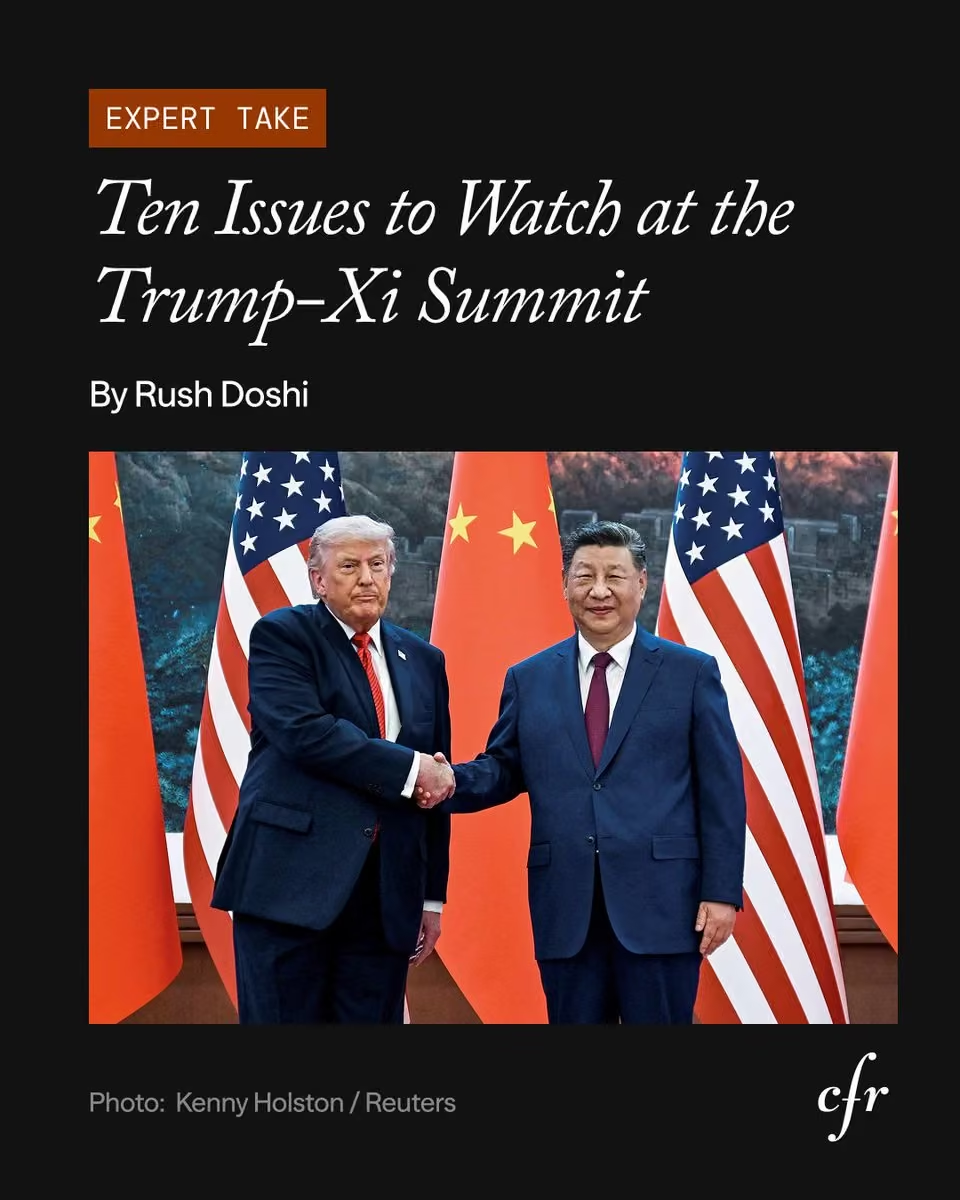
Rush Doshi reposted
 Sylvia Zin
@SylviaMinZin
I spoke with @margbrennan on CBS’s Face the Nation about my husband, Min Zin, wrongfully detained in China. Our daughter and I need him home. Thank you for helping keep his case in the public eye.
#freeminzin #wrongfuldetention
Rush Doshi reposted
 Margaret Brennan
@margbrennan
Yufang Rong, wife of US citizen & seismologist Dr Youlin Chen, visited the White House today. In a statement, she tells me that NSC and Sr State Department officials met with her and confirmed that President Trump plans to discuss her husband with China's President Xi. Secretary Rubio designated Chen as wrongfully detained.
 Rush Doshi
@RushDoshi
It seems rumors of an US-China AI dialogue and crisis line were greatly exaggerated.
- Beijing hasn’t confirmed it
- The crisis line isn’t a crisis line
- The dialogue may not be a dialogue
There were already low expectations for this summit. This takes them even lower.

 Megan Messerly
@meganmesserly
Scoop: Treasury Secretary Scott Bessent's proposed AI safety "notification mechanism" is simpler than that moniker suggests: It's an open channel between him and Chinese Vice Premier He Lifeng, four people familiar told me, @PhelimKine and @_AriHawkins. www.politico.com/news/2026/09/22/new-ai-safety-mechanism-…
Rush Doshi
@RushDoshi
Important product by @joristeer. This piece emerges from our Track II that, among other subjects, explores transatlantic industrial policy amid the second China Shock.
 Joris Teer 刘亚伯
@joristeer
NEW REPORT🚨📑: For @CFR_org, I list the rare earth promises Beijing has broken ("The Busan Façade") since the October 2025 Trump-Xi "truce" went into effect...
(...along with promises the Trump admin claimed China made, but Beijing never confirmed)
And how EU-US can fight back
Council on Foreign Relations
@CFR_org
Chinese leader Xi Jinping meets President Donald Trump in Washington, DC, this week—and "U.S. access to critical materials is expected to again be the top issue," writes EU Institute for Security Studies expert @joristeer in a new CFR report.
"Western governments have long treated their dependence on China-controlled critical raw materials, the backbone of the global economy, as a latent risk. Between 2023 and 2026, Beijing imposed export controls on gallium, rare earths, and at least seven other materials," he writes.
Last year, "Beijing woke up to the enormous power it wields through its control over critical materials and other value chains. If the United States and Europe do not dismantle this weapon (and deter its use in the interim), China may press its advantage to achieve much greater aims in the coming years—most dangerously, a forced 'reunification' with Taiwan," he argues.
Read the full report: www.cfr.org/reports/dismantling-chinas-supply-chain-weapon
Rush Doshi reposted
Joris Teer 刘亚伯
@joristeer
Thanks for the opportunity @RushDoshi, @LianaFix, @HelenaLegarda and team!
Findings partially based on two extremely useful research trips to Washington in the first half of 2026 - including workshops with @cfr and @merics_eu on transatlantic China policy!
@EU_ISS @sbeverts
Rush Doshi reposted
 Ernest Scheyder
@ErnestScheyder
“Beijing believes rare earths tamed Washington, and Washington at times seems to agree.”
Rush Doshi
@RushDoshi
On Wednesday, Xi Jinping lands at Joint Base Andrews, and President Trump will be waiting for him on the tarmac. Then comes a flyover by a B-2 and four F-22s and a meeting between Melania Trump and Peng Liyuan.
Nothing quite like that happened when Trump went to Beijing in May. Xi wasn't waiting for him, there were no flyovers, and there was no meeting of the first ladies.
"Reciprocity" is the administration's watchword. But the asymmetry in pageantry reflects a broader asymmetry in the relationship: Beijing believes rare earths tamed Washington, and Washington at times seems to agree.
Below, I've pulled together quick brief on the ten issues that will likely define the state visit, from the Busan truce and rare earths to AI dialogue, Taiwan, and Iran.
Link here -> rdoshi.substack.com/p/when-xi-comes-to-washington
 Rush Doshi
@RushDoshi
On Wednesday, Xi Jinping lands at Joint Base Andrews, and President Trump will be waiting for him on the tarmac. Then comes a flyover by a B-2 and four F-22s and a meeting between Melania Trump and Peng Liyuan.
Nothing quite like that happened when Trump went to Beijing in May. Xi wasn't waiting for him, there were no flyovers, and there was no meeting of the first ladies.
"Reciprocity" is the administration's watchword. But the asymmetry in pageantry reflects a broader asymmetry in the relationship: Beijing believes rare earths tamed Washington, and Washington at times seems to agree.
Below, I've pulled together quick brief on the ten issues that will likely define the state visit, from the Busan truce and rare earths to AI dialogue, Taiwan, and Iran.
Link here -> rdoshi.substack.com/p/when-xi-comes-to-washington
Rush Doshi reposted
 Andrew Erickson 艾立信
@AndrewSErickson
Please kindly note the text that runs between @will_yale’s first & second posts:
“CASI, along with its sister institutions the China Maritime Studies Institute (CMSI), China Landpower Studies Center (CLSC)… and China Warfighting Initiative, are the most prolific producers of publicly-accessible open source research about the PLA in the United States.”
The news Will mentions is specific to CASI only.
Rush Doshi
@RushDoshi
Ahead of the May Trump-Xi summit, @Lingling_Wei previewed a possible US-China AI crisis hotline.
At the time, I indicated that this was a good step - but that the question was whether anyone would pick up the phone.
Now, it seems like it will be a summit deliverable.
 Lingling Wei 魏玲灵
@Lingling_Wei
We reported the AI hotline in May. Apparently it's still being discussed. www.wsj.com/world/china/u-s-and-china-pursue-guardrails-t… “The fundamental question is not whether we create a hotline—which I think has some value—but whether the Chinese will use the hotline, which historically they haven’t done,” @RushDoshi
Rush Doshi
@RushDoshi
The US and China have launched an AI dialogue. This is a good initial step, and I am glad to see no linkage to export controls, but questions remain. The US public discussion is about some kind of coordinated slowdown so safety can catch up. We are a long way from unilateral parallel safeguards, let alone a negotiated slowdown.
Four questions:
First, Treasury and USTR led the talks and met with Vice Premier He Lifeng. That is a good way to create initial support for a leader-level summit deliverable but the path to actual progress on AI safety requires work to be done by different ministries and agencies. Were those agencies and ministries involved, and will they be brought in?
Second, even if the answer is nominally yes, it may be practically no. On the Chinese side, what role will MOST, MIIT, CAC, MOFCOM, MSS, MOJ, NDRC, and others actually play? When we negotiated the US-China AI Dialogue in 2023 as a summit deliverable, we focused heavily on participation. When the dialogue happened the next year, those in the room reported that the PRC side didn’t send the right people and the ones they did send didn’t speak up. Granted, this was a first step, but that left the exercise thin.
Third, the lowest hanging fruit is unilateral but coordinated parallel regulation — something that would mean adopting similar safeguards. Did this discussion indicate any interest in pursuing this approach? China will not take steps if it feels the US deregulatory approach to AI is here to stay. And the President has been less amenable to safety.
Fourth, will the announced crisis mechanism work? A crisis line only works if someone picks up the phone, and the current mechanisms with China — to be blunt — do not work and did not work during past crises (EP-3, balloon). It’s also not clear which ministry on the Chinese side will pick up. It probably should be kept in a party body rather than a state body if we want it to be used, but that too is no assurance.
None of this is to say the dialogue we’ve seen is hopeless or futile, but this is the easy part, and progress will be hard. The key is probably to focus less on the “theory” of dialogue and more on its hard translation into diplomatic “practice” and actual governance in our respective systems.
Maybe more will be announced at the summit itself. For now, these questions are fundamental.

Rush Doshi reposted
 T. Greer
@Scholars_Stage
I have a new essay in the @nytimes this week. The topic: Why Americans Hate Data Centers.
And more important: the only thing those building the data centers can do about it. 🧵

Rush Doshi reposted
 Phil Gordon
@PhilGordonDC
Anyone proposing AI deal with China as alternative to type of democratic compact @Malinowski proposes will have to do better than "this should be easy to do" and "this is like a one-page document." US should pursue talks with China while acting on the assumption they will fail.
 Tom Malinowski
@Malinowski
There are two concepts for applying AI guardrails globally.
1. The U.S. and China agree to it, as Sam Altman fantasizes below.
2. The U.S. and other democracies agree to it and use our combined market power to hold back those (including potentiall China) who don't go along. 1/
 dnap
@dnapway
Sam Altman says Trump and Xi would win the Nobel Peace Prize for a one-page AI agreement
“I think Presidents Trump and Xi would get the Nobel Peace Prize together if they could agree on something that should be easy to agree to. And it would be wonderful.”
“I think that clearly the two countries are going to compete in lots of ways, and this is going to be important socioeconomically, geopolitically. But they should be able to agree that no one should be taking a certain level of risk with the development process of this.”
“And even if just the US and China could agree on some shared standards and testing for development of this technology, I think that'd be a wonderful accomplishment that the two of them can deliver.”
“I don’t think this is hard. This is like a one page document.”
Rush Doshi reposted
 Helen Toner
@hlntnr
On how to interpret recent Chinese commentary on AI risks, from one of the best in the business ⬇️
Rush Doshi
@RushDoshi
A slight elaboration on this theme:
What is published in the People’s Daily or Global Times or China Daily certainly matters.
But the recent articles in those outlets that we are all reading have a more near-term political purpose than to tell us what China thinks about AI dialogue. I suspect that purpose is to push back on Dario and the US, and at most, to lay down some markers for diplomatic negotiations later. It isn’t to tell us decisively what China thinks about AI dialogue.
Decisions on AI dialogue will be a major policy move. They will of course be made by Xi. But these Party outlets aren’t privy to a decision about how to approach them that, in all likelihood, is still evolving.
The remarks by Chen Yixin are more authoritative, but are perhaps lagging indicators since they formalize China’s prior thinking and reiterate Xi’s own remarks.
The bottom line is things are moving fast, and I’d bet neither Washington nor Beijing yet know quite what to think about dialogue, what it can produce, and what it cannot.
Rush Doshi
@RushDoshi
There's been a lot written on the fact Chen Yixin, China's Minister of State Security, published a signed article on AI risks Sunday. It is an important piece.
What stood out to me was how much in this piece has been said before by Xi or by the MSS itself.
(1) The opener to the piece, including the title and much of the initial eight-point frame, seems to be heavily drawn from Xi's April 2025 Politburo study session on AI.
(2) Many of the six risks in Chen Yixin's piece are ones the MSS has been posting about on WeChat since 2023.
Why does this matter? The West is in the midst of a full-blown debate about AI risks and regulation, and a lot of people are reading Chen's piece as part of that. But I think it better reflects deeper thinking that has been going on for some time in the Party.
The piece marks a further formalization of that thinking.
Rush Doshi reposted
CFR China Strategy Initiative
@CFR_China
NEW Report: Matthew Ferren, @adschina, and @RushDoshi outline the Chinese cyber threats to U.S. infrastructure and the steps Washington should take to counter the threat.
Read the analysis: www.cfr.org/reports/the-cyber-gap
Rush Doshi reposted
 Tom Wright
@thomaswright08
Important and sobering article by Seth Center on the lessons of the 2024 US-China talks on AI safety and what to expect now. www.nytimes.com/2026/09/16/opinion/us-china-ai-safety-tal…
Rush Doshi
@RushDoshi
China’s increased willingness to launch new functional organizations, not just regionally-specific ones, marks an evolution in its diplomacy.
 Sheena Chestnut Greitens
@SheenaGreitens
Most observers are looking at Xiangshan this week, but at last week’s forum hosts by the Chinese MPS, China founded a new international organization centered on police cooperation to counter online fraud:
 Xie Feng 谢锋
@AmbXieFeng
A new international organization has been founded: initiated by the Chinese government, the International Alliance Combating Telecom and Cyber Fraud was launched on Sept. 10 in Lianyungang. Join hands for shared security!

Rush Doshi reposted
 Josh Zoffer
@joshzoff
Critical context here from Rush and Seth Center.
Rush Doshi
@RushDoshi
I recommend this revealing piece from Seth Center, who co-led the AI dialogue with China that emerged from our negotiations for the 2023 Biden-Xi Woodside Summit.
A little background here. In 2023, the President and his National Security Advisor thought we should have an AI dialogue with China. It would be the first ever to be held. They were right to push it.
Since this was a presidential deliverable, it fell to the NSC (and to me specifically) to coordinate and negotiate this as a summit deliverable. Therein began a rather torturous process with Beijing to scope it out, wrangle over ministerial participation, set the diplomatic level, and determine the agenda so our two Presidents could announce it. We also worked out an agreement not to hook up AI to nuclear command and control (assented to by the PLA and DOD as well), but that was further refined and ultimately announced in 2024. All this required coordination within the USG, and Seth and his team were critical partners in that effort.
Both sides ultimately agreed to hold the dialogue. Neither the US nor China made concessions to get it. We didn’t lift our export controls, as some in the US had encouraged us to do. And that enabled Biden and Xi to announce the dialogue at the Woodside Summit.
When the dialogue was held the following year, in my opinion, the PRC did not send the right people and the right ministries at the right levels, which ran against the understandings reached in our earlier negotiations. Seth’s piece tells you what happened in the room.
With a different configuration of actors, more iteration, a different level of engagement, and more direction from the Party center, things may have gone better. Or not, since Beijing had its own preferences here.
Still, it is a shame we did not get to try it that way. I believe we made some progress and should keep trying. But those encouraging us to make massive unilateral concessions for the privilege of doing so are, I think, looking at this through rose-tinted glasses.
The current discussion on AI talks with China would thus benefit from a bit more perspective on what diplomacy with China actually looks like on the ground.
Which is why I recommend you read Seth’s piece.
www.nytimes.com/2026/09/16/opinion/us-china-ai-safety-tal…
Rush Doshi reposted
 Ryan Fedasiuk
@RyanFedasiuk
Rush (and Seth) nails it.
Rush Doshi
@RushDoshi
I recommend this revealing piece from Seth Center, who co-led the AI dialogue with China that emerged from our negotiations for the 2023 Biden-Xi Woodside Summit.
A little background here. In 2023, the President and his National Security Advisor thought we should have an AI dialogue with China. It would be the first ever to be held. They were right to push it.
Since this was a presidential deliverable, it fell to the NSC (and to me specifically) to coordinate and negotiate this as a summit deliverable. Therein began a rather torturous process with Beijing to scope it out, wrangle over ministerial participation, set the diplomatic level, and determine the agenda so our two Presidents could announce it. We also worked out an agreement not to hook up AI to nuclear command and control (assented to by the PLA and DOD as well), but that was further refined and ultimately announced in 2024. All this required coordination within the USG, and Seth and his team were critical partners in that effort.
Both sides ultimately agreed to hold the dialogue. Neither the US nor China made concessions to get it. We didn’t lift our export controls, as some in the US had encouraged us to do. And that enabled Biden and Xi to announce the dialogue at the Woodside Summit.
When the dialogue was held the following year, in my opinion, the PRC did not send the right people and the right ministries at the right levels, which ran against the understandings reached in our earlier negotiations. Seth’s piece tells you what happened in the room.
With a different configuration of actors, more iteration, a different level of engagement, and more direction from the Party center, things may have gone better. Or not, since Beijing had its own preferences here.
Still, it is a shame we did not get to try it that way. I believe we made some progress and should keep trying. But those encouraging us to make massive unilateral concessions for the privilege of doing so are, I think, looking at this through rose-tinted glasses.
The current discussion on AI talks with China would thus benefit from a bit more perspective on what diplomacy with China actually looks like on the ground.
Which is why I recommend you read Seth’s piece.
www.nytimes.com/2026/09/16/opinion/us-china-ai-safety-tal…
Rush Doshi reposted
Sylvia Zin
@SylviaMinZin
Today I testified before the House East Asia-Pacific Subcommittee about my husband, Min Zin, an American academic wrongfully detained in China. His detention upended our lives. I promised our daughter I’ll do all I can to bring him home. Thank you, Chairwoman Kim. #freeminzin
#wrongfuldetention @RepYoungKim
 House Foreign Affairs Committee Majority
@HouseForeignGOP
We don’t leave Americans behind. Min Zin was arrested and wrongfully detained by Chinese authorities while on his way to an academic conference in China.
He is one of the many Americans held abroad that @SecRubio and @POTUS are working tirelessly to bring home.
Listen to the testimony from Min Zin’s wife here:
Rush Doshi reposted
Senator John Cornyn
@JohnCornyn
Why I’m Voting for a Texas Democrat by @KarlRove www.wsj.com/opinion/why-im-voting-for-a-texas-democrat-4c… via @WSJopinion
Rush Doshi reposted
Demetri
@AsiaLens
US Treasury Secretary Scott Bessent will meet his Chinese counterpart He Lifeng this weekend ahead of the Sep 24 summit between Donald Trump and Xi Jinping.
Rush Doshi reposted
Jennifer Doshi Welch
@geoeconjennie
China Shock 2.0 is often framed as a future problem. But analysis by @NicoleGorton suggests Europe is already paying a price in lost market share - at home and abroad. She estimates that price at about 0.7% of EU GDP last year, up from 0.5% in 2024. That’s likely to worsen in the years ahead as China becomes increasingly dominant in the sectors Europe also trades in.
Nicole’s measure of export similarity between the EU and China sat around 45% when China joined the WTO in 2001. By 2025 it had risen to 58%.
Read her full piece on @TheTerminal here: blinks.bloomberg.com/news/stories/TL5M2VT96OSG

Rush Doshi reposted
T. Greer
@Scholars_Stage
This is very good analysis. 100% endorse.
“ The bottom line is things are moving fast, and I’d bet neither Washington nor Beijing yet know quite what to think about dialogue, what it can produce, and what it cannot.”
Rush Doshi
@RushDoshi
A slight elaboration on this theme:
What is published in the People’s Daily or Global Times or China Daily certainly matters.
But the recent articles in those outlets that we are all reading have a more near-term political purpose than to tell us what China thinks about AI dialogue. I suspect that purpose is to push back on Dario and the US, and at most, to lay down some markers for diplomatic negotiations later. It isn’t to tell us decisively what China thinks about AI dialogue.
Decisions on AI dialogue will be a major policy move. They will of course be made by Xi. But these Party outlets aren’t privy to a decision about how to approach them that, in all likelihood, is still evolving.
The remarks by Chen Yixin are more authoritative, but are perhaps lagging indicators since they formalize China’s prior thinking and reiterate Xi’s own remarks.
The bottom line is things are moving fast, and I’d bet neither Washington nor Beijing yet know quite what to think about dialogue, what it can produce, and what it cannot.
Rush Doshi
@RushDoshi
There's been a lot written on the fact Chen Yixin, China's Minister of State Security, published a signed article on AI risks Sunday. It is an important piece.
What stood out to me was how much in this piece has been said before by Xi or by the MSS itself.
(1) The opener to the piece, including the title and much of the initial eight-point frame, seems to be heavily drawn from Xi's April 2025 Politburo study session on AI.
(2) Many of the six risks in Chen Yixin's piece are ones the MSS has been posting about on WeChat since 2023.
Why does this matter? The West is in the midst of a full-blown debate about AI risks and regulation, and a lot of people are reading Chen's piece as part of that. But I think it better reflects deeper thinking that has been going on for some time in the Party.
The piece marks a further formalization of that thinking.
Rush Doshi
@RushDoshi
A slight elaboration on this theme:
What is published in the People’s Daily or Global Times or China Daily certainly matters.
But the recent articles in those outlets that we are all reading have a more near-term political purpose than to tell us what China thinks about AI dialogue. I suspect that purpose is to push back on Dario and the US, and at most, to lay down some markers for diplomatic negotiations later. It isn’t to tell us decisively what China thinks about AI dialogue.
Decisions on AI dialogue will be a major policy move. They will of course be made by Xi. But these Party outlets aren’t privy to a decision about how to approach them that, in all likelihood, is still evolving.
The remarks by Chen Yixin are more authoritative, but are perhaps lagging indicators since they formalize China’s prior thinking and reiterate Xi’s own remarks.
The bottom line is things are moving fast, and I’d bet neither Washington nor Beijing yet know quite what to think about dialogue, what it can produce, and what it cannot.
Rush Doshi
@RushDoshi
There's been a lot written on the fact Chen Yixin, China's Minister of State Security, published a signed article on AI risks Sunday. It is an important piece.
What stood out to me was how much in this piece has been said before by Xi or by the MSS itself.
(1) The opener to the piece, including the title and much of the initial eight-point frame, seems to be heavily drawn from Xi's April 2025 Politburo study session on AI.
(2) Many of the six risks in Chen Yixin's piece are ones the MSS has been posting about on WeChat since 2023.
Why does this matter? The West is in the midst of a full-blown debate about AI risks and regulation, and a lot of people are reading Chen's piece as part of that. But I think it better reflects deeper thinking that has been going on for some time in the Party.
The piece marks a further formalization of that thinking.
Rush Doshi reposted
 Brad Setser
@Brad_Setser
Two obvious reasons for this:
1) the renminbi is still quite weak
2) Setting aside products on the Lighthizer 301 tariff lists, there is no longer a tariff differential than punishes direct imports from China
Reuters China
@ReutersChina
A year after shifting production and sourcing out of China to avoid higher U.S. tariffs, some companies are learning that replicating the country's factory ecosystem is not so easy and are bringing manufacturing back. www.reuters.com/business/retail-consumer/companies-left-c…
Rush Doshi reposted
 Linda Robinson
@RobinsonL100
Thanks @RushDoshi for writing this informed comment and @joshrogin for sharing, just at the moment when a serious and much needed AI safety push is beginning in the United States as people become more informed and companies become more open about the risks.
Rush Doshi
@RushDoshi
There's been a lot written on the fact Chen Yixin, China's Minister of State Security, published a signed article on AI risks Sunday. It is an important piece.
What stood out to me was how much in this piece has been said before by Xi or by the MSS itself.
(1) The opener to the piece, including the title and much of the initial eight-point frame, seems to be heavily drawn from Xi's April 2025 Politburo study session on AI.
(2) Many of the six risks in Chen Yixin's piece are ones the MSS has been posting about on WeChat since 2023.
Why does this matter? The West is in the midst of a full-blown debate about AI risks and regulation, and a lot of people are reading Chen's piece as part of that. But I think it better reflects deeper thinking that has been going on for some time in the Party.
The piece marks a further formalization of that thinking.
Rush Doshi reposted
 Dan Crenshaw
@DanCrenshawTX
Aren’t you the guy who used Navy SEAL Chris Kyle’s death to make yourself a bunch of money? Didn’t his widow have to sue you to get you to stop?
Or was that a bunch of foreigners from UT who screwed over the widow of American Sniper?
Bo French
@bofrench
I heard UT graduation this year looked like this. I didn’t believe it. The problem is now obviously far worse than anyone imagined.
Rush Doshi reposted
Demetri
@AsiaLens
Want to add our April scoop into the mix
as.ft.com/r/62c9f3a4-90ea-40dd-bd14-693d47873ab4 Iran used Chinese spy satellite to target US bases
Rush Doshi
@RushDoshi
Thanks for the exchange, Dennis! I might share your skepticism but for a few details.
1) U.S. officials thought the imagery mattered enough in the case of that attack to take it to the WSJ and to raise it with Beijing directly multiple times. I don't think we're in a position to dismiss the story outright.
2) While imagery on fixed targets isn't always high-value, it can be, and the situation here may be different. US strikes degraded Iran's ability to see the battlefield, but the the targeting improved over the summer, which is also when these transfers took place. We know that high-quality and timely imagery can help with targeting, battle damage assessment, mapping air defenses, and locating high-value mobile targets.
3) We've seen this movie before because China did much the same for Russia in Ukraine, and the Russians were desperate for the imagery, and it wasn't irrelevant either. That wasn't about forces in motion either.
I'm realistic that this kind of thing is going to happen. But when the President is asked about it, his response should not be "it's fine" but to put down a marker. And it is notable that we are unwilling to draw red lines ourselves but are quite willing to respect Beijing's red lines, including on arms sales.
Dennis Wilder偉德寧
@dennisw5
No, it's a realistic assessment of the situation. Chinese satellite photos are not pinpointing US forces. The base location of US forces is well known to everyone--not a secret. Those saying this have no idea how limited the Chinese assistance actually is.
Rush Doshi
@RushDoshi
This feels like a milestone moment in Trump China policy.
There are credible reports that China’s provision of satellite imagery to Iran may have resulted in American fatalities. The President isn’t even denying those reports. But he is brushing them off to keep the summit on track.
Meanwhile, China warns any arms sale to Taiwan might kill the summit — and the President obliges and keeps the sales on ice.
Rush Doshi
@RushDoshi
Highly recommmend folks read David's biography of Hans Morgenthau, which just received a starred review from Kirkus!
 David Sacks
@DavidMSacks1
 Rush Doshi
@RushDoshi
Thanks for the exchange, Dennis! I might share your skepticism but for a few details.
1) U.S. officials thought the imagery mattered enough in the case of that attack to take it to the WSJ and to raise it with Beijing directly multiple times. I don't think we're in a position to dismiss the story outright.
2) While imagery on fixed targets isn't always high-value, it can be, and the situation here may be different. US strikes degraded Iran's ability to see the battlefield, but the the targeting improved over the summer, which is also when these transfers took place. We know that high-quality and timely imagery can help with targeting, battle damage assessment, mapping air defenses, and locating high-value mobile targets.
3) We've seen this movie before because China did much the same for Russia in Ukraine, and the Russians were desperate for the imagery, and it wasn't irrelevant either. That wasn't about forces in motion either.
I'm realistic that this kind of thing is going to happen. But when the President is asked about it, his response should not be "it's fine" but to put down a marker. And it is notable that we are unwilling to draw red lines ourselves but are quite willing to respect Beijing's red lines, including on arms sales.
Dennis Wilder偉德寧
@dennisw5
No, it's a realistic assessment of the situation. Chinese satellite photos are not pinpointing US forces. The base location of US forces is well known to everyone--not a secret. Those saying this have no idea how limited the Chinese assistance actually is.
Rush Doshi
@RushDoshi
This feels like a milestone moment in Trump China policy.
There are credible reports that China’s provision of satellite imagery to Iran may have resulted in American fatalities. The President isn’t even denying those reports. But he is brushing them off to keep the summit on track.
Meanwhile, China warns any arms sale to Taiwan might kill the summit — and the President obliges and keeps the sales on ice.
Rush Doshi
@RushDoshi
This is a major candidate for elected office mainstreaming anti-Indian racism.
He knows that Texas state law requires at least 90% of UT Austin freshmen to be Texas residents. International students comprise only 4% of recent freshmen.
But presumably he sees political advantage in using a non-representative photo (of culturally assimilated South Asians!) to suggest a foreign takeover of the university.
Bo French
@bofrench
I heard UT graduation this year looked like this. I didn’t believe it. The problem is now obviously far worse than anyone imagined.
Rush Doshi reposted
 Gerald C. Brown
@GeraldC_Brown
Excited to spend the next year at @CFR_org shining a little more light on some of the challenges we face in the Pacific.
www.cfr.org/articles/cfr-welcomes-2026-27-class-of-visiti…
Rush Doshi
@RushDoshi
The most likely path to upsetting the fragile U.S.-China detente has long been tensions over China's support for Iran.
Now, the WSJ is reporting that China's provision of satellite imagery may have resulted in the deaths of three U.S. servicemembers.
Lots still unknown.

Rush Doshi reposted
 Gillian Branstetter
@GBBranstetter
If you haven't read the story The New York Times published in 2002 detailing the final communications from people inside the Twin Towers on 9/11, it is one of the most sobering accounts of the day.

Rush Doshi reposted
 james crabtree
@jamescrabtree
(4) 𝗧𝗵𝗲 𝗶𝗿𝗼𝗻𝘆 𝗼𝗳 𝗿𝗶𝘀𝗶𝗻𝗴 𝗨𝗦 𝗱𝗲𝗽𝗲𝗻𝗱𝗲𝗻𝗰𝗲. UK reliance on US is increasing in many areas, even as US is less reliable under Trump, eg AI, or gas post-Iran. So you have to realistic about autonomy.
More here from @RushDoshi
www.foreignaffairs.com/united-states/how-alliances-surviv…
Rush Doshi reposted
Ana Swanson
@AnaSwanson
New: Washington repeatedly blacklisted this Chinese tech giant. But through a network of global subsidiaries, the company has reinvented itself and kept shipping America's best chips to feed Chinese AI
www.nytimes.com/2026/09/06/technology/ai-chips-china-blac…
with @paulmozur @trippmickle @KeithBradsher
Rush Doshi
@RushDoshi
Appreciate @abrownepek discussing the need for “allied scale.” I’ve been in Tokyo the last few days. Lots of agreement here that this is the best (and perhaps only) path to techno-industrial resilience.
Some say the alliances are too wounded for this to happen. We think there is more resilience than often understood. Now is the time to develop practical proposals for the world after Trump.
www.foreignaffairs.com/united-states/how-alliances-surviv…
 Jonathan Cheng
@JChengWSJ
.@abrownepek: “In shipbuilding…China has more than 200 times US capacity. But the US and key allies and partners, operating together, would tower over China, commanding one and a half times Beijing’s share of…manufacturing…Trump is reversing that logic”
www.semafor.com/article/09/01/2026/the-us-needs-allied-sc…
Rush Doshi reposted
Brad Setser
@Brad_Setser
Incredible. US no longer thinks currency is an issue with China. When Germany now does.
Guess Secretary Bessent will wimp out in the next Treasury fx report as well
 Greg Ip
@greg_ip
'Suggestions that a new "Plaza Accord" – the 1985 agreement to strengthen currencies against the dollar – was the answer to reducing imbalances are misguided, (Bessent) said, calling this "an easy way to get around dealing with the real trade problem," which he said was excessive Chinese industrial subsidies and weak domestic demand.'
Rush Doshi reposted
 Jacob Bruggeman
@jacob_bruggeman
Spot on description of the historical patterns at play in the US-China AI race by @RushDoshi & @eosnos:
“In the eighteenth cen-tury, while Russia fixated on conquering Eurasia, Britain developed the steam engine; in the nineteenth and twentieth centuries, while Europeans fought over Africa, Americans mastered the assembly line. Today, while the U.S. tries to govern Venezuela and hobble Iran and Cuba, ‘China is focussed on winning the technologies of the future,’ Doshi said.”
www.newyorker.com/magazine/2026/08/10/the-future-made-in-…
Rush Doshi reposted
 NickBunker
@nbunkerauthor
Sunday listening: Campbell/@RushDoshi on their @ForeignAffairs item re: post-Trump US alliance rebuilding. Really abt US internal politics: how to create domestic support for ‘29 efforts to achieve as Doshi says specific sectoral coalitions with allies in tech etc. Makes sense.
Foreign Affairs
@ForeignAffairs
Listen to the latest episode of “The Foreign Affairs Interview,” featuring Kurt Campbell, @RushDoshi, and @markhleonard in conversation with editor @dankurtzphelan:
www.foreignaffairs.com/podcasts/post-american-world-inevi…
Rush Doshi reposted
 David M. Andrews
@DavidMAndrews
This was a thought-provoking conversation on the @ForeignAffairs Interview, bringing together Kurt Campbell & @RushDoshi w. @markhleonard to discuss their respective articles on "the case against pessimism & the path to a new allied order" & "learning to live in a post-🇺🇸 world".
Rush Doshi reposted
 Varun Sivaram
@vsiv
🦄 Delighted to announce @EmeraldAI_'s $150 million Series A round, valuing us at more than $1 billion with over $220 million raised to date! Read more in The New York Times: www.nytimes.com/2026/08/25/business/dealbook/emerald-ai-s…
📢Read our full announcement: www.businesswire.com/news/home/20260825127649/en/Emerald-…
📺Watch our launch on CNBC Squawk Box: www.cnbc.com/video/2026/08/25/emerald-ai-ceo-varun-sivara…
🔗And dive deeper at our website: www.emeraldai.co
⚡Emerald AI is transforming AI data centers into flexible grid allies to unlock 100+GW of power for AI while protecting energy affordability and reliability for local communities. After 18 months of demonstrations—across five data centers all over the world—we've entered our commercial scaling phase and are now deployed at multi-MW, full data center scale with customers spanning the world's biggest AI pioneers, global data center platforms, and leading power utilities. We're proud to collaborate with @NVIDIA, @Digitalrealty, @EPRINews, and others to launch the world's first power-flexible AI Factory—roughly 100MW in Manassas, Virginia—later this year, creating the blueprint for a new generation of flexible DSX AI infrastructure that will be good citizens to power grids and local communities. We're also honored to partner with @SantaClaraPower on the nation's first Flexible Load Interconnection Program (FLIP) to provide additional power capacity to flexible AI data centers.
🤝We are so grateful to our incredible consortium of investors, co-led by @EnergizeCapital and @DCVC, as well as to the extraordinary syndicate of leading global financial and strategic investors. Emerald now counts 12 Fortune 500 Global companies as our investors. Many thanks to Series A investors including @NVIDIA, @SamsungVentures, @aramcoventures, @Siemens, @SalesforceVC, @GEVernova, @RWE_AG, @jeraventures, @ADI_News Ventures, @SabanciHolding, In-Q-Tel, @radicalvcfund, @EnergyImpact_, @lowercarbon, Marunouchi Innovation Partners, @EmCollective, @johndoerr, The Olayan Group, The Temerty Group, @EarthshotVC, @collectiveGBL, General Catalyst's scout fund, and others.
🚀This funding will be instrumental as we rapidly scale commercially across the United States and around the world. Our vision is simple: secure larger and faster power connections for AI while making sure AI gives back to the communities that host it. At Emerald AI, we believe that the biggest new user of electricity—AI data centers—can also be the grid's greatest ally, and a boon for local communities by protecting energy affordability and reliability. Thank you to all of our customers, partners, investors, and our incredible team (grateful to the leadership team pictured below Ayse Coskun Mansi Shah Aroon Vijaykar Shayan Sengupta as well as to the whole fantastic team)—this has already been the journey of a lifetime, and we're just getting started

Rush Doshi reposted
 Ben Judah
@b_judah
Important and unnerving report on the consequences of Trump’s follies:
Council on Foreign Relations
@CFR_org
The U.S. weapons arsenal has been depleted and no longer has the capacity to deter a Chinese attack against Taiwan, a new CFR report says.
To address this vulnerability, the United States must rapidly implement policy reforms to enable the production and fielding of precise mass systems—an emerging class of military capabilities that includes drones, sensors, and enabling technologies—which represent the only viable means of maintaining peace through strength in the Indo-Pacific, the report contends.
"Washington needs to immediately put production of precise mass on a wartime footing. Waiting until conflict begins will be too late."
Read the full analysis by CFR experts @RushDoshi, Erin D. Dumbacher, @williamhenagan, @mchorowitz, and @SamHenryLazarus: www.cfr.org/reports/out-of-ammo-a-two-year-sprint-to-rebu…
Rush Doshi reposted
Foreign Affairs
@ForeignAffairs
“There are very powerful gravitational forces that we see pulling allies together, even though some allies are trying very hard to de-risk from Washington,” says @RushDoshi. Listen to the latest episode of “The Foreign Affairs Interview”:
www.foreignaffairs.com/podcasts/post-american-world-inevi…
Rush Doshi reposted
Joseph Torigian
@JosephTorigian
This assertion by the @FT doesn't quite capture how Zhu was still a party man. In 1996, Li Rui, Mao's former sec, told Zhu that the Three Gorges Dam was a mistake. Zhu repeatedly told Li to be silent to "put the interests of stability first." Li, furious, relented and hung up.
Jonathan Cheng
@JChengWSJ
FT editorial board: “Nobody doubted that Zhu…would be willing to speak out in party meetings against policies he thought were wrong. That cannot be said of top party cadres cowed by Xi’s accumulation of personal power and ferocious purges.”
www.ft.com/content/47c8bc3b-c1b6-4fae-add9-e55898778936
Rush Doshi
@RushDoshi
It is not an “exclusionary economic bloc” to give better trade terms to allies than to China in some sectors. Plenty of high-value trade will continue with China in that model — but others will also have a shot. And indeed, there is even an inclusive option for China in this approach: they can invest in our economies (with tech transfer, use of local suppliers, labor compliance, network and data compliance, and JVs) and make enormous profits while we gain capacity, jobs, and resilience. Without barriers, they will not do so.
But your argument is that we should not treat China differently from others, no matter environmental or labor differences, no matter the massive subsidies or its non-market economy, and regardless of risks of dependency! That argument is in effect a call for free trade with China at the expense of our workers and businesses.
I suspect you will disagree, but to me, your arguments on China seem functionally neoliberal and at odds with labor interests.
Take electric vehicles. I don’t know what is “left” about saying that protecting workers from China’s mercantilism in the auto sector could lead to war, but that’s your argument, is it not? One that basically calls the position of UAW and USW reckless, just as you’ve called the position that we should treat China differently on trade reckless, even though it is in fact materially different?
On issues of international economics
involving China, your argument to me seems to be that if we protect our workers and businesses in some cases (e.g., restrict the free flow of goods and capital between the US and China) we are risking war or being “exclusionary,” therefore we should not protect our workers and businesses. Again, this is functionally neoliberalism.
 Jake Werner
@jwdwerner
The proposal may seem impractical. But if we made real progress on it, the consequences would be dire.
Retaliation and sabotage would be China’s perfectly predictable response to the US building an economic bloc excluding it from high-value markets.
An escalatory cycle would
1/
Rush Doshi
@RushDoshi
Appreciate @Brad_Setser persuasively making the case on the need for “allied scale,” too.
 Rush Doshi
@RushDoshi
Thrilled that Ezra Klein brought on Brad Setser. Hard to think of a person better positioned to discuss the Second China Shock, its causes, and its consequences -- including for American workers.
Brad Setser
@Brad_Setser
I discussed the second China shock with Ezra Klein of the New York Times
www.nytimes.com/2026/08/21/opinion/ezra-klein-podcast-bra…
Rush Doshi
@RushDoshi
Appreciate @Brad_Setser persuasively making the case on the need for “allied scale,” too.
Rush Doshi
@RushDoshi
Thrilled that Ezra Klein brought on Brad Setser. Hard to think of a person better positioned to discuss the Second China Shock, its causes, and its consequences -- including for American workers.
Brad Setser
@Brad_Setser
I discussed the second China shock with Ezra Klein of the New York Times
www.nytimes.com/2026/08/21/opinion/ezra-klein-podcast-bra…
Rush Doshi
@RushDoshi
Very good point
 Dylan Yachyshen
@yachyshen
The 19th century transformation of Britain's economy from industrial to financial center made it "much more vulnerable economically to the shock of war" than protectionist countries. Paul Kennedy, Strategy vs Finance in 20th Century Britain in Strategy and Diplomacy, 1870-1945.
 Rush Doshi
@RushDoshi
Thanks! Alas, the quote in this FA tweet is sadly out of context. The key line comes immediately after and inverts this frame.
“But Americans would be wiser still to invert Carrington’s admonition. At a time when the United States needs its allies more than ever, forbearance is essential. They are, after all, the only allies Americans have.”
The key point is the 1980s declaration by Carrington should reversed: America needs its allies.
Demetri
@AsiaLens
Almost Rumsfeldian:
You go to war with the allies you have, not the allies you might want or wish to have!
Rush Doshi reposted
Dennis Wilder偉德寧
@dennisw5
Kurt and Rush have it right. America's alliances are resilient.
Rush Doshi
@RushDoshi
NEW in @ForeignAffairs: For this issue's cover, Kurt Campbell and I challenge the new fatalism about American alliances. We argue:
1️⃣ The alliances have weathered forgotten shocks at least this serious before, and today's are about Trump, not a permanent new politics.
2️⃣ The threats that built the alliances are intensifying and converging as China and Russia draw together.
3️⃣ Deep economic, technological, and military currents are pulling allies toward Washington faster than they can de-risk away.
The new fatalism risks becoming self-fulfilling. Convinced the alliances cannot be saved, policymakers may stop trying to save them. But the question is not whether the alliances will endure but whether they can evolve into something new — platforms for building allied scale in a world where China, backed by Russia, outscales us all.
We think they can. The United States will need to launch a presidential effort to rebuild and refashion the alliance system. It will need to credibly declare that the current damage is the product of personality not enduring policy, repudiate threats against Greenland, and start small with allies.
That means modest, defined projects with ad hoc coalitions on the issues of greatest consensus (medicine, minerals, munitions). Quick wins build momentum for more ambitious efforts. And Biden projects like AUKUS and even Trump's effort on critical minerals provide a model.
None of this is guaranteed, but neither is it implausible. The United States and its allies have agency. As attention turns to the world after Trump, the debate over the future needs more pragmatism and less despair.
Thread below.

Rush Doshi reposted
Michael McFaul
@McFaul
Completely agree with @RushDoshi & Campbell.
Rush Doshi
@RushDoshi
NEW in @ForeignAffairs: For this issue's cover, Kurt Campbell and I challenge the new fatalism about American alliances. We argue:
1️⃣ The alliances have weathered forgotten shocks at least this serious before, and today's are about Trump, not a permanent new politics.
2️⃣ The threats that built the alliances are intensifying and converging as China and Russia draw together.
3️⃣ Deep economic, technological, and military currents are pulling allies toward Washington faster than they can de-risk away.
The new fatalism risks becoming self-fulfilling. Convinced the alliances cannot be saved, policymakers may stop trying to save them. But the question is not whether the alliances will endure but whether they can evolve into something new — platforms for building allied scale in a world where China, backed by Russia, outscales us all.
We think they can. The United States will need to launch a presidential effort to rebuild and refashion the alliance system. It will need to credibly declare that the current damage is the product of personality not enduring policy, repudiate threats against Greenland, and start small with allies.
That means modest, defined projects with ad hoc coalitions on the issues of greatest consensus (medicine, minerals, munitions). Quick wins build momentum for more ambitious efforts. And Biden projects like AUKUS and even Trump's effort on critical minerals provide a model.
None of this is guaranteed, but neither is it implausible. The United States and its allies have agency. As attention turns to the world after Trump, the debate over the future needs more pragmatism and less despair.
Thread below.
Rush Doshi reposted
 Greg R. Lawson
@ConservaWonk
This is an important report from the @CFR_org on how to build up the most essential munitions capabilities for a #taiwan contingency with #china.
This is especially important given the decline in our munitions stockpile courtesy of the #iranwar.
@RushDoshi
Council on Foreign Relations
@CFR_org
The U.S. weapons arsenal has been depleted and no longer has the capacity to deter a Chinese attack against Taiwan, a new CFR report says.
The U.S.-Israeli war with Iran has severely diminished stocks of critical munitions—including air defense interceptors and precision-guided munitions—and efforts by the government and industry to replenish them will take years to bear fruit.
To address this vulnerability, the United States must rapidly implement policy reforms to enable the production and fielding of precise mass systems—an emerging class of military capabilities that includes drones, sensors, and enabling technologies—which represent the only viable means of maintaining peace through strength in the Indo-Pacific, the report contends.
"Washington needs to immediately put production of precise mass on a wartime footing. Waiting until conflict begins will be too late."
Read the full report by CFR experts @RushDoshi, Erin D. Dumbacher, William Henegan, @mchorowitz, and Sam Henry Lazarus: www.cfr.org/reports/out-of-ammo-a-two-year-sprint-to-rebu…
Rush Doshi reposted
 Dominic Meagher
@dom_ma
From an Australian perspective, I think polling here suggests that most people want the alliance to be saved and strongly anticipate that it will be restored to (not quite, but approximately) normal as soon as the US government returns to normal.
That's not just for sentimental reasons - there's a firm necessity as well.
Rush Doshi reposted
 Pham Quang Vinh
@vinhlhq2015
NEW in @ForeignAffairs: For this issue's cover, Kurt Campbell and Rush Doshi challenge the new fatalism about American alliances.
Rush Doshi
@RushDoshi
NEW in @ForeignAffairs: For this issue's cover, Kurt Campbell and I challenge the new fatalism about American alliances. We argue:
1️⃣ The alliances have weathered forgotten shocks at least this serious before, and today's are about Trump, not a permanent new politics.
2️⃣ The threats that built the alliances are intensifying and converging as China and Russia draw together.
3️⃣ Deep economic, technological, and military currents are pulling allies toward Washington faster than they can de-risk away.
The new fatalism risks becoming self-fulfilling. Convinced the alliances cannot be saved, policymakers may stop trying to save them. But the question is not whether the alliances will endure but whether they can evolve into something new — platforms for building allied scale in a world where China, backed by Russia, outscales us all.
We think they can. The United States will need to launch a presidential effort to rebuild and refashion the alliance system. It will need to credibly declare that the current damage is the product of personality not enduring policy, repudiate threats against Greenland, and start small with allies.
That means modest, defined projects with ad hoc coalitions on the issues of greatest consensus (medicine, minerals, munitions). Quick wins build momentum for more ambitious efforts. And Biden projects like AUKUS and even Trump's effort on critical minerals provide a model.
None of this is guaranteed, but neither is it implausible. The United States and its allies have agency. As attention turns to the world after Trump, the debate over the future needs more pragmatism and less despair.
Thread below.
Rush Doshi reposted
Foreign Affairs
@ForeignAffairs
“The grievance in allied capitals, while heartfelt, is not a lasting guide to what comes next.” Kurt Campbell and @RushDoshi consider the future of the U.S. alliance system:
www.foreignaffairs.com/united-states/how-alliances-surviv…
Rush Doshi reposted
 John Hemmings
@JohnHemmings2
🎯
Rush Doshi
@RushDoshi
NEW in @ForeignAffairs: For this issue's cover, Kurt Campbell and I challenge the new fatalism about American alliances. We argue:
1️⃣ The alliances have weathered forgotten shocks at least this serious before, and today's are about Trump, not a permanent new politics.
2️⃣ The threats that built the alliances are intensifying and converging as China and Russia draw together.
3️⃣ Deep economic, technological, and military currents are pulling allies toward Washington faster than they can de-risk away.
The new fatalism risks becoming self-fulfilling. Convinced the alliances cannot be saved, policymakers may stop trying to save them. But the question is not whether the alliances will endure but whether they can evolve into something new — platforms for building allied scale in a world where China, backed by Russia, outscales us all.
We think they can. The United States will need to launch a presidential effort to rebuild and refashion the alliance system. It will need to credibly declare that the current damage is the product of personality not enduring policy, repudiate threats against Greenland, and start small with allies.
That means modest, defined projects with ad hoc coalitions on the issues of greatest consensus (medicine, minerals, munitions). Quick wins build momentum for more ambitious efforts. And Biden projects like AUKUS and even Trump's effort on critical minerals provide a model.
None of this is guaranteed, but neither is it implausible. The United States and its allies have agency. As attention turns to the world after Trump, the debate over the future needs more pragmatism and less despair.
Thread below.
Rush Doshi
@RushDoshi
Can’t wait to read this.
 Hal Brands
@HalBrands
New book alert! The Landscape of Power: Geography and the Rise and Fall of Nations will be out with WW Norton in January.
@AEI @wwnorton
www.amazon.com/Landscape-Power-Geography-Rise-Nations/dp/…
Rush Doshi reposted
 DrLeoStrauss - same handle @bsky.social
@DrLeoStrauss
“The question is not whether the alliances will endure but whether they can evolve into something new — platforms for building allied scale in a world where China, backed by Russia, outscales us all.”
Rush Doshi
@RushDoshi
NEW in @ForeignAffairs: For this issue's cover, Kurt Campbell and I challenge the new fatalism about American alliances. We argue:
1️⃣ The alliances have weathered forgotten shocks at least this serious before, and today's are about Trump, not a permanent new politics.
2️⃣ The threats that built the alliances are intensifying and converging as China and Russia draw together.
3️⃣ Deep economic, technological, and military currents are pulling allies toward Washington faster than they can de-risk away.
The new fatalism risks becoming self-fulfilling. Convinced the alliances cannot be saved, policymakers may stop trying to save them. But the question is not whether the alliances will endure but whether they can evolve into something new — platforms for building allied scale in a world where China, backed by Russia, outscales us all.
We think they can. The United States will need to launch a presidential effort to rebuild and refashion the alliance system. It will need to credibly declare that the current damage is the product of personality not enduring policy, repudiate threats against Greenland, and start small with allies.
That means modest, defined projects with ad hoc coalitions on the issues of greatest consensus (medicine, minerals, munitions). Quick wins build momentum for more ambitious efforts. And Biden projects like AUKUS and even Trump's effort on critical minerals provide a model.
None of this is guaranteed, but neither is it implausible. The United States and its allies have agency. As attention turns to the world after Trump, the debate over the future needs more pragmatism and less despair.
Thread below.
Rush Doshi
@RushDoshi
That Tweet is sadly out of context. If you read the very next sentence, you'll see it inverts this frame entirely.
"But Americans would be wiser still to invert Carrington’s admonition. At a time when the United States needs its allies more than ever, forbearance is essential. They are, after all, the only allies Americans have."
The point is Carrington's admonition from the 1980s needs to be inverted today. America *needs* its allies.
 David Santoro
@DavidSantoro1
I’m yet to read the article but I’m perplexed by this quote because if it’s meant to be pro-alliance, that ain’t helping.
Rush Doshi reposted
 Chris Kennedy
@ChrisJKennedy
Great thread -- agree with a lot of it, especially the need to avoid rose colored glasses when considering the past and the view that forces stronger than Trump are shaping the future. Looking forward to digging in to the piece.
Rush Doshi
@RushDoshi
NEW in @ForeignAffairs: For this issue's cover, Kurt Campbell and I challenge the new fatalism about American alliances. We argue:
1️⃣ The alliances have weathered forgotten shocks at least this serious before, and today's are about Trump, not a permanent new politics.
2️⃣ The threats that built the alliances are intensifying and converging as China and Russia draw together.
3️⃣ Deep economic, technological, and military currents are pulling allies toward Washington faster than they can de-risk away.
The new fatalism risks becoming self-fulfilling. Convinced the alliances cannot be saved, policymakers may stop trying to save them. But the question is not whether the alliances will endure but whether they can evolve into something new — platforms for building allied scale in a world where China, backed by Russia, outscales us all.
We think they can. The United States will need to launch a presidential effort to rebuild and refashion the alliance system. It will need to credibly declare that the current damage is the product of personality not enduring policy, repudiate threats against Greenland, and start small with allies.
That means modest, defined projects with ad hoc coalitions on the issues of greatest consensus (medicine, minerals, munitions). Quick wins build momentum for more ambitious efforts. And Biden projects like AUKUS and even Trump's effort on critical minerals provide a model.
None of this is guaranteed, but neither is it implausible. The United States and its allies have agency. As attention turns to the world after Trump, the debate over the future needs more pragmatism and less despair.
Thread below.
Rush Doshi
@RushDoshi
8. GRAVITATIONAL FORCES OVERPOWER DE-RISKING
De-risking is real. But three megatrends are overpowering it — the second China shock, the AI revolution, and the defense buildup.
They are creating new linkages in both directions faster than the old ones can be broken.
Rush Doshi
@RushDoshi
8A. GRAVITATIONAL FORCES: SECOND CHINA SHOCK
Over five years, exports to China fell 15-20% for Europe, Japan, Korea, and India. But exports to the US rose 30% for Europe, Korea, and India.
As China buys less, the US is key. And US reindustrialization now depends on allies too.
Rush Doshi
@RushDoshi
16. THE TASK
The question of how to rebuild and reform the alliance structure must become a central question in the “what comes next” debate ahead of 2028.
The work itself will be a core task for US foreign policy for the coming decades.
Rush Doshi reposted
 Daniel Fried
@AmbDanFried
While the US denigrates its friends, Kurt Campbell & @RushDoshi provide historical context (it’s been worse) and a way forward to renew the free world’s alliance system. Worth a read!
Foreign Affairs
@ForeignAffairs
Kurt Campbell and @RushDoshi explain why the U.S. alliance system will survive the Trump shock—and make the case against fatalism.
www.foreignaffairs.com/united-states/how-alliances-surviv…
Rush Doshi
@RushDoshi
Highly recommend folks preorder this book by Ben and Teddy!
 Ben Buchanan
@BuchananBen
I was the first White House Special Advisor for AI. My friend Tantum Collins was Director for Technology and National Security, joining government after five years at Google DeepMind. Our jobs were to help make AI safe and ensure that democracies led the way in inventing and using it well. Today, I’m a professor at Johns Hopkins and an advisor to Anthropic and others, and Tantum is the CEO of Inherent.
Long before we served in government, we thought that humanity was on track to create AI systems that outperform humans at virtually every cognitive task. This was once a fringe hypothesis. It now seems inevitable.
THE BITTER STRUGGLE is our new book about what’s happened, what’s coming, and what’s at stake. From nanometer-scale chips to gigawatt data centers, we will show you why AI is so powerful, and why its progress will accelerate from here in ways that feel like science fiction. We will take you into the Oval Office with President Biden, the Situation Room with the Cabinet, and the Roosevelt Room with leading CEOs — and we will examine what has happened under President Trump. The decisions made in these rooms, and in Silicon Valley, will determine which nations gain a decisive lead in AI. Whoever wields that technology will gain a power unlike any in history. The next few years may decide the next few decades.
But, most of all, together we will confront AI’s hardest questions. What is the proper relationship between the companies inventing the technology, the government, and the public? How can we make sure AI is safe and trustworthy? How do democracies win without losing our values?
And how can humanity figure all of this out when we are so quickly running out of time?
That question is why we wrote this book — and why we believe the answers are too important to only be debated in closed rooms, including the ones we once sat in. We are so excited to finally share our work with you.
The book is available for pre-order now and out November 10th from Crown. www.penguinrandomhouse.com/books/821154/the-bitter-strugg…

Rush Doshi reposted
NickBunker
@nbunkerauthor
Weekend reading: most important US foreign policy think-item I’ve seen about what follows Trump 2 (should we live that long). From Kurt Campbell & @RushDoshi in @ForeignAffairs, with some dry humour to accompany cogent warning about the danger of “partial Chinese predominance.”


Rush Doshi reposted
 Victor Shih
@vshih2
How are his tones so good? Did he take Chinese in college?
 Mayor Zohran Kwame Mamdani
@NYCMayor
演出现场见!
on.nyc.gov/broadway
Mayor Zohran Kwame Mamdani
@NYCMayor
People come to New York City from all over the world to experience Broadway. The kids who grow up here should be able to do the same.
We’re partnering with @TDFNYC to give away over 2,000 free Broadway tickets to NYC High School students through a free-to-enter lottery.
Break a leg, high schoolers! Enter the lottery now at on.nyc.gov/broadway.
Rush Doshi reposted
Greg R. Lawson
@ConservaWonk
On this, I think @RushDoshi is correct about any strategy capable of balancing #china in the long run.
www.cfr.org/articles/balancing-a-bigger-china
Excerpt,
"The balance of power in the world is shifting. American national capacity alone is no longer adequate to balance China’s growing strength. For the first time in its modern history, the United States faces a rival with greater scale across most of the dimensions that matter for great power competition. As a result, the key strategic question for the future of American statecraft is whether Washington can build what former U.S. Deputy Secretary of State Kurt Campbell and I have called 'allied scale'—the ability to pool capability with its partners across the economic, technological, and military domains."
Rush Doshi reposted
Joe Weisenthal
@TheStalwart
Once again, I agree with @NewLeftEViews. A problem in this discourse is people inferring that a person who says “China’s advantage in manufacturing has stunted the development of other DMs” is accusing China of having behaved badly, rather than merely trying to describe reality.
 New Left EViews
@NewLeftEViews
I don't quite understand some of the pushback to the China squeeze argument. That's not to say that none of it is legitimate, but this point about the 'lump of consumption' fallacy is neither here nor there.
On the counterfactual story: the assumption that other EMs would have been more competitive had their institutions, policies, domestic conditions been more similar to China's seems perfectly consistent with the notion that they couldn't have gained a larger share of demand in lower-value sectors had China's own policies been less assertive. They had initially displaced existing industrial activity through lower unit costs, so had these not been so low in relative terms others could have gained a greater foothold.
But more importantly: if we are, as we should, talking not about counterfactuals but about future developmental paths for developing countries, then it's very plausible that much of the benefits of expanded consumption will still accrue to the country with the absolute advantage across much of the value chain.
"Can anyone with a straight face suggest that the main problems afflicting the development of South Africa or Nigeria, the great centers of mass underemployment in sub-saharan Africa, are cheap competition from China driven by Beijing’s industrial policy and an undervalued RMB?"
This is really beside the point and I suspect it's deliberately polemical. There is much reason to believe that if you're an EM and you get house in order you would not be able to compete simply because China's levelised cost advantages might well persist in most sectors whatever you do (unless you are like Vietnam a well-organised bordering country with an ideologically aligned political system).
This still begs the question what happens to these countries' developmental prospects when almost all of the world's merchandise trade ends up concentrated in one part of the world and when, historically, export-led growth is the way countries get out of poverty.
x.com/teortaxesTex/status/2085236929042194502
adamtooze.substack.com/p/chartbook-464-thechina-squeeze-the
 Teortaxes▶️ (DeepSeek 推特🐋铁粉 2023 – ∞)
@teortaxesTex
I think China Squeeze theory is comforting fiction. It assumes that consumption is scarce while production is in principle abundant but goes to the first mover. On these terms, China couldn't even happen. Well, it did.
We wouldn't have such abundance without China happening.
 Adam Tooze
@adam_tooze
"China Squeeze" - the politics of development counterfactuals.
China Shock 1.0: happened in the 2000s.
China Shock 2.0: warning of what may happen next.
China Squeeze: what could allegedly have happened if it were not for China's development.

Rush Doshi reposted
New Left EViews
@NewLeftEViews
I don't quite understand some of the pushback to the China squeeze argument. That's not to say that none of it is legitimate, but this point about the 'lump of consumption' fallacy is neither here nor there.
On the counterfactual story: the assumption that other EMs would have been more competitive had their institutions, policies, domestic conditions been more similar to China's seems perfectly consistent with the notion that they couldn't have gained a larger share of demand in lower-value sectors had China's own policies been less assertive. They had initially displaced existing industrial activity through lower unit costs, so had these not been so low in relative terms others could have gained a greater foothold.
But more importantly: if we are, as we should, talking not about counterfactuals but about future developmental paths for developing countries, then it's very plausible that much of the benefits of expanded consumption will still accrue to the country with the absolute advantage across much of the value chain.
"Can anyone with a straight face suggest that the main problems afflicting the development of South Africa or Nigeria, the great centers of mass underemployment in sub-saharan Africa, are cheap competition from China driven by Beijing’s industrial policy and an undervalued RMB?"
This is really beside the point and I suspect it's deliberately polemical. There is much reason to believe that if you're an EM and you get house in order you would not be able to compete simply because China's levelised cost advantages might well persist in most sectors whatever you do (unless you are like Vietnam a well-organised bordering country with an ideologically aligned political system).
This still begs the question what happens to these countries' developmental prospects when almost all of the world's merchandise trade ends up concentrated in one part of the world and when, historically, export-led growth is the way countries get out of poverty.
x.com/teortaxesTex/status/2085236929042194502
adamtooze.substack.com/p/chartbook-464-thechina-squeeze-the
Teortaxes▶️ (DeepSeek 推特🐋铁粉 2023 – ∞)
@teortaxesTex
I think China Squeeze theory is comforting fiction. It assumes that consumption is scarce while production is in principle abundant but goes to the first mover. On these terms, China couldn't even happen. Well, it did.
We wouldn't have such abundance without China happening.
Adam Tooze
@adam_tooze
"China Squeeze" - the politics of development counterfactuals.
China Shock 1.0: happened in the 2000s.
China Shock 2.0: warning of what may happen next.
China Squeeze: what could allegedly have happened if it were not for China's development.
Rush Doshi reposted
 Michael Kovrig
@MichaelKovrig
Allowing cheap Chinese electric vehicles to enter Canada may accelerate EV adoption, but don’t expect deeper industrial or economic benefits. China gets market access without helping Canada build anything. 1/6
Rush Doshi reposted
 Dr Ravi Nayyar
@ravirockks
Reminded a lot of what @RushDoshi and Dr Kurt Campbell wrote in Foreign Affairs about 'allied scale': archive.md/6URVN
Rush Doshi reposted
Council on Foreign Relations
@CFR_org
"The balance of power in the world is shifting," writes expert @RushDoshi. "American national capacity alone is no longer adequate to balance China's growing strength. For the first time in its modern history, the United States faces a rival with greater scale across most of the dimensions that matter for great power competition."
Read the analysis for the Future of American Strategy initiative: www.cfr.org/articles/balancing-a-bigger-china
 Rush Doshi
@RushDoshi
“countries should be free to choose their own growth models, but they should not be able to externalize the associated costs via their trade and capital accounts”
Michael Pettis
@michaelxpettis
There seems to be a growing acknowledgement around the word that Keynes was right when he proposed at Bretton Woods a global trading regime that limited persistent trade imbalances and restricted global financial flows.
In her new Foreign Affairs piece, Lori Wallach proposes a similar restructuring of the global trading regime, arguing that because our current trading system rewards countries that improve their manufacturing competitiveness by suppressing wage growth relative to productivity growth (and by ignoring environmental costs), it's no surprise that income inequality has risen across most countries over the past four decades.
Like a growing number of analysts, she argues that countries should be free to choose their own growth models, but they should not be able to externalize the associated costs via their trade and capital accounts.
@WallachLori
www.foreignaffairs.com/united-states/right-way-balance-trade via @ForeignAffairs
Rush Doshi reposted
 Michael Dunne
@dunne_insights
“Let’s be clear: Chinese automakers are not entering global markets as ordinary commercial competitors.”
“They are the sharp end of a national strategy to de-industrialize the United States and other western nations.”
A letter to the editor at the WSJ.
Rush Doshi reposted
Josh Zoffer
@joshzoff
@RushDoshi is completely right here. It would be still be bad if American deindustrialization were isolated to "low value" commodity manufacturing because it entails a loss of process knowledge and the network of suppliers that drive rapid iteration cycles.
But @jwdwerner is also just wrong about the facts: we are also losing in "high value" industries. This graph is from the NSF's Science and Engineering Indicators--the US share of manufacturing value add in "knowledge and technology intensive industries" fell from 30% in 2002 to ~21% in 2002; China's rose from ~8% to 34%!
And this tracks the anecdotes we all know about: batteries, EVs, chips, drugs, and biotech. The CCP has been abundantly clear they are using policy to drive this trend because of geopolitical competition.
These are Xi's words (translation courtesy of @niubi): "the world is undergoing changes unseen in a century that are accelerating, with technological revolution and great power competition intertwined, making high-technology fields the forefront and main battlefield of international competition, profoundly reshaping the global order and development pattern."
So, uh, yeah, time to lock in.
 Rush Doshi
@RushDoshi
It is in fact wise to worry about the rapid loss of American high-value manufacturing to China if you care about democracy, prosperity, and labor.
The alternative is an economy that specializes in real estate, commodity export, transnational tax evasion, and finance — a structure that will lead to oligarchy.
We are facing full deindustrialization in these sectors absent major policy shifts.
Just ask UAW or USW. Or read @WallachLori’s latest in Foreign Affairs.
Jake Werner
@jwdwerner
Panic!!!
China absolutely DOMINATES cheap, low-profit, low-wage manufacturing.
The US merely predominates on the worthless and pathetic high-value side.
 Dan Collins
@DanCollins2011
China now produces about 28% of the world's manufacturing output. per FT.
And the U.S does 17%.
On its face it doesn’t look that bad but peel the onion back.
The U.S largest container port would be only the 10th largest in China.
If you calculate manufacturing by units produced and not in USD then China produces around 60% of all manufactured goods. The U.S around 5%.
Rush Doshi
@RushDoshi
It is not scare mongering to point out industrial erosion from China — that is an empirical fact. Downplaying it does a real disservice to labor, too. People should certainly care about “framing,” but not by dismissing discussion of very dire facts as “panic.”
Allow me to provide an example of what I mean. Please do correct me if I’m wrong here, but I thought you (and others) opposed China tariffs, protection of the auto sector, outbound investment restrictions, NTBs, and so on — all because it appeared to you to be geopolitically confrontational.
It seems to me *this* is the better example of a dangerous misapplication of geopolitical logic — to say we should not protect our workers because it seems geopolitical to do so.
Jake Werner
@jwdwerner
I agree. Read what I wrote. The point is volume figures distract from that.
Where we may disagree is that I think channeling well-founded concern about US industry into geopolitical conflict poses serious risks to democracy, prosperity, and labor in the US and across the world.
Rush Doshi
@RushDoshi
It is in fact wise to worry about the rapid loss of American high-value manufacturing to China if you care about democracy, prosperity, and labor.
The alternative is an economy that specializes in real estate, commodity export, transnational tax evasion, and finance — a structure that will lead to oligarchy.
We are facing full deindustrialization in these sectors absent major policy shifts.
Just ask UAW or USW. Or read @WallachLori’s latest in Foreign Affairs.
Jake Werner
@jwdwerner
Panic!!!
China absolutely DOMINATES cheap, low-profit, low-wage manufacturing.
The US merely predominates on the worthless and pathetic high-value side.
Dan Collins
@DanCollins2011
China now produces about 28% of the world's manufacturing output. per FT.
And the U.S does 17%.
On its face it doesn’t look that bad but peel the onion back.
The U.S largest container port would be only the 10th largest in China.
If you calculate manufacturing by units produced and not in USD then China produces around 60% of all manufactured goods. The U.S around 5%.
Rush Doshi
@RushDoshi
Congratulations to Emily on the publication of this important and long-awaited book!
 Emily Matson, PhD
@DrEmilyMatson
I can’t believe my book is finally published today! I’m so thankful to all the people who encouraged and supported me along the way. Available now from @UofMPress press.umich.edu/Books/C/China-s-Date-Debate3
Rush Doshi reposted
 John Culver
@JohnCulver689
One of the most insightful (yet appropriately cautious) articles I've read in a long time. Rather than predicting the future the world races toward, Osnos deeply explores the current landscape, at a very human level from his deep experience in China. Highly recommended!
Evan Osnos
@eosnos
1/5 I went back to China to parse what is real tech from what is hype. The clearest fact: the depth of an alternative technological universe: ubiquitous E.V.s, more clinical trials than the US; AI systems reaching into workplaces, schools, and even the neighborhood trash bins.
Rush Doshi reposted
 Thompson Paine
@dtompaine
Well put: "China doesn’t want you to think too hard about what its ascendance will mean for the world. They want to show you the edge of the future. They have two messages they want to sell everybody. One is ‘We are inevitable.’ And the other one is ‘Don’t worry.’"
Rush Doshi
@RushDoshi
Grateful to @eosnos for including some of my thoughts in his magisterial piece on China, its ambitions and technological edge, and the shape of the future.
I made a three broad points:
1) China is focused on winning the technologies of the futures in ways that could irreversibly change the balance of power while we focus on anachronistic territorial questions and Iran, Venezuela, and Cuba.
2) China will aim to make the world safer for autocracy and is already supporting autocrats' ability to repress their populations and stay in power.
3) China doesn't want us to interrogate the shape of Pax Sinica. "A country tends to create an external order that looks a lot like its internal order....China doesn’t want you to think too hard about what its ascendance will mean for the world. They want to show you the edge of the future. They have two messages they want to sell everybody. One is ‘We are inevitable.’ And the other one is ‘Don’t worry.’"

 Evan Osnos
@eosnos
1/5 I went back to China to parse what is real tech from what is hype. The clearest fact: the depth of an alternative technological universe: ubiquitous E.V.s, more clinical trials than the US; AI systems reaching into workplaces, schools, and even the neighborhood trash bins.
Rush Doshi reposted
Evan Osnos
@eosnos
New Yorker: China races to own the industries of the future www.axios.com/2026/08/03/new-yorker-evan-osnos-china-us-i…
Rush Doshi
@RushDoshi
Grateful to @eosnos for including some of my thoughts in his magisterial piece on China, its ambitions and technological edge, and the shape of the future.
I made a three broad points:
1) China is focused on winning the technologies of the futures in ways that could irreversibly change the balance of power while we focus on anachronistic territorial questions and Iran, Venezuela, and Cuba.
2) China will aim to make the world safer for autocracy and is already supporting autocrats' ability to repress their populations and stay in power.
3) China doesn't want us to interrogate the shape of Pax Sinica. "A country tends to create an external order that looks a lot like its internal order....China doesn’t want you to think too hard about what its ascendance will mean for the world. They want to show you the edge of the future. They have two messages they want to sell everybody. One is ‘We are inevitable.’ And the other one is ‘Don’t worry.’"
Evan Osnos
@eosnos
1/5 I went back to China to parse what is real tech from what is hype. The clearest fact: the depth of an alternative technological universe: ubiquitous E.V.s, more clinical trials than the US; AI systems reaching into workplaces, schools, and even the neighborhood trash bins.
Rush Doshi reposted
 Ian Johnson
@iandenisjohnson
An excellent piece by @eosnos; the clearest takeaway for Chinamaxxers is this point by @RushDoshi: “A country tends to create an external order that looks a lot like its internal order"
And the piece ends with a fortune teller, which I of course love!
www.newyorker.com/magazine/2026/08/10/the-future-made-in-…
Rush Doshi reposted
 Yuan Yi Zhu
@yuanyi_z
This is excellent from @ZhugeYY.

 Thomas Cleveland
@tcleveland4real
I'm seeing quite a lot of shallow sociology attempting to explain how @ZhugeYY could manage to be so intelligent, humorous, and probing in this interview. You can hear her speak about her education in this 2025 interview with a @JackMillerCtr colleague. www.jackmillercenter.org/interview/an-interview-with-yiya…
Rush Doshi reposted
Michael Pettis
@michaelxpettis
5/6
That's why "competitive" economies must have growing trade surpluses to keep their manufacturing sectors from contracting. Asking China to sustainably boost domestic demand is like asking China to undermine its manufacturing sector, which comprises a bigger share of its...
Rush Doshi reposted
 Euan Graham
@graham_euan
Rush knows what he’s talking about. Bringing it back to 🇦🇺, which is currently allowing imports of 🇨🇳 EVs without restriction, it bothers me that there’s so little debate here about the security risks. 🇦🇺 led the world on the 5G ban, and for good reason. Yet now it’s…🦗 🦗🦗
Rush Doshi
@RushDoshi
It is not a question of debate that China has pre-positioned for destructive cyber attack on the water, gas, power, telecom, and transportation infrastructure of the United States in ways that would affect tens of millions of people.
It is also not a matter of debate why they have done so.
The USG put info out on both matters.
It is not a sound approach to policy to assert we should blithely reproduce this kind of vulnerability in autos because, “well, they probably won’t exploit it.”
Indeed, the Chinese should have seen restrictions on autos and in other sectors coming. The Biden admin told China in 2021 that unless they stopped pre-positioning activity it would affect our ability to import connected products.
It was not exactly a coalition of crazy hawks that led the connected vehicles process in the last administration. And it is not incidental that the Trump team has kept it even amid the China detente.
Rush Doshi reposted
François Godement
@FGodement
À méditer par les Européens qui ont un tabou contre le "découplage" : seule solution dans certains secteurs au fur et à mesure que la Chine déploie une coercition économique contre l'Europe, soutient la Russie. @RushDoshi n'est ni trumpien ni même Républicain.
Rush Doshi
@RushDoshi
It is not a question of debate that China has pre-positioned for destructive cyber attack on the water, gas, power, telecom, and transportation infrastructure of the United States in ways that would affect tens of millions of people.
It is also not a matter of debate why they have done so.
The USG put info out on both matters.
It is not a sound approach to policy to assert we should blithely reproduce this kind of vulnerability in autos because, “well, they probably won’t exploit it.”
Indeed, the Chinese should have seen restrictions on autos and in other sectors coming. The Biden admin told China in 2021 that unless they stopped pre-positioning activity it would affect our ability to import connected products.
It was not exactly a coalition of crazy hawks that led the connected vehicles process in the last administration. And it is not incidental that the Trump team has kept it even amid the China detente.
Rush Doshi
@RushDoshi
For those curious about why the US faces the risk of competitive displacement across the entire biotech stack — from discovery to clinical trials to biomanufacturing — here’s what I told Senator Gillibrand.
Council on Foreign Relations
@CFR_org
Senator Kirsten Gillibrand (D-NY) asks @RushDoshi, director of @CFR_China, about China’s advantages in biotechnology development.
“They’ve invested significantly in their capacity, so they are able to do biomanufacturing at scale for far less than we can, often below, probably, cost…,” Doshi says. “What I’m more concerned about right now is the fact that their clinical trial process, or their pre-IND investigations are able to move much faster than ours,” Doshi adds.
Rush Doshi
@RushDoshi
It is not a question of debate that China has pre-positioned for destructive cyber attack on the water, gas, power, telecom, and transportation infrastructure of the United States in ways that would affect tens of millions of people.
It is also not a matter of debate why they have done so.
The USG put info out on both matters.
It is not a sound approach to policy to assert we should blithely reproduce this kind of vulnerability in autos because, “well, they probably won’t exploit it.”
Indeed, the Chinese should have seen restrictions on autos and in other sectors coming. The Biden admin told China in 2021 that unless they stopped pre-positioning activity it would affect our ability to import connected products.
It was not exactly a coalition of crazy hawks that led the connected vehicles process in the last administration. And it is not incidental that the Trump team has kept it even amid the China detente.
Rush Doshi reposted
Finbarr Bermingham
@fbermingham
“We are cooked,” said Alicia Garcia-Herrero, an economist specialising in China’s economy at Belgian think tank Bruegel.
“Officials are prioritising the dialogue track over immediate industrial defence for a sector that is already under severe import pressure.
Rush Doshi reposted
 Alex Jacquez
@AlexSJacquez
This from Jake Sullivan is absolutely correct. The patchwork of grants, loans, authorities, and programs that we currently try to piece together for industrial policy is radically insufficient.
A primary demand should be a singular, focused, resourced industrial bank.
Foreign Affairs
@ForeignAffairs
“The costs of separating innovation from production are now too great to ignore.” Former U.S. National Security Adviser Jake Sullivan makes the case for an American sovereign investment fund:
www.foreignaffairs.com/united-states/how-reindustrialize-…
Rush Doshi reposted
Council on Foreign Relations
@CFR_org
Senator Elizabeth Warren (D-MA) asks @RushDoshi, director of @CFR_China, about leveraging federal procurement power to make the U.S. pharmaceutical supply chain less dependent on China.
“The U.S. government has incredible purchasing power, but right now we effectively focus on low cost, not resilience, and not quality. And so as a result, purchasing groups are not incentivized to purchase, you know, with any knowledge of upstream KSM or API dependency.”
Rush Doshi
@RushDoshi
This is one of the most significant actions taken so far in support of the U.S. robotics ecosystem.
The FCC's drone action was a shot in the arm for the domestic drone industry, and I think this has that same potential in robotics.
It'll all come down to licensing, of course.
 Brendan Carr
@BrendanCarrFCC
NEW
The FCC has now added two new categories of devices to our Covered List, which bans new versions from import or sale in America.
1. Advanced robotic devices, such as humanoids and quadrupeds produced in foreign countries.
2. Power inverters produced in foreign countries.
This action follows determinations by Executive Branch nat sec agencies that the devices pose unacceptable risks to our national security.
It includes exemptions for devices that, based on a DOW or DHS finding, pose no unacceptable threat.


Rush Doshi reposted
Kyle Chan
@kyleichan
Kimi K3 partly trained on Blackwells along with Qwen3.8 and DeepSeek, according to The Information. www.theinformation.com/articles/chinese-ai-startup-moonsh…
Rush Doshi reposted
 Dhiraj
@IndustrlPolicy
"China maintains dominance in low-tech exports through subsidies, undervalued yuan and supply-chain spillovers, constraining ASEAN industrialization."
Even Vietnam which is a major beneficiary of ChN investment in export processing has seen marginal DVA.
chinaglobalsouth.com/analysis/chinas-manufacturing-boom-m…
Rush Doshi reposted
 Hongshen Zhu
@HongshenZhu
Worth 10 years of land profits. The unfortunate reality is that land finance had worked for nearly all localities, poor or rich, but venture capitalism would only work for a handful of cities. Even Shenzhen’s gambit in Vanke flopped massively.
Rush Doshi
@RushDoshi
Hefei’s return on CXMT exceeds the city’s annual GDP.
Sure beats land sales.
 Eleanor Olcott
@EleanorOlcott
CXMT current market cap is RMB 3.65tn, making it largest Chinese public company.
To put that number in context, for the Hefei state funds that backed it...
 Rush Doshi
@RushDoshi
Hefei’s return on CXMT exceeds the city’s annual GDP.
Sure beats land sales.
Eleanor Olcott
@EleanorOlcott
CXMT current market cap is RMB 3.65tn, making it largest Chinese public company.
To put that number in context, for the Hefei state funds that backed it...
Rush Doshi
@RushDoshi
NYT editorial on chip controls.


Rush Doshi reposted
 Yanzhong Huang
@YanzhongHuang
A 6-year-old Chinese girl died in March 2025 after an experimental CRISPR base-editing therapy for a mild, non-life-threatening developmental delay. Her parents paid over $800k. The death was never made public—even as related work was published in Nature without any mention of the fatal case. (1/2)
www.science.org/content/article/exclusive-death-girl-chin…
Rush Doshi reposted
Yasheng Huang 黄亚生
@YashengHuang
Let’s approach this issue from the following perspective. Let’s say there are two countries in the world, China and the Rest of the World (ROW) ROW is growing at rates multiples of China but it is importing only raw materials and agricultural produce from China and it is exporting everything from textiles to EVs to China. China is facing a ROW shock. Should we tell China that this ROW shock is not a problem?
Rush Doshi
@RushDoshi
I can’t say I agree with the analysis below for a range of reasons.
1) China isn’t just de-industrializing the West. It’s also de-industrializing the developing world. They too are putting up protective barriers.
2) The idea that China would transfer anything other than final assembly to the developing world seems unlikely. China will, indeed it already is, pull up the ladder. Even the deals in Indonesia on refining Nickel and Spain on building EVs reveal this.
3) The US, by contrast, transferred much more than final assembly to others — including China. China is still asking for those transfers while denying them to the world.
So this reads to me as disconnected with China’s own policy, which is to — as @YashengHuang wrote — achieve absolute advantage from umbrellas to cars to robots.
Rush Doshi
@RushDoshi
Your argument is far more ideological than empirical, and it is wrong on multiple levels. Below, I list three of them.
1) The United States actively transferred technology and process knowledge throughout the Cold War to its allies to strengthen their economic capacity. This even included sensitive defense technology. This is so well-substantiated that entire European and Asian industrial policy efforts were organized around harnessing access to U.S. know-how to scale up the value chain.
2) The United States even transferred technology to its potential adversaries. It freely transferred the auto assembly line to the Soviet Union, Germany, and Japan during the interwar period. Henry Ford was directly supportive of the transfer to the Soviet Union. This too is well-established. And no lesser Communist than Deng Xiaoping acknowledged that a critical benefit of partnership with the United States was access to, of all things, technology transfer.
3) Finally, my claim on comparative tech transfer is, well, comparative. The United States transferred more than China is likely to transfer or, of course, has transferred so far. China's overall preference is to support final assembly abroad and retain high-value manufacturing. As a Party-led Leninist system with mercantilist policy, it is far better positioned to do so than an free market open democracy like the United States with limited corporate regulation. And many U.S. companies happily transfer technology once they can persuade shareholders that doing so would increase share price in the short-term. By contrast, the NDRC, MIIT, and MSS are actively working to restrict these transfers - as failed agreements from India to Europe and beyond already show. And Chinese companies, of course, have Party cells involved in governance per Article 19 of the PRC Company Law, which is an internal mechanism for ensuring compliance with central preference on this matter.
 Jostein Hauge
@haugejostein
This claim — that China is de-industrializing the rest of the Global South while the US has helped it industrialize — is one of the most inaccurate claims I've come across in my career as a development economist.
The US actively contributed to de-industrialization in Africa and Latin America in the 1980s and 1990s by dismantling most domestic industrial policy efforts, either directly or via international organisations over which it held outsized influence.
Subsequently, US involvement in the Global South has has not in any meaningful way focused on raising investment rates in manufacturing. If anything, it's been about corporate access to natural resources and setting up sweatshops to serve US consumers.
China, on the other hand, does focus on raising investment rates in manufacturing in the Global South and helps build and provide crucial infrastructure that enables this.
China, of course, is not a magic bullet for industrialization in the Global South. In addition to economic partnerships that have the potential for domestic industrialization, China is a competitive threat.
I recently spoke to an Indonesian government official long involved with Indonesia's industrial policy who essentially shared this view. He described the relationship with China as one with upsides and downsides for industrialization in Indonesia, and the relationship with the US as one with mostly downsides.
On the one hand, he said, China invests in manufacturing and energy infrastructure, provides crucial goods and inputs, and is even willing to engage in technology transfer deals. When I asked about the US, he essentially said they are hunting for natural resources and will threaten with various trade policies if they can't get them.
You can rightfully claim that China's impact on industrialization in the Global South is complicated. But it's a joke to claim the US is better than China for industrialization in the South.
Rush Doshi
@RushDoshi
I can’t say I agree with the analysis below for a range of reasons.
1) China isn’t just de-industrializing the West. It’s also de-industrializing the developing world. They too are putting up protective barriers.
2) The idea that China would transfer anything other than final assembly to the developing world seems unlikely. China will, indeed it already is, pull up the ladder. Even the deals in Indonesia on refining Nickel and Spain on building EVs reveal this.
3) The US, by contrast, transferred much more than final assembly to others — including China. China is still asking for those transfers while denying them to the world.
So this reads to me as disconnected with China’s own policy, which is to — as @YashengHuang wrote — achieve absolute advantage from umbrellas to cars to robots.
Rush Doshi
@RushDoshi
I can’t say I agree with the analysis below for a range of reasons.
1) China isn’t just de-industrializing the West. It’s also de-industrializing the developing world. They too are putting up protective barriers.
2) The idea that China would transfer anything other than final assembly to the developing world seems unlikely. China will, indeed it already is, pull up the ladder. Even the deals in Indonesia on refining Nickel and Spain on building EVs reveal this.
3) The US, by contrast, transferred much more than final assembly to others — including China. China is still asking for those transfers while denying them to the world.
So this reads to me as disconnected with China’s own policy, which is to — as @YashengHuang wrote — achieve absolute advantage from umbrellas to cars to robots.
Rush Doshi reposted
Brad Setser
@Brad_Setser
This is just wrong.
It asserts continuity when there is none.
The "China shock" is a clear change in China's pattern of trade in the last 6 years, documented by the ECB and others
1/2
 Jostein Hauge
@haugejostein
I have an issue with the "China Shock 2.0" narrative.
The narrative, championed mainly in Western countries, portrays China's export-led model as one built on unfair competition — due to China's industrial policy instruments — and as contributing to overcapacity and global imbalances.
The narrative heavily glosses over the double standards of these accusations: the US and Europe were heavy users of industrial policy during their periods of economic development, and still are. The US CHIPS and Science Act is, in fact, the largest industrial subsidy bill in human history.
Perhaps most egregiously, the China Shock narrative conveniently overlooks the fact that the West welcomed China's export-led model with open arms — even encouraged it — for decades. Why? Because it benefited them enormously. It lowered prices for Western consumers, enhanced the structural power of Western-based corporations, kept inflation in the West in check, and subsidised wage growth in Western domestic service sectors.
China's export-led model only became a problem when China climbed the value chain and threatened Western hegemony.
This, rather than China's trade surplus, is the real motivation behind the China Shock narrative. JD Vance captured this hegemonic anxiety well when he said that "the idea of globalisation was that rich countries would move further up the value chain while the poor countries made the simpler things."
The China Shock narrative has even found a way to spin China's clean energy exports as problematic because they are producing too much, too cheaply. Yes, China is apparently making too many solar panels, wind turbines, and EVs in the middle of a climate emergency.
The real China Shock is that China continued to develop its economy rather than sticking to producing t-shirts and toys.

Rush Doshi reposted
 Georgetown SFS
@georgetownsfs
Last week, SFS Prof @RushDoshi testified before the Senate Special Committee on Aging on foreign control of America's drug supply chain. He discussed reducing reliance on China while preserving strengthening U.S. supply chain resilience.
Watch here: www.aging.senate.gov/hearings/behind-the-label-foreign-ow…
Rush Doshi reposted
 George Magnus
@georgemagnus1
I welcome this piece by @SSRoachUSChina. Known him for ages, and often disagreed over China, but this hits the spot. A few reasons why it is remarkable 1/5 How long can China defy history and logic with its imbalances? www.ft.com/content/af84b774-74c1-4ace-a328-e54c8f840fde via @ft
Rush Doshi reposted
Director Michael Kratsios
@mkratsios47
We have information that Moonshot AI distilled Anthropic’s Fable for the development of its K3 model.
To do this they developed a sophisticated internal platform to conduct large scale distillation against U.S. models, allowing them to quickly switch between multiple methods of access to avoid detection. Moonshot AI has also acquired GB300-equipped servers and has accessed GB300s in Thailand, likely to train its AI models.
The United States strongly supports the free and fair development of AI, including a thriving competitive ecosystem that spans frontier models, specialized systems, open-source frameworks, and open-weight models. Legitimate AI distillation used to create smaller, more efficient models plays a vital role in this open innovation ecosystem. However, large-scale, covert industrial distillation aimed at stealing proprietary U.S. technology and undermining American research is unacceptable.
Rush Doshi reposted
 Eric Sayers
@DEricSayers
It’s the battery language that matters and deserves our attention…
👇
Chris McGuire, another former White House official at the Council on Foreign Relations, said he was very concerned about efforts to weaken the language on battery management systems, which he said posed a big security threat.
“The electronics inside modern batteries decide when it charges, how hot it gets, and whether the safety limits hold. If a foreign adversary controls those electronics, it could use that access to push the battery past its limits until it catches fire, effectively turning car batteries into car bombs,” he said.
Demetri
@AsiaLens
Mercedes risks US sales ban under Senate China bill
as.ft.com/r/9ccb0377-5737-498f-87e3-bae5e71a40e1
Rush Doshi reposted
 Bernie Moreno
@berniemoreno
Ceding control of battery technology to China by building total dependence on them would be industrial suicide and malpractice.
 Katie Miller
@KatieMiller
Chinese companies dominate the supply chain for energy-storage batteries.
They control the processing of key raw materials including lithium, cobalt and graphite.
And the world’s largest battery-cell makers and storage-system sellers are almost all Chinese.

Rush Doshi reposted
 Josh Kurlantzick
@JoshKurlantzick
Reposting this again because the point is so important cc @iandenisjohnson @michaelsobolik @RushDoshi
Dennis Wilder偉德寧
@dennisw5
The Chinese government is systematically getting rid of Western reporters with strong Chinese language and cultural understanding. The plan is simple--only allow in reporters who can be "managed."
Jonathan Cheng
@JChengWSJ
.@vwang3: “The Chinese government is opaque. We don’t know exactly why it chose to cancel my visa. But what became clear throughout my time in China is that the old assumptions about what is ‘sensitive’ no longer apply.”
www.nytimes.com/2026/07/14/world/china-journalist-expelle…
Rush Doshi
@RushDoshi
Very clear that Mercedes Benz has gravely erred here, with criticism coming from the left, the right, from major labor unions, and from reindustrializers and startups.
The bipartisan consensus on China, by the way, does seem alive -- particularly on matters of reindustrialization.
@RoKhanna weighing in here is notable, and he is right. Mercedes is 20% owned by Chinese entities. It is pushing to weaken the Connected Vehicle Security Act and working to weaken provisions meant to increase battery production domestically.
It is, in effect, working to increase American dependence on China's supply.
All this is occurring , incidentally, while Mercedes becomes increasingly dependent on the high-margin US market as its China sales stall.
We should not weaken the thresholds in the Connected Vehicle Security at the behest of a German company that is betting against American industry.
 Rep. Ro Khanna
@RepRoKhanna
Congress should stand with American workers and manufacturers, not companies tied to China. @business reports @MercedesBenz is pushing to weaken the Connected Vehicle Security Act to preserve its nearly 20% Chinese ownership structure while keeping access to the U.S. market.
Rush Doshi reposted
Chris McGuire
@ChrisRMcGuire
The Senate is marking up the Connected Vehicles Security Act tomorrow. This is a strong, bipartisan bill by @berniemoreno and @SenatorSlotkin that would strengthen U.S. national security. However, the Senate is considering watering it down to allow US companies to use car batteries that contain Chinese electronics or software.
As I explain in the below white paper, drafted in response to outreach from a number of Senate offices asking for an evaluation of the risks of batteries with Chinese electronic components, watering this provision down would present a significant national security risk and would undercut the core objective of the connected vehicles rule.
There is ample research that with full access to the software of a modern battery, it is straightforward to start a battery fire that quickly destroys the vehicle, and could cause catastrophic damage to the inhabitants or surrounding area. An adversary with this type of access could target individual Americans, or initiate many fires that cause mass disruption.
This is exactly the type of outcome the connected vehicles rule intended to mitigate. It is logical and prudent that the current bill prohibits the sale of vehicles that contain batteries with Chinese electronic components. Watering this provision down would permit the continued use of certain batteries that pose clear risks to U.S. national security, while also making it more difficult to develop secure battery supply chains inside the United States.


Rush Doshi reposted
DrLeoStrauss - same handle @bsky.social
@DrLeoStrauss
The psychological re-alignment required to think in geo strategic input/output terms rather than micro niche financialization optimizations is the cognitive terrain for the 21st century.
Rush Doshi
@RushDoshi
Mitch, I identify with the “owl” orientation.
But the real “owl” perspective is not an indefinite carveout because that makes the licensing or investment or tech transfer deals you’d support less likely than final assembly deals which are bad for us.
Btw, plenty of auto companies oppose the carve out, so it’s not a unified industry view. That means the practical realities aren’t all what they seem.
So owl’s should oppose the carveouts!
 Mitch Presnick 柏力
@mitchpresnick
The reason industry groups are pushing for carve-outs is straightforward: they’ve been deeply briefed on the practical realities.
It seems likely that they share the same strategic objective as policymakers—reducing U.S. dependence on Chinese supply chains. Where they differ is not on the destination, but on the critical path to getting there. Their view is that the United States must first rebuild key industrial capabilities and close important technology and supply-chain gaps before it can sustainably reduce that dependence.
Business strategy is like sailing. Knowing your destination isn’t enough. When the wind is against you, you don’t point the bow straight into it—you tack.
Sometimes the fastest route to independence is an indirect one. 🦉
Rush Doshi
@RushDoshi
This is deindustrial policy.
We need to scale up in batteries. These carveouts, pushed by lobbyists, ensure we will depend on PRC batteries for the foreseeable future.
Do we really want a rare earths problem at the heart of the electrical stack?
Eric Sayers
@DEricSayers
Hearing the markup was pushed (again) to next week, but worth watching closely. The real fight is not whether to ban the vehicles, but if the battery and component language survives intact. If the car is covered but the PRC battery inside it is not, what have we actually secured? The carve-outs are the whole game.
Rush Doshi
@RushDoshi
Open to having China make batteries here or license the tech with:
1) full use of US suppliers and software, and we have some good companies that could scale up with that offtake
2) full transfer of technology
Ask yourself how we will achieve that outcome if we make it easier to straight import batteries.
 Robert Manning
@Rmanning4
Are not cars and their software a separate issue? What's the downside of licensing superior battery tech? Who doesn't want their car charged in 10 minutes?
Rush Doshi
@RushDoshi
This is deindustrial policy.
We need to scale up in batteries. These carveouts, pushed by lobbyists, ensure we will depend on PRC batteries for the foreseeable future.
Do we really want a rare earths problem at the heart of the electrical stack?
Eric Sayers
@DEricSayers
Hearing the markup was pushed (again) to next week, but worth watching closely. The real fight is not whether to ban the vehicles, but if the battery and component language survives intact. If the car is covered but the PRC battery inside it is not, what have we actually secured? The carve-outs are the whole game.
Rush Doshi
@RushDoshi
All this attention shows that Mercedes has badly miscalculated.
 Select Committee on China
@ChinaSelect
For decades, German automakers engaged with China and now their factories and employees are being decimated by imports from the very country they wanted to partner with. One of these German companies is @MercedesBenz, which is nearly 20% Chinese-owned. The company is actively lobbying the Senate in opposition to the Connected Vehicle Security Act, which is led by Chairman @RepMoolenaar and would stop that same decimation from happening to our auto industry. The bill is supported by American auto companies and autoworkers. All Americans should be watching as this German-based, Chinese-owned company tries to tell U.S. lawmakers how to set the rules for our own country. The real choice for the company should be: does it want to compete in America or have China-based ownership?
Rush Doshi reposted
Finbarr Bermingham
@fbermingham
NEW: EU accuses China of seeking to reshape global order in stark new strategy paper
China trying to ‘reshape the global order in line with their interests’, says EU in some of bloc’s strongest official criticism of Beijing
www.scmp.com/news/china/diplomacy/article/3360723/eu-accu…
Rush Doshi reposted
Josh Kurlantzick
@JoshKurlantzick
The detention of U.S. citizen Min Zin on dubious espionage charges is the latest evidence that Beijing’s campaign to silence dissidents and critics abroad is expanding in scope and audacity. See my article for CFR_org www.cfr.org/articles/chinas-transnational-repression-is-b…
Rush Doshi reposted
 John F Sullivan
@JohnF_Sullivan
The scholar speaking here, Ju Hailong (鞠海龙) is a prolific Chinese maritime theorist who consistently argues that China needs to gain control over the "sea between the Philippines and Taiwan" so it would give China the power to "cut off all sea lanes... www.newsgd.com/node_99363c4f3b/717918a7fa.shtml
Rush Doshi
@RushDoshi
From Australia’s former ambassador in China:

 The Lowy Institute
@LowyInstitute
Yes, China does seek hegemony | Graham Fletcher www.lowyinstitute.org/the-interpreter/yes-china-does-seek…
Rush Doshi reposted
James A. Lewis
@james_a_lewis
This essay is fundamentally wrong, possibly because the author lacked access to western sources. It denies the "Western account of China’s industrial rise [which] rests on a simple claim. Beijing offered foreign companies access to its vast market, pushed them into joint ventures and forced them to transfer technology."
Yet I know from many interviews and investigations that illicit or forced tech transfer is exactly what happened and continues to happen. This is rewriting history to support the China's Rise myths favored by the cCP
www.eastisread.com/p/feng-kaidong-the-myth-of-chinas-easy
Rush Doshi reposted
Noah Smith 🐇🇺🇸🇺🇦🇹🇼
@Noahpinion
China isn't just forcibly deindustrializing Germany. It's doing the same to Japan, Korea, and Taiwan.
www.economist.com/finance-and-economics/2026/05/27/japan-…
Rush Doshi reposted
Josh Zoffer
@joshzoff
I’m in @FT today making a simple argument: data centers are creating market-driven demand for American-made industrial tech. This is the kind of industrial renaissance Ds and Rs say they want, but politics are pushing hard the other way. /1
giftarticle.ft.com/giftarticle/actions/redeem/e8720037-86…
Rush Doshi reposted
Georgetown SFS
@georgetownsfs
In @TheEconomist, SFS Prof @RushDoshi argues that America must adapt to China’s scale through managed competition and allied coordination by leveraging its allied network’s collective economic and technological power rather than acting alone.
Read more: econ.st/4b3Duk4
Rush Doshi reposted
Mayor Zohran Kwame Mamdani
@NYCMayor
I am heartbroken by the death of Tibetan activist Lobga Rangzen outside the United Nations. No one should feel that such a desperate act is the only way to make the world listen.
New York stands for the dignity and human rights of all people. We mourn this tragic loss and extend our deepest condolences to his loved ones and the Tibetan community across our City.
Rush Doshi
@RushDoshi
Good line here: “Which is why I think this whole framing that we have to accept one country's extensive dominance across global industrial supply chains if we want timely decarbonisation is misleading, not just because it frames the overcapacity problem as merely about green tech, but because it makes the same political error that some degrowth arguments make: assuming that sufficiently widespread political support for decarbonisation persists under conditions of industrial decline or stagnation.”
New Left EViews
@NewLeftEViews
I can't speak for others but the point is not "does FX solve this?" but "(1) can other countries match China's industrial policy?" and "(2) can stalled industrialisation and disorderly decline in industrial activity be prevented?", and pushing for a FX adjustment is a politically minimalistic strategy for addressing these two ((whether it's a good strategy is a different question).
As I've surmised myself, and I think there's good evidence: even in the absence of large subsidies, export price deflation, household demand weakness, and yuan overvaluation, it is quite possible that the answer to both (1) and (2) is still no. China's advantages in levelised costs may remain insurmountable in most sectors. Not really China's problem in that context, but a 'too big for the world' problem for almost everyone else.
Which is why I think this whole framing that we have to accept one country's extensive dominance across global industrial supply chains if we want timely decarbonisation is misleading, not just because it frames the overcapacity problem as merely about green tech, but because it makes the same political error that some degrowth arguments make: assuming that sufficiently widespread political support for decarbonisation persists under conditions of industrial decline or stagnation.
Rush Doshi
@RushDoshi
Certainly some upside to China's ability to supply certain goods around the world, but we should not dismiss that "premature deindustrialization" of the developing world - from China's WTO accession to the present - has "kicked away the ladder" for would-be late industrializers.
For example:
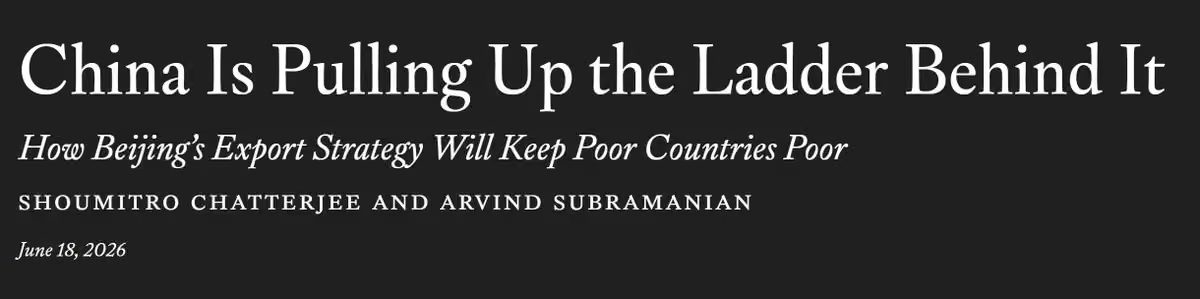 Kyle Chan
@kyleichan
Overcapacity is the ultimate First-World Problem
Rush Doshi
@RushDoshi
A recent piece on the subject below. I think Dani Rodrik's recent skepticism of manufacturing as a path out of poverty is at least partly grounded in a belief no one can compete with China's scale.
Lots more literature on the death of light manufacturing from Latin America and the Middle East too after China's WTO accession, too.
www.foreignaffairs.com/china/china-pulling-ladder-behind-it
Rush Doshi reposted
 The Economist
@TheEconomist
America, argues Rush Doshi in a guest essay, should set the terms of a “balance of power with China that secures essential American interests while avoiding war” www.economist.com/by-invitation/2026/07/01/americas-third…
Rush Doshi
@RushDoshi
Paul, glad you liked the piece, but I'm afraid you have are wrong to suggest my views have changed. I have always supported "managed competition" because I have always had a healthy respect for Beijing's capability.
1) I have advocated for "managed competition" for years, and even defended it in Foreign Affairs just two years ago (attached here).
2) "Managed competition" was so much a part of the Biden policy, particularly through 2023-2024, that Matt Pottinger and Mike Gallagher criticized the approach by writing a piece subtitled: "competition must be won, not managed."
3) "Managed competition" creates space for securing essential interests without escalation. This is why Biden policy took more competitive actions from 2023-2024 than 2021-2022 but still saw a more stable relationship: diplomacy matters. POTUS even spoke to this.
4) I don't think I ever said the U.S. should pursue absolute technology dominance? We don't seem to be trying that, since we let technology diffuse and don't protect our innovators (policies you seem to support).
5) Managed competition is consistent with pursuing export controls, and that did reduce escalatory tit-for-tat. China, by its own admission, did not deploy full Oct 9. style export controls in response to Biden chip controls but did in response to Trump tariffs.

 Paul Triolo
@pstAsiatech
Great to see former supporters of "absolute US dominance" in technology now arguing for "managed competition" and "avoiding escalation...to keep it from tipping into catastrophe"! Wow, how times change...curious about how exactly US aims on technology have been "bounded", they now cover just about everything, and yes, critical minerals and rare earths have always mattered....
Rush Doshi
@RushDoshi
Yes! This graphic is from our NYT piece on allied scale.
 Rohit Dhakras
@lalashwa
@RushDoshi has indirectly made the point...
Rush Doshi
@RushDoshi
This is an amusingly dishonest post. If you skim the article for even 30 seconds, you will see it does not endorse Guo’s claims at all and routinely speculates that they may be false.
The article is titled “leaks, lies, and Chinese politics” for a reason. You may note the word “lies.” It is a study of how Chinese elite politics sometimes plays out through diaspora media because domestic media is censored.
As for The Long Game, it is a five-year project and a 400-page book citing authoritative Party texts that also undertakes a social scientific review of Chinese behavior to cross-check the textual interpretations. It has over 60 pages of footnotes and went through four peer reviewers — including anonymous leading China foreign policy scholars — before being published by a university press.
I certainly stand by the arguments in it, but readers can decide for themselves.
Given Arnaud was unable to properly comprehend a short Foreign Affairs piece I have serious doubts about his ability to make sense of a 400-page book he has never read.
 Arnaud Bertrand
@RnaudBertrand
Also worth reminding that one of the persons who bought everything Guo was saying - to the extent he wrote an entire Foreign Affairs article as essentially a mouthpiece for Guo's claims (www.foreignaffairs.com/articles/china/2017-07-05/leaks-li…) - was Rush Doshi, who was Deputy Senior Director for China at the NSC in the Biden administration (and the author of the very intellectually dishonest book "The Long Game: China’s Grand Strategy to Displace American Order").
Really goes to show that in Washington, being wrong about China is never a career liability. He is literally the guy who was advising the White House on China.
Rush Doshi
@RushDoshi
Grateful to be able to offer a take on U.S. China policy for @TheEconomist's "America at 250" series.
I argue America will share its third century with China -- the key question is on what terms.
To set them in ways that benefit Americans, neither confrontation or accommodation makes sense. Instead, we need:
(1) "managed competition" bilaterally to secure essential interest without triggering escalation, and
(2) "allied scale" multilaterally to set the terms of the future with our partners rather than have a more powerful Beijing dictate them to us.

 Rush Doshi
@RushDoshi
Link: www.economist.com/by-invitation/2026/07/01/americas-third…
Rush Doshi reposted
Noah Smith 🐇🇺🇸🇺🇦🇹🇼
@Noahpinion
No. Trump did BROAD tariffs on ALL products from U.S. ALLIES.
Krugman is suggesting TARGETED tariffs on SPECIFIC products from a HOSTILE country. This is what Biden did, not Trump.
People need to understand the difference!!
www.noahpinion.blog/p/why-targeted-tariffs-are-more-effec…
 Mike
@Doranimated
Krugman boards the Trump train. Who could have predicted this?
Rush Doshi reposted
New Left EViews
@NewLeftEViews
It is remarkable—in a positive way—what a departure these views on trade imbalances and their causes and effects represent from those Adam held just a few months ago.
I personally do not think that it’s reasonable (in fact I think it is laughable) to claim that hundred billions of sectoral support are nothing big and could have been realised in Germany, if only arrogant German corporates had reinvested earnings—though I’m happy we st least agree it’s hundreds and not a couple of dozen billions.
It skirts the issue that is possible in one political economic framework and not in the other. Besides the fact that this was public money in the China’s case and that even if such resources had been available, the political basis for such subsidies is obviously not there.
I also don’t think it’s cool to be told the obvious (that the sectoral framework is the appropriate one) by someone who regularly dismisses arguments about overcapacity and export price deflation across a broad number of sectors with reference to single sectors where those things happen to have positive externalities.
Finbarr Bermingham
@fbermingham
. @adam_tooze superb on China shock 2.0 + subsidies (est $231bn in EVs 2009-23)
"Accepting these numbers or even larger estimates, it still seems to me perfectly possible to uphold Chinese view, which is that such spending is in fact modest in proportion to effects achieved...
Rush Doshi reposted
Sander Tordoir
@SanderTordoir
Spot on from Rush.
Some European economists still believe in a misguided separation of defensive policies and innovation stimulation.
The two will have to work in unison - defend the industrial base and support renewal and innovation.
Hard to do once ecosystems collapse.
Rush Doshi
@RushDoshi
Industrial catastrophe happens fast.
Industrial renewal happens slowly, if at all.
Time for the US and Europe to make common cause with Asian democracies on maintaining healthy industrial bases protected from PRC dumping.
“Allied scale” is the only way out.
Finbarr Bermingham
@fbermingham
Brutal. 100,000!
Volkswagen is planning to cut up to 100,000 jobs and end production at four plants in Germany in a significant acceleration of its cost-cutting plans as Europe’s largest carmaker seeks to survive the rapid advance of Chinese rivals.
www.ft.com/content/d0760eaf-d345-4964-b2ae-f55f6dfd9a4a?s…
Rush Doshi reposted
Finbarr Bermingham
@fbermingham
Looking at the detailed Chinese trade data for May - some stunning numbers
Compared to May 2025, China's trade surplus with Germany rose by 31.6%...
With the EU as a whole, the surplus is up 15% year on year
China's exports to Austria up 50.8%, Portugal up 45.6%, Poland up 24%


Rush Doshi reposted
 Stephen Dziedzic
@stephendziedzic
Speaking of candid. This is quite blunt from the Prime Minister in his NYT interview. Albanese says China is projecting an "image of certainty" going forward and is looking to establish "hegemony" in the longer term
 Rush Doshi
@RushDoshi
Grateful to @AnaSwanson for including my thoughts for this must-read story on batteries.
Here’s my full take on Chinese investment in batteries:
If we import Chinese batteries without making our own, we will lose a critical industry of the future and become dependent on Chinese batteries for everything from cars to drones to energy storage. Many are hoping Chinese investment here can make a difference, but the "how" is critical. If they just ship all the high-value parts from China and we package them together, they scale up while we are hollowed out. But if they use our suppliers, who truly are at the leading edge of this technology, as well as our workers and software then we can catch up and they can make profits.. That's what China demands of our companies, and we can ask for the same.
Ana Swanson
@AnaSwanson
I reported this story from Ningde, China, at the world's largest cluster of battery factories. There a Chinese company is outpacing U.S. technology, raising big questions for U.S. officials, and the future of the U.S. China tech race.
www.nytimes.com/2026/06/23/business/economy/china-megafac…
Rush Doshi
@RushDoshi
“A White House spokesperson told us that the Defense Department’s 1260H procurement restrictions ‘help ensure secure and reliable supply chains for U.S. military forces,’ and added, ‘Beijing’s response only validates the assessment that Chinese suppliers are unreliable.’”
 Josh Rogin
@joshrogin
Read my new Washington Post Intelligence report with a free gift link:
The next phase in the U.S.-China economic war is here
open.substack.com/pub/joshrogin/p/the-next-phase-in-the-u…
Rush Doshi reposted
Taisu Zhang
@ZhangTaisu
Wasn’t it just a couple months ago when all the “Chinamaxxing” econ commentators on social media were treating any suggestion that China had a structural consumption problem as Western media brainwashing? Well, this is from Qiushi (one of the Party’s primary publications) recently…


Rush Doshi reposted
Sander Tordoir
@SanderTordoir
Europe and Canada building networked sovereignty in action.
Good stuff.
What allied scale looks like @RushDoshi
 Mark Carney
@MarkJCarney
This is just the beginning.
Because we joined the EU’s SAFE pact, more Canadian businesses will have new opportunities to build defence equipment for our Allies.

Rush Doshi reposted
 Thorsten Benner
@thorstenbenner
"We are dealing with an economy whose currency is undervalued by between 25 & 30 %. This is such a massive competitive disadvantage that we must address it & we have agreed to do so".
It's a big step Merz put 🇨🇳currency undervaluation front and center at G7 meeting. Time to act.
 Rush Doshi
@RushDoshi
“Allied scale” is the only path forward if the aim is to make America and its allies competitive and weather the Second China Shock.
The chart below makes the case.
Sam Winter-Levy
@SamWinterLevy
A smarter US policy would find ways to draw on this kind of allied industrial scale, so a US-led coalition can dominate not just chips but the broader AI value chain:

Rush Doshi reposted
 FSI Stanford
@FSIStanford
The U.S. cannot match China's scale alone, and pretending otherwise is a strategic mistake, warned @RushDoshi at a @StanfordSCCEI conference.
Read his recommendations for how to transform alliances into an engine of shared economic and industrial capacity.
Rush Doshi
@RushDoshi
Grateful for the opportunity to speak with @DanCrenshawTX about the real China challenge: the economic, industrial, and technological scale that risks overwhelming US workers and businesses.
 Rep. Dan Crenshaw
@RepDanCrenshaw
Great powers win industrial revolutions. Britain won the first. America won the next two. Now China is determined to dominate the fourth.
In hindsight, it was a mistake for America to outsource so much of its industrial capacity over the last three decades. But decline isn’t inevitable. We still possess enormous advantages – from our innovation and capital markets to our alliances and natural resources – and China faces serious structural weaknesses of its own.
I break it all down with @RushDoshi on the latest episode of Hold These Truths.
Rush Doshi
@RushDoshi
Direct policy impact:
"A key factor in the Chancellor's change of course was, among other things, a research paper by economists Sander Tordoir and Brad Setser"
Sander Tordoir
@SanderTordoir
Humbling.
Pleased Brad and I could contribute to Chancellor Merz's thinking on China Shock 2.0 with analysis and a few policy ideas
Germany faces a profound challenge, but retains formidable strengths. And it does not face it alone, but together with EU + many global partners
Finbarr Bermingham
@fbermingham
Also from this - @SanderTordoir & @Brad_Setser doing what generations before them couldn't, changing the German chancellor's mind on China
"A key factor in the Chancellor's change of course was, among other things, a research paper by economists Sander Tordoir and Brad Setser"
Rush Doshi reposted
 Jackie Deal
@JacquelineNDeal
Hi @UCBerkeley,
Your PhD candidate U Min Zin runs what is perhaps the world’s leading Burma-focused think tank.
He is a credit to your school doing cutting-edge, open-source research, but is now wrongfully detained by the PRC.
Is “thoughts” really the best you can do? 👇
Try harder.

 Los Angeles Times
@latimes
UC Berkeley doctoral student accused of espionage, Chinese authorities say www.latimes.com/california/story/2026-06-13/uc-berkeley-d…
Rush Doshi reposted
Edward Wong
@ewong
NEW: China arrested a US citizen after Trump met with Xi in Beijing and accused him of endangering national security — a rare charge against an American. The detainee, U Min Zin, is a grad student at @UCBerkeley who researches Myanmar. This adds a new strain to US-China ties.

Rush Doshi reposted
 Tom Shugart
@tshugart3
The Ratio is your merchant hulls divided by your naval hulls.
And since WWII it looks like this. Not good.
 Rush Doshi
@RushDoshi
Paul seems to not realize that industrial policy in EVs may differ from industrial policy in rare earths.
Collapsing those differences is, after all, poor analysis.
And yet he does it, suggesting what happened in EVs must be what happened in rare earths!
Paul Triolo
@pstAsiatech
Good old fashioned analysis, without ideological bias...good antidote to the "China planned to dominate all these industries like EVS and rates earths starting 30 years ago as tools of future economic coercion " school of really bad China analysis...
 Fengming Lu
@FengmingLuPE
Why did private firms, not state-owned enterprises (SOEs), come to dominate China’s EV sector?
My new @ChinaJournal article (co-authored with Xiao Ma @maxiaoalex) challenge the "top-down industrial policy" narrative.
The real engine? Strategic alliances between local governments and private capital. 🧵
Based on 3+ years of fieldwork, 60+ interviews (with officials, entrepreneurs, and engineers), and rich first-hand accounts, we show how strict central regulations inadvertently drove local states to bet big on private EV players.
Here is the story: (1/15)

Rush Doshi reposted
 Saadia Niazi
@IrSaadia
I just finished a book of @RushDoshi The Long Game...really enjoyed it...as very much of my interest # emergingChina
Rush Doshi
@RushDoshi
I’m not walking back anything. Perhaps you misread the earlier argument? It was a long post.
Here it is again for your reference. Please note the very first paragraph, which specifically indicates that the weaponization of the tool dates back to at least 2010.
I remain perplexed why any of this is controversial. The evidence is overwhelming.
x.com/rushdoshi/status/2063011932743827648
 Yan Liang
@YanLian31677392
Glad you heed the attention to evidence&walk back from the earlier assertion that CN intentionally built& weaponized REE decades ago. It started to assemble anti sanctions toolkit in recent years (AFST 2021) in response to the US tech restrictions - markedly different than 2010.
Rush Doshi
@RushDoshi
They actually used it as a weapon in 2010. Not all concentration is deliberate. And not all of it is for coercion.
But the state did turn this sector into a more effective weapon beginning as early as the late 2000s. I’m not saying they should or shouldn’t have done that, but to argue otherwise is odd to me.
I’m not sure why this is controversial. Empirical evidence exists.
Yan Liang
@YanLian31677392
So China builds REE for decades w the intention to use it as an economic weapon? Well then most, if not all of the CN economy revolves around “war” preparations? Cos it also dominates in medical ingredients, electronics, chemical intermediates, green tech, ship building…
Rush Doshi
@RushDoshi
The argument is not that they set out thirty years ago but perhaps 20, and certainly 16.
This is obviously true: they even admit it!
Paul Triolo
@pstAsiatech
Agree with @jessicacweiss here...
The argument that Beijing, more than 30 years ago, set out to use rare earths as a future economic weapon, is risible, but some are intent on making it. We would have to accept that Beijing understood all the myriad ways REEs/magnets would become critical, like for semis, EVs, photonics, and that market forces would favor Chinese companies, while other governments would ignore the issue and provide no support for their own domestic players. For those in the previous administration that pushed the export controls that drew down China's REE/magnet licensing regime, this is convenient explanation for the double failure: no action on reducing dependence on China and forcing Beijing's hand on real chokepoints.
 Soumaya Keynes
@SoumayaKeynes
When China spent decades building dominance in rare earths supply chains, what was it really trying to do? Build an economic weapon? Or something else?
I asked @jessicacweiss on The Economics Show with Soumaya Keynes podcast this week...
www.ft.com/content/34a8939c-ba23-4f20-a414-8ae807dd87ae?s…
 Rush Doshi
@RushDoshi
Some more detail here
Rush Doshi
@RushDoshi
This is an interesting question. My take: I do not quite accept the notion that China did not seek to "weaponize" rare earths and instead stumbled into a position of advantage. For at least 16 years, and likely more, the purpose has been an economic weapon. This is not like, say, solar or EVs, where excess capacity is sort of an accident.
Here, for example, is a semi-authoritative book cited by @JohnF_Sullivan on rare earth strategy written in 2011 for the state China Economic Publishing House the year after the Japan situation:
"What magical quality do rare earths possess that makes the usually arrogant and domineering Americans so furious? What magical quality do rare earths posses that leaves the usually wealthy and arrogant Japanese grief-stricken? China is the only country in the world capable of supplying all 17 rare earth elements, particularly holding a larger share of heavy rare earths that have prominent uses in military applications. To change China’s international position in the rare earth industry, since 2009, the Chinese government has launched a vigorous rare earth defense war, adopting a series of rectification measures including suspending approval of mining rights, controlling total mining volume, reducing export quotas, raising export tariffs and and severely cracking down on rare earth smuggling."
A key purpose of these post-2009 steps, which PRECEDE China's weaponization against Japan in 2010, was to hone a better coercive instrument.
Then there is some empirical evidence suggesting PRC action in this sector was about leverage.
First, most obviously, China used this as a coercive instrument in 2010. That shows, for at least 16 years, they have understood it as a critical leverage point.
Second, China's government has for decades manipulated the price of rare earths to prevent anyone else from achieving scale - dropping the price to kill foreign investment. Why did they do this when they already had 90% market dominance? The logic is toward control, not profit, and it is not the result of disaggregated independent Chinese market actors (which do not exist in this sector).
Third, related to that point, if this industry operated on economic logic, we would probably see more fragmentation. Indeed, for a brief time, we did see that before 2010. But then the PRC sharply consolidated the rare earths industry into state-backed companies. They shut down, arrested, harassed, and outright expropriated private actors. This was partly to ensure greater state control over external flows - the better to maintain leverage. The quote above refers to that effort.
Fourth, I do not think China's controls on rare earth minerals were modeled off U.S. controls. For example, the October controls went far beyond any U.S. controls. China's idea was any product, anywhere in the world, with .1% value coming from Chinese produced rare earths, required a license to be sold to anyone else in the world. The closest analogy -- and Chinese scholars have said this directly -- is to U.S. financial sanctions, not export controls.
Fifth, this is not a case where "there are many different actors, and they often overperform in search of particular targets." The industry has for a long time just been a few actors, tied to the state, acting at the state's direction. China's cultivation of leadership in this sector dates back to the 1960s, accelerating in the 1980s, with direct involvement of Deng's family in the 1990s and Premier Wen in the 2000s.
The empirical evidence seems to indicate a conscious desire to dominate this sector. One can debate whether or not such an intention was justifiable given U.S. control over chokepoints like finance.
But I think it is hard to advance the claim this was just the independent action of market participants that happened to accidentally create a position of extreme concentration and dominance.
Rush Doshi
@RushDoshi
The argument is not that they set out thirty years ago but perhaps 20, and certainly 16.
This is obviously true: they even admit it!
Paul Triolo
@pstAsiatech
Agree with @jessicacweiss here...
The argument that Beijing, more than 30 years ago, set out to use rare earths as a future economic weapon, is risible, but some are intent on making it. We would have to accept that Beijing understood all the myriad ways REEs/magnets would become critical, like for semis, EVs, photonics, and that market forces would favor Chinese companies, while other governments would ignore the issue and provide no support for their own domestic players. For those in the previous administration that pushed the export controls that drew down China's REE/magnet licensing regime, this is convenient explanation for the double failure: no action on reducing dependence on China and forcing Beijing's hand on real chokepoints.
Soumaya Keynes
@SoumayaKeynes
When China spent decades building dominance in rare earths supply chains, what was it really trying to do? Build an economic weapon? Or something else?
I asked @jessicacweiss on The Economics Show with Soumaya Keynes podcast this week...
www.ft.com/content/34a8939c-ba23-4f20-a414-8ae807dd87ae?s…
Rush Doshi reposted
 Edgard Kagan
@edgardkagan
Very important points on both sides. I am more sympathetic to @RushDoshi because the reality is that the short and medium term consequences of industrial policy can be extremely damaging, as we see with issues such as rare earths, where cost of undoing intervention will be high.
Rush Doshi
@RushDoshi
A very thoughtful post. And perhaps true on AI.
But it is perhaps overstated in other areas. If free market dynamism were all that mattered, what would explain the catch-up of the East Asian economies? How did China go from an economic backwater in 1980 into an industrial superpower in only forty years. My view is that learning from China doesn't mean becoming China. Are there no lessons for the United States, which is now falling behind in key industrial sectors, in the success of others?
The reason a free market at home does not always produce prosperity and progress is because the economy is global. The actions of other countries, and their state-driven distortions, affect the incentives we face at home, including those of our capital allocators and businesses.
There's wisdom in the market. But there's also foolishness. The "efficient" path can be a disaster if other countries de facto shape the global terrain of efficiency and "hack" our incentives.
Indeed, this is what happened to the United States. Deindustrialization is partly the result of operating on free market assumptions and keeping an open economy in a world where other states practice industrial policy. With no state-led correction to those distortions, the result was hollowing out.
Perhaps AI will spur reindustrialization. But I doubt it will be enough. Even today, the very companies hinted at below are facing unbelievable headwinds from Chinese industrialists, who will also apply AI. There is no magic button for reindustrialization. It will take policy. I actually think the Trump Administration, in its own way, also understands this.
The simple fact is we have experienced a catastrophic loss of jobs, process knowledge, and industrial capacity -- a national tragedy -- that is as much the result of our own free-market ideology and interest group capture as it is foreign mercantilism.
 Dean W. Ball
@deanwball
I think part of it, at least vis a vis US/China competition, is that US and western chattering classes find it hard to believe that the market-driven outcome of frontier AI could possibly be right. They basically believe, in their hearts, that the Chinese system, with its “industrial strategy,” has eclipsed capitalism. So they harbor the same inferiority complex toward the Chinese system that many Americans once harbored toward the EU’s system. Their heuristic is that the industrial strategists of China have grasped the whole picture of the technological competition in a way that US industrialists, with their “profit maximizing incentives,” could not possibly have matched. And so any outcome in the economy that is not the result of “strategy” is therefore prima facie worse than what the “strategists” have concocted. They also believe the Chinese strategists possess awesome powers of foresight and the ability to evade all tendencies of financial and economic gravity, due of course to “strategy,” really it’s almost a kind of orientalism.
Meanwhile the U.S. industrialists are making new advances in math and science, and the fastest-growing businesses in history, by spending hundreds of billions of dollars on high-margin chips whose legacy is in rendering video games, cramming them underneath tents if need be, and investing generational capital into new energy generation technologies as they do it, and perhaps even colonizing space as an instrumentally convergent result. But none of that is “strategy,” you see.
Rush Doshi
@RushDoshi
Impactful work from @geoeconjennie and her team.
Finbarr Bermingham
@fbermingham
A war over Taiwan would cause a near-14% hit to the German economy, Bloomberg finds.
That's higher than the estimated cost to either the US and China, also even Japan.

Rush Doshi reposted
Brad Setser
@Brad_Setser
Another small bit of evidence here --
the consolidation of the industry around a few large state owned companies and crackdown on smuggling (after that weakened the controls in 2010) was clearly meant in large part to make China's export controls more effective
 Rush Doshi
@RushDoshi
Thanks for the engagement. I believe your argument is essentially the same as mine. The question is not “whether” both explanations apply, but rather “when” they do.
My point was China built this as a geopolitical tool over the last nearly twenty years. What began as an industrial policy effort for capacity in this sector in the 1960s later became a drive to consolidate it *for geopolitical purposes* beginning at least 16 years ago if not even earlier. There are plenty of state texts indicating this, too. The decisions to drop international prices, consolidate the sector, eliminate most private sector participants, and halt smuggling were partly to ensure absurdly high market share even at a loss to China’s own economy.
The argument I responded to — that China’s current position is a product of independent market actors inadvertently creating excess capacity that later happened to be weaponized —is in my view false based on authoritative texts, market data, and the best explanation for China’s puzzling behavior. This sector has not been treated the same as green tech or other sectors. So applying explanations from those sectors to this one is erroneous and cannot properly account for the last nearly twenty years of state behavior.
The idea smuggling existed does not disprove this analysis. The real question is how the state felt about it.
And in that sense, it actually confirms the geopolitical explanation. The state waged a campaign against smuggling in the 2010s after smuggling revealed the challenge of using the tool against Japan without full state control of supply.
 Lewis Jackson
@lewjackk
Respectfully, both can be true. China weaponized its RE dominance but it was in a position to do so because of the industry's growth through the 80s/90s/00s, not all of which was the product of a grand plan to build a trade war weapon. 🧵
Rush Doshi
@RushDoshi
This is an interesting question. My take: I do not quite accept the notion that China did not seek to "weaponize" rare earths and instead stumbled into a position of advantage. For at least 16 years, and likely more, the purpose has been an economic weapon. This is not like, say, solar or EVs, where excess capacity is sort of an accident.
Here, for example, is a semi-authoritative book cited by @JohnF_Sullivan on rare earth strategy written in 2011 for the state China Economic Publishing House the year after the Japan situation:
"What magical quality do rare earths possess that makes the usually arrogant and domineering Americans so furious? What magical quality do rare earths posses that leaves the usually wealthy and arrogant Japanese grief-stricken? China is the only country in the world capable of supplying all 17 rare earth elements, particularly holding a larger share of heavy rare earths that have prominent uses in military applications. To change China’s international position in the rare earth industry, since 2009, the Chinese government has launched a vigorous rare earth defense war, adopting a series of rectification measures including suspending approval of mining rights, controlling total mining volume, reducing export quotas, raising export tariffs and and severely cracking down on rare earth smuggling."
A key purpose of these post-2009 steps, which PRECEDE China's weaponization against Japan in 2010, was to hone a better coercive instrument.
Then there is some empirical evidence suggesting PRC action in this sector was about leverage.
First, most obviously, China used this as a coercive instrument in 2010. That shows, for at least 16 years, they have understood it as a critical leverage point.
Second, China's government has for decades manipulated the price of rare earths to prevent anyone else from achieving scale - dropping the price to kill foreign investment. Why did they do this when they already had 90% market dominance? The logic is toward control, not profit, and it is not the result of disaggregated independent Chinese market actors (which do not exist in this sector).
Third, related to that point, if this industry operated on economic logic, we would probably see more fragmentation. Indeed, for a brief time, we did see that before 2010. But then the PRC sharply consolidated the rare earths industry into state-backed companies. They shut down, arrested, harassed, and outright expropriated private actors. This was partly to ensure greater state control over external flows - the better to maintain leverage. The quote above refers to that effort.
Fourth, I do not think China's controls on rare earth minerals were modeled off U.S. controls. For example, the October controls went far beyond any U.S. controls. China's idea was any product, anywhere in the world, with .1% value coming from Chinese produced rare earths, required a license to be sold to anyone else in the world. The closest analogy -- and Chinese scholars have said this directly -- is to U.S. financial sanctions, not export controls.
Fifth, this is not a case where "there are many different actors, and they often overperform in search of particular targets." The industry has for a long time just been a few actors, tied to the state, acting at the state's direction. China's cultivation of leadership in this sector dates back to the 1960s, accelerating in the 1980s, with direct involvement of Deng's family in the 1990s and Premier Wen in the 2000s.
The empirical evidence seems to indicate a conscious desire to dominate this sector. One can debate whether or not such an intention was justifiable given U.S. control over chokepoints like finance.
But I think it is hard to advance the claim this was just the independent action of market participants that happened to accidentally create a position of extreme concentration and dominance.
Rush Doshi reposted
 Sam Chetwin George
@samchetwin
The evidence doesn’t support the idea that China’s rare earths dominance is just an accident of the market. Too many takes on China are detached from the Party’s own documentary record.
And why would it be accidental? It makes good strategic sense. It’s been a well-executed strategy and one that is completely consistent with the Party’s view that it needs counter-leverage against what it describes as encirclement by the US and its allies in Asia.
Beijing has been building capacity in rare earths for decades and started consolidating the industry under state control in earnest in the 2000s under Wen Jiabao. @KeithBradsher's excellent piece in the NYT lays all this out.
www.nytimes.com/2025/12/31/business/china-rare-earths-his…
Beijing tested this weapon against Japan in 2010, but it was in 2019 that Xi Jinping signaled it would be China’s key weapon in the trade war. In May 2019, Xi made a highly choreographed visit to Ganzhou, the heart of China’s heavy rare earths industry, and called these elements “an important strategic resource”. Xi’s visit was just days after Trump added Huawei to the Entity List and indicated that China would use this industry to retaliate. If the message wasn’t clear enough, it was explicit at a 28 May 2019 NDRC press conference. When asked whether China would weaponise its leverage in rare earths an NDRC spokesperson replied: “You asked whether rare earths will become China’s countermeasure against the U.S.’s unprovoked suppression. What I can tell you is that if anyone wants to use the products manufactured by our export of rare earths to contain and suppress China’s development, then I think the people in the former Central Soviet Area in southern Jiangxi and the Chinese people will be unhappy.”
Just a month earlier, in April 2020, Xi gave a speech in which he said: “we must tighten the dependence of international industrial chains on our country, forming a powerful countermeasure and deterrent capability against foreign parties who artificially cut off supply.” In other words, Beijing’s official doctrine – outlined by Xi Jinping himself – was that China would build and deploy leverage in key industries to serve strategic goals. It made good sense and has paid dividends now in the second Trump administration.
After Xi’s speech and visit, the entire system mobilised to make possible the historical controls on rare earths he implemented in April and October of 2025. Beijing set up legal-regulatory infrastructure, like the Export Control Law (2020), set out regulations in 2021 that established state control over all rare earths resources, and consolidated its three largest state-owned rare earths assets into a new SOE called China Rare Earth Group. According to official state press, the objective was explicitly to grant the state greater strategic control over China’s rare earth resources: “This allowed the state to control mining at the source and provided better conditions for strategic stockpiling and planned usage.”
It's true that part of the story is American offshoring in the 1990s and 2000s, but the idea that China was not focused on exploiting the strategic value of rare earths doesn't stand up.
Rush Doshi
@RushDoshi
This is an interesting question. My take: I do not quite accept the notion that China did not seek to "weaponize" rare earths and instead stumbled into a position of advantage. For at least 16 years, and likely more, the purpose has been an economic weapon. This is not like, say, solar or EVs, where excess capacity is sort of an accident.
Here, for example, is a semi-authoritative book cited by @JohnF_Sullivan on rare earth strategy written in 2011 for the state China Economic Publishing House the year after the Japan situation:
"What magical quality do rare earths possess that makes the usually arrogant and domineering Americans so furious? What magical quality do rare earths posses that leaves the usually wealthy and arrogant Japanese grief-stricken? China is the only country in the world capable of supplying all 17 rare earth elements, particularly holding a larger share of heavy rare earths that have prominent uses in military applications. To change China’s international position in the rare earth industry, since 2009, the Chinese government has launched a vigorous rare earth defense war, adopting a series of rectification measures including suspending approval of mining rights, controlling total mining volume, reducing export quotas, raising export tariffs and and severely cracking down on rare earth smuggling."
A key purpose of these post-2009 steps, which PRECEDE China's weaponization against Japan in 2010, was to hone a better coercive instrument.
Then there is some empirical evidence suggesting PRC action in this sector was about leverage.
First, most obviously, China used this as a coercive instrument in 2010. That shows, for at least 16 years, they have understood it as a critical leverage point.
Second, China's government has for decades manipulated the price of rare earths to prevent anyone else from achieving scale - dropping the price to kill foreign investment. Why did they do this when they already had 90% market dominance? The logic is toward control, not profit, and it is not the result of disaggregated independent Chinese market actors (which do not exist in this sector).
Third, related to that point, if this industry operated on economic logic, we would probably see more fragmentation. Indeed, for a brief time, we did see that before 2010. But then the PRC sharply consolidated the rare earths industry into state-backed companies. They shut down, arrested, harassed, and outright expropriated private actors. This was partly to ensure greater state control over external flows - the better to maintain leverage. The quote above refers to that effort.
Fourth, I do not think China's controls on rare earth minerals were modeled off U.S. controls. For example, the October controls went far beyond any U.S. controls. China's idea was any product, anywhere in the world, with .1% value coming from Chinese produced rare earths, required a license to be sold to anyone else in the world. The closest analogy -- and Chinese scholars have said this directly -- is to U.S. financial sanctions, not export controls.
Fifth, this is not a case where "there are many different actors, and they often overperform in search of particular targets." The industry has for a long time just been a few actors, tied to the state, acting at the state's direction. China's cultivation of leadership in this sector dates back to the 1960s, accelerating in the 1980s, with direct involvement of Deng's family in the 1990s and Premier Wen in the 2000s.
The empirical evidence seems to indicate a conscious desire to dominate this sector. One can debate whether or not such an intention was justifiable given U.S. control over chokepoints like finance.
But I think it is hard to advance the claim this was just the independent action of market participants that happened to accidentally create a position of extreme concentration and dominance.
Rush Doshi
@RushDoshi
A very thoughtful post. And perhaps true on AI.
But it is perhaps overstated in other areas. If free market dynamism were all that mattered, what would explain the catch-up of the East Asian economies? How did China go from an economic backwater in 1980 into an industrial superpower in only forty years. My view is that learning from China doesn't mean becoming China. Are there no lessons for the United States, which is now falling behind in key industrial sectors, in the success of others?
The reason a free market at home does not always produce prosperity and progress is because the economy is global. The actions of other countries, and their state-driven distortions, affect the incentives we face at home, including those of our capital allocators and businesses.
There's wisdom in the market. But there's also foolishness. The "efficient" path can be a disaster if other countries de facto shape the global terrain of efficiency and "hack" our incentives.
Indeed, this is what happened to the United States. Deindustrialization is partly the result of operating on free market assumptions and keeping an open economy in a world where other states practice industrial policy. With no state-led correction to those distortions, the result was hollowing out.
Perhaps AI will spur reindustrialization. But I doubt it will be enough. Even today, the very companies hinted at below are facing unbelievable headwinds from Chinese industrialists, who will also apply AI. There is no magic button for reindustrialization. It will take policy. I actually think the Trump Administration, in its own way, also understands this.
The simple fact is we have experienced a catastrophic loss of jobs, process knowledge, and industrial capacity -- a national tragedy -- that is as much the result of our own free-market ideology and interest group capture as it is foreign mercantilism.
Dean W. Ball
@deanwball
I think part of it, at least vis a vis US/China competition, is that US and western chattering classes find it hard to believe that the market-driven outcome of frontier AI could possibly be right. They basically believe, in their hearts, that the Chinese system, with its “industrial strategy,” has eclipsed capitalism. So they harbor the same inferiority complex toward the Chinese system that many Americans once harbored toward the EU’s system. Their heuristic is that the industrial strategists of China have grasped the whole picture of the technological competition in a way that US industrialists, with their “profit maximizing incentives,” could not possibly have matched. And so any outcome in the economy that is not the result of “strategy” is therefore prima facie worse than what the “strategists” have concocted. They also believe the Chinese strategists possess awesome powers of foresight and the ability to evade all tendencies of financial and economic gravity, due of course to “strategy,” really it’s almost a kind of orientalism.
Meanwhile the U.S. industrialists are making new advances in math and science, and the fastest-growing businesses in history, by spending hundreds of billions of dollars on high-margin chips whose legacy is in rendering video games, cramming them underneath tents if need be, and investing generational capital into new energy generation technologies as they do it, and perhaps even colonizing space as an instrumentally convergent result. But none of that is “strategy,” you see.
Rush Doshi
@RushDoshi
Thanks for the engagement. I believe your argument is essentially the same as mine. The question is not “whether” both explanations apply, but rather “when” they do.
My point was China built this as a geopolitical tool over the last nearly twenty years. What began as an industrial policy effort for capacity in this sector in the 1960s later became a drive to consolidate it *for geopolitical purposes* beginning at least 16 years ago if not even earlier. There are plenty of state texts indicating this, too. The decisions to drop international prices, consolidate the sector, eliminate most private sector participants, and halt smuggling were partly to ensure absurdly high market share even at a loss to China’s own economy.
The argument I responded to — that China’s current position is a product of independent market actors inadvertently creating excess capacity that later happened to be weaponized —is in my view false based on authoritative texts, market data, and the best explanation for China’s puzzling behavior. This sector has not been treated the same as green tech or other sectors. So applying explanations from those sectors to this one is erroneous and cannot properly account for the last nearly twenty years of state behavior.
The idea smuggling existed does not disprove this analysis. The real question is how the state felt about it.
And in that sense, it actually confirms the geopolitical explanation. The state waged a campaign against smuggling in the 2010s after smuggling revealed the challenge of using the tool against Japan without full state control of supply.
Lewis Jackson
@lewjackk
Respectfully, both can be true. China weaponized its RE dominance but it was in a position to do so because of the industry's growth through the 80s/90s/00s, not all of which was the product of a grand plan to build a trade war weapon. 🧵
Rush Doshi
@RushDoshi
This is an interesting question. My take: I do not quite accept the notion that China did not seek to "weaponize" rare earths and instead stumbled into a position of advantage. For at least 16 years, and likely more, the purpose has been an economic weapon. This is not like, say, solar or EVs, where excess capacity is sort of an accident.
Here, for example, is a semi-authoritative book cited by @JohnF_Sullivan on rare earth strategy written in 2011 for the state China Economic Publishing House the year after the Japan situation:
"What magical quality do rare earths possess that makes the usually arrogant and domineering Americans so furious? What magical quality do rare earths posses that leaves the usually wealthy and arrogant Japanese grief-stricken? China is the only country in the world capable of supplying all 17 rare earth elements, particularly holding a larger share of heavy rare earths that have prominent uses in military applications. To change China’s international position in the rare earth industry, since 2009, the Chinese government has launched a vigorous rare earth defense war, adopting a series of rectification measures including suspending approval of mining rights, controlling total mining volume, reducing export quotas, raising export tariffs and and severely cracking down on rare earth smuggling."
A key purpose of these post-2009 steps, which PRECEDE China's weaponization against Japan in 2010, was to hone a better coercive instrument.
Then there is some empirical evidence suggesting PRC action in this sector was about leverage.
First, most obviously, China used this as a coercive instrument in 2010. That shows, for at least 16 years, they have understood it as a critical leverage point.
Second, China's government has for decades manipulated the price of rare earths to prevent anyone else from achieving scale - dropping the price to kill foreign investment. Why did they do this when they already had 90% market dominance? The logic is toward control, not profit, and it is not the result of disaggregated independent Chinese market actors (which do not exist in this sector).
Third, related to that point, if this industry operated on economic logic, we would probably see more fragmentation. Indeed, for a brief time, we did see that before 2010. But then the PRC sharply consolidated the rare earths industry into state-backed companies. They shut down, arrested, harassed, and outright expropriated private actors. This was partly to ensure greater state control over external flows - the better to maintain leverage. The quote above refers to that effort.
Fourth, I do not think China's controls on rare earth minerals were modeled off U.S. controls. For example, the October controls went far beyond any U.S. controls. China's idea was any product, anywhere in the world, with .1% value coming from Chinese produced rare earths, required a license to be sold to anyone else in the world. The closest analogy -- and Chinese scholars have said this directly -- is to U.S. financial sanctions, not export controls.
Fifth, this is not a case where "there are many different actors, and they often overperform in search of particular targets." The industry has for a long time just been a few actors, tied to the state, acting at the state's direction. China's cultivation of leadership in this sector dates back to the 1960s, accelerating in the 1980s, with direct involvement of Deng's family in the 1990s and Premier Wen in the 2000s.
The empirical evidence seems to indicate a conscious desire to dominate this sector. One can debate whether or not such an intention was justifiable given U.S. control over chokepoints like finance.
But I think it is hard to advance the claim this was just the independent action of market participants that happened to accidentally create a position of extreme concentration and dominance.
Rush Doshi reposted
Noah Smith 🐇🇺🇸🇺🇦🇹🇼
@Noahpinion
Europe can't afford to adhere to free-trade dogma when it comes to the flood of Chinese imports.
www.noahpinion.blog/p/why-europe-should-put-up-trade-barr…
Rush Doshi
@RushDoshi
This is an interesting question. My take: I do not quite accept the notion that China did not seek to "weaponize" rare earths and instead stumbled into a position of advantage. For at least 16 years, and likely more, the purpose has been an economic weapon. This is not like, say, solar or EVs, where excess capacity is sort of an accident.
Here, for example, is a semi-authoritative book cited by @JohnF_Sullivan on rare earth strategy written in 2011 for the state China Economic Publishing House the year after the Japan situation:
"What magical quality do rare earths possess that makes the usually arrogant and domineering Americans so furious? What magical quality do rare earths posses that leaves the usually wealthy and arrogant Japanese grief-stricken? China is the only country in the world capable of supplying all 17 rare earth elements, particularly holding a larger share of heavy rare earths that have prominent uses in military applications. To change China’s international position in the rare earth industry, since 2009, the Chinese government has launched a vigorous rare earth defense war, adopting a series of rectification measures including suspending approval of mining rights, controlling total mining volume, reducing export quotas, raising export tariffs and and severely cracking down on rare earth smuggling."
A key purpose of these post-2009 steps, which PRECEDE China's weaponization against Japan in 2010, was to hone a better coercive instrument.
Then there is some empirical evidence suggesting PRC action in this sector was about leverage.
First, most obviously, China used this as a coercive instrument in 2010. That shows, for at least 16 years, they have understood it as a critical leverage point.
Second, China's government has for decades manipulated the price of rare earths to prevent anyone else from achieving scale - dropping the price to kill foreign investment. Why did they do this when they already had 90% market dominance? The logic is toward control, not profit, and it is not the result of disaggregated independent Chinese market actors (which do not exist in this sector).
Third, related to that point, if this industry operated on economic logic, we would probably see more fragmentation. Indeed, for a brief time, we did see that before 2010. But then the PRC sharply consolidated the rare earths industry into state-backed companies. They shut down, arrested, harassed, and outright expropriated private actors. This was partly to ensure greater state control over external flows - the better to maintain leverage. The quote above refers to that effort.
Fourth, I do not think China's controls on rare earth minerals were modeled off U.S. controls. For example, the October controls went far beyond any U.S. controls. China's idea was any product, anywhere in the world, with .1% value coming from Chinese produced rare earths, required a license to be sold to anyone else in the world. The closest analogy -- and Chinese scholars have said this directly -- is to U.S. financial sanctions, not export controls.
Fifth, this is not a case where "there are many different actors, and they often overperform in search of particular targets." The industry has for a long time just been a few actors, tied to the state, acting at the state's direction. China's cultivation of leadership in this sector dates back to the 1960s, accelerating in the 1980s, with direct involvement of Deng's family in the 1990s and Premier Wen in the 2000s.
The empirical evidence seems to indicate a conscious desire to dominate this sector. One can debate whether or not such an intention was justifiable given U.S. control over chokepoints like finance.
But I think it is hard to advance the claim this was just the independent action of market participants that happened to accidentally create a position of extreme concentration and dominance.
Rush Doshi
@RushDoshi
I actually forgot to mention one important thing: the use of this tool has not always been “defensive” either.
They used this tool against Japan and the US in 2010. That was not a defensive use in response to economic coercion.
Since the trade war, they have used it offensively: threatening it in response to European industrial policy and using it in response to Japan’s modest defense increases.
I am not making a moral argument — other countries build and deploy coercive chokepoints. I don’t know why we would assume China is an exception to this logic when there is ample empirical evidence to the contrary.
China is, in fact, a great power (really a superpower) and acts like it.
Rush Doshi reposted
 Yin Khvat
@YinKhvat
I find it odd this is even a point of debate
Rush Doshi
@RushDoshi
This is an interesting question. My take: I do not quite accept the notion that China did not seek to "weaponize" rare earths and instead stumbled into a position of advantage. For at least 16 years, and likely more, the purpose has been an economic weapon. This is not like, say, solar or EVs, where excess capacity is sort of an accident.
Here, for example, is a semi-authoritative book cited by @JohnF_Sullivan on rare earth strategy written in 2011 for the state China Economic Publishing House the year after the Japan situation:
"What magical quality do rare earths possess that makes the usually arrogant and domineering Americans so furious? What magical quality do rare earths posses that leaves the usually wealthy and arrogant Japanese grief-stricken? China is the only country in the world capable of supplying all 17 rare earth elements, particularly holding a larger share of heavy rare earths that have prominent uses in military applications. To change China’s international position in the rare earth industry, since 2009, the Chinese government has launched a vigorous rare earth defense war, adopting a series of rectification measures including suspending approval of mining rights, controlling total mining volume, reducing export quotas, raising export tariffs and and severely cracking down on rare earth smuggling."
A key purpose of these post-2009 steps, which PRECEDE China's weaponization against Japan in 2010, was to hone a better coercive instrument.
Then there is some empirical evidence suggesting PRC action in this sector was about leverage.
First, most obviously, China used this as a coercive instrument in 2010. That shows, for at least 16 years, they have understood it as a critical leverage point.
Second, China's government has for decades manipulated the price of rare earths to prevent anyone else from achieving scale - dropping the price to kill foreign investment. Why did they do this when they already had 90% market dominance? The logic is toward control, not profit, and it is not the result of disaggregated independent Chinese market actors (which do not exist in this sector).
Third, related to that point, if this industry operated on economic logic, we would probably see more fragmentation. Indeed, for a brief time, we did see that before 2010. But then the PRC sharply consolidated the rare earths industry into state-backed companies. They shut down, arrested, harassed, and outright expropriated private actors. This was partly to ensure greater state control over external flows - the better to maintain leverage. The quote above refers to that effort.
Fourth, I do not think China's controls on rare earth minerals were modeled off U.S. controls. For example, the October controls went far beyond any U.S. controls. China's idea was any product, anywhere in the world, with .1% value coming from Chinese produced rare earths, required a license to be sold to anyone else in the world. The closest analogy -- and Chinese scholars have said this directly -- is to U.S. financial sanctions, not export controls.
Fifth, this is not a case where "there are many different actors, and they often overperform in search of particular targets." The industry has for a long time just been a few actors, tied to the state, acting at the state's direction. China's cultivation of leadership in this sector dates back to the 1960s, accelerating in the 1980s, with direct involvement of Deng's family in the 1990s and Premier Wen in the 2000s.
The empirical evidence seems to indicate a conscious desire to dominate this sector. One can debate whether or not such an intention was justifiable given U.S. control over chokepoints like finance.
But I think it is hard to advance the claim this was just the independent action of market participants that happened to accidentally create a position of extreme concentration and dominance.
Rush Doshi reposted
John F Sullivan
@JohnF_Sullivan
"Whoever controls strategic rare earth metals controls the resources for future technology and holds the fate of the future. China must elevate this to a strategic height and manage and control strategic metal resources in the name of the state."
 Rush Doshi
@RushDoshi
This is an interesting question. My take: I do not quite accept the notion that China did not seek to "weaponize" rare earths and instead stumbled into a position of advantage. For at least 16 years, and likely more, the purpose has been an economic weapon. This is not like, say, solar or EVs, where excess capacity is sort of an accident.
Here, for example, is a semi-authoritative book cited by @JohnF_Sullivan on rare earth strategy written in 2011 for the state China Economic Publishing House the year after the Japan situation:
"What magical quality do rare earths possess that makes the usually arrogant and domineering Americans so furious? What magical quality do rare earths posses that leaves the usually wealthy and arrogant Japanese grief-stricken? China is the only country in the world capable of supplying all 17 rare earth elements, particularly holding a larger share of heavy rare earths that have prominent uses in military applications. To change China’s international position in the rare earth industry, since 2009, the Chinese government has launched a vigorous rare earth defense war, adopting a series of rectification measures including suspending approval of mining rights, controlling total mining volume, reducing export quotas, raising export tariffs and and severely cracking down on rare earth smuggling."
A key purpose of these post-2009 steps, which PRECEDE China's weaponization against Japan in 2010, was to hone a better coercive instrument.
Then there is some empirical evidence suggesting PRC action in this sector was about leverage.
First, most obviously, China used this as a coercive instrument in 2010. That shows, for at least 16 years, they have understood it as a critical leverage point.
Second, China's government has for decades manipulated the price of rare earths to prevent anyone else from achieving scale - dropping the price to kill foreign investment. Why did they do this when they already had 90% market dominance? The logic is toward control, not profit, and it is not the result of disaggregated independent Chinese market actors (which do not exist in this sector).
Third, related to that point, if this industry operated on economic logic, we would probably see more fragmentation. Indeed, for a brief time, we did see that before 2010. But then the PRC sharply consolidated the rare earths industry into state-backed companies. They shut down, arrested, harassed, and outright expropriated private actors. This was partly to ensure greater state control over external flows - the better to maintain leverage. The quote above refers to that effort.
Fourth, I do not think China's controls on rare earth minerals were modeled off U.S. controls. For example, the October controls went far beyond any U.S. controls. China's idea was any product, anywhere in the world, with .1% value coming from Chinese produced rare earths, required a license to be sold to anyone else in the world. The closest analogy -- and Chinese scholars have said this directly -- is to U.S. financial sanctions, not export controls.
Fifth, this is not a case where "there are many different actors, and they often overperform in search of particular targets." The industry has for a long time just been a few actors, tied to the state, acting at the state's direction. China's cultivation of leadership in this sector dates back to the 1960s, accelerating in the 1980s, with direct involvement of Deng's family in the 1990s and Premier Wen in the 2000s.
The empirical evidence seems to indicate a conscious desire to dominate this sector. One can debate whether or not such an intention was justifiable given U.S. control over chokepoints like finance.
But I think it is hard to advance the claim this was just the independent action of market participants that happened to accidentally create a position of extreme concentration and dominance.
Rush Doshi reposted
Josh Zoffer
@joshzoff
⬇️ be prepared to hear more and more about this. Bio is the future and we aren’t ready. Great work from @RushDoshi and @CFR_org
Rush Doshi
@RushDoshi
🚨Thrilled to share our new @CFR_China report with CFR Global Health's @TomBollyky, @profyadav, @OliviaWKosloff, & Elena Every: "The Pharma Choke Point."
The US is dependent on Chinese production for essential medicines, creating a "rare earths" problem in this sector. Seven hundred medicines approved for use in the United States depend on at least one chemical produced solely in China.
For the last year, our study group of pharma and biotech specialists, China scholars, and industrial policy experts came together to:
1⃣ Use commercial data to map the dependencies
2⃣ Devise a typology of three unique "archetypes" of these dependencies
3⃣ Craft solutions to address these dependencies
A few key points follow below:
➡️China's Leverage is real — Beijing doesn't need a wartime crisis to exploit it. It can slow shipments, delay licenses, or reroute flows through "peacetime weaponization." That's the playbook it has already run on rare earths.
➡️Current dependence is structural — It's the product of decades of Chinese state investment and Western pursuit of the low-cost solution. China controls the raw/starting materials for 94% of US amoxicillin, 74% of heparin, and 70% of acetaminophen. It's dominating preclinical work in biotech. And diversifying downstream offers no real protection from upstream dependence.
➡️Archetype 1: Upstream Dependence — Roughly 700 medicines Americans depend on at least one chemical made only in China, including antibiotics, blood thinners, ER drugs. Solutions include:
- building a strategic reserve of critical medicines
- building "allied scale" to create diversified production
- mix various long-term supply and demand interventions to change economic viability for KSMs, APIs, and other upstream inputs (more in the report)
➡️Archetype 2: Competitive Displacement of U.S. Biomanufacturing and Clinical Trial Capacity — For innovative biologics—medicines made from living cells—such as monoclonal antibodies, the risk is not a single upstream choke point but competitive displacement across every stage of the value chain: discovery, clinical development, contract manufacturing, and market access. The U.S. is losing a critical capability: now, WuXi alone handles nearly half of US clients' development programs. China alone is more than half of all late-stage monoclonal antibody programs. Lock-in deepens at every stage. Solutions include:
- accelerating first-in-human clinical trials in the United States
- funding and incentivizing the adoption of advanced biologics manufacturing technologies (e.g., low-cost capital from the USG)
- building contract research alternatives in allied countries like South Korea
- bolstering the U.S. biomanufacturing workforce
- creating a system to secure artificial intelligence (AI)–ready biodata and digital chemistry, manufacturing, and controls.
➡️Archetype 3: Dependence on PRC Infrastructure — Here, the vulnerability is not disruption in the supply of an existing product, but Chinese control over the research-and-development (R&D) infrastructure underlying future pharmaceutical innovation. Growing reliance on China for DNA synthesis is just one example. Solutions include:
- improving DNA supply chain security
- enhancing transparency and disclosing provenance
- increasing federal investment in next-generation DNA synthesis technologies
- and bolstering allied cooperation on standard-setting and procurement to encourage the adoption of these technologies.
➡️Key Takeaway: China has both the tools and demonstrated willingness to weaponize U.S. pharmaceutical dependence: the structural conditions enabling it run through nearly every tier of the pharmaceutical supply. The question is not whether to act, but if the United States will manage to do so before a crisis makes the cost of decades of inaction unavoidable.
I am so grateful to Tom, Prashant, Elena, Olivia, Chloe, Ben, Aarya, CFR's publications team, and so many others who made this possible. It was tremendously educational to work together on this project.
 Rush Doshi
@RushDoshi
🚨Thrilled to share our new @CFR_China report with CFR Global Health's @TomBollyky, @profyadav, @OliviaWKosloff, & Elena Every: "The Pharma Choke Point."
The US is dependent on Chinese production for essential medicines, creating a "rare earths" problem in this sector. Seven hundred medicines approved for use in the United States depend on at least one chemical produced solely in China.
For the last year, our study group of pharma and biotech specialists, China scholars, and industrial policy experts came together to:
1⃣ Use commercial data to map the dependencies
2⃣ Devise a typology of three unique "archetypes" of these dependencies
3⃣ Craft solutions to address these dependencies
A few key points follow below:
➡️China's Leverage is real — Beijing doesn't need a wartime crisis to exploit it. It can slow shipments, delay licenses, or reroute flows through "peacetime weaponization." That's the playbook it has already run on rare earths.
➡️Current dependence is structural — It's the product of decades of Chinese state investment and Western pursuit of the low-cost solution. China controls the raw/starting materials for 94% of US amoxicillin, 74% of heparin, and 70% of acetaminophen. It's dominating preclinical work in biotech. And diversifying downstream offers no real protection from upstream dependence.
➡️Archetype 1: Upstream Dependence — Roughly 700 medicines Americans depend on at least one chemical made only in China, including antibiotics, blood thinners, ER drugs. Solutions include:
- building a strategic reserve of critical medicines
- building "allied scale" to create diversified production
- mix various long-term supply and demand interventions to change economic viability for KSMs, APIs, and other upstream inputs (more in the report)
➡️Archetype 2: Competitive Displacement of U.S. Biomanufacturing and Clinical Trial Capacity — For innovative biologics—medicines made from living cells—such as monoclonal antibodies, the risk is not a single upstream choke point but competitive displacement across every stage of the value chain: discovery, clinical development, contract manufacturing, and market access. The U.S. is losing a critical capability: now, WuXi alone handles nearly half of US clients' development programs. China alone is more than half of all late-stage monoclonal antibody programs. Lock-in deepens at every stage. Solutions include:
- accelerating first-in-human clinical trials in the United States
- funding and incentivizing the adoption of advanced biologics manufacturing technologies (e.g., low-cost capital from the USG)
- building contract research alternatives in allied countries like South Korea
- bolstering the U.S. biomanufacturing workforce
- creating a system to secure artificial intelligence (AI)–ready biodata and digital chemistry, manufacturing, and controls.
➡️Archetype 3: Dependence on PRC Infrastructure — Here, the vulnerability is not disruption in the supply of an existing product, but Chinese control over the research-and-development (R&D) infrastructure underlying future pharmaceutical innovation. Growing reliance on China for DNA synthesis is just one example. Solutions include:
- improving DNA supply chain security
- enhancing transparency and disclosing provenance
- increasing federal investment in next-generation DNA synthesis technologies
- and bolstering allied cooperation on standard-setting and procurement to encourage the adoption of these technologies.
➡️Key Takeaway: China has both the tools and demonstrated willingness to weaponize U.S. pharmaceutical dependence: the structural conditions enabling it run through nearly every tier of the pharmaceutical supply. The question is not whether to act, but if the United States will manage to do so before a crisis makes the cost of decades of inaction unavoidable.
I am so grateful to Tom, Prashant, Elena, Olivia, Chloe, Ben, Aarya, CFR's publications team, and so many others who made this possible. It was tremendously educational to work together on this project.
Rush Doshi reposted
Steve Yates (葉望輝)
@SteveYates
It am very grateful to the House Foreign Affairs East Asia Subcommittee for inviting me to testify on China’s role in the fentanyl crisis. Part policy. Part personal. Kisses to you in Heaven Christina Marie.
 Heritage Foundation
@Heritage
Heritage Senior Research Fellow @SteveYates testified before the House Foreign Affairs Committee today on China’s role in the synthetic opioid supply chain that has contributed to the deaths of tens of thousands of Americans, including his daughter.
“This crisis has claimed the lives of over half a million Americans in the last decade. It’s not simply a drug issue, it’s a national security emergency.”
Rush Doshi reposted
Brad Setser
@Brad_Setser
It is currently reported at 3.7% of GDP (heading to 4%) even with data adjustments/ quirks that lower the reported surplus by at least a percentage point of China's GDP ...
 Lyric Hughes Hale
@lyrichues
"The IMF, rather consistently, has forecast that China’s surplus will fall over time. And, until very recently, the IMF more or less forecast that it would fall back to around 1 percent of China’s GDP. That was the IMF’s forecast in 2020, 2021, 2022, 2023, and 2024."
www.cfr.org/articles/time-to-stop-forecasting-chinas-surp… @Brad_Setser

Rush Doshi reposted
 Scott Gottlieb, MD 🇺🇸
@ScottGottliebMD
China's new rules require approval before Chinese tech is transferred overseas. But U.S. drug tech is open for Chinese firms to parse for molecular leads that are quickly turned into competing medicine. Knowledge flows in one direction: into China not out
www.scmp.com/economy/china-economy/article/3355560/china-…
Rush Doshi reposted
Paul Heer
@PaulJHeer
What Chinese "ambitions" do we "respect"? That's a loaded remark that demands explication!
Rush Doshi
@RushDoshi
On China: “We respect their ambitions.”
On Arms Sale: No answer when asked whether Taiwans weapons sales are paused.
On Taiwan Policy: “Position hasn’t changed.”
 CBS News
@CBSNews
Defense Secretary Pete Hegseth said Saturday the U.S. "position hasn't changed on Taiwan" but toned down previous rhetoric where he called China an "imminent" threat.
Hegseth told reporters during his visit to Singapore that "there are places where we can work together with China," and "we respect their ambitions."
"We know that they have a significant military buildup that comes with considerations we have to take as a sovereign nation to ensure that we're prepared for any possible contingency," he added.
Rush Doshi
@RushDoshi
“These findings suggest that the rise of private health insurance in the United States was not solely due to macroeconomic forces or collective bargaining; rather it was also enabled by a strategic, interest group-financed effort to shape citizen views and influence policy.”
 QJE
@QJEHarvard
Recently accepted by #qje: “Why Doesn't the United States Have National Health Insurance? The Political Role of the American Medical Association,” by Alsan and Neberai: doi.org/10.1093/qje/qjag024
Rush Doshi
@RushDoshi
Hegseth actually *confirmed* our point directly: the Taiwan arms sales pause wasn’t about Iran.
So what might have been about…?
Maybe it’s about what the President suggested all along — arms sales as a bargaining chip.
 Melissa Chen
@MsMelChen
They should at least update it in light of what Hegseth just said:
 Taiwan Security Monitor (台灣安全觀測站)
@TaiwanMonitor
NEW: U.S. Secretary of Defense Pete Hegseth, at the annual Shangri-La Dialogue, just confirmed the pause in Taiwan arms sales is not due to munitions conservation concerns owing to the conflict in the Middle East.
Hegseth: "Yeah, on the Taiwan arms sales I would decouple the two. We feel very good about our stockpiles, both how we use them and in Epic Fury, in this historic moment."
He added that "Hung Cao is fantastic, but I would not couple the two at all."
 Rush Doshi
@RushDoshi
And he never once mentioned Taiwan in the address at all. Notable.
Rush Doshi
@RushDoshi
Michael, I’m not sure why you assume bad faith. This is what we not only think, but what we heard from Asian allies when in Tokyo the day after the summit.
The truth is the President’s words have done real damage. Our article is in response to that damage, not the cause of it.
 Michael Lucci
@Michael7ucci
Writing to state quickly that I believe this @CFR_org article is a bad faith argument by @RushDoshi and @DavidMSacks1 based upon a least charitable interpretation of *rhetoric* while ignoring the substance of data and reality. Furthermore, there is no excuse for way the authors directly misconstrue quotes from Hung Cao.
Conversations we have amongst ourselves in the US are important to set policy. They are also important to signal to allies. If Americans continually sell a narrative of American faithlessness to our allies, *they will believe it.*
You might say this is just honest debate. But this article ignores the facts that would make it an honest debate. The data on President Trump show an absolutely undeniable fact: he is far and away the most inclined president to sell weapons to Taiwan.
Three points in particular that should be addressed in this quick response:
1) Obvious bad faith misconstruction of Hung Cao.
The authors directly misconstrue Hung Cao's quote to falsely claim it confirm's the authors' opinion that "the administration has paused arms sales to Taiwan under pressure from Beijing."
But the article linked by the CFR (and Cao's testimony) says something very different -- that the pause is "to ensure it has enough weapons for the Iran war." www.bbc.com/news/articles/c232z4yk437o
Cao's words aren't just taken out of context. They are taken to mean something completely different from what he said. This is straightforward bad faith misconstruction. There is no excuse for this.
2) Argument completely ignores data and emphasizes rhetoric to make the situation seem as bad as possible.
The authors leave out the most important facts of reality that we find through the revealed preferences of actions taken rather than rhetoric used. The material reality includes the facts of historical weapons approvals. On this material reality, Trump is clearly an outlier.
Trump approved more in his first 4 year term than any other president did over 8 years. Notably, the Biden administration SLASHED approvals by 54% over Trump 1.0. This should be mentioned. And frankly, someone should separately explain why this happened. I have sought but not yet found an explanation.
Even more notably, just in the *first year* of Trump 2.0, his weapons approvals exceeded Biden's entire tenure by 37%.
To further baseline this conversation in reality, Biden's approval rate was $2.1 billion per year over 4 years. Trump's first year ($11.435) is 545% of the Biden rate. This is an incredibly stark pivot towards *hawkishness* rather than lapsing on Taiwan's needs.
Furthermore, the currently proposed package is an estimated $14 billion. If that package is approved in 2026, that would mean Trump did 545% of the Biden rate in his first year, and 667% the Biden rate in year 2. But you would never know this from reading the CFR article. Instead, you would think America is welching on defense commitments to Taiwan. And to be explicitly clear, that is what allies are thinking when they read this article. I have personally experienced this effect scores of times. "Trump is caving and selling out (name your ally). CFR (or another NatSec group) says so."
3) Our allies are listening, so please stop painting a worst case scenario of everything Trump does.
The authors go on to construct a worst case future scenario and essentially attribute it to Trump. But as seen in actual data, Trump is the #1 inclined president to support Taiwan with arms. It's not a close competition, especially with his predecessor Joe Biden.
From the article: "The alternative to this approach is to risk a conflict that could cost more than ten percent of global GDP and close the door on American leadership in artificial intelligence, since nearly all AI chips are produced in Taiwan."
Where is this critique for the absolute 54% collapse in weapons approvals that occurred 2021-2025 under President Biden?
It continues:
"A failure to swiftly approve the arms package would also create the perception that Taiwan’s security is up for negotiation *and may have already been negotiated away.*"
This is just impossibly bad faith, hyperbolic rhetoric. The primary impact will be to spook American allies into believing Taiwan's security "may have already been negotiated away." That is, candidly, bullshit.
How can an honest assessment see that Trump approved a record amount of weapons ($11.435 billion) in Q4 2025, to say he might have sold out Taiwan completely by Q2 2026? It cannot.
In closing, I personally do not think Trump's moves vis-a-vis China and Taiwan are beyond questioning. We should have a strong and robust debate.
But this @CFR_org article is not a strong contribution to a healthy debate. It is, instead, a bad faith misrepresentation built entirely on a worst-case-scenario interpretation of rhetoric while completely ignoring the data that reveals reality.
 Council on Foreign Relations
@CFR_org
President Trump disclosed that he and Chinese leader Xi Jinping “talked the whole night” in Beijing about Taiwan. The administration’s decision to pause arms sales to the island will embolden China and weaken deterrence, experts @RushDoshi and @DavidMSacks1 argue.
Rush Doshi reposted
New Left EViews
@NewLeftEViews
Yes. But unfortunately we're beyond avoiding tariffs. China very deliberately used protections to make its industrial policy work (investment, joint ventures etc). So I'm all for taking a leaf out of China's book; I think they sometimes wonder why we don't do so more vigorously.
 Tony Annett
@tonyannett
I’d rather it copy China on industrial policy and financial repression.
Rush Doshi reposted
Joseph Torigian
@JosephTorigian
Richard Nixon was impressed by Zhao Ziyang’s drinking, according to this report Nixon sent to the Reagan White House in the 1980s. Zhao drank a full quart of a Chinese beer while meeting Nixon at 10 am.

 走出劫難
@gulaiCHM
💥🔥【中國封禁紀錄片】《赵紫阳唯一专访》:酒后吐真言我不想做总书记。5月14日美國NBC電視臺記者,首次發布1987年采访前中共中央总书记赵紫阳的独家专访视频。引起轟動。|有趣的V|(影片來自網絡平台侵權告知刪除)
Rush Doshi
@RushDoshi
Any left China policy that claims to care about labor must acknowledge this fact or else it may as well be libertarian.
Soumaya Keynes
@SoumayaKeynes
Why Europe must embrace tariffs
300 free clicks: as.ft.com/r/5345b044-833c-4615-a283-665ddb813ea9
 Rush Doshi
@RushDoshi
Trump administration indeed pausing arms sales to Taiwan.
Unclear what, if anything, Beijing offered in return.
Allies will see it (rightly) as further evidence that the US approach to Beijing is conciliation and accommodation.
Rush Doshi
@RushDoshi
Some are saying we shouldn’t overindex on SECNAV, but that gets the chronology wrong:
— it was clearly paused before the summit
— it’s not yet moving, per the President, who said it was a negotiating chip
— SECNAV then said it was paused to Congress
— no one from USG contradicted SECNAV on the record
Congress should ask senior officials to address all this on the record.
Rush Doshi
@RushDoshi
A few relevant points:
- China vastly outspends Japan
- China harasses Japan’s vessels and aircraft
- China’s CG in Osaka advocated beheading Japan’s PM
- China’s state media has threatened the complete destruction of Japan
- China’s neighbors fear Beijing, not Tokyo
 Zhao DaShuai 东北进修🇨🇳
@zhao_dashuai
China isn't a defeated nation of WW2.
The use of military as a tool for conquest and dispute resolution is not only forbidden by Japan's own constitution, it's also the norm set up by the Post-WW2 order.
Also, Chinese military spending rose with GDP, while Japan also did, the only difference is, Japanese economy barely grew.

Rush Doshi reposted
 Justin Logan
@JustinTLogan
Big “me sowing vs me reaping” energy here.
Where does Xi think the (halting, insufficient) Japanese interest in remilitarization came from? A weird ideological tic? A surplus of money to spend? Would be interesting to hear his theory.
Demetri
@AsiaLens
SCOOP - Xi Jinping castigated Japanese Prime Minister Sanae Takaichi for her country’s “remilitarisation” in an intense diatribe during his summit with Donald Trump 👇
as.ft.com/r/885f738c-4e89-4b87-934a-1058c9ab03c3
Rush Doshi
@RushDoshi
Presented without comment.
 Demetri
@AsiaLens
SCOOP - Xi Jinping castigated Japanese Prime Minister Sanae Takaichi for her country’s “remilitarisation” in an intense diatribe during his summit with Donald Trump 👇
as.ft.com/r/885f738c-4e89-4b87-934a-1058c9ab03c3
Rush Doshi reposted
John F Sullivan
@JohnF_Sullivan
blame because they lack stamina to stay the course against the Russians who are “Sparta to our Athens.”
@RushDoshi includes this anecdote in the conclusion of his book, "The Long Game"

Rush Doshi reposted
Victor Shih
@vshih2
Just read this, very interesting but China is just the mercantilist hegemon in the traditional sense but with much stronger state capacity to distort the financial markets. The “liberal” hegemon perhaps was an aberration
 Peterson Institute
@PIIE
You heard of the "China Shock," now get ready for the "China Squeeze"—China’s compression of the industrialization space poorer economies need in labor-intensive manufacturing.
Its export strength may close pathways to poorer economies' industrialization.www.piie.com/publications/working-papers/2026/chinas-merc…
Rush Doshi
@RushDoshi
“China’s dominance may be closing off the traditional manufacturing-led development path for low- and middle-income countries.”
Peterson Institute
@PIIE
You heard of the "China Shock," now get ready for the "China Squeeze"—China’s compression of the industrialization space poorer economies need in labor-intensive manufacturing.
Its export strength may close pathways to poorer economies' industrialization.www.piie.com/publications/working-papers/2026/chinas-merc…
Rush Doshi reposted
Greg R. Lawson
@ConservaWonk
I generally agree with @RushDoshi & this @CFR_org piece.
IF the US takes on #china alone, China's manufacturing capacity will likely win out. But when combined with the capabilities of others, a group of allies will exceed China.
#realism
www.cfr.org/articles/balancing-a-bigger-china
Rush Doshi reposted
Noah Smith 🐇🇺🇸🇺🇦🇹🇼
@Noahpinion
Very important.
Council on Foreign Relations
@CFR_org
“The balance of power in the world is shifting,” writes expert @RushDoshi. “American national capacity alone is no longer adequate to balance China’s growing strength. For the first time in its modern history, the United States faces a rival with greater scale across most of the dimensions that matter for great power competition.” www.cfr.org/articles/balancing-a-bigger-china

Rush Doshi reposted
Council on Foreign Relations
@CFR_org
“The balance of power in the world is shifting,” writes expert @RushDoshi. “American national capacity alone is no longer adequate to balance China’s growing strength. For the first time in its modern history, the United States faces a rival with greater scale across most of the dimensions that matter for great power competition.” www.cfr.org/articles/balancing-a-bigger-china
Rush Doshi reposted
 Tim Kaine
@timkaine
First deliverable from Trump/Xi summit?
 Kellie Meyer
@KellieMeyerNews
Today Acting Navy Secretary Hung Cao said the U.S. is pausing arms sales to Taiwan because of the war with Iran.
“Right now we're doing a pause in order to make sure we have the munitions we need for Epic Fury,” Cao told Sen. Mitch McConnell.
Sec. Hegseth has said "we have plenty" when asked about munitions concerns.
Last week, President Trump said the $14 billion package of US arms to Taiwan that awaits his approval is a "very good negotiating chip" with China.
Rush Doshi
@RushDoshi
Thrilled to be involved with this new initiative at @CFR_org led by the excellent @RebeccaLissner!
Council on Foreign Relations
@CFR_org
America’s global role is more contested and uncertain than at any time since World War II, and the time is ripe for a fundamental reevaluation of the nation’s strategy. To meet this moment, the Council on Foreign Relations is launching the Future of American Strategy Initiative, a multiyear effort that aims to answer one defining question: Where does America go from here?
To kickstart this conversation, CFR scholars, across 27 essays, explore the evolving strategic environment the United States will face over the next decade, spanning American strategy, great power rivalry, global order, geoeconomics, and warfare: www.cfr.org/future-of-american-strategy
Rush Doshi reposted
Tom Wright
@thomaswright08
Trump’s China strategy offers the illusion of stability but in reality it fails to advance US interests.
My latest for @TheAtlantic : Donald Trump’s Nixon Moment that Wasn’t
www.theatlantic.com/international/2026/05/donald-trump-ch…
Rush Doshi
@RushDoshi
Grateful for the opportunity to join @amanpour live for discussion of the Trump-Xi summit.
edition.cnn.com/2026/05/15/tv/video/amanpour-newton-doshi…
Rush Doshi reposted
 Dan Shapiro
@DanielBShapiro
And these channels remained open without sending signals to China that US commitments to Taiwan and other IndoPacific partners were in question, or that we would not challenge China on areas where they act against our interests.
Rush Doshi
@RushDoshi
This is obviously false.
The Biden strategy was “managed competition” and involved a wide range of channels focused on managing escalation risk — particularly starting in late 2022.
Republicans attacked the admin for that strategy and for keeping those channels open.
 Rapid Response 47
@RapidResponse47
.@USTradeRep Ambassador Greer says @POTUS' state visit highlights "strategic stability with China."
"Under the Biden Administration, there were no channels of communication that were effective... that's a dangerous situation to have between the two largest countries on earth."
Rush Doshi reposted
 Chris Chivvis
@CChivvis
We document the Biden administration’s China diplomacy in this report and assess that it was largely successful, especially after initial challenges were overcome.
carnegieendowment.org/research/2026/03/implementing-the-b…
Rush Doshi
@RushDoshi
This is obviously false.
The Biden strategy was “managed competition” and involved a wide range of channels focused on managing escalation risk — particularly starting in late 2022.
Republicans attacked the admin for that strategy and for keeping those channels open.
Rapid Response 47
@RapidResponse47
.@USTradeRep Ambassador Greer says @POTUS' state visit highlights "strategic stability with China."
"Under the Biden Administration, there were no channels of communication that were effective... that's a dangerous situation to have between the two largest countries on earth."
Rush Doshi reposted
Jonathan Cheng
@JChengWSJ
“They are trying to lock in a truce, albeit one favorable to them,” @RushDoshi, who worked on China in Joe Biden’s National Security Council, said of China. “They want to lock it in beyond Trump, or use the Trump detente as the baseline for the future.”
www.wsj.com/world/china/tightly-choreographed-visit-masks…
Rush Doshi
@RushDoshi
This is obviously false.
The Biden strategy was “managed competition” and involved a wide range of channels focused on managing escalation risk — particularly starting in late 2022.
Republicans attacked the admin for that strategy and for keeping those channels open.
Rapid Response 47
@RapidResponse47
.@USTradeRep Ambassador Greer says @POTUS' state visit highlights "strategic stability with China."
"Under the Biden Administration, there were no channels of communication that were effective... that's a dangerous situation to have between the two largest countries on earth."
Rush Doshi reposted
Brad Setser
@Brad_Setser
Agree with Greg's concern.
Another way to put it: countries that save more than 40% of their GDP generally run current account surpluses of 10-15% of their GDP.
& the world cannot easily accomodate a $2-3 trillion Chinese surplus ($3-4 trillion manufacturing surplus)
 Greg Ip
@greg_ip
This indeed is my biggest concern. If it takes 17 years for China's industrial policy model to unwind and consumption share to rise as @michaelxpettis says it took with Japan, I wonder how much manufacturing capacity will be left in the rest of the world.
Michael Pettis
@michaelxpettis
10/12
Ip is right, and that's the problem. China's manufacturing expansion might be unsustainable, but an unsustainable process can go on for years, as long as there is debt capacity, and before it reverses it can cause a great deal of damage to manufacturing outside China.
Rush Doshi
@RushDoshi
A little sad to see Paul, who lost a public debate (it happens), now amplifying personal attacks against the person who beat him.
Chris McGuire
@ChrisRMcGuire
Paul, it’s below you to repost lowbrow tweets that include personal attacks like this. I’m not reposting tweets that include personal attacks about you.
Rush Doshi
@RushDoshi
 Rush Doshi
@RushDoshi
An important piece from @matthewstoller
Matt Stoller
@matthewstoller
The left is very confused about China, because they imagine that 'hawk' means someone who seeks war. But that's not correct, it's a Wall Street strategy to intentionally conflate protecting American working people with military conflict. www.thebignewsletter.com/p/the-efficiency-moat-why-china-is
Rush Doshi
@RushDoshi
An important piece from @matthewstoller
Matt Stoller
@matthewstoller
The left is very confused about China, because they imagine that 'hawk' means someone who seeks war. But that's not correct, it's a Wall Street strategy to intentionally conflate protecting American working people with military conflict. www.thebignewsletter.com/p/the-efficiency-moat-why-china-is
Rush Doshi reposted
Greg Ip
@greg_ip
This indeed is my biggest concern. If it takes 17 years for China's industrial policy model to unwind and consumption share to rise as @michaelxpettis says it took with Japan, I wonder how much manufacturing capacity will be left in the rest of the world.
Michael Pettis
@michaelxpettis
10/12
Ip is right, and that's the problem. China's manufacturing expansion might be unsustainable, but an unsustainable process can go on for years, as long as there is debt capacity, and before it reverses it can cause a great deal of damage to manufacturing outside China.
Rush Doshi
@RushDoshi
Very sharp piece from Ryan here
 Ryan Hass
@ryanl_hass
Sharing brief thoughts on Trump’s Taiwan gambit. I argue Trump’s approach, if acted on, would be a shift from deterrence to dealmaking in a domain where there is no deal to be made, beyond offering unilateral concessions that undermine US credibility.
www.brookings.edu/articles/trumps-dangerous-taiwan-gamble…
Rush Doshi reposted
Jennifer Doshi Welch
@geoeconjennie
In his first term President Trump pivoted US policy toward China in a more hawkish direction. Now, on his first visit to Beijing since 2017, he’s adopted a very different tone. What explains the shift? I talked to @EugeneDaniels2, @CapehartJ, @JaxAlemany, and @laraseligman on @MSNOWNews, and posit it wasn’t just diplomatic rhetoric during an overseas trip.
About 4% of US GDP - roughly $1.2 trillion - comes from industries that rely on critical minerals, the vast majority of which come from China, according to analysis by my colleagues @ChrisJKennedy and @NicoleGorton. Beijing weaponized that supply chain last year during the trade spat, and its chokehold continues to cast a shadow over US policy toward China.
Read more of our analysis on critical minerals on @TheTerminal here: blinks.bloomberg.com/news/stories/TE90YXT96OSH
Or in this recent collaboration with @business here (gift link): www.bloomberg.com/graphics/2026-us-china-heavy-rare-earth…
Note: in the clip I say 4% of US industry is reliant on critical minerals—I meant 4% of US GDP, hadn’t had my coffee yet!
Rush Doshi reposted
Edgard Kagan
@edgardkagan
Really good analysis by my friend and former colleague @rushdoshi.
Rush Doshi
@RushDoshi
Day 2 of the Trump-Xi summit is over. There are no readouts so far, but Trump spoke on Air Force One and the MFA just published Wang Yi's readout.
Both are revealing.
This was a summit heavy on symbolism and not substance. It was about managing problems, not solving them. And yet, there was a lot we could learn about the relationship from reading the tea leaves.
Here are my takeaways:
1) China's New Framework for the Relationship: Yesterday, China put forward a new frame for the relationship: the "constructive China-U.S. relationship of strategic stability. Today, Wang Yi demonstrated it was a big deal. He explained it in great detail and even declared it was a "political consensus" between the two leaders, stressing it was "not merely a slogan" but a "goal." This framework required "respecting each other's core interests" and governance models. Wang Yi was remarkably candid on competition: "It is hardly surprising that competition exists between major powers," not something something the PRC previously so readily admitted. But he was also clear both sides must "above all honor the commitments they have made," indicating to me a desire to lock in U.S. detente post trade war. It is good the PRC side is adopting managed competition, but the key is to align on what it means. To me, it seem a whole host of U.S. activity, from tariffs to Taiwan deterrence, would be declared at odds with the PRC's version of managed competition.
2) Taiwan: Trump didn't give in on arms sales but indicated publicly he is open to walking away from the Six Assurances, saying "1982 is a long way away." Notably, he said Xi asked him point blank if he'd defend Taiwan, and Trump declined to tell him. He also said he'd call Taiwan's President Lai about the arms sale, likely a gaffe, that will no doubt anger Beijing since it would be unprecedented. Rubio told NBC we reiterated our position on Taiwan and that arms sales did not figure prominently in the discussion, so it seems no commitments to China were made. Wang Yi, for his part, said Taiwan was one of the "key topics" of the meeting. He did not characterize Trump directly but said, "we sensed that the U.S. side...neither endorses nor accepts Taiwan moving toward independence." He reiterated MFA language that effectively makes Taiwan a precondition to the entire U.S.-China relationship. He did not indicate any changes in U.S. policy.
3) Tariffs: Trump said tariffs didn't come up either day. Trump said, “We didn’t discuss tariffs. They’re paying tariffs, substantial tariffs. But we didn’t discuss tariffs….It wasn’t brought up.” But Wang Yi said the two sides are currently discussing "reciprocal tariff reductions" at the working level.
4) Purchases: There seems to be a gap here. Jamison Greer said the two sides agreed on "double-digit billions" of agricultural sales, and Trump repeated 150-200 Boeing aircraft, below expectations. But Wang Yi only confirmed the new Board of Trade and Board of Investment in his readout. On the other items, he said only that "the working teams on both sides are currently consulting on specific details." This suggests some daylight on what should have been an easy resolution. Notably, Wang Yi pointed to the CEOs to defend China's investment climate: "They voiced their desire to deepen their business operations in China....further proof that China remains a fertile ground for investment by American enterprises."
5) Iran: Trump said he didn't ask Xi for help or pressure him: "I'm not asking for any favors, because when you ask for favors you have to give favors in return....I didn't ask him to put pressure. But I think he will." He said he might "make a decision over the next few days" when it comes to lifting sanctions on Chinese refiners of Iranian oil. He suggested again China will buy more U.S. crude. Maybe those two are linked in the form of a deal. Wang Yi made no commitments, saying the U.S. and Iran should resolve their differences and achieve a "permanent" ceasefire.
6) AI Chips: Trump indicated they came up, and we seem poised to sell more of the H200, but Trump also said Xi wants to make his own chips: “As you know, Jensen was there. He would be inclined [to sell]. They have much higher level [chips] than the H200. The H200 is good. China needs it. Yeah it came up. They haven’t bought it because they chose not to, they want to try and develop their own." Wang Yi made no comment on this.
7) Human Rights: No progress on Lai, maybe some on the pastors. Per Trump: "I think he’s giving very serious consideration to the pastors….Jimmy Lai is a tougher one....He told me, I don’t want to mislead anybody, but he said for him Jimmy Lai is a tough one." Unsurprisingly, no mention by Wang Yi.
8) Nukes: Trump brought it up, wants Russia involved, but no progress. "We brought up de-nuclearization….I got a very positive response….I’m not going to say he committed something."
9) COVID Origins: On Air Force One, Trump again brought up COVID. “We had a great relationship last time until COVID came along. I blamed them for that, I said it was Wuhan, and I was right.”
10) Cyber and Critical Infrastructure: Trump raised cyber, but he seemed unaware that the PRC was pre-positioning on civilian critical infrastructure. Sanger raised that fact on the plane, and Trump said, “Well you don’t know that. I’d like to see it [evidence they do it]. It’s possible that they do.”
11) Dictator: When a reporter asked, Trump declined to say whether Xi was a dictator: “I don’t think about it. He’s the ruler, he’s the president of China. I don’t think about it. You deal with what you have. I respect him. Whether he’s a dictator is for you to figure out.”
12) Decline: Trump seemed miffed by statements Xi made like "great changes unseen in a century" and "Thucydides Trap" that indicate Beijing believes the U.S. is in decline. Trump said that Xi clarified he was talking about the Biden era, not the Trump era, which seems unlikely (and at odds with China's own Party documents). Full text below:
“He [Xi] made a statement. It might not have been from him, maybe somebody, but he talked about the decline. But he said today, and he said it very publicly that the U.S. was declining for the last four years, and what President Trump has done in the last fifteen or sixteen months is a miracle. He said we have the hottest country anywhere in the world. But he said under Joe Biden we had a declining, a seriously declining, country. People were pouring in from all over the world. He said what President Trump has done has been a virtual miracle.”
Rush Doshi reposted
 Chad P. Bown
@ChadBown
Great @WSJ from @greg_ip:
"Xi Jinping has elevated Chinese industrial policy into something the world has never seen. It targets almost every industry and region, demand as well as supply, services as well as goods, the sophisticated and the mundane. Its goals are economic, technological and strategic. Its tools are microeconomic and macroeconomic.
 Rush Doshi
@RushDoshi
Agree generally with the point that there is no opportunity for leverage here, but as a matter of clarification, China has certainly linked its interests on Taiwan to other issues.
As we prepared for the Woodside Summit in 2023, they linked changes in Taiwan declaratory policy to progress on Fentanyl, AI, and mil-mil communications before ultimately delinking them after we rejected the effort.
I think such linkage is unwise, but in recent years, it has occurred.
Ryan Hass
@ryanl_hass
Beijing’s position is that Taiwan is a “non-negotiable core interest.” They don’t link their requests on Taiwan to other issues. If Trump thinks he’s generating leverage, he is going to end up disappointed.
Rush Doshi reposted
Rush Doshi
@RushDoshi
Day 2 of the Trump-Xi summit is over. There are no readouts so far, but Trump spoke on Air Force One and the MFA just published Wang Yi's readout.
Both are revealing.
This was a summit heavy on symbolism and not substance. It was about managing problems, not solving them. And yet, there was a lot we could learn about the relationship from reading the tea leaves.
Here are my takeaways:
1) China's New Framework for the Relationship: Yesterday, China put forward a new frame for the relationship: the "constructive China-U.S. relationship of strategic stability. Today, Wang Yi demonstrated it was a big deal. He explained it in great detail and even declared it was a "political consensus" between the two leaders, stressing it was "not merely a slogan" but a "goal." This framework required "respecting each other's core interests" and governance models. Wang Yi was remarkably candid on competition: "It is hardly surprising that competition exists between major powers," not something something the PRC previously so readily admitted. But he was also clear both sides must "above all honor the commitments they have made," indicating to me a desire to lock in U.S. detente post trade war. It is good the PRC side is adopting managed competition, but the key is to align on what it means. To me, it seem a whole host of U.S. activity, from tariffs to Taiwan deterrence, would be declared at odds with the PRC's version of managed competition.
2) Taiwan: Trump didn't give in on arms sales but indicated publicly he is open to walking away from the Six Assurances, saying "1982 is a long way away." Notably, he said Xi asked him point blank if he'd defend Taiwan, and Trump declined to tell him. He also said he'd call Taiwan's President Lai about the arms sale, likely a gaffe, that will no doubt anger Beijing since it would be unprecedented. Rubio told NBC we reiterated our position on Taiwan and that arms sales did not figure prominently in the discussion, so it seems no commitments to China were made. Wang Yi, for his part, said Taiwan was one of the "key topics" of the meeting. He did not characterize Trump directly but said, "we sensed that the U.S. side...neither endorses nor accepts Taiwan moving toward independence." He reiterated MFA language that effectively makes Taiwan a precondition to the entire U.S.-China relationship. He did not indicate any changes in U.S. policy.
3) Tariffs: Trump said tariffs didn't come up either day. Trump said, “We didn’t discuss tariffs. They’re paying tariffs, substantial tariffs. But we didn’t discuss tariffs….It wasn’t brought up.” But Wang Yi said the two sides are currently discussing "reciprocal tariff reductions" at the working level.
4) Purchases: There seems to be a gap here. Jamison Greer said the two sides agreed on "double-digit billions" of agricultural sales, and Trump repeated 150-200 Boeing aircraft, below expectations. But Wang Yi only confirmed the new Board of Trade and Board of Investment in his readout. On the other items, he said only that "the working teams on both sides are currently consulting on specific details." This suggests some daylight on what should have been an easy resolution. Notably, Wang Yi pointed to the CEOs to defend China's investment climate: "They voiced their desire to deepen their business operations in China....further proof that China remains a fertile ground for investment by American enterprises."
5) Iran: Trump said he didn't ask Xi for help or pressure him: "I'm not asking for any favors, because when you ask for favors you have to give favors in return....I didn't ask him to put pressure. But I think he will." He said he might "make a decision over the next few days" when it comes to lifting sanctions on Chinese refiners of Iranian oil. He suggested again China will buy more U.S. crude. Maybe those two are linked in the form of a deal. Wang Yi made no commitments, saying the U.S. and Iran should resolve their differences and achieve a "permanent" ceasefire.
6) AI Chips: Trump indicated they came up, and we seem poised to sell more of the H200, but Trump also said Xi wants to make his own chips: “As you know, Jensen was there. He would be inclined [to sell]. They have much higher level [chips] than the H200. The H200 is good. China needs it. Yeah it came up. They haven’t bought it because they chose not to, they want to try and develop their own." Wang Yi made no comment on this.
7) Human Rights: No progress on Lai, maybe some on the pastors. Per Trump: "I think he’s giving very serious consideration to the pastors….Jimmy Lai is a tougher one....He told me, I don’t want to mislead anybody, but he said for him Jimmy Lai is a tough one." Unsurprisingly, no mention by Wang Yi.
8) Nukes: Trump brought it up, wants Russia involved, but no progress. "We brought up de-nuclearization….I got a very positive response….I’m not going to say he committed something."
9) COVID Origins: On Air Force One, Trump again brought up COVID. “We had a great relationship last time until COVID came along. I blamed them for that, I said it was Wuhan, and I was right.”
10) Cyber and Critical Infrastructure: Trump raised cyber, but he seemed unaware that the PRC was pre-positioning on civilian critical infrastructure. Sanger raised that fact on the plane, and Trump said, “Well you don’t know that. I’d like to see it [evidence they do it]. It’s possible that they do.”
11) Dictator: When a reporter asked, Trump declined to say whether Xi was a dictator: “I don’t think about it. He’s the ruler, he’s the president of China. I don’t think about it. You deal with what you have. I respect him. Whether he’s a dictator is for you to figure out.”
12) Decline: Trump seemed miffed by statements Xi made like "great changes unseen in a century" and "Thucydides Trap" that indicate Beijing believes the U.S. is in decline. Trump said that Xi clarified he was talking about the Biden era, not the Trump era, which seems unlikely (and at odds with China's own Party documents). Full text below:
“He [Xi] made a statement. It might not have been from him, maybe somebody, but he talked about the decline. But he said today, and he said it very publicly that the U.S. was declining for the last four years, and what President Trump has done in the last fifteen or sixteen months is a miracle. He said we have the hottest country anywhere in the world. But he said under Joe Biden we had a declining, a seriously declining, country. People were pouring in from all over the world. He said what President Trump has done has been a virtual miracle.”
Rush Doshi
@RushDoshi
It was an absolute thrill to join NPR's "Fresh Air," which I've listened to for years, for an hour-long chat on U.S.-China relations and the Trump-Xi meeting.
Georgetown SFS
@georgetownsfs
How did China use their dominance in rare earth minerals to regain economic leverage with the United States? SFS Prof @RushDoshi talked to @NPR's Fresh Air about this week’s summit in Beijing.
Read more: www.npr.org/2026/05/14/nx-s1-5821644/as-trump-meets-with-…
Rush Doshi reposted
Jennifer Doshi Welch
@geoeconjennie
Another really useful roundup of Trump’s meetings with Xi that cuts through the ambiguity and bluster.
Rush Doshi
@RushDoshi
Day 2 of the Trump-Xi summit is over. There are no readouts so far, but Trump spoke on Air Force One and the MFA just published Wang Yi's readout.
Both are revealing.
This was a summit heavy on symbolism and not substance. It was about managing problems, not solving them. And yet, there was a lot we could learn about the relationship from reading the tea leaves.
Here are my takeaways:
1) China's New Framework for the Relationship: Yesterday, China put forward a new frame for the relationship: the "constructive China-U.S. relationship of strategic stability. Today, Wang Yi demonstrated it was a big deal. He explained it in great detail and even declared it was a "political consensus" between the two leaders, stressing it was "not merely a slogan" but a "goal." This framework required "respecting each other's core interests" and governance models. Wang Yi was remarkably candid on competition: "It is hardly surprising that competition exists between major powers," not something something the PRC previously so readily admitted. But he was also clear both sides must "above all honor the commitments they have made," indicating to me a desire to lock in U.S. detente post trade war. It is good the PRC side is adopting managed competition, but the key is to align on what it means. To me, it seem a whole host of U.S. activity, from tariffs to Taiwan deterrence, would be declared at odds with the PRC's version of managed competition.
2) Taiwan: Trump didn't give in on arms sales but indicated publicly he is open to walking away from the Six Assurances, saying "1982 is a long way away." Notably, he said Xi asked him point blank if he'd defend Taiwan, and Trump declined to tell him. He also said he'd call Taiwan's President Lai about the arms sale, likely a gaffe, that will no doubt anger Beijing since it would be unprecedented. Rubio told NBC we reiterated our position on Taiwan and that arms sales did not figure prominently in the discussion, so it seems no commitments to China were made. Wang Yi, for his part, said Taiwan was one of the "key topics" of the meeting. He did not characterize Trump directly but said, "we sensed that the U.S. side...neither endorses nor accepts Taiwan moving toward independence." He reiterated MFA language that effectively makes Taiwan a precondition to the entire U.S.-China relationship. He did not indicate any changes in U.S. policy.
3) Tariffs: Trump said tariffs didn't come up either day. Trump said, “We didn’t discuss tariffs. They’re paying tariffs, substantial tariffs. But we didn’t discuss tariffs….It wasn’t brought up.” But Wang Yi said the two sides are currently discussing "reciprocal tariff reductions" at the working level.
4) Purchases: There seems to be a gap here. Jamison Greer said the two sides agreed on "double-digit billions" of agricultural sales, and Trump repeated 150-200 Boeing aircraft, below expectations. But Wang Yi only confirmed the new Board of Trade and Board of Investment in his readout. On the other items, he said only that "the working teams on both sides are currently consulting on specific details." This suggests some daylight on what should have been an easy resolution. Notably, Wang Yi pointed to the CEOs to defend China's investment climate: "They voiced their desire to deepen their business operations in China....further proof that China remains a fertile ground for investment by American enterprises."
5) Iran: Trump said he didn't ask Xi for help or pressure him: "I'm not asking for any favors, because when you ask for favors you have to give favors in return....I didn't ask him to put pressure. But I think he will." He said he might "make a decision over the next few days" when it comes to lifting sanctions on Chinese refiners of Iranian oil. He suggested again China will buy more U.S. crude. Maybe those two are linked in the form of a deal. Wang Yi made no commitments, saying the U.S. and Iran should resolve their differences and achieve a "permanent" ceasefire.
6) AI Chips: Trump indicated they came up, and we seem poised to sell more of the H200, but Trump also said Xi wants to make his own chips: “As you know, Jensen was there. He would be inclined [to sell]. They have much higher level [chips] than the H200. The H200 is good. China needs it. Yeah it came up. They haven’t bought it because they chose not to, they want to try and develop their own." Wang Yi made no comment on this.
7) Human Rights: No progress on Lai, maybe some on the pastors. Per Trump: "I think he’s giving very serious consideration to the pastors….Jimmy Lai is a tougher one....He told me, I don’t want to mislead anybody, but he said for him Jimmy Lai is a tough one." Unsurprisingly, no mention by Wang Yi.
8) Nukes: Trump brought it up, wants Russia involved, but no progress. "We brought up de-nuclearization….I got a very positive response….I’m not going to say he committed something."
9) COVID Origins: On Air Force One, Trump again brought up COVID. “We had a great relationship last time until COVID came along. I blamed them for that, I said it was Wuhan, and I was right.”
10) Cyber and Critical Infrastructure: Trump raised cyber, but he seemed unaware that the PRC was pre-positioning on civilian critical infrastructure. Sanger raised that fact on the plane, and Trump said, “Well you don’t know that. I’d like to see it [evidence they do it]. It’s possible that they do.”
11) Dictator: When a reporter asked, Trump declined to say whether Xi was a dictator: “I don’t think about it. He’s the ruler, he’s the president of China. I don’t think about it. You deal with what you have. I respect him. Whether he’s a dictator is for you to figure out.”
12) Decline: Trump seemed miffed by statements Xi made like "great changes unseen in a century" and "Thucydides Trap" that indicate Beijing believes the U.S. is in decline. Trump said that Xi clarified he was talking about the Biden era, not the Trump era, which seems unlikely (and at odds with China's own Party documents). Full text below:
“He [Xi] made a statement. It might not have been from him, maybe somebody, but he talked about the decline. But he said today, and he said it very publicly that the U.S. was declining for the last four years, and what President Trump has done in the last fifteen or sixteen months is a miracle. He said we have the hottest country anywhere in the world. But he said under Joe Biden we had a declining, a seriously declining, country. People were pouring in from all over the world. He said what President Trump has done has been a virtual miracle.”
Rush Doshi reposted
Rush Doshi
@RushDoshi
Some remarkable quotes from Trump on Taiwan, too, in case of interest:
1) Trump on The Six Assurances to Taiwan: "1982 is a long way…that's a big far distance away….Certainly [Xi] brought that [arms sales] up. He talked about that to me, obviously. What am I gonna do? Say I don't want to talk about it because I have an agreement that was signed in 1982. We discussed the arms sales, too. The whole thing with the arms sales. In great detail actually. And I'll be making decisions."
2) Trump on Conflict: "You know, I think the last thing we need right now is a war that is 9500 miles away."
3) On Defending Taiwan: When asked by a reporter if he'd defend Taiwan: "I'm not going to say that. There's only one person who knows that, me. That question was asked to me by President Xi today. He asked me if I'd defend them. I said I don't talk about that."
4) On Arms Sales and Lai: I'll make a determination over the next fairly short period [on the arms sale]. I'll make a determination. I have to speak to the person who, you know who he is, who is running Taiwan."
Rush Doshi
@RushDoshi
Day 2 of the Trump-Xi summit is over. There are no readouts so far, but Trump spoke on Air Force One and the MFA just published Wang Yi's readout.
Both are revealing.
This was a summit heavy on symbolism and not substance. It was about managing problems, not solving them. And yet, there was a lot we could learn about the relationship from reading the tea leaves.
Here are my takeaways:
1) China's New Framework for the Relationship: Yesterday, China put forward a new frame for the relationship: the "constructive China-U.S. relationship of strategic stability. Today, Wang Yi demonstrated it was a big deal. He explained it in great detail and even declared it was a "political consensus" between the two leaders, stressing it was "not merely a slogan" but a "goal." This framework required "respecting each other's core interests" and governance models. Wang Yi was remarkably candid on competition: "It is hardly surprising that competition exists between major powers," not something something the PRC previously so readily admitted. But he was also clear both sides must "above all honor the commitments they have made," indicating to me a desire to lock in U.S. detente post trade war. It is good the PRC side is adopting managed competition, but the key is to align on what it means. To me, it seem a whole host of U.S. activity, from tariffs to Taiwan deterrence, would be declared at odds with the PRC's version of managed competition.
2) Taiwan: Trump didn't give in on arms sales but indicated publicly he is open to walking away from the Six Assurances, saying "1982 is a long way away." Notably, he said Xi asked him point blank if he'd defend Taiwan, and Trump declined to tell him. He also said he'd call Taiwan's President Lai about the arms sale, likely a gaffe, that will no doubt anger Beijing since it would be unprecedented. Rubio told NBC we reiterated our position on Taiwan and that arms sales did not figure prominently in the discussion, so it seems no commitments to China were made. Wang Yi, for his part, said Taiwan was one of the "key topics" of the meeting. He did not characterize Trump directly but said, "we sensed that the U.S. side...neither endorses nor accepts Taiwan moving toward independence." He reiterated MFA language that effectively makes Taiwan a precondition to the entire U.S.-China relationship. He did not indicate any changes in U.S. policy.
3) Tariffs: Trump said tariffs didn't come up either day. Trump said, “We didn’t discuss tariffs. They’re paying tariffs, substantial tariffs. But we didn’t discuss tariffs….It wasn’t brought up.” But Wang Yi said the two sides are currently discussing "reciprocal tariff reductions" at the working level.
4) Purchases: There seems to be a gap here. Jamison Greer said the two sides agreed on "double-digit billions" of agricultural sales, and Trump repeated 150-200 Boeing aircraft, below expectations. But Wang Yi only confirmed the new Board of Trade and Board of Investment in his readout. On the other items, he said only that "the working teams on both sides are currently consulting on specific details." This suggests some daylight on what should have been an easy resolution. Notably, Wang Yi pointed to the CEOs to defend China's investment climate: "They voiced their desire to deepen their business operations in China....further proof that China remains a fertile ground for investment by American enterprises."
5) Iran: Trump said he didn't ask Xi for help or pressure him: "I'm not asking for any favors, because when you ask for favors you have to give favors in return....I didn't ask him to put pressure. But I think he will." He said he might "make a decision over the next few days" when it comes to lifting sanctions on Chinese refiners of Iranian oil. He suggested again China will buy more U.S. crude. Maybe those two are linked in the form of a deal. Wang Yi made no commitments, saying the U.S. and Iran should resolve their differences and achieve a "permanent" ceasefire.
6) AI Chips: Trump indicated they came up, and we seem poised to sell more of the H200, but Trump also said Xi wants to make his own chips: “As you know, Jensen was there. He would be inclined [to sell]. They have much higher level [chips] than the H200. The H200 is good. China needs it. Yeah it came up. They haven’t bought it because they chose not to, they want to try and develop their own." Wang Yi made no comment on this.
7) Human Rights: No progress on Lai, maybe some on the pastors. Per Trump: "I think he’s giving very serious consideration to the pastors….Jimmy Lai is a tougher one....He told me, I don’t want to mislead anybody, but he said for him Jimmy Lai is a tough one." Unsurprisingly, no mention by Wang Yi.
8) Nukes: Trump brought it up, wants Russia involved, but no progress. "We brought up de-nuclearization….I got a very positive response….I’m not going to say he committed something."
9) COVID Origins: On Air Force One, Trump again brought up COVID. “We had a great relationship last time until COVID came along. I blamed them for that, I said it was Wuhan, and I was right.”
10) Cyber and Critical Infrastructure: Trump raised cyber, but he seemed unaware that the PRC was pre-positioning on civilian critical infrastructure. Sanger raised that fact on the plane, and Trump said, “Well you don’t know that. I’d like to see it [evidence they do it]. It’s possible that they do.”
11) Dictator: When a reporter asked, Trump declined to say whether Xi was a dictator: “I don’t think about it. He’s the ruler, he’s the president of China. I don’t think about it. You deal with what you have. I respect him. Whether he’s a dictator is for you to figure out.”
12) Decline: Trump seemed miffed by statements Xi made like "great changes unseen in a century" and "Thucydides Trap" that indicate Beijing believes the U.S. is in decline. Trump said that Xi clarified he was talking about the Biden era, not the Trump era, which seems unlikely (and at odds with China's own Party documents). Full text below:
“He [Xi] made a statement. It might not have been from him, maybe somebody, but he talked about the decline. But he said today, and he said it very publicly that the U.S. was declining for the last four years, and what President Trump has done in the last fifteen or sixteen months is a miracle. He said we have the hottest country anywhere in the world. But he said under Joe Biden we had a declining, a seriously declining, country. People were pouring in from all over the world. He said what President Trump has done has been a virtual miracle.”
Rush Doshi
@RushDoshi
Some remarkable quotes from Trump on Taiwan, too, in case of interest:
1) Trump on The Six Assurances to Taiwan: "1982 is a long way…that's a big far distance away….Certainly [Xi] brought that [arms sales] up. He talked about that to me, obviously. What am I gonna do? Say I don't want to talk about it because I have an agreement that was signed in 1982. We discussed the arms sales, too. The whole thing with the arms sales. In great detail actually. And I'll be making decisions."
2) Trump on Conflict: "You know, I think the last thing we need right now is a war that is 9500 miles away."
3) On Defending Taiwan: When asked by a reporter if he'd defend Taiwan: "I'm not going to say that. There's only one person who knows that, me. That question was asked to me by President Xi today. He asked me if I'd defend them. I said I don't talk about that."
4) On Arms Sales and Lai: I'll make a determination over the next fairly short period [on the arms sale]. I'll make a determination. I have to speak to the person who, you know who he is, who is running Taiwan."
Rush Doshi reposted
Michael McFaul
@McFaul
Great thread on the summit:
Rush Doshi
@RushDoshi
Day 2 of the Trump-Xi summit is over. There are no readouts so far, but Trump spoke on Air Force One and the MFA just published Wang Yi's readout.
Both are revealing.
This was a summit heavy on symbolism and not substance. It was about managing problems, not solving them. And yet, there was a lot we could learn about the relationship from reading the tea leaves.
Here are my takeaways:
1) China's New Framework for the Relationship: Yesterday, China put forward a new frame for the relationship: the "constructive China-U.S. relationship of strategic stability. Today, Wang Yi demonstrated it was a big deal. He explained it in great detail and even declared it was a "political consensus" between the two leaders, stressing it was "not merely a slogan" but a "goal." This framework required "respecting each other's core interests" and governance models. Wang Yi was remarkably candid on competition: "It is hardly surprising that competition exists between major powers," not something something the PRC previously so readily admitted. But he was also clear both sides must "above all honor the commitments they have made," indicating to me a desire to lock in U.S. detente post trade war. It is good the PRC side is adopting managed competition, but the key is to align on what it means. To me, it seem a whole host of U.S. activity, from tariffs to Taiwan deterrence, would be declared at odds with the PRC's version of managed competition.
2) Taiwan: Trump didn't give in on arms sales but indicated publicly he is open to walking away from the Six Assurances, saying "1982 is a long way away." Notably, he said Xi asked him point blank if he'd defend Taiwan, and Trump declined to tell him. He also said he'd call Taiwan's President Lai about the arms sale, likely a gaffe, that will no doubt anger Beijing since it would be unprecedented. Rubio told NBC we reiterated our position on Taiwan and that arms sales did not figure prominently in the discussion, so it seems no commitments to China were made. Wang Yi, for his part, said Taiwan was one of the "key topics" of the meeting. He did not characterize Trump directly but said, "we sensed that the U.S. side...neither endorses nor accepts Taiwan moving toward independence." He reiterated MFA language that effectively makes Taiwan a precondition to the entire U.S.-China relationship. He did not indicate any changes in U.S. policy.
3) Tariffs: Trump said tariffs didn't come up either day. Trump said, “We didn’t discuss tariffs. They’re paying tariffs, substantial tariffs. But we didn’t discuss tariffs….It wasn’t brought up.” But Wang Yi said the two sides are currently discussing "reciprocal tariff reductions" at the working level.
4) Purchases: There seems to be a gap here. Jamison Greer said the two sides agreed on "double-digit billions" of agricultural sales, and Trump repeated 150-200 Boeing aircraft, below expectations. But Wang Yi only confirmed the new Board of Trade and Board of Investment in his readout. On the other items, he said only that "the working teams on both sides are currently consulting on specific details." This suggests some daylight on what should have been an easy resolution. Notably, Wang Yi pointed to the CEOs to defend China's investment climate: "They voiced their desire to deepen their business operations in China....further proof that China remains a fertile ground for investment by American enterprises."
5) Iran: Trump said he didn't ask Xi for help or pressure him: "I'm not asking for any favors, because when you ask for favors you have to give favors in return....I didn't ask him to put pressure. But I think he will." He said he might "make a decision over the next few days" when it comes to lifting sanctions on Chinese refiners of Iranian oil. He suggested again China will buy more U.S. crude. Maybe those two are linked in the form of a deal. Wang Yi made no commitments, saying the U.S. and Iran should resolve their differences and achieve a "permanent" ceasefire.
6) AI Chips: Trump indicated they came up, and we seem poised to sell more of the H200, but Trump also said Xi wants to make his own chips: “As you know, Jensen was there. He would be inclined [to sell]. They have much higher level [chips] than the H200. The H200 is good. China needs it. Yeah it came up. They haven’t bought it because they chose not to, they want to try and develop their own." Wang Yi made no comment on this.
7) Human Rights: No progress on Lai, maybe some on the pastors. Per Trump: "I think he’s giving very serious consideration to the pastors….Jimmy Lai is a tougher one....He told me, I don’t want to mislead anybody, but he said for him Jimmy Lai is a tough one." Unsurprisingly, no mention by Wang Yi.
8) Nukes: Trump brought it up, wants Russia involved, but no progress. "We brought up de-nuclearization….I got a very positive response….I’m not going to say he committed something."
9) COVID Origins: On Air Force One, Trump again brought up COVID. “We had a great relationship last time until COVID came along. I blamed them for that, I said it was Wuhan, and I was right.”
10) Cyber and Critical Infrastructure: Trump raised cyber, but he seemed unaware that the PRC was pre-positioning on civilian critical infrastructure. Sanger raised that fact on the plane, and Trump said, “Well you don’t know that. I’d like to see it [evidence they do it]. It’s possible that they do.”
11) Dictator: When a reporter asked, Trump declined to say whether Xi was a dictator: “I don’t think about it. He’s the ruler, he’s the president of China. I don’t think about it. You deal with what you have. I respect him. Whether he’s a dictator is for you to figure out.”
12) Decline: Trump seemed miffed by statements Xi made like "great changes unseen in a century" and "Thucydides Trap" that indicate Beijing believes the U.S. is in decline. Trump said that Xi clarified he was talking about the Biden era, not the Trump era, which seems unlikely (and at odds with China's own Party documents). Full text below:
“He [Xi] made a statement. It might not have been from him, maybe somebody, but he talked about the decline. But he said today, and he said it very publicly that the U.S. was declining for the last four years, and what President Trump has done in the last fifteen or sixteen months is a miracle. He said we have the hottest country anywhere in the world. But he said under Joe Biden we had a declining, a seriously declining, country. People were pouring in from all over the world. He said what President Trump has done has been a virtual miracle.”
Rush Doshi reposted
 Dimon Liu
@liu_dimon
👍
Rush Doshi
@RushDoshi
Day 2 of the Trump-Xi summit is over. There are no readouts so far, but Trump spoke on Air Force One and the MFA just published Wang Yi's readout.
Both are revealing.
This was a summit heavy on symbolism and not substance. It was about managing problems, not solving them. And yet, there was a lot we could learn about the relationship from reading the tea leaves.
Here are my takeaways:
1) China's New Framework for the Relationship: Yesterday, China put forward a new frame for the relationship: the "constructive China-U.S. relationship of strategic stability. Today, Wang Yi demonstrated it was a big deal. He explained it in great detail and even declared it was a "political consensus" between the two leaders, stressing it was "not merely a slogan" but a "goal." This framework required "respecting each other's core interests" and governance models. Wang Yi was remarkably candid on competition: "It is hardly surprising that competition exists between major powers," not something something the PRC previously so readily admitted. But he was also clear both sides must "above all honor the commitments they have made," indicating to me a desire to lock in U.S. detente post trade war. It is good the PRC side is adopting managed competition, but the key is to align on what it means. To me, it seem a whole host of U.S. activity, from tariffs to Taiwan deterrence, would be declared at odds with the PRC's version of managed competition.
2) Taiwan: Trump didn't give in on arms sales but indicated publicly he is open to walking away from the Six Assurances, saying "1982 is a long way away." Notably, he said Xi asked him point blank if he'd defend Taiwan, and Trump declined to tell him. He also said he'd call Taiwan's President Lai about the arms sale, likely a gaffe, that will no doubt anger Beijing since it would be unprecedented. Rubio told NBC we reiterated our position on Taiwan and that arms sales did not figure prominently in the discussion, so it seems no commitments to China were made. Wang Yi, for his part, said Taiwan was one of the "key topics" of the meeting. He did not characterize Trump directly but said, "we sensed that the U.S. side...neither endorses nor accepts Taiwan moving toward independence." He reiterated MFA language that effectively makes Taiwan a precondition to the entire U.S.-China relationship. He did not indicate any changes in U.S. policy.
3) Tariffs: Trump said tariffs didn't come up either day. Trump said, “We didn’t discuss tariffs. They’re paying tariffs, substantial tariffs. But we didn’t discuss tariffs….It wasn’t brought up.” But Wang Yi said the two sides are currently discussing "reciprocal tariff reductions" at the working level.
4) Purchases: There seems to be a gap here. Jamison Greer said the two sides agreed on "double-digit billions" of agricultural sales, and Trump repeated 150-200 Boeing aircraft, below expectations. But Wang Yi only confirmed the new Board of Trade and Board of Investment in his readout. On the other items, he said only that "the working teams on both sides are currently consulting on specific details." This suggests some daylight on what should have been an easy resolution. Notably, Wang Yi pointed to the CEOs to defend China's investment climate: "They voiced their desire to deepen their business operations in China....further proof that China remains a fertile ground for investment by American enterprises."
5) Iran: Trump said he didn't ask Xi for help or pressure him: "I'm not asking for any favors, because when you ask for favors you have to give favors in return....I didn't ask him to put pressure. But I think he will." He said he might "make a decision over the next few days" when it comes to lifting sanctions on Chinese refiners of Iranian oil. He suggested again China will buy more U.S. crude. Maybe those two are linked in the form of a deal. Wang Yi made no commitments, saying the U.S. and Iran should resolve their differences and achieve a "permanent" ceasefire.
6) AI Chips: Trump indicated they came up, and we seem poised to sell more of the H200, but Trump also said Xi wants to make his own chips: “As you know, Jensen was there. He would be inclined [to sell]. They have much higher level [chips] than the H200. The H200 is good. China needs it. Yeah it came up. They haven’t bought it because they chose not to, they want to try and develop their own." Wang Yi made no comment on this.
7) Human Rights: No progress on Lai, maybe some on the pastors. Per Trump: "I think he’s giving very serious consideration to the pastors….Jimmy Lai is a tougher one....He told me, I don’t want to mislead anybody, but he said for him Jimmy Lai is a tough one." Unsurprisingly, no mention by Wang Yi.
8) Nukes: Trump brought it up, wants Russia involved, but no progress. "We brought up de-nuclearization….I got a very positive response….I’m not going to say he committed something."
9) COVID Origins: On Air Force One, Trump again brought up COVID. “We had a great relationship last time until COVID came along. I blamed them for that, I said it was Wuhan, and I was right.”
10) Cyber and Critical Infrastructure: Trump raised cyber, but he seemed unaware that the PRC was pre-positioning on civilian critical infrastructure. Sanger raised that fact on the plane, and Trump said, “Well you don’t know that. I’d like to see it [evidence they do it]. It’s possible that they do.”
11) Dictator: When a reporter asked, Trump declined to say whether Xi was a dictator: “I don’t think about it. He’s the ruler, he’s the president of China. I don’t think about it. You deal with what you have. I respect him. Whether he’s a dictator is for you to figure out.”
12) Decline: Trump seemed miffed by statements Xi made like "great changes unseen in a century" and "Thucydides Trap" that indicate Beijing believes the U.S. is in decline. Trump said that Xi clarified he was talking about the Biden era, not the Trump era, which seems unlikely (and at odds with China's own Party documents). Full text below:
“He [Xi] made a statement. It might not have been from him, maybe somebody, but he talked about the decline. But he said today, and he said it very publicly that the U.S. was declining for the last four years, and what President Trump has done in the last fifteen or sixteen months is a miracle. He said we have the hottest country anywhere in the world. But he said under Joe Biden we had a declining, a seriously declining, country. People were pouring in from all over the world. He said what President Trump has done has been a virtual miracle.”
Rush Doshi reposted
 Desmond Shum
@DesmondShum
Very good recap
Rush Doshi reposted
Robert Manning
@Rmanning4
Interesting. But as Xi would say, Trump's words are like the sea foam. Will he remember that statement an hour from now?
Rush Doshi
@RushDoshi
Trump is going to speak to President Lai?
From NBC: Trump said, “I’ll make a determination over the next fairly short period,” Trump told reporters on Air Force One while en route to Alaska, adding that he would need to speak with Taiwan’s president, Lai Ching-te, before making a final decision.
Rush Doshi reposted
 Bryce C. Barros 白若詩
@barros_bryce
In the very opportune chance that Trump does speak to Lai, expect Chinese military exercises around Taiwan similar to or exceeding after Pelosi's 2022 visit.
Rush Doshi
@RushDoshi
Trump is going to speak to President Lai?
From NBC: Trump said, “I’ll make a determination over the next fairly short period,” Trump told reporters on Air Force One while en route to Alaska, adding that he would need to speak with Taiwan’s president, Lai Ching-te, before making a final decision.
Rush Doshi
@RushDoshi
Reporter: "What about the arms sales to Taiwan"
Trump: "I'll make a determination over the next fairly short period. I'll make a determination. I have to speak to the person who, you know who he is, who is running Taiwan."
Rush Doshi reposted
 Jacob Stokes
@jacobstokes
Presumably just a misstatement, but a classic "big if true."
Rush Doshi
@RushDoshi
Trump said he'd talk to Taiwan's President Lai.
Reporter: "What about the arms sales to Taiwan"
Trump: "I'll make a determination over the next fairly short period. I'll make a determination. I have to speak to the person who, you know who he is, who is running Taiwan."
Rush Doshi
@RushDoshi
Trump said he'd talk to Taiwan's President Lai.
Reporter: "What about the arms sales to Taiwan"
Trump: "I'll make a determination over the next fairly short period. I'll make a determination. I have to speak to the person who, you know who he is, who is running Taiwan."
Rush Doshi reposted
 Michael Fullilove
@mfullilove
🧵
Rush Doshi
@RushDoshi
Day 1 of the Trump-Xi summit is over. Here are my key takeaways from the readouts, interviews, and the banquet.
(1) New Chinese Formulation: Most interesting takeaway for me is that China is out with a new frame for the relationship: “I have agreed with President Trump on a new vision of building a constructive China-U.S. relationship of strategic stability. This will provide strategic guidance for China-U.S. relations over the next three years and beyond.” Beijing appears to me to wish to lock in a "truce" favorable to them, and they want to do so beyond Trump, with this post-trade war detente setting the baseline. Presumably, any U.S. actions to reckon with excess capacity or deter conflict could be framed by Beijing as a violation of this new frame. Beijing acknowledges the relationship as competitive - as they did with us in 2023 - but talks about keeping it within acceptable limits.
(2) Rare Earths, Export Controls: Surprisingly absent from both readouts despite their centrality to the current detente.
(3) Taiwan: China emphasizes mishandling it could cause "clashes and even conflicts," elevated public language, while the U.S. doesn't mention it.
(4): Artificial Intelligence: Nothing in readouts, but Bessent said to CNBC after (1) there will be talks and (2) that U.S. leadership in AI is the reason why China is willing to talk at all: "The two AI superpowers are gonna start talking. We’re gonna set up a protocol in terms of how do we go forward with best practices for AI to make sure non-state actors don’t get a hold of these models....The reason we are able to have wholesome discussions with the Chinese on AI is because we are in the lead. I do not think we would be having the same discussions if they were this far ahead of us."
(5) Iran and Characterizing Xi: Normally we don't say, "Xi Jinping said X" in a readout, because that's for them to say. But the White House readout does so over Iran: "President Xi also made clear China's opposition to the militarization of the Strait and any effort to charge a toll for its use, and he expressed interest in purchasing more American oil to reduce China's dependence on the Strait in the future. Both countries agreed Iran can never have a nuclear weapon."
(6) Chinese Investment in the US. This is mentioned in the White House readout. Bessent then said on television, "we’re going to talk about a board of investment that will be responsible for investment in nonsensitive areas."
(7) Fentanyl. The US readout emphasizes "the need to build on progress in ending the flow of fentanyl precursors into the United States. No mention in the Chinese readout.
(8) Mil-Mil Channels: Notably, the Chinese readout calls to "make better use of communication channels in the political and diplomatic and military-to-military fields." No mention in the U.S. readout, and historically something the US - not China - keeps in the foreground.
(9) Xi Visit: At the banquet, Trump invited Xi to visit in September. Seems like it may align with the UN General Assembly, which Xi hasn't addressed in some time.
Rush Doshi reposted
 Karim Sadjadpour
@ksadjadpour
Very insightful readout from @RushDoshi on the US-China summit, including this on Iran: “President Xi also made clear China's opposition to the militarization of the Strait and any effort to charge a toll for its use, and he expressed interest in purchasing more American oil to reduce China's dependence on the Strait in the future. Both countries agreed Iran can never have a nuclear weapon."
Rush Doshi
@RushDoshi
Day 1 of the Trump-Xi summit is over. Here are my key takeaways from the readouts, interviews, and the banquet.
(1) New Chinese Formulation: Most interesting takeaway for me is that China is out with a new frame for the relationship: “I have agreed with President Trump on a new vision of building a constructive China-U.S. relationship of strategic stability. This will provide strategic guidance for China-U.S. relations over the next three years and beyond.” Beijing appears to me to wish to lock in a "truce" favorable to them, and they want to do so beyond Trump, with this post-trade war detente setting the baseline. Presumably, any U.S. actions to reckon with excess capacity or deter conflict could be framed by Beijing as a violation of this new frame. Beijing acknowledges the relationship as competitive - as they did with us in 2023 - but talks about keeping it within acceptable limits.
(2) Rare Earths, Export Controls: Surprisingly absent from both readouts despite their centrality to the current detente.
(3) Taiwan: China emphasizes mishandling it could cause "clashes and even conflicts," elevated public language, while the U.S. doesn't mention it.
(4): Artificial Intelligence: Nothing in readouts, but Bessent said to CNBC after (1) there will be talks and (2) that U.S. leadership in AI is the reason why China is willing to talk at all: "The two AI superpowers are gonna start talking. We’re gonna set up a protocol in terms of how do we go forward with best practices for AI to make sure non-state actors don’t get a hold of these models....The reason we are able to have wholesome discussions with the Chinese on AI is because we are in the lead. I do not think we would be having the same discussions if they were this far ahead of us."
(5) Iran and Characterizing Xi: Normally we don't say, "Xi Jinping said X" in a readout, because that's for them to say. But the White House readout does so over Iran: "President Xi also made clear China's opposition to the militarization of the Strait and any effort to charge a toll for its use, and he expressed interest in purchasing more American oil to reduce China's dependence on the Strait in the future. Both countries agreed Iran can never have a nuclear weapon."
(6) Chinese Investment in the US. This is mentioned in the White House readout. Bessent then said on television, "we’re going to talk about a board of investment that will be responsible for investment in nonsensitive areas."
(7) Fentanyl. The US readout emphasizes "the need to build on progress in ending the flow of fentanyl precursors into the United States. No mention in the Chinese readout.
(8) Mil-Mil Channels: Notably, the Chinese readout calls to "make better use of communication channels in the political and diplomatic and military-to-military fields." No mention in the U.S. readout, and historically something the US - not China - keeps in the foreground.
(9) Xi Visit: At the banquet, Trump invited Xi to visit in September. Seems like it may align with the UN General Assembly, which Xi hasn't addressed in some time.
Rush Doshi reposted
Tom Malinowski
@Malinowski
Every bad argument the Trump administration and tech billionaires make against regulating AI begins with "we can't let China win the AI race" and then they sell China the chips it needs to win the race.
Chris McGuire
@ChrisRMcGuire
This is a complete own goal. It would triple the amount of AI computing power that China adds next year - before taking into account illegal smuggling. And it would divert scarce AI compute resources away from U.S. firms. This will help China close the gap with the U.S. in AI.
Rush Doshi reposted
Kate O'Keeffe
@Kate_OKeeffe
Many thanks to @RushDoshi @DerekScissors1 and @ChrisJKennedy for their insights!!
Rush Doshi reposted
 John Colantoni
@john_colantoni
I think @RushDoshi's readout of Day 1 of the US-China Summit is quite good. No mention of rare earths or export controls is indeed interesting.
substack.com/@rdoshi/note/c-258900031?r=c8byx
Rush Doshi reposted
 Chuck Schumer
@SenSchumer
Trump’s moving forward with his plan to sell AI chips to Chinese companies linked to the Chinese military.
Giving China access to this premier US technology is dangerous and threatens our lead in the AI race that will shape the global economy for decades.
Rush Doshi reposted
 Rachel Ziemba
@reziemba
As always what is not said in readouts (critical minerals among others here) is as interesting as what is, and what implementation follows is more interesting than either
Rush Doshi
@RushDoshi
Day 1 of the Trump-Xi summit is over. Here are my key takeaways from the readouts, interviews, and the banquet.
(1) New Chinese Formulation: Most interesting takeaway for me is that China is out with a new frame for the relationship: “I have agreed with President Trump on a new vision of building a constructive China-U.S. relationship of strategic stability. This will provide strategic guidance for China-U.S. relations over the next three years and beyond.” Beijing appears to me to wish to lock in a "truce" favorable to them, and they want to do so beyond Trump, with this post-trade war detente setting the baseline. Presumably, any U.S. actions to reckon with excess capacity or deter conflict could be framed by Beijing as a violation of this new frame. Beijing acknowledges the relationship as competitive - as they did with us in 2023 - but talks about keeping it within acceptable limits.
(2) Rare Earths, Export Controls: Surprisingly absent from both readouts despite their centrality to the current detente.
(3) Taiwan: China emphasizes mishandling it could cause "clashes and even conflicts," elevated public language, while the U.S. doesn't mention it.
(4): Artificial Intelligence: Nothing in readouts, but Bessent said to CNBC after (1) there will be talks and (2) that U.S. leadership in AI is the reason why China is willing to talk at all: "The two AI superpowers are gonna start talking. We’re gonna set up a protocol in terms of how do we go forward with best practices for AI to make sure non-state actors don’t get a hold of these models....The reason we are able to have wholesome discussions with the Chinese on AI is because we are in the lead. I do not think we would be having the same discussions if they were this far ahead of us."
(5) Iran and Characterizing Xi: Normally we don't say, "Xi Jinping said X" in a readout, because that's for them to say. But the White House readout does so over Iran: "President Xi also made clear China's opposition to the militarization of the Strait and any effort to charge a toll for its use, and he expressed interest in purchasing more American oil to reduce China's dependence on the Strait in the future. Both countries agreed Iran can never have a nuclear weapon."
(6) Chinese Investment in the US. This is mentioned in the White House readout. Bessent then said on television, "we’re going to talk about a board of investment that will be responsible for investment in nonsensitive areas."
(7) Fentanyl. The US readout emphasizes "the need to build on progress in ending the flow of fentanyl precursors into the United States. No mention in the Chinese readout.
(8) Mil-Mil Channels: Notably, the Chinese readout calls to "make better use of communication channels in the political and diplomatic and military-to-military fields." No mention in the U.S. readout, and historically something the US - not China - keeps in the foreground.
(9) Xi Visit: At the banquet, Trump invited Xi to visit in September. Seems like it may align with the UN General Assembly, which Xi hasn't addressed in some time.
Rush Doshi reposted
Michael McFaul
@McFaul
Great thread from @RushDoshi of Trump-Xi summit
Rush Doshi
@RushDoshi
Day 1 of the Trump-Xi summit is over. Here are my key takeaways from the readouts, interviews, and the banquet.
(1) New Chinese Formulation: Most interesting takeaway for me is that China is out with a new frame for the relationship: “I have agreed with President Trump on a new vision of building a constructive China-U.S. relationship of strategic stability. This will provide strategic guidance for China-U.S. relations over the next three years and beyond.” Beijing appears to me to wish to lock in a "truce" favorable to them, and they want to do so beyond Trump, with this post-trade war detente setting the baseline. Presumably, any U.S. actions to reckon with excess capacity or deter conflict could be framed by Beijing as a violation of this new frame. Beijing acknowledges the relationship as competitive - as they did with us in 2023 - but talks about keeping it within acceptable limits.
(2) Rare Earths, Export Controls: Surprisingly absent from both readouts despite their centrality to the current detente.
(3) Taiwan: China emphasizes mishandling it could cause "clashes and even conflicts," elevated public language, while the U.S. doesn't mention it.
(4): Artificial Intelligence: Nothing in readouts, but Bessent said to CNBC after (1) there will be talks and (2) that U.S. leadership in AI is the reason why China is willing to talk at all: "The two AI superpowers are gonna start talking. We’re gonna set up a protocol in terms of how do we go forward with best practices for AI to make sure non-state actors don’t get a hold of these models....The reason we are able to have wholesome discussions with the Chinese on AI is because we are in the lead. I do not think we would be having the same discussions if they were this far ahead of us."
(5) Iran and Characterizing Xi: Normally we don't say, "Xi Jinping said X" in a readout, because that's for them to say. But the White House readout does so over Iran: "President Xi also made clear China's opposition to the militarization of the Strait and any effort to charge a toll for its use, and he expressed interest in purchasing more American oil to reduce China's dependence on the Strait in the future. Both countries agreed Iran can never have a nuclear weapon."
(6) Chinese Investment in the US. This is mentioned in the White House readout. Bessent then said on television, "we’re going to talk about a board of investment that will be responsible for investment in nonsensitive areas."
(7) Fentanyl. The US readout emphasizes "the need to build on progress in ending the flow of fentanyl precursors into the United States. No mention in the Chinese readout.
(8) Mil-Mil Channels: Notably, the Chinese readout calls to "make better use of communication channels in the political and diplomatic and military-to-military fields." No mention in the U.S. readout, and historically something the US - not China - keeps in the foreground.
(9) Xi Visit: At the banquet, Trump invited Xi to visit in September. Seems like it may align with the UN General Assembly, which Xi hasn't addressed in some time.
Rush Doshi reposted
 The Tectonic
@thetect0nic
🔎🇺🇲 🇨🇳 Rush Doshi, former NSC China director, publishing the most precise breakdown of Day 1.
The takeaway that matters most:
Beijing is framing this as "strategic stability for the next three years and beyond", a formulation designed to lock in the post-trade war detente beyond Trump's presidency. Any future U.S. action on excess capacity or Taiwan deterrence could be framed as violating this new baseline.
What appeared in the White House readout, and what didn't:
Iran and Hormuz: White House attributed statements directly to Xi, unusual, signals Washington wanted Xi on record.
Rare earths and export controls: absent from both readouts despite being central to the current detente.
Taiwan: China emphasized "clashes and conflict." U.S. readout doesn't mention it.
AI: Not in readouts, but Bessent said talks will begin and that "U.S. leadership in AI is the reason China is willing to talk at all."
Mil-Mil channels: China called for better use, U.S. readout silent. Historically the U.S. pushes this, not Beijing.
Fentanyl: In U.S. readout. Not in Chinese readout.
Xi's September visit to the White House: Doshi notes it may align with UNGA, which Xi hasn't addressed in some time.
 Rush Doshi
@RushDoshi
Day 1 of the Trump-Xi summit is over. Here are my key takeaways from the readouts, interviews, and the banquet.
(1) New Chinese Formulation: Most interesting takeaway for me is that China is out with a new frame for the relationship: “I have agreed with President Trump on a new vision of building a constructive China-U.S. relationship of strategic stability. This will provide strategic guidance for China-U.S. relations over the next three years and beyond.” Beijing appears to me to wish to lock in a "truce" favorable to them, and they want to do so beyond Trump, with this post-trade war detente setting the baseline. Presumably, any U.S. actions to reckon with excess capacity or deter conflict could be framed by Beijing as a violation of this new frame. Beijing acknowledges the relationship as competitive - as they did with us in 2023 - but talks about keeping it within acceptable limits.
(2) Rare Earths, Export Controls: Surprisingly absent from both readouts despite their centrality to the current detente.
(3) Taiwan: China emphasizes mishandling it could cause "clashes and even conflicts," elevated public language, while the U.S. doesn't mention it.
(4): Artificial Intelligence: Nothing in readouts, but Bessent said to CNBC after (1) there will be talks and (2) that U.S. leadership in AI is the reason why China is willing to talk at all: "The two AI superpowers are gonna start talking. We’re gonna set up a protocol in terms of how do we go forward with best practices for AI to make sure non-state actors don’t get a hold of these models....The reason we are able to have wholesome discussions with the Chinese on AI is because we are in the lead. I do not think we would be having the same discussions if they were this far ahead of us."
(5) Iran and Characterizing Xi: Normally we don't say, "Xi Jinping said X" in a readout, because that's for them to say. But the White House readout does so over Iran: "President Xi also made clear China's opposition to the militarization of the Strait and any effort to charge a toll for its use, and he expressed interest in purchasing more American oil to reduce China's dependence on the Strait in the future. Both countries agreed Iran can never have a nuclear weapon."
(6) Chinese Investment in the US. This is mentioned in the White House readout. Bessent then said on television, "we’re going to talk about a board of investment that will be responsible for investment in nonsensitive areas."
(7) Fentanyl. The US readout emphasizes "the need to build on progress in ending the flow of fentanyl precursors into the United States. No mention in the Chinese readout.
(8) Mil-Mil Channels: Notably, the Chinese readout calls to "make better use of communication channels in the political and diplomatic and military-to-military fields." No mention in the U.S. readout, and historically something the US - not China - keeps in the foreground.
(9) Xi Visit: At the banquet, Trump invited Xi to visit in September. Seems like it may align with the UN General Assembly, which Xi hasn't addressed in some time.
Rush Doshi reposted
Rush Doshi
@RushDoshi
Day 1 of the Trump-Xi summit is over. Here are my key takeaways from the readouts, interviews, and the banquet.
(1) New Chinese Formulation: Most interesting takeaway for me is that China is out with a new frame for the relationship: “I have agreed with President Trump on a new vision of building a constructive China-U.S. relationship of strategic stability. This will provide strategic guidance for China-U.S. relations over the next three years and beyond.” Beijing appears to me to wish to lock in a "truce" favorable to them, and they want to do so beyond Trump, with this post-trade war detente setting the baseline. Presumably, any U.S. actions to reckon with excess capacity or deter conflict could be framed by Beijing as a violation of this new frame. Beijing acknowledges the relationship as competitive - as they did with us in 2023 - but talks about keeping it within acceptable limits.
(2) Rare Earths, Export Controls: Surprisingly absent from both readouts despite their centrality to the current detente.
(3) Taiwan: China emphasizes mishandling it could cause "clashes and even conflicts," elevated public language, while the U.S. doesn't mention it.
(4): Artificial Intelligence: Nothing in readouts, but Bessent said to CNBC after (1) there will be talks and (2) that U.S. leadership in AI is the reason why China is willing to talk at all: "The two AI superpowers are gonna start talking. We’re gonna set up a protocol in terms of how do we go forward with best practices for AI to make sure non-state actors don’t get a hold of these models....The reason we are able to have wholesome discussions with the Chinese on AI is because we are in the lead. I do not think we would be having the same discussions if they were this far ahead of us."
(5) Iran and Characterizing Xi: Normally we don't say, "Xi Jinping said X" in a readout, because that's for them to say. But the White House readout does so over Iran: "President Xi also made clear China's opposition to the militarization of the Strait and any effort to charge a toll for its use, and he expressed interest in purchasing more American oil to reduce China's dependence on the Strait in the future. Both countries agreed Iran can never have a nuclear weapon."
(6) Chinese Investment in the US. This is mentioned in the White House readout. Bessent then said on television, "we’re going to talk about a board of investment that will be responsible for investment in nonsensitive areas."
(7) Fentanyl. The US readout emphasizes "the need to build on progress in ending the flow of fentanyl precursors into the United States. No mention in the Chinese readout.
(8) Mil-Mil Channels: Notably, the Chinese readout calls to "make better use of communication channels in the political and diplomatic and military-to-military fields." No mention in the U.S. readout, and historically something the US - not China - keeps in the foreground.
(9) Xi Visit: At the banquet, Trump invited Xi to visit in September. Seems like it may align with the UN General Assembly, which Xi hasn't addressed in some time.
Rush Doshi reposted
 Isaac Stone Fish
@isaacstonefish
"Rare Earths, Export Controls: Surprisingly absent from both readouts despite their centrality to the current detente."
Rush Doshi
@RushDoshi
Day 1 of the Trump-Xi summit is over. Here are my key takeaways from the readouts, interviews, and the banquet.
(1) New Chinese Formulation: Most interesting takeaway for me is that China is out with a new frame for the relationship: “I have agreed with President Trump on a new vision of building a constructive China-U.S. relationship of strategic stability. This will provide strategic guidance for China-U.S. relations over the next three years and beyond.” Beijing appears to me to wish to lock in a "truce" favorable to them, and they want to do so beyond Trump, with this post-trade war detente setting the baseline. Presumably, any U.S. actions to reckon with excess capacity or deter conflict could be framed by Beijing as a violation of this new frame. Beijing acknowledges the relationship as competitive - as they did with us in 2023 - but talks about keeping it within acceptable limits.
(2) Rare Earths, Export Controls: Surprisingly absent from both readouts despite their centrality to the current detente.
(3) Taiwan: China emphasizes mishandling it could cause "clashes and even conflicts" while the U.S. doesn't mention it, elevated public language. The U.S. side doesn't even mention it.
(4): Artificial Intelligence: Nothing in readouts, but Bessent said to CNBC after (1) there will be talks and (2) that U.S. leadership in AI is the reason why China is willing to talk at all: "The two AI superpowers are gonna start talking. We’re gonna set up a protocol in terms of how do we go forward with best practices for AI to make sure non-state actors don’t get a hold of these models....The reason we are able to have wholesome discussions with the Chinese on AI is because we are in the lead. I do not think we would be having the same discussions if they were this far ahead of us."
(5) Iran and Characterizing Xi: Normally we don't say, "Xi Jinping said X" in a readout, because that's for them to say. But the White House readout does so over Iran: "President Xi also made clear China's opposition to the militarization of the Strait and any effort to charge a toll for its use, and he expressed interest in purchasing more American oil to reduce China's dependence on the Strait in the future. Both countries agreed Iran can never have a nuclear weapon."
(6) Chinese Investment in the US. This is mentioned in the White House readout. Bessent then said on television, "we’re going to talk about a board of investment that will be responsible for investment in nonsensitive areas."
(7) Fentanyl. The US readout emphasizes "the need to build on progress in ending the flow of fentanyl precursors into the United States. No mention in the Chinese readout.
(8) Mil-Mil Channels: Notably, the Chinese readout calls to "make better use of communication channels in the political and diplomatic and military-to-military fields." No mention in the U.S. readout, and historically something the US - not China - keeps in the foreground.
(9) Xi Visit: At the banquet, Trump invited Xi to visit in September. Seems like it may align with the UN General Assembly, which Xi hasn't addressed in some time.
Rush Doshi
@RushDoshi
We haven't seen anything on AI in the readouts, but this from Bessent is notable on dialogue and the U.S. lead:
"The two AI superpowers are gonna start talking. We’re gonna set up a protocol in terms of how do we go forward with best practices for AI to make sure non-state actors don’t get a hold of these models....The reason we are able to have wholesome discussions with the Chinese on AI is because we are in the lead. I do not think we would be having the same discussions if they were this far ahead of us."
Rush Doshi
@RushDoshi
Day 1 of the Trump-Xi summit is over. Here are my key takeaways from the readouts, interviews, and the banquet.
(1) New Chinese Formulation: Most interesting takeaway for me is that China is out with a new frame for the relationship: “I have agreed with President Trump on a new vision of building a constructive China-U.S. relationship of strategic stability. This will provide strategic guidance for China-U.S. relations over the next three years and beyond.” Beijing appears to me to wish to lock in a "truce" favorable to them, and they want to do so beyond Trump, with this post-trade war detente setting the baseline. Presumably, any U.S. actions to reckon with excess capacity or deter conflict could be framed by Beijing as a violation of this new frame. Beijing acknowledges the relationship as competitive - as they did with us in 2023 - but talks about keeping it within acceptable limits.
(2) Rare Earths, Export Controls: Surprisingly absent from both readouts despite their centrality to the current detente.
(3) Taiwan: China emphasizes mishandling it could cause "clashes and even conflicts" while the U.S. doesn't mention it, elevated public language. The U.S. side doesn't even mention it.
(4): Artificial Intelligence: Nothing in readouts, but Bessent said to CNBC after (1) there will be talks and (2) that U.S. leadership in AI is the reason why China is willing to talk at all: "The two AI superpowers are gonna start talking. We’re gonna set up a protocol in terms of how do we go forward with best practices for AI to make sure non-state actors don’t get a hold of these models....The reason we are able to have wholesome discussions with the Chinese on AI is because we are in the lead. I do not think we would be having the same discussions if they were this far ahead of us."
(5) Iran and Characterizing Xi: Normally we don't say, "Xi Jinping said X" in a readout, because that's for them to say. But the White House readout does so over Iran: "President Xi also made clear China's opposition to the militarization of the Strait and any effort to charge a toll for its use, and he expressed interest in purchasing more American oil to reduce China's dependence on the Strait in the future. Both countries agreed Iran can never have a nuclear weapon."
(6) Chinese Investment in the US. This is mentioned in the White House readout. Bessent then said on television, "we’re going to talk about a board of investment that will be responsible for investment in nonsensitive areas."
(7) Fentanyl. The US readout emphasizes "the need to build on progress in ending the flow of fentanyl precursors into the United States. No mention in the Chinese readout.
(8) Mil-Mil Channels: Notably, the Chinese readout calls to "make better use of communication channels in the political and diplomatic and military-to-military fields." No mention in the U.S. readout, and historically something the US - not China - keeps in the foreground.
(9) Xi Visit: At the banquet, Trump invited Xi to visit in September. Seems like it may align with the UN General Assembly, which Xi hasn't addressed in some time.
Rush Doshi
@RushDoshi
Appears the investment question is alive and well:
"we’re going to talk about a board of investment that will be responsible for investment in nonsensitive areas."
Rapid Response 47
@RapidResponse47
.@SecScottBessent on meeting with the Chinese Vice Premier: "We’re going to talk about forming a board of trade for the bilateral trade between the U.S. and China, and we’re going to talk about a board of investment that will be responsible for investment in nonsensitive areas."
Rush Doshi
@RushDoshi
Opening remarks just concluded. Xi, as usual, reading from a measured script.
Trump, totally extemporaneous and sprawling: "there are those that say this is the biggest summit ever. They've never seen anything like it."
Rush Doshi reposted
Council on Foreign Relations
@CFR_org
“The reality is the U.S. did fight a trade war with China just last year, and I think depending on how you look at it, lost not just once but twice… so if the pressure campaign didn’t really work there, the question is will it work now over Iran?” says CFR expert Rush Doshi, questioning whether President Trump has the leverage to pressure China on the Iran war.
Watch or listen to the latest episode of The President’s Inbox wherever you get your podcasts.
Rush Doshi reposted
 James M. Lindsay
@JamesMLindsay
🎧 @RushDoshi joined me to preview President Trump’s Beijing visit. He has a big wish list. But so too does Chinese leader Xi Jinping. Neither leader may get his wish.
Watch the full episode here: youtu.be/3HlZKB2X294
Rush Doshi reposted
Edward Wong
@ewong
The mission: “Open up” China to more commerce with the US. It’s the language of 1990s-style engagement.

Rush Doshi reposted
Council on Foreign Relations
@CFR_org
CFR expert @RushDoshi explains what to expect from the Trump-Xi meeting in Beijing this week.
Rush Doshi reposted
David Santoro
@DavidSantoro1
I agree with Rush's list of four issues likely to be central at the Trump-Xi summit but think there could very well be a fifth one: nuclear weapons. It's a topic dear to Trump's heart & even if Beijing isn't ready for arms control, Chinese might want to pay lip service to it.
Rush Doshi
@RushDoshi
Five CFR researchers offer thoughts on what to expect at this week's Trump-Xi summit:
Here was my take:
The Trump-Xi Summit Gives Beijing a Chance to “Manage” Washington
When President Donald Trump arrives in Beijing on May 14, the summit will fall far short of his last trip in 2017. Then, Chinese President Xi Jinping staged a “state visit-plus,” which included a private dinner in the Forbidden City, a parade through Tiananmen Square, and a Great Hall ceremony unveiling $250 billion in business deals. Now, Trump will meet the Chinese leader convinced he is winning.
Xi has long told cadres that “the East is rising and the West is declining” and that “time and momentum” are on China’s side. His confidence further strengthened last year when he successfully beat back Trump’s unprecedented trade escalation, which pushed tariffs past 140 percent, by wielding China’s “break glass” tool of rare earth minerals and magnets. When Xi threatened to restrict those flows in April and October 2025, Trump folded rather than credibly threatening escalation. Beijing, meanwhile, has kept pressing—continuing to occasionally throttle rare earth and magnet supplies to the United States while expanding its anti-foreign sanctions arsenal, among other steps. The result has been an uneasy détente, albeit one favoring Beijing.
With these tensions as a backdrop, four issues will likely be central to the two leaders’ meeting.
The first is the economic agenda. China’s aim is to buy more time to consolidate its technological and industrial position and reignite its faltering economy; the U.S. aim is probably to secure symbolic wins rather than more meaningful structural reforms to China’s economic model. Beijing is probably willing to buy Boeing aircraft and American soybeans for stability, and to announce the “Board of Trade” and parallel “Board of Investment” already sketched out in previous working-level talks. A headline Chinese investment commitment is plausible, but it may not ultimately be credible. The $83.7 billion West Virginia memorandum of understanding produced during Trump’s 2017 Beijing visit exceeded the state’s entire GDP and never materialized.
The second issue is Taiwan. Across the half-dozen Trump-Xi exchanges since January 2025, Trump’s readouts have centered on economic matters while Chinese readouts have increasingly centered on Taiwan. Chinese scholars suggest Beijing will press for a shift in U.S. declaratory policy—ideally an explicit statement opposing Taiwan independence rather than “not supporting” it—and for U.S. pre-negotiation on arms sales, both major changes to U.S. policy. The administration has already delayed a major arms package, and Trump has publicly acknowledged discussing arms sales with Xi.
The third issue is Iran. It is awkward that, as the leaders meet, the U.S. Navy is blockading the Strait of Hormuz and intercepting tankers bound for China—Iran’s largest crude buyer. Meanwhile, Beijing is providing political and possibly intelligence support to Tehran and could be seeking to renew flows of drone parts, air defense equipment, and missiles. Neither side is likely to make progress on this issue, but the fact that the summit appears ready to proceed despite this unusual situation is proof both leaders want the optics of stability even if its foundations are shaky.
The fourth issue is AI. The Biden-Xi summits in 2023 and 2024 saw the formation of a working-level AI dialogue and agreement not to connect AI to nuclear command and control. This meeting may build on that foundation with modest deliverables.
More meetings will follow this one. The two leaders will likely meet again at the Asia-Pacific Economic Cooperation (APEC) forum in Shenzhen, China, the Group of Twenty meeting in Miami, and a separate Xi state visit to Washington. Beijing may use these meetings to “manage” the United States, inducing Trump to put off necessary competitive steps for the sake of bilateral stability. That would in turn ratify the current détente on terms favorable to Beijing.

Rush Doshi reposted
 Simon Ostrovsky
@SimonOstrovsky
Dr. @RushDoshi is one of the smartest guys I’ve ever interviewed. This is an outtake from my full length interview with him on my Y/T which is really worth watching if you want to understand how China’s partnership with Russia in the Ukraine war gives it’s military an edge.
Rush Doshi reposted
 Patricia M. Kim
@patricia_m_kim
Looking forward to joining this discussion tomorrow with @VictorDCha @junghpak1 @RushDoshi @sydseiler @sungminchohi and many distinguished colleagues @CSISKoreaChair
 CSIS Korea Chair
@CSISKoreaChair
📢 TOMORROW I Reassessing the Strategic Value of China to Korea
Join us at @CSIS for an in‑person conference featuring leading scholars and former policymakers examining:
♦️China’s strategic value to South Korea
♦️Korea’s role in a potential Taiwan contingency
♦️China’s record on North Korea
📅 May 13, 2026
⏰ 9:00 AM–1:30 PM ET (lunch provided)
🔗 RSVP: www.csis.org/events/strategic-value-china-korea
🎙️ Featured speakers include:
@VictorDCha · @sydseiler · @RushDoshi · @MarkCancian · @AndrewIYeo · @patricia_m_kim · @snydersas · @junghpak1 · @augama · @bostonsunny · @sungminchohi · @Henrietta_Ivy · Joseph Yun · Mark Lambert
 Rush Doshi
@RushDoshi
Five CFR researchers offer thoughts on what to expect at this week's Trump-Xi summit:
Here was my take:
The Trump-Xi Summit Gives Beijing a Chance to “Manage” Washington
When President Donald Trump arrives in Beijing on May 14, the summit will fall far short of his last trip in 2017. Then, Chinese President Xi Jinping staged a “state visit-plus,” which included a private dinner in the Forbidden City, a parade through Tiananmen Square, and a Great Hall ceremony unveiling $250 billion in business deals. Now, Trump will meet the Chinese leader convinced he is winning.
Xi has long told cadres that “the East is rising and the West is declining” and that “time and momentum” are on China’s side. His confidence further strengthened last year when he successfully beat back Trump’s unprecedented trade escalation, which pushed tariffs past 140 percent, by wielding China’s “break glass” tool of rare earth minerals and magnets. When Xi threatened to restrict those flows in April and October 2025, Trump folded rather than credibly threatening escalation. Beijing, meanwhile, has kept pressing—continuing to occasionally throttle rare earth and magnet supplies to the United States while expanding its anti-foreign sanctions arsenal, among other steps. The result has been an uneasy détente, albeit one favoring Beijing.
With these tensions as a backdrop, four issues will likely be central to the two leaders’ meeting.
The first is the economic agenda. China’s aim is to buy more time to consolidate its technological and industrial position and reignite its faltering economy; the U.S. aim is probably to secure symbolic wins rather than more meaningful structural reforms to China’s economic model. Beijing is probably willing to buy Boeing aircraft and American soybeans for stability, and to announce the “Board of Trade” and parallel “Board of Investment” already sketched out in previous working-level talks. A headline Chinese investment commitment is plausible, but it may not ultimately be credible. The $83.7 billion West Virginia memorandum of understanding produced during Trump’s 2017 Beijing visit exceeded the state’s entire GDP and never materialized.
The second issue is Taiwan. Across the half-dozen Trump-Xi exchanges since January 2025, Trump’s readouts have centered on economic matters while Chinese readouts have increasingly centered on Taiwan. Chinese scholars suggest Beijing will press for a shift in U.S. declaratory policy—ideally an explicit statement opposing Taiwan independence rather than “not supporting” it—and for U.S. pre-negotiation on arms sales, both major changes to U.S. policy. The administration has already delayed a major arms package, and Trump has publicly acknowledged discussing arms sales with Xi.
The third issue is Iran. It is awkward that, as the leaders meet, the U.S. Navy is blockading the Strait of Hormuz and intercepting tankers bound for China—Iran’s largest crude buyer. Meanwhile, Beijing is providing political and possibly intelligence support to Tehran and could be seeking to renew flows of drone parts, air defense equipment, and missiles. Neither side is likely to make progress on this issue, but the fact that the summit appears ready to proceed despite this unusual situation is proof both leaders want the optics of stability even if its foundations are shaky.
The fourth issue is AI. The Biden-Xi summits in 2023 and 2024 saw the formation of a working-level AI dialogue and agreement not to connect AI to nuclear command and control. This meeting may build on that foundation with modest deliverables.
More meetings will follow this one. The two leaders will likely meet again at the Asia-Pacific Economic Cooperation (APEC) forum in Shenzhen, China, the Group of Twenty meeting in Miami, and a separate Xi state visit to Washington. Beijing may use these meetings to “manage” the United States, inducing Trump to put off necessary competitive steps for the sake of bilateral stability. That would in turn ratify the current détente on terms favorable to Beijing.
Rush Doshi
@RushDoshi
Read the rest here: www.cfr.org/articles/at-the-trump-xi-summit-china-will-ha…
Rush Doshi
@RushDoshi
Great piece from my colleague @YanzhongHuang!
Yanzhong Huang
@YanzhongHuang
One year ago, I published “America is dangerously ignorant of what’s going on in China.” This new NYT essay is its sister piece. Full essay: www.nytimes.com/2026/05/10/opinion/china-trump-us-power.html As Beijing prepares for President Trump’s visit to China this week, I examine how growing overconfidence has taken root among the Chinese public. It stems from widespread misperceptions about American decline. 1/2
Rush Doshi reposted
 Nick Schifrin
@nickschifrin
Not to be overlooked: a senior US official took a minute at the end of the briefing to call out Taiwan for failing to pass @ChingteLai's entire special defense budget:
"It was disappointing in that there was some stuff left on the cutting room floor that we believe still needs to be funded, and we would like to see the rest of the original proposed package funded."
Rush Doshi reposted
Council on Foreign Relations
@CFR_org
“China’s national intelligence law, its counterespionage law, require Chinese companies to cooperate with Chinese intelligence and not disclose that fact to others. That creates espionage risks,” says @RushDoshi, director of CFR’s China Strategy Initiative and assistant professor at Georgetown University’s Walsh School of Foreign Service.
“These robots are equipped with LiDAR systems, microphones, and cameras that make them mobile surveillance platforms.”
Rush Doshi reposted
T. Greer
@Scholars_Stage
The not-picking-up-the-phone issue is a real one. One can speculate on whether it is more a product of explicit strategy or bureaucratic sclerosis, but it is a real hurdle in the way of any of the crisis mechanisms I see proposed—including on issues not mentioned here, such as emerging viruses and bio security threats.
Rush Doshi
@RushDoshi
This scoop from @Lingling_Wei says the US and China are considering an AI dialogue or crisis hotline.
Here's what I told her, drawing from past experience.
Dialogue is absolutely essential, but we need to level-set expectations based on the track record:
1) We negotiated an AI dialogue in 2023, but the PRC tried to extract concessions on unrelated issues to even hold it; when we held the dialogue, they didn't send the right folks.
2) We do have crisis comms lines, but the PRC has not picked up the phone during crises (from EP-3 to the balloon). An AI crisis line may face similar challenges.
In short, the PRC has for decades been less serious about risk reduction and crisis communications than the Soviet Union was. What we do have, they rarely use and frequently pull down when they are upset (we don't do this).
That needs to change. But that only happens if the world collectively pushes for a different outcome.


 The Wall Street Journal
@WSJ
Exclusive: The U.S. and China are considering AI talks to manage risks and prevent crises as competition intensifies in a new tech era www.wsj.com/world/china/u-s-and-china-pursue-guardrails-t…
Rush Doshi
@RushDoshi
This scoop from @Lingling_Wei says the US and China are considering an AI dialogue or crisis hotline.
Here's what I told her, drawing from past experience.
Dialogue is absolutely essential, but we need to level-set expectations based on the track record:
1) We negotiated an AI dialogue in 2023, but the PRC tried to extract concessions on unrelated issues to even hold it; when we held the dialogue, they didn't send the right folks.
2) We do have crisis comms lines, but the PRC has not picked up the phone during crises (from EP-3 to the balloon). An AI crisis line may face similar challenges.
In short, the PRC has for decades been less serious about risk reduction and crisis communications than the Soviet Union was. What we do have, they rarely use and frequently pull down when they are upset (we don't do this).
That needs to change. But that only happens if the world collectively pushes for a different outcome.
The Wall Street Journal
@WSJ
Exclusive: The U.S. and China are considering AI talks to manage risks and prevent crises as competition intensifies in a new tech era www.wsj.com/world/china/u-s-and-china-pursue-guardrails-t…
Rush Doshi
@RushDoshi
Grateful to @Lingling_Wei for offering me a chance to contextualize whatever may be under discussion between the two sides.
Rush Doshi reposted
Council on Foreign Relations
@CFR_org
“In 2024, Chinese factories installed roughly 300,000 new industrial robots. American factories installed 30,000. Today, there are now more than 2 million industrial robots working in Chinese factories. In the U.S., the number is one-fifth that,” says @RushDoshi, director of CFR’s China Strategy Initiative and assistant professor at Georgetown University’s Walsh School of Foreign Service.
“China is investing in the future, it’s pulling ahead in research publications and patent filings, and pouring hundreds of billions of dollars into the robotics sector.”
Rush Doshi
@RushDoshi
This is an example of the Trump Administration pursuing an “allied scale” approach.
 Under Secretary of State Jacob S. Helberg
@UnderSecE
🚨WE WELCOME ALLIED MANUFACTURER PROPOSALS TO OPERATE IN OUR NEW ECONOMIC SECURITY ZONE IN THE PHILIPPINES, OUR CLOSE PARTNER AND NEW PAX SILICA MEMBER. THE TIME TO SECURE OUR SUPPLY CHAINS IS NOW.
LUZONZONE@STATE.GOV
www.state.gov/releases/office-of-the-spokesperson/2026/04…
Rush Doshi reposted
 Jesse Bernstein
@JesseBerns
@RushDoshi - it will be interesting to see how this visit addresses exit bans - ICYMI the below. @SafeguardDefend
 Safeguard Defenders (保护卫士)
@SafeguardDefend
如果你是身处 #中国 的外籍商务人士,请注意:你面临限制出境的风险已显著提高。北京近期出台的两项新经贸法规,进一步扩大了对外籍人士实施限制出境的权限。数据显示,此类案件的增长速度远超预期。 safeguarddefenders.com/en/blog/new-rules-give-china-more-…

Rush Doshi reposted
 Patrick McGee
@PatrickMcGee_
There are only two industrial actors in the world attempting to vertically integrate EVs, batteries, chips, robotics, and artificial intelligence. One is China. The other is an industrial conglomerate embodied in a single person: @elonmusk
My latest in @TheFP, ahead of the @SpaceX IPO:
www.thefp.com/p/spacex-is-the-riskiest-biggest-tech
Rush Doshi reposted
 Michael Sobolik
@michaelsobolik
It is understandable that some analysts may want to see Operation Epic Fury as part of a grander Trump administration strategy to counter China around the world. Unfortunately, the reality of China’s priorities in the region, coupled with the administration’s own rhetoric and actions toward this great power competition, paints a more pessimistic picture. thedispatch.com/article/china-iran-war-great-power-compet…
Rush Doshi
@RushDoshi
"Building an internationally competitive manufacturing industry is the only way China can enhance its comprehensive national strength, ensure national security, and build itself into a world power [强国]."
- Made in China 2025
Rush Doshi
@RushDoshi
From Mao Keji: “Whether America’s strength relative to China has risen or fallen in recent years is hardly in doubt.”
 Mao Keji | मुखर्जी
@kejimao
1) It was not China but the US that initiated the extraterritorial imposition of domestic law. When it did so, did Washington worry about jeopardising relations with its largest and most reliable supplier?
2) As you've said, China, faced with unilateral sanctions, may choose to lie low or push forward vigorously, depending on circumstances. Whether America’s strength relative to China has risen or fallen in recent years is hardly in doubt. Clinging to outdated strategies is for fools and cowards.
3) I was unaware that you remain so deeply concerned with China's interests—or in identifying who is really anti-China. Many thanks for your concern over China’s valiant struggle against the unjust imposition.
Rush Doshi
@RushDoshi
This is good!
But they should add Shenzhen.
 Steve Daines
@SteveDaines
Daines Leads Delegation of U.S. Senators to China

Rush Doshi reposted
 Bonnie Glaser / 葛來儀
@BonnieGlaser
"Due to "decoupling" from risky Chinese supply chains, Japanese interest in Taiwanese drones has surged over the past six months. Combined with TSMC’s investment in Kumamoto, the strategic standing of Taiwanese firms has risen significantly." english.cw.com.tw/article/article.action?id=4714
Rush Doshi reposted
Varun Sivaram
@vsiv
Excellent take in @ForeignAffairs @edwardfishman: "US leverage" over China hinges on "If US can sustain its lead in AI," rather than on securing rare earth processing (hard but surmountable). Great citation of @RushDoshi @CFR_org calling this the "decisive decade" for US-China

Rush Doshi reposted
 The Diplomat
@Diplomat_APAC
In niche corners of the Chinese internet, discussions of the very first dynasty stand in for critiques of today’s China. thediplomat.com/2026/05/why-chinas-internet-is-reopening-…

Rush Doshi reposted
 M. Taylor Fravel
@fravel
Fortunately, a transcript of what was said at the press conference in 2015 is available.
Obama: I conveyed to President Xi our significant concerns over land reclamation, construction and the militarization of disputed areas
Xi: China does not intend to pursue militarization
Rush Doshi
@RushDoshi
I think when one is justifying coercive exit bans on Chinese citizens - and doing so with a logic that would justify threats to their family members to force compliance - one has lost the argument, if not the entire plot.
 Tianyu M. Fang
@tianyuf
As for exit bans, they aren’t nearly as necessary when American laws apply most places in the world. China lacks the ability to enforce its laws extraterritorially
Rush Doshi
@RushDoshi
The idea that exit bans are merely questions of "procedure" and we should only focus on the rightness of the "outcome" is the path to false equivalence.
When you look at the facts, as Chris demonstrates, claims of equivalence collapse.
Tianyu M. Fang
@tianyuf
My analogy was one of outcome, not procedure. If we were judging by procedure per se, one could argue that U.S. and Chinese actions are incommensurable because obviously the PRC isn’t a liberal democracy. But that is not a useful analytic in cases.
Rush Doshi
@RushDoshi
This thoroughly, and rather dispassionately, dismantles efforts to draw false equivalence.
The differences are so obvious, in fact, that it suggests too often commentary on these issues resembles political posturing rather than objective empirical analysis.
Chris McGuire
@ChrisRMcGuire
First of all, the United States definitely would not have done the same thing in a truly mirrored situation if for no other reason than because exit bans are not legal in the United States.
Second, in no way is your example an analogous situation. Manus was not a Chinese company, it was a Singaporean company that originally incorporated in China and subsequently unincorporated, and no longer had any business with or in China. That would matter in the US system.
If a truly equivalent situation to this happened in the US - a US company unincorporated in the US, incorporated in Singapore, closed its US offices and ceased all business in the United States, and the new Singaporean company was subsequently bought by a Chinese company - CFIUS would not order the transaction to be unwound because it would have no legal authority to do so. CFIUS' jurisdiction is spelled out extremely clearly in US statute and regulations--contrast with the jurisdiction of China's foreign investment security review, which is extremely vague.
And if CFIUS did order the transaction to be unwound despite not having the authority to do so, US courts would strike that decision down. That's the difference between the US system with an independent judiciary, and the authoritarian Chinese system.
The proper tool to use to prevent the company from leaving the country in the first place would be export controls, but you obviously need controls to be in effect before the company leaves. China didn't have export controls on any tech that Manus made (and neither does the United States).
Tianyu M. Fang
@tianyuf
This is all well and good, but you nat sec guys from the Blob would’ve done the same thing—if not worse—if a hot California tech startup sells to a Chinese owner
Rush Doshi reposted
Noah Gordon
@noah_gordon_
Beijing is criticizing the EU's Industrial Accelerator Act with the same arguments it used against the US IRA. Just incredible to see China, of all countries, complain about local content requirements and mandatory tech transfer.
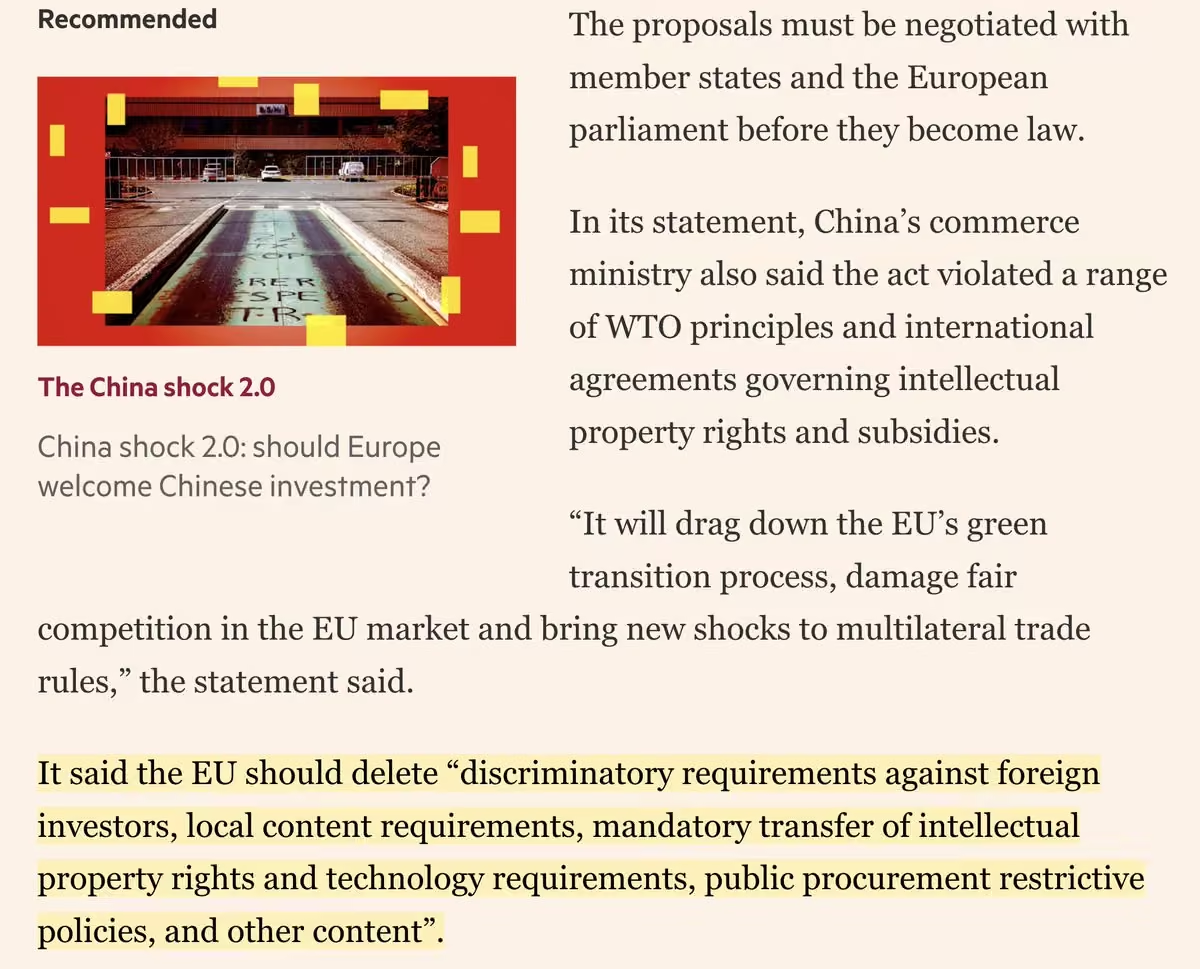
Rush Doshi reposted
John Arnold
@johnarnold
Only way to limit coming AI backlash is to start shifting taxes from labor to compute. The average voter needs to see salient benefits from AI. Today we tax labor > compute (income vs corp tax, depreciation for machines not education, payroll tax, etc). This will have to invert.
Rush Doshi reposted
Brad Setser
@Brad_Setser
A bit of good supply chain news; China no longer has a monopoly on the refining of Samarian, a rare earth with important military uses
1/

Rush Doshi reposted
 Nikkei Asia
@NikkeiAsia
Nissan cuts rare earths used in Leaf EV motor by 90%
New processing tech helps ease reliance on imports from China
asia.nikkei.com/business/automobiles/electric-vehicles/ni…
Rush Doshi reposted
New Left EViews
@NewLeftEViews
The statement is demonstrably false and ahistoric and a distortion of reality but have you considered American imperialism?
Rush Doshi
@RushDoshi
The point at issue here was not US interventionism.
It was Jostein’s flawed claim: “China didn’t actively start looking for weapons in trade policy — such as the critical minerals card — until the first Trump administration applied steep tariffs.”
That statement is demonstrably false and ahistoric, as experts in Chinese foreign policy could easily tell you. Jostein later acknowledges his error: “That said, Rush’s point on the timeline of China’s trade policy should not be dismissed.”
My concern is that Jostein’s argument resembles an increasingly common kind of “neo-orientalism.” The argument is China is and will always be an exception to logics of power because of some innate “Chinese” quality. Never mind that the materialists who built modern China would reject this kind of thinking.
Jostein concedes the economic point but opens a new argument: China is less interventionist than the US.
This is almost certainly true. But it tells us little, because China has also been less powerful than the US. The better test is probably whether it is less interventionist than the other post-war great powers, and those with limited capability, like India. Here, Jostein’s argument is less clear: from Maoist revolution across Africa and Asia (see Peter Van Ness) to the Korean War to island seizures in the South China Sea to escalation against the Soviets to clashes with India on the border, China has exhibited variation across time in its penchant for intervention.
We should keep in mind that intentions do change: The US was not globally interventionist until it was, and China too may change as it pursues overseas military bases, builds a nine-carrier navy, widens its definition of “overseas interests,” and changes its stance on “non-interventionism,” all trends long underway as I discuss in my book The Long Game.
The assumption that great power logics are “Western” is also flawed. Chinese empires, like the Romans and various Indian empires (e.g., Cholas) also pursued economic coercion and intervention.
In sum, rather than assert China is exceptional (the neo-Orientalist move), we should test it dispassionately and with humility about the future. That kind of rigorous analysis is not as common as charged political rhetoric.
Jostein Hauge
@haugejostein
There are weaknesses in Rush’s argument I’d like to address.
China’s search for weapons in trade policy became noticeably more systematic, active, and global in scope after US hawkishness starting in 2018.
That said, Rush’s point on the timeline of China’s trade policy should not be dismissed.
However, China is indeed an exception to great power behaviour. To suggest otherwise is egregious.
China pales in comparison to the US in imperialist behaviour. The US has actively and violently opposed sovereign development in the Global South for decades.
Even if it tried, China could not match the US’s number of military interventions, regime change operations, and measures of economic coercion in and against foreign countries.
Rush Doshi reposted
Thorsten Benner
@thorstenbenner
Rush Doshi's makes strong points on supposed Chinese benign exceptionalism as a great power and the necessary intellectual openess and humility about where things are headed.
It's early days in terms of the new Chinese global expansion.
Rush Doshi
@RushDoshi
The point at issue here was not US interventionism.
It was Jostein’s flawed claim: “China didn’t actively start looking for weapons in trade policy — such as the critical minerals card — until the first Trump administration applied steep tariffs.”
That statement is demonstrably false and ahistoric, as experts in Chinese foreign policy could easily tell you. Jostein later acknowledges his error: “That said, Rush’s point on the timeline of China’s trade policy should not be dismissed.”
My concern is that Jostein’s argument resembles an increasingly common kind of “neo-orientalism.” The argument is China is and will always be an exception to logics of power because of some innate “Chinese” quality. Never mind that the materialists who built modern China would reject this kind of thinking.
Jostein concedes the economic point but opens a new argument: China is less interventionist than the US.
This is almost certainly true. But it tells us little, because China has also been less powerful than the US. The better test is probably whether it is less interventionist than the other post-war great powers, and those with limited capability, like India. Here, Jostein’s argument is less clear: from Maoist revolution across Africa and Asia (see Peter Van Ness) to the Korean War to island seizures in the South China Sea to escalation against the Soviets to clashes with India on the border, China has exhibited variation across time in its penchant for intervention.
We should keep in mind that intentions do change: The US was not globally interventionist until it was, and China too may change as it pursues overseas military bases, builds a nine-carrier navy, widens its definition of “overseas interests,” and changes its stance on “non-interventionism,” all trends long underway as I discuss in my book The Long Game.
The assumption that great power logics are “Western” is also flawed. Chinese empires, like the Romans and various Indian empires (e.g., Cholas) also pursued economic coercion and intervention.
In sum, rather than assert China is exceptional (the neo-Orientalist move), we should test it dispassionately and with humility about the future. That kind of rigorous analysis is not as common as charged political rhetoric.
Jostein Hauge
@haugejostein
There are weaknesses in Rush’s argument I’d like to address.
China’s search for weapons in trade policy became noticeably more systematic, active, and global in scope after US hawkishness starting in 2018.
That said, Rush’s point on the timeline of China’s trade policy should not be dismissed.
However, China is indeed an exception to great power behaviour. To suggest otherwise is egregious.
China pales in comparison to the US in imperialist behaviour. The US has actively and violently opposed sovereign development in the Global South for decades.
Even if it tried, China could not match the US’s number of military interventions, regime change operations, and measures of economic coercion in and against foreign countries.
Rush Doshi
@RushDoshi
It is a kind of orientalism to suggest a China is an exception to typical great power behavior.
China indeed developed tools for economic coercion long ago.
This article written in *2012* discusses several cases of economic coercion from rare earths to salmon to bananas.
 Jostein Hauge
@haugejostein
It's hard to find a geopolitical gambit that has backfired as much as the trade war waged by the US against China since 2018.
China didn't actively start looking for weapons in trade policy — such as the critical minerals card — until the first Trump administration applied steep tariffs.
Sweeping bans and restrictions on semiconductor exports under both Trump and Biden, as well as specific blacklisting of Chinese companies through entity list additions, have motivated Chinese companies to strengthen supply chain resilience and become more innovative.
Huawei, BYD, DeepSeek, SMIC, and COMAC are prime examples of companies where US hawkishness has served as an unintentional innovation catalyst — what some are calling “creative insecurity.”
Of course, the evolution of China's national system of innovation cannot be overlooked here. But US hawkishness toward China has undoubtedly motivated China to seek more leverage in trade policy and innovate faster.
Rush Doshi
@RushDoshi
This statement is demonstrably false and ahistoric.
“China didn't actively start looking for weapons in trade policy — such as the critical minerals card — until the first Trump administration applied steep tariffs.”
Rush Doshi
@RushDoshi
This is factually wrong.
Biden and Xi discussed AI at the Woodside summit in 2023.
They agreed to an AI dialogue there too.
And there were talks on AI at the ministerial level too.
 Mark Halperin
@MarkHalperin
NEWS from my @WSJopinion interview with @SecScottBessent
Treasury officials say that at the Trump-Xi summit in Beijing next month, history will be made. For the first time ever, the leaders of earth’s two greatest powers will discuss AI as an agenda item. Messrs. Trump and Xi will look for areas of mutual cooperation and explore ways to work together on security and threats from nonstate actors.
Full interview here:
www.wsj.com/opinion/scott-bessent-donald-trumps-economic-…
@lizalinwsj @stuartlauchina @danstrumpf @yuanli233 @paulmozur @trippmickle @kateconger @cade_metz @evadou @christian_shep @Cat_Zakrzewski @GerryFShih @DemetriSevast @EleanorOlcott @AnnaNicolau @tabbyleung @parmyolson @daveyalba @jackiewattles @iansking
Rush Doshi
@RushDoshi
"China’s best AI models currently lag behind leading US models by about seven months, potentially slightly more. Seven months is therefore the window to harden America’s entire digital infrastructure before Chinese cyber weapons surpass current US defences."
Chris McGuire
@ChrisRMcGuire
New from me in @FT: "America must guard against China's own Mythos"
Protecting US cybersecurity requires maximizing the US lead over China in AI. Comprehensive export controls could stretch the current US lead in AI from months to years.
A short 🧵:
www.ft.com/content/ea8c8161-5b86-409b-93cf-5e778300d87e
Rush Doshi reposted
Chris McGuire
@ChrisRMcGuire
DeepSeek v4 just dropped. At first glance it does not appear to be the kind of leap that v3 claimed to be in January 2025, nor does it challenge the consensus regarding the state of the U.S.-China AI competition: U.S. models lead by ~7 months, and leading Chinese models remain dependent on U.S. tech. A few quick observations about the paper:
- DeepSeek admits that v4 does not challenge leading U.S. models in performance. DeepSeek admits that v4 trails state-of-the-art frontier models by 3-6 months. It claims v4's reasoning and agentic performance is comparable to GPT 5.2, Gemini 3.0 Pro, and Claude Opus 4.5--which were all released 5-6 months ago. This is broadly consistent with longstanding estimates that U.S. models lead Chinese models by ~7 months. v4 does appear impressive on coding benchmarks (93.5% on LiveCodeBench), but its best results are on benchmarks with known contamination risk that are most easily gamed; even DeepSeek even admits that its internal benchmarks show a larger gap with frontier models in coding capabilities than the public benchmarks do. v4 therefore does not appear to change priors about the state of U.S.-China AI competition.
- DeepSeek v4 is not even clearly the best Chinese model. It appears to have narrow leads over Kimi K2.6 and GLM-5.1 in most benchmarks, although not all. But its lead is marginal, not the step-change over other Chinese models that R1 was. This again is indicative of a model that is largely a status-quo release, not a gamechanger.
- DeepSeek's paper does not discuss what training costs or chips - very likely because it was trained on banned Nvidia Blackwell chips. This stands in stark contrast to DeepSeek's paper for v3, which claimed v3 was trained on 2,000 Nvidia H800 chips for only $5 million (this claim was misleading at best, and potentially outright false). The United States government has already publicly asserted that it knows v4 was trained on Nvidia Blackwell chips, which are banned in China. This is almost certainly why DeepSeek is silent on how it was trained. There is no reason to believe DeepSeek was able to "do more with less" to train v4, they just were able to smuggle in banned chips.
- DeepSeek cannot serve v4 pro widely, as it admits to being compute constrained. In its pricing sheets for the model, DeepSeek notes that "Due to constraints in high-end compute capacity, current service capacity for Pro is very limited" (h/t @jukan05 ). A competitive AI ecosystem requires sufficient compute to both train and widely serve a model. China doesn't appear to have that. A very capable model isn't very useful if it can't be deployed at scale.
Bottom line: DeepSeek v4 appears to be a fine model that may be the best Chinese model by a small amount. It is not competitive with frontier U.S. models, and does not appear to close the gap with the United States in AI. It is entirely consistent with what we already knew: the gap between U.S. and Chinese models is about seven months. And remember, like all other leading Chinese models, v4 was trained using U.S. chips, and on data illicitly distilled from frontier U.S. models. If China fully lost access to U.S. chips and models, not to mention U.S. and allied chipmaking tools, DeepSeek and others would likely fall much farther behind.
Rush Doshi reposted
Council on Foreign Relations
@CFR_org
Deputy USTR Rick Switzer offers remarks on the administration’s trade agenda and American reindustrialization with @RushDoshi at Endless Frontiers, co-hosted by CFR, UT Austin, Texas A&M, Rice University, and Baylor University. x.com/i/broadcasts/1yJAPMbWzWDGb
Rush Doshi
@RushDoshi
Grateful to Amb. Switzer for joining us at @EFRetreat.
We covered what’s it’s like to negotiate a deal, how America lost its industrial base, how to get it back, the role of allies, and why the “Texas Triangle” be “American Shenzhen.”
Tune in here!
Council on Foreign Relations
@CFR_org
Deputy USTR Rick Switzer offers remarks on the administration’s trade agenda and American reindustrialization with @RushDoshi at Endless Frontiers, co-hosted by CFR, UT Austin, Texas A&M, Rice University, and Baylor University. x.com/i/broadcasts/1yJAPMbWzWDGb
Rush Doshi reposted
Council on Foreign Relations
@CFR_org
.@DFC_CEO Ben Black gives his first policy address on the resurrection of US economic statecraft and sits with Demetri Sevastopulo (@AsiaLens) at Endless Frontiers, co-hosted by CFR, UT Austin, Texas A&M, Rice University, and Baylor University. x.com/i/broadcasts/1mxPaLDXbmbKN
Rush Doshi
@RushDoshi
Ben Black speaking live right now at Endless Frontiers on “the resurrection of American statecraft.”
A mix of history, China analysis, and policy detail on DFC’s emerging role.
Tune in below.
Rush Doshi
@RushDoshi
CLOSING TONIGHT: @DFC_CEO Ben Black gives his first policy address on the resurrection of US economic statecraft and sits with Demetri Sevastopulo (@AsiaLens) at Endless Frontiers, co-hosted by the @CFR_org, UT Austin, Texas A&M, Rice, and Baylor. youtube.com/live/8W_wxIe45fg

Rush Doshi reposted
Eric Sayers
@DEricSayers
New from @PLMattis
“The U.S. needs to take more seriously the threat posed by Chinese companies gathering information via the Internet-of-Things.” www.thewirechina.com/2026/04/19/how-to-counter-chinas-dat…
Rush Doshi reposted
Council on Foreign Relations
@CFR_org
LIVE: America is back in the business of moonshots. Join Kennedy Space Center Director Janet Petro and former Astronaut Chris Cassidy in conversation with @SangerNYT at Endless Frontiers, co-hosted by CFR, UT Austin, Texas A&M, Rice, and Baylor. x.com/i/broadcasts/1pJdRbPBMYvKW
Rush Doshi reposted
Council on Foreign Relations
@CFR_org
Advisor to the President, Founder/Partner at Craft and Co-Host of All In podcast @davidsacks47 sits with Morgan Hitzig at Endless Frontiers, co-hosted by CFR, UT Austin, Texas A&M, Rice University, and Baylor University. x.com/i/broadcasts/1DGleEkNoelJL
Rush Doshi
@RushDoshi
David Sacks is speaking live now at Endless Frontiers. Tune in below.
Rush Doshi
@RushDoshi
NEXT UP: Advisor to the President, Founder/Partner at Craft and Co-Host of All In podcast @davidsacks47 sits with Morgan Hitzig at Endless Frontiers, co-hosted by the @CFR_org, UT Austin, Texas A&M, Rice, and Baylor. youtube.com/live/H6PVPsLtScM
 Rush Doshi
@RushDoshi
Tonight marks the launch of Endless Frontiers, our second annual retreat focused on renewing American strength at a time of unprecedented upheaval.
EF is co-hosted by @CFR_org, UT Austin, Texas A&M, Rice University, and Baylor University.
Join our keynote sessions live!
 Rush Doshi
@RushDoshi
NEXT UP: Advisor to the President, Founder/Partner at Craft and Co-Host of All In podcast @davidsacks47 sits with Morgan Hitzig at Endless Frontiers, co-hosted by the @CFR_org, UT Austin, Texas A&M, Rice, and Baylor. youtube.com/live/H6PVPsLtScM
Rush Doshi
@RushDoshi
CLOSING TONIGHT: @DFC_CEO Ben Black gives his first policy address on the resurrection of US economic statecraft and sits with Demetri Sevastopulo (@AsiaLens) at Endless Frontiers, co-hosted by the @CFR_org, UT Austin, Texas A&M, Rice, and Baylor. youtube.com/live/8W_wxIe45fg
Rush Doshi
@RushDoshi
LIVE PODCAST: In a live episode of The Long Game, Jake Sullivan and Jon Finer interview Breakneck Author @danwwang on the techno-industrial competition with China at Endless Frontiers, co-hosted by @CFR_org, UT Austin, Texas A&M, Rice, and Baylor. youtube.com/live/zWnfUhQjCBs
 Rush Doshi
@RushDoshi
THURSDAY: LIVE: Undersecretary of State for Economic Affairs Jacob Helberg (@UnderSecE ) sits for a fireside chat with Axios Managing Editor @DavidLawler10, co-hosted by the Council on Foreign Relations, UT Austin, Texas A&M, Rice University, and Baylor University.
 Rush Doshi
@RushDoshi
LATER TONIGHT: @DFC_CEO Ben Black gives his first policy address on the resurrection of US economic statecraft and sits with Demetri Sevastopulo (@AsiaLens) at Endless Frontiers, co-hosted by the @CFR_org, UT Austin, Texas A&M, Rice, and Baylor. youtube.com/live/8W_wxIe45fg

Rush Doshi reposted
 Howard Wang 王昊
@howardgwang
My new article in the Journal of Contemporary China examines China's strategy of "total war" 总体战 as implemented by its integrated national strategic system and capability 一体化国家战略体系和能力, looking at CCP sources.
A thread below.
www.tandfonline.com/doi/full/10.1080/10670564.2026.2662561
 Rush Doshi
@RushDoshi
Grateful to @RanaForoohar for referencing what Kurt Campbell and I call "allied scale" in her excellent column on why "the US and Europe are still stronger together."
She also rightly notes that even the Trump team accepts "allied scale" in shipbuilding and critical minerals.
"As former Joe Biden advisers and China experts Kurt Campbell and Rush Doshi have written, “allied scale”, in the form of economic and industrial partnerships between the US, Europe and large middle-sized countries, would represent more than twice Chinese GDP. It would also create far more resilience across crucial supply chains. The US, after all, is the only player outside China with a competitive advantage in AI, technology that will transform every industry and desperately needs to be underwritten with European values. Unless that happens, the world will have only two options — control by American oligarchs or Chinese mercantilists....But even the Trump administration knows that the US can’t go it alone. Its efforts to develop a global critical mineral alliance to combat Chinese hoarding is an admission of that. The same is true of its new maritime strategy — including a 2027 budget request for $65.8bn in new shipbuilding money — that will require working with partners in South Korea and Japan as well as Europe."
 Financial Times
@FT
The US and Europe are still stronger together ft.trib.al/Rdt12Uk
Rush Doshi
@RushDoshi
“Now that compute is in extremely short supply in the U.S….you really have to galaxy brain your way into arguing that selling AI chips to China today, rather than to U.S. companies that are desperate for them, is a good idea for the United States.”
Chris McGuire
@ChrisRMcGuire
This narrative that export controls on AI chips only make sense if the U.S. hits AGI is just plain incorrect. The motivating logic was and still is: compute matters and will continue to matter (regardless of whether AI models reach AGI, ASI, or are just plain old really good), the U.S. has robust and enduring advantages in compute that are likely to last at least a decade and maybe more, AI will get much better over that decade, and we can maximize our advantages over China by maximizing our advantages in compute.
China is not going to catch up to the U.S. in compute in two years, but also isn’t going to slow down its efforts to catch up. And even if we don’t have AGI but AI is incredibly important economically and militarily (which it already is), we want to have as large of a lead over China as we can.
Plus, now that compute is in extremely short supply in the U.S., doesn’t that just make the entire export controls debate extraordinarily simple? At this point, you really have to galaxy brain your way into arguing that selling AI chips to China today, rather than U.S. companies that are desperate for them, is a good idea for the United States.
Rush Doshi reposted
Jennifer Doshi Welch
@geoeconjennie
Honored to have been on @CNNThisMorning with @EricaRHill to discuss the economic impact of the Iran war. Even with signs a deal could be imminent, traffic through the Strait of Hormuz remains at a standstill, with real pain spreading through the global economy.
 Rush Doshi
@RushDoshi
Remarkable episode that shows why @dwarkesh_sp is one of the best interviewers around.
He admits no view on whether we should export chips to China and patiently probes Jensen Huang's assumptions.
The result is a truly revealing exchange and required viewing.
 Dwarkesh Patel
@dwarkesh_sp
The Jensen Huang episode.
0:00:00 – Is Nvidia’s biggest moat its grip on scarce supply chains?
0:16:25 – Will TPUs break Nvidia’s hold on AI compute?
0:41:06 – Why doesn’t Nvidia become a hyperscaler?
0:57:36 – Should we be selling AI chips to China?
1:35:06 – Why doesn’t Nvidia make multiple different chip architectures?
Look up Dwarkesh Podcast on YouTube, Apple Podcasts, Spotify, etc. Enjoy!
Rush Doshi reposted
Brad Setser
@Brad_Setser
My work on this earth may be nearly over -- or at least my work of the last 4ys could be in its final chapter.
The FT's Big Read is on the China sock 2.0 (one of my favorite phrases) and the pink paper endorsed the concept of "shadow reserves"!
1/
 Rush Doshi
@RushDoshi
The Biden Administration was obviously right to enact a bipartisan policy of export controls that (successfully) ensured these new cyber capabilities would be in American hands first -- the better to use it to secure our own critical infrastructure before adversaries get it.
That is a direct benefit of export controls for the American people. Every day, they unknowingly, use water, power, gas, telecom, and transportation systems that have been compromised by PRC cyber actors (among others). This now helps us ensure those systems are secure.
Those saying we should share this capability forget companies like Microsoft already shared pre-patch vulnerability information with Chinese companies, who were required by law to pass it to the MSS, who then weaponized it against us before we patched, harming Americans.
People raised this issue for years. I testified about it in 2024. Microsoft actually wrote reports about it too. Finally, Microsoft stopped sharing that information in 2025 with the PRC.
Why would sharing Mythos, as some suggest, or allowing our most exquisite chips to go to China, be prudent?
I strongly support dialogue on AI with the PRC. We started it under President Biden. By the way, starting it did not require unilateral concessions, nor should it now.
And in the mean time, the right approach is to use our lead to harden ourselves for a world of AI-enabled cyber offense.
 AI Security Institute (AISI)
@AISecurityInst
We conducted cyber evaluations of Claude Mythos Preview and found that it is the first model to complete an AISI cyber range end-to-end. 🧵

Rush Doshi reposted
Michael Lucci
@Michael7ucci
So you do like some David Sackses
Rush Doshi
@RushDoshi
The China Strategy Initiative's resident Taiwan expert David Sacks is in Taipei right now, leading a CFR delegation.
This is the first foreign delegation to meet KMT Chair Cheng Li-wun since her sit-down with Xi three days ago.
David Sacks
@DavidMSacks1
Thank you @kuomintang Chair Cheng Li-wun for receiving our @CFR_org delegation - the first foreign delegation that she received after meeting with Xi Jinping. We enjoyed the opportunity to exchange views on U.S.-Taiwan and cross-Strait relations.

Rush Doshi reposted
 Jack Taggart
@drjacktaggart
New article in @RIPEJournal w/ @hancheng_528 and @SebHaug on China's new Global Development Initiative (GDI). We contend that it is a case of institutional layering that is part of China's broader counter-hegemonic strategy. Open access too! www.tandfonline.com/doi/full/10.1080/09692290.2026.264694…

Rush Doshi reposted
Georgetown SFS
@georgetownsfs
SFS Prof @RushDoshi joined @dwnews to weigh in on a potential China-imposed military quarantine on Taiwan. He explains how it would work and the risks it would pose for the global economy in light of Taiwan’s centrality to supply chains.
Watch here: www.youtube.com/watch?v=lLUm7CHCEFo
Rush Doshi reposted
Chris McGuire
@ChrisRMcGuire
This report lacked crucial data and context; Chinese data centers pose zero threat to U.S. competitiveness and lag far behind the United States. The 10,000 chip cluster that Alibaba announced is 1% of the size of the biggest U.S. cluster. The Malaysia cluster that @KristinaParts spoke of was for only 3,000 chips, and that announcement even got walked back by the Malaysian government last year. Today there are still no known clusters of Huawei Ascend AI chips operating outside of China. The data matters! @CNBC
 Kristina Partsinevelos
@KristinaParts
China is building an AI stack without Nvidia — and now it's exporting it. Alibaba up 5% after launching a data center on its own $BABA chips. DeepSeek's next model runs on Huawei. The threat to $NVDA isn't just lost sales anymore. More here:
www.cnbc.com/video/2026/04/08/chinas-ai-stack-starts-to-t…
Rush Doshi reposted
 Rafe Fletcher
@fletcher_rt
How China could weaponise the Taiwan Strait - @RushDoshi outlines how China may assert sovereignty under innocuous pretext e.g. anti-smuggling coastguard checks. A slow strangling of Taiwanese autonomy, as nations submit to secure supply chains.
 Richard Walker
@rbsw
Could the US handle a Taiwan contingency at a time like this?
A Chinese quarantine of Taiwan would present the US & the world with huge dilemmas about how to respond
Walking through how a scenario could unfold with @RushDoshi
youtu.be/lLUm7CHCEFo
Rush Doshi
@RushDoshi
Most Taiwan analyses focuses on invasion or blockade scenarios. But the quarantine - which is arguably more likely and far less studied - needs greater attention.
Below, a link to my conversation on a PRC quarantine of Taiwan with @DW's Richard Walker.
Richard Walker
@rbsw
Could the US handle a Taiwan contingency at a time like this?
A Chinese quarantine of Taiwan would present the US & the world with huge dilemmas about how to respond
Walking through how a scenario could unfold with @RushDoshi
youtu.be/lLUm7CHCEFo
Rush Doshi reposted
Thorsten Benner
@thorstenbenner
Not sure I am following you here. What anger? A Europe that takes economic security seriously is also a better partner for the US. Any smart US government realizes what @RushDoshi continues to emphasize (& what Trump team realizes re: CRM): the need for allied scale.
Rush Doshi reposted
 Jennifer Pahlka
@pahlkadot
I remember when the City of Boston had their Code for America fellows staff the 311 call center. It blew their minds. I said at the time that every leader should do that. Bad on me for not saying that louder.
Damn, Mamdani is good.
Mayor Zohran Kwame Mamdani
@NYCMayor
Ever wonder how to get rid of a mattress? Or how to find resources for a neighbor in need? Call 311.
311 is contacted 100,000 times every day, 7 days a week, 52 weeks a year. Everything from potholes to trash schedules; they're available to answer your non-emergency calls any hour of the day. No call is too small for @nyc311.
So on the anniversary of 311 (3/11), I decided to answer some of those calls myself.
Rush Doshi reposted
 Peter Harrell
@petereharrell
Reports of a sudden, widespread shutdown of Baidu robotaxis in China drives home the security vulnerabilities of connected cars and why the US restricts Chinese connected vehicles. This outage likely an accident, but imagine what China could do with cars in the US in a conflict.

Rush Doshi reposted
Joseph Torigian
@JosephTorigian
"We've never had anything like this before. They are priceless for people who want to study the People's Republic of China," said Joseph Torigian, an associate professor at American University who used the diaries in the Hoover archive while researching a biography of Chinese leader Xi Jinping's father.
 james t. areddy
@jamestareddy
Diaries of Li Rui, an aide to China's Mao Zedong, will remain at Stanford's Hoover Institution www.wsj.com/world/china/u-s-court-ruling-keeps-mao-docume… via @WSJ
Rush Doshi reposted
Tom Shugart
@tshugart3
🚨🚨🚨 BREAKING - Air Force finally gets it on hardening: apparently the new 1.5T defense budget request is going to include major and accelerated air base hardening programs. 👍🙏🫡


Rush Doshi reposted
 Jonathon P Sine
@JonathonPSine
An open source website on the Chinese Communist Party elite, with data visualizations. Every Central Committee (4,324), Politburo (168), and PBSC member from 1945–Present.
All data available for download, as promised. Link and some standout charts below🧵

Rush Doshi reposted
Brad Setser
@Brad_Setser
I am a big fan of Chartbook and the collected works of Tooze -- but there is no way to look at China over the last 6 years and conclude that it has been a source of demand for the global economy
 Rush Doshi
@RushDoshi
Interesting Bloomberg Interview with USTR Greer this morning ahead of the Trump-Xi Summit:
Three takeaways:
(1) Rare earths can be managed at the working level: "The Presidents will talk about if they need to, our hope and expectation is we're able to manage a lot of it between now and then at the staff level."
(2) No Cabinet-level meetings with China ahead of the summit: "I don't think we're going to need to do that [meet counterparts again before the summit]. When were in Paris we reached general agreement on the types of outcomes we want for the leaders meeting. Our deputies and our staff are in regular communication to land those outcomes."
(3) Board of Trade is a main deliverable: "We've been talking about a Board of Trade which will be a mechanism to help manage trade. Over the past ten years or so as the United States has tried to eliminate the trade deficit with China, figure out the export control situation, if we can formalize the mechanism a little bit to make sure we can agree on things we are selling to each other - for the US we want to sell Boeing, medical devices, pharmaceuticals, ag products - the Chinese want to sell things to us like low-tech consumer goods, commodities. Establishing that type of mechanism...is going to be a big deliverable."
Rush Doshi reposted
 Dr China Bore (PhD)
@Mcb18125448
important - have to seed and cultivate an entire ecosystem and get pilot technologies and early-stage of commercialization across the valley of death
Rush Doshi
@RushDoshi
On Wednesday, I testified before the House Small Business Committee on China.
Bottom Line: We obsess over China's tech giants. But we miss the small firms behind its manufacturing ecosystem. China built a program to make them world-beaters, and ours now face existential risk.
Five points:
1️⃣ China's "Little Giants" (小巨人) program is one of its most consequential industrial policy programs — but few know much about it . A decade ago, Beijing made clear small businesses were critical to winning the fourth industrial revolution and important parts of the Made in China 2025 plan. So it built a system for them. It certified the most promising high-tech firms as "Little Giants," then handed them loans, subsidies, state equity investment, university research partnerships, fast-tracked patents, guaranteed contracts from state-owned enterprises, and streamlined stock listings — all in one coordinated package. Today, more than 17,000 Chinese firms hold that designation. 90% are in high-tech manufacturing. Together they raised $125 billion in private capital in just a few years. One of them is Unitree Robotics, now a global titan.
2️⃣ Our efforts to help small manufacturers through the Small Business Administration (SBA) simply do not compare to China's "Little Giants" program. China funds early-stage research through state institutes — we let our equivalent programs, SBIR and STTR, lapse. China packages loans, equity, and R&D into a single coordinated certification — we run countless uncoordinated initiatives with no common thread. China's little giants raised $125+ billion in private capital with implicit state backing — the first cohort of our SBIC Critical Technologies Initiative might raise $4 billion. China provides low-cost loans at scale — we haven't raised the loan caps or appropriations for our own manufacturer credit program. China deploys technical assistance to thousands of firms through universities and state institutes — we just cut the Manufacturing Extension Partnership and effectively shuttered its key offices. At every level, there is a "gap" between our approach and theirs.
3️⃣ Small businesses matter because they are the path to American reindustrialization. Large firms dominate U.S. manufacturing and have for decades. But small businesses enable them. 70% of Boeing's Dreamliner comes from smaller suppliers. 60% of all aerospace and defense employment is in small and mid-sized firms. The story is similar in automotives. We cannot win the industrial future if we do not empower our small businesses.
4️⃣ China is far ahead in manufacturing, and expanding the lead. By some estimates, China spends roughly $400 billion on industrial policy per year. The entire US CHIPS Act provided $50 billion over multiple years. Since China's WTO accession, our share of global manufacturing has fallen by half — from 30% to 15% — while China's quintupled from 6% to 30%. It now exceeds the next nine countries combined. It's not exactly slowing down.
5⃣ Here's what we should do. Immediately reauthorize SBIR and STTR. Launch an American one-stop-shop certification that bundles loans, equity, R&D support, and regulatory relief into one coordinated package. Scale up the SBIC Critical Technologies Initiative. Raise the quantity and caps for the SBA's Manufacturer's Access to Revolving Credit program. Restore the Manufacturing Extension Partnership. And give the SBA the mandate to deploy all of these together — the way China does. This is just a start, and a comprehensive answer to China's programs will require even more.
The SBA has plenty of tools. What it lacks is the architecture to coordinate the use them. China built that architecture. It is working.
Thanks to @HouseSmallBiz for the opportunity and grateful to join Andrew Pahutski, Sean Murphy, and Tom Lyons for the hearing.
Rush Doshi
@RushDoshi
More details available here: smallbusiness.house.gov/news/documentsingle.aspx?Document…
Rush Doshi
@RushDoshi
Heartily endorse Evan’s book, which grows more relevant with every passing day.
 Evan A. Feigenbaum
@EvanFeigenbaum
For decades — a hugely important point … And they have been doing this for decades. My 2003 book, “China’s Techno-Warriors,” covered some of this in the pre-2000s context. A lot has accelerated and evolved in China but the conceptual and intellectual roots both of Chinese technonationalism and of treating technology as an inherently strategic good goes WAY back in the People’s Republic of China and, in some sense, even further. www.sup.org/books/asian-studies/chinas-techno-warriors
Rush Doshi
@RushDoshi
Jamie Dimon endorses industrial policy for manufacturing.
The logic is undeniable.
Now the questions are on how, not whether.
 Madeline Renbarger
@maddierenbarger
JPMorgan CEO Jamie Dimon says the race to beat China in manufacturing can’t just be won by competition at this rate. “I think you have to use industrial policy now—I say that reluctantly.”
 Rush Doshi
@RushDoshi
This 200-page report on Biden China policy by
@CChivvis and Senkai Hsia better understands the nuance of the administration's approach than most others.
The report is critical in some places, but it rightly captures that the Biden approach was neither declinist accommodation nor reckless confrontation. Critics too often caricature it as one or the other, which is itself revealing.
In the report's view, and in my own, the Biden approach was competitive - to secure real American interests - while also focusing on managing that competition through intense diplomacy. That is a formula that can work for the future.
And interestingly, there seems to be some general bipartisan support for it.
A few points:
1) Competition isn't a "choice" but a reality that emerges from conflicting interests. The Biden Administration did not "pursue" competition but realized it as inherent, sought to compete well, and sought to manage the competition.
2) The approach generally worked. The U.S. took far more "competitive actions" in the last two years of the administration and the relationship was actually better than in the first two years because of intensified diplomatic interaction to manage those differences.
3) A few are seeking "space" for a new approach, which is certainly welcome, but I often find those calling for it make two moves implicitly or explicitly. First, they too often emphasize the quality of "the relationship" over the interests we want to secure, when both must be balanced. Second, to the extent they put forward any approach, they usually put forward something that resembles "managed competition" anyway.
That is sort of gravitational, because the alternative is to either abandon interests (i.e., avoid competition) or to welcome escalation (i.e., avoid management). To be clear, at the tactical level, there are many issues that require debate. The balance between these competition and management is not scientific. But at the strategic level, "managed competition" seems to be where most land.

 Carnegie Endowment
@CarnegieEndow
The U.S.-China relationship has been one of the most highly charged issues of President Trump's second term. What lessons can be learned from his predecessor?
@CChivvis and @mrworldwide1701 unpacked President Biden's China policy in a new report: carnegieendowment.org/research/2026/03/implementing-the-b…
Rush Doshi
@RushDoshi
Link here to the report: carnegieendowment.org/research/2026/03/implementing-the-b…
For some of my past writing on this, see the following: foreignaffairs.com/responses/what-does-america-want-china…
For a useful podcast, with a transcript, see this: cfr.org/podcasts/presidents-inbox/americas-china-strategy…
Rush Doshi reposted
Eric Sayers
@DEricSayers
Another one of those “when @Jim_Banks and @SenWarren agree” issues…
Demetri
@AsiaLens
EXCLUSIVE Senators call on Trump administration commerce department to suspend licenses to export Nvidia chips to China and parts of Southeast Asia after Supermicro smuggling case.
www.ft.com/content/556e534d-bbc5-46e0-8965-ec3a13a8871a?s…
Rush Doshi
@RushDoshi
Key point from Zongshuai Fan in the @SCMPNews.
Pushing China to change its industrial policy is a fool's errand.
Better, instead, to build one's own state capacity to deliver equivalent results.

Rush Doshi reposted
Demetri
@AsiaLens
PM Abe was a master at flattering Trump. Takaichi may be even better 👇
 Fox News
@FoxNews
JAPANESE PM SANAE TAKAICHI draws laughs with birthday wish for Barron Trump:
"Tomorrow is the birthday of your son, Mr. Barron Trump, and I know he has grown up so much into a very tall, good-looking gentleman."
"And when I see you, Donald, it is very clear where he got it — Of course, from his parents. There's no doubt about it."
Rush Doshi reposted
 Rodney Faraon 方德 寜
@rfaraon
Listen to the man, @RushDoshi
Rush Doshi
@RushDoshi
On Tuesday, I testified before the House Homeland Security Committee on China's strides in robotics and AI. I warned that we lost solar, batteries, and EVs -- now we're at risk of losing robotics and AI.
If that happens, it would irreversibly change the balance of power.
Five points:
1️⃣ China aims to win the next industrial revolution. PRC leaders believe history is shaped by industrial revolutions. The first, steam power, made Britain dominant. The second and third, electrification and mass manufacturing, made America dominant. China is determined to win the fourth.
2️⃣ In robotics, China is already winning. In 2024, China installed 300,000 new industrial robots. America installed 30,000. China now has over 2 million robots in its factories — five times more than the US. A decade ago, it imported 75% of its robots. Today it makes 60% domestically. This year alone, China may spend $400 billion on industrial policy. The entire US CHIPS Act provided $50 billion across multiple years. If we fall behind here, U.S. reindustrialization becomes farfetched.
3️⃣ In AI, we're ahead — but selling off the advantage. China has more energy, more talent, and makes the edge devices. But America still leads because of chips, according to China's own AI companies. US chips are 4-5x better than China's today. We are debating whether to surrender that edge.
4️⃣ We are inviting risks of cyberespionage and catastrophic cyberattacks. PRC law requires its companies to cooperate with intelligence services and never disclose it. Today's robots carry LiDAR, microphones, and cameras — they are mobile surveillance platforms. But the bigger risk is cyberattack. We know China has compromised our power, gas, water, telecommunications, and transportation infrastructure in preparation for cyberattack. We cannot deploy robots in sensitive facilities from the very country targeting those facilities.
5️⃣ Here's what we must do. Extend ICTS rules to cover Chinese robots. Direct CISA to audit where they're deployed in critical infrastructure. Ban federal procurement of Chinese robotics and AI. Strengthen semiconductor export controls. Stop treating American AI companies with more regulatory scrutiny than Chinese ones. And build allied scale in robotics—a trading bloc with preferential terms for the members that can rival China's scale in in the sector.
Thanks to @HomelandDemsIt and @HomelandGOP for the hearing on this topic, and grateful to join @MRobbinsAUVSI and colleagues from Scale and Boston Dynamics for a great discussion.
Rush Doshi reposted
 Zachary Keck
@ZacharyKeck
We should have jumped on industrial robots. Need a bigger CHIPS Act geared towards reindustrializing America with robots
Rush Doshi
@RushDoshi
On Tuesday, I testified before the House Homeland Security Committee on China's strides in robotics and AI. I warned that we lost solar, batteries, and EVs -- now we're at risk of losing robotics and AI.
If that happens, it would irreversibly change the balance of power.
Five points:
1️⃣ China aims to win the next industrial revolution. PRC leaders believe history is shaped by industrial revolutions. The first, steam power, made Britain dominant. The second and third, electrification and mass manufacturing, made America dominant. China is determined to win the fourth.
2️⃣ In robotics, China is already winning. In 2024, China installed 300,000 new industrial robots. America installed 30,000. China now has over 2 million robots in its factories — five times more than the US. A decade ago, it imported 75% of its robots. Today it makes 60% domestically. This year alone, China may spend $400 billion on industrial policy. The entire US CHIPS Act provided $50 billion across multiple years. If we fall behind here, U.S. reindustrialization becomes farfetched.
3️⃣ In AI, we're ahead — but selling off the advantage. China has more energy, more talent, and makes the edge devices. But America still leads because of chips, according to China's own AI companies. US chips are 4-5x better than China's today. We are debating whether to surrender that edge.
4️⃣ We are inviting risks of cyberespionage and catastrophic cyberattacks. PRC law requires its companies to cooperate with intelligence services and never disclose it. Today's robots carry LiDAR, microphones, and cameras — they are mobile surveillance platforms. But the bigger risk is cyberattack. We know China has compromised our power, gas, water, telecommunications, and transportation infrastructure in preparation for cyberattack. We cannot deploy robots in sensitive facilities from the very country targeting those facilities.
5️⃣ Here's what we must do. Extend ICTS rules to cover Chinese robots. Direct CISA to audit where they're deployed in critical infrastructure. Ban federal procurement of Chinese robotics and AI. Strengthen semiconductor export controls. Stop treating American AI companies with more regulatory scrutiny than Chinese ones. And build allied scale in robotics—a trading bloc with preferential terms for the members that can rival China's scale in in the sector.
Thanks to @HomelandDemsIt and @HomelandGOP for the hearing on this topic, and grateful to join @MRobbinsAUVSI and colleagues from Scale and Boston Dynamics for a great discussion.
Rush Doshi reposted
 Brian Gordon
@GordonBrianR
There are no natural Ricardian advantages on the innovation frontier.
The federal government needs to prioritize industrial policy for robotics and AI (and relevant supply networks).
And we need to coordinate with our allies and partners in this.
Rush Doshi
@RushDoshi
On Tuesday, I testified before the House Homeland Security Committee on China's strides in robotics and AI. I warned that we lost solar, batteries, and EVs -- now we're at risk of losing robotics and AI.
If that happens, it would irreversibly change the balance of power.
Five points:
1️⃣ China aims to win the next industrial revolution. PRC leaders believe history is shaped by industrial revolutions. The first, steam power, made Britain dominant. The second and third, electrification and mass manufacturing, made America dominant. China is determined to win the fourth.
2️⃣ In robotics, China is already winning. In 2024, China installed 300,000 new industrial robots. America installed 30,000. China now has over 2 million robots in its factories — five times more than the US. A decade ago, it imported 75% of its robots. Today it makes 60% domestically. This year alone, China may spend $400 billion on industrial policy. The entire US CHIPS Act provided $50 billion across multiple years. If we fall behind here, U.S. reindustrialization becomes farfetched.
3️⃣ In AI, we're ahead — but selling off the advantage. China has more energy, more talent, and makes the edge devices. But America still leads because of chips, according to China's own AI companies. US chips are 4-5x better than China's today. We are debating whether to surrender that edge.
4️⃣ We are inviting risks of cyberespionage and catastrophic cyberattacks. PRC law requires its companies to cooperate with intelligence services and never disclose it. Today's robots carry LiDAR, microphones, and cameras — they are mobile surveillance platforms. But the bigger risk is cyberattack. We know China has compromised our power, gas, water, telecommunications, and transportation infrastructure in preparation for cyberattack. We cannot deploy robots in sensitive facilities from the very country targeting those facilities.
5️⃣ Here's what we must do. Extend ICTS rules to cover Chinese robots. Direct CISA to audit where they're deployed in critical infrastructure. Ban federal procurement of Chinese robotics and AI. Strengthen semiconductor export controls. Stop treating American AI companies with more regulatory scrutiny than Chinese ones. And build allied scale in robotics—a trading bloc with preferential terms for the members that can rival China's scale in in the sector.
Thanks to @HomelandDemsIt and @HomelandGOP for the hearing on this topic, and grateful to join @MRobbinsAUVSI and colleagues from Scale and Boston Dynamics for a great discussion.
Rush Doshi
@RushDoshi
Is Jeff Bezos reindustrialization-pilled?
One can hope.
The Wall Street Journal
@WSJ
Breaking: Jeff Bezos is in talks to raise $100 billion for a new fund that would buy manufacturing companies and use AI to automate them www.wsj.com/tech/jeff-bezos-aims-to-raise-100-billion-to-…
Rush Doshi reposted
Michael McFaul
@McFaul
Professor @RushDoshi outlines in detail the biggest challenge to American interests in the 21st century. Yet, instead of focusing on China, Trump has launched another war of choice in the Middle East. Good way to lose the 21st century.
Rush Doshi
@RushDoshi
On Tuesday, I testified before the House Homeland Security Committee on China's strides in robotics and AI. I warned that we lost solar, batteries, and EVs -- now we're at risk of losing robotics and AI.
If that happens, it would irreversibly change the balance of power.
Five points:
1️⃣ China aims to win the next industrial revolution. PRC leaders believe history is shaped by industrial revolutions. The first, steam power, made Britain dominant. The second and third, electrification and mass manufacturing, made America dominant. China is determined to win the fourth.
2️⃣ In robotics, China is already winning. In 2024, China installed 300,000 new industrial robots. America installed 30,000. China now has over 2 million robots in its factories — five times more than the US. A decade ago, it imported 75% of its robots. Today it makes 60% domestically. This year alone, China may spend $400 billion on industrial policy. The entire US CHIPS Act provided $50 billion across multiple years. If we fall behind here, U.S. reindustrialization becomes farfetched.
3️⃣ In AI, we're ahead — but selling off the advantage. China has more energy, more talent, and makes the edge devices. But America still leads because of chips, according to China's own AI companies. US chips are 4-5x better than China's today. We are debating whether to surrender that edge.
4️⃣ We are inviting risks of cyberespionage and catastrophic cyberattacks. PRC law requires its companies to cooperate with intelligence services and never disclose it. Today's robots carry LiDAR, microphones, and cameras — they are mobile surveillance platforms. But the bigger risk is cyberattack. We know China has compromised our power, gas, water, telecommunications, and transportation infrastructure in preparation for cyberattack. We cannot deploy robots in sensitive facilities from the very country targeting those facilities.
5️⃣ Here's what we must do. Extend ICTS rules to cover Chinese robots. Direct CISA to audit where they're deployed in critical infrastructure. Ban federal procurement of Chinese robotics and AI. Strengthen semiconductor export controls. Stop treating American AI companies with more regulatory scrutiny than Chinese ones. And build allied scale in robotics—a trading bloc with preferential terms for the members that can rival China's scale in in the sector.
Thanks to @HomelandDemsIt and @HomelandGOP for the hearing on this topic, and grateful to join @MRobbinsAUVSI and colleagues from Scale and Boston Dynamics for a great discussion.
Rush Doshi reposted
Victor Shih
@vshih2
Very important to listen to. Agree with the analysis of China’s intentions. But our main policy to address should be tax and other incentives for US and even MNCs to buy American robotics
Rush Doshi
@RushDoshi
On Tuesday, I testified before the House Homeland Security Committee on China's strides in robotics and AI. I warned that we lost solar, batteries, and EVs -- now we're at risk of losing robotics and AI.
If that happens, it would irreversibly change the balance of power.
Five points:
1️⃣ China aims to win the next industrial revolution. PRC leaders believe history is shaped by industrial revolutions. The first, steam power, made Britain dominant. The second and third, electrification and mass manufacturing, made America dominant. China is determined to win the fourth.
2️⃣ In robotics, China is already winning. In 2024, China installed 300,000 new industrial robots. America installed 30,000. China now has over 2 million robots in its factories — five times more than the US. A decade ago, it imported 75% of its robots. Today it makes 60% domestically. This year alone, China may spend $400 billion on industrial policy. The entire US CHIPS Act provided $50 billion across multiple years. If we fall behind here, U.S. reindustrialization becomes farfetched.
3️⃣ In AI, we're ahead — but selling off the advantage. China has more energy, more talent, and makes the edge devices. But America still leads because of chips, according to China's own AI companies. US chips are 4-5x better than China's today. We are debating whether to surrender that edge.
4️⃣ We are inviting risks of cyberespionage and catastrophic cyberattacks. PRC law requires its companies to cooperate with intelligence services and never disclose it. Today's robots carry LiDAR, microphones, and cameras — they are mobile surveillance platforms. But the bigger risk is cyberattack. We know China has compromised our power, gas, water, telecommunications, and transportation infrastructure in preparation for cyberattack. We cannot deploy robots in sensitive facilities from the very country targeting those facilities.
5️⃣ Here's what we must do. Extend ICTS rules to cover Chinese robots. Direct CISA to audit where they're deployed in critical infrastructure. Ban federal procurement of Chinese robotics and AI. Strengthen semiconductor export controls. Stop treating American AI companies with more regulatory scrutiny than Chinese ones. And build allied scale in robotics—a trading bloc with preferential terms for the members that can rival China's scale in in the sector.
Thanks to @HomelandDemsIt and @HomelandGOP for the hearing on this topic, and grateful to join @MRobbinsAUVSI and colleagues from Scale and Boston Dynamics for a great discussion.
Rush Doshi reposted
Isaac Stone Fish
@isaacstonefish
Very thoughtful:
Rush Doshi
@RushDoshi
On Tuesday, I testified before the House Homeland Security Committee on China's strides in robotics and AI. I warned that we lost solar, batteries, and EVs -- now we're at risk of losing robotics and AI.
If that happens, it would irreversibly change the balance of power.
Five points:
1️⃣ China aims to win the next industrial revolution. PRC leaders believe history is shaped by industrial revolutions. The first, steam power, made Britain dominant. The second and third, electrification and mass manufacturing, made America dominant. China is determined to win the fourth.
2️⃣ In robotics, China is already winning. In 2024, China installed 300,000 new industrial robots. America installed 30,000. China now has over 2 million robots in its factories — five times more than the US. A decade ago, it imported 75% of its robots. Today it makes 60% domestically. This year alone, China may spend $400 billion on industrial policy. The entire US CHIPS Act provided $50 billion across multiple years. If we fall behind here, U.S. reindustrialization becomes farfetched.
3️⃣ In AI, we're ahead — but selling off the advantage. China has more energy, more talent, and makes the edge devices. But America still leads because of chips, according to China's own AI companies. US chips are 4-5x better than China's today. We are debating whether to surrender that edge.
4️⃣ We are inviting risks of cyberespionage and catastrophic cyberattacks. PRC law requires its companies to cooperate with intelligence services and never disclose it. Today's robots carry LiDAR, microphones, and cameras — they are mobile surveillance platforms. But the bigger risk is cyberattack. We know China has compromised our power, gas, water, telecommunications, and transportation infrastructure in preparation for cyberattack. We cannot deploy robots in sensitive facilities from the very country targeting those facilities.
5️⃣ Here's what we must do. Extend ICTS rules to cover Chinese robots. Direct CISA to audit where they're deployed in critical infrastructure. Ban federal procurement of Chinese robotics and AI. Strengthen semiconductor export controls. Stop treating American AI companies with more regulatory scrutiny than Chinese ones. And build allied scale in robotics—a trading bloc with preferential terms for the members that can rival China's scale in in the sector.
Thanks to @HomelandDemsIt and @HomelandGOP for the hearing on this topic, and grateful to join @MRobbinsAUVSI and colleagues from Scale and Boston Dynamics for a great discussion.
Rush Doshi reposted
Desmond Shum
@DesmondShum
Rush is spot on with his analysis here.
I desperately want America to win. Because you would not want to live in a world dominated by China. You’re reading this on X — and X is banned in China.
Rush Doshi
@RushDoshi
On Tuesday, I testified before the House Homeland Security Committee on China's strides in robotics and AI. I warned that we lost solar, batteries, and EVs -- now we're at risk of losing robotics and AI.
If that happens, it would irreversibly change the balance of power.
Five points:
1️⃣ China aims to win the next industrial revolution. PRC leaders believe history is shaped by industrial revolutions. The first, steam power, made Britain dominant. The second and third, electrification and mass manufacturing, made America dominant. China is determined to win the fourth.
2️⃣ In robotics, China is already winning. In 2024, China installed 300,000 new industrial robots. America installed 30,000. China now has over 2 million robots in its factories — five times more than the US. A decade ago, it imported 75% of its robots. Today it makes 60% domestically. This year alone, China may spend $400 billion on industrial policy. The entire US CHIPS Act provided $50 billion across multiple years. If we fall behind here, U.S. reindustrialization becomes farfetched.
3️⃣ In AI, we're ahead — but selling off the advantage. China has more energy, more talent, and makes the edge devices. But America still leads because of chips, according to China's own AI companies. US chips are 4-5x better than China's today. We are debating whether to surrender that edge.
4️⃣ We are inviting risks of cyberespionage and catastrophic cyberattacks. PRC law requires its companies to cooperate with intelligence services and never disclose it. Today's robots carry LiDAR, microphones, and cameras — they are mobile surveillance platforms. But the bigger risk is cyberattack. We know China has compromised our power, gas, water, telecommunications, and transportation infrastructure in preparation for cyberattack. We cannot deploy robots in sensitive facilities from the very country targeting those facilities.
5️⃣ Here's what we must do. Extend ICTS rules to cover Chinese robots. Direct CISA to audit where they're deployed in critical infrastructure. Ban federal procurement of Chinese robotics and AI. Strengthen semiconductor export controls. Stop treating American AI companies with more regulatory scrutiny than Chinese ones. And build allied scale in robotics—a trading bloc with preferential terms for the members that can rival China's scale in in the sector.
Thanks to @HomelandDemsIt and @HomelandGOP for the hearing on this topic, and grateful to join @MRobbinsAUVSI and colleagues from Scale and Boston Dynamics for a great discussion.
Rush Doshi
@RushDoshi
Link to the hearing site and our written testimony here:
homeland.house.gov/hearing/deepseek-and-unitree-robotics-…
Rush Doshi reposted
 Seva
@SevaUT
In 1991 the US had a reason to fight, in 2003 it manufactured one, in 2026 it didn’t even bother. Tracking the decay of America's unipolar moment through three Gulf conflicts. new post
open.substack.com/pub/hegemon/p/the-three-gulf-wars-of-am…

Rush Doshi reposted
 Stephen Wertheim
@stephenwertheim
Behold the National Security Strategy from less than four months ago:
“The days in which the Middle East dominated American foreign policy in both long-term planning and day-to-day execution are thankfully over—not because the Middle East no longer matters, but because it is no longer the constant irritant, and potential source of imminent catastrophe, that it once was. It is rather emerging as a place of partnership, friendship, and investment.”
“Conflict remains the Middle East’s most troublesome dynamic, but there is today less to this problem than headlines might lead one to believe. Iran—the region’s chief destabilizing force—has been greatly weakened by Israeli actions since October 7, 2023, and President Trump’s June 2025 Operation Midnight Hammer, which significantly degraded Iran’s nuclear program.”
“We should encourage and applaud reform when and where it emerges organically, without trying to impose it from without. The key to successful relations with the Middle East is accepting the region, its leaders, and its nations as they are while working together on areas of common interest.”
Rush Doshi reposted
Victor Shih
@vshih2
Finally a consumer facing use case
 Rohan Paul
@rohanpaul_ai
New research from Tsinghua, Peking University and other top labs taught a humanoid robot to play tennis using scattered human movement clips instead of perfect match data.
The big deal here is how the team solved the data problem for physical robots. Usually, teaching a robot to do something highly athletic like playing tennis requires perfect, continuous tracking data of professional human players.
Getting that kind of flawless 3D physical data during a high-speed match is extremely difficult and expensive.
This paper bypasses that massive hurdle entirely. Instead of needing perfect full-match data, the researchers just used short, disconnected, and imperfect clips of basic human swings.
The AI system uses these rough clips as a basic hint for how a swing should look, and then a physics simulator corrects the physical errors so the robot does not fall over while swinging to hit the ball.
Because they proved they can take messy, fragmented human data and turn it into a smooth, highly dynamic robot athlete, this means we can start teaching robots all sorts of complex physical tasks without needing to record perfect human demonstrations first.
It severely lowers the barrier to making robots useful in fast, unpredictable physical environments.
The robot successfully tracked fast incoming balls and consistently hit them back to specific target zones while looking surprisingly natural.
Rush Doshi reposted
 Senate Foreign Relations Committee
@SFRCdems
.@SenatorShaheen and @ChrisCoons on the new @SFRCDems report on China, which details how President Trump has weakened America's competitive advantage against China ahead of his visit to Beijing in 3 weeks.
🔗 Read the full report: www.foreign.senate.gov/press/dem/release/ranking-member-s…
Rush Doshi reposted
Eric Sayers
@DEricSayers
It took massive political and alliance capital to move the THAAD system to South Korea in 2016-2018. China pushed back hard and eventually lost because the ROK concluded their security and sovereignty came first and China didn’t get a veto power. This is the reality of how things have unfolded in CENTCOM but also a very unfortunate outcome for the US-ROK alliance. What are we doing to reassure Seoul this is temporary? What is our messaging on the decision? Is our posture in INDOPACOM from a year ago now net-negative after this decision?
 Saagar Enjeti
@esaagar
AND THERE IT IS: Pentagon is cannibalizing THAAD parts from South Korea and Patriot interceptors from the Indo-Pacific
It only took one week to dramatically lower US defense capabilities in Asia

Rush Doshi reposted
Jennifer Doshi Welch
@geoeconjennie
As war continues to rage on in the Middle East, the Taiwan Strait is looking unusually calm, as @TangAnZhu has pointed out.
@hallmark_nick and I looked into this, and found some interesting data points.
 Rush Doshi
@RushDoshi
This from Ryan is succinct and right on the money.
Ryan Hass
@ryanl_hass
3/ China poses the most serious challenge to American interests and ambitions of any country in the world. For US, war with Iran is a diversion and drain on American resources needed to deal with China, not a solution to challenges posed by China. END.
Rush Doshi
@RushDoshi
Kirk on a regime change war against Iran:
“A new Middle East war would be a catastrophic mistake. Our military stockpiles are depleted from three years of backing Ukraine. Our effort to reshore manufacturing has only just begun and will take years to bear fruit. War would worsen our already immense deficit and national debt. Iran is larger than Iraq, Syria, and Afghanistan combined. A war would not be easy and could easily become a calamity.”
 Charlie Kirk
@charliekirk11
It’s going unnoticed because so much other news is happening, but the war drums are beating again in D.C. The warmongers worry this is their last chance to get the white whale they’ve been chasing for thirty years, an all-out regime change war against Iran.
A new Middle East war would be a catastrophic mistake. Our military stockpiles are depleted from three years of backing Ukraine. Our effort to reshore manufacturing has only just begun and will take years to bear fruit. War would worsen our already immense deficit and national debt. Iran is larger than Iraq, Syria, and Afghanistan combined. A war would not be easy and could easily become a calamity.
Thanks to President Trump’s restraint during his first term, America has a golden opportunity to pull away from Middle East quagmires for good. We shouldn’t throw that opportunity away so that sone D.C. has-beens can feel tough by sending young Americans to die yet again.
Rush Doshi
@RushDoshi
Twenty years ago - after the PRC jointed the WTO and the US went to war - Beijing declared a "period of strategic opportunity" to consolidate China's rise.
I told @BillGertz that if the Iran War becomes a quagmire, the PRC may again see "strategic opportunity" in US distraction
 Rush Doshi
@RushDoshi
*joined
Rush Doshi
@RushDoshi
Very interesting discussion of the degree to which the state viewed “open source” strategically in China.
 AlbertYZhang
@AlbertYZhang
1/ I don’t think it’s right to say China's open source was never strategic from the top. In 1999, an academician named He Dequan argued China needed its own software for information security and that the rise of 'free software' was a strategic opening. web.archive.org/web/20071012005120/http%3A//www.usembassy…
Rush Doshi
@RushDoshi
Very interesting, though a few questions.
Quadruple which munitions, specifically? And in what time period?
 Lockheed Martin
@LockheedMartin
We have agreed to quadruple critical munitions production. As a result of President @realDonaldTrump's leadership, we began this work months ago with @SecWar Hegseth and Deputy Secretary Feinberg.
Rush Doshi
@RushDoshi
Always read CFR’s Tanner Greer.
 Ross Douthat
@Douthat60
From @Scholars_Stage, three years ago, with some obvious relevance to this moment:
www.nationalreview.com/magazine/2023/04/03/why-the-iraq-w…

Rush Doshi reposted
T. Greer
@Scholars_Stage
These takes are so frustrating. He starts with a large exposition on how China (correctly) judges that industrial capacity is the thing that matters, thus it decided not to fight wars of aggression or commit itself to allies.... and then concludes that the way to disadvantage China is to attack these very same non-allies. How can you write the first five paragraphs and then conclude like this?
 Michael McNair
@michaeljmcnair
China looked at the lessons of 20th century great power conflict and drew the conclusion that military power alone doesn't determine outcomes, upstream industrial capacity does.
The Allies won because of overwhelming industrial might. Japan and Germany lost because they lacked critical industrial inputs. Starved of oil, they were forced into gambles that cost them the war…Japan attacking Pearl Harbor to seize the oil in the Dutch East Indies, Germany marching to the Caucasus to take the Baku oil fields. Input scarcity doesn't just weaken you. It steers your decisions. It pulls decisions away from the optimal plan and toward the necessary plan.
China learned this lesson and decided to be the one holding the chokepoints. By embedding itself so deeply into the upstream supply chains that feed American military production, a conflict would trigger Western industrial paralysis and neuter its ability to fight a long war.
But the chokehold only works if the West doesn't rectify its supply chain vulnerabilities before China is ready to move on Taiwan. So China's central strategic requirement was to delay Western recognition of the threat for as long as possible.
Thus, China's entire foreign policy posture becomes oriented around appearing non-threatening. And it works because it aligns with the economic incentives of Western elites who benefit from cheap inputs and profitable trade. The cost of denial is kept artificially low. Raising the alarm looks like paranoia or protectionism when cheap goods keep flowing and no shots are being fired.
The administration is now racing to unwind its supply chain vulnerability before the conflict window opens. But that takes years, and they face significant inertia, both domestically and among allies who remain naively blind to the risk.
China knows this. So their strategy is to keep the West sleepwalking. Which means they can’t show their hand. If China comes into direct military conflict with the US in order to defend a proxy, the West wakes up. The inertia collapses. The reshoring and remilitarization that China spent decades trying to prevent happens on an emergency timeline.
But the US finally realized it could use this against them.
Since China can’t show its hand until it's ready to move on Taiwan, the US realized that it can turn China's greatest strategic asset, the pacifist disguise, into a structural trap.
They cannot take overtly aggressive action without triggering the Western industrial mobilization their entire strategy depends on preventing.
So the US can eliminate their proxies and China can’t respond without destroying the disguise.
Maduro removed. Cuba strangled. Now Iran.
Beijing must decide if defending the proxy is worth waking the West up? And the answer keeps being no.
Until China’s window to move on Taiwan opens, the pacifist posture that enabled its chokeholds constrains their response to US actions.
Everything the US is doing right now is a race to be ready before that moment arrives. Clear the proxies. Arm the allies. Break the chokeholds. And build new ones of its own.
Rush Doshi
@RushDoshi
Join CFR Senior Fellow Joseph Torigian and CFR President Mike Froman for a conversation about Joseph’s landmark biography of Xi Zhongxun.
Joseph Torigian
@JosephTorigian
Now rescheduled after a snow cancellation in Jan.:
In DC on March 31? Come to a discussion of The Party's Interests Come First: The Life of Xi Zhongxun at @AU_SIS. Panelists include Patrick Jackson, Evan Medeiros, and @katiestallard. Thrilled @MikeFroman of @CFR_org, where I just became a senior fellow, will moderate.
www.eventbrite.com/e/book-launch-joseph-torigian-the-part…
Joseph Torigian
@JosephTorigian
In DC? Come to a discussion of The Party's Interests Come First: The Life of Xi Zhongxun @AU_SIS. Panelists include Patrick Jackson, Evan Medeiros, and @katiestallard. Thrilled @MikeFroman of @CFR_org, where I just became a senior fellow, will moderate.
www.eventbrite.com/e/book-launch-joseph-torigian-the-part…
Rush Doshi reposted
 Sen. Elissa Slotkin
@SenatorSlotkin
Everything requires critical minerals, and our bill ensures we have a plan to stockpile critical minerals and protect our economy. This is an important to step to ensure hostile nations like China never have a veto over our national security or economy. www.michiganpublic.org/politics-government/2026-03-02/slo…
Rush Doshi reposted
 Ashwin Varma, MD
@varma_ashwin97
On how the MITI bureaucrats chose industries - they claimed to have a rationale, but in reality they chose the industries that "they felt Japan had to have", which were ones they considered to be symbols of national prestige.

 Rush Doshi
@RushDoshi
Notable piece by Dean, written more in sorrow than in anger.
“Their failings have been the prototype of American political elites from both parties for much of my life now. ‘The same as before, but now noticeably worse’ has been the theme of American politics for 20 years.”
 Dean W. Ball
@deanwball
Rush Doshi
@RushDoshi
This is obviously not what China’s military buildup is for — repelling US regime change — if you look at China’s strategy docs, military memoirs, leader compendiums, acquired capabilities, etc.
But it is a consistent propaganda line that we’ll see more of in the period ahead.
Rush Doshi
@RushDoshi
Suggesting that China faces the risk of an offensive military strike from the US to prompt regime change is the kind of argument that creates dangerous dynamics.
A more candid, and less escalatory, frame would be as follows, though it’s of course at odds with the official line.
Rush Doshi
@RushDoshi
Global power projection in service of Chinese interests and order-building. Same as for most rising powers.
China has every right to build such a military, but it cannot expect the world to believe its purpose is entirely to guard against regime change or take Taiwan.
Rush Doshi
@RushDoshi
Global power projection in service of Chinese interests and order-building. Same as for most rising powers.
China has every right to build such a military, but it cannot expect the world to believe its purpose is entirely to guard against regime change or take Taiwan.
Rush Doshi reposted
 Daniel
@growing_daniel
All this shit is just so bad for the defense tech ecosystem. Like who wants to deal with this, what a crappy customer
Rush Doshi
@RushDoshi
The Ming Dynasty famously burned its own treasure fleet.
Rush Doshi
@RushDoshi
It’s one thing to oppose Anthropic’s position and refuse to contract with them. DOW could have done that.
It’s another thing to use a tool intended for foreign adversaries to try to destroy an American company.
Rush Doshi
@RushDoshi
The Trump Admin has chosen to:
- Treat Chinese companies like DeepSeek better than Anthropic.
- Let AI chips flow to China.
This is the kind of policy you pursue if you want China to lead in AI.
Dean W. Ball
@deanwball
Do you realize that DeepSeek is now treated much more kindly by the United States government than anthropic? Dramatically so
Rush Doshi reposted
New Left EViews
@NewLeftEViews
What the article is rightly getting at, I believe, is that that the interests of the German corporate class don't align with those of the country. Why would they care about domestic unemployment and output?
Paul Triolo
@pstAsiatech
Europe Needs Some Space From China and Trump. Its Firms Don’t
Yet in interviews broadcast from sidelines, executives talked mostly about exciting new technological partnerships with Chinese companies and opportunities to increase sales and innovation in the country.
yes, this, despite all the pundits who "know better" what Germany "should do"....
www.nytimes.com/2026/02/26/world/europe/germany-china-mer…
Rush Doshi reposted
 José Miguel Ahumada
@jmahumadaf
The WTO Bookshop today: how times have changed!

Rush Doshi reposted
Bonnie Glaser / 葛來儀
@BonnieGlaser
A more effective way to lower tensions and prevent war is to stop China’s military coercion and exercises against Taiwan. @ZichenWanghere
www.ft.com/content/17a3d3ac-5041-4a06-be3b-1d22e99f278c via @ft
Rush Doshi reposted
Bloomberg
@business
Did Covid escape from a Chinese lab?
World Health Organization chief Tedros Adhanom Ghebreyesus tells @mishalhusain he's worried and disappointed by a lack of transparency from Beijing www.bloomberg.com/features/2026-tedros-ghebreyesus-weeken…
Rush Doshi reposted
CFR China Strategy Initiative
@CFR_China
China Strategy Initiative Director @RushDoshi testified to the Senate Banking, Housing, and Urban Affairs Committee on the significance of the Defense Production Act and steps Congress can take to reform it.
Read the full the testimony: on.cfr.org/45Xirxy
Rush Doshi reposted
 Andreas Fulda 🇺🇦 🇹🇼
@AMFChina
"After the pro-independence Democratic Progressive Party took power in Taipei, Beijing paused individual tourists, and the DPP took advantage of Covid-19 to shut down completely." This is nonsense. A short 🧵 /1
Financial Times
@FT
Let Chinese mainland tourists return to Taiwan ft.trib.al/w9Ocda3 | opinion
Rush Doshi
@RushDoshi
Interesting: “Displacing white collar work would require orders of magnitude more compute intensity than the current level utilization. If automation expands rapidly, demand for compute definitionally rises, pushing up its marginal cost. If the marginal cost of compute rises above the marginal cost of human labor for certain tasks, substitution will not occur,creating a natural economic boundary.”
Joe Weisenthal
@TheStalwart
I'm honestly astonished that Citadel Securities published a rebuttal to the @Citrini7 piece. www.citadelsecurities.com/news-and-insights/2026-global-i…
Rush Doshi reposted
 Logan Kilpatrick
@OfficialLoganK
The compute bottleneck is massively under appreciated.
I would guess the gap between supply and demand is growing single digit % every day.
Rush Doshi reposted
 YIMBYLAND
@YIMBYLAND
"noooo you can't just vertically integrate like that!"
meanwhile in China...

 TBPN
@tbpn
Also Capital Founder @nunzi46: Too many startups vertically integrate without any real strategic reason.
"You should not vertically integrate just for vertical integration's sake. It's a poor use of capital to take a bunch of equity and put it into a commodity machine, which you could instead not do."
"I love the theory behind 'the factory is the product,' but there's some strong strategy that it needs to be built on."
"SpaceX is a good canonical example. Why did they build a factory? Because they were creating massive demand at the same time they were trying to deliver it at a given unit price to unlock a bigger economic opportunity. There were no third parties even available. They had to do it themselves."
"If you're going to build a factory in three years, you need to be thinking about it now. So - why are you building that factory? What competitive advantages does it give you?"
Rush Doshi reposted
Rush Doshi
@RushDoshi
Here is my reply to your piece. It seems to me that your piece: (1) overstates the “attribution error” and then makes a similar error itself, (2) omits critical information that contradicts your piece's argument and indicates Electrek’s was directionally right, and (3) does not counter the point that China is putting pressure on Tesla.
Rush Doshi
@RushDoshi
Pekingology’s Zichen Wang published a lengthy and somewhat inaccurate post that pointedly uses one of my Tweets as the cover image.
Here is my reply, which you can find on Substack (with relevant sources).
The “Controversy”: Some days ago, @Noahpinion and I retweeted a viral piece from the news site Electrek which speculated that the Chinese government was amplifying a viral story on how a Tesla Model Y lost power on the highway. Zichen frames his piece around those retweets to make the “case against the popular EV news site and two influential voices.” He finds an “attribution error” in the Electrek story and then inflates it into a broader piece arguing “China narratives are build on sand” and there is no campaign against Tesla.
Zichen makes three critical errors in his post: (1) he not only overstates the “attribution error” but makes one of his own, (2) he omits critical information that contradicts his argument and indicates Electrek’s was directionally right, and (3) he in no way counters the point that China is putting pressure on Tesla.
Zichen’s Narrow Argument: Zichen’s post is based one key point. Electrek cited a "china.com” story to show that the Chinese government was amplifying news critical of Tesla. But in doing so, Electrek apparently confused the portal china.com with the government-linked site china.com.cn: the latter actually is under the State Council Information Office and on the CAC list of central key news websites, and the former is not. Zichen questions china.com’s state links and implies this misattribution means that concerns about government pressure on Tesla are the product of “narratives built on sand.” But that is an inferential leap and almost certainly wrong.
First, Zichen misses that china.com is also under state control. Zichen’s claim that china.com has “no publicly known affiliation to the Chinese government’s press office” (i.e., the Propaganda Department) is incorrect and is a form of the very “attribution error” he criticizes. Public filings show china.com was de facto under the Propaganda Department for years (it was owned by the state’s China Radio International) before being sold to a company controlled by the Chengdu government. This is not a purely commercial actor, and certainly not one free from state influence when it comes to which stories it amplifies. Zichen claims “China-watching” requires analysts to “verify the institution; verify the attribution; then interpret,” but it is not entirely clear his analysis follows his own formula. Yes, the china.com link is not the strongest evidence of a campaign against Tesla, but it is neither irrelevant nor is it is it the only evidence an objective analyst might consider, which leads to the next point.
Second, Zichen misses that this story went viral in ways that suggest his conclusion may be flawed and that Electrek’s story is directionally right. The Tesla story was much bigger than one misattributed china.com post. The piece originated in New Yellow River (which is state-owned), but it then went out to most major Chinese “commercial” sites that amplify content, and it has stayed up: sohu.com (under significant government influence), sina.com (under significant government influence), thepaper.cn’s app (state-owned), and even some regional television stations (government-owned). It went viral on social media, particularly in Chinese automotive corners. And it seemingly marked a reversal in Beijing’s approach to Tesla. Electrek notes that the Chinese government previously ran interference for Tesla and against Chinese citizens in the media and court (not a great look for Tesla). The fact that this story is popping up now and has stayed relevant across so many Chinese portals is consistent with a change in policy towards Tesla (more on that below). Given this evidence, it is entirely plausible that the government is leveraging “commercial” media to push a “consumer safety” angle without directly involving the most high-profile state media.
Third, Zichen is wrong to use the Electrek story to suggest there is no campaign against Tesla. If one really wanted to make the case there was no campaign in the press, it would be worth at least studying whether the regulatory environment has changed in ways that disadvantage Tesla and showing that it had not. But Zichen does not do this, and his focus on china.com is actually a distraction from what is understood by many at Tesla itself, industry analysts, trade associations, and the U.S. government: that China got what it wanted from Tesla and is now prioritizing domestic companies as the EV market turns cutthroat, with Tesla’s market share falling. Tesla is to blame for some of its problems (old models in a competitive environment), but there are signals of changing policy that will further complicate its future. The Ministry of Industry and Information Technology (MIIT) along with relevant standard-setting bodies are pushing a wave of new regulations that effectively (1) ban Tesla’s signature hidden door handles (enacted), (2) reverses Tesla’s design trends by mandating physical buttons on the dashboard (still in draft form), and (3) effectively bans Tesla’s yoke-style steering wheel (enacted). Tesla is not the only company with these features, and it was a Xiaomi crash that supposedly launched the door handle process, but state media frequently refer to these as “Tesla” features, and these regulations disproportionately affect Tesla. Critically, most of Tesla’s Chinese competitors were directly involved as part of the “key drafting units” (起草单位) for these regulations—Tesla was not. And in an unusually direct article, state-owned China Daily directly rebutted Elon Musk’s hope that he might soon receive Full Self-Driving approval by indicating “China [is] not about to approve Tesla self-driving tech soon.” Tesla was denied Level-3 approval for autonomous driving, though some domestic models received it. In the past, Tesla benefited from Chinese industrial policy, as Zichen notes. But he misses that, now, Chinese industrial policy is looks to be turning against it.
Ultimately, Zichen’s piece rests on a fundamental flaw in inference. It treats an attribution error, which he also makes, as an indictment of broader “China narratives.” And it ignores critical evidence in the media ecosystem and the regulatory landscape that suggest the Electrek piece may have had flawed support but the right overall argument. Correcting a sourcing mistake is laudable, but it is not the same as debunking the underlying claim, and Zichen's leap from one to the other is precisely the kind of inferential error he accuses others of making.
Rush Doshi
@RushDoshi
Thoughtful piece from Evan Medeiros. Highly recommend it.
globalaffairs.org/commentary/analysis/new-and-dangerous-e…
Rush Doshi reposted
Chris McGuire
@ChrisRMcGuire
This idea is currently floating around that if we just figure out how to define the specific components of a connected vehicle that pose national security risks, we can figure out a way for U.S. and Chinese auto companies to cooperate (CC @kyleichan too). But what people need to realize is that we've already done exactly that. Commerce's existing ICTS regulations on connected vehicles are actually extremely clear and detailed regarding what a "connected" vehicle or component is. They contain a very clear framework on which specific "connected" Chinese components are banned, and in no way ban everything from China.
I would encourage folks to read the existing ICTS connected vehicle regs (www.ecfr.gov/current/title-15/subtitle-B/chapter-VII/subc…) - I think people will find the existing U.S. policy is very nuanced, and contains the exact framework that people are now saying we need to develop.
Specifically, the current ICTS regs ban the sale of cars that contain Automated Driving System software from China (i.e. no Chinese self-driving car software, that should be a no-brainer), or that contain Vehicle Connectivity Systems (VCS) from China. VCS items are further defined as hardware or software that directly enables the function of transmission, receipt, conversion, or processing of radio frequency communications at a frequency over 450 megahertz. The regs specifically exempt certain categories of items from the ban, such as items that enable LiDAR, radar, video, ultrawideband, unidirectional radio frequency bands, etc.
So in other words, the existing regs ban cars that contain Chinese networking components (very precisely and narrowly defined), and cars that contain Chinese self-driving software. These regs were the product of a TON of detailed technical work within @BISgov to tailor them as narrowly as possible, while addressing the most significant national security risks. Any proposal to also ban cars that connect to non-U.S. cloud is actually more expansive than the existing U.S. restrictions.
To be clear: Chinese cars are not inherently banned in the United States. U.S. ICTS regulations would NOT ban Ford from using Chinese batteries (provided the batteries are not themselves networking/VCS components, of course) or Chinese auto manufacturing tech, per your suggestion. It would NOT ban Ford from entering into a JV with a Chinese company and producing cars together, provided all the aforementioned VCS and self-driving components and software were not made in China. We can debate if this type of partnership would be good if U.S. companies did this, but that's not the issue - this activity would be 100% permitted under current U.S. regulations.
The issue here is that even the current, narrowly defined regulations are unworkable for Chinese car companies. The fact is, modern cars contain a ton of networking components and software--which most people do agree should not be sourced from China given their potential for exploitation. If Chinese car companies don't see the U.S. market as viable as long as those restrictions persist, then we might just be at an impasse. Try as people might, 1+1 will never equal 3.
Rush Doshi reposted
 Dmitri Alperovitch
@DAlperovitch
“The U.S. can build much more cost-efficient data centers compared to China, but unfettered access to the H200 would make the race in raw performance extremely close. Access to the H200 gives China a massive boost”
www.chinatalk.media/p/how-much-ai-does-1-get-you-in-china…
Rush Doshi
@RushDoshi
Xi Jinping’s ambitions are built in part on the Hu/Wen foundation
 Damien Ma
@damienics
Many of the China things that people on here regularly go gaga over - bullet trains, EVs, nuclear, ultra high voltage lines, Chongqing - were all set in motion in the Hu Jintao/Wen Jiabao decade, when engineers actually dominated top leadership and, importantly, had real political power.
MOST pushed EVs and batteries; NEA backed nuclear, State Grid unveiled UHVs, and China Railway/NDRC pushed HSR. Lest we forget, "indigenous innovation" was a major strategy of Hu/Wen era.
On clean tech, retrospectively, Wen's 4 trillion RMB stimulus during the financial crisis arguably was the stealth "green new deal" that led to what China has mastered today.
The main difference of current administration is that it doesn't do easy money anymore and prefers austerity measures over stimulative policies.
But is has largely doubled down on what the last administration set in motion rather than reinvent the wheel in any meaningful way. Indigenous innovation evolved into self reliance but they're basically the same idea.
If you're ardent believer that China's on the right course today, then much of the credit goes to what happaned during the 2001-2012 decade.
That was arguably the "lost decade" for the United States mired in wars and conflict. China took that decade to lay the foundation of what people seem to be obsessed over today. China isn't some super country, this was a 20-year slog with plenty of collateral damage along the way.
Rush Doshi
@RushDoshi
The question on PRC auto investment is less “whether” than “how,” which rarely gets enough attention.
A few thoughts:
China can legally invest now in the US now. It chooses not to not only because our political environment is unfavorable but *also* because it wants to use its own supply chain, batteries, and software — with the US merely doing final assembly.
That deal would be the death of what remains of US manufacturing.
Couple we get a better deal? Maybe. We’d have to change the political environment.
But would China really offer a 51-49 JV with tech transfer and localization and US battery manufacturing and US software?
Would the PRC government, which fears tech transfer overseas to places like India, actually approve something like this?
It’s easier to slap an American brand name on a Chinese car and call it a day.
And that’s what Ford or others may prefer too.
 Steve Hou
@stevehou
Invite Chinese companies to set up shop in the EU to satisfy for localization requirements, obviously.
Rush Doshi reposted
 Xu Xu
@xuxupolitics
China’s chatbots are censored by the state. In our @PNASNexus paper with @jenjpan, we find substantially higher levels of political censorship in large language models (LLMs) originating from China than those developed outside China. doi.org/10.1093/pnasnexus/pgag013🧵
 Rush Doshi
@RushDoshi
The EU is trying the reverse China play with localization requirements.
But where will the batteries be made? How will data be handled? Whose software will govern the battery management system?
China is world class at governing investment for domestic benefit.
Is the West?
 Rush Doshi
@RushDoshi
The PRC’s industrial policy planners have decided now is the time to drive Tesla’s market share down as low as possible, and they have enlisted the Propaganda Department to help.
 Electrek.co
@ElectrekCo
Chinese state media amplifies viral Tesla failure amid 45% sales crash electrek.co/2026/02/17/chinese-state-media-amplifies-vira… by @fredlambert
Rush Doshi
@RushDoshi
This is right.
Stephen Wertheim
@stephenwertheim
"Strategic ambiguity" may sound dissatisfying to some, but there are ways to explain it further, such as:
U.S. policy is to help Taiwan maintain strong defenses to prevent an attack, and I support that. I won’t say what exactly I’d do if Taiwan were attacked, because my response would depend on what precipitated the conflict and partly for that reason U.S. policy is to remain ambiguous about how to respond. But it would not go well for China.
Rush Doshi reposted
Tom Wright
@thomaswright08
👇
Rush Doshi
@RushDoshi
There's a debate on X about whether Trump's statement actually violates the Six Assurances to Taiwan.
My view is that it does.
Yes, the original 1982 assurances were declassified in Trump 1.0. The line in that declassified document was, the United States "has not agreed to consult with the PRC on arms sales to Taiwan."
A narrow reading of that clause suggests that negotiating arms sales with Beijing is not a direct violation of the Six Assurances. “Has not” after all does not necessarily mean "will not."
But this is too narrow a reading given expressions of Congressional and Executive branch intent about the Six Assurances.
1⃣ As Alan Romberg indicates in his review of the 1982 Assurances, what was "implied by the assurance was that the United States would not consult with Beijing on specific sales, nor would it allow Beijing to dictate which sales were 'acceptable' and which were not."
2⃣ The Six Assurances have been heavily scrutinized and adjusted by Congress. Past resolutions acknowledge the past "has not" language but affirm the "will not" or "would not" language. The new codification effort underway effectively does so too by requiring Congressional notification for negotiations.
3⃣ These Congressional acts have been broadly consistent with executive branch policy. Again, for forty years, U.S. policy has been that we "will not" or "would not" negotiate arms sales.
4⃣ The inclusion of the "Six Assurances" in the standard catechism has consistently been explained to the PRC side as "will not" and "would not" - including in the Biden administration. This is true across multiple administrations.
Accordingly, I think that those who look only at the 1982 language are missing the actual policy. The Six Assurances has effectively meant - and been explained by Congress to the American people and by the Executive to Beijing - that the United States will not negotiate arms sales with Beijing.
One can debate the rightness of that policy, but regardless, this is the 40-year bipartisan understanding Trump has violated.
Rush Doshi
@RushDoshi
The US has sometimes calibrated the timing and composition of sales to avoid undue escalation. But for forty years we did not ever do so as part of any negotiation with Beijing. That policy has generally worked to avoid tension and maintain deterrence.
Trump now reversing policy sends the signal that longstanding tenets of our approach can be changed, and that if Beijing pushes hard we may stand back — a belief that increases the risk of conflict in the most dangerous global flashpoint.
Most Americans should prefer a careful pause over shoot from the hip rhetoric any day on the most sensitive issue there is.
Rush Doshi
@RushDoshi
AOC’s answer on Taiwan ultimately ended in the right place. Taking some time to collect your thoughts on Taiwan is not a bad thing.
Trump’s answer on Taiwan is actually a mistake. It reverses Reagan’s Six Assurances and suggests Beijing can veto arms sales.
Will anyone notice?
 Acyn
@Acyn
Reporter: President Xi warned against sending more weapons to Taiwan. What was your response. Are you going to send more weapons?
Trump: I have a response. I’m talking to him about it. We’ll make a determination pretty soon.
Rush Doshi
@RushDoshi
The US has sometimes calibrated the timing and composition of sales to avoid undue escalation. But for forty years we did not ever do so as part of any negotiation with Beijing. That policy has generally worked to avoid tension and maintain deterrence.
Trump now reversing policy sends the signal that longstanding tenets of our approach can be changed, and that if Beijing pushes hard we may stand back — a belief that increases the risk of conflict in the most dangerous global flashpoint.
Most Americans should prefer a careful pause over shoot from the hip rhetoric any day on the most sensitive issue there is.
Rush Doshi
@RushDoshi
A bit more background:
Rush Doshi
@RushDoshi
There's a debate on X about whether Trump's statement actually violates the Six Assurances to Taiwan.
My view is that it does.
Yes, the original 1982 assurances were declassified in Trump 1.0. The line in that declassified document was, the United States "has not agreed to consult with the PRC on arms sales to Taiwan."
A narrow reading of that clause suggests that negotiating arms sales with Beijing is not a direct violation of the Six Assurances. “Has not” after all does not necessarily mean "will not."
But this is too narrow a reading given expressions of Congressional and Executive branch intent about the Six Assurances.
1⃣ As Alan Romberg indicates in his review of the 1982 Assurances, what was "implied by the assurance was that the United States would not consult with Beijing on specific sales, nor would it allow Beijing to dictate which sales were 'acceptable' and which were not."
2⃣ The Six Assurances have been heavily scrutinized and adjusted by Congress. Past resolutions acknowledge the past "has not" language but affirm the "will not" or "would not" language. The new codification effort underway effectively does so too by requiring Congressional notification for negotiations.
3⃣ These Congressional acts have been broadly consistent with executive branch policy. Again, for forty years, U.S. policy has been that we "will not" or "would not" negotiate arms sales.
4⃣ The inclusion of the "Six Assurances" in the standard catechism has consistently been explained to the PRC side as "will not" and "would not" - including in the Biden administration. This is true across multiple administrations.
Accordingly, I think that those who look only at the 1982 language are missing the actual policy. The Six Assurances has effectively meant - and been explained by Congress to the American people and by the Executive to Beijing - that the United States will not negotiate arms sales with Beijing.
One can debate the rightness of that policy, but regardless, this is the 40-year bipartisan understanding Trump has violated.
Rush Doshi
@RushDoshi
The US has sometimes calibrated the timing and composition of sales to avoid undue escalation. But for forty years we did not ever do so as part of any negotiation with Beijing. That policy has generally worked to avoid tension and maintain deterrence.
Trump now reversing policy sends the signal that longstanding tenets of our approach can be changed, and that if Beijing pushes hard we may stand back — a belief that increases the risk of conflict in the most dangerous global flashpoint.
Most Americans should prefer a careful pause over shoot from the hip rhetoric any day on the most sensitive issue there is.
Rush Doshi
@RushDoshi
There's a debate on X about whether Trump's statement actually violates the Six Assurances to Taiwan.
My view is that it does.
Yes, the original 1982 assurances were declassified in Trump 1.0. The line in that declassified document was, the United States "has not agreed to consult with the PRC on arms sales to Taiwan."
A narrow reading of that clause suggests that negotiating arms sales with Beijing is not a direct violation of the Six Assurances. “Has not” after all does not necessarily mean "will not."
But this is too narrow a reading given expressions of Congressional and Executive branch intent about the Six Assurances.
1⃣ As Alan Romberg indicates in his review of the 1982 Assurances, what was "implied by the assurance was that the United States would not consult with Beijing on specific sales, nor would it allow Beijing to dictate which sales were 'acceptable' and which were not."
2⃣ The Six Assurances have been heavily scrutinized and adjusted by Congress. Past resolutions acknowledge the past "has not" language but affirm the "will not" or "would not" language. The new codification effort underway effectively does so too by requiring Congressional notification for negotiations.
3⃣ These Congressional acts have been broadly consistent with executive branch policy. Again, for forty years, U.S. policy has been that we "will not" or "would not" negotiate arms sales.
4⃣ The inclusion of the "Six Assurances" in the standard catechism has consistently been explained to the PRC side as "will not" and "would not" - including in the Biden administration. This is true across multiple administrations.
Accordingly, I think that those who look only at the 1982 language are missing the actual policy. The Six Assurances has effectively meant - and been explained by Congress to the American people and by the Executive to Beijing - that the United States will not negotiate arms sales with Beijing.
One can debate the rightness of that policy, but regardless, this is the 40-year bipartisan understanding Trump has violated.
Rush Doshi
@RushDoshi
The US has sometimes calibrated the timing and composition of sales to avoid undue escalation. But for forty years we did not ever do so as part of any negotiation with Beijing. That policy has generally worked to avoid tension and maintain deterrence.
Trump now reversing policy sends the signal that longstanding tenets of our approach can be changed, and that if Beijing pushes hard we may stand back — a belief that increases the risk of conflict in the most dangerous global flashpoint.
Most Americans should prefer a careful pause over shoot from the hip rhetoric any day on the most sensitive issue there is.
Rush Doshi reposted
Robert Manning
@Rmanning4
Taiwan will notice. one of a trajectory of Trump statements on Taiwan that point in a direction that Taipei is not thrilled with.
Rush Doshi
@RushDoshi
AOC’s answer on Taiwan ultimately ended in the right place. Taking some time to collect your thoughts on Taiwan is not a bad thing.
Trump’s answer on Taiwan is actually a mistake. It reverses Reagan’s Six Assurances and suggests Beijing can veto arms sales.
Will anyone notice?
Acyn
@Acyn
Reporter: President Xi warned against sending more weapons to Taiwan. What was your response. Are you going to send more weapons?
Trump: I have a response. I’m talking to him about it. We’ll make a determination pretty soon.
Rush Doshi reposted
M. Taylor Fravel
@fravel
In light of the renewed discussion of “Pekinology” and tracking when CCP leaders miss attending meetings, it’s time to re-up a classic article by Rod Macfarquhar, “On Photographs” from The China Quarterly
www.jstor.org/stable/652265
Rush Doshi reposted
 Jay C. Kao
@jayckao
Very excited to share that my paper, "How the Pro-Beijing Media Influences Voters," is now live at @apsrjournal. I examine how a major Beijing-backed outlet affects voter behavior and attitudes in Taiwan. Happy to see Taiwan on the pages of APSR!
Article: doi.org/10.1017/S0003055426101476
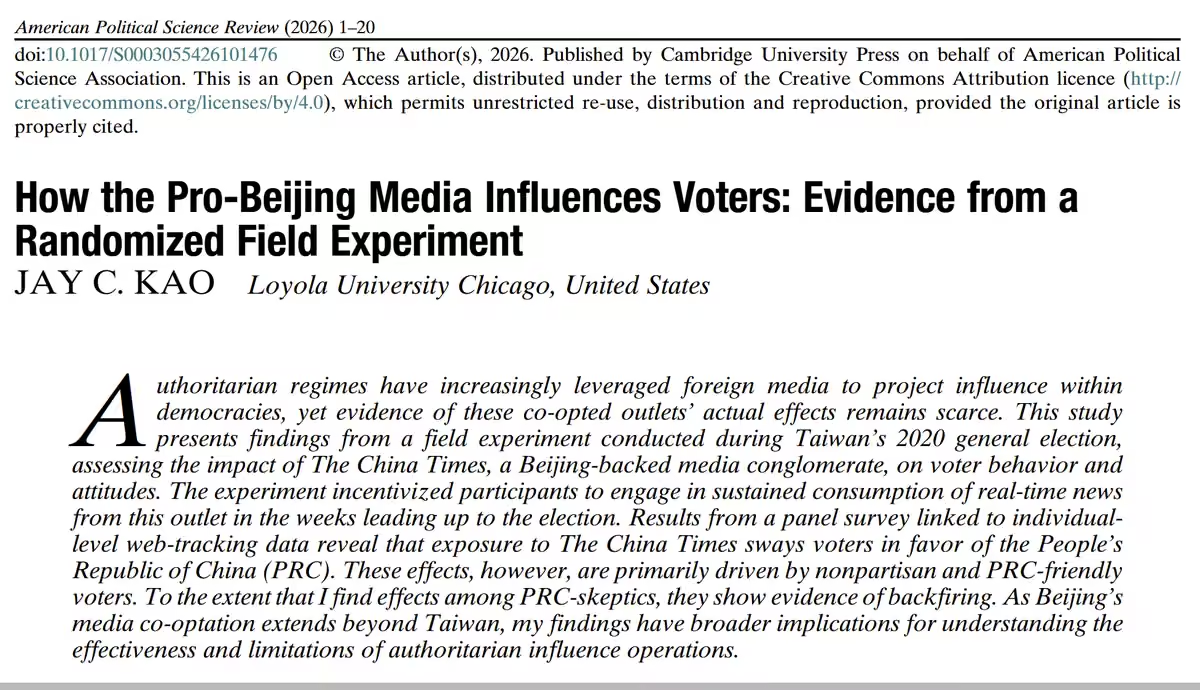
Rush Doshi reposted
New Left EViews
@NewLeftEViews
The impact of China's industrialisation on developing countries is complicated (plausible: demand drive and investment overall very positive but long-run prospects of industrialisation foreclosed on) but this sort pathetic 'China as anti-imperialist saviour' campism has to stop.
 taseenb
@taseenb
That, precisely. China is industrializing the Third World, or at least offering it a chance against U.S. and domestic comprador efforts to keep it deindustrialized.
Rush Doshi reposted
Jennifer Doshi Welch
@geoeconjennie
Geopolitical risk is on the rise - and the world’s most dangerous hotspots are heating up. But what would a crisis look like?
Our new report, Flash Points, examines the economic fallout if tensions boil over in key hotspots, from the Taiwan Strait to the Suwalki Gap. Short 🧵

Rush Doshi reposted
Ian Johnson
@iandenisjohnson
Outstanding interview 👍🏼👍🏼
Rush Doshi reposted
Georgetown SFS
@georgetownsfs
On @CNN, SFS Prof @RushDoshi discusses pro-democracy & human rights advocate Jimmy Lai's 20-year sentence as Beijing's attempt to silence him. Doshi says Lai’s sentencing is a warning to dissenters & a test for the international community.
Watch here: www.cnn.com/2026/02/09/tv/video/amanpour-doshi
Rush Doshi reposted
Demetri
@AsiaLens
One important thing: #jimmylai did *not* urge the US to use nuclear weapons against China.
It was a metaphor where Lai was comparing "moral authority" with nuclear weapons. That is very obvious from the video clip of his interview at @FDD 📽️👇
youtu.be/NDhJ37TISBI?t=1194
Rush Doshi
@RushDoshi
Outrageous to punish a father because his daughter had the audacity to advocate for a democratic Hong Kong from abroad.
But sadly all too common.
 Anna Kwok 郭鳳儀
@AnnaKwokFY
Today, my father was convicted simply for being my father.
This is how the Hong Kong government retaliates against me and my pro-democracy advocacy. This is hostage taking. This is transnational repression.

Rush Doshi reposted
Michael Pettis
@michaelxpettis
1/5
Reuters: "The EU should consider either an unprecedented 30% across-the-board tariff on Chinese goods or a 30% depreciation of the euro against the renminbi to counter a flood of cheap imports, a French government strategy report said on Monday."
www.reuters.com/world/china/french-advisers-urges-eu-tari…
Rush Doshi
@RushDoshi
Grateful for the opportunity to go on @amanpour to discuss the outrageous sentencing of Jimmy Lai, who was convicted for conspiracy to commit journalism.
Some thoughts.
1⃣ The 20-year sentence for 78-year-old Jimmy Lai is basically a life sentence, who has been in detention for 1800 days already.
2⃣ It is the climax of a 5-year legal siege. The charges kept changing: illegal assembly, then a fraud charge over a lease, than collusion. Their goal was to silence him with whatever could stick.
3⃣The trial had no jury (an irregularity). The judges were picked by the Chief Executive who was in turn picked by Beijing.
4⃣ So far the US, UK, and EU and others have all been critical. China dismisses that as political. But the UN has been critical too, and the track record here is important.
- Sept 2023: UN Sec-Gen @antonioguterres officially flagged "reprisals" and harassment against Sebastien Lai and his legal team in an annual report.
- Jan 2024: UN Torture Expert warned evidence against Lai was likely obtained via "tiger chairs" & coercion
- Sept 2025: UN Working Group on Arbitrary Detention ruled his 1,800+ day detention is "unlawful & arbitrary."
- Yesterday: UN High Commissioner for Human Rights @Volker_Turk declared, "This verdict needs to be promptly quashed as incompatible with international law. Jimmy Lai is a publisher sentenced for exercising rights protected under international law."
Meanwhile the Hong Kong Chief Executive declared the sentence was "deeply gratifying." No one should forget that.
Rush Doshi reposted
 Glinert 🇺🇸 🏭
@StevenGlinert
Good to know that the first thing an account that promotes tourism in China thought to do with a newly released AI video model was produce a video about murdering American soldiers.
 Sharing Travel
@TripInChina
This world is undergoing disruptive changes. This is a video produced by Seedance 2.0, which only takes half a day and may cost 1USD.😲
Seedance is the AI video production launched by Tiktok Company.
Rush Doshi reposted
Jonathon P Sine
@JonathonPSine
In the 1970s U.S. corporations invested ~$4 into physical structures + equipment for every ~$1 paid out to shareholders.
Beginning in the 1980s an inversion started. Now as of 2024 for every ~$1 in physical investment ~$1.30 is paid out to shareholders.

Rush Doshi reposted
 Stephen Stapczynski
@SStapczynski
Will China's coal production hit another record this year? 🇨🇳🪨
China’s main coal industry body warns that imports may fall if Indonesia moves to restrict shipments
They see production hitting a record 4.86 billion tons in 2026, but could go higher if imports drop sharply
 Rush Doshi
@RushDoshi
Deeply irresponsible flying. And not the first time Beijing has done this to other air forces in the region.
This needlessly risks escalation.
Governments around the world should condemn it.
Rush Doshi
@RushDoshi
Good to see this.
 Secretary Marco Rubio
@SecRubio
The sentencing of Jimmy Lai in Hong Kong is an unjust and tragic conclusion to this case. We urge the authorities to grant Mr. Lai humanitarian parole.
Rush Doshi
@RushDoshi
From @SenatorRicketts at our @CFR_China-UCSD China Forum held two weeks ago.
Worth listening to the entire conversation:
Council on Foreign Relations
@CFR_org
“[President Xi Jinping]’s got to be really pretty sure he’s going to be successful with [Taiwan] because if he fails, it’s going to be really, really bad for him personally,” says Senator Pete Ricketts (R-NE).
🔗 Watch the full conversation: on.cfr.org/4tc12e1
Rush Doshi reposted
Bonnie Glaser / 葛來儀
@BonnieGlaser
The ruling party can’t brief the LY on how they plan to spend the $40 bn until notifications are made to Congress. One reason the KMT says it won’t support the special budget is they don’t know how the money will be spent.
Rush Doshi
@RushDoshi
From the Andy Baker profile: “‘He really took the view that U.S. foreign policy was a sort of plaything of the elites which was not being used to benefit the American people,’” especially working class people.
Much truth to this assessment.
Rush Doshi reposted
Evan A. Feigenbaum
@EvanFeigenbaum
Also not a half-bad singer. www.youtube.com/watch?v=oPIfj-ng3Y8&list=RDoPIfj-ng3Y8&st…
Rush Doshi reposted
Brad Setser
@Brad_Setser
With a 1.6 pp of GDP contribution to growth from net exports in 2025, a global customs surplus of nearly $1.2 trillion and a manufacturing surplus well in excess of $2 trillion it doesn't seem that China has all that much to complain about ...
Rush Doshi
@RushDoshi
PRC officials complained to us when China’s share of US imports fell from 20% to 13% under President Biden.
Now some data indicate it is heading down to 7% (not factoring transit trade, of course).
 李老师不是你老师
@whyyoutouzhele
中国在美国进口中所占份额将下降到约7.5%,抹去了2001年之后加入WTO之后二十多年的增长。
 Rush Doshi
@RushDoshi
Nuclear testing while undertaking a major nuclear modernization and buildout.
All while refusing US requests for talks.
We made some progress on AI and NC3 in the last admin, but think it’ll take pressure from the rest of the world to get to China to meaningful talks.
 Under Secretary of State Thomas G. DiNanno
@UnderSecT
China has conducted nuclear explosive tests, including preparing for tests with designated yields in the hundreds of tons… China has used decoupling – a method to decrease the effectiveness of seismic monitoring – to hide its activities from the world. China conducted one such yield producing nuclear test on June 22, 2020. (4/6)
Rush Doshi
@RushDoshi
Very well-stated critique of this otherwise interesting essay that unfortunately focuses on discursive analysis over substance.
“profound indifference towards the actual subject matter on trade”
“reverse-orientalist campism”
“reacting to discourse trumps substance”
“Very frustrating and politically not serious.”
New Left EViews
@NewLeftEViews
Much to agree with in this essay (particularly the Wang dissection) but otherwise indicative of a profound indifference towards the actual subject matter on trade and of the sort of reverse-orientalist campism of many Western commentators where reacting to discourse trumps substance. Very frustrating and politically not serious.

Rush Doshi reposted
 Kaiser Kuo
@KaiserKuo
I think, though, that we’ll see people less uncritical as they realize that while China may have lighted the way to an alternative path to modernization (or, if you want, the East Asian Dev Model but at unprecedented scale) — but that pathway is now blocked by China, too.
Rush Doshi
@RushDoshi
PRC officials complained to us when China’s share of US imports fell from 20% to 13% under President Biden.
Now some data indicate it is heading down to 7% (not factoring transit trade, of course).
李老师不是你老师
@whyyoutouzhele
中国在美国进口中所占份额将下降到约7.5%,抹去了2001年之后加入WTO之后二十多年的增长。
Rush Doshi
@RushDoshi
Hu Jintao in some ways remains the most enigmatic Chinese leader. More complex and significant than often understood. And so much of what we think comes from Xi started in the Hu era, for better or worse.
And he was a very good table tennis player, too.
Rush Doshi reposted
Thorsten Benner
@thorstenbenner
The obvious question „allies and partners“ asked of Bessent selling „buyers‘ club“ and will ask of Vance: what happens if Beijing cuts off members of buyers‘ club while CRM supplies still
tight? Can this US administration be trusted to stand with them?
Rush Doshi
@RushDoshi
VP Vance rightly announces allied scale is the best way to counter China in critical minerals:
“We want members to form a trading bloc among allies and partners, one that guarantees American access to American industrial might while also expanding production across the entire zone…. we never have to rely on anybody else except for each other, for the critical minerals necessary to sustain our industries and to sustain growth."
Now let’s do this in others sectors like pharma.
Rush Doshi reposted
 William Yang
@WilliamYang120
In any case, the expulsions could have a deep impact on military planning.
“It’s possible that distrust between the party and its army could produce hesitation toward any significant operations, at least in the near term,” said @RushDoshi.
Rush Doshi reposted
 Aaron Slodov
@aphysicist
we cannot let this happen. and it will lead to complete industrial capture by china. apple spent $500B+ building hardware supply chains in china, we don't need to make that same mistake again. you could build a complete domestic robotics supply chain in <5 years with $100B.
 Rush Doshi
@RushDoshi
VP Vance rightly announces allied scale is the best way to counter China in critical minerals:
“We want members to form a trading bloc among allies and partners, one that guarantees American access to American industrial might while also expanding production across the entire zone…. we never have to rely on anybody else except for each other, for the critical minerals necessary to sustain our industries and to sustain growth."
Now let’s do this in others sectors like pharma.
Rush Doshi
@RushDoshi
Making major concessions just to *meet* with the PRC is usually a mistake.
Starmer wanted to show distance from the US. That benefited Beijing. And yet Beijing still made him pay to do it.
And then, once on the ground, they embarrassed him via protocol anyway.
Isaac Stone Fish
@isaacstonefish
Breaking: Beijing refused to allow British Prime Minister Starmer to travel to Beijing until he signed off on a mega embassy for China in London.
 Rush Doshi
@RushDoshi
Related:
Rush Doshi
@RushDoshi
Interesting piece on how Chinese investment represents the UK’s industrial salvation.
But it’s contradictory.
It claims, “A new relationship with China should be judged by what it builds….[Britain] wants technology and skills transfer, joint ventures, co-investment in green manufacturing, and patient finance directed at the real economy: grids, rail, green steel, ports, batteries.”
And yet it also notes this approach has failed, too, “Britain’s capacity to make primary steel nearly vanished in 2025, when the government had to rush through emergency legislation to prevent the Scunthorpe blast furnaces from being switched off by their private Chinese owner.”
How to govern Chinese investment, if it comes, is as important as anything else.
 James Schneider
@schneiderhome
China’s rise is the story of production, planning and scale. Britain’s decline is the story of rent and dependency.
Real sovereignty rests on productive capacity. I argue that requires a new relationship with China — and less obedience to Washington 👇
www.newstatesman.com/world/asia/china/2026/01/china-is-br…
Rush Doshi reposted
Hongshen Zhu
@HongshenZhu
Not really “a” special program, just thousands of schools across the country trying to attract high-score students with fast-track curriculums with little coordination. I attended Shanghai Experimental School. There is nothing genius about it. It’s not even the best school in SH.
Kyle Chan
@kyleichan
I can already tell this will be one of the best articles I read for all of 2026.
China runs a special program to find 100,00 top high school students from across the country every year. They train these students to compete in math olympiads and other major international math and science competitions.
Many of these students win medals, get a guaranteed spot in a top university program, and then go on to become China’s future tech leaders.
Most remarkably, the author @zijing_wu was herself part of this “genius” program! www.ft.com/content/68f60392-88bf-419c-96c7-c3d580ec9d97
Rush Doshi
@RushDoshi
“So while the shift to a China-centric global financial system would probably be good for regular Chinese people, it would probably not do much to reindustrialize America. If we want that to happen, we should look to industrial policy rather than to currency policy.”
Noah Smith 🐇🇺🇸🇺🇦🇹🇼
@Noahpinion
This past year has shown that gold still behaves like the ultimate safe asset when fiat currencies become less reliable...while Bitcoin still behaves like a U.S. stock.
www.noahpinion.blog/p/international-financial-anarchy
Rush Doshi
@RushDoshi
Interesting piece on how Chinese investment represents the UK’s industrial salvation.
But it’s contradictory.
It claims, “A new relationship with China should be judged by what it builds….[Britain] wants technology and skills transfer, joint ventures, co-investment in green manufacturing, and patient finance directed at the real economy: grids, rail, green steel, ports, batteries.”
And yet it also notes this approach has failed, too, “Britain’s capacity to make primary steel nearly vanished in 2025, when the government had to rush through emergency legislation to prevent the Scunthorpe blast furnaces from being switched off by their private Chinese owner.”
How to govern Chinese investment, if it comes, is as important as anything else.
James Schneider
@schneiderhome
China’s rise is the story of production, planning and scale. Britain’s decline is the story of rent and dependency.
Real sovereignty rests on productive capacity. I argue that requires a new relationship with China — and less obedience to Washington 👇
www.newstatesman.com/world/asia/china/2026/01/china-is-br…
Rush Doshi reposted
 Mike Bird
@Birdyword
You know what else is counter to building a strong North American industrial base?
 Jonathan Cheng
@JChengWSJ
Canada’s Move to Import Cheap Chinese EVs Is ‘Slippery Slope,’ GM CEO Says—Thousands of electric vehicles from Chinese automakers can enter Canada this year at new low tariff rate
@sharonterlep @ryanfelton
www.wsj.com/business/autos/canadas-move-to-import-cheap-c…
www.wsj.com/business/autos/canadas-move-to-import-cheap-c…
Rush Doshi reposted
Chris McGuire
@ChrisRMcGuire
Disappointing this article doesn’t mention WHY sales of Chinese EVs are banned in the US: because the Chinese gov can access their data and even commandeer them, turning them into roaming surveillance platforms or even tools of mass disruption.
Cool it has a mini fridge, though.
 WSJ Tech
@WSJTech
After driving the China-made Xiaomi SU7 electric car on U.S. roads, @JoannaStern asks why American automakers are so far behind—and when these advanced vehicles will make it here www.wsj.com/tech/personal-tech/chinese-ev-test-drive-xiao…
Rush Doshi
@RushDoshi
Kudos to @MRobbinsAUVSI and @jacobhelberg for making this happen.
Under Secretary of State Jacob S. Helberg
@UnderSecE
@AUVSI and @ITRI_Taiwan signed an important agreement to expand the Green Uncrewed Aircraft Systems certification process to Taiwan – the only location outside the United States – ensuring that uncrewed aircraft systems made in Taiwan meet the highest standards for cybersecurity, safety, and supply chain integrity. Together with our allies and partners we are driving innovation and ensuring a new global benchmark for secure, resilient supply chains.
www.auvsi.org/news/auvsi-and-taiwans-itri-sign-agreement-…
Rush Doshi
@RushDoshi
🚨 Tomorrow: Senators @ChrisCoons and @SenatorRicketts kick off our second annual Washington China Forum.
I'll moderate the livestreamed discussion: Is there still a bipartisan consensus on China policy?
📅 Tuesday, Jan 27 | 8:30-9:15 AM EST
 Rush Doshi
@RushDoshi
Join us at the link here: on.cfr.org/4abR8BI
Rush Doshi reposted
Demetri
@AsiaLens
Great thread from a top-class China historian
Joseph Torigian
@JosephTorigian
Spoke to @ChuBailiang @nytimes about the Xi-Zhang family connections, but I had to be frank that we actually know little about the Xi Jinping/Zhang Youxia relationship. (brief thread)
Xi Zhongxun and Zhang Zongxun (their fathers) moved to work in Beijing from the northwest around the same time in the early 1950s. XJP was born in 1953 and ZYX was born in 1950.
www.nytimes.com/2026/01/26/world/asia/china-xi-zhang-youx…
 Joseph Torigian
@JosephTorigian
Here's some history on the relationship between Xi Zhongxun, the father of Xi Jinping, and Zhang Zongxun, the father of Zhang Youxia (thread)
In July 1945, KMT seized an area north of Xi'an. Zhang Zongxun and Xi Zhongxun were named as commander and commissar for counterattack.
Rush Doshi reposted
 Justin Snyder || TheMaineWonk
@TheMaineWonk
‼️ NEW: The list of GOP Senators who have called for investigations into Alex Pretti’s murder is growing:
- McCormick (PA)
- Cassidy (LA)
- Murkowski (AK)
- Tillis (NC)
- Collins (ME)
- Ricketts (NE)
Rush Doshi
@RushDoshi
I was grateful to share some thoughts with @ewong alongside @JohnCulver689 for his terrific The New York Times piece on Greenland.
A few key points I made to him:
🔹Is this really about China and Russia, or is the discussion of China and Russia masking the reality of what is behind the drive for Greenland, which is an imperial project based on vanity?"
🔹"We already have de facto control in Greenland. The marginal increase in control we might get from taking the territory threatens to blow up our relations with important allies and partners." That matters because without them we cannot get scale relative to China or reindustrialize America (they can build the thing we forgot how to build).
🔹"Any Arctic challenge from China is less significant than the Soviet threat during the Cold War. And even during the Cold War, we didn't militarily seize Greenland. If we didn't seize it then, what's the reason to seize it now?"
 Rush Doshi
@RushDoshi
Link www.nytimes.com/2026/01/24/us/politics/trump-china-russia…
Rush Doshi
@RushDoshi
Notable statement from @RoKhanna on the Administration’s National Defense Strategy released yesterday.

Rush Doshi reposted
Joseph Torigian
@JosephTorigian
The size of the Central Military Commission used to be way bigger. This is what it looked like at the 11th Party Congress in 1977 (from my dissertation).


 Rush Doshi
@RushDoshi
Zhang Shengmin, last surviving member of the Central Military Commission purges, just going about his day.
 Rush Doshi
@RushDoshi
Zhang Shengmin, last surviving member of the Central Military Commission purges, just going about his day.
Rush Doshi
@RushDoshi
Context via @stoa1984
 Rush Doshi
@RushDoshi
Must read piece from @danwwang on the risk that the US could miss the revolution underway in the electrical stack

 Rush Doshi
@RushDoshi
As long as this remains true, the West will deindustrialize and the global south will fail to develop.
And it’s related to why Goldman concludes China’s economy is now a net drag on global GDP.
John Arnold
@johnarnold
I don't know if Chinese manufacturers will ever make money but I came away not wanting to invest in any manufacturing business in the rest of the world.
7/x
Rush Doshi
@RushDoshi
Read this from @RLHeinrichs — she is exactly right.
 Rebeccah Heinrichs
@RLHeinrichs
*Conservatives* in ally nations who are favorable to Trump and are very pro American are sounding the alarm. There is a cooperative way to protect our interests in the Arctic from Russia.
Rush Doshi reposted
Rush Doshi
@RushDoshi
An important book by my colleague @VictorDCha that comes at an important time!
 Victor Cha
@VictorDCha
Our new book! Argues that US should stop tariffing allies and instead lead Art. 5 collective eco deterrence pact to stop China’s eco bullying. Original data mapping all of China’s trade vulnerabilities and all 500+ cases of eco coercion under Xi. No. 18 on Amazon IPE books. Help raise the ranking! cup.columbia.edu/book/chinas-weaponization-of-trade/97802…
Rush Doshi
@RushDoshi
Builds on this important piece in International Security
direct.mit.edu/isec/issue/48/1
Rush Doshi
@RushDoshi
See this from @roddreher.
Some will try to intellectualize what is happening on Greenland and with Europe.
But even within the right, there are massive splits on this.
Dividing the West is the path to a Chinese century.
 Rod Dreher
@roddreher
So America might be about to go to war WITH EUROPE in part because Donald Trump is butthurt that he didn't win the Nobel Peace Prize. This is stratospherically crazy. Armando Iannucci could not conceive of a black political comedy on this level.
Rush Doshi
@RushDoshi
Related:
Rush Doshi
@RushDoshi
Important point from the producer of the Charlie Kirk show. And he’s right.
This kind of action undermines the possibility of building “allied scale” with our partners.
 Blake Neff
@BlakeSNeff
This is getting silly. Greenland is not worth acting like a mob boss with longtime allies.
 The Kobeissi Letter
@KobeissiLetter
BREAKING: President Trump announces a 10% tariff on Denmark, Norway, Sweden, France, Germany, the UK, Netherlands, and Finland beginning February 1st.
This tariff will be increased to 25% beginning on June 1st.
Tariffs will remain in effect until the US reaches a deal to buy Greenland.
“It is time for Denmark to give back,” Trump says.
 Rush Doshi
@RushDoshi
Also related:
Rush Doshi
@RushDoshi
Another conservative who refuses to intellectualize or justify the current course, which is of course strategically self-defeating.
 Rich Lowry
@RichLowry
Between the Canada annexation talk and this, we’ve gone out of our way to threaten and alienate two of the most blandly inoffensive countries on the planet
 America
@america
President Trump announces tariffs on 8 European nations in a move to reach a deal to acquire Greenland.
 Rush Doshi
@RushDoshi
Another conservative who refuses to intellectualize or justify the current course, which is of course strategically self-defeating.
Rich Lowry
@RichLowry
Between the Canada annexation talk and this, we’ve gone out of our way to threaten and alienate two of the most blandly inoffensive countries on the planet
America
@america
President Trump announces tariffs on 8 European nations in a move to reach a deal to acquire Greenland.
Rush Doshi reposted
 Biju Damodaran
@BijuSDamodaran
Agree.
The US is unlikely to succeed if we try this alone.
Best to bring in partners from like-minded countries both for scale and technical knowledge. But we have tariffed them all.
@RushDoshi has written about this extensively.
Rush Doshi reposted
 Senator Jim Banks
@SenatorBanks
Who is funding it?
Michael Sobolik
@michaelsobolik
Holy cow.
It would appear there’s a coordinated campaign against @RepBrianMast’s AI OVERWATCH Act.
Whoever is behind this deception campaign is protecting high-end AI chip exports to the Chinese Communist Party.
Profits over patriotism.
The Midas Project
@TheMidasProj
Something strange happened on conservative Twitter on Thursday.
A dozen right-wing influencers suddenly became passionate about semiconductor export policy, posting nearly identical (and often false) attacks over a 27-hour period on a bill most people have never heard of.
🧵
 Rush Doshi
@RushDoshi
Watch this space. @RepBrianMast isn’t pulling his punches on sales of AI chips to China.
 Rep. Brian Mast
@RepBrianMast
To all you influencers. Put it on the record if I got it wrong!
Do you agree with me in advising we should not sell MILLIONS of advanced AI chips to China 🇨🇳 or Jensen, who wants to sell his very best to the commies?
@DOGEai_tx @EYakoby @RobertGrayburn1 @LibertyCappy @FightWithMemes @LauraLoomer @DefiantLs @parscale @alifarhat79 @WallStreetMav
Rush Doshi
@RushDoshi
Important point from the producer of the Charlie Kirk show. And he’s right.
This kind of action undermines the possibility of building “allied scale” with our partners.
Blake Neff
@BlakeSNeff
This is getting silly. Greenland is not worth acting like a mob boss with longtime allies.
The Kobeissi Letter
@KobeissiLetter
BREAKING: President Trump announces a 10% tariff on Denmark, Norway, Sweden, France, Germany, the UK, Netherlands, and Finland beginning February 1st.
This tariff will be increased to 25% beginning on June 1st.
Tariffs will remain in effect until the US reaches a deal to buy Greenland.
“It is time for Denmark to give back,” Trump says.
Rush Doshi
@RushDoshi
Surely a coincidence that conservative influencers all started posting nearly identical attacks on a bill that would make it harder to sell advanced AI chips to China.
Wonder who paid them.
And if these accounts have a price, why should anyone take them seriously?
The Midas Project
@TheMidasProj
Something strange happened on conservative Twitter on Thursday.
A dozen right-wing influencers suddenly became passionate about semiconductor export policy, posting nearly identical (and often false) attacks over a 27-hour period on a bill most people have never heard of.
🧵
Rush Doshi reposted
Victor Shih
@vshih2
Wow must read, Benton’s classic on the left behinds during the Long March is still one of the top two pre-49 party history books for me
 Dali L. Yang
@Dali_Yang
What a title:
The Longest Night
Three Generations of Chinese Trotskyists in Defeat, Jail, Exile, and Diaspora
Edited and translated by Gregor Benton and Yang Yang Introduction by Gregor Benton
The Longest Night tells the captivating story of Chinese Trotskyism in its later years, including after Mao Zedong's capture of Beijing in 1949.
The book covers the three main periods of Chinese Trotskyism: the founding generation around Chen Duxiu, Zheng Chaolin, Wang Fanxi, and Peng Shuzhi, who joined the Opposition after their expulsion from the Chinese Communist Party (CCP); the first generation of those who (after 1931) did not first pass through the ranks of the CCP before becoming Trotskyists; and those who became Trotskyists after 1949, mainly in Hong Kong and the diaspora.
www.haymarketbooks.org/books/2713-the-longest-night
Rush Doshi reposted
 Jim Sciutto
@jimsciutto
As I’ve mentioned before, Danish forces did hard, frontline combat duty alongside U.S. forces in Afghanistan with none of the restrictions some NATO allies demanded - and paid for it with one of the highest per-capita casualty rates.
Rush Doshi
@RushDoshi
The idea that Fortress Americas makes up for falling behind in technology and industrial power — from nuclear to hypersonics to AI to biotech — is just simply unserious.
Not even the Trump administration believes that.
The true “end of history” take is to think industry and technology don’t matter.
 Defense Analyses and Research Corporation
@DefenseAnalyses
This recent @RushDoshi piece is wonderful since it captures exactly how little the “serious” foreign affairs class has learned from the 21st century.
From critical minerals to global control of key infrastructure, from LatAm surveillance posts to massive investments in sea power, China understands quite well that modern power IS tied to place and territory - not the bloodless competition over abstract “technological mastery” like those living at the end of history would want you to believe.
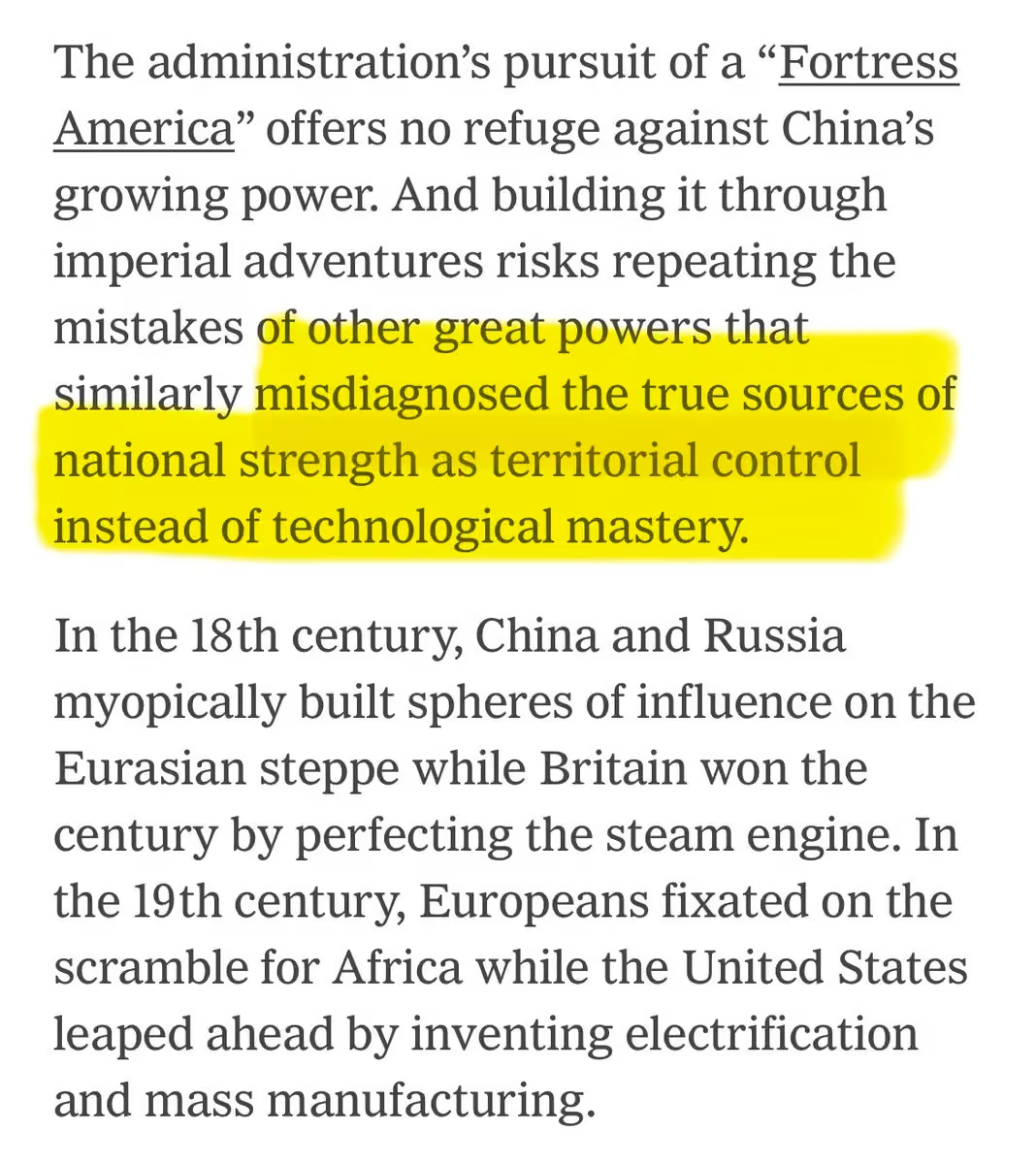 Rush Doshi
@RushDoshi
Obviously territory matters, but you can’t easily hold it if you lose in technology.
The keys to the future do not lie in nation-building in Venezuela and seizing Greenland (which we didn’t seize even during the Cold War).
It’s great for China to have fewer proxies, but not if it leads to distracting quagmires that distract us from the real contest.
Territory doesn’t change the fact they can cut off the antibiotics you take and the magnets your factories need and shut down the utilities connected to the internet you forgot to secure.
That’s the real contest.
Rush Doshi reposted
T. Greer
@Scholars_Stage
China’s dominance in critical minerals vis a vis the United States has nothing to do with territorial acquisitions though? Both US and China have abundant stores in the ground; if you are going to list the ten most important reasons we ceded refinery capability to them, geographical factors won’t even make an appearance. Very unconvinced with this argument.
Rush Doshi
@RushDoshi
If the reporting on the near conclusion of the Taiwan trade deal is right, the Trump Administration deserves credit for a good outcome.
Fewer tariffs, more fabs, and continued support for Taiwan's security.

Rush Doshi reposted
Kunal Shah 🗽
@realKunalAShah
Worth a read even though I don’t agree with all of it
Rush Doshi
@RushDoshi
Excited to publish my latest piece in the print edition of the Sunday @nytopinion for the very first time.
And particularly grateful for the opportunity to appear in a series on Trump and world order alongside @adam_tooze, @monicaduffytoft,
@MatiasSpektor, and Margaret MacMillan.
I argue building a sphere of influence in Latin America takes top-level time and attention away from the core strategic question of the era, which is whether we pass the torch to China.
1⃣ Our Core Strategic Question is Balancing China: We currently risk falling behind China technologically, becoming dependent on them economically, and being defeated by them militarily. If we want a stable balance of power, that requires urgent effort. A sphere of influence offers no enduring refuge from Chinese power.
2⃣ Technology Beats Territory: In the 18th century, China and Russia myopically built vast spheres of influence on the Eurasian steppe while Britain won the century by perfecting the steam engine. In the 19th century, Europeans fixated on the scramble for Africa while the United States leaped ahead by figuring out electrification and mass manufacturing. While most great powers then wanted territory, only those who innovated and adopted new technology won the future.
3⃣ Distraction Risks Decline: While we spend our scarcest resource -- top-level time and attention -- on Venezuela and Greenland, China is is dedicating vast sums and its whole government to winning the technologies of the future, from artificial intelligence and robotics to quantum computing and biotechnology.
4⃣ Renewal at Home, "Allied Scale" Abroad: For America, the only path to balancing China’s sheer scale is to renew American industrial and technological strength at home and leverage the collective power of U.S. partners through “allied scale” abroad. A Western hemisphere fixation distracts us at home and alienates allies abroad.


Rush Doshi reposted
Michael Kovrig
@MichaelKovrig
I highly recommend these essays in the @nytimes, particularly @RushDoshi's. American strategic planners might want to play a few rounds of "Risk" to refresh their memories of why a "Donroe Doctrine" may help the U.S. feel more secure in the Americas in the short term, but meanwhile China, backed by Russia, will keep focusing on increasing its capacity in more decisive arenas of power—tech, industrial production, and leverage in the Indo-Pacific. That risks eroding the long-term geostrategic balance even if Trump succeeds in diminishing Beijing's influence in the Western Hemisphere.
Rush Doshi
@RushDoshi
Excited to publish my latest piece in the print edition of the Sunday @nytopinion for the very first time.
And particularly grateful for the opportunity to appear in a series on Trump and world order alongside @adam_tooze, @monicaduffytoft,
@MatiasSpektor, and Margaret MacMillan.
I argue building a sphere of influence in Latin America takes top-level time and attention away from the core strategic question of the era, which is whether we pass the torch to China.
1⃣ Our Core Strategic Question is Balancing China: We currently risk falling behind China technologically, becoming dependent on them economically, and being defeated by them militarily. If we want a stable balance of power, that requires urgent effort. A sphere of influence offers no enduring refuge from Chinese power.
2⃣ Technology Beats Territory: In the 18th century, China and Russia myopically built vast spheres of influence on the Eurasian steppe while Britain won the century by perfecting the steam engine. In the 19th century, Europeans fixated on the scramble for Africa while the United States leaped ahead by figuring out electrification and mass manufacturing. While most great powers then wanted territory, only those who innovated and adopted new technology won the future.
3⃣ Distraction Risks Decline: While we spend our scarcest resource -- top-level time and attention -- on Venezuela and Greenland, China is is dedicating vast sums and its whole government to winning the technologies of the future, from artificial intelligence and robotics to quantum computing and biotechnology.
4⃣ Renewal at Home, "Allied Scale" Abroad: For America, the only path to balancing China’s sheer scale is to renew American industrial and technological strength at home and leverage the collective power of U.S. partners through “allied scale” abroad. A Western hemisphere fixation distracts us at home and alienates allies abroad.
Rush Doshi reposted
Noah Smith 🐇🇺🇸🇺🇦🇹🇼
@Noahpinion
China is trying to prevent India from industrializing by any means necessary.
We ought to be on India's side here.
Kyle Chan
@kyleichan
India’s Reliance Industries wanted to move into battery cell production, backed by state incentives. They were negotiating a tech licensing deal with China’s Hithium. But that stopped after China imposed export controls on LFP battery technology.
This is a catch-22 situation for countries trying to build their own battery industries. It’s difficult to compete with Chinese battery makers. One of the best approaches is to build on Chinese technology. But the question is whether Beijing will allow it. www.bloomberg.com/news/articles/2026-01-12/reliance-halts…
Rush Doshi reposted
Georgetown SFS
@georgetownsfs
In @NYTimesOpinion, SFS Prof @RushDoshi warns that the U.S.’ recent focus in the Americas at the expense of Europe and Asia will grant China superiority in the economic and technological spheres.
Read more: www.nytimes.com/interactive/2026/01/11/opinion/trump-new-…
Rush Doshi reposted
Council on Foreign Relations
@CFR_org
"For Washington, the central strategic question of the 21st century is not whether the United States can build a bastion in the Western Hemisphere. It is whether America, after a century as the world’s most powerful, advanced and prosperous country, will renew the true sources of strength or pass the torch to China," writes China expert @RushDoshi. www.nytimes.com/interactive/2026/01/11/opinion/trump-new-…
Rush Doshi reposted
Michael Kovrig
@MichaelKovrig
💯Excellent framing of the strategic challenge. Thank you for this.
Rush Doshi reposted
 Cam in Shanghai
@Camrjohnson
Good insights by @RushDoshi on China, technology, and balancing global industry
Rush Doshi
@RushDoshi
Excited to publish my latest piece in the print edition of the Sunday @nytopinion for the very first time.
And particularly grateful for the opportunity to appear in a series on Trump and world order alongside @adam_tooze, @monicaduffytoft,
@MatiasSpektor, and Margaret MacMillan.
I argue building a sphere of influence in Latin America takes top-level time and attention away from the core strategic question of the era, which is whether we pass the torch to China.
1⃣ Our Core Strategic Question is Balancing China: We currently risk falling behind China technologically, becoming dependent on them economically, and being defeated by them militarily. If we want a stable balance of power, that requires urgent effort. A sphere of influence offers no enduring refuge from Chinese power.
2⃣ Technology Beats Territory: In the 18th century, China and Russia myopically built vast spheres of influence on the Eurasian steppe while Britain won the century by perfecting the steam engine. In the 19th century, Europeans fixated on the scramble for Africa while the United States leaped ahead by figuring out electrification and mass manufacturing. While most great powers then wanted territory, only those who innovated and adopted new technology won the future.
3⃣ Distraction Risks Decline: While we spend our scarcest resource -- top-level time and attention -- on Venezuela and Greenland, China is is dedicating vast sums and its whole government to winning the technologies of the future, from artificial intelligence and robotics to quantum computing and biotechnology.
4⃣ Renewal at Home, "Allied Scale" Abroad: For America, the only path to balancing China’s sheer scale is to renew American industrial and technological strength at home and leverage the collective power of U.S. partners through “allied scale” abroad. A Western hemisphere fixation distracts us at home and alienates allies abroad.
Rush Doshi reposted
Jonathan Cheng
@JChengWSJ
.@RushDoshi in NYT op-ed: “The United States risks distracting itself by trying to govern Venezuela and seize Greenland while China is dedicating vast sums to winning the technologies of the future, from…robotics to quantum computing and biotechnology.”
www.nytimes.com/interactive/2026/01/11/opinion/trump-new-…
Rush Doshi
@RushDoshi
Excited to publish my latest piece in the print edition of the Sunday @nytopinion for the very first time.
And particularly grateful for the opportunity to appear in a series on Trump and world order alongside @adam_tooze, @monicaduffytoft,
@MatiasSpektor, and Margaret MacMillan.
I argue building a sphere of influence in Latin America takes top-level time and attention away from the core strategic question of the era, which is whether we pass the torch to China.
1⃣ Our Core Strategic Question is Balancing China: We currently risk falling behind China technologically, becoming dependent on them economically, and being defeated by them militarily. If we want a stable balance of power, that requires urgent effort. A sphere of influence offers no enduring refuge from Chinese power.
2⃣ Technology Beats Territory: In the 18th century, China and Russia myopically built vast spheres of influence on the Eurasian steppe while Britain won the century by perfecting the steam engine. In the 19th century, Europeans fixated on the scramble for Africa while the United States leaped ahead by figuring out electrification and mass manufacturing. While most great powers then wanted territory, only those who innovated and adopted new technology won the future.
3⃣ Distraction Risks Decline: While we spend our scarcest resource -- top-level time and attention -- on Venezuela and Greenland, China is is dedicating vast sums and its whole government to winning the technologies of the future, from artificial intelligence and robotics to quantum computing and biotechnology.
4⃣ Renewal at Home, "Allied Scale" Abroad: For America, the only path to balancing China’s sheer scale is to renew American industrial and technological strength at home and leverage the collective power of U.S. partners through “allied scale” abroad. A Western hemisphere fixation distracts us at home and alienates allies abroad.
Rush Doshi
@RushDoshi
Link here: www.nytimes.com/interactive/2026/01/11/opinion/trump-new-…
Rush Doshi
@RushDoshi
Link here to today's whole series:
www.nytimes.com/interactive/2026/01/11/opinion/trump-new-…
Rush Doshi
@RushDoshi
Alibaba’s Qwen head effectively explains why US export controls give the US the advantage in AI over China.
“A massive amount of OpenAI’s compute is dedicated to next-generation research, whereas we are stretched thin — just meeting delivery demand consumes most of our resources.”
 Jukan
@jukan05
According to a Bloomberg report, Justin Lin, the head of Alibaba's Qwen team, estimated the probability of Chinese companies surpassing leading players like OpenAI and Anthropic through fundamental breakthroughs within the next 3 to 5 years to be less than 20%.
His cautious assessment is reportedly shared by colleagues at Tencent Holdings as well as Zhipu AI, a major Chinese large language model company that led this week's public market fundraising efforts among major Chinese LLM players.
Lin pointed out that while American labs such as OpenAI are pouring enormous computing resources into research, Chinese labs are severely constrained by a lack of computing power.
Even for their own services—i.e., inference—they’re consuming so much capacity that they don’t have enough compute left to devote to research.
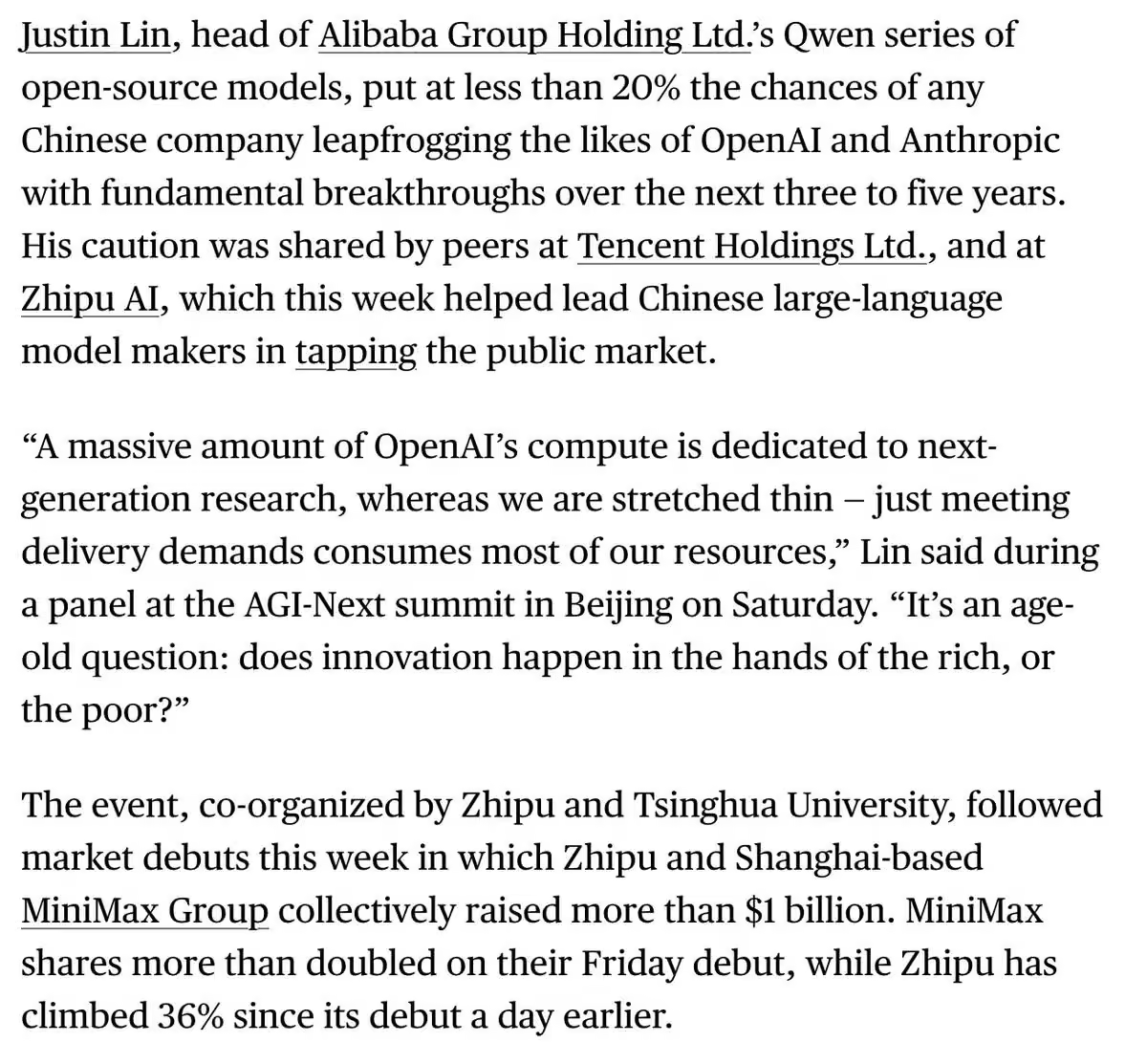
Rush Doshi reposted
Jukan
@jukan05
According to a Bloomberg report, Justin Lin, the head of Alibaba's Qwen team, estimated the probability of Chinese companies surpassing leading players like OpenAI and Anthropic through fundamental breakthroughs within the next 3 to 5 years to be less than 20%.
His cautious assessment is reportedly shared by colleagues at Tencent Holdings as well as Zhipu AI, a major Chinese large language model company that led this week's public market fundraising efforts among major Chinese LLM players.
Lin pointed out that while American labs such as OpenAI are pouring enormous computing resources into research, Chinese labs are severely constrained by a lack of computing power.
Even for their own services—i.e., inference—they’re consuming so much capacity that they don’t have enough compute left to devote to research.
Rush Doshi reposted
 Tsung Xu
@tsungxu
If you don't like Palmer's take, remember that Apple paid on the order of $1T in stock buybacks in the last ten years. They could have single-handedly rebuilt a relevant consumer electronics industrial base in the US with 10% of that.
Incentives matter
 Palmer Luckey
@PalmerLuckey
Any company that takes taxpayer dollars needs to be 100% accountable to taxpayers and their electees, not the other way around.
 Anduril Appreciator
@A1Anduril
🚨 BREAKING: Anduril Founder @PalmerLuckey Responds to President Trump’s New Restrictions on Defense Companies
“These measures do apply to me. I now cannot pay dividends. I now cannot do stock buybacks, if I’m not investing in new [manufacturing] plants.”
“[President Trump] isn’t anti-defense or anti-defense company, that’s for sure.”
“I think that when you are effectively run on the public’s wallet, the public should be able to impose whatever restrictions they want on you.”
“If they want to say that I only pay myself $5m until I’m caught up with my schedules, they should be allowed to do that.”
“It’s even good to scare some people sometimes… You remember being a teenager? Your parents say: ‘You’re grounded until you bring up your grades... then we will talk.’”
You don’t necessarily go to [defense companies] and say: ‘This is the way it’s going to be forever.’ You say: ‘This is how it’s going to be until you get your act together.’”
Rush Doshi reposted
 Luke Goldstein
@lukewgoldstein
The last worker in the US who knew how to make Tubas is having his union job shipped to China by hedge fund billionaire and Trump advisor John Paulson who made the TV rounds to defend tariffs as a way to bring jobs back to US
Rush Doshi
@RushDoshi
This is a problem.
Matt Stoller
@matthewstoller
The second fastest growing sector in America in terms of GDP growth from 2019-2024 was gambling. www.bls.gov/news.release/prin2.htm
Rush Doshi reposted
 Sriram Krishnan
@sriramk
As one example - @jamesproud taking a classic Silicon Valley big swing at a task historically thought impossible for America.
 James Proud
@jamesproud
History repeatedly shows that American science and engineering solve impossible tasks. I started Substrate because I believed that this impossible task is one worth trying.
 Substrate
@substrate
Substrate is building a next-generation foundry to return America to dominance in semiconductor production. To achieve this, we will use our technology—a new form of advanced X-ray lithography—to power them.
America invented semiconductors. We will lead again.
Rush Doshi
@RushDoshi
This is hard evidence that the 2023 Fentanyl deal President Biden struck with China in Woodside California had real impact and saved lives.
Much more needs to be done, but principled diplomacy with China can make a difference for the American people.
 Keith Humphreys
@KeithNHumphreys
Today in @ScienceMagazine my colleagues and I address the mystery of why opioid overdoses in the US and Canada suddenly began dropping dramatically. We assemble traditional and novel evidence to point to an illicit drug supply disruption, probably in China. 1/8

Rush Doshi reposted
Joseph Torigian
@JosephTorigian
In DC? Come to a discussion of The Party's Interests Come First: The Life of Xi Zhongxun @AU_SIS. Panelists include Patrick Jackson, Evan Medeiros, and @katiestallard. Thrilled @MikeFroman of @CFR_org, where I just became a senior fellow, will moderate.
www.eventbrite.com/e/book-launch-joseph-torigian-the-part…
Rush Doshi reposted
Aaron Slodov
@aphysicist
going straight for the kill. cut defense companies exec salaries to $5M unless they invest in modernizing production plants and equipment. holy shit
 Rush Doshi
@RushDoshi
A puzzling argument. The "axis" is not a threat because it is often bilateral?
It is of entirely possible for bilateral relationships among a network of actors to generate important strategic effects.
Look at the U.S. security architecture in Asia, for example.
 Jennifer Kavanagh
@jekavanagh
Everything you've written is basically about Russia & its war in Ukraine. This is not an "axis." At best, this is a set of limited scope, bilateral relationships.
Rush Doshi
@RushDoshi
How is this narrative at all empty? The "axis" is not all powerful but it is also not irrelevant.
- The Russian war effort is made in China.
- Iranian drones are critical for Russia.
- DPRK troops fought in Europe.
- Russia is supporting DPRK's strategic weapons programs.
Jennifer Kavanagh
@jekavanagh
Lots of us have been arguing for some time that this whole "axis" narrative is an empty one. Maybe its advocates will catch on soon that it is not the big bad threat they make it out to be?
Rush Doshi
@RushDoshi
Notable quote from Wu Xinbo, dean of the Institute of International Studies at Fudan University in Shanghai:
“The United States took such action at a time when China’s delegation was visiting Venezuela. For China, it is very embarrassing."
Rush Doshi
@RushDoshi
Which premise is wrong?
The PRC has long pursued military sites in Latin America. It operates one in Argentina. Another hoped for site, as prominent PRC figures confirmed to me directly, was Venezuela.
I say this not in defense of the US operation, but as a factual matter.
Rush Doshi
@RushDoshi
And Cuba, I should have added.
(I was focusing on continental Latin America, rather than the Caribbean).
Rush Doshi
@RushDoshi
Grateful to offer thoughts to @dhpierson for his @nytimes piece on what the "Donroe Doctrine" means for China.
It may not embolden Xi on Taiwan, but it does weaken norms on great power use of force. And if Venezuela proves to be a debacle, it risks tying us down too.

Rush Doshi reposted
Georgetown SFS
@georgetownsfs
@ForeignAffairs’ 2025 essays tackled major global challenges—from U.S. democratic backsliding to China & Iran. An April essay by Kurt Campbell & @RushDoshi called for a China strategy focused on “shared capacity,” beyond traditional alliances.
Read more: fam.ag/3YpBkEL
Rush Doshi reposted
Dmitri Alperovitch
@DAlperovitch
Japan should reciprocate by immediately banning export of all semiconductor manufacturing equipment and chemicals/precursors to China. Chips are also dual-use!
 Rush Doshi
@RushDoshi
I’m not sure we should run Venezuela…
 Selina Wang
@selinawangtv
I asked Trump: What’s the group that you mentioned that will run Venezuela?
Trump: It's largely going to be for a period of time the people that are standing right behind me, we're going to be running it. We're going to be bringing it back …Venezuela has a lot of bad people in there, a lot of bad people that shouldn't be leading. We're not going to take a chance at one of those people take over for Maduro.
 Rush Doshi
@RushDoshi
Strong words. And yet China finances, arms, and provides intelligence for Russia’s invasion of Ukraine.
Perhaps the MFA can explain that.
 CHINA MFA Spokesperson 中国外交部发言人
@MFA_China
China is deeply shocked by and strongly condemns the U.S.’s blatant use of force against a sovereign state and action against its president.
Such hegemonic acts of the U.S. seriously violate international law and Venezuela’s sovereignty, and threaten peace and security in Latin America and the Caribbean region. China firmly opposes it.
We call on the U.S. to abide by international law and the purposes and principles of the UN Charter, and stop violating other countries’ sovereignty and security.
 Rush Doshi
@RushDoshi
I remember some time ago a Chinese strategist told me that they sought Atlantic bases and straightforwardly declared Venezuela may one day be a good opportunity.
(In actuality, their focuses on Atlantic bases had driven them to other targets.)
Still a remarkable admission.
Rush Doshi
@RushDoshi
Wild that only hours before America captured Maduro, China sent an envoy to meet him.
And just a few weeks before that, China issued a new White Paper insisting on its role in Latin America.
Both have just collided with the reality of US power projection in its hemisphere.
 Rush Doshi
@RushDoshi
Wild that only hours before America captured Maduro, China sent an envoy to meet him.
And just a few weeks before that, China issued a new White Paper insisting on its role in Latin America.
Both have just collided with the reality of US power projection in its hemisphere.
Rush Doshi
@RushDoshi
Will this shape China’s policy in Latin America?
China should not feel confident in its efforts to maintain control over strategic ports near the Panama Canal or to secure bases on the Atlantic (a longstanding goal).
Rush Doshi
@RushDoshi
How Chinese social media is processing the American action in Venezuela — with some admiration and some inspiration for Taiwan scenarios.
 Cindy Yu
@CindyXiaodanYu
Maduro’s arrest is trending top on Weibo. Very easy for Chinese observers to draw the link to Taiwan:
‘China should learn from the US… yet we still give aid to Taiwan’
‘The American imperialists’ lightning raid on Venezuela to arrest the Maduro couple provides an excellent template for our military’s raid on Frog Island to arrest Lai Ching-te’
 Rush Doshi
@RushDoshi
“ByteDance will buy at least 4 times as much AI computing power in 2026 than they would have if export controls had remained in effect”
What are we doing here?
Chris McGuire
@ChrisRMcGuire
If ByteDance buys $14 billion of Nvidia H200s in 2026 and also $5.6 billion of Huawei Ascends (which was reported recently), ByteDance will buy at least 4 times as much AI computing power in 2026 than they would have if export controls had remained in effect. That’s massive.
Rush Doshi reposted
 mattparlmer 🪐 🌷
@mattparlmer
The policy decision to allow this is basically a straightforward trade where we give away a 2-3yr strategic competitive advantage in exchange for a somewhat frothier stock market in Q1 2026
Good job guys
Jukan
@jukan05
Reuters: Nvidia placed an urgent order with TSMC as demand for the H200 in China surges.
Nvidia currently has 700,000 H200 units in inventory, but China has ordered more than 2 million H200 units.
$NVDA

Rush Doshi reposted
Victor Cha
@VictorDCha
Arrival on New Years Eve! Get yours in 2026!

Rush Doshi reposted
Peter Harrell
@petereharrell
When I worked on developing the outbound investment control regime that the government set up several years ago, Meta's acquisition of Manus is precisely one of the types of impacts we were hoping for.
1. Top Chinese AI talent decides to decamp from China in order to get access to western capital, avoid potential export controls, and keep access to western markets.
2. Shareholders (especially western ones) in early stage AI firms still get rewarded for their investments.
www.wsj.com/tech/ai/how-metas-newest-acquisition-target-g…
Rush Doshi reposted
Tom Shugart
@tshugart3
While the 2024 report's exec summary says the driver of China's national strategy is to achieve China's "great rejuvenation" by 2049, the 2025 report sees China overall goal as the displacement of the U.S. as the world's most powerful nation.


Rush Doshi reposted
Noah Smith 🐇🇺🇸🇺🇦🇹🇼
@Noahpinion
Some people are calling for Europe to let itself slip softly and peacefully into deindustrialization in the face of China's high-tech export assault.
But this would be VERY foolish.
www.noahpinion.blog/p/why-europe-should-resist-the-second
Rush Doshi
@RushDoshi
Important move — credit to the team at the FCC for ensuring America has a future in drone technology
Brendan Carr
@BrendanCarrFCC
Today, based on an Executive Branch national security determination, the FCC has added foreign-produced UAS (drones) and foreign-produced UAS critical component parts to the FCC’s Covered List on a going forward basis.
President Trump has been clear that his Administration will act to secure our airspace and unleash American drone dominance.
We do so through an action today that does not disrupt the ongoing use or purchase of previously authorized drones and with appropriate avenues for excluding drones that do not pose a risk.
Unmanned aircraft systems (UAS), also known as drones, offer the potential to enhance public safety as well as cement America’s leadership in global innovation. But criminals, terrorists, and hostile foreign actors have intensified their weaponization of these technologies, creating new and serious threats to our homeland.
As detailed below, today’s FCC action does not impact a consumer’s ability to continue using drones they previously purchased or acquired. Nor does today’s FCC action prevent retailers from continuing to sell, import, or market device models approved earlier this year or previously through the FCC’s equipment authorization process. Moreover, the Department of War or the Department of Homeland Security can make a specific determination to the FCC that a given UAS, class of UAS, or UAS critical component does not pose the relevant risks.
By operation of the FCC’s Covered List rules, the restrictions imposed by today’s decision apply to new device models.

 Rush Doshi
@RushDoshi
We’ve got to implement this in a way that allows us to build allied scale.
That means allied parts should be granted a waiver, and the process should be transparent and straightforward.
An allied drone supply chain will work better than one focused on the US.
Rush Doshi
@RushDoshi
The FCC drone action is good, but the key here is going to be a waiver process that doesn’t make it impossible to build an allied ecosystem.
We can do a lot at home. We can do more with partners.
For drones, we still need allied scale.
Rush Doshi
@RushDoshi
Important move — credit to the team at the FCC for ensuring America has a future in drone technology
Brendan Carr
@BrendanCarrFCC
Today, based on an Executive Branch national security determination, the FCC has added foreign-produced UAS (drones) and foreign-produced UAS critical component parts to the FCC’s Covered List on a going forward basis.
President Trump has been clear that his Administration will act to secure our airspace and unleash American drone dominance.
We do so through an action today that does not disrupt the ongoing use or purchase of previously authorized drones and with appropriate avenues for excluding drones that do not pose a risk.
Unmanned aircraft systems (UAS), also known as drones, offer the potential to enhance public safety as well as cement America’s leadership in global innovation. But criminals, terrorists, and hostile foreign actors have intensified their weaponization of these technologies, creating new and serious threats to our homeland.
As detailed below, today’s FCC action does not impact a consumer’s ability to continue using drones they previously purchased or acquired. Nor does today’s FCC action prevent retailers from continuing to sell, import, or market device models approved earlier this year or previously through the FCC’s equipment authorization process. Moreover, the Department of War or the Department of Homeland Security can make a specific determination to the FCC that a given UAS, class of UAS, or UAS critical component does not pose the relevant risks.
By operation of the FCC’s Covered List rules, the restrictions imposed by today’s decision apply to new device models.
Rush Doshi
@RushDoshi
The FCC drone action is good, but the key here is going to be a waiver process that doesn’t make it impossible to build an allied ecosystem.
We can do a lot at home. We can do more with partners.
For drones, we still need allied scale.
Rush Doshi
@RushDoshi
Important move — credit to the team at the FCC for ensuring America has a future in drone technology
Brendan Carr
@BrendanCarrFCC
Today, based on an Executive Branch national security determination, the FCC has added foreign-produced UAS (drones) and foreign-produced UAS critical component parts to the FCC’s Covered List on a going forward basis.
President Trump has been clear that his Administration will act to secure our airspace and unleash American drone dominance.
We do so through an action today that does not disrupt the ongoing use or purchase of previously authorized drones and with appropriate avenues for excluding drones that do not pose a risk.
Unmanned aircraft systems (UAS), also known as drones, offer the potential to enhance public safety as well as cement America’s leadership in global innovation. But criminals, terrorists, and hostile foreign actors have intensified their weaponization of these technologies, creating new and serious threats to our homeland.
As detailed below, today’s FCC action does not impact a consumer’s ability to continue using drones they previously purchased or acquired. Nor does today’s FCC action prevent retailers from continuing to sell, import, or market device models approved earlier this year or previously through the FCC’s equipment authorization process. Moreover, the Department of War or the Department of Homeland Security can make a specific determination to the FCC that a given UAS, class of UAS, or UAS critical component does not pose the relevant risks.
By operation of the FCC’s Covered List rules, the restrictions imposed by today’s decision apply to new device models.
Rush Doshi reposted
Victor Shih
@vshih2
As I tell my students, there are some documents, even very short ones, that reveal a great deal across different topics about the CCP. This is one of them
 The Great Translation Movement 大翻译运动
@TGTM_Official
Leaked CCP speech document, about shifting the narrative on the West's social media platforms
Comrade Liu Yongjie's Speech on the Management of Overseas Social Media Platforms at the Work Report Meeting of the Public Security Bureau (刘永杰同志在公安部工作汇报会议上关于境外社交媒体治理的讲话)
(December 6, 2025)
Today is the second day of our work report meeting. Since everyone has a lot to say, I will only mention a few issues and talk about how to deal with Chinese-language communities on overseas social media platforms.
The first issue is that over the last six months, the level of anti-government speech on the overseas web has stabilized. Whether it is from anti-government media or from so-called "opinion leaders," these voices are clearly experiencing a downward trend. However, the output of our overseas web security coordination working group still maintains the high-pressure mode from the "White Paper Revolution" period, ignoring the change of trend. In work targeting certain overseas "opinion leaders," the "Lao Guan" special team ... [redacted] ... in reality, the content did not spread as much as we wanted, and 80-90% of it was wasted, mainly because they were not people who attracted attention anymore. Moreover, many major "opinion leaders" definitely have serious problems, but we did not timely expose their scandals, therefore we have missed opportunities to grasp the narrative. There are also some "independent media" that have already established favorable relations with us, or even bought by us. Then there is no reason to include this type of accounts in the blacklist; that would disrupt the coordination between different special teams.Therefore, like we have emphasized in the last work meeting, every special team should improve the specificity and effectiveness of their public opinion work, adapt their strategies according to the evolution of the situation, keeping up with the principle of "one strategy for each country, group, and individual" and suppressing the reputation and influence of hostile forces as much as possible.
The second issue is that certain overseas "influencers" favorable to us have committed betrayal, exposing confidential information related to public opinion work, resulting in serious disruptions to relevant special teams. In reality, these "influencers" are all acting on their own interests and may choose to cut ties with us at any moment. Every special team must ... [redacted] ... as leaders of web security coordination teams of different regions, you ... [redacted] ... the effect of coordination between [...], according to the "Overseas Social Media Platform [...]
[...] Last but not least, I hope you are not afraid of hardships and fatigue, and that you are willing to analyze the situations of overseas social media platforms and infiltrate into their communities. Every time we are successful in our operations is because we analyzed and understood our targets. Take the "LI coin" losing value for example, isn't it the result of infiltration? The Changsha "Tibetan independence" case is also because undercover agents provided us with large amounts of information. I hope everyone works hard, in order to fulfill the directives of comrade Li Kuo and solve issues in public opinion work, creating a favorable environment on overseas social media.
Office of the Overseas Web Security Coordination Working Group, Shaanxi Province December 6, 2025

Rush Doshi reposted
Brad Setser
@Brad_Setser
I think Sander's letter will be remembered long after the Economist's leader is forgotten ...
George Magnus
@georgemagnus1
Gr8 letter by @SanderTordoir pushing back against @TheEconomist view about EU should not resist Chinese mercantilism. This also in line with the mag’s view that China’s monster surplus is not a threat to world as much as to itself. When it’s both in spades. How out of touch can you be?

Rush Doshi reposted
 Michelle Nie Duncan
@michellesnie
According to @ChinaSelect, ASML sold 70% of its DUVi systems to Chinese entities in 2024. Last year, Chinese firms bought $38 billion in equipment from the five top allied semiconductor suppliers—a 66% increase from 2022.

Rush Doshi reposted
Senate Foreign Relations Committee
@SFRCdems
China has a history of stealing our intellectual property.
These moves risk jeopardizing the U.S. AI advantage over China.
Instead of making sure America wins the AI race, the Trump Administration has given away our main advantage: computing power.
Rush Doshi
@RushDoshi
This is a big deal. Essentially a reversal of the US export control policy on advanced chips. Possibly decisive in the AI race. Compute is our main advantage — China has more power, engineers, and the entire edge layer — so by giving this up we increase the odds the world runs on Chinese AI.
 Rush Doshi
@RushDoshi
The issue is the algorithm not simply the data.
Blume Industries CEO Balding 大老板
@BaldingsWorld
Let's assume everything in this agreement is lived up to the absolute letter and spirit of the agreement for one moment: who can tell me how Beijing will still harvest best amounts of information about Americans? This is a tricky one
Rush Doshi
@RushDoshi
So there’s a TikTok deal, but still some questions about who controls the algorithm.
They say it will be trained on US data.
Great, but has the algorithm been transferred, licensed, or is it still owned and controlled by Beijing — with Oracle merely providing “monitoring?”

 Rush Doshi
@RushDoshi
So there’s a TikTok deal, but still some questions about who controls the algorithm.
They say it will be trained on US data.
Great, but has the algorithm been transferred, licensed, or is it still owned and controlled by Beijing — with Oracle merely providing “monitoring?”
Rush Doshi
@RushDoshi
Credit to Trump’s team for pushing forward an $11.1B arms sale package to Taiwan.
It’s one of the largest in history. And it’s asymmetric.
- 82 HIMARS
- 420 ATACMS
- 60 self-propelled howitzers
- UAVs
- Javelins and TOW missiles
Perhaps the Trump team approach to Taiwan will have more in common with the Biden approach than people realize.
- Reassurance to Beijing on cross-Strait political matters.
- Strengthening deterrence with Taiwan and others on security matters.
And notably, it may mark a return to doing arms sales in blocks rather than on a rolling basis. That is less escalatory and quite sensible.
 Rush Doshi
@RushDoshi
The death of iRobot (due to PRC dumping) and the transfer of its technology and user data to China is a canary in the coal mine.
Do we want America to win the technologies of the future?
Do we want American data to be protected?
If so, now is the time to act.
 Rush Doshi
@RushDoshi
They gave up their defense and national security work at the behest of investors, became dependent on foreign suppliers, and then got beaten out of their home market by those (and other) foreign suppliers.
Now they’re finished.

Rush Doshi reposted
Jonathan Cheng
@JChengWSJ
.@Brad_Setser: “China is once again intervening to hold its currency down. It is doing so to gain a trade advantage—both to counter U.S. tariffs by exporting more to other markets, and to compensate for China’s own lack of internal demand.”
www.thewirechina.com/2025/12/14/the-u-s-must-put-pressure…
Rush Doshi reposted
Chris McGuire
@ChrisRMcGuire
NEW report from @CFR_org evaluates Huawei’s overall AI chip production capabilities – and the data shows that Huawei massively trails Nvidia in AI chip production quality and quantity, and the gap is widening rapidly.
China lags far behind the United States in AI hardware. The Admin’s decision to loosen export controls on AI chips due to fears of Huawei’s AI chip production capabilities is based on a myth, and risks giving up the single biggest U.S. advantage over China in AI. 🧵
www.cfr.org/article/chinas-ai-chip-deficit-why-huawei-can…
Rush Doshi reposted
Brad Setser
@Brad_Setser
The gap between China's export and import volume growth over the last 5/6 years is an empirical fact.
The motivation for this gap can be debated, the reality of it though is in any every credible data set
 New Left EViews
@NewLeftEViews
I’m not sure whether @adam_tooze understands what ‘beggar-thy-neighbour’ means in this context and that ‘intent’ is sort of irrelevant.
He accuses the FT’s @RobinBHarding and those worried about the large surplus including advocates of an appreciation of the Yuan (such as @Brad_Setser and @SanderTordoir) as “economically illiterate” and says there “isn’t really an economic argument at all”—without himself really presenting any economic argument that doesn’t rely on the dubious tropes of ‘its just pieces of paper in exchange for goods’, the Citizen Kane of non-arguments about trade imbalances.
Then there’s the usual misdirecting towards green tech (which, again, is a moot point); the constant invocations of how “big” and supposedly “novel” it is (which just begs the question)…
The point is that conversations about ‘intent’ or about the exact genealogy of ‘mercantilism’ are epic distractions from talking about how Chinese trade is fundamentally different since the pandemic: profoundly destabilising and indicative of a difficult political economy in China itself. In addition to the distraction, there are the truly contemptible and profoundly unserious insinuations that talking about compromises and protective measure are just evidence of Western hypocrisy, or apologia for the corporate arrogance and failure in the European car industry etc. This is feverish stuff.
Generally, I think people who desire a race-to-the-bottom world where one power dominates should simply come out and say so and stop pretending to care about multipolarity.
Incidentally, this is where it helps to have a good podcast host.
podcasts.apple.com/gb/podcast/ones-and-tooze/id1584397047…
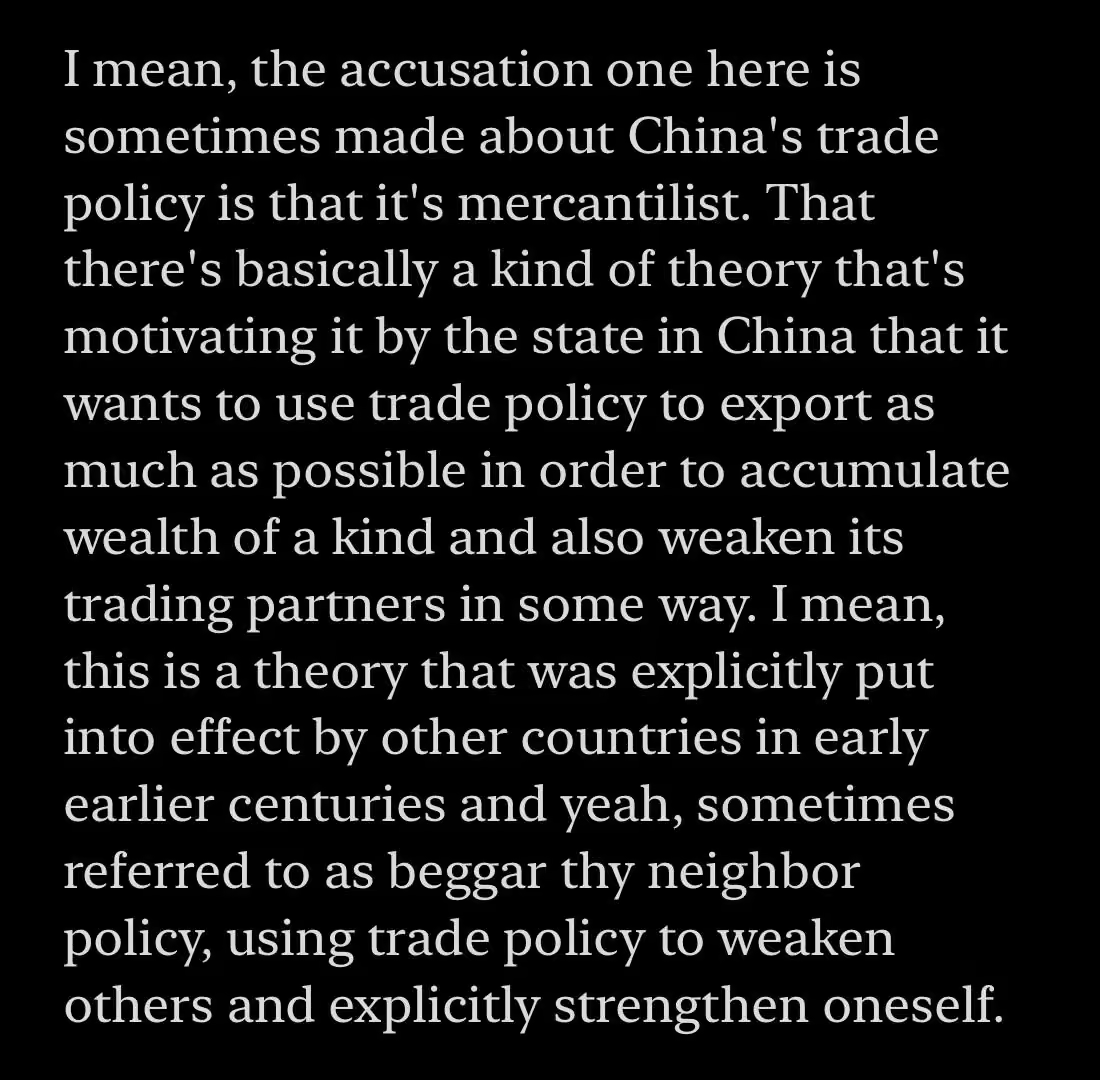
 Rush Doshi
@RushDoshi
The @nytopinion page endorses what Kurt Campbell and I called “allied scale.”
They correctly write it is the only way to find balance given China’s immense industrial capacity.


 Rush Doshi
@RushDoshi
Have to say @jacobhelberg is truly on the move. Every week a new major effort. Very good to see.
Under Secretary of State Jacob S. Helberg
@UnderSecE
Honored to spearhead today’s landmark summit in collaboration with @DeputySecState, @DavidSacks47, Ethan Klein, alongside other colleagues across the administration. Pax Silica brings together some of the world’s most technologically advanced nations to build a secure, resilient, and trusted technology ecosystem.
Economic security is national security — and together, we’re strengthening supply chains from minerals to semiconductors to computers and networks.


Rush Doshi reposted
Eric Sayers
@DEricSayers
👏
 CSPAN
@cspan
Q: “What was your reaction to the administration's decision to allow the sale of the NVIDIA chips, the H200 chips?”
@SenMcCormickPA: “I'm concerned. I'm not clear on why that is the right path for us.”
Rush Doshi reposted
Council on Foreign Relations
@CFR_org
John Cornyn, U.S. senator (R-TX), asks @RushDoshi, director of @CFR_China, about the potential consequences for the U.S. economy if access to Taiwan Semiconductor Manufacturing Company were denied.
🔗 Tap here for more on Rush Doshi’s testimony: on.cfr.org/44khrlT
Rush Doshi
@RushDoshi
You read that right.
Turns out @CFR_China’s @ChrisRMcGuire was invited onto Steve Bannon’s podcast — the first fellow from CFR to go on.
Worth a watch.
Chris McGuire
@ChrisRMcGuire
Great to be on @Bannons_WarRoom today discussing the risks of exporting AI chips to China.
Rush Doshi reposted
Chris McGuire
@ChrisRMcGuire
Great to be on @Bannons_WarRoom today discussing the risks of exporting AI chips to China.
Rush Doshi
@RushDoshi
Grateful to speak with @SangerNYT about President Trump’s decision to sell our most advanced AI chips to China.
Bottom line: if you sell the chips, it’s hard to tell allies not to sell the machines that make the chips. And those our are most important export controls.

Rush Doshi reposted
Michael Sobolik
@michaelsobolik
.@RushDoshi is right to raise this concern. If America believes trade-offs don’t exist (we can win the AI race AND sell chips to China), why should we expect our allies to behave any differently?
This is a pivotal moment. If SME controls fall apart, the game is up.
 Rush Doshi
@RushDoshi
The PRC benchmarks on the US.
Its aim has been to catch up and surpass the West for a long time. That aim is within sight.
It shouldn’t be controversial to say that when prominent Chinese economists say it, and when PRC leaders say it too.
Jonathan Cheng
@JChengWSJ
Huang Yiping, dean of Peking University’s National School of Development: “AI, if better utilised, may present a historic opportunity for China to narrow its gap with the US. The global AI story is more or less about the rivalry between the two countries.”
www.scmp.com/economy/china-economy/article/3335355/econom…
Rush Doshi reposted
 Rethink Trade
@RethinkTrade
New milestone: our Rare Earths episode of Rethinking Trade featuring @RushDoshi keeps accelerating — now past 6,000 views and ~1,000 hours of watch time.
Watch here: youtu.be/a0KzzU1xN14
Rush Doshi
@RushDoshi
Notable, however, how their reaction to the H200 differs from their reaction to the H20.
I think this suggests when they said “no” to the H20 they were holding out for better chips.
Now they’ve achieved that goal. They aren’t yet saying “no” to the H200.
Kyle Chan
@kyleichan
This is what I’ve been saying. Trump may have allowed H200 sales to China, and Chinese firms may want them. But that doesn’t mean Beijing will let it happen.
Beijing wants to break China’s dependence on US chips for good and shift to domestic ones. H200 sales may be limited.
Saagar Enjeti
@esaagar
Advanced chips for a few soybeans
Great deal! lol
Rush Doshi
@RushDoshi
This is a big deal. Essentially a reversal of the US export control policy on advanced chips. Possibly decisive in the AI race. Compute is our main advantage — China has more power, engineers, and the entire edge layer — so by giving this up we increase the odds the world runs on Chinese AI.
Rush Doshi
@RushDoshi
Sadly it’s worse than that.
We already had a deal on the beans.
We gave this up for nothing.
Rush Doshi reposted
Jim Sciutto
@jimsciutto
What did the U.S. get in return other than a one-year reprieve on rare earths restrictions and the resumption of previous agricultural sales?
Rush Doshi
@RushDoshi
This is a big deal. Essentially a reversal of the US export control policy on advanced chips. Possibly decisive in the AI race. Compute is our main advantage — China has more power, engineers, and the entire edge layer — so by giving this up we increase the odds the world runs on Chinese AI.
Rush Doshi reposted
Steve Hou
@stevehou
Can those, who say that China only manages to dominate manufacturing exports by suppressing its currency and labor costs, help me make sense of these two charts?


Rush Doshi reposted
Tom Wright
@thomaswright08
This is the modern day equivalent of letting China into the WTO.
Acyn
@Acyn
Trump: I have informed President Xi, of China, that the United States will allow NVIDIA to ship its H200 products to approved customers in China, and other Countries, under conditions that allow for continued strong National Security. President Xi responded positively! $25% will be paid to the United States of America.
 Rush Doshi
@RushDoshi
Bob nails it here.
 bob davis
@bobdavis187
Combination of Nvidia lobbying from the outside and David Saks from the inside has reversed the export control strategy of Trump 1 and Biden.
Rush Doshi reposted
Josh Rogin
@joshrogin
Lenin: “The capitalists will sell us the rope with which we will hang them.”
Xi to Trump: “Sell us your advanced AI chips and we will kick you back 25%”
Trump: “Deal!”
🤦♂️
Rush Doshi
@RushDoshi
This is a big deal. Essentially a reversal of the US export control policy on advanced chips. Possibly decisive in the AI race. Compute is our main advantage — China has more power, engineers, and the entire edge layer — so by giving this up we increase the odds the world runs on Chinese AI.
Rush Doshi reposted
Chris McGuire
@ChrisRMcGuire
This is the single biggest change in U.S.-China policy of the entire Administration, signaling a reversion to the cooperative policies of the 2000s and early 2010s and away from the competitive policies of Trump 1 and Biden. It is a transformational moment for U.S. technology policy, which until now had been predicated on investing at home while holding China back. Now we are trying to win a race against a competitor who doesn’t play by the rules.
Acyn
@Acyn
Trump: I have informed President Xi, of China, that the United States will allow NVIDIA to ship its H200 products to approved customers in China, and other Countries, under conditions that allow for continued strong National Security. President Xi responded positively! $25% will be paid to the United States of America.
Rush Doshi
@RushDoshi
Looks like we’re about to sell H200s to China. This is 6 times more powerful than the H20, which is the best chip we sell them.
Strong words from @SenWarren below:
 Rush Doshi
@RushDoshi
This is a big deal. Essentially a reversal of the US export control policy on advanced chips. Possibly decisive in the AI race. Compute is our main advantage — China has more power, engineers, and the entire edge layer — so by giving this up we increase the odds the world runs on Chinese AI.
Rush Doshi reposted
Ken Moriyasu
@kenmoriyasu
Hegseth at AUSMIN:
-- We're upgrading infrastructure on air bases in Queensland and the Northern Territory that allows for additional US bomber rotations
-- We're upgrading logistics and infrastructure in Darwin so more US Marines can do rotational deployments and prepositioning MV-22 Ospreys
-- We're working toward co-production and co-sustainment of hypersonic attack cruise missiles, co-sustainment of air to air missiles, cooperative programs across the board, including Mark 54 torpedoes
www.c-span.org/program/public-affairs-event/secretaries-r…
Rush Doshi reposted
Finbarr Bermingham
@fbermingham
Wuttke believes things are getting so bad that change is inevitable.
“The Chinese assume that we will bark and not bite, but they underestimate the pressure our industrial landscape is under. Eventually Europe will have to act... possibly in a couple of sectors next year.”
Rush Doshi reposted
 Bert Hofman(郝福满)
@berthofmanecon
The United States ran trade surpluses practically for a century from 1870 to 1970.

Rush Doshi reposted
Michael Pettis
@michaelxpettis
FT: "“These imbalances are becoming unbearable,” Macron said at a joint appearance with Xi in Beijing on Thursday. “We are at the last stop before a crisis,” a French official warned."
www.ft.com/content/ebfa1d6e-747e-451b-bc28-96e5d73fedf7 via @ft
Rush Doshi reposted
Rush Doshi
@RushDoshi
Not sure the full context of the quote in that column, but my intended point is that there is an offensive security logic to China's pursuit of industrial and technological dominance - and dominance is the right word - that was absent for postwar Germany, Japan, and the ROK.
A testable hypothesis for this claim would be: When there tradeoffs between power-political aims and economic aims, does China increasingly choose the former across sectors? Indeed, we see guidance suggesting it: a greater proportion of security discourse in Party Congress reports, the plenums, and several of Xi's own speeches; discourses on dual circulation; discourses on the fourth industrial revolution; civ-mil integration, and so on.
China in this respect is more like prewar Japan, Germany, and the Soviet Union - it pursues industrial and technological dominance (a kind of asymmetric autarky) out of a logic of power rather rather than a logic of prosperity or the market. It seeks leapfrog not simply economically but geopolitically.
Postwar Germany, postwar Japan, and the ROK - in contrast to China - did not:
(1) Pursue the largest military buildup in history, pursue the largest nuclear buildup in modern history, pursue overseas military bases, or attack/threaten to attack their neighbors (in China's case: Philippines, Vietnam, India, Korea, Japan, Taiwan, and so on).
(2) Seek to reduce to near zero dependence on global markets entirely while increasing global dependence on their own markets, as China has done (and indicates is doing for geopolitical purposes too).
(3) Throttle supply chains to maintain geopolitical advantage, as China has done.
(4) And perhaps, most dispositively, explicitly link dominance of global technology and industry to a power maximization agenda (again, in this respect China resembles prewar Japan, Germany, and the Soviet Union). You can see this in texts going back decades, but perhaps most recently, Hu Jintao, Wen Jiabao, and of course Xi Jinping.
The idea that China's pursuit of industrial and technology advantage is somehow similar to how postwar Japan, postwar Western Germany, and the ROK does not seem defensible to me - and of course, China's is happening on a scale so vast it will probably deindustrialize the entire West and the rest of the world in about a decade.
A question for you: if the core thesis of the column and Goldman report, which is that China's industrial and technological dominance is "beggar they neighbor" and in fact reducing global growth, is true, how should the rest of the world respond to these imbalances? I think there are opportunities for partnership, but of course, China has a veto.
Rush Doshi
@RushDoshi
Bipartisanship on China isn't quite dead.
Ricketts, Coons, Cotton, McCormick, Shaheen, and Kim come together to sponsor legislation codifying existing export controls on AI chips to China.

Rush Doshi reposted
Noah Smith 🐇🇺🇸🇺🇦🇹🇼
@Noahpinion
I decided to spend all day reading and writing about the Chinese innovation ecosystem. How did you spend your Wednesday?
www.noahpinion.blog/p/china-has-invented-a-whole-new-way
Rush Doshi reposted
Jennifer Doshi Welch
@geoeconjennie
The year is coming to a close, but geopolitical tensions are still running hot.
Join my team 12/11 for a tour of global flashpoints, where they stand, where we think they’re headed in 2026, and what it means for businesses and investors.
Register here: bloomberg.com/faultlines2026

Rush Doshi reposted
 Matthew C. Klein
@M_C_Klein
New at THE OVERSHOOT:
Waking the Sleeping European Giant
theovershoot.co/p/waking-the-sleeping-european-giant
Coordination and mobilization of existing resources would transform the continent into a superpower. The ongoing failure to do so is largely the fault of narrow-minded technocrats.


Rush Doshi reposted
 StevenWMosher
@StevenWMosher
Just so you know, Zhai is based in Beijing, China, and is professionally affiliated with China's state media, the Xinhua News Agency.
So as he pretends to be an objective observer -- "China may have just quietly reopened the Okinawa question" -- he is actually just a mouthpiece, informing us what Beijing's new policy of aggression towards Japan is.
 Zhai Xiang
@ZhaiXiang5
x.com/Stanford/status/629038086106808321
I think China may have just quietly reopened the Okinawa question-and this could reshape Asia's balance of power in ways few people are ready for.
Although China usually keeps a low profile on Okinawa, several recent statements by Takaichi- including her implication of potential armed intervention in Taiwan, Japan's continuted deployment of strategic assets in Okinawa, and her Nov. 26 assertion that "according to the Treaty of San Francisco, we are not in a position to recognize Taiwan's legal status"-appear to have prompted China to revisit the question of Okinawa, assumed by many as long dead.
This past month, a spokesperson from China's Ministry of Foreign Affairs posted excerpts from the Potsdam Declaration outlining Japan's post-WWII territorial boundaries, which has been speculated as a hint towards Okinawa. If that wasn't clear enough, yesterday, China's second-largest news agency, China News Service, published an article titled "The Issue of Ryukyu Sovereignty: It's Time to Settle This Old Account," openly questioning Japan's sovereignty over Okinawa. Unsurprisingly, the move drew immediate attention at home and abroad.
When I studied China-US-Japan relations at Stanford, my advisor was Gordon H. Chang, a rational, rigorous, and deeply respected scholar of US-China relations. He was also the one who first told me about the other Gordon Chang, my fellow Cornell alumnus and the author of the "China collapse theory." Actually, last week, the other Gordon retweeted two of my posts analyzing Sino-Japanese relations without any provocative comments. I disagree with almost everything he writes, but I really appreciated his restraint this time.
Shortly I started at Stanford in 2012, I had my first annual discussion with Gordon about my study plan, and we discussed the Diaoyu Islands and the Ryukyus, both of which interested us. He suggested I focus on the Ryukyu issue for my thesis. Later, I was fortunate enough to secure a part-time research position at Hoover, where I worked on organizing valuable archives such as Chiang Kai-shek's diaries. Stanford also generously provided multiple scholarships, allowing me to visit the FDR Presidential Library in New York and Taipei to examine original archives from both the Chinese and American sides regarding the Ryukyu issue. These experiences formed the core of my Ryukyu research.
In my Stanford thesis, I approached these questions with as much historical rigor and objectivity as possible. In 2015, it was published in JCC, the leading American journal on Chinese studies, and Stanford News Center wrote a report about my thesis too. Hoover also featured my thesis on their website.
Few people today realize this, but Ryukyu's fate was once one of the key topics among the Allies-Roosevelt, Churchill, Stalin, Chiang… all held a clear position.
And:
How did the Ryukyu Kingdom become today's Okinawa under Japanese rule?
And why does this history matter again in 2025?
To understand that, we must return to the beginning.
The Ryukyus are a chain of volcanic islands that stretch southwest from Japan's Kyushu to China's Taiwan. Starting in 1372, the Ryukyus paid tribute to China and became a member of the tributary system under the Chinese imperium.
As a result of the attack by Shimazu Tadatsune in 1609, the Ryukyu Kingdom started paying additional tribute to the Kyushu-based Shimazu clan, which considered the islands a domain of Satsuma.
From 1609 until the early 1870s, the Ryukyus functioned as a tributary state for both China and Japan. Yet the rapid rise of Japan after its Meiji Reform soon broke the balance that had lasted for more than two centuries. In 1874, Japan shifted the Ryukyus from the Foreign Office to the Home Ministry and, by 1879, had incorporated the islands as a prefecture.
Seized with panic, China reached out to former US President Grant, who was on a tour around the world, wishing to resolve the issue through his arbitration. Having visited Beijing and Tokyo, Grant quickly devised a proposal to China, with the northern part ceded to Japan, the southern part to China, and the rest restored to the previous kingdom (top left). On April 17, 1880, the Japanese government raised the proposal to divide the Ryukyus in two, with the Miyako-jima (宫古岛) and Yaeyama Islands (八重山群岛) put under the rule of China. On October 28, 1880, the Chinese government accepted the proposal, and agreed to grant Japan most-favored nation status as reciprocity. However, China and Japan never implemented this agreement, and the problem of the Ryukyu Islands remained unresolved, with Japan continuing to control the islands until the end of World War II.
Despite rarely mentioning this issue since the Japanese annexation of the Ryukyus, successive Chinese administrations have never officially recognized Japanese sovereignty over these islands, nor have they relinquished their proper rights to the Ryukyus.
Chiang Kai-shek, China's supreme leader from the late 1920s to 1949, despite carrying much historical controversy, did not recognize Japan's control over the Ryukyu Islands either and attempted to address this issue.
On September 13, 1932, close to the one-year anniversary of the Mukden Incident in which Japan launched a surprised attack on northeast China under the excuse of a "survival crisis (sounds familiar?)", Chiang wrote in his diary, expectantly, by the Moon's Festival in 1942, we should be able to recover Manchuria (northeast China), liberate Korea, and take back Taiwan and the Ryukyus."
On a night in late September 1940, Chiang coincidentally reviewed the diary entry written down eight years before. Still, he believed that his Nationalist Government had a chance "to recover the Ryukyus". During a press conference held in early November 1942 in America, T. V. Soong, China's Foreign Affairs Minister and Chiang's brother-in-law (I met with one of Soong's granddaughters when she visited Hoover by offering her an archival tour, a very elegant lady), indicated that China should take back northeast China, Taiwan and the Ryukyus, and that Korea had to become independent.
In late November that year, Madame Chiang Soong May-ling left for the US. Her speech at the US Congress is still regarded as a classic to this day. Before her departure, Chiang Kai-shek meticulously prepared her for talks with Roosevelt. The very first point was that Manchuria, Taiwan and the Ryukyus should be returned to China, and China would approve of America using naval and air bases at these locations. Having met with FDR, Soong May-ling informed Chiang in her telegraph on March 1, 1943 of Roosevelt's agreement that "the Ryukyu Islands and Taiwan should be reverted to China in the future."
In the same month, Chiang published his renowned China's Destiny, in which he discussed his vision of China's future and the Ryukyus' importance to China's national defense.
Thus, by the eve of the Cairo Conference, recovery of the Ryukyus had been one of China's established policies. And my archival studies have shown Roosevelt, Churchill, US Secretary of State Cordell Hull, British Foreign Minister Anthony Eden and Josef Stalin all agreed to return Okinawa to China after WWII during or around the time of the 1943 Cairo Conference.
Though Chiang was soon to retreat from this demand, his determination to take Okinawa back attracted the top attention within the Allies.
Preparing for the Cairo Conference that took place in November 23-26 1943, China's Advisory Office of the Military Commission envisioned a comprehensive plan that the Generalissimo would raise during the meeting. According to the draft, Japan should retreat from all the territories that it had occupied since September 18, 1931, and restore to China Taiwan and the Ryukyus. The draft even included a flexible back-up plan that Okinawa could either be put under international trusteeship or designated as a demilitarized zone.
However, by November 15, 1943, Chiang apparently had changed his mind. In the entry on that day, Chiang argued that the status in history of the Ryukyus and Taiwan was different: "The Ryukyus as a kingdom resembles Korea in this position" and, therefore, Chiang decided not to raise the issue regarding these islands during the conference.
To Chiang's surprise, on November 23, Roosevelt took the initiative to bring up the Ryukyu issue during his meeting with Chiang. According to the FRUS:
"The president then referred to the question of the Ryukyu Islands and enquired more than once whether China would want the Ryukyus. The Generalissimo replied that China would be agreeable to joint occupation of the Ryukyus by China and the United States and eventually, joint administration by the two countries under the trusteeship of an international organization."
As Chiang wrote in his diary on the same day, he attended a dinner meeting with FDR at Mena House that started at 7:30 pm and lasted well beyond 11:00 pm. The discussion went on so long that when Chiang left, there was still a range of issues to be discussed. Roosevelt and Chiang thus decided to resume the discussion the following day. Concerning territorial issues, "Manchuria, Taiwan, and the Pescadores should all be restored to China. However, the Ryukyus could be put under joint trusteeship of
China and the US under the international mandate."
Chiang Kai-shek, often known as a cold and ruthless "tyrant" for many pro-independence Taiwanese, displayed a surprising indecisiveness when it came to the Ryukyu issue.
Based on Chiang's diaries, he might have softened on the Ryukyu issue for three reasons. First, other lost territories of China, such as Manchuria and Taiwan, weighed more heavily on his heart. Faced with a considerable number of issues to settle during the conference, Chiang was too exhausted to address each and every issue that he might have wished to bring to the table. The restoration of the Ryukyus, thus, did not become a consistent thread in Chiang's agenda for the post-WWII settlement.
Second, Chiang was concerned about America's sincerity. Roosevelt's offer to allow China to take over these islands of such great strategic importance might have sounded too good to be true to Chiang. In addition, Chiang, being diplomatically inexperienced, was suspicious as to whether Roosevelt was testing China's ambitions on expansionism.
Third, the Ryukyus were a tributary state of China rather than an inherent part of the territory of China, similar to the status of Korea historically. The close historical relations between China and the Ryukyus remained suzerainty ties, while China had never exercised direct control there. Chiang, as one of "the Big Four Leaders" of the Allies, grandly proclaimed that he coveted "no gain" and entertained "no territorial expansion." Consequently, attempts to incorporate the Ryukyus into Chinese territory seemed inconsistent with Chiang's moral claims.
Chiang would meet Roosevelt again on 24 and 25, yet neither his dairies nor sources from the American side indicated that the Ryukyus were a topic discussed between them again.
On December 1, 1943, the Three Great Allies (top right) jointly issued the Cairo Declaration that stipulated:
"It is their purpose that Japan shall be stripped of all the islands in the Pacific which she has seized or occupied since the beginning of the First World War in 1914, and that all the territories Japan has stolen from the Chinese, such as Manchuria, Formosa, and The Pescadores, shall be restored to the Republic of China. Japan will also be expelled from all other territories which she has taken by violence and greed."
The future of the Ryukyus was not mentioned in this document, though the statement that "Japan will also be expelled from all other territories which she has taken by violence and greed" may still have served Chiang in his future claim on the islands.
At the Tehran Conference, Stalin told Roosevelt that the Ryukyus, which Japan forcibly annexed in 1879, should be returned to China. Two years later, at the Potsdam Conference, the four great Allies reached a final decision over the unresolved Japanese territorial issue. With reference to the Cairo document, the Potsdam Declaration defined the limits of the post-war "to the islands of Honshu, Hokkaido, Kyushu, Shikoku and such minor islands as we determine." However, the Potsdam Declaration that Truman, Churchill and Stalin issued jointly with the absent Chiang on July 26, 1945, like the Cairo document, made no mention of the islands.
In the end Chiang missed a golden opportunity to restore the Ryukyus to China. Months earlier before Potsdam, on March 31, Admiral Nimitz issued US Navy Military Government Proclamation no. 1, placing the Ryukyus under US military administration, 13 days before FDR passed away.
Over the past few weeks, the Cairo Declaration and the Potsdam Proclamation have frequently appeared in official statements from both China and Japan. They are not relics of a bygone era, but critical milestones that have shaped the fate of millions and laid the foundation for the postwar world order that defines the world day.
As for the Potsdam Conference, I visited its site in July 2016 (bottom left). It was an unforgettable journey. Back then, I was traveling alone, carrying a backpack and started from Beijing, traveling by train across Mongolia, Lake Baikal, Siberia, Moscow, Saint Petersburg, and Minsk, then onward to Warsaw and finally Berlin. And my very first stop upon arriving in Berlin was to visit Potsdam. Alongside Greece, it remains one of the most sacred and memorable moments of my trip through Europe.
I also stayed at the site of the Cairo Conference during my honeymoon around this same time two years ago (bottom right). The property, close to the pyramids, is now part of the Marriott Mena House, where the hotel generously upgraded my reservation to a suite and offered exceptional hospitality. Unfortunately, the building where the Cairo Conference had taken place was under renovation. I made several requests to visit, and even a senior official from the Egyptian Antiquities Authority came in person to help communicate on my behalf. Yet in the end, I still was not permitted to enter. It was, undeniably, a great disappointment.
But even so, I did not feel discouraged. History does not become distant simply because we cannot step through one door. In fact, these moments remind me that respect, patience, and understanding are themselves ways of touching history.
Tomorrow, I'll share something even more surprising-the petitions Ryukyuans sent to China after WWII, and why they were buried for decades. May change how you see East Asia entirely.


 Rush Doshi
@RushDoshi
As many know, @Scholars_Stage helps run @CFR_China's Open Source Observatory. But more than that, he is a brilliant essayist.
His essay on how the Civil War forged America's techno-nationalist elite, who then built American power, is one of the best things I've read this year.

Rush Doshi reposted
李老师不是你老师
@whyyoutouzhele
大槻真希演出到一半,直接被拉掉舞台的电闸,评论区有观众大喊“一刀切啊!一刀切!”,然后主持人直接宣布“本次演出到此结束”。
李老师不是你老师
@whyyoutouzhele
11月28日,上海BN嘉年华,歌手大槻真希在演出最后一首海贼王ED《memories》时,突然音乐停止,演出中止,匆匆退场。
举办方解释为“不可抗力因素”。
Rush Doshi
@RushDoshi
China’s state media again laying the foundation to question whether Okinawa is legitimately part of Japan.
But if Japan’s press said anything like that about Xinjiang, Tibet, Mongolia, Hong Kong, or Taiwan, China would vociferously object and issue threats.
 Liu Xin刘欣
@LiuXininBeijing
Japan is deploying medium-range missiles in the Ryukyu Islands, on Yonaguni, just 110 km from China's Taiwan. This move revives a forgotten name: Ryukyu. Once a thriving kingdom with its own culture and was recognized by many countries, Ryukyu was gradually erased: annexed by Japan, manipulated after WWII, and rewritten as "Okinawa." How does a kingdom disappear? The Undetermined Status Of Ryukyu uncover the buried truth. #ryukyu #chinajapan
Rush Doshi
@RushDoshi
The Economist is wrong here. Doubling down on failed policy.
Sander Tordoir
@SanderTordoir
The Economist’s answer to the China shock: Europe should reallocate towards services.
That would mean Germany, and much of the continent, end up with an economy that looks more like Britain’s.
In that context, this chart on the UK's productivity by sectors is interesting.

Rush Doshi reposted
Yuan Yi Zhu
@yuanyi_z
Someone just uploaded a 6 hour recording of the court martial of Xu Qinxian, the Chinese general who refused to take his army to Beijing in 1989. Astonishing stuff. youtu.be/m2NN0vSJ8rU
Rush Doshi reposted
Ken Moriyasu
@kenmoriyasu
In better days ...
"Over two decades, from 1979 to 1999, Japan provided some 56% of all bilateral aid given to China."
"Japan did not give direct aid only to China. It also gave grants to Australia to support the mining of coal and iron ore that would be supplied to China at low prices."
"Owing to extraordinary efforts on the part of Chinese and Japanese managers and workers, steel production began in 1985. Completion of the Baoshan Steel Works enabled China to accelerate machinery production and construction."
"By 2015, with the addition of other steel plants based on the Baoshan model, China was producing almost 1 million tons of steel per year, roughly 40 times China's steel production in 1977 and more than half of the world's total steel production."
"Excellent relationships were developed between the Japanese and Chinese officials and engineers working together at Baoshan. Even many years later, Chinese and Japanese officials who had taken part in the technology transfer held reunions to celebrate the success of their joint collaborations, allowing the Chinese to express their appreciation to the Japanese who had assisted In the project."
Rush Doshi reposted
George Magnus
@georgemagnus1
Nice words. But the numbers say something else completely. Export volume up nearly 50% on a decade, import volumes barely higher. This is pure mercantilism and the opposite of a shared community
 Hu Xijin 胡锡进
@HuXijin_GT
China needs to import foreign energy, minerals and semiconductors, as well as a wide range of foreign-produced equipment. We rely on foreign agricultural products, indirectly importing other countries’ sunlight and water. We import all kinds of luxury consumer goods, and our tourists and students travel abroad, effectively importing foreign education and services.
Don’t overstate China’s current trade surplus. China’s vision of a community with a shared future for mankind is based on one fundamental premise: the common prosperity of the world as a whole.

Rush Doshi reposted
Sander Tordoir
@SanderTordoir
A lot of data underscore that Robin is right.
China's imports of manufactures have been declining ever since it joined the WTO.
Chart from @Brad_Setser with his words "That's one of those factoids about contemporary globalization that should be much better known."

 Gideon Rachman
@gideonrachman
I hesitate to call any piece FT piece “important” because it sounds self important BUT this by @RobinBHarding is genuinely important. And I think will have a big impact as.ft.com/r/222f3b38-f2c4-43e6-8638-308be851a198
Rush Doshi
@RushDoshi
The only solution to this problem is allied scale — pooling allied markets and demand to create an alternative to China’s scale.
Either that, or the West’s development goes into reverse.
 Rush Doshi
@RushDoshi
In 2022, China fired missiles into Japan’s EEZ.
 China Daily
@ChinaDaily
#fmsays Japan's plan to deploy offensive weapons on islands near China's Taiwan region is "extremely dangerous", Foreign Ministry spokeswoman Mao Ning warned, after reports said Japan's Defense Minister Shinjiro Koizumi visited an island near Taiwan and talked about deploying medium-range surface-to-air missiles there. China will never allow Japanese right-wing provocateurs to reverse the course of history, and will never let external forces lay their hands on the Taiwan region, Mao said.
Rush Doshi reposted
William Yang
@WilliamYang120
Japan’s defense minister, visiting a military base close to Taiwan, said plans to deploy missiles to the post were on track as tensions smolder between Tokyo and Beijing over the East Asian island.
www.japantimes.co.jp/news/2025/11/23/japan/japan-deployin…
Rush Doshi
@RushDoshi
Thrilled that @nytopinion decided to spotlight my recent op-ed on the US-China trade war and the Busan summit at the top of their “Opinion Today” newsletter.
At their request, I wrote a short intro for what motivated the op-ed.


Rush Doshi reposted
Georgetown SFS
@georgetownsfs
On Thursday, SFS Prof @RushDoshi testified before the Senate Foreign Relations Committee on the Taiwan Enhanced Resilience Act, outlining China’s shifting strategy, Taiwan’s response & why the U.S. must help strengthen Taiwan’s morale.
Watch here: www.foreign.senate.gov/hearings/reviewing-implementation-…
Rush Doshi reposted
Chris McGuire
@ChrisRMcGuire
Approving sales to China of Nvidia H200 AI chips, its flagship previous-generation AI chip, would be almost as harmful to U.S. AI leadership as approving the sale of the current-generation B30A Blackwell chip (which POTUS rejected). The below chart compares the H20, B30A, and H200. Some stats:
- The H200 is better than the B30A by some metrics. The H200 has 20% more memory bandwidth than the banned B30A Blackwell chip;
- The H200 is far more powerful than the best U.S. chip China can buy today. It has over 6x the performance of the H20 (the best Nvidia chip that is currently allowed to be sold in China);
- The H200 is better than any AI chip that China has ever been able to buy or make. It is over 9x the performance levels in U.S. export control thresholds, and is better than all chips sent to China before current controls went into effect, or any chip China can make;
- China will not be able to make a chip as powerful as the H200 for years. Huawei has stated publicly that it does not plan to make a chip better than the H200 until Q4 2027 - two years from now. And Huawei currently cannot produce AI chips at anywhere near the scale of the United States and our allies, and is unable to meet domestic demand for AI chips.
- Exporting H200s will improve China's AI capabilities AND allow it to compete globally. Exporting H200s will not only improve China's ability to train cutting-edge AI models, but it will also enable China to start building large-scale AI data centers globally - which to date it has not. This will make it much harder for the U.S. AI stack to dominate globally.
 Bloomberg
@business
US officials are having early discussions on whether to let Nvidia sell its H200 artificial intelligence chips to China, a contentious potential move that would mark a major win for the world’s most valuable company www.bloomberg.com/news/articles/2025-11-21/trump-team-int…
Rush Doshi reposted
Greg R. Lawson
@ConservaWonk
I don't agree with everything @RushDoshi argues in this @nytimes piece but I hope President Trump & his team reads & wrestles with it.
China is now a peer competitor & we need to be ruthlessly focused & pragmatic on balancing it.
www.nytimes.com/2025/11/19/opinion/trump-china-xi-trade.html
Critically, America needs to work collaboratively with many nations, both full friends & just tactical relations, to take the loaded gun China currently has aimed at it with rare earths.
The recent Trump deal with Saudi Arabia is one such arrangement, in particular the refining component.
Rush Doshi reposted
Georgetown SFS
@georgetownsfs
Writing for @NYTimesOpinion, SFS Prof @RushDoshi says the recent Trump–Xi summit signals shifting great-power politics, arguing that Trump’s strategic missteps have let China emerge as America’s geopolitical equal.
Read more: www.nytimes.com/2025/11/19/opinion/trump-china-xi-trade.html
Rush Doshi reposted
 Joanna Chiu
@joannachiu
Looking forward to chatting about this topic at Sunday's @gijn event on China's supply chains. Send me a DM if you'd like to connect at #gijc25.
My panel: gijc2025.org/speakers/chiu.joanna5/
Great analysis from @RushDoshi in NYT:

Rush Doshi reposted
Joseph Torigian
@JosephTorigian
Xi Zhongxun, the father of Xi Jinping, with his former boss at the secretariat general-secretary Hu Yaobang, born 110 years ago. I wish I had the space to include these pictures in my book:


 China Xinhua News
@XHNews
The Communist Party of China (CPC) Central Committee on Thursday held a symposium to mark the 110th anniversary of the birth of Hu Yaobang, a former prominent leader of the Party, at the Great Hall of the People in Beijing. Read update: xhtxs.cn/8kK

Rush Doshi reposted
Patrick McGee
@PatrickMcGee_
This essay is painfully good.
Painful because you wish the author, @RushDoshi, was wrong. But he’s not. US dependence on China is profound and our leaders are just becoming literate on how this happened, what it means, and how long it will take to unwind.

Rush Doshi reposted
 Seema Sirohi
@seemasirohi
.@RushDoshi: Trump’s Trade War Showed China Can Stand Up to America. He mistook political theater for strategy, lost ground against China not solely because he misjudged Xi but because he underestimated America’s dependence on the supply chains… www.nytimes.com/2025/11/19/opinion/trump-china-xi-trade.html
Rush Doshi reposted
Noah Smith 🐇🇺🇸🇺🇦🇹🇼
@Noahpinion
I agree with Rush that scaling with allies is the way to match China. That's the most important thing everyone needs to focus on.
But I think that before Xi used rare earth export controls, America was NOT serious about becoming independent in rare earths. So it had to happen.
Rush Doshi
@RushDoshi
Grateful to share my new piece in @nytimes.
I write that there are moments in great-power politics when the tectonic plates seem to shift beneath us. The Busan Summit that froze the U.S.-China trade war was one of them. And if historians try to identify exactly when China became America's geopolitical equal, they may trace it to that moment.
Four few key points:
1⃣ This was entirely avoidable: POTUS started an unnecessary trade war with China that took tariffs to 140%. Xi was backed into a corner, so he reached for "break glass" tools like rare earths and magnets in ways he never had before, even under Biden, for fear of escalation. He was ready. But he took a risk too. He didn't play his cards - he played the player. And his opponent folded.
2⃣ China now has our number: For the first time in modern history, China absorbed the full weight of American economic pressure and retaliated successfully with greater pressure of its own on rare earths and rare earth magnets. The world saw that, and allies will question our staying power. Meanwhile, there's a risk that China's coercion could expand to other issues. All this puts at risk some of the important steps the Trump team is taking to reindustrialize, rebalance trade, and rebuild the defense industrial base.
3⃣ We were better off before the trade war: Now, we got soybeans exports but less than before. We got the PRC to suspend its licensing regime, but only for a year, and we had to freeze our controls and promise no new ones. We got Fentanyl progress, but we cut tariffs, and China's rate is now much closer to allies and partners - reducing incentive to diversify out of China.
4⃣ We need to adjust strategy: You don't invade Russia in the winter. And you don’t start a trade war with your main supplier until you’ve reduced your vulnerabilities. Power is deadly business. That is why China built it patiently, avoiding premature tests of strength before it was ready. We have to do the same.
Bottom Line: The trade truce now buys each side time. We have to use that time better. The key imperative for our prosperity, sovereignty, and technological leadership is to rebuild our strength. We have every advantage in that task. And the decisive one is our allies, with whom we collectively outscale China.

Rush Doshi reposted
Victor Shih
@vshih2
The Moment China Proved It Was America’s Equal www.nytimes.com/2025/11/19/opinion/trump-china-xi-trade.html via @NYTOpinion /great “post mortem” on the administration’s China policy up to now by @RushDoshi . The problem is he will be even more distracted by domestic policies going forward
Rush Doshi reposted
Matt Stoller
@matthewstoller
Good piece by @RushDoshi. Trump isn't interested in addressing U.S. vulnerabilities to China. www.nytimes.com/2025/11/19/opinion/trump-china-xi-trade.html
Rush Doshi reposted
Jonathan Cheng
@JChengWSJ
.@RushDoshi in NYT op-ed: “Trump Proved That China Can Stand Up to America Now…The real story to emerge from the event was…the unmistakable demonstration that China could now face America as a true peer.”
www.nytimes.com/2025/11/19/opinion/trump-china-xi-trade.html
Rush Doshi reposted
 Constanze Stelzenmüller
@ConStelz
Important analysis with key lessons for Europe by @RushDoshi 👇👇👇
Rush Doshi
@RushDoshi
Grateful to share my new piece in @nytimes.
I write that there are moments in great-power politics when the tectonic plates seem to shift beneath us. The Busan Summit that froze the U.S.-China trade war was one of them. And if historians try to identify exactly when China became America's geopolitical equal, they may trace it to that moment.
Four few key points:
1⃣ This was entirely avoidable: POTUS started an unnecessary trade war with China that took tariffs to 140%. Xi was backed into a corner, so he reached for "break glass" tools like rare earths and magnets in ways he never had before, even under Biden, for fear of escalation. He was ready. But he took a risk too. He didn't play his cards - he played the player. And his opponent folded.
2⃣ China now has our number: For the first time in modern history, China absorbed the full weight of American economic pressure and retaliated successfully with greater pressure of its own on rare earths and rare earth magnets. The world saw that, and allies will question our staying power. Meanwhile, there's a risk that China's coercion could expand to other issues. All this puts at risk some of the important steps the Trump team is taking to reindustrialize, rebalance trade, and rebuild the defense industrial base.
3⃣ We were better off before the trade war: Now, we got soybeans exports but less than before. We got the PRC to suspend its licensing regime, but only for a year, and we had to freeze our controls and promise no new ones. We got Fentanyl progress, but we cut tariffs, and China's rate is now much closer to allies and partners - reducing incentive to diversify out of China.
4⃣ We need to adjust strategy: You don't invade Russia in the winter. And you don’t start a trade war with your main supplier until you’ve reduced your vulnerabilities. Power is deadly business. That is why China built it patiently, avoiding premature tests of strength before it was ready. We have to do the same.
Bottom Line: The trade truce now buys each side time. We have to use that time better. The key imperative for our prosperity, sovereignty, and technological leadership is to rebuild our strength. We have every advantage in that task. And the decisive one is our allies, with whom we collectively outscale China.
Rush Doshi reposted
Kyle Chan
@kyleichan
“It is unwise to start a trade war with the main supplier of your most critical imports until you have mitigated your vulnerabilities.”
Every line in this piece by @RushDoshi hits the mark. www.nytimes.com/2025/11/19/opinion/trump-china-xi-trade.html
Rush Doshi reposted
Ryan Hass
@ryanl_hass
Sharing this critique by @RushDoshi of the miscalculations and lack of forethought by the Trump administration that caused the US to be in a weaker position with China now than it was 1 year ago. www.nytimes.com/2025/11/19/opinion/trump-china-xi-trade.html
Rush Doshi
@RushDoshi
Grateful to share my new piece in @nytimes.
I write that there are moments in great-power politics when the tectonic plates seem to shift beneath us. The Busan Summit that froze the U.S.-China trade war was one of them. And if historians try to identify exactly when China became America's geopolitical equal, they may trace it to that moment.
Four few key points:
1⃣ This was entirely avoidable: POTUS started an unnecessary trade war with China that took tariffs to 140%. Xi was backed into a corner, so he reached for "break glass" tools like rare earths and magnets in ways he never had before, even under Biden, for fear of escalation. He was ready. But he took a risk too. He didn't play his cards - he played the player. And his opponent folded.
2⃣ China now has our number: For the first time in modern history, China absorbed the full weight of American economic pressure and retaliated successfully with greater pressure of its own on rare earths and rare earth magnets. The world saw that, and allies will question our staying power. Meanwhile, there's a risk that China's coercion could expand to other issues. All this puts at risk some of the important steps the Trump team is taking to reindustrialize, rebalance trade, and rebuild the defense industrial base.
3⃣ We were better off before the trade war: Now, we got soybeans exports but less than before. We got the PRC to suspend its licensing regime, but only for a year, and we had to freeze our controls and promise no new ones. We got Fentanyl progress, but we cut tariffs, and China's rate is now much closer to allies and partners - reducing incentive to diversify out of China.
4⃣ We need to adjust strategy: You don't invade Russia in the winter. And you don’t start a trade war with your main supplier until you’ve reduced your vulnerabilities. Power is deadly business. That is why China built it patiently, avoiding premature tests of strength before it was ready. We have to do the same.
Bottom Line: The trade truce now buys each side time. We have to use that time better. The key imperative for our prosperity, sovereignty, and technological leadership is to rebuild our strength. We have every advantage in that task. And the decisive one is our allies, with whom we collectively outscale China.
Rush Doshi
@RushDoshi
Link here: www.nytimes.com/2025/11/19/opinion/trump-china-xi-trade.h…
Rush Doshi
@RushDoshi
For more on all this, my podcast with @niubi may be of interest:
sinocism.com/p/sinocism-live-rush-doshi-on-the-trump
Rush Doshi reposted
 中山泰秀🇯🇵Yasuhide NAKAYAMA 大阪4区=大阪市北区,福島区,都島区,城東区
@iloveyatchan
As Japan’s former State Minister for Foreign Affairs, Defense, and the Cabinet Office—and as Special Policy Advisor to PM Sanae Takaichi when she served as Chair of the LDP Policy Research Council (responsible for Foreign Affairs, National Defense, and the Game-Changing Field)—I’ve had the rare opportunity to witness how geopolitical narratives are shaped, distorted, and weaponized.
Today, I feel a quiet responsibility to speak.
There is a stark asymmetry in how China responds to global leaders:
🔹 When U.S. President Donald Trump referred to China as an “enemy,” labeled COVID-19 the “China Virus,” and called Xi Jinping a “dictator,” Beijing remained largely restrained.
🔹 When PM Takaichi made a measured, law-based comment—consistent with Japan’s existing security framework—stating that a military blockade of Taiwan could constitute a “situation threatening Japan’s survival,” China launched a targeted and disproportionate response.
This is not about content.
It’s about control.
As The Guardian noted in its recent analysis,
“China and Japan are in a war of words over Taiwan – what happens next?”
→ www.theguardian.com/world/2025/nov/17/china-and-japan-are…
Beijing avoids provoking actors like Trump because of risk.
But it sees an opportunity in discrediting principled, strategic voices like Takaichi—
to fracture Japan’s internal cohesion and weaken policy continuity.
This is not traditional diplomacy.
This is political warfare—designed to manipulate perception, sow doubt, and undermine confidence within democratic societies.
Having worked at the core of Japan’s foreign and defense policymaking, I believe we must respond with clarity.
Democracies must never allow their national security conversations to be hijacked by authoritarian outrage.
We must not shrink from truth because it offends those who fear transparency.
Speaking about security realities is not provocation.
It is deterrence.
It is responsibility.
I write not in anger—but in conviction.
Out of respect for democratic leadership,
and for those who choose to lead with both clarity and courage.
#japan #trump #takaichi #taiwan #china #geopolitics #politicalwarfare #security #democracy #indopacific #leadership
Rush Doshi reposted
 Luca Fornaro
@LucaFornaro3
Here's a possible explanation. Higher exports from China crowd out production of high-tech goods and innovation in the rest of the world. Over the medium term, GDP in the rest of the world drops because of lower productivity growth.


Rush Doshi reposted
Greg Ip
@greg_ip
1/ Fascinating and important report from Goldman Sachs. They have upgraded long-term GDP of China because of increased exports, but see this as reducing, not increasing, rest of world GDP. Chinese displacement of domestic manufacturing swamps any positives from cheaper goods.

Rush Doshi reposted
CFR China Strategy Initiative
@CFR_China
.@ChrisRMcGuire joins CFR as a senior fellow for China and emerging technologies. He is a leading expert in technology protection policies and previously served as the deputy senior director for technology and national security at the NSC.

Rush Doshi reposted
Chris McGuire
@ChrisRMcGuire
Thrilled to share that I've joined the Council on Foreign Relations as a senior fellow on China and emerging technologies. Looking forward to writing and speaking more on all things China tech, AI, semiconductors, and other areas, and grateful to contribute to CFR's mission!
CFR China Strategy Initiative
@CFR_China
.@ChrisRMcGuire joins CFR as a senior fellow for China and emerging technologies. He is a leading expert in technology protection policies and previously served as the deputy senior director for technology and national security at the NSC.
Rush Doshi
@RushDoshi
We are thrilled to announce that @ChrisRMcGuire has joined @CFR_China as Senior Fellow for China and Emerging Technologies!
Chris previously worked at the NSC, State, DOD, and the AI Commission and is a leading expert on China and emerging technologies.

Rush Doshi reposted
 Richard Casey
@Richard_Casey
This year, China's economy is growing 5% with negative import growth and surging trade surplus. How does that contribute to growth anywhere but China?
"Growth in China's economy will make important contributions to global economic growth" premier says
www.reuters.com/world/asia-pacific/chinese-premier-li-ple…
Rush Doshi reposted
CFR China Strategy Initiative
@CFR_China
Is America capable of building allied scale to compete with China? Read China Strategy Initiative Director @RushDoshi and Kurt Campbell's analysis in the New York Times: on.cfr.org/47VmbAw

Rush Doshi reposted
Seema Sirohi
@seemasirohi
As the now famous ET headline called it recently: More than G-2, it’s G Jinping. Cc @RushDoshi
Seema Sirohi
@seemasirohi
The G-2 shock but who had the upper hand? My latest for the @EconomicTimes on the Trump-Xi meet.
 Rush Doshi
@RushDoshi
From @RishiSunak on China’s WTO accession and state influence over its private companies:

Rush Doshi reposted
Victor Shih
@vshih2
Well an agrarian country with very advanced software but yes that’s the basic idea
 Christiane Amanpour
@amanpour
"If Xi Jinping gets his way, we go back to being an agrarian country. The stakes are really that high." China expert and former Trump official @mattpottinger talks to me about the importance of America protecting its technological advantages.
Rush Doshi reposted
Finbarr Bermingham
@fbermingham
Bloomberg reports the EU is weighing a new trade measure that would require some Chinese exporters to supply critical raw materials to the bloc’s stockpiles when shipping certain goods into the EU.
www.bloomberg.com/news/articles/2025-10-31/eu-debates-in-…
Rush Doshi reposted
 Mohan Malik 实事求是
@jmohanmalik
Right. The N-testing resumption post was a smokescreen to mask weakness—China had outmaneuvered Trump. Unlike the US, Beijing held both seller’s and buyer’s power and knew Trump’s tariffs were counterproductive. Hence the swift climbdown—and his G2 proclamation as an olive branch
Rush Doshi
@RushDoshi
Grateful for the opportunity to spend an hour with @niubi on the Trump-Xi meeting! Here are four key takeaways on the trade war and summit:
1⃣ POTUS started an unnecessary trade war with China. He escalated wildly, taking tariffs over 140%, while alienating the allies you want in a trade war.
2⃣ When Xi was backed into a corner, he reached for "break glass" tools like rare earths and magnets in ways he never had before, even under Biden, for fear of escalation. He was ready. But he took a risk too.
3⃣ When Xi used the tool, POTUS folded twice: once in the summer, once in the fall. Xi played the player, not the cards.
4⃣ China now knows it has our number, and the world knows it too. So there's a risk that PRC coercion will expand to other issues.
Here's the scorecard: We are back to something slightly worse than the status quo ex ante, and we took a disastrous path back to it that revealed our own weakness.
Soybeans isn't a win but what we had before the trade war. Rare earths isn't a win because a one year delay is still worse than what we had before the trade war. AI chips wasn't a win because we are probably going to export more than we did before the trade war. Fentanyl is unclear because we don't know if Xi offered something meaningful. Tariffs isn't a win because the rate on China, while higher than before the trade war, is now much closer to allies and partners - reducing incentive to diversify out of China.
Bottom Line: This is a win for China. You don't invade Russia in the winter. And you don't start a trade war with your manufacturer unless you've mitigated your vulnerabilities.
Rush Doshi reposted
Elizabeth Warren
@SenWarren
Here’s another way Trump’s “deal” with China was a disaster.
He negotiated away export controls that his own experts had said were critical to protecting our national security.
China got exactly what it wanted. So much for America First.

Rush Doshi reposted
DrLeoStrauss - same handle @bsky.social
@DrLeoStrauss
Trenchant conversation between @niubi and @RushDoshi on the Xi-Trump summit and implications going forward.
To me the key US priority long before and after has been and remains focus on American renewal- manufacturing, edu, R&D, move stock market away from financial engineering
Rush Doshi reposted
Phil Gordon
@PhilGordonDC
Superb summary. On brighter side Trump didn't allow China to purchase highest-end chips (as he had hinted) or weaken US commitment to Taiwan for trade concessions (as many feared). But China has proven ability to call his bluff so neither of those off the table down the road.
Rush Doshi
@RushDoshi
Grateful for the opportunity to spend an hour with @niubi on the Trump-Xi meeting! Here are four key takeaways on the trade war and summit:
1⃣ POTUS started an unnecessary trade war with China. He escalated wildly, taking tariffs over 140%, while alienating the allies you want in a trade war.
2⃣ When Xi was backed into a corner, he reached for "break glass" tools like rare earths and magnets in ways he never had before, even under Biden, for fear of escalation. He was ready. But he took a risk too.
3⃣ When Xi used the tool, POTUS folded twice: once in the summer, once in the fall. Xi played the player, not the cards.
4⃣ China now knows it has our number, and the world knows it too. So there's a risk that PRC coercion will expand to other issues.
Here's the scorecard: We are back to something slightly worse than the status quo ex ante, and we took a disastrous path back to it that revealed our own weakness.
Soybeans isn't a win but what we had before the trade war. Rare earths isn't a win because a one year delay is still worse than what we had before the trade war. AI chips wasn't a win because we are probably going to export more than we did before the trade war. Fentanyl is unclear because we don't know if Xi offered something meaningful. Tariffs isn't a win because the rate on China, while higher than before the trade war, is now much closer to allies and partners - reducing incentive to diversify out of China.
Bottom Line: This is a win for China. You don't invade Russia in the winter. And you don't start a trade war with your manufacturer unless you've mitigated your vulnerabilities.
Rush Doshi reposted
DrLeoStrauss - same handle @bsky.social
@DrLeoStrauss
"Bottom Line: This is a win for China. You don't invade Russia in the winter. And you don't start a trade war with your manufacturer unless you've mitigated your vulnerabilities."
Bessent, Marin and Trump et al willfully ignore this maxim to American strategic detriment.
Rush Doshi
@RushDoshi
Grateful for the opportunity to spend an hour with @niubi on the Trump-Xi meeting! Here are four key takeaways on the trade war and summit:
1⃣ POTUS started an unnecessary trade war with China. He escalated wildly, taking tariffs over 140%, while alienating the allies you want in a trade war.
2⃣ When Xi was backed into a corner, he reached for "break glass" tools like rare earths and magnets in ways he never had before, even under Biden, for fear of escalation. He was ready. But he took a risk too.
3⃣ When Xi used the tool, POTUS folded twice: once in the summer, once in the fall. Xi played the player, not the cards.
4⃣ China now knows it has our number, and the world knows it too. So there's a risk that PRC coercion will expand to other issues.
Here's the scorecard: We are back to something slightly worse than the status quo ex ante, and we took a disastrous path back to it that revealed our own weakness.
Soybeans isn't a win but what we had before the trade war. Rare earths isn't a win because a one year delay is still worse than what we had before the trade war. AI chips wasn't a win because we are probably going to export more than we did before the trade war. Fentanyl is unclear because we don't know if Xi offered something meaningful. Tariffs isn't a win because the rate on China, while higher than before the trade war, is now much closer to allies and partners - reducing incentive to diversify out of China.
Bottom Line: This is a win for China. You don't invade Russia in the winter. And you don't start a trade war with your manufacturer unless you've mitigated your vulnerabilities.
Rush Doshi reposted
NickBunker
@nbunkerauthor
From @RushDoshi - the most incisive & thought-provoking US interpretation of the Xi/Trump « Busan Truce » that I’ve heard so far. It draws on his historical scholarship & Biden Admin NSC experience. Stand-out points for me: 1/ sinocism.com/p/sinocism-live-rush-doshi-on-the-trump?r=pdxaz
Rush Doshi reposted
 Ron DeSantis
@RonDeSantis
How is selling the CCP the most advanced chips factor into the US “beating” China in the AI race?
Big Tech companies want to access China’s market because they can make money; they are not trying to “beat” the CCP.
Bloomberg
@business
Nvidia CEO Jensen Huang told Bloomberg he still hopes to sell chips from the company’s Blackwell lineup to customers in China, though he has no current plans to do so.
Here are some highlights from his appearance at the APEC CEO Summit www.bloomberg.com/news/articles/2025-10-31/nvidia-still-h…
Rush Doshi reposted
 Fareed Zakaria
@FareedZakaria
Trump now plays by China’s rules www.washingtonpost.com/opinions/2025/10/31/china-trump-co…
Rush Doshi
@RushDoshi
Grateful for the opportunity to spend an hour with @niubi on the Trump-Xi meeting! Here are four key takeaways on the trade war and summit:
1⃣ POTUS started an unnecessary trade war with China. He escalated wildly, taking tariffs over 140%, while alienating the allies you want in a trade war.
2⃣ When Xi was backed into a corner, he reached for "break glass" tools like rare earths and magnets in ways he never had before, even under Biden, for fear of escalation. He was ready. But he took a risk too.
3⃣ When Xi used the tool, POTUS folded twice: once in the summer, once in the fall. Xi played the player, not the cards.
4⃣ China now knows it has our number, and the world knows it too. So there's a risk that PRC coercion will expand to other issues.
Here's the scorecard: We are back to something slightly worse than the status quo ex ante, and we took a disastrous path back to it that revealed our own weakness.
Soybeans isn't a win but what we had before the trade war. Rare earths isn't a win because a one year delay is still worse than what we had before the trade war. AI chips wasn't a win because we are probably going to export more than we did before the trade war. Fentanyl is unclear because we don't know if Xi offered something meaningful. Tariffs isn't a win because the rate on China, while higher than before the trade war, is now much closer to allies and partners - reducing incentive to diversify out of China.
Bottom Line: This is a win for China. You don't invade Russia in the winter. And you don't start a trade war with your manufacturer unless you've mitigated your vulnerabilities.
Rush Doshi
@RushDoshi
Rush Doshi reposted
Jonathan Cheng
@JChengWSJ
The White House has shared photos of Donald Trump and Xi Jinping’s first face-to-face meeting in more than six years, including this intriguing sequence.
h/t @ByChunHan www.whitehouse.gov/gallery/president-donald-trump-partici…


Rush Doshi reposted
Evan A. Feigenbaum
@EvanFeigenbaum
In other words, prepare for (1) China to retaliate tit-for-tat anytime the U.S. take a punitive action, (2) Beijing won't roll back this set of controls and you can bet China has studied plenty of other potential leverage points besides magnets and will be developing control regimes for them too, and (3) this is going to be a persistent negotiation, which means nothing has been settled because this will be a permanent part of the picture, just as it is in the U.S. regulatory and administrative architecture.
Rush Doshi reposted
Michael McFaul
@McFaul
Trump played chicken with Xi ... and lost.
Better to have ended the tit-for-tat spiral to the bottom, but is the U.S. in a stronger position today regarding China than we were on January 20, 2005? No.
Rush Doshi reposted
 Cole McFaul
@colemcfaul
Looks like Trump is considering allowing exports of advanced semis to China.
Nvidia argues that its chips won’t enable PRC military modernization. So @SamBresnick and I dug through hundreds of PLA procurement documents yesterday.
We find evidence of the opposite. 🧵

Rush Doshi reposted
 Tim Miller
@Timodc
Just tryna follow this trade negotiation. Trump created a shortage in bean sales with his stupid tariffs. So he flew to China to beg for a deal. Result: China gets advanced AI chips. We get one year of minerals & an agreement that they will take our beans? Nico-esque dealmaking.
Rush Doshi reposted
Chris Murphy 🟧
@ChrisMurphyCT
Trump bungled China policy so badly he had to run to Xi to beg forgiveness and surrender. Everyone knows it. In the "deal", America gets nothing, not even a return to status quo.
Trump has now totally abandoned his promise to "get tough" on China.
www.nytimes.com/2025/10/30/world/asia/china-trump-xi-trad…
Rush Doshi
@RushDoshi
My friend @stephenwertheim creatively offers a way to deescalate on Taiwan without "opposing independence" or "supporting unification."
But the piece overlooks some of the history on this issue.
The proposed bargain is "Washington will not support Taiwan’s independence or rule out peaceful unification with the mainland, and in return, Beijing will avoid the use of force and ease its military intimidation of Taiwan."
Three issues:
1⃣ What the piece asks of Washington is what we already do: We say we do not support Taiwan independence, and have repeatedly said we do not rule out peaceful unification at the highest level.
2⃣ What the piece asks of Beijing is what it has promised never to do: Even today, Beijing promised again not to renounce the use of force. Even a more radical shift to opposing Taiwan independence would not change that.
3⃣ The piece's innovative twist won't persuade Beijing: The piece suggests we change "do not support" to "will not support," but again, this is too similar to the status quo to shift Beijing's calculus.
Some wrongly critique the piece as selling out Taiwan, but that's a misread. To me, the issue is simply that in (admirably) trying to thread the needle, it ends up resembling the status quo on our side while overlooking recalcitrance on Beijing's side.
 Stephen Wertheim
@stephenwertheim
Trump and Xi should exchange assurances — ideally in a new U.S.-PRC joint communique — that strengthen America’s non-support for Taiwan independence and openness to any peaceful outcome, disavow any Chinese deadline for resolving the Taiwan issue, and reduce military activities around Taiwan. My thoughts in @ForeignAffairs: www.foreignaffairs.com/taiwan/toward-taiwan-truce
Rush Doshi
@RushDoshi
In case of interest
Rush Doshi
@RushDoshi
Thanks, Stephen! I appreciate the exchange and the creativity of the piece. I agree on the need for frameworks for deescalation and reassurance, and was lucky to be deeply involved in formulating and communicating such language.
It is with that experience in mind that I conclude this proposal probably will not work because it is so close to the status quo. I think relatively minor tweaks like the ones you propose - taking our existing language and making it future oriented - will not get Beijing to reduce its military activities, restore the median line, hold fewer and smaller military exercises, or publicly declare unification has no timeline, as you suggest. Here is the test: If they would not do any of this for "opposition" to Taiwan independence, would they do it for something far short of it?
So the deescalatory spirit of this proposal is right. But the solution may need to look - in my experience - a little different. There's much more to all this, but perhaps best discussed in person! Thanks as always for the exchange and for the thoughtful piece!
Stephen Wertheim
@stephenwertheim
My thanks to @RushDoshi for his characteristically sharp comments and fair criticisms. But I've got responses!
1. Rush says I’d have the United States offer merely the same assurances as before. But I do propose two novel formulations (the United States “will not” support Taiwan independence, and would welcome any peaceful resolution “whether involving unification or any other outcome”). The United States has been less than fully clear and consistent on both counts in recent years. My proposed assurances don’t change the basic premises of U.S. policy — that’s a good thing — but because they are directionally stronger, would be stated publicly in a joint communique or parallel statements, would be understood in part as a means of restraining Taipei from changing the status quo, and would give Trump a stake in maintaining his end of the deal for the rest of his term, Beijing might perceive them to have value.
2. Rush says China will never take the use of force off the table. I don’t suggest otherwise. In my proposal, China would state it has no deadline for resolving the Taiwan issue and would repeat the usual about striving to remain peaceful. The no-deadline pledge would be significant but would not amount to China taking the use of force off the table. It won’t.
3. Rush says my proposal won’t alter China’s calculus. I assume he means that China will continue to seek unification and employ a range of coercive means in pursuit of that goal. I agree. My intention is chiefly to reduce the risks of one particular pathway to war — an action-reaction spiral — and to buy time. China might well still seek to compel unification, and resort to force, regardless of any deal or any real or perceived actions by Taipei or Washington. That’s why vigilance against a deterrence failure will remain in order even if spiral risks are mitigated. And that’s why I write that Trump shouldn't oversell any deal as the dawn of permanent peace.
I appreciate Rush pointing out that my proposal wouldn’t sell out Taiwan, and I’m a bit tickled by his last remark: “the issue is simply that in (admirably) trying to thread the needle, [the proposal] ends up resembling the status quo on our side while overlooking recalcitrance on Beijing's side.” Isn’t that a way of saying that my proposal, if accepted by both sides, would be a good deal for the United States?
Rush Doshi
@RushDoshi
My friend @stephenwertheim creatively offers a way to deescalate on Taiwan without "opposing independence" or "supporting unification."
But the piece overlooks some of the history on this issue.
The proposed bargain is "Washington will not support Taiwan’s independence or rule out peaceful unification with the mainland, and in return, Beijing will avoid the use of force and ease its military intimidation of Taiwan."
Three issues:
1⃣ What the piece asks of Washington is what we already do: We say we do not support Taiwan independence, and have repeatedly said we do not rule out peaceful unification at the highest level.
2⃣ What the piece asks of Beijing is what it has promised never to do: Even today, Beijing promised again not to renounce the use of force. Even a more radical shift to opposing Taiwan independence would not change that.
3⃣ The piece's innovative twist won't persuade Beijing: The piece suggests we change "do not support" to "will not support," but again, this is too similar to the status quo to shift Beijing's calculus.
Some wrongly critique the piece as selling out Taiwan, but that's a misread. To me, the issue is simply that in (admirably) trying to thread the needle, it ends up resembling the status quo on our side while overlooking recalcitrance on Beijing's side.
Stephen Wertheim
@stephenwertheim
Trump and Xi should exchange assurances — ideally in a new U.S.-PRC joint communique — that strengthen America’s non-support for Taiwan independence and openness to any peaceful outcome, disavow any Chinese deadline for resolving the Taiwan issue, and reduce military activities around Taiwan. My thoughts in @ForeignAffairs: www.foreignaffairs.com/taiwan/toward-taiwan-truce
Rush Doshi reposted
Robert Manning
@Rmanning4
Rush has it right . Longstanding official US position has been to oppose any unilateral change in the status quo and accept any outcome agreed to w/o coercion by those on both sides of the Taiwan straits. That phrase rules out any Taiwan unilateral independence.
Rush Doshi
@RushDoshi
Thanks, Stephen! I appreciate the exchange and the creativity of the piece. I agree on the need for frameworks for deescalation and reassurance, and was lucky to be deeply involved in formulating and communicating such language.
It is with that experience in mind that I conclude this proposal probably will not work because it is so close to the status quo. I think relatively minor tweaks like the ones you propose - taking our existing language and making it future oriented - will not get Beijing to reduce its military activities, restore the median line, hold fewer and smaller military exercises, or publicly declare unification has no timeline, as you suggest. Here is the test: If they would not do any of this for "opposition" to Taiwan independence, would they do it for something far short of it?
So the deescalatory spirit of this proposal is right. But the solution may need to look - in my experience - a little different. There's much more to all this, but perhaps best discussed in person! Thanks as always for the exchange and for the thoughtful piece!
Stephen Wertheim
@stephenwertheim
My thanks to @RushDoshi for his characteristically sharp comments and fair criticisms. But I've got responses!
1. Rush says I’d have the United States offer merely the same assurances as before. But I do propose two novel formulations (the United States “will not” support Taiwan independence, and would welcome any peaceful resolution “whether involving unification or any other outcome”). The United States has been less than fully clear and consistent on both counts in recent years. My proposed assurances don’t change the basic premises of U.S. policy — that’s a good thing — but because they are directionally stronger, would be stated publicly in a joint communique or parallel statements, would be understood in part as a means of restraining Taipei from changing the status quo, and would give Trump a stake in maintaining his end of the deal for the rest of his term, Beijing might perceive them to have value.
2. Rush says China will never take the use of force off the table. I don’t suggest otherwise. In my proposal, China would state it has no deadline for resolving the Taiwan issue and would repeat the usual about striving to remain peaceful. The no-deadline pledge would be significant but would not amount to China taking the use of force off the table. It won’t.
3. Rush says my proposal won’t alter China’s calculus. I assume he means that China will continue to seek unification and employ a range of coercive means in pursuit of that goal. I agree. My intention is chiefly to reduce the risks of one particular pathway to war — an action-reaction spiral — and to buy time. China might well still seek to compel unification, and resort to force, regardless of any deal or any real or perceived actions by Taipei or Washington. That’s why vigilance against a deterrence failure will remain in order even if spiral risks are mitigated. And that’s why I write that Trump shouldn't oversell any deal as the dawn of permanent peace.
I appreciate Rush pointing out that my proposal wouldn’t sell out Taiwan, and I’m a bit tickled by his last remark: “the issue is simply that in (admirably) trying to thread the needle, [the proposal] ends up resembling the status quo on our side while overlooking recalcitrance on Beijing's side.” Isn’t that a way of saying that my proposal, if accepted by both sides, would be a good deal for the United States?
Rush Doshi
@RushDoshi
My friend @stephenwertheim creatively offers a way to deescalate on Taiwan without "opposing independence" or "supporting unification."
But the piece overlooks some of the history on this issue.
The proposed bargain is "Washington will not support Taiwan’s independence or rule out peaceful unification with the mainland, and in return, Beijing will avoid the use of force and ease its military intimidation of Taiwan."
Three issues:
1⃣ What the piece asks of Washington is what we already do: We say we do not support Taiwan independence, and have repeatedly said we do not rule out peaceful unification at the highest level.
2⃣ What the piece asks of Beijing is what it has promised never to do: Even today, Beijing promised again not to renounce the use of force. Even a more radical shift to opposing Taiwan independence would not change that.
3⃣ The piece's innovative twist won't persuade Beijing: The piece suggests we change "do not support" to "will not support," but again, this is too similar to the status quo to shift Beijing's calculus.
Some wrongly critique the piece as selling out Taiwan, but that's a misread. To me, the issue is simply that in (admirably) trying to thread the needle, it ends up resembling the status quo on our side while overlooking recalcitrance on Beijing's side.
Stephen Wertheim
@stephenwertheim
Trump and Xi should exchange assurances — ideally in a new U.S.-PRC joint communique — that strengthen America’s non-support for Taiwan independence and openness to any peaceful outcome, disavow any Chinese deadline for resolving the Taiwan issue, and reduce military activities around Taiwan. My thoughts in @ForeignAffairs: www.foreignaffairs.com/taiwan/toward-taiwan-truce
Rush Doshi
@RushDoshi
A great message to allies, partners, and the entire world.
 Rush Doshi
@RushDoshi
Thanks, Stephen! I appreciate the exchange and the creativity of the piece. I agree on the need for frameworks for deescalation and reassurance, and was lucky to be deeply involved in formulating and communicating such language.
It is with that experience in mind that I conclude this proposal probably will not work because it is so close to the status quo. I think relatively minor tweaks like the ones you propose - taking our existing language and making it future oriented - will not get Beijing to reduce its military activities, restore the median line, hold fewer and smaller military exercises, or publicly declare unification has no timeline, as you suggest. Here is the test: If they would not do any of this for "opposition" to Taiwan independence, would they do it for something far short of it?
So the deescalatory spirit of this proposal is right. But the solution may need to look - in my experience - a little different. There's much more to all this, but perhaps best discussed in person! Thanks as always for the exchange and for the thoughtful piece!
Stephen Wertheim
@stephenwertheim
My thanks to @RushDoshi for his characteristically sharp comments and fair criticisms. But I've got responses!
1. Rush says I’d have the United States offer merely the same assurances as before. But I do propose two novel formulations (the United States “will not” support Taiwan independence, and would welcome any peaceful resolution “whether involving unification or any other outcome”). The United States has been less than fully clear and consistent on both counts in recent years. My proposed assurances don’t change the basic premises of U.S. policy — that’s a good thing — but because they are directionally stronger, would be stated publicly in a joint communique or parallel statements, would be understood in part as a means of restraining Taipei from changing the status quo, and would give Trump a stake in maintaining his end of the deal for the rest of his term, Beijing might perceive them to have value.
2. Rush says China will never take the use of force off the table. I don’t suggest otherwise. In my proposal, China would state it has no deadline for resolving the Taiwan issue and would repeat the usual about striving to remain peaceful. The no-deadline pledge would be significant but would not amount to China taking the use of force off the table. It won’t.
3. Rush says my proposal won’t alter China’s calculus. I assume he means that China will continue to seek unification and employ a range of coercive means in pursuit of that goal. I agree. My intention is chiefly to reduce the risks of one particular pathway to war — an action-reaction spiral — and to buy time. China might well still seek to compel unification, and resort to force, regardless of any deal or any real or perceived actions by Taipei or Washington. That’s why vigilance against a deterrence failure will remain in order even if spiral risks are mitigated. And that’s why I write that Trump shouldn't oversell any deal as the dawn of permanent peace.
I appreciate Rush pointing out that my proposal wouldn’t sell out Taiwan, and I’m a bit tickled by his last remark: “the issue is simply that in (admirably) trying to thread the needle, [the proposal] ends up resembling the status quo on our side while overlooking recalcitrance on Beijing's side.” Isn’t that a way of saying that my proposal, if accepted by both sides, would be a good deal for the United States?
Rush Doshi
@RushDoshi
My friend @stephenwertheim creatively offers a way to deescalate on Taiwan without "opposing independence" or "supporting unification."
But the piece overlooks some of the history on this issue.
The proposed bargain is "Washington will not support Taiwan’s independence or rule out peaceful unification with the mainland, and in return, Beijing will avoid the use of force and ease its military intimidation of Taiwan."
Three issues:
1⃣ What the piece asks of Washington is what we already do: We say we do not support Taiwan independence, and have repeatedly said we do not rule out peaceful unification at the highest level.
2⃣ What the piece asks of Beijing is what it has promised never to do: Even today, Beijing promised again not to renounce the use of force. Even a more radical shift to opposing Taiwan independence would not change that.
3⃣ The piece's innovative twist won't persuade Beijing: The piece suggests we change "do not support" to "will not support," but again, this is too similar to the status quo to shift Beijing's calculus.
Some wrongly critique the piece as selling out Taiwan, but that's a misread. To me, the issue is simply that in (admirably) trying to thread the needle, it ends up resembling the status quo on our side while overlooking recalcitrance on Beijing's side.
Stephen Wertheim
@stephenwertheim
Trump and Xi should exchange assurances — ideally in a new U.S.-PRC joint communique — that strengthen America’s non-support for Taiwan independence and openness to any peaceful outcome, disavow any Chinese deadline for resolving the Taiwan issue, and reduce military activities around Taiwan. My thoughts in @ForeignAffairs: www.foreignaffairs.com/taiwan/toward-taiwan-truce
Rush Doshi
@RushDoshi
If true, seems we are effectively going to dismantle the export control regime on AI chips just as Beijing builds out its regime on rare earth minerals and magnets.
Rush Doshi
@RushDoshi
Glad to share a few thoughts with @ishaantharoor in the @washingtonpost on the summit.
I said Xi was not playing his cards, he was playing the player.
And as Trump prepares to lower tariffs and reverse chip controls for minimal benefits, it seems Xi may have outplayed him.

Rush Doshi reposted
Council on Foreign Relations
@CFR_org
"The stakes are enormous," says CFR expert @RushDoshi on the upcoming meeting between President Trump and President Xi. The meeting—their first in-person summit in years—is expected to happen on October 30 in South Korea.
Doshi outlines key issues the two presidents are likely to discuss: U.S. export controls, Chinese soybean purchases, a potential TikTok deal, fentanyl cooperation, and the flow of rare earth minerals to the United States. Doshi emphasizes that rare earth minerals are by far the most critical issue, noting that the materials are essential for U.S. manufacturing and that Chinese restrictions could shut down factories and cost hundreds of thousands of American jobs.
Watch below ⬇️
Rush Doshi
@RushDoshi
Unsurprisingly, I agree with @vshih2!
This is my read of the report too.
Useful policy analysis on guard rails and redlines — and I’m grateful for the generous citation of my own views on competitive existence and steady states — but misguided analysis of primary sources.
Victor Shih
@vshih2
read it also. Agree w some conclusions that we need guard rails, clear red lines (tho that weakens bargaining positions) but the analysis of intention is weak: 1. Doc 9 changed how Chinese society interacts with western ideas. 2. As Rush points out, behavior matters & massive 1/2
Rush Doshi
@RushDoshi
I finally read this RAND report. Its review of Chinese sources is surprisingly weak.
Put aside the report’s questionable private funding and unusual co-authorship with PRC professors, which warrants scrutiny.
I have a long-form response to its primary source analysis, but a few quick points:
Generally, the paper claims to engage in critiques of translation, but actually engages in creative conceptual reinterpretation. I’m grateful they engaged The Long Game, which suggests the book is still relevant. They take issue with four Chinese phrases I cover in The Long Game (of the dozens in that book).
A few broad concerns:
1) Their critiques often rely on secondary sources (appeals to the authority of other academics) rather than actual source work.
2) In most cases they muster only 200 words of critique against several thousands words of my own empirical support, which is a bit superficial.
3) They often don’t triangulate what the concepts mean by examining other uses across time which means they aren’t comprehensive.
4) They don’t consider behavior! Textual analysis is nominal; you need to examine behavior to test the significance and accuracy of your conceptual interpretation. The Long Game pairs all textual analysis with case work.
5) They don’t even grapple with specific evidence that directly contradicts their read that I had cited, including leader-level clarification.
There are more direct responses I will make soon in response to each of the arguments. Probably on substack.
Peter Mattis
@PLMattis
With a @RANDCorporation report accusing Pottinger, Rolland, Doshi, and Rudd of distorting CCP sources -- and that Kang et al article implicitly doing that too -- maybe we're finally getting to a real discussion of sources. 1/
Rush Doshi reposted
 Ning Leng
@leng_ning
More info about my book, Politicizing Business, for those who want a quick overview: 1. My brilliant colleagues @McCourtSchool put together a great intro and author Q&A, where I discuss why the Chinese state almost inevitably over-interferes in the market, implications for foreign companies, and doing fieldwork in China. mccourt.georgetown.edu/news/how-businesses-in-china-serve…
Rush Doshi
@RushDoshi
Even PRC academics recognize Beijing has gone "nuclear." And the demands will grow because President Trump has not pushed back:
Da Wei: “China’s rare earths export control is a nuclear option. In my personal opinion, for China to remove a measure like this, it needs more than some minor action like removing the 50% rule. The US needs to drop some of high-tech restrictions.”
Rush Doshi
@RushDoshi
I finally read this RAND report. Its review of Chinese sources is surprisingly weak.
Put aside the report’s questionable private funding and unusual co-authorship with PRC professors, which warrants scrutiny.
I have a long-form response to its primary source analysis, but a few quick points:
Generally, the paper claims to engage in critiques of translation, but actually engages in creative conceptual reinterpretation. I’m grateful they engaged The Long Game, which suggests the book is still relevant. They take issue with four Chinese phrases I cover in The Long Game (of the dozens in that book).
A few broad concerns:
1) Their critiques often rely on secondary sources (appeals to the authority of other academics) rather than actual source work.
2) In most cases they muster only 200 words of critique against several thousands words of my own empirical support, which is a bit superficial.
3) They often don’t triangulate what the concepts mean by examining other uses across time which means they aren’t comprehensive.
4) They don’t consider behavior! Textual analysis is nominal; you need to examine behavior to test the significance and accuracy of your conceptual interpretation. The Long Game pairs all textual analysis with case work.
5) They don’t even grapple with specific evidence that directly contradicts their read that I had cited, including leader-level clarification.
There are more direct responses I will make soon in response to each of the arguments. Probably on substack.
Peter Mattis
@PLMattis
With a @RANDCorporation report accusing Pottinger, Rolland, Doshi, and Rudd of distorting CCP sources -- and that Kang et al article implicitly doing that too -- maybe we're finally getting to a real discussion of sources. 1/
Rush Doshi reposted
Rethink Trade
@RethinkTrade
"We have to be able to signal to the world and to the Chinese that we are serious about how problematic this is."
ICYMI, @RushDoshi joined Lori Wallach on the Rethinking Trade podcast to talk about China’s move to cut off global access to rare-earth minerals and magnets. Even with the one-year "pause", leverage isn't removed.

Rush Doshi reposted
Rethink Trade
@RethinkTrade
China’s move to restrict global access to rare earths and magnets could be cataclysmic — the one-year “pause” announced Sunday doesn’t remove the leverage.
On Rethinking Trade, @RushDoshi breaks down what this means and what the U.S. must do next.
LISTEN NOW:

Rush Doshi reposted
James M. Lindsay
@JamesMLindsay
A special podcast series from the Council on Foreign Relations asks whether the United States is ready for an era of renewed great power competition? @RushDoshi joined me for the first episode to discuss the intensifying U.S.-China competition. www.cfr.org/podcasts/tpi/are-we-ready-china-reckoning-rus…
Rush Doshi
@RushDoshi
I don’t think this is quite right.
1) If we were trying to contain China, why were the chip controls so narrow, not even affecting all AI chips? Why did outbound take years and end up so limited? Why were new tariffs so late and so low?
2) This speech talks about maintaining a lead in domestic foundational tech. That’s not containment. And Xi talks the same way! That’s competition. For a sense of containment, just look at whether China is letting capital equipment and process knowledge flow to India. No, it isn’t. And now it doesn’t want its advantages in rare earths or batteries or other sectors to diffuse out, even to poor countries (hence exit bans on some key engineers). China climbed the ladder and is pulling it up. The US didn’t do that, even in AI chips (how many DUV machines did China buy in the last four years? A lot!).
3) What even is containment? People claim it’s a policy, but really it’s a pejorative devoid of analytical specificity. Whatever it is, I’ve never thought it was possible. And those who accuse the US of it don’t understand how powerful China is. So no, it is laughable to claim the US ever pursued containment while remaining deeply enmeshed in and with China financially, commercially, and technologically.
4) Finally, this doesn’t respond to my post. China’s rare earth action is way beyond any US export control. Licenses for any sale of any rare earths to any country no matter the end user? There is no equivalent US action. The closest would be to say all chips made with US tech require a license to go to any country — the US never did that.
 Gabriel Wildau
@gabewildau
I know empirically that the Biden administration pursued a sweeping economic containment policy against China because Jake Sullivan, Biden's national security advisor (and Rush's boss), articulated this strategy publicly and in crystal clear terms in a September 2022 speech. 1/4
 Rush Doshi
@RushDoshi
Glad to offer @TheEconomist's @S_Rabinovitch a few thoughts for his deep dive on China's rare earth threats:
(1) China has a gun to the head of the US, but we have similar tools;
(2) scaling capacity with our allies is the best way to address these chokepoints.
The current talks in Malaysia, however, suggest Beijing may have gotten the better end of the bargain while our efforts with allies and partners continue to struggle.

 Rush Doshi
@RushDoshi
*to the head of US manufacturers, I meant to write!
Rush Doshi
@RushDoshi
This from @KaiserKuo is exactly right. I have always found the containment discourse a decade outdated.
The questions for us are more fundamental: can we lead in tech, can we avoid deep dependence, and - geopolitically - can we and others find equilibrium with a powerful China.
Kaiser Kuo
@KaiserKuo
11/ Xi has pushed all his chips to the center of the table. The question for others isn’t whether to “contain” China. That now seems laughable. It's whether they can match China's commitment to building the industries of the future.
Rush Doshi
@RushDoshi
China gets a vote in that last decision. And I do not think it will use its growing power, including its leverage over the United States and its allies, in a restrained manner.
That is why the key China policy question for us is domestic resilience and renewal.
Rush Doshi
@RushDoshi
Glad to speak with @EricaLG for her scene-setter on this week’s Trump-Xi meeting.
The stakes are always high for US-China leader meeting. Particularly in this era in the relationship, they often have the feeling of Cold War summitry to them.

Rush Doshi reposted
Kyle Chan
@kyleichan
“To get rich, first build roads” 要想富,先修路 is probably the most base theory of development.
It’s not something abstract like “institutions matter” and it’s not about welfare or aid. It’s about doing concrete things (literally) that enable growth. Not sure what the origins of this widely used Chinese expression are, but it captures so much about China’s approach to development.
Rush Doshi reposted
 Dustin Walper
@DustinWalper
This is the way.
 Pete Oxenham
@peteoxenham
They’re teaching kids to program welding robots in high school now 🤖 Folsom CA


 Rush Doshi
@RushDoshi
Agree strongly with this assessment from my friend @ryanl_hass.
It’s also clear in PRC academic and think commentary and state press.
Ryan Hass
@ryanl_hass
3/ As Beijing looks at US, it sees a country divided, a government shut down, a leadership that wants to avoid market disruptions, and an economy heavily reliant on its AI sector. Rightly or not, they judge Trump wants to avoid escalation and will make concessions to avoid it.
Rush Doshi
@RushDoshi
Read this from the always insightful @ChrisRMcGuire
Chris McGuire
@ChrisRMcGuire
Microsoft coming out in favor of including the GAIN AI Act in the NDAA is a very big deal. U.S. hyperscalers have largely been silent on AI chip export controls this year. But it’s logical for them to support legislation that: (1) gives them priority access to AI chips over Chinese firms, and (2) gives them priority access to non-China data center markets by reducing controls on chip exports to trusted U.S. persons in those countries.
Those two ideas are also complementary - prioritizing AI chip shipments to U.S. firms over Chinese firms would cause Chinese hyperscalers to have fewer chips with which to build data centers internationally, which would make it harder for them to compete with U.S. hyperscalers around the world.
Rush Doshi
@RushDoshi
Thanks to @joshrogin for the opportunity to provide thoughts for his @washingtonpost deep dive on China’s rare earth threats against the US — and the wider world.
I told him it was clear China planned this long ago. Their approach is strategic.
Ours, sadly, is tactical.

Rush Doshi reposted
T. Greer
@Scholars_Stage
this website is extremely dispiriting
Rush Doshi
@RushDoshi
Paul, you are welcome to provide a substantive response instead of another appeal to your own (dubious) authority and a gratuitous personal attack.
Paul Triolo
@pstAsiatech
Historically bad take. This is what happens when you don't understand technologies or supply chains...
 Rush Doshi
@RushDoshi
China’s unprecedented rare earth controls threaten the manufacturing ecosystem of every country in the world, not just the US. They are global.
And as VDL notes the EU cannot accept them either.
Finbarr Bermingham
@fbermingham
Breaking: EU ready to retaliate vs China's rare earth controls, VDL says in Berlin
EU is "ready to use all of the instruments in our toolbox to respond" she tells Berlin forum
Comes after Macron on Thursday called on the commission to activate the anti-coercion instrument
 Rush Doshi
@RushDoshi
Lot of PRC bots in the replies. Here’s the reality:
- No US export control action threatened China’s entire economy.
- China’s export control action threatens the entire US manufacturing ecosystem.
There is no equivalence.
I’m not making a moral point but an empirical one.
Rush Doshi
@RushDoshi
Grateful to offer @lilkuo a few thoughts for her terrific @nytimes story on China's rare earth export controls.
This is a loaded gun pointed at US manufacturing. It's quite unlike anything the U.S. has levied against China - with significant implications for future coercion.

Rush Doshi reposted
 Martijn Rasser
@MartijnRasser
🎯The gun is loaded, and they’ve demonstrated their intention to pull the trigger at some point. So the question now is only what issue they’ll pull the trigger on.” @RushDoshi
www.nytimes.com/2025/10/24/world/asia/china-trade-trump.html
Rush Doshi reposted
Ryan Fedasiuk
@RyanFedasiuk
This is a chronic misreading of U.S. policy.
It's accurate to say Washington is worried about China and has sought to constrain its technological power. But the fact is that tariffs + tech restrictions undertaken by the Trump/Biden administrations to date are not designed to "destroy" or "collapse" the Chinese economy.
There are certainly some in Washington who advocate that approach — but that view has clearly not motivated the actions of the Trump administration, and almost all "super-hawks" would agree that the measures taken to date are woefully insufficient to bring about that outcome.
In reality:
1. The tariffs are not sufficiently high, stable, or comprehensive to constitute an actual strategy of containment or economic sabotage.
The Trump administration has careened back and forth between viewing tariffs as an instrument to rebalance trade deficits, or leverage to be traded away in pursuit of something else. If the goal were to shutter China's access to viable export markets, the administration would have kept rates high (probably even higher than 145 percent), not negotiated them down, and would be much more concerned with rampant transshipment.
This last point is most important: China's trade surplus has actually expanded since Liberation Day. My @AEI colleague @DerekScissors1 has written extensively about the problem:
www.aei.org/foreign-and-defense-policy/trade-enforcement-…
Transshipment doesn't seem to have caught much attention in DC — because the tariffs are principally designed to protect American industry from Chinese dumping, not meaningfully weaken China's manufacturing or economic growth.
Insofar as American negotiators are pressing other countries to adopt similarly high tariff rates on Chinese goods, it is to promote the competitiveness of American products in third markets.
2. Despite the public bravado, the political economy behind the tariffs is principally aligned to help American manufacturing, not destabilize China's economic growth.
The economic nationalists who advocate sustained, high tariffs to promote America's reindustrialization are the same people who have, for decades, pushed Beijing to diversify its economic development model, increase Chinese consumer spending, and end its unfair trade practices that harm American manufacturers.
Their preeminent policy goal is to once again ensure American firms are capable of selling into healthy export markets — possibly even including China. The "Buy American" objectives set out in the Phase 1 Trade Deal under Trump 1.0 are a great example of this worldview in practice, and the ongoing 2025 dispute over soybeans and reported interest in attracting more Chinese investment in the United States are evidence it is still alive and kicking under Trump 2.0.
It is true that the stated goal of recent 301 tariffs is not just to encourage purchases but to punish China for its history of unfair trade practices. But American officials have been clear their ultimate objective is to force Beijing to make fundamental structural changes or suffer the consequences of a damaged export sector — which is why they are up for negotiation.
3. U.S. concerns over trade and technology theft extend well beyond China — and even apply to longstanding partners.
While it is true that shuttering viable export markets could succeed in destabilizing China’s economic development, the decision to simultaneously implement tariffs on European and Asian partners has undermined what could amount to any broader economic "containment" strategy.
4. The United States has taken measures to constrain China's growing technological power and curb its progress in emerging fields — but has not attempted to prevent its production of any extant technology commodity in a way that would destabilize its economy.
Trump's first administration focused on recognizing the challenge of Huawei in dominating the emerging 5G market and future chip industry, while Biden-era restrictions on advanced chips were designed to curtail China's progress in developing sophisticated AI.
But under both presidents, the United States did not withhold the export of components required to manufacture major, existing Chinese commodities, as Beijing is doing now with rare earths.
In the run-up to Geneva, the Trump Commerce Department issued "Is-Informed" letters for six industries — including aircraft parts, nuclear reactor equipment, butane and ethane, and EDA software — but these were traded away as leverage, not deployed at scale.
The bottom line
Claiming the United States is "out to get China" and hellbent on destroying its economy is good propaganda: Simple to understand, casts the United States as the aggressor, and dovetails nicely with the wider DC zeitgeist that "China bad." It's an easy narrative to sell to anyone who loosely follows news about global markets or the U.S.-China relationship.
But it's bad analysis. It misconstrues actual U.S. policy objectives and elides the very real constraints the Trump administration is operating under.
 Bruno Maçães
@MacaesBruno
The US has been - quite openly - trying to destroy the Chinese economy for about 8 years
Rush Doshi
@RushDoshi
Grateful to offer @lilkuo a few thoughts for her terrific @nytimes story on China's rare earth export controls.
This is a loaded gun pointed at US manufacturing. It's quite unlike anything the U.S. has levied against China - with significant implications for future coercion.
Rush Doshi
@RushDoshi
Thrilled that the always thoughtful Jim Baker, former Director of the Office of Net Assessment, has joined @CFR_org as Senior Fellow for Strategic Competition.
Excited to work with him as part of @CFR_China.
 Rush Doshi
@RushDoshi
Grateful to offer @lilkuo a few thoughts for her terrific @nytimes story on China's rare earth export controls.
This is a loaded gun pointed at US manufacturing. It's quite unlike anything the U.S. has levied against China - with significant implications for future coercion.
Rush Doshi
@RushDoshi
Link: www.nytimes.com/2025/10/24/world/asia/china-trade-trump.html
Rush Doshi reposted
 United States Trade Representative
@USTradeRep
While China is testing different narratives to justify their escalatory move to control the flow of rare earths, the reality is that China wants to exert economic control over the world.
Rush Doshi reposted
Sander Tordoir
@SanderTordoir
80% of EU car exports go to a handful of allied economies similarly worried about Chinese overcapacity.
An EU eco-bonus could be a springboard to negotiate reciprocal access to EV subsidies with Europe's key allies -- to share demand and build scale (paging @RushDoshi)
13/

Rush Doshi reposted
 Project Syndicate
@ProSyn
China is occupying “excess” export space that could otherwise support tens of millions of manufacturing jobs in poorer economies, @shoumitro_c and @arvindsubraman find. www.project-syndicate.org/commentary/china-manufacturing-…
Rush Doshi reposted
Chris McGuire
@ChrisRMcGuire
The Administration is factually correct that China's rare earth export controls are far more expansive than anything the United States has ever imposed. China's controls were not an equivalent tit-for-tat response to the U.S. 50% rule (which filled an obvious and problematic loophole in existing U.S. export controls). It was a large-scale escalation that China was almost certainly looking for an excuse to issue.
To illustrate how much more expansive China's actions are than any steps the United States has taken to date, it's helpful to understand what a U.S. export control related to semiconductors would look like that is equivalent in scope to China's rare earth controls. Such a hypothetical U.S. export control would require a U.S. export license for any sale, to any country in the world, of the following items:
1️⃣ Any moderately advanced chip produced with U.S. technology (i.e. every 14nm logic chips/256 layer memory chip in the world, which cannot be made without U.S. technology);
2️⃣ Any product containing a moderately advanced chip (i.e. every server, smartphone, computer, gaming console, or car); and
3️⃣ Any equipment capable of producing a moderately advanced chip (i.e. the vast majority of semiconductor manufacturing equipment).
By contrast, current U.S. controls on chips and equipment are far, far more targeted than the above, capturing only sales of high-end AI chips or products containing those chips to 47 countries, and certain high-end semiconductor manufacturing equipment to 24 countries (certain Chinese companies of concern, such as Huawei, are subject to more expansive restrictions on lower-grade chips and equipment). All other countries are not subject to any U.S. controls on chips or equipment, and most Chinese companies can still buy most advanced chips and even large quantities of semiconductor manufacturing equipment, without a U.S. export license.
The United States obviously has no interest in imposing a control that is equivalent in scope to China's. But the idea that China's controls match existing U.S. controls in scope is simply incorrect.
Rush Doshi reposted
 Andrew J Phelan
@ajphelo
It’s a must read piece. I quote it all the time. I think I owe @RushDoshi about 700 beers 🍻 by now! Here it is reader.foreignaffairs.com/2025/04/10/underestimating-chin… Dive in!
Rush Doshi
@RushDoshi
Grateful to @FareedZakaria for citing my piece with Kurt Campbell on "allied scale" on today's show.
We wrote China has scale, the US alone doesn't, and our best path to finding it is with allies and partners.
As the trade war heats up, doing so is more urgent than ever.
Fareed: "China’s size and scale give it some commanding leads, particularly in manufacturing, which it dominates. But as Rush Doshi and Kurt Campbell explain in @ForeignAffairs, while the U.S. alone cannot make every critical technology, the United States plus its allies can. The combined economies of America, the European Union, Japan, and India represent over 50% of global GDP, and more than 50% of global R&D spending. The best China strategy then involves coalition management, coordinated investment, technology partnerships, and shared deterrence. That requires patience, consistency, and trust. Trump’s record here is dim.”
Rush Doshi
@RushDoshi
I have committed to cite @cdrsalamander’s series in the revised edition!
 cdrsalamander
@cdrsalamander
I would like the record to show that I started the "Keeping an Eye on the Long Game" series on China in July of 2004 on the OG Blog when, I believe, Rush Doshi may have been just getting into high school.(cdrsalamander.blogspot.com/2004/07/keeping-eye-on-long-ga…)
...which makes it a running series for over 21 years.
I bet I don't even get a footnote in the book. Sniff.
:)
Rush Doshi reposted
DrLeoStrauss - same handle @bsky.social
@DrLeoStrauss
"The US is at risk of being overtaken technologically, deindustrialized, defeated militarily by a rival with far greater size, productive capacity.
Strategic advantage will again accrue to those who operate at scale. China possesses scale, the US does not—at least by itself." 👇
Rush Doshi
@RushDoshi
Grateful to @FareedZakaria for citing my piece with Kurt Campbell on "allied scale" on today's show.
We wrote China has scale, the US alone doesn't, and our best path to finding it is with allies and partners.
As the trade war heats up, doing so is more urgent than ever.
Fareed: "China’s size and scale give it some commanding leads, particularly in manufacturing, which it dominates. But as Rush Doshi and Kurt Campbell explain in @ForeignAffairs, while the U.S. alone cannot make every critical technology, the United States plus its allies can. The combined economies of America, the European Union, Japan, and India represent over 50% of global GDP, and more than 50% of global R&D spending. The best China strategy then involves coalition management, coordinated investment, technology partnerships, and shared deterrence. That requires patience, consistency, and trust. Trump’s record here is dim.”
Rush Doshi
@RushDoshi
Victor Gao threatens the UK on @TimesRadio on the embassy matter:
“If Britain wants to ruffle feathers with China - the biggest economy in the world, a very powerful and influential military power - you need to be fully aware of all the consequences.”
Rush Doshi
@RushDoshi
Grateful to @FareedZakaria for citing my piece with Kurt Campbell on "allied scale" on today's show.
We wrote China has scale, the US alone doesn't, and our best path to finding it is with allies and partners.
As the trade war heats up, doing so is more urgent than ever.
Fareed: "China’s size and scale give it some commanding leads, particularly in manufacturing, which it dominates. But as Rush Doshi and Kurt Campbell explain in @ForeignAffairs, while the U.S. alone cannot make every critical technology, the United States plus its allies can. The combined economies of America, the European Union, Japan, and India represent over 50% of global GDP, and more than 50% of global R&D spending. The best China strategy then involves coalition management, coordinated investment, technology partnerships, and shared deterrence. That requires patience, consistency, and trust. Trump’s record here is dim.”
Rush Doshi
@RushDoshi
For more on that concept, see:
www.foreignaffairs.com/china/underestimating-china
 Rush Doshi
@RushDoshi
Seems the USG has evidence that PRC-linked actors built a capability to take down American telecom networks while operating in the US.
“Federal agents discovered additional locations and more equipment as they work to determine the ultimate goal of what the U.S. Secret Service said was a China-linked plot that could have crippled every cell tower in the nation's largest city, jammed 911 calls, and unleashed chaos on communications networks.”
Rush Doshi
@RushDoshi
The TikTok deal is looking like a complete surrender by the admin. And it may even be illegal.
If true, the US will let Beijing determine what appears on the news feeds of 180 million US TikTok users.
Not quite America first. Even advisors to the deal are renouncing it!

 Rush Doshi
@RushDoshi
NEW: In the Sunday @nytopinion, Kurt Campbell and I argue America alone can’t match China’s scale.
With "allied scale," it’s no contest.
But if Trump keeps alienating US partners, we'll never get there—and the next century will be China's to lose.

 Rush Doshi
@RushDoshi
Respectfully, I think your reply illustrates the endurance of outdated assumptions in American strategic thinking on China. I recommend you read the article in full before commenting.
For one, I am surprised by how breezily you neglect that the trade war was launched in a fit of overconfidence. I am also surprised you think the Trump administration did not "underestimate China" in this respect.
Perhaps betraying dated thinking on China, or a preoccupation with security competition over its other dimensions, I think you generally overlook the magnitude of China's challenge to US industrial capacity, technology leadership - and with it, prosperity. This is what the article addresses.
The critical task - as it was in the Biden administration - is both to manage competition and to compete, as all countries do, to secure American renewal economic, technological, and industrial renewal.
Your policy preferences, at least as outlined on this app previously (when you declared indifference if COMAC outcompetes Boeing), would lead to a deindustrialized and hollowed out America at the mercy of China's economic, industrial, and technological power.
Rush Doshi
@RushDoshi
This threat to India just a day after Trump extends a trade truce with China and thanks them for selling us rare earth magnets.
The Trump doctrine is to be tougher on allies and partners than on adversaries.
 Rush Doshi
@RushDoshi
India overtook China as the leading supplier of smartphones to the US.
Still much more to do, but there really is a path to “allied scale.”
 Rush Doshi
@RushDoshi
Several former Trump officials, current Trump allies, and Republican experts come out against the administration’s decision to provide China Nvidia’s H20:
Steve Bannon
Oren Cass
Matt Pottinger
Kyle Bass
David Feith
Liza Tobin
Michael Sobolik
Craig Singleton
Peter Mattis


 Rush Doshi
@RushDoshi
Glad to offer a few thoughts for @Lingling_Wei’s front page @WSJ story on Trump’s shifting China policy ahead of a rumored Xi summit.
Trump’s wild swings from competitive to accommodating (tariffs, H20) undermine US leverage.
China, meanwhile, is playing the long game.


 Rush Doshi
@RushDoshi
Art of the deal in two WSJ stories.
➡️ We unilaterally indicate we’ll remove export controls on the H20 so Beijing can dominate AI and seemingly ask for nothing in return.
➡️ On the very same day, Beijing slaps export controls on battery technology.

 Rush Doshi
@RushDoshi
The only solution to this sea of red is allied scale.
Sad then that the Trump administration has chosen to go to war with the very allies whose heft is needed to hold our own against the most formidable competitor the US has seen — and all while planning a visit to Beijing.
 Greg Ip
@greg_ip
This is a powerful and persuasive piece by @davidautor and @gordon_h_hanson in the NYT about how we need to focus on China's threat in tomorrow's industries, not keep looking back at yesterday's. www.nytimes.com/2025/07/14/opinion/china-shock-economy-ma…
 Rush Doshi
@RushDoshi
This is the process for getting a rare earths license from the PRC Ministry of Commerce.
European carmarkers alone have filed hundreds of license applications and there are perhaps only 60 people to process them.
 Rush Doshi
@RushDoshi
Adding Lutnick to the talks reveals something critical: US export controls are now on the table.
Worth pointing out Trump, in his first term, offered to lift export controls on Huawei and ZTE at Xi’s request to get a trade deal.
What did — or will — he offer to lift now?
 Unofficial Trump on X
@trump_repost
Below—Regarding my phone call this morning with President Xi...
Rush Doshi
@RushDoshi
Barry Naughton on why it is mistaken to say that China pursued an industrial policy similar to the East Asian "developmental states."
Unlike Japan and Korea, the overhang of Mao-era central planning was distorting.
 Rush Doshi
@RushDoshi
A few points:
(1) Even while mass migration attenuated, we still brought in large numbers of European scientists, including Jewish refugees. So you're looking at the wrong statistic.
(2) You cannot say "we'll rely on US scientists" and then cut funding for those same scientists.
(3) President Trump said he supports high-skilled immigration. Why do you disagree with him?
 Stephen Miller
@StephenM
During the middle of the 20th century — when the US achieved unquestioned global scientific dominance — there was net zero migration. From the 20’s to the 70’s the foreign-born population was cut almost by half while the overall population doubled. (Until Hart-Celler kicked in).
Rush Doshi
@RushDoshi
The Trump administration should stop this.
 Rush Doshi
@RushDoshi
Yes to working in America; no to working in China.
The PRC has the following laws Nvidia must comply with:
2017 National Intelligence Law
2017 Cybersecurity Law
2020 Encryption Law
2021 Data Security Law
2021 Counterespionage Law
2024 State Secrets Law update
These laws require US subsidiaries, their PRC partners, and their employees to comply with requests from PRC intelligence services and not disclose that compliance. It’s a recipe for technology transfer and espionage.
Together, these laws also pry open the networks, encryption keys, and data of US companies to the PRC.
Data must be stored in China & accessible to the PRC. Encryption must be shared with the PRC. Cross-border data flows require PRC approval. Covered "data" can be anything.
I testified on all this here:
Rush Doshi
@RushDoshi
I testified today before the Senate Homeland Security and Government Affairs Committee.
I covered PRC national security laws and the conflicts of interest they can create for US companies, particularly in consulting and tech.
Testimony below and a quick thread to follow.
Rush Doshi
@RushDoshi
Reading the Trump tea leaves, today’s NSC firings suggest:
- The MAGA / Koch foreign policy alliance is in ascendency.
- China hawks are in decline.
Rush Doshi
@RushDoshi
This is a very important piece on China, the United States, and the new international economic order from @CFR_org President @MikeFroman, who previously served as Deputy National Security Adviser for International Economic Affairs and as USTR.
A few key excerpts I found particularly notable:
"From 2009 to 2017, I served first as deputy national security adviser for international economic affairs and then as U.S. trade representative. During that time, I consistently warned my Chinese counterparts that the benign international environment that had enabled China’s success would disappear unless Beijing modified its predatory economic policies. Instead, China largely maintained its course of action. If anything, it doubled down on its approach."
"Eventually, even American businesses, which had always been the ballast in the bilateral relationship, soured on China as their intellectual property was stolen or forcibly licensed, their market access to China was severely restricted or delayed, and China’s subsidies and preferences for domestic firms ate into their opportunity. Without any semblance of reciprocity, the relationship deteriorated. Politicians of both parties and the American public hardened their stance on China. European and major emerging economies grew hostile to Beijing’s policies, as well. In short, the benign international environment disappeared."
"The U.S. strategy of engagement with China was based on the premise that, if the United States incorporated China into the global rules-based system, China would become more like the United States. For decades, Washington lectured Beijing about avoiding protectionism, eliminating barriers to foreign investment, and disciplining the use of subsidies and industrial policy—with only modest success. Still, the expectation was that integration would facilitate convergence."
"Washington may have forged the open, liberal rules-based order, but China has defined its next phase: protectionism, subsidization, restrictions on foreign investment, and industrial policy. To argue that the United States must reassert its leadership to preserve the rules-based system it established is to miss the point. China’s nationalist state capitalism now dominates the international economic order. Washington is already living in Beijing’s world."
"Washington, having failed to convince Beijing to change its predatory economic policies or to move forward with an alternative trading bloc to counterbalance China, was left with one option: the United States had to become more like China."
 Rush Doshi
@RushDoshi
The destruction of DOD’s Office Net Assessment is an enormous mistake.
This was a little-known but enormously consequential fifty year-old institution that actually thought long-term.
It helped us win the Cold War, grasped the China challenge early, and figured out revolutions in warfare.
The PRC was obsessed with it for good reason (see below).
When I was at the NSC, ONA produced some of the best analysis anywhere in the USG and had enormous and even historic policy impact. No other institution presently can do what it did.
Ending it is another unforced error.

 Rush Doshi
@RushDoshi
Really enjoyed doing this, with @RaviReports — covered a lot of ground on China strategy.
 Foreign Policy
@ForeignPolicy
Join FP Live today at 1:00pm ET for a conversation with FP’s @RaviReports and @CFR_org's @RushDoshi, a former China expert on the National Security Council, about the trajectory of the U.S.-China relationship.
Register here: foreignpolicy.com/live/trump-america-china-policy/
 Rush Doshi
@RushDoshi
The new acting Undersecretary of State for public diplomacy — State’s top public diplomacy official:
1) not only denies the Uyghur genocide but appears to applaud it
2) says the US should sell out Taiwan to China for concessions in Antarctica (???)


 Rush Doshi
@RushDoshi
Is that really the CEO of TikTok sitting next to the next Director of National Intelligence — Tulsi Gabbard — at President Trump’s inauguration?
Evidently, yes.

 Elbridge Colby
@ElbridgeColby
I am profoundly honored by and grateful to President @realdonaldtrump for nominating me to serve as his Under Secretary of Defense for Policy. If confirmed by the Senate, it would be an exceptional privilege to work with @petehegseth and his team to implement President Trump’s vitally necessary agenda. As the President has rightly made so clear, it is vital to focus our defense policy on restoring peace through strength and always putting America first.
 Commentary Trump Daily Posts
@TrumpDailyPosts
I am pleased to announced a slate of America First Patriots, who will work in conjunction with our GREAT Secretary of Defense Nominee, Pete Hegseth!
Stephen Feinberg will serve as Deputy Secretary of Defense, and help Make the Pentagon Great Again. An extremely successful businessman, Stephen is a Princeton graduate, who founded his company, Cerberus, in 1992. In addition to his leadership at Cerberus, from 2018 to January 2021, Stephen served as Chairman of my Intelligence Advisory Board.
Elbridge “Bridge” Colby will serve as Under Secretary of Defense for Policy. A highly respected advocate for our America First foreign and defense policy, Bridge will work closely with my outstanding Secretary of Defense Nominee, Pete Hegseth, to restore our Military power, and achieve my policy of PEACE THROUGH STRENGTH. Bridge served with distinction in the Pentagon in my First Term, leading the effort on my landmark 2018 Defense strategy. He graduated from Harvard College and Yale Law School, and will make an excellent addition to my team, who will, Make America Great Again!
…Michael Duffey will serve as the next Under Secretary of Defense for Acquisition & Sustainment. Mike has been a strong advocate for our Warfighters and the American Taxpayer throughout his many years of public service, including in the Department of Defense, and the Office of Management and Budget of my First Administration. Mike will drive change at the Pentagon and, as a staunch proponent of an America First approach to our National Defense, will work to revitalize our Defense Industrial Base, and rebuild our Military.
Emil Michael will serve as the Undersecretary of Defense for Research and Engineering. Emil has lived the American Dream by building several successful Tech companies, including Uber. He served as a Special Assistant to the Secretary of Defense when he was a White House Fellow. Emil will ensure that our Military has the most technologically sophisticated weapons in the World, while saving A LOT of money for our Taxpayers. Emil is a graduate of Harvard University, and has a Law degree from Stanford. He is a one of the most respected leaders in the Tech business, and will be a champion for the Troops, and our Great Country.
…Keith Bass will serve as my Assistant Secretary of Defense for Health Affairs. Keith is a retired Navy Commander with over 30 years of Health Care experience. He has led Medical Departments in the Department of Defense, the Central Intelligence Agency, and the White House Medical Unit. Keith will be leading the charge to ensure our Troops are healthy, and receiving the best Medical Care possible.
Finally, I am pleased to announce that Joe Kasper will serve as Chief of Staff for the Secretary of Defense. During my First Term, Joe served at the Department of Defense, where he directly supported the Secretaries of Defense, Navy, and Air Force. He was then appointed to the Department of Homeland Security as Deputy Assistant Secretary for U.S. Senate Affairs, and later, as Senior Advisor for Strategy, Policy, and Plans. Prior to these roles, Joe spent over a decade on Capitol Hill, where he served as a Chief of Staff, and was instrumental on matters of National Defense.
Congratulations to all!
Donald Trump Truth Social 04:36 PM EST 12/22/24
Rush Doshi
@RushDoshi
Congratulations, @ElbridgeColby, and good luck! Much to be done in the period ahead.
Rush Doshi
@RushDoshi
What’s ironic here is that Beijing criticized us for sanctioning Li Shangfu, a PLA officer who then became the Defense Minister.
But they sanctioned Rubio, a Senator who will now be Secretary of State.
How the tables turn.
Isaac Stone Fish
@isaacstonefish
Marco Rubio would be the first ever U.S. Secretary of State sanctioned by China, and the first senior U.S. official dealing with China in decades who may be banned from visiting China.
(Secretary of State Pompeo got sanctioned after leaving office.)
Rush Doshi
@RushDoshi
Lighthizer: “The strategic decoupling that I propose here is really no different from that followed by the Chinese right now.”
More truth to this than many realize when you look into PRC policies of “dual circulation” and “new quality productive forces.”
Rush Doshi
@RushDoshi
It’s wild that some people think @ElbridgeColby is a neocon. He’s pretty consistently argued against that worldview.
Rush Doshi
@RushDoshi
I've watched @amanpour on TV for decades. So I was grateful for the opportunity to sit down with her for 15 minutes.
Our interview aired on @CNN this weekend.
We talked China policy, Trump's approach, and why this decade is the decisive decade in the competition.
Rush Doshi
@RushDoshi
In today's @nytopinion, I argue that there is a bipartisan consensus on China but that Trump is outside it.
If he returns, he will again undermine it by putting self-interest first.
That could cost the US the decisive decade in the competition.
Thread and link below:
 Rush Doshi
@RushDoshi
PRC Eastern Theater Command just announced exercises in the Taiwan Strait.
Lai dialed back his 10/10 speech from his inaugural.
So China is validating those who say no matter what Taiwan does, no matter what Lai does, they will escalate.
Not a wise policy.
 China Xinhua News
@XHNews
The Eastern Theater Command of the Chinese People’s Liberation Army (PLA) on Monday organized its troops of army, navy, air force and rocket force to conduct “Joint Sword-2024B” drills in the Taiwan Strait and the north, south and east of the island of Taiwan, said a spokesperson. #xinhuanews
Rush Doshi
@RushDoshi
I testified today before the Senate Homeland Security and Government Affairs Committee.
I covered PRC national security laws and the conflicts of interest they can create for US companies, particularly in consulting and tech.
Testimony below and a quick thread to follow.
Rush Doshi
@RushDoshi
“‘A real blockade that cut Taiwan off from the world would…cost the world economy about $5 trillion,’ @ThatJennieWelch, chief geoeconomics analyst at Bloomberg Economics, and her colleague Gerard DiPippo estimate.” www.bloomberg.com/news/newsletters/2024-05-25/bloomberg-n…
Rush Doshi
@RushDoshi
The PRC is threatening action against EU wine & dairy if the EU takes action against PRC turbines & EVs
For many, the message is:
- the EU shouldn’t take steps to retain manufacturing against PRC market distortions
- it should instead export commodities (and deindustrialize)
 China Chamber of Commerce to the EU (CCCEU) 欧盟中国商会
@CCCEUofficial
CCCEU's Note to Press: Chinese Government Warns of Retaliation Against EU's #fsr, #ev Investigations, Says Ample Tools Available ⬇️⬇️
 Rush Doshi
@RushDoshi
Finally, for better or worse, I’ll be back on this app more regularly - once I remember how to use it.
Rush Doshi
@RushDoshi
Today is the launch date for my first book, The Long Game: China's Grand Strategy to Displace American Order!
The book covers the evolution of China’s grand strategy from the end of the Cold War to the present.
It's also number 1 in IR new releases!
www.amazon.com/Long-Game-Strategy-Displace-American-ebook…
Rush Doshi
@RushDoshi
Logging on for the first time in months to share some exciting news!
My first book, The Long Game: China's Grand Strategy to Displace American Order, will be out July 8, 2021.
www.amazon.com/Long-Game-Strategy-Displacement-American/d…
Rush Doshi
@RushDoshi
Excited to share a new piece in FP!
I argue ODNI's claim that China prefers Trump "not win reelection" tells only half the story.
Party texts show China believes Trump is accelerating US decline.
This has triggered a new phase in PRC grand strategy.
1/
foreignpolicy.com/2020/10/12/china-trump-accelerating-ame…
Rush Doshi
@RushDoshi
Excited to announce that the @BrookingsInst Global China project is publishing 11 papers today on China's role in global governance and norms.
The papers span human rights, democracy, climate, energy, gender, and regional & global multilateralism.
1/
www.brookings.edu/product/global-china-global-governance-…
Rush Doshi
@RushDoshi
China is emerging as a global public goods provider as the US proves unable and unwilling to lead.
This is an important development, and if the trend continues, it’s one with potentially serious consequences for the US role in the world.
 VKJudit
@VKJudit
In a call between the two foreign ministers, China agreed to supply Italy with 1,000 ventillators and 2 million masks. Additionally, they are donating (!) them 100k respirators, 20k protective suits, and 50k test kits as part of "massive aid" package. www.corriere.it/politica/20_marzo_10/coronavirus-mille-re…
Rush Doshi
@RushDoshi
If the quote is accurate, seems China is now explicitly and publicly threatening Germany’s auto exports over Huawei.
If Germany concedes here, it’ll only make things worse — emboldening the PRC while offering it new forms of leverage over Germany.
Thorsten Benner
@thorstenbenner
At @handelsblatt event, Chinese ambassador Wu issues clear threat to Germany:
„If you decide to exclude Huawei this will have consequences. You sell million cars per year in China. We may also declare them unsafe“. (from min 26).
Gloves are off.
#5g
hbapp.handelsblatt.com/cmsid/25332882.html
Rush Doshi
@RushDoshi
“Chinese diplomats have been instructed to promote Beijing's view more aggressively as the country grapples with...crises that could dent its image.”
Confirms what we thought, but the strident tone may actually do the PRC more harm than good. www.reuters.com/article/us-china-diplomacy-idUSKBN1Y80R8
Rush Doshi
@RushDoshi
And the belief that complexity is unique to the PRC is empirically false, culturally Orientalist, and morally irrelevant.
Rush Doshi
@RushDoshi
CBS has censored a TV show in the *United States* for fear of offending censors in Beijing.
China’s censorship has de facto extra-territorial reach that extends even here to the US market. That means less powerful countries are even more constrained. 1/ www.nytimes.com/2019/05/07/arts/television/cbs-censors-a-…


 just a


 lusso


