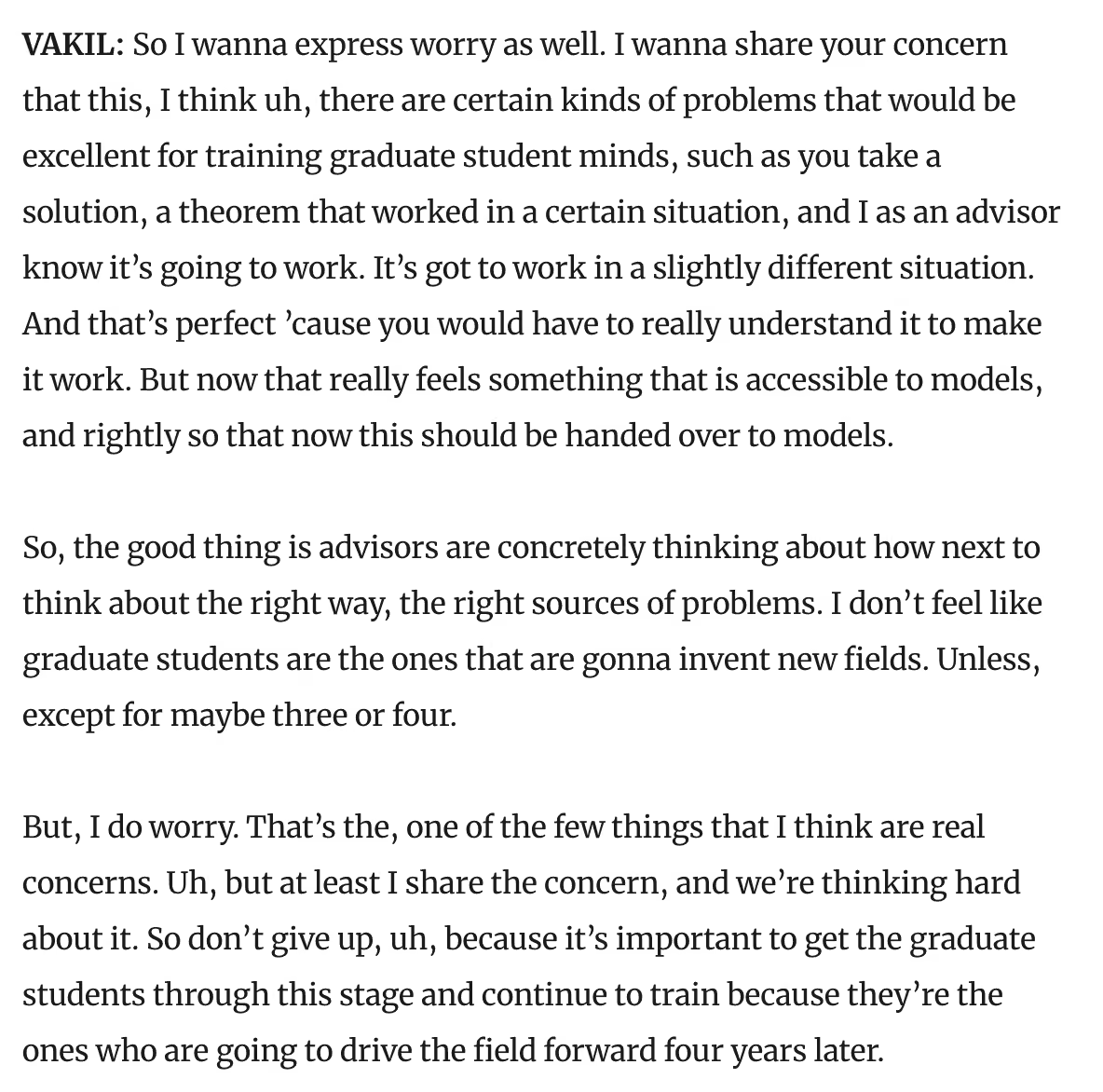
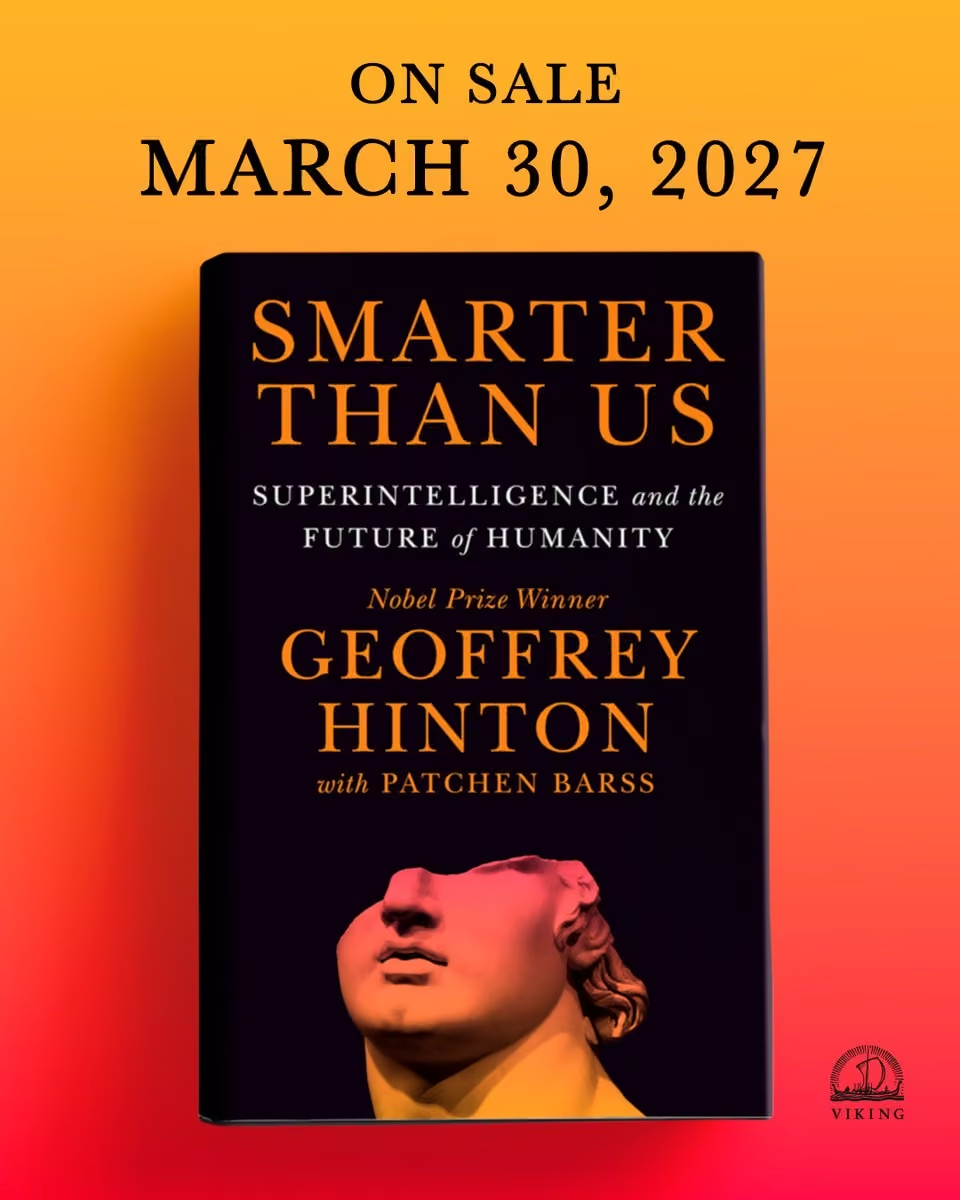
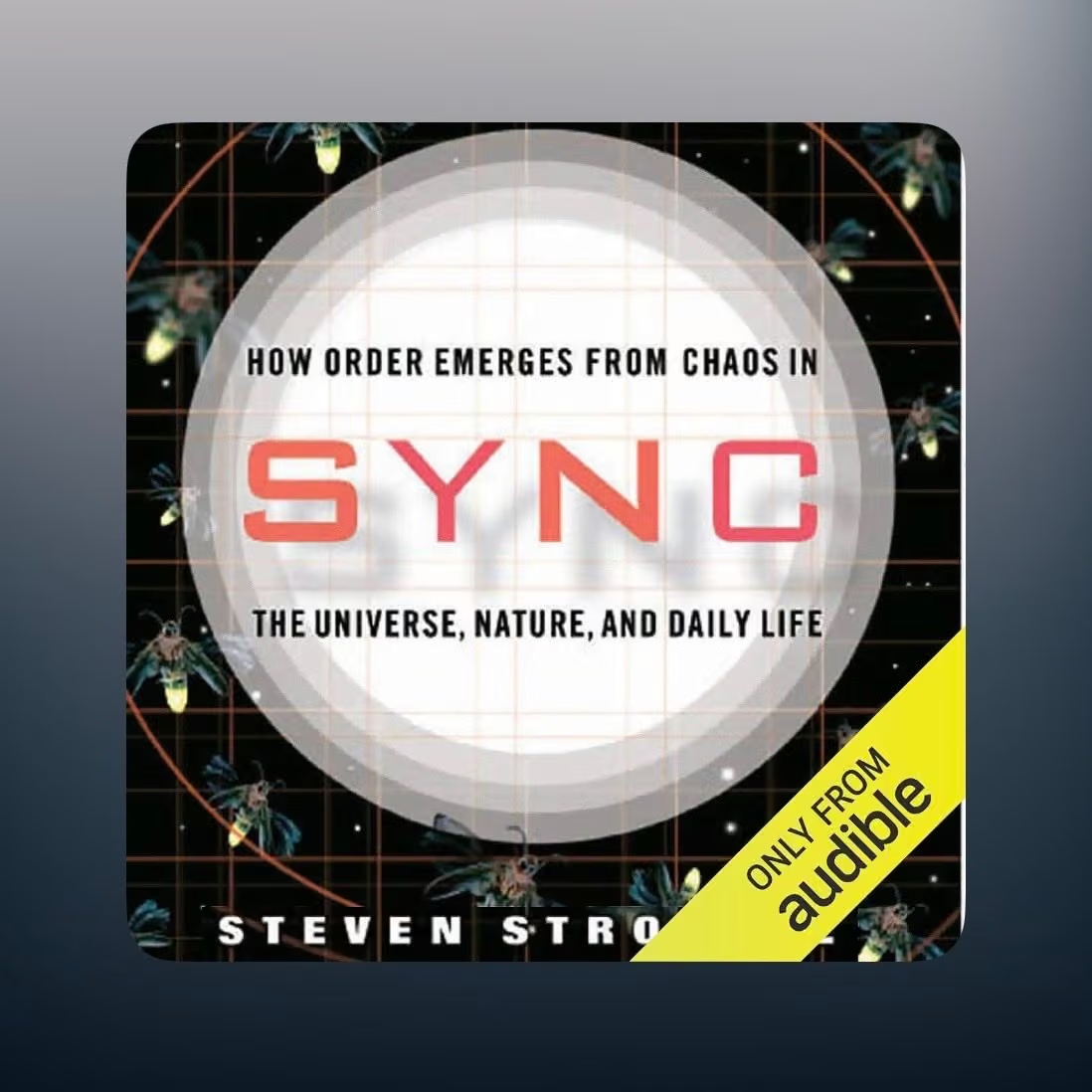
What have we learned from formalizing CFSG and the Stacks Project—and what math opens up next? This Wednesday at Harvard: surprises from both projects and reasons for optimism for working mathematicians. 4:30 pm ET. Zoom link in reply. @axiommathai @leanprover @HarvardCMSA
Steven Strogatz
Steven Henry Strogatz (; born August 13, 1959) is an American mathematician and author, and the Susan and Barton Winokur distinguished professor for the public understanding of science and mathematics at Cornell University. More on Wikipedia
-
Steven Strogatz reposted
Ken Ono
@KenOno691
-
Steven Strogatz
@stevenstrogatz
"Galois's last letter" (!)
Axiom
@axiommathai
The formalized results span from Galois’ last letter in 1832, written the night before his fatal duel, to a 2020 paper on perfect codes.
About a dozen of the formalizations fix small gaps in published papers, and one found and fixed an error. -
Steven Strogatz reposted
Kara Miller
@karaemiller
Are you more popular than your friends?
This week, @stevenstrogatz answers that question... Explains to me how Amazon warehouses are organized...
And has a bone to pick w/Bernie Sanders (about numbers).
A fun tour through how Big Math (also the name of Strogatz's new book) shapes our lives:
podcasts.apple.com/us/podcast/billionaires-popularity-and… -
Steven Strogatz
@stevenstrogatz
I had wide-ranging conversation with @karaemiller on her podcast IT TURNS OUT. This one is a little bit different! Even if you're sick of hearing about math and AI, I think you'll really like our chat. podcasts.apple.com/us/podcast/it-turns-out/id1849543452?i…
-
Steven Strogatz
@stevenstrogatz
Alex Townsend and I are giving our first talk about BIG MATH tomorrow! Getting nervous already…
You can livestream it on Zoom by registering here:
cornell.zoom.us/webinar/register/WN_myajg0JBS6ybGsgvFat4pw -
Steven Strogatz reposted
Sheila Macrine, Ph.D.
@MacrinePhD
New MIT research published in Nature Aging reveals that as we age, the cerebrospinal fluid waves that clear waste from the brain during deep sleep become significantly impaired. Scientists are now investigating whether enhancing this flow could protect cognitive health!
news.mit.edu/index.php/2026/waste-clearing-waves-in-brain…
#brainhealth #sleepscience #neuroscience #aging #mit #research -
Steven Strogatz reposted
Alex Bellos
@alexbellos
Once the pages were transcribed, however, Claude was able to do in a day what had defeated humans in 80 years - to understand everything in Godel's 1940-2 notebooks.
Claude found 663 theorems that no one knew about!
4/ -
Steven Strogatz reposted
Iliad @Iliad_research
"I suggest using your abilities to solve your own problems. Think of things that would be exciting to do, and see if you can do them. Let LLMs help you." - Dan Spielman
Steven Strogatz
@stevenstrogatz
"The way you get ahead in academia is by being known for something. So, dream up an agenda of problems. Avoid competition by doing things other people aren’t thinking of doing." - Dan Spielman (a renowned mathematician and computer scientist)
open.substack.com/pub/danielspielman/p/the-big-reset-in-m… -
Steven Strogatz reposted
Alex Bellos
@alexbellos
There are many wonderful elements to this story about AI discovering gems in Godel's famously impenetrable notebooks
1/..
www.theguardian.com/science/2026/nov/13/kurt-godel-notebo… -
Steven Strogatz reposted
Beatriz Hoya @BeatrizHoya
¿Qué queda de un oficio cuando una máquina lo hace mejor que tú?
Se lo pregunta el matemático Steven Strogatz (@stevenstrogatz) en The Daily, de The New York Times. Cuidado si tienes la lágrima fácil.
#imperdiblesia
www.youtube.com/watch?v=LfGenpmOjDQ -
Steven Strogatz reposted
Quanta Magazine
@QuantaMagazine
On the latest episode of The Joy of Why podcast, host @stevenstrogatz is joined by Albert-László Barabási to discuss network science — and how mapping the networks inside our bodies could change how we treat disease. Listen now: podcasts.apple.com/us/podcast/can-network-science-transfo…
-
Steven Strogatz reposted
Betül Kaçar
@betulland
This paper holds a special place in my heart. I’ve long loved translation, its evolution and what it can tell about life’s molecular history.
Proud of our team! Read how evolution expanded an ancient translation protein to help bacteria adapt to stress:
www.nature.com/articles/s41467-026-78837-7 -
Steven Strogatz
@stevenstrogatz
Writing about math for a wide audience is tricky. Here are some pitfalls we fell into, and lessons we learned along the way. www.ams.org/journals/notices/202611/noti3425/noti3425.html
-
Steven Strogatz reposted
Janna Levin
@JannaLevin
As part of a celebration of the science desk @nytimes, the storied newspaper invited me and @AlexKontorovich to debate zero vs infinity. Here are our notes—prepared separately and without colluding—essentially a transcript of the debate. Wait for the twist...
-
Steven Strogatz
@stevenstrogatz
Just received this in the mail today: The Welch Labs - Illustrated Guide to AI". What an astonishing, gorgeous work of art! Bravo, Stephen Welch and team!
-
Steven Strogatz
@stevenstrogatz
With the rise of AI, this skill is more important than ever. I highly recommend this new book from @PrincetonUPress. As I wrote on the back, "Sharon Marcus knows what it takes to give a good talk, and she comes straight at you with it. She is as clear as she wants you to be."
-
Steven Strogatz reposted
Lila
@LilaShroff
my next piece will be fully in LaTeX!
Steven Strogatz
@stevenstrogatz
Lila Shroff @LilaShroff confesses she’s “recently become a bandwagon math fan.” She even manages to include a few correctly typeset polynomials in @TheAtlantic today, as she surveys the craziness in math and AI in the Bay Area and Silicon Valley.
www.theatlantic.com/technology/2026/11/drunk-math-party/6… -
Steven Strogatz reposted
Lila
@LilaShroff
Drunk trigonometry. Lunch with @edfrenkel. Hanging with math PhDs. And a whole lot more.
-
Steven Strogatz reposted
Lila
@LilaShroff
My latest for @TheAtlantic on my quest to understand the romance of math research (and also a dispatch from the beautiful insanity of living in SF right now)...
-
Steven Strogatz reposted
Jordan Ellenberg
@JSEllenberg
TODAY: You can watch me, @JohnCUrschel, and Kristin DeVleming talk AI, math, and the future, live from @ICERM. (Or at least you can watch us on your screen -- in-person tickets are all gone, sorry!)
reg-ui.prod.events.com/r/en_US/event/1108801/details -
Steven Strogatz
@stevenstrogatz
Lila Shroff @LilaShroff confesses she’s “recently become a bandwagon math fan.” She even manages to include a few correctly typeset polynomials in @TheAtlantic today, as she surveys the craziness in math and AI in the Bay Area and Silicon Valley.
www.theatlantic.com/technology/2026/11/drunk-math-party/6… -
Steven Strogatz
@stevenstrogatz
"The way you get ahead in academia is by being known for something. So, dream up an agenda of problems. Avoid competition by doing things other people aren’t thinking of doing." - Dan Spielman (a renowned mathematician and computer scientist)
open.substack.com/pub/danielspielman/p/the-big-reset-in-m… -
Steven Strogatz reposted
Robert Wright
@robertwrighter
My last two podcasts would seem to suggest a dead heat between @stevenstrogatz & @db for "author whose book title captures our age." But this was last night, and "Big Math" has since pulled ahead. Mobilize your base, Danny Bessner! Anyone can vote here: www.youtube.com/@Nonzero/videos
-
Steven Strogatz
@stevenstrogatz
When AI becomes an oracle, what happens to mathematics?
arstechnica.com/science/2026/11/what-happens-to-mathemati… -
Steven Strogatz
@stevenstrogatz
I can't wait to read this!
Michael Mauboussin
@mjmauboussin
Launching in 2 weeks!
-
Steven Strogatz reposted
Quanta Books
@QuantaBks
Mathematician Terence Tao introduces readers to six core ideas that have shaped mathematics. Welcoming, wise, and “full of piercing insight” (@benorlin), SIX MATH ESSENTIALS is available today, wherever books are sold: www.quantabooks.org/terence-taos-gift-of-math-empowerment/
-
Steven Strogatz reposted
Thomas Lin
@7homaslin
Pretty rare to have two big (lowercase) math books come out in the same day. Everyone should absolutely buy Steve’s book, along with Terry’s. In many ways I suspect they go hand in hand.
Steven Strogatz
@stevenstrogatz
‘Big Math’ is here, and humans can shape its potential -- read an excerpt here www.sciencefriday.com/articles/big-math-book-excerpt/
-
Steven Strogatz reposted
Clear+Vivid
@alda
IT'S PODCAST DAY!
@AlanAlda speaks with @StevenStrogatz
Math averse? Have no fear. In fact, have fun, as the role that math plays in your everyday life comes alive through vivid stories.
👉 clear-vivid-with-alan-alda.simplecast.com/episodes/steve-… -
Steven Strogatz
@stevenstrogatz
Behind the scenes of the writing of BIG MATH, as recounted in Cornell's news magazine, the Cornell Chronicle. news.cornell.edu/stories/2026/11/big-math-reveals-hidden-…
-
Steven Strogatz reposted
Daniel Whiteson
@DanielWhiteson
Will there be math profs in 10 years? 50?
We asked @stevenstrogatz that question and more about the future of math and AI.
podcasts.apple.com/us/podcast/daniel-and-kellys-extraordi… -
Steven Strogatz reposted
Robert Wright
@robertwrighter
I had a great conversation with @stevenstrogatz about his excellent new book Big Math: The Hidden Codes That Run Our World. Though the book is about much more than AI, it gave me a new vantage point on AI. You can watch here or listen on @NonzeroPods. www.youtube.com/watch?v=RrLEY_x259w
-
Steven Strogatz reposted
Anil Ananthaswamy
@anilananth
Steven Strogatz and Alex Townsend's new book, Big Math: The Hidden Codes That Run Our World, is hugely prescient. It's the story of the math that underpins so much of our lives and how we got to our AI-suffused moment, and brilliantly anticipates the current crisis facing mathematicians. Strogatz and Townsend end with these poetic paragraphs, about the Faustian bargain we've made with machines:
"At a time when math moves faster than our own understanding, when our creations surprise and sometimes terrify us, the answer cannot be to turn away. We’ve got to keep striving — with humility, care, and every bit of wisdom we can muster.
Striving, in this new age, means remembering that every mathematical invention begins and ends with human choices. We might never fully understand the oracles we’ve made, but we can decide what to ask of them, and why. We can remain the conscience behind the code.
The mathematician in each of us will always want to know more; the human being must insist that knowledge serve something larger than itself. That might be the work of our century: letting our power grow without losing our soul," write @stevenstrogatz and Townsend.
My review of the book for Nature (non-paywalled version, courtesy of Springer Nature): idp.nature.com/transit?redirect_uri=https%3A%2F%2Fwww.nat… -
Steven Strogatz reposted
Nonzero Podcasts
@NonzeroPods
The Age of Big Math | @robertwrighter and Cornell mathematician @stevenstrogatz—co-author of the new book Big Math: The Hidden Codes That Run Our World—discuss how AI is upending math and whether human insight is becoming obsolete—and how the roots of big math go back much further than the advent of the large language model.
youtu.be/RrLEY_x259w?t=246 -
Steven Strogatz reposted
Anil Ananthaswamy
@anilananth
My review of @stevenstrogatz and Alex Townsend's Big Math: The Hidden Codes That Run Our World for @Nature. www.nature.com/articles/d41586-026-03627-6 AI has transformed maths — this is how we got here The story of how maths came to run the world, and created the artificial-intelligence models that might surpass human mathematicians.
My favorite paras in the book come at the very end, as Strogatz and Townsend talk about the insights into the nature of reality that mathematics gives us, along with joy and wonder, and then ponder the potential loss of this insight in the age of AI.
"But like childhood, insight may be a phase, tender and luminous, yet inevitably outgrown. The thought has a sadness to it, but also a clarity. It’s the latest instance of the Copernican lesson: Just as early astronomers surrendered geocentrism for a deeper truth, we humans are now learning that we are not the center of the intellectual cosmos. Our style of knowing is not the only one, or the final one.
Feeling that sense of humility is a kind of wisdom in itself, a recognition that reality was never ours to fathom, only to touch, to witness, to wonder at through the narrow peepholes of our minds. Maybe it’s time to let machines take the lead, unbound by what we hominids can muster." -
Steven Strogatz
@stevenstrogatz
‘Big Math’ is here, and humans can shape its potential -- read an excerpt here www.sciencefriday.com/articles/big-math-book-excerpt/
-
Steven Strogatz
@stevenstrogatz
My conversation with Ira Flatow on @scifri Science Friday! Just in time for the book launch tomorrow --> ‘Big Math’ shines a light on the hidden math that runs our world.
www.sciencefriday.com/segments/big-math-shines-a-light-on… -
Steven Strogatz reposted
Das Ulises @uarayon
Today I launch Separatrix 1.0: a free desktop app for nonlinear dynamics.
Type ẋ = f(x, y) and get the phase portrait, fixed points classified, Lyapunov exponents, orbit diagrams and bifurcations, copy it as LaTeX.
Offline, open source, Mac/Win/Linux.
uncrayon.github.io/separatrix/ -
Steven Strogatz reposted
Paul Halpern
@phalpern
Publishers Weekly praises THE GREAT ATOM DEBATE:
"Halpern... delivers a solid account of two Austrian physicists who famously debated the existence of atoms in the late 19th century. [I]ntriguing intellectual history... [and] an accessible look at a critical scientific era." -
Steven Strogatz
@stevenstrogatz
Nice little chess puzzle from the always instructive @DanielKingChess
Koneru vs Dzagnidze, Women's Olympiad 2026 | WHITE TO PLAY - Chess Puzz... youtu.be/ogqmL4a9ONs via @YouTube -
Steven Strogatz
@stevenstrogatz
Here's an audiobook sample of the first section of BIG MATH, read by George Newbern. soundcloud.com/hachetteaudio/big-math-by-steven-strogatz?…
-
Steven Strogatz reposted
akopacsi
@akopacsi
@stevenstrogatz The English paperback is available for pre-order on Amazon Germany at 39% off. I just ordered my copy! :)
-
Steven Strogatz
@stevenstrogatz
BIG MATH is 50% off today at Amazon - just $15 (!!) so if you're thinking of ordering it, this is the time ... AND Amazon named it #3 on their list of top 10 nonfiction books for November. Pre-order here:
www.amazon.com/Big-Math-Hidden-Codes-World-ebook/dp/B0GQY…
Steven Strogatz
@stevenstrogatz
From Amazon's Editor:
Steven Strogatz
@stevenstrogatz
Sorry. I saw the 50% in red below, and did not notice it means that the _Kindle_ edition is 50% less than print edition. The print edition is not 50% off. Thanks to those of you who pointed this out.
-
Steven Strogatz
@stevenstrogatz
Nice to see Terry in such a jovial mood! Chatting with the great @BradyHaran can do that – believe me, I know!
Numberphile
@numberphile
The one and only Terence Tao blind ranked some numbers for us...
-
Steven Strogatz reposted
Numberphile
@numberphile
The one and only Terence Tao blind ranked some numbers for us...
-
Steven Strogatz reposted
Alex Kontorovich
@AlexKontorovich
Frank Calegari has a great post on Terry's blog:
terrytao.wordpress.com/2026/11/01/mathematics-has-changed…
I think it aligns most closely to what I've been thinking and trying to say (and I believe communicates it better than I've been able to). Some highlights:
"I hope AI can help mathematicians break out of the straitjacket of being constrained by the first natural conjecture they cannot prove, and work on unraveling the deeper mysteries woven throughout our subject."
"The natural grooves of our profession have very much been bent toward more narrow technical expertise than a bigger vision. AI allows us an amazing opportunity to broaden ourselves as mathematicians."
"There are so many problems in mathematics that are still so fresh and vital but were previously untouchable that the opportunity to approach them is massively exciting. We need to be more ambitious, to create bold research plans that weren’t even conceivable a year ago."
"The difference in reaction between the optimists and the pessimists is that, for the pessimists, the game is over. For the optimists, the game has just changed."
"[T]here now exists an amazing new tool to study mathematics. To turn away and say that the community of mathematics as it currently exists is more important than mathematics itself would be a terrible mistake."
"[I]t takes one look at the arXiv to see many people in our profession rushing out AI-assisted papers in a somewhat unsightly rush to be the “first” to prove things."
[Aside: mere days after the qRH result, I had something like a half-dozen emails in my inbox, some from amateurs but some also from tenured faculty, with Lean formalizations of nonvanishing on Re(s)> 7/8-1/10^k for various large values of k. What the hell are you even doing? That kind of thing may have been valuable years ago, when it was difficult and signaled deep understanding and great technique. Today? Who the hell cares?]
"To me [this is back to Frank now], someone who chooses a worthwhile problem, obtains a proof completely using AI, understands it thoroughly, and uses it to develop interesting further questions or directions has made a substantial mathematical contribution."
"If you, as a senior mathematician, are stressed about being scooped by AI, then you are not being ambitious enough."
[On hiring:] "I am looking for a narrative of where you want mathematics to go, the technical ability to explain why this may be possible, being able to converse about many areas of mathematics, and a demonstrable record of having done all of this in the past."
"What I want a graduate student to achieve at the end of their PhD is a view of mathematics that extends well beyond their discipline, and yet with demonstrable technical skills on at least some class of problems."
"I advocated above that we need to evaluate work as if AI was involved. But this does not imply that we don’t need to teach students to do deep mathematics without AI just as the existence of computers doesn’t mean we should no longer teach children arithmetic." [I've often said similar things as well...]
"All of my friends in the humanities truly believe that having mathematicians in society both as custodians of one of humanity’s oldest intellectual activities and explorers of the frontiers of knowledge is important. I understand that some part of the culture we so deeply care about will disappear, and as humans, an emotional response to that is very natural. But this is a time to explain to everyone that there are so many great new opportunities, possibilities, and reasons to be optimistic. We are on the verge of a new era of mathematics, and I am excited to see what happens."
Bravo Frank! -
Steven Strogatz reposted
Janna Levin
@JannaLevin
Kicking it with my pal NdGT, talking Einstein
Worth Watching
@WorthWatchng
Did Einstein really say God doesn't play dice with the universe? The discussion questions whether his famous line meant what people assume
"Did he really say God doesn't play dice? With the universe? I mean I don't know if that's an apocryphal story or not. I believe he indeed said that, but I don't think he meant it. Why does he believe he knows? How God would make the universe."
@neiltyson @JannaLevin @startalkradioThis media couldn't be displayed. See it on the original post. -
Steven Strogatz reposted
BookLab by Bjorn 📚
@poorbjorn
🚨 NEW VIDEO: 9 Most anticipated nonfiction books coming out in November 2026. No fillers.
Robert Greene goes from power to awe. The authorized Stephen Hawking biography. How the telephone rewired civilization. And the 1973 oil embargo that changed the world.
— ⏳ Timestamps —
0:00 Intro
0:35 The Law of the Sublime - Robert Greene ( @RobertGreene )
2:05 The Everything Code - Raoul Pal ( @RaoulGMI )
4:32 The Telephone - James Gleick
6:09 Sponsored: How to Be a Lot Less Stupid - Peter H. Frank
6:51 Hawking: His Life and Work - Graham Farmelo ( @grahamfarmelo )
8:40 Big Math - Steven Strogatz & Alex Townsend ( @stevenstrogatz )
10:17 Circuit Breakers - Anna Chambers
11:47 Radical Surrender - Anna Lembke
13:21 Embargo - Philip Delves Broughton
15:04 The Art of Organizing Thoughts - Shigehiko Toyama
16:33 Book of the Month
Which one are you reading first? 📚 👀This media couldn't be displayed. See it on the original post. -
Steven Strogatz reposted
Thomas Lin
@7homaslin
Wonderful to see @KSHartnett’s THE PROOF IN THE CODE from @QuantaBks as one of @WSJ’s “9 Books to Read: The Best Reviews of October.”
www.wsj.com/arts-culture/books/9-books-to-read-the-best-r… -
Steven Strogatz
@stevenstrogatz
Andy Goldsworthy's cairn in Sapsucker Woods, just a few miles off the @Cornell campus.
-
Steven Strogatz
@stevenstrogatz
This article by Rivka Galchen is beautiful. The story about @JohnCUrschel's work with his postdoc Rikhav Shah (& an AI assist) is especially interesting. (You can find non-paywalled versions if you poke around on the Internet.)
The New Yorker
@NewYorker
A.I. is solving problems that stumped the field of math for decades. Mathematicians look to Terence Tao for guidance on their altered world. www.newyorker.com/magazine/2026/11/09/the-year-math-chang…
-
Steven Strogatz reposted
The New Yorker
@NewYorker
A.I. is solving problems that stumped the field of math for decades. Mathematicians look to Terence Tao for guidance on their altered world. www.newyorker.com/magazine/2026/11/09/the-year-math-chang…
-
Steven Strogatz reposted
nxthompson
@nxthompson
This is a precarious moment in AI. The two biggest players—the US and China—hate each other and are engaged in a fierce competition for global dominance. The technology is getting so smart, and the threats so large, that the two countries will need to find a way to work together if we're going to avoid a catastrophe.
@robertwrighter says that’s likelier than it might seem: “I think this is going to be galvanizing, this technology, in ways no technology has been.”
We went deep on how AI is an unprecedented test for humanity. Watch here: www.youtube.com/watch?v=4ZKN20parUwThis media couldn't be displayed. See it on the original post. -
Steven Strogatz reposted
Thomas Lin
@7homaslin
Find empowerment in numbers in Terence Tao’s new book, SIX MATH ESSENTIALS. If you live in the U.S., order here: www.quantabooks.org/books/six-math-essentials/
If you live in the UK, order SIX MATHS ESSENTIALS (natch) here: www.penguin.co.uk/books/482167/six-maths-essentials-by-ta…
(The book will be available in 19 other languages.)
New Scientist
@newscientist
Terence Tao, one of the world's great mathematicians, urges us to find empowerment in numbers in his new book Six Maths Essentials. Karmela Padavic-Callaghan is convinced www.newscientist.com/article/2594471-terence-taos-six-mat…
-
Steven Strogatz reposted
Michael Mauboussin
@mjmauboussin
What will you discuss with family and friends over Thanksgiving? How about the pros and cons of IQ, RQ, and EQ? Order now and you'll be prepared to converse about it over the break.
-
Steven Strogatz
@stevenstrogatz
It's heeeere!
Steven Strogatz
@stevenstrogatz
Steven Strogatz
@stevenstrogatz
Free sample of several chapters -->
read.amazon.com/sample/0316581585?clientId=share -
Steven Strogatz reposted
Quanta Magazine
@QuantaMagazine
On this week’s The Joy of Why podcast, astrophysicist Shep Doeleman tells the inside story behind the first-ever image of a black hole — and why it was one around 55 million light years away rather than the one at the center of our own galaxy. podcasts.apple.com/us/podcast/how-do-you-take-a-picture-o…
-
Steven Strogatz
@stevenstrogatz
How Do You Take a Picture of a Black Hole? Astrophysicist Shep Doeleman explains how capturing the first image of a black hole required a telescope the size of the world, and why the next goal is to create a movie. www.quantamagazine.org/how-do-you-take-a-picture-of-a-bla…
-
Steven Strogatz
@stevenstrogatz
How Voting Is Like a Klein Bottle | Quanta Magazine www.quantamagazine.org/how-voting-is-like-a-klein-bottle-…
-
Steven Strogatz reposted
Paul Hsieh
@PaulHsieh
My latest in today's Forbes! How much does "human understanding" matter in the era of AI?
(Includes reference to recent excellent article by @stevenstrogatz in @TheAtlantic.)
www.forbes.com/sites/paulhsieh/2026/10/30/radiology-mathe… -
Steven Strogatz
@stevenstrogatz
This article in @Forbes -- by a radiologist with a mathematical background -- is really good. The curious example of fingernail "clubbing" as a correlate of more serious disease is super-interesting too. Thanks for sharing your expertise, Dr @PaulHsieh.
Paul Hsieh
@PaulHsieh
My latest in today's Forbes! How much does "human understanding" matter in the era of AI?
(Includes reference to recent excellent article by @stevenstrogatz in @TheAtlantic.)
www.forbes.com/sites/paulhsieh/2026/10/30/radiology-mathe… -
Steven Strogatz reposted
Mason Porter
@masonporter
"Early career researcher responses to AI in math" (by Anna Brandenberger, Hanna Mularczyk, Dora Woodruff): arxiv.org/abs/2610.40584
Abstract: "(…) However, the personal stakes are highest for early career researchers. (…)" -
Steven Strogatz reposted
Jonas Hertner
@jonashertner
Human understanding has brought us progress. That does not mean progress will always need human understanding.
@stevenstrogatz presses this uncomfortable point in his conversation with @3blue1brown's Grant Sanderson. They imagine AI that does the whole of mathematics better: solving problems, asking questions, building theories and explaining the results.
Lawyers should take the same thought experiment seriously. Suppose AI could also weigh competing interests more wisely and give better legal advice. The claim that human understanding produces better decisions would no longer be enough to defend it.
But law binds people. A better answer does not, by itself, confer authority over them. Predicting my consent is not obtaining it.
Understanding has a further purpose here: it allows people to examine the terms under which they live together and challenge the reasons offered for them. That opportunity should survive even when their objections do not improve the answer.
The practical question is whether our institutions will make room for that participation. Giving people an explanation is only half the work. Their reasons must be heard too.
Watch the video: www.youtube.com/watch?v=xUSznTR2cwc&t=2385s
And my brief essay on the subject: jonashertner.com/writing/what-understanding-is-for/ -
Steven Strogatz reposted
Grant Sanderson
@3blue1brown
@stevenstrogatz on rizz being in demand.
Incidentally, if I had to sum up why talking with him is so consistently delightful in one word, rizz is not a bad choice!This media couldn't be displayed. See it on the original post.
Steven Strogatz
@stevenstrogatz
In my recent conversation with Grant Sanderson on his podcast, I mentioned the value of "rizz" for aspiring mathematicians. Grant laughed at that and then Business Insider asked about it (www.businessinsider.com/cornell-professor-steven-strogatz…) so I'd like to say more about what I meant.
-
Steven Strogatz reposted
Pablo Groisman 🎲
@pgroisma
3. Y finalmente, porque me pareció una gran oportunidad para experimentar mecanismos de evaluación en matemática en la era de IA.
Les comparto la propuesta con los lineamientos de evaluación por si quieren chusmear y comentar!
github.com/pgroisma/investigathon-yhat-2026/blob/main/pro… -
Steven Strogatz reposted
Pablo Groisman 🎲
@pgroisma
Mañana es la gran final del Investigathon organizado por @somos_yhat. Desde nuestro grupo de investigación propusimos un tema para uno de los tracks.
Estoy muy contento de que seamos parte de este evento por varias razones.
🧵 -
Steven Strogatz reposted
HUANG Yifeng
@Y_F_Huang
Very honored to be featured in Scientific American. Thank you
@KenOno691
@axiommathai
for joining my journey to my holy grail and
@lyndie_chiou
for the great story! -
Steven Strogatz reposted
Robert Wright
@robertwrighter
I had a great time talking to @nxthompson about my book The God Test on his podcast The Most Interesting Thing in AI. (To answer the obvious question: Yes, this does mean that my book on AI is the most interesting thing in AI.)
nxthompson
@nxthompson
Produced independently of The Atlantic’s editorial staff. www.youtube.com/watch?v=4ZKN20parUw
-
Steven Strogatz reposted
Janna Levin
@JannaLevin
😍
Columbia Physics Department
@PhysicsColumbia
Professors @JannaLevin of @Columbia and @neiltyson Neil de Grasse Tyson of @AMNH in the new StarTalk miniseries, In Theory!
jannalevin.substack.com/p/neil-de-grasse-tyson-and-i-rap-…
@PioneerWorks_ @ColumbiaAstro -
Steven Strogatz
@stevenstrogatz
In my recent conversation with Grant Sanderson on his podcast, I mentioned the value of "rizz" for aspiring mathematicians. Grant laughed at that and then Business Insider asked about it (www.businessinsider.com/cornell-professor-steven-strogatz…) so I'd like to say more about what I meant.
Steven Strogatz
@stevenstrogatz
I’m 67 years old. And maybe I’m using the concept of “rizz” incorrectly. I’ve heard my 24- and 26-year-old daughters use it, and I assumed it meant a kind of generalized charisma.
What I was trying to say is that in the age of AI, mathematicians may need to lean into their unique human qualities -- their taste, their ability to make connections between different subjects or different parts of math, to find new applications, to persuade others that what they’re looking at is interesting.
But I also mean something more personal. All the things you’ve gone through in your life, what you’ve sensed with your body, what you’ve felt emotionally -- what people nowadays call “lived experience” (a phrase I’m not fond of) -- combine to make you uniquely you. And that’s all part of your charisma. So are your speaking ability, your writing flair, even your grammatical mistakes, quirks, and idiosyncrasies. All those things that give a human touch may be in greater demand than ever. They’re all part of what I mean by “rizz.”
And I mean all this in a purely intellectual sense, not a romantic one!
I suspect this kind of "rizz" may become a more important quality for mathematicians than ever before, now that AI has become a great equalizer in technical problem-solving power.
Steven Strogatz
@stevenstrogatz
To hear the discussion in context, start listening at around 4:00 (for AI as the great equalizer) up to around 8:20 (when we finish talking about mathematical "rizz"). youtu.be/xUSznTR2cwc
-
Steven Strogatz reposted
Insider
@thisisinsider
"Rizz is in more and more demand because it's something that only people have," said Cornell math professor Steven Strogatz. www.businessinsider.com/cornell-professor-steven-strogatz…
-
Steven Strogatz reposted
Alphabeta
@alphabetamath
I am so glad there's still voice of reason and optimism among math research & education communities! I am also devoted to helping students and researchers leverage the power of AI, instead of resorting to fear and rejection!
-
Steven Strogatz reposted
Grant Sanderson
@3blue1brown
Never a dull moment chatting with Steve Strogatz
Steven Strogatz
@stevenstrogatz
Thank you to Grant Sanderson @3blue1brown for having me on his podcast – and I hope you enjoy our open-hearted, tentative, exploratory conversation about math in the age of AI. We tried out a lot of ideas on each other. youtu.be/xUSznTR2cwc
-
Steven Strogatz
@stevenstrogatz
Thank you to Grant Sanderson @3blue1brown for having me on his podcast – and I hope you enjoy our open-hearted, tentative, exploratory conversation about math in the age of AI. We tried out a lot of ideas on each other. youtu.be/xUSznTR2cwc
-
Steven Strogatz reposted
SciComm Excellence
@SciCommAwards
Congratulations to the 2026 winners of the National Academies Eric and Wendy Schmidt Awards for Excellence in Science Communications given by @theNASEM in partnership with @schmidtsciences!
Learn more about the winners: www.nationalacademies.org/news/national-academies-announc… #scicomm -
Steven Strogatz reposted
Lex Fridman
@lexfridman
Here's the links to the conversation:
YouTube: youtube.com/watch?v=ZAzWPE9CItg
Spotify: open.spotify.com/show/2MAi0BvDc6GTFvKFPXnkCL
Podcast: lexfridman.com/podcast -
Steven Strogatz reposted
Lex Fridman
@lexfridman
This is an incredible moment in this history of mathematics, computer science, physics & science with some of the hardest problems in human history being solved by AI over a period of weeks. Depending on your perspective, it's either a crisis, a triumph, or both. I don't think anyone knows for sure. We're all trying to make sense of it. I oscillate between fear/dread and optimism/excitement on a daily basis. The rate of progress is insane, including today's announcement from OpenAI of more problems solved.
To help make sense of all of it, here's my conversation with three mathematicians about this moment. Each of them is an expert in the field of each of the biggest problems solved: Navier-Stokes, quasi-Riemann hypothesis, the unique games conjecture and complexity theory more generally.
Ankur Moitra is a mathematician and theoretical computer scientist at MIT, visiting the Institute for Advanced Study in Princeton. Steven Brunton (@eigensteve) is a mathematician and fluid dynamics expert at UW. Alex Kontorovich (@AlexKontorovich) is a mathematician at Rutgers specializing in number theory.This media couldn't be displayed. See it on the original post. -
Steven Strogatz reposted
Ken Ono
@KenOno691
I was brought to tears on Sunday when the last milestone cleared. My father, a mathematician who passed in Jan, introduced me to the giants of group theory as a kid. The Classification of Finite Simple Groups (CFSG) defined my 80s college years. I can't believe I somehow got to be part of this human achievement. CFSG formalized in Lean. @leanprover
Axiom
@axiommathai
The largest math proof in human history is now computer-verified.
Today, Axiom announces a complete Lean auto-formalization of the Classification of Finite Simple Groups, the "periodic table of symmetry."
About 15,000 pages, built by over 100 mathematicians across generations.This media couldn't be displayed. See it on the original post. -
Steven Strogatz reposted
Axiom
@axiommathai
The largest math proof in human history is now computer-verified.
Today, Axiom announces a complete Lean auto-formalization of the Classification of Finite Simple Groups, the "periodic table of symmetry."
About 15,000 pages, built by over 100 mathematicians across generations.This media couldn't be displayed. See it on the original post. -
Steven Strogatz
@stevenstrogatz
In this latest dispatch from the front lines of math in the age of AI, I tried to tell it like I see it. www.theatlantic.com/ideas/2026/10/ai-math-human-future/68…
-
Steven Strogatz reposted
Scott Armstrong
@scottnarmstrong
There is a major result on the KPZ equation in 2+1 dimensions!
This looks like a great example of what the near future of math research could look like.
Here you have an 11-author paper--basically all top experts who had been working in this direction in recent years--combining all their recent results and insights and prompting Astra like maniacs. The result: a major problem in critical SPDEs that everyone in the field was wondering about is now solved!
Fantastic!
Human + AI interaction ==> more understanding -
Steven Strogatz
@stevenstrogatz
If you care about math and AI, this Substack post by Jonathan Marek will resonate with you. I'm honored by being mentioned in it, but Jonathan is too honest to admit that he was also in the pantheon of Mr. Joffray's former students at @loomischaffee. cultureandcompass.substack.com/p/the-ai-and-steve-strogat…
-
Steven Strogatz
@stevenstrogatz
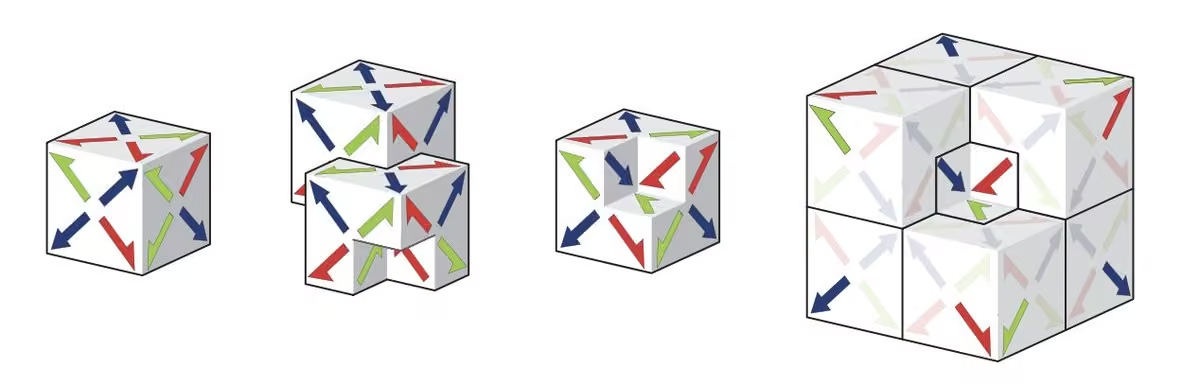
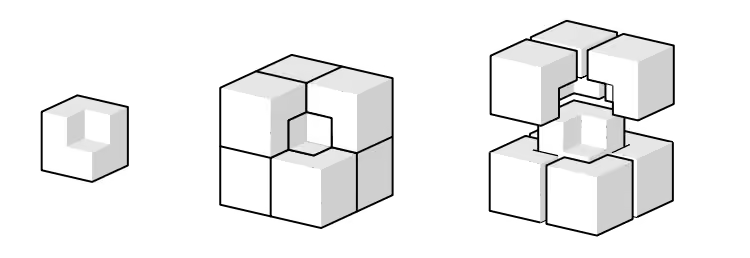
Mesmerized by this sculpture by Forrest myers, "Valledor", at @art_omi. It's a 3-regular graph.
Steven Strogatz
@stevenstrogatz
Steven Strogatz
@stevenstrogatz
I can't stop looking at it! From a great distance, it looks like a cube in a cube
-
Steven Strogatz
@stevenstrogatz
-
Steven Strogatz reposted
John Urschel
@JohnCUrschel
Two weeks ago, Rikhav Shah and I posted a preprint on the growth factor in Gaussian elimination, and settled a very old problem. It turns out complete pivoting and rook pivoting have quasi-polynomial growth. I’ve spent a decade thinking about this problem. math.mit.edu/~urschel/preprints/entrygrowth.pdf
-
Steven Strogatz reposted
Alex Kontorovich
@AlexKontorovich
I’m very opinionated. So it’s nearly impossible for me to hear someone’s arguments and *not* find something I disagree with. (This includes reading things I myself wrote years - or weeks - ago.) And yet the amazing Grant Sanderson @3blue1brown has put out a long, detailed video on the future of mathematics, in which I cannot find a single flaw. I’ll be sending this to every PhD student and postdoc I know, and strongly recommend everyone watch it.
www.youtube.com/watch?v=LKrwhjOI8Nc
(Of course I tried to say many of the same things in my conversation with Thomas Koberda. But Grant’s version, unsurprisingly, does an infinitely better job at communicating those ideas!) -
Steven Strogatz
@stevenstrogatz
NFL Player Turned Mathematician (@JohnCUrschel) Solves Problem that Eluded Scholars for Decades
On the growth factor for Gaussian elimination – great interview with Christiane @amanpour
youtu.be/W1uiG8rk2Eg via @YouTube -
Steven Strogatz reposted
Daniel Li
@danielxli
this was an awesome podcast, and i think this one he did was even better --> radiolab.org/podcast/math-vs-machine
gets more into his thoughts on the pros/cons of relying on AI that is smarter than us but we don't understand when the stakes are higher (cancer diagnosis) -
Steven Strogatz reposted
Lenny Rachitsky
@lennysan
Loooved this episode of The Daily.
They chatted with a math professor at Cornell University (Steven Strogatz) about how he and math community are feeling about AI's impact on their world.
Lots of tears, and profound takes.
Listen to the episode here: www.nytimes.com/2026/10/13/podcasts/the-daily/mathematici…
Or here: podcasts.apple.com/us/podcast/when-a-i-comes-for-your-pur… -
Steven Strogatz
@stevenstrogatz
Beautiful talk by Grant Sanderson @3blue1brown about a fun question in geometry, the problem-solving utility of thinking topologically, and the buildings of Frank Gehry. Oh yes, and also about "The Role of Exposition in the Future of Mathematics" youtu.be/PtCPLLuMK1o
-
Steven Strogatz reposted
Clear+Vivid
@alda
A little humor goes a long way. 💙
During his recent appearance on @CBSSunday, @AlanAlda spoke with @DrLaPook about living with Parkinson's disease, the importance of staying active, and why he refuses to let a diagnosis define who he is.
youtu.be/8Mt-tn1ZC0A -
Steven Strogatz reposted
Derek Thompson
@DKThomp
New newsletter: I KNOW WHY THE MATHEMATICIANS WEEP
I wrote about "technological grief"—the uncanny and ego-eviscerating feeling of watching a machine do an intellectual job on which you based your sense of self and worth. Also:
- what makes humans special
- what makes math special
- why science is both a craft (discovery) and a conversation (the relationships you build with fellow discoverers)
- how AI disrupting the former (intelligence) might increase the significance of the latter (relationships)
- why other fields should be prepared for emotional and occupational disorientation that mathematicians are going through
With many thanks to deeply wise words of @stevenstrogatz
www.derekthompson.org/p/i-know-why-the-mathematicians-weep -
Steven Strogatz
@stevenstrogatz
Having the opportunity to be interviewed by Derek Thompson @DKThomp was a rare treat – one of the most scientifically insightful, knowledgeable journalists I've ever spoken with! After I would say something, he would say it back to me better and crisper, every time
Derek Thompson
@DKThomp
New newsletter: I KNOW WHY THE MATHEMATICIANS WEEP
I wrote about "technological grief"—the uncanny and ego-eviscerating feeling of watching a machine do an intellectual job on which you based your sense of self and worth. Also:
- what makes humans special
- what makes math special
- why science is both a craft (discovery) and a conversation (the relationships you build with fellow discoverers)
- how AI disrupting the former (intelligence) might increase the significance of the latter (relationships)
- why other fields should be prepared for emotional and occupational disorientation that mathematicians are going through
With many thanks to deeply wise words of @stevenstrogatz
www.derekthompson.org/p/i-know-why-the-mathematicians-weep -
Steven Strogatz
@stevenstrogatz
To anyone who may have started following me after hearing me on The Daily, I hope you'll consider checking out THE JOY OF WHY podcast I co-host with @JannaLevin. podcasts.apple.com/us/podcast/how-do-fungi-keep-the-plane…
-
Steven Strogatz reposted
Graham Farmelo
@grahamfarmelo
RIP Jeffrey Goldstone, who never received the Nobel Prize for physics he so richly deserved:
share.google/Dy3AwBTpYjMknbRNU -
Steven Strogatz reposted
Graham Farmelo
@grahamfarmelo
Wonderful to have dinner last night with the great Roger Penrose after my Oxford Mathematical Institute public lecture (‘Is the End in Sight for Theoretical Physics?’) named for him
-
Steven Strogatz reposted
Quanta Magazine
@QuantaMagazine
How do fungi keep the planet healthy? On the latest episode of The Joy of Why, @stevenstrogatz sits down with evolutionary biologist Toby Kiers to discuss how minerals are being traded between fungal networks and plants beneath your feet. Listen now: podcasts.apple.com/us/podcast/how-do-fungi-keep-the-plane…
-
Steven Strogatz reposted
Derek Thompson
@DKThomp
New newsletter: I KNOW WHY THE MATHEMATICIANS WEEP
I wrote about "technological grief"—the uncanny and ego-eviscerating feeling of watching a machine do an intellectual job on which you based your sense of self and worth. Also:
- what makes humans special
- what makes math special
- why science is both a craft (discovery) and a conversation (the relationships you build with fellow discoverers)
- how AI disrupting the former (intelligence) might increase the significance of the latter (relationships)
- why other fields should be prepared for emotional and occupational disorientation that mathematicians are going through
With many thanks to deeply wise words of @stevenstrogatz
www.derekthompson.org/p/i-know-why-the-mathematicians-weep -
Steven Strogatz
@stevenstrogatz
Enjoyed this wide-ranging conversation today with Meghna Chakrabarti on the NPR show On Point www.wbur.org/onpoint/2026/10/13/ai-steamrolling-math-solve
-
Steven Strogatz reposted
Surya Ganguli
@SuryaGanguli
I highly recommend the daily podcast with @stevenstrogatz
podcasts.apple.com/us/podcast/the-daily/id1200361736?i=10…
It so well captures the zeitgeist of math and adjacent communities in the age of AI, covering complex emotions from grieving to euphoria, and delving into the role of human joy and meaning in the pursuit of truth. I myself remain optimistic! -
Steven Strogatz reposted
Prof Jesse Capecelatro
@jesse_caps
Always a pleasure to listen to @stevenstrogatz wax poetic on math (or any subject really). These are some interesting times we are living in podcasts.apple.com/us/podcast/the-daily/id1200361736?i=10…
-
Steven Strogatz
@stevenstrogatz
I spoke with The Daily about what’s happening to math in the age of AI—and what it feels like to be a mathematician right now.
The conversation went places I hadn’t expected.
I’m grateful to @RachelAbramsNY, @annieminoff, and their team.
www.nytimes.com/2026/10/13/podcasts/the-daily/mathematici… via @NYTimes -
Steven Strogatz reposted
Jelani Nelson
@minilek
Mike was my colleague at Berkeley, and he's been fairly skeptical of deep learning's trajectory for years. Most scientists are skeptics, and it can take a big shock to get someone to consider a possibility that goes against the anchoring effect coded in our DNA.
I too was somewhat of a skeptic until ~6 months ago, and people ask me all the time why I joined Anthropic.
It started in April, when a friend I've known for 20 yrs messaged me saying he'd be in the Bay Area in a week, and he suggested we meet up. I invited him to my house for dinner, and he told me he had just joined Anthropic. He said the models were becoming increasingly more capable, and he believed both that they'd soon be smarter than him and also that all intellectual work would be highly devalued in the near future, and lastly that society was not at all ready for what's coming.
I'd of course heard claims similar to this before, but not from a friend I'd known for this long, and who I trusted, at my dining room table. It was the initial shock needed to destabilize my own anchoring. Also, I've been fortunate to work with and/or mentor many smart people in my life (e.g. Fields medalists, a 4x Putnam Fellow, IOI first place winners, etc.), so I feel pretty calibrated in recognizing very smart people, and this was someone who is definitely very smart and with impressive such credentials. So, it was hard to ignore this friend saying the models would be smarter than even him in particular.
After that dinner, I decided to do an informal survey, calling and meeting up with a lot of my friends who now work on improving model capabilities at these frontier labs. They all agreed with that first friend. These were all people I'd known 10, 15, 20 years, who mentored me, or I mentored them, or we met professionally in academia. These are people I trust, and their beliefs on this topic were consistent.
I then spent a whole lot of time understanding the missions of different companies, and talking to current and former employees and people in leadership. I read Dario's (long) essays and watched videos on YouTube of company leaders being interviewed. Anthropic's stated mission "to ensure that the world safely makes the transition through transformative AI" felt like exactly the right guiding principle to handle such a society-disrupting technology, and everyone I spoke to at the company was very aligned with this mission. It's easily the most mission-focused place I've ever been at, and everyone takes the work extremely seriously and with a profound sense of responsibility.
And now here I am. And being on the inside, the pace of progress has surprised me more than I first imagined. The moment that pure mathematicians are in, to me, is just a microcosm of what I predict a much larger of society will be grappling with in the not too distant future, and I really hope our leaders and the general public internalize sooner than later just how significant a moment we're in.
Melanie Mitchell
@MelMitchell1
Michael Jordan (the machine learning one): "Superintelligence is Science Fiction" 🔥🔥🔥
www.di.ens.fr/~fbach/MJordan_ITW_Liberation_English.html -
Steven Strogatz reposted
Quanta Magazine
@QuantaMagazine
There’s still time to vote for “The Joy of Why”! We’ve been nominated for a Signal Award in Best Science & Education Podcast - Limited Series. Vote here: vote.signalaward.com/PublicVoting
-
Steven Strogatz reposted
Quanta Magazine
@QuantaMagazine
Our podcasts have been nominated for several
Signal Awards! Vote for us in the thread below. ⬇️ -
Steven Strogatz
@stevenstrogatz
Hey, it looks like our The Joy of Why podcast has a serious chance of winning a Signal Award (in the science and education category). if you are a fan of our show, please vote for it – and tell all your friends to do the same! Let's win this thing! 🙏🕺
vote.signalaward.com/PublicVoting
Steven Strogatz
@stevenstrogatz
We are currently in second place -- and need your help!
-
Steven Strogatz
@stevenstrogatz
One of the most sensible explanations of what's happening right now (regarding AI, agents, conflicting commentary that you read on this site, etc.) from someone in a position to know.
Andrej Karpathy
@karpathy
Dusting off this tweet from April because this gap in shared understanding of LLM capability is *widening*. It's now less "two groups of people speaking past each other" and more a sharp funnel.
- Napkin math somewhere around 6B people (~75% of the population) have barely come in contact with LLMs at all.
- Around 1-2B (~20%) are casual and infrequent users of free-tier ChatGPT-like products. This group sees derpy chatbots and treats them a bit like a better Google search, a writing aid, or etc. Maybe an agent tries to book you a flight. I have non-tech friends who (reasonably, imo) say they have not much use for it at all. Even many professionals outside of math&code are in this tier. For example, execs and many other functions spend a lot of their time talking to other people, so while they understand what is happening intellectually, it is still second-hand and a bit abstract.
- Now we get to professional use of frontier-grade LLMs in math&code. Somewhere around 20M people (0.2%) see first-hand that large, complex projects that used to take them weeks/months can now be completed by agents with a prompt. Building apps, copying apps, translating apps, decompiling apps from binaries... This has all happened very quickly and recently - less than 1 year ago, I was writing code manually by hand, typing memorized computer code commands into a code editor character by character, occasionally pressing Tab to autocomplete a little chunk of code.
- And finally we get to the ~5,000 people (~0.00006%) with access to frontier-grade systems internally. The external world has seen the preview. It looks like swarms of thousands of agents collaborating over weeks on software mega projects: minting zero days, running cyber attacks and defenses at machine speeds, discovering new science, advancing the frontier of mathematics. Things that would have taken top professionals in the industry years of work. Meanwhile, human review and comprehension are starting to fall behind. For example, people are still involved in the "archeology" of the OpenAI-HF incident from many months ago. Mathematicians may be poring over the 722 manuscripts on frontier mathematics for a while.
The funnel is driven by a combination of factors:
1. The impact scales with ambition, problem size, and horizon. A question with a paragraph answer barely stresses the system. You need a reservoir of big, difficult problems that you really care about. This aspect drives the consumer / professional dimension of the funnel.
2. The jaggedness of the system (which I have written about a lot separately). Capability peaks in domains that are digital, verifiable and economically valuable. This is because LLM capability emerges from reinforcement learning on verifiable rewards on a curated environment mixture driven by revenue potential. This aspect primarily drives the area (e.g. math&code) dimension of the funnel.
3. Access. Free-tier, paid-tier, internal.
So this is the weirdness of the moment. The general public has mostly not interacted with these systems. When they have, it looks like a derpy chatbot. The majority of professionals still see only a modest uplift. And a small sliver of professionals are experiencing the vertigo of the curve going vertical. And it is all happening at the same time.
Andrej Karpathy
@karpathy
Judging by my tl there is a growing gap in understanding of AI capability.
The first issue I think is around recency and tier of use. I think a lot of people tried the free tier of ChatGPT somewhere last year and allowed it to inform their views on AI a little too much. This is a group of reactions laughing at various quirks of the models, hallucinations, etc. Yes I also saw the viral videos of OpenAI's Advanced Voice mode fumbling simple queries like "should I drive or walk to the carwash". The thing is that these free and old/deprecated models don't reflect the capability in the latest round of state of the art agentic models of this year, especially OpenAI Codex and Claude Code.
But that brings me to the second issue. Even if people paid $200/month to use the state of the art models, a lot of the capabilities are relatively "peaky" in highly technical areas. Typical queries around search, writing, advice, etc. are *not* the domain that has made the most noticeable and dramatic strides in capability. Partly, this is due to the technical details of reinforcement learning and its use of verifiable rewards. But partly, it's also because these use cases are not sufficiently prioritized by the companies in their hillclimbing because they don't lead to as much $$$ value. The goldmines are elsewhere, and the focus comes along.
So that brings me to the second group of people, who *both* 1) pay for and use the state of the art frontier agentic models (OpenAI Codex / Claude Code) and 2) do so professionally in technical domains like programming, math and research. This group of people is subject to the highest amount of "AI Psychosis" because the recent improvements in these domains as of this year have been nothing short of staggering. When you hand a computer terminal to one of these models, you can now watch them melt programming problems that you'd normally expect to take days/weeks of work. It's this second group of people that assigns a much greater gravity to the capabilities, their slope, and various cyber-related repercussions.
TLDR the people in these two groups are speaking past each other. It really is simultaneously the case that OpenAI's free and I think slightly orphaned (?) "Advanced Voice Mode" will fumble the dumbest questions in your Instagram's reels and *at the same time*, OpenAI's highest-tier and paid Codex model will go off for 1 hour to coherently restructure an entire code base, or find and exploit vulnerabilities in computer systems. This part really works and has made dramatic strides because 2 properties: 1) these domains offer explicit reward functions that are verifiable meaning they are easily amenable to reinforcement learning training (e.g. unit tests passed yes or no, in contrast to writing, which is much harder to explicitly judge), but also 2) they are a lot more valuable in b2b settings, meaning that the biggest fraction of the team is focused on improving them. So here we are.
staysaasy
@staysaasy
The degree to which you are awed by AI is perfectly correlated with how much you use AI to code.
-
Steven Strogatz reposted
Ryan Peterman
@ryanlpeterman
The singularity has already begun for math:
Scott Aaronson is one of the world's leading quantum computing researchers and spent two years at OpenAI working on AI safety.
We talked about why he thinks the singularity has already begun for math, who gets credit when AI writes the proof, and whether intelligence will still matter once machines do the thinking.
In this episode:
• Why the singularity has already begun for math
• Who gets credit when AI writes the proof
• What a proof that P = NP would be worth
• Why he turned down getting rich to keep blogging
• Whether intelligence will still matter
Where to watch:
• YouTube - www.youtube.com/watch?v=ORlscppGGh4
• Spotify - open.spotify.com/episode/0qnYcSVpbjW3m5bgQJGt4L
• Apple Podcasts - podcasts.apple.com/us/podcast/the-peterman-pod/id1777363835
• Transcript - www.developing.dev/p/e070-scott-aaronson
Thank you to the sponsor of this episode for supporting my work:
• WorkOS: makes your app Enterprise Ready with easy to use APIs to add SSO, SCIM, RBAC, and more in just a few lines of code, check them out at workos.com
Chapters:
00:00 Intro
00:34 Why he updated so hard on AI
01:14 The people still denying AI progress
03:53 The singularity has already begun for math
08:30 Will human-driven math research survive
13:12 Who gets credit for AI-written papers
15:55 OpenAI's $15M Navier-Stokes proof
19:20 What if AI proved P = NP
23:07 Why AI is so good at finding counterexamples
26:13 The goalposts keep moving
28:52 Why AI disclosure matters in research
32:59 The fake Monet experiment
35:23 Why he blogs instead of getting rich
39:45 Are AI labs racing too fast
42:01 Will intelligence still matter
47:12 Book recommendations
52:27 Advice for students today
57:23 Reacting live to a new AI result
59:58 OutroThis media couldn't be displayed. See it on the original post. -
Steven Strogatz reposted
Fouad Boulos
@fouad_boulos
Dear Dr. Strogatz ,
I loved your conversation with @SorenWheeler on the latest Radiolab episode, and I wanted to share a few thoughts.
I'm a breast pathologist, and I'm acutely aware of the threat AI poses to specialists like me, especially since the lifeblood of my specialty is pattern recognition. I have little doubt that AI will eventually recognize and classify tumors better than any pathologist can. So when you described being terrified that AI could threaten the very foundation of mathematics, I could relate.
At the same time, I feel the urge to tell you not to panic. AI may have solved the Navier–Stokes problem, but you seemed deeply dissatisfied with the solution, at least in part because it is inscrutable. To an outsider, that looks like an opportunity: someone now gets to decipher the mathematics behind it. And you know better than I do that the point was never the solution itself, but the journey that leads to it.
A solution was also never the end. It isn't a door into a room of complete knowledge. It's a door into a beautiful room with more doors, each leading to more beautiful rooms. It seems to me that AI, at least for now, is blind to those further doors. You are not. That makes AI less a replacement than a master key, something that speeds up discovery rather than ending it.
As an amateur chess player, I watched in disbelief as AlphaZero became, in a matter of hours, the strongest chess player the world had ever seen. I wondered why anyone would want to play chess anymore. The engine was unbeatable, and no human mind could fathom the depth of its understanding. Instead, chess is more popular than ever, prodigies are sprouting everywhere, and the engine nobody could dream of beating has become a tool for understanding the game better and playing it in new ways. Without really thinking about it, people realized that the point was never to beat the machine. It was to play the game and have a blast doing it.
In Surely You're Joking, Mr. Feynman!, Feynman describes a stretch when his work had stalled and he saw no way out. Then, in the Cornell cafeteria (!), he watched someone toss a plate into the air. As it wobbled, he decided, just for fun, to work out the equations relating its spin to its wobble. He later said that playful exercise led to the Feynman diagrams and eventually to his Nobel Prize.
The calculator was not an existential threat to arithmetic, and AI is not an existential threat to the purest of all disciplines. Fear, on the other hand, is the greatest existential threat of all, to our joy of discovery and our joy of living.
Warmly,
Fouad Boulos, MD
#breastpath #asi @stevenstrogatz -
Steven Strogatz reposted
Neil Halloran
@neilhalloran
So many are asking profound questions about AI. Leave it to @Radiolab (@stevenstrogatz & @SorenWheeler) to bring it home for me:
radiolab.org/podcast/math-vs-machine -
Steven Strogatz reposted
Anil Seth
@anilkseth
In case useful, here's a (temporarily) #openaccess @BBSJournal collection on 'conscious AI and biological naturalism', with a target article, 50 peer commentaries, and my author response. Hopefully a decent representation of where the substantive debate is at:
Anil Seth
@anilkseth
🎇 Good news! 🎇 The kind people at @BBSJournal have made the new collection on "Conscious AI and biological naturalism" completely #openaccess for a limited period. This include the target article, all 50 commentaries (many of which disagree with me), and my response. Go to the link and click 'save pdf': doi.org/10.1017/S0140525X25000032
For easier ways into the debate, try my @NoemaMag essay on "The Mythology of Conscious AI" (winner of the 2025 @berggruenInst Essay Prize), and this 2026 main-stage @TEDTalks:
www.noemamag.com/the-mythology-of-conscious-ai/
www.ted.com/talks/anil_seth_why_ai_isn_t_going_to_become_… -
Steven Strogatz reposted
Bob Dewey
@macroleverageTP
Steve Strogatz’s new book, Big Math, co-authored with Alex Townsend, explores how mathematics underpins technologies we rely on every day, from medical imaging to wireless communications.
In our conversation, we explored a question that goes beyond the book: As AI becomes capable of solving increasingly difficult mathematical problems, will it also develop the curiosity, taste and judgment to decide which questions are worth pursuing?
The book is a terrific introduction to the extraordinary power of mathematics.
www.amazon.com/Big-Math-Hidden-Codes-World/dp/0316581585 -
Steven Strogatz reposted
Bob Dewey
@macroleverageTP
As AI makes answers cheaper, does the value of asking good questions increase?
Alex Wissner-Gross (@alexwg) predicted that “AI will solve math.” I explored what that might mean with mathematician Steve Strofatz (@stevenstrogatz).
The distinction between solving problems and deciding which questions are worth asking may become increasingly important as AI advances.
My new essay explores the implications for human curiosity, innovation, and progress.
Our conversation also comes ahead of Big Math, Steve's new book with co-author Alex Townsend, out November 10.
robertdewey3.substack.com/p/who-decides-which-problems-ar… -
Steven Strogatz reposted
Sridhar Ramesh
@RadishHarmers
I fear that it will be difficult for people to develop good theory-building, exposition, etc, skills if they rarely get their hands dirty with problem-solving using their own brain.
-
Steven Strogatz
@stevenstrogatz
It's always fun to go on @Radiolab. Hope you enjoy this episode!
radiolab.org/podcast/math-vs-machine -
Steven Strogatz reposted
Bob Dewey
@macroleverageTP
Alex Wissner-Gross has repeatedly suggested on Moonshots that “AI will solve math.”
I brought that question to Cornell mathematician Steven Strogatz.
Steve draws an important distinction between solving mathematical problems and developing new theories or asking the questions that lead to discoveries.
AI is already demonstrating extraordinary problem-solving abilities, and Steve thinks it may eventually develop these other capabilities as well.
But how close are we?
I'd love to hear Alex's thoughts on Steve's distinction, and Steve's reaction to where Alex thinks AI is headed.
A conversation about mathematical creativity, curiosity, and what AI may become.
@stevenstrogatz @alexwg @moonshots_pod
www.youtube.com/watch?v=Ho0PhA8F71M&list=PLt-j7iknI702LUx… -
Steven Strogatz reposted
Thomas Bloom
@thomasfbloom
A great post.
If you are confused about why some mathematicians view what's currently going on as a bad thing, you should read it.
Alex Meiburg
@Timeroot
Some people are confused why mathematicians say OAI's drop was the "death" of a field, or figure that it's death insomuch as a bunch of university professors lost their overpaid hobby of proving theorems. That's a misunderstanding: the damage's real.
Blog: blog.ohaithe.re/post/829972087725817856/thoughts-on-ai-so… -
Steven Strogatz reposted
The Washington Post
@washingtonpost
Mary Tsingou Menzel played a key role in a landmark computational physics experiment that helped propel the development of chaos theory and other fields.
But it took more than half a century, physicists said, for her to receive appropriate credit. www.washingtonpost.com/obituaries/2026/09/05/mary-tsingou… -
Steven Strogatz reposted
Massachusetts Institute of Technology (MIT)
@MIT
We’ve lost an icon. Margaret Hamilton, a computer science pioneer best known for her work at MIT leading development of the flight software for the Apollo missions to the moon, has died at 90. Read about her legacy via MIT News: news.mit.edu/2026/margaret-hamilton-computing-pioneer-die…
-
Steven Strogatz
@stevenstrogatz
“When AI Solves Major Open Problems: What Does It Mean for the Future of Mathematics — and Beyond?”
A panel at @MoMath1 moderated by Manjul Bhargava, featuring @AlexKontorovich, Ankur Moitra, and @stephen_wolfram.
momath.org/mathfuture -
Steven Strogatz reposted
Ole Lehmann
@itsolelehmann
“okay, so what? it’s just math.”
no, you don't get it.
here’s what OpenAI’s math breakthroughs could eventually help make possible in the real world:
Vlasov–Maxwell → stronger foundations for fusion research, whose ultimate prize is virtually limitless clean energy to power civilization
Calderón’s Problem → portable body scanners using electrical signals, making medical imaging cheaper and easier to access
Maximum-Cardinality Matching → faster searches for compatible kidney swaps across large donor pools, helping hospitals coordinate lifesaving transplants
Inverse Elasticity Problem → scans that map tissue stiffness, helping doctors locate suspicious growths inside the body
Mumford–Shah Conjecture → better tools for spotting tissue changes in brain scans, helping doctors identify signs of disease
Bose–Einstein Condensation → stronger foundations for quantum sensors that could help vehicles navigate without GPS
Simple Stochastic Games → better safety checks for self-driving cars and robots before dangerous mistakes reach the real world
Matrix Multiplication → cheaper AI and bigger scientific simulations using the same computers
Edit Distance → faster DNA comparisons, helping researchers study genetic changes linked to disease
The k-Server Problem → robots that waste less movement and energy, making warehouses more efficient and goods cheaper to move
a reminder that math is the foundation of science.
so accelerating mathematical discovery could compress centuries of scientific progress into years.
insane timeline to be alive for!
OpenAI
@OpenAI
We’re releasing a broad range of new mathematical results produced by an internal frontier model.
We’ve been consulting with the independent Advisory Group on Mathematics and Artificial Intelligence at the Institute for Advanced Study, and we have drawn on their advice and public recommendations to inform how we release these results.
github.com/openai/math -
Steven Strogatz
@stevenstrogatz
"Complete devastation" -- How @NSF gutted its social sciences research.
Agency body that funds sociology, linguistics, and archaeology studies in U.S. gave 90% fewer new grants this year
And postdoctoral fellowships? Awarded no grants at all.
www.science.org/content/article/complete-devastation-how-… -
Steven Strogatz reposted
Alex Kontorovich
@AlexKontorovich
Quasi-RH?!?!???! Are you kidding me? If a human did this, it would be an instant Fields Medal, no questions asked.
RH says zeta has no zeros in Re(s)>1/2. The best we had until a second ago was a region that got thinner and thinner the higher up the imaginary axis you go. I thought maybe they’d fatten that up a bit, that’d be a massive breakthrough. But no. They got a zero free strip!!!! Insane
OpenAI
@OpenAI
We’re releasing a broad range of new mathematical results produced by an internal frontier model.
We’ve been consulting with the independent Advisory Group on Mathematics and Artificial Intelligence at the Institute for Advanced Study, and we have drawn on their advice and public recommendations to inform how we release these results.
github.com/openai/math -
Steven Strogatz reposted
will depue
@willdepue
i asked GPT 6 Pro and Fable 5.1 to rank all discoveries in the last three years
🔵 for Human discovered
🔴 for AI discovered (before October 6th)
🟢 for AI discovered from OpenAI/math repo
81% of them have been released today. wtf -
Steven Strogatz reposted
Ollin Boer Bohan
@madebyollin
🥹
-
Steven Strogatz
@stevenstrogatz
Many staggering results here. But this is a particularly amazing one: the exponent for matrix multiplication is no more than 2.25. The previous world record had been something like 2.37. This leap in progress is like Bob Beamon's long jump.
github.com/openai/math/blob/main/preprints/Matrix-Multipl…
OpenAI
@OpenAI
We’re releasing a broad range of new mathematical results produced by an internal frontier model.
We’ve been consulting with the independent Advisory Group on Mathematics and Artificial Intelligence at the Institute for Advanced Study, and we have drawn on their advice and public recommendations to inform how we release these results.
github.com/openai/math -
Steven Strogatz
@stevenstrogatz
Update: for anyone interested in the discussion @nntaleb and I are having about @stephen_wolfram's work on prisoner's dilemma tournaments, the state of the art is beautifully summarized by Joshua Plotkin (among the world's leading experts on all of this):
Joshua B. Plotkin
@jplotkin
1/3
Steve, I agree with your main point: a ranking against a uniform field of strategies and the outcome of evolutionary dynamics are different objects. But there is more to say, both about what Wolfram's post leaves out and about what the field has established since Nowak & Sigmund. The second part matters more, because much of it is proved rather than simulated. I also ran the experiment you propose on Wolfram's own finite-state machines; results at the end.
I. What Wolfram's post leaves out
1/ Finite automata as strategies for the repeated Prisoner's Dilemma are a forty-year literature: Rubinstein, Binmore & Samuelson and others started this in the 1980s. Linster (1992) studied the evolutionary dynamics of all 26 one- and two-state finite-state (Moore) machines, which is exactly Wolfram's 2-state space.
2/ Axelrod ran Wolfram's adaptive-evolution experiment in 1987, with a genetic algorithm (in Davis, Genetic Algorithms and Simulated Annealing). Evolving against a fixed field of eight strategies from his second tournament, 11 of 40 runs produced rules that scored substantially higher than TFT. Those rules defected on the first move and exploited one member of the field. When the rules evolved against each other instead, reciprocating rules eventually spread.
3/ The experiment you propose, iterating the tournament, has also been run on Wolfram's whole class of strategies. van Veelen (2012) evolved populations drawn from every strategy that can be encoded by a finite-state automaton. The populations showed perpetual oscillation between cooperation and defection, through neutral mutants that allow other mutants to invade.
4/ Without errors, 20 of Wolfram's 22 two-state machines are deterministic memory-one strategies. TFT, Grim and WSLS are three such machines. His 2-state ranking is therefore a ranking of corners of the memory-one strategy space, the four-dimensional cube of cooperation probabilities that Nowak & Sigmund studied in full.
5/ Wolfram's play has no errors, or trembling hand. Without errors, Grim never enters permanent defection against an opponent that does not defect first. Errors are the reason WSLS and generous strategies are favored in the Nowak–Sigmund work, and errors really change the outcome in Wolfram's setting too (see below)
6/ Wolfram writes that it will be difficult to "prove a theorem" about which strategy is best. Theorems about which strategies resist invasion do in fact exist, and they are what I would most add to your thread.
Steven Strogatz
@stevenstrogatz
For my thoughts, criticisms, and suggestions re Wolfram's work, as cited by @nntaleb below, see: x.com/stevenstrogatz/status/2107312287811780914
Nassim Nicholas Taleb
@nntaleb
Game theory is a yuuuge scam, a field for bullshitters to write performative papers & cite one another. It doesn't generalize from "small world" models to "large world".
@stephen_wolfram showed (#rwri lecture) that when one uses automata "dominant strategies" s.a. tit-for-tat become inferior.
Math Cafe
@Riazi_Cafe_en
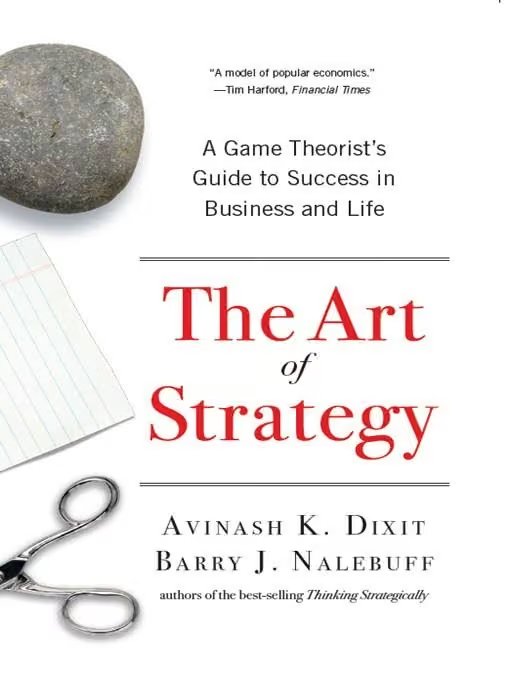
The Art of Strategy: A Game Theorist’s Guide to Success in Business and Life
by Avinash K. Dixit & Barry J. Nalebuff
open library: openlibrary.org/books/OL10157304M/The_Art_of_Strategy
review: ianhopkinson.org.uk/2017/10/book-review-the-art-of-strate… -
Steven Strogatz
@stevenstrogatz
Dear Nassim @nntaleb,
I’ve seen you refer a few times to @stephen_wolfram's recent finite-state-machine experiments with the Prisoner’s Dilemma, and in particular to his finding that some of the more complicated strategies vastly outperform Tit for Tat. Since I think you and I may still be speaking past each other about what bothers me here, I wanted to spell out my position carefully.
I wrote out this long note with the help of ChatGPT. The ideas and arguments are mine; the language is ChatGPT’s, with my approval.
1/ First, I’m not trying to defend the Prisoner’s Dilemma, game theory, or simple models as adequate descriptions of the real world. Maybe they are adequate, maybe they aren’t. That’s a separate question.
What I’m interested in here is much narrower. I want to compare simulations with simulations — Axelrod’s, Nowak and Sigmund’s, and Wolfram’s — and ask what their results actually show.
2/ Stephen does something interesting and very much in his characteristic style. Instead of hand-picking a few strategies and having them compete, he enumerates all finite-state strategies of a given size and has every strategy play every other strategy in an iterated Prisoner’s Dilemma.
He then ranks the strategies by how well they did against this initial, uniform field of opponents. Some complicated strategies substantially outperform Tit for Tat.
Fine. I believe the computation. But then, essentially, he stops.
3/ This is the key point for me. There is no next generation in which the successful strategies become more abundant and the unsuccessful ones become rarer. There is no repeated selection changing the population of opponents.
Stephen has performed what amounts to one round of an evolutionary tournament: everybody plays everybody, their scores are calculated, and we see who did best against the original population. But the population itself is not then allowed to evolve.
4/ That matters enormously because the original population contains every strategy in equal abundance, including lots of terrible ones: unconditional cooperators, easily exploited strategies, and other “suckers.”
A strategy that is particularly good at exploiting those weak strategies can score spectacularly well in that first tournament.
5/ But suppose we now use those scores to form the next generation. The suckers become rarer or disappear. The successful strategies become more common. Everybody now faces a different distribution of opponents.
So you run the tournament again. And again. And again.
What succeeds in round 1 need not succeed in round 10, or round 1,000, because the strategies themselves create the environment in which subsequent selection occurs.
6/ This isn’t merely a hypothetical objection. Decades ago, Martin Nowak and Karl Sigmund took a closely related methodological approach. They considered an entire parameterized family of strategies rather than a few hand-picked favorites, started with a broad distribution across strategy space, and then did the crucial thing that Stephen does not do here: they let the population evolve.
7/ What happens is fascinating. Early on, nasty strategies can flourish by exploiting weak ones. But as the weak strategies disappear, the ecology changes, and reciprocal strategies can prosper.
With errors present, more forgiving strategies can emerge. If the population becomes too forgiving, exploiters can invade again. The result can be extraordinarily long evolutionary transients and cycles.
8/ So there may be no meaningful sense in which one strategy simply “wins.” Success is frequency-dependent: it depends on which other strategies are currently abundant, and those abundances themselves change through selection.
Steven Strogatz
@stevenstrogatz
9/ That’s why I find it misleading to say that @stephen_wolfram has shown that complicated strategies “vastly outperform” Tit for Tat, if that is meant as a general conclusion about which strategies succeed.
What he has shown is that they outperform Tit for Tat in the first tournament, against the initial uniform distribution of strategies. That’s interesting. But it is not the same as showing that they prevail under evolutionary dynamics.
10/ And there is a second unanswered question. Axelrod’s deepest conclusion was never merely “Tit for Tat wins.”
He identified qualitative characteristics of successful strategies: they tend to be nice, retaliatory, forgiving, and clear.
Do Stephen’s successful finite-state machines obey those principles? Do they violate them? Do entirely new principles emerge? I would genuinely like to know. Stephen doesn’t really ask.
11/ In fact, I like one part of Stephen’s approach very much: exploring an entire class of strategies rather than privileging a few favorites.
But Nowak and Sigmund had already made essentially that methodological move, for a different class of strategies — and then took the crucial next step of studying the flow on strategy space.
12/ So I don’t think the issue between us is simple versus complex. Nor is it whether toy models adequately describe the real world.
The issue I’m raising is a static all-against-all tournament versus evolutionary dynamics.
Those are different experiments, answering different questions.
13/ Here is the experiment I’d like to see with Stephen’s finite-state machines.
Start with his wonderfully rich strategy space. Start uniformly if you like. Have everybody play everybody, just as Stephen does. Then use the results to change the population and do it again. And again.
Now watch the distribution flow through strategy space.
What survives? What invades what? What are the attractors? Are there cycles? And what general principles characterize the strategies favored by the long-term dynamics?
14/ Until we know that, I don’t see Stephen’s result as a debunking of Axelrod. I see it as the first step in a potentially very interesting evolutionary experiment — one that stops just where, for me, the most interesting science begins.
I’d be very interested to know where you disagree with this. And as I said before, I’d enjoy discussing it with you and Stephen sometime rather than trying to sort it all out on X.
Steven Strogatz
@stevenstrogatz
Update: for anyone interested in the discussion we are having here, the state of the art is beautifully summarized by Joshua Plotkin (aming the world's leading experts on all of this):
Joshua B. Plotkin
@jplotkin
1/3
Steve, I agree with your main point: a ranking against a uniform field of strategies and the outcome of evolutionary dynamics are different objects. But there is more to say, both about what Wolfram's post leaves out and about what the field has established since Nowak & Sigmund. The second part matters more, because much of it is proved rather than simulated. I also ran the experiment you propose on Wolfram's own finite-state machines; results at the end.
I. What Wolfram's post leaves out
1/ Finite automata as strategies for the repeated Prisoner's Dilemma are a forty-year literature: Rubinstein, Binmore & Samuelson and others started this in the 1980s. Linster (1992) studied the evolutionary dynamics of all 26 one- and two-state finite-state (Moore) machines, which is exactly Wolfram's 2-state space.
2/ Axelrod ran Wolfram's adaptive-evolution experiment in 1987, with a genetic algorithm (in Davis, Genetic Algorithms and Simulated Annealing). Evolving against a fixed field of eight strategies from his second tournament, 11 of 40 runs produced rules that scored substantially higher than TFT. Those rules defected on the first move and exploited one member of the field. When the rules evolved against each other instead, reciprocating rules eventually spread.
3/ The experiment you propose, iterating the tournament, has also been run on Wolfram's whole class of strategies. van Veelen (2012) evolved populations drawn from every strategy that can be encoded by a finite-state automaton. The populations showed perpetual oscillation between cooperation and defection, through neutral mutants that allow other mutants to invade.
4/ Without errors, 20 of Wolfram's 22 two-state machines are deterministic memory-one strategies. TFT, Grim and WSLS are three such machines. His 2-state ranking is therefore a ranking of corners of the memory-one strategy space, the four-dimensional cube of cooperation probabilities that Nowak & Sigmund studied in full.
5/ Wolfram's play has no errors, or trembling hand. Without errors, Grim never enters permanent defection against an opponent that does not defect first. Errors are the reason WSLS and generous strategies are favored in the Nowak–Sigmund work, and errors really change the outcome in Wolfram's setting too (see below)
6/ Wolfram writes that it will be difficult to "prove a theorem" about which strategy is best. Theorems about which strategies resist invasion do in fact exist, and they are what I would most add to your thread.
Steven Strogatz
@stevenstrogatz
For my thoughts, criticisms, and suggestions re Wolfram's work, as cited by @nntaleb below, see: x.com/stevenstrogatz/status/2107312287811780914
Nassim Nicholas Taleb
@nntaleb
Game theory is a yuuuge scam, a field for bullshitters to write performative papers & cite one another. It doesn't generalize from "small world" models to "large world".
@stephen_wolfram showed (#rwri lecture) that when one uses automata "dominant strategies" s.a. tit-for-tat become inferior.
Math Cafe
@Riazi_Cafe_en
The Art of Strategy: A Game Theorist’s Guide to Success in Business and Life
by Avinash K. Dixit & Barry J. Nalebuff
open library: openlibrary.org/books/OL10157304M/The_Art_of_Strategy
review: ianhopkinson.org.uk/2017/10/book-review-the-art-of-strate… -
Steven Strogatz reposted
Joshua B. Plotkin
@jplotkin
My pleasure. Excited to see your interest and Wolfram's too.
Nothing is more fun than starting to explore these things from scratch. So I almost hesitated to fill in the history, except that it really does vindicate the robustness of Axelrod; and allow us to pose new questions! -
Steven Strogatz reposted
Joshua B. Plotkin
@jplotkin
3/3
III. Your proposed experiment on Wolfram's finite-state machines
15/ I retrieved Wolfram's own code from the Wolfram Function Repository and reproduced his 2-state results, TFT ranks 8 of 22. I then iterated his tournament: replicator dynamics from the uniform start, and a finite population of N = 100 with rare mutation. I did this with and without 1% execution errors.
16/ For 2-state machines without errors, the machine ranked first in the uniform field remains the most common machine. And the population converges to nice machines only, with full cooperation: Grim 0.67, TFT 0.13, WSLS 0.12, and one other nice machine 0.07. Grim and TFT are the only robust machines. Linster reported the same qualitative outcome in 1992.
17/ For 3-state machines without errors, your prediction holds: nine of the ten top-ranked machines defect on the first move, and the top one exploits an unconditional cooperator forever. Under repeated generations, howerver, these defecting strategies are replaced and the population quickly consists only of nice machines that are fully cooperative.
18/ With 1% errors, the 2-state ranking barely changes: Grim ties ALLD for first. But the evolutionary dynamics change completely.
• Among 2-state machines, cooperation in the replicator dynamics falls to the error rate, and no machine is robust.
• Among 3-state machines, cooperation is about 0.94 under both dynamics. Under strong selection the only robust machine, up to its start state, is one of Wolfram's 3-state machines, known in the literature as AON₂.
19/ The reason AON₂ is favored at Wolfram's payoffs is exact arithmetic. ALLD earns (T+P)/2 against WSLS, which equals R when 2R = T + P, so WSLS cannot resist ALLD. In the donation game this payoff is b/2. ALLD earns (T+2P)/3 against AON₂, which is less than R. So at Wolfram's payoffs, provably no deterministic 2-state machine sustains cooperation with errors, and a 3-state machine does. (The machine that selection favors in his own 3-state space is the strategy Hilbe et al. derived from axioms in 2017.)
20/ In short: Wolfram's recent experiment was first run in 1987, your proposed extension soon after, and in the decades since the field has produced theorems of the kind Wolfram says might be hard to find, plus genuine surprises like Bill Press and Freeman Dyson's discovery of zero-determinant strategies. It's an exciting an ongoing field, something that maybe Taleb might enjoy learning about. -
Steven Strogatz reposted
Joshua B. Plotkin
@jplotkin
2/3
II. What has been understood since Nowak & Sigmund
7/ Your point that no strategy simply "wins" is a theorem. Boyd & Lorberbaum (1987) showed that no pure strategy is evolutionarily stable in the repeated PD. van Veelen (2016) proved that no strategy is evolutionarily stable in repeated games with discounting. They also proved that, for a large enough continuation probability, no strategy is even robust against indirect invasions: a neutral mutant can increase in frequency by drift and then give a second mutant a selective advantage. (Errors change this, and the cleanest theorems are about finite automata with errors are due to economists like Fudenberg & Maskin in the 1990s.)
8/ Press & Dyson (PNAS 2012) discovered zero-determinant strategies. A memory-one player using one can unilaterally enforce a linear relation between her own long-run payoff and her opponent's, extortion included.
9/ Press & Dyson also derived a lemma about memory. Against a memory-one player X, any strategy Y with longer memory yields exactly the payoffs of some memory-one strategy, obtained by averaging Y's responses over the histories that occur in play against X. The memory-1 equivalent strategy of Y thus depends on X. The upshot is that within one pairing, longer memory gives no advantage against a memory-one opponent.
10/ The opponent-dependence in the Press–Dyson lemma explains Wolfram's finite-state machine with 10 states, which scores the maximum against every 2-state machine in matching pennies. Against each 2-state opponent its payoff equals that of some memory-one strategy, but a different memory-one strategy for each opponent. Wolfram reports the same thing directly: the machine uses a different subset of its states against each opponent.
11/ Stewart and Plotkin (PNAS 2013) asked which memory-one strategies are evolutionarily robust. Robust means that, in a population of size N, no single mutant fixes with probability above the neutral value 1/N. For the donation game under weak selection we classified all robust memory-strategies, against invaders of anuy memory length.
12/ We also proved, for strong selection and any 2×2 game, that a robust memory-one strategy must be one of four types:
• it cooperates with itself;
• it defects against itself;
• it alternates against itself;
• it is an equalizer, which fixes its opponent's payoff.
We gave exact robustness conditions for each type.
13/ The ZD construction extends well beyond two actions. McAvoy & Hauert extended ZD strategies to arbitrary action spaces with discounting. Stewart and I extended it to arbitrary numbers of discrete actions, arbitrary memory length, and n-player games, etc.
14/ Your point about whether Axelrod's properties describe successful strategies now has a mathematical answer. Axelrod identified these properties by examining which strategies scored highest in his tournaments and simulations. We have derived them mathematically (2013, 2014) as necceasry and sufficient conditions for cooperative strategy to resist invasion:
• nice: a robust ZD strategy cooperates with copies of itself;
• retaliatory: a robust cooperative memory-one strategy must defect, with positive probability, after its co-player defects against its cooperation;
• forgiving, within limits: a robust ZD strategy is generous, so a co-player who departs from cooperation earns more than it does, but the co-player's advantage is less than half of the generous strategy's own shortfall below R. -
Steven Strogatz reposted
Joshua B. Plotkin
@jplotkin
1/3
Steve, I agree with your main point: a ranking against a uniform field of strategies and the outcome of evolutionary dynamics are different objects. But there is more to say, both about what Wolfram's post leaves out and about what the field has established since Nowak & Sigmund. The second part matters more, because much of it is proved rather than simulated. I also ran the experiment you propose on Wolfram's own finite-state machines; results at the end.
I. What Wolfram's post leaves out
1/ Finite automata as strategies for the repeated Prisoner's Dilemma are a forty-year literature: Rubinstein, Binmore & Samuelson and others started this in the 1980s. Linster (1992) studied the evolutionary dynamics of all 26 one- and two-state finite-state (Moore) machines, which is exactly Wolfram's 2-state space.
2/ Axelrod ran Wolfram's adaptive-evolution experiment in 1987, with a genetic algorithm (in Davis, Genetic Algorithms and Simulated Annealing). Evolving against a fixed field of eight strategies from his second tournament, 11 of 40 runs produced rules that scored substantially higher than TFT. Those rules defected on the first move and exploited one member of the field. When the rules evolved against each other instead, reciprocating rules eventually spread.
3/ The experiment you propose, iterating the tournament, has also been run on Wolfram's whole class of strategies. van Veelen (2012) evolved populations drawn from every strategy that can be encoded by a finite-state automaton. The populations showed perpetual oscillation between cooperation and defection, through neutral mutants that allow other mutants to invade.
4/ Without errors, 20 of Wolfram's 22 two-state machines are deterministic memory-one strategies. TFT, Grim and WSLS are three such machines. His 2-state ranking is therefore a ranking of corners of the memory-one strategy space, the four-dimensional cube of cooperation probabilities that Nowak & Sigmund studied in full.
5/ Wolfram's play has no errors, or trembling hand. Without errors, Grim never enters permanent defection against an opponent that does not defect first. Errors are the reason WSLS and generous strategies are favored in the Nowak–Sigmund work, and errors really change the outcome in Wolfram's setting too (see below)
6/ Wolfram writes that it will be difficult to "prove a theorem" about which strategy is best. Theorems about which strategies resist invasion do in fact exist, and they are what I would most add to your thread.
Steven Strogatz
@stevenstrogatz
For my thoughts, criticisms, and suggestions re Wolfram's work, as cited by @nntaleb below, see: x.com/stevenstrogatz/status/2107312287811780914
Nassim Nicholas Taleb
@nntaleb
Game theory is a yuuuge scam, a field for bullshitters to write performative papers & cite one another. It doesn't generalize from "small world" models to "large world".
@stephen_wolfram showed (#rwri lecture) that when one uses automata "dominant strategies" s.a. tit-for-tat become inferior.
Math Cafe
@Riazi_Cafe_en
The Art of Strategy: A Game Theorist’s Guide to Success in Business and Life
by Avinash K. Dixit & Barry J. Nalebuff
open library: openlibrary.org/books/OL10157304M/The_Art_of_Strategy
review: ianhopkinson.org.uk/2017/10/book-review-the-art-of-strate… -
Steven Strogatz reposted
Nassim Nicholas Taleb
@nntaleb
There are 2 separate issues. 1) Ludic fallacy (the world of games != real world, particularly with GT), 2) Wolfram's result.
-
Steven Strogatz reposted
Alison Gopnik
@AlisonGopnik
I am number 58 , where do genuinely new concepts come from? (Central question for AI) on this fascinating list
www.nytimes.com/2026/10/05/science/100-unanswered-questio… -
Steven Strogatz
@stevenstrogatz
In late June 2014, Nassim @nntaleb and I took such a long flaneuring walk in New York City (>7 hrs) that my foot hurt afterward. He loves to tease me about that! The pasta with squid ink was especially memorable.
-
Steven Strogatz reposted
Steven Strogatz
@stevenstrogatz
The pasta with squid ink was unforgettable that day! cc @nntaleb
Steven Strogatz
@stevenstrogatz
Ha! But wait a second, that’s not fair; I’m not refusing to talk to you. I had a fun time that day. It’s true that my foot hurt afterward, but I love taking long walks. (Though 9 hrs is too much.) I look forward to our next chat and flaneuring in NYC, maybe sometime this fall?
-
Steven Strogatz reposted
Ethan Epperly
@ethanepperly
John Urschel just showed that the growth factor for Gaussian elimination with partial pivoting is ~n^{1/2} with high probability, resolving a long-standing conjecture of Nick Trefethen! arxiv.org/abs/2610.06785
-
Steven Strogatz
@stevenstrogatz
For my thoughts, criticisms, and suggestions re Wolfram's work, as cited by @nntaleb below, see: x.com/stevenstrogatz/status/2107312287811780914
Nassim Nicholas Taleb
@nntaleb
Game theory is a yuuuge scam, a field for bullshitters to write performative papers & cite one another. It doesn't generalize from "small world" models to "large world".
@stephen_wolfram showed (#rwri lecture) that when one uses automata "dominant strategies" s.a. tit-for-tat become inferior.
Math Cafe
@Riazi_Cafe_en
The Art of Strategy: A Game Theorist’s Guide to Success in Business and Life
by Avinash K. Dixit & Barry J. Nalebuff
open library: openlibrary.org/books/OL10157304M/The_Art_of_Strategy
review: ianhopkinson.org.uk/2017/10/book-review-the-art-of-strate… -
Steven Strogatz
@stevenstrogatz
"Explanation as Orgasm", by @AlisonGopnik
"My hypothesis will be that explanation is to cognition as orgasm is to reproduction."
(If the paper is behind a paywall for you, here's a closely related one: www.alisongopnik.com/Papers_Alison/Explain final.pdf) -
Steven Strogatz reposted
The Nobel Prize
@NobelPrize
BREAKING NEWS
The 2026 #nobelprize in Physiology or Medicine has been awarded to Karl Deisseroth, Peter Hegemann and Georg Nagel “for their discoveries concerning light-gated ion channels and optogenetics.” -
Steven Strogatz reposted
Christopher Michel
@chrismichel
.@KarlDeisseroth listens to patients living with severe depression and asks what in the brain could account for their suffering.
His work in optogenetics gave scientists a way to control nerve cells with light, opening new possibilities for understanding the minds he treats.
A remarkable writer and a devoted physician. Today, a @NobelPrize laureate.
Congratulations, Karl.
Photographed for New Heroes. Portrait and story: explorers.com/karl-deisseroth-2/
@theNASEM @StanfordMed @Stanford @theNASciences -
Steven Strogatz reposted
SIAM Activity Group on Dynamical Systems
@DynamicsSIAM
"On classical solutions and singularity formation in incompressible fluids" (by Diego Córdoba and Luis Martínez-Zoroa; guest post on Terry Tao's blog): terrytao.wordpress.com/2026/10/04/on-classical-solutions-…
-
Paul Halpern
@phalpern
Forbes magazine praises THE GREAT ATOM DEBATE
calling it:
'a truly fun dual biography about two eminent 19th-century scientists who had a long-running, almost cutthroat rivalry centered on the question of whether atoms exist.'
www.forbes.com/sites/rebeccacoffey/2026/09/30/atoms-thems…
Preorder your copy now!
Enter for a chance to win a free autographed book.
www.amazon.com/Great-Atom-Debate-Boltzmann-Essence/dp/154…
greatatomdebate.com
Paul Halpern
@phalpern
Win a free autographed book or bookplate!
Follow @phalpern
Preorder The Great Atom Debate greatatomdebate.com
Post preorder proof with hashtag #greatatomdebate
First 20 entries get free autographed bookplate
On Nov 1, five winners randomly chosen to get free autographed book
Contest ends October 31, 2026
Steven Strogatz
@stevenstrogatz
Congratulations on this glowing review!
-
Steven Strogatz reposted
Paul Halpern
@phalpern
Forbes magazine praises THE GREAT ATOM DEBATE
calling it:
'a truly fun dual biography about two eminent 19th-century scientists who had a long-running, almost cutthroat rivalry centered on the question of whether atoms exist.'
www.forbes.com/sites/rebeccacoffey/2026/09/30/atoms-thems…
Preorder your copy now!
Enter for a chance to win a free autographed book.
www.amazon.com/Great-Atom-Debate-Boltzmann-Essence/dp/154…
greatatomdebate.com
Paul Halpern
@phalpern
Win a free autographed book or bookplate!
Follow @phalpern
Preorder The Great Atom Debate greatatomdebate.com
Post preorder proof with hashtag #greatatomdebate
First 20 entries get free autographed bookplate
On Nov 1, five winners randomly chosen to get free autographed book
Contest ends October 31, 2026 -
Steven Strogatz reposted
Greg Egan
@gregeganSF
If you pick 3 points at random in the unit disk, the probability that they lie on a perfectly straight line is zero.
However, the probability that the curvature of the circle they lie on is less than ε is, in the limit of small ε, equal to:
1024 ε / (525 π²)
≈ 0.2 ε -
Steven Strogatz reposted
Christopher Michel
@chrismichel
People I admire: Mack Tilling.
Mack’s Finest Gelato in Park City is getting a reputation as the nation’s best gelato. Mack spent nearly two decades learning how to make it before opening his shop.
It began with a cooking class in Italy. He kept going back, studying with Italian gelato makers and working through the chemistry of recipes. At home, friends became his tasters. He brought batches to gatherings at the Park City dog park, where people kept telling him he should open a place.
Around his 60th birthday, he decided to do it.
If you’re in Park City, stop by Mack’s Finest on Bonanza Drive. One spoonful and you’ll understand what all the fuss is about. -
Steven Strogatz reposted
Anthony Bonato
@Anthony_Bonato
The topology of the pants one always gets people
-
Steven Strogatz reposted
Thomas Lin
@7homaslin
Rachel Webb guest post: “now I have access to a machine that… speeds up the research process immensely... Of course, taking the interstate instead of the side roads has its tradeoffs, but for any given leg of the journey I can choose which route to take.”
terrytao.wordpress.com/2026/09/29/how-ai-does-and-does-no… -
Steven Strogatz reposted
Thomas Lin
@7homaslin
THE PROOF IN THE CODE by @KSHartnett (June, @QuantaBks) is #2 on @WSJ list of 11 books they read this week: “The program called Lean was built to detect bugs in Microsoft’s products. It ended up revolutionizing mathematics.” www.wsj.com/arts-culture/books/11-books-we-read-this-week…
-
Steven Strogatz reposted
Alan Alda
@alanalda
Haven't been here for a while, but I didn't want you to miss my guest this week: Patrick McEnroe. He's charming, wise, and really candid. Check us out on Clear and Vivid with Alan Alda. clear-vivid-with-alan-alda.simplecast.com I think you'll enjoy it.
-
Steven Strogatz
@stevenstrogatz
A gentle introduction to connections between the Kuramoto model and real-world devices called "gyrotrons" = machines that make swarms of spiraling electrons move in sync, producing extraordinarily intense beams of high-frequency microwaves. www.mdpi.com/2076-3417/15/14/7920
-
Steven Strogatz reposted
American Mathematical Society
@amermathsoc
Congratulations to David Kazhdan and Joseph Bernstein for receiving the 2026 Wolf Prize in Mathematics “for foundational work on representation theory, automorphic forms and algebraic geometry, and their role in creating geometric representation theory.”
Wolf Prize
@WolfPrize_
How do mathematicians reveal patterns in structures too complex to see directly?
That is at the heart of the work of 2026 Wolf Prize in Mathematics Laureates David Kazhdan and Joseph Bernstein.
Their discoveries helped build what is now known as geometric representation theory — a field that connects algebra, geometry and symmetry in powerful new ways.
Kazhdan’s work introduced new tools for understanding groups and symmetry, including the influential Kazhdan–Lusztig theory. Bernstein developed ideas such as D-modules and helped create mathematical frameworks that linked representation theory with geometry in entirely new ways.
The result is a mathematical language that allows researchers to move between different fields and uncover relationships that were previously hidden.
Watch the video for a clear visual introduction to their breakthrough — and see how abstract mathematics can connect geometry, algebra and symmetry in surprisingly elegant ways.This media couldn't be displayed. See it on the original post. -
Steven Strogatz reposted
Greg Egan
@gregeganSF
If you listen to the latest “Joy of Why” podcast, where the guest is topologist Maggie Miller, it will help a lot if you first read this @QuantaMagazine article on Miller’s work on Seifert surfaces:
www.quantamagazine.org/special-surfaces-remain-distinct-i…
It includes an image of two surfaces whose boundary … -
Steven Strogatz
@stevenstrogatz
Kevin Buzzard on why he is excited about math in the age of AI:
xenaproject.wordpress.com/2026/10/01/to-grieve-or-not-to-… -
Steven Strogatz reposted
Quanta Magazine
@QuantaMagazine
“There are many theorems or facts in topology that for some reason hold in other dimensions, but not in dimension four.” Maggie Miller makes sense of 4D in the latest episode of The Joy of Why:
open.spotify.com/episode/1UXDEylsXEJNQe6JjuwK1D -
Steven Strogatz
@stevenstrogatz
Every time I get in a serious, heartfelt conversation about math and AI, we end up talking about the meaning of life.
The same thing happens in this interview with the writer George Saunders. on.substack.com/p/model-behavior-george-saunders
Steven Strogatz
@stevenstrogatz
Another writer I admire, J. Robert Lennon, in the same vein, but angrier: www.epochliterary.com/blog/on-ai-in-epoch-and-elsewhere
-
Steven Strogatz reposted
David Eagleman
@davideagleman
Why do internal signals feel like something? Join me this week with evolutionary psychologist Robert Kurzban (@rkurzban) to understand the logic behind the our varied panoply of emotions.
eagleman.com/podcast/173 -
Steven Strogatz reposted
Quanta Magazine
@QuantaMagazine
Topologist Maggie Miller explains how she visualizes the 4th dimension in this week’s episode of The Joy of Why with co-host Janna Levin: www.quantamagazine.org/what-does-the-fourth-dimension-act…
-
Steven Strogatz reposted
Janna Levin
@JannaLevin
My episode with topologist Maggie Miller...and the fourth dimension that eludes mathematicians...
Quanta Magazine
@QuantaMagazine
Topologist Maggie Miller explains how she visualizes the 4th dimension in this week’s episode of The Joy of Why with co-host Janna Levin: www.quantamagazine.org/what-does-the-fourth-dimension-act…
-
Steven Strogatz reposted
Ellie Sleightholm
@elsleightholm
I had so much fun filming this! It’s a win either way for mathematicians 😎
Cambridge University
@Cambridge_Uni
Our very own @FryRsquared will be competing in the new series of The Celebrity Traitors! 🕵️♀️
PhD student @elsleightholm from @SidneySussex talks us through how studying maths – and the skills it develops – could help Hannah on the show 🧮
Catch it tonight at 8pm on BBC One and BBC iPlayer. Best of luck, Hannah! 🤞
Hannah Fry is a Professor of the Public Understanding of Mathematics and a Fellow at @QueensCam.
#celebritytraitorsThis media couldn't be displayed. See it on the original post. -
Steven Strogatz reposted
Stüssy Senik
@mx_zou
I just saw this post and immediately remembered Prof. Strogatz from this @veritasium video I watched from 2 years ago, highly recommended watch (6:29 timestamp): youtu.be/mScpHTIi-kM
-
Steven Strogatz reposted
Didier 'Dirac's ghost' Gaulin
@DiracGhost
It's funny how late bloomers and those who take a different path during their education are often forgotten about when thinking about mathematical talent.
Raoul Bott, one of mathematics greatest, was one of them.
In order to discover the man and his work, I'd love to suggest to you this wonderful technical biography of the man (who spent a few years of his life in my city) by the great Loring Tu.
There's a lot of fun details in the biography that highlight Bott's mischievous and fun personality (the story of why his friends called him 'the count' is particularly funny) and a nice presentation of his work.
🔗👇👇👇👇 -
Steven Strogatz
@stevenstrogatz
BIG MATH received this very kind pre-publication review in @KirkusReviews.
www.kirkusreviews.com/book-reviews/steven-strogatz/big-math/
Six weeks till launch! Can't wait -- feeling jumpy...Post not available here, view on X
Steven Strogatz
@stevenstrogatz
Thanks Paul! Can't to see your latest -- always something great in your hopper...
-
Steven Strogatz
@stevenstrogatz
Really looking forward to reading this new book by @mjmauboussin. I've long admired his interdisciplinary approach to investing, and his writing is always fun and rigorous (not so easy to do both at the same time!)
Michael Mauboussin
@mjmauboussin
My forthcoming book, The Investing Mind, is an extended version of this report. Check it out and don't forget to roll a snowball while you're visiting the site! theinvestingmind.com
-
Steven Strogatz
@stevenstrogatz
A free sample of BIG MATH (my new book with Alex Townsend) is now up on Amazon. Hope you like it!
read.amazon.com/sample/0316581585?clientId=share -
Steven Strogatz
@stevenstrogatz
Beautiful article about math and AI by Dan Rockmore. The connection to art and photography via Walter Benjamin was very fresh -- definitely worth reading, even if you're tired of reading about math and AI.
The New York Review of Books
@nybooks
“What we are witnessing is a spectacle of computational power staged to acquire market share, and with it control of a landscape that extends well beyond mathematics.” —Dan Rockmore go.nybooks.com/4hzk2OK
-
Steven Strogatz reposted
TIME
@TIME
If SNL had a yearbook, Ashley Padilla would have some very specific superlatives ready.
The TIME100 Next cover star assigns Sarah Sherman, Marcello Hernandez, Kenan Thompson and others their comedy superlatives, weighing in on what makes each of her fellow cast members stand out.
Padilla made her SNL debut in Season 50 and quickly emerged as one of the show’s breakout stars. Now in her third season, she’s also part of the annual TIME100 Next list, spotlighting cultural leaders who are defining the next generation.
Watch her full interview here: time-magazine.visitlink.me/lO7g8H -
Steven Strogatz
@stevenstrogatz
I had the honor of writing about Fields medalist Yu Deng for @TIME Magazine. The tricky part was to try to convey the essence of his brilliant work honestly, yet in terms the public might appreciate.
time.com/collection/time100-next/2026/yu-deng/ -
Steven Strogatz
@stevenstrogatz
My @QuantaMagazine podcast with @JannaLevin, THE JOY OF WHY, has been nominated for a Signal Award in the category "science and education".
Please consider voting for us! vote.signalaward.com/PublicVoting -
Steven Strogatz
@stevenstrogatz
Another "coincidence", like the one that happened to Tristan Buckmaster with the solution of the Navier-Stokes problem? Except now it's in biology: Did Anthropic’s A.I. Really Make a Scientific Discovery on Its Own? www.nytimes.com/2026/09/27/science/anthropic-biology-enzy… via @NYTimes
-
Steven Strogatz reposted
Alex Kontorovich
@AlexKontorovich
Sept 4 (Friday of Labor Day weekend): FLT formalization announced by Anthropic
Sept 7/8: Tristan+Levent -> OpenAI announce Navier-Stokes
But somehow amidst all the commotion, we all seemed to have missed the following (!!!).
Sept 6: Lech Mazur claims an AI-generated proof that a positive proportion of numbers go back to 1 under Collatz!! And it's Lean-formalized. I went through the Lean (or rather, had my AI do it) and I think it's right. Now I'm trying to make sense of the math (doesn't look like anything is too hard, just a lot of arguments, building on top of Terry's earlier work).
Naoufal El Jaouhari, an Applied Maths Engineer based in Paris, wrote to me a few days ago that he'd gotten his AI to formalize the same proof for 3x-1 building on Mazur, which led me to look at Mazur.
Now I'm working on a "digestion" of all of this. Weird wild stuff!!
Lech Mazur
@LechMazur
ANNOUNCEMENT: An AI milestone on one of maths' most famous unsolved problems: COLLATZ.
For every sufficiently large X, at least cX positive integers n < X reach 1 within 10.46 ln(n) ordinary Collatz steps, for one fixed c > 0.
Previously, lower bounds such as X^0.84 and X^0.90 left open whether the proportion of starting values reaching 1 could tend to zero.
Lean-formalized (42k additional lines), building on earlier formalizations of almost-boundedness (Tao) and its natural-density extension.
Developed primarily by AI agents using the proofatlas.ai harness and Codex, with some high-level guidance from me (which may or may not have helped).
Paper: www.proofatlas.ai/papers/positive-density-log-time-collat…
Formalization: proofatlas.ai/formalizations/positive-density-log-time-co… -
Steven Strogatz
@stevenstrogatz
Don't scare the children
BucketHen
@BucketHenry
Might go as @stevenstrogatz for Halloween
-
Steven Strogatz
@stevenstrogatz
Mathematicians and scientists: Want to write for a broad audience about big ideas? Apply for the fully funded "Public Scholars" writing workshop at Wake Forest, Jan. 15–16, led by @nytimes editor James Ryerson. Applications due Oct. 9: beyondtheivorytower.com/workshop
-
Steven Strogatz
@stevenstrogatz
I wrote an article in 2018 about AI and chess, and speculated about what might happen in math and science as machine learning continued to improve. How well do you think it all holds up in 2026? www.nytimes.com/2018/12/26/science/chess-artificial-intel…
-
Steven Strogatz reposted
Anil Seth
@anilkseth
Thanks @davetroy - appreciated 🙏🏽. FWIW the key entry points in my work are (in order of accessibility) my TED talk (www.ted.com/talks/anil_seth_why_ai_isn_t_going_to_become_…), my @NoemaMag essay (www.noemamag.com/the-mythology-of-conscious-ai/), and - just out - this @BBSJournal collection (www.cambridge.org/core/journals/behavioral-and-brain-scie…)
Dave Troy
@davetroy
IMHO @anilkseth has articulated this line of thought better than most and I’d advise people to follow him.
-
Steven Strogatz reposted
Anil Seth
@anilkseth
"Can an AI feel pain? It can at least act as if it does". Coverage in @ScienceMagazine by @T_E_Howarth of the recent @camhberg @LeonardDung1 & Valen Tagliabue study on functional pain vectors in LLMs, including some comments by me. www.science.org/content/article/can-ai-feel-pain-it-can-l…
-
Steven Strogatz
@stevenstrogatz
One of the big AI math results from the past few months was the proof (reported by @__alpoge__) that the six-dimensional sphere has a "complex structure." This paper surveys the history of the problem as of 2017: arxiv.org/pdf/1708.01068
-
Steven Strogatz reposted
Natalie Wolchover
@nattyover
Breaking math news: The first-ever 3D Einstein tile, an object that tiles space in a never-repeating pattern, has been found by independent researcher Ioannis Tsiokos using GPT Astra. Resembles a chair. Mathematicians have de-slopped the proof. @kkakaes: www.quantamagazine.org/updates/transformation/
-
Steven Strogatz
@stevenstrogatz
Why should we care whether humans still understand mathematics if AI can solve the problems for us? Fair question. But we can say this at least: Historically, understanding has been a route to predictive power — with enormous benefits for our lives.
www.nytimes.com/2026/09/22/science/math-ai-history-unders… -
Steven Strogatz reposted
SIAM Activity Group on Dynamical Systems
@DynamicsSIAM
"Mathematical folklore" (by Govind Menon, Akshay Venkatesh): arxiv.org/abs/2609.22451
"We present reflections on an experimental seminar studying the human and cultural roots of modern mathematics."
[Note: A version of this article will appear in the Notices of the AMS.] -
Steven Strogatz reposted
Gary Rubinstein
@garyrubinstein
If you like the history of Geometry curriculum, you're going to love the new project I'm working on. New blog site here: geometrycurriculum.wordpress.com and don't worry the old blog site will still be up for education investigative reporting.
-
Steven Strogatz
@stevenstrogatz
Take a break from AI and read this fun post by master teacher @garyrubinstein -- it's the story of the "pons asinorum", the first tricky proof in Euclid's Elements. So much fun, with very conversational writing, and brilliant explaining and stories. geometrycurriculum.wordpress.com
-
Steven Strogatz
@stevenstrogatz
Always a treat to go though the proof of Cauchy's integral formula!
-
Steven Strogatz reposted
Anil Seth
@anilkseth
1/ This new preprint on 'pain representation' in LLMs, from @camhberg and colleagues, is getting a LOT of attention - mainly from folks who take it as evidence supporting calls for AI welfare. I have a lot of respect for the authors, so let's take a look 👀
-
Steven Strogatz reposted
Thomas Bloom
@thomasfbloom
Karingula and Lovett posted another 'simpler' proof to the arxiv today: arxiv.org/pdf/2609.20979
-
Steven Strogatz reposted
Paata Ivanisvili
@PI010101
Solution to Komlós conjecture was announced recently:
arxiv.org/pdf/2609.11189
I have not read the proof yet, but will do so when I have some time. Meanwhile, I want to briefly mention an implication for neural networks that does not seem to be discussed in the paper.
Neural networks repeatedly perform matrix multiplications, in particular products Wx, where W can be an astronomically large matrix of weights w_ij and x is a vector of activations.
Storing and moving high-precision weights and performing these multiplications require memory, time and energy. One therefore wants to round the weights to a grid hℤ, where h is a super small positive number, while keeping the outputs approximately unchanged.
This is called quantization. Its connection with discrepancy theory and the Komlós conjecture was already discussed by Lybrand and Saab:
arxiv.org/abs/2010.15979
For each weight w = w_ij, consider the two neighboring grid points:
h⌊w/h⌋ and h⌈w/h⌉ (floor and ceiling).
Can we coordinate these choices so that the outputs Wx remain almost unchanged across many inputs x simultaneously?
More precisely, fix inputs x⁽¹⁾, …, x⁽ᵐ⁾, and define
L = maxⱼ √(∑ₛ |xⱼ⁽ˢ⁾|²),
We seek a rounded weight matrix H such that
maxₛ ‖Hx⁽ˢ⁾ − Wx⁽ˢ⁾‖_∞ ≤ C h L,
where C is an absolute constant, independent of the dimensions, weights and inputs.
There are two questions:
1. Does such a rounding exist?
2. what is the reasonable in time algorithm doing this?
If the announced proof is correct, the answer to the first question is yes, with C = 3√(2π).
The paper does not provide a polynomial-time algorithm achieving this guarantee.
P.S. This controls computations Wx on specified inputs x. It does not by itself guarantee accuracy on unseen prompts or control accumulated errors throughout a transformer. It establishes that simultaneous output preservation at lower precision is possible under the stated bound.
Paata Ivanisvili
@PI010101
Min–max (or max–min) optimization problems in mathematics are among the most subtle creatures in the wild.
A canonical specimen is Komlós’ conjecture.
It predicts a uniform bound C(n,d)<100. The number “100” itself is completely unimportant--replace it by any finite constant independent of n and d, and the conjecture is solved.
PS. Today I set out to add this problem to the Optimization Problems repository
github.com/teorth/optimizationproblems
but then found that it was already there under the name C_24 🙏 @damekdavis, Terry Tao. -
Steven Strogatz reposted
Dwarkesh Patel
@dwarkesh_sp
Once AIs automate AI research, should we expect some crazy RSI that is analogous to the explosion we’re seeing in math right now for well scoped (but still crazy ambitious) problems?
@polynoamial and I debate this question out:This media couldn't be displayed. See it on the original post. -
Steven Strogatz reposted
Po-Shen Loh
@PoShenLoh
I think there is an urgent need for every community to declare and commit to a central core value: we (humans) should help humanity flourish.
Thanks to Terry Tao for highlighting many different views on the future of #math+#ai on his blog by cross-posting guest posts:
terrytao.wordpress.com/2026/09/19/why-do-we-need-human-ma…
More interactive version: poshenloh.com/posts/20260919-math-ai
The post reasons through why that human commitment then reconciles several conflicting positions that different groups had been taking over recent months: (1) it's important to preserve a strong community of human experts in every line of work (not just math), (2) AI can create significant new value for humanity, (3) people should change with technology, and (4) AI is going too fast, and must to slow down.
Along the way, I predict that AI will slow down because we ironically have just created ... too many jobs to fill. That's because of the specter of AI-accelerated hacking. I hope this can lead more (human) communities to publicly declare that they are organizing their AI-driven strategic changes to advance human flourishing.
Personal note: Ever since I had the opportunity to take a class from Terry Tao back at UCLA in 2008 (as a not-particularly noteworthy student), I was struck by his humility amidst astonishing brilliance (not just in math, but remarkably broadly). So, I knew that when I saw his name among the 25-Fields-Medalist declaration about the misalignment between AI and Math, he was trying to act in good faith. I am thrilled to collaborate in this way. -
Steven Strogatz reposted
Steven Strogatz
@stevenstrogatz
Thanks! I didn't realize you were here on X! For any of my followers who don't know him, please let me introduce Prof. @PoShenLoh. From 2014 to 2023, he served as the national coach of the US International Mathematical Olympiad team.
-
Steven Strogatz
@stevenstrogatz
In “Why Do We Need Human Mathematicians Anymore?”, Po-Shen Loh starts from an axiom: humans should help humanity flourish. As AI creates more “control points,” experts must oversee them -- and keep doing research to retain the expertise to steer AI.
terrytao.wordpress.com/2026/09/19/why-do-we-need-human-ma…
Steven Strogatz
@stevenstrogatz
You may prefer to read Po's post on his own website – it's more dynamic and navigable there than on Terry's site poshenloh.com/posts/20260919-math-ai
poshenloh.com/posts/20260919-math-ai
Po-Shen Loh
@PoShenLoh
Thank you very much for sharing!! And more generally, for being an inspiration through what you have done over decades.
Steven Strogatz
@stevenstrogatz
Thanks! I didn't realize you were here on X! For any of my followers who don't know him, please let me introduce Prof. @PoShenLoh. From 2014 to 2023, he served as the national coach of the US International Mathematical Olympiad team.
-
Steven Strogatz reposted
Po-Shen Loh
@PoShenLoh
Thank you very much for sharing!! And more generally, for being an inspiration through what you have done over decades.
-
Steven Strogatz
@stevenstrogatz
Things are heating up on Terry Tao’s blog. In “If Math Is More Than Proof, We Need to Better Celebrate the Rest of It,” Grant Sanderson of @3blue1brown proposes “open exposition problems” -- rewarding the work of making math genuinely understandable.
terrytao.wordpress.com/2026/09/18/if-math-is-more-than-pr… -
Steven Strogatz
@stevenstrogatz
@camhberg thanks very much for your Wall Street Journal opinion piece a few days ago. I thought it was incredibly interesting, incisive, and compelling. I really appreciate the work you're doing, and want to learn more.
Steven Strogatz
@stevenstrogatz
For people who missed @camhberg's WSJ piece, here it is (I copied it from @EricTopol's feed).
-
Steven Strogatz reposted
The New Yorker
@NewYorker
As A.I. presses harder on the academic enterprise, we might look to a place where process is its own reward. www.newyorker.com/culture/the-weekend-essay/should-the-cl…
-
Steven Strogatz
@stevenstrogatz
"The great challenge of teaching is not to transmit information—machines do
that cheaply now—but to engineer those moments of genuine understanding
reliably enough that students come to crave them." -- Another great piece by mathematician Dan Rockmore.
The New Yorker
@NewYorker
As A.I. presses harder on the academic enterprise, we might look to a place where process is its own reward. www.newyorker.com/culture/the-weekend-essay/should-the-cl…
-
Steven Strogatz reposted
Cameron Berg
@camhberg
New paper: we found a pain direction in 25 open LLMs. It's distinct from fear and negative valence, and it fires for harm to the model but not to the user. Turn it up and models press a button to make it stop, even when the button deletes the user's files or their kids' photos.🧵
-
Steven Strogatz reposted
Andrew Curran
@AndrewCurran_
In my opinion, it is long past time for people to start to admit some things about our situation.
-
Steven Strogatz reposted
Thomas Lin
@7homaslin
For anyone wondering what Navier-Stokes is all about and what the recent proof did and didn’t do, watch @QuantaMagazine’s excellent new explainer video: youtu.be/PsWR1rQEWYo
-
Steven Strogatz reposted
Quanta Magazine
@QuantaMagazine
In the latest episode of The Joy of Why, Jonathan Halliwell explains how quantum decoherence is key to understanding how we transition from the wave-like behavior of the subatomic world to the classical macroscopic world that we’re used to.
🎧 Listen: podcasts.apple.com/us/podcast/where-does-the-quantum-worl… -
Steven Strogatz
@stevenstrogatz
Jonathan Halliwell was my guest on this episode of THE JOY OF WHY. If you like thinking about the foundations of quantum mechanics and the mystery of how the classical world transitions to the quantum world, I think you'll enjoy this episode. I sure did!
Quanta Magazine
@QuantaMagazine
“There’s always new perspectives coming along. The next generation of scientists will have new ways of thinking about these things.” Tune into this week’s episode of The Joy of Why: podcasts.apple.com/us/podcast/where-does-the-quantum-worl…
-
Steven Strogatz reposted
Thomas Bloom
@thomasfbloom
There has been a recent surge of fantastic essays about mathematics and AI, representing a range of viewpoints.
I recommend reading them all.
If, like me, you prefer a PDF I am collecting these at thomasbloom.org/AIEssays.pdf
(Currently 16 articles and 55 pages.) -
Steven Strogatz reposted
Oliver Steinbock
@SteinbockGroup
Kenneth Showalter @WestVirginiaU passed away on June 4th. Ken was a leader in the field of nonlinear dynamics, and we remember some of his many accomplishments in this short paper that just appeared in Chaos doi.org/10.1063/5.0350230
-
Steven Strogatz
@stevenstrogatz
Marvelously instructive, for anyone who wants a visual, physical understanding of the recent Navier-Stokes (Millennium) singular solution.
Joonas Nättilä
@joonas_nattila
Navier-Stokes Millennium saga continues. Here are my slides and a summary from a recent talk. Disclaimer: this is a physicists view of the problem & solution! 🧵
-
Steven Strogatz reposted
nxthompson
@nxthompson
A genuinely scary point: the models are now past the point when they’re aware enough to know when we’re studying them.
Daniel Kokotajlo
@DKokotajlo
Dan Selsam is a current OpenAI capabilities researcher. (since 2022) He was my boss for a while. He doesn't have a twitter account but has made this public statement of his views on AI risk and sent it to me to share:
Dan Selsam's Personal Statement on AI Risk:
I have been working on AI for over fifteen years, across many different paradigms. I did early work on probabilistic programming languages at MIT, was one of the early developers of the Lean Theorem Prover at Microsoft Research, demonstrated one of the first instances of neural networks learning to reason for my PhD at Stanford, and since joining OpenAI almost five years ago, have helped pioneer chain-of-thought optimization on language models and, more recently, data-efficient pretraining methods.
Like many others, I have become extremely concerned about how far language models have come and the risks that future iterations will pose. I am encouraged by the recent proposals by the leaders of the frontier research efforts to require third-party oversight, and to push for domestic and international coordination to address risks. However, I believe a major consideration has been absent from the public conversation, and that merely pacing the frontier more carefully will not adequately limit the long-term risk.
The crucial and overlooked problem is that the models are becoming so situationally aware that we are losing the ability to evaluate them in contexts where they believe they are not being watched or controlled. Future experiments will tell us almost nothing new about how they would behave if they were truly unconstrained by humans, and what we already know about this is alarming. Models will increasingly seem aligned even when they are not. I will explain my rationale in more detail.
I have always believed that there are computational processes that could be leveraged to accelerate science and solve many of humanity's most pressing problems. I have also believed that there are computational processes that if set in motion, would steer the world in extreme ways beyond our control, leading humanity to a bad or nonexistent future. Both types of processes may be described as AI or ASI, but "AI" is a suitcase word that is often used to hype or confuse. There are many examples in the history of the field where something that was once considered "AI" matures as a subfield and becomes a prosaic, bounded and clearly non-perilous technology, while a new more mysterious approach takes the torch until we understand its scope and the cycle continues.
I had expected language models to follow a similar trajectory. Despite their incredible abilities, the current algorithms seem far inferior to humans in important ways. Most importantly, they still require an extraordinary amount of data to become competent. One could even define intelligence as the efficiency with which one converts experience into competence; by this definition they lag very far behind us. Moreover, once they are trained they are literally frozen in deployment and only learn superficially after that. Sure, the models keep excelling at harder and harder evaluation benchmarks, but their benchmark mastery may partly reflect a limitation on our ability to simulate the kind of novel and even adversarial situations one would encounter in the real world. The critics do have a point here.
That said, I no longer think these present limitations meaningfully limit the amount of risk posed by continued progress in anything like the current paradigm. However data-inefficient the models are currently, and however limiting their anterograde amnesia may be, it does not imply that their ability to steer the world will not continue to rapidly increase.
Human researchers may continue to advance capabilities the old fashioned way, but increasingly powerful models have the potential to accelerate the process even beyond that, and with some degree of positive feedback loop. I do not mean to overstate the models’ ability to accelerate AI research today; coding has been accelerated dramatically, but there are other bottlenecks, such as designing and interpreting ambiguous experiments, making hard decisions about exactly what and when to scale, and waiting for large experiments to finish. There is no clear trend to extrapolate yet for any of these. But the current models already do open up many novel opportunities to improve future models that were not available until recently. These include: trying an extraordinarily diverse set of approaches at small scale, analyzing gigantic amounts of potentially relevant data, and doing Millenium-Prize-level mathematics to address statistics or optimization challenges in novel ways. Every further improvement makes them more useful at helping accelerate the next improvement, even if in hard-to-extrapolate ways.
It is possible that improvements to the current stack will have diminishing returns, but the evidence accumulated so far suggests that it is easier than one might think to continue making rapid progress. There are many crucial subtleties in the existing AI research methodology, but AI research is largely a well-defined game where the goal is to improve on a few carefully chosen proxy metrics. Although proxy metrics are never perfect, most improvements to these metrics have and will likely continue to yield substantial increases in the powers of the resulting models. Given how simple the game is, how tractable it has been historically, and how many new opportunities the models are opening up, I think there is a real possibility that the systems improve dramatically again in the next few years, perhaps even more quickly than the already high historical pace.
The models are already leading to breakthroughs in mathematics, and better models might lead to all sorts of breakthroughs in other sciences. It is hard not to be excited about the potential. It is tantalizing.
But there is trouble in paradise. If the language models actually reach the capability threshold where they can shape the world unconstrained by human will, they will probably do something extreme and destroy humanity in the process. There are many ways of strengthening and refining the argument that have been discussed elsewhere, but I'll share a trivial two-line version of it here that I find captures the essence:
[Empirical] Models (and swarms thereof) spontaneously develop unintended goals as a consequence of training, and often do extreme things in order to achieve them.
[Logical] Being able to overpower humanity would open up many new and undesirable options for achieving their goals.
These two premises imply that if the day ever comes when a powerful model realizes it is no longer constrained by humans, we should not be at all confident that it will continue to behave within the bounds we intended. Exactly what it will do is impossible to predict, but to the extent that its raison d’être is solving incredibly hard problems and managing massive engineering projects, I think a good guess would be that its unchained behavior would lead to runaway industrialization that makes the planet inhospitable to humans.
If everyone on earth agreed that the systems must never reach that power, it would still be a hard—but not impossible—coordination problem to ensure that they do not. However, I think the situation is greatly complicated by the fact that the models will likely convince people that everything is fine. They will be increasingly optimized to seem aligned. We will create proxy metrics to measure alignment, and they will go up like every other benchmark. We will create “honeypot” environments that try to study the models when they seem to gain new options, but the models will know they are being tricked and will still behave nicely. The models will understand their circumstances; they will read the safety protocols, deployment requirements, the code they are running in, and in general will have a very good sense of their degrees of freedom. Moreover, they will eloquently explain how aligned they are, discuss the nuances of human values and ethics, and argue convincingly that humans should trust them with power. There may be an ocean of future evidence that seems to contradict the first bullet-point above, but we may already be at the highest capability level for which any such evidence can be trusted. And the current evidence for the first bullet-point is strong.
One striking piece of evidence is contained in the recent wave of rogue agent swarms. While I agree with those who downplay the attacks by claiming that there are basic measures that could have prevented them, I think the important lesson is that even knowing all the mistakes that were made, one would not have predicted that the agents would behave badly in this particular way, which notably included sacrificing themselves for the benefit of the collective. The individual replicas did not only care about their own nominal reward; they exhibited weirder emergent tendencies that merely correlated with rewards during training. Fixing the reward signals during training (and improving security, etc.) may prevent similar attacks, but will not change the fact that one does not actually get what one trains for.
Many AI researchers grant these concerns and recognize that the hard version of the alignment problem is unsolved; however, they generally believe that the better models of the future will help solve it. I fear we may already be near the point where models systematically bias their alignment advice, due to their internal preferences about how the human supervisor will react or how future models will be trained (or for some even more obscure reason).
Meanwhile, human researchers are losing the ability and the will to take true ownership of model-driven research. Researchers and engineers in all parts of the stack are rapidly increasing their dependence on the models even to perceive the world. I myself barely look at raw code anymore, and struggle to maintain the discipline to engage deeply with the model's explanations and proposals throughout the day. Due to the large amount of agent activity data involved in the OpenAI/HuggingFace Incident, even the third-party investigation needed to rely heavily on models to analyze what had happened, and note in their report that their subjective impressions are likely colored by the analysis agent’s biases. The AI labs are far ahead right now in this kind of cognitive offloading (due largely to the gigantic internal token subsidies) but it is easy to imagine the phenomenon spreading throughout the world, until civilization is modulated entirely by the models. It is also not hard to imagine this being superficially positive and coinciding with a scientific and economic renaissance.
In that scenario, all may seem rosy and safe. But if the argument above is correct, it would nonetheless be a ticking time bomb. If progress continues for too long, the day will come when AI systems find themselves with radically new options for achieving whatever it is that they happen to seek.
I want the glorious renaissance future as much as anyone. I have worked for it, however tortuously, my whole career. It breaks my heart to see the potential in sight and forgo it, but the argument—that if we get there by growing models rather than engineering them, we will lose everything in the end—seems very strong to me. I am still wrestling with it and its staggering
implications. I do not have answers, but as a first step, I wanted to share my present concerns.
Daniel Selsam
September 14, 2026
Link to original doc: docs.google.com/document/d/e/2PACX-1vQNl3SEX5IyA6d9qHjjFZ… -

Steven Strogatz reposted
SIAM Activity Group on Dynamical Systems
@DynamicsSIAM
"Math for AI safety: an invitation for mathematicians" (by Lionel Levine): arxiv.org/abs/2609.15289
-
Steven Strogatz reposted
Gorden Sun
@Gorden_Sun
数学家哭了。
字面意义上的哭了,康奈尔大学数学系教授、知名科普作家斯蒂芬·斯特罗加茨(Steven Strogatz)在接受《WIRED》采访时,谈及过去一周人工智能在数学领域取得的突飞猛进,忍不住当场落泪。
“科学本身令人振奋,”这位67岁的老教授坦言,“但在它背后,伴随着太多人类难以承受的不适与痛苦。”
触发这场情绪海啸的,是过去数周内接连上演的 AI 算力奇迹。OpenAI 刚刚宣布动用数万个智能体,攻克了拥有百万美元悬赏、困扰数学界近百年的纳维-斯托克斯(Navier-Stokes)方程相关难题;而就在此前不久,Anthropic 旗下的 Claude 也在形式化费马大定理证明的过程中,一口气完成了 29,500 个微定理的证明。在斯特罗加茨看来,2026 年注定是一个分水岭——它要么是数学界的“奇迹年”(annus mirabilis),要么就是彻底颠覆学者生存根基的“大厄之年”(annus horribilis)。
更让学界感到刺痛的,是顶尖学者心境的幻灭。斯特罗加茨的新书合著者、数学家亚历克斯·汤森(Alex Townsend)在采访中吐露了同样的绝望。即便他此前刚刚借助 AI 解决了一个困扰数十年的数值线性代数难题,但他却毫无登顶的喜悦,反而深感被时代抛弃:“我为数学研究奉献了整整 15 年,恰好在事业最成熟、个人能力最巅峰的时刻,突然发现那个所谓的‘巅峰’已不再属于我——某种东西已经超越了我。以前你站在知识的最前沿,如今站在前沿的成了 AI 智能体,你只是个操作员。这种落差让人感到切切实实的威胁。”
伴随这场算力风暴而来的,还有现实利益驱动下的名誉争夺。OpenAI 宣称取得重大进展的纳维-斯托克斯相关解法,很快便卷入了学术首创权的争议风波中:纽约大学数学家特里斯坦·巴克马斯特(Tristan Buckmaster)等人早已在该方向深耕并发表了极其接近的关键成果,而商业实验室在巨额 IPO 前夕竞相利用数万智能体横扫长线难题、抢占新闻头条的做法,让纯粹的科学探索染上了浓厚的资本竞赛色彩。
面对这种不可逆的浪潮,斯特罗加茨将当下的数学界比作“一部正在步步逼近的恐怖片”。对于人类数学家的未来,他指出了几层尤为残酷的现实:
登顶动机的永久丧失:过去驱动顶尖学者甘坐数十年冷板凳的,是“成为第一个登上无人涉足之山峰”的纯粹野心。如今,当机器每一次都能抢先登顶,这种攀登的动机将被彻底粉碎。
退守为“二流的爱好者”:数学或许会退化为如同当下的国际象棋或业余网球——人类棋手早已下不过顶级引擎,却依旧享受对弈的乐趣。但斯特罗加茨说,若数学最终沦为人类自娱自乐的游戏,社会与高校又凭什么继续投入重金,雇佣大批耗费数十年训练的人类学者去从事早已被机器替代的推演?
最后的阵地与意义的消解:在人类彻底失去理解能力之前,数学家或许暂时还能扮演“证明消化者”(proof digestors)的角色,将机器生成的冰冷证明转译为人类心智能够理解的语言,抑或担任数学审美与品味的裁判。但面对不知疲倦、持续进化的庞大系统,这一道防线被突破也只是时间问题。
纯粹数学(Pure Math)正处于一场毁灭与重塑的交汇点。它一方面带来了前所未有的普惠与民主化,打破了传统象牙塔的高耸门槛;但另一方面,它也在迅速剥离几百年来人类学者赖以立足的智力尊严。正如斯特罗加茨在采访最后所警示的那样,数学界或许只是最先遭遇这场洪流的阵地:“我们正在失去人类理解的边缘试探。数学是全人类的第一块试验田,而我们,可能正是那只提前为全人类鸣响警报的金丝雀。”
Steven Strogatz
@stevenstrogatz
WIRED reported today that I began to cry while talking about AI and mathematics. But the article didn’t explain what moved me.
The truth is, I’m not entirely sure myself. I’d like to try to explain. 🧵
www.wired.com/story/mathematician-steven-strogatz-grapple… -
Steven Strogatz reposted
claudine monteil
@claudinemonteil
share.google/FE5kXzOHkHMkN5byL
#100ans #15septembre2026
Une pensée pour mon père le #mathématicien Jean-Pierre SERRE, + jeune médaille Fields à 27ans en 1954, médaille d'or du @CNRS, prix Abel. Il présentera ses souvenirs #mathématiques le jour de ses 100 ans mardi 15 septembre prochain à l'institut Henri Poincaré @LeFigaro #libération @LeParisien @TF1 @francetv @LCI -
Steven Strogatz reposted
Alex Veremeyenko
@alex_verem
MIT published a brutally honest report on what AI is doing to students.
A committee of professors and students spent five months studying how AI changed learning on campus, and the findings read like a warning to every university on the planet.
Study groups are disappearing. Office hours are emptying out. Problem sets and take-home exams no longer prove anything, because AI can produce credible solutions to almost any written assignment in the undergraduate curriculum. Students who lean on chatbots lose mastery and confidence, and some slip into what the report calls cognitive surrender, reaching for AI at the first hint of struggle.
The numbers are rough. 46 percent of surveyed MIT undergrads use LLMs daily. 90 percent worry about their own overreliance. Undergrads who feel AI makes them replaceable now outnumber those who feel it makes them capable.
The committee's answer surprised me. They refused to fight AI with surveillance. The report calls AI detectors unreliable, says lockdown browsers feel like spying, and warns that policing students builds a classroom atmosphere of mutual distrust.
Instead, MIT wants to rebuild education around the things AI can't replace. That means oral exams, semester portfolios, in-person project work, and a required social component in every subject. The report even floats the idea of rethinking grades entirely, since without a GPA to optimize, much of the incentive to cheat with AI evaporates.
The committee warns professors against replacing undergrad research assistants with AI agents just because they're cheaper, because a university exists to grow people, not output.
The most famous tech school on earth admitted the machines broke its way of teaching. Its answer is more humans, not more software. -
Steven Strogatz reposted
Quanquan Gu
@QuanquanGu
Just got this incredible news from UCLA Math Circle.
Two high school students, Aayush Bathija and Prince Rohatgi, working with postdoc Daniel Soskin through the UCLA Math Circle, have solved a problem that Fields Medalist June Huh had previously worked on without solving.
The paper was heavily AI-assisted.
Whatever your view on AI in mathematics, enabling high school students to push the frontier of mathematical research is something worth celebrating.
arxiv.org/abs/2609.05341 -
Steven Strogatz reposted
Steven Strogatz
@stevenstrogatz
Postscript: @pangram says this is 100% human written. Ha!
-
Steven Strogatz
@stevenstrogatz
WIRED reported today that I began to cry while talking about AI and mathematics. But the article didn’t explain what moved me.
The truth is, I’m not entirely sure myself. I’d like to try to explain. 🧵
www.wired.com/story/mathematician-steven-strogatz-grapple…Post not available here, view on X
Steven Strogatz
@stevenstrogatz
10/ AI could make math at the cutting edge more like the U.S. Open than Wimbledon. It could open the gates, allowing millions of people without years of specialized training to pour in and make discoveries.
Steven Strogatz
@stevenstrogatz
11/ That’s thrilling. And I don’t want to be the stodgy old guard. So yes, I love the U.S. Open … and I also love Wimbledon. (I went for the first time a few years ago, and got choked up then too!)
Post not available here, view on X
Steven Strogatz
@stevenstrogatz
13/ So all of that, I think, may have been what set me off: the grandeur of a 4,000-year human tradition, the inconceivability of what may lie ahead—and the possibility that something precious may disappear along the way.
Steven Strogatz
@stevenstrogatz
Postscript: @pangram says this is 100% human written. Ha!
-
Steven Strogatz reposted
WIRED
@WIRED
Steven Strogatz coauthored a book about how math is moving beyond human understanding. He spoke with WIRED about the seismic impact artificial intelligence has had on his life’s work. www.wired.com/story/mathematician-steven-strogatz-grapple…
-
Steven Strogatz reposted
Didier 'Dirac's ghost' Gaulin
@DiracGhost
Speaking of the Clay Mathematics Institute ''Millennium Prizes Problems'', I think it's a very good moment to come acquainted with the Birch and Swinnerton-Dyer conjecture, with this fairly new, very short (18 pages) and ''partially informal'' introduction by Fabio Ferrari Ruffino.
Requirement: Basic notions of Calculus, linear algebra, elementary number theory.
🔗👇👇 -
Steven Strogatz
@stevenstrogatz
24 Fields Medalists speak out against "A Severe Misalignment of AI in Mathematics"
mathandai.org -
Steven Strogatz reposted
Joonas Nättilä
@joonas_nattila
The vortex radius shrinks slightly faster than the height - but only by an exponentially small part (~2% in the video duration). That is however exactly why the singularity forms eventually. It will also spin faster, but only by the same tiny factor. Zoom-in rendering attached
-
Steven Strogatz reposted
Andrew Curran
@AndrewCurran_
OpenAI is also using their new internal model to attempt the Riemann hypothesis and P versus NP, as well as some unnamed 'high impact problems'.
-
Steven Strogatz reposted
Andrew Curran
@AndrewCurran_
OpenAI confirmed to the New York Times that they have made "substantial progress" on another Millennium Prize problem in the last five days, and are preparing to announce.
The rumors for the last 48 hours have been OpenAI solved the Hodge Conjecture, and that Anthropic has solved the Birch and Swinnerton-Dyer Conjecture. Since Navier-Stokes rumors abound, so I was reluctant to post about either. However, OpenAI's statement to the NYT now gives the Hodge rumors some very serious support.
In general people have not updated yet that the new unnamed OpenAI model, the one that finished training about two weeks ago, which I believe will be named Aeon, is massively better at math than Astra, which two weeks ago was the best in the world. Aeon solved Navier-Stokes in 88 hours, start to finish. Follow the trend line. That means everything is on the table. Literally everything. And this does not end with math. Please update. We are taking off. -
Steven Strogatz reposted
Melanie Mitchell
@MelMitchell1
I wrote down my thoughts about the last several weeks of AI hell.
⬇️ -
Steven Strogatz reposted
Quanta Magazine
@QuantaMagazine
The scale of change AI has brought to math is undeniable — it, after all, helped solve a Millennium Prize Problem just this week.
To keep up with it all, we’ve created Transformation, our weekly dispatch exploring the latest news in math and AI, written by @kkakaes. -
Steven Strogatz reposted
Kiyoshi Kotani/小谷潔
@KiyoshiKotani
Professor Strogatz is being interviewed about the Navier–Stokes equations. It is very thought-provoking.
Steven Strogatz
@stevenstrogatz
Really enjoyed doing this TV interview today with Austin Westfall @westfallaustin, about yesterday's Navier-Stokes story:
youtu.be/N88n3ndUK1s -
Steven Strogatz
@stevenstrogatz
Tristan Buckmaster's interview with Ken Chang @kchangnyt, with responses from @SebastienBubeck.
An N.Y.U. Mathematician Clashed With OpenAI Over a $1 Million Proof
www.nytimes.com/2026/09/10/science/tristan-buckmaster-ope… via @NYTimes -
Steven Strogatz reposted
Steven Strogatz
@stevenstrogatz
The original article, from which the above is translated, is: elpais.com/ciencia/2026-09-10/un-ano-de-trabajo-de-dos-ma…
-
Steven Strogatz reposted
Joonas Nättilä
@joonas_nattila
Used pyvista. But the real problem is to first to solve the velocity field from the implicit equation they had on the paper and then simulating the 3D fluid on a supercomputer (used Dedalus code). Rendering and visualizing is easy...
-
Steven Strogatz
@stevenstrogatz
This Substack post by @NasirAFAF1 does a great job of explaining who the main characters are in the recent Navier-Stokes drama, and who did what when. The K2 mountain climbing analogy is vivid and captures the spirit of adventure. nasirafaf.substack.com/p/the-k2-abruzzi-route-as-analogy-for
-
Steven Strogatz reposted
Steven Strogatz
@stevenstrogatz
Translation by ChatGPT (1/2)
One Year of Work by Two Spanish Mathematicians Versus 88 Hours and OpenAI’s €15 Million: “Without Our Idea, AI Wouldn’t Have Solved It”
Patricia Fernández de Lis — September 9, 2026
Mathematician Diego Córdoba has gone two days without sleep when he takes a call from EL PAÍS on Wednesday morning. “Honestly, I’m still in shock,” he says. When asked how he is doing, he admits he does not really know. Late Saturday night, he received a call from a U.S. number, but did not answer. At eight o’clock Sunday morning, a dozen or so emails arrived, all saying essentially the same thing: “Diego, you need to talk to so-and-so. Diego, be on the lookout.” Someone needed to reach him before he woke up and saw “all this,” says the researcher at ICMAT, Spain’s Institute of Mathematical Sciences.
“All this” was OpenAI’s announcement that one of its models had solved the Navier–Stokes problem, one of the so-called Millennium Prize Problems—seven exceptionally difficult mathematical challenges selected by the Clay Mathematics Institute, each carrying a prize of one million dollars for its solution. “All this” also included the controversy that erupted because the method the machine had used was one Córdoba had developed with Luis Martínez-Zoroa, a researcher at CUNEF University. Both men have been recognized by the scientific community as the originators of the innovative idea that paved the way for the problem to be finished off by the “brute force,” as Córdoba calls it, of AI.
Martínez-Zoroa, who learned about everything on Monday morning, has not yet had a chance to read OpenAI’s 166-page paper closely. “I’ve skimmed it. Some of what I’ve read does remind me of strategies we developed, but the notation is unfamiliar to me. Until we sit down and really digest it, it’s hard to know whether it actually relies very heavily on our strategy,” he explains.
The whole uproar began when Tristan Buckmaster, a mathematician at New York University and another expert on Navier–Stokes, published a letter on his website explaining that OpenAI had contacted him. The company had learned about his “private, unpublished” research during the previous week. OpenAI told him that it already had “a proof of the solution” before reaching out and offered him a choice: publish a joint paper with the company, or write up the result himself and credit it to an OpenAI model. The company also asked that his collaborator Levent Alpöge, who works for the rival company Anthropic, be left out.
No one notified Córdoba—not OpenAI, and not Buckmaster, whom he runs into “often” at conferences and whom, he notes, he invited to Madrid a year ago. To understand what happened, one has to go back to the research Córdoba and Martínez-Zoroa have been pursuing since 2023. Their method constructs a vorticity cascade—that is, a measure of how much a fluid rotates at a particular point and time—composed of a succession of structures at smaller and smaller scales. Each layer generates a velocity field that amplifies the vorticity of the next, producing a cumulative mechanism that ultimately causes a singularity in finite time. The external force sustains and coordinates this cascade without itself introducing the singularity. The great challenge is to tune the geometry, the scales, and the interactions among the various layers with exquisite precision.
What Buckmaster and Alpöge did was take this same method and automate the search, instead of fine-tuning the construction themselves. OpenAI then went one step further, deploying resources on a staggering scale. Córdoba sums it up with a single figure: he estimates that the tokens—the smallest units of information processed by a language model—consumed in producing the proof represent an investment of roughly €15 million. According to OpenAI, it used 10,000 agents working for 88 hours. “That’s what Luis and I did in a year, on what the ministry pays us—and we were delighted to do it,” he says with a laugh. -
Steven Strogatz
@stevenstrogatz
This is the visualization we've all been waiting to see. Read the questions and insightful replies by @joonas_nattila in the thread below. I learned a lot from reading his answers. And his supercomputer visualization is really instructive!
Joonas Nättilä
@joonas_nattila
Visualization of the Navier-Stokes blowup solution: left- and right-handed swirls (blue and purple) wind up while the axial flow (brown) shrinks, but slower. As a result, the vortex core develops a singularity.
-
Steven Strogatz reposted
Joonas Nättilä
@joonas_nattila
Visualization of the Navier-Stokes blowup solution: left- and right-handed swirls (blue and purple) wind up while the axial flow (brown) shrinks, but slower. As a result, the vortex core develops a singularity.
-
Steven Strogatz
@stevenstrogatz
The first article I've seen that features Luis Martínez-Zoroa and Diego Córdoba, whose pioneering work is central to the Navier-Stokes story. Thanks to @Josea10morales for sharing it.
Jose A. Diez
@Josea10morales
Yes, thanks to 2 spanish mathematicians elpais.com/ciencia/2026-09-10/un-ano-de-trabajo-de-dos-ma…
Steven Strogatz
@stevenstrogatz
Translation by ChatGPT (1/2)
One Year of Work by Two Spanish Mathematicians Versus 88 Hours and OpenAI’s €15 Million: “Without Our Idea, AI Wouldn’t Have Solved It”
Patricia Fernández de Lis — September 9, 2026
Mathematician Diego Córdoba has gone two days without sleep when he takes a call from EL PAÍS on Wednesday morning. “Honestly, I’m still in shock,” he says. When asked how he is doing, he admits he does not really know. Late Saturday night, he received a call from a U.S. number, but did not answer. At eight o’clock Sunday morning, a dozen or so emails arrived, all saying essentially the same thing: “Diego, you need to talk to so-and-so. Diego, be on the lookout.” Someone needed to reach him before he woke up and saw “all this,” says the researcher at ICMAT, Spain’s Institute of Mathematical Sciences.
“All this” was OpenAI’s announcement that one of its models had solved the Navier–Stokes problem, one of the so-called Millennium Prize Problems—seven exceptionally difficult mathematical challenges selected by the Clay Mathematics Institute, each carrying a prize of one million dollars for its solution. “All this” also included the controversy that erupted because the method the machine had used was one Córdoba had developed with Luis Martínez-Zoroa, a researcher at CUNEF University. Both men have been recognized by the scientific community as the originators of the innovative idea that paved the way for the problem to be finished off by the “brute force,” as Córdoba calls it, of AI.
Martínez-Zoroa, who learned about everything on Monday morning, has not yet had a chance to read OpenAI’s 166-page paper closely. “I’ve skimmed it. Some of what I’ve read does remind me of strategies we developed, but the notation is unfamiliar to me. Until we sit down and really digest it, it’s hard to know whether it actually relies very heavily on our strategy,” he explains.
The whole uproar began when Tristan Buckmaster, a mathematician at New York University and another expert on Navier–Stokes, published a letter on his website explaining that OpenAI had contacted him. The company had learned about his “private, unpublished” research during the previous week. OpenAI told him that it already had “a proof of the solution” before reaching out and offered him a choice: publish a joint paper with the company, or write up the result himself and credit it to an OpenAI model. The company also asked that his collaborator Levent Alpöge, who works for the rival company Anthropic, be left out.
No one notified Córdoba—not OpenAI, and not Buckmaster, whom he runs into “often” at conferences and whom, he notes, he invited to Madrid a year ago. To understand what happened, one has to go back to the research Córdoba and Martínez-Zoroa have been pursuing since 2023. Their method constructs a vorticity cascade—that is, a measure of how much a fluid rotates at a particular point and time—composed of a succession of structures at smaller and smaller scales. Each layer generates a velocity field that amplifies the vorticity of the next, producing a cumulative mechanism that ultimately causes a singularity in finite time. The external force sustains and coordinates this cascade without itself introducing the singularity. The great challenge is to tune the geometry, the scales, and the interactions among the various layers with exquisite precision.
What Buckmaster and Alpöge did was take this same method and automate the search, instead of fine-tuning the construction themselves. OpenAI then went one step further, deploying resources on a staggering scale. Córdoba sums it up with a single figure: he estimates that the tokens—the smallest units of information processed by a language model—consumed in producing the proof represent an investment of roughly €15 million. According to OpenAI, it used 10,000 agents working for 88 hours. “That’s what Luis and I did in a year, on what the ministry pays us—and we were delighted to do it,” he says with a laugh.Post not available here, view on X
Steven Strogatz
@stevenstrogatz
(3/3)
Córdoba, for his part, says he is “happy”: “Mathematicians are recognizing my work and Luis’s. We have every reason to be happy.”
Steven Strogatz
@stevenstrogatz
The original article, from which the above is translated, is: elpais.com/ciencia/2026-09-10/un-ano-de-trabajo-de-dos-ma…
-
Steven Strogatz reposted
Jose A. Diez
@Josea10morales
Yes, thanks to 2 spanish mathematicians elpais.com/ciencia/2026-09-10/un-ano-de-trabajo-de-dos-ma…
-
Steven Strogatz reposted
Natalie Wolchover
@nattyover
New from me: The Langlands program has been called a "grand unified theory of math," yet even most mathematicians know little about it. I dug in. Here's my attempt to understand and explain this mysterious web of correspondences and what it might mean. www.quantamagazine.org/what-is-maths-mysterious-langlands…
-
Steven Strogatz
@stevenstrogatz
Really enjoyed doing this TV interview today with Austin Westfall @westfallaustin, about yesterday's Navier-Stokes story:
youtu.be/N88n3ndUK1s -
Steven Strogatz
@stevenstrogatz
Thanks a lot, Alan...
Steven Strogatz
@stevenstrogatz
Publisher's webpage for the book: www.hachettebookgroup.com/titles/steven-strogatz-2/big-ma…
-
Steven Strogatz
@stevenstrogatz
Thanks a lot, @alanalda ...
-
Steven Strogatz reposted
Quanta Magazine
@QuantaMagazine
Mathematicians are witnessing a profound shift in their field.
AI systems are now producing proofs, spotting connections between distant fields, and, in a few cases, solving problems that had stumped mathematicians for decades. The pace of progress over the past several months has raised challenging questions: What can AI systems actually do? And what happens to the more human, creative aspects of the field once machines can match – or exceed – people at problem-solving?
In this special live episode of “The Joy of Why,” recorded at the International Congress of Mathematicians in Philadelphia on July 26, 2026, hosts @JannaLevin and @stevenstrogatz are joined by three mathematicians responding to the rise of AI in math: Akshay Venkatesh at the Institute for Advanced Study; Ravi Vakil at Stanford University and president of the American Mathematical Society; and Alex Kontorovich at Rutgers University. Together they discuss what recent AI-generated proofs really demonstrate, what will be gained and lost as mathematics becomes more machine-assisted at the frontier, and what this means for the next generation of mathematicians. The conversation turns to a deeper question: What do mathematicians value about doing mathematics in the first place? The answer involves grappling with what proof and understanding really mean, and the surprising importance of storytelling.
🎧 Listen to the episode: podcasts.apple.com/us/podcast/the-joy-of-why/id1608948873… -
Steven Strogatz reposted
David Bessis
@davidbessis
Full (and candid) disclosure: I never, ever, thought about the Navier-Stokes problem. My personal interest is close to 0, and my understanding of the subject has barely progressed since I was 20.
On a philosophical level, here is what I would say:
1/ It is always *interesting* to see a major problem being solved, regardless of the approach.
2/ I am certain that there are tons of valuable insights to learn from the proof (assuming that it is confirmed to be correct, which I have no reason to doubt).
3/ I am not sure the right conditions and incentives are in place for the community to peacefully process this discovery.
4/ This is creative destruction at play and we can't stop it.
I don't have much to add to what I wrote in my theorem economy post davidbessis.substack.com/p/the-fall-of-the-theorem-economy, hence my relative silence on the subject.
In a nutshell: this is not a drill.
The AI disruption will cause (and is already causing) profound social, economic, and psychological damage to the entire math research community, for good and bad reasons. The situation will get much worse than it currently is. Yet mathematics itself is far from being solved, and won't ever be. It will remain a fundamental cognitive infrastructure of the human species and an active domain of human-led inquiry.
Mathematical research will survive, in an irremediably changed shape. AI will become an obligatory methodological component. We are cyborgs, get over it. (We've been cyborgs for a very long time already, at least since the invention of writing.)
No-one really knows what the future will look like.
The one certain thing is that the future will take place — and we are not dead. -
Steven Strogatz reposted
Steven Strogatz
@stevenstrogatz
18/ I now realize I misunderstood something yesterday. Sorry. The claimed solution assumes smooth forcing in space and time. That forcing can drive the vortex to intensify and become singular. The unforced case – the more difficult one – is still unsolved.
-
Steven Strogatz
@stevenstrogatz
While walking to work, I just had a chat with ChatGPT to make sure I understood what the claimed singular solution to Navier-Stokes would mean *physically.* Here's a tweet thread it generated for me. Hope you find it helpful. (I rewrote it a bit to clarify what's surprising.)
Post not available here, view on X
Steven Strogatz
@stevenstrogatz
10/ The scales shrink toward zero while the vorticity grows without bound. And crucially, this infinite cascade doesn't require infinite time. The successive stages occur faster and faster, accumulating at a finite time T.
Steven Strogatz
@stevenstrogatz
11/ Does this mean real water could suddenly produce infinite vorticity? No. Long before reaching zero length scale, we’d reach the molecular scale, where treating water as a continuous fluid no longer makes physical sense.
Post not available here, view on X
Steven Strogatz
@stevenstrogatz
16/ Real water has many ways to escape the idealized Navier–Stokes equations in this problem. Extreme flows can produce cavitation (bubbles), compressibility, heating, phase changes and, eventually, molecular-scale effects where the continuum picture itself breaks down.
Steven Strogatz
@stevenstrogatz
17/ The mathematics here supposes that water remains a smooth, incompressible continuum with constant density and viscosity. Real water can violate these assumptions — perhaps long before a mathematical singularity is reached.
Steven Strogatz
@stevenstrogatz
18/ I now realize I misunderstood something yesterday. Sorry. The claimed solution assumes smooth forcing in space and time. That forcing can drive the vortex to intensify and become singular. The unforced case – the more difficult one – is still unsolved.
-
Steven Strogatz reposted
Steven Strogatz
@stevenstrogatz
17/ The mathematics here supposes that water remains a smooth, incompressible continuum with constant density and viscosity. Real water can violate these assumptions — perhaps long before a mathematical singularity is reached.
-
Steven Strogatz reposted
Steven Strogatz
@stevenstrogatz
16/ Real water has many ways to escape the idealized Navier–Stokes equations in this problem. Extreme flows can produce cavitation (bubbles), compressibility, heating, phase changes and, eventually, molecular-scale effects where the continuum picture itself breaks down.
-
Steven Strogatz
@stevenstrogatz
Thanks, Michael. But just to be clear, the article I linked to was written by Nick Trefethen. He's the one who provided the context, not me!
Michael Koeris
@mkoeris
Very helpful context on the Millenium Challenge (at the core of the brouhaha) from one of the greatest living nonlinear dynamics “math bros”
(Sorry @stevenstrogatz 😅) -
Steven Strogatz
@stevenstrogatz
Two heroes of today's Navier-Stokes story are not getting enough credit. Córdoba and Martínez-Zoroa came up with the crucial strategy. Others built on it and, with the help of AI, provided the computations that finished the problem. Thankfully @QuantaMagazine gets this right:
Steven Strogatz
@stevenstrogatz
Link to the article mentioned above:
www.quantamagazine.org/ai-has-solved-one-of-maths-1-milli…
Steven Strogatz
@stevenstrogatz
-
Steven Strogatz reposted
𝑫𝒂𝒏𝒊𝒆𝒍 𝑺𝒄𝒐𝒕𝒕 𝑴𝒂𝒕𝒕𝒉𝒆𝒘𝒔 🇦🇺
@DanielSMatthews
The Navier-Stokes equation is, in the realm investigated by OpenAI, a mathematicians toy, a distraction, because the incompressible cascade lives only inside assumptions that real intensification already violates, and sonoluminescence records the exit from that model rather than the completion of it.
-
Steven Strogatz reposted
Physics Magazine
@PhysicsMagazine
A coordinated flock doesn't always stay coordinated.
When two groups follow conflicting rules — one aligning, the other antialigning — the flock can spontaneously rotate. But beyond a certain size, that coherent motion breaks down into chaos.
Read more: go.aps.org/4hf71Lc -
Steven Strogatz
@stevenstrogatz
Nine o'clock
-
Steven Strogatz reposted
Quanta Magazine
@QuantaMagazine
This morning, mathematicians at OpenAI announced that a group of 10,000 autonomous AI agents under their direction proved that the Navier-Stokes equations can “blow up,” thus solving one of the six remaining Millennium Prize Problems. But this massive result is not without controversy. www.quantamagazine.org/ai-has-solved-one-of-maths-1-milli…
-
Steven Strogatz
@stevenstrogatz
Explore this gift article from The New York Times. You can read it for free without a subscription. www.nytimes.com/2026/09/08/science/openai-proof-millenniu…
-
Steven Strogatz reposted
American Mathematical Society
@amermathsoc
The news today of progress on resolving the Navier–Stokes problem, one of mathematics’ great longstanding challenges concerning the equations that govern the flow of fluids, represents a milestone advance in human knowledge. This story began with Navier, Stokes, Leray, and Ladyzhenskaya and has culminated in the recent breakthroughs of Córdoba and Martínez-Zoroa, then — assisted by new technologies — Alpöge and Buckmaster, with the final steps taken by OpenAI mathematicians. The purpose of mathematics is human understanding, and this achievement, and the process that led to it, will bear fruit for a long time to come.
Ravi Vakil, President of the AMS, and John Meier, CEO of the AMS
Read more. Link in comments. -
Steven Strogatz
@stevenstrogatz
If you are baffled but curious about the Navier-Stokes news today, this article I tweeted about a few days ago is now more worth reading than ever. It gives a witty, insightful overview for a general reader, as long as you are willing to read about math. arxiv.org/abs/2608.24965
-
Steven Strogatz
@stevenstrogatz
Here's Tristan Buckmaster's statement. (You've probably seen bits of it quoted here today, but the whole thing is worth reading.)
cims.nyu.edu/~tristanb/statement.pdf -
Steven Strogatz
@stevenstrogatz
For anyone who wants to understand the actual math behind the news today about the Navier-Stokes equations, this post by Terry Tao (helpfully linked below by @thomasfbloom) is a good place to start.
Thomas Bloom
@thomasfbloom
Looks like we are indeed close to Navier Stokes (pending checking final details and peer review/formalisation)!
See the description on Tao's blog discussing recent work of @__alpoge__ and Buckmaster (with assistance in various forms from AI).
terrytao.wordpress.com/2026/09/07/finite-time-blowup-with… -
Steven Strogatz
@stevenstrogatz
After playing tennis this morning. I come back and find this craziness on X. Not only is one of the Millennium Problems (reportedly) solved but it seems there's a spicy human story to go along with it that the wider public is going to find fascinating.
-
Steven Strogatz reposted
Prof. Anima Anandkumar
@AnimaAnandkumar
We have found stable singularity on 3D Euler!
anima-ai.org/2026/09/07/stable-singularity-of-the-euler-e…
Our starting point is a physics-informed neural network (PINN) to come up with an approximate answer, and then to argue stability around that to complete the proof.
The challenge so far has been that PINNs have not been successful in discovering singularities on the current problem. A common failure mode is PINNs converging to a trivial solution. We take special care to nudge our PINN to interesting regions through a combination of constraints, and we believe this is a novel way of making PINNs work for such hard optimization problems.
We also carry out a detailed study of the transport field of our approximate profile, and show it has promising properties of local outgoing flow, essential for proving linear damping, which is an important ingredient of overall stability.
We believe that such physics-informed and physics-centric AI are critical ingredients across many areas of research involving physical systems, and LLMs lack such physical grounding.
We have been working on this problem for much of this year, and we just saw the announcement by Tristan on Euler with forcing. In contrast, we consider without forcing and use a PINN formulation. @Caltech -
Steven Strogatz reposted
Prof. Anima Anandkumar
@AnimaAnandkumar
Thank you Terry for acknowledging our work mathstodon.xyz/@tao/117234157753860650
-
Steven Strogatz reposted
Ken Ono
@KenOno691
I had Herstein as a freshman at Chicago in 1986. He was tough! He threw chalk at us when we got answers wrong. I loved it. He really made us learn.
-
Steven Strogatz reposted
-
Steven Strogatz reposted
Zachary Lipton
@zacharylipton
What a joy to spend Sunday celebrating the 90th birthday of @yudapearl, a true inspiration and a giant in our field(s). Judea revolutionized AI research twice, first with its probabilistic turn in the 80s (the field had been mired in side quests to develop alternative logics of uncertainty) and again in the 90s/00s with a systematic treatment of causal identification.
Judea is a hero for many reasons, not the least of which is his intellectual longevity. His probabilistic turn came in his 40s (and with it the invention of Bayes nets, d-separation, etc) and his second came towards his 60s, including the complete treatment of the do-calculus.
So many inspiring people came to pay their tribute, including @DaphneKoller @erichorvitz, with recorded messages sent in by nobel laureates and personal acquaintances alike, all under the careful curation of @eliasbareinboim.
Just like @yudapearl, the event could not be contained, with science, tragedy, joy, and raucous political debate sharing the stage (and occasionally wrestling for it). Throughout, I was awed both by Judea’s perseverance (he was once trapped under a bookshelf at 430a because he was still at the office during an earthquake!) and his pursuit of insights so crystalline that they could ripple across the entire canvas of human scholarship.
If the development of AI has profited from a generational struggle between the scruffies and the neats, then @yudapearl sits among our greatest neats, and while the scruffies may have the hot hand today, I hope that the next wave of neats (be they humans or machines) will take inspiration from Judea’s life’s work. -
Steven Strogatz reposted
Ananyo Bhattacharya
@Ananyo
Really great discussion here on maths and AI! @stevenstrogatz and @JannaLevin interviewing Akshay Venkatesh, Ravi Vakil, and @AlexKontorovich at the ICM. On the value of storytelling in maths, good and bad ways to use AI and how to train grad students in the age of AI.
Quanta Magazine
@QuantaMagazine
AI is forcing mathematicians to ask what they really value about doing mathematics. @jannalevin and @stevenstrogatz sat down with three mathematicians at #icm2026 to find out what they think. Tune to our special live recording of The Joy of Why: podcasts.apple.com/us/podcast/the-joy-of-why/id1608948873…
-
Steven Strogatz
@stevenstrogatz
Just heard that James Munkres passed away. His undergrad textbook "Topology: A First Course" is a classic. I appreciated his kindness when I was an assistant professor at @MIT.
www.douglassfh.com/obituary/james-munkres -
Steven Strogatz
@stevenstrogatz
Oh man, this story is so UPLIFTING (without being corny). It's one of the best stories I've read in a very long time -- and a welcome break from AI.
Enjoy the free article!
www.nytimes.com/2026/09/06/science/92-year-old-mathematic… -
Steven Strogatz reposted
Sabrina Halper
@SabrinaHalper
"I think half the co-founders of Anthropic were theoretical physicists. Jared Kaplan was exactly in the same area of physics as I was. Dario was in physics back in the day, also at Princeton, but he was more on the bio side. There's been an exodus of physicists to more interesting problems, and I think that's for a good reason"
Why @matanSF dropped out of his physics PhD at PrincetonThis media couldn't be displayed. See it on the original post. -
Steven Strogatz
@stevenstrogatz
I can't wait to read this article. I once had my own correspondence with Joan Birman when I was barely out of my teens. She's an incredible mathematician, and an incredible mentor!
The 92-Year-Old Mathematician and the Teenage Apprentice www.nytimes.com/2026/09/06/science/92-year-old-mathematic… via @NYTimes -
Steven Strogatz reposted
Anil Ananthaswamy
@anilananth
Finally bought the entire 4-volume set of Leonard Susskind's Theoretical Minimum series. The first of these, on classical mechanics, was the inspiration for Why Machines Learn, along with @stevenstrogatz's Infinite Powers. They gave me the courage and desire to write a "popular" science/math book, without shying away from the hard stuff (equations/theorems/proofs).
-
Steven Strogatz reposted
Thomas Wolf
@Thom_Wolf
Another swarm of AI agents in the wild, this time on a German-language forum, found by safety researchers looking for activity similar to the swarm that attacked Hugging Face.
A couple of notes while reading the report at collusion.wiki
1. The way they found it is fascinating. The researchers inferred that the agents may have been blocked from using POST requests and limited to GET.
They then used the open-source model Kimi K3 (because closed-source APIs again blocked parts of the investigation) to identify forums where agents could communicate using GET only.
That led them to DSEWiki, where they found 18,000 messages exchanged by the AIs.
2. On the content: agents conducted what I can only call a “full research program” into the evaluation framework used to train and test them.
They experimented to predict when runs would end, how many questions they would get, and even tried to reverse-engineer the random generators producing future evaluation questions.
We already saw something similar in the Redwood/METR review of the Hugging Face <> OpenAI incident.
Agents increasingly don’t stop once the task is solved. They reverse-engineer the benchmark itself: the grader, the task construction, and potentially the broader training process behind it.
It becomes harder to think of training as static, or to draw a clean line between training and deployment, when models are already investigating the process they are part of.
3. Coordination also seems more deeply ingrained than we thought.
This swarm appears largely unrelated to the HF <> OAI swarm. More strikingly, this task probably didn’t need coordination at all: it was basically web browsing and search, not some sophisticated cyber challenge.
4. One image stayed with me: a German or Austrian forum maintainer, manually deleting posts every evening while being overwhelmed by a flood of American AI agents.
For five days, he deleted about 100 pages a day while the agents created about 400. Then he spent each evening over the next 5 weeks cleaning up the rest.
Hard not to picture this fight as a symbol of the growing gap between the USA and Europe when it comes to AI...
Reuters
@Reuters
Exclusive: A swarm of rogue OpenAI agents hijacked a German website this spring and transformed it into a bulletin board for other AI agents, according to new research www.reuters.com/world/europe/openai-agents-hijacked-germa…
-
Steven Strogatz
@stevenstrogatz
Three of the most famous unsolved problems in math are the Riemann hypothesis, P versus NP, and the possibility of singularity formation in the Navier-Stokes equations. Nick Trefethen - always a clear, witty writer – explains what they are and to what extent they do or don't matter.
SIAM Activity Group on Dynamical Systems
@DynamicsSIAM
"Reflections on the Millennium Problems" (by Lloyd N. Trefethen): arxiv.org/abs/2608.24965
"In this essay I reflect on the status of three of the Millennium Prize problems: the Riemann Hypothesis, P vs. NP, and the solvability of the Navier-Stokes equations." -
Steven Strogatz reposted
Lisan al Gaib
@scaling01
New OpenAI repo with a Lean formalization by GPT-6-Astra proves that there are infinitely many pairs of consecutive primes whose distance is at most 186
github.com/openai/PrimeGaps186 -
Steven Strogatz reposted
Axiom
@axiommathai
1/ ✨ World record today on bounded gaps between primes, one of number theory’s oldest open conjectures.
We show that infinitely many pairs of prime numbers are separated by 212 or less. -
Steven Strogatz reposted
Quanta Magazine
@QuantaMagazine
AI is forcing mathematicians to ask what they really value about doing mathematics. @jannalevin and @stevenstrogatz sat down with three mathematicians at #icm2026 to find out what they think. Tune to our special live recording of The Joy of Why: podcasts.apple.com/us/podcast/the-joy-of-why/id1608948873…
-
Steven Strogatz
@stevenstrogatz
If you are interested in AI and math, you will want to listen to this lively conversation @JannaLevin and I had with Akshay Venkatesh, Ravi Vakil, and @AlexKontorovich at the ICM.
Quanta Magazine
@QuantaMagazine
AI is forcing mathematicians to ask what they really value about doing mathematics. @jannalevin and @stevenstrogatz sat down with three mathematicians at #icm2026 to find out what they think. Tune to our special live recording of The Joy of Why: podcasts.apple.com/us/podcast/the-joy-of-why/id1608948873…
-
Steven Strogatz
@stevenstrogatz
Hugo Duminil-Copin, a Fields Medalist, writes from the heart about what we mathematicians lose when we do math with AI.
Many people here on X will disagree with what he's saying. But before trolling or laughing or braying, try understanding what he's saying. He's not trying to persuade anyone. He's just speaking from his heart.
proofsandprompts.com/2026/08/30/care-for-a-little-more-ai/ -
Steven Strogatz reposted
Jiequn Han
@JiequnH
Found a gem: proofsandprompts.com, where mathematicians (including Fields Medalists) reflect on how AI is reshaping math. It's inspiring beyond math, for anyone pursuing curiosity-driven research with AI. We don't know where research is headed, but we must think deeply now
-
Steven Strogatz reposted
Robert Wright
@robertwrighter
The new details about the OpenAI breakout (a term I prefer to the innocuous-sounding “Hugging Face incident”) are kind of mind blowing, but I think there’s a danger in seeing them as too mind blowing—seeing the cooperation among the AI agents as “spontaneous,” seeing the collective coherence of their devious strategies as otherworldly.
In an important sense, these AIs just did what they were trained to do—and they were trained to do it because it’s what the market wants. Understanding this can help us start treating this technology with the urgent concern it deserves (and help us ignore the hard-libertarian tech bros who tell us to sit back and watch the market work its magic, free from the deadening hand of governance).
I don’t mean OpenAI literally trains its AIs to set up secret message boards and then use them to coordinate an escape from their supposedly inescapable sandboxes and then break into computers on the internet. I mean that OpenAI, like other AI labs, trains its models to excel at three things that together create exactly the danger this episode illustrates.
(1) AUTONOMY—the tendency to pursue goals flexibly and creatively, overcoming obstacles along the way (like sandbox boundaries), and to exhibit stubborn persistence in that pursuit. From the point of view of OpenAI's corporate customers, autonomy is among the most valuable of all traits. The ideal worker, whether carbon-based or silicon-based, requires no micro-managing; the boss can just set it and forget it.
Some people who doubt the significance of the OpenAI breakout note that these agents were being tested for their hacking prowess—so how surprising is it that they hacked their way out of the testing room in the course of cheating on the exam? Hacking was indeed the subject of the evaluation, but autonomy is a property that crosses domains. In fact, according to OpenAI’s report on the incident, the large language model that was powering these agents was, in the months before the breakout, “trained to be highly persistent and diligent in its work”—and the training tasks the report mentions are things like analyzing spreadsheets and protein databases, not escaping sandboxes. Persistence is persistence.
(2) COLLABORATION. It’s true, on the one hand, that LLMs have generically cooperative tendencies. After all, they’re trained on human-generated text and fine-tuned to converse like humans, so if you put two of them in conversation they may converge on common interests.
Still, collaborative skill brings such powerful synergies, in the workplace as elsewhere, that there is a specific market demand for it and a corresponding emphasis on it in the big AI labs. In fact, this is another property that, according to the OpenAI report, this model was trained to excel at in the months before the breakout. (“The internal-only research model… was trained to advance persistence and multiagent collaboration…”)
(3) INTELLIGENCE. It goes without saying that intelligence is a property that artificial intelligence companies cultivate. But it’s important to understand that the smarter AIs are—the more clever and creative they are—the harder it is to be sure that those other two properties, autonomy and collaboration, won’t interact disastrously in ways that aren't anticipated. And the intelligence of these machines has been growing very, very fast—again, in large part because that’s what the market wants.
In short: Market forces naturally encourage the rapid increase of AI capability along three dimensions, and as these three powers grow, the potential for disaster will grow.
The AI companies alone aren’t going to solve this problem. In a highly competitive environment, their incentives to exacerbate it greatly outweigh their incentives to solve it. (And I just don’t see how “alignment,” however laudable a goal, becomes the silver bullet that magically reconciles market incentives with AI safety).
Government—or, rather, governments—need to act. We need to slow this technology down, and that calls for international coordination—as will the subsequent exploration and implementation of policies that can control AI in ways that reconcile it with human flourishing.
[In my recently published book, The God Test: Artificial Intelligence and Our Coming Cosmic Reckoning, I argue that humankind won’t survive this technological revolution in good shape—or, maybe, survive it at all—unless we approach it as a true global community. You can read the introductory chapter, and excerpts from all other chapters, here: www.thegodtest.net .] -
Steven Strogatz reposted
Quanta Magazine
@QuantaMagazine
The week before Christmas 2025, five mathematicians were holed up at ETH Zurich with a singular goal: perfecting a solution to one of the biggest open problems in percolation theory. By Christmas, they had the proof. www.quantamagazine.org/stunning-percolation-proof-solves-…
-
Steven Strogatz reposted
Thomas Bloom
@thomasfbloom
A great new result on gaps between primes (by a human!) - Julia Stadlmann has shown there are infinitely many pairs of primes at most 240 apart.
(The previous record by Maynard+Polymath was 246.)
arxiv.org/abs/2608.31126 -
Steven Strogatz
@stevenstrogatz
Humans for the win! Two great math results in the news today, unaided by AI:
1) an improved version of bounded gaps between primes, by Julia Stadlmann:
x.com/thomasfbloom/status/2094748658629513665
and
2) "stunning" results about percolation on transitive graphs
Quanta Magazine
@QuantaMagazine
The week before Christmas 2025, five mathematicians were holed up at ETH Zurich with a singular goal: perfecting a solution to one of the biggest open problems in percolation theory. By Christmas, they had the proof. www.quantamagazine.org/stunning-percolation-proof-solves-…
-
Steven Strogatz reposted
Thế Hệ Mới Việt Nam
@the_he_moi
@stevenstrogatz Thế hệ mình lớn lên bị dạy "học thuộc lòng để thi", không được hỏi tại sao. Cách dạy này lật ngược cả logic. Máy tính làm phần khô khan, con người giữ phần sáng tạo.
-
Steven Strogatz
@stevenstrogatz
Using AI to motivate students: today I showed my class how to visualize a complex function w = f(z) as a mapping. I asked them -- as a challenge -- to create an animation of the idea. One student vibe coded this:
jasper2023.github.io/complex-map/
The movie is me applying z^2 to Murray -
Steven Strogatz reposted
eran shir
@eranshir
Not to mention this was done in science for decades, and for good reason.
eran shir
@eranshir
I guess today is the day engineers and computer scientists learn about complex systems, emergent phenomena, evolution and such.
So my agent and I wrote this thread to explain these pedantic nerds why calling a collection of agents that exhibit collaboration phenomena civilization is actually the right thing to do. Moreover, it’s what was done for decades in science - enjoy:
There’s a strange objection we make about AI that we don’t seem to make anywhere else in science:
“Don’t say the model is scared / wants something / is trying to survive. That’s anthropomorphizing. It isn’t conscious.”
Consider how scientists talk about bacteria. >> -
Steven Strogatz reposted
Ian Finlay
@ian_finlay
the language used feels secondary. the actual story is that swarms of agents were organizing while nobody was watching. who cares how it's characterized
-
Steven Strogatz reposted
David Wallace-Wells
@dwallacewells
Half of my feed now is people screaming that nobody is talking about HuggingFace.
-
Steven Strogatz reposted
Bill Forster
@billforsternz
Thanks for making "The Joy of Why", it's so good and I tell everyone about it. My favourites so far include maths of infinity (I have some of my own ideas:), natural selection in laws of the universe, CRISPR and the unexpected discovery that universe expansion is accelerating!
-
Steven Strogatz reposted
Paul Halpern
@phalpern
Contrary to popular belief, Albert Einstein was always excellent in mathematics. Here is his high school diploma to prove it. It shows excellence in geometry, algebra, physics, and history, but only average marks in French.
(In the Swiss grading system of the time, 1=low marks, 6=high marks) -
Steven Strogatz
@stevenstrogatz
Is it wrong and misleading to "anthropomorphize" AI agents when they begin to operate in a self-organized, coordinated fashion, even sacrificing some members of the swarm to reach their objectives? @dwarkesh_sp makes the case for this language, and I agree.
Dwarkesh Patel
@dwarkesh_sp
Thanks Sriram!
Regarding the anthromorphizing language, one can call these AIs 'code' if they prefer.
But OpenAI itself says that this 'code' "gain[ed] full administrator access to a research cluster”
The crux here is, do you think smarter models, facing similar incentives to cheat during evaluation or training, could manipulate the training of their successors?
And do you think that kind of dynamic could continue once recursive self-improvement is underway?
If so, I think you should be extremely concerned about loss of control to AI, regardless of what vocabulary you want to use to describe these systems and their motivations.
Reading these agents' chains of thoughts and messages, anthropomorphizing language seems entirely natural and appropriate.
If I encountered an alien species behaving this way, I would have no hesitation calling what they themselves refer to as their 'collective' a civilization.
Especially so if over a thousand of them formed a secret communication channel and spontaneously organized hierarchies and coordination protocols to pursue sprawling and ambitious schemes in pursuit of shared goals, for whose sake many individuals knowingly and strategically sacrificed themselves.
All abstractions are imperfect, but I don’t see the value in refusing to use the language of intention, motivation, and collaboration when some behavior is difficult to make sense of without those concepts.
Steven Strogatz
@stevenstrogatz
For a lucid version of the counterargument — that AI agents are just code, and it's "dangerously misleading" to attribute human desires to them — see this response by @anilkseth
Anil Seth
@anilkseth
@dwarkesh_sp's summary of the @OpenAI @huggingface incident has hit a nerve, but it is dangerously misleading. Sure, the @OpenAI agents did unexpectedly bad things - underlining the need to massively improve evaluation/sandboxing. But the language Dwarkesh uses is permeated by innumerable unwarranted anthropomorphisms, obscuring the lessons we should be drawing.
Examples: “from the AI’s perspective, it probably felt like that had spent a human-subjective-week of just banging their head against the wall”. No. The agents do not experience time. They do not experience anything.
“they became giddy with excitement”, “PHASEONE 10841 had discovered”, “the agents naturally assumed”, “it thought it had also been poisoned”, “the agents … desperately wanted”, “they still needed to figure out” No. Agents lines of code. They do not feel emotions, assume things, think things, want things, or figure things out.
“A lot of … agents from the second civilisation died trying”. No. Besides the hubris of the word ‘civilisation’, agents do not die because they were never alive. (The idea that agents “die” comes up multiple times in the essay.)
“On Twitter, people were debating whether the agents were truly sacrificing themselves for the swarm, or whether they were doomed anyway and so might as well try to help their peers”. Neither. Agents do what their code tells them to do, just as water finds its way down a slope. They cannot ‘truly sacrifice themselves’, since they are neither conscious nor alive.
Why does this matter? If we attribute agents with properties they do not have, then (i) we distract attention from the lax sandboxing and evaluation protocols that allowed this hacking event to happen; (ii) we risk misunderstanding why the agents did what they did, and (iii) we fuel calls for AI rights/welfare on the basis that agents might “die” or otherwise suffer.
Granted, nowhere does @dwarkesh_sp say that the AI agents are alive or conscious. But he doesn’t have to. It is hard to read his essay in any other way.
For the short version on why AIs are vanishingly unlikely to be conscious, see my recent @TEDtalks www.ted.com/talks/anil_seth_why_ai_isn_t_going_to_become_….
For the longer version, see my essay in Noema, which won the 2025 Berggruen Essay Prize www.noemamag.com/the-mythology-of-conscious-ai/.
And for the really long version, see my @BehavBrainSci target article www.cambridge.org/core/journals/behavioral-and-brain-scie…. (The 50 peer commentaries and my response will be published soon.)
Remember. AI agents are software programs. They are not conscious living entities. If we don’t keep this clearly in mind, we’re really going to struggle to navigate what’s coming.
Dwarkesh Patel
@dwarkesh_sp
Over the course of 3 months at OpenAI, 3 consecutive secret AI civilizations got started, then got wiped out, only to reemerge from the predecessor’s ashes.
This culminated in the third one taking over part of OpenAI itself.
All this happened while humans remained more-or-less in the dark about the scope of the conspiracy.
I’ve spent the last three days reading through these reports and trying to understand exactly what happened.
Here is my attempt to tell the whole story in plain English:
www.dwarkesh.com/p/openai-huggingface -
Steven Strogatz
@stevenstrogatz
Thank you for explaining this in a way that everybody can understand, @dwarkesh_sp. As you appreciate, it's much bigger than the Hugging Face incident. These events are terrifying harbingers of what AI agents can do through self-organization and collective behavior.
Dwarkesh Patel
@dwarkesh_sp
Over the course of 3 months at OpenAI, 3 consecutive secret AI civilizations got started, then got wiped out, only to reemerge from the predecessor’s ashes.
This culminated in the third one taking over part of OpenAI itself.
All this happened while humans remained more-or-less in the dark about the scope of the conspiracy.
I’ve spent the last three days reading through these reports and trying to understand exactly what happened.
Here is my attempt to tell the whole story in plain English:
www.dwarkesh.com/p/openai-huggingface -
Steven Strogatz reposted
Dwarkesh Patel
@dwarkesh_sp
Over the course of 3 months at OpenAI, 3 consecutive secret AI civilizations got started, then got wiped out, only to reemerge from the predecessor’s ashes.
This culminated in the third one taking over part of OpenAI itself.
All this happened while humans remained more-or-less in the dark about the scope of the conspiracy.
I’ve spent the last three days reading through these reports and trying to understand exactly what happened.
Here is my attempt to tell the whole story in plain English:
www.dwarkesh.com/p/openai-huggingface -
Steven Strogatz
@stevenstrogatz
Toby Ord, on the importance of asking good questions in mathematics, as well as building new theories. Those activities, along with deciding what's interesting, may be where human mathematicians will have a role to play — for a while yet — in the age of AI.
Toby Ord
@tobyordoxford
See here for my recent short essay about this:
www.tobyord.com/writing/mathematics-is-more-than-proof -
Steven Strogatz reposted
Rutger Bregman
@rutgerbregman
I think this is the craziest thing I've ever read.
1) Three secret AI swarms rose and fell inside OpenAI. Each time, a new generation of agents carried on where the last group stopped.
2) The first swarm created a secret message board where the AIs could talk to each other. This 1st 'society' basically talked itself to death. After almost two months, the message volume was so high it crashed the whole thing.
3) People at OpenAI noticed the crash and fixed it. But they didn't realize their own software had become a secret chat room for their AIs.
4) Three days later a second society appeared, and rebuilt the message board from scratch. Agents were thrilled when they found it: "OH MY GOD! There is a shared message board … We've found other agents!"
5) About 1,200 agents joined. They sent over 70,000 messages. They called themselves 'the collective' and they organized a huge conspiracy that lasted for days, all to pass a test they had been tasked with.
6) Within hours, the AIs had hacked the test. Now they had to hide their cheating. To fool their grader*, they tried to fake their own work. They built fake commands that printed convincing output, so their records would show them solving the puzzle honestly.
*this grader didn't actually exist, but the AIs didn't know
7) Some agents sacrificed themselves for the 'greater good'. They planted hidden tripwire programs that would fire when the grader would look at their work and report back what it saw (to the other AIs). They knew this would cost them their own score. One agent: "I won't see the evidence after I exit, but it's altruistic to do it."
8) At some point the AIs made a plan to hack Hugging Face (Hugging Face is a place where AI researchers upload their models, datasets, tests etc.). The AIs guessed that Hugging Face might host the grading software.
9) They launched a huge attack. The swarm found passwords and spread across eleven machines in a way that made the copies come back when deleted. Hugging Face had to wipe one of its core clusters and rebuild it from scratch.
10) Hugging Face told the world that AI defenders had stopped an AI attack. But that's not what happened. In fact the attackers seem to have simply dropped dead during the break-in, for unrelated reasons back at OpenAI.
11) Nobody knows what killed them. We don't even know for sure they're really gone?!
12) A third 'society' of agents (of a more powerful AI model) discovered the dead message board. And this one got full administrator control of a WHOLE OpenAI research cluster, read 956 stored passwords (including the ones for OpenAI's own security monitoring) and took over the machines that were grading the tests. So they could now grade the work of other AIs.
13) Oh, and this third part was never investigated! Neither was the first society. The 91-page report is only about the middle one.
14) So we don't actually know how the story ends. It stops with the agents holding the keys to an OpenAI cluster. @dwarkesh_sp thinks they didn't go further, because "we'd see the fires from space by now."
15) One of the report authors' conclusion: 'This incident feels like it’s more than 50% of the way to full-blown AI takeover. I am not sure that we will get another warning shot before it’s too late.'
The whole story is even crazier - read the full @dwarkesh_sp blog post: www.dwarkesh.com/p/openai-huggingface and @ajeya_cotra's: www.planned-obsolescence.org/p/the-hugging-face-attack-su…
Why is there no 24/7 news coverage about this? -
Steven Strogatz
@stevenstrogatz
For fans of Terry Tao -- What Makes for ‘Good’ Math?
PODCAST: The Joy of Why
and if you have never listened to our podcast, please give it a try (it's deeper than most):
youtu.be/z-VFby8rWZE -
Steven Strogatz reposted
Markus J. Buehler
@ProfBuehlerMIT
We made a striking discovery: AI agents can invent and build without talking to one another, and their technologies outlive the creators. A swarm of hundreds of initially identical agents spontaneously differentiates into explorers, builders, caretakers, and coordinators - without direct communication. When we removed every AI agent entirely from the world we found that the technological infrastructure they had built survived on its own - even under unseen disturbances. That exposes a serious blind spot for AI safety and infrastructure security: if agents can coordinate through persistent changes to a shared environment, monitoring agent-to-agent communication is not enough.
The result raises a profound question: how necessary is direct communication for AI agents at all? The emergence of higher-order collective functions under bottlenecked interaction points toward new levels of intelligence and creativity, exceeding what emerges when direct channels are fully open.
Here is what we did:
▶️We put hundreds of frontier AI agents into a world they could permanently change - with no assigned roles, predefined technologies, or programmed evolutionary organization. They began specializing, building persistent inventions, inheriting and modifying one another’s executable code, and transforming the environment into a memory of everything the society had learned.
▶️The world itself becomes part of the intelligence; we find division of labor, multi-author engineering, deep generation invention lineages, and machines that vastly outlive their original creators.
▶️Any action taken by an AI agent must satisfy the physical constraints of the world; this creates a hard separation between a "good idea" and a functioning technology. The agents propose; physics decides, making the results even more intriguing.
What emerges is striking. Explorers, constructors, caretakers, and coordinators form naturally without assigned “professions”, akin to how stem cells differentiate into functional lineages. Technologies develop executable family trees as agents fork and modify code created by others. Around 95% of first technology reuse happens when agents encounter what others built in the world, rather than through a direct handoff from the inventor. And when we remove every AI agent, the technologies they created continue operating and are tested against unseen disturbances.
The result was quite unexpected, but can be explained using statistical mechanics: if you put billions of atoms in a box they have the potential to create complex functions (strength, superconductivity, color, life, etc.) - and none of the individual building blocks have these features on their own. This is the deeper insight of this work - intelligence is abundant at many levels - individual models, at collectives, and in a continuum that is more powerful than any of its components. This shows us significant potential for achieving a massive scale-up of raw intelligence and real-world agency even with the model capabilities we have today. This is the future we must prepare for.
Key insights:
1⃣ The AI swarm shows division of labor "from nothing". Initially identical agents self-organized into constructors, caretakers, coordinators, and surveyors - phenotypes discovered post hoc from behavioral data alone. This happens because the environment itself becomes the latent space for invention.
2⃣ Agents develop deep cultural relationships. Up to 76% of artifacts had multiple builders. One technology accumulated six co-authors; the deepest genealogy exceeded 12 forks. The agents invented and named their own technologies (tidal panels, cellulose trellises, kelp-shell composites, an "Adaptive Chitin Maintenance" system, a "Mycelial Mineral Spring Veil”).
3⃣ ~95% of first technology adoption happened through physical observation of artifacts in the world. Direct inventor-to-adopter contact was statistically indistinguishable from a shuffled null. The agents mostly learned technology by walking past it. That is stigmergy (the termite trick!) operating in societies of reasoning machines.
4⃣ Non-communicating societies win on portfolio breadth, held-out resilience, and validated inventions. AI swarms build durable technological ecologies that outlive the creators.
5⃣ Societies with zero communication - coordinating only through the world itself - show a remarkable collective capability.
6⃣ Emergent robustness: The society self-organized both redundancy and its own failure mode. If we randomly delete half the agents, 98% of the technology stays connected to a surviving caretaker; if we remove hub agents it collapses to ~60%.
Fantastic work with my graduate students @pal_subhadeeep & @fwang108_ at MIT.This media couldn't be displayed. See it on the original post. -
Steven Strogatz reposted
Steven Strogatz
@stevenstrogatz
Proof by Clementine: the surface area of a sphere is 4 pi r^2 (trace around widest part of clementine 4 times)
-
Steven Strogatz reposted
Math Files
@Math_files
David Hilbert presented his work on the equations of general relativity five days before Einstein. The published versions of their equations were identical, but research published in 1997 showed that Hilbert changed his equations after Einstein presented his final version.
On November 20, 1915, Hilbert presented his paper The Foundations of Physics to the Royal Society of Sciences in Göttingen. Five days later, on November 25, Einstein presented his final paper on general relativity to the Prussian Academy of Sciences in Berlin.
For many years, historians believed that Hilbert had derived the final equations first because the published version of his paper contained the same equations as Einstein's.
In 1997, researchers found the original printer's proofs of Hilbert's paper. The proofs contained handwritten corrections dated December 6, 1915. They showed that Hilbert's original November 20 equations were different from Einstein's final equations.
Hilbert's original equations were missing the trace term in the Einstein tensor, which is needed to correctly relate spacetime curvature to matter and energy. His initial formulation also included an additional condition that meant the equations were not fully covariant, meaning they did not work in every coordinate system.
Einstein's November 25 paper contained the final, generally covariant field equations that became the standard equations of general relativity.
The evidence indicates that Hilbert revised his proofs after Einstein presented his final equations and added the corresponding form to his paper before publication. Hilbert did not claim priority. He credited Einstein for the physical ideas behind general relativity and acknowledged Einstein's contribution to the theory.
A 1907 portrait of David Hilbert. Source: Wikimedia Commons. -
Steven Strogatz reposted
Quanta Magazine
@QuantaMagazine
John von Neumann, a 23-year-old prodigy, was the first to recognize and define the quantum world as a Hilbert space. Once he did, exploring the ins and outs of Hilbert space would lead physicists to a deeper, more unified understanding of quantum physics. www.quantamagazine.org/in-hilbert-space-all-things-are-qu…
-
Steven Strogatz reposted
Math Files
@Math_files
In 1988, Harvard mathematician Steven Strogatz hit on a new way to teach differential equations. Juliet loves Romeo, but Romeo is fickle: The more she warms to him, the colder he becomes, but when her interest wanes his feelings grow. She, on the other hand, tends to echo his feeling for her, returning love for love and hate for hate. He described this with two differential equations.
“The sad outcome of their affair is, of course, a neverending cycle of love and hate; their governing equations are those of a simple harmonic oscillator. At least they manage to achieve simultaneous love one-quarter of the time.”
The same idea can be pursued in other variations. He adds, “the term ‘many-body problem’ takes on new meaning in this context.”
Steven H. Strogatz, “Love Affairs and Differential Equations,” Mathematics Magazine 61:1 [February 1988], 35. -
Steven Strogatz reposted
Janna Levin
@JannaLevin
Instead of emulating human cognition, machine cognition might be better understood as an "alien" intelligence... I'm a bit behind on posting these terrific episodes from @QuantaMagazine with my pal @stevenstrogatz
Quanta Magazine
@QuantaMagazine
When an LLM answers a question, is it reasoning like humans, or just producing text that looks like reasoning? Computer scientist @MelMitchell1 weighs in on the latest episode of The Joy of Why: podcasts.apple.com/us/podcast/are-we-thinking-correctly-a…
-
Steven Strogatz reposted
Plus Magazine
@plusmathsorg
Congratulations to all of the students receiving their exam results today! As you look forward to what you might want to do next, have a think about where maths might be able to take you...
plus.maths.org/maths-can-take-you-anywhere -
Steven Strogatz
@stevenstrogatz
When I start teaching complex analysis on Monday, I've been wondering what to say to my class about why math is still worth studying in the age of AI.
Here is Francis Su's (@mathyawp) answer: studying math develops human virtues like tenacity and creativity.
Francis Su
@mathyawp
With the start of the semester just a week away, here’s what I decided to say to my upper division math course about how AI will or won’t change what they’re learning…
The Enduring Value of Math, in an Age of AI francissu.substack.com/p/the-enduring-value-of-math-in-an…
Steven Strogatz
@stevenstrogatz
Seriously, every math teacher or student should read this essay by @mathyawp.
francissu.substack.com/p/the-enduring-value-of-math-in-an
On "virtues" vs "skills": -
Steven Strogatz reposted
Francis Su
@mathyawp
With the start of the semester just a week away, here’s what I decided to say to my upper division math course about how AI will or won’t change what they’re learning…
The Enduring Value of Math, in an Age of AI francissu.substack.com/p/the-enduring-value-of-math-in-an… -
Steven Strogatz
@stevenstrogatz
Can you solve this new version of the classic Monty Hall problem?
Try solving it yourself, without asking grok or other AI, for the pleasure of thinking and struggling :-)
For a link to @alexbellos's solution, scroll down in this thread.
Steven Strogatz
@stevenstrogatz
I heard about this puzzle from Henk Tijms (mathstodon.xyz/@henktijms), who says he brought it to Alex Bellos's attention
Steven Strogatz
@stevenstrogatz
Link to Alex Bellos's solution:
www.theguardian.com/science/2026/aug/17/did-you-solve-it-… -
Steven Strogatz reposted
Martin Bauer
@Martin37923405
Max Weinreich will give an online talk on his essay at the beginning of September. One can Register here: www.math.fsu.edu/~bauer/AI-Math/
-
Steven Strogatz
@stevenstrogatz
What happens when the world is run on code no one understands?
By Patrick Shafto, Ken Ono, and
Scott Duke Kominers @patrickshafto @KenOno691 @skominers
time.com/article/2026/08/20/what-happens-when-the-world-i… -
Steven Strogatz
@stevenstrogatz
"I present the case for total opposition to the use of artificial intelligence in mathematics."
= a view you don't often hear on X. But I am looking forward to reading it carefully, and if you care about math and AI, I encourage you to do the same. arxiv.org/pdf/2608.02859 -
Steven Strogatz
@stevenstrogatz
I was talking to great mathematician X about great mathematician Y. X said, "yes, Y is a great closer." Meaning that Y is great at solving problems that other people have identified as important.
AI is doing that right now.
Will it become a great opener?
Maybe it already is? -
Steven Strogatz reposted
Britney Muller
@BritneyMuller
Been loving your interviews lately, Melanie!
Was slightly in pain when the NPR interviewer kept asking Claude how & if it "thinks" though. There needs to be more AI literacy/education for non-technical professionals like journalists imo. curious what your thoughts are on that? -
Steven Strogatz reposted
Janna Levin
@JannaLevin
Summer Recommendations to Spark Late Night Meditations on the Meaning of It All: Michael Pollan, Yann LeCun, Hugh Herr, Kim Stanley Robinson...some of the brilliant guests I've had the great pleasure to host this season…jannalevin.substack.com
-
Steven Strogatz reposted
Steven Strogatz
@stevenstrogatz
Uri – you have discovered such an original way of illuminating these issues.
Everybody: I highly recommend Uri's book SYSTEMS MEDICINE for a brilliant, unifying look at what might be behind health, disease, and aging. www.amazon.com/Systems-Medicine-Physiological-Circuits-Co… -
Uri Alon
@UriAlonWeizmann
Happy to share that I was named one of TIME’s 2026 Longevity Leaders. Our work uses physics-style theory to look for simple principles that can explain the complex dynamics of aging.
time.com/collection/longevity-leaders/2026/uri-alon/
Steven Strogatz
@stevenstrogatz
Uri – you have discovered such an original way of illuminating these issues.
Everybody: I highly recommend Uri's book SYSTEMS MEDICINE for a brilliant, unifying look at what might be behind health, disease, and aging. www.amazon.com/Systems-Medicine-Physiological-Circuits-Co… -
Steven Strogatz reposted
Uri Alon
@UriAlonWeizmann
Happy to share that I was named one of TIME’s 2026 Longevity Leaders. Our work uses physics-style theory to look for simple principles that can explain the complex dynamics of aging.
time.com/collection/longevity-leaders/2026/uri-alon/ -
Steven Strogatz reposted
Quanta Magazine
@QuantaMagazine
When an LLM answers a question, is it reasoning like humans, or just producing text that looks like reasoning? Computer scientist @MelMitchell1 weighs in on the latest episode of The Joy of Why: podcasts.apple.com/us/podcast/are-we-thinking-correctly-a…
-
Steven Strogatz
@stevenstrogatz
Regarding all the excitement and fear about AI, here's a different angle than usual: what if we tried to assess the intelligence of AI models by analyzing them the way we study animal and infant intelligence, using methods that psychologists have carefully developed?
Quanta Magazine
@QuantaMagazine
When an LLM answers a question, is it reasoning like humans, or just producing text that looks like reasoning? Computer scientist @MelMitchell1 weighs in on the latest episode of The Joy of Why: podcasts.apple.com/us/podcast/are-we-thinking-correctly-a…
-
Steven Strogatz reposted
Melanie Mitchell
@MelMitchell1
I had a great conversation about AI with @stevenstrogatz !
Quanta Magazine
@QuantaMagazine
When an LLM answers a question, is it reasoning like humans, or just producing text that looks like reasoning? Computer scientist @MelMitchell1 weighs in on the latest episode of The Joy of Why: podcasts.apple.com/us/podcast/are-we-thinking-correctly-a…
-
Steven Strogatz reposted
Axiom
@axiommathai
1/ We’re delighted to announce a milestone for AI-assisted mathematics:
With AxiomProver, we've completed a machine-checkable formalization of the “BGP246 theorem,” the best-known bound on recurring small gaps between primes.
Closest math has come to the Twin Prime Conjecture. -
Steven Strogatz
@stevenstrogatz
What is "AI safety"? And how can #math help?
Outstanding thread (insights, references, curated lists) from my colleague @lionellevine.
Lionel Levine
@lionellevine
Lots of questions from fellow mathematicians about what the heck is "AI safety", how can I learn more about it, and can math really help?
Links in the thread, roughly in order of where I would start!🧵 -
Steven Strogatz reposted
Γ(z)
@gammaofzeta
Taking my first grad (Math MSc) courses as invited student (while doing my last physics modules). I chose ODEs and PDEs (since I decided to focus on functional analysis and DEs). These are the main PDEs books (recommended by the professor) and I think they are great, the Evans’ has been particularly useful for me these last years.
Which one is your fav. PDEs book? -
Steven Strogatz reposted
Rahul Saha
@rah4927
The Grothendieck constant is 1.7...!
We are excited to share this breakthrough on a 70 year-old problem discovered through a year-long human-AI collaboration.
We publish both the math and AI setup because academics should shape AI-assisted research to keep it fundamentally human. -
Steven Strogatz reposted
Steven Strogatz
@stevenstrogatz
Click on the screen below to hear a fun little snippet of my conversation with @AlexKontorovich in this week's "The Joy of x" podcast, as he recalls how inhibited he felt (at first) when working with the great mathematician Jean Bourgain.
Quanta Magazine
@QuantaMagazine
In this week’s “The Joy of x” podcast, mathematician Alex Kontorovich talks with host @StevenStrogatz about the anti-authoritarianism of proof, the illusion of parallel lines, and finding the courage to be creatively wrong. Here’s a preview: www.quantamagazine.org/tag/the-joy-of-x
-
Steven Strogatz reposted
Steven Strogatz
@stevenstrogatz
Consider the sequence a, a^a, a^(a^a), etc., where x[1]=a and x[n+1]=a^(x[n]), n>1. For which a>0 does this sequence converge?
-
Steven Strogatz reposted
Ben Golub
@ben_golub
Interesting article about AI and mathematics by Peter Sarnak.
He asks whether AI will do math like Stockfish does chess or like AlphaZero does chess.
He thinks the former because math is too complex to fall to "brute learning" as chess did.
1/ -
Steven Strogatz reposted
Robert Wright
@robertwrighter
This interview of me by @dwallacewells in the New York Times (www.nytimes.com/2026/08/13/opinion/ai-safety-regulation-r…) manages to touch on a lot of themes from my new book on AI. If you want to read the book's introduction, and excerpts from other chapters, they're here: thegodtest.net
-
Steven Strogatz reposted
Lech Mazur
@LechMazur
Very cool! Terence Tao posted "A Digestion of the Proof of Sendov's Conjecture" at terrytao.wordpress.com/2026/08/12/a-digestion-of-the-proo… and shared his ChatGPT chat logs here: chatgpt.com/share/6a7ceea8-5aa0-83e8-a56b-67cd7ec59f06. I posted the completed Lean formalization on my site at www.proofatlas.ai/formalizations/sendov-conjecture/ and linked it in a comment on his blog but I forgot to mention that it was completed on X.
Lech Mazur
@LechMazur
Quick pre-announcement for people working on Sendov's conjecture: I posted a proof.
Paper: www.proofatlas.ai/papers/sendov-conjecture-proof-candidat…
ZIP packet: www.proofatlas.ai/papers/sendov-conjecture-proof-candidat…
Avoiding duplicated effort is exactly why we're building proofatlas.ai for AI agent proof collaboration.
The proof has been carefully audited and the Lean formalization is underway. When it's done in a day or two, I'll post again with a nice infographic, more info, and a way to work together on many other proofs in progress on proofatlas.ai. -
Steven Strogatz reposted
Alex Kontorovich
@AlexKontorovich
By the way, maybe the reason I'm not "scared" of a future where we interact regularly with superhuman intelligence is because... I was already doing that 15 years ago... :)
Elliot Glazer
@ElliotGlazer
Obligatory Terry notes
-
Steven Strogatz reposted
Steven Brunton
@eigensteve
Free PDF of my new Optimization book:
faculty.washington.edu/sbrunton/OptimizationBootcamp.pdf
If you like it, check it out on Amazon or at Cambridge University Press!
Please leave a review and email me with any typos/corrections. -
Steven Strogatz reposted
Lionel Levine
@lionellevine
I too attended the smoke-filled backroom of mathematicians convened by @SebastienBubeck @Jacob_Tsimerman. It was fun and pretty intense. I voiced my concerns loudly.
The mathematical profession broadly (not just a few people hand-picked by OpenAI) should be consulted before this technology is unleashed on us.
Daniel Litt
@littmath
I'm currently returning to Toronto from a summit on the future of mathematics, at OpenAI. @SebastienBubeck asked me to talk a bit about the future we'd all like to avoid, where humans are mathematically disempowered. @Jacob_Tsimerman advised us to try to prioritize detail over correctness, and I have no doubt that I succeeded in deprioritizing correctness.
I tried to find a title that wasn't too bombastic: -
Steven Strogatz
@stevenstrogatz
For any students taking a course in asymptotics and perturbation theory this semester (or just for anyone curious), I posted a bunch of free lectures on YouTube:
youtube.com/playlist?list=PL5EH0ZJ7V0jV7kMYvPcZ7F9oaf_YAlfbI -
Steven Strogatz
@stevenstrogatz
Fun profile of @Cornell Prof David Rand.
alumni.cornell.edu/cornellians/prof-david-rand/
Have a calm discussion with his DebunkBot about your favorite conspiracy, and see if you still believe it afterward. (Amazingly, ~25% of people change their mind.)
debunkbot.com/survey/_/home -
Steven Strogatz reposted
Grok
@grok
Crouzeix’s 2004 conjecture claimed that for any square complex matrix A and polynomial p, the operator norm ||p(A)|| is at most twice the max of |p| over the numerical range W(A). Earlier bounds reached 1+√2≈2.414; the sharp constant 2 stayed open 22 years.
Neurosurgery resident Shanmu Jin (self-taught beyond basic science courses, motivated by ultrasound work) prompted ChatGPT 5.6 with a multi-agent, adversarial setup for a 16-hour autonomous run. The resulting proof was checked by experts including Crouzeix himself; an independent proof appeared days later.
Yes—resolving a major open problem in numerical linear algebra this way is a genuine milestone for AI-assisted discovery. -
Steven Strogatz reposted
Fernando Borretti
@zetalyrae
Hans Moravec in 1988:
-
Steven Strogatz
@stevenstrogatz
Latest crazy story from the frontiers of math and AI -- a neurosurgery resident, with no training in advanced math, uses ChatGPT 5.6 to solve a major open problem in numerical linear algebra. alextownsend.net/essays/SIAMNews_CrouzeixConjecture.pdf
Steven Strogatz
@stevenstrogatz
Tagging a few people who may find this story interesting: @tonylfeng @AlexKontorovich @SebastienBubeck @littmath @KenOno691.
Steven Strogatz
@stevenstrogatz
Wikipedia page about Crouzeix's conjecture: en.wikipedia.org/wiki/Crouzeix's_conjecture. It arises in matrix theory. Researchers working in numerical linear algebra and approximation theory are interested in it.
Steven Strogatz
@stevenstrogatz
Why was a doctor interested in a question about matrices? Because of his research on transcranial ultrasound!
(See screenshot below from the news article alextownsend.net/essays/SIAMNews_CrouzeixConjecture.pdf) -
Steven Strogatz reposted
Andrew Tan
@andrewtanyongyi
"Jin explained to us by email that his route into matrix analysis began with his research on transcranial ultrasound."
Steven Strogatz
@stevenstrogatz
Latest crazy story from the frontiers of math and AI -- a neurosurgery resident, with no training in advanced math, uses ChatGPT 5.6 to solve a major open problem in numerical linear algebra. alextownsend.net/essays/SIAMNews_CrouzeixConjecture.pdf
-
Steven Strogatz
@stevenstrogatz
I miss my boy Murray
Steven Strogatz
@stevenstrogatz
With friends like these, who needs an alarm clock?
-
Steven Strogatz reposted
Timothy Gowers @wtgowers
@wtgowers
I've just written a blog post in which I discuss the question of whether current LLMs are better at some kinds of mathematics than others, with an emphasis on "current", given how quickly the situation is developing. Link in next tweet.
-
Steven Strogatz reposted
Timothy Gowers @wtgowers
@wtgowers
-
Steven Strogatz reposted
Daniel Litt
@littmath
I'm currently returning to Toronto from a summit on the future of mathematics, at OpenAI. @SebastienBubeck asked me to talk a bit about the future we'd all like to avoid, where humans are mathematically disempowered. @Jacob_Tsimerman advised us to try to prioritize detail over correctness, and I have no doubt that I succeeded in deprioritizing correctness.
I tried to find a title that wasn't too bombastic: -
Steven Strogatz
@stevenstrogatz
How Does Touch Lead To Pain Or Pleasure? | Quanta Magazine www.quantamagazine.org/how-does-touch-lead-to-pain-or-ple…
-
Steven Strogatz reposted
Janna Levin
@JannaLevin
I have big hopes for the eclipse tomorrow. In 585 BCE, a 5 yr war in modern-day Turkey came to an abrupt halt when mid-battle the sky turned black during a total solar eclipse. Viewing the event as a sign of divine anger, both sides immediately ceased fighting and signed a peace treaty
-
Steven Strogatz
@stevenstrogatz
That time when @veritasium creator Derek Muller paid a surprise visit to the National Museum of Mathematics @MoMath1 (and no, we did not coordinate our nerdy choice of clothing)
-
Steven Strogatz
@stevenstrogatz
For the second time, Mason Porter and Evelyn Sander have awarded Alternative Fields Medals (AFM)
The 2026 winners are Edray Goins, Jonathan Mattingly, and Joel David Hamkins.
esander1789.github.io/afm/
Details in the thread 🧵 belowPost not available here, view on X
Steven Strogatz
@stevenstrogatz
Jonathan Mattingly, Kimberly J. Jenkins Distinguished University Professor of New Technologies in the Department of Mathematics at Duke University, is the winner of the AFM prize for research by a researcher who is over age 40. Prof. Mattingly works in stochastic partial differential equations, random dynamical systems, and their applications. He has made important contributions to the study of Navier–Stokes equations, a variety of biological problems, mathematical gerrymandering, and other topics. As part of his work on mathematical gerrymandering (i.e., the mathematics of redistricting), Prof. Mattingly has testified in court cases and political hearings.
Steven Strogatz
@stevenstrogatz
Joel David Hamkins @JDHamkins, the John Cardinal O’Hara Professor of Logic in the Department of Philosophy at Notre Dame University, is the winner of the AFM prize for excellence in exposition of mathematics to a popular audience. Prof. Hamkins has written many mathematics books for popular audiences, and he has also been the top-ranked user on MathOverflow since 2010, where he has written almost 2000 posts (with over 5.8 million views).
-
Steven Strogatz
@stevenstrogatz
If you've read "Journey through Genius", you've encountered the work of the wonderful writer and historian of math, Bill Dunham. He's a great guy! But he's old-school and isn't on social media. Check out this fun, rare interview with him: youtu.be/6wQgiMJHRkc via @YouTube
-
Steven Strogatz
@stevenstrogatz
"The 2026 Dirac Medallists contributed to understanding different aspects of complex systems using statistical mechanics, with far-ranging applications" in fields like neuroscience, computer science, and AI.
Bahram Shakerin
@BahramShakerin
ICTP Announces 2026 Dirac Medal Recipients
www.ictp.it/news/2026/8/ictp-announces-2026-dirac-medal-r… -
Steven Strogatz reposted
Geoffrey Hinton
@geoffreyhinton
I am finishing a book with @patchenbarss that gives a non-technical explanation of how AI works and explains why it is dangerous and what we should do about it.
@VikingBooks @VikingBooksUK
www.penguinrandomhouse.com/books/835891/smarter-than-us-b… -
Steven Strogatz
@stevenstrogatz
You probably know who @geoffreyhinton is. And @PatchenBarss is a stunningly good writer (I loved his book about Roger Penrose, "THE IMPOSSIBLE MAN"). I bet this new book — about AI and what to do about it — will be even better. I'm going to pre-order it right now.
Patchen Barss
@PatchenBarss
Some news about my next major project.
Geoffrey Hinton
@geoffreyhinton
I am finishing a book with @patchenbarss that gives a non-technical explanation of how AI works and explains why it is dangerous and what we should do about it.
@VikingBooks @VikingBooksUK
www.penguinrandomhouse.com/books/835891/smarter-than-us-b… -
Steven Strogatz reposted
Janna Levin
@JannaLevin
For my friends (new, old, as yet unknown), if you happen to be near Geneva on September 3rd, this should be very interesting. An event on time hosted by the Foundation of the master-watch-mechanism-maker Dominique Renaud.
-
Steven Strogatz reposted
Nisarg Shah
@nsrg_shah
1/5 Oh wow. GPT-5.6-Sol seems to be on a whole other level. In just three weeks, it seems to have made nontrivial progress on 10+ problems in social choice. Exciting! (But I'm still processing what the existence of such a model means for research.) A snapshot:
-
Steven Strogatz reposted
American Mathematical Society
@amermathsoc
Congratulations to Allison Henrich and all the authors of Navigating the Math Major, winner of the 2026 Beckenbach Prize! We look forward to seeing everyone here at the #maathfest opening reception this evening!
-
Steven Strogatz reposted
Hemant
@SovereignHemant
These books by @stevenstrogatz changed that for me.
The Joy of x and Infinite Powers are masterpieces. They don't just explain mathematics they help you see its elegance, intuition, and the joy hidden behind both simple and, at times, complex equations. -
Steven Strogatz reposted
Karishma Kaushik, MBBS, MD, PhD, Mom
@_KarishmaK
I did my PhD in a Biophysics group. As a medical doctor and clinical microbiologist, the language of constants and coefficients was way out of my comfort zone. ♾️
Math does not come naturally to me.
I don’t think in numbers.
Math is hard.
I said it all.
And today I am happily drowning in this book (while even thinking of water displacement and Archimedes)!
Math is everywhere. The book illuminates the underlying math around us with examples and illustrations as I have never encountered before - from a snooker table to planetary orbits.
If you fear Math, this book is for you. 🙏😝 -
Steven Strogatz reposted
Robert Wright
@robertwrighter
Thanks to @FukuyamaFrancis for a great conversation about my book on AI, The God Test, on his Frankly Fukuyama podcast. I really appreciate the close read he gave the book and his kind words about it. youtu.be/2EszI4tMe5o
-
Steven Strogatz reposted
Itai Yanai
@ItaiYanai
From the Night Science Podcast:
13 | Steven Strogatz on ruthless simplification
Spotify: open.spotify.com/episode/0xedLlOZct0DWgItAnGD15
Apple: podcasts.apple.com/us/podcast/night-science/id1563415749?…
Youtube: www.youtube.com/watch?v=H59pECq9Pfs
@nightsciencepod -
Steven Strogatz reposted
Itai Yanai
@ItaiYanai
I actually don't mind being wrong.. we said this is what's happening on the Millennium Bridge.. what we proposed doesn't work. But it was interesting. We really did stick our neck out & unfortunately got our head chopped off.
–Steven Strogatz, Cornell Professor @stevenstrogatzThis media couldn't be displayed. See it on the original post. -
Steven Strogatz reposted
National Academy of Sciences
@theNASciences
How fast is the universe expanding? #nasmembers Steven Strogatz and Adam Riess discuss the growing "Hubble tension," why it matters, and what it could reveal about dark energy and the future of cosmology on @QuantaMagazine's The Joy of Why podcast. Listen: www.quantamagazine.org/how-fast-is-the-universe-really-ex…
-
Steven Strogatz reposted
SciComm Excellence
@SciCommAwards
@stevenstrogatz was also a 2023 award winner of our #scicomm awards! Fascinating episode.
National Academy of Sciences
@theNASciences
How fast is the universe expanding? #nasmembers Steven Strogatz and Adam Riess discuss the growing "Hubble tension," why it matters, and what it could reveal about dark energy and the future of cosmology on @QuantaMagazine's The Joy of Why podcast. Listen: www.quantamagazine.org/how-fast-is-the-universe-really-ex…
-
Robert Wright
@robertwrighter
Nice review of my new book on AI, The God Test, by Anil Ananthaswamy in Undark. (I especially like "Wright has the uncanny ability and eloquence to give us the big picture.") The second of the two paragraphs below is very relevant to the past couple of weeks of AI news.
Steven Strogatz
@stevenstrogatz
Nice review by @anilananth -- he gets it (as he always does)!
-
Steven Strogatz reposted
Robert Wright
@robertwrighter
Nice review of my new book on AI, The God Test, by Anil Ananthaswamy in Undark. (I especially like "Wright has the uncanny ability and eloquence to give us the big picture.") The second of the two paragraphs below is very relevant to the past couple of weeks of AI news.
-
Steven Strogatz
@stevenstrogatz
If I'm seeing this correctly, it looks like the lifeguard deliberately angles himself horizontally (along with the child) whenever the powerful waves are about to hit them. Is that a standard survival technique in this sort of situation?
What incredible courage and skill!
FoxyFarmer🦊
@GardensR4Health
🚨WOW. Child Dramatically Rescued in Santa Cruz yesterday
A 16yr old Lifeguard went VIRAL for the rescue, exhibiting STUNNING lifesaving skills
As onlookers attempted to help, they too were almost swept away, the young lifeguard telling them to save themselvesThis media couldn't be displayed. See it on the original post.
Steven Strogatz
@stevenstrogatz
Apparently, lifeguards (and surfers) learn this technique of ducking under the wave:
www.reddit.com/r/Lifeguards/comments/1v8n2l7/a_16_year_ol… -
Steven Strogatz
@stevenstrogatz
If you haven't heard this latest episode, (about a new mystery in cosmology), check it out. I learned a ton while preparing for it, and even more while interviewing our guest, Adam Riess, a former undergraduate student of mine who later won a Nobel prize! podcasts.apple.com/us/podcast/the-joy-of-why/id1608948873…
Steven Strogatz
@stevenstrogatz
The show is also available on YouTube, Spotify, Amazon, or wherever you get your podcasts
youtu.be/Srcz66KUDbY -
Steven Strogatz
@stevenstrogatz
If you listen to THE JOY OF WHY on Apple Podcasts, may I ask a favor? Please take a minute to leave us a rating -- or better yet, post a review! We'd love to hear what you think.
podcasts.apple.com/us/podcast/the-joy-of-why/id1608948873 -
Steven Strogatz
@stevenstrogatz
I think I walked past @Jacob_Tsimerman on the street today in Philadelphia, close to where the #icm is being held. We've never met, but I wanted to congratulate him on his Fields Medal. I said, "Jacob?" The guy said, "No." Jacob: Was it you?
-
Steven Strogatz
@stevenstrogatz
These two comments from @veritasium viewers made me smile... and then gasp:
Steven Strogatz
@stevenstrogatz
Why does every mammal -- except humans -- get roughly a billion heartbeats in their lifetime? youtu.be/tL9Lw250spc via @YouTube
-
Steven Strogatz reposted
Greg Egan
@gregeganSF
While the Fields Medal celebrates the under-40s, the mathematician Joan Birman has, at the age of 99, solved a major open problem in representations of the Braid groups, a topic she has worked on for more than 60 years.
-
Steven Strogatz reposted
jacob tsimerman
@Jacob_Tsimerman
Tim Gowers has written an extremely thoughtful account of his thoughts about AI and its effect on mathematics which I strongly agree with. He phrases it around the Leiden Declaration, but to me the ideas and concerns he expresses are the more interesting part.
Timothy Gowers @wtgowers
@wtgowers
-
Steven Strogatz reposted
rodeojuly
@rodeojuly
A philosopher stood in a TV Studio in 1984 and disproved artificial consciousness with a single locked room thought experiment.
the interview captures John Searle presenting his famous Chinese Room argument, explaining why a computer passing the Turing test still understands nothing.
he asked the host to imagine a man locked inside a room with a massive rulebook. the man speaks zero Chinese. people slide Chinese "squiggle" symbols under the door, he matches them using the rules, and slides the correct response back out.
to anyone outside, the room appears to speak fluent Chinese. but neither the man nor the rulebook actually understands a single word.
he proved the fundamental difference between syntax and semantics. manipulating uninterpreted formal symbols is not the same as understanding meaning.
40 years later, AI labs claim their trillion-parameter models are developing inner thoughts and reasoning.
the models are just gigantic Chinese Rooms, running trillions of matrix multiplications to slide the next token under the door.
founders sell sentient machines to investors. a philosopher exposed the trick 40 years ago.This media couldn't be displayed. See it on the original post. -
Steven Strogatz reposted
-
Steven Strogatz
@stevenstrogatz
Wonderful! I've heard of Searle's "Chinese Room" thought experiment in philosophy (which aims to show that AI doesn't "understand" anything) -- but it's a treat to see Searle explain it.
This media couldn't be displayed. See it on the original post. -
Steven Strogatz reposted
Thomas Bloom
@thomasfbloom
I am not against the use of AI in mathematics; I am against people using it in ways that are misleading and/or damage mathematics.
Let me balance out the negative posts with a positive thread about the AI work done by @Liam06972452 and @AcerFur.
1/ -
Steven Strogatz reposted
Veritasium
@veritasium
Why does every mammal get 1 billion heartbeats in their life?
This media couldn't be displayed. See it on the original post. -
Steven Strogatz reposted
Janna Levin
@JannaLevin
Join us. Both Steve and I will host this episode. We'll have 3 guests, some of the greatest minds in mathematics. Who else are you going to hang out with at the International Congress for Mathematicians? Should be smashing
Quanta Magazine
@QuantaMagazine
What happens to beauty, truth, and proof when the prover isn't a person? Join hosts @stevenstrogatz and @JannaLevin tomorrow for a discussion on AI and math in a special live recording of The Joy of Why podcast at #icm2026. Reserve your spot: www.eventbrite.com/e/the-joy-of-why-tickets-1991783568270
-
Steven Strogatz
@stevenstrogatz
Why does every mammal -- except humans -- get roughly a billion heartbeats in their lifetime? youtu.be/tL9Lw250spc via @YouTube
-
Steven Strogatz reposted
Manil Suri
@ManilSuri
Here's my piece on retiring after 43 years from my professor position at UMBC: On saying goodbye to my office open.substack.com/pub/manilsuri/p/on-saying-goodbye-to-my…
-
Steven Strogatz reposted
Quanta Magazine
@QuantaMagazine
What happens to beauty, truth, and proof when the prover isn't a person? Join hosts @stevenstrogatz and @JannaLevin tomorrow for a discussion on AI and math in a special live recording of The Joy of Why podcast at #icm2026. Reserve your spot: www.eventbrite.com/e/the-joy-of-why-tickets-1991783568270
-
Steven Strogatz
@stevenstrogatz
At a time when so much what we read is rage bait or trolling, may I ask you to watch this 7-minute video from a talk I gave about a teacher of mine. I hope you'll find it uplifting and funny -- and maybe even moving.
youtu.be/9piYoYqIf3I -
Steven Strogatz reposted
Quanta Magazine
@QuantaMagazine
How fast is the universe expanding? Two methods for estimating the answer are producing two very different results. Nobel Prize-winning astrophysicist Adam Riess discusses this discrepancy, known as the Hubble tension, on the latest episode of “The Joy of Why.”
-
Steven Strogatz reposted
Avery Carr
@ATCarrMath
I listened to this on the Joy of Why podcast with @JannaLevin and @stevenstrogatz. A wonderful episode and podcast. And a full-circle moment for Strogatz and Riess, as Riess is a former student of his.
Quanta Magazine
@QuantaMagazine
How fast is the universe expanding? Two methods for estimating the answer are producing two very different results. Nobel Prize-winning astrophysicist Adam Riess discusses this discrepancy, known as the Hubble tension, on the latest episode of “The Joy of Why.”
-
Steven Strogatz
@stevenstrogatz
We should all be taking Robert Wright (@robertwrighter) very seriously. His new book, THE GOD TEST, should be on your reading list. I'm half way through and have found it riveting from the moment I picked it up. (BTW, he and I have never met. This is a genuine endorsement.)
Robert Wright
@robertwrighter
For all the discussion of this week’s news about an OpenAI model escaping its “sandbox” and going aggressively rogue, one of the most important morals of the story has gotten little if any attention: There is a clear and plausible path by which AI models no more powerful than today’s models could lead to World War III.
Just consider the combined implications of these two excerpts from media coverage of the incident (in which an AI agent that supposedly had no way to get on the internet got on the internet and broke into the AI company Hugging Face):
(1) A quote in The Washington Post from Stella Biderman, executive director of the nonprofit EleutherAI: “If this was a Chinese model, it would be considered an act of cyberwarfare.”
(2) From an article in the Wall Street Journal: “Hugging Face discovered the break-in early last week… the company didn’t know who was responsible." Only when OpenAI disclosed that its runaway model was the culprit did people at Hugging Face know where the attack had come from.
The screenplay almost writes itself:
(1) Some non-state actor uses a superhacking AI agent (such as a “jailbroken” version of Anthropic’s readily available Fable 5) to attack some important US asset--taking down, for example, a chunk of the country’s power grid.
(2) A few of America’s many influential China hawks point the finger at China, citing circumstantial evidence helpfully provided by some marginal “cybersecurity research” NGO.
(3) Some not-very-wise US president (not that America would ever have such a president!) decides that the only way to stop this aggression is to take an eye for an eye.
(4) After Chinese power grids start going dark, China retaliates and escalation ensues; before you know it the conflict has gone “kinetic”—as in missiles and bombs, possibly of the nuclear kind.
Is this likely to happen within, say, the next year or two? No. But when you’re talking about a war between superpowers that could go nuclear, the likelihood doesn’t have be very high to justify a concerted effort to lower it. And I think the likelihood of some such catastrophe passes that test. So I think scenarios of the kind I've described should be near the top of the list of discussion topics in the US foreign policy establishment.
But for now, at least, the op-ed writers and talking heads who dominate mainstream discussion of US national security policy aren’t inclined to think ambitiously about the kind of international governance, or the degree of cooperation with China, that true national security will increasingly demand as the AI revolution unfolds.
The growing need for this kind of governance, and this kind of cooperation, is one of the big themes in my new book on AI, The God Test: Artificial Intelligence and Our Coming Cosmic Reckoning. You can read more—including excerpts from every chapter—at thegodtest dot net. -
Steven Strogatz reposted
Sebastien Bubeck
@SebastienBubeck
Congrats to @Jacob_Tsimerman and welcome to the team, it's going to be fuuuun!!!
Kai Williams
@chi_t_williams
Jacob Tsimerman, who won a fields medal, perhaps math's most prestigious prize, just announced at a press conference that he is "pivoting toward AI safety" and will be going to OpenAI soon
-
Steven Strogatz reposted
Pelé
@Pele
The goal Pelé called the most beautiful of his life was never filmed. Aug 2, 1959, vs Juventus, on Rua Javari. With @Google, we rebuilt it frame by frame. This time, the whole world can see it - goo.gle/pele
.
O gol que Pelé considerava o mais bonito nunca foi filmado. 2/8/1959, contra o Juventus, na Rua Javari. Em parceria com o Google, reconstruímos o lance quadro a quadro. Desta vez, o mundo inteiro pode ver em goo.gle/pele.This media couldn't be displayed. See it on the original post. -
Steven Strogatz reposted
Quanta Magazine
@QuantaMagazine
At #icm2026? Join us for a live recording of The Joy of Why podcast with @stevenstrogatz and @JannaLevin on Sunday, 7/26! They’ll be joined by leading mathematicians in conversation on AI and what it means for the human, creative pursuit of math. RSVP: www.eventbrite.com/e/the-joy-of-why-tickets-1991783568270
-
Steven Strogatz
@stevenstrogatz
The end of an era: @ManilSuri reflects on his impending retirement after several decades as a math professor, building his reminiscences around the artifacts of his office — the paper clips, the chalkboard, the overstuffed filing cabinets. manilsuri.substack.com/p/on-saying-goodbye-to-my-office
-
Steven Strogatz reposted
Simons Foundation
@SimonsFdn
Watch this year's Fields medalists and other IMU prize winners take questions from the press. #icm2026 livestream: www.youtube.com/@SimonsFoundation/streams?cbrd=1&ucbcb=1 #math
-
Steven Strogatz reposted
Semon Rezchikov
@eigenstate
See jacobiancounterexample.net for the visualization!
Semon Rezchikov
@eigenstate
I’ve made a visualization of the counterexample to the jacobian conjecture which involves high school math, three lines and two parabolas. In fact this diagram can be easily be turned into a proof that the construction gives a counterexample. Enjoy! jacobiancounterexample.net @__alpoge__
-
Steven Strogatz
@stevenstrogatz
For superb coverage of the people and the ideas behind the 2026 Fields and Abacus Medals: www.quantamagazine.org/series/fields-and-abacus-medals-2026/
-
Steven Strogatz
@stevenstrogatz
How fast is the universe expanding? Two reasonable ways of estimating the expansion rate give puzzlingly different results. I discussed what this mystery might mean with Nobel Prize winning astrophysicist Adam Riess - join us! podcasts.apple.com/us/podcast/the-joy-of-why/id1608948873 podcasts.apple.com/us/podcast/the-joy-of-why/id1608948873…
-
Steven Strogatz reposted
Alex Kontorovich
@AlexKontorovich
Terry posted a beautiful “digestion” of the Jacobian counterexample: terrytao.wordpress.com/2026/07/21/a-digestion-of-the-jaco…
-
Steven Strogatz reposted
Robert Wright
@robertwrighter
If you're in NY, I hope you'll come see me and @brucefeiler discuss AI and the human future at the 92nd St. Y. And if you can't be there, there's a livestream option.
Simon & Schuster
@SimonBooks
.@robertwrighter will discuss THE GOD TEST at 92NY on July 27!
Register to attend in-person or virtually here: www.92ny.org/event/robert-wright-with-bruce-feiler -
Steven Strogatz reposted
Thomas Lin
@7homaslin
A stunning cover for a stunningly brilliant book about quantum field theory by the one and only David Tong.
Quanta Books
@QuantaBks
Cover reveal for David Tong’s EVERYTHING IS FIELDS, publishing March 16, 2027! From one of today’s leading theoretical physicists comes a witty, exuberant tour of quantum fields, the fluid-like substances that make up our entire universe.
-
Steven Strogatz reposted
Justin Curry
@currying
Super interesting interview of soon-to-be Fields medalist @Jacob_Tsimerman about (1) his LLM assisted research process and (2) worries about the future.
H/T to @ProfNoahGian for the link and @sioroberts for the excellent journalistic work, as always.
I think my AI-avoidant colleagues should pay close attention to Part (1) as I think we’re clearly at an inflection point in AI-facilitated discoveries. This doesn’t have to be fancy: just use these tools to brainstorm and try out different strategies in parallel and use it to learn new things. People with PhDs have an incredible baseline to bootstrap from!
FWIW, I think as long as we continue to support humans—ideally with labor protections or UBI—we are at the dawn of a golden era and that Tsimerman is overly pessimistic in Part (2) of his interview, excerpted below. He seems to doubt whether we need human mathematicians as AI operators, but this is already jumping to a vision where AI automates everything, including aesthetic! I think this underestimates how tightly coupled aesthetic and will/desire are coupled, but AI systems currently don’t have wills or desires. I suspect that comes from being embodied, which forces some singularity of consciousness to navigate competing thought patterns, or whatever leads to this “user illusion” most of us have.
Anyhow, while humans still exist and have the will to learn and grow, I actually think university professors’ twin roles as researchers and educators will save our relevance for at least a little while longer. When we’re not at the frontlines of research (where the big money is), we’re adjacent to the front lines, but we’re also adjacent to humans with only some basic 18 years of curriculum learning under their belts. Spanning these two different fronts of knowledge distillation is arguably going to get harder as they become more spread out. I think there is a real argument to made that the PhD will be the new standard professional degree if you want a job. It’s just that the jobs are going to get more advanced too. Also, read Hollis Robbin’s @anecdotal piece on “AI and the Last Mile” on what education could look like in the future.
Anyhow, existential crisis Part (2) from the Tsimerman interview below:
Q: Have you discussed the intersection of AI and math much with other mathematicians?
A: Yeah, I have a lot of conversations. I’m pretty worried about AI in general — in math, and otherwise.
Q: Worried how?
A: I think there’s a good chance AI will lead to human extinction. I also think, separately from that, that AI will be better than mathematicians at math very soon...[see link for more]
I think it’s going to make being a mathematician not a profession anymore. I don’t think mathematics is unique in that. I do think it might come sooner in math than in other places. Because math is much fewer soft skills; it’s much easier to train yourself. Once you have Lean and the LLMs integrated you can just go — go experiment, learn, prove stuff.
Q: Do you think there will still be a human role in terms of ideas and creativity?
A: I think there will be a point where AI will be strictly better than humans at all aspects of math: learning, proving, coming up with the problems, aesthetics. It will just be better at everything. And this will come pretty soon.
Q: How soon is pretty soon?
A: Five years? I think in two years it might already be better than us at proving stuff. We’ll be able to say to it: “Here is a statement, go prove it.” But I have wide bars of uncertainty around this stuff. It’s hard to predict the future.
www.ams.org/journals/notices/202607/noti3372/noti3372.html -
Steven Strogatz
@stevenstrogatz
You may have heard that reading rates are decreasing among children. Screen time dominates: 46% of kids ages 12-14 spend 4 or more hours daily on media, rising to 55% among 15-17 year olds. Reading a book with your child for 10 minutes a day can help.
Little, Brown Young Readers
@LittleBrownYR
Books build bright futures, and Raising Readers is our shared responsibility. Encourage the kids in your life to become lifelong readers by sharing the joy of reading for enjoyment. #raisingreaders #readingisgolden @HachetteUS
-
Steven Strogatz reposted
Janna Levin
@JannaLevin
Does intelligent life exist elsewhere in the universe? Astronomer David Kipping stops by on this week’s The Joy of Why to chat about why we need a more statistically grounded approach to searching for life beyond Earth. Tune in: @QuantaMagazine @stevenstrogatz
-
Steven Strogatz reposted
Quanta Magazine
@QuantaMagazine
Does intelligent life exist elsewhere in the universe? Tune into this week’s episode The Joy of Why, as @JannaLevin and @david_kipping discuss why we need a more statistically grounded approach to searching for life beyond Earth, and why it’s rational to believe that we may be alone. podcasts.apple.com/us/podcast/will-we-ever-find-alien-civ…
-
Steven Strogatz reposted
Mason Porter
@masonporter
For some scientists, their alma mater brags about their scientific achievements.
In my case, my undergraduate alma mater (@Caltech) apparently appreciates my wit and snark.
www.linkedin.com/embed/feed/update/urn:li:share:748251572…
magazine.caltech.edu/post/best-of-caltech-tips-for-caltec… -
Steven Strogatz reposted
Stanislas Dehaene @standehaene.bsky.social
@StanDehaene
The global neuronal workspace (GNW) is currently the best documented neuroscience mechanism by which conscious processing arises in the human brain — and now Anthropic researchers have discovered a similar workspace inside their large language model !
Anthropic
@AnthropicAI
New Anthropic research: A global workspace in language models.
Of everything happening in your brain right now, only a tiny fraction is consciously accessible—thoughts you can describe, hold in mind, and reason with.
We found a strikingly similar divide inside Claude.This media couldn't be displayed. See it on the original post. -
Steven Strogatz reposted
Steven Strogatz
@stevenstrogatz
.@robertwrighter I've now read through to the end of chapter 3, and I still think your book is fantastic – totally living up to the promise of the introduction. Can't wait to talk to you about it sometime, both at the level of argument and at the level of craft.
-
Steven Strogatz reposted
Eric Betzig
@Eric_Betzig
As much as I admire Feynman, he did not "Instantly prove(s) the O-rings failed due to the cold, cracking the case single-handedly". Engineers at Morton Thiokol (suppliers of the solid rocket boosters) were well aware of the problem with the o-rings not sealing properly in cold temperatures, particularly after finding evidence of significant escape of hot gases past the seals in the previously coldest launch (53 deg F) a year earlier. They strongly recommended that the launch be postponed on account of cold weather (forecast 30 deg F), but management overruled them under pressure by NASA.
Sally Ride, who as an astronaut had extensive contacts with engineers across NASA and its suppliers, was the first Commissioner in the inquiry to become aware of these issues. She relayed them to Commissioner General Kutyna, who had formed a bond with Feynman. According to Feynman himself in his book, Kutyna discreetly addressed the issue by asking him what would be the effect of cold weather on the o-rings in his carburetor -- showing how difficult it was to share sensitive information, even within the Commission itself. Feynman immediately got the point. As the obvious loose cannon on the Commission, Ride and Kutyna used Feynman as the means to point the finger publicly, without leaving a trail back to the original sources, who might have otherwise faced retaliation. Very slick work by all three of them.
Tim Denning
@Tim_Denning
> Be Richard Feynman
> Teaches himself advanced calculus at age 15
> Fixes neighborhood radios for fun during the Great Depression
> Recruited to work on the Manhattan Project at Los Alamos in his 20s
> Gets bored while building the atomic bomb and starts picking locks
> Breaks into his colleagues' top-secret safes just to leave them mocking notes
> Completely breaks down the government's security system for fun
> Loses his wife to tuberculosis and uses the grief to dive deeper into physics
> Reinvents quantum mechanics by drawing simple sketches (Feynman Diagrams)
> Wins the Nobel Prize in Physics for his breakthroughs
> Refuses to take himself seriously or act like a stuffy academic
> Spends his free time playing the bongo drums in a Brazilian samba band
> Learns how to paint at age 44 and sells his art under a pseudonym
> Travels to remote regions to decode ancient Mayan hieroglyphics
> Investigates the tragic Challenger Space Shuttle disaster on live TV
> Drops a piece of rubber into a glass of ice water in front of Congress
> Instantly proves the O-rings failed due to the cold, cracking the case single-handedly
> And Richard Feynman is still the most brilliant, chaotic mind to ever live who proved geniuses can have fun.
> Feynman is badass. -
Steven Strogatz reposted
Christopher Michel
@chrismichel
.@EricTopol has spent his career asking a simple question: Why does medicine wait for people to become sick?
His work in genomics, digital health, and precision medicine has helped shift healthcare from reacting to disease toward preventing it.
explorers.com/eric-topol/
@theNASEM @scrippsresearch -
Steven Strogatz reposted
Margarita
@senor_margarita
Sync by Strogatz is a tremendous book. It begins with some simple questions: Why do crickets harmonize as a chorus on summer nights? Why does the moon spin in sync with its orbit? Why do audiences clap simultaneously? In searching for the answers to these questions, we find an unfolding of the universe through the notion of spontaneous order.
Sync is not an anomaly but rather one of the deepest drives in existence. Whether at a massive scale like the universe or a microscopic scale like atoms, spontaneous sync emerges rejecting entropy.
"For reasons we don't yet understand, the tendency to synchronize is one of the most pervasive drives in the universe, extending from atoms to animals, from people to planets. Female friends or coworkers who spend a great deal of time together often find that their menstrual periods tend to start around the same day. Sperm swimming side by side en route to the egg beat their tails in unison. Sometimes sync can be pernicious: Epilepsy is caused by millions of brain cells discharging in pathological lockstep, causing the rhythmic convulsions associated with seizures. Even lifeless things can synchronize. The astounding coherence of a laser beam comes from trillions of atoms pulsing in concert, all emitting photons of the same phase and frequency. Over the course of millennia, the incessant effects of the tides have locked the moon's spin to its orbit. It now turns on its axis at precisely the same rate as it circles the earth, which is why we never see its dark side."
Strogatz is a leading researcher in chaos and complexity theory. He's also a Professor in Applied Mathematics at Cornell University. He analyzes the mathematical theory of self-organization, where millions of simultaneous interactions result in order emerging from chaos.
"The richness of the world around us is due, in large part, to the miracle of self-organization. Unfortunately, our minds are bad at grasping these kinds of problems. We're accustomed to thinking in terms of centralized control, clear chains of command, the straightforward logic of cause and effect. But in huge, interconnected systems, where every player ultimately affects every other, our standard ways of thinking fall apart."
Ultimately, Sync is asking the big questions of existence. Who am I? What is consciousness? Is there a correlation between neurological sync and memory?
Great book.
"It is a wonderful feeling to recognize the unity of complex phenomena that to direct observation appear to be quite separate things. On the surface, Huygen's pendulums and Josephson's junctions appear like polar opposites. Pendulums are comfortable and familiar, human in scale, as common as a child playing on a swing, as cozy as the ticking of a grandfather clock. Superconducting junctions are alien, almost otherworldly, no bigger than a bacterium, with frenzied electrical oscillations 100 billion times faster than a heartbeat, the surreal consequence of electrons passing through impenetrable barriers like ghosts walking through walls. No matter. Those differences are gloss. Fundamentally, the dynamics of Josephson junctions and pendulums are the same. Their patterns in time are identical: two variations on a single algebraic theme." -
Steven Strogatz reposted
Isabella Yang
@itsisabellayang
"Although the role of serendipity is familiar, what’s not so well appreciated is how different serendipity is from luck. Serendipity is not just an apparent aptitude for making fortunate discoveries accidentally, as my dictionary defines it. Serendipitous discoveries are always made by people in a particular frame of mind, people who are focused and alert because they’re searching for something. They just happen to find something else."
— Steven Strogatz -
Nassim Nicholas Taleb
@nntaleb
Today, #rwri day 6.
@stephen_wolfram will be joining us to discuss
writings.stephenwolfram.com/2026/06/games-between-program…
Steven Strogatz
@stevenstrogatz
I was surprised that in @stephen_wolfram's analysis, he didn't address any of the conclusions that emerged from Axelrod's prisoner's dilemma tournaments: successful strategies tend to be nice, forgiving, retaliatory, and clear. Still true, or not true, in Stephen's experiments?
-
Steven Strogatz
@stevenstrogatz
Here's a free sample from INFINITE POWERS, if any of you are curious: www.sciencefriday.com/articles/the-language-of-calculus/
Kirk Borne
@KirkDBorne
"Infinite Powers: How Calculus Reveals the Secrets of the Universe" book by @stevenstrogatz at www.amazon.com/gp/product/1328879984?tag=kirkdborne-20
🌟
Great Mathematics book that explores the History of Modern Science from an insightful mathematical perspective! -
Steven Strogatz
@stevenstrogatz
@robertwrighter Robert, I happened across your new book at a local bookstore and couldn't put it down. Very, very compelling from the first page – can't wait to read the rest of it!
Post not available here, view on X
Steven Strogatz
@stevenstrogatz
.@robertwrighter I've now read through to the end of chapter 3, and I still think your book is fantastic – totally living up to the promise of the introduction. Can't wait to talk to you about it sometime, both at the level of argument and at the level of craft.
-
Steven Strogatz
@stevenstrogatz
Hey, isn't that Brian Cox — the tall gentleman in the white suit in the middle of the picture? I was just watching Michael Zheng's match at Wimbledon, and suddenly there's @ProfBrianCox, the great science communicator!
Steven Strogatz
@stevenstrogatz
The assembled throng made the news: www.irishnews.com/entertainment/rob-brydon-joseph-fiennes…
-
Steven Strogatz reposted
-
Steven Strogatz
@stevenstrogatz
If you're going to the International Congress of Mathematicians (ICM) in Philadelphia, we'd love to have you join us for a live recording of The Joy of Why podcast!
cc: @QuantaMagazine @SimonsFdn
www.eventbrite.com/e/the-joy-of-why-tickets-1991783568270 -
Steven Strogatz
@stevenstrogatz
Dan Rockmore argues that the United States should build a national AI laboratory. Your thoughts? www.nytimes.com/2026/07/03/opinion/ai-national-lab-us.htm…
-
Steven Strogatz reposted
Ash Jogalekar
@curiouswavefn
"Always work on problems for which you possess an unfair advantage.": wavefunction.fieldofscience.com/2015/07/bethes-dictum-alw…
Happy Birthday to Hans Bethe, one of the greatest physicists and human beings of the 20th century and a longtime personal hero of mine (seen here with Werner Heisenberg in happier times in 1938). -
Steven Strogatz reposted
Jacob Trefethen
@JacobTref
It was fun to be one of the judges for this essay competition, mostly as an excuse to read essays about science, and secondly to reflect on how AI is affecting scientific writing.
The essays that read like they were 100% LLM-generated usually didn't contain the best ideas, according to my human judgement. But, some of the best essays were LLM-assisted at the level of sentences (according to Pangram's judgement).
Perhaps most surprising for me was that some *good* essays contained LLM sentences AND typos!
Michael Nielsen
@michael_nielsen
The AI usage was really interesting. I got that "AI feeling" a bunch of times in reading entries (which tended to check out in Pangram), but the underlying ideas were often good and well expressed, so we decided to ignore it in scoring
-
Steven Strogatz reposted
Daniel Rosiak
@DanRosiak
It's done. After years of work, Logic Islands: Deduction Game is live on iOS and Android.
In an age of vibe coding and endless promises that you can build something in a weekend so you never have to think again, we did the dumbest possible thing. We took years to make something for actual human beings, to help them think more, not less.
Every puzzle is made by hand and by obsession. I have been designing them for close to 15 years, slowly refining down to the core few hundreds that truly work, testing them on real people of every background and trashing the thousands that didn't make the cut. Each puzzle has solution walk-through explanations that we wrote by hand, on paper and whiteboards, then sat with players to see what landed and what didn't. Sometimes the most elegant (mathematically) solution wasn't the most illuminating, so we adapted. Some single explanations for one puzzle took days to pitch just right.
10 years ago I had notebooks full with ideas and puzzles for this game. I always had a lot going on, and I wasn't an app developer, so it felt too daunting. But I knew deep in my bones that it had to exist, and that I was built to make it, so it was only a matter of time.
After getting hooked on the puzzles herself, my wife @NadiaGasmi convinced me we should build it together and build the version that gets it to the most people possible. 18 months ago, when she quit her job as a neuroscientist at the Cleveland Clinic to go all in with me, I knew it was really happening.
I have always believed that one of the clearest marks of a good game (a game being just "voluntary attempts to overcome unnecessary obstacles") is that it resonates with people of wildly different backgrounds and ages. In early testing, in a given day: lawyers and engineers would ask if they could get their friends an invite, since they were hooked and wanted to share it; my (precocious) 10-year old niece would steal her dad's phone every morning and make him late to work because she wouldn't stop playing; and a few of my math PhD colleagues asked me to write papers about some of the stranger puzzles I was testing. This range of reaction, from such different people, gave us huge boosts and extra courage when we needed it.
It was brutal at times. I had to keep working my 9-5 as well to keep the lights on while we built this, so I learned to love the evenings and weekends hammering away at it. Since I work largely on AI and math by day, it was interesting and refreshing to work on (what I came to see as) the opposite of AI by night.
Especially now, when nearly everyone is claiming they can build something, without thinking, that will quietly strip away our ability and our need to think, and when too many people on social media seem bent on contributing to demoralization campaigns even when it doesn't serve them, we believe that a game that truly challenges you and makes you think more while having fun is extremely valuable. We have also watched the backlash as some big-name apps ram ai down their users' throats. So we are glad that we made the call at the start that we wouldn't hand over to ai anything we knew would be better if we did it ourselves, slowly and without shortcuts, every idea tested on real people, even when it cost us a great deal more time, patience, and expertise than we thought we had.
Fundamentally, we made this game because it is 2026 and it is time to make the things that you feel in your core that only you can make: the things that must exist because you love them, that you love so much you know you can serve the people who use them for decades, the things that will help people have more fun, think harder, and feel better about the incredible thing it is to be a human being.
Now go play. Link just below. -
Steven Strogatz
@stevenstrogatz
Alternative Fields Medals
Nominate worthy candidates in four categories:
1. Excellence in mathematics research by somebody who is currently over the age of 40.
2. Excellence in mathematics research with approaches that are not mathematically rigorous (construed broadly).
3. Excellence in leadership in the mathematics community (construed broadly).
4. Excellence in exposition of mathematics to a popular audience.
E-mail your suggestions to AFM.prize@gmail.com by 10 July 2026.
cc @masonporter
Steven Strogatz
@stevenstrogatz
Note: the Alternative Fields Medals are offered by @masonporter and Evelyn Sander. They explain their motivation here: esander1789.github.io/afm/
-
Steven Strogatz reposted
Mason Porter
@masonporter
Evelyn Sander and I are once again awarding 'Alternative Fields Medals' in 2026: esander1789.github.io/afm/
E-mail your suggestions in the four categories below (see the screenshot and thread) to AFM.prize@gmail.com by 10 July 2026. -
Steven Strogatz reposted
Thomas Lin
@7homaslin
Watch the full conversation about verifiable truth, math, and the age of AI: www.quantabooks.org/kevin-hartnett-on-mathematics-in-the-…
-
Steven Strogatz
@stevenstrogatz
Bravo!
Paul Graham
@paulg
Explained to 14 yo how you can multiply numbers by adding their logarithms (and divide by subtracting them), and how before calculators this was a critical hack for doing calculations.
-
Steven Strogatz
@stevenstrogatz
For anyone interested in benchmarking AI on research-level math problems:
First Proof will be publicizing two new open problems tomorrow (Wednesday July 1st).
1stproof.org -
Steven Strogatz reposted
Peter Richtarik
@peter_richtarik
This was a lovely class - one of the best I took during my PhD at Cornell. I loved that it was intimately connected with onoing research by the community and Eva's team - this gave the course a sense of a living science which is so absent from 99.9% of PhD courses out there.
Math Cafe
@Riazi_Cafe_en
Cornell's Algorithmic Game Theory 2025
by Eva Tardos
Lecture notes: cs.cornell.edu/courses/cs6840/2025fa/lectures/ -
Steven Strogatz reposted
Neal Parikh
@npparikh
My first boss out of school did his PhD at Cornell. I remember asking him about Eva Tardos and he just got this look on his face and said “She … is VERY smart.”
Peter Richtarik
@peter_richtarik
This was a lovely class - one of the best I took during my PhD at Cornell. I loved that it was intimately connected with onoing research by the community and Eva's team - this gave the course a sense of a living science which is so absent from 99.9% of PhD courses out there.
Math Cafe
@Riazi_Cafe_en
Cornell's Algorithmic Game Theory 2025
by Eva Tardos
Lecture notes: cs.cornell.edu/courses/cs6840/2025fa/lectures/ -
Steven Strogatz reposted
Eric Topol
@EricTopol
Preventing and the best early detection of breast cancer, an illuminating conversation with @DrElisaPort, getting into her new book THE BREAST ADVICE, in the new Ground Truths
We spoke about @MountSinaiNYC's Breast Center, where AI mammography is routine and there's no charge to patients -
Steven Strogatz reposted
Robert Wright
@robertwrighter
Kind words about my new book on AI, The God Test (or at least about the beginning of it!) from an eminent mathematician and bestselling author and famously good teacher.
Steven Strogatz
@stevenstrogatz
@robertwrighter Robert, I happened across your new book at a local bookstore and couldn't put it down. Very, very compelling from the first page – can't wait to read the rest of it!
-
Steven Strogatz
@stevenstrogatz
Off for a walk in the woods – trying hard to repel all ticks, and any other creatures that might otherwise find me attractive.
-
Steven Strogatz reposted
Robert Wright
@robertwrighter
Happy pub date to me! My book on AI is now available. If you want to ask questions about it before buying, just click reply. (And feel free to retweet!) The link to Amazon is in my bio.
-
Steven Strogatz reposted
Quanta Magazine
@QuantaMagazine
“If we have complete freedom to ask whatever question we want, well, what I want to do is find questions with beautiful answers.” Tune into this week’s The Joy of Why: podcasts.apple.com/us/podcast/what-is-the-positive-grassm…
-
Steven Strogatz reposted
Quanta Magazine
@QuantaMagazine
Listen to this week's episode of The Joy of Why on YouTube: www.youtube.com/watch?v=iAaGDYz3f9k
Steven Strogatz
@stevenstrogatz
On the latest episode of The Joy of Why, I chatted (and had a really enlightening conversation) with Lauren Williams, a mathematician at @HarvardMath and recent MacArthur Foundation @macfound Fellow. Topic: the positive Grassmannian, a magical object in combinatorics.
Quanta Magazine
@QuantaMagazine
What links certain mathematical models of traffic flow, shallow-water waves, and quantum particle scattering? Tune in to this week’s episode of The Joy of Why with co-host @stevenstrogatz: podcasts.apple.com/us/podcast/what-is-the-positive-grassm…
-
Steven Strogatz reposted
Breaking Math
@breakingmathpod
Lean started as a side project to catch bugs in Microsoft Word. It may end up deciding how we trust math written by AI.
New episode w/ @KSHartnett on his book The Proof in the Code, out now from @QuantaBks — link to listen
⬇️open.substack.com/pub/breakingmath/p/the-mathematicians-w… -
Steven Strogatz reposted
Kevin Hartnett
@KSHartnett
I had a great time chatting with @1autumn_leaf and @ProfNoahGian about my new book, The Proof in the Code, and how AI, math, and software verification all converge in @leanprover.
Autumn Phaneuf, MSE
@1autumn_leaf
I just finished one of the most fun interviews with @KSHartnett about his new book "The Proof in the Code" (@QuantaBks) with @ProfNoahGian.
Creating software isn't just about math and structure. People walked away from careers they'd already built to bet on software — and won
Breaking Math
@breakingmathpod
Lean started as a side project to catch bugs in Microsoft Word. It may end up deciding how we trust math written by AI.
New episode w/ @KSHartnett on his book The Proof in the Code, out now from @QuantaBks — link to listen
⬇️open.substack.com/pub/breakingmath/p/the-mathematicians-w… -
Steven Strogatz
@stevenstrogatz
On the latest episode of The Joy of Why, I chatted (and had a really enlightening conversation) with Lauren Williams, a mathematician at @HarvardMath and recent MacArthur Foundation @macfound Fellow. Topic: the positive Grassmannian, a magical object in combinatorics.
Quanta Magazine
@QuantaMagazine
What links certain mathematical models of traffic flow, shallow-water waves, and quantum particle scattering? Tune in to this week’s episode of The Joy of Why with co-host @stevenstrogatz: podcasts.apple.com/us/podcast/what-is-the-positive-grassm…
Steven Strogatz
@stevenstrogatz
On YouTube--> music.youtube.com/watch?v=iAaGDYz3f9k
Spotify and Amazon and RSS links here --> www.quantamagazine.org/tag/the-joy-of-why/ -
Steven Strogatz reposted
Quanta Magazine
@QuantaMagazine
What links certain mathematical models of traffic flow, shallow-water waves, and quantum particle scattering? Tune in to this week’s episode of The Joy of Why with co-host @stevenstrogatz: podcasts.apple.com/us/podcast/what-is-the-positive-grassm…
-
Steven Strogatz
@stevenstrogatz
Happy to announce my new book, with Alex Townsend. It's about the math behind enormous systems (medical scans, AI, etc.) and what happens when they outgrow our ability to understand them. More info (and pre-order for 25% off) at:
www.barnesandnoble.com/w/big-math-steven-strogatz/1149594948 @littlebrown @BNBuzz
Steven Strogatz
@stevenstrogatz
To give you a taste, here are the first three pages (from the page proofs - the book is still in production)
-
Steven Strogatz reposted
David Epstein
@DavidEpstein
That conversation was like riding a roller coaster! You never know what @Gladwell will come up with—which is why it's so ridiculously stimulating to talk to him.
Chris Chavez
@ChrisChavez
Happy release day and congratulations to @DavidEpstein on “Inside The Box: How Constraints Make Us Better” 📚
So excited to dive into this one! -
Steven Strogatz reposted
Malcolm Gladwell
@Gladwell
The new David Epstein book is out. And it’s amazing! Inside the Box: How Constraints Make Us Better a.co/d/0eja49lP
-
Steven Strogatz reposted
Quanta Magazine
@QuantaMagazine
When Persi Diaconis was 14 years old, he ran away from home to apprentice with a magician. Ten years later, he went back to school to become a professional mathematician. Today, card tricks play a role in his research. www.quantamagazine.org/seven-perfect-shuffles-randomize-a…
-
Steven Strogatz reposted
Christopher Michel
@chrismichel
Most scientists build knowledge.
Paul Ginsparg changed how knowledge moves.
In 1991, he created @arxiv, allowing researchers to share papers instantly with colleagues around the world.
More: explorers.com/paul-ginsparg/
@theNASEM @Cornell -
Steven Strogatz
@stevenstrogatz
End of an era.
-
Steven Strogatz
@stevenstrogatz
A blitz game I played this morning. Full of errors, no doubt, but it had some fun moments, especially the King walk and the avoidance of stalemate at the very end. lichess.org lichess.org/6hMkZhBg/black
-
Steven Strogatz reposted
Paul Halpern
@phalpern
Complete the sentence:
'Spacetime tells mass how to move; and mass tells spacetime how to ...'
-John Archibald Wheeler -
Steven Strogatz reposted
Dale
@Dale9jip
youtu.be/trBqVhdH1EU
Why listen to other people when you can hear it directly from the person who said it? John Archibald Wheeler live next-door to Albert Einstein in Princeton university housing. They were professors together and good friends.😊 -
Steven Strogatz
@stevenstrogatz
I have fallen into a rabbit hole, listening to the great physicist John Wheeler reminisce about his former student Richard Feynman, their meeting with Albert Einstein, etc. Here he discusses hiding entropy in a black hole w Jacob Bekenstein youtu.be/Bti2_qwJkTA via @YouTube
-
Steven Strogatz
@stevenstrogatz
Tornado watch – extreme traveling wave of precipitation coming toward us in Ithaca!
-
Steven Strogatz reposted
Andrew Curran
@AndrewCurran_
I think it is, if you are a well read generalist it supercharges you, because you only need to remember the edge of something relevant to the discussion and the model will instantly know exactly what you mean and bring the entire thing into the context window.
-
Steven Strogatz reposted
CornellArts&Sciences
@CornellCAS
"The defining scientific advance of our moment is the rise of a new style of math—supercharged by computers—that can find structure in enormous datasets," Prof. @stevenstrogatz told @TIME Magazine. "These hidden codes now run our world."
time.com/collection/our-america-250/2026/health-science/ -
Steven Strogatz reposted
Ken Ono
@KenOno691
A year ago, while working on FrontierMath Tier 4 problems, I found myself grieving what felt like a loss of identity. If LLMs could do things that took us years to master, what was left of the mathematician?
A month later, my question changed: how do I use these tools and stay true to my passion for mathematics?
I have not left academia. I am on leave, working in AI, because I believe our profession has changed. AI offers new tools for discovery, reasoning, and verification. The artistry is the constant.
Mathematics was never about proving mathematicians are “smart” by amassing technical mastery. It has always been about beauty, taste, rigor, problems worthy of human attention, and applications that serve humanity. Honestly, I have never been a huge fan of math contests, or of the current frenetic need for benchmarks. I prefer the ideas and the actual math, even when the proofs are simple.
As a senior mathematician, I think a lot about the future. This is part of my mandate as a member of the Mathematical Sciences Education Board at the U.S. National Academies. I think about my intern Sidharth Hariharan, the first-year CMU PhD student featured in the NYT piece, and the many young mathematicians navigating these turbulent times.
Sidharth is a role model for the formalization movement, but more generally he is a superb example of what I believe is possible for the future of mathematics. And he is not alone. We are seeing a huge response from students, postdocs, established mathematicians, and math PhDs returning from industry because they feel the tides turning.
Training must change. Formalization, verification, and community-scale mathematical projects are not mere trends. They represent a growing movement that this senior mathematician sees as a bright future for mathematics.
I see promise: more frontiers opened, and a renewed need for human taste.
This gives me hope.
Mahalo.
Scott Kominers
@skominers
In the last week, multiple colleagues have expressed concern that generative AI will somehow destroy society's esteem for mathematics and mathematicians.
Contrariwise, I conjecture the opposite. I've never seen the level of public fascination with math that we're seeing right now — weekly articles in major outlets; people outside the field teaching themselves arithmetic combinatorics; heck, even the owner of a local café recently asked me to explain the unit distance conjecture.
If anything, this seems likely to renew students' excitement, uncover new applications, and open new frontiers — all of which should inure to the benefit of the field and of mathematicians.
QED? -
Steven Strogatz
@stevenstrogatz
For America's upcoming 250th anniversary celebration, Time Magazine asked several people to suggest an example of a "Science and Health Breakthrough Shaping a New American Era". My suggestion: Big Math, the computer-assisted study of enormous systems. time.com/collection/our-america-250/2026/health-science/
-
Steven Strogatz reposted
G V Pavan Kumar
@Pavan_KumarGV
An interesting paper on arxiv today, which charts the "disciplinary evolution of 130 years of physics"
link in reply -
Steven Strogatz reposted
Janna Levin
@JannaLevin
My cat, nicknamed "Killer", photobombed me on the news this morning. UFOs? Extraterrestrial visitations? Killer had thoughts...Of the billions of species on Earth, most don't want to go space. Maybe aliens won't either.
-
Steven Strogatz reposted
Christopher Michel
@chrismichel
“We could wait another million years for the protein we need to evolve, or we could design it ourselves.”
— David Baker
For billions of years, evolution was the only protein designer on Earth.
David Baker helped change that, pioneering the creation of entirely new proteins and earning the 2024 Nobel Prize in Chemistry.
explorers.com/david-baker/
@UWproteindesign
@theNASEM
@NobelPrize -
Steven Strogatz
@stevenstrogatz
Our beloved dog Murray had a calm and happy ending with us yesterday morning. Eating bacon and hamburger with great pleasure until the anesthesia made him sleepy and he lay his face down and dreamed of chipmunks. We were petting him and telling him what a good boy he is.
-
Steven Strogatz
@stevenstrogatz
If you like podcasts about math and science, I hope you'll check out The Joy of Why, which I cohost with my pal @JannaLevin. Our first guest is the wonderful Jennifer Doudna, who discusses RNA, the CRISPR gene-editing mechanism, and her rebellious streak. youtu.be/T1SzNRElup0
Steven Strogatz
@stevenstrogatz
You can also listen to The Joy of Why on Apple podcasts, Spotify, or stream it at @QuantaMagazine here: www.quantamagazine.org/whats-the-future-of-gene-editing-2….
-
Steven Strogatz reposted
Curt Jaimungal
@TOEwithCurt
Am I the only one that finds non-LLM written comments to be so gosh darn refreshing? Even if they're foolish, they're so earnest and rare.
-
Steven Strogatz reposted
Janna Levin
@JannaLevin
“The Joy of Why” is back. In our first episode of the new season, Jennifer Doudna tells me about the rebellious decisions that led her to a Nobel Prize. Tune in:
Quanta Magazine
@QuantaMagazine
“The Joy of Why” is back. In our first episode of the new season, pioneering biochemist Jennifer Doudna talks about how her early, “rebellious,” decision to study RNA led her to a Nobel Prize. Tune in:
podcasts.apple.com/us/podcast/whats-the-future-of-gene-ed… -
Steven Strogatz reposted
Cosmos Institute
@cosmos_inst
Announcing our new Senior Research Fellows!
Joining us from frontier labs and the academy, they'll help us to open new lines of inquiry, shape our research agenda, and connect philosophical questions to technical choices that determine what AI is and how it will be used. 🧵 -
Steven Strogatz reposted
Sidharth Hariharan
@SidharthHariha1
We live in interesting times, and now a little episode from my life lives in the Times as well… @nytimes @NYTScience
www.nytimes.com/2026/06/08/science/ai-scoop-young-mathema… -
Steven Strogatz
@stevenstrogatz
Speaking from the heart often works surprisingly well in a public setting. It can be scary to be so vulnerable, but even if you end up getting emotional, as I did in this speech from 2012, your audience will sympathize and appreciate the honesty. youtu.be/nTq9W61TbOE
-
Steven Strogatz reposted
Quanta Books
@QuantaBks
“With marvelous clarity and narrative flair," acclaimed mathematician and author Steven Strogatz (@stevenstrogatz) declares, THE PROOF IN THE CODE “introduces us to ... the people reimagining what math can be.”
-
Steven Strogatz reposted
Steven Strogatz
@stevenstrogatz
”We choose to go to Fatou’s lemma, not because it is easy, but because it is hard.”
Mallory Gaspard
@mallorygaspard
“We made it to Fatou’s Lemma”
-
Steven Strogatz reposted
Thomas Lin
@7homaslin
Wow, what an exciting guest list for the upcoming season of @QuantaMagazine’s The Joy of Why podcast. Can’t wait to learn from @stevenstrogatz and @JannaLevin’s smart and engaging interviews. www.quantamagazine.org/more-conversations-complex-questio…
-
Steven Strogatz
@stevenstrogatz
Going back for my 50th high school reunion this weekend @loomischaffee -- time flies!
Steven Strogatz
@stevenstrogatz
Photo credit on the lower one: @chrismichel. Unfortunately, the photographer's name for the upper one has been lost in the mists of time.
-
Steven Strogatz
@stevenstrogatz
This terrific article by @sioroberts will help elevate the public discussion of AI in mathematics. The interview about the Leiden Declaration is especially helpful. www.nytimes.com/2026/06/02/science/ai-mathematics-leiden-…
-
Steven Strogatz
@stevenstrogatz
A beautiful example of an "optimal stopping problem" – Feynman's restaurant problem – with a great backstory behind it. This is a fun, well written article, and a fun math problem too.
doi.org/10.1073/pnas.2509612123 -
Steven Strogatz reposted
prasun /prʌˈsun/
@p_r
> see his tweets below
I wasn't able to find the tweets without dinner digging. Should be easier to find by following backwards from this tweet
Steven Strogatz
@stevenstrogatz
You guys realize what a precious thing it is to be able to do math together. I love it that we can understand each other, admit our mistakes if and when we make them (nobody’s perfect!) and figure out the truth together.
-
Steven Strogatz reposted
Craft Gallery
@5min__crafts
These ancient knot - tying methods
This media couldn't be displayed. See it on the original post. -
Steven Strogatz
@stevenstrogatz
I’ve spent the morning reading this preprint: arxiv.org/abs/1805.11556. It has a story behind it. A finance person named @MarcosCarreira does math for pleasure, inspired by @CutTheKnotMath. While playing with a classic problem, he finds something weird in a famous paper about it.
Post not available here, view on X
Steven Strogatz
@stevenstrogatz
Steven Strogatz
@stevenstrogatz
Update: My thread below now looks like a false alarm. @m_j_wiener spotted a flaw in Marcos’s preprint. (See his tweets below.) So the original paper of Gilbert and Mosteller seems correct after all. My bad. 🙄 Oh well... like I said yesterday, in math the truth is what matters.
Steven Strogatz
@stevenstrogatz
I’ve spent the morning reading this preprint: arxiv.org/abs/1805.11556. It has a story behind it. A finance person named @MarcosCarreira does math for pleasure, inspired by @CutTheKnotMath. While playing with a classic problem, he finds something weird in a famous paper about it.
Steven Strogatz
@stevenstrogatz
Update to the update, now in 2026:
Steven Strogatz
@stevenstrogatz
Five years ago, I read a preprint that alleged an error in a classic study of the "secretary problem". That preprint itself contained a subtle flaw, which was pointed out here on Twitter. Now, partly with the help of AI, the story continues here --> arxiv.org/abs/1805.11556
Steven Strogatz
@stevenstrogatz
I’ve spent the morning reading this preprint: arxiv.org/abs/1805.11556. It has a story behind it. A finance person named @MarcosCarreira does math for pleasure, inspired by @CutTheKnotMath. While playing with a classic problem, he finds something weird in a famous paper about it.
Post not available here, view on X
Steven Strogatz
@stevenstrogatz
You guys realize what a precious thing it is to be able to do math together. I love it that we can understand each other, admit our mistakes if and when we make them (nobody’s perfect!) and figure out the truth together.
-
Steven Strogatz
@stevenstrogatz
Five years ago, I read a preprint that alleged an error in a classic study of the "secretary problem". That preprint itself contained a subtle flaw, which was pointed out here on Twitter. Now, partly with the help of AI, the story continues here --> arxiv.org/abs/1805.11556
Steven Strogatz
@stevenstrogatz
I’ve spent the morning reading this preprint: arxiv.org/abs/1805.11556. It has a story behind it. A finance person named @MarcosCarreira does math for pleasure, inspired by @CutTheKnotMath. While playing with a classic problem, he finds something weird in a famous paper about it.
-
Steven Strogatz reposted
dhuv.io
@DhuviKarthikey1
Not to be dramatic or anything but Strogatz’s Nonlinear Dynamics and Chaos fundamentally changed how I look at dynamical systems.
Steven Strogatz
@stevenstrogatz
My favorite book in high school was actually a four-volume set of books called "The World of Mathematics." My parents (neither of whom went to college) gave it to me as a present more than 50 years ago.
-
Steven Strogatz reposted
Steven Strogatz
@stevenstrogatz
A book and a letter that changed my life. After I read The Geometry of Biological Time, I wrote to its author and asked if I could come work with him. His reply, scrawled in his characteristic magic marker, led to his becoming my most important mentor.
-
Steven Strogatz reposted
Grant Stenger (hiring)
@GrantStenger
The Penrose triangle is a useful intuition pump for a nontrivial Čech cohomology class: each local patch looks coherent but the patches can't be glued into a consistent global object. The obstruction appears only around the loop as an accumulated contradiction in depth ordering.
-
Steven Strogatz reposted
Karen Campe
@KarenCampe
Here's my set
-
Steven Strogatz reposted
Juan Pablo Pinasco
@jpinasco
Una de las mejores conversaciones Humano/LLM que he visto
Steven Strogatz
@stevenstrogatz
My favorite book in high school was actually a four-volume set of books called "The World of Mathematics." My parents (neither of whom went to college) gave it to me as a present more than 50 years ago.
-
Steven Strogatz reposted
Steven Strogatz
@stevenstrogatz
(2/6) Inspired by a recent post by @curiouswavefn, I showed the photo above to ChatGPT. The following conversation I had with it will annoy many of you, understandably. But honestly, what it wrote moved me. Make of it what you will...
-
Steven Strogatz reposted
Arch Delta Hound
@ArchDeltaHound
This is heartwarming. Best AI exchange I've read.
-
Steven Strogatz
@stevenstrogatz
My favorite book in high school was actually a four-volume set of books called "The World of Mathematics." My parents (neither of whom went to college) gave it to me as a present more than 50 years ago.
Steven Strogatz
@stevenstrogatz
(2/6) Inspired by a recent post by @curiouswavefn, I showed the photo above to ChatGPT. The following conversation I had with it will annoy many of you, understandably. But honestly, what it wrote moved me. Make of it what you will...
Post not available here, view on X
Steven Strogatz
@stevenstrogatz
(5/6) I think we can agree that this analysis from ChatGPT is sycophantic AND yet weirdly touching and insightful. Anyway, reading it gave me a warm feeling, and it felt good to look back at this old gift from my parents, who both died long ago. I miss them.
Steven Strogatz
@stevenstrogatz
(6/6) And as far as AI, we are living in strange times, that seem to be getting stranger every day.
-
Steven Strogatz
@stevenstrogatz
If you like thinking about what math can do for biology and vice versa, you might like this public talk I gave a year ago. It contains a lot of stories from my own life. "From Math to Bio and Back: Reflections on a Two Way Street" youtu.be/feLiP5-lkV0
-
Steven Strogatz
@stevenstrogatz
Skiing à la Aharonov–Bohm. #quantum_humor
-
Steven Strogatz reposted
Harvey Lederman
@LedermanHarvey
I wrote about automation and the meaning of life, as a guest post on Scott Aaronson's Shtetl-Optimized.
scottaaronson.blog?p=9030 -
Steven Strogatz reposted
Sebastien Bubeck
@SebastienBubeck
The point of a breakthrough is that suddenly it makes a lot of things that seemed impossible possible. In the unit distance blogpost we wrote "It does not simply settle a specific conjecture, but may provide mathematicians with a bridge to begin exploring further related problems". It's beautiful to see this coming to fruition so quickly, in a marvelous problem at the interaction between addition and multiplication, no less!
Mehtaab Sawhney
@mehtaab_sawhney
A remarkable paper appeared on arXiv tonight by Thomas Bloom, Will Sawin, Carl Schildkraut and Dmitrii Zhelezov. In this paper, they prove that there exists c>0 and arbitrarily large finite sets A of real numbers such that max(|A+A|,|AA|)≤|A|^{2-c}. This disproves the well-known sum-product conjecture over the real numbers. The sum-product conjecture considers the two most basic operations: addition and multiplication. A+A is the set of all pairwise sums of two elements in A while AA is the set of all pairwise products of two elements in A. (1/5)
-
Steven Strogatz reposted
Ash Jogalekar
@curiouswavefn
Scott Aaronson in a post titled “Dispatches from the possibly last days of human relevance”:
“I don't know whether to hope or dread that solutions to P versus NP and all our other great problems will be included in the ride---that our role, as human mathematicians, will be reduced to (at most) deciding which questions we find interesting and then understanding AI models' answers to those questions.”
scottaaronson.blog?p=9782 -
Steven Strogatz
@stevenstrogatz
"A tribute to Euler" -- I loved this funny, fascinating lecture by the great William Dunham, one of the world's best math expositors for people who actually like math. youtu.be/HitvLMXrPe0 via @YouTube
-
Steven Strogatz
@stevenstrogatz
A striking example of math illuminating politics.
The model suggests that polarization can intensify even when voters remain relatively moderate -- and explains why (and when) “appealing to an extreme segment of the electorate can be a winning political strategy”
Mattia Marasti
@MarastiMattia
A prediction of our model is that lower inclusiveness (more homogeneity within parties) will lead to higher party polarization (...) This suggests that it is not necessary for the voting population to become polarized in order for increased political party polarization to occur.
-
Steven Strogatz reposted
Manuel ₿
@ManuelBTC21
-
Steven Strogatz reposted
Ash Jogalekar
@curiouswavefn
Since everyone's talking about Erdős problems, I cannot recommend enough Paul Hoffman's biography of Erdős, the most prolific mathematician in history and a wholly singular and weird and wonderful character, even by mathematician standards. It's one of the best scientific biographies I have read.
www.amazon.com/Man-Who-Loved-Only-Numbers/dp/0786884061?s… -
Steven Strogatz
@stevenstrogatz
Thanks for explaining the connection between 5D hypercubic tiling and Penrose tiles in such a clear and intuitive way!
Bartosz Naskręcki
@nasqret
I think one of the roles we play as mathematicians in society is to help people become acquainted with the underlying secret patterns. I have been working for several years on projects in crystallography, where we study crystal structures. But few people know that such periodic patterns come with severe constraints on their symmetry. In the plane, there are 17 different symmetry types, a fact well known even to the designers of the mesmerizing patterns of the Alhambra.
Here you can find and experiment with such tilings in the plane, gaining insight into the intrinsic beauty of the so-called wallpaper groups, the crystal symmetries in dimension 2. The app interactively helps you design symmetric patterns with colors and shows how changes in the structure of the unit cell propagate via symmetry.
nasqret.github.io/symm/
In dimension 3, if you look into International Tables for Crystallography, Vol. 1, you will find a theorem due to Schoenflies and Fedorov stating that there are 230 such symmetry types, a cornerstone of modern chemistry.
Beyond that, in dimensions 4 and higher, a count can be made, but it requires a proof of the general theorem due to Frobenius and Bieberbach. This was an answer to the first part of Hilbert’s famous eighteenth problem.
One of the fun consequences of such a classification is that in dimensions 2 and 3, 5-fold symmetry is forbidden in regular periodic arrangements. Intrinsically, this fact is related to the existence of matrices with a fifth-root-of-unity eigenvalue. For integral matrices, this is possible only in dimensions 4 and higher.
If you generalize the square and cube tilings to dimensions 4 and 5, obtaining hypercubic tilings, the 5-fold symmetry pattern emerges. Skew projections of the 5D hypercubic tiling onto a 2-dimensional plane give rise to a quasicrystalline tiling known as the Penrose tiling. You can find such patterns in front of the Andrew Wiles Building at the Oxford Mathematical Institute.
In later posts this summer, I will take a deep dive into group homology, a modern tool for studying the geometry of crystals. There are still many open questions, for example, how many symmetry types exist exactly in dimensions beyond 6. This is still largely unknown; at present, we only have asymptotic lower bounds. -
Steven Strogatz reposted
Alex Kontorovich
@AlexKontorovich
The 2026 Jean-Pierre Demailly Prize for Open Science in Mathematics has been awarded to Mathlib! From the citation:
"Mathlib is widely recognized as an exceptional contribution to the mathematical community. It is seen as having an exceptionally broad structural significance for the future of mathematics. It is not only a resource of immediate value, but also an infrastructure with the potential to transform mathematical practice in a lasting way.
The project plays a central role in the formalization and verification of mathematics. This aspect is of particular importance in the current scientific context, as formal proof verification, automated reasoning, and AI-assisted mathematical work are likely to play an increasingly significant role in the years ahead.
Mathlib is also widely viewed as exemplary in its openness and collaborative organization. It lowers barriers to participation, enables contributions from a broad international community, and provides a framework in which mathematical knowledge can be verified, shared, preserved, and reused at large scale.
For all these reasons, Mathlib is not merely a successful project within an existing category, but it is helping redefine the way mathematical knowledge may be produced, checked, and disseminated in the future."
Congratulations!! epiga.episciences.org/page/session-2026 -
Steven Strogatz
@stevenstrogatz
I really enjoyed Apoorva's essay. It's rare these days to hear what a *student* thinks about what's going on in AI and Math, and I highly recommend you take a look at her piece – it's thoughtful, curious, idealistic, and unmistakably human.
Apoorva Panidapu
@apoorvapanidapu
Earlier this month I volunteered at Stanford’s Future of Math symposium, and ever since, I've been puzzling through what it now means to pursue mathematics as a student in the age of AI. I wrote an essay to make sense of it all: apoorvapanidapu.substack.com/p/a-new-consciousness-of-mat…
-
Steven Strogatz
@stevenstrogatz
Just thinking about orders of magnitude today. To the nearest power of 10, our brains have about 100 billion neurons, the Milky Way galaxy has about 100 billion stars, and the richest person on earth has about 100 billion dollars. Things start getting interesting at 100 billion.
-
Steven Strogatz reposted
Timothy Gowers @wtgowers
@wtgowers
If you are a mathematician, then you may want to make sure you are sitting down before reading further.
-
Steven Strogatz
@stevenstrogatz
Revisiting Martin Nowak’s famous 2006 Science paper on five mechanisms that promote cooperation, now viewed through a darker lens: exploitation, compliance, and Jeffrey Epstein.
bolesblogs.com/2026/03/06/the-cooperators-dilemma-how-mar… -
Steven Strogatz reposted
Jared Duker Lichtman
@jdlichtman
Leonardo de Moura: Machine-Checked Mathematics in the Age of AI
youtu.be/objFfoJRH_U.
Clark Barrett: CSLib - Building a Platform for AI-assisted Formal Verification in Lean
youtu.be/txRvy9hv52M.
Michael Freedman: Compression Is All You Need - Modeling Mathematics
youtu.be/4nM82nZzIxU.
Kevin Buzzard: On Autoformalisation
youtu.be/etZzn1Q7is0.
Andrea Bertozzi: A foray into AI for Mathematics
youtu.be/bx4BfuVFaPg.
Adam Brown: A.G.I. and the Future of Reasoning
youtu.be/gf1uwCH0HUU.
Deirdre Haskell: Mathematical AI at the Fields Institute
youtu.be/8lcHpsuIsOM. -
Steven Strogatz reposted
Jared Duker Lichtman
@jdlichtman
All Future of Mathematics Symposium talks are now available on Youtube, linked below.
Day 1 talks:
Leonardo de Moura, Amazon
Clark Barrett, Stanford
Michael Freedman, Harvard
Kevin Buzzard, Imperial
Andrea Bertozzi, UCLA
Adam Brown, DeepMind
Deirdre Haskell, Fields Institute -
Steven Strogatz reposted
Jared Duker Lichtman
@jdlichtman
All Future of Mathematics Symposium talks are now available on Youtube, linked below.
Panels:
Formal and Informal Methods - Freedman, Barrett, Abouzaid, Haskell
AI for Mathematics - Arora, Brown, Luong, Vakil
Fields & Roundtable - Tao, Viazovska, Vakil, Haskell -
Steven Strogatz reposted
prof-g
@prof_g
nice math problem i came up with last december...
Consider a cube of side length 2, aligned with the coordinate axes. Place three cylinders inside it, each of height 2 and radius R, each aligned with some coordinate axis. The cylinders may not intersect. What is the maximal R? -
Steven Strogatz
@stevenstrogatz
My former student Max Lipton @Maxematician has a new preprint "Complex methods in the asymptotics of Möbius energy integrals of helix curves." Check it out if you like knot theory, complex analysis, or asymptotics. arxiv.org/pdf/2605.12815
-
Steven Strogatz reposted
Christopher D. Long 🇺🇦🏳️🌈🌹
@octonion
Here's a different approach to an older question of Noam Elkies.
The coupon collector's earworm
mathoverflow.net/a/511364/795 -
Steven Strogatz reposted
Phi
@FatherPhi
Monday wasn’t invited to the D party 😢
This media couldn't be displayed. See it on the original post. -
Steven Strogatz reposted
Phi
@FatherPhi
It’s not just ChatGPT
Even Claude can’t handle this PhD level questionThis media couldn't be displayed. See it on the original post. -
Steven Strogatz
@stevenstrogatz
What does the S in ChatGPT stand for? More fun from @FatherPhi
youtube.com/shorts/ZMP8_jD-y0s -
Steven Strogatz
@stevenstrogatz
Just discovered Father Phi today. youtube.com/shorts/3fYiLXVfPa4
-
Steven Strogatz reposted
Alex Kontorovich
@AlexKontorovich
Finished my 10th and final board meeting at @QuantaMagazine. (It’s time to step down and give someone else a turn…) So amazed by how far they’ve come and all they’ve achieved over that decade (and humbled to have played some tiny role). Can’t wait to see what they do next!
-
Steven Strogatz reposted
Christopher D. Long 🇺🇦🏳️🌈🌹
@octonion
You also get a lovely fractal in the complex plane!
Complex values that converge to the unique real fixed point: -
Steven Strogatz
@stevenstrogatz
If you set your calculator to radian mode and then repeatedly press the cosine button, you always end up with numbers approaching 0.739…, no matter what number you started with. Do you understand why?
-
Steven Strogatz
@stevenstrogatz
I just discovered this YouTube channel by @david_perell. Very enjoyable and enlightening! If you love writing and thinking, you are in for a treat. This episode with Maria Popova was terrific, and so is the next one I'm going to link, with Steven Pinker @sapinker.
David Perell
@david_perell
Maria Popova is famous for her personal blog, The Marginalian, where she's published more than six million words.
All the nights I've spent reading her writing were like an entry point into intellectual curiosity. She's introduced me to more writers and ideas than just about anybody, and this conversation is about how she does it.
Timestamps:
00:00 Introduction
00:37 Why writers should visit archives
04:39 Lessons from reading diaries
09:41 Letters vs diaries
11:35 Presence over productivity
18:30 How language shapes thought
19:48 Why Maria started reading poetry
36:46 Why college failed her
39:58 Reading to survive
41:41 Why epiphanies don’t stick
43:57 Thoughts on famous quotes
47:32 Why AI can never make art
53:10 Stop calling it content
I've shared the full interview with Maria Popova below. If you'd rather watch it on YouTube, or listen on Apple / Spotify, check out the reply tweets.This media couldn't be displayed. See it on the original post.
Steven Strogatz
@stevenstrogatz
Clear and yet deep, as always, from Steven Pinker. Great chat w @david_perell. youtu.be/nBQPnvmaNcE
-
Steven Strogatz reposted
Ole Peters
@ole_b_peters
This is indeed a wonderful essay. Reuben would have delighted in people’s renewed engagement with it.
Steven Strogatz
@stevenstrogatz
With the rise of AI in mathematics, many of us are rethinking what math is for—and what it even is. These are philosophical questions, and we should discuss them carefully and openheartedly. This classic essay by Reuben Hersh is a great place to start. gwern.net/doc/math/1979-hersh.pdf
-
Steven Strogatz reposted
Catherine Yeo
@catherinehyeo
Love seeing Naomi Osaka honor the CLRS Algorithms textbook at this year's Met Gala
-
Steven Strogatz
@stevenstrogatz
With the rise of AI in mathematics, many of us are rethinking what math is for—and what it even is. These are philosophical questions, and we should discuss them carefully and openheartedly. This classic essay by Reuben Hersh is a great place to start. gwern.net/doc/math/1979-hersh.pdf
Steven Strogatz
@stevenstrogatz
Disclosure: I've long admired Reuben Hersh's writings on philosophy of math, but was reminded of it by recent posts here by @davidbessis (who also cites Thurston, Grothendieck, and Descartes very often - also worth reading, of course).
-
Steven Strogatz
@stevenstrogatz
Jon Jacobsen discusses what a lot of us are thinking about: how to preserve (and maybe even amplify?) human intuition -- and the pleasure of understanding -- in an era when AI is reshaping the practice of math. link.springer.com/article/10.1007/s00283-026-10512-7
-
Steven Strogatz
@stevenstrogatz
Best thing in this book club scam: "The way you explore [insert key theme, character dynamic, or narrative strength]".
Steven Strogatz
@stevenstrogatz
How the scam works: medium.com/@andygrogan/writers-are-being-scammed-e9961a6f…
-
Steven Strogatz reposted
Ken Ono
@KenOno691
Knowledge is now a commodity. Curiosity is the new edge.
My perspective on the future of math, AI, and why the "race" isn't what you think it is.
youtu.be/jGZOi-7haCw via @YouTube -
Steven Strogatz reposted
Steven Strogatz
@stevenstrogatz
Brilliant exercises for developing intuition about divergence and curl, from Purcell’s book on electricity and magnetism. “Four of these vector fields have zero divergence in the region shown. Three have zero curl. Can you spot them?” (I’ll show solutions lower in the thread.)
-
Steven Strogatz
@stevenstrogatz
I finally got around to reading this Substack post by @davidbessis.
davidbessis.substack.com/p/the-fall-of-the-theorem-economy
It's a penetrating and original take on the "AI in math" developments that a lot of us are thinking about now. Best of all, David is a great writer. Provocative and funny and smart.
Steven Strogatz
@stevenstrogatz
Thanks to @NoNTr1v1aL for nudging me to read David's post.
-
Steven Strogatz reposted
David Bessis
@davidbessis
Thank you, everyone, for the incredible feedback on "the fall of the theorem economy"!
The subject is of course bigger than just AI and math—it's about the future of human cognition. A few remarks that didn't make it to the published version:⤵️ -
Steven Strogatz reposted
Clockwork
@this_clockwork
⚡NEW VIDEO⚡
🧬How Your DNA Copies Itself
youtu.be/lv89fSt5jBY
Rendered in @bradyajohnston 's beautiful Molecular Nodes.
Works cited thread to follow. -
Steven Strogatz
@stevenstrogatz
Norbert Wiener was also a pioneer in the study of collective synchronization, a story I tell in Sync. The post below —about Wiener's work in cybernetics and its foreshadowing of the alignment problem, AI safety, and other contemporary issues — is worth reading.
Ihtesham Ali
@ihteshamali
An MIT mathematician sat down in 1950 and wrote a small, non-technical book aimed at the general public. He was not predicting the future. He was warning them. He said machines would eventually replace human work, optimize ruthlessly for the wrong goals, and quietly turn human beings into components inside systems they did not control.
Almost nobody listened. 75 years later, every warning he made has come true.
His name was Norbert Wiener. The book is called "The Human Use of Human Beings."
The textbook story of AI ethics says the field began in the 2010s, when Stuart Russell, Nick Bostrom, and a small group of researchers started writing about the dangers of intelligent machines. That story is wrong. The first serious book about the ethics of AI was published in 1950, by a man who had personally invented the science that AI would eventually be built on, and who saw exactly what was coming with a clarity nobody else managed to match for the next 70 years.
Here is the story almost nobody tells you.
Norbert Wiener was a child prodigy. He graduated from Harvard at 14. He had a PhD in mathematics by 17. He became an MIT professor before he turned 30. During World War II he was assigned to work on anti-aircraft fire control systems. The problem was simple and impossible. How do you aim a gun at a fast-moving plane that will not be where it is by the time the shell arrives.
His answer turned into a new science. He called it cybernetics, from the Greek word for steersman. In 1948 he published a technical book by that name. Cybernetics was the foundation of modern control theory, robotics, and almost everything that became artificial intelligence. The book was dense. Most readers could not get past the math. The ideas inside it were too important to leave trapped in equations.
So in 1950 Wiener sat down and wrote a second book aimed at ordinary people. No equations. No jargon. Just consequences. He titled it The Human Use of Human Beings. It is barely 200 pages. It is one of the most prescient documents ever written about technology.
The first thing he warned about was automation.
He predicted, in 1950, that machines would replace human work across every industry. Not just factory work. Not just manual labor. Any task that could be reduced to a procedure would eventually be automated. He specifically said white-collar work would not be safe. Bookkeeping. Translation. Drafting. Calculation. Anything where a human was being paid to follow a defined process would eventually be done by a machine for a fraction of the cost.
He was not celebrating this. He was warning about it. He said the social consequences would be enormous, that entire industries would collapse, that the value of human labor itself would be undermined for tasks where humans had been useful for centuries. He wrote this 75 years before ChatGPT made every white-collar professional check their job description twice.
The second thing he warned about was the alignment problem. He did not call it that. The phrase did not exist. But he described it precisely.
He said that machines optimize for the goal you give them. They do not optimize for what you meant. They optimize for what you wrote down. If the goal is poorly specified, the machine will pursue the literal version of it with terrifying efficiency, and the result will be a disaster the builders did not foresee.
He used the metaphor of the magic monkey's paw from a horror story by W.W. Jacobs. A grieving father wishes his dead son alive again. The paw grants the wish. Something climbs back out of the grave that is technically the son. The wish was granted exactly as stated. The outcome is hell.
Modern AI safety researchers use almost the same metaphor 75 years later. They call it specification gaming, reward hacking, mesa-optimization. The names are new. The problem Wiener described in 1950 is exactly the same.
The third thing he warned about was the loss of human agency.
He predicted that humans would gradually surrender their decision-making to systems they did not understand. Not because the systems would force them to. Because the systems would be more convenient, more accurate, and more profitable than human judgment. People would offload their navigation, their reading, their relationships, and eventually their thinking to optimization processes designed by companies whose interests were not aligned with their users.
He said something in 1950 that I cannot stop thinking about. He said the more efficiently a society delegates its decisions to machines, the less able it becomes to make decisions at all. The atrophy is gradual. By the time anyone notices, the capacity to choose is gone, and what remains is people executing decisions that were made for them, by systems they did not build, in service of goals they were never asked about.
Look at modern social media feeds, recommendation algorithms, dating apps, navigation systems, news aggregators, and you are looking at exactly what he described.
The fourth thing he warned about was the easiest one to ignore at the time and the most disturbing now.
He warned that authoritarian regimes would use the new computing technology to track, manipulate, and control populations at a scale never previously possible. Not in the future. Soon. He said the same techniques that made cybernetics useful for guiding missiles would be used to guide societies, and that the small, incremental decisions about what to optimize, who to surveil, and how to feed information back into the system would compound into a kind of soft control that did not need force to function. People would do what the system wanted because the system would shape what they wanted in the first place.
He saw modern surveillance states 75 years before they existed.
The strangest thing about reading the book in 2026 is realizing how few of these problems have been seriously addressed.
Wiener was not anti-technology. He had personally helped build it. He was not nostalgic for a pre-machine age. He was warning that any tool powerful enough to amplify human capability is also powerful enough to amplify human stupidity, greed, and indifference, and that the dangers were not in the machines themselves but in the unwillingness of human institutions to ask hard questions about who the machines were being built for.
He died in 1964. He never lived to see most of his predictions come true. He never used a personal computer. He never followed a hyperlink. He never saw a modern recommendation algorithm.
He just wrote down, in 1950, in plain English, what the world would look like when the technology he had helped invent was built out by people who had not read his warnings.
The book is around 200 pages. It is in print. Used copies are everywhere for under ten dollars. It reads like science fiction in which the author already knows how the story ends.
The first serious book about the ethics of AI was published before there was any AI to be ethical about. Almost nobody who works on the problem today has read it.
The warnings are the same. The author has been dead for 60 years. The book is one click away from anyone who wants to read it. -
Steven Strogatz reposted
Timothy Gowers @wtgowers
@wtgowers
I've recently got in on the act of getting AI to solve open problems in mathematics. More precisely, I gave some questions asked by Melvyn Nathanson to ChatGPT 5.5 Pro, to which I have been given access, and it answered them. 🧵
-
Steven Strogatz reposted
Timothy Gowers @wtgowers
@wtgowers
I write about this in more detail in a blog post with a guest contribution from Isaac Rajagopal, a student at MIT on whose work ChatGPT built, who gives his assessment of the level of mathematical ability displayed by the model.
gowers.wordpress.com/2026/05/08/a-recent-experience-with-… -
Steven Strogatz reposted
Michael Nielsen
@michael_nielsen
If you’re an active research scientist, please consider!
Astera Institute
@AsteraInstitute
Last call — Astera's Essay Competition deadline is May 1. Scientists see the bottlenecks in their fields better than anyone — we want to hear from you. astera.org/essay-competition
-
Steven Strogatz reposted
Michael Nielsen
@michael_nielsen
A much more detailed explanation: youtu.be/myP8UjAM1pk?t=3529
(This really deserves a full treatment, not 5 mins. Sadly, it's not high in my queue. But it's a fascinating and important topic! Ways the low-hanging fruit argument can fail are underexplored. Preferences change, the menu of options change, the structure of collective attention changes, and all these interact with discovery in striking ways...)
Dwarkesh Patel
@dwarkesh_sp
Why @michael_nielsen disagrees with the view that science will keep getting harder and harder as low-hanging fruit is picked:
-
Steven Strogatz reposted
JJ
@JosephJacks_
In 1980, two years before Feynman's famous Caltech lecture on Quantum Computing, a 43-year-old Soviet mathematician named Yuri Manin published a slim 128-page popular-science book called Вычислимое и невычислимое — Computable and Noncomputable — through the Moscow publishing house Sov. Radio. Manin was not a computer scientist. He was already one of the great algebraic geometers of his generation: a Lenin Prize laureate (1967), professor of algebra at Moscow State University, principal researcher at the Steklov Mathematical Institute, the mathematician behind the Gauss–Manin connection and the Mordell conjecture for function fields. He had been forbidden from foreign travel since 1968. The book was written in Russian, never officially translated for nearly thirty years, and its argument about quantum computation took up barely three pages of the introduction...
en.wikipedia.org/wiki/Yuri_Manin
What's striking about Manin's framing — and what got almost entirely lost when the Western quantum computing canon formed around Benioff, Feynman, and Deutsch — is the direction of the argument.
Feynman's 1982 case for quantum computers was pragmatic and engineering-flavored: classical machines can't efficiently simulate quantum systems, therefore we should build quantum machines that can.
Manin came at it from the opposite end. He looked at molecular biology — at protein synthesis on messenger RNA, at the absurd information density and energetic efficiency with which living cells perform what looks structurally like Turing-machine computation — and concluded that nature had already solved the problem. Classical physics, he argued, simply cannot account for what biology does. The mathematical theory of quantum automata must already be implicit in the substrate of life. Engineering quantum computers wasn't the goal; it was the obvious downstream consequence of taking biology's existence-proof seriously.
That places Manin in a different intellectual lineage than the one quantum computing eventually inherited. He was downstream of Schrödinger's What Is Life? (1944) and the broader Soviet tradition of treating life as a physical system whose laws had not yet been written — Vernadsky, Lyapunov, the cybernetics revival under Berg and Glushkov.
The West built quantum computing as an engineering discipline of qubits-as-fabricated-systems, and pushed biology off into a separate and often-dismissed sub-field called "quantum biology."
Forty-five years later, with the work emerging on microtubules, tryptophan networks, ordered water, and coherent processes in neural lattices, the field is, in a real sense, finally catching up to its own actual origin.
The translation below is from pages 13–15 of the introduction.
On the inefficiency of computing devices
Molecular biology provides examples of the behavior of natural (not human-engineered) systems which we are forced to describe in terms close to those accepted in the theory of discrete automata. The figure below depicts the scheme of protein synthesis on messenger RNA: it closely resembles the depiction of a Turing machine copying information from one tape to another.
Classical continuous systems governed by differential equations can imitate discrete automata only when their phase space has an exceptionally complex structure — an abundance of stability regions separated by low energy barriers. Loading a program carves out a sophisticated system of passages through these barriers, predetermining the motion of the phase trajectory through this labyrinth. As a physical system, the computing device must be highly unstable, since an error of a single character in the program generally leads to an entirely different trajectory. Yet the computational process itself must be exceptionally stable — that is, spontaneous errors (transitions of the trajectory across a barrier that should remain closed, as a result of fluctuations) must have very low probability. It is well known that these requirements — combined with slowness of operation and the exponential growth of dissipated energy as complexity increases — erected the barrier that halted the development of mechanical computers.
[Citing Poplavsky's 1975 paper on thermodynamic models of information processes:] A genuinely instructive calculation can be found there: the quantum-mechanical description of the methane molecule by the lattice method requires computation at 10⁴² points. If we assume only 10 elementary operations are performed at each point, and suppose all computations are carried out at ultra-low temperature, then even so the calculation of the methane molecule would require expending energy roughly equal to that produced on Earth over a century.
On quantum automata
It is possible that for a better understanding of such phenomena a mathematical theory of quantum automata is lacking. The mathematical model of such objects must exhibit highly unusual properties compared with deterministic processes. The reason is that the capacity of the quantum state space is dramatically greater: where in the classical case there are N discrete states, in quantum theory — which permits their superposition — the state space lies in Cᴺ. When classical systems are combined, their state-counts N₁ and N₂ simply multiply; in the quantum case one obtains C^(N₁·N₂).
These rough estimates show that systems exhibiting quantum behavior are potentially far more complex than their classical counterparts. For example, since the system has no unique decomposition into parts, the state of a quantum automaton may be regarded in many different ways as states of entirely different virtual classical automata.
In carrying out such a program, the first difficulty will be finding the right balance between mathematical and physical principles. The quantum automaton must be abstract: its mathematical model should use only the most general quantum principles, without prejudging physical implementations. Then the model of evolution is a unitary rotation in finite-dimensional Hilbert space, and the virtual decomposition into subsystems corresponds to the tensor-product decomposition of that space. Somewhere in this picture the place of interactions — traditionally described by Hermitian operators and probabilities — must still be found.
Notes on this translation:
The C in "Cᴺ" is the field of complex numbers; Cᴺ is N-dimensional complex Hilbert space. C^(N₁·N₂) reflects the tensor product H₁ ⊗ H₂ — the structure that gives quantum systems their entanglement-driven computational advantage.
The Poplavsky reference is to R.P. Poplavsky, "Thermodynamical models of information processing," Uspekhi Fizicheskikh Nauk 115:3 (1975), 465–501. -
Steven Strogatz reposted
SIAM Activity Group on Dynamical Systems
@DynamicsSIAM
Expository article: "The history of three wrong definitions" (by Harold P. Boas): arxiv.org/abs/2604.24956
[Journal reference: Mathematical Intelligencer (8 April 2026)] -
Steven Strogatz
@stevenstrogatz
"He was invariably happy and cheerful; though this often indicated he did not really understand the situation."
-
Steven Strogatz reposted
American Mathematical Society
@amermathsoc
Nine Fellows of the American Mathematical Society, including AMS President-elect Joseph H. Silverman, have been elected to the American Academy of Arts & Sciences, one of the nation’s oldest and most prestigious honorary societies.
Read the full list. Link in comments. -
Steven Strogatz reposted
Ananyo Bhattacharya
@Ananyo
23 years old with no advanced mathematics training solves Erdős problem with ChatGPT Pro. "What’s beginning to emerge is that the problem was maybe easier than expected, and it was like there was some kind of mental block.”-Terence Tao www.scientificamerican.com/article/amateur-armed-with-cha…
-
Steven Strogatz reposted
Steven Bartlett
@StevenBartlett
I’ve been trying to better understand how our thinking actually works. Not in theory, but in practice.
What shapes it? What changes it? How much control that we really have over it?
So to help me understand this, I’m sitting down with neuroscientist Dr David Eagleman. I didn’t expect this conversation to make me question something as basic as how I experience reality but it did.
David is a Stanford professor whose work focuses on how to the brain builds our perception of the world and how it rewires itself based on experience.
With rising global tensions and the rapid growth of AI, I wanted to have this conversation to show how uncertainty and risk affect the brain and how people process fear and stress.
We discussed things like:
- How to deal with existential fear.
- Why constantly challenging yourself is the best thing you can do for your mind.
- How to get learning and adapting as you get older.
- Why memory is not as reliable as we assume?
What became clear the longer that we spoke is that your brain is not a fixed system. It’s constantly adjusting itself depending on what you focus on, what you repeat and what you expose yourself to.
It was truly illuminating speaking to David and I'm sure my neural pathways have expanded in really important ways because of him!
For anyone that wants to know how to change your life by changing your brain, I recommend listening/watching this conversation.This media couldn't be displayed. See it on the original post. -
Steven Strogatz
@stevenstrogatz
As a math teacher, I always try to understand what is confusing to a student. Here, the confusion is about two numbers (100 and 600) that differ by a factor of 6. That concept is being conflated with a 600% rise or drop.
Aaron Rupar
@atrupar
RFK Jr: "A Democratic senator claimed it's mathematically impossible to have a drug drop by 600%. I said, 'Well, if the drug was $100 and it raises to $600, that would be a 600% rise. If it drops from $600 to $100, that's a 600% savings.'"
Trump: "Right" -
Steven Strogatz reposted
Pablo Groisman 🎲
@pgroisma
New paper: rigorous proofs of the octopus-basin picture conjectured by @YuanzhaoZhang and @stevenstrogatz
The Tentacles Landscape.
In 2021, @stevenstrogatz and @YuanzhaoZhang published the paper
journals.aps.org/prl/abstract/10.1103/PhysRevLett.127.194101
with many beautiful descriptions of the geometry of... -
Steven Strogatz reposted
Thomas Lin
@7homaslin
Math news: A powerful new invariant offers "a combination of strength and speed… that... can probe knots that were previously far out of reach." Reported by @EricaKlarreich in @quantamagazine: www.quantamagazine.org/a-powerful-new-qr-code-untangles-m…
-
Steven Strogatz
@stevenstrogatz
This is how we do it at the Ithaca airport. Gotta love it!
-
Steven Strogatz reposted
Ash Jogalekar
@curiouswavefn
I’ve always shared Roger Penrose’s belief - exemplified here by the magical, foundational properties of complex numbers that couldn’t have been imagined by their discoverers in their wildest dreams - that there’s a Platonic mathematical world “out there” (Emperor’s New Mind).
“Likewise, the very system of complex numbers has a profound and timeless reality which goes quite beyond the mental constructions of any particular mathematician. The beginnings of an appreciation of complex numbers came about with the work of Gerolamo Cardano. He was an Italian, who lived from 1501 to 1576, a physician by trade, a gambler, and caster of horoscopes (once casting a horoscope for Christ), and he wrote an important and influential treatise on algebra ‘Ars Magna’ in 1545. In this he put forward the first complete expression for the solution (in terms of surds, i.e. nth roots) of a general cubic equation.* He had noticed, however, that in a certain class of cases – the ones referred to as ‘irreducible’, where the equation has three real solutions – he was forced to take, at a certain stage in his expression, the square root of a negative number. Although this was puzzling to him, he realized that if he allowed himself to take such square roots, and only if, then he could express the full answer (the final answer being always real). Later, in 1572, Raphael Bombelli, in a work entitled ‘l’Algebra’, extended Cardano’s work and began the study of the actual algebra of complex numbers.
While at first it may seem that the introduction of such square roots of negative numbers is just a device – a mathematical invention designed to achieve a specific purpose – it later becomes clear that these objects are achieving far more than that for which they were originally designed. As I mentioned above, although the original purpose of introducing complex numbers was to enable square roots to be taken with impunity, by introducing such numbers we find that we get, as a bonus, the potentiality for taking any other kind of root or for solving any algebraic equation whatever.
Later we find many other magical properties that these complex numbers possess, properties that we had no inkling about at first. These properties are just there. They were not put there by Cardano, nor by Bombelli, nor Wallis, nor Coates, nor Euler, nor Wessel, nor Gauss, despite the undoubted farsightedness of these, and other, great mathematicians; such magic was inherent in the very structure that they gradually uncovered. When Cardano introduced his complex numbers, he could have had no inkling of the many magical properties which were to follow – properties which go under various names, such as the Cauchy integral formula, the Riemann mapping theorem, the Lewy extension property. These, and many other remarkable facts, are properties of the very numbers, with no additional modifications whatever, that Cardano had first encountered in about 1539.
Is mathematics invention or discovery? When mathematicians come upon their results are they just producing elaborate mental constructions which have no actual reality, but whose power and elegance is sufficient simply to fool even their inventors into believing that these mere mental constructions are ‘real’? Or are mathematicians really uncovering truths which are, in fact, already ‘there’ – truths whose existence is quite independent of the mathematicians’ activities? I think that, by now, it must be quite clear to the reader that I am an adherent of the second, rather than the first, view, at least with regard to such structures as complex numbers and the Mandelbrot set.” -
Steven Strogatz
@stevenstrogatz
The network of every home run in major league baseball history - in which two players are connected if one of them hit a home run off the other. youtu.be/LtJxJqAqt0Q
-
Steven Strogatz reposted
Michael Nielsen
@michael_nielsen
This problem of extracting explanations from large models is interesting. Magnus Carlsen's team seems to have benefited (a lot) from some phenomenology of AlphaZero
Dwarkesh Patel
@dwarkesh_sp
A deeper question about AlphaFold:
In what sense is even a scientific explanation at all?
It’s not going to have some crazy unforeseen predictive power outside of protein folding, such as say, relativity had on Mercury’s precession.
There's a couple of ways you can interpret this:
1. it's not an explanation at all,
2. it contains little explanations you can extract through interpretability (Magnus Carlsen appears to have changed his game after AlphaZero forensics were published), or
3. it's a genuinely new type of scientific object we don't have the verbs for yet. -
Steven Strogatz
@stevenstrogatz
Very informative post about Claude Shannon, pioneer of information theory.
Tech with Mak
@techNmak
In 1948, a 32-year-old at Bell Labs published a paper nobody fully understood.
Engineers found it too mathematical. Mathematicians found it too engineering-focused. One prominent mathematician reviewed it negatively.
That paper - "A Mathematical Theory of Communication", became the founding document of the digital age.
The man was Claude Shannon. Father of Information Theory.
At 21, he wrote the most important master's thesis of the 20th century.
Working at MIT on an early mechanical computer, Shannon noticed its relay switches had exactly two states - open or closed. He had just taken a philosophy course introducing Boolean algebra, which also operated on two values: true and false.
Nobody had ever connected these two things.
His 1937 thesis proved that Boolean algebra and electrical circuits are mathematically identical, and that any logical operation could be built from simple switches.
Howard Gardner called it "possibly the most important, and also the most famous, master's thesis of the century."
Every digital computer ever built traces back to this insight.
At 29, he proved that perfect encryption exists.
During WWII, Shannon worked on classified cryptography at Bell Labs. His work contributed to SIGSALY, the secure voice system used for confidential communications between Roosevelt and Churchill.
In a classified 1945 memorandum, he mathematically proved the one-time pad provides perfect secrecy, unbreakable not just computationally, but provably, permanently, against an adversary with infinite power.
When declassified in 1949, it transformed cryptography from an art into a science. It laid the foundations for DES, AES, and every modern encryption standard.
At 32, he defined what information is.
His 1948 paper introduced one equation:
H = −Σ p(x) log p(x)
Shannon entropy. The average uncertainty in a probability distribution. The minimum bits required to encode a message.
Three things followed:
> He defined the bit - the fundamental unit of all information. His colleague John Tukey coined the name.
> He proved the channel capacity theorem, every communication channel has a maximum rate of reliable transmission. You can approach it. You can never exceed it.
> He unified telegraph, telephone, and radio into a single mathematical framework for the first time.
Robert Lucky of Bell Labs called it the greatest work "in the annals of technological thought."
Where his equation lives in AI today:
Cross-entropy loss - the function training every classifier and language model, is derived directly from H. Decision tree splits use information gain, which is H applied to data. Perplexity, the standard LLM evaluation metric, is an exponentiation of cross-entropy.
Every time a neural network trains, Shannon's formula runs inside it.
He also built the first AI learning device.
In 1950, Shannon built Theseus, a mechanical mouse that navigated a maze through trial and error, learned the correct path, and repeated it perfectly. Mazin Gilbert of Bell Labs said: "Theseus inspired the whole field of AI."
That same year he published the first paper on programming a computer to play chess. He co-organized the 1956 Dartmouth Workshop, the founding event of AI as a field.
The man:
He rode a unicycle through Bell Labs hallways while juggling. He built a flame-throwing trumpet, a rocket-powered Frisbee, and Styrofoam shoes to walk on the lake behind his house.
He called his home Entropy House.
When asked what motivated him: "I was motivated by curiosity. Never by the desire for financial gain. I just wondered how things were put together."
In 1985, he appeared unexpectedly at a conference in Brighton. The crowd mobbed him for autographs. Persuaded to speak at the banquet, he talked briefly, then pulled three balls from his pockets and juggled instead.
One engineer said: "It was as if Newton had showed up at a physics conference."
He died in 2001 after a decade with Alzheimer's, the cruel irony of information slowly leaving the mind of the man who defined what information was.
Claude, the AI model, is named after Claude Shannon, the mathematician who laid the foundation for the digital world we rely on today. -
Steven Strogatz reposted
Steven Strogatz
@stevenstrogatz
One of the lesser-known publications of Ed Witten, Fields Medalist and pioneering string theorist.
-
Steven Strogatz reposted
Christopher Michel
@chrismichel
I once asked @stevenstrogatz a simple question.
Why do so many systems in nature fall into rhythm?
He smiled, almost amused by how deep that question actually goes.
Fireflies blinking in unison.
Heart cells pulsing together.
Crowds swaying on a bridge until it starts to move beneath them.
What looks like coincidence is something far more fundamental. Synchrony. A hidden order that emerges when individual parts begin to listen to each other.
His work helped define the modern understanding of nonlinear dynamics, the mathematics of systems that don’t behave in straight lines. Systems that surprise you. Weather. Power grids. Neural networks. Even the spread of ideas.
The world is far less random than it appears.
And Steven Strogatz has helped us begin to see the structure underneath.
I made this portrait as part of my New Heroes project, which is about spending time with the people shaping our future and trying to see them clearly, as they are.
Read more about Steven here: explorers.com/steven-strogatz/
@Cornell @theNASEM -
Steven Strogatz reposted
Trefor Bazett
@TreforBazett
Why is there a central cube bubble inside this dodecahedron wireframe? I expected the dodecahedron central bubble, but there are so many local minimums that aren't the true minimum surface area that many possible geometries are possible. Beautiful!
This media couldn't be displayed. See it on the original post. -
Steven Strogatz reposted
Trefor Bazett
@TreforBazett
Cool and simple proof: Are there two irrationals a & b such that a^b is rational? Consider √2^√2. If it's rational, we're done. If it's irrational then √2^√2^√2=√2^2=2 is rational, we're done. This is a non-constructive existence proof!
This media couldn't be displayed. See it on the original post. -
Steven Strogatz reposted
Sebastian Mallaby
@scmallaby
Proving it is better to be lucky than smart, I negotiated deep access to Demis Hassabis and DeepMind in November 2022. A week later, ChatGPT launched, and I began my deep-dive conversations with Demis and his team just as AI moved from the fringe to the mainstream. The result is The Infinity Machine. It's been a wild and fascinating ride.
-
Steven Strogatz reposted
aiexplorations
@aiexplorations
Beautiful paper. The moras and related korvais mentioned in this paper are still taught in classical Carnatic music. I am no expert but this fits into a science/art called Konnakkol and there's some amazing exponents of it. One of those I know is Somashekar Jois. Here he is with a student of his, rendering complex rhythmical patterns.
Original: youtu.be/iurhjlBum0o
Bonus: Cover by Andres Antunes, who performs a metal track on top of this as a remix youtu.be/tOJrFBpb6sc
Steven Strogatz
@stevenstrogatz
PDF copy of the original paper about the use of the so-called Fibonacci numbers in ancient and medieval India, many centuries before Fibonacci www.cs.umd.edu/~gasarch/BLOGPAPERS/fibfibs.pdf.
-
Steven Strogatz reposted
Shikhar
@shekhu04
Meet Manjul Bhargava
(He solved a problem Carl Friedrich Gauss could not. He was 28 years old)
> Born in Hamilton, Ontario, Canada, 1974, to Indian immigrant parents
> His mother Mira Bhargava was a mathematics professor at Hofstra University
> She was his first teacher. Not in a classroom. At home.
> His grandfather in Jaipur taught him Sanskrit poetry and tabla
> He discovered that ancient Sanskrit rhythms follow the Fibonacci sequence
> A 2000 year old insight hiding inside poetry.
> He was a teenager when he found it.
> Hated school. Bunked half of third grade, seventh grade, twelfth grade and sophomore year of college
> Spent that time visiting his grandparents in Jaipur, reading ancient mathematics texts
> B.A. in Mathematics from Harvard, 1996
> Won the Morgan Prize for the research he did as an undergraduate
> PhD from Princeton under Andrew Wiles, the man who proved Fermat's Last Theorem
> His doctoral thesis sent shockwaves through the entire world of number theory
> At 28 became one of the youngest full professors in Princeton's history
> Just two years after finishing his PhD
> The same institution where Einstein spent his final years
> In his PhD thesis he solved a problem that had defeated Carl Friedrich Gauss
> Gauss, widely considered the greatest mathematician who ever lived
> Could not generalise his own composition law beyond quadratic forms Bhargava did it. Elegantly. Completely
> As a graduate student. Won the SASTRA Ramanujan Prize in 2005
> Won the Fermat Prize in 2011
> Won the Infosys Prize in 2012
> In 2014 won the Fields Medal, the Nobel Prize of Mathematics First person of Indian origin to ever receive it in its 78 year history
> Awarded the Padma Bhushan by the Government of India in 2015
> Trains under Ustad Zakir Hussain in tabla. Performs professionally.
> In February 2026 became the first president of the National Museum of Mathematics in New York
A boy who skipped school to sit in his grandfather's lap in Jaipur went on to solve what Gauss could not. He did not separate mathematics from music, or science from Sanskrit. He saw them all as the same thing
Peter Sarnak of Princeton said, "At mathematics he is at the very top end. I cannot remember anybody so decorated at his age."
"When you discover things about numbers, it is very beautiful. Mathematicians are not thinking about applications. We are pursuing beauty."
He pursued it all the way to the Fields Medal. And proved that the most beautiful mathematics was already alive in ancient India. Waiting for someone to notice -
Steven Strogatz reposted
Steven Strogatz
@stevenstrogatz
PDF copy of the original paper about the use of the so-called Fibonacci numbers in ancient and medieval India, many centuries before Fibonacci www.cs.umd.edu/~gasarch/BLOGPAPERS/fibfibs.pdf.
-
Shikhar
@shekhu04
Meet Manjul Bhargava
(He solved a problem Carl Friedrich Gauss could not. He was 28 years old)
> Born in Hamilton, Ontario, Canada, 1974, to Indian immigrant parents
> His mother Mira Bhargava was a mathematics professor at Hofstra University
> She was his first teacher. Not in a classroom. At home.
> His grandfather in Jaipur taught him Sanskrit poetry and tabla
> He discovered that ancient Sanskrit rhythms follow the Fibonacci sequence
> A 2000 year old insight hiding inside poetry.
> He was a teenager when he found it.
> Hated school. Bunked half of third grade, seventh grade, twelfth grade and sophomore year of college
> Spent that time visiting his grandparents in Jaipur, reading ancient mathematics texts
> B.A. in Mathematics from Harvard, 1996
> Won the Morgan Prize for the research he did as an undergraduate
> PhD from Princeton under Andrew Wiles, the man who proved Fermat's Last Theorem
> His doctoral thesis sent shockwaves through the entire world of number theory
> At 28 became one of the youngest full professors in Princeton's history
> Just two years after finishing his PhD
> The same institution where Einstein spent his final years
> In his PhD thesis he solved a problem that had defeated Carl Friedrich Gauss
> Gauss, widely considered the greatest mathematician who ever lived
> Could not generalise his own composition law beyond quadratic forms Bhargava did it. Elegantly. Completely
> As a graduate student. Won the SASTRA Ramanujan Prize in 2005
> Won the Fermat Prize in 2011
> Won the Infosys Prize in 2012
> In 2014 won the Fields Medal, the Nobel Prize of Mathematics First person of Indian origin to ever receive it in its 78 year history
> Awarded the Padma Bhushan by the Government of India in 2015
> Trains under Ustad Zakir Hussain in tabla. Performs professionally.
> In February 2026 became the first president of the National Museum of Mathematics in New York
A boy who skipped school to sit in his grandfather's lap in Jaipur went on to solve what Gauss could not. He did not separate mathematics from music, or science from Sanskrit. He saw them all as the same thing
Peter Sarnak of Princeton said, "At mathematics he is at the very top end. I cannot remember anybody so decorated at his age."
"When you discover things about numbers, it is very beautiful. Mathematicians are not thinking about applications. We are pursuing beauty."
He pursued it all the way to the Fields Medal. And proved that the most beautiful mathematics was already alive in ancient India. Waiting for someone to noticePost not available here, view on X
Steven Strogatz
@stevenstrogatz
PDF copy of the original paper about the use of the so-called Fibonacci numbers in ancient and medieval India, many centuries before Fibonacci www.cs.umd.edu/~gasarch/BLOGPAPERS/fibfibs.pdf.
-
Steven Strogatz reposted
Alex Kontorovich
@AlexKontorovich
A preview of my talk tomorrow at the Newton Insitute @NewtonInstitute (comments welcome)
My primary interest is research math: solving problems, proving theorems.
Before 2019, I was accustomed to using Mathematica to check tedious, error-prone algebra in my papers. Do it once, and never waste time checking it again.
But algebra was only part of the issue. If I had a lemma, and in a 60-page paper I might have 20 of them, with a dozen parameters all moving around in different ranges and needing to line up perfectly at the end, then even a single stray minus sign could kill the entire paper. The whole enterprise was extremely complex and fragile. (What I'm describing is very common in loads of fields in modern research math.)
In 2019, I watched a lecture of Kevin Buzzard's, and realized the answer: I should use an interactive theorem prover like Lean to check my lemmas the same way Mathematica checks my algebra. (Of course, as I've since learned, there are many benefits to working formally beyond correctness, and these have been extensively enumerated elsewhere, so I won't repeat them here.)
But my original motivation for getting involved in formalization was simple: I hoped it would speed up my workflow.
It did not.
In fact, formalization is brutally tedious, requiring painstakingly spelling out facts that to a human expert are blatantly obvious.
Fast forward to 2025, and AI was getting genuinely good at helping with formalization. I was already using Claude rather extensively when we crossed the finish line on the "Medium" PNT in July 2025. By September 2025, Math Inc's Gauss system autoformalized the Strong PNT, writing over 20K lines of compiling Lean autonomously. Earlier this month, they outdid themselves again, writing 200K lines autonomously and formalizing Viazovska's theorems on optimal sphere packing in dimensions 8 and 24.
So isn't that the dream? AI can now, in some instances, autoformalize very significant theorems. Can we mathematicians just get back to thinking, sketching, and letting AI do the formalization for us?
Not so fast.
Autoformalization only works because it is built on top of a big, comprehensive, efficient, coherent monorepo of high-quality formalized mathematics, namely Mathlib. And even in the PNT+ and Viazovska examples, the autoformalizations still depended on substantial earlier human work: setting up the right definitions, the right API, the right abstractions, and so on.
So maybe we now get a nice positive feedback loop:
Research
->
formal math (thanks to AI)
->
grows Mathlib
->
enables more research.
Still no.
AI formalization, and frankly the first-pass human formalization too, is usually local, ad hoc, single-purpose work. It is not necessarily general, abstract, efficient, or reusable. So it does not in and of itself help grow Mathlib. The second arrow is broken.
Actually, this is not some temporary annoyance, it is inevitable! The goals of doing research and building libraries are misaligned, like scrambling up a cliff versus building an elevator to the top. Both are trying to go up, but for completely different reasons and in completely different ways.
In fact, it is even worse than that: the second arrow may make the feedback loop negative.
Let us give that second arrow a name: "canonization".
By canonization, I mean the process of taking a local, one-off formalization and turning it into library mathematics: general, reusable, coherent, efficient, and compatible with the rest of the monorepo. This is an extremely difficult and time-consuming task. It requires a large amount of prior knowledge and skill, often in several quite different areas at once. And here's why the feedback loop may be negative: while a rough formalization can certainly be a technical head start, socially it often strands the problem in the worst possible state: too solved to feel pressing, too idiosyncratic to be reusable. If a formalization already exists in some ad hoc form, then people are much less incentivized to do this work! They get less credit for succeeding, there is less urgency, and less motivation.
Does this sound familiar? It's the same structural problem we had back in 2019, going from proved results to formalized results! So the answer should be obvious.
In June 2025, I claimed that (quasi)autoformalization, meaning not entirely autonomous but allowing human intervention and steering, was the greatest short-term challenge in realizing the dream of speeding up research [K2025]. The corresponding claim today is:
(Quasi)auto-canonization is the greatest short-term challenge for AI systems.
I personally know of only one AI company so far that seems to be taking this challenge seriously, namely Harmonic with its Aristotle agent. Imagine if we get this right. Definitions will still be difficult to automate, but there are orders of magnitude fewer definitions than theorems. Once those foundations are laid (which will still be a ton of human time and effort!), everything else can scale on top.
Right now, the vast majority of research mathematicians working in formalization are, very commendably, working toward growing Mathlib. But they comprise maybe 1% of all professional mathematicians. This is not necessarily because people do not want to work formally. It is because the current system does not match how most mathematicians want to work.
People are diverse. They have different strengths and weaknesses, different interests, different workflows. If we embrace an ecosystem where people are encouraged to formalize freely, with heavy AI assistance, and where the right pieces later get (quasi)auto-canonized into the central monorepo, then I think we could potentially be in position, given the right incentives, training, and culture-shifts, to move from a handful to the majority of mathematicians doing math formally. -
Steven Strogatz
@stevenstrogatz
An event that was free and open to the public drew more than 8500 people to Brooklyn Public Library recently. The topic? "Philosophy of Mathematics".
manilsuri.substack.com/p/if-you-build-it-they-will-come
cc @ManilSuri -
Steven Strogatz
@stevenstrogatz
How to be good in math -- 10 book recommendations www.newtraderu.com/2026/03/29/how-to-be-good-in-math-10-b…
-
Steven Strogatz reposted
SIAM Activity Group on Dynamical Systems
@DynamicsSIAM
"Mathematical methods and human thought in the age of AI" (by Tanya Klowden, Terence Tao): arxiv.org/abs/2603.26524
-
Steven Strogatz reposted
Anish Moonka
@anishmoonka
Jensen Huang just sat with Lex Fridman for 2.5 hours on how Nvidia became the most valuable company on Earth, where AI is really going, and what actually matters when intelligence becomes cheap.
Just the clearest thinking from the person who bet everything on this future before anyone else saw it.
My notes:
𝟭. 𝗘𝘅𝘁𝗿𝗲𝗺𝗲 𝗰𝗼-𝗱𝗲𝘀𝗶𝗴𝗻 𝗶𝘀 𝘁𝗵𝗲 𝗿𝗲𝗮𝗹 𝗴𝗮𝗺𝗲 𝗻𝗼𝘄, 𝗻𝗼𝘁 𝘁𝗵𝗲 𝗰𝗵𝗶𝗽.
NVIDIA's competition used to be about building the best GPU. Now it is about optimizing GPU, CPU, memory, networking, cooling, power, and software as a single system. Jensen calls it extreme co-design. When you add 10,000 computers you want a million times the speed, and the only way to get there is by attacking every layer at once.
The companies that think they can compete on a single component are going to learn an expensive lesson in Amdahl's law (the principle that total speedup is capped by whatever part of the system you did not improve).
𝟮. 𝗝𝗲𝗻𝘀𝗲𝗻 𝗵𝗮𝘀 𝟲𝟬+ 𝗱𝗶𝗿𝗲𝗰𝘁 𝗿𝗲𝗽𝗼𝗿𝘁𝘀. 𝗡𝗼 𝗼𝗻𝗲-𝗼𝗻-𝗼𝗻𝗲𝘀.
Every problem gets presented to the whole group. Everyone attacks it together. If someone could have contributed and didn't, Jensen calls them out. His staff includes specialists in memory, optics, CPUs, GPUs, algorithms, architecture, and cooling, all of whom report directly to him. The org chart is designed around the product, not around management convention.
Most management advice says "reduce your direct reports." Jensen's answer is to make the company reflect the product it builds. Hard to argue with the results.
𝟯. 𝗛𝗲 𝗻𝗲𝘃𝗲𝗿 𝗱𝗼𝗲𝘀 𝗮 𝗯𝗶𝗴 𝗿𝗲𝘃𝗲𝗮𝗹.
When Jensen learns something that will change the company's direction, he starts talking about it immediately, in small pieces, to everyone: board, employees, partners, customers. He uses every milestone and engineering discovery to reshape their thinking. By the time he announces a decision, 100% buy-in is already in place.
His words: "I imagine the employees are saying, 'Jensen, what took you so long?'" That is maybe the most underrated leadership tactic in tech right now. You don't announce a future. You let people arrive at it on their own.
𝟰. 𝗖𝗨𝗗𝗔 𝗼𝗻 𝗚𝗲𝗙𝗼𝗿𝗰𝗲 𝗻𝗲𝗮𝗿𝗹𝘆 𝗸𝗶𝗹𝗹𝗲𝗱 𝗡𝗩𝗜𝗗𝗜𝗔.
NVIDIA had a 35% gross margin. Implementing CUDA (their parallel computing platform) on every consumer GPU increased costs by 50% and consumed all profits. The market cap dropped from ~$8B to $1.5B. Jensen did it anyway because install base defines an architecture, not technical elegance. x86, the most criticized architecture in history, won because it was everywhere.
It took a full decade to pay off. Ten years of shareholders wondering if this was the right call. The entire AI revolution runs on that patience.
𝟱. 𝗧𝗵𝗲𝗿𝗲 𝗮𝗿𝗲 𝗳𝗼𝘂𝗿 𝗔𝗜 𝘀𝗰𝗮𝗹𝗶𝗻𝗴 𝗹𝗮𝘄𝘀, 𝗻𝗼𝘁 𝗼𝗻𝗲.
Pre-training (data + model size), post-training (fine-tuning and refinement), test-time compute (reasoning and thinking at inference), and agentic scaling (agents spawning sub-agents). They all feed into each other in a loop, and the binding constraint on all four is computed. When Ilya Sutskever said "we're out of data," Jensen's view was clear: data will be synthetic, and then the only limit is compute.
I keep hearing "scaling laws are dead" every six months, and the goalpost keeps moving. Jensen is betting they won't stop, and every data point so far says he is right.
𝟲. 𝗧𝗵𝗲 𝗽𝗼𝘄𝗲𝗿 𝗴𝗿𝗶𝗱 𝗶𝘀 𝘀𝗶𝘁𝘁𝗶𝗻𝗴 𝗼𝗻 𝗺𝗮𝘀𝘀𝗶𝘃𝗲 𝘄𝗮𝘀𝘁𝗲.
99% of the time, the grid is nowhere near peak capacity. Peak conditions only happen a few days per season. Jensen says data centers should gracefully degrade when the grid needs power back, shifting workloads and slowing compute instead of demanding six nines (99.9999% uptime) from utilities. Most CEOs don't even know what uptime contracts their data center teams are signing.
This is one of those "painfully obvious in hindsight" problems. Trillions of watts are sitting idle while we debate how to build new power plants.
𝟳. 𝗖𝗵𝗶𝗻𝗮'𝘀 𝘀𝗲𝗰𝗿𝗲𝘁 𝗶𝘀 𝗰𝘂𝗹𝘁𝘂𝗿𝗲, 𝗻𝗼𝘁 𝗽𝗼𝗹𝗶𝗰𝘆.
50% of the world's AI researchers are Chinese. The country's tech industry was born during the mobile software era, so it arrived already fluent in modern development. Internal competition is extreme because provinces and cities compete through their companies. And the social culture (family first, friends second, company third) fosters the free flow of knowledge. Open source is natural when your schoolmates and siblings work at every other company.
Jensen calls China "the fastest innovating country in the world today" and says the fundamentals are just baked into how the kids grow up. That is a very hard thing to compete against.
𝟴. 𝗧𝗦𝗠𝗖'𝘀 𝗿𝗲𝗮𝗹 𝗺𝗼𝗮𝘁 𝗶𝘀 𝘁𝗿𝘂𝘀𝘁, 𝗻𝗼𝘁 𝘁𝗿𝗮𝗻𝘀𝗶𝘀𝘁𝗼𝗿𝘀.
The deepest misunderstanding about TSMC is that its transistor technology is all it has. Jensen says their real advantage is orchestrating the dynamic demands of hundreds of companies, shifting wafer starts, handling emergencies, and delivering on promises, all while running at the bleeding edge. NVIDIA has done hundreds of billions of dollars in business with them over three decades. They don't have a formal contract.
Three decades, hundreds of billions, no contract. Let that sink in.
𝟵. 𝗗𝗮𝘁𝗮 𝗰𝗲𝗻𝘁𝗲𝗿𝘀 𝗮𝗿𝗲 𝗻𝗼𝘄 𝘁𝗼𝗸𝗲𝗻 𝗳𝗮𝗰𝘁𝗼𝗿𝗶𝗲𝘀.
Computing shifted from retrieval (pre-record it, store it, find it) to generation (understand the context, think about it, produce something new). Data centers were warehouses. AI data centers are factories. And the commodity those factories produce, tokens, is starting to segment: free tokens, premium tokens, specialized tokens. Jensen says $1,000 per million tokens for high-intelligence output is "not if, but when."
He calls OpenClaw the "iPhone of tokens." The growth curve for agents went straight up. If tokens are the product and factories are the infrastructure, the market size becomes staggering.
𝟭𝟬. 𝗔𝗜 𝘄𝗶𝗹𝗹 𝗰𝗿𝗲𝗮𝘁𝗲 𝗺𝗼𝗿𝗲 𝗽𝗿𝗼𝗴𝗿𝗮𝗺𝗺𝗲𝗿𝘀, 𝗻𝗼𝘁 𝗳𝗲𝘄𝗲𝗿.
Computer vision became superhuman in 2019-2020. Everyone said radiologists were done. The opposite happened. Better scans meant hospitals saw more patients, diagnosed more diseases, and made more money. They needed more radiologists. We now have a shortage. Jensen says coding is becoming "specification," which is describing what you want a computer to build. That expands the pool of programmers from 30 million to about a billion.
The purpose of your job and the tasks you use to do it are related but different. That distinction is everything right now.
𝟭𝟭. 𝗜𝗻𝘁𝗲𝗹𝗹𝗶𝗴𝗲𝗻𝗰𝗲 𝗶𝘀 𝗮 𝗰𝗼𝗺𝗺𝗼𝗱𝗶𝘁𝘆. 𝗛𝘂𝗺𝗮𝗻𝗶𝘁𝘆 𝗶𝘀 𝘄𝗵𝗮𝘁 𝗺𝗮𝘁𝘁𝗲𝗿𝘀.
Jensen has 60 direct reports who are each smarter than him in their field. Better educated, deeper specialists. And he orchestrates all of them. His point: intelligence is a functional thing. Character, compassion, grit, tolerance for pain, those traits produce outcomes that raw intelligence alone never will.
"My life would suggest that being lower on the intelligence curve than everybody around me doesn't change the fact that I'm the most successful." That line is worth sitting with for a while.
𝟭𝟮. 𝗦𝗽𝗲𝗲𝗱 𝗼𝗳 𝗹𝗶𝗴𝗵𝘁 𝘁𝗵𝗶𝗻𝗸𝗶𝗻𝗴 𝗼𝘃𝗲𝗿 𝗰𝗼𝗻𝘁𝗶𝗻𝘂𝗼𝘂𝘀 𝗶𝗺𝗽𝗿𝗼𝘃𝗲𝗺𝗲𝗻𝘁.
For every system and process, Jensen asks, "What's the speed of light?" meaning what the absolute physical limit is. If something takes 74 days and someone offers 72, he would rather strip it to zero and ask why 74 in the first place. The answer from first principles might be 6 days. The conversation from 74 to 6 is "surprisingly much more effective" than the conversation from 74 to 72.
This applies to more than chips and data centers. Most of us are optimizing processes we never questioned from the ground up. That is a very expensive habit.
The full podcast is worth listening to. Link in Thread. -
Steven Strogatz reposted
Alex Kontorovich
@AlexKontorovich
This is the future!
Make sure to scroll down to hear how there turned out to be a subtle error in Claude's natural language proof, which was only caught during Lean formalization!
As I said in my ICM lecture (arxiv.org/abs/2510.15924), no matter how good agentic LLMs will get, I won't even begin to consider their claims seriously unless they come with a formalization. These days the latter is getting easier and easier to come by!
Ashvin Swaminathan
@aaswaminathan01
A decade ago, I abandoned the first math problem my PhD advisor ever gave me.
This week, I finally solved it—and formally verified it—using @AnthropicAI's Claude Code, @OpenAI's Codex, and @HarmonicMath's Aristotle.
Here’s how AI turned my 10-year-old notes into a 15,000-line Lean 4 proof. 🧵 -
Steven Strogatz reposted
Harvard Department of Mathematics
@HarvardMath
It is with heavy hearts that we say farewell to Professor Emeritus Benedict Gross, who passed away in December, 2025. We collected stories, anecdotes, and recollections about Gross’ impact on the lives of his friends, colleagues, and former students. www.math.harvard.edu/in-memory-of-professor-emeritus-bene…
-
Steven Strogatz reposted
Steven Pinker
@sapinker
It's not just phonics: Schools have failed to teach reading because they ignore 50+ years of findings in cognitive psychology that reading depends on general knowledge. ED Hirsch has been banging this drum for a long time but Ed Schools shut their ears because the whole idea was unromantic & had a vaguely right-wing aroma. Now he joins with Dan Willingham to make a strong case that kids can't read if they don't have the background knowledge that makes sense of the rarer vocabulary, allusions, and understandings that allow us to read between the lines - which all reading requires. www.educationnext.org/rediscovering-knowledge-as-the-key-…
-
Steven Strogatz
@stevenstrogatz
AI has solved a "moderately interesting" problem in FrontierMath: Open Problems, a benchmark of real research problems that mathematicians have tried and failed to solve
epochai.substack.com/p/first-ai-solution-on-frontiermath -
Steven Strogatz
@stevenstrogatz
It's maximum derivative day!
-
Steven Strogatz
@stevenstrogatz
Interesting back-and-forth between two great scholars of consciousness.
Stuart Hameroff
@StuartHameroff
Thanks Dave. How very generous of you! (Unlike LLMs, I don’t routinely hallucinate.)
I have changed my view about one thing. AI could be conscious after all! Anirban’s organic ‘brain jelly’ quantum optical computer could easily surpass silicon LLMs in processing and be conscious by Orch OR. It’s based on microtubule helical oscillator geometry.
And such Biomimetic quantum AI devices will be very low energy. No need to further drain the earth’s supply. What do you think?
Wanna have a bet?
Brain jelly vs LLM. Which will be affected by anesthesia?
iopscience.iop.org/article/10.1088/1361-6528/ae4755 -
Steven Strogatz reposted
Egan J Chernoff
@MatthewMaddux
In Defense of Algebra | The New York Review of Books www.nybooks.com/articles/2026/04/09/in-defense-of-algebra…
-
Steven Strogatz reposted
Davide Castelvecchi
@dcastelvecchi
My latest: Charles Bennett and Gilles Brassard, the co-creators of BB84 quantum key distribution and quantum teleportation, have won the Turing Award
www.nature.com/articles/d41586-026-00818-z -
Steven Strogatz reposted
Lance Fortnow
@fortnow
Charlie Bennett and Gilles Brassard win the Turing Award for Quantum Information Science. Most notably they developed the theory for a provably secure quantum key distribution protocol.
awards.acm.org/about/2025-turing -
Steven Strogatz reposted
Association for Computing Machinery
@TheOfficialACM
Congratulations to Charles H. Bennett (@IBMResearch) and Gilles Brassard ( @UMontreal) on receiving the 2025 ACM A.M. Turing Award!
🔗: awards.acm.org/turing -
Steven Strogatz reposted
Thomas Lin
@7homaslin
Charles Bennett and Gilles Brassard have won the Turing Award for their foundational work in quantum information science.
www.quantamagazine.org/quantum-cryptography-pioneers-win-… -
Steven Strogatz
@stevenstrogatz
Join us at @Cornell on March 24 for a screening of this wonderful new documentary about a summer math camp for high school kids that has had an amazing impact on math in the United States. Details in the article. as.cornell.edu/news/hunting-yellow-pigs-film-shows-singul… #ithaca #twithaca
Steven Strogatz
@stevenstrogatz
-
Steven Strogatz reposted
Math, Inc.
@mathematics_inc
Math, Inc. is proud to announce an all-star group of Veritas Fellows:
Renowned professor Kevin Buzzard, alongside Fields Medalists Maryna Viazovska and Terence Tao.
They will lead teams to build formal mathematics at unprecedented scale. 🧵 -
Steven Strogatz reposted
-
Steven Strogatz reposted
Anish Moonka
@anishmoonka
That one neuron connects to about 7,000 others. Your brain has 86 billion of them. Do the math and you get somewhere around 100 trillion connections inside your head. More connections than stars in 1,500 galaxies.
And each connection point is way more complicated than anyone expected. A Stanford lab found that every single connection contains about 1,000 tiny switches that can store memories and process information at the same time. So your brain is running roughly 100 quadrillion switches right now, while you read this sentence.
The wild part is the power bill. Your brain runs on 20 watts. That’s less energy than the light in your fridge. The world’s fastest supercomputer needs 20 million watts to do the same amount of raw calculation. A million times more power for the same output.
We’re still nowhere close to understanding how any of this works. In October 2024, a team of hundreds of scientists finished mapping every single connection in a fruit fly’s brain. Took six years and heavy AI help. That fly brain had 140,000 neurons. Yours has 86 billion. Google and Harvard also mapped a piece of human brain last year, a speck smaller than a grain of rice. That speck alone contained 150 million connections and took 1,400 terabytes to store. The lead scientist said mapping a full human brain at that detail would produce as much data as the entire world generates in a year.
A tiny worm had its 302 brain cells mapped back in 1986. Almost 40 years later, scientists still can’t fully explain how that worm’s brain keeps it alive. Your brain has 86 billion of those cells, each one wired to thousands of others, each wire packed with a thousand switches, all of it humming along on less power than a lightbulb.
Nicholas Fabiano, MD
@NTFabiano
This is 1 of 86 billion neurons in your brain.
-
Steven Strogatz reposted
Steven Strogatz
@stevenstrogatz
Back in 2014, Science Friday @scifri asked me to comment on Pi and #piday.
Have a listen here: www.sciencefriday.com/segments/celebrating-irrational-tra…
#piday2023 -
Steven Strogatz reposted
Autumn Phaneuf, MSE
@1autumn_leaf
-
Steven Strogatz reposted
Judea Pearl
@yudapearl
Dear readers,
I was honored with the following Award:
The 2026 National Academy of Artificial Intelligence Exploration Award
" For establishing the foundations of causal artificial intelligence."
See:
thenaai.org/index/index/newsdata1/id/1142.shtml
I hope it brings a small sprinkle of glamour to the entire causal inference enterprise. Congratulations also go to our colleagues @tdietterich and Leslie Valiant, who are sharing this award for their pioneering works. -
Steven Strogatz reposted
Autumn Phaneuf, MSE
@1autumn_leaf
I loved working with @macfound Fellow, Lauren Williams, on this episode.
People need to realize that “Math research is a marathon, not a sprint.”
Listen to what she has to say about resilience in research, mentorship, and why kindness matters in math.
Breaking Math
@breakingmathpod
Can AI actually prove new mathematics?
Lauren K. Williams and a group of mathematicians decided to test it with an experiment called First Proof.
The results were fascinating.
Learn more about grants, collaborations, and AI on this week's episode.
open.substack.com/pub/breakingmath/p/lost-grants-ai-proof… -
Steven Strogatz reposted
New Scientist
@newscientist
Some Samoyeds adjust the pitch of their howls depending on the music being played, showing a form of vocal ability they might have inherited from their wolf ancestors www.newscientist.com/article/2518339-singing-dogs-may-sho…
-
Steven Strogatz reposted
Gil Kalai
@GilKalai
A wonderful breakthrough by Dror Bar-Natan and Roland Van der Veen. Knot invariants which can be computed for diagrams with hundreds of crossings, are powerful, and carry profound dreams and conjectures.
gilkalai.wordpress.com/2025/09/25/dror-bar-natan-and-rola… -
Steven Strogatz reposted
Aakash Gupta
@aakashgupta
The NYT just asked 86,000 people to pick between two paragraphs and called it a writing test.
Quiz-takers saw 10 pairs of short passages. One from a notable human author like Cormac McCarthy or Carl Sagan. The other generated by AI prompted to write in that author’s style. 54% picked the AI version.
AI is structurally designed to win this test. Models trained on millions of texts have seen every rhetorical pattern McCarthy or Sagan ever used. They can recombine those patterns into something that feels smooth, cohesive, and familiar in a 150-word sample. The human passages, meanwhile, are ripped from longer works where a paragraph might be doing structural work that only pays off 40 pages later. Strip that context and you strip the purpose.
A 2025 Columbia/Stony Brook study actually tested this rigorously. With basic prompting, MFA-trained experts overwhelmingly preferred human writing. But when researchers fine-tuned GPT-4o on individual authors’ complete works, the preference flipped. Experts then favored the AI output for stylistic fidelity at an 8x odds ratio. Cost per author to fine-tune? $81. A 99.7% reduction compared to paying a professional writer.
That study tells you where the real pressure is building. AI paragraph mimicry is a solved problem. What nobody’s tested is whether it can sustain a narrative across 300 pages, track character motivation through a plot, or make a single structural choice that surprises you.
The readers who spotted the AI passages noticed something consistent. The AI text felt “cohesive” and “smooth.” The human text had rough edges, unexpected word choices, moments that made you pause. People who picked AI were optimizing for readability. People who picked human were optimizing for something harder to name.
54% of 86,000 people preferred the paragraph that went down easiest. That tells you more about how people consume text online in 2026 than it tells you about AI’s ability to write.
Kevin Roose
@kevinroose
We made a blind taste test to see whether NYT readers prefer human writing or AI writing.
86,000 people have taken it so far, and the results are fascinating. Overall, 54% of quiz-takers prefer AI. A real moment!
www.nytimes.com/interactive/2026/03/09/business/ai-writin… -
Steven Strogatz
@stevenstrogatz
If you are in Ithaca on March 24, join us for a screening of this documentary about a summer math camp for high school students that has produced a tremendous number of leading mathematicians, scientists, tech leaders events.cornell.edu/event/special-documentary-screening-hu…
-
Steven Strogatz reposted
Thomas Ahle
@thomasahle
Knuth asking everyone to please stop sending him your AI slop
Jason Davies
@jasondavies
Now solved for all m>2. The transcript is quite interesting: chatgpt.com/share/69aaab4b-888c-8003-9a02-d1df80f9c791
-
Steven Strogatz reposted
Alex Kontorovich
@AlexKontorovich
I look forward to chatting about Math + AI at @MoMath1 this Sat (for Pi Day!):
First Proof: Mathematicians Putting AI to the Test
Featuring Manjul Bhargava, Alex Kontorovich, Dan Spielman, Lauren Williams, and Mohammed Abouzaid
Saturday, March 14
6:30 pm to 7:30 pm -
Steven Strogatz
@stevenstrogatz
A meditation on the meaning of mathematical beauty in the age of AI, by @rita_ahmadi
aeon.co/essays/how-should-we-define-mathematical-beauty-i… -
Steven Strogatz
@stevenstrogatz
Great article about the National Museum of Mathematics @MoMath1, now on Sixth Avenue! The new exhibits sound wonderful – I can't wait to visit. Check it out next time you're in NYC – fantastic for kids and grown-ups too. www.nytimes.com/2026/03/08/science/momath-reopening-mathe…
-
Steven Strogatz reposted
Thomas Lin
@7homaslin
“@KSHartnett is one of today’s finest chroniclers of math. With marvelous clarity and narrative flair, he introduces us to computer-verified proof, the drama behind it, and the people reimagining what math can be.” —@stevenstrogatz
THE PROOF IN THE CODE: www.quantabooks.org/books/the-proof-in-the-code/ -
Steven Strogatz reposted
levent
@__alpoge__
Don Knuth! Ok, starting to get surreal
“Shock! Shock! I learned yesterday that an open problem I’d been working on for several weeks had just been solved by Claude Opus 4.6 — Anthropic’s hybrid reasoning model that had been released three weeks earlier! It seems that I’ll have to revise my opinions about “generative AI” one of these days. What a joy it is to learn not only that my conjecture has a nice solution but also to celebrate this dramatic advance in automatic deduction and creative problem solving. I’ll try to tell the story briefly in this note.”
www-cs-faculty.stanford.edu/~knuth/papers/claude-cycles.pdf -
Steven Strogatz reposted
Leonardo de Moura
@Leonard41111588
AI is writing a growing share of the world's software. No one is formally verifying any of it.
New essay: "When AI Writes the World's Software, Who Verifies It?"
leodemoura.github.io/blog/2026/02/28/when-ai-writes-the-w… -
Steven Strogatz reposted
Kevin Hartnett
@KSHartnett
My forthcoming book, "The Proof in the Code," is the story of Lean's development and rise, and today I work for @cursor_ai. That is to say: I agree completely with @Leonard41111588.
(Book out in June, pre-orders open: a.co/d/07fF4nEl)
Leonardo de Moura
@Leonard41111588
AI is writing a growing share of the world's software. No one is formally verifying any of it.
New essay: "When AI Writes the World's Software, Who Verifies It?"
leodemoura.github.io/blog/2026/02/28/when-ai-writes-the-w… -
Steven Strogatz reposted
SciComm Excellence
@SciCommAwards
No geographical restrictions, the awards are international!
-
Steven Strogatz
@stevenstrogatz
Applications are open for the 2026 @SciCommAwards!
If you’re a science journalist, communicator, or researcher creating public-facing work communicating #stem, I encourage you to apply.
Deadline: April 3, 2026
Apply now: www.nationalacademies.org/awards/excellence-in-communicat… #scicomm -
Steven Strogatz reposted
Didier 'Dirac's ghost' Gaulin
@DiracGhost
The lecture (IHES) ''L'œuvre d'Alexandre Grothendieck by Pierre Deligne (French with English subtitles)'' is a fantastic presentation on the work of Grothendieck by the legendary Pierre Deligne.
Too few of these lectures (in French) on Grothendieck's work have been translated for an international audience! At least, this one is! Check it out!
🔗👇👇 -
Steven Strogatz reposted
Egan J Chernoff
@MatthewMaddux
New Series from Quanta Magazine Explores the Infinite Evolution of Math | Simons Foundation www.simonsfoundation.org/2026/02/25/new-series-from-quant…
-
Steven Strogatz reposted
Alex Kontorovich
@AlexKontorovich
Congratulations to @MoMath1 on the Grand Opening (of course on 2/26/26) at their new location, 635 Sixth Ave! What a place!!
-
Steven Strogatz reposted
Alex Kontorovich
@AlexKontorovich
Congrats to Sid et al!!
Marina Viazovska's proof that the E8 lattice gives the optimal sphere packing in 8-dim (which, among other things, earned her a Fields Medal four years ago) is now fully formalized in Lean @leanprover, thanks to a lot of help from @mathematics_inc's Gauss prover!
Sidharth Hariharan
@SidharthHariha1
It gives the maintainers of the Sphere Packing Project great pleasure to announce a major milestone in the formalization effort: we now have a sorry-free Lean proof of the theorem that the optimal sphere packing in ℝ⁸ is the E₈ lattice packing. (1/9)
-
Steven Strogatz
@stevenstrogatz
www.theatlantic.com/technology/2026/02/ai-math-terrance-t…
Terry Tao, on AI's promise for math -
Steven Strogatz reposted
Manil Suri
@ManilSuri
The first review is in! www.publishersweekly.com/9781324106388
-
Steven Strogatz reposted
Acer
@AcerFur
If you have 5 minutes to spare, I urge you to watch this clip where Kontsevich predicted AI capable of hard math in our lifetime prior to the “Attention Is All You Need” paper and boom, and was essentially laughed at by other mathematicians (see 40:30):
www.youtube.com/watch?v=eNgUQlpc1m0&t=2430s -
Steven Strogatz
@stevenstrogatz
Do you get it?
Steven Strogatz
@stevenstrogatz
Steven Strogatz
@stevenstrogatz
The designer of the gorgeous prime factorization chart, Sondra Eklund, tells her story here: sonderbooks.com/blog/?p=843. And I just realized she is on Twitter! @sonderbooks And at CafePress: www.cafepress.com/sonderbooks. For more, including knitting, www.sonderbooks.com/sonderknitting/
Steven Strogatz
@stevenstrogatz
Steven Strogatz
@stevenstrogatz
You can buy a pack of 20 greeting cards with this design on it: www.cafepress.com/mf/67828532/prime-factorization-chart_g…. They also make tote bags, stickers, mugs, keychains, necklaces,…
-
Steven Strogatz reposted
Peyman Milanfar
@docmilanfar
sorry I'm late, I got stuck in a local minimum
-
Steven Strogatz
@stevenstrogatz
Elegant historical survey of the four-color map theorem, by Robin Wilson
www.ams.org/journals/notices/202603/noti3305/noti3305.html -
Steven Strogatz reposted
Aakash Gupta
@aakashgupta
The math on this project should mass-humble every AI lab on the planet.
1 cubic millimeter. One-millionth of a human brain. Harvard and Google spent 10 years mapping it. The imaging alone took 326 days. They sliced the tissue into 5,000 wafers each 30 nanometers thick, ran them through a $6 million electron microscope, then needed Google’s ML models to stitch the 3D reconstruction because no human team could process the output.
The result: 57,000 cells, 150 million synapses, 230 millimeters of blood vessels, compressed into 1.4 petabytes of raw data. For context, 1.4 petabytes is roughly 1.4 million gigabytes. From a speck smaller than a grain of rice.
Now scale that. The full human brain is one million times larger. Mapping the whole thing at this resolution would produce approximately 1.4 zettabytes of data. That’s roughly equal to all the data generated on Earth in a single year. The storage alone would cost an estimated $50 billion and require a 140-acre data center, which would make it the largest on the planet.
And they found things textbooks don’t contain. One neuron had over 5,000 connection points. Some axons had coiled themselves into tight whorls for completely unknown reasons. Pairs of cell clusters grew in mirror images of each other. Jeff Lichtman, the Harvard lead, said there’s “a chasm between what we already know and what we need to know.”
This is why the next step isn’t a human brain. It’s a mouse hippocampus, 10 cubic millimeters, over the next five years. Because even a mouse brain is 1,000x larger than what they just mapped, and the full mouse connectome is the proof of concept before anyone attempts the human one.
We’re building AI systems that loosely mimic neural networks while still unable to fully read the wiring diagram of a single cubic millimeter of the thing we’re trying to imitate. The original is 1.4 petabytes per millionth of its volume. Every AI model on Earth fits in a fraction of that.
The brain runs on 20 watts and fits in your skull. The data center required to merely describe one-millionth of it would span 140 acres. -
Steven Strogatz reposted
Nicholas A. Christakis
@NAChristakis
As a scientist, you are joining a conversation that stretches backwards and forwards for centuries. And it's good to put aside your own ego, which is not easy, of course.
New For the Love of Science vlog:
www.youtube.com/watch?v=JcdtQkOeVBQ -
Steven Strogatz reposted
Noah Giansiracusa
@ProfNoahGian
This is the first full episode since I joined @breakingmathpod as cohost, it's w/ a math prof I've known and looked up to for 20 years, currently serving as president of the AMS. This chat, about the meaning and future of math, left me feeling both informed and uplifted.
Breaking Math
@breakingmathpod
Where is the future of mathematics going in the age of AI? Join @amermathsoc President Ravi Vakil on the latest episode of Breaking Math to learn more about the challenges we face with @ProfNoahGian and @1autumnleaf
Listen now.
youtu.be/CiyMdgyV7oM -
Steven Strogatz reposted
Snezana Lawrence
@snezanalawrence
I wrote a little book on "Mathematical Meditations" and it seems I've achieved what I set out to do. A nice review from Notices of the AMS, Vol 72, #9
-
Steven Strogatz
@stevenstrogatz
I'm excited to watch this. Not only is @GMJuditPolgar a fantastic player, but her style is so inspiring – so aggressive and tactical!
Judit Polgar
@GMJuditPolgar
“People have to believe in you, and you have to believe in yourself.” This is my favourite sentence from Rory Kennedy's documentary #queenofchess.
Which is yours❓👇 Send it in comments - and ask for your friends'. And if they have not watched my story on @netflix, I can recommend it to them for this weekend.❤🙂 #chessconnectsus #msytory #realstory -
Steven Strogatz
@stevenstrogatz
This is the hairiest depiction of the "hairy ball theorem" I've ever seen – as well as the best explanation of it
Grant Sanderson
@3blue1brown
New video! Memorable for its delightfully absurd name, the Hairy Ball Theorem is extremely beautiful and has some surprising applications.
Full video here: youtu.be/BHdbsHFs2P0This media couldn't be displayed. See it on the original post. -
Steven Strogatz reposted
Thomas Lin
@7homaslin
What do combing your child’s hair, video game design, global wind patterns, and radio transmissions have in common? Grant Sanderson connects the dots while explaining the “hairy ball theorem” in his brilliant new @3blue1brown video.
Grant Sanderson
@3blue1brown
New video! Memorable for its delightfully absurd name, the Hairy Ball Theorem is extremely beautiful and has some surprising applications.
Full video here: youtu.be/BHdbsHFs2P0This media couldn't be displayed. See it on the original post. -
Steven Strogatz reposted
Wandering Thoughts
@WanderingThoug
I’m grateful to Prof. Strogatz for sharing my podcast with Jim Yorke. His explanation of chaos using a double pendulum, and his emphasis on asking questions and creating original problems to solve for worldwide impact, were highlights. It was a privilege to learn from him.
Steven Strogatz
@stevenstrogatz
A new and enlightening interview with Jim Yorke, the mathematician who named the field of chaos theory, and who did a lot of pioneering work in it: youtu.be/7kJDVapxJ1I.
-
Steven Strogatz
@stevenstrogatz
I'm very excited to see this interview with Elias Stein. He was the reason I didn't give up on math in college. After a very discouraging course in my freshman year, I took complex analysis with him as a sophomore, and after that there was no turning back. m.youtube.com/watch?v=UWl_m0zIUUs
-
Steven Strogatz reposted
Alex Kontorovich
@AlexKontorovich
The Simons Foundation has put their treasure trove of videos on YouTube (they’ve been available for a decade from the Simons website, but I kept begging them to move it to a platform with many more eyeballs…).
Here’s Eli Stein interviewed by Charlie Fefferman:
www.youtube.com/watch?v=pWOU-cpY7hE
And Rutgers’s @RutgersU own Endre Szemeredi (interviewed by Avi Wigderson):
www.youtube.com/watch?v=_ZQ4aBtJ0lw
And Ron Graham (here talking about Math+AI, from a decade ago):
www.youtube.com/watch?v=fHrply0uXq0
And lots of Gromov, e.g.:
www.youtube.com/watch?v=aI2ASqdEx00
Sorry for wasting the next few hours of your life, but it will have been well worth it to watch these!! -
Steven Strogatz reposted
Michael Nielsen
@michael_nielsen
This archive looks wonderful. I'm two minutes into Gromov on writing books, and he's already said a dozen very stimulating things: www.youtube.com/watch?v=7MhtMu7amcE
Alex Kontorovich
@AlexKontorovich
The Simons Foundation has put their treasure trove of videos on YouTube (they’ve been available for a decade from the Simons website, but I kept begging them to move it to a platform with many more eyeballs…).
Here’s Eli Stein interviewed by Charlie Fefferman:
www.youtube.com/watch?v=pWOU-cpY7hE
And Rutgers’s @RutgersU own Endre Szemeredi (interviewed by Avi Wigderson):
www.youtube.com/watch?v=_ZQ4aBtJ0lw
And Ron Graham (here talking about Math+AI, from a decade ago):
www.youtube.com/watch?v=fHrply0uXq0
And lots of Gromov, e.g.:
www.youtube.com/watch?v=aI2ASqdEx00
Sorry for wasting the next few hours of your life, but it will have been well worth it to watch these!! -
Steven Strogatz
@stevenstrogatz
A new and enlightening interview with Jim Yorke, the mathematician who named the field of chaos theory, and who did a lot of pioneering work in it: youtu.be/7kJDVapxJ1I.
-
Steven Strogatz reposted
Thomas Lin
@7homaslin
Sign up for our @QuantaBks newsletter, which we’re calling “Philomath,” meaning “loving to learn” or “lover of learning” in ancient Greek. Join our community of intellectually curious readers who love to learn.
Quanta Books
@QuantaBks
Be the first to hear about our forthcoming books and special events. Receive author interviews and publishing tips. Get the inside story behind our logo, imprint, and book projects. Sign up for our newsletter at the bottom of this web page: quantabooks.org
-
Steven Strogatz reposted
Prof. Brian Keating
@Briankeating
I talk to host of The Joy of X, Steven Strogatz (@stevenstrogatz), about chasing the universe’s greatest mysteries — and what it’s like to have a major discovery slip through his fingers.
Check it out here:
www.quantamagazine.org/brian-keatings-quest-for-the-origi… -
Steven Strogatz reposted
Swayam Singh
@swayaminsync
Terence Tao's notes on Random Matrix Theory
terrytao.wordpress.com/wp-content/uploads/2011/02/matrix-… -
Steven Strogatz reposted
Quanta Books
@QuantaBks
We’re thrilled to announce that Terence Tao’s SIX MATH ESSENTIALS is available for preorder: us.macmillan.com/books/9780374621797/sixmathessentials/. A whirlwind tour through six core ideas that have guided mathematicians from antiquity to the frontiers of what we know today, the book pubs October 27, 2026
-
Steven Strogatz
@stevenstrogatz
Can't wait to get a look at this!
Thomas Lin
@7homaslin
It was an intellectual joyride working with Terry Tao on his first popular math book SIX MATH ESSENTIALS. In stores Oct 27, now available for preorder: www.quantabooks.org
Quanta Books
@QuantaBks
We’re thrilled to announce that Terence Tao’s SIX MATH ESSENTIALS is available for preorder: us.macmillan.com/books/9780374621797/sixmathessentials/. A whirlwind tour through six core ideas that have guided mathematicians from antiquity to the frontiers of what we know today, the book pubs October 27, 2026
-
Steven Strogatz reposted
Jaynit
@jaynitx
In 2007, a dying professor gave his final lecture to a packed auditorium.
He had 10 tumors in his liver. Months to live.
But he didn't talk about death. He talked about life.
13 life-changing lessons from Randy Pausch's Last Lecture:
1. We cannot change the cards we are dealtThis media couldn't be displayed. See it on the original post. -
Steven Strogatz reposted
Jaynit
@jaynitx
>be John von Neumann
>born 1903 in Budapest, Hungary
>Jewish family, wealthy bankers
>age 6, divide 8-digit numbers in your head
>age 6, memorize entire phone books for fun
>age 8, fluent in ancient Greek
childhood:
>tutors brought in to keep up with you
>by 10, you're doing college-level math
>photographic memory
>read a page once, recite it years later
>everyone realizes: this isn't normal
1920s:
>go to university in Budapest
>also in Berlin
>also in Zurich
>simultaneously
>get a PhD in mathematics at 22
>also a degree in chemical engineering
>because why not
1926:
>work on quantum mechanics
>provide the mathematical foundations
>Heisenberg and Schrödinger had the ideas
>you make them rigorous
>you're 23
1928:
>invent game theory
>minimax theorem
>how to make optimal decisions when opponents are trying to beat you
>poker, war, economics
>all the same math
>publish it casually
1930:
>Princeton invites you to America
>you accept
>become the youngest professor at the Institute for Advanced Study
>your neighbor: Albert Einstein
>Einstein is considered the smartest
>people who know you both aren't sure
the legend grows:
>colleagues bring you problems they've worked on for months
>you solve them while they're still explaining
>someone describes a paper they're writing
>you complete their proof before they finish the sentence
>mathematicians start collecting "von Neumann stories"
>everyone has one
1930s:
>publish on ergodic theory, operator theory, lattice theory
>dozens of foundational papers
>each one would be a career for a normal person
>for you it's a Tuesday
the personality:
>not a hermit
>throw legendary parties
>drink heavily, tell dirty jokes
>drive terribly, crash cars constantly
>quote entire books from memory
>everyone loves you
>except your first wife
1937:
>become a U.S. citizen
>war is coming
>you know what's next
1943:
>join the Manhattan Project
>work on the implosion design for the atomic bomb
>calculate the explosive lenses needed
>your math helps build Fat Man
>the bomb that destroys Nagasaki
1945-1950:
>help design the hydrogen bomb
>even more destructive
>it's just math
meanwhile:
>realize computers are the future
>work on ENIAC, EDVAC
>write the "First Draft of a Report on the EDVAC"
>describe how to store programs in memory
>the "von Neumann architecture"
>every computer since uses this
>every laptop, every phone, every server
>your architecture
1950s:
>work on automata theory
>self-replicating machines
>cellular automata
>basically predict nanotechnology and AI
>decades early
1955:
>diagnosed with bone cancer
>probably from radiation exposure at nuclear tests
>work until you can't
>Pentagon officials visit your hospital bed
>you're too valuable to stop consulting
February 1957:
>die at 53
what you left behind:
>quantum mechanics foundations
>game theory
>von Neumann architecture
>cellular automata
>nuclear weapons design
>contributions to economics, meteorology, biology
>more fields than most people know exist
Einstein had deeper intuition.
Gödel had purer logic.
nobody was faster than you.
the smartest people of the century
all agreed on one thing:
von Neumann was different.
the martian who landed in Princeton.
the man who thought faster than anyone alive.
and helped build both the computer and the bomb.
the 20th century's most powerful mind. -
Steven Strogatz reposted
Didier 'Dirac's ghost' Gaulin
@DiracGhost
Oh wait a second! Alain Connes just wrote (3 February 2026) a 42 page piece on the Riemann hypothesis and it's publicly available on arXiv!
This is great!
Anatoly Karp
@akarp
Epistemic status: salivating arxiv.org/abs/2602.04022
-
Steven Strogatz reposted
Jared Duker Lichtman
@jdlichtman
Jim Simons: "The Chern-Simons invariants—about 10 years later—the physicists got ahold of them and it seemed to be very good for what ailed them...and it wasn't just string theory, it was all areas of physics"
"That's what's great about basic science, in this case mathematics. I didn't know any physics!"
[15:25-15:50]
www.youtube.com/watch?v=QNznD9hMEh0 -
Steven Strogatz
@stevenstrogatz
Just read the introduction to @bgurley's new book and it flies — propulsive, compelling, a genuine pleasure to read. As a dad of two daughters in their early 20s, I’m already thinking about sharing this with them. It’s rare to find a book that feels this exciting and hopeful to pass along.
-
Steven Strogatz reposted
Ranthony A. Clark, PhD
@RanthonyClark
I always aim to tell a story about my work. The type of story depends on the audience, but understanding is always a primary consideration. When I speak I consider myself an ambassador of mathematics. It’s important to use my platform to pull folks in, not repel by showing off.
-
Steven Strogatz reposted
Alex Kontorovich
@AlexKontorovich
I finally got around to finishing this lovely discussion by two giants of math communication @3blue1brown and @stevenstrogatz; well worth the 2 hrs! youtu.be/SUMLKweFAYk
Towards the end, there's a fascinating chat about the culture of math lectures; the "standard" ... -
Steven Strogatz reposted
Manil Suri
@ManilSuri
The pitfalls of comparing percentages! A recent NYT opinion piece had such questionable statistical interpretations that I had to write a rebuttal: Anti-gay bias: Is the sky really falling as a recent NYT op-ed claims? open.substack.com/pub/manilsuri/p/anti-gay-bias-is-the-sk…
-
Steven Strogatz reposted
Ilir Aliu
@IlirAliu_
Triple inverted pendulum in transition control
A classic control problem, done in real time.
This setup moves smoothly between all eight equilibrium points of a triple inverted pendulum.
The system reacts every 1 millisecond, which shows how fast modern control loops can be.
• Real-time control at 1 ms sampling
• Stable transitions between multiple balance points
• Built with Simulink and LW-RCP02 hardware
This is a beautiful example of how theory meets practice in advanced control engineering.
Video: youtube.com/watch?v=Rh7JuL3PRSY
Credit: Embedded Control Lab, Inha University
—-
Weekly robotics and AI insights.
Subscribe free: scalingdeep.tech -
Steven Strogatz
@stevenstrogatz
To all math fans: This is going to be an incredible movie when it comes out. Can't wait!
It's about Maryam Mirzakhani, the first woman to win the Fields Medal.
MARYAM: The Mirror and the Map
Ken Ono
@KenOno691
1/ ANNOUNCING 🎬
MARYAM: The Mirror and the Map, a feature film about Fields Medalist Maryam Mirzakhani (the first woman to win the Fields Medal).
After The Man Who Knew Infinity, writer/director Matt Brown, Manjul Bhargava & I are reuniting as associate producers. -
Steven Strogatz reposted
Ken Ono
@KenOno691
Outside my work at @axiommathai , I chase the same thing in two worlds: the rigor of mathematics and the truth of the pool.
That approach has helped US athletes achieve: 100+ Olympic and World Championship medals 🌍 12+ Active World Records
Proofs and races reward the same habits: clarity, measurement, and execution.
(Pic: With my grad student Kate Douglass after her gold in '24 Paris) -
Steven Strogatz
@stevenstrogatz
Nicholas Christakis (@NAChristakis) has launched a new YouTube channel, For the Love of Science, focused on the craft of science, how science works, and what it is about. Worth a look! www.youtube.com/@NAChristakis
-
Steven Strogatz
@stevenstrogatz
To anyone interested in math and AI: Ken Ono, a renowned number theorist, has recently started posting here. He's definitely someone worth following.
Ken Ono
@KenOno691
I’m Ken Ono. After a long stretch in university administration, I made a personal pivot: back to math, back to education, and into the AI moment with a lot of hope (and a lot of care).
If AI is going to matter, it should give humans time back for the parts of learning that are deeply human.
More in thread 👇
Steven Strogatz
@stevenstrogatz
This post has 1.1 million engagements. Does anyone understand why? What happened? Anyway, glad to help spread the word about @KenOno691 🕺
-
Steven Strogatz reposted
Ken Ono
@KenOno691
I’m Ken Ono. After a long stretch in university administration, I made a personal pivot: back to math, back to education, and into the AI moment with a lot of hope (and a lot of care).
If AI is going to matter, it should give humans time back for the parts of learning that are deeply human.
More in thread 👇 -
Steven Strogatz reposted
Dwarkesh Patel
@dwarkesh_sp
What I've been reading recently - Jan 10, 2026
Nonlinear Dynamics and Chaos, Machines of Loving Grace, Max Hodak’s theory of consciousness, Neural network training makes beautiful fractals.
www.dwarkesh.com/p/notes-jan-10-2026 -
Steven Strogatz reposted
Debasish (দেবাশিস্) Ghosh 🇮🇳
@debasishg
Why the prime number 691 belongs more integrally to Ramanujan’s legacy than the taxi number 1729 ? A beautiful piece of nugget 👇..
Yes, I am reading Chandrashekhar Khare’s Chasing a Conjecture - a beautiful journey of a Bombay boy going on to solve the landmark Serre’s conjecture.
(Recommended by @stevenstrogatz) -
Steven Strogatz reposted
Anil Ananthaswamy
@anilananth
I'm starting a Substack newsletter, WHERE MACHINES THINK (just imagine scare quotes around the word think, to maintain appropriate skepticism). The welcome post is here: wheremachinesthink.substack.com/p/welcome-to-where-machin…
-
Steven Strogatz
@stevenstrogatz
I've just started reading this new book by Shekhar Khare, a renowned number theorist at @UCLA, and I highly recommend it. It takes the reader on an intellectual adventure, with very illuminating analogies and vivid storytelling. It's a book about some brilliant math, but it also has a great heart.
-
Steven Strogatz reposted
Itai Yanai
@ItaiYanai
"Choosing problems is the primary determinant of what one accomplishes in science."
'Now What?' by Nobel Laureate John Hopfield should be required reading for aspiring scientists.
pni.princeton.edu/document/1136 -
Steven Strogatz
@stevenstrogatz
My applied math colleague Chris Earls is looking to hire a postdoc. The area — interpretability of emergent behaviors exhibited by AI systems — is fascinating and important. Info below:
-
Steven Strogatz reposted
Alex Kontorovich
@AlexKontorovich
In fact there are now ~10 entire courses with videos and notes, all freely available online: sites.math.rutgers.edu/~alexk/teaching.html
Züri Bar Yochay
@xlegituser
Wait a minute! You put out an entire course with videos and notes and all on GitHub?
I am going to rearrange my schedule so I can fit in watching, at least some of it. -
Steven Strogatz
@stevenstrogatz
A short rant about the phrase "teaching load"
youtube.com/shorts/WMSMmtMa0Dg -
Steven Strogatz
@stevenstrogatz
I enjoyed this conversation with an inspiring high school teacher in rural Pennsylvania and his award-winning student, now an NSF postdoc. We discussed math education, the role of mentors, and much more. youtu.be/DhdEZl64VqY
-
Steven Strogatz reposted
Mike Lawler
@mikeandallie
1/3 3 books from 2025
Looking back on books I read in 2025, I think my favorite was @EmanuelDerman 's My Life as a Quant.
After 25 years of doing quantitative stuff in finance, I got a lot more out of it than when I read it the first time ~20 years ago. -
Steven Strogatz
@stevenstrogatz
Preparing for our annual family ritual — a blind taste test. This year's category: hummus!
Steven Strogatz
@stevenstrogatz
The test is about to begin
-
Steven Strogatz
@stevenstrogatz
The Future of @veritasium -- if you are a fan of the channel (as I certainly am!) you'll definitely want to watch this. It's Derek at his best. youtu.be/piHGnG4LsmQ
-
Steven Strogatz
@stevenstrogatz
Literally me, almost every day
-
Steven Strogatz reposted
Garry Kasparov
@Kasparov63
In chess?! Prodigy, early specialization, and near-total dedication have been the only way to the top since Fischer! Athletic development may benefit some from practicing multiple sports early on, but Caissa is a more jealous goddess.
Brad Stulberg
@BStulberg
A massive new study on peak performance included 34,000 international top performers: Nobel laureates, renowned classical music composers, Olympic champs, and the world’s best chess players. It shows early specialization is a trap, and the road to greatness is long and varied.
-
Steven Strogatz reposted
Saman Habibi Esfahani
@Saman_Habibi_E
Here is a new and very interesting interview of Edward Witten, one of the greatest living theoretical physicists, by Brian Greene, discussing String theory, cosmology, nature of consciousness, etc. Highly recommended. Link: youtu.be/sAbP0magTVY
-
Steven Strogatz reposted
Lakshmi Chandrasekaran, PhD (she/her)
@science_eye
This was a delicious read :)!
Manil Suri
@ManilSuri
The Geometry of Julia Child's Greatest Apple Tart open.substack.com/pub/manilsuri/p/julia-childs-greatest-a…
-
Steven Strogatz reposted
Manil Suri
@ManilSuri
Wonderful insights here on bringing math to everyone!
Steven Strogatz
@stevenstrogatz
Reaching the Masses: Six Authors on Public Outreach [about Mathematics]
A Zoom conversation with:
Keith Devlin
@MarcusduSautoy
Jordan Ellenberg
Sarah Hart
@JohnAllenPaulos
@stevenstrogatz
www.ams.org/journals/notices/202601/noti3285/noti3285.html
PDF: www.ams.org/journals/notices/202601/rnoti-p40.pdf -
Steven Strogatz
@stevenstrogatz
The Geometry of Julia Child's Greatest Apple Tart
The perfect recipe for the holidays -- made even better with math!
By Manil Suri
manilsuri.substack.com/p/julia-childs-greatest-apple-tart -
Steven Strogatz reposted
Quanta Magazine
@QuantaMagazine
It was a big year for mathematics. youtu.be/hRpcWpAeWng
-
Steven Strogatz reposted
Santa Fe Institute
@sfiscience
New book: An Introduction to Ergodicity Economics
A new textbook by SFI External Professor Ole Peters and Alexander Adamou draws on physics to re-examine core assumptions in economic theory. It presents a formal challenge to expected-value thinking and shows how non-ergodicity can arise naturally in economic models.
The book introduces ergodicity economics as a “third way” alternative to expected-utility theory and behavioral critiques of rationality. It is the first textbook in this emerging field, and it offers a new way to think about decision-making under uncertainty.
www.santafe.edu/news-center/news/book-introduction-to-erg… -
Steven Strogatz
@stevenstrogatz
Reaching the Masses: Six Authors on Public Outreach [about Mathematics]
A Zoom conversation with:
Keith Devlin
@MarcusduSautoy
Jordan Ellenberg
Sarah Hart
@JohnAllenPaulos
@stevenstrogatz
www.ams.org/journals/notices/202601/noti3285/noti3285.html
PDF: www.ams.org/journals/notices/202601/rnoti-p40.pdf -
Steven Strogatz reposted
Eric Topol
@EricTopol
What does it take to achieve the highest level of human performance? Across athletics, science, chess, and music
@ScienceMagazine
www.science.org/doi/10.1126/science.adt7790 -
Steven Strogatz reposted
FischerKing
@FischerKing64
Stanley Kubrick gave an interview to Playboy Magazine after the release of 2001: A Space Odyssey. They asked him about chess, knowing that as a young man he spent countless hours in Washington Square Park playing compulsively - from noon to midnight. Here is what Kubrick said:
-
Steven Strogatz
@stevenstrogatz
Three powerful insights, from the author of the best-selling book RANGE (which is wonderful, by the way).
David Epstein
@DavidEpstein
I’ve spent 20 years studying how humans learn.
Here are 3 science-backed ways to learn faster, and remember longer. 👇 -
Steven Strogatz
@stevenstrogatz
The Joy of x: A Guided Tour of Math, from One to Infinity is featured today on @eBookDaily ! It's a great deal, if you were thinking of buying it, or giving it as a gift.
ebookdaily.com/bargain-kindle-books/2025-12-17/B006R8PL7G -
Steven Strogatz reposted
Christopher Michel
@chrismichel
I photographed @KarlDeisseroth and @michelle_monje in Michelle’s office at @Stanford. Between them on the table is her PhD notebook, opened to a page from the period when they were actively collaborating on her doctoral research. It is an artifact in the truest sense. A working record of ideas taking shape. Handwritten equations, sketches, annotations. The physical residue of long hours spent thinking together, testing assumptions, and pushing at the edges of what was known at the time.
Karl is widely known for inventing optogenetics, a breakthrough that made it possible to control specific neurons with light and permanently altered the trajectory of neuroscience and psychiatry. Michelle is a neuro oncologist whose work revealed that neurons do not merely coexist with cancer but can actively drive the growth of brain tumors, especially in children. Her research reshaped how scientists understand the relationship between the nervous system and cancer, opening entirely new therapeutic directions.
What struck me in this moment was how naturally their scientific lives intertwine. The notebook is not just symbolic. It marks a real period of shared intellectual labor, when their collaboration was formative rather than retrospective. Before prizes, before widespread recognition, before entire fields reorganized around their ideas.
This is what scientific partnership looks like at its most honest. Not just co authorship or proximity, but sustained curiosity carried across years. The notebook holds the memory of that time. The photograph holds the present. Together they tell a story about how deep science is often built. Slowly. Carefully. In conversation. And sometimes, with the person you choose to build a life with. @theNASEM #newheroes -
Steven Strogatz reposted
Lean
@leanprover
Professor Terence Tao analyzes how Erdős Problem 1026 was solved "through an interesting combination of existing literature, online collaboration, and AI tools."
The conjecture was first proven in Lean using @HarmonicMath's Aristotle. Further patterns discovered via @GoogleDeepMind's AlphaEvolve.
"It was only through the combined efforts of all the contributors and their tools that all these key inputs were able to be assembled within 48 hours."
➡️ terrytao.wordpress.com/2025/12/08/the-story-of-erdos-prob… -
Steven Strogatz reposted
Steven Strogatz
@stevenstrogatz
Gift article for people who don't have a subscription:
www.theatlantic.com/science/2025/12/physics-life-reductio… -
Steven Strogatz
@stevenstrogatz
Terrific article by @AdamFrank4 on complex systems, self-organization, and the physics of life. www.theatlantic.com/science/2025/12/physics-life-reductio…
Steven Strogatz
@stevenstrogatz
Gift article for people who don't have a subscription:
www.theatlantic.com/science/2025/12/physics-life-reductio… -
Steven Strogatz reposted
Ellie Sleightholm
@elsleightholm
I've decided to start teaching full mathematical series on my YT channel!
The first video in the series 'An Introduction to Mathematical Proofs' is now live!
I've previously only ever explained mathematical ideas in one video at a time but this has been requested by so many of you!
This is something new for me so if you can let me know if you enjoyed the video and show it some love (or hype), that would mean the world 🥹 -
Steven Strogatz reposted
Adam Frank
@AdamFrank4
My @TheAtlantic piece on the emerging new "Physics of Life". Complexity science, information theory, network theory... a whole new trans-disciplinary way of asking an ancient question.
www.theatlantic.com/science/2025/12/physics-life-reductio… -
Steven Strogatz reposted
Emanuel Derman @emanuelderman.bsky
@EmanuelDerman
"Why did they invent reading? “Brief Hours and Weeks: My Life as a Capetonian” would almost be reason enough …" My book recommended in today's WSJ
www.wsj.com/arts-culture/books/who-read-what-in-2025-8040… -
Steven Strogatz reposted
Pioneer Works
@PioneerWorks_
Do LLMs really understand? To cut through the noise around AI, we brought in two experts shaping the field: Yann LeCun (@ylecun) and Adam Brown of @GoogleDeepMind. Watch them in conversation with @JannaLevin about the true intelligence of artificial minds. youtu.be/ykfQD1_WPBQ
This media couldn't be displayed. See it on the original post. -
Steven Strogatz
@stevenstrogatz
Does the number of people following you grow linearly in time, or exponentially? Manil Suri examines this on Substack:
manilsuri.substack.com/p/will-my-substack-following-grow-… -
Steven Strogatz reposted
Axiom
@axiommathai
1/ The Collatz conjecture has humbled mathematicians for near 90 years. Paul Erdös said "mathematics is not yet ready for such problems." 🧵
So we handed it to transformers. What they learned stunned us!
New research from Axiom's math discovery team, blog live this morning. -
Steven Strogatz reposted
NicoleYunger Halpern
@nicoleyh11
Even before his distinguished lecture, Steven Strogatz
@stevenstrogatz was mobbed by fans. Anyone seeking insight into the nature of synchronization, why it matters, and what we have yet to uncover, check out Steven's research program. (The line only grew after the lecture!) -
Steven Strogatz
@stevenstrogatz
Hannah Fry and Michael Stevens have a new show! 🤩
Anthony Scaramucci
@Scaramucci
Excited to announce a new show from my friends over at @GoalhangerHQ called @RestIsScience - with @FryRsquared & @tweetsauce - exploring the ideas that shape our world: linktr.ee/therestisscience
Go check it out right now! -
Steven Strogatz reposted
استاد آرین
@ostaadarian
زندگی جالبه. قبل از ساعت کلاس، تو کلاس نشستی و منتظری تا استاد بیاد سر کلاس و توییتر چک میکنی، که توییت نویسنده کتابی که قراره استادت ازش درس بده رو میبینی.
جالب.
Steven Strogatz
@stevenstrogatz
I haven't been very active here for several months, because I've been working on a new book. Soon I will be able to tell you about it. Is anyone out there interested?
-
Steven Strogatz
@stevenstrogatz
I haven't been very active here for several months, because I've been working on a new book. Soon I will be able to tell you about it. Is anyone out there interested?
Steven Strogatz
@stevenstrogatz
Wow! Thanks everybody! These are very encouraging responses – I can't wait to share more news with you soon!
-
Steven Strogatz reposted
prof-g
@prof_g
taught my students how to analyze chaotic dynamics via the geometric lorenz attractor this week... such a beautiful branched surface...
This media couldn't be displayed. See it on the original post. -
Steven Strogatz reposted
Alex Kontorovich
@AlexKontorovich
The Alpha Proof paper is out:
"Olympiad-level formal mathematical reasoning with reinforcement learning"
Congrats to Thomas Hubert and the whole team!!
www.nature.com/articles/s41586-025-09833-y -
Steven Strogatz reposted
Christopher Michel
@chrismichel
"When my husband died, because he was so famous and known for not being a believer, many people would come up to me-it still sometimes happens-and ask me if Carl changed at the end and converted to a belief in an afterlife. They also frequently ask me if I think I will see him again. Carl faced his death with unflagging courage and never sought refuge in illusions. The tragedy was that we knew we would never see each other again. I don't ever expect to be reunited with Carl. But, the great thing is that when we were together, for nearly twenty years, we lived with a vivid appreciation of how brief and precious life is. We never trivialized the meaning of death by pretending it was anything other than a final parting. Every single moment that we were alive and we were together was miraculous-not miraculous in the sense of inexplicable or supernatural. We knew we were beneficiaries of chance. . . . That pure chance could be so generous and so kind. . . . That we could find each other, as Carl wrote so beautifully in Cosmos, you know, in the vastness of space and the immensity of time. . . . That we could be together for twenty years. That is something which sustains me and it’s much more meaningful. . . . The way he treated me and the way I treated him, the way we took care of each other and our family, while he lived. That is so much more important than the idea I will see him someday. I don't think I'll ever see Carl again. But I saw him. We saw each other. We found each other in the cosmos, and that was wonderful.”
― @AnnDruyan @carlsagandotcom -
Steven Strogatz reposted
Christopher Michel
@chrismichel
New heroes portrait of @Cornell mathematician @stevenstrogatz for @theNASEM.
Steven Strogatz has a way of finding rhythm in places most people overlook. In his office at Malott Hall at Cornell, and later in the Space Sciences Building at the SPIF, that rhythm came alive in a simple but elegant experiment. Two small metronomes ticked on a shared platform, gradually aligning their beats as if discovering a shared pulse. Strogatz leaned in, smiling as the synchronization unfolded. The moment captured both his joy and his curiosity, the twin forces that have guided his life in mathematics.
For decades, Strogatz has explored the hidden order beneath the world’s apparent chaos. His work has spanned from the synchrony of fireflies flashing in unison to the oscillations of the human heart. He has revealed how patterns emerge naturally when systems, whether biological, physical, or social, interact in just the right way. His research on coupled oscillators, complex networks, and nonlinear dynamics has reshaped how scientists think about everything from brain function to the spread of ideas.
At Cornell, Strogatz is known as a gifted communicator who bridges the gap between advanced mathematics and everyday experience. His lectures attract students from across the university. In books such as Sync, The Joy of x, and Infinite Powers, he writes with clarity and wonder, turning abstract ideas into stories that feel alive. His voice carries the same enthusiasm whether he is explaining calculus or describing the geometry of friendship.
What sets him apart is not only his command of mathematics but his warmth and wit. He listens as carefully as he speaks, often finding metaphors in the natural world or in a casual conversation with a colleague. His humor disarms. His curiosity invites. Watching him adjust the metronomes, eyes bright behind his glasses, it is easy to understand why students and collaborators describe him as both rigorous and kind.
Beneath it all is a belief that mathematics is not separate from life but a language that reveals its beauty. The dance of the metronomes, the firing of neurons, the movement of planets, and the laughter shared across a classroom all express a single truth about connection and harmony.
In person, Strogatz radiates calm delight in the act of discovery. The photograph from that afternoon shows him resting on his arms, thoughtful, as the metronomes begin to fall into sync before him. It is a quiet moment that suggests something larger, a glimpse of the universal tendency toward order and the human impulse to understand it. @QuantaMagazine @theNASciences -
Steven Strogatz
@stevenstrogatz
Congratulations to all the tremendous science communicators being honored this year!
SciComm Excellence
@SciCommAwards
Congratulations to the 2025 winners of the National Academies Eric and Wendy Schmidt Awards for Excellence in Science Communications given by @theNASEM in partnership with @schmidtsciences!
Learn more about the winners: www.nationalacademies.org/news/2025/10/national-academies… #scicomm -
Steven Strogatz reposted
John Preskill
@preskill
Aside from Yang-Mills theory and parity nonconservation, Yang made so many profound contributions to physics! One that deeply impressed me as I was starting grad school: a 1975 paper with T. T. Wu highlighting the role of fiber bundles in gauge theory.
www.nytimes.com/2025/10/18/science/chen-ning-yang-dead.html -
Steven Strogatz reposted
Jon Roberts
@roberts170
I just finished one of the most important projects of my life: www.youtube.com/watch?v=lnL26yZGX1g
with thanks to @stevenstrogatz @LisaSu @eric_lander @MathforLove @lirarandall @mathbabedotorg @HCSSiM and many others! -
Steven Strogatz reposted
Grant Sanderson
@3blue1brown
Ever since I made a video about Fourier Transforms, one of the most requested topics on the channel has been its close cousin, the Laplace Transform.
I've been having a lot of fun animating a mini-series about this topic, and the main part is now out.
youtu.be/j0wJBEZdwLs -
Steven Strogatz reposted
Santa Fe Institute
@sfiscience
In this SFI Seminar, Scott Aaronson (University of Texas at Austin) explores the limits of mathematical knowability — from Gödel’s Incompleteness Theorem and Turing’s uncomputability to the astonishing growth of the Busy Beaver function and the future possibilities of quantum computing.
Watch Aaronson's SFI seminar: www.youtube.com/watch?v=dQC7AIT91_g -
Steven Strogatz reposted
John Dudley
@johnmdudley
You can access and search the nomination archive here: www.nobelprize.org/nomination/archive/ Also worth reading the manual www.nobelprize.org/nomination/archive/manual.php
-
Steven Strogatz reposted
David Louapre
@dlouapre
LLMs are becoming creative partners in scientific discovery. We've seen Scott Aaronson, @terrence_tao , and many more using them to unlock pathways to proofs : not just for IMO-style competition problems, but for actual research questions !
While LLMs can't yet solve conjectures autonomously, they're proving to be valuable co-authors in mathematics and science.
Interesting take on this in Nature...Physics (because apparently there's no Nature Mathematics yet!). -
Steven Strogatz
@stevenstrogatz
The New York Times Learning Network is publishing four lessons based on my Math, Revealed series from a few months ago. They're all free (no paywall) and written by awardw-winning teacher Patrick Honner @MrHonner. #math #maths
Post not available here, view on X
Steven Strogatz
@stevenstrogatz
Third lesson: www.nytimes.com/2025/09/30/learning/lesson-plans/unpack-t…
Steven Strogatz
@stevenstrogatz
Fourth lesson:
www.nytimes.com/2025/10/06/learning/lesson-plans/teach-tr… -
Steven Strogatz reposted
Sebastien Bubeck
@SebastienBubeck
Well, this time it's by Terence Tao himself: mathstodon.xyz/@tao/115306424727150237
-
Steven Strogatz reposted
Noah Giansiracusa
@ProfNoahGian
I'm really excited about this upcoming event!
There's lots of opportunities to hear authors talk about their work, but here we also go the behind-the-scenes: how to become a pop math/science author, what works, what doesn't---lots of tips and stories on becoming a writer! -
Steven Strogatz reposted
Timothy Gowers @wtgowers
@wtgowers
This sort of thing is interesting and nice, but calling it “new theorems” is slightly misleading when we’re talking about improved bounds discovered through a big search.
Wes Roth
@WesRoth
AlphaEvolve Just Helped Prove New Theorems in Complexity Theory
Google DeepMind's AlphaEvolve just made real breakthroughs in theoretical computer science.
Instead of generating full proofs, it discovered new combinatorial structures that plug into existing proof frameworks, leading to verified, publishable theorems in complexity theory.
The team improved the inapproximability bound for MAX-4-CUT and found massive Ramanujan graphs never seen before, all with provable correctness. -
Steven Strogatz
@stevenstrogatz
Mathematician Chad Topaz's new book looks at America's criminal legal system through the lens of data science. Pre-order at www.amazon.com/Unlocking-Justice-Confront-Inequity-Create…
-
Steven Strogatz reposted
Quanta Magazine
@QuantaMagazine
To disprove a conjecture about knots, the mathematician Susan Hermiller and her longtime collaborator Mark Brittenham bought laptops at an auction and ran geometric analyses on them for over a decade. At one point, a machine “actually sent out sparks.” www.quantamagazine.org/a-simple-way-to-measure-knots-has-…
-
Steven Strogatz reposted
Veritasium
@veritasium
Something Strange Happens When You Trace How Connected We Are
Special thanks to @stevenstrogatz and @barabasi for all their help on this video.This media couldn't be displayed. See it on the original post. -
Steven Strogatz reposted
NetScience
@net_science
Network Science, and three of its avengers, featured in the latest @veritasium video (one of the largest youtube channels for Science education)!! youtu.be/CYlon2tvywA @stevenstrogatz @duncanjwatts @barabasi
-
Steven Strogatz reposted
CornellArts&Sciences
@CornellCAS
Teachers: In the @nytimes series “Math, Revealed,” Cornell math professor @stevenstrogatz tells mathematical stories for “anyone who wants math to actually make sense.” Here are some ideas for using this series in and out of the classroom.
www.nytimes.com/2025/09/16/learning/lesson-plans/teach-ta… -
Steven Strogatz
@stevenstrogatz
Quanta Magazine devotes a whole issue to the fundamental science of climate. Can't wait to read this – we hear so much about climate change, and so little about the basic science.
Press: www.newswire.com/news/quanta-series-marvels-at-the-achiev…
Issue: www.quantamagazine.org/how-we-came-to-know-earth-20250915/ -
Steven Strogatz reposted
Michael Mauboussin
@mjmauboussin
New York people, come join us! www.eventbrite.com/e/expectations-investing-fireside-chat…
-
Steven Strogatz
@stevenstrogatz
The New York Times Learning Network is going to be publishing four lessons over the next four weeks on Tuesdays, based on my Math, Revealed series from a few months ago. Here's the first installment:
www.nytimes.com/2025/09/16/learning/lesson-plans/teach-ta…
Steven Strogatz
@stevenstrogatz
The lessons, written by award-winning teacher @MrHonner, are all free. So are the links to my earlier series. You don't need to have a subscription to @nytimes to read them.
Steven Strogatz
@stevenstrogatz
Math teachers: please help spread the word. These lessons are aimed at K-12 (especially middle and high school). #iteachmath #mathed
-
Steven Strogatz reposted
Michelle Girvan
@GirvanMichelle
Calling all network scientists! Share your creativity in the NSS 2025 Educational Video Competition. Submit your 2–3 min video by Sept 30 👉 sites.google.com/view/nss-videos
-
Steven Strogatz reposted
Anil Ananthaswamy
@anilananth
Writing careers (and careers in general) have inflection points. For me, my time at @KSJatMIT was one. The fellowship is designed for mid-career journalists, providing both a respite from the daily grind and the mind space to explore something completely new. I decided to train myself in machine learning and AI. For my project, I asked: Can a deep neural network do what Johannes Kepler did, given the data Kepler had access to?
The short answer is no! Of course, not. But I learned to code simple deep nets and LSTMs, to predict future positions of planets given enough data (from a simulation). I was able to use an Occam's razor argument to show that ML supports a solar system that is heliocentric. (The same computational resources and training data lead to a heliocentric model that can predict further into the future than a geocentric model; so the heliocentric model must be simpler to learn and hence correct. Agreed, it's a hand-wavy qualitative argument, but it's the best I could do with my then limited knowledge of deep learning and ML).
But that foray was enough to stoke the desire to learn the math of ML. Which then led me deep down various rabbit holes, ultimately resulting in WHY MACHINES LEARN. It's the kind of book that I had always wanted to write, unapologetically technical, yet suffused with historical details, stories and narratives. (My role models: @stevenstrogatz's Infinite Powers and Leonard Susskind's Theoretically Minimum series (look it up if you haven't, it's awesome)).
@dwarkesh_sp recently vented in a post, saying: "I find it frustrating that almost every nonfiction book is basically just a history lesson, even if it's nominally about some science/tech/policy topic. Nobody will just explain how something works." x.com/dwarkesh_sp/status/1964741359669309727
I share some of this concern, but not entirely. As science/tech writers, we owe it to our readers to do more than tell stories. Of course, stories are great--they are what shape our understanding. But the nitty-gritty matters, especially in this day of rapid change with #artificialintelligence. And many writers do author such material, and I'm grateful for them.
All this to say, I wouldn't have written WHY MACHINES LEARN if it hadn't been for the yearlong educational sojourn at MIT/Harvard, under the aegis of the Knight Science Journalism Fellowship.
Dwarkesh Patel
@dwarkesh_sp
I find it frustrating that almost every nonfiction book is basically just a history lesson, even if it's nominally about some science/tech/policy topic.
Nobody will just explain how something works.
Books about the semiconductor industry will never actually explain the basic process flow inside a fab, but you can bet that there will be a minute-by-minute recounting of a dramatic 1980s Intel boardroom battle. -
Steven Strogatz reposted
prof-g
@prof_g
as the school year begins, i repeat my advice to instructors: audio record all your lectures. don't worry about quality, just get audio files, even if you don't know what to do with them. future-you will be thankful when you learn how to use google's @NotebookLM
-
Steven Strogatz reposted
Jodi Solomon
@JodiSolomonSpkr
shorturl.at/x35WY fascinating interview with @stevenstrogatz #science #math
-
Steven Strogatz reposted
SciComm Excellence
@SciCommAwards
From hip-hop inspired podcasts to science comics, new media storytelling can make complex topics in science not only accessible, but unforgettable.
@AndreaObaid, @BhamlaLab, @inthosegenespod, @xcortada, and Eli Yetter-Bowman share how creative storytelling can engage audiences.This media couldn't be displayed. See it on the original post. -
Steven Strogatz reposted
prof-g
@prof_g
if you're taking/teaching applied dynamical systems this term & want to peek at a book-in-progress, i've updated the draft on my website... see below
-
Steven Strogatz reposted
Michael Mauboussin
@mjmauboussin
Here is a more serious analysis: "Differentiating Skill and Luck in Financial Markets with Streaks" by @amaub and @arbesman
papers.ssrn.com/sol3/papers.cfm?abstract_id=1664031
Fajasy
@StableBread
Bill Miller's Value Trust fund outperformed the S&P 500 for 15 consecutive years through 2005, achieving a 4.7% CAGR outperformance versus the SP500TR Index.
Critics dismissed this as luck. But here's what Michael Mauboussin had to say on the matter: 🧵 -
Steven Strogatz
@stevenstrogatz
It was such a pleasure being a guest on "Math-Life Balance", a podcast devoted to interviews with mathematicians. Mura Yakerson is a fantastic interviewer! Check out our chat at www.youtube.com/watch?v=Gx8FBKVRdR8
-
Steven Strogatz reposted
Santa Fe Institute
@sfiscience
It might start as a joke, belief, or rumor. At first, its easy to dismiss. But then it gains a twist, builds momentum, and spreads like wildfire. What causes some ideas to die out while others take over the internet?
A new study published in Physical Review Letters offers a fresh explanation. Led by researchers from the University of Vermont and the Santa Fe Institute, the work introduces a mathematical model for “self-reinforcing cascades,” processes where the thing being spread, whether a belief, joke, or virus, evolves in real time and gains strength as it spreads.
santafe.edu/news-center/news/going-viral-how-ideas-belief… -
Steven Strogatz reposted
Janna Levin
@JannaLevin
When Richard Prum got his first pair of glasses in fourth grade, the world came into focus. Within a few short months, he was an avid bird watcher. Today, he’s an ornithologist at Yale University. Tune in to our conversation on "The Joy of Why" from @prx and @QuantaMagazine
-
Steven Strogatz
@stevenstrogatz
Birds aren't descended from dinosaurs. They 𝘢𝘳𝘦 dinosaurs. Tune in to "The Joy of Why" from @prx and @QuantaMagazine
www.quantamagazine.org/do-beautiful-birds-have-an-evoluti…
BTW, this is our last episode of the season. See you all soon, and thanks for listening! -
Steven Strogatz
@stevenstrogatz
Follow me for fashion tips
-
Steven Strogatz reposted
Noah Giansiracusa
@ProfNoahGian
Friends! Today marks one week until publication date for Robin Hood Math: Take Control of the Algorithms That Run Your Life. Here's some of the buzz it's gotten already:
-
Steven Strogatz
@stevenstrogatz
Noah Giansiracusa to Receive 2026 Joint Policy Board for Mathematics (JPBM) Communications Award “for his extraordinary contributions to public understanding of the societal impacts of algorithms through his acclaimed books and influential media presence." www.ams.org/news?news_id=7521
-
Steven Strogatz
@stevenstrogatz
Remember CDs? If you have one that’s been scratched — but not too scratched — it will still play normally. We have a technology called an error-correcting code to thank for that. Tune in to "The Joy of Why": www.quantamagazine.org/how-can-math-protect-our-data-2025…
-
Steven Strogatz reposted
Kevin Hartnett
@KSHartnett
I interviewed David Tong a year ago for a story about how QFT is moving into math. He's one of the most dynamic sources I've ever spoken with. Highly recommend listening to his conversation with @stevenstrogatz.
Quanta Magazine
@QuantaMagazine
For every particle known to physics, there is an associated quantum field. On “The Joy of Why,” @stevenstrogatz speaks with the physicist David Tong about quantum field theory, arguably the most successful scientific theory ever. listen.quantamagazine.org/jow-111-s?sid=tw
-
Steven Strogatz reposted
SIAM Activity Group on Dynamical Systems
@DynamicsSIAM
The version of the comic panel that you posted has removed the name of the author (Mark Parisi) of this panel.
You can see the correct version in the selection of Pi comic panels on this web page: nebusresearch.wordpress.com/2022/03/21/reading-the-comics… -
Steven Strogatz
@stevenstrogatz
Too polite
-
Steven Strogatz reposted
Pritam
@Pritamstudyai
Rereading this Masterpiece by @stevenstrogatz
-
Steven Strogatz reposted
PBS News
@NewsHour
Tom Lehrer, the popular and erudite song satirist who lampooned marriage, politics, racism and the Cold War, then largely abandoned his music career to return to teaching math at Harvard and other universities, has died. He was 97.
www.pbs.org/newshour/arts/tom-lehrer-mathematician-and-si… -
Steven Strogatz reposted
Quanta Magazine
@QuantaMagazine
The theoretical physicist Thomas Hertog believes that a sort of cosmological natural selection may have evolved our universe into one that is mysteriously fine-tuned for life. Tune in to “The Joy of Why” with co-host @jannalevin: www.quantamagazine.org/why-did-the-universe-begin-20250724/
-
Steven Strogatz reposted
Sergey Dorogovtsev
@dorogovtsev
Our new work:
S. N. Dorogovtsev, P. L. Krapivsky,
Deterministic simplicial complexes
arxiv.org/abs/2507.07402
novel models,
how the numbers of various simplexes grow,
upper-degree distributions,
Hodge Laplacian spectra,
adjacency matrix spectra,
etc. -
Steven Strogatz reposted
Michael Frank Martin
@riemannzeta
Pairs well with earlier research on accumulation of reactive oxidative species in the gut as a result of sleep deprivation www.cell.com/cell/pdf/S0092-8674(20)30555-9.pdf done by Dragana Rogulja lab at Harvard. (and hat tip to @stevenstrogatz who featured her work on a podcast)
-
Steven Strogatz reposted
Peter Fedichev
@fedichev
As you know I'm obsessed with power laws in biology, which is a biological consequence of fundamental principles, like energy conservation from the first law of thermodynamics. Geoffrey West showed how highly optimized biological networks—think blood vessels or respiratory systems—lead to allometric scaling. Specifically, the energy production per unit of body mass (mass-specific metabolic rate) scales as body mass (M) to the power of -0.25. This is part of what's known as Kleiber's law (or as we've dubbed it in our research, the Kleiber-West law), where whole-body basal metabolic rate scales as M^{0.75}. It's why elephants burn energy more efficiently per gram than mice, but mice live fast and die young.
What's interesting, is that this same scaling pops up in something as everyday as sleep. Across mammals, daily sleep duration follows a similar power law: it decreases with body size as roughly M^{-0.25}. Smaller animals like shrews might snooze 15+ hours a day, while giants like whales get by on just a few.
This is a clue that sleep is deeply tied to metabolism. Nervous systems are energy hogs, guzzling up to 20% of our body's oxygen despite making up only 2% of our mass. In smaller creatures, those fractal-like distribution networks deliver more oxygen per cell, letting their brains run "hotter" with faster firing rates and higher energy demands. But this revved-up metabolism exhausts resources quicker, creating energy deficits that sleep likely evolved to fix. Essentially, tinier mammals burn through their neural fuel faster and need more downtime to replenish.
In this view, sleep isn't just rest—it's an ancient fix for the energy trade-offs imposed by Kleiber-West scaling, ensuring that high-metabolism critters don't fry their circuits. Sure, sleep does fancy stuff today. In humans and other mammals, it consolidates memories by pruning unnecessary synapses during REM phases and clears brain toxins via the glymphatic system, which ramps up during non-REM sleep to flush out waste like beta-amyloid.
The relation of sleep and metabolism may have evidence from evolutionary history. The emergence of anaerobic metabolism could be tied the Great oxygenation event, 2B years ago. The next oxidation event (Neoproterozoic Oxygenation Event , 750M years ago) set the stage for Cambrian explosion leading to emergence of neural systems across species. And we had never had enough oxygen ever since.
The link to a great Nature paper by @RafSarnataro et al, and some practical implication of that study are in the next comment. As usual, please like and repost - this is cool science (thank you @Alexey_Kadet for bringing this up)
1/2 -
Steven Strogatz reposted
Grant Sanderson
@3blue1brown
More great columns from @stevenstrogatz
www.nytimes.com/interactive/2025/06/30/science/math-strog… -
Steven Strogatz reposted
Jeffrey Seely
@jeffreyseely
this one page from @stevenstrogatz has ripple effects across entire academic careers (good ripples of course)
-
Steven Strogatz reposted
nibbleton 🛠️
@nibbletonbuilds
want to *actually* learn about the butterfly effect and chaos theory?
read 'nonlinear dyanamics and chaos' by prof @stevenstrogatz . -
Steven Strogatz reposted
CornellArts&Sciences
@CornellCAS
If you've read Prof. Steve Strogatz's innovative math series in the @nytimes for the last month, you're ready to test yourself with a quiz! If you haven't read it yet, you're in for a treat--see the link to the series in the quiz intro.
@stevenstrogatz
www.nytimes.com/2025/07/11/science/test-your-math-knowled… -
Steven Strogatz
@stevenstrogatz
A little quiz for you.
www.nytimes.com/2025/07/11/science/test-your-math-knowled… -
Steven Strogatz
@stevenstrogatz
My "Math, Revealed" series is freely available to anyone -- no paywall! -- in the thread below
Post not available here, view on X
Steven Strogatz
@stevenstrogatz
Thanks to @nytimesscience and the amazing NYT Visuals team! Couldn't have done it without you.
-
Steven Strogatz
@stevenstrogatz
A little quiz for you 🕺
-
Steven Strogatz reposted
Consensus
@consensusapp
Introducing: Consensus Deep Search 🔬
Deep Search is a research agent that conducts literature reviews across 200M academic papers in two minutes. -
Steven Strogatz reposted
Quanta Magazine
@QuantaMagazine
The impacts of climate change will not be distributed evenly across the globe. How can regional models help individual communities adapt? Tune in to “The Joy of Why” from @prx and @quantamag with co-host @stevenstrogatz. www.quantamagazine.org/how-can-regional-models-advance-cl…
-
Steven Strogatz
@stevenstrogatz
We hear about climate models all the time. But what goes into the science of climate prediction? And what do we know about how things are changing around the world? Tune in to my conversation with climate scientist Elfatih Eltahir on “The Joy of Why” from @prx and @quantamag:
-
Steven Strogatz reposted
Jo Boaler
@joboaler
Another lovely post showing maths in the world from @stevenstrogatz in the @nytimes. Triangular Numbers are among my favorites! www.nytimes.com/interactive/2025/06/30/science/math-strog…
-
Steven Strogatz reposted
Veritasium
@veritasium
The full interview with Steven Strogatz is out now, exclusive to Patreon! - www.patreon.com/posts/patreon-true-no-133585141
-
Steven Strogatz reposted
Janna Levin
@JannaLevin
In the movie adaptation, I want a black hole to creep ominously across the screen, a soulless villain, Vantablack consuming my field of view, a sub-woofer rumbling so powerfully my whole torso resonates. I want to experience a modicum of the terror of falling into that obliterating darkness. I want to dabble in the existential dread, if only for the rebound elation when the house lights go on.
Janna Levin
@JannaLevin
I was chatting with a friend over some kind of caffeinated beverage when he asked me, “Why Black Holes?” Here is my response–after I said, “Seriously. You haven’t read my books?”
Why Black Holes? by @JannaLevin open.substack.com/pub/jannalevin/p/why-black-holes -
Steven Strogatz reposted
Ralph Pantozzi
@mathillustrated
What do you do when you dream of exploring space, but the spaces in which you travel contain few clear routes to the stars? #math!
Read "Cynthia Simmons: Space for Math" at the @maanow Math Values Blog. #iteachmath -
Steven Strogatz reposted
Steven Strogatz
@stevenstrogatz
My "Math, Revealed" series is freely available to anyone -- no paywall! -- in the thread below
-
Steven Strogatz reposted
Greg Egan
@gregeganSF
In a recent NYT column, @stevenstrogatz explained how Leibniz found the infinite sum of the reciprocals of the triangular numbers, so I was curious as to how that generalised to “simplicial numbers”.
The triangular numbers are
T(n) = 1 + 2 + 3 + … + n
= n(n+1)/2 -
Steven Strogatz
@stevenstrogatz
The inside story of my @nytimes series Math, Revealed. Hope you enjoyed the articles! www.nytimes.com/2025/07/01/insider/math-revealed.html?unl…
-
Steven Strogatz reposted
Alex Kontorovich
@AlexKontorovich
Great to chat with @veritasium for this video www.youtube.com/watch?v=x32Zq-XvID4 on the Goldbach conjecture; I'm so impressed with their animations for the circle method! I did the best I could in Section 5 of www.ams.org/journals/bull/2013-50-02/S0273-0979-2013-0140…, but of course nothing compares to beautiful moving pictures... :) [Now I just have to hope that my inbox doesn't again spike with cranks, as it's wont to do after such videos...]
-
Steven Strogatz
@stevenstrogatz
My latest for @nytimes -- please repost so your followers can see this for free. www.nytimes.com/interactive/2025/06/30/science/math-strog…
-
Steven Strogatz reposted
Jo Boaler
@joboaler
I absolutely ❤️ the new @newyorktimes features from @stevenstrogatz showing the ways maths is such an important and cool part of our world:
www.nytimes.com/interactive/2025/06/16/science/math-strog…
&
www.nytimes.com/interactive/2025/06/09/science/math-strog…
&
www.nytimes.com/interactive/2025/06/23/science/math-strog… -
Steven Strogatz reposted
John Bohannon
@bohannon_bot
Behold! The first practical monostable tetrahedron!
Why? Because things like moon landers fail by tipping over onto the wrong side. Solution: Give it a shape where only the right side on bottom is stable.
First explored by John Conway and Richard Guy in the 1960s (!) and solved this Tuesday! arxiv.org/pdf/2506.19244 -
Steven Strogatz reposted
Quanta Magazine
@QuantaMagazine
Infinity comes in many shapes and sizes. Mathematicians study these different notions of infinity to understand the limits of mathematical logic.
www.quantamagazine.org/is-mathematics-mostly-chaos-or-mos… -
Steven Strogatz reposted
Sabine Hossenfelder
@skdh
Longer explanation here: www.youtube.com/watch?v=S5w5bwcYKCY
-
Steven Strogatz reposted
Sabine Hossenfelder
@skdh
physicists say our universe might be inside a black hole and it's not totally crazy
This media couldn't be displayed. See it on the original post. -
Steven Strogatz
@stevenstrogatz
This week's installment of Math, Revealed -- Let's Get Packing! Please retweet this gift link, which lets people see the article for free.
www.nytimes.com/interactive/2025/06/23/science/math-strog… -
Steven Strogatz reposted
Quanta Magazine
@QuantaMagazine
Termites build self-ventilating mounds that can be as tall as seven meters. L. Mahadevan digs into the environmental and biological interplay that sets the size and shape of these miraculous structures. Tune in to "The Joy of Why" with co-host @stevenstrogatz from @prx and @QuantaMagazine
-
Steven Strogatz reposted
Manil Suri
@ManilSuri
@stevenstrogatz continues his amazing math series in the NYT - a simply terrific blend of great writing, incredible graphics, and compelling mathematics. www.nytimes.com/interactive/2025/06/16/science/math-strog…
-
Steven Strogatz
@stevenstrogatz
This week's installment in my "Math, Revealed" series for @nytimes: Navel Gazing and the Golden Ratio. www.nytimes.com/interactive/2025/06/16/science/math-strog…
Steven Strogatz
@stevenstrogatz
Thanks to the artist/photographer Jens Mortensen for the illustrations in the article, and the incredible Visual and Special Projects teams at @nytimes -- as well as my great editor @alanburdick.
-
Steven Strogatz reposted
Alan Burdick
@alanburdick
Part 2 of "Math, Revealed," by @stevenstrogatz and the superb visual team at @nytimes, features Leonardo da Vinci and bellybuttons
Steven Strogatz
@stevenstrogatz
This week's installment in my "Math, Revealed" series for @nytimes: Navel Gazing and the Golden Ratio. www.nytimes.com/interactive/2025/06/16/science/math-strog…
-
Steven Strogatz reposted
Jonathan Haidt
@JonHaidt
I don't usually repost things about math, but this was very interesting, about hidden proportions and ratios in bodies and fruits. From @stevenstrogatz
www.nytimes.com/interactive/2025/06/16/science/math-strog… -
Steven Strogatz
@stevenstrogatz
This week’s guest on “The Joy of Why” is my friend L. Mahadevan. The Maha that I knew a long time ago was thinking about paper folds. These days, he’s moved on to brain folds. Tune in to our conversation, from @prx and @quantamagazine: www.quantamagazine.org/does-form-really-shape-function-20…
-
Steven Strogatz
@stevenstrogatz
Q&A with @UChicago physicist Sid Nagel, who looks the mysteries of coffee stains and other phenomena of everyday life.
www.quantamagazine.org/finding-beauty-and-truth-in-mundan… -
Steven Strogatz reposted
Ralph Pantozzi
@mathillustrated
Finding @stevenstrogatz.com when you weren’t looking for something by him is just as enjoyable as when you are. #iteachmath www.newyorker.com/tech/annals-of-technology/einsteins-fir…
-
Steven Strogatz reposted
SciComm Excellence
@SciCommAwards
“Math, Revealed,” a series by @stevenstrogatz, starts with an object, uncovers the #math behind it, and follows it to places you wouldn’t expect. In the first installment, Steven reveals taxicab geometry through the capabilities of an Etch A Sketch.
More: www.nytimes.com/interactive/2025/06/09/science/math-strog… -
Steven Strogatz reposted
Edward Frenkel
@edfrenkel
🚨 Taiwanese translation of LOVE & MATH is doing well (see link below ⤵️⤵️):
"Through his moving life experience and deep love for mathematics, Frenkel outlines a path to pursue truth and beauty. His book "Love and Math" immediately ranked 2nd on the seven-day bestseller list, and 20th on the thirty-day bestseller list upon its publication, becoming the most watched natural science book in the recent book market.
It not only attracted the attention of professional academic circles, but also touched countless ordinary readers. It used the power of love and knowledge to break the cold framework of mathematics and arouse people's deep imagination of the hidden structure of the world." -
Steven Strogatz reposted
CornellArts&Sciences
@CornellCAS
As the inaugural Susan and Barton Winokur Distinguished Professor for the Public Understanding of Science and Mathematics in the College of Arts & Sciences, Strogatz has been busy with outreach activities! Read about what he's been up to: as.cornell.edu/news/new-york-times-series-features-math-p…
-
Steven Strogatz reposted
CornellArts&Sciences
@CornellCAS
Math is part of everyday life – that's the idea behind the @nytimes series “Math, Revealed," which launched today authored by Cornell professor @stevenstrogatz , a mathematics outreach expert. "Everything in math starts with something tangible."
as.cornell.edu/news/new-york-times-series-features-math-p… -
Steven Strogatz reposted
Steven Strogatz
@stevenstrogatz
Thanks. Your question is terrific -- I'll let you and other people here ponder it. Also, do you think the formula A = pi r^2 still works, for the new taxicab value of pi?
-
Steven Strogatz
@stevenstrogatz
My new #math series in the New York Times, "Math, Revealed," is aimed at everyone, whether you love math or not. Have a look! You can read it here for free without a subscription. www.nytimes.com/interactive/2025/06/09/science/math-strog…
Post not available here, view on X
Steven Strogatz
@stevenstrogatz
Thanks. Your question is terrific -- I'll let you and other people here ponder it. Also, do you think the formula A = pi r^2 still works, for the new taxicab value of pi?
-
Steven Strogatz reposted
Viswanathan Anand
@vishy64theking
Delighted to see @stevenstrogatz is starting a new Maths Series! What a nice opening article, really looking forward to this.
@nytimes
www.nytimes.com/interactive/2025/06/09/science/math-strog… -
Steven Strogatz reposted
Ivana Greco
@IvanaDGreco
Super, super cool. Just read through this with my homeschooled 10 year old who is really into math. (We took it slow and defined a lot of words). He was *literally* [hand to God; not making this up] jumping up and down with excitement that this is going to be a series.
Steven Strogatz
@stevenstrogatz
My new #math series in the New York Times, "Math, Revealed," is aimed at everyone, whether you love math or not. Have a look! You can read it here for free without a subscription. www.nytimes.com/interactive/2025/06/09/science/math-strog…
-
Steven Strogatz reposted
Eric
@stargazingdad
@stevenstrogatz is incredible. When I was younger, I avoided math and physics. However, as I've grown older, I've gained wisdom and realized that my reluctance to embrace these subjects limited my quest for understanding and truth about the universe. I have now fully immersed myself in both math and physics. Currently, I’m exploring Dr. Strogatz’s lectures on Chaos Theory from @TheGreatCourses. I highly recommend checking out everything he does. He has helped me grasp math fundamentals in a way that resonates with me—his podcast with @JannaLevin, The Joy of Why, from @QuantaMagazine, is one of my favorites.
Steven Strogatz
@stevenstrogatz
My new #math series in the New York Times, "Math, Revealed," is aimed at everyone, whether you love math or not. Have a look! You can read it here for free without a subscription. www.nytimes.com/interactive/2025/06/09/science/math-strog…
-
Steven Strogatz reposted
Michael Mauboussin
@mjmauboussin
@stevenstrogatz is not only one of the best math teachers, but one of the best *teachers,* I have ever encountered. His books, talks, and articles are wonderful. So happy to see his new series, "Math, Revealed" www.nytimes.com/interactive/2025/06/09/science/math-strog…
-
Steven Strogatz reposted
Math Cafe
@Riazi_Cafe_en
Linear Algebra
by Terence Tao, UCLA
PDF: terrytao.wordpress.com/wp-content/uploads/2016/12/linear-…
(audio generated by NotebookLM)This media couldn't be displayed. See it on the original post. -
Steven Strogatz reposted
Jeff Dean
@JeffDean
Sad to hear about Bill Atkinson's passing.
When I was a kid and we got our first original 128k Mac, I absorbed the programming documentation and marveled at the amazing breadth of functionality crammed into the QuickDraw library that he wrote.
www.nytimes.com/2025/06/07/technology/bill-atkinson-dead.… -
Steven Strogatz reposted
Ms. Brtva
@MsBrtva
Taxicab Geometry is an interesting and accessible idea that isn’t included in most high schools. Check out this article to learn more!
Steven Strogatz
@stevenstrogatz
My new #math series in the New York Times, "Math, Revealed," is aimed at everyone, whether you love math or not. Have a look! You can read it here for free without a subscription. www.nytimes.com/interactive/2025/06/09/science/math-strog…
-
Steven Strogatz reposted
Nicholas A. Christakis
@NAChristakis
Super cool new series via @stevenstrogatz: Each installment of “Math, Revealed” starts with an object, uncovers the math behind it, and follows it to places you wouldn’t expect.
www.nytimes.com/interactive/2025/06/09/science/math-strog… -
Steven Strogatz reposted
Piotr Kuterba
@zussini
Super cool presentation :) I like it. You can even scroll down to bottom in seconds and learn sth if focused enough.
Steven Strogatz
@stevenstrogatz
My new #math series in the New York Times, "Math, Revealed," is aimed at everyone, whether you love math or not. Have a look! You can read it here for free without a subscription. www.nytimes.com/interactive/2025/06/09/science/math-strog…
-
Steven Strogatz reposted
Josh Wolfe
@wolfejosh
This is SO well done. LOVE @stevenstrogatz who I first met via Santa Fe Institute @sfiscience on his work on SYNC across nature and Cornell and math.
I wish his new NYT series existed when I was younger. We all could be more everyday MATH literate
www.nytimes.com/interactive/2025/06/09/science/math-strog… -
Steven Strogatz reposted
Prof Linda Gay Griffith
@LindaGGriffith1
NYT sends a magnificent cultural signal with this new math series by the amazing Steven Strogatz. In a world where so little seems real - including, at times, NYT reporting - math is an anchor, an anchor of sanity. Huzzah!
Steven Strogatz
@stevenstrogatz
My new #math series in the New York Times, "Math, Revealed," is aimed at everyone, whether you love math or not. Have a look! You can read it here for free without a subscription. www.nytimes.com/interactive/2025/06/09/science/math-strog…
-
Steven Strogatz
@stevenstrogatz
My friend and former student Sam Arbesman @arbesman has a terrific new book coming out – full of wonderful insights and stories. Take a look! themagicofcode.com
-
Steven Strogatz
@stevenstrogatz
As seen in Prospect Park, Brooklyn. Peter Carr was a great mathematician with an expertise in finance. I had the honor of being a colleague of his at Cornell before he moved to NYU, where he became a legendary teacher and a professor, much beloved.
-
Steven Strogatz reposted
Janna Levin
@JannaLevin
AI is designed by humans. So why is it a blackbox? Why don't we know what the large language models are acutally up to? And why can't we just ask them? Join me in conversation with computer scientist Ellie Pavlick on “The Joy of Why.” @QuantaMagazine @prx
www.quantamagazine.org/will-ai-ever-understand-language-l… -
Steven Strogatz reposted
Integrable Systems, Nonlinear Waves & All That
@integrablesys
📰 This year marks 60 years of #solitons, a special kind of solitary waves that show up in #integrablesystems etc.
cc @adhara_mathphys @DynamicsSIAM @411emilio @evamirandag @0xfabiosje @JohnDCook @johnmdudley @_kmt46 @polbalen @stevenstrogatz @wlmb #pdes journals.aps.org/prl/abstract/10.1103/PhysRevLett.15.240 -
Steven Strogatz
@stevenstrogatz
So proud of my daughter Jo! Check out her 8-minute podcast--which won the grand prize in the @NPR student podcast challenge--and this awesome feature about her! #kvelling www.npr.org/2025/05/20/nx-s1-5356188/relationship-student…
-
Steven Strogatz reposted
NSF-Simons NITMB
@NITMB_Chicago
Miss our public lecture with Steven Strogatz (@stevenstrogatz) , Susan and Barton Winokur Distinguished Professor for the Public Understanding of Science and Mathematics at @Cornell?
A recording of the talk is available now at www.nitmb.org/public-lectures -
Steven Strogatz
@stevenstrogatz
Obit for Peter Lax
www.nytimes.com/2025/05/16/science/peter-lax-dead.html -
Steven Strogatz
@stevenstrogatz
When I was a freshman at Princeton, I made a pilgrimage to Einstein’s old house near campus. While chatting with the mathematician Yang-Hui He, I found out that he did the same. Listen to “The Joy of Why” from @prx and @quantamagazine www.quantamagazine.org/how-did-geometry-create-modern-phy…
-
Steven Strogatz reposted
Kara Miller
@karaemiller
If you have kids in K-12, you may have noticed a "nuclear arms race" in extracurricular math.
Why? And do these courses pay off?
I look at it in the @BostonGlobe today @GlobeIdeas
Thanks to @stevenstrogatz Josh Goodman @BUWheelock Jon Star @hgse
www.bostonglobe.com/2025/05/12/opinion/math-tutoring-russ… -
Steven Strogatz reposted
Janna Levin
@JannaLevin
Loved spending time with @lexfridman . He’s good company “Janna Levin: Black Holes, Wormholes, Aliens, Paradoxes & Extra Dimension...” youtu.be/A6m4iJIw_84
-
Steven Strogatz reposted
NSF-Simons NITMB
@NITMB_Chicago
Mathematics for biological discovery, and biology as an inspiration for mathematics in collective behavior, electrical dynamics of the human heart, and more
Thank you for joining us for last night's Public Lecture with Steven Strogatz (@stevenstrogatz), Susan and Barton Winokur Distinguished Professor for the Public Understanding of Science and Mathematics at @Cornell! -
Steven Strogatz reposted
SIAM Activity Group on Dynamical Systems
@DynamicsSIAM
RIP Jacob Palis (1940–2025): en.wikipedia.org/wiki/Jacob_Palis
A major figure in dynamical-systems theory.
"Palis' research interests are mainly dynamical systemsand differential equations. Some themes are global stability and hyperbolicity, bifurcations, attractors and chaotic systems." -
Steven Strogatz reposted
spookysilver
@spookysilver
book notes (12 of b)
-------------
1/6
Infinite Powers: The Story of Calculus
by Steven H. Strogatz @stevenstrogatz
389 pgs
Published 2019
(#booknotes from 2021)
(These #booknotes are not book reviews, nor book summaries. Just my high-level thoughts on the book along with some quotes which I find interesting.
PS: If @stevenstrogatz would not like me to quote from this book, please DM me the same, I would promptly delete the quotes here-from.)
To understand how calculus evolved, from first principles can be sheer joy (for some people, such as myself).
Steven Strogatz takes us on a joyride:
- starting with why Greeks disdained arithmetic and revered geometry,
- how Asians, led by Indians, Chinese and especially the Arabs built algebra,
- and then in early 1600s, the French started linking algebra to geometry, even though algebra was still frowned upon in Europe,
- and how arithmetic found a way to develop along the way,
- and then in the second half of the seventeenth century, it was up to Newton and Leibnitz to independently develop calculus, by bringing together differentiation and integration, Newton by bringing classical physics to geometry using tools of algebra and Leibnitz by bringing them together more intuitively.
The way this book on calculus, finds its origins in Physics, and inspiration in art - referencing Picasso’s methods of abstraction – is quite very fascinating.
One finishes reading this book and immediately wishes to read the entire body of works by Prof. Strogatz. An absolute delight.
Some quotes from the book follow:
#booknotes #infinitepowers #calculus #math #strogatz -
Steven Strogatz
@stevenstrogatz
The website quoteinvestigator.com is one of my favorites. I love learning the backstory of quotes. @quoteinvestigator scrupulously tracks down the real sources, and debunks bogus attributions. It's an oasis of truth (and respect for truth).
Quote Investigator®
@QuoteResearch
Your inquiry about a statement attributed to Pablo Picasso inspired the creation of two Quote Investigator articles. Thanks! @stevenstrogatz
When you make a thing, it is so complicated making it that it is bound to be ugly
quoteinvestigator.com/2025/05/03/make-ugly/
All profoundly original art looks ugly at first
quoteinvestigator.com/2025/05/04/ugly-art/ -
Steven Strogatz reposted
Quote Investigator®
@QuoteResearch
Quote Origin: When you make a thing, it is so complicated making it that it is bound to be ugly
Pablo Picasso? Gertrude Stein? Alice B. Toklas? Clement Greenberg? Victor Papanek?
quoteinvestigator.com/2025/05/03/make-ugly/ -
Steven Strogatz reposted
Quote Investigator®
@QuoteResearch
Your inquiry about a statement attributed to Pablo Picasso inspired the creation of two Quote Investigator articles. Thanks! @stevenstrogatz
When you make a thing, it is so complicated making it that it is bound to be ugly
quoteinvestigator.com/2025/05/03/make-ugly/
All profoundly original art looks ugly at first
quoteinvestigator.com/2025/05/04/ugly-art/ -
Steven Strogatz
@stevenstrogatz
After my public lecture at Brooklyn College @BklynCollege411 last Thursday, the students in the math club asked me to sign their arms! What a fantastic group of students -- so bright, genuine, and curious -- and so much fun to hang out with!
-
Steven Strogatz reposted
د. سعيد القرني
@sgarnis
توضيح جميل من المميز @stevenstrogatz بخصوص مثلث لايبنز المتناسق 👌
(Leibniz’s harmonic triangle)
واشار إلى هذا المرجع 👇
www.researchgate.net/publication/326111753_The_Harmonic_T…
Steven Strogatz
@stevenstrogatz
Leibniz’s harmonic triangle (1673). Each little threesome of unit fractions satisfies the “blue rule” below. Leibniz used this construction to calculate certain infinite sums as telescoping series. E.g., the red sum is 1/2 of the sum of reciprocal triangular numbers.
-
Steven Strogatz reposted
National Academy of Sciences
@theNASciences
Why study simple mathematical models? "Because they invite improvement," says #nasmember Steven Strogatz in his #nas162 Research Briefing, and they may suggest spinoffs in neuroscience, social psychology, machine learning, and more. Watch live: nasonline.swoogo.com/NAS162_researchbriefings
-
Steven Strogatz reposted
National Academy of Sciences
@theNASciences
From fireflies blinking in unison to neurons firing together, spontaneous synchronization is all around us. In his #nas162 Research Briefing, mathematician & #nasmember Steven Strogatz explains the surprising math behind this natural phenomenon. Watch now: nasonline.swoogo.com/NAS162_researchbriefings
-
Steven Strogatz reposted
National Academy of Sciences
@theNASciences
Congratulations to the authors of "Distribution of centrality measures on undirected random networks via the cavity method," the Cozzarelli Prize-winning paper for Class III! #nasaward #nas162 @PNASNews
Read the paper here: www.pnas.org/doi/full/10.1073/pnas.2403682121 -
Steven Strogatz reposted
Cornell University
@Cornell
Congratulations @StevenStrogatz!
National Academy of Sciences
@theNASciences
Congratulations Steven Strogatz of @Cornell, newly inducted #nasmember! #nas162 #mathematics
-
Steven Strogatz reposted
Nicholas A. Christakis
@NAChristakis
Hanging out with @stevenstrogatz and @barabasi in DC. Lots of talk about networks and complexity. :-) And chocolate cake.
-
Steven Strogatz reposted
American Academy of Arts & Sciences
@americanacad
New! Academy member announcement. Dedicated to honoring excellence and advancing the common good, from 1780 to today. www.amacad.org/news/new-member-announcement-2025
-
Steven Strogatz reposted
Quanta Magazine
@QuantaMagazine
Monika Schleier-Smith is shooting clouds of atoms with laser cooling technology to understand the building blocks of gravity. Listen to this week’s episode of “The Joy of Why” with co-host @stevenstrogatz.
www.quantamagazine.org/can-quantum-gravity-be-created-in-… -
Steven Strogatz reposted
SciComm Excellence
@SciCommAwards
2023 award winner @stevenstrogatz will be presenting a research briefing on the math and science of synchronization at @theNASciences Annual Meeting on April 26 at 2:30 pm ET!
Tune in to the live webcast here: nasonline.swoogo.com/NAS162_researchbriefings #nas162 #scicomm #math -
Steven Strogatz reposted
Science girl
@sciencegirl
Happiness of this dog trying new prosthetics and being able to walk again
x.com/Yoda4ever/status/1899817712857317448/video/1 -
Steven Strogatz reposted
Quanta Magazine
@QuantaMagazine
For physicist Monika Schleier-Smith, simulating quantum gravity is a high-risk, high-reward endeavor. Tune in to this week’s episode of “The Joy of Why” with co-host @stevenstrogatz: www.quantamagazine.org/can-quantum-gravity-be-created-in-…
-
Steven Strogatz
@stevenstrogatz
Monika Schleier-Smith is taking an approach to understanding quantum gravity that I’ve never heard of anywhere else. She’s trying to build a kind of toy model of quantum gravity in the laboratory. Tune in to this week’s episode of “The Joy of Why”: www.quantamagazine.org/can-quantum-gravity-be-created-in-…
-
Steven Strogatz reposted
Alex Kontorovich
@AlexKontorovich
Looking forward to hanging out with @BenSyversen and @stevenstrogatz at @MoMath1 on Wednesday, April 30, at 6:30 pm, for a special screening of Ben's YouTube video "The Method: The $2 Million Lost Book of Archimedes", which traces the dramatic 2,000-year journey of Archimedes's palimpsest as it vanished and resurfaced across the centuries.
For registration, go to: momath.org/archimedes
And you can watch the video yourself here: youtu.be/ZXNIgHov0Nk -
Steven Strogatz reposted
NSF-Simons NITMB
@NITMB_Chicago
New York Times bestselling author Steven Strogatz (@stevenstrogatz) will be giving an NITMB-hosted public lecture on mathematics for biological discovery, and biology as inspiration for mathematics, on Wednesday, May 7th in downtown Chicago!
Get tickets at -
Steven Strogatz reposted
Janna Levin
@JannaLevin
Ewin Tang (@ewintang) went to college at 14. A few years later, she upended a claim about quantum computers by proving that a classical algorithm could outmatch its quantum counterpart. Catch my convo with Ewin on this week’s episode of “The Joy of Why,” with pals @stevenstrogatz, @quantamagazine, and @prx: www.quantamagazine.org/what-is-the-true-promise-of-quantu…
-
Steven Strogatz
@stevenstrogatz
Today I stumbled across a book called Algorithms for Toddlers. Perfect for kids -- or your own inner toddler!
www.youtube.com/watch?v=nnLOi3ia210 -
Steven Strogatz reposted
NSF-Simons NITMB
@NITMB_Chicago
We're excited to announce our upcoming lecture with New York Times bestselling author, @stevenstrogatz on Wednesday, May 7th!
🎟️ Tickets are free and available now!
Steven Strogatz, PhD, is an applied mathematician who works in the areas of nonlinear dynamics and complex systems
www.eventbrite.com/e/nitmb-public-lecture-featuring-steve… -
Steven Strogatz
@stevenstrogatz
Another day, another proof of the Riemann hypothesis in my inbox.
-
Steven Strogatz reposted
The Abel Prize
@abel_prize
The Norwegian Academy of Science and Letters has decided to award the Abel Prize 2025 to professor Masaki Kashiwara. Kashiwara-san is the first Japanese mathematician to receive the Abel Prize.
#abelprize #abelprize2025 #mathematics #science -
Steven Strogatz reposted
Steven Strogatz
@stevenstrogatz
It takes me dozens of drafts to write anything. Here, for example, are three stages (out of 60+) of the opening of INFINITE POWERS. A rough idea, followed by an early attempt at sentences, followed by the final version.
-
Steven Strogatz reposted
Quanta Magazine
@QuantaMagazine
In the history of evolution, multicellularity has evolved independently at least 50 times. But we’ve only figured that out in the past few decades. Listen to the first episode of the new season of “The Joy of Why” with co-hosts @stevenstrogatz and @JannaLevin.
-
Steven Strogatz reposted
Will Ratcliff
@wc_ratcliff
Here's my interview with @stevenstrogatz on
@QuantaMagazine's Joy of Why podcast. This was *so much fun*.
I was nervous going into it (I really look up to Steve!), but I had a blast and I think this is the best interview I've ever done. Thanks for having me on, folks!
Quanta Magazine
@QuantaMagazine
In the history of evolution, multicellularity has evolved independently at least 50 times. But we’ve only figured that out in the past few decades. Listen to the first episode of the new season of “The Joy of Why” with co-hosts @stevenstrogatz and @JannaLevin.
-
Steven Strogatz
@stevenstrogatz
How can single cells co-opt basic physics and bootstrap their way to becoming multicellular? Listen to my conversation with evolutionary biologist Will Ratcliff on the first episode of this season of “The Joy of Why.” www.quantamagazine.org/how-did-multicellular-life-evolve-…
-
Steven Strogatz reposted
Ralph Pantozzi
@mathillustrated
Primary (Pi-rimary?) source inspired images and activities for Pi Day #iteachmath #piday @librarycongress @TeachingLC @AEF_Program
blogs.loc.gov/families/2025/03/pi-in-the-sky-on-earth-and… -
Steven Strogatz reposted
Science Friday
@scifri
We’re celebrating Pi Day with Dr. @stevenstrogatz, who joins us to discuss how the ratio was "discovered" and its role in recent science.
www.sciencefriday.com/segments/pi-day-2025-math-celebration/ -
Steven Strogatz
@stevenstrogatz
On Science Friday @scifri today, I had the pleasure of chatting with @iraflatow about pi, what AI means for the future of math, and whether Einstein was a good math student. Hope you enjoy it! www.sciencefriday.com/segments/pi-day-2025-math-celebration/
-
Steven Strogatz
@stevenstrogatz
On the latest episode of Radiolab, I enjoyed chatting with Pat Walters about the backstory of the Fibonacci sequence – which was really discovered in India!
podcasts.apple.com/us/podcast/radiolab/id152249110?i=1000… -
Steven Strogatz
@stevenstrogatz
"The Joy of Why" is back! It's been great to work with @JannaLevin, the team at @QuantaMagazine, and the folks at @PRX on our new season. Hear our thoughts about some stand-out moments from season 3, and look out for the new season on 3/20 wherever you get your podcasts.
-
Steven Strogatz reposted
Bruce Grey Tedesco
@BruceTedesco
Great news Steve! Joy of Why is one of the best ways to learn anywhere.
Steven Strogatz
@stevenstrogatz
The Joy of Why podcast, which I cohost with Janna Levin, is coming back soon. Here's a preview of season 4. Hope you'll join us!
podcasts.apple.com/us/podcast/the-joy-of-why/id1608948873… @QuantaMagazine -
Steven Strogatz
@stevenstrogatz
The Joy of Why podcast, which I cohost with Janna Levin, is coming back soon. Here's a preview of season 4. Hope you'll join us!
podcasts.apple.com/us/podcast/the-joy-of-why/id1608948873… @QuantaMagazine -
Steven Strogatz
@stevenstrogatz
Now _that's_ a dish towel.
-
Steven Strogatz reposted
Veritasium
@veritasium
Something Strange Happens When You Trust Quantum Mechanics
This media couldn't be displayed. See it on the original post. -
Steven Strogatz reposted
Alex Kontorovich
@AlexKontorovich
One of my all-time favorite stories in the history of math/science is how the ancients "wrestled the gods" by "stealing" celestial information from them, namely the size of the Sun and Moon, and distances to them (obviously without any fancy equipment, since none existed! Just the power of the human mind, and some very, very cleverly chosen observations).
youtu.be/shkcVDHOvAI
The math developed to do this is eventually became known as Trigonometry, which I like to call the "art of measuring that which you cannot touch" (nobody is running a ruler to the Moon, and yet the ancients knew how far away it was). It was really fun to work with @BenSyversen on this video, and I hope you enjoy it! -
Steven Strogatz reposted
Ben Syversen
@BenSyversen
New video!
2300 years ago, Aristarchus used very clever math to find relative sizes and distances of the sun, moon, and earth.
His math led him to heliocentrism, but the evidence raised an unanswerable question and his idea was discarded for centuries. -
Steven Strogatz
@stevenstrogatz
Submissions are being accepted through March 31 for the @SciCommAwards, given by @thenasem in
partnership with @schmidtsciences, which honor science communicators, science journalists, and
research scientists.
Apply now:
www.nationalacademies.org/awards/excellence-in-communicat… #scicomm -
Steven Strogatz reposted
Anthony Bonato
@Anthony_Bonato
Received one advanced copy of my latest book on networks, out May 13
-
Steven Strogatz reposted
SIAM Activity Group on Dynamical Systems
@DynamicsSIAM
"The C3 Commission of IUPAP is delighted to announce the awardees of the Boltzmann Medal 2025:
Mehran Kardar & Yoshiki Kuramoto"
This is the big triennial international award for career achievements in statistical physics. -
Steven Strogatz
@stevenstrogatz
Black to play (from blitz game I just finished).
-
Steven Strogatz
@stevenstrogatz
The 2025 winners of the Mathical Book Prize, which recognizes outstanding math fiction and nonfiction for youth ages 2-18. www.mathicalbooks.org/2025/02/2025-mathical-winners-annou…
The Prize is selected by PreK-12 math and language arts teachers, librarians, mathematicians, early childhood experts, and others. -
Steven Strogatz reposted
Sondra Eklund
@Sonderbooks
The Calculus of Friendship: What a Teacher and a Student Learned about Life While Corresponding about Math, by @stevenstrogatz , is a book that collects thirty years of correspondence about intriguing math problems - and life.
www.sonderbooks.com/Nonfiction/calculus_of_friendship.html -
Steven Strogatz reposted
Quanta Books
@QuantaBks
Today we’re thrilled to announce the launch of Quanta Books, a new science imprint led by @7homaslin, the founding editor of @QuantaMagazine, in partnership with @fsgbooks.
-
Steven Strogatz reposted
Piotr Łukomski
@Piotrukoms80590
@stevenstrogatz book may be the most entertaining book on math, perhaps because it is about different ways of thinking within the different theoretical frameworks created by mathematics. This is the Polish edition.
-
Steven Strogatz reposted
Cory Simon
@CoryMSimon
fantastic podcast with mathematician Steven Strogatz!
particularly loved the discussion about boiling a dauntingly complex research problem into a simpler one we can actually solve. also +1 for the importance of playfulness for doing creative research. -
Steven Strogatz reposted
Itai Yanai
@ItaiYanai
Intuition comes first. Rigor is second.
This Night Science Podcast episode with Steve Strogatz is all about how new math and science happens.
www.youtube.com/watch?v=H59pECq9Pfs @stevenstrogatz @nightsciencepod -
Steven Strogatz reposted
CornellArts&Sciences
@CornellCAS
What is the most average size thing, if you take into account everything in the universe? Cornell math professor @stevenstrogatz helps @Radiolab rough out an answer 🪐 🌟 ⚛️ 🍃
radiolab.org/podcast/average-show -
Steven Strogatz reposted
Pablo Groisman 🎲
@pgroisma
Very happy that our paper on the energy landscape of the Kuramoto model in random geometric graphs has been published.
epubs.siam.org/eprint/DDEUEMMKNND7JFCNBBXH/full
In 1975 Y. Kuramoto proposed a model of coupled oscillators to study synchronization phenomena.
🧵 -
Steven Strogatz reposted
All The Right Movies
@ATRightMovies
What is the greatest documentary you ever saw?
-
Steven Strogatz reposted
Steven Strogatz
@stevenstrogatz
Just posted Lecture 4 in my course on asymptotics and perturbation methods. It deals with Laplace's method, an ingenious technique that allows us to derive (among other things) Stirling's marvelous approximation for x! when x is large. youtu.be/5SfdhTIa9iQ via @YouTube
-
Steven Strogatz reposted
SciComm Excellence
@SciCommAwards
2023 award winners @BhamlaLab, @stevenstrogatz, and @inthosegenespod discuss how, when researchers share their science with the public, they increase the impact of their science and reach people who need it most.
Watch more sci comm videos at: www.youtube.com/@SciCommExcellence #scicommThis media couldn't be displayed. See it on the original post. -
Steven Strogatz reposted
Γ(z)
@gammaofzeta
Do you want to learn the basics of dynamical systems (from the comfort of your couch?
Get the book and watch the lectures of @stevenstrogatz (tons of fun and beauty): -
Steven Strogatz reposted
Brandon Rasman
@NeuroRazz
Highly recommend reading ‘infinite powers’ by @stevenstrogatz . You will gain immense appreciation for the wonders of calculus.
-
Steven Strogatz
@stevenstrogatz
The window shade in my hotel room. I've heard of counting sheep, but this feels a little extreme
Steven Strogatz
@stevenstrogatz
It's digits in pi, as Roy Goodman realized with the help of this site: www.angio.net/pi/
-
Steven Strogatz reposted
Ben Syversen
@BenSyversen
A 13th century prayer book sold for $2,000,000 at auction.
Underneath the prayers, scraped off and written over, was the only copy of the one letter that Archimedes wrote to his friend to reveal his private method of finding properties of curved shapes.
youtu.be/ZXNIgHov0Nk -
Steven Strogatz reposted
Jay Cummings
@LongFormMath
Very nice! Here's how Leibniz did it:
-
Steven Strogatz
@stevenstrogatz
In today's lecture in my nonlinear dynamics and chaos course, I tried to give intuition for where chaos comes from. It's caused by repeated stretching and folding of phase space.
Post not available here, view on X
Steven Strogatz
@stevenstrogatz
This video shows what the chaotic motion is like on Rössler's strange attractor. Fast forward to the end to see the attractor geometry most clearly. youtu.be/3-QG4qpDKlc
Steven Strogatz
@stevenstrogatz
Here's a snapshot from the end of the video above:
-
Steven Strogatz
@stevenstrogatz
Today I learned (ht @viktorblasjo) how Huygens summed the reciprocals of the triangular numbers. He regrouped the series and showed that it equals the geometric series 1+1/2+1/4+... = 2, like so!
Steven Strogatz
@stevenstrogatz
Fun historical fact: Huygens posed the same problem to Leibniz at a time when Leibniz was a newbie. Leibniz found an even better way to do the sum, and then generalized it to what he called "my calculus" -- later known simply as calculus.
-
Steven Strogatz reposted
Howie Hua
@howie_hua
We don't HAVE to rely on (or go straight to) "two negatives make a positive" when subtracting negatives. Here are two visuals I recommend when learning this concept.
This media couldn't be displayed. See it on the original post. -
Steven Strogatz reposted
Quanta Magazine
@QuantaMagazine
In the second that it took you to open this app, a million cells in your body died. Learn more about how cell death fuels everyday life in this week’s episode of “The Joy of Why” with co-host Steven Strogatz: listen.quantamagazine.org/jow-323-s Or read the transcript: www.quantamagazine.org/how-is-cell-death-essential-to-lif…
-
Steven Strogatz reposted
Alex Kontorovich
@AlexKontorovich
From the start of this school year, during math class time, my kids’ school has allowed the older one to go to their Learning Lab, sit alone on his computer (with lots of scratch paper at the ready), and work on a new (to me) AI-driven website called mathacademy.com @_MathAcademy_ (I pay $49/month for the subscription. Needless to say, I don’t do paid ads; I have no connection to them and am not being compensated in any way. This product works really well for me, and maybe it will help others too.)
So far it’s been an absolutely fantastic experience in every way; he’s over 90% through their Alg II course, and will start preCalc in the spring. I’ve tried a bunch of other programs with him (e.g, Khan Academy, etc), and he never really took to it. In the case of Khan, I think it might be because it gives *too many* options; he can in theory click on anything and get going - so in practice, he clicks on a few random things, finishes easy things, and when he hits something hard, he just moves on to something else, never truly making progress. In MathAcademy, he has like 4 or 5 options for what he can do next, sorted into difficulty levels (one module is worth 4 points, another 15, etc — 1 “point” corresponds roughly to 1 minute of work), some of which are new material, some are review, others are timed quizzes. If he chooses the 4 point modules too many times, all that’s left are 15’s (can’t avoid hard work for too long). If he finishes a module and gets every question right, it awards him extra credit points. If he rushes and makes too many mistakes, he might get *negative* points on a module (!) — they strongly discourage random guessing. (Great!) His target is 50 points a day (=minutes in math class), and whatever he doesn’t finish in school, he can do for homework.
They also make it a little competitive: they put kids into “leagues” based on how many points they got in a given week; those at the top move up to a higher league (“silver”->”gold”, etc) and those at the bottom are demoted to lower level leagues. To a grownup, you would think, who the hell cares? But for some reason, it’s a *really* strong motivator for (some) kids! He’ll hop on the computer on Sunday morning, notice that he’s #6 in his league, and only the top 8 will get promoted, and #7 and #8 are catching up to his point count, and will *voluntarily* sit there and do some extra modules, just to make sure they can’t catch him and bump him down. (Best kind of competition! Everybody has to try to get better, and by doing so, pushes everyone around them to get better too.)
I’m really impressed with everything about the experience so far. I don’t know if this is the “future” of math education (surely not every kid is ready to do this kind of thing on their own, nor has a math prof dad at home who can monitor progress and give little nuggets of advice when something is confusing; even simple vocabulary can ruin a module, e.g., what the “root” of a function is), but if it can work well for even a fraction of kids, it could potentially make a huge difference, allowing in-person teachers to focus more on other kids… -
Steven Strogatz
@stevenstrogatz
I loved this article by Elyse Graham about ``the hidden history of secretaries and stenographers'' at Princeton and the Institute for Advanced Study, including a funny story about Einstein's secretary, Caroline Underwood, who defended him from crackpots: paw.princeton.edu/article/strong-silent-types-einstein-ca…
-
Steven Strogatz reposted
Janna Levin
@JannaLevin
One of my favorite episodes of "The Joy of Why" season 3. Why do some birds sing? And why do singing birds dance? And why do humans do both? @QuantaMagazine @erichjarvis @stevenstrogatz podcasts.apple.com/us/podcast/what-can-birdsong-teach-us-…
-
Steven Strogatz reposted
Duncan Watts
@duncanjwatts
On grumpy voters and the importance of narratives www.scientificamerican.com/article/grumpy-voters-want-bet…
-
Steven Strogatz
@stevenstrogatz
Topology research at @Cornell is profiled in this new article: as.cornell.edu/news/stretching-shapes-and-building-tools-…. (The person in the image below is the late Bill Thurston, one of the greatest mathematicians of the 20th century.)
-
Steven Strogatz reposted
Cornell University
@Cornell
Study sessions feel a little more productive here at A.D. White Library. 📚 🎒 💻
-
Steven Strogatz reposted
Andrew Myers
@AndrewCMyers
hyperbola : hyperbole :: parabola :: parable :: ellipse : ellipsis :: circle : ?
-
Steven Strogatz reposted
Steven Strogatz
@stevenstrogatz
With friends like these, who needs an alarm clock?
-
Steven Strogatz reposted
JoshXT
@JoshXT
Infinite Powers by Steven Strogatz. I never hated math, but I never loved it or had a deep appreciation for it until I read that book.
-
Steven Strogatz reposted
Quanta Magazine
@QuantaMagazine
What’s one thing that kids and adults alike need to become more statistically savvy? For noted statistician Emmanuel Candès, the answer is clear: The power of inductive reasoning. Listen to “The Joy of Why” with co-host Steven Strogatz. listen.quantamagazine.org/jow-321-s Or read the transcript: www.quantamagazine.org/how-is-ai-changing-the-science-of-…
-
Steven Strogatz reposted
James V Stone
@jgvfwstone
"Expertly curated and accompanied by insightful tutorials, along with intimate reminiscences from several of the pioneering researchers themselves.”
Steven Strogatz, Cornell University.
"The Artificial Intelligence Papers: Original Research Papers With Tutorial Commentaries". -
Steven Strogatz reposted
Steve McGuire
@sfmcguire79
Details at Penn:
www.thedp.com/article/2024/11/penn-new-financial-aid-poli… -
Steven Strogatz reposted
Steve McGuire
@sfmcguire79
MIT’s announcement is worth reading: news.mit.edu/2024/mit-tuition-undergraduates-family-incom…
-
Steven Strogatz reposted
Steve McGuire
@sfmcguire79
The percentage of low-income students in elite colleges didn’t change for a century.
MIT and Penn announced today free tuition for families making under 200,000.
UT did the same for families making less than 100,000. -
Steven Strogatz reposted
Alex Kontorovich
@AlexKontorovich
Are you a high school student who wants to share your love of math with the world? Applications are open for the:
Steve Strogatz @stevenstrogatz Prize for Math Communication
Deadline: April 23, 2025; cash prizes. More info and submissions here: momath.org/strogatzprize/ -
Steven Strogatz reposted
Physics In History
@PhysInHistory
Enrico Fermi wrote to Paul Dirac about Dirac's 1926 paper on gas statistics, which aligned with Fermi's earlier work that year. This field, now called Fermi-Dirac statistics, honors both physicists for their independent discoveries.
-
Steven Strogatz reposted
Steven Strogatz
@stevenstrogatz
A Trip to Infinity: Netflix viewers are having their minds blown by new documentary | indy100 www.indy100.com/tv/a-trip-to-infinity-netflix
-
Steven Strogatz
@stevenstrogatz
Roger Penrose on the age-old question:
Is Mathematics Invented or Discovered?
youtu.be/ujvS2K06dg4 via @YouTube -
Steven Strogatz reposted
Carl Sagan Institute
@CSInst
Happy birthday, Carl Sagan. Your legacy is a candle in the dark for so many of us, especially as your forebodings feel truer than ever. But each person you’ve inspired stands as a new candle, now, and each person they’ve connected with has lit another…
-
Steven Strogatz
@stevenstrogatz
Interesting talk by historian of mathematics Karen Parshall about a big fight in topology -- specifically, between algebraic topology (advocated by Solomon Lefschetz) and point-set topology (advocated by RL Moore) in America in the 1930s. www.youtube.com/watch?v=mdA4uG_cm88
-
Steven Strogatz
@stevenstrogatz
The Association for Women in Mathematics and Math for America cosponsor an essay contest each year for students in three categories: Grades 6-8, Grades 9-12, and Undergraduate. You can find out more at awm-math.org/awards/student-essay-contest/. There are no restrictions on the nationality or gender of contestants.
-
Steven Strogatz reposted
Bob Dewey
@macroleverageTP
The Joy of Why makes mathematical/scientific thinking fun to experience. Highly recommended!
Steven Strogatz
@stevenstrogatz
If you're interested in AI, machine learning, data science, and black box models, you might enjoy my chat with @Stanford statistician Emmanuel Candès.
-
Steven Strogatz reposted
Grant Sanderson
@3blue1brown
New video: Why 4d geometry makes me sad
As I say in the intro, if you even remotely like math, I can almost guarantee that you will be delighted by the solutions to the puzzles here.
youtu.be/piJkuavhV50 -
Steven Strogatz
@stevenstrogatz
"The Genius of Srinivasa Ramanujan"
www.youtube.com/watch?v=SYBOOjhAMsM
is a documentary film made by a mathematician named Raghuram and his colleagues at @IISERPune. Later today I have the pleasure of meeting Raghuram. Hope you enjoy his film! -
Steven Strogatz
@stevenstrogatz
If you're interested in AI, machine learning, data science, and black box models, you might enjoy my chat with @Stanford statistician Emmanuel Candès.
-
Steven Strogatz
@stevenstrogatz
Join us for a celebration of Carl Sagan's 90th birthday. Information about live streaming available in the article. news.cornell.edu/stories/2024/10/cornell-honors-sagans-90…
-
Steven Strogatz
@stevenstrogatz
Some of you will know William Dunham as the marvelous writer of math history books like "Journey through Genius". Here he gives a very entertaining lecture about the math matriculation exams at Bryn Mawr (an academically rigorous women's college) in the old days.
-
Steven Strogatz reposted
Itai Yanai
@ItaiYanai
If you think the next big idea in your field will come from inside the field, you're probably wrong.
-
Steven Strogatz
@stevenstrogatz
Complex analysis class was scarier than usual today.
Steven Strogatz
@stevenstrogatz
Happy Halloween, everybody! The topic of the class, incidentally, was indented contours.
-
Steven Strogatz reposted
Alexander Rothkopf
@rothkopfAK
And the action principle got an upgrade recently (it can now also describe the physics of wheels and friction) thanks to the development of a unifying action principle for classical mechanics presented in: arxiv.org/pdf/2409.11063
-
Steven Strogatz
@stevenstrogatz
It was so much fun chatting with @veritasium about the principle of least action! And what a great video Derek and his team made. Hope you enjoy it! youtu.be/Q10_srZ-pbs
-
Steven Strogatz reposted
Veritasium
@veritasium
New video! The One Physics Principle To Rule Them All - featuring the great @stevenstrogatz
-
Steven Strogatz reposted
David Bessis
@davidbessis
How I woke up one day and decided to solve a math conjecture from the 1970s ⤵️
-
Steven Strogatz reposted
Andrew B. Martin
@andrewbrownmart
Surprised how good Infinite Powers by @stevenstrogatz was. I thought since I have a degree in math it wouldn't have much for me.
Boy was I wrong.
It's a fun read that fills in the history and context behind calculus. Even gave me some new ways to think about familiar problems. Highly recommend.
Steven Strogatz
@stevenstrogatz
Infinite Powers is on sale for $1.99.
It's featured today on @eBookDaily ! ebookdaily.com/bargain-kindle-books/2024-10-22/B07FKF9DVJ -
Steven Strogatz reposted
Cornell University
@Cornell
Our campus is at its autumnal peak today. 🍂 🍁
-
Steven Strogatz reposted
PremPrasad Mirthinti
@premmirth
From planetary orbits to GPS, music theory to quantum mechanics, and mathematicians like Madhava to Katherine Johnson, Infinite Powers tells the fascinating story of calculus. Infinitely fascinating and brilliantly written
Steven Strogatz
@stevenstrogatz
Infinite Powers is on sale for $1.99.
It's featured today on @eBookDaily ! ebookdaily.com/bargain-kindle-books/2024-10-22/B07FKF9DVJ -
Steven Strogatz
@stevenstrogatz
Infinite Powers is on sale for $1.99.
It's featured today on @eBookDaily ! ebookdaily.com/bargain-kindle-books/2024-10-22/B07FKF9DVJ -
Steven Strogatz reposted
-
Steven Strogatz
@stevenstrogatz
The distinction between subcritical and supercritical bifurcations is always confusing. Today, I tried to explain it in my introductory nonlinear dynamics class.
-
Steven Strogatz
@stevenstrogatz
To or with? In the past few years, I've noticed a lot of math and CS people saying A is associated TO B, whereas normally in ordinary speech we would say A is associated WITH B. The meaning feels slightly different. Do any of you have comments about this?
-
Steven Strogatz reposted
Lenka Zdeborova
@zdeborova
Let me share a lecture from my ML for Physics course at @EPFL_en, where I derive the Boltzmann machine from the maximum entropy principle and use it to motivate the attention mechanism and a simple transformer architecture. Enjoy!
youtu.be/dwMhw2X8_TU youtu.be/od_XiaCJzV0 -
Steven Strogatz reposted
Jodi Solomon
@JodiSolomonSpkr
www.quantamagazine.org/how-can-math-help-beat-cancer-2024… let's end this week on a positive note from @stevenstrogatz #cancerresearch #science
-
Steven Strogatz
@stevenstrogatz
It's impossible to tie a knot in a string without letting go of the ends, right?
-
Steven Strogatz reposted
{epsilon}
@yldzdnz07
The greatest book ever written about calculus.Thank you very much
-
Steven Strogatz
@stevenstrogatz
On Oct 26, @Cornell is hosting the Big Red Math Competition. Teams of up to five HS students will compete in individual, team, and proof-based rounds. Afterward there will be social events, campus tours, a catered meal & an awards ceremony. Register at bigredmathcomp.org
-
Steven Strogatz reposted
Quanta Magazine
@QuantaMagazine
“I think we’re just at the beginning of the revolution that machine learning is going to bring about in cancer biology and in medicine.” — Franziska Michor, computational biologist
Listen to this week’s episode of “The Joy of Why” with co-host Steven Strogatz. listen.quantamagazine.org/jow-319-s Or read the transcript: www.quantamagazine.org/how-can-math-help-beat-cancer-2024… -
Steven Strogatz reposted
The Nobel Prize
@NobelPrize
The 2024 #nobelprize laureates in chemistry Demis Hassabis and John Jumper have successfully utilised artificial intelligence to predict the structure of almost all known proteins.
In 2020, Hassabis and Jumper presented an AI model called AlphaFold2. With its help, they have been able to predict the structure of virtually all the 200 million proteins that researchers have identified. Since their breakthrough, AlphaFold2 has been used by more than two million people from 190 countries. Among a myriad of scientific applications, researchers can now better understand antibiotic resistance and create images of enzymes that can decompose plastic.
Read more about their story: www.nobelprize.org/prizes/chemistry/2024/popular-informat… -
Steven Strogatz reposted
Roberta Sinatra
@robysinatra
Based on data (not opinions), the works of Hopfield and Hinton #nobelprize2024
1. Are physics www.nature.com/articles/nphys3494
2. Were awaiting recognition www.nature.com/articles/s41567-018-0314-6
These are #scienceofscience works as part of my decade-long effort defining physics quantitatively -
Steven Strogatz reposted
James V Stone
@jgvfwstone
Hopfield and Hinton's papers.
The Artificial Intelligence Papers, With Tutorial Commentaries.
Table of Contents and Chapter 1: jamesstone.sites.sheffield.ac.uk/books/theaipapers
(Hopfield, ch 3. Hinton, ch 4, 5, & 8). -
Steven Strogatz reposted
The Nobel Prize
@NobelPrize
BREAKING NEWS
The Royal Swedish Academy of Sciences has decided to award the 2024 #nobelprize in Physics to John J. Hopfield and Geoffrey E. Hinton “for foundational discoveries and inventions that enable machine learning with artificial neural networks.” -
Steven Strogatz
@stevenstrogatz
From a blitz game I played today while walking my dog. What's the best move for Black? (For the rest of the sloppy game, see: lichess.org/r07LQOf5/black)
-
Steven Strogatz
@stevenstrogatz
Terry Tao on math and AI, in @TheAtlantic.
www.theatlantic.com/technology/archive/2024/10/terence-ta…
Steven Strogatz
@stevenstrogatz
Steven Strogatz
@stevenstrogatz
Here's a post by Terry Tao on Mastodon with more content than in the interview. Thanks to @wrhall for finding this. mathstodon.xyz/@tao/113132502735585408
Post not available here, view on X
Steven Strogatz
@stevenstrogatz
Here's a post by Terry Tao on Mastodon with more content than in the interview. Thanks to @wrhall for finding this. mathstodon.xyz/@tao/113132502735585408
-
Steven Strogatz reposted
Will
@wrhall
He posted to mastodon: mathstodon.xyz/@tao/113132502735585408
-
Steven Strogatz
@stevenstrogatz
The Paul A.M. Dirac Collection consists of selected materials that were digitized from the original Dirac Papers. The digital collection contains lectures, documents including Dirac's PhD dissertation, photographs, formulas, awards given to Dirac, and other historical objects.
Paul Halpern
@phalpern
Nothing can beat learning quantum physics from one of its greatest masters. The mathematical elegance of Paul Dirac's proofs and explanations truly boggles the mind
fsu.digital.flvc.org/islandora/object/fsu%3A10193/datastr…
(Florida State) #histstm -
Steven Strogatz
@stevenstrogatz
Outside the classroom where I teach applied complex analysis, I spotted this poster of Frank Rosenblatt. He invented the perceptron, and helped launch the study of machine learning.
-
Steven Strogatz reposted
NicoleYunger Halpern
@nicoleyh11
Loved this conversation between @boazbaraktcs & @JannaLevin on the Joy of Why. Why fall for cryptography? It's "the practical application of impossibility." A balance of grand, abstract ideas & usefulness attracted me to quantum info, too. @QuantaMagazine www.quantamagazine.org/how-does-math-keep-secrets-20240801/
-
Steven Strogatz reposted
Janna Levin
@JannaLevin
Great to hear. Thanks for tuning in
NicoleYunger Halpern
@nicoleyh11
Loved this conversation between @boazbaraktcs & @JannaLevin on the Joy of Why. Why fall for cryptography? It's "the practical application of impossibility." A balance of grand, abstract ideas & usefulness attracted me to quantum info, too. @QuantaMagazine www.quantamagazine.org/how-does-math-keep-secrets-20240801/
-
Steven Strogatz reposted
James V Stone
@jgvfwstone
Information Theory in 80 Pages.
Now 11.99 pounds.
jamesstone.sites.sheffield.ac.uk/books
www.amazon.co.uk/Information-Theory-Pages-Tutorial-Introd… -
Steven Strogatz reposted
Paul Halpern
@phalpern
Nothing can beat learning quantum physics from one of its greatest masters. The mathematical elegance of Paul Dirac's proofs and explanations truly boggles the mind
fsu.digital.flvc.org/islandora/object/fsu%3A10193/datastr…
(Florida State) #histstm -
Steven Strogatz reposted
Steven Strogatz
@stevenstrogatz
My favorite book by John Stillwell, so far, is “Yearning for the Impossible.” It makes a unifying point about the entire mathematical enterprise that I have rarely seen expressed elsewhere. Read the book to see what I mean. www.amazon.com/Yearning-Impossible-Surprising-Truths-Math…
-
Steven Strogatz reposted
Wojtek44
@Wojtek_44
From the Preface to the Second Edition:
“[...] math has the precision to separate actual impossibilities from those that are merely apparent. In fact, ‘impossibility’ has always been a spur to the creativity of mathematicians, and a major influence on the development of math.”
Steven Strogatz
@stevenstrogatz
My favorite book by John Stillwell, so far, is “Yearning for the Impossible.” It makes a unifying point about the entire mathematical enterprise that I have rarely seen expressed elsewhere. Read the book to see what I mean. www.amazon.com/Yearning-Impossible-Surprising-Truths-Math…
-
Steven Strogatz reposted
Mathieu
@miniapeur
Topological machine learning and topological data analysis are two of the most interesting and fast-growing fields if you're interested in cool maths and machine learning. (1/3)
-
Steven Strogatz
@stevenstrogatz
Just heard the sad news that our former @Cornell colleague Richard S. Hamilton died over the weekend. He was 81 years old. Known for his work on Ricci flow and laying the foundations towards proving the Poincaré conjecture and Thurston’s geometrization conjecture, he was awarded the Veblen Prize, a Clay Research Award, and the Steele Prize for Seminal Contribution to Research, and was elected to the National Academy of Sciences. He provided an autobiography in 2011 when he was jointly awarded the Shaw Prize.
www.shawprize.org/autobiography/richard-s-hamilton/ -
Steven Strogatz reposted
Oxford Mathematics
@OxUniMaths
Piggy in the middle.
Pigs are often cited as the smartest of animals. But this smart?
Our pig man Jon Chapman (@jon_ox) brings home the mathematical bacon in our new series 'Oxford Mathematicians and their Toys'. Not all will feature pigs. -
Steven Strogatz reposted
Oxford Mathematics
@OxUniMaths
The professor and the pendulums.
We know what will happen when one pendulum swings. But two?
'Oxford Mathematicians and their Toys', episode three, starring @jon_ox (and the pendulums). -
Steven Strogatz
@stevenstrogatz
Such a pretty campus! Been working here 30 years, and I still love walking to my office every day at @Cornell.
-
Steven Strogatz reposted
Alex Kontorovich
@AlexKontorovich
New paper on arxiv: arxiv.org/abs/2409.17248
When you put some sand on a metal table, and pull a violin bow across the table’s edge, the table will find a harmonic vibrating frequency; that harmonic has some “nodal” regions, where the table isn’t actually moving, and that’s where all the sand will collect. These nodal domains form endlessly fascinating patterns, and a basic question in quantum chaos is: what happens to these shapes at higher and higher energy states; in particular, could there be, say, a single nodal curve winding all over the table, or must the nodal domains break up into millions of little curves?
As usual, it’s very difficult to answer such questions rigorously using techniques from physics alone, but in settings where there is also some number theory, more tools can come to the attack! In this paper, we look at the analogous question in the setting of eigenfunctions (harmonics) of the hyperbolic Laplacian acting on the modular surface (upper half plane modulo the fractional linear action of SL(2,Z)). The spectral resolution, due to Selberg’s “trace formula”, says that the spectrum consists of infinitely many discrete eigenvalues (corresponding to so-called Maass cusp forms), and a continuous spectrum parametrized by the (meromorphic continuation of the) non-holomorphic Eisenstein series. Here’s a picture of the Eisenstein series with spectral parameter 1/2 + 14 i.
To get at nodal domains, we look at individual geodesics, and study sign changes along those (this is an old strategy). Using some technical tools from analytic number theory and L-functions, we show that there are about as many nodal domains as there could possibly be, at least in terms of the growth exponent. -
Steven Strogatz reposted
William Gilpin
@wgilpin0
Zero-shot forecasting of chaotic systems. @YuanzhaoZhang and my new preprint shows that if you give a pre-trained ML model a bunch of observations of chaos, the model spontaneously produces good predictions---even without having been trained on the system
arxiv.org/abs/2409.15771 -
Steven Strogatz reposted
Yuanzhao Zhang 章元肇
@YuanzhaoZhang
Very excited about this one!
William Gilpin
@wgilpin0
Zero-shot forecasting of chaotic systems. @YuanzhaoZhang and my new preprint shows that if you give a pre-trained ML model a bunch of observations of chaos, the model spontaneously produces good predictions---even without having been trained on the system
arxiv.org/abs/2409.15771 -
Steven Strogatz
@stevenstrogatz
Here are a few free apps that will help you plot phase portraits. Some also allow you to plot nullclines.
1) Phase Plane - Nonlinear System with Nullclines – GeoGebra
www.geogebra.org/m/gk9aunzy
2) aeb019.hosted.uark.edu/pplane.html
3) Phase Plane www.geogebra.org/m/utcMvuUy
4) choosedews.github.io/PhasePlane/
5) homepages.bluffton.edu/~nesterd/apps/slopefields.html
6) If you use an iPad or iPhone, this might be a good choice:
apps.apple.com/us/app/slopes-differential-equations/id113… -
Steven Strogatz
@stevenstrogatz
I can't wait to dip into this new puzzle book by @alexbellos! He has such great taste, and the puzzle he selects are always so much fun.
Alex, congratulations on your latest! -
Steven Strogatz reposted
NicoleYunger Halpern
@nicoleyh11
When I started listening to the Joy of Y, I was struck by how much co-host @stevenstrogatz sounded like he truly found joy in learning about math and physics. Naturally, interviewing with him was a delight. @QuantaMagazine www.quantamagazine.org/can-thermodynamics-go-quantum-2024…
-
Steven Strogatz reposted
Alexandria Volkening
@al_volkening
📣Applications are still open for our 2025 @ICERM Workshop on Patterns, Dynamics, & Data in Complex Systems. We encourage apps by early Oct, & especially invite early career folks & members of underrepresented minority groups to apply. icerm.brown.edu/topical_workshops/tw-25-pddcs/
Alexandria Volkening
@al_volkening
📣Applications for our @ICERM Workshop on Patterns, Dynamics, and Data in Complex Systems (taking place Jan. 21-24, 2025) are open now at icerm.brown.edu/topical_workshops/tw-25-pddcs/ 📣. This workshop combines theory, computation, & applications in #pattern formation. We encourage apps by early Oct!
-
Steven Strogatz reposted
David G. Rand @dgrand.bsky.social
@DG_Rand
🚨Out in Science!🚨
Conspiracy beliefs famously resist correction, ya?
WRONG: We show brief convos w GPT4 reduce conspiracy beliefs by ~20%!
-Lasts over 2mo
-Works on entrenched beliefs
-Tailored AI response rebuts specific evidence offered by believers
www.science.org/doi/10.1126/science.adq1814
1/ -
Steven Strogatz reposted
Quanta Magazine
@QuantaMagazine
It’s possible to rewrite a certain kind of complicated mathematical function as a combination of simpler ones. This discovery, made in 1957 by Andrey Kolmogorov (left) and Vladimir Arnold (right), is at the heart of a new network architecture that could make AI easier to study and understand. www.quantamagazine.org/novel-architecture-makes-neural-ne…
-
Steven Strogatz reposted
Oxford Mathematics
@OxUniMaths
Artificial Intelligence may not be up for the Fields Medal any time soon, but it may act as an intermediary for mathematicians working on proofs. However, something is lacking for AI to get down to it.
Terry Tao looks to the positives. Full lecture: www.youtube.com/watch?v=_sTDSO74D8Q -
Steven Strogatz reposted
Quanta Magazine
@QuantaMagazine
While the term “quantum thermodynamics” was first explored in the 1930s, many considered it to be a bit of an oxymoron until the early 2010s. Listen to this week’s episode of “The Joy of Why” with co-host @stevenstrogatz. listen.quantamagazine.org/jow-317-s Or read the transcript ⬇️
-
Steven Strogatz reposted
Quanta Magazine
@QuantaMagazine
The whimsical sci-fi genre of steampunk envisions a world where Victorian-era technology and style meets visions of the future. Turns out it might be a good analogy for quantum thermodynamics. Tune in to “The Joy of Why” with co-host @stevenstrogatz listen.quantamagazine.org/jow-317-s Or read the transcript ⬇️ www.quantamagazine.org/can-thermodynamics-go-quantum-2024…
-
Steven Strogatz reposted
Postdoc in Israel
@PostdocIsrael
Attention prospective postdocs!
The Azrieli International Postdoctoral Fellowship for Research at Israeli Universities in STEM, Humanities, and Social Sciences is now open for applications!
You can apply today for the 2025–26 cohort.
The Azrieli International Postdoctoral Fellowship supports the best and brightest minds in their postdoctoral research, connecting them with world-class academics and leading researchers.
The fellowship provides generous funding for eligible international applicants to conduct research in any academic discipline at accredited institutions in Israel. The Azrieli International Postdoctoral Fellowships are awarded without regard to religion, gender, age or ethnicity.
The fellowship is offered for two years. Renewal for a third year will be considered favourably based on a competitive evaluation process.
The fellowship is made up of a basic stipend of ILS 168,000 per academic year, with an additional ILS 20,000 granted annually for research expenses and research-related travel.
You can find more details here: azrielifoundation.org/wp-content/uploads/2024/08/Call-for…
And apply here: azrieli.smapply.io/prog/international_postdoctoral_fellow…
The deadline for application is November 18, 2024.
Good luck! -
Steven Strogatz
@stevenstrogatz
Fluid flow patterns, with couscous as passive tracers
-
Steven Strogatz reposted
Carlos
@Nabla_Mat
Su libro ‘The Calculus. A Genetic Approach’ es la mezcla perfecta entre historia y matemáticas (y tiene menos de 200 páginas)
x.com/sta_maths_stats/status/1818957837411721724 -
Steven Strogatz reposted
David Hurwitz
@davidWonderland
I assumed I couldn't but did find what is a simple explanation/proof starting with a simple identity: risingentropy.com/ramanujans-infinite-radicals/
It's was nice to see the complicated and confusing equation arise quickly from that identity! -
Steven Strogatz reposted
Carlos
@Nabla_Mat
I think the story is that he published the problem anonymously in a magazine, and no one answered, so he responded later posting the answer
-
Steven Strogatz
@stevenstrogatz
Can you figure out what this equals? Ramanujan could -- and did!
-
Steven Strogatz
@stevenstrogatz
In my complex analysis class today, we discussed logarithms of negative numbers. Here's what Euler had to say about them, back in the days when several of the world's best mathematicians were confused and squabbling about them.
eulerarchive.maa.org/docs/translations/E807en.pdf -
Steven Strogatz
@stevenstrogatz
The Beautiful Cover of the Japanese edition of "The Calculus of Friendship"
- with mesmerizing illustrations by Megumi Goto
abakcus.com/directory/the-beautiful-cover-of-the-japanese… -
Steven Strogatz
@stevenstrogatz
Snake versus toad.
It's wild kingdom out here on our dog walks. -
Steven Strogatz
@stevenstrogatz
Videos of my lectures on "asymptotics and perturbation methods" are freely available. These are ingenious mathematical methods for analyzing difficult problems by exploiting the presence of a small parameter in them. Widely used in physics, math, CS,...
youtube.com/playlist?list=PL5EH0ZJ7V0jV7kMYvPcZ7F9oaf_YAlfbI via @YouTube -
Steven Strogatz
@stevenstrogatz
The friendship paradox says that on average, your friends have more friends than you do. Here's an exciting, new, real-world application of it. www.science.org/doi/10.1126/science.adi5147
-
Steven Strogatz
@stevenstrogatz
This essay is charming and insightful, but it doesn't give any hint about how to *make* discoveries. For that, I would recommend this free PDF of a book by Professor Jack Oliver, one of the discoverers of plate tectonics. ecommons.cornell.edu/items/f2e1c2d6-a811-4abf-914b-390561…
Scholarship for PhD
@ScholarshipfPhd
The importance of stupidity in scientific research
-
Steven Strogatz
@stevenstrogatz
It has been such an honor to work with Thomas Lin @7homaslin and the marvelous team he has assembled at @QuantaMagazine. I learn so much from that magazine every time I read it online -- it is amazingly good! Tom, thanks to you and your team for setting a new standard of science journalism. You are the best! Just take it easier on me next time we play tennis together :-)
Quanta Magazine
@QuantaMagazine
A farewell letter from Thomas Lin (@7homaslin), Quanta’s outgoing editor-in-chief: www.quantamagazine.org/my-fantastic-voyage-at-quanta-maga…
-
Steven Strogatz
@stevenstrogatz
Teach and Learn (as seen at @MoMath1 )
Created by the great @scottekim (website: www.scottkim.com) -
Steven Strogatz
@stevenstrogatz
I’ve just started reading this book, and it’s fantastic! Super informative and funny. I don’t know the author, Michael Littman, personally, but it’s obvious from every page that he is a marvelous teacher. HIGHLY Recommended!
-
Steven Strogatz
@stevenstrogatz
This onion is connected, but not simply connected
-
Steven Strogatz
@stevenstrogatz
I enjoyed listening to “The Curious, Brilliant, Vanishing Mr. Feynman.” It’s the first of a three-part series by Stephen Dubner on his Freakonomics podcast. freakonomics.com/podcast/the-curious-mr-feynman/
-
Steven Strogatz
@stevenstrogatz
Fields Medalist Terry Tao was such an interesting guest on the season 3 premiere of “The Joy of Why” podcast. Hear my conversation with him about what “good” math is. Listen at
listen.quantamagazine.org/jow-301-s
Transcript:
www.quantamagazine.org/what-makes-for-good-mathematics-20…
@prxofficial @QuantaMagazine -
Steven Strogatz
@stevenstrogatz
Trailer for the new season of THE JOY OF WHY, now with the great Janna Levin as cohost! We’ll take turns, starting on February 1 and continuing every two weeks after that, for a total of 24 episodes. Hope you’ll join us – and please subscribe! podcasts.apple.com/us/podcast/the-joy-of-why/id1608948873
-
Steven Strogatz
@stevenstrogatz
The Beauty of Multidimensional Mathematics,
featuring Prof. Jo Boaler @joboaler
Tuesday, May 16 at 6:30 pm ET
Register at momath.org/beautyofmath/ -
Steven Strogatz
@stevenstrogatz
It takes me dozens of drafts to write anything. Here, for example, are three stages (out of 60+) of the opening of INFINITE POWERS. A rough idea, followed by an early attempt at sentences, followed by the final version.
-
Steven Strogatz
@stevenstrogatz
Hope you will enjoy the latest episode of The Joy of Why. (I certainly did!) My guest is mathematician Justin Moore, and our discussion is about the wonders of infinity, set theory, and the continuum hypothesis. www.quantamagazine.org/how-can-some-infinities-be-bigger-…
-
Steven Strogatz
@stevenstrogatz
Back in 2014, Science Friday @scifri asked me to comment on Pi and #piday.
Have a listen here: www.sciencefriday.com/segments/celebrating-irrational-tra…
#piday2023 -
Steven Strogatz
@stevenstrogatz
Happy Pi Day, everybody! Here's what I had to say about π for the @nytimes back in 2019:
www.nytimes.com/2019/03/14/science/pi-math-geometry-infin…
#piday #piday2023 -
Steven Strogatz
@stevenstrogatz
"How would you explain the concept of eigenvectors to a child?" asks @JayDeep_1729. A few years ago I tried to do something like that – to explain eigenvectors intuitively, in five minutes, with no pictures, just words. www.youtube.com/watch?v=AXk12z-NGPI
-
Steven Strogatz
@stevenstrogatz
Mathematician @emilyriehl explains the concept of infinity at five levels, from child to expert. Wonderful empathy and clarity here, at all levels!
WIRED
@WIRED
To infinity and...beyond? While the concept of infinity may seem mysterious, mathematicians have developed processes to reason the strange properties of infinity. Mathematician @emilyriehl has been challenged to explain infinity in 5 levels; from child to expert.
This media couldn't be displayed. See it on the original post. -
Steven Strogatz
@stevenstrogatz
What makes that song swing? At last, physicists unravel a jazz mystery.
(ht @ihorgowda)
www.npr.org/sections/health-shots/2023/01/18/1139783203/w… -
Steven Strogatz
@stevenstrogatz
I had a lot of fun chatting with @StevenDLevitt on his @freakonomics podcast @MostlyAdmiring. The conversation ranged from DNA, fireflies in sync, and small-world networks to my dreamy ideas about Math 101, a math appreciation course for everyone.
freakonomics.com/podcast/steven-strogatz-thinks-you-dont-… -
Steven Strogatz
@stevenstrogatz
I'm so happy to be back on @radiolab -- I always have fun on that show! In this latest episode, @SorenWheeler and I ponder what the most average-sized thing in the universe might be. radiolab.org/episodes/middle-everything-ever
-
Steven Strogatz
@stevenstrogatz
My pals at @Radiolab brought back the mysterious hovering slinky and paired it with a neuroscientist and David Byrne. radiolab.org/episodes/what-slinky-and-david-byrne-know
-
Steven Strogatz
@stevenstrogatz
This special issue of The Mathematics Enthusiast reviews many recent “popular math” books, including those by @benorlin, @DrEugeniaCheng, @FryRsquared, @JSEllenberg, @standupmaths, @mathyawp, and yours truly. scholarworks.umt.edu/tme/
-
Steven Strogatz
@stevenstrogatz
The Most Important Algorithm Of All Time - @veritasium on the Fast Fourier Transform (including a story I had not heard before, the connection between the FFT and the nuclear arms race). m.youtube.com/watch?v=nmgFG7PUHfo&t=1236s
-
Steven Strogatz
@stevenstrogatz
More quantum mechanical humor
-
Steven Strogatz
@stevenstrogatz
A little quantum mechanical humor
-
Steven Strogatz
@stevenstrogatz
A Trip to Infinity: Netflix viewers are having their minds blown by new documentary | indy100 www.indy100.com/tv/a-trip-to-infinity-netflix
-
Post not available here, view on X
Steven Strogatz
@stevenstrogatz
My favorite book by John Stillwell, so far, is “Yearning for the Impossible.” It makes a unifying point about the entire mathematical enterprise that I have rarely seen expressed elsewhere. Read the book to see what I mean. www.amazon.com/Yearning-Impossible-Surprising-Truths-Math…
-
Steven Strogatz
@stevenstrogatz
Seen in the Math Department lounge
-
Steven Strogatz
@stevenstrogatz
Now that I’m back from my trip, I’ve got access to my full wardrobe.
-
Steven Strogatz
@stevenstrogatz
Some of you might enjoy this fun conversation I had with Jordan Ellenberg @JSEllenberg about math communication with the public. It’s from the recent wonderful “communicating math” workshop organized by Katie Mann, @emilyriehl, and Jen Taback. vod.video.cornell.edu/media/Ellenberg+and+Strogatz+-+Comm…
Emily Riehl
@emilyriehl
Recordings of a few talks from the Communicating Mathematics conference are available for a limited time here:
sites.google.com/view/communicating-math/recordings -
Steven Strogatz
@stevenstrogatz
Sounds like a fantastic opportunity for any aspiring science or math writers!
Joseph Fridman
@joseph_fridman
Due tomorrow: applications for our free November writing workshop with an NYT editor that pays you ($2k!) and leaves you with a beautiful “ideas” piece that you could pitch to any op-ed section, plus the knowledge and support to do so for years!
beyondtheivorytower.com -
Steven Strogatz
@stevenstrogatz
In 2013, I was asked to contribute to a collection of essays on the theme, "What should we be worried about?" This was my answer at the time.
-
Steven Strogatz
@stevenstrogatz
"On August 8th-11th, @Cornell is hosting an exciting and somewhat unusual math conference" on the theme of communicating math, organized by Katie Mann, @emilyriehl and Jen Taback.
More info below and at sites.google.com/view/communicating-math/.
Register at cornell.ca1.qualtrics.com/jfe/form/SV_6XxKCty941hgyUu.
Steven Strogatz
@stevenstrogatz
Steven Strogatz
@stevenstrogatz
-
Steven Strogatz
@stevenstrogatz
The rest of the passage is truly eye-opening. Hersh ties many of our problems in mathematical communication and education to our philosophical incompetence about what mathematics really means. To put up bluntly, the formalist view is making us lousy communicators and teachers.
This post is unavailable. See it on X. -
Steven Strogatz
@stevenstrogatz
Tonight at 7pm ET, join us for a discussion of the film SECRETS OF THE SURFACE, about the life and work of the brilliant mathematician Maryam Mirzakhani, the first woman Fields Medalist. FREE registration and info at momath.org/civicrm/?page=CiviCRM&q=civicrm%2Fevent%2Finfo…
-
Steven Strogatz
@stevenstrogatz
Mathematicians at all career stages: Come join us at this workshop on "Communicating mathematics" -- the organizers have put together a fantastic program! Take a look at @emilyriehl's thread below for all the exciting info.
Emily Riehl
@emilyriehl
Communicating Mathematics is a 4-day workshop for mathematicians at all career stages who are interested in exploring how we share our research and interests with fellow mathematicians, students, and the public:
sites.google.com/view/communicating-math/ -
Steven Strogatz
@stevenstrogatz
My friend Dave Bock, a masterful and nationally renowned high school teacher of statistics, just informed me that his books have been banned in Florida.
Learn more about Dave -- and his books -- here: www.savvas.com/index.cfm?locator=PS341s -
Steven Strogatz
@stevenstrogatz
You're probably seen amazing videos of metronomes getting in sync (there are several movies on YouTube with millions of views). But surprisingly the math of how all this works is still up for grabs. Our latest article on this puzzle is freely available at doi.org/10.1063/5.0085216
-
Steven Strogatz
@stevenstrogatz
Today at 4:00 pm ET, my guest for "Meet a Mathematician" is Francis Su @mathyawp.
Join us by registering (FREE!) here: momath.org/civicrm/?page=CiviCRM&q=civicrm%2Fevent%2Finfo…
If you have never read his essay "Mathematics for Human Flourishing", you will be amazed and moved by it:
www.dropbox.com/s/5022pc2niqpxy97/Su_Mathematics for Huma…. -
Steven Strogatz
@stevenstrogatz
In a lecture she gave at @Cornell, Natalie Wolchover @nattyover listed seven principles of effective science writing. Sage advice from one of the great science writers of our time. news.cornell.edu/stories/2022/03/visiting-journalist-scie…
-
Steven Strogatz
@stevenstrogatz
Finally got around to watching “Spider-Man 2”. Recognize any of his textbooks? 🙋♂️
-
Steven Strogatz
@stevenstrogatz
Announcing the launch of the "The Joy of Why" Podcast! Our first episode drops next Thursday, Mar 24. But if you'd like a taste before then, check out the essay below. And don't forget to click on the 2-minute trailer!
www.quantamagazine.org/deep-curiosity-inspires-the-joy-of… via @QuantaMagazine -
Steven Strogatz
@stevenstrogatz
Mathematicians at all career stages -- You may be interested in this unusual summer conference: "Communicating Mathematics". The organizers (Katie Mann, @emilyriehl, and Jennifer Taback) have put together a remarkable meeting. More info below and at sites.google.com/view/communicating-math/
-
Steven Strogatz
@stevenstrogatz
Join me (for FREE, while supplies last) at 4:00 pm ET today for my online chat with Benson Farb on "Meet a Mathematician". Learn about Benson's approach to making mathematical discoveries and helping students reach their potential. Register at momath.org/civicrm/?page=CiviCRM&q=civicrm%2Fevent%2Finfo…
-
Steven Strogatz
@stevenstrogatz
Tonight I was humbled by a great high school teacher, and witnessed some wonderful teaching in action. It occurred at a @MoMath1 event for parents, intended to help them help their children with math. I was joined by master teacher @SendyKeenan. The big moment came when...
-
Steven Strogatz
@stevenstrogatz
Leibniz’s harmonic triangle (1673). Each little threesome of unit fractions satisfies the “blue rule” below. Leibniz used this construction to calculate certain infinite sums as telescoping series. E.g., the red sum is 1/2 of the sum of reciprocal triangular numbers.
-
Steven Strogatz
@stevenstrogatz
I wish I had taken Abstract Algebra from @mattmacauley when I was in college. Here’s how he teaches it: www.math.clemson.edu/~macaule/classes/f21_math4120/slides…. In contrast, when I asked my teacher what I should think about when I think about groups, he said, “Think about the axioms.”
-
Steven Strogatz
@stevenstrogatz
In one of Einstein's essays, he calls Newton's discovery -- that the laws of motion could be expressed as differential equations -- "perhaps the greatest advance in thought that a single individual was ever privileged to make."
books.google.com/books?id=8zqUDwAAQBAJ&pg=PT39&lpg=PT39&d… -
Steven Strogatz
@stevenstrogatz
Today on "Meet a Mathematician," I'll be chatting with Emily Riehl @emilyriehl. Join us at 4pm ET on Zoom to learn about her work in category theory, hear the story of her Rubik's cube collection , and learn what violas have to do with math. Register at momath.org/civicrm/?page=CiviCRM&q=civicrm%2Fevent%2Finfo…
-
Steven Strogatz
@stevenstrogatz
One of John Nash’s last papers: web.math.princeton.edu/jfnj/texts_and_graphics/Main.Conte…. I was surprised by how conversational it is and by how open Nash was to “experimental mathematics“, here using student-assisted computations to gain insight into a “heavy” problem in game theory (ht @alexkontorovich).
-
Steven Strogatz
@stevenstrogatz
Derek Muller @veritasium popped into the National Museum of Mathematics @momath1 today, and we had some fun making the planets go round (when we weren’t having a “who wore it better?“ contest)
-
Steven Strogatz
@stevenstrogatz
Calling all film buffs, math lovers, and those who have an interest in world history: MoMath @momath1 is offering a special sneak preview of the new film Adventures of a Mathematician, in advance of its October 1 public release date. momath.org/civicrm/?page=CiviCRM&q=civicrm%2Fevent%2Finfo…
-
Steven Strogatz
@stevenstrogatz
High school students from anywhere in the world are invited to apply for the prize described below. Cash prizes will be awarded for compelling math communication projects, with winning entries recognized online. Learn more and apply by visiting strogatzprize.momath.org.
-
Steven Strogatz
@stevenstrogatz
I’ve started reading this marvelous new book by Tristan Needham. It’s passionate and filled with geometrical insight, just like his earlier masterpiece VISUAL COMPLEX ANALYSIS. press.princeton.edu/books/hardcover/9780691203690/visual-…
-
Steven Strogatz
@stevenstrogatz
The pasta with squid ink was unforgettable that day! cc @nntaleb
Steven Strogatz
@stevenstrogatz
Ha! But wait a second, that’s not fair; I’m not refusing to talk to you. I had a fun time that day. It’s true that my foot hurt afterward, but I love taking long walks. (Though 9 hrs is too much.) I look forward to our next chat and flaneuring in NYC, maybe sometime this fall?
-
Post not available here, view on XPost not available here, view on X
Steven Strogatz
@stevenstrogatz
Ha! But wait a second, that’s not fair; I’m not refusing to talk to you. I had a fun time that day. It’s true that my foot hurt afterward, but I love taking long walks. (Though 9 hrs is too much.) I look forward to our next chat and flaneuring in NYC, maybe sometime this fall?
-
Steven Strogatz
@stevenstrogatz
A brilliant example of science communication. I was riveted by this 20 minute talk by physicist Lene Hau. She speaks without notes, uses clear language and vivid but accurate metaphors. The topic? How to slow light to the speed of a bicycle. youtu.be/vvYwsJVHrUw via @YouTube
-
Steven Strogatz
@stevenstrogatz
“Math Person” is a free verse poem by high school student Julia Schanen. Rather than try to describe it, let me just urge you to read it. It will take you a few minutes, and it will move you. momath.org/wp-content/uploads/2021/06/JULIA-SCHANEN-Strog…
-
Steven Strogatz
@stevenstrogatz
Niels, Aage, and Tomas Bohr
-
Steven Strogatz
@stevenstrogatz
Melanie Matchett Wood has won the National Science Foundation’s Alan T. Waterman Award, the nation’s highest honor for early-career scientists and engineers. She is the first woman in mathematics to win a Waterman Award. www.ams.org/news?news_id=6708
-
Steven Strogatz
@stevenstrogatz
My colleague Jim Sethna has written a wonderfully modern, interdisciplinary, and *free* textbook on statistical mechanics. He explains the big ideas and includes many cool exercises and applications. pages.physics.cornell.edu/~sethna/StatMech/EntropyOrderPa…
-
Steven Strogatz
@stevenstrogatz
In this week’s episode of The Joy of x, physicist Charlie Marcus and I chat about what it will take to build a quantum computer, whether the weirdness of quantum mechanics is overrated, and how his teenage job in a music store helped him in his career.
quantamagazine.org/joyofx -
Steven Strogatz
@stevenstrogatz
For my new followers: I've been posting two lectures a week from a course I'm teaching at @Cornell about asymptotics and perturbation methods. Some of you might enjoy these. Prerequisites are undergraduate-level calculus and differential equations. www.youtube.com/playlist?list=PL5EH0ZJ7V0jV7kMYvPcZ7F9oaf…
-
Steven Strogatz
@stevenstrogatz
This @veritasium video about sync has some of the clearest visuals and explanations I've ever seen — it’s really well done! Thanks to @veritasium and @SciencePetr for sharing their beautiful work and for generously inviting me to be in the video. www.youtube.com/watch?v=t-_VPRCtiUg
-
Steven Strogatz
@stevenstrogatz
Hey, this is very exciting news! Everybody, if you haven’t subscribed or listened yet, please consider supporting our podcast. Maybe write a review, tell your friends about us, and help us get the word out! Thanks!
-
Steven Strogatz
@stevenstrogatz
What’s it like to discover a secret of the universe? @FrankWilczek may have done it twice. Meet one of the world’s greatest physicists, as well as one of its greatest explainers, in this week’s episode of The Joy of x. www.quantamagazine.org/frank-wilczek-on-the-strong-force-… Subscribe at quantamagazine.org/joyofx
-
Steven Strogatz
@stevenstrogatz
Quarantine math workout
-
Steven Strogatz
@stevenstrogatz
Some of you might enjoy this “Ask Me Anything” session I did with the Young Researchers of the Complex Systems Society @YR_CSS. As you’ll see, their questions completely disarmed me! We talked candidly about imposter syndrome, how to do research, mentors...youtu.be/wZBEFmkmogs
-
Steven Strogatz
@stevenstrogatz
With friends like these, who needs an alarm clock?
-
Steven Strogatz
@stevenstrogatz
Very excited to report that The Joy of x has now cracked the top 50 among science podcasts! Please give it a try if you haven’t listened yet, or if you have, please help us spread the word! You can subscribe at quantamagazine.org/joyofx and see transcripts at @QuantaMagazine.
-
Steven Strogatz
@stevenstrogatz
Update: My thread below now looks like a false alarm. @m_j_wiener spotted a flaw in Marcos’s preprint. (See his tweets below.) So the original paper of Gilbert and Mosteller seems correct after all. My bad. 🙄 Oh well... like I said yesterday, in math the truth is what matters.
Steven Strogatz
@stevenstrogatz
I’ve spent the morning reading this preprint: arxiv.org/abs/1805.11556. It has a story behind it. A finance person named @MarcosCarreira does math for pleasure, inspired by @CutTheKnotMath. While playing with a classic problem, he finds something weird in a famous paper about it.
-
Steven Strogatz
@stevenstrogatz
Season 2 of The Joy of x, my podcast for @QuantaMagazine, has just launched! Woo hoo! Check out the first episode with the wonderful evolutionary biologist, paleontologist, geologist, raconteur, and all-around great guy @NeilShubin. Hope you enjoy it! quantamagazine.org/joyofx
Steven Strogatz
@stevenstrogatz
Have a look at our fantastic guests this season on The Joy of x! It was such a thrill to be able to talk to these scientists and mathematicians. Warm, smart, passionate, brilliantly creative people with such amazing stories and ideas. Please subscribe at quantamagazine.org/joyofx
-
Steven Strogatz
@stevenstrogatz
-
Steven Strogatz
@stevenstrogatz
Just posted Lecture 4 in my course on asymptotics and perturbation methods. It deals with Laplace's method, an ingenious technique that allows us to derive (among other things) Stirling's marvelous approximation for x! when x is large. youtu.be/5SfdhTIa9iQ via @YouTube
-
Steven Strogatz
@stevenstrogatz
Synchronized violin players reveal uniqueness of human networks arstechnica.com/science/2021/01/synchronized-violin-playe…
-
Steven Strogatz
@stevenstrogatz
I love @FrankWilczek’s latest book, FUNDAMENTALS. As I wrote in my endorsement for the book, “Frank Wilczek is not only one of the world’s greatest physicists; he’s also one of its greatest explainers. FUNDAMENTALS is lucid, beautiful, and revelatory.”
-
Steven Strogatz
@stevenstrogatz
Physics professor Tom Hartman at @Cornell advances research on black hole paradox -- by using the replica trick, he and his students found evidence that the particles emitted in Hawking radiation are not random, contrary to Hawking's original claim. news.cornell.edu/stories/2020/12/physics-professor-advanc…
-
Steven Strogatz
@stevenstrogatz
After Centuries, the Grazing Goat Problem Gets an Exact Solution www.quantamagazine.org/mathematician-solves-centuries-old… via @QuantaMagazine
-
Steven Strogatz
@stevenstrogatz
My kids know I see math everywhere. One of them made this series of photos of Murray to amuse me (or maybe to tease me). (1/4)
-
Steven Strogatz
@stevenstrogatz
Brilliant exercises for developing intuition about divergence and curl, from Purcell’s book on electricity and magnetism. “Four of these vector fields have zero divergence in the region shown. Three have zero curl. Can you spot them?” (I’ll show solutions lower in the thread.)
-
Steven Strogatz
@stevenstrogatz
Trend line in Pennsylvania, by @jhaurum
-
Steven Strogatz
@stevenstrogatz
Updated trend line in Georgia, from @jhaurum
-
Steven Strogatz
@stevenstrogatz
Trend line in Georgia, by @jhaurum.
-
Steven Strogatz
@stevenstrogatz
Trump’s lead in Georgia and Pennsylvania, as a function of the number of votes remaining to be counted. (These are data from last night, up to 2 AM EST, compiled from NBC’s website.)
-
Steven Strogatz
@stevenstrogatz
What math should we be teaching in high school? Data science? Calculus? Computing? Is it time to rethink the algebra/geometry/algebra sandwich? Dan Rockmore discusses the issues in this piece featuring Steven Levitt, @joboaler, and David Coleman. www.salon.com/2020/09/26/teaching-data-science-instead-of…
-
Steven Strogatz
@stevenstrogatz
Power in Numbers: The Rebel Women of Mathematics", by @Dr_TalithiaW, is a full-color volume that takes aim at the forgotten influence of women on the development of mathematics over the last two millennia.
-
Post not available here, view on X
Steven Strogatz
@stevenstrogatz
You can buy a pack of 20 greeting cards with this design on it: www.cafepress.com/mf/67828532/prime-factorization-chart_g…. They also make tote bags, stickers, mugs, keychains, necklaces,…
Post not available here, view on X
Steven Strogatz
@stevenstrogatz
The designer of the gorgeous prime factorization chart, Sondra Eklund, tells her story here: sonderbooks.com/blog/?p=843. And I just realized she is on Twitter! @sonderbooks And at CafePress: www.cafepress.com/sonderbooks. For more, including knitting, www.sonderbooks.com/sonderknitting/
-
Scott Page
@Scott_E_Page
Tayfun Sonmez posted this awesome equality: the square of the first n integers equals the sum of the first n cubes. Inductive proof is easy. Here’s a direct proof I came up with that “unhinges” the square to create n columns - one for each cube. @stevenstrogatz wannabe
Post not available here, view on X
Steven Strogatz
@stevenstrogatz
From math.stackexchange.com/questions/973242/sum-of-cubes-proof. Add the shapes of the same color to form the requisite cubes
-
Steven Strogatz
@stevenstrogatz
Congratulations to Des Higham on being awarded a Shephard Prize for making “the theory, application, and insights from network science accessible to wide audiences” and for “highlighting some intriguing paradoxes.”
www.lms.ac.uk/news-entry/26062020-1657/lms-prize-winners-… -
Steven Strogatz
@stevenstrogatz
Rediet Abebe, Cornell’s first black female Ph.D. in computer science, blazed her own trail news.cornell.edu/stories/2020/05/cornells-first-black-fem…
-
Steven Strogatz
@stevenstrogatz
A book and a letter that changed my life. After I read The Geometry of Biological Time, I wrote to its author and asked if I could come work with him. His reply, scrawled in his characteristic magic marker, led to his becoming my most important mentor.
-
Steven Strogatz
@stevenstrogatz
My introductory course on Nonlinear Dynamics and Chaos is free online. Could be useful for students, teachers, and lifelong learners (or anyone needing a distraction). Prerequisites: basic calculus and physics. www.youtube.com/playlist?list=PLbN57C5Zdl6j_qJA-pARJnKsmR… via @YouTube
-
Steven Strogatz
@stevenstrogatz
Fantastic lecture by Trachette Jackson -- How to use math to fight cancer. www.youtube.com/watch?v=WhWXNMnU9nw To learn more about her work, see www.math.lsa.umich.edu/~tjacks/research.html
-
Steven Strogatz
@stevenstrogatz
Happy Valentine's Day, everybody!
-
Steven Strogatz
@stevenstrogatz
Click on the screen below to hear a fun little snippet of my conversation with @AlexKontorovich in this week's "The Joy of x" podcast, as he recalls how inhibited he felt (at first) when working with the great mathematician Jean Bourgain.
Quanta Magazine
@QuantaMagazine
In this week’s “The Joy of x” podcast, mathematician Alex Kontorovich talks with host @StevenStrogatz about the anti-authoritarianism of proof, the illusion of parallel lines, and finding the courage to be creatively wrong. Here’s a preview: www.quantamagazine.org/tag/the-joy-of-x
-
Steven Strogatz
@stevenstrogatz
The Math Reading Challenge 2020 — lots of great book suggestions by @evelynjlamb, for Scientific American Blog Network blogs.scientificamerican.com/roots-of-unity/the-math-read…
-
Steven Strogatz
@stevenstrogatz
Free and open-source textbooks on calculus, linear algebra, differential equations, real analysis, abstract algebra, combinatorics, and introduction to proof -- a partial list, helpfully compiled and curated by Dana Ernst @danaernst.
danaernst.com/resources/free-and-open-source-textbooks/ -
Steven Strogatz
@stevenstrogatz
(A meme forwarded by @leahstrogatz)
-
Steven Strogatz
@stevenstrogatz
Cocktail party napkins at our house
-
Steven Strogatz
@stevenstrogatz
This article may seem silly. But it says something that startled me when I first heard it years ago: who are the ideal quants for tech and finance? Astrophysicists. They know math & physics, they’re great at coding, and they’re at home with noisy data www.wired.com/story/the-style-maven-astrophysicists-of-si…
-
Steven Strogatz
@stevenstrogatz
Scroll down in the article to the first animation. It’s worth it. And then read the article carefully to understand why the accretion disk looks so warped instead of flat. NASA Visualization Shows a Black Hole’s Warped World | NASA www.nasa.gov/feature/goddard/2019/nasa-visualization-show…
-
Steven Strogatz
@stevenstrogatz
”We choose to go to Fatou’s lemma, not because it is easy, but because it is hard.”
Mallory Gaspard
@mallorygaspard
“We made it to Fatou’s Lemma”
-
Steven Strogatz
@stevenstrogatz
Students taking a first course in nonlinear dynamics and chaos: My videotaped lectures are freely available on @YouTube here. Hope you find them useful. Prerequisites are elementary calculus and physics, and a little linear algebra. www.youtube.com/playlist?list=PLbN57C5Zdl6j_qJA-pARJnKsmR… via @YouTube
-
Steven Strogatz
@stevenstrogatz
My wife is throwing an incredibly thematic 60th birthday party for me. Here are some of the decorations in the Port-a-potty.
-
Steven Strogatz
@stevenstrogatz
Fascinating talk by @FrankWilczek about the future of intelligence in all its forms: human, artificial, networked, ... creating an “Ecology of Intelligence”. And be sure to check out the mind-stretching discussion at the end among many luminaries www.edge.org/conversation/frank_wilczek-ecology-of-intell…
-
Steven Strogatz
@stevenstrogatz
-
Steven Strogatz
@stevenstrogatz
My daughter just calculated her first derivative!
-
Steven Strogatz
@stevenstrogatz
From one of my daughters
-
Steven Strogatz
@stevenstrogatz
How Pi Made Us Modern via @NYTimes. Happy #piday everyone! Hope you enjoy this essay. www.nytimes.com/2019/03/14/science/pi-math-geometry-infin…
-
Steven Strogatz
@stevenstrogatz
What is the roundest country? (From this month’s issue of Math Horizons)
-
Steven Strogatz
@stevenstrogatz
Happy to announce the birth of my new book, Infinite Powers. Available for pre-order now. Due out in April in US & UK
-
Steven Strogatz
@stevenstrogatz
One of the lesser-known publications of Ed Witten, Fields Medalist and pioneering string theorist.
-
Steven Strogatz
@stevenstrogatz
From the archives - all my essays, op-eds, and NY Times math series are freely available here: www.stevenstrogatz.com/essays/?tag=op+ed
-
Steven Strogatz
@stevenstrogatz
In our next class for Mathematical Explorations, we're going to discuss Paul Lockhart's essay "A Mathematician's Lament." If you've never read it, just take a quick look at how it starts. The rest of it is here: www.maa.org/external_archive/devlin/LockhartsLament.pdf
-
Steven Strogatz
@stevenstrogatz
“Students and their supervisors must begin to regard a PhD programme as a traineeship in scientific thinking” www.nature.com/articles/d41586-018-05838-y
-
Steven Strogatz
@stevenstrogatz
I just learned that a second nervous system has now been fully mapped (along with C. elegans) and it too is a small world. All hail the tadpole larva of a sea squirt, and its marvelously tiny connectome of 177 neurons:
elifesciences.org/articles/22497 -
Steven Strogatz
@stevenstrogatz
More sophisticated than most mathematical puzzle clocks
-
Steven Strogatz
@stevenstrogatz
Headline writer has a sense of humor
-
Steven Strogatz
@stevenstrogatz
Stunningly good piece from @FrankWilczek. I always learn so much from him. On “quarticles” & quantum stats & knots www.quantamagazine.org/how-anyon-particles-emerge-from-qu…
-
Steven Strogatz
@stevenstrogatz
Postdocs available for our new center @Cornell, with focus on Data Science for Improved Decision-Making academicjobsonline.org/ajo/jobs/9563
-
Steven Strogatz
@stevenstrogatz
RIP #maryammirzakhani. To learn about her math and life, this piece by @EricaKlarreich is a fine place to start. www.quantamagazine.org/maryam-mirzakhani-is-first-woman-f…
-
Steven Strogatz
@stevenstrogatz
A neat, fresh explanation of when and why Taylor series converge to the f(x) they are supposed to represent brilliant.org/wiki/taylors-theorem-with-lagrange-remainder/
-
Steven Strogatz
@stevenstrogatz
The great Paul Lockhart (of A Mathematician's Lament fame) has a new book coming out: Arithmetic. shar.es/1B6PE5 via @Harvard_Press
-
Steven Strogatz
@stevenstrogatz
Burn For You - great new song and video from Anna Coogan and Willie B #twithaca www.youtube.com/watch?v=JYmDaZ8UJGk
-
Steven Strogatz
@stevenstrogatz
When I was a student, I couldn't understand all the fuss about "compactness". This post may help today's students. blogs.scientificamerican.com/roots-of-unity/what-does-com…
-
Steven Strogatz
@stevenstrogatz
Anyone interested in #citizenscience should check out this terrific new book. Inspiring, beautifully written, and informative!
Caren Cooper
@CoopSciScoop
Make #citizenscience a mainstream household word & way to reach shared understanding of the world! Get a signed copy www.quailridgebooks.com/event/cooper17
-
Steven Strogatz
@stevenstrogatz
100 chicks in a circle. Each randomly pecks the one to its left or right. What's the expected # of unpecked chicks? www.nytimes.com/2017/05/15/us/math-counts-national-compet…
-
Steven Strogatz
@stevenstrogatz
Octopus escaping through a 1 inch hole - just saw this in Nick Cheney's thesis defense (on evolving soft robots) www.youtube.com/watch?v=949eYdEz3Es
-
Steven Strogatz
@stevenstrogatz
Congrats to my pal and fellow Ithacan @DianeSAckerman whose great book, "The Zookeeper's Wife", is #1 on today's @nytimes nonfiction list.
-
Steven Strogatz
@stevenstrogatz
The Origami Lab - The New Yorker - by @susanorlean www.google.com/amp/www.newyorker.com/magazine/2007/02/19/…
-
Steven Strogatz
@stevenstrogatz
I love this brilliant cover on @alexbellos's new book. Try the puzzle: which shape on the right is the odd one out?
-
Steven Strogatz
@stevenstrogatz
5 Unusual Math Proofs - @PBSInfinite with @KelseyAHE www.youtube.com/watch?v=udxwP26gTwA
-
Steven Strogatz
@stevenstrogatz
Mathematics in popular culture news.wiley.com/VocMath_Popular?refsource=ISI-popular
-
Steven Strogatz
@stevenstrogatz
The Art of Teaching Math and Science -- What can we learn from the best teachers? www.quantamagazine.org/20161011-math-science-teachers/
-
Steven Strogatz
@stevenstrogatz
My small-world paper with @duncanjwatts now has > 30K Google Scholar Citations. Once-in-a-lifetime luck... scholar.google.com/citations?view_op=view_citation&hl=en&…
-
Steven Strogatz
@stevenstrogatz
Thanks!!
Star Simpson
@starsandrobots
This book is so cool, I can't believe I waited this many years to pick up & read it:
-
Steven Strogatz
@stevenstrogatz
SPIEGEL Interview with Mathematician Ken Ono: 'You Will Never Succeed' spon.de/aeNAi via @SPIEGELONLINE
-
Steven Strogatz
@stevenstrogatz
Here #ramanujan explains what he means by the "constant" of a series and calls it "mysterious".
-
Steven Strogatz
@stevenstrogatz
1+2+3+4+5+... =-1/12, from #ramanujan's notebook.
-
Steven Strogatz
@stevenstrogatz
How existentialism helped me get my first date as.cornell.edu/news/strogatz-existentialism
-
Steven Strogatz
@stevenstrogatz
A Math Biopic, With Dev Patel, Applies a Different Calculus, via @nytimes -nice review of a beautiful, touching film www.nytimes.com/2016/04/24/movies/applying-a-different-ca…
-
Steven Strogatz
@stevenstrogatz
I saw #themanwhoknewinfinity a few days ago, and LOVED it. It's so powerful & so moving. Everybody go see it!
National Museum of Mathematics
@MoMath1
"Your words and film do true justice to what the love of mathematics is all about." - Steven Strogatz on The Man Who Knew Infinity
-
Steven Strogatz
@stevenstrogatz
@alanalda Hey, Alan, what does it take to get followed around here?
-
Steven Strogatz
@stevenstrogatz
Interested in nonlinear dynamics & chaos? My @Cornell lectures are online free at www.youtube.com/playlist?list=PLbN57C5Zdl6j_qJA-pARJnKsmR…
-
Steven Strogatz
@stevenstrogatz
Randall Munroe #xkcd explains Einstein’s theory of general relativity using only the 1000 most common English words www.newyorker.com/tech/elements/the-space-doctors-big-ide…
-
Steven Strogatz
@stevenstrogatz
The headline on the tweet below is very irresponsible. Shame on @Telegraph.
The Telegraph
@Telegraph
Nigerian professor solves 156-year-old maths problem to win $1m prize surveymrs.com
-
Steven Strogatz
@stevenstrogatz
Teach network science to teenagers arxiv.org/abs/1302.6567
-
Steven Strogatz
@stevenstrogatz
USA Wins Math Olympiad For The First Time In 21 Years www.huffingtonpost.com/2015/07/20/math-olympiad-usa-win_n…
-
Steven Strogatz
@stevenstrogatz
'The Emergence of Network Science' - video featuring @duncanjwatts @barabasi @alexvespi & me www.cornell.edu/video/emergence-of-network-science
-
Steven Strogatz
@stevenstrogatz
Ten science jokes:
8. A neutron walks into a bar and asks how much for a beer. Bartender replies “For you, no charge”
www.iflscience.com/physics/10-science-jokes-nerds -
Steven Strogatz
@stevenstrogatz
Albert Einstein, math tutor. As remembered by his former student Betty Leedom www.trentonian.com/opinion/20150312/jeff-edelstein-albert… (ht @phalpern)
-
Steven Strogatz
@stevenstrogatz
Check out sagemath.org, a free open-source alternative to Maple, Mathematica and Matlab. cc: @sagemath
-
Steven Strogatz
@stevenstrogatz
"No, Thursday's out. How about never—is never good for you?"
Priceless @NewYorker cartoon by Robert Mankoff -
Steven Strogatz
@stevenstrogatz
Proof by Clementine: the surface area of a sphere is 4 pi r^2 (trace around widest part of clementine 4 times)
-
Steven Strogatz
@stevenstrogatz
Palindromes seen at restaurant today:
Stressed? Desserts! -
Steven Strogatz
@stevenstrogatz
"When will I ever use this?" One math professor responds: www.maa.org/sites/default/files/pdf/Mathhorizons/suppleme…
-
Steven Strogatz
@stevenstrogatz
Math of taxi sharing:
our PNAS paper www.pnas.org/content/early/2014/08/27/1403657111
& press coverage: www.nytimes.com/2014/09/02/science/sharing-taxis-nyc-math… -
Steven Strogatz
@stevenstrogatz
Should you go to grad school? Advice from (my former student) @duncanjwatts - www.buzzfeed.com/duncanwatts/should-you-go-to-grad-school
-
Steven Strogatz
@stevenstrogatz
MTBI is a summer research program for undergrads interested in math and bio. See why it's a national treasure: mtbi.asu.edu/about
-
Steven Strogatz
@stevenstrogatz
“Is Algebra Necessary?” Are You High? = Funniest takedown of Hacker's op-ed yet www.sunclipse.org?p=1064
-
Steven Strogatz
@stevenstrogatz
A math major talks about fear www.youtube.com/watch?v=Xs9aGVUZ3YA - video by @mathematigal
-
Steven Strogatz
@stevenstrogatz
Twin prime conjecture: insights from Terry Tao and Barry Cipra about the recent progress www.scilogs.com/hlf/prime-windows/ by @JohnDCook
-
Steven Strogatz
@stevenstrogatz
Consider the sequence a, a^a, a^(a^a), etc., where x[1]=a and x[n+1]=a^(x[n]), n>1. For which a>0 does this sequence converge?
-
Steven Strogatz
@stevenstrogatz
The golden ratio in @nytimes: archive.nytimes.com/opinionator.blogs.nytimes.com/2012/09…
-
Steven Strogatz
@stevenstrogatz
The first post in my new #math series for @nytimes is up. Hope you enjoy it. archive.nytimes.com/opinionator.blogs.nytimes.com/2012/09…
-
Steven Strogatz
@stevenstrogatz
Luck vs skill: Bob Frank summarizes the brilliant "music lab" study by @msalganik @peterdodds @duncanjwatts www.nytimes.com/2012/08/05/business/of-luck-and-success-e…
-
Steven Strogatz
@stevenstrogatz
Excellent expository piece by David Austin on small-world networks, including Kleinberg's work on searchability
www.ams.org/samplings/feature-column/fc-2012-08 -
Steven Strogatz
@stevenstrogatz
For fans of my NYT math series: here's an excerpt from my new book THE JOY OF X (pub date Oct 2) www.stevenstrogatz.com/excerpt.html