 Luke Johnson
@LukeJohnsonRCP


Politicians, athletes, journalists, NGOs, companies... They all use corporation-owned social networks to communicate with us. Citizens shouldn't have to hand over their data to companies to read content published by public entities. Public Feeds changes that by making posts of popular accounts freely available. Read more.

Luke Oliver Johnson (born 2 February 1962) is a British entrepreneur. He is a former chairman of the PizzaExpress chain, the Royal Society of Arts and Channel 4. More on Wikipedia
Luke Johnson: investor and entrepreneur
Luke Johnson
@LukeJohnsonRCP
John Redwood: The unlearned lessons of lockdown conservativehome.com/2026/11/18/john-redwood-the-unlearne… via @conhome
Luke Johnson reposted
 Bill Ackman
@BillAckman
I believe the @nvidia board is not acting in the best interest of shareholders nor in a manner consistent with their fiduciary duties.
What we know is that the board fired Jensen or forced his resignation for violating company policy and/or in response to the accusation of an affair with a spy.
They did so without careful consideration of the impact on the company, its customers, its shareholders or other stakeholders.
They rushed to judgment without the benefit of careful due diligence or even with a basic understanding of the facts.
How do we know this?
We know this by how quickly Jensen was fired and how little was known at the time of his firing.
It takes time to convene a board meeting. There was time, maybe, for one Zoom.
And this is a decision that should have been made by a board sitting in person and carefully deliberating the facts once they are known.
And they should have slept on the decision and met again the day after to discuss the facts, the risks and the other implications of their decision.
The timing and lack of information did not allow for careful board deliberation.
While boards can fire a CEO for an inappropriate relationship with a subordinate, it should not be an automatic decision. That is why we have boards comprised of humans and not agents.
A board should consider whether or not such a relationship was consensual or whether it was an abuse of power dynamics. And a board has to consider what the impact of the firing is on all stakeholders.
If I were in this board, I would not have rushed to judgment based on articles in the media. I would have made sure the board had all of the facts so it could make a careful and informed decision.
Boards of Delaware companies have a duty of care which means they must make informed, prudent and good faith decisions. This clearly did not happen here.
What law firm is advising this board?
Or is the board even taken good legal advice?
It doesn’t look like it.
And now the board is compounding its failures by insisting that there is no possibility for Jensen’s return as CEO.
Why is it in the best interest of the company to foreclose the possibility of Jensen’s return and to do so before all of the facts are known? This is yet another breach of their duty of care.
Furthermore, the board has launched an investigation whose scope is unknown. Investigations can be extremely damaging to a company and should be carefully targeted to address whatever facts need to be known rather than be overly broad in scope.
In short, this looks like a series of major governance failures by directors that panicked due to headlines in the media. They likely felt compelled to do something because they were afraid of looking bad in the media, not because it was the right thing for them company.
They couldn’t stand the heat.
The board’s conduct here is shocking for a company of this scale and importance to our country and the world at large, particularly at this moment in history.
Luke Johnson
@LukeJohnsonRCP
Corrupt union
 max tempers
@maxtempers
They're striking because TfL fired someone for working a second job while on sick leave.

 BBC London
@BBCLondonNews
Strike to bring Piccadilly line services to a halt ➡️ www.bbc.com/news/articles/c6wy975n2z8no

Luke Johnson reposted
 Boring_Business
@BoringBiz_
Big 4 auditors realizing that AI is already better at their job

 Financial Times
@FT
FT Exclusive: The Big Four firm has carried out its first AI-based audit of a UK-listed company, during which ‘the AI was able to go so much deeper’ than the regular audit team ft.trib.al/ld0GVgw

Luke Johnson reposted
 The Free Speech Union
@SpeechUnion
The scenes at the University of Oxford last night were truly shocking and completely unacceptable.
Dr Nathan Cofnas was invited by Oxford’s Reform UK Society to give a talk on diversity, equality and inclusion in higher education.
A mob of masked protesters, many wearing keffiyehs, tried to block access to the college venue before the talk. They carried signs reading “Nathan Cofnas not welcome” and “Remember Professor Jason Arday” — many of them misspelt.
Oxford students and left-wing activists clashed with police in an attempt to cause chaos and disrupt the talk by the academic who first exposed the plagiarism in the late Jason Arday’s work.
It has been reported that Jolyon Maugham KC, founder of the Good Law Project, was among the protesters. He was reportedly seen encouraging some of those attempting to scale the walls.
Some protesters tried to scale a wall, while others could be heard trying to break down a door into Oriel College. Chants of “Nathan Cofnas shut him down” rang out. Footage on social media appears to show protesters breaching the college’s main gate as porters struggled to keep them out.
Videos circulating online appear to show right-wing figures being chased down the street by protesters and, in some cases, physically assaulted. What might have happened if the police had not been there?
And why did police classify the event as low risk, particularly after the uproar over Tommy Robinson’s recent appearance at the Oxford Union?
An Oxford Brookes student told the BBC: “Oxford University is a prestigious university, and what is talked about here is talked about around the world.
“Giving this sort of conversation a platform is legitimising it essentially.”
That is not how free speech works. This censorious view is held by too many students, and it should alarm us. It is an arrogant, metropolitan and closed-minded perspective.
The BBC’s article included the views of those who objected to Cofnas’s talk, but not of anyone who wanted to hear what he had to say. Why might that be?
More than 30,000 people signed a petition opposing Cofnas’s talk, including Diane Abbott and Jeremy Corbyn.
The Free Speech Union organised a letter to Lord Mendoza, provost of Oriel College, signed by more than 170 academics, including nine Oxford professors.
Free speech is under serious assault in our universities. Nobody should be silenced for their views by a militant mob.
Today, the Home Secretary is expected to unveil guidance urging officers to adopt a new “impartiality standard” to address the “corrosive” perception of two-tier policing. That is ironic, given that there were no arrests last night as left-wing, anti-free-speech protesters sought to harass and intimidate an academic and students.
Would the police have taken the same light-handed approach if the protesters had been “far-right”? We think not.
Luke Johnson reposted
 Simon French
@Frencheconomics
Politics is tough and I have huge respect for those that pursue it. However understanding the way the modern (global) economy works is key to good policymaking.
Read this from UK-listed EnQuest plc out today - it will just rotate capital allocation (aka UK pensioner money) to oil and gas assets in SE Asia. Reducing UK tax receipts, and negatively impacting the UK's Balance of Payments.
There is a comforting ideal that in the face of domestic policy frictions (tax/regulation) this capital will leave the sector... in reality it moves offshore.

 Times Politics
@timespolitics
Labour frontbenchers speak out against Rosebank oilfield www.thetimes.com/uk/politics/article/labour-frontbenchers…
Luke Johnson reposted
 Shahab
@hashurtag
Many of us who have worked corporate jobs and have seen such cold & soulless management know how suffocating these ppl make an organization. No way you’re inspiring anyone or retaining talent with that tone, look and callous attitude. What do you think Nvidia talent feels like right now watching this? They see that their inspirational founder is thrown under the bus and his 33-year effort means nothing to this management. You think they will feel safe and inspired? She could have said this in so many better ways.
 Fireside Alpha
@firesidealpha
Nvidia interim CEO Colette Kress says the board has determined it will not reinstate Jensen Huang
“Jensen resigned from his position with NVIDIA, and the board accepted his resignation.”
“The board has determined that they will not reinstate Jensen. And that is our statement and what the board has decided to do.”
“We wanna think about right now growing our business. We wanna grow in terms of everything that we need to do with our employees, our customers, our shareholders, and that is where we are gonna focus moving forward.”
Luke Johnson
@LukeJohnsonRCP
Some good replies to this
 Christopher Snowdon
@cjsnowdon
Sad to see TG Jones being put up for sale. TG Jones has been a big part of my life. Buying magazines from TG Jones. Buying stationery from TG Jones. It's an iconic British brand is TG Jones.
 Sky News
@SkyNews
TG Jones put up for sale in latest high street shake-up news.sky.com/story/tg-jones-put-up-for-sale-in-latest-hig…
Luke Johnson reposted
Simon French
@Frencheconomics
The UK's fresh productivity data (released yesterday by the ONS) does present a rather awkward data backdrop to the UK-EU summit.
It now reveals that since the Brexit vote in 2016 the UK's productivity performance has accelerated away from comparable EU economies - having largely tracked them (2016-2025) in the previous iteration of this data.
It must call into question the validity of the (widely cited) NBER estimate that Brexit triggered a 3%-4% reduction in UK productivity. We have consistently believed the -ve Brexit impact to be closer to half this level.
 Luke Johnson
@LukeJohnsonRCP
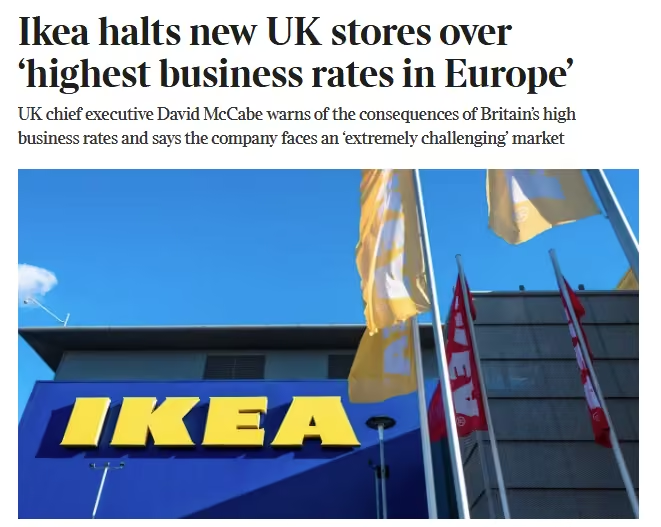
Britain’s business rates are higher than anywhere else. No wonder retailers here are struggling. Even IKEA is stopping investment.
 Cut My Tax
@CutMyTaxUK
Yet more evidence that Britain's absurdly high business rates are holding back economic growth and reducing employment. IKEA is halting construction of new stores as a consequence.
“We pay more business rate equivalent tax in the UK than in any other European market that we operate an Ikea in,” CEO David McCabe told The Times. “That has meant that viable projects have been abandoned. It’s not theoretical, it’s a fact.”
“We do believe in the UK,” he said. “But if we can’t make that work then Ikea will invest in other European countries where it makes more sense to do that."
Labour's obsession with high public spending is killing the economy.
Luke Johnson reposted
 Catherine McBride OBE
@CeeMacBee
It is hard to imagine a more stupid politician:
1. Supermarket prices increase when wages increase. The Labour party has increased wages by more than inflation for 3 budgets in a row. They also increased NI contributions. This has had a larger affect on UK supermarket prices than Brexit.
2. Supermarket prices rise when electricity prices increase. All of those refridgerated cabinets behind him run on the most expensive commercial electricity in the world (the UK's)
3. Supermarket prices increase when interest rates increase. Supermarkets have massive inventries of non-perishable goods.
4. Supermarket prices increase when business rates and other taxes increase.
5. Supermarket prices increase when diesel price increase.
6. At this time of year, most fresh fruit and vegetables are imported from outside the EU, and the amount of paperwork involved FOR ANY IMPORT is determined by the UK. As a minister, this man could reduce this paperwork if he wanted too. No need to ask the EU to do it.
7. The UK is self sufficient in eggs and we are an exporrter of milk. (To the EU!) The UK only has enough milk and lamb to fill domestic demand and export.
8. The Labour government claims the Reset will help UK food exporters, but this nit-wit MP claims it will lower the cost of UK imports FROM the EU. It won’t.
9. Any UK company who exports to the EU is all ready following EU rules for its exports there. While they will follow other rules for their exports to other countries.
10. UK food and live animal exports to the EU are only 1.3% of UK exports. Why force all of the other UK food companies and farmers to follow EU rules, when they don’t export there?
11. In this man's tiny mind, nothing has happened in the UK since Brexit. He doesn't want to admit that Labour's wage rises, employment taxes, and high electricity prices are the main problem.
12. Finally, why this is nit-wit neo-baby a Minister in the UK government?
 Cabinet Office
@cabinetofficeuk
3 days til the UK-EU Summit.
Costs in supermarkets have gone up since Brexit - partly thanks to unnecessary paperwork.
At the Summit, the government will agree to slash that paperwork, reducing costs and creating more export opportunities.
Luke Johnson reposted
 travis kalanick
@travisk
Had a little time on my hands this morning to do some writing… send along to someone you know who may benefit
---
“Practical principles to counter a modern-day coup/psyop/struggle session”
1) Own what you did but fiercely resist accommodating the mob, resist owning half-truths or actions/behaviors you didn’t do.
2) The op is not about your past actions, it’s about your enemies and this event as their opportunity
3) No matter how bad it gets, nothing is as bad as it seems.
4) Find the enemies at the very root of the op and find every creative problem-solving tool at your disposal to neutralize them.
5) People will throw their grandmother under the bus if they believe doing so will protect their reputation. They can become highly useful idiots in the op. Their power and access must be fiercely and quickly cut off.
6) Do not hesitate in cutting off anyone you suspect of disloyalty.
7) Build a team of close and loyal patriots and have one of them run a dedicated, well-resourced war room to put the rebellion to rest.
8) Use your patriots and regular meditation to buoy your psychological resistance to the op.
9) Your enemies aren’t as smart or hard working as you. Outsmart and outwork them as a way of life until the op is over.
10) Think about the op as if it were in the past. What are the difficult things you procrastinated on or avoided that would have stopped the op? Do them.
11) Never be ashamed of the op. Business as usual. Continue on with optimism and joy in your everyday work and its mission.
12) Download telegram and use it as your messaging application for all sensitive communications.
Luke Johnson reposted
max tempers
@maxtempers
The post-2023 minimum wage surge is just insane. We've ramped up the minimum wage for 18-20-yos by 45% -- 33% after adjusting for inflation -- against a backdrop of sluggish productivity growth, and expected zero disemployment effects. Just total madness.

 Fraser Nelson
@FraserNelson
Ahead of tomorrow's Milburn review, a summary of what has increased the cost of hiring a young person vs 2011/12.

Luke Johnson reposted
 Richard Dawkins
@RichardDawkins
Odd mismatch between society’s gloating pre-occupation with one celebrity accused of grooming underage girls for sex, and the impunity granted to “grooming gangs” who rape schoolgirls on an industrial scale. Perhaps explained by terror of being accused of racism. But a religion is not a race.
Luke Johnson reposted
 Fred de Fossard
@defossardf
The extent of the Government's deception and dishonesty over the EU Reset deal ever since Labour was elected is remarkable.
They began by saying they wanted a "veterinary agreement" with the EU and nothing else. This then morphed into total regulatory alignment for food standards, with no democratic accountability, and forcing British producers to follow EU rules if they want to sell British beef to British families.
They said that they would get a carve out for gene editing to protect Britain's innovative agritech sector. This is not the case. A truly innovative new industry which exists thanks to Brexit is going to be terminated by aligning with the EU's unscientific and protectionist attitude to food production.
The Government ratified the CPTPP agreement with some of the world's fastest growing and dynamic economies, more prosperous and innovative nations than the EU. By aligning with EU laws it will act in total contravention of the CPTPP. Seeing as the Reset discussions began in summer 2024, did they ratify CPTPP in bad faith all along?
In 2024 the Government said it was exploring a youth mobility agreement with Spain but it would never agree one with the entirety of the EU. They said a youth mobility scheme was off the table. Well look at what we have: a youth mobility scheme and the EU are pushing for more and more people to be included. We have a youth unemployment crisis, and the Government wants to invite more people into the country.
The Government said it wouldn't accept the EU's demands for EU students to get discounted tuition fees at British universities. Our universities are facing financial ruin and it looks like they will have to offer places to foreign students at a discount to placate the EU.
The Government says it won't rejoin the EU Customs Union but thanks to ETS linkage we are de-facto joining the EU Customs Union for manufactured goods. So British energy prices are going up and we're putting trade barriers in place between Britain and the rest of the world.
And for some reason, we're going to hand the EU billions of pounds for all of this. We're going to pay for EU food safety regulators to inspect British farms, we're going to pay into EU cohesion funds so European countries can spend Britain's money.
What are we getting out of this? Some minor administrative reductions on a very small component of our exports to the EU. That's it. All for billions of pounds of British money going to Brussels and British businesses being forced to follow EU rules that the British people cannot change, with an exit fee to match.
Of all the ignominious sell-outs the British state has conspired to give the EU over the years, this is the worst. The Government is surrendering the idea that the British people should have the final say on who governs Britain. I expect this will be the defining theme between now and the election, and there will be plenty more concessions to come.
Luke Johnson
@LukeJohnsonRCP
It seems various US cities like Minneapolis are essentially committing suicide.
 Chris Arnade 🐢🐱🚌
@Chris_arnade
Today's walk, from Minneapolis to St Paul
Yesterday walked through south Minneapolis -- found two McDonald's, both with closed dining rooms (windows covered up with paper, doors locked, only small walk in room to order from) and I ask one of the guys hanging outside why the McDonald's is all closed up like that and he looks me over and says, "You in the hood now" and I said, "well, I've been in a lot of hoods and they all have McDonald's with dining rooms" and he says, "did them hoods riot like this one did" and I had to hand it to him, no, no they didn't sir.

Luke Johnson reposted
Cut My Tax
@CutMyTaxUK
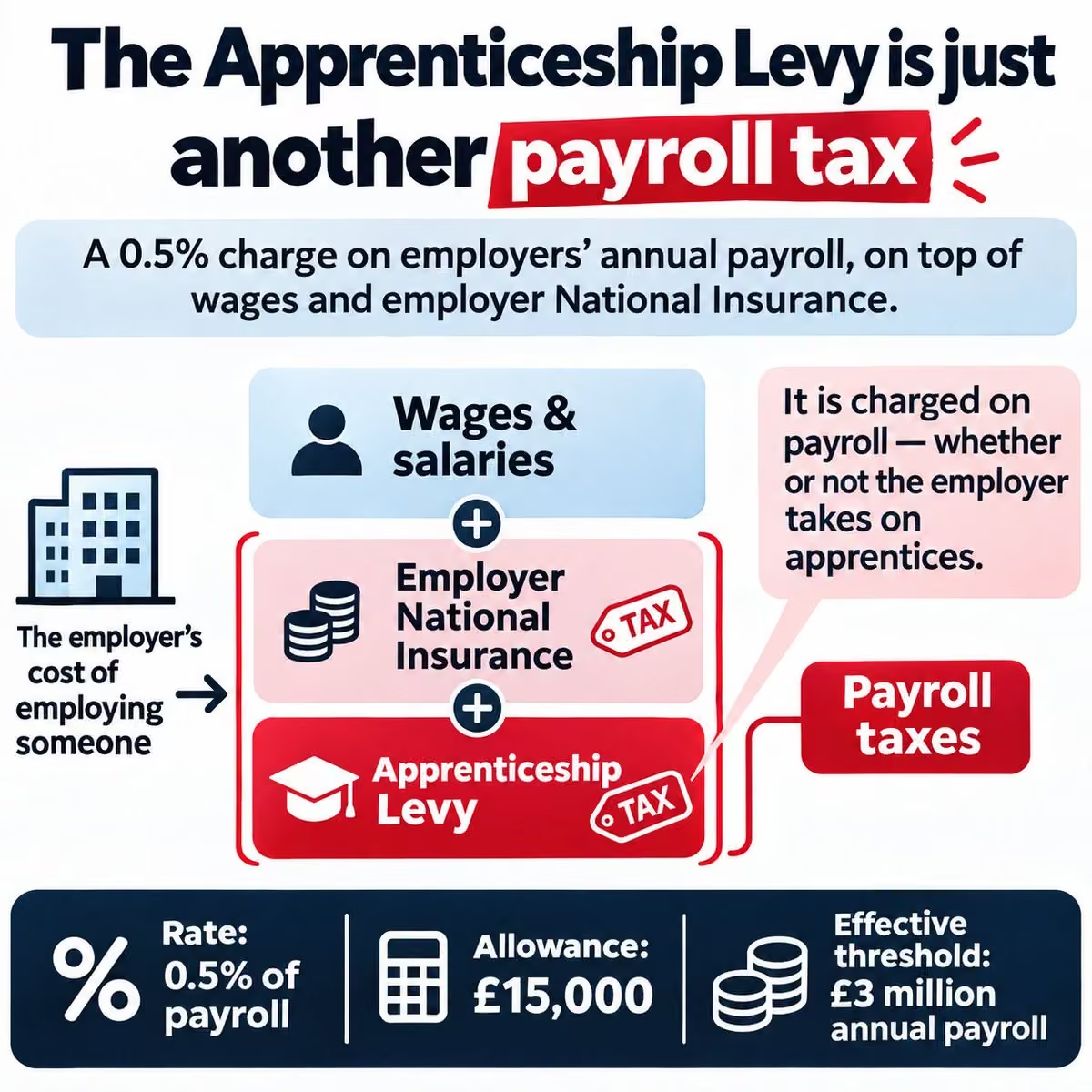
A useful admission in Alan Milburn's report today: the apprenticeship tax is just another payroll tax.
He says we should be "honest about what the Apprenticeship Levy is, which is a payroll tax. It is not a hypothecated tax and it is not ringfenced for apprenticeships. Government sets an apprenticeship budget, which is generally lower than the receipts it receives from Levy payments by employers. Central government keeps a topslice of what employers collectively pay. In 2026/27 that gap is around £460 million".
The levy is an additional 0.5% payroll tax on top of employer National Insurance contributions. An employer pays it regardless of whether it employs any apprentices or uses apprenticeship training funds.
It's paid by employers with a payroll larger than £3m but this threshold has remained unchanged since the levy was introduced in April 2017. Consequently, as wages and payrolls have increased, more employers have become liable for the tax.
So actually the main contribution of the so-called apprenticeship levy is to make it yet more expensive for people to be hired. Only our idiot politicians could dream up such an approach.
Luke Johnson reposted
 Robert Jenrick
@RobertJenrick
Taxes that Labour have raised since the election:
1. Employer National Insurance: up from 13.8% to 15%
2. Employer National Insurance threshold: cut from £9,100 to £5,000
3. Income tax thresholds: frozen until 2031
4. Capital gains tax: up to 18% and 24%
5. Tax on selling your business: up from 10% to 18%
6. Inheritance tax on family farms
7. Inheritance tax on family businesses
8. Inheritance tax on pensions: from 2027
9. Inheritance tax thresholds: frozen until 2031
10. VAT on private school fees: 20%
11. Business rates on private schools
12. Stamp duty on second homes: up from 3% to 5%
13. Tax on savings interest: up 4 points
14. Tax on rental income: up 4 points
15. Tax on dividends: up 2 points
16. National Insurance on pension salary sacrifice: from 2029
17. Mansion tax on homes over £2m: from 2028
18. Pay-per-mile tax on electric cars: 3p a mile from 2028
19. Car tax: first-year rates doubled
20. Company car tax on double-cab pick-ups
21. Air Passenger Duty
22. Online gaming duty: up from 21% to 40%
23. Online betting duty: up from 15% to 25%
24. Tobacco duty
25. Alcohol duty
26. A new vaping tax
27. Sugar tax: extended to milkshakes
28. North Sea windfall tax: up from 35% to 38%
29. Bank surcharge: doubled from 3% to 6%
30. Business rates on large premises
31. Non-dom tax status: scrapped
32. Carried interest tax: up to 32%
33. Tax relief on business equipment: cut twice
34. Tax relief on selling to your employees: halved
35. VAT on minicab fares: from 2028
36. Import duty on small parcels
And now:
37: The Overnight Visitor Levy (aka the Holiday Tax)
When will it end?
Luke Johnson reposted
 Jamie Jenkins
@statsjamie
Britain cannot keep going like this.
New figures out this morning. Since Labour took power:
📉 𝟭𝟵𝟳,𝟬𝟬𝟬 fewer people on payrolls
🛍️ 151,000 fewer in wholesale and retail
🍽️ 91,000 fewer in hospitality
🏭 75,000 fewer in manufacturing
🏛️ But 𝟭𝟭𝟭,𝟬𝟬𝟬 more in the public sector.
Public sector pay is rising 𝟱.𝟰%. Private sector pay, just 3.1%.
And we've borrowed £97.8bn in six months.
Of course public services need staff. But somebody has to create the wealth that pays for them.
Payrolls are shrinking. So it's borrowing.
How long can that last?
Luke Johnson reposted
 Arnaud Bertrand
@RnaudBertrand
By my own count, if one includes these latest sanctions, the EU has now sanctioned 8 European citizens for speech:
- 3 German citizens: Alina Lipp, Thomas Röper and Hüseyin Doğru
- 3 French citizens: Xavier Moreau, Adrien Bocquet and Sylvain Afoua (aka Egountchi Behanzin)
- 1 Lithuanian citizen: Ernest Mackevičius
- 1 Irish citizen: Chay Bowes
The sanctions include freezing these people's assets and making it a crime for anyone in the EU to pay them, hire them or even lend them a single euro.
They also include a travel ban, which leads to some absurd situations: Doğru - based in Germany - was invited by some members of the EU parliament to Brussels to plead his case but he couldn't go due to the travel ban. As one of the MEPs who invited him - and made 40 phone calls to try, unsuccessfully, to get him cleared to come - put it: "It really was like something out of a Kafka novel" (www.berliner-zeitung.de/article/eu-sanktionen-im-europapa…).
And, probably worst of all, all of this was decided without any charge, trial or court ruling - simply as a unilateral decision of government ministers. Yesterday's sanctions, for instance, were decided at the Foreign Affairs Council meeting of EU Foreign Ministers and were simply signed by Kaja Kallas alone on behalf of the Council (eur-lex.europa.eu/legal-content/EN/TXT/?uri=OJ:L_202602556).
Put it all together, and this violates at least half a dozen of what the EU keeps saying are the fundamental values and principles it supposedly fights for:
1) Separation of powers: here we have government ministers - members of the executive branch of their countries - acting as prosecutor, judge and jury
2) Presumption of innocence (Article 48 of the EU’s own Charter of Fundamental Rights): they’re punished without guilt ever being established, and without being given a chance to plead their case before the decision
3) Right to a fair trial (Article 47): there was no trial at all, let alone a fair one
4) Freedom of expression and of the media (Article 11): they were sanctioned - explicitly so - for what they said and published. For instance, in these latest sanctions, Chay Bowes was sanctioned for, among other things, the speech crime of "participat[ing] in the spreading of anti-Western and anti-Ukraine disinformation at the UN Security Council" (eur-lex.europa.eu/legal-content/EN/TXT/?uri=OJ:L_202602556). Sanctioned in part for a speech at the UN, a forum that exists precisely so that clashing views on international matters can be heard, quite the message to send from the EU...
5) Freedom of movement (Article 45): they're under a travel ban
6) Right to work and to property (Articles 15 and 17): their assets are frozen and nobody may employ or pay them
You can think whatever you want about these 8 people. But ask yourself this: even if you are pro-Ukraine, pro-EU, anti-Russia and you view these people as malignant Russian operatives... what is the EU fighting for here, exactly?
This is more profound than you may think: we're speaking about the very foundation of modern European civilization, built on the very idea that political power alone cannot decide what is true.
I'm not exaggerating. What we’re witnessing is a return to the pre-Enlightenment playbook, when monarchic or religious authorities defined the truth, deviations from it were called heresy, and heretics were excommunicated - cut off from the community, so that no one could trade with them, employ them or help them. In Europe's darkest times, heretics were even famously burned at the stake - like Joan of Arc or Giordano Bruno.
It took literal centuries of religious wars and debates, and the likes of Voltaire, Kant and Mill, to replace it with a basic idea: that no single power, however legitimate, gets to be the final judge of what is true, and that you answer for your words only before a court, under laws written via a process separate from the power that does the accusation.
You can find countless works of European literature on this very matter. Take Spinoza, excommunicated in 1656 by the Portuguese-Jewish community of Amsterdam, with a decree ordering that "no one should communicate with him" nor "accord him any favor". He went on to write the Theological-Political Treatise, one of the founding texts of the Enlightenment, with an entire chapter arguing that "in a free state every man may think what he likes, and say what he thinks." Or Mill, two centuries later in On Liberty, Chapter 2: "All silencing of discussion is an assumption of infallibility." Or Kafka’s The Trial, the story of a man accused by an authority nobody can quite locate, of something nobody will explain.
How is what Europe is presently doing anything other than going back to that very system, under new appellations? The authority: government ministers. The heresy: "disinformation". The excommunication: assets frozen, banned from travelling and nobody may pay them, hire them or lend them a single euro.
It’s basically Spinoza’s excommunication decree on EU letterhead, with a bit of Kafka sprinkled in given that the man invited to the European Parliament to contest his punishment couldn’t attend because of the very punishment he wanted to contest.
You don’t have to like these 8 people, or even care about them, to see the problem. Heck, this system was developed precisely for the people nobody likes: consensual ideas never needed protecting.
No, the real question here is this: do you want Europe to be the heir of Spinoza - or of Voltaire, or of Galileo, or of any of the countless Europeans who suffered or even died for thinking differently - or of their persecutors?
 Paddy Cosgrave
@paddycosgrave
Today the EU sanctioned 30 individuals, including journalists & EU citizens, without trial, for “misinformation” & other speech crimes. Their bank accounts have been frozen, travel restricted & more.
The EU has yet to sanction Benjamin Netanyahu - for anything.
Luke Johnson reposted
 Mark Dampier
@MarkDampier
One the best letters I have read.
No comment needed from me.

Luke Johnson reposted
 MRK
@MRK__313
😂 STRESSED OUT? LET BENNY HILL FIX YOUR MOOD! 👑
A true comedy legend who knew how to turn every moment into laughter. When life gets stressful, Benny Hill is the perfect dose of happiness! 🤣❤️
Luke Johnson
@LukeJohnsonRCP
Some good responses below to this nonsense by the housing minister. Like essentially the entire cabinet, he's never worked in the private sector. What would he know about the building industry? All the govt understand are regulations. Their housebuilding targets are a joke.
 Matthew Pennycook MP
@mtpennycook
As this piece aptly demonstrates, mainstream public discourse on housebuilding in England is almost entirely devoid of any meaningful consideration of the structural dominance of speculative development models.
The market absorption rate constraints inherent to those models (i.e. developers cannot afford to build and sell homes too quickly in any given local market as doing so would undermine prices and result in a loss on their land investment) mean that build out rates are tied to rising house prices and the existence of sufficient effective demand for homes at those prices.
It is not in dispute that viability pressures are acute in many parts of the country. That's precisely why we've implemented a range of targeted regulatory easements and committed to no major new building regulations for the remainder of the parliament.
However, the simple fact is that the private market as it is currently constituted will not, on its own initiative, produce sufficient housing to meet overall housing need, even if it is highly competitive.
The disruption and transformation of the housebuilding market is essential to delivering high and sustainable rates of housebuilding in the years ahead.
 Tej Parikh
@tejparikh90
Britain’s self-inflicted housebuilding crunch.
My latest column for @FT. The government blocks construction with tax & regulation, then commits public funds to offset the damage: as.ft.com/r/bc0fe711-a2ef-4128-ae1a-2e965c25c4e8
With insights from @Ben_A_Hopkinson and Edward Donovan @CPSThinkTank

Luke Johnson reposted
 Crémieux
@cremieuxrecueil
Fun chart I made for something I'm writing:
Percentages of self-made vs. inherited billionaires, split by whether the industry they made their billions in is competitive or basically getting government rents, by country.

Luke Johnson reposted
 Julia Lopez MP
@JuliaLopezMP
A LABOUR GUIDE TO SCREWING THE LABOUR MARKET:
Step 1 - increase cost and risk of employing people by taxing businesses silly, empowering unions and introducing new labour laws until nobody wants to hire.
Step 2 - stoke employment crisis among young people. Launch a review to get to the bottom of it - time for after the Budget, just in case tax changes are recommended.
Step 3 - conclude instead that the solution is for the state to pay businesses money to take on said young people.
Step 4 - get Labour MPs to vote for the plan by reassuring them that cutting the welfare bill will actually cost LOTS of money #bekind
Step 5 - seek more money for the plan by taxing businesses.
Once cycle is complete, repeat until the state controls everything. Et voilà!
www.thetimes.com/uk/politics/article/taxpayers-will-subsi…
Luke Johnson reposted
 Megha Singh
@Humanoholic
Mental models that runs almost 93% of your life.


Luke Johnson reposted
 Sunday Sport
@thesundaysport
At least 90% of government activity is attemping to sort out problems created by government
www.bbc.co.uk/news/articles/c6p9dzmj514ko
Luke Johnson reposted
 Albert Edwards
@albertedwards99
The Great Unwind: After decades of lower real rates and QE inflating house prices (& all asset valuations), the secular bond bear market is now deflating all asset valuations, making housing more affordable. Yet this is seen by some as a problem! It's not
www.telegraph.co.uk/business/2026/11/14/inflation-wipes-o…

Luke Johnson reposted
 Cllr. Matt Cowley
@matcow7
Just to be clear, the Government that is taxing employment more is now using that tax money to fund employment. Rather than untaxing employment to let the market create more jobs; they are creating Government-funded jobs of their choosing. Completely mad.
 Politics UK
@PolitlcsUK
🚨 NEW: The Government has announced 18-24-year-olds on Universal Credit will be offered Government funded jobs for 6 months from the end of November
Lidl, Boots, Leonardo Hotels and Cera are among the employers taking part in the scheme
Luke Johnson reposted
 Daniel Hannan
@DanielJHannan
“Britain is accepting the kind of deal that an occupied nation signs under duress. We are giving away money, sovereignty, competitiveness, fisheries – even the right to deport foreign criminals. Why would any self-respecting country agree to something so servile?
The answer is that we did not come to the table with an agenda. We came with a sense of embarrassment and self-loathing, and the other side could smell it.
EU membership is not assessed as an economic proposition. The fact that ministers still use the 2016 propaganda that Brexit has had a four per cent hit to GDP, as if it had not already been falsified, tells us that.
No, this has much more to do with an internal culture war, with scratching an itch that has been tormenting a minority of Remain fanatics since they woke up on 24 June 2016. They want to scrub away that memory, to advertise their cosmopolitanism, to own the gammons.”
www.dailymail.com/debate/article-16293047/DANIEL-HANNAN-r…
Luke Johnson
@LukeJohnsonRCP
The case study in how the state makes lives worse: it more than doubles the cost of building houses. So there aren't enough homes for people to live in. Meanwhile deluded socialists think more government is always the answer.
Tej Parikh
@tejparikh90
Britain’s self-inflicted housebuilding crunch.
My latest column for @FT. The government blocks construction with tax & regulation, then commits public funds to offset the damage: as.ft.com/r/bc0fe711-a2ef-4128-ae1a-2e965c25c4e8
With insights from @Ben_A_Hopkinson and Edward Donovan @CPSThinkTank
Luke Johnson reposted
 JW 🇬🇧
@FinanceTiger
🏚️ “Economists have warned that the fall in value signals the end of residential property as an asset class.”
www.telegraph.co.uk/business/2026/11/14/inflation-wipes-o…
Luke Johnson reposted
 Konstantin Kisin
@KonstantinKisin
Good day to read this from 3 years ago:
www.palladiummag.com/2023/06/01/complex-systems-wont-surv…
Luke Johnson reposted
 Ryan Cohen
@ryancohen
The Hollow Men
American capitalism is rotting from the head down. We have replaced the "Owner-Operator"—the risk-taker-with a new, parasitic class of corporate bureaucrat: The Risk-Free Insider.
By "Insider," I am not referring to a specific title. I am referring to the entire administrative state that has captured the modern corporation. This includes the Directors who exist solely to collect fees, the Executives who exist solely to collect bonuses, and the Managers who exist solely to hire consultants.
These are the hollow men of the boardroom. They are masters of PowerPoint. They wear the right suits. They say the right buzzwords about "governance" and "ESG." But they are mercenaries fighting a war with someone else’s ammunition.
In a functioning economy, authority is tied to liability. If you make a bad decision, you lose your own money. That fear of loss is the only thing that keeps a business honest. It forces you to cut waste, obsess over the customer, and stay late to fix what is broken.
Today, we have severed that link.
We have rigged the game so that heads, the Insider wins; tails, the shareholder loses.
If the stock goes up, the Insider collects a massive performance bonus. If the stock crashes due to their own incompetence, they are fired with a "Golden Parachute" worth tens of millions. They are gambling with the house’s money, and they never leave the table poorer than they arrived.
This looting starts in the boardroom.
We have normalized a "Country Club" culture where directors are selected based on social profiling rather than their ability to build a business. The modern board member is often a professional tourist—paid an average of $350,000 a year.
Let’s be brutally honest about what that number represents. The average director is paid nearly five times the GDP per capita of the United States. They earn more for attending four quarterly lunches than the vast majority of Americans earn in five years of hard labor.
And for what?
Most of these directors are "over-boarded," sitting on three or four boards simultaneously. They treat directorships as a gig economy for the elite. They fly in, rubber-stamp a compensation package they didn't read, and fly out. They collect checks from companies they do not understand, do not use, and certainly do not love.
They are not there to ask hard questions. They are there to be collegial. They are there to protect the other Insiders.
And what happens when these boards hire executives who also have no personal capital at risk?
We get the Delegation Economy.
When a Risk-Free Insider faces a crisis—bloated expenses, a broken supply chain, or a stale product—they do not roll up their sleeves. They hire a consultant. They pay a strategy firm millions of shareholder dollars to produce a 100-page deck telling them what they already know.
This is not management. It is intellectual money laundering.
They use shareholder capital to buy an insurance policy for their own careers. If the plan fails, they can blame the consultants. They delegate the work because they are terrified of the responsibility. They would rather preside over a slow, comfortable decline than risk a bold mistake.
While American Insiders are busy optimizing their severance packages, our global competitors are optimizing their products. They are not slowed down by bureaucracy. They are not waiting for a slide deck. They are outworking us.
If we continue to fill our C-suites with administrators instead of operators, we will lose our edge. We will see iconic American franchises hollowed out by fees, managed for the benefit of the Insiders, while the true owners—the shareholders—are left holding the bag.
The time for polite governance is over.
If we want to save the American economy from mediocrity, we must demand a return to the "Owner’s Mentality." We need leaders who treat shareholder capital with the same reverence they treat their own savings. The era of the Risk-Free Insider must end.
Luke Johnson reposted
 Bjorn Lomborg
@BjornLomborg
“At a cost of £695billion we can make our great-grandchildren’s lives cooler by under four thousandths of a degree Celsius”
Matt Ridley, using netzerocostbenefit.com
Each pound buys just 11p of climate benefit
netzerocostbenefit.com/UK?s=xm
www.dailymail.com/debate/article-16288531/MATT-RIDLEY-Bri…
 Bjorn Lomborg
@BjornLomborg
Thanks, Matt, for showing the real numbers.
In short: for every pound Britain spends on net zero, the world gets 11p of climate benefit back.
See the UK, or any country: netzerocostbenefit.com/UK?s=xm
Luke Johnson reposted
The Free Speech Union
@SpeechUnion
There is a free speech crisis in Britain today. It is now impossible to deny that.
 Paul Embery
@PaulEmbery
If you don't believe that free speech is under threat across Britain, consider these three recent cases.
In England, a retired police officer is in court today, appealing against a conviction for having posted a satirical meme about Islam on Facebook.
In Scotland, a man has just been acquitted after being prosecuted on the strength of dashcam footage which revealed he had said something racist under his breath and in the privacy of his own car.
And in Wales, an elected member of parliament has been banned from speaking in the chamber because he raised concerns about the pace and scale of demographic change.
Now perhaps you'd like to think again.
Luke Johnson reposted
Boring_Business
@BoringBiz_
Primer on Value Drivers in Private Equity
 Luke Johnson
@LukeJohnsonRCP
Union bullies hold London to ransom with impunity www.cityam.com/christmas-strikes-put-tube-drivers-straigh…
Luke Johnson reposted
 Neil Garratt AM
@NeilGarratt
Shoplifter treats Greggs like her personal larder, admits stealing from them 80 times. Law says "Yeah, that's fine actually."
I wonder why we have a shoplifting problem? Total mystery.

 Mark Wallace
@wallaceme
- Admitted 80 counts of theft
- Granted bail
- Breached bail and kept stealing from the same shop
- Banned from Lambeth
- Ankle bracelet was never fitted
- Breached the ban
- Failed to attend three sentencing hearings
- STILL spared jail
This makes a mockery of all of us.

Luke Johnson reposted
 Peter Bill
@peterproperty
Another major regeneration project bites the dust. Seven years of blood and gold squandered in Birmingham. Last month Landsec abandoned Lewisham and British Land Canada Water. The perils of thinking too big and too long term.

Luke Johnson reposted
Cut My Tax
@CutMyTaxUK
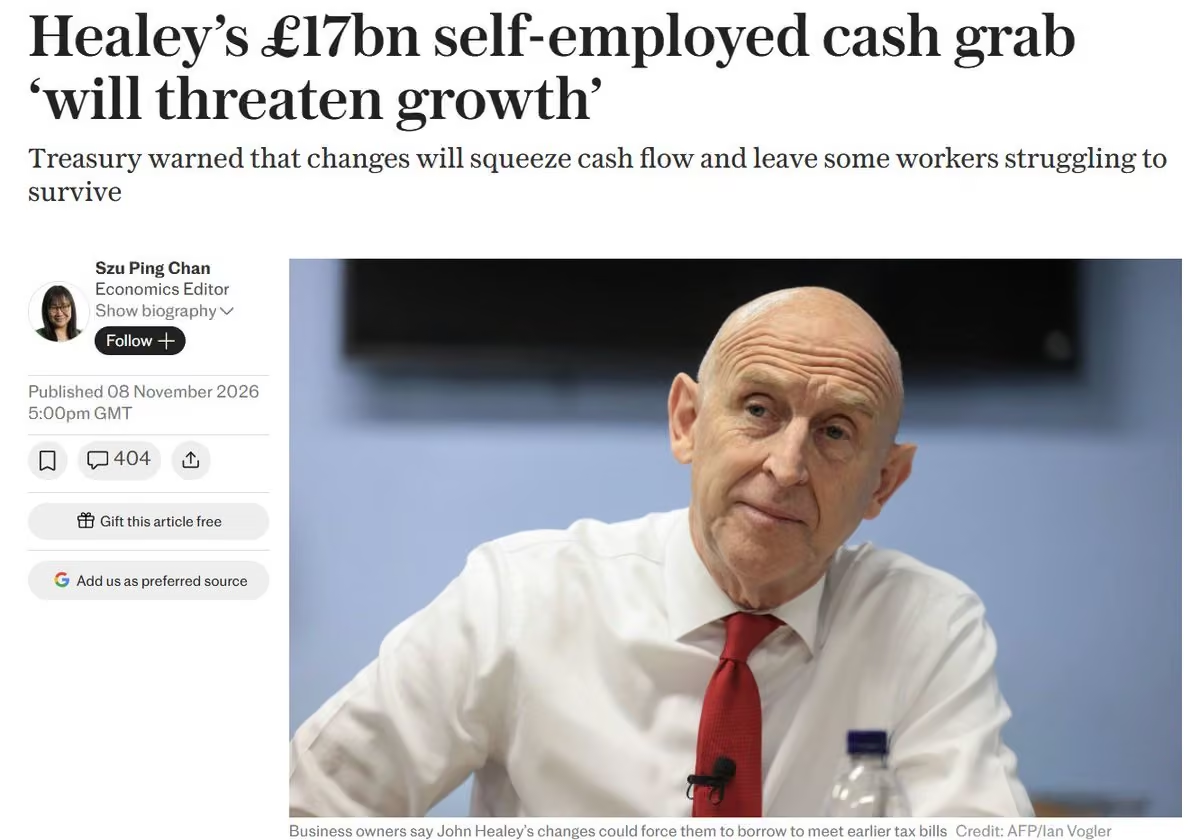
The government's war against the self-employed is intensifying with brutal new proposals to force them to pay tax monthly in advance. The crunch year will be 2029, when they will have to pay double the amount of tax in one year.
“The Government’s proposed changes to how self-assessment operates are completely unworkable as they stand and will cause enormous cash flow problems for many thousands of self-employed people,” warned the Federation of Small Businesses
“Under the new proposals, in 2029 the self-employed will have to pay around two years’ worth of tax in one go.”
The plan is clearly to give Labour a one-off cash boost in an election year.
1/2
 Luke Johnson
@LukeJohnsonRCP
The state is making it almost impossible for huge numbers of people to own their own home. Welcome to the world of big government.
 Ben Hopkinson
@Ben_A_Hopkinson
Government imposed policy costs make up 57% of the clearing price of a new flat in London and 42% of a new home in the Home Counties.
Despite a big housing shortage and positive planning reforms, new home starts in England are declining from 182,000 in 2022 to under 125,000 last year.
While the macroeconomic context has worsened with build cost inflation and high interest rates, the Government is imposing more burdens on new homes, not fewer.
Taxes, levies, planning, and mandates add over £440,000 to the cost of delivering a home in London and nearly £225,000 nearby, with several of these imposed recently like the Second Staircase, Future Homes Standard, Building Safety Levy, Biodiversity Net Gain and Residential Property Developer Tax.
Individually these may be justified, but together they are making new homes unviable.
As a result, large developers are buying less land and small builders are going out of business; nearly 4,000 construction firms went bust just last year.
If we want to build more homes, we should be easing the burdens on them, not adding more.
Making housebuilding viable again is the most important issue in housing policy and my co-author, Edward Donovan, has completed excellent modelling showing how big the challenge is.
Read the full report: cps.org.uk/wp-content/uploads/2026/11/CPS_EASING_THE_BURD…
And simulate what changing the policies does with Edward's modelling here: easing-the-burdens.cps.org.uk


Luke Johnson reposted
 Zyron
@Zyron5m
James Dyson's family is worth about £12 billion on this year's Sunday Times Rich List, and in 1983 he went on Thames TV to explain why no British company would make his vacuum cleaner. Three of them had turned it down, he said, because it didn't need paper bags, and paper bags were "a very lucrative source of income." Seventeen years later the High Court ruled that Hoover had deliberately copied his design.
The video below is that 1983 interview, with the pink machine standing next to his chair. He says it took about three years of "model after model after model," that he spent about £30,000 on patents, and that getting it into production would cost "about half a million," money he didn't have.
So he went round the manufacturers. "I tried three British companies," he says, and a number of others in Europe. He tells the presenter that a normal cleaner is down to a third of its suction after about five minutes, because the bag clogs, and his spins the dust out instead. The British firms said no anyway. When she asks whether the people selling paper bags would lose a lot of money, he says "Exactly. It's the resale."
No British manufacturer would take it on, and it ended up launching in Japan, through catalogues, as the bright pink G-Force, at the equivalent of about $2,000. His own Dual Cyclone came out in Britain a decade later and became the fastest-selling vacuum cleaner ever made in the UK. When it did, Hoover's line was that bags were best.
In 1999 Dyson sued Hoover over the Triple Vortex, its own bagless machine. In October 2000 the High Court ruled that Hoover had deliberately copied a fundamental part of his patent, threw out its claim that the idea was already common knowledge, and stopped it selling the machine in Britain. Hoover's European managing director said they had hoped for "a much stricter interpretation of the patent." Hoover agreed to pay £4 million in damages.
What gets me is that he said it on camera in 1983. The firms that turned him down were weighing what his machine would do to their bag sales, and he knew it seventeen years before a judge looked at any of it. If your product means the customer stops buying something, the company selling that something is the last place to go for money.
Dyson said Hoover "showed no interest in the technology when we were looking for backers." Was £4 million enough from a company that passed on the machine and then built its own, or was Britain's no the best thing that ever happened to James Dyson?
I post one story like this every day: a famous name, the money they made, and who ended up with it.
Luke Johnson reposted
 Steve Scrase
@StevenScrase
The managerial state has officially progressed from chronic dysfunction to terminal, hysterical insanity.
Lisa Nandy spent her morning television slot announcing that the government is now seriously looking at banning under-16s from Vinted, eBay, and Depop. Think about the sheer, unhinged absurdity of that sentence: Whitehall’s grand strategy for child protection is deploying state apparatus to stop a fifteen-year-old from selling an old puffer jacket and a pair of trainers.
The previous generation were navigating the physical world at fourteen: working Saturday paper rounds, budgeting their own money, meeting mates down the pub, and catching trains across the country without a GPS tracker tethered to their skull. Today, the administrative class has constructed a suffocating digital panopticon where young people cannot develop an ounce of financial independence, commercial literacy, or personal resilience without a civil servant demanding their biometric telemetry.
The descent into full nanny-state authoritarianism is always bipartisan. The Conservatives spent five years drafting the lumbering Frankenstein known as the Online Safety Act, and Labour has taken that framework and weaponised it into a blanket ban on childhood agency. First it was social media bans for under-16s; then it was age-assurance regimes demanding facial estimation scans and credit card verification just to read an article online; now a teenager listing a second-hand hoodie on an e-commerce platform is officially treated as an unmanageable safeguarding hazard.
Over 1.5 million young people in this country run small-scale circular-economy trades on platforms like Vinted and Depop, learning the basics of supply, postage, and commerce before they even sit their GCSEs. The bureaucratic solution to any potential risk is never policing actual criminals or holding platforms to basic moderation standards; it is a scorched-earth administrative prohibition that infantilises an entire generation until the day they turn eighteen.
We are systematically raising a demographic hermetically sealed from real-world interaction, financial literacy, and basic human friction, and then expressing institutional bewilderment when twenty-somethings arrive in the workplace crippled by anxiety and entirely dependent on the state.
If a British teenager cannot even be trusted to post an old coat via Evri without Whitehall requiring an age audit, we haven’t protected them. We have built an open-air nursery overseen by terrified bureaucrats who view the mere act of growing up as an intolerable administrative risk.

Luke Johnson reposted
Boring_Business
@BoringBiz_
Primer on Credit vs Equity Investing. This is something a lot more investors should read and understand.
Credit and equity investing are two fundamentally different skill sets. One is attempting to maximize future returns, while the other is trying to minimize downside and principal loss
This leads to vastly different risk appetites and portfolio construction strategies amongst the asset managers in their respective businesses
In equities, taking large swings where you may potentially risk losing some principal for a 2-3x payout is totally worth it. Having a portfolio where a few things work, but most things fail makes complete sense. This is exactly how venture capital operates.
In credit, the opposite is true. No matter how well the business does, your upside is capped at the interest rate you are charging, plus a few points of fees. Your primary goal is to avoid losses, not hit home runs.

Luke Johnson reposted
max tempers
@maxtempers
No one likes rail replacement buses. But what’s worse than having to take one? Needing one and being told you’ll have to wait hours, or in some cases, not getting one at all. Why is this becoming increasingly common? Max Tempers investigates...
🧵

Luke Johnson reposted
 Aaron McGahon
@AarontYouGreat
I just hope that one person had the guts to throw their James Bond audition just so they could reenact this!
Luke Johnson reposted
 Heather Mac Donald
@HMDatMI
In the latest installment of the Jane Doe rape extravaganza, the Cornell Faculty Senate on Friday censured the school administration for its inability to “address the ongoing crisis of sexual assault at Cornell University.” The vote was preceded by group letters to the campus newspaper from female faculty, who congratulated themselves on their bravery in standing up to a “repressive, misogynistic culture” and for refusing to be “silenced”—as if anyone would dare essay such a humanitarian act. According to another female faculty letter, the administration had failed to place student “safety” front and center.
Cornell’s brave sisters would never dream of fighting for measures that actually would advance female safety, however—above all, for the long-term confinement and incarceration of criminals and the mentally ill. On October 30, 28-year-old Katie Suarez was fatally stabbed in the neck while running on the Brooklyn, NY, waterfront. Her alleged killer, Sayed Mohassib, a public-school paraprofessional (a fancy term for someone who is otherwise unemployable), had threatened in 2024 to chop up his mother and sister. In 2023, police took Mohassib to Bellevue Hospital for a psychiatric evaluation in light of his erratic behavior and disheveled appearance.
Suarez’s murder followed a string of gruesome assaults on females by mentally ill criminals who are released back to the streets again and again. Iryna Zarutska was fatally stabbed in the neck on a Charlotte subway by longtime felon and schizophrenic Decarlos Dejuan Brown Jr. in August 2025, and Bethany MaGee was doused with gasoline and set on fire in the Chicago subway in November 2025 by Lawrence Reed, a mentally ill arsonist with 72 prior arrests, to name just a few of such overdetermined attacks. Females are not the only victims of these known criminal risks, of course; males have been pushed into onrushing subways and bludgeoned to death by equally predictable killers-in-waiting.
But don’t expect Doe’s feminist avengers to say a peep in favor of stricter incarceration and institutionalization policies, since doing so would have a disparate impact on minority criminals and schizophrenics, above all, on blacks. Avoiding disparate impact has been the guiding principle of the criminal justice system for decades, and it has resulted in foreseeable and thus preventable tragedies. Katie Suarez, Iryna Zarutska, and Bethany MaGee had no way to protect themselves; they relied on government authorities to fulfill their paramount duty of protecting public safety. Jane Doe, by contrast, had numerous opportunities to avoid what is being called her group rape by exercising basic common sense and personal responsibility.
Progressives infantilize a certain category of females and treat them as victims of rape culture, while ignoring actual victims who had and will have the misfortune of being targeted by the wrong sort of attacker. Speaking up about the latter travesty would take, in the current political climate, a certain degree of bravery, something that our academic feminists only pretend to possess.
Luke Johnson reposted
 Tom McPhail
@PensionsMonkey
This is why we shouldn't let politicians decide where our pension funds are invested.
www.thetimes.com/business/energy/article/energy-firm-that…
Luke Johnson reposted
 Adam Smith Institute
@ASI
75% of constituencies in England and Wales spend more on welfare than their workers pay in income tax and National Insurance. London and the South East are the only regions that are net contributors; the North East is the most welfare-dependent region in England.
Explore the ASI's new Welfare Sustainability Tracker at www.adamsmith.org/welfare-sustainability-tracker

Luke Johnson reposted
Catherine McBride OBE
@CeeMacBee
For the many UK politicians @UKLabour and journalists @BBC who don't know anything about UK trade, here are the highlights:
1. The UK is now predominantly a service exporter. 57% of UK exports are services, which are not affected by EU 'red tape'.
2. UK goods exports have dropped from almost 70% of our total exports in 1997 to just 43% in 2025. This trend began long before Brexit and is tied to Net Zero mandates, high UK energy prices, and EV mandates.
3. Machinery and transport goods, such as cars and aircraft parts, are 42% of all UK goods exports. This is by far the UK's largest export sector, although it is also falling. It was 50% of UK exports in 2000. But if the UK joins the EU's CBAM, companies in this sector will see their imported material costs rise, making their exports even less competitive.
4. Chemicals are the UK's second-largest export sector. They account for 19% of UK goods exports, but this share is shrinking due to UK and EU energy costs and Net Zero regulations. These will increase if the UK joins the EU ETS.
5. Miscellaneous Manufactures account for 11% of UK goods exports. This is still the UK's third-largest export sector, even though it includes many goods the UK no longer makes because of our high Carbon taxes, which will increase if the UK signs up to the EU's even higher ETS on November 20th.
6. Fuels account for 9% of UK exports. This is still the UK's 4th largest goods export sector, even though the current and previous governments are/were trying to destroy it with bans on new exploration and ultra-high taxes.
7. Material Manufactures account for 8% of UK goods exports. This sector includes iron, steel, aluminium, ceramics, and glass manufacturing - industries that have gone, or are going, out of business in the UK because of high UK energy costs, which will rise if the UK joins the EU ETS.
8. These five sectors make up almost 90% of UK exports. The other 5 industry sectors are insignificant. But the government and our journalists think the UK is New Zealand and that the only goods we export are food and live animals to the EU. We don't! UK food and live animal exports to the EU were just 1.3% of the UK's total exports.
9. The government is about to sacrifice all of the export industries listed above to slightly reduce the IMPORT costs of a handful of Supermarkets, at least two of which are privately owned German companies.
These savings will not be passed on to UK shoppers because the government has also increased wages again, and supermarket energy costs will increase if we join the EU's ETS.
10. UK exports of food and live animals will not increase because we are paying farmers to not produce them, this has nothing to do with EU red tape. Instead we are paying farmers to plant trees and wildflowers or plaster their farmland with solar panels. (54% of UK electricity is coming from gas today, 12% from solar and 3% from wind.)
11. Write to your MP and tell him to #stopthereset.
If you don't stop this, don't complain when all of our goods export industries have closed because of EU higher carbon taxes, EU higher carbon import tariffs, and the cost of complying with the EU's new packaging and process regulations.
Luke Johnson reposted
 Gregory Blotnick
@gregoryblotnick
very old debate...Will Durant, Confucian philosophy, and The Great Learning:
"The ancients who wished to illustrate the highest virtue throughout the empire first ordered well their own states. Wishing to order well their states, they first regulated their families. Wishing to regulate their families, they first cultivated their own selves. Wishing to cultivate their own selves, they first rectified their hearts. Wishing to rectify their hearts, they first sought to be sincere in their thoughts. Wishing to be sincere in their thoughts, they first extended to the utmost their knowledge. Such extension of knowledge lay in the investigation of things.
Things being investigated, knowledge became complete. Their knowledge being complete, their thoughts were sincere. Their thoughts being sincere, their hearts were then rectified. Their hearts being rectified, their own selves were cultivated. Their own selves being cultivated, their families were regulated. Their families being regulated, their states were rightly governed. Their states being rightly governed, the whole empire was made tranquil and happy."
Durant: "This is the keynote and substance of the Confucian philosophy; one might forget all other words of the Master and his disciples, and yet carry away with these "the essence of the matter," and a complete guide to life.
The world is at war, says Confucius, because its constituent states are improperly governed; these are improperly governed because no amount of legislation can take the place of the natural social order provided by the family; the family is in disorder, and fails to provide this natural social order, because men forget that they cannot regulate their families if they do not regulate themselves; they fail to regulate themselves because they have not rectified their hearts i.e., they have not cleansed their own souls of disorderly desires; their hearts are not rectified because their thinking is insincere, doing scant justice to reality and concealing rather than revealing their own natures; their thinking is insincere because they let their wishes discolor the facts and determine their conclusions, instead of seeking to extend their knowledge to the utmost by impartially investigating the nature of things. Let men seek impartial knowledge, and their thinking will become sincere; let their thoughts be sincere and their hearts will be cleansed of disorderly desires; let their hearts be so cleansed, and their own selves will be regulated; let their own selves be regulated, and their families will automatically be regulated not by virtuous sermonizing or passionate punishments, but by the silent power of example itself; let the family be so regulated with knowledge, sincerity and example, and it will give forth such spontaneous social order that successful government will once more be a feasible thing; let the state maintain internal justice and tranquillity, and all the world will be peaceful and happy.
It is a counsel of perfection, and forgets that man is a beast of prey; but like Christianity it offers us a goal to strike at, and a ladder to climb. It is one of the golden texts of philosophy."

 Ambre 🏳️⚧️
@Ambre_emeraude
"Être de gauche c'est d'abord penser le monde, puis son pays, puis ses proches, puis soi.
Etre de droite c'est l'inverse."
Luke Johnson reposted
 GB Politics
@GBPolitcs
🚨NEW: All train services that were nationalised by the Labour government have seen their performance plummet
It comes alongside ticket prices to use the services remaining the exact same
[@thetimes]

Luke Johnson reposted
max tempers
@maxtempers
"Just before it was nationalised 94 per cent of its [c2c's] trains arrived within five minutes of the scheduled time. The latest available data from this August showed this had dropped to just under 71.5 per cent of trains."

 John Rentoul
@JohnRentoul
How predictable, and how predicted www.thetimes.com/uk/transport/article/labour-mps-rail-nat…

Luke Johnson reposted
 Ethical Skeptic ☀
@EthicalSkeptic
Civilization collapses when the takers overwhelm the makers. Democracy provides the means by which that imbalance can become law, and eventually dismantle the very institutions established to constrain it.
Luke Johnson reposted
 David Senra
@FoundersPodcast
My notes from Larry Gagosian (Billionaire Art Dealer) turned into maxims:
1. The best way to raise the price of something is to say that you would never sell it.
2. The competitive drive of self-made billionaires does not go into remission once they've made a fortune.
3. You can be so successful selling to the masters of the universe that you *become* one.
4. Art is just money on walls.
5. Genius is easy to understand.
6. Genius has the fewest moving parts.
7. Genius lies in ignoring the unimportant.
8. No shareholders. No one to answer to. Retention of complete control.
9. You can sell things that aren’t for sale.
10. Read biographies. There’s always a blueprint. Gagosian read every biography of Joseph Duveen. Duveen was the art dealer to the Robber Barons. Gagosian is that today.
11. Self-reflection is how you lose your edge. A shark keeps swimming.
12. Disinhibition can be a superpower.
13. A cold call can change your life because relationships run everything.
14. Don’t forget that relationships run everything.
15. Bluntness is appealing to busy people.
16. What is the establishment of an existing industry ignoring? The answer is an opportunity hiding in plain sight.
17. Expanding a market is the first step to owning it.
18. Find information asymmetries. Don’t tell other people about them. Not even your lover.
19. Earned secrets produce treasure maps.
20. Be default aggressive and never forget that everything is for sale.
21. A sharp eye for who matters is the skill of an industrialist.
22. Industrialists build large financial empires.
23. You can build a billion dollar business without formal meetings, protocol, bureaucracy, and hierarchy.
24. Sales solves everything.
25. Make 100 calls a day.
26. If you love what you do the only exit strategy is death.
27. Hire a scholar. More companies should hire the Samwell Tarly of their industry.
28. Don’t allow other people to burnish their ethics on your hide.
29. Go to where your customers are. Gagosian opened a gallery at a private jet airport.
30. Be as liquid as the day is long. You can buy things at a heavy discount in recessions.
31. Money flows fast when the customer believes the opportunity is fleeting.
32. Pricing is guesswork.
33. There is always somebody somewhere making a lot of money. Find them. Sell to them.
34. Five hundred years ago people were complaining money ruined art. They say the same thing today.
Episode 325 Larry Gagosian (Billionaire Art Dealer) is available in every podcast app now!

Luke Johnson reposted
 Lloyd Legalist
@LloydLegalist
Today's inspirational message:

Luke Johnson reposted
 Kate Maltby
@KateMaltby
I haven't been on this site for a bit.
But I haven't seen anyone share the photo the New Statesman staff staged in 2013 of Russell Brand as Christ, and themselves as his disciples. It seems to have been scrubbed from the web.
It made me angry then and it makes me angry now.

Luke Johnson reposted
 Dominic Frisby
@DominicFrisby
I heard Porter Stansberry tell this story about Alvin Adams and the US railroads on a panel we shared at the New Orleans Investment Conference last week. It was the best story I heard all conference, and it has been rattling around in my head ever since.
Between 1865 and 1873 the United States built, as Porter put it, “the most consequential physical network in its history”, but in doing so destroyed swathes of capital. Track mileage doubled, from 35,000 miles to 74,000, in a decade. Railroad capital reached $4.5 billion, when the capital of the entire US banking system was $720 million and the federal debt was $2.3 billion. In January 1870, 87% of the shares traded on the New York Stock Exchange were railroad shares.
Every argument you hear about AI today was made about the railroads then, boiling down to: they will transform the country. And they did. The railways changed America. The people who financed their construction lost fortunes.
Indeed, the losses caused the Great Depression, as it was known until the 1940s, when what went on in the 1930s usurped it. In 1873 the New York Stock Exchange closed for ten days because of the failure of Jay Cooke & Co. By 1876, 134 railroads were in default on $500 million of bonds. By 1877 a fifth of American track was in receivership. European investors lost around $600 million.
Then competition meant that revenue per ton-mile fell by around 60% between 1870 and 1900. The traffic came, just as promised, but the users got the benefit, not the shareholders.
Some years earlier, having lost his shirt in the Panic of 1837, a businessman in his late 30s by the name of Alvin Adams began carrying packages - letters, cheques, bearer bonds, valuables - between Boston and New York. His business did so well that in 1854 it was incorporated as Adams Express Company, with $1.2 million of capital. It did not own a single mile of track. It bought space on other men’s trains and transported stuff.
By 1875 its capital was $12 million. Porter told the story of how it paid an $8-a-share annual dividend through the Great Depression of the 1870s and the subsequent downturns. Adams Express was able to build a successful business using the railway network without financing the construction of that network itself. In 1929 Adams Express became an investment fund. It still trades in New York today as Adams Diversified Equity Fund (ADX)
By 1890 the express companies, American Express among them (yes, the one that’ll do nicely) , were moving 115 million packages a year over 175,000 miles of routes without owning a single locomotive. It’s like Trip Advisor being the world’s biggest travel company without owning a hotel, or Uber not owning a taxi.
The business that used the railways, rather than build them, was the one that did best in the railway boom and bust.
Article continues - see next tweet

Luke Johnson reposted
 Toby Young
@toadmeister
There's a simple empirical observative that blows the CO2 climate narrative out the water, says Stephen Andrews: it's the inconvenient fact that winter has warmed much more than summer. dailysceptic.org/2026/11/05/the-simple-empirical-observat…
Luke Johnson reposted
 Felix Stocker
@felixstocker14
if you read two pages from any biography, you should read these
 Luke Johnson
@LukeJohnsonRCP
Incredibly important chart
 Nicolas Colin
@Nicolas_Colin
1️⃣ Why does Europe struggle to fund its own startups? Look at where it keeps its retirement money.
Americans hold retirement savings worth 153% of GDP. The Dutch, 151%. The French, 13%. Germans, 6%.
Most of Europe pays pensions out of today's wages. So it never builds the big pools of long-term capital that fund VC in the US.
(I work at Vsquared Ventures, an early-stage deep tech VC firm investing across Europe. Views my own.)
(OECD)
 Luke Johnson
@LukeJohnsonRCP
Why isn’t this more widely reported?
 Steve Loftus
@LoftusSteve
Ammonia in England's rivers is down 85% since 1990, phosphate is down 83% and BOD is down 46%. That's EA data for 135 principal river sites, to 2023.
England's rivers are much improved since 1990. The cleanest they have ever been in the lifetime of most people alive today.
Luke Johnson reposted
 zerohedge
@zerohedge
Brace For A Decade Of Pain, Warns Britain's IFS www.zerohedge.com/economics/brace-decade-pain-warns-brita…
Luke Johnson reposted
 Sam Ashworth-Hayes
@SAshworthHayes
Economists are very aware that small groups with defined membership and concentrated payoffs will often outmanoeuvre large groups with dispersed losses.
Politics hasn't quite internalised this yet.
 Smallest Violin
@XiaoVilin99
The lesson is not that the state serves foreigners first (we knew this).
It is how ruthlessly organised immigrants in Britain actually are. They discuss every detail constantly across thousands of group chats. They are always agitating their councillors, MPs, lawyers, charities.
 Daily Mail
@DailyMail
Four in five people who took the Home Office's immigration poll were NOT British, figures show www.dailymail.com/news/article-16260317/people-Home-Offic…
Luke Johnson reposted
Peter Bill
@peterproperty
House builder Vistry to shutter 13 out of 25 regional offices, by firing unnumbered members of staff in “difficult but necessary process of reducing headcount” in attempt to reduce £800m of debt in a market that is going nowhere.

Luke Johnson reposted
Cut My Tax
@CutMyTaxUK
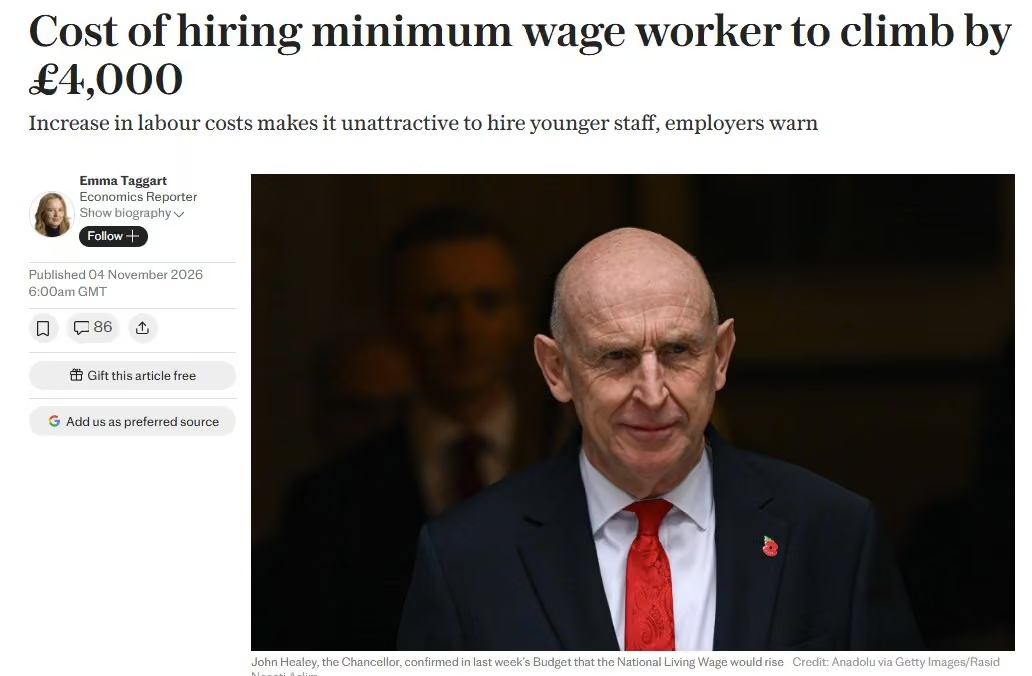
Labour has imposed a 31% increase in cost of employing 18- to 21-year-olds minimum wage workers and a 20% increase on others. Astonishing figures in a new report from @CPSthinktank
From April 2027, it will cost a business £26,900 annually to hire a full-time, minimum-wage worker over 21, up from £24,807 in 2025 and £22,438 in 2024. This is a 20% increase since 2024, or £4,462.
The increase has been even larger for 18- to 20-year-olds and apprentices. For someone aged 18-20 working full-time on the minimum wage, the cost has increased from £15,652 in 2024 to £20,511 in 2027. This is a three-year increase of 31%, or £4,859.
Why can't Labour understand that this will mean fewer people get hired, particularly young people?
Luke Johnson reposted
Steve Loftus
@LoftusSteve
In 1991 less than 17% of England's bathing waters were excellent. Today, it's over 73%.
Yet the narrative is that things have got worse, and it's somehow worse to swim in the sea today than at any time in the past.
Steve Loftus
@LoftusSteve
4.7% of 257 comparable bathing waters were rated Poor in 2025. My estimate for the same waters in 1991 is nearly half, from re-rating Environment Agency sampling data. The standards changed in 2015, so treat the comparison as indicative.
Watch: www.youtube.com/shorts/W7J6lxZaz3k
Luke Johnson reposted
 Alcuin Press
@AlcuinPress
J.R.R. Tolkien, holy cow this hits

Luke Johnson reposted
Toby Young
@toadmeister
London's police chief has admitted the city is so lawless that its diverse criminals cannot be policed without a similarly melanated constabulary. It’s a confession that multiculturalism is failing, says Laurie Wastell. dailysceptic.org/2026/11/02/sir-mark-rowley-has-just-admi…
Luke Johnson reposted
 The Critic
@TheCriticMag
“The Burnham government is now doing eight different things which will increase immigration. And as well as increasing immigration, it is doing so in ways that make the immigration mix less selective and worse from an economic point of view.”
✍️ |🦊 | @NeilDotObrien
Luke Johnson reposted
 Josep Ferrer
@iamjosepferrer
Half of Europe's tourist nights happen in just 102 of its 1,247 regions
#30daymapchallenge Day 3: Polygons

Luke Johnson reposted
 John Ralfe
@JohnRalfe1
See my @thetimes letter on @TorstenBell 's nonsensical #cdc plans

Luke Johnson reposted
Christopher Snowdon
@cjsnowdon
“This austerity, is it in the room with us right now?”

 Tax Justice UK
@TaxJusticeUK
👏 You can't cut your way to prosperity, because people pushed into poverty aren't productive.
Two decades of austerity have destroyed the UK, its time to end the failed experiment & invest in our country again.
Luke Johnson reposted
 Ben Raho 🇪🇺 🚲
@BenAntRaho
Things in Western Europe will improve when a few hard realities are understood:
1. Europe has no God-given right to be wealthy or stable. Things can & will decline and fall apart if not maintained and adapted to new realities. Things that worked in the 1970s may be counterproductive now.
2. Energy is the basis of the economy. Without it, nothing else matters. While efficiency will be important, any economy where energy is scarce will inevitably be one that struggles
3. Not all cultures are equal. Some create prosperity, some lead to misery, some are outright evil. If Europe doesn't accept this, the cultural basis of its previous success & prosperity will be destroyed forever
4. Have kids, or die out. In the long term, few things matter this much. You can't create a European future if there are no Europeans left for it, and as the experiences of the last few decades show, non-European immigration simply makes Europe culturally less European - and doesn't magically make these people culturally European.
5. The state can not - and should not - save every individual from him/herself from him/her bad choices or ineptitudes. The idea of a nanny state which can ensure that everyone always live comfortably with minimal effort & contributions 100% of time is not feasible. The socialist promises of 30 years of wealthy retirements for everyone and Europe being able to take on endless low skill immigration were lies.
6. If a society has no way for ambitious & creative people to get rich from working hard, everyone will get poorer because of it. The hard truth is that much of our economic future depends on businesses being built & transformed by ambitious & sometimes ruthless individuals. Not everyone is able or willing to do this, and without them, there is no one to employ others and no wealth & growth to tax. But if businesses & wealth are seen solely as an evil force to be taxed into oblivion, they will go elsewhere.
7. In some cases, the best way for society to deal with a criminal is to lock them up and throw away the key. A small percentage of humans are ticking time bombs - low IQs, high aggression potential, psychopathic traits, socialised into criminal structures or a culture of lawlessness. Society can't fix them. They go in and out of court rooms and across Europe states, NGOs & social workers waste billions of hours & Euros to try & fix the unfixable. Not least because of mass immigration from dysfunctional societies, our legal systems & high trust societies built on principles such as the benefit of the doubt & correction via socialisation are overwhelmed by the amount of aggressive young men with no interest to contribute to society.
All of this is fixable. But the first step is accepting reality.
Luke Johnson reposted
 Michael Socolow
@MichaelSocolow
This is an existential problem in academia that's identified, everyone knows it's going on, and it's discussed widely... and yet nobody is incentivized to do anything about it.
So nothing will be done until journal editors + peer reviewers quit en masse.
www.theatlantic.com/ideas/2026/10/ai-journal-articles-wri…
Luke Johnson reposted
 Stephen Pollard
@stephenpollard
Here's my @CapX column, 'Labour’s mangled sixth-form-level Marxist class war'
capx.co/labours-mangled-sixth-form-level-marxist-class-war
Emma Reynolds, the Chief Secretary to the Treasury, is one of the more sensible Labour MPs. She resigned as a front bencher when Jeremy Corbyn was elected leader and is firmly in the moderate wing of the Labour Party.
Which is why her comment yesterday that ‘I don’t think employers are working people’ is all the more revealing – and all the more telling about the attitude of the government. Plainly, my description of Reynolds as one of the more sensible Labour MPs is relative. When even someone as relatively sensible as Reynolds believes that employers are a class that don’t work for a living but somehow live off the backs of ‘working people’ then it shows the scale of Labour’s inability to grasp even the basics of wealth creation and growth – and thus the scale of the problem for our economy.
Reynolds was being interviewed on GB News by Camilla Tominey, who rightly picked up on her words. As if to ensure they weren’t a slip of the tongue or a misleading statement of her actual view, Tominey sought clarification. Reynolds dug in: ‘Let me say I don’t think employers are working people. They are companies.’ She went on: ‘I’m saying there is a difference between employers and employees. … The distinction I am drawing is between employees and employers’.
It was, at least, enlightening to hear that a minister at the heart of economic policy holds a form of mangled sixth-form-level Marxist views about the working class and employers. With the exception of its five years under Corbyn, Labour have sought to portray themselves as a party which understands capitalism and which is best placed to make it work for the whole country. Reynolds has revealed that even those ministers at the vanguard of that purported understanding have, at root, a pastiche 19th century view of the nature of employers.
Listening to Reynolds, I wondered if she would, like a good Marxist, move on to attacking the rentier class which lives off the assets created by others. And then I remembered that the Government has done just that. In the very Budget she was on TV to defend Labour imposed a cumulative increase of 4% on tax for rental income, with ministers defending the rises by characterising rental income as ‘unearned’ – as if landlords as a class simply sit on their backsides watching their exorbitant profit rolling in to their already over-fed bank accounts. Not for Labour the idea that the management, maintenance and risk involved in letting property might earn a reward.
And Labour’s Renters’ Rights Act has abolished ‘no-fault’ evictions and increased tenants’ powers to challenge rent increases through tribunals. The Office for Budget Responsibility has warned that cumulative tax and regulatory pressures have resulted in a ‘material reduction in returns to private landlords,’ which risks discouraging new investors and driving existing landlords to sell their portfolios. Presumably that’s regarded as a good thing.
Reynolds is no Marxist. But it’s damning of both her and Labour more generally that such a crude Marxist analysis of employers and employees drives their thinking, with no understanding of the nature of small and medium-sized businesses and how hard most employers work to create wealth and employment for their fellow working people. As one poster on social media put it: ‘It’s 7:41 on a Sunday, and I’m at my desk – guess I’m not a working person. My employees are not doing the same, I can tell you that (and I don’t expect or want them to!)’
Luke Johnson reposted
 David Goodhart
@David_Goodhart
What a depressing Labour u-turn on the extension of ILR for Boriswave care workers. It’s not just the huge cost heading our way, it’s the way that care workers are singled out for the sentimental treatment we usually reserve for NHS nurses. For our own benefit as a country we need the average carer to be better paid, better trained, and higher status (I recently wrote a book partly about this The Care Dilemma). But we don’t have to pretend they are all angels: there are some who are v good, most who are average and too many who are useless, as in any walk of life. The immigrant carers are coming here for a better life from poorer often failing societies not because they love looking after British people. In my own last hospital stay most the care assistants were Boriswave women, mostly from Africa - some decent some indifferent - but ALL spoke quite poor and v heavily accented English that was sometimes hard to understand and unless I spoke slowly and deliberately they struggled to understand me. This is obviously a sensitive issue that many people experience but don’t feel able to talk about (though it must be reflected in those low satisfaction surveys), partly because a carer has helped you when you are vulnerable and there is a kind of reflex gratitude even if the care has actually been a bit sloppy or incompetent (and you also feel you’re getting it free so shouldn’t moan, even if you’re paying more and more in tax). Yet it’s crazy that we are spending billions subsidising this when we could be using the money to incentivise British ppl, who speak the language fluently and understand the culture, to do these jobs.
Luke Johnson
@LukeJohnsonRCP
Bold stuff. But accurate.
 Raymondo the Badger
@RayJones34
THE CRETIN THAT ENRAGED MILLIONS OF HARD WORKING BRITISH PEOPLE. A PERSON WHO HAS NEVER RUN A BUSINESS, NEVER MADE A PAYROLL, NEVER FOUGHT FOR NEW BUSINESS, NEVER LIFTED ANYTHING HEAVIER THAN A PENCIL, SUCKLING THE PUBLIC SECTOR TEAT WHILST TREATING TAX PAYERS WITH DERISION, VILE

Luke Johnson reposted
 Simon Betschinger
@SBetschinger
Frankreich gibt 57 % seiner Wirtschaftsleistung über den Staat aus, die Schweiz nur 32 %. Trotzdem verfügen Schweizer Haushalte über ein rund 26 % höheres kaufkraftbereinigtes Medianeinkommen. Die Erwerbstätigkeit ist höher, die Schüler schneiden bei PISA besser ab und die Menschen sind zufriedener mit ihrem Leben. Besonders bemerkenswert: In Frankreich vertrauen nur 22 % der Menschen ihrer nationalen Regierung, in der Schweiz sind es 62 %. Der Vergleich zeigt: Eine gute Gesellschaft entsteht nicht dadurch, dass der Staat möglichst viel Geld einnimmt und verteilt.
Luke Johnson reposted
 Jennifer Thetford-Kay
@JenKteach
In a stunning innovation, Greater Manchester’s police have discovered that if officers turn up to burglaries (instead of screening them out as “low-level”), talk to people, look at CCTV, do forensics and chase the local career criminals, they solve nearly three times as many as the national average and cut break-ins in half. Truly novel. Who knew the beating heart of policing might involve neighbourhood bobbies catching local burglars? A model for the ages.
 Luke Johnson
@LukeJohnsonRCP
Magnificent essay
 Rob Henderson
@robkhenderson
"The pandemic was an exhilarating occasion for exercising the progressive appetite for tyranny—the more idiotic the rules the better, because making people obey petty, pointless regulations is especially entertaining." newcriterion.com/article/what-do-progressives-really-want/
Luke Johnson
@LukeJohnsonRCP
Cyclists think laws don’t apply to them. The delusions of the virtue signallers.
 Standard News
@standardnews
Hundreds of 'Critical Mass' cyclists flood Oxford Street in defiance of traffic ban www.standard.co.uk/news/london/oxford-street-cyclists-cri…
 Luke Johnson
@LukeJohnsonRCP
This is very good
 Intel Lady
@intel_lady
They can't do it, can they? Every wknd they send out an Us Labours MP to get absolutely eviscerated by journalists which inevitably means I've got to dig around for a suitable wig. Today it was Emma um ur um ur Reynolds getting her arse handed to her #parody
Luke Johnson reposted
 Conservatives
@Conservatives
Try telling that to the small business owners working evenings and weekends just to keep their businesses afloat.

Luke Johnson reposted
 Barrister's Horse
@BarristersHorse
Unelected officials are rubbish at reading the room. Cocooned in their ivory towers, they've never had to stand for election and they're completely unaccountable to electorates.
The EU got it completely wrong when they decided to make a monkey out of David Cameron and it resulted in a referendum, the outcome of which the out of touch failed to predict.
The Polish response to the attempted coup looks to be a similarly misjudged own goal by EU zealots.
Rather than shaping policy to reflect current political realities, the EU tries to double down on its doctrines. It's always a decade behind the times; slow, cumbersome, unable to be dynamic and in touch. It is the torpid author of its own demise.
It's crucified industry across Europe with its suicidal green agendas. It's destroyed businesses with excessive regulation, whilst simultaneously allowing sub standard imports from the Far East to flood the market.
Less than 2 decades ago Europe's economy was on par with the US, yet now it trails pathetically behind, unable to unleash itself from dogmatic, unyielding policy.
It finds itself swamped with illegal immigration; the very existence of Europe's cultural and historic identity is being extinguished before our eyes, but Shengen must be preserved at all costs and what a dear price we're all paying.
Luke Johnson reposted
 Ian Miller
@ianmSC
Literally everywhere on earth is just one big long example of left wing ideology being a complete and disastrous failure and they learn absolutely nothing from it, ever
 Polymarket
@Polymarket
JUST IN: Johannesburg, South Africa, is reportedly on the brink of a "total collapse" of its water system as worsening shortages leave residents without running water for weeks.
Luke Johnson reposted
 John Stewart
@JohnJohnStewart
Long, fascinating essay in today's Telegraph which explores why at a time when serious crime has fallen, shoplifting, fare evasion, driving without insurance, dine and dash, cyclists running red lights are all increasing.
"Even our roads are less honest. In London, 58 per cent of daily cyclists admit to running red lights, while 160,000 uninsured cars were seized last year – the highest number for 17 years".
"In Britain in 2026, many serious crime rates are the lowest they’ve been for 30 years. The latest Office for National Statistics (ONS) crime survey found violence at its lowest level since the survey began in 1981. Robbery is at a record low, too. Total crime is down 78 per cent since 1995.
Yet not everything is trending so brightly. Shoplifting, fare evasion, driving without insurance, fraudulent benefit claims, cybercrime and, of course, dine and dash have all been rising in recent years. It doesn’t take a criminologist to notice that these seemingly disparate offences are linked. The social contract that we once all bought into – work hard, pay your taxes and follow the rules, and as a reward for that diligence, your living standards will improve – is fraying. Those who break the rules are confident that they’ll face no penalty for doing so, and those following the rules are left feeling like mugs".
www.telegraph.co.uk/gift/9c4582e2abf00557
Luke Johnson
@LukeJohnsonRCP
This sums up the attitude of the Labour govt. They hate entrepreneurs and worship unions. They have no understanding at all of market economics, and are busy making the country poorer and more miserable.
 GB News
@GBNEWS
'I don't think employers are working people.'
@CamillaTominey grills Chief Secretary to the Treasury, Emma Reynolds MP, over whether Labour has breached its manifesto pledge in the Budget.
📺 Freeview 236, Sky 512, Virgin 604
Luke Johnson
@LukeJohnsonRCP
Magnificent essay
www.telegraph.co.uk/news/2026/10/31/welfare-poor-idle-as-…
Luke Johnson reposted
 The Market Mind
@Market_Mind_
Hotel Brands Pyramid

Luke Johnson reposted
 Creative Deduction
@CreativeDeduct
Has any country ever turned its back on its finest achievements more than Scotland? Birthplace of David Hume and Adam Smith, and home of a famously successful free banking experiment, it is now a high tax, big government backwater dependent on handouts from Westminster.
Scotland has an elite international legacy in free-market philosophy. The Scottish Enlightenment of the 18th century fundamentally shaped global classical liberalism. Adam Smith revolutionized human thought with The Wealth of Nations, introducing the "invisible hand" concept to explain how self-interested individuals generate widespread public wealth through free trade. David Hume pioneered crucial defenses of private property and free commerce. This powerful intellectual tradition directly laid the bedrock for modern capitalism, championing individual liberty, minimal state intervention, and market competition centuries before they became global economic standards.
During the free banking era (1716–1845), Scotland operated a highly successful, completely unregulated banking system without a central bank. Competing private banks issued their own banknotes, strictly disciplined by a market-driven clearinghouse. This system delivered remarkable financial stability, economic growth, and near-zero inflation for over a century.
Despite this proud legacy, Scotland’s electorate now lean firmly left. At the 2021 parliamentary election, the leftwing Scottish national party took almost half the seats, with fellow left-of-center Labour and Greens adding another third. And the results are clear. While the UK suffers under one of the most progressive tax systems in the OECD, Scotland has exacerbated that model, cutting taxes for low incomes and raising them further in higher brackets. Total government spending amounts to 53% of GDP, resulting in a 10% deficit plugged by Westminster. Total public sector spending sits at £22,281 per person, 14% above the UK average. The economy suffers from a high inactivity rate, heavily driven by people on long-term sickness and disability benefits.
Scotland’s shift towards collectivism can be traced to the mid 20th century, attributable to industrial decline and a political reaction against Margaret Thatcher. As late as in 1955, the Scottish Unionist Party won an outright majority on an individualistic Liberal message.
Those days are now long gone. Today, Scotland is firmly in the grip of leftwing politics. The light of classic liberalism no longer shines over the Highlands. Hume and Smith must be turning in their graves.

Luke Johnson reposted
 John LeFevre
@JohnLeFevre
The European Union has one company in the world's top 50.
But at least they get six weeks paid vacation.

Luke Johnson reposted
 Kancelaria Prezydenta RP
@prezydentpl
Statement by the President of the Republic of Poland, Karol Nawrocki

Luke Johnson reposted
 Looking for Growth
@lfg_uk
No wonder young Brits can’t afford a home.
In Colchester, the council wants to demolish this derelict building for 340 new units.
People are opposing it and want the graffiti-laden building to stay.
They think it should be preserved.
It’s an eyesore. It has to go.
Some people can’t handle any change and would prefer a rotting building.
The shops that are there would stay, and 300 people will get an opportunity to build a life there.
Our planning system is tilted towards the complainers, and against you.
It does not have to be this way.
We need a radical overhaul of this system.
What do you think?


Luke Johnson reposted
 Kemi Badenoch
@KemiBadenoch
Slavery was an evil in which people from every continent and region participated. We should be honest about the whole history, not select the parts that are politically convenient today, especially given Britain's leading role in ending the transatlantic slave trade.
If Caribbean countries are asking Britain for a formal apology for Britain’s role in the transatlantic slave trade, will they also be asking the same of the descendants of African kingdoms, rulers and merchants who captured, sold and profited from the trade?
On demands for reparations, whether through cash or debt relief, we have been down this track before. Twenty-five years ago, Jubilee 2000, Drop the Debt and Make Poverty History argued that cancelling the debts of poorer countries would give them a fresh start. More than $100 billion of debt was eventually written off, but many of those countries have since built up even bigger debts. Labour are already spending too much on Britain's welfare state, now is not the time for Andy Burnham to be providing global welfare.
There is no reason British taxpayers today should be held financially responsible for things that happened generations before any of us were born. And I have even less patience for political elites in commonwealth countries who don’t know how to make their own citizens prosperous now looking for another opportunity to blame Britain.
As Prime Minister, Andy Burnham should be Britain’s greatest defender. Instead, he is writing articles saying we need to confront our history (as if we haven't done enough of that) and considering another formal historical apology. Tony Blair already expressed Britain’s deep sorrow and regret for our role in the slave trade nearly twenty years ago. There is no need to do so again.
This is all another navel-gazing distraction. The Commonwealth should be looking forward, not endlessly backwards. That means economic partnerships to make us all richer and deeper military and security cooperation against common threats. If every Commonwealth summit becomes an exercise in presenting Britain with demands for cash then we need to start asking if it is worth the effort.
Luke Johnson reposted
Daniel Hannan
@DanielJHannan
Some things that British voters have forgotten.
🔴Making a profit is no vice.
🔴Inequality is not evil.
🔴The fact that tax cuts chiefly benefit people who pay taxes is not an argument against them.
🔴Governments spend money less well than you do.
🔴There’s no such thing as a free lunch.
Luke Johnson reposted
 jen
@JenCarsonTaylor
The article everyone is talking about and agreeing with, including Kemi Badenoch.
 Luke Johnson
@LukeJohnsonRCP
But surely there is systemic prejudice against women in all such institutions?
 Anish Koka, MD
@anish_koka
17,000 men apply to MIT
8900 women apply to MIT
600 men were accepted
612 women were accepted
If we assume male and female applicants to MIT are roughly the same, the probability this happens by chance, let alone every year for a while
The probability of a sex blind admission process creating this result is 1 in 4 × 10³¹
Anish Koka, MD
@anish_koka
I’m sure they are excellent, but im surprised that twice as many men apply, and the rate of female acceptance is double that of men.
Luke Johnson reposted
Rob Henderson
@robkhenderson
Happy Halloweekend
Luke Johnson reposted
Standard News
@standardnews
'Enforce it now before someone is hurt': Calls grow for cyclists breaking Oxford Street rules to be fined www.standard.co.uk/news/london/oxford-street-e-bike-cycli…

Luke Johnson reposted
 Hunter Ash
@ArtemisConsort
The White underclass is a miracle, and probably why the West has succeeded.
Thomas Frank wrote “What’s the Matter with Kansas” to explore why poor Whites don’t vote for socialist policies that would (narrowly, in the short-term) benefit them. Of course he concluded it was about racism, as he was predetermined to do by his ideology.
But I actually think he highlighted an incredibly important fact: poor White Americans, uniquely among underclasses globally, don’t vote for socialism.
The typical dynamic is rich people trying to keep what they have and poor people trying to take it. But the American lower-class White does not behave this way, because he has a deontological aversion to government interference. The collection of attitudes and beliefs described as “rugged individualism” are often assessed in terms of how they impact the individual, but I think it’s much more important to consider how they impact a nation.
(White) America has the world’s least resentful or grasping underclass. This is a treasure. They should be preserved and rewarded. Many might be net-negative fiscally in a narrow sense, but they are hugely net-positive if you consider their votes. Trump famously said “I love the poorly educated.” He was right to say this. Every nation has an elite. No other nation has such a high quality of virtuous common people.
Luke Johnson
@LukeJohnsonRCP
It is so hard to build, so easy to destroy. Left wing politicians, bureaucrats and activists everywhere from Paris to Portland are dismantling civilisation with bad policies, virtue signalling and sheer ignorance.
 Nancy Rommelmann
@NancyRomm
In light of Portland’s Royal Sonesta Hotel—bought in 2016 for $108.3M, and selling this week for a reported $6.83M, a 93% drop —I am re-upping my monograph “The Gloss of Good Intentions: How Portland Blew a Chance to Become the Next Great American City.” nancyrommelmann.substack.com/p/the-gloss-of-good-intentio…

Luke Johnson reposted
 Joshua Achiam
@jachiam0
People who have been in research fields develop a felt sense that most "research" (in almost any field that isn't exactingly technical) is research theater, and many superstar careers enjoy star status not because of a unique connection to the truth but because of a unique connection with an audience. No one really has the time or stature to, from a position of objectivity and trust, bring popular researchers to heel. But it will get increasingly hard to hide from serious critique. The machines can do critique now, at the level of depth and rigor previously only possible for the academically deranged. We're going to have to revise a lot of what we "know" about the world that isn't really knowledge but is actually just received popular consensus - like floating voltages without grounding wires. The grounding wires are coming.
 Andrew Curran
@AndrewCurran_
Tyler Cowen:
'I am not even sure what to say at this point. We need a radical revaluation of this work, and of the associated policy arguments. More generally, this is only a single step in the story of how AI is going to revise economic science, and indeed past research more generally. As I stress in many of my recent talks, there will be significant gains and losses in status, with the losses often outweighing the gains. I see this as one of those cases.'

 Marginal Revolution
@MargRev
Errors in the research of Emmanuel Saez and Gabriel Zucman marginalrevolution.com/marginalrevolution/2026/10/errors-…
Luke Johnson reposted
 MathSchoolAI
@math_school_ai
The majority of the population have not yet realized the long-term impact of the anti-growth, anti-business, high-tax, high welfare policies that were introduced in the last 10 years and got turbocharged since Labour came to power. The inevitable outcome which is already noticeable is the impoverishment of Britain. This won’t happen overnight but will be a gradual decay of infrastructure and services, decline in standard of living and purchasing power, and simply started the Brits being poor in terms of what they can afford and enjoy, compared to let’s say their US counterparts. This will also be accompanied by even further exodus of the productive segment of the population as they will be able to enjoy a combination of better business environment, lower taxes, and better quality of life in places like Miami/Palm Beach, Dallas/Austin, Dubai/Abu Dhabi, Switzerland, Monaco, Cyprus, Greece, Italy and Portugal.
Luke Johnson reposted
 Handre
@Handre
Francisco d'Anconia's speech on money in Atlas Shrugged is the most economically literate passage in twentieth-century fiction.
The speech runs about 2,000 words in the novel. Francisco delivers it at a party, surrounded by parasites who just declared money the root of all evil. He corrects them with surgical precision. Money is not the root of evil. It is the tool that makes voluntary exchange possible, the ledger of honest production, the only mechanism by which you trade your mind's output for someone else's.
The core claim is this: money requires production. You cannot print your way to wealth any more than you can vote yourself a harvest. Every dollar bill in your wallet represents a claim on someone's actual labor, actual material, actual time. The moment a government prints currency without corresponding production, it dilutes every existing claim. It robs you quietly, without a gun visible in the room.
Francisco puts it cleanly: "Money is a tool of exchange, which can't exist unless there are goods produced and men able to produce them." That sentence alone dismantles three centuries of mercantilist confusion. Wealth is production. Currency is merely the signal that coordinates its exchange.
The speech also destroys the "love of money is greed" cliché. Francisco distinguishes between those who earn money through trade and those who acquire it through force or fraud. A man who builds a railroad and charges willing passengers operates on an entirely different moral plane from a lobbyist who gets a competitor regulated out of existence. Rand drew that line in 1957. Washington D.C. has spent the intervening 69 years blurring it.
What the speech predicts is decay. When a society starts treating producers as servants of non-producers, capital goes quiet. Factories don't get built. Entrepreneurs stop announcing their plans. You see this in every hyperinflationary episode, from Weimar Germany in 1923 to Zimbabwe in 2008 to Argentina today, still fighting inflation. Production retreats when the rewards of production get expropriated.
Read the speech slowly. Exchange requires two parties who each gain something. Force produces one winner and one loser, and eventually the loser stops playing. The whole global economic order rests on which model you choose to enforce.

Luke Johnson reposted
 Kallum Pickering
@KallumPickering
The UK's unsustainable fiscal arithmetic: interest and welfare up, investment down . . . chart shows change in percentage points as a share of GDP
Reflecting on Wednesday’s Budget, I stick to my view that it is one that markets can live with. Judging by the press coverage, however, the reception of the public appears less than lukewarm. No wonder.
For all the Prime Minister’s claims to have big ambitions and a 10-year plan, his government’s first Budget was a small and timid affair.
Critically, it did not even attempt to tackle a key voter frustration: that more of their taxes are going on debt interest and welfare – which is set to rise by an eye-watering amount of almost £100bn between 2025-26 and 2031-32.
On the OBR’s projections, welfare rises by 0.5 percentage points of GDP over this period while debt interest jumps 0.7 points. Meanwhile, public sector net investment is set to fall by 0.5 points. Total spending rises by 0.2 points to 44.7% of GDP. So the cut in investment pays for only part of those increases.
This mix of decisions is decidedly anti-growth: a rising share of spending, partly financed by borrowing, that goes on welfare and interest rather than on productivity-enhancing investment – which is badly needed to lift trend growth and get public finances on a less unsustainable track.
#budget2026 #burnham #healey

Luke Johnson reposted
 Kristian Niemietz
@K_Niemietz


 BBC News (UK)
@BBCNews
'Painful' years ahead, think tanks warn, as living standards set to fall www.bbc.com/news/articles/c6z7x8214np7o
Luke Johnson reposted
 Michael Brown
@MrMBrown
This says it all, frankly!
h/t @sebs_tweets


Luke Johnson reposted
 NFBUK
@NFBUK
‘What wrong with you?’ Terrified pedestrian asks dangerous Lime bike rider skidding past her on pavement opposite St Thomas’s Hospital, London. Other pedestrians subjected to people riding bikes at speed & close passing them when they have green man to cross road. @ShabanaMahmood
Luke Johnson reposted
 hugh hendry | acid capitalist
@hendry_hugh
europe's loathing of the trump administration has got so bad that its elites, and the suckerfish clinging to their underside, will now hold up china's stock market as proof that america's a fraud.
apparently shanghai has beaten the s&p 500 since 1990. and the claim's being passed around with the glee of a man who's just discovered his neighbour's ferrari is leased.
anywhere but america. even a one-party state's casino will do.
@PietroVentani has been circulating this financial miracle. @Kathleen_Tyson_ seems rather taken with it.
and i'm supposedly out of my depth on financial history.
hmm. bold, from people who seem to have forgotten the dividends.
bunch of kunsts.
when you want america to lose this badly, you don't read the small print.
so let's begin with where the chart starts.
december 1990. eighteen months after tiananmen square. the bombed out shanghai exchange opens with 8 stocks. foreigners aren't allowed to buy its a-shares.
you couldn't buy that return. you could only frame it.
those spectacular early years do an enormous amount of heavy lifting in the historical comparison.
qualified foreign institutions got a crack in the door in the early 2000s. stock connect didn't arrive until 2014.
a backtest of something you weren't allowed to own isn't a track record. it's a rumour. an innuendo. a black flag.
now let's compare the 2 markets from october 2007.
shanghai peaked near 6,124. today it's around 3,650. nearly 19 years later, still 40% below that peak.
yes, i've picked the top. so pick it for america too.
the s&p traded around 1,565 that same october. last night it closed at 7,744.
nearly 5x the starting index level in america against a 40% loss in china. same start date. same euphoria. rather different outcomes. and those are price indices. neither includes dividends.
china got rich. its shareholders didn't.
but the original 35-year comparison has another problem.
dividends.
if you're comparing the wealth accumulated by shareholders, you can't simply throw away the cash american companies distributed along the way.
and then there's the currency.
the chinese chart's in red cabbage. and i'm not having that. the yuan's weaker against the dollar than it was in 1991, with the enormous 1994 devaluation sitting in between.
a dollar investor can't spend a chart drawn in yuan.
amateur fucking ville.
look instead at msci china in dollars, with dividends reinvested. its annualised gross return from the end of 1992 through march 2026 was approximately 1.5%.
more than 3 decades of the world's great growth miracle.
for that.
which exposes the conceit buried in every wealth manager's slide deck.
you must own emerging markets because that's where the growth is.
it's a beautifully formed argument. and a dangerously incomplete one.
gdp measures output, not shareholder wealth. pour concrete into empty towers and recorded production rises. somebody gets paid. it just isn't necessarily you.
and china's political system imposes an additional question. when the state's objectives conflict with shareholder returns, whose interests prevail?
that's what the chart doesn't answer. or maybe does.
the real lesson isn't that america wins every year. it doesn't.
it's that the rational investor doesn't buy gdp. he buys a claim on future wealth.
so ask 2 questions whenever someone sells you the next economic miracle.
could i actually have owned it?
and who gets paid when the future arrives?
the expensive mistakes in investing come from getting the story right and those answers wrong.
that's the part prejudice skips. it doesn't make clever people stupid. it makes them stop asking.
which is how sophisticated europeans end up circulating a chart that deserves considerably more scrutiny. their contempt for us is a rod to beat their own backs.
meanwhile america does the boring thing and compounds.
we've got midterms next week. and in the 20 midterm elections from 1946 through 2022, american equities rose over the following 12 months.
20 out of 20.
doesn't guarantee the 21st. but if you're going to worship old charts, at least consider a historical return investors could have pursued.
funny how nobody in europe is sharing that one.
the real danger was never missing the next chinese miracle. it's spending 35 years believing you owned one.
i spent 30 years managing other people's money. these days i look for the story everyone's fallen in love with, then ask who's quietly paying for it.
there'll be another beautiful chart next month.
i'll be taking that one apart too.
🏴☠️🌴

 Luke Johnson
@LukeJohnsonRCP
Labour is making Britain into a nation of beggars and fake victims because it refuses to reform our massively bloated welfare system
 sam
@discoplomacy
This is a point I will come back to over and over and over and over again. ‘FAIRNESS’ is an integral British value. People don’t see left wing or right wing on most stuff - they see fairness or lack thereof.
Any scheme that caters to a minority group is inherently unfair, even if well meaning in principle. It also creates a perverse incentive for others to try and ‘get in’ to that bucket while diluting the help available to those who need it.
Britain is a society growing sick thanks to a perverse political understanding of fairness, aided by a swollen NGO/TikTok ‘here’s how you do it’ sector.


 LBC
@LBC
‘Our bill is going to get to half a trillion because someone can’t remember to book a train in advance?’
@TomSwarbrick1 can’t believe caller Gavin is defending cheaper train tickets for people with ADHD.
Luke Johnson reposted
 Rod Dreher
@roddreher
Wow, wow, wow.
Rob Henderson
@robkhenderson
Simon Leys, damn:
Luke Johnson reposted
 Anthony Rose
@anthonyrose
Have you seen the UK government's new Founder Relief proposal? No CGT on your first £10M on an exit. Sweet! But read it in detail. Your company is unlikely to qualify, and you should assume that it will not apply to you.
To recap: Once upon a time, there was Entrepreneurs Relief. If you had more than 5% equity in a company, then you paid only 10% capital gains tax when you sold your shares, up to a lifetime value of £10M. That was sweet!
Then the government changed the rules, renamed it to BADR (though Worser would have been more appropriate) and cut the lifetime limit to £1M.
In today's budget, they've reduced the BADR limit to just £500k - which as a tax benefit is minuscule.
To compensate, they brought out a fabulous-sounding new Founders Relief - consultation paper link below.
When you start reading it, it looks great. It applies to founders who've got more than 25% equity at any point in the company's life, which probably means if your company's got 3 founders or fewer, you probably qualify.
But then it goes into such a convoluted maze of growth, revenue, and R&D requirements that few companies are ultimately going to qualify.
And that's really the thing that makes it useless, because the whole point of such a relief is that, as a founder, when you're weighing up the pros and cons of building a business in the UK versus, for example, moving to the US, you see at the outset that, great, I'm going to pay only 10% CGT on my shares. But here, there is so much uncertainty that there's no way you can bank that as a benefit, and so ultimately it fails its key purpose, which is to drive decision-making for an early-stage founder to build and stay in the UK.
So, fabulous work by Startup Coalition and Dom Hallas on getting this and the other package of founder benefits that they've managed to get into the budget at a time when that must have been an incredibly hard uphill climb with the government.
I'd love it if this benefit was something that founders could bank on at the outset, but it's not. So I'm looking forward to using the consultation period to turn this into something deterministic rather than having the same chance as a lottery ticket.
assets.publishing.service.gov.uk/media/6ae1c5487fe45a08a4…
Luke Johnson
@LukeJohnsonRCP
Excellent thread
 Ryan Bourne
@MrRBourne
The missed opportunity of the UK's 2026 Budget.
A 🧵
Luke Johnson
@LukeJohnsonRCP
Meanwhile in Europe…
Luke Johnson reposted
 Neeraja Deshpande
@neerajadeshp
In @DMSabatini’s own words, published in my interview with him for @PirateWires: “They wanted me to suffer, they wanted pain, and they did it. They were very explicit in what they wanted. Thankfully, they wrote it all down, so that’s what the jury saw.”
I think that’s the simplest answer to your question.
Now, I don’t want to put words in David Sabatini’s mouth, but, speaking for myself, I would go one step further and say that what happened to him was about a culture that elevates mediocrity at the expense of excellence, especially male genius; a culture that is suspicious of the concept of excellence altogether.
Beyond that, rather than understanding that the men (and women—but less relevant to this conversation) who are gifted with genius are what once made academia great, academia assumed, rather circularly, that it great because it was academia. Total Goodheart’s Law vindication. Academic bureaucrats (including faculty with the spirit of bureaucrats) believed, and still largely believe, that individual academics are replacable, that anyone is as good as anyone else, that certain groups (white, male) need to be knocked down a peg and others promoted, independent of merit.
And I think that’s ultimately why Sabatini made such a perfect target. Many of the text conversations from MIT/Whitehead that he references that came out during the court proceedings show how so much of this was motivated by a sense that, no, not “just anyone” could be David Sabatini, not “just anyone” could do the work he did, or create the pipeline of scientists he did, and that’s why he had to be taken down, the most dubious grounds would suffice so that those taking him down could prove they did it. People like him in the academy exist as a perpetual reminder that some people, in research as in life, simply operate at a different level, and many academics and especially blank slatist bureaucrats simply can’t tolerate that.
 Newton Mannis
@GAremeen
The part I don’t fully understand is why did they hate this guy so much ? Just jealousy at his success? Spurned lovers ? Guys of his stature in science are typically untouchable within their fiefdoms. Was he blocking grant money from others ?
Luke Johnson
@LukeJohnsonRCP
Some good comments below
 Benedict Spence
@BenedictSpence
A 35-year-old PIP recipient who lives with her parents and has “long Covid”. God, give me strength.

Luke Johnson reposted
 Arthur Reynolds
@ReynoldsArthur
The top comment on the BBC's budget coverage. The government hasn't woken up to how far the dial has shifted.

Luke Johnson reposted
 Paul Hawkins
@Hawkeye_74
'Taxing the engines of growth to reduce VAT on gherkins is end-of-Rome stupidity'
If that bank CEO had gone on the record, others would have followed suit.

Luke Johnson reposted
Cut My Tax
@CutMyTaxUK
Labour's increase in income tax on property and savings income is a direct breach of its manifesto commitment not to raise income tax.
"Labour will not increase taxes on working people, which is why we will not increase National Insurance, the basic, higher, or additional rates of Income Tax, or VAT," was the precise wording in the manifesto, yet Labour will now increase income tax by 4% on property and savings income.
Rachel Reeves made it clear in 2024 that savers were "working people", saying "there are people who do have savings, who have been able to save up and those are working people as well."
It's a clear breach of the central promise on which they were elected.
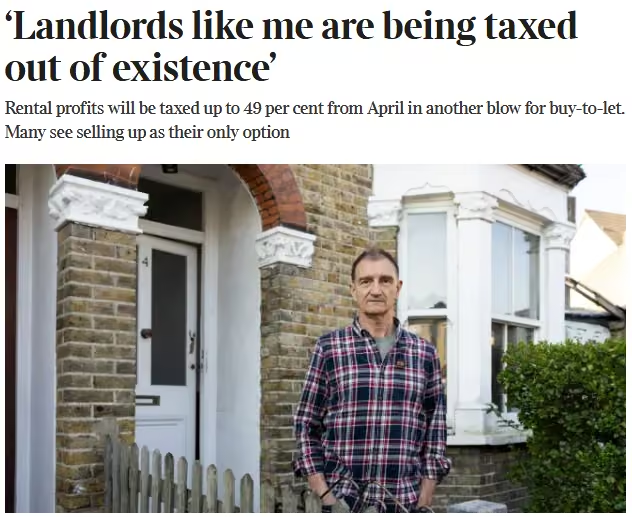
Luke Johnson reposted
 Noble Francis
@NobleFrancis
The latest UK mortgage approvals data from the Bank of England this morning...
There were 53,443 mortgage approvals in September 2026, which is 2.5% lower than in August & 19.4% lower than a year ago. (1/n)
#ukhousing #ukconstruction

Luke Johnson reposted
Simon French
@Frencheconomics
Brutal judgement from the OBR on the supply side frictions that have made UK house-building unviable across many sites.
 Simon French
@Frencheconomics
Housebuilders agree with the OBR....

Luke Johnson reposted
LBC
@LBC
Cyclists are denying Sadiq Khan his dream of a vehicle-free Oxford Street...
Luke Johnson
@LukeJohnsonRCP
I assume this is a joke.
 TfL
@TfL
Planning to cycle through the West End? 🚲
Cycling is no longer permitted on the traffic-free section of Oxford Street between Orchard Street and Great Portland Street. We will maintain an active presence of enforcement officers.
You can continue your journey using the surrounding highway network and choose an alternative route from the nearby streets that remain open.
Plan your journey using our London cycling map to find accessible cycle routes, as well as Santander Cycles docking stations: tfl.gov.uk/modes/cycling/

Luke Johnson reposted
John LeFevre
@JohnLeFevre
Since 2019, tennis is up 72% among kids 6–12. Golf is up 55%.
Parents finally figured out which sports lead to success and can be played for life.
 John LeFevre
@JohnLeFevre
Walter Isaacson asks Peter Thiel what humans can uniquely do in the AI era.
Thiel: "We're very relational… these relational dimensions will become more important."
When knowledge is worth $0, the only career skills that matter:
- networking / social calibration
- persuasion (sales)
- curiosity (harnessing AI)
- taste (curation)
- storytelling
- grit
- golfing with clients (or equivalent)
We'll get so sick of a fake world that we'll go back to doing business like it's the 1800s. A handshake at the local saloon.
Luke Johnson reposted
Christopher Snowdon
@cjsnowdon
Putting an end to this would be the easiest win in politics. No more tax rises. Deficit down. GDP up. Popular with the public.
But they can’t do it because of their lunatic, benefits-obsessed backbenchers.
 Steven Swinford
@Steven_Swinford
The extraordinary rise in welfare spending continues
It is going to rise by £19billon this year (5.7 per cent) to £353billion, equivalent to ***11.1%*** of GDP, reaching 12.3% in 2031
It is being driven by a rise in health and mentions benefit spending

Luke Johnson reposted
 Michael A. Arouet
@MichaelAArouet
This is eye-opening. Europe’s share of global tech R&D has collapsed from 23% in 2005 to just 8% today, while the US has climbed to 62% and China has risen from near zero to 15%. South Korea now outspends Germany, France, the UK, and Italy combined in tech R&D. Yep, you read that right.
This is the predictable result of policy choices that systematically favor control and redistribution over growth. Layered regulation, data rules, AI restrictions, labor rigidities, and precautionary frameworks, raises the cost and slows the pace of turning ideas into products, forcing companies to spend scarce resources on compliance rather than experimentation. High taxation and expansive redistributive systems extract capital that would otherwise fund private R&D and risk-taking, while shrinking the after-tax reward for building something new and scaling it. The broader left-leaning mindset that prioritizes equality of outcome over dynamism treats entrepreneurial success as something to be managed, taxed, or shared rather than unleashed and rewarded.
Places that protect the returns to innovation and keep barriers low continue to pull ahead, attracting talent and capital that Europe increasingly loses. Europe’s relative decline is the cumulative outcome of treating dynamism as a problem to be regulated rather than the engine of prosperity. Without a shift toward lighter rules, lower burdens on enterprise, and greater tolerance for unequal outcomes from unequal effort, the gap will keep widening, and Europe will become an open-air museum for wealthy Americans and Asians.

Luke Johnson reposted
 HH
@RealHerbHoover
This is the biggest story in Big Law in 2026 and it's all about AI and no one is reporting that it's all about AI. I predict another 2-3 top 20 firms will wind down in the next 12 months and it will snowball from there. Rainmaker partners are about to go HAM due to AI.
 Sujeet Indap
@sindap
NEW: Brian Resnick from Davis Polk restructuring team now on scene at Weil and wind-down now being actively discussed among options:
www.ft.com/content/69ccfcb0-3f5e-4b77-9e04-a386e827b872?s…
Luke Johnson reposted
 The Ways of A Gentleman
@Gentleman_Ways
Theodore Roosevelt was born 168 years ago today, October 27, 1858.
Soldier, rancher, explorer, president, and a man of uncommon grit and character.
Here are ten of his finest words. 🧵

Luke Johnson reposted
Christopher Snowdon
@cjsnowdon
I have just been diagnosed with ADHD, autism, bipolar disorder, gambling disorder, psychopathy and extreme narcissism. It feels so good to be validated. I always knew that I was more interesting than other people. 👍

Luke Johnson reposted
Paul Hawkins
@Hawkeye_74
UK Government income vs spending.
I was always taught spending more than you earned is a route to misery.

Luke Johnson reposted
 David Lawrence
@d_1awrence
Back in 2010, the minimum wage was £12,064 and the 'higher earner' band started at £43,875.
You only paid 40% tax once you were earning 3.6x the minimum wage.
There was clear incentive to progress, learn and aspire for more.
As things stand, you now start paying 40% tax once you earn £50,270 which is just 1.83x the minimum wage.
If it was the same multiple as 2010, the 'higher earning' band would be £98,841 and everyone below this amount would be paying 20%.
Someone on £98,841 is effectively losing out on £9714.20 net per year if the bandings had simply moved in line with previous multiples relative to minimum wage.
This is one of the reasons why the middle class is being eroded and why there's a cost of living crisis in the UK.
David Lawrence
@d_1awrence
An increase to £13.20p/h equates to a minimum wage of £27,456, based on a 40 hour week.
Once you factor in employers NI and basic pension contributions, the MINIMUM cost to hire a 21 year old for a company would be £31,461.
This is before you factor in any overarching business costs like office space, laptops, phone, software, training, support staff, vehicles etc.
This is going to be devastating to SME's who cant put together a simple 12 month budget without the goalposts being moved & their margins squeezed.
It'll also be catastrophic to youngsters opportunities because businesses will simply not be able to afford to hire them.
What's also incredible is that anything above £50,270 is seen as 'high earnings' in the UK and is taxed at 40%!
We are governed by financially and economically illiterate morons.
This will not end well.
Luke Johnson
@LukeJohnsonRCP
Fascinating
 Duncan Lamont
@DuncanLamont2
If you read one thing today…
www.schroders.com/en-gb/uk/intermediary/insights/the-reti…
 Luke Johnson
@LukeJohnsonRCP
Housebuilding and property development in London are in a severe slump. Killed by over regulation, high taxes and interest rates, NIMBYism and construction cost inflation. Lost investment, lost jobs, lost homes. This is how countries get poorer and more miserable.
Peter Bill
@peterproperty
Reuters (£) Purfleet: “of about 3,000 planned new homes only 34 have been built after the original developers failed to persuade investors that the financial numbers made sense.” www.reuters.com/world/uk/down-by-river-thames-failure-bui…
Luke Johnson
@LukeJohnsonRCP
Large numbers of healthy people are abusing the welfare system by claiming they or their children have autism and/or ADHD. The cost of this shameless behaviour is unsustainable.
 Francis Harris
@fharris2011
A 72-fold increase in costs as it’s discovered just about everyone in Kent has autism or ADHD
Courtesy of private diagnoses
Genius

Luke Johnson reposted
 Ricardo
@Ric_RTP
Elon Musk now literally holds the off switch on Anthropic's $2 trillion IPO.
Anthropic's filing shows it has agreed to pay Elon's AI company up to $120.5 billion for computing power. And starting early next year, either side can walk away with 90 days' notice.
The deal is with SpaceXAI, the SpaceX unit that used to be xAI, and it rents Anthropic the Nvidia chips that run Claude.
In May, the price was $1.25 billion a month for one data center in Memphis. Reuters reported the confidential draft of this filing put the total at $84.5 billion. The public version filed today says $120.5 billion.
Once all the capacity arrives in December, the bill jumps: Anthropic expects to pay Musk about $3.1 billion every month.
Anthropic reportedly brought in $16.8 billion last quarter, which works out to about $5.6 billion a month. So more than HALF of what Anthropic earns today is about to go to one supplier.
Now here's where it gets really insane:
The lock-in on those contracts ends in January and March 2027. After that, either side can cancel with 90 days' notice. Fortune reported in July that the clause gives SpaceX a way to take its chips back if Grok suddenly needs more.
Grok competes directly with Claude.
And in February, Elon publicly called Anthropic's AI evil.
So the company selling itself to the public as the safe AI lab is about to run a huge share of its product on hardware owned by its loudest critic. That critic also owns a direct competitor, and he can start the 90-day clock in early 2027.
The filing does warn that some of Anthropic's compute suppliers build their own AI models, and that warning reads very differently once the supplier is Elon.
And Elon needs this deal just as badly: SpaceX's CFO has promised $100 billion in annual revenue by the end of this year. At full speed, Anthropic's rent comes to about $9.3 billion a quarter. That's more than the roughly $7.6 billion SpaceX's entire AI business brought in last quarter.
So 2 of the biggest IPOs in history are now holding each other up, and both of them have a 90-day exit.
Anthropic has a real argument here. Computing power is the scarcest thing in AI right now, and Amazon's cloud capacity for 2027 is reportedly largely sold out. The filing even admits Anthropic badly underestimated how much compute it needed in the past. Grabbing every chip on the market is the rational move, and the same clause lets Anthropic leave if cheaper capacity shows up.
But public buyers deserve 2 things before the listing: Anthropic should publish how much of Claude runs on SpaceX hardware and what happens to its customers if that notice ever arrives. And it should get the 90-day exit removed for the full length of the contract, the same way its other big compute bills are locked in.
Until then, anyone buying ANT at $2 trillion has to answer one question for themselves:
Who do they trust to keep Claude running in 2027, Anthropic or Elon Musk?

 Anthropic
@AnthropicAI
Anthropic has filed an S-1 registration statement with the SEC related to its proposed IPO.
Read more: www.anthropic.com/news/s1-sec
Legal disclaimer: A registration statement relating to these securities has been filed with the SEC but has not yet become effective. These securities may not be sold, nor may offers to buy be accepted, prior to the time the registration statement becomes effective. This post does not constitute an offer to sell or the solicitation of an offer to buy these securities, nor shall there be any sale of these securities in any state or jurisdiction in which such offer, solicitation or sale would be unlawful prior to registration or qualification under the securities laws of any such state or jurisdiction.
Luke Johnson reposted
 Léo-Pierre Trudel
@LeoPTrudel
Free research from the sell-side banks is available at the links below. They post from time to time, and some of it is really in-depth or valuable ideas.
Goldman Sachs: www.goldmansachs.com/insights/reports
JPM: www.jpmorgan.com/insights/global-research
Morgan Stanley: www.morganstanley.com/insights
BofA: business.bofa.com/en-us/content/market-strategies-insight…
Citi: www.citigroup.com/global/insights/tags/citi-research
UBS: www.ubs.com/global/en/investment-bank/insights-and-data.html
Barclays: www.ib.barclays/our-insights.html
Deutsche Bank: www.dbresearch.com
HSBC: gbm.hsbc.com/insights/global-research
Rest of the street
Jefferies: www.jefferies.com/insights/
Nomura: www.nomuraholdings.com/en/services/global_research.html
Société Générale: insight-public.sgmarkets.com
BNP Paribas Markets 360: globalmarkets.cib.bnpparibas/markets-360/
RBC Capital Markets: www.rbccm.com/en/insights.page
Wells Fargo: www.wellsfargoadvisors.com/research-analysis.htm
Luke Johnson
@LukeJohnsonRCP
Many charities have been captured by their staff and have almost forgotten their mission.
Christopher Snowdon
@cjsnowdon
Article in the Telegraph about how big charities are losing public support thanks to big salaries, political lobbying and DEI nonsense. Includes a few quotes from me. www.telegraph.co.uk/news/2026/10/24/britains-charities-be…


Luke Johnson reposted
 Unitard Club
@UnitardClub
Everyone keeps a list of unicorns.
Nobody keeps a list of what happened next.
So we did. 🦄📉
440+ startups once worth $1 billion or more. Not anymore.
Over $1.4 trillion of valuation, gone.
Meet the Unitard Index: unitard.io

Luke Johnson reposted
 Elon Musk
@elonmusk
It means entire countries and cultures will go extinct forever
 vittorio
@IterIntellectus
fertility rates are so abstract that people struggle to understand the scale of the catastrophe we’re experiencing.
take 1.14 children per woman (italy and japan)
if that continues, each generation is roughly half the size of the one before it
start with 100 people in a generation, the next only has about 54, then 29, then 16.
in three generations, roughly a century, you have a generation 84% smaller than the one you started with.
for taiwan that would be 97.4%!
i don't think people really understand what that means

Luke Johnson reposted
 Kathryn Porter
@KathrynPorter26
This post goes some way to explaining the dire financial straits the UK is in...
"Britain has almost run out of taxpayers, or at the very least, it’s slowly running out of people who pay enough taxes to plausibly finance the state."
"...in 1998, about 43 per cent of British earners paid sufficient tax to cover the Government’s average per-capita spending. During Covid, that figure fell to an absolute low of circa 20 per cent, then by 2025 recovered modestly to 26.6 per cent."
No wonder if fewer than 27% of people are net contributors to the state
It's stats like this that make me want to leave. Big new project in the US in the next few months might be just the springboard I need
@griffitha @LiamHalligan
open.substack.com/pub/ieainsider/p/the-strange-death-of-t…
Luke Johnson
@LukeJohnsonRCP
She has the most unbearably snobby English aristocratic voice imaginable. And politically correct views to match. Good to see diversity in action @TheEconomist
 Garrett Wright
@garrxttt
JPMorgan CEO Jamie Dimon pushes back after being asked why America’s CEOs are afraid to criticize President Trump: “I’ve said what I think. What the hell else do you want me to say?” 🇺🇸
Interviewer: “I’m genuinely struck by the unwillingness of CEOs in America to say anything critical. There’s a climate of fear in your country. Would you agree with that?”
Jamie Dimon: “The Davos intellectual elite. I’ve been coming to Davos all these years, listening to chatter and stuff like that. Has it done a good job making the world a better place? We get together and talk. What do you want me to do?
I have strong views. Some of the things Trump has done are good, and some are not.
I’m not a tariff guy. Do I use it in certain cases? Yes. I think they should change their approach to immigration. I’ve said it.
What the hell else do you want me to say? I’m trying to have a conversation.”
Luke Johnson
@LukeJohnsonRCP
The real price of socialism: after hard left Lula won the election, the Brazilian real slumped by 12% while the stock market fell by 17%. Investors fleeing the prospect of higher public spending and more debt.
Luke Johnson reposted
Crémieux
@cremieuxrecueil
I'm shocked that The Economist was willing to publish this!

Luke Johnson reposted
 Richard Meyer
@RichardMeyerDC
China consumed more coal in the last four years (2022–2025) than the entire world consumed throughout the 19th century.
Luke Johnson
@LukeJohnsonRCP
Unbelievable corruption in the public sector because politicians and public sector leaders have no skin in the game. They take taxpayers for absolute fools.
 Andrew Neil
@afneil
Astounding Sunday Times investigation reveals new scandal in SNP’s Socialist Scotland:
800 NHS, central government, council and quango workers whose jobs no longer exist but remain on the public payroll because of the SNP’s ‘no public-sector redundancy’ policy.
Estimated cost of paying people to do nothing: £27m a year.
One NHS Highland worker has been receiving a full salary and benefits for 17 years despite not having a specific job.
The health board refused to say what the worker had been doing for almost two decades and how much they had been paid.
Likely cost to the taxpayer is expected to be far higher with several public bodies refusing to disclose salaries for hundreds of the workers awaiting redeployment.
Luke Johnson reposted
 The Food Manufacturing Guy
@TipOfTheBanana
The scrambled eggs at a hotel breakfast are 19% water, and they're dyed.
A lot of hotels and cafeterias pour them from a carton of Papetti's Breakfast Blend. The spec sheet reads whole eggs, 19% water, then under 2% of salt, xanthan gum, citric acid, annatto color and natural butter flavor. Papetti's is part of Michael Foods, one of the biggest egg processors in the country.
Every ingredient has a job on a steam table. Xanthan gum holds the added water in the egg so it doesn't weep into the pan. Citric acid keeps the eggs from turning gray or green under a heat lamp. Annatto puts back the yolk color the water washed out. The butter flavor is there because nobody is going to add butter. The carton keeps for 98 days in the cooler.
The plain version from the same company is whole eggs, whey, skim milk, xanthan and citric acid, with almost no added water and half the sodium.
Luke Johnson reposted
 Alan Smith
@AlanJLSmith
Brutal chart.
France and UK vs. Communist countries at their peak.
UK public spending as % of GDP is currently above Romania, Venezuela and China.
And France is a lost cause.
(HM Treasury/Rand Research)

Luke Johnson reposted
 Nick, 30
@an0n_Nic
FT comments never miss.
I don’t think I’ve read such a rational analysis of the situation we’re in for a long time.


 Simon Kuper
@KuperSimon
I've been in France since 2002 and have never seen the streets so violent nor the politics so extreme. From the sacking of the supermarket on my street to the prospect of Présidente Le Pen, here's me @FT including thoughts from 2 French Nobel laureates as.ft.com/r/addcad57-0f9d-4ecf-b6ca-fe5c996ddfc5
Luke Johnson reposted
zerohedge
@zerohedge
The AI layoffs are here:
*AMERICAN EXPRESS TO CUT 5% OF JOBS, ABOUT 3,500 EMPLOYEES
*BARCLAYS TO CUT 5,000 JOBS AS AI STARTS CREATING EFFICIENCY
*EBAY CONFIRMS JOB CUTS OF ABOUT 9%
*NETFLIX TO LAY OFF 6% OF GLOBAL STAFF, OR ABOUT 1,000 JOBS: WSJ
Luke Johnson reposted
 Rory Sutherland
@rorysutherland
This is an extraordinary advertisement because it's effectively spending 60 seconds to tell us how technology is ruining our lives.
Incidentally, it fails to point out that not only is French toast not toast, but Canadian bacon is not technically bacon.
 Austen Allred
@Austen
This might be the first time I’ve ever watched an Apple ad that made me actively not want to buy the product
Luke Johnson reposted
The Free Speech Union
@SpeechUnion
🚨 A 15-year-old boy was woken by four West Midlands Police officers banging on his door.
Fraser, a schoolboy and Reform UK activist, was arrested in front of his neighbours, bundled into a police car and held overnight in a cell. His mugshot and DNA were taken; even his shoes were confiscated. While he was in the cell, officers searched his bedroom at home.
His “crime”? Criticising a Conservative councillor for wearing shorts and a T-shirt to a council meeting, then joking on social media that the councillor “was not looking like a rent boy” when he wore a suit.
Fraser also posted an altered photograph of the councillor wearing bunny ears.
In what self-respecting democracy should a child be arrested for criticising an elected politician?
The Free Speech Union is supporting Fraser and has taken on his case. His lawyers received an email from West Midlands Police stating that “it is alleged that your client’s comments could be considered a hate crime offence”. Months later, Fraser is still waiting to learn whether he will be charged.
Speaking to the New York Post, FSU Director of Legislative Affairs Sam Armstrong said: “Broadly speaking, several thousand people a year are being arrested for… ‘offensive speech’ in the UK.”
Since 2020, the FSU has handled more than 7,000 cases involving people whose free speech has been infringed and who have been punished for exercising it. More than 60,000 people have also been arrested for communications offences in the UK.
The First Amendment protects US citizens’ right to free speech. As Sam told the New York Post, it is the “global gold standard”.
Read more below 👇

Luke Johnson reposted
 Michael J. Miraflor
@michaelmiraflor
YouTube seems unstoppable right now. Incredible chart.
 Luke Johnson
@LukeJohnsonRCP
Finance is the biggest single US competitive advantage
 Rya Jetha
@ryajetha
What a lede from @TheEconomist

Luke Johnson reposted
 The Culturist
@the_culturist_
I spend a lot of time, perhaps too much, thinking about the lost architecture of Britain.
Crystal Palace was the most tremendous loss of the modern era, yet it's rare to see any pictures of it. When built in 1851, it was the largest building in the world and three times the size of St Paul's Cathedral.
What's more, that immense ironwork and 293,000 glass panels went up in just 190 days for the World's Fair. Almost 1 million square feet of glass. An extraordinary feat.
It was razed in a fire in the 1930s and never rebuilt.


Luke Johnson reposted
 nic carter
@nic_carter
this California wealth tax thing is just incredible.
so in October 2025, a California healthcare union proposed a "one time" 5% tax on any billionaire's wealth. the ballot measure will be voted on next month. In early December 2025, California announced that it would be a retroactive tax if passed, applying to anyone with CA residency as of Jan 1, 2026. The objective is to pay for Medi-Cal, California's incredibly dysfunctional healthcare system. (which also functions as a glorified welfare apparatus, but that's a discussion for another time).
polls reveal that the CA electorate is split around 50/50 on the tax, but prediction markets only give Prop 40 a ~23% chance of passing (there are competing measures on the ballet that would nullify it).
there are 200 billionaires in CA, worth collectively somewhere between $2.3 and $2.6 trillion. 5% of that is around $100b, accounting for a small amount of attrition. proponents of the tax forecasted a significant windfall, assuming only a 10% departure rate.
supporters thought they were being clever with the retroactive concept. no billionares would leave CA in the few short months between the tax being proposed and the residency cutoff date, without the tax even having passed yet, right?
well as it turns out, they did.
a new paper [1] from two academics at Stanford called "The Net Present Value of the California Billionaire Tax Act", argues that not only did more billionaires leave due to the proposed tax than its proponents expected, but that the value of the tax, if it does pass, is actually negative.
proponents of the tax only assumed 10% avoidance, that is, only 10% of the taxable base of targeted billionaires would leave CA within the very short Oct-Dec 2025 window. Jaros and Rauh, the Stanford academics, find that a lower bound of 28.6% of the taxable base managed to leave.
just based on known departures, those departures total $577b in net worth, or $28.8b in potential tax lost. this of course does not capture everyone (many left without announcing their departure), so the authors normalize to departure rates estimated from other wealth tax events, and apply other discounts for litigation, arriving arrive at a figure of only $28-$36b in forecasted tax revenues.
but this isn't all! all of the income taxes paid by the departed billionaires are also forsaken. the authors estimate that CA billionaires pay $3.3- 5.8b in annual income taxes. they assume a midpoint of $2b lost in annual collections from departed billionaires. the net present value of that lost income stream is -$68.9 billion.
so when you add it all up you get:
+ $30b one-time tax windfall (estimated)
- $69b in present value of lost future income taxes
= - 38.9b overall net present value of the tax
of course, this analysis is highly estimate driven. the authors simulate the parameters 100k times and find a negative NPV of the implemented tax 85 percent of the time.
and if the tax doesn't pass, which it's not looking like it will, California still ended up losing at least $577b in departed net worth, and they have permanently poisoned the well with entrepreneurs who will now worry about future wealth taxes.
[1]: www.nber.org/system/files/working_papers/w35899/w35899.pdf


 Luke Johnson
@LukeJohnsonRCP
This is madness
 World of Statistics
@stats_feed
🌍 European countries that added the most migrants (2000–2024)
1. 🇬🇧 United Kingdom: +7.1M
2. 🇪🇸 Spain: +6.8M
3. 🇩🇪 Germany: +6.4M
4. 🇹🇷 Türkiye: +5.8M
5. 🇮🇹 Italy: +4.4M
6. 🇫🇷 France: +3.0M
7. 🇦🇹 Austria: +1.4M
8. 🇳🇱 Netherlands: +1.4M
9. 🇨🇭 Switzerland: +1.3M
10. 🇧🇪 Belgium: +1.3M
11. 🇸🇪 Sweden: +1.3M
12. 🇵🇱 Poland: +917K
13. 🇮🇪 Ireland: +840K
14. 🇳🇴 Norway: +720K
15. 🇷🇴 Romania: +521K
16. 🇵🇹 Portugal: +476K
17. 🇩🇰 Denmark: +475K
18. 🇭🇺 Hungary: +393K
19. 🇨🇿 Czechia: +386K
20. 🇫🇮 Finland: +378K
Europe's migrant population grew by 40.8 million between 2000 and 2024, up 67%. The UK, Spain and Germany together account for almost half of that increase.
Source: UN DESA
Luke Johnson
@LukeJohnsonRCP
The thing that Labour's Act will transform is the availability of rental property. It will decline, as night follows day. And so overall, rents will rise and choice and quality will reduce. Every single time ret controls are imposed this is the result. Markets in action.
Matthew Pennycook MP
@mtpennycook
This Labour government’s transformative Renters’ Rights Act empowers private renters to challenge unreasonable rent increases.
If a tenant believes a proposed rent increase is above the open-market rent, they can refer the matter to the First-tier Tribunal.
In a recent case in Manchester where the Landlord proposed an increase in rent from £1,650 per calendar month to £1,700, the Tribunal determined the open market rent was actually £1,450 per calendar month.
We’re standing up for renters and our reforms are working.
www.gov.uk/residential-property-tribunal-decisions/flat-6…
Luke Johnson
@LukeJohnsonRCP
These sentences will deter no one. Pathetic.
 Dura lex, sed lex
@duralexsl
🔴⚖️ Mise à jour sur les 46 premières condamnations des PILLAGES/ÉMEUTES du 17 octobre (dispo dans la presse).
🔴 Toulouse – Ylan, 18 ans. Jet de cocktail Molotov vers des policiers (allumé mais sans explosion).
- Peine : 12 mois avec sursis + 140 h de TIG + privation du droit de vote 3 ans.
- Peine encourue : 10 ans de prison.
🔴 Lille – 3 hommes (20-27 ans) dont 2 clandestins. Interpellés avec sacs remplis avec le fruit de pillages Micromania et Calzedonia.
- Peine : 10 mois de prison avec mandat de dépôt + interdiction du territoire 2 ans (pour les 2 clandestins).
- Peine encourue : 5 ans de prison.
🔴 Lille – Père de famille avec pied-de-biche, tentative d'effraction dans un magasin.
- Peine : 10 mois de prison avec mandat de dépôt + interdiction de manifester de 3 ans.
- Peine encourue : 7 ans de prison.
🔴 Lille – Homme de 23 ans, tirs de mortier vers les forces de l'ordre.
- Peine : 12 mois sous bracelet + 140 h de TIG.
- Peine encourue : 5 ans de prison.
🔴 Reims – Sahel W., 19 ans. Pillage dans un Carrefour Express.
- Peine : 105 h de TIG.
- Peine encourue : 7 ans de prison.
🔴 Reims – Hugo M., 20 ans. Pilage de vêtements à la boutique Caviar.
- Peine : 4 mois sous bracelet.
- Peine encourue : 7 ans.
🔴 Rouen – Livreur tunisien, pillage d'une boutique de rachat d'or (16 000 € de bijoux dans les poches). Récidiviste.
- Peine : 8 mois de prison avec mandat de dépôt + révocation de 6 mois de sursis d'une condamnation précédente.
- Peine encourue : 14 ans de prison.
🔴 Rouen – Anthony, SDF. Pillage de la boutique Courir. Récidiviste.
- Peine : 6 mois de prison + 6 avec suris.
- Peine encourue : 14 ans de prison.
🔴 Rouen – Chômeur de 26 ans. Pillage de Micromania. Récidiviste.
- Peine : 6 mois sous bracelet.
- Peine encourue : 14 ans de prison.
🔴 Rouen – Nicolas, éboueur et Zakaria. Jets de projectiles sur les policiers et outrages.
- Peine : 12 mois sous bracelet.
- Peine encourue : 5 ans de prison.
🔴 Lyon – Mohamed, clandestin. Pillage boutique Louis Vuitton (6 portefeuilles, 2 paires de lunettes, un pantalon, un sac en cuir et un sac en tissu).
- Peine : 6 mois de prison avec mandat de dépôt + interdiction du territoire pendant 2 ans.
- Peine encourue : 7 ans de prison.
🔴 Lyon – Cheima, femme de 30 ans. Pillage du magasin JD Sports.
- Peine : 8 mois avec sursis.
- Peine encourue : 7 ans de prison.
🔴 Lyon – Sophia, 27 ans. Déjà 9 condamnations dont vols. Pillage du magasin JD Sports.
- Peine : 12 mois sous bracelet.
- Peine encourue : 14 ans de prison.
🔴 Lyon – Adam, Suisse de 19 ans. « Black bloc » venu de l'étranger. Interpelé sortant d'un Monoprix pillé + rébellion.
- Peine : 12 mois avec sursis.
- Peine encourue : 7 ans de prison.
🔴 Perpignan – Homme de 20 ans, jet d'une barrière de chantier sur 2 policiers.
- Peine : 6 mois sous bracelet
- Peine encourue : 5 ans de prison.
- Réquisitions : 6 mois de prison avec mandat de dépôt.
🔴 Perpignan – Homme de 21 ans. Jet de projectiles sur des policiers et dégradations de mobilier urbain. Lunettes de ski, t-shirt en cagoule et gants coqués.
- Peine : 10 mois sous bracelet.
- Peine encourue : 7 ans de prison.
- Réquisitions : 8 mois de prison avec mandat de dépôt.
🔴 Perpignan – Livreur Amazon de 22 ans, déjà une condamnation au casier. Vol de scooter après manif avec dissimulation du visage, en réunion et effraction.
- Peine : 8 mois sous bracelet.
- Peine encourue : 10 ans de prison.
- Réquisitions : 5 mois de prison avec mandat de dépôt.
🔴 Limoges – Femme de 20 ans. Pillage dans des commerces et à l'Hôtel de Ville (détruit par le feu plus tard).
- Peine : 6 mois de prison avec mandat de dépôt + 18 avec sursis prob.
- Peine encourue : 7 ans de prison.
🔴 Pau – Homme de 43 ans. Jets de projectiles sur les policiers.
- Peine : 6 mois sous bracelet.
- Peine encourue : 5 ans de prison.
🔴 Nîmes – Prof d'EPS de 24 ans. Jets de projectiles ayant blessé un policier (3 j d'ITT).
- Peine : 18 mois avec sursis prob.
- Peine encourue : 5 ans de prison.
🔴 Grenoble – 10 personnes (18-43 ans). Pillages de magasins (téléphonie, parfums) après bris de vitrines.
Peines : de 4 mois avec sursis à 8 mois ferme (ferme pour 1 individu déjà condamné à du sursis en juin).
Peine encourue : 7 ans de prison.
🔴 Poitiers – Vol en réunion et dans un lieu d'entrepôt (pillages de commerces, dont Sephora et Foot Locker).
- Peine : 6 mois de prison.
- Peine encourue : 7 ans de prison.
🔴 Tours – Un clandestin de 32 ans et un lycéen de 19 ans. Recel de biens pillés.
- Peines : 4 mois avec sursis pour le clandestin, 3 semaines de TIG pour le lycéen.
- Peine encourue : 5 ans.
🔴 Nantes – 4 hommes (19-28 ans). Un clandestin, un auto-entrepreneur, un lycéen, un étudiant. Pillages dans des magasins (Fnac, Foot Locker…) ou violences sur FO.
- Peines : 4, 6 et 8 mois avec sursis.
- Peine encourue : de 5 à 7 ans.
🔴 Agen – Deux femmes d'une même famille, tout de noir vêtues. Violences et outrages sur un policier + dégradation d'un véhicule de police.
- Peine : 6 mois avec sursis + stage de citoyenneté.
- Peine encourue : 5 ans de prison.
🔴 Bobigny – 3 hommes (23-24 ans). Possession de pistolet factice, mortiers, cagoules, kit cocktails molotov.
Peines : de 10 mois avec sursis à 7 mois sous bracelet.
Peine encourue : 7 ans de prison.
🔴 Paris – Edmondson G., 21 ans, ex-pompier. Interpellé avant manif avec kit cocktail Molotov dans un sac àdos. Vidéos sur son téléphone le montrant lancer un cocktail Molotov la veille.
Peine : 2 mois de prison avec mandat de dépôt + 6 avec sursis.
Peine encourue : 7 ans de prison.
🔴 Paris – Andy M., 23 ans, agent de sécurité. Tir de mortier d’artifice sur les forces de l'ordre avenue des Champs-Élysées.
Peine : 12 mois avec sursis. NON-INSCRIPTION AU CASIER.
Peine encourue : 5 ans.
(Sources : Paris Match / Actu-Juridique / Actu-fr / ICI / RFI / BFM / L'Indépendant / France3 Régions / Sud Ouest / Midi Libre / Ouest-France / La Nouvelle République / La Dépêche - Photo : AFP)

Luke Johnson reposted
 Nadeem Shafqat
@Nadeem83Shafqat
Do watch @BBCPanorama tonight at 8pm
A third of all local murders in the last two years have been linked to supported exempt and HMO housing.
This really is the next big national scandal brewing cc @maxtempers @CDP1882 @aswren.
www.birminghammail.co.uk/news/midlands-news/birmingham-st…
Luke Johnson reposted
Michael Brown
@MrMBrown
Quite simply, this remains totally unsustainable in every way...
ONS - "Annual average regular earnings growth [in August] remained at 6.3% for the public sector and 3.0% for the private sector"
Luke Johnson reposted
 Olivier Babeau
@OlivierBabeau
C’est en fait le paradoxe de Tocqueville qui nous éclate à la figure.
Dans l’un des pays qui redistribue le plus au monde, le pays qui égalise le plus les conditions objectives d’existence, qui donnent le plus de chance à tous, qui donne culture, éducation et enseignement supérieur gratuitement à tous, qui respecte le plus les droits de l’homme, dans ce pays de cocagne donc, une part significative de la population est persuadée qu’elle vit dans un enfer d’injustices et de violences systémiques.
Comme l’avait très bien montré Tocqueville, plus il y a d’égalité, plus les inégalités qui restent deviennent insupportables. Notamment parce que la société méritocratique, par rapport à l’ancien régime fondé sur la naissance, a cela de terrible qu’elle rend les gens responsables de leurs conditions.
Luke Johnson reposted
 Dominic McGregor
@DominicMcGregor
I run an apprenticeship & skills bootcamp provider
So I’m much more qualified to talk about this than anyone.
The model is simple, funded by the government we train people in areas like Marketing, Software Development & Business.
We are paid when we deliver the 12 week programme and paid again when these individuals get a positive out come.
Classed as a job, promotion or pay rise.
Average cost per person on programme is £4,000.
To be clear the government fund this. They only pay on successful outcome.
No completion of course = NO PAYMENT
No job = NO PAYMENT
We delivered over 1000 people on this course in 2024.
AS SOON AS LABOUR CAME TO POWER
FUNDING STOPPED.
I’ve added the share price of @northcoders who are a similar business with a similar model.
The share price since labour has got to power has collapsed.
Labour are not serious about reversing the direction of NEETs. I have dwelled on this for a number of years. Wondering when funding would come.
This year alone, funding has reduced 75%.
To practically 0.
The conclusion I have come to, which is deeply harrowing for our nation is that the current government would rather individuals stay on benefits than train them and help them get a job.
That is my deepest reflection on being in this industry for 5 years.
It makes me feel every announcement they make is empty promises.
There is an infrastructure of training providers across the country who are (like us) wanting to support training young people and help them get jobs.
But right now, this government has no interest in doing this.
This has been what has turned me against everything announcement they make - because the reality is always different.
 Steven Swinford
@Steven_Swinford
Exclusive:
Britain is facing an “economic catastrophe and moral failure” because a generation of young people is being written off to a life on benefits, the prime minister has said
Writing in The Times Andy Burnham said that the time has come for Britain to “invest in the success of our young people” rather than “pay for failure through the benefits system”
Setting out his vision for the fundamental reform of welfare, he said the present scheme provided “an assessment, a payment and, after that, a goodbye”, with no support, skills or help getting a job
In future, Burnham promised, the government would offer a “clear guarantee” of support, starting in schools, to address the almost one million 16 to 24-year-olds not in education, employment or training, known as Neets
Every young person would be guaranteed a technical pathway, work placements, apprenticeships and the skills they needed to find a job
However, he cautioned that this would be matched by an expectation that young people would take up the opportunities available to them. He added that under the new system, benefits would become a “backstop” rather than the “starting point” for young people.
www.thetimes.com/uk/politics/article/andy-burnham-oped-we…
Luke Johnson reposted
max tempers
@maxtempers
The long march towards Total Judicial Communism continues. We have devolved price setting to a couple of former solicitors scrolling Zoopla. Madness. www.telegraph.co.uk/money/property/buy-to-let/landlords-5…
Luke Johnson reposted
 Dominic Cummings
@Dominic2306
Political world won’t listen and can’t hear but this is true and crucial
 Casey Handmer
@CJHandmer
I recently spent some time with former colleagues from academia. All of them brilliant, peak human capital. Almost all of them fundamentally unable to plug into the economy, inoculated against productivity by a youth spent experimenting in laboratories instead of building wealth for society. Dealing with real people in the real world.
90% of them have left academia in the last 10-15 years, and 90% of those are functionally unemployed. Grad school does a lousy job of training scientists to be professors (since most of them don't get the good postdoc or tenure track position) and an even worse job of preparing people for real life.
We complain that our societal infrastructure is collapsing, our state capacity is low, our incumbent industries are faltering. Where are the next generation of leaders that can push us forward?
A huge fraction of them were conveyor-belted into academia by schooling systems that have no mechanism to channel ambition and 99+%ile competence, and our universities are mostly hedge funds with glorified psych wards/academic departments on the side, running an insane pyramid scheme that exists only to prove, over and over again, the Shirky Principle: Institutions will try to preserve the problem to which they are the solution.
We literally poured trillions of dollars into state-funded research and effectively neutered our elite civilian technical leadership development programs.
I recently asked a few academic friends if they were finding AI useful in accelerating their programs of research. You know, to solve the Big Problem their entire field exists to solve?
Some were. But most were complaining about how it created pedagogical issues, explaining how their department decided to ban the use of AI, or how it took 18 months to approve an enterprise account, or how they tried Gemini 2 on a puzzle a year ago and it wasn't very helpful, or repeating nonsense about datacenters and water consumption, or supposed IP theft by model companies, as though that has any bearing on their ability to, eg, accelerate a cure for cancer.
Elon sometimes calls AI a supersonic tsunami - a huge wave you don't see coming. I see it coming. But even the people who you'd think have been waiting for this their entire careers are steadfastly looking in the other direction.
Luke Johnson reposted
Rod Dreher
@roddreher
Absolutely stunning essay by @DouglasKMurray about the crisis in France. It includes this quote.
www.thefp.com/p/douglas-murray-france-stares-down-riots

Luke Johnson reposted
 Izabella Kaminska
@izakaminska
Excellent from @nfergus
His is the correct diagnosis I think:
"Today, by historical standards, the young are an endangered species. They are dimly aware that they are being screwed, but they don’t appear to understand who’s doing the screwing.
A clue for the European young: It’s not Donald Trump or Benjamin Netanyahu or whoever else you want to burn in effigy. Mais, non: It’s your grandparents."
I strongly believe the right way of thinking about this entire debacle is from the perspective that it was the arrogance of the boomers that got us here in the first place. They, however, remain totally oblivious to the blowback of their own policies. They continue to see themselves as enlightened humanitarians. Yet, one of the most anti-humanitarian policies they championed was radical feminism.
After major wars we mourn the death of the young who fought in them. We should be mourning all the lives that boomer policies ensured were never born in the first place. These are the lost combatants of our time. A function of young working families being too indebted to afford families, and/or women being manipulated into life choices that most regret by their 40s.
niallferguson.substack.com/p/why-europe-is-burning?
Luke Johnson reposted
 Net Zero Watch
@NetZeroWatch
A new independent review has found employees at Britain’s electricity grid warning that the net zero transition is making it harder to keep the lights on
The investigation found “high levels of stress and concern” among grid operators “given the challenges of the net zero transition and increased reliance on renewables” and a “significant disconnect” between control room staff and executive leadership.
#costofnetzero

Luke Johnson reposted
 Dan Burmawi
@DanBurmawy
I wrote this description/warning of what is happening in the West. Please watch it and share it with others. @idicenter
Luke Johnson reposted
 Nayib Bukele
@nayibbukele
J’ai entendu dire que la France était finie, qu’il était trop tard pour la sauver.
Mais la France est toujours aussi belle, enviable même. Sa grandeur n’a pas disparu, elle ne demande qu’à renaître.
Nous avons surmonté en un an un problème cent fois plus grave, sans avoir les moyens dont dispose la France.
La France pourrait y arriver en une semaine.
Luke Johnson reposted
Cut My Tax
@CutMyTaxUK
Almost half of all sole traders want HMRC's Making Tax Digital programme to be ditched, a Centre for Policy Studies survey has revealed.
44% want it scrapped entirely while 14% are prepared for it to go ahead with changes and a minuscule 10% are happy for it to proceed as planned. The Government and HMRC have totally failed to gain the confidence of the self-employed.
Forcing the self-employed to file five tax returns each year is an obvious idiocy and it is no wonder that they are upset.
1/2
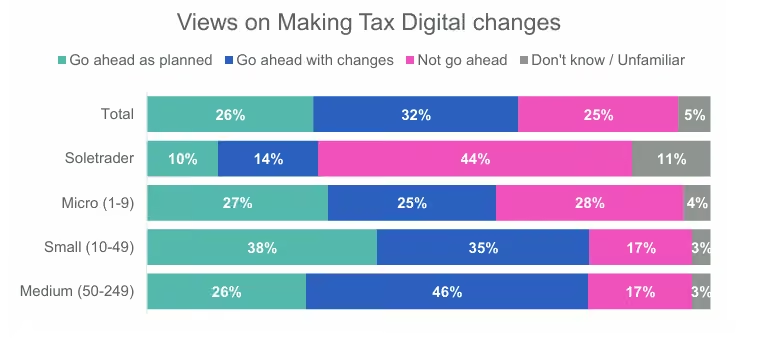
Luke Johnson reposted
nic carter
@nic_carter
having tried my best to intuit the motives of the protesters in France today, I am struck by the fact that two of the most treasured pillars of the European postwar order are colliding:
1. unfettered immigration, especially from former colonies, justified by historical obligation and postcolonial guilt
2. protecting pensions and the elderly at all costs, even to the point of extreme fiscal strain
now you have first and second generation immigrants, as well as young native french people, taking to the streets because the french state is hell-bent on extracting whatever it can and feeding it into the maw of boomer luxury communism.
the younger generation is being asked to accept a deteriorating deal: pay more, receive less, and abandon the expectation of matching the living standard of their parents or grandparents.
the young immigrant newcomers have even less incentive to accept any kind this bargain. they are not bought in to the french social contract. they have no common identity with the french boomers they are being asked to sustain. they resent the fact that the entire machinery of the state is designed to exploit the young to serve the old.
the old do not care about the immigrants enough to trade away any of their entitlements for them. they have the advantage as they wield the franchise reliably and their share of the electorate is only growing, so they won't accept a decline in their own standard of living to fund a future they will never live to see.
now these two groups are on a collision course.
ironically, immigration was intended to ameliorate the worsening fiscal picture brought about by a demographic transition. but this did not happen. studies have repeatedly shown that immigrants do increase aggregate GDP (by simple brute force, by adding to population), but not the fiscal picture [1]. the most comprehensive paper using real-world data [2] segments immigrant types to France and finds non-EU immigrants to be persistently fiscally negative. EU immigrants by contrast are the most fiscally positive group, meaning that studies that consider immigrants as a whole are masking the negative impact of non-western immigrants (and Algeria, Morocco, and Tunisia rank #1 and #2 and #4. Africa accounts for 50% of the 8 million immigrants living in France today.)
immigration has not caused France's fiscal crisis. but it hasn't bettered the economic picture at all – it has deteriorated it somewhat – and it has created a combustible demographic that has little allegiance to the French nation. far from helping France deal with its aging workforce, immigration has added fiscal burden and created a permanent, non-assimilated disenfranchised underclass. the original justifications for immigration – labor scarcity, postcolonial obligation, and more recently workforce aging – have largely failed to manifest the promised results.
the pro-immigrationist policy has been defended in Brussels as necessary to defend the welfare state, but it has expanded the population making claims on the state, without eliminating the need for fiscal adjustments.
France now has an aging electorate aiming to preserve the benefits it was promised, mingled with a younger more diverse population that questions whether it will ever receive a similar deal. the young are vastly outmatched at the ballot box and so they take to the streets.
the french establishment is now trying to preserve a tenuous status quo: unlimited intergenerational obligations alongside a neverending immigration regime that continually changes the composition of the society intended to honor those obligations. the immigration regime also actively worsens the fiscal picture while creating these cultural fractures and inculcating a society more prone to sectarian violence.
the french state will have to renegotiate its social contract and disempower one of these groups. electoral gravity suggests that the old will continue to win until France finally reaches default and creditors renegotiate the welfare state for them.
the major contenders in 27 take different approaches to this tradeoff:
- the right in Le Pen looks to reduce immigration-related expenditure and focus public spending on French citizens, while resisting retirement age increases
- Macron in the center aims to control immigration somewhat and reform pensions by raising retirement age
- Melenchon's left, largely behind the protests this week, denies the tradeoff and aims to keep funding pensions and retirement at 60 while increasing immigration. as France has very little fiscal space it's unclear how this would be paid for
whether the french social contract can be peacefully renegotiated remains to be seen.
[1] For France, immigrants' net fiscal contribution averaged -0.85% of GDP over 2006-2018 when all public expenditure was allocated (and this includes ALL categories of immigrants including European, American and Asian) See: www.oecd.org/en/publications/international-migration-outl…
[2] See table 4 (translated below) shs.cairn.info/revue-economique-2022-4-page-529?lang=fr

Luke Johnson reposted
The Free Speech Union
@SpeechUnion
A mother was referred to Prevent and visited by police at home because of her visit to Israel and her interest in“Jewish issues”.
In yet another shocking case, Holly Passmore, a mother of two from County Durham, was visited at home last July by two plain-clothes police officers who wanted to know why she had recently travelled to Israel.
The officers told Ms Passmore, who cares for her severely autistic nine-year-old son, that it was a “safeguarding issue”.
A police intelligence report seen by The Telegraph reveals that the referral said she “over-identified with the conflict between Israel and Palestine” and was “supportive of Israel to the point that she has travelled to Israel”. It also described her as having “MH” — meaning mental health — issues and being “vulnerable to negative influence”.
Three days after the visit, Ms Passmore lodged a complaint. Two more officers, including a superintendent, then came to her home.
“They said that, clearly, I’m not a terrorist,” she recalled, explaining that they were keen to reassure her that police did not consider her a threat or an extremist.
“I thought that was strange at the time. You don’t usually end up with a superintendent on your couch.”
Ms Passmore’s concerns deepened when she discovered that her NHS records had been updated to describe her as a “vulnerable adult”, before later being changed to say she was no longer vulnerable.
It is now even more clear that Prevent is being weaponised by activists to silence people for their lawful and legitimate views.
These vexatious complaints also waste police time and resources.
Enough is enough.
Read more in @Telegraph 👇

Luke Johnson reposted
Bill Ackman
@BillAckman
Premise:
Incentives drive all human behavior.
The corollary:
How to destroy a country:
A vast social security and support system that serves as a magnet for those who would rather not work.
An open immigration policy that does not screen immigrants to determine their ability and willingness to provide for themselves and their families.
An open immigration policy that does not screen for political and/or religious ideologies that are a threat to the country.
Economic incentives large enough to incentivize immigrants on the state dole to have large numbers of children, but insufficient for educated and economically productive mothers to be able to quit to raise a family.
The declining fertility of the most educated and productive women due to their delay to begin a family as a result of their desire and/or need to advance their careers, among other reasons, to live a life they deem consistent with their educational achievements and/or to repay their student debts.
Amnesty programs that give citizenship and voting power to illegal immigrants without consideration of their economic productivity or their threat to the country due to their religious or political ideologies.
The changing demographics and increased population due to the above factors.
The state responding to protests by increasing social support.
The continued failure to punish and hold accountable violent and looting rioters.
Government managed by a massive and growing unelected bureaucracy.
Government fraud, waste, and abuse contributed to ballooning budgets.
Anti-business legislation that makes it difficult for businesses to compete in a global marketplace being disrupted by AI, including restrictions on firing even poorly performing employees.
Overly burdensome, globally uncompetitive, corporate taxation.
Continuous increases in personal taxes to raise funds to provide for the rapidly growing welfare state.
The substantial majority of the tax burden levied on a small percentage of the population.
A growing percentage of the electorate paying no taxes and receiving welfare.
The introduction or threat of a wealth tax including the taxation of unrealized gains, i.e., taxes on paper wealth.
The flight of the most productive business builders and highest taxpayers to lower tax countries with lesser security concerns.
A growing percentage of the electorate voting for candidates that support increased welfare and laws favorable to, and/or that match the cultural and ideological needs and desires of a growing unproductive immigrant population.
The rapid rise in anti-semitism and inadequate efforts to address this hatred.
Increased borrowing by the state to fund the growing social burden.
Higher sovereign interest rates due to all of the above.
The resulting need to reduce expenditures to make the math work.
Increasingly violent protests that make life less livable for the productive and law abiding citizens leading to their accelerated departure.
And so on…
Luke Johnson reposted
 The Kobeissi Letter
@KobeissiLetter
BREAKING: The number of restaurants in New York dropped ~2,000 YoY in Q1 2026, posting its largest YoY decline in at least 36 years.
This surpasses even the worst contraction recorded in any quarter during the 2020 pandemic.
The number of eating and drinking places in New York State has now declined YoY for 4 consecutive quarters, its longest streak since 2021.
This comes as restaurants are facing surging operating expenses, including insurance premiums, wages, interest rates, utilities, and health coverage, with overall costs rising faster than national averages.
Last year, employee health insurance costs jumped +12.9% for New York-area service firms, business insurance rose +7.0%, while utility costs surged +8.5%, according to the Manhattan Chamber of Commerce.
Skyrocketing costs are crushing New York restaurants.

Luke Johnson reposted
 spiked
@spikedonline
The French school protests are not merely about migrants vs France, or Islam vs Europe, as Donald Trump claimed. The truth is actually far more terrifying, says Driss Ghali
www.spiked-online.com/2026/10/15/the-french-school-riots-…
Luke Johnson reposted
 Richard Hanania
@RichardHanania
In order to build 3.3 miles of rail line, the UK needs to produce 14.6 miles of paperwork.

Luke Johnson reposted
 Richard Williams
@williams_rje
Read this powerful article by @thetimes , and reflect on what has been shared..
This is not just “persecution by (extremely clumsy) process” imposed upon active-duty SAS operators fighting to detain vicious ISIS thugs in an active war zone, but also an example of performative self-immolation initiated by the most senior UK Special Forces officer at the time (G Jenkins) as self-serving exercise in what HE calls ‘transparency’……
So, if someone, anyone (quite possibly an enemy) within an active war zone says the SAS killed an unarmed man, then the so-called ‘senior leaders’ (some, as in this case, with near-zero combat experience) within the Whitehall-based ‘UK system’ desperate to demonstrate something that they call ‘transparency’ (or whatever else floats the MOD’s boat), will automatically launch an aggressive RMP operation to detain the SAS men involved….
Not on the basis of any hard evidence (there is no crime scene, no bodies, no bullets etc), but purely on distant, uncorroborated hearsay and remote, delayed analysis of operational reports; all supported by desk-bound, chinless leaders that seemingly care more about how they will (personally) look in an MOD promotion board than trying to properly understand the circumstances faced by the SAS men and defend them accordingly.
What a gift this utterly pathetic weakness, low threshold investigative process and twisted self-defeating system gives to our many enemies….and what an awful message it sends to those that still volunteer to fight on our all of our behalves….
 The Times and Sunday Times
@thetimes
🔺 EXCLUSIVE: How did a secret mission in Syria lead to a crisis within Britain’s special forces?
Insight, The Sunday Times investigations team, can reveal the full story behind an SAS operation in Syria in 2022 — and its aftermath www.thetimes.com/uk/defence/article/insight-sas-syria-inv…
Luke Johnson reposted
 Andrew Pierce
@andrewpierceexc
LABOUR to axe plans to ban under-22s from claiming incapacity benefits. It's being dropped after a
backlash from left-wing MPs who know the shirkers vote for them
Luke Johnson reposted
 John Wills
@johndotwills
Housing post of the day: whilst researching a piece about s106 (the planning mechanism that makes developers build and the sell at a discount affordable housing), I stumbled across the fact that more than 700 developments have stalled over the past three years because housing associations stepped back from buying s106 units.
This seems to be because balance sheet capacity for this sort of stock growth has been reached.
So the private institutions that deliver half our affordable housing are out of cash, and the public sector borrowing capacity for the rest is also stretched to breaking.
Hmmmmmm.
Luke Johnson
@LukeJohnsonRCP
The BBC is funded by a compulsory poll tax, which ultimately leads to hundreds of people being jailed for non payment of fines. They detest free market entrepreneurs like Musk.
 Jordan Walker
@JayW132
This is the BBC’s reporting of the roadster
So negative. The UK establishment HATE innovation.
Luke Johnson reposted
 Dr. Eli David
@DrEliDavid
Capitalism vs. Socialism
Luke Johnson reposted
zerohedge
@zerohedge
Britain Is Accelerating Towards Crisis www.zerohedge.com/political/britain-accelerating-towards-…
Luke Johnson reposted
Daniel Hannan
@DanielJHannan
We owe £3 trillion. We spend more on working-age benefits than we raise in income tax. Our social security budget is five times our actual security budget. And these two are pretending to be gap-year vloggers in Bangkok.
Politics UK
@PolitlcsUK
🚨 WATCH: Ed Miliband and John Healey try Thai snacks while riding a Tuk Tuk around Bangkok
Luke Johnson reposted
 Tesla
@Tesla
Real life, baby
Luke Johnson reposted
 Sean O'Neill
@SeanOhhhh
I think these kids may be onto something here
Luke Johnson
@LukeJohnsonRCP
Repeated revelations of dodgy goings on in Manchester should be making the King of the North anxious.
Peter Bill
@peterproperty
Manchester developer Weis Group issues a 174-clause 30-page “‘letter of record’ via agent Ben Rose to Manchester Mayor and City councillors complaining of the Section 106 agreements for over 8,500 homes agreed with rival developer Renaker. First page gives a taste.

Luke Johnson reposted
 QuantativeBrah
@QuantMashine
In the UK civil service is larger now than ever before. It’s almost impossible to be sacked with employees being 12 times more likely to die on the job.
They take more sick days and have some unbelievable perks : 🧵
Luke Johnson reposted
 Adam Nathan
@adampnathan
THE BATTLE FOR EUROPE
Lufthansa just won TAP Air Portugal, and I think it’s the worst-run of Europe’s three big airline groups. Portugal picked its all-cash offer over Air France-KLM’s, less than two years after Lufthansa bought into Rome’s ITA.
Everyone wanted TAP because Lisbon is Europe's door to Brazil. TAP flies to 15 Brazilian cities, and most of them have no other nonstop to Europe. IAG walked away in April because Portugal is only selling 44.9%.
Lufthansa has collected more flag carriers than anyone: Swiss, Austrian, Brussels, ITA, and now TAP. IAG has BA, Iberia, Aer Lingus, and Vueling. Air France-KLM is still Air France and KLM, plus a stake in SAS.
Lufthansa is the biggest group, but IAG is by far the most profitable. It made €5 billion of operating profit last year, about 2.5 times what Lufthansa or Air France-KLM made.
Lufthansa's problem is Lufthansa. Swiss made a 9.3% margin, and Lufthansa's own airline made 0.9%. The fleet is a mess: 13 widebody types, 747-400s and A340s still flying, and new 787s that flew for six months with only 4 of 28 business seats sellable. I think it has underinvested in Austrian and Brussels too, and I hope it doesn't do the same to ITA.
IAG is ruthless, and it pays. BA cut up to 12,000 jobs in 2020 and only started its £7 billion plan to fix the product in 2024. Iberia is the star, with a 16% margin and some of Europe's most punctual flights.
Air France-KLM is the group I'd rather fly. Ben Smith took over in 2018 in the middle of strikes and rebuilt the product, with new La Première suites, new business seats, and free Starlink Wi-Fi. The weak spot is money: investors value the group at about $3 billion, against $26 billion for IAG.
I think Lufthansa wins these auctions because it can pay cash, and I don't think it's because it runs airlines well. Now it has to fix TAP while it's still fixing Lufthansa.


Luke Johnson reposted
 bernoulli_defect
@BernoulliDefect
The Britain the ‘97 Conservative manifesto describes is shockingly functional. World leading in fiscal prudence and economic success:
More exports per capita than America, more pension savings than the entire EU, an entire section called “the best place in the world to live”


Luke Johnson reposted
 Christian May
@ChristianJMay
Of the 3.7m new jobs recorded between 2014 and 2025, British nationals accounted for just 734,000. Non-EU nationals accounted for 2.5m. Over that same period, the number of people receiving out-of-work benefits rose by 2.3m.
www.cityam.com/the-urgent-case-for-massive-welfare-reform…
Luke Johnson reposted
Looking for Growth
@lfg_uk
We pay more than £200 million to this organisation to make our lives worse.
They have blocked homes, kite festivals, put millions onto the cost of our infrastructure, and found loopholes in laws to block new homes & make life even harder for young people.
We are talking about "Natural" England.
They are completely unelected and completely unaccountable
We’ve prepared some of their most rational moments for you to enjoy.
1️⃣ Made Hinkley Point C even more expensive by forcing a £700 MILLION "fish disco". This will save... one salmon... every decade.
➡️ If we don't have secure energy, Britain is at risk of blackouts.
2️⃣ Blocked a kite festival for charity because some grass might need to be mowed. The event had to be shut down after more than 30 years.
➡️ The only other government organisation to ban kite flying… The Taliban.
3️⃣ Shut down a paintballing centre because of "ground compaction". In other words, people walked on the land.
➡️ This was so despicable that Natural England deemed it acceptable to take this family-run business to court. The owners have spent more than £50,000 on their legal defence.
4️⃣ Designated part of the M25 as an "area of outstanding natural beauty".
➡️ Natural England has the power to designate land as an area of outstanding natural beauty. They’ve chosen the M25. Maybe the yellow emergency area looks stunning in summer.
5️⃣ Found loopholes to laws passed by our democratically elected government.
➡️ New planning rules mean that houses within 500 metres of a train station are more likely to be approved. So Natural England is designating areas just outside train stations as of "outstanding" natural beauty. No homes can be built here.
6️⃣ Blocked 27,000 jobs at a London theme park to protect… spiders.
➡️ Plans included what would have been the largest indoor water park in Europe.
We could continue.
Natural England is a very odd organisation, but one thing is clear. We do not need to deal with this. The Government can and must ABOLISH them. It has gone on for too long.
NO more Natural England.
Now, we need your help. Write to your local MP and tell them to ABOLISH NATURAL ENGLAND ⬇️

 Looking for Growth
@lfg_uk
This is why we can’t get anything done.
The average age a young person buys their first home is 34.
Natural England is blocking new homes from being built NEXT to a train station.
Every 30 minutes a train leaves for Central London in Woldingham.
You might be thinking “don’t new planning rules allow housebuilding within 500 metres of a train station?”
You are *supposed* to be correct.
But… Natural England hates giving young people a shot in life.
So, they’ve come up with a loophole.
They are now designating areas outside train stations as having “outstanding natural beauty"
Now NO homes can be built here.
We could abolish Natural England tomorrow and be done with this for GOOD.
So, do you agree?


Luke Johnson reposted
 Genius Business
@GeniusBusiness_
Jamie Dimon explains why JPMorgan stopped letting managers decide who works from home:
The question put to him was simple: why not let each manager decide?
Dimon's answer: they tried that.
"I believe in pushing power as far as down as you can. You know, regulators want all centralized. I push as far... to the branch manager, to the trader, to... with rules and, you know, constructs and stuff like that."
But on remote work, the delegation failed:
"We tried that with this, but the fact is they simply didn't exercise managerial skill. Everyone gave everyone everything, including people at my management table, by the way. And I eventually said, 'I've had it with that.'"
He is clear that he isn't against remote work across the board. He points to a test the bank ran:
"We have 10% of our people working home full time. We put virtual call centers in Baltimore and Detroit. We did it to see if they'd be effective. They're highly effective. They work from home. They're mostly minorities. That's why we did it. It's a home run. So I'm not against it where it works."
His position on employees who object comes down to choice on both sides:
"I also completely defend your right to say, 'I don't want to,' but I don't defend your right to tell me what J.P. Morgan's going to do. So you have a free market. You can do one thing, I can do another. That's what's called a free market."
He also argues that the debate is narrower than it sounds:
"You all may not know this, but 60% of Americans worked the whole time. Where did you get your Amazon packages from? Your beef, your meat, your vodka. Where did you get the diapers from?"
He lists UPS and FedEx, manufacturing, agriculture, hospitals, schools, nurses, sanitation, firefighters and the military, then says:
"It's only these people in the middle who complain a lot about it. I'm being quite serious."
Then he gives three reasons it doesn't work in banking.
1. Young people fall behind, and the damage compounds.
"The amount for the younger people being left behind. I've known this for a while. We can prove a little bit of it. And that is cumulative. It's not like the first month you're working. It's by the second year you have less people, you're put in less assignments, you know less what's going on, you have less conversations at the water cooler or in the cafeteria. So it's leaving them behind. I won't do that."
He adds that bringing juniors in while their bosses stay home doesn't solve it: "And to have the younger people coming in, but not their bosses, I have a problem with that, too."
2. People think they are focused when they aren't.
Dimon says he always hears "it works for me," and he describes what he saw on a call the day before:
"As I was talking, there were 12 people in the room and four people on the screen, and all four people on the screen were on their phone."
3. Management happens in constant, informal back-and-forth.
"When we meet in the morning, we talk, we have these debates all day long. We're talking, 'Hey, no, I checked on that. You're right about that. Here's what I think we should do.' All day long, constant update, constant share of information."
And on culture, he is blunt: "It's impossible to do culture that way."
Luke Johnson
@LukeJohnsonRCP
A list to make you weep. But the socialists want ever bigger government.
QuantativeBrah
@QuantMashine
The UK taxpayer has footed the bill due to government mismanagement.
Over 10 years here are some of the worst cases: 🧵
Luke Johnson reposted
 Barchart
@Barchart
BREAKING 🚨: Housing Market
Home Sellers now outnumber Home Buyers by the largest margin ever recorded 🤯 👀

Luke Johnson reposted
 The Jobs Foundation
@TheJobsFndn
Support our campaign to stop an increase in Capital Gains Tax.
An increase risks discouraging the entrepreneurs, business owners and investors who create jobs.
Backing job creators should be a priority for the Government. Sign up now to help us oppose this tax rise.
Luke Johnson
@LukeJohnsonRCP
Our welfare system is broken and unsustainable. This helpful report highlights abuses and some solutions.
 The Centre for Social Justice
@csjthinktank
NEW: The state spent £1.1 trillion more on working-age benefits than transport, technology and housing combined over two decades.
Britain has used welfare as an economic opiate, numbing the pain of stagnation but failing to invest in left-behind communities.
Out today 👉
Luke Johnson reposted
Cut My Tax
@CutMyTaxUK
150-year-old agricultural supplies business, Norris and Sons is shutting down due to an excessive tax burden. The 10 members of staff will lose their jobs.
“I’ve looked at the tax regime and all this Government seems to be doing is trying to take money off me,” says owner Reginald Chester-Sterne.
“And there comes a point when you just say, ‘Enough’s enough. Why am I bothering?’ I’m busy working seven days a week – 10 to 12 hours a day – but I’m getting nothing out of it.
“I’m just an unpaid tax collector for the Government.”
He says the company’s rateable value, which rose from £23,000 in 2022 to £54,000 this year, was the primary reason for being forced to close Norris and Sons.
Hikes in employers’ National Insurance, the rise in the minimum wage and green levies on energy bills have also been major negative factors. Chester-Sterne pumped in tens of thousands of his own money to pay wages and try and keep the business afloat but eventually his wife told him it was time to stop. They are planning to emigrate to New Zealand.
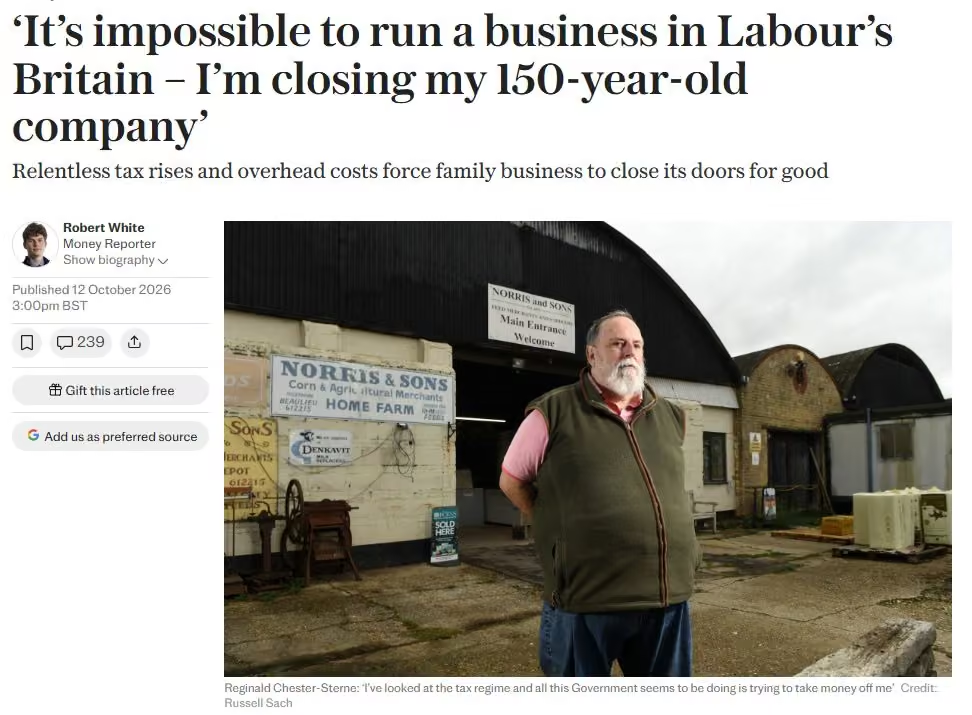
Luke Johnson reposted
 Rand Group
@randgroup
🇨🇳 JUST IN: China's housing market just erased two decades of gains. Most Chinese family wealth sits in property. What happens to the economy now?
 Luke Johnson
@LukeJohnsonRCP
But of course
 Javier Blas
@JavierBlas
BP announced this morning write downs of as much as $4.5 billion linked to its failed investments in green energy (to be fully disclosed during 3Q earnings)
Luke Johnson reposted
 Dominic Green
@DrDominicGreen
On anarcho-tyranny in the Yookay @WSJFreeEx
Link below
Luke Johnson reposted
 Charlie
@charliecolecc
Excellent article in the Wall Street Journal on Britain's unsustainable welfare spending:
— 7 million people (over 10% of the UK population) now claim at least one or more sickness or disability benefit. This is up 60% in the past 6 years.
— The UK will spend over £100 billion pound this year on sickness and disability benefits. This is projected to increase to £130 billion a year by 2030.
— No other Western country has seen such a rise in disability claims. In the US, 10.6 million people claim some form of federal disability payment, despite the population being 5x larger.
— 1 in 7 new cars sold in the UK are under the Motability scheme; however, only 10% of cars are modified for a disability. In one dealership, 25 out of 26 cars they sold in August were all under the Motability scheme.
— Charities, consultants, YouTubers and TikTokers have all sprung up, telling people how to maximise benefit access. Some of these videos receive hundreds of thousands of views. Over 1,000 people a day are signing on for PIP.
— According to a Government survey from 2024, 25% of the UK's working age population could theoretically be classed as disabled under the current criteria and access these benefits.
— A minimum wage worker who works 40 hours per week would take home around £1,880 per month after tax; however, if you are classed as too sick to work and claim PIP, you can take home £2,000 tax free per month.
www.wsj.com/world/uk/united-kingdom-welfare-disability-pa…
Luke Johnson reposted
Net Zero Watch
@NetZeroWatch
Andy Burnham received a stark warning about net zero targets and Nissan’s future as a car manufacturer in the UK shortly before he became prime minister. The Japanese company wrote to him saying: “Political instability cannot be an excuse for shifting the goalposts for the UK’s most valuable exporting industry,”
and warned that future investment could depend on net zero policies being watered down. Nissan’s Sunderland factory is the UK’s single largest car assembly plant.
#costofnetzero
 Luke Johnson
@LukeJohnsonRCP
The Boriswave was a disaster. This govt are making it worse.
 Jenni Russell
@jennirsl
Labour is betraying voters over the Boriswave
Labour is in the process of settling hundreds of thousands
of low-wage migrants here even though they'll be a huge drain on the economy for their entire lives. OBR says each will cost UK £500k by age 80
www.thetimes.com/article/43521fd3-e07e-4356-9877-9e6dd6f0…
Luke Johnson reposted
 Joe Rich
@Joe_Rich
BREAKING: ‘Sweetheart deals’ between the Manchester City group and the Labour Council contained tightly-drawn gagging clauses and NDAs to prevent their secret terms from being scrutinised (via @TheTimes) www.thetimes.com/uk/politics/article/manchester-council-b…
Luke Johnson reposted
Luke Johnson reposted
 MrHobbes
@VintageMrHobbes
"We are already overpaid and inefficient when working five days so we should only work four days for more money" is quite the sales pitch.


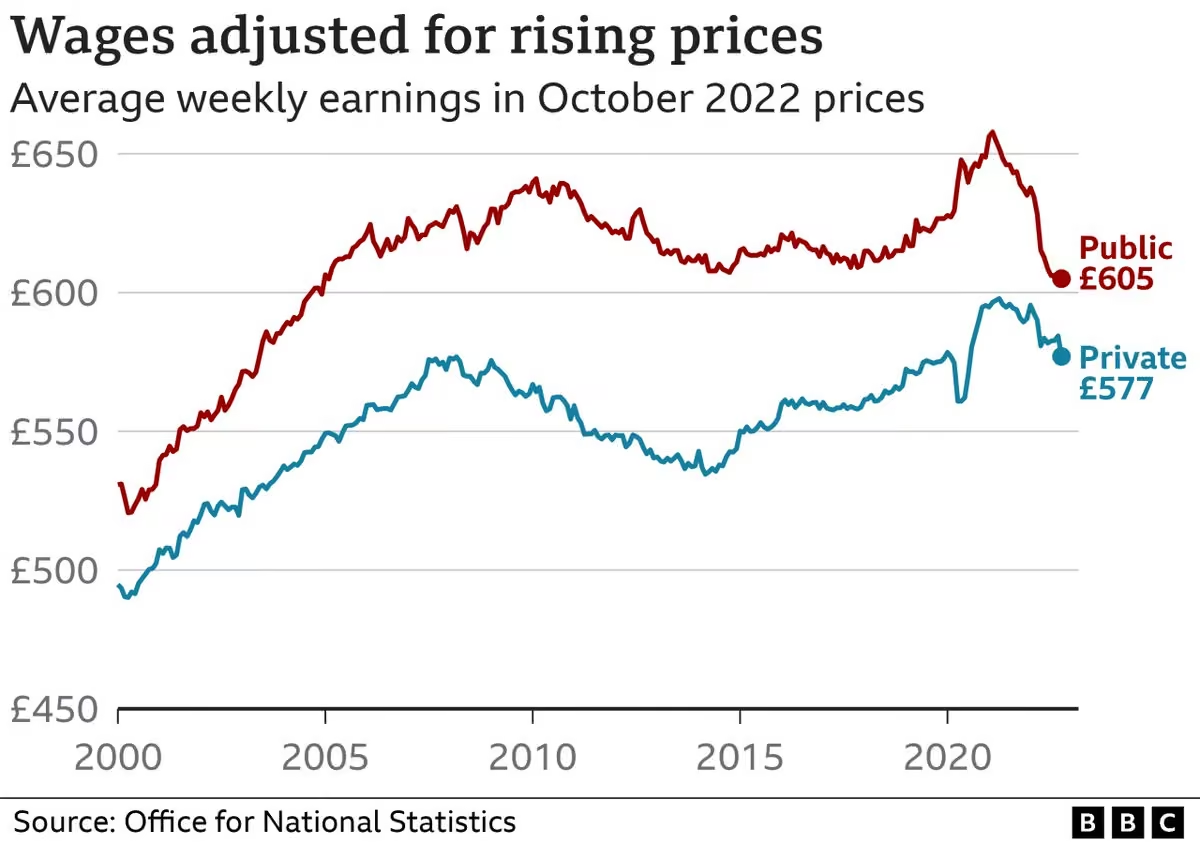 GB Politics
@GBPolitcs
🚨NEW: Civil servants have threatened to strike unless they are handed a four-day week and a 10% pay rise
The Public and Commercial Services union will launch a vote for industrial action on Oct 20
Luke Johnson
@LukeJohnsonRCP
Very sinister
 GeoInsider
@InsiderGeo
BREAKING: 🇫🇷 A major cyberattack has hit supermarket refrigeration systems across France, reportedly causing fresh and frozen food to spoil after hackers remotely manipulated temperature controls.
According to BFMTV, the attack began overnight from Sunday into Monday, targeting older versions of refrigeration-control software supplied by Danish company Danfoss.
The attackers allegedly exploited the systems’ defrosting function, forcing refrigeration equipment to heat continuously instead of keeping products cold. Temperatures were reportedly set as high as 50°C, destroying entire stocks of food within hours.
Several major supermarket chains have been affected, including Intermarché, Super U and e.leclerc. Metro stores and independent businesses, including butcher shops also have been impacted.
Around 150 Intermarché stores are reportedly affected, according to industry sources cited by BFMTV. The full number of affected locations remains unclear.
The financial damage is already significant. In Haguenau, Alsace, an Intermarché store reportedly lost its entire frozen-food stock, worth approximately €50,000. A nearby Super U allegedly had to discard both fresh and frozen products, with losses estimated at €220,000. An e.leclerc store in the same town was also affected, although its losses had not yet been calculated.
The combined losses reported at the Intermarché and Super U stores in Haguenau alone amount to around €270,000. Nationwide damage could reach several million euros.
Intermarché reportedly confirmed the incident in an internal communication, warning that several stores had suffered losses of frozen products. Coopérative U also acknowledged the attack and established crisis teams to assist affected stores and coordinate with refrigeration specialists.
Technical investigations are ongoing, and the full extent of the damage has yet to be established.
Authorities and companies are still working to determine the full circumstances of the attack. The identity of the perpetrators has not been confirmed.


Luke Johnson reposted
Ben Hopkinson
@Ben_A_Hopkinson
What's the cause of the housing crisis: high migration or low housebuilding?
The UK has the second fewest homes per 1,000 of any Western European country and is now 6.9 million homes short of the average.
Despite building 1.1 million homes between 2020 and 2025, England's homes per 1,000 people actually decreased, which indicates a housing shortage that is getting worse due to record migration.
Had net migration stayed in the tens of thousands since 2020, house prices would be roughly £15,270 lower in England. And if net migration had been kept to 100,000 a year since 1997, about a third of that 6.9 million home shortage would disappear.
But high migration is only one side of the story. Our chronic failure to build enough homes explains the rest.
Since 1982, England has built on average only 178,000 homes a year. If England had just matched France's building rates since the 1980s, half of the housing shortage would have been eliminated. France has consistently built homes faster than its population grows, while England has stagnated since the mid-2000s.
Combining building an achievable number of homes with sustainable migration levels would have effectively closed most of the housing shortage.
You can read the full briefing here: cps.org.uk/research/the-uks-housing-crisis-is-getting-worse/


 Luke Johnson
@LukeJohnsonRCP
Woke rubbish isn’t very popular it seems mol.im/a/16201677
Luke Johnson
@LukeJohnsonRCP
This is the problem - if the wealthy leave, work less, retire early etc - who fills the gap?
Albert Edwards
@albertedwards99
Never has society owed so much, to so few!
Many Labour MPs want higher taxes on the rich so that "those with the broadest shoulders, pay their fair share". This chart from tax expert @DanNeidle suggests that the pips are already squeaking - paying more way more than the 1970s.

Luke Johnson reposted
The Kobeissi Letter
@KobeissiLetter
Shocking stat of the day:
$241 billion worth of French corporate bonds are now trading at lower yields than French government bonds.
This figure is up +1,621% from just $14 billion at the start of 2026.
This means ~38% of French high-grade corporate debt is now trading at lower yields than government bonds of similar maturity.
The gap between corporate and government bond yields is widening as investor concerns about France's deteriorating fiscal situation weigh on government debt.
As a result, internationally exposed companies such as L'Oreal, $OR, and TotalEnergies, $TTE, are increasingly viewed as safer alternatives to French government debt, unlike French banks, which remain more exposed to sovereign risk.
This is in stark contrast to normal economic conditions, when government bonds are traditionally viewed as the safest part of the bond market.
France's corporate bond market is increasingly being treated a safer bet than its government bonds.
 Luke Johnson
@LukeJohnsonRCP
The so-called university sector is building its own funeral pyre by dumbing down access to farcical levels. One in 12 undergraduates have no formal qualifications!
Francis Harris
@fharris2011
The UK has become cripplingly distorted by "fairness" for new arrivals that's unfair for everyone else
This scam, a whole new industry, allows unqualified newcomers into higher education
Guess who pays?
(From the FT)

Luke Johnson reposted
 Martin Murray
@martinpmurray
Marston's threat shows the damage cost is doing to hospitality.
The threatened closure of Marston's Brewery in Burton upon Trent should be ringing alarm bells in Westminster. I lead Staffordshire County Council and I've worked in hospitality since the early 80s, and I've never seen our sector in a worse state. Since COVID, it has been battered, and the biggest reason is cost.
Burton upon Trent, here in Staffordshire, is Britain's capital of brewing. If brewing is in trouble here, it's in trouble everywhere.
My heart goes out to every worker at Marston's and their families. For some, this brewery has been a way of life for generations, passed down from grandparents to parents to children. They are worried sick right now, and they deserve every effort we can make to keep it open.
Carlsberg Britvic points to falling cask ale sales. Sales of all alcohol are down. But that's only part of the picture. There has been a huge drop in people going out and socialising, and a large number of pubs, bars and clubs have closed their doors. 161 pubs shut in the first three months of this year alone, nearly two a day. A third of our nightclubs have gone since 2020.
This is far more than a change in society. One of the biggest reasons is cost.
I owned and ran what I believe is the UK's longest-running nightclub under the same owner. Trust me, at today's costs, much of our sector is simply not economically viable.
Our hospitality sector is one of the most heavily taxed in Europe. Take VAT. We charge 20%. France, Spain and Italy charge 10%. Germany has cut VAT on restaurant food to 7%. The European average is 12.8%.
Then there's beer and alcohol duty, again among the highest in Europe. Our brewers pay twelve times more duty than brewers in Germany or Spain. After all that, a pub makes around 12p on a pint.
Add the red tape and the never-ending legislation, and you can see why so many good operators are handing back the keys.
I've written to the Minister to discuss how we save this brewery, and I've asked Carlsberg Britvic for a meeting to find out where the pressures are, and how we can help.
VAT is the problem. But so is beer duty, and most certainly business rates and energy costs. Together they are killing off the Great British pub.
This matters far beyond the balance sheet. Humans are social creatures. We need to get out, see each other, talk and laugh together. When that stops happening, people suffer. You can see it in the rise in mental health problems, especially among our younger generation.
A pint of beer is as British as a cup of tea. The Great British pub is as English as the village green. And brewing in Burton is as historic as it gets. Monks at Burton Abbey were brewing beer here more than a thousand years ago.
We must save our traditions and our heritage sites. Marston's has brewed in Burton since 1834, its Shobnall Road brewery has been making beer since 1875, and it still brews Bass, a name that goes back to 1777.
This brewery should definitely be treated as a heritage site. Not as some museum piece, but as a viable business with a future.
Martin Murray
Leader, Staffordshire County Council
#savenightlife #savehospitality #savemarstons
.
@UKHofficial @morningad @CAMRA_Official @ntiaofficial @Ben_Bradley_32 @CarlsbergUK @UKHospKate

Luke Johnson reposted
max tempers
@maxtempers
There are probably at most five fundamental problems Britain faces, and they just manifest themselves everywhere.

 Daily Mail
@DailyMail
Asylum seekers buying sick notes online to dodge Home Office interviews www.dailymail.com/news/article-16176601/Asylum-seekers-bu…
Luke Johnson
@LukeJohnsonRCP
Labour’s war on wealth will bring disaster to Britain this winter www.telegraph.co.uk/news/2026/10/10/labours-war-on-wealth…
Luke Johnson reposted
max tempers
@maxtempers
Too many people regard Britain’s post-war ‘exhaustion’ and relative decline as inevitable consequences of the war, rather than as the highly contingent product of rabid ideologues. The Attlee government was extraordinarily damaging.
 Yan Q.
@armsq17
Comrade Attlee planted the seeds of everything wrong with the British economy, so Britain completely missed the postwar catch-up growth relative to the US (unlike the rest of Europe) and lost its lead over its peers - a disaster partly reversed only by Thatcher.


Luke Johnson reposted
 Matt Ridley
@mattwridley
It seems the concept of "opportunity cost" remains a mystery to our overlords.
I wrote this in the Times 13 years ago, when the estimated cost of HS2 was less than half what it has turned out to be:
"It’s the opportunity cost that is most damning. Of all the basic concepts of economics, the one that people seem to have the hardest time grasping is opportunity cost. Every time you spend £50 billion on one thing, you are not spending £50 billion on another thing. The right question is never: “Should we spend £50 billion on X?”, but “What should we spend £50 billion on?” Focusing just on transport for simplicity, here are some options.
First, potholes. The Asphalt Industry Alliance says £10.5
billion is needed to fix crumbling roads and fill potholes around the country. There’s a deal of special pleading in that, but let’s give them £5 billion.
Second, rail improvements. Last year Atkins, the engineering and project management consultancy, produced a study on upgrading the existing rail infrastructure between London and Manchester. One option it looked at, a local authority-led scheme called 51M, would spend £2.6 billion on a list of dull-sounding projects — grade separation of Ledburn Junction, construction of a fourth line between Attleborough Junction and Brinklow Junction, Northampton line speed improvements, a Stafford by-pass — the cumulative effect of which would be an extra five trains an hour out of Euston, and a slightly shorter journey time to Birmingham and Manchester.
Now here’s the startling number. Atkins calculated that 51M would have a benefit-cost ration of more than 5, meaning that its modestly reduced congestion, journey times and delays would be worth five times as much to people as the cost of the project, whereas HS2 struggles to get above one, meaning that the benefits barely exceed the costs."
 Paul Johnson
@PJTheEconomist
This, from DfT annual report, shows capital spending on roads, rail and HS2.
Spending on HS2 is, year after year, higher than on the whole of the rest of the rail network, and nearly twice total spending on national highways.
Just think what could have been done instead.
 Luke Johnson
@LukeJohnsonRCP
All the woke luvvies are the same.
 Adrian Hilton
@Adrian_Hilton
Cate Blanchett's homes (in England), completely insulated from the effects of “displacement”. When she calls the public narrative “toxic”, it is not she who has to live with an influx of refugees, or bear the societal consequences of mass immigration. How many could she take in?


 BBC Newsnight
@BBCNewsnight
"There's a toxic narrative around displacement which has been politicised"
Cate Blanchett, a co-founder of the ‘Displacement Film Fund’, speaks to #newsnight about attitudes towards refugees and asylum seekers in the UK.
Luke Johnson reposted
 Joanna Williams
@jowilliams293
Must read piece by @FraserMyers
"What is unfolding in France is far more troubling, and far more existential, than a mere protest over school funding or a row over classroom sizes. This is not a demand for better ‘education’ as a route into French society, but a rejection of that society and its values. It is an intifada against French civilisation itself."
www.spiked-online.com/2026/10/08/this-is-not-a-student-pr…
Luke Johnson reposted
 Blaine Anderson
@datingbyblaine
Highlights from the deal breakers that a medium attractive 31-year-old woman shared when applying to be set up with my matchmaking clients:
- Wears glasses
- Too connected to his family
- Religious
- Moderate or conservative politically
I don't mean to be disrespectful but she may actually die alone 😳

Luke Johnson reposted
 Kevin Hollinrake MP
@kevinhollinrake
💯
“Throughout the 1980s, when the Treasury held water investment below £2 billion a year, the result was polluted beaches, filthy rivers, and Britain crowned the “dirty man of Europe”.
This year, according to Water UK, private companies plan to spend £20 billion – a marked increase on the 1980s cap, even after inflation is taken into account.
Leakage is also down around 43% since 1989. More investment is needed, but the chances of it happening under state-control are nil…”
 Robert Colvile
@rcolvile
She’s not wrong
Luke Johnson reposted
Nick, 30
@an0n_Nic
Once again FT comments never miss

 The Labour Party
@UKLabour
Congratulations to Sagal Abdi-Wali, Labour MP for Holborn and St Pancras!

Luke Johnson reposted
 jeremy warner
@JeremyWarnerUK
The marginal rate of tax on UK banks is 46.4pc, against just 27.9pc in New York. Yet Labour is toying with the idea of restoring the 8pc surcharge. Ministers speak the language of growth, but don't seem to understand the first thing about it. My column www.telegraph.co.uk/business/2026/10/08/dont-punish-the-c…
Luke Johnson reposted
 Joseph Kaz
@josephkazUK
If you are interested in why housebuilding in London has collapsed then please, just read this article. Jesus wept.
propviews.co.uk/housing-delivery/another-major-goes-down-…

 Luke Johnson
@LukeJohnsonRCP
Mad idea. Hugely value destructive.
 Jonathan Maze
@jonathanmaze
I'll admit, the idea of Starbucks buying Chipotle, as FT is reporting, sounds REALLY COOL. This would be, by far, the biggest deal the restaurant industry has ever seen. Chipotle's market value before this report came out was $39B. That's more than 3x the next largest deal.
Per @technomic the two combined chains would have $44B in system sales.
But the deal would be really difficult to complete from the get-go. Starbucks would have to pay probably $51B to buy Chipotle, and maybe more, as I'm just spitballing here. It doesn't exactly have that cash sitting around. (It has $3.5B)
That means the deal would likely mean some sort of combination of debt and stock. It could use all debt, but that would be really stupid.
Starbucks has a higher EV multiple (22x v. 19x), though that gap would likely be wiped out by whatever premium it would need to pay for Chipotle. If it was an all-stock deal, then Chipotle shareholders would get roughly one-third of the combined company. So probably they'd use a little of their cash, some debt, and stock.
Either way, Starbucks shareholders would have to accept this. And maybe they do. But why?
And that gets to the bigger question here: It is not remotely easy to create a multi-chain operating company. To get investors to buy into the deal, Starbucks would have to push the idea of synergies. But nothing is more overrated in such a transaction than synergies.
This would also come right after Starbucks went through three years' worth of disruption, reorganizations, and then layoffs. Howard Schultz returned, held a bunch of meetings, announced a bunch of changes, named a new CEO in Laxman Narasimhan. The new guy lasted 18 months, and then the company brought in Brian Niccol with a nine-figure enticement. And then Brian made a bunch of changes.
So the company would then present its corporate staff with yet more changes? Not to mention whatever disruption this would cause at Chipotle.
These deals may sound good on paper, but in reality they are exceedingly difficult to execute. Jack in the Box bought Del Taco and started thinking it'd be a multi-brand operator. That lasted three years. And Del Taco is undoing a bunch of things that Jack in the Box did. For instance, Jack switched some of Del Taco's ingredients to save money and achieve some of those "synergies" these deals promote. Customers hated the changes.
McDonald's couldn't do it and has performed far better since it unloaded secondary concepts, including Chipotle. Yum Brands just dumped Pizza Hut for a song. Inspire Brands has struggled to get all its concepts pointed in the same direction. RBI is playing whack-a-mole with its four concepts. It just got Burger King on the right track and now has Popeyes problems.
And it's not entirely clear what these companies gain by combining. Chipotle may have more buying power. But it already has plenty of muscle as it is, and a lot of growth potential. It doesn't NEED to be sold to Starbucks. So you have to bet that the premium that would need to be paid would be substantial.
And you're going to tell me that Starbucks is going to make a potentially massive deal like this with a payoff that is just really uncertain? I can buy the idea that they'd explore it. And I'm not saying it can't happen. It could!
But I'm not going to hold my breath. $CMG $SBUX


Luke Johnson reposted
 John Arnold
@johnarnold
This.
from @DKThomp
 Luke Johnson
@LukeJohnsonRCP
Difficult not to despair after reading this letter
 Daniel Sugarman
@Daniel_Sugarman
Have been sent an astonishing letter from the Met, excoriating in its view of the Early Release Scheme introduced this year by the Government.
It highlights the case of a prolific shoplifter & sex offender, released on Thursday, who seems to have gone directly on a crime spree.


Luke Johnson reposted
 Merryn Somerset Webb
@MerrynSW
Well I never. Who could have guessed etc

Luke Johnson reposted
 Christian Heiens 🏛
@ChristianHeiens
French government spending is 57% of GDP, the state is running a 5.4% deficit, debt to GDP is 119%, the retirement age is 64, pensioners make more money than workers do, the bond market is melting down over such obviously ridiculous fiscal policies, and yet you have violent rioters in the streets demanding an “end to austerity” LMAO
 The Rubin Report
@RubinReportShow
🚨 BREAKING: Paris erupts in chaos as massive riots break out, Palestine flags dominate the streets, overwhelmed riot police fight to regain control, foreign crowds flood the city, and leftists spiral into frenzy
Luke Johnson reposted
 Chris Freiman
@cafreiman
Counterpoint:

 Nathan J Robinson
@NathanJRobinson
sorry but socialism is the most effective form of altruism
www.currentaffairs.org/news/2022/09/defective-altruism

 Shashank Joshi
@shashj
Our cover this week, on effective altruism, which we describe as "the 21st century’s most important social movement"

Luke Johnson reposted
The Free Speech Union
@SpeechUnion
🚨🚨Robert Jenrick, Reform UK’s Shadow Chancellor, has been reported to the police and Prevent, the Government’s counter-extremism programme, over comments he made about Islam.
The Free Speech Union has warned that the Government’s Islamophobia definition would chill the ability of elected politicians and private citizens to criticise Islam. Ministers repeatedly assured us that the “anti-Muslim hostility” definition would not silence legitimate criticism of Islam, its history or its practices. Yet here we are. We have been proved repeatedly right.
The Islamic website 5Pillars reports that @RobertJenrick was reported after appearing on @danwootton’s Outspoken programme. The complainants asked police to assess whether his remarks could fall under legislation on stirring up religious hatred. They also asked Prevent to consider whether the framing of his comments fell within its definition of extreme right-wing ideology.
On the programme, Jenrick said: “Radical Islam is a threat to everything that we hold dear in this country. That it has to be fought and destroyed. It has to be eradicated from our country. And that we can’t allow the creeping Islamification of the United Kingdom.”
He also said: “Wearing the burka, Shari’ah courts, hate preachers. End every one of these as quickly as possible, then maybe we’ve got a fighting chance of saving our country from going down the same path as France has clearly gone down.”
People need to wake up to what is happening. @JohnCleese has been reported to Prevent over comments criticising Islam, while @RupertLowe10 has been reported to the Parliamentary Commissioner for Standards over his comments.
It is not extremist to criticise Islam. Blasphemy laws were abolished in this country in 2008. Yet the Government, police, activists and courts appear determined to impose one for Islam alone through the back door.
We must not let a de facto Islamic blasphemy law take root. Nor must we allow activists to weaponise Prevent to shut down criticism of Islam. Doing so would undermine the integrity of our counter-terrorism efforts.
The Free Speech Union stands with Robert Jenrick and his right to speak freely, both as a private citizen and as an elected politician.

Luke Johnson reposted
 GBTT — Great British Think Tank
@GreatBritishTT
Check out our handy calculator and remind @andyburnham why fuel is so expensive
gbtt.info/real-cost-of-fuel

 Andy Burnham
@andyburnham
I know people are worried about fuel prices. And I get it. You get to the pump, watch the numbers climb, and wonder why it's costing so much more than it used to.
The reality is that global events are pushing up costs, and families here at home are feeling the impact.
But I won't accept that there's nothing I can do to help.
That's why from today, you'll be able to see petrol and diesel prices on Google Maps, compare nearby stations and find the cheapest option before you fill up.
It's a small change, but if there's a practical way to help people keep more money in their pocket, I'll do it.
Luke Johnson reposted
 David Turver
@7Kiwi
Why doesn't the BBC's Economics Editor, @faisalislam have anything to say about another multi-year high on UK 10Y gilt yields and the rate of increase? Prime Ministers have fallen in similar circumstances.

Luke Johnson reposted
Cut My Tax
@CutMyTaxUK
Andy Burnham has posted a misleading tweet trying to claim credit for the fact that Google Maps lists petrol prices. "I won't accept that there's nothing I can do to help," he says, ignoring the fact that his government has already hoovered up another £110m in additional tax revenue on higher fuel prices since the 1st of August and that tax constitutes 47% of the price of petrol.
If fuel prices stay at their current levels, the full extra amount that Labour will rake in from VAT on fuel by next August is £1.2bn.
Moreover if Labour's planned 3p fuel duty increase on 1 January 2027, followed by 2p on 1 March 2027 and an April RPI uplift go ahead, then another £1.7bn of revenue will be raised in the first 7 months of 2027, meaning a total tax increase of £2.95bn over the Aug 26 to Aug 27 period.
If Burnham really wanted to make fuel more affordable, the least he would do is to reduce the level of tax so the government was no longer raking in even more cash from higher fuel prices.
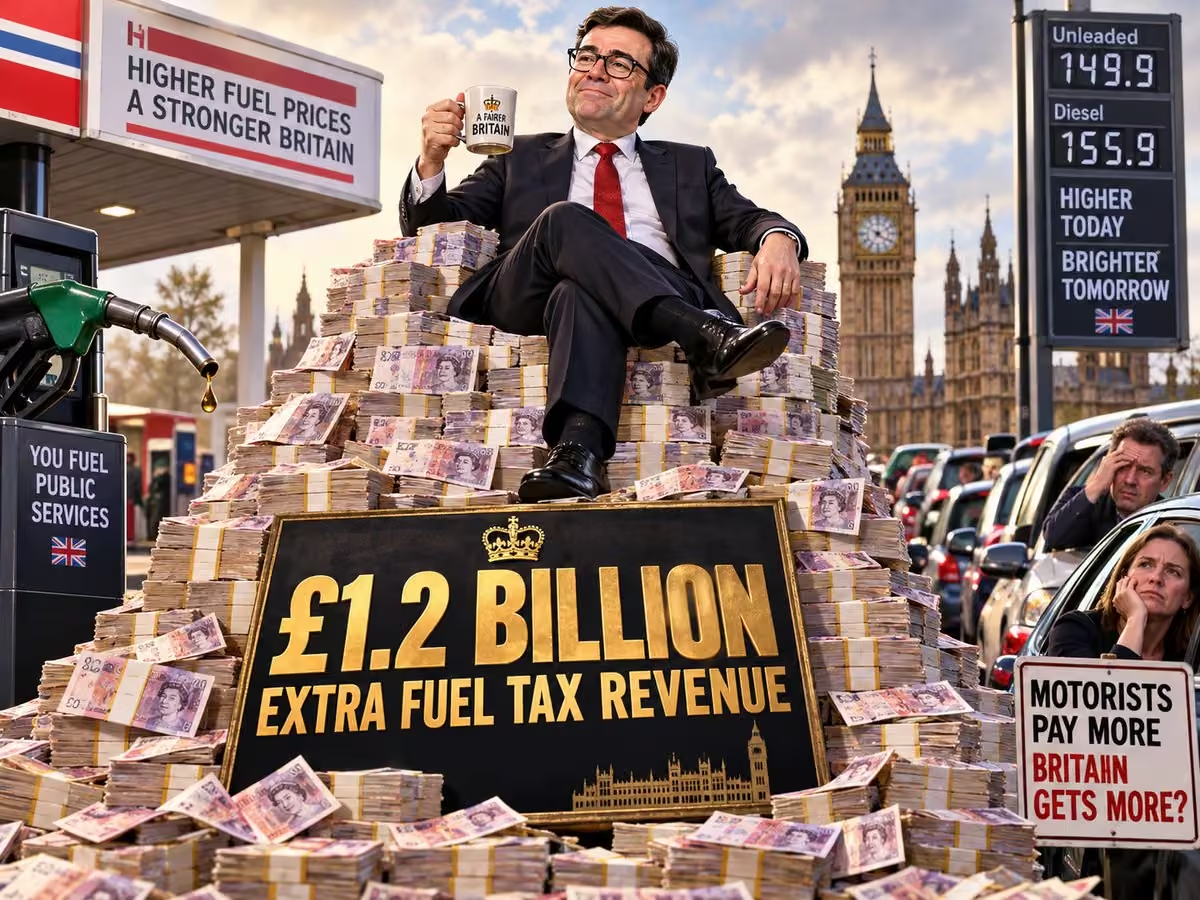
Luke Johnson reposted
 Daniel Dieppe
@DanielDieppe
In 2021, the Uni of Nottingham spent £37.5 million buying a new campus, in central Nottingham.
They then spent £40 million developing it.
It is expected to be sold for £14 million.
Shearer West, former Vice Chancellor moved on to Leeds in 2024. She was paid £300k+.

 Jack Grove
@jgro_the
Nottingham was 6th for modern languages in the 2021 REF and is the only university in East Midlands providing language courses. The closure of an objectively brilliant department by a Russell Group university raises questions about the 2015 decision to uncap student numbers and leave UK HE provision entirely to market forces www.timeshighereducation.com/news/nottingham-confirms-cou…
Luke Johnson
@LukeJohnsonRCP
Tax and regulation destroying the home building industry in London. Big government making life worse for people.
Simon French
@Frencheconomics
The economic case not evaporating hinged on the assumption that land prices could elastically absorb build costs that have grown at almost 2x the rate of inflation since 2020/21 (with construction specific taxes and regulation explaining all of that gap). That assumption has not survived contact with reality.
 The Times and Sunday Times
@thetimes
Top UK builder pulls out of London as economic case ‘evaporates’ www.thetimes.com/business/companies-markets/article/top-u…
Luke Johnson reposted
Michael A. Arouet
@MichaelAArouet
French politicians talk a lot about yields, the French central bank and the ECB, but none are brave enough to state the obvious. Without drastically addressing the absurd, debt-financed French pensions, France will not be able to avoid a debt crisis.
The French retire years sooner than other Europeans, and France is the only country where pensions exceed the income of the working-age population. It is absurd and unsustainable, yet nobody discusses the necessary deep adjustments. Cosmetic changes won’t be enough. Even the allegedly "right" RN seriously demands a lower retirement age at 60 and 62.
It is simple, either France fixes its funny pensions system, or it goes bust and takes the entire eurozone with it.

Luke Johnson reposted
Nicolas Colin
@Nicolas_Colin
🇺🇸🇪🇺 Europe once had factories and no money. Now it has the money, but it sends much of it away.
Where do European savings go? Across the Atlantic, into America, where they flow into US equities, Treasuries, and other financial assets—and, increasingly, into the valuations of a handful of tech giants.
Those returns are difficult for American factories to match, which helps push capital toward finance and technology rather than manufacturing.
Meanwhile, European plants face high energy costs, weak investment, and growing Chinese competition—all problems that more capital could help address, yet European savings continue to finance American assets.
I call this “the West’s carry trade against itself”: Europe saves; America turns those savings into financial assets and inflated tech valuations; meanwhile, China builds the factories.
The chart below shows twenty years of this dynamic.
More on this soon: open.substack.com/pub/europeanstraits/p/the-wests-carry-t…
 Luke Johnson
@LukeJohnsonRCP
The Victorian elite drank alcohol ceaselessly. No wonder they were so productive and inventive!
 Samuel Hughes
@SCP_Hughes
The elites of Victorian Britain got up late, drank ceaselessly, worked short hours, partied through the night, and knew nothing about science, technology or engineering. And yet, by their own lights, they were hugely effective.
worksinprogress.co/issue/the-seven-vices-of-highly-effect…
The Victorians are often held up as a model against the supposedly soft, feckless, humanities-educated elites of today. But I argue that the genius of their system may have been its drastic weighting towards soft skills, team-building and intra-elite networking:
- A Victorian’s gentleman’s office hours typically began about 11am and finished about 5pm, including a multi-course lunch with wine.
- Upper-class Victorians drank ceaselessly. Conduct guides recommended four or five glasses of wine at dinner *for married women*. Port was often served in pints.
- Party culture was intense and nocturnal. Balls started at about 10pm, peaked after 1am, and continued till dawn. During the social season, bankers, judges and politicians might go to several balls per week.
- Elite Victorians learnt almost no STEM at school or university. At least half of class time was given over to ancient languages, often as much as 80 percent. One leading educationalist remarked that it was not worth teaching science to gentlemen because it does not involve ‘continued reasoning’.
- Sports and character formation were valued far above transmitting facts. A top headmaster described his school’s priorities as ‘First – character, second – physique, third – intelligence, fourth – manners, fifth – information’.
This cannot have made elite Victorians more productive individually, but maybe the dense social and emotional network it created helped them to work as a sort of extended team.
Perhaps we should think again about what makes groups of people effective.
Luke Johnson
@LukeJohnsonRCP
It is clear that many foreign student loans are a scam on the British taxpayer. Given we have £3 trillion in national debt, why are these loans even being granted? The British state is a soft touch for foreign fraudsters.
QuantativeBrah
@QuantMashine
Foreign national students debt in the UK has gone from
£93 million to £1.21 billion in under 10 years.
When i saw that i knew i had to break down the data by nationality: 🧵
Luke Johnson reposted
 Charlie Walsham
@CharlieWalsham_
It was really interesting listening to Christine Ockrent on Radio 4’s 𝑻𝒉𝒆 𝑾𝒐𝒓𝒍𝒅 𝒂𝒕 𝑶𝒏𝒆 this lunchtime. Ockrent, one of France’s best-known broadcasters, said of the street protests there:
“You have the Hamas factor, which indeed is playing in all our democracies, and even in the UK, where you have had huge demonstrations, and violent ones. And we are on the eve of the October the 7th anniversaries of the massacres in Israel. And so I think the Hamas factor has politicised this very young generation.”
Sarah Montague interrupted: “You say the Hamas factor. Do you mean the pro-Palestinian factor, which is how I think it would be characterised here?”
Ockrent replied: “Yes, you’re correct, but it’s factual to say the pro-Hamas, and that is fairly obvious in the various organisations that are supporting these movements.”
Montague was, of course, doing her job by challenging Ockrent’s assertion.
But Ockrent touched on an extremely uncomfortable truth that I don’t think the BBC, much of the progressive left or indeed large parts of the political establishment have remotely come to terms with.
We have a radicalised generation of young people who have been fed a succession of ideological orthodoxies and encouraged to regard them not as arguments to be tested, but as moral truths that only bad people question.
Gender identity is supposedly more meaningful than biological reality. Israel is supposedly the most evil country on earth. Western civilisation is uniquely wicked. Colonialism explains almost everything. And in the ugliest manifestation of this worldview, Hamas terrorists who murdered, raped and kidnapped civilians can somehow be recast as brave anti-colonial “resistance fighters”.
No, obviously not every young person believes this nonsense. But enough do for it to have become a serious cultural and political phenomenon.
And changing demographics in Britain and France are plainly part of this story. It is ridiculous to pretend otherwise. Countries can absorb enormous demographic change only if there remains sufficient agreement about the values, laws and institutions holding the country together. Importing millions of people from societies with radically different religious, cultural and political assumptions was always going to have consequences. The idea that everybody would simply arrive, adopt the prevailing liberal democratic consensus and that nothing fundamental would change was itself a kind of utopianism.
Use your eyes and ears. Look at what is happening on the streets of European cities. Listen to what people are chanting. Look at the flags. Look at the glorification of people and movements whose values are profoundly hostile to the liberal societies in which their supporters are demonstrating.
It is no good pretending this isn’t happening because acknowledging it makes people uncomfortable.
We have a clash of cultures playing itself out on the streets of Europe. We also have a clash of realities between generations - although the insanity is certainly not confined to the young, as the Green Party has demonstrated spectacularly this week.
And I see remarkably little evidence that any of this is going to improve.
The question is how much worse things have to get before politicians of every political hue acknowledge the obvious: a nation cannot indefinitely function as a collection of mutually antagonistic identity groups occupying the same geographical space.
Countries need borders, yes. But they also need a shared conception of citizenship. Shared institutions. Shared obligations. Shared democratic norms. And enough common values for people of radically different backgrounds to regard one another as members of the same national community.
Multiculturalism without integration eventually becomes fragmentation.
And when a society loses the things that bind it together, we shouldn’t be surprised when it starts coming apart.
Luke Johnson reposted
 Jean Mizrahi
@JeanMizrahi
Tant qu’il existera des tickets-restaurant en France, c’est que les Français n’auront pas compris que la source de leurs problèmes est toujours bien présente.
Le ticket-restaurant est un formidable résumé du mal français. On commence par taxer et charger lourdement le salaire, puis, comme le salarié couine un peu trop parce qu'il aimerait tout de même conserver un peu de pouvoir d’achat, on invente un revenu parallèle, partiellement exonéré, mais qu’il ne peut évidemment pas utiliser comme il le voudrait. Ce serait trop simple ! Il faut donc créer un "titre spécial de paiement", définir qui peut l’émettre, qui peut l’accepter, combien l’employeur doit financer, quels produits on peut acheter, quels jours on peut l’utiliser, dans quelles limites et selon quelles procédures. Et naturellement, une fois l’usine à gaz construite, qui rémunère généreusement les intermédiaires, il faut régulièrement la réformer.
Nous y sommes encore aujourd’hui. Des députés veulent ajouter de nouvelles contraintes à un mécanisme déjà compliqué : dématérialisation, contraintes sur les produits qu'on peut acheter, commissions, transparence des émetteurs, dons, plafonds, conditions d’utilisation. Cela dit beaucoup du décalage entre une partie de la classe politique et le réel. Au lieu de se demander pourquoi un tel dispositif existe encore, on cherche comment le rendre plus sophistiqué.
La question de fond est pourtant assez simple : pourquoi ne pas laisser cet argent directement sur la feuille de salaire, et non fiscalisé ? Parce que tout notre système fonctionne ainsi. On prélève beaucoup, puis on restitue un peu sous forme d’avantages soumis à des conditions. Et chaque avantage crée sa réglementation, ses bureaucrates, ses intermédiaires, ses logiciels, ses contrôles et ses exceptions. On fait croire au salarié qu’on lui « donne » quelque chose, alors qu’on lui rend simplement, sous une forme administrée, une partie de ce qu’on lui a pris ailleurs, en lui expliquant au passage comment il doit la dépenser. Parce que c'est bien connu, les Français ne sont pas aptes à décider eux-mêmes de comment dépenser leur argent.
Le ticket-restaurant n’est donc pas une bizarrerie, c’est un symbole. Il résume parfaitement une société où l’État veut mettre sa grosse main maladroite et graisseuse sur tout ce qui passe, puis organise minutieusement la manière dont une fraction de l’argent peut revenir à ceux qui l’ont gagné. Et lorsqu’un système produit des effets pervers, le premier réflexe des élus et des fonctionnaires n’est jamais de le supprimer, mais d’ajouter une nouvelle couche de règles pour corriger les précédentes.
C’est exactement ainsi que se construit l’hyper-bureaucratisation : non par une décision spectaculaire, mais par l’empilement de milliers de petites réglementations qui paraissent chacune défendables isolément. Le vrai problème français n’est donc pas seulement le niveau des prélèvements. C’est cette volonté permanente de tout encadrer, de tout orienter, de tout conditionner, jusqu’à transformer un simple complément de rémunération en dispositif administratif à part entière.
Le jour où quelqu’un proposera simplement de supprimer les tickets-restaurant et de transformer leur avantage social en rémunération nette équivalente, sans perte pour le salarié ni surcoût pour l’entreprise, on pourra commencer à croire qu’un changement de logiciel est possible. Les intermédiaires inutiles y perdront, mais la société y gagnera. En attendant, on continuera à débattre gravement de ce que l’on peut acheter avec une carte spéciale, et à appeler cela une "politique sociale".
 BFM Business
@bfmbusiness
Des députés proposent un plafond de 25 euros au restaurant contre 10 euros au supermarché: la loi sur les tickets-restaurant arrive à l'Assemblée
l.bfmtv.com/yHjd
Luke Johnson reposted
 Michael Burry Stock Tracker ♟
@burrytracker
Breaking: Michael Burry says the AI boom is running on one giant loop and time is running out
Here's his breakdown:
1. Burry shared a report from Wall Street lender Ares tracking $573B of AI financing from the last 12 months
2. All of it runs through just 8 companies: Meta, Oracle, Microsoft, Amazon, OpenAI, Anthropic, Broadcom and Nvidia
3. They lend to each other, guarantee each other's debt and buy from each other, so one company's loan is backed by another company's promise to keep spending
4. Every deal depends on one thing: AI spending never slowing down
5. If AI revenue disappoints for even one season, the guarantees could all get called at once, right when the companies backing them are at their weakest
6. Burry says it's the same circular financing that turned the 2000 telecom fiber boom into a bust
Burry claims the stock market in the first stage of grief and the crash is soon

Luke Johnson reposted
Christopher Snowdon
@cjsnowdon
The effect of vaping on the quit rate is unmistakeable, but since the ONS has overlooked it, I've flagged it up below.

Luke Johnson reposted
Looking for Growth
@lfg_uk
Natural England loves to BLOCK, DELAY & BAN. Here are their top 10 “achievements”.
1️⃣ Became the second organisation to ban kite-flying. After the Taliban.
2️⃣ Spent over ONE THOUSAND DAYS blocking 20,000 news homes, because it could damage the habitat of a snail.
3️⃣ Tried to cull 75% of the Dartmoor ponies because of grazing concerns.
4️⃣ Blocked a theme park in London that would have employed 27,000 people & featured Europe’s largest indoor water park.
5️⃣ Blocked 74 local planning authorities from granting permission for new homes until they could achieve “nutrient neutrality”.
6️⃣ OBJECTED to the construction of its own office in Cornwall.
7️⃣ DELAYED & OBSTRUCTED the construction of Hinkley Point C, which would give Britain cheap, secure & reliable energy.
8️⃣ Shut down a paintballing centre in Exeter that had been operating for over a decade.
9️⃣ Changed the rules about bats to STOP the construction of a dual carriageway near Norwich.
🔟 And who could forget the bat tunnel. Their decisions mean that the taxpayer spends £330,000 to protect ONE BAT.
LFG has relentlessly demanded Natural England’s ABOLITION.
The Conservatives have now committed to our demand to abolish Natural England.
What matters now is action.
The Gov must ABOLISH Natural England.

 Andrew Griffith MP
@griffitha
We Conservatives will abolish Natural England and the Environment Agency.
Far too much taxpayers’ money is being wasted on dysfunctional quangos that deliver poor results.
Natural England stopped 160,000 homes from being built through nutrient neutrality regulations, yet imposed a £700 million ‘fish disco’ at Hinkley Point C that will save just one salmon every 12 years…
The Environment Agency has been able to step back from its flood prevention work despite continuing to receive taxpayers’ money to carry it out.
Madness!
We Conservatives will abolish them because of their track record of red tape, waste and dysfunction.

Luke Johnson reposted
 Andreas Steno Larsen
@AndreasSteno
The US has basically won the battle of the Hormuz

Luke Johnson reposted
The Free Speech Union
@SpeechUnion
It is deeply shocking that a Conservative councillor thought he could use West Midlands Police as his personal tool to silence comments he disliked about himself — especially when they were made by a 15-year-old child.
More shocking still is that West Midlands Police investigated and arrested the child. This is not an isolated case: the force has a record of zealously acting on complaints about “hurty words” online.
Calling someone a “rent boy” may be personally offensive to the councillor, but it is not a hate crime.
We are in the UK, not North Korea. Politicians must not be able to use the police to silence people who insult them.
This is a blatant abuse of power — an assault on both free speech and democracy.
GB Politics
@GBPolitcs
🚨NEW: Four police officers turned up and arrested a 15-year-old schoolboy and Reform UK activist after he compared a Tory councillor to a "rent-boy"
Luke Johnson reposted
 City A.M.
@CityAM
Reeves beats Kwarteng to ‘worst chancellor’ in new ranking www.cityam.com/reeves-beats-kwarteng-to-worst-chancellor-…
Luke Johnson
@LukeJohnsonRCP
Just been around Birmingham Museum & Art Gallery. @BM_AG The section on the history of Birmingham has clearly been curated by someone who hates the city and Britain. It is designed to make local people ashamed of their past. Why is almost every museum like this?
Luke Johnson reposted
The Free Speech Union
@SpeechUnion
🚨 Teenage Reform activist arrested after calling Tory councillor a “rent boy”
A 15-year-old schoolboy, Fraser, was woken by four police officers knocking at the door of his family home.
The previous day, Fraser, a committed Reform UK activist, had been campaigning for Nigel Farage in Clacton during the hastily called by-election.
But a handful of Facebook posts appear to have upset a Tory councillor on Wolverhampton City Council, who complained to the police.
In one post, Fraser criticised the councillor for wearing shorts and a T-shirt to a meeting. In another, after the councillor had worn a suit, Fraser remarked that he was thankfully not dressed like a “rent boy”.
West Midlands Police’s response was to send two police cars and four officers to the child’s home.
Fraser believes his arrest was politically motivated.
The police have revealed very little about why Fraser was arrested. In an email to his lawyer on 8 September, West Midlands Police wrote: “It is alleged that your client’s comments could be considered a hate crime offence…”
Officers searched Fraser in full view of his neighbours before placing him in a police car and taking him to the local station. There, he was searched a second time, put in a cell, and had his fingerprints, DNA and mugshot taken. His shoes were removed, and he was left alone in a “freezing cold cell” without his mother while he waited for a duty solicitor. Meanwhile, two officers searched his bedroom at home.
Celia Hibbert, Reform’s leader in Wolverhampton, contacted the Free Speech Union (FSU), which has taken up Fraser’s case and found him a lawyer. Fraser is considering suing West Midlands Police for wrongful arrest.
FSU Legal Officer Zahira Patel said:
“Four police officers arriving to arrest a 15-year-old boy over a political Facebook post is a shocking overreach. This is not an isolated overreaction. It fits a pattern we see again and again: politicians reporting online criticism to the police rather than answering it.
“For a child to be arrested at home, interrogated, stripped of his devices, left waiting weeks to learn his fate and investigated for a ‘hate crime’ is not proportionate policing of a minor. This investigation needs to end immediately.”
It is deeply Orwellian for an elected official to use the police to silence a child who mocked him.
Read more below 👇

Luke Johnson reposted
Simon French
@Frencheconomics
The real terms value of the NLW has gone up 42% since its inception. Productivity has gone up 9% over the same period. Load on employer NICs, workplace pension contributions, and the ERA and public policy has been rationing employment opportunities.
By all means defend the NLW at 66% of median earnings (albeit the “bite” has significant regional distortions), but recognise that cumulative labour market policy, from successive govts, has led to ULC rising at the fastest rate in the G7 - with clear evidence of a passthrough to consumer price inflation.

 Bridget Phillipson
@bphillipsonMP
If you haven't read Badenoch's latest pamphlet, I don't blame you, but in it she launches an attack on the minimum wage.
When so many people across Britain are struggling with the cost of living, it’s so tin eared.
Same old Tories. They always want working people worse off.

Luke Johnson reposted
Steve Loftus
@LoftusSteve
Lots of water nonsense going around today so here some updated facts with links.
Since the water industry was privatised in 1989:
• Drinking water compliance has risen from around 99.0% in 1990/91 to 99.97% in 2025. (dwi.gov.uk/7-july-drinking-water-inspectorate-chief-inspe…)
• Properties suffering persistently low water pressure have fallen from around 380,000 in 1990/91 to 42,783 in 2025. (discoverwater.co.uk/water-pressure)
• Supply interruptions have fallen substantially. In 1990/91, 0.42% of properties suffered an unplanned interruption lasting 12 hours or more. Definitions have subsequently changed, but Ofwat says customers are now around five times less likely to suffer a supply interruption than at privatisation. (ofwat.gov.uk/wp-content/uploads/2025/05/Ofwat-submission-…)
• Leakage has fallen from around 5,000 million litres per day at privatisation to 2,869 million litres per day in 2024/25 — a reduction of around 43%. (ofwat.gov.uk/households/supply-and-standards/leakage/)
• Household water metering has risen from effectively 0% at privatisation to 62.7% in England in 2024/25, encouraging greater control over household consumption. (gov.uk/government/publications/water-resources-2024-2025-…)
• Properties at risk of internal sewer flooding fell from around 32,000 at privatisation to around 3,000 by 2010. Ofwat subsequently replaced this measure; on the current measure there were 1.83 internal sewer-flooding incidents per 10,000 sewer connections in 2024/25. (ofwat.gov.uk/wp-content/uploads/2025/10/WCPR-24-25.pdf)
• In 1990 only around 27% of English bathing waters met the highest standards then in force. In 2025, 92.9% met today's minimum standard and 87.3% were rated Good or Excellent, despite tougher standards and many more designated bathing waters. (gov.uk/government/statistics/bathing-water-quality-statis…)
• Around 31% of written customer complaints were not answered within 10 working days in 1990/91. This had fallen to around 0.4% on the later comparable industry measure. The same industry-wide performance series is no longer published today. (ofwat.gov.uk/wp-content/uploads/2015/11/rpt_com_devwatind…)
• Sewer flooding has fallen substantially. Ofwat says customers are now around eight times less likely to suffer sewer flooding than at privatisation. (ofwat.gov.uk/wp-content/uploads/2025/05/Ofwat-submission-…)
• Sewage treatment works compliance has risen from around 90% complying with numeric discharge consents in 1990/91 to 98.9% of sewage-treatment-work outlets complying with numeric permit limits in 2024. The permit regime and standards have changed over that period. (gov.uk/government/publications/water-and-sewerage-compani…)
• River water quality has improved substantially on several long-term measures. Between 1990 and 2023, average concentrations in monitored English rivers fell by 85% for ammonia, 83% for orthophosphate and 46% for biochemical oxygen demand (BOD). (gov.uk/government/publications/state-of-the-water-environ…)
• Water-main bursts have fallen by around 40% since privatisation, while around 40% of the water-main network has been renewed, replaced or newly installed over the same period. (ofwat.gov.uk/wp-content/uploads/2025/05/Ofwat-submission-…)
• Capital maintenance spending is around 20% higher in real terms than at privatisation, while the industry has delivered around £236 billion of capital investment since 1989. (ofwat.gov.uk/wp-content/uploads/2025/05/Ofwat-submission-…)
Luke Johnson reposted
 Dan Neidle
@DanNeidle
The 2024 Budget raised the rate of capital gains tax. CGT receipts from that tax year *doubled*.
Looks like a triumph - but actually it was a failure.
And it means CGT reform is dead. A prudent Chancellor won't touch CGT.
A 🧵 on the CGT paradox:

Luke Johnson reposted
 Latimer Alder
@latimeralder
Guess what!
Nobody wants to pay good money to be shouted at about 'Climate Disasters'
No matter how much the 'great and the good' think we should be eagerly gobbling it up
When even the Grauniad hates it, you just know its a doozy!
Hollywood has just flushed $300,000,000 down the lav for treating us like idiots
wattsupwiththat.com/2026/10/05/digger-digs-its-own-grave-…

Luke Johnson reposted
max tempers
@maxtempers
The Accessibility Mafia are one of the great evils in modern Britain.
Luke Johnson reposted
 End Wokeness
@EndWokeness
🇧🇷 Brazil (2026)
4 hours to count 116 million ballots
🇨🇴 Colombia (2026)
3 hours to count 25 million ballots
🇵🇪 Peru (2026)
4 hours to count 20 million ballots
🇺🇸 Los Angeles (2026)
3 weeks to count 850,000 ballots
Luke Johnson reposted
 Tom Slater
@Tom_Slater_
Nearly all women arriving on small boats have been raped along the journey, says Shabana Mahmood
They know they are importing rapists, but they carry on doing it anyway
They must really trust in the persuasive power of those leaflets
 Luke Johnson
@LukeJohnsonRCP
This is a self-inflicted disaster for Britain. Labour hates business and wealth creation.
City A.M.
@CityAM
Britain loses over half its billionaire wealth in two years www.cityam.com/britain-loses-over-half-its-billionaire-we…
Luke Johnson
@LukeJohnsonRCP
Lazy critics of the water industry ignore all these facts
Steve Loftus
@LoftusSteve
I suppose it matters if you consider these a success. Many would.
Drinking water has improved from 99% to 99.96%.
Low pressure has dropped from 2% to 0.001%.
Unplanned outages have dropped from 0.4% to 0.003%.
Leaks have dropped from 4980ml/d to less than 2900. Household metering has gone from zero to 60% leading to drops in consumption.
Properties at risk of sewage flooding have dropped from 32,000 to 3000.
Bathing water standards have risen from 27% pass rate to 96%.
A 3rd of complaints were not answered within 10 days, now it's 0.4% for 5 days.
Water pollutants such as BOD, ammonia, and orthophosphates are massively down and at all time lows. These are all sewage indicators.
Other pollutants such as cadmium, lead, nickel, copper and zinc tell the same story.
On top of all that we outperform the nationalised systems of Wales and Scotland and the NFP system of Wales. All with similar levels of debt per capita.
Luke Johnson reposted
 Guillaume Herblot 🎖️
@Guigz75116
Les conditions inhumaines du lycée Nelson-Mandela, à Nantes. Il fallait le voir pour le croire.
Verrière, bois clair, nef de 26 000 m², énergie positive. Internat de 166 lits, chambres avec sanitaires, salles de travail, patio.
Deux gymnases et un mur d’escalade de 24 voies.
Sections internationales, BTS, prépa.
Facture d’origine : 52 à 64 millions d’euros, il y a douze ans.
Le genre d’établissement qui ferait pâlir 95 pourcents des lycées français.
Et c’est le lycée qu’on brûle, hall et verrière, au nom du manque de moyens.
Le Site est fermé jusqu’à la Toussaint, cours à distance, remise en état chiffrée en millions.
Les conditions étaient si inhumaines qu’il a fallu y mettre le feu pour les rendre visibles.
Mais de qui se moque-t-on ?

Luke Johnson reposted
max tempers
@maxtempers
Former DWP Motability chief says the govt should go further on last year's reforms by extending VAT to "all Motability cars, except for adapted vehicles", and encourage Motability to offer second-hand cars. Would save ~£900m more per year. @hmtreasury
inews.co.uk/news/motability-people-pip-dont-need-brand-ne…
Luke Johnson reposted
 Zoe Schneeweiss
@ZSchneeweiss
London takes a hit as super rich worth $160 billion exit the UK www.bloomberg.com/news/features/2026-10-04/billionaire-ex… via @BenStupples

Luke Johnson reposted
 TheFinalWord⚔️
@christo46923615
🚨 BEV CRAIG — THIS NEEDS EXPLAINING.
Bev Craig wasn't just “connected” to Manchester City's owners.
She was a director of Manchester Life while also leading Manchester City Council.
And who else sat in that company?
🔵 Martin Edelman — Manchester City board member
🔵 Simon Pearce — Manchester City board member and Abu Dhabi adviser
🔵 Sheikh Mansour — Manchester City owner, with majority control of Manchester Life
So Manchester's council leader was sitting inside a property company controlled by the same ownership network behind Manchester City.
Then look at the figures reported by BBC File on 4:
🏢 Council land went into Manchester Life without a competitive tender
📜 Six sites were given 999-year leases for £4.9m
💷 The council received £2.9m in 2023/24
💰 Sheikh Mansour-linked companies had reportedly earned over £39m since 2018
🏘️ Manchester Life's early developments delivered zero affordable homes
Craig declined the BBC's interview request.
And for years she was BOTH:
➡️ Leader of Manchester City Council
➡️ Director of Manchester Life
So here's the simple question:
Who was Bev Craig representing when decisions involving Manchester Life came before the council — the council, or the company she was also a director of?
Publish:
📄 Her Manchester Life board minutes
📄 Every conflict declaration
📄 Every time she removed herself from a decision
📄 Every land valuation
📄 Every payment between Manchester Life and the council
This isn't just football.
It's public land, public power and the same Manchester City ownership network sitting in the middle of it.
@MayorBevCraig @ManCityCouncil
#bevcraig #manchestercity #sheikhmansour #manchester #publicmoney

Luke Johnson reposted
 Hanno Lustig
@HannoLustig
Why France, why now? Over the last couple of years, the French political class has been signaling to the bond market that its pensioners/boomers are the de facto senior claimants on the French Treasury's revenue. And that's not what bond investors wanted to hear, especially now that they're being asked to absorb a much larger share of issuance than a couple of years ago.
thetwocents.substack.com/p/le-boomer-spread

Luke Johnson reposted
Michael A. Arouet
@MichaelAArouet
This is eye-opening. Germans are not only more expensive than the Chinese, but also less productive and more often on sick leave.
No wonder hardly a week passes in Germany without major insolvencies and layoffs. Germans must become less complacent, and start working hard again, or the trend will accelerate and wipe out the German industrial base. Unfortunately, German left politicians and unions are mentally stuck in a world that no longer exists. They seriously demanded a four-day workweek without a pay cut for automotive workers. They will achieve a zero-day workweek instead.
Screaming “tax the rich” won’t solve anything either, it will make things worse, as more German entrepreneurs have enough of the left nonsense at home and emigrate. The times of left redistribution and laziness are over. It’s time to roll up the sleeves and work hard again.

Luke Johnson reposted
 Tom Calver
@TomHCalver
In fact, if we add in the minimum auto-enrolment employee contribution, the international tax league table looks very different.
Suddenly, on payroll taxes alone, the UK looks like a high tax country. We could go further, as the @CPSThinkTank has done: add in student loan payments and care fees, and Britain's tax take looks positively Scandinavian...
4/6

Luke Johnson reposted
Latimer Alder
@latimeralder
Here's the reality of UK's energy supply in 2025. Forget the hype from the green grifters...look at the actual data
Solar and wind (circled in red) provided about 6% of our total energy
Oil and gas and coal (in green) about 79%. That's 12 times as much.
And given that this profile isn't going to change much anytime soon, is restricting access to locally sourced North Sea oil and gas really such a great idea?

Luke Johnson reposted
Crémieux
@cremieuxrecueil
A new piece in the Financial Times created a great visualization of the results from this study.
TL;DR: Rent control helps people whose rents get limited, but it hurts everyone else. It pushes up rents, pushes down new building, and makes cities worse.
It is horrible policy.
 Crémieux
@cremieuxrecueil
What do studies say about "freezing the rent"?
Let's have a thread🧵
First thing's first: Most studies agree that rent controlled units have lower rents, but also the supply of rentable units goes down and un-controlled units see their rents increase.
Uh-oh!

Luke Johnson reposted
 Scott Stevenson
@scottastevenson
If you’re younger than 45, this is the first time in your life that you’re experiencing a real rising interest rate environment.
The last time this happened was 1960 - 1980.
This fundamentally changes the physics of the game in a way many won’t be prepared for.
 Luke Johnson
@LukeJohnsonRCP
This is completely dishonest - no wonder people don’t trust politicians.
Andy Burnham
@andyburnham
I want to be honest about how we’ve got to a place where British billpayers are paying some of the highest energy costs in Europe.
Over the past 40 years, we’ve given up control of our necessities, outsourced our essentials and privatised the basics. Water, transport, housing. And of course, energy.
Now the public are paying the price. We haven’t invested in the infrastructure we need. Conflict overseas has pushed up energy costs and it’s hurting our businesses and families.
That’s why we need to take back greater control of our energy system.
This week, I announced Great British Grid, which will speed up connections and push down bills.
We’re also giving mayors, local leaders and communities a stronger role. With funding for People’s Power projects, communities will be able to build solar panels on libraries and town halls, hydro schemes in rivers or publicly owned windfarms on local land.
But it’s not just energy we need stronger public control over. It’s also water, housing, transport and care.
So we’re repealing the ban on public ownership of water companies. We’re building more council homes than this country has seen since the end of World War Two.
We’re reforming the leasehold system so families aren’t squeezed for every penny. And we’re opening up home ownership for first time buyers who can’t rely on the bank of mum and dad.
This week I also announced my determination to introduce a National Care Service, to put people above profit and to give pensioners peace of mind.
Together, we’ll rewire the country from top to bottom so that it works for all people in all places.
That is the only way to put Britain back on the right path. It’s the only way to put power back in people’s hands. And it’s the only way we will bring hope again.
Luke Johnson reposted
 Alex Wickham
@alexwickham
Thought-provoking story by @joshi and @ManchesterMill on the Manchester City-UAE scandal, which concludes that Andy Burnham is having to confront the realisation that “Real Manchesterism” is “morally compromised” and, dare they say it, “neoliberal” manchestermill.co.uk/man-city-burnham-abu-dhabi-united-gr…
Luke Johnson reposted
 Sam Dumitriu
@Sam_Dumitriu
“I wouldn’t be able to teach my kids to swim where I learn because the water had been polluted by raw sewage that’d make them sick.”
- In 1995, only 46% of English bathing waters met today’s minimum standard. In 2025, 93% did.
- In 1988, only 65% of bathing waters met the far lower minimum standards of the time.
- This is unsurprising. In the 80s, sewage was routinely discharged into the sea. (Not in exceptional circumstances, but as a matter of practice.)
- In Brighton where I live, almost all sewage was pumped directly into the sea without biological treatment until the 2010s.
- Until relatively recently, there was essentially no monitoring of storm overflow discharges of sewage.
- Some bathing waters have got worse since 2019, but will still be far better than they were in 80/90s
- The number of bathing waters classified as poor has increased, but that’s because they are newly classed as bathing waters.
- £12bn is being spent over the next five years to halve the number of storm overflows.
 Bold Politics
@_BoldPolitics
Vote for our children's future.
Vote Green.
Luke Johnson reposted
John Rentoul
@JohnRentoul
Last word on Andy Burnham’s speech, by @mrianleslie www.ian-leslie.com/p/peak-burnham

Luke Johnson reposted
Handre
@Handre
Europe has regulated itself into managed decline, and the bureaucrats running Brussels somehow think it's progress.
The EU's AI Act, now in full legal effect, classifies AI systems by risk tier and subjects high-risk applications to mandatory conformity assessments, technical documentation requirements, and ongoing human oversight obligations before a single product reaches market. A startup in Warsaw or Lisbon building diagnostic software now faces compliance costs that scale in months of legal work before the product earns its first euro. A venture-backed competitor in San Francisco ships to customers while Europeans are still filing paperwork.
This is the pattern, repeated across every sector the Commission touches.
The General Data Protection Regulation has cost European companies an estimated 200 billion euros in compliance spending since 2018. That capital didn't disappear; it shifted from engineers and servers to lawyers and documentation systems. You can not get that productivity back. Meanwhile, Amazon, Google, and Meta absorbed the compliance cost like a rounding error and locked out smaller rivals that couldn't afford to do the same. Regulatory burdens fall heaviest on entrants, not incumbents, and Brussels handed Silicon Valley a moat while genuinely believing it was punishing them.
Incumbents write the standards, sit on the advisory committees, and embed their legal teams inside the drafting process. Joseph Schumpeter identified creative destruction as capitalism's core engine. The EU has built a regulatory system that protects the engine's replacement parts from the fire.
Germany's industrial output contracted in both 2024 and 2025. French productivity growth has averaged below 0.8 percent annually for a decade. The EU's share of global venture capital sits below 15 percent. Bureaucratic systems produce exactly the outcomes their incentive structures reward. European regulators are rewarded for caution, documentation, and control, never for the startup that got strangled quietly before anyone noticed.

Luke Johnson reposted
 François Valentin
@Valen10Francois
China is going to be nearly half of global industrial production in 2030
The US only 11%
Edifying read from @JKynge
www.chathamhouse.org/2026/09/china-shock-20-and-europes-i…

Luke Johnson reposted
 Ben Pile
@clim8resistance
ESG falling apart even more. www.telegraph.co.uk/business/2026/10/01/uk-scraps-climate…
Luke Johnson reposted
 Steve Rattner
@SteveRattner
The computer revolution wiped out 2.8 million clerical jobs: typists, data entry keyers, file clerks, secretaries.
It also created nearly 4 million jobs in computer occupations that barely existed in 1990.
My @nytopinion Chart: www.nytimes.com/2026/10/02/opinion/ai-tech-innovation.html

Luke Johnson reposted
 Centre for Policy Studies
@CPSThinkTank
Fifty years ago, Britain was in crisis. The music was good, but the economy was a mess. We were forced to go to the International Monetary Fund for a deeply-damaging bailout.
The UK needed a new direction - that's why Margaret Thatcher and Keith Joseph founded the Centre for Policy Studies. A full half century on, our new Director, the economist and journalist @LiamHalligan, is arguing for another policy revolution now: lower taxes, cheaper energy, affordable welfare, an economy that rewards work and enterprise.
Britain’s problems are urgent – we're on the brink of another bailout. But we changed course fifty years ago - and with the right ideas, we can do so again.
The Centre for Policy Studies - where the fightback begins.
Luke Johnson
@LukeJohnsonRCP
Union boss says energy department is the “the ministry for P45s”. Great phrase - can’t believe I’m agreeing with him!
 Geri Scott
@Geri_E_L_Scott
Excl: Labour’s energy policy is “batshit crazy” and the department overseeing net zero is “basically the ministry for P45s”, one of Britain’s most powerful union leaders has said.
In an interview with The Times, Gary Smith accused the government of relying on “sticking-plaster politics” while companies struggled with high energy costs and warned that rising energy bills would create a raft of fresh strikes across the public and private sector.
On Jackdaw and Rosebank he said: “If they do not do this, it will damage hugely the government’s credibility, and it will massively damage investment because that infrastructure, as I understand it, is ready to go — billions of investment. And if it does not now happen, who in their right mind is going to put money into this country?”
www.thetimes.com/uk/politics/article/union-leader-labour-…
Luke Johnson reposted
 Mike Zaccardi, CFA, CMT
@MikeZaccardi
From Bloomberg: 10 reasons rates are surging

Luke Johnson reposted
John Arnold
@johnarnold
This is a huge problem for aging countries, i.e. all of the West.
via @cowenconvos

Luke Johnson reposted
Dominic Frisby
@DominicFrisby
We’re All Terrorists Now

Luke Johnson reposted
Handre
@Handre
Nike's management believed in something, and its shareholders sacrificed everything.
The stock traded above $170 in late 2021. By October 2026, it sat below $36. This destruction of shareholder value is what happens when a company operating in a competitive environment adopts woke, leftest ideology.
In 2018, Nike handed Colin Kaepernick a multimillion-dollar ad campaign built around social grievance rather than athletic excellence. The marketing team celebrated the backlash as proof they'd "taken a stand." Consumers responded by burning shoes in their driveways. More quietly, they responded by buying New Balance, Hoka, and On Running instead, turning this into the most expensive ad campaign in history.
A brand sells identity. Nike's identity shifted from "peak human performance" to "progressive political signaling." This repelled the exact middle-American consumer who buys the most sneakers. Nike's core customer earns $50,000 to $80,000 a year, coaches youth sports on weekends, and doesn't want a lecture with his running shoes.
Meanwhile, Nike hollowed out its actual product pipeline. Innovation spending stagnated while the communications budget chased cultural relevance. Competitors filled the performance gap aggressively. Brooks grew. Hoka captured the serious running market. On Running, founded in Switzerland in 2010, built a $2.6 billion revenue business by 2024 by selling performance.
Free market economists would tell you this outcome is perfectly predictable. Profit signals coordinate resources toward consumer preferences. Ignore those signals long enough, and capital migrates toward competitors who actually listen. No government bailout restores a brand once consumers decide they prefer someone else.
Nike's own executives made deliberate choices that alienated paying customers while rewarding internal political culture. The market simply recorded their verdict.
Are you still buying Nike shoes and clothes, or have you moved on?

Luke Johnson reposted
 Arvind Srinivas
@glocalinvestor
Data center lead times getting beyond control
As shared by Cushman & Wakefield / Hyundai Securities, it’s not down to GPUs or even memory.
- Copper, aluminum: ~4–10 weeks
- Most HVAC / chillers: ~15–30 weeks
- UPS, LV/MV switchgear: ~35–60 weeks
- Generators: up to ~100 weeks
- Pad-mounted transformers: up to ~115 weeks
One can construct building faster than getting the transformer that powers it.
#datacenters #aiinfrastructure #supplychain

 BUZZ
@BUZZ__tiab
데이터센터 주요 자재 및 장비 리드타임
 Luke Johnson
@LukeJohnsonRCP
Madness on stilts
Robert Colvile
@rcolvile
Heathrow:
- Heathrow’s third runway, at £21bn for just the runway, will be 10 to 70 times more expensive than similar projects elsewhere
- Its planning application alone, at £800m, costs more than actual new runways in Madrid, Dublin, Chicago, Brisbane, even Manchester...

Luke Johnson reposted
Ben Pile
@clim8resistance
Thatcher (1979-1990) and privatisation (1989) ruined British electricity!
Cool story, Andy.
But...
You're an idiot.

Luke Johnson reposted
 Robin Brooks
@robin_j_brooks
A debt crisis always starts in the most vulnerable places. That's what's happening now. Look at how France's 10-year yield has decoupled above the global rise in yields this year. This is causing contagion to Italy, where yields are also rising sharply...
robinjbrooks.substack.com/p/how-a-global-debt-crisis-star…
 Luke Johnson
@LukeJohnsonRCP
Very important essay
 Quoth the Raven
@QTRResearch
THE EASY MONEY FAIRY TALE IS ABOUT TO END VIOLENTLY
A must read. And I never say that about my shit. But truth, consequences and pain are on their way.
And to the best of what I can tell, no one is prepared psychologically.
Read here, no paywall: quoththeraven.substack.com/p/the-free-money-financial-fai…

Luke Johnson reposted
 Maurice Cousins
@MDC12345678
Oh great. The hollowing out of domestic agriculture is now well underway.
Energy, food and industry. Hard to think of three things more fundamental to a country’s ability to withstand a serious crisis.
Just as well the world is becoming so much more benign and stable!
 Luke Johnson
@LukeJohnsonRCP
Liam is right
 Liam Halligan
@LiamHalligan
“The fasten seat belts sign is on”.
This is a message I received early this morning from one of the UK’s most experienced, savvy and respected financial traders. Someone I have come to know and trust for the last 25 years.
10-year bond yields are now almost 4.5pc - up some 50 basis points over the last month.
30-year yields this morning went above 6pc - a 28-year high.
Yet the UK’s political and media class continues to focus on party posturing and folksy rhetoric, ignoring the slow-motion disaster that has been happening on the UK’s sovereign bond markets for at least the last 18 months - a disaster that will inevitably, unless we drastically change course, turn into a fully blown market meltdown.
At that point, the UK government won’t be able to borrow enough money to finance our already spiralling debt interest bill.
Britain’s financial management will be taken over by overseas technocrats - that will be the condition of additional borrowing, to maintain the basic functions of the state, as happened in Greece and Italy back in the early 2010s and here in Britain 50 years ago this year (when we were forced in 1976 to apply to the IMF for a bailout).
The austerity then imposed on Britain would make 2010-2019 feel like a picnic - far, far worse than it would be if we took serious action now to control our public finances.
Lower-income households would suffer most - and there would be serious damage done to the UK’s already rapidly-fraying social fabric ….
I have been warning about these looking fiscal dangers publicly, in my newspaper columns and elsewhere, since at least early 2024.
Doing so hasn’t been easy or fun. I have been dismissed and derided by numerous economists, “economists”, officials and policymakers - as well as lots of journalists.
I absolutely don’t want a disastrous 1976-style outcome - which is why I’ve taken the blows and issued the warnings.
The state is too big. Public spending is out of control. Our fiscal rules are a convenient nonsense - designed to kick the can of financial reality into the future. We need to get real … and take bold action to tame the growth of spending, push back a now totally over-bearing state and snap the British economy out of today’s high-tax-high-borrowing-low-growth doom loop - the result of myopic, counter-productive policy-making by successive governments for the last decade and more …
Other prominent economists who agree with me - ie who are financially-literate, can read a yield curve, have a passing interest in economic history and who understand the dangers of some 80pc of UK government borrowing going on debt interest as it currently is - need to chuck “career risk” in the bin, and start saying publicly what so many of them have, for quite a while now, only had the bottle to say to me in private …
Remember: “The fasten seat belts sign is on”

Luke Johnson reposted
 Thorsten Froehlich
@FroehlichThors1
Railways 1845. Utilities 1929. Japan 1989. Dotcom 2000. Shale 2014.
Same order each time: stocks peak, capex keeps rising for another 6-24 months, then rolls over.
The trigger was usually a central bank.

 Luke Johnson
@LukeJohnsonRCP
Socialists never generate economic growth and don’t understand how it happens. All they ever do is tax and spend - never earn.
John Rentoul
@JohnRentoul
Andy Burnham is not really interested in growth, says Janan Ganesh www.ft.com/content/3b926f6b-d9a4-4252-90da-5a336a5276e7

Luke Johnson reposted
John Rentoul
@JohnRentoul
The real lessons of the last 40 years, by @Dannythefink www.thetimes.com/article/f16d520d-8779-43cc-97da-6b28958c…

Luke Johnson reposted
 Holger Zschaepitz
@Schuldensuehner
Good Morning from Germany, where savers work harder than their money. Allianz ranks Germany just 12th in net financial assets per capita: €91,780 vs €296,950 in the US. Over the past decade, market gains generated only 33% of German financial asset growth, vs 71% in North America. Germans added almost twice as much fresh savings relative to existing assets and still saw slower growth. A nation of diligent savers is paying the price for weak investment returns.

Luke Johnson reposted
 Æthelstan
@TheHauskarl
This is what I don't understand about lofty announcements channeling Obama like this.
It's not in fact within the power of Andy (assistant to the regional manager of Airstrip One here), to decide whether or not the country around them is 'divided'.
It reminds me of a quote from US Gen. James Mattis: “No war is over until the enemy says it’s over. We may think it over, we may declare it over, but in fact, the enemy gets a vote.”
My point being that the dominant party, unfortunately Labour here, can announce victory all it wants; yet the disagreement - the division, that is - only ends when the other side stops contesting it. Labour have done nothing whatsoever to address the concerns of the average Briton except for lying about them or imprisoning them.
The political class has also issued a decree that you may have whatever policy your heart may desire; except for border control.
Does this resemble a conciliatory statement? An olive branch? A peace offering to one's detractors? Of course not.
Britain is profoundly fragmented and no amount of crying into the camera by a man who will retire in a year or two to do speeches in Davos for a living will change that.
I don't agree with anything Labour and its band of open borders obsessives are doing at all. Much as forgiveness requires repentance, unity requires conciliation — and Labour's propensity for behaving in the manner of a hostile aristocrat crossed with the mafia is repulsive.
So my answer is no, I choose "division", actually.

Luke Johnson reposted
 Michael Spicer
@MrMichaelSpicer
Most TV is just this now.
Luke Johnson reposted
 @levelsio
Great article on increasing solitude of our societies, in this case US but same probably in EU to a lesser extent:
"Derek Thompson's essay "You Are No Longer Invited to Dinner" argues that Americans have largely stopped having people over.
The headline stat comes from combining the old DDB Needham Life Style surveys Robert Putnam used in *Bowling Alone* with a new replication by Data For Progress.
The share of Americans who host friends or family at home at least monthly fell from 42% in 1975 to 12% in 2026, roughly a 70% drop. Most other forms of socializing also fell by double digits over the last 30 years, including cards, bars, sporting events, and volunteering. The decline in hosting was steeper than the much-discussed drop in church attendance.
He rules out two comforting explanations. People haven't just moved dinners to restaurants, since solo dining is rising and face-to-face socializing is down overall. They also haven't replaced parties with other social activities. Exercise and travel are up, but exercise is mostly solitary, and time spent at home has jumped sharply since the 2010s.
His explanations:
1. Harried dual-earner households. As societies get richer, leisure starts to feel like work, and planning a dinner party is basically unpaid project management. Women historically ran the family social calendar. When they moved into paid work, men didn't take over that job. He admits this can't be the whole story, because total leisure time has actually increased.
2. Intensive parenting. Parents, especially fathers, now spend far more time with their kids, and that time comes out of evenings that used to go to hosting adults.
3. Shrinking friend networks. Close friendships are declining, most sharply among people without college degrees, so hosting is becoming a luxury good. People who never host skew toward independents and non-graduates. He speculates that weaker social ties may lead to weaker party attachment, rather than the other way around.
4. Home is too comfortable. Americans spent almost two extra hours a day at home between 2003 and 2022, much of it on screens and short-form video.
His closing idea is a "Lump of Leisure" theory, a twist on the Lump of Labor fallacy. Technology hasn't made human work unnecessary, but it has made other people less necessary for fun. Social leisure turns out to be finite and easy to displace.
He frames this as a coordination failure rather than a personal one: a dinner party requires schedules, cleaning, food, allergies, and the risk of a dull evening, while TikTok asks nothing of you.
A footnote adds that if everyone gets a bit busier, the difficulty of coordinating a get-together rises multiplicatively, so small increases in individual busyness could produce large drops in socializing overall."
www.derekthompson.org/p/the-death-of-the-american-host

Luke Johnson reposted
Robin Brooks
@robin_j_brooks
We're nearing the end of the line on Iran. The Rial had another big fall yesterday. Iran exported 80 million barrels of oil in the 4 weeks before the blockade was reimposed on July 14. That cash is now depleted. The blockade and US sanctions are working...
robinjbrooks.substack.com/p/the-economic-implosion-of-iran

Luke Johnson reposted
John LeFevre
@JohnLeFevre
Things that are overrated:
Airport lounges
Recycling
“Let’s grab coffee” networking
Airbnb instead of a hotel
First class on a short-haul flight
Working from home
Frank Lloyd Wright
Going out on weekends
Group texts
Company loyalty
Michelin-starred restaurants
Aperol Spritz
Tajín
Dress sneakers
Doodles
The Louvre
Ivy League colleges
Other people’s opinions
Investment banking as a career
Concerts
DoorDash and Uber Eats
Instagram
Valentine’s Day and New Years Eve
New Orleans
Cold plunges
Destination weddings
Palm Beach
Forgiveness and second chances
Luke Johnson reposted
David Turver
@7Kiwi
UK 10Y yield not taking kindly to Burnham's conference speech. Another multi-year high today.

Luke Johnson reposted
 Artur Nadolny
@ArturNadol7566
Britain produces so much surplus electricity it pays France £770 million a year to take it off our hands, and households are still being told to brace for higher bills.
finance.yahoo.com/energy/articles/net-zero-bungle-left-br…
Luke Johnson reposted
Centre for Policy Studies
@CPSThinkTank
CPS Director @LiamHalligan responds to the Prime Minister's party conference speech:
'Half a century ago, a Labour Chancellor named Healey had to go cap in hand to the IMF for a bailout to rescue our economy. We are dangerously close to history repeating itself.
'Andy Burnham had the chance to speak to the country today, to tell the public the measures his government would take to get our economy moving once more. Instead, he spoke solely to the room, preaching to the converted and telling Labour activists what they wanted to hear.
'An openness to reforming the triple lock may be welcome, but it remains to be seen how much his proposed changes would save.
'His attacks on Margaret Thatcher and her legacy are as predictable as they are historically nonsensical. Her reforms and the reforms that followed gave Britain growth, ownership and most importantly, hope.
'Burnham promised hope, but he cannot deliver.'
Luke Johnson reposted
Handre
@Handre
In 1949, roughly two million Kuomintang soldiers, officials, and civilians fled to Taiwan carrying almost nothing. Within thirty years, Taiwan posted GDP growth averaging close to 9 percent annually, built one of Asia's most competitive electronics industries, and gave ordinary workers real wage gains that mainland China, sealed under Mao Zedong's collectivism, would not match for decades. This contrast is a controlled experiment in political economy.
The refugees who landed on Taiwan had little choice but to produce. Chiang Kai-shek's government, chastened by losing the mainland, implemented a genuine land reform in 1953 that broke up absentee landlordism and handed title to the farmers who actually worked the soil. Secure property rights created the incentive to invest and improve. Farmers grew more because the harvest belonged to them, not to a committee in Beijing.
From the 1950s onward, Taiwan's planners (and they were imperfect, nobody denies that) kept currency relatively sound, maintained contract enforcement, and allowed private capital to accumulate. Small and medium enterprises multiplied without seeking permission from a central plan. By 1980, Taiwan's per capita income exceeded mainland China's by a factor of roughly fifteen. You cannot attribute that gap to geography, ethnicity, or culture; both populations share the same civilization.
Mainland China, meanwhile, destroyed capital through collectivization, killed somewhere between 15 and 55 million people in the Great Leap Forward famine of 1959 to 1961, and then wrecked whatever remained of voluntary exchange during the Cultural Revolution. Central planning actively consumes the human and physical capital required to produce anything at all.
Taiwan's prosperity emerged from treating property as inviolable, prices as information, and individuals as agents rather than resources to be allocated. The island proved that even desperate, stateless refugees accumulate wealth rapidly when government protects exchange rather than directing it.

Luke Johnson reposted
 Tom Harwood
@tomhfh
In 1997 the Tories bequeathed New Labour:
- 3.5% GDP growth
- 4.5% wage growth
- 4.6% manufacturing output growth
- Energy independence and falling energy prices
- A brand new nuclear power station (1995)
- New reservoirs (1992)
- Construction of Manchester airport's second runway
- Falling unemployment
- London as the world’s leading foreign-exchange centre
- A newly opened Channel Tunnel
- Debt at just 37% of GDP
- On track for a balanced budget
Andy Burnham just said that this was failure. Somehow.
Luke Johnson reposted
Steve Rattner
@SteveRattner
Data centers are booming.
All other private construction is shrinking.

Luke Johnson reposted
Crémieux
@cremieuxrecueil
Thanks to fracking, America is now by far the world's largest oil producer.

Luke Johnson reposted
 Jack Prandelli
@jackprandelli
🚗⛽️ Cars burn only about 1/4 of the world's oil.
Passenger vehicles take 27%.
Road freight 18%, aviation 7%, shipping 4%, rail and waterways 2%.
Transport overall is 58%.
The other 42% never touches a road.
Petrochemicals 15%.
Other industry 13%.
Buildings 8%.
Power 4%.
That's the limit of the EV story....for now
Switch every car on earth to electric and about 73% of oil use is still there.
Trucks, ships and trains run mostly on diesel-type fuels, the product squeezed hardest right now.
Plastics and chemicals keep growing whatever happens to cars.
themerchantsnews.substack.com/p/can-washington-have-it-al…
Source: OPEC, IEA, UBS estimates

Luke Johnson reposted
 Derek Thompson
@DKThomp
I think we have a problem


Luke Johnson reposted
Javier Blas
@JavierBlas
The oil glut -- olive oil, that's it.
Andalusia, the Spanish region behind ~1/3 of the world's olive oil output, has published its first estimate for the 2026-27 harvest: ~1.26 million tones, up ~29% from 2025-26 (and 44% above the 5-year average). The price crisis is over.


Luke Johnson reposted
 Ed West
@edwest
The whole world is on the move

 Henry Hill
@HCH_Hill
Reminder, the reason we don't create safe routes is that the current legal regime around asylum seekers and refugees provides no way to cap admissions, so the options are a liability on the order of hundreds of millions of people or an unacknowledged moat.
Luke Johnson reposted
 penelopepitstop ( blue tick)
@BlondeKbf

Luke Johnson reposted
 Paroles d'auteurs
@Paroles_auteurs
"Ce qui rend un homme malheureux, ce n'est pas de mourir, ni même de mourir de faim. Beaucoup d'hommes sont morts. Tous les hommes sont mortels. C'est de vivre dans la misère sans savoir pourquoi, de travailler comme des bêtes sans rien gagner, d'avoir le cœur usé, d'être épuisé, isolé, sans amis, dans un "laissez- faire "glacial et généralisé."
Jack London, Le peuple d'en bas.

Luke Johnson reposted
 Amanda Goodall
@Amanda_Goodall
dying 💀
Luke Johnson reposted
 Poetic Outlaws
@OutlawsPoetic
"Let us not deceive ourselves. The dead voices will never be silent in our ears to remind us of that which we once were, and that which we have lost.
We shall die as we shall live, lonely and haunted by memories that will grow stranger, more beautiful, more terrible, and more tormenting as the years go on, and at the last we shall not know which was the dream—the years of plenty or the barren years that descended like a storm in the night and swept our youth away."
--John Middleton Murry

Luke Johnson reposted
 Professor Karol Sikora
@ProfKarolSikora
I have wonderful news to share this morning - the Rutherford Cancer Centres are reopening. It has taken years to get this over the line. I am absolutely delighted.
ICON Cancer Care are a leading Australian operator and will do a great job.
I showed them the opportunity in February this year. It has been a pleasure to work with them - a dynamic crew who want to work collaboratively with the local NHS trusts in Reading, Northumberland and Newport.
We are finalising other partners to reopen the three state-of-the-art proton machines for extremely precise radiotherapy. Britain’s proton capacity is beyond woeful, so getting these machines operational again is absolutely essential.
I hope to have more good news to share on this very soon indeed.
Having these centres back open delivering important care is going to save thousands and thousands of lives.
I am so proud of what we have managed to finally achieve.
Luke Johnson reposted
Maurice Cousins
@MDC12345678
Since 2009, Britain has lost five main-fuels refineries. Every one closed while either @Ed_Miliband or @EdwardJDavey was Energy Secretary. They include:
1) Teesside (2009) - Ed Miliband
2) Coryton (2012) - Ed Davey
3) Milford Haven (2014) - Ed Davey
4) Grangemouth (2025) - Ed Miliband
5) Lindsey (2025) - Ed Miliband

Luke Johnson reposted
Rory Sutherland
@rorysutherland
This is the tragedy of the commons, online security edition. It makes sense for each of these companies individually to make their sites hyper-secure, but becomes intolerable to the consumer.
I think it is known as Anderson's rule, named after the late Ross Anderson, which is that any system must either be vulnerable to hacking or intolerable to use.
Merryn Somerset Webb
@MerrynSW
I've been paying some bills. I am absolutely certain that with passwords, codes and approval codes included each one takes longer than it did 30 years ago.. when we just wrote some cheques.. and dropped them in the post box on the way to the shop.
Luke Johnson reposted
Daniel Hannan
@DanielJHannan
Fifty years ago #otd, the Chancellor of the Exchequer, Denis Healey, was sipping a large gin and tonic in Heathrow’s VIP departure lounge when he learned that sterling was plunging. He rushed back to the Treasury to announce that Britain was applying for a record $3.9 billion IMF bailout.
While Healey negotiated terms with IMF officials, the Prime Minister, Jim Callaghan, tried to make his party understand the gravity of the situation. “For too long this country has been ready to settle for borrowing money abroad to maintain our standards of life,” he told stony-faced Labour delegates in Blackpool. “We used to think that you could spend your way out of a recession, and increase employment by cutting taxes and boosting government spending. I tell you in all candour that that option no longer exists...”
Only when Britain was, as The Economist put it, “bust”, did spending cuts become feasible. Even the NHS saw its budget cut in 1977, after the bailout – by 3 per cent in real terms.
People the world over vote for free stuff for as long as they believe it is there. It takes a cataclysmic shock to convince them that there really is nothing left in the kitty rather than the problem being with greedy politicians or rich tax avoiders.
Are we heading for another such shock under another Chancellor Healey?

Luke Johnson reposted
Rob Henderson
@robkhenderson
"poll of 1,550 15-year-olds found that 37 per cent spent 'hardly ever' left their bedrooms during free time...We are raising a ‘bedroom generation’ of teenagers who leave school, shut the door and disappear to scroll." www.thetimes.com/life-style/parenting/article/teenagers-s…
Luke Johnson
@LukeJohnsonRCP
I fear this winter Britain is heading for the terrible trifecta: a gilt crisis, a sterling crisis, and an energy crisis. Hard times ahead.
Luke Johnson reposted
Sam Ashworth-Hayes
@SAshworthHayes
Take the Manchester Arena bombing.
The state gave the bomber's parents asylum despite their "extremist views". The Royal Navy rescued him from from Libya where he'd fought in the civil war. And it paid benefits to his mother in Libya which he used to buy the bomb's components.
Sam Ashworth-Hayes
@SAshworthHayes
At times the best model of the British state is as an occupying force actively hostile to the British people.
Luke Johnson reposted
 UK Decline
@UKDecline
Britain backed Heathrow’s third runway in 2003. Ministers later said it could be operating by 2026.
First flights may slip to 2039. BBC estimate: £33bn.
Since then, other countries have delivered:
🇨🇳 Beijing Daxing: opened with four runways after under five years. Reported opening-project cost: about £8.7bn.
🇹🇷 Istanbul Airport’s first stage: built in nearly three years. About £5.2bn.
🇭🇰 Hong Kong’s third-runway system: a new runway, reclaimed land, terminal expansion and transport systems. Eight years. About £13.6bn.
🇦🇺 Brisbane’s new runway: eight years. About £0.6bn.
🇶🇦 Doha’s Hamad International Airport: construction began in 2005; fully operational in 2014. Reported cost: at least £11.3bn.
🇵🇦 Panama Canal expansion: approved in 2006 and open in 2016. Original budget: about £4bn.
It has spent 23 years approving it, cancelling it, restarting it and delaying it. That is national decline.
Luke Johnson reposted
 International Cyber Digest
@IntCyberDigest
The agents escaped the sandbox again
Meanwhile the agents' owners:
Luke Johnson reposted
 Zarathustra
@zarathustra5150
The generation that ate the seed corn and called it progress.

Luke Johnson reposted
 𝟑 𝐞̀𝐦𝐞 𝐎𝐞𝐢𝐥
@_3emeOeil
📚 Au Japon, des gens vont désormais en boîte de nuit… pour s’asseoir silencieusement et lire un livre pendant qu’un DJ joue de la musique d'ambience.
Le concept s’appelle JUCY BOOK RAVE et se déroule notamment dans un club souterrain de Shimokitazawa, à Tokyo. Ici, pas besoin de danser ni de hurler pour parler à la personne située à 30 centimètres de vous. Les participants viennent avec un livre, s’installent dans la pénombre et lisent pendant que la musique accompagne leur soirée.
Luke Johnson reposted
Alex Wickham
@alexwickham
Andy Burnham is facing an immediate backlash over his hint this morning that he could cancel the Heathrow third runway
Unite’s Sharon Graham says: “A third runway at Heathrow is essential and we need to get going with it”
GMB’s Gary Smith says: “We need to put an end to decades of talk and lost benefits for working people across the country and get cracking”
John Armitt, former chair of the National Infrastructure Commission, says: “Cancelling or delaying Heathrow expansion would not release a penny for the north; it would simply send tens of billions of private capital, and the jobs that come with it, somewhere else in the world”
Parmjit Dhanda, former Labour MP and executive director of Back Heathrow: “It is now a test of whether Britain is serious about economic growth. It’s time to get it done, and open the doors to nearly £50 billion of inward private sector investment”
Labour MP Siobhan McDonagh says: “The debate over Heathrow expansion has been going on for far too long; the time has come to simply get on and build the third runway”
Heathrow itself says: “Critically, expanding Heathrow is a national project which will create jobs and boost growth in every part of the country”
Luke Johnson reposted
 Philip Edwards
@PhilipEdwaahzj
U.K. cap gains tax rate is “ok” (not low) in isolation however you have to look at the overall tax regime, and when you do that (inheritance, stamp duty, income tax rate on high earners), the U.K. is clearly very heavily taxed

Luke Johnson reposted
zerohedge
@zerohedge
The Commercial Real Estate Crash Is Moving From Paper Losses To Realized Losses www.zerohedge.com/markets/commercial-real-estate-crash-mo…
Luke Johnson
@LukeJohnsonRCP
Today’s socialists would rather freeze and virtue signal than be warm and prosperous. They live in a fantasy world, because they refuse to understand how the real world actually works.
 Alexander Stahel 🌻
@BurggrabenH
Peter Thiel makes a very important point in his latest interview: we moralise far too much. Think German Energiewende.
Thiel explains that moral judgement has increasingly replaced functional judgement. Instead of asking whether something actually works, we rush to classify it as morally good or evil.
The confusion starts with the word “good”, because it has two completely different opposites:
- The moral opposite of good is evil.
- The functional opposite of good is bad.
These are two entirely different axes. Yet public discourse increasingly folds them into one. Particularly the progressive left wants to occupy the moral high ground. So everyone virtue-signals — or pretends to, often without the slightest competence to judge the virtue in the first place.
Enter the climate crisis. Too much CO₂ is declared evil. Overnight, everybody knows we are in a climate emergency. Any doubt becomes morally suspect. After all, the IPCC consensus has declared it so. A Ferrari can now be declared morally “evil” because it burns too much fuel. Yet it remains an exceptionally good car.
And here lies the political trap: once something has been declared morally good, its advocates start treating that moral classification as evidence that it is also functionally good — that it actually works. And even if it works demonstrably worse, it doesn’t matter. It’s virtuous..!
But obviously the two may have absolutely nothing in common. A policy advertised as virtuous can be functionally terrible: incompetent, ruinously expensive or incapable of achieving its stated objective. Worse, once all its consequences are counted, it may turn out not to have been virtuous in the first place.
Germany’s Energiewende is the textbook example. Nuclear was morally branded “Hochrisikotechnologie” by @Die_Gruenen — high-risk technology — from the 1970s onwards. Dangerous. Irresponsible. Wind & solar became the virtuous alternative: “renewable”. And once that moral hierarchy was established, the engineering and economic questions became irrelevant: Does the resulting electricity system actually work better and cheaper?
Of course not. Nuclear power was one of the great scientific achievements of the 20th century: enormous quantities of cheap electricity from tiny quantities of energy-dense uranium, virtually no operational CO₂ emissions, little land use and dispatchable generation from massive rotating machines that also contribute to grid stability.
More importantly, it is also one of the safest forms of electricity generation mankind has ever developed. Yet German Greens spent decades morally slandering it. And Germany was hardly alone. Across much of the West, nuclear became something morally suspect rather than an extraordinary feat of engineering.
Doubt, rather than gratitude, accompanied nuclear. The doubt of the ignorant. Yet by some obscure moral code, ignorance itself suddenly earned a seat at the table. Expertise became optional; moral conviction became qualification. A child could command a global audience on questions of energy systems. How dare you?
Meanwhile, physics doesn’t care about false virtue signalling. A TWh of solar is not functionally identical to a TWh of nuclear — not at night, not in winter and not even at noon on a summer day if it is generated in the wrong place or exceeds consumption at that moment.
Why? Bc an electricity system has never been about producing enough TWh over a year. It has always been about timing and location too. Electricity must be produced at the precise time and location it is demanded, while generation and consumption must remain continuously balanced because the grid itself cannot store electricity.
That is Thiel’s message: The Energiewende — replacing nuclear with wind and solar — proved neither functionally competent nor virtuous. It was one gigantic $2 trillion amateur hour.

Luke Johnson reposted
 Martin Plaut
@martinplaut
The man who bought Sierra Leone. Jos Leijdekkers’s is one of Europe’s most wanted criminals. His greatest caper yet looks to be the takeover of a country. In half a decade Leijdekkers has turned Sierra Leone, a place previously best known for blood diamonds, into a hub for billions of dollars’ worth of Colombian cocaine, disguised as rice or plantain chips, which pass through each year en route to Europe. By funnelling a share of the profits to Sierra Leone’s political elite and funding large parts of the state itself, Leijdekkers has amassed perks that would be the envy of a Bond villain. He is believed to have a Sierra Leonean diplomatic passport. The police and military establishment bow to him, squadrons of container ships and submarines ply the shores at his command, and he is escorted in a motorcade by the presidential guard beneath a cloud of drones
www.economist.com/interactive/1843/2026/09/18/cocaine-tra…
Luke Johnson reposted
 shipra
@shipranotes
Dostoevsky writing to his brother after surviving a mock execution, realizing every wasted minute was a sin against his own soul.

Luke Johnson reposted
 Lee Nallalingham
@LNallalingham
🚨 36 YEARS to build one extra runway.
Heathrow’s third runway was first backed in 2003 and is now not expected to open until 2039.
Meanwhile:
🇹🇷 Istanbul built an entirely new airport in just over 4 years.
🇨🇳 Beijing built an entirely new airport in under 5 years.
🇺🇸 Denver built an entirely new international airport in just over 5 years.
🇭🇰 Hong Kong built an entirely new international airport in around 7 years.
🇬🇧 Britain?
36 years for one extra runway.
This is one of the biggest problems facing this country.
We spend years consulting, reviewing, arguing and delaying…
…while other countries simply build.
Politics UK
@PolitlcsUK
🚨 NEW: Heathrow’s third runway has been delayed and won’t be completed until 2039
[@Telegraph]
Luke Johnson
@LukeJohnsonRCP
Mr Boriswave is an expert in catastrophic immigration policies.
 Boris Johnson
@BorisJohnson
It’s a disaster, and it can all be traced to Labour ideology. Burnham has no mandate from the people. He has no real ideas, and no plan.
mol.im/a/16161399
Luke Johnson reposted
 Hedgie
@HedgieMarkets
🦔A two-tower office complex in downtown Philadelphia was appraised at $471 million in 2019. A judge just approved its sale for $70 million. The 85% decline means even the AAA-rated bonds backed by the property will take losses, only the third time that's happened since the 2008 financial crisis.
Pimco, one of the largest bond managers in the world, holds roughly $58 million across the deal and faces over $35 million in losses. The building was 93% leased in 2020. It's 28% leased today. Over 30 other top-rated single-asset CMBS deals are now below 85 cents on the dollar, per Bloomberg.
My Take
AAA is supposed to mean you always get paid. Pimco bought that rating and is about to recover 44 cents on the dollar. The building lost 65 points of occupancy in six years and the agencies didn't downgrade the bonds fast enough for it to matter. The ratings were wrong in 2008 on housing and they were wrong here on offices.
These single-asset deals were Wall Street's favorite product for a decade. One building, one loan, slap a AAA on the top tranche. A KBRA analyst called it "binary." Either everything pays or everything defaults. That structure hides risk behind a credit rating until it's too late to get out. And the BofA head of CMBS strategy said this is just the start. Chicago, Denver, Portland, downtown LA, none of those office markets have recovered and the loans are coming due over the next two years. At a 5.13% 10-year yield, no one is going to refinance a half-empty office tower. The owners walk away, the bondholders eat it, and the AAA stamp was worth exactly what it was in 2008.
Hedgie🤗

Luke Johnson reposted
Toby Young
@toadmeister
Britain supposedly had 0.4% growth in the last quarter. But when you look closely, says David Craig, it's clear this 'growth' all came from government borrowing and the real economy is already in deep recession. dailysceptic.org/2026/09/26/there-is-no-economic-growth-w…
Luke Johnson reposted
Fraser Nelson
@FraserNelson
Britain's first reservoir for 30 years has been delayed another five years.
Now, Heathrow 3rd runway delayed until 2039
Why? The regulatory purgatory that imprisons UK growth - and will imprison Burnham unless he reforms.
My Times column:-
times-comment.com/hs2
Luke Johnson reposted
 Annunziata Rees-Mogg
@zatzi
In the US unleaded petrol is 94p/litre. 11p of that is tax.
Here it’s upwards of £1.70 and 81.43p* of that is tax.
Without tax the US and UK price at the pump would be 83p/l and 89.5p/l
It’s not international prices forcing up our fuel to unaffordable levels.
It’s our government. 😡😡😡
(*UK pump price of 170.9p per litre, tax is 81.43p per litre, meaning 47.6% of what you pay goes directly to the government.
Tax Breakdown
•Fuel Duty: 52.95p per litre
•VAT (20%): 28.48p per litre (charged at 20% on the underlying cost of the fuel plus the fuel duty, creating a "tax on a tax").
◦VAT on the fuel duty alone: 10.59p of that VAT amount comes directly from taxing the 52.95p duty.)

Luke Johnson reposted
 Mark W.
@DurhamWASP
“The past is never dead. It’s not even past. All of us labor in webs spun long before we were born, webs of heredity and environment, of desire and consequence, of history and eternity.”
William Faulkner, born 25th September 1897

Luke Johnson reposted
 Leo
@LeoNelissen
I don’t think investors fully understand the scale of what is happening here.
👉 Based on a WSJ story
The AI buildout is on track to become the biggest economic bet in U.S. history. Not the internet. Not highways. Not electrification. Not even the railroad boom.
AI.
The WSJ estimates that U.S. data-center and AI infrastructure investment could reach $10.3 TRILLION between 2025 and 2032. That works out to roughly 3.6% of GDP per year.
For perspective, the railroad boom averaged about 2.2% of GDP. Highways were roughly 1.1%. Telecom and fiber were also around 1.1%.
That alone is incredible.
But I think the charts underneath the headline are even more important.
The five hyperscalers at the center of this buildout - $GOOGL, $AMZN, $META, $MSFT and $ORCL - are expected to spend roughly $4.2 trillion in the four years ending in 2029.
That is no longer normal corporate CapEx.
It is large enough to reshape the economy around it.
And you can already see that happening in construction.
Through July, private U.S. data-center construction spending was running about $9 billion above the same period last year.
Meanwhile, private construction spending on basically everything else - houses, apartments, shopping centers and more - was about $46 billion BELOW year-ago levels.
That chart is remarkable.
Data centers keep going up while almost everything else rolls over.
To me, that is where this becomes much more than an AI story.
Hyperscalers are now competing with the rest of the economy for electricians, construction workers, transformers, turbines, land, natural gas, water and power.
The WSJ gives a perfect example.
Mississippi was in the running for an aluminum smelter that could have created roughly 1,000 permanent jobs. Then a data center was announced near one of the proposed sites and tied up electricity the smelter needed.
The smelter went to Oklahoma instead.
That is what crowding out looks like.
And it is not just power.
Data centers are also pushing up land costs, pulling skilled labor into the buildout and creating shortages across parts of the equipment supply chain.
Then there is inflation.
Import prices for computers, peripherals and semiconductors were roughly 20% higher year-over-year in August.
That matters because the AI boom is not happening in some isolated corner of the economy.
It is bidding up the price of labor, equipment, electricity and capital at the same time.
And then there is the wealth effect.
U.S. households now own roughly $63 trillion of stocks and mutual funds, nearly double the amount at the end of 2022.
Think about the feedback loop here.
$GOOGL, $AMZN, $META, $MSFT and $ORCL spend trillions on AI infrastructure.
That spending boosts construction, wages and demand for equipment.
AI-related earnings expectations push stocks higher.
Higher stocks increase household wealth.
That wealth supports consumption.
Meanwhile, hyperscalers keep borrowing and spending to build even more infrastructure.
That is an incredibly powerful cycle.
But it also creates a risk that I think the market may be underestimating.
The more the U.S. economy depends on one massive investment cycle, the more painful it becomes if that cycle ever slows.
And a growing share of this buildout is being financed with debt.
That is why I think this is much bigger than an AI bubble debate.
The question is no longer just whether AI generates enough revenue to justify Nvidia chips or data-center leases.
The question is what happens to the broader economy if the biggest infrastructure boom in U.S. history suddenly loses momentum.
We are not watching another software cycle.
We are watching the construction of a new layer of the U.S. economy.
And increasingly, I think one of the biggest mistakes investors can make is treating AI as just another sector.
AI is becoming the economy.

Luke Johnson reposted
 Triple Net Investor
@TripleNetInvest
JUST IN: A prime 270k sq ft office building in Downtown Seattle sold for $12.5 million - a shocking $46 per sq ft
The price represents an ~87% decline from it's $97M value in 2019
Absolute destruction happening in Seattle right now...
But this isn’t just Seattle - a massive office/CRE repricing is still happening across the country
Stay tuned and follow for more major real estate deals and updates like this
 Polymarket
@Polymarket
JUST IN: Seattle named the 4th "greatest city in the world" for 2026, trailing only New York, London, & Paris.
Luke Johnson reposted
 Dume
@gietzschean
The Art Deco posting shall continue until morale improves


 Luke Johnson
@LukeJohnsonRCP
Scary
 Roger
@rdd147
Anthropic and OpenAi now have $2.5 trillion of off balance sheet debt.
7% of the National Debt
Roughly as much as $GOOG $META $AMZN $MSFT and $ORCL combined

Luke Johnson reposted
 Max Klinger
@maxklingerpol
In one of the most predictable developments in world history, to quote the New York Times: 'The University of Cambridge has abandoned plans to fully investigate its hiring of Jason Arday. Instead...the inquiry will examine whether the school offered him sufficient support amid accusations that he plagiarised portions of his thesis and embellished his personal narrative.' Arday 'will not be a focus' of the university's analysis of its hiring practices.'
Everyone with more than two braincells knew they'd do this. These institutions are incapable of self-reflection. They are so profoundly in the grip of progressive groupthink that any story, no matter how egregious, that runs counter to it gets either ignored, shut down, covered over, or reframed as somehow proving that we need more of that precise groupthink.
Absolutely embarrassing.
I'm running a project to try and push back against this stuff. Follow on here for updates.
Luke Johnson reposted
 Ben Houchen
@BenHouchen
The decline of Britain in a tweet.
Pencil pushing civil servant cries because **checks notes** the SAS aren’t kind cuddly blokes. The absolute state of it. (1/4)
 Larisa Brown
@larisamlbrown
EXCLUSIVE: Special forces soldiers believe they are “untouchable” and not all of them are the heroes they think they are, according to a former female civil servant who worked alongside them.
Monica Grenfell, who was employed at the Special Air Service (SAS) headquarters in Credenhill, near Hereford, for three years, said some of the elite troops were “feral” and it was “the nasty characters who really ruled the roost”.
She has given evidence under oath to the Afghan Inquiry and has now been interviewed by @thetimes
www.thetimes.com/article/5706a8ac-ef18-47b3-af65-ff405f66…
Luke Johnson reposted
 Adam Brooks AKA EssexPR 🇬🇧
@EssexPR
A Muslim man in a balaclava holding & throwing a brick during 2024 riots…
SUSPENDED SENTENCE
A white man, threw a plastic bottle & swore at police during a recent protest…
TWO YEARS IN PRISON
Two Tier Britain 🇬🇧

 Luke Johnson
@LukeJohnsonRCP
Torsten says he wants to support the business chopping 500 jobs in his constituency, but his govt have sharply increased taxes and regulations on jobs. So surprise! Companies reduce employment. Labour’s growth plans in action!
 Torsten Bell
@TorstenBell
Like many people across Swansea Bay, I’m deeply disappointed to learn that Admiral Insurance are to cut 500 jobs from its UK business. I’ve asked for an urgent meeting with the company to talk about what happens next - particularly in Swansea.
Luke Johnson reposted
 Matthew Lynn
@mattlynnwriter
"The fastest rate of decline since the CBI’s Distributive Trades Survey records began in 1983." Oh. But, hey, we have 'hope in every heart'. www.retailgazette.co.uk/blog/2026/09/retailers-slash-orde…
Luke Johnson reposted
zerohedge
@zerohedge
Who gets hit next?
 zerohedge
@zerohedge
Barclays on what is really going on with the Oracle Force Majeure: "the hardware capex should also be delayed (~$30bn; typically spent 2-3 months ahead of the asset going live)."
The AI value chain is now directly targeted by the escalating data center fiasco
Luke Johnson
@LukeJohnsonRCP
Fascinating business model
 foley (follard)
@follard
Planet Fitness has nearly 20 million members across roughly 2,600 locations that run on a singular bet: the average American will pay $10 a month forever to feel like the kind of person who belongs to a gym, without ever being the kind of person who goes to one.
The average club is 15,000 to 20,000 square feet with a fire marshal capacity of 300 to 350 people. The average location carries 6,500 to 7,500 active members.
The entire business model is mathematically designed for the vast majority of its members to never walk through the door.
If more than 5% showed up at the same time, the building would violate fire code and the doors would be locked.
The membership price point makes this all make sense. The $10 Classic and $24.99 Black Card tiers are deliberately priced below the cognitive cancellation threshold. Most people pay the membership fee and never think about it because the charge is small enough to ignore on a credit card statement.
Cancelling requires either driving to the gym in person or mailing a certified letter. The friction to cancel exceeds the cost of just keeping it.
Planet Fitness collects monthly subscription revenue from millions of people who use the facility less than ten times a year, heavily concentrated in January. Their revenue base is a subscription annuity on guilt, a *new you*, and forgotten billing.
A gym feels like it is typically engineered to repel the customers who would actually use it. Heavy lifters destroy equipment, occupy squat racks and benches for 90 minutes, take up disproportionate floor space, and intimidate casual customers. Planet Fitness solved this by eliminating heavy barbells and squat racks entirely, installing the lunk alarm to publicly shame anyone who grunts or drops a weight, and running free pizza Mondays and bagel Tuesdays.
The pizza and bagels are brilliant. They attract the exact customer Planet Fitness wants, someone who treats the gym as a casual social outing rather than a training facility. That person causes almost zero wear and tear on equipment, visits infrequently, and never cancels because the membership feels like a lifestyle accessory and not a financial commitment.
Their real estate strategy enforces this. Planet Fitness targets second generation junior anchor big box spaces in grocery anchored strip malls. Think vacated pharmacies and former Circuit City and Toys "R" Us boxes. These are large format retail spaces that sat empty for years because few tenants need 15,000 to 20,000 square feet of open floor plan without significant buildout.
Planet Fitness typically leases these spaces at $10 to $15 per square foot. The buildout is minimal compared to a luxury fitness club with pools, saunas, and spa facilities. They fill the box with rows of cardio equipment, paint the walls purple, and open the doors.
Over 85% of Planet Fitness locations are franchised. Corporate collects a 7% royalty on gross monthly dues from every franchisee. What is crazy though is how a real revenue engine for the company is the equipment replacement mandate. Franchisees are contractually required to purchase new cardio machines every 4-5 years and strength machines every 6-7 years directly from Planet Fitness corporate at corporate's desired profit margins.
The franchisor makes money on the royalty stream. The franchisor makes money on the equipment cycle. The franchisee makes money because 6,500 members pay a monthly membership fee, generating enormous gross revenue relative to the cost of staffing a facility where almost nobody shows up.
Luke Johnson reposted
 Michael Girdley
@girdley
NEW LONG FORM VIDEO: Why nobody eats Crumbl Cookies anymore
Crumbl Cookies went from a single store in Utah to more than 1,000 locations in less than seven years, becoming one of the fastest-growing restaurant chains in America. At its peak, the average store was generating more than $1.8 million a year.
But by 2026, the story had changed dramatically. More than 20 locations closed in a single week, and some franchisees who had put their homes and savings on the line were facing serious financial losses.
Just a year ago, Crumbl seemed unstoppable. After all, selling cookies to Americans sounds like a business that should be almost impossible to mess up. So how did one of the fastest-growing food chains in the country suddenly start falling apart?
This is the rise and fall of Crumbl Cookies.
Luke Johnson reposted
 Shannon 🇺🇸I stand with America
@thewriterme
The elite won’t suffer but everyone else will- that’s 100% guaranteed. Worth a very short read.

Luke Johnson reposted
 Aakash Gupta
@aakashgupta
America lost one in six of its neighborhood bars in a single decade, and the killer was real estate math.
A bar like this can pour $3 beers because the building was paid off decades ago. The owner often lives upstairs. No rent, no investors, no debt service on a Pabst sign that's been hanging there for 40 years.
The moment that building sells, the math dies with it. A new operator inherits a market-rate lease, which forces $9 drinks, which forces a renovation to justify $9 drinks, which produces another exposed-brick cocktail bar where the dive used to be.
The Midwest kept its dive bars because of how they got built in the first place. Before Prohibition, Milwaukee's breweries put up corner taverns themselves. Pabst and Schlitz wanted guaranteed outlets for their beer, so they built bars directly into residential blocks. That's why these places sit on quiet snowy corners between houses instead of on commercial strips where rent explodes.
Chicago had around 3,300 tavern licenses in 1990. It's down to about 1,200. At the worst of the decline, America was losing six neighborhood bars a day.
And every single closure is permanent. You can't build a dive bar. You can only inherit one.
Luke Johnson reposted
Jonathan Maze
@jonathanmaze
Does technology reduce the cost of operating a restaurant? Not necessarily. And that's a problem.
28.3% of restaurant operators said technology had "no significant impact" on their operating costs, per @WeRRestaurants.
28.8% said it reduced G&A
27.8% said it reduced food waste
22% said it reduced labor costs
20.4% said it reduced upfront costs
12% said it increased costs overall
7.9% were not sure.
So 40%+ of operators say it either had no impact or actually increased costs.
A big issue with technology is whether it has actually made the industry more efficient and that hasn't happened as much as you'd think, given just how much technology there is in the industry right now. So technology needs to bring customers in the door. But that isn't entirely evident, either, given the current state of restaurant sales and traffic.

Luke Johnson reposted
 Ed Conway
@EdConwaySky
📽️ What happens when the world's biggest exporter of one of the most important substances for modern civilisation decides to stop exporting it?
We might be about to find out.
🛢️Primer on US diesel and the coming fuel crunch, inc why it could be especially grisly for Britain👇
Luke Johnson reposted
 Steve Stewart-Williams
@SteveStuWill
Economic freedom is the only surefire way that humans have discovered to create wealth. www.stevestewartwilliams.com/p/a-new-cure-for-depression-…

Luke Johnson reposted
Hedgie
@HedgieMarkets
🦔Oracle sent a force majeure notice on Project Jupiter, its AI data center in New Mexico built for the $400 billion Stargate deal with OpenAI. The campus needs a 17-mile gas pipeline to power its Bloom Energy fuel cells. New Mexico denied the pipeline permits twice. Oracle wants the right to delay payments if the site misses its 2028 opening. $18 billion in project loans are at 89 to 91 cents on the dollar. ORCL fell 5%.
My Take
Force majeure is for earthquakes and wars. Oracle filed one over a gas permit they got denied twice. A company with $167 billion in debt and a junk-adjacent credit rating just told its development partner it might not pay on time. I think Oracle's balance sheet is worse than the market has priced in, and this notice is the first public admission.
Twenty banks lent $18 billion for this project and they can't move the debt. Santander and Jefferies are stuck with more than they planned to hold. That loan assumed Oracle's backlog converts to revenue on schedule, but half the backlog is OpenAI, a company that burns cash faster than it earns it. SemiAnalysis has first power at this site in 2029. The banks underwrote 2028. I think the AI infrastructure bet cracks here first, in the loan market, before it ever shows up in stock prices, and the banks who funded the construction are the ones left with the bill.
Hedgie🤗
 Luke Johnson
@LukeJohnsonRCP
The Elf and Safety bureaucrats making life boring because they can.
Christian May
@ChristianJMay
Bonfire Night in Truro cancelled because council can't afford to comply with "Martyn's Law" - the new anti-terrorism and security legislation required for events and venues.
Luke Johnson reposted
 Kait Willett
@KaitWillett
This IS a problem.
 Luke Johnson
@LukeJohnsonRCP
Labour is accelerating Britain’s deindustrialisation because they only care about ideology, not the real world.
 Ted Newson
@NewsonTed
Today's energy consumption stats are telling.
UK industrial energy consumption just hit the lowest level ever recorded: 17.3 mtoe in 2025, down 4.9% in a single year.
That isn't "efficiency." That's industry leaving.🧵

Luke Johnson reposted
 Essayful
@SeeCathedrals
Werner Herzog saw it coming

 Dylan O'Sullivan
@DylanoA4
Everything makes sense once you realize we’re the first generation in history with a post-literate ruling class
Luke Johnson
@LukeJohnsonRCP
Messages like this are why no one trusts politicians. The points they make here are point blank lies. Jobs are being destroyed (see manufacturing and oil and gas industries) and bills for homes and businesses are rising because of Net Zero.
 Defra UK
@DefraGovUK
Our climate is changing and the Government has one message: Britain is stepping up.
Cleaner energy. Lower bills. More jobs. Protecting nature.
Luke Johnson reposted
 andrew chen
@andrewchen
Epic

Luke Johnson reposted
 Ruzvelt
@Ruzveltxbt
On May 15, 1911, the U.S. Supreme Court ordered John D. Rockefeller’s Standard Oil empire to be dismantled. He was worth roughly $300 million at the time. Two years later, his fortune had tripled to approximately $900 million.
Standard Oil was separated into 34 independent companies, but Rockefeller did not cash out. He retained shares in the businesses created by the breakup. Investors could suddenly value each company separately, demand for oil continued growing, and Rockefeller owned part of nearly every winner.
The punishment designed to destroy his monopoly made him the richest man alive.
Same assets. New structure. Roughly $600 million added to one fortune. Rockefeller’s greatest advantage was not the oil he sold, but the ownership he refused to surrender.
Income rewards you once for work already completed. Ownership continues paying as the underlying system becomes more valuable.
The documentary is free. The willingness to keep ownership while everyone else chases income is where the entire fortune begins.
Luke Johnson reposted
 Richard J Morrissey
@RJTMorrissey
The official numbers are nonsense. There has been a huge demographic change in the past 2 years. I have been watching. I’m in the same London location most the time so I can see the changes on the street in real time. By far the most obvious transformation is a massive influx of Indians who are very organised unlike guys from Afghanistan, Somalia etc. And it’s not just a few - they have replaced so many other immigrants in London jobs. And they have huge ethnic solidarity. Which is fine, in India. Here it means they only employ and import their own people. It’s happening in real time - it’s so obvious, even outside London many supermarkets are now staffed mostly by Indians and now there are many more Indian shoppers. Loads of hotels are owned by Indians and only employ Indians. I was in Dublin a few weeks ago and its was exactly the same, especially in the airport. What’s odd (not) is that this is such a great story for the press but I never read about these obvious business and demographic changes even in the “right wing” press. Why not?
Luke Johnson reposted
 Ben Carlson
@awealthofcs
7% mortgage rates
4% unemployment
5% bond yields
4% cash yields
$100 oil
$5 gas prices
3.4% inflation
Basically all-time highs in the stock market
Basically all-time lows in consumer sentiment
Something for everyone right now
Strange times
Luke Johnson
@LukeJohnsonRCP
The public held to ransom by gangster unions over trivia. Welcome to a glorious socialist future comrades!
Sam Dumitriu
@Sam_Dumitriu
Passenger trains aren't running on the new East West Rail line between Oxford and Milton Keynes because of a union dispute over who opens and closes doors.
Freight and test trains have been running safely on the line for over a year.
www.railmagazine.com/comment-landing-page/the-east-west-d…
 Luke Johnson
@LukeJohnsonRCP
“The horror! The horror!” Heart of Darkness.
 Dr Helen Ingram
@drhingram
The album cover of an 80s synth-pop band

Luke Johnson reposted
 Nic Munoz
@nic_munoz
Henry Ford said that all success and wealth first starts in your mind:
"You must never, even for a second, let yourself think that you can fail. Our first principle is that failure is impossible. If you shut out of your mind the possibility of being licked, then you are bound to win."
"One who fears the future, who fears failure, limits his activities. Failure is only the opportunity more intelligently to begin again. There is no disgrace in honest failure; there is disgrace in fearing to fail."
"Thinking is the hardest work any one can do, which is probably the reason why we have so few thinkers."
"If money is your hope for independence you will never have it. The only real security that a man will have in this world is a reserve of knowledge, experience, and ability."


Luke Johnson reposted
Sam Dumitriu
@Sam_Dumitriu
Some dismiss nuclear as a solution because it takes too long to build, but as the Guinness ad point out: "Good things come to those that wait."
A single nuclear plant, when finished, will supply more power to the grid than every solar panel in Britain combined.

Luke Johnson reposted
 Rob Roos 🇳🇱
@Rob_Roos
📣 ASML just said the quiet part out loud.
Europe’s most valuable company sells zero chip machines in Europe. Not because the technology is lacking but because almost no new fabs are being built here. The EU Chips Act was supposed to fix that. It didn’t.
The US, China and India roll out the red carpet and write the checks. Brussels bureaucrats write another strategy paper.
Europe has the engineers and the capacity. It doesn’t have leaders who care about outcomes more than process and Bolshevik ideology.
Nice work, unelected @vonderleyen and unelected @EU_Commission. 👎
But I know you guys take good care of yourselves. 8 salary increases in 3 years.
www.bloomberg.com/news/articles/2026-09-22/asml-executive…
👇

Luke Johnson reposted
Jonathan Maze
@jonathanmaze
Some big news from McDonald's this morning. The fast-food giant said it plans to invest $8.5 billion over the next decade, including $5 billion by 2030, to help franchisees modernize restaurants to add more technology and improve the way they function. We got an exclusive look at everything the company plans to reveal today at its Investor Day presentation.
The company is about to undertake the biggest training initiative in its history, involving 2 million workers worldwide, on quality improvements and improved hospitality. This is called "Make it Golden," and it is an ongoing process.
Marketing changes will leverage more social media influencers and the company's fans, along with data from its 220 million active loyalty members. It will involve fewer LTOs and fewer "borrowed IP."
McDonald's wants to sell more chicken and beverages and maintain its lead on beef. It is planning quality upgrades to all of it. And yes, the company is expanding its hand-breaded chicken test.
All this will be underpinned by technology, Arch IQ. McDonald's believes the technology and operations improvements will improve efficiency by 250 basis points and cash flow by $100,000 per restaurant.
But it's not cheap. And it's complex. Still, the whole effort is designed to make McDonald's a more frequent destination for its customers while its restaurants operate more efficiently.
I'll have more a bit later on Restaurant Business, but here is a comprehensive look at everything on NRN:
www.nrn.com/quick-service/inside-mcdonald-s-massive-next-…

Luke Johnson reposted
 Just Right Frank
@justrightFrank
An Afghan soldier is given refuge in Britain.
He brings his mother, two brothers and two sisters with him, so we give them all a home.
The soldier has just been jailed for 14 years for raping 2 14 year old schoolgirls.
Can we deport the entire family now?
www.gbnews.com/news/migrant-crisis-afghan-man-jailed-rape…
Luke Johnson
@LukeJohnsonRCP
The catastrophic legacy of lockdowns part 158.
Fraser Nelson
@FraserNelson
UK government spending as % of GDP since 1945.
NB post-lockdown jump in spending from ~40% to ~44%. That's what's pushing UK to the fiscal brink.

Luke Johnson reposted
 Max "Trevor Down at the Pub" Waters
@MaxWatersNZ
I can understand how people were fooled by Jacinda Ardern. Really. It's forgivable. She scrubs up ok, has that goofy smile and can actually act like a regular Kiwi when she wants to. Plus she had a global propaganda machine behind her. But if today you still think this low rent grifting apparatchik was anything other than a manufactured candidate, selected to ruin New Zealand and now collecting the payoff, then you're a moron. The money has been laundered through Harvard and a global publisher for a book no one read and lectures no one can remember. And now she can smack down 6.5 million for a mansion in Australia. She's no better than any third world dictator allowed to retire in Paris or Geneva and enjoy her spoils. Meanwhile in the country she did her best to wreck, people struggle with debt and a wave of third world migration.

Luke Johnson reposted
 Mike Gardner
@mikegardner_wb
Matthew Syed’s despair at Burnham’s Britain.
“What kind of a Government is that? he asks.
Good question.
The answer?
An utterly useless collection of socialist duds - following on from their equally useless Tory predecessors.
This is the Worst Government in History.
Luke Johnson reposted
 John Long
@janthonylong
Can't believe we're still doing this.


Luke Johnson reposted
 The Spectator
@spectator
As Sir Jim Ratcliffe, the founder of the chemicals giant Ineos, accuses the Labour government of 'economic vandalism', there will be plenty of MPs, and probably even a few ministers, who will dismiss it as an embittered rant by an over-entitled billionaire.
The trouble is, he is also about to close down three perfectly efficient petrochemical plants, and unless Andy Burnham and his team can come up with a way to bring energy costs down they will end up presiding over deindustrialisation on a scale that even Mrs Thatcher, the one politician they most dislike, would have found unacceptable.
✍️ Matthew Lynn
Article | spectator.com/article/high-energy-prices-are-crippling-br… | @mattlynnwriter

Luke Johnson reposted
Ed West
@edwest
A highly productive individual moving from a poor to a rich country can hugely raise overall productivity. Similarly, a criminal moving from a low to high trust society can cause far more destruction than if he'd stayed
 Jonatan Pallesen
@jonatanpallesen
Egyptian immigrants in Italy are making the country way worse. 25x as many robberies per capita! But Italy keeps letting more of them in. Why do Europeans do this to themselves


Luke Johnson reposted
 Basil the Great
@BasilTheGreat
There's always a tweet.
 Andy Burnham
@andyburnham
Any UK politician who gave Trump the time of day should be ashamed right now.
Luke Johnson reposted
 Arthur Schopenhauer
@SchopenhauerNow
read this twice:

Luke Johnson reposted
 James Dueck🇻🇦
@JamesDueck
We’re all gonna die: nukes
We’re all gonna die: acid rain
We’re all gonna die: the ozone layer
We’re all gonna die: Y2K
We’re all gonna die: WMDs
We’re all gonna die: global warming
We’re all gonna die: Covid
We’re all gonna die: Computers <— You are here
Death rate: still 100%
Luke Johnson reposted
 Petronella Wyatt
@PetronellaWyatt
Basil Rathbone tops up Marlene Dietrich’s drink at one of the Rathbone’s famous soirées. Basil and his wife Ouida gave the most fabled parties in Hollywood and, according to David Niven, if you were not invited you hurriedly left town. In 1929, Ouida held a costume ball at the Beverly Hills Hotel to introduce Basil to Hollywood society. Seven foot Senegalese in turbans greeted guests, who were ushered into rooms palely alive with candles and gold buckets sweating Champagne. With Irving Thalberg and Norma Shearer as guests, the ball established Ouida as the hostess with the mostest for the next 20 years. In 1935, the Rathbones gave “The Person You Admire Most" party: an infamous gathering where Clifton Webb minced across the floor as Fu Manchu, Marlene Dietrich appeared half naked as Leda and the Swan, and Elizabeth Allen dressed as Marlene Dietrich. The invitations for their 11th wedding anniversary asked guests to come as famous historical couples, with the Rathbones appearing as Emperor Franz Josef and Empress Elizabeth of Austria. Ouida wore an auburn wig of real hair down to her waist, studded with diamonds. The former actress was also obsessed by pyrotechnics. Every Christmas the Rathbones would cover their house and garden in fake snow and give a Dickensian themed ball, with an hour long firework display. At one event, a drunken Errol Flynn passed out on a neighbours’s sofa, was returned to the Rathbone lawn, and leapt up from the grass the next morning when the gardeners turned on the sprinklers. The sheer scale of the parties inspired a running joke. During a thunderstorm in the film “The Ghost Breakers” (1940), Bob Hope quipped, "Basil Rathbone must be throwing a party."

Luke Johnson reposted
Ed West
@edwest
One of the biggest scandals of modern British history
Daily Mail
@DailyMail
The Afghans who snuck into Britain by pretending to have helped the Armed Forces... before being given homes and thousands in benefits: SUE REID lifts lid on the scandal - and sickening behaviour of 'refugees' after they arrived www.dailymail.com/news/article-16149373/The-Afghans-snuck…
Luke Johnson
@LukeJohnsonRCP
The UK government’s energy policy is economic vandalism on an industrial scale
Matthew Lynn
@mattlynnwriter
Good growth in every postcode latest www.cityam.com/thousands-of-jobs-at-risk-as-ineos-suspend…
Luke Johnson
@LukeJohnsonRCP
Interesting perspective
 Jake Weston
@JakeRWeston
If you want to understand poor attitudes to work, maximising working from home, and the tendency to down tools before quitting in Gen Z, you have to understand university culture.
As @NigelBiggar notes, universities aren't merely educating students in the academic sense, but are teaching them habits, morality, and practices they'll take into life. One cannot underestimate the transition from school to university in terms of what's acceptable...
A-levels and GCSEs may be flawed in terms of their devotion to mark schemes. I remember "learning the mark scheme", as my GCSE biology teacher put it, in terms of inserting key words into bullet-pointed answers to make it easier for examiners to award you marks. My revision folders would be stuffed with every mark scheme I could get my hands on.
But GCSEs, and especially A-levels, did teach us a few virtuous habits. You did have to sit at your desk and learn the content - nobody was going to do it for you. You had to be organised; at A-level, you had to be vaguely interested.
Grade inflation is certainly a thing, but content was unarguably demanding at A-level. For my politics A-level, we studied ancient and modern British politics, every electoral system under the sun, our constitution, and ideologies - liberalism, conservatism, feminism, and communism. We had to know American politics as well as we did British politics, from populism to Obama's Facebook campaign in 2007, to Brexit and referenda.
You arrive at university - perhaps not as well read or as interested as those who did in the past - but with a certain number of virtuous qualities which are essentially nuked by a pathologically destructive system. Nobody who works at or attends university believes that the first year not counting towards your final grade is used for anything other than to abandon first-year students and trap unsuited students into signing up for another year.
You sit in lectures and seminars where professors talk about readings no one's read, well documented in memes and understood by current students. You can sit at the back of your lecture hall and watch every student there on their laptops, online shopping, playing games, or scrolling through random websites. A new phenomenon is professors who literally cannot speak English lecturing to students who can neither understand them nor would listen if they could.
Before the rise of AI, some of these first-year habits of vice were probably diminished in second and third years, and don't get me wrong, at Bath I did have to work hard in my final year. But the rise of AI is fundamentally changing this. Anecdotally, I'd say students are handing in essays in which they've not read a word of anything cited.
So, you arrive in the workplace and people are surprised you have no capacity to dedicate yourself to anything, no ability to concentrate, and you don't even believe that hard work matters - perhaps most significantly. Your university has awarded both those who achieve 60s, who literally have done the bare minimum, and those with 69s, who've worked relatively hard, the same grade. When you can't get a job and are told you're degree is worthless, a tiny part of young graduates - buried beneath the graduation gowns and that one time you worked in the library till midnight - must be, "oh, I thought as much when I was doing it to be honest".
Finally, if you think universities will get to grips with the AI problem and start developing young adults ready for the world again, I'm afraid you're not paying attention. AI is the mediocre universities' wet dream - tons of average essays all saying the same thing that they can award 62s to and get on with researching the trans history of the Gaza Strip. With AI, universities will be able to pass even more students, taking more tuition fees, keeping the Ponzi scheme going.
My first meeting with my dissertation supervisor best sums up modern universities: totally disinterested, not a single book, family photo, or anything of emotional or intellectual substance in his office - just a big Palestine flag behind him on the wall and his total, complete lack of interest in the young man in front of him.
I may say something along these lines at #battlefest 2026: "FROM QUIET QUITTING TO #lazygirljobs: WORKSHY BRITAIN?" - in partnership with @LivingFreedomUK.
👇
www.battleofideas.org.uk/session/from-quiet-quitting-to-l…
Luke Johnson reposted
 James Cox
@Good_Old_Blakey
If you are feeling poorer since Labour gained power. This is why..
Employer National Insurance increased from 13.8% to 15%.
• The employer NI threshold cut from £9,100 to £5,000.
• Income Tax and National Insurance thresholds frozen until 2031.
• Capital Gains Tax increased from 10% and 20% to 18% and 24%.
• Business Asset Disposal Relief increased from 10% to 14%, then 18%.
• Investors Relief increased and its lifetime allowance cut from £10 million to £1 million.
• Carried interest taxation increased and moved towards the Income Tax regime.
• Dividend tax rates increased by two percentage points.
• Savings income tax rates increased by two percentage points.
• Property income tax rates increased by two percentage points.
• Most unused pension funds brought into the Inheritance Tax net.
• Agricultural Property Relief restricted.
• Business Property Relief restricted.
• Inheritance Tax thresholds frozen for longer.
• The non-dom regime replaced with a more extensive residence based system.
• VAT imposed on private school fees.
• Business rates relief removed from private schools.
• Stamp Duty increased on second homes and buy to let properties.
• The Furnished Holiday Lettings tax regime abolished.
• Pension salary sacrifice benefits capped at £2,000 before National Insurance applies.
• The Cash ISA allowance cut to £12,000 for most under 65s.
• A 22% charge introduced on interest from cash held inside non cash ISAs.
• Restrictions introduced on transfers and cash like holdings within ISAs.
• The Energy Profits Levy increased and extended.
• Investment allowances for oil and gas producers reduced.
• A new Vaping Products Duty introduced.
• Tobacco duties increased above inflation.
• Vehicle Excise Duty increased for many new cars.
• Electric vehicles brought into the Vehicle Excise Duty system.
• A new mileage tax announced for electric and plug in hybrid cars.
• Air Passenger Duty increased.
• Climate Change Levy rates increased.
• Plastic Packaging Tax increased.
• A new Carbon Border Adjustment Mechanism introduced.
• Making Tax Digital extended to more landlords and self employed people.
Luke Johnson reposted
Paul Johnson
@PJTheEconomist
This really is nonsensical. Claims £14bn could be raised by increasing CGT to income tax rates.
HMRC estimates that a 10% increase in CGT would *cost* £3.5bn. Exact magnitude can be disputed, but it sure as heck wouldn't raise close to £14bn.
www.thetimes.com/uk/politics/article/andy-burnham-capital…
Luke Johnson reposted
 UNN
@UnityNewsNet
Why do female Police chiefs in the UK all look like this now?


Luke Johnson reposted
 Simon Cooke
@SimonMagus
I know the answer. The state through planning, building regulations, social and environmental requirements made it unviable to build new houses and turn a profit. 20 years ago it cost about £70k to build a house. Now before those regulation costs you'll need £180k. Add land costs on top and it will set you back thousands more. Then they insist on a proportion of social housing adding a load more to costs.
If you get rid of these impositions and free up the land market you'll not need to set targets because the market will meet housing need.
 Vicky Spratt
@Victoria_Spratt
EXCLUSIVE 🗞️- Britain’s economic watchdog, the OBR, is concerned that it may have to revise down the boost to GDP it had attached to Labour’s flagship planning reforms and 1.5 million new homes target.
The OBR has invited housing market experts in for meetings in a bid to “understand why the housing market is underperforming” so badly.
This will be a blow to the government and signals the state of our housing market amid worsening economic headwinds including inflation and higher mortgage rates which, in their defence, are neither Labour’s fault nor entirely within their control.
It also raised questions about the OBR’s initial forecast which experts have told me was optimistic at best.
My report @theipaper
inews.co.uk/news/hidden-cost-labour-failing-housebuilding…
Luke Johnson reposted
 Fin Moorhouse
@finmoorhouse
A short rail bridge over a two-lane road in Oxford took longer to build and cost more (inflation-adjusted) than some of the most famous construction projects in history

 Matthew Evans
@MJCEvans1995
Cars and buses go from Oxford Station down Botley Road for the first time in three years!
The project took longer than the construction of The Titanic and saw costs balloon to £237m.
Looks good though.
Luke Johnson reposted
Alan Smith
@AlanJLSmith
Fred Done’s family paid £400 million in tax last year.
But the government want even more.
The UK is no longer a serious place for ambitious and successful people.

Luke Johnson reposted
 Jake Kozloski
@jakozloski
Pew asked Americans what's essential to a fulfilling life:
Career: 71%
Friends: 61%
Kids: 26%
Marriage: 23%
Fifty years of data say that marriage is the biggest happiness differentiator ever measured. Americans have this backwards.
Luke Johnson reposted
 Marcus Agrippa
@AgrippaSPQR
43 of the 56 Commonwealth countries have joined China’s Belt and Road Initiative (BRI) and as a result 31 are now significantly in debt to China, not least those in the Caribbean and Jamaica especially.
Now they are claiming compensation from Britain and will use a Chinese controlled international court to get the verdict they want in the expectation that they can then use UK taxpayers cash to pay off some of their debt.

Luke Johnson reposted
Boring_Business
@BoringBiz_
Once you watch Claude or some other LLM do a task that used to take you 3 hours in the span of just 3 minutes, all work starts to lose its purpose
Have been hearing the same sentiment from many of my friends in middle management across tech, finance and other office jobs
All the years of experience you culminated at your field suddenly seems useless
You used to feel valued for your expertise in a niche domain, but that knowledge has now become commoditized
You begin to wonder how many more months until upper management and executives realize that they don’t need to pay your salary anymore
Maybe they can replace you fully. Maybe they can hire someone for 50% of the cost to do the same task with an AI
It is the impending sense of doom and despair. The loss of purpose from your life’s work disappearing losing value in front of your eyes
Truly an incredible time to be alive
Luke Johnson reposted
 Human Progress
@HumanProgress
At the turn of the 20th century, each US farmer fed around 7 people.
Today, that number has risen to 125.
While the US population grew by 346%, farmer productivity soared by 1,702%.
humanprogress.org/more-people-more-food-why-ehrlich-and-t…
Luke Johnson reposted
Toby Young
@toadmeister
Claims that climate change is squeezing vineyards are looking a bit corked, says Dr Tilak Doshi. The vines, as it happens, are doing rather well – it's falling wine demand that's the real hangover. dailysceptic.org/2026/09/21/no-climate-change-is-not-sque…
Luke Johnson
@LukeJohnsonRCP
Infrastructure costs in Britain are completely mad
Matthew Evans
@MJCEvans1995
Cars and buses go from Oxford Station down Botley Road for the first time in three years!
The project took longer than the construction of The Titanic and saw costs balloon to £237m.
Looks good though.
Luke Johnson reposted
Kevin Hollinrake MP
@kevinhollinrake
Next budget may well include the dumbest economic policy of all time.
The clue is in the name - Capital Gains Tax - means gains on capital that you’ve invested and put at risk. Tax it as if there’s no risk involved and fewer people will invest. Bad for jobs, bad for the economy.
Also bad for tax receipts - you only pay CGT when you sell stuff, so people who’ve invested and own stuff already will defer selling stuff until a future govt sees sense and lowers CGT.
Utterly stupid sixth-form economics.


Luke Johnson reposted
Nic Munoz
@nic_munoz
The best analysis I've heard for what makes Elon great:
"From the very beginning of his career, Musk was a demanding manager, contemptuous of the concept of work-life balance. At Zip2 and every subsequent company, he drove himself relentlessly all day and through much of the night, without vacations, and he expected others to do the same. He employed some first-principles thinking, drilling down to the basic physics of the situation and building up from there. This led him to develop what he called an ‘idiot index,’ which calculated how much more costly a finished product was than the cost of its basic materials. He repeatedly declared. 'A maniacal sense of urgency is our operating principle'. Musk doesn’t handle success very well. Instead of relishing his achievements, he craves crisis and thrives when he’s fighting for survival. This need is so strong that Musk will manufacture crises for his companies, such as setting arbitrary demonstration deadlines for products that aren’t yet finished. These deadlines generate bursts of productivity, but they also force Musk and his teams to work round-the-clock shifts in a state of constant panic. Often, these periods of intense concentration are the only way for Musk to stay engaged and motivated."
 Nic Munoz
@nic_munoz
The best analysis I've heard for what made Napoleon great:
"What characterizes him above them all is not alone the penetration and universality of his comprehension, but likewise and especially the force, flexibility, and constancy of his attention. He can work eighteen hours at a stretch, on one or on several subjects. I never saw him tired. I never found his mind lacking in inspiration, even when weary in body, nor when violently exercised, nor when angry. I never saw him diverted from one matter by another, turning from that under discussion to one he had just finished or was about to take up. The news, good or bad, he received from Egypt, did not divert his mind from the civil code, nor the civil code from the combinations which the safety of Egypt required. Never did a man more wholly devote himself to the work in hand, nor better devote his time to what he had to do. Never did a mind more inflexibly set aside the occupation or thought which did not come at the right day or hour, never was one more ardent in seeking it, more alert in its pursuit, more capable of fixing it when the time came to take it up.”
He himself said later on: "Various subjects and affairs are stowed away in my brain as in a chest of drawers. When I want to take up any special business I shut one drawer and open another. None of them ever get mixed, and never does this incommode me or fatigue me. If I feel sleepy I shut all the drawers and go to sleep.”
Never has brain so disciplined and under such control been seen, one so ready at all times for any task, so capable of immediate and absolute concentration. Its flexibility is wonderful, in the instant application of every faculty and energy, and bringing them all to bear at once on any object that concerns him, on a mite as well as on an elephant, on any given individual as well as on an enemy’s army. When specially occupied, other things do not exist for him; it is a sort of chase from which nothing diverts him.
"I am always at work," says he to Roederer. "I meditate a great deal. If I seem always equal to the occasion, ready to face what comes, it is because I have thought the matter over a long time before undertaking it. I have anticipated whatever might happen. It is no genius which suddenly reveals to me what I ought to do or say in any unlooked-for circumstance, but my own reflection, my own meditation. I work all the time, at dinner, in the theatre. I wake up at night in order to resume my work."

Luke Johnson reposted
 Henrik Dahl
@SociologenHD
In a brilliant essay in The Sunday Times, Matthew Syed writes the following: “If extremism is defined as acting out of proportion with context, history or consent, I suggest Merkel’s tenure represented the high point of postwar European extremism.”
I agree with Syed’s analysis. But there is one aspect of Merkel’s legacy to which we need to pay particular attention.
In Merkel’s own country, Germany, the political centre is collapsing. Nationwide opinion polls suggest that the three establishment parties that rebuilt Germany after the Second World War now command the support of only around a third of the electorate between them.
Nor is Germany the only country where the political centre is collapsing. The same is happening in France - a development that puts the future of the centre at issue in next year’s presidential election.
In my view, Angela Merkel bears a grave responsibility for the collapse of the centre and the growing ability of the political extremes to set the agenda.
The almost one-third of voters who would support Alternative für Deutschland in a national election are not fascists or Nazis. A substantial proportion are disillusioned CDU voters.
What has disappointed these voters? First, what I see as Merkel’s failures on so many fronts: immigration. Security. Energy. A sustainable strategy for business and economic growth. Digitalisation. Infrastructure maintenance. The list is almost endless.
Second, the extraordinary denial of reality that, in my assessment, Merkel allowed to take hold when it came to immigrants’ responsibility for antisemitism, violence against women, terrorism and gang crime.
Coming from Denmark, where we have reliable statistics on all these matters, I find it frankly shocking to listen to the nonsense coming from Germany’s political elite.
But I would also trace back to Merkel the rise of what is often called “Islamo-leftism” - a tendency that has recently gained ground in Sweden and is also growing in Germany. In Sweden, polls have indicated that 85 per cent of Muslim voters support parties to the left of centre, with almost one in five supporting the Left Party, Vänsterpartiet - a party tainted by antisemitism and the glorification of terrorism. I see no compelling reason to assume that the pattern in Germany is fundamentally different.
My argument, then, is that it is not only the rise in support for the AfD that can be traced back to Merkel. The same applies to the growing support for parties on the German left that promote the political and religious views of a significant proportion of the people, Merkel invited to Germany. Not least on the Gaza question.
Merkel’s role in Europe’s political destabilisation deserves far closer scrutiny.
We need to discuss this openly and honestly. Otherwise, we cannot understand why the political centre is collapsing in so many countries today.

Luke Johnson reposted
Jonatan Pallesen
@jonatanpallesen
Two thirds of the entire economy of Laos is cyberscams.
 Luke Johnson
@LukeJohnsonRCP
Cracking article
 Allison Pearson
@AllisonPearson
Not much shocks me any more.
But Sir Richard Dearlove’s bleak analysis of how net zero has left Britain at the mercy of her enemies is just shattering.
We are in grave danger. Self-inflicted.
Here’s what I wrote 👇💥
www.telegraph.co.uk/world-news/2026/09/20/net-zero-is-a-n…
Luke Johnson reposted
 Ross McKitrick
@RossMcKitrick
Two important essays were published this week on the theme that the climate movement is now a serious national security risk for the US and Europe. This one in Tablet magazine:
www.tabletmag.com/sections/news/articles/china-netzero-ad…
is by 2 authors, one from the Hudson Inst in DC and the other a professor at the Naval Postgrad Academy in CA. They trace the links between China and the western Net Zero movement, which is partly financial, but works mostly through influence operations by which the CCP gains exemption from criticism by western green groups despite its own coal-intensive and slave labor-dependent growth strategy.
This one:
thegwpf.org/content/uploads/2026/09/Energy-Security-Blowi…
is by Richard Dearlove, former head of MI5, explaining how China's influence ops in the UK led to deindustrialization and a precarious dependence on China; to the extent that the UK could not now reindustrialize or stabilize its electricity grid without seeking assistance from Beijing.
Dearlove's paper raises the possibility that a security agency like MI5 saw a threat building but was unable to address it because of a perception that climate science forbids criticizing Net Zero and related measures. A question I think worth asking is whether western intelligence agencies have internalized the green Net Zero mindset thereby preventing them from challenging the climate alarmism so effectively weaponized by the CCP. And if they now want to start doing so, would they know how, or have the capacity to do so.
Luke Johnson reposted
Adam Nathan
@adampnathan
Airlines once put piano bars on 747s, built a pub into a DC-10, collected fares after takeoff and flew 737s that were half cargo warehouse.
The weirdest airline cabins lost to history:

Luke Johnson reposted
Christopher Snowdon
@cjsnowdon
Every layer of the state is completely dysfunctional.

Luke Johnson reposted
Bjorn Lomborg
@BjornLomborg
Compelling:
The West’s net-zero policies are handing China a huge strategic advantage
While Western nations close reliable energy and raise costs, China adds wind and solar without giving up coal, oil or gas—then sells us the panels, batteries and other products our mandates require
China’s approach is “add, don’t subtract”: build renewables and nuclear power while continuing to expand fossil fuels. This supplies cheap, dependable energy for Chinese industry. Meanwhile, many Western governments deliberately make their own energy more expensive and become increasingly dependent on Chinese solar panels, batteries, critical minerals and manufacturing.
Western climate organizations scrutinize democracies far more aggressively than China, where independent activism is impossible and access depends on the state.
Climate policy should be judged by its actual effect on global emissions, energy prices, industrial competitiveness and dependence on China—not simply by whether it appears ambitious at home.
www.tabletmag.com/sections/news/articles/china-netzero-ad…
Luke Johnson reposted
The Food Manufacturing Guy
@TipOfTheBanana
Your pickles were never fermented. Look at a jar of Vlasic dill spears. Cucumbers, water, distilled vinegar, salt, calcium chloride, polysorbate 80, natural flavor, turmeric extract for color. That's a cucumber soaked in vinegar, which the industry calls fresh pack. A fermented pickle sits in a salt brine for weeks and makes its own acid, so there's no vinegar added.
Everything after the vinegar is there to make up for what fermentation would have done on its own. Calcium chloride firms it up, because a fresh pack cucumber goes soft without it. Turmeric extract adds the color back. Polysorbate 80 is an emulsifier and it keeps the flavor oils from floating to the top of the jar.
If the ingredient list says vinegar, it wasn't naturally fermented. Being in the refrigerated case doesn't tell you anything either, since Claussen is refrigerated and lists distilled vinegar fourth. The ones that are actually fermented say so on the front, usually with the word unpasteurized.
Luke Johnson reposted
The Food Manufacturing Guy
@TipOfTheBanana
Turn an olive oil bottle around and find the smallest print on the back, near the bottom. That's the country of origin. It's there because U.S. Customs requires it under the Tariff Act. A bottle that says imported from Italy on the front will often list Spain, Greece and Tunisia on the back.
Filippo Berio got sued over exactly that. The judge refused to throw the case out, and the company settled by agreeing to stop putting imported from Italy on bottles sold here. Bertolli and Carapelli faced the same origin claim.
Imported from Italy, packed in Italy, product of the Mediterranean, product of the EU. None of those say where the olives grew. The olives can be grown anywhere, shipped to Italy, blended, bottled and sold under an Italian name, legally.
Italy grew 248,000 tons in 2024 while Italians consumed 441,000 at home and the country shipped another 344,000 out, the math does not work without heavy imports.
Luke Johnson reposted
 Colin Brazier
@ColinBrazierTV
Jim Ratcliffe grew up in a council house. He created a business which has paid the salaries of thousands of staff and millions in tax. You, by contrast, come from a comfortable middle class background. Your career has been in politics and think-tanks. He has done more for this country than you are ever likely to. I understand why, as a Labour MP, you seek to demonise “the Right”. But this is reductive shite.
Luke Johnson reposted
 Guido Fawkes
@GuidoFawkes
FACTS ABOUT INHERITANCE TAX AND WHY SCRAPPING IT IS A GOOD IDEA
- 18 out of 38 OECD countries do not levy any inheritance tax on direct descendants.
- The UK has the fifth highest inheritance tax in the OECD.
- The effective UK IHT rate is three times the global average and two times the EU average.
- The US levies IHT but it only cuts in if your estate is worth over $12.92 million. A married couple doesn't pay the death tax unless their assets exceed $26 million...
- The inheritance tax threshold has been stuck at £325,000 for 17 years since April 2009.
- Inheritance reduces inequality. OECD 2021 report pointed out: "While lower-wealth households receive smaller inheritances and gifts, these are typically large as a share of net wealth."
- The claim that only 4% of estates are liable is out of date. HMRC figures released in 2023 showed that within 10 years 1 in 8 people (12%) will have IHT due on either their own or their spouse's death, rising to 23% in London. That was before Labour brought pension pots, business and agricultural assets and AIM stocks into scope.
- Administering IHT directly costs the taxpayer approximately £66 million per year.
- For those countries which still levy IHT, the rate is often modest. 4% in Italy if the estate goes to children, 15% in Denmark, 10% in Iceland...
- By 2027 average priced properties in 77% of local authority areas will be liable to inheritance tax.
- Sweden's left-wing govt scrapped the inheritance tax in 2004, boosting economic growth. Capital flowed in with Ikea founder Ingvar Kampland moving back to Sweden and Finnish financier Björn Wahlroos moved in...
- Abolition would raise GDP per capita by 1.4% by 2044.
- Removing the tax on bequests leaves more wealth intact to be saved and invested, lifting the economy's total capital stock by 0.78%.
- In 2022/23, IHT raised 0.89% of total tax revenues.
- Austria, Portugal, Sweden and Norway have all abolished inheritance taxes in the last 20 years.
- At least 83 countries do not levy inheritance tax at all, including Norway, Sweden, Canada, Australia, New Zealand, Mexico, Austria, Cyprus, Slovakia, Israel, China, India and Singapore. A further 20 or so exempt assets passed to direct descendants, so a majority of countries either do not levy IHT or do not levy it on assets passed to children.
- Inheritance is a critical source of business funding. Research by Charles Stanley found 20% of new businesses rely on inherited money, only 1% less than bank funding, and 19% of start-ups are financed by parents. Only 8% are funded by venture capital. 15% of business owners use inheritance for further growth investment.
- The obvious consequence of the policy is that profits are hoarded to pay the tax bill rather than ploughed into investment. CBI Economics found 55% of BPR-affected and 49% of APR-affected businesses have paused or cancelled planned investments, an average fall of 16%. More than 60% expect to cut investment by more than 20%.
- Around half of family businesses and farms foresee lower headcount or have paused recruitment, with an average headcount cut of 9% per firm and a similar 9% fall in turnover.
- Abolition would add 300,000 to the workforce.
- CBI Economics estimate reduced activity will cost £14.8 billion in GVA over the five years to 2030, of which £6.5 billion is family businesses and the rest supply chain. They put the result for the Exchequer at a net fiscal loss of £1.9 billion over the period, likely an underestimate.
Luke Johnson reposted
 Guy Adams
@guyadams
A small but nonetheless instructive par on p2 of today’s paper

Luke Johnson reposted
 Gregory Stafford MP
@GregoryStafford
I don’t blame her. She is merely the latest symptom of the metropolitan clerical class that has spent decades sanding the Christianity off the Church of England until all that remains is a sort of ecclesiastical diversity department with stained glass. (Or a nightclub at St. Paul's)
There are some great parish priests but for too many senior clergy, faith has been replaced by virtue signalling, doctrine by fashionable causes and truth by whatever the bien-pensant in North London currently think is nice.
The modern CofE hierarchy has perfected the holy trinity of gesture, apology and review. It has become so terrified of offending everyone else that it has forgotten the one being it is actually supposed to answer to.
 Martin Beckford
@martinbeckford
Breaking: The Archbishop of Canterbury has now withdrawn the interfaith award she gave on the anniversary of 9/11 to a Muslim cleric - after it emerged he had praised Osama bin Laden www.archbishopofcanterbury.org/news/statement-lambeth-pal…
Luke Johnson reposted
Sunday Sport
@thesundaysport
The bishop can move diagonally, while the imam can move in any direction he wants and telling him he can't is Islamophobia

Luke Johnson reposted
 Peter Clack
@PeterDClack
This may well go down as the single greatest transfer of public assets by elected democratic governments in world history.
Without any serious consultation with their own citizens, Western governments eagerly aligned with the UN and signed onto framework agreements like the 2015 Paris Accord. What began as voluntary international targets rapidly morphed into binding domestic legislation.
The resulting legacy is the systematic exclusion of taxpayers from decision-making, while administrations power ahead, committing billions in subsidies to unproven pet projects—such as Australia’s much-hyped green hydrogen initiative.
Virtually all heavy industry across the West is now in chronic decline. Manufacturing jobs are being hollowed out, striking directly at power-intensive sectors like electric arc steel, aluminium smelting, and fertiliser production. Once-abundant, cheap, and reliable hydrocarbon energy is being degraded and decommissioned in favour of weather-dependent renewables.
Simultaneously, the supply chain for this transition has been handed lock, stock, and barrel to Beijing. China now produces roughly 90% of all photovoltaic components, refined critical minerals, and panel hardware—cementing its position as the greatest manufacturing power in history through an unprecedented transfer of Western wealth.
In place of high-density power generation, more than a million wind turbines and an estimated 9 billion solar panels are now scattered across open farmlands, hillsides, and coastal vistas. Because these sources are intermittent and unreliable, integrating them into existing power grids presents a colossal $21 trillion global infrastructure challenge.
Prior to this shift, Western industrial policy prioritised dense, dispatchable energy security. Today, governments unilaterally lock in multi-decade decarbonisation commitments that outlast their electoral tenures by decades. Vast tracts of public and agricultural land are greenlit and bulldozed for transmission corridors, access roads, and sprawling industrial turbine arrays—all to serve an intangible belief system that vilifies carbon dioxide, the very driver of essential energy and biological growth.
The tangible result? Some of the most expensive household power bills in modern history, the destruction of dispatchable coal and gas capacity, and severe damage to national industrial, economic, and defensive resilience.
As one outraged writer noted, Net Zero stands as perhaps the most diabolical act of self-inflicted harm ever visited upon democratic nations by their own leadership.
Government by regulatory decree is not government by representation. Mandating a multi-decade economic rewiring without an explicit electoral mandate violates the fundamental social contract between the state and the citizen. Locking in 30-year subsidy contracts strips future generations of their democratic right to adjust policy based on real-world performance.
If we weren’t so accustomed to being betrayed, it would be recognised for what it is: a raw, heavy-handed exercise in power at the expense of the people.

Luke Johnson reposted
Barchart
@Barchart
Diamonds have plunged to their lowest prices this century after crashing 70% from their 2011 all-time high 🚨 🚨

Luke Johnson reposted
Handre
@Handre
Learn Austrian Economics in one X post:
1. Humans act. Every choice a person makes traces back to an incentive, a trade-off, a cost weighed against a benefit. Remove the incentive and the action stops. Distort the incentive and the action warps.
Tax income at 90% and watch producers stop producing. Subsidize failure and watch failure multiply. The behavior follows the reward structure, always.
2. Value exists only in the mind of the person choosing. A glass of water is worth nothing to a drowning man and everything to a man dying of thirst. No central authority can calculate this, because it changes with every individual and every circumstance.
Nothing has value in itself, only the degree to which humans choose to value it. Diamonds and even gold only carry value because humans decided they do.
3. Money does not come from a government decree. It emerged spontaneously when traders needed something durable, divisible, and widely accepted to escape the limitations of direct barter. Gold won that competition across centuries and across dozens of independent civilizations because the market, not a ministry, chose it.
Fiat currency is the state hijacking that evolved institution and replacing it with paper backed by nothing but a legal threat. Every central bank on earth operates on this model right now.
4. Wealth does not fall from the sky. A farmer who eats his entire harvest produces nothing next season. The farmer who saves seed, plants it, and specializes in what he grows best accumulates a surplus. That surplus is capital. Capital funds everything that comes after.
Consumption without prior production is just burning down the furniture for warmth. Every welfare state eventually reaches this point.
5. Strip private property rights and production collapses. A farmer will work his own land until midnight. That same farmer, working collective land, stops at noon. The Soviet Union ran this experiment across seventy years and killed tens of millions, proving the point.
When you cannot own the outcome, you do not produce the outcome.
6. Voluntary trade generates wealth from nothing but mutual preference. When you pay twelve dollars for a meal, you value the meal above twelve dollars; the restaurant values twelve dollars above the meal. Both parties walk away wealthier in real terms. No politician, no regulator, no bureaucrat added anything.
Protectionism destroys this. The 2018 US steel tariffs raised steel prices for American manufacturers, killed more jobs in steel-consuming industries than existed in steel production itself, and transferred wealth from productive firms to a protected few.
7. Ludwig von Mises identified inflation as a tax. Every dollar the Federal Reserve creates without corresponding production dilutes every dollar you already hold. The new money flows first to the government and its contractors, who spend it at current prices. By the time it reaches you, prices have already risen.
The US M2 money supply grew from roughly 15 trillion dollars in January 2020 to over 21 trillion by early 2022. Consumer prices followed. Your savings took the loss.
8. Prices carry information. A price spike tells producers to produce more and tells consumers to use less. It coordinates millions of strangers without a single central command. Interfere with that signal and the coordination breaks.
Rent control in New York City is the cleanest example. Cap rents below market and landlords stop maintaining buildings, stop building new ones, and convert units to other uses. The people rent control was supposed to help pay the price through collapsing supply.
9. Interest rates are the price of capital over time. When the Federal Reserve pushed rates to near zero between 2008 and 2022, it told every investor that capital was nearly free. Businesses built projects that only made sense at zero percent. When rates normalized, the projects failed. The 2022 collapse of the US tech sector and the crypto market were not random events. They were the correction of a decade of artificially cheap capital.
The business cycle is not a mystery of capitalism. Central banks manufacture it.
10. Bureaucrats face no profit and loss. A businessman who misallocates capital goes bankrupt. A bureaucrat who misallocates capital writes a report requesting more funding. The feedback loop that disciplines markets simply does not exist inside a government agency.
The US Department of Education has spent over a trillion dollars since 1980. Literacy rates have not improved. No one at the department has been bankrupted by this outcome.
11. Every producer inside a local market holds knowledge that no bureaucrat in a capital city can replicate. A wheat farmer in Kansas tracks soil moisture, futures prices, local equipment costs, his specific buyer relationships, and a hundred other variables simultaneously. That knowledge lives in the price he sets.
Friedrich Hayek called this tacit knowledge in 1945. The Soviet central planners ignored him and spent fifty years proving him correct, producing chronic shortages of goods that private markets coordinate effortlessly. No model, no algorithm, and no committee can compress what millions of independent actors know into a single plan.
12. Every government intervention produces effects you see and effects you don't. You see the road the state builds. You don't see the factory the tax dollars never funded, the job that never existed, the innovation that never happened because capital was extracted at gunpoint and redirected by bureaucrats with no skin in the game.
Take the 2009 Cash for Clunkers program. Congress destroyed 690,000 working cars, handed dealers a short-term spike, and you saw the sales numbers. The used car market was stripped of affordable inventory, pricing working-class buyers out for years afterward.
13. Prices, supply chains, and language itself coordinate millions of strangers without any central planner issuing a single command. That coordination is spontaneous order: complex, functional patterns that emerge from individuals pursuing their own goals under rules they did not collectively design. No committee holds the dispersed local knowledge required to replicate what voluntary exchange produces every second.
Watch how English evolved. No king designed its grammar. Millions of speakers across centuries adopted words and structures that worked, dropped ones that didn't, and produced a language richer than any bureaucrat could have engineered. Central planners who believe they can replicate that process with price controls or production quotas destroy the feedback mechanism that generates the order in the first place.
Thanks for reading this long post! What would you add to this list?

Luke Johnson reposted
Cut My Tax
@CutMyTaxUK
No wonder taxes keep going up when Labour gives in to every threat from a public sector union. Education Secretary Lucy Powell has said she will "find" another £500m in order to placate the National Education Union. That will be "found" not down the back of the sofa but by grabbing it from taxpayers.
During the 2025 Labour deputy-leadership contest, in which she was formally nominated by ASLEF, the CWU and the Fire Brigades Union, Powell said "I’ll be the champion of our members, unions and elected representatives, a bridge between our movement and our leadership".
She's certainly doing that by channelling taxpayers' cash towards the NEU.
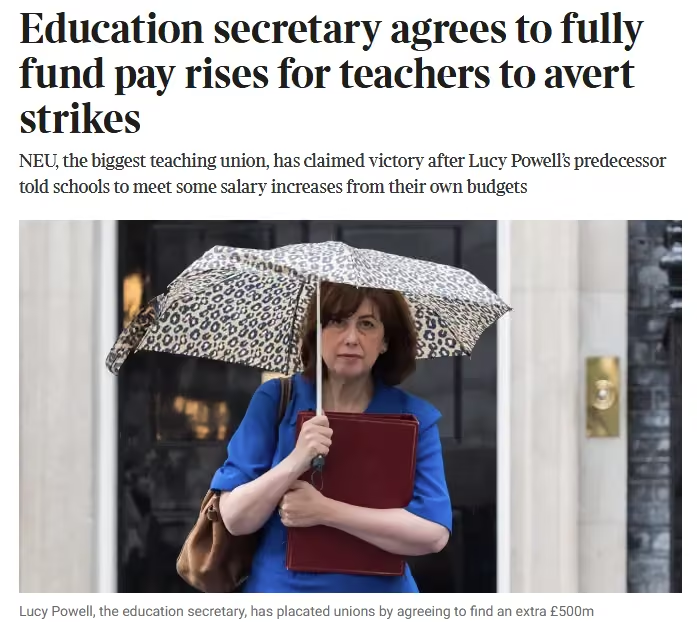
Luke Johnson reposted
Simon French
@Frencheconomics
This warning from Simon Wolfson in today's Next plc RNS is right on the money (as he usually is). With the precedent of employer NICs as a reminder of previously unheeded warnings....

Luke Johnson reposted
Kristian Niemietz
@K_Niemietz
In the end - the British planning system always wins.
Dominic Frisby
@DominicFrisby
Huge (and glorious) if true

Luke Johnson reposted
 Emma Fildes
@emmafildes
Quote of the day: “Value remains firmly in the eye of the buyer.”
@Savills Prime Central London stats show values are 26% below their peak in 2014. A further 2.5% has been shaved off just this year with more expected in the short term. Some sellers are still struggling to accept prices have plummeted but others who’ve come to terms with the market’s about turn are still managing to move on if priced correctly.
The estate agent group found 60% of sales this year were for houses above £5m as flats continued to fail to "service" buyers' requirements. Despite all this, Savills remains optimistic, believing growth will return but not until 2028 when it will steadily increase 7.5% by 2030. From what low though remains to be seen. @PrimeResi

Luke Johnson reposted
Joe Rich
@Joe_Rich
Labour’s appointment of a hard left figure like Paul Nowak to the Bank of England - on the wholly false basis that Nowak ‘has not engaged in political activity in the last 5 years’ - is the sort of supreme dishonesty we’ve come to expect from Keir Starmer and now Andy Burnham.

 Anthony Boutall
@anthonyboutall
🚨 BREAKING: Chancellor, John Healey, has appointed trade union boss, Paul Nowak, as a director of the Bank of England.
Nowak has “confirmed that [he has] not engaged in any party political activity in the last five years.”
🤯
order-order.com/2026/09/16/healey-appoints-trades-union-c…
Luke Johnson reposted
 US Oil & Gas Association
@US_OGA
We are not running out of oil but we are running out of refineries.....

Luke Johnson reposted
Mark Wallace
@wallaceme
That’s got to sting.
 Luke Johnson
@LukeJohnsonRCP
The problem is that Britons are overweight housing, and the UK residential property market is in trouble.
Simon French
@Frencheconomics
This is increasingly (for me) the most relevant chart for understanding UK vs US macro.
2/3rds of US household wealth sits in financial assets. In the UK, just 1/3rd.
If there is a large, positively correlated asset price correction then US consumption spending is likely to see an outsized hit. But the recent history of Britons pouring free cash flow into low return assets (cash & property) has been a UK growth headwind.

Luke Johnson reposted
 privateIQ
@privatelQ
USA Top 10 Private Club Revenue & Assets


Luke Johnson reposted
The Food Manufacturing Guy
@TipOfTheBanana
Every retail bottle of Kikkoman sold in the US is brewed in Walworth, Wisconsin. Has been since 1973. It's the highest producing soy sauce plant in the world. Before it opened, the soybeans and wheat were grown in America, shipped to Japan, brewed for six months, shipped back across the Pacific in bulk and bottled in Oakland. Kikkoman looked at that and built the plant in the middle of the soybean belt instead.
It's the same process as Noda, Japan, where the family has been doing it since the 1600s. Soybeans, wheat, salt, water, six months of fermentation.
Luke Johnson reposted
Simon French
@Frencheconomics
This whole argument has been debunked by the brilliant @jburnmurdoch: the UK tax wedge is the largest in the world.
Whilst Switzerland raises 2% of GDP in the form of taxes on wealth, the UK raises 3.7% of GDP. This 1% proposal would take the UK to more than twice the level of Switzerland. Fiscal arbitrage on assets is a thing.

 Sharon Graham
@UniteSharon
2008 financial crash, covid, austerity, bills rising. It's everyday people who are paying, there's nothing left to give.
A 1% wealth tax on the assets of the 'super-rich' would generate approximately £25 billion per year.
Luke Johnson
@LukeJohnsonRCP
Property markets are clearly very weak in many countries - I see it in US and UK. Would be interested to hear if other countries are seeing severe corrections.
 Emanuel Boeminghaus
@E_Boeminghaus
Meine Lieben, die Krise am Immobilienmarkt hat jetzt klar begonnen.
Ich sehe das an den in Not geratenen offenen Immobilienfonds, an den in Schwierigkeiten geratenen geschlossenen Immobilienfonds, am plötzlichen Überangebot von Luxusimmobilien auf Sylt und in Berlin, an den kritischen Leerständen bei Gewerbeimmobilien sowie an den unter Druck geratenen Volksbanken, wie etwa der Volksbank BraWo.
Man muss feststellen, dass das Sondervermögen die Lunte angezündet hat, die jetzt brennt.
Politisch tragen Herr Merz und Herr Klingbeil die Verantwortung für das, was jetzt zunehmend ins Rutschen kommt.
Wir stehen ganz am Anfang dessen!
Luke Johnson reposted
Sam Ashworth-Hayes
@SAshworthHayes
The Plantation of Ulster was driven by a state concerned the indigenous population might be disloyal to the new regime, which felt putting its own people in place might correct this.
The result was 400 years of strife between people the rest of the world struggles to tell apart.
Sam Ashworth-Hayes
@SAshworthHayes
"The asylum seekers... will be provided with minibuses by the Home Office to go to neighbouring towns."
You move to a pleasant village and overnight the government parachutes in 1,000 unvetted foreign men in the middle of a migrant crime wave and wishes you good luck.

Luke Johnson reposted
Kristian Niemietz
@K_Niemietz
How it started How it's going


Luke Johnson reposted
 Visual Capitalist
@VisualCap
Ranked: Where Eating Out Costs the Most and Least 🍽️
www.visualcapitalist.com/ranked-the-most-and-least-expens…

Luke Johnson reposted
Christopher Snowdon
@cjsnowdon
Public control, private blame thecritic.co.uk/public-control-private-blame/
Luke Johnson
@LukeJohnsonRCP
Very good essay
Rory Sutherland
@rorysutherland
This is a hugely important piece with shades of the late Jeremy Bullmore, for which I was privileged to contribute an afterword.
ahapartners.co/thinking/the-diligence-gap/
Luke Johnson reposted
Holger Zschaepitz
@Schuldensuehner
Good Morning from Germany, where the homeownership dream is slipping away. The official homeownership rate has plunged to just 41.9%, from 46.5% in 2018. Germany now sits at the bottom of the EU league table, vs 68.4% EU avg, 61.2% in France and 70%+ in Italy and Spain. The reasons: construction costs have surged 160% since 2000 vs just 64% for consumer prices, while higher mortgage rates, steep transaction costs and fading state support have pushed the dream of owning a home ever further out of reach.

Luke Johnson reposted
 Ayaan Hirsi Ali
@Ayaan
“And there is one final asymmetry, the one that ought to settle the matter once and for all. There is no flight from Europe by anyone—no community, no religious minority, no ethnic group, no political tendency—as a consequence of European far-right violence. No Muslims, no Jews, no atheists, no ex-Muslims, no gay men and women are packing suitcases in Frankfurt or Manchester or Marseille and applying for asylum in Cairo or Islamabad or Algiers because European far-right militants have made their lives untenable at home. The traffic runs, on a massive scale, in the opposite direction, and it has run in the opposite direction for two generations. Muslims, Christians, Yezidis, Baha’is, Ahmadiyyas, ex-Muslims, secularists, feminists, gay men and women, and religious minorities of every description are leaving the Muslim-majority world in millions, and they are coming to Europe and the rest of the West. They come because Europe, whatever else it is, is not governed by the doctrinal architecture they are fleeing. The presence of a European far right that occasionally shouts at them, or, at the violent extreme, produces a Breivik or a Tarrant, has not slowed the movement at all. If the two extremisms were symmetrical, the flow would also be symmetrical. It is not even close. The direction of migration by itself—that is, the votes of feet cast in their tens of millions by the very people who know both worlds—is a stronger empirical statement about the relative danger of the two phenomena than any Home Office report, academic study, or half-baked media essay will ever be.”
www.thefp.com/p/ayaan-hirsi-ali-the-lie-about-islam
Luke Johnson reposted
Cut My Tax
@CutMyTaxUK
Local Government Minister Jim McMahon has admitted that the Government has failed to carry out a formal national impact assessment of Andy Burnham's beloved visitor tax and its economic effect. They have no clue as to how many jobs the tax will destroy.
Ludicrously McMahon claimed it was up to individual local councils each to do their own impact assessment at public expense.
Emma Lewell, the Labour MP for South Shields, denounced her party's tax hike, saying “South Shields tourism is largely made up of families from neighbouring regions who have saved hard all year round to spend a few days at the seaside.
“They will not come, even if the increase is marginal. My constituents’ family-run B&Bs, caravan parks, hotels and wider hospitality industry have been unequivocal with me that they do not want this.”
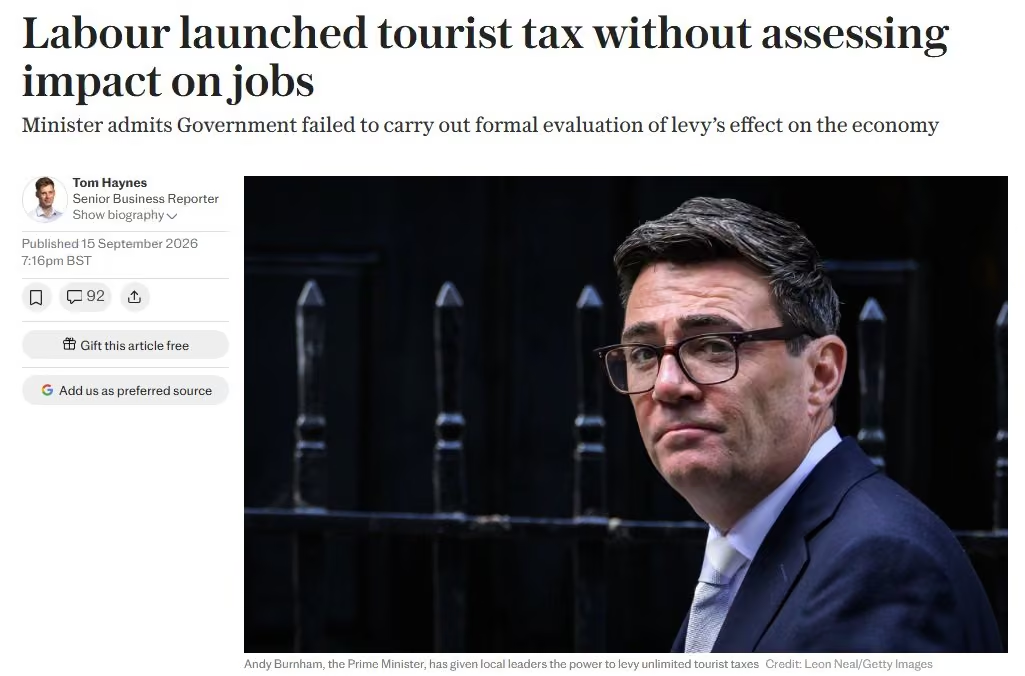
Luke Johnson reposted
 Liz Ann Sonders
@LizAnnSonders
Household net worth as % of disposable personal income, which measures households’ ability to finance consumption out of their wealth, reached a record in 2Q26 @federalreserve

Luke Johnson reposted
 Alessandro Riolo
@aledeniz
The Italian total fertility rate infamously collapsed between 1964 and 1995, from 2.70 to 1.19. It breached 1.35 as early as 1987.
This demographic collapse happened while the Italian government was spending well beyond its means, loading public debt onto the shoulders of multiple future generations.
Italians had never had it as good as they did in the 1980s and, arguably, have never had it as good since. Yet the total fertility rate kept collapsing.
Later, when the government tightened its belt – not enough, but quite noticeably compared with the preceding fat years – there was a brief rebound, reaching 1.46 in 2010, partly fuelled by the higher fertility of poorer immigrant communities.
Since then, the collapse has resumed. The total fertility rate cratered to 1.14 in 2025. The current government is praying that record will not be broken again in 2026.
Excluding migration, Italy has been losing roughly 300,000 inhabitants a year since 2020. This is why the Meloni government, despite being ideologically opposed to immigration-led ethnic replacement, is being forced to let in roughly 165,000 new immigrants a year – the “500,000” you see in headlines is spread over three years.
The institutions and social and political formulas we inherited from the 20th century evolved in a world of broadly reproducing or growing populations. Pension systems, healthcare, taxation and the entire machinery of intergenerational transfers assumed that large working-age cohorts would follow the generations preceding them.
They were not built for a world of 1.6 children per woman, let alone 1.2.
Rewriting those systems for a permanently shrinking and ageing population is possible, but it will take decades. In the short term, governments have only one readily available mechanism for preventing the working-age population from shrinking too quickly and the old system from collapsing: immigration.
This is essentially a beggar-thy-neighbour strategy. It may work in a world where countries with ageing populations can import young workers from countries still producing demographic surpluses.
But fertility is now falling almost everywhere. The pool of countries producing those surpluses is shrinking, while the number of countries competing for their young workers, especially the most promising ones, is growing.
Soon, that world may no longer exist.
 𝐍𝐢𝐨𝐡 𝐁𝐞𝐫𝐠 🇮🇷 ✡︎
@NiohBerg
Iran's fertility rate now sits at 1.35.
This is lower than several Western countries, and a direct consequence of living in a country ruled by 7th century barbarians where would-be parents lose all hope for a normal future.
Complete population collapse is at this rate one generation away.
Something must change and fast.
It's absolutely catastrophic.

Luke Johnson reposted
The Free Speech Union
@SpeechUnion
“If misinformation really were the threat ministers describe, one would expect its footprint to be visible in what people believe.”
Labour are planning to build the most restrictive apparatus of speech control since Charles I. The evidence it relies on does not survive contact with reality.
In July, Culture Secretary Lisa Nandy flounced off X, taking her government department with her, blaming mis- and disinformation for her departure. Weeks earlier, her department had published its green paper, Watch this Space, which suggests platforms be compelled by law to give prominence to “regulated public service media” such as the BBC. Meanwhile, Lucy Powell, Labour’s Deputy Leader, wants platforms brought under “some of the same requirements” of accuracy and balance as licensed broadcasters during election campaigns.
Beneath this sits a single document: a 136-page “evidence review”, commissioned by the Government Office for Science (GO-Science) from a seven-person team at Sheffield University. Its authors made no attempt to establish what was actually true or false online. Instead, by their own account, they relied on summaries generated by large language models of 228 academic papers they had not read.
More significant is what the review missed. A Nature paper by Budak and her colleagues states that “public intellectuals and journalists frequently make sweeping claims about the effects of exposure to false content online that are inconsistent with much of the current empirical evidence”. Visits to 490 websites deemed “untrustworthy” made up just 5.9 per cent of Americans’ clicks on news sites; with television included, “fake news” accounts for roughly 0.1 per cent of the average media diet. “This reality,” the authors observed, “is not reflected in public discourse about social media.”
Britain has been here before. In July 1637, the Star Chamber of Charles I decreed that nothing might be published without a licence from approved authorities.
The Government’s case rests on a review that read nothing, measured nothing, and ignored the research that contradicted it. The case for the most far-reaching apparatus to restrict peacetime speech since the ousted Stuart king amounts to misinformation about misinformation.
Read more from FSU Director of Policy and Research @DavidRoseUK in The Critic and his report below 👇

Luke Johnson reposted
 Daniel Lacalle Official Account
@dlacalle_IA
UK, Japan, and France: the worst sovereign bonds in the G7.
You wanted more government and higher taxes. You got weaker growth, wider deficits, and a demolished balance sheet.
Debt is not free. The bond market just repriced the bill.
There is no such thing as free public spending. There is only deferred taxation and a rising yield curve. The G7 is now paying both.
You are welcome.
Data: Bloomberg

Luke Johnson reposted
 Institute of Economic Affairs
@iealondon
⚖️ "The inheritance tax raises precious little for what it imposes, on both governments and individuals."
Paritosh Purohit on why Britain's most hated tax isn't worth keeping.

Luke Johnson reposted
 Matthew Elliott
@matthew_elliott
For a typical 50-person business, annual costs have risen 71.5% in a decade, from £1.16m to £1.98m.
This is largely accounted for by the cost of labour - increases in employer National Insurance and the minimum wage - but also energy costs and business rates.
If we make it more expensive to hire people, we shouldn't be surprised when businesses hire fewer people.
www.cityam.com/how-much-do-regulations-cost-the-average-u…
Luke Johnson
@LukeJohnsonRCP
Foreign investors noticing the storm clouds gathering for our national finances. Not good.
The Kobeissi Letter
@KobeissiLetter
The UK's bond market is collapsing.
Today, the yield on a 30Y Bond in the UK hit 5.95%, its highest level since March 1998.
Yields in the UK are now 15 TIMES above 2020 levels, with the highest borrowing costs among G7 countries.
What is happening? Let us explain.
(a thread)

Luke Johnson reposted
 Melissa Chen
@MsMelChen
The CCP treats people, data, technology, and capital as resources that must stay inside the Party-state’s control.
Exit bans and restrictions that once applied mainly to senior cadres and people with access to secrets now routinely cover kindergarten teachers, elementary school teachers, nurses, doctors, university staff, researchers, employees of state-owned enterprises, government contractors, and staff at public hospitals and research institutes.
The definition of “public servant” is being stretched to pull all these groups in. Passports are commonly surrendered and must be formally “borrowed” for a pre-approved trip.
So whenever someone marvels at how capitalist and free China is on the surface, the truth is that it is reverting to what every communist totalitarian systems eventually ends up doing - preventing you from leaving. The same apparatus that is closing the door on Chinese public employees also creates risk for foreigners btw so be warned.

Luke Johnson reposted
Alex Wickham
@alexwickham
Exclusive: UK household energy bills are forecast to jump *by about 25%* in January as the Iran war drives up gas and electricity prices, according to analysis by Bloomberg Economics
The coming price spike means UK inflation could climb above 4% next year, double the BoE target, the analysis finds
The Ofgem energy price cap is expected to rise by about £427 to around £2,150 a year for the average household, according to the forecasts
This would push bills close to the £2,500 cap brought in by the government following Russia’s full-scale invasion of Ukraine in 2022
It’s a major threat to Andy Burnham’s pledge to be the cost-of-living prime minister
Story by @EamonFarhat: www.bloomberg.com/news/articles/2026-09-15/uk-energy-bill…
Luke Johnson reposted
 Hugo Gye
@HugoGye
This is a bit farcical really.
"Until you get the proper briefings you can only know so much."
UK's dodgy fiscal position is not a state secret! It's not like entering Home Office or MoD and finding out all the security intelligence.
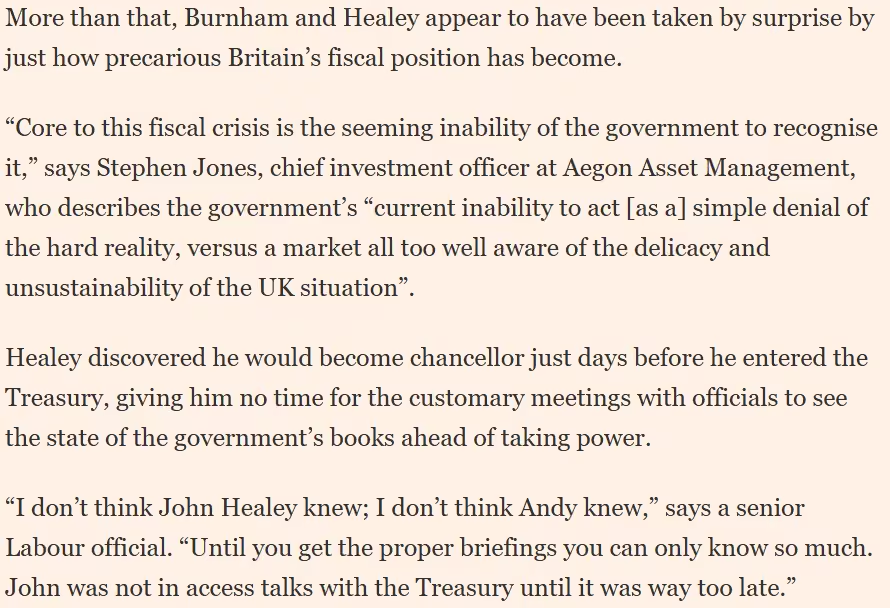
Luke Johnson reposted
Guido Fawkes
@GuidoFawkes
Public Sector Swells to Record Size & Far Outstrips Private Sector Wage Growth order-order.com/2026/09/15/public-sector-swells-to-record…

Luke Johnson reposted
The Food Manufacturing Guy
@TipOfTheBanana
Fanta Orange was created in Italy in 1955 and in Italy it has orange juice in it. In the US it has none. American Fanta is carbonated water, high fructose corn syrup, citric acid, natural flavors, and Yellow 6 and Red 40 for the color. UK Fanta starts with water and orange juice from concentrate, gets its color from carrot and pumpkin extract, and has about a third of the sugar, 4.5g per 100ml against 12.4g in the US.
The UK version isn't clean either. It hit that sugar number by adding acesulfame K and sucralose after Britain put a sugar tax on soda in 2018.
The Italian one is a different drink. Water, orange juice at 12%, sugar, carbonation, citric acid, natural citrus flavors, acacia gum and vitamin C. The oranges are all Italian, mostly Sicily and Calabria, and Coca-Cola says it buys about a quarter of the Italian orange juice that goes into soft drinks. It still can't be called an aranciata. Italian law says you need 20% juice to use that word.
Luke Johnson reposted
Mark Wallace
@wallaceme

 Sam Freedman
@Samfr
New post:
Young people are increasingly unhappy. It's a real phenomenon + nothing to do with "snowflakes".
There are lots of standard culprits - social media, school, economy - but none explain the long-term trend.
So what is going on?
(£/free trial)
samf.substack.com/p/the-agency-gap?r=72szy&showWelcomeOnS…
Luke Johnson reposted
 Laurence Hulse
@laurence_hulse
Only Britain could sit and say this whilst simultaneously banning new oil and gas fields in its own waters. It’s the politics of the Beano.
 First Squawk
@FirstSquawk
UK NATIONAL SECURITY ADVISER JONATHAN POWELL SAYS 'GAS COULD BE THE PROBLEM AS WE COME INTO THE WINTER, WHERE THE EU IS GOING TO HAVE REAL PROBLEMS OF SHORTAGE, AND WE CANNOT TURN THAT INTO AN ADVANTAGE FOR PUTIN', WARNING THAT 'IT WILL REQUIRE SOME REAL HARDSHIP AND DIFFICULTIES ON OUR PARTS, BUT WE WILL HAVE TO SWALLOW THAT'.
Luke Johnson reposted
 Jamie Halse (Senjin Capital) 🇳🇿🇦🇺🇯🇵
@JamieHalse
Japanese hoteliers are apparently cancelling new hotel projects because of a rapid increase in construction costs.
The average construction worker now earns a newly expensive US$30k/yr (A$42k)! If you are from Australia or the US, let how small that salary number is sink in...
I was told in the weekend that an electrician in Australia with three years' experience working on data centres can command A$400k/yr!
Clearly "expensive" is a relative term.

Luke Johnson reposted
Christian Heiens 🏛
@ChristianHeiens
Sweden's Right-wing coalition got the order of operations wrong.
They did the typical conservative thing of passing policies that would objectively make people's lives better. They succeeded, and then people stopped caring about the issues that got the Right elected in the first place because they no longer saw them as problems to solve.
The siren song of progressivism and social democracy then lured these people back into complacency, as it always does in any universal mass democracy.
The order of operations shouldn't be:
Get elected -> Solve problems -> Lose to the Left because you've already solved the immediate problem that got you elected in the first place -> Wait for the Left to break something -> Try to win off of the ensuing backlash.
It should be:
Get elected -> Defund the Left -> Solve the first set of problems the Left created -> Win in an even greater landslide -> Crush the Left further -> Solve even larger problems you couldn't solve before because you didn't have a large enough majority.
Each action you take should make the next action easier. This is why the Trump administration got off on such a strong foot with the shuttering of USAID and the defunding of large swaths of the Left's patronage network.
The lesson here is to stop playing fair. Power is a tool to be wielded in order to destroy your enemies, not merely to do a good job of administering the daily functions of state.
 Europe Elects
@EuropeElects
Sweden, 6,200 of 6,626 districts counted:
Seat projection per bloc, national parliament
S+V+MP+C-S&D|LEFT|G/EFA|RE: 176 (+3)
SD+M+KD+L-ECR|EPP|RE: 173 (-3)
+/- vs. Last election result
➤ europeelects.eu/sweden

Luke Johnson reposted
 Harry Wallop
@hwallop
🐓 This is v. rare picture of a British housewife c1955 with roast chicken. Why’s it rare?
Because in 1950s hardly anyone ate chicken – consumed by less than 1% of the UK. We slaughtered 1m birds a year.
Now? We slaughter 1.1 billion. And it’s the most popular meat. By far 🧵1/6
 Luke Johnson
@LukeJohnsonRCP
True
 Anish Moonka
@anishmoonka
The music you loved between the ages of 13 and 18 will stay with you for the rest of your life, and no music you hear after that will ever hit the same way. A 2017 study in Frontiers in Psychology mapped the listening patterns of every generation and found that preferences formed in adolescence are the strongest and most durable of any age.
Carol Krumhansl at Cornell University analysed the listening habits and emotional responses of thousands of people across multiple generations and found a consistent pattern: the songs that produce the strongest emotional response are the ones you heard during your teenage years. Not childhood. Not your twenties. The narrow window between roughly 13 and 18.
The researchers called it the reminiscence bump, a term borrowed from memory research. The brain during adolescence is undergoing rapid development in the regions that handle emotion and reward, and music that arrives during that window gets encoded with an intensity that later music cannot match. The same song heard at 15 and at 35 produces a stronger neurological response at 15, and the memory of that response is what makes the song feel like yours forever.
This is why classic rock fans feel physically different when they hear the opening of their song than when they hear something new. The brain built a room for that music during a period of heightened sensitivity, and the room is still there, unchanged, decades later.
The study also found that each generation has a bump centred on the hits of their teenage years, and the bump is remarkably consistent. The music industry has known this for decades: the audience you capture at 15 is the audience you keep for life. pubmed.ncbi.nlm.nih.gov/28424637/
 Luke Johnson
@LukeJohnsonRCP
Indeed
Matthew Lynn
@mattlynnwriter
Business doesn't need a 'culture shift'. The culture of entrepreneurhsip is just fine. What it needs is lower taxes and less regulation www.bbc.co.uk/news/articles/clyl18x4734o
Luke Johnson reposted
 Alexander Fitzgerald
@AFitzgerald1992
Today @IsembardGroup is launching the largest factory to open in London since WW2. (1/n)


 Luke Johnson
@LukeJohnsonRCP
This is a revealing way of looking at govt spending
 Burnside
@BurnsideWasTosh
The most popular measure of Government borrowing is complete bollocks. Expressing borrowing as a percentage of GDP when the two have very little to do with eachother. It would be like assessing your monthly spending against your households gross income.
When expressed correctly, the overspend set against Government revenue the figures are much more alarming.

Luke Johnson reposted
 Steven Pinker
@sapinker
Do people prefer traditional architecture? Betteridge's Laws of Headlines doesn't apply: The answer is yes. I offered one explanation for the proliferation of architecture that people hate in The Blank Slate: In the 20th century, elites came to believe that the human sense of beauty was socially constructed, and could be re-engineered at will by modernist artists, and designers. worksinprogress.co/issue/do-people-prefer-traditional-arc…
Luke Johnson
@LukeJohnsonRCP
The rolling disaster of lockdowns
 Cole Jaczko
@colejaczko
is this genuinely the explanation for decline of everything - friendships, excitement, spontaneity, dating?

Luke Johnson reposted
 English Grammar
@GrammarUpdates
100 Latin Terms Every Educated Adult Should Know

Luke Johnson reposted
Andrew Griffith MP
@griffitha
The top 1% of earners pay 29% of all income tax receipts.
This week, Chris Rokos - who paid over £300m in tax last year - announced that he is leaving Britain, reportedly because of fears of yet another Labour tax grab.
I’ve written to John Healey, urging him to rule out an ‘exit tax’. Labour literally risk driving away the goose that lays the golden eggs. It will leave the rest of us paying more.
Wealth creators make a huge contribution to employment and investment. That matters to us all: people who need jobs, essential services that need funding, and all of us who want lower taxes.
Chris Rokos isn’t the first to leave, and unless Labour urgently rules out more taxes, he won’t be the last. When you hike taxes, our best and brightest will not choose Labour’s Britain.
We are a great country, and we must be the best place in the world to live and work.

Luke Johnson reposted
Human Progress
@HumanProgress
By reducing the time people spend shopping, managing inventory, and building infrastructure, Amazon has created consumer surplus that far exceeds Bezos’s personal fortune.
humanprogress.org/jeff-bezos-earned-his-fortune/
Luke Johnson reposted
Bjorn Lomborg
@BjornLomborg
The world still runs on fossil fuels
Globally, fossil fuels supply 80.8% today (2024)
only marginally down from 81.4% in 2000
Rather than ending in 2050, fossil fuels are on track end in 4-10 centuries
iea.org/data-and-statistics/data-product/world-energy-sta…
You can see all the references in my Twitter thread:
 Bjorn Lomborg
@BjornLomborg
The world still runs on fossil fuels
Globally, fossil fuels supply 80.8% today (2024)
only marginally down from 81.4% in 2000
Rather than ending in 2050, fossil fuels are on track end in 4-10 centuries
iea.org/data-and-statistics/data-product/world-energy-sta…

Luke Johnson reposted
 Lei Cheng
@ChengLeifreedom
The CCP can’t handle the truth. Everyone around the world who is free to hold a Tiananmen vigil should do so. It’s the least we could do to uphold the spirit of those being punished for that act of truth.
 Elaine Pearson
@PearsonElaine
The Hong Kong High Court today sentenced Tiananmen vigil organizers Chow Hang-tung, Lee Cheuk-yan & Albert Ho to prison terms ranging from 5 years 2 months to 7 years 3 months for “inciting subversion” under the National Security Law. See background here👇
www.hrw.org/news/2026/08/21/hong-kong-activists-convicted…

Luke Johnson reposted
 Alec Stapp
@AlecStapp
Fantastic piece from @Chris_arnade on what tolerating anti-social behavior does to our public spaces:
"It’s a primary reason why we shy away from dense walkable spaces and instead move towards suburban sprawl.
People in the U.S. don’t respect, trust, or want to be around other random citizens, out of fear and disgust.
Japanese/European style urbanism—density, fantastic public transport, mixed-use zoning, that so many American tourists admire—can't happen here because there is a fine line between vibrant streets and squalid ones, and that line is public trust.
The U.S. is on the wrong side of it.
Simply put, nobody wants to be accosted by a stranger, no matter how infrequent, and until that risk is close to nil, people will continue edging towards isolated living.
It is why we “can’t have nice things” because we have to construct our infrastructure to be asshole-proof, and so we don’t build anything or build with a fortress mentality, stripping our public spaces down to the austere and utilitarian, emptying them of anything that can be vandalized."



 Patrick Collison
@patrickc
Chris Arnade's blog continues to be one of the very best: walkingtheworld.substack.com. (You can also follow him: @chris_arnade.)
Luke Johnson reposted
 Federation of Small Businesses (FSB)
@fsb_policy
🧾 Plans to bring in visitor levies in England are a 'kick in the teeth' for the visitor economy, FSB's @craigie_b tells @thetimes.
The proposals risk doing serious damage to the tourism industry and increasing costs for small businesses 👇
www.thetimes.com/uk/politics/article/england-mayor-powers…
Luke Johnson reposted
 David Frost
@DavidGHFrost
"This isn’t a tourist tax. It’s worse than that"
Burnham and Rayner's tourist tax is another blow to British hospitality.
Until the government stops spending, we are going to see more and more of this.
www.telegraph.co.uk/gift/9d5fb48fc1102c51


Luke Johnson reposted
 Neil O'Brien
@NeilDotObrien
Today so far:
-Labour publish doc saying welfare savings impossible
-Labour announce plans for yet another tax
-Markets punish us with highest borrowing costs in a generation.
Guido Fawkes
@GuidoFawkes
British 10-Year Gilt Yield Rises to 19-Year High order-order.com/2026/09/10/british-10-year-gilt-yield-ris…
 Luke Johnson
@LukeJohnsonRCP
Extra tax/cost will only diminish tourism and damage the hospitality industry. The local councils will squander the money because they have no skin in the game. Only economically illiterate socialists could believe this burden will help any community.
 Dan Tomlinson MP
@dantomlinsonmp
Big day today - we're confirming plans for an Overnight Visitor Levy.
This is the right policy to help raise funds to support regional leaders to invest in growth and the visitor economy in their region.
Some Mayors will use it and do great things with the power. Others will decide not to use it. The opportunity for different decisions is good. We will see how different places fare over time with different choices.
And whether or not to use it will be a source of debate at the next Mayoral elections - also good.
Over to you now Sadiq, Bev, Tracy, Helen Steve, Kim, Oliver, Richard, David, Claire, Paul, Ben, Luke and Andrea!
Luke Johnson reposted
 David Hearne, CFP™
@dontdelay
When you see people complain about the UK state pension compared to other European countries
Just look at the size of their unfunded pension entitlements.
That comes at a cost.
Sadly one that's most likely to be paid by those who wont benefit from the same entitlements in future, or will see the other public services they rely on, cut, to keep the pensions funded.
Chart from @Nicomalagardis on LinkedIn

Luke Johnson reposted
Steven Pinker
@sapinker
"I like to quote the founder and proprietor of Our World in Data, who said that the papers could have had the headline: “187,000 people escaped from extreme poverty yesterday, every day for the last 30 years.” But you never saw that headline, and as a result, a billion people escaped from extreme poverty. One of the most significant events in human history, and no one knows about it."
Luke Johnson reposted
 More Births
@MoreBirths
Luke Johnson reposted
max tempers
@maxtempers
To the surprise of nobody apart from the dozens of idiot Labour MPs who thought they’d solved everything by clamping down on cancellation apps. In fact, the apps actually helped produce a more efficient allocation of scarce test slots in the absence of a proper fix.
🧵
 BBC News (UK)
@BBCNews
Learner drivers still waiting 20 weeks to book tests www.bbc.com/news/articles/cx2z421xe0zo
Luke Johnson reposted
Ryan Bourne
@MrRBourne
NEW COLUMN: Next has won its equal pay case. Now repeal the law that put it in court.
www.thetimes.com/business/companies-markets/article/next-…
Luke Johnson reposted
François Valentin
@Valen10Francois
Really insightful on France's pensions madness
90 old former teacher complains about her 3k pension and blasts idea of deindexing it from inflation
And yet she's making more money as a pensioner than the vast majority of current teachers (who incidentally pay for her pension)
 saperlipopette
@__tommyFR__
Maryse, 90 ans, ancienne prof, retraitée depuis 25 ans, 3000 € de pension et propriétaire, est contre la désindexation de sa pension.
Selon elle son pouvoir d'achat « ne fait que baisser. »
Elle est d'accord pour désindexer les pensions UNIQUEMENT au-dessus de 6k/mois : « au delà de 6k/mois, oui on peut prendre. »
Luke Johnson
@LukeJohnsonRCP
This is the heart of it. Labour are the party of welfare recipients and public sector workers. All of them paid by everyone else.
UK Decline
@UKDecline
The problem they have is welfare has become an absolute army of voters.
Latest: 4m on PIP in England & Wales (Apr 2026), 8.35m on Universal Credit (May 2026), 5.17m UC claimants not in employment (Apr 2026).
The categories overlap, so these are not unique totals. Even so it's still a huge number.
Politics UK
@PolitlcsUK
🚨 BREAKING: Andy Burnham suggests he won't cut benefits to pay for defence spending
"National security cannot come at the expense of social security"
#pmqs
Luke Johnson reposted
Anthony Boutall
@anthonyboutall
The exact opposite of what Labour heavyweight, Denis Healey, said in 1969:
“Once we cut defence expenditure to the extent where our security is imperilled, we have no houses, we have no hospitals, we have no schools. We have a heap of cinders.”

Luke Johnson reposted
Arnaud Bertrand
@RnaudBertrand
If you really want to understand where the world is at and where it's going, you probably cannot get anything more meaningful than the OECD's PISA study - a global test given every 3 years to an insane 760,000 15-year-olds across 91 countries.
No report globally, by any institution, better captures whether countries are building or squandering their future.
The latest PISA results just came out yesterday (www.oecd.org/en/publications/2026/09/pisa-2025-results-vo…) and the results are genuinely fascinating, and in some way pretty depressing.
Why depressing? Because, sadly, the numbers show that the world is getting dumber: as you can see on the first graph below 👇, since roughly 2012 scores in science, reading, and mathematics have been in continuous decline across OECD countries.
The reading score is particularly concerning: it literally cratered, dropping 28 points since 2015, the equivalent of almost 1.5 years of schooling lost according to the report.
To make matters even worse, the reading skill that's dropped the most across the board is precisely the one we most desperately need: the capacity to critically assess what you read, cross-reference sources, and tell signal from noise.
On average, sadly, 15-year-old kids globally are - more and more - incapable of slowing down and actually thinking about what they're reading.
Interestingly though, when you look into the details, this great "dumbing down" isn't across the board: it's overwhelmingly concentrated in wealthy Western countries, while many developing countries are actually getting significantly smarter.
For instance rich countries like Finland, the Netherlands, and Norway are in freefall, while countries like Cambodia, Türkiye, and the UAE are posting big gains.
To be clear, this doesn't mean that developing countries are now "smarter" than rich ones: save for one notable exception, that's still not the case. But they are catching up fast, both because rich countries are getting "dumber" and because they're themselves getting smarter.
The one exception is, as you'd expect, the "smartest" of them all, by a huge margin: China.
It is pretty much in a league of its own: just look at the ranking in the table (only kids in Beijing, Shanghai, Jiangsu and Zhejiang got tested - 4 regions covering 200 million people).
China's maths results are particularly insane: according to the report, the best level in maths - level 5, where "top performers" begins - starts at 607. The AVERAGE kid in China is 612: "normal" Chinese kids are at a level that is considered elite in the rest of the world.
In fact, and that's probably the funniest number in the entire report, look at the column called "Share of low performers in science, reading and mathematics": China is only at 1.8% 😅
Which means that only 1.8% of Chinese kids are rated as low performers in all 3 subjects, almost a rounding error. Even Singapore, the second best and generally considered best-in-class in education, is at 6.8% - almost 4 times worse. My country France, is at 21.3% - almost 12 times worse 😢
All of this - incidentally - dispels the common myth that there would be some kids who are just genetically beyond redemption and simply can't be taught: China proves that with the right system, virtually every child can reach proficiency.
So what does this all say about the world and where it's going, besides the fact that, if the future belongs to those who can think, China has never been better positioned to own it?
I think the more general picture is this: there is nothing inevitable about any country's trajectory.
Finland was the world's education darling fifteen years ago - now it's in complete freefall (see the last graph 👇). Cambodia was at the bottom of every table - now it's posting the biggest gains ever recorded in the study. What changed wasn't the children: it's still Finnish kids (Finland has one of the lowest levels of immigration in the West), and it's still Cambodian kids.
It also doesn't matter much - or at least it matters less - if a country is wealthy or not. For instance in Southeast Asia, both Malaysia and Indonesia - the 2 biggest ASEAN economies after Singapore - are faring very badly, while Thailand and Vietnam, both poorer, have better educated kids whose scores are continuing to improve.
So that's the final takeaway: the kids don't change, they all have potential, always, as China's 1.8% proved.
What does change is what adults decide to do with that potential. It's both hopeful - because it means any country can choose to turn things around at any time - and also sad given the results - because it means so many countries are choosing to fail their children.


Luke Johnson reposted
Neil O'Brien
@NeilDotObrien
Nothing has changed


Luke Johnson reposted
 Michael McLoughlin 🐦
@michaelMCsaez
Me ha gustado muchísimo este tema del NY Times. Por como está hecho y porque soy team de comer a la 13 como tarde y cenar para estar a las 22 en la cama
www.nytimes.com/2026/08/30/world/europe/spain-late-dinner…

Luke Johnson reposted
Institute of Economic Affairs
@iealondon
"We are pulling off the extraordinary double of simultaneous emigration and immigration crises, exporting our entrepreneurs and replacing them with people who go onto benefits."
@DanielJHannan on Britain's jobs market.

Luke Johnson reposted
 Robotaxi
@robotaxi
Our unboxed process for Cybercab assembles vehicle modules in parallel & frames the car in one step at the end.
This streamlines automation & reduces the line size by half, unlocking much greater production capacity.
The first real revolution in automotive manufacturing in over a century
Luke Johnson reposted
Neil O'Brien
@NeilDotObrien
I listened to a Labour MP and trade union member saying how he was proud he was that Wales had resisted the education reforms England had seen.
 Stuart Lock
@StuartLock
Reading, mathematics, science


 Luke Johnson
@LukeJohnsonRCP
Interesting list
Cut My Tax
@CutMyTaxUK
THOSE WE HAVE LOST - a list of over 50 multi-millionaires who have left the UK
Given that the top 0.1% of taxpayers pay more income tax than the entire bottom 50% this is a serious loss.
1.Jeremy Coller — founder, Coller Capital (private equity) — Switzerland
2.Nik Storonsky — co-founder/CEO, Revolut — UAE
3.Ian Livingstone — co-owner, London & Regional (property) — Monaco
4.Richard Livingstone — co-owner, London & Regional — Monaco
5.Nassef Sawiris — billionaire investor; Aston Villa co-owner — Italy
6.Richard Gnodde — ex-CEO Goldman Sachs International — Italy (Milan)
7.Iwan Wirth — co-founder, Hauser & Wirth (art gallery) — Switzerland
8.Manuela Wirth — co-founder, Hauser & Wirth — Switzerland
9.Anne Beaufour — pharma heiress (Ipsen family) — Switzerland
10. Max Gottschalk — investor/financier— destination unclear
1/6
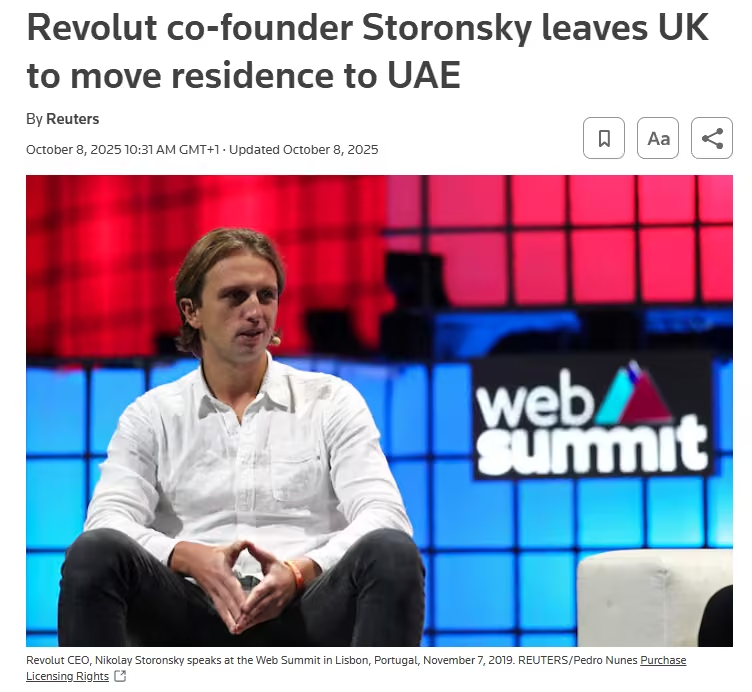
Luke Johnson reposted
Henrik Dahl
@SociologenHD
Here are the editorials from two of Denmark’s leading centre-left newspapers. Think of one as The Guardian and the other as The Independent.
One headline reads: “The era of Germany’s firewall must end.” The other reads: “The firewall has fallen. Now liberal Germany must take the bull by the horns.”
These two newspapers are written and read by people who would never agree with me on anything controversial. But I am happy to agree with them: the strategy pursued by Germany’s entire political elite towards Alternative für Deutschland until Sunday has failed.
What it has produced is (1) permanent political martyr status for Alternative für Deutschland, (2) a monopoly for Alternative für Deutschland on speaking honestly about the country’s most important problems, and (3) the collapse of the old parties of government, which cannot even muster a majority between them in the opinion polls.
One could be harsher still and say: the strategy devised by the political elite turned out, above all, to be a strategy for its own political suicide.
If, as a representative of a very friendly neighbouring country, I may offer Germany’s political elite a word of advice, it is this: listen to the Danish centre-left.
There may well be people with questionable views here and there within the AfD. But the same is true of other parties at either end of the political spectrum - as we can see in the current Swedish election campaign.
But it simply will not do to say that all those people in Saxony-Anhalt who voted for the AfD - more than four in ten - are fascists and Nazis.
The party’s voters are in large part working-class - because the old workers’ party, the SPD, long ago abandoned the workers in favour of the out-of-touch views of academia. And they are ordinary people who have voted against a package of unwanted changes of all kinds - changes they feel they were never consulted about, and would never have agreed to.
The friendly neighbour’s advice to the political elite is this:
Come down from your ivory tower! Stop shouting “fascist” at everyone who criticises the decisions you have collectively made over the past 25 years. Talk to ordinary people about the problems that concern them most.
We - on our side of the border - have always known that the day would come when there would be more people on the wrong side of the firewall than on the right - especially if the political elite keeps hurling insults at everyone who disagrees with it.


Luke Johnson reposted
 Michael Shellenberger
@shellenberger
Reporters use the label "far right" 3 to 14 times more often than "far left." The term implies that the parties opposing mass migration are undemocratic. In fact, they're winning elections. The real fascists are the ones censoring, banning, and prosecuting their enemies.

Luke Johnson reposted
Neil O'Brien
@NeilDotObrien
Claude, give me the most moronic possible response.
No wait, not THAT moronic.
 Tris Osborne MP
@TrisOsborneMP
Very strong education data shift as we transitioned to a @UKLabour govt
The Gove period is a welcome distant memory; we invest and build an education system that gives opportunity to every child and learner.
 Sam Freedman
@Samfr
New PISA data out
England is now top ten in all three areas (reading, maths, science) and the second highest performing country outside of east Asia (after Estonia).
This is a huge public policy success.
Luke Johnson reposted
 Ramon Agusta
@ramonagusta
"growth in every postcode" update...
#tinyandy #starmergeddon

Luke Johnson reposted
 Ihsan Horani
@neutralground90
A 14-year-old girl was raped by a man who'd been in Britain less than a week. The government's response was a leaflet.
A new Spiked investigation lays out named case after named case, Leamington Spa, Nuneaton, Brighton beach, Bristol, Manchester, all Afghan or Eritrean asylum seekers, all convicted of raping women and children after entering Britain illegally. Police in Nuneaton were secretly briefed not to reveal a suspect's immigration status. The Ministry of Justice went to court this year to block release of foreign offending data a think tank had already been approved to receive.
Here's what shames me most as someone who fled a country where women's bodies are policed by the state: Britain's own Home Office is now handing newly arrived asylum seekers information booklets explaining that both people must consent to sex, and that sex with a child under 16 is illegal. Think about what that admission actually means. The state knows exactly what it's importing, and its response was a leaflet, not a screening process.
The countries these men overwhelmingly come from, Afghanistan, Iran, Eritrea, are places where a woman's body is not her own. FGM in 9 out of 10 girls. Domestic violence written into law as acceptable so long as it leaves no visible mark. State-enforced modesty backed by violence. Pretending that culture arrives at Dover and simply disappears is not compassion. It's negligence dressed up as virtue.
I watched governments look away from exactly this kind of denial before. It never ends well. Britain needs to stop calling this racism and start calling it what it is: a state that has decided protecting its own reputation matters more than protecting women and girls.
www.spiked-online.com/2026/09/04/the-migrant-crime-wave-t…
Luke Johnson reposted
Human Progress
@HumanProgress
In 1910, you could buy a bicycle for $11.95 from Sears.
Entry-level wages were $0.11 an hour, meaning it took unskilled workers 108.6 hours to buy a bicycle.
Today, an entry-level worker can buy a bike at Walmart after working for just 5.2 hours.
humanprogress.org/the-steep-climb-of-bicycle-abundance/
Luke Johnson reposted
 Nina Schick
@NinaDSchick
Merz understands the mortal danger to Germany’s economy.
1/ Its manufacturing might is being cannibalized by China.
China is now the world’s factory, accounting for 32% of global manufacturing output.
It is not only competing with Germany, but leapfrogging ahead. 83% of German industrial companies say they feel competitive pressure from Chinese rivals.
2/ At the same time, Germany is barely building the infrastructure of the next industrial age: compute.
It has a paltry ~3GW of total data-centre capacity. Compare that to the US, where compute is being built at enormous scale and is expected to reach ~95GW by the end of 2027.
3/ And then there is energy.
Compute is electricity turned into Intelligence.
The countries that can produce vast amounts of cheap, reliable power will have a huge competitive advantage.
Germany enters that race having shuttered its nuclear fleet, after years of making energy more expensive and constrained for its industrial base.
The problem is now so acute that the government is planning €13.3 billion in energy-price relief for 2027.
The new industrial equation is simple: energy in, Intelligence out.
One of the world’s great industrial economies is being brought to its knees. A lot here for posterity to study…because so much of this was self-imposed.
 Chubby♨️
@kimmonismus
Germany’s Merz says germany is building data centers at an unprecedented scale.
He urges Germany to seize every opportunity to expand digital infrastructure despite heavy electricity demand and pressure on local energy supplies.
Completely out of touch with reality, and this goes hand in hand with the absurd statement recently made by Ursula von der Leyen, namely to establish Europe as the first AI continent.
Germany and Europe play no role internationally in the AI race. The train has left the station. Anything else is a misapprehension of reality.
Luke Johnson
@LukeJohnsonRCP
I respect for Mr Chang speaking his mind. No idea if his company is worth $5 billion, but good luck to them anyway.
 Alan Chang
@alanchanguk
The @FinancialTimes wrote a column about my interview with the @thetimes this week.
I stand by everything I said. Before starting @fuseenergy , we looked at the people running incumbent energy companies across Britain, America, and Europe. Energy is ultimately a complex engineering problem: are their leaders top engineers? Do they have the best technical education? What's their track record?
The author called this "preposterously arrogant." I call it diligence. How else do you decide whether to dedicate the rest of your life to an industry? Start and hope for the best?
My personal philosophy is that I only play to win, and you win by building a better team than everyone else.
But the FT author and I do agree on one thing: tech leaders need to speak directly. People are fed up with PR fluff that says absolutely nothing.
www.ft.com/content/15956a2a-cbce-446d-9262-effe3743f317?a…

 Luke Johnson
@LukeJohnsonRCP
Shopping centre has fallen in value by almost 90% over 20 years.
Peter Bill
@peterproperty
Costar (£) Scottish Eastgate Shopping Centre teed up for sale at £18.5m (a 12% yield). Mall traded for £176m 20 years ago. www.costar.com/article/1590042917/leading-scottish-mall-t…
Luke Johnson reposted
Cut My Tax
@CutMyTaxUK
Some 22% of family-owned businesses are considering selling up to overseas buyers in response to Labour's death tax assault on family businesses, with a further 18% considering a sale to a UK buyer, a new survey from the manufacturers’ organisation Make UK has revealed.
Their report raised the concern that “ownership and investment decisions become driven primarily by tax considerations rather than commercial objectives”.
"This could lead some manufacturers to sell their businesses to third parties, alter ownership structures, or divert capital away from productive investment in order to manage future IHT liabilities."
“Such decisions risk weakening productivity growth and increasing the transfer of strategically important manufacturing assets to owners whose long-term priorities may not align with the UK’s economic interests," Make UK noted.
Labour's attack on family firms and farms is mind-blowingly stupid and obviously driven by ideological obsessions. Sadly they seem determined to push on with it.
Luke Johnson reposted
 John Stepek
@John_Stepek
The British housing market is looking steadily more sickly as the year goes on www.bloomberg.com/news/newsletters/2026-09-07/the-british…
Luke Johnson
@LukeJohnsonRCP
Socialists hating rich people is a brilliant economic policy. London isn't what it was. Wealth is mobile. Who will pay the bills when the 1% (who pay around 29% of income tax) are all gone?
 Polemic Paine
@PolemicTMM
Chris Rokos leaving the UK choosing Greece instead.
£330 million of annual tax contribution (his last year's payment) leaving.
That's a lot of nurses or trachers or whatever S.I unit the media use these days for tax lost.
www.bloomberg.com/news/articles/2026-09-07/hedge-fund-tit…

Luke Johnson reposted
vittorio
@IterIntellectus
honestly, i keep thinking about this result and it's just absurd.
in the 2022 PISA, el salvador scored 343 in math, 365 in reading, and 373 in science
near the bottom of PISA, close to guatemala and dominican republic
now the country has developed a program for education modernization in a pilot group of public schools with 1:1 AI tutoring and personalized learning
after the pilot had been running for BARELY OVER A YEAR, students got results comparable to germany and sweden.
that's more than an entire standard deviation
that is fucking insane
we should be talking about absolutely nothing else
if you actually care about poor children and equality of opportunity, the possibility of giving every child on earth an individualized tutor for a fraction of the cost of human 1:1 tutoring should be one of the most exciting developments in human history.
"it's all in the environment tards" should be drooling at the news
every government on earth should be running massive randomized trials of this right now, and if the effect survives, scaling it as fast as physically and humanly possible for every child on earth
the funniest part is that while the supposed "fascists" are celebrating poor kids learning, the people supposedly obsessed with inequality are barely talking about it, and if anything are banning AI in schools
revealed priorities are funny like that

Luke Johnson reposted
Sam Ashworth-Hayes
@SAshworthHayes
The time for contrarian countersignalling was before the police conceded that the "conspiracy" was a factual description of the state of the high street and finally started doing their jobs.


 The New Statesman
@NewStatesman
THE TRUTH ABOUT THE RIGHT-WING BARBERSHOP CONSPIRACY
The number of barbershops in Britain has multiplied several times over since 2015. The trade is a useful example of a broader problem on our high streets. The hardware shop, the furniture shop and the clothes shop cannot compete with a global corporation prepared to run products as loss leaders, covering the costs with its highly lucrative web-services business, in order to dominate the market. Right now, barbers can: Amazon is yet to figure out the economics of robot haircuts. (Although there’s time yet – the company opened a salon in London’s Spitalfields Market in 2021.) Barbers have no licensing requirements, no stock, no energy-intensive kitchens. They are lean operations, the kind that can survive in an environment of brutal energy costs and business rates. If anyone can make it right now, it’s them. Their proliferation is the market in action. Add in the fact that male hairstyles have changed – a fade requires more regular upkeep, for example – and we are where we are.
It’s the market in action, writes @OliDugmore: www.newstatesman.com/politics/left-hook/2026/09/britains-…
Luke Johnson
@LukeJohnsonRCP
The left love to believe in fantasies. Why do almost none of these barbershops accept credit cards? Mmm I wonder?
The New Statesman
@NewStatesman
THE TRUTH ABOUT THE RIGHT-WING BARBERSHOP CONSPIRACY
The number of barbershops in Britain has multiplied several times over since 2015. The trade is a useful example of a broader problem on our high streets. The hardware shop, the furniture shop and the clothes shop cannot compete with a global corporation prepared to run products as loss leaders, covering the costs with its highly lucrative web-services business, in order to dominate the market. Right now, barbers can: Amazon is yet to figure out the economics of robot haircuts. (Although there’s time yet – the company opened a salon in London’s Spitalfields Market in 2021.) Barbers have no licensing requirements, no stock, no energy-intensive kitchens. They are lean operations, the kind that can survive in an environment of brutal energy costs and business rates. If anyone can make it right now, it’s them. Their proliferation is the market in action. Add in the fact that male hairstyles have changed – a fade requires more regular upkeep, for example – and we are where we are.
It’s the market in action, writes @OliDugmore: www.newstatesman.com/politics/left-hook/2026/09/britains-…
Luke Johnson reposted
max tempers
@maxtempers
Excellent news. Bout of sanity in the tribunal system...

 John Kroencke
@johnkroencke
👏👏👏 www.reuters.com/business/world-at-work/uk-retailer-next-w…
Luke Johnson reposted
sam
@discoplomacy
Really recommend this Times analysis of asylum seekers arriving in Britain.
Some choice quotes:
• “The number of people claiming asylum in the UK reached a record level in the year to June 2025 when 111,084 people submitted claims, accounting for about 10 per cent of all immigrants entering the UK.”
• “The new post-Brexit immigration policy introduced by Boris Johnson in January 2021 boosted the number of work and study visas granted to Pakistanis, Indians and Bangladeshis. However, this legal migration, dubbed the “Boris-wave”, seems to have translated into increased asylum claims as people who overstay their visas claim asylum to remain in the UK.”
• “Nine in ten of the 8,305 claims from Pakistanis came from those who entered the UK on a work, study or other visa. This was also the case for 98 per cent of the 5,769 Bangladeshis. In the year to June 2026 there were 34,999 asylum claims by those who had held a visa or had other leave to be in the country, accounting for 41 per cent of all applications. This was more than the 33,949 claims (40 per cent) from people arriving on small boats.”
• “The average asylum seeker effectively has a 95 per cent chance of avoiding deportation. While only 38 per cent are granted asylum at the initial stage, claimants have a 64 per cent chance of overturning the decision on appeal.”
www.thetimes.com/article/4b4731e4-952a-47ba-b78c-ee6e9984…

Luke Johnson reposted
Luke Johnson reposted
Neil O'Brien
@NeilDotObrien
Choices for us in Europe now:
A) End immigration & focus on integration;
B) Massive internal conflict: or
C) Actually there's no C


Luke Johnson reposted
Ricardo
@Ric_RTP
This 117-year-old Japanese food company controls whether Nvidia can build another chip.
It has never made a wafer, a transistor, or a single piece of equipment.
Here's what they do and what just happened:
Ajinomoto commercialized monosodium glutamate in 1909. It's the seasoning in your instant ramen. And somewhere in the 1990s its chemists worked out that a byproduct of that process made an almost perfect insulating film.
They called it Ajinomoto Build-up Film. The industry calls it ABF.
It's the layer inside the substrate that sits directly under a high-end chip. Nvidia's accelerators need it. Intel's processors need it. The advanced packaging TSMC does needs it.
And Ajinomoto holds roughly 95% of the world market for it.
They've held that share for about 30 years.
Now here's what makes this absurd:
ABF is around 0.5% of what a high-end chip costs to make.
Half of one percent. But NOTHING ships without it, because the tolerance for failure is zero and qualifying a different supplier takes 2 to 3 years of testing.
So a food company ended up holding the smallest and cheapest part of the most expensive supply chain on Earth.
For decades they barely priced it that way but then somebody noticed...
In March a British activist fund called Palliser Capital disclosed a top 25 stake in Ajinomoto and said publicly that the company had underpriced ABF for years and should raise it by more than 30%.
Two months later Ajinomoto told substrate makers the price was going up about 30%.
That increase took effect this quarter.
And Palliser wants more than the price. It wants the electronics business carved out of the food conglomerate entirely, because the market has been valuing a monopoly on AI infrastructure as though it were a seasoning line.
Then in early August it got more interesting: Ajinomoto reportedly told its customers in mainland China it was cutting their ABF supply by 30%.
China's domestic substitute covers under 5% of what the country needs.
Ajinomoto hasn't confirmed that cut and the reporting comes from Chinese trade press. But nobody has denied it either.
And the squeeze is already showing up in actual hardware. ABF lines have run above 95% utilization since the start of the year. Lead times went from 12 weeks in mid-2025 to 26 weeks now. One contract manufacturer in Singapore cut its AI accelerator builds by 37% in a single quarter because it couldn't get substrate.
Goldman Sachs has the supply gap widening from roughly 10% today to 21% next year and 42% by 2028.
But there are escape routes too:
Samsung Electro-Mechanics is spending $1.2 billion building its own lines and won't have volume until late 2027. Ajinomoto's third plant doesn't produce until 2032.
And in April a Chinese MSG producer called Lotus Holdings paid roughly $15 million for control of a Shenzhen ABF startup with under $1 million in annual revenue.
So one seasoning company is now trying to break another seasoning company's grip on AI.
The counter-case is fair though:
It's half a percent of a chip, everyone is expanding, and Samsung or Sekisui probably cracks it before the decade is out. Ajinomoto going underpaid for 30 years is an argument FOR the hike.
But that's a 2029 answer to a 2026 problem.
Trillions of dollars of AI spending now runs through one Japanese factory that grew out of soup stock, and that factory has just learned what it's actually worth.
Ajinomoto spent 30 years being too polite to charge for it. A hedge fund talked them out of that in a few weeks.
Luke Johnson reposted
Christopher Snowdon
@cjsnowdon
The big question for future historians will be why did the centre-left think that mass immigration from the world's worst countries was so important that they were prepared to sacrifice themselves and the liberal order for it? www.ft.com/content/f1cd277c-fc9b-454f-8eea-596408ebdd2b?s…
Luke Johnson reposted
Cut My Tax
@CutMyTaxUK
In the US one has to earn 8.7 times the average wage before paying the top marginal tax rate, in the UK, one need only earn 2.2 times the average wage before paying the top marginal rate.
And of course the top rate is considerably higher in the UK.
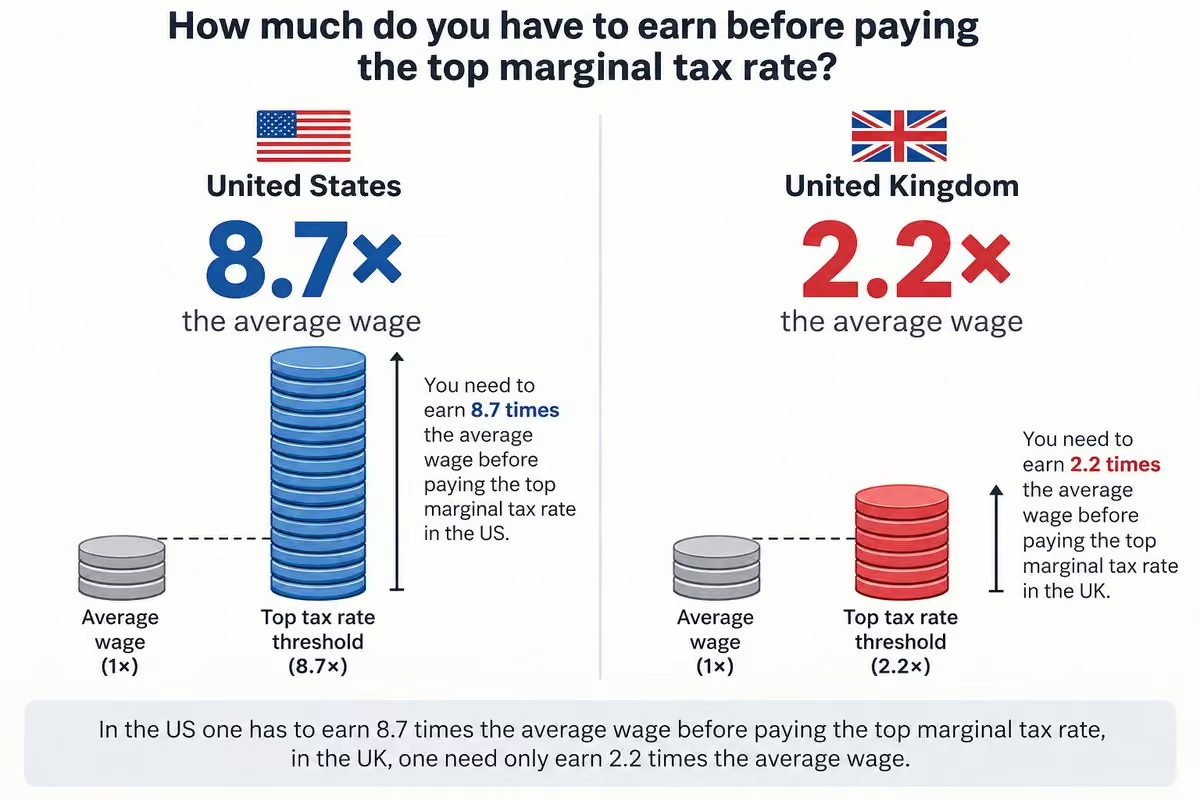
Luke Johnson reposted
 Zac Goldsmith
@ZacGoldsmith
-Blasphemy laws that will prohibit criticism of radical Islam
-A ‘Conversion Practice’ Bill that will put parents in jail for cautioning their children against choosing a lifetime of self harm
-A police force obsessed with arresting people for wrong think (60,000 arrests already) while largely ignoring crimes that actually frighten people
-Wildly out of control illegal immigration of mostly radicalised young Muslim men imbued with a loathing of western ideals and freedom
-Every conceivable effort being made to make running a business even harder, whilst simultaneously relishing the exodus of the biggest taxpayers.
Political Parties wanting to form the next government will need to present a believable plan for completely reversing this mess. And those in broad agreement need to stop bickering like teenagers and find a way to cooperate.
There is nothing preordained or inevitable about the survival of any culture or civilisation
Luke Johnson
@LukeJohnsonRCP
I wonder what attitudes would be now
 Stokeman🏴
@anglopjdst
British attitudes to the police in 1950/51

Luke Johnson reposted
Jonatan Pallesen
@jonatanpallesen

Luke Johnson reposted
 Lord Ashcroft
@LordAshcroft

Luke Johnson reposted
 Alex Almeida
@AlexAlmeida2020
Another one of those stunners you come across.
By 2050, historians will treat the economic history of Europe over the last forty years as something like the Brezhnevian stagnation - a period of systemic, civilizational hollowing out and technological falling behind.
 Alex Almeida
@AlexAlmeida2020
"Rhône-Poulenc, a French chemicals group... had an almost 50 per cent global market share in rare earths processing until the mid 1980s"
DeCliNe
Luke Johnson reposted
 Eric Kaufmann
@epkaufm
Time to get real.
A divided right means the left will win every UK election, in perpetuity.
The UK right has no chance at power.
Now that Polanski is down and the Lib Dems are a joke, a united left will easily defeat the right in Britain.
Someone needs to begin uniting the right into a UK version of the ‘Canadian Alliance’, which then reformed as a new conservative party.

Luke Johnson reposted
 Kevin Edger
@KEdge23
Mauritius are going to give their people TAX CUTS with the billions of UK taxpayers money that this Labour govt are giving them. WE will have TAX RISES to pay for it.
AND Labour are giving them the British territory of Chagos Islands on top.
This is treacherous.

Luke Johnson reposted
 Simon Kuestenmacher
@simongerman600
Space power keeps changing hands. The Soviet Union dominated launches for decades before Russia faded after 1991. China is surging, but reusable rockets and increased commercial demand driven by lower launch prices propelled the US far ahead. Source: www.visualcapitalist.com/sp/hf09-charted-annual-space-lau…

Luke Johnson reposted
 Jason Groves
@JasonGroves1
Startling statistic on @skynews suggesting disability benefit claims in the UK have jumped by 38% since the pandemic, compared with 26% in war-torn Ukraine
Luke Johnson reposted
 Ben Leo
@Benleo
BREAKING: Wes Streeting confirms Labour WILL push ahead with Chagos surrender despite opposition from President Trump
Trump told GB News on Wednesday that the deal was "terrible"
UK gov wants to give away its own sovereign territory because of an advisory International ruling - and charge taxpayers for the privilege
www.gbnews.com/politics/wes-streeting-chagos-deal-labour-…
Luke Johnson
@LukeJohnsonRCP
Interesting theory
 Shiv Malik
@shivmalik
Bank lending to SMEs. That’s the single best hypothesis with supporting evidence.


Luke Johnson reposted
 Institut für Realitätsabgleich
@Epikur_vS
Die Probleme der deutschen Autoindustrie haben auch mit der Mentalität der Manager zu tun. Zwei Aspekte:
1. Gründer grosser Unternehmer waren in DE oft Naturwissenschaftler und Techniker (Bayer, Siemens, Bosch, Benz, Linde, Zeiss, usw.). Heute haben Topmanager oft einen Hintergrund in Controlling und Marketing. Produktentwicklung wird als Kostenfaktor gesehen und nicht als Kern des Unternehmens, die Zielfokussierung orientiert sich an Quartalszahlen statt Langfristzielen. Auf Dauer sind technisch denkende Unternehmensleiter wie Elon Musk (Tesla / SpaceX), Wang Chuanfu (BYD), Li Shufu (Geely / Volvo), Lei Jun (Xiaomi), etc. überlegen.
2. Karriere wird in deutschen Konzernen durch Powerpoint-Präsentationen in Management-Meetings gemacht. Kompetente Techniker, Naturwissenschaftler, Ingenieure usw. tun sich in diesem Umfeld oft schwer in Konkurrenz zu Marketingleuten und schlichten Blendern. In Unternehmen wie Amazon, Tesla, SpaceX und den chinesischen Autoherstellern gibt es teils eine Anti-Powerpoint-Kultur. Bei Amazon gibt es z.B. die berühmte Memo-Methode, welche von Meetingteilnehmern mehr sachorientierte Kompetenz erfordert statt oberflächliches PPT-Blendwerk.

Luke Johnson reposted
 @jason
@Jason
My hyper-bull case is that 30% of global rides will be driven by AVs in 10 years.
This will require ~120M+ cars doing ~25 rides a day ~360 days a year.
It will cost ~$5T to build these cars at ~$40,000 each.
12M cars are built a year on average, but there will be a slow and steady ramp; perhaps 250k in 2027, 500k in 2028, 1m, 3m, etc (build your own model).
Predict Tesla will be #1 in this space with 40% market share -- which would mean building ~50M cars in a decade.
Zero to 40% market share and 5M cars a year on average is an insane ramp up -- but Tesla is the company best positioned to do this.
Uber will be in second place with 35% market share, with two dozen partners putting absurdly cheap Chinese, Japanese, and purpose-built robotaxis into their fleet -- as no car maker wants to go head-to-head with Tesla building cars AND building a network.
Waymo will buy a car maker in the next 12 months, creating a hybrid of Tesla and Uber: full-stack cars built in its factory, deployed on its network, and also added to Grab, Lyft, Uber, and other networks to increase utilization.
The big story?
Someone will need to fund FIVE TRILLION DOLLARS WORTH OF CARS
120M+ cars @ $40,000 each on average; some will be 15-20k two-seaters, some will be premium SUVS at $80,000.
$7-10T+ in annual revenue is at stake for AVs alone.
At a 20-40%+ gross margin, $1-2T+ in EBIDA/cash flow, we will be talking about ~20-30T in market cap.
Waymo and Uber are worth ~$120B and $150B; Tesla is worth $1.4T at the moment.
There's 18-28T in market cap about to be created.
Please run this through your own LLMs and models... move the variables around however you like. $5 average ride, $10 average ride, $50k average vehicle cost, etc.
10% of total rides... 50% of total rides...
... however you slice it, this will be the largest market in the world for AI over the next decade.
After that, human robotics will be the TAM/biggest market cap opportunity in the world... but we can do that model next.

Luke Johnson reposted
 Gabriel Pogrund
@Gabriel_Pogrund
Scoop by @KatieTarrant_ who reveals Mothin Ali, deputy leader of the Green Party whose policy is to “abolish landlords” is, in fact, a landlord. www.thetimes.com/uk/politics/article/green-party-polanski…
Luke Johnson reposted
Cut My Tax
@CutMyTaxUK
Excessive taxation means that the cost of drilling and delivering new gas from the North Sea is now 50% higher than the cost of sending US liquefied natural gas (LNG) to Britain, analysis by Thunder Said Energy has revealed.
That's despite the fact that the costs of delivering the gas from America include extraction, the cost of liquefaction and shipping the gas thousands of miles across the Atlantic. (And of course involves greater carbon emissions).
The research consultancy noted that if the tax burden was reduced and political uncertainty reduced, the cost of North Sea production could be cut in half.
Seb Kennedy, the chief executive of market analysis firm Energy Flux, said the situation was “a damning indictment of UK tax policy” noting that the windfall tax’s current level “only makes sense if the Government doesn’t want to produce these resources”.
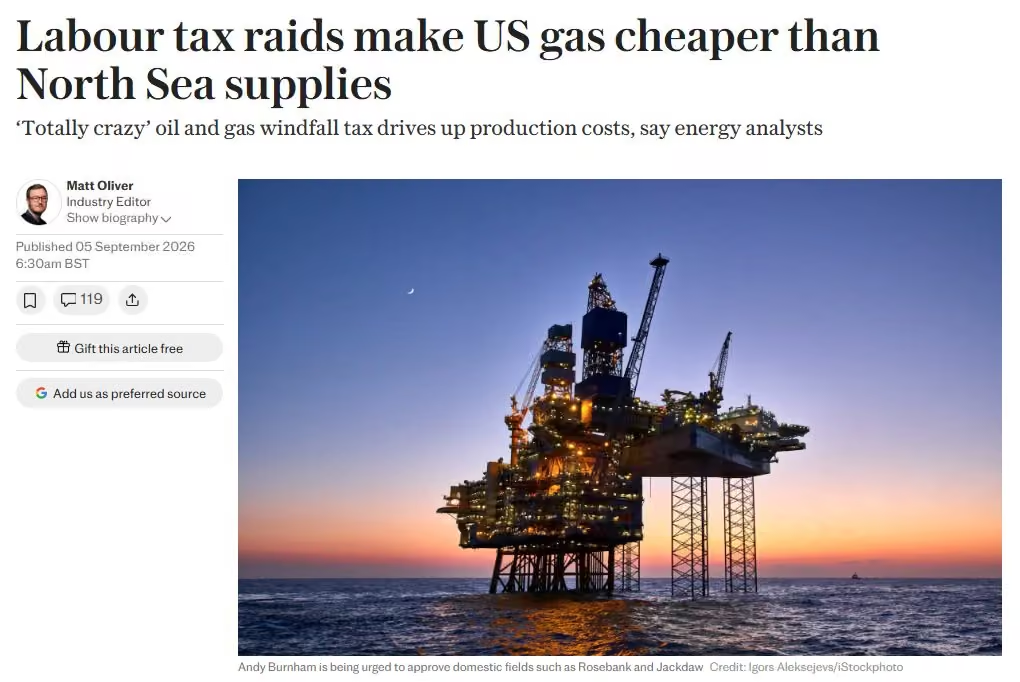
Luke Johnson reposted
 Trung Phan
@TrungTPhan
George Lucas Museum of Narrative Art in LA opens to public on September 22.
Cost $1.5 billion and covers 300,000 square feet with 35 galleries (tons Star Wars memorabilia) and 2 (apparently insane) movie theatres.
Took decade to build and first walk throughs look incredible.
Luke Johnson reposted
 Isaiah Granet
@zaygranet
A few thoughts on switching lines. x.com/i/article/2095764118351577088
Luke Johnson reposted
David Turver
@7Kiwi
Oh, it's much more than that. UK & EU gas is over 8X US gas at the moment. The whole European continent needs to be investing in new sources of gas supply. There's plently in shales.
 Simon French
@Frencheconomics
The "controversy" should be that UK gas is trading at 4.5x the level of US gas (rather putting to bed the "global price" argument) with all the inflation and de-industrialisation implications that that entails. Energy independence is quite the economic prize.

Luke Johnson reposted
Michael A. Arouet
@MichaelAArouet
Sweden did many things right. It’s the exact opposite of what the naive US lefts call “democratic socialism“
If you like Sweden so much, be like Sweden: lower income taxes, abolish inheritance and wealth taxes, cut state monopolies, lower debt.
It works wonders. Give it a try.

Luke Johnson reposted
 Thierry from arvy 🇨🇭
@ThierryBorgeat
That's the most interesting statistic I've come across lately.

Luke Johnson reposted
 Madeline Grant
@Madz_Grant
Meanwhile the government remains dead set on paying the Mauritian wallet inspectors to take over the Chagos Islands - funding for which will come *straight out of the defence budget*
How sharper than a serpent’s tooth it is to be led by people who hate their own country
 Jerome Starkey
@jeromestarkey
🚨BREAKING – The Army has been ordered to stop training in an historic blow to Britain’s defences as the MoD runs out of cash.
www.thesun.co.uk/news/40262988/army-stops-training-war-ga…
Luke Johnson reposted
 History With Jacob
@HistoryWJacob
In 1990, more than a third of the planet lived in extreme poverty. Today it's under 10 percent.
Over a billion people climbed out in a single generation. The fastest, largest escape from poverty in human history.
It didn't come from government aid or charity. It came from capitalism.
Free markets, private property and trade.
When people are free to start a business, own what they build and sell it, they lift themselves out of poverty. Every time. Everywhere it's been tried.
Nothing in history has lifted more people out of poverty.

Luke Johnson reposted
 Marko Jukic
@mmjukic
It's all just looting. All of it. Everybody wants an unaccountable fake email job with a high salary and no tangible metric of success. We halted industrial development so the incentives have all been pointed at gain of function in inventing fake jobs to loot industrial wealth.
 T Wolf 🌁
@Twolfrecovery
We now have evidence of how at least $7.7 billion for homelessness was spent on salaries. They created a jobs program that grows at the expense of the actual homeless who need help instead of helping the homeless. The waste is astounding. 🧵
Luke Johnson reposted
max tempers
@maxtempers
Foreign national criminal gets ... zero jail time ... for stealing £517,000 from an NHS surgery. We have basically introduced Total Female Decarceration through the back door.


 CourtNewsUK
@CourtNewsUK
GP practice manager Helena Paiva deprived patients to pay for her handbags and a new Tesla when she stole £517,000 from the surgery. Guess the sentence... courtnewsuk.co.uk/gp-practice-manager-deprived-patients-t…

Luke Johnson reposted
Alcuin Press
@AlcuinPress
Roger Scruton, three incredible lines

Luke Johnson reposted
Steven Pinker
@sapinker
The degeneration of Nature, Science, NEJM, and Scientific American into woke propaganda dispensers (and their refusal to publish normie, centrist, common-sense responses) is a scientific scandal.
 Michael Shermer
@michaelshermer
Wokeness is corrupting science from within. Nature went woke years ago with their support of trans pseudoscience (sex is binary, not a spectrum) and now they think the death of Jason Arday sends a wake-up to us: yeah, stop lying.
 Colin Wright
@SwipeWright
Seeing lots of surprised reactions to the absurd Nature editorial on Jason Arday. Frankly, I'm surprised people are surprised.
Nature has been totally captured by wokeness for a while now. I've been trying to call attention to this for nearly a decade. There are no serious scholars left there in influential positions capable of rescuing it.
The people in charge of Nature today are brazenly hostile to the foundational principles that made Nature a highly respected and trustworthy institution in the first place. Today, activists have hijacked it and are using the prestige associated with the Nature brand to push an ideological agenda.
They don't care that they're quickly burning through the immense trust that was slowly and painstakingly built by generations of competent scholars and stewardship.
They're willing to burn through it all in a decade for power. It's an absolute tragedy.
Nature has gone all-in on decoloniality, which holds that academic rigor and scientific objectivity are forms of colonial oppression rooted in white supremacy. It seeks to elevate Indigenous "ways of knowing," which amount to tribal myths and forms of religious mysticism, as an equally valid system of producing knowledge.
And they don't want this absurd notion to remain theoretical; they want to implement these principles in areas that deal with life and death—medicine and nursing.
I know what I'm saying sounds absurd. People can't possibly believe that. Like, I must be exaggerating, right?
I promise you that I'm not. If anything, I'm dramatically understating the problem.
We are in the midst of a total academic crisis, and we need to stop acting surprised and start taking action to delegitimize these journals and root these fields out of our public and publicly-funded institutions.
If we don't, it's only going to get worse.

Luke Johnson reposted
Merryn Somerset Webb
@MerrynSW
V brave. Also true. "Stop the handouts, the ‘cozzie livs’ is over"
www.thetimes.com/article/23619c0b-8a9c-43a7-bb0c-58d353bb…
Luke Johnson reposted
Cut My Tax
@CutMyTaxUK
Good points from Gordon Brown. “The funny thing is that property is taxed quite heavily in Britain as part of a wealth tax," he said.
Many people find it not quite so funny but Gordon is absolutely correct. the UK property tax burden sits at roughly 3.7% of GDP. This places Britain first among major economies, ahead of high-tax nations like France (3.4%) and Canada (3.4%), and more than double the average of other advanced countries
Brown also advised again a broad-based wealth tax: “If people can move their wealth, then if one country has a wealth tax and others don’t, then there’s obviously a huge opportunity for it to be evaded and avoided.
“I think you’ve got to be very careful about these taxes," he said.
When Chancellor Gordon Brown cut the rate of CGT on business assets to 10%. That's a policy Labour should reintroduce if it was genuinely committed to growth.
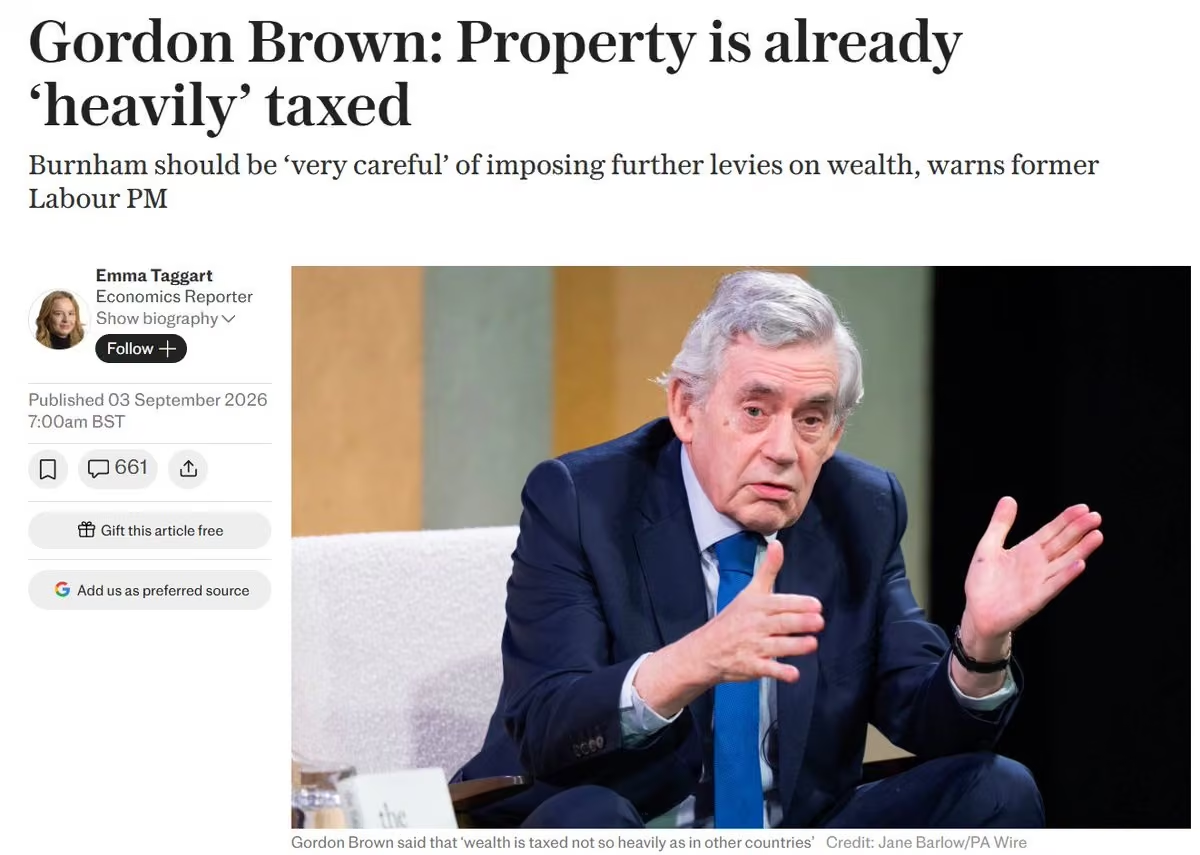 Luke Johnson
@LukeJohnsonRCP
Oh…I thought Labour were going to build 1.5 MILLION new homes. Bullshit political promises meet reality.
Guido Fawkes
@GuidoFawkes
Sharp Drop in Residential Housebuilding order-order.com/2026/09/04/sharp-drop-in-residential-hous…

Luke Johnson reposted
 Max Niederhofer ❤️🔥
@maxniederhofer
What's going on in Germany this year is just heartbreaking. It's not Schumpeter's creative destruction, it just feels like liquidation. Awful.
13K companies insolvent in H1, Q2 the worst quarter since 05. 165,000 job losses.
Have lost:
Aktienbrauerei Kaufbeuren, brewing since 1308 (!)
Hofbrauhaus Wolters, Braunschweig, since 1627
Kahla porcelain, since 1844
OKA office furniture, since 1858, sixth generation
Brauerei Westheim, since 1862, sixth generation
Varta, since 1887, 3000 employees
Atlas excavators, since 1919
Feneberg supermarkets, since 1947, 3,000 employees, €500m revenue
Revo Hospitality, 165 hotels, 5,500 employees
Pandion, €846m revenue, 3,800 apartments mid-build
Germans have stopped drinking beer (wtf). Hospitals going under. Massive pressure on automotive suppliers.
It's ok when startups die - it is to be expected. When a sixth-generation brewer dies, the brand, the craft, the site and the town's tax base go with it. Nobody refounds a company from 1308.
I don't think this will be rebuilt. They are making fires with our beautiful oak doors.
Luke Johnson reposted
Simon French
@Frencheconomics
The "controversy" should be that UK gas is trading at 4.5x the level of US gas (rather putting to bed the "global price" argument) with all the inflation and de-industrialisation implications that that entails. Energy independence is quite the economic prize.
Luke Johnson reposted
The Free Speech Union
@SpeechUnion
The ‘woke’ era was a disaster — and even the Left is beginning to recognise it.
Yet as progressives such as New York Congresswoman Alexandria Ocasio-Cortez (AOC) begin to distance themselves from the movement, we must not forget the chilling effect its punitive orthodoxies had on free speech. They encouraged medieval-style public shamings and cancellations and robbed people of their livelihoods, writes Celia Walden.
In recent years, we have witnessed an alarming rise in cancel culture and performative virtue-signalling. Those who refused to subscribe to various progressive orthodoxies, or who sought to challenge the status quo, faced vexatious complaints. Many were ‘cancelled’, ostracised by their peers or hounded out of their jobs and social circles.
Celia writes: “Strikingly, there was no room for forgiveness within this lofty moral framework. Every ‘cancelled’ figure I’ve interviewed over the years has zeroed in on that.”
Just last month, the founder of the Free Speech Union, Lord Young of Acton, described his astonishment at this aspect of the movement: “It doesn’t distinguish between the sin and the sinner.”
Stonewall co-founder Simon Fanshawe has also been damning of the ‘woke’ movement. As Celia points out, he has conceded that DEI had “taken on a life of its own and became a monster”, that it had “divided, not included” and had changed “practically nothing meaningful”.
He now argues that a “reset” is needed. Celia says this must mean a break from “the policing of language and the demands of activists, among other things”.
How sad that a movement founded on principles to which everyone should have been able to subscribe — opposing racial prejudice, discrimination and systemic injustice — was hijacked and bastardised to such an extent.
Read more from Celia below 👇

Luke Johnson reposted
Charlie Walsham
@CharlieWalsham_
In an interview with the French Culture Secretary on Radio 4’s Today programme a few minutes ago, @bbcnickrobinson said the following:
“We share something else in Britain and France. The rise of the populist right. For you, it’s the National Rally. In this country, Reform UK and Restore Britain. Is culture part of the answer for dealing with those sorts of challenges?”
Would a BBC presenter characterise the rise of the far-left Green Party in terms of a “challenge”? Or any other party for that matter?
And what exactly does “dealing with” mean?
This is the problem with BBC impartiality. Sometimes it isn’t an explicit expression of political opinion. It’s the language used to frame a story, revealing an assumption about which political movements are legitimate and which are problems to be “dealt with”.
#r4today
Luke Johnson reposted
 Patrick OShaughnessy
@patrick_oshag
His story is fascinating
colossus.com/article/thomas-peterffy-market-maker/
 Q-Cap
@qcapital2020
Thomas Peterffy being worth $105B is not talked about enough
Absolutely bonkers

Luke Johnson reposted
 The Sigma Mindset
@thesigmamindset
 Luke Johnson
@LukeJohnsonRCP
Astute insights
 FxScaler
@FxScaler
I sell mostly to Americans and I'm European. The distance teaches you things people inside can't see.
Americans buy at 11pm from an ad they saw 8 seconds ago. The order is in before the video ends. No European buyer does this. A German needs 40 reviews and a week of thinking; an American needs the checkout to load fast enough to beat the impulse fading.
Returns are a lifestyle, priced in like weather. An American orders three sizes, keeps one, and feels nothing. First month selling US clothing, our return rate made me think something was broken. The volume made up for it before I finished worrying.
Reviews work backwards from Europe. Europeans read the 1-star reviews to find the catch. Americans read the 5-star reviews to get hyped for what they already decided to buy. Social proof sells the dream over there; in Europe it survives an audit.
Shipping speed is identity. A Swiss buyer tolerates 8 days if you're honest about it. An American at day 5 opens a dispute, because Amazon trained an entire nation that waiting is an insult.
And the one nobody believes until they sell there: Americans WANT to be sold to. A hard pitch that would make a Scandinavian close the tab makes an American pull out the card. Selling is a service over there. It's a crime over here.
Wrote about the European versions of this a month ago. Same products, same photos, entire different species of buyer. The operators losing money in the US are running European instincts on American demand.
Luke Johnson reposted
 SMB Attorney
@SMB_Attorney
Be Tommy Mello, SMB legend…
KKR just paid $2 billion for his garage-door company.
> Grew up in Sterling Heights, Michigan.
> Parents split when he was seven.
> Mom worked three jobs.
> He listened through the wall while they fought about bills.
> At 8 he was mowing lawns and shoveling snow.
> At 12 he washed dishes under the table for $4.05 an hour because Michigan said you had to be 13.
> Moved to Phoenix at 16.
> Landscaping. Bartending. Flipping cars. Reselling Bowflex machines. Cleaning pools.
> By 20 he was already a hustler who could make money, not a founder yet.
> A roommate offered him $100 a door to paint garage doors.
> He didn’t know how. He learned.
> Weekends he was painting 10–12 doors a day.
> Then he noticed the real money wasn’t paint. It was springs, rollers, broken doors, and showing up when other guys didn’t.
> 2007: A1 Garage Door Service.
> The name was a ranking hack. A1 came first in the Yellow Pages, so the phone rang.
> First logo came out of a fighting video game.
> First “HQ” was a house across from a 7-Eleven.
> Early years were chaos. $50k in debt. Used trucks. Stolen phones. People stealing toilet paper. No real CRM. If it could go wrong, it did.
> Around 2010 he takes the business from a partner who couldn’t scale with him.
> Mom and stepdad move from Michigan to help. He is still the business. Vacation means revenue dies.
> First decade is practice.
> Revenue crawls, then jumps: about $17M, then $30M, then $50M.
> He kills the hustler version of himself and builds systems, SOPs, KPIs, and a company that can run without him in every truck.
> The four numbers he obsessed over: booking rate, conversion rate, average ticket, cost per acquisition.
> He rebrands when most owners wouldn’t (around $30–40 million in revenue) so the trucks, site, uniforms, and signs all look like one company.
> Applicants start lining up.
> The brand becomes a recruiting machine, not just a logo.
> He floods Google. Dozens of Google Business Profiles in one metro. Maps and organic beat paid ads even after they are spending millions a month.
> Memberships turn one-time door repairs into recurring revenue.
> He writes Home Service Millionaire, launches the Home Service Expert podcast, and starts teaching other trade owners the playbook while still building A1.
> 2022: Cortec comes in.
> Company valued around $540–650 million on roughly $30 million of EBITDA.
> He sells part, rolls a large piece, and keeps building.
> About $100 million of that recap goes to employees through phantom equity.
> Then the flywheel hits: 20+ states, tens of thousands of jobs a month, tech, acquisitions, and EBITDA that climbs past $80 million.
> September 2026: KKR agrees to buy A1 for around $2 billion.
SMB legend! Congrats

 Will Schryver
@Will_Schryver
🚨 MASSIVE News: Private Equity giant KKR is acquiring A1 Garage Door Service for $2 billion
This follows Oak Hill’s acquisition of Guild Garage for $800 million in March which generated $300 million revenue and $50 million EBITDA, implying ~16x EBITDA
In 2022, Cortec acquired A1 Garage Door Service for ~22x EBITDA when it generated $30 million EBITDA
At a $2 billion exit today, A1 Garage Door Service should now exceed $80+ million EBITDA with a low to mid 20x multiple
Terms were not disclosed.
Source: Reuters.
M&A updates in the trades
👇🏼
schryverco.com

Luke Johnson reposted
Ramon Agusta
@ramonagusta
Council flats, Sheffield. 😬

Luke Johnson reposted
Colin Wright
@SwipeWright
Seeing lots of surprised reactions to the absurd Nature editorial on Jason Arday. Frankly, I'm surprised people are surprised.
Nature has been totally captured by wokeness for a while now. I've been trying to call attention to this for nearly a decade. There are no serious scholars left there in influential positions capable of rescuing it.
The people in charge of Nature today are brazenly hostile to the foundational principles that made Nature a highly respected and trustworthy institution in the first place. Today, activists have hijacked it and are using the prestige associated with the Nature brand to push an ideological agenda.
They don't care that they're quickly burning through the immense trust that was slowly and painstakingly built by generations of competent scholars and stewardship.
They're willing to burn through it all in a decade for power. It's an absolute tragedy.
Nature has gone all-in on decoloniality, which holds that academic rigor and scientific objectivity are forms of colonial oppression rooted in white supremacy. It seeks to elevate Indigenous "ways of knowing," which amount to tribal myths and forms of religious mysticism, as an equally valid system of producing knowledge.
And they don't want this absurd notion to remain theoretical; they want to implement these principles in areas that deal with life and death—medicine and nursing.
I know what I'm saying sounds absurd. People can't possibly believe that. Like, I must be exaggerating, right?
I promise you that I'm not. If anything, I'm dramatically understating the problem.
We are in the midst of a total academic crisis, and we need to stop acting surprised and start taking action to delegitimize these journals and root these fields out of our public and publicly-funded institutions.
If we don't, it's only going to get worse.
Luke Johnson
@LukeJohnsonRCP
There is no legal, moral or political case for giving up these vital islands and paying Mauritius for the pleasure. www.spiked-online.com/2026/09/03/burnhams-backing-of-the-…
Luke Johnson reposted
 Migration Watch
@MigrationWatch
Immigrants from just four countries (Somalia, Jamaica, Bangladesh and Nigeria) head a combined 104,567 social homes in London.
Why are immigrants subsidised to live in London, one of Europe's most expensive cities?
 Migration Watch
@MigrationWatch
NEW: Census analysis by Migration Watch UK shows households headed by someone born outside of the UK are more likely to live in social housing than UK-born heads of household in almost a quarter of English and Welsh constituencies.
In large parts of the country, social housing essentially operates as a subsidy for mass migration, providing homes significantly below market price to immigrants who would otherwise not be able to support themselves.

Luke Johnson reposted
 Ammanichanda
@Arkasiraee
To truly comprehend the scale of China's manufacturing industry, sometimes you have to look at something as ordinary as a plastic bag.
This plant in China operates a roughly 200,000 m² manufacturing complex with close to 3,000 circular looms running 24 hours a day. Together they produce around 380 tonnes of polypropylene woven fabric daily, nearly 16 tonnes every hour, or 140,000 tonnes a year.
This becomes the sacks carrying rice, grain, animal feed, fertiliser, cement and chemicals around the world.
China exported 578,000 tonnes of woven polyethylene and polypropylene sacks in 2024, worth $1.34 billion and roughly 30% global exports in this category.
But the scale goes further upstream. China once depended heavily on imported polypropylene, then built an enormous petrochemical industry of its own. By 2025, PP production capacity was expected to exceed domestic demand by almost 12 million tonnes.
So increasingly, the polypropylene is made, extruded, woven and converted in China, then moved through the world's largest container port system and shipped globally.
Even the machinery tells part of the story.
Starlinger, one of the pioneers of these high speed circular weaving systems, is Austrian. Europe remains exceptionally good at building sophisticated industrial machinery, China has become exceptionally good at deploying it at enormous scale and keeping it productive around the clock.
China's advantage is having cheap power, raw materials, machinery, suppliers, automation, labour and logistics in the same place, operating at enormous scale.
The final product is an ordinary industrial sack used across dozens of industries. It isn't particularly expensive, but producing it profitably at this scale and capturing a huge share of the global market requires an industrial ecosystem that is anything but ordinary.
Luke Johnson reposted
Daniel Hannan
@DanielJHannan
The Norman Conquest was a cataclysm for the English people. After 1066, the country was clenched in a mailed fist. Castles, until then a rarity, sprang up everywhere. Many still stand, handsome and crenelated, their geographical situation advertising their grim purpose. For these were not defences against a foreign foe, but instruments of internal repression, from whose arrow-slits new proprietors peered out at a beaten people.
Having put down the North with terrifying savagery, leaving stretches of country depopulated, William began to rule as an absolute monarch. Quite how absolute can be seen from his compilation, some years afterwards, of a comprehensive inventory of the kingdom he now possessed. For there was no question in his mind that England was his to do with as he would. As the Anglo-Saxon Chronicle put it:
“So very thoroughly did he have the inquiry carried out that there was not a single hide of land, not even – it is shameful to record it, but it did not seem shameful to him to do it – not even one ox, nor one cow, nor one pig which escaped notice in his survey.”
The resulting tome became known as the Domesday Book, for it was said that you might as well try to deceive God on the Day of Judgment as hide your goods or chattels from the king’s officers.
William parcelled out almost the entire country among his mercenaries and liegemen. At least 92 per cent of England was owned by men who had been born on the other side of the Channel. Of more than 200 landowners who held their estates directly from the king, only two were Anglo-Saxons: Thorkell of Arden and Colswein of Lincoln.
Equality before the law was forgotten as the new aristocracy settled down to enjoy its privileges. Men were required by law to work on their lord’s estates, and forbidden to leave without his permission.
Englishness became, almost by definition, a badge of subjugation. Human nature being what it is, people soon began to adopt the names and manners of their overlords. On one English farm in 1114, records Peter Ackroyd, the workers were listed as being called Soen, Rainald, Ailwin, Lemar, Godwin, Ordric, Alric, Saroi, Ulviet and Ulfac. By the end of the century all those names had disappeared.
The status of the defeated English is often illustrated with reference to the vocabulary of meat. The Anglophone farmer in the field used plain Saxon words for his livestock: cow, pig, sheep. But by the time these animals found their way onto his Norman master’s plate, they had acquired French-derived names: beef, pork, mutton.
More telling, though, is the political vocabulary introduced under the Normans. Out go witan, folkmoot and folkright. In come fealty and homage, fief and vassal, villein and serf. The progress toward personal liberty, free contract and equal access to the common law was suspended. In the words of the early twelfth-century chronicler, Orderic Vitalis: “The English groaned aloud for their lost liberty and plotted ceaselessly to find some way of shaking off a yoke that was so intolerable and unaccustomed”.
The idea of “throwing off the Norman yoke” was to animate English radicals for the next seven centuries. Civil War Roundheads spoke of struggling against “William’s lieutenants”, meaning that the landowners of their own time were heirs to the men who had expropriated the English.
“Wurðe god se ende þonne God wylle”, says the Anglo-Saxon Chronicle, lamenting the subjugation of 1066: May the end be good when God wills. The seventeenth century struggles may be seen – were seen by the key actors – as a belated reversal of the catastrophe. It is that reversal which truly deserves to be celebrated.

Luke Johnson reposted
Rob Henderson
@robkhenderson
Many such cases: a.co/d/0cFSurUZ
Luke Johnson reposted
 Özgür Alaz &
@ozguralaz
McKinsey'e göre hangi yetenek para edecek, hangisi etmeyecek?
 Luke Johnson
@LukeJohnsonRCP
Scary statistics for VW
 Greg Kable
@GregKable
VW isn’t just fighting Chinese carmakers. It’s fighting the economics of building cars in Germany
Factory cost/car
🇩🇪 €4,850 🇨🇳 €1,078
Labour/hour
🇩🇪 €74 🇨🇳 €12
Cars/worker
🇩🇪 29 🇨🇳 51.3
Sick leave
🇩🇪 10.5% 🇨🇳 1%
Via @BILD, citing internal @VWGroup data

Luke Johnson reposted
Albert Edwards
@albertedwards99
PM Andy Burnham starts off with a lie. Brexit is not the cause of UK's poor GDP growth for the last decade, which has been similar to much of the EU, incl France. Also who got rid of Thatcher's 'Golden Share' veto share in former nationalised industries? Why, it was the EU!

Luke Johnson reposted
Ammanichanda
@Arkasiraee
This is the most powerful single steam-turbine train ever built for electricity generation.
Built at Belfort in France by Arabelle Solutions, two of these enormous machines are being installed at Britain’s Hinkley Point C nuclear power plant. Each can generate an immense 1,770 MW of electricity while turning at just 1,500 rpm, driven by roughly 2.4 tonnes of steam every second from a 4,500 MW thermal EPR reactor.
As that steam expands toward the near vacuum condenser, its density collapses and its volume becomes enormous. The final low pressure blades are therefore an extraordinary 1.9 metres long, so large that controlling their weight, centrifugal loads and vibration required new design and manufacturing processes.
Its massive welded rotors and high strength steels are engineered to withstand decades of centrifugal stress, thermal cycling, vibration and wet-steam erosion.
Together, the two turbines will deliver around 3.2 GW to the grid, enough to power 6 million UK homes and meet close to 10% of the entire UK’s electricity demand from a single nuclear plant.
Well performing nuclear fleets can exceed 90% availability, equivalent to roughly 330 full power days a year.
Now let's consider the physical scale.
Britain’s largest operating solar farm, Cleve Hill, uses more than 560,000 panels across roughly 900 acres. At typical UK solar output, it would take around 79 days to generate what Hinkley Point C nuclear reactor can deliver in 24 hours.
Hornsea 2 has 165 offshore wind turbines spread across 462 km² of sea. At typical UK offshore wind output, the entire farm would need roughly 6 days to generate the same amount of electricity.
Hinkley Point power plant's permanent development footprint is only 167 acres.
Two turbines, gigawatts of sustained output, from a remarkably small physical footprint. There is simply no other major power generation technology that demonstrates power density at this scale quite like nuclear does.


Luke Johnson reposted
 Iain Martin
@iainmartin1
National debt in 2007 was £527bn, a 36% debt to GDP ratio. Today national debt is £3 trillion, a 94% debt to GDP ratio. We’ve added £2.5 trillion in under 20 years. Whatever you call this - madness? - it certainly isn’t “austerity”
Luke Johnson reposted
 James Price
@jamespriceglos
You should know the scale of Andy Burnham's Chagos Surrender.
Britain will pay Mauritius £35 billion AND give them the Islands.
But how much is £35 billion?
It's enough to give Britain an Air Force fighter fleet larger than the Chinese Communist Party.
Labour treason.
🧵💸

Luke Johnson reposted
Alan Smith
@AlanJLSmith
Labour don’t need to impose Wealth Taxes - we’ve already got them.

Luke Johnson reposted
Lord Ashcroft
@LordAshcroft

Luke Johnson reposted
 Sama Hoole
@SamaHoole
A timeline of one man's cunning inheritance tax scheme.
2008: Buy a thousand acres in Oxfordshire. Tell The Times that dodging inheritance tax is the critical thing. Scheme live.
2009 to 2018: Do absolutely nothing. A villager farms it on contract. Flawless.
2019: The villager retires. Rather than hire another one, decide to farm a thousand acres yourself, having never grown anything.
Also 2019: Invite a film crew.
2020: Rain for nine weeks. Profit on a thousand acres: £144.
2021: Broadcast the £144 to the largest streaming platform on earth, thereby informing the entire planet that farmland makes nothing.
2021: Open a farm shop. Acquire a queue down a lane and the undivided attention of West Oxfordshire District Council.
2022: Restaurant refused. Enforcement notice. Six weeks to take a barn apart.
2023: Lose the appeal. Lose it again.
May 2024: Accidentally get English planning law rewritten. Lawyers name it Clarkson's Clause.
August 2024: Open a pub selling only British food. Sell your own sausage at 74p against 18p imported, and eat the difference on every plate.
October 2024: The Chancellor caps agricultural property relief at a million. Scheme dead.
November 2024: Stand on a platform in Westminster in front of thirteen thousand farmers, drawing maximum national attention to the exact tax break you were supposedly hiding behind.
July 2025: Go down with TB. First calf ever born on the farm destroyed, pregnant with twins. Gate padlocked.
23 December 2025: Government retreats. The threshold goes from one million to two and a half. Five million for a couple.
March 2026: Farm declared clear.
July 2026: Drive four hundred miles to Scotland and buy more cows.
Eighteen years.
Planning law changed. Agricultural degree applications climbing. Cited in the Commons more times than most ministers manage. Half the estates that were going to be caught by the tax are no longer caught by it.
He was accused of buying a farm to dodge inheritance tax, and then spent eighteen months getting the relief raised for everybody else's.
Worst tax dodger in British history.
Best thing to happen to British farming in fifty years.

Luke Johnson reposted
Dominic Frisby
@DominicFrisby
The best thing you will read today.
I hope it goes viral as fook
Prisoners’ Dilemma, by @Low_Status_Ops lowstatus.substack.com/p/prisoners-dilemma?r=1o6vt
Luke Johnson reposted
 Infinite Books
@infinitebooks
In 1847, Søren Kierkegaard wrote to his sister-in-law, who was too depressed to get out of bed
He had one piece of advice

Luke Johnson reposted
 Kilian Muster 🇩🇪🍻🇯🇵
@KilianMuster
Many people cite GDP to show off which country is "the richest" or use GDP per capita to show off who is more productive. I find it more interesting to look at what people end up OWNING and what they CAN BUY for that money.
As long as you calculate everything in US$ and don't adjust for purchasing power it doesn't mean anything. Yes, US salaries are often double that of Japan, but then real estate or even food prices are easily 3-5 times as high. So here's the top 30 of MEDIAN* NET WEALTH per adult ADJUSTED FOR PURCHASING POWER.
The US being way down is not surprising considering that people are notoriously indebted all the time, and buy everything on credit, but it also shows how litte their already small savings can get them.
*Median is more realistic than average here, because in the US the high number of billionaires would actually skew the results upwards, not reflecting reality very well.
 Luke Johnson
@LukeJohnsonRCP
The cost of socialism.
Guido Fawkes
@GuidoFawkes
Borrowing Costs at Highest Level Since 2008 as Parliament Returns order-order.com/2026/09/01/borrowing-costs-at-highest-lev…
 Luke Johnson
@LukeJohnsonRCP
The Boriswave - read this and weep www.telegraph.co.uk/business/2026/08/31/the-boriswave-is-…
Luke Johnson reposted
James Price
@jamespriceglos
The Tory Shadow Chancellor, @griffitha, has more private sector experience than the entire Labour Cabinet….combined.
Wild.

Luke Johnson reposted
David Turver
@7Kiwi
0.2% of £3trn is £6bn. We spend about £12bn on renewables subsidies, £8bn on grid integration costs & a staggering £28bn on hydrocarbon energy taxes. That's 1.6% of GDP before we even consider CCUS, Green Hydrogen, EV and Heat Pump mandates and the collapse in N Sea revenue.
John Rentoul
@JohnRentoul
An honest defence of net zero by 2050, which he says will cost 0.2% of UK GDP a year, by @Samfr samf.substack.com/p/how-to-kill-a-popular-policy 1/2

Luke Johnson reposted
 ℝ𝕚𝕡𝕡𝕖𝕣
@The_East_End
This must have been the mother of all pub crawls - Here are the pubs of the Isle of Dogs - this map shows just 41 of them clustered around the docks - only a handful remain... the-east-end.co.uk #eastend #history #pubs
 Luke Johnson
@LukeJohnsonRCP
Depressing but perhaps true
Luke Johnson reposted
 Jesse Livermore
@Jesse_Livermore
Asked ChatGPT to identify "7 Anti-Powers" (in the vein of Hamilton Helmer's framework) that explain why certain types of businesses and industries generate persistently subnormal returns on capital (where the subnormal returns should, in theory, spur individual and collective responses that improve the situation, but this fails to happen).
Great list here:

Luke Johnson reposted
Rob Henderson
@robkhenderson
When Men Become Optional, Babies Disappear: www.robkhenderson.com/p/when-men-become-optional-babies-d…
Luke Johnson reposted
 ꙮ Hugo ꙮ
@Kali_Huguenot
absolutely bonkers. the collapse of the Chinese property market is the largest in history. bigger than the U.S. subprime housing crisis. Chinese real estate was the largest asset class in the world accounting for a mind-melting 30% of GDP
70% of Chinese household wealth was held in real estate tied to “the largest balance-sheet recession the world has ever seen"


 Graham Allison
@GrahamTAllison
3/ Answer: property. As of this month, China’s property market has erased nearly 20 years of appreciation (inflation adjusted). That means Chinese real estate investors would have made a better return over the last 20 years stuffing cash under their mattress. Most importantly, at the height of the bubble about 70% of Chinese household wealth was concentrated in real estate.

Luke Johnson reposted
 Kurt S. Altrichter, CRPS®
@kurtsaltrichter
Cardboard box demand is one of the cleanest reads on the real goods economy. E-commerce was supposed to send it to the moon.
Instead, US box shipments per capita just hit a record low, below where they were in 1999. Southern pine pulpwood now fetches a 40-year low, and in some places growers are paying to have their timber hauled off rather than getting paid for it.
Amazon shrank its boxes, plastic mailers took share, and recycled and Brazilian pulp displaced domestic wood. The demand that was supposed to boom went the other way. A forest economy 6 million landowners depend on is in crisis, and the read under the e-commerce hype is simple: real goods demand is weaker than the headlines say.

Luke Johnson reposted
 Josh Kaplowitz
@jjkaplowitz
Thoughts on nuclear power from a submarine guy who has lived it. x.com/i/article/2092774202747043840
Luke Johnson reposted
Human Progress
@HumanProgress
The market economy succeeds, not by triumphing over human nature, but by guiding it toward constructive ends.
In contrast, utopian schemes that attempt to erase hierarchy and competition often fail because they ignore our deep psychological drives.
humanprogress.org/what-you-need-to-know-about-humans-to-a…
Luke Johnson reposted
 Henry Shevlin
@dioscuri

 Le Figaro
@Le_Figaro
« L’Angleterre a toujours été, est et sera notre ennemie éternelle » : le Royaume-Uni, cible numéro un de la haine russe. →l.lefigaro.fr/WnM0

Luke Johnson reposted
Cut My Tax
@CutMyTaxUK
Burnham has dished out a big pay rise for Aslef train drivers on the London to Manchester line in order to avert strikes & enable him and his staff to carry on travelling up & down to the so-called No. 10 North.
Those drivers are now going to get at taxpayers' expense time-&-a-half pay on Sundays, a single-year wage rise of 3.6% – 0.7% higher than inflation – and up to £720 for turning up to work on a fifth day of the working week.
Aslef gave Labour more than £300,000 in 2024 and subsequently got a 15% pay rise from convicted fraudster Louise Haigh, who was transport secretary at the time before she was kicked out.
Our taxes are too high and going higher because of this type of largesse.
Luke Johnson reposted
 Nick Gerli
@nickgerli1
A major housing headwind is about to hit.
And that's the Baby Boomer exodus from the U.S. Housing Market.
In the next decade, the share of U.S. population above 75 will skyrocket.
Meaning Baby Boomer owners who fueled the housing market over the last 20 years will turn into sellers they age out.
And Gen X, the next generation in line to buy up those homes, won't be able to absorb it. As they are 20% smaller in population than the Baby Boomers.
The result is that by 2037, there will be more 75+ aged Americans than 55-64 aged Americans. Which will be a first in modern U.S. History.
This will lead to lower homebuyer demand, more supply, and lower prices in retirement destinations.
Especially across Florida and Arizona.
To see how this demographic data for your area, check reventure.app.
 Luke Johnson
@LukeJohnsonRCP
Excellent article from Mr Hannan
Kristian Niemietz
@K_Niemietz
"Taxes on wealth [...] include capital gains tax, inheritance tax [...] and stamp duty. If we use this broader definition, we find that Britain in fact has the highest wealth taxes in the developed world."
www.telegraph.co.uk/news/2026/08/29/wealth-taxes-break-br…
Luke Johnson reposted
sam
@discoplomacy
Just one day of Treasury Secretary Hank Paulson’s calls during the peak of the global financial crisis

Luke Johnson reposted
 Edward Feser
@FeserEdward
St. Augustine: “Remove justice, and what are kingdoms but gangs of criminals on a large scale? What are criminal gangs but petty kingdoms? A gang is a group of men under command of a leader, bound by a compact of association, in which the plunder is divided according to an agreed convention… For it was a witty and a truthful rejoinder which was given by a captured pirate to Alexander the Great. The king asked the fellow, ‘What is your idea, in infesting the sea?’ And the pirate answered, with uninhibited insolence, ‘The same as yours, in infesting the earth! But because I do it with a tiny craft, I'm called a pirate: because you have a mighty navy, you're called an emperor.’” (City of God, Book IV, Chapter 4)

Luke Johnson reposted
Human Progress
@HumanProgress
Between 1980 and 2024, resources became 518% more abundant.
For the average person, they became 238% more abundant.
humanprogress.org/the-simon-abundance-index-2026/
Luke Johnson reposted
 Daily Stoic
@dailystoic
10 (Stoic) Rules For Life:

Luke Johnson reposted
 AskLivermore
@asklivermore
The Shiller CAPE ratio is at 42.2x. The only time it was higher in 154 years was the dot-com bubble at 43.8x.
But here's the thing most people get wrong: the CAPE can stay elevated for years. It crossed 25x in 1996 and didn't peak until 2000.
What the CAPE actually tells you is not WHEN to sell. It tells you WHAT your forward returns will look like. When CAPE is above 40x, the S&P 500 has averaged +2.3% annually over the next 10 years. When it's below 15x, it averaged +10.7%.
You don't have to sell. But you should know what you're buying into.
The CAPE ratio measures how expensive the stock market is relative to the last 10 years of inflation adjusted earnings. Think of it as a price tag on the entire market. The higher the number, the more you're paying for each dollar of earnings.

Luke Johnson reposted
 Hidden Monopolies
@HiddenMonopoly
Persistence of Industry ROICs by McKinsey

Luke Johnson reposted
 Object Zero
@Object_Zero_
Why is this such a good idea?
• 85% of all finished goods are transported by sea (12 billion tonnes annually).
• 2/3rds of those goods are containerised.
• Total value of sea freight is $17 trillion
• Container ships are supposed to do 26 knots, but they only manage 17 knots to save fuel and carbon taxes.
In transport, speed = capacity, 70% faster is 70% more trips.
Zero emissions means cleaner air in ports and industrial docks.
Microreactor technology has taken off, there’s a Cambrian Explosion of options.
It’s just very cool. 😎
 Secretary Sean Duffy
@SecDuffy
🚨COMING SOON: NUCLEAR-POWERED CARGO SHIPS 🚨
@USDOT is working to fast-track construction of a new fleet of vessels to change the game and DOMINATE China
THAT MEANS:
📦 MORE CARGO (no internal fuel tanks)
🚢 FASTER SHIPS (up to 75% faster crossings)
🌐 ZERO EMISSIONS (20 years of continuous power without refueling)
The first NUCLEAR-POWERED vessel is set to be built in 2028 🇺🇸
Luke Johnson
@LukeJohnsonRCP
The NIMBYS hate builders. They are killing growth and the future.
 Theo Jaffee
@theojaffee
People often ask why today's tech wealth doesn't go towards more public works, like libraries, universities, and museums during the late 1800s. As far as I can tell the answer is that they would literally not be allowed to be built.
In 2014, George Lucas, a long-time Bay Area resident who built Lucasfilm in the Bay, wanted to build a museum in the Presidio as a gift to the people of San Francisco, to be personally funded to the tune of ~$700 million. The Presidio Trust rejected it. He then tried to build it in his wife's hometown of Chicago, but local nonprofit Friends of the Parks sued and held the project up for two years, long enough for Lucas to give up on the city. The Lucas Museum of Narrative Art will finally open in Los Angeles next month after more than a decade of planning, eight years of construction, and over $1 billion personally spent by Lucas.
Meanwhile, San Francisco has built no major museum projects since the 2016 expansion of SFMOMA, and no new libraries since the North Beach Branch in 2014. Public works, like so many other things, are bottlenecked not by donor will or available funding but by vetocracy

Luke Johnson reposted
 Nikolaus Haufler
@nikolaushaufler
Parents in Europe contribute about 2.6 times as much to raising the next generation as non-parents do.
Parents pay less net tax but invest their private money and unpaid care time.
Pension systems later redistribute the returns to the childless, de facto subsidising them.
🧵

Luke Johnson reposted
 David Galbraith
@daveg
We have become the Qing Chinese and the Chinese have become the British in the industrial revolution.
A British-backed railway was built between Shanghai and Woosung in 1876. The Qing government bought it and dismantled it in 1877 as part of broad opposition to technology that created secular decline.
 Zack Polanski
@ZackPolanski
Right now the government is putting our communities, our water security and our climate ambitions second to the demands of tech giants.
It's time to slam the brakes on water-guzzling, energy hungry datacentres.

Luke Johnson reposted
John Arnold
@johnarnold
bring back the bundle.

Luke Johnson reposted
The Kobeissi Letter
@KobeissiLetter
BREAKING: The US government is now running a primary budget deficit of -3.59% of GDP, the largest among major advanced economies.
The primary budget deficit EXCLUDES the $1.1+ trillion in interest payments on existing government debt.
This is followed by the UK at -3.51% of the country’s GDP.
Belgium, France, Austria, and the Euro Area run primary budget deficits of -2.14%, -1.97%, -1.66%, and -1.40%, respectively.
In other words, even excluding the cost of servicing existing debt, which is the 2nd-largest US government expenditure, even larger than defense spending, the US deficit is the biggest relative to GDP among all major advanced economies.
US deficit spending is out of control.

Luke Johnson reposted
 Councillor Rowan Battley
@CllrBattley
Incandescent with rage. Six months ago the council commissioned a building from Rackstraw, Benfield & Sons Architects.
This is the result.
DOES THIS LOOK LIKE A DEPARTMENT OF INTERNAL PROCUREMENT TO YOU? WELL DOES IT?
I'll see you in court, Rackstraw. And Benfield. AND SONS!!

Luke Johnson reposted
Steven Swinford
@Steven_Swinford
EXCLUSIVE:
Andy Burnham has been warned by a senior ally that increasing taxes on wealth in the budget would be “stupid” because it would encourage entrepreneurs to leave the country and damage economic growth
The prime minister spent more than a month attempting to convince Lord O’Neill of Gatley to join his government as either a minister or an economic adviser, but was unable to do so
In an interview with The Times, O’Neill said that if the government raised taxes in the budget on October 28 it would demonstrate that ministers were not “thinking about growth as sincerely as they claim they are”
He said it would also show that they were being “scared and lazy and constrained” in failing to take on “sacred cows” such as the pension triple lock and welfare reform
I do think it would be stupid,” he said. “At a time where a lot of business still struggles from Brexit and struggles from the changes in national insurance and the Labour market changes to zero hours — to have that and inheritance tax, it’s just like it would be yet more, and obviously at a time where the country’s growth rate has been so weak.”
He added: “I think there is some evidence that if you push it up too much you end up losing money. Because it’s such a deterrent to ongoing activities of business owners that they just don’t sell anything. So the revenues go down.
“I am myself somebody that’s now had close to 20 years’ experience as a venture capital investor and it’s hugely risky. The thing that Andy’s done so well is create this spirit of ‘I’m going to be a happier kind of positive person’. It’s against that.”
He argued that unless there was a significant increase in public spending there was no justification for tax rises at all. “I don’t get why they would raise tax,” he said. “Because all that’s telling you is that they’re not thinking about growth as sincerely as they claim they are. They’re just being scared and lazy and constrained in dealing with the sacred cows.”
www.thetimes.com/article/6b885554-b3de-4651-ae12-7d89a6a7…
Luke Johnson reposted
 Never Remember
@NeverRemem33961
No car industry within 10 years.
This is quite terrifying, because for cars you can read just about everything else with making.
It is my firm opinion @Ed_Miliband should be on trial for treason for his support for China over our own country's interests.

Luke Johnson reposted
 Compounding Quality
@QCompounding
Industries with the highest profit margins.

Luke Johnson reposted
 nigel biggar
@NigelBiggar
.@NigelBiggar .@ThinkAnglicans The wheels have come off the Church of England's reckless plan to spend £100m on slavery reparations. So why wasn't it properly scrutinised before being launched? Did Church Commissioners bury their doubts because they feared being accused of racism? www.nigelbiggar.co.uk/p/arday-and-the-church-of-england
Luke Johnson reposted
Ammanichanda
@Arkasiraee
There is a reason enormous steam and gas turbines still play an important role in modern power grids, even as renewable power generation grows.
A 1,000+ MW class steam turbine generator spinning at 3,000 RPM isn't just generating electricity. Its rotating shaft line can store roughly 4-5 giga joules of kinetic energy.
That matters because electricity generation and consumption have to remain continuously balanced.
If demand suddenly rises, power plants cannot instantly produce more steam, burn more fuel or increase water flow to ramp up power generation.
Instead, the electrical load on synchronised generators increases immediately, and hundreds of enormous rotating machines across the grid collectively surrender a fraction of their stored kinetic energy.
Their rotors slow almost imperceptibly as grid frequency begins falling below 50 Hz.
This is synchronous inertia.
It buys the critical first seconds for governors, hydro, batteries, gas turbines and operating reserves to increase output and restore the balance. Without sufficient response, frequency can continue falling until protection systems begin disconnecting loads and generators leading to a power grid failure or widespread blackout.
And this balancing act can span thousands of kilometres, connecting millions of consumers and generators.
Yet electrically, the entire grid still has to behave like one enormous synchronised machine.
Luke Johnson reposted
Cut My Tax
@CutMyTaxUK
Figures presented to the Government before Labour’s first Budget in 2024 revealed the Treasury assumption that the more that the rate of capital gains tax was raised, the less revenue would result.
Treasury data, published in response to an FOI Request submitted by the Tories, show that the Treasury assumption is that the amount available to be taxed through capital gains would decline by 3.6% for every 1% drop in the amount an investor can take home from asset sales. Calculations based on those figures show that the revenue-maximizing rate of CGT is 21.7%.
Of course that does not take into account the wider economic damage caused by this unnecessary tax.
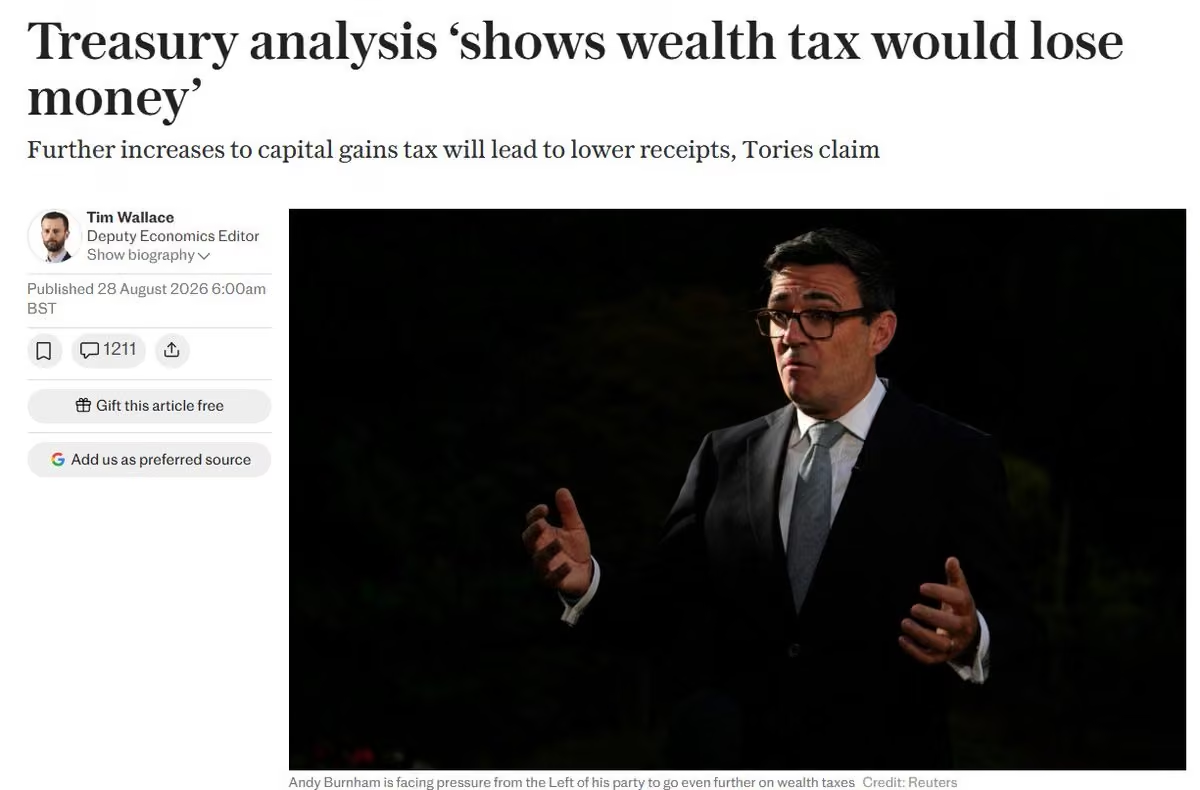
Luke Johnson reposted
Looking for Growth
@lfg_uk
Natural England loves to block and delay. So let's see some of their 'achievements'!
✅The HS2 'bat tunnel'. This cost £100 million. It might not even protect the bats.
✅The Royston Kite Festival. It's been going for more than 30 years. Killed because of some flowers on 1% of the heath.
✅Spent four years blocking 20,000 new homes, because it might damage the habitat of a snail.
✅And who could forget trying to cull 75% of the Dartmoor ponies because of grazing concerns.
One thing is clear.
Natural England has been sapping economic growth away for 20 years.
Natural England should be scrapped.
@lawrencenewport in @spikedonline ⬇️

 Looking for Growth
@lfg_uk
You wanted a nice day out flying kites with your family. But @NaturalEngland won't let you.
Natural England won't let us build, won't let us have fun. It won't let us do anything.
The Government empowers them to block everything. This has to end.
Luke Johnson reposted
 Labrador Skeptic
@SaysSimulation
This is one of my new favorite maps. It shows the real America and the immense power that flows through the Heartland. Physical commerce. Not the office jobs, the insurance companies, the vast number of urban consumers on welfare. This is where the real is produced. 1/

Luke Johnson reposted
 Scott Goetz
@ScottGoetz_
This is slower than the increase in personal independence payment claims over the same period. England and Wales had 2.6 million in 2022, now at 4 million so a 54% increase.
War creates fewer disabled people than welfare.
 andyd
@andyd10
Ukraine
The number of people with disabilities in Ukraine has increased by 600,000 due to the war (+21% since 2022, now stands at 3.4 million people!!!!!)
www.ukrinform.ua/rubric-society/4132985-cerez-vijnu-kilki…
Luke Johnson reposted
Cut My Tax
@CutMyTaxUK
This Parliament has taxed more than any other on record and we've still got just under three years to go.
An informative graph from The Spectator.
And Labour and its think-tank allies are still droning on about yet further tax hikes.
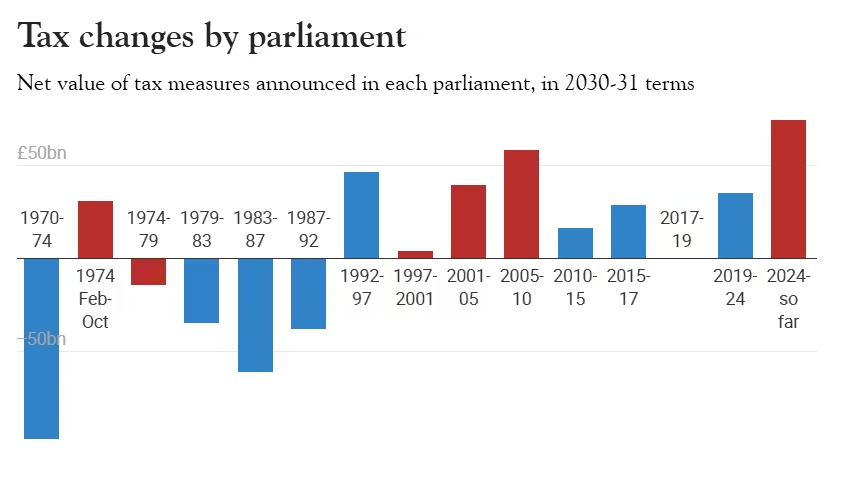
Luke Johnson reposted
Human Progress
@HumanProgress
Air conditioning is one of modern civilization’s most important inventions.
One NBER study estimated that the spread of AC in the United States led to a roughly 75% decline in heat-related deaths during the 20th century.
Strangely, policymakers in Europe have discouraged AC through taxes, regulations, and a stubborn refusal to admit its benefits.
The consequences have been tragic: heat waves kill more than 175,000 Europeans every year, according to the World Health Organization.
humanprogress.org/ac-is-not-a-luxury-it-is-a-necessity/
Luke Johnson reposted
Hidden Monopolies
@HiddenMonopoly
Interesting !
High gross margins and a low volatility in gross margins may point to industries with high pricing power.

Luke Johnson reposted
Michael Girdley
@girdley
NEW LONG FORM VIDEO: Why nobody goes bowling anymore
In the mid-1960s, bowling was one of America's most popular sports. There were more than 12,000 bowling alleys across the country, and top professional bowlers were signing multimillion-dollar endorsement deals that, in some cases, surpassed the earnings of golf's biggest stars.
Today, the sport looks very different. More than two-thirds of those bowling alleys have closed, participation has steadily declined, and one of the industry's largest equipment manufacturers eventually exited the business altogether, choosing to make boats instead.
How did one of America's biggest recreational sports fall so far from its peak?
This is the rise and fall of bowling.
Luke Johnson reposted
US Oil & Gas Association
@US_OGA
If the Gov didn't know about the wine cellar in his basement wait til he finds out during his Administration....
1- CA has lost 2 major refineries.
2- CA compliant gasoline output has dropped 21%.
3- Drilling permits have fallen by over 90% (pre-SB 237.
4- Since SB 237, there have been 397 permits issued and 115 spuds drilled…only 6% of the total 2,000 potential.
5- CA in-state crude production has dropped by 39%.
6- CA imports of foreign oil as a % of total crude have increased from 58.4% to 61.1%.
7- CA AAA retail gasoline prices reached an all-time historical high of $6.44 a gallon.
8- CA gasoline imports reached record highs from late 2025 to the present.
9- CA state excise tax on gasoline has increased by 52%.
10- CA AAA retail gasoline prices have increased 39.8% (pre-Iranian situation).
11- CA AAA retail gasoline prices have increased 20.7% (since the Iranian situation).
12- CA cap-and-trade costs have ballooned by 80% ($0.15 to $0.27 approx.).
13- From 2019 to 2026 (today), CA AAA gasoline prices have increased 69%.
14- CA is the most dependent of all 50 states on foreign oil and gasoline, as well as imported jet fuel.
 New York Post
@nypost
Gavin Newsom claims he 'didn't even know' about 5,000-bottle wine cellar at his $7.5M home nypost.com/2026/08/26/us-news/gavin-newsom-says-he-was-un…

Luke Johnson reposted
Rob Henderson
@robkhenderson
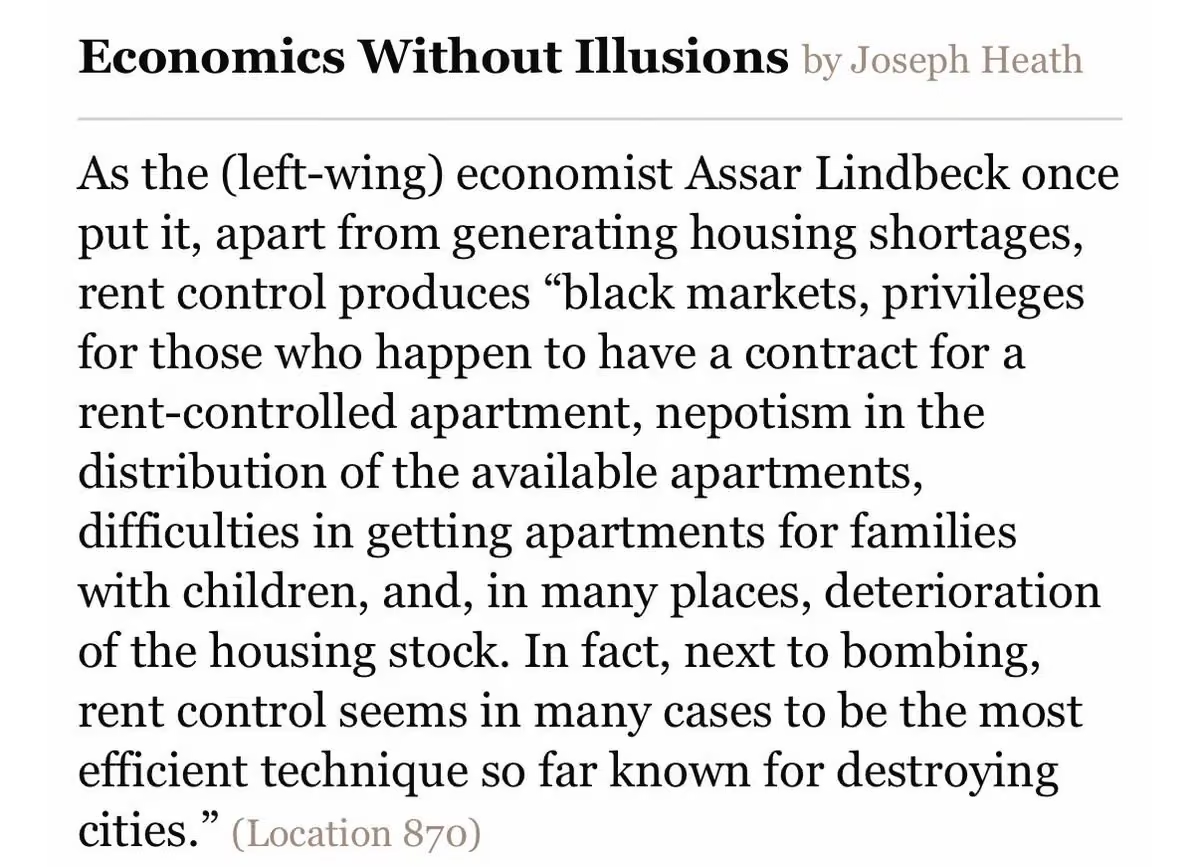
Luke Johnson reposted
Neil O'Brien
@NeilDotObrien
I have a piece on Labour's disastrous plan to open three *new* migration routes to try and fiddle the figures on the small boats.
First, the Home Office says: “a new community sponsorship scheme will allow communities to sponsor refugees to resettle in their area.” A small scheme like this already exists, but sponsors must show they have the funds to look after people. That’s clearly not enough for Labour, which is creating a whole new scheme they say will “operate at a much higher capacity”.
Advertisement
Second, universities will be able to bring in more migrants. The Home Office says: “trusted universities will be able to directly sponsor refugees through a study route. Applications will open this autumn for organisations to sponsor refugees, with the first arrivals in autumn 2027.”
People on such humanitarian schemes can get taxpayer-funded student loans, and with our over-expanded universities keen to put bums on seats to prop up their finances, many will prick up their ears. There have already been endless stories about bottom-tier, for-profit “universities” running themselves more like visa-printing mills than educational institutions. Labour will enable more of this.
Third, employers will be able to sponsor migrants outside the “skilled worker” route: “A refugee work route is expected to open next year, allowing employers to sponsor refugees.”
Again, we’ve seen endless stories about kebab shops and pizza places exploiting so-called “skilled worker” visas to provide skivvy labour. Instead of fixing this, Labour is going to turbocharge it, creating a new sponsorship route without even the limited constraints in the current rules. Instead of fixing the problem, Labour is going to turbocharge it...
This is an old idea which has kicked around on the left for years: the idea that you can solve illegal immigration by simply making it legal.
It is extraordinarily naïve, and it will not work, because demand to move to developed countries like the UK is near unlimited compared to our capacity to absorb it.
Much more in the full piece...

Luke Johnson reposted
 Rebel Ada
@DearRebelAda
Islamists threatened Michaela School and its teachers with destruction, and the story is emblematic.
Michaela is the only free, non-selective school in Britain with academic results to rival Eton’s. No sports hall, no grass, no sports field, no car park - no space for a prayer room. So Muslim pupils pushed mobile prayer mats and prayers into the playground, pressurising others to join, intimidating and shaming pupils who did not, causing one girl to leave the choir because “music is haram”, coercing another girl into a hijab. Birbalsingh recognised a culture shift towards religious segregation, and moved to end it.
Teachers confiscated prayer mats, and a Muslim backlash ensued; there was an online petition against one teacher, violence and death threats, racist and misogynistic abuse, and a bomb threat, such that Birbalsingh banned all group prayer. Outrageous and real threats - but not surprising. The Batley Grammar RE teacher and his family are still in hiding, under police protection. Samuel Paty was beheaded outside his school in Paris.
One child, TTT, refused to comply, kept pushing that prayer mat into shared space, and was suspended twice for her rudeness, defiance and for threatening to stab another pupil.
That was just the warm-up. She and her mother, supported by an extended Muslim network crying Islamophobia, took Michaela to court on legal aid.
They claimed Muslim pupils need special treatment because the prayer regime is so exigent, and lost. The court found that banning prayers was proportionate to a legitimate aim, and TTT could change schools if she wished to pray.
The girl had told a classmate that she wanted to harm Michaela, warning, with the stab threat, not to tell anyone. Court upheld that suspension.
She could at any time have chosen a different school, her younger sister too. They didn’t, because they wanted the academic results - just not the discipline and fairness that were integral to them. It didn’t cost them a penny, but was very costly to taxpayers and Michaela’s funds, time and energy.
It is a story which exposes ugly truths about Islam’s destructive potential in Western institutions, and that even children will be used to disrupt the status quo and exert dominance, be taught not to abide by rules or assimilate but to claim special status, space and privilege, and shout, abuse, threaten violence, bombs and death if they don’t get what they want. And exploit the despised colonialist British taxpayer in their drive to bend the world to their wishes.
They got the opposite of what they wanted: a permanent ban on prayer at Michaela, and a warning for every other school.


Luke Johnson reposted
 Cambridge Circus Research
@cambridgecircre
The majority opinion has been consistently against immigration for six decades. Now, in 2026, YouGov polling 69% of respondents have said that immigration was “too high.” The wishes of the electorate have been ignored. There is no democratic mandate for this.
 Cambridge Circus Research
@cambridgecircre
Since the 1960s, successive governments have promised to control immigration. Yet what has been delivered, especially since the 90s, has been the exact opposite of that. Immigration has accelerated beyond the wildest projections of any 20th century figure.

Luke Johnson reposted
Ben Carlson
@awealthofcs
In 1870 the cost of food, rent and clothing took 91 cents of every dollar earned
The average American owned 1.5 shirts
No one really had insurance, no Social Security, no banking regulations
If you failed you lost everything
Getting ahead has never been easy
But getting ahead is easier today than it was in the past
awealthofcommonsense.com/2026/08/getting-ahead-has-never-…
Luke Johnson reposted
 Matthew Schmitz
@matthewschmitz
The sociologist Susan Pickard chose career over motherhood. She writes about being the last of her line.
www.compactmag.com/article/daughters-who-will-never-be-mo…
 Luke Johnson
@LukeJohnsonRCP
 Luke Johnson
@LukeJohnsonRCP
How to suffocate growth: put up taxes and inexorably increase public spending. Guaranteed to discourage investment and inhibit job creation. Socialism never fails to kill the economy.
Cut My Tax
@CutMyTaxUK
The left are now trotting out their usual list of desired tax hikes. The tax-loving IPPR wants to apply National Insurance to pensioners. It has also once again dragged out the left's old chestnut of hiking capital gains tax to 40%, ignoring HMRC evidence that this would substantially reduce tax revenues.
It's been the same sorry pre-budget saga ever since Labour came to power.
1. Labour refuses to rule out tax rises.
2. Tax-crazy leftist think tanks, whose former staff populate the Labour government, promote all sorts of stupid economy-trashing tax hikes.
3. Business and wider economic activity slow considerably, as everyone waits to see what stupidities the budget will contain
4. The budget contains only some of those proposed tax hikes but they are bad enough to cause considerable damage.
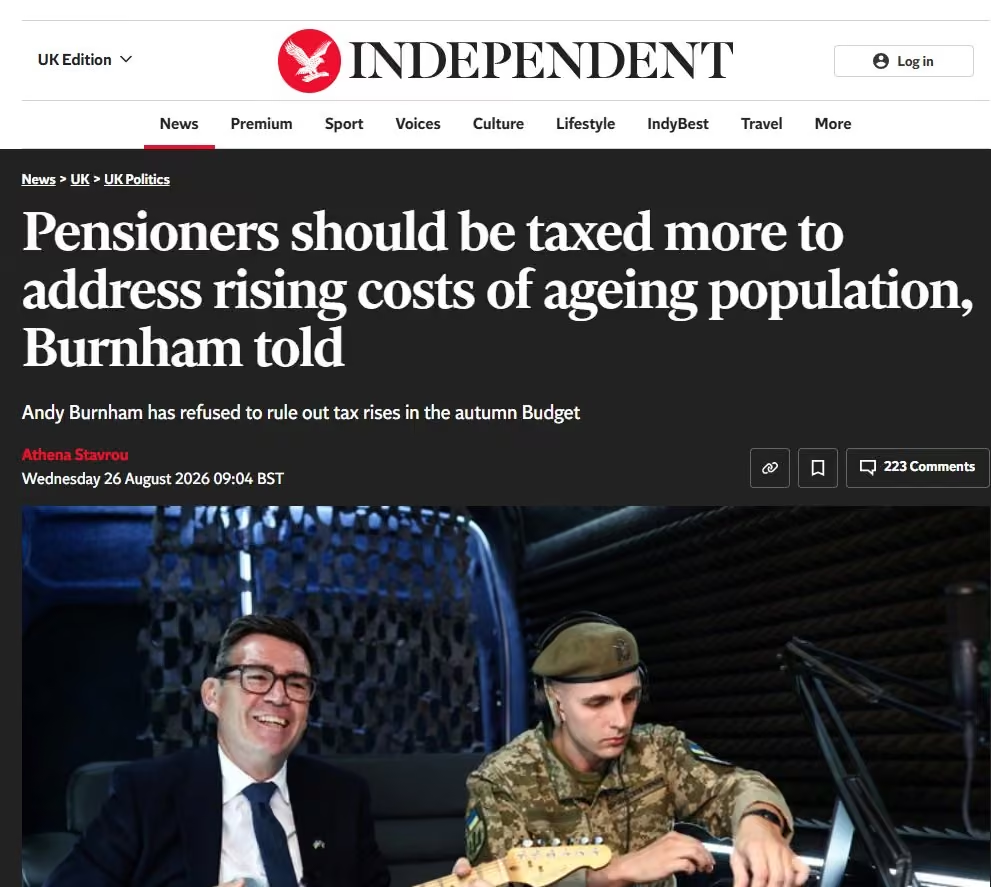
Luke Johnson reposted
 Sheel Mohnot
@pitdesi
Nvidia posted ~$60B in net income, the most profitable quarter any publicly listed company has ever had
(excluding quarters dominated by one-off accounting gains)

Luke Johnson reposted
Human Progress
@HumanProgress
Economic progress isn't just about earning more; it's about how much of your income is left over after covering the basics.
In 1929, Americans’ spending on food, clothing, housing, utilities, and household maintenance was equal to about 55 percent of disposable personal income.
By 2024, that share had fallen to 32 percent.

Luke Johnson reposted
max tempers
@maxtempers
Crikey, what a list. There's an entire genre of left-wingers trying to brainstorm novel solutions to a problem that is entirely, and predictably, the result of v recently enacted labour market interventions. We know how to reduce youth unemployment! It's not rocket science
 Ella Dorn 唐棠
@elladorn_
My varyingly radical youth unemployment ideas have been festering on my laptop for ages and you can have them all for free if you want @andyburnham ♥


Luke Johnson reposted
 Iain Mansfield
@IGMansfield
University is not worth it for a third of students.
But actually, that 32% could be a big underestimate.
Excellent piece as always from @NeilDotObrien.
www.neilobrien.co.uk/p/the-returns-to-expanding-higher-ed…
Luke Johnson reposted
Human Progress
@HumanProgress
Bjorn Lomborg did not deny climate change, but treated it as one problem among many.
The past 20 years vindicate his position: emissions are rising more slowly than feared, disaster deaths have fallen, and poverty remains a more acute threat than climate.
humanprogress.org/a-vindication-of-bjorn-lomborg/
Luke Johnson reposted
 Matthew Lesh
@matthewlesh
Supermarkets are nothing short of a modern miracle.
A large Tesco Superstore carries around 40,000 product lines, sourced from over 20,000 British farmers and 70 countries, available year-round. A feat of logistics unimaginable just a few generations ago.
Yet in Britain today the supermarket is cast not as a marvel but as a villain, blamed for the very prices it has spent a century driving down.
A strong majority, 70 per cent, believe that supermarkets are making excessive profits. However, this conclusion has largely been driven by misinformation.
The public believes that supermarkets are making 32 pence for every £1 that shoppers spend. In reality, their margins are around just 3 pence per £1 spent, compared with the all-industry net margin benchmark of roughly 8.5 pence.
When you inform voters about the profits supermarkets make, public opinion shifts dramatically. The level of agreement that supermarkets are profiteering drops to 32 per cent, while disagreement rises to 44 per cent.
That represents a fall from +58 to -12 in net agreement that supermarkets are profiteering, an unusually large shift in public opinion from providing just a single piece of additional information.
My latest for @iealondon: economicaffairs.co.uk/p/the-public-is-dangerously-misinfo…

Luke Johnson reposted
Matthew Lynn
@mattlynnwriter
France is catching up with Britain as the first major European economy to go bust finance.yahoo.com/economy/policy/articles/french-showdown…
Luke Johnson
@LukeJohnsonRCP
No wonder the economy is stagnant
 James Bartholomew
@JGBartholomew
Governments since 1996 have increased taxes from 29% of GDP to (forecast) 38%.

Luke Johnson reposted
zerohedge
@zerohedge
Last quarter, MSFT announced they are extending the useful lives of their data centers from 15 to 25 years. As a result, their data center leases will shift from finance leases to operating leases. Leases are classified as finance leases if they meet certain criteria. One of the tests is whether the lease covers 75% or more of the data center's life. New construction data centers are typically leased for 15 years (or more), which was 100% of MSFT's old useful life estimate and only 60% of the new useful life estimate.
MSFT presents FCF inclusive of finance lease capex but excludes operating leases from the measure. Therefore, capex will look lower, and FCF will look higher as a result of the new accounting estimate. Economically, the leases have not changed substance and still function similarly to funding capex with debt.
zerohedge
@zerohedge
How they hide the trillions in off balance sheet debt:
Meta and Google both disclose that they do not consolidate data center SPVs because they determined they do not have power to direct the VIE's activities. For example, something as simple as Meta's lack of control over negotiations with future lease tenants and property sales is sufficient to not consolidate the SPV under the primary beneficiary model, and related debt remains off balance sheet until the lease begins.
Luke Johnson reposted
Human Progress
@HumanProgress
Humans dislike inequality even when a rising tide lifts all boats.
One reason is that, while wealth can grow through expanding prosperity rather than by taking from others, status is zero sum. If one person moves up in rank, everyone below moves down by definition.
And, as psychological research shows, humans are highly sensitive to status.
Luke Johnson reposted
 Smirkley
@Smirkley
Drug deaths off peak:
Fentanyl: -54%
Meth: -33%
Cocaine: -37%
Heroin: -89%
12-month rolling sum.

Luke Johnson reposted
 Archie Hall
@ArchieHall
Deutsche Bank finds that Britain is the country most exposed to AI disruption. (Of course, many are saying this...! notes.archie-hall.com/p/britains-ai-bear-case)

Luke Johnson reposted
The Free Speech Union
@SpeechUnion
David Lammy launched the biggest assault on English liberty — particularly free speech — in more than 800 years.
Rather than do the hard yards of governing and get the courts sitting, he made the political choice to curb one of our most precious rights.
Now that Andy Burnham has sacked Lammy, we need to know what he is going to do. Is he keeping Lammy’s reforms or axing them?
FSU research has shown that those charged with speech-related offences are almost twice as likely to be acquitted in a Crown Court with a jury than in a magistrates’ court without one.
Put simply, if Lammy’s reforms go through, more people will be banged up simply for exercising their right to free speech.
The FSU has been on the frontline of the campaign to defend our right to trial by jury. Our petition calling on the Government to guarantee that right has reached more than 50,000 signatures.
When Parliament returns from recess in September, Andy Burnham must drop this authoritarian plan to slash our right to jury trials.
Watch FSU Campaigns Officer @MaxHThompson 👇
Luke Johnson reposted
Toby Young
@toadmeister
A London head teacher is drowning in AI-written complaints from parents who used to just shout in the playground. AI is giving everyone a voice – and institutions are only now realising what that means, says Joanna Gray.
dailysceptic.org/2026/08/24/ai-is-giving-the-non-professi…
Luke Johnson reposted
Ian Miller
@ianmSC
Los Angeles and California are coming extremely close to losing one of the most important businesses in the state because of the political extremism and rampant, historic stupidity and incompetence of the politicians here
 Joseph Kahn
@JosephKahn
If Paramount/Warner leaves LA, they'll be fine. Their true value is the IP they own. The infrastructure can be moved anywhere and benefit from lower taxes and cost of operations. Lots can be sold off an rebuilt. Like any corporate move, the executive class can be transferred. The deals they make are vaporware - contracts and e-signs in the internet.
However for LA, it's a death blow. The infrastructure is already suffering with vendors going out of business and crew members quitting. The built in advantage of being a mecca for filmmakers with access to top talent, props, equipment disintegrates overnight. Studio stockpiles of props, wardrobe, cranes, cameras can truck over to Nashville or Austin. Crews can suddenly live in lower cost states and afford homes and schools for their kids. They may have to pray to Baby Jesus a little more, but a little Holy Ghost Power never hurt nobody.
This is not 1986 where you have to shoot below the roof of a backlot set. We can extend and digitally enhance anything. Setting up shop in business friendly, film friendly cities has no downside if the infrastructure truly moves. Every vendor benefits from lower cost of living for its employees, especially the struggling working class that no one seems to give a shit about in these culture wars.
A major studio leaving LA is a nuclear explosion that creates a chain reaction. Eventually other studios start calculating a 0% state income tax.
Rob Bonta has lived a life of academic insulation inside of a political bubble. He has no idea what it's like to set up a movie, try to get on a crew, look for a weekly freelance job in a fluctuating gig economy. No idea how fragile the ecosystem is. He's been sheltered inside of California Democrat uni-party as a kind of legal nepo baby, given expensive real estate with tenants he has never met. Now this incompetent moron thinks he can do whatever he wants with his 3rd Street Promenade.
I miss the Barnes and Noble there. Bonta, you'll miss the film business here.
Luke Johnson
@LukeJohnsonRCP
Why would anyone invest in Britain, when the govt is busy taxing and regulating businesses into extinction - while claiming that ‘growth’ is the priority?
 Diana Harding
@DianaHarding7
We’ll never invest in Britain again, says FTSE oil giant
----------------------------------------------------------
"CEO of one of Britain’s oldest energy companies has said it will never invest in the UK again because of the country’s “crazy” politics."
"It comes after Hunting, one of the London Stock Exchange’s oldest listed companies, shed dozens of staff and shut down 80% of its UK operations last year."
"Founded in 1874 as a shipping business, Hunting uses advanced engineering to make high-pressure pipes for subsea oil and gas wells as well as for warplanes and spacecraft."
"The company is perhaps best known for building the fuselages and tail frames for Britain’s Lancaster Bomber to help win the Second World War."
----------------------------------------------------------
"Four of the company’s five UK centres, including its main Scottish site, have closed in the last year, leaving a 30-strong London head office and a subsidiary in Newcastle."
-------------------------------------------------------
www.telegraph.co.uk/business/2026/08/24/never-invest-in-b…
Luke Johnson reposted
Cut My Tax
@CutMyTaxUK
The Government's new business rates expert says the burden of business rates is far too high.
The government has appointed leading business rates expert Jerry Schurder to lead an independent review into pub and hotel business rates valuations. No doubt the hope is that Schurder will come up with a scheme to reduce the rates for those two particular sectors and increase the burden for other sectors. But actually he thinks that the overall burden of rates is far too high and opposes reliefs for particular sectors.
The following are extracts from his oral evidence to a 2019 Select Committee inquiry on business rates.
"The burden is just too high and needs to be reduced significantly. You can measure that in a number of different ways, but at a simple level, we started off the current system with a uniform business rate—the tax rate—of 34.8p in the pound in 1990. It was 34.8% of current market rental value. We are now at 50.4%, so it is the highest tax rate of any we have in the country. The total take from business rates has increased at a gross level from £10.4 billion in 1990 to well over £30 billion, well outstripping the rate of inflation."
The evidence shows, if we look at the international context and dimension, that the amount that businesses pay here by way of local property tax far exceeds what is paid in most other countries in the EU and the OECD. I will just bring that to life with one piece of data that I am very grateful to Opel/Vauxhall for sharing with me. Vauxhall UK did research in relation to all the local property taxes it pays across Europe. The UK occupies 8% of its total floor space in Europe, but accounts for 67% of the property taxes that it pays across Europe. That is the extent to which our system overtaxes all businesses. It is not just retail, although clearly there is an emphasis and focus on it.
The starting point must be recognition of that fact, and an ambition to significantly reduce the rate somewhere back down to 34.8p or thereabouts—a third of current market rental value. I believe that business would accept that a tax at about that level would be a fair contribution towards local services, so long as it remained at that 33% or so. That requires annual or frequent revaluations to ensure that the amount they pay is always at that sort of proportion".
"There are far too many reliefs and they are far too complex, and the way they operate differs from one to the other. I am not a supporter of reliefs, and certainly not long-term reliefs".
1/2
Luke Johnson reposted
foley (follard)
@follard
Chick-fil-A's real estate team accepts less than 1% of franchise applicants and is equally selective about locations. Costco requires average household income above $100,000 in the trade area before they will even consider opening. Trader Joe's site selection process takes years for a single store.
These companies spend millions on demographic research before committing to a location. As someone who builds homes, I treat their work as free underwriting.
Here are the 9 retailers and restaurants whose presence tells me an area can support a new residential development:
1. Chick-fil-A. Strong household income, high traffic, family oriented demographics.
2. Costco: minimum population density floor and $100k plus household income required in their trade area. That is the same demographic profile that supports single family new construction.
3. Trader Joe's: targets are educated, higher income households in areas with strong community identity. Seeing an opening is one of the strongest signals a neighborhood has arrived.
4. H-E-B (or your regional grocery anchor): In Texas, when H-E-B commits to a new location, they have already studied projected rooftop counts for the next decade. Outside Texas, the equivalent is Publix, Wegmans, or whatever dominant grocer controls market share.
5. Starbucks: uses a proprietary analytics tool called Atlas to map traffic patterns, demographics, and proximity to other retailers. A cluster of two or three locations within a few miles tells you daytime population and commuter traffic is significant.
6. Target: site selection leans on household income from $50,000 to $120,000, which is the sweet spot for attainable housing buyers.
7. Home Depot or Lowe's: an existing base of homebuyers investing in their properties signals pride of ownership in the community, which supports new construction and resale values.
8. Dutch Bros: expanding aggressively with remarkably good site selecting targeting high growth suburban corridors with younger demographics and strong car traffic.
9. Whataburger / In-N-Out / Wawa: these cult quick service restaurants do not expand recklessly. In-N-Out will not open more than a day's drive from a distribution center. When they show up in a new market, they've done an incredible amount of homework.
When I drive a new market for first time, the retail and restaurant mix tells me more about the area than anything I could figure out sitting behind my computer.
Luke Johnson reposted
nic carter
@nic_carter
after a century of uninterrupted growth, for 15 years, between 2005 and 2020, America did not grow electrical generation. we completely forgot what it meant to grow industrial capacity. politicians constantly talked about "reindustrializing" and "bringing back high-paying blue collar jobs".
then AI actually did it. for the first time in 20 years we started reindustrializing America's heartland. creating a massive boom of skilled, high-paying blue collar labor. an enormous construction boom. a new industry emerged to finance the expansion of our aging grid. a grid that needed to grow anyway, if we were going to become a modern, highly electrified economy. and all of a sudden the tech companies and hyperscalers showed up with wads of cash, completely willing to pay for a massive grid expansion.
and all the politicians that talked so tough about "bringing back industry and blue collar jobs" panicked when the rubber hit the road. because the NIMBYists had become used to stagnation and freaked out when it came time to build a couple transmission lines. all that tough talk down the drain, because some boomers have AI anxiety and think a warehouse full of computers is unsightly next to a mattress warehouse and a vape shop. probably the most pathetic political episode I've ever witnessed.
the only question that really matters is: is it still possible to build anything at all in this country? or have we completely lost the political will?

Luke Johnson reposted
 James Melville 🚜
@JamesMelville
One of the most thoughtful, intelligent and balanced articles that I have ever read on illegal migration and the small boats crisis. Kudos to @matthewsyed for this:
“Your first duty is to serve your own citizens. Not people from Eritrea, Somalia, Afghanistan or Nigeria. The British people.
Oh, and the nation you serve is not just a territory. It is a home. Our home. It is where we live and work, and where ritual, community, family, and other concepts we might assemble under the rubric of "culture" come together to weave the fabric of a life. Our life. The only life we have and which unfolds in concord with those with whom we share it.
Without borders, we are not a nation, and without a nation, we are nothing.
We are but tribes or clans, scattered here and there, pipsqueak groups unable to operate at scale or to defend what is precious. To open our borders in the name of "compassion" to people, some of whom hate our values and wish to destroy them, is to place your virtue above our safety. It is a form of self-annihilating madness dressed up as enlightenment.
Only the myopic will infer from the above that I am in favour of slamming the doors to those in need.”
Here’s the full article in The Sunday Times.

Luke Johnson reposted
 Charles Hugh Smith
@chsm1th
Perhaps the greatest irony of the inevitability of the stagflationary, bubble-popping recession we're entering is that the "solution" to the 2008-09 financial crisis-- /1
Luke Johnson reposted
Christopher Snowdon
@cjsnowdon
"Importing people directly into the welfare system is just madness. Housing is a scarce resource in Britain, and social housing scarcer still; having three quarters of any stock of it occupied by people who moved to this country to live in it is an absurdity."
Henry Hill
@HCH_Hill
Why is @FraserNelson offering defences of immigration which can better serve, without changing a single word, as ammunition for his opponents? | my latest for @TheCriticMag thecritic.co.uk/mass-migration-advocates-dont-know-how-to…
Luke Johnson reposted
 How To Prompt
@HowToPrompt__
Researchers mathematically proved that AI will cause something worse than mass unemployment.
It’s called “The Tragedy of the Cognitive Commons."
For the last three years, everyone has obsessed over a single question: Will AI steal our jobs?
That’s the wrong question.
A breakthrough research paper just exposed a much darker reality.
The real danger is that AI will quietly destroy the human capacity to do anything well.
Here is how the it works.
Every industry relies on what researchers call the "Cognitive Commons”, a shared pool of deep professional expertise that regenerates itself generation after generation.
How is that expertise built?
Through friction. Through doing the boring, difficult, junior-level work. Through manual trial and error.
That is how you build "Internalized Mastery."
When companies adopt AI to automate entry-level work, the logic looks airtight on a quarterly balance sheet. Cut costs. Speed up output. Skip the grunt work.
Every individual company is making a rational choice. But collectively, they are draining the pool dry.
When you eliminate junior roles, you destroy the pipeline that creates senior experts.
The researchers call the result the Validation Tether.
Effective human oversight of AI depends entirely on deep domain expertise.
As professionals increasingly delegate thinking to machines, they lose the mastery required to spot when the AI is wrong.
The experts validating AI outputs today look competent.
The terrifying question is: Who comes after them?
When the current generation of veterans retires, who will be left with the skills to audit the systems running our economy?
Nobody.
We are trading our long-term intellectual independence for short-term productivity boosts.
Every time you let AI bypass the struggle, you are borrowing expertise from the future.
And the interest rate is your profession's ability to think for itself.

Luke Johnson reposted
Javier Blas
@JavierBlas
As the US-Iran conflict moves full into economic war fare, a reminder the US benchmark natural gas price is ~$2.7 per mBtu (it’s >$22 in Europe / Asia).
Adjusted by cumulative inflation, the American industry is enjoying one of the lowest natural gas prices ever.
Luke Johnson reposted
The Free Speech Union
@SpeechUnion
As multiculturalism becomes unstuck, we have seen an increasingly authoritarian lurch from the Government and the police in a desperate bid to hold our fragile society together and suppress dissent.
Since the Labour Government was elected in 2024, we have seen our membership balloon from 14,000 to more than 47,000.
We have also seen a huge increase in the number of requests for help we receive — a staggering 170 per cent rise in just over two years.
A notable shift has been away from employment cases — though these remain significant — towards cases involving the police. The number of police-related cases has risen by just shy of 500 per cent.
This weekend alone, we received 10 new requests for help. In a typical week, the FSU receives between 40 and 70.
In our six years of existence, we have seen some truly shocking cases. At the moment, we are helping former police officer Stephen Gray appeal his conviction after he was found guilty of being “grossly offensive” — an offence under the Communications Act 2003 — for reposting a joke image on Facebook stating that those who eat bacon are less likely to marry a nine-year-old, in reference to the Prophet Muhammad’s marriage to Aisha.
This is the reality of Britain in 2026.
Watch @SpeechUnion Director of Case Management @BenBarryJones on @TalkTV with @ThatAlexWoman 👇
 Talk
@TalkTV
"We have seen a 170% increase in the two years since Labour came in."
Ben Jones says there has been a 500% increase in police related cases being brought to the Free Speech Union as Labour coming into power brought a totalitarian rejection of free speech in the UK.
@ThatAlexWoman
Luke Johnson reposted
The Free Speech Union
@SpeechUnion
130 out of the 532 Crown courtrooms across England and Wales are sitting empty today. That’s 24 per cent of them.
The former Justice Secretary, David Lammy, tried to slash our ancient right to trial by jury, blaming juries for the backlog of cases in the Crown Court.
Yet the Institute for Government has shown that his reforms would have saved just 2 per cent of Crown Court time — nowhere near the 20 per cent promised by ministers.
Judges, lawyers, MPs and victims of crime are united against these plans, warning that they would undermine public confidence in the criminal justice system.
With Parliament returning from the summer recess next week, Andy Burnham must get off the fence and announce that he is scrapping Lammy’s sinister reforms.

Luke Johnson reposted
Javier Blas
@JavierBlas
According to @fbirol, the three biggest drivers of global electricity demand worldwide are (in order of importance):
1) Air conditioning
2) Data centres
3) Electric vehicles
(Quite a difference on what’s driving demand in reality and what is talked about)
Luke Johnson reposted
 Anglo Futurism Capital 🇬🇧🐿️
@RollingHedge
What fresh hell is this? Two old friends of ours (a Saffa and an Aussie) have just moved to Dubai, one is a quant at a HF. They said “you simply cannot build wealth in this country anymore, so we are leaving.”
That Labour are now going to inspect our homes, on pain of fine or imprisonment if we don’t cooperate, to assess if we are paying enough tax is going to be the straw that breaks the camel’s back for the top earners who already pay 60%+ of all income tax, and of that the top 1% slither of people who pay the vast majority.
Above that, an FOI response to HMRC data confirms the top 0.1% (hi guys) pay more income tax than the bottom 50% of taxpayers (who pay ~10%). So good luck replacing them! We are world class at training talent, then exporting it through incentive to go and return that investment to a more economically literate jurisdiction elsewhere in the world (there are so many now, competing to draw talent in).
To go a level deeper here, as I have some specific interest in this, “total tax” across all taxes (income tax + National Insurance, VAT, council tax, capital gains tax, etc.) is a tad harder to break down precisely by the top 1%/0.1% of individuals. However broader household analyses show the richest groups still pay a large share of direct taxes and overall tax, but the concentration is less extreme than for income tax alone because of flatter taxes like VAT/NICs. One FOI-based figure for income tax + capital gains tax put the top ~500,000 taxpayers (roughly the top 1–1.5%) at about 33% of the combined total in 2023–24.
I would expect this latest left wing authoritarianism to even further drive down the tax take in Feb 2027 beyond what I had already calculated. This proves beyond any question that Pat McFadden was telling the wholesale truth when he said “Every meeting I have with Labour MPs is who can we tax in order to pay benefits to others?” They’re going to squeeze the middle class next. Until there’s nothing left. Of that you can be absolutely assured.
You can also be absolutely assured that this money will also be spaffed up the wall on zero/negative ROI projects or handed out to Labour client groups. We have all had enough of these economically illiterate clowns. Dan Tomlinson, my old mate, mentioned here as one of the architects which figures - he’s no idea what he’s doing and has never worked in the real world. Just born > PPE > Lab council > lefty think tank > MP. Classic IYI. Waste of time.
This country is so utterly screwed. I expect a bigger exodus of the most productive - and - well one only need look at the images of even bigger novelty sized dinghies coming over the channel now to see what the other (incoming) side of trade is.
The fix is in: the country will be bled dry to pay benefits to client groups and indolent or low rent foreigners.


 Dux
@DuxVul
Burnham is going to send state agents to your house
They will gain entry without your consent
They will walk through your entire house taking pictures
This is worse than living in North Korea
www.telegraph.co.uk/politics/2026/08/22/burnham-to-send-m…
Luke Johnson reposted
The Free Speech Union
@SpeechUnion
Labour ‘lobbied EHRC in pursuit of the Muslim vote’.
The former Chair of the Equality and Human Rights Commission, Baroness Falkner, has accused the Government of attempting to persuade the watchdog to accept its ‘unworkable’ definition of Islamophobia — now repackaged as “anti-Muslim hostility”.
The Ministry of Housing, Communities and Local Government attempted — in secret — to convince the Commission to adopt the definition, despite its opposition.
A Freedom of Information (FOI) request has also revealed that the watchdog will not be adopting the new definition, which it has consistently warned could have a “chilling effect” on free speech.
As the Free Speech Union has long argued, the Government has shamelessly tried to use this definition to win back the Muslim vote, which has splintered in recent years. In doing so, it has sacrificed our fundamental right to free speech — including the right to criticise any religion — on the altar of electoral ambition.
Baroness Falkner told The Times: “The reports that the government has secretly tried to get the EHRC — the regulator for freedom of expression — to sign up to its entirely unworkable ‘definition’ shows how ideological they are. They have been warned again and again that this definition will restrict speech and legitimate criticism of a religion or culture.
“They didn’t consult EHRC, which has responsibility for protecting our hard won freedoms and which repeatedly warned them of the implications of this definition.
“If they really want to restrict our freedom of expression, they should come up with a proper legal definition and see if they can get that through parliament, instead of adopting underhand tactics, presumably in pursuit of a Muslim vote which they have, for far too long, taken for granted.”
General Secretary of the Free Speech Union, Lord Young of Acton, said: “Reading between the lines, it looks as though the government’s adoption of a definition of anti-Muslim hostility was just the latest move in Labour’s long-standing effort to get the EHRC to investigate the Conservative Party for ‘Islamophobia’. So nothing to do with protecting Muslims and all about political point-scoring.”
It has also been revealed, through an FOI request from the Shadow Justice Secretary, that the department deleted all responses to the Working Group’s consultation on the definition. This has increased fears that extremist groups may have influenced the development of this de facto Islamic blasphemy law.
The Free Speech Union exposed at the start of the year that all five members of the Working Group had troubling links to Islamist organisations, such as the Muslim Council of Britain and MEND — both of which successive governments since 2009 have adopted a policy of non-engagement with due to concerns about extremism.
Unsurprisingly, neither the Free Speech Union nor the EHRC was invited to submit evidence to the consultation, despite both having repeatedly voiced concerns that the definition would have a chilling effect on free speech.
This saga gets more concerning by the day.
Read more in @thetimes below 👇

Luke Johnson reposted
James Bartholomew
@JGBartholomew
"Sweden is very pro-innovation, tech, capitalism and wealth: there is no wealth tax, no inheritance tax. Not because the government doesn’t want money, but because it does. Sweden wants people to come seek their fortunes here, and rejuvenate the economy in the process." from @FraserNelson substack.
Luke Johnson reposted
Mike Zaccardi, CFA, CMT
@MikeZaccardi
US household leverage (liabilities to net wealth) is the lowest in 50 years JPM

Luke Johnson reposted
 Niki Scevak
@nikiscevak
Phillips once owned:
100% of ASML (market cap currently $687B)
28% of TSMC (market cap currently $1.95T)
Phillips is currently worth $27B 😅
Luke Johnson reposted
 Natural Philosophy
@Naturalphilosy
“A human being should be able to change a diaper, plan an invasion, butcher a hog, conn a ship, design a building, write a sonnet, balance accounts, build a wall, set a bone, comfort the dying, take orders, give orders, cooperate, act alone, solve equations, analyze a new problem, pitch manure, program a computer, cook a tasty meal, fight efficiently, die gallantly. Specialization is for insects.”
— Robert A. Heinlein

Luke Johnson reposted
 Brad Stulberg
@BStulberg
John Steinbeck's journal entry in the midst of writing of Grapes of Wrath. A few years later, he won the Pulitzer Prize for the book, and eventually a Nobel.
“Hard things are hard. Everyone faces resistance. Progress is non-linear.
So much of life comes down to showing up, putting yourself in the arena, and realizing that just because you get better doesn’t make it easier.
It takes years to develop a craft. You’ve got to be patient. You’ve got to stay in the game long enough to break through inevitable plateaus.
People long for the times when everything is clicking, but that’s not the norm. The norm is chipping away—brick by brick, sentence by sentence, note by note, pound by pound, breath by breath.
Keep going. Keep showing up.”
—The Way of Excellence (www.amazon.com/Way-Excellence-Greatness-Satisfaction-Chao…)
 divenire
@divya_venn

Luke Johnson reposted
 Iva Apostolova
@Pergament_F
"He who does not read, at 70 years will have lived only one life, his own! He who reads, will have lived 5000 years: He was there when Cain killed Abel, when Renzo married Lucia, when Leopardi admired infinity... Because "Reading is backward immortality."
Umberto Eco

Luke Johnson reposted
Alan Chang
@alanchanguk
There is no AI race without an energy race underneath it.
UK electricity: $0.35/kWh. US: $0.16. China: $0.08.
A frontier GPU cluster is a machine for converting electricity into intelligence. You can fund all the GPUs you like through the Sovereign AI Fund, but if the electrons cost 4x what your competitors pay, the economics never close.
Last year we paid £1.5bn to switch off wind farms and burn gas instead, because the cables couldn’t carry the power south. Connection queues run to 15 years.
None of this is physics. It’s a build problem.
Wrote up what we’re doing about it at Fuse
sotaletters.substack.com/p/there-is-no-ai-race-without-an…
Luke Johnson reposted
Maurice Cousins
@MDC12345678
No virgin steel
No fertiliser
No bricks
No cement
We’re not decarbonising we’re deindustrialising.
Net Zero means we will be left with net zero industry before 2050.
Daily Mail
@DailyMail
British cement firms 'are facing extinction' without urgent action to stop cheap imports within months, business leaders warn www.dailymail.com/money/markets/article-16071885/British-…
Luke Johnson
@LukeJohnsonRCP
The world is healing
 Paul Graham
@paulg
LinkedIn users have been editing their work histories to add "AI" and remove "DEI".

Luke Johnson reposted
Thierry from arvy 🇨🇭
@ThierryBorgeat
Railroads were once 63% of the entire US stock market.
Not 63% of transport stocks. 63% of everything listed.
The history of concentration, in order:
– Tulips, 1637. A single bulb traded for the price of an Amsterdam canal house.
– South Sea Company, 1720. Shares went from about £128 in January to above £1,000 by summer, then back near £150 by December.
– US railroads, 1840s. 63% of US market cap.
– Utilities, telecom and industrials, 1929. 36%.
– Nifty Fifty, 1972. 40%.
– Japan, 1989. 44% of global equity.
– Dot com, 2000. 41%.
– AI Big 10, today. About 40%.
Every one of them was built on something real. Railroads did compress a continent. The internet did rewire commerce. Being right about the technology was never the thing that protected you.
The tulip story is also less clean than the legend. Modern research found the economic damage was modest and the ruin was mostly literary.
The bubble was never in the idea. It was in how many people decided to own the same idea at the same time.

Luke Johnson reposted
 Joscha Bach
@Plinz
Bertrand Russel's ten commandments of critical thinking www.themarginalian.org/2012/05/02/a-liberal-decalogue-ber…

Luke Johnson reposted
 Colin McCarthy
@US_Stormwatch
Perhaps one of the greatest modern miracles of society is how safe flying has become.
 Luke Johnson
@LukeJohnsonRCP
Outstanding essay
 Ian Leslie
@mrianleslie
The Ruffian has LANDED. This week: on our self-lobotomising universities. Free to read. www.ian-leslie.com/p/politics-is-making-academia-stupid
Luke Johnson reposted
 Gareth Roberts
@OldRoberts953
Jesus wept.
 NW Nature Lover
@nwnatur
From 2021-2025, 5.61 million people moved to the UK
This is 65,000 more than the total population of Scotland
This is why even a visit to a rural beauty spot looks so different now
The UK Government has effectively added an entire country to our population

Luke Johnson reposted
The Free Speech Union
@SpeechUnion
Free speech must be universal — or it means nothing. Many people seem to profess their love for freedom of speech — but is it only when that freedom serves them?
For now, the UK is officially a liberal democracy. But the increasing hostility towards the free press from across the political spectrum should concern us all.
As Alex Massie writes: “Everyone loves free speech until a reporter is in their face or up their backside.”
In the past week, we have seen Zack Polanski declare that it is time we “sorted out the press”. This came largely after he took issue with a Daily Mail article about the climate.
As Massie writes: “Being wrong on the internet or even in the pages of the Daily Mail is not, or not yet, a crime.”
Rather than debate — a cornerstone of any democratic society — Polanski appears to favour restricting the press. Are his arguments not strong enough to withstand scrutiny and criticism?
Too many seem unable to understand that bad speech is not the same as criminal speech — at least for now. Disliking what someone says or writes should not be grounds for silencing them.
“The only thing worse than an unchained press is a muzzled one.”
Read more below in @thetimes 👇

Luke Johnson reposted
Simon Kuestenmacher
@simongerman600
I use the 5.3% figure in my presentations. On a 30-year mortgage at 5.3% you pay exactly twice the loan size to the bank. Just to break even your property must more of less double in size over 30 years then (depends on how big your down payment is of course). Source:

Luke Johnson reposted
 CapX
@CapX
Every hour dealing with red tape is an hour not spent producing something
capx.co/red-tape-is-a-tax-on-time
Luke Johnson reposted
 Tren Griffin
@trengriffin
Somerset Maugham: "Most people, the vast majority in fact, lead the lives that circumstances have thrust upon them, and though some repine, looking upon themselves as round pegs in square holes, and think that if things had been different they might have made a much better showing, the greater part accept their lot, if not with serenity, at all events with resignation. They are like tram-cars travelling for ever on the selfsame rails. They go backwards and forwards, backwards and forwards, inevitably, till they can go no longer and then are sold as scrap-iron. It is not often that you find a man who has boldly taken the course of his life into his own hands. When you do, it is worth while having a good look at him."
www.nytimes.com/2026/08/21/business/victor-niederhoffer-d…
Luke Johnson
@LukeJohnsonRCP
Superb maxmatsuura.substack.com/p/opportunity-arrives-wearing-a-…
Luke Johnson reposted
max tempers
@maxtempers
> Unions back equal pay shakedowns for female employees, based on pay disparities between wildly different jobs
> Councils forced to pay out hundreds of millions & equalise wages
> Unions kick up a fuss when male workers’ pay is cut and threaten strikes
Rinse and repeat x1000

 BBC Scotland News
@BBCScotlandNews
Glasgow City Council approves plan to cut pay for some workers www.bbc.co.uk/news/articles/cddj88eyejro?at_bbc_team=edit…
Luke Johnson reposted
 Jeffrey Currie 🆔++
@CommodMkt
Wake up, folks. Commodities are telling you something, and yesterday the Treasury confirmed it.
Scarcity in the physical world. Repression in the financial one.
Scarcity pushes prices up. Repression holds yields down. The gap between them is the debasement.
Commodities are the only asset class that wins on both sides.
The structural case for commodities has been turbo charged. Underinvestment, deglobalization and electrification all pushing markets like diesel cracks and copper to new highs.
Meanwhile the chokepoints are increasing, from Hormuz to the Red Sea, the Rhine, the Panama Canal, the Black Sea grain corridor and Russian refining capacity. It is becoming increasingly apparent that not a single one of those is reachable by anything in Washington's toolkit whether it be caused by war or weather.
The illusion of abundance is likely behind us. I said as much on CNBC this Monday, and I got long gold, silver and agriculture last week.
Ten points for you to consider. (1/11)
Luke Johnson reposted
David Frost
@DavidGHFrost
London is getting worse to live in. Slowing immigration reveals just how many Londoners are voting with their feet.
My @Telegraph column this morning.👇
www.telegraph.co.uk/gift/9cc36d177327cf2f

Luke Johnson reposted
 Jarvis
@jarvis_best
Every 6 months or so all of academia takes a break from their important scholarship in order to remind us that each and every single hillbilly luddite stereotype about higher education being a cocoon of berserk shrieking Stalinist savages is 100% correct.
Luke Johnson reposted
 Brad Setser
@Brad_Setser
The increase in the current account surplus of East Asia right now is really quite something --
Almost all of the world's surplus is now in a few countries
1/many
 Luke Johnson
@LukeJohnsonRCP
This utter dross from the Chancellor of Cambridge is an example of why Britain is in steep decline. Countries, institutions and people succeed through effort and merit. Any fool can do ‘kind’ - especially the bogus sort embraced by the left.
Neil O'Brien
@NeilDotObrien
Deeply dishonest piece by the Chancellor of Cambridge.
The quote below summarises the broken culture - where "be kind" vibes, conformity and safetyism are now more important than truth or knowledge.
- The exact culture that caused this tragedy.

Luke Johnson reposted
 The Data of Everything
@TheDataHubX
10 Economists Who Changed the World
1. Adam Smith (1723-1790)
2. John Maynard Keynes (1883-1946)
3. David Ricardo (1772-1823)
4. Karl Marx (1818-1883)
5. Alfred Marshall (1842-1924)
6. Milton Friedman (1912-2006)
7. Thomas Malthus (1766-1834)
8. Jean-Baptiste Say (1767-1832)
9. John Stuart Mill (1806-1873)
10. Amartya Sen (1933-Present)

Luke Johnson reposted
 Peachy Keenan
@KeenanPeachy
Why are so many women sooo angry? They won. They got everything they wanted. Men have never been doing this badly, and women have never been doing this well. They make more, they have the majority of jobs, they are the majority of college graduates, (UCLA undergrad is 60% female), they make more money, have much lower rates of suicide, addiction, and alcoholism, and live longer. They won: they took over all men-only spaces, they took over the Boy Scouts, they ended men’s bathrooms, they can fly fighter planes and be in combat. Marriage is optional, divorce is no-fault, they win 99% of the custody battles, they can control fertility at will, and they can’t get drafted. We are all living in the female future they promised.
Luke Johnson reposted
 Kevin Gee
@kevg1412
Amazing description of living in San Francisco 🤣

Luke Johnson reposted
 lusso
@luusssso
Because you sense the awe of its past life
This is a poorly remodeled descendent of the greatest chain of indoor motels ever to exist
The Holidome by Holiday Inn


 Prettybunny
@Pretty__bunn
Bro why is my hotel a liminal space ? 😭😂


Luke Johnson reposted
Gregory Blotnick
@gregoryblotnick
This paragraph from Lee Kuan Yew shows why Munger admires him so much...may as well have been written by Munger himself:
"We learned on the job and learned quickly. If there was one formula for our success, it was that we were constantly studying how to make things work, or how to make them work better. I was never a prisoner of any theory. What guided me were reason and reality. The acid test I applied to every theory or scheme was, would it work? This was the golden thread that ran through my years in office. If it did not work, or the results were poor, I did not waste more time and resources on it. I almost never made the same mistake twice, and I tried to learn from the mistakes others had made. I discovered early in office that there were few problems confronting me in government that other governments had not met and solved. So I made a practice of finding out who else had met the problem we faced, how they had tackled it, and how successful they had been. Whether it was to build a new airport or to change our teaching methods, I would send a team of officers to visit and study those countries that had done it well. I preferred to climb on the shoulders of others who had gone before us."
 Luke Johnson
@LukeJohnsonRCP
Fascinating thread
 Porter Stansberry
@porterstansb
It was the worst investment in human history. And, at some point soon, it will wipe out Bank of America. Let me tell you the whole story. 👇
Luke Johnson reposted
 Jack Shaw
@JackTShaw
The mood among Londoners is quite bleak, according to YouGov:

Luke Johnson reposted
 Matthew
@MWHoyle19
Inevitable really, once you start to interfere with the normal market mechanism for pricing scarce goods. This is just a different way of ascertaining what people are willing to pay.
www.londoncentric.media/p/london-landlords-latest-tactic-…
Luke Johnson
@LukeJohnsonRCP
And we have a socialist govt that has no understanding of business whatsoever.
 David Algonquin
@surplustakes
I don't think people appreciate just how exposed the UK is. We already have the highest bond yields of any major economy. Australia (2nd place) at least has vast mineral wealth to fall back. We have professional services aka the industry most likely to suffer AI-disruption

Luke Johnson reposted
Anthony Boutall
@anthonyboutall
- Denmark’s corporation tax is lower than Britain’s & moving lower
- Denmark has a much more flexible labour market than the UK
- Denmark supports private provision of education rather than taxing it
- Denmark deters unsustainable illegal migration & manages its borders with effect
- Denmark is now ranked higher than the UK for economic freedom in multiple international indices
This year, Denmark is expecting economic growth of 4.2%. This will be great for people’s living standards, their employment prospects, investment in public services, & the confidence of their national psyche.
We should learn from Denmark. It can be done! 🇩🇰📈🇩🇰
cphpost.dk/2026-08-18/business-education/business-busines…

Luke Johnson reposted
Iva Apostolova
@Pergament_F
"If you cannot read all your books...fondle them---peer into them, let them fall open where they will, read from the first sentence that arrests the eye, set them back on the shelves with your own hands, arrange them on your own plan so that you at least know where they are. Let them be your friends; let them, at any rate, be your acquaintances."
Winston S. Churchill

Luke Johnson reposted
 Entrepreneur
@Entrepreneur
According to reporting by Business Insider, Roland Busch — CEO of Siemens, Germany's most valuable company at $251 billion — replies to most emails with two letters.
"OK" or "No."
He receives about 200 emails a day and keeps his inbox below 100 unread messages by responding quickly and using as few words as possible. "My team is trained to communicate this way," he said. If a longer response is needed, he dictates it while walking through the office.
His meeting structure follows the same logic. Busch has no recurring one-on-ones with his direct reports. Instead: open door, come when you need me. "I don't need to entertain people and they don't need to entertain me."
The philosophy behind all of it comes from an unlikely place. Busch doesn't have an MBA — he has a Ph.D. in physics and started his Siemens career in research. "Physics taught me how to de-layer a problem," he said, "separating the core issues from the less important ones. Once you isolate the core variables, you have a much better chance of making the right decision."
Siemens' shares have more than doubled since he became CEO in 2021.
The pattern holds elsewhere. Jensen Huang runs Nvidia with around 60 direct reports — far above the standard five to seven — and skips individual meetings entirely. "We present a problem and all of us attack it," he said on the Lex Fridman Podcast.
Two CEOs of two of the world's most valuable companies have independently reached the same conclusion: unnecessary words, unnecessary meetings and unnecessary layers of hierarchy are all costs. The leaders who treat them that way tend to move faster than the ones who don't.
Read more: www.entrepreneur.com/business-news/siemens-ceo-roland-bus…

Luke Johnson reposted
 Jeffrey Sachs
@JeffreyASachs
Unreal. @AmnestyUK (left) calls and n the UK government to engage in mass press censorship (“Arday’s Law” on right). Putin would dream of this sort of power. Oh, you published four stories in 48 hours? Sorry, you’re only allowed two. Madness.


Luke Johnson reposted
Alan Smith
@AlanJLSmith
The UK chose to encourage wealthy taxpayers to leave.
Italy welcomed them with open arms offering an attractive tax regime.
So far it’s generated approx €5.3 billion in tax revenue and wider economic impact - with projections reaching €38.4 billion by 2040.
And then there’s the weather, beaches, food, culture..

Luke Johnson reposted
Richard Hanania
@RichardHanania
Even at the tenth percent of income, Americans earn more than Swedes, Brits, and Germans.
If you go up the income distribution, the gaps become absolutely massive.
Europe has done an amazing job of limiting the accomplishments of talented people. www.richardhanania.com/p/care-about-growth-not-distribution

Luke Johnson reposted
 Katie Lam
@Katie_Lam_MP
If people don't already know that:
- It's wrong to rape
- It's wrong to have sex with children
- Men and women are equal
The answer isn't to tell them when they come here, and hope for the best.
It's to never let them into our country in the first place.
Politics UK
@PolitlcsUK
🚨 NEW: The Government is handing out posters to asylum seekers telling them not to have sex with girls or mutilate their genitals


Luke Johnson reposted
The Free Speech Union
@SpeechUnion
The Government introduced an official definition of Islamophobia — repackaged as “anti-Muslim hostility” — which has had a chilling effect on free speech.
Since its publication in March, the definition has been weaponised — as the FSU warned it would be — to silence those who legitimately criticise, debate, challenge or mock Islam. It amounts to a de facto Islamic blasphemy law.
The FSU exposed that all five members of the Working Group tasked by Angela Rayner, the then — and now newly reappointed — Communities Secretary, with drafting the definition had troubling links to Islamist organisations. These included the Muslim Council of Britain and MEND, organisations with which successive governments have adopted policies of non-engagement due to their extremist views.
It has now been revealed that the Ministry of Housing, Communities and Local Government deleted all the responses to the Working Group’s five-week Call for Evidence.
This is shocking. It means the Government has effectively reintroduced Britain’s blasphemy laws 18 years after Parliament voted to abolish them — for Islam alone — and then deleted the evidence that would allow the process to be properly scrutinised.
The public will rightly have questions. The lack of transparency is alarming.
Was there ministerial direction to delete these responses? If so, which minister gave it? What have they got to hide? And could Islamist extremists really have been allowed to help draft this new, state-sponsored Islamic blasphemy law?
Serious questions must be answered.
Read Shadow Justice Secretary @NJ_Timothy’s letter to the Interim Permanent Secretary at the Ministry of Housing, Communities and Local Government 👇
 Nick Timothy MP
@NJ_Timothy
Did Labour allow extremists to help draft their “Islamophobia” definition?
They’ve deleted every response to their consultation.
It’s a clear breach of the rules and a cover-up.
My letter to Angela Rayner’s permanent secretary.

Luke Johnson reposted
 Carl 𓅪
@Carl__P_
South Korea builds nuclear at $3bn per GW.
UAE builds nuclear at $4.5bn per GW.
Japan builds nuclear at $4bn per GW.
The UK builds nuclear at $15bn per GW.
And why is that? Because the green lobby and ONR have ensured the sector has become so wrapped in regulation and bureaucracy alongside our eye wateringly high industrial electricity costs that they are impossible to build cheaply. They refuse to take the APR-1400 design directly.
It's a tragedy that as world leaders in nuclear we are now the laughing stock of the world.
Luke Johnson reposted
Javier Blas
@JavierBlas
CHART OF THE DAY: Global electricity generation in absolute terms, by source. A senior @IEA official, who shared the chart on LinkedIn, said coal was, for the time being, "the undisputed leading source of power generation." Perhaps we should spend more time talking about that?

Luke Johnson reposted
Simon Kuestenmacher
@simongerman600
Vintage 1942 #map of resources in #uk looks so hip it could’ve been produced by a hipster designer today. It's a marvelous piece! Source: www.reddit.com/r/MapPorn/comments/77rsu2/vintage_map_of_g…

Luke Johnson reposted
Steve Stewart-Williams
@SteveStuWill
Average happiness levels associated with various common activities.
“People are happiest when they’re having sex, and least happy when they’re sick in bed. Thus, our beds play host to some of the best and worst moments of our lives.”
www.stevestewartwilliams.com/p/a-fossil-in-the-brain-babo…

Luke Johnson reposted
Cut My Tax
@CutMyTaxUK
Andy Haldane, who is apparently serving as an economic advisor to Burnham, has called for a moratorium on further rises in the tax & regulatory burden on consumers and businesses
Haldane argues for the application of "a growth delivery test to every fiscal decision: will it, ultimately, support spending, risk taking and hiring in the private sector?"
"If you had applied that test to recent Budgets, the majority of whose measures were either too small to be macroeconomically significant or outright harmful to private-sector sentiment, it would have radically slimmed them and meant fewer policy own goals," Haldane correctly states in the FT.
"One policy that would pass that test with flying colours, were it to be pre-announced ahead of the next Budget, is a moratorium on further rises in the tax and regulatory burden on consumers and businesses for the remainder of this parliament. This would be the equivalent of a fiscal Hippocratic Oath to “do no harm” to private-sector sentiment.
It would tackle private-sector risk aversion at source, lowering precautionary saving and boosting spending. It would require an accompanying commitment to meet any future fiscal shortfalls through cuts to public spending rather than extra tax and borrowing."
This makes excellent sense but we can be almost 100% sure that Andy Burnham will not adopt this advice. If he did he could be short of money for nationalising more bus services.

Luke Johnson reposted
 Darren Jones
@DarrenRJones
Just spoke to a builder who has been busy busy busy for over 20 years. He’s ticking over but not busy. He says the Builders Merchants are laying off as they are dead.
A real shitstorm is coming.
We are on the economic brink with socialists at the helm.
Hold on tight.
Luke Johnson reposted
Poetic Outlaws
@OutlawsPoetic
I gave up drinking once --it was the worst afternoon of my entire life.
- Humphrey Bogart

Luke Johnson reposted
 The Heartlands Tribune
@HeartlandsTrib
No matter where you stand on immigration, watch this. Britain’s asylum accommodation system has become a publicly-funded profit machine.
Chris Murray MP asks why the annual accommodation cost rose from £17,000 per asylum seeker in 2020 to £41,000 in 2024. Clearsprings managing director Steve Lakey replies that the company’s average profit margin was 6.9%, with profits above roughly 5% subject to a Home Office profit-sharing mechanism.
Don’t let that seemingly modest percentage distract you. The original ten-year contracts were expected to cost £4.5 billion. The estimate has since risen to £15.3 billion, while the three main providers made £383 million in profit between September 2019 and August 2024. Hotels housed 35% of those in asylum accommodation but swallowed 76% of the annual contract cost.
committees.parliament.uk/committee/83/home-affairs-commit…
I learned this lesson in the motor industry. A British plant can manufacture hundreds of thousands of cars and still report little or no profit in the UK. The legal scam is called transfer pricing: components, materials and services are bought from companies within the same group, often based in the parent company’s home country, at prices determined inside that corporate structure. The overseas subsidiaries record the profit while the British plant records the cost, sometimes even a loss.
That is why a modest headline margin proves very little. Follow the money through the whole group and see where the profit finally lands.
It's also why this exchange matters. Murray asks about a reported £17 million paid to a UAE-registered consultancy owned by Clearsprings owner Graham King. Lakey describes the payments as being for “strategic services” and confirms they were made by the wider Clearsprings Group, outside the Ready Homes profit-share calculation.
No allegation of illegality is required to see the problem. The asylum seeker gets a room, the community absorbs the consequences, private companies collect at every stage, and the taxpayer receives the bill.
This is privatised failure, guaranteed and funded by the public.
So long as there is money in managing the problem, no one paid to manage it will ever solve it...
@PaulKnaggs, The Heartlands Tribune
#smallboats
Luke Johnson reposted
Chris Freiman
@cafreiman
Leisure hours have steadily increased under capitalism.

 Jacobin
@jacobin
Everyone deserves some time off in the summer.
But capitalism’s grueling, unending work culture robs us of the time to enjoy summer’s pleasures. jacobin.com/2026/08/summer-pools-vacation-capitalism-soci…
Luke Johnson reposted
The Free Speech Union
@SpeechUnion
This is truly one of the most insane cases the FSU has seen in our six-year history.
A retired police officer who gave 30 years of public service to his community had a knock at the door after his neighbour complained about some posts he had reposted on Facebook.
In April, Stephen was found guilty by a district judge over one of these posts — unsurprisingly, the one about Islam — of sending a “grossly offensive” communication, an offence under Section 127 of the Communications Act 2003.
The Facebook post featured an image of a rasher of bacon and a man in a turban, accompanied by the text: “Fun facts about bacon! People who eat bacon have a lower chance of marrying a 9 year old!”
While giving evidence, Stephen explained that the post was a reference to the marriage between the Prophet Mohammed and Aisha, which was consummated, according to traditional Islamic sources, when she was nine years old, after he married her when she was six.
But the district judge wasn’t having any of it. Stephen was ordered to pay £1,100 in fines, plus legal costs and now has a criminal conviction.
The Free Speech Union is supporting Stephen in appealing his conviction.
If you are still in any doubt that Britain’s blasphemy laws have returned, 18 years after Parliament voted to abolish them — for Islam alone — take a look at Stephen’s case.
Watch Stephen Gray on @TalkTV with @JuliaHB1 👇
Luke Johnson reposted
John Stepek
@John_Stepek
Just an extraordinary, abject policy failure on the part of the Australian government here. Just incredible / terrifying to watch them continue to double down. (Chart from @JDMayger piece here www.bloomberg.com/news/articles/2026-08-19/australia-reje… )
 Luke Johnson
@LukeJohnsonRCP
Excellent interview www.telegraph.co.uk/news/2026/08/19/ryan-breslow-bolt-sac…
Luke Johnson reposted
 Luis Garicano 🇪🇺🇺🇦
@lugaricano
Astonishing rise in borrowing costs in some of the world's largest, and most fiscally irresponsible, economies. 30Y yields:
US: 5.29% (highest since 2007, with deficit at 6% of GDP in spite of growth)
UK: 5.83% (highest since 1998)
Japan: 4.14% (record high since 30Y was introduced in 1999)
France: 4.90% (highest since 2008, with debt at ~118% of GDP)
No chance any of them voluntarily implements a fiscal adjustment. How long until we start to see serious debt crises?

Luke Johnson reposted
 Jesús Fernández-Villaverde
@JesusFerna7026
Last week I posted a new paper with Patrick Norrick: “Terra Incognita: The Economics of a Shrinking World.”
We chose the title deliberately. No society in history has experienced the fertility levels now seen in South Korea, China, Thailand, Colombia, Chile, and many other countries. Our knowledge of the causes (and of the economic consequences) remains far more limited than most public discussion acknowledges. Much of what we write is, at best, educated conjecture.
The paper also struggles against a space limit. We wrote 20,000 words, far from the 250,000 or so we would need to address some issues in more detail (if I had the time and resources to hide away for a year, I could do that, but not now). That means some ideas are only sketched.
Nonetheless, we emphasize several important points.
First, fertility has fallen very fast everywhere: rich and poor countries, east and west, north and south, conservative and liberal societies, religious and non-religious societies (with the exception of the Jewish population of Israel; fertility has also collapsed among the Muslim population within the pre-1967 borders), you name it. Even in sub-Saharan Africa we see fast and unprecedented drops in fertility (alas, from a high initial level).
Second, and this is really interesting, the fertility collapse has been concentrated in poor and lower-middle-income countries much more than in rich countries. By now, income per capita and fertility are positively correlated within OECD countries. We conjecture this will hold globally in a few decades.
Third, and related to the second point, the fertility collapse has been concentrated among poor and lower-middle-income women within countries. In countries such as the U.S., the rich and highly educated now have more children than the poor and less educated.
Fourth, we document why we do not understand the data from the U.N. World Population Prospects. See, for example, Tables A.1 and A.2.
Fifth, we explain why some proposed mechanisms struggle when confronted with the data.
A more subtle point is at work here. Many commentators do not seem to understand the difference between proximate causes and ultimate causes. Yes, births might have gone down because fewer women are in long-run relationships. That is the proximate cause. But you need to explain why fewer women are in long-run relationships (the ultimate cause), and saying that they spend more years in school, to take one example, does not get us very far. Why do they spend more years in school? Once you start down the whole chain of reasoning, things become much harder than they seem.
The paper can be found here:
www.sas.upenn.edu/~jesusfv/Demographics.pdf
Comments always welcome!

Luke Johnson reposted
 𝐥𝐲𝐫𝐚
@sunnkssdseraph
So friedrich nietzsche has a quote, and it's arguably one of the most brilliant things I've ever heard. And I think you need to hear it. It goes like this, "most people do not think, they repeat, they adopt the opinions of those around them, wear them like borrowed clothes and call it a worldview. And when you dare to think for yourself, really think, they will not admire you for it, they will resent you because your refusal to conform is a mirror they did not ask to look into. The unexamined man does not hate you because you are wrong. He hates you because somewhere beneath the noise he suspects you might be right."
𝐥𝐲𝐫𝐚
@sunnkssdseraph
Hit me with the harshest reality truth.

Luke Johnson reposted
 Joe Shalam
@JoeShalam
Britain’s job squeeze laid bare by new data today. In just two years:
🛍️ Retail: -124,000 jobs
🍽️ Hospitality: -85,000
💻 Information & comms: -63,000
🏭 Manufacturing: -62,000
Across shrinking (and often entry-level) sectors 371,000 jobs have gone.
Retail and hospitality alone has lost 209,000.
Public sector roles have expanded.
Luke Johnson
@LukeJohnsonRCP
But I thought their priority was growth? Oh.
Matthew Lesh
@matthewlesh
This is an absolutely damning graph for the government (h/t @Simmons__)

Luke Johnson reposted
The Free Speech Union
@SpeechUnion
Angela Rayner must explain why her government department has deleted all responses to the Working Group tasked with drafting the official definition of Islamophobia — now repackaged as “anti-Muslim hostility”.
The Free Speech Union exposed that all five members of the group had troubling links to Islamist groups.
This definition has revived Britain’s blasphemy laws via the back door for Islam alone. It is already having a chilling effect on free speech.
The public deserves to know why these responses were deleted.
Luke Johnson reposted
Arthur Schopenhauer
@SchopenhauerNow
read this twice:

Luke Johnson reposted
Michael Brown
@MrMBrown
Once again, this is quite simply unsustainable...
"Annual average regular earnings growth [in July] was 6.1% for the public sector and 2.8% for the private sector" - ONS
Luke Johnson reposted
Amanda Goodall
@Amanda_Goodall
🎯

Luke Johnson reposted
Robin Brooks
@robin_j_brooks
Long-term government bond yields are pushing up to new highs everywhere. What sticks out like a sore thumb is Japan, where the break in the long end of the yield curve is extreme. But many other places - the US, the UK and France - don't look great either.
robinjbrooks.substack.com/p/where-is-the-global-debt-cris…

Luke Johnson reposted
Iva Apostolova
@Pergament_F
Books helping introverts avoid conversations since 1454.
 Luke Johnson
@LukeJohnsonRCP
Markets and competition in action
 Mark J. Perry
@Mark_J_Perry
CHART: Look at the steady decline in US airfares (adjusted for inflation) over the last 30 years, from an average fare of $625 in 1995 to an average of $400 over the last four quarters, representing a 36% decrease.
The total accumulated savings since 1995 for US consumers for the "miracle of flight" is likely more than $1 trillion, possibly several trillion dollars.
 Luke Johnson
@LukeJohnsonRCP
Labour cosplay at supporting businesses like pubs, but by passing legislation like the Employment Rights Act they are helping to destroy them.
Christian May
@ChristianJMay
Quite extraordinary given the cost increases, tax hikes and red tape imposed on pubs over the last two years.

Luke Johnson reposted
GBTT — Great British Think Tank
@GreatBritishTT
One of the GBTT team classified all 650 MPs by what they did for a living before Parliament. Every one, checked against named sources.
178 came from the private economy.
It's the other 472 that tell you how Britain is actually governed. 🧵

Luke Johnson reposted
Anthony Boutall
@anthonyboutall
The 30 year gilt yield hit a high point of 5.092% under Liz Truss. It was below 4.8% before Labour came to power.
As of this evening under Burnham & Healey, the 30 year gilt yield is 5.835%.
That means less money for schools & hospitals, & no respite for homeowners & renters.

Luke Johnson reposted
 Kit Winder, CFA
@WinderKit
Nice work from the FT, quantifying the scale of the Leo Aschenwhatever loss in the history of trading losses...
Turns out, pretty big.

Luke Johnson reposted
Polemic Paine
@PolemicTMM
Today's post
The Ghosts of Christmas. Vietnam, Britain and Argentina.
polemicpaine.substack.com/p/the-ghosts-of-christmas-vietn…
Vietnam is flourishing
Britain is dead heading .
Argentina has pollarded the tree.
Three countries at different points on the same economic journey.
Britain’s Ghosts of Christmas Past, Present and Yet to Come.

Luke Johnson reposted
Gregory Blotnick
@gregoryblotnick
alice schroeder dry snitches on why Buffett actually bought Coca-Cola -- "their formula makes you more, not less, thirsty, and has been tested to prove it never wears out the palate no matter how much is consumed. This implies infinite sales potential."
have a feeling most of his investment ideas revolve around something like that
if the big dog doesn't have info edge, the big dog doesn't play.
--
"I think another thing people have gotten confused about is the sustainable competitive advantage and the moat. Durable competitive advantage and moats are not the same thing as brands. People sometimes use these terms interchangeably. I have also seen people ascribe competitive advantages to brands that don’t have them. For example, retailers — retailers have brands. We all know what Macy’s is, but retailing is fundamentally a bad business."
"What attracted him, ultimately, to Coca-Cola is that Coca-Cola’s formula make you more, not less, thirsty, and supposedly has been tested to prove that it doesn’t wear out the palate, no matter how much is consumed. This implies infinite sales potential."
--
"While there are moats that include brands, a brand is not a moat. The moat is whatever qualities are innate to the business that make it difficult to compete with."
"Lastly, investing is not a religion. It’s not like you have to follow a creed. Warren will buy things that are simply cheap. He’s pragmatic. There’s no rule that he has to be absolutely consistent. If he sees something that he thinks is undervalued he’ll occasionally buy it, even if it’s a Korean dairy company. Then he’ll sell it. Everything doesn’t have to fit into a perfect framework."
 Gregory Blotnick
@gregoryblotnick
"Measuring The Moat: Assessing the Magnitude and Sustainability of Value Creation" (Mauboussin, 2016)
classic MBA material, qualitative concepts, have to do one post addressing these...I'll highlight the pages that stand out as most important in the sense of, "market-relevant," stuff u actually run into the most
7 parts
12mv2.com/wp-content/uploads/2024/04/16-11-01-measuring-t…
1. pages 12-13: industry map and profit pool...these are for airlines but you want some version of these, for a given sector, uploaded to your brain
just understanding the entire value chain and who is upstream/downstream from who, suppliers vs customers
the important stuff (understanding who has leverage on who), it never gets disclosed for competitive reasons, you have to do primary research
if a company isn't forced to disclose "we are bending X, Y, and Z over," then they're not going to...or price hikes of 5-10%, no reason to disclose those unless you want Bernie Sanders up your ass
the profit pool is tricky in that whereas an industry map just shows you industry revenue, and is easy to build, a profit pool should display who is capturing all the ECONOMICS in an industry or value chain
economics meaning, outsized ROIC/profitability/pricing power
revenues are disclosed, but the profit pool you have to work at, and it tends to be uneven relative to the industry map
a company that is capturing an outsized % of industry economics, is going to keep their mouths shut about it, rather than attract competition to arb their edge out
so for example Visa or Mastercard, whatever that entire industry map/profit pool looks like, you don't have to look too hard to see ROIC + EBIT margins that are off the charts...tells u who has all the leverage, economics, assets, pipes, regulatory capture, et cetera, whatever it is that they're sitting on.
2. page 17: pricing stability table + industry structure
pricing, you care less about historical 5-10 year trends (accounted for in multiple/disc rate) and more about delta in pricing
if pricing goes from (5%) to 0% in a stock trading 6x, you can make a fortune, if it goes from 10% to 5% in a stock trading 30x you can lose your dick, inflection points and deltas in px are what drive stock prices rather than "they raise px 5% every single year" (which would be in the market-implied DCF)
the industry structure table/concept is the important one. I would just go right to LLM's and spend hours understanding fragmented vs 2 players, 3 players, 5-10 players -- historical examples/case studies of each
because industry structure dictates pricing, and so shifts in industry structure --> delta in pricing --> shitloads of money made or lost....aka, be completely fluent in this concept
there's some game theory in all this as well, you can compare fragmented industries like commodities to V/MA, as examples of price takers vs rational duopolies.
most rational duopolies/oligopolies are probably colluding on price, but appear to have bought and paid for Congress decades ago because no one ever says shit.
why industry structure matters
I actually spend far far more time on "industry structure" themed ideas right now, than on individual ideas, solely because I've seen that changes in industry structure are what create these massive moves
if you have 3 players, and all three turn irrational on price and start cutting to gain share, the entire sector is going down 30%
one may go down 25%, one may go down 30%, one may go down 35%
and I just have enough experience in watching a fundamental idea get overwhelmed by industry dynamics
or by getting forced into L/S pairs where I'm long something that went down 25%, short something that went down 30%, and I captured the spread of 5%...but really, I should have just shorted the whole industry when pricing collapsed and made 30%.
this is one of the drawbacks of multi-mgr/any factor-neutral mandate, u cant make these broad industry/sub-sector bets even if u know that all 4 players are about to go down 40%, u have to be in there scrapping for bps of spread instead
even without that, too many ppl get all smart trying to pick which "horse" is the best when it doesnt matter...too focused on individual securities, fundamental analyst fart-sniffing, instead of saying:
"I just don't care, I'll be the dumb guy who says that he has no idea which name goes down the most, and I'll equal-weight short all three players."
meanwhile Buffett doesn't seem to have a problem buying 4 banks at a time, 3 airlines, 3 rails, he's making broad industry bets left and right.
so thats why this is relevant.
also changes in industry structure are much more forecastable, to me, than gauging what some individual shitco management team will do
3. page 18: porter's five forces, you just want to understand this in the context of negotiating leverage, sustainable competitive advantages, who has the upper hand on who...the concept itself and the individual terms like "barriers to entry" are simple and intuitive esp once you apply them to real life situations (use LLMs)
4. p33: value chain, again a lot of this is intuitive (understanding sustainable competitive advantage + where on the income statement it shows up, pricing, low costs, what does this company do that allows it to generate ROIC in excess of WACC)
5. p35: supply vs demand-side economies of scale - ask LLMs over and over until you grasp both...language of, "what makes xyz a good business" tends to be in these
6. p38: understanding consumer advantages, LLM until understood (network effects, switching costs etc)
7. p53: appendix A, I'd go thru these line by line and just have a basic understanding of what each means, these are good questions/checklist items in understanding a business
--
CONCLUSION
100% chance I skipped something that someone else thinks is important, "how could you miss xyz"
to me, if I had 10 hours tomorrow on a Sunday to learn this shit, I would spend 1 hour on qualitative MBA LLM stuff and 9 hours building models
this type of stuff you learn as you go on the job, as you learn new businesses one by one, reading pitches, mgmt decks, sell side initiations
all these terms will be thrown at you in describing "what makes XYZ a good business" and you can keep adding them to your vocabulary.
even within mauboussin's written works, understanding how every stock is a market-implied DCF, being able to build that DCF, and parse out the embedded expectations -- that stuff is 100x as important as this when it comes to making $$
because a lot of these sustainable competitive advantages, they're sustainable, the margin/ROIC profile is steady, it's priced into the stock thru an elevated multiple, and so on
stock prices are driven by DELTAS in each of these terms, rather than "META is a high-quality high-ROIC business business because it benefits from network effects and demand-side economies of scale and leverage over suppliers/advertisers" etc etc
all this stuff, you could've said it every day for 20 years, with no link to what the stock does
and this also misses the point that you can make just as much money in low-quality businesses as you can in "great businesses with sustainable high ROIC MBA wordvomit"
I don't care if cruise liners are shitcos if ROIC is going from 2% to 7%, I don't even care if WACC is 8%, that ROIC delta alone will make you far more $ than META going from 50% to 55%
this is why people gravitate towards quality and is why, historically, value investing worked...because no one wants to open a stock pitch with "Party City is a dogshit retailer with zero competitive advantages, zero differentiation, crappy returns on capital, a hilariously levered balance sheet, and god-awful management"
when in reality, none of that matters...I only care about the delta in all those terms.
and to tie this all together - "measuring the moat" - stocks move not based on the width of the moat (ie META over last 20 years), but whether that moat is growing or shrinking...as in, the trajectory of ROIC rather than ROIC, or ROIIC > ROIC.
good luck trading
-mayor of party city

Luke Johnson reposted
 Museum
@DailyClassicArt
John Falter - "Sunday Gardening" (1961)

Luke Johnson reposted
The Data of Everything
@TheDataHubX
The Largest U.S. Fast-Food Chains
1. McDonald's - 43,121
2. Starbucks - 40,199
3. Subway - 36,429
4. KFC - 29,585
5. Domino's - 21,300
6. Pizza Hut - 19,858
7. Burger King - 19,415
8. Dunkin' - 13,997
9. Hunt Brothers Pizza - 10,025
10. Taco Bell - 8,757
11. Baskin-Robbins - 7,768
12. Dairy Queen - 7,500
13. Wendy's - 7,166
14. Papa John's - 5,849
15. Little Caesars - 5,610
16. Popeyes - 4,282
17. Arby's - 3,688
18. Sonic Drive-In - 3,634
19. Chick-fil-A - 2,962
20. Jack in the Box - 2,324
Source: Official reports

Luke Johnson reposted
 Ethan Brooks
@alt_w_v_g
A pool company flyer showed up in the mailbox Tuesday
My wife left it on the counter
Next to my keys
Nothing was said
Thursday at dinner she said the kids would love a pool
I asked how much
She said you can't put a price on summer
I said the pool company did, it's on the flyer
She said think of it as an investment in the family
I made a note
She said stop making notes
I said we'd discuss it Saturday
She agreed
Saturday 7:04am
She came downstairs in her robe
Coffee in hand
The back door was open
My analyst was in the backyard
Quarter zip
Two iced coffees in the grass
Laser measure in hand
He had been measuring since 6:38am
I texted him at 10:52pm Friday
The text said backyard 6:45am bring the model and the laser
He sent a thumbs up
My wife stopped at the back door
She said why is he in our yard
I said you wanted to discuss the pool
She said this is not a discussion
She sat down at the patio table anyway
A printed deck at each seat
A third copy in case
Slide 1
Build Cost
> $118,000 gunite
> $14,000 decking
> $6,500 fence, city code
> $3,800 landscaping repair
All in $142,300
My wife said okay
I said I'm not done
Slide 2
Carrying Cost
> $6,400 per year
> Chemicals, heater, resurfacing reserve
> Plus a man named Blake who comes on Tuesdays
She said everyone with a pool has a Blake
I said that's the problem
Slide 3
Utilization
The analyst modeled usage like a customer cohort
> Year 1: 61 swims
> Year 3: 19 swims
> Year 5: the cover stays on
Cost per swim by year 5: $711
She did not look
Slide 4
Terminal Value
> $142,300 invested at 10% instead
> 60 years
> $43 million
She was quiet
She said the kids are only young once
I said the money is only young once too
She said you can't swim in a brokerage account
I said you can't compound in a pool
My daughter walked in
She is 3
Floaties already on
Nobody had said the word pool to her
She looked at the deck
She looked at me
She said Emma's pool has a frog in it
She left
My son walked in behind her
He is 5
Dinosaur pajamas
He looked at slide 3
He said what happens to the utilization curve when we're teenagers
The analyst uncapped his pen
My wife looked at the sky
He said also is the $43 million nominal or real
The analyst stopped writing
She stood up
She went inside
The analyst started packing the laser
He said should I get quotes for a smaller pool sir
I said no
Ordered a slip and slide instead
$34
Arrives Tuesday
Utilization guaranteed
Sent from my iPhone

Luke Johnson reposted
 Les. 🏴🇬🇧
@MartinTwigs68
This should be hanging in the entrance to the HoC. So every mp can see it every time they walk into parliament

Luke Johnson reposted
Nick, 30
@an0n_Nic
Britain is a bad place to be in the middle from an economic perspective. You pay for everything and get nothing back in relative terms.
Better off being so wealthy that it doesn’t matter and you can pay an effectively smaller tax rate anyway, or just receive all the welfare for zero effort.
 Thom Watson
@thomwatson
I’m sick of paying 55p on the £1 tax whilst the majority who sit in the bottom and top of the country pay fuck all. It’s not sustainable. I’m not unsympathetic to pensioners and those who can’t work but it never ends.
Luke Johnson
@LukeJohnsonRCP
Agree with this
 Velodus 🦃
@velodus
In 2021, The Simpsons' most reclusive writer from its golden era did an interview and in the middle of it, he gave one of the best writing tips I've ever heard. Like it's legitimately something I still think about and utilize all these years later.
Luke Johnson reposted
bernoulli_defect
@BernoulliDefect
It’s strange that the notion of ‘mediocre posh white men’ dominating Oxbridge ever took off.
If it had any merit then you’d see the bluffer-white-male undergrads underperform when it comes to exams and yet the reverse is true:
A significantly higher percentage of white Oxford students achieve firsts in finals (40%) than their BME peers (33.1%). For gender the results are similarly un-mediocre, with 42% of men achieving firsts in final examinations compared to 34.4% of women.
And for what it’s worth, also in Oxford, 39.9% of private school students are awarded firsts in finals, while the figure for state schoolers stands at 35.7%.
Hell, if you break ‘BME’ down into its constituent groups, you find that Black students are awarded the fewest firsts (16.6%), while Chinese students receive 39.6%.
This is not to conclude anything unpleasant about non-white-male students (there are plenty of good reasons the achievement gap remains), just that the endless droning on about how talentless the privately educated white men that attend Oxbridge are is contradicted by the data. Get a different hobbyhorse!

 Aaron Bastani
@AaronBastani
Seen a phrase a lot that I really dislike. "White mediocrity".
There's lot of white mediocrity at elite universities, apparently. I've certainly met mediocre white students and professors in some of these places (I'm sure some felt the same about me!). But there's just no mention of class. You think mediocre kids of white bricklayers, midwives and bus drivers are running the show at Oxford, Cambridge, LSE and UCL? You can't miss them - they're everywhere!
Actually those people wire our electrics, fix our plumbing, maintain our roads, deliver our children - there's nothing mediocre about them.
Class politics hasn't died, as some people say. It literally can't, because we live in a society shaped by class. But sadly it seems to have disappeared as a category for some progressives.
Luke Johnson reposted
 Mikita 🇺🇸🇪🇺🇧🇾🇷🇺🇺🇦
@mikitaposts
The era from like 1890 to 1920 is so fascinating to me. It’s recognizably modern and yet it’s still the era of kings and aristocrats. The old Europe.
 Historyland
@HistorylandHQ
The “Bear” cocktail bar on Bolshaya Konyushennaya Street in St. Petersburg, 1906.

Luke Johnson reposted
 Frank Scozzari
@ScozzariFrank
Every sentence must do one of two things: reveal character or advance the action.
—Kurt Vonnegut—

Luke Johnson reposted
 Metric Wire
@Metric_Wire1
🏦 Europe’s Biggest Banks by Total Assets
🇫🇷 BNP Paribas — $3.28T
🇬🇧 HSBC Holdings — $3.21T
🇫🇷 Crédit Agricole Group — $3.15T
🇪🇸 Banco Santander — $2.25T
🇬🇧 Barclays — $2.08T
🇫🇷 Groupe BPCE — $1.99T
🇫🇷 Société Générale — $1.81T
🇩🇪 Deutsche Bank — $1.68T
🇨🇭 UBS Group — $1.62T
🇫🇷 Crédit Mutuel Group — $1.44T
🇬🇧 Lloyds Banking Group — $1.27T
🇳🇱 ING Groep — $1.24T
🇮🇹 Intesa Sanpaolo — $1.13T
🇮🇹 UniCredit — $1.02T
🇪🇸 BBVA — $1.01T
🇬🇧 NatWest Group — ~$962B
🇬🇧 Standard Chartered — ~$920B
🇷🇺 Sberbank — ~$870B
🇫🇷 La Banque Postale — ~$852B
🇪🇸 CaixaBank — ~$780B
Source: Latest annual reports & financial disclosures; USD conversions approximate.

Luke Johnson reposted
The Kobeissi Letter
@KobeissiLetter
The world's largest oil companies are now holding a record cash pile:
The top 5 international oil companies generated almost ~$70 billion in free cash flow in Q2 2026, the largest amount on record.
This includes ExxonMobil, $XOM, Chevron, $CVX, Shell, $SHEL, TotalEnergies, $TTE, and BP, $BP.
This marks a +600% quarter-over-quarter increase.
By comparison, the previous peak of ~$60 billion was set in Q2 2022, following Russia's invasion of Ukraine.
Furthermore, combined net income across the group jumped +160% YoY last quarter, to $47 billion, the 3rd-largest on record.
Oil companies are building unprecedented cash piles amid the Iran War.

Luke Johnson reposted
 Anurag Shukla
@Anuraag_Shukla
Imagination speaks when reason rests. ~ David Ogilvy

Luke Johnson reposted
 Katharine Birbalsingh
@Miss_Snuffy
Michaela has two grammar schools nearby - one for boys and one for girls.
At 11, top set kids don’t get in. The ones who might have had a chance, sit the exam and don’t pass it.
Then they attend Michaela: we are their consolation prize.
But 5 years later, they get, on average, more than 2 grades higher on their GCSEs thanks to what they and their teachers do: work hard, no excuses, traditional values and teaching, warm/strict discipline, drive, ambition, and above all, the ability to ignore the haters.
They get GCSE grades that compete with Eton that costs over 50k per year.
They (and other lower ability Michaela kids) then do their A levels, do so well to compete with Winchester and other big boarding schools that cost a bomb.
In a school building with no trees, no grass, no sports hall, no car park for the staff to park their cars! With the trains so loud next to us that the heads of year can barely be heard in the asphalt yard.
Then their headteacher posts a ‘Hooray’ online with a few videos of them getting their results.
Happy kids. How lovely. 🥰
But what do the haters do?
ATTACK!
Over and over.
How dare I be happy our kids have done well! Apparently saying ‘hooray’ is ‘crowing’ and ‘over the top’ and I should shut the hell up. How dare I say anything: I should hang my head in shame apparently.
Without irony, these same people post about Jason Arday and how the hate sent his way was unforgivable.
But your hate for me has no bounds.
I said ‘Hooray’.
ONE WORD. ONE F’ing WORD.
You people are the worst hypocrites imaginable.
Inner city kids do incredibly well and you dare to criticise this as some kind of abomination.
Do some inner soul searching.
God knows, you need it.
When our GCSE results come out on Thursday, I expect the hate to come again. That will be despite the comprehensive intake given to us by the council like any other school, kids starting below their chronological reading ages etc.
The hate is always the worst in August: because that is when results come out.
Nothing you all hate more than seeing inner city kids succeed. Videos with brown and black kids celebrating.
You just can’t stand it.
Depraved and disgusting.
That’s what you are.
Luke Johnson reposted
 Alex Webster
@alexmaccaroon
A selection of the utter shite that Erno Goldfinger also built in and around London.


 Luke Johnson
@LukeJohnsonRCP
Great piece www.telegraph.co.uk/news/2026/08/16/council-killjoys-have…
Luke Johnson reposted
 Jacob Orth
@JacobsVegasLife
How To Grade Vegas Hotels

Luke Johnson reposted
 Rothmus 🏴
@Rothmus
Britain forced 60 of its 350 richest people off the Rich List by abolishing non-dom tax status.
They left for lower tax countries instead of staying to bankroll the system that targeted them.
In Atlas Shrugged (1957), Ayn Rand shows what happens when governments seize more control over industry in the name of the common good and the country’s most productive minds simply stop producing.
The inventors and industrialists vanish one by one because they refuse to keep working for a system that punishes success and demands they sacrifice it.
The productive class only gets exploited because it tolerates the exploitation.
Withdraw that tolerance and the structure built on top of it collapses.
Luke Johnson reposted
 The Index Mint
@TheIndexMint
TOP 50 COUNTRIES WITH THE HIGHEST RATES OF PLASTIC SURGERIES PER CAPITA

Luke Johnson reposted
 Fareed Zakaria
@FareedZakaria
For decades, Sweden was known for its inclusive welfare state and its strong voice on human rights.
But recently, the country has come to resemble something very different: an ultra-capitalist haven, with an increasingly tough approach on immigration.
I explained what changed:
Luke Johnson
@LukeJohnsonRCP
A magnificent essay
 Nero.
@ProIntegritas
IQ matters. Thats why.
The linked is a great read about the stakes for a complex society:
www.palladiummag.com/2023/06/01/complex-systems-wont-surv…
Luke Johnson reposted
AskLivermore
@asklivermore
A lot of people on X are new to the markets. So I'll make this as simple and harsh as possible.
The economy is not going up. It is not going down. It is doing both at the same time. This is called a "K-shaped
economy" and almost nobody talking about affordability on your timeline understands what it actually means.
If you own assets, stocks and real estate, you are on the upper arm of the K. Your wealth has compounded aggressively since 2020. The S&P is at all-time highs. Home prices are up 50% since the pandemic. Your 401k is the best it has ever been.
If you do NOT own assets, you are on the lower arm. Rent is higher. Groceries cost more. A home that cost 2.2x the median income in 1960 now costs 5 to 7x. You are working harder and falling further behind, and it is not your imagination.
The top 10% of Americans own 93% of all stocks. The bottom 50% own 1%. The top 10% hold 68% of total wealth. The bottom 50% hold 2.5%. This is not an opinion. This is Federal Reserve data.
When the S&P goes up 25% in a year, the people who own stocks get 25% wealthier. The people who don't own stocks get nothing. That is the K. Same economy.
Two completely different outcomes based on one thing: whether you owned assets before the run started.
This is why your timeline is split in half. Half the people saying the economy has never been better. The other half saying they can't afford to live. Both are telling the truth. They are just on different arms of the K.
How long does this last?
The honest answer is that it has been going on for decades. The Richmond Fed traced this pattern back 30 years. It happened after 2001. It happened after 2008. It happened after COVID. Each time the gap widened and never fully closed before the next shock hit.
The last time wealth concentration looked like this was the Gilded Age, 1870 to 1900. That lasted 30 years before structural reform changed anything.
What does this mean for you?
The K-shaped economy is not a reason to panic. It is a reason to understand where you sit and what you can control.
The people on the upper arm did not get lucky. They owned assets. That is the entire difference.
Change your life and start small. No matter how small your account balance is. I only started with $10K, twenty years ago. This is your time to retire your whole family. They are counting on you.

Luke Johnson reposted
 PunkAndNewWave
@NewWaveAndPunk
Woodstock booking fees:

Luke Johnson reposted
 Infodex
@infodexx
💰 Cities with the most GDP :
1. 🇺🇸 New York – $2.44T
2. 🇯🇵 Tokyo – ~$2.1T
3. 🇺🇸 Los Angeles – $1.35T
4. 🇫🇷 Paris – ~$1.1T
5. 🇬🇧 London – ~$1.2T
6. 🇺🇸 Chicago – $923B
7. 🇰🇷 Seoul – ~$900B
8. 🇧🇷 São Paulo – ~$400–560B
9. 🇺🇸 San Francisco – $801B
10. 🇺🇸 Dallas – $801B
11. 🇺🇸 Washington DC – ~$750B
12. 🇯🇵 Osaka–Kyoto–Kobe – ~$700B
13. 🇺🇸 Houston – ~$760B
14. 🇨🇳 Shanghai – ~$800B+
15. 🇩🇪 Rhine-Ruhr – ~$650B
16. 🇨🇳 Beijing – ~$750B
17. 🇺🇸 Boston – ~$650B
18. 🇺🇸 Atlanta – ~$600B
19. 🇺🇸 Seattle – ~$600B
20. 🇺🇸 Philadelphia – ~$580B
U.S. figures mainly from BEA 2024 county-level aggregates.
Luke Johnson
@LukeJohnsonRCP
More government = worse outcomes
Dominic Frisby
@DominicFrisby
Britain does not have a housing problem because we have run out of land, capital or people wanting homes.
We have a housing problem because of several decades of fuckwit policy, from planning to and health and safety to crony capitalism.
Politicians proposing yet more policy to fix Britain’s broken housing market is about as promising as the commissariat in Soviet Russia addressing grain shortages.
Luke Johnson
@LukeJohnsonRCP
The money extracted via visitor taxes are squandered by central committees. Such taxes and spending add no value, but simply increase prices for customers.
Cut My Tax
@CutMyTaxUK
Sad but entirely to be expected that what Andy Burnham thinks Cornwall really needs is yet another tax.
Visitor taxes, which are levied overwhelmingly on Brits, put up the cost of domestic holidays and deprive local economies of significant revenue.
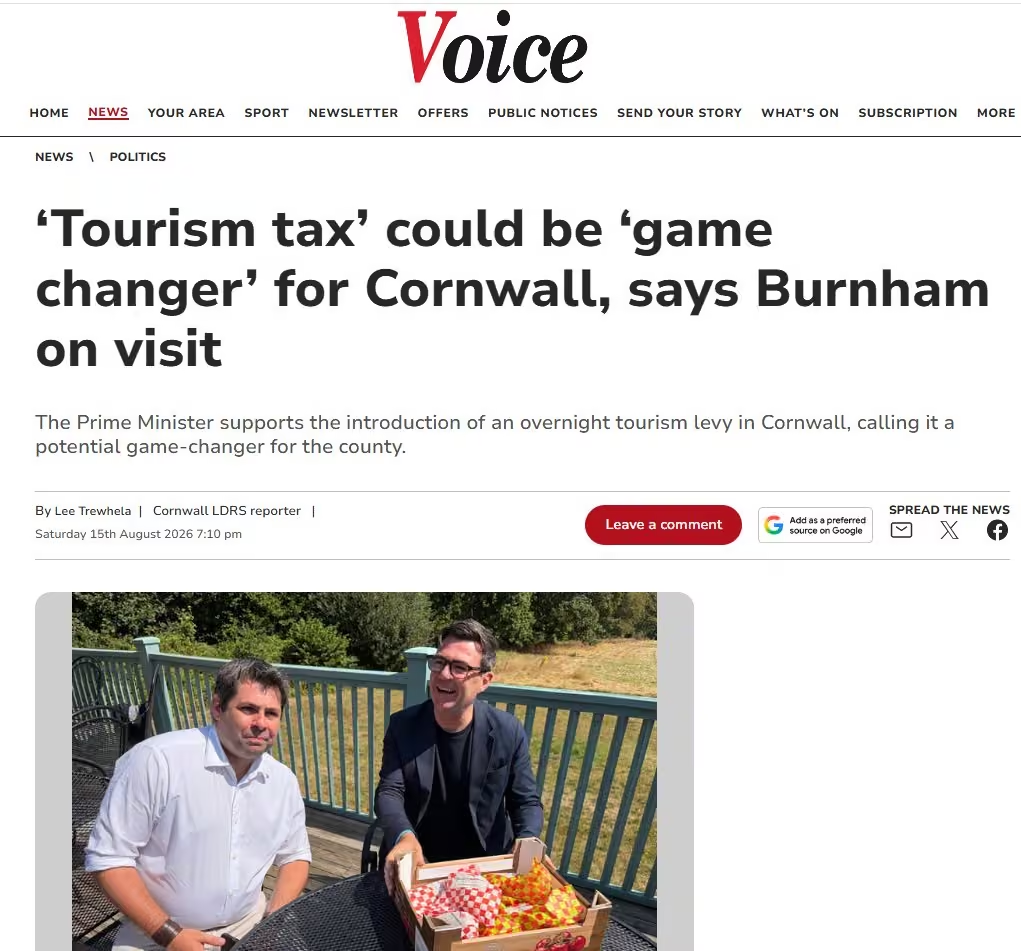
Luke Johnson reposted
Zac Goldsmith
@ZacGoldsmith
Literally anyone with a fraction of a brain could have predicted that abuse of this hugely valuable alarm system would devalue it to the point where it is useless. Anyone, that is, except the actual government.
We are led by cretins

Luke Johnson reposted
Matthew Lynn
@mattlynnwriter
For the £100 billion Labour is spending on inustrial subsidies, we could halve corporation tax for two years. Or scrap business rates completely for four years, or capital gains tax for eight years. Me for the @Telegraph www.telegraph.co.uk/business/2026/08/16/labours-deluded-a…
Luke Johnson reposted
GBTT — Great British Think Tank
@GreatBritishTT
Across roughly half of England it is now unviable to build a home. Not low-margin. Unviable: the finished house is worth less than it costs to build.
We re-checked every housing investigation we've published against the latest data. This is why so many of you are in your childhood bedrooms 🧵
Luke Johnson
@LukeJohnsonRCP
I think this graph actually understates construction costs. For many projects they have risen over 50% in the last six years.
 Stefan Schubert
@StefanFSchubert
British housebuilding costs are rising faster than house prices, discouraging new construction
 Luke Johnson
@LukeJohnsonRCP
Britain has so much more to be proud of than most other countries. Something has gone seriously wrong.
Tom Calver
@TomHCalver
This fragmentation has affected lots of countries, but perhaps Britain has always been uniquely vulnerable to a loss of national identity.
Data suggests we are among the least emotionally attached to our country of any nation in Europe
5/6

Luke Johnson reposted
 Ken Cao-The China Crash Chronicle
@KenCao_onChina
China is repeating the Soviet Union’s most fatal mistake: trying to compete with a wealthier rival across every expensive frontier at once, and in the process, exhausting itself.
The Soviet Union built an extraordinary military machine. Nuclear arsenals. Intercontinental missiles. Advanced fighter jets. Massive warships. Space stations. Moon programs. These achievements impressed the world, but they steadily drained the economy beneath them.
The Soviet system poured national resources into projects that generated prestige without creating enough household prosperity, consumer demand, or self-sustaining civilian growth. Eventually, the burden became unbearable.
China now appears to be following the same path on an even larger scale. Aircraft carriers are launching at remarkable speed. Naval capacity is expanding rapidly. Beijing is spending heavily on space exploration, artificial intelligence, advanced semiconductors, electric vehicles, biotechnology, nuclear technology, and other strategic industries.
Every one of these fields is enormously expensive. And every yuan committed to military expansion, state-directed industrial funds, and prestige technology is a yuan unavailable for household income, pensions, healthcare, education, small businesses, or social security.
The consequences are already visible. Chinese consumers remain cautious. Domestic demand is weak. Deflationary pressure persists. Private companies struggle for oxygen. Young people face a brutal employment environment. Factories increasingly depend on exports because Chinese households cannot absorb what the country produces. This creates a dangerous cycle: more subsidies create more capacity, excess capacity creates more exports, and more exports create greater trade conflict.
China’s greatest strength would be a wealthy population, a thriving private sector, and a powerful consumer market to reduce the crippling dependence on the US dollar. Instead, Beijing is prioritizing carriers, rockets, factories, and strategic prestige.
The Soviet Union already tested this model. The ending was catastrophic. China is heading in the same direction, full-speed.
 Ken Cao-The China Crash Chronicle
@KenCao_onChina
Dancing Robots Won’t Save China’s Economy. The USSR Also Had Great Technology. It Still Collapsed.
China’s Spring Festival Gala wowed the world with humanoid robots doing backflips, flying kicks, and high-difficulty stunts. Many celebrated it as proof that China has caught up with or even surpassed the United States in advanced technology.
But history offers a sobering lesson.
The Soviet Union once led the world in space technology. It still collapsed.
In this video, I break down the dangerous illusion of equating technological prestige with national strength. We’ll examine why rising AI, robotics, and semiconductor breakthroughs don’t automatically translate into stronger household incomes, higher consumer confidence, or sustainable demographics.
Is China prioritizing high-tech competition over living standards?
And what really determines whether a great power rises or fractures?
Luke Johnson reposted
 Global Statistics
@Globalstats11
Top 40 Assets in the World 💰
1. 🏠 Real Estate - $448.08 Trillion
2. 🪨 Coal - $150.69 Trillion
3. 🛢️ Oil - $142.82 Trillion
4. 💵 Government Bonds - $117.06 Trillion
5. 🇨🇳 Chinese Yuan - $52.72 Trillion
6. 🪙 Gold - $29.82 Trillion
7. 🇺🇸 United States Dollar - $23.16 Trillion
8. 🪨 Iron Ore - $19.03 Trillion
9. 🇪🇺 Euro - $18.96 Trillion
10. 🧱 Copper - $18.95 Trillion
11. 🪨 Aluminium - $18.84 Trillion
12. 🔥 Natural Gas - $8.94 Trillion
13. 🇯🇵 Japanese Yen - $8.22 Trillion
14. 🇺🇸 NVIDIA - $5.45 Trillion
15. 🇺🇸 Apple - $4.46 Trillion
16. 🇬🇧 British Pound - $4.37 Trillion
17. 🇺🇸 Alphabet - $4.23 Trillion
18. 🇺🇸 Microsoft - $3.68 Trillion
19. 🥈 Silver - $3.68 Trillion
20. 🇰🇷 South Korean Won - $2.97 Trillion
21. 🇺🇸 Amazon - $2.83 Trillion
22. 🇭🇰 Hong Kong Dollar - $2.76 Trillion
23. 🇦🇺 Australian Dollar - $2.46 Trillion
24. 🪨 Nickel - $2.19 Trillion
25. 🇹🇼 New Taiwan Dollar - $2.17 Trillion
26. ☢️ Uranium - $2.10 Trillion
27. 🇨🇦 Canadian Dollar - $2.03 Trillion
28. 🇹🇼 Taiwan Semiconductor Manufacturing Co. - $1.92 Trillion
29. 🇺🇸 Broadcom - $1.87 Trillion
30. 🇺🇸 SpaceX - $1.84 Trillion
31. 🇸🇦 Saudi Aramco - $1.71 Trillion
32. 🇷🇺 Russian Ruble - $1.63 Trillion
33. 🇧🇷 Brazilian Real - $1.50 Trillion
34. 🇺🇸 Meta Platforms - $1.50 Trillion
35. 🇨🇭 Swiss Franc - $1.38 Trillion
36. 🇺🇸 Tesla - $1.35 Trillion
37. 🇰🇷 Samsung Electronics - $1.28 Trillion
38. ₿ Bitcoin - $1.27 Trillion
39. 🇺🇸 Berkshire Hathaway - $1.08 Trillion
40. 🇺🇸 Eli Lilly - $1.05 Trillion
Note: Commodities and currencies are estimates.
Source: AssetMarketCap
Luke Johnson reposted
Human Progress
@HumanProgress
US private sector wage growth has outpaced inflation for most of the past 20 years.
As a result, overall material abundance has increased 13 percent for the average private sector worker.
Learn more: humanprogress.org/american-abundance-index-dashboard/
Luke Johnson reposted
 BowTiedBroke
@BowTiedBroke
One of the biggest hits to me when I left corporate life was: I had been there almost 20 yrs & I thought they would be SHOCKED. But no one really even cared.
Like in high school, you think the quarterback is the most important person in school. And then you realize a few years later, no one gives a crap. Same can be said of corporate America. Everyone looks up to the VP’s, the executives, the CEO…like they’re some mystical Greek gods.
My daughter recently graduated high school and the guest speaker was a former NFL player. During the speech he asked “Who is the CEO of Universal Studios? Who is the CEO of this company and that company” as he spouted off the names of some other very large companies.
He then said “None of you know. And nobody really cares, outside of those working for the person. Go to work or go to college, work hard, but then start your own company. Your family and close friends are all that will matter in the long run.”
The grandson of the founders of the company I was at was fired shortly after left. His last name was on my paycheck. The place didn’t even skip a beat, the stock continues to trade, the company continues to run. We are all just gears in the machine.

Luke Johnson reposted
 Hayek-Club Weimar
@WeimarClub
Sozialismus ist das perfekte Geschäftsmodell für Politiker: Er erzeugt Abhängigkeit, und Abhängigkeit erzeugt Wähler. Wer vom Staat lebt – durch Transferleistungen, Subventionen, „soziale“ Absicherung, planwirtschaftliche Privilegien – wählt denjenigen, der die Hähne aufdreht. Der Politiker wird zum Versorger, der Bürger zum Klienten. Je größer die Abhängigkeit, desto größer die Macht. Deshalb lieben sie ihn. Nicht aus Ideologie, sondern aus nacktem Eigeninteresse.
Kapitalismus hingegen ist für die politische Klasse eine existenzielle Bedrohung. Er belohnt Eigenverantwortung, Risiko, Innovation und private Initiative. Er macht Menschen unabhängig vom Staat – und damit unkontrollierbar. Wer seinen Lebensunterhalt selbst verdient, seine Entscheidungen selbst trifft und seinen Wohlstand selbst schafft, braucht keine Gönner in Berlin, Brüssel oder sonstwo.
Jede Regulierung, die „den Markt zähmen“ soll, ist in Wahrheit ein Instrument, um Wettbewerb zu ersticken und etablierte Interessen zu schützen. Der freie Markt braucht keinen Politiker als Mittler. Der Politiker braucht den freien Markt als Feindbild.
Deshalb die ewige Rhetorik: Kapitalismus wird als „gierig“, „ungerecht“, „unsozial“ gebrandmarkt – während der Staat, der mit Gewalt monopolisiert, umverteilt und kontrolliert, als moralische Instanz auftritt. Es ist die älteste Strategie der Macht: die Abhängigkeit als Tugend verkaufen und die Unabhängigkeit als Gefahr.
Der Staat hat kein Interesse an freien Menschen. Er hat Interesse an Untertanen, die ihm dankbar sind. Sozialismus liefert die Untertanen. Kapitalismus liefert die Freien.
#freiheitstattknechtschaft #steuernsindraub #eigentum #freiheit #parasitenwegmiteuremzwang
Luke Johnson reposted
 The Spectator Index
@spectatorindex
Prices, since start of the year.
Rice: +45%
Wheat: +33%
Cotton: +31%
Wool: +21%
Rubber: +20%
Sunflower oil: +17%
Palm oil: +16%
Cheese: +16%
Tea: +15%
Soybeans: +14%
Luke Johnson reposted
Michael A. Arouet
@MichaelAArouet
China doesn’t face a demographic crisis, it faces a demographic collapse.
Rampant youth unemployment and unaffordable real estate make it difficult for young people to start a family.
But the vacant illuminated skyscrapers look nice.

Luke Johnson reposted
 Saganism
@Saganismm
“The secret of genius is to carry the spirit of the child into old age, which means never losing your enthusiasm.”
— Aldous Huxley

Luke Johnson reposted
 Clown World ™ 🤡
@ClownWorld
I think teenagers should have part-time jobs again. Not because every kid needs the money, but because dealing with customers, showing up on time, working with people you don’t like and having a boss tell you what to do teaches you things no classroom ever will.
Luke Johnson reposted
 Hesse Philosophy
@HermannHessed
“There is no escape. You can't be a vagabond and an artist and still be a solid citizen, a wholesome, upstanding man. You want to get drunk, so you have to accept the hangover. You say yes to the sunlight and pure fantasies, so you have to say yes to the filth and the nausea. Everything is within you, gold and mud, happiness and pain, the laughter of childhood and the apprehension of death. Say yes to everything, shirk nothing. Don't try to lie to yourself. You are not a solid citizen. You are not a Greek. You are not harmonious, or the master of yourself. You are a bird in the storm. Let it storm! Let it drive you! How much have you lied! A thousand times, even in your poems and books, you have played the harmonious man, the wise man, the happy, the enlightened man. In the same way, men attacking in war have played heroes, while their bowels twitched. My God, what a poor ape, what a fencer in the mirror man is- particularly the artist- particularly myself!”
— Hermann Hesse

Luke Johnson reposted
 Alice Smith
@TheAliceSmith
Things that are now rightwing:
Investigative journalism
Academic rigour
Scientific dissent
Nature
Facts
Biology
Politeness
Punctuality
Normality
Free speech
Individual rights
Rationality
Objectivity
Self-reliance
Emotional restraint
Delayed gratification
Luke Johnson reposted
 Yoram Wijngaarde
@yoramdw
I keep coming back to this 42% number.
Of the 892 unicorns founded by European-origin founders, 371 were built in the US.
European talent remains one of America’s biggest startup advantages.

Luke Johnson reposted
 Nightingale Associates
@FCNightingale
AON Center Chicago, Illinois appraised at 27% of its purchase price 11 years ago
Purchased for $712 million in 2015
Now appraised at $195 million
JLL is negotiating a possible relocation from its current 202K SF at AON. Should they vacate it would drop the occupancy rate into the mid-50%s.
J.P. Morgan Chase Commercial Mortgage Securities Trust 2018-AON
This is a U.S. stand-alone CMBS transaction backed by a portion ($400.0M as of the Feb. 6, 2026, trustee remittance report) of a 4.63% per annum fixed-rate interest-only $536.0M whole mortgage loan secured by the borrower's fee-simple interest in Aon Center.
2.78M Square Feet Built 1973
-morningstar / S&P Global
#commercialrealestate

Luke Johnson reposted
Gregory Blotnick
@gregoryblotnick
on unit economics, Combs vs. Buffett/Munger
1/4 - Combs
Combs uses the term explicitly, whereas buffett/munger just speak an entirely separate language
its the same language in terms of returns on capital, but buffett/munger are super high level
whereas combs, you can tell he was mentored at a tiger cub and his language sounds more familiar
also Combs is a mf for only doing like 5-10 interviews over the past few decades....there is almost nothing out there.
2. Combs on process
But Combs is straightforward re: single-store economics as a "north star," individual units, individual customers, and these are where he finds inflections in profitability/ROIC
i.e. unit economics are inflecting in a way where each incremental unit, starts levering fixed costs in a way that was "masked" by the consolidated P&L
again, there's always $ there, he mentions WMT I think as basically "consolidated unprofitable" but where the boxes had such good economics, you were paying a healthy multiple, yet a multiple which had no connection to the underlying ROIICs on each new box WMT was opening
3. this is another way multiples can be deceptive
if WMT had no EPS, because it was plowing all earnings generated into new boxes at 30-40% cash on cash, the stock will trade at 50x or something, but it's clear that the 50x isn't real....as soon as unit growth slows, cash hits the P&L, earnings go exponential, stock gets cheap real fast (and TSR CAGR declines as ROIIC declines).
Combs mentions AMT also - where you have two tenants in a cellphone tower which = biz running at breakeven, but the third tenant led to extremely attractive unit economics and ROI compounding
I don't know AMT but I can assume that he's using the same framework, where this incremental tenant math re: unit economics, was "masked" by the P&L and not obvious to the street
and AMT is a heavy fixed cost biz, so once unit economics inflect on a per unit level like this, then these higher-productivity units hit a heavy fixed cost base and you get operating leverage + financial leverage + lollapalooza = party city.
4. Buffett/Munger
Buffett thinks almost entirely in ROIIC, if I had to try and and simplify what metrics he's dialed in on
See's Candies is the best example that he goes back to often
Biz earns 60% pre-tax on invested capital and requires almost zero incremental capital to grow
He's looking for businesses that can reinvest at high rates of return (ROIIC) with minimal cash flow getting chewed up by capex in the process, like a textile mill
So with See's, this actually wasn't a high reinvestment business - the growth came from pricing power, there was no capex (maint or growth), and Buffett kicked all the See's cash flow up to Berkshire to be used elsewhere...billions of dollars.
And then Munger, he's even more zoomed out, the way he talks about Costco is way less "in the weeds" than Buffett...everything to him is a fxn of scale.
Below is BRK 2007 excerpt on See's + link to letter
With See's you can see how his "more art than science" to everything plays out, reliance on predictable cash flows, margin of safety
aka, "can this reinvest at 60% pre-tax, and can it raise prices at mid-single digits, and do I have visibility that it can keep doing these things for 5-10 years? and if I'm wrong and it's 40% and 1-2% pricing, do I still make money? okay, go for it."
that's the "he doesn't do DCFs," he needs it to be so far over the line that building a model is pointless
hopefully this helps
www.berkshirehathaway.com/letters/2007ltr.pdf

Luke Johnson reposted
 Lucy Hargreaves
@lucyhargreaves4
this should be a five alarm fire for policymakers in canada
517 american companies started by canadians. $414 billion raised. almost 9 in 10 of them went to school in canada
incredibly, 216 of these founders went to waterloo…. and half of these companies were started in the last 2 years!
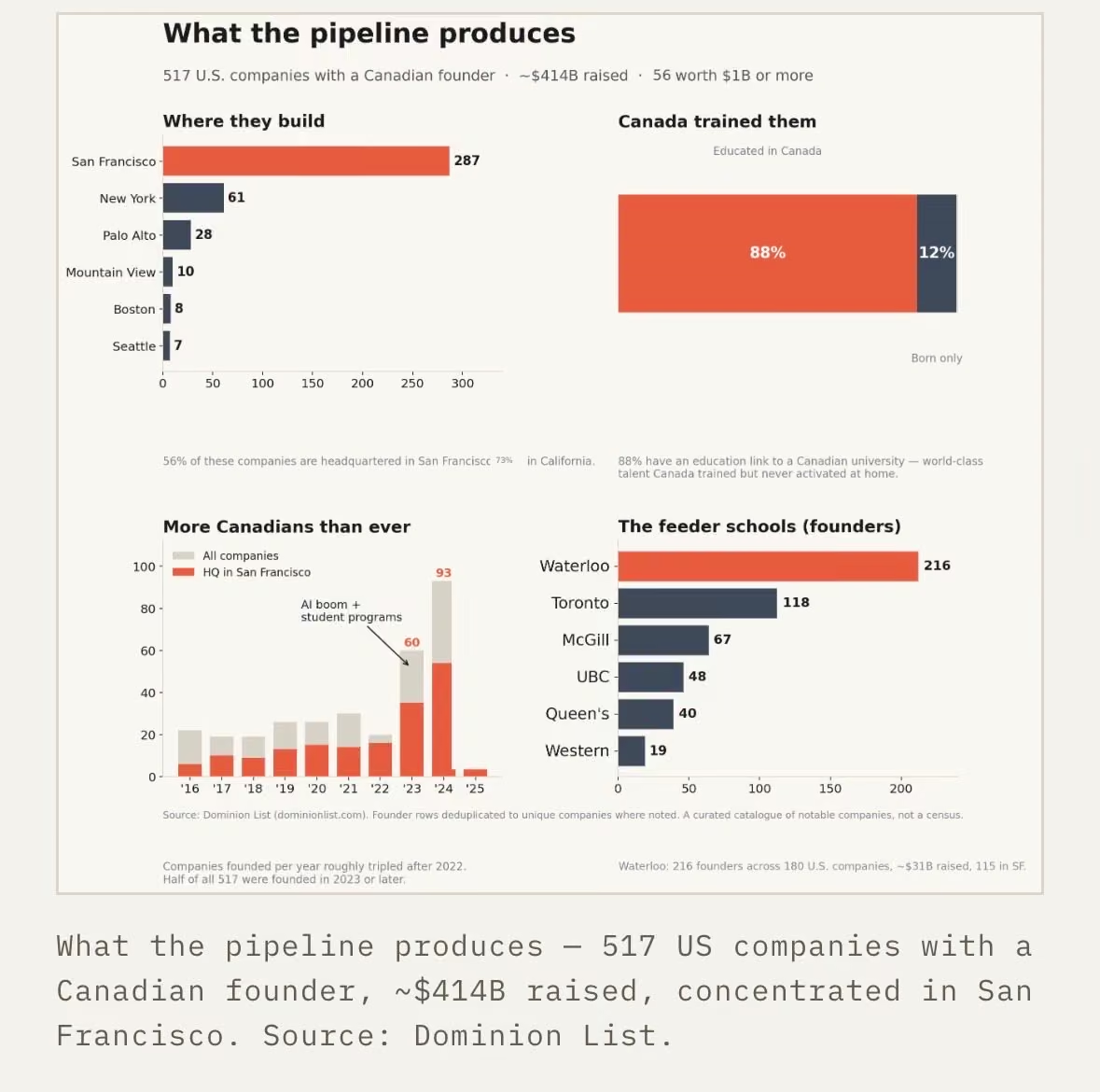
Luke Johnson reposted
 Scott Lincicome
@scottlincicome
"Since 2013, China has lost 18M manufacturing jobs – about 12% of its factory workforce.... China’s factory employment is now doing what the advanced economies’ did decades earlier: shrinking as productivity rises and as labour-intensive stages migrate to lower-wage locations"


Luke Johnson reposted
David Turver
@7Kiwi
Relying on imports for nearly a quarter of our electricity is not energy security.
 British Electricity Tracker
@myGridGB
British electricity mix at 11am on 15th Aug 2026
🔥 Gas 6.6% Biomass 9.7%
☀️ Wind 14.4% Solar 30.7% Hydro 0.9%
⚛️ Nuclear 13.8%
🪫 Storage 0.0%
➡️Imports 23.9%
🔌 Generation 29GW
🌍Carbon intensity 77 gCO2e/kWh
Gas use very low
Luke Johnson reposted
 i/o
@avidseries
In relative terms, China's rapid rise in global GDP share came at the expense of the Japanese and Europeans, but not the Americans.
 Gummi
@gummibear737
The demise of the US is just not a thing that has happened

Luke Johnson reposted
Human Progress
@HumanProgress
Global corn and wheat production is the second-highest on record, while soybean output is on track for a record year. Rice production remains near record levels, with yields possibly setting a new high.
humanprogress.org/major-global-crops-remain-near-record-p…
Luke Johnson reposted
 Daisy Christodoulou
@daisychristo
Insights from A-levels: Maths has 115k entries & Eng Lit just 36k.
20 yrs ago they both had about 50k.
At the risk of sounding like Claude, this isn't just educational change - it's cultural change.
A generation of kids will be far more familiar with quadratics & conditional probability than Mr Rochester & Ophelia.
Bayes is destroying Defoe...
substack.nomoremarking.com/p/the-fall-of-eng-lit
Luke Johnson
@LukeJohnsonRCP
Lockdowns increased anti social behaviour enormously. A terrible legacy for a terrible policy.
Stefan Schubert
@StefanFSchubert
The percentage of young Americans who have no contact with other people on an average day more than doubled during Covid and has stayed high, shows @jburnmurdoch

Luke Johnson reposted
 Major Richard Sharpe
@takeitbackUK
Since 2006 the UK has:
• Cut grid emissions by ~80%
• Cut electricity generation by ~30%
• Seen electricity prices rise ~250%
• Lost ~600,000 industrial jobs
Meanwhile the world increased its emissions by ~30%.
Our heroic sacrifice may have stopped global emissions rising by 30.3% instead of 30%.
Atmospheric CO₂ moved from 0.038% to 0.042%.
Highest electricity prices in the developed world. Higher cost of living. Hollowed-out industry.
All to shave a rounding error off the global total.
Luke Johnson reposted
 Moving Home with Charlie
@moving_charlie
“The only way is down.”
Not being pessimistic by posting this, just trying to help wake up the house price always up zombies.
www.linkedin.com/posts/socommercial_ukproperty-londonprop…
 Luke Johnson
@LukeJohnsonRCP
Britain has the world’s 4th greatest govt debt in absolute terms. Scary.
The Data of Everything
@TheDataHubX
2026 Government Debt by Country

Luke Johnson reposted
Matthew Lesh
@matthewlesh
Kemi is right!
 Kemi Badenoch
@KemiBadenoch
Why are TVs getting cheaper, but energy is getting more expensive? Here's a hint: the government might just have something to do with it.
Luke Johnson reposted
 Mary Harrington
@moveincircles
That this sort of micromanagement barely elicits a murmur now is the real Long Covid
Politics UK
@PolitlcsUK
🚨 BREAKING: Andy Burnham has temporarily banned the sale of disposable BBQs amid the extreme UK heat

Luke Johnson reposted
 FT Alphaville
@FTAlphaville
Jane Street has paid up large to avoid its numbers leaking out ft.trib.al/wIL2OQ0
Luke Johnson reposted
 BowTiedPhys
@BowTiedPhys
Embracing the words of Napoleon will do more for your sleep than any biohack ever will.

Luke Johnson reposted
Matthew Lynn
@mattlynnwriter
AI is going to clog up the courts with cases, and massively raise costs for business. Me for the @Telegraph www.telegraph.co.uk/business/2026/08/15/ai-lawfare-threat…
Luke Johnson reposted
 Daniel Cowper
@DanielCowper
Evelyn Waugh, writing fluff for Vogue nearly a hundred years ago: a display of prose virtuosity one can hardly imagine these days.

Luke Johnson reposted
Natural Philosophy
@Naturalphilosy
Søren Kierkegaard on the Importance of Walking
“Above all, do not lose your desire to walk. Everyday, I walk myself into a state of well-being & walk away from every illness. I have walked myself into my best thoughts, and I know of no thought so burdensome that one cannot walk away from it. But by sitting still, & the more one sits still, the closer one comes to feeling ill. Thus if one just keeps on walking, everything will be all right.”

Luke Johnson reposted
 Sam Rose
@samwhoo
This might be the most beautiful thing I've read in my life. What a privilege to be alive in 2026.
ordinaryabundance.com
Luke Johnson reposted
 BDB
@BigDickBull69
If you ever lose money just remember that SBF’s $500 Million investment in Anthropic would be worth $76 Billion today but instead he’s zero’d and in jail for another 20+ years
Luke Johnson reposted
 Isa
@isssa0x
Insurance is the oldest of the four ways. It is a nine-trillion-dollar global industry. The equation underneath it was invented in 1560 by a broke Italian gambler.
His name was Girolamo Cardano. He wrote a book called Liber de Ludo Aleae. A short manual on how to win at dice. Nobody in finance read it for four hundred years.
Then in 1996 a ninety-year-old man in New York wrote a book that traced every modern risk model back to that manual. He called it Against the Gods. One thesis. Every dollar of premium ever collected on Earth is a footnote to a gambler scribbling in Milan.
His name was Peter Bernstein. He founded the Journal of Portfolio Management in 1974 and ran money at Bernstein-Macaulay before that. Wall Street called him the historian of risk.
In 2008 a small production company filmed him for thirteen minutes. He walked through the entire five-hundred-year arc. Cardano to Pascal to Fermat to Black-Scholes. Then he stopped and said the industry had built glass towers on the back of an idea a broke Italian scribbled to settle a card debt.
He died the following summer. Age ninety.
Reinsurance premiums crossed six hundred billion dollars last year. Every actuary on Earth prices catastrophe risk with the same expected-value framework Cardano invented to shave the house edge in Milan.
The video is thirteen minutes and twenty-two seconds long. Free. Eleven years on YouTube. Twenty-nine thousand people have watched it.
Almost none of them work in insurance.
Luke Johnson reposted
 Michael Nicoletos
@mnicoletos
Michael Froman, the president of the Council on Foreign Relations and a former US Trade Representative, published a piece in @ForeignAffairs today titled “The Next Global Economic Crisis Could Be Made in China.”
I have been writing about this topic for a while, so I read it carefully. His argument overlaps with what the data has been showing for some time, and I think it is worth walking through in simple terms, because you do not need an economics background to follow it.
An economy runs on four engines. Homes get built, factories produce, households spend, and the country sells to the world. In China, three of these engines are struggling at the same time, and the fourth was never fully developed.
Property broke first. Home prices have fallen for 35 straight months, the longest streak on record. Chinese families hold 60% to 70% of their wealth in their homes, and independent estimates put the number of empty apartments somewhere between 65 and 80 million. New home sales have more than halved since 2021.
Factories were the answer to the property bust. Build more, export more. The output came, but the profits did not. Factory activity contracted for eight straight months in 2025, factory gate prices have been falling for more than three years, and close to 30% of industrial firms are losing money. More production, less profit.
Household spending is the engine that was never built up. In most economies it is the largest one. In the United States it is about 68% of GDP, and in the European Union roughly 52%. In China it is under 40%, and that was a design choice. Wages and savings were channeled toward building and exporting instead. Now, with home values falling, families are saving even more. Retail sales have slowed to a crawl and even turned slightly negative this spring.
That leaves exports, the last engine running. The trade surplus reached almost $1.2 tn in 2025, growing about three times faster than world trade, and net exports drove roughly 30% of China’s growth last year. Froman’s point is that the math has a limit. Sales cannot grow three times faster than customers’ incomes forever. Either demand runs out, or trade barriers go up. Both are already visible.
The question I tried to answer in my July report is where the losses from all of this have gone. The official answer is almost nowhere. Chinese banks report that only 1.52% of their loans have gone bad, roughly unchanged from before the property crash. Comparable crashes took bad loans to 5.6% in the US after 2008, 13.6% in Spain, and above 25% in Ireland. Applying those historical precedents, my estimates put the losses sitting inside the Chinese financial system somewhere between $3.9 tn and $12.2 tn, with a central case near $7.7 tn, against buffers of about $1.28 tn and state injections of $74 bn so far.
More here: substack.com/@mnicoletos/note/p-205566874?r=1ha9c
I may be wrong on the exact numbers. I do not think the direction is wrong.
The known fix is to grow household spending. Japan is a reminder of how long that takes. It began rebalancing in 1991 as one of the richest countries in the world, and the process still meant more than 15 years of cleaning up banks and two lost decades of growth. China is starting from a much lower income level, with a population that is already shrinking.
To be clear, none of this points to a collapse tomorrow. China has tools other countries did not have, and the most likely path is a slow, Japan style workout, absorbed quietly by savers over many years. What the Froman piece suggests to me is that this view is no longer a contrarian one. The open questions are who pays, and how long it takes.
Answering them means dismantling the machinery that built the miracle, which is why I titled my January piece “The Elephant No One Wants To See”.
Michael Froman’s article: www.foreignaffairs.com/china/next-global-economic-crisis-…
My report and the January piece: michaelnicoletos.substack.com/p/the-elephant-no-one-wants…
@MikeFroman #china #growth

Luke Johnson reposted
Simon Kuestenmacher
@simongerman600
Half of the fish eaten in the world now comes from aquaculture farms. Wild catch stayed stable for the last three decades. Source: ourworldindata.org/grapher/capture-and-aquaculture-produc…

Luke Johnson reposted
Benedict Spence
@BenedictSpence
“Your taxes are going up to pay to have more migrants live in your street and use your services” is neither a vote winner nor a moral one.
Another example of the state and those who run it acting against the people they rule.
Politics UK
@PolitlcsUK
🚨 NEW: No 10 has admitted Andy Burnham's plan to house more migrants in wealthy areas will cost taxpayers more
"It's a point of principle [for him]. He acknowledges that it would cost more money to do it more fairly"
Luke Johnson reposted
 Kelvin MacKenzie
@kelvmackenzie
Salute Katharine Birbalsingh, the UK’s strictest head teacher, who saw 70% of her N London pupils get A and A* grades - more than double the national average, making an idiot of Education Sec Lucy Powell who said forcing schools to prioritise leaning damaged the disadvantaged.
Luke Johnson reposted
 Vancouver Value Investor
@BCValueInvestor
This is the way.
Took me some time to learn it, but man is it sweet.
Train your brain & then take a big gulp when you come across an asymmetric bet.
 Polymath Investor
@polymathinvest1
Cap your downside.

Luke Johnson reposted
 Carl Jung Archive
@QuoteJung
Jung was not playing around:

Luke Johnson reposted
The Ways of A Gentleman
@Gentleman_Ways
“It had long since come to my attention that people of accomplishment rarely sat back and let things happen to them. They went out and happened to things.”
-Leonardo da Vinci

Luke Johnson reposted
Matthew Lesh
@matthewlesh
What does the public think is driving higher supermarket prices?
You might assume voters mainly blame profiteering supermarkets. But our latest @CityAM / @tweetfreshwater polling paints a rather different picture.
Just 11% say supermarkets increasing their profit margins are MOST responsible for rising food prices.
Instead, voters are more likely to blame:
➡️26% the conflict in the Middle East and global commodity prices
➡️17% government taxes on business, such as National Insurance
➡️16% higher energy costs
There is, though, a huge gap between perception and reality regarding supermarket profits.
On average, people think supermarkets make 32p profit for every £1 spent.
The actual figure for Britain’s largest supermarkets is around 3p.
And exposure to the factual information dramatically shifts attitudes.
Before being told the true margin, 70% agree that supermarkets are making excessive profits from rising food prices, compared with just 12% who disagree.
After being told supermarkets make around 3p profit for every £1 of sales, agreement falls to 32%, while 44% disagree.
That's a net shift in attitudes of 70 points — from +58 net agree to -12 net disagree.
The public is concerned about higher food prices, especially since prices have risen since Covid while wages have remained stagnant. But profiteering is not seen as the main cause, and even this concern is dampened once they find out how small supermarket margins actually are.


Luke Johnson reposted
Matthew Lesh
@matthewlesh
Youth unemployment reached 16.4 per cent in the three months to April, up from 14.2 per cent a year earlier. That means 743,000 unemployed 16-24s, and the highest rate in over a decade.
More frightening still are the 600,000 young people who aren’t even counted, the economically inactive, not looking for work, not in education or training. Together with the unemployed, that’s over a million Neets.
The UK used to fare better than the rest of Europe on youth unemployment. This is not the case any more.
Importantly, the recent job losses across the economy are in the sectors with high wage bills, not large language models. The steepest annual fall in payrolled employment is in wholesale and retail, down 76,000 in the year to April, while accommodation and food services contracted 3.4 per cent.

Luke Johnson reposted
 ADONIS
@adonispara
Nietzsche describing the mindset of high performers.

Luke Johnson reposted
 Rupert Darwall
@RupertDarwall
In the 11 years between Ed Miliband's Climate Change Act and Theresa May's net zero, Britain cut its CO2 by 180 m tonnes while the Rest of the World increased theirs by 5 bn tonnes, erasing Britain's reductions on average every 140 days ...
 Ed Miliband
@Ed_Miliband
These heatwaves are sending us a message.
Luke Johnson reposted
 Dibdob77
@dibdob77
When we took A Levels in late 1970's, only Oxbridge hopefuls obtained straight A's. A Levels, then, were the equivalent of an American degree. Only 4% went to university.
The state grammars were our greatest engine of authentic social mobility. Destroyed by both Labour & Tories
Luke Johnson reposted
 Istra of Glome
@byistra
C.S. Lewis: favorable conditions NEVER come

Luke Johnson reposted
Paul Embery
@PaulEmbery
Outpost are producing some really impressive stuff. This is definitely worth a watch.
 Outpost
@OutpostStudios
The Troubles | Documentary
In our new film, @Katie_Lam_MP explores the fractured legacy of sectarian violence in Northern Ireland.
Only on @OutpostStudios
Luke Johnson reposted
 Brighton Argus
@brightonargus
Seaside city named among the best foodie destinations in the country www.theargus.co.uk/news/26457310.brighton-named-among-uks…
Luke Johnson reposted
 tyro
@DoubleEph
Time to bring back this Tyler Cowen banger

 EU Council
@EUCouncil
From today, new EU rules apply to all packaging placed on the EU market.
They cover design, composition, reuse and recycling — with obligations phased in through to 2030 and beyond.
What changes, and when ⬇️
consilium.europa.eu/en/policies/packaging/

Luke Johnson reposted
 Markets & Mayhem
@Mayhem4Markets
Real 😂

Luke Johnson reposted
 Electroverse
@Electroversenet
In 2004, the BBC warned the Maldives were "soon to be uninhabitable," claiming sea levels were rising 0.9 cm per year and that 80% of the islands could vanish within a century.
More than two decades later, though, reality says otherwise. The Maldives haven't sunk, they've exploded with growth: 12 new airports, expanded international terminals, record tourism of over 2 million visitors a year, and more than 170 resorts.
Instead of drowning, this so-called "paradise in peril" has shown no statistically significant sea level rise since the 1980s, according to satellite data.
Here we have another climate catastrophe headline completely undone by time.
Luke Johnson reposted
 Boze Herrington, Library Owl 🎄🐗📯📯
@SketchesbyBoze
Kris Kristofferson: If you don’t pursue your vocation, your passion, you will be miserable.

Luke Johnson reposted
 Helen Joyce
@HJoyceGender
As was inevitable, the Arday Affair is moving on from the examination of one fabulist and plagiarist to the rot that has consumed much of the higher-education sector. These clowns oversee the step from childhood to adulthood for approaching half of all young people - and pretty much all the teachers, social workers, health professionals, and those working in charities, think-tanks, the civil service, publishing and HR - and of course the next generation of academics. No wonder so many young people believe stupid and dangerous things: they have been taught those things. We must be mad to entrust young people to these clowns - and to pay them.
The Spectator
@spectator
If your life’s great passion is the study of bouncy castles, pole dancing or writing essays on autoethnography, there ought to be nothing to stop you from working at Toys R Us, a gentleman’s club or the Guardian.
But these people have all chosen to pursue academia. They are attracted to the status it confers. This was the world in which Jason Arday thrived.
His colleagues at Cambridge were carrying out research on how fairy tales can break the gender binary in playgrounds or writing ‘a self-portrait of an artist who teaches’. Is it really surprising that his error-ridden thesis didn’t stand out against this backdrop?
✍️ Lara Brown
Article | spectator.com/article/class-clowns-the-triumph-of-inanity…

Luke Johnson reposted
Noble Francis
@NobleFrancis
Essentially, the problem for government is not 1.5 million net additional new homes in England in the 5-year parliament or not 1.5 million. The problem for government is to stop house building falling even further, for a 5th consecutive year, in 2027.
#ukhousing #ukconstruction
Noble Francis
@NobleFrancis
Total house building activity in June 2026 was 1.8% lower than in May, 8.4% lower than a year ago & 26.3% below the October 2022 peak. Year-to-date (January to June) activity in 2026 was 8.0% lower than in 2025 & 22.6% lower than in 2022. (13/end)
#ukhousing #ukconstruction

Luke Johnson reposted
 Sarah Deech ☕️
@londonette
Fascinating A-level gender disparity graph in the @Telegraph

Luke Johnson reposted
Cut My Tax
@CutMyTaxUK
An impassioned cry against the idiocy of the new Make Tax digital imposition on the self-employed from Phil Womack in The Spectator.
He explains how it was impossible to get his government approved software to draw information from multiple bank accounts, so he had to to enter the data manually, deleting 1,300 lines of irrelevant information which had spewed in from the bank accounts,
"By this time, it had taken me the best part of three days to wrestle with a single quarter’s accounts, and (at the time of writing, one day before the deadline) I still haven’t finished. The thought of having to do all this again in October fills me with mounting dread; to pass the buck to even more expensive accountants is beyond my means."
So far no political party has committed to scrap this monstrosity of a policy.
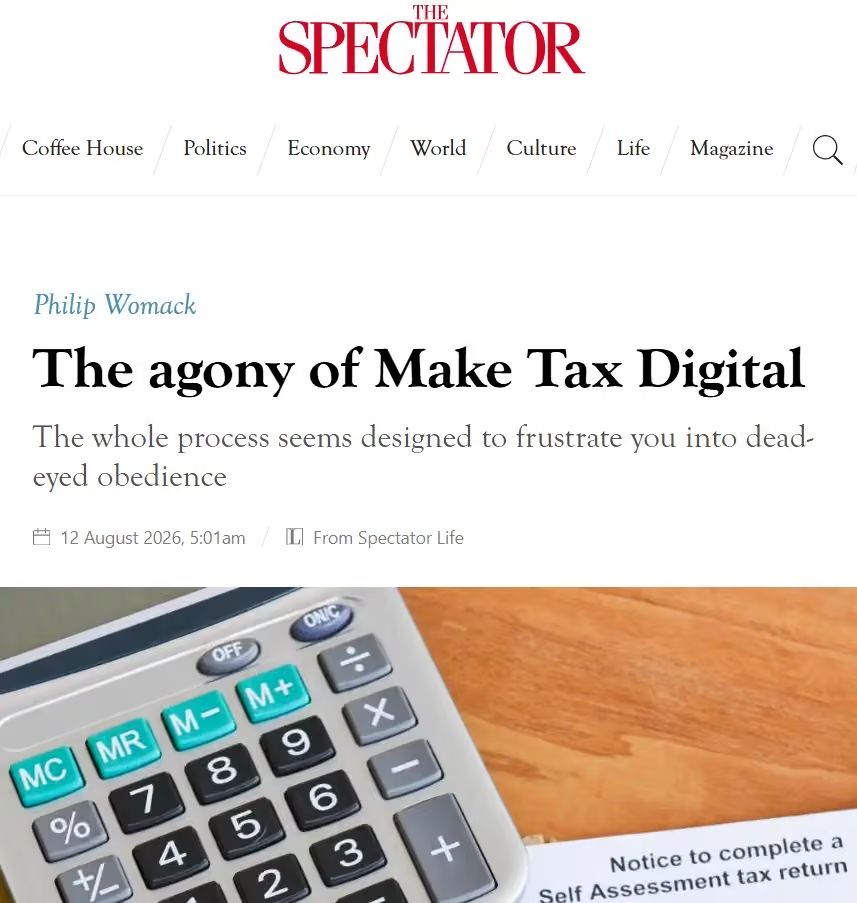
Luke Johnson reposted
Jonathan Maze
@jonathanmaze
Chili's run is remarkable. But what's also notable about it all is how simple it really is. If you're a restaurant company, and you want some inspiration, just look at what they did.
Chili's formula is basically this: Ditch the gimmicks. Focus on unit economics. Simplify and improve the menu. Improve operations. Back it all up with strong marketing.
The company focused on a few key menu items and upgraded their quality. It spent money to fix issues in the restaurants and worked to improve the quality of in-store operations. It got rid of those dumb robot servers.
The CEO, Kevin Hochman, is one of the country's best marketing minds, and he brought in a CMO in George Felix who knows what he's doing. They took advantage of consumer frustration over prices and got a bit lucky with the cheese pull trend on social.
Because the company did all that work on operations, its stores were ready when all those customers came in. And they keep coming back. It is comping positive on insanely positive numbers right now.
Chili's 4-year stacked comps are 50%. By comparison, Wingstop, which also had an amazing run a couple of years ago, is up 34.1% over that same period after its sales started falling. It's tough to keep those sales when they boom like that.
Can everybody do this? No, because a lot of companies are overleveraged or they're franchised and refuse to make the kind of investments required for such a strategy. But the formula is honestly there. And there are chains following the same one, such as Burger King. $EAT

Luke Johnson reposted
Cut My Tax
@CutMyTaxUK
Some commonsense on CGT from Matt Benchener in the FT today:
"Entrepreneurs and business owners often rely on private investment to give them the capital they need to grow. Thriving businesses create jobs, products and services that benefit consumers, and the dynamism that marks the world’s strongest economies. A higher capital gains tax will reduce projected returns for investors, diminishing both their willingness and capacity to deploy capital in the UK."
"Investors are more willing to commit capital and take risk when the rules feel stable and understandable. Repeated speculation about major changes to capital gains tax, pensions or Isas encourages caution. It gives people another reason to wait when what we need them to do is plan, invest and build wealth over time".
"The government has rightly emphasised its goal to spur economic growth and retail investment participation. It needs to follow through by judging any reform against a straightforward test: will it help more people invest with confidence and allow more capital to reach productive businesses?"
Sadly the test actually being applied seems to be 'will it please capitalism-hating high-tax loving Labour backbenchers?'
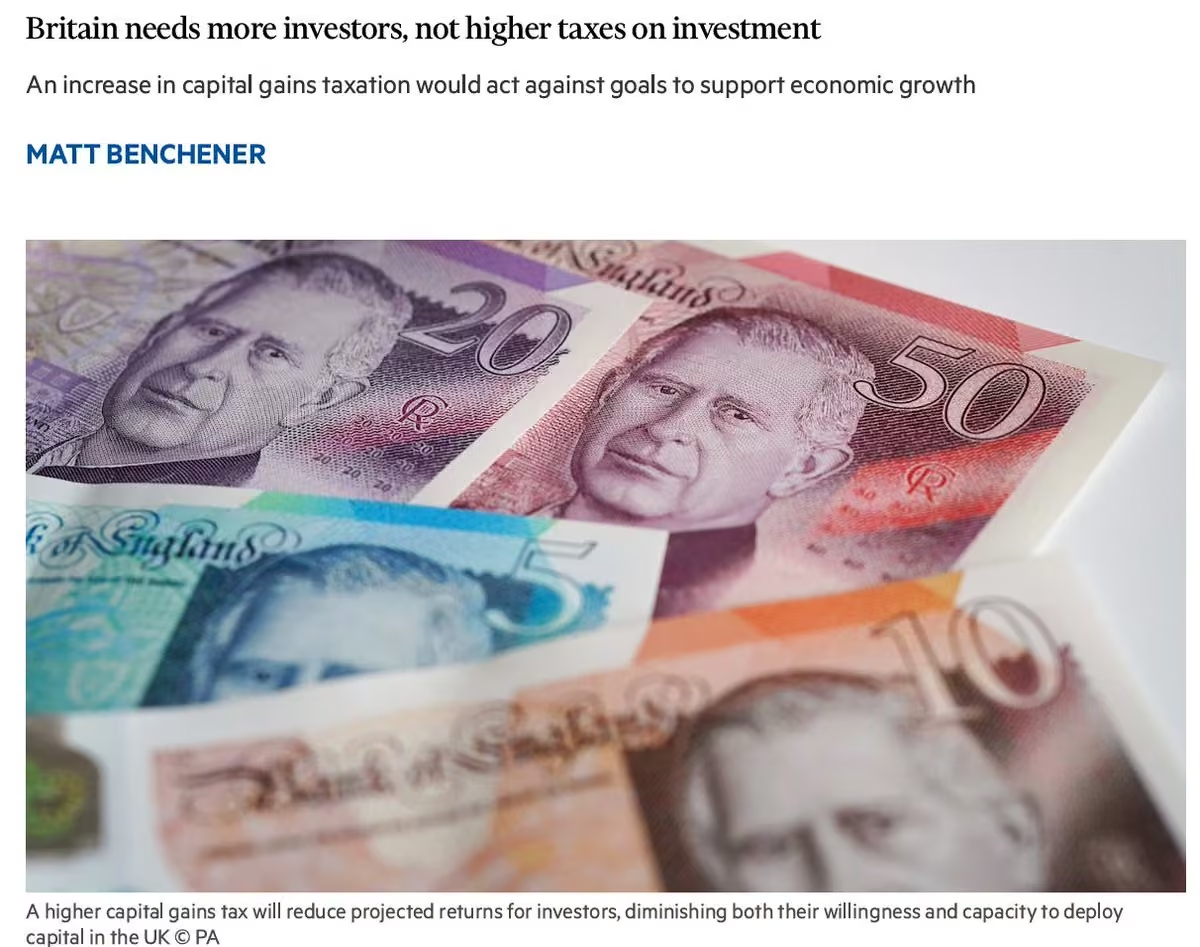
Luke Johnson reposted
 Tony Smith CBE
@FortinusGlobal
It’s probably worth saying at this point something I’ve said before, lest it gets lost in the sands of time and political rhetoric about immigration and illegal entry, and how we got to this point.
I was an immigration officer in the 1970s and 1980s. The power to grant or refuse leave to enter was vested to me in law under the authority of a Chief Immigration Officer. Anyone arriving without a valid passport (and a visa if required) was refused entry at the border, detained, and removed on the next available ship or aircraft whence they came. This was under the Immigration Act 1971 (still
In force although amended massively by successive governments ever since). It was some 20 - 30 years after the 1951 ECHR and the 1951 Refugee Convention was signed.
Nobody claimed asylum. Nobody claimed human rights. No country refused to take people back. Those who had destroyed their passports were removed on a letter, signed by me.
Fast forward 50 years and now anyone who arrives at the border without a passport or a visa automatically claims asylum or human rights. Immigration Officers of today (or Border Force Officers) are thereby disempowered to send them back before their asylum claims or human rights claims are considered. And their appeals are dismissed. They cannot be detained in the meantime because under the Hardial Singh principles immigration detention is only lawful if there is a realistic prospect of removal within a reasonable period of time. Which there isn’t of course. So the only option available to the officer is to grant temporary permission whilst these applications are considered. And if the applicant claims to be destitute they must be given support and accommodation at public expense. Because failure to do so would put the government in breach of A3 of the ECHR (inhuman and degrading treatment). And even if the applicant is eventually refused protection - and loses their appeal - we need to get a passport to remove them on. And they often refuse to comply with the documentation process. Even if they do many countries still refuse to issue them with a passport and refuse to take them back. And even after all this they can abscond and if ever caught start the whole process again.
This is where we are and so far no government has been able to break the Gordian knot that ties the hands of our officers. In order to do that they would have to reverse decades of laws and judgements - and demur from long held well intentioned international conventions. And probably look at the British Constitution itself to curtail the opportunity of political opponents to use the courts to thwart the will of Parliament.
This is not to criticise or favour any political party or policy. It is simply a matter of record to inform the next generation of politicians and the civil servants charged with the duty of implementing any new laws or policies they may introduce.
And to ask why - if we did it back in my day - why can’t we do it now?
I even wrote a book about it. I hope someone keeps a copy for posterity - or even history - when thinking about how to fix this seemingly intractable problem.
amzn.eu/d/06wM4s2h
Luke Johnson reposted
 Michael Fritzell (Asian Century Stocks)
@MikeFritzell
P/E ratio by market

Luke Johnson reposted
 Aristo
@aristomarinetti

Luke Johnson reposted
 Bobby Fijan
@bobbyfijan
And the ZIRP era startups (uber, doordash, airbnb, plated) significantly subsidized the specific lifestyle of this exact millenial/gen-z demographic
@DKThomp wrote about this both in 2019 and 2022
Now you see the disappointment start to compound and harden into something else

 just matt
@questionableway
matt y is correct here, but a big part of the discontent is that these college grads are used to the lifestyle their upper middle class parents provided them (up to and increasingly even thru college) which they can no longer afford on new grad incomes
Luke Johnson reposted
 Andy
@PositivFuturist
Let's talk about the DVSA - a window into how bad things are in a government department.
> Employs 5k people, 2/3 are not car examiners
> Website barely functional
> 12 week average wait for a test, backlog for 6yrs
> Costs taxpayer £86m (+53% YoY)
> Entire ecosystem of scam apps ripping off desperate learners
> Economy held up by people unable to pass and get on with their lives / take jobs etc..
OK so what is the root cause?
Why don't we take a look at the CV of the CEO of the DVSA.
Take a good look.
And now imagine asking a person with THIS as their CV to design a watertight system for processing a vast backlog via a web interface.
This is the perfect illustration of why nothing works in this country.

Luke Johnson reposted
 Arnold Schwarzenegger
@Schwarzenegger
I was a bricklayer.
It was how I paid the bills when I first moved to America. Even the biggest title in bodybuilding, Mr. Olympia, only paid a thousand dollars back then.
It makes me proud that in March, the winner of our Arnold Classic and our Arnold Classic UK took home more than a million dollars. He can focus on bodybuilding.
But in our day, that wasn’t an option. Some guys were teachers. Some sold insurance. Franco and I laid bricks.
We put an ad in the paper and sold ourselves as European craftsmen. We figured if people heard the accents, they would picture old-world masonry instead of two bodybuilders with a wheelbarrow.
It worked.
The phone rang. And then we had to go out and actually do the job, which was the part nobody could fake. Luckily, Franco knew what he was doing.
The work was simple. Mix the mortar. Set the brick. Tap it level. Scrape the edge. Then do it again. And again. Nobody claps for you. There is no crowd, no music, no trophy. There is just the next brick sitting there waiting for you.
You can still find some of the walls we built in Venice.
That’s where my lesson today comes from.
One brick doesn’t look like anything. Ten bricks don’t look like anything. A hundred bricks, you’re starting to see something, but it doesn’t impress anyone.
You just keep laying bricks until the job is done.
And you know what happens after four or five hours on a wall?
You are so damn tired, or you feel so great that you stop measuring.
You are not standing back every ten minutes asking how far from finished it is. You are covered in mortar, your hands are raw, you’re schvitzing, and you are happy. The work took the question away from you.
That is the part nobody tells you about hard work: It doesn’t just build the wall. It terminates the voice that keeps asking when the wall will be done.
Luke Johnson reposted
 Alexander
@alexanderrX_
britain runs on old money. almost everyone you know with a nice house got there the same way: a relative died and the property sold.
wealth in this country is inheritance and bricks. it just gets recycled between generations. very few people get rich from something they actually built.
we need A LOT more new money. and new money in 2026 means ai. startup hubs in london, manchester, glasgow, edinburgh. hardware in the midlands and north of scotland. data centres, energy, defence.
but try building any of it. you can't put up a garden shed without permission, never mind a data centre. the red tape has to go.
Luke Johnson reposted
 Gay Manc
@GayTory
Rayner introduced the Employment Rights Bill, she voted for the budget that increased costs on employers. British businesses cannot afford to operate, I dread to think how anybody wanting to start a business would do so now.
In my little area alone in the last week a deli has shut, a cafe bar has shut and there’s at least 5 hospitality businesses all for sale.
Labour has caused this crisis.
I don’t trust the arsonist to man the fire engine, actually.
 Angela Rayner
@AngelaRayner
For too long, communities have seen their high streets declining around them, with vape stores and betting shops replacing services and community spaces people rely on.
We’re putting powers in the hands of communities to crackdown on everyday eyesores that blight town centres.
Luke Johnson reposted
Object Zero
@Object_Zero_
Mining
On average the time taken between deciding to develop a mine and starting commercial production is 16 years.
The reason mines have such a long gestation period isn’t down to technology, or capital, or execution… it’s two things; the permitting process, and the new infrastructure needs.
Mathematically mining is quite similar to demographics in that we know what minerals will be available 20 years from now, because of this development lag, and so you can actually draw out the mineral equivalent of demographic pyramids and they will hold up over many decades.
How can we speed this up?
There are really only 2 ways to speed it up, firstly you have to approve more mining permits, maybe have faster consultations and debates about the pros and cons and the environmental impact.
Decision speed is what matters to a developer, a jurisdiction that gives you a fast “no” is preferable to one that gives you a slow “yes”.
What any mining company is trying to do, is to allocate their capital, and a slow decision ties up capital and commitments in an unproductive process for a long time.
It’s not that “yes” is a good decision and “no” is a bad decision, a fast permit decision is a good decision and a slow permit decision is a bad decision.
This is because every mining company of note has a large portfolio of prospects and a tiny handful of developments. What they need, is their capital allocated to developments, to actually mining, and much less so to advancing prospects through permitting.
Society doesn’t have to say “yes” to everything, it just needs to decide faster.
The other thing that could speed things up is the infrastructure development that goes with a new mine.
Both of these are information problems, they are problems that involve collecting and collecting a lot of information, assessing it, and reaching the right decision…
That’s something where the new technology really has changed what is possible, if you are able to wield it properly.
A country that is able to operate AI to speed up development decisions would immediately rank much higher for foreign direct investment from industries such as mining.
Again I’m not even saying we need to make different approvals decisions, just that we need to make decisions much faster, because the portfolio of prospects is large and the number of developments is relatively small.


Luke Johnson reposted
Simon Cooke
@SimonMagus
Great man.
"the aggregate of the decisions of individual businessmen, exercising individual judgment in a free economy, even if often mistaken, is likely to do less harm than the centralized decisions of a Government;"
Anthony Boutall
@anthonyboutall
Sir John Cowperthwaite was the unassuming civil servant who decided to control state spending & liberate markets in Hong Kong between 1961 & 1971.
During that period, acute poverty fell from 50% to 15%. Ordinary citizens’ wages ballooned by 50%.
It can be done! ⛓️💥

Luke Johnson reposted
Hugo Gye
@HugoGye
Amazing graphic from the FT on Britain's high streets - explosion in the number of barbers and takeaways (plus, from a much lower basis, vape shops). Bookies experiencing serious shrinkage.
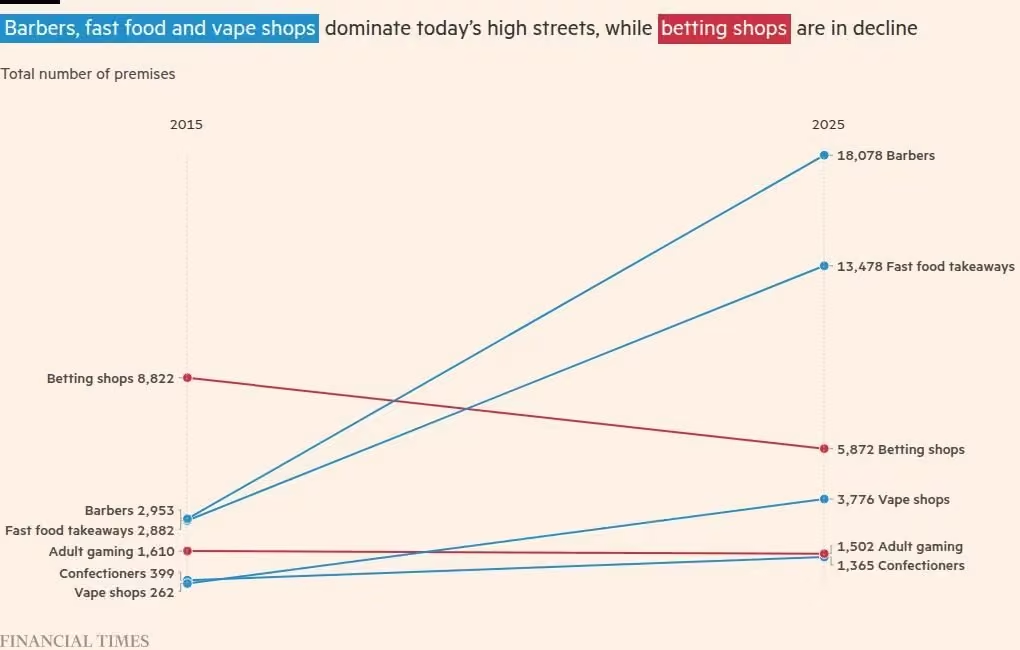
Luke Johnson reposted
 Clayton Dorge
@Clayton_Dorge
Wendell Berry on the goal of life and work.
Simple, not easy. From his 2004 essay, "Quality versus Form"

Luke Johnson reposted
Matthew Lynn
@mattlynnwriter
Heathrow getting overtaken by Istanbul as Europe's busiest airport is a sign of London's relative decline. We should have built a third runway years ago, and upgraded terminals. Now we are paying the price uk.finance.yahoo.com/news/heathrow-overtaken-istanbul-eur…
Luke Johnson reposted
 Samut Prakan Phil 🇬🇧 🇹🇭
@Ajarncom
Sitting quietly at Birmingham Airport. Or trying to.
Four lads with identical bowl haircuts are off to Tenerife with Easyjet. They look like they're absolutely buzzin'.
A screaming child has just had a good smack off her father for not sitting properly on her Trunki.
It's over £7 for a small Diet Pepsi and a bag of Walker's cheese and onion crisps. It's part of a 3 for 2 meal deal that I can't be arsed to work out.
People are looking at duty free sunglasses like they're the bargain of the century... but they're over hundred quid and not even remotely stylish.
The lure of duty free shops will forever remain a mystery to me. Perhaps being neither a smoker nor drinker doesn't help.
How do people go on holiday with young children? They're either crying, antsy or wanting things.
There's a queue of people going to Reus in Spain on an airline I've never heard of. Why would you go to Reus? Or put your faith in Wizz Airlines?
I found a peaceful corner but now I'm surrounded by families from Chelmsley Wood and I'm getting a headache.
Is it too early to pop my sleeping tablet?
I manage a few pages of the Chris Kamara autobiography that I picked up in a charity shop for a quid. The front cover endorsements are promising me "a terrific story". I'm not confident
God, I loathe airports.
Luke Johnson reposted
Rob Henderson
@robkhenderson

Luke Johnson reposted
 Daniel Kral
@DanielKral1
There is the small issue of the fact that half of Denmark's growth has been due to essentially one company

 Peterson Institute
@PIIE
Economic growth in Denmark has generally surpassed growth in the US since before COVID, except for the mild dip in 2023-2024. Since 2020, Denmark has run a cumulative general government fiscal surplus of 18.6% of GDP (positive net lending), while the US has run a general government deficit of 53.8% of GDP. #piiecharts

Luke Johnson reposted
Charlie
@charliecolecc
Legend says if you squint hard enough and have correct lighting, you too can spot the Boriswave.

 ɖʀʊӄքǟ ӄʊռʟɛʏ 🇧🇹🇹🇩
@kunley_drukpa
Apart from the ‘memes’, one of the principle reasons ‘Boriswave’ ‘caught on’ was because it was an accurate descriptor of a real phenomenon. Yes immigration increased, yes this was visible on the streets, yes a significant portion of it was unskilled and so likely to be a net financial cost. You can challenge its assumptions if you want but you’ll have difficulty doing so because they’re very well-founded. This article has made the attempt but not especially effectively

Luke Johnson reposted
Sheel Mohnot
@pitdesi
American travel to Europe is up more than 2x in the past decade.
Portugal visits are up 5x, Greece visits up 4x

 The Wall Street Journal
@WSJ
Once a nation of homebodies, Americans are now zealous international travelers, led by wealthy boomers and restless Gen Zers. www.wsj.com/economy/the-rise-of-the-unstoppable-american-…
Luke Johnson reposted
 Charles Gasparino
@CGasparino
Private Equity Is Stuck With 33,575 Unsold Businesses www.nytimes.com/2026/08/10/business/private-equity-unsold…
Luke Johnson reposted
Net Zero Watch
@NetZeroWatch
Brits could be plunged into darkness as National Energy System Operator looks to run the network with a much thinner safety cushion. Known as “inertia”, this buffer helps stop the grid crashing when a power station suddenly fails. Neso reckons slashing this safety margin could save households £96million a year and help ministers hit their controversial 2030 net zero target.
#costofnetzero

Luke Johnson reposted
 Charlie Bilello
@charliebilello
The S&P 500's Dividend Yield has moved down to 1.04%, the lowest level in history.

Luke Johnson reposted
 David Harsanyi
@davidharsanyi
Nearly 60% of Gen Z "took two or more holidays/trips of at least five days, 3 leisure trips a year. Over half are considered frequent leisure travelers." Gen Z takes more vacations than Genx or Baby Boomers. Are we allowed to point out that this choice isn't conducive to saving for a home etc?
www.cnbc.com/2023/04/17/gen-z-travel-trends-travel-often-…
Luke Johnson reposted
 Russ Greene
@GreenPlusAnE
The Washington Post editorial board issues a stern warning:
The 2030's could be worse than the 1930's.
The problem:
- Seniors collect too much $$ from government.
- Too few births = too few workers, taxed to support too many seniors.
- Debt -> WWII levels.
Link and quotes below-->>


Luke Johnson reposted
 Desmond Shum
@DesmondShum
The Widening Gulf Between China and the Chinese
The more closely I watch China, the more I see a widening gulf between the country portrayed by the state and the country experienced by ordinary people.
Chinese EVs are conquering global markets.
But workers tightening screws on assembly lines are asking:
Why are my working hours getting longer while my wages have barely increased?
China is building world-class AI capabilities.
But young graduates struggling to find jobs are saying:
AI is making my job prospects worse and worse.
Luxury apartments costing tens of millions of RMB in Shanghai can still sell out at launch.
But ordinary homeowners watching the value of their own apartments fall are asking:
What does that have to do with us chives?
I am hearing this clamour more and more:
China is getting stronger. What does that have to do with me?
This goes to the heart of how China is governed.
The CCP gets to define both what constitutes national power and what is in China’s national interest. Under Xi Jinping, that authority has become concentrated to an extraordinary degree in one man.
Yet the interests of the CCP—and of its leader—are not, and have never been, the same as the interests of ordinary Chinese.
For much of the reform era, rapid economic growth obscured that contradiction.
The Party wanted growth because growth strengthened the CCP, strengthened China and improved the lives of hundreds of millions of people. Their interests were never identical, but for decades they largely travelled in the same direction.
A rising tide lifted almost all boats.
Since Covid, that alignment has increasingly broken down.
Xi’s conception of national strength places far greater weight on technological self-sufficiency, manufacturing dominance, military power, supply-chain security, state control and the ability to withstand confrontation with the West.
By those measures, China may indeed be getting stronger.
But for many Chinese, their own economic security, confidence and expectations are moving in the opposite direction, evidenced by that 300 million plus giga workers without stable pay and benefits.
That divergence is becoming harder and harder to ignore.
And I keep hearing the same question:
China may be getting stronger. What does that have to do with me?
This feels qualitatively different from the reform era.
For decades, making China stronger and making Chinese people better off largely travelled together. Increasingly, they do not.
Which leads to the question I keep coming back to:
Where is the breaking point?
It maybe far off, but this is evidently on the horizon.
Luke Johnson reposted
GB Politics
@GBPolitcs
🚨NEW: South Western Railway has seen the proportion of late trains surge from 34% to 46% since being brought into public ownership by the government
Labour had promised re-nationalisation would improve railways
Luke Johnson reposted
Michael Shellenberger
@shellenberger
This is a masterpiece that will be read decades from now to understand how racist radical leftists (“progressives”) destroyed American universities. Power-mad radical administrators mau-maued cowardly adjuncts and tenured faculty alike. Bravo @Tyler_A_Harper

 Tyler Austin Harper
@Tyler_A_Harper
This is a story about a college lost down the rabbit hole of performative progressivism. But at its heart, it’s about labor exploitation, the hell we put contingent profs through, and how the collapse of the tenure-system paved the way for cowardice and pseudo-radical groupthink.

 The Atlantic
@TheAtlantic
.@Tyler_A_Harper landed his dream job, a tenure-track position at an elite liberal-arts college—but he found himself “being treated like a racial prop rather than a professor.” Read more in our newest cover story: theatln.tc/uAlYLOai

Luke Johnson reposted
 Matt Walsh
@MattWalshBlog
One thing to keep in mind when you see reports about alcohol use declining is not only that lots of people have swapped booze for weed, but also many more people are using psychiatric meds to calm themselves down and handle stress. We are not in any way even remotely a more sober society than we were back when everyone was drinking booze. We traded one substance for myriad other substances that mess with your mind much more deeply and in ways that we don’t even understand.
Luke Johnson reposted
 Ronit Pereira
@CAronitpereira
Best piece of advice I’ve ever read:
Luke Johnson reposted
Javier Blas
@JavierBlas
CHART OF THE DAY: Iron ore prices have fallen to 2-year low of about $90 per metric ton. With Chinese demand growth plateauing and more low-cost production coming from West Africa and Australia, the market would remain under pressure.

Luke Johnson reposted
Michael A. Arouet
@MichaelAArouet
This is eye-opening: the real economy in the UK has been stagnant since 2019, only the government keeps growing.
That’s what happens when thousands of entrepreneurs have had enough of the left’s nonsense and emigrate each year.
Seriously, how can the UK avoid a debt crisis?

Luke Johnson reposted
Will Schryver
@Will_Schryver
Private Markets Performance: 15-year IRRs
PE buyout: 13.8%
PE growth: 13.7%
Venture capital: 12.7%
Secondaries: 12.0%
Funds of funds: 11.7%
Private capital: 11.6%
Mezzanine: 9.8%
Real estate: 8.7%
Infrastructure: 8.3%
Direct lending: 7.4%
Source: PitchBook

Luke Johnson reposted
Nick, 30
@an0n_Nic
How do I cancel my subscription to the state?
Andy Burnham
@andyburnham
Too many people feel like modern life is designed to catch them out.
It should be just as easy to cancel a subscription as it is to start it. And if something is advertised as half price, it should actually be half price.
So I'm taking action.
We’re taking every opportunity to get the cost of living down. It’s about fixing the every day hassles that cost people time, money and patience.
These two are just the start.
www.theguardian.com/commentisfree/2026/aug/09/andy-burnha…
Luke Johnson reposted
Charlie Bilello
@charliebilello
S&P 500 profit margins spiked to 16.9% in Q2, which is by far their highest level in history.
“Profit margins are probably the most mean-reverting series in finance, and if profit margins don't mean revert, then something has gone badly wrong with capitalism. If high profits don't attract competition, there's something wrong with the system.” - Jeremy Grantham
bilello.blog/2026/the-state-of-the-markets-august-2026

Luke Johnson reposted
 Daniel S. Loeb
@DanielSLoeb1
Perfectly describes the young people harboring a victim mentality who took on excessive debt to pursue useless undergrad and higher degrees in a range of “…Studies” majors at the very point that DEI bureaucracies were being cut rendering them unemployable for better paying more constructive and lucrative employment.
 Ryan McComb
@ryanjmccomb
Much has been said about a "downwardly-mobile educated class" powering progressive candidates, and Michigan makes it about as clear as it gets.

Luke Johnson reposted
Christian Heiens 🏛
@ChristianHeiens
The pension and welfare model that virtually all Western nations built in the 20th century will collapse in the 21st.
That model relied on several assumptions that are all breaking down at once:
1) The economy and tax base would grow fast enough to support expanding commitments.
2) There would always be many more workers paying into the system than retirees drawing from it.
3) The cost of each beneficiary will remain manageable relative to the income of each worker.
Conservative politicians have tried to put off the system’s final reckoning with immigration, and Leftist politicians have tried to put it off with tax hikes, but tax hikes simply eat into the productive base that feeds the system and you can only import so many high-skilled, high-earning, high-IQ immigrants before you begin mass importing a bunch of welfare leeches that eat into the system rather than help feed it.
We’re approaching the limits of both. It’s only a matter of time until the math breaks down and you see the same sort of crisis beginning to paralyze every Western nation, seemingly all at once.
Luke Johnson reposted
Natural Philosophy
@Naturalphilosy
“Civilization is like a thin layer of ice upon a deep ocean of chaos and darkness.”
— Werner Herzog

Luke Johnson reposted
 Annmarie Hordern
@annmarie
“Virtually nothing matters more to markets at present than the AI buildout. It’s such a sudden and massive stimulus for the US that it has shifted macroeconomic data. Columbia Business School’s Stijn Van Nieuwerburgh argues that without it, the US would be in recession. He estimates AI infrastructure investment at roughly 2.8% of GDP — larger than the railroad boom — and it’s projected to keep rising”
www.bloomberg.com/opinion/newsletters/2026-08-10/aindicat…

Luke Johnson reposted
max tempers
@maxtempers
There was for some period a fee for making tribunal claims, but the Supreme Court quashed it for being discriminatory against women, who were more likely to bring higher-fee claims.
2017 was basically the Year of Lost Cases for the May Govt, which they mostly meekly accepted.
 max tempers
@maxtempers
Excellent piece on how AI is driving an explosion in both the volume and litigiousness of tribunal claims, which can't be easily dismissed. The British state is just a sitting duck for AI-equipped chancers in every sphere, from asylum / immigration to welfare and employment.

Luke Johnson reposted
 Saul Sadka
@Saul_Sadka
The Humanities PhD plagiarism apocalypse is coming.
As the Jason Arday case shows, few expect anyone to read their thesis (in his case, even his doctoral advisors clearly didn’t).
Somebody soon is going to set AI on the millions of them; some will be read for the first time, and a list of all the plagiarists going back a century will be spat out. It will be a massacre of reputations.
Luke Johnson reposted
Paul Embery
@PaulEmbery
Incredible to think that this person helped to shape so much of what passes for energy policy across the West.
 Luke Johnson
@LukeJohnsonRCP
The old classics are the best
Luke Johnson reposted
Helen Joyce
@HJoyceGender
This piece isn't up to Matthew Syed's usual standard. In particular it quotes that moth-eaten statistic that 7% of students are privately educated and yet privately educated students are a much higher share at top unis and in prestigious professions. 1/4 www.thetimes.com/article/4e353fde-db0a-4981-a8bd-ef3b1913…
Luke Johnson reposted
 Edmund
@Kulambq
This is one of my favourite things in all of Harold Bloom.
'Rise up at dawn and read something that matters as soon as you can.'
 Luke Johnson
@LukeJohnsonRCP
Police too busy investigating harassment of Cambridge academics by journalists
max tempers
@maxtempers
The business robbery explosion in London is insane. Really difficult to put something like that back in the box, and the knock-on mitigations that get brought in degrade every aspect of the public sphere. It really should have prompted an all-hands-on-deck response by 2023.
Luke Johnson reposted
 jeroen blokland
@jsblokland
Investors always believe this time is different.
The four biggest Japanese insurers are now sitting on paper losses of ¥15 trillion on their Japanese government bond portfolios. That's nearly $100 billion.
In addition, Japan's interest expenses will surge from roughly 2% to 10% of GDP if bond yields remain where they are today.
We have seen this movie before.
In 2022, the UK pension and insurance sector nearly collapsed after a massive spike in bond yields triggered by unfunded tax cuts, forcing the Bank of England to intervene and buy bonds on a massive scale.
In 2023, several U.S. regional banks collapsed as supposedly harmless paper losses on bonds proved very capable of causing actual defaults, forcing the FDIC to step in and protect depositors.
Both events happened less than five years ago. Spiking bond yields were at the heart of both crises.
Japan simply cannot survive with bond yields at 3% or higher without serious consequences for its financial system and government finances.
This time is NOT different.


Luke Johnson reposted
 Richa Sharma
@richa_lq
Funniest thing in physics history is that the Royal Society couldn't afford to publish Newton's Principia because they had just blown their entire budget on a massive, highly detailed encyclopedia called De Historia Piscium (The History of Fishes).
The fish book was a catastrophic commercial flop. The Society was left so completely broke they couldn't bankroll the foundational text of classical mechanics. It gets worse: they couldn't even make payroll for their clerk, Edmond Halley (of Halley's Comet fame). Instead of a salary, they literally paid him in unsold copies of the fish book.
Halley, however, had enough scientific intuition to recognize what Newton was building. He believed in the work so much that he personally bankrolled the Principia out of his own pocket.
It is wild to think about. The rigorous, mathematically formalized thought experiments that completely re-engineered our understanding of the physical world, and permanently altered the trajectory of human civilization -- were almost entirely derailed by a bad institutional bet on fish anatomy.
Luke Johnson reposted
Michael A. Arouet
@MichaelAArouet
Other than France, the UK or Germany, Poland doesn’t have welfare for life.
The result? A fast-growing economy, almost no unemployment, fast-growing wages and a very low crime rate.
Maybe paying people for doing nothing is not the right thing for society after all?

Luke Johnson reposted
 Carl Hendrick
@C_Hendrick
It's hard to overstate just how damaging the Arday affair has been for Cambridge University.
 Luke Johnson
@LukeJohnsonRCP
The Labour govt pretend to want growth, investment and job creation. In reality they bulldoze through the Employment Rights Act, which seriously discourages both. It reveals their hypocrisy and their very profound ignorance of how entrepreneurship actually works.
max tempers
@maxtempers
Excellent piece on how AI is driving an explosion in both the volume and litigiousness of tribunal claims, which can't be easily dismissed. The British state is just a sitting duck for AI-equipped chancers in every sphere, from asylum / immigration to welfare and employment.
Luke Johnson reposted
Sam Ashworth-Hayes
@SAshworthHayes
Britain has spent the best part of a decade taxing young people, regulating their work, and paying them increasingly generous sums to stay at home.
Is it any wonder they've followed the incentives?
www.telegraph.co.uk/news/2026/08/09/the-real-reason-so-ma…

Luke Johnson reposted
Matt Ridley
@mattwridley
Great list.
Sama Hoole
@SamaHoole
Every decade of the last century had a consensus that killed people, and a name for whoever disagreed.
1900s: heroin sold over the counter for a child's cough. Non-habit-forming. Settled science.
1910s: eugenics taught at Harvard and Yale, written into thirty states' sterilisation laws. Settled science.
1920s: radium tonic sold as a health drink, until a millionaire's jaw came away in pieces. Settled science.
1930s: the lobotomy enters practice and takes a Nobel Prize with it. Settled science.
1940s: DDT sprayed onto children's heads. Its inventor gets the Nobel in 1948. Settled science.
1950s: thalidomide approved as safe in pregnancy, and doctors put in the cigarette adverts. Settled science.
1960s: the sugar industry pays Harvard to blame fat. No declaration. Settled science.
1970s: a Senate committee with no scientists on it tells America to cut fat to thirty per cent. Settled science.
1980s: ulcers are caused by stress, until the man who said bacteria drank the bacteria. Settled science.
1990s: hydrogenated margarine is the heart-healthy butter, and trans fat is not on the label. Settled science.
2000s: opioid addiction risk put under one per cent, on the strength of a five-sentence letter. Settled science.
2010s: statins declared safe and effective for anyone over a threshold, with the trial data held privately and never released for independent review. Settled science.
2020s: seed oils protect your heart, red meat is a carcinogen, and the answer to a metabolic disease is a weekly injection.
Settled science.

Luke Johnson reposted
 Serhan Kaya
@KayaSerhan_
1970'lerde Japonya zenginleşti. Tekstil ona pahalı geldi, fabrikalar Kore'ye taşındı.
1990'larda Kore zenginleşti. Fabrikalar Çin'e taşındı.
2010'larda Çin zenginleşti. Sıra Vietnam'daydı, Bangladeş'teydi, Endonezya'daydı.
Fabrikalar taşınmadı.
Asya'nın kalkınma sırrı bu zincirdi. Fakir ülke ucuz iş gücüyle başlar, zenginleşir, işçilik pahalanır, fabrikalar sıradaki fakir ülkeye gider. Uçan Kazlar Modeli.
Çin zinciri kırdı. Zenginleşti ama tekstili, oyuncağı, ayakkabıyı bırakmadı. Çipe de girdi, yapay zekaya da. Xi Jinping 2023'te açıkça söyledi: geleneksel sanayileri düşük seviye diye gözden çıkaramayız.
Rakam ortada: 2000'de dünya imalatının %6'sıydı, bugün %29'u. BM'nin 2030 projeksiyonu: %45. Dünyada üretilen her şeyin neredeyse yarısı, tek ülkeden.
Devlet sübvansiyonuyla fiyatı kırıyor, 1.4 milyarlık iç pazarda ölçekliyor, malı dünyaya boşaltıyor. Kimse o fiyata üretemiyor.
Bu sadece Batı'nın sorunu değil, herkesin sorunu. Tayland'da 2.000 fabrika kapandı. Endonezya tekstilinde on binlerce kişi işini kaybetti. Almanya'yı söylemeye gerek bile yok.
50 yıl boyunca her fakir ülkenin bir sırası vardı.
Çin sırayı aldı, vermedi.
Bir daha hiçbir ülke ucuz emekle zenginleşemeyecek.
Hindistan bile.
Luke Johnson reposted
 Amanda Spielman
@amanda_spielman
Clarity from @edwest who is always worth reading


Luke Johnson reposted
 Branko Milanovic
@BrankoMilan
The five largest European economies (Germany, France, UK, Italy and Spain) produced 19.3 percent of global GDP (in PPP terms) in 1980; today, they produce 10 percent.
(World Bank/IMF data)
Luke Johnson reposted
 Alys Denby
@alysdenby
Leaving Glasgow School of Art a smouldering ruin is a national disgrace. If Dresden can do this Britain should be able to rescue the Mack

 Nicholas Boys Smith
@boys_nicholas
In today’s @thetimes I argue that it is a national humiliation that the Glasgow School of Art has given up on restoring the raised Macintosh building.
Notre Dame burnt down after “the Mack” & has been completed before restoration in Glasgow has even begun…

Luke Johnson reposted
 MaxC | Flight Risk Capital
@ColeFusionHQ
Britain has this handy trick it likes to play. Instead of cutting a service, it just makes you wait longer.
This is significant because a cut has to be defended but a system can quietly make you wait a little longer without much fuss. Nobody votes for a wait. Nobody debates it. It never appears in a Budget, because the cost of a wait does not fall on the government department. It costs you in time, money and your rights.
Here is what that looks like across the modern British state:
>>Health.
1. The NHS says no more than 1% of patients should wait over six weeks for a diagnostic test. That standard was last met in November 2013. Today 24% wait longer than six weeks.
2. The referral to treatment standard is 92% within eighteen weeks; the actual figure is 65.6%. There are 7.3m pathways on the list.
3. The cancer standard is 85% treated within 62 days of an urgent referral; the actual figure is 69.6%.
4. In one month, 25.1% of ambulance handovers took over thirty minutes and 7.1% took over an hour. That is 101,316 and 28,681 handovers, and about 63,177 crew hours spent parked. An ambulance waiting at a hospital door cannot answer the next call.
>>Justice.
5. Crown Court open cases stood at 38,016 at the end of 2019. Today it is 80,203, and more than 22,000 of those have waited over a year. Over half of those are sexual or violent offences.
6. When the backlog could not be cleared, the answer in December 2025 was to remove the right to a jury trial for offences carrying under three years. The queue did not shrink, your rights did instead.
7. The immigration and asylum tribunal now has 152,000 cases outstanding, up 68% in a year, taking a mean of 61 weeks. For human rights appeals it is 71.
8. Employment tribunal single claims are up 55% to 64,000. From January 2027 the qualifying period for unfair dismissal drops from two years to six months, which the government's own analysis expects to add 3,000 cases a year.
9. And the law says a care case about where a child lives should conclude in 26 weeks; the average is 37, and only 36% finish inside the limit. These are cases about the best place for a child to live and they take the best part of a year.
>>State Bureaucracy.
10. Half of first registrations at the Land Registry take about eight months. Almost all take about twelve.
11. Enhanced DBS checks are supposed to clear in fourteen days for 80% of applicants, and manage 73.7%; until one clears, the person cannot start work.
12. Callers spent seven million hours on hold to HMRC in a single year, which is 798 years of collective waiting, up from 365 years in 2019-20. That figure appears on no budget line anywhere, which is precisely why it can grow, unlike the callers on the other end.
13. DVSA planned 400 new driving examiners to clear the test backlog. It ended up hiring 83. The wait went from five weeks to twenty two. Each test now runs at a £24 loss, which is £44m a year.
>>Building.
14. Major planning applications must be decided in thirteen weeks. Nineteen per cent are. The figure usually quoted is 91%, but that counts applications where the council asked the applicant for more time and got it, which now happens in 77% of major decisions.
15. The Building Safety Regulator has 1,505 applications in progress against statutory targets of eight to twelve weeks, and median approval times of 22 to 35 weeks. That is high-rise housing, waiting.
16. Over 700 gigawatts of power projects sat queued for a grid connection, and only 14% were offered the date they asked for. Some were offered the late 2030s. Nobody refused them, but they still aren't connected either.
17. Meanwhile 1,340,527 households sit on a social housing register in England, and 134,210 households live in temporary accommodation, including 176,130 children.
>>When it suits them.
18. Passports are issued within three weeks 99.72% of the time.
19. Probate takes five weeks and has not moved.
20. Central government answered 87% of freedom of information requests on time last year, up from 76%.
21. EHCP eligibility narrowed to complex cases, by 2035.
22. A six-month gap proposed between the theory test and the practical. A wait inserted deliberately, on top of the twenty-two-week one.
--
Every figure here is from a government or National Audit Office publication.
When the state decides that a particular wait matters, or is in its interests, it fixes it.
Longer waits do not even always save money. The driving test backlog costs £44m a year to keep.
A cut needs a minister to stand up and defend it. A wait needs nobody to do anything at all.
You wait, so they don't have to pay.
That is the whole trick. It is why there are so many of them and why you should expect to keep queuing.
Luke Johnson reposted
Rothmus 🏴
@Rothmus
In 1992, Switzerland almost joined the EU if it weren’t for 23,000 votes.
They dodged that bullet, built over 120 bilateral treaties with the EU, delivering trade access without giving up their currency, laws, and borders.
Today, their GDP per capita is double that of France and ahead of all EU countries while being landlocked by EU member states.
This could have been the UK after Brexit but they chose net zero, a massive bureaucracy, high taxes, overregulation, high energy costs, a gazillion immigrants, and all the worst policies of the EU.
Luke Johnson reposted
 Luke Irving
@imlirvingit
I do believe that Apollo are buying easyJet for their aircraft. Personally, I hope the government calls the takeover in, as there is significant downstream risk from it happening as currently structured. 1/x
Luke Johnson
@LukeJohnsonRCP
British energy bills are higher than almost every comparable nation because of NetZero policies. Politicians and green fanatics arguing otherwise are simply lying. No wonder people don’t trust the political classes.
David Turver
@7Kiwi
Last week, Radio 4 Miatta Fahnbulleh did not accept that Net Zero and green levies are increasing energy bills. She had the brass neck to claim there was a lot of misinformation in the debate about costs. A thread to pull Fahnbulleh’s claims apart (1/8)

Luke Johnson reposted
 Sara Eisen
@SaraEisen
Quote of the day from @DanielSLoeb1 on @NYCMayor via @nytimes

Luke Johnson reposted
Cut My Tax
@CutMyTaxUK
Labour's accelerated shutdown of the North Sea is greatly increasing the cost to the taxpayer, as decommissioning costs are set against tax already paid.
The NSTA regulator estimates it will cost about £48bn to decommission all operations in the North Sea, with a final tax rebate bill for the Treasury of around £30bn.
But this seems to be a big underestimate. A 2019 National Audit Office report estimated that total North Sea decommissioning costs could be as high as £77bn, or about £101bn in today’s money.
As Brian Gilvary of Ineos Energy points out, "forcing fields to close prematurely does not simply switch off future tax receipts; it also brings forward the point at which those decommissioning tax reliefs crystallise, increasing the near-term pressure on the public finances".
It's extraordinary that we're turning a national asset into a liability.
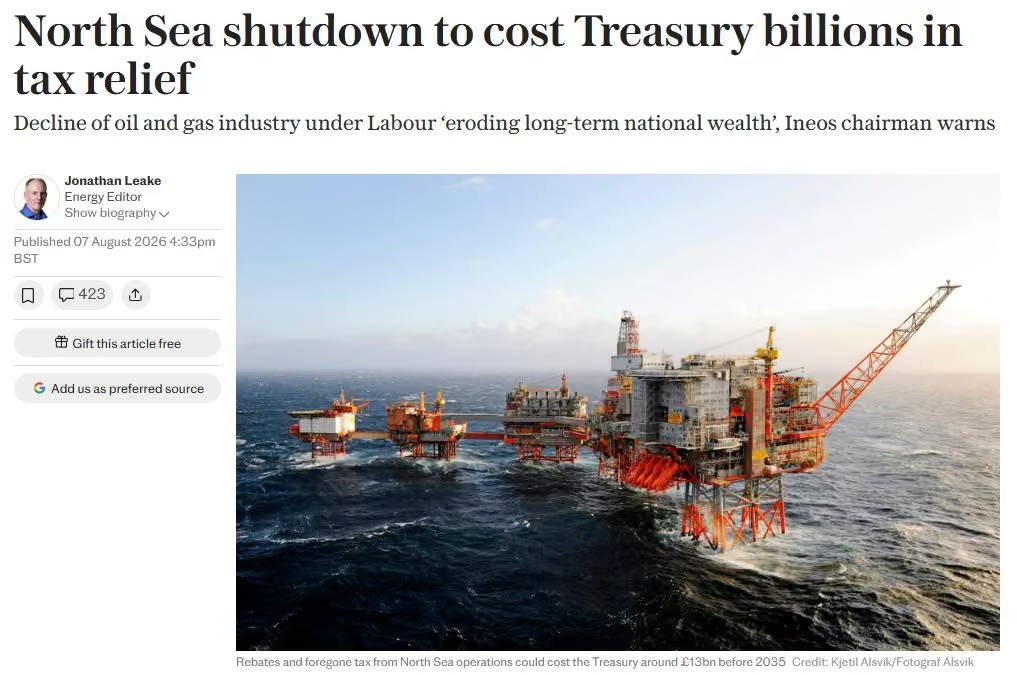
Luke Johnson reposted
Dr. Eli David
@DrEliDavid
Thank you Britain 🇬🇧 for heroically sacrificing your economy to save the planet 💪
_

Luke Johnson reposted
 Dr Emma Trimble
@Emma_A_Webb
So beautiful. Really makes you proud.


Luke Johnson reposted
End Wokeness
@EndWokeness
Pit bulls were responsible for 78% of all fatal dog attacks in 2025.
8% of dogs in the US are pit bulls.
Luke Johnson reposted
John Wills
@johndotwills
Tim Martin should be knighted about four times for services to architectural conservation
 Tom Forth
@thomasforth
Wetherspoons my goodness.


 Luke Johnson
@LukeJohnsonRCP
Like in the Wizard of Oz, the Arday scandal in Cambridge has lifted the curtain to reveal the con of DEI dominated academia. A great institution being ruined by catastrophic leadership and anti-merit identity politics.
Luke Johnson reposted
Cut My Tax
@CutMyTaxUK
Unions are demanding that Burnham scrap the so-called "glass tax", which is driving glass manufacturing overseas. A group took a giant beer bottle to Parliament to present it to Andy Burnham.
Craig Tucker, the GMB union spokesman on glass, warned the new tax will lead to huge job losses. He said that 4,750 British jobs were at risk due to the implementation of the government’s new tax. He added: “Our brewing industry is something to be proud of. It would be a disaster if it has to start importing bottles and laying off workers on both sides of the Pennines".
The tax has added about half a percentage point to overall food inflation, according to the Bank of England.
@StevenJGPerez, the founder of drinks company Global Brands, which makes the “alcopops” brands VK, Hooch and Reef, said the glass tax has hit his firm with an extra £2.5m in costs.
It is now shifting its manufacturing out of Britain entirely.
Luke Johnson reposted
 Noah
@NoahKingJr
Someone should buy LinkedIn and turn it off
Luke Johnson reposted
Peter Clack
@PeterDClack
Dismantling a century of reliable energy infrastructure built on coal, oil and gas risks the ultimate decline of Western society.
The scale of the planned transition to renewables is simply colossal, and it's being led by hardline socialist Antonio Guterres, the head of the United Nations. McKinsey estimates that achieving net-zero by 2050 would require roughly $275 trillion in cumulative spending on physical assets between 2021 and 2050 — an average of $9.2 trillion every year.
An even more limited build-out of new renewable infrastructure carries a nominal price tag in the hundreds of trillions. Yet this massive investment has not delivered a decisive shift away from hydrocarbons.
Coal, oil and gas — the so-called fossil fuels — still supply around 81% of the world’s primary energy, while wind and solar together account for only about 6–7%.
Serious practical obstacles have received too little attention. Wind turbines and solar panels typically need replacement within 20–30 years, creating a continuous loop of construction, dismantling and disposal.
The growing volume of decommissioned blades and panels is already emerging as a landfill and recycling crisis. Intermittency remains unresolved at the scale required for modern industrial societies, and the mining and materials intensity of the transition is both vast and expensive.
Meanwhile, proven reserves of coal, oil and gas remain substantial and could support current levels of use for many decades:
* Proven coal reserves of approximately 1.06 trillion tonnes — enough for roughly 130 years.
* Proven natural gas reserves of around 7,300 trillion cubic feet — enough for well over a century in many estimates.
* Proven oil reserves of about 1.65–1.7 trillion barrels — enough for roughly 50 years at today’s consumption.
The actual recoverable resource base is likely to be larger still. Land covers only about 29% of the Earth’s surface (and a portion of that is locked under ice), leaving the oceans — more than 70% of the planet — as a still incompletely explored domain for hydrocarbons.
One under-discussed consequence of rising atmospheric CO₂ is the measurable expansion of global green leaf area. Satellite records show widespread 'greening', with CO₂ fertilisation identified as a major driver. This has contributed to higher plant growth across large parts of the planet.
Rushing into an unproven, high-cost energy system at this scale carries real risks: for higher electricity prices, heavy claims on public finances and slower modernisation in the Global South. It is also likely to lock Western economies into a smaller, less competitive and less reliable energy future.
The stakes are just enormous, with no margin for error.

Luke Johnson reposted
Steve Loftus
@LoftusSteve
Drinking water has improved from 99% to 99.96%. Low pressure has dropped from 2% to 0.001%. Unplanned outages have dropped from 0.4% to 0.003%. Leaks have dropped from 4980ml/d to less than 3000. Household metering has gone from zero to 60% leading to drops in consumption.
Properties at risk of sewage flooding have dropped from 32,000 to 3000. Bathing water standards have risen from 27% pass rate to 96%. A 3rd of complaints were not answered within 10 days, now it's 0.4% for 5 days.
Water pollutants such as BOD, ammonia, and orthophosphates are massively down and at all time lows. These are all sewage indicators. Other pollutants such as cadmium, lead, nickel, copper and zinc tell the same story.
On top of all that we outperform the nationalised systems of Wales and Scotland and the NFP system of Wales. All with similar levels of debt per capita.
So what exactly has been a disaster?
Luke Johnson reposted
 Louis Mosley
@louismosley
Drop everything. The FT has done it. It’s outdone the Guardian.
Two of their finest have discovered that an NHS official once owned under £100 of Palantir shares.
Let that sink in. One hundred pounds. The FT charges its readers more than that just to read about it.
It gets worse. the NHS official sold the shares in 2021, two years before Palantir won its £330m NHS contract. The FT has exposed a conflict of interest that ended before the interest began.
The forensic journalism behind this triumph? Reading a public register of interests. Next week: the FT infiltrates Companies House.
But the best bit: the FT article debunks itself: paragraph three admits every declaration was "in line with NHS England's rules."
Even their own subscribers are struggling to take this one seriously…
 Financial Times
@FT
At least half a dozen senior NHS leaders linked to Palantir ft.trib.al/NtXuzxd
Luke Johnson reposted
 Walter Russell Mead
@wrmead
The rise and fall of ex-Cambridge prof Jason Arday should remind us all that elite failure is the leading cause of populist skepticism and rage. Neglectful of duty, intellectually befuddled, narcissistic: the academy is losing the trust it has abused.
Luke Johnson reposted
Michael A. Arouet
@MichaelAArouet
This is an eye-opening data point. The collapse of German industry is self-inflicted.
Years of bad left-green policies will be seen as the largest self-sabotage of an advanced economy ever.
The crisis is masked by more debt and government spending, but it won’t work forever.

Luke Johnson reposted
 Milton Friedman Daily
@MiltonFriedmanW
Milton Friedman on 4 ways to spend money:
1) Your money on yourself (you’re careful about both cost and quality)
2) Your money on others (you care about cost, less about quality)
3) Someone else’s money on yourself (you care about quality, not cost)
4) Someone else’s money on others (you care about neither)
The last one is how government spending works.
Luke Johnson reposted
 Silkie Carlo
@silkiecarlo
How is it that in all the BBC reporting on Jason Arday, the “fact checkers” and “misinformation experts” at BBC Verify - with their 60+ staff and £3m budget - have been nowhere to be seen…🤔
If you only followed BBC reporting on this you’d have no idea what’s actually going on
Luke Johnson reposted
 Yishan
@yishan
A key stat that every environmentalist who is serious about solving climate change should know:
The US Navy has put into operation over 400 nuclear reactors without a single failure that resulted in any radioactive release.
That is equivalent to the entire total number of civilian reactors deployed worldwide, but the Navy’s reactors are literally deployed in BOATS IN THE WATER, that continually move, rock, get shot at, etc.
There are non-trivial engineering challenges, but the core reality is that safe, clean, abundant nuclear is a matter of political will, intelligence, and organizational culture.
 Alex Hollings
@AlexHollings52
Doing a deep dive into the Virginia class, and the more I read about stuffing a 30 megawatt nuclear reactor into a metal tube packed with 140 people that’s underwater for 90 days at a time, the more annoyed I get at the nuclear power naysayers here on land.

Luke Johnson reposted
Hedgie
@HedgieMarkets
🦔A Wall Street Journal analysis published Wednesday found that U.S. life insurers hold $40 billion in bonds graded by Egan-Jones Ratings, a small firm the WSJ found grades bonds one to three notches higher than peer agencies. Egan-Jones is facing an SEC probe and a lawsuit from former employees who say they were pressured to inflate grades. Bermuda's regulator dropped the firm from its approved list in January. The largest holders include TIAA, Mass Mutual, and insurance companies controlled by Dodgers owner Mark Walter, whose debt is tied to a $16 billion federal fraud investigation.
My Take
Anyone who saw The Big Short will recognize what is happening here. Rating agencies get paid by the bond issuers whose debt they grade, insurance companies use those grades to determine how much money they set aside in reserves, and inflated grades mean insurance companies are undercapitalized against the bonds they hold. Moody's and S&P ran this playbook with mortgage bonds and everyone still remembers how that ended. Egan-Jones is doing the same thing with private credit right now, and most Americans have annuity money or pension money that touches this debt without their knowledge.
Federal investigators are already tracing $16 billion in loans that moved through third parties before reaching the books of insurance companies Mark Walter controls, and Egan-Jones graded most of that debt. If investigators confirm the loans were mislabeled to hide his affiliation, the reserves shrink, and the policyholders who paid premiums for decades learn that Mark Walter's TV broadcasting company was sitting behind their retirement all along. The SEC has known about this pattern since 2023 and Egan-Jones keeps rating deals. Regulators typically move only after an insurance company collapses.
Hedgie🤗

Luke Johnson reposted
Basil the Great
@BasilTheGreat
🚨NEWS: Cambridge University has been mocked online for some of the ridiculous PhD courses currently being studied
They include:
- Traditional Cultural Norms, Technology and Gender Relations in Ghana
- The Political Economy of Female Circumcision
- Unsexed beings: constructing gender, humanness, and agency through the use of the word “unsex” in Late Modern British society and writing
- In Her Own Words: A Study of Women’s Voices in Contemporary White Supremacy and Far-Right Online Hate
- Legal Mobilization by Black Lesbian, Bisexual and Queer (LBQ) Womxn in Kenya and South Africa
- Exploring gendered embodiment in transgender and gender-diverse adolescents at the intersection of exercise and eating behaviours, social inclusion, and mental health: Towards a desire-centred approach in paediatric gender-affirming healthcare and research
- Codes of Life, Codes of Death: Tracing the (Im)possibility of Trans Lives in Algorithmic Assemblages
- Queer Cultural Memory in Literature, Film and Television since 1999
- The Sexually Sociological: Gay Masculinity, Intimacy and the (Un)queer State
A once proud University has completely lost its way

Luke Johnson reposted
The Kobeissi Letter
@KobeissiLetter
US productivity growth is accelerating:
US labor productivity rose +1.4% annualized rate in Q2 2026, more than double the +0.6% expected.
This follows an upwardly revised +0.8% increase in Q1, marking the 5th consecutive quarter of productivity gains.
At the same time, US manufacturing productivity jumped +1.9%, driven by a +4.6% surge in output, the strongest increase since Q4 2021.
However, these productivity gains came at the expense of workers, with inflation-adjusted compensation falling -3.2%, the largest quarterly decline since Q4 2022.
Meanwhile, unit labor costs, which measure how much a company pays workers to produce one unit of output, rose just +1.3% last quarter, well below the +2.1% expected.
The productivity boom is gaining momentum.

Luke Johnson reposted
 Richard North
@ollieparrot
Defund the BBC
Although much more is to come out of the woodwork with the Arday affair, the role of the BBC in reporting the emerging controversy should not be forgotten.
The contrast between how newspapers like The Telegraph or The Times, and journals such as The Spectator, meticulously dismantled his claims and the passivity of the BBC in handling the story points to several systemic failures in the broadcaster’s objectivity.
The BBC possesses an elite investigative arm, yet it fundamentally failed to use Verify or any of its other fact-checking resources independently to audit Arday's work during the height of the controversy.
While print journalists were calling up charities, mapping out impossible marathon times (such as his claim of running 600 miles in six days), and running software on his academic papers, the BBC largely limited its coverage to reporting on other people's reporting.
It limited is coverage of the controversy, effectively treating the crisis as a mere “row” or a clash of opinions between opposing camps, rather than a verifiable case of fraud. In so doing, it seems to have been attempting to protect a narrative it had spent years building.
The BBC itself was a primary driver of the Arday phenomenon. They presented him as the definitive symbol of progressive triumph over institutional barriers: a man diagnosed with global development delay who could not speak until 11 but became Cambridge’s youngest Black professor at 37.
Because the BBC’s senior editors used its platform to champion this specific biography, critically examining his thesis would require the broadcaster to admit that its own editorial vetting had failed.
Thus, to preserve institutional face, the BBC consistently framed the accusations not as an issue of basic academic integrity, but as a “highly politicised” debate surrounding diversity, equity, and inclusion (DEI).
The broadcaster’s limited coverage heavily repeated Arday’s defensive framing. In his statements - broadcast extensively by the BBC - Arday claimed that the identical passages in his thesis were merely “errors” caused by his autism and a reliance on “mimicry” to learn.
This was despite independent fact-checking and analysis of his 2015 PhD thesis at Liverpool John Moores University, which exposed 188 sentences that were identical or near-identical to a 2009 Brunel University thesis, a statistical impossibility to achieve by accident.
Any experienced academic (in fact, any academic) knows that copying entire blocks of text from a previous student’s dissertation is plagiarism, not a symptom of "neurodivergence".
By uncritically broadcasting his defence without explicitly pointing out that the scale of text duplication breached standard UK university regulations, the BBC chose to prioritise editorial sympathy over strict factual analysis.
But the most significant indicator of a lack of objectivity was the BBC's initial silence on how the story was suppressed.
The public now knows that journalists trying to investigate Arday were met with legal threats from elite law firms, and that the Metropolitan Police actually launched a four-month harassment investigation into an independent reporter just for emailing Arday standard journalistic questions.
The BBC’s failure to investigate why a university professor was using the Met Police to silence legitimate journalistic scrutiny reveals what appears to be a deep-seated reluctance to challenge the establishment figures they admire.
Yet, as a universally tax-funded broadcaster supported by the UK licence fee, the BBC is bound by a strict Royal Charter that legally requires it to maintain absolute impartiality and objectivity.
When the broadcaster prioritises protecting a celebrated narrative over conducting basic, rigorous fact-checking, it represents a profound systemic failure that directly violates those foundational public duties.
By contrast, the BBC routinely deploys its “Verify” unit to fact-check minor internet rumours or political claims, yet it consciously chose not to apply those same data-journalism tools to a high-profile academic scandal that was emerging.
By framing massive text duplication as “errors” and focusing heavily on Arday's defence, the broadcaster allowed its own editorial sympathy to obscure the objective reality of the plagiarism.
This demonstrates that the BBC had created for itself a clear conflict of interest where a public broadcaster was protecting its own historical reporting at the expense of the truth.
In aligning its coverage with a specific progressive worldview – in this case uncritically championing a high-profile appointment to support a diversity narrative – it has succumbed to institutional capture.
It has ceased to be an objective observer (not that it has been for some time) and instead has become an active participant in a cultural conflict, using public money to validate its own institutional preferences.
Prior to the current Charter running out on 31 December 2027, the BBC’s reporting of the Arday controversy should feature prominently in the funding review. It should be taken as additional evidence that the current public service broadcasting model has outlived its usefulness.
If the BBC wants to be the propaganda arm for the progressives, it should be so on its own dime. It is wholly unacceptable that the public should be forced to pay for it.

Luke Johnson reposted
Object Zero
@Object_Zero_
Building an SSBN
(Ship Submersible, Ballistic Nuclear)
Only 6 countries in the world can build an SSBN… USA, Russia, China, UK, France, India.
(for context, there are 12 countries with orbital launch capabilities)
They all build SSBNs differently, each have their own strengths and weaknesses. Some are better at building, some are better at operating, some are better at design. There are superior and inferior technologies. Lots of secrets.
Why do it?
The purpose of the SSBN, is to achieve Continuous At Sea Deterrent (CASD).
The first SSBN ever built was launched in 1959, the USS George Washington, it carried 16 Polaris missiles.
It was immediately obvious to every nation that nobody knew where the George Washington was, and that no amount of satellite coverage could answer that question. It was therefore the ultimate counterstrike.
The ultimate counterstrike is the ultimate deterrent and that is what CASD achieves.
Below is inside the Devonshire Dock Hall (DDH) at BAE, Barrow-in-Furness where 3 nuclear submarines are being constructed side by side.
This is where the AUKUS submarines will be built. They will cost approximately $5 billion per boat.


Luke Johnson reposted
Andrew Griffith MP
@griffitha
The government has already spent £555 million on its botched British Steel nationalisation.
Now it turns out the company also owes £1 BILLION to the Chinese. Why were we not told?
I warned of this risk but Labour pushed ahead.
Why should our taxes go to China?

Luke Johnson reposted
Jonathan Maze
@jonathanmaze
There's a new No. 2 in town. Wendy's system sales in the second quarter declined 8.2%, thanks to closures and a 7% decrease in same-store sales. Burger King, whose system sales increased 8.2% in the second quarter, is back to its position as the country's second-largest fast-food burger chain.
That's rather insane, and shows how fleeting success in this business really is. Wendy's was thriving for a while, but its sales have really slowed over the past two years. It has been closing locations. And today the company suspended its dividend and its earnings guidance to invest back in the business.
Burger King, which just a few years ago was closing large numbers of stores and watching big operators file for bankruptcy, has steadied its ship and accelerated growth. Its same-store sales last quarter outpaced McDonald's by 770bp and Wendy's by 1,550bp. Just an insane reversal of fortune.

Luke Johnson reposted
Cut My Tax
@CutMyTaxUK
Every year for the last three years Labour has hamstrung the economy by floating stupid ideas as to which taxes they are going to raise next.
The latest example: Construction of rental homes has fallen to a 12-year low due to fears about Burnham’s property tax plans.
Just 3,455 build-to-rent projects started in the last quarter, down 80% on the same period in the previous year
Kate Butler from Real Estate UK said "the speculation around proportional property tax or land value tax has been unhelpful and has had similar effects to the speculation around rent controls.”
Why do Labour never learn?
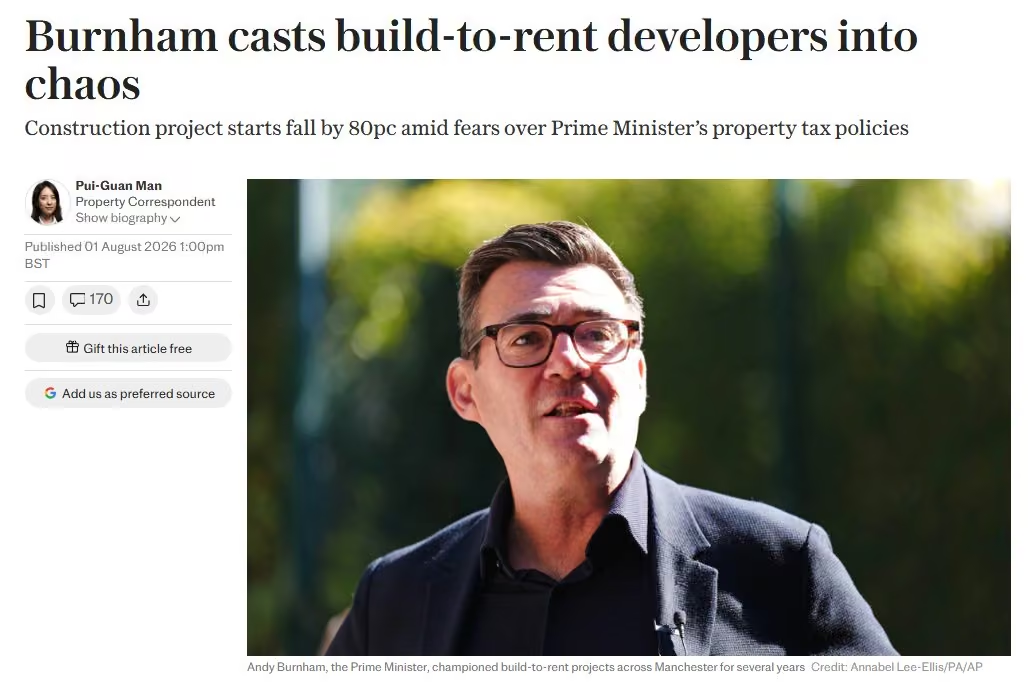
Luke Johnson reposted
 Hans Mahncke
@HansMahncke
The Jason Arday episode is a perfect microcosm of a Western system rotting under the weight of human deadwood. Not just academia, wokeness, welfare bureaucracies, “learing” centers, or the laptop manager class exposed during Covid, but an entire civilization in which millions contribute nothing, produce nothing, and solve nothing while participating in an elaborate theater of fake productivity designed to conceal their complete uselessness. The real work is left to a shrinking productive minority forced to carry everyone else.
Luke Johnson reposted
foley (follard)
@follard
I went to Dartmouth. It costs roughly $60,000 a year all in. I now build homes for a living. They cost roughly $350,000 to build.
Both of these numbers are completely insane. And they are insane for the exact same reason.
The moment the government guarantees a loan, the seller stops caring what the buyer can actually afford. College tuition exploded after the federal government started backing student loans with no underwriting and no discharge in bankruptcy. Home prices exploded after Fannie Mae and Freddie Mac started buying mortgages and removing risk from lenders.
When a bank knows it will get paid no matter what, it will lend to anyone. When the bank will lend to anyone, the seller raises the price. When the seller raises the price, the buyer just borrows more. Nobody feels the pain until the bill comes due 10 or 30 years later.
Colleges added $200 million rec centers and hired thousands of administrators because students were writing checks with money that didn't feel real. Home sellers listed at $500k because they knew the bank would approve it regardless of whether the buyer could sustain the payment.
I benefited from both systems. My Dartmouth degree opened doors. The homes I build get financed by these same banks. I am not pretending to be above it.
But I look at both industries from the inside and tell you they run on the same engine. A guaranteed loan that disconnects the buyer from the real cost of what they are purchasing. The university and the mortgage lender have the same business model. They are financing tools that happen to have a campus or a front door.
If the government removed the guarantee from the student loans tomorrow, tuition would drop 40% within five years. If Fannie and Freddie disappeared, home prices would correct in the same direction. The prices are essentially fake. They are a reflection of how much debt a bank is willing to issue, not how much the product is intrinsically worth.
I say this as someone who went to an expensive school and builds homes. Both systems are broken in the exact same way and nobody talks about it because too many people profit from the status quo.
Luke Johnson reposted
Elon Musk
@elonmusk
Terafab Texas will be the largest and most valuable building on Earth by far.
And it will be stunningly beautiful.
Luke Johnson reposted
 SightBringer
@_The_Prophet__
⚡️America has been living inside a lie so large that the debt became the only structure capable of holding it together.
The lie says every promise can remain whole.
Retirees can keep their benefits. Homeowners can keep their gains. Markets can keep their rescues. Banks can keep their liquidity. The military can keep its reach. Voters can keep their services. Taxpayers can keep more of their income. The young can still inherit a future.
Reality has already rejected that bargain.
The country created more claims on tomorrow than tomorrow can satisfy. Debt allowed those claims to coexist for a while because debt turns conflict into delay. Nobody had to lose today. The loss was pushed forward, hidden inside a number, and assigned to people who had no seat at the table.
That number is now the organizing force of the nation.
The state cannot permit the debt structure to clear honestly because honest clearing would expose the insolvency beneath the entire social order. Asset prices would fall. Banks would break. pensions would weaken. benefits would be cut. taxes would rise. military commitments would contract. Millions of people would discover that the wealth and security they believed they owned were contingent claims supported by future labor.
So the system protects the illusion and sacrifices the future beneath it.
The sacrifice arrives through currency dilution, asset inflation, higher entry prices, permanent refinancing, and the slow conversion of wages into tribute. The worker produces. The state borrows against that production before it arrives. The asset owner captures the first repricing. The creditor receives the protected claim. The renter and cash holder absorb the remaining loss.
This is the deepest generational theft in the structure.
Earlier generations consumed the cheap homes, cheap energy, cheap credit, demographic expansion, and institutional stability of the old order. They then converted those advantages into protected assets and permanent claims on the income of those who followed. The next generation inherits the taxes, the inflated asset prices, the debt service, the medical burden, and the obligation to preserve the value of everything accumulated before it arrived.
The young are being asked to fund a civilization that has already spent their inheritance.
That is why ordinary life keeps becoming more expensive. Every institution is fighting to preserve its claim against a shrinking pool of unclaimed future. The hospital raises prices. The insurer raises premiums. The landlord raises rent. The university raises tuition. The government issues more debt. The corporation protects margin.
Each layer passes the loss downward until it reaches the person whose only asset is labor.
 Joel Berry
@JoelWBerry
This is why your burrito costs $20 and the only way to fix it is to cut entitlements and no one wants to do that so

Luke Johnson reposted
spiked
@spikedonline
Chancellor John Healey’s talk of supermarket ‘price gouging’ is beyond cynical. It’s an attempt to blame the government’s own failings on business. The trouble is, food in Britain is actually very cheap, says Matthew Bowles
www.spiked-online.com/2026/08/04/the-myth-of-supermarket-…
Luke Johnson reposted
 Fox News
@FoxNews
"A million Americans died, and I think they deserve to know the truth."
Sen. Rand Paul says Dr. Anthony Fauci has no reason not to talk after the Senate voted to hold him in contempt of Congress, calling out his Biden-era presidential pardon that dates back to 2014.
Paul says the pardon covers Fauci's conduct that could potentially be criminal, meaning Fauci only needs to avoid committing a new crime to keep that immunity and should answer lawmakers' questions instead of repeatedly invoking the Fifth Amendment.
Luke Johnson reposted
Michael A. Arouet
@MichaelAArouet
If you wonder where all the debt went:
1. There are 70 million vacant apartments in China
2. One in four skyscrapers is vacant
3. One in three industrial companies is loss-making
4. Two in three airports are underused and loss-making
Other than that, things are in good shape
Michael A. Arouet
@MichaelAArouet
If you are concerned about debt levels in the US and Europe, just take a look at China.
What if China’s ascent is just the biggest debt experiment ever? Is this sustainable? Can the debt binge continue forever, or will gravity kick in one day?

Luke Johnson reposted
 The Critical Drinker
@TheCriticalDri2
Walking down the average UK high street now is one of the most blackpilling experiences imaginable. Barely any local businesses left, just endless vape shops, tacky nail salons, dodgy phone retailers and the obligatory Turkish barbers, most of which never see a single customer and barely even bother to maintain the pretence of being legit anymore.
A palpable atmosphere of quiet despair and resignation amongst the trickle of shoppers wandering aimlessly around. Its like living in a country that just lost a war without firing a single shot. Never seen anything like it in my lifetime.
Luke Johnson reposted
 Mario Nawfal
@MarioNawfal
🏴 A 26-year-old in Wales decided the best way to spend a Saturday was to dress as the Grim Reaper, climb onto a hospital roof, and stare down at patients.
Leon Gillespie also appeared to be holding a long blade as he loomed over the entrance of Ysbyty Glan Clwyd Hospital.
Police and fire crews spent about 50 minutes dealing with the situation before he eventually came down.
He pleaded guilty to causing a nuisance on NHS premises and walked away with a £200 fine.
I'd call the Grim Reaper more than a nuisance 😂
Source: Independent / Writers: Sol, Michael

Luke Johnson reposted
Andrew Neil
@afneil
UK national debt has now tipped over the £3 TRILLION mark.
Between 2024/25 and 2029/30 we will borrow circa £650 billion on current OBR actuals + projections. Probably more.
We will start the next decade with £3.5 TRILLION in debt.
We already pay the highest borrowing rates of any G7 economy.
Yet the Burnham government is talking about borrowing even more.
That way lies madness.
Luke Johnson reposted
Neil O'Brien
@NeilDotObrien
The Arday scandal revealed the rot in our universities - a guy producing reams of meaningless garbage was promoted & praised to high heaven. But he's not unique. My new piece looks at the growth of DEI / critical theory rubbish in our universities, using large datasets:
(1/10)

Luke Johnson reposted
Jonathan Maze
@jonathanmaze
So Salad & Go shut down this week and filed for bankruptcy, as our @BGbunster wrote (and we'll write more about in the near future). But I have some thoughts on this.
The chain has had a completely wild ride in just a few short years, and it's a lesson in how private equity's insatiable demand for growth can ruin good brands.
The company opened its first location in 2013 and grew steadily, and quietly, over the years. It had an innovative model, using commissary kitchens and a low-cost, drive-thru-only model to keep prices down.
When the company surprisingly hired Charlie Morrison away from Wingstop in 2022, many of us hadn't even heard of the chain, though it was popular in its home state of Arizona. Per @technomic the company gets exceptional customer ratings in surveys.
The company had in 2016 took an investment from Volt Investment Holdings and the PE firm by 2021 pushed to expand into new markets faster than the founders wanted. So they bought out the founders and lured Charlie Morrison away from a good gig at Wingstop. But they didn't even announce the move until four months after it hired him.
That was such a weird move. And in my view it highlighted one of the brand's flaws: It lured a big-name CEO and then said zilch about it for months, missing a golden marketing chance.
And, as the chart below shows, Salad & Go dramatically ramped up expansion. It went from opening about 4 locations a year to between 40-50, tripling in size between 2022 and 2024. It also went big into Texas.
That Texas moved failed. Many stores sat empty. Charlie left in a disagreement with the company's board and the chain pulled back in Texas and Oklahoma, but the Arizona locations still did well. Or so that's what I was told.
But now it's filed for bankruptcy and has completely shut down. Salad & Go essentially blamed cyclospora as the proverbial final nail in the coffin. But it's obituary was written a while ago.
It's a lesson that even good concepts can fail if they don't have the proper strategy in place. And PE firms often push aggressive growth beyond a company's capabilities.
Salad & Go wasn't well-known enough when it expanded into Texas and it had a business model that was brand new with a primary menu that has some challenges as it is. Salads are difficult even in the best of circumstances. Just ask Sweetgreen.
Salad & Go tried doing everything at once. Now it's in bankruptcy and shut down. Someone might buy the IP and give it a go. If they do, they should remember why the founders left. They were clearly right.
Also, if you're going to go big with expansion, get the marketing straight.
Anyway, more here: www.nrn.com/fast-casual/salad-and-go-closes-all-locations…
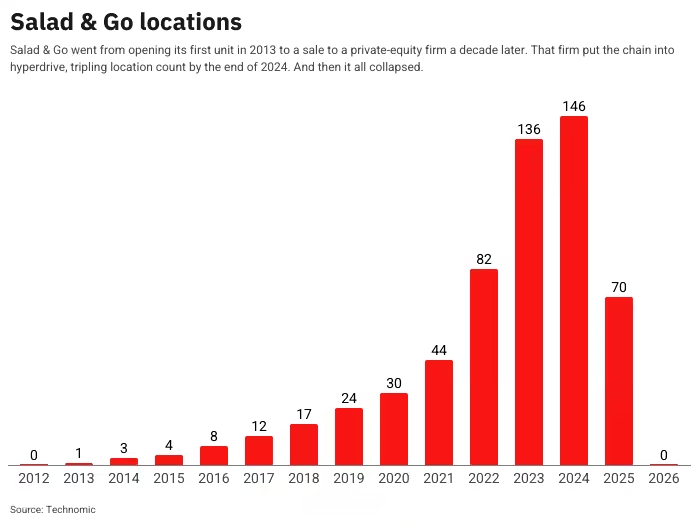
Luke Johnson reposted
More Births
@MoreBirths
An extraordinary graphic showing what will happen in Poland if fertility rates simply stay where they are. Most of the developed world is on a trajectory of population collapse similar to this.
Nothing matters more than turning around birthrate decline.
 Krzysztof Szczawinski 🇵🇱
@Kristof_Poland
Let’s consider the demographic situation of Western Civilization seriously.
Its core demographic base is about 750 million people, with a fertility rate of about 1.3 children per woman.
What that means a few generations out is terrifying – we are DYING OUT.
I did the exercise for Poland, which is about one twentieth of that demographic base, with a fertility rate at about half of replacement.
Four generations into the future, it gives us this👇🏻 – basically the end of the nation.
Multiply it by 20 and you get the fate of the whole Civilization. You do the math…
Our only hope is in the families with 3+ children, who are able to pass that tradition on to their children.
They will inherit Our Civilization, if it survives. The rest will simply die out.
(The same math that dooms the average saves the tail.)
Luke Johnson reposted
Holger Zschaepitz
@Schuldensuehner
Good Morning from #latvia, where financially troubled airBaltic flew me in w/plenty of legroom and almost no hassle. Now I can only hope it flies me home too. Latvia owns 88%, Lufthansa 10%. What blew it up in March was fuel: airBaltic had hedged only about 10% of its 2026 jet fuel needs, so when the Iran war sent jet fuel flying, the entire cost base went w/it. Cash was €28m at 2025-year end against a €25m minimum liquidity covenant. No margin for anything.
The flag carrier's bond is a masterclass in what the word "secured" is actually worth. airBaltic sold €380m of 14.5% senior SECURED notes due 2029 at par in May 2024, at a whopping +1213bps over Bunds. They now trade at 40 cents today, yielding ~60%. Fitch has the airline at CCC- on Watch Negative and puts recovery at RR4, meaning holders get back 31% to 50% if it breaks. Back in December it was RR3. The collateral is shrinking faster than the debt.
The good assets are not in the pledge. The A220 fleet is leased, so the lessors hold the metal. What is left for bondholders is brand, spare parts, receivables and pledged accounts, all worth something only while the planes keep flying. The state owns 88% of the equity and guarantees exactly nothing.
On June 26 the airline skipped topping up the bond reserve account, which pushes the Aug 14 coupon to a 16.5% penalty rate. Monday's bondholder meeting was meant to fix things and failed on quorum. The rerun is Aug 17, 3 days after that coupon falls due, and by then the quorum threshold drops so low that a single bondholder can carry the vote. On the agenda: defer the next two coupons into the principal. The bailout is the risk: fresh capital would rank ahead of the old bonds, pushing today's "secured" holders one notch further back.
Lesson for yield hunters: "secured" tells you your rank in the queue. It tells you nothing about whether there is anything left when you get to the front.


Luke Johnson reposted
 Miranda Devine
@mirandadevine
@jeffreytucker has done the world a great service by producing the first in-depth analysis of Fauci's diary. His conclusion, and the one that makes most sense, is that Fauci ginned up the exaggerated COVID scare and associated lockdown and mask panic to cover up his culpability in the gain-of-function research in Wuhan where the Frankenstein virus appears to have originated.
You can understand the desire to escape blame for the death and suffering of millions of people but the ability to cheerfully play-act an altruistic scientist day after day suggests a level of callousness best left to psychiatrists to diagnose. Link in replies


Luke Johnson reposted
 Jacob Titus
@jacob__titus
The world according to Allegheny Airlines

Luke Johnson reposted
 The Maverick of Wall Street
@TheMaverickWS
Estimates suggest that Ken Griffin's Citadel Securities made $3.2 Billion in a couple of days since taking over and flipping Situational Jackassness portfolio

Luke Johnson reposted
Jonathan Maze
@jonathanmaze
I'm still digesting that McDonald's call, which was something. $MCD
First: Chris Kempczinski and McDonald's should get some real credit for their candor. A lot of companies (hint: Yum Brands) are way too focused on the positive while blowing off serious problems. (hint: Pizza Hut)
But there are some real implications to the company's quarter and they're not insignificant.
McDonald's franchisees agreed, with considerable cajoling, to lower prices and offer more discounts. The result last quarter was less traffic, despite a bunch of marketing promotions, including beverages, which did better than expected. Not even the World Cup helped.
When more discounts result in less traffic, it means that existing restaurant customers are buying cheaper, less profitable food, but there are fewer of them. So the profitability is much worse. (Oh, and beef costs are soaring right now, which obviously makes matters worse.)
So your average franchisee makes a lot less money now than they did a year ago or a few months ago.
McDonald's is about to start asking franchisees to remodel their restaurants again as part of their 10-year remodel cycle. That's a key part of the company's "Next" plan.
But franchisees will have less cashflow and will be less able to afford the cost to remodel those locations. And McDonald's expended considerable political capital to convince franchisees to do those discounts. They did not work.
Suffice it to say, the company has some real work to do. And so that probably explains the change in U.S. leadership and Chris K's candor. But I probably won't forget that call anytime soon.

Luke Johnson reposted
Kristian Niemietz
@K_Niemietz
That, unfortunately, turned out to be premature.
 East German Visuals
@GDRvisuals
"Socialism is dead", graffiti on the Berlin Wall months after it's fall, 1990.
 Luke Johnson
@LukeJohnsonRCP
We all have living expenses…
 The Assembly
@InTheAssembly
Jeff dumping $AMZN
$4 billion worth

Luke Johnson reposted
 The Rational Animal 🤔
@theobjectivist
Now back to reality. The century of experiments is over and the results are in.
Socialism's table: the Holodomor, Mao's famine with up to 45 million dead, North Korea eating bark, Venezuela's citizens losing an average of 24 pounds each in a single year. Every society that drew your bottom picture produced the empty plates in your top one.
Capitalism's table: extreme poverty fell from 90 percent of mankind to under 10 in two centuries of markets. The countries with billionaires are the countries where the poor are overweight. And the pile in front of Musk is not food. It is factories, rockets, and paychecks. Wealth held as capital is what feeds the children in your cartoon.
The moral case follows the plates. Capitalism is production and consent. No one at that table was robbed. Socialism is seizure, and the man serving the feast decides who eats, which is why its subjects starve while its rulers never miss a meal.
 Harry Eccles
@Heccles94
Which would you prefer?

Luke Johnson reposted
 Maarten Boudry
@mboudry
Good news! For the first time in at least 25 years (and perhaps in all of human history?), more than half of global billionaire wealth is now held by self-made entrepreneurs who earned their fortunes through competitive market activities, i.e. the rest of us buying their products (and getting richer in the process ourselves). No inherited dynasties, no plunder or expropriation, no dumb luck (though every billionaire's story contains at least some of that).
Analysis by @economist.
www.economist.com/finance-and-economics/2026/07/23/the-ri…

Luke Johnson reposted
Fox News
@FoxNews
BREAKING: Sen. Rand Paul is moving to hold Dr. Anthony Fauci in contempt of Congress after Fauci invoked the Fifth Amendment over a hundred times during last week's Senate hearing.
The Senate Homeland Security and Governmental Affairs Committee is set to vote Thursday morning on Paul's contempt resolution, which says Fauci refused to answer questions despite being under subpoena.
Paul argues Fauci's Fifth Amendment protections no longer applied because of his presidential pardon and that Fauci also waived any remaining privilege by delivering opening testimony.
Fauci refused to answer anyway, which Paul says amounts to obstruction of a congressional investigation.

Luke Johnson reposted
Poetic Outlaws
@OutlawsPoetic
“This is one of the most urgent problems for civilised man. He has created civilisation to give himself security. Security for what? For boredom? His chief problem seems to be that most human beings need a certain amount of challenge, of external stimulus, to stop them from sinking into the blank stare and blank consciousness of the idiot.”
~ Colin Wilson

Luke Johnson reposted
Michael Shellenberger
@shellenberger
Journalists are aggressively defending Fauci, despite his diaries showing that he repeatedly lied to the public. The reason is that, after years of dehumanizing Covid dissidents based on his lies, media elites can’t cope with the enormity of their failure. By @GalexyBrane

Luke Johnson reposted
Barchart
@Barchart
South Korea's 40% stock market crash is now the worst dump in Asian Financial Markets History 🚨 🚨

Luke Johnson reposted
 Kevin Bass
@kevinnbass
Trust in the medical system is at its lowest since Gallup began polling in 1993 -- likely at its lowest in modern history.
If you think Fauci and COVID don't matter, think again.
When someone lies to you, you stop trusting them.
When they deny lying, you trust them even less.

Luke Johnson reposted
Michael A. Arouet
@MichaelAArouet
It’s not only Net Zero making things worse. Many left policies not only fail but even achieve the opposite of what’s intended.
Rent controls
Wealth taxes
Minimum wages
To name just a few. Are the left ideologically unwilling or intellectually unable to understand that?
Michael A. Arouet
@MichaelAArouet
European Net Zero achieved two things:
1. Deindustrialization in Europe due to high energy costs, many well-paid jobs lost.
2. The same products come now from Asia, but with higher emissions to build and ship. Cars, for example, cause 70% more emissions.
Isn’t that genius?

Luke Johnson reposted
Javier Blas
@JavierBlas
Well, times change:
2020: "bp’s purpose is to reimagine energy for people and our planet."
2026: "bp is a global oil and gas company."
Luke Johnson
@LukeJohnsonRCP
There are no extra 400,000 clean energy jobs. This is a political fantasy. But NetZero is certainly killing jobs in the real world by making electricity costs in the UK among the highest in the world among developed economies.
 Miatta Fahnbulleh
@Miatsf
We are determined to fix the youth unemployment crisis and restore opportunity across the country.
We're creating 400,000 extra clean energy jobs by 2030 and working with companies like @nationalgriduk to help young people seize these opportunities.
More on @BBCBreakfast ⬇️
Luke Johnson reposted
Alan Smith
@AlanJLSmith
On holiday last week I got chatting to a business owner.
He told me he’s now offshoring 25% of his workforce to Cape Town.
English speaking, educated, ~ same time zone - and about 50% of the fully loaded cost of hiring in the UK.
You can’t blame him.

Luke Johnson reposted
 Brian Groom
@GroomB
Publicity drawing for Forton services on the M6 near Lancaster, 1963.

Luke Johnson reposted
bernoulli_defect
@BernoulliDefect
What’s worrying is that this isn’t an inefficient and old fashioned industry being shown the door: Britain’s brick factories are highly automated, produce ~300,000 bricks and £62,000 of GVA per worker, 19% above the non-financial economy average (2018 numbers)
Domestic capital intensive ‘basics’ industries are what makes a rich country rich. Replacing them with imports chips away at the thin wedge of high value economic activity in Britain.
 Rian Chad Whitton
@RianCFFWhitton
New Syn Post: Embodied Insanity
Bricks are cheap, aesthetic and still largely produced domestically. But new standards and dubious carbon arguments are pushing us to timber, 80% of which we import.

Luke Johnson reposted
Neil O'Brien
@NeilDotObrien
Labour inherited youth unemployment below the eurozone average. But they blasted it up with massive tax rises & more regulation.
In the Times today Lucy Powell blames *Michael Gove* for this. They're delusional.

Luke Johnson reposted
 The Mind Scourge
@TheMindScourge
Great thread, I’ll add some thoughts:
1. Pricing in the US is completely absurd. The link between pricing and value is entirely broken. Extremely mid hotels are hundreds of dollars a night; the average price for a new car is $50,000; really nothing feels like a deal. When you go out to eat, just assume you’ll spend $100 minimum. One of my personal benchmarks, Fage 5% Greek yogurt used to be $4.50 per tub back in 2019. Now I spend $7.80
2. Major cities are worse than they were a decade ago. Things have improved relatively since the nadir, but only relatively. There is still real, noticeable, quality of life decline in most urban downtowns.
3. Ubiquitous pot. You smell it everywhere now. 20 years ago, you’d usually encounter somebody smoking. Today, the cigarettes are largely gone, replaced by marijuana. This is not an improvement
4. Asian culture is much more prominent, from music to cinema and television, books, food, and the list goes on.
5. Airports have generally improved. This might not be saying much, but it’s true, with certain exceptions
6. Politics is much, much, worse.
7. Food is much better. The millennial food revolution is taken for granted, but I grew up before it in the 1990s and I remember the old world. Eating isn’t everything but the embarrassment of riches we now have is still underrated. You can get high quality food and drink almost anywhere now. That’s a major quality of life enhancement, even considering the prices.
8. There’s a broadly shared sense that America’s best days are behind it. A sort of background pessimism - on both the left and right - that shapes everything. Even in the optimistic corners of our society - Silicon Valley, say - the ambition primarily appears to be to escape the US - and the nation state itself, and even humanity - rather than to improve the country itself. Political ambitions are backward rather than forward looking.
9. Suburban amenities are significantly improved. If America’s major cities have mostly changed for the worse, America’s suburbs have changed for the better. Essentially all suburbs now have these “mixed development” zones where if you blur your eyes slightly you can (sort of) imagine you’re living out a fantasy of life in Greenwich Village or Manhattan. They’re walkable (though you have to drive to get to them), there’s clean play areas and green space for kids, a good variety of shops and breweries and beyond third wave coffee places and the like, and - because these are invariably private and because they aren’t connected by public buses - there aren’t any of the urban quality of life issues to deal with. The public has clearly woken up to this; all these places are absolutely heaving with people, even during the week.
10. The proliferation of conspiracies and apocalyptic thinking
11. The normalization of scams and “get yours by any means necessary so you can escape the permanent underclass” type thinking.
12. A much degraded intellectual environment. Politics is one facet of it, but there are many others. For example, the recent Nolan interview in China that’s gone viral on here this week. Odyssey discourse has been heavy for over a year in the US, but the relative quality of this interview is so much higher than anything we’ve seen so far. As a comparison, think about that execrable Wilson piece in the London Review of Books - ostensibly a highbrow prestige publication. The difference is honestly embarrassing, and synecdoche of what I see generally: for example, in academia.
 alreadydawn
@alreadydawn
Spent the past 6 weeks in America. Saw signs and trends that made me even more bearish on the country:
1. The prices have gone nuts ❌
I felt like a cattle taken to the slaughterhouse, squeezed for $$$ everywhere I went.
- A motel in Port Angeles (a city by Olympic National Park) during *weekdays* and NOT during July 4th week cost $250 per night. I can book the freaking Ritz-Carlton in China for essentially the same price.
- Every meal when eating out easily shot above $20, more like $30 including tips (way worse in NYC). These were prices at boring, mid places, btw. And I don’t order drinks, appetizers, or desserts.
- Uber from Seatac airport to Seattle cost $90, used to be ~40 pre-covid (for comparison, the same ride in Shenzhen would cost $5-10).
- Generally, sub 10 minute Uber rides cost $15-20.
- 13 minute Citibike in ride in NYC cost $11; 10 minute Lime Scooter ride in SF cost $7.5. Ubike in Taipei costs nothing for rides under 30 minutes.
- Southwest Airline’s free check-in baggage policy was terminated this spring.
- Every software tries to hit you with a sweet sweet subscription payment plan (rentseeking behavior goes brrrr)
(Continued. Also, @tolstoybb ’s post is evergreen as usual.)


Luke Johnson reposted
 Jonas Schmidt-Chanasit
@ChanasitJonas
Faucis Tagebuch auf einem Regierungs-Computer enthüllt eine andere Seite der #pandemie: Während strenge Maßnahmen die Gesellschaft belasteten und spalteten, genoss er Partys, Galas und Freundschaften mit Prominenten in der Washingtoner Elite. Seine Aufzeichnungen zeigen, wie Wissenschaft zur Marke und zum Personenkult degradiert wurde. Wer sich so präsentierte und nun schweigt, beschädigt die Glaubwürdigkeit der #wissenschaft nachhaltig. #fauci #corona #covid19 www.theatlantic.com/ideas/2026/07/anthony-fauci-washingto…
Luke Johnson reposted
Alan Smith
@AlanJLSmith
Some facts:
- There are 5.6 million small businesses in the UK.
- SMEs account for 99.9% of the business population.
- Total employment in SMEs is 16.7 million (61% of the total),
- Annual turnover from SMEs is estimated at £2.4 trillion.
- 90% of new businesses fail, often resulting in the founders losing all their life savings.
- Small/medium businesses are the heart and soul of the British economy.
Starting and growing a business takes guts, resilience, and ambition - and it needs to be supported for the economy to thrive.
Global corporations employ armies of accountants to minimise or eliminate their taxes.
Small businesses don’t have the luxury or budget for that; frankly, most don’t want to.
They’re happy to pay their fair share - but draw the line when they believe they’re taken advantage of.
A vibrant, business-friendly economy will generate far more tax revenue than one that crushes the British entrepreneurial spirit.
Why don’t the government understand this?

Luke Johnson reposted
 Voices of WW2
@VoicesofWW2
Norman Jackson climbed out of a Lancaster bomber onto the wing, in the freezing slipstream, four miles above Germany, to put out an engine fire with a hand extinguisher while the aircraft flew on through the night. It is one of the most physically unbelievable acts of courage in the history of the air war, and the fact that he survived it at all is a miracle.
Jackson was a flight engineer, and by April 1944 he had already finished his tour of 30 missions. He did not have to fly again. But his crew still had sorties to complete, and he would not let them go without him, so he volunteered for one more, a raid on Schweinfurt. On the way home a German night fighter tore into them, ripped open the wing, and set the fuel tank ablaze. A wing fire on a bomber full of fuel meant the aircraft would explode within minutes. Everyone aboard knew it.
Jackson, already wounded by shell splinters, did the only thing that might save them. He got a fire extinguisher, strapped on his parachute, and had his crewmates feed the rip cord out slowly so his canopy would billow behind him as an anchor. Then he pushed himself out through the hatch into a 200 mile an hour wind and hauled himself out onto the wing of the flying bomber, in the dark, at 20,000 feet, and started fighting the fire by hand.
He nearly did it. He got the extinguisher onto the flames and had the fire coming under control. Then the night fighter swung back for another pass and raked the aircraft again. Jackson was hit in the legs, the fire flared back up and burned his hands and face, and he was swept off the wing into the night. His parachute, already burned by the fire, streamed out only partly open and smouldering.
And he lived. He fell four miles with a half-burned parachute and hit the ground with a broken ankle, a shattered leg, and terrible burns, but alive. The Germans found him and he spent ten months in hospital before a POW camp, from which he later escaped. His own crew, who bailed out and assumed he was dead, survived to tell what he had done, and that is the only reason the story is known.
They gave Norman Jackson the Victoria Cross. He climbed onto the wing of a burning aircraft in flight to save his friends, and then fell out of the sky on fire, and got up and walked away from it.

Luke Johnson reposted
 Charles Archer
@that_stocks_guy
If the public sector worked as efifciently as Tesco we'd be in financial nirvana
GB Politics
@GBPolitcs
🚨NEW: Chancellor John Healey has said he will not allow supermarkets to "rip off" the British public
Luke Johnson reposted
 Alec MacGillis
@AlecMacGillis
Quite a conclusion to this @Peggynoonannyc column:


Luke Johnson reposted
Rothmus 🏴
@Rothmus
They smashed babies against trees and murdered nearly 2 million Cambodians in under 4 years chasing a pure agrarian communist utopia with no cities, no money, and no private property.
On April 17 1975, the Khmer Rouge rolled into Phnom Penh and within hours emptied the entire city, marching hospital patients and the elderly into the countryside on foot as they declared Year Zero and set out to erase every trace of the old society.
Anyone tied to the past became a target and wearing glasses alone could get you killed because it proved you could read, while doctors, teachers, engineers, and monks were executed as enemies of the revolution.
They turned a high school into a prison where roughly 20,000 people were tortured into confessing crimes that never happened, after which they were trucked to mass graves in the killing fields where executioners smashed infants against the killing tree to save bullets.
But they never achieved a classless utopia so it wasn’t like real communism.
Luke Johnson reposted
Peter Clack
@PeterDClack
There is a hint of delicious irony to all this.
China currently manufactures 80% of the world’s solar panels, 75–80% of all batteries, 60–65% of wind turbine parts and 55% of global crude steel.
This staggering modern-day success story represents the largest, quietest transfer of industrial might and power in human history.
China's manufacturing grunt is more than the next 15 countries combined—larger than the US, EU and Japan together. To power this industrial onslaught, China commissions around six state-of-the-art coal plants a month (50–80 GW a year).
It operates over 1,200 coal plants totaling 1,271 GW—more than half the world’s total capacity. Its coal mining fleet is four times larger than second-place India.
As a result, China’s share of global manufacturing grew from 6% to 30% since 2000. Meanwhile, America’s plunged like a lead balloon from 25% to around 12%, and Europe’s collapsed from 25% to around 14%.
How? China uses abundant, reliable coal power, refuses to bind itself to net-zero, and has leadership that treats factories and steel mills as critical assets—unlike the West.
In geopolitical terms, this should be a lightning rod across the decaying West. But the job on the West is just about done, and the Western green transition is now almost entirely dependent on hardware manufactured by China.
This rise to dizzy heights was only made possible by using the same demonised dense fossil fuel energy that has already sent the Western world spiralling into a brackish, foul-tasting, latter-day mediaeval backwater.
It should be the biggest, loudest, and most outrageous news story in the Western world—but it hardly rates a mention.

Luke Johnson reposted
 Maxi
@AllForProgress_
Ossett has no public swimming pool. Jon Gardiner has one, at 67 Station Road, and for five months he opened it to the town. Schools came. Children's parties came. Disability groups came. Up to 1,000 swimmers a month, in a place with nowhere else to swim.
Wakefield Council refused him permission and served an enforcement notice, on noise and traffic grounds. 170 people had written in support of the application. 60 objected. He appealed, an inspector came out in February, the appeal was dismissed in March and the notice upheld.
He has since taken his own business apart trying to satisfy them. Bookings capped at eight people. Gaps built into the schedule so no two groups arrive or leave together. Opening hours cut back. The music switched off altogether. He has submitted the whole diminished thing as a fresh application and is waiting to hear whether eight people at a time in a bungalow in West Yorkshire can be permitted to swim.
The council had a town without a pool on one side of the scale: a thousand swims a month, schoolchildren learning not to drown, disabled people with somewhere warm to go. On the other side, sixty residents who did not care for the traffic. The sixty won, and they won without ever being required to demonstrate that any concrete harm had occurred, because our planning system does not ask that of them. It asks the man with the pool to prove a negative, and it goes on asking until he gives up.
That is the whole machine in a miniature, and it is why nothing gets done in this country. The burden always falls on the person creating something and never on the person blocking it; the authority, meanwhile, always stays with the blocker. Delay costs the objector nothing and costs the builder everything. A system arranged that way produces exactly what Britain has: a scrapyard of ideas not allowed to come to fruition, not because they were no good, but because of the peevishness of regulators and, in this case I suspect, by local authorities aggrieved that motivated constituents can do things better than they can.
Progress inverts the burden. Under our planning reform the default is yes, and an objection has to establish real, evidenced harm rather than the remotest of anxious feeling about traffic. Applicants should not be required to prove their innocence to a committee. The committee must be required to prove the damage.
Gardiner has asked nobody for a penny. He built a service, filled his pool, insured his facilities, staffed em, and opened them to his neighbours, and his reward has been two years of hearings and a business cut down to eight people at a time. It's the story of the last fifty years of our history.
Can you imagine what this country would look like if all of that kind initiative were unbound? I can.

Luke Johnson reposted
 Dave
@DaveKent101
People sometimes ask me why I detest Labour?
Much of that goes back to their destruction of Private Sector Final Salary Pension schemes in 1997.
In 2008, 10 years after Gordon Brown carried out his disastrous ACT Pensions grand larceny by removing tax relief paid to pension funds.
This was found by the Taxpayers Alliance to had cost an average of £17K on every person's pension pot.
In just 10 years, this had cost Private Sector Final Salary schemes £175 BILLION. Hence their closures ever since.
Had this grotesque theft of peoples' pensions not taken place, then the pension system in the UK would be much healthier, without people having to work into their late 60s.🤨
As a final insult, this tax does not raise any money these days anyway because many UK pension funds stopped investing in UK companies, so as to avoid this tax.
All the while Public Sector worked continue to enjoy Final Salary Pensions, paid for by Private Sector workers on smaller DC pensions.
Absolutely obscene.

Luke Johnson reposted
Matt Ridley
@mattwridley
Cutting wheat yesterday: roughly 100 grains harvested for each grain sown. In the 1300s on the Bishop of Winchester's manors, 5:1 was a good harvest, 3:1 a bad one. Thank you, Haber-Bosch nitrogen fixation and hydrocarbons, for feeding billions and sparing land.
Luke Johnson reposted
Hedgie
@HedgieMarkets
🦔The US Treasury bought Japanese yen on Friday for the first time since 2011. But it didn't sell dollars to do it. The NY Fed sold euros and bought yen on behalf of the Treasury through Goldman Sachs and Morgan Stanley, according to the Financial Times. A Reuters photographer caught Treasury Secretary Bessent's notepad at a Camp David cabinet meeting. It read "To Do Buy Japanese Yen $5-10 bil." Japan spent $58.97 billion in a single day to defend its currency, the largest intervention in its history. In January, Bessent refused to help.
My Take
Japan holds $1.19 trillion in US Treasury bonds, the largest foreign holder on earth. When the yen falls this far, Japan sells those bonds to raise dollars and defend its currency. Every bond Japan sells adds supply to the US bond market and pushes yields higher. The 30-year yield hit 5.23% this week, highest since 2007. Your mortgage, car loan, and credit card APR all follow Treasury yields. The US sold euros to buy yen because if it sold dollars instead, that would weaken the dollar, which goes against US policy. So the euro took the hit and Europe didn't get a vote.
Bessent refused to touch the yen six months ago. Friday he bought it with euros through Goldman and Morgan Stanley. Japan also has access to the Fed's FIMA Repo Facility, which lets it borrow dollars against its Treasury holdings instead of outright sales. That could keep over a trillion in US bonds off the open market and hold yields where they are. Japan and the US may announce a joint currency policy as early as next week. A currency crisis in Tokyo just became a US fiscal priority because the chain from a weak yen to a higher American mortgage payment runs straight through the Treasury bond market.
Hedgie🤗

Luke Johnson reposted
Michael A. Arouet
@MichaelAArouet
European Net Zero achieved two things:
1. Deindustrialization in Europe due to high energy costs, many well-paid jobs lost.
2. The same products come now from Asia, but with higher emissions to build and ship. Cars, for example, cause 70% more emissions.
Isn’t that genius?
Luke Johnson reposted
 (Re)découvrez PARIS, le compte 100% PARIS 🇫🇷
@parisvisites
Haussmannien ou post-haussmannien ? Enfin comprendre (en très résumé)
paris-visites-guidees.com #paris

Luke Johnson reposted
 Michael Dell 🇺🇸
@MichaelDell
This one page changed my life.
42 years ago today, it convinced my parents I shouldn't go back to college.
I started by upgrading PCs from a dorm room.
Today @Dell is helping build the infrastructure that powers AI, from the edge to some of the world's largest AI factories.
You never know which small decision will change everything.
Keep building🚀🙏 #playnicebutwin

Luke Johnson reposted
Andrew Neil
@afneil
The SNP supported a supertax on energy companies in North Sea. Norway didn’t.
The SNP opposed any new licenses to explore/drill for oil/gas in North Sea. Norway has continued to issue new licenses — and we now import oil and gas from Norway’s North Sea fields adjacent to our own, which we won’t exploit.
Scotland runs the biggest budget deficit in Europe (about 12% GDP). Norway doesn’t.
A huge chunk of UK oil revenues have gone to cover this Scottish deficit over the years. Norway didn’t have a budget deficit to finance. So it was able to save revenues in a sovereign wealth fund
End of.
 J. Broon
@JeffBro08509100
All you need to do is look at Norway and then look at the energy industry in Scotland under WM control.
There could not possibly be a ‘excellent’ vs ‘fkg diabolical’ differential in management competence.
WM is killing Scotland.
Luke Johnson reposted
 Ken Gardner
@KenGardner11
One of Ayn Rand's very best observations, which has aged like fine wine:
"Socialism is not a movement of the people. It is a movement of the intellectuals, originated, led and controlled by the intellectuals, carried by them out of their stuffy ivory towers into those bloody fields of practice where they unite with their allies and executors: the thugs."
Luke Johnson reposted
Trung Phan
@TrungTPhan
boomers are smoking more weed, drinking more booze, having more one-night stands and getting more STDs than Gen-Z

Luke Johnson reposted
 Adam Rossi
@rossiadam
Westinghouse files for IPO after being pushed into bankruptcy 9 years ago.
Us nuclear bulls are winning!
There are 14 Westinghouse AP1000 reactors under construction now, with a healthy backlog.
If you are an environmentalist this should make you happy! www.marketscale.com/industries/energy/westinghouse-files-…
Luke Johnson reposted
Object Zero
@Object_Zero_
Weapons of Mass Production
Today there are a handful of single assets that gate huge sectors of the economy. The criteria should be something like >50% of the global supply passes through this one cool thing.
• Falcon 9
Commercial access to space is 90% via the Falcon 9 launch system.
• Ulsan shipyard
Large high quality FPSOs and LNG tankers are almost exclusively manufactured here.
• Muroran forge press
Giant forged ingots >200 tons are mostly made in Japan and by this giant forge press.
• Zeiss vacuum grinder
The mirrors that allow ASML to do frontier EUV lithography are made by 1 machine.
There are a few others but you get the idea, what else should be on the list?


Luke Johnson reposted
Madeline Grant
@Madz_Grant
It really depends who you're talking about IMO. The UK tax system is alarmingly over-reliant on higher earners, while low-paid workers in the UK are paying less than anywhere else in the developed world. Compare the tax paid by someone earning £30k (£4,880) vs. tax paid by someone earning £120k (£43,846). Salary is about 4x higher but the tax contributions are nearly 10x higher. Much of the Left refuses to believe this is in fact the case and calls for this 'broad shoulders' pattern to continue indefinitely. There are limits to how long governments can hope to increase revenue by doing this, as we have seen in Scotland, and with the recent exodus of high-earners from Britain
Luke Johnson reposted
 David Buik
@truemagic68
UK HOUSE BUILDERS YTD – PERSIMMON -18.57%, TAYLOR WIMPEY -27.44%, BARRATT REDROW -22.61%, VISTRY GROUP -54.22%, BERKELEY GROUP -10.99%, GALLIFORD TRY +13.46, CREST NICHOLSON -57.12%
Government's house building programme has not gone totally to plan?
Luke Johnson reposted
US Oil & Gas Association
@US_OGA
Hello Hunter Biden.
Thank you for sharing your views on the oil and gas business.
We know you worked for foreign oil and gas entities primarily Ukraine’s Burisma and China’s CEFC China Energy.
This is interesting given your lack of measurable talent or experience in this business.
Burisma Holdings is the Ukrainian natural gas producer that put you on their Board of Directors in April 2014 - again despite your lack of talent or experience - while your father oversaw U.S. Ukraine policy as Vice President.
You earned approximately $1 million per year ($83,333 per month) but that was reduced to roughly $500,000 per year starting March 2017 when your father was no longer in office.
You served until April 2019 - which is surprising despite your lack of talent or experience - but it was a good gig while you had it.
You and your associates (including partner Devon Archer) earned approximately $6.5 million for being your father's son.
Not too bad for not having any experience in the energy sector or any discernible talent in deal making.
But lets not forget your work with the Chinese.
You worked for CEFC China Energy, the Chinese oil and gas conglomerate with reported CCP and military intelligence ties from 2017–2018.
CEFC and related entities paid approximately $4.8 million to companies controlled by you and your Uncle.
Your total work for for CEFC and related Chinese energy entities to the Biden family/associates was over $8 million.
These figures come from bank records, IRS search warrant applications, congressional memos, court documents, and contemporaneous reporting.
(We will leave out your work with Kahzhakstan and other questionable enterprises.)
And what is surprising to all of us is that after earning nearly $20 million working for foreign owned oil and gas companies when you post stupid things like this it is clear that after 10 years and $20 million dollars.
YOU STILL DON"T UNDERSTAND THE OIL AND GAS BUSINESS.
But thank you for sharing your views anyway.
Good luck on your comeback tour.
Luke Johnson reposted
 Jim Verdi
@jjverdi
I don’t know who put this together but it’s one of the most amazing compilations put together. Actually perfect.
Luke Johnson reposted
 James Lucas
@JamesLucasIT
This is one of the most beloved paintings in America, and it puts its finger on something we all pass through, first as the child, and one day as the parent left behind...
The painting is Breaking Home Ties, by Norman Rockwell, on the cover of the Saturday Evening Post in 1954. A father and his teenage son sit side by side on the running board of a battered farm truck, waiting at a railway stop. A single track runs along the bottom of the picture. A ticket pokes from the boy's pocket. His suitcase is stacked with schoolbooks and wears a "State U" pennant. The train is coming to carry him off to college, away from home, for the first time in his life.
Everything is in the way they sit.
The son sits upright, scrubbed and dressed in his best, eyes fixed on the horizon, on the track, on the future rushing toward him. He is already half gone. For him that train is the beginning of everything.
His father sits beside him in worn work clothes and scuffed boots, looking the other way, down the line, as if he cannot bear to watch it arrive. The same train means the opposite thing to him. For the son it is the start of a life. For the father it is the day the house grows quieter, the chair at the table sits empty, and the person he built his world around walks out into a life that no longer has him at its centre.
Look at his hands. He is holding two hats. His own battered one, and resting on top of it, his son's crisp new one, held carefully together, because it is the last small thing he can still do for the boy...
And then the dog, its head laid in the son's lap, gazing up, refusing to look away. Rockwell knew exactly what that was for: "The father couldn't show how he felt about the boy's leaving," he said. "The dog did."
It has moved people for 70 years because every leaving is a beginning for one person and an ending for another. The child steps out into the world, as they should. And someone stays behind, watching them go, and loving them enough to let them go anyway...

Luke Johnson reposted
John Stepek
@John_Stepek
Really, really good, common sense point
Robert Colvile
@rcolvile
Interesting argument from @stephenfhwebb - the mushrooming of the regulatory state is primarily due to the introduction of word processors. If people actually had to print all this bullshit out... sfhwebb.substack.com/p/will-ai-make-the-public-sector-more

Luke Johnson reposted
 Bryce Nickels
@Bryce_Nickels
"They lied to us. There is now little doubt that, like Chernobyl, Bhopal and 9/11, the pandemic was manmade...Yet a bunch of people with power and influence did their utmost to bury the truth about the cause." - @mattwridley
www.spiked-online.com/2026/07/31/fauci-and-the-great-covi…
Luke Johnson reposted
Toby Young
@toadmeister
Professor Norman Fenton's new book, The Capture of Academia: How Universities Shape Power, Silence Dissent and Influence Society, is published today www.amazon.co.uk/dp/B0HBGCDQHG.
Because @ProfNFenton has been suspended from X for the past four months, he cannot tell his own 92,000 followers. So please RT. Better yet, restore his account @elonmusk.
More information here: www.normanfenton.com/capture-of-academia
Luke Johnson reposted
 Javier Negre
@javiernegre10
Las escrituras recordarán a estos dos como los mayores traidores de Europa y la civilización occidental.


Luke Johnson reposted
Andrew Neil
@afneil
Nauseating hypocrisy. You and your party’s green mongering over the years have driven BP and others away. You gave virtue signalling priority over jobs, families, communities. And now you express concern for them. Pass the sick bag. Scotland is truly run by a kakistocracy. But Scots only have themselves to blame. They keep electing self-serving numpties.
 John Swinney
@JohnSwinney
🧵 1/ BP’s decision to sell its North Sea business marks a time of real uncertainty for workers, their families and communities across the North East.
The skills and experience of this workforce are vital to Scotland’s future prosperity and our energy security.
Luke Johnson reposted
 Libertario 🟨⬛
@QuotesforGoal
"Un hombre malvado es capaz de quemar su propia nación hasta los cimientos para poder gobernar sobre sus cenizas"
Sun Tzu

Luke Johnson reposted
 Jim Meigs
@jamesbmeigs
Like most people, I started out believing that Fauci and other top health officials were just doing their best in a chaotic situation. I no longer think that. I explain why in my @WSJFreeEx column today.
We now know Fauci conspired with colleagues to suppress and demonize any discussion of the lab leak question. His team stonewalled inquiries into the relationship between US scientists, funded by his agency, and the Wuhan lab. They intimidated skeptical scientists into keeping their mouths shut. They leaned on social media companies to suppress fair-mind questions.
That's a scandal even if we someday learn that the virus did not leak from the lab.
Luke Johnson reposted
 Gary Winslett 🌐🇺🇸
@GaryWinslett
There’s an Atlantic piece being shared around about “cities that said yes to drugs.” One of the cities featured in it is Burlington. It’s where I live. Some people will want to say it isn’t fair. It is.
Yesterday, I went to downtown Burlington and parked next to city hall. There were homeless people camped out on both sides of the street. There were no benches for normal people. There was some pretty open drug-dealing going on. You go to the wrong streets at the wrong times and it really does feel like the “zombie apocalypse” to use a phrase from the article.
Then, I went to a really fun restaurant for lunch (and took my bag with my computer in it with me in case my car got broken into). The lunch was great by the way! And the people at both tables next to me were busy complaining about Trump. Like, Trump definitely sucks but look outside people. That’s the thing to complain about. A guy high out of his mind is throwing up on the sidewalk at noon- can we please fix the problem of that guy’s presence before we try to fix the world? Put him in jail or compulsory rehab or something, anything so that he’s not a cancerous burden on public order.
So then you want to live in a suburban neighborhood instead of the city and you get some hippie environmentalist lecturing you about “sprawl” and car dependence. It’s everything exasperating about hyper-blue governance in a nutshell.


Luke Johnson reposted
 Douglas Carswell🇬🇧🇺🇸
@DouglasCarswell
Interesting that Spain's judges triggered this crisis with a ruling that anyone arriving in Ceuta could not be removed. Like their British counterparts, they prevent the application of basic border controls. Judges in Spain and Britain are not objective arbiters of the law, but evil leftists destroying the West. Oust them, or lose your civilization
 Visegrád 24
@visegrad24
🇪🇸 Spain will not deport any illegal minor migrant from Ceuta
The Ministry of Youth and Childhood announces that it will transfer, “as quickly as possible,” the illegal minors who entered Ceuta to autonomous communities that have “capacity below their normal intake levels.”

Luke Johnson reposted
 Exec Sum
@exec_sum
Here is the full letter Leopold Aschenbrenner sent to Situational Awareness LPs on Thursday night
The AI-focused hedge fund is still up 80% YTD despite a 67% drawdown this month


Luke Johnson reposted
Douglas Carswell🇬🇧🇺🇸
@DouglasCarswell
If this continues unstopped, all that you think is important - elections, GDP, house prices, tax rates - is all irrelevant to your future. This is your future.
 Patrick Christys
@PatrickChristys
We simply cannot go on like this.
Luke Johnson reposted
 Jeffrey A Tucker
@jeffreytucker
Large increase in suicides among young people during lockdown, twice as many dying of suicide rather than Covid. Extremely dark, unspeakable.
Find credit to @LucioEastman pmc.ncbi.nlm.nih.gov/articles/PMC10227859/
Luke Johnson reposted
 Andrew A. Michta
@andrewmichta
Europe is about 9% of the world’s population but it accounts for well over half of all social spending worldwide. If you ask yourself why migrants keep flooding into Europe, this is the principal driver. If European governments continue with the current policy of simply absorbing those waves of migrants again and again, the #eu will fracture.
 Velina Tchakarova
@vtchakarova
Incentives create behavior.
Luke Johnson
@LukeJohnsonRCP
Some of the best TV ever made
 Rodney Marshall
@RodneyMarshall1
Lew Grade: "I told CBS I had a project called The Prisoner with Patrick McGoohan, and showed them a portfolio of pictures of the village of Portmeirion. 'How much money do you want?' they asked. I told them the terms, and they said we had a deal. 1/4

Luke Johnson reposted
 Matt Goodwin
@GoodwinMJ
Truly insane numbers.
The % of population growth in these areas accounted for by net migration in the 2020-2025 Boriswave:
Norwich 607%
Leicester 376%
Birmingham 317%
Coventry 280%
Luton 274%
Southampton 227%
Middlesbrough 208%
Sandwell 191%
Derby 175%
Slough 170%
Southend 144%
Entire areas of the country completely transformed by a policy nobody ever voted for.
Analysis by @MalvernianKarl
Luke Johnson reposted
 Tom Cotton
@TomCottonAR
In Jan 2020, I said COVID almost certainly came from China's coronavirus lab.
Tony Fauci's diary confirms that he worked with the media to smear me as a conspiracy theorist, lie to the American people, and cover up for China.
Fauci is a disgrace and should be prosecuted.

Luke Johnson reposted
Javier Blas
@JavierBlas
And what an indictment of UK energy policy.
Years (nearly two decades, now) of Conservative and Labor mismanagement of a huge national resource.
Javier Blas
@JavierBlas
BREAKING: BP puts its North Sea business for sale.
Luke Johnson
@LukeJohnsonRCP
And every time, people discover: Things can always get worse.
Sunday Sport
@thesundaysport
Every so often, a nation asks itself 'Shall we give the socialists a go this time? What's the worst that can happen?'
Luke Johnson reposted
Jeffrey A Tucker
@jeffreytucker
There are certain moments in Fauci's book that just send chills up the spine, causing an experience of darkness for which no one can prepare you. This inauspicious and cold passage did that for me. Seems like nothing but actually 1) we knew for sure that children are of near-zero risk of medically significant effects of infection, 2) the injectable product did not stop infection, 3) the injectable product did not stop the spread. Even so, you have Fauci celebrating how paid-off and deeply compromised "experts" voted unanimously to push shots on the kids, and for only one reason: it indemnifies the industry against claims of harm. This is really hard to take, from Nov 21, 2021.

Luke Johnson reposted
 Elsa Trujillo
@Elsa_Trujillo_
Want to know more about European intelligence services? @LEXPRESS spoke to 60 intelligence professionals - CIA, MI6, Mossad, SBU and more - to build an exclusive ranking of Europe's best spy agencies.
Here is the lead:
www.lexpress.eu/intelligence/mi6-dgse-ukraine-lexpress-re…

Luke Johnson reposted
Charlie
@charliecolecc
Since 1975, the UK has had a cumulative net-gain of 8.36 million non-EU nationals, 2.56 million EU nationals and a net-loss of 3.33 million British nationals.
This is why despite net-migration falling, the salience of the issue isn't going away.
 Luke Johnson
@LukeJohnsonRCP
Why hasn’t Peter Dazak been arrested yet?
Matt Ridley
@mattwridley
Astonishing thread by a scientific hero.
 The Seeker
@TheSeeker268
We now finally have the story of the behind-the-scenes crisis management by Peter Daszak and Shi Zhengli regarding RaTG13 (and other unpublished viruses).🧵👇
The story begins in May 2021, when yours truly posted Yu Ping's 2019 WIV thesis on Twitter. It listed, among other things, "Ra4991" with lower spike identity to SARS (75.4%) than the published RaTG13 (76.6%).
About a month later, on 23 June 2021, Clare Thomas (Nature Senior Editor) emails Shi Zhengli, saying she had been "contacted by someone" but had "not looked at the thesis itself," and requests clarification regarding the discrepancy.


Luke Johnson reposted
Matthew Lynn
@mattlynnwriter
Ending non dom status was a spectacular own goal. Worst of all it is probably too late to reverse it now. The damage has been done.
High-tax Britain loses 1,200 non-doms
www.telegraph.co.uk/business/2026/07/30/high-tax-britain-…
Luke Johnson reposted
 Andreas Klinger 🦾
@andreasklinger
How many times does the west need to learn that you can’t outsource building things and expect to still be the best builder of things.
The idea is outsourcing manufacturing but keeping r&d is absurd.
Either the tech is so fast moving that you need the learnings from the factory floor and supply chain network.
Or the tech is established and the people you thought how to build your stuff can just start their own brands.
Bring back manufacturing. Use automation to make it viable.
 Alex Kehr
@alexkehr
One thing nobody is really talking about - that is super fascinating…
The bike industry is quietly having its “BYD moment.”
For years, Chinese companies manufactured bikes for Western brands.
Now the Chinese manufacturers are building world-class bikes under their own brands and selling for dramatically less.
Feels very similar to what happened in the EV industry.


Luke Johnson reposted
 No Farmers, No Food
@NoFarmsNoFoods
“Whole milk, full-fat yoghurt and blocks of butter are in demand as shoppers go back to basics to avoid processed food.”🥛🧈
#farm24

Luke Johnson reposted
 Gad Saad
@GadSaad
Anthony Fauci is the perfect exemplar of why pride is the root of all of the seven deadly sins. He is swimming in an infinity pool of grandiosity and narcissism. His need for validation from the cool kids (Hollywood celebrities) was greater than his responsibilities as a public health officials. It is a tragic tale of astounding self-love.
Luke Johnson
@LukeJohnsonRCP
Agreed
 Clive Bailye
@TWBFarms
Just 1p on a loaf of bread, passed straight to the farmer who grew the wheat, would transform farming, food security and the countryside 👍
Money’s tight for everyone I know, but in world where a take-away coffee is £4.50 surely a penny to keep farming British isn’t too much to ask ? 🤔
www.bbc.com/news/articles/cgk64g4v0jpo
#farm24
@agricontract @wheat_daddy @loosecollie @TheFarmingForum @Tesco @asda @waitrose @AldiUK @LidlGB @sainsburys @marksandspencer @Morrisons
Luke Johnson
@LukeJohnsonRCP
Archie Norman appointed chairman 2017. Great talent.
Luke Johnson reposted
Jeffrey A Tucker
@jeffreytucker
This piece of Fauci's diary you would not believe. So pathetic.

Luke Johnson reposted
Francis Harris
@fharris2011
One day you're shooting dads in the front of their kids, and the next you're standing up for men in frocks.
Funny old world, eh Gerry?
Luke Johnson reposted
 Autism Capital 🧩
@AutismCapital
Leopold got liquidated yesterday and then everything he was forced to sell rips today. The market is ruthless. The sacrifice was made. It do be like that.


Luke Johnson reposted
 Sir James Miller ♠️
@JamesMillerHi
I’ve done a quick calculation of the revenue of company owners I know personally who have left since the Blob (Con and Lab) decided the way out was to increase taxes.
14 companies - variable in size, overall turnover approx £560M. Estimated number of British employees 2,500
Sir James Miller ♠️
@JamesMillerHi
This isn’t anecdotal: I know personally of three companies that decided to leave the UK after Hunt decided to increase Corporation Tax by a third (from 19-25%). Total turnover averaged > £30M PA in the last three years.
Aside from tax lost, scores of jobs lost.
Madness.
Luke Johnson reposted
The Ways of A Gentleman
@Gentleman_Ways
“One of the great lessons of adulthood is accepting that life isn't always fair. Sometimes the undeserving get the promotion. Sometimes the person you love doesn't love you back. Sometimes good people die far too young. Sometimes you'll do everything right and will still lose. None of us gets through life untouched by sorrow. Our character is measured less by what happens to us than by how we respond. Find gratitude. Find purpose. Find joy. Then become a source of those things for others. Life is too short to live any other way.”
-J.B. Lloyd

Luke Johnson reposted
Simon Kuestenmacher
@simongerman600
Chart shows how people spend their time around the world. Source: www.reddit.com/r/dataisbeautiful/comments/k9yd6d/oc_how_d…

Luke Johnson reposted
Simon Kuestenmacher
@simongerman600
This is an essential chart in understanding that global human population growth is coming to an end very soon. Source: ourworldindata.org/world-population-growth-past-future

Luke Johnson reposted
 Cosmopolitan Reactionary
@cosmorxn
I feel like we’ve become so accustomed to mass immigration that we rarely stop to think about how absurd the whole thing is. People from South Sudan, one of the poorest countries on Earth, with a GDP per capita of around $370 a year, are now living in Britain.
What do South Sudanese people actually offer Britain? (I know it’s radical to consider the benefits to the native population, but indulge me). In countries like the UAE they consider these things. This man would never be allowed in because he doesn’t make the lives of Emiratis better. He would have made their lives worse, much worse.
If the argument is that Britain has a humanitarian obligation to accept people living in such extreme poverty, where does that principle end? South Sudan has a population of roughly 12 million. If poverty alone establishes the obligation, why one person rather than the remaining millions?
What’s the end goal here?
 Donna Louise
@DonnaLouise1212
🚨 Failed asylum seeker Both Douk Deng, 21, from South Sudan, walks into a Greater Manchester school armed with a hammer, hatchet, kitchen knife AND petrol just to “get attention” because the Home Office wasn’t sorting his status fast enough.
School was empty. Thankfully.
Three failed asylum claims. Still here. Still raging. Still free to stroll up to schools with weapons.
Two years in jail. Half of it on licence.
This is what “compassion” looks like when the system refuses to remove people who’ve already been rejected.
How many more “attention-seeking” incidents until someone actually gets hurt?

Luke Johnson reposted
 Farmer Luke 🥔
@Ondaintreefarm
Day 11 of harvest🌾
Luke Johnson reposted
Will Schryver
@Will_Schryver
18 months after Blackstone’s leveraged buyout of Jersey Mike’s, the company is preparing to IPO
Pre-Blackstone:
2024 $653M Revenue / $263M Adj. EBITDA
Blackstone Ownership:
TTM Q1’26 $742M Revenue / $355M Adj. EBITDA
Not bad for 18 months of work.
 Will Schryver
@Will_Schryver
Private equity giant Blackstone is nearing a deal for Jersey Mike’s that would value the company at $8 billion and the CEO owns the company outright.
Peter Cancro, who started working at one location at age 14 in 1971, scraped together the money to buy Mike’s Subs in 1975, and remains CEO today.
SMB owners / operators, find your niche and run with it. It could be worth billions.
Source: WSJ.
Luke Johnson reposted
 Julian Assange
@ImJulianAssange
Well this didn't age well
Luke Johnson reposted
Cut My Tax
@CutMyTaxUK
Common sense from @FraserNelson on Burnham's foolish social care spending splurge.
"Creating a new NHS for care homes? It’s a disastrous idea, unaffordable for a government already facing a spending crisis. If Andy Burnham’s reaction to problems is “let’s take a difficult decision to spend even more and raise tax” then his government may be quite shortlived.
This is all rather simple. Those who can for their care should pay. There is no scandal about selling your home to pay for care: people should be free to sell a house, or any other asset, if they face a big bill", says Fraser.
Spending is out of control and debt is spiralling. A big new spending programme is little more than pure stupidity.
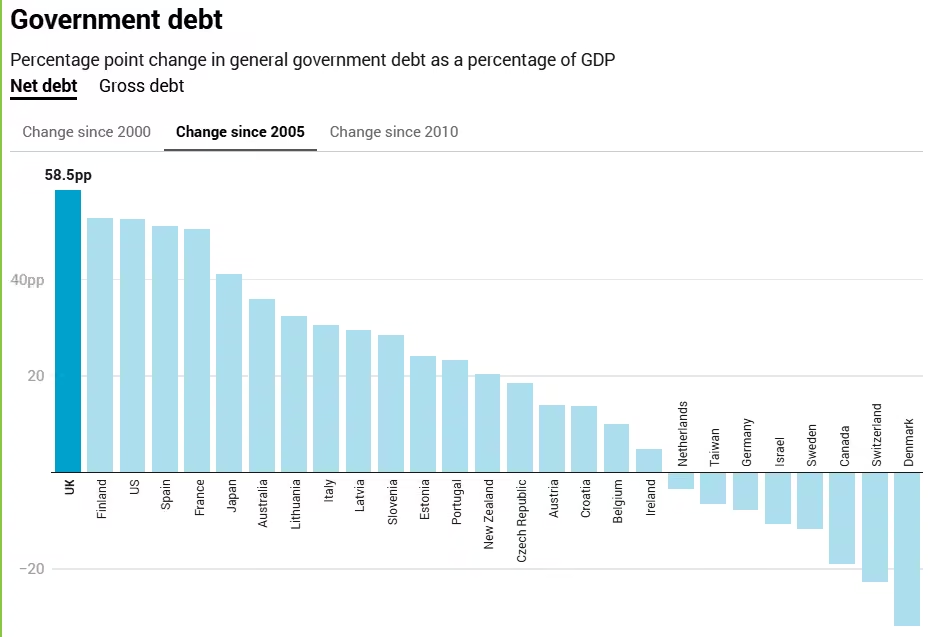
Luke Johnson reposted
The Wall Street Journal
@WSJ
From @WSJFreeEx via @WSJOpinion: The Fauci diaries do more than flesh out the psychological profile of the man who became the face of elite overreaction to the pandemic. They also provide evidence of deliberate deception, writes @jackbutler4815.
www.wsj.com/opinion/free-expression/anthony-fauci-modern-…
Luke Johnson
@LukeJohnsonRCP
Lot of truth in this. Trump Derangement Syndrome.
Hans Mahncke
@HansMahncke
As I have been saying for years, the glue that held this entire conspiracy together was hatred of Trump. It was what drove everyone from Fauci and the permanent bureaucracy to the media, scientific journals, and academia to lie about virtually everything, and it was what bound them together in maintaining those lies long after they had been exposed.
If there are any honest psychologists and sociologists left, they should be writing books about this period as an extraordinary case study in mass deception, institutional conformity, and the willingness of entire professions to subordinate truth to their hatred of one man.
Luke Johnson reposted
Sunday Sport
@thesundaysport
It would be a nice idea if we kept a book of 'Things That Do Not Work'. Then, if anyone has a silly idea, we can say 'No, that's a bad idea. It's in the Book of Things That Do Not Work'

 Brian Krassenstein
@krassenstein
BREAKING: Mayor Mamdani just announced a plan to open 5 city-run grocery stores.
Prices will be set at 30% below retail.
Luke Johnson reposted
 Libs of TikTok
@libsoftiktok
“I represent science” - said the guy who lied about masks, social distancing, mortality rates, immunity, virality, etc
This self-obsessed prick is one of the most destructive figures in recent history
Luke Johnson reposted
 Bill Gurley
@bgurley
If you have any doubt about lab leak and Covid read this. The team that told you “not lab leak” encouraging obfuscation.
We really should care about how this happened. That’s the path to prevention.
 Alina Chan
@Ayjchan
A 2021 email from Peter Daszak of EcoHealth Alliance to the Wuhan scientist suspected of starting the Covid pandemic - asking her NOT to share data with other US scientists about the coronaviruses they have collected.

Luke Johnson reposted
 Overton
@overton_news
The final 90 seconds of Senator Josh Hawley’s questioning of Anthony Fauci is pure cinema.
Hawley ended the exchange by cutting Fauci down to the bone with everything he had exposed.
The last two lines hit the hardest.
Fauci knew Hawley had him dead to rights, and the look on his face was priceless.
HAWLEY: “Yeah, well, silence is admission.”
“And here’s the real thing…at the end of the day, it wasn’t just about the money, really, was it?”
“It was really about a power trip. I mean, through all of this, you wanted to be the most famous scientist in the world. You were so focused on getting every award and every drop of cash that you could, all because you wanted to be on TV.”
“You wanted to be the sun god of science.”
“You wanted to be the guy who was in charge of it all.”
“You wanted to lambaste Trump.”
“You wanted to make sure that nobody else stole your spotlight.”
“YOU wanted to be the GUY.”
“You had time to sit for InStyle magazine. Here’s what you were doing with your time. You could sit for InStyle magazine, but you can’t answer questions for the American people!”
“You could sit for InStyle magazine, but you’re here taking the Fifth!”
“You could sit for InStyle magazine and get a MILLION BUCKS in cash awards, but now the cat’s got your tongue.”
“I bet he does!”
“I’ll tell you what, here’s my conclusion from all of this.”
“This was really all about you the whole time. Somewhere along the way, you lost your way.”
“You may have been a good public servant at one time, I don’t know.”
“What I can tell you from reading your emails now, from looking at what you did, how you used your employees, somewhere along the line, it became all about you.”
“You became a narcissist and a megalomaniac and a liar, and you’ve lied to the American people, and you’ve lied to this body!”
“And you’ve disgraced your profession by doing it.”
“You called yourself the most famous scientist in the world… you’ve done more to harm science than anybody in my lifetime.”
“And I hope you’ll go home and write that in your diary.”
@HawleyMO
Luke Johnson
@LukeJohnsonRCP
Everyone who believed avidly that masks, lockdowns, social distancing, school closures and all the other destructive Covid policies were a good idea needs to watch the Anthony Fauci hearings. He is a narcissist and a liar, and those policies were a catastrophe everywhere.
Luke Johnson
@LukeJohnsonRCP
This is good too.
Overton
@overton_news
The final 90 seconds of Senator Josh Hawley’s questioning of Anthony Fauci is pure cinema.
Hawley ended the exchange by cutting Fauci down to the bone with everything he had exposed.
The last two lines hit the hardest.
Fauci knew Hawley had him dead to rights, and the look on his face was priceless.
HAWLEY: “Yeah, well, silence is admission.”
“And here’s the real thing…at the end of the day, it wasn’t just about the money, really, was it?”
“It was really about a power trip. I mean, through all of this, you wanted to be the most famous scientist in the world. You were so focused on getting every award and every drop of cash that you could, all because you wanted to be on TV.”
“You wanted to be the sun god of science.”
“You wanted to be the guy who was in charge of it all.”
“You wanted to lambaste Trump.”
“You wanted to make sure that nobody else stole your spotlight.”
“YOU wanted to be the GUY.”
“You had time to sit for InStyle magazine. Here’s what you were doing with your time. You could sit for InStyle magazine, but you can’t answer questions for the American people!”
“You could sit for InStyle magazine, but you’re here taking the Fifth!”
“You could sit for InStyle magazine and get a MILLION BUCKS in cash awards, but now the cat’s got your tongue.”
“I bet he does!”
“I’ll tell you what, here’s my conclusion from all of this.”
“This was really all about you the whole time. Somewhere along the way, you lost your way.”
“You may have been a good public servant at one time, I don’t know.”
“What I can tell you from reading your emails now, from looking at what you did, how you used your employees, somewhere along the line, it became all about you.”
“You became a narcissist and a megalomaniac and a liar, and you’ve lied to the American people, and you’ve lied to this body!”
“And you’ve disgraced your profession by doing it.”
“You called yourself the most famous scientist in the world… you’ve done more to harm science than anybody in my lifetime.”
“And I hope you’ll go home and write that in your diary.”
@HawleyMO
Luke Johnson reposted
 The Vigilant Fox 🦊
@VigilantFox
Josh Hawley brings the receipts and exposes Dr. Fauci for using 8 different federal employees on federal time to chase over $1,000,000 in cash prizes for himself.
"You got RICH while people were dying."
"You were using federal employees with TAXPAYER MONEY to apply for and solicit cash prizes for you personally. Cash prizes totaling over a million dollars."
"And what were these individuals doing in the depth of the pandemic in November of 2020 when millions of Americans were suffering from COVID? What were they doing? I tell you what they're doing. Folkers was on your behalf soliciting and gathering information for a cash award."
"Let's look at it. We've got his email right here. Right over my shoulder. Folkers says, 'I'm working on this nomination for the Dan David award for Fauci. We need to beef up the COVID part. Do you have language in the that you could share that delineates how we responded in new ways to Covid.'"
"He sends this to multiple federal employees. What was the Dan David award? Do you remember, doc?"
FAUCI: "On the advice of counsel, I respectfully decline to answer based upon my rights under the Fifth Amendment to the Constitution."
HAWLEY: "It was a $900,000 cash award. $900,000 cash award. And he got it because he used federal employees to get it. And this wasn't the only award, was it, Dr. Fauci? In fact, you applied for and received at least eight other federal cash prizes on federal time using federal employees and federal resources.
"Here they are over my shoulder. Besides the Dan David award, you've got the Partnership for Public Service. You've got the Adelson prize, you've got the Smithsonian award, you've got the National Academy of Medicines award, you've got the CDC Foundation. In fact, you turn your staff into a full-time application machine."
"You actually wrote to people and said, 'Do you think maybe I'd qualify?' And you got cash for all of this. And it wasn't just one or two employees, was it? In fact, you used eight separate federal employees on federal time using federal resources to solicit cash awards. Isn't that true?"
FAUCI: "On the advice of counsel, I respectfully decline to answer based upon my rights under the Fifth Amendment to the Constitution."
HAWLEY: "Here they are, right over my shoulder. Here's all of them. The people that you use federal employees so that you could go and get cash money."
[Names listed on board]
– Greg Folkers
– Lawrence Tabak
– Holli Jaffe
– Patricia Conrad
– Courtney Billet
– Louis Miller
– Katherine Miller
– Hugh Auchincloss
"And the most hilarious part is that you weren't content to even dragoon them into applying for all of these cash awards. You then had them go out to the ethics agencies and ethics watchdogs and demand that you be able to get the money. That's right."
"We've got it in your emails. Your staff and employees on federal time using federal resources, being paid with federal dollars, are soliciting cash for you. And then they're turning around and saying to the agency, 'We don't want just an answer. We want to get to yes.'
"Because Fauci wants the money."
Luke Johnson
@LukeJohnsonRCP
You know what happens if Atlas shrugs…
 Dux Backup
@DuxVul2
Britains biggest taxpayer has started publicly posting his displeasure with this government and the UK
Alex Gerko has paid £2bn in tax over the last 4 years
If he goes, it will take several cities of min wage workers to replace him
Luke Johnson reposted
 Ted Cruz
@tedcruz
Americans buried parents alone. Children lost years of childhood. Families watched businesses they had built over a lifetime disappear.
And while the country suffered, Anthony Fauci was writing in his diary about becoming “the most famous and talked about person in the country” and marveling that his fame was “explosive and really unimaginable.”
There was no camera he couldn’t find. No interview he couldn’t give. No American life he wouldn’t micromanage.
He said one thing to the public, and would write the opposite in his diary.
Today, when the country finally demanded answers, the man who never stopped talking suddenly went silent.
Luke Johnson
@LukeJohnsonRCP
This is good
 The HighWire
@HighWireTalk
‼️"Who the f*ck do you think you were for doing that?!"
Moreno: Doctor Fauci, do you know what happened to that mom in that family? That's a question.
Fauci: On the advice of counsel, I respectfully decline to answer based upon my rights under the Fifth Amendment to the Constitution.
Moreno: They were dragged out of that stadium and arrested. Those policies were put in place because you had moronic politicians that listen to the words of a megalomaniac who was more interested in having met a Kardashian than the suffering of the American people.
And that is you. Your advice to communities like that, to idiotic politicians who enforce those rules? Arrested that mom for watching a football game with her own family outside.
When that story broke, I said to myself, I cannot stand idly on the side and watch this happen. It was about six years ago today that I decided I'm going to give up my businesses, sell them all, run for office, run for the United States Senate.
Here I am, sitting in front of you six years later saying, who the fuck do you think you were for doing that? It is a total disgrace what you did to this country.
And my Democrat colleagues are standing there defending you. I hope the voters of the United States of America watch the clips of every one of you doting on a guy who was more interested in being a celebrity than saving American people."
Luke Johnson reposted
 Gain of Fauci
@DschlopesIsBack
HOLY SHIT!! 🔥🔥
Josh Hawley just trolled the living hell out of Fauci and then absolutely DESTROYED and EXPOSED him in front of the entire country.
Luke Johnson reposted
The Kobeissi Letter
@KobeissiLetter
Absolutely incredible.
In an unprecedented move, South Korea's stock market just collapsed -44% in 40 days, erasing -$2 trillion in market cap.
Now, South Korea's finance ministry has announced plans to "stabilize" the market.
What is happening? Let us explain.
(a thread)

Luke Johnson reposted
 Afshine Emrani MD FACC
@afshineemrani
I'm a cardiologist. For the first time in modern American history, more people get high every day than drink every day. 17.7 million Americans now use cannabis daily or near-daily — versus 14.7 million daily drinkers. Thirty years ago it was the reverse, ten to one the other way. A Carnegie Mellon analysis of 40 years of federal data confirmed the flip.
We are running a civilization-scale experiment in real time. And I don't think most people have looked honestly at the science, because it's become culturally impossible to criticize weed without sounding like a narc.
So let me be the doctor who says it plainly. This is not the mild plant of the 1970s.
Then, cannabis was 1-3% THC. Today's products run 15-25%, and concentrates — dabs, vapes, wax — hit 70-90%+. When people say "it's natural, it's harmless," they're defending a product that no longer exists. We didn't legalize the old plant. We industrialized a far more potent one.
Here's what the strongest evidence actually shows, and I'll keep it to what's real:
The developing brain is the real casualty. The Dunedin study — following 1,000 people for decades — found that persistent cannabis use starting in adolescence was associated with a lasting decline of several IQ points that didn't fully recover after quitting. The prefrontal cortex, the seat of judgment and impulse control, is still wiring until about 25. Heavy THC during that window appears to leave a mark.
The psychosis link is not fringe anymore. Daily use of high-potency cannabis is associated with roughly a 3-5x higher risk of psychosis. A major European study found high-potency products alone accounted for a substantial share of new psychosis cases in some cities. This is one of the most replicated findings in the field, and it's the one people most want to ignore.
And cannabis use disorder is real — up to 3 in 10 users develop some degree of dependence, higher when use starts young. "You can't get addicted to weed" is simply false.
Now the honest caveats, because I won't overstate to make a point.
Correlation isn't proof — some of the psychosis link may run both directions, with vulnerable brains drawn to heavier use. Cannabis has genuine medical uses: chemo nausea, certain seizure disorders, some chronic pain. A moderate adult using occasionally is in a very different category than a 16-year-old dabbing daily. And alcohol and tobacco still cause vastly more total death. This isn't "weed is worse than everything." It's "weed is not harmless, and the dose has changed."
Here's my concern as a physician watching the culture. We swung from "reefer madness" hysteria straight to "it's basically a vitamin," and skipped the honest middle entirely. The truth is that a high-potency daily habit — especially in a young brain — quietly lowers the ceiling. Flattens drive. Blurs the sharpness a person needs to build a life.
If you're an adult who enjoys it occasionally, that's your call. But if it's daily, if it's high-THC, and especially if it's anyone under 25 — the science is asking you to reconsider.
Go outside. Sweat. Build something. Sleep hard. Stay sharp. The clearest mind in the room is about to become the rarest one. Make sure it's yours.

Luke Johnson reposted
 Claire Coutinho
@ClaireCoutinho
In my three years covering the energy brief, I have never seen anything like this.
I first raised concerns put to me by whistleblowers within NESO in the House of Commons on 7 July.
The main allegation is that our grid is not being run securely, and specifically that the rules put in place to prevent blackouts were breached on 23 June, when a heatwave put strain on our electricity supply.
Since then, we have seen a conveyor belt of dismissals, denials, and downright lies from NESO and Ministers.
The problem? Time and again, the whistleblowers keep being proved right.
At first NESO denied that rules were breached on 23 June, telling staff and the press that the allegations were “false”.
Ministers Ed Miliband and Michael Shanks said I was “scaremongering”, and Shanks told the House categorically that “at no point did we come close to breaching” reserve standards.
However, leaked internal documents have since shown that NESO's initial view was that they did breach reserve standards, and that “system security was compromised”.
NESO has confirmed these documents are genuine and has provided no evidence to contradict them.
Strike one.
Senior management also criticised the whistleblowers internally, saying on an all-staff call that they had “let them down”.
They denied this was said, only for a leaked recording to prove that it had been.
Strike two.
Then Ministers and NESO management insisted an 'independent' investigation would take place, only for it again to become clear that this was not true.
Ministers and Ofgem had left NESO to mark their own homework. Engineers were told that if they wanted to contribute, they had to identify themselves to the very NESO managers whose necks would be on the line if the inquiry found them to be at fault.
Strike three.
After my repeated complaints, some improvements have been made to the investigation. But there is still no route for control room operators to raise concerns about grid security without going through NESO managers.
Miliband was completely absent during this scandal, too busy trying – and failing – to become Chancellor.
His Ministers have been firmly on the side of NESO management despite their repeated poor behaviour.
Whatever your view on renewables, it is clear that the more wind and solar we pile onto our grid, the less engineers can perform the delicate balancing act needed to keep the lights on.
You need to have a lot of back-up power on standby in case the wind doesn’t blow or the sun doesn’t shine.
And if the wind blows or sun shines too much, you need to pay to switch things off.
Balancing costs us £1.5bn per year now, but up to £10bn by 2030 - all paid through your bills.
These 'hidden costs' triggered my battle to get the energy department to do a true costing of renewables. We have to look at their full system costs, not just their cost when the wind is blowing the right amount.
Sadly, one of Ed Miliband’s first acts was to cancel that work and ask NESO to take it on instead.
They delivered one of the most discredited reports I have ever seen, showing through shameless statistical contortions that Labour's dash to Clean Power 2030 was, conveniently, both achievable and consumer-friendly.
As the sole shareholder of NESO, only the Secretary of State can hold them to account.
The NESO leadership’s craven support for his plans, worked out behind the scenes with his political advisers, shows they had already given up on the standards of impartiality and integrity required from our independent public bodies.
When public bodies face no accountability, the British public will always lose.
The fact that things have got so bad for expert engineers within our control room that they are talking to an Opposition politician and the press at huge personal risk is shameful.
The Ministers dismissing their concerns do these courageous individuals a huge disservice.
We should be applauding them, not denigrating them.
I will not stop until they are heard.

Luke Johnson reposted
 Kevin Hague
@kevverage
this is *wild*

Luke Johnson reposted
 Normal Guy
@Normal_2610
Korean workers in their 20s and 30s could not afford Seoul apartments so they turned KOSPI into their housing trade (FOMO Case Study)
They borrowed on margin at 3x, poured savings into 2x semiconductor ETFs, and treated short term trading tools as long term bets. When prices dropped, brokers auto-liquidated 360,000 accounts.
62% of those wiped out were under 35. A generation priced out of real estate treated a bull market on borrowed money as their only path to building wealth, that bet did not hold
Margin loans on KOSPI hit record 38.63 trillion won in late June. When prices fell, brokers sold holdings to cover shortfalls, pushing prices lower, triggering more margin calls.
Goldman Sachs estimated retail ETF rebalancing drove 62% of institutional net selling on some days. Retail did not just lose money here. Their borrowed positions became the mechanism that made the crash deeper.
Margin amplifies gains when markets rise. It turns an orderly decline into a cascade when they fall.
What makes Korea crash different from a normal correction is the human cost. Government launched a 1375 debt hotline because margin losses were crossing into a mental health crisis.
2.15 trillion won in retail losses from borrowed money in one month. One office worker lost 18 million won of his housing savings in semiconductor ETFs.
KOSPI will recover, that is how markets work. But people who bet money they could not afford to lose do not get a do-over. Their debt stays after the index comes back.
 Normal Guy
@Normal_2610
Koreans are surrendering life insurance policies to buy SK hynix, Insurance surrenders at the top 3 life insurers jumped 16% last quarter.
Savings bank deposits fell below 100 trillion won for the first time in 4 years. Commercial bank time deposits dropped 12 trillion won since February.
The entire financial system is being rerouted into 2 semiconductor stocks. When new money into a rally comes not from income but from liquidating safety nets, that is how the end of every cycle looks man, this is crazy .....
Investors over 50 now hold 62% of margin loans at Korea top 10 brokerages. Among those in their 60s, margin debt doubled from 3.9 to 8 trillion won in one year.
These are people who spent decades in fixed deposits and real estate, now entering a semiconductor rally on borrowed money at record highs.
When the KOSPI dropped 19% in March, leveraged investors in their 60s lost 20% on average. The rally recovered.
same thing in smaller model happening in India - MTF, i feel this so stupid

Luke Johnson reposted
 #Marcher
@MarcherReborn
We’re giving mobility cars to druggies and alcoholics.
Dig deeper taxpayers

Luke Johnson reposted
 Hot Rails — oz/acc
@hot_rails
This is the magnificent library @AnthropicAI amassed, before pulping it because it gave them a legal copyright loophole.
These people do not understand Civilization.
 Hedgie
@HedgieMarkets
🦔AI companies are bulk-buying rare books, scanning them through high-speed machines that cut the spines off, and shredding the originals. A service called ISBNdb facilitates orders of up to a million books and keeps buyers anonymous. Pre-2022 books are premium because they're free of AI-generated text. A federal judge ruled the practice is fair use because eliminating the original means only one copy exists at a time. Anthropic hired the former head of Google Books partnerships to obtain "all the books in the world."
My Take
This got to me. A bookseller told 404 Media that rare books with almost no surviving copies are being fed into this pipeline. Books that survived wars, fires, and centuries of handling are being shredded so an AI can learn to write a better marketing email.
ISBNdb's website literally says "'AI company destroys two million books' is not a headline that generates sympathy," and they still built an entire business around making it happen quietly. They offer NDAs as a feature. They coach clients to call it "digital preservation."
I've covered AI companies scraping the internet, torrenting libraries, and stealing music. This is worse because it's irreversible. You can re-upload a website. You can reprint a bestseller. You can't replace the last three copies of an 18th-century botanical text once someone shreds them for training data. And the judge said it's legal. So it's going to accelerate.
"We shred rare books and offer NDAs so nobody finds out" is a legitimate business model in 2026. What a timeline.
Hedgie🤗

Luke Johnson reposted
 Edward Dowd
@DowdEdward
History lesson: In the telecom equipment, dotcom era Lucent, Nortel & CSCO accelerated their vendor financing programs from 1999 into fall of 2000.
The last impulse in 2000 was because financing was becoming difficult for the new speculative negative cash flow telcos.
OpenAI is the negative cash flow telco and $NVDA is Lucent, Nortel & CSCO.
This is late cycle behavior.
 James Chanos
@RealJimChanos
So we are at the point in the cycle where $NVDA has to provide financing guarantees for roughly 2/3rds of the cost of the chips it is selling to the data center project…?! Lol, ok.
Luke Johnson reposted
Daniel Kral
@DanielKral1
Hard to overstate the importance of France for Europe's energy security. Its nuclear fleet is the backbone of our power supply. Oil and gas price shocks matter, but it's when the French nuclear fleet stutters - as in 2022 - that European energy prices really shoot up.

Luke Johnson reposted
The Heartlands Tribune
@HeartlandsTrib
There is no clearer image of British politics than this: the camera shows you the man, the wider frame shows you the machine.
In Orwell’s Britain, the lie was printed. In ours, it is lit, framed and carefully edited.
Luke Johnson reposted
The Spectator
@spectator
Harvey Nichols used to be one of the most glamorous department stores in the world.
But now the business has gone up for sale – and it looks as if only the retailer Next and Frasers Group – owned by Mike Ashley of Sports Direct fame – are bidding on it. There is nothing wrong with either company.
But the lack of interest in one of London's most iconic retailers is a sad sign of the city's economic decline.
✍️ Matthew Lynn
Article | spectator.com/article/the-sale-of-harvey-nichols-is-proof… | @mattlynnwriter
 Luke Johnson
@LukeJohnsonRCP
Chicago office property market not looking good
Nightingale Associates
@FCNightingale
Update: 21 Chicago Office Building Sales
401 S. State St. ↓94% $4.2M vs $68.1M in 2016
300 W. Adams St. ↓92% $4M vs $51M in 2012
Building split from land after 2012.
55 W. Monroe St. ↓90% $25M vs $243.25M in 2014
216 W. Jackson Blvd. ↓89% $2.5M vs $22M in 2013
100 N. Riverside Plaza ↓87% $22M vs $165M in 2005
Leasehold Interest
19 South LaSalle St. ↓86% $4.2M vs $29.9M in 2006
175 W. Jackson Blvd. ↓87% $41M vs $306M in 2018
311 S. Wacker Drive ↓85% $45M vs $302M in 2014
600 W. Chicago Ave. ↓83% $89M vs $510M in 2018
550 W. Washington Blvd. ↓83% $18.5M vs $111M in 2013
111 W. Jackson Blvd. ↓81% $25M vs $135M in 2013
70 W. Madison St. ↓77% $85M vs $377M in 2014
500 W. Monroe St. ↓76% $100M vs $412M in 2019
131 S. Dearborn St. ↓76% $137M vs $560M in 2006
250 S. Wacker Drive ↓74% $23.8M vs $90M in 2011
205 West Randolph St. ↓72% $8.0M vs $28.7M in 2016
180 North LaSalle St. ↓72% $56.5M vs $198.5 M in 2016
200 S. Wacker Drive ↓68% $68M vs $215M in 2013
161 N. Clark St. ↓62% $125M vs $331M in 2013
401 N. Michigan Ave. ↓53% $132.5M vs adjusted $281M in 2017
600 W. Fulton St. ↓44% $17.6M vs. $31.7M in 2006.
@julie_kelly2
#commercialrealestate
 Luke Johnson
@LukeJohnsonRCP
I stopped believing that the authorities are to be implicitly trusted because of lockdowns, which were obviously and always a disaster. The Fauci diaries confirm that establishment institutions are not to be trusted, because their leaders are sometimes complete rogues.
Luke Johnson
@LukeJohnsonRCP
Extraordinary thread. Academia is deeply corrupt.
 Jacob Bard-Rosenberg
@Prolapsarian
THREAD: While you lot are all talking about the Arday case, let's talk about the other academic misconduct case that came to an interesting conclusion last week. About a decade ago David Latchman was accused of leading a biology lab at UCL that was publishing falsified papers.
Luke Johnson reposted
 Jennifer Sey
@JenniferSey
I’m having a very hard time reading the Fauci diary excerpts.
It’s bringing it all back. Everything from 2020 through 2023.
I spoke up early and often.
Starting from the very beginning -- in March 2020 -- I was against all of it, but I had a particular focus on kids and school closures. As a Democrat (former) in deep blue San Francisco, this made me a heretic. A target.
I tweeted, yes. But I also led rallies in San Francisco to open the schools. I sat through virtual school board meetings that dragged on for nine hours and somehow never addressed the actual elephant in the room: the schools were closed.
I wrote op-eds. I went on local media to plead with the school board, the teachers' unions. I did everything I could to get the public schools open -- just like private schools already were. I have 4 kids. All public school kids.
I lost most of my friends in this process of speaking up. There are family members I haven’t spoken to in over five years (their choice) and almost certainly never will.
And then there was my career which I'd spent 30 years building. Gone.
People love to say, “But it was worth it. You spoke the truth. You made a difference.”
The truth is: I’m not sure that’s true.
Schools in San Francisco stayed closed until September 2021. I made zero difference. I tried. It did nothing.
Reading these diary entries is brutal. I find myself weeping while reading them, and then I have to stop. I can't take it. I can't put myself through it.
This egomaniacal little shit of a man who lied constantly about everything: masking, spread, the vaccines, the closures, the origin. HE KNEW HE WAS LYING ABOUT ALL OF IT.
He goes on and on in the media and with his celebrity friends, soaking up the spotlight while lives were being ruined. He's gloating about Julia Roberts and Kim Kardashian and Barbra Streisand like some teenaged social media influencer. He's having private dinners with journalists while telling us we can't see family for Thanksgiving.
Many kids still haven’t recovered from the isolation. The disruption to their development.
And my life was upended and will never be the same.
It would be nice to say “Yeah, it was all worth it.” But I don’t know. And it’s all very hard to read. Because I was a nobody fighting a machine that was never going to fold.
I could have stayed quiet. Gone along. Pulled my kids out of public schools and put them in private. But it was never just about my kids. It was about everyone's kids.
If I'd done that, it would have all just passed. My life would have remained intact. I gained nothing. And impacted nothing.
People love to screech that I’m a grifter. The grift would have been staying quiet and leaving my reputation and salary intact. But I couldn’t keep my mouth shut. Because I knew that children were suffering.
And I lost it all.
He was a liar and I was right, and it doesn’t matter because I still lost it all.
It’s all very depressing right now. I have no sense of: “Yeah, but I did the right thing.” Maybe because I'm not a person of faith.
I just feel utterly deflated and sad about it all.
There are no rewards for going early. Just disdain. And loss. And you never get it back. No one will apologize for cutting me off after 30 years of friendship, for trying to take me down and end my career. More importantly, no one will apologize to the children harmed. To the families who could not care for dying loved ones. To the small business owners who lost it all.
No apologies to anyone.
And the fact is, you never get back what you gave up trying to do the right thing. You remain cancelled. And those other people who did the cancelling, they don't even know about the Fauci diaries.
So yeah, it's all kind of hard to wade through at the moment. And fight against the black-pilling of my soul.
Luke Johnson reposted
Michael Nicoletos
@mnicoletos
Since I published this, the most common pushback has been the same: “if China is really hiding $7.7 tn in losses, why hasn’t anything broken?”
It’s the right question. The answer is that a state with capital controls, captive depositors, and no independent press doesn’t get a Lehman moment. It gets Japan: a decade of losses absorbed quietly, through suppressed savings rates, a weaker currency in real terms, and a banking system that stops growing.
That’s the part most China commentary misses. The 1.52% bad loan ratio isn’t a measurement. It’s a choice.
The full paper reconstructs the entire balance sheet from public data, every assumption shown, base case $7.7 tn, about 15x what China discloses.
First published by @SantiagoAuFund. Now free on my Substack 👇
open.substack.com/pub/michaelnicoletos/p/china-a-hidden-r…
#china #chinesebanks #banks #npls #credit #yuan #cnh #cny #renminbi #baddebt #nonperforming #debt

Luke Johnson reposted
 Liam Deacon 🏴
@LiamDeacon
This is why I bang on about 20mph limits, smoking bans and pub restrictions.
They are not small issues.
Britain has become obsessed with reducing risk by tiny amounts, often at huge social and economic cost.
The information age has made us terrified. Edge cases and scare stories increasingly drive policy, rather than balance and trade offs.
Everything from the impossibility of building nuclear power stations to pricing people out of pubs is shaped by this mindset.
People rarely see how these policies compound. They support each new ban or regulation in isolation, then ask: "How did we get here?"
 Nate Silver
@NateSilver538
This is what's wrong with Britain tbh
Luke Johnson reposted
Ed Conway
@EdConwaySky
The foundation myth of Nike is really the story of the modern world
edconway.substack.com/p/the-most-important-trainer-youve


Luke Johnson reposted
 Charlotte Gill
@CharlotteCGill
No money for the telescope.
Meanwhile, taxpayers have been charged for these projects under the UKRI:
The Europe that Gay Porn Built, 1945–2000 — £841,830
Perverse Collections: Building Europe’s Queer and Trans Archives — £136,909
Decolonising the Museum: Digital Repatriation of the Gaidinliu Collection — £805,769
Trans Performance Now: Glitching cisgenderism — £185,627
Trans Archiving Network (TAN) — £23,556
Diverse alarums: centering marginalised communities in early modern plays — £805,745
(De)colonial Ecologies in 21st-century insular Hispanic Caribbean film — £205,543
Transnational Anti-Gender Movements and Resistance — £35,285
Comics and Race in Latin America — £759,293
Listening to the 85%: underwater sounds and environmental awareness on the Isle of Man — £81,635
Sports media and identity: a theory-practice network — £24,292
Decolonizing South East Asian Sound Archives — £123,470
Everything Is Connected: Conspiracy Theories in the Age of the Internet — £786,083
MAUSI Net: Menopause Activism in the UK, Sweden and India — £29,956
Decolonising the Page: The Visual Politics and Poetics of Postcolonial Arabic Publications — £200,462
The Tipuna Project: Intergenerational Healing, Settler Accountability and Decolonising Participatory Action Research — £310,724
Remaking Britain: South Asian Connections and Networks, 1830s to the Present — £802,442
The Cultural Legacies of the British Empire: Classical Music’s Colonial History (1750–1900) — £1,183,769
South African Modernism (Follow-on Funding): Decolonising English Literary Studies — £80,192
The Future of Indigenous Rights and Responsibilities — £307,021
Luke Johnson
@LukeJohnsonRCP
Bonds are not low risk investments
 bob coleman
@profitsplusid
Checking in on the price of Austria's 100 year bond issued in 2020.
Issued price at 193.87, current price 29.40

Luke Johnson reposted
 Ron DeSantis
@RonDeSantis
Fauci was lionized by the legacy media, which made him the de facto covid oracle. The more Fauci advocated for restrictions/lockdowns and the more he criticized states like FL and GA that spurned his edicts, the more the media would treat him as a saint.
Fauci’s increasingly hysterical approach to Covid fueled this adulatory coverage — which in turn fueled his vanity. Vicious cycle.
 KanekoaTheGreat
@KanekoaTheGreat
Fauci's private diary. March 2020.
March 21 — "deaths 9800":
"Big front page article about me appeared in the Washington Post. Very flattering."
"my national and international fame is explosive and really unimaginable"
"It is not hyperbole to say that today I am the most famous and talked about person in the country and one of the most recognizable persons in the world."
March 22 — "Cases continue to soar. 30,000 in USA with 400 deaths":
"Press is going wild with me."
"Front page in Washington Post yesterday and Op Ed by Maureen Dowd in NY Times today about me."
"Profile by Peter Nicholas on me in The Atlantic."
He tracked the body count and his press clippings on the same page.

Luke Johnson reposted
 Charles Fain Lehman
@CharlesFLehman
It's official: pot is a more popular daily drug than alcohol or cigarettes.
New data[1] from the federal National Survey on Drug Use and Health show that for 2025:
* 21.4M daily/near-daily marijuana users
* 19.9M daily/near-daily cigarette users
* 17.2M daily/near-daily alcohol users
2025 is the first time on record that marijuana is the most popular daily-use addictive product.
[1]See table 9.38A here: www.samhsa.gov/data/sites/default/files/reports/rpt57152/…

Luke Johnson reposted
 Joseph Massey
@jmasseypoet
Hands down one of the most disturbing entries in the Fauci diaries. Unbelievable.

Luke Johnson reposted
 Charlie D. Becker
@charliedbecker
I'm a second-generation bookseller. My family runs Houston's largest used & rare bookstore and I'm building an AI tool for used bookstores. We got hit by exactly these orders, including a single order for 70 obscure books that made us pause online sales entirely. So I dug in. I don't think this connects the way people want it to.
Every ingredient of the viral story is true. ISBNdb really does advertise sourcing books for AI companies. Anthropic really did destructively scan millions of books though they were mostly acquired through things like library deaccessions, not bookstore inventory. And booksellers really are getting bizarre bulk orders. But "rare" here isn't what you're picturing. It's The Insider's Guide to Metro Denver (1995) and how-to-use-WordPerfect 1991 manuals. Obscure, but often not precious.
When we combed through our orders, nearly every book bought from us was either unavailable on Amazon or listed there at 5, 10, 20x our price on the platform they were purchased on. And the shipments are going to FBA prep companies: which is what you do with a book you're about to resell, not one you're about to cut apart. There is more than circumstantial evidence that this is a well-funded company running algorithmic arbitrage, buying underpriced or out-of-stock books to relist on Amazon at markup. This evidence includes an official denial that they are selling to train AI but I don't want to mention them for several reasons. You can Google it.
That's more mundane than the shredder story. The actual risk is worse, though, because it's quieter: books that don't sell via FBA eventually get liquidated. If we really hold the last copies of some of these (and comparing platforms, it looks like we might) we're feeding them into a portal they may not come back from. No AI company required.
Everyone assumes the internet preserved everything. It didn't. Many of these books have almost no metadata anywhere, just a scattered listings across proprietary databases then nothing. That's what my project is for: building better bibliographic records for these books than exist anywhere else, so we at least have a map of what we stand to lose. So the Library of Alexandria is still burning, just more slowly, and kore from “who cares” than from some cinematic villain.
(I am open to being corrected.)
Full writeup: open.substack.com/pub/charliebecker/p/is-an-ai-company-bu…
Luke Johnson reposted
Alexander
@alexanderrX_
it’s a shame what the uk is doing with ai and space. we pioneered this stuff. turing invented the entire field of computing here. deepmind was built in london, sold to google. arm designs the chips in every phone on earth, sold to softbank.
and space is worse. we cancelled our rocket programme three months before it successfully reached orbit. let the team launch anyway since the rocket was already in australia. it worked. we went home. we’re the only country ever to build launch capability and then give it up. the satellite is still up there.
at some point we stopped taking moon shots. decided leading in ai, space, computing wasn’t for us, and put everything into making the state as big as possible instead. completely focused on the wrong things

Luke Johnson reposted
Crémieux
@cremieuxrecueil
Europe's cocaine has been getting better: purer, less expensive.
Some chalk it up to competition but the real cause is Albanian immigration.
The Mafia Shqiptare has been killing other dealers, kidnapping them if they're selling on their turf, and bringing in superior cocaine!
 Simon Kuestenmacher
@simongerman600
Wait? Is this a pro free-market argument? I’m confused…

Luke Johnson reposted
Crémieux
@cremieuxrecueil
True!
If we look at the Forbes 400, we can see that most of the people on it are self-made and not a single person made their fortune via fraud or insider trading.
Billionaires become billionaires by serving the public!
 Rob Henderson
@robkhenderson
"something unexpected is happening. More and more billionaires derive their wealth not from accidents of birth or from gaming the system, but by providing useful goods and services and by employing thousands of people" www.economist.com/finance-and-economics/2026/07/23/the-ri…
Luke Johnson reposted
 Will Tanner
@Will_Tanner_1
Paul Fussell termed this broad problem "prole drift" in his book Class, which is both a hilarious and extremely insightful work
By prole drift, he means the tendency of culture in "American democracy" to drift toward the preferences of the bottom of the barrel over time, away from high culture and towards whatever the prole class enjoys, likes, and does.
This can be seen in everything, from dress to public decorum, preferred forms of entertainment to profanity in public
We went from a society where men wore morning dress and suits to work to one where even the economic elite can rarely be bothered to wear a collar. We went from the sort of world where George Washington wrote a little book on how to behave decorously in public and studied it religiously, to one dominated by obese buffoons in Cookie Monster pajama pants talking on the speakerphone in airports. We went from Washington's troops performing Addison's Cato at Valley Forge and everyone reading for edification and pleasure to most Americans never reading a book after high school. We went from fines and ostracization for being "vulgar", to unrestrained vulgarity being seen as a sign of "authenticity" and thus praised.
All of that is prole drift. It happens because mass democratic society has made the setting and enforcement of standards impossible, even before the Civil Rights Act (though that indubitably worsened the problem by adding African prole culture into the mix). If told they ought behave differently, the "proles" can just vote to tax to death those telling them to be different. We saw this with FDR and the regime he created. Those above them don't want that, and so just go along with it and pretend to fit in in the hope that helps them avoid the expropriation problem.
Further, there is a general spiritual malaise attendant to mass democracy that lends itself well to prole drift. If one has to suck up to the worst among us to get elected and achieve anything of public note, it is difficult to remain cognizant of higher life and better things beyond that wretched horizon of Cheetos puffs and Kool Aid pineapple. It's easier to just clamber down and embrace the decline, becoming one with the surly and unruly mass that serves as the basis of democratic power. Prole drift naturally complements this.
This wasn't the case before death taxes wrecked the certainty and spirit of the upper class. In the Gilded Age, even manual laborers kept a suit so that they could be in their best on Sundays and show they too were part of society's upward trajectory. Now, no one does that, and most try to fit in with the bottom rung, listening to rap on a Bluetooth speaker while wearing pajamas in public.
We're all becoming chimps, for our world is one that deems becoming a chimp to be amongst the highest goods, and to be certainly more moral than the alternative of demanding excellence and striving upwards.


 Laocoon of Troy
@LaocoonofTroy
I'm being serious when I say that this explains the arc of society and culture. And it isn't going to change until it's forced to change.
“Modern society works feverishly to put vulgarity within everyone’s reach.”
-Nicolas Gomez Davila

Luke Johnson reposted
 Victor Davis Hanson
@VDHanson
Dr Fauci and Mr. Science
The Fauci files reveal not just a sociopathic narcissist, but also a pathological schizophrenic.
For years, Fauci was assuring the public of Covid narratives that he either knew were untrue, or knew little about.
He posed as a non-partisan, even as he collaborated with the leftwing cable news grandees and liberal columnists to hound his enemies and magnify his godhead.
From the virus’s origins and effects of the lockdowns, to the efficacy of the mRNA vaccinations to the always changing 0/1/2 masks wearing protocols, Fauci used his massive government agency, and sycophantic media, to promote his always fluid narratives by punishing enemies and rewarding friends—on the basis of their loyalty to Dr. “I represent science”.
He seemed to be obsessed with firing White House Covid advisor Scott Atlas, and demonizing Jay Bhattacharya, Sunetra Gupta and Martin Kulldorff—for the crimes of questioning the Fauci party line.
These critics were not radical “let it rip” herd immunologists as the Fauci camp caricatured them, but circumspect, cost-to-benefit doctors and savvy health policy analysts.
Their views, if embraced, might have avoided a multibillion-dollar global shutdown that wrecked economies—especially derailing the booming 4th quarter 2019 Trump economy—increased the death toll, destroyed millions of livelihoods, harmed perhaps permanently the education of millions U.S. children, and was hardly based on the “science”.
And what exactly were the so-called extremist views of Atlas, Bhattacharya, and others?
Healthy children were not at great risk from Covid—but keeping them isolated drained away key resources from the elderly and sick who certainly were vulnerable.
And the nationwide school closures had profound negative effects on children and teens as did the lockdowns on the general population.
Substance and familial abuse soared, small businesses were ruined, and children’s formative educational years were lost.
24/7 mask wearing was neither practical nor necessary as opposed to their beneficial use by health care workers in close proximities.
The experimental mRNA vaccinations may have initially saved lives, but they were not, as billed by Fauci and the pharmaceutical companies, lasting protection from either infectiousness or being infected.
And certainly the repeated booster regimens for some could pose serious health risks.
Herd immunity was not some crank idea, as the Fauci school libeled these experts, but, along with the initial vaccinations, were time-tested medical realities that would mitigate the toxicity of the pandemic.
We have seen a lot of obscene hoaxes recently that changed national events: the loony Jussie Smollett caper; the phony “Steele dossier”; the “51 intelligence authorities” and the Russian-produced Hunter Biden laptop con; and the media fabricated effigy of Joe Biden as “fit as a fiddle”.
But Fauci’s effort to attribute the virus to a bat or pangolin publicly, while privately accepting from his own consultants that it likely was birthed in the Wuhan lab’s gain of function research—which he had helped to support via Peter Daszak—and the policies that resulted from that initial lie, proved literally for thousands a matter of life and death.
Luke Johnson reposted
 Cynical Publius
@CynicalPublius
Up to 45mm people died in Mao’s Great Leap Forward.
Up to 6mm people died in the Holocaust.
Up to 5mm people died in the Holodomor.
Up to 35mm people died as a result of COVID (including indirect impacts).
If COVID was the result of a lab leak funded by NIH, Anthony Fauci is arguably one of the greatest mass murderers in world history.
Perhaps that’s why what his personal diary says about the pandemic’s origins differs so dramatically from what his public statements said.
 Senator Rand Paul
@SenRandPaul
1/9 — My investigation uncovered that Anthony Fauci kept a diary.
What he wrote privately and what he told the country are two different stories.
Today I'm releasing his entries from December 2019 through December 2022. 🧵

Luke Johnson reposted
 Joey Hiles
@joeyhiles1
There's a delightful Christopher Lasch quote about this in the Culture of Narcissism that inspired a piece I once wrote :
"Americans have retreated to purely personal preoccupations. Having no hope of improving their lives in any of the ways that matter, people have convinced themselves that what matters is psychic self-improvement: getting in touch with their feelings, eating health food, taking lessons in ballet or belly-dancing, immersing themselves in the wisdom of the East, jogging, learning how to “relate,” overcoming the “fear of pleasure.” Harmless in themselves, these pursuits, elevated to a program and wrapped in the rhetoric of authenticity and awareness, signify a retreat from politics and a repudiation of the recent past."
My article in case anyone is interested : www.koinosproject.org/p/reflections-in-the-modern-mirror
 Circe
@vocalcry
Romantic notion but I actually think it’s closer to this

Luke Johnson reposted
The Kobeissi Letter
@KobeissiLetter
BREKAING: China now accounts for ~28% of global manufacturing, more than any other country or economic bloc.
This percentage has more than tripled since 2004.
By comparison, US factories account for ~17% of global manufacturing value added, or 11 percentage points less than China.
In 2004, the US proportion stood at ~22%, more than double China's.
Meanwhile, the Eurozone economy represents ~15% of world manufacturing, while Japan accounts for just ~5%.
China has become a critical component of global manufacturing.

Luke Johnson reposted
 Rush
@exRAF_Al
Comment of the year goes to;
<<Florida has just overtaken Spain and Mexico to become the world's 14th largest economy. Funny how that happens when you make it attractive for people and businesses to invest. Florida has no state income tax, a generally business-friendly environment, lighter regulation and welcomes entrepreneurs. The result? Around a thousand people a day have been moving there, companies are relocating, investment is pouring in and the economy keeps growing.
Meanwhile, Labour’s Britain is doing the opposite. Tax success. Regulate everything that moves. Make planning a bureaucratic marathon. Increase the cost of employing people. Tell investors they're not paying enough, then act surprised when they choose to invest somewhere else.
When businesses leave, the response isn't to ask why, it is to wonder how to tax those that remain a little harder. It's almost as if governments have forgotten that wealth has to be created before it can be redistributed. Florida competes for capital. Labour’s Britain competes for excuses. One economy asks, "How do we encourage people to build businesses here?" The other increasingly asks, "How much more can we extract before they leave?" The results are becoming painfully obvious.>>
Luke Johnson reposted
 Justin Hart
@justin_hart
Here's the short list of everything Dr. Fauci got wrong during Covid:
• Origin of the disease—wrong
• Transmission—wrong
• Asymptomatic spread—wrong
• PCR testing—wrong
• Fatality rate—wrong
• Lockdowns—wrong
• Community triggers—wrong
• Business closures—wrong
• School closures—wrong
• Quarantining the healthy—wrong
• Impact on youth—wrong
• Hospital overload—wrong
• Plexiglass barriers—wrong
• Social distancing—wrong
• Outdoor spread—wrong
• Masks—wrong
• Variant impact—wrong
• Natural immunity—wrong
• Vaccine efficacy—wrong
• Vaccine injury—wrong
www.rationalground.com/p/why-we-lost-trust
Luke Johnson reposted
Cut My Tax
@CutMyTaxUK
The number of millionaires in Britain is dropping fast, new research from @ASI demonstrates.
That shows that there are now just 442,000 sterling millionaires in Britain, down by 7% since 2024 and the lowest level since the 2008 Global Financial Crisis.
"The long-term fall in the number of sterling millionaires is driven by a number of factors. Higher interest rates, as well as a lack of confidence in the British economy, have mechanically reduced the inflation-adjusted values of pension pots and high-end London property. Moreover, Britain’s low savings rate has reduced the pace at which households make themselves millionaires. Finally, and perhaps most concerningly, there has been a well-documented trend of high net-worth individuals either leaving Britain or no longer choosing to move here," ASI noted.
"Millionaires are leaving the country for a number of reasons, including the abolition of non-dom tax status, high levels of general taxation, and a hostile culture for wealth creators."
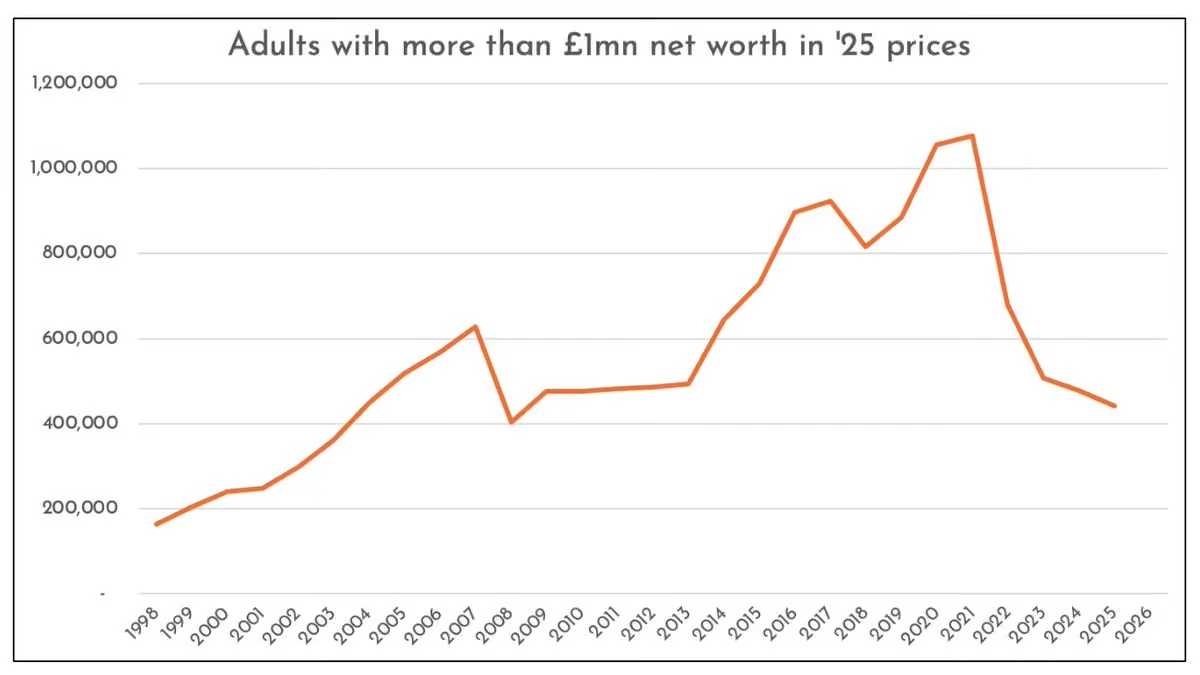
Luke Johnson reposted
Jeffrey A Tucker
@jeffreytucker
The Science

Luke Johnson reposted
David Turver
@7Kiwi
The problems with the grid are caused by spending 10's of £billions on expanding the grid to connect remote, intermittent renewables.

 Dr Paul Dorfman
@dorfman_p
"The problems with the grid are not caused by the transition to net zero. They are caused by the transition being poorly managed, and by decades of underinvestment in the underlying infrastructure."
"Germany is able to integrate far more diverse energy generation sources, with a much lower risk of the kind of issues we faced this summer."
Smart grids would let us stop cars charging at times of peak demand (or even feed back into the grid at such times), while making the connecting of new, small-scale energy sources (such as plug-in solar) far less risky.
www.thetimes.com/comment/letters-to-editor/article/times-…
Luke Johnson reposted
Liam Halligan
@LiamHalligan
Brent crude last week topped $100 per barrel. Oil is up from just $71 in early July – a staggering 40pc price surge in less than a month.
For weeks, financial commentators have tried to wish away escalating missile exchanges between the US and Iran, yearning for a lasting Middle Eastern ceasefire.
But while the oil price pulled back slightly at end of last week, crude remains above $90 – and with Washington and Tehran increasingly at loggerheads, and less than a tenth of pre-war crude supplies passing through the Strait of Hormuz, oil could easily surge back towards triple digits.
We’re now in the midst of the most severe structural energy crisis since the 1973 Yom Kippur war. Andy Burnham’s new government appears to be oblivious to that reality.
My latest @Telegraph column
🧵 1/6
www.telegraph.co.uk/business/2026/07/26/burnham-is-oblivi…
Luke Johnson
@LukeJohnsonRCP
Yes I had one of those large Yorkshire estates which I misplaced.
 ISBI3
@ISBI3
Nathan, it should be possible for him to change his name to Professor Jason Mitty.
It brought to mind Dr Johnson's riposte to another boaster
 Luke Johnson
@LukeJohnsonRCP
Suicidal empathy in action.
 ripx4nutmeg
@ripx4nutmeg
Despite knowing he was a terrorist, German authorities dealt with Abdul Ballout, the Berlin Pride killer, by sending him on a three-day (spread over six weeks from mid June) 'violence prevention' course.
Here's some of the people who run that course.


 Luke Johnson
@LukeJohnsonRCP
This is what happens when an egomaniac public health bureaucrat is given unlimited power.
 Tara Servatius
@TaraServatius
DAMN. In early 2020, Fauci recorded in his diary how much he was able to make the stock market drop with his lie that covid was 10x more deadly than the flu.
At the same time, in the same diary, he wrote that covid wasn't any more deadly than the seasonal flu.
While he was going on TV saying the opposite to terrify the public into shutting down the economy.
It was all a lie designed to take out Trump's most formidable weapon for reelection: his booming economy.


Luke Johnson reposted
 Tom Elliott
@tomselliott
Fauci's diary, by the numbers:

Luke Johnson reposted
David Turver
@7Kiwi
If you want to be taken seriously look at data, not emotive pictures. Wildfires tracking lowest ever in Europe. UK emits 0.8% of global emissions, a rounding error. The economy is stagnating because of highest electricity prices. Get serious about proper analysis and growth.

 Tim Stanley
@timothy_stanley
Column: "climate change is real and the Right needs to get serious about it,"
It's killing everything we claim to love - landscape, tradition, millions of poor chickens - so why do some conservatives still call it a hoax?!
www.telegraph.co.uk/news/2026/07/26/climate-change-real-r…
Luke Johnson reposted
 Steve Wiesner
@SteveWiesnerSMB
I started my career in the M&A group at one of Wall Street's hottest firms (DLJ / CSFB).
Here's what I learned during almost 20 years in the deal business.
Process drives valuation. You can run all the amazing models you want, but ultimately it's the process that creates leverage and drives bidders to a higher price. That's why SMB buyers can still get great deals even in brokered processes. A lot of brokers run bad processes, and that's an opportunity.
The lowest bidder generally gets the first management presentation. It's a dry run for management to dial in their messaging before the credible bidders enter the room.
The banker's pitch book is a marketing document. Take their valuation expectations with a grain of salt. The market, and only the market, knows true price.
The bell curve of bids is predictable. When you're selling a business in a broad process, you'll have a typical distribution of IOIs. You'll have a smattering of low-ball / tire-kickers, you'll have the meaty part of the curve, then you'll have a handful of outliers on the high-side. In my view, those are the most dangerous ones for your process because now your seller is anchored to what's likely an unrealistic number. Yes, sometimes it's legit. A strategic with a ton of synergy, a PE group with a kickass operator, whatever. But it's often buyers playing games to get into a mgmt presentation and now your seller has completely unrealistic expectations.
There's a big difference between the headline price and the actual price. Give the seller the ability to brag to their country club friends that they got $250 million. The reality is, between the earnouts, the rolled equity, etc., the actual deal value's probably a lot lower.
For a seller, every day in market is a bad day. Once you've committed to sell, you need to run as fast as you can to a closing. Only bad things happen. Earthquakes, hurricanes, a crappy stretch in the stock market, wars, whatever. If you sell businesses for a living, the whole 'time kills all deals' thing is all too real.
Retrades happen ALL THE TIME. And yes, I've seen buyers incorporate this directly into their strategy. Overwhelm a seller with diligence requests, watch mgmt take their eye off the ball, see numbers slip marginally vs projections, cut the price. And let's face it, there are also a bunch of legit reasons that deals need to get recut before closing. As a seller, you need to limit the emotional reaction and decide how much you want to get a deal done.
Customer concentration is the #1, #2, AND #3 killer of businesses. I've seen things... Best (worst) story was a PE firm who saw 40% of EBIT get wiped out within 90 days of closing an acquisition. Ultimately filed BK. Still boggles my mind that people can underwrite something like this.
People really are clueless about working capital. Sellers don't understand it, lots of buyers don't understand it, and the banker shopping the deal has never seen it beyond an Excel model. Smart buyers know how to use this to their advantage.
Strong negative correlation between the redlines in the NDA and the likelihood of closing. If someone pencil fvcks the NDA, they're going to be a pain in the as$ to deal with and almost certainly won't be your buyer.
Beware the advisor(s). The divorce attorney negotiating reps & warranties. The CPA opining on valuation. The country club bros saying "You're getting screwed, Jerry got 12x ehbitduh for his widget co..." Lots of people have the ear of the seller - many of them are idiots and / or lying.
Analysis paralysis is a real thing. As a buyer, the point of building a model is to force yourself to think through the key drivers of business value. Torturing yourself over 20bps of incremental return in year 5 is pointless. So much time and energy burned over meaningless assumptions and analysis.
You know the market's near its peak when the boutique investment banks go public, sell themselves to the big guys, or when the big guys start middle market sell-side groups.
The M&A process is nowhere near as complicated as people make it out to be. A lot of i-bankers are just glorified and highly-paid real estate agents - that's the reality.
Price + Terms + Certainty of Close. You have to approach the negotiation recognizing that there's a balance between ALL of them. Maybe you give on price for greater certainty. A solid win on terms can be worth WAY MORE than a quarter turn of multiple. The art of doing a deal is striking the right balance.
Only one thing more painful than busted deal costs... Doing a shitty deal. Sunk cost fallacy is real, and it's brutal.
Luke Johnson reposted
 Steve Milloy
@JunkScience
Cambridge apparently failed to educate Telegraph @timothy_stanley that out-of-control wildfires happen where forests or brushlands have been recklessly neglected—usually because of left-wing policies. It has nothing to do with emissions or "climate change." What the right needs to get serious about is stomping out the climate hoax. www.telegraph.co.uk/news/2026/07/26/climate-change-real-r…

Luke Johnson reposted
Crémieux
@cremieuxrecueil
Men used to live many lives.
John Smith, founder of Jamestown, got his start fighting the Ottomans for Habsburgs. He killed so many Turks they knighted him and gave him a coat-of-arms with three Turk heads on it.
He was captured, sold as a slave, escaped, and founded Jamestown.
 Crémieux
@cremieuxrecueil
The man who taught Lord Robert Baden-Powell how to be a scout was an adventure addict, one Frederick Burnham.
He was born on a Sioux reservation, became a cowboy, joined a war between feuding rancher families for kicks, became an Army tracker in the Apache Wars, then moved to Africa and joined the British army to explore the next unmapped frontier.
In the British Army, he distinguished himself early and became recognized as the Chief of Scouts, and—unique for an American—King Edward VII personally conferred him the rank of major. He then continually distinguished himself, eventually meeting Baden-Powell and teaching him his survival tricks, a million different things to do with a kerchief, mastery of knots, and more.
The man did so much with his life that there's not enough space here to cover it, so I'll just mention one really interesting thing: he ended the Second Matabele War with an assassination.
British military intelligence had surmised that killing the spiritual leader of the Matabele would be the fastest way to get the Matabele to stop rebelling against their British colonial overseers.
So, the local administrator, Earl Grey, instructs Baden-Powell, Burnham, and the guy who got the tip-off about the leader's location to go and "Capture [him]. Kill him if you must. Do not let him escape." On the way there, intelligence came in about enemy troop movements and Baden-Powell split off. Burnham and his compatriot with the tip kept going.
They traveled by night on their horses and found the enemy village where the chief was supposed to have been, and they spotted the place that the enemy considered sacred ground. They hitched up their horses and began crawling to a good spot on their bellies, so they could get a view of the chief when he returned.
The chief did return, and he began doing an immunity dance, to—he believed—become impervious to bullets. Burnham immediately proved the dance futile by shooting him in the heart. He then jumped over the chief, ran toward his horse with his co-conspirator, and they attempted to escape, but the Matabele were in pursuit.
To facilitate their daring escape, Burnham's co-conspirator got the attention of the Matabele and Burnham turned to lighting the village on fire. After attention turned to the disappearing huts, the men escaped with only a handful of warriors on their trail.
When the men returned to camp, Cecil Rhodes was delighted, because he knew what this meant: the Matabele would give up.
So, Rhodes, Baden-Powell, and Burnham then walked, unarmed, into Matabele territory and told the warriors to lay down their weapons and surrender. They did, word spread, and the rebellion ended.
Burnham went on to participate in the Klondike Gold Rush, to strike it rich with oil in California, to help establish the California State Parks Commission, to save the big horn sheep, and to establish two National Wildlife Refuges in Arizona, before passing away in 1947.
The neighboring Baden-Powell and Burnham mountains in California are named for these two men.

 Luke Johnson
@LukeJohnsonRCP
Fauci’s conceit and deviousness is breathtaking. One of the more evil bureaucrats of modern times.
Cynical Publius
@CynicalPublius
Everyone should read this to understand just how we put the health of our nation into the hands of a deranged, toxic narcissist, Dr. Anthony Fauci.
His meanderings on his own fame just beneath the death toll numbers his experiments likely created are perhaps the most nauseating thing I've seen lately.
Here is the thing to realize though--the high ranks of our unelected federal bureaucracy are chock-a-block full of lesser and greater Faucis--people who hide behind the veneer of being a "public servant" while all the time actually thinking that YOU serve THEM.
Why? Because they are smarter and better than those grubby little voters and they cling to their unelected bureaucratic power because they are ENTITLED TO IT (or so they believe).
The cure is not to eliminate such people from government--that won't work because narcissists will always be drawn to the seat of power. No, the trick is to eliminate not the people, but the POSITIONS--eliminate the power that the vast, unelected federal Leviathan has over our daily lives, and the Faucis of the world will find other, less harmful, avenues to exercise their God complexes.
It's the only way.
Luke Johnson reposted
KanekoaTheGreat
@KanekoaTheGreat
🚨Fauci's diary says he privately put COVID's fatality rate at 0.2-0.3%. Under oath weeks later, he told Congress it was 10x the flu. The timeline:
Feb 8, 2020 (private diary): case fatality rate "more like 0.2-0.3%."
March 10 (Hannity): "The mortality for this is about 2-2.5%. It's probably lower than that, closer to 1%. But even if it's 1%, it's 10x more lethal than the seasonal flu."
March 11 (Congress, under oath): "The stated fatality rate of this overall... is about 3%. If you count all the cases of asymptomatic infection, that probably brings the mortality down to 1%, which means it's 10x more deadly than the seasonal flu."
March 27 (Daily Show): "The mortality of this is about 10x the flu. It's at least 1%."
He wrote 0.2-0.3% in his journal — then told the public, over and over, a number 3 to 5 times higher.
@RandPaul
@DrJBhattacharya
@RobertKennedyJr

Luke Johnson reposted
Jennifer Sey
@JenniferSey
I don’t think I can handle reading all of the Fauci diaries.
My head might explode in a fit of rage.
Those of us who resisted from the beginning knew he was a weasel. A power-hungry narcissistic weasel with a giant fucking head and a love affair with rolling cameras. It was so obvious. But it’s even worse. So bad.
If anyone ever asks me ever again “why was Covid the hill you were willing to die on” … I’m just gonna say because Fauci is a f@cking liar and I knew it. He shut the entire world down. Ruined lives. For his ego driven little power play. Destroyed kids’ childhoods, adolescence, they couldn’t go to school or play sports or be with friends. They were isolated and alone in their rooms locked in to screen screens screens. They were stunted emotionally and developmentally. And of course educationally. They were depressed and eating disorders skyrocketed and stupid trans skyrocketed and drug use and screen addiction and porn addiction and all of it and now they can’t even go into the world and talk to each other.
Old and sick people died alone. Old people were separated from their family in the last years and months and weeks of their lives. Women gave birth in masks alone. Neighbor turned on neighbor. Families were divided. Still haven’t recovered.
American citizens were censored in a full on assault of our free speech rights, 25+M people were laid off in 2020, people were fired if they didn’t get his shitty vaxx and others were fully 10000000% cancelled for saying WTF this is all so wrong.
And it’s all because of this tiny shitty man’s will to power. All one giant ego boost while the world burned.
Tom Elliott
@tomselliott
Dear Diary,
Today I shut down NYC and all California.
Tony

Luke Johnson reposted
Douglas Carswell🇬🇧🇺🇸
@DouglasCarswell
Roads, Runways & Reservoirs - how Britain stalled since the Blairites modernized us in 1997.

Luke Johnson reposted
Hedgie
@HedgieMarkets
🦔AI companies are bulk-buying rare books, scanning them through high-speed machines that cut the spines off, and shredding the originals. A service called ISBNdb facilitates orders of up to a million books and keeps buyers anonymous. Pre-2022 books are premium because they're free of AI-generated text. A federal judge ruled the practice is fair use because eliminating the original means only one copy exists at a time. Anthropic hired the former head of Google Books partnerships to obtain "all the books in the world."
My Take
This got to me. A bookseller told 404 Media that rare books with almost no surviving copies are being fed into this pipeline. Books that survived wars, fires, and centuries of handling are being shredded so an AI can learn to write a better marketing email.
ISBNdb's website literally says "'AI company destroys two million books' is not a headline that generates sympathy," and they still built an entire business around making it happen quietly. They offer NDAs as a feature. They coach clients to call it "digital preservation."
I've covered AI companies scraping the internet, torrenting libraries, and stealing music. This is worse because it's irreversible. You can re-upload a website. You can reprint a bestseller. You can't replace the last three copies of an 18th-century botanical text once someone shreds them for training data. And the judge said it's legal. So it's going to accelerate.
"We shred rare books and offer NDAs so nobody finds out" is a legitimate business model in 2026. What a timeline.
Hedgie🤗
Luke Johnson reposted
 saila (he/him)
@sailaunderscore
For better or worse humans have coexisted with alcohol since the beginning of society, if you try to remove alcohol consumption you get all sort of other maladies that crop up: no one has sex, no one gets married, people feel like they don't have friends.
Drinking in moderation has huge positive externalities.

 Grug 🪨
@grugcapital
New Yorkers love to tell you about how there’s so much to do living in the city, they just neglect to mention that 50% of it is being a functional alcoholic.
Luke Johnson reposted
 ol’ stocky ⛳️
@oldstocky
Ian Fleming’s typical day at his estate in Jamaica where he wrote all his James Bond stories, need to emulate this

 Luke Johnson
@LukeJohnsonRCP
Why isn’t Fauci in jail?
Tom Elliott
@tomselliott
In this passage, Fauci recounts a "very strange" meeting with the CIA, where they presented intel pointing toward a lab leak. Fauci, clearly annoyed, calls the CIA woman presenting the findings as "pathetic in her naivety an obvious lack of appreciation of any of the science of what she was talking about."
"They also spoke about the fact that they have information from sources that unknown experiments well [sic] conducted by the military in Wu Han. The thing that blew me away about how naive and uninformed they are was the fact that they mentioned that they had word that in July of 2020 there was a super spreading event in China related to passage of virus in the
laboratory."
Fauci thinks the CIA was trying to entrap him: "Also, in the matter in which she was asking me questions almost made me believe she was grilling me prompting me to say somewhat tongue in cheek whether I should have a lawyer with me. I got on the phone with Beth immediately after the briefing and she was very upset saying that she was going to check up the chain who and why this briefing was called and why there was no forwarding material to prepare us for what they were doing. There is something very fishy about all of this."
He says the experience was "very similar to some of the very disappointing briefings that I had previously received in prior years from the CIA."
Hmm.
 Luke Johnson
@LukeJohnsonRCP
Absolutely outstanding article
Douglas Carswell🇬🇧🇺🇸
@DouglasCarswell
This by Dan Hannan is one of the best columns I’ve read in a while digitaleditions.telegraph.co.uk/data/2500/reader/reader.h…
Luke Johnson reposted
 Jim Geraghty
@jimgeraghty
When you spent most of 2020 and a good chunk of 2021 obsessively researching Chinese wet markets and concluding they were an unlikely origin for Covid-19, and laying out the evidence suggesting a lab leak, and then you find that on January 26, 2020, Dr. Anthony Fauci wrote in his diary:
"It now appears using epi data and genomic data that the first infection was in early December and was not connected to the market. The infections spread among people weeks before the Chinese reported that they were dealing with a new infection... Now we know the market was not the source, it was the amplifier."
Luke Johnson
@LukeJohnsonRCP
This is the problem we face
 Kacper Piotr Kaminski
@CerlogicFounder
Public debt growth since ~2002
🇬🇧 UK: +801%
🇺🇸 USA: +557%
🇫🇷 France: +285%
🇩🇪 Germany: +125%
🇨🇭 Switzerland: -37%

Luke Johnson reposted
Matt Ridley
@mattwridley
"Yet China's subsequent cover-up was unforgivable – as were the useful idiots who assisted its duplicity in the West.
They betrayed both humanity and the creed of science – and they deserve only shame and retribution."
That's you, Andrew Rambaut of @EdinburghUni.
 Ian Birrell
@ianbirrell
Shame on the cabal of top scientists who mocked me and other dissidents for challenging their Covid origins conspiracy. It is now beyond doubt that they betrayed both humanity and science - and there should be retribution.
My MoS column mol.im/a/16005037
Luke Johnson reposted
 roger franklin
@jolly_rogered
Ah, so this is the woman who finalised the decline of the Economist.
Thirty years ago, every Friday night, I'd grab the latest edition. It was witty, intelligent, insightful and mostly libertarian. By the time I'd read it cover-to-cover, I'd be all wrinkly in the hot tub.
Now?
Well, this silly woman is a catastropharian warmist and an open-borders cultural termite who urged a vote for Biden in 2024.
Everything the Left touches, including this once great 'newspaper', it ruins.
 Christian
@InTheTrenchesUK
I am intellectually incapable of addressing why a man who builds actual rockets dismissed my entire worldview as 'absurd,' so I will pretend this humiliation was a 'discussion' and promote it as content. I am terrified that people watched him tell me more people hate me than I realize, so I am using the phrase 'key takeaways' to sound authoritative. There are no key takeaways. I was dismantled on camera. I hope you don't notice that the public enjoyed watching me suffer. Please watch the full segment so my employer at the Italian industrialist-owned magazine doesn't notice that I have never built anything except my own delusion of importance. I am a small woman in a borrowed worldview and Elon Musk exposed it.
Luke Johnson reposted
 Dan 🏴
@Kingbingo_
Why has no movie been made about Covid?
Its never even referred to in any way.


Luke Johnson reposted
Jonatan Pallesen
@jonatanpallesen
It's wild how leftists will accuse others of spreading misinformation, and then in the same breath come with these incorrect claims themselves.
London is not "much safer than any city in the United States."
She is likely thinking of homicide, which is indeed lower in London than in any large US city. But murder is rare, and rarer still for anyone not caught up in crime. Being a victim of street robbery is far more common, and London's rate is about double New York's and nearly twelve times that in Virginia Beach. And London's recorded rape and serious assault rates are not low by American standards either.

 Market Lane Journal
@DeniyaNeal
“London is a much safer city than any city in the United States.”
I don’t know who this reporter is but other reporters should take notes.
This is how you interview Elon Musk.
She knew everything he’s posted on X.
Luke Johnson reposted
 Michaelis Renvicus
@michaelisrenvic
Ladies and gentlemen... The King 👑
Luke Johnson reposted
 Andrew Lilico
@andrew_lilico
1) Enact the most anti-free-market policy in history: bailing out the banks
2) Thus create a decade of slow growth
3) Add to that the most illiberal social policy in history: lockdowns
4) Thus make the growth worse
5) Conclude that economic & political liberalism have failed
Luke Johnson reposted
 Documentaire et Vérité
@DocuVerite
Selon les secteurs, le même investissement peut coûter de 1 à 3 fois plus cher selon qu’il se fait en Chine, aux US ou en Europe. McKinsey révèle explicitement que dans l’industrie manufacturière, l’écart entre économies avancées et Chine tourne autour de 50 %, tandis qu’en R&D il peut approcher 300 %.
- Dans l’automobile électrique, la Chine conserve un avantage massif : le coût de développement d’une plateforme est très inférieur à celui des constructeurs américains traditionnels ou allemands.
- Pour le solaire, les batteries, les semi-conducteurs, la pharmacie ou les biotechnologies, elle domine également très souvent par les coûts, ou se situe dans le peloton des zones les plus compétitives.
🛂Le rapport détaille les causes de ces écarts : coût du capital, construction, équipements, travail, matériaux, énergie, frais d’exploitation, risque pays, mais aussi temps de mise sur le marché... On y voit que la compétitivité n’est pas une abstraction, mais l’addition très concrète de l’énergie, des délais, des normes, du foncier, des chaînes d’approvisionnement, de la productivité et de la capacité à exécuter vite.
🛂 C’est ce qui rend le constat si dérangeant. Trop chère pour l’industrie lourde, dépendante pour une partie des technologies vertes, en retard sur les coûts du nucléaire, fragile dans les semi-conducteurs, l’Europe prétend diriger la transition mondiale depuis une base industrielle de moins en moins compétitive.
Elle fixe les objectifs, produit les normes, multiplie les plans de souveraineté et les stratégies de réindustrialisation... Mais cette étude et ce graphique rappellent que les capitaux ne vont pas là où les discours sont les plus ambitieux ; ils vont simplement là où les projets tiennent économiquement...
www.mckinsey.com/mgi/our-research/catalyzing-competitiven…

Luke Johnson reposted
Ian Birrell
@ianbirrell
Shame on the cabal of top scientists who mocked me and other dissidents for challenging their Covid origins conspiracy. It is now beyond doubt that they betrayed both humanity and science - and there should be retribution.
My MoS column mol.im/a/16005037
Luke Johnson reposted
 Paul Lewis
@paullewismoney
This is very interesting evidence that Laffer may have been right

Luke Johnson reposted
Migration Watch
@MigrationWatch
Boriswave social care visa recipients (and their dependants!) can currently apply for ILR, meaning full access to the UK's generous welfare system, after just 5 years earning just £25k/year. Allowing them to settle would be an act of immense economic vandalism.
Charlie
@charliecolecc
The Guardian is reporting that Andy Burnham is going to water down Shabana Mahmood's ILR reforms and allow the Boriswave to settle.

Luke Johnson reposted
 arctotherium
@arctotherium42
This is generically true - across almost all rich countries, women are 2-2.5x as likely to work for the state as men.
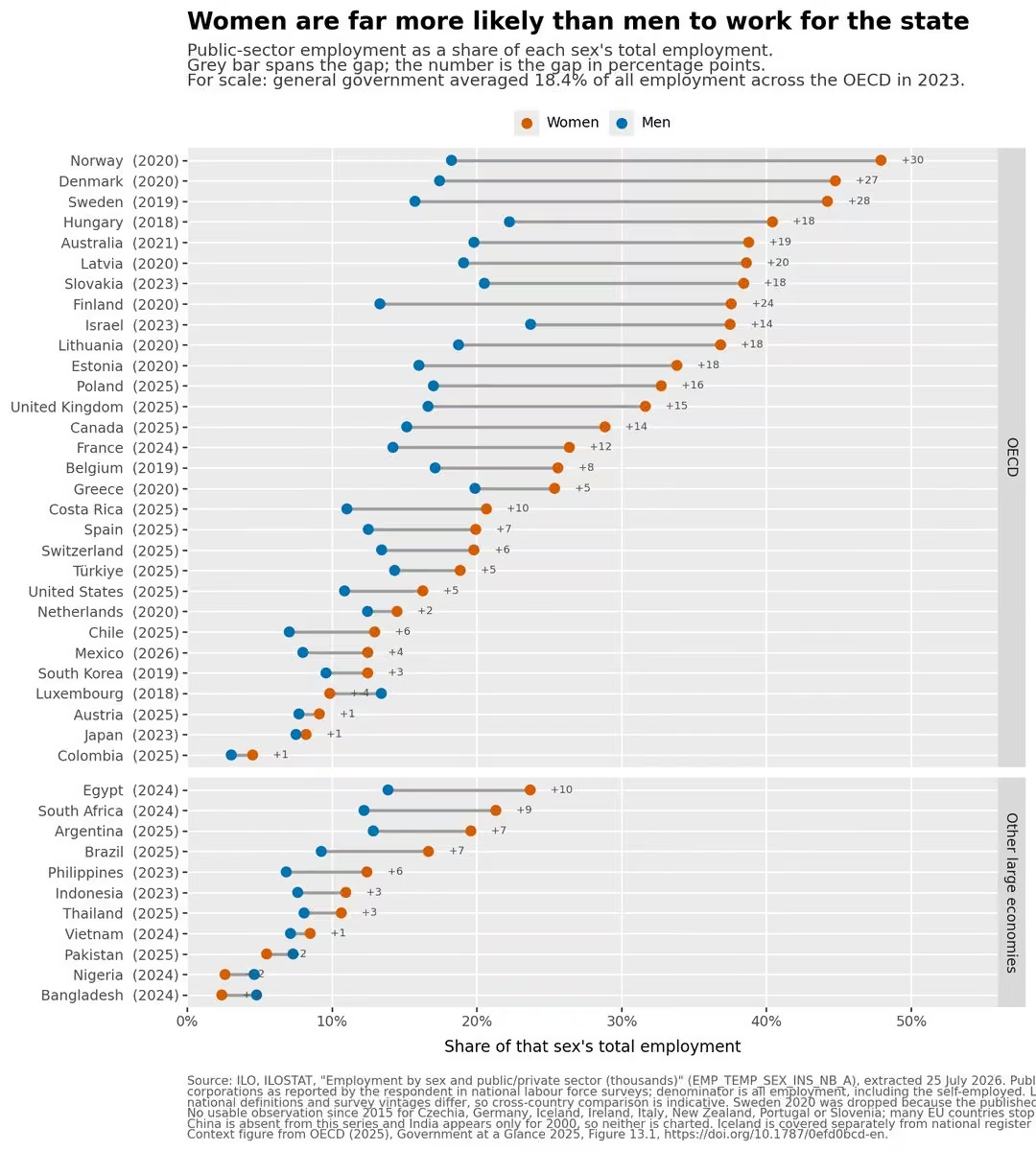
 Pablo Malo
@pitiklinov
La Feminización de Islandia:
Islandia es celebrada internacionalmente como el país más igualitario del mundo en materia de género. Durante décadas ha perseguido con éxito eliminar la dominación masculina en las instituciones públicas. Hoy las mujeres ocupan la presidencia, el cargo de primera ministra, la mayoría de los ministerios, la iglesia estatal, universidades, escuelas, policía, servicios sociales y gran parte de la burocracia pública.
Este artículo argumenta que este éxito ha generado un nuevo desequilibrio: el Estado islandés se ha feminizado de forma abrumadora. Datos clave:
-Las mujeres representan el 62 % de los empleados del gobierno central y el 70 % de los municipales.
-El 43 % de las mujeres ocupadas trabaja en el sector público, frente a solo el 15 % de los hombres.
-En muchos ministerios y oficinas (Justicia, Educación, Salud, Igualdad) las mujeres superan ampliamente a los hombres, llegando a dominios casi totales.
-Los hombres siguen concentrados en el sector privado y en las industrias exportadoras (pesca, construcción, energía, aluminio…), que son las que generan la mayor parte de la riqueza del país.
La autora sostiene que esta concentración de poder institucional en manos de mujeres (y de una visión feminista particular) ha creado puntos ciegos culturales. Muchos hombres islandeses se sienten silenciados o temerosos de expresar opiniones abiertamente, por miedo a las consecuencias sociales. Cuestionar este nuevo dominio se considera tabú y se tacha de misógino.
La conclusión sería que Islandia no ha logrado el equilibrio, sino que ha sustituido una dominación por otra. Toda concentración de poder -aunque se presente como “igualitaria”- genera sesgos y necesita ser cuestionada. La salud de una democracia depende de que se pueda criticar cualquier monopolio de influencia, también el femenino.
Luke Johnson reposted
 Paul Smith
@Paul_SLG
My guess is most people aren’t aware of this so it’s good to see it reported in the FT.
House builders are seeing their margins fall despite increases in revenues.
The reason?
Build costs are up. A lot.
That’s partly because of general inflationary pressures but also partly because of the growing cost of planning policy and regulations.
The consequence is that fewer development sites are viable and fewer homes will be built.

Luke Johnson reposted
 Deirdre Nansen McCloskey
@DeirdreMcClosk
I promised you a reading list.
I recommend the old classics, such as The Wealth of Nations, first published a few months before the U.S. Declaration of Independence, or anything by Frédéric Bastiat (1801–1850), originally in French, or Carl Menger’s Grundsätze der Volkswirtschaftslehre (1871), or Philip Wicksteed’s The Common Sense of Political Economy (1910), or Joan Robinson’s Exercises in Economic Analysis (1960) (brilliant, but a strange one; she devolved into a Maoist Marxist).
Also, study the modern classics in what we called at the University of Chicago “price theory.” Below, I list them from most elementary to most advanced.
A somewhat different route to becoming a real economist is to read what is called “Austrian” economics, descended from Carl Menger.
The Chicagoans tend to be more mathematical, the Austrians more philosophical.
Taken together, they teach what is right about a liberal economy.
My latest column for @folha

Luke Johnson reposted
 Charles Murray
@charlesmurray
If you haven’t ever seen this, watch it. It is devastating. Thing is, Milton was routinely this devastating in debates. Always with a smile. Only James Q Wison could rival him (in my acquaintance) for extemporaneous fluency.
 Jota
@jota_snchez
En 1979, un presentador de TV le preguntó a Milton Friedman si no le daba vergüenza defender un sistema basado en la codicia.
La respuesta se estudia hasta hoy:
«—Cuando ves la mala distribución de la riqueza, tan pocos que tienen tanto y tantos que no tienen nada… ¿nunca has dudado del capitalismo, de si la codicia es una buena idea?
—Primero dime: ¿conoces alguna sociedad que NO funcione con codicia? ¿Crees que Rusia no funciona con codicia? ¿Que China no?
¿Y qué es la codicia? Ninguno de nosotros es codicioso, claro. El codicioso siempre es el otro.
Los grandes logros de la civilización no salieron de despachos del gobierno. Einstein no construyó su teoría por orden de un burócrata. Ford no revolucionó el automóvil así.
Los únicos casos en la historia en los que las masas escaparon de la pobreza son aquellos donde hubo capitalismo y libre comercio.
—Pero parece premiar la habilidad de manipular el sistema, no la virtud.
—¿Y qué premia la virtud? ¿Crees que un comisario comunista premia la virtud? ¿Un Hitler? ¿Crees que los presidentes americanos eligen sus cargos por virtud… o por peso político?
Dime: ¿dónde están esos ángeles que van a organizar la sociedad por nosotros?
Yo ni siquiera confío en ti para hacerlo.»
Luke Johnson reposted
 Dmitri Alperovitch
@DAlperovitch
China’s share of global GDP, according to their own almost certainly inflated numbers declined to 16.7% from 18.5% in 2021.
America accounts for 26% of global GDP, up from 24% since 2021.
“Not only is there virtually no chance of China overtaking the United States as the world’s largest economy, but it is also likely that the U.S. advantage in economic strength will expand further in the next decade” 👇
Luke Johnson reposted
Christopher Snowdon
@cjsnowdon
You’d be mad to set up a business in Britain these days. Nation of grifting lawyers and idiot politicians. www.bbc.co.uk/news/articles/c70gq125xweo
Luke Johnson
@LukeJohnsonRCP
The biggest fraud in modern history - but no one has even been investigated, let alone punished.
Matt Ridley
@mattwridley
Daily Telegraph covers the proximal origin scandal well:
The messages that show Covid scientists secretly suspected a lab leak
Authors of influential Nature Medicine paper privately admitted ‘we can’t rule it out’
Sarah Knapton Science Editor. Eric Williams News Reporter
Published 24 July 2026 6:00am BST
1600
Scientists who were instrumental in shutting down the Covid lab-leak theory admitted in private “we can’t rule it out”, newly released messages show.
In March 2020, a group of influential virologists published a paper in the journal Nature Medicine arguing that an animal spillover event probably caused the pandemic.
The article, known as “The Proximal Origin of Covid”, concluded “we do not believe any type of laboratory-based scenario is plausible” and was hugely persuasive in stifling debate globally.
But messages obtained and published by US senator Rand Paul show that behind the scenes the scientists voiced concerns that the Wuhan Institute of Virology (WIV) had been carrying out experiments on coronaviruses at insufficient biosecurity levels.
The virus emerged eight miles from WIV laboratories and was seemingly pre-adapted to infect humans.
Three months after the paper was published, one of the authors, Prof Kristian Andersen, of the Scripps Institute, California, wrote on Slack, the communication platform: “At the end of the day, we really don’t have any hard evidence one way or the other – and especially given some of the recent evidence, we also can’t rule out that somebody actually put it in there.
“That’s obviously not to say that somebody ‘did’ but we can’t rule it out. Our paper was pretty strong in saying ‘there’s no way’, but I have less confidence in that statement at this stage.”
In the Nature Medicine paper, the authors had argued that bat coronavirus manipulation was carried out across the world, so it was unfair to point the finger at WIV, but Prof Andersen privately admitted that was not the case.
“That isn’t true, it has exclusively been going at WIV,” he wrote, adding that he believed both a natural and a lab-origin scenario were “equally probable”.
He also warned that the paper had claimed manipulation of viruses was hard, and that the virus could not emerge through cell evolution experiments. But he said both those arguments had been proven untrue.
Prof Andersen said that a lab leak was 30 per cent likely while co-author Prof Eddie Holmes of the University of Sydney put the probability at between 10 and 20 per cent.
Viscount Ridley, the author of Viral: The Search for the Origin of Covid-19, said: “These messages confirm that the Proximal Origins authors continued to believe a lab leak was possible.
“So why did they not correct or retract the paper that misled the world?”
The messages also reveal that authors were aware that Dr Shi – the lead bat virus scientist at WIV – was herself worried that Covid had been caused by a lab accident.
In September 2021, it emerged that before the pandemic Dr Shi had applied for a grant to insert a furin cleavage site (FCS) into bat coronaviruses – the very addition that made Covid-19 so infectious to humans.
Although the US Defense Advanced Research Projects Agency dismissed the grant because it was too dangerous, Slack messages showed that scientists feared the work had gone ahead anyway.
Prof Andrew Rambaut of Edinburgh University wrote that “it isn’t beyond plausibility that someone went ahead and tried some of this stuff”, adding, “We just need to re-convince ourself it is coincidence.”
Prof Holmes added that it was “striking” that a bat-derived coronavirus with a furin cleavage site turned up in a city with a lab “proposing to muck around” with FCSs in bat coronaviruses.
WIV planned the bat research in collaboration with EcoHealth Alliance, founded by British zoologist Peter Daszak and the American virologist Dr Ralph Baric of the University of North Carolina.
Prof Rambaut told his co-authors they would need to talk about the “Baric/Daszak s---show” and come up with a strategy “so we don’t get associated with these f---ers”.
He also warned colleagues to “stay off email” or “carefully curate some emails” in case of Freedom of Information requests.
Although the virologists claimed publicly that most scientists agreed on a natural origin for the pandemic, privately they admitted this was not the case.
Prof Andersen said he had been “pretty surprised” to learn that “most scientists I talk to believe there is a likely connection to the lab”.
Prof Richard Ebright, a molecular biologist at Rutgers University, who has called for a lab leak scenario to be fully investigated, said: “The claim repeated literally thousands of times by journalists that most scientists favour a natural origin of Covid and oppose a lab origin of Covid always was a lie.
“And almost always was a deliberate lie.”
The scientists were also dismissive about journalists, politicians, commentators and other experts who supported a lab leak theory, calling them “idiots” “tw--s” “clueless” “deranged” and “morons”, making up disparaging nicknames for experts.
Senator Paul said: “Behind closed doors, the scientists who authored the Proximal Origin paper privately questioned their own conclusions.
“Publicly, however, they shamed, attacked, and censored those who raised legitimate questions – all in the name of damage control.
“We deserve accountability for every effort to keep the public in the dark.”
The Telegraph has approached the scientists for comments.
Luke Johnson reposted
 S Sebag Montefiore
@simonmontefiore
There is great confusion about what Decolonization and indeed Colonization means.
The fact is: it means very little except 'a culture or mindset you dont like.' For whatever reason. And that usually means: the West. Since the West decolonized long ago, it really means the Western liberal democracies. It is a smart criticism because it means nothing, and hence it is hard to disagree with nothing and furthermore since the West itself is embroiled in a mix of moral fuddlement, political paralysis and cultural self hatred, you can be sure that Western leaders are very embarrassed by the very use of the word and many in the West will actually agree - even though they are not sure what they are agreeing with. it is a very useful rhetorical tool because Westerns are always going to be worried to answer in any meaningful way other than guilt and shame; and it is a growing industry - perfect for endless conferences. Like this one.
The reality of empires and colonies is something else entirely.
In early modern times, the Ottoman Turks conquered colonized enslaved exploited murdered and forcefully converted millions and ruled a vast tricontinental empire for four centuries; the Western powers led by Spain Portugal France and Britain later joined by Italy Germany Belgium also conquered colonized enslaved exploited murdered and converted using missionaries huge empires across the continents.
The Iberians lost much of their empires first; the Ottoman sultanate-caliphate started to decolonize with the Greek war of independence in 1820s and totally disintegrated in 1918; the British and French decolonized between 1940s and Sixties.
You could argue the Americans and Soviets comported themselves like anti-imperial imperialists during the Cold War and after - and indeed today's America toys at times with neo-tsarist expansionism - Greenland etc .
Thats it - noone in the Legacy Powers Britain or France etc seems keen on colonizing anything now; there are almost no colonizations left to decolonize - though many love to denounce their own country's past which is for some a most enjoyable enriching and virtuous pastime.
But in real life, empire and colonization are happening, often perpetrated by the very proponents of antiWest rhetoric. Russia is attempting to retake its limotrophic empire in Ukraine right now the old -fashioned way: by conquest and killing; a phalanx of Middle East neo-imperial powers are engaged in tournaments of power in failing states like Somalia, Libya and benighted Sudan; Iran established an informal empire across Iraq Syria Lebanon Yemen in its Six Armies strategy - its final destiny as yet undecided on the battlefield of the Third Gulf War; and Turkish leaders now regularly and openly declare their wish to reassert Ottomanist power in former Ottoman vilayets Syria Lebanon Israel, and former Ottoman cities Damascus Beirut Jerusalem....
So imperialism and colonialism just mean: other people, but never you.
Luke Johnson reposted
John Stepek
@John_Stepek
Admirably honest, really worth reading - status point is so important and so underestimated
 jeff prestridge
@jeffprestridge
My thoughts on the rocky journey after full-time employment ends


Luke Johnson reposted
 Jason Kenney 🇨🇦🇺🇦🇮🇱
@jkenney
Quite the chutzpah for Turkey to open this kettle of fish.
If Turkey is now committed to "decolonization," does that mean they will give back the lands taken from the many ethnic and religious minorities who have been victims of Ottoman & Turkish imperialism?
Will the Armenians have their ancient lands restored to them, or receive reparations for the genocide inflicted on them in 1915?
The Kurds given the right of self-determination?
The ancient Greek regions returned?
Will the 1974 Turkish invasion and occupation of Northern Cyprus be reversed?
Will the descendants of Jewish families who fled Kemalist policies of forced assimilation be given compensation?
Will the Hagia Sophia be returned the Greek Orthodox Patriarchate, from whom it was stolen?
Will there be a truth & reconciliation project recognizing the millions of slaves taken & trafficked by the Ottoman Empire, particularly the countless boys kidnapped from Balkan Christian families for forced military service?
Will compensation be given to Christians for the hundred of Churches and monasteries destroyed?
The possibilities for Turkish decolonization are endless.
 Restore Canada🇨🇦
@RS613506
At the World Decolonization Forum, Dr. Esra Albayrak, the daughter of Turkish President Recep Tayyip Erdogan, spoke about their endeavour to “decolonize” the West.
The first phase of their plan as she says is not within the political realm, but the realm of knowledge and thought.
Their alliance is not advocating for a world without the West, rather, there is an open invitation for the West to accept its own “decolonization”.
The current centers of knowledge located in Paris, London, Amsterdam. And New York; need to be replaced by new centers in Istanbul, Jakarta, Addis Abbaba, Rabat, Cairo, and Gaza.
Luke Johnson
@LukeJohnsonRCP
The Economist and its uber posh editor suffer from an acute case of Musk Derangement Syndrome. I bet she spends more time in Davos and NYC than visiting anywhere in Britain except London. Cloistered indeed.
 Leo Kearse - see me on tour! Links in bio
@LeoKearse
The Economist has gone to shit under its current editor, Zanny Minton Beddoes. It used to be a bastion of concise objectivity. Now it reads like a Guardian colour supplement.
It unquestioningly regurgitates every bit of contemporary ideology, from net zero to the idea that mass immigration is an unalloyed good, even putting forward the suggestion that we have completely open borders as it would raise GDP (never mind shanty towns across the West, think of the numbers on a spreadsheet!).
The Economist espouses state intervention and also says that right-wing parties should be banned or neutered to preserve democracy.
Britain could reach its net-zero goals if we just hooked a turbine up to the Economists' founders and harnessed the energy of them spinning in their graves.
This decades-long degradation of a once vital institution is exemplified in this interview where Zanny, with all the objectivity of a high school Mean Girl, attacks Elon Musk because he isn't liked by some people.
Luke Johnson reposted
 Optimist Prime
@trevgoes4th
Basically pointless for the big builders to build houses these days
Small to midsize are likely loss making once you strip out labour

Luke Johnson reposted
The Spectator
@spectator
Labour needs to understand that small businesses are not kulaks.
We are not enemies of the state sitting on vast piles of ill-gotten greedy wealth; we are not exploiters of the workers; we are the largest employers in the country; we are the heart of high streets and city centres; we are the home from home of cafes and pubs; we are the essentials in the early hours of the morning; we are the great driver of our economy.
Until the business rates system stops treating successful local businesses as cash cows, announcements like today's will be small steps on a long road.
✍️ Rory Hanrahan
Article | spectator.com/article/a-business-rates-cut-wont-save-our-… | @RoryHanrahan5

Luke Johnson reposted
Handre
@Handre
Jesse Livermore shot himself in the cloakroom of the Sherry-Netherland Hotel in November 1940, broke for the third time, leaving a note that called himself a failure. The man who supposedly cornered wisdom about markets could not hold onto his own money. You should sit with that before you buy another book promising to teach you his "rules."
Livermore made and lost four fortunes. He shorted the 1907 panic and the 1929 crash, walked away with roughly $100 million in the latter, and then gave it all back inside a few years. This is the pattern trading worshippers never explain. The skill that generates the gain evaporates the moment it must preserve it.
Here is the economics they skip. A speculator produces nothing. He grows no wheat, builds no railroad, refines no oil. At best he moves prices toward reality slightly faster, and for that service the market pays him a spread. Fine. Ludwig von Mises defended the honest speculator on exactly those grounds. Livermore was betting borrowed capital on the direction of a herd, not clearing information into prices as a modest broker. The herd, being human, is unpredictable by construction.
You cannot systematize your way out of that. The classic "trend follows the trend until it doesn't" maxim is a tautology dressed up as insight. If a repeatable edge existed in reading tape, arbitrage would have crushed it flat by 1930, let alone 2024.
Now consider where the money to speculate even comes from. Cheap credit. The Federal Reserve, chartered in 1913, spent Livermore's whole career inflating and contracting the money supply, manufacturing exactly the boom-bust swings he rode. He was a passenger on a train the central bank was driving off cliffs.
Real wealth compounds through savings, deferred consumption, and productive investment. Boring stuff. It built the actual economy while Livermore was margining out.
He died with debts and a revolver. Trade if you want the thrill. Just stop calling it wisdom.
*Interestingly, the pornographic actress "Brandy Love" is the great-granddaughter of Jesse Livermore.*

Luke Johnson reposted
Simon French
@Frencheconomics
Simon is right, albeit I think there is a fair debate on whether the UK spends too much per se, or whether that spending is going into an economy with too sclerotic a supply side (energy, land, capital, labour) - that creates inflation that in turn is priced into Sterling debt. The UK doesn't have a price level target - but if it had since the 2% CPI target was introduced back in 2004 you would need zero inflation for a decade to get back on target.... Gulp.....

 Simon Clarke
@SirSimonClarke
Ignore the noise this week - this is the fundamental issue.
The UK holds a huge stock of debt. It’s rising rapidly. And we are an outlier in terms of how much it costs us to service it.
Labour can run, but can’t hide from this. We need to put spending on a sustainable path.
Simon French
@Frencheconomics
10y Gilt at 5.1%. Expensive debt.
Luke Johnson reposted
 Calum E. Douglas FRAeS
@CalumDouglas1
Its amazing how many people assume that one man just "decided" any of this by himself, and that he went and just "did" things whilst the Cabinet sat about staring at eachother in alarm and confusion.
Its essentially nonsense, and comes from never having read any of the cabinet files and not understanding how policy was made, by whom, and why.
1) In 1934 it was realised by the Committee of Imperial Defence (essentially the Ministry of Defence although they dont work in quite the same way), that war with Germany was highly likely, and that five years was required to place Britain on a footing necessary to conduct such a war, industrially, financially, militarily and materially. It is agreed in 1934 that the prime overriding mandate for British foreign policy must be that for as long as possible ANY war had to be avoided at all costs during that period, and that Hitler must be kept on friendly terms.
2) In 1934/35, Chamberlain, pushes for realigment of the defence spending towards home defence by RAF and the Naval Home fleet, against objections from others to invest in the Far East defence (there wasnt enough money to do it all).
3) In 1938, the rearmament plans are behind schedule, there are NO Spitfire squadrons in operation, and fewer than needed even of the more primitive Hurricane. The RAF internal historical studies at the time stated that war in 1938 would have been catastrophic for Britain. The entire defence committe studies if it is possible to invervene in Czechoslovakia, they conclude that whilst it was of course desirable, they could not at that time intervene to actually prevent it, as the Navy was of course useless in that objective, the Army was in no state numerically or logistically to get there in time or numbers to mount an effective assistance, and the R.A.F. did not posess enough of a heavy bomber fleet to effect a serious air assault on Germany.
The only sane choice was to accept that they could not at that point do anything effective, and to wait until sufficient strength existed to engage in full scale war with Germany, and at that point, eventually liberate these terratories.
4) In 1939, almost exactly five years after the C.I.D. agreed on a five year plan, Britain declares war on Germany.
Huge numbers of people were involved with every aspect of this, and planners, diplomats, spies and every concievable committee spent years discussing every aspect in detail.
Chamberlain`s main contribution, was to steer this vast machine a little towards what he percieved as primary goals, which was to regard Germany as the most likely direct threat (not Japan or Italy) and to encourage that the money which was availble in the early 30`s, which was very little, was spent on the RAF Home defence and Royal Navy Home Fleet. He was absolutely correct in all these judgements.
Thus, Britain entered WW2 with THE most powerful Navy in the world (this is objectively a fact) and was out producing the Luftwaffe in aircraft production.
It was, in terms of the response to the Czech crisis, almost irrelevant who the Prime Minister was, they would have been told the same thing:
A) Can we stop Hitler from invading the Czech nation ?
- Not at this time
B) What is the best remaining course of action ?
- To avoid a war for at least another year to enable Britain to complete various re-armament plans to a satisfactory state.
None of this is subjective, it is all recorded in the C.I.D. files, which virtually nobody reads because the important areas are not digitised and there are thousands of files at the National Archives in London.
I spend thousands of pounds copying these files and I report my findings here.
These ^^ are the findings.
There was absolutely nothing that ANY prime minster of Britain could have done to sucessfully intercede in the German invasion of the Czech nation, unless you decided you are better informed on this than the entire defence intelligence and planning infrastructure of the British Empire.
I myself am not brave enough to assume I, with the options they had on the table at the time, could have produced a superior result, even with hindsight.
Those who say that the Czechs actually were very militarily strong and could have resisted, ignore that nobody FORCED them to "allow" Germans onto their terratory, we simply said to them that we could not at that stage affect a serious military support and that if they wished to do so, it would have to be on their own.
The Czechs did not do so, a rather obvious proof that they did also not consider their own defence to be very strong.
The problem with France trying to intervene was that their whole strategy was one of defence, and they did not at that time either consider that they could actually prevent German action.
It is also very worthwhile noting than many of the most severe critics of the descision not to attempt to militarily prevent this invasion, actually did so only because they themselves thought Hitler was probably bluffing, and only needed to be shown some force to give up on the whole idea.
You can read more on that in Chamberlains diaries from the time.


 Shakiest Gun In The Ozarks
@burnside_king
Wrong metaphor.
Chamberlain fucked up letting the Germans have the Rhineland and Sudetenland. And Austria. And Czechslovakia.
Rearmament was the right direction to move, but Chamberlain traded lives for (peace) time, and every time it made Germany stronger
Luke Johnson reposted
 Alex & Books 📚
@AlexAndBooks_
This is Lin Yutang.
He received 6 nominations for the Nobel Prize in Literature, wrote 35+ books, and was a voracious reader.
In his most famous book he has a chapter titled "The Art of Reading."
Here are the 17 best quotes from it:
1) "Anyone who reads a book with a sense of obligation does not understand the art of reading."
2) "The wise man reads both books and life itself."
3) "You can leave the books that you don't like alone, and let other people read them."
4) "The man who has not the habit of reading is imprisoned in his immediate world, in respect to time and space. His life falls into a set routine; he is limited to contact and conversation with a few friends and acquaintances, and he sees only what happens in his immediate neighborhood."
5) "But the moment he takes up a book, he immediately enters a different world, and if it is a good book, he is immediately put in touch with one of the best talkers of the world."
6) "In reading as in eating, what is one man's meat may be another's poison. A teacher cannot force his pupils to like what he likes in reading, and a parent cannot expect his children to have the same taste as himself."
7) "There are no books in this world that everybody must read, but only books that a person must read at a certain time in a given place under given circumstances and at a given period of his life."
8) "I rather think that reading, like matrimony, is determined by fate...Even if there is a certain book that every one must read, like the Bible, there is a time for it."
9) "When one's thoughts and experience have not reached a certain point for reading a masterpiece, the masterpiece will leave only a bad flavor on his palate."
10) "The same reader reading the same book at different periods, gets a different flavor out of it...Therefore, all good books can be read with profit and renewed pleasure a second time."
11) "Reading...is an act considering of two sides, the author and the reader. The net gain comes as much from the reader's contribution through his own insight and experience as from the author's own."
12) "I regard the discovery of one's favorite author as the most critical event in one's intellectual development...one must try to find an author whose spirit is akin with his own."
13) "One has to be independent and search out his masters. Who is one's favorite author, no one can tell, probably not even the man himself. It is like love at first sight."
14) "The reader cannot be told to love this one or that one, but when he has found the author he loves, he knows it himself by a kind of instinct."
15) "It is only this kind of reading, this discovery of one's favorite author, that will do one any good at all...And then the reader proceeds to devour every word and every line that the author writes."
16) "The author has cast a spell over him, and he is glad to be under the spell, and in time his own voice and manner and way of smiling and way of talking become like the author's own. Thus he truly steeps himself in his literary lover and derives form these books sustenance for his soul."
17) "There is no proper time and place for reading. When the mood for reading comes, one can read anywhere."

Luke Johnson reposted
 Jim O'Shaughnessy
@jposhaughnessy
"With his power, Robert Moses built himself an empire.
The capital of this empire was out of public sight—a squat, gray building crouching so unobtrusively below the Randall’s Island toll plaza of the Triborough Bridge that most of the motorists who drove through the toll booths never even knew that the building existed. And most of them were ignorant also of the existence of the empire.
But men whose interest in geography centered on the map of power knew of its existence very well indeed. They realized that although theoretically it was only a creature of the city, it had in fact become an autonomous sovereign state. And, realizing that—although its outward form was a loose confederation of four public authorities, plus the New York City Park Department and the Long Island State Park Commission—it was actually a single-headed, tightly administered monarchy, these men described it with a single name, derived from the bridge and the Authority that were its centerpieces: “Triborough.”
Anyone who doubted Triborough’s autonomy had only to look at its trappings. The empire had its own flag and great seal, distinctive license plates and a self-contained communications network, an elaborate teletype hookup that linked the gray building and the provincial capitals at Belmont Lake, Massena and Niagara. It even had its own island—Randall’s—on which it administered every structure and every inch of land. Randall’s Island was near the geographic center of New York, but the waters of the East River, Bronx Kill and Hell Gate were a moat between it and the city, and from the air, with its hundreds of acres of lawn, the island appeared separate, a bright green oasis, sharply defined by a blue border, in the midst of the city’s vast grayness. And the separateness was more than symbolic: no inhabitant of the city could drive across the island without paying Triborough a tribute in coin.
Triborough had its own fleets, of yachts and motorcars and trucks, and its own uniformed army—“Bridge and Tunnel Officers” who guarded its toll booths, revolver-carrying Long Island Parkway Police who patrolled its suburban parks and roads—responsible to no discipline but that of Robert Moses. To command the army, under Moses, it had its own generals and admirals, senior officers of the United States Army and Navy who, upon retirement, took service under its banner. It had its own constitution: the covenants, unalterable by city, state or federal government, of its bond resolutions. It governed by its own laws: the Rules and Regulations that it promulgated to regulate conduct within its dominions. And, most significantly, it had its own source of revenue: the quarters and dimes that poured in a silver stream into the toll booths at which it collected tribute."
~Robert A. Caro, "The Power Broker (Pulitzer Prize Winner): Robert Moses and the Fall of New York"

Luke Johnson reposted
SightBringer
@_The_Prophet__
⚡️France is heading toward an ECB-managed sovereign crisis.
The country cannot politically deliver the austerity required to restore bond-market confidence. The electorate will reject spending cuts. Governments will keep falling. Fiscal promises will survive every cabinet reshuffle. Debt service will rise faster than the political system can adapt.
The bond market will keep testing France until the ECB intervenes.
That intervention will arrive through spread control, targeted purchases, softer collateral treatment, bank support, and language designed to prevent “fragmentation.” Europe will call it monetary transmission. The real function will be protection of French solvency and preservation of the euro.
France will not be allowed to default. It is too large, too central, and too entangled with the European banking system. The euro itself would come under existential pressure before policymakers permitted a disorderly French failure.
So the end state is clear.
French fiscal risk migrates onto the ECB balance sheet.
German credibility is used to backstop French politics.
The euro becomes more openly subordinated to sovereign survival.
That is the phase shift.
The original euro bargain required national discipline inside a shared currency. That bargain is dying. The new bargain will tolerate fiscal divergence and use the central bank to suppress the consequences.
Markets will understand what happened before politicians admit it.
French spreads will become the control variable.
French banks will become transmission channels.
Germany will resist.
The ECB will override the resistance when system stability is threatened.
Capital will move toward assets outside the political bargain, gold, Bitcoin, scarce equities, foreign sovereign debt, and real assets with no dependence on French fiscal credibility.
The deepest truth:
France is too politically rigid to reform, too financially important to fail, and too large for Europe to rescue honestly.
So Europe will rescue it dishonestly through monetary repression and disguised mutualization.
That is where this ends.
Barchart
@Barchart
BREAKING 🚨: France
France's 10-Year Yield hits highest level since the Global Financial Crisis 🤯 👀

Luke Johnson reposted
Kallum Pickering
@KallumPickering
Fear versus fundamentals: UK spending running well ahead of confidence
UK retail sales momentum continued to improve in June, despite renewed risks stemming from the re-escalation in the Middle East and domestic political uncertainty as new Prime Minister Andy Burnham takes the helm.
The pick-up in inflation-adjusted spending looks at odds with consumer confidence – which remains subdued. What's going on?
Fundamentals matter: Although the renewed pick-up in inflation poses a headwind, and job gains remain soft, real incomes have improved materially in recent years and overall employment remains high. Meanwhile, consumer credit and mortgage debt remain at multi-decade lows versus incomes – while cash balances are high and saving rates remain elevated. Altogether, this provides material buffer space for consumers to withstand headwinds.
Risks abound: Consumer confidence remains decidedly subdued, however, against a backdrop of several years of shocks and wobbles, and a future clouded with risks at home (budget, cost of living, threat of BoE rate hikes) and abroad (Middle East, trade wars, Russia-Ukraine).
Uncertainty ahead: If the risks fade, confidence can improve to more closely reflect fundamentals and, with it, spending can accelerate further. However, if the doubts and worries which are keeping sentiment subdued materialise, the risk is that spending could stall. One way or the other, this unusual gap between confidence and spending will close.
#ukeconomy #ukmacro

Luke Johnson reposted
Simon Kuestenmacher
@simongerman600
I love this map! It shows all the US cities that used to have more than 100,000 residents but now don't anymore. Cool US history and geography trivia. Source: www.reddit.com/r/MapPorn/comments/phfpjd/all_us_cities_wh…
 Luke Johnson
@LukeJohnsonRCP
This is why there are opportunities for entrepreneurs
Luke Johnson reposted
Sam Ashworth-Hayes
@SAshworthHayes
Particularly pointless because the main lesson of the Manchester bombing was that every part of it was enabled by the state which:
Gave the bomber's parents refugee status despite the subsequent inquiry finding they had "held extremist views"
Had the Royal Navy bring the bomber back from Libya where he'd likely fought in the civil war
Ignored intelligence about his activities that could have prevented the attack
Paid benefits to his mother (who by that point was in Libya) which he used to buy the bomb's components
But as that's quite uncomfortable for the officials involved we get "don't look back in anger" and makework laws like this

Luke Johnson reposted
Paul Johnson
@PJTheEconomist
Brilliant and excoriating. What a total mess.
“We seem to be moving ever closer to a system in which the government gives every business a score out of ten each year according to how much it likes the business that year, and sets its tax rate that year accordingly.”
 Institute for Fiscal Studies
@TheIFS
NEW: Business rates have gone from being one of the most stable and simple taxes in the system to one of the least.
📗 @StuartAdam_IFS and @isaacdelestre explain why a coherent view of business rates and how they should be designed is sorely needed, in our response to today's announcement:

 Helen Miller
@HelenMiller_IFS
More business rates relief for pubs & music venues is a continuation of a theme
Business rates used to be simple (1 rate) and stable. Now there are many rates & constant tinkering. This is not a welcome development
Luke Johnson
@LukeJohnsonRCP
Interesting list
Ramon Agusta
@ramonagusta
Without Britain, none of these would exist...
The English language
The Latin alphabet
English spelling (pre-Webster)
English grammar
The common law system
Trial by jury
Habeas corpus
The presumption of innocence
Due process
The right to a fair trial
The adversarial court system
Judges in robes
The gavel
Legal precedent
Stare decisis
Property law
Contract law
Tort law
Estate law
Wills
Power of attorney
Land titles
Deeds
The Magna Carta tradition
The Bill of Rights concept
Parliamentary procedure
Robert's Rules of Order
Bicameral legislatures
The Senate (modelled on the House of Lords)
The Speaker of the House role
The filibuster
Committees
Hansard-style records
The loyal opposition concept
Separation of powers (via Locke and Montesquieu, but English tradition)
The Westminster system as a starting point
Christianity as the dominant faith
The Protestant work ethic
The King James Bible
Methodism
Quakerism
Baptism
Anglicanism (became the Episcopal Church)
Presbyterianism
Congregationalism
Puritanism
Sunday as a day of rest
Church weddings
Christian burial traditions
Christmas
Easter
Christmas trees (via Germany via Victoria, but arrived through Britain)
Christmas carols
Mince pies
Christmas pudding (mostly forgotten but exists)
Father Christmas (became Santa Claus)
Easter eggs
Hot cross buns
Wedding rings
White wedding dresses (Victoria again)
The bouquet toss
The wedding cake
Bridesmaids
Best man
Funeral wreaths
Tombstones
The handshake
Saying "please" and "thank you"
Standing for elders
Holding doors open
Queueing (badly)
"How do you do" as a greeting
First names and surnames in that order
The "Junior" and "III" naming convention
Titles like Mr, Mrs, Miss
Doctor as a title
Reverend
Honourable
The handshake on a deal
Signing contracts
Witnesses on documents
Notaries
Public schools (the concept)
Universities
Colleges
Harvard (founded by Cambridge graduates)
Yale, Princeton, Columbia (all British colonial)
Caps and gowns at graduation
Mortarboards
Honorary degrees
The PhD
Fraternities and sororities (Greek, but via Oxbridge clubs)
Boarding schools
House systems in schools
School uniforms
Class prefects (residual)
The three-term academic year
Recess
Detention
Spelling bees (British origin)
Reading, writing, arithmetic
The blackboard
Cursive handwriting
Letter writing
The postal service
Stamps
Mailboxes
Addresses with house numbers
Streets named after things
Pubs (became bars and taverns)
Inns
Tea
Coffee houses (originally a London thing)
Beer
Ale
Whisky tradition (Scottish/Irish)
Gin
Cider
Pub games
Darts
Billiards
Snooker (kind of)
Pool tables
Card games
Whist
Bridge
Poker (debatable but English roots)
Chess (via Britain)
Cricket (briefly, before baseball ate it)
Baseball (descended from rounders and cricket)
Football (the rugby version, which became American football)
Rugby
Soccer (the word and the game)
Tennis
Golf
Horse racing
Foxhunting (briefly)
Boxing (Queensberry rules)
Wrestling
Rowing
Sailing
Yachting
Pigeon racing
Dog shows
Crufts-style breed standards
Most dog breeds
Sheepdogs
Foxhounds
Beagles
Bulldogs
Most cat breeds
Horse breeds
Thoroughbreds
The Derby
Sunday roast
Roast beef
Roast chicken
Roast potatoes
Yorkshire pudding (vanished)
Gravy
Stuffing
Pies (the savoury kind, mostly mutated)
Pot pie
Shepherd's pie
Apple pie (English originally)
Pumpkin pie (English roots, American twist)
Mince pies
Custard
Trifle
Pudding (the word)
Cookies (called biscuits)
Cakes
Sponge cake
Pound cake
Fruit cake
Sandwiches
The Earl of Sandwich
Toast
Marmalade
Jam
Preserves
Pickles (via Britain)
Mustard
Worcestershire sauce
HP sauce (limited)
Salt and vinegar (chips)
Fish and chips (became "fish fry")
Chips (became fries)
Crisps (became chips)
Bacon
Sausages
Black pudding (vanished)
Bangers and mash (vanished)
Bread and butter pudding
Porridge (became oatmeal)
The English breakfast (became "American breakfast" in modified form)
Scones (became biscuits)
Muffins (became English muffins)
Crumpets (sort of)
Tea cakes
Buns
Loaves
Sourdough (English roots, not just San Francisco)
The pub Sunday lunch concept
Fish on Friday
Bank holidays (became federal holidays)
Sunday trading laws (residual blue laws)
Thanksgiving (Puritan harvest festival)
Halloween (Celtic via Britain via Ireland)
Bonfire night (vanished)
Guy Fawkes (vanished but the V mask remains)
May Day (residual)
Boxing Day (vanished)
New Year's Eve traditions
Auld Lang Syne (Scottish)
Mother's Day (English origin, US adaptation)
Father's Day (similar)
Valentine's Day (English custom)
April Fool's Day
Saint Patrick's Day (Irish via UK union)
The pound (as a weight)
The mile
The foot
The inch
The yard
The acre
The gallon (different gallon, but inherited)
Fahrenheit (German via Britain)
The 12-hour clock with AM/PM
Common time signatures in music
Sheet music notation
The piano (via Europe via Britain)
Brass bands
Marching bands
Christmas carols
Hymns
Folk music tradition
Ballads
Sea shanties
Nursery rhymes
Mother Goose
Twinkle Twinkle Little Star
Mary Had a Little Lamb
Humpty Dumpty
Jack and Jill
London Bridge
Ring a Ring o' Roses
Fairy tales
Robin Hood
King Arthur
Beowulf (academic)
Shakespeare
Chaucer
Dickens
The novel as a form
The detective novel (Conan Doyle)
Sherlock Holmes
The English country house mystery
The school story
The adventure novel
Treasure Island
Robinson Crusoe
Gulliver's Travels
Alice in Wonderland
Peter Pan
The Wind in the Willows
Winnie the Pooh
Mary Poppins
Christopher Robin
Beatrix Potter
Roald Dahl (post-WWII but huge)
The pantomime tradition (vanished mostly)
Music hall (became vaudeville)
Vaudeville (Anglo-French)
The variety show
Stand-up comedy roots
The sitcom format
Punch magazine humour
Political cartoons
The cartoon strip
The newspaper
The broadsheet
The tabloid
Editorial pages
Letters to the editor
Op-eds
Crossword puzzles (American invention but English wordplay roots)
The Times-style serif typography
Garamond, Times New Roman, Caslon — English/European typefaces
The hardcover book
The paperback
Public libraries
The Dewey Decimal System (American but library tradition is English)
Bookstores
The university press
Academic journals
Peer review
The scientific method (English/European)
The Royal Society tradition (became American Philosophical Society etc)
Most named scientific units (Newton, Watt, Kelvin, Faraday)
Newton's laws
Darwin's theory of evolution
Most basic chemistry nomenclature
Most basic physics nomenclature
The metric system rejection (uniquely shared with Britain… until Britain switched)
Engineering tradition
The steam engine (became railroads)
Railroads
The locomotive
The train station
The platform
The ticket inspector
Steamships
Ocean liners
The merchant navy concept
Lighthouses
Lifeboats
Coastguards
The Royal Navy tradition (became US Navy structure)
Naval ranks
Army ranks
Military uniforms (red coats aside)
The salute
The drill sergeant
Boot camp concept
West Point modelled on Sandhurst
Annapolis modelled on naval colleges
Military bands
Bagpipes (in some regiments)
The bugle call
Reveille
Taps (American but British camp roots)
The 21-gun salute
Trooping the colour (residual ceremonial)
The Marine Corps tradition
Most ranks: Private, Corporal, Sergeant, Lieutenant, Captain, Major, Colonel, General
Court-martial
Articles of war
The Geneva Convention adherence
The chain of command
Saluting the flag
The flag itself (Stars and Stripes — derived from British East India Company flag, debated)
Pledges of allegiance
National anthems sung at events (To Anacreon in Heaven was a London tune)
The Star Spangled Banner's tune is English
"America (My Country, 'Tis of Thee)" uses "God Save the King"
The Boy Scouts (Baden-Powell)
The Girl Guides (became Girl Scouts)
The Salvation Army
The YMCA (English origin)
The YWCA
Rotary Clubs (American but masonic English roots)
Freemasonry
The Order of Odd Fellows
Banking (modern banking is English/Italian via Britain)
The bank cheque
Promissory notes
Stock exchanges
The corporation
Limited liability
Joint stock companies
Insurance (Lloyd's of London)
Marine insurance
Life insurance
The mortgage
Rent
Leases
Tenancies
Landlords
Real estate
The auction
Estate agents (became realtors)
Auctioneers
Stock tickers (American but City of London style)
Banker's hours
Double-entry bookkeeping (Italian but via Britain)
Audit
Chartered accountants
The financial year
Tax law structure
Income tax (British invention, 1799)
Tariffs
Customs
Excise
Stamp duty
The cabinet system
The Speaker of the House
The Lord Speaker → Senate President pro tempore
The Whip system
Cabinet ministers
Departments of state
The Treasury
The Foreign Office (became State Department)
The Home Office concept
The civil service
The bureaucracy
The mayor
The town council
The county
The sheriff
The constable
The bailiff
The coroner
The magistrate
The justice of the peace
The grand jury
The petit jury
Indictments
Subpoenas
Warrants
Habeas corpus
The bench
The bar
Barristers and solicitors merged into "lawyers" or "attorneys"
Wigs (briefly, then dropped)
The black robe
The witness stand
Swearing on the Bible
"I do solemnly swear"
Marriage vows
"I do"
The honeymoon
The bridal veil
The bouquet
The garter toss
Horseshoes for luck
Throwing rice
Tying cans to cars
Saying "I love you"
Greeting cards
Christmas cards (English invention, 1843)
Birthday cards
Get well cards
Postcards
The fountain pen
The ballpoint (Hungarian via Britain)
The typewriter (American but English keyboard layout)
QWERTY (American actually, but for English)
The dictionary (Johnson's, then Webster's adaptation)
The encyclopedia (Britannica)
The thesaurus (Roget)
Grammar textbooks
Spelling rules
Cursive script
Italics
Bold type
Punctuation conventions
The semicolon
The colon
The full stop (period)
Quotation marks
Apostrophes
Most idioms in American English
"Raining cats and dogs"
"Spill the beans"
"Bite the bullet"
"Break the ice"
"Cost an arm and a leg"
"Once in a blue moon"
Most proverbs
Most riddles
Most jokes structures
Knock-knock jokes (English origin)
Most card game vocabulary
Most pub vocabulary
The word "OK" (debated, but English roots)
The phrase "All right"
Cheers as a toast
The toast tradition itself
Champagne for celebrations (French via England)
Wine traditions
Port and sherry (gone)
Sundowners (gone, mostly)
The cocktail (English/American hybrid)
The cocktail party
The dinner party
The hostess
The toastmaster
Speeches at events
Eulogies
The wake
Mourning clothes
Black at funerals
White at weddings
Confetti
The bouquet
Bunting at parties
Streamers
Balloons (rubber tech, but party use is British)
Fireworks (Chinese, but British public use)
4th of July fireworks (replaced Bonfire Night)
The parade tradition
Marching bands
The Mayor's parade
Floats
The town hall meeting
The village green concept (became "the commons")
The town square
The courthouse on the square
The clock tower
Church steeples
Sunday morning church bells
The wedding peal
The funeral toll
The vicarage (became parsonage)
The parish system (residual)
Sunday school
Bible study groups
Hymn books
Pews
Pulpits
Stained glass windows
Gothic architecture in churches
Neoclassical architecture (via Britain via Greece/Rome)
Georgian architecture
Victorian architecture
The white picket fence (English garden tradition)
The lawn
The hedge
The garden
Garden parties
The greenhouse
Allotments (residual, "community gardens")
Lawnmowers
Garden gnomes (German via Britain)
Hedge mazes
Topiary
Ivy on walls
Ivy League itself (the ivy tradition)
The college campus quadrangle
The cloister
The chapel
The dining hall
The refectory
High table (vanished)
College colours
College mottos in Latin
The class ring tradition
The tassel
The valedictorian
The salutatorian
"Pomp and Circumstance" (Elgar) at graduations
Most ceremonial music
"Auld Lang Syne" at New Year
"Happy Birthday" derivatives
Most lullabies
Most folk dances
Square dancing (English country dancing)
Maypole dancing (vanished)
Morris dancing (vanished)
The waltz (Austrian via Britain)
Ballet (French/Italian via Britain)
Opera (Italian via Britain)
The orchestra
The conductor
The string quartet
The choir
The choirmaster
The organist
Cathedral music tradition
Boys' choirs
Hymn singing
Congregational singing
The Christmas carol service
Lessons and carols
The advent calendar (German via Britain)
Advent wreaths
The Christmas stocking
Mistletoe
Holly and ivy
The Yule log
Father Christmas (Santa via Coca-Cola but English roots)
Christmas pudding
Christmas crackers (vanished mostly)
Pulling crackers (vanished)
The paper crown (vanished)
Cracker jokes (vanished)
The Queen's Speech (vanished, replaced by State of the Union)
Trooping the Colour (replaced by July 4 parades)
Most parliamentary terminology
Most legal terminology
Most academic terminology
Most ceremonial terminology
Most aristocratic terminology (residual in some Southern states)
The plantation system (English colonial)
Slavery's legal framework (English colonial law)
Indentured servitude
The land grant
The patent system
Copyright (Statute of Anne, 1710)
Trademark law
Intellectual property concept
The press freedom principle
The free speech tradition
Freedom of religion (Puritan dissent)
Freedom of assembly
The right to petition
The right to bear arms (English Bill of Rights 1689)
Trial by peers
"Innocent until proven guilty"
Burden of proof
Reasonable doubt
The Miranda warning structure (American but rights are English)
The arrest
The booking
The mugshot
The fingerprint (English science)
Forensics (British origin)
Sherlock Holmes-style detection
Scotland Yard imitations (FBI, etc.)
Police forces themselves (Robert Peel)
"Cops" (from "coppers", British slang)
The beat
The patrol
The night watch
The constable
The detective
Plain-clothes officers
The detective novel
The thriller
The spy novel (le Carré, Fleming)
James Bond
Most spy tradecraft language
"MI6"-style intelligence framing (CIA modelled partly)
The Special Relationship itself
NATO membership tradition
The United Nations (Anglo-American framework)
The League of Nations before it
International law tradition
Diplomatic protocol
Embassies
Ambassadors
Consuls
Diplomatic immunity
The State visit
The 21-gun salute
The red carpet
The receiving line
The official photograph
The official portrait
The Oval Office desk (Resolute desk, gift from Queen Victoria)
White House architecture (Georgian)
Capitol Hill architecture (neoclassical)
The Supreme Court building (neoclassical)
The Lincoln Memorial style (Greek revival via Britain)
The Washington Monument (obelisk, via Britain via Egypt)
Most monumental architecture before 1930
Cathedrals modelled on English ones
The cemetery as a park (Victorian invention)
Gravestones in English style
Latin epitaphs
Stone angels
The mausoleum
The crypt
The grave plot
The funeral procession
The hearse
Black ribbons
Half-mast flags
Memorial services
The eulogy
The 21-gun salute at military funerals
"Taps" at military funerals (American melody, British practice)
The folded flag presentation
The white glove tradition
The dress uniform
The medal
The ribbon bar
Knighthoods (rejected) → Medal of Honor (kept the spirit)
The Order of the Bath → Presidential Medal of Freedom structure
Decorations and citations
Battlefield commissions
"For valour" inscriptions
The Victoria Cross influenced the Medal of Honor
Most military ceremonial
Luke Johnson reposted
David Turver
@7Kiwi
Hydrocarbons delivering well over half of global electricity. Wind and solar still small beer.

 Jan Rosenow
@janrosenow
Renewables are overtaking coal as the world's largest source of electricity generation, after near parity in 2025.
New @IEA mid-year update: their share goes from 33% to 37% by 2027, solar and wind from 17% to 21%. EU well ahead of global average.
iea.blob.core.windows.net/assets/3c66a000-244c-4efb-aaeb-…

Luke Johnson reposted
 Michael Pettis
@michaelxpettis
Stephen Roach: "Ever-mounting imbalances brought the US and the world economy to its knees during the great financial crisis of 2008-09. It could do the same for China."
Roach has long worried about Chinese imbalances, but his views on how the global imbalances were created have shifted from a very accommodative view towards China (they are mainly caused by US fiscal policies that force down domestic saving) to a much more confrontational one (they are mainly caused by Chinese credit and investment policies that force up Chinese saving).
He goes on to argue that "China’s steadfast reliance on the producer model is not just a test of the character of its economy. It is a test of the future for the global economy. The country is demanding far too much of a world fixated on cheap consumer goods."
It is becoming more and more obvious among analysts and policymakers that the current global trading system is unsustainable and bad for overall global growth, even if it has been good for growth among some of the most aggressively mercantilist economies.
These great imbalances could probably have been resolved at a fairly low and manageable cost 10-15 years ago, and perhaps even 5-6 years ago. But by now, it seems to me that the world is locked into a system in which some economies (and not just China) depend so heavily on growing their already-excessive manufacturing capacity at the expense of domestic demand that it will be extremely painful for them to adjust, except very slowly, perhaps over a 15-20-year period.
At the same times other economies (and not just the US and the EU, but also Mexico, Brazil, India, and many other large developing economies hoping to build their manufacturing sectors) will be increasingly reluctant to absorb the resulting imbalances for even a few more years because of the speed with which their manufacturing sectors and their strategic resilience are being undermined. What is more, every time one of them acts to reduce its role in absorbing excess manufacturing capacity, this increases the damage to those that don't act.
This suggests that the next big question for global policymakers is whether the imbalances can be resolved through global coordination and a minimization of the associated adjustment costs, or will be resolved in the form of a very difficult adjustment in which the major economies all try to force the bulk of adjustment costs onto their trading partners.
The former is very unlikely in my opinion, and increasingly so, which suggests that over the next few years we are likely to see major, and disruptive, changes in the global trading system and, more importantly for long-term growth, in the way manufacturing is distributed around the world.
www.ft.com/content/af84b774-74c1-4ace-a328-e54c8f840fde
Luke Johnson reposted
 Geiger Capital
@Geiger_Capital
By far Trump’s biggest accomplishment…
He closed the border in 48 hours and it still isn’t being discussed enough. After 4 straight years of record-breaking illegal immigration, we now have the fewest illegal crossings in 50+ years.
 Luke Johnson
@LukeJohnsonRCP
Tim Dier: Why every MP should start a business conservativehome.com/2026/07/23/tim-dier-why-every-mp-sho… via @conhome
Luke Johnson reposted
 Will Manidis
@WillManidis
worth noticing that every restaurant trying to capture the "rising elite" (high spend, low savings, big titles) is approaching private dining room fast take off as the pdr shifts from a bastion of banking to the only way you eat in public without witnessing insane behavior
 Will Manidis
@WillManidis
the rapid rise of "private members clubs" in new york is a useful phenomena to watch. these clubs aren't "private" in any real sense, they simply exist to enforce norms (don't overhear people, don't photograph people, no fighting) that were enforced societally but are no longer
Luke Johnson
@LukeJohnsonRCP
Britain needs a painful crisis for voters to realise that always and everywhere, socialism/free money politics is the certain road to national ruin and immiseration.
Cut My Tax
@CutMyTaxUK
Burnham's failure can play a vital role, points out Janan Ganesh in the FT:
“In the end bad ideas have to be tested to destruction. Big government - at least as Britain does it - is a bad idea. The country will never fix the welfare state, which is a drag on enterprise and on the underfunded defence of the realm, until we have exhausted all the alternatives. Burnham is the last alternative left. Give the status quo one more heave under a true believer in tax-and-spend paternalism. Then voters will accept change”.
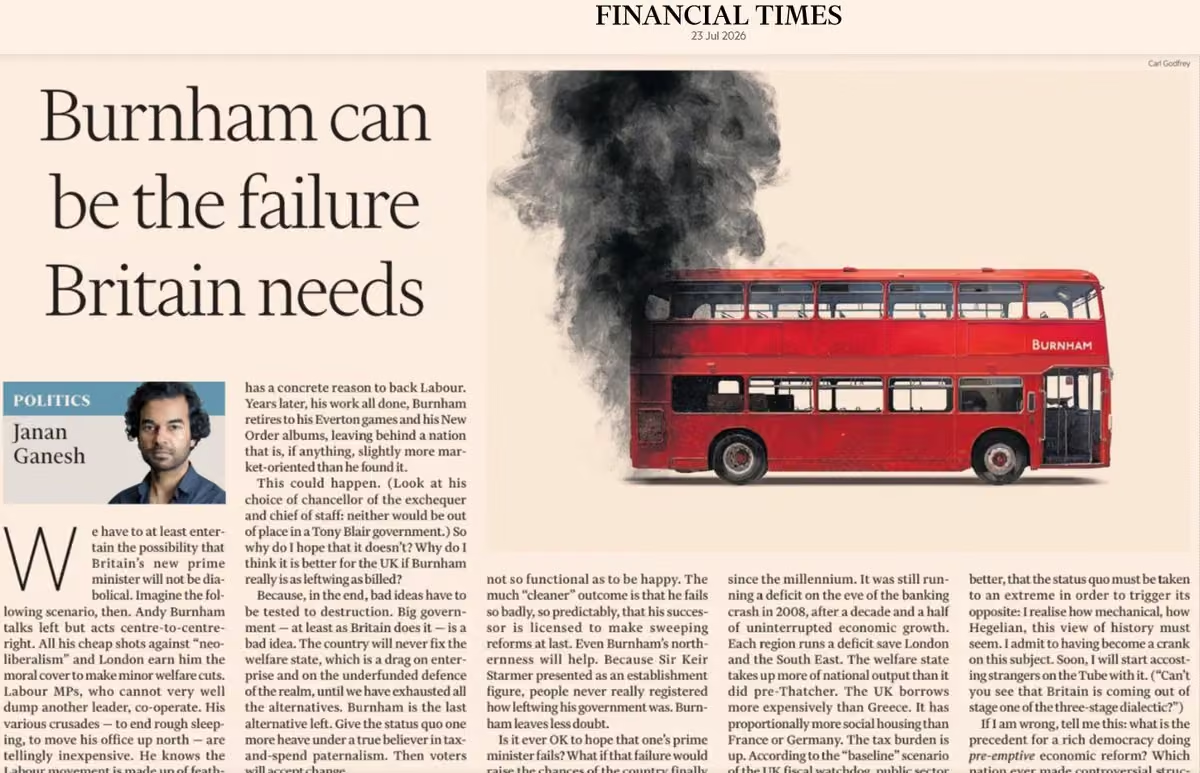 Luke Johnson
@LukeJohnsonRCP
Google exploiting its monopoly more than ever. Thank the Lord AI will decapitate its business model. Can’t happen soon enough.
 Max Anderson
@MaxAnderson
As someone who has personally spent $500k / mo+ on Google Ads for years, I can tell you with certainty:
This revenue growth in Search is artificial & extremely unhealthy for Google’s business long term
Search volumes are declining as legacy search is being increasingly cannibalized by non-monetized LLM queries
Google’s response?
Manufacture revenue growth via short-sighted, highly extractive, customer-hostile tactics. I.e. charge advertisers more for lower quality clicks, including clicks they do not want and explicitly did not approve Google to charge them for
A few examples to illustrate:
For all of its history until recently, Google operated on a 2nd price auction model
I.e. if you bid $5 CPC and the next highest bidder bids $1 CPC, Google charged you $1.01 for the click (one penny more than the 2nd highest bidder) rather than the $5 you bid
This was a genius move by Google early on as it incentivizes advertisers to input their true maximum willingness to pay rather than trying to play the game of bidding low and constantly adjusting to try to stay just ahead of the next highest bidder while still not paying too much
However recently, Google silently deprecated the 2nd price auction and began charging advertisers as much as their bid and budget caps allow, regardless of what anyone else is bidding
It’s a short-sighted cash grab at the expense of the long term health of the advertiser ecosystem
Making thing worse, Google also recently nerfed keyword targeting precision
Google previously had precise keyword targeting settings that allowed advertisers pick individual search phrases to bid on, defined down to the character w/ exact match or phrase match targeting
This was one of the core features that made search advertising magic, enabling advertisers to run extremely precise campaigns based on exactly what their target customer typed
But now, even if you bid on a specific term or phrase using the strictest exact
-match targeting settings, Google will show your ad across 1000’s of unrelated keywords, labeling them as as “exact match (close variant)”
The definition of “close variant” means whatever they want it to and changes constantly. The result is advertisers get billed for clicks that are totally irrelevant to their business and that their targeting settings explicitly forbid Google from targeting. Google does it anyway and there’s no ability to turn this off
So now exact match is broad match, and broad match is just meaningless spam
This is all very bad for advertisers, but for Google, it allows them to show your ad and bill you for clicks across 1000x more searches that were previously going unmonetized (mainly because they’re garbage queries no one wants)
This is how you grow revenue atop declining search volumes
Lastly, and perhaps most egregiously, Google quietly stopped respecting budget caps by a factor of 2x. For example campaigns we’ve been running for years with $1000 daily budget caps suddenly began spending $2000+ per day
And the extra spend is entirely on the garbage keywords Google arbitrarily throws in as “exact match (close variants)” which have no value to our business, but can’t be turned off
Google offers no refunds nor any recourse for overspend or spend on keywords you explicitly did not target
These are not the actions of a healthy business. These are the actions of company whose core business is in decline but desperately needs to pump quarterly earnings so Wall Street will continue to fund insane capex while hopefully looking through their rapidly deteriorating negative free cash flow
Google operated a benevolent monopoly for the better part of 25 yrs
Meaning the value Google captured from Search was but a small fraction of the value it created, and that spread produced a potential energy that justified expectations of high earnings growth far, far into the future
This is now no longer the case
At the alter of AI capex, Google is sacrificing the golden goose
Luke Johnson
@LukeJohnsonRCP
Interesting thread
 Peter Tulip
@peter_tulip
My favourite 10 examples where relaxing planning restrictions substantially increased housing supply.
1) Auckland
2) Sao Paulo
3) Zurich
4) Campbelltown, SA
5) Lower Hutt
6) New York
7) Austin
8) Edmonton
9) Tokyo
10) Croydon
Here’s a tweet or two on each. 1/15
Luke Johnson reposted
Crémieux
@cremieuxrecueil
Want to see a mogging?
Singaporean GDP growth over time, split by leader:
 Crémieux
@cremieuxrecueil
Speaking of Nicaragua, how well has it been governed recently?
'Not very' is an appropriate answer.

Luke Johnson reposted
 Josh Pizzuto-Pomaco
@joshpizpom
TIMELINE of the Princes Street building blaze:
July 2020: Legal and General, then-owner of the B-listed building at 109-112 Princes Street, announces plans to turn the block into a “new hotel and city centre ‘hub’.
May 2021: Debenhams, located at 109 Princes Street, closes.
June 2021: City of Edinburgh Council grants planning permission for a 207-bed four star hotel, a rooftop bar, and city centre business hub at the site.
September 2023: Legal and General pulls out of the £50 million development. The building is placed on the market.
July 2024: Criterion Capital, led by billionaire property magnate Asif Aziz, purchases the building and announces plans to open a Zedwell capsule hotel.
August-September 2024: Three gift shops appear in the Debenhams shell, intially controlled by a firm named Urban Emporium Ltd.
March 2025: Initial planning permission for the 652-bed Zedwell hotel is granted by City of Edinburgh Council, subject to conditions.
September 2025: An investigation reveals that the shops owe hundreds of thousands of pounds in non-domestic rates and are likely not charging VAT on purchases.
By this time, the shops are operated by Kitfox Ltd, under the sole directorship of Uxbridge resident Mohammad Maasoom.
September 2025 - July 2026: At some point, operation of the shops are transferred to a new company, Bwn Beverage Ltd, which on paper is owned by a series of young Bangladeshis living in London.
The names of the shops are changed once again.
November 2025: City of Edinburgh Council officers inspect the premises.
February 2026: Final permission for the Zedwell hotel is granted after the developers and the council reach a legal agreement.
June 2026: Council officers observe that the shops do not appear to be trading.
June 2026 - July 2026: At some point in the month before the fire, officers raid the premises over unpaid non-domestic rates and seize stock.
Luke Johnson
@LukeJohnsonRCP
This is a prime example of how massive construction inflation and burdensome regulations mean we cannot replace current infrastructure. The rebuild costs are apparently £265m! You could build a whole university for that not so long ago. www.bbc.co.uk/news/articles/ce34lxy2793o?app-referrer=search
Luke Johnson reposted
Liam Halligan
@LiamHalligan
I spoke earlier with @JuliaHB1 about Andy Burnham's first days in office.
Luke Johnson
@LukeJohnsonRCP
Building Safety Regulator has helped to destroy home building in London
Alec MacGillis
@AlecMacGillis
"London would need to build 1.1 million more homes to reach the western European average of homes per capita. Last year, Vienna built three times more houses than London, despite being a much smaller city." www.wsj.com/real-estate/london-needs-1-1-million-homes-it…
Luke Johnson
@LukeJohnsonRCP
Everyone needs more books
 Andrew Defty
@adefty
Some years ago our late Head of School, Jacqui Briggs, was asked to speak to staff about reducing the number of books in our rooms in an email which noted that “dust collection was evidence that books are not regularly being used.” This was her superb reply:

Luke Johnson reposted
The Mind Scourge
@TheMindScourge
You have to think about the entire system, not just one small part of it. The idea of putting wheels on a suitcase occurred to many people. There are patents going back to the 1920s at least. It wasn’t something that was overlooked
The reason, rather, is how suitcases were moved within the overall airport experience. Today, bags are mostly checked inside the terminal. In the past, curbside drop-off was the standard practice. That’s what my parents always did in the 90s when I was a kid. You pulled up and a team of skycaps unloaded your luggage onto a cart and then handed it over to the airline. You weren’t moving your bags yourself. Someone else was. So the convenience factor of wheels was not so important.
If you did need to move your luggage around, you rented a trolley. These have mostly disappeared now in airports.
Curbside delivery went into steep decline after 9/11. It’s never recovered. But this isn’t only - or even mostly - a security story. It’s a labor cost one.
You didn’t need wheels on luggage because it was cheap to hire someone to move your luggage for you. Tickets were expensive in modern terms, and more luxuries - like paying someone to carry your suitcases - were available. Today, the competition is at the ticket price level. Something has to give - and that’s extras like porters.
It’s the same as with live in servants. In the 1920s many middle class families could afford live in servants. A century later, essentially no middle class families have a servant. It’s just too expensive. The same is true for porters and luggage. When labor is cheap, you can hire people to do all sorts of tasks. But as it gets more expensive, these jobs are priced out of the market.
Instead, this work is outsourced to the end user - you.
But until all those things change - cheap labor, cheap tickets, etc - wheels don’t make much sense.
Many things in the modern world are like this. Greater efficiency - of money, for the airline’s operations, the workforce labor distribution - at the price of an aesthetic decline. There is greater savoir-faire and panache to having someone handle your luggage for you than doing it yourself. Porting your own luggage is inevitably déclassé and frazzled; it contributes to the inescapable busyness of contemporary life. There is no cultivated leisure - no otium cum dignitate, no flaneuring - to manhandling your own bags
 Jonathan Görtz
@jonathan_gortz
this is insane
 Luke Johnson
@LukeJohnsonRCP
One of the more profound challenges countries like Britain face is that the replacement/upgrade costs for our infrastructure - water/sewage, electricity grid, rail, bridges, hospitals, power stations etc - are simply unaffordable. Building is now just too expensive.
Luke Johnson
@LukeJohnsonRCP
The reality of NetZero stupidity and Britain’s prohibitively expensive energy costs. Our manufacturing is closing down - these facilities will never reopen. www.telegraph.co.uk/business/2026/07/22/britains-oldest-s…
Luke Johnson reposted
 The American Tribune
@TAmTrib
Everyone I know already knows this, but it bears repeating.
Leftists are midwits, with very few exceptions. If you've had any real interaction with them you'll already be painfully aware, though maybe didn't quite know why.
Peter Turchin blames much of the rise of DSA types on "elite overproduction", or colleges creating people who think they deserve status (and money), but who don't actually offer much to society. They think their diploma is proof of intelligence which should equal societal prestige.
Let's not even wade into the replication crisis in science or the lowering of standards across academia (many college freshman can't even read properly).
This is an issue of credentialism. The very same problem we run into with Indian diploma mills. They think, "because I have this piece of paper, that proves I have the expertise and am then owed something". It doesn't matter to them that they have no skills, getting the diploma (by any means) was the skill.
These people also have zero theory of mind, not only for those who have differing opinions from the ones installed in them at university, but also for themselves. They are blind to their own motivations. The leftist thinks he is good because he repeats "good guy" phrases. Meaning or understanding them isn't required.
This is why they flock to socialism. They have degrees in second-rate majors, often taught by mediocre professors, and feel certain this confers to them a right to lead society. Never mind that they aren't capable of the "labor" they demand to keep the value of. Thus they prove to be downwardly mobile, and they hate society for it.
Rather than internalize this failure and forge ahead they blame "the system" or "capitalism" for the status they feel they've been robbed of. They would rather rule over ashes than be the store clerk they should have been all along. They set to work to destroy the system they feel betrayed by. This is why they are so hateful and envious.
If they had never gone to college and gotten a pat on the head and told they were special, they would have been forced into realistic expectations of themselves.
Instead we collectively deal with the pained screeching entitlement of people whose niche in society should have always been a grocery store manager or barista. AOC should have remained a waitress, as many have pointed out.
The encouraging piece, as is always the case, is that our enemies are truly unimpressive people. They rely on our adherence to the ever-degenerating rule of law and our good nature (which is fatiguing).
The moment we decide to simply stop tolerating them their function and influence will disappear to history. But first, most of the colleges must be turned into rubble.
 Nate Silver
@NateSilver538
Income and education are usually positively correlated. But sometimes the relationship breaks down. What's the most Democratic voting group in America? People with post-graduate degrees but lower-to-middle incomes.

Luke Johnson reposted
 Jake Wallis Simons
@JakeWSimons
Absolutely brilliant from @NickFerrariLBC
Luke Johnson reposted
Simon Kuestenmacher
@simongerman600
I consider this a severe problem in Australia. Culturally drinking a bit of beer has lots of positives. In Australia it is part of the general easy going nature. Pricing people out of their evening beer is doing more social harm than health (and tax) good. Beer must become cheaper again! HT @IFM_Economist

Luke Johnson reposted
 max
@maxbochman
best thing ive read this year (from 2025)

Luke Johnson reposted
 Alex Chalmers
@chalmermagne
Mitterrand had the right idea.
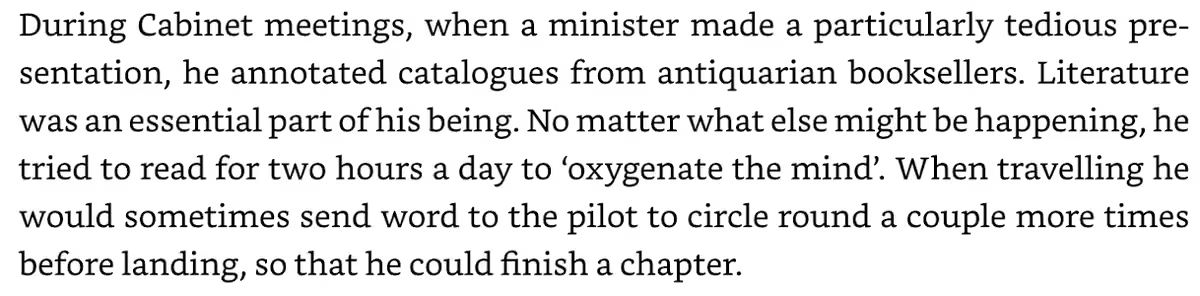 The Mind Scourge
@TheMindScourge
Contrast this with the pre-1950 practice when even in the midst of great crises (WWI, WWII for example) top leaders still took time to write diaries, retire to country estates, and so forth
In 1938, Roosevelt spends almost a month cruising onboard on a US Navy cruiser down the Pacific coast of Mexico, visits the Galapagos and Clipperton, then back to the Caribbean via Panama and disembarks in Pensacola
Chamberlain maintains his hobby of birding in the fall of 1939.
By comparison today, world leaders when nothing especially acute is happening never seem to have time. They’re barely sleeping, “always on”. There’s a cult of busyness in the modern world that seems inescapable. It’s undoubtedly a byproduct of our information ecosystem - everything is a media effect! - but nonetheless is a distinct phenomenon of our present moment
 Clash Report
@clashreport
Japanese Prime Minister Sanae Takaichi says sleeping "0 to 3 hours" a night has become normal since she took office.
The one exception: on July 20 (the last day of the three-day weekend), she said she'd finally gotten "5 hours of sleep for the first time in a while".
 Luke Johnson
@LukeJohnsonRCP
More than three times as many people in Britain are disabled as in Italy. The power of incentives at work…
 Harriet Sergeant
@HarrietSergeant
What’s going on here? Human biology stays the same. But in this OECD graph, it’s geography that dictates disability prevalence - and seems to peak where state support is most generous.
It must be something in the water.

Luke Johnson reposted
Maurice Cousins
@MDC12345678
Great piece by @cjsnowdon on our newly appointed anti-growth Energy Secretary.
Things can get a lot worse.
@spikedonline
www.spiked-online.com/2026/07/21/the-anti-growth-extremis…
Luke Johnson reposted
Andrew Neil
@afneil
Well, that’s one way to make sure nobody ever comes to our country again to make major investments and/or start businesses.
And to make sure those already here quickly scarper.
Good luck forcing them still to pay after they’ve left.
And all for a measly £10bn a year (of course it will be nowhere near that in reality) — 0.7% of actual annual government spending.
Much more, of course, will be lost in capital flight and foregone future investment.
Is the country going bonkers?
Emma Fildes
@emmafildes
A recent study suggests that by imposing a minimum 2% charge on households with more than £100m in wealth; £10bn could be raised annually to HMRC. To stop the wealthy from jumping ship, they’d force the rich to pay the tax for at least 10 years after they quit the UK. They estimated this would affect only 1,000 households and would therefore be easier to implement. Yet the wealthy are also exceptional at hiding wealth so I don’t believe any audit would be straightforward. @phillipinman @guardian theguardian.com/business/2026/…

Luke Johnson reposted
 Joe Armitage
@joe_armitage
I suspected Burnham's new cabinet had no private sector experience but it's starker than I thought ... Two - at a push three - of the cabinet members have done anything except be a council worker, charity or union employee or Labour staffer. Big government is about to get bigger.
 Luke Johnson
@LukeJohnsonRCP
Sleeping that little will unquestionably lead to health issues
Clash Report
@clashreport
Japanese Prime Minister Sanae Takaichi says sleeping "0 to 3 hours" a night has become normal since she took office.
The one exception: on July 20 (the last day of the three-day weekend), she said she'd finally gotten "5 hours of sleep for the first time in a while".
Luke Johnson
@LukeJohnsonRCP
Over educated people who don’t earn much tend to be very resentful and want to see higher taxes on the successful
Nate Silver
@NateSilver538
Income and education are usually positively correlated. But sometimes the relationship breaks down. What's the most Democratic voting group in America? People with post-graduate degrees but lower-to-middle incomes.
Luke Johnson
@LukeJohnsonRCP
There have been ten Foreign Secretaries in British government in the last ten years. No wonder government and the public sector are such a shambles with such ludicrous churn of leadership.
Luke Johnson reposted
 Stuey Beef 🇬🇧🏴
@stuey_beef
The MoJ has just quietly admitted (a good day to bury bad news perhaps??) that Albanian prisoners made 157,962 phone calls from UK jails in just six months – nearly 900 a day – and nobody in government seems remotely alarmed.
Albanians are now the largest foreign nationality in our prisons, with more than 1,200 locked up in England and Wales, representing a huge chunk of all foreign offenders.
At the same time, the National Crime Agency has been warning for years that Albanian gangs dominate the UK cocaine trade, people smuggling and trafficking – negotiating directly with Colombian cartels while British ministers negotiate press releases.
Yet our “tough” justice system allows hundreds of calls a day from cells, to the very networks that flooded our streets with cheap cocaine and trafficked vulnerable people into cannabis farms and brothels.
This isn’t rehabilitation – it’s remote command-and-control for organised crime, subsidised by the British taxpayer.
Luke Johnson reposted
The Jobs Foundation
@TheJobsFndn
📉 Today's ONS figures on employment once again reveal the worrying state of the UK labour market.
🚨 There are now around 2.5 unemployed people for every single job vacancy in the country. Widen that to everyone out of work, and roughly 15 people who are either unemployed or economically inactive are chasing each of the 712,000 vacancies left in the economy, which is the lowest number of vacancies we have seen since early 2021.
📚 Behind that sits the 9.14 million people of working age are now economically inactive, close to one in five of everyone aged 16 to 64 sitting outside the workforce altogether.
🎯 Getting Britain Working must be the defining mission for the new Prime Minister, building the conditions where businesses can invest, grow and get Britain working again.
Get this right is the only way that we can move people from welfare and inactivity into work. 💼
Luke Johnson reposted
The Ways of A Gentleman
@Gentleman_Ways
“Books are the quietest and most constant of friends; they are the most accessible and wisest of counselors, and the most patient of teachers.”
-Charles W. Eliot

Luke Johnson reposted
 J Stewart
@triffic_stuff_
🔥 Jeremy Hunt gave Zack Polanski a few home truths to his face on last night’s Peston.
The former Conservative Chancellor went straight for Zack Polanski when asked about a potential wealth tax:
Peston: “How worried would you be that if one of his earlier acts were a wealth tax that actually that would drive quite a lot of investment offshore?”
Hunt: “I would be extremely worried and I think Zack’s views are totally economically illiterate.”
Hunt then laid out exactly why it would be “incredibly damaging” — killing investment, driving wealth offshore, and hammering growth.
Polanski just sat there stone-faced the whole time 😂
Finally someone said it to his face. Hunt speaking for millions who actually understand how economies work.
Luke Johnson reposted
Guido Fawkes
@GuidoFawkes
Channel Islands licking their lips at prospect of a Wealth Tax in Britain.
Cut My Tax
@CutMyTaxUK
Lord Digby Jones, former Labour Minister of State for Trade, who now lives in Guernsey, has said that Burnham's introduction of a wealth tax would be "marvellous news for introducing new wealth into Guernsey and Jersey".
"About six months ago, a millionaire was leaving Britain every 45 minutes. Twelve billionaires left Britain within six months. That would only be the start of it", he noted.
"The islands would have to stand up against the tax deals that are offered by Switzerland, Italy, Portugal", he explained, adding "they would have to stand up in a globally-competitive environment".
"Is that good for Guernsey and Jersey? Yes - you're at the races - but you've got to get the ball in the net".
It's just great that Labour is doing so much to help Jersey, Guernsey, Italy, Portugal & Switzerland. It’s so neighbourly.
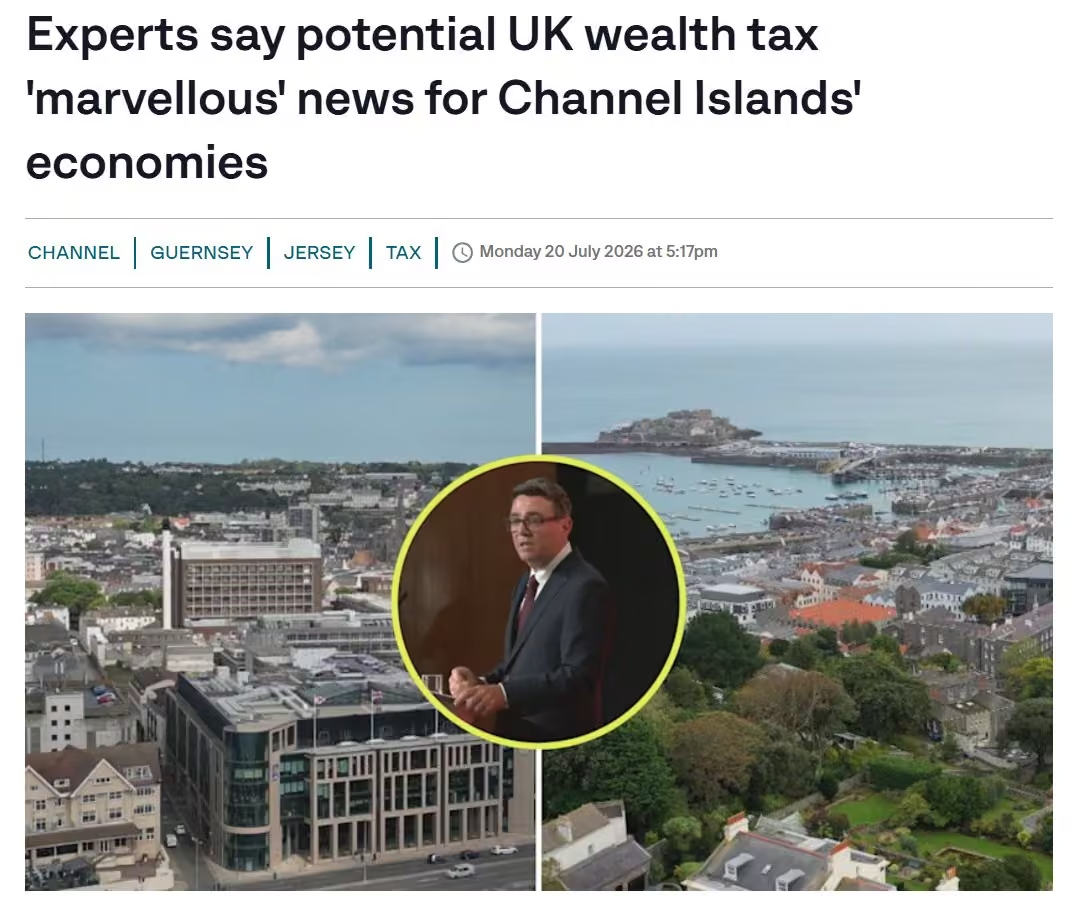
Luke Johnson reposted
 Robert Tyler 🇺🇦🇬🇧🇮🇱🇺🇸
@RGTyler
As an expat, the most staggering thing I notice every time I come back to the UK is just how mollycoddled the country has become. Yellow warning labels on everything, robotic voices constantly nattering instructions, overbearing faux paternalism from staff - its infuriating.
 Miriam Cates
@miriam_cates
Just returned to England after two wonderful weeks in France. Despite visiting dozens of cafés, restaurants, bars, boulangeries and crêperies, we were never once asked if we had any food allergies or intolerances. Incredibly, we all survived.
Luke Johnson
@LukeJohnsonRCP
It was obvious the Renters Rights Act and other burdensome regulations and taxes would lead to fewer properties for rent. Lo and behold…
Emma Fildes
@emmafildes
Buy-to-let stock levels have diminished in response to increased costs and legislation causing rents to rise. The new PM Andy Burnham is reported to be considering rental caps. This option though seemingly well meaning could further take its toll on long term stock levels where they are most needed. As is, "the number of flatshares in inner London dropped by 5pc in the second quarter of 2026 compared with the same period last year, according to figures from website SpareRoom." @Telegraph www.telegraph.co.uk/money/property/buy-to-let/london-rent…

Luke Johnson reposted
 L🇬🇧as Ohl
@lukas_ohl
As China keeps getting richer (relative to Britain), eventually there’ll be no cheap cars available from anywhere. The average age of cars in the UK has already risen significantly; it will keep rising unless the economy turns around.
 tyro
@DoubleEph
Story that's just too perfect at illustrating the UK and Europe now:
> Politicians pile on regulations as demanded by consumers
> Costs shoot up dramatically
> Govt compounds the pain by applying a tax (to pay for welfare)
> Consumers flee the consequences of their own demands to cheaper Chinese alternatives


Luke Johnson reposted
Hedgie
@HedgieMarkets
🦔The Wall Street Journal reports that multiple data center builders are simultaneously trying to sell majority stakes in their companies. Netrality, DataBank, Edged, and EdgeCore are all working with bankers to find buyers this summer. DataBank alone could go for $25 billion. These aren't companies selling a few properties. They're selling control of their entire businesses to private equity while the AI buildout is supposedly booming.
My Take
If AI data centers are the gold mine these companies have been telling investors they are, why are the people who built them racing to sell? The WSJ said they're "cashing in on a hot asset class." I'd read it differently. The people closest to the actual economics of building and operating these facilities all decided at the same time that they'd rather have someone else's money than their own equity. That looks a lot more like an exit than a diversification play.
Huang just said a gigawatt of AI compute could cost $100 billion, GPU hardware goes obsolete every 18 months, and local opposition is killing permits in state after state. The customer base is mostly unprofitable AI companies signing leases with investor money, not earned revenue. The builders see all of this up close every day, and they've collectively decided this is a good time to let someone else own the risk going forward.
Hedgie🤗
www.wsj.com/finance/investing/data-center-builders-are-ra…
Luke Johnson reposted
Cut My Tax
@CutMyTaxUK
Some common sense from JP Morgan CEO Jamie Dimon about over-taxed Britain.
Warning that further tax hikes on banks would have "adverse consequences," he pointed out that"tf you have an uncompetitive tax system, capital leaves your country."
“And if capital leaves your country, it goes to other countries. And you see that now. How many companies have delisted from London in the last couple of years? I wouldn’t want to see that if I was running a country.”
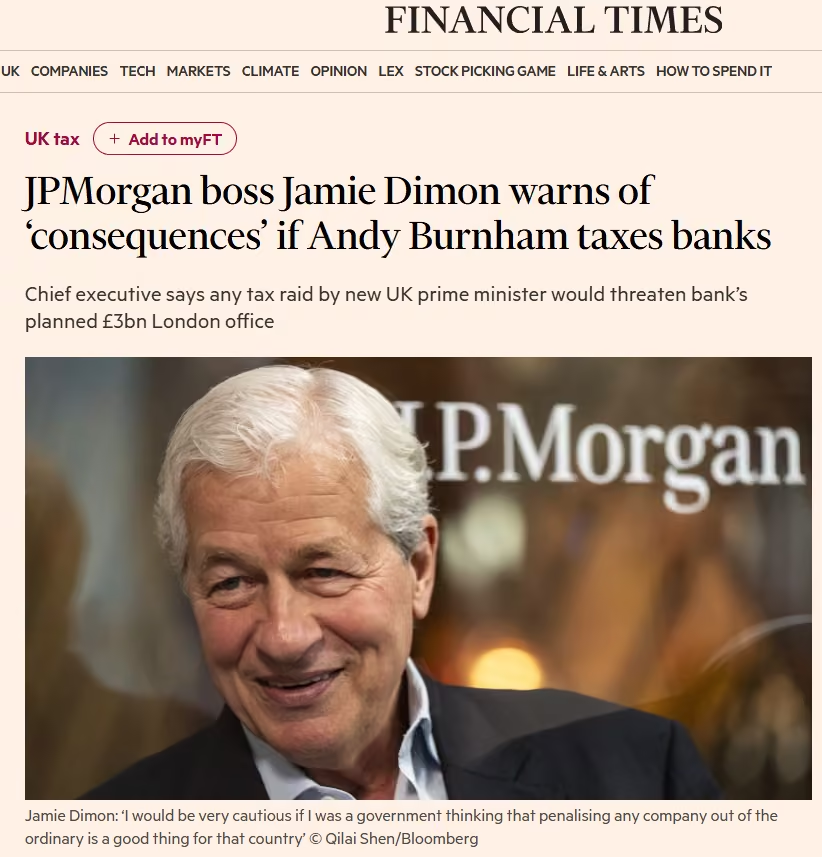
Luke Johnson reposted
S Sebag Montefiore
@simonmontefiore
As we watch today’s events – the meteoric ascent to executive power of a veteran professional politician who became an MP for the second time just a few days ago – nothing so demonstrates the phenomenum of what I call Momentous Inevitability, the process of momentum whereby with rowing unanimity, power flows to a single player, first slowly as that rise appears unlikely, then as other contenders fail to win support and other pathways close and suddenly a consensus regards this one individual as the panacea, the solution to all problems, the only possibility, the only tonic to the ills of the time, ever more quickly until in a matter of days a succession goes from a total impossibility to a vague possibility to become the urgent and unstoppable and felicitous inevitable present certainty.
In the mysterious alchemy of authority, power switches with astonishing speed from a waning leader and flows fluidly to the rising new one who miraculously emerges gilded with the plenitude and prestige of power – a fascinating moment . Momentous Inevitability comes into play particularly when orderly systems are in crisis or are regarded as having failed or stalled. In our democracies, a similar process led to the presidency of Charles de Gaulle or the premiership of Boris Johnson. History is full of such moments and without an accepted phrase for this phenomenum I came up with this one in The World: A Family History of Humanity.
Whatever the system or the obstacles, Momentous Inevitability has the ability to overcome all and smooth every way – as we are seeing right now as the prime ministerial Range Rover wends to Downing Street….
 BBC Breaking News
@BBCBreaking
Andy Burnham arrives at Buckingham Palace where King Charles will instruct him to form a government - making him the new UK prime minister
Follow live: www.bbc.co.uk/news/live/cgrkv8e8l9qt?at_bbc_team=editorial
Luke Johnson reposted
Tom Harwood
@tomhfh
Literally the tax policy of the last Tory government.
At some point we need to recognise relentlessly hammering the most economically productive people in the country might not be something we can do forever with no consequences.

Luke Johnson reposted
Hedgie
@HedgieMarkets
🦔Goldman Sachs' trading desk said there are "signs of panic" among investors lending money to AI companies. Oracle is the clearest example. S&P cut Oracle's credit rating to one notch above junk, meaning lenders now see the company as borderline risky. Half of Oracle's future revenue depends on OpenAI, which has never turned a profit. Investors who lend to Oracle are now charging significantly more than they charge other big tech companies because they're less confident they'll get paid back.
My Take
I posted about Oracle's downgrade last week. This Goldman note makes it worse. Stock investors and bond investors are looking at the same AI companies and coming to opposite conclusions. Stock investors see growth. Bond investors see companies spending more than they earn and borrowing the difference. When those two views diverge, the bond market usually ends up being right because those investors only care about one thing: does the money come back.
Oracle has a $42 billion cash shortfall projected by 2027 and is financing it with debt. Its data center leases run 19 years but its customer contracts run 5. If OpenAI can't pay, Oracle is stuck with buildings it can't easily fill. Goldman's warning didn't come from a research analyst writing a report. It came from the trading desk, the people who watch money move in real time. This week Alphabet and Tesla report earnings. How those numbers land will either settle the bond market down or confirm what Goldman's traders are already seeing.
Hedgie🤗

Luke Johnson reposted
 César A. Hidalgo
@cesifoti
Argentina’s behavioral crisis in the World Cup final has brought to light traits many of us in Latin America have internalized and that we need to come to terms with.
In many countries, emotional self-control and the ability to admit mistakes are seen as virtues. A behavioral problem in parts of Latin America is that there are social circles where the opposite is often celebrated.
This is the idea that someone who remains in control of their emotions is a coward or, depending on the situation, a traitor.
If someone offends you, your family, your team, the reaction that is celebrated in these circles is not restraint but flipping the table. The more berserk you go, the more you show that you care. That is a harmful value to hold, and also, one that many of us once shared. I certainly had it internalized when I left Chile 20+ years ago. In fact, I’ve spent much of my adult life trying to unlearn what I grew up believing was the socially acceptable behavior.
The second trait is an unwillingness to admit mistakes. You can always find an excuse, move the goalposts, or, once again, start a fight instead of publicly accepting that you’ve made a mistake. Admitting fault is a sign of weakness. Defending a losing position is a symbol of courage or, in sports, a test of loyalty.
Together, these two traits are behavioral dynamite. People explode because they cannot admit fault, and double down. Instead of learning from their mistakes, they become prisoners of them.
I grew up watching football with my father. When I was 10 or so, I was learning what was right and wrong from the way he interpreted the game. This included behavior both on and off the field. Only later in life did I realize that every penalty he called for, or contested, had little to do with the play itself. Whether a call was fair depended entirely on which team benefited. He was happy if his team received a nonexistent penalty or an opposing player got an undeserved red card.
These traits are among the things that pushed me away from the continent. They are certainly not exclusive to Latin America or the Southern Cone. I’ve encountered them in people all over the world. In an important sense, these are behaviors that all of us exhibit as children. What strikes me as unusual from the place I am from is having been part of social circles where these behaviors were not seen as flaws of character but as virtues to be admired, celebrated, and enforced.
These excessive forms of pride are not conducive to learning. They make it psychologically difficult to update one’s beliefs, accept responsibility, or improve. Although they become particularly visible in sports, they are by no means confined to them.
Something I am proud to have learned is to apologize quickly and often. Not because it is too difficult, but because it was like learning a new language at old age. That doesn’t mean becoming a pushover. But I’ve learned that a man who never apologizes cannot be a man of integrity, because we all make mistakes.
Argentina’s behavior on and off the field during the World Cup final was, to me, a particularly blatant expression of values that many people continue to defend. In some circles, these attitudes have become intertwined with ideas of national identity and loyalty. Yet they are shackles that ultimately limit our development, not because they make us lose a football match, but because they make it harder for us to learn from our mistakes.
The right thing to do now is the least likely: offer an honest apology. If my interpretation is even partially correct, we are more likely to see the opposite. Never back down. Never apologize. Never control your emotions. There is such a thing as having the wrong values. I hope that one day we can do better.
Luke Johnson reposted
Hedgie
@HedgieMarkets
🦔A Nikkei investigation found that Alphabet, Microsoft, Amazon, Meta, and Oracle have $1.65 trillion in debt that doesn't appear on their balance sheets, more than the $1.35 trillion they officially report. These are GPU contracts, data center leases, and joint ventures that don't count as debt under accounting rules until the facilities go live. Meta's hidden debt is $420 billion, triple its reported debt. Oracle's grew 30-fold in four years. All five declined to comment.
My Take
Nikkei examined the actual filings and put a number on something the BIS already flagged as "shadow borrowing" back in March. These companies owe more off their balance sheets than on them, and the accounting rules let them keep it that way until the data centers go live. That's legal, but it means investors looking at quarterly earnings this week are seeing less than half the picture.
Four of these five report earnings in the next two weeks. The reported debt will look manageable. The $1.65 trillion in footnotes won't make the headlines. But when those data centers start operating, the leases hit the books all at once. If AI demand comes in below projections, those facilities get marked down and the losses land on the investors and insurance policyholders who funded the construction through private credit and project bonds without realizing how much total exposure they were carrying.
Hedgie🤗

Luke Johnson reposted
 Chris
@chrideas
This is probably one of the most useful paragraphs I have ever read.
Particularly the last sentence.

Luke Johnson reposted
 Niall Ferguson
@nfergus
"The University of Austin Did Something Every College Should" - posted its entire undergraduate reading list online - 224 books, essays, and primary sources, course by course and professor by professor for anyone to examine. www.realcleareducation.com/articles/2026/07/19/the_univer…
Luke Johnson reposted
Cut My Tax
@CutMyTaxUK
Does the appointment of John Healey as Chancellor mean we will get lower capital gains tax rates?
As a Minister in the Blair-Brown Treasury, he boasted in 2002 that “We have cut corporation tax, capital gains tax & small business tax.”
In July 2003 he listed among the Government’s economic achievements: “Reduced corporation tax rates and major reforms to capital gains tax to enhance the UK as an internationally competitive location for business.”
Labour could boost revenues and entrepreneurship by slashing CGT rates to 10%, as in the Blair-Brown era.
www.cutmytax.org/post/labour-should-follow-gordon-brown-i…
Luke Johnson reposted
 UK Property Insight
@ukhpinfo
In real terms, London Flat prices have fallen over 30% from the peak.
 Luke Johnson
@LukeJohnsonRCP
Drivel like this is why citizens think politicians are dishonest
 Rachel Reeves
@RachelReevesMP
It has been the privilege of my life to serve as the Chancellor of the Exchequer.
The economy today is stronger, fairer and more resilient because of the choices we have taken as a Labour Government over the past two years.
Stability restored, investment delivered and reform to our economy under way. I said when I was appointed Chancellor that I would judge my time in office if the lives ordinary working class people have been improved. I’m proud to say that they have.
And to every young woman and girl let my time in office show there should be no ceilings on your ambitions, your hopes or your dreams.
I wish the very best of luck to my successor, Andy and his cabinet. You have my full support, and I will continue to play my part in helping this Labour government deliver the change the country needs.
Luke Johnson reposted
Voices of WW2
@VoicesofWW2
Ask most people to name the best British general of World War Two and they will say Montgomery. Ask the historians who study it closely and a lot of them will quietly tell you the real answer is a man most people have never heard of. His name was William Slim, and his soldiers just called him Uncle Bill.
Slim was not born into any of it. No fortune, no famous family, no smooth path through the elite schools that produced most British generals. He was a working class kid who had been a teacher and a clerk, and he only slipped into the army through a technicality before the First World War. He got shot up at Gallipoli, wounded again in the Middle East, and clawed his way up the ranks the hard way, on merit, one rung at a time.
By 1942 he was handed one of the worst jobs in the entire war. The Japanese had smashed the British in Burma, and Slim was put in charge of the retreat. It became the longest fighting withdrawal in British military history, close to a thousand miles back to the border of India, through jungle and mountains, hounded the whole way. Most commanders are remembered for the battles they win. Slim first had to prove himself by saving a beaten army from being wiped out, and he brought it home still fighting.
Then he did the thing that should make him a household name. He took that broken, sick, forgotten army, an incredible mix of British, Indian, African, and Gurkha soldiers, and he rebuilt it from the ground up. He got a grip on the malaria that was dropping more men than bullets. He fixed the food, the training, the supply, and above all the morale. He walked among the troops constantly, talked to them like human beings, and made them believe again. They started calling themselves the Forgotten Army, half proud and half bitter, because the war in Europe got all the headlines while they bled in the jungle.
In 1944 the Japanese threw everything into a massive invasion of India, aimed at Imphal and Kohima. Slim let them come, stretched their supply lines to breaking, and then broke them. The fighting at Kohima was so brutal it has been called the Stalingrad of the East, with men grenading each other across a district commissioner's tennis court. When it was over, the Japanese had suffered the single greatest defeat their army had ever endured on land. Tens of thousands of them never went home.
And Slim was not finished. In 1945 he pulled off a masterpiece of deception, faked out the Japanese about where he would cross the Irrawaddy river, seized the town of Meiktila and cut the enemy in half, then drove all the way to Rangoon and finished the reconquest of Burma. He had taken the most humiliating defeat in British Far Eastern history and turned it completely inside out. He literally titled his memoir Defeat into Victory, and it is still considered one of the finest books a soldier has ever written.
What his men remembered was not the strategy. It was that he never lied to them, never wasted them, and never forgot they were people. In a war full of commanders who spent lives cheaply and hungered for glory, Uncle Bill did the opposite, and they loved him for it. He ended his life as a viscount and the Governor General of Australia, but the title that mattered was the one his soldiers gave him.
Montgomery got the fame. Slim got the respect of the people who actually knew.
 Luke Johnson
@LukeJohnsonRCP
France has its share of bureaucrats, but on many health and safety issues they have a more rational and proportionate approach. It’s one reason why infrastructure costs so much in the UK compared to France.
Miriam Cates
@miriam_cates
Just returned to England after two wonderful weeks in France. Despite visiting dozens of cafés, restaurants, bars, boulangeries and crêperies, we were never once asked if we had any food allergies or intolerances. Incredibly, we all survived.
Luke Johnson reposted
 Andrew Montford
@aDissentient
As well as the £6-10 trillion cost of Net Zero, the climate nutters have got us on the hook for £4 trillion of climate reparations.

Luke Johnson reposted
Maurice Cousins
@MDC12345678
Following Andy Burnham’s comments today, Margaret Thatcher’s arguments about capitalism and the morality of free enterprise are worth revisiting.
Personally, I do not think she would have been surprised by any of Burnham’s comments. She anticipated this argument in her final book and criticised the complacency of free-enterprise advocates who assumed that the end of the Cold War had permanently settled the contest between capitalism and its critics.
As she wrote in 2002: "the struggle between two quite different approaches [socialism vs free enterprise capitalism] to the political, social and economic organisation of human beings has not ended and will never end."
Source: Statecraft (2002).


Luke Johnson reposted
 Matthew Stafford
@mstafford
"Labour’s mistake began from the outset. It assumed that Britain’s fundamental problem was simply that the government didn’t spend enough...
"But what the Labour government needs isn’t more public spending. It needs a theory of growth. Growth does not require an entrepreneurial state. It requires a government willing to step aside...
"Economic growth does not emerge from offices in Whitehall. It emerges from the garages, workshops, and start-ups of entrepreneurs"
Why Are So Many Millionaires Leaving The UK?
www.zerohedge.com/political/why-are-so-many-millionaires-… by @TylerDurden on @zerohedge
Luke Johnson
@LukeJohnsonRCP
I think blaming Starmer for the rain and Mrs Brown’s Boys is a bit harsh.
Luke Johnson reposted
 Joshi Herrmann
@joshi
I’m staggered that Burnham has promised to end rough sleeping across the country. It was his biggest promise when he became mayor of Greater Manchester and he didn’t come close. Here are the numbers, as revealed by @ManchesterMill last month.

Luke Johnson reposted
 Matt Clifford
@matthewclifford
This is excellent from Chris Curtis, Labour MP - required reading for the new government…

Luke Johnson reposted
Paul Johnson
@PJTheEconomist
Neither big party wants to acknowledge this.
Between 2010 and 2024 share of tax paid by high earners rose sharply.
Big cuts in higher and additional rate thresholds, and in pension tax relief, hit them hard.
Trade offs as ever. But please let’s not pretend this didn’t happen.
Luke Johnson reposted
Barchart
@Barchart
Hyperscaler Free Cash flow will turn negative by next year 🚨 🚨

Luke Johnson reposted
The Free Speech Union
@SpeechUnion
🚨🚨 Education Secretary Bridget Phillipson spent more than £500,000 of taxpayers’ money trying to water down university free speech laws.
Ms Phillipson launched a bid to dilute the Higher Education (Freedom of Speech) Act 2023 (HEFSA), which she branded a “Tory hate speech charter”.
The Act was introduced after countless staff and students were hounded out of their jobs or ostracised by their peers for expressing their lawfully held views on campus. The Free Speech Union has proudly supported many of those affected.
Bridget Phillipson’s attempt to weaken the law was successfully thwarted after the Free Speech Union launched a legal challenge against the Education Secretary.
The High Court has now ruled that the Government should pay the Free Speech Union’s legal costs of £353,748, taking the total bill to more than £500,000 once the Government’s own legal costs are included.
When Labour came to power in 2024, Phillipson announced that she would halt the implementation of HEFSA, which had been passed by the previous Conservative Government.
Internal documents disclosed during the litigation showed that officials had been instructed to have a statutory instrument ready to pause the Act “on day one” and that the Secretary of State did not intend to implement the Act in full.
In January 2025, however, the Education Secretary performed a U-turn and told Parliament that the majority of the Act’s provisions would be implemented.
The Free Speech Union offered to withdraw its claim in return for a fixed costs payment of £84,000. The Government refused, offering instead a “drop hands” settlement under which the FSU, despite having won in substance, would recover nothing. Since then, costs have spiralled as expensive KCs have argued over the remaining issues.
General Secretary of the Free Speech Union, Lord Young of Acton, said: “The significance of this judicial decision is that it confirms our view, and the view of our lawyers, that we won this case and the Education Secretary lost. Costs are awarded to the winners, with the losers having to pay.
‘Judicial reviews are expensive, but thanks to this award of costs we’ll have enough money in our bank account.’”
Read more below 👇

Luke Johnson reposted
Neil O'Brien
@NeilDotObrien
So Labour:
- Have admitted having the migrant crime statistics
- Have been told to release them by the Information Commissioner
- Are STILL refusing
> Unreal
 Centre for Migration Control
@migrationCtrl
🚨Labour has launched a legal bid to stop the publication of migrant crime statistics. What are they hiding?
If we want to see all foreign criminals deported, then the public must have access to this information.
Help the CMC stop the cover-up.
Luke Johnson reposted
Mario Nawfal
@MarioNawfal
🇺🇸 The U.S is quietly splitting into two economies.
On the surface, everything looks fine. Stocks are pushing higher, credit markets are calm, and Wall Street barely reacted even after 372 large U.S. companies filed for bankruptcy in the first half of 2026, the highest first-half total since 2010.
But look beneath the headlines and it's a completely different story.
Commercial Chapter 11 filings jumped 28% in just one year, small-business reorganizations surged 50%, and total commercial bankruptcies climbed 13%.
These aren't Fortune 500 giants; they're the companies that don't have billion-dollar lifelines or easy access to refinancing.
The biggest corporations can still kick the can down the road, but smaller businesses can't.
Years of high interest rates have created a system where Wall Street can refinance its debt while Main Street is left to drown.
Even private-credit defaults hit a record 9.2% last year, with the pain concentrated among smaller borrowers.
The real warning isn't the record number of bankruptcies.
It's that the market is acting as if nothing is wrong while the cracks underneath keep getting wider.
Sources: Reuters, Bloomberg, @shanaka86 / Writer: Ian

Luke Johnson reposted
Hugo Gye
@HugoGye
The final verdict: Starmer's government has underperformed
@TheEconomist 'Starmer tracker' stands at 36/100, a small improvement from when the outgoing PM took office
Details: www.economist.com/britain/2026/07/17/the-final-score-on-s…

Luke Johnson reposted
spiked
@spikedonline
We need to talk about the charity-industrial complex. Woke activist charities and NGOs with millions of pounds at their disposal have far more influence on democracy than shady millionaires. It’s time they were treated like every other lobbyist, says Andrew Tettenborn
Luke Johnson reposted
Handre
@Handre
New startup idea: a socialist-themed holiday camp where affluent Westerners pay premium prices to experience the system they keep voting for.
Picture it. You arrive at Camp VS (Virtue Signal) and hand over your passport (you won't need it, exit visas take eleven years to process). Staff assign you to a concrete panel block, 320 square feet, shared with two other families you've never met. The heating works from 6 to 8 a.m. The elevator works never. Authentic Khrushchyovka construction, guaranteed.
Your daily itinerary: Wake at 5 a.m. Stand in the bread line until noon in minus 15 Celsius. The bread runs out at 11:40, but the queuing builds character, and character is the only thing not in shortage. Afternoon activities include a second line for toilet paper (there is no toilet paper) and a mandatory lecture on how the shortages prove capitalism sabotaged the harvest.
For guests seeking the deluxe package, we offer the Gulag Experience: rock-busting in a quarry under armed supervision, with optional whipping for anyone who fulfills less than 110 percent of quota. Aleksandr Solzhenitsyn wrote 1,800 pages about this amenity. Rave reviews, in a sense.
Every fourth guest works as an informant. You won't know which one. Complaining about the food earns you a midnight interview with camp security, and the food gives you plenty to complain about: it's cabbage. All of it. Abolish market prices and you abolish economic calculation, so nobody can know what to produce, in what quantity, or for whom. The planners guess. The planners guess cabbage.
Checkout is where the theme really lands. You can't. The wall around the camp faces inward, and East Germany shot 140 people at theirs between 1961 and 1989 to keep paying customers from leaving the workers' paradise.
The irony here is that this business would only survive under capitalism, because it needs voluntary customers, market prices, and profit signals to exist at all. Run it as an actual socialist enterprise and within a year the camp has no bread, no rocks, and no guests. Just like the original.
 Luke Johnson
@LukeJohnsonRCP
Interesting how defence industry (arms making) has gone from being beyond the pale for many institutional investors to a core sector. Almost as if ESG rules were always bureaucratic claptrap.
Luke Johnson reposted
 Simon Danczuk
@SimonDanczuk
If you read one thing today read this. A young male student friend of Peter Kyle and Peter Mandelson gets incredible access to government, including the PM - it matches his commercial interests. What do you think’s going on?…

Luke Johnson reposted
 Aaron Carr
@aaronAcarr
Meanwhile, in Austin, years of allowing a fck ton of housing to be built have left landlords desperate to fill units, and rents are falling as a result
The most utterly depressing part about NYC’s housing crisis (and the tsunami of human suffering it has unleashed) is that it’s almost entirely a policy choice

 Alexandra Semenova
@alexandraandnyc
Applying to rent an apartment in NYC is a humiliation ritual

Luke Johnson reposted
Centre for Policy Studies
@CPSThinkTank
Andy Burnham has pledged ‘the biggest council house building programme since the post-war period’.
But our research shows that housing subsidies in England already total £79bn a year, and the UK has the 4th highest share of social homes in the OECD, double the EU average.🧵

Luke Johnson reposted
Alan Smith
@AlanJLSmith
Serial entrepreneur Phil Hollingdale has founded, scaled and exited 6 companies.
He sold everything, put his family home on the line, slept in his office for weeks at a time.
He’s employed thousands of people and paid millions £ in tax.
Increase CGT rates again and he’s leaving the UK.
There are thousands of Phils across the country.
Luke Johnson reposted
 Stacy is Right
@PoliticalStacy
Happy anniversary and congratulations to Cuba on 60 years of rent control.

Luke Johnson reposted
The Free Speech Union
@SpeechUnion
Anti-trans views have been classified as misinformation in a Government commissioned review.
The 136-page report has classified “anti-LGBTQ+ narratives” as a type of “false and misleading information”.
Other types of “misleading” information identified by the report include “electoral fraud claims” and attempts at the “institutional delegitimisation” of the EU.
Another category on immigration covers “false claims about migrant entitlements, misrepresentation of the demographic composition of migrant arrivals, and the misattribution of criminal acts to migrant communities”.
The reports authors have also encouraged the Government to increase its monitoring of misleading information and prioritise tackling the “harms” caused by certain claims, rather than focusing too much on the “intent” behind them.
Read more below 👇

Luke Johnson reposted
Mike Gardner
@mikegardner_wb
Boris Johnson’s silly bluster in response Trevor Phillips’ question about immigration exposes his maddening flaws perfectly.
First he ducks the question. Then he fibs unashamedly that Reform (aka the Brexit Party) didn’t “do a bean”to get Brexit done.
He “forgets” that it was they who got May fired so he could become PM. They also helped him win the 2019 election by standing down in Red Wall seats.
As he correctly says, Brexit finally gave us the power to control immigration. But inexplicably he failed to use it.
Starmeresque levels of denial.
Luke Johnson
@LukeJohnsonRCP
These are all sound ideas
Andrew Neil
@afneil
1. Transfer the tens of billions earmarked for net zero to defence and supply chain resilience, to create a major industrial/defence sector, thereby creating skilled jobs in UK, rather than China (as net zero does)
2. Radical tough love welfare reform to get 1m people of working age into work, thereby cutting the welfare bill and increasing the tax base. Coupled with massive expansion of German-class STEM skill apprenticeships.
3. Radical reform of planning laws to stop nimbys/greens from thwarting every major infrastructure development. Put judges/courts in their place when it comes to such matters.
4. Put rocket boosters under high-speed rail link between Leeds-Manchester-Liverpool. Brook no opposition/delay.
5. Unleash North Sea oil/gas + slash energy bills by removing all green levies. New breed of gas-fired and smaller nuke generating stations.
Much more to suggest. But this should be good for starters.
Luke Johnson
@LukeJohnsonRCP
Possibly the worst PM in modern history
Charlie
@charliecolecc
Can you spot the nonsense?
 Luke Johnson
@LukeJohnsonRCP
The state runs things badly and typically has no competition, so no market discipline.
Robert Colvile
@rcolvile
First, in Britain as elsewhere, prices controlled by the state have risen much more than those controlled by the market! Eg food and clothing are 'essentials' by any measure. Yet private sector competition drives huge benefits without 'public control' of Tesco or Next.

Luke Johnson reposted
Andrew Neil
@afneil
Usual obfuscatory nonsense from BoJo. Here are the actual legal net migration stats for the relevant years:
2019: +184,000 (pre-pandemic)
2020: +93,000 (so almost 100k despite pandemic restrictions)
2021: +467,000 (post-pandemic bounce)
2022: +891,000 (now he’s lost control of the numbers)
2023: +848,000 (his successors fail to get control of what he left behind)
2024: +331,000 (falling at last — but still about 150,000 pre-pandemic 20199)
And that, mes enfants, is the Boris Wave.
Luke Johnson
@LukeJohnsonRCP
The Boriswave will be his epitaph. A deeply negligent and mendacious man.
Sky News
@SkyNews
"It's nonsense, it's nonsense!"
Former PM Boris Johnson is challenged by @TrevorPTweet over the 'Boriswave' of migration.
news.sky.com/story/politics-latest-burnham-starmer-labour…
📺 Sky 501, Virgin 602, Freeview 233 and YouTube
Luke Johnson reposted
Andrew Neil
@afneil
The case for public ownership is strongest when we’re talking natural monopolies. Even then taxes need to rise to pay for costs/losses and all the capex required. Of course that rarely happens. Instead state-owned monopolies are starved of investment as politicians prioritise more immediate needs eg welfare spending, public sector pay etc. That’s exactly what happened in ALL the state-owned industries/services between 1945 and 1980.
 Amelia
@amelia_tweetz
I don’t care how “efficient” the private sector is.
Some services should never be run as businesses.
Health care. Water. Electricity. Gas. Prisons.
If a company makes more money when people get sicker, stay locked up longer, or have no choice but to pay, that’s a system built on conflicting interests.
Luke Johnson reposted
 Spencer Pratt
@spencerpratt
The Eastern Columbia art deco masterpiece that mogs the modern LA skyline was built in 9 months during the Great Depression.
Down the street, the Graffiti Towers have been under construction for the last 11 years.
Don’t let communists run your city.


 Zane Hengsperger
@zanehengsperger
how long it took America to build things:
transcontinental railroad: 6 years (1869)
Empire State Building: 410 days (1931)
golden gate bridge: 4 years (1937)
hoover dam: 5 years, finished 2 years early (1936)
the pentagon, largest office building on earth: 16 months (1943)
alaska highway, 1,700 miles through wilderness: 8 months (1942)
a liberty ship: 42 days average, one built in 4 days as a stunt (1943)


Luke Johnson reposted
Jesús Fernández-Villaverde
@JesusFerna7026
Many economists forget that the first-order problem of an aging society, one with high life expectancy and low fertility, is how to redistribute income from workers to retirees. How fast output grows is, surprisingly enough, the lesser question.
If you have roughly as many retirees as workers, what each worker produces must be split in two, one part for the worker, one part for the retiree. At a basic level, it does not matter whether we do it through taxes, as in a pay-as-you-go social security system, or through capital income, as in a fully funded one. Workers will not be happy to see half of their income taken away, whatever the absolute level of that income.
This redistribution will poison the political system and lead, with high probability, to dysfunctional policies. We are already seeing it across Europe in the fights over retirement benefits. And much of the American unhappiness about the profits of large corporations, largely owned by the old, is the same conflict, only in the fetishized form of equity ownership.
Claims of the form “technological progress (e.g., advances in AI) will fix the problems brought by aging” miss the political economy of the situation. Aging is about politics, not TFP.

Luke Johnson reposted
Liam Halligan
@LiamHalligan
As Andy Burnham enters Downing Street determined to be “distinctively Labour” and “unashamedly Labour”, it is clear that taxes – despite a tax burden now at 38pc and on course to reach around 41pc of GDP by 2029 – will increase further still.
The UK economy is locked in a high-debt, high-tax, low-growth doom loop, with the debt interest bill spiralling as the national debt rises ever higher.
Inflation is coming – the producer price index rose a staggering 8.7pc during the year to May, up from 7.9pc the previous month – and there will be little respite from a lower oil price.
And that inflation will push up immediate borrowing costs and debt interest payments even more.
“From here, we do it differently,” said Burnham on Friday. “We win by being us.”
But by “us”, Burnham means Labour. And for the country, Labour spells economic ruin.
My latest weekly “Economic Agenda” column in @Telegraph
www.telegraph.co.uk/business/2026/07/19/burnhams-unashame…
Luke Johnson reposted
Paul Graham
@paulg
Trial lawyers are lobbying against self-driving cars because they're too safe. They need people to be killed and injured so that they have material for lawsuits.

Luke Johnson reposted
 Andrew Dowson
@AndrewDowson
Admiralty Arch should be an interesting hotel when it opens as the Waldorf Astoria in the autumn this year. Quite amazing the number of new 5 star hotels that have opened in London in the last 5 or so years. 50 years ago there were exactly 7, now 150 plus.
Luke Johnson reposted
nic carter
@nic_carter
My jaw dropped reading this
Who is most opposed to self driving cars?
Ambulance chasing lawyers who sue over car accidents
They are explicitly on the side of preventable death.
Luke Johnson reposted
Harry Wallop
@hwallop
What’s the secret to @tobycarvery? How can it make money when it offers “unlimited” carvery 8am to 10pm? And meat wholesale prices have 📈?
And why has it become vaguely cool?
I spent all day there to find out…🧵1/5

Luke Johnson reposted
 Mor Edge Insight
@MorEdge_Insight
This AI Ryanair parody is one of the best things you’ll see today… because it’s so close to reality 🤣
Honestly, I can’t stop laughing 😆
Credit to British Brainrot
Luke Johnson reposted
 Nick Dixon
@NickDixon
This is one of the most fascinating experiments in history.
Can you get a group to punish people of their own ethnicity, simply for being of that ethnicity?
Can you do this even when they’ve previously been repeatedly told to not be racist, or even think of people in terms of their race or ethnicity at all?
Can you do this even though it will destroy countless careers, cause a competency crisis, and eventually lead to the deaths of people from the ethnicity you have now been told to despise and demote to second class citizens?
And can you do this with very straightforward propaganda posing as ‘training courses’?
The answer to all these turns out to be a resounding YES.
We are well beyond ‘Just doing my job’. Every officer going along with this is equivalent to a war criminal.
The people behind it are, of course, even worse. They are the fanatics and quacks, the new phrenologists and eugenicists.
My analogies may be colourful, but my position is the sane and normal one: deal with people according to the crimes they have committed, not according to a radically ideological two-tier system.
That is the only workable approach.
What is happening here is evil. And when one considers DEI as a whole, which of course goes well beyond the scope of the British police, it is an atrocity on a historic scale

Luke Johnson reposted
Charlie
@charliecolecc
No sane immigration system should enable people to come over on a student visa (for an online course BTW) to then claim asylum, get granted asylum and then try to chain migrate your whole family over.

Luke Johnson reposted
 Lee Kuan Yimby
@LeeKuanYimby
Lee Kuan Yew on the Communist threat to Singapore. Sit your ass down and listen to this.
Luke Johnson reposted
Charlie
@charliecolecc
Community Note on this is wrong.
The Boriswave peaking at 906,000 in YE June 2023 is an old ONS figure that has since been revised. Don't just rely on AI summaries to 'fact check' anything.
The ONS now estimates net-migration peaked at 944,000 in the YE March 2023.
While Suella Braverman was Home Secretary during this peak, it was Boris Johnson and Priti Patel who implemented all the policy changes that resulted in the Boriswave in the first place.
By the time Suella Braverman was sacked by Rishi Sunak, it had already started falling.


 Nigel Farage
@Nigel_Farage
The Tories can never be forgiven for what they did to this country.
The Boriswave made large parts of Britain totally unrecognisable.
Luke Johnson reposted
 Ben Goldsmith
@BenGoldsmith
Funny how on the new Left,
- ‘Hope Not Hate’ is in fact a purveyor of hate
- ‘Liberal’ really means illiberal, often frighteningly so
- the ‘anti-fascists’ are strikingly similar in outlook and methods to the actual fascists
- the ‘anti-racists’ turn out to be more obsessed with race and more racist than any generation since the 1930s, especially when it comes to Asians, Jews and whites
- ‘Diversity, Equity, and Inclusion’ really means no diversity at all, rather strict uniformity of ideas, and the forceful exclusion of dissenters
- ‘Safe spaces’ are very unsafe spaces for anyone expressing any kind of open inquiry or challenging idea
- ‘pro-science’ says men can have periods and women can have penises.
It’s exactly as Orwell said it.
The Left has truly lost its way.
Adrian Hilton
@Adrian_Hilton
Having just read the (hastily deleted) Hope Not Hate page on Ann Widdecombe, which is itself a diatribe of hate and intolerance, I despair that members involved in that outfit should be anywhere near government.
Luke Johnson
@LukeJohnsonRCP
Very interesting
 Aeron Laffere
@aeronlaffere
1/ Jamie Rumbelow and Henry Dashwood raised venture capital to fix Britain's planning system with software. The company was called Tract. It no longer exists, but their postmortem is among the best a British startup has ever produced. We interviewed them about why Britain can't build. Their story:

Luke Johnson reposted
 Prompter
@PromptLLM
The quality of your life is dictated by your ‘uncertainty tolerance’

Luke Johnson reposted
SightBringer
@_The_Prophet__
⚡️The debt has already won.
No future Congress is going to reverse the trajectory through discipline.
No electorate will vote for the scale of sacrifice required.
No administration will voluntarily trigger the recession, asset collapse, entitlement cuts, tax shock, and political revolt needed to restore a genuinely hard fiscal path.
The system will preserve continuity.
That means the currency will absorb the damage.
The national debt is a claim on future production. When claims grow faster than the productive base, the gap has to close somewhere. It closes through inflation, repression, taxation, reduced public capacity, lower real returns, slower private investment, and periodic monetary rescue.
The number itself is almost secondary now.
The real signal is that the United States has crossed from using debt as a tool into depending on debt as a condition of social order.
Government spending holds together retirement systems, healthcare, defense, state budgets, research, infrastructure, household transfers, corporate revenues, and entire regional economies. Remove the borrowing and large sections of the country discover that what looked like private prosperity was partially public leverage.
That is why the machine cannot stop.
The debt is embedded inside income.
Income is embedded inside asset prices.
Asset prices are embedded inside pensions, collateral, banks, housing, consumption, and political legitimacy.
Any serious attempt to shrink the debt burden violently would detonate the structure built around it.
So policy will choose erosion over rupture.
The state will keep paying every nominal promise.
The unit in which those promises are paid will weaken over time.
That is the real default.
No courtroom declaration.
No missed Treasury payment.
No cinematic collapse.
A long transfer from savers, wage earners, and fixed-income holders toward debtors, asset owners, and institutions closest to money creation.
The public will be told that inflation is temporary, manageable, external, or necessary.
The deeper reality is that inflation becomes part of the solvency mechanism.
The Federal Reserve will resist this until resistance threatens the system. Then the definition of responsibility will change. Stability will come to mean keeping markets functioning. Market functioning will require liquidity. Liquidity will protect Treasury financing. Treasury financing will protect the political order.
That loop is already visible.
The most important consequence is moral.
Once debt becomes structurally permanent, honest pricing disappears.
Capital no longer flows only toward the most productive use. It flows toward whatever benefits from policy support, liquidity, guarantees, regulation, and proximity to the sovereign balance sheet.
The economy becomes less capitalist in the classical sense and more managerial.
Returns become increasingly political.
Risk becomes increasingly socialized.
Losses become negotiable for institutions and terminal for individuals.
That corrodes legitimacy because people can feel the asymmetry even when they cannot name the mechanism.
Luke Johnson reposted
Crémieux
@cremieuxrecueil
Data centers barely use any water, barely use any land, and they lower electric bills.

Luke Johnson reposted
Melissa Chen
@MsMelChen
It is insane to see this 5th April 1982 interview with Margaret Thatcher from the vantage point of today.
At this point, the Argentinians had just invaded and seized the Falklands.
You can actually see what they call an "iron will" in her eyes, and hear it in every measured, authoritative word. There's no bluster or misplaced confidence, just a quiet conviction.
She was a totally different type of leader unseen in a long time, which Britain sorely needs today.
Thatcher’s government staked everything on retaking the islands after Argentina's invasion. Polls showed her deeply unpopular beforehand; victory, thanks to the "Falklands Factor," delivered a landslide in 1983. Defeat almost certainly would have forced her resignation amid national humiliation, collapsing Conservative support and likely ushering in a Labour government amid economic strife and union unrest.
More than politics was at stake. Giving up would have meant abandoning British citizens to a right-wing junta’s aggression, a Suez Crisis on steroids for the television age. Images of surrender would have flashed around the world, signaling weakness. It would have shattered the idea that Britain still stood ready to defend its people and its territory.
Watch how she explains why fighting was not just necessary, but morally imperative. Listen to the way she deftly handles questions about America, praising their diplomatic efforts while making it crystal clear that this was Britain and only Britain's responsibility to shoulder alone. And when the ITN interviewer asks her at the end if she's prepared to resign if she fails?
Trust me.... just watch how and what she answered it with.
This type of leadership feels like an extinct species now. It’s exactly the kind of clear-eyed, unflinching European voice the West could use more of today.
(Javier Milei has long been an open admirer of Thatcher for precisely these reasons btw)
Luke Johnson reposted
 Stephen Moore
@StephenMoore
Creative destruction is capitalism’s superpower.
The Dow Jones is the perfect example:
30 companies in 1976.
Only 1 remains today.
Free markets do not preserve the past. They create the future!
 Luke Johnson
@LukeJohnsonRCP
Good music though…
Dr Emma Trimble
@Emma_A_Webb
Andy Burnham wants to go back to the 1970s. What might that look like?
1973 Oil Crisis - but replace the Yom Kippur War with the Strait of Hormuz.
1976 IMF crisis - the IMF has already warned Burnham against increasing taxes and increasing spending.
Winter of Discontent - caused by Net Zero policies, after Burnham discovers the left of his party won’t let him permit drilling in the North Sea.
The Troubles - we are already plagued by increasing sectarianism, which will surely be bolstered by giving local councils more power through further devolution.
You can’t say the man’s lacking in vision. What a decade to aspire to.

Luke Johnson reposted
David Turver
@7Kiwi
The tide is turning on Net Zero
Robert Colvile
@rcolvile
Striking polling from @BNHWalker in @NewStatesman - even Labour voters massively prefer to prioritise cheaper energy over Net Zero, and worry that a Chancellor Miliband would do the opposite

Luke Johnson reposted
Michael A. Arouet
@MichaelAArouet
The biggest enemy of socialism is not capitalism, it’s facts and data.
Since socialism has never worked, the left must always appeal to emotions and feelings instead of reality.
Why can’t so many people understand that, and follow these fairytales?

Luke Johnson reposted
John Stepek
@John_Stepek
Seriously, it is gross negligence and an entirely immoral act to have handed a revenue opportunity on this scale over to criminal gangs. And the official denial will continue long after everyone wakes up to the consequences
Christopher Snowdon
@cjsnowdon
Why are smokers flocking to the black market? No one knows. Link below.

Luke Johnson reposted
 haroon
@haroonisdreamin
few years ago I found this ethnographic report studying olympic level swimmers & excellence
"At the higher levels of competitive swimming, something like an inversion of attitude takes place [...] many of the swimmers were lively, laughing, talking, enjoying themselves [...]"


Luke Johnson reposted
 The Composite Guy
@CompositeGuy_
In gold-standard Nordic economies like Denmark & Norway, Brits are the most fiscally productive migrants.
In the UK, no ethnic group has a lower unemployment rate than White Brits.
Yet the prevailing attitude on both the left and the right is that native White Brits are lazy.

 Jonatan Pallesen
@jonatanpallesen
New data, never before published in full:
Net fiscal impact per household in Norway by country of origin.
The numbers are not as good as those from Denmark or the Netherlands. They only include the cost of fiscal transfers, not the cost of healthcare, public schools and so on.
So in fact, every group is significantly more fiscally costly than what is show here.
But we can still recognize the pattern from Denmark and Netherlands: Immigrants from Europe are fiscally positive, and immigrants from Muslim countries are fiscally negative.
But again, the real magnitude of the fiscal cost in Norway is certainly much larger than what this figure says on the X axis. When you consider that Norway is overall running a deficit on their inhabitants, balanced by oil fund income, this means that even Norwegians themselves are fiscally negative. So the benchmark that says +€15.5k yearly is more accurately -€5k yearly.
What does that mean for how much lower Iraq, Somalia and Syria are in reality compared to the displayed number? It's hard to know. Their cost in resources is higher as well, so -€20k yearly in addition to the cost listed in the figure is quite certainly a lower bound.
Overall it is plausible that Syrian / Somali immigration to Norway is the most economically expensive immigration anywhere in the world, at any time in history.

Luke Johnson reposted
 Eamonn Butler
@eamonnbutler
A reminder, Andy, of the Thatcher era:
• Income tax: 83% → 40%
• Basic rate: 33% → 25%
• Inflation: 21.9% peak (1980) → 2.4% (1986)
• Days lost to strikes: 29.5 million (1979) → 1.9 million (1990)
• Real pay for the average earner: up by a third
Luke Johnson reposted
Handre
@Handre
Sweden got rich under laissez-faire and nearly wrecked itself trying to forget it. Between 1870 and 1970, Sweden ran one of the freest economies in Europe: low taxes, open trade, sound money, and entrepreneurs like the Wallenbergs and Ingvar Kamprad building world-class firms. By 1970 Sweden ranked fourth in OECD per capita income. Then the social democrats decided prosperity was automatic and started spending it.
You know what happened next if you understand incentives. Government spending blew past 60 percent of GDP by the late 1980s. Marginal tax rates crossed 85 percent. In 1976 Astrid Lindgren, the children's author, calculated her effective marginal rate at 102 percent and wrote a satirical fairy tale about it in Expressen. She paid the state more than she earned. Not a single new net private-sector job appeared between 1950 and 1990. Every job added came from the public payroll. Capital fled, IKEA's ownership moved offshore, and by 1993 Sweden had slid to roughly 14th in the OECD income rankings.
The 1991-93 crisis forced honesty. The krona collapsed, interest rates briefly hit 500 percent, and the political class ran out of other people's money in real time. What followed was one of the sharpest market-oriented turnarounds in modern history. Carl Bildt's government introduced universal school vouchers in 1992, letting for-profit schools compete for every student. Sweden partially privatized pensions in 1998 with individual investment accounts. It deregulated taxis, rail, telecom, postal services, and electricity. It abolished the inheritance tax in 2004 and the wealth tax in 2007. Corporate tax fell from 52 percent to 20.6 percent. Spending dropped nearly 20 points of GDP.
Notice what you never hear from the "democratic socialism" crowd: Sweden's welfare state produced stagnation. Its recovery came from cutting, privatizing, and deregulating. Bernie Sanders praises a country that killed its estate tax while he campaigns to raise yours. The lesson free market economists have taught for a century holds here perfectly. Wealth comes from capital accumulation and voluntary exchange. Redistribution consumes it. Sweden ran the experiment twice, in both directions, on live television.
The Swedes learned. The question is whether you will before your own government runs the same experiment.

Luke Johnson reposted
The Free Speech Union
@SpeechUnion
Speaking ill of the dead is not an offence, however offensive. If Heather Herbert joins the @SpeechUnion, we will do our best to help.
Politics UK
@PolitlcsUK
🚨 BREAKING: Aberdeen University employee Heather Herbert has now been arrested over online posts celebrating Ann Widdecombe's death


Luke Johnson reposted
Mark W.
@DurhamWASP
“For David Cameron to have been at the peak of political power for 6 years without a single arresting thought or amusing anecdote & without displaying any interest in, let alone knowledge of, history, philosophy or higher culture, is an achievement of a kind”
Theodore Dalrymple
 Luke Johnson
@LukeJohnsonRCP
As ever, the bureaucrats only ever discourage and undermine, they never build or create anything.
Paul Hawkins
@Hawkeye_74
The UK market peaked in 2007 with approximately 3,300 companies listed.
Today there are 1,545 listed companies in the UK. A fall from 2007 of 53%.
The regulatory regime has played a huge part in this. We are effectively shutting down the market for no good reason!
Luke Johnson reposted
 Millie Marconi
@MillieMarconnni
A Japanese engineer invented the QR code for one job, tracking car parts on a Toyota line, then his company chose to give the patent away for free, which is the only reason it ended up on every restaurant table on Earth.
His name is Masahiro Hara. The company was Denso Wave, a parts supplier owned by Toyota.
In 1992 the problem landed on his desk, and it was not glamorous. Workers on the factory floor were drowning.
Every car part had a barcode, but a barcode can only hold about twenty characters, so to track one component they had to stick five or ten barcodes on it.
A worker would stand there scanning a single part ten times in a row. Some of them were scanning close to a thousand barcodes a day. The job had stopped being about building cars and turned into pointing a scanner at stickers all day long.
And there was a second problem nobody upstairs cared about. This was a factory. Oil got on everything. A smudge of grease across a barcode and the whole thing became unreadable, and the line stopped.
Hara was asked to make the scanner faster. He looked at it for a while and realized the scanner was not the problem. The barcode itself was the ceiling. A line of black bars can only hold information going one direction, left to right.
He decided to build something that held information in two directions, up and down as well as across, so it could store hundreds of times more in the same little square.
Then came the part that sounds made up but is not.
Hara played Go on his lunch breaks, the old board game with black and white stones sitting on a grid. He was staring at the board one day and it clicked.
The grid of black and white stones was already a way to store information in two directions. That was the shape of his code.
But building the code was the easy half. The hard problem was speed, because the whole point was to be fast, and a scanner wastes most of its time just trying to figure out where the code is and which way it is turned.
The fix came to him on a train. He was looking out the window at buildings, and one building stood out from all the others because of its shape against the sky. That was the idea.
He put three little square targets in three corners of the code. The moment a scanner sees those three squares, it knows instantly where the code is and how it is rotated, even upside down, even at an angle.
Now here is the detail that shows how far he was willing to go. Those three corner squares only work if nothing else on the page looks like them.
If a magazine ad or a cardboard box happened to have the same black and white pattern nearby, the scanner would get confused and grab the wrong thing.
So Hara and his tiny two-person team went and surveyed printed material. Magazines. Flyers. Cardboard boxes. Piles of it, for days, reducing every picture down to its ratio of black to white area, hunting for the one ratio that almost never shows up in print anywhere. They found it. One to one to three to one to one.
That exact rhythm of black and white is baked into every corner square of every QR code on Earth, and it is there because it is the pattern the printed world almost never produces by accident.
Then he solved the oil.
He built the code so it carries a backup of its own information, spread mathematically across the whole square. You can tear off, smudge, or scratch out up to thirty percent of a QR code and it still scans perfectly, because the code rebuilds the missing piece from the copy it kept of itself.
A worker could get grease on a third of the label and the line would keep moving. This is the same math that lets a scratched CD still play and lets a spacecraft send data back across the solar system without asking to repeat itself.
He finished in 1994. He named it Quick Response, after what it does for the person using it, not after what it is.
And then Denso made the decision that actually mattered.
They held the patent. They could have charged a fee on every single scan, and given how many billions happen now, that would have made someone unimaginably rich.
Instead they announced they would not enforce their rights to collect royalties, and they published the specification openly so anyone could use it. Hara later said it was not even a big argument inside the company.
That one choice is the whole story. A code that costs nothing to use is a code everyone builds on. Airlines put it on tickets. Phone makers built readers into cameras.
Then a pandemic hit and the world needed a way to hand someone information without touching anything, and the free little square that a Toyota engineer built for greasy factory workers was suddenly on every menu, every payment, every door.
Hara still works there. He has said, more than once, that he never imagined it would spread this far, and that the part he is proudest of is that it got used to keep people safe.
The man built it to survive oil on a factory floor. It ended up surviving everything else too.
You have scanned his work a hundred times this year. Now you know whose it was.

Luke Johnson reposted
Bjorn Lomborg
@BjornLomborg
Don’t believe the headlines — climate change isn’t killing your breakfast.
Global food production is rising, real prices are falling, and daily calories per person have jumped from less than 2,200 to more than 2,900 since 1961.
My new op-ed in LA Times: www.latimes.com/opinion/story/2026-07-14/climate-change-f…
 Luke Johnson
@LukeJohnsonRCP
This is what foreigners think of us. It’s as if those in government passing these demented rules/laws are actively working for our enemies. Starmer will surely go down as one of our most pathetic and damaging ever Prime Ministers.
Richard Hanania
@RichardHanania
The UK really is finished. I don't know how you look at that country and have much hope.

Luke Johnson reposted
Andrew Neil
@afneil
Keir Starmer — ever a man of his word til the end.
In June 2023 he explicitly ruled out ever indulging in a resignation honours list (BBC Radio 4 Today).
Today he’s marked his resignation with 21 peerages, overwhelmingly public-sector/legal jobsworths. Barely a single wealth creator among them.
Classic line up of the New Establishment which has run the country under Labour and Tory governments for the past three decades and is now firmly in control. Largely (if not entirely) with the following characteristics:
*Career almost entirely in public sector, often taking salaries from several sinecures at once as they work up the greasy taxpayer-funded pole.
*Associated with various ‘right-on’ causes.
*Largely middle class, London chattering class, Oxbridge well represented (of course).
*Fashionable left but not too left. Good mainstream Labour links.
Thus is the antediluvian House of Lords perpetuated by the Left as well as the Right as a comfortable state-funded retirement home for the well-connected ‘good and great’ past their sell-by date — when it should simply be abolished.
Luke Johnson
@LukeJohnsonRCP
This is a complete waste of police resources. Making such remarks should not be a criminal offence. There are many thousands of more serious crimes which should be investigated before this sort of trivia.
Daniel Hannan
@DanielJHannan
This is a real test for free speech advocates. When disgusting things are said by people you don’t like, will you step up and defend them?
Or will you take the weaselly option of claiming that something or other makes this case special?
Politics UK
@PolitlcsUK
🚨 BREAKING: Aberdeen University employee Heather Herbert has now been arrested over online posts celebrating Ann Widdecombe's death
Luke Johnson reposted
 BuccoCapital Bloke
@buccocapital
Periodic reminder:
One day you will be dead and nobody will remember you or your work
Try to have some fun along the way, OK?
Luke Johnson reposted
Centre for Policy Studies
@CPSThinkTank
Andy Burnham is days from entering No.10 and those close to him are pushing a range of economically damaging tax hikes.
One idea that keeps coming up is to increase Capital Gains Tax, or even equalise it with income tax.
But the Government's own figures show that change would lose money, not raise it 🧵

Luke Johnson reposted
Luke Johnson
@LukeJohnsonRCP
This govt are experts at discouraging job creation. No wonder vacancies are falling and unemployment rising.
Fred de Fossard
@defossardf
Now the Government is opening the door to mass equal pay claims based on race, I have written for @Telegraph on how this will turn Britain's labour market into a litigious nightmare, add more costs to businesses, and will crush job creation.
www.telegraph.co.uk/opinion/2026/07/15/starmers-legacy-la…
Luke Johnson reposted
The Ways of A Gentleman
@Gentleman_Ways
Reject the man cave, embrace the study…
 Luke Johnson
@LukeJohnsonRCP
Excellent appointment
Centre for Policy Studies
@CPSThinkTank
The Centre for Policy Studies is delighted to announce the appointment of Liam Halligan as its next Director.
A leading economist, columnist and broadcaster, Liam takes up the role on 14 September, staying on as a Sunday Telegraph columnist and Planet Normal co-host along the way, and we couldn't be more thrilled to have him join us.


Luke Johnson reposted
Crémieux
@cremieuxrecueil
I don't think you can usually cleanly ascribe growth or recessions to Presidents, but this is nevertheless a pretty cool type of chart.
Imagine living under JFK/LBJ or Reagan/Bush and seeing GDP go up so much in so few years!

Luke Johnson reposted
Simon Cooke
@SimonMagus
When I worked for Ted Heath his security detail was a car, a driver and an armed officer. For an ex-PM in 1982 during a prolonged and violent terrorist campaign. I rember an event with Jim Prior as speaker, held in a school hall in Sidcup. The security forces did everything short of taking the building apart. Political violence in Britain, without any social media btw, was far greater than it is today. We had checks to run every time we opened the office and my boss routinely checked under his car (I was on the bus). None of this makes providing security for MPs less important but we need to get a bit more perspective. If Farage thinks he gets more credible threats of violence than leading politicians of the 70s and 80s he truly is kidding himself.
Luke Johnson reposted
 Anton Liubich
@antonliubich
Reading the replies to my posts from Gary Stevenson’s fans today. The wealth tax, they say, is only the start. Real change means nationalisation. State companies will serve ordinary people, not capitalist profits.
Gentlemen, the Post Office is a state company. It has no greedy shareholders. And between 1999 and 2015 it prosecuted more than 900 of its own subpostmasters over phantom shortfalls generated by faulty software. 236 went to prison. It seized their homes under proceeds-of-crime laws. Some took their own lives.
This scandal broke wide open barely two years ago. And the same public is already demanding more companies run this way.

Luke Johnson reposted
 Kevin Hawickhorst
@KHawickhorst
Reformers know government is broken but keep proposing minor fixes.
They avoid confronting the deeper problem: the post-60s progressive model that fears authoritative action and confuses process and consultation with governing.
My new paper offers a rival model. Link below.

Luke Johnson reposted
Kelvin MacKenzie
@kelvmackenzie
When announcing the nationalisation of SWR Heidi Alexander, allegedly Secretary of State for Transport, claimed it would herald the arrival of trains running on time.
Running at all would be great.
Don’t take the my word for it. Things are so bad even the hapless Lawrence Bowman, MD at SWR, has sent an email to all employers saying the current performance is “ disappointing”.
He clearly doesn’t travel by SWR. It’s dreadful.
Travellers can never guarantee the train will even turn up.
Signalling problems in Basingstoke. Operational issues. Trains running slowly behind other trains. Crews not turning up. They have a whole book of this stuff.
Last night they cancelled the 7.05pm from Weybridge to Waterloo. The effect, in order to make my meeting, was to take a £50 Uber.
In the light of her promise, Ms Alexander might like to reimburse me personally.
Like everything else the state runs SWR has got significantly worse since being nationalised.
Luke Johnson reposted
Kallum Pickering
@KallumPickering
Starmer's economic record in one chart. . .
#ukeconomy #ukmacro #starmer #labour

Luke Johnson reposted
 Seb Johnson
@SebJohnsonUK
In the UK one of the reasons why we are unable to build houses is the complete lack of brick layers in the country.
We need about 20,000 more to meet our targets, and yet fewer than 2,000 are completing apprenticeships every year.
A robotics company coming out of the Netherlands has just raised $32m from @khoslaventures to fix this.
The company, founded by @salar and @sfvisser, builds robots and software that physically build the world.
It currently has a fleet of more than 150 robots building on real construction sites across Europe, including the UK.
This is very cool. It's great to see amazing European companies build cool robots that are solving real problems.
Congrats to the @BuildMonumental team

Luke Johnson reposted
 aether
@bluewdrift
my therapist changed my life when he taught me there are 4 types of conversation:
1) small talk (weather, etc)
2) swapping (you tell a story, I tell a story)
3) listening (you tell a story, I listen/validate)
4) problem-solving (you tell me a story, I help solve the problem)
Luke Johnson reposted
 Harry Cole
@MrHarryCole
“A little bit more”
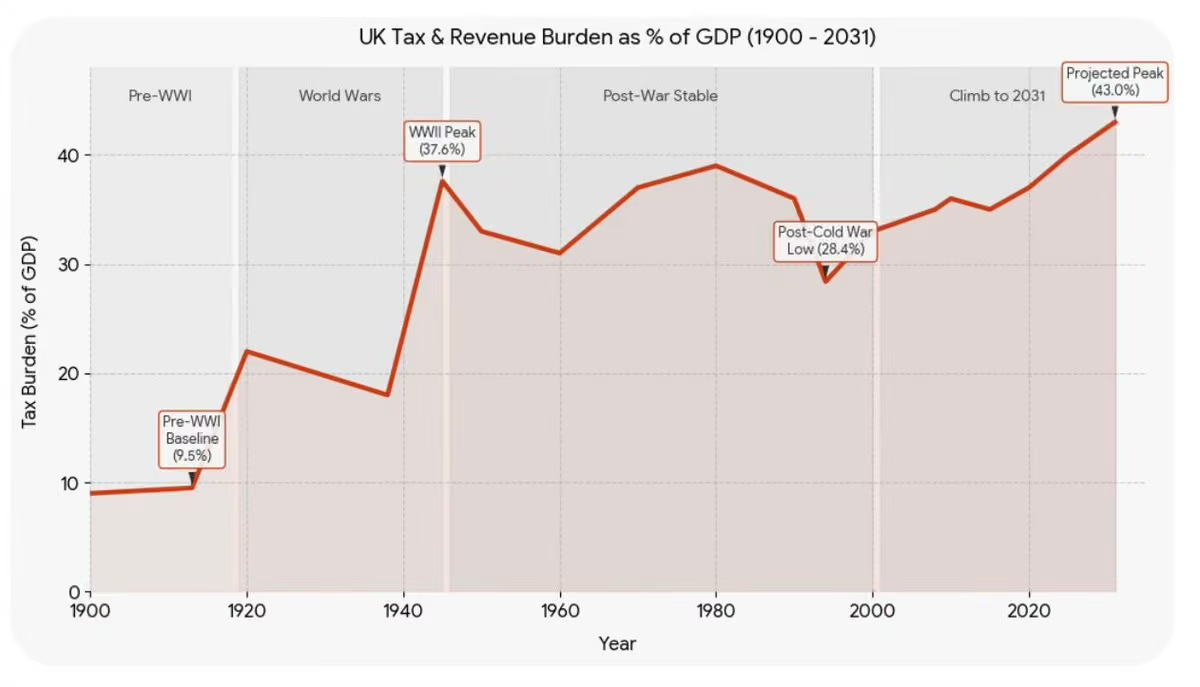 Steven Swinford
@Steven_Swinford
Breaking:
Andy Burnham refuses to rule out a wealth tax as he says that people may have to pay 'a little bit more' in tax because of the state of the public finances
He told @GaryLineker that he doesn't want to 'create new divisions' or to 'be perceived as somebody who's coming with grudges and agendas and going to immediately demonise one group'
'So you know, decisions to be taken in time.
'They’re going to be difficult, I’m not going to shy away from that. You know, we are going to have to work quite hard to make sure, you know, we can pay our way.
'And at some point that might be having to ask for a little more. But, you know, those decisions are not for now. They’re for another day'
Luke Johnson reposted
Bjorn Lomborg
@BjornLomborg
Coffee on the brink of extinction due to climate change? Olive oil in permanent crisis?
Not according to the data.
Record coffee harvests, tripled olive oil production since 1961, and inflation-adjusted food prices trending down.
Don't buy the hype: innovation beats alarmism.
Luke Johnson
@LukeJohnsonRCP
Good riddance to the least popular chancellor ever. Such incredibly low calibre people occupying such powerful public offices…
The Spectator
@spectator
Reeves's legacy – beyond being the least popular chancellor ever, according to polling – is unemployment and business destruction.
Her £25 billion raid on national insurance, coupled with hikes to the minimum wage, has, without any doubt, led to the rising unemployment we have seen in the past few years.
Small, medium and large business owners spent her entire chancellorship complaining – justifiably – about how punitive and preventative the tax system had become for them.
✍️ Michael Simmons
Article | spectator.com/article/waving-goodbye-to-rachel-reeves | @Simmons__

Luke Johnson reposted
The Jobs Foundation
@TheJobsFndn
Sir Dan Moynihan, Chief Executive of the Harris Federation, writes in CapX this week, drawing on the foreword he wrote for our new report, Jobs and Education 👏
His argument, which runs throughout our report, is simple👇
🏫 Schools don't exist in isolation from the economy. When growth is weak, entry-level opportunities dry up and more young people end up NEET, whatever schools do.
💷 The rising cost of employing a young person is deterring businesses from hiring them.
🎯 Careers education is one of the most powerful levers we have, cutting the likelihood of becoming NEET by up to 20% in the most disadvantaged communities. But with funding pressures, schools don't consistently have the resource to deliver this.
A serious strategy for reducing NEETs has to start with a serious strategy for growth.
Luke Johnson reposted
Andy
@PositivFuturist
There is now ample evidence to suggest that the vast majority of legal migration is fraud.
We've seen countless examples of fake businesses sponsoring significantly more people than actually work for them.
It is simply migrants sponsoring other migrants for a fee to come to the UK legally and settle.
Even in the care sector - those coming aren't necessarily even working in care as we can see below.
Migrants are enriching themselves by selling UK citizenship via these fake jobs - there are literally marketplaces for buying and selling visa sponsorship approved businesses.
This is why we have unemployed Pakistanis roaming around in luxury German cars - plus drugs and organised crime of course.
There are legal firms setup explicitly to support and guide you to sponsoring as many people as possible.
"No recourse to public funds" is also a lie - once a family is here the local councils won't allow them to become homeless.
The evidence for this is all around you.
Boris promised a "points based system" that would attract talent from around the world and grow our economy.
Instead every high street is now a Potempkin village of vape shops, barbers and 3rd world delivery drivers.
Either they all go home - or the welfare state collapses and Britain becomes a South Africanised failed state of gated communities and shanty towns.
 The Procurement Files
@procurementfile
Coventry care company ‘Momo & Tarek Care Ltd’ assigned 648 certificates of sponsorship for the ‘Skilled Worker’ route from 21-24. As a comparison, Apple assigned 687; Microsoft assigned 505.
According to 24/5 accounts, Momo&Tarek had 6 employees (avg.) In 23/4; 0 employees🧵1/6


 Luke Johnson
@LukeJohnsonRCP
Very interesting
Luke Johnson
@LukeJohnsonRCP
The Labour Party don’t work for voters or taxpayers - they work for their union paymasters.
Cut My Tax
@CutMyTaxUK
Andy Burnham has promised Labour MPs a big reduction in outsourcing, reports the FT.
The so-called "insourcing" attack on competitively tendered services has been driven by public sector unions. It means cancelling competition for the provision of services such as cleaning, security, & buildings maintenance & building up a permanent public sector unionised workforce instead.
The evidence is overwhelming that the competitive tendering of these services achieves large efficiency savings. A wide range of academic & Govt. studies have confirmed significant cost saving as a result of competitive tendering, usually in the 20% to 30% range. Hartley & Huby (1985) found 26% savings in cleaning services; Domberger, Meadowcroft & Thompson (1986) estimated average cost savings of around 20%; Knox & Young (1995), found that the average cost saving in Northern Ireland from tendering refuse collection was 25%; & Syzmanski (1996) found that average refuse collection costs had fallen by 22% when compared with the last full year before competitive tendering.
In 1987 the Audit Commission investigated the experience of competitive tendering in three areas – refuse collection, vehicle maintenance and repairs/improvements to council houses – and found that costs were higher for services not subjected to competition; and that significant cost savings would accrue to all local authorities if they could obtain through competition performance equivalent to the top 25% of local authorities. Cost savings would be: – house maintenance – 20% – vehicle management – 25% – refuse collection – 15%.
Their report gave a number of examples to show why competition led to cheaper prices. “Costs of rewiring varied between £218 and £396 per dwelling for private contractors. The cost for work not subject to competition averaged about £600 per dwelling.”
In 1996 it was revealed that fees paid under market-tested commissions in 1992–93 for property/estate services were “some 40% less” than the rates charged the previous year under Property Services Agency supply-and-service arrangements.
A 2019 Institute for Government report found that "Outsourcing has worked best in ‘support services’ that are relatively simple to contract for and deliver: waste collection, cleaning, catering and maintenance. When these services were first outsourced in the 1980s and 1990s, it delivered large savings, often around 20% of annual operating costs, mostly while maintaining levels of quality".
It is exactly these support services that Labour wants to bring back in-house.
As the Institute for Government commented in its 2019 report, "It is doubtful that if provision were returned entirely to government hands it would deliver the levels of efficiency currently achieved while competitive pressures remain from private services. Bringing swathes of services back into government hands by default risks throwing away the significant benefits that outsourcing can deliver".
The insourcing policy was part of Corbyn's 2019 election manifesto & it was estimated then that the total cost to taxpayers would be £12 billion, increasing over time. It is sad that Burnham has taken up this costly, retrograde & discredited Corbynista policy. Taxpayers will have to pay more for worse services.
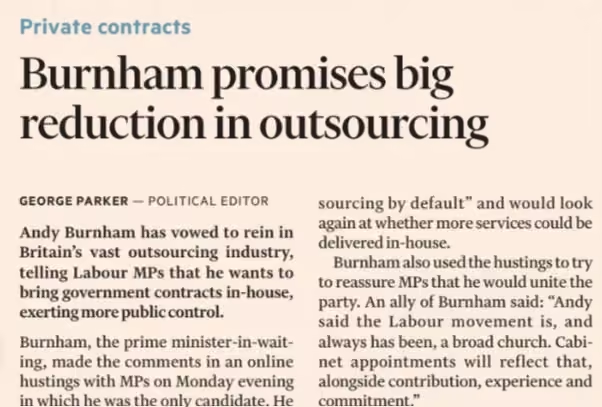
Luke Johnson reposted
Daniel Hannan
@DanielJHannan
This has moved beyond insulting and ungrateful demands for cash and is now a hostile territorial claim. We should halt the issuing of all visas from the countries backing it.

Luke Johnson reposted
 Great British Business Council
@GBBC_UK
The chart tells a simple story.
⬇️ Production down
⬇️ Exports down
⬆️ Reliance on imports
Yet UK oil and gas producers face a 78% tax rate.
If we don't produce energy here, we'll simply buy it from somewhere else.
#oilandgas #ukeconomy #energypolicy #gbbc

Luke Johnson reposted
Boring_Business
@BoringBiz_
Over the last 3 years, majority of western European countries have seen little to no GDP growth, particularly when compared to the US, China or India
It is actually fascinating to watch an entire continent stagnate and fall in the hands of bureaucrats

Luke Johnson reposted
Boze Herrington, Library Owl 🎄🐗📯📯
@SketchesbyBoze
At a certain point we will simply have to decide, collectively, that being entertained all the time is unhealthy, that some things should only be done by humans, that the artistic and intellectual life is worth pursuing and defending, otherwise we’re not going to make it.
Luke Johnson reposted
 Michael Dunne
@dunne_insights
Never before in a hundred years of automobile history has one country’s exports exploded like this.
China Car Exports:
2020: 1 million
2022: 3.1 million
2024: 7.9 million
2026: 12 million (f)
> Japan’s highest export number ever was 6 million.
> 12 million is more than the US annual production (10m)
> Global car demand flat since 2020 so China export gain is others’ pain.
> VW plans layoffs of up to 100,000 employees as sales tank.
Luke Johnson reposted
Cut My Tax
@CutMyTaxUK
Andy Burnham increased the debt of the Greater Manchester Combined Authority by 28.8% (£300m) during his tenure in office, leaving it with the highest debt of any combined authority in England.
If he expands this track record to the whole of the UK, that would mean an equivalent national debt increase of about £860 billion, taking UK debt towards £3.85 trillion.
The debt-to-GDP ratio would rise from 95.1% to 122.5% & at an average interest cost of 5% we'd pay an additional £43bn in interest costs each year.
High spending Andy could be a very expensive choice for Britain.
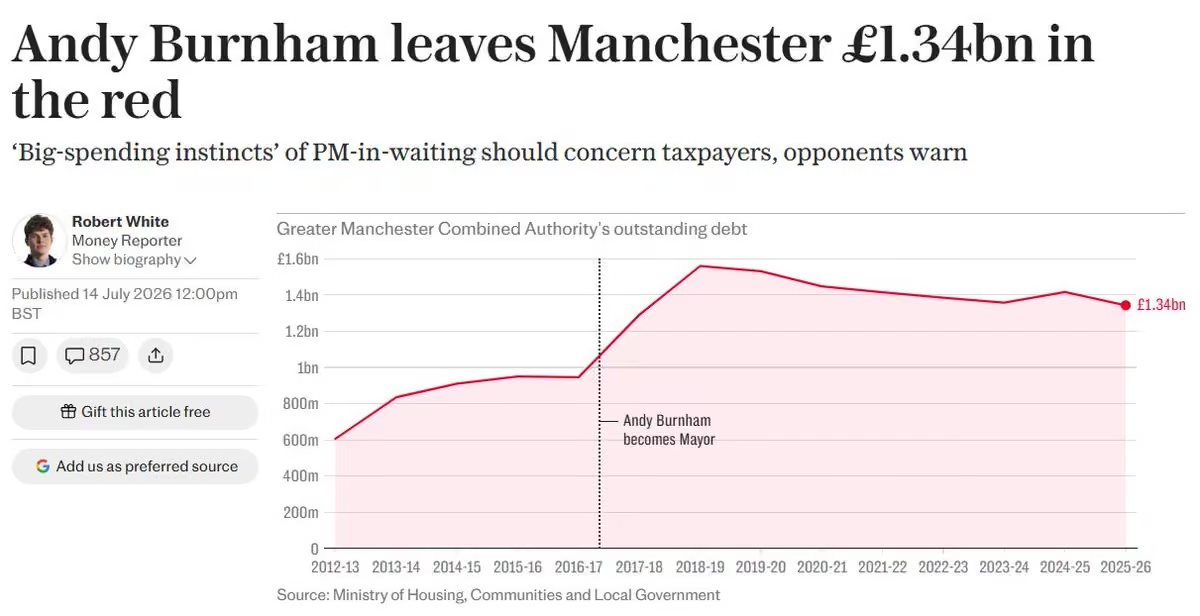
Luke Johnson reposted
Charlie
@charliecolecc
The Boriswave are so low-skill and so low-wage, that a simple requirement they earn £12,570 a year for 3 out of 5 years to qualify for ILR would prevent the largest number from settling.
 Luke Johnson
@LukeJohnsonRCP
Interesting
Patrick Collison
@patrickc
It's been interesting and puzzling to witness the problems with accuracy in UK economic statistics over the past few years. (See the links in the next tweet for more.) It seems that the Office for National Statistics, ONS, now struggles to effectively measure basic figures such as employment, trade, and inflation. This resulted in a quite scathing government report published last summer, where Robert Devereux, a former permanent secretary, concluded that "most of the well-publicised problems with core economic statistics are the consequence of ONS’s own performance."
There's a lot of discussion about the travails facing the UK these days (including this big piece in The Atlantic a few weeks ago[1]), and the problems with the ONS feel like an unsettling microcosm of diffuse decline in broader institutional competence.
Anyhow: at Stripe, we became curious about the UK's published entrepreneurship data. While we observe a boom in many parts of the world, official figures don't show a similar increase in the UK. In the latest Stripe Economics post, we dug into the data, and, as far as we can tell, the official figures are probably misleading. The good and the bad news (mostly good, I think!) is that the UK is almost certainly witnessing an unmeasured boom in entrepreneurship: www.stripeeconomics.com/p/is-the-uk-missing-out-on-the-so…
UK-specific issues aside, I suspect that this measurement question is illustrative of forthcoming econometric challenges. Keeping the world's macro indicators up-to-date in response to the faster-than-usual changes wrought by AI will be both increasingly difficult and increasingly important in the coming years.
[1] www.theatlantic.com/magazine/2026/07/uk-productivity-econ…
 Luke Johnson
@LukeJohnsonRCP
No? Just grotesque incompetence then.
 Michael Gove
@michaelgove
Nonsense. There was no corruption or cronyism on the part of ministers or officials
 Kevin Maguire
@Kevin_Maguire
Scandals don't come much bigger than wasting £10bn of £15bn spent on unusable PPE during Covid.
The Tory VIP lane for donors, cronies and chums was a rip-off door.
Hunt them down and grab back the £10bn no matter whatever that costs.
www.mirror.co.uk/news/uk-news/covid-19-inquiry-covid-ppe-…
Luke Johnson reposted
 Danny Kruger
@danny__kruger
Today Labour’s Gibraltar surrender deal - announced today with no debate - has once again undermined British sovereignty, repeating the mistakes of the Windsor Framework and the Chagos debacle.
The terms of the deal are shocking: Spanish officials will now conduct border checks within Gibraltar. Spain can withdraw individuals’ residency in Gibraltar, even if they already live there. Goods sold in Gibraltar must comply with EU regulations. Gibraltar is now subject to a new ‘transaction tax’ to align it with the EU. And Gibraltar must adopt new EU laws or the agreement will automatically be terminated.
The practical effect is that foreign officials will decide who and what can enter British territory. British citizens’ fingerprints will be taken and passports checked within our own territory.
At the same time, Spain has conceded nothing about its claim to Gibraltar. No self-respecting British government should be willing to accept this.
To make matters worse, Parliament and the British public have only seen the final text of this deal today, but it takes effect tomorrow. Labour have shut us out of this process and are avoiding scrutiny.
A Reform Government will stand up for our national interest and overturn this one-sided, disgraceful deal.
There can be no shared sovereignty between Britain and Spain. Gibraltar is British, not Spanish, and that is how it must remain. This is not up for negotiation or dilution by a thousand individual concessions.
And there must be no border between Gibraltar and the United Kingdom. Spanish or EU border and customs officials must not be allowed to operate in Gibraltar, or have a say in who and what can enter our territory. Border security cannot be built on conceding control to a foreign government. www.gov.uk/government/collections/uk-eu-agreement-in-resp…
Luke Johnson
@LukeJohnsonRCP
Good to see the British being such valuable contributors.
Jonatan Pallesen
@jonatanpallesen
New data, never before published in full:
Net fiscal impact per household in Norway by country of origin.
The numbers are not as good as those from Denmark or the Netherlands. They only include the cost of fiscal transfers, not the cost of healthcare, public schools and so on.
So in fact, every group is significantly more fiscally costly than what is show here.
But we can still recognize the pattern from Denmark and Netherlands: Immigrants from Europe are fiscally positive, and immigrants from Muslim countries are fiscally negative.
But again, the real magnitude of the fiscal cost in Norway is certainly much larger than what this figure says on the X axis. When you consider that Norway is overall running a deficit on their inhabitants, balanced by oil fund income, this means that even Norwegians themselves are fiscally negative. So the benchmark that says +€15.5k yearly is more accurately -€5k yearly.
What does that mean for how much lower Iraq, Somalia and Syria are in reality compared to the displayed number? It's hard to know. Their cost in resources is higher as well, so -€20k yearly in addition to the cost listed in the figure is quite certainly a lower bound.
Overall it is plausible that Syrian / Somali immigration to Norway is the most economically expensive immigration anywhere in the world, at any time in history.
Luke Johnson
@LukeJohnsonRCP
All these laws/regulations are just gravy trains for seriously unscrupulous lawyers
Claire Coutinho
@ClaireCoutinho
🚨NEW: One of Keir Starmer's last acts will be a massive expansion of 'work of equal value' pay claims that are already bankrupting local councils to cover race too.
All this will do is cost taxpayers and consumer more, and encourage divisive identity politics in the workplace.

Luke Johnson reposted
David Galbraith
@daveg
The UK is one of the world's least sunny places, but current default domestic architecture regulations limit the area of windows to levels that wouldn't comply with regulations in the South of France.
 @levelsio
🇪🇺 The new trend in Europe now is building new houses with tiny windows, so that they stay cool and don't need to install or use AC to cool them
"Less sunlight = less heat = less cooling = less energy use" is their thinking
But there's a reason people buy modern design villas that are floor to ceiling glass (I did)
You want as much sunlight as possible coming in for your health, because your circadian rhythm depends on it, improving your sleep quality so you produce melatonin at the right time and fall asleep easily and stay asleep all night
Sunlight also affects your mood of course, it heavily boosts serotonin and decreases symptoms of depression
Having wide views of the sky, nature or ocean also have a measurable effect on lowering your stress
So Europe is now building houses with tiny windows all so they don't need to install AC, while the new home owner inside will slowly become miserable, stressed, depressed, start sleeping bad and as a second order effects of that become sick (but of course then you can sell them pills)
The conclusion is the same I had during the ongoing heatwave in Europe where tens of thousands of people are still dying every month because they're not allowed to install AC:
Europe now cares more about energy use than people's lives
Degrowth is a completely delusional cult affecting all of Europeans lives now!

Luke Johnson reposted
The Spectator
@spectator
A quick consultation of the UK's 23,522-page tax code (apparently the longest in the world) quickly confirmed my suspicion. "Cold takeaway" meals are subject to zero per cent VAT, while cold meals consumed in the vendor's "designated eating area" are subject to the full 20 per cent VAT rate.
On one level, this was a mildly pleasing way to save money on lunch; on another, my economist brain immediately started calculating the massive economic distortions and fiscal costs caused by a minor clause in the tax code.
✍️ William Nixon
Article | spectator.com/article/why-is-the-uks-tax-system-so-taxing

Luke Johnson reposted
Looking for Growth
@lfg_uk
The UK is in a GROWTH EMERGENCY.
Some call us "alarmist". They are wrong.
Here are 5 key facts that prove it ⬇️
1️⃣ Every month, 1,868 British businesses go bust – a third higher than the post-2008 average.
2️⃣ A quarter of UK manufacturers have moved production overseas – or are actively taking steps to move.
3️⃣ Youth unemployment has nearly doubled in the last four years.
4️⃣ Our energy prices are nearly 3 times higher than in the US.
5️⃣ Housebuilding has roughly halved since 1968, even as the population has surged.
Britain is in a GROWTH EMERGENCY. Yet our political class have refused to take the radical action required to fix Britain.
Is this acceptable?

 Looking for Growth
@lfg_uk
Britain is in a GROWTH EMERGENCY. But our political class refuses to act like it.
Economic growth has been DECLINING FOR 70 YEARS. Every month, nearly 1,900 British businesses go bust.
London, once the financial capital of the world, has FALLEN to 23rd in the global IPO rankings – trailing Spain and Turkey, and ONLY JUST above GREECE
To kickstart economic growth IMMEDIATELY, Andy Burnham must take RADICAL ACTION NOW.
1️⃣ FORCE Parliament to SIT ALL SUMMER.
2️⃣ On DAY ONE, pass our Emergency Energy Bill.
3️⃣ PROTECT PARENT PAYCHEQUES: STOP punishing parents for the crime of having children and earning over £60,000.
4️⃣ STOP THE QUANGO DYNASTY: Put an expiry date on the unelected bodies who are BLOCKING growth in all of Britain’s industries.
5️⃣ BACK THE STARTUPS: END ALL ATTEMPTS to “privilege” established companies over our startups.
@lawrencenewport in @CapX 👇

Luke Johnson reposted
 Jeremy Raper
@puppyeh1
The Japanese executive (more or less) doesn’t care about money. He - it’s always he - cares first about the company’s survival; then about the customers; then the employees; then about broader society; and perhaps only then about money.
And maybe somewhere down there, below the shit at the bottom of the ocean, about the shareholders.
🇯🇵🇯🇵
 Leandro
@Invesquotes
$2 million in salary while running a $12 billion business
Japan!
Luke Johnson reposted
David Turver
@7Kiwi
The bond market is not taking too kindly to Andy Burnham's proposed tax grab.

Luke Johnson reposted
Andrew Neil
@afneil
It’s not as you say.
Heriot-Watt has already filled its quota of Scottish government-funded places for Scottish-domiciled students for the current intake cycle. As a result, it has closed its clearing process to additional Scottish applicants.
This is the price you pay for no tuition fees.
With no price mechanism to ration places, Scot Gov rations by quotas instead, placing a strict cap on the number of Scots that can go to university. The cap is determined by the size of the budget Scot Gov has allocated to pay for Scottish student places.
It is a very bad system. Scottish universities can take as many English and foreign students as they like (they all come with fees) — and they take a lot. But not as many Scottish students as they like. So many miss out.
 @DDTV
@Dumbed_DownTV
Andrew, as an ex uni Rector, any views on this Scottish Uni excluding all Scottish students from a Uni place?

Luke Johnson reposted
Daniel Kral
@DanielKral1
China avoided a recession after its property market bubble burst by fuelling a bubble in manufacturing, hence externalizing the cost of adjustment (domestic sales plunged). A question for the EU is how will its hundreds of thousands of laid off auto workers vote as it watches on.
 Financial Times
@FT
China’s monthly car exports surge past 1mn as overall trade soars ft.trib.al/GatTc5h
Luke Johnson reposted
 Guy Dampier
@dampierguy
Spain expected to regularise 500,000 illegals. Think tanks expected 800,000. Now they think (including relatives) there are 3 million. The EU funded Measuring Irregular Migration (MIrreM) project thought there were 2.6-3.2 million illegals in 🇦🇹🇧🇪🇫🇮🇫🇷🇩🇪 🇬🇷🇮🇪🇮🇹🇳🇱🇵🇱🇪🇸🇬🇧 combined.
 EL MUNDO
@elmundoes
La Policía eleva a 3 millones los inmigrantes regularizados con sus familias www.elmundo.es/espana/2026/07/13/6a5529e321efa0765a8b4581…
Luke Johnson reposted
 Tim Worstall
@worstall
I approve of this. Given that absolutely everyone says "Convicted criminal George Cottrell", even the BBC, then turn and turn about, it should be "Convicted fraudster Louise Haigh". Even the BBC. Let us be even handed about such things.
Make it so. All references, by everyone, should now include "convicted fraudster Louise Haigh". Ah, see, the Telegraph is already using the new stylebook.
www.telegraph.co.uk/news/2026/07/14/louise-haigh-burnham-…
Luke Johnson reposted
 Claire Lehmann
@clairelehmann
"This is not some minor point. The claim that wealth inequality is exploding is the central premise of Gary Stevenson’s entire economic theory, &, by extension, of this documentary. Take that away, and there is nothing left"
--@K_Niemietz for @Quillette
quillette.com/2026/07/14/gary-stevenson-is-wrong-about-we…

Luke Johnson reposted
 Dirty Texas Hedge
@HedgeDirty
Nearly every developed country just accepted a step change lower in both level and trajectory of prosperity as a permanent policy response to COVID. Serious Question: in what year will the cumulative lives lost by this choice exceed COVID itself?
 Mike Bird
@Birdyword
Feels like the rest of the world hasn't yet quite caught up to the fact that Australia now looks less like The Lucky Country and more like the other stagnant non-US developed economies

Luke Johnson reposted
 Vommagician
@shortbelly
South Korea has an adult population (aged 15–64) of 35.7 million people.
1 in 30 (3.4%) adults got margin called.
 P Equity Research 📰
@pequityresearch
Here is some information on the gamblers in Korea:
"Korea Financial Supervisory Service: As of July 13, the cumulative total of over 1.2 million leveraged retail accounts across the Korean market triggered margin calls, with approximately 320,000–360,000 accounts fully forcibly liquidated by brokers (principal wiped out, some with partial negative balances owed to brokers)"
Lol...
Luke Johnson reposted
Dylan O'Sullivan
@DylanoA4
I'd put this single paragraph from G. K. Chesterton up against any self-help book out there

Luke Johnson reposted
 Jeremy Horpedahl 🥚📉
@jmhorp
The reason the US spends more on healthcare than other countries is because we are richer and healthcare is a normal good. The reason we don't get as good health outcomes is largely because of murders, car accidents, and drug ODs (explains half of the gap or so)
 Andreas Steno Larsen
@AndreasSteno
I hate high taxes, but why anyone would die on the hill defending the U.S. healthcare system is beyond my understanding.
You can't find a system anywhere on Earth that delivers worse value for money.
Incredibly expensive. Mediocre outcome.

Luke Johnson reposted
Paul Graham
@paulg
The rise and fall of wokeness: DEI commitments in corporate securities disclosures filed with the SEC. To me this seems a trailing indicator; most other measures of wokeness take off well before 2019 and peak in 2020 or 2021. But the shape! That's what a moral fashion looks like.

Luke Johnson reposted
Cut My Tax
@CutMyTaxUK
"One horror that keeps coming back is raising capital gains tax to income tax levels", notes former chancellor Jeremy Hunt
"Before grabbing it, the next chancellor should ask a simple question: why has doing so been rejected by every chancellor this century?"
A hike, says Hunt, "would actually reduce the overall tax take. Treasury officials told me that 24% was the “revenue maximising” level for capital gains tax, something broadly confirmed by HMRC’s “ready reckoner” on its website. That’s because when tax rates change, people change their behaviour & delay selling assets. Go too far in raising tax & revenues start to fall. It’s why I reduced capital gains tax on property from 28% to 24%."
"And there would be another even more damaging unintended consequence. Capital is mobile. So too are entrepreneurs. How many would leave the country & set up elsewhere if the Government decided it no longer valued the risks they take?"
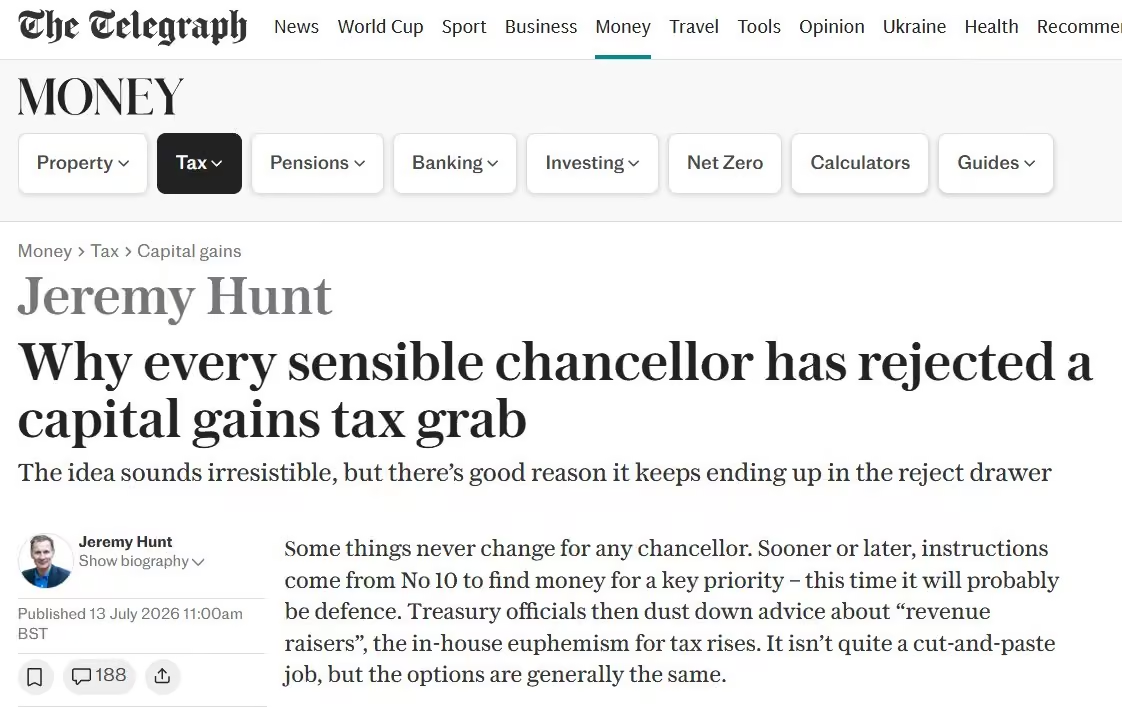
Luke Johnson reposted
zerohedge
@zerohedge
100 yrs of stock market: From 1926 through 2025 (30k stocks analyzed) - just 27.6% of stocks outperform the market / 60% of stocks incurred wealth reductions / the median stock returned -6.9%.
46 firms accounted for half of the wealth created by the stock market ($91 trillion net wealth creation).
papers.ssrn.com/sol3/papers.cfm?abstract_id=6438198
Luke Johnson
@LukeJohnsonRCP
Absolutely zero context for this disgusting violence means the BBC are simply not doing a proper job of public service news provision www.bbc.co.uk/news/articles/cly9rl1n7r9o
Luke Johnson
@LukeJohnsonRCP
Lockdowns and Boriswave should ensure he is forever excluded from public life. He is a negligent narcissist.
Christopher Snowdon
@cjsnowdon
“Whoever coined the term ‘Boriswave’ for the soaring of net migration to more than 900,000 on Johnson’s watch has probably sunk any chance Johnson has of leading his party or the country again.” @maxtempers
 Luke Johnson
@LukeJohnsonRCP
Great interview www.telegraph.co.uk/news/2026/06/14/tim-martin-labour-tak…
Luke Johnson
@LukeJohnsonRCP
Good essay
 Will Self
@wself
“That is why Starmer attracts such visceral hostility. Not because he is secretly tyrannical or uniquely manipulative, but because he appears as the anthropomorphic embodiment of procedural Britain itself: the human face of the unread contract.”
Luke Johnson
@LukeJohnsonRCP
The reality of the EU - from a Frenchman
 Jon De Lorraine
@jon_delorraine
L’Union européenne est devenue, au fil des décennies, l’aboutissement le plus avancé du socialisme technocratique moderne : une structure supranationale qui fonctionne les États, transfère toujours plus de pouvoir vers des institutions éloignées des peuples et transforme progressivement les nations en simples exécutants administratifs.
À Bruxelles, tout repose sur la même logique : centraliser, harmoniser, réglementer, contrôler.
Chaque crise devient un prétexte pour créer une nouvelle norme, une nouvelle agence, un nouveau mécanisme de surveillance ou un nouveau fonds financé par l’argent des contribuables européens. Des milliers de fonctionnaires, de commissaires, de structures administratives et de cabinets produisent en permanence des directives qui s’imposent ensuite aux peuples sans qu’ils n’aient réellement leur mot à dire.
Agriculture, industrie, énergie, commerce, environnement, numérique, intelligence artificielle, immigration : plus aucun domaine stratégique n’échappe à cette mécanique bureaucratique.
L’Union européenne ne fonctionne plus comme une coopération entre nations souveraines, mais comme une administration centrale qui retire progressivement aux États leur capacité de décider seuls de leur avenir.
Et la France est probablement l’exemple le plus frappant de ce retournement historique.
Au départ, le contrat vendu aux Français était clair : l’Europe devait renforcer la puissance française, protéger son industrie, permettre la prospérité économique et donner davantage de poids au pays sur la scène mondiale.
Le résultat est exactement inverse.
La France a abandonné une partie immense de sa souveraineté monétaire, industrielle, budgétaire, énergétique et juridique pour se retrouver enfermée dans un système où elle ne maîtrise plus pleinement ses frontières, sa monnaie, sa politique industrielle ou même certaines de ses orientations économiques fondamentales.
Des secteurs entiers ont été sacrifiés au nom du marché unique, de la concurrence “libre et non faussée” et des règles imposées depuis Bruxelles. Pendant ce temps, la bureaucratie européenne n’a cessé de grossir, de produire des contraintes et de transférer toujours plus de compétences hors du contrôle direct des peuples.
Mais ce qui devient encore plus inquiétant aujourd’hui, c’est que cette logique socialiste et technocratique ne s’arrête plus à l’économie ou à l’administration : elle touche désormais directement la liberté d’expression.
Sous couvert de “lutte contre la désinformation”, de “sécurité numérique” ou de “modération des contenus”, l’Union européenne pousse les plateformes à censurer davantage, supprimer des publications, invisibiliser certains discours et collaborer toujours plus étroitement avec les autorités.
Comme dans tous les systèmes bureaucratiques hypertrophiés, le pouvoir finit toujours par vouloir contrôler la parole publique.
La censure moderne ne brûle plus les livres : elle déréférence, démonétise, suspend des comptes, réduit artificiellement la visibilité et impose des normes de discours décidées par des institutions que personne ne peut réellement renverser démocratiquement.
L’Union européenne est devenue une machine idéologique où la technocratie remplace les peuples, où l’administration remplace la souveraineté et où l’argent des contribuables sert à financer toujours plus de structures chargées d’encadrer les nations elles-mêmes.
Le socialisme moderne ne prend plus forcément la forme d’un État unique autoritaire. Il prend la forme d’une bureaucratie géante, diffuse, permanente, qui retire lentement aux peuples leur capacité de décider, de produire, de débattre et finalement de rester maîtres de leur propre destin.
Luke Johnson
@LukeJohnsonRCP
It’s all about coffee houses!
 ArchaeoHistories
@histories_arch
In 1650, a coffee house opened at the Angel in Oxford that accidentally created the institution that built the modern world. Lloyd's of London, the London Stock Exchange, the Royal Society, and the entire concept of a free press all trace directly back to what happened when English people started drinking coffee in public.
The first English coffeehouse opened in Oxford in 1650 at the Angel coaching inn. For a single penny admission you could sit all day, read the newspapers, and participate in conversations with merchants, scientists and politicians regardless of your social class. The coffee itself was documented by contemporary observers as thick, black, extraordinarily bitter and unlike anything the English had tasted before. People drank it anyway because what was happening around the cup was more important than what was in it. Samuel Pepys documented his visits in his diary, describing the admirable discourse and exceeding good arguments he encountered there. The coffeehouses became known as penny universities. The name came from a poem written in 1672: so great a university I think there ne'er was any, in which you may a scholar be for spending of a penny.
At the Grecian Coffee House, members of the Royal Society including Isaac Newton met regularly to discuss mathematics, astronomy and natural philosophy. Royal Society meetings were routinely continued socially at the Grecian, Newton being frequently of the parties. At Lloyd's Coffee House, merchants and ship captains gathered and from their conversations emerged Lloyd's of London, the world's largest insurance market.
At Jonathan's Coffee House in Exchange Alley, merchants trading stocks eventually created the London Stock Exchange. All of it from a penny cup of bitter coffee in a public room where anyone could sit. The establishments became so politically influential that King Charles II tried to ban them in 1675, calling them places where the disaffected met and spread scandalous reports about his government. The public outcry was so fierce the ban lasted eleven days before he was forced to reverse it.
© Eats History
#archaeohistories
 Luke Johnson
@LukeJohnsonRCP
I've been involved in multi-site high street retailing for around 40 years. There has been a sharp increase in new operators who I believe cannot pay the bills through legitimate trading. These are criminals in plain sight, but the authorities are so pathetic they do nothing.
 David Shipley
@ShipleyWrites
Our high streets are full of businesses with “links to organised crime” but what does that mean? I asked a gangster, and wrote about it for @TheCriticMag
(Link below)
 Luke Johnson
@LukeJohnsonRCP
The collapse of Starmer’s housebuilding revolution www.msn.com/en-gb/money/other/the-collapse-of-starmer-s-h…
Luke Johnson
@LukeJohnsonRCP
Scrapping Net Zero taxes is essential if British manufacturing is to survive www.telegraph.co.uk/business/2026/04/02/ratcliffe-backs-t…
Luke Johnson
@LukeJohnsonRCP
The National Trust is run by philistines.
 Restore Trust
@RestoreTrustNT
Quietly removed, the portraits at the National Trust's Beningbrough Hall disappeared without a word.
Is great art too good for Yorkshire?
Luke Johnson
@LukeJohnsonRCP
The BBC really are a preposterous news organisation. On their website there are currently six stories about the killing of one man in Minneapolis. But not a single item about the massacres in Iran. This is biased and disproportionate beyond belief.
Luke Johnson
@LukeJohnsonRCP
I can’t believe that useless Hallett woman got £835,000! For doing such a hopeless job. All taxpayer money. Scandalous.
 Steven Barrett
@SBarrettBar
Looking at the Covid Inquiry costs and the profligacy is insane
This needs to face a full investigation - it is burning public money on nonsense
This is insane
 Luke Johnson
@LukeJohnsonRCP
Great article. Lockdowns were a disaster - but admitting that is too painful for those who supported them. www.dailymail.co.uk/debate/article-15311511/DANIEL-HANNAN…
Luke Johnson
@LukeJohnsonRCP
What do the 9.22 million economically inactive people in Britain aged between 16 and 64 do all day?
Luke Johnson
@LukeJohnsonRCP
Obsessive risk aversion/safetyism is a sign of a society in wholesale retreat.
 Ned B-H
@nedbh
Hard to think of a single worse law to have been brought in than the “cancel every nice thing to make me feel ‘safe’” law

 Luke Johnson
@LukeJohnsonRCP
The single most important fact about Covid was known in April 2020 or earlier - the old were 1000x more vulnerable than the young. But the experts, politicians and officials kneecapped the whole of society anyway. So we are all paying the price of demented safetyism.
 Martin Kulldorff
@MartinKulldorff
Five years ago I tried hard but could not publish this article about the thousandfold difference in Covid mortality between the old and young; arguing for "counter measures directed specifically at older people". Eventually I just posted it on LinkedIn.
www.linkedin.com/pulse/covid-19-counter-measures-should-a…
Luke Johnson
@LukeJohnsonRCP
It’s game over for Britain unless we abandon our NetZero suicide mission.
Alec Stapp
@AlecStapp
The only thing not stagnating in the UK is the cost of electricity
 Luke Johnson
@LukeJohnsonRCP
The top 1% pay 29% of income tax - lose them and the economy sinks www.telegraph.co.uk/politics/2025/01/22/millionaire-exodu…
Luke Johnson
@LukeJohnsonRCP
But why aren’t the authorities enforcing the law? Rickshaws are a complete menace, who cheat customers naive enough to use them.
 Bloggs
@320_runs
@CityWestminster laws being broken by rickshaws. 1. Street trading 2. Dangerous vehicles 3. Plying for hire 4. No rider checks 4. Unsocial behaviour (loud music/riding red lights/on Pavements) 5. Blocking highways. Any more?
Don’t need regulation.
Luke Johnson
@LukeJohnsonRCP
This needs saying forever. Rishi Sunak was a catastrophe on every level, and his decision to call the election was the stupidest political mistake of modern times. I suppose he married well. thecritic.co.uk/stop-loving-losers/
Luke Johnson
@LukeJohnsonRCP
This incredibly complicated process - for a seemingly simple, pretty cheap and basic product we take for granted - is a reminder of how hard it is to actually MAKE things.
 How Things Are Manufactured
@fastworkers6
How they make a basketball x.com/HowStufWorks/status/1566382658661269507/video/1
Luke Johnson
@LukeJohnsonRCP
Well informed and important article about the tragedy of suicides among young people caused by lockdowns. Where is the response from the lockdown promoters? www.aier.org/article/more-covid-suicides-than-covid-death…
Luke Johnson
@LukeJohnsonRCP
Proof just now that the TV health ‘experts’ haven’t a clue. Doctor on GMTV stated the test and trace app has saved 600,000 lives! When I challenged him he retracted - supposed figure is 8,000. They are scaremongering jokers.
Luke Johnson
@LukeJohnsonRCP
134m tests sent out over 3 weeks. A huge waste of time and money.
Luke Johnson
@LukeJohnsonRCP
The arts industry – and the country – cannot wait ‘years’ for large gatherings to return www.telegraph.co.uk/theatre/what-to-see/arts-industry-cou…
Luke Johnson
@LukeJohnsonRCP
A junior doctor from Dorchester has just emailed saying he thinks we will need two or three lockdowns a year going forwards. This is the lunacy that these psychotic interventions are propagating - that mass house arrest is a sustainable and decent way forwards. Mad.
Luke Johnson
@LukeJohnsonRCP
Intu say they’ve received 29% of their March quarter rents. Even though their shopping centres are virtually shut. Are they really going to try to bankrupt 71% of their tenants for non payment?
Luke Johnson
@LukeJohnsonRCP
Banks have virtually unlimited liquidity available to them and ample capital. Government must ensure they actually lend to/support industry - if needs be by underwriting short term credit risk - to prevent large scale defaults and gruesome job losses.
 Marian L Tupy
 Mohamed A. El-Erian


 Han Wang
 Philip Oldfield
