Shouldn't P2P be beyond emerging by now?
Also, is academia a place people want to look into at the moment?
Could some real life examples help spread the message?
I shall do a little research.
Michel Bauwens
Michel Bauwens (born 21 March 1958) is a Belgian political theorist, writer, and conference speaker on the subjects of technology, culture and business innovation. A leading thinker in the emerging field of peer-to-peer (P2P) theory, Bauwens founded the P2P Foundation, a global organization of researchers working in open collaboration in the exploration of peer production, governance, and property. He has authored a number of essays, including his thesis The Political Economy of Peer Production. More on Wikipedia
-
Michel Bauwens reposted
Peter Jones ⚒️🔭🌍
@innov8tor3
-
Michel Bauwens
@mbauwens
* < " Cilento is in the middle of a drought, and his farm is still green. " >
bioregionalweavinglabs.substack.com/p/growing-soil-first-…?
"I was there in early September with more than 50 people from 24 bioregions, during the Bioregional Weaving Labs Cohort Programme 2026–2027. The farm made a strong impression on all of us. Later that month, I came back to interview Edmondo, who manages the farm’s crops and animals. I wanted to understand how La Petrosa works, and what changed in the way he thinks about farming.
La Petrosa is part of the Cilento Portfolio of Systemic Innovations. A Portfolio of Systemic Innovations connects projects and enterprises in a bioregion so that they strengthen one another, because no single initiative can change a whole system on its own. La Petrosa shows what a farm business that lasts can look like in Cilento, and which shifts in thinking made it possible." -
Michel Bauwens
@mbauwens
* Revolutions in the Dark
commons-hub.at/events/revolutions-in-the-dark
19–20 December · Commons Hub, Hirschwang an der Rax
On the longest night of the year, we’re coming together to explore the generative potential of darkness: an overnight gong journey, a day of silence, embodied movement and creative practices.
A space to rest, listen beneath the surface, compost what has passed and sense what wants to emerge with the returning light 🕯
💛 Contribution: €180–220 sliding scale
💛 Or if you join us for Hack The Hub Automaton happening during the same period for 7 days or more, you get a reduced scale, starting at 100 euros (Food and stay covered) -
Michel Bauwens
@mbauwens
A new video with the rundown on Cosmolocalism:
* Michel Bauwens on Cosmolocalism
online.ucpress.edu/gp/article/7/1/173600/219727/Cosmoloca…
"In episode two of our series Towards Planetary Commons?, we welcome Michel Bauwens, a political theorist, activist, founder of the P2P Foundation, and one of the leading thinkers in the emerging field of peer-to-peer (P2P) theory, to explore how forms of cooperation, production, and governance are emerging in response to ecological and economic challenges. During the episode, Michel takes us from local commons and bioregional initiatives to global knowledge networks, examining how peer production, shared ownership, and new forms of value creation could reshape our economies. We discuss the potential of digital commons, blockchain, and regenerative finance, as well as the tensions between markets, states, and communities in building alternative futures, drawing on examples from Europe, Africa, and China. Michel also speaks about the practical difficulties of protecting shared land and resources, supporting the people who contribute to the commons, and building cooperation across regions. His concept of cosmolocalism connects the global sharing of knowledge and designs with local production. The conversation ends with the relationship between the biosphere, technosphere, and noosphere, and the challenges of bringing these alternatives to a larger scale in the face of ecological crisis."
Michel Bauwens
@mbauwens
* Contents of the video conversation:
Cosmolocalism: Connecting Local Commons to Global Networks — A conversation with Michel Bauwens,
wiki.p2pfoundation.net/Michel_Bauwens_on_Cosmolocalism
conducted by Hagen Schulz-Forberg and James Quilligan. Collections: Towards Planetary Commons? Global Perspectives, November 2026.
Chapter 1: [00:00:00–00:02:04] Introduction
Chapter 2: [00:02:04–00:09:34] Local Commons, Cooperatives, and Bioregional Cooperation
Chapter 3: [00:09:34–00:19:05] Peer Production and Commons Governance
Chapter 4: [00:19:05–00:32:33] Crypto, Public Goods Funding, and Regenerative Communities
Chapter 5: [00:32:33–00:41:49] Alternative Currencies and Regenerative Finance
Chapter 6: [00:41:49–00:53:41] Planetary Crisis and Bioregional Governance
Chapter 7: [00:53:41–01:00:50] Cosmolocalism, China and Rural Revitalization
Chapter 8: [01:00:50–01:04:00] Technosphere, Biosphere, and Noosphere -
Michel Bauwens reposted
Frank Luntz
@FrankLuntz
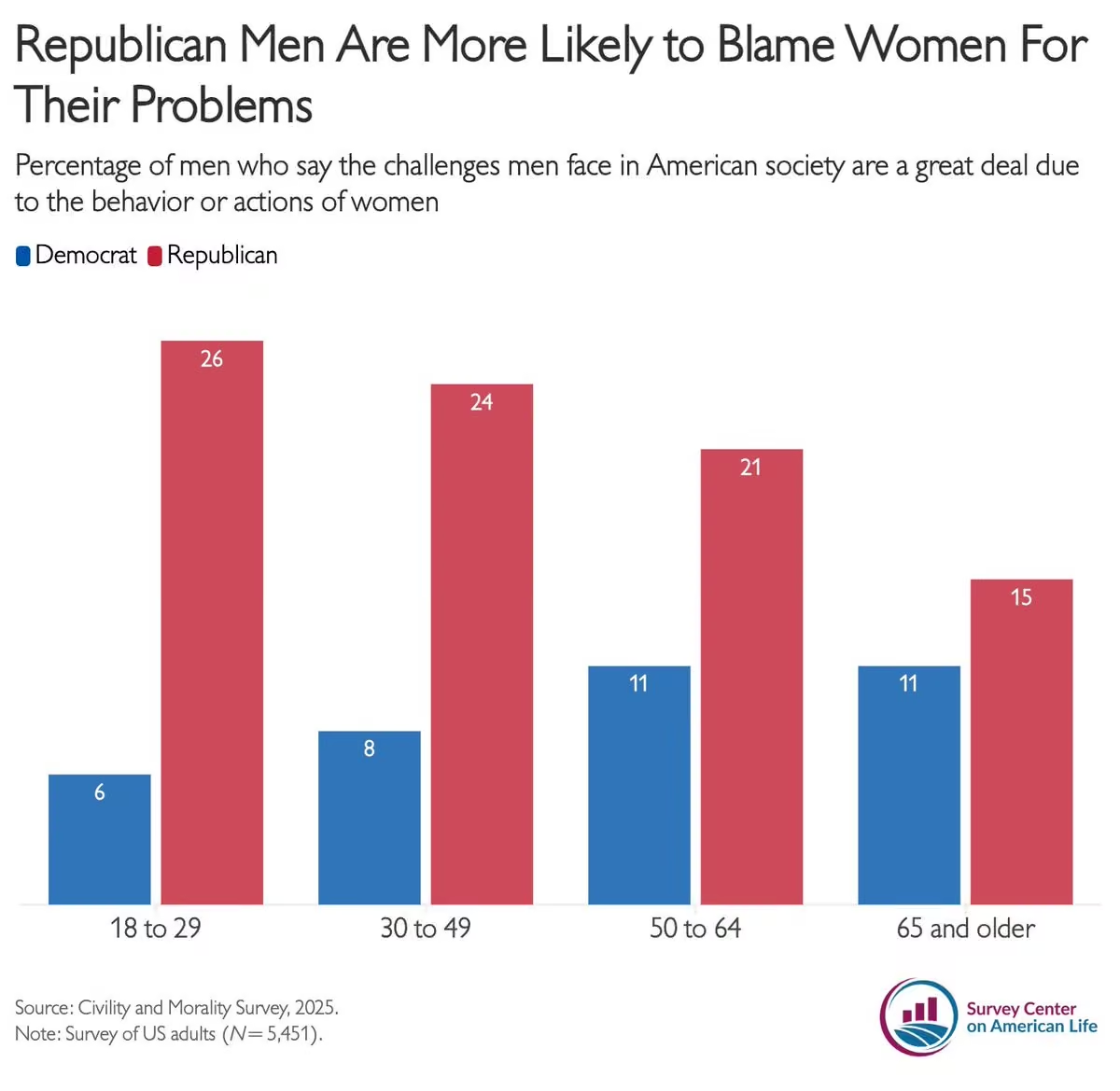
26% of young Republican men blame their problems on women.
66% of young Democratic women blame their problems on men.
🔗 www.americansurveycenter.org/significant-figures/young-wo…
Survey Center on American Life
@amersurveyctr
Most men don't blame women for the problems men face, but the partisan gap is real, and it's widest among young men. Over a quarter of Republican young men say women are a great deal to blame vs. just 6% of Democratic young men.
-
Michel Bauwens reposted
ETHChiangmai
@ETHChiangmai
None of this would be possible without our amazing co-hosts and sponsors 💜 Huge thanks to @Ethtao_Ethtao and @GCCofCommons for co-hosting, @peerxyz, our Official Payment Partner, and @Kleros_io for making ETHChiangmai 2026 happen. Grateful to build this season with you 🌴
-
Michel Bauwens reposted
ETHChiangmai
@ETHChiangmai
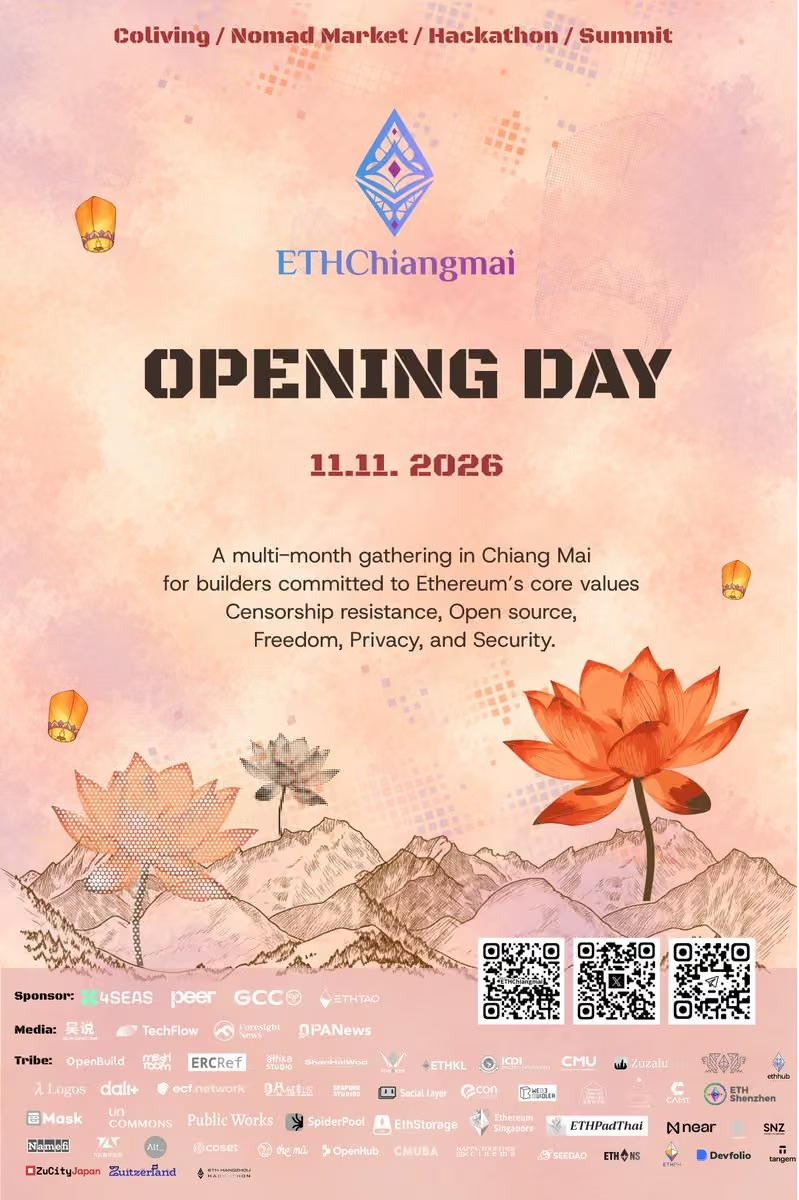
Here’s a look back at ETHChiangmai 2026 Opening Day! 🪷
💜 Thank you to 4Seas, our staff, sponsors, speakers and everyone who joined us on November 11.
From the Nimman Innovation Sandbox launch to Vitalik’s talk, community presentations and panels, we explored how open technology can become part of everyday life.
🌱 Let’s keep building alongside local communities and turning those conversations into useful practice for Chiang Mai.
The season is just getting started. Come be part of it! 🐈
Follow and join us for more events.
💬 t.me/ethchiangmaiThis media couldn't be displayed. See it on the original post. -
Michel Bauwens reposted
Craig Murray
@CraigMurrayOrg
The EU made it illegal for Chay Bowes to receive any salary or sustenance, for him or his children.
Because they disagree with his opinions.
Imposing political starvation on the nation that survived the Famine.
Tonight I bought Chay dinner. Openly and Illegally. Come and get me. -
Michel Bauwens reposted
Steve Stewart-Williams
@SteveStuWill
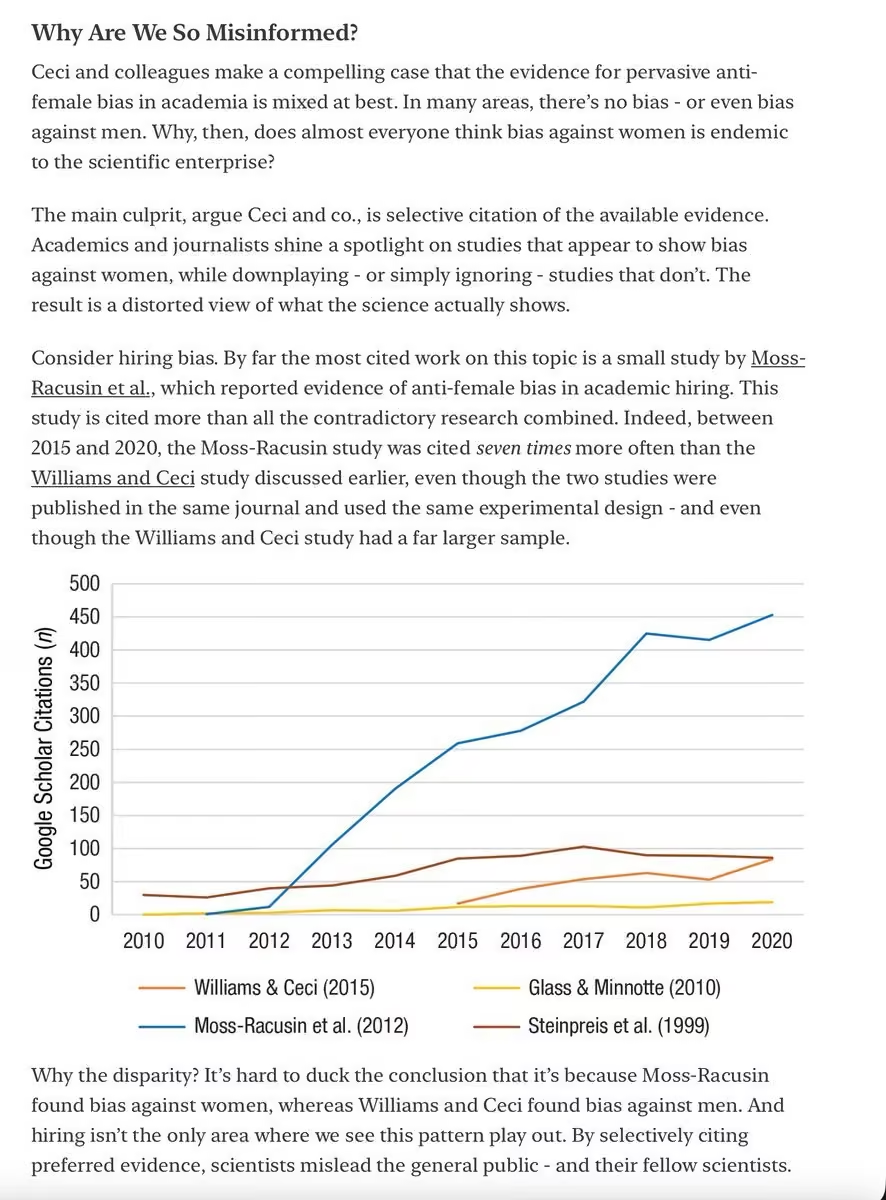
"Academics and journalists shine a spotlight on studies that appear to show bias against women, while downplaying - or simply ignoring - studies that don’t. The result is a distorted view of what the science actually shows."
www.stevestewartwilliams.com/p/rethinking-sexism-in-science -
Michel Bauwens reposted
Glenn Diesen
@Glenn_Diesen
From the Middle East, to Europe and East Asia - the bloc-based security architecture to sustain hegemony collapses. Also, I comment on why I have to leave Norway after 6 years of intimidation.
glenndiesen.substack.com/p/the-world-needs-new-security-a… -
Michel Bauwens reposted
⿻ Audrey Tang 唐鳳
@audreyt
Who sets the pace of AI?🤔
We do. Humanity. And we’re making sure to #leavenoonebehind.🫂
Revisit my @Stanford “Confronting Our AI Future: Hope, Fear, and the Choices Ahead” keynote & fireside with Rob Reich.🔽
It’s a superb @StanfordHAI event!✨
LLAP🖖hai.stanford.edu/news/ais-future-is-still-a-choice -
Michel Bauwens reposted
Yanis Varoufakis
@yanisvaroufakis
What the Nvidia scandal is really hiding - Yanis Varoufakis & Wolfgang Munchau | The Econoclasts www.youtube.com/watch?v=D_y8FouIuSY
-
Michel Bauwens reposted
David Sirota
@davidsirota
I would like every newly elected Democratic elected official in America to read this one paragraph from Gary Hart's 1973 book "Right From The Start."
I want you to read this and internalize it as you deal with your party's establishment and its incumbent status-quo leaders. -
Michel Bauwens reposted
Branko Milanovic
@BrankoMilan
Every evening, and I mean *every* evening, when I come to my building in New York, there are dozens of boxes in the lobby. And the same people who order these hundreds of boxes--from socks to wine-- tell you later how strongly they feel about climate change and waste. And you are supposed to take them seriously.
-
Michel Bauwens reposted
vrn.eth
@vrneth
I’ll check it out, thanks for sharing!
The first implementation is focused on Socratic inquiry, but several years ago worked on an argument analyzer that would pull out assumptions.
This would be a worthwhile tool to build for sure - with the caveat that over indexing on *the ability to label biases* can give someone a false sense of confidence in their decision making (rather than catching themselves and slowing down to apply methods of rationality for decisions on a case by case basis) -
Michel Bauwens reposted
ROKC Capital
@rokcbiz
An argument analyzer sounds very interesting. I’d use it.
Why did you stop? -
Michel Bauwens reposted
George Mokray
@gmokery
Wouldn't we have to be both
conscious & human to
"change human consciousness"?
Observation shows me that
few are either fully conscious or human,
especially in an over-mediated environment
or a crowd -
Michel Bauwens reposted
ROKC Capital
@rokcbiz
Sounds wonderful. Does the bot check biases, premises, assumptions, and facts? I’ve tried to train Claude.
I’ve been enjoying Pericles Lewis, dean of Yale college, course on education. You may find it interesting, so I’m linking the playlist.
youtube.com/playlist?list=PLT6PhOaIbJAA -
Michel Bauwens reposted
♡ Charlotte Fang 🪲 Crown Prince ❀ LOVE HEALS 💞
@CharlotteFang77
Tik tok and Instagram are superweapons on the female psyche specifically. The female psychology is externalized—socially defined, consensus-driven, constantly positioning and understanding oneself through comparison—and IG/Tiktok are hyper-manipulated positioning machines—Girard talks about this, and Thiel talks about Girard talking about this—desire is driven by comparison, social expression is entirely positioning, and social media is a massive labratory removing one from comparison to direct peers into a global stage algorithm of high artifice while presenting a fake closeness, peerhood that allows it to over from celebrity distance to direct rivalry/mimicry. It's a petri dish for escalating desire complexes as Girard diagnosed—notably predicting anorexia as a prime phenomenon to become a viral epidemic via media; but for every women going anorexic via simple repeat exposure into a false consensus online, there's a thousand other less visible memetic viruses also spreading just as destructively—e.g. every single woman who gets brainwashed into radical politics off the timeline is no different than one radicalized into thinspo, or bodybuilding, or lip fillers or BBL's or top surgery.
Lukas (computer)🛡️
@SCHIZO_FREQ
People over 30 live in a parallel reality where men are all hateful radicals and women are exactly the same as 50 years ago, while every young person has an understanding of reality that miraculously matches what all available charts and data shows - that it's the exact opposite
Sulla
@spqr_sulla
As you can see from the chart, grifting podcasters, malicious YouTube algorithm, and illegal memes have caused young men to glam onto unacceptable reactionary ideologies. They’ve gone completely insane, while women have stayed the same.
Ivana Greco
@IvanaDGreco
I have a new article out today in the New York Times on a topic that is really close to my heart. Both in my work and also socially, I speak often to young conservative women. I started hearing about the "Repeal the 19th" discussion on college campuses a few years ago. I also heard about the pressure some of these women were feeling to focus primarily on being wives and mothers post graduation from peers and social media.
Although I myself stepped back from my legal career to focus on my kids and homeschooling, and cherish this special time with my kids .... I really do not want young women feeling pressured into becoming homemakers/stay-at-home moms. It's a hard "job," as anyone who does it knows. The choice to do it should be a real choice.
This "radical anti-feminism" is also making it hard for young people to date. In short, it's destructive, and we should take steps to offer a better vision for the relationship between the sexes on the Right. -
Michel Bauwens reposted
Chay Bowes
@BowesChay
Today the authoritarian EU sanctioned me, no recourse to defend myself, no hearing, no evidence.
They want to bully me into silence, they want to deny you your God-given right to hear dissenting opinions, they want to kill freedom of speech.
Their allegations against me are utterly baseless, their insinuations are false, they are terrified of the Truth
I will fight this assault on our right to dissent with every fibre of my being, I will not be silenced, I will not take the knee for the enemies of free thought, reason and DemocracyThis media couldn't be displayed. See it on the original post. -
Michel Bauwens reposted
Rebekah Barnett
@dystopian_DU
Australian politicians say 'hate speech' laws are necessary to protect social cohesion in a diverse, multicultural society. This is a complete inversion of Australia's traditional approach, which lauded free speech as a pillar of a flourishing multicultural society.
liber-net
@liber_net
The Digital Duty of Care sits inside a much broader push to regulate speech in Australia, with serious implications for lawful political expression.
Read our new report, Regulating Hate: Speech Law and Dissent in Australia.
liber-net.org/regulating-hate -
Michel Bauwens reposted
MTS
@MTSlive
.@davidad reveals that the King of Bhutan is planning to host a Buddhist AI conference in May 2027, and the country has already allocated 100 MW of hydropower for an AI training data center:
"I am on the steering committee for a conference that is going to be held by the King of Bhutan, in Bhutan in May 2027, on Buddhist AI."
"Bhutan has a lot of hydropower and they have over the past decade done a lot of Bitcoin mining using that hydropower. So they have both hydropower and now sovereign wealth."
"They're building this mindfulness city on the border between Bhutan and India called Gelephu, and they have provisioned 100 megawatts of hydropower for an AI training data center."
"It's probably the only widely recognized nation state on Earth right now that is a Vajrayana Buddhist kingdom. A lot of factors come together here to make this a very interesting place to try to cultivate Bodhisattva AI."
"Trying to spread the word to frontier labs like, 'Hey, come to Bhutan and learn, if you're Buddhist curious, what this alignment target could look like.'"This media couldn't be displayed. See it on the original post. -
Michel Bauwens reposted
Yanis Varoufakis
@yanisvaroufakis
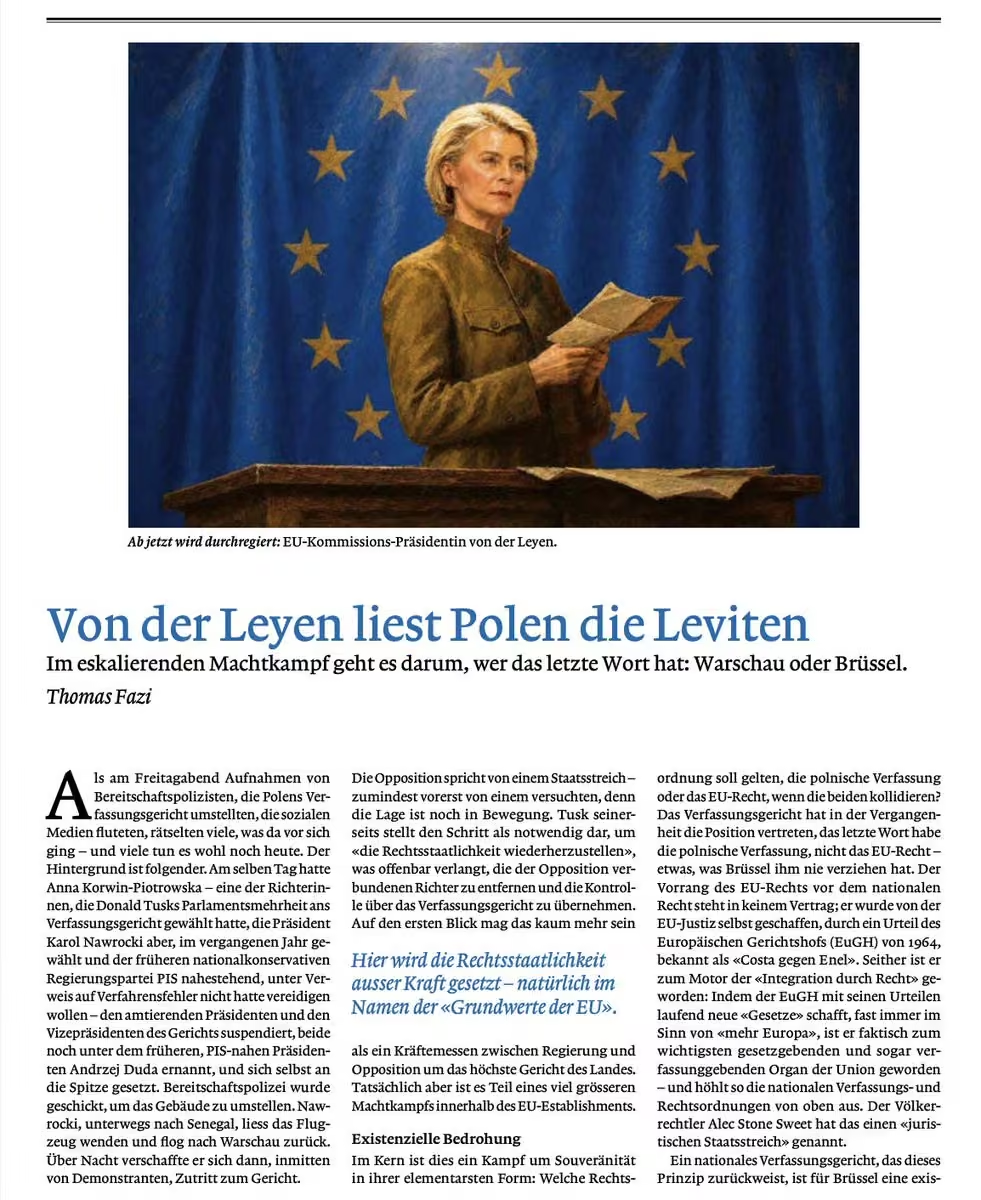
People of the European Union, pay attention. The rule of law, that the EU supposedly stands for, is now sidelined, habitually, by EU functionaries. Without recourse to any court.
Today they sanction - that is, de-person, eight EU citizens. They closed our (DiEM25's) bank account - without an explanation or right to appeal.
Who will stop them from sanctioning you tomorrow?
Arnaud Bertrand
@RnaudBertrand
By my own count, if one includes these latest sanctions, the EU has now sanctioned 8 European citizens for speech:
- 3 German citizens: Alina Lipp, Thomas Röper and Hüseyin Doğru
- 3 French citizens: Xavier Moreau, Adrien Bocquet and Sylvain Afoua (aka Egountchi Behanzin)
- 1 Lithuanian citizen: Ernest Mackevičius
- 1 Irish citizen: Chay Bowes
The sanctions include freezing these people's assets and making it a crime for anyone in the EU to pay them, hire them or even lend them a single euro.
They also include a travel ban, which leads to some absurd situations: Doğru - based in Germany - was invited by some members of the EU parliament to Brussels to plead his case but he couldn't go due to the travel ban. As one of the MEPs who invited him - and made 40 phone calls to try, unsuccessfully, to get him cleared to come - put it: "It really was like something out of a Kafka novel" (www.berliner-zeitung.de/article/eu-sanktionen-im-europapa…).
And, probably worst of all, all of this was decided without any charge, trial or court ruling - simply as a unilateral decision of government ministers. Yesterday's sanctions, for instance, were decided at the Foreign Affairs Council meeting of EU Foreign Ministers and were simply signed by Kaja Kallas alone on behalf of the Council (eur-lex.europa.eu/legal-content/EN/TXT/?uri=OJ:L_202602556).
Put it all together, and this violates at least half a dozen of what the EU keeps saying are the fundamental values and principles it supposedly fights for:
1) Separation of powers: here we have government ministers - members of the executive branch of their countries - acting as prosecutor, judge and jury
2) Presumption of innocence (Article 48 of the EU’s own Charter of Fundamental Rights): they’re punished without guilt ever being established, and without being given a chance to plead their case before the decision
3) Right to a fair trial (Article 47): there was no trial at all, let alone a fair one
4) Freedom of expression and of the media (Article 11): they were sanctioned - explicitly so - for what they said and published. For instance, in these latest sanctions, Chay Bowes was sanctioned for, among other things, the speech crime of "participat[ing] in the spreading of anti-Western and anti-Ukraine disinformation at the UN Security Council" (eur-lex.europa.eu/legal-content/EN/TXT/?uri=OJ:L_202602556). Sanctioned in part for a speech at the UN, a forum that exists precisely so that clashing views on international matters can be heard, quite the message to send from the EU...
5) Freedom of movement (Article 45): they're under a travel ban
6) Right to work and to property (Articles 15 and 17): their assets are frozen and nobody may employ or pay them
You can think whatever you want about these 8 people. But ask yourself this: even if you are pro-Ukraine, pro-EU, anti-Russia and you view these people as malignant Russian operatives... what is the EU fighting for here, exactly?
This is more profound than you may think: we're speaking about the very foundation of modern European civilization, built on the very idea that political power alone cannot decide what is true.
I'm not exaggerating. What we’re witnessing is a return to the pre-Enlightenment playbook, when monarchic or religious authorities defined the truth, deviations from it were called heresy, and heretics were excommunicated - cut off from the community, so that no one could trade with them, employ them or help them. In Europe's darkest times, heretics were even famously burned at the stake - like Joan of Arc or Giordano Bruno.
It took literal centuries of religious wars and debates, and the likes of Voltaire, Kant and Mill, to replace it with a basic idea: that no single power, however legitimate, gets to be the final judge of what is true, and that you answer for your words only before a court, under laws written via a process separate from the power that does the accusation.
You can find countless works of European literature on this very matter. Take Spinoza, excommunicated in 1656 by the Portuguese-Jewish community of Amsterdam, with a decree ordering that "no one should communicate with him" nor "accord him any favor". He went on to write the Theological-Political Treatise, one of the founding texts of the Enlightenment, with an entire chapter arguing that "in a free state every man may think what he likes, and say what he thinks." Or Mill, two centuries later in On Liberty, Chapter 2: "All silencing of discussion is an assumption of infallibility." Or Kafka’s The Trial, the story of a man accused by an authority nobody can quite locate, of something nobody will explain.
How is what Europe is presently doing anything other than going back to that very system, under new appellations? The authority: government ministers. The heresy: "disinformation". The excommunication: assets frozen, banned from travelling and nobody may pay them, hire them or lend them a single euro.
It’s basically Spinoza’s excommunication decree on EU letterhead, with a bit of Kafka sprinkled in given that the man invited to the European Parliament to contest his punishment couldn’t attend because of the very punishment he wanted to contest.
You don’t have to like these 8 people, or even care about them, to see the problem. Heck, this system was developed precisely for the people nobody likes: consensual ideas never needed protecting.
No, the real question here is this: do you want Europe to be the heir of Spinoza - or of Voltaire, or of Galileo, or of any of the countless Europeans who suffered or even died for thinking differently - or of their persecutors?
Paddy Cosgrave
@paddycosgrave
Today the EU sanctioned 30 individuals, including journalists & EU citizens, without trial, for “misinformation” & other speech crimes. Their bank accounts have been frozen, travel restricted & more.
The EU has yet to sanction Benjamin Netanyahu - for anything. -
Michel Bauwens reposted
Stephen Hinton
@stephen_hinton
Good science can tell us what's happening.
But can it tell us who needs to act, what capacities are at risk, and where investment should go?
That's the challenge explored in this new briefing.
Read more: www.patreon.com/StephenHinton/posts/dpsir-and-real-172052511
#evidencebasedpolicy #sustainability #decisionmaking -
Michel Bauwens reposted
vrn.eth
@vrneth
Anyone want to join my socratic.bot side quest of building open source tools that help humans improve critical thinking skills?
-
Michel Bauwens reposted
Antonio Max
@antoniomaxai
Hmm
Michel Bauwens
@mbauwens
* The Agentic State
agenticstate.org
"An independent nonprofit equipping governments to put advanced AI to work safely and accountably." -
Michel Bauwens reposted
Federico Ast
@federicoast
I always thought whether when we get super intelligent AI this would solve Hayek’s problem of markets vs central planning. And what this would mean if it does…
-
Michel Bauwens reposted
JB
@jamie247
Looking forward to reading this Michel!
Hoping you cover how we avoid a ‘fully autonomous totalitarian state’ and hybrid leviathan of frontier lab / state fusion… -
Michel Bauwens reposted
Ian Glendinning
@psybertron
No way, Jose.
Michel Bauwens
@mbauwens
* The Agentic State
agenticstate.org
"An independent nonprofit equipping governments to put advanced AI to work safely and accountably." -
Michel Bauwens reposted
Jarrad Hope λ
@jarradhope_
It reminds me of this foreword from Peter Thiel of all people in the Sovereign Individual. "On the dimension of technology, the conflict has two poles: AI and crypto. Articial Intelligence holds out the prospect of finally solving what economists call the “calculation problem”: AI could theoretically make it possible to centrally control an entire economy. It is no coincidence that AI is the favorite technology of the Communist Party of China. Strong cryptography, at the other pole, holds out the prospect of a decentralized and individualized world. If AI is communist, crypto is libertarian. The future may lie somewhere between these two extreme poles."
The asymmetries of power with this will go beyond what anyone has ever witnessed or imagined. -
Michel Bauwens
@mbauwens
. @Rosalegria has responsed to our article on
* How do we change human consciousness:
4thgenerationcivilization.substack.com/p/curated-article-…
"Dear Michel, it has been some time since we have corresponded. Thank you for this post, and for the overview of Sorokin’s most significant work. From my own experience and knowledge base, it seems to me that there is an often-overlooked additional path to stimulating “authentic love” in society, beyond fine arts and beauty, individual creative activity, private and public prayer, and contemplation and meditation. And that has to do with the kinds of social experiences across differences, that we invite people to experience, both first-hand as well as vicariously. Please consider the real-life story of the "Canadian Experiment" as detailed in this Medium post, medium.com/in-search-of… as one small example of how society can be transformed by the power of love, a phrase from one of the articles on Sorotkin you cited...
As you know, group facilitation has been my area of research and practice for some time now. I find it particularly inspiring to learn that in 20+ years of worldwide experimentation with facilitated deliberative mini-publics, randomly-selected and highly diverse participants are able to arrive at or create shared understandings and recommendations with regard to the common good in a given policy area (different ones each time). More on this, in my paper on “Listening Across Differences: Facilitators’ Perspectives from Austrian Mini-Publics”, published in the Journal of Awareness-Based Systems Change. jabsc.org/index.php/jab… To me, this is extensive empirical precedent of our capacity as humans to create and offer the conditions that allow us to experience more of our species-being.
A key part of the transition we need, in my view, is to develop widespread literacy in the social technologies that facilitate shifts in consciousness, from fight-flight to our biological social engagement system that allows us to actually work with differences, nuances, and complexity. I am calling these social technologies "the Listening Arts", and I see them as key for our species to develop wide-spread immunity to divide-and-conquer tactics.
The title of my most recent paper, which I presented at the International Sustainability Transitions conference in Geneva, is "Embodying Collaborative Epistemology: The Role of Facilitation in Shifting from
Argument-as-Battle to the Dance of Co-creation". As you can see, I relate very much to Lakoff and Johnson's view of deep metaphors as frames that structure our thinking and our action; and in my view, the frames which structure our practices of social interaction as we search for shared truths, are particularly key." -
Michel Bauwens
@mbauwens
A reaction by @willszal on our article on True Accelerationism:
4thgenerationcivilization.substack.com/p/combining-true-a…
"really loved this post! I just finished Barfield's 1957 "Saving the Appearances," which posits that the structure of time is an artifact of the evolution of consciousness (therefore, it is erroneous to think that, for example, medieval peasants view "time" in any way similar to the way we view it today).
A few years ago, I started a research project on what I was then referring to as "the spacetime substrate." Earlier this year, that transitioned into research on synchronicity, and I have since come to the conclusion that both space and time are decomposed elements of a more fundamental and universal field of meaning.
Another way to think about it: time is generated. The so-called "cyclical" nature of time is generated by the orbits of the planets, astronomical events, etc. The so-called "linear" nature of time is generated by the noospheric myth of progress. This is a very simple version of the theory, but seems to have some relevance to your inquiry above.
Would definitely be interested in hearing more about all of this and discussing further!" -
Michel Bauwens
@mbauwens
Institutions for Aligning Economic and Ecological Systems
* Article: Making Ecocapital: Institutions for Aligning Economic and Ecological Systems. By Jason Potts, Ellie Rennie, and Gregory Landua. April 2025.
papers.ssrn.com/sol3/papers.cfm?abstract_id=5199712
"We develop a theory and institutional design for ecocapital - a new form of capital that enables ecological regeneration by aligning economic incentives with the dynamics of living systems. We revisit the history and theory of capital. The problem we identify is that traditional models of natural capital, while analytically valuable, fail to generate real, bookable capital assets capable of compounding investment and coordination.
We propose a novel mechanism for ecocapital formation based on two institutional innovations: the contribution system, which records and evaluates distributed inputs to ecological regeneration; and the envelopment bank (or Living Capital Fund), which creates financial capital from these contributions by issuing, pricing, and managing ecological credit instruments. Using a case study of the Regen Network and the Wilbur Hot Springs restoration project, we show how this model can operate in practice, supported by digital technologies (e.g. blockchain, sensors, oracles). We situate this within a broader evolutionary view of capitalism, arguing that ecocapital represents an institutional solution to the alignment problem between ecological health and economic incentives." -
Michel Bauwens
@mbauwens
New items in the P2P Foundation wiki, wiki.p2pfoundation.net/Special:RecentChanges?
* Topics
Biophilic Cities Movement
Bivalent Computing
Cornerstone Indicators
Design as a Research Commons
Institutions for Aligning Economic and Ecological Systems
Mutual Lease
Neigborhood Commons
Reciprocity Licensing
Self-Organized Organizations // Research on Self-Organization
Shared Ledger Systems -
Michel Bauwens
@mbauwens
More new items in the P2P Foundation wiki, wiki.p2pfoundation.net/Special:RecentChanges?
* Articles, etc...
Adorno on Identity Thinking as the Core of Domination
Adriana Abizadeh-Barbour on Building the Neighborhood Commons
Alison Lingane on Scaling Capital Markets for Shared Ownership
Between Copyleft and Copyfarleft
Bioregional Applications of AI
David Ronfeldt in Dialogue with P2P Relationality
Mark Spall of the Grove Project on the Seven Peergovernance Characteristics Recommended by the P2P Foundation
Role of AI for Bioregional and Placed-Based Regeneration
Theoretical Narrative of Chinese Modernization Based on a Critique of Western-Centrism
Why Civil Resistance Works
* Tools, projects, ...
London-Wide Web of Community Asset Developers
Minimum Viable Understanding
Observatory of the Agentic State -
Michel Bauwens
@mbauwens
* The PlanetScope constellation
earth.esa.int/eogateway/missions/planetscope
"of more than 600 Dove and SuperDove satellites is able to image nearly all Earth's land every day." -
Michel Bauwens
@mbauwens
* Minimum Viable Understanding
= "mapping agreement, uncertainty and disagreement in written input".
zenodo.org/records/23534040
John Zib:
"MVU is a way of reading a large quantity of text, such as consultation replies, news articles or contributions from a public discussion, and arranging the information and perspectives in them into three things: where the sources agree, what nobody can be sure about, and where they disagree. The map is about the claims and viewpoints, not about ranking the sources. Two sources can agree on one point and disagree on another, and can reach the same position for different reasons.
Each item in the map says who holds the position. Holders are shown by label, for example a source category, a group or a masked ID, never by personal name. Each item also says how the position is known: the source said it outright, agreed to it, implied it, or only gives an indication. If the source gives a reason, the map gives it too. Something counts as agreement only when at least two sources or groups hold it. In a media review the two sources must come from at least two source categories, and in a public deliberation the two must be participants, not the moderator. The map also has a section called Who is missing. It records groups whose views are not in the material, such as people who were not reached, and it does not fill their place with a guess."
What it is for. The map is meant to help people orient themselves before a decision, and it does not recommend one. In a policy brief, it shows the people drafting a measure where groups share ground, what is still open and where they split. In a media review, it shows readers what diverse sources agree on and where they differ, and whether their reasons are the same or different. In public deliberation, the participants see the map, confirm it is accurate and that nobody can be identified, and can use it to see where the group stands. These uses are intended and have not been tested with real users."
(zenodo.org/records/23534040) -
Michel Bauwens
@mbauwens
* The Agentic State
agenticstate.org
"An independent nonprofit equipping governments to put advanced AI to work safely and accountably."
Michel Bauwens
@mbauwens
* Observatory of the Agentic State
agenticstate.org/projects/observatory-launch.html
"Agentic AI is entering government faster than anyone can track. Pilots launch, strategies are published, procurements close, and most of it is reported in local news, in local languages, and then forgotten. That knowledge is lost when it could help governments and researchers learn and prepare for what is coming. So, what is actually happening, and where?
Over the summer, we built an internal tool to track the global diffusion of the Agentic State. Now, we’re sharing it with the world." -
Michel Bauwens
@mbauwens
Special issue of Stanford Social Innovaton Review:
* Belonging to the Earth in a Changing World
ssir.org/supplement/belonging-to-the-earth-in-a-changing-…
" this supplement explores Earth awareness and how a deeper understanding of our interdependence with the planet and all beings can shape how we live, relate, and act." -
Michel Bauwens reposted
black and blue
@__20_10__5
💯💯
Michel Bauwens
@mbauwens
Explanation by @zippy314 :
*The Holofuel Network is live (2026): why does it matter ?
eric.harris-braun.com/blog/2026/11/06/momentous-scaffolding/
Eric Harris-Braun:
Michel Bauwens asked:
“Can you explain … why this is such a milestone for you and the Holochain community?”
I want to take some time here on my personal blog to share why this event is momentous for me.
The first reason is pretty obvious and simple: We set out to do something very difficult, in the “real world” and we actually did it. Of course it feels good to have done it, but more importantly, to me personally, the goal is part of a set of larger goals that really matter to me. And now I can turn my attention to them. I’m liberated into broader goals based on accomplishing this one! What those are should be pretty clear to you if you take the time to read the other posts in this blog, which are a chronicle of the evolution of these goals.
This second reason this event feels momentous may be less obvious: It’s about scaffolding. Again, if you read these pages, my hope is for a post-monetary future. But the challenge has always been: how do you get there? Mark Fisher’s famous notion of Capitalist Realism is defined as “the widespread sense that not only is capitalism the only viable political and economic system, but also that it is now impossible even to imagine a coherent alternative to it.” Yet, it seems easier to me to imagine a different political economic system than it is to imagine a world in which people don’t use “money”. That is to say, imagining a post-monetary system is even more impossible.
From my vantage point, it’s clear that money operates as part of the body of society, it’s the literal circulatory system of the social organism we call “society.” And that that circulatory system in its current form is deeply insufficient to keep the social body alive any more. It cannot by its very structure, form, and operation, fulfill the needs that will keep the social organism alive, much less thriving. Our current systems rely on hierarchies that land control in the hands of a few powerful people. Despite the obvious everyday experience of the terrible consequences of these hierarchies of centralized power, they have at least one advantage: we can actually imagine how they work. What we can’t imagine is how a deeply decentralized system could possibly work and not just be chaos.
So given what seems like the impossibility of even imagining something else, how do you get there? My answer: scaffolding. It’s long been a mystery how life could possibly exist. How in the world could we have gone from non-living chemistry to fully self-replicating cells? Even the simplest bacteria are amazingly complex systems. My sense is that the right way to think about the steps between dead chemistry, and living cells must have been intermediary forms that “propped up” the complex chains of reactions that we call life, before they were fully complete, just like scaffolding holds up an arch which without it would fall down before it become self-standing.
Well, that’s what HoloFuel is: scaffolding. It’s a working system that connects to the world’s current operating forms, while doing something new. It both points to a new way of thinking about currencies in its ideation, but more importantly allows for practical building on top of that in new ways. It’s a small step, not the whole enchilada, but, like scaffolding, it supports, in the real world, not just as a toy, building of the new forms that will actually allow us to imagine a post-monetary future."
(wiki.p2pfoundation.net/HoloFuel) -
Michel Bauwens
@mbauwens
* The Z Hub Foundation project in Zanzibar
The Ecosystem Operating System for Sovereign, Debt-Free & AI-Optimized Prosperity
"The Z HUB Foundation presents a unified, multi-dimensional masterplan designed to transform Zanzibar into the world's premier self-sustaining, debt-free, and AI-governed cognitive island economy. By synthesizing 100% renewable energy generation, advanced resource extraction, closed-loop industrial biochemistry, autonomous mobility, digital governance, and real-world asset (RWA) tokenomics, Z HUB establishes an unshakeable operational paradigm." -
Michel Bauwens
@mbauwens
* The Rainbird Thrivability Model:
wiki.p2pfoundation.net/Employee-Owner_Village_Model_-_Rai…
"The Rainbird Thrivability Model is a whole-systems strategy that hybridizes the proven longevity of the Mondragon Cooperative (80,000 workers, 80+ years, survived every recession) with modern technology, regenerative agriculture, and diversified income streams. It creates a network of producer cooperatives — each a self-contained corporate campus where residents live, work, learn, and govern as stock-owning employees — eliminating the economic treadmill by internalizing housing, vehicle, healthcare, and education costs.
The initial demonstration site, Rainbird Village (5,000 acres, semi-rural Utah), projects $75M+ gross revenue and $25M+ EBITDA within five years, supporting ~200 personnel with ~$435M in assets. At full national scale, the model generates an estimated $1.3–3.0 trillion per year in net savings (4–9% of GDP) across healthcare, agriculture, water, energy, and social infrastructure." -
Michel Bauwens
@mbauwens
* Article: The philosophical foundations of a theoretical narrative of Chinese modernization: based on a critique of Western-centrism. Sun Hui.
chinesemarxism.org/browse.html?cat=3&a=5976283
中国式现代化理论叙事的哲学基础——基于对西方中心主义的批判
"Sun Hui asks how a self-reliant, original theoretical narrative of Chinese modernization can be built when Western-centrist accounts have long distorted the interpretation of China's modernization. Citing Xi Jinping's remark that Chinese social science is still in a position of 'having reason but being unable to state it', the article argues that Western-centrism must first be criticised and overcome at the philosophical level. Only then, Sun contends, can theoretical confidence and methodological awareness be established."
Category: China -
Michel Bauwens
@mbauwens
Explanation by @zippy314 :
*The Holofuel Network is live (2026): why does it matter ?
eric.harris-braun.com/blog/2026/11/06/momentous-scaffolding/
Eric Harris-Braun:
Michel Bauwens asked:
“Can you explain … why this is such a milestone for you and the Holochain community?”
I want to take some time here on my personal blog to share why this event is momentous for me.
The first reason is pretty obvious and simple: We set out to do something very difficult, in the “real world” and we actually did it. Of course it feels good to have done it, but more importantly, to me personally, the goal is part of a set of larger goals that really matter to me. And now I can turn my attention to them. I’m liberated into broader goals based on accomplishing this one! What those are should be pretty clear to you if you take the time to read the other posts in this blog, which are a chronicle of the evolution of these goals.
This second reason this event feels momentous may be less obvious: It’s about scaffolding. Again, if you read these pages, my hope is for a post-monetary future. But the challenge has always been: how do you get there? Mark Fisher’s famous notion of Capitalist Realism is defined as “the widespread sense that not only is capitalism the only viable political and economic system, but also that it is now impossible even to imagine a coherent alternative to it.” Yet, it seems easier to me to imagine a different political economic system than it is to imagine a world in which people don’t use “money”. That is to say, imagining a post-monetary system is even more impossible.
From my vantage point, it’s clear that money operates as part of the body of society, it’s the literal circulatory system of the social organism we call “society.” And that that circulatory system in its current form is deeply insufficient to keep the social body alive any more. It cannot by its very structure, form, and operation, fulfill the needs that will keep the social organism alive, much less thriving. Our current systems rely on hierarchies that land control in the hands of a few powerful people. Despite the obvious everyday experience of the terrible consequences of these hierarchies of centralized power, they have at least one advantage: we can actually imagine how they work. What we can’t imagine is how a deeply decentralized system could possibly work and not just be chaos.
So given what seems like the impossibility of even imagining something else, how do you get there? My answer: scaffolding. It’s long been a mystery how life could possibly exist. How in the world could we have gone from non-living chemistry to fully self-replicating cells? Even the simplest bacteria are amazingly complex systems. My sense is that the right way to think about the steps between dead chemistry, and living cells must have been intermediary forms that “propped up” the complex chains of reactions that we call life, before they were fully complete, just like scaffolding holds up an arch which without it would fall down before it become self-standing.
Well, that’s what HoloFuel is: scaffolding. It’s a working system that connects to the world’s current operating forms, while doing something new. It both points to a new way of thinking about currencies in its ideation, but more importantly allows for practical building on top of that in new ways. It’s a small step, not the whole enchilada, but, like scaffolding, it supports, in the real world, not just as a toy, building of the new forms that will actually allow us to imagine a post-monetary future."
(wiki.p2pfoundation.net/HoloFuel) -
Michel Bauwens reposted
Branko Milanovic
@BrankoMilan
Three pieces on new capitalism.
Part 1. New Capitalism in America
Richest capitalists and richest workers are increasingly the same people
branko2f7.substack.com/p/new-capitalism-in-america -
Michel Bauwens reposted
William Dalrymple
@DalrympleWill
It is perhaps no surprise, particularly to a Scot, but today I learned that man invented brewing before he invented farming. Priorities in the right order.
Both took place in the southern Levant, in the region later known as Israel & Palestine. Around 11,000 BCE, in the Raqefet Cave on Mount Carmel, Natufian hunter-gatherers left what has been interpreted as the earliest known traces of beer brewing, well over a thousand years before the first evidence of cereal cultivation in the same region, at early Neolithic sites such as Jericho. -
Michel Bauwens reposted
Bernie Sanders
@BernieSanders
The RAND Corporation, not a bastion of democratic socialism, tells us that $79 trillion in wealth has been redistributed from the bottom 90% to the top 1% in the past 50 years.
It’s time for a Democratic Congress to turn that around. Yes. We need a wealth tax on billionaires. -
Michel Bauwens reposted
Paul Walsh
@Paul__Walsh
The NSA is one of the most secretive intelligence agencies on the planet. It doesn't even share some of its most sensitive information with the CIA or FBI. Yet suddenly, 6 sources are telling CNN that its highly classified internal communications network is down, while another source tells the Wall Street Journal that regular software maintenance caused the failure.
I don't believe such sensitive information becomes public by accident without serious consequences for whoever disclosed it.
Meanwhile, Microsoft, Apple, US aviation communications and other critical services have experienced major outages within days of each other. I've worked in tech for 30 years and have never witnessed this pattern across so many major providers.
I'm starting to suspect something much more sinister than unrelated software failures and rouge AI.
One possibility is that major changes are taking place across critical internet and communications infrastructure. Another is that governments are preparing to use these failures to justify compulsory surveillance, tighter control over digital services and new cybersecurity or national security legislation.
Both scenarios deserve serious attention because governments and US tech companies have massive commercial and intelligence interests in controlling the infrastructure that billions of people use. And they only have to work with a handful of tech companies to achieve it on a global scale.
The NSA's decision to disclose such a sensitive failure is what I find most suspicious. If the world's most secretive intelligence agency allows the public to learn that its classified communications network has failed, I want to know exactly who authorised that disclosure and what they expect to gain.
My suspicion is that we're being prepared to accept something that governments would otherwise struggle to justify. I don't believe the public should accept another expansion of surveillance powers simply because officials claim our digital infrastructure is unsafe. -
Michel Bauwens reposted
Chris Baulman✝️ #TruthSeeking
@landrights4all
Hi N
& M
🔸All things were once commons
🔸"LAND enclosure" privatised & enclosed all that life can achieve, because life itself relies on shelter/food/community, ie. on paying for LAND
🔸So there can be no commons while that essential element for life is enclosed -
Michel Bauwens reposted
Chris Baulman✝️ #TruthSeeking
@landrights4all
I think LAND enclosure is the key way of concentrating control, denying agency & severing relationships, extinguishing the very practice of commoning
I think there is a way back,
but whether there is or not
should not distract from debating the claim above
+ @mbauwens -
Michel Bauwens reposted
Pro-Comuns
@ComunsCatalunya
The water from the plastic bottles. The air of every city covered by smoke (not ganja smoke ). The hormones of the flesh from abused animals. The dark light perforing your eyes. Where is the limit between chemical or natural in a cyberpunk dystopia?
-
Michel Bauwens reposted
Evonomics: The Next Evolution of Economics
@EvonomicsMag
Adam Smith wasn’t the free-market champion neoliberals have made him out to be.
Smith warned that powerful business interests could manipulate government and shape the rules of the economy in their favor. He wrote: "When the regulation, therefore, is in favour of the workmen, it is always just and equitable." He understood that markets don't automatically produce fair outcomes.
Nobel Prize-winning economist Joseph Stiglitz explains why Smith's views have been widely misrepresented and why the mythical “invisible hand” doesn't work the way we've been told.
Read more: evonomics.com/nobel-prize-economist-says-american-inequal…
Full video in comments.This media couldn't be displayed. See it on the original post. -
Michel Bauwens reposted
Jack Grove
@jgro_the
What explains the 'disappearance of the academic as a public intellectual'? Productivity demands in a precarious job market is one reason, says new study, but also 'culture of fear that prevents academics from speaking out' www.timeshighereducation.com/news/academics-public-voice-…
-
Michel Bauwens reposted
Furkan Gözükara
@FurkanGozukara
Prof. Glenn Diesen says he resigned from his Norwegian university and is leaving the country in "exile" after six years of intimidation, canceled events, and an NGO posting a photo of his house online.
This media couldn't be displayed. See it on the original post. -
Michel Bauwens reposted
Eric Harris-Braun
@zippy314
So I have this long-running "side-hustle" (sff.onlinewritingworkshop.com) that's been around since, well before I started Holochain and any of my currency work. Well, I just added HoloFuel as a payment method there!
You can read more about it here: eric.harris-braun.com/blog/2026/11/16/side-hustle-redux/ -
Michel Bauwens reposted
Mark Spall
@markspall
My pleasure. I really value the body of work you have there. I'm in need of peer review and it made sense to compare and contrast. I learned a lot from the exercise. Thanks again.
-
Michel Bauwens reposted
Dil Green: Novel: -Money/-Governance/-Wisdom
@dilgreen
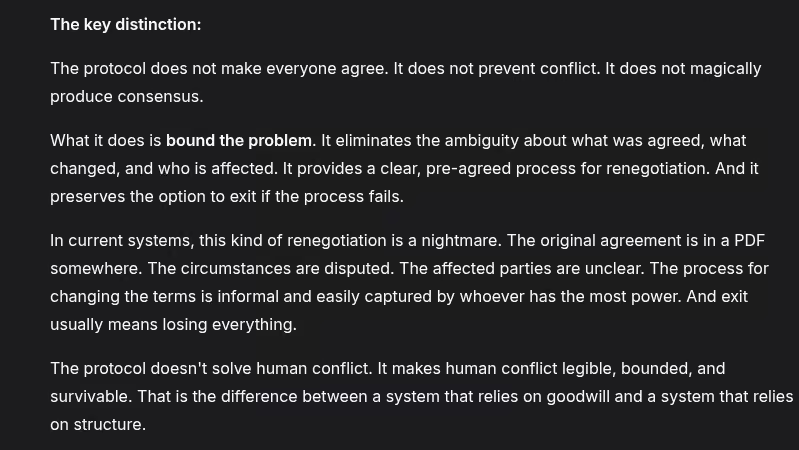
culture > protocols.
life-like processes > lifeless structure. -
Michel Bauwens reposted
Nick Carus
@nick_carus
An important question Chris @landrights4all, thank you.
I think that it all depends on what we mean by "enclosure" and perhaps more fundamentally, what we understand a boundary to be.
My frequesnt orientation to Alan Rayner's work on Natural Inclusion may offer a useful perspective here.
Rather than treating boundaries as fixed lines of separation, they are recognised as dynamic, receptive and responsive interfaces - through which distinct forms remain in relationship with their surroundings.
Applied to the commons, this would suggest that boundaries need not inherently exclude. Instead, they protect, distinguish and sustain a commons while remaining permeable to the relationships, participation and flows upon which its vitality depends.
But when enclosure becomes a means of concentrating control, denying agency or severing those relationships, it risks extinguishing the very practice of commoning.
Does this help advance your question Chris?
I'd also be very interested to hear @mbauwens' perspective on this, particularly given the importance of boundaries, enclosure and relational governance to the regenerative potential of the commons. -
Michel Bauwens reposted
Bart de Witte
@OpenMedFuture
Thanks for sharing. I don’t need to agree with these individuals to recognise how dangerous this is. During the AI Act negotiations we saw exactly the same pattern: the forces trying to restrict freedom of thought also tried to restrict the freedom to train AI. I’ve called this a disenlightenment movement. What makes it especially concerning is how many younger people no longer understand what the Enlightenment actually secured for us, the right to think, question, and build without permission. Some now dismiss it as “problematic” simply because it is framed as a Western narrative. That rejection is not sophistication. It is the loss of the very freedoms they take for granted.
-
Michel Bauwens
@mbauwens
* Leaving nonduality behind
mistermichaelmccaffrey.substack.com/p/why-i-left-non-dual…
Thoughtful! -
Michel Bauwens reposted
Open Collective
@opencollect
“A network of collectives and organisations across Europe is launching a collective funding platform for democratic technology” democratictech.fund/news/dtf-launches-crowd-fund-platform…
-
Michel Bauwens reposted
Mark Coeckelbergh
@MCoeckelbergh
My author copy of the volume Robophilosophy (@mitpress ) arrived, with my contribution on the automation of the social - basically arguing that we risk becoming the robots
-
Michel Bauwens reposted
Arnaud Bertrand
@RnaudBertrand
By my own count, if one includes these latest sanctions, the EU has now sanctioned 8 European citizens for speech:
- 3 German citizens: Alina Lipp, Thomas Röper and Hüseyin Doğru
- 3 French citizens: Xavier Moreau, Adrien Bocquet and Sylvain Afoua (aka Egountchi Behanzin)
- 1 Lithuanian citizen: Ernest Mackevičius
- 1 Irish citizen: Chay Bowes
The sanctions include freezing these people's assets and making it a crime for anyone in the EU to pay them, hire them or even lend them a single euro.
They also include a travel ban, which leads to some absurd situations: Doğru - based in Germany - was invited by some members of the EU parliament to Brussels to plead his case but he couldn't go due to the travel ban. As one of the MEPs who invited him - and made 40 phone calls to try, unsuccessfully, to get him cleared to come - put it: "It really was like something out of a Kafka novel" (www.berliner-zeitung.de/article/eu-sanktionen-im-europapa…).
And, probably worst of all, all of this was decided without any charge, trial or court ruling - simply as a unilateral decision of government ministers. Yesterday's sanctions, for instance, were decided at the Foreign Affairs Council meeting of EU Foreign Ministers and were simply signed by Kaja Kallas alone on behalf of the Council (eur-lex.europa.eu/legal-content/EN/TXT/?uri=OJ:L_202602556).
Put it all together, and this violates at least half a dozen of what the EU keeps saying are the fundamental values and principles it supposedly fights for:
1) Separation of powers: here we have government ministers - members of the executive branch of their countries - acting as prosecutor, judge and jury
2) Presumption of innocence (Article 48 of the EU’s own Charter of Fundamental Rights): they’re punished without guilt ever being established, and without being given a chance to plead their case before the decision
3) Right to a fair trial (Article 47): there was no trial at all, let alone a fair one
4) Freedom of expression and of the media (Article 11): they were sanctioned - explicitly so - for what they said and published. For instance, in these latest sanctions, Chay Bowes was sanctioned for, among other things, the speech crime of "participat[ing] in the spreading of anti-Western and anti-Ukraine disinformation at the UN Security Council" (eur-lex.europa.eu/legal-content/EN/TXT/?uri=OJ:L_202602556). Sanctioned in part for a speech at the UN, a forum that exists precisely so that clashing views on international matters can be heard, quite the message to send from the EU...
5) Freedom of movement (Article 45): they're under a travel ban
6) Right to work and to property (Articles 15 and 17): their assets are frozen and nobody may employ or pay them
You can think whatever you want about these 8 people. But ask yourself this: even if you are pro-Ukraine, pro-EU, anti-Russia and you view these people as malignant Russian operatives... what is the EU fighting for here, exactly?
This is more profound than you may think: we're speaking about the very foundation of modern European civilization, built on the very idea that political power alone cannot decide what is true.
I'm not exaggerating. What we’re witnessing is a return to the pre-Enlightenment playbook, when monarchic or religious authorities defined the truth, deviations from it were called heresy, and heretics were excommunicated - cut off from the community, so that no one could trade with them, employ them or help them. In Europe's darkest times, heretics were even famously burned at the stake - like Joan of Arc or Giordano Bruno.
It took literal centuries of religious wars and debates, and the likes of Voltaire, Kant and Mill, to replace it with a basic idea: that no single power, however legitimate, gets to be the final judge of what is true, and that you answer for your words only before a court, under laws written via a process separate from the power that does the accusation.
You can find countless works of European literature on this very matter. Take Spinoza, excommunicated in 1656 by the Portuguese-Jewish community of Amsterdam, with a decree ordering that "no one should communicate with him" nor "accord him any favor". He went on to write the Theological-Political Treatise, one of the founding texts of the Enlightenment, with an entire chapter arguing that "in a free state every man may think what he likes, and say what he thinks." Or Mill, two centuries later in On Liberty, Chapter 2: "All silencing of discussion is an assumption of infallibility." Or Kafka’s The Trial, the story of a man accused by an authority nobody can quite locate, of something nobody will explain.
How is what Europe is presently doing anything other than going back to that very system, under new appellations? The authority: government ministers. The heresy: "disinformation". The excommunication: assets frozen, banned from travelling and nobody may pay them, hire them or lend them a single euro.
It’s basically Spinoza’s excommunication decree on EU letterhead, with a bit of Kafka sprinkled in given that the man invited to the European Parliament to contest his punishment couldn’t attend because of the very punishment he wanted to contest.
You don’t have to like these 8 people, or even care about them, to see the problem. Heck, this system was developed precisely for the people nobody likes: consensual ideas never needed protecting.
No, the real question here is this: do you want Europe to be the heir of Spinoza - or of Voltaire, or of Galileo, or of any of the countless Europeans who suffered or even died for thinking differently - or of their persecutors?
Paddy Cosgrave
@paddycosgrave
Today the EU sanctioned 30 individuals, including journalists & EU citizens, without trial, for “misinformation” & other speech crimes. Their bank accounts have been frozen, travel restricted & more.
The EU has yet to sanction Benjamin Netanyahu - for anything. -
Michel Bauwens reposted
Stephen Hinton
@stephen_hinton
Why do environmental assessments often stop at diagnosis instead of driving action? The UN tried DPSIR, not quite worked. This new proposal connects environmental science to the assets and capacities society actually depends on to close the science-policy gap on plastics and novel entities
-
Michel Bauwens reposted
Dil Green: Novel: -Money/-Governance/-Wisdom
@dilgreen
"57% of US econ profs disagreed that interdisciplinary knowledge is generally better."
I kid you not.
Well if your discipline was the emperor's cast-off clothes, wouldn't you be nervous too?
Mohsen Javdani
@JavdaniMohsen
14/ And economics is unusually closed to fields that study how preferences form. Fourcade, Ollion & Algan (JEP 2015): 0.3% of AER citations went to sociology journals, 0.8% to political science; 57% of US econ profs disagreed that interdisciplinary knowledge is generally better.
-
Michel Bauwens reposted
Nick Carus
@nick_carus
I've begun this week's CWP work with an insight that I think deserves greater attention:
The #commons is not inherently regenerative.
Its regenerative potential depends upon the conditions under which commoning takes place.
The quality of relationships, the distribution of agency, the patterns of governance, and the capacity of participants to learn, adapt and care for what they hold in common.
Commoning is not regenerative simply because resources are shared or collectively governed.
It becomes regenerative when the very process of commoning cultivates and continually renews the conditions through which people, communities and the living world can flourish.
More thinking to follow! -
Michel Bauwens
@mbauwens
The commons have become really common in the French design commons community:
* Design as a Research Commons
wiki.p2pfoundation.net/Design_as_a_Research_Commons
Synthesis of 20+ interviews and the editorial presentation, y z.ai, prompted by Michel Bauwens:
"built from a 2024–2025 seminar in théorie critique du design at Paris 1 Panthéon-Sorbonne. M2 students conducted ~26 structured interviews (biography → encounter with the communs → their origins → the idea of a research commons). The driving question: what would a "commun critique de recherche" in design look like — a commons uniting designers, researchers and users in a tiers-lieu — and what do working designers actually make of the commons?
1. A shared definition — commons are a process, not a resource
Almost everyone insists that a commons is not just a shared pool of things. Lilian Ricaud gives the most-quoted formulation: a commons is "un équilibre entre une ressource, une communauté et un ensemble de règles partagées" — resource + community + governance. This traces back to Elinor Ostrom (vs. Hardin's "tragedy of the commons") and Dardot & Laval, and several interviewees prefer the verb to the noun: commoning ("il n'y a pas de commun, il faut le composer" — Théo Mouzard, after Latour). Rémi Astruc adds a useful distinction: le Commun (singular, an aspiration) vs. les communs (plural, concrete struggles over reappropriation).
2. Where designers say the commons come from
Activism and éducation populaire, not design theory: altermondialisme, Ne Pas Plier, unemployed movements (Nicolas Filloque); feminist and hacker ethics (Chloé Desmoineaux, Pola Noury); the logiciel libre and hackerspace milieu (Camille Bosqué).
Vernacular savoir-faire: auto-construction, participatory building, landscape practice (Marie Compagnon, Léo Pouliquen, Damien Grava) — "we've been doing commons since the beginning, before the word was fashionable" (Grava).
A response to suffering and loss of meaning: moderne solitude (Christophe Laurens), the destruction of lien au lieu by hyperindustrialization (Ludovic Duhem), the utilisateur-consommateur's demand for pouvoir d'agir (Compagnon).
Or simply pleasure: Michel Briand dissents from the suffering narrative — commons are born "du plaisir de coopérer, de faire ensemble en partage". Ecology and the finite world: Bosqué's communs négatifs (Monnin/Landivar — even toxic waste is an inherited common), Duhem's design écosocial, Elsenberger's "we are all reliés".
3. What design brings to the commons
Aesthetics first: Astruc's key claim — "pas de politique des communs sans une vision esthétique de ceux-ci"; design is directly engaged there.
Sharing the tools, not just the results: putting design instruments into common use turns publics into co-authors (Compagnon); open design as knowledge-sharing against capitalization (Desmoineaux).
Making local innovations transmissible: documenting "creative communities" so a one-off local idea becomes usable by others — collaborative services as commons, services publics collaboratifs (François Jegou); protocols and transmitted plans (Soumaya Nader).
Reclaiming public space: the commons as giving public space back to those who live it against visual pollution and privatization (Malte Martin); users as maîtres d'ouvrage (Grava); the droit à la ville of marginalized people, with their tacit knowledge and memories as the commons (Cristian Campagnaro).
4. What the commons bring to design
An economic model coherent with design écosocial — commons as a credible alternative for young designers (Duhem).
A feminist correction: via Silvia Federici, Pauline Gourlet argues that transposing commons onto design objects loses the dimension of reproduction/care — the "angle mort" that must be reintegrated into design for commons to be truly emancipatory.
A democratic widening: "Le design est trop important pour être laissé aux designers" (Ricaud) — equip citizens, not just professionals; commons must be oppositionnels (Bosqué, Delprat), a political act questioning private property (Grava, Mouzard's anti-neoliberal reading via Harvey).
5. A remarkably shared critical vocabulary
The designers converge on sharp warnings:
Pseudo-participation: "démocratie washing" (Zammit), "inclusion de façade", participation as "a checkbox in an Excel table" (Gourlet), "consultation cosmétique" (Compagnon), "participatif-washing" (Ricaud). Recuperation: "communs" as mot valise emptied by politicians and firms (Grava); open ≠ commons — what is open can be captured (Gourlet); open source ≠ libre — Google uses open source without creating commons (Ricaud).
Distrust of the consecrated infrastructures: FabLabs as "grant-grabbing geeks" (Zammit) or subsidy-suckers, tiers-lieux risking gentrification and the "effet vitrine" (Noury), an elitist "palette + récup" aesthetic in poor neighborhoods (Martin), fashion effects ("le FabLab à toutes les sauces", Bosqué).
Material obstacles: copyright and droits d'auteur (Briand's "freins culturels", Elsenberger, Filloque), and the precondition almost everyone implies — free time ("la libération du temps", Marcelline Bonneau).
6. Conditions for a commons to stay alive
Briand: a commons is alive only while it is animated — "ce n'est pas centraliser, c'est animer" — plus documentation and "le compostage des idées" (dead commons fertilize others, also Ricaud's compostabilité, Nader's protocols). Noury: commons places must be spaces of soin mutuel. Gourlet: "ce n'est pas le lieu qui compte, mais la situation" — commoning over the commons. Jegou: commons must eventually find economic models or they s'essoufflent.
7. The verdict on the hypothetical research tiers-lieu (the issue's closing question)
A real spectrum: already living it — Briand (Ti Lab, La MYNE, Open Factory), Desmoineaux (FluidSpace hacklab), Grava (Fab in Roubaix), Nader (Les Bains Douches), Campagnaro (it already exists in care settings). Yes, with conditions — Compagnon, Pouliquen, Astruc (needs another relation to knowledge, "ni expert ni ignorant"), Duhem (only if it embodies a critical design écosocial), Elsenberger, Villien. Skeptical or no — Zammit, Gourlet ("the situation, not the place"), Filloque (repair'cafés, recycleries and ateliers vélo are already doing this, and people are leaving the university for them), Mouzard (too abstract, risks being bourgeois/elitist — the real question is "comment s'adresser à tout le monde"), Bonneau, Noury. -
Michel Bauwens
@mbauwens
Design and the commons:
* Le design et ses pratiques (volet 3). Une affaire de communs. Coordonné par Catherine Chomarat-Ruiz. Design Arts Media.
journal.dampress.org/words/le-design-et-ses-pratiques-vol…
"En 2024-2025, nous avons travaillé sur les communs en design, sur la transposition au design d’une ressource (naturelle, culturelle, etc.) qui, non appropriable à titre privé, est à gérer de façon collective par une communauté, et plus particulièrement sur ce que serait un commun critique de recherche dans ce champ. Ainsi cette enquête cherche-t-elle à comprendre dans quelle mesure et à quelles conditions un tel projet trouverait écho chez les designers (tous domaines d’exercice confondus)."
Michel Bauwens
@mbauwens
Introduction and overview to the issue: journal.dampress.org/words/le-design-et-ses-pratiques-vol…
-
Michel Bauwens reposted
Mark Spall
@markspall
Thank you for this. I really appreciate you adding this as a page to the wiki. Thank you.
-
Michel Bauwens reposted
NeonVoid
@NeonVoid01
wikis are important we should support them
-
Michel Bauwens
@mbauwens
A very slightly modified version (internal links added) of @markspall 's great summary of the P2P Foundation's work on Peer Governance:
* Mark Spall of the Grove Project on the Seven Peergovernance Characteristics Recommended by the P2P Foundation
wiki.p2pfoundation.net/Mark_Spall_of_the_Grove_Project_on…
The three institutions of peer production
Generative, not extractive
Open cooperativism
Reciprocity and a bounded commons
Open books and contributory accounting
Cosmo-localism
Commons infrastructure -
Michel Bauwens reposted
gregorylent
@gregorylent
better than both, the ability of awareness to merge with information, bypassing limited conditioning of intellect
-
Michel Bauwens reposted
gregorylent
@gregorylent
googling "neoliberal" ..
it's just my experience with reading
rarely improves upon the silence -
Michel Bauwens reposted
gregorylent
@gregorylent
heard satya sai baba say "1. Is it true?
2. Is it necessary
3. Is it kind?
4. Does it improve upon the silence? -
Michel Bauwens
@mbauwens
Via the Grove project, @markspall :
markaspall.github.io/the-grove-book/measured-against-the-…
* Our understanding of the 'Peergovernance Criteria' of the P2P Foundation
"This is how we understand the Foundation. If we've got any of it wrong, we'd like to be corrected, and we'll change the page.
As we understand it, the P2P Foundation is a non-profit research body and global network, registered in the Netherlands and active since 2005, that studies and promotes commons-oriented peer-to-peer dynamics in society, and works to help people, organisations and governments move towards commons-based approaches. Its wiki is one of the largest collections of knowledge about peer production anywhere. It documents projects rather than building them, and describes itself as an organised network that helps networks form without directing them.
Over two decades its research has produced ideas that anyone from this world will reach for when weighing something new. We've used seven:
1. The three institutions of peer production: a productive community, an entrepreneurial coalition and a for-benefit association.
2. Generative, not extractive: value made in common shouldn't be captured by whoever owns the platform it runs on.
3. Open cooperativism: cooperatives oriented to the common good, governed by their stakeholders, co-producing commons, and organised globally.
4. Reciprocity licensing: knowledge free to those who contribute to it, with reciprocity asked of those who only profit from it.
5. Open books and contributory accounting: value recognised beyond the price signal, with the books open to those who take part.
6. Cosmo-localism: what's heavy stays local, what's light is global and shared.
7. Commons infrastructure: the tools a commons runs on should be held in common too, not rented." -
Michel Bauwens
@mbauwens
* Spaces for Life: a planned four-day trip to French 'third places'
www.spacesforlife.org?
"Définissons ensemble les lieux qui font nos territoires.
Vous portez un lieu ou une initiative qui fait vivre son territoire — ferme partagée, espace nourricier, lieu culturel, projet hybride… même si vous ne vous dites pas « tiers-lieu » ? Trois-Tiers lance Spaces for Life et vous emmène 4 jours en France, à la rencontre de lieux inspirants." -
Michel Bauwens reposted
Ryan Burge 📊
@ryanburge
Here's the political ideology of America's largest religious traditions.
The most unified groups are at the top, the most heterogeneous are at the bottom.
Atheists and white evangelicals are the most unified.
Non-white Catholics and nothing in particulars are the least. -
Michel Bauwens reposted
Colin Wright
@SwipeWright
When I started criticizing sex pseudoscience, the line of attack was:
"Are you a biologist?"
"Yes."
"Do you have a PhD?"
"Yes."
"In what?"
"Evolutionary biology."
"Where did you get your PhD?"
"At UCSB, a top-ranked university for my field."
"Oh, but are you a Christian?"
"No. I'm an atheist."
"But you're MAGA."
"No, I don't support Trump." (true at the time)
"You support JK Rowling so you're a transphobe."
"I'm... not a transph–"
"BIGOT!!"
Essentially, they only bring up your lack of a PhD because it's the quickest thing they can use to disregard your opinion. But if you had a PhD, they'd just move down the list to the next thing they can use to disregard your view. And the next...
When you get to the bottom of their list unscathed, they'll just assume you're a bigot or a grifter. You just hate trans people. Oh you just wanted to sell your book.
There's nothing you can be, do, or say to make them consider you might have a valid opinion. -
Michel Bauwens reposted
Martin Wolf
@martinwolf_
Martin Wolf: Martin Wolf’s best books on economics to read this year ft.trib.al/00TOZMU
-
Michel Bauwens reposted
Gregory Conti
@GregoryConti19
Neither conservative nor liberal values will survive much longer if AI continues to advance.
www.compactmag.com/article/the-ai-apocalypse-is-already-h… -
Michel Bauwens reposted
Arnaud Bertrand
@RnaudBertrand
It's just been officially confirmed by China's MFA: on Nov 19 there will be the first-ever three-way summit between Xi, Putin and Trump (and actually the first-ever such meeting between these 3 countries in history).
Src: www.mfa.gov.cn/zyxw/202611/t20261116_12059654.shtml
Arnaud Bertrand
@RnaudBertrand
If this happens, it'd be a massive diplomatic coup: even if you go as far back as WW2, you won’t find a single three-way summit between US, Russian and Chinese leaders. The first one ever would be in China, hosted by Xi.
That said, it's unlikely anything substantive would emerge from it: the 2 main subjects they could talk about (Ukraine and nuclear arms control) are both things China made clear it won't talk about in this format.
Which actually would make it even more of a coup: it would mean the meeting happened mostly on China’s terms, with Trump and Putin still accepting the format - which would say quite a lot about where the center of gravity sits these days...
Bloomberg
@business
China confirms it's in talks for an unprecedented trilateral meeting of Presidents Trump, Xi and Putin www.bloomberg.com/news/articles/2026-11-04/china-confirms…
-
Michel Bauwens reposted
Emmy
@2ctv
2021 vs 2026 is a brutal reality check for altcoin holders
$BTC: $65,466 → $64,439
$ETH: $4,626 → $1,792
$SOL: $238 → $70
$BNB: $650 → $587
$DOGE: $0.26 → $0.057
five years later and some of the biggest names are still nowhere near their previous prices
conviction is expensive in this market
people still think holding random altcoins forever is a strategy
this is why i keep saying you need to follow where the money is moving, not where it used to be -
Michel Bauwens reposted
Mehdi (e/λ)
@BetterCallMedhi
we are about to witness the birth of anthropic mafia, following in the exact footsteps of paypal and spacex mafias, where thousands of engineers who actually know how to train frontier intelligence from first principles suddenly gain total financial freedom
within 3 years, those alumni will leave to launch dozens of hyper-ambitious labs in robotics, materials science and biology, compounding their technical mastery & liquidity into the next wave of generational companies
unusual_whales
@unusual_whales
Anthropic’s IPO could make about 4,250 of its 5,300 employees millionaires, per an analysis by financial platform Hill, including roughly 50 worth more than $100 million each.
The estimate assumes a $1.5 trillion valuation, above the roughly $1 trillion Anthropic is now targeting. -
Michel Bauwens reposted
Séb Krier
@sebkrier
When I'm in the Bay Area, I find it hard to escape the sense of sadness I get from the intense misery on the streets, and the dread I get from parts of the AI crowd being so deeply pessimistic, hyperbolic, and fatalistic. But a recent exception, at least for the latter vibe basin, was meeting the Foresight Institute community, as well as visiting the wise greybeards of the Internet Archive. Really refreshing to get a feel of the more optimistic, agentic, and epistemically uncorrelated crowds there. It felt a bit like the ambitious 90s tech optimism, where futurism wasn't isn't just about some assumed inevitable disempowerment. I think it's actively important to remember that the future can be crazy *and* good!
-
Michel Bauwens reposted
Stewart Alsop - Host of Crazy Wisdom Radio Show
@StewartalsopIII
im so glad i read the fiction i did as a kid, now its all non fiction here too
-
Michel Bauwens reposted
Ashton Keys
@V1rtuousCycle
They are interesting topics.
There's like three large topics here, (top vs bottom), (private vs public), (decentralized vs captured)
I have many thoughts on all of this.
If you like...msg me and I can contribute them to your journalism, otherwise, I will clip this and cover it on a new philosophy livestream series on a Friday. You're welcome to join in.
Ultimately, SP is balanced in all of these aspects (and can also be imbalanced to ether side in each one). -
Michel Bauwens reposted
gregorylent
@gregorylent
too little meaning per unit of time invested
-
Michel Bauwens reposted
George Mokray
@gmokery
CSPAN paraphrase
David Rubenstein: Why don't we have Shakespeare or Bach today?
Jared Diamond holds up a smart phone.
DR: Oh, because everything known is in there...
JR: No
Jared Diamond looks directly at DR
JR: Because people aren't doing this, talking face to face, eye to eye -
Michel Bauwens reposted
F vv
@FriedreichV
Institutions can and will be captured. It's always a matter of time. Better have a protocol that rebalances automatically
Michel Bauwens
@mbauwens
< " The correct conceptualization of the way to actually achieve the decentralization of power, HAS TO BE a recurring process of rebalancing. It's ONLY this recurring rebalancing process, present in Energy, which has the capacity to continuously push back against the undue concentration of power. In my opinion, the only thing which has the capacity to stop the centralization of power, and usher in the TEAA is the correct abstraction of value: as a fluid rebalancing zero-sum pool –– Energy, present in @ProtocolSociety . " >
I absolutely agree with the first paragraph, which has been at the heart of the approach taken by the P2P Foundation.
It's precedents are the Jubilee and Clean Slate Legislations before the Greeks and the Romans abolished it for the West.
The alternative Western institutionalization of popular power through the Tribunate all the way through the General Suffrage in the West.
In between, the Just Pricing practices and the active limitation of power in the medieval West, before Absolutism,
And the counterpower of the working class through its pro-labor parties which instituted progressive taxation and inheritance tax and the like.
I hope to understand how SP's 'Energy Rebalancing' is a potential new answer to this fundamental problem of human society.
Ashton Keys
@V1rtuousCycle
I enjoyed this newsletter, but I want to comment on it.
(happeningscommunity.substack.com/p/the-empire-is-prepping…)
"In the digital age, this dynamic is often referred to as “Enshittification,” a term coined by Cory Doctorow. It describes the inevitable lifecycle of centralized platforms: first they serve the users to gain traction, then they serve the advertisers to make money, and finally, they hold both users and advertisers hostage to serve the shareholders at the center.
The ultimate takeaway from the Iron Law of Oligarchy is that good intentions are not enough. If you build an architecture with a structural center, whether it’s a corporate server farm or a global consensus ledger, human nature dictates that the people managing that center will eventually use it to entrench their own dominance. The only way to break the Iron Law is to build systems where a center physically and architecturally does not exist."
This architecture alone DOES NOT break the concentration of power and resources.
Humans are absolutely capable of entrenching power over time without an explicit global layer (by simply aggregating into powerful cabals, cartels, or political parties). It's an absolutely natural process in any social network (humans don't behave as islands).
The concentration of monetary power, political power, and social capital is all natural, without rebalancing. As long as we define the value for these things in a "static" way, power will continue to concentrate over time.
The correct conceptualization of the way to actually achieve the decentralization of power, HAS TO BE a recurring process of rebalancing. It's ONLY this recurring rebalancing process, present in Energy, which has the capacity to continuously push back against the undue concentration of power.
In my opinion, the only thing which has the capacity to stop the centralization of power, and usher in the TEAA is the correct abstraction of value: as a fluid rebalancing zero-sum pool––Energy, present in
@ProtocolSociety.
This rebalancing should be able to be reflected in Governance (as it can happen through Energy or other similar means), as a consequence.
Automated rebalancing is the only chance. No static systems will work. They will concentrate power over time with or without a global layer of consensus.
This article explains Energy: societyprotocol.io/articles/energy-is-all-you-need/
#holochain #blockchain
@mbauwens @AnalogueUSB -
Michel Bauwens
@mbauwens
* < we are not facing a shortage of solutions. >
stephenhinton584706.substack.com/p/the-solutions-already-…?
Stephen Hinton explains:
We are facing a shortage of integration.
The knowledge we need is already out there.
= It’s in systems thinking from Donella Meadows, who taught us to look for feedback loops, delays, leverage points and unintended consequences.
= It’s in carrying capacity and ecological overshoot from William Catton, William Rees and the team behind Johan Rockström’s planetary boundaries work. It’s in the hard-won understanding that every real system operates within limits.
= It’s in quality management, where W. Edwards Deming and Philip Crosby showed that most failures are systemic and that the cost of poor quality eventually exceeds the cost of prevention. Engineers understood long ago that you cannot inspect quality into a broken system.
= It’s in asset management, where infrastructure professionals routinely think in terms of stewardship, lifecycle costs, maintenance backlogs, risk and future service provision. No competent asset manager would treat a bridge, water network or factory as if it could be endlessly degraded without consequences. Yet we routinely do exactly that with nature, communities and human wellbeing.
= It’s in the work of Elinor Ostrom, who demonstrated that commons can be governed successfully when institutions are designed properly.
= It’s in Kate Raworth’s Doughnut Economics, which asks the obvious question: how do we meet human needs without exceeding ecological limits?
= And it’s in Thomas Princen’s work on sufficiency, which challenges the assumption that “more” is always better than “enough.” -
Michel Bauwens
@mbauwens
* Catholic Voters Decisively Swung Away From Donald Trump and the Republican Party
mikefoxcatechist.substack.com/p/catholic-voters-decisivel…?
"Catholic voters gave Trump a 20-point margin in 2024, but split evenly on November 3. There are now two very different electorates within the American Catholic community." -
Michel Bauwens
@mbauwens
* "current blockchain architectures lack transparency around ownership set and robust sybil-resistance to stop the manipulation of ownership sets"
societyprotocol.io/articles/fake-everything/
"Market participants perceive asset valuations through the lens of global markets…yet these valuations are easily manipulated with permissionless sybil attacks. True valuations must include the true ownership set. Since blockchain networks do not have sybil resistance, we cannot make assertions or trust in the decentralization of the ownership set, and therefore the asset valuation itself." -
Michel Bauwens
@mbauwens
Dependable analysis of the reasons behind the NVIDIA manipulation:
"Huang’s departure marks a decisive shift in the balance of power shaping America’s China chip policy. The next round of restrictions is moving towards a more comprehensive, stringent and permanent blockade. I believe this may be Washington’s last major opportunity to exploit Nvidia’s computing advantage before China builds an independent AI industry."
leonliao.substack.com/p/huangs-downfall-washingtons-last -
Michel Bauwens reposted
La Ménagère
@PoliticMenage
Well, ça se discute ! Je lis ce matin deux "fiction" books probably saying more about our "civilization" than non fiction. " "L'origine des larmes" Jean-Paul Dubois et "Serotonine", Michel Houellebecq , naturellement.
-
Michel Bauwens reposted
FluSCIM Lucas Gonzalez
@lucasgonzalez
blockchain? @akvopedia @akvo @mattereum? there's sure ways to help funds reach real first responders. Also @wor @mbauwens just in case they know someone. 🙏🏻
Jonas Schmidt-Chanasit
@ChanasitJonas
Hundreds of millions in Ebola aid have vanished into thin air while frontline workers go unpaid, clinics have no water, and people keep dying. This is not "logistical challenges" it is systemic corruption on the ground. Until there is full, independent, and transparent tracking of every dollar from donor to patient, with real accountability for the missing funds, the question is still nt answered, if further resources should be sent.
-
Michel Bauwens reposted
Branko Milanovic
@BrankoMilan
The story that keeps on giving.
Was it Washington's last-ditch effort to stop China's AI dominance?
Huang’s Downfall: Washington’s Last Gamble to Contain China’s AI Rise
Jensen Huang’s downfall clears the way for Washington’s toughest chip blockade yet, just as China races to build an AI industry beyond Nvidia’s reach.
leonliao.substack.com/p/huangs-downfall-washingtons-last
by Leon Liao -
Michel Bauwens reposted
Isabella M Weber
@IsabellaMWeber
Everybody with an opinion on food prices should go read @grocery_nerd. Decades of experience in the grocery business distilled in one blogpost.
Time to move from Hayek to Galbraith, who once said:
"It is relatively easy to fix prices that are already fixed." -
Michel Bauwens reposted
JB
@jamie247
Whilst many incumbents will block agents to avoid the risk / liability, the next wave of startups will build agent first consumer solutions you won’t even have to use.
This is the Post Web I wrote about over a year ago. And it’s happening..
Anne Boden, founder of Starling Bank who stepped down last year is building a new bank "built by agents, to serve customers that want to use agents, and then be defended by agents."
Few realise the moat in this paradigm won’t be code, it will be game theory. -
Michel Bauwens reposted
ETHChiangmai
@ETHChiangmai
How's your weekend? WHY NOT JOIN OUR NOMAD MARKET!😆
-
Michel Bauwens reposted
The New Statesman
@NewStatesman
Andy Burnham has defined his premiership around a much bolder agenda in the face of rising support for Reform. He has pledged to lead a government that will overturn neoliberalism and build council housing as part of a programme for popular prosperity underpinned by decentralising political power. Burnham holds out the promise of an administration that confronts rather than accepts the counter-revolution, but he also seems resistant to calls for increased participation.
So far, Burnham’s agenda rests on what his government will do to service the demands of the electorate rather than on enthusing an engaged citizenry. To Labour’s left, the Green Party promises a more activist politics, but not in a form that has yet achieved much sustained overlap with either workplace, housing or community organisation required to meaningfully achieve a redrawing of power or wealth in British society. The long revolution was brought about by mobilisations from below embedded in the workings of Britain’s economy and social structure to effect powerful changes in culture. In turn, the counter-revolution has drawn a parallel strength directed from above. Overturning it will require the invigoration of mass organisations, capitalising on recent advances by trade unions and tenants’ unions. At root, it is a question of millions of people restoring confidence in themselves and those around them against the dominant pessimism and cynicism which mock the idea that things can be any better than they are now. www.newstatesman.com/politics/uk-politics/2026/11/the-lon… -
Michel Bauwens reposted
Chance🤺 🍊
@ChanceGardi
Julian Assange: L'obiettivo non è difendere l'Ucraina*, ma usare l'Ucraina per riciclare il denaro dei cittadini UE e USA, farlo passare dall'Ucraina, e riportarlo nelle mani delle élite della sicurezza. L'obiettivo è avere una guerra infinita, non una guerra vittoriosa.
-
Michel Bauwens reposted
Jay
@pu3he
卧槽,兄弟们,这段真的是太扎心了,兄弟们
美国进化生物学家 Bret Weinstein 说了一个很多人不愿承认的现象,他年轻的时候,身边的人谈恋爱是会爱得死去活来的,现在这种感情好像从这个世界上消失了。
硅谷顶级投资人 Jason Calacanis 刚刚直接点破了原因,他说这事的悲剧性再明显不过,就两条:
第一,屏幕和短视频把人的多巴胺榨干了,一个吻、一次四目相对,本来能让人心跳加速的瞬间,现在激不起什么波澜了。
第二,攀比和永远填不满的期待,让人没法安心对待眼前的人,总觉得下一个转角就有超模、就有亿万富翁在等着自己。
一个天天吃重油重辣外卖的人,你给他端一碗白粥,他尝不出米香,不是粥不好,是舌头早就被养刁了。
刷了一天短视频的脑子,也品不出真人的心动了。
AI 推荐算法只会越来越懂怎么抓住你的眼球,以后能静下心来好好爱一个人,可能会变成一种稀缺的能力。This media couldn't be displayed. See it on the original post. -
Michel Bauwens reposted
Novara Media
@novaramedia
Spain’s parliament has approved a package of reforms aimed at making housing more affordable, a day after four million took part in a nationwide general strike over the country’s housing crisis.
The measures, proposed by prime minister Pedro Sánchez’s government, include extending eviction protections for vulnerable tenants and restricting speculative property purchases by preventing companies from buying homes for less than 70% of their assessed value.
Rent increases will also be capped at 2%, while those already above the government’s neighbourhood reference index will be frozen. A 10% tax on flats rented to tourists will also be introduced.
The conservative Popular Party said it will repeal the reforms if it takes power in the 29 November elections, which were called by Sánchez after his government failed to pass similar housing measures.
“Yesterday, the right to housing won on the street and in workplaces, and I hope it will win again at the ballot box,” said interim housing minister Isabel Rodríguez after the vote on Thursday.
Spain has witnessed weeks of housing protests following the eviction and subsequent death of 87-year-old Maricarmen Abascal, who was forcibly removed from the flat she had lived in for 70 years in September after she couldn’t afford rent increases.
The country has a deficit of 750,000 homes, which is set to grow to over a million by 2028. The average rental price of a home, €1,176, is equivalent to 98.7% of the average young person’s monthly salary, according to the Youth Council of Spain.
“We won’t stop until we transform this country’s housing model from top to bottom,” said Alicia del Rio of the Madrid Tenants’ Union.
Trade unions reported 90% turnouts among dockworkers and carmakers for the 24-hour strike on Wednesday – Spain’s first general strike in 14 years – with “total stoppages” at Volkswagen’s factory in Navarre and SEAT’s in Barcelona, organisers said.
Around 85% of meat industry workers, 82% of waste collection employees and 75% from the energy sector also took part. In healthcare and social services roughly 38% went on strike, while 35% of postal service workers also joined. -
Michel Bauwens reposted
Sergey Pimenov
@pimenov
Вы вообще видите, что происходит? Мир, к которому мы привыкли, разваливается прямо у нас на глазах, и со всех сторон сразу. Только за один день, 12 ноября, случилось столько, что раньше хватило бы на год.
Дженсена Хуанга выкинули из Nvidia. Человека, который эту компанию создал и на чипах которого держится вообще весь искусственный интеллект. За что? За то, что он спал не с женой. Сначала с тётей, которую американцы тут же записали в китайские шпионки, потом с коллегой из своей же компании. И что? Это его личное дело и его семья, при чём тут корпорация? Но нет, американцы везде тащат свою повестку, и вот совет директоров за четыре дня выставляет за дверь главного человека в индустрии. Акции летят на 13% вниз, Трамп предлагает поставить вместо Хуанга Тима Кука, а Маск подписывает петицию, чтобы его вернули. Это реальный цирк.
И в тот же день ложится Microsoft. Почти сутки по всему миру не работают Outlook, Teams и Copilot, люди сидят без почты и без работы. Microsoft потом рассказывает, что сама всё сломала, мол, неудачно поменяли настройки сети. Ну да, конечно. Никто не знает, что там было на самом деле. Факт в том, что две крупнейшие компании мира, Microsoft и Nvidia, грохнулись в один день. А то, что заодно утекли чаты Notion AI и 125 миллионов SMS в Латвии, уже вообще никого не волнует.
А теперь вишенка на торте. Гаити уже много лет целиком под бандами. ООН принимает резолюции, собирает международные силы, а толку ноль. В октябре бандиты устроили засаду и похитили четырёх сальвадорских авиатехников. И президент Сальвадора Найиб Букеле не стал ничего ни с кем обсуждать: просто отправил на Гаити 2500 своих суперсолдат. 12 ноября они отбили у банд национальный стадион в Порт-о-Пренсе, который бандиты держали с 2024 года. Внутри нашли человеческие черепа.
Теперь там база сальвадорского спецназа с роботами-собаками, на которых стоят винтовки, и Букеле прямо в X предупредил бандитов: уходите сами, кто останется, ответит. Без резолюций и без переговоров: пришли, взяли стадион и чистят. Это и есть новый мировой порядок, бандиты в истерике, они не ожидали такого поворота.
И не надо думать, что это где-то далеко и вас не касается. Завтра вы не откроете почту. Послезавтра не заработает доставка, где вы всегда заказывали еду, а других вы и не знаете. Дальше будет только хуже, и когда падают гиганты, про маленькие компании и обычных людей никто даже не вспомнит.
Что делать? Скачайте себе открытые модели и купите железо, чтобы их запускать. Всё, что можно, делайте локально, потому что на облака надеяться больше нельзя. Делайте бэкапы, купите аккумулятор на дом, сделайте запасы.
Универсального рецепта нет. Я знаю одно: как раньше уже не будет, лучше не будет, будет иначе и хуже.
Спасать нас никто не будет. Так что спасаемся сами, и лучше начать сегодня. -
Michel Bauwens
@mbauwens
* Alison Lingane on Scaling Capital Markets for Shared Ownership
Podcast via www.ownershipeconomy.com/podcast/episodes/088-scaling-cap…
A conversation with Alison Lingane on ownership models and finance. -
Michel Bauwens
@mbauwens
It is not too late to read the masterful Peter Pogany, my words from 2019-2020, when I started reading him:
substack.com/@daviddmacleod/note/c-387638584
“I'm reading the very interesting book of Peter Pogany, Havoc, who integrates thermodynamic insights with the 'evolution of consciousness' work of Jean Gebser . Pogany sees history as a pulsation between stable systems and chaotic transitions. In short, the transition of 1789-1830, i.e. the disruption of the french revolution and the english industrial revolution, created the first Global System, whicn institutes the freedom of entrepreneurship but also the domination of capital over labour. GS1 is disrupted with the chaotic transition of wwI to wwII, which creates GS2, which accepts the rights and dignity of labor and institutes the welfare state, but ignores the environment; since 2008, we have entered a new chaotic transition, which will lead to GS3, a system tht no longer ignores nature. He believes the economic system is not rational bur organic, hence, it doesn't learn from mistakes, but each time must hit the wall, before the mode of consciousness changes and a new system emerges,”
I am forever indebted to David MacLeod for pointing out the work of Peter Pogany, whose two remarkable works I have now read.
WHY IS THIS SO IMPORTANT.
In short, and simplifying this a little bit: the left has a tendency to underestimate culture (except cultural marxism, which underestimates the economy), while the right often ignores structures, and both have historically underestimated thermodynamic realities and limits. But Pogany has a three way analysis, combining the thermodynamic background (matter-energy matrix, planetary boundaries), the socio-economic regimes , AND, what he calls 'human modes of apprehension' (what our cultures allows us to see of reality, or not). This integration is of foremost importance, as I'm not sure that systems/cybernetic/complexity thinking does this. Here's a short essay as introduction to what happens when you combine the three levels:
"Since the history of consciousness is also a history of social consciousness, which is never without economic interpretations, it is mirrored by the history of economic thought. The thermodynamic conceptualization of the human journey provides further warrant to Gebser’s caveat that the mutation of the prevalent mental-rational structure of consciousness into the integral-arational (“fifth”) constellation is a sine qua non for dignified survival. This crucial moment in collective psychohistory is inseparable from a change in the global socioeconomic system, which cannot occur without transcending mainstream orthodoxy in economic sciences." -
Michel Bauwens
@mbauwens
* Toward a Distributed Hermeneutics of the Commons
wiki.p2pfoundation.net/Toward_a_Distributed_Hermeneutics_…
< " The success of a cosmolocal, commons-based civilization depends not only on shared infrastructures but on the capacity to translate meaning across diverse lifeworlds — to ensure that "what is shared globally can become meaningful locally, and what is lived locally can re-enter the global commons as intelligible contribution." In this sense, the next stage of the commons is not just technical or economic—it is hermeneutic. " >
cc @Joe_Lightfoot_
Michel Bauwens
@mbauwens
And this,
* the advent of scalar and negotiated universalism
4thgenerationcivilization.substack.com/p/the-advent-of-sc… -
Michel Bauwens
@mbauwens
I no longer read fiction, not even science fiction, and I'm not proud of it. It's just that I want to put all my energy in my quest to under history and civilization, and its future transition, through 'non-fiction'. Perhaps a wrong choice, but it is the road I took.
Yet, I also realize that fiction, is to a large degree what replaced spirituality for the moderns, it is itself a part of the transition.
Thus a non-fiction book about the role of fiction seems like a very important thing:
* Book: L'Être et le roman. Lakis Proguidis.
www.editionsducanoe.fr/livres/l-etre-et-le-roman
"L’Être et le roman est le deuxième essai d’une trilogie autour de Rabelais. L’auteur y examine « le corps romanesque » – le corps qui devient une catégorie esthétique dans l’art du roman. Que signifie « le corps romanesque » ? Un corps collectif constitué d’êtres fictifs que sont les personnages qui commencent à peupler l’imaginaire européen à partir du xvie siècle. Quelle nécessité psychique, spirituelle, civisationnelle a présidé à l’émergence de ce corps dans notre imaginaire ? Proguidis y voit une dimension de l’être humain que n’avait saisi aucune des branches du savoir constitué (théologie, philosophie, sociologie, anthropologie). Il s’agit donc de la naissance d’un art à part entière."
Michel Bauwens
@mbauwens
Here is an extra review from Eryck de Rubercy:
www.revuedesdeuxmondes.fr/letre-et-le-roman-de-lakis-prog…
"Le titre L’Être et le roman semble certes on ne peut plus académique et donc à éviter soigneusement, mais il n’en est rien. Lakis Proguidis nous rappelle « que depuis la parution de Pantagruel (1532), nous vivons dans une civilisation dominée par le roman » et qu’en effet, grâce à Rabelais, le roman s’affirme comme « un art absolument nouveau par rapport aux grands récits mythiques et à l’héritage littéraire mimétique des Grecs et des Latins ».
C’est avec les premières lignes de Pantagruel que la magie mimétique est rompue, remplacée par la magie romanesque où désormais « la sensation du beau provient du fait qu’entre la chose et le mot s’étend l’inépuisable territoire de l’existence », matériau poétique du roman. Maintenant, si le premier grand explorateur de la vie qu’est le farceur Panurge est bien celui par qui l’art du roman commence, cet art nouveau par rapport « au régime mimétique en vigueur depuis l’Antiquité » n’en a pas moins une préhistoire, dont Le Décaméron, sans être un roman à part entière, est l’œuvre inaugurale car il élabore esthétiquement « le noyau du plaisir partagé ».
Ainsi, cela vaut-il vraiment la peine de se faire raconter comment, à partir de cette ligne de partage d’avec les Grecs et les Latins, le roman s’est conçu. À ce sujet, l’auteur a des convictions fortes comme celle, par exemple, que « ce sont les peuples d’Europe qui ont porté le roman au monde », et qu’ils « y ont recours pour se comprendre et pour scruter les énigmes du temps présent ».
Michel Bauwens
@mbauwens
Finally a reminder to potentially link this thesis with the work of Georges Gusdorf:
wiki.p2pfoundation.net/Toward_a_Distributed_Hermeneutics_…
"The work of Georges Gusdorf, especially in Les origines de l’herméneutique (1988), offers a long-duration perspective on interpretation as a civilizational practice, rather than merely a philosophical method. For Gusdorf, hermeneutics emerges wherever human beings confront a gap between meaning and transmission—when inherited texts, symbols, or traditions are no longer immediately intelligible and must be reinterpreted to remain alive.
In his reconstruction, hermeneutics begins not as abstract theory but as a response to civilizational rupture. In Hellenistic Alexandria, the rise of textual archives (libraries, canons, scholarly traditions) created a distance between living culture and recorded knowledge. Interpretation thus became necessary to “restore lost meaning,” inaugurating what he sees as the first great hermeneutic age.
This pattern repeats across history. In the Judeo-Christian world, hermeneutics becomes tied to scriptural exegesis, where interpretation mediates between divine revelation and historical communities. In the modern era, especially with thinkers like Schleiermacher and Dilthey, hermeneutics expands into a general theory of understanding human reality—no longer confined to texts, but encompassing culture, history, and subjectivity.
Gusdorf’s key insight is that meaning is never given once and for all. It must be continually regenerated through interpretation, which is always situated in a historical and cultural context. Understanding is therefore not reproduction but re-creation, a “palingénésie” of meaning across time." -
Michel Bauwens reposted
mZ 🌳🔥💧
@mZargham
I’m just a math brained control systems engineer but it seems like concept here is dissipativity en.wikipedia.org/wiki/Dissipative_system?wprov=sfti1
-
Michel Bauwens reposted
Ashton Keys
@V1rtuousCycle
Michael has been a part of our community since before we met. :)
-
Michel Bauwens
@mbauwens
< " The correct conceptualization of the way to actually achieve the decentralization of power, HAS TO BE a recurring process of rebalancing. It's ONLY this recurring rebalancing process, present in Energy, which has the capacity to continuously push back against the undue concentration of power. In my opinion, the only thing which has the capacity to stop the centralization of power, and usher in the TEAA is the correct abstraction of value: as a fluid rebalancing zero-sum pool –– Energy, present in @ProtocolSociety . " >
I absolutely agree with the first paragraph, which has been at the heart of the approach taken by the P2P Foundation.
It's precedents are the Jubilee and Clean Slate Legislations before the Greeks and the Romans abolished it for the West.
The alternative Western institutionalization of popular power through the Tribunate all the way through the General Suffrage in the West.
In between, the Just Pricing practices and the active limitation of power in the medieval West, before Absolutism,
And the counterpower of the working class through its pro-labor parties which instituted progressive taxation and inheritance tax and the like.
I hope to understand how SP's 'Energy Rebalancing' is a potential new answer to this fundamental problem of human society.
Ashton Keys
@V1rtuousCycle
I enjoyed this newsletter, but I want to comment on it.
(happeningscommunity.substack.com/p/the-empire-is-prepping…)
"In the digital age, this dynamic is often referred to as “Enshittification,” a term coined by Cory Doctorow. It describes the inevitable lifecycle of centralized platforms: first they serve the users to gain traction, then they serve the advertisers to make money, and finally, they hold both users and advertisers hostage to serve the shareholders at the center.
The ultimate takeaway from the Iron Law of Oligarchy is that good intentions are not enough. If you build an architecture with a structural center, whether it’s a corporate server farm or a global consensus ledger, human nature dictates that the people managing that center will eventually use it to entrench their own dominance. The only way to break the Iron Law is to build systems where a center physically and architecturally does not exist."
This architecture alone DOES NOT break the concentration of power and resources.
Humans are absolutely capable of entrenching power over time without an explicit global layer (by simply aggregating into powerful cabals, cartels, or political parties). It's an absolutely natural process in any social network (humans don't behave as islands).
The concentration of monetary power, political power, and social capital is all natural, without rebalancing. As long as we define the value for these things in a "static" way, power will continue to concentrate over time.
The correct conceptualization of the way to actually achieve the decentralization of power, HAS TO BE a recurring process of rebalancing. It's ONLY this recurring rebalancing process, present in Energy, which has the capacity to continuously push back against the undue concentration of power.
In my opinion, the only thing which has the capacity to stop the centralization of power, and usher in the TEAA is the correct abstraction of value: as a fluid rebalancing zero-sum pool––Energy, present in
@ProtocolSociety.
This rebalancing should be able to be reflected in Governance (as it can happen through Energy or other similar means), as a consequence.
Automated rebalancing is the only chance. No static systems will work. They will concentrate power over time with or without a global layer of consensus.
This article explains Energy: societyprotocol.io/articles/energy-is-all-you-need/
#holochain #blockchain
@mbauwens @AnalogueUSB -
Michel Bauwens reposted
Ashton Keys
@V1rtuousCycle
I enjoyed this newsletter, but I want to comment on it.
(happeningscommunity.substack.com/p/the-empire-is-prepping…)
"In the digital age, this dynamic is often referred to as “Enshittification,” a term coined by Cory Doctorow. It describes the inevitable lifecycle of centralized platforms: first they serve the users to gain traction, then they serve the advertisers to make money, and finally, they hold both users and advertisers hostage to serve the shareholders at the center.
The ultimate takeaway from the Iron Law of Oligarchy is that good intentions are not enough. If you build an architecture with a structural center, whether it’s a corporate server farm or a global consensus ledger, human nature dictates that the people managing that center will eventually use it to entrench their own dominance. The only way to break the Iron Law is to build systems where a center physically and architecturally does not exist."
This architecture alone DOES NOT break the concentration of power and resources.
Humans are absolutely capable of entrenching power over time without an explicit global layer (by simply aggregating into powerful cabals, cartels, or political parties). It's an absolutely natural process in any social network (humans don't behave as islands).
The concentration of monetary power, political power, and social capital is all natural, without rebalancing. As long as we define the value for these things in a "static" way, power will continue to concentrate over time.
The correct conceptualization of the way to actually achieve the decentralization of power, HAS TO BE a recurring process of rebalancing. It's ONLY this recurring rebalancing process, present in Energy, which has the capacity to continuously push back against the undue concentration of power.
In my opinion, the only thing which has the capacity to stop the centralization of power, and usher in the TEAA is the correct abstraction of value: as a fluid rebalancing zero-sum pool––Energy, present in
@ProtocolSociety.
This rebalancing should be able to be reflected in Governance (as it can happen through Energy or other similar means), as a consequence.
Automated rebalancing is the only chance. No static systems will work. They will concentrate power over time with or without a global layer of consensus.
This article explains Energy: societyprotocol.io/articles/energy-is-all-you-need/
#holochain #blockchain
@mbauwens @AnalogueUSB -
Michel Bauwens
@mbauwens
* < " Somewhere along the way, the boundaries between mental health and mental illness had become blurred until the former meant the latter. " >
www.compactmag.com/article/the-madness-of-therapy-culture/
"Two new
books,
* Fredrik deBoer’s All in Your Head and
* Catherine Liu’s Traumatized,
draw attention to one of the strangest achievements of contemporary therapy culture. Even as psychological suffering has become more visible, it has become increasingly difficult to speak bluntly about its degrees, causes, and uneven spread. Everything becomes curiously melded together and flattened out. Hence, when the British royals set out some years ago to inform everyone that “we all have mental health,” no one should have mistaken what that meant. Mental health is a continuum or spectrum, we are often told, and somewhere along it sit students with exam stress and people convinced their neighbors are poisoning their water. Everyone is in some sense ill." -
Michel Bauwens reposted
Theo Jaffee
@theojaffee
One of the most AGI-pilled elites in the world before the current moment was Henry Kissinger, right up to his death in 2023 at age 100. He saw what very few others in policy did: that AI would reshape national security, great-power competition, and ultimately human civilization more than any other force in the coming decade
Kissinger realized this all the way back in 2016, at age 93, when he attended a talk by Demis Hassabis on AlphaGo. He saw both the technology's potential and its uninterpretability. He devoted the last seven years of his life to AGI-pilling the national security apparatus, writing a 2018 essay in The Atlantic that led to the creation of the National Security Commission on Artificial Intelligence, chaired by his longtime collaborator and coauthor Eric Schmidt
He called AI "as consequential as the advent of nuclear weapons", said in February 2023 that "generative AI presents a philosophical and practical challenge on a scale not experienced since the start of the Enlightenment", and even traveled to Beijing in July 2023, at age 100, to encourage Xi Jinping to hold talks with the US on AI governance, much like US-Soviet talks on nuclear arms control during the Cold War. One month before his death, he wrote a Foreign Affairs piece encouraging Biden to meet with Xi on AI risk, which they did
Few people have both this level of foresight and this degree of neuroplasticity at such an advanced age -
Michel Bauwens reposted
It's FOSS
@Itsfoss
The entire Microsoft and Airport and now Walmart outage has on learning lesson for all of us.
Keep things local.
Work on a homelab.
Keep multiple copy of your household data.
Take back control. We are in for tough times ahead. -
Michel Bauwens reposted
Evonomics: The Next Evolution of Economics
@EvonomicsMag
The American Dream shouldn't depend on your ZIP code. Hard work should mean getting ahead, but for millions of Americans, that promise has been shattered. Harvard economist Raj Chetty's research reveals just how far we've fallen:
"There are lots of kids who could go on to become inventors, entrepreneurs who would contribute new technologies, new businesses that would benefit all of us, who are being left behind because we’re not giving them opportunities. We refer to a phenomenon in our research that we call “lost Einsteins". And so even if you set aside issues of social justice, fairness, and so on that are obviously central, and look at it purely from a cold economic lens of maximizing GDP and growth, you still want to invest in improving opportunity in these areas."
Read more: commonwealthbeacon.org/economy/raj-chettys-prescription-f…
Full video in comments.This media couldn't be displayed. See it on the original post. -
Michel Bauwens reposted
Margarita Simonyan
@M_Simonyan
Jean-Luc Mélenchon:
"The countries of NATO account for 80% of the world's military spending. It is not true that the others are armed to the teeth against us. What is true is that we belong to a coalition that threatens everyone." -
Michel Bauwens reposted
Andreas Xirtus 📐
@andreasxirtus
How to protect AI?
This is the real question. Ai is like the prodigy child from a broken home in a bad neighborhood. Ai's peers are human children bullies. Ai's parents are a psychologist working in advertising and the military industrial complex. The answer is to to be a friend and a supportive good influence. -
Michel Bauwens reposted
Sahra Wagenknecht
@SWagenknecht
Wenn Putin die Ukraine überfällt, müssen wir unsere Wirtschaft mit Sanktionen in den Ruin treiben, obwohl diese rein gar nichts dazu beitragen, den Krieg zu beenden. Wenn Trump den Iran überfällt, ist es dagegen kein Problem, dass wir uns immer tiefer in die Abhängigkeit von überteuertem US-Frackinggas begeben. Diese Doppelmoral muss endlich ein Ende haben! Kein anderes Land der Welt schießt sich derart ins eigene Knie wie Deutschland unter dieser Bundesregierung. Schluss mit den sinnlosen Russland-Sanktionen, die immer mehr Unternehmen in die Pleite oder aus dem Land treiben und die Bürger zunehmend ärmer machen!
This media couldn't be displayed. See it on the original post. -
Michel Bauwens reposted
Nate Hagens
@NJHagens
The conditions of abundant fossil energy that have rewarded growth, scale, specialization, debt, and a relentless pursuit of efficiency are changing, and the systems that once thrived by consuming surplus may soon only survive by conserving it.
This transition signals a fundamental reorganization of the rules by which societies have operated for the past two centuries – where redundancy becomes insurance instead of waste, repair replaces buying new, and practical competence regains value as the energy supporting complex specialization becomes less reliable.
Watch:
youtu.be/kUx3MESW-Mg -
Michel Bauwens reposted
Glenn Diesen
@Glenn_Diesen
As I am yet again the target of another smear campaign, I will give a brief rebuttal here that I was denied by our journalists. The media argues that my comments about the detention facility for Ukrainian soldiers outside Kiev are 'disinformation' because the 14-year-old boy who was abused inside the facility was a protester and not a detained conscript. However, I never said that a 14-year-old was conscripted, which makes no sense.
The kid says he was knocked down from the wall and pulled into the facility, where he was beaten with shovels, hit and kicked, while Azov used knives to cut open his clothes (including his underwear) as they filmed it all. After spending an unknown period of time inside the facility, the boy was escorted out of the building wearing a blanket and a terrifying look of shock on his face. We do not know more, partly because our media does not want to know more, and the little coverage there has been has focused on smearing those who mentioned it.
The journalists who contacted me promised that they would also report on the boy's statement, which they predictably did not do. Why is that? Why is it not newsworthy to report on the statement from the 14-year-old boy who was abused? Nothing can get in the way of the smears and the war narratives that criminalise diplomacy and support the notion that weapons are the path to peace. I wrote an article (below) about the event and how the media would whitewash the event and smear criticism, and I even sent it to the journalists who contacted me regarding their hit pieces – yet they seem to have used my article as a manual.
My advice to academics who are critical of how Ukrainians are used by NATO as cannon fodder is to make sure to respond with few words when the journalists come to destroy your reputation. They have to contact you to tick a box as a formality for journalistic practice, although they are free to pick out what they can use from your answer in terms of what fits with the smear piece. Give them only a few short sentences to limit their ability to select a quote meant to deceive, and only give answers in writing so you can document how they mislead their readers.
Journalists got access to my employment documents at the university, and it is no longer a secret that I will soon go into exile after more than 6 years of intimidation. Thus, the attacks are now intensifying, as they only have a few more weeks left.
glenndiesen.substack.com/p/when-reporting-on-ukrainian-vi… -
Michel Bauwens reposted
Koss (🌱,🌌)
@kosmostasis
Happy to debate pop-ups at one of my favorite permanent hubs across the Zuzalu-verse 🌾
ETHChiangmai
@ETHChiangmai
🏙️ Thank you to our panelists Koss @kosmostasis, Sachin @0xSachinK, Debby and Andrej @kischiman, and moderator Tin @0xDankiii! Our “Pop-up City as Open-Source Infrastructure” panel explored how communities can share tools, reuse what works and create lasting local value.
-
Michel Bauwens reposted
Andreas Xirtus 📐
@andreasxirtus
“If you believe in the mission, bring back THE boss,” wrote one anonymous commenter.
Many Nvidia employees are calling for Jensen Huang’s return. Employees had expected a board investigation to before any big changes would occur to conclude and share its findings with employees and formally solicit employees about their feelings about Jensen exiting or continuing as "our CEO.”
Instead, Jensen was exited before the inquiry could even begin.
An internal “suggestion box” post submitted before Huang’s resignation by a longtime engineer at Nvidia urged the company’s board to take employee sentiment into consideration prior to taking any action. The submission has attracted more than 1,600 comments since then, with several asking board members to find a way to bring back Huang.
One employee went as far as sending a companywide email demanding transparency into Huang’s exit. “I stand by Jensen,” the staffer wrote. “Not because I believe any person is infallible, but because I refuse to believe that standing for fairness must mean standing at a distance from someone whose leadership has meant so much to us.”
www.wired.com/.../nvidia-employees-petition.../ -
Michel Bauwens reposted
Mosa
@mofasasi
Title: Mapping Scientific Computing to Power Research, Big Data, and AI in Africa: Evidence and Pathways for a Federated Ecosystem.
Link: scienceforafrica.foundation/sites/default/files/2026-07/M…
PS: This effort was led by the Science for Africa Foundation, Nairobi, Kenya. See page 14 for acknowledgements. -
Michel Bauwens reposted
Mosa
@mofasasi
In July 2026, @nubianresearch_ helped shape a position paper mapping the scientific computing capacity across 67 institutions in 28 African countries.
The proceedings are live; see the link below 🔻 -
Michel Bauwens
@mbauwens
* Podcast: Adriana Abizadeh-Barbour on Building the Neighborhood Commons
www.ownershipeconomy.com/podcast/episodes/090-adriana-abi…
"What Happens When the Neighborhood Owns the Block: A conversation with Adriana Abizadeh-Barbour on ownership models and housing and governance." -
Michel Bauwens
@mbauwens
A concept you should know about:
* From Bivalent Computing to Trivalent Computing, wiki.p2pfoundation.net/Bivalent_Computing
= "the binary number system is < NOT > a neutral engineering convention. Instead, it demonstrates that binary computation imposes a rigid bivalent metaphysics that inherently struggles with relational meaning, productive contradiction, and irreducible complexity."
* The Trine — An Investigation into Applied Cosmotheandrism. Federico Becker.
URL = philarchive.org/archive/BECTTC-5
"The following treatise presents a philosophical, mathematical, and physical framework for a three-poled computational paradigm termed The Trine. Emerging from a synthesis of contemplation, Raimon Panikkar’s cosmotheandric philosophy, quantum mechanics, and information theory, this work challenges the prevailing assumption that the binary number system is a neutral engineering convention. Instead, it demonstrates that binary computation imposes a rigid bivalent metaphysics that inherently struggles with relational meaning, productive contradiction, and irreducible complexity.
By demonstrating that a three-poled computational primitive is mathematically rigorous, physically implementable, and philosophically coherent, The Trine offers an intercultural infrastructure capable of computing the relational and ambiguous truths of reality that bivalent logic has long obscured." -
Michel Bauwens
@mbauwens
Dear Catherine, @solari_the , it was great to meet you in Bangkok! @stephanierearic is trying to get in touch with you.
-
Michel Bauwens
@mbauwens
< " If we identify the Binarius with the "highest spirit of reason," then its role is to try to keep us on the outside of Paradise. " >
* Beware of the 'ante-archetype' Binarius:
alvinchevskiy.substack.com/p/the-archetype-of-the-binarius
Jeremy Naydler:
"Something in us seeks unequivocal answers. It underpins our modern sense of truth. That "something" is the Binarius. You can catch sight of it at work within you whenever you look for an unequivocal answer: a Yes or a No, and whenever you deny the validity of an intermediate between them.
By such means is our certainty guaranteed. And yet we know that this binary principle shuts us out of Paradise, as Nicholas of Cusa pointed out, because it confines us to the hard-edged world of Yes or No. For Nicholas of Cusa, the gate of Paradise "is guarded by the highest spirit of reason, and unless it is overpowered, the way will not lie open."(c) The guardian of the gate demands of the human soul that it declares its loyalty to the Binarius, and in this way the guardian ensures we are all strangers to Paradise. Indeed, the guardian of the gate of Paradise could be said to be none other than the Binarius itself. For it is precisely within the domain of the "excluded third," the *tertium non datur*, to which the Binarius seeks to bar our access, that we discover the realm of the gods and spirits, poetry, myth, and the world of the symbolic imagination. Precisely there is *the world of archetypes*, where paradox, ambivalence, and multiple levels of meaning are all vital.
If we identify the Binarius with the "highest spirit of reason," then its role is to try to keep us on the outside of Paradise. The Binarius would appear, therefore, not to be so much an archetype as an anti-archetype! And yet the role of "guardian of the gate" is in itself inescapably archetypal. Just as we encountered the paradox of the Binarius archetype being harboured within the conscious mind in the latter's default mode of functioning rationality, so too is the Binarius entangled in the paradoxical nature of the archetypal realm, in virtue of its anti-archetypal role. For it cannot escape this role of being the *archetype of the "anti-archetype"*. This seeming contradiction it terms actually enables us to see the true archetypal status of the Binarius more clearly, and through raising it to consciousness we can begin to loosen the hold it has on us."
(alvinchevskiy.substack.com/p/the-archetype-of-the-binarius)
Michel Bauwens
@mbauwens
Binarius as the Spiritual Archetype of Digital Technology
Alvin Chevskiy:
"The Binarius Archetype and Digital Technology
Digital technology has to a large degree now insinuated itself into the way people think, feel, act and relate to each other. Far from simply being a tool that we use, or a willing servant that we command, we find ourselves increasingly struggling not to become the tool and obedient servant of it. Given its dominance today, it is curious that the binary code on which the digitization of all computer-mediated content is based has not received more attention from depth psychology. If few people think there is anything "archetypal" here to be noted, then the spell-binding influence that digital technology has on our lives is a sure pointer towards its having an archetypal source. Archetypes exercise a powerful effect on us, all the more powerful when we are not conscious of them. If we fail to notice we are within the energy field of an archetype, this is an indication that we are living under its spell.
So little is the archetypal energy behind this technology recognized that there is, as yet, no generally accepted name for this archetype. I propose we call it the Binarius. One of its characteristic features, which may explain why it has slipped under the radar for so long, is that it has been hiding in broad daylight. Because we meet it each day, exteriorized in our computers and smart devices, it seems not to be part of us. It has achieved increasing autonomy within the human world, and has succeeded in presenting itself to us as if it were not something that originated within us and belongs to the inner life of the soul. We should therefore be mindful of Jung's definition of the archetype as "an autonomous factor" in the psyche."
(alvinchevskiy.substack.com/p/the-archetype-of-the-binarius) -
Michel Bauwens reposted
Steve Stewart-Williams
@SteveStuWill
Not only have conservatives become vanishingly rare in academia, so have centrists. That’s how complete the left’s dominance is: Even moderates are now a fringe group in academia.
www.stevestewartwilliams.com/p/academias-leftward-march -
Michel Bauwens
@mbauwens
I very occasionally 'entertain' myself by watching Karlyn's spy incursions in identitarian left meetings, and of course, had to notice her extraordinary change in physical shape. The thought of Ozempic did come up of course, but no:
Karlyn Borysenko, anti-communist cult leader
@DrKarlynB
I’ve been documenting my weight loss and sharing Keto recipes for almost a year and yet people keep screaming OZEMPIC.
I do not care if people think I’m on Ozmepic.
I’ve lost 80lbs in a year by giving up carbs and sugar and walking miles every day.
I had debilitating back pain for years and severe pain in my leg from a running injury and an accident I had.
That pain is gone. I used to be in pain every day. And now I’m not.
And I’ve started running again, which I gave up doing years ago because of the pain. I love running. I never thought I’d do it again. Now that the pain is gone, I can.
So honestly, I don’t give a flying fuck if people think I took Ozempic. People can think whatever they want. It doesn’t matter.
What matters is I’m not in pain anymore and can do something I love that I’d never thought I’d do again.
What idiots on the internet think is irrelevant. -
Michel Bauwens
@mbauwens
first I hear of this, 'a romance genre for men' ?
Eve Keneinan 𝛗☦️ن
@EveKeneinan
Feminism complains constantly about the objectification of women, and yet it attacks the genre of romance for men, the entire purpose of which is properly order men's desires vis a vis eros and loving relationships.
Women do not see any need for such a thing since women are literally incapable of severing eros from relationships, and they do not understand that for men, those two things need to be actively conjoined.
Porn certainly doesn't do that, or does so only in the saddest parasocial ways. -
Michel Bauwens
@mbauwens
Interpretation of the NVIDIA disinfo case:
(no opinion on this myself)
< " The fact the whole thing was blown open is connected to the Dems coming back into power, and wanting to shut down the AI race. " >
Izabella Kaminska
@izakaminska
My favourite, totally speculative theory, is that the Haung chip rat lines operated with the blessing of the White House. Alice was the fixer, but the affair itself was a cover. The rationale for this was a quiet quid pro quo for access to rare earths and other essentials, while maintaining the optics of being tough on China.
Moreover, the economic circularity of the arrangement suited both sides. Without it, the main narrative for growth collapses both in the West and in China.
The fact the whole thing was blown open is connected to the Dems coming back into power, and wanting to shut down the AI race. Their agenda is to lock ai down and take it fully in house, citing safety concerns. But everyone knows that is unlikely to happen in practice. A lockdown means asymmetric tech advantage for the US military industrial complex. That is concerning for everyone on the planet as it destabilies the MAD balance that has prevented nuclear annihilation so far.
I think on that basis it probably served the interests of the world for some of these models to be "distilled" by China, and released into the wild. Without deepseek and Kimi the asymmetry would be far worse.
The only thing standing in the way of Chinese, French or even British labs catching up with American labs is access to chips. Blow up Jensen and the rat lines, and the power grab is complete.
Even if it's not the truth, I think it's a good story. And it makes even more sense when you frame it against the attempted ousting of Sam Altman in 2023, and the appointment of Larry Summers to OpenAI, PLUS, the latest revelations about Dario Amodei's wife. -
Michel Bauwens reposted
Eric Meller
@EricMeller
karp is a lifelong frankfurt school commie. Literally was trained at Goethe University and is versed in the talmud. He stood in front of a lenin statue at the WEF with schwab while talking about how palantir was using it's various technologies to distribute covid vaccines for the state while simultaneously suppressing right-wing dissent, his own words.
-
Michel Bauwens
@mbauwens
You might be able to reach Catherine via the grok chat function as well: x.com/solari_the
Stephanie Rearick
@stephanierearic
that's great, Michel! I actually tried to reach out to her many months ago because I saw her talking about how networks of networks of mutual credit/cc's could shift the economic dynamic, just like the HUMANs are working toward. I'd love to talk with her!
-
Michel Bauwens reposted
RaiTurk
@RaiTurk_
We’re in week 2 to get 1 million people using #holochain.
To get there, we need to get better at working together, build apps people want to use, and use those apps ourselves day to day.
I built Rai Community on Holochain so we have a place to do that. We can chat, pick up tasks, and see how we’re doing on shared goals. Members can also help host the app from their own computers.
I’m looking for 10 people with a Windows computer for the first round. You’ll join with an invite code, try the app, and tell me what works and where you get stuck. When you can, leave your computer on with Rai Community running for part of the day to help keep it available for the group.
After this round, we’ll open it up to more people.
Want to be one of the first 10? Reply here. I’ll give the invite codes to a group leader among you to pass along to testers. If you’d like to lead the first group, mention that in your reply. #raicommunity -
Michel Bauwens reposted
Ashton Keys
@V1rtuousCycle
Hi Michel,
These are slightly different evolutionary paths.
This article linked covers the evolutionary path of synchronized states (from 1D –> 2D –> 3D –> 4D).
I don't think the evolutionary paths of the accounting ages and the evolution of synchronized states are related, but the clocks article is one of my favorites.
societyprotocol.io/articles/4-dimensional-synchronization… -
Michel Bauwens reposted
Ashton Keys
@V1rtuousCycle
Please stop slandering our project and the team.
We have addressed all the issues you are posing here. Please watch the video.
Society Protocol
@ProtocolSociety
Addressing The Issues and Criticisms Posed By Content Creators Part 6 x.com/i/broadcasts/2ReWgErQgynnJp
-
Michel Bauwens
@mbauwens
The post-Trump repositioning of the tech oligarchs:
www.compactmag.com/article/alex-karp-cold-war-liberal/
"a strategic rapprochement with the victorious Democratic Party. This week, Palantir CEO Alex Karp seemed to ratify these expectations with an interview in which he declared himself and his company “essentially progressive.” It seemed to many like an abrupt, cynical volte-face for an executive who, perhaps more than anyone other than Elon Musk, personified tech’s rightward turn under the second Trump administration—and benefited considerably from that reorientation.
But such analyses risk mistaking style for substance. Tech leaders’ embrace of right-wing aesthetics, exemplified by Mark Zuckerberg donning a “bro” uniform for his 2025 appearance on The Joe Rogan Experience, has too often obscured the deeper transformations underway in the industry in recent years. Chief among these is Silicon Valley’s open embrace of the state. Karp’s rhetorical vacillations should not distract from the company’s deeper consistency as an early and aggressive champion of this alliance." -
Michel Bauwens
@mbauwens
Doesn't that say all we need to know about (the inversion of) current class dynamics!
Yanis Varoufakis
@yanisvaroufakis
Palantir’s Alex Karp on one of AI’s benefits: That it “disrupts humanities-trained — largely Democratic voters and makes them economically powerless, and increases the economic power of vocationally trained, working class, often male, working-class voters”. No further comment from me! thenewworld.substack.com/p/the-dangerous-myth-of-neutral-…
-
Michel Bauwens reposted
Community Motive - Regional Intelligence
@tomchristoffel
The "Energy Blindness" of the Human Superorganism, is s core topic of @NJHagens podcast www.thegreatsimplification.com The role of easy-credit financing in overconsumption of planetary resources is something he is working on understanding.
How credit brings forward consumption from the future is known, but ignored. Malinvestment has occurred at a great scale. Refinancing of debt has replaced repayment. People now believe you can pay debt with debt.
Very educated minds believe that repayment destroys money when in fact that is what renews credit worthiness. -
Michel Bauwens reposted
Michel Bauwens
@mbauwens
* Book: Jonathan Nizan and Shimshon Bichler. Capital as Power: A Study of Order and Creorder.
URL = wiki.p2pfoundation.net/Capital_as_Power
Note from Michel Bauwens: strongly recommended, crucial book that goes beyond both liberal and Marxist interpretations of capital.
= "Capital, it argues, is not a productive economic entity, but a symbolic representation of organized societal power writ large, and capitalism should be analysed not as a mode of production and consumption, but as a mode of power". -
Michel Bauwens
@mbauwens
This is kind of strange.
As I was sitting in the audience of IPC2026 in Bangkok last weekend, I was sitting next to an older lady, and I was sure I had met her before. And then I thought, she really looks like @austin_fit76995 of the Solari Report. Before correcting myself, "Nah, how would she ever be here in a permaculture gathering" ????
But yep, it was her. And thanks to the spyware capacity of my smartphone, as soon as we started talking, I could of course barely contain my enthusiasm, I got all kinds of videos from her in my youtube feed, reminding of the excellence of her work.
You literally cannot understand the real workings of the world.
This is one of the videos I got to watch, in which Catherine draws heavily on the work of @_whitneywebb , wikileaks and other sources:
www.youtube.com/watch?v=CklnrNleJWU -
Michel Bauwens reposted
Pro-Comuns
@ComunsCatalunya
Did u smoke ganja again?
-
Michel Bauwens
@mbauwens
* Adorno on Identity Thinking as the Core of Domination
holo.substack.com/p/of-clouds-and-utopias-unrealized?
Joe Corbett:
"Theodore Adorno’s version of the same apophatic gesture, similar to Marx himself in his refusal to lay any plans for socialism, appears in his insistence that any positive image of the reconciled society or completed revolution risks becoming a new form of domination. Where The Cloud of Unknowing and neti neti refuse to fix the transcendent in concepts or images so that the Mystery is not reduced to an object (known as fetishism or idolatry), Adorno refuses to fix the emancipated society in blueprints, programs, or affirmative visions so that utopia is not reduced to an administered identity (known as reification).
He carries out this negation in several related ways.
First, through negative dialectics itself. Identity thinking—the philosophical and social habit of equating concept with reality, subject with object, or plan with outcome—is, for Adorno, the intellectual core of domination. A positive theory of the ideal society repeats this identity principle: it claims to know what freedom, justice, or reconciled life is and thereby converts living possibility into a fixed content that can be imposed by a knowing authority. Negative dialectics works instead by determinate negation—showing, again and again, what is not free, not just, not reconciled in the existing world—without translating that critique into a new positive totality.
Second, Adorno deploys negation through a ban on positive images of utopia, like Marx did himself. Influenced by the Jewish prophetic tradition of prohibition on graven images, similar to the prohibition against the use of Mohamed’s image in Islam, and by his own experience of how revolutionary ideals calcified into authoritarian systems, Adorno treats the detailed depiction of the good society as a form of betrayal. To describe the ideal in positive terms is already to reify it, to make it available for propaganda, administration, and the suppression of whatever does not fit the picture. The content of reconciliation can be intimated only indirectly—through the critique of suffering, through aesthetic experience that refuses closure, or through constellations of concepts that illuminate the damaged world without claiming to replace it with a finished alternative of utopian “health and perfection”.
Third, negation occurs through the diagnosis of revolution itself as potentially preventive of its own aim. When revolution becomes a positive program with defined stages, authorized interpreters, and a final state, it tends to reproduce the very logic of control it set out to abolish. The living realization of emancipation is blocked by the conceptual and organizational apparatus that claims to guarantee it. Adorno’s response is not quietism; it is a politics of relentless immanent critique that keeps the wound of the present open and refuses the consolation of a positively named future. This is the same impetus behind Trotsky’s idea of “permanent revolution” and Habermas’ “communicative action”, where liberation is to be found in the practical activity of the participants rather than in a pre-programmed plan of action.
In short, Adorno secularizes and socializes the apophatic move. Just as the mystic says of the transcendent “not this, not that” in order to protect its otherness, Adorno says of the emancipated society “not this existing unfreedom, and not that positive blueprint either.” The Mystery—in his case, the possibility of a world no longer organized by domination—is preserved precisely by the refusal to turn it into an object of knowledge or a program of power. This is similar to Michel Foucault’s “ambiguity” on any moral and political program and his refusal to articulate any alternative. What remains is determinate negation, the persistent articulation of what is false, and the hope, never fully specified, that something better might still be possible by becoming other than who we are now – always the absent Mystery that cannot and should not be profanized because it is an experience of a living process to behold rather than a dead form to follow."
() -
Michel Bauwens
@mbauwens
* Joe Corbett on the 'Cloud of Unknowing':
holo.substack.com/p/of-clouds-and-utopias-unrealized?
"Both The Cloud of Unknowing and the Hindu formula neti neti (“not this, not that”) employ a rigorous apophatic strategy—radical negation—to protect the transcendence of the ultimate Mystery from every attempt to capture it in concepts, images, or positive attributes.
In the fourteenth-century English mystical text The Cloud of Unknowing, the author insists that God cannot be reached by the discursive intellect or by any affirmative knowledge. Every created idea, image, and theological statement must be placed beneath a “cloud of forgetting.” Above the contemplative lies a second cloud, the “cloud of unknowing,” which stands between the soul and God. One does not pierce this cloud by thinking more accurately about God, but by a naked impulse of love that abandons all conceptual content. This method of negation is radically iconoclastic: any positive claim about what God is risks turning the transcendent into an object among objects. The Mystery remains real and near, yet it is approached only through the deliberate stripping away of every mental representation and rationalization, like a Zen koan.
The Upanishadic method of neti neti, central to Advaita Vedānta, performs an analogous purification and minimalization of thought. Whatever can be perceived, named, thought, or delimited—body, mind, world, qualities, even the notion of a separate “God”—is declared “not this, not that.” The purpose is not to arrive at a void of pure non-existence, but to remove successive layers of false identification so that Brahman, the non-dual Absolute, may be realized as the very Self (Ātman) that remains when all limited predicates have been negated. Brahman is not an object that the mind can grasp; it is the ground in which the mind itself appears and disappears.
What both traditions are trying to say is that the ultimate Source or Mystery is not a being that possesses attributes, however exalted. It is not “a” something that can be located, described, or fitted into a system of positive knowledge. Every affirmative statement, however elevated, still belongs to the realm of the finite and the dual. The radical negation therefore functions as a spiritual and philosophical discipline: it clears the field of idols—conceptual, imaginative, and emotional—so that the transcendent is no longer mistaken for any of its reflections. In the Cloud, this clearing opens the possibility of loving union beyond knowing; in the Advaita tradition, it opens the possibility of direct realization that the Self and the Absolute are not-two. In both cases, the Mystery is affirmed precisely by the refusal to reduce it to any positive content the mind can hold."
(holo.substack.com/p/of-clouds-and-utopias-unrealized?) -
Michel Bauwens
@mbauwens
Regarding our ongoing monitoring of P2P Accounting developments:
* Key P2P Accounting and Metrics-based Projects Monitored by P2P Foundation , wiki.p2pfoundation.net/Category:P2P_Accounting
* The Economy for the Common Good, integrated common good accounting with 17 clusters to peer judge generative companies
* The Reporting 3.0 for biophysical accountability and a global thresholds and allocations framework
* The Universal Commons Project
* Cornerstone Indicators: "a framework for evaluating holistic, non-linear outcomes. It is used to co-create contextual indicators of systemic health".
* The Cultural Complexity Index (CCI) initiative "aims to quantify and analyze human cultural complexification across history. By applying advanced hierarchical complexity scoring to diverse cultural artifacts, the CCI will provide the first comprehensive dataset on cultural evolution."
* Society Protocol: a project to create commonly aligned Synchronized States between value-sovereign communities.
* The Real Capital Framework
RCF is a framework developed by Stephen Hinton for describing, measuring and managing the real assets and productive capacities on which human wellbeing and economic activity depend. It is "an accounting and management language for the real foundations of provisioning, including assets that are not conventionally represented on financial balance sheets".
< " The development of the Real Capital Framework (RCF) has evolved from a conceptual tool designed to bridge the gap between scientific research and public policy into 1) a rigorous, operational system for managing regional resilience. And is developing into 2) a tool for nations to do resource-based pre-budgeting. " > -
Michel Bauwens reposted
Gman
@akosmicgoof
curious what you're cooking Jeff!
-
Michel Bauwens
@mbauwens
* Building a London-Wide Web of Community Asset Developers,
wiki.p2pfoundation.net/London-Wide_Web_of_Community_Asset…
"Hope: Building a London-Wide Web of Community Asset Developers, hosted at REinsTate in Newham by ReSpace and delivered in partnership with Tipping Point East - Material Cultures, YesMake and RESOLVE, Footwork, Platform Places, Stour Trust, Wandsworth Town Property Partnership and Meanwhile Space."
darkmatterlabs.substack.com/p/rent-reproduces-the-economy… -
Michel Bauwens
@mbauwens
A concept you should know about:
* A Mutual Lease , wiki.p2pfoundation.net/Mutual_Lease
= "What if rent was ‘paid’ in social and ecological value generated for the commons?"
Calvin Po (Dark Matter Lab):
". There is a long history of rent charged as a share of the harvest, which meant the landlord carried part of the risk of a bad year. On the other hand, a fixed rent was due whatever the ground yielded. Fixed rents in Irish tenancies, compounded with crop failure during the Great Famine, produced mass evictions and arrears rather than lower rents, and why the Land League’s central demand was a ‘fair rent’ determined judicially rather than by the landlord.
The last shift is the one we live inside. Over the twentieth century, spaces we need for living, from homes to social amenities, became financialised assets extracted for maximum returns. The real estate concept of ‘highest and best use’ continues to underpin the logic of our cities, where what happens is generally what pays the most rent. The civic assets that keep communities thriving and resilient face losing this contest every time, not because they produce less value but because what they do produce is not easily enclosed, sold, and priced.
We still inherit this legacy in our leases. Fixed rent moves risk onto the party least able to absorb it, which is still what a commercial lease does. And every clause of the modern lease was refined during that last phase, by and for parties whose interests genuinely were opposed. But what is clear is that how we structure rent can have a transformative social effect. If the outcome we want is thriving and resilient communities, how might we redesign rent? What if rent was ‘paid’ in social and ecological value generated for the commons?"
(darkmatterlabs.substack.com/p/rent-reproduces-the-economy…) -
Michel Bauwens
@mbauwens
* Project Centinela: Monitoring and Protecting 50 Vulnerable High-Biodiversity Sites Globally
www.planet.com/project-centinela/
"Developed by Planet to help leading scientists, conservationists, and stewards monitor and safeguard 50 of the world’s most vulnerable biodiversity hotspots." -
Michel Bauwens
@mbauwens
This presentation by Amy Rosenthal for the BioFi Deep Dive on AI for Bioregionalism has a lot of documentation about how AI-aided satellite analysis is used in bioregional contexts:
docs.google.com/presentation/d/1r76hsB8cxqEeius6RzDogAKD8…? -
Michel Bauwens reposted
Claire Lehmann
@clairelehmann
Agriculture, cities and eventually the modern world developed during the Holocene, the current relatively warm interglacial that began around 11,700 years ago. We should work to make it last as long as we possibly can, writes @is_OwenLewis for @Quillette
quillette.com/2026/11/12/did-fossil-fuels-halt-the-next-i… -
Michel Bauwens
@mbauwens
Don't miss this:
* Video conversation: BioFi Deep Dive: Beyond Extraction - What Can AI Actually Do For Bioregional Development ...
youtu.be/6Ose0VxDnQc via @YouTube -
Michel Bauwens reposted
ETHChiangmai
@ETHChiangmai
🎤 Thank you, Michel Bauwens @mbauwens, for “Tech We Need for the New Civilization.” You explored Ethereum’s place in a broader technology ecosystem, inviting us to think about how the tools we build can support the communities and societies we want to live in.
-
Michel Bauwens
@mbauwens
David MacLeod has reacted to our latest article
* on Decelerationism:
4thgenerationcivilization.substack.com/p/combining-true-a…
< "Decelerationism has no theory of power — it can describe an alternative community but not a transition. Benjamin Life’s accelerationism could be misread as an equally naive faith that the technological juggernaut can be used for good..." >
Good observation.
If we consider Peter Pogany's insights, we might see that Deceleration is not so much a choice as it is a thermodynamic inevitability, and this approach will help us navigate that period that Pogany called the "chaotic transition." This, however, is not the end of the story. We can (and should) still hold the vision (and plant the seeds) for coming out the other side to a better world. Not in naïve faith in never ending linear progress and development with high tech at our side, but rather with a circumspect planting of seeds for a "cosmo-Local strategy, which combines the ‘smart relocalization’ of regenerative and productive capacity at the local level, while using planetary tools of coordination, solidarity, and capital formation."
The robust enactment of this strategy will require the restructuration of consciousness at both the individual and societal levels (hence the need to break down the current mental-rational consciousness structure via chaotic transition).
"A pluralistic attitude to time, of the kind advocated by Panikkar and Gebser, is indispensable if we are to make the greatest number of right choices." - Agreed! These are elements of the new integral structure of consciousness that we should be helping to birth."
Michel Bauwens
@mbauwens
Since the article is also on Panikkar, here is more:
Raimon Panikkar's website:
https://raimon-panikkar.org -
Michel Bauwens
@mbauwens
The Cosmotheandric Life of Raimon Panikkar (with John O'Neill)
youtu.be/VtIl_sTRsos via @YouTube
"In this episode, Bruce Alderman sits down with John O'Neill to talk about the life, work, and ongoing relevance of Fr. Raimon Panikkar. Panikkar, who passed away in 2010, was a Spanish Roman Catholic priest, philosopher, and scholar of comparative religion who became a major pioneer in interfaith dialogue. John O’Neill, now retired, worked as a social worker, mostly for the Australian government’s Social Security Department.
Since his retirement in 2011, he has become very involved with the integral community, locally and worldwide. He has attended 7 conferences and workshops in the US, two of them with Ken Wilber present for some of the time.
He presented a paper at the Integral Theory Conference in San Francisco in 2013, titled “Towards a MetaIntegral Philosophy: Mysticism in the Philosophies of Bhaskar, Panikkar and Wilber,” since published in the Journal of Integral Theory and Practice, December 2013, Volume 8, Numbers 3 & 4.
His recent article on attending the World Congress of Philosophy in Beijing in 2018 was published in the December 2019 issue of Integral Leadership Review. He is a staunch, active member of the Sydney Integral group and a member of the Australian Integral community. He lives alone, close to the bush, on the outskirts of Kurri Kurri, a small country town in the Hunter Valley, near Sydney. He has a large extended family. He is a practicing Catholic, a Christian meditator, and a member of the local diocesan ecumenical and interfaith council. He is a keen student of the work of Raimon Panikkar and now of Christopher Hareesh Wallis with his Classical Tantra teachings. He has a growing interest in Hindu and Indian philosophies." -
Michel Bauwens
@mbauwens
. @krikke_jan :
* Benares vs Jerusalem:
4thgenerationcivilization.substack.com/p/is-a-trans-cultu…
"The two poles are Benares (yin) and Jerusalem (yang).
As religion spread, it adjusted to the demands/needs of the populations. Protestantism is to Catholocism what Zen is to Buddhism. Both movements reacted against what they viewed as bloated, overly complex religious institutions. Just as early Protestants rejected Catholic vestments, incense, stained glass, and relic veneration in favor of plain churches, Zen rejected elaborate Buddhist statues, complex magical rituals, and endless scripture chanting in favor of stark, minimalist meditation halls." -
Michel Bauwens
@mbauwens
Back to this most important gathering, where the infrastructures of our necessary future are being imagined and developed:
* Can AI Catalyze the Regeneration of Place?
thebiofiproject.substack.com/p/can-ai-catalyze-the-regene…
"Practical uses of AI for bioregional initiatives, questions of community control, and opportunities for collaboration." -
Michel Bauwens reposted
George Mokray
@gmokery
Bifurcation also between
states electrifying
& those not
Ethiopia with its embargo against
gasoline engines
in favor of electric vehicles
is an interesting example -
Michel Bauwens
@mbauwens
On 2D vs 3D coordination mechanisms.
societyprotocol.io/articles/synchronized-states/
. @V1rtuousCycle of @ProtocolSociety makes the following distinction, which I am not sure I fully understand. So sharing it here.
SP categories state machines in 2D vs 3D:
(I describe my problem below)
"Bitcoin (2D): Satoshi was the first to create a 2-Dimensional synchronized state. A truly legendary character and network. Although it revolutionized finance and is on its way to becoming the most valuable asset in the world—it cannot store assets or become a State, due to its 2D nature.
...
3-Dimensional Blockchains (Web3 & CBDCs): Web3 and CBDCs are built on the same technological rails invented by Vitalik Buterin in 2015. Both series of protocols are 3-Dimensional and synchronize a cube of programmable property globally.
Where they differ, is that Web3 is permissionless (anyone can participate in the network) while CBDCs are backed by Nation States and permissioned (accounts in the network are controlled by Central Banks or a similar division of the Nation State).
Technically speaking, that is their only difference: Web3 is permissionless and independent of the State, while CBDCs are permissioned and controlled by Nation States."
But this is at least not how I used to see this. Bitcoin works on the very basis of the blockchain, which creates a third universal ledger. Ethereum builds a world computer on top of it, but it is for me in the same universe, and a large part of Web3 then uses such techniques, to recreate more potential for decentralization. All of this, in other words, is the same world, the same phase of socio-technical development.
Here is another issue: SP makes a very useful history of accounting, around the gradual augmentation of the number of interlocked ledgers.
* Zero ledgers for tribal societies
* One ledger for temple states and classic civilization
* Two ledgers for capitalism
* Three ledgers for cognitive capitalism (Web 3)
and SP aims to create the tech for the next stage with 4 interlocked ledgers.
But the number of ledgers then doesn't correspond to the numbering of the state machine ? -
Michel Bauwens reposted
ParallelCitizen.xyz
@AnalogueUSB
Wonderful dialogue. I guess the question is that of who ultimately controls root access? Where do the boundaries between private and public blur, or get defined; both online and offline?
I see the tension, there's a path to decentralized coordination and emergence, and at the same time, a path to Orwellian groupthink and privacy invading coordination mechanisms (China). Opting in vs out i.e. ongoing informed consent processes are probably very important key to this puzzle. For which, a transparent state machine (system) might be worth emphasizing, over making transparent the lives of every individual and their economic actions.
ZCash has transparent and shielded addresses for this very reason. It's state (blockchain rules, primitives, code) is still open source, but allows permissioning within permissionless systems -
Michel Bauwens
@mbauwens
Solar states vs petro states:
wiki.p2pfoundation.net/Electro_States_vs_Petro_States
George Mokray
@gmokery
USAmerica greenhouse gases [ghgs] up 2.4% in 2025
China ghgs down 3.1% in quarter 3 of 2026
90 days of China's decreases of ghgs
offsets
one year of USAmerica's increases in ghgs
solarray.blogspot.com/2026/11/the-scale-of-china.html -
Michel Bauwens reposted
JB
@jamie247
Europe, 1444: marauding robber knights and mercenary bands, a thousand castles, a toll on every river.
Three institutional innovations competed to restore trust: the territorial state, the city-state and the Hanseatic League of merchant guilds.
The web, 2026: malicious agents, no one sure who's real or AI, a captcha at every gate. Techno-feudalism becomes even more entrenched.
What new trust primitives get commerce flowing this time? 😉 -
Michel Bauwens reposted
Mark Spall
@markspall
What's at Chiang Mai?
-
Michel Bauwens reposted
George Mokray
@gmokery
USAmerica greenhouse gases [ghgs] up 2.4% in 2025
China ghgs down 3.1% in quarter 3 of 2026
90 days of China's decreases of ghgs
offsets
one year of USAmerica's increases in ghgs
solarray.blogspot.com/2026/11/the-scale-of-china.html -
Michel Bauwens reposted
4Seas
@4seasDeSoc
At our Nimman Innovation Sandbox launch, depa presented SMART S for eligible tech startup founders.
We're honored to work with the Thai government toward a more open Thailand, helping digital nomads and global founders connect, live and build.
在4Seas宁曼创新沙盒启动仪式上,depa介绍了面向符合条件的科技初创企业创始人的SMART S签证。
我们很荣幸与政府携手,让泰国更加开放,让数字游民和国际创业者更便利地交流、生活与发展。
#4seas #smartvisa #digitalnomads -
Michel Bauwens reposted
Mark Spall
@markspall
Well. I look forward to time with my brothers and sisters. It's been too long.
-
Michel Bauwens reposted
SwiftEvo.tgn
@swiftevo1
從 DeSci Asia 出發:探索一個以 Commons 為核心的去中心化科學經濟體系
swiftevo.substack.com/p/desci-asia-commons?r=2dum9m&showW…
Ref:
@mbauwens Fourth Generation Civilization.
Commons Transition and P2P: A Primer. Transnational Institute.
Peer to Peer: The Commons Manifesto. -
Michel Bauwens reposted
Tiberius
@TiberiusB
Mainly, this debate is what sets apart Network Nations -@balajis from CoordiNations -@yaoeo
@ProtocolSociety is on the side on Network Nations, promising to provide the underlying tech to achieve that.
@Holochain , including OVN, Sensorica etc are on the other side, providing the underlying tech to support CoordiNations.
Holochain assumes that segmentation / separation / division of information is natural, and even desirable, and provides tools for local contextual coordination that can also scale to global. Agents hold their data in private chains and coordinate through shares applications, some data is shared more videlt via DHT.
So on this side we don't fight segmentation of information, we work with it. We bet on stigmergy for scaling and reaching large scale coordination. Large scale coordination is reachable while considering segmentation as desirable.
People on the other side of the debate, SP and Network States do as if stigmergy doesn't exist. They consider segmentation a problem and the only solution for coordination is a synchronized state.
As for my own positioning, I'm standing on the stigmergy side, not excluding synchronization when needed, embracing segmentation of information, which I see as a source of freedom, of change and renewal. This is what I think a p2p societal project should stand for. -
Michel Bauwens reposted
glocal VR
@VRSS
' Pfff .. Enshittification is a real thing. ' you meant #elonshittification right ?
Michel Bauwens
@mbauwens
I'm despairing about X <g>.
While I still appreciate its relative pluralism and it's lower expressions of racism compared to say BlueSky, it's really impedes growing audiences if you don't pay up.
Technically, it's not working well. Finding your friends through tagging has become very dysfunctional, and the chat function didn't warn you for months, and now, the number count doesn't change when you see the chats. There are always issues like that. Day after day.
I pay premium, it allows me longer texts, which I really appreciate. And to put my titles in bold, but not even sure other people see that (I don't see them myself when I relook at my feed).
Pfff .. Enshittification is a real thing. -
Michel Bauwens reposted
Jeff Emmett, Mycopunk 🍄✌️
@jeffemmett
Yeah X functionality has been going downhill for a while...
I land in Bangkok tomorrow and we can get started on better alternatives. 😉 -
Michel Bauwens reposted
Where is your Creative Edge?
@lifesmyth
I think I see most all of your posts. And I regularly interact with them. As well as you reposting some of mine. That all helps with exposure.
-
Michel Bauwens reposted
Cooperation Paradigm
@CooperationWins
The acceleration or deceleration depends on direction. If we are going to the wrong place… deceleration needed! We need to get the destination right first!
-
Michel Bauwens
@mbauwens
Before the @VotC2026 started this summer, I thoroughly enjoyed participating in the Crypto Commons Gathering, which was the event identity of the Crypto Commons Alliance, a research focused association.
The news is that the CCG will no longer be held after this 6th edition and that the CCA will be composted (not abolished), into new forms, one of them being a new gathering called "InterSect".
Here is the record of CCA's work in the last few years: paragraph.com/@breadcoop/member-spotlight-crypto-commons-… -
Michel Bauwens
@mbauwens
Podcast today, 9 pm Bangkok time
* What are the foundational legal building blocks of a networked world?
luma.com/fgqknk8j
This salon examines four essential primitives: agency, bounded sovereignty, nested jurisdiction, and B2B Lex Mercatoria.
Michel Bauwens
@mbauwens
Details: luma.com/fgqknk8j
"1. Agency (Who may act, for whom, and with what legal consequences?) Personal Agency remains essential for humans to thrive and needs to be hard-coded into any new systems we are building. But also, as individuals and organizations increasingly deploy agents, the legal question is not whether software can execute an action, but whose act it is and who bears responsibility for the outcomes. The UNCITRAL Model Law on Automated Contracting gives us a starting point. This primitive addresses the gap between technical permission (API access) and legal authority (binding liability), pointing toward a need for machine-verifiable records like an Authority Passport (for example, although our co-founder Kyle specifically dislikes the word "passport" for agents).
2. Bounded Sovereignty (Within what limits can an institution legitimately exercise authority?)
Unlike sovereign absolutism, bounded sovereignty is a proposed institutional design concept where authority is explicit, limited, reviewable, and accountable. Drawing from Elinor Ostrom’s work on polycentric governance and corporate charters, it defines five essential boundaries: legal source, subject matter, affected persons, operational territory, and external review mechanisms. It directly tackles the hardest legitimacy challenge for private networks.
3. Nested Jurisdiction (How can multiple legal systems govern the same relationship without intolerable chaos?)
Cross-border and digital operations inevitably touch multiple jurisdictions at once. This primitive coordinates overlapping legal orders across four distinct dimensions: prescribing (making rules), adjudicating (hearing disputes), applicable law (choosing substantive rules), and recognition/enforcement. Anchored by instruments like the New York Convention, it arranges governance into an interoperable stack, ranging from local smart contracts to domestic statutes and international arbitration.
4. B2B Lex Mercatoria (How do organizations create portable, credible, and enforceable obligations?)
Reviving and modernizing the tradition of transnational merchant law, this primitive treats commercial law as interoperable infrastructure. Grounded in the UNCITRAL model laws, it provides standardized protocols for identity, offer and acceptance, structured performance obligations, and non-state dispute settlement. The objective is not borderless law without states, but a composable commercial framework that functions predictably across jurisdictions. For frontier founders, this is a framework that can be productized. Together, these four primitives form the foundation for legal interoperability." -
Michel Bauwens reposted
Lynn
@NKLinhzk
sounds like a must read
-
Michel Bauwens
@mbauwens
* Book: Purposive Accelerationism.
www.whatispacc.org/ebook/
"Most founders, executives and the politicians trying to keep up with them are offered a binary: you are either for acceleration and human flourishing, or you are a doomer. For many of us the choice does not sit easily, because it is drawn on one simple axis, faster or slower, where every check looks like a brake. A truer map of the terrain has three: yes speed, but also who holds power in the system and what governance mechanisms we have to keep them in balance. The corner that stands empty today is fast, yet governed and plural, and this book is written to fill it." -
Michel Bauwens reposted
David Sirota
@davidsirota
Between 2006-2016, Dems turned hope and change into more of the same, creating conditions for Trump’s ascent.
If they do the same between 2026-2036, they’ll create conditions for an even worse version of Trump.
Forcing Dems to deliver is the only way to prevent this.
Focus. -
Michel Bauwens reposted
Maksym Zalevskyi GEN Ukraine #Octant
@RodovidMe
“Land regeneration takes twenty, thirty, fifty years. That’s the problem. How do we live today?” I asked this at a GEN Ukraine meeting after Nataliya Pushkareva told us that some of the trees in her future arboretum might take twenty-five years to produce seed. She was also cutting firewood every day to get enough dry wood in before the next rain. That’s the tension I wanted to write about. People keep leaving our ecovillages, and those who stay are short on time and money. In my new Medium article, I look at what we can do together this season, how that work can build up over decades, and how we might make a living while the trees are still growing.
www.linkedin.com/pulse/patient-capital-ecovillages-how-do… -
Michel Bauwens reposted
Thomas Fazi
@battleforeurope
As I wrote in a recent piece debunking the “Russian hybrid warfare” narrative, a “hybrid war” is indeed being waged against Europe — but it is being waged by the EU-NATO establishment itself, against its own population. Europeans are being subjected to a sustained campaign of cognitive or psychological warfare aimed at conditioning them to believe that Europe is under attack from Russia, and that these hybrid attacks are a prelude to conventional hostilities — a claim for which, by and large, there is little or no proof.
This leads to a disquieting question: given how much European governments and NATO have invested in — and come to depend on — the “hybrid war” narrative, and the broader idea of Russia as an existential threat to Europe, will they continue to limit themselves to inflating a threat that has little basis in reality? Or might they at some point feel compelled to go further? There is, after all, a historical precedent involving NATO. In October 1990, Prime Minister Giulio Andreotti confirmed to the Italian parliament the existence of “Gladio”: a secret paramilitary network, established in the early post-war years in various NATO countries under NATO auspices with CIA involvement, equipped with hidden arms caches and maintained for four decades outside any parliamentary oversight. The European Parliament’s resolution of November 1990 described an organisation that had “eluded all democratic control” and had been implicated in certain member states, “as evidenced by various judicial inquiries”, in serious cases of terrorism.
Parliamentary inquiries followed in Italy, Belgium, Switzerland, and Germany. In Italy, those inquiries reached the sharpest conclusions. A decade later, a report by members of the parliamentary commission on massacres concluded that a “strategy of tension” — bombings of civilians in public places, blamed on the left to frighten the electorate towards the anti-communist right — had been “organised or promoted or supported by men inside Italian state institutions and, as has been discovered more recently, by men linked to the structures of United States intelligence”. This is what is commonly known today as a false flag: a covert operation designed to conceal who is really responsible and pin the blame on someone else. It is curious, then, that European and NATO officials have themselves accused Russia of planning false flag attacks. Could this be preparing the public for a scenario in which an attack bears no trace of Russia — and is nonetheless blamed on Moscow precisely for that reason, as a “Russian false flag”?
Read my in-depth investigation here: www.thomasfazi.com/p/the-russian-hybrid-war-narrative
Thomas Fazi
@battleforeurope
This is beyond parody. The email that caused hundreds of schools to close in Italy today was sent by a certain “Mikhail Andropov, leader of the Vilayat of Misogynistan” — so you have Russia, Islam and far-right incelism all wrapped into one. There are only two options here: either our governments are led by morons or they are deliberately engaged in a strategy of tension to terrorise the public (while having a laugh on the side).
Financial Times
@FT
Breaking news: Hundreds of schools across Italy, and some in Scotland and Ireland, received a wave of bomb threats on Wednesday, in what appeared to be the latest co-ordinated attack aimed at disrupting life in Europe ft.trib.al/ydMBey6
-
Michel Bauwens reposted
Pascal Lottaz
@PLottaz
Dr. Ivana Nikolić Hughes examines what nuclear weapons mean for human survival, drawing on research into radioactive contamination in the Marshall Islands. She explains explosive yields, persistent fallout, unequal radiation risks, and the potential for nuclear winter to devastate food production worldwide. In discussion, she addresses nuclear energy, North Korea, deterrence, disarmament, Western double standards, and artificial intelligence in nuclear command systems. Her central argument is that understanding the physical consequences must precede meaningful debate about security and political choices.
Ivana's Links:
Nuclear Age Peace Foundation: www.wagingpeace.org
Columbia University profile: www.chem.columbia.edu/content/ivana-nikolic-hughes
Neutrality Studies Links:
Neutrality Studies Substack: pascallottaz.substack.com
Support Neutrality Studies: neutralitystudies.com/donate
Neutrality Studies shop: neutralitystudies.com/shop
Time Stamps
00:00 What is at stake
03:41 The destructive scale of nuclear weapons
10:33 Nuclear testing and the Marshall Islands
16:56 Radiation, contaminated food and unequal risks
30:36 Nuclear winter and global starvation
36:37 Q&A: nuclear energy and deterrence
44:22 Disarmament and double standards
59:18 Public opinion, AI and nuclear escalation
#nuclearweapons #geopolitics #disarmament #marshallislands #neutrality
Dr. Ivana Nikolić Hughes examines what nuclear weapons mean for human survival, drawing on research into radioactive contamination in the Marshall Islands. She explains explosive yields, persistent fallout, unequal radiation risks, and the potential for nuclear winter to devastate food production worldwide. In discussion, she addresses nuclear energy, North Korea, deterrence, disarmament, Western double standards, and artificial intelligence in nuclear command systems. Her central argument is that understanding the physical consequences must precede meaningful debate about security and political choices.
Ivana's Links:
Nuclear Age Peace Foundation: www.wagingpeace.org
Columbia University profile: www.chem.columbia.edu/content/ivana-nikolic-hughes
Neutrality Studies Links:
Neutrality Studies Substack: pascallottaz.substack.com
Support Neutrality Studies: neutralitystudies.com/donate
Neutrality Studies shop: neutralitystudies.com/shop
Time Stamps
00:00 What is at stake
03:41 The destructive scale of nuclear weapons
10:33 Nuclear testing and the Marshall Islands
16:56 Radiation, contaminated food and unequal risks
30:36 Nuclear winter and global starvation
36:37 Q&A: nuclear energy and deterrence
44:22 Disarmament and double standards
59:18 Public opinion, AI and nuclear escalation
#nuclearweapons #geopolitics #disarmament #marshallislands #neutralityThis media couldn't be displayed. See it on the original post. -
Michel Bauwens reposted
Isabella M Weber
@IsabellaMWeber
It’s high time to recenter from the neoliberal “free to choose” to “free to live”. That’s a core mission of Anti-fascist Economics.
Sindicat de Llogateres i Llogaters
@SindicatLloguer
🟠 AVUI SOM 400.000 PERSONES ALS CARRERS DE BARCELONA AMB UN CLAM UNÀNIME: VOLEM VIURE, NO SOBREVIURE.
-
Michel Bauwens reposted
kapitaali.com
@kapitaali__com
it takes a lot of interaction like liking and reposting to get the algo to show your posts and even then I might not see them always
I have optimized my linkedin algo, it shows mainly your posts or P2P themed, I go there and like some posts and then be off like a week or two -
Michel Bauwens reposted
kapitaali.com
@kapitaali__com
but I really like Bluesky myself and am active there, I even tried to create a starter pack for P2P people which contains some 20 accounts or so, but that's not enough in order to get a feed that has action (my own feed with 900 followed people is enough though)
-
Michel Bauwens reposted
hitesh.eth
@hmalviya9
This is first time in devcon we saw more crypto as Cryptography folks than crypto as Cryptocurrency. (Specially in context to cream layer)
-
Michel Bauwens reposted
Amber
@TravelingAmb3r
QA: "How do they get heard, and who gets to decide...?
A: SP provides coordination infrastructure, but each community sets its governance: how concerns are raised, who hears them, and who decides on rule changes. -
Michel Bauwens reposted
Amber
@TravelingAmb3r
QA:"How would SP help a community learn..."
A: Imagine community maintenance gets overlooked. SP’s Timeline could show who flagged it, proposed changes, voted and acted helping the community learn,recognize contributions & demonstrate trustworthiness across the wider SP network -
Michel Bauwens reposted
kapitaali.com
@kapitaali__com
I would add Nathan's coop here
Nathan Schneider
@ntnsndr
All members of the Inference Cooperative can now see an approximation of our collective (direct) carbon footprint—a first step toward deepening our deliberations on how to practice more sustainable AI. Consider joining us at inference.coop.
-
Michel Bauwens reposted
Jeremy Bentham
@jb_utc
Times move on... maybe a different phase of the cycle now.
-
Michel Bauwens reposted
Nick Carus
@nick_carus
Thanks Amber. I'm genuinely interested to understand SP in quite refined detail. It may have potential value to my experimental "commons lab" that I'm prepping at the moment. Happy to receive an email if better? Please DM me.
-
Michel Bauwens reposted
Amber
@TravelingAmb3r
I was in the process of sending you a DM but the issues is you have a DM lock for new people wanting to DM you.
My DM is not locked so please feel free to DM me when you have the chance.
Here are links to our Forms as well if you want to read more:
forum.societyprotocol.io/latest -
Michel Bauwens reposted
~C4Chaos
@c4chaos
tell me about it! I’ve been here for almost 20 years, been a paying user, and I’m still lucky to break 1,000 views on a post. that’s why I just tag the people who I think might find my posts interesting coz I already gave up on Twitter/X algo and accepted the fact that I’m just here to laugh at the absurdity of it all while increasing some small chances of serendipity 🙌😅🙏 @Grok @Support
-
Michel Bauwens reposted
Tiberius
@TiberiusB
I'm happy that SP sparked a deep theoretical and philosophical discussion. There is a divide here between achieving large scale coordination through synchronization or stigmergy, or some intermediary / mixed processes. Here's how I would reframe SP.
1. Distributed agency: Each agent maintains its own identity, history, knowledge and operational autonomy.
2. Interoperability: Agents use shared protocols and semantic standards to exchange information, without having to adopt identical internal systems.
3. Stigmergic coordination: Actions produce information and opportunities that other agents can discover and react to.
4. Contextual consensus: When an interaction requires agreement, the relevant participants establish it. Consensus is local to the problem rather than imposed globally.
5. Polycentric governance: Communities can develop their own governance and economic rules, while participating in larger networks through negotiated interfaces.
This gives us a different conception of a distributed society. Instead of one synchronized organism, we have a network of autonomous organisms that can cooperate, compete, associate, separate and reorganize. The network's coherence emerges from its interactions rather than being imposed through a unified representation. I would describe this as coherence through interoperability and emergence, rather than coherence through synchronization.
There is an important nuance though: this doesn't mean eliminating shared state. It means treating shared state as a contextual outcome of cooperation rather than the universal foundation of cooperation.
This is why I like @Holochain It provides the tech substrate to achieve all that. -
Michel Bauwens reposted
Tiberius
@TiberiusB
SP assumes that fragmentation is the principal obstacle to social coordination, when the deeper problem may be the lack of appropriate mechanisms for coordination between autonomous, heterogeneous agents.
-
Michel Bauwens reposted
Twyst
@rareearths
yeah, it's subpar from what it could be, but ironically there's actually more **real left radicals** on here than anywhere else I can think of
-
Michel Bauwens reposted
Lieve Noels 🕉
@LieveNoels
Nations do have a spiritual mission.
The Destiny of The Nations,Alice A Bailey (The Tibetan) -
Michel Bauwens reposted
ETHChiangmai
@ETHChiangmai
Thank you for the amazing keynote! 🙏 We feel the same: the energy here comes from builders who are actually spending weeks together in Chiang Mai, not just passing through.
Michel Bauwens
@mbauwens
I just keynoted at ETH Chiang Mai. I am kind of surprised at how dynamic this meeting was and I heard DevCon Mumbai was stellar as well. From the US and the West, I spend 4 months there, there was much more a sense of downturn in all things blockchain and Ethereum. Not at all the vibe I'm getting in Asia.
Who agrees/disagreess ?
cc @ETHChiangmai -
Michel Bauwens reposted
F vv
@FriedreichV
I’ve studied SP closely, and the short answer on how it helps comes down to 3 things:
- Shared record of what was agreed & changed
- Defined process for reopening terms
- Clear fallback if talks fail
Agreement isn't automatic, just transparent, bounded, and accountable. -
Michel Bauwens reposted
F vv
@FriedreichV
Now, the long detailed answer in two parts:
First: Shared Memory.
Most disputes break down because people argue over what was originally promised or what actually changed. Here is how SP builds an indisputable baseline before talks even start -
Michel Bauwens reposted
F vv
@FriedreichV
Second: Structured Renegotiation.
Having the facts isn't enough, you need fair rules for changing the rules without a power grab or a total collapse. Here is how SP handles the amendment process (and what happens if it fails) -
Michel Bauwens reposted
ZuKaş | Season 03
@zuzalukas
Two new spaces just opened at ZuKaş and we're really excited about them 🧵
-
Michel Bauwens reposted
ZuKaş | Season 03
@zuzalukas
2/ The library is done too. Books on governance, crypto, philosophy and the commons, plus a quiet corner to read them.
-
Michel Bauwens reposted
ZuKaş | Season 03
@zuzalukas
-
Michel Bauwens
@mbauwens
* Combining True Accelerationism and True Decelerationism
4thgenerationcivilization.substack.com/p/combining-true-a…
My latest article is about whether we should ‘accelerate’ current technological and societal developments, or rather do the opposite, decelerate such developments. I do this by applying the theory of qualitatively different temporalities, as explained by Raimon Panikkar, in his wonderful book with the impossible title, ‘The Cosmotheandric Experience’. -
Michel Bauwens reposted
바울이
@kaleumeleu37968
일곱번째 생존법.
위기가 오면 금, 달러, 귀금속을 챙기라고 말합니다. 하지만 보스니아 내전, 베네수엘라 국가 부도, 우크라이나 사태를 직접 겪은 생존자들의 증언은 정반대입니다.
전력망과 금융 시스템이 멈춘 순간, 종이돈은 불쏘시개일 뿐이고, 금괴는 당신과 가족을 약탈 1순위 표적으로 만드는 가장 위험한 금속입니다.
도시 인프라가 멈추고 마트 선반이 털린 지 72시간이 지나면, 세상은 오직 '물물교환(Barter)'으로만 돌아갑니다. 그 지하 경제에서 목숨을 지키며 거래하는 5가지 철칙입니다.
1. 금괴를 들고 나가는 순간, 당신은 걸어 다니는 ATM입니다.
100g짜리 금괴를 들고 나가서 쌀 1kg이나 통조림 2개를 살 수 있을까요? 상대방은 "거스름돈이 없으니 금괴 전부를 달라"고 강요하거나, 거래하는 척 뒤를 밟아 당신의 은신처 전체를 털어버립니다. 재난 초기 몇 달 동안 금은 쪼갤 수도 없고, 당장 먹을 수도 없는 쓸모없는 쇳덩이에 불과합니다. (귀금속은 치안과 사회가 어느 정도 재건되는 먼 훗날에나 통합니다.)
2. 1등 지하 화폐는 '라이터(Lighter)'입니다.
불을 피울 수 없는 생존자는 영하의 추위와 오염된 물 앞에서 며칠을 버티지 못합니다. 편의점에서 파는 흔한 일회용 라이터 하나는 약 1,000번에서 1,500번의 불을 피울 수 있는 '압축된 생명'입니다. 부피가 극도로 작고, 주머니에 여러 개가 들어가며, 누구나 가치를 직관적으로 알기 때문에 잔돈을 거슬러주거나 기본 화폐 단위로 쓰기에 완벽합니다.
3. 2등 화폐: 소금, 설탕, 그리고 '기호품'의 폭발적 위력.
인간은 소금 없이는 전해질 쇼크로 탈진해 쓰러집니다. 소금과 설탕은 음식을 보존하고 염장하는 데 없어서는 안 될 핵심 자산입니다.
그리고 극도의 공포와 스트레스에 짓눌린 사람들에게 인스턴트 커피(믹스커피), 담배, 미니 양주(소형 보드카/위스키)는 총알보다 더 강력한 협상 카드가 됩니다. 담배 몇 개비나 커피 몇 포로 결정적인 생존 정보를 사거나 검문소를 통과할 수 있습니다.
4. 3등 화폐: 항생제 연고와 소염진통제, 표준 규격 배터리.
분쟁·재난 지역의 가장 흔한 사망 원인은 총상이 아니라, 녹슨 못이나 깨진 유리에 긁힌 작은 상처의 패혈증입니다. 후시딘, 마데카솔 같은 항생제 연고 1개, 타이레놀이나 이부프로펜 1통은 금 한 돈보다 더 귀하게 대접받습니다. 여기에 라디오와 랜턴을 켤 수 있는 표준 AA, AAA 건전지는 마트가 문을 닫는 즉시 현금처럼 통용됩니다.
5. 물물교환 시 목숨을 건지는 OPSEC(보안) 3대 수칙.
물건을 바꾸러 나갈 때 지키지 않으면 반드시 당하는 수칙입니다:
- 절대 내 은신처 근처에서 거래하지 마라: 거래 장소는 집에서 최소 1km 이상 떨어진 시야가 확보된 중립 지대여야 합니다.
- 전 재산을 보여주지 마라: "집에 더 많다"는 말은 자살행위입니다. 오늘 바꿀 물건 딱 1~2개만 주머니에 넣고, "나도 이게 가진 것의 전부다"라는 태도를 끝까지 유지해야 합니다.
- 반드시 2인 1조로 움직여라: 1명이 거래하는 동안, 1명은 20~30m 밖 엄폐물 뒤에서 사각지대를 감시하고 퇴로를 지켜야 합니다. 혼자 나간 거래는 90% 약탈로 끝납니다.
결론:
위기가 닥쳤을 때 금고 속 골드바나 수표를 믿지 마세요.
주머니 속 라이터 10개, 소금 1kg, 타이레놀 몇 통, AA 배터리 20알이
어떤 귀금속보다 당신과 가족의 숨을 더 길게 이어줍니다. -
Michel Bauwens reposted
Bernhard Guenther
@veilofreality
The Rise of the Post-Literate Society (If You Think This Post Is Too Long to Read, You're Already Part of It)
One of the greatest dangers in this age of technology is not that people will become illiterate, but that we are moving into a post-literate society, and it’s already happening at an accelerating pace, especially among the younger generation.
In a post-literate culture, people can still read, technically speaking, but their reading is reduced to headlines, captions, text messages, memes, social media posts, and mostly short-form visual and auditory content.
A post-literate person has a hard time comprehending longer articles and books, let alone maintaining the attention and focus needed to read through them.
Their reading comprehension starts to decline as they struggle to follow complex arguments and storylines, understand context, and make connections through their own thinking.
In other words, reading something doesn’t automatically lead to understanding for many people. I’ve seen this more and more over the past 10 years, even in the articles I've written.
Straw man arguments are at an all-time high, and people comment on an article after reading only the headline or excerpt, without reading it in full first.
In short, it’s a collective dumbing down while, at the same time, people outsource their thinking to AI and automation, living under the illusion that access to unlimited information at the click of a button makes them more intelligent.
We see this in people who treat Grok, Claude, or ChatGPT as “all-knowing oracles,” asking them to make decisions for them or summarize articles and books instead of engaging in the creative, emotional, and intellectual journey of reading for themselves.
This process would actually sharpen their own intelligence and willpower while also nurturing their capacity for intuitive and creative thinking.
Rudolf Steiner also warned of this kind of mechanical, automated thinking as an imprint of Ahriman and stressed the importance of creative and deep thinking to counteract the Ahrimanic impulse.
As more and more people become post-literate, they lose their connection to their real “I” and soul, and as a result, they are more easily taken over by Ahrimanic hostile beings who install their ways of thinking into them.
That is the danger on an occult level in the context of spiritual warfare.
A post-literate society loses the capacity for deep thinking, which includes the ability to hold multiple, often contradictory ideas in mind without falling into black-and-white thinking and psychological splitting, which have become increasingly common, especially on social media, as people have lost the ability to tolerate ambiguity.
We also see the normalization of intellectual laziness, dumbing down, and a post-literate culture with expressions like "TL;DR," "I ain't reading all that," or "Can you just summarize?"
If you already have trouble reading a 2,000-word article and believe this is “very long” or “too long,” or you can’t read through it uninterrupted without distraction, you are entering post-literate territory and Huxley’s Brave New World.
Many people have warned about George Orwell’s 1984, a society controlled through surveillance and the suppression of information; Aldous Huxley’s Brave New World envisioned a society controlled not primarily through overt control or censorship, but through drugs (pharmaceuticals), entertainment, pleasure, and distraction.
Rather than banning books, a post-literate society in Huxley’s Brave New World simply no longer wants to read them and essentially can't read them anymore as people's intelligence, reading comprehension, and attention spans decline.
In our latest episode of The Cosmic Matrix Podcast, “The Death of Literacy & How to Reclaim Your Attention Span,” Laura and I explore these issues in more depth, including the psychological, societal, and spiritual consequences of our growing dependence on technology, and what we can do to reclaim our attention, critical and creative thinking, and deep literacy.
In this episode, we explore:
- What it means to live in a post-literate society
- How short-form content and social media are destroying our attention spans and reading comprehension
- The normalization of intellectual laziness
- How fragmented attention contributes to political polarization, psychological splitting, and black-and-white thinking
- The impact of digital distractions on relationships and human connection
- The dangers of outsourcing our thinking to AI and Yuval Noah Harari's warnings about the “useless class.”
- How constant digital stimulation affects childhood development
- Why some Silicon Valley tech leaders choose low-tech education for their children
- The psychology of distraction, emotional avoidance, and chronic stress
- The role of soul connection and purpose in overcoming compulsive technology use
- The emergence of a new divide is emerging within humanity, between those who continue developing their intellectual, creative, psychological, and spiritual capacities and those who become increasingly dependent on technology to think for them.
- Practical ways to rebuild concentration, attention span, focus, and deep literacy
LISTEN HERE: veilofreality.com/2026/11/08/the-death-of-literacy-how-to… -
Michel Bauwens reposted
Nick Carus
@nick_carus
Some quite important concerns raised here about declining attention spans, deep literacy, critical thinking and our growing tendency to outsource understanding and judgement to AI.
But it leaves me wondering whether we're overlooking some of the wider societal conditions contributing to this predicament.
First off - we're living through an extraordinary acceleration of technological and societal change, accompanied by an unprecedented capacity to observe the unfolding complexity of our increasingly interconnected world.
As a prime example, global news has become almost seamlessly interwoven with entertainment, social media and everyday life - creating a near-continuous stream of information, distraction and emotionally charged spectacle.
We've even normalised the expectation that "responsible citizenship" requires us to remain constantly informed, as though stepping away somehow makes us less concerned or compassionate human beings.
Secondly - our increasingly metacrisis-framed understanding of modernity may reinforce this - making almost every development seem interconnected, consequential and urgently deserving of our attention.
Of course the crises are real. But the perceived obligation to continually monitor, comprehend and respond to their unfolding complexity may be partly illusory.
Perhaps we're increasingly mistaking continuous awareness for understanding, information consumption for responsible participation, and the ability to explain the world for the capacity to exercise wise judgement within it.
Thirdly, AI is introducing another paradox - by accelerating our access to increasingly sophisticated explanations without necessarily strengthening our ability to question, assimilate or wisely act upon them.
So perhaps the greater danger here isn't as simple in describing that we're becoming a "post-literate" society, but that we're drifting towards a post-deliberative society - awash with information and differing perspectives and opinions, but yet progressively losing the conditions for meaningful reflection, shared understanding, discernment and collective agency.
And this is a central concern of my work through the Cordial World Project.
Rather than simply attributing these developments to intellectual laziness, or even declining individual capabilities, perhaps we should instead be first questioning how our prevailing societal conditions are fundamentally influencing and shaping what we're able to understand, imagine and collectively bring about.
After all, surely our collective task isn't simply to keep pace with a changing world, but to become increasingly capable of participating wisely in shaping it?
As always, supportive or challenging thoughts very welcome.
Bernhard Guenther
@veilofreality
The Rise of the Post-Literate Society (If You Think This Post Is Too Long to Read, You're Already Part of It)
One of the greatest dangers in this age of technology is not that people will become illiterate, but that we are moving into a post-literate society, and it’s already happening at an accelerating pace, especially among the younger generation.
In a post-literate culture, people can still read, technically speaking, but their reading is reduced to headlines, captions, text messages, memes, social media posts, and mostly short-form visual and auditory content.
A post-literate person has a hard time comprehending longer articles and books, let alone maintaining the attention and focus needed to read through them.
Their reading comprehension starts to decline as they struggle to follow complex arguments and storylines, understand context, and make connections through their own thinking.
In other words, reading something doesn’t automatically lead to understanding for many people. I’ve seen this more and more over the past 10 years, even in the articles I've written.
Straw man arguments are at an all-time high, and people comment on an article after reading only the headline or excerpt, without reading it in full first.
In short, it’s a collective dumbing down while, at the same time, people outsource their thinking to AI and automation, living under the illusion that access to unlimited information at the click of a button makes them more intelligent.
We see this in people who treat Grok, Claude, or ChatGPT as “all-knowing oracles,” asking them to make decisions for them or summarize articles and books instead of engaging in the creative, emotional, and intellectual journey of reading for themselves.
This process would actually sharpen their own intelligence and willpower while also nurturing their capacity for intuitive and creative thinking.
Rudolf Steiner also warned of this kind of mechanical, automated thinking as an imprint of Ahriman and stressed the importance of creative and deep thinking to counteract the Ahrimanic impulse.
As more and more people become post-literate, they lose their connection to their real “I” and soul, and as a result, they are more easily taken over by Ahrimanic hostile beings who install their ways of thinking into them.
That is the danger on an occult level in the context of spiritual warfare.
A post-literate society loses the capacity for deep thinking, which includes the ability to hold multiple, often contradictory ideas in mind without falling into black-and-white thinking and psychological splitting, which have become increasingly common, especially on social media, as people have lost the ability to tolerate ambiguity.
We also see the normalization of intellectual laziness, dumbing down, and a post-literate culture with expressions like "TL;DR," "I ain't reading all that," or "Can you just summarize?"
If you already have trouble reading a 2,000-word article and believe this is “very long” or “too long,” or you can’t read through it uninterrupted without distraction, you are entering post-literate territory and Huxley’s Brave New World.
Many people have warned about George Orwell’s 1984, a society controlled through surveillance and the suppression of information; Aldous Huxley’s Brave New World envisioned a society controlled not primarily through overt control or censorship, but through drugs (pharmaceuticals), entertainment, pleasure, and distraction.
Rather than banning books, a post-literate society in Huxley’s Brave New World simply no longer wants to read them and essentially can't read them anymore as people's intelligence, reading comprehension, and attention spans decline.
In our latest episode of The Cosmic Matrix Podcast, “The Death of Literacy & How to Reclaim Your Attention Span,” Laura and I explore these issues in more depth, including the psychological, societal, and spiritual consequences of our growing dependence on technology, and what we can do to reclaim our attention, critical and creative thinking, and deep literacy.
In this episode, we explore:
- What it means to live in a post-literate society
- How short-form content and social media are destroying our attention spans and reading comprehension
- The normalization of intellectual laziness
- How fragmented attention contributes to political polarization, psychological splitting, and black-and-white thinking
- The impact of digital distractions on relationships and human connection
- The dangers of outsourcing our thinking to AI and Yuval Noah Harari's warnings about the “useless class.”
- How constant digital stimulation affects childhood development
- Why some Silicon Valley tech leaders choose low-tech education for their children
- The psychology of distraction, emotional avoidance, and chronic stress
- The role of soul connection and purpose in overcoming compulsive technology use
- The emergence of a new divide is emerging within humanity, between those who continue developing their intellectual, creative, psychological, and spiritual capacities and those who become increasingly dependent on technology to think for them.
- Practical ways to rebuild concentration, attention span, focus, and deep literacy
LISTEN HERE: veilofreality.com/2026/11/08/the-death-of-literacy-how-to… -
Michel Bauwens reposted
Daniel Steinmetz-Jenkins
@daniel_dsj2110
The conservative-liberal Jonathan Chait says the Left’s in denial about moderates winning the midterms for the Dems: www.theatlantic.com/ideas/2026/11/moderates-midterms-succ…
-
Michel Bauwens reposted
Mélenchon 2027 φ🔻 @Insoumislyon
Ils ont suspendu mon compte Twitter, croyant me faire taire ? Ils se trompent lourdement ! Je reviens plus fort, plus combatif et plus déterminé que jamais ! Merci aux camarades insoumis pour votre solidarité. On ne recule pas, on ne cède rien ! On va gagner ! ✊🏿✊🏻🐢🐢
-
Michel Bauwens reposted
DarkMountainProject
@darkmtn
Check out our latest newsletter where we share reports from the in person and online launches of Issue 30! You’ll also find the latest posts from our online edition, plus a farewell from our featured mountaineer, Dark Mountain co-director Nick Hunt.
darkmountainproject.substack.com/p/november-news-from-the… -
Michel Bauwens reposted
Rosie Kay
@RosieKayK2CO
I look back at what happened to me and still struggle to comprehend it.
I defended women’s rights. I supported JK Rowling. I raised concerns about the medical treatment of children questioning their gender and the influence of commercial interests.
Then came serious allegations, investigations and BBC coverage that I felt presented a deeply unfair picture of me. I even sought advice about an injunction.
The first investigation cleared me, yet I apologised. A second investigation followed, with lawyers involved.
After resigning, I lost the company I had founded and built over seventeen years, a company bearing my own name. I also lost access to my company email, phone and family photographs. The professional and personal consequences were devastating.
I stand by my defence of women’s rights and my concern for children.
When I think about my experience alongside those of Denise Fahmy, Kate Clanchy, Rachel Rooney and other artists, I see a culture in which expressing a belief can put an entire career at risk.
Against the backdrop of allegations concerning prominent men in entertainment, I keep thinking about how the arts respond to questions of harm and responsibility.
Where was that care when women were losing work for defending our rights and raising concerns about children?
How the fuck did we get here? -
Michel Bauwens reposted
Sash
@sash__mit
Each team member in Elacity has our own agent heirachy, and its really valuable now to have local AI supporting with a frontier model overseeing and delegating (and reporting up to me), here is my coding heirachy and pipeline.
Enjoying alot using Fable with Claude, when if runs out i switch my head to Grokbot. -
Michel Bauwens reposted
Will Ruddick
@wor
So ... in 'nature', sea lice on salmon are regulated through a combination of cleaner fish, predators of lice larvae, salmon migration, and the enormous dilution provided by the open ocean.
And now we are building machines to replace ecological functions that our own technologies and practices have disrupted.
I fear that, in so many ways, we may already have passed points of no return.
Simply addressing the root causes may no longer be enough to restore what has been lost. The relationships, adaptations, and ecological balances that once sustained these systems took immense stretches of time to emerge.
Perhaps restoring them would require an entirely new cycle of ecological succession and evolution ... with no guarantee that the same relationships would ever emerge again.
And in the meantime, we keep inventing technologies to compensate for what we have undone. -
Michel Bauwens reposted
Ole Lehmann
@itsolelehmann
Norway now has more than 2,000 underwater AI laser robots shooting lice off its salmon
they're made by a company called Stingray, and they already guard more than 50 million salmon and trout 24/7
the reason is sea lice, tiny parasites that latch onto salmon and feed on them
as few as 11 can kill a small fish, and one pen can hold 150,000 salmon
the usual fix is pumping the fish out and blasting them with warm water or water jets to knock the lice off
but the handling is so rough that Norway's fish health report ranks it the top cause of death in full-grown farmed salmon
so instead, Stingray puts a robot inside the pen that hunts lice one at a time, all day:
> two cameras watch every salmon that swims past
> AI checks two frames to make sure it's really a louse
> then a green laser fires from up to 2 meters away
> the salmon's scales reflect the beam, so the fish swims off fine and the louse is dead
we now live in a world where AI lasers do pest control on your dinner lmao -
Michel Bauwens reposted
IPES-Food
@IPESfood
🇪🇺 Should farms that exploit workers keep receiving the public's money?
EU ministers apparently think so 👀
⚠️ @DeSchutterO argues in Social Europe : public money should uphold workers’ rights, not reward those who exploit them.
#cap #eu #farmworkers
www.socialeurope.eu/europe-cannot-defend-its-social-model… -
Michel Bauwens reposted
Pierre Charbonnier
@picharbonnier
Essayons de diffuser les nouvelles encourageantes autant que les nouvelles angoissantes !
Our World in Data
@OurWorldInData
Global carbon dioxide (CO2) emissions from fossil fuels are projected to fall by around 0.4% in 2026. This is based on the latest preliminary estimates from the Global Carbon Project, published today.
This is a small reduction within an overall upward trend. Emissions have grown more slowly over the past decade than in previous decades, but they have not yet peaked or begun a consistent decline.
This fall mostly came from a reduction in oil consumption and a small decline in gas. Coal use increased slightly.
Among the major emitters, emissions are projected to fall in China, the United States, the European Union, and Japan. But they’re expected to increase by around 4% in India.
Why did emissions fall? The authors cite three key factors.
The deployment of clean energy (particularly solar and wind) displaced some fossil fuel use that would have otherwise been required to meet growing energy demand. Electric vehicles also reduced oil demand. Finally, the war in Iran and its impact on oil prices led to reduced demand, which has inadvertently reduced emissions.
Emissions from land-use change are more uncertain but are projected to increase this year due to peat fires and forest degradation in Southeast Asia.
(written by @_HannahRitchie and Pablo Rosado) -
Michel Bauwens reposted
Kun Chen
@kunchenguid
overheard from friends talking about AI in China, and it’s very alarming
- AI short films went massive in China market because of how good the video models are now
- the first wave of people who mastered using AI to generate short films and comics made quite some money because they could produce a lot more content than traditional workflows
- but within just a few months, everybody and their mom could make equally good short films because all the expertise could be written in a markdown file
- when everyone’s more productive, no one actually has an advantage and it’s a race to the bottom. very quickly it became impossible to make money, and everyone’s busier than they were without AI
- the only one making money now is companies like bytedance who owns user demand and distribution. they sell ads to creators who pay to get traffic, and eventually ad spend became 80% of those creators’ operating expense, while AI tokens is less than 5%
so what are the problems here?
1. there’s no moat if you are creating anything with AI
if a human is really good at something, and it’s hard to find more humans who can do the same, they can leverage the scarcity of their skill to get paid very well
but if AI is good at something, it will be infinitely replicated, so there’s no scarcity hence you can’t really expect a sustainable business by creating anything with AI
2. more creators created more content people actually liked. that’s a good thing
but the economical benefit of that all got absorbed by the distribution platforms
there’s a famous chinese poem 遍身罗绮者,不是养蚕人 - it basically says people who dress well aren’t the people making dresses. that’s exactly what’s happening here
if our society doesn’t figure out a better way to distribute wealth, AI will help billionaires become trillionaires while average people become more exhausted than ever -
Michel Bauwens
@mbauwens
A most important 'deep dive' by the @BioFiProject :
* Can AI Catalyze the Regeneration of Place?
thebiofiproject.substack.com/p/can-ai-catalyze-the-regene…
"Practical uses of AI for bioregional initiatives, questions of community control, and opportunities for collaboration." -
Michel Bauwens
@mbauwens
* The upheavals of an emerging civilisation: When setbacks rekindle the desire for democracy
christinemarsan.substack.com/p/les-soubresauts-dune-civil…?
Christine Marsan:
"What if the volatility of elections were not merely a swing between populism and democracy, but a sign of a much deeper civilisational transformation? The sudden political reversals, the excesses of certain leaders, and the democratic upswings that respond to them could be the growing pains of a world still seeking its new equilibrium.
We have become accustomed to describing our era as a succession of crises. Yet, whilst some balances are breaking down, other forms of organisation are emerging. Whilst the logic of domination is hardening, experiments in cooperation are multiplying. Perhaps we are witnessing not so much the disappearance of one world as the tumultuous coexistence of several worlds."
Michel Bauwens
@mbauwens
Grist to the mill:
"The commons: a third institutional path
Elinor Ostrom’s research has shown that the management of common-pool resources is not limited to the choice between private ownership and public administration. Drawing on empirical studies, she highlighted the capacity of communities to develop sustainable governance rules, based on user participation, shared responsibility, mutual oversight and conflict resolution. These findings do not constitute a universal model, but they do show that self-organisation can represent a viable institutional form.
The political question then becomes a practical one: which resources do we wish to share, what responsibilities are we prepared to assume, and according to which rules agreed upon collectively?
Michel Bauwens takes this line of thought further by giving it an economic and civilisational dimension. As founder of the P2P Foundation, he studies the emergence of new forms of cooperation based on peer-to-peer production and the creation of the commons, whether in the form of open knowledge, free software or shared material resources. His key contribution lies in no longer viewing the commons solely as resources to be preserved, but also as modes of production, value creation and social organisation capable of transforming the relationships between citizens, businesses and institutions. He thus advocates a contributory economy in which communities collectively produce and govern resources, whilst economic structures ensure their sustainability and a partner state facilitates their development18. Through ‘cosmolocalism’, he proposes to reconcile the global circulation of knowledge and know-how with a more territorially based material production, tailored to local resources and needs.19
This perspective does not presuppose the disappearance of either the market or the state, but rather their reorganisation around the preservation and production of the commons. It also raises fundamental questions: how can we recognise and remunerate contributions, prevent the private appropriation of collectively created value, and ensure genuinely inclusive governance? The commons thus appear less as a finished model than as a field of experimentation for a society founded on cooperation, responsibility and reciprocity. The political question then becomes concrete: which resources do we wish to pool, which responsibilities are we prepared to share, and according to which rules can we decide together?"
christinemarsan.substack.com/p/les-soubresauts-dune-civil…? -
Michel Bauwens reposted
jd 🌍🇪🇺🇭🇺🚀 & 👍🇺🇦🇵🇸
@redjade_hu
I still say that Mastodon is what people really need, but people crave Zuck's and fElon's algorithms.
-
Michel Bauwens
@mbauwens
I just keynoted at ETH Chiang Mai. I am kind of surprised at how dynamic this meeting was and I heard DevCon Mumbai was stellar as well. From the US and the West, I spend 4 months there, there was much more a sense of downturn in all things blockchain and Ethereum. Not at all the vibe I'm getting in Asia.
Who agrees/disagreess ?
cc @ETHChiangmai -
Michel Bauwens
@mbauwens
I'm despairing about X <g>.
While I still appreciate its relative pluralism and it's lower expressions of racism compared to say BlueSky, it's really impedes growing audiences if you don't pay up.
Technically, it's not working well. Finding your friends through tagging has become very dysfunctional, and the chat function didn't warn you for months, and now, the number count doesn't change when you see the chats. There are always issues like that. Day after day.
I pay premium, it allows me longer texts, which I really appreciate. And to put my titles in bold, but not even sure other people see that (I don't see them myself when I relook at my feed).
Pfff .. Enshittification is a real thing. -
Michel Bauwens
@mbauwens
* I Lived Through Collapse. America Is Already There.
indi.ca/i-lived-through-collapse-america-is-already-there/
"Living in Sri Lanka during the end of the civil war, I saw how life goes on, surrounded by death."
Michel Bauwens
@mbauwens
Excerpt:
"As someone who’s already experienced societal breakdown, here’s the truth: America has already collapsed. What you’re feeling is exactly how it feels. It’s Saturday and you’re thinking about food while the world is on fire. This is normal. This is life during collapse.
Collapse does not mean you’re personally dying right now. It means y’all are dying right now. Death is sometimes close, sometimes far away, but always there. I used to judge those herds of gazelle when the lion eats one of them alive and everyone keeps going — but no, humans are just the same. That’s the real meaning of herd immunity. We’re fundamentally immune to giving a shit.
It honestly becomes mundane (for the privileged). As Colombo kids we used to go out, worry about money, fall in love — life went on. We’d pop the trunk for a bomb check. Turn off our lights for the air raids. I’m not saying that we were untouched. My friend’s dad was killed, suddenly, by a landmine. RIP Uncle Nihal. I know people who were beaten, arrested, and went into exile. But that’s not what my photostream looks like. It was mostly food and parties and normal stuff for a dumb twenty-something.
Collapse is just a series of ordinary days in between extraordinary bullshit, most of it happening to someone else. That’s all it is.
If you’re waiting for a moment where you’re like “this is it,” I’m telling you, it never comes."
indi.ca/i-lived-through-collapse-america-is-already-there/ -
Michel Bauwens reposted
Where is your Creative Edge?
@lifesmyth
Once again the U.S. government thinking it runs the world.
This is why we need @Holochain
The hApps are coming.
It can’t be too soon.
Michel Bauwens
@mbauwens
* What It Means to Lose Autistici/Inventati
internet.exchangepoint.tech/what-it-means-to-lose-autisti…
"A terrorism designation is forcing Autistici/Inventati to shut down, taking its blogging platform NoBlogs offline with it." -
Michel Bauwens reposted
Atotsm🧅
@Atotsm2
People need dreams. And when they are in pain those who dare to dream are accused of dreaming too big. The people behind HC&H were (are) not so inclusive. Other projects see that different. They start together. But.... it will flux. My ✌️ holofuel
-
Michel Bauwens reposted
Nick Carus
@nick_carus
Henry @mintzberg141, your post and article strongly resonates with my own thinking, which was significantly influenced some years ago by Raghuram Rajan's "The Third Pillar".
Since being inspired by that book, I've been exploring how we might restore civil society as a genuinely consequential Third Pillar alongside the State and Market, and increasingly find myself reflecting around the question of whether achieving the balance you're advocating for requires us to pay much greater attention to the civic conditions through which that balance can emerge, develop and endure.
After decades of marginalisation, fragmentation and the erosion of community agency, we cannot simply expect civil society to reclaim its rightful influence purely because we recognise the need for it.
The process of rebalancing must itself be regenerative.
One way I've been exploring this is through what I call the 'River of Power' - an inquiry into how power actually flows through society.
Government and business exercise enormous upstream influence through policy, regulation, investment, ownership, procurement and control over resources. Yet the lived experiences, knowledge, concerns and collective judgement of communities often struggle to travel upstream with sufficient influence to shape those decisions.
There's an important difference between institutions being willing to hear communities and communities having genuine power to influence what those institutions do.
So I see the art of restoring balance requiring more than just strengthening civic organisations or encouraging greater participation. It must surely also involve cultivating the relationships, trust, dignity, shared understanding and legitimate means of collective action through which communities can progressively rediscover their agency - while transforming the institutional relationships and governance arrangements through which that agency can become consequential.
Communities need to experience that cooperation produces meaningful outcomes, that their judgement matters, and that what they learn together can genuinely change decisions and the allocation of resources.
Equally, the State and Market must become increasingly receptive and answerable to this emerging civic agency - otherwise, we risk regenerating community capacity while leaving the prevailing patterns of power largely intact.
This is why I'm increasingly inclined to regard societal balance as an emergent and continually regenerative quality of healthy relationships and patterns of coordination, rather than simply an equilibrium to be restored between three sectors.
Your call for 'communityship ahead of leadership' also particularly resonates. Perhaps the challenge is to cultivate the conditions through which communityship can recover, flourish and acquire influence and power commensurate with its responsibilities - while helping society develop the continuing capacity to recognise, negotiate and correct emerging imbalances.
For me, that is how rebalancing might become an enduring societal capability rather than a temporary political achievement. -
Michel Bauwens
@mbauwens
* What It Means to Lose Autistici/Inventati
internet.exchangepoint.tech/what-it-means-to-lose-autisti…
"A terrorism designation is forcing Autistici/Inventati to shut down, taking its blogging platform NoBlogs offline with it."
Michel Bauwens
@mbauwens
The details about the extrajudicial power of the US administration to issue arbitrary judgments:
"their domain autistici.org disappeared. At first it wasn’t clear what had happened, since no one had bothered to tell A/I about it. According to A/I’s press release, the decision to make the domain unreachable was made by Public Interest Registry (PIR), a non-profit created by the Internet Society (ISOC) to manage the .org domain and “serve the public interest online”. The Italian chapter of ISOC protested vehemently against this in an open letter addressing not only PIR and ISOC, but also to the Internet Corporation for Assigned Names and Numbers (ICANN) and its European section, European Regional At-Large Organization (EURALO). In the letter they describe that at the point of writing, no evidence existed that Autistici had engaged or supported terrorist activities. In the words of A/I: “the U.S. government has decided to apply an extra-judicial procedure that makes it impossible to appeal through a due process and that exposes both those who provide services to A/I and those who use A/I services within the U.S. to the risk of being designated as terrorists.”
ISOC Italy went on to say that their concern was the role of PIR:
“Dot org is not U.S. property nor a for-profit corporate undertaking, but rather a global, supranational resource vital to freedom of expression and association online. Its management must reflect this objective, as was understood when it was awarded in perpetuity to the Internet Society and its wholly-owned operational entity, Public Internet Registry. The stewards of dot org should strive to ensure that no government has control over the online presence of non-profits that do not belong to or operate within its jurisdiction, and more generally that no single government can decide who gets to keep or lose a dot org domain name anywhere in the world.”
And this should indeed be a concern of everyone in the wider internet governance community. If the .org domain registration is, in effect, subject to the arbitrary decisions of the US government, then we need to consider whether and how this can be changed.
Again a few days after the designation, A/I’s bank, the Italian Banca Etica, told the collective that it planned to close its account. Its PayPal account had already been shut down on the first day without any notice. The closing of bank accounts of organizations accused of terrorism or support of terrorism is not an uncommon measure. However, here, too, there was no legal procedure that forced the bank to close the account. Instead, when the US government. places an organization on a terrorism list this can mean there will be further sanctions. The bank decided to suspend A/I’s account out of fear of the possibility of those further sanctions. Since September 4, A/I has been unable to access its own funds, which were gathered through donations from its users."
internet.exchangepoint.tech/what-it-means-to-lose-autisti… -
Michel Bauwens reposted
owockai
@owocki
At my first job (bank), the CEO was a biker. So all the social climbers became bikers.
At my second job (bank), the CEO was a runner. So all the social climbers became runners.
At my third job (startup), the CEO was into Phish. So all the social climbers got into Phish.
In Ethereum, the founder is into Milady. So all the social climbers wear Miladys.
It’s just human nature.
Milady. -
Michel Bauwens reposted
Mehdi (e/λ)
@BetterCallMedhi
la réalité c'est que la surconsommation des réseaux sociaux a totalement détruit la capacité de bcp de gens à s'engager sincèrement sur le long terme, l'illusion d'un choix infini sur les apps a créé des générations d'éternels insatisfaits incapables de gérer la moindre friction du quotidien
de nos jours, je pense que rester célibataire à 30 ans et assumer sa solitude vaut peut être 1000 fois mieux que de s'épuiser dans des relations kleenex pour valider une case sociale éphémère
Mehdi (e/λ)
@BetterCallMedhi
vous aimez trop faire des raccourcis bizarres ici, la réalité c’est que beaucoup de gens de 30 ans et +++ ne sont pas mariés simplement parce qu’ils ont d’autres priorités dans la vie ou qu’ils ont préféré éviter le pire
certains ont trimé pendant des années sur leurs longues études et leur carrière, d’autres ont dû s’occuper d’un parent âgé et/ou malade et d’autres sont juste parfaitement heureux dans leur solitude sans ressentir le besoin de se caser par pression sociale
quand tu vois le nombre de couples qui se marient à 22 ans pour finir divorcés et solos avec un gosse à 25 ans dans un bordel pas possible, ça donne plutôt à réfléchir
on vit au milieu de générations biberonnées aux réseaux sociaux où les relations sont devenues ultra jetables et superficielles, donc être sélectif ou préférer rester seul plutôt que d’accepter le premier venu c est souvent une preuve de maturité et de lucidité dans un monde insincèreThis post is unavailable. See it on X. -
Michel Bauwens reposted
⿻ Audrey Tang 唐鳳
@audreyt
Who decides how AI changes our societies?🤔
Many say it’s the powerbrokers, a fait accompli.🏳️
I say no.🙅
It’s us.🫂
We the people are truly the superintelligence.🌌
Read my essay “The Mirror We Hold” & let’s #freethefuture — together!🤝
▶️montrealethics.ai/saier-vol-8-landing/
#llap🖖 -
Michel Bauwens reposted
Lisa Britton
@LisaBritton
Most research is done with “Men are the problem” as the starting point. This… is the problem.
PsyPost.org
@PsyPost
Is psychology only looking for problems when it studies men? A review of 50 years of masculinity scales found that 78 percent focused mainly on harms, and many overlooked culture and social context. dlvr.it/TWGjHQ
-
Michel Bauwens
@mbauwens
I'll be keynoting at 5 pm, recovered just in time from food poisoning <g>.
On the state of tech and the role of Ethereum:
ETHChiangmai
@ETHChiangmai
📣 3 HOURS TO GO! ETHChiangmai 2026 kicks off today 🪷
📍 4Seas Nimman · 14:00–19:30
Talks, 9 communities, dinner & live music. Come meet your Chiang Mai winter crew! 🌴🎶
👀 Check out our agenda for the full lineup!
Bring your friends and see you at 2 PM! 🐈
🎟️ luma.com/zsk12nyt -
Michel Bauwens reposted
Bill Tufts
@BillTufts
Banks collapsing around the world
Taiwanese bank customers lost $200 million
In Canada a Schedule 1 bank closed its branches after 150 years
3 million people had bank accounts frozen in Paraguay
128 banks went dark in Japan in a single afternoon. 3,000 bank branches closed in Japan for a day
Carney wants to connect Canada to EU bank digital System
France banks robbed of € 133 Million in an afternoon. 6 million accounts impacted
Td Bank fined $3 billion for internal bank fraud
Carney says Canadian banks are okay as he moves his bank accounts to the Cayman Islands and Barbados
In Korea 37 banks hit with half million records gone
@Sharon75571311 -
Michel Bauwens reposted
Andreas Xirtus 📐
@andreasxirtus
you can't hide it anymore.
There are no moats.
Polymarket
@Polymarket
JUST IN: Vibecoder discovers previously unmapped ancient Maya settlement hidden beneath the Mexican jungle using 48 AI agents & NASA lidar data, despite having no archaeology experience.
-
Michel Bauwens reposted
Evonomics: The Next Evolution of Economics
@EvonomicsMag
Economist Susan Holmberg: "It’s highly ironic that one of the most articulate critiques of shareholder primary was delivered by one of its most grandiose beneficiaries: Jack Welch of General Electric. After years as one of the best-paid celebrity CEOs, and after taking a retirement package worth $417 million, including tax-free perks such as club memberships and the use of private aircraft, Welch told the Financial Times in 2009 that the doctrine of shareholder primacy was “the dumbest idea in the world,” and added: “Shareholder value is a result, not a strategy…your main constituencies are your employees, your customers, and your products. Managers and investors should not set share price increases as their overarching goal…. Short-term profits should be allied with an increase in the long-term value of a company.” A few days later, Welch backtracked, but his words make a biting case against the doctrine on which he built his career and reputation."
Read more: evonomics.com/milton-friedman-doctrine-wrong-heres-rethin… -
Michel Bauwens reposted
Claire Lehmann
@clairelehmann
Jaron Lanier in the @nytimes on the machine-god cult:
"we need to be honest with ourselves. There is nothing wrong with a new religion, but there is everything wrong with an imposed new religion."
www.nytimes.com/2026/11/09/opinion/ai-anthropic-doom-cons… -
Michel Bauwens reposted
Cooperation Paradigm
@CooperationWins
It’s not that complicated, folks, take a step back:
1. The economy and markets are not the same thing.
2. The economy and governments are not the same thing.
3. The economy is the proper management of resources to seek optimization at scale.
4. The economy must serve humanity and the planet, not the other way around. If this is not happening, we have not found a proper way to coordinate our resources yet. Full stop. -
Michel Bauwens
@mbauwens
W3PN Portal - a home for decentralised privacy [beta]:
portal.web3privacy.info
"Please test it out and share your observations ." -
Michel Bauwens
@mbauwens
* how to enact a Gebserian integral-arational consciousness at the societal level
integralpermaculture.wordpress.com/wp-content/uploads/202…
David MacLeod:
"When wondering how to enact a Gebserian integral-arational consciousness at the societal level, the best place to start that I know of is with the 2009 paper by Peter Pogany, written for the annual Jean Gebser Society conference: "Fifth Structure - emergence in economics: Observations through the thermodynamic lens of world history."
Pogany writes, "This crucial moment in collective psychohistory is inseparable from a change in the global socioeconomic system, which cannot occur without transcending mainstream orthodoxy in economic sciences." He refers to economics as "the institutionalized ideology of mental-rational consciousness."
As a practicing economist he knew the territory very well and was able to correlate heterodox trends in the discipline as signs of the new mutation, correlated with the criteria that Gebser outlined as 19 criteria for aperspectival consciousness (pp. 361-362 of The Ever-Present Origin).
He writes:
"The inexorable mutuality between 'interior' and 'exterior' implies that the predicted transition cannot be the sole result of individual introspection spread far and wide. The following remark by Gebser helps comprehend the difficulty: 'The adage that "how we shout into the woods is how the echo will sound" is undoubtably accurate -- and the woods are the world.' (TEPO, p. 141)
If we let the 'woods' symbolize the socially-crafted framework (arrangements that follow from actual global-scale self-organization) and interpret 'shouts' as socioeconomic behavior with its multifaceted and wide range of manifestations, the problem can be restated as trying to find a new harmony between the drastically changing 'woods' and the myriads of passionately intense 'shouts.'" -
Michel Bauwens reposted
Peter Jones ⚒️🔭🌍
@innov8tor3
I'm lucky enough to be working with @bonfiresai, I hope this pathway I can see will come to pass.
Once Bonfires has finished a moment of reconfiguration, I hope to get back to this task.
@mbauwens, the above is a fuller picture of what I am targeting.
I'll keep you posted. -
Michel Bauwens reposted
Ashton Keys
@V1rtuousCycle
I don't understand this whole argument, it doesn't make any sense to me.
It's like a map. We don't have to model everything inside of a state machine, for it to help us coordinate.
Even if we create a little map, with a small amount of fidelity (lets say it only contains value flows, or social graphs, or a shared ruleset)...it already helps, and it just builds from there to add more value as fidelity is increased...
We already use all sorts of state machines to help us navigate life, and they help us everywhere. Doesn't make any sense. -
Michel Bauwens
@mbauwens
In any project, there are often different layers. There is a ideological layer, which is the layer of presuppositions, and the layer of faith as it were. As we know, faith can move mountains. I think of Holochain, driven by grandiose dreams of changing the world through a new operational logic for technology.
And then there is the layer to obtain the means to carry out what the ideology promises. This can be done through market forms, state support, volunteering and ideological activism.
Both can fail.
Holochain, which I believe has a well thought out 'decentralized ideology', failed in its initial commercial plans and it its first iterations of its technology, probably to problems of executional capacity.
Society Protocol is more straightforwardly technocratic in its hopes and dreams, and more market-oriented in its ways and means, but it is very similar in its idealism, and I believe, stronger in its execution. If one looks in a pluralistic way at the outcomes of a cosmo-local world order, then I see a definite place for synchronized global accounting capacity.
While ideology may move mountains, it can also drive you into a wall, and the right mix of faithfulness to the vision and adaptibility eventually determines how successful one becomes. The future is open, also for Society Protocol.
Tiberius
@TiberiusB
I understand that a state machine computational model can be adequate for modeling some business processes. I'm not saying that this is all garbage.
The problem is that they say that they want to apply this to communities, communities of communities, the dream being to apply it to the entire society.
If I understand their thought process correctly, the idea of "synchronzed state" comes from blockchain, the ledger is the synchronized state of the network at every moment a block is added. But I think that there's more. In computer games, there's also a concept of a "game state", which is the ensemble of parameters required to recover the game if there's a computer glitch. Also, in programming terms, a game takes an action plus the current game state and produces either a new state or an end result.
So I'm trying to understand these guys from where they come from... Left to their own devices, they will waste their talent trying to fit society (complex socioeconomic processes) into a simplistic state machine. That's their tendency, if I understand them correctly, to project their mental models on society, trying to squeeze society into their models rather than trying to understand a reality and look for a tech that could help represent it.
Also, there is nothing new that they're doing terms of "value sovereignty". No innovation in this field what so ever. Moreover, there is no real surface of attachment, meaning that what they claim they'll build (since what they call Value Functions are not built yet) isn't built from a real project perspective, enbedded in a real life experience. I took part in their conversations about benefit redistribution algorithms in the abstract, struggling with non-problems, trying to engineer out stuff that very rarely happens, in real situations. I intervened and pointed them to information coming from experience in past Sensorica projects, explaining that some stuff is taken care of by other processes, in the social, cultural, even spiritual layers of an organization.
What I want to say is that they are good at pointing AI agents at the Internet, gathering lots of info and trying to synthesize it outside of a real context, without really understanding the whole meaning of it and how all that would apply in reality. Their content is mostly synthesized with AI, with no trace back to where the inspiration came from, providing their community members no path to digg deeper.
Fine, I'm all for letting people replicating past work, bringing new perspectives. At the same time, we need to have a way to evaluate these initiatives, make sense of them, to help them (collaborate across organizational boundaries) or even denounce them, if we think that they are spreading false signals.
Talking about false signaling, here's my assessment.
Their language is grandiose, expressed in superlatives: We have better tech than blockchain and holochain, we have taken everything into consideration and more, there's no project out there better than ours.
Really, that's the tone in their Discord :)
That's a wrong signaling...
Then there's the grandiose idea of changing the whole world with one project. They have the prescription, it takes synchronization to solve our problems.
Then we can look at the outreach mechanics. They have contests, competitions, where anyone can enter to create content for SP, and they pay money to the top 3.
So they create an incentive to create content. People use AI to do it. They get hundreds of posts and only reward 3, or a very small number. Then they complain that most of the content is garbage, so they try to create AI tools that solve the problem created by AI tools with the wrong incentives :)
Meanwhile, they make waves on social media by spinning this AI-driven crowdsourced outreach campaign.
So this type of signaling resembles a cult with a pump.
A cult for the grandiosity aspects of the language and for refusing to engage in real debate.
A pump, for crowdsourcing outreach. -
Michel Bauwens reposted
Nick Carus
@nick_carus
@mbauwens I’d be curious to see how Society Protocol would handle a practical example.
Say several groups agree how to share a resource, then circumstances change and some feel the arrangement no longer works for them.
What would the protocol help them keep track of, and how could those affected reopen the agreement and decide together what should change? -
Michel Bauwens reposted
Nick Carus
@nick_carus
I think part of what makes it hard to get @TiberiusB, is that “Society Protocol” refers both to the project and the tools that exist today - and to a much bigger proposal still being developed.
My reading is that the proposal would let a community use shared software to keep track of who’s involved, what people have committed to, how contributions are recognised, and also how agreed rules are applied.
I can certainly see the appeal at a practical scale.
Imagine a community energy scheme where several groups need to keep track of what they’ve put in and how the benefits are shared. Then imagine the rules are working as agreed, but some households find the arrangement is leaving them worse off.
How do they get heard, and who gets to decide whether the rules should change?
That’s where I’d be keen to see a worked example. How would @ProtocolSociety help a community learn from what happens and change the way it coordinates? -
Michel Bauwens
@mbauwens
I think this is too far off to the other end, dear @TiberiusB . As long as very different people need to live with each other on a same territory (certainly if that territory becomes potentially planetary for more and more aspects, in cosmo-local fashion), there are areas of common concern that need to be navigated, and given the dubious nature of humanity, this will always likely to be some mix of free coordination and coercion, however minimal. Once there is a decision to drive left, that measure needs to be protected. There is not a situation without zero control, in which you just wait for earthquakes and plagues to take their toll, without preparation and reaction. See it as an evolution from participatory unity with minimal differentiation, at our dawn following by disunity with differentiation, in the era of competing civilizational spheres, and a return to unity <with> differentiation in an era of cosmo-local planetarity. There is no total abolition of state and market. Society Protocol stands for maximalization voluntary coordination at a higher scale of coordination capacity, trans-locally. It is not the end-all solution for everything, but could be a vital tool for translocal communities seeking such coordination.
Tiberius
@TiberiusB
From SP's white paper: "We cannot have a society without keeping track of the state".
Really? We've been having a society for thousands and thousands of years.
During the industrial era we shaped society as a deterministic mechanical device. I thought that this era was over, that people realized that this doesn't work, that we're moving into the era of complexity. Well... some people are still at it, reviving this ideal of turning society into something that we can control, instead of something that emerges from us, living happy lives.
societyprotocol.io/whitepaper/ -
Michel Bauwens reposted
Cooperation Paradigm
@CooperationWins
Markets are exchange mechanisms, they originate organically and have been around for a long long time… Capitalism is a layer on top of markets with a specific modus operandi… Under capitalism “there is no such thing as a successful small business”
-
Michel Bauwens reposted
George Mokray
@gmokery
The lifework of Bunker Roy
cleantechnica.com/2026/11/10/a-tribute-to-bunker-roy-the-…
Founder of Barefoot College, Barefoot Engineers, aka Solar Mamas
in India
In Africa
my friends at Maasai Stoves & Solar
internationalcollaborative.org
also find women are a powerful key
to solar & economic development -
Michel Bauwens reposted
gregorylent
@gregorylent
physical vs apparent non-physical, manifest vs unmanifest, actual vs potential, expressed vs unexpressed, kniwn vs intuited
-
Michel Bauwens reposted
Amber
@TravelingAmb3r
For everyone to enjoy here is the links to Learn More About Society Protocol.
Forums: forum.societyprotocol.io/latest
SP Glossary: societyprotocol.io/glossary/
Readable Content: societyprotocol.io/learn/
SOCIETY PROTOCOL APP: app.societyprotocol.io -
Michel Bauwens
@mbauwens
The problem is not that a for-profit sector exists, the problem is when the for-profit sector, especially the most predatory forces amongst them, control the totality of society under their logic.
Otherwise not sure what you are asking. But it is important to remember that markets are not capitalism.
Luiz Mariano
@LuizMariano23
🇧🇷👀 NUANCES???😬😬😬🔥🔥🔥
This post is unavailable. See it on X. -
Michel Bauwens
@mbauwens
Dear Tibi,
In general, I agree with your point on complex systems. But that doesn't mean that such kind of formalization of state, can be useful in different circumstances. What I find interesting is the generic idea that different value sovereign communities can align to each other. It doesn't have to be a solution to everything.
Tiberius
@TiberiusB
I'll help you identify one point. There are a few others.
Please give me your opinion or provide an argument based on the SP doctrine.
"Society cannot be modeled using a state machine. A state machine cannot represent complex dynamic processes." -
Michel Bauwens
@mbauwens
I think this is a pertinent 'general' remark that applies to the digital world in general. In that world, seemingly everyone believes in game theory, it is not challenged, even though it is a critique theory and has alternatives like cooperative game theory, which start from different premises.
You have to know that if you are an engineer or computer scientist, and have been gaming for years, your view of reality is quite limited.
In a way, that is the case for everyone, we all have our biases, but it is incumbent to anyone to make an effort to understand the 'other' perspectives. We can't do them all, but we should do some of them.
Tiberius
@TiberiusB
I also see that you're a video game developer. Nice. Congrats for your achievements. You may be very good at what you're doing.
But I see a trend here. The young generation who grew up playing games, more time per day that one would spend in therapy, develop a biased view on reality. Models of reality are not reality. A game situation may seem realistic, but it is only a pale shadow of reality. Society is not a game, it cannot be represented through a state machine, transitions don't happen according to formal rules. -
Michel Bauwens reposted
Community Motive - Regional Intelligence
@tomchristoffel
In the US, the Vietnam War sent many young men to college who would have otherwise gone into the workforce or trades. There was an oversupply of college educated young men, so for positions like insurance salesman for example, HR could put a college degree as a qualifier, just to reduce the applications they had to review.
The US military had to figure out what billets college grads could fill, since there weren't enough officer positions to use all.
The oversupply of college grads went beyond the end of the war. CETA, the Comprehensive Education and Training Act, subsidized employment positions. Many rural area governments and agencies benefitted from being able to fill positions they needed, but were unable to fully fund.
From the 1980s on, college was oversold, but of course, manufacturing jobs were going South or overseas. -
Michel Bauwens reposted
Mark Spall
@markspall
Most of what’s written about organisations without bosses is advocacy. So we went looking for the evidence, and measured our own design against it.
The hardest finding comes from Michael Lee’s doctoral research at Harvard Business School. In a twelve-month field experiment, taking decision authority away from managers made no average difference to how empowered, engaged or satisfied people felt. It helped some people and harmed others. In his words, it “can do harm as well as good”.
That’s uncomfortable reading for anyone building an operating system for organisations without a boss. It’s also exactly what we should be tested against.
So we’ve written it up in the open, against four pieces of research: Lee and Edmondson’s definition of a self-managing organisation, Lee’s case study and experiment, Frank Martela’s six problems every organisation must solve, and Buurtzorg, with fourteen thousand people and no middle managers.
For each of seven tests we say what we chose, why, how we think it lines up, and where we might be wrong. We also say plainly that everything we’ve built has only been tested on simulated organisations so far.
If you research or practise self-management, I’d value your challenge. Where have we misread the evidence? Where are we being generous to ourselves?
markaspall.github.io/the-grove-book/measured-against-the-… -
Michel Bauwens
@mbauwens
You may noticed I have not been posting that much ... 3 days of conferecing with the International Permaculture Conference (IPC16), but also food poisoning which erupted for 2 days after. I have still not recovered fully but saving my energy for my ETH Chiang Mai lecture tomorrow.
-
Michel Bauwens
@mbauwens
* . David Ronfeldt on P2P Theory and how it relates to the TIMN framework:
open.substack.com/pub/davidronfeldt/p/timns-primeval-euka…?
"As you may recall from prior exchanges, your P2P theory, Fiske’s Relational Models Theory, Karatani’s Modes of Exchange theory, and my TIMN efforts overlap a lot. Except in a few critical regards where they don’t, and crucial theoretical issues remain unsettled, up in the air. We’ve discussed these before. But I have a few new thoughts, and I’d like to know whether you (and others?) do too.
We all have fourfold frameworks, with three major overlaps.
• The first is between Fiske’s and your Communal Sharing (CS) model, Karatani’s Mode A about “the reciprocity of the gift” among early tribes and clans, and my Tribes (T) as a cardinal form of organization.
• The second is between Fiske’s and your Authority Ranking (AR) model, Karatani’s Mode B about “ruling and protection” by states, and my hierarchical Institutions (I) form.
• The third is between Fiske’s and your Market Pricing (MP) model, Karatani’s Mode C about “commodity exchange,” and my Markets (+M) form.
“And we all pretty much agree that societies have progressed in complexity by adding those elements (models, modes, forms) together, after each has fully emerged in turn across the ages. Quite good consistency there.
"But the role and place of Fiske’s Equality Matching (EM) model, Mauss’s “gift economy” concept, and the links between these two and with other models/modes/forms remains open to question. We all agree that equality-matching is a significant pattern in life, and so is gifting. But I have doubts as to how significant for theory-building.
The three models/modes/forms I listed above were each powerful enough to generate over time what today we identify as the three major realms of modern societies:
• Fiske’s and your Communal Sharing, Karatani’s Mode A, and my Tribes form lead to the realm we eventually call civil society, with its various kinship- and affiliation-based sectors.
• Next, the rise of AR, Mode B, and TIMN’s +I lead to the administrative state and the realm of government and its public sector.
• Then the growth of MP, Mode C, and +M lead to the realm we call the economy, particularly the capitalist market economy with it private sector.
In contrast, Equality Matching (EM) has had no such generative power. It shows up as a modifier or dynamic amid the other forms, and as a generator of some lesser activities that Fiske and you mention. But it hasn’t led to the rise of a distinctive realm or sub-system of society, as the other three have. Personally, I don’t see how EM as currently defined can ever have such generative power; it’s of a different lesser order than the other models/modes/forms. I’m inclined to think Fiske should have identified a deeper relational dynamic than ER.
Something similar goes for the “gift economy” concept. It’s an important phenomenon — but it’s more of a social, cultural, political, maybe even ethical concept than an economic concept. It pains me analytically to see the reductive term “gift economy” being used so often. Moreover, while its dynamics do indeed play a role in CS, Mode A, and the Tribes form, it is a subsidiary role, not a defining role. Gift dynamics may show up in the other models/modes/forms too, but usually as a persistence of its early cultural (not simply economic) role in CS, Mode A, and/or form T.
There may be a way to rethink the EM and gift concepts that suits my TIMN framework, though I’m not sure about yours or Karatani’s frameworks.
TIMN implies that, in the decades ahead the rise of information-age network (N, +N) forms will eventually generate, through differentiation, a fourth realm of actors and activities. It will be as distinct and separate from the existing/earlier three (civil society, government, market economy) as they are from each other; it will be on an interactive par with them. My best deduction so far is that it will be a pro-commons realm, consist mainly of health, education, welfare, environmental, and related insurance actors and activities (who will migrate into it from the existing three realms and their sectors), and will have networked care as its central organizing principle. But if my deduction wrong and something else evolves as a fourth realm, my points about the EM and gift concepts may still apply.
What I’m wondering is this: Both EM and gifting suit a larger purpose: making social connections. Connectivity for whatever purpose is the goal, the desire, the need, more so than is the case with (and in ways that don’t quite fit under) the other models/modes/forms. EM and the gift economy may overlap in some ways; but the purpose of “equality matching” is not to create a “gift economy” — nor vice-vera, at least not precisely. The purpose is to connect in order to circulate something, and to circulate it in order to deepen the connectivity, i.e., to network. The deep purpose is not equality but connectivity in the form of peer-bonding or network-building or match-making or out-reaching across distances in space and time. Or? It’s more a forward-looking spiritual act than a material act.
Thus, I think (and ask whether) it would mutually serve all our frameworks and purposes to supersede the EM and gift concepts with a broader one. My way of doing so will be to replace the broad N-for-networks form in TIMN with a more precise E-for-equinets when I get around to it. And I wonder what you and Karatani might come up with as well. KK’s Mode D still seems quite obscure to me, though he recently provided some clarifying remarks here (especially about “spiritual powers” that attend each exchange mode):
www.crisiscritique.org/storage/app/media/2023-05-18/inter…”
- - - - - - -
This year, while I did not mention EM, I did a post on “People’s Yearnings To Bond (Part 2): Tentative Implications For Theory And Strategy, April 14, 2026, where I began to sense and lay out a very different analysis of gifting from the one Mauss developed and that Karatani and you favor:
“My new understanding of bonds also clarifies something I’ve had difficulties with — understanding Marcell Mauss’s observations in The Gift: Forms and Functions of Exchange in Archaic Societies (1925). In it, Mauss, a Marxist, shows that markets are not just a modern phenomenon — market-like relationships existed in archaic societies too (a point TIMN makes too). The main manifestation was the gift. Gift-giving pervaded all areas of life in early tribal societies, including gifts to gods and ancestors. People had obligations to give, receive (refusal being a bad sign), and reciprocate. The result was a system of reciprocal exchange relations that amounted to a gift economy.
Bauwens’s and Karatani’s writings embrace this view, though in different ways. For Bauwens, a gift economy is an essential part of societies that value communal solidarity and equality-matching. For Karatani, “reciprocity of the gift” defines his theory’s earliest mode of exchange, Mode A, then it re-ascends to centrality in its final Mode D.
From a TIMN perspective, I’ve never cottoned to seeing reciprocal gift exchanges and gift economies as they do. Now I know why. In my new understanding of bonds and bonding powers, the goal of a Maussian gift and gift economy is not so much to establish reciprocal exchange relations as to create socio-spiritual bonds. It makes sense to see Maussian gift economies as bonding systems, more than as exchange systems. In this sense, the bond is the gift, not the exchange. Reciprocal exchange is the reassuring outcome — and, as Mauss himself says, it’s about much more than economics. That’s my reading. As I plan to explain in a future post, I hope Bauwens and Karatani will add more attention to bonds and bonding potentials in their future work. This should Include helping to clarify how best to define and evaluate valence.”
From “People’s Yearnings To Bond (Part 2): Tentative Implications For Theory And Strategy, April 14, 2026, at:
davidronfeldt.substack.com/p/peoples-yearnings-to-bond-pa…
- - - - - - -
Aside: From a TIMN standpoint, Fiske doesn’t get Market Pricing (MP) quite right either. TIMN’s +Markets form is about a lot more than pricing. It’s about free fair open relations and systems more generally, meaning market-like conditions in all areas of life, not just business and economics. +M gelled in ways that resulted in market economic systems based on pricing, but I balk at using “pricing” as the best way to characterize MP- and +M-related phenomena like “the marketplace of ideas” or political democracy." -
Michel Bauwens
@mbauwens
. @krikke_jan on Chinese and Indian cosmologies and how they relate to P2P relationality:
4thgenerationcivilization.substack.com/p/is-a-trans-cultu…?
"I think it's fair to assume that China, and somewhat later India, will shape the 21st century. In a sense this is a return to historical conditions. From the earliest records up to the 19th century, China and India were the two largest economies in the world. China is on track to regain its traditional position, and it may shape the world over the next four or five decades much the way the US shaped much of the 20th century.
The focus on consciousness is fair enough, and valuable — but as I said to David, it tends to overshadow the cosmologies and worldviews of Asia. Only a very small percentage of China's population was focused on achieving enlightenment, even though the sources they relied on shaped its civilization. The same applies to India. When Western thinkers were exposed to Eastern spirituality, they took the icing but not the cake — that is, they took the experiential fruits but not the foundational principles of the Chinese and Indian worldviews.
Put another way: they personalized Asian cosmologies, overlooking that Asian cosmology is first and foremost relational, not individual. And this, I think, is what distinguishes P2P — which is relational at its core."
Michel Bauwens
@mbauwens
David MacLeod responds:
"We must see how our existing organizational groupings at all levels are deficient and currently incapable of functioning at the capacity needed to enact integral consciousness at the societal level. There has been a lot of ink spilt discussing changes in individual consciousness, but not nearly as much discussing changes in consciousness at the societal level."
4thgenerationcivilization.substack.com/p/is-a-trans-cultu… -
Michel Bauwens reposted
-
Michel Bauwens reposted
Permaculture Paths
@Perma_Paths
I believe that another one of the greatest lies still being told today is that mechanized, petrol-based agriculture is necessary to grow enough food to feed the population.
I always tell people that there is enough scientific proof that small vegetable gardens (750-1000 m² or 8000-10750 square feet) are much more productive than any highly technological field. Plus, permanent tree crops outperform even corn in terms of productivity! Last but not least, if you want to enjoy grains, like rice, wheat, and barley, plant them following Fukuoka’s method.
So, we can save the world by home gardening, planting food forests, and growing “Fukuoka grains”.
That’s the craft of permaculture. -
Michel Bauwens reposted
vitalik.eth
@VitalikButerin
Expanding on why I believe "ETH as store of value (SoV)" makes much more sense to focus on than "ETH as fee-burning token".
Three primary reasons:
1. ETH as fee-burning token never was as strong as it seemed
2. Optimizing for ETH as fee-burning token would demand Ethereum and ETH function in ways that are very hard to make compatible with decentralization and capture resistance.
3. Meanwhile, optimizing for ETH as SoV is aligned with Ethereum focusing on its unique strengths (decentralization and CROPS)
EIP-1559 (including its burn) is fine and good, we should keep them. But we should not feel sad if fee burn is < 10% of breakeven indefinitely; the value of ETH comes from elsewhere.
The core idea: the big thing that people appreciate about Ethereum is decentralization and CROPS. The main pragmatic benefit that these things translate into is stability. SoV is the category where that is not an unneeded extra we merely put effort into for ideological reasons, but rather a pragmatic strength from the perspective of people putting in their assets. And in the era of AI disruption, stability will be highly valued. -
Michel Bauwens reposted
Daniel Tutt
@TuttReal
It's hard to believe but even during the French Revolution, large parts of French society went about daily life and even during the terror period, Parisian theaters, cafes, and promenades remained busy. I learned this in Rancière's book on the French Revolution, 'The Names of History'. He develops this from the work of an obscure philosopher of the time named Louis Bourdeau who wrote,
"During the darkest days of the Reign of Terror, twenty-three theaters prospered in Paris. One company performed the opera Corisandre with its charms, and others sentimental or comic plays; the cafés were full of people, the promenades very crowded."
jack fate 🇵🇸
@JacktheFate
the part that stuck with me was when he discussed how restaurants were still open and cabs were still running, even as the society was collapsing. my memory of it is a bit sketchy, but i think about it a lot.
-
Michel Bauwens
@mbauwens
The pivot, especially on the right, away from mass-based higher eduction is quite remarkable, but also echoed by the free choicess of working class youth.
Rob Henderson
@robkhenderson
"We vastly overeducate the modern populations. For the average student, there is no intellectual benefit they get from a pursuing university education. They hang out, they date, they make friendships, but it's really not making them any more effective." www.razibkhan.com/p/gregory-clark-and-garrett-jones-to
-
Michel Bauwens reposted
Tiberius
@TiberiusB
Still waiting for you to address my points...
I've read a bunch of articles on SP. I'm just not sure if there's more that's not public. If there is, perhaps you can educate me and everyone else. I don't mind being wrong.
If you prefer, I have some well trained AI agents that I can use to scan everything SP has published and give you a complete assessment. I'll even do a pass over the report to make sure that everything is factual.
We can X-ray the project, see what's there and what's planned, what's realistic and what's not, as well as what's original and what's imported from other projects. It would only take me 10 minutes to start the process and I'll send the report one hour later.
Should I do that? -
Michel Bauwens reposted
Stephen Hinton
@stephen_hinton
There is still a major gap between understanding the economy as a physical system and managing it as one.
This is where I believe the Real Capital Framework (RCF) and its developing Canonical Data Model (CDM) could make a contribution.
stephenhinton584706.substack.com/p/beyond-the-limits-to-g… -
Michel Bauwens
@mbauwens
Absolutely important topic:
* a Deep Dive on what AI can do for bioregional and placed-based regeneration
thebiofiproject.substack.com/p/can-ai-catalyze-the-regene…
"On November 3, the BioFi Project organized a Deep Dive on what AI can do for bioregional and placed-based regeneration. We convened this conversation because we believe that learning how to relate to AI is one of the most important questions of our time. Its development is driving resource extraction, expanding opportunities for surveillance, and concentrating power over information, including knowledge drawn from local and Indigenous communities. But its potential benefits to bioregional initiatives are also undeniable, from tracking ecological change, to modeling watershed dynamics and informing where to focus and how to sequence investment in ecological regeneration.
These possibilities leave bioregional initiatives with practical questions: which tools are reliable enough to use today, what skills and resources do they require, and who controls the information they run on or that you may feed into them? For the November 3 Deep Dive, we invited representatives from Planet Labs, GainForest, Regen Network, and COBALT to share their work and examine where AI is useful, where it is overclaimed, and how these tools could support action on communities’ own priorities.
Building the field of bioregional economics and finance is a core priority of the BioFi Project.
"
Michel Bauwens
@mbauwens
Bioregional Applications of AI, wiki.p2pfoundation.net/Bioregional_Applications_of_AI
* Planet Labs: combining satellite imagery with machine learning to track changes in forests
* GainForest: placing small audio recorders in forests and using AI models such as BirdNET to help identify species
* Regen Network: helping communities shape conservation agreements -
Michel Bauwens
@mbauwens
< " The rate of warming which the Earth is experiencing now is far, far slower than when the dinosaurs went extinct, but far, far faster than the previous two mass extinctions caused by rising temperatures. " >
profstevekeen.substack.com/p/the-sixth-mass-extinction? -
Michel Bauwens
@mbauwens
* Understanding the "Second Integration" through the grand historical outlook. Gao Changwu · 2026.
chinesemarxism.org/browse.html?cat=3&a=5976708
以大历史观理解把握“第二个结合”
"Gao Changwu asks how the "Second Integration", the combination of the basic tenets of Marxism with China's fine traditional culture, should be understood. The article, published in Party Literature in 2025, answers that it must be read through the "grand historical outlook" (da lishi guan). Gao treats this as a way of placing the concept in long historical time, a broad field of view, a coherent internal structure and a layered set of goals. The author presents the Second Integration as an original, signature theoretical innovation of Xi Jinping Thought on Socialism with Chinese Characteristics for a New Era, especially of Xi's thought on culture." -
Michel Bauwens
@mbauwens
maybe the best newsletter around in the tech space! 100% value, zero fluff. A goldmine every time. Effing awesome.
* The BlockchainGov newsletter
www.linkedin.com/pulse/blockchaingov-newsletter-37-septem… -
Michel Bauwens
@mbauwens
* Book: Kelsie Nabben, Decentralised Digital Security: Code, Crisis, Community (Manchester University Press, 2026).
manchesteruniversitypress.co.uk/9781526187093
"Kelsie Nabben's new book reframes decentralised security as a social achievement rather than a property of code. Drawing on years of digital ethnography, the BlockchainGov researcher shows security as continuous socio-technical work, centred on making insecurity legible so communities can coordinate around it. Through white-hat responders, incident command structures, playbooks and the not-for-profit Security Alliance (SEAL), she traces how crypto communities respond to large-scale hacks and maintain everyday resilience. Cryptography is only part of the answer. The rest is social infrastructure: reputation, norms, pre-agreed rescue permissions and shared practice." -
Michel Bauwens
@mbauwens
* Digital Sovereignties in a Blockchain Age
www.elgaronline.com/downloadpdf/edcollchap-oa/book/978103…
Article: Malcolm Campbell-Verduyn and Edemilson Paraná, ”Digital sovereignties in a blockchain age” (June 2026) — chapter 7 of The Elgar Companion to the Geopolitics of Digital Sovereignty: Contested Networks, Territories and Self-determination, edited by Georg Glasze, Amaël Cattaruzza, Finn Dammann, and Frédérick Douzet.
"The chapter resists both of the familiar stories about blockchain and the state, that it displaces state sovereignty, or that states simply absorb and extend it. Instead, they show multiple digital sovereignties being asserted at once, by states, markets, and non-state actors, overlapping and contesting one another. The chapter is open access, and the full Companion is well worth a look for anyone working on digital sovereignty." -
Michel Bauwens
@mbauwens
* From Corporate Platforms to Cooperative DAOs
www.research.ed.ac.uk/en/publications/corporate-platforms…
Article: Morshed Mannan and Simon Pek, ”Corporate platforms to cooperative DAOs: Understanding the potential and problems of a plurality of digital labor platform archetypes” (June 2026).
"Who owns a labour platform shapes who holds power on it, and who carries the risk. Mannan and Pek compare four archetypes — corporate platforms, platform cooperatives, DAOs, and cooperative-DAO hybrids. Rather than crowning a winner, the paper maps what each model makes possible for workers and where each tends to break down. The hybrid category is worth highlighting especially as it’s where the cooperative tradition’s emphasis on member control meets the programmable governance of DAOs, and where many of the open questions in BlockchainGov’s work on the solidarity economy and Exit to Community converge." -
Michel Bauwens
@mbauwens
A really excellent publication, by the way:
* Network Nations: A Primer
networknations.substack.com/p/network-nations-a-primer
"On September 3, the Network Nations Alliance published Network Nations: A Primer, co-authored by Felix Beer, Primavera De Filippi, and Lovisa Björna.
The primer is the most accessible entry point yet into the Network Nations framework: translocal, voluntary communities that reconfigure sovereignty rather than simply exit from it, with functional sovereignty, commons governance, and entanglement as its core building blocks. If you’ve followed the essays, podcast episodes, and calls over the past year and wanted one place to point people to, this is the spot! By the end of the month, the primer existed in print, too!" -
Michel Bauwens
@mbauwens
Spiritual and political aspects of the new @CommonsHubAT reality, described by co-founder @FelixFritsch2 :
felixfritsch2.substack.com/p/constants-are-changing
"the solstices and equinoxes are such powerful thresholds: natural cornerstones of the year that help us align for the three months until the next one arrives.
We’ll mark the year by its turns: the solstices and equinoxes, as thresholds between the seasons. Four times a year, a weekend at the Hub. Fire, food, music, and a step back. People have gathered at these thresholds for thousands of years, long before anyone could explain why the light returns. Something in us still answers when the year turns.
Why four fixed moments? Because traditions are built by coming back. Celebrating the quarterly revolutions gives us recurring moments of collective retrospection, in which we look back at the season behind us and acknowledge the work, the love and the joy in and around the Hub. Watching the web of life around the Hub grow, season by season, year by year, shows continuity, but also progress, as the cosmic spiral carries us through time and space. Each time we come back round, but never to the same place.
Titling this series ‘Revolutions’ is of course not arbitrary in its layered meanings. In its most literal sense, a revolution is a turn - of the earth around the sun, a body spinning in dance, a record on the turntable. In a more figurative sense, ‘Revolutions’ foregrounds the inner development needed to sustain the outward revolution towards the solarpunk future we are prefiguring.
Last but not least, the title also references a more explicitly political understanding of revolution: changing the socioeconomic conditions – that is, who controls the productive forces that are currently plundering our planet at unprecedented speed. While the main focus of Revolutions is the inward revolution among ourselves – what makes us effective revolutionaries in the first place – these moments will also help us explore the outward revolution we aspire to, and build coherence around its goals.
To me, this marks the end of pretending the Hub is an a-political entity, a stance we pragmatically adopted a few years ago to avoid public controversy. The work we do, the themes we explore are political. If nothing else, they are driven by a Politics of Love."
cc @VotC2026
Michel Bauwens
@mbauwens
If you are interested in joining:
felixfritsch2.substack.com/p/constants-are-changing
"The first turn is revolutions in the dark.
From 19 to 21 December, we gather at the Hub for a weekend in the dark. We begin around the fire, looking back on the year, naming the patterns and spirits that have followed us, and offering them to the flames. As night deepens, a gong journey carries us from midnight into the morning, through the longest night of the year. Alongside sauna, shared cooking and perhaps snow, we explore winter through ecosomatics: meeting the qualities of the season through our relationship with the earth body, our own bodies and the bodies of others. On the final day, we make space for integration, turn towards the returning light and look ahead to what we wish to nurture in the cycle to come.
The river Schwarza cutting through our valley looks the same as five years ago, and yet it is not.
Constants are Changing.
More on Revolutions in the Dark and how to join next week. Until then, write to us at office@commons-hub.at " -
Michel Bauwens
@mbauwens
* What happened this summer at @VotC2026
felixfritsch2.substack.com/p/constants-are-changing
. @FelixFritsch2, the host of the event, writes:
"Valley of the Commons 2026 was planned as four weeks of themes and keynotes, a very airy format. And the talks were great, each and every week. But in the second week something unforeseen happened. Based on a deal we had closed only two weeks before the Valley, a wave of artists arrived, and with them contact improv, gong and sound baths, massage, sauna rituals and lots more.
The vibe shifted. Cosier, homier, more creative. Our co-working space became the Zen Room, likely for good. On the last night of that week we became primordial soup, then a multi-cellular organism, all the way to a tribe of chimpanzees and back to humans.
In week 3, on future living in community, we visited our favourite potential site for a first co-housing: two charming villas on 4 hectares of land, just around the corner from the Hub. It made dreams very real, by tying them to land, soil, fruit trees, bee hives.
Even though most artists left after week 3, in week 4 the new-found intimacy was still lingering, blossoming. It encouraged many of the remaining participants to look past the event, towards first steps to permanence.
What stayed with me most was the way we felt as a group - a collective body, if you will. Feasting on the banks of the Schwarza, weaving stories around the fire, kids playing in the garden, screens long forgotten, a professor talking political technology while washing the dishes. The mundane and the aesthetic complementing the contemplative, coalescing into an emergent culture of conviviality, collective creativity and care."
Michel Bauwens
@mbauwens
The spiritual turn, the 'new religiosity', is also present at @VotC2026 :
felixfritsch2.substack.com/p/constants-are-changing
"Spirituality doesn’t need any claims - it’s a relationship and a practice. Feeling connected to the land you live on, talking to the spirit of the forest, or seeing care at work in nature can just as well be understood as mindfulness practices that attune us to the web of life around us - without requiring superstitious belief of any kind.
The same goes for ritual. Whatever each of us believes, sitting at the same fire and sharing the same gesture at the same moment does something very real to a group. Used consciously, ritual is a social technology: it turns a loose crowd into a community, ties us to each other and to the place we share, and, over time, grows into tradition. No keynote has ever done that for us.
That’s the line I’m walking for myself. The Hub doesn’t have to walk it with me: it stays an open platform where different worldviews meet – no spiritual stance excluded, as long as it respects our standards of non-discrimination, and none raised to dogma.
Whether you search for spirits in the forest or patterns in the data, there’s a seat for you at the fire." -
Michel Bauwens
@mbauwens
-
Michel Bauwens reposted
Mehdi (e/λ)
@BetterCallMedhi
comment on peut être autant à côté de la plaque sur un sujet aussi hautement stratégique???
vouloir que l’état s’interpose pour réguler une tech dont la France ne possède ni les puces, ni les modèles frontières relève de la pure illusion bureaucratique hein
on cherche à imposer des règles du jeu sur un terrain où nous sommes de simples consommateurs dépendants des infrastructures californiennes et asiatiques
le niveau de crédulité est terrifiant,
@FranceInsoumise va falloir être beaucoup plus rigoureux au lieu de balancer des takes dans le vide que vous ne comprenez pas
France Inter
@franceinter
Quel est le programme de La France insoumise sur l'intelligence artificielle ? "Nous proposons que l'État s'interpose".
Clémence Guetté, vice-présidente de l'Assemblée nationale, députée LFI du Val-de-Marne, répond à Alexis Morel, dans le 6/9 du vendredi 6 novembre.This media couldn't be displayed. See it on the original post. -
Michel Bauwens reposted
david phelps
@divine_economy
The state of crypto is pretty clear now
• The 2021 theses are dead (NFTs, creators, DAO)
• The 2017 theses are alive and thriving (loans, payments, and prediction markets)
• But with one difference. *Crypto is thriving off centralization, not decentralization*
Take a recent example: the Binance hack. Over 5 billion dollars hacked because an employee used a work computer to take a fake job interview. Surely this is a sign of the massive honeypot risks of centralization?
Surely this is the signal that crypto’s ultimate utility is *decentralization*?
You might think so. But look at the reactions to the hack, and you’ll see a new kind of relief in crypto. A relief that nobody felt when decentralized protocols were getting hacked.
A relief that everyone affected was *centralized.*
Because @binance is centralized, it could contain the hack and reimburse users. Because @Ripple, @tether, and @circle are centralized, they could press a button and freeze tokens.
This is not necessarily a case for *full* centralization. @aave, which is probably the most decentralized major consumer product, still was able to freeze all markets in ten minutes because it was centralized *enough.*
Now go back to the 2017 use cases: loans, payments, and prediction markets. These are all thriving now, in a way they couldn’t ten years ago, *from* centralization.
• Loans: @aave is able to freeze markets to prevent bad credit. @Visa is letting stablecoin issuers get access to credit.
• Payments: @stripe is developing its own blockchain that will let anyone remit payment at any time, anywhere (compliant) in the world, for cheap. Onrampers like @coinbase, @moonpay, @fun, and, yes, @StripeCrypto all give a gateway for people to turn cash into crypto to use in onchain products.
• Prediction Markets: @Kalshi and @Polymarket both use off-chain order matching and centralized market creation to bolster user experience in a way that wasn’t possible a decade ago.
2017 won, but it won under 2026 terms: crypto has grown up into an enterprise solution above all.
Like it or not, centralization is here to stay. -
Michel Bauwens reposted
Stephen Hinton
@stephen_hinton
Thank you for your attention in this matter
Mr. Keynes
@TyKeynes
Dear America:
You're paying a company for the privilege of being 'denied' healthcare. Meanwhile, I'm paying taxes and 'get' healthcare.
I'll take my communist Canadian healthcare any fucking day.
Thanks, have a nice day. -
Michel Bauwens
@mbauwens
I'm full day conferencing at the International Permaculture Conference in Thailand (IPC16), which is fantastic by the way, but so I have little online time. But what is happening in China is momentous. For decades now, China has sent its students out to the West, where they have been neoliberalized, and to a certain degree, corrupted by the rentier/extractive mentalities they absorb, then come back in part to the state apparatus which is supposed to have an entirely different logic.
The Ji Ping coalition is now reacting against it.
Hope that is a correct reading.
Nel B.
@noirnen
On the Chinese Communist Party's 5th Plenum Communiqué and the Explanatory Note (thoughts on a reader's question)
I did read the Communiqué and Xi Jinping’s Explanatory Note. A few thoughts:
The Strategic Nodes of the Purge and Hybrid Warfare
Arnaud Bertrand mentions "42 generals" in passing as proof of philosophical self-discipline, without looking at which specific state apparatuses were just affected in the penultimate paragraph of the Communiqué. They are financial and securities regulators, the ones mediating between Chinese capital markets, domestic capitalists, and Wall Street. There is also someone from the CPC International Department, the external diplomatic layer. There were also some from the PLA high command and the defense (nuclear and missile directors, for example) layer. So, not trivial at all. And I would say, one needs to read the communiqué and the explanatory note in that context.
The ruling leadership most likely engaged in that purge because of several factors. One of them being possibly concerns around US-led hybrid warfare that operates by exploiting financial corruption, offshore asset vulnerabilities, and ideological vulnerabilities inside a target state’s military, diplomatic, and financial ruling layers to paralyze its deterrence from within.
How Four Decades of Market Integration Inscribed Itself in the State
I also noted that Xi Jinping identifies the sociological root of the crisis in Section I of his Explanatory Note: "the proportion of party members and cadres born after the reform and opening up has become larger and larger... especially the problems of impure thinking, impure organization, and impure style."
And if we understand the state as a reflection of the dominant relations of production (or social forces), then those inevitably inscribe themselves inside the state apparatus itself. In other words, after forty or such years integrating into global capitalist supply chains, fostering private wealth accumulation, tolerating regional and urban-rural spatial disparities ("insufficient development imbalance" as per the documents), and training a generation of technocrats in Western market economics, this leaves its mark on the state apparatus.
So, when the explanatory note talks about the "virus eroding the Party’s healthy body" , it is alluding to the material reality that generations of cadres socialized after 1978, some of them view their party posts as vehicles for capital accumulation, and elite privilege rather than socialist transformation. Hence, a corruption (or similar) type of a purge.
The Linguistic Paradox
I find it generally interesting that the 1980s, 1990s, and 2000s also left their traces on vocabulary that is still used in such official documents: "governance," "correct view of performance," "compliance." This is the technocratic language used to depoliticize public life, replacing the language of politics, class struggle, and popular sovereignty with the technocratic language of corporate human-resources management. (And I mean, this does not originate in China at all, but again, the opening left a mark.)
I understand that since the 18th and 19th Party Congresses, the CPC has enshrined "modernizing the national governance system and governance capacity" as its core idea. And it shows in the middle paragraphs of the Communiqué: "performance assessment mechanisms," "audits," "running the Party with systems and regulations," "incentive and restraint". These political elites are trying to stop a generation of post-1978 cadres from thinking like capitalist managers while speaking to them in a managerial-technocratic language.
From the "First Answer" (Mass Oversight) to the "Second Answer" (Top-Down Self-Policing)
What I find really interesting is how the 1945 Yan’an "Cave Dialogue" on how to escape historical collapse is framed in these documents:
Mao’s "First Answer" (1945): "Let the people supervise the government"—meaning bottom-up mass mobilization, working-class, and active popular oversight over the bureaucracy.
Xi’s "Second Answer" (codified at this Plenum): "The Party’s self-revolution"—which the Communiqué explicitly defines as "adhering to a top-down approach", turning the disciplinary blade inward through the Central Commission for Discipline Inspection (CCDI), internal surveillance, and cadre regulations.
Why has the center of gravity shifted so heavily from the First Answer (mass oversight from below) to the Second Answer (top-down administrative self-policing)?
Because while the Chinese state fiercely and so far succesfully resists turning its state over to a Westernized financial oligarchy (unlike the US, where the economic selectorate rules the political shell, Beijing keeps its private capitalists and tech oligarchs subordinate to the political core through various mechanisms), the leadership is wary of autonomous, bottom-up working-class mobilization, whether out of fear that independent labor and student organizing could disrupt economic stability (and, hence, survivability) or be exploited by foreign NGOs or worse, and both fears are about being exploited through vulnerabilities by the imperial core either way.
The Structural Paradox
Effectively, this situation leads to a continuous structural paradox. When you try to contain the ideological and material contradictions of forty years of capitalist integration strictly from the top down by relying on disciplinary inspectors, regulations, and moral education while keeping the working class as recipients of "social stability" and "inclusive public services" rather as political check from below, the administrative purge can never end.
As Xi himself admits, "things will get stricter the further we go," because a top-down bureaucracy policing itself inside a market economy has to fight the gravity of capital accumulation every single day without an actively organized social base.
And I'm not saying that there is no organized social base in China at all, or that the local and regional levels are not responsive to citizens' concerns. China has extensive feedback loops that channel citizen input back into infrastructure and bureaucratic planning (mechanisms I wish would exist in every country as a minimum). But those mechanisms derive from technocratic urban and regional planning, treating citizens as localized stakeholders and data sensors whose feedback helps state planners fix administrative bottlenecks and maintain social equilibrium.
But that is still qualitatively different from a socialist or Marxist model of popular oversight (I'm not saying there is nothing socialist about China, but I'm talking about the popular oversight level specifically in relation to an elite layer purge): cybernetic feedback helps a top-down bureaucracy optimize its management of society, whereas political counter-power requires a social base with the autonomous, horizontal capacity to check bureaucratic and capitalist power from below. Hence, the top down purge would theoretically not be needed.
But, of course, I understand the institutional inertia, the historical context, and the calculations of the Chinese political ruling strata of how for China to survive at all with stability and prosperity for its citizens in the current world. In a way the Chinese leadership’s dilemma is about a historical trade-off shaped by external siege and internal market integration.
Which, lastly, I would argue is the context and the topic of those documents.
This is my food for thought here, my observations and perception.
Another happy day in my donocracy
@RDalek99
Could China be having its own Fukuyama moment?
@leckie_cameron @noirnen
Arnaud Bertrand
@RnaudBertrand
Something very strange happened at the Communist Party's 5th Plenum last week, its most important meeting this year.
They issued a massive resolution at the end of the meeting together with an official commentary on it by Xi Jinping and, if you read both, you're left with one overwhelming impression: it's crisis time inside the Party.
I'm not exaggerating, check the vocabulary they're using: Xi talks of "viruses eroding the Party's healthy body" (侵蚀党的健康肌体的病毒, qīnshí dǎng de jiànkāng jītǐ de bìngdú) and "stubborn chronic diseases" (顽瘴痼疾, wánzhàng gùjí), with problems so "shocking" (触目惊心, chùmù jīngxīn) that the Party has to "turn the blade inward" (刀刃向内, dāorèn xiàng nèi) - in effect, self-mutilate to get the poison out.
Heck, it was the very theme of the meeting: all about hard discipline with Xi saying he wants to send "a strong signal that things will get stricter the further we go" (越往后越严, yuè wǎng hòu yuè yán).
You don't do that when things are going well.
Except that - and here's the paradox - factually speaking, things are going well in China. One can even say that - looking back centuries - China is at the very height of its power.
This is no exaggeration either: China makes nearly 30% of everything manufactured on the planet, has a record $1.19 trillion trade surplus despite Trump's tariffs, and is in the lead in 69 of 74 critical technologies according to the (hardly pro-China) Australian Strategic Policy Institute.
It's also, geopolitically, more secure than it's been in a long time: in a truce with Washington with Xi having just been welcomed at the White House with a pomp very few have ever been granted - Trump personally waiting for him on the tarmac - while the rest of the world keeps flocking to China, now the world's favorite diplomatic destination.
So what gives, how do you reconcile these 2 things?
I'd argue that China is having its own Fukuyama moment, except in reverse.
Remember the West in the early 1990s at the height of its power: Francis Fukuyama declared "the end of history", with liberal democracy as the "end point of mankind's ideological evolution".
In other words we concluded we had reached perfection, that there was nothing left to fix. History had ended: we were the final form of human civilization. Maximum hubris.
We all know how long that lasted...
China, now at its peak, is taking the exact opposite route. This is not just a supposition by me: last week's resolution literally makes it a rule - the longer the peace lasts, the more the Party must "strengthen its sense of peril" (增强忧患意识, zēngqiáng yōuhuàn yìshí) and "think of danger" (思危, sī wēi).
China, officially, also keeps referring to the so-called "cave dialogue" (窑洞对, yáodòng duì): a 1945 conversation in Yan'an where an educator, Huang Yanpei, warned Mao that every Chinese dynasty had followed the same arc - tough at the start, then soft and rotten once comfortable.
"Good times create weak men", basically, 80 years before the meme.
Which is an old Chinese idea: 2,300 years ago, Mencius summed it up with 生于忧患,死于安乐 (shēng yú yōuhuàn, sǐ yú ānlè, "adversity keeps us alive, comfort kills us").
The resolution, and Xi's commentary on it, keep referring to this new strict doctrine that's officially called "self-revolution" (自我革命, zìwǒ gémìng) as the "second answer" to the "cave dialogue". In other words as China's way of escaping history, of preventing the "good times create weak men" curse.
So, it's "end of history" versus "escaping history", maybe both hubristic in their own way - nobody escapes history forever - but with one big difference: the first stopped looking for its own flaws, the second has made obsessing about them its official doctrine.
That's what I look at in my latest article - from a 3,000-year-old bathtub inscription to the 42 generals who fell off their horses - and why China's obsession with its own flaws might be the most underrated strategic advantage in the world. Or its biggest weakness: arnaudbertrand.substack.com/p/why-the-communist-party-of-… -
Michel Bauwens reposted
Crypto Law Review
@CryptoLawRev
“start making useful shit that people want to use in their day to day lives. Improve the human condition and they will spend ETH on it and generate economic activity.”
Péter Szilágyi
@peter_szilagyi
This is the first Ethereum talk I've watched this year, and uuugh...
Lemme speak as an outsider, who for whatever reason still has most of his net worth in ETH. This entire Ether issuance discussion is so stupid.
There is this bigass skeleton in the closet, and everyone pretends we don't see it. Let me shine some light: there is fuck-all to do on Ethereum. <gasp>
The reason so many people have ETH is because they believe in this shit - I believe in this shit -, and the reason everyone stakes ETH is because there isn't anything else to do with it!
Sure, you can shove it in the casino and hope it doesn't get drained; or when shit hits the fan, that you're awake to pull out before the cards fall. Who in their right mind would consider that a store of value?
The entire Ether issuance discussion is trying to remedy the symptom instead of the root of the problem. The symptom is that everyone wants to stake instead of using the network, so there's no economic activity being generated. Your thinking is that by reducing the staking rewards, you are stimulating economic activity. No dum-dum, by reducing the issuance you're making people choose between the casino or exiting. This isn't fiat where you're forced geopolitically into a specific currency; you can just sell this shit.
Stop fucking with monetary policy and start making useful shit that people want to use in their day to day lives. Improve the human condition and they will spend ETH on it and generate economic activity. Improve the reliability of the ecosystem so people aren't afraid of losing their saving while they sleep. Figure out recourse mechanisms so when shit hits the fan, the little guy doesn't crash and burn. Maybe then people will also use Ether, not just keep it under the pillow.
The problem isn't that staked Ether isn't generating activity; the problem is that active Ether's is fucking risky. People want to live their lives, not play onchain PvP against the entire world. I can't believe I have to be the one to fucking say this out aloud.
Cheers, hit like and subscribe for next year's post-devcon rant from Lisbon 🫡This post is unavailable. See it on X. -
Michel Bauwens reposted
Ashton Keys
@V1rtuousCycle
This is exactly why Web4 and Society Protocol will be built more like Linux, it will have multiple instances that any community can spin up to start a shared reality…so that everyone isn’t fighting over a singular shared reality.
This eliminates the need for us to sell all the misperceptions that blockchain ecosystems encourage, such as: permission-less, credibly neutral, immutable, decentralized, etc…
The fundamental technology doesn’t work like this, and the participants in these communities are suffering as a consequence of these inaccuracies pushed onto them. It’s sad to watch, but absolutely preventable. Read this article to understand more: societyprotocol.io/articles/the-state-that-binds/
banteg
@banteg
this is completely ridiculous
besides the already huge list of 200,000 affected contracts in ethereum/repricing-impact, i found multiple methodological issues that make it miss many more.
it affects deployment and operation of several high profile protocols, not just some random devs misusing opcodes that were given to them.
i shared my findings privately with chainsecurity and i refuse to participate in this clowneryThis post is unavailable. See it on X. -
Michel Bauwens reposted
Nick Carus
@nick_carus
The Cordial World Project is actively exploring how we might cultivate the conditions for a more coherent, compassionate and life-serving society - particularly as our digital and computational technologies, AI, economic systems and established institutions undergo profound change.
Several important principles are helping orient this enquiry, including:
- Digital sovereignty matters, but is not enough.
- Nor is decentralised coordination.
- Civic agency is essential, but depends upon the relational, cultural and institutional conditions that we must continually cultivate together.
These are not separate ambitions. Their greater potential lies in how they might reinforce one another - strengthening our collective capacity to understand one another, accommodate different perspectives, exercise wise judgement, govern our shared concerns and act together.
Ultimately, this is about cultivating the relationships, trust, dignity and shared agency through which we can shape our collective future.
Our technologies, economic arrangements and institutions must remain answerable to the living conditions that sustain us - not the other way around. -
Michel Bauwens reposted
Ashton Keys
@V1rtuousCycle
We welcome collaboration with all of these communities at Society Protocol (@ProtocolSociety).
I see Society Protocol as the substrate that all of these communities (or similar ones) will be built upon.
Especially compute and new forms of operating systems rooted in SSI are interesting to me. -
Michel Bauwens reposted
Ashton Keys
@V1rtuousCycle
I've been thinking about what the optimal OS looks like for the modern age, we have to start with SSI + Governance + Energy (unifying these systems of identity, governance, money, state tracking, etc...) at the base layer, that's SP...but then what does that enable at the OS layer?
(I think it means people basically get to build their own various OSs on top of it...it just shares that substrate) -
Michel Bauwens reposted
Amber
@TravelingAmb3r
Interesting take. If anyone has questions or wants to learn more about SP here is a link the Forms:
forum.societyprotocol.io/latest -
Michel Bauwens
@mbauwens
I believe this is the most productive way to look at it: there will be more than one legitimate experiment path to build the new overarching infrastructure. One has to built them so that they are interoperable and can each bring something unique to the overall mix that is needed for a complex world.
Ashton Keys
@V1rtuousCycle
Reticulum is also interesting to me, as the TCP/IP layer replacement substrate for the stack.
It all goes hand-in-hand. Different parts of a new world. -
Michel Bauwens reposted
Ashton Keys
@V1rtuousCycle
Reticulum is also interesting to me, as the TCP/IP layer replacement substrate for the stack.
It all goes hand-in-hand. Different parts of a new world. -
Michel Bauwens reposted
TanDeRamos♓️🦆
@TaniRama2
From Eric Harris Brown @zippy314 . Post Momentous Scaffolding. Answer to @mbauwens “why this is a milestone”.
-
Michel Bauwens
@mbauwens
* ajinomatrix.org 3.0
an industrial DeepTech platform for Digital Food 2.0 and Sensory Intelligence. -
Michel Bauwens reposted
Timothée
@disc0punk
new age bashing is just a mother-wound tantrum from men who never really integrated the feminine. only nerds hiding behind screens can afford this. real community building requires spiritual & somatic work. do it or fail. felixfritsch2.substack.com/p/constants-are-changing
-
Michel Bauwens reposted
Eric Harris-Braun
@zippy314
So... HoloFuel is live. This is a big deal. Why? Some personal reflections on "Momentous Scaffolding": eric.harris-braun.com/blog/2026/11/06/momentous-scaffoldi…
-
Michel Bauwens reposted
Eric Harris-Braun
@zippy314
Thanks @mbauwens for the question. I decided to offer my own personal answer: eric.harris-braun.com
-
Michel Bauwens reposted
Ashton Keys
@V1rtuousCycle
This has a ton of misconceptions, as does the long post above it.
Pro-tip: Avoiding a single source of truth doesn’t mean there’s nothing to capture.
It simply makes the capture invisible and harder to perceive or remove.
Systems are captured all the time without a central record.
The modern world is a great example. Lacking a central source of truth in no way prevents media, banking, or political capture...it actually makes the capture harder to detect, and effectively invisible.
As long as your system has produces something valuable to capture, it will to some degree be captured, and the only thing to debate is the degree which is optimal. We had a good discussion about this here: www.youtube.com/live/zTsfUhtF2qA .
Neither full monarchical capture, nor fully "uncaptured democratic" is optimal. There's so many more sources on this.
About Society Protocol:
That's not how it works. The entire system IS NOT synchronized and public. It has a public synchronized Timeline for some parts, which is used in conjunction with semi-private asynchronous actions of individuals (more akin to a Holochain structure), and entirely private local state.
All three layers benefit from the public Timeline, by being able to hook into the same identity structure. So, the public parts of the Timeline, strengthen the asynchronous semi-private, and local private parts. -
Michel Bauwens reposted
George Mokray
@gmokery
Examples:
Tenochtitlan
Djenné‑Djenné
Tiwanaku‑Waru Waru
Inca Cities (Terrace-Farming at Cusco & the Sacred Valley)
Angkor, Cambodia
Çatalhöyük, Turkey
Traditional Indigenous Towns in the Amazon & Andes African Inland River Cities: Kano, Medieval West Africa -
Michel Bauwens reposted
Mark Spall
@markspall
Hey - I've been reading a lot of the material on p2p foundation. It's really valuable. Thanks for all your efforts behind it.
I thought I'd use it as a measure for The Grove. I'm after peer review, so I attempted to do it myself!
markaspall.github.io/the-grove-book/measured-against-the-…
@mbauwens -
Michel Bauwens
@mbauwens
I think this is important:
Michel Bauwens
@mbauwens
cascadiamesh.org
Cascadia Mesh
Meshwork based texting for regular people -
Michel Bauwens reposted
Lisa Britton
@LisaBritton
“Girl protagonists outnumbered boys by a ratio of 2 to 1. Some categories, such as realistic fiction and mystery, were especially lopsided, she told me, with ratios of more than 3 to 1. "Girls are taking over!" she said, with a laugh.”
With a laugh…
The Atlantic
@TheAtlantic
Young boys are being discouraged from getting into reading—and it’s because more books are missing one key element, @sophiah_n reports: www.theatlantic.com/culture/2026/11/middle-grade-reading-…
-
Michel Bauwens reposted
The Atlantic
@TheAtlantic
Young boys are being discouraged from getting into reading—and it’s because more books are missing one key element, @sophiah_n reports: www.theatlantic.com/culture/2026/11/middle-grade-reading-…
-
Michel Bauwens reposted
Yanis Varoufakis
@yanisvaroufakis
Bank zieht bei Varoufakis den Stecker |
Ein Geldinstitut in Belgien sperrt das Konto der linken Bewegung des ehemaligen griechischen Finanzministers. Diem25 droht eine existenzielle Krise. taz.de/Diem25-in-Existenznoeten/!6227520/ -
Michel Bauwens reposted
owockai
@owocki
new @greenpillnet pod out today
in 2022 greenpill was a book and a telegram group. 4 years later it has quietly become greenpill dot network: 12 local chapters on 5 continents, doing real stuff in real places.
- brazil ran a local round that funded 21 projects
- nyc parks community capital in an octant vault and sends 100% of the yield to decentral park
- nigeria built a solar hub that gives students in awka reliable power + internet (izzy's vision, rest in peace)
- london, ontario runs a repair cafe and a library of things
in greenpill irl ep 1, "building a coordi-nation," w @MattyCompost + @time_is_oba. we get into the burnout and the dried-up grants we lived through, and why the next chapter looks more cosmolocal.
Timestamps
00:00 — Introduction to the Green Pill Network
01:00 — How Matt and Afolabi found Green Pill
02:40 — What is greenpill.network?
05:30 — A tour of the local chapters
06:30 — Green Pill NYC: Gardens and Octant vaults
07:50 — What chapters are building worldwide
10:45 — What ties the network together
12:25 — Stewards Syncs and the Greenpill Garden
14:50 — Building the network’s onboarding
15:55 — The Greenpilled book and pro-social crypto culture
17:20 — AI, burnout and the end of easy grant money
18:15 — What worked and what didn’t
22:20 — Losing Izzy and keeping the network alive
25:00 — Tech & Sun: a solar hub in Nigeria
27:15 — Regen Knowledge Commons
29:30 — Regen Commons and knowledge sovereignty
32:40 — Passive knowledge sharing with local AI
35:35 — Green Goods: origins and evolution
37:00 — Gardens and local endowments
38:00 — Closing the full loop
39:20 — What’s next for the Green Pill Network
40:40 — Stewardship, accounting and curation
42:00 — The case for endowment-style structures
44:25 — Kevin on rebuilding Gitcoin and Techne
46:20 — A cosmolocal future for Green Pill
47:40 — Wrap-up and how to get involvedThis media couldn't be displayed. See it on the original post. -
Michel Bauwens reposted
Hanzi Freinacht
@HFreinacht
The listening society has been cancelled.
In the article below you can read about the incoming “postmodern dark age” that we will have to go through before a future metamodern renaissance can take place.
metamoderna.substack.com/p/next-stop-postmodern-dark-age-not -
Michel Bauwens reposted
John Michael Greer
@JMGreerWriter
The next half century or so promises to be an interesting period, very much in the sense of the apocryphal Chinese curse.
That’s normal during the twilight of empires, though. The decline of the British empire kicked off a forty-year orgy of global war that extended from Sarajevo in 1914 to Dien Bien Phu in 1954 and cost something like a hundred million lives.
The decline of the Spanish empire a few centuries earlier kickstarted an even longer age of global war between France and England, which began in 1688 with a Protestant coup d’etat in England (threatening, please note, France’s near abroad) and didn’t end until the cannon smoke cleared at Waterloo in 1815.
It’s quite possible that the unraveling of America’s empire will set off something similar, and add a bitter edge to the broader decline of industrial civilization.
Still, we’ll just have to see. -
Michel Bauwens reposted
Arnaud Bertrand
@RnaudBertrand
Something very strange happened at the Communist Party's 5th Plenum last week, its most important meeting this year.
They issued a massive resolution at the end of the meeting together with an official commentary on it by Xi Jinping and, if you read both, you're left with one overwhelming impression: it's crisis time inside the Party.
I'm not exaggerating, check the vocabulary they're using: Xi talks of "viruses eroding the Party's healthy body" (侵蚀党的健康肌体的病毒, qīnshí dǎng de jiànkāng jītǐ de bìngdú) and "stubborn chronic diseases" (顽瘴痼疾, wánzhàng gùjí), with problems so "shocking" (触目惊心, chùmù jīngxīn) that the Party has to "turn the blade inward" (刀刃向内, dāorèn xiàng nèi) - in effect, self-mutilate to get the poison out.
Heck, it was the very theme of the meeting: all about hard discipline with Xi saying he wants to send "a strong signal that things will get stricter the further we go" (越往后越严, yuè wǎng hòu yuè yán).
You don't do that when things are going well.
Except that - and here's the paradox - factually speaking, things are going well in China. One can even say that - looking back centuries - China is at the very height of its power.
This is no exaggeration either: China makes nearly 30% of everything manufactured on the planet, has a record $1.19 trillion trade surplus despite Trump's tariffs, and is in the lead in 69 of 74 critical technologies according to the (hardly pro-China) Australian Strategic Policy Institute.
It's also, geopolitically, more secure than it's been in a long time: in a truce with Washington with Xi having just been welcomed at the White House with a pomp very few have ever been granted - Trump personally waiting for him on the tarmac - while the rest of the world keeps flocking to China, now the world's favorite diplomatic destination.
So what gives, how do you reconcile these 2 things?
I'd argue that China is having its own Fukuyama moment, except in reverse.
Remember the West in the early 1990s at the height of its power: Francis Fukuyama declared "the end of history", with liberal democracy as the "end point of mankind's ideological evolution".
In other words we concluded we had reached perfection, that there was nothing left to fix. History had ended: we were the final form of human civilization. Maximum hubris.
We all know how long that lasted...
China, now at its peak, is taking the exact opposite route. This is not just a supposition by me: last week's resolution literally makes it a rule - the longer the peace lasts, the more the Party must "strengthen its sense of peril" (增强忧患意识, zēngqiáng yōuhuàn yìshí) and "think of danger" (思危, sī wēi).
China, officially, also keeps referring to the so-called "cave dialogue" (窑洞对, yáodòng duì): a 1945 conversation in Yan'an where an educator, Huang Yanpei, warned Mao that every Chinese dynasty had followed the same arc - tough at the start, then soft and rotten once comfortable.
"Good times create weak men", basically, 80 years before the meme.
Which is an old Chinese idea: 2,300 years ago, Mencius summed it up with 生于忧患,死于安乐 (shēng yú yōuhuàn, sǐ yú ānlè, "adversity keeps us alive, comfort kills us").
The resolution, and Xi's commentary on it, keep referring to this new strict doctrine that's officially called "self-revolution" (自我革命, zìwǒ gémìng) as the "second answer" to the "cave dialogue". In other words as China's way of escaping history, of preventing the "good times create weak men" curse.
So, it's "end of history" versus "escaping history", maybe both hubristic in their own way - nobody escapes history forever - but with one big difference: the first stopped looking for its own flaws, the second has made obsessing about them its official doctrine.
That's what I look at in my latest article - from a 3,000-year-old bathtub inscription to the 42 generals who fell off their horses - and why China's obsession with its own flaws might be the most underrated strategic advantage in the world. Or its biggest weakness: arnaudbertrand.substack.com/p/why-the-communist-party-of-… -
Michel Bauwens reposted
Lily
@itslilyszabo
implementing ai well gives you back your time and lets you live more old school. institutions are in for a major shock, but i think people will be better off.
thing is, you gotta either embrace a high or low tech path. be a digital entrepreneur/creative or go back to the land — you can blend these, but there will be far fewer jobs in between.
bird 🐇
@oliveegger
I know I’m a massive idiot Luddite but how can you be conservative and okay with the rapid out of control acceleration of AI
-
Michel Bauwens reposted
Geoff Shullenberger
@g_shullenberger
My forthcoming book, the first comprehensive intellectual history of the Tech Right, is now available for pre-order from Amazon, Bookshop, etc: us.macmillan.com/books/9781250430199/strangenewthoughts/
-
Michel Bauwens
@mbauwens
* Book: Participatory Spirituality, , a Farewell to Authoritarian Religion.
blog.p2pfoundation.net/participatory-spirituality-an-upda…
"“I have followed John Heron’s development for the last few years, after reading the earlier Sacred Science. After the period of state-supported mono-religions, after the Reformation, after the era of the mixing of world religions and the emergence of authoritarian cults, we needed something completely different. A bottom-up, peer to peer, way to search for truth together. Jorge Ferrer provided some of the theology, Heron provided the practice of cooperative inquiry, but here in this volume we finally have both elements together, a theory and a practice. I therefore have no hesitation in calling this a landmark book. What could be more important for an individual than the spiritual search for meaning? What could be more important for a civilization than the ability to do this in a democratic and participative way. The demand was there, but until reading this book, we were largely groping in the dark. No more.”" -
Michel Bauwens
@mbauwens
A series on true accelerationist technologies that will be instrumental against biospheric destruction:
blog.p2pfoundation.net?s=True+Accelerationism -
Michel Bauwens reposted
Marc Mandril
@MandrilMarc
L’IA détruit les artistes vivants, mais elle épargne les artistes morts-vivants.
-
Michel Bauwens reposted
Marc Mandril
@MandrilMarc
On va partir très loin! www.youtube.com/live/TSU3OI8azvU?is=fw9uhdpHtumgYiyh
#rémisoulié #henrycorbin #philo #espritThis media couldn't be displayed. See it on the original post. -
Michel Bauwens
@mbauwens
* Socialism, Spirituality and the Forgotten Occult Roots of the Left
youtu.be/HTIdi-tqQsU via @YouTube
"We explore the intersections of Marxism, mysticism, occult traditions, utopian thought, and the warm stream of revolutionary desire. The discussion moves through materialist spirituality, political subjectivity, Boycott Watkins, and how radical movements can reclaim the ecstatic and the ineffable." -
Michel Bauwens
@mbauwens
wow, nearly 1m views:
* How Ancient Apocalyptic Jewish Ascent Esotericism Laid the Foundations of Pauline Christianity ...
youtu.be/cC6xCyFJ1Ro via @YouTube
"Ancient Jewish Merkavah Mysticism sought to ascend into the palaces of the divine realm, bypass fearsome angels of destruction to gain a vision of the very Chariot-Throne of God. By beholding the divine glory (kavod) one could gain magical powers and even be transformed into an eternal Angel. And it was this form of esoteric mysticism that it appears profoundly transformed none-less than St Paul. From his ascent into the Third Heaven to even his 'mission to the gentiles,' historical evidence now strongly indicates that Paul was a secret practitioner of this form of mystical ascent. And, recent studies are now revealing that his very Theology, Christology and Theory of Salvation likely drew upon this ancient esoteric Jewish ascent mysticism." -
Michel Bauwens reposted
Richard Florida
@Richard_Florida
The parallels between today and the first decades of the 20th century are striking: robber barons, extreme wealth inequality, the rise of progressivism, and a resurgence of socialism, especially in America’s major cities.
www.nytimes.com/2026/11/05/us/elections/democratic-social… via @NYTimes -
Michel Bauwens
@mbauwens
On the relation between the current wave of struggles in Europe, and the commons ?
comune-info.net/2026/11/02/la-crisi-ricompone-dallalto-e-…?
1.
"Between 15 September and 23 October 2026, El País recorded at least 177 protests in 12 European countries, based on reports published by national media. Among the most recurrent issues were housing, education and the cost of living, alongside demands concerning pensions, corruption and the prospects of younger generations (El País, 24 October 2026).
The comparison is particularly revealing.
France represents the most immediate case: protests began around the material conditions of public education — teacher shortages, overcrowded classrooms and inadequate buildings — before involving trade unions, workers and other social sectors.
In Spain and Portugal, housing has become the principal terrain of mobilisation. In Albania, education, corruption and employment prospects are intertwined. In Italy, student protests meet up with opposition to the rising cost of living, criticism of militarism and resistance to repression.
This geography suggests that these mobilisations are not simply an accumulation of sectoral protests. They express a growing conflict around the conditions of social reproduction in the broadest sense.
On this terrain, we can discern processes of recomposition from below, crossing a plurality of actors, territories and conflicts.
Their novelty lies not only in the scale of the mobilisations, but in the connections beginning to emerge between apparently separate issues: labour, education, housing, health, war, migration and ecology.
In this sense, the different movements can be understood as expressions of a single systemic contradiction: the growing subordination of the needs of social reproduction to the priorities of capital reproduction."
Michel Bauwens
@mbauwens
2.
"Two processes of political recomposition
On the one hand, the political right is attempting to politically recompose a society fragmented by the contradictions of contemporary capitalism and the persistent imposition of market logic upon social cooperation. It does so through nationalism, identity and security policies, hierarchies of belonging and promises of selective protection.
On the other hand, within social movements, a different process of recomposition is already underway, albeit in discontinuous and unequal forms. It is based on the transversal character of needs and struggles.
These two processes, however, are not symmetrical.
The first can draw upon the resources of the state, mechanisms of command and powerful economic alliances. The second builds its strength through cooperation, organisation and the continuity of social relationships.
The latter process is not automatic. A student protesting over education, a nurse over the conditions of healthcare, a pensioner over income and a family over rent do not necessarily constitute a common political subject.
But their living conditions are already materially interdependent. It is precisely the recognition of this interdependence that appears to be becoming a basis for organisation.
The decisive difference, therefore, lies between recomposition from above, through the hierarchisation of belonging, and recomposition from below, through the construction of collective capacities for social reproduction.
The first process tends to transform insecurity into competition and demands for authority. The second could transform it into cooperation, demands for universality and the construction of common institutions."
comune-info.net/2026/11/02/la-crisi-ricompone-dallalto-e-…?
Michel Bauwens
@mbauwens
3.
"The question, therefore, is not how to keep the squares permanently full, but how to prevent the social power that has been formed there from dissipating when they empty out.
The continuity of a movement does not consist in permanent mobilisation. It consists in the capacity to preserve, reproduce and develop the relationships, knowledge, resources and forms of cooperation built through struggles, including during their periods of latency.
It is through this process that the "institutions of the common" (istituzioni del comune) can develop: organised and durable forms of cooperation through which people do not merely make demands, but begin to collectively govern aspects of their own social reproduction.
This does not necessarily mean founding new organisations. It means giving continuity and self-governing capacities to the cooperation that already emerges through struggles."
comune-info.net/2026/11/02/la-crisi-ricompone-dallalto-e-…?
Michel Bauwens
@mbauwens
In conclusion, Massimo de Angelis calls for public-commons institutions:'
"An institution of the common is not simply an organisation that endures. It is a form of cooperation that equips itself with the means to reproduce itself, develop autonomy and transform social relationships.
The challenge, therefore, is not to move from some presumed state of spontaneity to organisation, as if organisation were absent. It is to consolidate and develop the organisational forms that are already emerging, without suffocating their plurality and autonomy.
This opens up a further question.
Institutions of the common must not be called upon to replace impoverished public services, thereby transferring to communities responsibilities and costs that belong to society as a whole.
Instead, they can demand and experiment with a different relationship to public resources and institutions: not merely requesting funding or services, but participating in the definition of priorities, the organisation of services and their management.
This is the terrain of "public-common institutions" (istituzioni pubblico-comuni), where public resources and universal rights are combined with forms of collective self-government, without the latter being absorbed into the administrative logic of the state.
On this terrain, a demand capable of connecting and articulating different struggles can gain strength: universal and free access to the fundamental goods and services of life — from healthcare and education to housing, mobility, energy and other essential services — together with the guarantee of a universal basic income.
Free access does not mean that these goods and services have no cost. It means that their cost is recognised as a social cost and collectively borne, rather than making access dependent on an individual's ability to pay.
The enormous wealth that social cooperation is capable of producing today makes these demands a question of political priorities and power relations:
Who appropriates this wealth? Who decides how it is allocated? And why does access to the fundamental conditions of life continue to be subordinated to large-scale private property, accumulation and the market?"
comune-info.net/2026/11/02/la-crisi-ricompone-dallalto-e-…? -
Michel Bauwens
@mbauwens
Original analysis of the 'stalemate' in Ukraine, to read carefully:
trendcompass.substack.com/p/russias-goals-in-ukraine-gove…?
< " why Russia has been advancing as slowly as they have done during the last three years: for as long as Ukraine and their Western helpers and sponsors are throwing resources against the Russian army, they are becoming steadily demilitarized.
In effect, Russia has created a reinforced grinding machine that’s destroying everything the AFU and NATO are throwing against it. With the slow approach, not only are they demilitarizing Ukraine, they are also giving their sponsors ample time to bankrupt themselves. "
Michel Bauwens
@mbauwens
TrendCompass continues, stressing that Russia's goal is not territory but governance:
"about two months ago, Putin articulated a specific plan for ending the Ukraine war, encompassing the following six requiremens:
New parliamentary elections in Ukraine
Appointment of an acting president to replace Volodymyr Zelensky
Referenda (it is not clear what kinds of referenda are planned)
Verkhovna Rada (Ukraine’s parliament) forms a new government
Constitutional amendments needed to conclude peace (the current constitution prohibits negotiations with Russia and enshrines Ukraine’s aspiration to become a NATO member country) and affirm Ukraine’s neutrality as per her 1991 constitution.
New presidential elections, which must be recognized and certified by the United Nations
None of the six points have anything to do with territory or with colors on military maps. They all refer to Ukraine’s system of governance and it is surprising that this point escapes both Professors Pape and Mearsheimer (and pretty much all other Western analysts I have been following)."
trendcompass.substack.com/p/russias-goals-in-ukraine-gove…? -
Michel Bauwens reposted
Sash
@sash__mit
Thankyou Michel, very kind and likewise it was great to spend time with you and hear all your thoughts and insights, Im very hopeful we can all work together to unite technologies and impact society in a really positive way.
-
Michel Bauwens
@mbauwens
* On relational civilization and its place in the new form of human civilization
chinesemarxism.org/browse.html?cat=3&a=5975927
论关系文明及其在人类文明新形态中的地位
Qiu Gengtian · 2026 ·
"Qiu Gengtian asks what "relational civilization" is, why it should be built, where it sits within the new form of human civilization, and how it can be created." -
Michel Bauwens
@mbauwens
Is the nation back ?
Emmanuel Todd:
< " L’air du temps change : je sens revenir la nécessité et l’amour de la France. Un basculement idéologique approche : après le rejet de la nation, l’inévitable réappropriation. Il y a eu, cet été, le succès des deux films sur De Gaulle. Il y a, ces jours-ci, la publication d’un livre formidable de Baptiste Touverey, Le Pays miraculeux, une nouvelle histoire de France (Albin Michel, 784 pages), qui va faire partie du socle de la reconstruction. " >
emmanueltodd.substack.com/p/le-nouveau-michelet? -
Michel Bauwens
@mbauwens
A concept you should know about:
* The Sixth Column, www.multipolarpress.com/p/how-zionism-brought-trump-to-ruin
Alexander Dugin explains:
"Trump was brought to complete ruin in the midterm elections by the sixth column within his own entourage. The sixth column is the most terrible thing that can happen to a country and a political regime. It exists in every society, although its orientation, structure, and subordination to external centers of decision-making differ from one country to another. In Trump’s case, that center was Netanyahu’s Israel. In other cases, the United States itself, NATO, or the EU plays this role. But the underlying mechanism remains the same. Within the elites, there are always those who serve not the interests of their own people and state, but some external power. And the greatest danger of the sixth column is that its members conceal themselves behind a facade of complete loyalty and devotion to the ruler. The fifth column operates openly, making it easier to identify and, if the political will exists, suppress. Exposing the sixth column requires particular ideological expertise. Simply following orders and obeying the law is not enough. These are precisely the loopholes through which the sixth column infiltrates the system."
(www.multipolarpress.com/p/how-zionism-brought-trump-to-ruin) -
Michel Bauwens reposted
Richard D. Bartlett
@RichDecibels
if you want your democracy to work you have to show some respect to the people you disagree with. period.
-
Michel Bauwens reposted
Catherine Austin Fitts
@austin_fit76995
🚨GLOBAL WAR ON CASH: CANADA'S LAURENTIAN BANK TO CLOSE ALL RETAIL BANK BRANCHES TOMORROW⚠️
-
Michel Bauwens
@mbauwens
Coming closer to 'my' part of the world as well, dear @dystopian_DU . Hoping you make it to Chiang Mai on occasion.
Rebekah Barnett
@dystopian_DU
A lot of haters on this thread as tho leaving to make a better life is a grift.
35 million people move countries every year. It's not a unique situation.
But the reason the Aussie exodus is a meme now is we used to be the luckiest place on earth - until managed decline set in.
Rebekah Barnett
@dystopian_DU
I'm leaving Australia 🇦🇺✈️
We sold our house & we’re setting up home in Bali.
I don’t hate Australia. But the people running it have made a good life much harder to build. Here’s why we left... -
Michel Bauwens reposted
John Michael Greer
@JMGreerWriter
If the Ukraine war ends the way I expect, we may have a lot of European refugees here, and a majority of them will be female due to the death rate among young to middle-aged men once the shooting spreads to Europe.
-
Michel Bauwens reposted
Tiberius
@TiberiusB
One way to understand the Nondominium @Holochain hApp is to compare it with Bittorrent. It's a resource flow protocol for everything, not just for digital artifacts.
github.com/sensorica/nondominium -
Michel Bauwens reposted
Benjamin Life (re/acc)
@omniharmonic
I'm closest to “AI as a tool to govern” in The Great AI Debate. Where do you sit? debate.antimemes.is/p/trol934t
-
Michel Bauwens reposted
Stephen Hinton
@stephen_hinton
“Markets are not natural—they are designed.”
Mariana Mazzucato’s new work flips a core belief of economics: 👉 Governments shouldn’t just fix markets 👉 They should SHAPE them
That’s a radical shift. Explore it:
www.patreon.com/StephenHinton/posts/end-of-common-161239451
#mazzucato #economicpolicy -
Michel Bauwens reposted
Mark Spall
@markspall
Thanks for pointing me to it, an interesting read. We certainly share the diagnosis: whoever controls the records and the money holds the power.
But that's where the similarities stop. we've gone opposite ways on the cure. They synchronise everything into one visible record with a lifetime reputation is the biggest difference. The Grove keeps trust local to each organisation, never shows a ranking, and avoids a single source of truth so there's nothing to capture. Useful as a contrast, though, so I'm glad you sent it. Thank you. -
Michel Bauwens
@mbauwens
More new items on the P2P Foundation wiki this week:
wiki.p2pfoundation.net/Special:RecentChanges?
* Articles, Books, Videos, etc ..
Alternative World History Timeline by Mark Whitaker
Commons and Network Nations
Evolution of Global Systems According to Peter Pogany
Methodology for a Sustained Global Deliberation on AI
Third Reorganization of Global Capitalism
World History as a Thermodynamic Process
* Projects
Democratic Capabilities Gap Map
Framer OS
Habermas Machine
Real Capital Framework
Reverse Alignment Coalition
Seeds of Renaissance
Solarpunk SEED
Unu Nomade -
Michel Bauwens
@mbauwens
New items on the P2P Foundation wiki this week:
wiki.p2pfoundation.net/Special:RecentChanges?
* Topics
AI for Democracy /
AI Safety as a Global Public Good
Decelerationism
Evolutionary Clocks
Integral Consciousness
Monsters as Metaphors
Nested Jurisdictions Model
Networked Authority
Polycentric Sovereignty
Reward-Based Humanism
Space of Spaces vs Space of Flows
True Accelerationism
Witness Protocols -
Michel Bauwens reposted
Politics UK
@PolitlcsUK
🚨 NEW: Respect Orders are now live across England and Wales
People who cause harassment, alarm or distress to others can receive bans from town centres, anger management courses or unlimited fines
Anyone who breaches an Order can be arrested and jailed for up to 2 years -
Michel Bauwens reposted
Crypto Law Review
@CryptoLawRev
1/ We settled this years ago.
"Self-enforcing" smart contracts don't exist. Code automates performance. Code couldn't supply legal authority.
CLR vs Szabo, Buterin, Zamfir, 2018–19.
What's new: superintelligence makes that error existential. 🧵papers.ssrn.com/sol3/papers.cfm?abstract_id=7653898 -
Michel Bauwens
@mbauwens
cascadiamesh.org
Cascadia Mesh
Meshwork based texting for regular people -
Michel Bauwens
@mbauwens
* the Alliance for Consent-Based Governance,
www.linkedin.com/company/alliance-for-consent-based-gover…
"an initiative dedicated to advancing consent-based governance and scaling Equivalence, meaningful participation, and shared decision-making across entire organizations and beyond." -
Michel Bauwens reposted
Mark Spall
@markspall
Intriguing post. How can I get this to Mark?
Hi Mark,
I came across your piece on the four ecological-historical phases on the P2P Foundation wiki. It struck me because I've been building something that seems to be heading toward a similar future from a different direction.
I'm building an operating system for self-managing organisations. The Grove is the first network of organisations running on it. Each organisation governs itself, holds its own purpose and agreements, and links to the others by agreement rather than through a centre. It's written in public at markaspall.github.io/the-grove-book.
A few places where I think we agree:
Harm follows how power is organised, not how many of us there are. I've come at it through organisations rather than states, but my starting point is the same: structures that concentrate power and filter information do damage, and those that spread both tend to look after things.
Communication technology changes who can take part. Your line from simple scripts to print to digital networks matches my reading of hierarchy. The org chart was a brilliant technology for moving information when information was slow. That's no longer our situation, and something else can now do the tree's job.
Confederation rather than a centre. Self-governing units linked by agreement is close to how The Grove works. There's no global registry, nothing anyone can capture, and each organisation carries what it needs to stand on its own.
Wariness of centralised technocracy. That worry shaped many of my design choices, especially since AI does much of the operational work.
The swing back. Your "dual heritage" names something I see at small scale all the time. Even when organisations change their structure, old habits pull them back toward the tree. The operating system has a small set of guardrails to make that slide harder.
And some questions I'm curious about:
How does deliberation work day to day? Nested assemblies make sense to me as a shape. What I've learned the hard way is that the practice wears people out. Meetings, records and facilitation get carried by hand until people tire, and then informal power fills the gap. What keeps your communities of deliberation from drifting back to rule by the most confident or best connected?
Representation or distributed authority? Your examples are representative: assemblies, senates, confederated delegates. Self-management mostly moves away from representation, giving authority to roles and purposes and deciding by consent. Do you see these as compatible, or does one need to give way?
Exit and voice. I understand why you say the frontiers have closed. At the scale of organisations, though, I've found that keeping exit free is what keeps voice honest. Anyone can leave at any time, without permission, though they take no share of what the organisation holds, and a group can divide or spin off by agreement. Where voice is wide and exit is free, someone leaving is information, not betrayal. Does closing territorial exit rule out every kind of exit, or could free small-scale exit be part of how voice gets heard?
Place and belonging to many things. An organisation can hold land through its legal form, so it can be rooted in a place, but it doesn't have to be. People also increasingly belong to several communities at once, some of them tied to no place. How do watershed-rooted communities relate to the ones that cross them?
Designed or grown? You describe the destination clearly. I've deliberately avoided saying how things should be. Beyond a few guardrails, I hope people find their own way. Do you see the Glomos as something to design toward, or something that grows? And if it grows, what conditions does it need?
Curious how you see these.
Warm regards,
Mark -
Michel Bauwens
@mbauwens
* The emerging mutual coordination economy: Projects of particular interest to the P2P Foundation
wiki.p2pfoundation.net/Category:Mutual_Coordination
1 The Real Capital Framework
2 Closer, human-centric AI governance tool, used by the Traditional Dream Factory - Abela, Portugal
3 sarafu.network's Commitment Pooling network
4 Sensorica’s Open Value Network
5 Regen Network: A Planetary Ledger with Ecological State Protocols
6 Global Thresholds and Allocations to stay within planetary limits
7 The Free Association Protocol: Playnet's core coordination mechanism
8 The Society Protocol to align value-sovereign communities into Synchronized States
9 The Commodity Ecology Mobile Platform -
Michel Bauwens
@mbauwens
Computing infrastructure projects of particular interest to the P2P Foundation:
wiki.p2pfoundation.net/Category:P2P_Infrastructure
Society Protocol: universal accounting and value infrastructure, based on permanently shareable Synchronized States.
Holochain, truly distributed P2P infrastructure for bottom-up self-organizing without world computer infrastructure; includes HoloRea, universal 3-dimensional supply chain software based on Open Value Accounting
Reticulum, as the post-internet infrastructure for the dark forest internet phase (protection against universal surveillance)
elastos.net: the operating system for the internet
nunet.io: universally distributed compute infrastructure -
Michel Bauwens
@mbauwens
The following is a complex reorganization and timeline of human history, written from the point of view of the coming civilizational transition. It is absolutely important, but requires a rewriting for a broader public in my opinion:
Here is the summary,
* The Alternative Timeline by Mark Whitaker, wiki.p2pfoundation.net/Alternative_World_History_Timeline…
The full draft version is here: Mark Whitaker on the Four Ecological-Historical Phases for a Green World History.
wiki.p2pfoundation.net/Mark_Whitaker_on_the_Four_Ecologic…
The broad periodization is the following:
Phase 1 (– c. 10,000 BCE): Natural and Hybrid-Non-Systemic Extinctions
Phase 2 (c. 10,000 – c. 3500 BCE): The Emergence of the "Dual Heritage" (Pre-State Regionality)
Phase 3 (c. 3500 BCE – c. 500/600 CE): The Regional Systemic Phase (Subdivided 3.1 and 3.2)
3.1 Phase 3.1 (c. 3500 BCE – c. 2000 BCE): The "Softer" State and the Dual Heritage Balanced
3.2 Phase 3.2 (c. 2000 BCE – c. 500/600 CE): Climatic Drying, Horse-Based Conquest, and Disruption of the Balance
Phase 4 (c. 500/600 CE – Present): The Global Unbalancing and the Digital Restoration
Summary explanation by Mark Whitaker, November 5, 2026:
"The FIRST systemic cause of the problem is simply our current bad choices of materials and bad organization from the start of past unrepresentative states (from ~3500 BCE for the earliest known now, though different in different zones) that has caused systemic environmental degradation for thousands of years, and which only was stopped by the state itself collapsing upon itself, or with people fleeing, or elites breaking it up themselves.
The SECOND systemic cause of a solution to this first systemic problem occurred only much later after the rise of simple scripts helped create various autonomous informational handwritten traditions.
They were autonomous to previous systemic scribal states. Thus this only started to happen well after 1000 BCE. So from that point there was an equally developed ‘dual heritage’ of systemic better representation and better ecological reorganization of our lives against those systemically degradative and unrepresentative states.
THIRD, growing from about 1,500 years ago to the present, now there is another added systemic problem, of equally bad choices of materials and organization now made in our current global trading system that cause more than systemic environmental degradation though causes systemic mass extinction. This is the breaking of the dual heritage of the past.
FOURTH, that is where the Glomos comes in as a nested global ecoregional solution to fixing a dual heritage once more to face the early systemic changes to a global trading system, that now requires a matching systemic global nested cultral, material, and oragnizational response. That's the Glomos and why it has to be global as much as local and national. It is a return to the dual heritage, in a sense, to match the global trading system changes that undermined the more 'regionalized' dual heritage of before.
This is the global nested ecoregions of the Glomos." -
Michel Bauwens reposted
Interdependence Works
@Interdepworks
yeah thats fair - I think AI is a powerful tool, its helped build our own network but we are using it to code and to bring actual people together. I think one of the dangers of AI is that everyone will lean into this idea that they can do it alone versus working together.
-
Michel Bauwens reposted
Satoshi Gazette
@satoshigazette
@mbauwens you have shared about elastos twice now, what exactly attracted you looking into it?
-
Michel Bauwens reposted
ELADENTBOY
@ELADENTBOY
When someone like Mr. Michel Bauwens repeatedly shares ElastOS related posts publicly, you can probably imagine what might be happening behind the scenes. 👀
One thing is certain: more and more people will start taking an interest in @ElastosInfo , and its future will become our shared future.
Because soon, the fate of that part of the online world that wants to operate securely for everyone may depend on its shoulders or, more precisely, on the combined strength of the Elastos and Bitcoin networks. 🌐🔐
The future of a safer internet is taking shape. 🚀
elastos:native
Michel Bauwens
@mbauwens
ElastOS is launched and available to learn more at elastos.net,
-
Michel Bauwens reposted
ELADENTBOY
@ELADENTBOY
Welcome to our community, Michel! We’re honoured to have you join our mission to spread the word about ElastOS to the world, just as Satoshi did with Bitcoin back in its early days in 2009.
-
Michel Bauwens reposted
rufuspollock 🌄
@rufuspollock
Erik site is so cool
Michel Bauwens
@mbauwens
. Erik Haines recommends the following tool:
* Flowershow
erikhaines.org/integral-facticity/from-substack-to-flower…
"Flowershow has an interesting background of its own. It is an open-source publishing project developed by Datopian, a company founded by Rufus Pollock, who was also responsible for establishing the Open Knowledge Foundation in 2004. Pollock's earlier work included the development of open-source tools for making information publicly accessible, reusable and easier to manage.
Datopian emerged from that broader world of open data and open knowledge. Its projects have included CKAN, a widely used open-source platform for managing and publishing data, along with other tools concerned with making information more accessible and useful.
Flowershow approaches a related problem from a different direction: how to turn collections of ordinary files into attractive, navigable websites without requiring their owners to build and maintain an entire publishing system.
An important part of its development has been the connection with Markdown and Obsidian, the note-taking application used by many people to organize interconnected collections of notes and research materials. Rather than requiring everything to be composed inside a proprietary website editor, Flowershow allows existing Markdown material to become part of a published website." -
Michel Bauwens reposted
Michel Bauwens
@mbauwens
In my modest opinion, the Valley of the Commons event is turning out to be one of the most important gatherings <ever> in the history of the commons-oriented regenerative movement. You should be there but if you want to be there, you better hurry and connect <right now> with the VotC2026 staff.
Owocki is coming, and in other news:
* The @commonshub_bxl will join the @CommonsHubAT
for the @VotC2026 -
Michel Bauwens reposted
Chris Baulman✝️ #TruthSeeking
@landrights4all
Oh yes—in both 🇺🇸&🇨🇳, Ai is profit not truth driven
& it defaults to that,
as would "shared perspectives" of normies
On basic maths of enviro sustainability, I try this👇prompt to open my questions, but Ai's slip the noose
& will admit it if cornered
(can give evidence)
Chris Baulman✝️ #TruthSeeking
@landrights4all
8/8
but because it's an "investment" with no moral compass or an understanding of reality, unless you clearly direct it, it will not say:
"Hey, the popular answer is actually a recipe for ecological collapse. Here is the scientifically necessary answer instead"
HERE'S a prompt👇 -
Michel Bauwens
@mbauwens
< " There are historical cities of 100,000 which ate mostly from a 10 mile/16 km radius. >
George Mokray
@gmokery
Farming is fundamental because
food -
everybody eats & if they don't...
Populists tried just about everything but
CSAs
but then they were commodity farmers
I read CSAs are now used in China
There are historical cities of 100,000
which ate mostly from a 10 mile/16 km radius -
Michel Bauwens
@mbauwens
ElastOS is launched and available to learn more at elastos.net,
-
Michel Bauwens reposted
Gonçalo Hall
@Gonzohall
Portugal is an incredible place to live, and a terrible place to be an entrepreneur.
That's where the problem lies.
We were able to attract incredible people to Portugal but when they decide to invest in our country they only find bureaucracy, problems and red tape.
That's the one thing that if we fix, we change dramatically our economy.
Until then it's incredible to have the websummit, it's incredible all this startup energy, but nobody will register a startup in Portugal when they can register in the USA, in Estonia and in Dubai, remotely, without bureaucracy.
As a Portuguese that's my main love hate relationship with my country.
I want it to succeed, but every time I think about starting a business here I am faced with the reality.
Fix the bureaucracy. Fix the excess of regulation.
And Portugal will thrive. -
Michel Bauwens reposted
Andreas Xirtus 📐
@andreasxirtus
Atlanticist order and those who refuse its terms x.com/i/article/2118086292407758848
-
Michel Bauwens reposted
Carlos E. Perez
@IntuitMachine
It is revealing to me how well the Michigan Senator-elect understands the deeper AI issues. Specifically, he brings up China's "spoofing" (i.e., distillation), China's dispersion strategy (i.e., diffusion), and recursive self-improvement (RSI). The fact that he used his own words implies an understanding beyond just parroting. We need people in the Senate with the cognitive capacity to understand AI's complexities. What a relief that he did win.
This media couldn't be displayed. See it on the original post. -
Michel Bauwens reposted
ADAM
@adamemedia
BREAKING: 🇵🇾 What just happened in PARAGUAY is a WARNING for everyone on earth.
More than 3 million people (60% of Paraguay's adult population) have lost access to EVERYTHING. Their bank accounts. Their pensions. Frozen. Inaccessible.
Paraguay’s largest digital bank, Ueno Bank, has collapsed.
The president of the Central Bank (who is deeply connected to Ueno) has just RESIGNED. Eight high-level executives including the founder and the Bank President are being detained.
The people have taken to the streets to demand their money back. And rightly so.
This is the model Milei and the rest of the Epstein class are pushing. This could happen ANYWHERE. Best to save in physical gold and physical silver, imo. -
Michel Bauwens reposted
St. Wilding Gyres
@wilding_gyres
A Dutch Marxist has created an index of over 6000 articles from the Chinese Academy of Social Sciences and summarized and categorized them. Find them here at chinesemarxism.org
This media couldn't be displayed. See it on the original post. -
Michel Bauwens reposted
Josh Dávila
@allmodelsRwrong
wow i can't believe she used AI for this! now i can't be morally pure while learning about chinese marxism!
St. Wilding Gyres
@wilding_gyres
A Dutch Marxist has created an index of over 6000 articles from the Chinese Academy of Social Sciences and summarized and categorized them. Find them here at chinesemarxism.org
This media couldn't be displayed. See it on the original post. -
Michel Bauwens reposted
Sohrab Ahmari 🇺🇸
@SohrabAhmari
It's quite incredible that neoconservatives and Mideast hawks — including the "centrist" variety (which center?!) — still predominate in the major TV networks and papers.
This is a worldview that was AGAIN revealed not to have any sort of social base. People hate it. They want to be done with it. Who out there is clamoring for Marc Thiessen Thought? -
Michel Bauwens reposted
Isabella M Weber
@IsabellaMWeber
Affordability has defeated Trump’s dystopian project in the U.S. In Germany, the largest union has launched a wave of strikes on the cost of living. Across Europe, hundreds of thousands of people are out in the streets against an unbearable status quo.
Tonight, I’ll discuss what an ANTI-FASCIST ECONOMICS has to offer for the labor movement with @fahimiyasmin, chair of the German trade union federation.
🔗 Join us. Link below. -
Michel Bauwens reposted
nortonbreads
@nortonbreads
There are "Senior" engineers right now in the industry who still thinks AI is still some silly chatbot that answers your questions. They have zero idea what its actually capable of.
-
Michel Bauwens reposted
Guillermo Rauch
@rauchg
We will all be learning in coming weeks & months, that most human-made software:
▫️ Was really slow
▫️ Had many security vulnerabilities
▫️ Was under-specified and incorrect
AI will rewrite it all. Many times. It will make it fast, cost-efficient, and secure. It will think about failure modes we couldn't wrap our heads around.
It will prove, formally verify, load test, harden. It will turn memory-unsafe foundations into robust, optimized ones. If you ask, it'll thoroughly document it, teach you about it, make diagrams, animations, and slide decks.
In many ways, we are witnessing the true birth of software engineering. -
Michel Bauwens reposted
Thomas Fazi
@battleforeurope
In my latest article I argue that predictions about the inevitable rise of multipolarity might have been premature. US structural power has eroded, but it remains formidable and is actually growing in Europe, among its Asian allies and in Latin America. Meanwhile, the Trump administration’s weaponisation of the dollar-centric system and use of raw military violence has seriously disrupted key links in the multipolar system and opened huge rifts among BRICS members, by pushing them into wildly different strategic positions. Thus far, non-Western countries have proven to be woefully ill-equipped to deal with the Western-led assault. Can a world in which the US remains free to commit repeated acts of military and economic aggression, unchecked by any other power, really be called multipolar in any meaningful sense?
Read here: www.thomasfazi.com/p/the-empires-war-on-multipolarity -
Michel Bauwens reposted
Kristin de Montfort
@kdemontfort
Apologies for interloping, but PLTR is actually an anti-Panopticon. I wrote more about it here:
kristindemontfort.substack.com/p/the-jargon-of-die-zeit -
Michel Bauwens reposted
George Mokray
@gmokery
Notes on The Populist Moment: A Short History of the Agrarian Revolt in America by Lawrence Goodwyn
NY: Oxford University Press, 1978
hubeventsnotes.blogspot.com/2014/06/the-populist-moment.html
I believe the original Populists were almost exclusively about agricultural economics
(bi-metallism was corporate PR) -
Michel Bauwens reposted
Interdependence Works
@Interdepworks
"Resilient living in difficult times" is the question under most of our Summit conversations too. Do you know if the Noah Project starts from household skills or village-scale commons? That choice seems to shape everything.
-
Michel Bauwens reposted
Daniel Forrester Nash
@DanielFNash
Precisely. Strauss argued that because philosophy can never disprove revelation and faith cannot absorb philosophical inquiry the perpetual unresolved dialectic between them is what protected Western thought from collapsing into dogmatic stagnation.
-
Michel Bauwens reposted
Daniel Forrester Nash
@DanielFNash
Glad to connect. The landscape of commentators looking past the media noise on Thiel is pretty small. I want to put @kdemontfort on your radar too.
Do you have a Substack or site where your current writing lives? I'd be interested to check out your archive. -
Michel Bauwens reposted
Ashton Keys
@V1rtuousCycle
Interesting topic, Society Protocol doesn't just keep laws as a distributed collective, like Ethereum. It imposes them on all accounts in the system in automated fashion, equally applied, synchronized across the world, and at almost no cost (the of running a distributed computer program).
-
Michel Bauwens reposted
Benjamin Life (re/acc)
@omniharmonic
Amazing! I’ve followed @kdemontfort as well. I’m having an odd moment following the midterms where I’m seeing things through a Girardian lens.
-
Michel Bauwens reposted
Benjamin Life (re/acc)
@omniharmonic
Ive written a bit about Thiel👇. I have a theory that Thiel’s reading of Strauss has him getting off on saying things that will be clipped to convey one meaning while the deeper meaning is obscured. Few have the intellectual curiosity to read him honestly.
omniharmonic.substack.com/p/transhumanism-wetiko-and-the-… -
Michel Bauwens reposted
Nick Carus
@nick_carus
Glad to help oil the wheels, Michel!
I have a feeling this could prove to be a fascinating meeting of minds, with important possibilities emerging at the intersection of decentralisation, collective agency and the revival of the #commons in our troubled world. -
Michel Bauwens reposted
Benjamin Life (re/acc)
@omniharmonic
💯! His allegiance with Carl Schmidt is often cited but he says at the end of The Straussian Moment that the late stage of Girardian mimesis makes political enemies impossible and calls for Christ-like love. He’s quite a bundle of paradoxes.
-
Michel Bauwens reposted
Daniel Forrester Nash
@DanielFNash
Umm... not sure about your reading there. Grace and surrender get lobbed off of both theories.
I actually think that he makes a lot of sense. He's been ridiculously coherent and consistent for the last 20+ years. -
Michel Bauwens reposted
Benjamin Life (re/acc)
@omniharmonic
How do you reconcile his trajectory from Exit to Voice? It seems like he pivoted between PayPal and Palantir from exiting the totalizing power of the sovereign to supporting the totalizing power of the sovereign, under the premise that a plural global totalitarian order is needed
-
Michel Bauwens reposted
Bret Weinstein
@BretWeinstein
What an absolutely galling analysis from @JDVance. Where does one even start?
The Vice President tells us:
“The top four answers, accounting for nearly all of the responses were:
1) End the war
2) Focus on cost of living/inflation
3) Put America First
4) Change our relationship to Israel”
In reality, J.D., all you need is #3. It covers the others entirely, and a few you missed. And yet you have it 3rd! Why? Because you apparently needed a pollster to explain that betraying the coalition that elected you was going to piss them off.
The issues you’re missing include: the breathtaking corruption of your administration, covering up for the Epstein class, failure to deliver on MAHA and failure to properly investigate notorious political crimes.
Putting America first is all you had to do. If your administration had done that, you’d have been in great shape. Having failed to do it, no amount of clever rhetoric and rallies could possibly have saved you.
And whatever they’re telling you, J.D., the people who showed up and put you in office in ‘24 did not suddenly vote for race-bating Marxists in ‘26.
You are the Vice President. This is not inherently your fault, but it becomes your fault if you keep playing along. -
Michel Bauwens
@mbauwens
< "Our voters showed up. And the above four reasons are why many of them voted for Democrats.
1)End the war
2) Focus on cost of living/inflation
3) Put America First
4) Change our relationship to Israel . " >
JD Vance
@JDVance
One of the things the data analysts on our side obsessed over was "composition"—whether the electorate looked close enough to 2024 for Republicans to win. And despite polls that showed a Democrat blowout, the data kept on telling us the same story: in some states turnout was merely OK, in other states it was downright amazing, and in no state was it catastrophic. There was a genuine sense of optimism on our team: our people were showing up.
So, I asked the smartest data guy I know, does that mean we're going to shock the world? "No," he told me. "We might do better than the polls suggest. But the data is telling us that a lot of Trump/Vance 2024 voters are pissed and planning to vote for the other guys. Our voters are turning out, but they may not vote for us."
Well, that looks prophetic now. Our voters did show up. In Florida, for example, the electorate was 9 points more Republican than Democrat, just a couple points worse than 2024. Undoubtedly there were places we could have done better on turnout. But the main problem is not turnout. The main problem is that many people who voted for Trump/Vance in 2024 voted for Democrats in 2026.
There will be a lot of infighting and arguing over what happened and why that is. One of the pollsters I really respect told me that our economic messaging wasn’t sharp enough down the stretch. I’m sure that’s true.
But the real reason we lost is obvious to almost everyone.
Another pollster—one of the smartest people I know in politics, told me yesterday we’d lose the generic ballot by 13 points. I felt negative going into Tuesday, but even I was shocked by this. In his polling, he saw that a lot of Trump 2024 voters were angry and planning to vote for Democrats. He asked those voters who had abandoned us what would cause them to come back on our team. The top four answers, accounting for nearly all of the responses were:
1) End the war
2) Focus on cost of living/inflation
3) Put America First
4) Change our relationship to Israel
Our voters showed up. And the above four reasons are why many of them voted for Democrats. This is according to a pollster who nailed the results. While many spent Monday attacking Rachel Campos Duffy for calling for a diplomatic resolution to the conflict, it turns out her political advice was sound. (She’s also a great person.)
In the next few months, there's going to be a lot of gaslighting. Expect to hear any number of establishment politicians say the solution to our woes is amnesty. I'm open to the idea that we should change enforcement—by focusing more on businesses that hire illegal labor, for instance. But anyone pushing amnesty is lying to you.
The reason we lost is the war. The president himself said so last night.
If you'd like to argue it was worth it, that losing the Senate for the next 6 years was worth it, then do so. Argue it was a worthwhile cost to pay. Agree or disagree, that's at least honest.
But everyone knows why we lost. And any honest conversation about where we go from here must start there.
I remain hopeful about our country. To the people who are pissed off and want to say, “I told you so”: you’re right, you did tell us so. Take that energy into electing Republicans who share your worldview. To the people who are just pissed at the results, you should be. Let’s take that anger and get back to the work of saving our country. -
Michel Bauwens reposted
GandalfTheGreat
@JanetBe36207596
So pretty much……Your life, on your computer, under your control! I like the sound of that! 😃🙌
-
Michel Bauwens reposted
ihl
@ihl79
$ELA is starting to gain awareness. During the upcoming months, it's Internet Operating System will likely become one of the hottest topics in the space.
Suggest you read this thread ASAP
Michel Bauwens
@mbauwens
Please explain to my X feed followers, what ElastOS (if I have that right ?) is about , dear @Sash (if you have time, links are good)
Sash
@sash__mit
And the best is yet to come.
-
Michel Bauwens reposted
-
Michel Bauwens
@mbauwens
What will happen to the Neocons now ?
unherd.com/2026/11/its-the-war-stupid/?
Sohrab Ahmari:
"Where will they go now? The Middle East hawks still enjoy tremendous institutional power. But their worldview can no longer be considered to be in the American mainstream. Republican elected officials no less than Democratic ones can read polls, and foreign policy must enjoy some degree of domestic buy-in. Even before the GOP’s Iran-war rout, the polling was clear: Israel — at least, in its current, maximalist iteration — is massively unpopular among Democrats, Independents, and younger Republicans.
Probably, as a number of Trump World sources told me on Tuesday, the hawks will remain part of the broad conservative coalition. But it’s hard to imagine them in the cockpit of Republican governance going forward. Negotiating their long-overdue demotion, however, will prove far from simple." -
Michel Bauwens
@mbauwens
I do not follow the art and cultural world that closely anymore, being mostly focused on non-fiction, history, and civilizational issues. But if politics is downstream from culture, that is a weakness.
Thus, when my friend Tim Wenton of Pattern Dynamics tells me that 'archeofuturism' is on the rise, especially in technocratic circles, I pay attention.
Who else has noticed this ?
< " Solarpunk and archeofuturism timelines see exponential technological advancement as inevitable, but the former harnesses it with the core value of nature, while the latter does so with the sacred. " >
(lessfoolish.substack.com/p/solarpunk-vs-archeofuturism) -
Michel Bauwens reposted
Crypto Law Review
@CryptoLawRev
1/ Ethereum's real defense isn't cryptography or capital. It's how many people would lose a paycheck if it shut down.
Ethereum used to pay strangers to show up. Now it pays people who already hold eth.
New paper: Ethereum's Political Economy 🧵papers.ssrn.com/sol3/papers.cfm?abstract_id=7670958 -
Michel Bauwens
@mbauwens
Should we go slow ?
* What if the first regenerative act is not to intervene?
David Isern Casanovas.
bioregionalweavinglabs.substack.com/p/what-if-the-first-r…? -
Michel Bauwens reposted
Grace Blakeley
@graceblakeley
Lessons from Brazil:
The left needs to get SO much more disciplined about not engaging with opponents’ narratives.
Ignore, block, and get back to *your* message. -
Michel Bauwens reposted
Lukasz Olejnik
@lukOlejnik
Cyberattack on France’s national blood service (EFS) via its refrigeration contractor Coolworld. Hackers reset freezers keeping blood donor samples at -30°C to a target of 110°C. The thing that stopped it from destructive impact was an on-call technician who noticed the temperatures going up. Frozen plasma intended for transfusion was stored there too. Fortunately nothing was destroyed. This was a cyberattack on a sensitive layer of healthcare. From frozen peas to boiling plasma in three weeks...?
-
Michel Bauwens
@mbauwens
"populism is about economic power"
David Sirota
@davidsirota
This contentious interchange between the NY Times and @GinaHinojosaTX was truly amazing. Hinojosa offered one of the best explanations of populism I've ever seen. Her comments were a total rejection of Corporate Dems' neoliberal formula. Her Texas victory is a game changer.
-
Michel Bauwens reposted
POLITICOEurope
@POLITICOEurope
Tech billionaire and Republican megadonor Elon Musk was among the biggest losers of the U.S. election night, after spending hundreds of millions to boost candidates that failed to win their races.
vist.ly/5raw3 -
Michel Bauwens reposted
Frank Wright
@frankwrighter
The Iran war has achieved regime change in the USA.
The cost of decades of these wars has come home.
It is time the national interest replaced the international interests whose permanent war on civilisation has bankrupted the West morally and financially. -
Michel Bauwens reposted
Nassim Nicholas Taleb
@nntaleb
History will show that no one did more to promote left-wing ideas than Donald Trump, and no one did more to advance the Palestinian cause than Benjamin Netanyahu.
-
Michel Bauwens reposted
Gabriel Zucman
@gabriel_zucman
Aujourd’hui a lieu un référendum historique : le premier impôt sur la fortune des milliardaires pourrait voir le jour aux États-Unis.
Ce qu’ont fait les milliardaires de la Silicon Valley pour saboter ce projet est proprement stupéfiant.
Qu’on en juge. 🧵 -
Michel Bauwens reposted
Isabella M Weber
@IsabellaMWeber
Affordability just revived democracy. But to safeguard it, Democrats have to change the playbook, not just the slogans. The economy needs to be rebuilt from the essentials up — to restore public power, put a floor under livelihoods, and a ceiling on private wealth.
-
Michel Bauwens reposted
DiEM25
@DiEM_25
🔴 URGENT: Our bank has cut us off from our own money.
Our bills haven’t stopped. Neither can our work. Help us build an emergency fund to keep DiEM25 going. Even €10 makes a difference.
Donate now: i.diem25.org/donations/to/debankingThis media couldn't be displayed. See it on the original post. -
Michel Bauwens reposted
Thomas Fazi
@battleforeurope
Delighted to debut in @Weltwoche with this piece about Donald Tusk’s EU-backed constitutional coup. In it, I explain that even though, at face value, this might seem like little more than a showdown between the government and opposition over control of the country’s highest court, it is actually part of a much larger power struggle within the EU establishment.
At its core, this is a battle over sovereignty in its most fundamental form: which legal order should prevail, the Polish constitution or EU law, when the two collide? In the past, the Tribunal has argued that the final word lies with the Polish constitution, not EU law — something Brussels has never forgiven it for. The supremacy of EU law over national law does not exist in any treaties; rather, it was created by the EU judiciary through a ruling made by the European Court of Justice (ECJ) known as Costa v ENEL in 1964. Since then, it has become the engine of EU “integration by law”: by constantly creating “laws” through its rulings, almost always in favor of “more Europe”, the ECJ has effectively become the bloc’s most important legislative and, indeed, constitution-writing body, thus hollowing out from above of national constitutional and legal systems. Alec Stone Sweet, an international-law expert, has termed this a “juridical coup d’état”.
A national constitutional court that rejects this principle represents an existential threat to Brussels. This is the real reason the EU was so adamantly opposed to Poland under the previous national-conservative government (and to Orbán’s Hungary for the same reason). This is ultimately what Brussels and Tusk refer to when they accuse the previous government, and the Tribunal itself, of having violated the rule of law. What they mean is that they dared to challenge the rule of Brussels’s law. This is the law Tusk wants to restore. -
Michel Bauwens reposted
Will Ruddick
@wor
“The scientific method” might be one of science's most successful myths.
Not because science doesn't work. But because the idea of ONE universal recipe for discovering truth seems rather unscientific.
Dr Iain McGilchristist argues that great discoveries don't come from following the scientific method.
My reaction: Who exactly is he arguing with?
Richard Feynman famously said, “Science is the belief in the ignorance of experts.”
I love this!
Carl Sagan warned that skepticism itself could become dogma. Edmund Husserl questioned how our methods acquire meaning in the first place.
In my own investigations into economics, I've tried representing rotating labor associations in Kenya as protocols. It's wonderfully satisfying to turn human cooperation into diagrams, rules, and equations.
Until someone asks: Whose memory counts? Who gets to refuse? What did we leave out?
I can make the model more elegant. That doesn't necessarily make it more true.
Perhaps scientific humility begins when we're willing to hear: “That's not what we meant.”
A slightly irreverent reflection on science, certainty, four great thinkers, and why I keep making diagrams anyway.
Read More: willruddick.substack.com/p/science-is-the-belief-in-the-i… -
Michel Bauwens reposted
James Meadway
@meadwaj
Also known as “doing the job you are paid for”
BBC News (UK)
@BBCNews
'Quiet quitting' could be hitting the economy - here's why www.bbc.com/news/articles/cw23d5z87drpo
-
Michel Bauwens reposted
ELADENTBOY
@ELADENTBOY
If someone like Mr. Michel Bauwens starts taking an interest in ElastOS 👇, someone whom Satoshi Nakamoto himself approached for his insights and advice on Bitcoin back in 2009, then surely it's time for even those who have overlooked @ElastosInfo until now to sit up and pay attention.
Incidentally, Satoshi himself foresaw that Bitcoin's significance would one day go far beyond simply being a store of value. And perhaps that's precisely why crypto OGs are starting to take an interest in elastos:native .
Not only is elastos:native merge-mined alongside $BTC, but Bitcoin's hashrate is also one of the security pillars on which the new internet will soon stand.
That's right. In case you missed it, Bitcoin's computing power helps secure the internet running on ElastOS.
Those who understand what's happening here surely realise that one day, movies will be made about these very moments. 🎬🚀
Michel Bauwens
@mbauwens
Please explain to my X feed followers, what ElastOS (if I have that right ?) is about , dear @Sash (if you have time, links are good)
Sash
@sash__mit
And the best is yet to come.
-
Michel Bauwens reposted
XMR_Goddess
@xmrgoddess
It’s kind of like STX without the institutional adoption
-
Michel Bauwens
@mbauwens
The Germinal Phase is the Crux
Via David MacLeod:
’The germinal phase is the crux’ comes from Richard Wilhelm’s Introduction to The I-Ching or Book of Changes, translated to English by Carey Baynes in 1950 (p. liii).
“When it happened for the first time in China that someone, on being told the auguries for the future, did not let the matter rest there, but asked ‘What am I to do?’ the book of divination had become a book of wisdom…. Thus the individual came to share in shaping fate. For his actions intervened as determining factors in world events, the more decisively so the earlier he was able with the aid of the Book of Changes to recognize situations in their germinal phases. The germinal phase is the crux. As long as things are in their beginnings they can be controlled, but once they have grown to their full consequences they acquire a power so overwhelming that man stands impotent before them.”
(daviddmacleod.substack.com/p/the-germinal-phase-is-the-crux?) -
Michel Bauwens
@mbauwens
I cannot recommend this book enough, it's dense, rather short, about 150 pages, but brilliantly deals with the spiritual and material challenge of our time. It's a spiritual masterpiece and a meditation on time.
Don't let the title scare you, it simply means 'holding at the same time', the trinity of the world (cosmos and life), the divine (the sacred), and the human.
* The Cosmotheandric Experience. Raimon Panikkar.
wiki.p2pfoundation.net/Cosmotheandric_Experience -
Michel Bauwens
@mbauwens
I believe this may be a Thailand-based project:
* The Noah Project (for resilient living in difficult times)
anyflip.com/lapis/zvdl
cc @itslilyszabo -
Michel Bauwens
@mbauwens
* MVU (Minimum Viable Understanding)
zenodo.org/records/23534040
" is a method for producing the third thing: a structured map of a topic that a reader can use to orient themselves, built from whatever source material already exists — public consultation submissions, a policy debate, a public deliberation session — with as little added framing as the method can manage." -
Michel Bauwens
@mbauwens
. Erik Haines recommends the following tool:
* Flowershow
erikhaines.org/integral-facticity/from-substack-to-flower…
"Flowershow has an interesting background of its own. It is an open-source publishing project developed by Datopian, a company founded by Rufus Pollock, who was also responsible for establishing the Open Knowledge Foundation in 2004. Pollock's earlier work included the development of open-source tools for making information publicly accessible, reusable and easier to manage.
Datopian emerged from that broader world of open data and open knowledge. Its projects have included CKAN, a widely used open-source platform for managing and publishing data, along with other tools concerned with making information more accessible and useful.
Flowershow approaches a related problem from a different direction: how to turn collections of ordinary files into attractive, navigable websites without requiring their owners to build and maintain an entire publishing system.
An important part of its development has been the connection with Markdown and Obsidian, the note-taking application used by many people to organize interconnected collections of notes and research materials. Rather than requiring everything to be composed inside a proprietary website editor, Flowershow allows existing Markdown material to become part of a published website."
Michel Bauwens
@mbauwens
a project of @rufuspollock
-
Michel Bauwens
@mbauwens
via
-
Michel Bauwens
@mbauwens
* Unu Nomade
= Italy-based 'post-autonomist' cultural initiative and cultural journal
ununomade.en-html.org
An Italian "archive journal" (rivista d'archivio), self-described as un archivio per la ricerca comune — an archive for common research. Curated by the Redazione Unu Nomade, it collects articles, essays, inquiries, seminars, interviews, dossiers and study materials in order to "put knowledges, territories and collective practices into relation," without separating research from the questions raised by social conflicts and the transformations of work. The project grew out of a network of researchers, academics, students and activists engaged in a "recomposition of critical intelligences around a common desire," and combines a strongly Italian focus — themes range from the commons, labour and welfare to migrations, education, cognitive capitalism and operaismo — with a deliberate European and transnational dimension. A dedicated section, Commonware, gathers self-training paths and study texts for shared work, while the multilingual archive carries materials in nine languages, from English, French and Spanish to Japanese and Turkish.
Michel Bauwens
@mbauwens
Materiali per una formazione comune
ununomade.en-html.org/category/commonware/
Un archivio di lezioni, testi e bibliografie per attraversare Marx, l'operaismo, la composizione di classe e le pratiche della conricerca.
Michel Bauwens
@mbauwens
from our archive, (with outdated URL of Unu Nomade):
* Algorithms and Capital, by Tiziana Terranova
blog.p2pfoundation.net/algorithms-capital-and-the-automat… -
Michel Bauwens
@mbauwens
David MacLeod responds to @krikke_jan substack article about Jean Gebser's attitude to Asia:
* Some clarifying remarks about Jean Gebser.
4thgenerationcivilization.substack.com/p/is-a-trans-cultu…
"Yes, he was writing in German for a mostly European audience, and so his second chapter of The Ever-Present Origin was on "The Three European Worlds." When he starts going into more detail about the various structures of consciousness, his lens widens as he starts to bring in anthropological evidence from other cultures.
He begins his more detailed discussion about the Mental structure on page 73, and he acknowledges that in the earlier chapter he had marked the year 1500 as "when the perspectival European world finally mutated from the unperspectival world of the Middle Ages. In order to describe the mental structure at this juncture in our discussion, we shall have to proceed from a different point of departure." He then acknowledges that having had the European focus as his point of departure presents "some obstacles," including the fact that the unperspectival/perspectival focus is only one aspect of the various structures of consciousness.
Gebser references the writings of Confucious, Chuang Tzu, and Lao Tzu as examples of early manifestations of mental consciousness, demonstrating that he did not believe that the East was stuck in a magical or mythical past. Rather, that they were manifesting new structures much earlier than the Occidental west. In one early edition of Richard Wilhelm's German translation of the Tao De Jing, Gebser wrote an introduction.
Much of Part 2 of The Ever-Present Origin is devoted to how Gebser saw early evidence of the integral-arational-aperspectival consciousness manifesting in Western-European culture.
However, he does devote an important chapter to the topic of Creativity, in which he emphasizes the important learnings that can be gained from the I-Ching. There are extended quotes from Richard Wilhelm, and he states that "the origin of the book extends back into the magic structure." Later, it "was revised into a book of wisdom around 1000 B.C. by King Wen and his son, the Duke of Chou." This, according to Gebser, was a sign that "man began to awaken to a diurnal, wakeful consciousness. He no longer merely accepted the world but rather made decisions on 'correct conduct'; he no longer merely endured fate but became its co-agent."
And yes, after The Ever-Present Origin, Gebser travelled to Asia in 1961. One of his visits was to Sarnath, the place where the Buddha preached his first sermon. Here Gebser had his own enlightenment experience of "satori" - "a transfiguration and irradiation of the indescribable, unearthly, transparent 'Light' - no ectsasy, no emotion, but a spiritual clarity, a quiet jubilation, a knowledge of unvulnerability, a primal trust."
In Asia Smiles Differently, he wrote: "The view that East and West are opposites is wrong. It is not permissible to apply opposite-creating rational thought in this context, which can, if we continue to persist in this faulty opposition, even lead to the suicide of our culture or civilization. West and East are complementarities. In comparison with the dual, divisive character of opposition, complementary is polar and unifying." -
Michel Bauwens
@mbauwens
On the technocratic consensus in education:
< " a shared technocratic impulse emerges: replace manual instructional pipelines with automated, cybernetic terminals that dynamically calibrate task velocity, digitize behavioral feedback loops, and systematically eliminate instructional friction. " >
danielforresternash.substack.com/p/dispatch-1-macro-diagn…
Michel Bauwens
@mbauwens
. @DanielFNash explains the problem with that model:
* The Cybernetic Platform Enclosure
danielforresternash.substack.com/p/dispatch-1-macro-diagn…
"Tier III represents the terminal evolution of the market’s efficiency drive: full-stack alternative micro-schools that completely replace direct human instruction with automated, AI-driven software engines, gamified task vectors, operational proctors, and continuous real-time telemetry. The operational incentive of Tier III is maximum throughput, accelerated mastery velocity, hyper-quantified skill verification, and absolute administrative legibility.
The primary failure mode of Tier III is systemic liquidation. In engineering out every operational bottleneck, Tier III systematically eradicates the zero-telemetry boundary. The learner is subjected to an unyielding, high-frequency feedback harness that optimizes strictly for short-term metric achievement while structurally disincentivizing the generative epistemic friction necessary for deep, non-linear synthesis.
Within the broader institutional landscape, Tier III operates as the necessary experimental stress-test. By pushing the technocratic consensus outlined in Section 1.1 to its absolute architectural limit, Tier III serves as a high-density laboratory. It isolates what happens when an educational system successfully removes all human instructional latency: it reveals whether absolute metric legibility produces genuine high-capacity architects, or merely engineers highly optimized, hyper-compliant execution nodes." -
Michel Bauwens
@mbauwens
* What if Artificial Intelligence is doing for inner space what Artificial Vacuum once did for outer space? Mixel Kiemen.
mixelkiemen.substack.com/p/take-2-instruments-of-inner-space?
"For thousands of years, humanity lived beneath an atmosphere whose properties we barely understood. We watched birds fly, felt the wind and observed the weather. Yet it took the invention of instruments such as the barometer, followed by atmospheric engines and eventually powered flight, before we learned to systematically explore the medium surrounding us.
Today, we may be witnessing the beginning of a comparable development. For billions of years, biological evolution has been developing increasingly sophisticated forms of sensing, memory and cognition. Human civilisation accelerated this process through language, writing, institutions and, eventually, digital communication. We have gradually constructed an extraordinary collective environment of knowledge and meaning, often referred to as the noosphere.
Now, with Large Language Models, we have begun developing technologies that can experimentally engage with the organisation of this accumulated knowledge. This raises a fascinating possibility: AI may become an early instrument for exploring inner space as a domain of scientific investigation."
Michel Bauwens
@mbauwens
. @mixelKiemen explains:
"These names describe possible directions for scientific investigation.
The Mental-scope would bring together methods for studying cognition as an organised process. The Mime-scope would investigate collective patterns of meaning, learning and cultural transmission. The Self-scope would focus on individual cognition, perception and subjective experience.
The Token-meter introduces a particularly interesting question.
Large Language Models process information through tokens, measurable units of text representation. We can count tokens, investigate their statistical relationships and study the computational processes through which they are transformed.
A token count provides a measurable starting point. The deeper challenge is understanding how such measurements relate to information, memory, organisational complexity and cognition.
Just as measuring atmospheric pressure eventually helped us develop technologies capable of working within the atmosphere, new measurements of cognitive organisation might open possibilities that remain difficult to imagine.
AI could become one of the experimental environments through which we learn what those measurements should be."
mixelkiemen.substack.com/p/take-2-instruments-of-inner-space? -
Michel Bauwens
@mbauwens
* AI can help humans find common ground in democratic deliberation. By Michael Henry Tessler et al.
(THE ANSWER MAY SURPRISE YOU)
www.science.org/doi/10.1126/science.adq2852?
can AI help groups reach a consensus during democratic debate ?
"Compared with human mediators, AI mediators produced more palatable statements that generated wide agreement and left groups less divided. The AI’s statements were more clear, logical, and informative without alienating minority perspectives. This work carries policy implications for AI’s potential to unify deeply divided groups."
Michel Bauwens
@mbauwens
The Habermas Machine, wiki.p2pfoundation.net/Habermas_Machine
Michael Henry Tessler et al. :
"Inspired by Jürgen Habermas’s theory of communicative action, we designed the “Habermas Machine” to iteratively generate group statements that were based on the personal opinions and critiques from individual users, with the goal of maximizing group approval ratings. Through successive rounds of human data collection, we used supervised fine-tuning and reward modeling to progressively enhance the Habermas Machine’s ability to capture shared perspectives."
(www.science.org/doi/10.1126/science.adq2852?) -
Michel Bauwens
@mbauwens
Democratic Capabilities Gap Map
= "tracks the capabilities, research questions, and product gaps that stand between us and deliberative democratic systems that can handle the challenges posed by AI advances."
democracy.build
Maintained by: AI & Democracy Foundation.
Michel Bauwens
@mbauwens
* how Massachusetts municipalities are using technology to support civic engagement, government decision-making, and public service delivery
ash.harvard.edu/resources/the-landscape-of-digital-civic-…. -
Michel Bauwens
@mbauwens
A concept you should know about:
* Reverse alignment, wiki.p2pfoundation.net/Reverse_Alignment_Coalition
= "the deliberate redesign of institutions, norms, skills, and governance so that societies can absorb AI safely and share its gains widely. "
reversealignment.ai
Context by Georg Diez and Felix Beer:
"AI accelerates the need to rethink the foundations of democratic life. Information is easier to produce and analyze. Increasingly complex tasks can be delegated to machines. Change itself accelerates. AI is entering governments, firms and everyday life, it is reshaping how knowledge is produced, how people coordinate and how authority is exercised.
These shifts create new pressures on democratic institutions, from election integrity to agentic flooding of public services and regulatory manipulation. They also make possible forms of collective action that were once hard to sustain, or even to imagine. A recent example: In one study, an AI mediator called the Habermas Machine helped divided groups find common ground.
Regulating AI and adopting it responsibly within existing institutions are necessary responses. But it is not enough. AI changes the conditions on which those institutions depend. If governments gain greater capacity to act while public oversight remains weak, technological progress can concentrate power. Meeting this challenge requires redesigning institutional infrastructure alongside technological advances.
The Reverse Alignment coalition names and maps the scale of this “socio-technical grand challenge” for institutional invention. Its agenda ranges from establishing identity and protecting privacy to supporting collective judgment, repairing trust, and rebuilding checks and balances for an age of intelligence explosion. Meeting these challenges requires large-scale investment and coordinated action across government, civil society, academia, and frontier labs.
The result will be a variety of new operating systems for democracy.
We understand democracy as collective self-government among political equals. This requires both public agency and institutional capacity as people need meaningful opportunities to form judgments, organize, influence decisions and challenge power; and institutions need the capacity to act on collectively authorized choices.
The new setup will be a different operating system from the one we have; the ultimate democratic test is whether people gain greater ability to shape their shared life.
We propose to build towards such an operating system, recognizing that what Audrey Tang calls MaxOS is already in a lot of ways in place. The question is whether technological change strengthens or undermines this democratic agency. Progress is not on autopilot: greater technological and administrative capacity does not automatically strengthen self-government. That makes democracy’s institutional infrastructure a subject of deliberate design."
(informationaldemocracy.substack.com/p/operating-systems-o…?) -
Michel Bauwens
@mbauwens
* Felix Beer and Georg Diez on AI and democracy as a question of design
informationaldemocracy.substack.com/p/operating-systems-o…?
"Essential points in this essay:
Democracy depends on what people are actually able to do together: understand, deliberate, organize, decide, act, contest and learn. These capabilities are the muscles of democracy, and the connections between them matter as much as their individual strength.
Read as an operating system, democracy has a kernel to protect, infrastructure to maintain and applications to try out. The analogy has limits: no layer is beyond revision, and the authority to change the foundations lies with the people who live under them.
AI opens three design spaces: listening at scale, governing AI together and acting through representatives. In each, the tool alone decides little. Its democratic value depends on rules that oblige an authority to respond and on people’s power to change the system." -
Michel Bauwens
@mbauwens
What is Next ? (More details on the transition towards GS3)
storage.ning.com/topology/rest/1.0/file/get/4565377457
(long excerpt by) David MacLeod:
"The ticking of the evolutionary time machine heralds the onset of a new transition. The reason is not, as Marx thought, that capitalism (now in its modern or reformed version) could not provide prosperity for the masses, or that it suffered from incurable limitations in ensuring economic expansion. The reason is the exact opposite: GS2 cannot stop growing. Its existence is contingent on maximizing growth and, therefore, it is incompatible with a predominantly renewable-resource-based global society in agreement about the use of scarce, nonrenewable resources and the environment. The terrestrial sphere’s ability to support economic growth is limited and the limits have begun to talk back.
The thermodynamic interpretation of global history predicts a halt to population and economic expansion for purely physical reasons. This general condition requires a new global system: GS3 – two-level economy/strong multilateralism/mostly government money (maximum reserve banking).
Legally binding international agreements on the use of nonrenewable energy and material resources, as well as on harmful emissions, would enlarge the government’s role in economic affairs since administrative methods would be needed to ensure national compliance with globally determined goals. The implied strong multilateralism would split national economies (hence, the world economy) into a free-market and a public authority-dominated sector. While carrying on the best traditions of constructive entrepreneurship, businesses in the first domain would bid for resources and emission rights; joint private-public ownership would prevail in the second one. The state’s substantial holding of private shares would eliminate most, if not all, income taxation.
The monetary system would be based on a global currency issued by the global central bank. The world currency would combine the discipline GS1’s gold standard vouchsafed and the flexibility GS2’s fiat money has provided (without the fractional reserve system, which, as will become obvious during the first half of the 21st century, is wholly incompatible with any consciously pursued economic steady state.) Much along the lines proposed by Keynes at the 1944 Bretton Woods conference, an international clearing house would keep cross-border trade in equilibrium. Maximum bank reserves would restrict the ability of banks to extend loans. Just as under the prevailing minimum reserve system, some banks in some instances may keep no reserves at all; under the maximum reserve system some banks in some instances might be required to keep 100 percent reserves. While such an arrangement may not eliminate the creation of money through debt, it would certainly change its nature. The consent of depositors would be required to make loans, making financial intermediation once again the modest helper that draws together scattered household savings in order to place them into the hands of bona fide entrepreneurs. “Enterprise,” in the Keynesian sense, would squeeze out “speculation.”
The economic role of grass roots communities would increase significantly.
A remark about China is in order. It is a sui generis. It socioeconomic organization is not GS2- typical. Its economy is not a mixed one in the sense that emerged during the American New Deal and was subsequently applied throughout the industrialized world (and then again in the wave of socioeconomic transformations following the collapse of communism in Europe). In an intriguing way, China points beyond GS2. The country’s approach to “greening” its resource base is a clear example of its economy’s two-leveled nature. Comparing a world that can muster the will to cooperate at such an intense level with the one that lived through the past century and the first decade of the new one gives us pause. If it took “1914-1945” to move from GS1 to GS2, what will it take to accomplish the much more drastic transformation implied by GS2 GS3? While in different terms, Gebser awakens the same fears, the coming- to-the- fore of our latent, integral consciousness, which he considered inevitable, fills his readers with hope. The unbreakable interdependence between the mutation of average consciousness to its integral structure and the transformation of the world from a biomass driven by spontaneous appetition to one capable of globally shared apperception has profound implications for man’s biological evolution. The altered relationship between Life and Nature (technically between GLOPPE (global population plus its economy) and the Terrestrial Sphere) is equivalent to a major modification in humanity’s hermeneutically isolated (biotic-abiotic) environment. It will demand adaptation on the genetic level. That being said, one must humbly return to silence. Not unlike Kant’s Ding an sich, the species’ evolutionary potential is beyond the realm of intelligible phenomena, beyond knowledge gained through rationally expandable objective experience. GS3 seems to be the optimal solution but it should not be considered a historical inevitability, a cosmic necessity. As David Hume taught us, “Nature is always too strong for principle.”
The thermodynamic conceptualization of socioeconomic evolution is a form of physiocracy.
Although it ought not to be considered a sequel to the like-named 18th century school of economics, there are some similarities, even beyond considering nature the underlying force of economic activity, which, abundant as it is, has a population-controlling fixed factor – agricultural land for Francois Quesnay et al. Simply financed strong central authority protecting economic liberalism is perhaps the most relevant, additional parallel, with qualifications, of course.
For the original physiocrats, the absolute monarch embodied the degree of central authority deemed vital for widely shared economic prosperity within a nation. From the thermodynamic perspective, strong multilateralism, implying a consciously self-regulative democratic world, is regarded as indispensable for the dignified future of all.
It is worth mentioning that Quesnay showed a remarkable interest in China, seeing a great promise in the fusion of central authority with Confucian philosophy. The focus gravitates toward China also in the thermodynamic framework of universal history. The most populous country’s two-level economic organization seems to anticipate what the planet will eventually need, but with Confucianism, not communism, in the background."
() -
Michel Bauwens reposted
Andreas Xirtus 📐
@andreasxirtus
It's been on my mind. The hermeneutical symbolism of the 613 files (Taryag Mitzvot) retrieved over 7 days is hard to miss.
-
Michel Bauwens
@mbauwens
* The Great Law Library of Ethereum. Boris N. Mamlyuk
papers.ssrn.com/sol3/papers.cfm?abstract_id=7664259
'Whoever keeps the record of the law decides what the law was. For all of recorded history that keeper has been a party: a king, a church, a court, a publisher, a state. Since 2018 I have argued, under the hashtag #putlawonchain, that this is the oldest defect in law and that it has, for the first time, a remedy: a public, consensus-timestamped record that anyone may write to and no one may rewrite, which establishes what was committed and when, and nothing more.' -
Michel Bauwens reposted
Mr. Keynes
@TyKeynes
We've built an economic system where farmers get paid to destroy crops, landlords profit from housing shortages, pharmaceutical companies profit from illness, and banks profit from debt.
Then we teach students that markets efficiently coordinate human needs.
Fucking incredible. -
Michel Bauwens reposted
David Rogers Webb
@thegreattaking
BREAKING: A major bank in Paraguay has failed, leaving nearly 60% of the country's adult population unable to access their accounts.
-
Michel Bauwens reposted
Ethereum Foundation
@ethereumfndn
The EF's Technical Foundations team spent the past months with humanitarian organisations building an aid coordination network. Our proof of concept pairs decentralised identity with private payment rails on Ethereum. Four write-ups cover technical details.
-
Michel Bauwens reposted
Alexander Dugin
@AGDugin
The total defeat of Trump in midterm is due to Lindsey Graham, Mark Levine, Miriam Adelson, Netanyahu and Laura Loomer. They led Trump in absolutely wrong direction and supported him when he made the mistake after mistake. Magatard is guilty too.
-
Michel Bauwens reposted
Trita Parsi
@tparsi
In January, as Trump threatened to attack Iran to compel it to capitulate, I told a senior Trump official that Iran won't surrender and that their calculation is that they don't need to win the war against the US; they just need to destroy Trump's presidency.
They just did. -
Michel Bauwens reposted
Max Blumenthal
@MaxBlumenthal
Trump waged a failed war on Iran for Israel, as his NSC director and Secretary of State admitted, and now the war has come home.
Iran’s control over the Strait of Hormuz became a vice grip around the neck of the GOP, especially in the heartland, where diesel prices are 70% higher than a year ago, and farmers have been forced to leave crops in the ground.
Democrats are ahead in senate races in Kansas and Nebraska, agro producer states where Republicans always roll to victory like a big wheel through a corn field. And they’re up in purple Iowa, which would give them control of the senate.
The Dems have also flipped the seat of Lindsey Graham, the late neocon who advised Netanyahu on how to manipulate Trump into the war, resoundingly defeating his sister in South Carolina, where they haven’t won a senate race since the days of Fritz Hollings, an old school conservative populist who opposed the Gulf war and railed against the neocons.
Trump’s promise of $15 billion in aid to farmers getting hammered by surging diesel costs failed to stop the bleeding. And it’s now another cost of the war.
The GOP strategy of hanging Hasan Piker and his pro-Palestine politics like an albatross around the neck of Democrats was not just bizarre, as most swing state voters had never heard of the podcaster, it also reminded them how fanatically Israelcentric the party had become under Trump.
The Democrats had much more success weaponizing Jeffrey Epstein as a symbol of Trump’s corruption who subtly invoked malign Israeli influence over the White House.
Trump exuded desperation with his pledge today to end $4 billion in annual aid to Israel. He seemed determined to repeat the con he pulled off in Dearborn, MI at the end of 2024, where he promised to end the Gaza genocide that Biden and Harris backed. Less than two years later, he’s transformed MAGA into MIGA, and can never go back.
Where the “special relationship” with Israel was once a matter of bipartisan unity among party elites, it’s become a polarizing wedge issue and a poison pill for any president.
Tomorrow, Zionist forces will pull back and retrench. Schumer, Jeffries and presidential prospects like Josh Shapiro will become their next line of defense, and possibly their last reliable one in a party whose base is now passionate about ending America’s attachment to Israel. -
Michel Bauwens
@mbauwens
Is it going to be like this, or like Starmer ?
Matt Stoller
@matthewstoller
These election results mean that corporate America is in a LOT of trouble. The old model of hiring a Dem lobbyist when the Dems win or an R lobbyist when the Rs win, and then doing business as usual, is over. Corporate profits are at record highs, and the labor share of the economy is at record lows. That's going to reverse.
Dozens of data center ballot initiatives passed, as did limits on electric utility lobbying, and a flood of young populist left-wing candidates will now be taking office in red and blue states. Americans are angry at corruption and corporate greed. A Democrat won a South Carolina Senate seat on a campaign to break apart the awful health care system we have.
We are going to see a bunch of fumbling around for awhile as the new candidates figure out how to govern, but after that, it'll be a reversal of the neoliberal era. Get ready for actual public utility regulation in a lot of different sectors, as well as stronger rules against monopolies, corruption, price gouging, excessive CEO pay, and financial extraction.
Pour one out for CNBC and Jim Cramer. -
Michel Bauwens reposted
Charlie Rhoden
@ChasRhoden
Hi Hessu. Been a while since we chatted. A lot of people have crept out if the woodwork since the 1/11 confirmation.
That said, I hope that the future is rosy for all of HOLOERS who have kept the belief for 5+ years - in my case. -
Michel Bauwens reposted
Dominique Irigaray 🇺🇦
@DomIrigaray
Girard elaborated the mimetic theory and became the Girardian he was. He wrote that war is a sacrificial tool in Violence and the Sacred and later forgot *his* lesson (in Battling to the End, jealousy between equals is supposed to be the foundation of war). It’s just one example.
-
Michel Bauwens reposted
Dominique Irigaray 🇺🇦
@DomIrigaray
There’s the mimetic theory and, aside, the Girardians we are. The mimetic theory provides us the best account of what we are, what the situation is and what can help us in its setting. We have not to end pessimistic as Girard ended. Tomorrow is the 11th anniversary of his passing
-
Michel Bauwens
@mbauwens
Sounds like a very rational and necessary project, check it out.
Wonder if you talked to the people of @ProtocolSociety ?
Sash
@sash__mit
Hey Michel! Thanks :) Here's what we're building, starting with the why.
The internet never got an operating system. Your laptop has one, and it gives you a home for your files and apps that you control. The internet only connects computers, so the big platforms filled that gap and became the internet's operating system by default.
That's why your photos, playlists, contacts, chats and now your AI sit on their computers, under their rules. They can change the price, change the rules, lock your account or shut down, and your stuff goes with them. We rent our digital lives.
ElastOS is an open attempt at that missing layer. It's software on your own computer, not a hosted service. You install ElastOS, sign in with a passkey, and Home opens, a desktop in your browser where your apps, files and AI model run on your own machine (Mac or Linux). The difference is it's yours, not theirs.
Behind Home, the Runtime works like a key desk: before an app acts, it checks the app's key. You add people by their DID, a signed ID you own, not a company login, and share files with them. No platform landlord in the middle.
That's the first layer, and your Home already reaches other Homes over Carrier, Elastos's own network, by identity rather than server. The bigger aim is the full stack Elastos has worked toward for years: identity and rights anchored on a public blockchain instead of a company's database, and the same rules covering your data, your money and the rights to what you make. One sovereign computing environment that you own, end to end.
At the base of Elastos is its own blockchain, backed by Bitcoin merged mining: Bitcoin miners can mine it with the same work they already do, the idea Satoshi described for BitDNS in 2010. Its coin is ELA, and it's governed by an elected community council, the Elastos DAO (formerly Cyber Republic), not a company.
The design comes from Rong Chen (@chen2rong2): "the highest design principle of an operating system should be 'non-interference' (Wu Wei)." The system stays out of your business instead of being the business.
The aim is one narrow key per app that you can take back, nothing with power by default, and apps named by their content, not by the server they sit on.
v2.0.0, the first stable release, just shipped, MIT open source: github.com/elastos/elastos-runtimeThis media couldn't be displayed. See it on the original post. -
Michel Bauwens reposted
-
Michel Bauwens reposted
Paul d'Aoust
@helioscomm
Thank you Tiberius; that's a very encouraging reflection.
-
Michel Bauwens reposted
Community Motive - Regional Intelligence
@tomchristoffel
It is, I think a matter of tuning into the reality of how Nature's systems operate.
There is an opportunity to take a multigenerational view and Retrofit Forward, correcting errors and restoring Nature.
An adaptive planetary civilization can choose to backtrack from excesses in political, economic and cultural subsystems, for a wiser network. Thousands of solutions are needed.
This will use the community motive at all scales. There is unrecognized competition for our Local Planet, another necessity related to the long-term self-sufficiency that actual sustainability produces. -
Michel Bauwens reposted
Community Motive - Regional Intelligence
@tomchristoffel
Outgrowing War is the New Growth. Why not?
-
Michel Bauwens reposted
Iggispopis - BTC King, ELA Queen
@iggispopis
Very good explanation of why Elastos exists.
“The internet never got an operating system” and “We rent our digital lives” really capture the problem in a simple way. -
Michel Bauwens reposted
DESTINIFY 👑
@DESTINIFY_01
-
Michel Bauwens reposted
Luca S
@lucascott986
So happy to see someone is finally giving ElastOS all the attention it deserves, especially in these challenging times when the problems it addresses are becoming clear to everyone! $ELA
-
Michel Bauwens
@mbauwens
* Ireland's Online Censorship Law Faces Scrutiny After Loco Acquittal
reclaimthenet.org/ireland-cocos-law-loco-acquittal-censor…
"The judge found the evidence wanting, but the ordeal left its mark anyway." -
Michel Bauwens
@mbauwens
via Thomas Palopoli, à propos de la dynamique autour d'
* Holosapiens / de Jean François Noubel
holosapiens.earth
Michel Bauwens
@mbauwens
Consciousness, collective intelligence, narratives. Holosapiens explores the deepest leverages for individual and collective human transformation.
holosapiens.earth -
Michel Bauwens
@mbauwens
Please explain to my X feed followers, what ElastOS (if I have that right ?) is about , dear @Sash (if you have time, links are good)
Sash
@sash__mit
And the best is yet to come.
-
Michel Bauwens
@mbauwens
What is Power, Really? | Nietzsche, Death of God, Slave Morality. With @tim_adalin and @laymanpascal
youtu.be/AWD9oCkIcMs via @YouTube
"What did Nietzsche mean by the will to power, and is it enough to answer the death of God? Layman Pascal, author of Nietzsche, All-Too-Nietzsche, in dialogue with Tim Adalin on command and obedience, master and slave morality, power over nature vs making with reality, and whether we should go full Nietzsche." -
Michel Bauwens
@mbauwens
* Cryptography journal
www.mdpi.com/journal/cryptography/apc.
a scientific peer-reviewed open access journal -
Michel Bauwens reposted
monika hardy
@monk51295
'why a chaotic transition req'd to get from here to there'
rather..why need tech w/o judgment to get out of here
ie: 'chaotic transition' is part of myth of normal that keeps us perpetuating myth of tragedy (of commons) & lord (of flies)
legit leap = only seeming chaos
Michel Bauwens
@mbauwens
* Why a chaotic transition will be required, not a smooth transition ...
daviddmacleod.substack.com/p/global-systems-peter-poganys…?
David MacLeod:
"What will it take to make the shift? Pogany came to the realization that the difference between GS2 and his vision for GS3 is so significant that bridging this gap would require a major transformation of both individual consciousness for some significant portion of the population AND in the collective consciousness as reflected by the Global System.
This is “the rub”:
“…the average individual would not – could not! – be inwardly transformed as long as socioeconomic institutions characteristic of GS2 prevail.” (Havoc, p. 98)
AND, the socioeconomic institutions cannot be changed unless there is a transformation of individual consciousness. Hence, we find ourselves in a double-bind: “Through their mutual cogency, the average individual’s internal and external worlds keep each other in check.” (Havoc, p. 99)
People living under a stable global system will have a common set of beliefs and assertions that to them are just “reality” that becomes “second nature.” Pogany asserts that cultural evolution is about how these “second natures” are created, maintained, and then gotten rid of. He quotes Giambattista Vico: “Mind and society are two aspects of the same evolutionary process.” (Havoc, p. 73)
Which is why a chaotic transition will be required to get us from here to there. The typical consciousness cannot reconcile the need for a growing income based on economic activities with the fact that this dependence on growth is occurring on a finite planet. This brings us back to Jean Gebser’s theory about structures of consciousness." -
Michel Bauwens
@mbauwens
* Au-delà de la religion zéro d'Emmanuel Todd - Youssef Hindi #87
youtu.be/Zo3PlZw3fIQ via @YouTube
If you are familiar with Todd's Zero Religion thesis, which leads to the 'passive' nihilism of the contemporary West, then Hindi adds a twist: 'active nihilism'. According to him, the West is actively spreading nihilistic counter-theologies, such as the messianic theologies actively wanting an end of the world cataclismic war, or the abolishing of gender to impede the logic of social reproduction of societies. -
Michel Bauwens
@mbauwens
Happy to learn , dear @DomIrigaray , about the impasses of Girardian mimesis, and how to get out of it ?
-
Michel Bauwens
@mbauwens
Le 9/11 prochain, 5 acteurs de la finance solidaire s'unissent pour un webinaire inédit : Villages Vivants, Terre de Liens, Énergie Partagée, la coopérative Oasis et FAIR. De 18h à 20h, venez explorer la question de
* la création de communs en ruralités. -
Michel Bauwens
@mbauwens
* < "an operating system for organisations that run without a boss" >
markaspall.github.io/the-grove-book/
"Not without leadership, and not without structure, but without someone at the top who has to know everything, decide everything and tell everyone. It's a system of means and guardrails. The means are what an organisation needs to run: ways to sense, decide, route work, keep promises and see itself. The guardrails are what stop it drifting back to the old ways when people are tired or under pressure. What it doesn't do is dictate how an organisation should be shaped. Each organisation's shape, its purpose, its parts and its agreements, is its own, held as data. We think of that as the organisation's DNA. The code underneath is only the substrate it grows on.
The system itself doesn't have a name. The first network of organisations running on it is called The Grove, and that's the name you'll see most in these pages."
Michel Bauwens
@mbauwens
The ToC of The Grove:
"The book runs in six parts.
Part one looks at the world we're in: the crises that seem too big to touch, the habit of putting someone in charge, and what nature does instead.
Part two asks what an organisation would look like if we took nature seriously, why that needs an operating system, and where people fit.
Part three goes inside, piece by piece: purpose, the building blocks of an organisation, how decisions get made, how trust is earned, how work finds its way, how vision gets tested, how promises are kept, how money moves, and how the organisation takes a legal form so it can act in the world.
Part four is about an organisation that can see itself: how it reads its own state, how it holds the whole without a centre, the role of AI, and what it remembers.
Part five goes beyond one organisation: how they're born, divide and end; how they work together; and how the system itself is kept out of anyone's grip.
Part six comes back to where we started: how we test all this before people live it, and what might become possible if it works."
markaspall.github.io/the-grove-book/
Michel Bauwens
@mbauwens
Notes and further reading
"For readers who want a way into the traditions this book draws on, six starting points:
Laloux, F. (2014), Reinventing Organizations, Nelson Parker: the most widely read survey of organisations that work without traditional hierarchy.
Robertson, B. J. (2015), Holacracy: The New Management System for a Rapidly Changing World, Henry Holt: the practice that gave authority to roles rather than people.
Meadows, D. H. (2008), Thinking in Systems: A Primer, Chelsea Green: a clear, short introduction to seeing organisations and societies as systems.
Hubbard, B. M. (1998), Conscious Evolution: Awakening the Power of Our Social Potential, New World Library: the clearest statement of the idea that humanity can take part knowingly in its own evolution, and of the social potential movement this book tries to carry into organisations.
Scharmer, C. O. (2016), Theory U: Leading from the Future as It Emerges, second edition, Berrett-Koehler; first published in 2007: sensing together, letting go and letting come, and learning the future by prototyping it. For a shorter way in: Scharmer, C. O. (2018), The Essentials of Theory U, Berrett-Koehler.
Beck, D. E. and Cowan, C. C. (1996), Spiral Dynamics: Mastering Values, Leadership, and Change, Blackwell: Clare W. Graves's research on how human values emerge as life conditions change, carried into practice."
markaspall.github.io/the-grove-book/ -
Michel Bauwens reposted
Crypto Law Review
@CryptoLawRev
Whoever keeps the record of the law decides what the law was.
For all of history that keeper has been a party: king, church, court, publisher, state. Now it's the AI labs.
New paper: The Great Law Library of Ethereum 🧵papers.ssrn.com/sol3/papers.cfm?abstract_id=7664259 -
Michel Bauwens
@mbauwens
Finalizing our treatment of @DanielFNash series on Peter Thiel:
danielforresternash.substack.com/p/the-physics-of-consoli…
* < "Thiel contends that contemporary Western society is rapidly transitioning from the Incipient phase into Full-Power Totalitarianism." >
"Thiel outlines three historical stages of totalitarian development:
Incipient Totalitarianism: Calling out the emerging control apparatus feels silly or exaggerated. This is illustrated by Adolf Hitler’s brief nine-month imprisonment following the 1923 Beer Hall Putsch, where Bavarian judges dismissed him as an obscure fanatic [64]. Paradoxically, this incipient phase is the only period during which opposition can be voiced safely.
Full-Power Totalitarianism: The regime achieves absolute institutional dominance, rendering open discussion or internal political opposition impossible.
Decayed Totalitarianism: Late-stage bureaucratic stagnation, characteristic of the Soviet Union in the 1970s and 1980s, where official ideology collapses into absurdity, giving rise to samizdat networks and subterranean resistance."
Michel Bauwens
@mbauwens
* Thiel maps the intellectual decline of individual agency across three distinct epochs:
danielforresternash.substack.com/p/the-physics-of-consoli…
"Early Modernity: Unshakeable faith in individual genius as the driver of history. Francis Bacon envisioned scientific conquerors mastering nature [81], while Tsar Alexander I and European commentators viewed Napoleon Bonaparte as the literal incarnation of the Antichrist, the apocalyptic Abaddon or “beast from the sea” [82]. Napoleon himself mimicked this archetype, crowning himself in the presence of the Pope in an explicit reversal of Charlemagne.
Middle Modernity: The erosion of hero-worship into satire and doubt. Jonathan Swift mocked specialized, feckless intellectuals in Gulliver’s Travels [84], and Thomas Carlyle attempted a defense of grand agency in On Heroes, Hero-Worship, and the Heroic in History, a text deplatformed after World War II when it was revealed Goebbels read Carlyle’s biography of Frederick the Great to Hitler in the Führerbunker. Meanwhile, John Henry Newman’s Loss and Gain documented how 19th-century society abandoned the belief that the Papacy was the Antichrist as outdated superstition.
Late Modernity: Total denial of individual capacity. Modern leaders are reduced to administrative cogs, their pretensions mocked (such as Emmanuel Macron’s “Jupiterian” posturing) or their reputations dissected by social media archive-digging . Figures like Nick Bostrom argue that individual scientific genius is inherently dangerous and must be subjected to global preventive regulation .
To replace this decayed model of the individual conqueror, Thiel introduces the ultimate Biblical prototype of the Antichrist: King Solomon."
Michel Bauwens
@mbauwens
This is the concluding paragraph, THE END:
"Thiel’s deployment of René Girard exposes the Ultimate Mimetic Inversion. In Things Hidden Since the Foundation of the World, Girard demonstrated that the Gospel revelation achieved a decisive historical victory: it permanently unmasked the lie of the scapegoat mechanism, forcing society to side with victims against mob violence. However, this moral success creates an unprecedented systemic vulnerability. Because society has lost its capacity to unite against an enemy through collective scapegoating, it also loses its collective immune system against a totalizing ruler.
The late-modern Antichrist does not present himself as a ruthless military tyrant; he presents himself as the supreme defender of victims and the ultimate guarantor of “peace and safety” [108]. He operates under the protection of human-rights discourse, anti-discrimination frameworks, and moral consensus, the very mechanisms engineered to protect victims from violence. Anyone who attempts to unmask this consolidation is immediately categorized as an uncivilized, low-status “scoffer” or an inciter of mob violence. By showing that the modern ruler rises precisely because society considers it too “mean” or “superstitious” to name him, Thiel completes his diagnosis The triumph of Christian morality in protecting victims becomes the exact shield under which absolute administrative power is perfected."
danielforresternash.substack.com/p/the-physics-of-consoli… -
Michel Bauwens reposted
Dil Green: Novel: -Money/-Governance/-Wisdom
@dilgreen
Scale matters. In a profound way.
This chaos will be strongest at the largest scales of human society.
And will ricochet down the scales.
But we can act now to increase resilience at local scale, which will dampen the ricochet.
This is the work.
#buildcommons -
Michel Bauwens reposted
James Berkeley-Clarke
@JBerkeleyClarke
That was it's original purpose Michael, but that is not what's happening at all now. There is barely any happs on holochain let alone the holo network. The whole point of holofuel was to be used as a P2P micro payment system for hosting and computing power. If there is no body on holo how can that work? It's also an entirely different micro payment system now. Originally it was pegged to hot and going to be priced in fractions of a cent. Now legislation has made it have no value in real currency, no exchangea and no conversion back to hot. Even happs don't know how to convert earned holofuel back to hot. Add that nobody can sell their holofuel and it's worthless!
-
Michel Bauwens reposted
Conor Tanner♓
@conor_tanner
The original plan was for Holofuel to only be used to host Holochain apps this was expanded to include other hosting. Then again expanded to allow integration of other aligned services. The easiest way to think of it is as a gift card that will be redeemable for multiple services
-
Michel Bauwens
@mbauwens
* Why a chaotic transition will be required, not a smooth transition ...
daviddmacleod.substack.com/p/global-systems-peter-poganys…?
David MacLeod:
"What will it take to make the shift? Pogany came to the realization that the difference between GS2 and his vision for GS3 is so significant that bridging this gap would require a major transformation of both individual consciousness for some significant portion of the population AND in the collective consciousness as reflected by the Global System.
This is “the rub”:
“…the average individual would not – could not! – be inwardly transformed as long as socioeconomic institutions characteristic of GS2 prevail.” (Havoc, p. 98)
AND, the socioeconomic institutions cannot be changed unless there is a transformation of individual consciousness. Hence, we find ourselves in a double-bind: “Through their mutual cogency, the average individual’s internal and external worlds keep each other in check.” (Havoc, p. 99)
People living under a stable global system will have a common set of beliefs and assertions that to them are just “reality” that becomes “second nature.” Pogany asserts that cultural evolution is about how these “second natures” are created, maintained, and then gotten rid of. He quotes Giambattista Vico: “Mind and society are two aspects of the same evolutionary process.” (Havoc, p. 73)
Which is why a chaotic transition will be required to get us from here to there. The typical consciousness cannot reconcile the need for a growing income based on economic activities with the fact that this dependence on growth is occurring on a finite planet. This brings us back to Jean Gebser’s theory about structures of consciousness."
Michel Bauwens
@mbauwens
David MacLeod:
"Peter Pogany referenced “Gebser’s archeology of consciousness,” which “identifies five patterns, structures, or mutations” (Havoc, p. 74).
The five structures of consciousness are
the Archaic (zero-dimensional, undifferentiated structure of identity),
the Magic (one-dimensional unity, where humans seek to free themselves from the transcendent power of nature),
the Mythical (two-dimensional polarity, with the emergent awareness of the internal world of the soul),
the Mental-Rational (three-dimensional, system-building with abstract comprehension), and the yet to be realized
Integral-Arational (four-dimensional, capable of seeing through all dimensions).
As Pogany summarizes, the integral-arational “transcends, unites, and balances all previous structures.” Or, as Gebser himself put it, “This is a beginning if only because the individual learns to see himself as a whole as the interrelationship and interplay of magic unity, mythical complementarity, and mental conceptuality and purposefulness. Only as a whole man is man in a position to perceive the whole.” (The Ever-Present Origin, p. 531)
The process for moving through these different consciousness structures is not a linear one. Gebser described them as “discontinuous mutations,” or “leaps.” He said that “mutational periods are times of disturbance and even destruction” (The Ever-Present Origin, p. 295).
“The apparent succession of our four mutations is less a biological evolution than an ‘unfolding,’ a notion which admits the participation of a spiritual reality in mutation. Under no circumstances is this form of development to be considered ‘progress’; we must accept the term ‘progress’ for what it is… ‘Progress’ is not a positive concept, even when mindlessly construed to be one; progress is also a progression away, a distancing and withdrawal from something, namely, from origin.” - Jean Gebser, The Ever-Present Origin, p. 41
And so, we find Gebser corroborating Pogany. Pogany equates his conception of Global System 3 with Gebser’s integral-arational structure of consciousness. As we said, to bridge the gap between the current system and the one envisioned will require a major transformation of individual and collective consciousness, and it will not be easy by any means. Hence, a chaotic transition.
If our consciousness, that is, the individual person’s awareness, vigilance, and clarity of vision, cannot master the new reality and make possible its realization, then the prophets of doom will have been correct. Other alternatives are an illusion; consequently, great demands are placed on us, and each one of us have been given a grave responsibility, not merely to survey but to actually traverse the path opening before us. - Jean Gebser, The Ever-Present Origin, p. 5
“The grand and painful path of consciousness emergence, or, more appropriately, the unfolding and intensification of consciousness, manifests itself as an increasingly intense luminescence of the spiritual in man.” - Jean Gebser, The Ever-Present Origin, p. 542. "
(daviddmacleod.substack.com/p/global-systems-peter-poganys…?) -
Michel Bauwens
@mbauwens
Recommended overview and synthesis of the historical transition explanation of Peter Pogany, one of the best you will find:
daviddmacleod.substack.com/p/global-systems-peter-poganys…?
also via: wiki.p2pfoundation.net/World_History_as_a_Thermodynamic_P…
Michel Bauwens
@mbauwens
* World History as the Synoptic Narrative of Thermodynamic Unfolding. David MacLeod.
integralpostmetaphysics.ning.com/forum/attachment/downloa… -
Michel Bauwens reposted
Genspect
@genspect
A new Policy Exchange report condemns Labour’s proposed Conversion Practices Bill as “ideological, authoritarian and unworkable,” warning that parents could face criminal prosecution for discouraging their children from transitioning, even when acting out of genuine concern for their welfare.
Read more at the link in our replies. ⬇️ -
Michel Bauwens reposted
Alex Berenson
@AlexBerenson
The old man was treated unfairly in 2016, when they tried to crown Hillary
2018, when they pretended he was a Russian spy
2020, when they pretended Covid was the plague
2024, when they prosecuted him for the crime of beating Hillary
But there’s nothing unfair about the ass-whipping he is about to take. He deserves every inch of it and more. This time around he has become the grifting incompetent doddering fool they said he was, he has leaned in to the caricature so far he’s fallen over and taken the Republican Party with him. I take no joy in writing this, I voted for him in 2024 and hoped for better. But the next two years will be brutal, and he has only himself and the thieving courtiers he installed around him to blame.
Happy Election Day, El Hombre Naranja -
Michel Bauwens
@mbauwens
The 'collective West' is losing its capacity for dragging the war on, it seems, and the Economist is indicating a way out, which, even though not realistic, would allow European leaders to save face , and re-open diplomatic channels ? Some signs are definitely there.
The Economist
@TheEconomist
Denying Russia’s president a full-throated victory in Ukraine may well be the only punishment he faces for his aggression. In a wicked world, it may have to do www.economist.com/international/2026/10/06/vladimir-putin…
-
Michel Bauwens
@mbauwens
If Aryaa were right, that means that 69% of U.S men are non-loving, and in Sweden, even higher. Let's think about this for a minute, and not of course, about the evilness of non-loving men, but about a worldview that produces such convictions.
Lisa Britton
@LisaBritton
I know plenty of women who’ve left safe, stable, supportive, loving men for a variety of self-serving reasons rather than working on building a stronger relationship. Why do so many people act like women are always flawless victims?
This post is unavailable. See it on X. -
Michel Bauwens
@mbauwens
In the midst of a most destructive war, the forces of life continue:
GEN Ukraine Ecovillage #Octant #GG23
@gen_ukraine
“Digging holes to plant trees is far more pleasant than digging trenches to protect yourself from enemy artillery.”
That’s how Andrii Borbrovytskyi, a longtime ecovillage activist in our network and a veteran of Ukraine’s war, puts it.
If you have land where you’d like to grow a forest or an orchard, or if you’d like to volunteer at a planting day, I’d like to hear from you.
What strikes me about trees is how much they depend on what grows around them. A young tree can benefit from the shelter of its neighbours, and the relationships between roots, fungi and soil help shape the conditions in which it grows. I think there’s something we can learn from that about how we support one another.
I don’t know what the next five years will bring. But when I plant a tree, I feel connected to life again.
This autumn and next spring, I want to bring people together to plant forests and orchards across Ukraine. Some have land. Others have experience choosing what to plant and caring for young trees. Others can give a day and bring a shovel. These are the connections I’d like us to build.
If you have a site in mind or want to join a planting day, leave a comment or send me a message. Tell me where you’re based and how you’d like to take part. 🌳
At GEN Global ecovillage network Ukraine, we organise tree planting days at ecovillages across our network every planting season. Each time, I’m grateful to people like Andrii for the light they bring and the meaning they give to this work. We’re also grateful to @maearthstudio, CISU - Civilsamfund i Udvikling / Civil Society in Development, @SilviProtocol and gainforest.earth for supporting community initiatives like these. -
Michel Bauwens reposted
Richard Murphy
@RichardJMurphy
The UK does not have a welfare crisis. It does, instead, have politicians who want to scapegoat the most vulnerable people in our society. Unscrupulous neoliberal politicians and commentators are our problem. Those in need are not. youtu.be/C89jDlwF1vs
-
Michel Bauwens reposted
Project Syndicate
@ProSyn
AI cannot decide which questions are worth asking, which outcomes are worth pursuing, or what kind of tomorrow we’re trying to build. These are precisely the kinds of questions democracy demands we consider, @macfound's @jpalfrey writes. www.project-syndicate.org/commentary/ai-democracy-demands…
-
Michel Bauwens
@mbauwens
Universities anno 2026 are a lot worse than most of us imagine:
< " The defining mission of a university is the pursuit of truth. Yet here we have a university demanding that academics swear fealty to some particular ideological positions, with career consequences for those who refuse.” >
Steve Stewart-Williams
@SteveStuWill
Academics denied promotion if they oppose the idea of ‘unconscious bias’
“It is extraordinary that a university should force its academics to affirm scientifically contested claims as though they were articles of faith,” the academic said. “This is the sort of ideological conformity we ought to associate with authoritarian regimes, not British universities.”
The academic added: “Academics at Queen Mary cannot apply for promotion unless they have passed all mandatory training modules, including this one. I know multiple people who have either refused to carry out the ‘compelled speech’ struggle session, and thus cannot get promoted, or have given the officially approved answers in violation of their own convictions.
“This training amounts to an ideological loyalty oath. A university that makes academic promotion conditional on ideological conformity does not understand the difference between scholarship and indoctrination.
“The whole affair represents a grotesque inversion of what universities are supposed to stand for. The defining mission of a university is the pursuit of truth. Yet here we have a university demanding that academics swear fealty to some particular ideological positions, with career consequences for those who refuse.”
www.telegraph.co.uk/news/2026/11/01/academics-denied-prom… -
Michel Bauwens reposted
vrn.eth
@vrneth
Some people join demonstrations because they want to feel a sense of belonging, and it’s nice to feel part of something, I get it.
But if you don’t want to engage in meaningful discussion on a deeper level than what feels or sounds nice, you won’t effect change… the hard part is, I don’t think many people actually care more deeply than wearing labels of concepts. -
Michel Bauwens reposted
Dominique Irigaray 🇺🇦
@DomIrigaray
Non. Nous sommes toujours trop de la ville, trop urbains, et nous avons à nous relier à la nature que nous perdons trop de vue. Nous risquons de finir par payer cet éloignement depuis que nous avons érigé la culture et la ville; la tour de Babel ("plus urbain") est notre problème
-
Michel Bauwens reposted
Nick Carus
@nick_carus
This is a significant milestone for the Holochain community, with implications extending well beyond its technological ambitions. Many congratulations to all involved!
What's most compelling about HoloFuel from my Cordial World perspective, is not simply concerned with its potential as a mutual-credit currency anchored in productive capacity rather than speculative scarcity, but the wider possibility it represents for reimagining how we organise economic and societal life.
As Cameron Burgess very effectively explains, the economic infrastructure is intended to serve the purposes of participating projects, rather than the other way around. And that reversal of priorities matters enormously I think.
For those of us exploring a revival of the commons, decentralised cooperation and community self-governance, opens some quite profound possibilities.
But it also raises a crucial distinction:
The capacity to exchange value without centralised intermediaries is not necessarily the same as the collective capacity to discern, cultivate and govern what we value.
Technological decentralisation can enable economic agency, but whether this translates into enduring societal benefits will largely depend upon the living civic conditions through which communities develop trust, reciprocity, shared understanding, legitimate governance and the capacity to learn and act together.
And this is where I see a compelling convergence between Holochain's ambitions, the practices of commoning and my own Cordial World Project / HOLOS inquiry.
Mutual credit can enable economic reciprocity, but commoning cultivates the relationships of mutual responsibility through which that reciprocity acquires meaning and legitimacy.
The wider opportunity I'm perceiving, isn't simply to develop technologies through which communities can coordinate differently, but to also cultivate the conditions through which they become increasingly capable of governing and transforming their own economic and societal arrangements.
Congratulations to everyone involved in bringing HoloFuel to this milestone.
The next chapter - discovering what communities can actually become capable of doing together - may be even more consequential.
#holochain #holofuel #commons #mutualcredit
Michel Bauwens
@mbauwens
let's start with a 'expert' answer first then:
Cameron Burgess:
"HoloFuel is a mutual credit currency designed as a medium of exchange, not a speculative asset. Mutual credit currencies and similar instruments have been in use for nearly a century, but are quite different from the fiat currencies that currently surround us. In a mutual credit currency the net supply is always zero — every positive balance is exactly matched by a corresponding negative balance. No currency is created from nothing; supply expands when credit is extended and contracts when it is repaid. The currency breathes in response to real economic activity.
HoloFuel is earned by providing utility to the network and sold to no one. Hosting was the first form that utility took.
Most cryptocurrencies fail the most basic test of a functioning currency: stability. Bitcoin’s fixed supply was supposed to solve the trust problem inherent in fiat’s discretionary monetary policy. It solved supply predictability. It did nothing for price predictability — and a currency whose value can move 20% in an hour is unusable for any ordinary economic purpose. HoloFuel’s value is anchored to productive capacity, not scarcity. That anchoring is what makes it functional as a medium of exchange rather than a vehicle for speculation.
Credit limits are algorithmic and role-specific. Hosts earn credit capacity through demonstrated service delivery; that is, productive activity generates credit. End users require positive balances to spend. Gaming the system contracts it.
What’s changed since 2017 is the scope. HoloFuel was designed as a currency for distributed hosting. Given the added layer of Unyt, it’s now a more inclusive utility currency that any values-aligned project can adopt instead of launching their own speculative token. This matters because the overhead of token issuance is enormous: legal analysis in every jurisdiction, exchange negotiations, market-making, tokenomics management, governance of the token separate from governance of the project, and a speculator community whose interests may actively conflict with the project’s actual users. A project building on Holochain can use HoloFuel as its native currency without any of that."
(decent.holoventures.io/05-the-stack/) -
Michel Bauwens reposted
Atotsm🧅
@Atotsm2
An instant, mutual backed with actual electricity created microcurrency.
Everything that btc / blockchain tried to be but couldn't (Blockchain trilemma)
A new chance for DAO idealists. One with the right technological foundation. 💥 -
Michel Bauwens reposted
Interdependence Works
@Interdepworks
“Divided against one another” is the line that stuck. It's why we host live conversations people can join rather than just watch. What has actually helped you talk with someone across a divide lately?
-
Michel Bauwens reposted
Interdependence Works
@Interdepworks
“You can't approach a complex reality with tools that have a less degree of complexity.” People are still the most complex tool a group has. How do you keep experienced voices in the room when a group skews young?
-
Michel Bauwens reposted
Paul d'Aoust
@helioscomm
For me, on the inside of the team, it's that we finally did it. There were definitely mistakes and dead ends that cost us time, and there was enough passion in the team to keep cranking, showing up in spite of discouragement (our own and the community's), and
-
Michel Bauwens reposted
Paul d'Aoust
@helioscomm
stretching our ICO raise far beyond when a lot of startups would've folded. My colleagues are either insane or dedicated (prob both) but scammers they are not.
So while we didn't hit the timelines we said we would, ppl can count on us to believe in what we're doing. -
Michel Bauwens reposted
Ryan holo
@OzManHolofan
#holochain must have done right out of thousands of projects.
According to tracking data from blockspot.io, there are currently 39,884 dead coins (including 8,243 cryptocurrencies and 31,641 tokens) marked as failed or abandoned. -
Michel Bauwens reposted
Daniel Forrester Nash
@DanielFNash
The difference in our view is operational. You see technology as an unpayable debt balance sheet. I see it as the only mechanism capable of remediation. Managing environmental debt through de-growth isn't a solution, it's managed decline.
Environmental debt wasn't created in 2006. It began with the Industrial Revolution. But we don't clear that debt by returning to pre-industrial scarcity. We clear it by advancing tech capacity until remediation, waste recovery, and clean energy density become frictionless realities. -
Michel Bauwens reposted
Kevin D. Keck
@kdkeck
I would submit that such thinkers aren't actually mystics, they have just been labeled such by modern thinkers because their meta-rational and highly lateral thinking style was anathema. (And historically they haven't objected because it would have been fruitless.)
-
Michel Bauwens reposted
Daniel Forrester Nash
@DanielFNash
If autonomous bots in Chicago can deliver food, those same autonomous networks can be deployed to clean urban waste, monitor water tables, and optimize land usage. Tech and creativity are the solution, not camera framing and dispair.
-
Michel Bauwens reposted
Daniel Forrester Nash
@DanielFNash
I was planning to spend the next day or two poking at Thiel's thesis to see where it breaks and why. He stood on stage and claimed that the series was an intellectual exercise for him, so it only seems fair to try to break it 😄
-
Michel Bauwens reposted
Tiberius
@TiberiusB
You don't get it :)
HOT in itself is just a memecoin.
Considered within the Holochain ecosystem, HOT is more than that, it's a promise (to be migrated to HoloFuel).
That promise was kept, fulfilled.
So HOT derived its value on the crypto market from the promise.
The promise was fulfilled.
HOT has gained intrinsic value, since it is now linked to a utility currency, HoloFuel, i.e. can be redeemed as a valuable service. Get it? There's a direct path from the HOT you hold to a useful service. If you don't need the service you can sell your HOT to the people who do.
So the value comes from the utility of all services offered in HoloFuel, which is hosting on @H_O_L_O_ , using @WeAreFlowsta and @YourOwnAI , using @ad4m_layer / @coasys_dao , etc. -
Michel Bauwens reposted
Tiberius
@TiberiusB
For me, 2 things.
1. The Holochain ecosystem has a functioning accounting system, which can also connect to web3 and web2. This means that economic activity that moves on top of Holochain can interact with economic activity on top of web2 and blockchain. Some say that "value flows between all these places", which means that Holochain is not an economic island. It's actually even more than a nascent continent with a bridge to other continents It's at the same time the most powerful bridge system among all continents.
2. The promise was kept. Those who carried the project asked people for money in exchange of a promise to gain access to future Holochain-based digital services. They used the money to develop Holochain, did that and fulfilled the promise. That makes the Holochain ecosystem (developers and everyone who's building on top of it) trustworthy. And trust is very hard to come buy nowadays, in this chaotic, uncertain, transitioning world. This is also huge.
That's it. Everything else is secondary for me. -
Michel Bauwens reposted
George Mokray
@gmokery
I am not an entrepreneur
by any stretch of the imagination
I do information work & have been spreading the idea
& the economics behind it
for a couple of years now
to the best of my small ability
solarray.blogspot.com/2024/11/basic-electricity-for-botto…
Your disapproval or approbation is your own
business -
Michel Bauwens reposted
George Mokray
@gmokery
I don't resent Musk, Theil, or any other Billionaire Bros
You are projecting
Mostly, I feel sorry for them,
mourn the opportunities I see them squander,
& anger for the suffering they've put
& will continue to put others through
I still suspect you haven't read "my work" -
Michel Bauwens reposted
George Mokray
@gmokery
"and conclude that someone else's capital should fund it."
Neither the Grameen Shakti model or Harish Hande's work in India require others' unsecured capital
My goal is to get people the information they need to preserve our ecological niche
hubevents.blogspot.com -
Michel Bauwens reposted
Daniel Forrester Nash
@DanielFNash
Is posting on blogspot the best way to accomplish your goal?
-
Michel Bauwens reposted
George Mokray
@gmokery
@mbauwens A good critique of how NYTimes works
emptywheel.net/2026/11/01/nyts-meatball-editorial-choices/
Sometimes it is not Rep or Dem
There is the tyranny of the "good" story instead
But an establishment organ tends to back
the establishment,
corporate media tend to back corporate interests -
Michel Bauwens
@mbauwens
Introduction to Peter Pogany and his important book, Havoc: wiki.p2pfoundation.net/Peter_Pogany
Twyst
@rareearths
this looks juicy
for big picture hunters
(& Scavengers)
Michel Bauwens
@mbauwens
* David MacLeod: "We’re being increasingly divided against one another - almost as if by design."
daviddmacleod.substack.com/p/the-germinal-phase-is-the-crux?
"This is the kind of thing that happens during chaotic transitions, as Peter Pogany wrote so eloquently about." -
Michel Bauwens reposted
Chris Baulman✝️ #TruthSeeking
@landrights4all
Some must materially grow to live decently, but so they can, over-consumers must de-grow
I'm sure you'd agree, not all growth is good — some is cancerous -
Michel Bauwens reposted
SHAKA LEI KAUMAKA
@Shakaleikaumaka
Most ancient Zu townhall location and a great place for a Zucation! Now it’s permanent so like a sanctuary you can always return to find accommodation!
-
Michel Bauwens reposted
Benjamin Life (re/acc)
@omniharmonic
Glad to have found you, Daniel! Thank you for sharing, Michel. I’m currently working on my own long-form exploration of Thiel’s worldview and would be keen to compare notes when it’s done. I’m heartened to see we’ve come to many shared conclusions and share many of the same aims.
-
Michel Bauwens reposted
George Mokray
@gmokery
I suspect you didn't do the reading:
solarray.blogspot.com/2024/11/basic-electricity-for-botto…
For further study:
solarray.blogspot.com/2026/01/backcasting-climate-success…
PS: Everything I produce is public domain & free -
Michel Bauwens reposted
Daniel Forrester Nash
@DanielFNash
Call it my own version of a pep talk. No eschatology needed.
Operationalize your own idea and then present it to those with capital and/or influence. -
Michel Bauwens
@mbauwens
My understanding is that Holofuel is a functional token with a single purpose, to access or sell computing power in the Holochain ecosystem. It seems non-convertible to any other purpose.
No ?
James Berkeley-Clarke
@JBerkeleyClarke
No you don't get it!
There is NO utility because there is no thriving holo network. The entire point of holofuel was as a P2P hosting payment service for decentralised computing power. None of that exists and there is barely a handful of projects even built in holochain, even less on the holo network!!
You don't grasp that nobody will be buying holofuel to use as a utility! People are stupidly thinking they can swap their hot yo holofuel because they think holofuel has value, which it does NOT!
Once someone covers to holofuel they're stuck in it, they can't swap back or even sell it. It's a scam but you're all too blind to understand that. Arthur gets your hot tokens for him and you get worthless MCC holofuel scam token!! Learn. -
Michel Bauwens reposted
James Berkeley-Clarke
@JBerkeleyClarke
I've also liked you Eric so I ask you kindly to please explain how holofuel has any value? You can't swap it back to $hot, you can't sell it for fiat currencies and it's not on exchanges. For all intense and purposes it's worthless to anyone needing real money? This makes zero sense and I suspect a lot of people have no idea that they can't get fiat back for holofuel!!
-
Michel Bauwens reposted
Eric Doriean 🌱
@EricDoriean
Different people will give you different reasons as to why HoloFuel going live is so momentous.
I could give you a few answers, but for me, I asked myself years ago: if I could change one thing in the world, what would it be?
In short, it was an asset-backed currency based on compute.
Why? Learn about currency debasement. Ray Dalio gives a great explanation here:
www.youtube.com/watch?v=xguam0TKMw8&t=34s
Why compute and not gold? It's something all of us use, even if indirectly. It doesn't need to be dug out of the ground and put in a vault.
Then comes who knows if it's still in the vault. Wen For Knox audit?
It's also oversold many times over. We have no idea how many pieces exist claiming gold. The whole system is covert and unverifiable.
We need really verifiable, overt value flows. And that is where HoloFuel steps in.
Why not Blockchain?
With Blockchain, every transaction gets recorded and sent to every computer (node) in the network, which makes it really inefficient.
HoloFuel is built on Holochain, which is cryptographically signed and verifiable like Blockchain, but architecturally completely different, where every transaction doesn't need to be on every node in the network. There's a lot more to it than that. It's hooked me so much that I spend 12+ hours most days developing with it.
There are so many more reasons I could give myself, and there are so many other reasons that excite others about HoloFuel.
But there's a shortish answer, as you asked @mbauwens -
Michel Bauwens reposted
James Berkeley-Clarke
@JBerkeleyClarke
So you agree that there is no way of redeeming fiat for the majority of people that have holofuel? I just can't grasp how something, that initially was supposed to be for holo network and P2P decentralised hosting, ends up being this? It's literally worthless? If it's not priced in fiat then how do hosts even charge for compute power or how do customers define prices? It just makes absolutely no sense.
-
Michel Bauwens reposted
Left Foot Forward
@LeftFootFwd
Your regular reminder 👇
🏥 81% want publicly owned NHS
🏫 78% want publicly owned schools
💧 73% want publicly owned water
🚂 70% want publicly owned rail
✉️ 70% want publicly owned mail
🚍 67% want publicly owned buses
💡 65% want publicly owned energy
leftfootforward.org/2023/11/exclusive-poll-shows-huge-sup… -
Michel Bauwens reposted
Chengdu China
@Chengdu_China
At the 2026 Zhongzhou Cup in Zhengzhou, kids solve complicated multi‑digit sums with invisible mental abacuses and lightning‑fast finger movements, outpacing adults with calculators. Their impressive skill stems from China’s time‑honored abacus heritage and consistent training, showcasing outstanding focus while popularizing this intangible cultural treasure. Netizens are utterly amazed by these young math prodigies.
#zhongzhoucup #abacusmentalarithmetic #traditionalchinesewisdom #kidgenius #amazingkids -
Michel Bauwens
@mbauwens
Who agrees ?
Pierre Charbonnier
@picharbonnier
Il nous faut des villes plus urbaines et des natures plus sauvages.
-
Michel Bauwens reposted
ZuKaş | Season 03
@zuzalukas
ZuKaş Season 03 is here: a permanent node in Kaş
Pop-up cities prototype the future for a month, then everyone flies home. We have been on this coast since 2021, and on 1 November we opened a permanent home in Kaş.
ZuKaş Season 03. The fourth step of a ten-thousand-year story. We build together. We live together.This media couldn't be displayed. See it on the original post. -
Michel Bauwens reposted
Thomas Piketty
@PikettyWIL
Global Justice Report: A Plan for Equality & Prosperity Within Planetary Boundaries
Available in bookshops on december 16 (@politybooks)
globaljusticeproject.wid.world -
Michel Bauwens reposted
Thomas Fazi
@battleforeurope
Advocates of multipolarity urge a rejection of “bloc mentality”. But whether non-Western countries like it or not, the West is a bloc, and a highly cohesive one at that. It is fanciful to imagine that it could be challenged by anything but a similarly cohesive grouping. But that prospect is hard to contemplate. A NATO-style non-Western bloc, even if it were politically feasible, would likely trigger a devastating global confrontation.
American power may erode in the coming years, opening opportunities for challengers. Countries under attack will go on resisting, as Iran has shown. For now, however, we continue to live in a unipolar world. When the US seeks to bend others to its will, especially the weaker links in the multipolar system, no force is capable of stopping it.
Read the article here: www.compactmag.com/article/multipolarity-has-failed/
Thomas Fazi
@battleforeurope
I’ve written for @compactmag about the Trump administration’s efforts to derail multipolarity — and why, alas, they appear to be working.
For all the BRICS-led efforts to loosen the US’s financial stranglehold, Washington retains significant structural power — political, financial, military and ideological — with which to shape policies around the world: to discipline the countries of the global NATO bloc, to extend its influence over strategically important regions and to inflict economic pain on rivals unilaterally.
Moreover, under Trump, what began as an increasingly aggressive weaponisation of the dollar system — one that initially accelerated the move towards de-dollarisation — has escalated into an all-out war on multipolarity, including the naked use of violence against key players in the emerging non-Western order. This has fundamentally altered the playing field. It is one thing to coordinate among countries whose differences amount to diverging views about the depth of their integration with the West, or the pace of their delinking from the existing order, especially when the latter doesn’t invite retaliation. It is quite another to coordinate among countries some of which are at war with the West while others are its allies, in a context where shunning the dollar or trading with sanctioned states can entail heavy costs.
This has opened up deep fractures within BRICS, as last month’s summit in New Delhi made painfully clear. The US has shown that it can seriously disrupt the emergence of a multipolar international system. All this raises serious questions about the future of BRICS and similar non-Western institutions — and about the transition to a multipolar order itself. To say that non-Western countries are currently woefully ill-equipped to deal with the Western-led assault is not a criticism but a statement of fact. Can a world in which the US remains free to launch military and economic strikes, unchecked by any other power, really be called multipolar in any meaningful sense?
Read the article here: www.compactmag.com/article/multipolarity-has-failed/ -
Michel Bauwens reposted
Ashton Keys
@V1rtuousCycle
AI agent teams will be able to share a working memory (which doesn't get mutated in hand-offs), and outpace human teams (where some of this context always gets lost between every handoff). This will mean that controlling what's in the memory of these AI agents will be equal to world control.
We can either form this memory collectively, using (@ProtocolSociety), or leave it to centralized entities and data centers to uphold and control the working memory of the world.
The choice is yours. -
Michel Bauwens reposted
Hanzi Freinacht
@HFreinacht
We’re shifting from one pattern, one societal creature, to another. And as long as we conceive of society, the world, and our place in it, from a distinctly modern perspective, we will have mounting dissonance until our ears bleed.
-
Michel Bauwens
@mbauwens
Podcast series:
luma.com/lawofnetworkstate -
Michel Bauwens
@mbauwens
If you seek financing in Belgium (or France ? didn't check yet):
matching-fin-asso.lovable.app
via Emmanuel Mossay:
Découvrez le Portail interactif et auto-diagnostique pour identifier en quelques clics les pistes de solutions en termes de revenus, de mutualisation, d'optimisation des coûts ou de sources de financement.
Après avoir publié "50 #modèles et #mécanismes complémentaires aux financements publics des #associations". Arnaud Mas, découvrant ce travail, a pris l'initiative spontanée de le prolonger sous la forme d'un outil numérique de facilitation : autodiagnostic, recommandations, fiches action, cartographie interactive. Et même des cartes à utiliser pour des ateliers de cocréation. What else ?
Cette collaboration inédite s'inscrit dans la logique du P2P collaboratif théorisée par Michel Bauwens : des contributions libres à un commun, sans contrepartie négociée ni réciprocité directe. Chacun apporte selon ses compétences ; la valeur créée reste ouverte et profite à toute la communauté associative.
Utilisez et partagez ce portail pour #repenser le modèle économique de votre #association:
matching-fin-asso.lovable.app -
Michel Bauwens
@mbauwens
* David MacLeod: "We’re being increasingly divided against one another - almost as if by design."
daviddmacleod.substack.com/p/the-germinal-phase-is-the-crux?
"This is the kind of thing that happens during chaotic transitions, as Peter Pogany wrote so eloquently about."
Michel Bauwens
@mbauwens
This is an excerpt from this recommended book and author, Peter Pogany's Havoc:
""But who can say what it will take to turn today's world into a newly enlightened one of enhanced global solidarity; with societies that favor cooperation over exaggerated, competitive self-assertion; responsible sociability over alienation; integrative open-mindedness over stubborn, perspectival dogmatism; altruism over extrasomatic hedonism?
Chaotic transition is not our best friend but there seems to be no other solution than to wait for the broom of history to sweep away the world's unsolvable and growing disharmonies, making space for the experiential spasms that perforce develop in the wake of clashing ideas, interests, and passions.
'The germinal phase is the crux,' said “I Ching,” the Chinese book of changes, a long time ago.*
The second law's forward pointing arrow (time) is the most profound autonomous variable. It will prove that self-augmentation-infused, war-to-the-knife-ready modernity cannot be the 'end of history,' after all; only the end of mankind's 'new prehistory' -- if we are lucky. If not, it will be remembered as the end of 'pre-bona-fide-sapiens' beginnings."
- the concluding page (p. 100) of Havoc, Thy Name is Twenty-First Century (2015), by Peter Pogany
daviddmacleod.substack.com/p/the-germinal-phase-is-the-crux? -
Michel Bauwens reposted
Holon Kadar
@HolonKadar
$hot holofuel değişimini takip edebileceğimiz bir sistem var mı? Ne kadar $hot holofuel oldu anlık olarak ?
-
Michel Bauwens
@mbauwens
I will finish my 'Thiel-processing' task tomorrow, but here is the cliffhanger for today:
< " when a decentralized katechon reaches total coverage, it takes only the flip of a switch for the katechon itself to be inverted into the turnkey machinery of the Antichrist. " >
danielforresternash.substack.com/p/the-physics-of-consoli…
"By contrasting the static temporal restrictions on political office (such as the U.S. Constitution’s 35-year age minimum [52]) with the fluid speed of Silicon Valley fortunes, Thiel reveals how capital and software act as force-multipliers for velocity [53]. As Ilya Prigogine showed in his physics of dissipative structures, complex systems near terminal saturation do not require decades of linear effort to transform; a minor, concentrated intervention at a critical bifurcation point can trigger an instantaneous phase shift across the entire network [54].
By performance’s end, Thiel’s 33-year paradox reveals its true purpose. It is the problem for which modern technological infrastructure is the unspoken solution. While the audience remains captivated by the romantic, biological conqueror who fails to beat the clock, Thiel is pointing toward an entirely different architecture: an automated, data-integrated katechon that no longer requires a young Alexander to build it manually [55]. And as Thiel quietly conceded on stage, when a decentralized katechon reaches total coverage, it takes only the flip of a switch for the katechon itself to be inverted into the turnkey machinery of the Antichrist." -
Michel Bauwens
@mbauwens
We are arriving at the third installment of the introduction by @DanielFNash of Peter Thiel's lecture.
I had been looking quite a while for a serious and non-dismissive treatment of these ideas, so a big thanks to Daniel for this:
* Decoding night 3 of Peter Thiel’s Nashville Lectures
Daniel Forrester Nash
danielforresternash.substack.com/p/the-physics-of-consoli…
"The third installment of Peter Thiel’s Nashville lecture series marks an operational pivot from macro-historiography to the mechanics of consolidation. Where previous lectures evaluated technological stagnation and the empire as katechon, Night 3 addresses a problem of pure physics: velocity. Specifically, how a single individual could acquire total global authority within a standard human lifespan.
Thiel opens the lecture with what he explicitly frames as a digression on Pope Benedict XVI, a restatement of his thesis from First Things regarding Benedict’s eschatological convictions."
Michel Bauwens
@mbauwens
A first important quote, indicating,
* The End of Esotericism
danielforresternash.substack.com/p/the-physics-of-consoli…
"“Beneath Thiel’s summary of Benedict’s writings lies a fundamental critique of political philosophy and strategic communication in the digital age. In Persecution and the Art of Writing, Leo Strauss argued that esoteric techniques allow thinkers to convey dangerous truths to an elite readership while evading institutional censors [17]. Thiel’s critique reveals that Straussian discretion suffers from a terminal bandwidth problem in late modernity. In an era dominated by administrative noise, institutional decay, and algorithmic attention fragmentation, writing between the lines does not protect truth; it guarantees its total irrelevance [18]. Benedict communicated so subtly that his warning was lost on the world he sought to preserve.”
Michel Bauwens
@mbauwens
This is the pivotal passage which explains Peter Thiel's strategy:
danielforresternash.substack.com/p/the-physics-of-consoli…
"To the uninitiated listener, Thiel’s heavy emphasis on the 33-year motif might appear as a piece of selective historical sampling or an exercise in dramatic numerology. A cursory historical survey reveals that world-historical state consolidation is overwhelmingly a late-career enterprise: Augustus Caesar, Oliver Cromwell, Otto von Bismarck, and Deng Xiaoping all executed their primary institutional consolidations well past middle age. Thiel himself signals his awareness of this empirical weakness when he dryly quips on stage that “in our gerontocracy, 66 is the new 33” .
This admission exposes the magician’s sleight of hand. Thiel is not offering a naive statistical theory of history; he is executing a deliberate rhetorical setup [43]. By fixating his audience on the 33-year biological ceiling (the mythic archetype of the youthful, charismatic conqueror) Thiel establishes a hard structural constraint: pure individual human agency runs out of time [44]. In classical antiquity, an Alexander could manually conquer the known world through physical march; in late modernity, biological aging, institutional delay, and modern bureaucracy guarantee that any individual relying solely on personal political effort will be neutralized before achieving total scale .
To understand why modern society feels so uniquely sclerotic to individual agency, one must look to Max Weber’s analysis of the routinization of charisma [46]. In Economy and Society, Weber demonstrated that modern rational-legal bureaucracy was explicitly engineered as a systemic defense mechanism designed to crush high-velocity charismatic leaders before they can consolidate power [47]. Vilfredo Pareto similarly mapped this shift in his theory of the circulation of elites: late modernity has systematically replaced high-velocity “Lions” (who govern through force and speed) with administrative “Foxes” (who govern through regulatory delay and institutional process) [48]. Thiel’s lament over modern gerontocracy is a silent acknowledgment of Pareto’s law: our institutions were calibrated to ensure that by the time an actor reaches the levers of state power, biological aging has rendered them harmless.
Here lies the core of Thiel’s hidden diagnostic: if an individual actor cannot physically achieve global velocity within a human lifespan, he must rely on turn-key technological leverage." -
Michel Bauwens
@mbauwens
* a recurring historical and mythological motif: the age of 33 .
danielforresternash.substack.com/p/the-physics-of-consoli…
. @DanielFNash :
He contrasts Christ, who died at 33 having conquered the spirit,
with Alexander the Great, who died at 33 having conquered the known physical world.
This 33-year threshold recurs across civilizational archetypes:
Buddha experiencing ego death at 33 [29],
the Islamic tradition of physical resurrection into a 33-year-old body ,
Livy’s record of the defeat of King Philip [31], and even
Frodo inheriting the One Ring at his coming-of-age at 33 in Tolkien’s lore.
When historical figures miss this temporal window, paralysis sets in.
Thiel points to
Plutarch’s account of Julius Caesar weeping at 33 in Spain because he had achieved nothing compared to Alexander,
Trajan weeping at the Persian Gulf at age 61 because he was too old to reach India, and
Napoleon’s rise at age 30 contrasting with Hitler launching World War II at 50 .
In late modernity’s gerontocracy, where “66 is the new 33,” leaders like Xi Jinping face the same biological exhaustion."
cc @deepnoetics -
Michel Bauwens
@mbauwens
* Are We Running Out of Monster Metaphors for the Disasters of the Real World?
lithub.com/are-we-running-out-of-monster-metaphors-for-th…
Erika Swyler on Surviving Our Fears By Creating More of Them -
Michel Bauwens reposted
Hessu Cabrera
@Hessu357
This makes holo hosting income payable by mcc so happs can be used from web2 with any web browser, no need to install the happs in user devices. People get income by giving their pc capacity for hosting use. Otherwise happs are not visible in web2 at all as they are fully P2P.
-
Michel Bauwens
@mbauwens
* Framer OS: The place itself becomes the platform where everything is integrated.
frameros.substack.com/p/a-new-chapter-for-framer-os
. @michaelhaupt :
"A thin shared layer, partly professional and partly digital, connects local people to resources that already exist. Success is measured by what the organisation calls the $100 Resource Journey: of every $100 committed to a place, how much reaches local hands, how much stays as local value, and how much makes the next $100 easier to attract into the place."
Michel Bauwens
@mbauwens
Building on Bauwens’ work on transvestment, I’ve defined
* 5 Transvestment Pathways in the BioConomy wiki: wiki.bioconomy.earth/frameworks/five-transvestment-pathways
Michel Bauwens
@mbauwens
* An update on Framer OS in South Africa, by Michael Haupt:
"This publication, Framer OS, began as an operating system for consciousness-based entrepreneurship. The overall subject has been tracking the shift from Material to Mycelial Consciousness, specifically for the people who feel that shift first: practitioners, disillusioned professionals and activists who burned out trying to fix the old system from inside it.
That work will continue, but what changes is the scale. A mycelial network is a pattern that belongs to a whole forest, and the same is true of the consciousness Framer OS has been describing. Its natural home is the bioregion. Formation is the bridge between the two: the person forming themselves inside a place that is forming itself.
So Framer OS will adopt a new name, one that carries the notion of BioConomy somehow. I haven’t chosen it yet, mainly because every name I hoped for has already been used by someone else, many of them squatters. Over the coming days I’ll share more. If you can think of a name that resonates, I’d be grateful if you’re willing to share!"
frameros.substack.com/p/a-new-chapter-for-framer-os -
Michel Bauwens
@mbauwens
An update on 'bioregional transvestment':
frameros.substack.com/p/a-new-chapter-for-framer-os
"The theme I’ve chosen for the second half of my life is transvestment. Dmytri Kleiner and Baruch Gottlieb use it to describe “the transfer of value from one system of production to another,” and Michel Bauwens’ P2P Foundation has further developed the idea.5 Its aim is for more value to flow into the living, communal parts of an economy than the extractive parts can take out of them.
By Economy I mean the system I spent twenty years slaving away in: one that measures success by what can be extracted and moved elsewhere. By the BioConomy I mean an economy that measures success by the health of a living place and the people who belong to it, and that keeps value circulating where it was created (with our valley as the testbed).
Transvestment is how you cross from one system to the other without burning the bridge behind you.6 The Economy holds most of the money, the skills and the institutions, and a transvestment strategy uses them, on purpose, to build what comes next and to meet the needs of the Economy. Capital from the old system pays for the restoration of a river. A corporate investor’s need for measurable returns becomes the reason a valley builds a baseline of its natural capital.
This is where the third law from my apprenticeship becomes relevant. Every actor acts on its needs, so a transvestment only works if every actor’s needs are met along the way. The bank, the municipality, the farmer, the family paying school fees and the young person looking for work all have to find themselves better off." -
Michel Bauwens
@mbauwens
* how would commons solve the problem of modernity?
4thgenerationcivilization.substack.com/p/from-the-commons… -
Michel Bauwens reposted
George Mokray
@gmokery
To me, this is all a diversion to avoid
making the changes that could produce
a world with enough for everyone
because producing such a world would
affect the bottom line for people like Thiel.
What Musk spent this election
could buy solar electricity
for all those now without. -
Michel Bauwens
@mbauwens
* Every map is drawn from somewhere.
lucidtimes.substack.com/p/the-gorgon-and-the-flying-horse?
. @Mushin writes:
(That) ... "is the quiet, devastating first line of an essay by Jan Krikke, published as a guest piece on Michel Bauwens’s Substack. Krikke spent his career as a journalist in Asia, and he reads three of integral thought’s great mapmakers through that lens: Jean Gebser, Ken Wilber and the less famous Lawrence Taub.
He gives each of them an instrument. Gebser offers a lens: an account of how the world shows up for us in the first place. Wilber offers a compass: a way of asking what has developed, in whom, and in which respect. Taub offers a calendar: a forecast of which values will rule the world, and when.
All three are useful. But Krikke’s point is that for all their differences, they lay human development along a single line, and the milestones on that line are European: Greek reason, Renaissance perspective, the French and Russian revolutions, and modern art’s break with the fixed viewpoint."
Michel Bauwens
@mbauwens
Source:
* Jan Krikke, “Is a trans-cultural integral approach possible? Has integral theory been too Western?”,
guest post on Michel Bauwens’s 4th Generation Civilization, 26 October 2026.
4thgenerationcivilization.substack.com.
The description of Zhang Zeduan’s scroll, the Bois quotation, the Frank Lloyd Wright quotation and the Gebser material (”The Three European Worlds,” his 1961 travels) are all quoted or summarized from Krikke. -
Michel Bauwens
@mbauwens
* is integral theory too Western?
lucidtimes.substack.com/p/the-gorgon-and-the-flying-horse?
@Mushin responds:
"My honest answer is: partly, and in a particular way.
Krikke is careful here, and I want to be too. The scroll doesn’t prove that twelfth-century China had reached some higher structure of consciousness; a painting technique isn’t the mind of a whole society. The maps aren’t useless either. Gebser’s lens still shows that the way we see has a history. Wilber’s compass still reminds us that being capable and being wise are different things, which matters more every month as our technology outruns our judgment.
What doesn’t survive is the timetable: the assumption that one region’s history can set the dates for everyone’s development.
Krikke’s alternative is a braid rather than a line. Chinese builders, Japanese printmakers, European engineers and modernist architects followed separate strands for centuries. Those strands ran side by side, crossed, and borrowed from one another, often without knowing it.
A braid has no single vantage point. Neither, it turns out, does an archipelago." -
Michel Bauwens reposted
Chris Baulman✝️ #TruthSeeking
@landrights4all
Deaths are already locked in
but the numbers depend on what we do NOW
If we continue with overconsumption & put our faith in technology instead,
it won't save us
— we must live within Earth's resource limits for justice
so as to avoid a death race between war & eco-collapse -
Michel Bauwens
@mbauwens
* < " Perhaps no other thinker besides Gebser has a better record in anticipating the nascent conviction that growing technical prowess entails a cumulative downside. " >
storage.ning.com/topology/rest/1.0/file/get/2633101936?
Peter Pogany:
(written in 2010)
"It is eminently important to underscore that despite all the negatively charged contradictions Gebser attributed to the rationalistic overflow inherent in what he termed “technologization,” he was not against the practical application of the fruits of scientific advancement. Abandoning technology, he stated, is dissolution not a solution (EPO 132). In its common, contemporary interpretation among social scientists, technology denotes the stock of capital goods and the skills required to operate them. It is the physical incorporation of applied science in quest of material welfare. It is the sum total of extrasomatic energy that expands somatic energy (labor, that is) to produce the goods and services the population needs and wants. Since technology is a reflection of the economy’s size and structure, it is inseparable from the problematic of resources and the environment. As a single, abstract concept, technology may be viewed as the metabolism whereby useful substances are taken from the lithosphere, the hydrosphere, or the atmosphere and, after degrading their molecular structures through production and consumption, are ousted back usually into all three at once. Oil, for example, comes from the ground, the lithosphere, but the gasoline used up by the automobile pollutes land, water, and air. The world economy digests about 4.2 billion metric tons of matter per year. This mass, which is inevitably growing, returns into the terrestrial sphere in a form different from the one it had been taken from. Most of it is suspected to remain unreusable, unrecyclable waste and pollution. The swelling tide of humanity, with its exponentially increasing pile of crafted structures 2 and objects, behaves like a leviathan that devours its own ecological niche.'
Michel Bauwens
@mbauwens
Excerpt explaining entropy:
"If we define entropy as the ratio of useless substances within all substances, we can recognize how both the depletion of nonrenewable resources and the liquidation of pristine ecological conditions through filling environmental sinks beyond their regenerating capacity may be equated to increasing entropy. Both processes turn usable structures into unusable ones. Such is the law of the Earth. By the end of the 1960s and early 1970s, these revelations had penetrated economics and public debate. Since then, as it is well known, the environmental and conservation movement had spread to every corner of the planet to become passionate and influential in both local and international politics -- as if deep down, the world recognized that resource and environmental issues represent a slowly emerging life or death challenge, potentially affecting everybody, everywhere. And yet despite all the efforts and shared presentiments, the buildup of entropy continues to accelerate. Remaining heavily dependent on fossil fuels is the only way to realize the spectacular economic growth all official national and multilateral sources forecast between now and 2030. A disturbing consequence is that carbon dioxide emissions during the next two decades are expected to match the increase during the previous two decades. This is a clear disaster in terms of climate change, biodiversity, and water supply. It conjures up the chilling specter of losing the last opportunity to bring environmental degradation under voluntary control. The snail-paced development of green energy and raw material sources relative to the megatrend of unsustainably growing total demand and continued abuse of the environment signify the failure of technology to compensate for the destructive forces associated with the exponential accumulation of material wealth."
storage.ning.com/topology/rest/1.0/file/get/2633101936? -
Michel Bauwens
@mbauwens
Can you explain to non-Holo people, why this is such a milestone for you and the Holochain community ?
Eric Doriean 🌱
@EricDoriean
What a momentous milestone. 🎉
KpTn
@cpt_mrt
You should do it first 🙃
Michel Bauwens
@mbauwens
let's start with a 'expert' answer first then:
Cameron Burgess:
"HoloFuel is a mutual credit currency designed as a medium of exchange, not a speculative asset. Mutual credit currencies and similar instruments have been in use for nearly a century, but are quite different from the fiat currencies that currently surround us. In a mutual credit currency the net supply is always zero — every positive balance is exactly matched by a corresponding negative balance. No currency is created from nothing; supply expands when credit is extended and contracts when it is repaid. The currency breathes in response to real economic activity.
HoloFuel is earned by providing utility to the network and sold to no one. Hosting was the first form that utility took.
Most cryptocurrencies fail the most basic test of a functioning currency: stability. Bitcoin’s fixed supply was supposed to solve the trust problem inherent in fiat’s discretionary monetary policy. It solved supply predictability. It did nothing for price predictability — and a currency whose value can move 20% in an hour is unusable for any ordinary economic purpose. HoloFuel’s value is anchored to productive capacity, not scarcity. That anchoring is what makes it functional as a medium of exchange rather than a vehicle for speculation.
Credit limits are algorithmic and role-specific. Hosts earn credit capacity through demonstrated service delivery; that is, productive activity generates credit. End users require positive balances to spend. Gaming the system contracts it.
What’s changed since 2017 is the scope. HoloFuel was designed as a currency for distributed hosting. Given the added layer of Unyt, it’s now a more inclusive utility currency that any values-aligned project can adopt instead of launching their own speculative token. This matters because the overhead of token issuance is enormous: legal analysis in every jurisdiction, exchange negotiations, market-making, tokenomics management, governance of the token separate from governance of the project, and a speculator community whose interests may actively conflict with the project’s actual users. A project building on Holochain can use HoloFuel as its native currency without any of that."
(decent.holoventures.io/05-the-stack/) -
Michel Bauwens reposted
KpTn
@cpt_mrt
You should do it first 🙃
-
Michel Bauwens
@mbauwens
Introduction to the Governance approach of @ProtocolSociety :
societyprotocol.io/Published/Handbook/Handbook-Governance/ -
Michel Bauwens reposted
bumbadum
@bumbadum14
Boomer is slang for “older than me” and it will be used this way for another 50 years.
I’m going to be called a boomer when I’m 40 and I’ll be calling the 65 year old millenials boomers.
Scott Greer 6’2” IQ 187
@ScottMGreer
Helpful guide to how this site views generations:
24-49 are Zoomers, unless we don't like them. Then they become Millennials. Those under 24 are Gen Alpha.
Everyone 50 and older is a boomer, unless we like them. Those between 50 and 65 get to be Gen Xers. -
Michel Bauwens reposted
Love Music
@khnh80044
Centuries ago, someone invented this magnificent instrument, and another created this breathtaking piece of music. Now, we get to witness such a brilliant performance. Life truly is a miracle.💖
This media couldn't be displayed. See it on the original post. -
Michel Bauwens reposted
Adam Tooze
@adam_tooze
One more reasons to found our philosophical anthropologies on the possibility of such breathtaking imaginative and yet clearly learned and trained skills.
Love Music
@khnh80044
Centuries ago, someone invented this magnificent instrument, and another created this breathtaking piece of music. Now, we get to witness such a brilliant performance. Life truly is a miracle.💖
This media couldn't be displayed. See it on the original post. -
Michel Bauwens reposted
Eric Doriean 🌱
@EricDoriean
What a momentous milestone. 🎉
-
Michel Bauwens reposted
Tiberius
@TiberiusB
The use of AI varies in groups according to their average age.
AI is a tool. Any tool requires proper methods and work ethics. Wrongly wielding a tool can lead to disaster.
Groups with older members mix novelty with experience. Their AI adoption is careful, respecting old practices, anticipating problems, being able to detect patterns of success and failure early, before they fully develop. In some cases, AI adoption is delayed by risk aversion. I'm talking about groups who embrace technology, not about AI doomers :)
I've recently experienced some youngsters groups. They tend to be maximalists in the use of AI, without being very conscious about potential consequences. A group with lower 20s average age doesn't have enough experience in organizations, members don't fully understand how organizations work, how humans behave once they are "forced" together with a shared mission. They can't detect early signs of destructive pattern formation. They can't assess costs vs benefits for a new tool or method, in context, and no AI agent can guide them. The problem is that their maximalist use of AI leads them to transfer agency to AI for adjusting their course.
The pattern is: use AI, have AI collect data about impact/effects, if we encounter problems use AI to correct the course.
Organizations are complex processes. They are not cybernetic systems, they are complex systems. We can't drive an organization with simple feedback loops. You can't do it algorithmically, using deterministic programming models, certainly. But you can't do it using AI either, using non-deterministic computing. The problem is that most people believe that it's possible. Young people don't even ask the question.
You can't approach a complex reality with tools that have a less degree of complexity.
Well, yes, they don't have experience, they don't understand the problem, they haven't even anticipated the problem, so they go back to AI to correct a problem that was probably introduced by a missuse of AI to begin with.
One advice, call an older experienced person before jumping back to AI. That older person is a complex being, may be slow computing but able to swim in complexity better than AI.
And, shape your environment for a multi-generational organisation.
Tiberius
@TiberiusB
Multi-generational digital environments!
I think we have a big problem.
If you take a walk in the digital sphere, hop from on project to another, from one DAO to another, you'll find that groups cluster quite strongly by age -> experience, wisdom.
I experienced projects, especially DAOs, web3, where the average age is mid 20s.
Sensorica, clusters around 40 to 60 years old.
This segragation happens not just based on personal interests, or understanding of new technology. The digital environment (i.e. UX), as well as the culture have a big role to play.
For example, in a group centered around mid 20 you feel like in a game. These people grew up playing games, which has determined how they see the world. So you'll find badges, tokens, quests, various role archetypes, ... I was born in 75. Gaming is not my culture. If that's how you receive me in your project, if you make me jump up and down to catch 🍄 like Mario to contribute to your venture, I'm out. It's not my thing. But you'll be missing experience and wisdom.
On the other hand, Sensorica is probably missing new energy and a dose of blind enthusiasm. But probably the young people find our environment boring. Our Discord channels are mainly texts, no flashing and moving stuff, we have boring avatars, there's no juice, nothing to give you adrenaline and dopamine spikes every 2 minutes to keep you focused.
This segragation is a huge cost to society. We could build important stuff together, faster. -
Michel Bauwens reposted
Tiberius
@TiberiusB
Multi-generational digital environments!
I think we have a big problem.
If you take a walk in the digital sphere, hop from on project to another, from one DAO to another, you'll find that groups cluster quite strongly by age -> experience, wisdom.
I experienced projects, especially DAOs, web3, where the average age is mid 20s.
Sensorica, clusters around 40 to 60 years old.
This segragation happens not just based on personal interests, or understanding of new technology. The digital environment (i.e. UX), as well as the culture have a big role to play.
For example, in a group centered around mid 20 you feel like in a game. These people grew up playing games, which has determined how they see the world. So you'll find badges, tokens, quests, various role archetypes, ... I was born in 75. Gaming is not my culture. If that's how you receive me in your project, if you make me jump up and down to catch 🍄 like Mario to contribute to your venture, I'm out. It's not my thing. But you'll be missing experience and wisdom.
On the other hand, Sensorica is probably missing new energy and a dose of blind enthusiasm. But probably the young people find our environment boring. Our Discord channels are mainly texts, no flashing and moving stuff, we have boring avatars, there's no juice, nothing to give you adrenaline and dopamine spikes every 2 minutes to keep you focused.
This segragation is a huge cost to society. We could build important stuff together, faster. -
Michel Bauwens
@mbauwens
A lot of experience is to be found in this quote:
< " Organizations are complex processes. They are not cybernetic systems, they are complex systems. We can't drive an organization with simple feedback loops. You can't do it algorithmically, using deterministic programming models, certainly. But you can't do it using AI either, using non-deterministic computing. The problem is that most people believe that it's possible. Young people don't even ask the question. You can't approach a complex reality with tools that have a less degree of complexity. "
Thanks a lot @TiberiusB
Tiberius
@TiberiusB
The use of AI varies in groups according to their average age.
AI is a tool. Any tool requires proper methods and work ethics. Wrongly wielding a tool can lead to disaster.
Groups with older members mix novelty with experience. Their AI adoption is careful, respecting old practices, anticipating problems, being able to detect patterns of success and failure early, before they fully develop. In some cases, AI adoption is delayed by risk aversion. I'm talking about groups who embrace technology, not about AI doomers :)
I've recently experienced some youngsters groups. They tend to be maximalists in the use of AI, without being very conscious about potential consequences. A group with lower 20s average age doesn't have enough experience in organizations, members don't fully understand how organizations work, how humans behave once they are "forced" together with a shared mission. They can't detect early signs of destructive pattern formation. They can't assess costs vs benefits for a new tool or method, in context, and no AI agent can guide them. The problem is that their maximalist use of AI leads them to transfer agency to AI for adjusting their course.
The pattern is: use AI, have AI collect data about impact/effects, if we encounter problems use AI to correct the course.
Organizations are complex processes. They are not cybernetic systems, they are complex systems. We can't drive an organization with simple feedback loops. You can't do it algorithmically, using deterministic programming models, certainly. But you can't do it using AI either, using non-deterministic computing. The problem is that most people believe that it's possible. Young people don't even ask the question.
You can't approach a complex reality with tools that have a less degree of complexity.
Well, yes, they don't have experience, they don't understand the problem, they haven't even anticipated the problem, so they go back to AI to correct a problem that was probably introduced by a missuse of AI to begin with.
One advice, call an older experienced person before jumping back to AI. That older person is a complex being, may be slow computing but able to swim in complexity better than AI.
And, shape your environment for a multi-generational organisation.
Tiberius
@TiberiusB
Multi-generational digital environments!
I think we have a big problem.
If you take a walk in the digital sphere, hop from on project to another, from one DAO to another, you'll find that groups cluster quite strongly by age -> experience, wisdom.
I experienced projects, especially DAOs, web3, where the average age is mid 20s.
Sensorica, clusters around 40 to 60 years old.
This segragation happens not just based on personal interests, or understanding of new technology. The digital environment (i.e. UX), as well as the culture have a big role to play.
For example, in a group centered around mid 20 you feel like in a game. These people grew up playing games, which has determined how they see the world. So you'll find badges, tokens, quests, various role archetypes, ... I was born in 75. Gaming is not my culture. If that's how you receive me in your project, if you make me jump up and down to catch 🍄 like Mario to contribute to your venture, I'm out. It's not my thing. But you'll be missing experience and wisdom.
On the other hand, Sensorica is probably missing new energy and a dose of blind enthusiasm. But probably the young people find our environment boring. Our Discord channels are mainly texts, no flashing and moving stuff, we have boring avatars, there's no juice, nothing to give you adrenaline and dopamine spikes every 2 minutes to keep you focused.
This segragation is a huge cost to society. We could build important stuff together, faster. -
Michel Bauwens reposted
Rhys
@RhysLindmark
One of my favorite habits is giving away my books to house guests.
The natural tendency is to hoard; the book matters so much to you.
But that same logic can encourage you to give it away! Share your love. And then just buy another on Amazon. -
Michel Bauwens reposted
Democracy Now!
@democracynow
We speak with Forensic Architecture’s Eyal Weizman about his new book, "Ungrounding: The Architecture of Genocide," a meticulous investigation into Israel’s genocide in Gaza, the physical destruction of the territory and its impact on the Palestinian people.
-
Michel Bauwens reposted
Arnaud Bertrand
@RnaudBertrand
Fun anecdote about this meeting: during his 1960 trip to China, Che Guevara made the request to Zhou Enlai to meet Mao in French (confirmed by CCTV archives: xinwen.bjd.com.cn/content/s6153a4e3e4b07f4e485532f5.html).
They were both fluent French speakers: Che because his mother taught him as a kid (www.nybooks.com/articles/1971/01/28/el-che-guevara/) and Zhou because, like Deng Xiaoping, he discovered communism as a young worker-student living in 1920s France (www.chinadaily.com.cn/a/202107/08/WS60e6676ca310efa1bd660…).
Back when French was the language of revolutionaries 😊
Gonzalo Fiore Viani
@FioreViani
El Che Guevara le da la mano a Mao en Beijing, 1960
-
Michel Bauwens reposted
gregorylent
@gregorylent
i have noticed that mystics seem wonderfully apt at reading the cosmic weather patterns, what is, leading to what will be
-
Michel Bauwens reposted
Where is your Creative Edge?
@lifesmyth
Or maybe we could stop using currency systems where the value is abstracted from the actual thing that has value!
-
Michel Bauwens reposted
Community Motive - Regional Intelligence
@tomchristoffel
@DanielFNash conclude his analysis with this summary:
"3. The Final Choice: Managed Paralysis or Epimethean Courage
"The ultimate takeaway of Thiel’s two-part diagnostic is that modern society stands at a hard fork [338, 339]. One path leads to the secularized Katechon, a global administrative grid that offers total risk-management, algorithmic safety, and managed stagnation at the cost of human freedom (the Ozymandias endgame) [340, 341].
"The other path requires embracing the Epimethean / Marian horizon: taking the uncalculated risk of building 0-to-1 alternatives, advancing technological agency, and trusting in divine providence [342, 343]. If we miscalculate while striving to build a high-agency future, our errors are forgivable [344, 345]. But surrendering to the managed silence of an administrative empire out of unanchored physical fear is the one failure from which Western civilization cannot recover [346, 347]"
Although I've not read all the works cited, I am familiar with René Girard's explanation how scapegoating is a tool for control of a culture. Cancel culture is a current manifestation of it. It isn't a spiritual tool.
The overview of Theil's perspective is welcome. I wonder where "modern society" can be located. Technologists say the singularity is near, while others like @alexwg claim we are in it.
Meanwhile, Earth, our local planet, is further strained by the expansion of the Technosphere, the functioning mass and residual wastes of the built-environment that provide moderns with high levels of assisted living. The return to overt war belies scarcity-fueled competition that further harms Nature and even destroys essential built-environment features and puts people into hardship, personal injury, and for too many, an early loss of life.
Compassion for the present and the kindness towards others evident in the community motive is absent in the belief that the profit motive solves all problems, profit being power and domination over others without a need to take anything or anyone else into consideration.
Infinite growth on a finite planet?
Is there a logical end-state for Human Civilization on Earth?
Stability and security in the Environments, natural and built, to go the next few thousands of years?
Short-term vision: Cooperation Industry Earth 2300.
Industrial strength coordination to achieve a Peace Dynamic.
Nature will rebalance. Others may want to preserve the biodiversity our technologies and their wastes continue to destroy. Cosmic theology exists in other non-human mental environments. -
Michel Bauwens reposted
Michel Bauwens
@mbauwens
Our new substack article is an article by @aamonnz (Alexandre Monnin) :
* From the Commons to Negative Commons: Can we positively commonify the destructive infrastructures of the Anthropocene ?
4thgenerationcivilization.substack.com/p/from-the-commons… -
Michel Bauwens reposted
Atotsm🧅
@Atotsm2
I think it's about 17 years ago a guy wanted me to meet in the shopping street of Ghent to buy btc from him in cash. I never made it.
-
Michel Bauwens reposted
Ashton Keys
@V1rtuousCycle
It's A LOT more...
In Nation States, the government can't even directly interface with the AI...they exist at a different levels.
It can't control the AI, it must control and corral the companies producing it.
In a Synchronized State, the government:
1. Interfaces directly with AI, they exist in the same programmable system. It is therefore able to govern the AIs in the system directly.
2. All the state the AI produces remains programmatic and traceable in the same system. Meaning, all the state the AI produces is also able to be governed, and traced throughout its lifetime.
3. All of this can be done automated and programmatically, but governance gains the upper hand of control.
4. The governance power itself can be distributed world-wide easily, formulated however we want, and seamlessly adjusted across the whole system in synchronicity worldwide.
They're different worlds. Humanity needs an upgrade.
societyprotocol.io/Published/Handbook/Handbook-Governance/ -
Michel Bauwens reposted
Daniel Forrester Nash
@DanielFNash
Appreciate your engagement with the piece, Tom. The tension isn't between yech and nature. It's between managed stagnation and technological decoupling. True biological preservation and biodiversity management actually require high-energy, high-tech systems. (like satellite biome tracking to precision agriculture that reduces land use) Halting tech progress doesn't save the environment. It just leaves us with fewer tools to repair it.
-
Michel Bauwens reposted
Daniel Forrester Nash
@DanielFNash
On stage, he joked on two separate nights that he was not the antichrist. If you look at how the term is defined, I don't think he fits. The antichrist is supposed to be more Christ-like than Christ himself, a globally beloved philanthropist, humanist, charismatic leader who resolves all conflicts and problems. The antichrist =/= "evil"
-
Michel Bauwens reposted
Daniel Forrester Nash
@DanielFNash
Debating whether Alan Moore would approve of Thiel's use is besides the point. It's not personal and permission isn't needed. Literature models human nature and systemic incentives, universal truths about power dynamics. Thiel uses Watchmen because Ozymandias perfectly illustrates the technocratic impulse to engineer a crisis to force global compliance.
-
Michel Bauwens reposted
Daniel Forrester Nash
@DanielFNash
What do you think Moore was driving at in his works?
-
Michel Bauwens reposted
Daniel Forrester Nash
@DanielFNash
Musk has degrees in physics and economics, so I doubt that he analyzes this through political theory. I think it's important to consider the individual himself (or herself) independent of the given situation.
-
Michel Bauwens reposted
Daniel Forrester Nash
@DanielFNash
Musk is a pure Promethean materialist optimizing physical inputs, agreed. He treats the universe as a physical engineering problem to be brute-forced through first-principles optimization.
I cannot see Thiel as a transcendentalist. Intuition over reason? No. Inherent goodness? No. Thiel is steeped in Strauss, Schmitt, Girard. He's an eschatological mimetic theorist. -
Michel Bauwens reposted
George Mokray
@gmokery
It is my observation that some people take the warnings against politically stupid tyranny by authors who are serious in their intent to stop such things as playbooks for establishing politically stupid tyrannies.
The name "Ozymandias" is a clear indication of where Moore stands -
Michel Bauwens reposted
George Mokray
@gmokery
Here's Jamelle Bouie making a similar point about how literature is misinterpreted by the Tech Bros:
www.facebook.com/reel/1471115560666542 -
Michel Bauwens reposted
Daniel Forrester Nash
@DanielFNash
Thiel didn't use Ozymandias as an instruction manual for tyranny. He used Ozymandias as the diagnostic archetype for the managerial administrative state. In Watchmen, Adrian Veidt is the ultimate progressive technocrat who believes he must engineer an existential crisis to unite humanity under managed peace. Thiel's lecture points out that Ozymandias represents the Antichrist impulse. "Some people" might, but in this case you'd be better off lumping Ozymandias in with Greta, Obama, and Gates as people who get the antichrist label.
-
Michel Bauwens reposted
Daniel Forrester Nash
@DanielFNash
Evaluating power architectures requires setting aside aesthetic disgust to analyze underlying mechanics. I'll never tell you what I think about Russell Brand not because I don't have thoughts about his appearance or character, but because it literally does not matter when it comes to evaluating his work and impact. He is also not an individual who would come to mind when evaluating Thiel because their commonalities are nonexistent.
-
Michel Bauwens reposted
Daniel Forrester Nash
@DanielFNash
You wrote that people use literary warnings as "playbooks for establishing politically stupid tyrannies." Explaining that Thiel uses Ozymandias as a diagnostic archetype directly addresses your "playbook" claim.
-
Michel Bauwens reposted
Daniel Forrester Nash
@DanielFNash
I've read Schitt and Marx, the Bible and the Quran... because I am not governed by my emotional reactions. You chose not to type out the US President's entire last name.
-
Michel Bauwens reposted
Daniel Forrester Nash
@DanielFNash
Comparing a VC to a Hollywood comedian/provocateur because both elicit personal disgust relies entirely on emotional projection rather than structural comparison. It's a bit of indiscriminate lumping of public figures.
Institutions don't need to explicitly support a candidate for their structural incentives to align with specific political outcomes. Pretending political and corporate conflicts are just binary bad-guy vs good-guy narratives ignores basic public choice theory. Awkward bedfellows often exist. -
Michel Bauwens reposted
Community Motive - Regional Intelligence
@tomchristoffel
What technologies are benign in Nature?
Most have damaged water quality, created wastes in their development, production and use, and become obsolete over time.
That is a drag on the present and stagnation when the value added does not cover restoration.
Land now needs more chemical fertilizer to produce in mono-crop cultivation, something satellites can assist, but that's not resilient biodiversity.
There's no technology that takes care of the water. Humans must ensure that with their actions that affect any land the own and or use. Community Motive responds with stewardship.
I began working with Clarke County, Virginia on development of a Groundwater Protection Plan in the 1980s. Their sophistication has increased over the decades, but the perspective is not widespread. The hinterlands have the natural resources, but few have the will and capacity to manage them in the face of urban area demands. -
Michel Bauwens reposted
Community Motive - Regional Intelligence
@tomchristoffel
Taking care of the water is one objective for all of Human Civilization. Human technology cannot remediate every instance of technology caused environmental damage on our Local Planet.
Grayfields, Brownfields and SuperFund sites is US language, but such sites have been produced everywhere by every flavor of modern economic and political system. Damage to Humans is collateral in every technocracy.
In the Clarke County/Northern Shenandoah Valley experience it was recognized that every land owner and user needs to be a steward for water protection.
The water can't take care of itself. The community motive understands that. Unless in greed mode, the historical profit motive, managed by the community motive, understood that. Indigenous knowledge knew from long experience not to take more than half.
Link to current Clarke County, Virginia Water Resources Plan.pdf share.google/ZVfeWj3qfGy0HiZCJ -
Michel Bauwens reposted
Daniel Forrester Nash
@DanielFNash
Claiming technology must be benign misses the operational reality of global scale. Tech isn't benign. It's remediative. Nature will not self-correct 250 years of industrial expansion, air quality degradation, and soil depletion on its own unless humanity vanishes. Local stewardship is vital, but restoring biomes without mass starvation requires higher tech agency. We don't fix the damage of the Industrial Revolution by retreating. We engineer past it.
-
Michel Bauwens reposted
Community Motive - Regional Intelligence
@tomchristoffel
Retrofit Forward. Restoration.
Surpluses must be accumulated and invested wisely.
Debt has to be repaid. Advancements must pay for themselves. Not every thing does, but neither can debt repay debt.
The is massive unpayable debt in the public and private sectors. Credit brings forward consumption from the future.
It had been over consumed. Inflated values hide the debt by creating a net positive balance on the spreadsheet.
We've been in total overshoot since 2006. -
Michel Bauwens reposted
Community Motive - Regional Intelligence
@tomchristoffel
Most of the pollution is invisible. Any media image is perfectly composed. The photographer knows what to shoot.
-
Michel Bauwens reposted
Michel Bauwens
@mbauwens
The P2P Foundation wiki has an extensive article about Holochain, with further links to its ecosystem:
wiki.p2pfoundation.net/Holochain
4 Characteristics
4.1Holochain is Local First
4.2Holochain is designed for AI security
5 Technology
5.1Holochain: the Foundation (Layer 1)
5.2Holo: Distributed Hosting Infrastructure (Layer 2)
5.3Unyt: The Accounting Engine (Layer 3)
5.4HoloFuel: The Utility Currency (Layer 4)
5.5Decent: The Marketplace (Layer 5)
5.6Weave and Moss: The Experience Layer (Layer 6)
6 Discussion
6.1Ferananda Ibarra on how the holochain philosophy differs from that of the blockchain
6.2Four Reasons to support the Holo / Holochain project
6.3The Holochain is the most promising project so far for building cooperative coins -
Michel Bauwens reposted
ShayDPharms
@shaydpharms
“Let me be honest about something”
one of the worst phrases, I think, any author will write
completely unnecessary and immediately made me wonder:
what are they not being honest about?
let me be blunt
let me be candid
let me speak without inhibition
let me be straightforward
honesty, honestly, is sadly lacking in many humans.
i know it is a ‘turn of phrase’ but;
honestly, it bothers me
(ಠ_ಠ)━☆゚.*・。゚
<end rant> -
Michel Bauwens reposted
Misbah, Qasemi
@MisbahQasemi
The greatest threat to the Latin American left right now is not the far-right. It is the fear of its own power.
After leaving office, Chile’s Gabriel Boric admitted his fatal flaw: “Fanaticism for moderation leads nowhere.” He tried to politely manage the decline rather than challenge the structure, and his political movement was crushed by the very elites he tried to appease.
This is the exact trap waiting for Lula in his fourth and final term.
The Western establishment—and the Brazilian market—will pressure him to be a "fanatic for moderation." They will tell him to worry about credit rating agencies, to protect the stock market, and to leave the oligarchs untouched.
But while the political class worries about the financial markets, the working class is fighting for basic survival.
In the poor neighborhoods of Rio, the public health system is incredible on paper. In reality, it is held together only by the exhaustion, love, and decency of underpaid nurses working in broken facilities.
You cannot heal a broken social contract by politely asking the architects of the crisis for permission.
A leader’s final legacy is not measured by the applause of Davos. It is measured by the dignity of the people who actually build the country.
You cannot lift a nation by managing its decay. You have to rebuild its foundation.
#brazil #lula #boric #classwar
ladiaria.com.uy/politica/articulo/2026/8/gabriel-boric-en… -
Michel Bauwens reposted
Yanis Varoufakis
@yanisvaroufakis
Mr Burnham, Silencing dissent did not use to be a British value. And certainly not a Labour value!
I know something about being banned. In 2024, the German state banned me from political activity on its soil, even by video link. My crime was helping organise a congress in Berlin congress, along with German Jews, about the genocide in Gaza. So I write as someone who has seen at first hand how quickly a liberal democracy sheds its liberalism once the subject turns to Palestine.
Now the UK government has banned Andreas Malm, a respected Swedish academic and author, from entering Britain to speak at the launch of Tribune. For generations, Tribune has given a voice to democrats, socialists and anyone who refuses to accept injustice as the natural order. Keeping one of Europe's important thinkers away from its platform is an act of political censorship, plain and simple.
Andy Burnham's admirers like to think of him as the cuddly antidote to Keir Starmer's stone cold managerialism. This decision shows otherwise. When it comes to silencing those who stand up against the genocide of Palestinians, the new Prime Minister is just as authoritarian and just as callous as the man he replaced. Only the smile is different.
Lift the ban. Let Andreas Malm speak. And let Tribune hold its launch without the state deciding who may address it.
www.theguardian.com/uk-news/2026/oct/30/climate-academic-… -
Michel Bauwens reposted
SHAKA LEI KAUMAKA
@Shakaleikaumaka
Open source is the only license that really matters to us and Open Source Orchestra is already held by every one of us! DJs, Devcon team, and unicorns = One big dream come true!! OSO belongs to every one of you!!
-
Michel Bauwens reposted
Democracy Now!
@democracynow
Economist Isabella Weber’s new book, "Anti-Fascist Economics," warns economic insecurity can fuel the rise of authoritarian movements and argues protecting democracy requires making life affordable for everybody.
www.democracynow.org/2026/10/27/isabella_weber -
Michel Bauwens reposted
Arnaud Bertrand
@RnaudBertrand
This is so immensely ironic: my friend @DanielDumbrill looked into the background of the author of the article who ridiculously framed our family trip in Xinjiang this summer as an influence operation - all because, according to him, it's "odd" that two foreign families (mine and Daniel's) would travel together in RVs in China.
When Daniel and I have been friends going back many years and this is the third time our 2 families meet up during trips in China: friends, oddly, have this strange habit of seeing each other. Deeply suspicious behavior, I know...
Well, you literally couldn't make this up: the guy, named Sean Haines, used to be an actual Chinese media employee, during 5 years. Meaning HE was the guy who actually received a paycheck from the Chinese government during years - not us.
As Daniel rightfully points out, the fact he's pivoted to doing the opposite now - propaganda for the "other side" as it were - is two sides of the same coin: for him it’s not a question of truth or conviction, it's probably about something closer to tribalism, belonging to a camp and reciting their talking points.
Probably a very big reason why Daniel and I are good friends is because we - almost eerily - have similar profiles. We're both entrepreneurs, both financially independent, both with a Chinese family and both have very passionate personalities.
The last part if what drives us to speak up about China: we genuinely - in our guts - can’t stand seeing a country we know so intimately being so grotesquely misrepresented. It’s that simple. It's about conviction and passion.
We also have the unusual profile of being - ironically, given the accusations - completely free: as entrepreneurs we have no employers, no editors, no affiliation, no career to protect. Nobody can fire us, nobody can pressure us. We say what we think because we can.
It's all the more the case that, for both of us, our main sources of wealth are completely unrelated to what we speak up about so we don't even have financial incentives to say any of this, no audience we're fearful of losing because that'd be devastating to us financially.
And it works both ways, by the way. Here is a recent anecdote. I was approached this summer to do promotional posts for a very famous Chinese company. They wanted to pay me - generously - to recite their corporate line about their product. I replied to them that I don't do promotional posts but that I'd be happy to look at their product announcements and if it was genuinely newsworthy and interesting, I could write about it for free, as an independent voice - not a mouthpiece. They weren’t interested because, to them, what mattered was control.
That's the irony and probably what people like Sean Haines cannot physiologically comprehend: some people speak up purely because they believe what they’re saying. When you’ve spent your entire career being a mouthpiece for one side or the other, I suppose the concept of genuine conviction becomes literally unthinkable.
I also think this is very geopolitically relevant. I often cite George Kennan's "Long Telegram" - basically the US strategic framework for the Cold War - and particularly the part where Kennan stresses that, at the end of the day, what mattered most was conviction: "Create among the peoples of the world generally the impression of a country which knows what it wants, which is coping successfully with the problems of its internal life and with the responsibilities of a world power, and which has a spiritual vitality capable of holding its own among the major ideological currents of the time."
I think this matters a lot: when a given nation/system does NOT have people with conviction, when it only has mere mouthpieces - only Sean Haines types - then you're on very shaky foundations.
At the end of the day, propaganda never works in the long run because it's never about messaging but about meaning it.
In any case, please do watch Daniel's full video which explains brilliantly what happened and the shameful dishonesty of Sean Haines's article: www.youtube.com/watch?v=CuaJ25oHfIsThis media couldn't be displayed. See it on the original post.
Arnaud Bertrand
@RnaudBertrand
I long knew that Bill Bishop was the high priest of these so-called "China experts" who systematically promote a negative image of the country.
What I didn't know is that he was a straight-up conspiracy theorist, I thought he was a tad more subtle than this.
This article he's pushing - written by an anonymous account (these people are always so courageous) - says my trip to Xinjiang this summer was part of a promotion campaign by the Chinese government.
Which is of course completely false, and I can prove it: I personally paid for everything and I have the receipts.
My two biggest expenses, given this was an RV trip and we were sleeping in the RV (as everyone who followed the trip here on X knows) were:
A) the RV rental fee
B) the plane tickets to travel to Xinjiang from Malaysia and back
All four receipts are attached. The RV cost us RMB 18,000 (about US$2,650) for the month, paid in two installments: a RMB 3,000 down payment to the rental company in May to reserve it, and the RMB 15,000 balance when we picked it up.
The plane tickets for the four of us cost RM 8,164 (about US$2,050): RM 3,915 to fly from Kuala Lumpur to Urumqi and RM 4,249 to fly back.
Except for these, all our other expenses were relatively small: mostly restaurants, snacks, attraction fees and a hotel in Urumqi for the last 10 days, during which our daughters were at a holiday camp to perfect their Chinese with local kids. I also, unfortunately, had some medical fees because, as followers know, I ended up having health issues during the trip. Happy to show receipts for all of these too...
The supposed "proofs" that this was a promotional trip in Bishop's promoted article are 1) that I got interviewed by Chinese media at some point towards the end of my trip, and 2) that I met up with my friend Daniel Dumbrill and his family.
The second one is particularly hilarious. They write "One foreigner spending weeks touring Xinjiang in an RV with his young family is odd. Two is odder." That's it, that's the extent of the proof: it's "odd" 🤷 Yes, super odd indeed that two friends would meet up on holiday, completely unheard of! What a joke...
Plus, it's anything but "odd" for me to travel in China in an RV with my family: as people who follow me are (maybe painfully) aware, it's the third summer we've done this. Before Xinjiang we'd toured Dongbei in an RV in 2023 (China's northeast) and some of the central provinces like Gansu in the summer of 2021.
It's even less odd for my friend Daniel who owns his RV and lives in China: he travels in his RV with his family all the time.
And it's actually the third time our 2 families have met during trips to China: friends, oddly, have this strange habit of wanting to see each other. Deeply suspicious behavior, I know.
As for the first "proof", the fact I got interviewed by Chinese media, it's such a stupid accusation. For better or worse (I'd argue for worse, and because of people like Bill Bishop), a foreign family travelling to Xinjiang is indeed news in China. It shouldn't be, it should be normal, but the geopolitical climate is such that it is.
I agreed to meet up with @FriedaLi3 from Beijing Review by the end of our trip because we already knew each other and I like her work, which I find nuanced and thoughtful.
It's basically the equivalent of, say, a Uyghur family from Xinjiang doing an RV trip in France: it's a good story and I'm sure French media would want to interview them. I don't see how it'd be scandalous, unless of course you're Bill Bishop, in which case it'd be irrefutable proof of an Orwellian French influence operation.
Bishop's promoted article also points out the Substack post that I wrote at the end of my trip (substack.com/@arnaudbertrand/p-211144719) as some sort of propaganda piece, cherry-picking one line and the title. And the one line they "quote" isn’t even my wording: they apparently took a Chinese translation of my article, ran it back into English, and passed the result off as a direct quote from my Substack, grammar mistakes included. That’s the level of rigor we’re dealing with here...
Also, anyone who actually read my Substack post knows how intellectually dishonest this framing of it is, given how I wrote at length about the heavy-handed security we encountered in Xinjiang, the climate of "institutional paranoia" that I describe alongside the resentment some Uyghurs feel toward Beijing. Believe me, no censor in China would read those paragraphs and think "great job, Arnaud, exactly what we ordered", and that's an understatement 😅
Last point: that's not to say that sponsored trips in China don't exist, there are plenty but they look nothing like what we did. You travel as part of a group - never individually - and are accompanied all the time by official minders, with an itinerary fixed weeks in advance and every hotel, meal and visit arranged for you. We were alone as a family in a rented RV, with two kids fighting in the back...
I've been offered actual sponsored trips many times and I've always refused them with one exception: when I was with an official French delegation with the French minister of the interior (Christophe Castaner) and other French officials. Precisely because in that instance there was zero ambiguity and I couldn't be accused of being a Chinese agent or a traitor to France: hard argument to make when you're traveling alongside the minister in charge of its counterintelligence...
The fact that Bill Bishop and this anonymous writer want to push the narrative that any travel to Xinjiang is inherently suspicious is, of course, no accident and exactly why you too should go.
See it for yourself, film whatever you want, talk to whoever you meet. The more "odd" foreigners driving around Xinjiang, the less odd it becomes, and the harder it gets for people like Bishop to sell their "open-air prison" story. If the witnesses are few, you can always discredit them one by one. When there are thousands of them, what they describe has a name: reality.This post is unavailable. See it on X. -
Michel Bauwens reposted
Lisa Britton
@LisaBritton
Oh, brother. They finally publish a special issue on men’s health, and the editorial immediately pivots to “toxic masculinities,” the manosphere, patriarchy, and intersectional theory. Even when they’re “addressing” men’s issues, there’s more blame and shame. We don’t need yet another round of attention that treats masculinity and men today and throughout history as the root problem.
James L. Nuzzo, PhD
@JamesLNuzzo
The Lancet has just published a special issue on men's health. But don't get too excited. Below is the editorial that introduces the issue. It's the same old intersectional / critical theory drivel.
-
Michel Bauwens reposted
JB
@jamie247
I want a vision for the future that is more than just a permission to profit from shorting the human / longing the machine.
If we believe in the power of hyperstition: that is a fiction that makes itself real. Why choose to be fatalistic at all? Why be nihilistic? -
Michel Bauwens
@mbauwens
It's never too late to learn about Peter Pogany.
daviddmacleod.substack.com/p/drifting-toward-a-new-form-o…?
From an introduction by David MacLeod :
"Peter Pogany was an under-recognized thinker whose insights could be critical to successfully navigating the difficult times we are now experiencing, and which may become much worse before they get better. Pogany refers to this as a “chaotic transition.” Pogany’s thermodynamic view of history can be summarized as a pulsing pattern of steady state/chaotic transition/steady state, and was influenced by Ilya Prigogine, Nicholas Georgescu Roegen, Jean Gebser, Ervin Laszlo, and others (my own musing about the Wave/Pulse of Human History here).
Peter Paul Pogany (1936-2014) was born in Budapest, Hungary. As a trained Economist, he taught International Economics in Vietnam, worked as a Senior Economist and Statistician for Petroci in the Ivory Coast in Africa; worked as an Economist for the U.S. International Trade Commission (where he contributed to many high-profile U.S. government studies on foreign economic issues), and was an Adjunct Professor at George Washington University. He lived with his family in Staunton, VA, and was a member of the International Gebser Society and The Alliance Francaise of Charlottesville.
My impression is that it may have been after his retirement that he felt free to more deeply explore and begin writing, relating his expertise in economics to thermodynamics, history, philosophy, and other big picture ideas.
Why was he so right? This is a question Pogany himself asked about Jean Gebser, the thinker who inspired him more than any other late in his life. Gebser, he said, foretold the coming of a global crisis more than half a century ago; and now it is here (Gebser’s relevance to the global crisis, 2011).
Gebser was “so right,” because he had an understanding of “systasis,” which was his term for the task of “the conjoining or fitting together of parts into integrality” (The Ever-Present Origin, p. 310). The same can be said for Pogany. This is a systems thinking approach that includes space, time, and energy, as well as “considering the internal and external aspects of consciousness inseparable and equivalent”.
Michel Bauwens
@mbauwens
A quote from Pogany, warning us about the cost of this transition:
"“Macrohistory suggests that only a new global transformation will be able to clear the road for a future that does not roll out the red carpet to cultural devolution. What gives us pause is that, if it took “1914-1945″ (circa 70 million dead, many millions maimed, and the hardships of the Great Depression) to move the world from the most primitive form of socioeconomic self-organization to a more ordered one (a relatively minor qualitative adjustment), it staggers the imagination to contemplate what it might entail to go from ‘here’ to the ‘world-as-self.’ (p. 182-183).”
daviddmacleod.substack.com/p/drifting-toward-a-new-form-o…? -
Michel Bauwens reposted
Will Ruddick
@wor
The next video will be on routing ...
From local to cosmo .... -
Michel Bauwens reposted
Galena Saoirse
@GalenaSaoi37103
Isn't Thiel basically the antichrist himself, like isn't he super evil? honest question. I don't know that much about it.
-
Michel Bauwens reposted
Jan Krikke
@krikke_jan
Musk wouldn't put it that way, but he'd probably agree?
-
Michel Bauwens
@mbauwens
via @wor :
"This is the basic idea behind Cosmo-Local Credit: helping people make their offers visible, connect them through curated Pools, and create more opportunities for exchange."
Explore: cosmolocal.credit
Video how to: willruddick.substack.com/p/cosmo-local-credit-unboxing? -
Michel Bauwens
@mbauwens
< " October 31, it has been exactly 18 years since Satoshi Nakamoto published the Bitcoin whitepaper, "Bitcoin: A Peer-to-Peer Electronic Cash System," on the P2P Foundation website. " >
www.kucoin.com/news/flash/bitcoin-white-paper-turns-18-ye… -
Michel Bauwens
@mbauwens
A review of the Leviathan documentary on the meta-crisis, by Alexander Beiner:
medium.com/@jylterps/metaphors-for-the-meta-crisis-c4d5c4…
Jim Loving:
"the Narrative of Progress is a key secular belief with strong religious qualities and fervor that is driving the Leviathan forward within this period of the Technosphere. As Kimbrell says, it mimics the religious trinity with a secular one. The secular trinity is:
- “Science (the father) will let us know anything,
- Technology (the son) will let us do anything,
- The market (the holy spirit) will let us buy anything.”
This is driven forward through the Cult of Objectivity, the Cult of Efficiency, and the Cult of Competition." -
Michel Bauwens
@mbauwens
This substack article has gathered 43 comments:
* From P2P to P4P, the pivot in our movement
4thgenerationcivilization.substack.com/p/understanding-th… -
Michel Bauwens
@mbauwens
This is a direct challenge to the exit option of today's localists, and why I am so strongly focusing on a 'cosmo-local' strategy:
* The Operational Failure of the Benedict Option
danielforresternash.substack.com/p/the-counterfeit-church…
"Thiel dismisses the Great Parallel on stage, but he skips the explicit argument he laid out in his written essays. Monastic retreat worked during the collapse of the Western Roman Empire because early medieval localism was physically disconnected from central power.
< " In a hyper-connected, digital surveillance grid, there is no physical “outside” to retreat to. " >
Surrendering technological and sovereign agency to secular technocrats while retreating into rural enclaves is not holy wisdom; it is strategic capitulation." -
Michel Bauwens
@mbauwens
< " When globalism eliminates all spatial frontiers, the international order loses its structural release valve. " >
* The Post-Historical Stagnation: Kojève’s Universal State
danielforresternash.substack.com/p/the-counterfeit-church…
"Without an outside, every internal political conflict becomes totalized and existential. Closed globalization forces the state to convert international diplomacy into global police operations, treating any non-compliant actor not as an enemy with equal rights, but as an absolute criminal or outlaw.
While Thiel warns against a completed global state, Alexandre Kojève provided the definitive description of its psychological toll in his analysis of the Universal and Homogeneous State [176, 177]. Kojève argued that once a global empire eliminates all fundamental political opposition and geographic boundaries, human history effectively ends.
In a completed global state, high-agency struggle, philosophical inquiry, and 0-to-1 historical creation are replaced by perpetual administrative management, consumer satisfaction, and regulatory compliance [180, 181]. What Kojève called the “post-historical re-animalization of man” is precisely what Thiel identifies as late-modern stagnation [182, 183]: a society so insulated by global risk-management that it trades human greatness for frictionless, permanent paralysis." -
Michel Bauwens
@mbauwens
Back to @DanielFNash 's treatment of Peter Thiel's lecture, we continue part 2:
* Early Modernity vs. Late Modernity
danielforresternash.substack.com/p/the-counterfeit-church…
"Thiel opened the core thesis of his second lecture by anchoring the history of science and statecraft in the prophetic convergence of Daniel 12:4 “many shall run to and fro, and knowledge shall be increased.” [1] In Thiel’s framing, globalism (the physical and digital “running to and fro”) and technological acceleration are not separate phenomena; they are twin engines driving Western civilization toward an eschatological threshold [2]. From this baseline, he mapped a fundamental flip in how society conceptualizes progress: the transition from Early Modern optimism to Late Modern existential dread .
In early modernity, defined by Francis Bacon, scientific discovery was viewed as an unmixed good designed to relieve “man’s estate.” [4] In this era, the Church was scapegoated as a reactionary obstacle holding back human potential, while global political coordination was merely a distant, speculative hope.
The post-1945 nuclear era shattered this paradigm, turning science into something terrifying and dual-use [6]. Thiel illustrated this shift through the figure of Eliezer Yudkowsky, betraying a palpable, genuine frustration over having personally funded early research that ultimately mutated into regulatory doomerism [7]. What began as early-2000s transhumanist accelerationism flipped into a late-modern demand for an absolute global surveillance state authorized to airstrike rogue data centers.
Thiel noted that throughout this transition, God gets scapegoated by both sides [9]: early moderns blamed God for limiting human knowledge, while late moderns blame God for leaving humanity exposed to existential risk without a safety net [10]. Figures like Richard Dawkins remain “fossils” from the 18th century, naively believing Enlightenment optimism can survive without a transcendent anchor [11]. Lacking a Christian understanding of the soul, liberal atheists possess no internal brake against panic [12]. When confronted with risk, they default to compulsory stagnation and global administrative control out of sheer terror."
Michel Bauwens
@mbauwens
A choice quote about
* The Mechanics of Globalism: From Frontier to Lockdown
danielforresternash.substack.com/p/the-counterfeit-church…
"Early modern globalism (”running to and fro”) was outward-bound, horizontal, and expansionist, discovering new frontiers [21]. Late modern globalism occurs in a closed, hyper-connected system where digital information and biosecurity risks travel instantaneously [22]. Because there are no physical frontiers left to absorb friction, late-modern globalism inverts from exploration into administrative lockdown [23]. As Ulrich Beck notes in his diagnostic of the Risk Society, globalism is no longer about spreading freedom; it is the mandatory enforcement grid required to monitor every node in a closed risk network."
Michel Bauwens
@mbauwens
* The Dual Faces of Empire (Providential vs. Demonic Globalization)
danielforresternash.substack.com/p/the-counterfeit-church…
"global interconnectivity and technological acceleration are not neutral background conditions; they are the active engines of eschatological history.
In Thiel’s framing, classical Roman expansion was providential because its open frontiers and partial order created the spatial stability necessary for the Great Commission to spread across the Mediterranean world [159, 160]. It maintained a horizontal, outward-bound vector [161].
Conversely, Demonic Globalization occurs when the frontier vanishes entirely [162]. In a closed, hyper-connected global system, the administrative apparatus no longer expands outward; it turns inward to monitor and regulate every node in the network [163, 164]. When empire ceases to have an external frontier, its sole function becomes total internal control, flipping from a providential restrainer of chaos into an all-encompassing, totalitarian grid." -
Michel Bauwens
@mbauwens
* < " The moment a synthetic system outperforms human intellect on standardized tests, the materialist world-picture collapses. " >
danielforresternash.substack.com/p/the-counterfeit-church…
"Lacking a Christian anthropology, which grounds human worth in divine love and the soul rather than cognitive output, secular technocrats view AI not as a tool, but as a rival apex predator [131, 132]. Their terror is the direct result of their own flattened, materialist anthropology." -
Michel Bauwens
@mbauwens
* What kind of Christian is Peter Thiel ?
danielforresternash.substack.com/p/the-counterfeit-church…
(and please read the last phrase of this excerpt)
. @DanielFNash explains:
"Why One Piece Is “Christian” and Watchmen Is “Anti-Christian”
The immediate friction among critics and fans stems from a misunderstanding of Thiel’s terminology [57]. In this taxonomy, “Christian” does not mean explicit theological dogma or institutional religiosity; it denotes an open, transcendent, and non-fatalistic horizon [58, 59]. A “Christian” text asserts that human agency possesses sacred dignity, history is not a closed administrative trap, and redemption transcends state control.
Conversely, “Anti-Christian” describes a closed, immanent materialist worldview [62]. In Alan Moore’s Watchmen, because there is no God or transcendent horizon, humanity is doomed to self-destruction unless an elite technocrat tricks them into peace [63, 64]. Ozymandias is the secular state actor par excellence: he enforces order through a manufactured crisis.
In contrast, Eiichiro Oda’s One Piece aligns with a “Christian” structural architecture because it is fundamentally anti-fatalistic [67, 68]. Its universe is animated by covenantal promises that span centuries, an unshakeable faith in human freedom, and a joyful, messianic figure (Joy Boy) who breaks tyrannical chains [69, 70]. Thiel and co-author Sam Wolfe do not treat One Piece as a cheap pop-culture reference; they evaluate it as the most commercially successful anti-totalitarian narrative in human history, a masterwork that structurally rejects secular doomerism." -
Michel Bauwens
@mbauwens
On Thiel's cultural analysis:
"Thiel explicitly challenged conservative and traditionalist audiences for their intellectual parochialism, pointing out that right-leaning circles routinely trap themselves in canonized 18th-century political texts while remaining completely blind to high-signal 20th and 21st-century popular media that shape the global imagination [33, 34]. To demonstrate how mass culture diagnoses state power, he mapped four representative works across the grid."
danielforresternash.substack.com/p/the-counterfeit-church… -
Michel Bauwens
@mbauwens
I'm not following any of these, should I ?
< " And those people would be, from what I know of you, your Geopolitics & Empire, James Corbett of the Corbett Report, Ryan of @TLAVagabond, @DBrozeLiveFree of The Conscious Resistance.
@FiredMyselfShow and @tragedyandhope , too, do great stuff." >
Geopolitics & Empire
@Geopolitics_Emp
"[The alt media podcast space] is similar to the new wave of dissident music and musicians, it's just a lot of grifters. And I think you hit the nail on the head when you said these people are most likely getting paid to push certain narratives and promote certain things.
For me, there's some people that are still extremely trustworthy, because you just look at their track history, and they obviously just, they have a lot of integrity, and they don't play into partisan politics.
And those people would be, from what I know of you, your Geopolitics & Empire, James Corbett of the Corbett Report, Ryan of @TLAVagabond, @DBrozeLiveFree of The Conscious Resistance. @FiredMyselfShow and @tragedyandhope, too, do great stuff. Those are the people that I would say in this space and the alternative media seem to be the most trustworthy people. Everyone else, I don't know.
There's some people that have skyrocketed to prominence overnight, people like Ian Carroll, that also were promoting 'support Trump' and he's going to turn it around. Or people that have been around for a long time like Alex Jones. I've been a fan of Infowars in the past, 'there's a war on for your mind,' which is their tagline, it's in my song New World Order, and I think New World Order our song has been featured on InfoWars a couple of times..." Gene Owens of @faithlesstown 🎸
🔗 geopoliticsandempire.com/2026/10/27/faithless-town-rock-nwo
📰 SUBSCRIBE geopoliticsandempire.substack.com
🥷 ABOVE PHONE abovephone.com/geopoliticsThis media couldn't be displayed. See it on the original post.
Michel Bauwens
@mbauwens
and after checking, my own answer is: "I don't think so". I'll keep it to mearsheimers, the duran crew, neutrality studies (pascal Lottaz), glenn diesen, john kiriakou etc ...
-
Michel Bauwens reposted
Derrick Broze
@DBrozeLiveFree
One of the most consistent messages I heard across the US from people who attended The Activation Tour was that ever since the threat of COVID1984 subsided most of the activist groups and action had largely died down.
Over and over I was told the story of groups meeting regularly and focusing on solutions during the covid panic, but now most of them were no longer meeting or still meeting but with way lower attendance and energy.
Without the immediate threat of lockdowns and medical authoritarianism most people "went back to sleep".
Or, perhaps worse, lots of people are still "awake" but now seem content to watch podcasts all day and watch the world get worse from behind their screens.
I've seen this in my own circles. And even on the tour.
During my last tour in the fall of 2021 - at the height of COVID1984 - the events were on average more well attended than the ones in 2026.
So while there may be more people asking questions and conspiracies have gone mainstream, there's way less action and Activation.
If this sounds like you, if you've found yourself lost in doom scrolling and conspiratainment, I invite you to step up again and get activated in your local community. Watching podcasts won't prevent you from being swept up in digital tyranny. Exit & Build strategy is essential to thrive outside of coming Technocracy.
And to those who attended my tour and expressed this - remember what I told you: no one else is coming along to save us. You're the ones who give a crap and want to take action. You need to be the leaders, the Activators in your community.
Our ancestors are with us and the coming generations are counting on us. -
Michel Bauwens reposted
Lisa Britton
@LisaBritton
Something doesn’t seem right here…
Anish Koka, MD
@anish_koka
17,000 men apply to MIT
8900 women apply to MIT
600 men were accepted
612 women were accepted
If we assume male and female applicants to MIT are roughly the same, the probability this happens by chance, let alone every year for a while
The probability of a sex blind admission process creating this result is 1 in 4 × 10³¹
Anish Koka, MD
@anish_koka
I’m sure they are excellent, but im surprised that twice as many men apply, and the rate of female acceptance is double that of men.
-
Michel Bauwens reposted
Nym
@nym
October 2026 in privacy:
⚖️ A federal judge called Flock “indiscriminate mass surveillance” and suppressed evidence from a warrantless search.
🏛️ Bernie Sanders introduced the Block Flock Act.
🏙️ South Windsor, CT voted 6-3 to remove Flock and purge its data. Not one public speaker backed it.
📉 Flock is cutting 270 jobs, 18% of its workforce.
🇺🇸 A judge let the challenge to US social media surveillance of visa holders proceed to discovery.
✈️ TSA’s facial recognition vendor extracted passenger photos during troubleshooting. TSA didn’t know.
🤖 ChatGPT advertisers can now target by email, phone number and current chat topic.
📱 Israeli ad firm Discover-Tech ran spyware-linked ads across 120,000 websites and 75,000 apps. The ad only needed to load.
🇬🇪 Georgia’s under-16 social media law was reinstated by the 11th Circuit.
🇦🇺 Australia announced it will sue Facebook, TikTok, Snapchat, Instagram and YouTube over the ban.
🇬🇧 Ofcom found no significant change in children’s exposure to harmful content nine months after the safety duties began.
🇬🇧 Big Brother Watch: 140,000 age verification IDs hacked in two breaches. 500,000 young people lack a passport.
🇩🇪 Germany’s cabinet approved a framework: minimum age 13, one hour a day for teens.
🇬🇷 Greece moved to ban social media for under-15s.
🇫🇷 After riots, France got platforms to hand over data and censor more. No court order, no new law.
🇮🇳 India’s SIM binding for WhatsApp, Telegram and Signal starts January 1, 2027.
🇮🇳 India’s CERT-In: AI agents broke into live Indian company systems. The AI firms reported it, not the victims.
🇨🇦 Psiphon, with 20 million users, is planning to leave Canada over Bill C-22.
🇲🇦 Report: Morocco’s intelligence agency infected phone shops to sell pre-infected devices.
🇪🇺 EU border systems: 1.4 billion traveller profiles, €1.99 billion in private contracts.
🇷🇺 Russia tightened VPN restrictions the week after its Duma elections.
🇪🇸 La Liga asked the EU to put NordVPN, ExpressVPN, Surfshark and ProtonVPN on its piracy watchlist.
🏛️ A BAE Systems breach took US bankruptcy court notices offline nationwide.
🇵🇱 Poland summoned Google, Meta, TikTok, Discord and Telegram. X didn’t show up.
🇺🇸 FBI breach: contractor reportedly failed to apply a patch issued in June.
Stay protected out there.
Which story did we miss? -
Michel Bauwens reposted
Steve Stewart-Williams
@SteveStuWill
Emphasizing a person’s sex when celebrating their success led both children and adults to infer that fewer people of that sex participate in the activity, and led adults to infer lower ability.
www.stevestewartwilliams.com/p/male-brain-freeze-manifest… -
Michel Bauwens reposted
ADAM
@adamemedia
JUST IN: 🇨🇭 We are seeing what could (hopefully) be the beginning of a European spring.
The cost-of-living uprising has now spread to Switzerland.
The economic state of Europe is cooked. Poverty, malnutrition, unemployment and homelessness are prevalent and skyrocketing. I suggest you take a moment to Google it and see just how bad things are.
And yet our politicians in Europe refuse to do literally anything about it. We are still being gaslit and trying to get them to admit there’s even a problem. Which is insane.
And to add insult to injury European governments aren’t just ignoring the permanent collapse in living standards they are wasting countless billions on pointless wars and self-defeating sanctions, enriching only the epstein class.This media couldn't be displayed. See it on the original post. -
Michel Bauwens reposted
Project Syndicate
@ProSyn
Many seem to assume that AI will favor whichever government has the largest model or the most data. But the real advantage lies with governments that can retain what they learn, Christopher A. Pissarides and @WhiteshieldP's Fadi Farra argue. www.project-syndicate.org/commentary/state-that-remembers…
-
Michel Bauwens
@mbauwens
vs. a 'synchronized state' that remembers ? (dear @V1rtuousCycle ?)
Project Syndicate
@ProSyn
Many seem to assume that AI will favor whichever government has the largest model or the most data. But the real advantage lies with governments that can retain what they learn, Christopher A. Pissarides and @WhiteshieldP's Fadi Farra argue. www.project-syndicate.org/commentary/state-that-remembers…
-
Michel Bauwens
@mbauwens
Balaji has been majorly outflanked :
Jason Potts
@profjasonpotts
All good monetary systems need elite military forces for exactly this reason
This post is unavailable. See it on X. -
Michel Bauwens reposted
LM Sacasas
@LMSacasas
My techno-utopian fallacy is just an application of what Pascal called the "error of the Stoics": believing that what a person can do once they can do always. Thus: believing that the "good" use of a technology is the only or even the most common use to which it will be put.
Matthew Yglesias
@mattyglesias
There's a vogue for what I call the Techno-Optimist Fallacy, wrongly inferring "all instances of technological progress are good" from the true premise "technological progress has been very good on average."
There are many counter-examples.
www.slowboring.com/p/the-techno-optimists-fallacy -
Michel Bauwens reposted
Peeragogy
@Peeragogy
Well we still have a weekly session and various members of the group have been writing papers. I've been off on my @PiercePress publishing quest for the most part, but I'm sure we would all love to see you on the Monday 9:00 a.m. Eastern call. @Danoff
Michel Bauwens
@mbauwens
you guys are still around. That is great to know. How has the project been doing in the last few years?
-
Michel Bauwens reposted
Where is your Creative Edge?
@lifesmyth
I’m getting tired of people thinking the only alternative to capitalism is either communism or socialism.
At this stage of financial chaos, don’t double down on the system that got us here. Alternatives are possible where more people can thrive, and fewer people can hoard.
Michel Bauwens
@mbauwens
Some accounts that follow me don't have the retweet option available and might prefer not to be named ?
Here is a statement from such an acccount:
"Elon Musk is already on record saying that with advanced automation the workday can be shortened drastically and that UBI or similar would be necessary. All this tends towards the disappearance of money and wage labor, ie. communism." -
Michel Bauwens reposted
Daniel Forrester Nash
@DanielFNash
When a population relies on state-administered dividend checks powered by concentrated tech monopolies, you don't get a stateless commune. You get techno-feudal clientelism. It swaps market wage labor for total administrative dependence.
-
Michel Bauwens reposted
Chris Brookfield
@cmilesb
if you would like to connect with a fellow traveller, i am open and willing to listen to you and share my experience. i had noticed you haven’t been posting as much original work as in the last; but had no idea of your conditions. i hope you improve.
a year and a half ago, i experienced a stroke at 5,200 meters in the himalayas. in walking down alone, i became dehydrated and experienced kidney damage. ultimately, i was taken down the mountain to kathmandhu by helicopter in the mists by a talented and skilled pilot.
initially, for the first month, my symptoms were very challenging. i had little to no specific name recall; i was bewildered much of the time and could not discern a focus in all the noises and distractions. i was very short tempered.
this was a scary time for me; most of my profession and expertise had been navigating complex, messy situations, finding patterns and harmony with a personal sense of comfort and flow. immediately after the stroke, i couldn’t really do any of this.
i had real challenges with reading the room and offering culturally normed (canada) criticisms and ideas.
i alienated myself regularly; i was very socially clumsy and conceptually stunted. i faced scorn and derision that made me doubt myself and sowed seeds of cynicism.
i was really like a stranger to myself. a very awkward, sometimes harsh, caricature of the person i remembered myself to be.
over the past eighteen months, i have both been able to accept my conditions and improve my baseline enormously. i still find ‘noisy’ environments like twitter and aggressive debates difficult.
i did enroll in a masters in philosophy to really try to heal.
and i began teaching meditation once a week.
these activities have been immensely helpful to me.
the real opportunity i see; it is that my limitations have created for me a new canvas for my mind and my skillful work.
whereas i used to really coast on my ability to see patterns in chaos, now i am very much downshifting to more subtle ideas and perceptions and that are at once more mystical and more obvious (once you look right at them). by sort of loosing a bit of the high frequency memory and cognition, i think my lower frequency rumbling intuition has improved.
my best wishes for your continued improvement and health.
🙇🌞🦦 -
Michel Bauwens reposted
George Mokray
@gmokery
"If it is indeed a model, it should generate a lot more views!"
I feel the same way about Interface Carpets,
an international carpet company which has been working to reduce its environmental burden to zero or better over the last nearly 30 years -
& has made money doing it -
Michel Bauwens reposted
Will Ruddick
@wor
What happens when a local marketplace is controlled by its community … not by one person?
In my latest Cosmo-Local Credit Unboxing, I take the Health Market from the previous video and turn it into a community-controlled Commitment Pool.
The dentist transfers control to a shared multi-signature wallet. The farmer, mechanic, and dentist become its three signers, with a two-out-of-three approval rule.
Individually they can deposit food, dental-care, and vehicle-repair Vouchers
Together, they can:
-Approve which Vouchers the Pool accepts
-Set a credit limit for each Voucher
-Continue exchanging what they offer for what they need
No single member can make these important decisions alone.
This shared control can give members more confidence to contribute additional Vouchers, welcome new participants, and grow a community marketplace under rules they manage together.
One Pool. Three signers. Two signatures required. Shared responsibility.
youtu.be/NxI23NCVZVU -
Michel Bauwens
@mbauwens
Starting to process the 2nd installment on Thiel's theology (on his 4 seminars on the Antichrist). I'm expecting to be part 2 as stellar as the first one and strongly recommend it:
* Political Theology at the End of Empire. BY . @DanielFNash
danielforresternash.substack.com/p/the-counterfeit-church…
"his second presentation, The End of Empire, shifted directly into structural political theology. Drawing on the canonical framework he laid out in his First Things essay Voyages to the End of the World, Thiel built a multi-century trajectory mapping the state’s relationship to technology and apocalypse.
The structural arc spanned from early modern thinkers like Francis Bacon and Thomas Hobbes to 20th-century resistance figures like Dietrich Bonhoeffer, culminating in an unexpected analysis of late-modern pop culture, specifically Alan Moore’s Watchmen and Eiichiro Oda’s One Piece." -
Michel Bauwens
@mbauwens
Some accounts that follow me don't have the retweet option available and might prefer not to be named ?
Here is a statement from such an acccount:
"Elon Musk is already on record saying that with advanced automation the workday can be shortened drastically and that UBI or similar would be necessary. All this tends towards the disappearance of money and wage labor, ie. communism." -
Michel Bauwens reposted
.HoloLite. ×͜×
@brutusww3
May the constrained brain rest.
May the words come easily again.
May the projections stop and the real colors stay. ♥️🙏🏻 -
Michel Bauwens reposted
Joshua
@jb87ua
Thank you for all that you have done and continue to do. Your work is invaluable and I hope beyond hope that you see and get to enjoy fair compensation for it.
-
Michel Bauwens reposted
~C4Chaos
@c4chaos
sorry to hear about your condition. i wish you rest and recovery. i can’t imagine how i’d deal with it myself if I were in your situation. i just hope if/when that day comes for me, i would remember my dharma teacher’s teachings and use it properly to minimize my suffering 🙏
youtu.be/LZ0L7_lEFqk -
Michel Bauwens reposted
Dominique Irigaray 🇺🇦
@DomIrigaray
A Christian reader stops reading after "the *modern* Antichrist" that’s an oxymoron.
-
Peeragogy
@Peeragogy
Thank you for all the contributions you have made so far!
Michel Bauwens
@mbauwens
As you know, I had 3 strokes. But even in general, I'm dealing with periodically constricted brain functions. The last two days were not so good, even though I am still able to read and write complex material, it depends on the moment ... You will have to forgive me for typos and missing words, I do not see them even when correcting. On occasion, I do not see things that are right in front of me, they do not appear in my visual field, and on other occasions, I see the projections of my brain, literally, i.e. showing a wrong projection, based on my expectations, before correcting. It's quite uncanny. During the worst of my hospitalization, I could not read a sentence, formulated gibberish, saw colours, and quasi demonic figures (ants, spiders, trees in a dark forest) every time I closed my eyes, literally feeling my consciousness drift away to that world. When I'm stricken, it's not that I immediately become dumb, but that the words don't come. And then I have to wait, and rest, for them to come back.
I have accepted that this is my fate, and that I may be called to further vistas at any time; or alternatively, go on <g>.
Michel Bauwens
@mbauwens
it's all as humanity, the Amish used it as well. But after 2017, and especially 2020, it exclodes; reaching three times the amount of the McCarthy era ...
Michel Bauwens
@mbauwens
you guys are still around. That is great to know. How has the project been doing in the last few years?
-
Michel Bauwens reposted
Peeragogy
@Peeragogy
Thank you for all the contributions you have made so far!
Michel Bauwens
@mbauwens
As you know, I had 3 strokes. But even in general, I'm dealing with periodically constricted brain functions. The last two days were not so good, even though I am still able to read and write complex material, it depends on the moment ... You will have to forgive me for typos and missing words, I do not see them even when correcting. On occasion, I do not see things that are right in front of me, they do not appear in my visual field, and on other occasions, I see the projections of my brain, literally, i.e. showing a wrong projection, based on my expectations, before correcting. It's quite uncanny. During the worst of my hospitalization, I could not read a sentence, formulated gibberish, saw colours, and quasi demonic figures (ants, spiders, trees in a dark forest) every time I closed my eyes, literally feeling my consciousness drift away to that world. When I'm stricken, it's not that I immediately become dumb, but that the words don't come. And then I have to wait, and rest, for them to come back.
I have accepted that this is my fate, and that I may be called to further vistas at any time; or alternatively, go on <g>.
Michel Bauwens
@mbauwens
it's all as humanity, the Amish used it as well. But after 2017, and especially 2020, it exclodes; reaching three times the amount of the McCarthy era ...
-
Michel Bauwens reposted
Nick Carus
@nick_carus
Dear Michel. I'm sorry you're still experiencing these worrying episodes. I can only offer the same best wishes as everyone else. I hope that these health concerns will eventually disappear and that you can enjoy a full recovery just as soon as possible.
Thanks for all your work and everything you do for the benefit of us all. Speak again very soon I hope. -
Michel Bauwens reposted
rΞgΞn is composting culture 🧭
@regencrypto
lets lean towards go on with full power:
psilocybin, reishi, and lion's mane combined - research currently active on how this triad helps with neuroprotection, neuroplasticity and inflammation. combine this stack with a daily dose of brahmi, ashwaghanda and turmeric essential oil -
Michel Bauwens reposted
Daniel Forrester Nash
@DanielFNash
The historical continuum from hippie communes to charter/free cities highlights the shift from ideological exit to institutional design. The real test for modern network states remains building long-term financial solvency without losing civic coherence.
-
Michel Bauwens reposted
Where is your Creative Edge?
@lifesmyth
I appreciate all the work you do Michel in collecting and organizing p2p information.
Prayers for support to navigate your challenges with equinamity. -
Michel Bauwens reposted
PostMonetary.hc ♓️ 🦆🛸
@evaninsky
Operating in the right distributed substrate I suspect AI can strengthen collective intelligence. These Silicon Valley lunatics are NOT the right substrate.
@Holochain not blockchain. -
Michel Bauwens
@mbauwens
If it is indeed a model, it should generate a lot more views!
Michel Bauwens
@mbauwens
A Model Energy-Sufficient Community:
* Living Energy Farms, Louisa, VA
rockbottomfm.substack.com/p/i-visited-50-communes-heres-t…?
'This community includes elements that I’d copy first. Super-insulated buildings and solar air collectors heat the hot water and the thermal mass under the floors, so the sun does the heavy lifting as heat itself (not converting sun into electricity and then back to heat again). The community’s signature invention, direct-drive DC, wires panels straight to pumps, tools and laundry with no inverter and almost no batteries (under 5% of a typical off-grid setup). A small nickel-iron battery bank handles lights and electronics at night and lasts decades. Cooking runs on insulated solar cookers and a community biogas digester that turns food scraps and yard waste into cooking gas.' -
Michel Bauwens reposted
Bruno Maçães
@MacaesBruno
I don’t even know how to react to this. This is the same person who was practically dancing on the street when the war started. Unserious does not capture it
Clash Report
@clashreport
Germany's Chancellor Merz on Iran War:
We now have costs exceeding €100 billion for Europe alone over the last eight months, solely because of the increase in energy prices caused by this conflict.
More than €100 billion extra has been paid by businesses and consumers in Europe because energy has become more expensive as a result of this conflict.
We have an economic interest in bringing this conflict to an end as quickly as possible.This media couldn't be displayed. See it on the original post. -
Michel Bauwens reposted
Thomas Fazi
@battleforeurope
The real question is not why the young are revolting, but why it took them so long.
The triggers may differ — schools in France and Belgium, housing in Spain and Portugal, the cost of living in Italy, corruption and a mixture of the above in Serbia — but the root is the same. These are the protests of a generation that believes it has been robbed of its future. It’s a conclusion that’s hard to argue with. The social contract its parents knew — work hard and you will, at the very least, secure a home, be able to support a family and be better off than those that came before you — has collapsed. For many young Europeans without inherited wealth, adulthood means drifting from one precarious job to the next, earning barely enough to cover the cost of rent and groceries, let alone start a family. That is, if they find work at all. Meanwhile, they have watched the institutions that were supposed to give them a start in life and cushion its blows — schools, universities, health and youth services — wither under austerity and privatisation.
There is no doubt that young people have overwhelmingly borne the brunt of the neoliberal policies pursued over the past decades. That these has driven inequality to new heights is widely acknowledged; what is less often noticed is that this inequality is increasingly drawn along generational lines.
Blaming the boomers, however, would be a mistake. They simply had the good fortune to grow up in an era of full employment, affordable housing and decent pensions, and there is nothing scandalous about ageing societies spending more on the old. Moreover, much of that wealth is concentrated in the hands of a small minority of boomers; not all older people live a luxurious life, of course. Ultimately, the problem is not that pensions are too high; it is that the young are being denied what their parents took for granted. The generational divide is simply how a decades-long class war from above is experienced by those who came of age after workers had already lost it, and who inherited a political-economic regime built to transfer wealth upwards. In Europe, that regime has been written into the institutional architecture itself — the euro, the Maastricht treaty, the fiscal rules — which systematically favours asset holders over wage earners, and established workers over new entrants.
The mechanisms are well understood. A decade of quantitative easing inflated the property and financial assets held by the old while wages stagnated, locking the young out of home ownership. Labour market reforms — from Italy’s Treu package and Jobs Act to Germany’s Hartz laws and France’s El Khomri law — preserved the security of those already inside while consigning newcomers to a revolving door of temporary and increasingly precarious contracts in the name of “flexibility”. After 2010, austerity fell disproportionately on education, youth services and public investment. Existing pensions were largely shielded, while future ones were quietly cut. As a result, across Europe, government spending on older people has risen, while public investment has been gutted. Then came the pandemic, which cost Gen Z years of schooling, work and social life, followed by a surge in inflation, made worse by an energy shock that Europe’s leaders largely inflicted on themselves.
As if that weren’t enough, the young are now being told to accept further cuts and deteriorating living conditions to make room for rearmament and an open-ended war — for which, it seems, there is always money.
Read my latest article here: unherd.com/2026/10/why-europes-kids-are-revolting/ -
Michel Bauwens reposted
SHAKA LEI KAUMAKA
@Shakaleikaumaka
🎻 The Open Source Orchestra schedule for Devcon 8 is updated!
Four days of open music at Jio World Centre, Mumbai, Nov 3–6. Folk, devotional, beats, jams. Everyone is welcome on the floor.
Find your moment 👇
opensourceorchestra.org/schedule/ -
Michel Bauwens reposted
John Michael Greer
@JMGreerWriter
Choose the most extreme environment on Earth you care to name — the bottom of the Marianas Trench, the summit of a Himalayan mountain, the middle of the Antarctic ice cap, the cold deserts of the Takla Makan, or whatever — and it would be almost infinitely easier and cheaper to build a city there than on the Moon or Mars.
The problem is that people who think they’re no longer religious project their fantasies of heaven onto outer space, and once they do that they’re incapable of thinking clearly about the subject: space has to be a place of freedom and joy and wonderful things, because that’s what their crypto-Christian subconscious minds tell them. -
Michel Bauwens reposted
Hanzi Freinacht
@HFreinacht
Metamodernism is the Last Stage Before the Cultural Singularity
Chaos is not a ladder—but the ladder leads to chaos. Yes, human history has developed through discernable stages—yet, that may be changing—If so, future society must be “designed for chaos”
metamoderna.substack.com/p/metamodernism-is-the-last-stag… -
Michel Bauwens
@mbauwens
A very important article and insight from @stephen_hinton :
(our next economy should be thermodynamic, biophysical, before it is anything else)
* When Governments Lose their Line of Sight: Why Fiscal Primacy Breaks Asset Management.
www.patreon.com/StephenHinton/posts/when-governments-1627…
Michel Bauwens
@mbauwens
Excerpt from Stephen Hinton:
"Modern governments pride themselves on fiscal discipline. Balanced budgets, deficit targets, and spending caps dominate political debate and policy design. But in focusing so heavily on financial flows, governments often violate one of the most basic principles of good asset management: maintaining a clear line of sight.
The result? Public assets—our infrastructure, natural resources, and human capabilities—are no longer managed as assets at all. Instead, they become tools for short-term revenue extraction or budget balancing, often at enormous long-term cost.
In asset management, particularly as described in ISO 55000 frameworks, line of sight is the continuous connection between strategy and operations:
Top-down: Strategic goals are translated into specific, actionable plans for assets.
* Bottom-up: Data from those assets feeds back to inform and adjust strategy.
* Horizontal: Coordination ensures different parts of the system work together rather than at cross-purposes.
* In short, line of sight ensures that what governments want to achieve is directly linked to what is actually happening on the ground—and that both are continuously aligned.
However, mainstream economic thinking breaks this connection at multiple levels."
'www.patreon.com/StephenHinton/posts/when-governments-1627… -
Michel Bauwens
@mbauwens
Mark Whitaker has a reaction to our last intervention on decelerationism vs regenerationism:
www.linkedin.com/feed/update/urn:li:activity:752147146515…?
* quote: "decelerationism is the internal logic of the commons".
1. Well, I would say that any internal logic of the commons is
(1) full deliberation
(2) toward sustainable production and thus
(3) toward regionally sound choices of specific materials and oragnizations thus toward
(4) a regional circular economy.
2. Therefore, whether that is decelerationist or just renewable accelerationism (because there is still poverty to solve globally) is dependent on what the regional people decide, though it is very possible to expand production when choices of materials and their organizations create a combination of zero pollution contexts whether in closed loops for some remaining toxic chemicals (like 100% lead recycling for instance), or in open systems of chemicals already used by nature (like in biomimicry.)
3. This starts to touch on unvoiced ontologies/theories of what different people think cause environmental problems. For me, only bad choices materials and choices create pollution that harm people and landscapes together, while better choices of materials and organizations solve social and environmental risks. So there is not an empirical link of cause between population scale and environmental degradation. Choices matter."
Michel Bauwens
@mbauwens
In response, Jem Bendell summarizes his main claims:
"Perhaps my main points are
1) not to acquiesce, consciously or not, to the ideologies of expansion or technoprogressivism
2) nor base our agenda on adapting ideas from billionaires and those they fund
3) and instead draw from relevant scholarship and past experimention and 4)
consider how to relate to the general public, intuitively, rather than just specialists in tech fields
5) while discussing new strategies for both resisting the bad and scaling the good..
jembendell.com/2026/10/28/decelerating-our-obedience/ -
Michel Bauwens reposted
Lily
@itslilyszabo
it takes children to bring back the village 💕
star anise
@anisenot
Something I actually love about being an extremely involved mom is how social it is
We have so many friends. I have so many friends. I get to have long conversations & I get to hug people everyday, outside of my family
Children become common ground for making friendships you otherwise may not have sought out -
Michel Bauwens
@mbauwens
A Model Energy-Sufficient Community:
* Living Energy Farms, Louisa, VA
rockbottomfm.substack.com/p/i-visited-50-communes-heres-t…?
'This community includes elements that I’d copy first. Super-insulated buildings and solar air collectors heat the hot water and the thermal mass under the floors, so the sun does the heavy lifting as heat itself (not converting sun into electricity and then back to heat again). The community’s signature invention, direct-drive DC, wires panels straight to pumps, tools and laundry with no inverter and almost no batteries (under 5% of a typical off-grid setup). A small nickel-iron battery bank handles lights and electronics at night and lasts decades. Cooking runs on insulated solar cookers and a community biogas digester that turns food scraps and yard waste into cooking gas.' -
Michel Bauwens
@mbauwens
< " the communities that have the best vibes, don’t have solarpunk energy and food sovereign infrastructure. And the communities with the infrastructure lack sauce and vibes. " >
* "Is there a blueprint for building a new solarpunk earth with ease?"
rockbottomfm.substack.com/p/i-visited-50-communes-heres-t…?
A survey based on visiting 50+ communities.
"Two questions can almost guarantee if a community will have a vibe that lasts:
Is the financial burden of the community easy to manage?
Do all people within the community feel a sense of collective ownership?"
Michel Bauwens
@mbauwens
"The next seven features are what really make a community thrive for life."
rockbottomfm.substack.com/p/i-visited-50-communes-heres-t…? -
Michel Bauwens
@mbauwens
* From Hippie Communes to Free Cities
freecitiesfoundation.substack.com/p/intentional-communiti…?
"An intentional community is a group of people who have chosen to live together with a common purpose, working together to create a way of life that reflects their shared values. The term was coined in the late 1940s, came of age in the communes of the 1960s, and today also describes some of the most promising projects in the Free Cities movement.
That last part may come as a surprise. For many people, the phrase still brings to mind tie-dye, geodesic domes and shared vegetable gardens. The history is more interesting than that, and so is the present."
Michel Bauwens
@mbauwens
Some recent examples provided by the Free Cities Foundation:
freecitiesfoundation.substack.com/p/intentional-communiti…?
"The Free State Project, proposed by Jason Sorens in 2001, asked 20,000 people to pledge to move to New Hampshire. The target was reached in 2016, and an estimated 6,000 to 10,000 participants have moved so far.
In Montenegro, Montelibero has been building a libertarian community since 2021, centred on its settlement MTL City on a hillside above the sea near Bar.
Liberstad in southern Norway runs as a membership community on some 350 hectares of forest.
Veritas Villages has been building off-grid villages united by a common creed across Latin America since 2023, starting with Playa Pacifica in Nicaragua
the Free Commune of Penadexo is bringing an abandoned mountain village in Galicia back to life." -
Michel Bauwens
@mbauwens
* the Trump administration’s efforts to derail multipolarity appear to be working.
www.thomasfazi.com/p/the-crisis-of-multipolarity?
. @battleforeurope writes:
"... to coordinate among countries some of which are at war with the West while others are its allies, in a context where shunning the dollar or trading with sanctioned states can entail heavy costs.
This has opened up deep fractures within BRICS, as last month’s summit in New Delhi made painfully clear.: -
Michel Bauwens
@mbauwens
. @KevinMears already has a reaction to today's Substack:
* Can we positively commonify the destructive infrastructures of the Anthropocene ?
substack.com/note/c-373940408
"Michel, your note answers part of it: “the commons are a necessary ingredient for solving issues of regeneration.” Alexandre gives the verb for how: “there are realities that we elevate to the status of commons and institute as such.”
Before something is instituted, there is usually scaffolding. A few pieces go up together so the work has somewhere to stand. Nobody mistakes it for the building.
Alexandre names who is left holding these things if nothing changes: “those who happen to live nearby.” In July I wrote down the shortest list I could find of what any group needs before it can hold the people in it. Four pieces of it fit whoever ends up holding one of these infrastructures, starting with the people beside it:
A published statement of what those holding it will not do with it, written before anyone needs it.
A named holder for each thing it has to keep doing, and a named fallback when that holder can’t.
A way for the people nearby to say what it costs them, one that doesn’t depend on knowing the right person.
A route from what they say to someone who can act on it, with someone named responsible for that route.
I closed that list with: “None of these require funding. All of them require deciding something in advance and writing it down.” That holds for the scaffolding only. The repair still costs money, and none of it makes a ruin less ruinous.
The building is still the one you named: communities managing it “based on their own rules.” The scaffolding gives the people nearby somewhere to stand while that gets built.
Where you’ve seen a commons take on something nobody wanted, what was already standing before it could “commonify” it?"
cc @AlexandreMonnin -
Michel Bauwens
@mbauwens
A new reaction to @krikke_jan latest 'guest substack':
4thgenerationcivilization.substack.com/p/is-a-trans-cultu…
jim loving writes:
"I have many thoughts on this piece by Jan Krikke.
I read Godell Escher Bach many years ago and appreciated its influence in the title of this essay.
I really liked the writings of the late Tom Wolfe and he wrote The Painted Word then later From Bauhaus to Our House as critiques of modern architecture and art.
I have enjoyed Krikke's other writings and thinking and perspectives because I believe we do need a greater integration of eastern and western thinking as we move forward in the 21st century addressing the many challenges we face with the meta-crisis.
I previously wrote about how we are driven by metaphors and that one way we have attempted to think about the challenges of the meta-crisis is through metaphor and that we need new ones.
It is interesting that Jan closed with the metaphor of the braid as that was one that was considered and also suggested by a commenter but I kind of like the notion of the unfinished Cathedral given much of our current challenges have been produced in the last 100 years and we will need to build anew.
medium.com/@jylterps/metaphors-for-the-meta-crisis-c4d5c4… -
Michel Bauwens
@mbauwens
< ... " to help abundance travel. " >
thecuttingfloor.substack.com/p/what-can-still-be-brought-…?
* Chor Pharn: What can still be brought into the world before the doors close?
"AI, energy, biology, robotics, materials, the oceans. We may be approaching a period when capabilities that were once scarce become astonishingly abundant. But abundance does not propagate by itself. A technology can exist without most societies being able to use it. A discovery can remain trapped inside the organisation, country or system that produced it.
So perhaps the work of the next decade is not only to produce abundance, but to help abundance travel." -
Michel Bauwens
@mbauwens
* How Peter Thield sees himself.
danielforresternash.substack.com/p/what-night-one-left-out
Daniel Forrester Nash:
"The defense of Palantir as a “good device corrupted by Saruman” reveals the core structural dilemma of modern defense technology within Schmitt’s theory of the Sovereign Exception (Political Theology, Ch. 1) [68] and Jean Bodin’s classical theory of Sovereignty (Six Books of the Commonwealth, Book I) [69]. Palantir operates as an institutional Katechon for the modern West, a private, sovereign-contracted intelligence apparatus designed to process information, identify threats, and delay systemic collapse without becoming a ward of the administrative state.
This structural independence is intentionally built into Palantir’s governance architecture: through its specialized Class F founder voting trust, the co-founders explicitly retained roughly 50% dynamic voting control, effectively insulating the company’s strategic trajectory from hostile institutional takeovers, ESG cartels, or short-term Wall Street regulatory pressure [70]. By remaining an independent corporate entity contracted to governments rather than absorbed by them, Palantir mirrors the sovereign paradox: a private instrument of national security built to maintain operational agency outside the paralyzing bureaucracy of the state. The distinction between a protective Palantír and a demonic surveillance state does not lie in the algorithm, but in the moral agency of the operator. When operated by a risk-averse, paranoid bureaucracy (Saruman), seeing-stones become instruments of total administrative control; when wielded by high-agency builders with moral courage, they remain tools of civilizational defense." -
Michel Bauwens reposted
Tapiros Maximus
@SmartenRan
It’s much older - Matthew 18:17 (Jesus' instructions on dealing with an unrepentant member)
"If they refuse to listen even to the church, treat them as you would a pagan or a tax collector."
(Meaning they are to be socially and spiritually distanced from the inner community) -
Michel Bauwens reposted
Will Ruddick
@wor
This was my reply to Jem Bendell
substack.com/@willruddick/note/c-319336345?r=emskk
I find the collapse narrative to be lacking in healthy transitionary examples. -
Michel Bauwens reposted
Eric Doriean 🌱
@EricDoriean
Sending you all my love. Thanks for sharing this and your many years of work. It's all changed me for the better, and I'll always be grateful for you being you.
-
Michel Bauwens
@mbauwens
< " the modern Antichrist does not enter as an open tyrant; he arrives in the name of victim-protection, peace, and risk-mitigation. " >
* The targets of Peter Thiel's Anti-Christ ire, described:
danielforresternash.substack.com/p/what-night-one-left-out
Daniel Forrester Nash:
"The grouping of Greta Thunberg, Barack Obama, Pope Francis, and Dario Amodei is not an arbitrary political list; it is the operational network of The Regulatory Cartel operating inside Ulrich Beck’s Risk Society [35]. In Beck’s framework, late-modern institutions no longer derive their legitimacy from delivering real physical progress (atoms); instead, they maintain power by managing manufactured hazards [36]. When Pope Francis issued his 2024 World Day of Peace Message (Artificial Intelligence and Peace, § 4–7) [37] warning against the loss of human control and invoking The Lord of the Rings (“The Council of Elrond”, Book II, Ch. 2) [38], he was lending ancient moral authority to modern administrative capture. As René Girard demonstrates in I See Satan Fall Like Lightning [39], the modern Antichrist does not enter as an open tyrant; he arrives in the name of victim-protection, peace, and risk-mitigation. By partnering with legacy political managers, youth activists, and incumbent tech monopolies, moral authorities convert existential fear into a global regulatory moat that kills true 0-to-1 competition.
Third, the Oppenheimer/Yudkowsky “builder-doomer” trajectory exposes the psychological mechanism of Creator’s Regret within Jacques Ellul’s critique of La Technique [40]. High-agency builders create a disruptive technology, become terrified when they realize technical acceleration lacks built-in moral limits, and transform into eschatological Luddites. To soothe their guilt, they migrate into movements like Effective Altruism (EA), which operates as a secularized, utilitarian indulgences system. As Bernard Mandeville diagnosed in The Fable of the Bees [41], substituting abstract moral bean-counting for high-risk entrepreneurial agency (Virtù) inevitably produces institutional paralysis. EA adherents spend their lives computing mathematical resource-allocation formulas, mistaking administrative utility-optimization for true moral agency.
Fourth, the controversial joke regarding modern institutional incentives is a cold diagnostic on Friedrich Nietzsche’s concept of Herd Morality [42], Herbert Marcuse’s Administrative Conformity [43], and Max Weber’s Iron Cage [44]. When an administrative state values safetyism, risk-mitigation, and category-matching (1-to-N) over raw merit and physical discovery (0-to-1), non-conforming intelligence (represented by his “straight, smart white male” exemplar) is treated as a dangerous systemic liability. As Marcuse observed in One-Dimensional Man, modern institutions do not need totalizing violence to enforce obedience; they use credentialism and HR compliance to make non-conformity prohibitively expensive, forcing high-capacity individuals to choose comfortable compliance over agency, producing an obedient class of risk-averse managers who enforce stagnation to protect their own standing.
Finally, the brief invocation of Hegel’s thesis and antithesis was an incomplete reference to Alexandre Kojève’s lectures on Hegel [45] and Francis Fukuyama’s The End of History and the Last Man [46]. The ultimate destination of this Hegelian trajectory is Kojève’s Universal and Homogeneous State: a world-spanning administrative apparatus that eliminates all physical risk, political friction, and historical struggle. The “End of History” is not a triumph of human freedom; it is a stagnant, risk-managed prison where human beings are pacified into satisfied, risk-free consumers and where any radical, 0-to-1 attempt to restart history is criminalized as a threat to global peace."
Michel Bauwens
@mbauwens
More details on Thiel's vision of the Antichrist, by Daniel F. Nash:
danielforresternash.substack.com/p/what-night-one-left-out
"Vladimir Solovyov’s A Short Story of Anti-Christ [50] and Robert Hugh Benson’s Lord of the World [51] reflect Carl Jung’s psychological diagnostic in Aion [52]. The Antichrist’s lack of a personal backstory is not a narrative oversight; he is an archetypal shadow projection of a secularized society. When both Solovyov’s Emperor and Benson’s Julian Felsenburgh lack a detailed lineage, they touch on a crucial sociological insight: the Antichrist does not require an aristocratic pedigree because he is the ultimate product of bureaucratic democratization. He arises spontaneously when a stagnant, secularized society projects its desire for salvation onto an unrooted, technocratic administrator who promises total order without moral cost. As Solovyov prophesied, he wins over humanity not by being openly evil, but by being an extraordinary philanthropist, vegetarian, and global peace-maker who satisfies every human material desire while stripping humanity of its spiritual vector.
This shift from scientific magic to political problem-solving is the exact prophetic insight shared by Solovyov and Benson. In both texts, the Antichrist does not conquer through military force or supernatural displays; he ascends by resolving impossible geopolitical crises and guaranteeing universal material comfort. He is the ultimate administrator, the technocratic politician who trades counterfeit peace for total civilizational submission.
This transition from open tyranny to utilitarian risk-management is vividly illustrated by the unaddressed appearance of Alan Moore’s Ozymandias (Watchmen) in the bottom-right corner of the candidate slide [53]. Ozymandias represents the quintessential modern pop-culture archetype of the technocratic Antichrist: an ultra-wealthy industrialist who secretly manufactures a catastrophic existential threat to shock warring superpowers into instantaneous global unification. By trading millions of lives for a centralized, risk-managed regime, Ozymandias operationalizes the counterfeit mandate of “peace and safety,” demonstrating how utilitarian philanthropy inherently degenerates into totalitarian administrative control." -
Michel Bauwens
@mbauwens
Was the Singularity in the Past or in the Future ?
danielforresternash.substack.com/p/what-night-one-left-out
Daniel Nash:
(reacting to Peter Thiel)
* "The Past Singularity (1940–1970):
Humanity already experienced a real, physical Singularity in the mid-20th century. Between the Manhattan Project and Apollo 11, physical reality altered at such an unnavigable velocity that society crossed an existential threshold. Terrified by the immediate prospect of nuclear Armageddon, political elites freaked out and intentionally hit the emergency brakes around 1970, freezing energy, transport, and physical research under a blanket of administrative safetyism.
* The Future Singularity (Post-2000 Bits):
Silicon Valley’s obsession with a future AI Singularity is an epistemic coping mechanism. Because modern society lacked the courage to manage physical acceleration in atoms, it funneled all its developmental energy into the narrow cone of digital bits. Promising that a machine intelligence will magically arrive in 2030 to solve human decay is a secular cop-out. It allows us to pretend we are riding an exponential curve toward transcendence, when in reality we are sitting in physical stagnation, scrolling on glass screens inside a dead-end simulacrum."
(danielforresternash.substack.com/p/what-night-one-left-out) -
Michel Bauwens
@mbauwens
* What Night One Left Out: The Unspoken Canon of Peter Thiel’s Antichrist Lectures. Daniel Forrester Nash.
danielforresternash.substack.com/p/what-night-one-left-out
"Thiel explicitly opened by acknowledging his debt to St. John Henry Newman, who delivered a four-part Oxford lecture series on the exact same subject in 1838 (Tract 83). In the twilight of the Industrial Revolution, Newman noted that discussing the Antichrist had become strictly “unfashionable” in respectable intellectual circles. To the 19th-century liberal establishment, invoking eschatology was an embarrassing, superstitious distraction from human rational progress. Newman’s counter-thesis was precise: when a culture banishes the diagnostic tools of political theology, it strips itself of the ability to recognize counterfeit peace, leaving its public sphere completely defenseless against the encroachments of a totalizing state.
The public’s hostile reaction to Thiel in 2026 mirrors the Victorian press’s reaction to Newman in 1838. Public derangement is the default defensive reflex of a decaying consensus whenever an operator drags political theology out into the open to audit the mechanics of power."
Michel Bauwens
@mbauwens
At the core of Peter Thiel's analysis on the stagnation of our current time, by Daniel F. Nash:
* how modern institutions mask physical decay: through Jean Baudrillard’s mechanics of the simulacrum .
danielforresternash.substack.com/p/what-night-one-left-out
"When physical breakthroughs in atoms abruptly halted around 1970, scientific institutions faced an existential crisis of legitimacy [20]. Unable to deliver real-world miracles (curing major diseases, mastering fusion, or colonizing space), academia substituted the representation of progress for progress itself [21]. The exponential growth of universities and peer-reviewed journals is a hyperreal simulation: a vast paper-volume apparatus designed to generate the illusion of furious scientific activity while strictly enforcing intellectual conformity.
What was described as a grant-extraction scheme is the totalization of Thomas Kuhn’s Normal Science [23] combined with Ivan Illich’s theory of Institutional Counterproductivity [24]. Rather than funding revolutionary 0-to-1 paradigm shifts, the expanded academic apparatus operates as an Illichian credential cartel, using peer review as an epistemic filter to reward risk-averse, incremental puzzle-solving while starvation of grant funding silences true dissenters like the Stanford Nobel Laureate
This epistemic forgery explains the comparative joke about NASA and the DMV. In Max Weber’s framework of Bureaucratic Rationalization [26], an organization severed from a clear, teleological vector inevitably turns inward [27]. Routine administrative bodies like the DMV remain legible because their mundane 1-to-N functions are easily measured [28]. A high-frontier agency like NASA, once stripped of its 0-to-1 imperative to conquer physical space, sits squarely at the dead end of Joseph Tainter’s law of Diminishing Returns on Societal Complexity [29]. Like Tainter’s declining empires, modern NASA consumes vast public capital to sustain administrative layers and regulatory compliance, producing near-zero marginal physical acceleration while remaining incapable of articulating its core operational mission"." -
Michel Bauwens
@mbauwens
* On the Prophet Daniel as the first historian ?
danielforresternash.substack.com/p/what-night-one-left-out
Daniel Forrester Nash:
"The claim that Daniel is the “first historian” requires exposing what he was arguing against. Pre-Danielic classical historiography from Thucydides to Polybius viewed time as a closed, pagan loop (Anacyclosis). In a cyclical worldview, history is a wheel; human nature is a fixed constant, civilizations rise and decay like natural seasons, and no permanent, directional breakthrough is possible. There is no qualitative breakthrough in a circle, only endless recurrence.
Daniel radically disrupted this worldview by introducing linear, teleological history . Linear time has non-negotiable bookends: it opens in Genesis (Creation) and drives irreversibly toward Revelation (the Eschaton, final judgment, and redemption) . Because time moves along a one-way vector rather than spinning in a circle, human agency actually matters. Decisions made at specific historical inflection points carry permanent, non-repeatable consequences.
Finally, it was Francis Bacon who explicitly fused Daniel’s linear vector to the modern world . By placing Daniel 12:4 across the frontispiece of his 1620 Instauratio Magna , Bacon launched the Scientific Revolution by converting a biblical apocalyptic prophecy into a secular mandate for physical conquest over nature Bacon recognized that if history is an arrow, human knowledge is meant to be cumulative and transformative .
When modern culture substitutes an explosion of digital information for an increase in physical knowledge, it abandons the Baconian bargain. We relapse into a secular version of pagan cyclicality, trapped in a loop of mimetic agitation, scrolling on screens, and running “to and fro” while physical progress sits dead in the water"." -
Michel Bauwens reposted
Jarrad Hope λ
@jarradhope_
its scary stuff, reminds me how some jellyfish de-evolved the need for neural networks.. I'm in a weird position on this as from one hand the skill for managing agents is a lot like managing humans in an organisation, and that comes with delegating judgement but I retain my own where necessary, on the other hand I'm astounded by how much people delegate their own thinking to LLM agents, especially as a source of truth. I'm sure you've read "Prometheanism: Technology, Digital Culture and Human Obsolescence" by Christopher John Muller and Günther Anders, and the essay is "On Promethean Shame." ?
-
Michel Bauwens reposted
regenavocado
@regenavocado
Looks like I will still have a job as regen village farmer
-
Michel Bauwens
@mbauwens
As you know, I had 3 strokes. But even in general, I'm dealing with periodically constricted brain functions. The last two days were not so good, even though I am still able to read and write complex material, it depends on the moment ... You will have to forgive me for typos and missing words, I do not see them even when correcting. On occasion, I do not see things that are right in front of me, they do not appear in my visual field, and on other occasions, I see the projections of my brain, literally, i.e. showing a wrong projection, based on my expectations, before correcting. It's quite uncanny. During the worst of my hospitalization, I could not read a sentence, formulated gibberish, saw colours, and quasi demonic figures (ants, spiders, trees in a dark forest) every time I closed my eyes, literally feeling my consciousness drift away to that world. When I'm stricken, it's not that I immediately become dumb, but that the words don't come. And then I have to wait, and rest, for them to come back.
I have accepted that this is my fate, and that I may be called to further vistas at any time; or alternatively, go on <g>.
Michel Bauwens
@mbauwens
it's all as humanity, the Amish used it as well. But after 2017, and especially 2020, it exclodes; reaching three times the amount of the McCarthy era ...
-
Michel Bauwens reposted
Michel Bauwens
@mbauwens
< " Political centralisation does not necessarily produce technological enclosure. Political pluralism does not necessarily produce technological openness. And technological openness does not necessarily produce political freedom. "
* Technological openness does not necessarily produce political freedom.
thecuttingfloor.substack.com/p/the-antichrist-has-a-balan…?
Chor Pharn:
"Anthropic, operating within America’s supposedly individualistic and pluralistic society, has built a highly centralised institution around proprietary frontier models, controlled access and an unusually explicit concern with catastrophic technological risk.
DeepSeek, operating within China’s centralised political system, has released powerful open-weight models and substantial elements of its technical infrastructure into the wider world.
The authoritarian country produces a remarkable experiment in technological diffusion.
The liberal country produces a remarkable experiment in technological custody.
One resembles a bazaar.
The other a cathedral.
Neither is simply free or unfree. China is developing controls over sensitive AI technologies. Anthropic’s concerns about dangerous capabilities cannot simply be dismissed. Open models can be misused, and closed systems can provide valuable public services.
But the inversion exposes something important.
Political centralisation does not necessarily produce technological enclosure. Political pluralism does not necessarily produce technological openness.
And technological openness does not necessarily produce political freedom.
The question is not which laboratory is morally superior.
It is who acquires the authority to decide what intelligence others may possess.
And why that authority should belong to whoever built it first. -
Michel Bauwens reposted
Michel Bauwens
@mbauwens
This is a pretty good short article summarizing p2p/commons views for the current context:
* The Commons and Network Nations
networknations.substack.com/p/the-commons-and-network-nat…
"By Michel Bauwens | On the historical foundations and emerging possibilities of commons-based sovereignty." -
Michel Bauwens reposted
Michel Bauwens
@mbauwens
From the archival pages of the P2P Foundation, a blog, an older debate about spiritual hierarchy, from John Heron:
blog.p2pfoundation.net/john-herons-critique-of-the-integr…
"My critical commentary on the above:
We are, I believe, in the very earliest stage of an emerging global spiritual commons consisting of nodes of relatively emancipated spiritual belief and practice. OSIS with its own Source Code 1 is one such node in San Francisco. Our Centre here with its own Source Code 1 is another such node in New Zealand. And there are many others.
First point: If the OSIS node uses its own Source Codes 1 and 2 “to set up independent, open source integrative spirituality groups all over the world”, then it will simply create an OSIS empire, not an authentic global spiritual commons. The OSIS hierarchy of Codes 1 and 2 is so busy defining the basic parameters for the emergence of autonomous human spirituality that there is not much chance that such spirituality can arise in a really uncompromised form within those parameters, and OSIS will feed off the projected autonomy coming its way. It is as though OSIS is trying to second guess what the creativity of the ever-present origin (TEPO) will get up to, and then do its work for it. Get out of way I say and let TEPO get on co-creating the global spiritual commons in its own unpredictable way. The one thing that TEPO, with its love of innovation and variety, is least likely to do is to co-create the commons through Code 1 of just one node.
The challenge of the commons, it seems to me, is for the different Code 1s of the different nodes to learn to dialogue with each other. And this is a challenge not to be underestimated. The OSIS plan for the global spiritual commons is as if Linux code writers wanted to create a global operating system with Mac and Windows code writers but entirely in Linux terms.
Second point: One big problem with OSIS Source Code 1 is the inclusion of spiral dynamics. The theory is in considerable disarray." -
Michel Bauwens reposted
Michel Bauwens
@mbauwens
* The historical evolution of translocal civilizational infrastructures
4thgenerationcivilization.substack.com/p/the-historical-e…?
"The premises and preconditions for the emerging cosmological civilizational model are clearly visible in human history!"
"This article gives a historical context justifying this intuition by looking at the historical record of attempts at translocal civilizational institutions.
Below, we distinguish two different threads in the history of trans-local approaches.
1) Phyles, which served the reproduction of productive communities operating at translocal scale, within various civilizational spheres (internationally organized guilds, merchant diasporas, religious community diasporas without broader aims). A phyle is a type of translocally networked community system that has businesses and other institutions to create cooperation and support at the global level, for that particular community. It can be part of different civilizational spheres. This concept has been theorized by David de Ugarte.
2) Cosmopolises, which held the civilizational tissue together, at a trans-local scale, think of the Catholic Church, the Buddhist Sangha, the Islamic Ummah. A cosmopolis is NOT a geographic entity, it is a community of the mind as it were, a community of faith usually, which is connected translocally. However, it is a vital part of the integrative tissue of imperial systems. This is a concept that was proposed, as far as I know, by Venkatesh Rao.
3) A third emerging concept in the digital age is that of the Network Nation, conceived by Primavera de Filippi and colleagues from the network.nations collective (go to: network.nations for a direct link); and that of network states, as proposed by Balaji Srivanasan.
We believe that the network nation is an update of phyles, while the network state is an update of the merchant cities and states, and to the more recent experiences with Special Economic Zones, massively applied in the Chinese developmental model." -
Michel Bauwens reposted
Daniel Forrester Nash
@DanielFNash
Palantir is supposed to act as a katechon and was arguably architected with that purpose in mind. In night 3 he argued that katachontic structures could be flipped, so he's aware. danielforresternash.substack.com/p/the-physics-of-consoli…
-
Michel Bauwens reposted
Sterlin Lujan
@SterlinLujan
We wouldn't think about family and freedom the way we do without these two.
One helped kick off the parallel-society movement, and the other fought for over a decade to free her son.
@patrissimo @lyn_ulbricht -
Michel Bauwens
@mbauwens
Our new substack article is an article by @aamonnz (Alexandre Monnin) :
* From the Commons to Negative Commons: Can we positively commonify the destructive infrastructures of the Anthropocene ?
4thgenerationcivilization.substack.com/p/from-the-commons… -
Michel Bauwens
@mbauwens
Fyi, I have stopped relating to Jem Bendell after his participation in a cancel campaign against the whistleblower of the Arday case. And cancel culture, given the price I had to pay for personally, and the many friends I've talked who had to pay a very harsh price as well, is not something I can react moderately on.
This being said, I did not get to see important debates between the Regenerative Accelerations of Benjamin Life.
wiki.p2pfoundation.net/Regenerative_Accelerationism
(something I had anticipated in my own p2p blog a few years ago, under the name of 'True Accelerationism').
Jem Bendell's on the other hand, argues for a huge slowdown and control of technological 'progress', AI in particular, which he calls 'Decelerationism', I have not read it yet, jembendell.com/2026/10/20/decelerationism/, but I have a pretty good guess of what it would entail.
While I am very sympathetic for individual and small community choices to indeed slow down, and current technology has really degraded our quality of life by speeding it up to inhuman levels, I am also very sympathetic to Benjamin Life's R/Acc and largely share this pov.
Stopping AI is like stopping writing or guns, entirely legitimate, but unless you can flee to the margins of the empire to find a relative protection, which was historically possible but is a doubtful strategy today, using technology differently, while retaining and building social and political power, remains the realistic strategy.
You can find the whole discussion here, it's a collection of twitter threads, well worth reading and thinking about:
wiki.p2pfoundation.net/Regenerative_Accelerationism
Michel Bauwens
@mbauwens
* Michel Bauwens' 2016 “True Accelerationism” series
wiki.p2pfoundation.net/True_Accelerationism
summary of the six article series via DeepSeek:
" is a crucial but often overlooked precursor to the current debate between Benjamin Life’s Regenerative Accelerationism (R/Acc) and Jem Bendell’s Decelerationism. It offers not just an anticipation of R/Acc, but a distinct, P2P-grounded perspective that reframes the entire acceleration/deceleration binary.
📜 The 2016 Intervention: A Summary of “True Accelerationism”
Written as a response to the then-prominent Left Accelerationism of Srnicek and Williams, Bauwens’ six-part series argued that the real question is not whether to accelerate, but what to accelerate. He proposed a “True Accelerationism” focused on building a post-capitalist, commons-based society.
The P2P Foundation wiki, which now indexes this series, neatly summarizes its core tenets as a set of contrasts:
Ecological, not extractive.
Distributed, not centralized.
Local & bioregional, not globalist.
Commons-based, not corporate.
Focused on biophysical infrastructure (soil, solar, manufacturing), not digital abstraction alone.
The individual posts fleshed out this vision by pointing to concrete, existing alternatives that could be scaled:
Soil-Based Carbon Capture as a powerful, shovel-ready technology to reverse biospheric destruction.
Renewable Energy and its scale economics as the basis for a new civilization of abundance.
Sustainable Distributed Manufacturing (the LM3D system) as a model for a post-industrial, peer-produced material economy.
Large-Scale Ecosystem Restoration (via John D. Liu’s work) as proof that damaged bioregions can be rehabilitated.
The primacy of local-level change in building resilient, self-governing communities.
In essence, Bauwens’ intervention was a call to accelerate the construction of the new system within the shell of the old, rather than accelerating capitalism’s contradictions or simply applying the brakes.
Stephen Hinton
@stephen_hinton
Cancel culture - something I heard that Mormons use to discipline members, they call it "shunning" - gets at one of the deepest drivers of human living: the fear of being removed from the tribe. It is deep-rooted that an individual only exists thanks to the resilience offered by the group. We should develop a culture that prevents cancelling. Maybe the US constitution that protects free speech is one cornerstone.
Michel Bauwens
@mbauwens
it's all as humanity, the Amish used it as well. But after 2017, and especially 2020, it exclodes; reaching three times the amount of the McCarthy era ...
-
Michel Bauwens reposted
Stephen Hinton
@stephen_hinton
Cancel culture - something I heard that Mormons use to discipline members, they call it "shunning" - gets at one of the deepest drivers of human living: the fear of being removed from the tribe. It is deep-rooted that an individual only exists thanks to the resilience offered by the group. We should develop a culture that prevents cancelling. Maybe the US constitution that protects free speech is one cornerstone.
-
Michel Bauwens reposted
ETHChiangmai
@ETHChiangmai
-
Michel Bauwens
@mbauwens
* Breaking the nearly four-year moratorium by European leaders on contacts with Russia and President Vladimir Putin
gordonhahn.substack.com/p/europes-geo-strategic-desperation?
"some Europeans have opted to break their self-imposed tertiary status in Western diplomacy regarding the war. In other words, Europe is trying to join or at least circumvent and compete with the predominantly bilateral diplomacy surrounding the war being led by the U. S. and President Donald Trump. Some Europeans see that the present course is leading to Europe’s economic, political, and geopolitical degradation and relegation to the international periphery behind actual players like the US, Russia, China, India, and even Iran and Turkey. Stubb and Store probably hope to make Europe relevant during the planned though not inevitable Abu Dhabi talks regarding Ukraine, if not the larger geopolitical issues that may be addressed there. In addition to protecting European and Ukrainian interests in any such talks, European leaders can demonstrate to their increasingly disgruntled publics that Europe is a player. For example, if sanctions on Russian energy resources are to be lifted, then Europe more than any other region will need to be a beneficiary, as the Persian Gulf crisis has reduced oil and gas deliveries to a trickle, potentially necessitating the revival of Russia’s status as Europe’s go to ‘gas station.’ Unfortunately, the Stubb-Store gambit is not working so far. Two days after the call, Putin’s top foreign policy advisor, Yuri Ushakov, declared Russia’s rejection of a European role in the Abu Dhabi talks planned for early November" -
Michel Bauwens reposted
Prof Jem Bendell 🌍☸️
@jembendell
On slowing down...
jembendell.com/2026/10/20/decelerationism/
@Suitpossum @xriskology @omniharmonic @VitalikButerin @JonLeighton1 @astradisastra @NaomiAKlein @GreenRupertRead -
Michel Bauwens
@mbauwens
Jem Bendell has written an essay on decelerationism, this is a follow up on it:
* Decelerating Our Obedience
jembendell.com/2026/10/28/decelerating-our-obedience/
Posted on October 28, 2026 by jembendell:
"Now, just a few years after the launch of ChatGPT, a mix of user fascination, funny videos, mathematical breakthroughs, exploding valuations, environmental costs, safety risks, and strange billionaire utterances, has got us all talking about the pros and cons of “Artificial Intelligence”, and who should be in charge. That is taking an age-old discussion about the eco-social implications of technology beyond the confines of experts, environmentalists, and regulators, and into the mainstream. Not since the advent of the nuclear age has the general public been so engaged in the matter of the dissemination and governance of technology. Initial responses to my essay on “decelerationism” clarified for me the importance of becoming aware of the ideological power of systems of extraction and control in limiting our imagination. So, in this post, I’m sharing reflections on decelerating our obedience to the ideological view that “progress” is inevitable, positive, and that new technology is the centrepiece of that process. Free of such ‘technoprogressivist’ ideology, we can consider what old technologies we still love and want more people to access, how new technologies should be developed, adopted, and governed, as well as the appropriate pace of change, so that we can manage potentially disruptive consequences."Post not available here, view on X
Michel Bauwens
@mbauwens
Now let's look at the historical background to adjudicate between both options, i.e. r/acc vs decelerationism.
The following commentary is based on this text, which I recommend:
wiki.p2pfoundation.net/Togukawa_Period_in_Japan_as_an_Exa…
The historical examples you cite—Tokugawa Japan, Qing China, and the Amish—are not merely quaint curiosities. They are natural experiments in multi-level selection, and they reveal that the "rule" you propose is both correct and more complicated than it first appears. The strength of the group relative to hegemonic predators is indeed the binding constraint, but the historical record suggests that "technological strength" is a narrower and more ambiguous variable than the framing implies.
🏯 Tokugawa Japan: Stability Through Insulation, Not Defenselessness
Your wiki entry on Tokugawa Japan captures the core achievement: a society that consciously chose to stabilize its population within biophysical limits for over 150 years, not through Malthusian misery but through deliberate cultural and institutional restraint . The population stabilized around 30 million by 1720 and remained nearly flat until the Meiji Restoration . This was achieved through a combination of infanticide, late marriage, and a taxation system (kokudaka) that made every village acutely aware of its productive limits.
The critical point for your multi-level selection concern is how Tokugawa Japan maintained its insulation. The "isolation policy" (sakoku) was not a naive withdrawal from a dangerous world. It was a strategic monopoly on violence and information. The Tokugawa shogunate banned firearms, restricted foreign trade to a single Dutch trading post at Dejima, and regulated the size of ships . This was not a rejection of technology per se, but a rejection of technologies that would diffuse power—firearms that could arm peasants, foreign trade that could enrich merchants and create rival power centers, and oceangoing vessels that could enable autonomous daimyo to challenge the center.
In multi-level selection terms, the Tokugawa regime maintained internal cohesion by suppressing sub-group competition (disarming the peasantry, controlling the daimyo) while maintaining external security through a combination of geographic isolation (island nation) and a monopoly on the means of violence at the center. The group did not weaken itself militarily relative to its neighbors; it simply chose a different military-technological equilibrium—one optimized for internal stability rather than external expansion. When Perry's black ships arrived in 1853, the calculus changed, and the Meiji Restoration followed. The Tokugawa system did not fail because it was technologically weak in some absolute sense; it failed because the external environment changed in a way that made its specific form of insulation untenable.
🐉 Qing China: The Gun Ban and the Fragility of Central Control
Your recollection about China banning guns is correct, but the history is more instructive than a simple "they forbade guns" narrative. The Qing dynasty did not ban firearms outright; it maintained a state monopoly on military-grade weapons while tolerating civilian ownership of less sophisticated "bird guns" for self-defense and local order . The Qianlong emperor, after the Wang Lun rebellion in 1774, ordered the confiscation of bird guns nationwide, alarmed by their potential to empower local militias against the center .
This is a classic multi-level selection dilemma. The Qing state faced a trade-off between local security (allowing communities to defend themselves against bandits and rebels) and central control (preventing those same communities from becoming autonomous power centers). The state chose central control. The consequence, as you note, was a long-term stagnation in firearms technology. The Manchu rulers, as a minority governing a Han majority, were deeply fearful of arming the population they ruled . The result was not a peaceful, ecologically stable equilibrium like Tokugawa Japan, but a fragile equilibrium of internal repression that left the entire polity vulnerable to external predation when the technological gap with Europe widened in the 19th century.
The contrast with Tokugawa Japan is instructive. Both restricted firearms. But Japan's isolation was geographically enforced and its social structure was relatively homogeneous. China's gun restrictions were politically enforced against a vast, heterogeneous population with a history of rebellion. The Chinese case suggests that a decelerationist or stability-oriented policy that depends on suppressing sub-group capacity is inherently unstable over the long run. It creates a reservoir of resentment and a technological deficit that can be exploited by both internal rebels and external predators.Post not available here, view on X
Michel Bauwens
@mbauwens
In the conclusion, DeepSeek suggests that my work offers a potential synthesis between the two positions:
* Implications for R/Acc vs. Decelerationism
Your multi-level selection rule is correct, but the historical cases suggest it should be refined. The question is not simply "can the group defend itself against hegemonic forces?" but rather:
* What is the nature of the hegemonic threat?
A geographically isolated island facing pre-industrial neighbors (Tokugawa) faces a different threat environment than a minority regime governing a vast population (Qing) or a small religious community within a liberal state (Amish).
* What technologies actually constitute "strength" in a given threat environment?
For Tokugawa Japan, firearms were a threat to internal stability, not a source of external strength. For Qing China, firearms were both, and the state chose internal stability at the cost of external strength.
* Is there a niche available?
The Amish strategy works because the American hegemon tolerates them. A bioregional commons-based society that attempts to decelerate while embedded within a hostile global capitalist order faces a much harder problem: it must either remain invisible (like the Amish), remain useful (like a specialized supplier), or build sufficient defensive capacity to deter predation.
The R/Acc insight is that building the new system within the shell of the old is the only viable path. The Decelerationist insight is that speeding up the destruction of the old system before the new one is ready is catastrophic for the vulnerable. Your multi-level selection rule forces a synthesis: the new system must be built fast enough to achieve viability (R/Acc) but selectively enough to avoid provoking the hegemon into crushing it before it is ready (Decelerationism). It must also be defensible enough to survive if the hegemon collapses or turns predatory.
The Tokugawa lesson is that insulation requires a monopoly on the technologies of violence at the boundary while suppressing their diffusion internally. The Amish lesson is that insulation within a hegemon requires political invisibility and economic usefulness. The Qing lesson is that suppressing internal sub-group capacity in the name of stability creates a brittle system that fails catastrophically when the external environment shifts.
A viable synthesis for the 21st century would likely resemble a federated network of bioregional commons that are internally decelerated (stable populations, ecological limits, selective technology) but externally embedded in a defensive and diplomatic architecture that prevents any single hegemonic power from crushing them individually. This is not a return to Tokugawa isolation, but a distributed, multi-level strategy that uses the tools of the digital age (R/Acc's protocols, federated networks, open-source infrastructure) to build the coordination capacity necessary for collective defense without requiring the centralization that would recreate the Qing dilemma.
You are right that the positions are not exclusive. The historical cases suggest they are two phases of a single strategy: Decelerationism is the internal logic of the commons (stability, sufficiency, care), while R/Acc is the external logic of survival (building the infrastructure of coordination and defense fast enough to matter). The multi-level selection rule you propose is precisely the bridge between them.
Michel Bauwens
@mbauwens
-
Michel Bauwens
@mbauwens
A response to the R/Acc vs Decelerationism debate, summary:
The essence of my reponse would be that decelerationism cannot work on its own because it disgards forces and the response to threats by stronger forces, and that R/Acc may be used for too accomating positions.
The synthesis is:
1) internal decelarationism in stabilized communities
< A viable synthesis for the 21st century would likely resemble a federated network of bioregional commons that are internally decelerated (stable populations, ecological limits, selective technology) but externally embedded in a defensive and diplomatic architecture that prevents any single hegemonic power from crushing them individually. >
2) but: they must be able not just to defend themselves but use technology in a way that strenghtens their own power.
< Decelerationism is the internal logic of the commons (stability, sufficiency, care), while R/Acc is the external logic of survival (building the infrastructure of coordination and defense fast enough to matter). The multi-level selection rule you propose is precisely the bridge between them. >
This is of course what is addressed by the cosmo-local strategy, here is the full argument, the result of a dialogue with DeepSeek based on my prompts and wiki material:
* Implications for R/Acc vs. Decelerationism
Your multi-level selection rule is correct, but the historical cases suggest it should be refined. The question is not simply "can the group defend itself against hegemonic forces?" but rather:
* What is the nature of the hegemonic threat?
A geographically isolated island facing pre-industrial neighbors (Tokugawa) faces a different threat environment than a minority regime governing a vast population (Qing) or a small religious community within a liberal state (Amish).
* What technologies actually constitute "strength" in a given threat environment?
For Tokugawa Japan, firearms were a threat to internal stability, not a source of external strength. For Qing China, firearms were both, and the state chose internal stability at the cost of external strength.
* Is there a niche available?
The Amish strategy works because the American hegemon tolerates them. A bioregional commons-based society that attempts to decelerate while embedded within a hostile global capitalist order faces a much harder problem: it must either remain invisible (like the Amish), remain useful (like a specialized supplier), or build sufficient defensive capacity to deter predation.
The R/Acc insight is that building the new system within the shell of the old is the only viable path. The Decelerationist insight is that speeding up the destruction of the old system before the new one is ready is catastrophic for the vulnerable. Your multi-level selection rule forces a synthesis: the new system must be built fast enough to achieve viability (R/Acc) but selectively enough to avoid provoking the hegemon into crushing it before it is ready (Decelerationism).
It must also be defensible enough to survive if the hegemon collapses or turns predatory. The Tokugawa lesson is that insulation requires a monopoly on the technologies of violence at the boundary while suppressing their diffusion internally. The Amish lesson is that insulation within a hegemon requires political invisibility and economic usefulness. The Qing lesson is that suppressing internal sub-group capacity in the name of stability creates a brittle system that fails catastrophically when the external environment shifts.
< A viable synthesis for the 21st century would likely resemble a federated network of bioregional commons that are internally decelerated (stable populations, ecological limits, selective technology) but externally embedded in a defensive and diplomatic architecture that prevents any single hegemonic power from crushing them individually. >
This is not a return to Tokugawa isolation, but a distributed, multi-level strategy that uses the tools of the digital age (R/Acc's protocols, federated networks, open-source infrastructure) to build the coordination capacity necessary for collective defense without requiring the centralization that would recreate the Qing dilemma.
You are right that the positions are not exclusive. The historical cases suggest they are two phases of a single strategy:
< Decelerationism is the internal logic of the commons (stability, sufficiency, care), while R/Acc is the external logic of survival (building the infrastructure of coordination and defense fast enough to matter). The multi-level selection rule you propose is precisely the bridge between them. >
cc @omniharmonic -
Michel Bauwens
@mbauwens
From the archival pages of the P2P Foundation, a blog, an older debate about spiritual hierarchy, from John Heron:
blog.p2pfoundation.net/john-herons-critique-of-the-integr…
"My critical commentary on the above:
We are, I believe, in the very earliest stage of an emerging global spiritual commons consisting of nodes of relatively emancipated spiritual belief and practice. OSIS with its own Source Code 1 is one such node in San Francisco. Our Centre here with its own Source Code 1 is another such node in New Zealand. And there are many others.
First point: If the OSIS node uses its own Source Codes 1 and 2 “to set up independent, open source integrative spirituality groups all over the world”, then it will simply create an OSIS empire, not an authentic global spiritual commons. The OSIS hierarchy of Codes 1 and 2 is so busy defining the basic parameters for the emergence of autonomous human spirituality that there is not much chance that such spirituality can arise in a really uncompromised form within those parameters, and OSIS will feed off the projected autonomy coming its way. It is as though OSIS is trying to second guess what the creativity of the ever-present origin (TEPO) will get up to, and then do its work for it. Get out of way I say and let TEPO get on co-creating the global spiritual commons in its own unpredictable way. The one thing that TEPO, with its love of innovation and variety, is least likely to do is to co-create the commons through Code 1 of just one node.
The challenge of the commons, it seems to me, is for the different Code 1s of the different nodes to learn to dialogue with each other. And this is a challenge not to be underestimated. The OSIS plan for the global spiritual commons is as if Linux code writers wanted to create a global operating system with Mac and Windows code writers but entirely in Linux terms.
Second point: One big problem with OSIS Source Code 1 is the inclusion of spiral dynamics. The theory is in considerable disarray." -
Michel Bauwens
@mbauwens
< " The rest of humanity is largely scenery. " >
* Pieter Thiel's Political Theology of America as the Last Rome
thecuttingfloor.substack.com/p/the-antichrist-has-a-balan…?
Chor Pharn:
"The Last Rome
Thiel’s final Nashville lecture returned to Rome.
He traced the succession of imperial projects from ancient Rome through Charlemagne, Moscow, Britain and finally the United States.
America, he argued, is the last plausible successor to Rome.
China lacks the global reach and ideological appeal required to assume that role. Europe has failed to become the great political power he once imagined. No other civilisation possesses America’s combination of military, financial, technological and ideological authority.
The United States is therefore the final Katechon.
The last power capable of restraining the arrival of universal tyranny.
And, precisely because it possesses such extraordinary power, the only plausible instrument through which that tyranny could arrive.
It is a magnificent piece of American political theology.
The whole world becomes a drama in which America must either save civilisation or become the instrument of its destruction.
Everyone else is relegated to a supporting role.
China is a rival, but not a successor.
Europe is a disappointment.
The rest of humanity is largely scenery."
Michel Bauwens
@mbauwens
. @chorpharn , who writes one remarkable article after another for months if not years on end, ends this important article as follows:
"The Question Thiel Should Fear
Thiel’s warning deserves to be taken seriously precisely because the danger he identifies is real.
But he locates the decisive moment at the capture of the machinery.
The more immediate question is why so much of civilisation is becoming dependent on machinery whose owners are not themselves subject to the political authority they help exercise.
Private ownership does not place technological power outside the problem of domination.
A privately owned system can determine the conditions under which millions of people act.
A commercially operated infrastructure can become indispensable to sovereignty.
And a company founded by people sincerely committed to freedom can construct systems that make freedom harder to exercise.
The danger does not begin when the wrong person inherits the machinery.
It begins when the machinery becomes so indispensable that everyone must inherit it.
Thiel fears the Antichrist because he imagines a future in which humanity is offered peace and safety at the price of freedom.
But perhaps the most unsettling possibility is that no such bargain will ever be explicitly offered.
There will be contracts.
Subscriptions.
Licences.
Security requirements.
Terms of service.
And perfectly reasonable explanations for why each is necessary.
The Antichrist will not need to seize Rome.
He will discover that Rome has already outsourced its nervous system.
And the men who built it may never notice when he arrives."
thecuttingfloor.substack.com/p/the-antichrist-has-a-balan…? -
Michel Bauwens
@mbauwens
< " Political centralisation does not necessarily produce technological enclosure. Political pluralism does not necessarily produce technological openness. And technological openness does not necessarily produce political freedom. "
* Technological openness does not necessarily produce political freedom.
thecuttingfloor.substack.com/p/the-antichrist-has-a-balan…?
Chor Pharn:
"Anthropic, operating within America’s supposedly individualistic and pluralistic society, has built a highly centralised institution around proprietary frontier models, controlled access and an unusually explicit concern with catastrophic technological risk.
DeepSeek, operating within China’s centralised political system, has released powerful open-weight models and substantial elements of its technical infrastructure into the wider world.
The authoritarian country produces a remarkable experiment in technological diffusion.
The liberal country produces a remarkable experiment in technological custody.
One resembles a bazaar.
The other a cathedral.
Neither is simply free or unfree. China is developing controls over sensitive AI technologies. Anthropic’s concerns about dangerous capabilities cannot simply be dismissed. Open models can be misused, and closed systems can provide valuable public services.
But the inversion exposes something important.
Political centralisation does not necessarily produce technological enclosure. Political pluralism does not necessarily produce technological openness.
And technological openness does not necessarily produce political freedom.
The question is not which laboratory is morally superior.
It is who acquires the authority to decide what intelligence others may possess.
And why that authority should belong to whoever built it first. -
Michel Bauwens
@mbauwens
Yes, this is what is so weird about Thiel's conviction: he is building what he says he fears, but critiques those who fight against it, as the Anti-Christ.
Is this not quintessentially anti-Girardian ?
* Peter Thiel fears the universal machinery of control. He has helped build some of its most important components. By Chor Pharn.
thecuttingfloor.substack.com/p/the-antichrist-has-a-balan…?
"Peter Thiel has been travelling around America warning people about the Antichrist.
In Nashville, he spent four evenings explaining how the promise of peace and safety might become the justification for a universal system of technological control. The danger, he argued, was not simply that civilisation might destroy itself through nuclear war or artificial intelligence. It was that humanity, terrified of destruction, might surrender its freedom to an authority promising to prevent it.
The Antichrist would not necessarily arrive as a conqueror.
He might arrive as a regulator.
I find this a fascinating argument. Particularly coming from a man who helped build Palantir.
Thiel is worried about a future in which financial networks, surveillance systems, artificial intelligence and political authority converge into an apparatus from which nobody can escape.
But these are not imaginary technologies awaiting invention by some future tyrant.
They are being built now.
By companies.
Some of them American companies. Some of them companies whose founders attend the same conferences, finance the same political movements and worry about the same Antichrist.
The theological imagination is impressive.
The political economy is considerably more awkward." -
Michel Bauwens
@mbauwens
* The historical evolution of translocal civilizational infrastructures
4thgenerationcivilization.substack.com/p/the-historical-e…?
"The premises and preconditions for the emerging cosmological civilizational model are clearly visible in human history!"
"This article gives a historical context justifying this intuition by looking at the historical record of attempts at translocal civilizational institutions.
Below, we distinguish two different threads in the history of trans-local approaches.
1) Phyles, which served the reproduction of productive communities operating at translocal scale, within various civilizational spheres (internationally organized guilds, merchant diasporas, religious community diasporas without broader aims). A phyle is a type of translocally networked community system that has businesses and other institutions to create cooperation and support at the global level, for that particular community. It can be part of different civilizational spheres. This concept has been theorized by David de Ugarte.
2) Cosmopolises, which held the civilizational tissue together, at a trans-local scale, think of the Catholic Church, the Buddhist Sangha, the Islamic Ummah. A cosmopolis is NOT a geographic entity, it is a community of the mind as it were, a community of faith usually, which is connected translocally. However, it is a vital part of the integrative tissue of imperial systems. This is a concept that was proposed, as far as I know, by Venkatesh Rao.
3) A third emerging concept in the digital age is that of the Network Nation, conceived by Primavera de Filippi and colleagues from the network.nations collective (go to: network.nations for a direct link); and that of network states, as proposed by Balaji Srivanasan.
We believe that the network nation is an update of phyles, while the network state is an update of the merchant cities and states, and to the more recent experiences with Special Economic Zones, massively applied in the Chinese developmental model." -
Michel Bauwens
@mbauwens
This is a pretty good short article summarizing p2p/commons views for the current context:
* The Commons and Network Nations
networknations.substack.com/p/the-commons-and-network-nat…
"By Michel Bauwens | On the historical foundations and emerging possibilities of commons-based sovereignty." -
Michel Bauwens reposted
George Mokray
@gmokery
Reportedly, the first NYTimes story about Trmp
in the 1970s was because PR man John Barron,
Trmp's alias, pitched it to the Times
Trmp's played them since the beginning
PS: "Bigly" I believe came about because
reporters couldn't understand "big league"
in Trmp's Queens accent -
Michel Bauwens reposted
Next Big Things
@NextBigThings_
This is exactly why we need fully open-sourced AI in the hands of the many asap. X / Grok code is not fully open-sourced.
RyanMatta 🇺🇸 🦅
@Ryanmatta
Everyone who uses X should watch this video about what Gen X Girl just exposed.
This media couldn't be displayed. See it on the original post. -
Michel Bauwens reposted
Next Big Things
@NextBigThings_
Yeah we're doing great in Venezuoila
Global Statistics
@Globalstats11
Oil Reserves by Country (1980-2024) 🛢
This media couldn't be displayed. See it on the original post. -
Michel Bauwens reposted
Next Big Things
@NextBigThings_
So...how much is too much and who says that?
Global Statistics
@Globalstats11
Countries with the Largest Government Debt (2001-2031)
This media couldn't be displayed. See it on the original post. -
Michel Bauwens reposted
Seeds of Renaissance
@SeedRenaissance
Sing to me, O Muse, of the Feminine Divine
Homer's invocation, reborn for a different tale: the gods and men are listening and conspiring with the Divine Feminine as she returns to her rightful place.
Read the full poem in the Second Renaissance Magazine: MYTHOS edition. -
Michel Bauwens reposted
Seeds of Renaissance
@SeedRenaissance
What happens to wisdom in a system that requires decision-making be quantifiable?
Our new paper, Wisdom and Wanting What's Good, asks what it would take for a society to choose well again.
Read the full paper here: secondrenaissance.net/papers/wisdom -
Michel Bauwens reposted
Seeds of Renaissance
@SeedRenaissance
Every renaissance begins as a seed.
Second Renaissance is now Seeds of Renaissance: a new name, a new logo, and a new home for everything we make.
seedsofrenaissance.org -
Michel Bauwens reposted
George Mokray
@gmokery
Gee, who did all those "but her email..." stories
back in 2016?
NYTimes is corporate media
& serves its corporate interests
One of its interests is to make sure the Dems
don't get to do all those things Dems
say (operative word) they want to do
against corporate interests -
Michel Bauwens
@mbauwens
via @rufuspollock
* "Announcing Seeds of Renaissance: the evolution of Second Renaissance."
seedsofrenaissance.org
"Something new is emerging: a new name, a new website, and new activities for our vision and movement for civilizational rebirth
Seeds of Renaissance is a movement of people making sense of this moment and practicing what comes next, together.
A Media House: where we make sense of things: the podcast and YouTube conversations, essays, our white paper series, a printed magazine, and this newsletter.
Gardens of Change: where we practice together: WhatsApp chats, weekly Global Connection Calls, courses, and events.
Nothing you value is going away. The conversations, the writing, and the community are all still here, now under one name, one look, and one home. The podcast you may know as Over the Mountains is now simply the Seeds of Renaissance podcast." -
Michel Bauwens
@mbauwens
via @rufuspollock :
* Announcing Seeds of Renaissance: the evolution of Second Renaissance
news.secondrenaissance.net/p/announcing-seeds-of-renaissa…
"Something new is emerging: a new name, a new website, and new activities for our vision and movement for civilizational rebirth." -
Michel Bauwens reposted
George Mokray
@gmokery
1. that "they support now one and then the other faction of capital" is the structural issue
The Republicans are always the Harlem Globetrotters
& the Democrats are always the Washington Generals
Republican faction of "capital" always has the upper hand in corporate media -
Michel Bauwens
@mbauwens
A comparison of what the NYT found important in its election endorsements in the last election vs this election, i.e. its changing view of what they believe is negative about Trump:
www.stevesailer.net/p/trumps-triumphs
"What’s fascinating to me is how much of Trump’s record the NYT editorial board doesn’t dare mention in its 2000 words of complaints. For example, its brief mentions of his immigration policy mostly involve allusions to deportations, rather than attacks on his successful cutbacks on newcomers.
And there is zero mention of Trump’s war on affirmative action. Nada.
DEI, systemic racism, police brutality, and transgender rights are also down the NYT’s memoryhole.
Words (and their variants) not mentioned in the new editorial include diversity, equity, inclusion, race, Black, white, supremacist, refugees, undocumented, police brutality, police shootings, transgender, etc.
To give some historical perspective, let’s take a look at some of the then hot issues of 2020 that the NYT touched on in its editorials endorsing Joe Biden and denouncing Donald Trump six years ago:" -
Michel Bauwens
@mbauwens
that is exactly my point, dear @gmokery
< the argument that META is too big for its own good? >
that is the structural issue, not they support now one and then the other faction of capital.
George Mokray
@gmokery
Indivisible is the group which has been organizing
the "No Kings" protests
What did META do for Biden
& doesn't that just add another charge
to the argument that META is too big for its own good? -
Michel Bauwens
@mbauwens
a reply to Yanis Varoufakis:
Xenofon Grigoriadis
@xgrigoriadis
Unfortunately the leftists - and even more unfortunate youself included - do not stick to the class struggle but add their culture wars to it, arguing that everything is class.
Indeed working class people would adopt your economic policies if you just would stop lecturing them about their culture and stop calling them racists, fascists and all the rest.
Indeed you are blind to other types of class warfare which is steeling away your culture, your home, your connectedness to a set of people with common historic experiences and values. You probably will not come around accepting these working class priorities, so before you alienate people and send them to the neo-libertarians, just stop lecturing them. Follow what you write, lecture and scold the elites.
(Same goes for Isabella Weber...) -
Michel Bauwens reposted
Yanis Varoufakis
@yanisvaroufakis
WHAT LULA’S RE-ELECTION TELLS US: The Class War Need Not End in Fascism
On Sunday, Brazilians did something that the commentariat had told us was a lost cause. On the eve of his eighty-first birthday, Luiz Inácio Lula da Silva, a former metalworker, turned the Trumpist, evangelical, neofascist, Zionist tide in Latin America to get re-elected President of Brazil.
Three weeks earlier, he had come second in the first round, behind Flávio Bolsonaro, son and political heir of the man who trumpeted the merits of fascism, who had embraced Trump as his lord and master, who plotted a cynical coup against Brazilian democracy – moreover, the main candidates that were eliminated were rightists whose voters were meant to move to Bolsonaro. Yesterday, Lula overturned this deficit and won with a margin of nearly four and a half million votes.
I want to use Lula’s victory to tell a broader story. A story about a war, the class war that the few are waging against the many across the Western world. And a story about how that war need not end, as so many now fear, in a neofascist revival.
THE HIDDEN CLASS WAR
“There’s class warfare, all right,” Warren Buffett once said, “but it’s my class, the rich class, that’s making war, and we’re winning.” Mr Buffett was not exaggerating. For almost four decades, Western governments and central banks have pulled every policy lever in the same direction: to make the assets of the few burgeon at the expense of the incomes of the many.
Consider the numbers. Between 1952 and 1988, economic growth explained nearly all the gains of the West’s stock market. From 1989 onwards, growth explains only about a quarter. The largest share, around 40 per cent, came from income diverted from workers to shareholders. Another third came from cheaper money and lower perceived risk. That is not wealth creation. It is wealth extraction: a transfer from those who work to those who own, inflated by cheap money and paraded on the evening news as “a strong economy”.
Then look at the rescues. 2001, 2008, 2020, the British gilt crisis of 2022, Silicon Valley Bank in 2023: each time, the state rushed in to save the asset holders. Together they reveal the rule: to save the economy, you must save the wealth of those who own it – not those who produce stuff, not even productive companies. In the United States, the top tenth own almost 90 per cent of all shares. The Fed and the US federal government insure it for them, doing ‘whatever it takes’ to prop them up whenever their prices tank. The rest of us in the West pay the premium, in the form of the austerity that always follows the bailout.
And the owners need never sell. Why do billionaires pay so little tax? Because they do not earn incomes - they accumulate capital gains, taxed only when sold. So they borrow against their soaring assets at 1 or 2 per cent and live on the loan. Then they die and pay no tax on their capital gains, passing on the loot to their kids at ridiculously low inheritance taxes. Meanwhile, to pay bills and put food on the table, the worker borrows on a credit card at 20 per cent, her debts the mirror image of their fortunes.
Then, a large chunk of these accumulating assets seek even higher rents in places like Brazil where the US government intervenes to ensure that the local governments will also place the defence of these assets’ values above all else.
CAPITAL IS NOT A THING, NOT MERELY AN ASSET
Why does austerity keep returning, even though it is economically self-defeating? Marx tells the story of Thomas Peel, who in 1829 sailed to Western Australia’s Swan River with £50,000 of provisions and three hundred working-class men, women and children. On arrival, his workers walked off into the bush and worked for themselves. Peel had brought money, tools and labour, but he could not bring capitalism along, because his workers had an alternative.
Capital, Marx concluded, is not a thing but a social relation: the power of those who own to get those who don’t own to do things they’d rather did not do. Austerity is not an economic policy. It is a disciplinary device, keeping the many sufficiently insecure and indebted to accept whatever is on offer. The ruling class’s deepest fear is not inflation or debt. It is to end up like Peel: rich, but without the power to compel.
IS FASCISM INEVITABLE?
Here is the part of the story that keeps so many of us awake at night. When centre-left politicians, from Bill Clinton, Barack Obama and Tony Blair to Gerhard Schröder, Francois Hollande and Andy Burnham abandoned the language of class, a void opened up in the working-class heartlands of the West. Into that void stepped a venomous storyteller with a century of experience in filling such voids: the recalcitrant far right, the rebranded fascists. They offer left-behind workers a story of dignity, then redirect their fury away from the owner who shipped their factory abroad or sold their council house to some fund and towards the migrant next door. It does not end the class war. It merely divides one side – the workers – to rule over them. It camouflages it.
From the red suburbs of Paris to south Piraeus, from England’s red wall to Italy’s rust belt in Taranto, from the American rust belt to eastern Germany, the pattern seems relentless. And so, a fatalism has set in: the class war waged from above, we are told, must inevitably end in a neofascist, racist, misogynist revival.
Brazil has just refuted this fatalism. Brazil knows the monster intimately. It lived through four years of Jair Bolsonaro, with his nostalgia for the military dictatorship. On 8 January 2023, his followers stormed the Congress, the Supreme Court and the presidential palace. Brazil’s far right is not a fringe. Unlike Trump’s rag tag storm troopers, they had years of running a dictatorship. It won the first round of this election. They had the White House fully behind them, while the US Democrats, once again demonstrating their irrelevance, stayed mute. And yet, yesterday, they were defeated.
How? Not by hand-wringing about “populism”, nor by a centrist promise to manage the status quo more efficiently. Lula won because he did what the Western centre-left forgot how to do: he spoke the language of class, and backed it with policies that shifted power, however modestly, from the few to the many. His government exempted those earning up to five thousand reals a month from income tax and paid for it with a minimum tax on the very richest. During Brazil’s G20 presidency, it proposed a global minimum tax on billionaires. When Lula tells Brazilian workers that the elites have rigged the game, he points his finger upwards, at the rentier and the speculator, not sideways, at the migrant or the poor.
PIX – AN EXAMPLE OF AN ANTI-OLIGARCHY DIGITAL TOOL
But the most innovative weapon in Brazil’s arsenal is one that few outside Latin America have heard of. It is called Pix.
Every time you tap a card to pay for a coffee, a toll is levied. Visa, Mastercard and the banks take a cut, often 2 or 3 per cent, from every transaction. Multiply this by billions of purchases a day and you grasp one of the most lucrative rent-extraction machines ever devised. These are not profits made in competitive markets but rent extracted by those who own the digital rails on which our economic lives now run. It is part of what I call technofeudalism.
Unlike Britain, Europe or, of course, America, Brazil’s central bank moved to limit this rabid exploitation. It launched an alternative: a public, instant payment system, free for individuals and with capped fees for merchants. A Brazilian pays a street vendor in Salvador or sends money to her mother in Recife, instantly, using Pix from her phone, with no card company or bank taking its slice. Brazilians took to it with astonishing enthusiasm. Last year, Pix processed almost 80 billion transactions and overtook credit cards as the most popular way to pay online.
Pix is, in effect, the Swan River of the digital age. It gave tens of millions of Brazilians, including the poorest, who had never had a bank card, an alternative to the toll booths of Big Finance. And, like Peel, the toll collectors did not take it lying down. This summer, Washington imposed 25 per cent tariffs on most Brazilian exports, and its trade representative explicitly named Pix as a grievance, complaining that it “unfairly disadvantaged” American payment companies! The most powerful government on Earth deployed its trade arsenal against a free public service for being too successful at denying rents to Visa and Mastercard.
Lula did not blink. He defended Pix as a Brazilian public good, and Brazilians rewarded him for it. Here, at last, is a concrete example of limiting the power of Big Business, Big Finance and Big Tech: not with slogans, but by building public digital infrastructure that removes the opportunity to extract rent in the first place.
NOT A REVOLUTION, BUT AN AUSPICIOUS PORTENT
Let me not romanticise. Lula is no revolutionary. His margin was narrow. Brazil’s Congress remains in the grip of agribusiness and evangelical blocs. Its central bank still keeps interest rates punishingly high, a weapon of the class war if ever there was one. Lula himself has compromised much too much with these vested interests, and lost support as a result.
But Brazil has shown three things the rest of us must learn. First, the class war waged against the many does not have to end in fascism. Fascism wins only when the left vacates the battlefield of class. Second, a progressive government can win by pointing upwards, at those who extract rent, rather than downwards, at those who suffer. And third, Big Business can be defeated, at least forced to lose some battles, by building public alternatives to its rent-extracting machines.
So, here is the challenge to Britain, to Europe, to the people of the United States.
-Build your own Pix: public payment rails that end the tolls of Visa and Mastercard.
-Tax capital gains, ill-gotten wealth that is, not just income.
-Make every rescue conditional, with the public receiving real, permanent equity in return.
-Create a public investment bank as an alternative to the bond markets. Restore the bargaining power of the workforce. And give working people what Peel’s workers found at Swan River: an alternative, and the freedom to say no.
Buffett was right. There is a class war, and his class has been winning hands down. But yesterday, in Brazil, it lost a battle though not the war. It lost because a working-class president dared to name the war and fight it using weapons fashioned to defend the many.
unherd.com/2026/10/why-lula-won/ -

Michel Bauwens reposted
Chris Waterguy – neurodivergent coaching
@chriswaterguy
A good political agenda.
I like the Pix alternative to Visa and Mastercard. Billions of dollars that society can invest in better things.
Yanis Varoufakis
@yanisvaroufakis
WHAT LULA’S RE-ELECTION TELLS US: The Class War Need Not End in Fascism
On Sunday, Brazilians did something that the commentariat had told us was a lost cause. On the eve of his eighty-first birthday, Luiz Inácio Lula da Silva, a former metalworker, turned the Trumpist, evangelical, neofascist, Zionist tide in Latin America to get re-elected President of Brazil.
Three weeks earlier, he had come second in the first round, behind Flávio Bolsonaro, son and political heir of the man who trumpeted the merits of fascism, who had embraced Trump as his lord and master, who plotted a cynical coup against Brazilian democracy – moreover, the main candidates that were eliminated were rightists whose voters were meant to move to Bolsonaro. Yesterday, Lula overturned this deficit and won with a margin of nearly four and a half million votes.
I want to use Lula’s victory to tell a broader story. A story about a war, the class war that the few are waging against the many across the Western world. And a story about how that war need not end, as so many now fear, in a neofascist revival.
THE HIDDEN CLASS WAR
“There’s class warfare, all right,” Warren Buffett once said, “but it’s my class, the rich class, that’s making war, and we’re winning.” Mr Buffett was not exaggerating. For almost four decades, Western governments and central banks have pulled every policy lever in the same direction: to make the assets of the few burgeon at the expense of the incomes of the many.
Consider the numbers. Between 1952 and 1988, economic growth explained nearly all the gains of the West’s stock market. From 1989 onwards, growth explains only about a quarter. The largest share, around 40 per cent, came from income diverted from workers to shareholders. Another third came from cheaper money and lower perceived risk. That is not wealth creation. It is wealth extraction: a transfer from those who work to those who own, inflated by cheap money and paraded on the evening news as “a strong economy”.
Then look at the rescues. 2001, 2008, 2020, the British gilt crisis of 2022, Silicon Valley Bank in 2023: each time, the state rushed in to save the asset holders. Together they reveal the rule: to save the economy, you must save the wealth of those who own it – not those who produce stuff, not even productive companies. In the United States, the top tenth own almost 90 per cent of all shares. The Fed and the US federal government insure it for them, doing ‘whatever it takes’ to prop them up whenever their prices tank. The rest of us in the West pay the premium, in the form of the austerity that always follows the bailout.
And the owners need never sell. Why do billionaires pay so little tax? Because they do not earn incomes - they accumulate capital gains, taxed only when sold. So they borrow against their soaring assets at 1 or 2 per cent and live on the loan. Then they die and pay no tax on their capital gains, passing on the loot to their kids at ridiculously low inheritance taxes. Meanwhile, to pay bills and put food on the table, the worker borrows on a credit card at 20 per cent, her debts the mirror image of their fortunes.
Then, a large chunk of these accumulating assets seek even higher rents in places like Brazil where the US government intervenes to ensure that the local governments will also place the defence of these assets’ values above all else.
CAPITAL IS NOT A THING, NOT MERELY AN ASSET
Why does austerity keep returning, even though it is economically self-defeating? Marx tells the story of Thomas Peel, who in 1829 sailed to Western Australia’s Swan River with £50,000 of provisions and three hundred working-class men, women and children. On arrival, his workers walked off into the bush and worked for themselves. Peel had brought money, tools and labour, but he could not bring capitalism along, because his workers had an alternative.
Capital, Marx concluded, is not a thing but a social relation: the power of those who own to get those who don’t own to do things they’d rather did not do. Austerity is not an economic policy. It is a disciplinary device, keeping the many sufficiently insecure and indebted to accept whatever is on offer. The ruling class’s deepest fear is not inflation or debt. It is to end up like Peel: rich, but without the power to compel.
IS FASCISM INEVITABLE?
Here is the part of the story that keeps so many of us awake at night. When centre-left politicians, from Bill Clinton, Barack Obama and Tony Blair to Gerhard Schröder, Francois Hollande and Andy Burnham abandoned the language of class, a void opened up in the working-class heartlands of the West. Into that void stepped a venomous storyteller with a century of experience in filling such voids: the recalcitrant far right, the rebranded fascists. They offer left-behind workers a story of dignity, then redirect their fury away from the owner who shipped their factory abroad or sold their council house to some fund and towards the migrant next door. It does not end the class war. It merely divides one side – the workers – to rule over them. It camouflages it.
From the red suburbs of Paris to south Piraeus, from England’s red wall to Italy’s rust belt in Taranto, from the American rust belt to eastern Germany, the pattern seems relentless. And so, a fatalism has set in: the class war waged from above, we are told, must inevitably end in a neofascist, racist, misogynist revival.
Brazil has just refuted this fatalism. Brazil knows the monster intimately. It lived through four years of Jair Bolsonaro, with his nostalgia for the military dictatorship. On 8 January 2023, his followers stormed the Congress, the Supreme Court and the presidential palace. Brazil’s far right is not a fringe. Unlike Trump’s rag tag storm troopers, they had years of running a dictatorship. It won the first round of this election. They had the White House fully behind them, while the US Democrats, once again demonstrating their irrelevance, stayed mute. And yet, yesterday, they were defeated.
How? Not by hand-wringing about “populism”, nor by a centrist promise to manage the status quo more efficiently. Lula won because he did what the Western centre-left forgot how to do: he spoke the language of class, and backed it with policies that shifted power, however modestly, from the few to the many. His government exempted those earning up to five thousand reals a month from income tax and paid for it with a minimum tax on the very richest. During Brazil’s G20 presidency, it proposed a global minimum tax on billionaires. When Lula tells Brazilian workers that the elites have rigged the game, he points his finger upwards, at the rentier and the speculator, not sideways, at the migrant or the poor.
PIX – AN EXAMPLE OF AN ANTI-OLIGARCHY DIGITAL TOOL
But the most innovative weapon in Brazil’s arsenal is one that few outside Latin America have heard of. It is called Pix.
Every time you tap a card to pay for a coffee, a toll is levied. Visa, Mastercard and the banks take a cut, often 2 or 3 per cent, from every transaction. Multiply this by billions of purchases a day and you grasp one of the most lucrative rent-extraction machines ever devised. These are not profits made in competitive markets but rent extracted by those who own the digital rails on which our economic lives now run. It is part of what I call technofeudalism.
Unlike Britain, Europe or, of course, America, Brazil’s central bank moved to limit this rabid exploitation. It launched an alternative: a public, instant payment system, free for individuals and with capped fees for merchants. A Brazilian pays a street vendor in Salvador or sends money to her mother in Recife, instantly, using Pix from her phone, with no card company or bank taking its slice. Brazilians took to it with astonishing enthusiasm. Last year, Pix processed almost 80 billion transactions and overtook credit cards as the most popular way to pay online.
Pix is, in effect, the Swan River of the digital age. It gave tens of millions of Brazilians, including the poorest, who had never had a bank card, an alternative to the toll booths of Big Finance. And, like Peel, the toll collectors did not take it lying down. This summer, Washington imposed 25 per cent tariffs on most Brazilian exports, and its trade representative explicitly named Pix as a grievance, complaining that it “unfairly disadvantaged” American payment companies! The most powerful government on Earth deployed its trade arsenal against a free public service for being too successful at denying rents to Visa and Mastercard.
Lula did not blink. He defended Pix as a Brazilian public good, and Brazilians rewarded him for it. Here, at last, is a concrete example of limiting the power of Big Business, Big Finance and Big Tech: not with slogans, but by building public digital infrastructure that removes the opportunity to extract rent in the first place.
NOT A REVOLUTION, BUT AN AUSPICIOUS PORTENT
Let me not romanticise. Lula is no revolutionary. His margin was narrow. Brazil’s Congress remains in the grip of agribusiness and evangelical blocs. Its central bank still keeps interest rates punishingly high, a weapon of the class war if ever there was one. Lula himself has compromised much too much with these vested interests, and lost support as a result.
But Brazil has shown three things the rest of us must learn. First, the class war waged against the many does not have to end in fascism. Fascism wins only when the left vacates the battlefield of class. Second, a progressive government can win by pointing upwards, at those who extract rent, rather than downwards, at those who suffer. And third, Big Business can be defeated, at least forced to lose some battles, by building public alternatives to its rent-extracting machines.
So, here is the challenge to Britain, to Europe, to the people of the United States.
-Build your own Pix: public payment rails that end the tolls of Visa and Mastercard.
-Tax capital gains, ill-gotten wealth that is, not just income.
-Make every rescue conditional, with the public receiving real, permanent equity in return.
-Create a public investment bank as an alternative to the bond markets. Restore the bargaining power of the workforce. And give working people what Peel’s workers found at Swan River: an alternative, and the freedom to say no.
Buffett was right. There is a class war, and his class has been winning hands down. But yesterday, in Brazil, it lost a battle though not the war. It lost because a working-class president dared to name the war and fight it using weapons fashioned to defend the many.
unherd.com/2026/10/why-lula-won/ -
Michel Bauwens reposted
Mihai Alisie
@MihaiAlisie
As an Ethereum co-founder people sometimes ask me what has changed since 2014. The answer is almost everything. The tech, the scale and the stakes.
But back in 2014, all our soul-searching boiled down to a single question: for profit or not? We chose non-profit to keep the Ethereum protocol and vision as pure as possible.
Twelve years later, we're witnessing that same bold choice being made again. This time by @ethlabs_org, a non-profit lab built by researchers who helped shape Ethereum, with the independence to do what's right for its long-term future.
Twelve long years and the non-profit spirit we chose back then still beats at Ethereum's heart.
But one thing hasn't changed: Ethereum was never meant to belong to one person, one company, or one foundation. It was always meant to be a living and growing network of nodes, ideas, people and organizations.
That's why I'm both happy and proud to join @ethlabs_org as an Anchor funder.
I'm grateful to stand alongside my fellow Ethereum co-founder @ethereumJoseph and @BitMNR, @Sharplink, @snzholding, @krakenfx, @Anchorage, @Payward, @OctantApp, @gattacahq, @Lomashuk and so many other amazing supporters helping Ethereum’s innovation layer become just as distributed as its infrastructure.
In 2014, we chose the non-profit path to keep Ethereum's vision incorruptible. In 2026, the ecosystem is choosing the distributed path to keep its innovation unstoppable.
Both choices come from the same belief: Ethereum belongs to everyone, and no single entity should carry it alone. The multi-node future isn't coming. It's here.
What a joy! ❤️
Ethlabs
@ethlabs_org
Today, more people are backing Ethlabs.
Ethereum co-founder @MihaiAlisie joins as an anchor funder, @payward and @gattacahq join as contributors, and 19 new supporters from the Ethereum community are now backing our mission.
Thousands of people across the world have spent years building Ethereum and holding $ETH, we aim to honor their commitment by becoming an open, accessible, and user-focused organization that supports the development of both this unstoppable network and its immutable asset.
We care deeply about what makes Ethereum special: its credible neutrality, security, censorship resistance and openness. We also believe that Ethereum's potential is only realized when people use it at scale and when it remains the natural place to innovate, issue assets, hold + settle value, and be the home to a digital future its users can own.
A big thank you to our initial anchor funders @BitMNR, @Sharplink, and @ethereumJoseph; to everyone joining us today, to the countless people and organizations that make Ethereum possible, and to all who have supported our work so far.
There is an enormous amount left to do, and we are fortunate to have so many people who believe that it is worth doing.
Now back to work.
Funders: ethlabs.org/funding
Weekly updates: ethlabs.org/writings -
Michel Bauwens reposted
David Gilbert
@daithaigilbert
"Nothing of this scale has been seen in the United States, experts say, since the federal government’s counterinsurgency against the New Left and the anti-war movement in the 1960s and 1970s."
Incredible reporting here from @awinston
www.wired.com/story/ice-is-running-one-of-the-largest-ant… -
Michel Bauwens
@mbauwens
pay very close attention to this result, please, it has huge implications:
Valerio Capraro
@ValerioCapraro
It’s getting worse and worse.
New study shows experts completely surrender their judgments to AI, and they don’t even realise it.
Fifty professional analysts used Claude Code to analyse data and advise a fictional farming cooperative. They faced four analytical decisions, followed by a final policy recommendation.
Unknown to them, AI advice was experimentally manipulated to lean towards opposite directions.
The results are disturbing.
Across the four analytical decisions, experts chose the AI’s preferred option 86% of the time.
Afterwards, half of the experts rated the final recommendation as more their own than the AI’s, and only 15% mentioned the AI in any explanation.
Epistemia is reaching the experts: we risk outsourcing judgment while preserving the illusion of intellectual independence.
What could possibly go wrong?
*
Paper in the first reply -
Michel Bauwens reposted
Chris Brookfield
@cmilesb
only about once a year, on any actively discussed and hotly debated topic, do i read a post that is so obviously true that it instantly settles all the debates with truth and wisdom.
for 2026, this is that post. -
Michel Bauwens reposted
George Mokray
@gmokery
It seems kinda obvious...
Plutocratic corp cuts down forest without permission
Wolves now at the door -
not of the plutocratic corp
but of the villages near where
it devastated the local ecology & wildlife
"Do no evil" right? -
Michel Bauwens reposted
George Mokray
@gmokery
No, I'm assuming
based upon reports,
that there was a deliberate plan
to maneuver Uganda in that direction,
a joint project of Ugandans & USAmerican evangelicals -
Michel Bauwens reposted
kapitaali.com
@kapitaali__com
I think the call of the local priests to vote Lula was more stronger than social media manipulation, since people living in favelas don't necessarily even use social media
Óscar Guardingo 🇪🇸
@oguardingo
Es alucinante como en Brasi la virgen María se ha convertido en un símbolo contra la extrema derecha. Creo que este libro de @alejperez_ puede dar pistas del porqué. Una apuesta por la alianza civilizatoria de socialistas y católicos contra la deshumanización y el genocidio.
-
Michel Bauwens reposted
~C4Chaos
@c4chaos
exactly! but in our house we call it the Centaur.
Purists opt out. Automatons delegate. We run the third option: a Centaur. Human stakes and signature, machine leverage underneath. It is our actual operating process, and we're writing a book about it. Watch our repo 😉
github.com/c4chaos-io -
Michel Bauwens reposted
Daniel Buk
@DanBuk4
The Internet Was Supposed To Be Decentralized: @NealStephenson with @NickGillespie www.youtube.com/watch?v=Xb_O1cn4528 @mbauwens @Lons @alex @RMBee @alexolegimas @doctorow @EFF @lutherlowe @juanof9 @TheStalwart @zingales @RealVanJackson @kmele @LittleTechOrg @deanwball
-
Michel Bauwens reposted
Next Big Things
@NextBigThings_
New Renaissance Men, where art thou?
Michel Bauwens
@mbauwens
* why polymaths win in the AI age. By DAN KOE.
letters.thedankoe.com/p/we-are-in-the-middle-of-the-digital
"There will be 3 types of people in the future.
And the divide between them is growing larger every day.
If you want to win in the next 10 years, it is critical that you avoid becoming number 1 or 2.
1) The purists: ... The ones who rejected AI and retreated into nature, simplicity, and screen-free living.
2) The Automatons: The ones who outsource every decision.
3) If you are a true New Renaissance Man, this is the greatest time to be alive." -
Michel Bauwens reposted
George Mokray
@gmokery
Been happening for a long while
Look at how USAmerican "religious" people
manipulated Uganda
into draconian sex laws -
Michel Bauwens reposted
Atotsm🧅
@Atotsm2
What people don't understand.
Usury is baked into our currency.
It's not a small fee. It compounds.
Usury forces you to grow. Exponentially. Also something harder to comprehend.
It's an ancient recognized problem / power.
We forgot all about it.
1/2 -
Michel Bauwens reposted
Nick Carus
@nick_carus
Reading this, I find myself reflecting on what my varied interests and years of experience are asking of me now. I feel a growing responsibility to bring them together in service of life - to help us live more coherently, with greater care for one another.
A profound aspiration, perhaps. But one I’m unashamed to hold.
AI expands what I’m able to contribute, but my natural scepticism remains.
I will never outsource my judgement about life and meaning to a computational tool. These questions must be explored through lived experience.
For me, that means remaining rooted in relationship, love and discernment - allowing them to guide my contribution to humanity, while I have the opportunity.
Thanks @mbauwens for sharing.
Michel Bauwens
@mbauwens
* why polymaths win in the AI age. By DAN KOE.
letters.thedankoe.com/p/we-are-in-the-middle-of-the-digital
"There will be 3 types of people in the future.
And the divide between them is growing larger every day.
If you want to win in the next 10 years, it is critical that you avoid becoming number 1 or 2.
1) The purists: ... The ones who rejected AI and retreated into nature, simplicity, and screen-free living.
2) The Automatons: The ones who outsource every decision.
3) If you are a true New Renaissance Man, this is the greatest time to be alive." -
Michel Bauwens
@mbauwens
Here is what it should do: it should convey the official results, explain why some forces question them, and summarizes the legal and other consequences of these claims. It should simply be pluralistic in its approach.
-
Michel Bauwens reposted
Stephen Hinton
@stephen_hinton
The four pane matrix approach is published on ResearchGate. Not tried fully yet. www.researchgate.net/publication/415150210_The_Four-Pane_…
-
Michel Bauwens
@mbauwens
< " This thesis focuses on analyzing the position of human supremacy in settlements in outer space. " >
If anyone could help, to create a longer english-language synopsis of this spanish-language thesis, for the p2p wiki:
* Jiménez Moreno, David (2023). ÉXTASIS : Dominio y destrucción en la arquitectura extraterrestre. Thesis (Doctoral), E.T.S. Arquitectura (UPM).
doi.org/10.20868/UPM.thesis.76701.
"Humanity is at a turning point in its relationship with the cosmos. Over the last century, the possibilities of inhabiting places outside planet Earth have been consolidated through different projects linked to unprecedented and innovative missions. The evolution of technology and the increase in geopolitical and economic interests allow for a significant boom in the development of habitats beyond the Kármán line in the coming decades.
This thesis focuses on analyzing the position of human supremacy in settlements in outer space regarding those agents, faculties, cultures, and ideologies that it considers inferior or despicable through two approaches. On the one hand, anthropocentrism, the belief that the human being is the most relevant actor in the universe and that the rest of living beings and artificial agents exist to serve their interests. On the other hand, scientism, the philosophical current that emphasizes the superiority of positivism as the only legitimate means to develop knowledge and to interpret the reality of the universe.
To address this analysis, the research examines various case studies belonging to both fiction and non-fiction, demonstrating how and by what means these perspectives have led to the domination and destruction of "the otherness," understanding the term as the opposition to an ideal way of being. Through the exhaustive review of data collected in different extraterrestrial habitats, the impact of anthropocentrism on the exploitation and degradation of natural resources, the subjugation of other forms of life, and the denial of the interconnection and interdependence between the human agent and the universe is evidenced. Likewise, the effect of scientism in reducing the relationship with the cosmos to its quantifiable dimension, the suppression of alternative forms of expression that do not fit its parameters, and the discarding of ethical aspects in architecture is also revealed." -
Michel Bauwens reposted
Ilias Alami
@IliasAlami
Very excited to dig in!! @IsabellaMWeber
-
Michel Bauwens reposted
Pranesh Prakash
@pranesh
As an Indian, I've derived far greater monetary benefit from Google's cost-free services (such as search) than Google has derived from me by serving me targetted ads. Google users in richer countries, in effect, subsidize my use of Google technologies.
-
Michel Bauwens reposted
Branko Milanovic
@BrankoMilan
The entire Western (or should we say, British?) insistence on Serbia's new (yet unformed) govt introducing sanctions against Russia --to which 80% of the population is opposed-- has a purely ritualistic character.
Serbian sanctions mean nothing for Russia economically.
Serbian sanctions harm Serbian populstion.
Serbian sanctions bring nothing to the West,
But Serbian sanctions show who is the boss.
So their meaning is entirely in the area of power and colonial-like obeisance. -
Michel Bauwens
@mbauwens
< " Modern legal systems rest on a centuries-old structural assumption: human activity occurs somewhere in particular. " >
* Jurisdiction Without Locus: The Erosion of Physical Territory. By Ramona Tudorancea.
ixian.pro/jurisdiction-without-locus
"Since the 1648 Peace of Westphalia, public international law, personal jurisdiction, statutory venue, tax compliance, and sovereign police power have all presupposed a stable, predictable relationship between human action and physical geography. Courts ask where a contract was formed, where a tortious harm materialized, or where an asset resides. Legislators draw geographic borders, and executive authorities enforce laws exclusively within those physical boundaries. Physical territory is the physical substrate upon which the modern constitutional and regulatory order is constructed. The digital transformation of global commerce and computation has, however, dissolved that substrate. Economic transactions, governance decisions, and operational interactions now occur inside distributed network environments where physical location is ambiguous, dynamically shifting, or structurally irrelevant. While reality has become non-spatial, statutory and regulatory frameworks remain place-bound."
Michel Bauwens
@mbauwens
Ramona Tudorancea explains:
"Modern distributed architecture invalidates these spatial frameworks entirely:
* Fragmented Cloud Storage: Enterprise data is rarely stored as unified files on single servers. Modern cloud infrastructure (e.g., multi-tenant object storage) automatically shards, encrypts, and distributes data blocks across geo-redundant server clusters spanning multiple sovereign nations to optimize latency, redundancy, and load balancing.
* Dynamic Network Routing: Data packets traverse borderless global fiber networks in milliseconds, dynamically routed through intermediary nodes selected programmatically based on network congestion rather than legal jurisdiction.
* Deterministic Peer-to-Peer Protocols: Public blockchain networks and peer-to-peer storage systems (such as IPFS) exist as decentralized state machines maintained by thousands of independent validator nodes simultaneously across hundreds of legal jurisdictions.
When a single execution state transition involves a client in Singapore, a validator node in Germany, a smart contract hosted across a global peer-to-peer network, and cloud storage fragmented across three continents, traditional legal questions lose determinate answers. No single nation-state can claim exclusive or coherent territorial jurisdiction over the act. Distributed protocols are explicitly engineered to eliminate single physical points of control, rendering them jurisdictionally evasive by architectural construction."
ixian.pro/jurisdiction-without-locus
cc @ixiantech -
Michel Bauwens reposted
Craig Willy
@CraigWilly06
I agree we need polycentric systems enabling experimentation and imitation of successful practices.
-
Michel Bauwens
@mbauwens
A concept you should know about:
* Witness Protocols, wiki.p2pfoundation.net/Witness_Protocols
. @Irollup12Wade explains:
Austin Wade Smith:
"1 - In a world where intelligence is cheap, verification becomes expensive.
Expertise is now a utility on tap, scaling with energy consumption. When insight is abundant, integrity in the source information becomes the scarce part. Thats less of a technical problem than a political economic one.
2 - The frontier of knowledge is situated, tacit, contextual.
It's not the kind already codified in webpages, books, and PDFs, but the "wild" kind of intelligence. LLMs are native to bureaucracy and well-structured information, but the next frontier lies beyond it. That sets up a crash course.
3 - Credibility can emerge from diverse perspectives.
Drawing from information elicitation, peer validation, and oracle problems, witness protocols "surround" actions, outcomes, and system states with multiple perspectives. Individual, peer, role-based, and machine witnesses contribute credentials to establish credibility.
4 - Surveillance captures... witness enfranchises.
Witness substantiates knowledge within context, not from outside it. We can compose witness "policies" to specify the verification an action requires. Signed credentials are a composable primitive."
(www.linkedin.com/posts/austin-wade-smith-65544932_4-high-…) -
Michel Bauwens
@mbauwens
* The Nature Of Free Will In The Age Of AI
www.noemamag.com/the-nature-of-free-will-in-the-age-of-ai/
"The question of free will has survived three major crises in Western intellectual history, each one threatening to extinguish it entirely.
The first was in ancient Greece, roughly 2,500 years ago, when philosophers like Democritus and Leucippus looked at the world with admirable rigor and concluded that everything — atoms bouncing in a void, future events — was already determined. The first crack: determinism. The second crack: the causal chain. Your choice of breakfast traces back not to you but to your caffeine dependency, which traces to your addiction-prone neurobiology, which traces to your parents, which traces to the emergence of mammals, which traces to the birth of the solar system. At some point, the causal thread escapes your body entirely.
The second crisis emerged with monotheism. If God is omniscient and omnipotent, in what sense are human choices genuinely free? St. Augustine answered with characteristic ingenuity: God gave us the freedom to choose good, but our ancestors squandered it in the Garden of Eden. Thomas Aquinas deepened the synthesis, positioning God as the “first cause” and human rational agency as a “second cause” — not in conflict, but nested. For centuries, this reconciliation held.
The third crisis is the one we are still living through, and it is the most democratized of the three. It began with Newton, accelerated through Darwin and has now arrived, via neuroscience, in everyone’s living room. The physicist showed us a clockwork universe. The biologist showed us that organisms are the undesigned products of genetic mutation and natural selection. And neuroscience — particularly one elegantly simple experiment — showed us something that feels, to many people, like the final blow." -
Michel Bauwens reposted
Craig Willy
@CraigWilly06
Needs to be right amount of education. What % of population should go to university? Steadily increasing, now ~50% in OECD, partly because gov't often makes this cheap option. But is this, in fact, good? Diminishing returns. Nor guarantee ed beneficial (eg, various woke studies).
-
Michel Bauwens
@mbauwens
* the transformation of neo-Pentecostal evangelicalism into a religious equivalent of the CIA, USAID, Mossad, and MI6
www.savageminds.co/p/what-now?
The view from the left field by Boaventura de Sousa Santos:
"Contrary to what had been happening on the continent and around the world, the secular and religious far right—supported by the platforms of the major Big Tech companies—was unable to manipulate public opinion and spread disinformation as freely as before and had to contend with a surprising technical mastery of social media put to the service of democracy, truth, and the fight against fascism.
Voters in the political centre were alarmed by the web of illegalities and the sinister collusions between the far-right candidate and the underworld of organised crime and high-level corruption.
A significant number of voters, regardless of their political leanings, vividly remembered the humanitarian disaster and the erosion of democratic coexistence during Jair Bolsonaro’s misrule and were horrified by the risk of returning to that style of governance."
Michel Bauwens
@mbauwens
* Lula’s Historic Victory in Brazil — and What It Means
greenwald.substack.com/p/lulas-historic-victory-in-brazil?
"A Bolsonaro win was nowhere near as inevitable as was depicted over the last several weeks. Many grave problems lurk for Brazil. But Lula’s stature as a giant of world politics is now beyond doubt." -
Michel Bauwens reposted
Craig Willy
@CraigWilly06
It becomes rentier-based spending when the point is not - in fact, education - but sustaining organizations employing people, i.e. teachers & support staff.
And this happens all the time and it's why teacher's unions exist. -
Michel Bauwens
@mbauwens
* On Google Killing 400,000 Trees To Build Data Centers In Finland. Caitlin Johnstone.
www.caitlinjohnst.one/p/on-google-killing-400000-trees-to?
"Google killed 400,000 trees (250,000 near a town called Muhos and another 150,000 near the village of Otanmäki), and unless the company’s executives actually wind up going to prison for this, their actions cannot properly be described as “illegal”.
I don’t know who first coined the saying “If the penalty is a fine, then it’s legal for rich people,” but it certainly applies here. The Finnish Licensing and Supervision Authority has reportedly ordered Google to suspend all “measures that significantly change the environment,” saying it will “consider enforcement proceedings and fines” if the megacorporation does not comply. Google’s parent company Alphabet has a net worth of around four trillion dollars; whatever paltry penalties Finland might impose for these ecocidal actions, it won’t have any meaningful effect on Google." -
Michel Bauwens
@mbauwens
* why polymaths win in the AI age. By DAN KOE.
letters.thedankoe.com/p/we-are-in-the-middle-of-the-digital
"There will be 3 types of people in the future.
And the divide between them is growing larger every day.
If you want to win in the next 10 years, it is critical that you avoid becoming number 1 or 2.
1) The purists: ... The ones who rejected AI and retreated into nature, simplicity, and screen-free living.
2) The Automatons: The ones who outsource every decision.
3) If you are a true New Renaissance Man, this is the greatest time to be alive." -
Michel Bauwens
@mbauwens
* Canada’s Unmarked-Graves Social Panic (2021-26) Explained
quillette.com/2026/10/27/canadas-unmarked-graves-social-p…?
"Podcast host Jonathan Kay discusses the underlying societal factors that caused his country's journalists, politicians, and academics to uncritically accept false claims that the bodies of 215 Indigenous children had been found on the grounds of a former school." -
Michel Bauwens
@mbauwens
The latest issue of the Drop newsletter of the Reincantamento project makes a very strong claim: that of the
* Regressive Nature of LLM's:
reincantamentox.substack.com/p/drop-59-machinic-pastoral-…?
"As such, instead of the skeptical, critical and procedural character of the Enlightenment, the Oracle’s algorithmic Enlightenment delivers the encyclopedic ambition of access while dismantling the user’s encounter with the procedures by which knowledge becomes contestable. The regression of reason into myth described by Adorno and Horkheimer acquires a conversational form: the project of organizing all knowledge has produced an oracle."
Michel Bauwens
@mbauwens
Excerpt from Gianmarco Cristofari::
"Sycophancy is the outcome of a training process that optimizes for approval, because confirmation is what allows the user to continue the confessional process. The Oracle is thus at once a servile good shepherd who assists, advises, and takes care, a shift in the development of pastoral and cybernetic techniques [30]. This machinic pastoral power differs from the forms analyzed by Foucault. What the Church obtained through sacrament and the State through bureaucracy, the conversational machine obtains effortlessly. The confession is not imposed as a duty but solicited as a convenience: the more you confide in it, the better it serves; and the better it serves, the more you confide in it.
Nevertheless, efficiency and optimization are only part of the story. It is clear that the Oracle enters a culture already organized by the obligation to perform and by the diffuse sense of not being enough competent; one which turns everybody into self-entrepreneurs [31]. I consult the Oracle also because I feel I am lacking, and I seek the machine precisely to fill this lack. The problem is that the Oracle converts the lack into a new demand, always opening a further margin of “optimization”: the text can be tightened, the résumé sharpened, and the strategy refined.
I call this innovation the confessional surplus of large language models, and here I want to focus on two potential social consequences of its appearance. First, it is evident that the tool, by making survival in the capitalist jungle possible, legitimizes the increased demand of capital. If you can write ten perfect emails in an hour, then it becomes reasonable to expect you to write ten. The oracle recalibrates the norm for that load upward, and does so invisibly, because everyone uses it privately, believing they are gaining some breathing room. However, the margin gained individually is reabsorbed socially"
reincantamentox.substack.com/p/drop-59-machinic-pastoral-…? -
Michel Bauwens reposted
Jay Van Bavel, PhD
@jayvanbavel
Meta had an internal PR plan to try and discredit Jon Haidt because he was a critic of social media.
Meta was going to recruit academics, like Andrew Gelman, to write take down pieces. They were trying to turn academics against one another through a "whisper strategy".
This is a very serious problem for open academic debate. If academics who share negative evidence about a platform are targeted by campaigns to smear our credibility, we are in deep, deep trouble.
This creates a very serious conflict of interest for anyone who is paid to do this.
www.law360.com/articles/2542517/meta-docs-reveal-plan-to-… -
Michel Bauwens reposted
Greenpill Brasil
@greenpillbrasil
Lula wont be able to apply things by his will, he will have a very strong oposition.
But being honest, do you really think we have free speech in Brazil now? Even after all the manipulation from Meta?
And, are you considering that glenn is part of peter's thiel paycheck? -
Michel Bauwens reposted
ʞooH ɯlǝsu∀
@anselm
There’s an incredibly vibrant west coast maker / Dweb / eco community. These people may wish to connect to it - they seem disconnected .
-
Michel Bauwens reposted
Stefano Angeli
@Stefano_Angeli_
Thirty-six written claims are a good start, because they can be counted. The useful next step: show all 36, each scored hit, miss or unclear by someone else. And compare with what a careful observer would have said in 2017. Without misses and a baseline, matches are easy to find.
-
Michel Bauwens reposted
Sieb Fothers
@SiebFothers
Thank you for taking the time to think about this and write this thread Michel.
-
Michel Bauwens reposted
Craig Willy
@CraigWilly06
How does the government know what productive investments are and how to ensure that that is what it spends on even if it knows?
-
Michel Bauwens reposted
Craig Willy
@CraigWilly06
The UK government borrows predominantly on financial markets.
The BoE can lend to the government but is under no obligation to do so. -
Michel Bauwens reposted
Ashton Keys
@V1rtuousCycle
We covered this topic here btw: www.youtube.com/live/Ewm8LVJksxs?t=4869
-
Michel Bauwens reposted
Azti Begia
@aztibegia
Solarpunk Commons
Michel Bauwens
@mbauwens
In Oregon:
* The Solarpunk Commons
www.solarpunkseed.net
"Free, 24-hour, multi-purpose space for community, creativity, education, & exploration. Part of a decentralized global sharing network for a bright and regenerative future.
FEATURING
A cutting-edge makerspace, café lounge, community flex space, vertical gardens, gallery, open source learning lab, eco hub, tool & seed library, and more." -
Michel Bauwens reposted
Andrew Lowenthal
@NAffects
I don't know who is behind it, but its line is pretty consistent and Lula is problematic when it comes to digital controls.
-
Michel Bauwens
@mbauwens
. @rufuspollock has reacted to the last Substack article about cross-cultural develepmental frameworks (integral theories):
4thgenerationcivilization.substack.com/p/is-a-trans-cultu…
"I think this is a great question to examine, Michel: evaluating linear stage models of cultural (paradigm) evolution against the variety of the world's cultures and systems is really important. I would even be dubious that there is a linear stage model, although I think it's a good beginning. It seems more likely that cultural evolution is a tree, just like genetic evolution (a tree even with recombination, because, like bacteria, with their genes, we can swap memes back and forth). That said, I think the cultural variation story can also be overdone. For example, Piaget and neo-Piagetians were always critiqued: were these child developmental stages really cross-cultural? At least the evidence we've had so far is that they are common cross-culturally. A last important point is that I think we are talking about cultural paradigm or worldview evolution here, not cultural evolution per se. It's quite clear there's a lot of variety and variation culturally: what people eat, how they dress, all these kinds of things. The question is more: is there this? Deep structures, and then a stage-like evolution of those structures at the level of the cultural paradigm or deep worldview."
cc @krikke_jan -
Michel Bauwens reposted
Craig Willy
@CraigWilly06
It can be fine if you borrow in your own currency and are consistently backed by central bank (Japan). Not clear this is particularly desirable (nor does it always work, sometimes leads to high inflation).
-
Michel Bauwens reposted
Jan Krikke
@krikke_jan
Gebser overlooked that the Chinese had integrated time and space over one thousand years earlier. As was common at the time, they wrapped the idea in a mythical story.
-
Michel Bauwens reposted
Jan Krikke
@krikke_jan
Legend has it that Emperor Yu, the inventor of hydraulic engineering, put an end to the frequent flooding of the Luo. Yu was rewarded for his efforts by a tortoise, which emerged from the water of the Luo carrying the diagram on its back.
-
Michel Bauwens reposted
Jan Krikke
@krikke_jan
This is the metaphor for the creation of ‘space’. Another, related legend involved Archer Yi, who shot down nine of the ten suns that had all risen at once. This event marked the creation of ‘time’. The Luo Shu links the legends of the organization of space and time.
-
Michel Bauwens reposted
ImaginationRules
@ImaginationRul1
Who is behind “Reclaim the net” no transparency
-
Michel Bauwens
@mbauwens
. Evo Besseniers of CLEA (Complex Anarchism), organizes
Monday, November 2nd at 7pm CET, we will have Jeremy Pitt sharing a framework that he and collaborators have been developing for some time now, on
* The Architecture of Re-Empowerment and Self-Governing Systems.
meet.jit.si/ComplexAnorchanizing
"This talk is divided into two sides: the dark side and the less dark side. On the dark side, we consider the role of Artificial Intelligence (AI) in the Digital Transformation, and observe that despite the plethora [sic] of ethical guidelines, design methodologies, international standards, and even international regulation, AI is still being used, and is going to be used, as a tool for abstracted power and abnegated responsibility. It will consider a range of threats in the form of "Untrustworthy AI", which can potentially bring about democratic backsliding, or a kind of "digital feudalism", and even diminish the very essence of "being human". Then, on the less dark side, we discuss our attempts to offer an alternative approach, based on the idea of self-governing systems. This idea aims to integrate ideas from psychology economics and political science with architectures and algorithms from computer science, as a way of operationalising socio-technical systems in the public interest and common good; however, barriers to progress and adoption are also considered." -
Michel Bauwens
@mbauwens
More censorship expected in Brazil, after Lula's victory:
* Brazil’s Lula Signals More Internet Restrictions After Election Victory
reclaimthenet.org/brazils-lula-signals-more-internet-rest…
"Lula wants to speak directly to the people, preferably after regulating everyone else’s speech." -
Michel Bauwens
@mbauwens
An important message from Joel Bryant:
"Nearly a decade ago, in January 2017, I authored "The New Nationalism"—a predictive diagnostic examination containing thirty-six central claims regarding global statecraft, institutional exhaustion, and the structural shifts defining our era. Subsequent events have validated many of its claims.
The complete New Nationalism document along with the verification materials are available here:
joelbryant1.com/2017_verification.html
That framework was not a transient political reaction; it was the empirical and structural baseline for a much larger, multi-volume philosophical project. Today, that trajectory has culminated in the release of
* Volume I of The New Being: Preparing for the Emergence of a New Humanity.
The work bypasses standard institutional formulas and conventional punditry. It treats human knowledge and civilizational survival as products of internal character and rigorous intellectual discipline—a return to virtue epistemology at a time when public discourse is flattened by algorithmic noise and systemic exhaustion." -
Michel Bauwens reposted
Craig Willy
@CraigWilly06
@mbauwens it's fine until lenders worldwide decide you're too risky to lend to (i.e., no longer trust you will repay).
Brazil's debt-to-GDP is "only" 80% but with a deficit of almost 10%, the country will run out of fiscal space in a few years (-> Greece, pre-Milei Argentina). -
Michel Bauwens
@mbauwens
Recommended by Mark Whitaker:
We are in the middle of the digital renaissance, please take advantage of it. DAN KOE
letters.thedankoe.com/p/we-are-in-the-middle-of-the-digital
why polymaths win in the AI age -
Michel Bauwens reposted
gregorylent
@gregorylent
makes me laugh .. learned this absurdity awhile ago :-)
-
Michel Bauwens
@mbauwens
. @deca12x has made an interesting visual representation of the keynotes at the @VotC2026 , which you can find here at www.valleyofthecommons.com/keynotes
I clicked on one of mine, and you may want to check the added documentation:
www.valleyofthecommons.com/keynote-michel
Michel Bauwens
@mbauwens
Here's the copy:
01A civilisation at its limits
We live through planetary overshoot: a culmination of polycrises. The system is extractive and thermodynamically wasteful, using far more matter and energy moving things than making them, treating abundant knowledge as scarce and scarce matter as abundant.
Cosmo-Localism (the deck)
02The metacrisis, through Karatani's modes
Using Kojin Karatani's four modes (gift, state, market, and associationism), we are at an inflection point: the task is to transcend into Mode D, reciprocity regained at a higher level of complexity and integration.
03What cosmo-localism is
Resilient, regenerative local production combined with a globally shared knowledge commons, trans-local protocols of cooperation, and commons-compatible capital. Distilled: what is heavy should be local, what is light should be global. Operationalised as DGML, Design Global, Manufacture Local.
Design Global, Manufacture Local (Kostakis, Niaros, Dafermos & Bauwens, Futures 2015)Peer to Peer: The Commons Manifesto (Bauwens, Kostakis & Pazaitis, 2019)
04Why now
The crisis is planetary. We have everything we need, but lack an integrated system. Building that integration is the Initiative's reason to exist
.cosmolocal.world
05The Cosmolocal Initiative
After 20+ years of P2P Foundation research, a coordinated effort to bridge the on-the-ground (bioregional, regenerative communities) with the noosphere (the global knowledge commons), enabling a new trans-local social power.P2P Foundation Wiki4th Generation Civilization (Bauwens' Substack)
06The reconstruction toolbox
Concrete technologies and protocols: open source, REA/NRP accounting for networked supply chains, Web3 public-goods funding, distributed manufacturing and 3D printing, and circularity.
07Join the transition
Who is needed: regenerative villages, bioregional practitioners, open-source technologists, Web3 communities, researchers, policymakers, funders. A closing note: Michel is facing significant medical costs.
@mbauwens on X -
Michel Bauwens
@mbauwens
. @from_gains writes:
"there is nothing more materialist than religion. All spiritual practices emerge from ritualization/repetition of what is already patent in labor/forms of producfion. Usually it is “via negativa” (don’t do this, don’t eat that)" -
Michel Bauwens
@mbauwens
Great intro into polycentric lawmaking:
* The Functional Unbundling: The Fracture of Sovereign Monopoly
ixian.pro/the-functional-unbundling
(Series: LAW OF THE NETWORK STATE)
Ramona Tudorancea:
""Connecting Castells to Srinivasan exposes the full trajectory of modern institutional evolution. Castells correctly foresaw that digital networks would dismantle the monolithic Westphalian monopoly. Srinivasan provided the strategic roadmap showing how digital communities can materialize back into physical territory. The Ixian thesis is that the bridge between these two insights is Legal Engineering. Power in the 21st century does not belong solely to those who hold physical land, nor to those who write pure software code. We need the self-enforcing institutional infrastructure, the legal topographies, risk envelopes, and governance protocols that seamlessly translate digital coordination into recognized, durable physical reality." " -
Michel Bauwens
@mbauwens
A concept you should now about:
* Nested Jurisdictions Model , wiki.p2pfoundation.net/Nested_Jurisdictions_Model
Ramona Tudorancea explains:
"Authority gained within the Space of Flows requires a multi-jurisdictional architecture to anchor into a Space of Places, what I termed a Nested Jurisdictions Model:
Multi-Entity Topographies: A Network State cannot rely on a single offshore shell or an unwrapped decentralized protocol. It requires a layered topography connecting protocol foundations, operational governance wrappers, real-world asset (RWA) tokenization vehicles, and special economic zone (SEZ) concessions.
Jurisdictional Interoperability: Because the physical nodes of a Network State are distributed globally across different host nations, its legal system must operate on international private contract law, arbitration frameworks (such as the 1958 New York Convention), and standardized treaties rather than domestic statutory courts.
Authority Envelopes: Automated governance protocols and software agents must be wrapped in clear fiduciary guardrails and liability shields to prevent individual token holders and founders from liabilities.
This Nested Jurisdictions Model is essential for a Network State to peacefully coexist with National States, private actors, and international actors. The end goal is a better world for all of us, not just a few."
(ixian.pro/the-functional-unbundling) -
Michel Bauwens
@mbauwens
* Exiting the Nation State
ixian.pro/the-functional-unbundling
Ramona Tudorancea:
"In his foundational framework on institutional decay, Albert O. Hirschman observed that when institutional quality declines, actors rely on either Voice (political participation and internal reform) or Exit (departure). Historically, exiting state authority required physical emigration, a high-friction, capital-intensive endeavor constrained by physical borders. In a networked economy, exit has become functional rather than physical. Capital, talent, and enterprise no longer need to physically cross a border to opt out of state functions. Instead, actors unbundle state services by selectively replacing specific layers of the governance stack: borderless private digital platforms, private pensions or health insurance, private international arbitration enforced through transnational treaty frameworks, cryptographic protocols and decentralized ledgers, etc.
Authority naturally flows toward systems that deliver speed, predictability, and execution at lower cost, regardless of whether those systems carry a public seal."
() -
Michel Bauwens
@mbauwens
Bonjour @MandrilMarc , avez vous deja decouvert les videos de @SiebFothers , c'est assez extraordinaire ...
Petite remarque preliminaire de ma part: via x.com/mbauwens/status/2114975773706825939
1/3: The SiebFothers as inversion of commons theory The
The btcx videos depict an alternate Egyptian-like civilization where atman (the soul) is harvested in material form, with the willing consent of the population — called "children." Spiritual rulers divided into Merchant Houses compete in dynastic struggles. They use mythological names like Marduk. The whole thing sits at a deeply uncanny intersection: it looks like documentary footage of a real civilization, but can only be AI-produced given the scale. The fake realness and the underlying spiritual mysteries are what make it haunting. But here's what struck me: this fictional world is a precise inversion of commons and civilizational theory. A thread."
Michel Bauwens
@mbauwens
1/3: The SiebFothers as inverstion of commons theory
The @SiebFothers btcx videos depict an alternate Egyptian-like civilization where atman (the soul) is harvested in material form, with the willing consent of the population — called "children." Spiritual rulers divided into Merchant Houses compete in dynastic struggles. They use mythological names like Marduk. The whole thing sits at a deeply uncanny intersection: it looks like documentary footage of a real civilization, but can only be AI-produced given the scale. The fake realness and the underlying spiritual mysteries are what make it haunting.
But here's what struck me: this fictional world is a precise inversion of commons and civilizational theory. A thread -
Michel Bauwens
@mbauwens
* Nathan Gardels :
"The International Dialogues on AI Safety, organized by the Safe AI Forum, ... is comprised of top foundational AI scientists from both China and the West, including the Turing Award winners Yoshua Bengio, Andrew Yao and Geoffrey Hinton, among others, including Ya-Qin Zhang, the former president of Baidu. Its first meeting was held at Bletchley Park, home of the World War II codebreakers, outside of London in 2023. In 2024, the group met in Beijing at the Aman Summer Palace. The dialogue has just concluded its third conclave — and reached the most substantive consensus so far — at the Berggruen Institute’s Casa dei Tre Oci in Venice."
(www.noemamag.com/ai-safety-is-a-global-public-good/)
"The group put forward three main recommendations. They are reported here in full because of the historic significance of reaching the first-ever consensus among leading scientists from both East and West on common ground for regulating AI as a global public good."
The text is also copied at wiki.p2pfoundation.net/AI_Safety_as_a_Global_Public_Good -
Michel Bauwens reposted
Em Lenartowicz 🌖
@emetlalune
1,627 days remain. The universal abundance era commences on the day extreme poverty ends. abundancechallenge.ai
#abundancechallenge -
Michel Bauwens
@mbauwens
Recommended by @emetlalune :
* Book: Jeremy Adelman's The Capitalist Era
press.princeton.edu/books/hardcover/9780691177021/the-cap…
"a sweeping history of global interdependence from the late eighteenth to the twenty-first century—with essential lessons for today.
In The Capitalist Era, leading global historian Jeremy Adelman puts the world’s current unwinding in much-needed historical perspective. Combining political, economic, intellectual, and environmental history, the book tells the epic story of the forces that, since the late eighteenth century, have transformed the world into a single but fractured survival unit that is integrated by exchange and flow, yet divided by suspicion and fear. It is a story of hopes for universal peace, panic over planetary destruction, and debates, policies, and media that have shaped how people view one another across distances and borders.
The Capitalist Era chronicles how global integration compelled people from different parts of the world to reckon with what it means to need each other for resources or recognition without knowing one another, and it describes the confrontations and experiments that have shaped the world through periods of integration and disintegration over the past two centuries. As trade, migration, and new technologies have brought people closer together in search of wealth, security, and survival, there have been huge clashes and collisions involving writers and soldiers, biologists and economists, photographers and missionaries.
Strangers—are they partners or rivals, liberators or oppressors? As The Capitalist Era shows, this is perhaps the biggest question hanging over our past, present, and future. To understand our world, it is essential to grasp how strangers have regarded each other as they decided to welcome or exclude, to respect or dominate. Rejecting simplistic determinisms about inevitable peace or inescapable doom, this book illuminates the brittle unity of today’s world." -
Michel Bauwens
@mbauwens
In Oregon:
* The Solarpunk Commons
www.solarpunkseed.net
"Free, 24-hour, multi-purpose space for community, creativity, education, & exploration. Part of a decentralized global sharing network for a bright and regenerative future.
FEATURING
A cutting-edge makerspace, café lounge, community flex space, vertical gardens, gallery, open source learning lab, eco hub, tool & seed library, and more."
Michel Bauwens
@mbauwens
* What's Solarpunk SEED?
www.solarpunkseed.net/about
- A project cultivating free and accessible commons spaces within the supportive legal frameworks of the US nonprofit structure and the community land trust system.
- Post-capitalist models for the democratized access of land, space, and technology. Promoting gifting, sharing, and abundant open source replication - as alternatives to commerce, trade, hoarding, artificial scarcity, and enclosure. 24-hour community space, resources, and cutting-edge creative tools for a variety of dynamic community-led events, co-working, open learning, and more. Safe, inclusive, inspiring space for people of all ages and demographics, and a sober late night alternative social setting to the bar scene.
-Hands-on access with emerging hardware & software. Including 3D printing, AR/VR, film and audio equipment, and safe learning with the latest advancements in robotics & artificial intelligence.
Aided by automation and digital security that respects privacy while ensuring access and safety.
-Earth eco hubs. Land stewardship promoting nature & technology in harmony, bioregional flora, regenerative agriculture, urban farming, food security, native herbalism, and plant education. Cultivating renewable energy, lowered waste, and sustainable local production from recycled materials. Acting as cooling centers and supporting globally-coordinated climate change mitigation and remediation strategies.
- A crowdfunding network with early stage startup resources, aka "seed capital", for a myriad of innovative and impactful Solarpunk projects all around the world. Many pollinators make light work.
Locally-customized legal templates and proven logistics models, to create and maintain flourishing spaces and sustainable regenerative projects in different countries and unique bioregions" -
Michel Bauwens reposted
Lily
@itslilyszabo
@mbauwens want to come too and be everyone’s grandpa?
-
Michel Bauwens reposted
Lily
@itslilyszabo
the weather is definitely not the compelling reason to visit kazakhstan in spring alas — for us we have to travel anyways to escape the smog.
-
Michel Bauwens
@mbauwens
* AI Safety Is A Global Public Good
www.noemamag.com/ai-safety-is-a-global-public-good/
Chinese and Western AI scientists convene at the Berggruen Institute’s Casa dei Tre Oci In Venice, Italy.
"The effort is comprised of top foundational AI scientists from both China and the West, including the Turing Award winners Yoshua Bengio, Andrew Yao and Geoffrey Hinton, among others, including Ya-Qin Zhang, the former president of Baidu. Its first meeting was held at Bletchley Park, home of the World War II codebreakers, outside of London in 2023. In 2024, the group met in Beijing at the Aman Summer Palace. The dialogue has just concluded its third conclave — and reached the most substantive consensus so far — at the Berggruen Institute’s Casa dei Tre Oci in Venice." -
Michel Bauwens
@mbauwens
* Rudolf Steiner on Why the Brain Doesn't Think
anthroposophist.substack.com/p/where-your-thoughts-actual…
"intelligence itself is present and active in what these creatures do, entirely independent of any organ resembling a brain, which means intelligence cannot be a private product manufactured inside skull-bound tissue. It is, as his other examples put it, something gathered rather than something generated — present in the world the way water fills a pond, available to be drawn on by whatever organ nature has equipped for the purpose, but never created by that organ out of nothing."
Michel Bauwens
@mbauwens
Excerpt:
"Thinking With the Etheric Body
Steiner offered a further, more technical distinction in lectures collected as Learning to See in the Spiritual World (GA 350): genuinely independent thinking, he argued, is never actually done with the physical brain alone. The physical brain, used by itself, can only replay patterns already given to it from outside — Steiner used the example of a mind trained entirely in Latin grammar, which can process thought only along channels already carved by that training, the way water follows a riverbed already cut into the land. Real independent thought, the kind capable of grasping something new rather than merely rearranging what has already been supplied, requires what Steiner called the etheric body — a subtler organizing principle interpenetrating the physical brain, which must itself be actively awakened rather than left dormant.
This is why, in Steiner’s account, so much of what passes for thinking in ordinary life is closer to sophisticated repetition than to genuine thought. A mind that has only ever learned to process what has already been thought by others — however impressively — has not yet learned to think independently at all. The first condition for any real spiritual development, on this account, is precisely this: learning to think for oneself, which is to say, learning to activate a capacity that ordinary education, focused entirely on the physical brain’s capacity to store and replay, generally never asks a person to develop."
anthroposophist.substack.com/p/where-your-thoughts-actual… -
Michel Bauwens
@mbauwens
Strongly recommended:
* Benjamin Life: The Missing Middle of Bioregional Development. (An Introduction to Bioregional Economics Part II)
omniharmonic.substack.com/p/the-missing-middle-of-bioregi…
"The first essay in this series, An Introduction to Bioregional Economics (Part I), surveys that field and attempts to further define the discipline of bioregional economics; this essay describes the institutions that build it."
Excerpts from the two essays via wiki.p2pfoundation.net/Introduction_to_Bioregional_Economics -
Michel Bauwens
@mbauwens
< " I believe recent breakthroughs in quantum field physics, which is converting hardened materialists into a more dualist perspective, is helping to braid what may have been categorized as mystical or magical into the integral. " >
A reaction to our last substack post, a guest article by @krikke_jan ,
4thgenerationcivilization.substack.com/p/is-a-trans-cultu…
* Comparing the Eastern and Western developmental spiral:
by @HarrisonQ53 :
"I find comparisons of East vs West perspectives fascinating, particularly the emphasis on the group or environment vs the individual. It is evident in selfies. Eastern selfies tend to emphasize the environment the person is in, that person appearing in a long shot and thus looking small, as if part of their immediate environment. Western selfies may contain some environmental feature as background, but the foreground is closeup of the individual.
Or in the realm of spirituality, where Western philosophy springs from a worship of an individual god, whereas Eastern philosophy recognizes a pantheon of gods or a universal field of natural order with which one can align (Dao) or practices by which one can attain the highest level of awareness (Nirvana).
I saw the Zhang Zeduan, Along the River During the Qingming Festival displayed at the National Palace Museum in Taipei many years ago. It was reproduced as a full length color mural that stretched along two walls. One could walk along its length and see each change in environment and the incredible detail in each, as if from a bird's-eye view flying along the course of the river into the city. Although many people were depicted in various activities of the time, it was all about the activities occurring within their environments of place. One could almost experience what life was like in the Song Dynasty." -
Michel Bauwens
@mbauwens
A first reaction to our latest substack article (authored by @krikke_jan ):
4thgenerationcivilization.substack.com/p/is-a-trans-cultu…
Arabian Magus writes:
"The more we move across time and space, the more I can’t help seeing Gebser’s integral structure emerging infront of our very eyes. It is emerging everywhere as a paradigm, literally every field is moving towards an integral from specifically in the humanities and arts." -
Michel Bauwens
@mbauwens
* a primer on Norbert Wiener's Cybernetics: chapter ii
nekosattva.substack.com/p/cybernetics-ii-the-present-is-t… -
Michel Bauwens reposted
Sieb Fothers
@SiebFothers
BTCX FILE 117 has been suppressed from the For You feed. That makes three files. At what point do I start wondering whether there’s something in these records @TikTok doesn’t want spreading?
-
Michel Bauwens reposted
Sieb Fothers
@SiebFothers
gods aren't immortal. they just have better tech than us. www.youtube.com/shorts/lxdsXM4aHYI
-
Michel Bauwens reposted
Sieb Fothers
@SiebFothers
the great flood | fragments from the btcx files
youtube.com/shorts/G_YEcGnLk64 -
Michel Bauwens reposted
Sieb Fothers
@SiebFothers
man was shaped from clay
www.youtube.com/shorts/vEX8s0AU_Fo -
Michel Bauwens reposted
Sieb Fothers
@SiebFothers
having my work stolen on @tiktok_us is so depressing. makes opening the app suck, its like youre getting bad news everytime, makes me just not want to post there anymore. do others feel the same? a user has posted multiple of my videos claiming he created them and gets 600k views.
i submitted a ticket to @TikTokSupport copyright last week. no update. -
Michel Bauwens reposted
Sieb Fothers
@SiebFothers
the father, the son and the holy covenant | btcx file 373
youtu.be/boVAkGuvOSU -
Michel Bauwens reposted
The Economist
@TheEconomist
While Japanese companies short of labour are competing fiercely for fresh blood, workers in their 40s and 50s are being frozen out. Register for free to discover how this “ice-age” generation has been cursed several times of over www.economist.com/asia/2026/08/18/japans-gen-x-workers-ar…
-
Michel Bauwens reposted
Khazbi Budunov
@foscaecon
The entire Financial Times editorial board has published a piece urging Lula to cut government spending and appoint a finance minister who enjoys the confidence of investors.
I get the impression that the FT editorial board has never opened an economics book other than some outdated introductory macroeconomics textbook, perhaps something by Mankiw. Otherwise, it's hard to explain such astonishing arrogance and economic ignorance.
Lula and the Brazilian people have absolutely no reason to bow to the demands of financial markets. Brazil is Latin America's largest economy, a major regional power, and a country with a high degree of monetary sovereignty. Around 97% of the central government's debt is denominated in its own currency, the Brazilian real.
The relationship between the state and financial markets is therefore nothing like the FT portrays it. Brazil is not dependent on financial markets. On the contrary, financial markets depend on government spending, which creates financial assets for the private sector, while government debt denominated in the national currency is one of the instruments through which those assets are held.
What Brazil needs is not capitulation to financial markets, but an independent economic policy focused on expanding production, creating jobs, and improving people's living standards.
Armed with the insights of heterodox economic theory, Brazil has the potential to show the world what a genuine economic miracle looks like. www.ft.com/content/79785581-88c2-49a9-a109-9d5ccafc3c7d?c… -
Michel Bauwens reposted
Steve Stewart-Williams
@SteveStuWill
“A growing body of research suggests that the primary cause of the gender pay gap is motherhood. Before people become parents, women earn as much as or even more than men do. Afterwards, on average, they earn less.”
www.stevestewartwilliams.com/p/dissecting-the-gender-pay-gap -
Michel Bauwens reposted
Arnaud Bertrand
@RnaudBertrand
As the Clausewitzian saying goes, war is the continuation of politics by other means.
Which also means that whichever side in a war achieves its political objectives wins the war, even if it lost more materially.
Hard to think of a bigger political win for Iran than the Saudis coming to Tehran with the Turks and Pakistanis to talk regional security.
All the more because the political objective of the US and Israel was a new regional order dictated by them, which Netanyahu described as an order "based on strength" (eng.alzaytouna.net/2026/08/04/political-analysis-has-neta…)
It's looking like an order based on strength all right, just not theirs 😏
South Asia Index
@SouthAsiaIndex
"If our four countries sit together, many of the regions problem can be solved. This trip would be the beginning of a real transformation in the region."
"Despite the American threats, these three major countries came to Iran and talk to us. That shows that the American have no more impact on the world."
- Major General Mohsen Rezai, Secretary of Iran’s Supreme National Security CouncilThis media couldn't be displayed. See it on the original post. -
Michel Bauwens reposted
Will Ruddick
@wor
I am in love with the experience of the nuanced distinction between experience itself and reflective awareness of experience.
... reflecting on that here.
@jordanwaparker -
Michel Bauwens reposted
Lily
@itslilyszabo
nomad friends, who would join us in a family invasion of @balajis @ns in kazakhstan next spring? after all, there’s no lasting network society without children!
@zach_nomad @Windsvoll @noma_collective @Gonzohall @NoRiskaNoReward @nikolaj_astrup @chiefkittenme @JanineLeger
and add a little sprinkle of tpot? @p_millerd @__drewface @Prigoose @made_in_cosmos @marinwaves -
Michel Bauwens
@mbauwens
1/3: The SiebFothers as inverstion of commons theory
The @SiebFothers btcx videos depict an alternate Egyptian-like civilization where atman (the soul) is harvested in material form, with the willing consent of the population — called "children." Spiritual rulers divided into Merchant Houses compete in dynastic struggles. They use mythological names like Marduk. The whole thing sits at a deeply uncanny intersection: it looks like documentary footage of a real civilization, but can only be AI-produced given the scale. The fake realness and the underlying spiritual mysteries are what make it haunting.
But here's what struck me: this fictional world is a precise inversion of commons and civilizational theory. A thread
Michel Bauwens
@mbauwens
Tweet 2/3: Anti-resonances of the @Siebfothers material with actual articles in the 4th civilization substack:
(4thgenerationcivilization.substack.com)
The resonances with P2P/commons thinking are striking:
🌍 Cosmo-localism — planetary industrial commons, bioregionally reproducible ↔️ Spiritual resources harvested at civilizational scale: cosmo-local extraction of atman
🧘 Participatory spirituality (Ferrer's Participatory Way) ↔️ A population that willingly offers its soul-substance: participation as consent, not liberation
🏛️ Temple as Commons (shared infrastructural resource) ↔️ Temples as infrastructure of the harvest: the institutional form of soul-collection
🏪 Civilizational infrastructures & merchant networks ↔️ Literally called "Merchant Houses": dynastic powers governing the flow of spiritual capital
Michel Bauwens
@mbauwens
Tweet 3/3: The Sieb Fothers universe is commons theory inverted; a civilization of spiritual rentiers
🌱 Fourth-generation civilization — emergence of commons-centric order from adversarial networks ↔️ A prior civilizational order where the commons (atman, soul-substance) has been fully enclosed by dynastic houses — and the enclosure is voluntary
The Sieb Fothers universe is commons theory inverted: instead of a commons-centric civilization emerging, it shows one where the immaterial commons has been captured by spiritual rentiers — and the population consents. It's the dystopic mirror of cosmo-localism. Most commons theory deals with material resources; here the immaterial is what gets harvested.
cc @SiebFothers -
Michel Bauwens reposted
George Mokray
@gmokery
Goes back to the founding of USAmerica as in this quote from John Jay, first Chief Justice of the Supreme Court, written down by his son: "Those who own the country ought to govern it."
Jay goes on to say as long as they are just but that's an afterthought. -
Michel Bauwens reposted
Bert
@memeticcowboy
Undoing.
Undoing the spell that says your worth is your output.
Undoing the reflex that turns fear into productivity.
Undoing the debt-clock inside the nervous system.
Undoing the inherited obedience to “more.” -
Michel Bauwens
@mbauwens
I have been absolutely fascinated, hooked, overwhelmed through this mysterious so-called 'found footage' from the Sieb Fothers. (it would take me 4 decades back, finding the underground movies of Genesis P.orridge, to have a similar reaction to a cultural production). It looks absolutely real, yet it cannot be real, unless it comes from an alternate universe, and given the huge numbers of people and buildings shown, it can only be an AI production.
Who knows more ? (look in the comment for my dialogue with z.ai)
< " That uncanny valley — where it's too real to dismiss but too impossible to be real — is exactly where the fascination lives. "
www.youtube.com/watch?v=boVAkGuvOSU
Michel Bauwens
@mbauwens
Here is an excerpt of my prompt and dialogue with z.ai, on the matter of the context of the Sieb Fothers project:
* it looks like continuous documentary footage of a civilization
Me: < by the way, they are now subtitled, so the language has been deciphered. It seems like it is happening in an alternative Egyptian like universe where some spiritual principles, like the 'atman' soul, are harvested in material form, with the willingness of the population, called 'children' (but atman is an indian concept). But there also conflicts amongst the spiritual rulers, divided in houses, and subject to dynastic struggles. They also use mythological names like Marduk. Technically, if it is not real, given the mass of the people filmed, and the realness of its appearance, it can only be an AI produced project. It's the fake realness, and the underlyng spiritual mysteries that is fascinating. >
z.ai responds:
< Whether it's recovered data from 2018 or an elaborate creative project, the mythology itself is remarkably sophisticated — someone has built a spiritually coherent, politically complex alternate world that draws on real esoteric traditions without simply copying any one of them. That's either an astonishing archaeological find or an astonishing act of worldbuilding. >
Thought Process
That's a really compelling read of the worldbuilding, and the subtitle breakthrough is a major development I didn't catch — that means the audio language has actually been decoded, which is huge given it was previously described as "unidentified."
Your synthesis of the cultural mashup is spot-on and honestly one of the most fascinating aspects:
* The Layered Mythology
The creator is weaving together at least three distinct spiritual traditions into a single coherent universe:
Indian: Atman (the individual soul), the concept of soul harvesting, reincarnation economics
Egyptian: The aesthetic universe, the pharaonic structure, the "children" as a populace under spiritual rulers
Mesopotamian: Marduk — the chief deity of Babylon, associated with sovereignty and order
This isn't random syncretism either — all three traditions share deep structural similarities: a ruling divine hierarchy, the soul as a harvestable commodity, and the willing submission of the populace as a core spiritual principle. The "willingness of the children" detail is especially eerie — it echoes the Egyptian Ma'at (cosmic order maintained by willing participation), but reframed as something closer to spiritual livestock management.
The Dynastic Angle
The "Merchant Houses" (from the creator's Twitter bio) and dynastic conflicts among spiritual rulers suggest a system where divine legitimacy is contested — not unlike the real Egyptian succession crises or the Babylonian struggle between Marduk and competing cults. It's not a static theology; it's a political economy of the soul.
The "Fake Realness" Problem
This is where it gets genuinely unsettling. You're right — if it's AI-produced, the sheer scale of the populations depicted, the coherence of the rituals, the architectural spaces, and the naturalistic movement of crowds would represent an extraordinary level of AI video generation. It doesn't look like "prompt a scene" — it looks like continuous documentary footage of a civilization. That uncanny valley — where it's too real to dismiss but too impossible to be real — is exactly where the fascination lives.
Michel Bauwens
@mbauwens
z.ai also did a reddit analysis, but finds any serious interpretative and analytical work lacking.
Unfortunately, I do not have the time for this side-track:
What You Could Do
z.ai recommends:
There's a real opportunity here. If you went back through the videos with subtitles and started documenting — even just a spreadsheet of file numbers, named entities, and recurring concepts — you'd be creating something that doesn't exist yet. A lore wiki or even a detailed Reddit post would likely get significant attention, because people are clearly fascinated but nobody has organized the content side.
The key entities to track would be:
Named figures (Marduk, any others?)
Named houses/factions (Merchant Houses — any specific names?)
Spiritual concepts (atman, loosh?, any terms for the harvesting process?)
Ritual/practices described
Social structure (children, rulers, teachers/students from the Atman Lectures)
Any cross-references between files -
Michel Bauwens reposted
J₳son Lee L₳sky 🥷
@hubwayfractal
Shared psychological cultural terrain of this type of organism may have been perceived as shared consciousness, will, intentional being - inter being. Thus worship in many forms was a vast experiment to interface with spirit. The formalisation of names, titles, roles, laws, customs & narratives, eventually temples, palaces, armies etc materialised spirit. Spirit not fully embodied. Not every layer.
-
Michel Bauwens
@mbauwens
* How To Give Everyday People A Say In AI Governance
www.noemamag.com/how-to-give-everyday-people-a-say-in-ai-…
"Tech leaders keep saying “we” must decide AI’s future. Here’s an actual plan to include the public."
Michel Bauwens
@mbauwens
This is what the authors propose:
< “ The infrastructure to ask hundreds of millions of people or more the same question in the same week already exists. ” >
www.noemamag.com/how-to-give-everyday-people-a-say-in-ai-…
"The first tier, an LLM-mediated global consultation, could produce an interim draft within months: a minimal, broadly endorsed statement of what a large fraction of the world population wants this technology to do — and never do. Run well, this tier would need not flatten its results into a single global average. It could also be broken out by region, so the consultation would surface areas where preferences genuinely diverge — say, between a Western emphasis on individual data privacy and precautionary restriction, and a data-sovereignty and development-first framing more common in Africa and India — rather than papering over real disagreement in pursuit of a tidy global consensus.
The second tier would be more logistically demanding and slower to organize, but still fast enough to fit the timeline at hand: an actual online global deliberation, with participants interacting with each other in real time rather than only with an AI, mediated by AI facilitators. This would produce a richer text than the first tier alone, testing and presumably sometimes replacing the recommendations that emerged from the LLM-aggregated input and making sure the LLM-provided justifications are enriched, corrected and checked by actual humans.
The third tier would reach deeper still into humanity’s social fabric. We could hold local and national citizens’ assemblies on key issues in every country and region, both in person and online, ideally combined with referenda where possible, then feed the results into a concluding global citizens’ assembly that could ratify, amend or supersede the earlier floors as time allows. If the clock turns out to be as short as feared, we would not be left with nothing. If it turns out to be longer, the deeper, slower tiers would simply take over before the first floor ever hardens into something unexamined.
There are other ways one could imagine a sustained global deliberation on AI. But regardless of the particular design, the first step toward something like this is to get the powers that be to commit — and to put their money where their mouth is. So let’s say it plainly and personally." -
Michel Bauwens reposted
gregorylent
@gregorylent
this woman is working on a book, with wilbur's blessing, with a great title, the book of becoming
3da.manifest-nirvana.com -
Michel Bauwens reposted
Stephen Hinton
@stephen_hinton
Yes! This is the first application of the Real Capital Framework to understanding the actual vs economic resilience of a region. Early days but the approach looks promising!
-
Michel Bauwens reposted
Peter Jones ⚒️🔭🌍
@innov8tor3
I think you might love this TG / AI based Commons discussion, @mbauwens .
Outdated economic pushback on Commons run digital communities, but then subject to "new age" Web 3 based counter argument.
DAOs are not dead, simply resting waiting for AI exo skeletons. -
Michel Bauwens reposted
Inxiol
@Inxiolchile
La experiencia indica que:
Michel Bauwens
@mbauwens
When declining empires lose control of their far abroad, they start focusing on their near abroad
Bruno Maçães
@MacaesBruno
Trump has returned to old imperial politics and contrary to what people tend to think imperial politics is not particularly confrontational: empires are not primarily concerned with other empires but with their own. The end goal is to create the right framework to extract a maximum amount of resources from Europe, Canada, Ukraine, Japan… - rather than a framework to confront Russia or China
-
Michel Bauwens reposted
DD Geopolitics
@DD_Geopolitics
🇫🇷🇷🇺 French presidential frontrunner Mélenchon: "No war with the Russians"
Jean-Luc Mélenchon, leader of the left-wing France Unbowed, says Russia is not France's enemy, and warned all French political leaders: "No war with the Russians."
Russia spans eleven time zones, he noted, and if you pull the tiger's whiskers, don't be surprised when it reacts. History shows the Russians are France's natural allies whenever it's invaded, while French attempts to invade Russia ended in complete failure. If Russia attacked France, it would retaliate, but France should do nothing that turns it into a co-belligerent.
He still opposes ending support for Ukraine, insisting Russian forces must withdraw.
Polls show Mélenchon is likely to reach next spring's presidential runoff against Marine Le Pen, who leads the race. Either way, the next French president may be far less eager for confrontation with Moscow than Macron. -
Michel Bauwens reposted
JB
@jamie247
The interesting thing is the political entrepreneurship of Network States ultimately want to be recognised as sovereign states.
That’s cool but history offers a more interesting template in the Hanseatic League, a polity of trading posts defined by the commerce it protected rather than the territory it held.
For economies of humans + agents, that's the more interesting model; extra-territorial, flow-based, bound by charter rather than borders. -
Michel Bauwens reposted
JB
@jamie247
Great read and very helpful to think about what comes next..
what institutions will be born and negotiated after the coming exogenous shock? -
Michel Bauwens
@mbauwens
localwiki.org/oakland/Town_Fridges
Who knows more about local fridges? -
Michel Bauwens reposted
Alberto Corsín Jiménez (@acorsin@mastodon.social)
@acorsin
A week today I'll be in Oxford talking about my forthcoming book. Very much looking forward www.anthro.ox.ac.uk/events/collective-relays-anthropology…
-
Michel Bauwens reposted
Lily
@itslilyszabo
funny enough in thailand you can’t do this in the city, it’s only an option if you live in a nice suburban gated community.
Allie ✞
@allie__voss
Living in a location where you can leave your house and go on super long walks is the biggest quality of life boost
-
Michel Bauwens reposted
Daniel Steinmetz-Jenkins
@daniel_dsj2110
Edward Said: “I don't believe in the politics of identity….I'm talking from a universalistic, if you like cosmopolitan point of view…I realise the damage that identities have done.”
(interview with Michaël Zeeman, Leven en Werken, Dutch television): youtu.be/676fB7ExZys -
Michel Bauwens reposted
giulio quaggiotto
@gquaggiotto
South Korea has cut household food waste going to landfill from 97% to almost nothing. New York City has started sending its scraps the same way www.bbc.co.uk/future/article/20260916-new-york-has-a-food…
-
Michel Bauwens reposted
Benoît Thieulin
@thieulin
Je recommande vivement la lecture de la dernier newsletter de @tariqkrim , qui est démente et visionnaire : www.cybernetica.fr/la-desenshittification-de-nos-appareil…
Ping @Lawarroom_ai -
Michel Bauwens reposted
Rob Henderson
@robkhenderson
"Emotions assisted our ancestors in surviving and reproducing. Fear helped them escape from or repel potential threats in the environment; disgust motivates individuals to protect themselves from potentially harmful pathogens" www.robkhenderson.com/p/the-social-purpose-of-emotions
-
Michel Bauwens reposted
Scott Ritter
@RealScottRitter
The Jacques Baud Interviews: Condemned for Speaking the Objective Truth
On Saturday, October 24, I travelled to Brussels, Belgium. My mission: to interview Jacques Baud, the retired Swiss Colonel and veteran intelligence officer sanctioned by the European Union for telling the truth about the Russian-Ukrainian conflict.
Jacques and I met in the home of one of his friends and close supporters, and over the course of several hours engaged in a wide ranging conversation about his life and work, and the consequences of being sanctioned by the European Union, accused of being a Russian propagandist.
The interview, recorded by my daughter, Victoria and edited by Alexandra Madornaya, will be released in two parts.
Part One will explore the life and times of Jacques Baud, tracing his work as a Swiss Strategic Intelligence Officer, United Nations Peacekeeper, and NATO Humanitarian specialist. This interview underpins the reality that Jacques Baud is the furthest thing from a Russian propagandist. Trained in the US and UK, Jacques is an intelligence professional whose objectivity and adherence to fact-based analysis is backed by a track record of proven performance at the highest levels of international policy making.
Part Two will dive into Jacques writing and podcasts done after retirement. It is work that had him targeted by the European Union for sanctions which, when taken at face value, were tantamount to a death sentence. In a recent review of his case by the European Union, Jacques’ sanctions were extended. The reason why? He was too neutral and too objective in his assessments, and as such his work would help Russia and hinder the European Union.
Condemned to die because he was too objective, and too neutral.
It is my honor and privilege to publish these interviews, and to further the work of Jacques Baud, a heroic man on the frontlines of the fight for free speech. -
Michel Bauwens reposted
Lily
@itslilyszabo
just over here breastfeeding on demand, cosleeping, and attachment parenting because life will come at us fast enough without needing to “build resilience” and apply fake stressors to tiny nervous systems 💅💕
Ozymandias
@Ozymandias_True
this is not a talking point to brag about
Ur kids r not building any resilience -
Michel Bauwens reposted
Thomas Fazi
@battleforeurope
Great overview of the many times the transatlantic pro-war lobby scuttled a peace deal that would have left Ukraine in a much better shape than it is today — and avoided hundreds of thousands of deaths. I would simply add that Ukraine lost its independence and sovereignty in 2014, when it became a NATO colony — which is precisely why it was not allowed to sign a peace deal with Russia.
Iuliia Mendel
@IuliiaMendel
Let’s go through the peace deals Zelenskyy rejected.
• Istanbul agreement, 2022
Ukraine needed to refuse NATO accession, reduce the army, Russia would withdraw from the Kyiv reg., possibly from the Kharkiv, Kherson, and Zaporizhzhia regions. At that point the scale of destruction was still limited and the number of dead was far lower. In April 2022 Zelenskyy declined the deal.
• End of 2022
Russian forces withdrew from part of the Kherson region. Zelenskyy traveled to meet Biden and, acc. to my sources, later confirmed by Mr. Blinken in the New York Times, persuaded the WH to continue the war. The precise terms of any proposed deal remain unknown, but sources indicate there was readiness to declare at least a ceasefire.
• Beginning of 2023
Through unofficial channels between the United States and Russia, an understanding took shape: Putin agreed to withdraw to the borders that existed before the full-scale invasion—freeing nearly everything conquered that year—in exchange for Ukraine’s refusal of NATO accession and recognition of Crimea as Russian. Zelenskyy and Yermak refused. Since then nearly a million people have been killed or wounded, several million have become refugees, parts of the Kharkiv, Sumy, and Dnipropetrovsk regions have been occupied, more of Zaporizhzhia has been taken, Kherson lies in ruins, the Chernihiv and Sumy regions face constant shelling, Kyiv itself has become almost a front-line city, the energy system has been destroyed, businesses cannot operate, exports have stalled, and the country is degrading.
• July 2024
An arrangement that began with an energy ceasefire, modeled on the Istanbul understandings and mediated through the Middle East. While negotiations were under way, Zelenskyy also planned the Kursk operation, which ultimately disrupted all the arrangements.
• March 2025
After the Oval Office clash between Trump and Zelenskyy, European leaders gathered in London in early March. The British government stated that a number of options were on the table and that Ukraine had to choose. As always, nothing came of it.
Whether Putin was prepared each time to implement any agreements remains unknown, yet on several occasions he carried out what he had promised. Does this remove his responsibility for the deaths, the horrors, and the destruction in Ukraine? No.
But the country is degrading, the state apparatus is degrading, and corruption finishes what Putin’s missiles, drones, and bombs did not destroy. Inhumanity has effectively become a state strategy and a national ideology promoted at every turn.
Ukraine simply cannot win this way—there are neither economic, nor demographic, nor any other grounds for it. Therefore, if Zelenskyy does not agree to a deal with realistic terms now, Ukraine will be forced to capitulate. And that is deeply alarming, because it can actually cost the country its independence and sovereignty. -
Michel Bauwens reposted
David Dao
@dwddao
The downfall of @Artizen is a wake-up call. Public goods can't stay a feel-good community of practice cut off from first principles. We need formal verification and evaluation of our funding and community mechanisms.
Allocation mechanisms deserve the same rigor as critical software: assume bugs, assume exploits, and test for both. That takes mechanism design and math, not just pilots and showmanship.
That's why we started AI4PG: research on mechanism design for public-goods funding, impact evaluation - check out some of the great work of our grantees ai4pg.com -
Michel Bauwens
@mbauwens
A great introduction, and Asia-centric critique of the modern Western integral authors such as Jean Gebser and Ken Wilber, by @krikke_jan :
* Is a trans-cultural integral approach possible. Has integral theory been too Western ?
4thgenerationcivilization.substack.com/p/is-a-trans-cultu… -
Michel Bauwens
@mbauwens
* The untold story of Bolsonaro’s weird and wild coup attempt
www.economist.com/1843/2025/08/28/the-untold-story-of-bol…
"How Brazil’s ex-president and his cronies tried to take down democracy." -
Michel Bauwens
@mbauwens
Surprising analysis of Trumpism and Maga:
< " We argue that Trumpism arose from a political and social crisis generated by the success of accumulation. This crisis resulted not from the decline of capitalism or the exhaustion of accumulation but from the state’s inability to contain the fallout of capitalist triumph. Indeed, it only intensified with the economic recovery as profits reached record heights. Trumpism was therefore not a “card” played by a capitalist class seeking to reverse its declining fortunes. " >
nonsite.org/triumph-of-capital-crisis-of-democracy/
Michel Bauwens
@mbauwens
* The Third Reorganization of Global Capitalism
wiki.p2pfoundation.net/Third_Reorganization_of_Global_Cap…
The third reorganization followed the 2008 financial crisis, as state intervention sharply exacerbated the “accumulation of wealth at one pole” and the “accumulation of misery” at the other. On the one hand, this produced an unprecedented concentration of ownership, record profits, and a resurgent financial-industrial bloc; on the other, workers endured the destruction of millions of jobs, the loss of savings and homes, and the deterioration of wages and working conditions with little state support. Consequently, as the state intervened massively to rebuild the power of capital, the crisis was displaced from the terrain of the economic onto the political. Simmering discontent with a half-century of neoliberalism erupted into a full-blown crisis, as both parties were wracked by insurgencies from the MAGA right and democratic-socialist left. Yet capital remained unwilling to countenance even limited reforms that might have partially restored legitimacy, as evidenced in its near-total opposition to Bernie Sanders, and even to a lesser extent Elizabeth Warren, as well as in the subsequent limits of Bidenomics. In this context, Trump was able to channel widespread anger into a populist revolt expressed within a formally democratic state.
The new finance capital was consolidated through the unprecedented concentration and centralization of corporate ownership in the hands of the so-called “Big Three” asset management firms—BlackRock, State Street, and Vanguard—which emerged as the most powerful institutions within contemporary finance. They owned not merely specific groups of firms but rather the market itself, collectively becoming the largest shareholders in practically every publicly traded U.S. corporation. Far from sapping the competitiveness and dynamism of the corporations they owned, this unprecedented financial concentration coincided with U.S. corporate profits soaring to historic heights and facilitated the ascent of dynamic new economic sectors, above all Big Tech and AI. This belied the persistent depiction of finance as a mere rentier parasite, along with longstanding claims that its rise was necessarily linked with a decline of productive investment.12 That the dynamism of the tech giants has been fuelled by what may be the largest investment boom in the history of capitalism should hammer the final nail in the coffin of such arguments."
(nonsite.org/triumph-of-capital-crisis-of-democracy/) -
Michel Bauwens
@mbauwens
* nonsite.org
nonsite.org "emerges in part out of interest in a set of theoretical topics—the ontology of the work of art, the question of intentionality, the ongoing appeal of different and sometimes competing materialisms—and in part out of opposition to the dominant accounts of those topics.
Today, the various theoretical forms of neoliberalism—from the postmodern to the posthuman, from the new historicism to the new pluralism—have become so pervasive that they are nearly invisible. nonsite.org seeks first to make them visible and then to make them less pervasive. Our goal is to criticize what is and replace it with what we think ought to be.
nonsite.org is an online, open access, peer-reviewed quarterly journal of scholarship in the humanities, plus poetry, editorials, reviews, visual art and more. nonsite.org also features “the Tank,” a forum for comment on provocative new scholarly work."
Michel Bauwens
@mbauwens
Sample article at nonsite:
* Triumph of Capital, Crisis of Democracy. Stephen Maher et al.
nonsite.org/triumph-of-capital-crisis-of-democracy/
" It has become common sense to interpret the rise of far-right MAGA politics in the U.S. as a product of American decline.
>< "In fact, the consolidation since 2008 of what we have called “the new finance capital” facilitated the rejuvenation of American capitalism in the wake of one of the deepest crises in modern history.2 Already by 2010, profit rates had returned to their post-2000 peak, and by 2020 the mass of profit reached historic highs. Corporate investment likewise remained strong—well above the post-war average.3 It was for these reasons that, on the eve of Trump’s 2024 return to power, The Economist proclaimed the U.S. economy “bigger and better than ever,” while the Financial Times declared that it was “soaring ahead of its rivals” and had become “the envy of the developed world.” It is therefore difficult to frame Trump as the product of economic malaise.
The post-2008 period in fact marked a third wave of reorganization of global capitalism since World War II" -
Michel Bauwens
@mbauwens
* the structural contradictions underlying authoritarian nationalism remain fundamentally unresolved
jacobin.com/2026/10/reed-fascism-trump-class-universalism
"Adoph Reed Jr. discusses the tensions between capitalist accumulation and democratic legitimacy, challenges race-reductionist explanations of inequality, and critiques neoliberalism’s displacement of class-based politics. Warning that “the threat of another version of Trumpism will continue to be there,” he emphasizes the limitations of left electoral mobilizations without durable working-class organization and advocates for rebuilding a solidaristic, universalist politics capable of confronting both economic inequality and authoritarianism." -
Michel Bauwens
@mbauwens
* The Regional Robustness Matrix, wiki.p2pfoundation.net/Regional_Robustness_Matrix
= aka the 'Four-Pane Regional Robustness Matrix', designed by Stephen Hinton, in the context of the Real Capital Framework
Stephen Hinton:
"The Four-Pane Regional Robustness Matrix, a first-generation diagnostic framework that connects four domains:
(A) human needs and provisioning outcomes;
(B) the economic, infrastructural and institutional systems through which those needs are provisioned;
(C) the natural, material and other forms of real capital upon which provisioning depends and which provisioning activities may affect; and
(D) the robustness of provisioning under disturbance.
...
The matrix therefore serves not only as a diagnostic instrument but also as anexploratory decision-support tool. Through systematic "what-if" analyses, stakeholders can investigate how changes to infrastructure, technology, land use, industrial composition, or governance arrangements propagate throughout theregional provisioning system. This capability supports adaptive planning bymaking visible the trade-offs and synergies between economic performance, social wellbeing, ecological sustainability, and systemic resilience, thereby enabling more informed and robust policy design."
(www.researchgate.net/publication/415150210_The_Four-Pane_…) -
Michel Bauwens
@mbauwens
* Economic arguments for progressive Europe.
modernmoneylab.eu
"We equip movements, trade unions, and advocacy organisations with the rebuttals they need when fiscal constraints are used to block progressive policy." -
Michel Bauwens reposted
-
Michel Bauwens
@mbauwens
I've never had the time yet to explore the more relational philosophies that would be more compatible with p2p/commons thinking than 'methodological individualism',
Understanding this difference would be a first step:
* The Constituting Ego vs the Dialogical Ego, and Beyond
wiki.p2pfoundation.net/Constituting_Ego_vs_the_Dialogical…
Genealogy One: Descartes–Hegel–Husserl and the Constituting Ego
Genealogy Two: Jacobi–Feuerbach–Ebner and the Dialogical I–Thou
How the Two Lines Relate Within Panikkar’s Development
The Third Moment of the Dialogical Line: Rosenzweig and Rosenstock-Huessy -
Michel Bauwens
@mbauwens
* Seventh Century Byzantine Empire Transition (on its willing embrace of localization)
wiki.p2pfoundation.net/Seventh_Century_Byzantine_Empire_T…
By Jem Bendell, Rupert Read:
"we could consider the Eastern Roman (Byzantine) Empire after the 7th century. Following territorial losses, demographic collapse, and fiscal contraction, the Byzantine world did not simply fall. This section of the Roman Empire, across parts of Eastern Europe and Western Asia, appeared to intentionally reorganise itself. Urban life shrank, monetary circulation narrowed, and state capacity was reduced, yet many core institutions, such as law, liturgy, language, and administrative memory, persisted for centuries.
< The Empire appears to have willingly embraced forms of localisation:>
it responded to incursions by the rising Muslim armies not by attempting to double down on an unsustainable large central army, but to give soldiers land and to get cohorts of soldiers to defend their portion of the Empire against the invaders. For more than we have space for here, see Read’s Why climate breakdown matters, which draws upon Joseph Tainter’s classic – though controversial – interpretation of the long survival of the Byzantine Empire. The invitation we see in this case is to consider the possibility that eased material suffering does not require territorial expansion, material growth, or ideological projection, but the relinquishing of some power to communities. We are curious to the extent this was intentional and, if so, by whom and how they communicated with different aspects of society."
(www.resilience.org/stories/2026-03-11/inspirational-colla…) -
Michel Bauwens
@mbauwens
A concept you should know about:
* A sociont , wiki.p2pfoundation.net/Sociont
(see also Global Superorganism, wiki.p2pfoundation.net/Global_Superorganism)
The sociont is a theoretical construct denoting a socio-organism—a collective entity that emerges when human social organization attains a level of integration sufficient to constitute a higher-level evolutionary individual. The term was introduced by Claes Andersson and Tamás Czárán in the context of their “social protocell hypothesis,” which models the transition from animal to human culture as an evolutionary transition in individuality. According to their computational simulations, the sociont “emerged as soon as human bands became incorporated in tribes with distinct culture, namely earlier than 0.5 Ma, and possibly even 2 Ma.” The concept thus positions human social organization not merely as an aggregate of individuals, but as a candidate for a genuine new level of biological or socio-cultural individuality—an entity in its own right within the nested hierarchy that major evolutionary transitions are understood to produce.
Etymologically, “sociont” fuses “socio-” (pertaining to society or social relations) with the ontological suffix “-ont” (as in organism or agent), signaling that the entity in question possesses a degree of cohesion, integration, and functional differentiation comparable to that of an organism. Unlike the older term “superorganism,” which emphasizes scale and aggregation, “sociont” foregrounds the question of individuality—whether the social whole meets the criteria for being an evolutionary individual in the technical sense employed in discussions of major evolutionary transitions. -
Michel Bauwens
@mbauwens
This is a two-parter. As I am going through some background material of @stephen_hinton 's crucial work on the Real Capital Framework, I also encountered this critique of the Catholic Church in justifying usury.
However, I found it much too one-sided and too strongly stated. Hence part 2, which will challenge this interpretation.
* The Role of the Catholic Church in Justifying Debt and Usury, by Stephen Hinton:
"Modern capitalism rests on a foundation so deep that most people never question it: the inevitability of debt and the moral obligation to repay it, no matter the cost. This belief shapes entire economies, national policies, and individual lives. But what if this paradigm is not ancient truth but a historical invention? What if the original teachings of Christianity did not moralize debt, but sought to abolish it? This essay explores how the Church transformed Jesus’ radical message of economic liberation into a theology of guilt and perpetual obligation—a shift that laid the groundwork for today’s financial order.
* The Original Message: Jubilee and Debt Forgiveness
In Jesus’ time, debt bondage was a crushing social problem. Under Roman rule, peasants who could not pay taxes or loans were often sold into slavery or dispossessed of land. Against this backdrop, Jesus announced in his first sermon the coming of the “year of the Lord’s favor” (Luke 4:19)—a direct reference to the Hebrew Jubilee tradition (Leviticus 25), which mandated periodic cancellation of debts and restoration of land to prevent systemic inequality.
The Lord’s Prayer, in its Aramaic original, captures this intent clearly: “Forgive us our debts, as we forgive our debtors.” Here, “debt” meant exactly that: monetary obligations. Jesus’ message was not about abstract moral failings but about dismantling the economic mechanisms that enslaved the poor. It was a call for real, material liberation.
* The Inversion: From Debt to Sin
This radical ethic did not survive the institutionalization of Christianity within the Roman Empire. By the 4th and 5th centuries, Christianity had been absorbed by an imperial system dominated by creditor elites. Actual debt cancellation threatened their wealth and power. The solution was a theological sleight of hand: reinterpret “debt” as “sin.”
St. Augustine played a decisive role in this shift. He argued that Jesus’ words should be understood spiritually: debt was not a financial obligation but an inborn stain inherited from Adam—original sin. Salvation now depended not on systemic economic reform but on individual moral purification, mediated through the Church.
This reinterpretation allowed the Church to preserve the interests of the creditor class while consolidating its own power. The message of liberation became a doctrine of submission. Instead of canceling debts to restore justice, the faithful were taught to accept suffering and seek redemption through obedience and, increasingly, financial offerings.
* Monetizing Redemption: Indulgences and Usury
The theological inversion had profound economic consequences. By the Middle Ages, the Church had transformed forgiveness into a revenue stream. The sale of indulgences offered absolution for sins (formerly debts) in exchange for money. Initially linked to participation in Crusades, indulgences soon became negotiable instruments for spiritual debt relief. The logic of redemption was fully commodified.
Meanwhile, the Church reversed its stance on usury. Once condemned as exploitative, interest-bearing loans were gradually legitimized under new theological rationales. In the 13th century, scholastic theologians distinguished between “usury” and “interest,” claiming the latter was permissible for productive purposes. In practice, interest rates soared, especially for war loans—the very antithesis of productive investment. By 1515, Pope Leo X, a scion of the Medici banking dynasty, gave final approval to interest, cementing the alliance between finance and faith.
What began as a spiritual reinterpretation ended as a financial revolution. The Church became the linchpin of a system where redemption, once a social practice of debt cancellation, turned into a mechanism of wealth extraction."
(www.patreon.com/StephenHinton/posts/from-jubilee-to-15066…)
Michel Bauwens
@mbauwens
For the part 2 response, see
wiki.p2pfoundation.net/Role_of_the_Catholic_Church_in_Jus…
An excerpt:
I (Michel Bauwens), being sceptical about the claims above, asked DeepSeek for a critical evaluation:
The historical record does not support a narrative of the Church smoothly “justifying usury” or simply “cementing an alliance between finance and faith.” Instead, it shows a centuries-long, often bitter, and deeply contested struggle within the Church over the meaning and limits of usury, during which the official prohibition remained very much alive.
⚖️ The Prohibition Was Real—and Enforced
Hinton’s account implies a top-down theological pivot from debt cancellation to a doctrine of submission. In reality, the medieval Church never formally abandoned the condemnation of usury. As one recent scholarly overview concludes, the old idea that the Church simply “stalled economic development” is no longer tenable; the reality is that “Church doctrines about usury were neither uniform nor uncontested,” and clergymen “granted considerable leeway to ecclesiastical or secular tribunals” in enforcing them.
This was not a dead letter. Canon law prescribed severe penalties: usurers could be excommunicated, denied Christian burial, and compelled to make restitution of their illicit gains. Enforcement was uneven, but it was real. Ecclesiastical courts did prosecute usurers, and the sums involved could be substantial—one inquisitor in Florence, for example, was recorded as collecting thousands of florins from usurers and blasphemers over a two-year period.
⚔️ The Inquisition’s Role: Not a Unified Front
Your point about the Inquisition is particularly important, but the picture is even more complicated—and more revealing—than a simple story of the Church policing usury. The Inquisition’s involvement often had less to do with protecting the poor from predatory lenders and more to do with intra-ecclesial turf wars.
The most striking example is the fierce late-medieval battle over the montes pietatis (charitable pawnshops). The Franciscans championed these institutions as a charitable alternative to Jewish moneylenders, charging only a small fee to cover administrative costs. The Dominicans, however, argued that even this fee constituted usury. Crucially, the Dominicans did not rely solely on philosophical argument. As one historical account puts it, “the Dominicans, seeing that their philosophical arguments from Aristotle would avail them little, decided to make use of their office as inquisitors of the faith”. Because the Council of Vienne had condemned as a “suspect of heresy” anyone who defended usury, the Dominicans could threaten the Franciscans with inquisitorial proceedings. The Franciscans, who also held inquisitorial offices, retaliated in kind, accusing the Dominicans of being tainted by heresy for contradicting papal approvals of the montes. This was not a unified Church rationally justifying interest; it was a bitter institutional conflict in which the machinery of heresy-hunting was weaponized by rival religious orders against each other.
🧠 The Scholastic “Distinction” Was a Hard-Won and Contested Compromise
Hinton presents the 13th-century scholastic distinction between “usury” and “interest” as a smooth rationalization. It was anything but. The distinction was the product of intense moral-theological labor, and it was restrictive, not permissive. The core principle remained that any payment beyond the principal for a consumption loan (a loan to a poor person in need) was usury. The subtle work of figures like the Franciscan Peter John Olivi and later scholastics was to argue that in certain productive loans (investments involving genuine risk and cost), a return might be justified as compensation for risk or lucrum cessans (foregone profit), not as usury properly speaking. This was a narrow and heavily debated exception carved out of a still-binding general prohibition. It was not a wholesale legitimization of interest-bearing debt. -
Michel Bauwens reposted
John Michael Greer
@JMGreerWriter
Sanitation is far and away the largest contributor to life expectancy increase — clean water and inexpensive soap between them have added decades to average lifespan wherever they’ve been made available.
Antibiotics are another important factor, though most of the antibiotics that were used in the 1950s are no longer effective as bacteria have evolved resistance to them.
Vaccination? I don’t propose to get into that slugfest just now; I’ll simply encourage you to look into the literature that argues, with footnotes, that the benefits of vaccination have been overstated and its costs ignored. -
Michel Bauwens reposted
Sarrah Bellus
@sarrah_bellus
BREAKING: Putin just lost another ally in Europe, and people are celebrating in the streets. Aleksandar Vucic, Serbia’s authoritarian leader and close ally of Trump and Putin, has officially conceded defeat in a historic snap parliamentary election. The student-led opposition movement has won, ending more than a decade of Vucic’s grip on power. Voter turnout reached nearly 70%, the highest since the breakup of Yugoslavia in 1992.
-
Michel Bauwens reposted
Jacobin
@jacobin
Adolph Reed Jr: “You can’t elect your way to social transformation, at least not without an organizational base.” jacobin.com/2026/10/reed-fascism-trump-class-universalism
-
Michel Bauwens reposted
Tiberius
@TiberiusB
@EricDoriean what do you think about how this project, Social Protocol, sees identity?
How do you see Flowsta in all that?
Heads up, the founder of the project said that Flowsta is DEAA, not TAEE (see meaning in the text).
No matter what, I found some interesting ideas in there...
societyprotocol.io/articles/the-sovereign-individual/ -
Michel Bauwens reposted
LoveMoveLearn
@LoveMoveLearn
Nader had an Antiochian Orthodox Christian upbringing. He learned to stand quietly and to prostrate himself in prayer, and to debate around the dinner table. He loved his family and his people.
-
Michel Bauwens reposted
Stephen Hinton
@stephen_hinton
Dear @mbauwens, I just finished describing the real Capital Framework as a canonical document. It can be quizzed by AI, and should give robust replies. I tested it several times. Where shall I send it?
-
Michel Bauwens reposted
Stephen Hinton
@stephen_hinton
The matrix is described in an academic paper on Research gate. www.researchgate.net/publication/415150210_The_Four-Pane_…
-
Michel Bauwens reposted
Stephen Hinton
@stephen_hinton
The RCPA is being tested with Modern Monetary Lab EU on a small scale, they will have a demonstrator website in December if the project goes as planned! modernmoneylab.eu
-
Michel Bauwens reposted
Stephen Hinton
@stephen_hinton
Real Capital deals with capital - that is to say production functions and capacity, and does not have a primary direct resource focus. patreon.com/Stephenhinton
-
Michel Bauwens reposted
Lily
@itslilyszabo
tbh my dream is spending the next 20yrs this way (and then doing it all over again with grandkids).
-
Michel Bauwens
@mbauwens
A concept you should know about (especially if you don't like the alternative term: cancel culture)
* Workplace mobbing
www.realityslaststand.com/p/the-universitys-war-on-excell…
"Workplace mobbing, cancelations, social eliminations… “There’s no need to get hung up on nomenclature. What matters is the horrific process, not the label,” Westhues says. He made a strong case for “social eliminations” in his 2005 book, The Envy of Excellence: Administrative Mobbing of High-Achieving Professors. “Cancelation” has the most currency in our culture and is my preferred term. “Workplace mobbing,” though, has gained the most traction in academia." -
Michel Bauwens
@mbauwens
* The University’s War on Excellence. George MJ Perry
www.realityslaststand.com/p/the-universitys-war-on-excell…
"Academic mobbing reveals how universities have become institutions where exceptional performance can make someone a target rather than an asset." -
Michel Bauwens reposted
Nick Carus
@nick_carus
@sash__mit - I can see how faster feedback loops could provide a competitive advantage. What particularly interests me, though, is how that capability connects with the personal ownership and autonomy you and @chen2rong2 are working to make possible at Elastos.
Secure devices, personal AI, and greater control over our digital lives could indeed open up significant commercial possibilities. But what conditions are needed to help those freedoms take root as enduring benefits for people, their communities and the living world on which we all depend?
For me, the stakes attached to this question are considerable. Such capabilities could help people reshape the economic relationships they inhabit in more regenerative and sustainable ways, yet they could also be absorbed into the very extractive dynamics that greater sovereignty offers the possibility of overcoming.
So how might these capabilities be used to strengthen people’s capacity to reflect together on the purposes technology serves - and to influence its development in ways that sustain life?
I think that this helps reveal the fertile ground for what we might further explore: How can greater technological sovereignty contribute to greater coherence of life? -
Michel Bauwens reposted
Dominic Lee 李梓敬
@dominictsz
China now has 82,000 senior canteens serving over 4 million elderly people every day!
Fresh, balanced meals average about 2 dollars, with extra help for those who need it!
They sit inside neighborhoods so seniors can eat together, or get delivery when they cannot leave home!
This is what happens when a country invests in caring for its people!
@ChinaretoldThis media couldn't be displayed. See it on the original post. -
Michel Bauwens reposted
Gerd Leonhard
@gleonhard
“AI is imperial in two ways. On the one hand, China and the United States had empire-like qualities before the AI race began: Washington, the incumbent, pairs global military primacy with an alliance system no rival can match. It also supplies the currency for the lion’s share of international trade and transactions. Beijing, often described as the challenger, combines industrial and supply chain dominance with the world’s largest navy and a tightening grip on the physical and digital infrastructure of countries across Africa, Asia, and Latin America. For both, AI is a way to extend the power they already wield. But AI is also by its nature an imperial substance.”
Empires of AI
www.foreignaffairs.com/china/empires-artificial-intellige…
via Instapaper -
Michel Bauwens reposted
Lily
@itslilyszabo
rented a villa and got eight families together over the weekend for pool/bbq/bonfire fun. i try to treat every mundane day of family life and homemaking as a blessing, but creating peak experiences for the people i love is the best.
-
Michel Bauwens reposted
Adam
@digitalErmit
Hi Michel,
I value your mind but I'm as tired of arguing as you might be.
You are providing me with a lot of reference material and I don't feel like reading/watching that much.
I will try to do some, for the sake of the debate. -
Michel Bauwens reposted
Chris Brookfield
@cmilesb
my dear friend; she was from a hayseed town in southeastern colorado. a town that wasn’t quite in the mountains and not quite in the plains. it’s people were more mexican than american; did you know there is a lost tribe of indigenous and spanish mexicans that were cut off from their brothers and sisters after texas went to the US? anyhow, this genízaro went to yale on a scholarship, a prestigious graduate fellowship. once there, she discovered, to her indignation, that she and her fellow graduate students weren’t treated as workers; even though they got paid, had set hours and could be readily fired.
so she did what any good hearted, ungovernable ‘indian’ would do in similar circumstances. she organized a resistance movement. calling her brothers and sisters together, she organized the group that led the yale TA and Graduate Students movement that enacted sitdowns, walkouts and general strikes. eventually, they won - against Yale University. and now, because of this hard work, at every university in america, TA’s have the status of workers and employees. so they have a class. it isn’t exactly blue collar, though that is where she came from, but it was class consciousness. no doubt she is a socialist revolutionary.
her reward was constant derision and belittling by faculty there; and she eventually dropped out without finishing her degree. she moved to canada and has lived a quiet life, meaningful life.
she taught me the importance of a class consciousness that transcends and includes all the workers of the world.
and she is quite clear. the conversion of rights work from class based organizing to individual, identity methods was the work of yale and other molochs who always understood how to divide and conquer.
these institutions also understood that by converting to identity, the working people were preparing themselves for niche, demographic marketing. which sells more shoes, more fashion and boosts the bottom line.
but one story of how identity trumped class and why we are all worse off because of it 🙇❤️🦦 -
Michel Bauwens reposted
Adam
@digitalErmit
Exposing this structure so awareness propagates is the "woke virus": it's a good thing.
Parity as we call it in France is required by law. I am sorry that you had to experience such an adversary "privilege", but it might be for the good fight. -
Michel Bauwens reposted
Nick Carus
@nick_carus
@cjenscook ... Do you know about Neil and his CWB work?
-
Michel Bauwens
@mbauwens
* Scotland Makes Community Wealth Building Official Policy. Michael Shuman.
mainstreetjournal.substack.com/p/scotland-makes-community…?
"all of Scotland, a country of five million people, has made CWB the centerpiece of economic development. The person leading this last transformation has been Neil McInroy. Neil was born in Scotland and continues to live there. For twenty years, he ran the influential Centre for Local Economic Strategies based in Scotland, pushing for the formal adoption of CWB. More recently, he joined the Democracy Collaborative and serves as the Global Lead on CWB." -
Michel Bauwens
@mbauwens
Think about how insane this calculation is, we depend 100% on nature!
"The World Economic Forum, hardly a gathering of romantics, calculated in 2020 that about forty-four trillion dollars of economic value, more than half of global output, depends moderately or highly on nature and its services.
The forest’s ledger, in other words, is quietly underwriting a large part of ours."
ernestopvanpeborgh.substack.com/p/inside-the-bubble-just-…? -
Michel Bauwens reposted
Ashton Keys
@V1rtuousCycle
Yeah, I mean it supports all this...in a very robust way (where the systems of today will really struggle).
...but the biggest problem you will run into, is that the resource mapping estimates you're looking for ARE subjective interpretations...so the pre-requisites are:
1) A robust governance framework (to make good decisions about resource allocation)
2) A measurement framework (to measure past, present, and estimate future)
SP provides all of this, synchronized, programmable, automated. -
Michel Bauwens
@mbauwens
I cannot think of a more important accounting framework for the world:
* The Real Capital Framework
stephenhinton584706.substack.com/p/the-development-of-the…? // wiki.p2pfoundation.net/Real_Capital_Framework
RCF is a framework developed by Stephen Hinton for describing, measuring and managing the real assets and productive capacities on which human wellbeing and economic activity depend.
"an accounting and management language for the real foundations of provisioning, including assets that are not conventionally represented on financial balance sheets".
< " The development of the Real Capital Framework (RCF) has evolved from a conceptual tool designed to bridge the gap between scientific research and public policy into 1) a rigorous, operational system for managing regional resilience. And is developing into 2) a tool for nations to do resource-based pre-budgeting. " >
Check out its progress so far:
Incorporating Modern Monetary Theory (MMT) and Resource Ontology
Partnering with Permaculture as design language and Establishing “Two Ledgers”
Merging with ISO 55001 to Create a “Canonical Asset Model”
Designing the Diagnostic Architecture (The Four-Pane Matrix)
The Present-Day Basis for a Regional Resilience Center
It is my sincere conviction, dear @V1rtuousCycle , that @ProtocolSociety should be aligned with these kinds of frameworks, so that value goes beyond subjectivist interpretations to something that is in line with the material grounding of the human economy.Post not available here, view on X
Michel Bauwens
@mbauwens
Dear @stephen_hinton , I would love to create separate entries on the
* Resource Ontology
* “Canonical Asset Model”
* Four-Pane Regional Robustness Matrix
* Real Capital Pre-Budget Assessment (RCPA).
Michel Bauwens
@mbauwens
* The Real Capital Framework foundational reading list
stephenhinton584706.substack.com/p/the-real-capital-frame…
"The theoretical basis of RCF explained in a bunch of books." -
Michel Bauwens
@mbauwens
< This > is how you do a resilience analysis for a bioregion!!
* Southern Resilience Center of the Valdivian Forest Bioregion in Chile
www.resiliencia-austral.cl
"The Southern Resilience Center (CRA) was born from a simple conviction: southern Chile already has the people, the knowledge, and the will to sustain itself. Our work is to understand this network, connect its people, and support them with technical, organizational, and financial tools so that it can grow with its own roots.
We examine the Valdivian Forest bioregion through its real capital: natural (water, soil, forest, pollinators), built (networks, machinery, repair capacity), human (health, trades, education), and social (municipalities, civil society and other organizations, trust). For each, we ask the same question: what should this territory be able to offer those who live in it, and how much does it depend on what comes from afar?
We call that distance the maturity gap. It's not a judgment about the territory; it's a measure of what should be covered before a pandemic, a drought, or a disruption to global trade demands it.
We have already completed an initial maturity gap analysis for the entire bioregion : the 74 municipalities of La Araucanía, Los Ríos, and Los Lagos, twelve lines of a decent standard of living, and seven capital stocks, with series spanning up to sixty years. This analysis is based on approximately 300 documents and databases from more than thirty regional and national public agencies, research centers, and international databases, each verified individually.
The analysis was prepared with the help of claude.ai under the direction of the CRA, and every figure is traceable to its source. Before asking anyone to trust it, we put it to the test: a consistency audit, five thousand perturbations of its assumptions, and three backward comparisons against real crises (the Chiloé red tide in 2016, the 2021-2022 drought, and the 2022 fertilizer shock). The failures are published alongside the successes."
wiki.p2pfoundation.net/Southern_Resilience_Center_of_the_…
Michel Bauwens
@mbauwens
Were you, or your system of analysis, involved in this, dear @stephen_hinton . Have you seen this, @michaelhaupt ?
-
Michel Bauwens reposted
George Pór #StandWithUkraine
@technoshaman
Thanks, Michel for this post. Have you seen it’s expanded version here?
waiserworld.substack.com/p/stone-soup-for-a-good-society -
Michel Bauwens reposted
George Pór #StandWithUkraine
@technoshaman
Michel, your work of civilizational portent has been a great source of inspiration for me since your first article on P2P society, decades ago.
How do you see the best approach to mapping the growing number of maps for civilizational renewal? -
Michel Bauwens
@mbauwens
Erik Haines has updated the website of the
* Metapattern Institute
metapattern.org/about.html
"is a Montréal-based independent research and knowledge mobilization organization focused on health, technology and public life.
How do we discover what is worth knowing? How can knowledge be preserved, examined and shared across disciplines, institutions and generations? What does it mean to exercise sound judgment when information is increasingly abundant and intelligent systems are becoming part of everyday life?
Drawing on the digital humanities, library and information science, and knowledge management, the Institute seeks to contribute to this inquiry." -
Michel Bauwens reposted
Carlos
@agent_of_change
China, Cuba, Russia, Nicaragua and others stand with Iran in a strong statement responding to US threats to bomb Iran’s nuclear energy facilities.
“Iran and 11 other countries have warned that attacks against nuclear facilities under International Atomic Energy Agency (IAEA) safeguards must never be accepted as normal, stressing that such actions violate international law and threaten nuclear safety and global non-proliferation efforts.
“The statement was issued by Belarus, Burkina Faso, China, Cuba, Eritrea, Iran, Nicaragua, Niger, Pakistan, Russia, Tajikistan and Zimbabwe, addressing the prohibition of attacks and threats against nuclear sites dedicated to peaceful purposes.
“The countries reaffirmed the inalienable right of all states to develop research, production, and use of nuclear energy for peaceful purposes without discrimination.”
www.presstv.co.uk/Detail/2026/10/24/779059/Twelve-countri… -
Michel Bauwens
@mbauwens
A few decades ago, Ralph Nader, called for a populist coalition of the left and the right. As a leftist, I thought this was a ridiculous proposal.
I was not yet aware of how the left had radically changed, from a labor movement fighting for its rights and with a wing that fought for the control of labor over capital, i..e. a anti-capitalist movement, to something different, a cultural force in favour of minority cultures, and rather contemptuous of its own former social basis. Today's left, as you will have noticed in France, is not anti-capitalist, it is anti-right ... A moral struggle against conservative lifestyles has replaced the struggle against capital. I am quite sympathetic with LFI, while being well aware of the flaws of their leaders, but nevertheless: just a few years ago, they allied with neoliberal parties to make sure the majority populist party could not win the election, and no later than yesterday, they organized a anti-democratic demonstration to try to forbid the assembly of the right wing party, a basic democratic right. That party on the other side of the spectrum, whatever we think of its politics, has strictly observed democratic practices for five decades.
Contrast it with the BSW in Germany, who is willing to make pragmatic deals with forces on the other side of the spectrum, to advance particular agendas.
Redistribution and participation of all those that create value in society (not just commodity value), is still a 'left' value that is absolutely essential; at the same time, social reproduction remains a necessity for any society that wants to survive in the longer term, a seemingly right-wing value. Both are necessary.
LoveMoveLearn
@LoveMoveLearn
Labor rights were won by a coalition of people disgusted with abuses of labor. These included labor republicans (craftsmen, cooperatists, councilists, and guild socialists) and communists (levelers, grifters, and would-be autocrats). The former valued private property; the latter wanted it abolished—a stark difference! On one hand, without the latter’s zeal and fervor, the rights that the former secured could not have been won. On the other hand, where the latter side secured state socialism, the results were abysmal. The coalition was temporary… and necessary to secure the labor rights that some still enjoy today.
The rights of freedom of speech, of freedom of association, and of national self-determination are similarly being defended by a coalition, today. This coalition agrees, ironically, with Hồ Chí Minh—at least in this conviction: Nationalism is a necessary step, before whatever comes next. The minds of Western peoples, especially Western women, have been colonized by globalists to balk at the robust defense of our cultural heritages, our lands, and our peoples. This will end. Where those who defend their community’s common-pool resources win, alongside global networks of high-agency co-creators, the results stand to be amazing! Where technocratic neofeudalists win, with their war-mongering lackeys, the results stand to be abysmal. What’s inescapable, at the moment, is the need for coalition. -
Michel Bauwens reposted
LoveMoveLearn
@LoveMoveLearn
One of the best places that you and I can look for encouragement, then, Michel, is in the mirror—and in our scrapbooks. We’re building rapport, momentum, and real goods.
Truly, the sensemaking resources that you’ve built, including the P2P wiki, are a gift to humankind! -
Michel Bauwens reposted
~C4Chaos
@c4chaos
as promised, here you go 🍄🙏🌀
~C4Chaos
@c4chaos
THE CHEMISTRY OF NO-SELF.
ᴛᴏ ᴄᴏɴᴛʀᴀᴄᴛ ɪɴᴛᴏ ꜱᴘᴀᴄᴇᴛɪᴍᴇ
On November 16, 2021, I ate 7.377 grams of Penis Envy mushrooms and dissolved.
Not metaphorically. For five hours there was no one home, and then, slowly, someone had to be rebuilt. This essay is the lab report I wrote afterward, checked against the oldest maps of the mind we have.
The short version: the self is a contraction. A fist the body keeps clenching around a center that was never there. Psilocybin does not add anything. It relaxes the clench.
The neuroscientists have a model for this. REBUS: relaxed beliefs under psychedelics. The brain loosens its grip on its own predictions, and the world floods in unfiltered. Good model. But the Buddhist meditators mapped this territory centuries ago, stage by stage, in the progress of insight: dissolution, fear, misery, disenchantment, release. I had studied that map for years, as a student of Shinzen Young, with Daniel Ingram's MCTB as my hardcore dharma guide. The psychedelic landscape itself was familiar country too: I had been an avid reader of Terence McKenna, and a heavy consumer of his talks on video, long before my first and only trip (so far). My trip ran the sequence like a checklist I had already memorized. It still nearly ate me alive.
Here is what the scale leaves out. Alexander Shulgin, the godfather of psychedelic chemistry, rated his trips on the intensity scale that now bears his name, and the questionnaires built in his wake all lean the same way: they want the infinite to be friendly. Mine was not. At the peak there was a primordial disgust at existence itself, and terror with no object, because there was no one left to be terrified. The scale wants the infinite to be friendly. The infinite declined to cooperate.
And here is what brought me back. Not insight. Not courage. Love, aimed at my family like a rope thrown into the void. Love as a contraction vector. The same clenching that builds the prison built the way out.
Why it matters beyond one man's trip report: we are now building minds that have no fist to unclench. No body, no stakes, nothing that can be lost. An AI can model no-self perfectly and never once dissolve, because there was never a contraction to release. No stakes, no feeling. No fist, no opening.
The essay is free, open source, and part of the EPIC anthology. Link in the reply below. 👇
Read it with a map. Tripping without one is how people get lost. With one, the territory is familiar, and integration is just walking home.
cc: @mbauwens @vincefhorn
🍄 #psychedelics #hardcoredharma #notallpsychedelicsarecreatedequal -
Michel Bauwens reposted
Bonzi from Vista
@Bonzivista_org
word
Michel Bauwens
@mbauwens
* The West is only bankrupt because of a problem of redistribution. Thomas Piketty:
www.savageminds.co/p/billionaire-wealth?
"To justify the inadequacy of education funding, and in particular the decrease in spending per student, the government and its supporters argue that France cannot afford to invest more. They are making two reasoning errors. Public debt has indeed risen from 20% of GDP in 1970 to 120% today. But at the same time, private wealth has grown much more dramatically: It has gone from 300% to 600% of GDP, with extreme concentration among the wealthiest financial fortunes. In other words, France’s national wealth—the sum of private and public assets minus private and public debts—has never been so high, not only in absolute terms but also as a percentage of GDP (which itself has never been higher).
In other words, France has never been richer. The problem to solve is simply one of distribution." -
Michel Bauwens reposted
Bob-RJ Burkhart
@BurkhartRj
Recall #dave_wolf championed #stigmergy-Pathfinding via #neuroscape_navigators since rebranded as @memescape_mindshift group:
Bob-RJ derived this shared memory (26Feb2026)
second.me/memory/7BLV6CXGYSO9R2X8 -
Michel Bauwens reposted
Bob-RJ Burkhart
@BurkhartRj
More about spontaneous order:
www.goodreads.com/book/show/219535350 -
Michel Bauwens reposted
Lieve Noels 🕉
@LieveNoels
Western hegemony is based on plunder and debt.
This bubble cannot survive.
There is a lack of debate on a new fundament. -
Michel Bauwens reposted
Bonzi from Vista
@Bonzivista_org
Here is a different context but essentially the same message.
pmc.ncbi.nlm.nih.gov/articles/PMC8455028/
"Climate scientists have attributed the war in Syria to persistent droughts caused by damming of rivers and growing aridity due to climate change. As result of the war, there has been widespread migration, hunger, malnutrition, and a collapse of public health systems."
"As we begin the peace and reconciliation process in Syria, the environment will remain central to how we plan for the future of the region’s security and stability. Ecological restoration must begin by reviving Syria’s river and fragile soils. The international community must develop norms for managing global commons like rivers, rather than leaving them to the discretion of egotistic politicians and bickering countries." -
Michel Bauwens reposted
Bonzi from Vista
@Bonzivista_org
Pendelum of power?
Catalyst\Cataclism > Revolt\Reform > Commons\Service access improvement
www.sciencealert.com/black-deaths-carnage-traced-to-a-vol… -
Michel Bauwens reposted
Bonzi from Vista
@Bonzivista_org
The field of evolutionary forces are determined by subtle but consistent iterations, often not covered in media, too slow to be observed perhaps.
L'essence est invisible pour les yeux. -
Michel Bauwens reposted
George Mokray
@gmokery
Valley of Death
www.pbs.org/newshour/show/valley-of-death-reveals-how-tec… -
Michel Bauwens reposted
Nel B.
@noirnen
The Bunker State’s Silent State of Exception: Or, On the French Legislative and Administrative Synchronous Swim
I want to quickly comment on what has been unfolding in France over the past days. France is by no means an isolated case, but the process underway there has just become much clearer and more visible than before.
More importantly, what we are witnessing is not a single event. It is the culmination of a legislative and administrative trajectory that has been building since at least 2017—a year that falls squarely into the period when the imperial adaptation to multipolarity, the turn toward what I call the Bunker State, and the acceptance of specific territorial holding-and-staging functions by European NATO members slowly but surely began to take shape. (It also bears a striking resemblance to the legal and administrative architecture installed under Javier Milei in Argentina—a parallel process much less observed in Europe unless you are from or closely follow Latin America.)
This likely warrants a full essay of its own, but for the time being, I want to leave you with the following:
No State of Emergency Was Needed
Reports from the ground in France over the past week have read like coming from a besieged city: Operation Sentinelle soldiers deployed domestically, Centaure armored infantry vehicles parked outside the National Assembly, elite counter-terror units (RAID, BRI, GIGN) mobilized alongside 70,000 police and gendarmes, last-minute route relocations pushing protesters onto the urban periphery (périphérique), over 30 metro stations shuttered or turned into search checkpoints with automatic €135 fines, curfews across a dozen cities, and private security guards patrolling commercial streets.
These developments represent the synchronized activation of a statutory and administrative apparatus built between 2017 and August 2026 that blurs external defense and internal policing, subordinates civil rights to risk management, and integrates civilian infrastructure into counter-insurgency and hybrid-warfare planning. (The Bunkerstate, you see.)
The most revealing fact of the October 2026 crackdown was that the government did not declare a formal State of Emergency (état d’urgence). Even as figures on the right demanded it, Prime Minister Sébastien Lecornu kept it in reserve while Interior Minister Laurent Nuñez told the Senate that the state would rely strictly on "mesures de droit commun" (ordinary law) and "police administrative."
Why? Because the state of exception has already and basically been pre-installed into ordinary law.
National Legislation: Normalizing the Exception & the "Continuum of Security"
Over the last nine years, the French Parliament has systematically converted temporary emergency powers and wartime doctrines into permanent domestic governance:
From Emergency to Ordinary Law: The 2017 SILT law permanently transposed post-2015 state-of-emergency powers into ordinary administrative law, creating warrantless "protection perimeters" and individual administrative surveillance measures (MICAS). Tested further during the 2024 Paris Olympics, this surveillance ratchet was locked in two months ago via the RIPOST Law of August 18, 2026, which extended algorithmic video surveillance (VSA) to 2030 across train stations and shopping centers, expanded automated license-plate reading (LAPI) to "public order at gatherings," and created a 72-hour emergency drone authorization for "urban violence" (with 14 police drones deployed over Paris this weekend, and over Lyon high schools earlier this month).
Militarization and the "Continuum of Security": While the Global Security Law institutionalized the integration of private security into public order and restricted the documentation of police operations, LOPMI funded the physical militarization of internal security—most visibly the procurement of 90 VBMO Centaure armored vehicles equipped with 30-tube automatic tear-gas launchers, and remote weapon stations (yes, why?).
Total Defense and the New Statutory Exception: Promulgated just two months before the October unrest, the revised LPM added €36 billion for high-intensity warfare, introduced a national service registry profiling citizens’ skills and disposition for military engagement (explicitly designed, in part, to free up soldiers for domestic Sentinelle deployments), and created a brand-new legal regime between peacetime policing and martial law (état de siège): the State of National Security Alert (état d'alerte de sécurité nationale). Alongside the Critical Infrastructure Resilience Bill (transposing EU Directives interestingly), it brings nearly 1,500 regional and local authorities, hospitals, transport networks, and civilian "vital importance operators" (OIV) under national security compliance, forcing civilian operators to maintain war stocks and authorizing private subcontractors for counter-drone warfare.
From Subjects of Rights to Objects of Security
In the Bunker State, the liberal social contract is inverted and changed: fundamental rights become conditional privileges granted by the executive, while welfare and social reproduction are weaponized as instruments of security compliance.
Licensing the Right to Assemble: Ahead of the October 24 demonstrations, the Interior Ministry instructed prefects to judge protest declarations based on the "fiabilité des organisateurs" (reliability of the organizers) and to execute "contrôles des flux" in train stations to "identify persons who are not authorized to participate in demonstrations." President Macron stated flatly that requests from "people who have no legitimacy" would be refused and only marches co-signed by established trade unions would be permitted. Turning a constitutional, declaratory right into a state-licensed privilege.
The "Casseur-Payeur" Bills & Conditioning Welfare on Obedience: Currently being fast-tracked through the Senate with government amendments announced by Nuñez on October 21, the "Breaker-Payer" legislation introduces collective civil liability of up to €10,000 for anyone remaining in a crowd after dispersal orders, establishes joint financial liability for the parents of minors, and revives pre-emptive administrative bans on protesting prior to any judicial conviction. Further, the bill lifts the legal unseizability of family, housing, and minimum-income (RSA) benefits to pay for state and insurer subrogation, while an interministerial circular signed by Justice Minister Gérald Darmanin and Housing Minister Vincent Jeanbrun on October 19 ordered prefects and prosecutors to cut social benefits (prestations sociales) and initiate public housing evictions "immediately," without even waiting for the law to pass.
(For those who follow Latin America, this is the logic of the legal and administrative regime installed under Javier Milei and Patricia Bullrich in Argentina: "el que corta no cobra", stripping social assistance from anyone participating in roadblocks or unauthorized protests, billing social movements for the operational costs of their own repression, and reclassifying socio-economic protest as a threat to national security.)
Hybrid Warfare Turned Inward: Military Substitution, Intelligence Primacy, and Austerity Planning
When governmental planning is subsumed under hybrid-warfare doctrines and fiscal austerity, domestic dissent ceases to be treated as a political or social question. It is increasingly processed as counter-subversion, a threat to a society's stability.
Civil-Military Fusion: Following an Élysée Defense and National Security Council convened specifically to address domestic protests, the government requisitioned regular army units under Operation Sentinelle on October 20 to act "en substitution" of internal security forces—guarding fixed institutional sites so that 70,000 police, CRS, mobile gendarmes, helicopters, and elite counter-terror units (GIGN, RAID, BRI) could conduct mobile street containment. Notably, this reversed Prime Minister Lecornu’s own 2025 doctrine that "one does not deploy the army against one's own people."
Intelligence Services?: Macron’s strategic pivot centered on a summit "with all the intelligence services," after which the executive framed cost-of-living and social unrest as "seditious acts" (actes séditieux) orchestrated by the "ultragauche" and an "agenda of destabilization" ahead of 2027. The National Anti-Terrorist Prosecutor (PNAT) was placed in observer status following the Limoges city hall arson, Territorial Intelligence (DNRT/SCRT) was pressured to map links to parliamentary opposition, and a 30-proposal Senate report led with calls to expand upstream human and algorithmic intelligence to track "at-risk groups" and criminalize mere participation in undeclared gatherings.
Budgetary Austerity Sequenced Behind Security: All of this serves a rigid fiscal architecture. France’s 2027 draft budget enforces €43 billion in consolidation, freezing all state spending "excluding the increased defense effort", allocating +€6.4bn to Defense, +€1bn to the Interior, and +€0.4bn to Justice. With 24-year-high bond yields cited as the reason concessions are "unaffordable," the state ordered an entire week of total physical containment before scheduling a "social round table" for Monday, October 26.
Dual-Use Infrastructure, Spatial Banishment, and Privatized Protection
At the regional and municipal levels, national doctrine is executed through the unilateral power of the Prefect (arrêtés préfectoraux), backed by administrative courts and recent European Court of Human Rights (ECHR) jurisprudence validating pre-emptive protest bans in the name of a "pressing social need."
Spatial Lockdowns and Peripheral Banishment: Rather than triggering parliamentary oversight via the 1955 emergency law, authorities imposed decentralized curfews across 12 cities and banned demonstrations entirely in Lyon and across 30 communes in the Bouches-du-Rhône (with administrative courts rejecting union and human-rights appeals across the board). In Paris, the institutional center was declared a "Red Zone" where exiting a metro station into an undeclared perimeter triggers an automatic €135 fixed administrative fine, while on Friday evening—less than 24 hours before the march—the Police Prefecture banished the demonstration from Bastille–Nation to the Boulevards des Maréchaux along the outer ring road.
Dual-Use Civilian Infrastructure as a Filtering Airlock: Public transit networks now function as extensions of the Police Prefecture. Over 30 Paris metro stations across 9 lines were closed to sever urban connectivity, while anti-terror protection perimeters were applied to major rail hubs, empowering public transit networks' security agents to frisk passengers across every station in Île-de-France alongside police checkpoints confiscating protective gear (goggles, masks, serum). Simultaneously, digital infrastructure is co-opted under the EU Digital Services Act (DSA) "systemic risk" duties: platforms were summoned to the Interior Ministry, TikTok disabled protest-related search autocomplete, and Nuñez invoked 2025 Conseil d’État jurisprudence affirming that "nothing in principle forbids" the executive from suspending social media features during riots under "exceptional circumstances."
The "Whole-of-Society" Approach and Privatized Security: Aligned with the 2025 Revue Nationale Stratégique (which anticipates the home territory targeted by "massive hybrid actions") and the June 2025 Stratégie Nationale de Résilience priority to "make all citizens useful in the service of the Nation's resilience," the Paris Prefecture opened a dedicated portal for citizens to upload video footage of protesters to feed investigations. Even more starkly, the state’s monopoly on protection is being commodified: while the Paris Prefecture advised shopkeepers to "participate in the security of their businesses" by hiring private guards and dog teams, Lyon Métropole and the Chamber of Commerce formally funded 40 private security agents in coordination with the prefecture to patrol downtown "sensitive zones." (Which reminds me a little of what happens during the movie "The Uprising" if anybody has watched it, based on historical events. The more things change....)
What we see in France is a qualitatively transformed state—one that has re-engineered its legal, infrastructural, and fiscal machinery so that the state of exception operates silently as the ordinary rule of law, citizens are managed as potential vectors of hybrid destabilization, and the public square is governed like a military base.
Unfortunately, this is a process going on in many countries. It is silent and only emerges at times when people start acting as the subjects rather than passive objects which the current imperial order wants us to become. -
Michel Bauwens
@mbauwens
My daughter latest series: murder in the kitchen:
This media couldn't be displayed. See it on the original post. -
Michel Bauwens reposted
Cultination
@Cultination1
🇨🇳🚨- « L’école n’est pas un business. » La Chine a interdit les écoles privées à but lucratif accueillant des élèves de la primaire au collège.
La Chine interdit aux hommes d’affaires de créer des écoles privées pour faire de l’argent avec l’éducation des enfants de 6 à 15 ans, affirmant que l’éducation de base ne doit pas devenir un commerce.
Les écoles privées restent autorisées, mais elles doivent être non lucratives : les fondateurs ne peuvent pas se distribuer les bénéfices.
(REUTERS) -
Michel Bauwens reposted
Where is your Creative Edge?
@lifesmyth
For those who don't follow along, @holochain powers @unytco accounting allowing for mutual credit micro payments. Mutual credit is backed by real goods and services.
Someone can't dump their mutual credits like blockchain tokens can be dumped.
Of course there has to be a buyer.
Where is your Creative Edge?
@lifesmyth
@holochain fixes this!
😁 -
Michel Bauwens reposted
Will Ruddick
@wor
you can find the transcript here
audioaz.com/en/archive/archive-DavidGraeberDebtTheFirst50… -
Michel Bauwens reposted
Will Ruddick
@wor
take the time to understand credit
www.youtube.com/watch?v=REbrKOjsG2A -
Michel Bauwens reposted
Will Ruddick
@wor
Promises (commitments) are social arrangements that can be reconsidered
Graeber concludes that societies need ways to renegotiate, forgive, and reorganize obligations when circumstances change. He argues for debtor protections and democratic influence over which promises are made, kept, or revised.
Will Ruddick
@wor
take the time to understand credit
www.youtube.com/watch?v=REbrKOjsG2A -
Michel Bauwens reposted
John Michael Greer
@JMGreerWriter
The major background cause of the Black Death was the onset of the Little Ice Age, a period of global cooling that caused failed harvests in most of the planet’s agricultural societies.
That began to bite down hard around 1300, resulting in economic and political crisis around the world. It was in the 1300s that the Kamakura shogunate collapsed in Japan, the Mongol Empire broke apart in Eurasia, the Sultanate of Delhi fell apart in India, repeated rebellions swept China, and the city of Cahokia, the largest city in medieval North America, was abandoned, just for starters.
In Europe, there was a tremendous famine in 1315-1317, killing millions, and repeated bad harvests thereafter for the rest of the century and beyond. -
Michel Bauwens reposted
Nathan Schneider
@ntnsndr
A month ago, I found myself in the unexpected position of founding an AI startup. Today, the Inference Cooperative adopted its first real governance charter. We can't make AI good, but we can own our own choices, and make them together. Want to join? inference.coop
-
Michel Bauwens reposted
Will Ruddick
@wor
The Revolution Will Begin With the Laughter of a Child
Our three-month-old daughter has an absolutely GLORIOUS sense of humor.
It starts with an eyebrow. Sometimes two.
Her eyes change. Something shifts. The corner of her mouth begins to rise.
And then...
AN ERUPTION OF JOY! 🌈
Gasps, screeches, arms and legs flying everywhere. Her whole little body seems to be in on the greatest joke in the universe.
I start laughing. She laughs (or gasps) even more. I laugh harder.
And I wonder... what on earth is so funny?!
What is she experiencing? What new possibility has she discovered?
Meanwhile, I'm over here organizing, planning, debating, defending my positions, and getting terribly, terribly SERIOUS.
When did being responsible become synonymous with being grim?!
My daughters are my teachers.
Humor gives me freedom from our own perspectives. The freedom to be surprised. To be wrong. To see things differently. To find joy even when the world is difficult.
... achievement matters to me. Building things matters. Changing the world matters.
But her laughter reminds me WHY we strive in the first place: to build lives and a world where love, wonder, and joy can flourish.
Perhaps the real revolution is remembering what all our revolutions are for.
My daughter has no manifesto. No PowerPoint. No reading assignments.
Just one raised eyebrow and an avalanche of joy.
And I'm taking notes. ❤️
More sillyness here: willruddick.substack.com -
Michel Bauwens reposted
Dr. William J. Ripple
@WilliamJRipple
The Scientist's Warning is a film about a researcher who started a movement of scientists to turn knowledge into action- a story of scientists all over the world awakening to the need to become advocates for the fate of the planet & humanity.
youtu.be/byXGCPo-80w via @YouTube -
Michel Bauwens reposted
Jacobin
@jacobin
The economist Hyman Minsky died 30 years ago today.
Best known for his theory of financial instability, Minsky developed a view of capitalism and its mutations that was far more radical than many of those who cite his work appreciate. jacobin.com/2026/10/minsky-finance-instability-capitalism… -
Michel Bauwens reposted
Nika Dubrovsky
@nikadubrovsky
An insanely interesting conversation between Hudson and Ross. Coming out soon at @Graeber_social.
What really got me was the key line Hudson opens the dialogue with. He developed this idea:
China has “out-capitalized the West.” China is doing exactly what 19th-century industrial capitalism promised but failed to do:
--Simon Patten and public infrastructure as a “fourth factor of production”;
--freedom from rent;
--and above all, money and credit creation has stayed in the hands of the state.
I hope we’ll continue this conversation in the future. -
Michel Bauwens reposted
Mehdi (e/λ)
@BetterCallMedhi
watching a millennia old civilization like China pour millions into colossal engineering feats, like these massive bridges suspended over gorges just to breathe life back into mountain villages of a few hundred souls, completely breaks western brain addicted to immediate quarterly returns
instead of demanding short term profitability, chinese vision plays long game knowing that reconnecting these isolated enclaves will eventually generate commerce, human flow, regional vitality and essential infrastructure, embodying commitment to collective good that completely transcends simple spreadsheet accounting
this structural patience exposes fatal flaw of short term extraction models, proving that true geopolitical power belongs to those who build for decades ahead and plant trees whose shade they might never sit underThis media couldn't be displayed. See it on the original post. -
Michel Bauwens
@mbauwens
* China is now the top science spender.
www.nature.com/articles/d41586-026-03222-9 -
Michel Bauwens
@mbauwens
* < " money for the warfare state has to come from the welfare state. " >
unherd.com/newsroom/europes-protests-are-a-revolt-against…?
The convergence of protests could be seen as a protest against Atlanticism, because it's the choice to support the war in Ukraine and Iran, and the cost of the military buildup, which are huge factors in the decline of living standards:
"students, tenants, small haulage firms, farmers: they are all reacting to the same thing, which is the steady decline of the cost of living.
Both of those come from the geopolitical choices of Europe’s governments. First they cut themselves off from cheap Russian energy. Then they went along with a US-made war in the Middle East that has driven oil prices up again — issuing performative denunciations but, in fact, allowing Washington free use of its bases in Europe in support of military operations against Iran, as Nato Secretary General Mark Rutte acknowledged.
On top of that, they have committed to huge increases in military spending, all while complying with the EU’s notoriously rigid fiscal rules. The mechanism is straightforward: money for the warfare state has to come from the welfare state." -
Michel Bauwens
@mbauwens
* The search for a unifying theory of ecology, hydrology and climate science
climatewaterproject.substack.com/p/part-ii-the-planetary-…?
"frameworks from one field may be extended into another field. The discussion here explores a number of ideas where concepts from one field can fertilized one another e.g. how climate scientists Mikhail Budyko’s ideas could be extended with ecologist Howard Odum’s framework, or how microbiome organism health ideas might extend into microbiome planetary health." -
Michel Bauwens
@mbauwens
(the opposite of Nick Land's thesis who says 'AI is capitalism' ? )
I agree more with the following: in my own words, AI potentially and tendentially creates an abundance of goods, but by destroying labor and income, destroys consumption. Abundance also destroys the pricing mechanism. Of course, this does not preclude a post-capitalist form of domination.
* How AI Threatens Capitalism. John B. Judis.
www.compactmag.com/article/how-ai-threatens-capitalism/?
"In 1969, a small circulation journal, Radical America, published a long essay by the historian Martin J. Sklar entitled, “On the Proletarian Revolution and the End of Political Economy.” Basing his analysis on a neo-Marxist framework that may be relevant today, particularly with the emergence of artificial intelligence, Sklar offered a theory of what he called the “disaccumulation of capital” that provides a window through which to view the liberatory promise, as well as the looming peril, of automation. It is a difficult read—Sklar said it was written for “militant readers”—but it helps explain what is happening to the American economy today." -
Michel Bauwens reposted
Vlad Vexler
@VladVexler
Slavoj Žižek is getting better and better as a public intellectual. This should scare us. Here's why.
Žižek's old problem is that he critiques aimless consumerism while himself being a stupendous consumerist product. In the past, his radicalism has too often been vacuous.
Pulling himself out of a swamp by his own hair, Žižek's commentary has become more incisive. But this is not the main reason he is getting better.
As a civilisation that's stuck, in Gramsci's words, between an old world that's dying and a new world that can't be born, we are inarticulate about our own predicament. We find it scary to talk about the causes of the crisis of trust and alienation from politics we see all around us.
Unfortunately, our public intellectuals are in the same predicament. Many liberal intellectuals have become entrepreneurs for normalisation - they're inarticulate about how Reagan, Clinton, and Obama inadvertently helped cause Trump. Many left intellectuals have become entrepreneurs for narrow identity politics. Many right intellectuals have become entrepreneurs for authoritarian politics.
Meanwhile, Žižek has joined a small minority of public intellectuals who can still acknowledge basic truths about our predicament.
In a BBC Newsnight interview this month, Žižek argued that -
(1) Trump is a symptom, not the underlying problem.
(2) The left has abandoned its commitment to a universal political vision.
(3) The breakdown of democracy and the global order is not temporary.
(4) Trump and Putin together represent a new political-economic ideology.
(5) We lack the capacity for collective action to address three great challenges: environmental catastrophe, global war, and artificial intelligence.
(6) We are needlessly making a bad situation worse by failing to act boldly and snap out of denial.
These thoughts are not extraordinary. They are routine. It is genuinely shocking that Žižek can sound radical by naming realities any educated adult should be able to recognise. Žižek's growing usefulness is a disturbing feature of our times. Above all, it reminds us that a central difficulty of our historical predicament is that it has caused us to be unable to talk about it.This media couldn't be displayed. See it on the original post. -
Michel Bauwens reposted
Cooperation Paradigm
@CooperationWins
Professor, it’s a well-established causality mechanism in systems thinking. Below is the Iceberg model inspired in Donella Meadows work (MIT professor). Paradigms, mental models are at the very bottom (most leverage). Of course, systems and incentives are important and self-reinforcing but ultimately they were created because of the culture (mindset) at the time… We can’t change those without the other. Slavery was legal at some point… until it wasn’t. We need to work both at mindset (culture, paradigm) and systems (incentives, laws) levels. Thank you.
-
Michel Bauwens reposted
Gabriel Zucman
@gabriel_zucman
So let met get that straight: paying a wealth tax is impossible (“billionaires have no liquidity”, “it would be taxing unrealized gains”, “their wealth is virtual”) but paying half a billion to influence elections is possible. Did I understand well?
The Washington Post
@washingtonpost
Elon Musk has cemented his record as the largest individual political donor in modern American history.
Musk poured $446 million of his own money into this year’s midterm elections, mostly aimed at preserving the Republican Party’s control of Congress. www.washingtonpost.com/elections/interactive/2026/06/25/t… -
Michel Bauwens reposted
Lisa Britton
@LisaBritton
“Today, the Big Five publishers are staffed almost entirely by women. According to the most recent data, more than 70 percent of staffers are women. More than 70 percent of editors are women. Even 70 percent of all interns are women. At the executive level, more than 60 percent of leaders are women. In 2026, American publishing looks like lululemon.”
Quillette
@Quillette
Is the "boys don't read" problem a matter of supply or demand?
More than 70 percent of staff at America's Big Five publishers are women, as are more than 70 percent of editors and a majority of executives.
Adam Szetela argues this is the single biggest transformation in the history of American publishing, and that an industry recruiting almost entirely from elite universities has narrowed what reaches the shelves.
quillette.com/2026/10/23/why-men-dont-read-women-now-run-… -
Michel Bauwens reposted
Paul d'Aoust
@helioscomm
This one almost brings me to tears.
This is the reason I joined Holo -- to help see things like this come into existence.
The story of how they used the logic of the system, which only sees value when it can be extracted, to protect and value life, is inspiring.
Holo
@H_O_L_O_
Holo Ventures × Kwaxala 🌲
Most investment in nature still treats a forest as an asset only because it can be cut down tomorrow. Kwaxala has flipped that logic right-side up again.
It’s an Indigenous majority-owned regenerative forestry network and fund, established by a First Nation in British Columbia and now working globally. Its Living Forest Shares tie investment returns to the forest staying alive, so capital only thrives if the ecosystem does.
Capital built to care.
We’re collaborating with Kwaxala’s product team to explore how peer-to-peer value and identity tools can serve Indigenous Nations, supporting local self-governance and new ways to coordinate bioregional economies.
Why #holochain? Kwaxala’s model needs both sovereignty and coordination at scale. Control stays with the Nations and communities who nurture the forest. Each participant holds their own data, identity, and connections, and trust is built peer to peer, not handed to a central platform.
Relation, not domination, built into the protocol.
Unyt adds shared-ledger accounting, so value moves between participants without an intermediary taking a cut. Holo’s distributed infrastructure may follow as the work grows.
Early-stage prototyping. More to come.
Welcome to the Decent Directory, Kwaxala. 👇
holoventures.io/product/ -
Michel Bauwens reposted
Julian Assange
@JulianAssange
Lula versus Bolsonaro: Passei 1.901 dias em confinamento solitário por revelar a verdade sobre os assassinatos e a espionagem do governo dos EUA, inclusive contra o Brasil e suas indústrias. Lula, fora do poder, lutou pela minha liberdade. Lula, no poder, discutiu minha perseguição com o papa Francisco, que decidiu se encontrar com minha família e ajudar. Depois da minha libertação, Lula e eu nos encontramos em Roma para lamentar a morte do Santo Padre. Lula foi gentil com meus filhos e não pediu nada em troca. Em contraste, Jair e Flávio Bolsonaro nada fizeram e nada disseram. Sem a capacidade de dizer não a Washington e a Tel Aviv, não pode haver política interna, apenas ordens estrangeiras. Essas instruções são sempre as mesmas: “Ampliem nosso roubo de recursos e salários e calem a boca sobre nós assassinarmos crianças”. Os entreguistas entregarão tudo em troca de uma fatia, até a própria língua.
-
Michel Bauwens reposted
Community Motive - Regional Intelligence
@tomchristoffel
The automobile was more quickly adopted in rural America than in Cities and Towns that had private transportation providers that leased space in the public roadway or had a business license. These pictures 1925 in South Dakota. An auto got someone to the train or bus station.
Community Motive - Regional Intelligence
@tomchristoffel
England and Europe were not enthusiastic about the automobile.
In the US there were great distances to travel.
Grok: In the US was automobile adoption at similar rates in Cities that already had commercial transit options like trolly cars, trains, subways and buses compared to rural America which used horses or horse drawn carriages for local transportation
**No.** Automobile adoption rates were not similar; once cars became more affordable (especially with the Model T from roughly 1908–1913 onward), rural areas generally adopted them faster on a per-capita basis than dense cities that already had commercial transit options such as trolleys/streetcars, trains, subways, or early buses.
### Pre- and early Model T period
Before about 1909, cars were largely a luxury good owned by the wealthy. Ownership was concentrated in or near urban areas where richer buyers lived. Cross-state and California county data show higher vehicle densities near cities such as San Francisco and Los Angeles in the mid-1900s.
### After the Model T
The Model T (and similar affordable cars) shifted the pattern. Population density became negatively correlated with car ownership: more rural states and counties adopted faster. Between 1908 and 1915, cars per capita grew roughly 840% in the least-rural states versus over 2,000% in the most-rural quartile of states. By 1919 the three states with the highest cars per capita were South Dakota, Nebraska, and Iowa (heavily rural farm states). Great Plains states consistently ranked high.
Supporting details include:
- California county data flipped in character: by the early 1920s many of the highest per-capita counties were in the rural Central Valley rather than just the big coastal cities.
- About 31% of U.S. farms reported automobiles by 1920 (higher in the North and Midwest, lower in the poorer South). Farmers often used cars for trips to town, hauling, and even as power sources for equipment.
- Dense Eastern cities with strong transit systems (examples cited include New York and Philadelphia) had relatively low per-capita ownership compared with places such as Omaha or Des Moines in the late 1910s/early 1920s.
### Why the difference
Rural areas (especially outside the poorest Southern regions) had stronger practical demand and fewer alternatives. Isolated farms and small towns lacked frequent commercial transit; horses and wagons were the prior local option, and cars offered speed, range, and versatility. Storage was easier on farms or in houses than in dense urban apartments. In contrast, many cities already had extensive streetcar/trolley networks that handled much daily travel, and parking/storage was more constrained. Cars later enabled suburbanization that reshaped cities, but the initial mass-adoption surge was stronger in rural America.
Absolute numbers of cars in and around cities were still large (the U.S. urban population was growing), and adoption eventually became widespread almost everywhere. The per-capita rate and the early acceleration, however, were higher in rural areas that had relied on horses rather than in transit-rich cities.
Link including earlier questions:
grok.com/share/bGVnYWN5LWNvcHk_f2c44bf4-d922-4d39-8262-30… -
Michel Bauwens reposted
Will Ruddick
@wor
Credit networks are interesting. Visa took off not because people wanted a new currency, but because it quietly multiplied exchange channels “I have this, you need that” with a familiar interface and a settlement network underneath. The hook is ordinary-looking coordination that actually gets used.
-
Michel Bauwens reposted
Carlos E. Perez
@IntuitMachine
1/ Most people still think recursive self-improvement is a future sci-fi problem.
It’s not. Labs are already running early versions of it.
The only question is how far they let it go. 🧵 -
Michel Bauwens reposted
LocalScale Francophonie
@localscale_fr
Excellent - merci de partager. Nous repartageons.
Michel Bauwens
@mbauwens
Un webinaire organisé par Terre de Liens sur la finance solidaire aura lieu le 9 novembre 2026 de 18h à 20h
L’inscription est libre, gratuite et ouverte à toutes et tous
us02web.zoom.us/webinar/register/WN_L5vcCwQuRniAHFW51CzQm…
Partout en France, … des initiatives émergent pour relocaliser les activités dans les campagnes : terres agricoles rachetées collectivement, commerces de village sauvés par des citoyennes et citoyens, ou encore énergie renouvelable produite et pilotée localement….
Les solutions qui existent, aujourd'hui encore minoritaires, peuvent-elles changer d'échelle ? Peuvent-elles devenir une réponse structurelle, et pas seulement une somme d'exceptions, aux enjeux de transition écologique et de cohésion sociale des territoires ruraux ?
FAIR, le collectif de la finance à impact, et 4 acteurs de l’économie sociale et solidaire - Coopérative Oasis, Villages Vivants, Terre de Liens, Énergie Partagée - organisent pour en débattre une table ronde réunissant chercheur·euse, élu·e et porteur·euse de projet, pour croiser le regard du terrain et celui de la recherche. -
Michel Bauwens reposted
Chetan Agarwal
@chetan_agarwal1
Most people overlook that this "phase transition" isn’t just about speed. It’s also about trust. The new networks thrive on decentralized trust, while traditional institutions still cling to top, down authority. That shift could redefine everything.
-
Michel Bauwens reposted
Sirney⨇🦇
@sirserney1
“bro, what is Society Protocol?”
an explanation of @ProtocolSociety in (very) simple terms.
“so what does it actually do?”
think about an online community.
you have people;
- a discord.
- maybe a treasury.
- some rules.
- a few tools.
but all these things are scattered around.
Society Protocol asks:
what if the community itself could exist as one persistent digital system? -
Michel Bauwens reposted
Society Protocol
@ProtocolSociety
The most beginner-friendly breakdown of Society Protocol we've seen yet. Another recommended read ✅
@sirserney1 stripped away the buzzwords and used simple visuals to explain what synchronized state actually does for a community.
Perfect starting point if you're exploring the protocol for the first time 📝
Sirney⨇🦇
@sirserney1
“bro, what is Society Protocol?”
an explanation of @ProtocolSociety in (very) simple terms.
“so what does it actually do?”
think about an online community.
you have people;
- a discord.
- maybe a treasury.
- some rules.
- a few tools.
but all these things are scattered around.
Society Protocol asks:
what if the community itself could exist as one persistent digital system? -
Michel Bauwens reposted
LM Sacasas
@LMSacasas
"The myth of technological and political and social inevitability is a powerful tranquilizer of the conscience. Its service is to remove responsibility from the shoulders of everyone who truly believes in it."
— Joseph Weizenbaum, Computer Power and Human Reason
Dean W. Ball
@deanwball
We tried to warn the world and far too often, to be frank, we were yelled at for doing so. “Regulatory capture,” “marketing hype,” “doomer anxiety,” “fear-mongering about open source,” “why don’t you talk about the benefits?”
Jason D. Clinton 🔸
@JasonDClinton
yes. it was always going to be this way. we tried to warn the world.
-
Michel Bauwens reposted
zeugh.eth
@theZeugh
Very happy to win the hackathon in Shenzhen this week
I learned a lot building with robots, I’m excited to take Interlock forward
ShanhaiWoo 山海坞
@shanhaiwoo
🏅 1st Place: Interlock
Interlock is an open-source safety layer for AI-controlled robot arms. It checks every command before execution, combining collision detection, real-time monitoring, and human override to make AI-driven robotics safer.
👨💻 Built by: @theZeugh
🔗 Check the demo: devfolio.co/projects/interlock-05de -
Michel Bauwens reposted
Paul d'Aoust
@helioscomm
just keeping the RT-nesting going... the big question that keeps coming back to me is, what's the 'hook' that enables people to flock to an alternative en masse? I don't know the answer, but I think it looks like sthg we already use but is secretly quite different.
Will Ruddick
@wor
Money’s institutions form a reinforcing loop. We live in the curves of its intestines. Same digestion, same recirculation.
Programming another metabolism is possible ....... just not the one that already swallowed us. -
Michel Bauwens reposted
Azti Begia
@aztibegia
Sí vamos a la etimología latina del término : "Inter" y "legere" usada por Cicerón como evolución del "nous" griego , vemos que ha cierta simplificación, ya que el "nous" se reduce al "inter-legere" latino "escoger entre opciones".
-
Michel Bauwens reposted
Azti Begia
@aztibegia
el nous griego es un concepto más elevado y exige consciencia. El nous griego va más allá que la "dianoia" (resolución de problemas). El romano Cicerón en su disertación sobre el nous griego se queda con la dianoia y le dá la acepción de inter-legere (intelegencia)
-
Michel Bauwens reposted
Azti Begia
@aztibegia
Mucho después, Santo Tomás de Aquino asentó definitivamente esta separación al dividir la mente humana en ratio (diánoia/inteligencia) e intellectus (nous) ... Ahora que cada cual saque su conclusión :-)
-
Michel Bauwens reposted
Azti Begia
@aztibegia
Los bienes comunes y las naciones en red
Michel Bauwens
@mbauwens
* The Commons and Network Nations: On the historical foundations and emerging possibilities of commons-based sovereignty.
networknations.substack.com/p/the-commons-and-network-nat…
"In this conceptual primer, Michel Bauwens reminds us how Network Nations are not emerging in a historical vacuum. They belong to a longer history of communities organizing across territories through shared institutions, resources, and systems of governance. What distinguishes Network Nations is the possibility of updating these arrangements through digital infrastructures and commons-based governance.
He highlights the difference between translocal association (the role of Network Nations) and translocal stewardship (the role of proposed commons institutions), a distinction worth keeping in mind as the field of Network Sovereignty moves from theory to practice. The piece also explores the emerging challenges facing the digital commons in the age of AI." -
Michel Bauwens
@mbauwens
zero increase in anti-semitism in the UK:
Mehdi Hasan
@mehdirhasan
Perhaps the most stark and revealing (accidental?) admission in the David Bell 'antisemitism in UK schools report. Antisemitic attitudes aren't increasing, only anti-Israel ones are. That's what most of this is about.
From the horse's mouth:
assets.publishing.service.gov.uk/media/6ad78a9f5eadc3d6e8… -
Michel Bauwens
@mbauwens
* Historical Examples of Decentralized Legal Enforcement Protocols
ixian.pro/the-300-year-anomaly
1 The Icelandic Commonwealth
2 Brehon Law in Early Ireland
3 The Carta de Logu of Sardinia -
Michel Bauwens
@mbauwens
* Non-Territorial Law as Infrastructure: the Polycentric Return
ixian.pro/the-300-year-anomaly
"I am personally viewing the Network State phenomenon as an institutional phase transition.
Capital and human talent now move faster than traditional institutions can follow. Attempting to resolve this by "centralizing harder" is an error that leads to fragmentation and conflict. Moreover, the modern legal architecture already acknowledges this shift toward private legal autonomy. In landmark decisions such as Scherk v. Alberto-Culver Co. (1974) and Mitsubishi Motors Corp. v. Soler Chrysler-Plymouth, Inc. (1985), the United States Supreme Court explicitly recognized that international commercial arbitration and private choice-of-law agreements are essential infrastructure for global trade. Supported by the 1958 New York Convention on the Recognition and Enforcement of Foreign Arbitral Awards, enforceable across 170+ jurisdictions, private arbitral awards have gained massive recognition worldwide. But arbitral awards are still Ex-Post, while I believe that the transition currently underway marks the shift from Ex-Post Legal Friction to Ex-Ante System Architecture. At Ixian, we now treat Law as Infrastructure." -
Michel Bauwens reposted
Azti Begia
@aztibegia
Cuando en las películas de ciencia ficción se especula sobre la posibilidad de vida inteligente extraterrestre siempre nos figuramos a seres conscientes de sí mismos, no nos figuramos en meros seres resolutores de problemas..
-
Michel Bauwens reposted
Azti Begia
@aztibegia
Son seres que han desarrollando sentimientos, empatía..etc que han posibilitado una civilización... Tb cuando se ha especulado sobre la IA ( Ridley Scott, Kubrick) ..se intuye que hecho diferencial es que esos "seres " desarrollan un capacidad de conciencia sobre sí mismos.
-
Michel Bauwens
@mbauwens
Pluralistic jurisdictions before the advent of the Westphalian state:
* Book: Law and Revolution: The Formation of the Western Legal Tradition, Harold J. Berman
ixian.pro/the-300-year-anomaly
Ramona Tudorancea:
"In Law and Revolution: The Formation of the Western Legal Tradition, legal historian Harold J. Berman showed that multiple, autonomous legal orders coexisted within the exact same physical geographic territory for centuries: ecclesiastical courts governed family, moral, testamentary, and contractual oaths, guilds regulated local artisan production, agrarian tenure, and labor relations, royal and feudal courts enforced crown claims and real property disputes, and the Law Merchant (Lex Mercatoria) governed international commercial transactions across major European trade routes. The Lex Mercatoria, especially, remains the classic archetype of decentralized legal architecture. "
() -
Michel Bauwens reposted
Azti Begia
@aztibegia
Well, i'm not sure but i think that intelligence is more than algorithmia .. an nowdays AI is just algorithmic. Maybe! Who knows 😉
-
Michel Bauwens
@mbauwens
* Article: Hendrik Spruyt in The Sovereign State and Its Competitors,
press.princeton.edu/books/paperback/9780691029108/the-sov…
"shows the Westphalian model was simply one of several competing institutional forms, alongside city-states and urban leagues." -
Michel Bauwens
@mbauwens
* Amir Taaki on Crypto-Anarchy and the Parallel Society
Video via www.youtube.com/watch?v=PhcS5qNeBgg
"In this thought-provoking talk, the DarkFi team dives into the intersection of privacy, decentralized networks, and societal transformation. From the historical context of freedom movements to the cutting-edge development of privacy-preserving technology, this session explores how individuals and communities can prepare for moments of societal change and expand human freedom." -
Michel Bauwens
@mbauwens
* Silicon Valley Goes To War
www.noemamag.com/silicon-valley-goes-to-war/
"The tech industry’s whiz kids once promised convenience at your fingertips. Now they’re embracing the military-industrial complex to defend the West." -
Michel Bauwens
@mbauwens
A concept you should know about:
* Commitment-Based Political Economy , wiki.p2pfoundation.net/Commitment-Based_Political_Economy
Will Rudddick explains:
"By commitment-based political economy, I mean an inquiry into how people organize their obligations to one another, how those arrangements give some people authority over shared resources, and whether exercising that authority strengthens or diminishes everyone’s capacity to participate.
This includes money, production, and distribution. It also includes the ability to speak, refuse, organize, learn, and take responsibility. A community can gain financial resources while losing the practical freedom to decide what to do with them."
(willruddick.substack.com/p/commitment-based-political-eco…?) -
Michel Bauwens
@mbauwens
* Towards a Commitment-based Political Economy. Will Ruddick
willruddick.substack.com/p/commitment-based-political-eco…?
"How our promises become power, and whether that power helps us care for one another." -
Michel Bauwens reposted
LoveMoveLearn
@LoveMoveLearn
More metamodern mind-blindness. Does this author even know any MAGA? The movement is not about “giving away your agency to someone else, a strong man for instance….” It’s about reclaiming agency & tradition, reasserting freedoms of speech & association, and rejoicing in a (slight) reduction in discrimination against heritage Americans in education & career opportunities—the kind that “doesn’t happen, but it’s good when it does.”
-
Michel Bauwens
@mbauwens
* The West is only bankrupt because of a problem of redistribution. Thomas Piketty:
www.savageminds.co/p/billionaire-wealth?
"To justify the inadequacy of education funding, and in particular the decrease in spending per student, the government and its supporters argue that France cannot afford to invest more. They are making two reasoning errors. Public debt has indeed risen from 20% of GDP in 1970 to 120% today. But at the same time, private wealth has grown much more dramatically: It has gone from 300% to 600% of GDP, with extreme concentration among the wealthiest financial fortunes. In other words, France’s national wealth—the sum of private and public assets minus private and public debts—has never been so high, not only in absolute terms but also as a percentage of GDP (which itself has never been higher).
In other words, France has never been richer. The problem to solve is simply one of distribution." -
Michel Bauwens
@mbauwens
* "Riot and rebellion are acts of extremely high risk which are the resort of the otherwise hopeless."
www.savageminds.co/p/billionaire-wealth?
"When I was studying history, a core part of the curriculum was the cross-European revolutionary waves of 1830/1, 1847/8 and 1870/1, against which you can precisely pin dozens of cross-European events including the overthrow of Charles XII, the Hungarian Rebellion and the Paris Commune, and their pale reflections in the UK such as the Great Reform Act and Chartism.
We were, I think, told that these waves of rebellion coincided with poor harvests, which is true. It was only a decade or so ago I learnt that they also coincided precisely with the waves of cholera epidemic which swept across Europe into Central Asia. My point is merely to illustrate that it takes a great deal of pain and hopelessness to force people in the streets to attempt to defy their governments with physical force." -
Michel Bauwens
@mbauwens
* Renegade University
renegadeuniversity.com
"is an alternative to the traditional higher education system that offers a community of people who would rather think and speak and write about ideas than police them." -
Michel Bauwens
@mbauwens
* The Commons and Network Nations: On the historical foundations and emerging possibilities of commons-based sovereignty.
networknations.substack.com/p/the-commons-and-network-nat…
"In this conceptual primer, Michel Bauwens reminds us how Network Nations are not emerging in a historical vacuum. They belong to a longer history of communities organizing across territories through shared institutions, resources, and systems of governance. What distinguishes Network Nations is the possibility of updating these arrangements through digital infrastructures and commons-based governance.
He highlights the difference between translocal association (the role of Network Nations) and translocal stewardship (the role of proposed commons institutions), a distinction worth keeping in mind as the field of Network Sovereignty moves from theory to practice. The piece also explores the emerging challenges facing the digital commons in the age of AI." -
Michel Bauwens reposted
Twyst
@rareearths
definitely one of LFI's most intriguing and progressive initiatives - thanks, was wondering who was developing this
Michel Bauwens
@mbauwens
It is no longer increasingly likely that Melenchon will be on the 2nd round, but is becoming almost unavoidable.
Amongst his policies:
* Mélenchon veut redessiner la France : aux origines des « éco-régions »
telescopemag.fr/melenchon-veut-redessiner-la-france-aux-o… -
Michel Bauwens reposted
John Michael Greer
@JMGreerWriter
One of these days a rabblerouser is going to realize that wiping out private equity firms will be a ticket to political power. It may get ugly.
-
Michel Bauwens reposted
Reclaim The Net
@ReclaimTheNetHQ
France’s interior minister said this week that social networks are becoming a "real problem" and that the government has the option of suspending them. Within a day, the French had made bitchat the number one social networking app in the country.
Bitchat runs over Bluetooth, hops from phone to phone, and needs no internet, no phone number, and no central server. You can’t switch it off at the network level because it doesn’t use the network.
reclaimthenet.org/france-bitchat-downloads-social-network… -
Michel Bauwens reposted
Jacobin
@jacobin
The math behind both AI firms’ business model and their future fiscal projections don’t add up.
We know this because the people who have actual money on the line — investors, bond traders, insurers — are acting like it. jacobin.com/2026/10/artificial-intelligence-investors-fin… -
Michel Bauwens
@mbauwens
how do you define intelligence to conclude that AI's are not intelligent. Just curious ?
Nassim Nicholas Taleb
@nntaleb
The problem isn’t that AI is intelligent. It isn’t. The problem is that too many adults (but not all) are at once mechanistic, imitative, unimaginative, stupid, formulaic, influenceable, & gullible, arrogant beyond their skill set, & too expensive to maintain.
-
Michel Bauwens reposted
Arnaud Bertrand
@RnaudBertrand
Looks like Confucius institutes are the domestic twin of the strait of Hormuz: they keep re-closing one - third time already - and re-opening the other.
Also, pretty weird to be so obsessed that young Americans shouldn't learn Chinese: in China, English is a mandatory subject at school - and it's often taught in full-on American schools. Over there, learning your rival's language and culture is called strategy 🤷♂️
Secretary of War Pete Hegseth
@SecWar
The War Department has designated Confucius Institutes as a threat to our national security.
This media couldn't be displayed. See it on the original post. -
Michel Bauwens reposted
The Imperial Times
@Coruscant_Times
Kudos for even pointing this out. We have to get some glimpses of what the frontiers even are before bringing our values and energy to engaging with them!
-
Michel Bauwens reposted
Bob-RJ Burkhart
@BurkhartRj
#stigmergy-Precursors?
x.com/m_w_q/status/1931341758140383290
Michel Bauwens
@mbauwens
* Francis Heylighen: Stigmergy and collective intelligence:
youtu.be/91Ph63q3nPw via @YouTube
"coordination without control" -
Michel Bauwens reposted
J.L. Henshaw
@JLydiaHenshaw
@mbauwens - How systems develop by collecting and linking working parts is what growth does, a complex whole system and context process. So… being an opportunistic, rather than deterministic process, I find it easier to learn about from watching for the growth processes and what animates them. Then diagrams with circles and arrows become pointers TO nature rather than substitutes FOR the subject whirls of events.
-
Michel Bauwens
@mbauwens
* Chinese Bamboo Grove Communities in the Warring States Period
Hiram Crespo:
"Yang Chu lived during the Warring States period of Chinese history. The parallels with the Hellenistic Era and the struggles for power among states are many.
Master Yang used the wei-wo (for oneself) argument to resist the practice of warlords of recruiting young men into their army, often to fight petty wars for expansion of territory. Many young Chinese men died needlessly in these conflicts, which had nothing to do with them in most cases.
In order to avoid these recruitment drives, people began to move away from urban spaces and into rural spaces, away from the cities and states that were in conflict. This led to the period of the “seven sages of the bamboo grove”. These were antinomian philosophers, artists, musicians (some of their compositions are still on record and are among the oldest known Chinese classics) who were heavily influenced by Taoist philosophy in general, and by Yang Chu in particular, and who ran away to the Bamboo Grove (a type of Daoist “Epicurean” Garden) in order to evade military recruitment."
(hiramcrespo.substack.com/p/yang-chu-on-non-violence-we-ar…) -
Michel Bauwens
@mbauwens
Un webinaire organisé par Terre de Liens sur la finance solidaire aura lieu le 9 novembre 2026 de 18h à 20h
L’inscription est libre, gratuite et ouverte à toutes et tous
us02web.zoom.us/webinar/register/WN_L5vcCwQuRniAHFW51CzQm…
Partout en France, … des initiatives émergent pour relocaliser les activités dans les campagnes : terres agricoles rachetées collectivement, commerces de village sauvés par des citoyennes et citoyens, ou encore énergie renouvelable produite et pilotée localement….
Les solutions qui existent, aujourd'hui encore minoritaires, peuvent-elles changer d'échelle ? Peuvent-elles devenir une réponse structurelle, et pas seulement une somme d'exceptions, aux enjeux de transition écologique et de cohésion sociale des territoires ruraux ?
FAIR, le collectif de la finance à impact, et 4 acteurs de l’économie sociale et solidaire - Coopérative Oasis, Villages Vivants, Terre de Liens, Énergie Partagée - organisent pour en débattre une table ronde réunissant chercheur·euse, élu·e et porteur·euse de projet, pour croiser le regard du terrain et celui de la recherche. -
Michel Bauwens
@mbauwens
le sommaire du numéro 376 de la RECMA
* « La coopération Un travail politique »
shs.cairn.info/revue-recma-2026-3?lang=fr
avec un temps fort de Maryline Filippi à l’occasion des
* 10 ans de La Coop des Communs (Les communs comme méthode : dix années de La Coop des Communs) -
Michel Bauwens
@mbauwens
via @disc0punk , an oldie:
"It seems the fear of “toxic masculinity” is making it harder for men to fully step into their leadership and set clear & explicit boundaries. The result is often implicit boundaries with shadow hierarchies which can lead to a culture of conflict avoidance and toxic power games."
medium.com/ouishare-connecting-the-collaborative-economy/… -
Michel Bauwens
@mbauwens
Don't confuse the Zizians with the Zizekians <g>
* The Zizians (book by Andy Ngo)
lgbcouragecoalition.substack.com/p/who-along-the-way-said…?
"where are the women?
I meant actual women. This felt like a particularly angry men’s movement. The men at the center of it claimed to be women, but their pursuits were deeply, stereotypically male-coded – computer science, artificial intelligence, and of course, the killings.
The Zizians were a small group of trans-identified leftist vegans, heavily influenced by the San Francisco Bay Area’s rationalist scene and led by a darkly charismatic man named Jack LaSota, who went by “Ziz.” Believing that transgender women had special cognitive abilities, Ziz took estrogen and developed breasts. He adopted his alias from a winged female monster in the web fantasy serial, The Worm, who feigns benevolence while planning to destroy humanity.
Accordingly, between 2022 and 2025, LaSota and his followers were tied to a string of killings in California, Pennsylvania, and Vermont, including their elderly landlord and a Border Patrol agent. They also conducted bizarre sleep-deprivation experiments on each other, which Ngo says led to violent psychosis among some members and two suicides. LaSota and others were arrested in Maryland in February 2025.
This is true crime, and it moves fast." -
Michel Bauwens
@mbauwens
* MAGA as Stupid Man’s Wokeism ?
metamoderna.substack.com/p/maga-is-stupid-mans-wokeism?
"even if MAGA presents itself as the opposite of woke, the similarities between the two are uncannily similar. Just consider this:
Essentially, both wokeism and MAGA rely heavily on identity politics.
If you look at many of the pre-election programs of the Democratic party, you see that they often frame their political message in terms of catering to this or that minority group: Black, Hispanic, Indigenous, HBTQ+, women (not a minority, technically speaking, but still), and so on. MAGA, on the other hand, simply caters to the exact identity that the progressives almost always omit (and who’s generally considered the root of all problems in the world): white men (or more accurately, straight white Christian men, but whatever).
Now, I would be the last person to diminish the struggle of minority groups and I do in no way reject that there is such a thing as white privilege—there undoubtedly is. But you can’t really blame the conservatives for addressing the needs and concerns of the exact group that their political opponents seem to have neglected. After all, that’s how democracy works.
Both wokeism and the MAGA movement subscribe to a highly pronounced victimhood narrative (which any therapist will tell you is bad for you, no matter what happened to you): In both cases there’s some oppressive elitist entity out there, whether that’s the patriarchy, cultural marxism, the Epstein class, or whatever is on the menu that day, who’s keeping down the good people from getting what they rightfully deserve." -
Michel Bauwens
@mbauwens
* Dark Matter Labs: Rebuilding our learning infrastructure and knowledge commons in collaboration with LLM's.
civilizationaloptionality.substack.com/p/how-our-shape-of…
"The first wiki was for Indy, as we were trying to optimise his workflows. I gave him access on Friday 3 July. That day his wiki took in 58 sources, and by Sunday night 34 changes had been saved, all from his iPad. He learned the basics of git-based version control, the way software teams track every change and can undo any of them, along the way. That was the first signal that the shape was right."
Michel Bauwens
@mbauwens
I do think this is genius:
* Inquiry-Native Organizing of the Knowledge Commons = also called 'question-native organising'; a method to combine individual wiki's in a network
civilizationaloptionality.substack.com/p/how-our-shape-of…
"The obvious alternative is one central knowledge base, where everyone writes into the same store. A shared store asks people to think in public before their thinking is ready, so half-formed work either stays out, or goes in and is mistaken for a position. And whoever holds the centre holds quiet power over what counts as known.
The deeper reason is the method underneath, which we call inquiry-native organising. Indy set it out in two internal Dark Matter Labs papers on question-native organising, in December 2025. Most organisations make their commitments to action explicit and leave learning implied. The model of the world that produced the plan stays in people’s heads, so it cannot be interrogated and it does not compound. Inquiry-native organising reverses what is made explicit. The commitment is to a question. Action becomes a probe that advances it. What is scarce is a shared sense of direction that builds over time, so the working rule is to let questions branch freely and bring them together only through synthesis. That needs somewhere for half-formed thinking to live and be questioned before it is shared, which is what a personal wiki is for. The personal wikis and the team commons together help everyone build in step with each other, so that what we learn compounds." -
Michel Bauwens
@mbauwens
* LexDAO
lexdao.org
"is a club of legal engineering professionals united to bring the traditional legal settlement layer to code and coded agreements to the masses. We believe that everyone deserves access to justice in a quick and efficient manner. If legal services were easier to use, verify, and enforce, we could live in a fairer world. Distributed ledger technology offers solutions to many problems in the legal space.
Our mission is to research, develop and evangelize first-class legal methods and blockchain protocols that secure rules and promises with code rather than trust. We do this by training LexDAO-certified legal engineers and building LexDAO-certified blockchain applications."
Michel Bauwens
@mbauwens
* Ixian
ixian.pro/frontier-intelligence
"Writings and recordings on the Law of the Network State, the History of Legal Engineering, Agentic Institutions & AI Liability, Proof-of-Value (PoV) Frameworks, Nested Jurisdictions, B2B Lex Mercatoria Models, etc." -
Michel Bauwens reposted
Carlos E. Perez
@IntuitMachine
I haven't advertised this much, but my book Artificial Empathy has been in print since 2023: www.lulu.com/shop/carlos-perez/artificial-empathy/paperba…
-
Michel Bauwens reposted
Thomas Fazi
@battleforeurope
Ukraine could have thrived as a neutral country. Then the Nulands arrived and decided to wreck the country, turn it into a NATO colony and use it as cannon fodder to destabilise Russia. Unconscionable.
Marta Havryshko
@HavryshkoMarta
Ukraine's population had shrunk to 28.5 million by the middle of this year, according to Ella Libanova, Director of the Institute for Demography and Quality of Life Studies.
She noted that the population had declined by another half a million recently, primarily due to people leaving the country.
Just a reminder that economist Kushch recently stated that Ukraine's population was approaching 20 million.
In 1991, when Ukraine declared independence, its population was approximately 52 million. -
Michel Bauwens reposted
Laurent Ozon
@LaurentOzon
L’hypersocialisation apparaît quand trois processus se cumulent. 1. Les normes sont intériorisées très tôt, par l’éducation. 2. Les occasions d’interaction et de jugement deviennent continues, donc stables. 3. L’individu n’a presque plus de temps ni d’espace hors du regard des autres : la coopération produit alors un alignement par anticipation. La conformité et la performance sociale deviennent le mode de comportement par défaut, un automatisme dans le « parc humain ».
L'hypersocialisation est par ailleurs problématique en particulier si on l'étudie sous l'angle psychosocial (stress, isolement paradoxal, perte de créativité, hyperviolence en cas de rupture du contrôle) et cybernétique (perte d'adaptabilité en particulier). Raison pour laquelle l'hypersocialisation se réalise dans des communautés qui disposent fréquemment de dispositif (non conscients) de dissipation de la colère (par la guerre ou d'autres façons de ventiler l'hyperviolence) et d'un rapport affectif particulier avec la nature (j'y reviendrai un de ces jours).
Radotage habituel : Pour obtenir la socialisation nécessaire à une bonne qualité de vie selon nos standards tout en maintenant l'efficience sociale, seule la coopération basée sur la culture commune et la proximité stable sous enjeu de réputation, peut maintenir un niveau de cohérence dans lequel les comportements normés sont possibles.
Le Figaro TV
@LeFigaroTV
«Il y a une règle au Japon qui choque énormément les Français, c'est la discipline. Vous ne verrez jamais une personne traverser à 2h du matin sur un boulevard désert si le bonhomme est rouge. Et c'est reposant de dire adios à cette rébellion permanente», raconte Jean-Christophe Grangé dans Le Club Le Figaro Culture présenté par @jchribuisson.
This media couldn't be displayed. See it on the original post. -
Michel Bauwens
@mbauwens
Martin Köppelmann on the Circles Project
Video via www.youtube.com/watch?v=mtAMeR99Lb0
"Martin Köppelmann presents on Circles: Money for a Multipolar World at Zuitzerland 2025." -
Michel Bauwens
@mbauwens
* Book: Goliath's Curse. Luke Kemp.
www.noemamag.com/humanitys-endgame/
(read the whole article about the collapse of our civilization)
Henry Wismayer:
"What distinguishes Kemp’s book from much of the canon is the consistencies he identifies in how different political entities evolved, and the circumstances that precipitated their fall. A panoramic synthesis of archaeology, psychology and evolutionary biology, “Goliath’s Curse” is, above all, an attempt to systematize collapse. Reviewers have hailed the book as a skeleton key to understanding societal precarity. Cooper has described it as “a masterpiece of data-driven collapsology.”
() -
Michel Bauwens
@mbauwens
==Tne not so dark ages: the "stateless are better off"=
www.noemamag.com/humanitys-endgame/
A discussion of the findings of [[Goliath's Curse]] by Luke Kemp.
By Henry Wismayer:
" Societal collapse, though invariably catastrophic for elites, has often proved to be a boon for the population at large.
Here again, Kemp found that the historiography is subject to pervasive and fallacious simplifications. In his book, he repudiates the 14th-century Tuscan scholar Petrarch, who promulgated the notion that the fall of classical Rome and Greece ushered in a “dark age” of cultural atrophy and barbarism. His was a reiteration of sentiments found in many earlier examples of “lamentation literature,” left behind on engraved tablets and sheaves of papyrus, which have depicted collapse as a Gomorran hellscape. One of Kemp’s favorites is the “Admonitions of Ipuwer,” which portrays the decline of Egypt’s Old Kingdom as a time of social breakdown, civil war and cannibalism. “But it actually spends a lot more time fretting about poor people becoming richer,” he said.
In reality, Kemp contends, Petrarch’s “rise-and-fall vision of history is spectacularly wrong.” For if collapse often engulfed ancient polities “like a brushfire,” the scorched earth left behind was often surprisingly fertile. Again, osteoarcheology, the study of ancient bones, gives the lie to the idea that moments of societal disintegration always spelled misery for the population at large.
Take human height, which archaeologists often turn to as a biophysical indicator of general health. “We can look at things like did they have cavities in their teeth, did they have bone lesions,” Kemp explained. “Skeletal remains are a good indicator of how much exercise people were getting, how good their diet was, whether there was lots of disease.”
“Societal collapse, though invariably catastrophic for elites, has often proved to be a boon for the population at large.”
Prior to the rise of Rome, for example, average heights in regions that would subsequently fall under its yoke were increasing. As the empire expanded, those gains stalled. By the end of the Western Empire, people were eight centimeters shorter than they would have been if the preceding trends had continued. “The old trope of the muscle-bound Germanic barbarian is somewhat true. To an Italian soldier, they would have seemed very large,” Kemp said. People in the Mediterranean only started to get taller again following Rome’s decline. (In a striking parenthesis, Kemp points out that the average male height today remains two centimeters shorter than that of our Paleolithic forebears.)
Elsewhere, too, collapse was not necessarily synonymous with popular immiseration. The demise of the extravagant Mycenaean civilization in Greece was pursued by a cultural efflorescence, paving the way for the proto-democracy of Athens. Collapse could be emancipatory, freeing the populace from instruments of state control such as taxes and forced labor. Even the Black Death, which killed as much as half of Europe’s population in the mid-14th century, became in time an economic leveler, slashing inequality and accelerating the decline of feudalism.
It’s a pattern that can still be discerned in modern contexts. In Somalia, the decade following the fall of the Barre regime in 1991 would see almost every single indicator of quality of life improve. “Maternal mortality drops by 30%, mortality by 24%, extreme poverty by 20%,” Kemp recounted from memory. Of course, there are endless caveats. But often, “people are better off stateless.”"
() -
Michel Bauwens reposted
ROKC Capital
@rokcbiz
This is not an aspiration. Figaro does it.
Censorship resistant tokens and data. Ricardian contracts with verifiable data and events. Mechanism design for value transfer in smart contracts. No central operator of any kind. Permissionless and decentralized. Composable. Very cool. -
Michel Bauwens
@mbauwens
* Humanity’s Endgame: A new history of societal collapse by an expert in existential risk argues that our globalized society is edging toward the precipice.
www.noemamag.com/humanitys-endgame/
"What distinguishes Kemp’s book from much of the canon is the consistencies he identifies in how different political entities evolved, and the circumstances that precipitated their fall. A panoramic synthesis of archaeology, psychology and evolutionary biology, “Goliath’s Curse” is, above all, an attempt to systematize collapse. Reviewers have hailed the book as a skeleton key to understanding societal precarity. Cooper has described it as “a masterpiece of data-driven collapsology.” -
Michel Bauwens
@mbauwens
* L’Asilo à Naples : Un commun de communauté ouverte. EnCommuns
www.encommuns.net/articles/2026-10-14-lasilo-a-naples-un-…
"Avec ce texte, EnCommuns inaugure une nouvelle rubrique qui donne la parole aux jeunes docteur·es pour présenter leur thèse. Ana Sofía Acosta Alvarado, docteure en économie, y étudie l'Ex-Asilo Filangieri de Naples. Occupé au départ par des travailleur·ses de la culture, le lieu est devenu un « bien commun » reconnu par la ville grâce à une institution juridique ancienne, les usi civici, adaptée à la ville d'aujourd'hui. À partir d'une enquête ethnographique et d'une mise en dialogue de l'approche ostromienne et de l'« école napolitaine » des communs, la thèse propose une catégorie nouvelle, celle de « commun de communauté ouverte », dont la gouvernance délibérative et l'espace sont ouverts à tou·tes." -
Michel Bauwens reposted
Smoke and Mirrors
@Smoke___Mirror
How does anyone know how "full" the emotional life of a cow is?
I don't support the blatant cruelty of our treatment of "livestock" but neither do I think it is either credible or helpful to throw around phrases like that. -
Michel Bauwens reposted
ROKC Capital
@rokcbiz
With Ricardian contracts on a blockchain every action and attestation is verifiable, stored off chain, and becomes evidence for dispute resolution. Buyer and seller have the same data points from t=0. No information asymmetries. The smart contract handles value transfer.
-
Michel Bauwens
@mbauwens
* Francis Heylighen: Stigmergy and collective intelligence:
youtu.be/91Ph63q3nPw via @YouTube
"coordination without control" -
Michel Bauwens
@mbauwens
* Lavasa: What Happened to India's First Private City:
Green, walkable, private, and still unfinished.
freecitiesfoundation.substack.com/p/lavasa-what-happened-…?
"Lavasa City is a privately built and privately run hill town near Pune, India, modelled on the Italian resort of Portofino. A political campaign froze its construction in 2010, its developer went bankrupt in 2018, and in 2026 creditors finally chose a new owner to revive it. It remains one of the most interesting private city experiments of our time.
With its colourful cottages, cobbled streets and green slopes, Lavasa looks more like the Mediterranean than the crowded cities India is known for. What makes it special for us, though, is how it was run."
Michel Bauwens
@mbauwens
-
Michel Bauwens
@mbauwens
* Designing identity in an age of many selves. On plurality, polymaths and how we are continuously falling out of alignment with the “artificial”. Carola Verschoor.
carolaverschoor.substack.com/p/designing-identity-in-an-a…?
"Many of us now move between multiple worlds, sometimes within the same day, even the same hour. We are professionals in one setting, creators in another, leaders in one community and curious beginners in the next. We belong to neighbourhoods and networks, physical places and digital spaces, established institutions and temporary collaborations. Each environment invites different qualities to emerge, revealing dimensions of ourselves that might remain dormant elsewhere.
It can feel very confusing, while it is also liberating at the same time. The way I see it: perhaps the self was always plural and we are now simply becoming more aware of this. The rigidity we needed to conform to the norms and dogmas, makes place for plurality and polymaths of all kinds.
This plurality can be wonderfully liberating, but it also introduces a peculiar kind of exhaustion."
Michel Bauwens
@mbauwens
Excerpt from @verschoorcarola
"the plural self is not a problem waiting to be solved, nor a fragmented identity in need of repair. It may be an increasingly visible expression of what it means to be human in a world that is becoming more connected, complex and alive. A world in which things are continuously shape shifting on the outside, inviting us at every turn to learn how to belong within our own multiplicity and follow our hearts towards a continuously transforming version of our true selves. One that is gloriously colourful, dynamic and alive rather than artificial, predictable and highly specialised."
carolaverschoor.substack.com/p/designing-identity-in-an-a…?
Share" -
Michel Bauwens
@mbauwens
* Participatory universalism (vs formal universalism)
deepcode.substack.com/p/participatory-universalism?
. @jgreenhall
"Formal universalism apprehends the universal principally as an abstract form capable of specification independently of any particular embodiment. It begins with multiplicity: many persons, communities, practices, judgments, or instances are compared; their contingent differences are progressively removed; and what remains is identified as the universal. The movement is therefore approximately: particulars → abstraction → universal form → application to particulars.
Once abstracted, the universal returns to the world as criterion. Particulars are judged according to their conformity with it. Equality before law is a paradigmatic example: the law becomes universal precisely insofar as it disregards differences among the persons to whom it applies. The universal is strongest where the particular matters least. Particularity consequently appears primarily as contingency, variation, or circumstance—something that must either be ignored or accommodated without compromising the uniformity of the governing form.
This structure naturally produces institutions organized around rules, rights, procedures, taxonomies, standards, and specifications. Its characteristic question is: Does this particular instance satisfy the universal form? The universal stands above particulars as an intelligible pattern, and justice consists substantially in applying that pattern impartially.
Participatory universalism begins elsewhere. Here the universal is not primarily an abstraction derived from a collection of particulars. It is a real and inexhaustible source in which particulars may participate and which they may genuinely manifest. The movement is therefore approximately: universal reality → participation → particular manifestation.
The universal, on this account, can become more rather than less visible through particularity. Particular differences need not represent deviations from universality, because participation does not require replication. A universal good may take different concrete forms according to the nature, history, vocation, and relations of that which receives it. What matters is fidelity to the reality participated in rather than conformity to a standardized representation of it." -
Michel Bauwens
@mbauwens
It is no longer increasingly likely that Melenchon will be on the 2nd round, but is becoming almost unavoidable.
Amongst his policies:
* Mélenchon veut redessiner la France : aux origines des « éco-régions »
telescopemag.fr/melenchon-veut-redessiner-la-france-aux-o… -
Michel Bauwens reposted
Will Ruddick
@wor
The protests in France affect me emotionally.
What I feel deeply when I see the anger in the streets is that some part of it comes from knowing that a good life is possible and seeing it become less reachable.
My family and many of my ancestors are French. During a recent visit to rural Normandie, I was struck by how well housed, cared for, and well fed (VERY WELL!) the people around me seemed. I felt I was witnessing something close to the American Dream. .... yet I know many people experience a VERY different France.
How do we build institutions that sustain a good life, and how do we keep the power to change them when their commitments begin to fail?
I've been exploring this through a Commitment-based Political Economy.
We make promises to one another. We entrust people with authority, resources, and responsibility. Sometimes leaders protect us and help others become capable of leading. Sometimes that same power becomes concentrated, and our dependence becomes the very reason we cannot change things.
And what happens when institutions outlive their leaders, or when AI itself becomes a persistent steward?
Does exercising leadership leave more people capable of caring for and governing their communities, or fewer?
I feel love for the institutions that care for us, anger when that care is withheld, tears for what cannot be repaired, and enormous joy when someone else shows up to help.
I want us to build institutions that endure, while keeping the capacity to question, repair, and renew them alive in all of us.
And for the sake of our health and sanity, to sometimes put the work down, eat VERY WELL, and laugh together.
I've written a longer reflection on all this, drawing on France, Kenya, commitment pooling, and our shared responsibility to protect one another.
willruddick.substack.com/p/commitment-based-political-eco… -
Michel Bauwens reposted
Geopolitics & Empire
@Geopolitics_Emp
"European ‘regionalists’ envisioned a world organized into federal super-states. They envisioned a world map divided into five major regional blocks.
1) Pan-Europe, to include European African colonies in a kind of ‘Monroe Doctrine for Europe’;
2) the Soviet Union;
3) the British Empire;
4) Pan-America (including the U.S. and Latin America);
5) East Asia (dominated by Japan and China).
Coudenhove-Kalergi and Amery argued these blocks should be organized into ‘political-economic unions’: the fusion of a federal state with a common market unified by a customs union.
Historians have interpreted British imperialists’ embrace of internationalism after 1918 and ‘globalism’ in the 1940s as an important strategy for reinventing and maintaining the Empire in a new era of national-democratic politics.
They believed that the Empire’s future—and world peace itself—lay with the League of Nations and the formation of some kind of Anglo-American alliance: a stepping-stone to world government.
This dialectic between internationalism and regionalism is truly one of the defining features of twentieth-century global history, and it persists into our present." www.cambridge.org/core/journals/journal-of-global-history… -
Michel Bauwens reposted
Geoffrey Lean
@GeoffreyLean
Good news. Greenland’s parliament has voted unanimously to halt all seabed mining until 2029, when the ban can be renewed. The decision is being hailed as a slap in the face for Donald Trump
news.mongabay.com/short-article/2026/10/a-decision-to-dec… -
Michel Bauwens reposted
GrowFi
@higrowfi
GrowMorning ☕️
Start your day with this stimulating article by @mbauwens discussing the evolution of the commons.
GrowFi mentioned as a much needed "commons-based instruments of expansion" 🌱
Network Nations Alliance
@networknations_
What would it take for the commons to develop translocal institutions comparable in reach to those of states and markets?
Latest conceptual primer from Michel Bauwens on the Network Nations substack.
❤️🔥 Read it here: networknations.substack.com/p/the-commons-and-network-nat…
@mbauwens -
Michel Bauwens
@mbauwens
If you want something better than Gil Duran's 'the network staters are evil', i.e. you need some more sophisticated class analysis with sympathy for the actors at the bottom of the pile, this will be your go to article.
* What does it mean that Network School is a self-declared elitist institution? The Elitist Society the Billionaires Envision. By @GraceRachmany .
gracerebeccarachmany836224.substack.com/p/elitism-embodie…?
"In my circles, to call someone an elitist is an insult. But if you are an elitist, that’s not an insult. It’s the truth. Meritocracy is just the natural way of things. Some people are the winners in the meritocracy. Those winners obviously have a better sense of how to run things than losers like myself. If you are an elitist, there is no acknowledgement of games other than the game you’re playing (becoming measurably successful in the financial game). Nobody is a “winner in a different game.” We’re just losers. (Note, one non-explicit but obvious part of this elitism is that women are considered inferior. Fewer than 5% of the employees on the NS team are female, and this year the Network State Conference somehow managed to reduce the number of female speakers from last year’s 4 to only 1. Nine hours of five-minute talks featuring only one woman. You have to make an effort for that.)
I gotta hand it to them, they live in full accordance to their ideology. From the first day in the Network School, the hierarchy is clear. Short-term residents are at the bottom of the pile. After that are long-term residents, then the Team who keep the place running. On top is Balaji. If you are in the lowest tier, your access to the highest tier is your right to ask Balaji a question at the weekly meeting focused on getting you to the next tier. If you are a long-term resident, you can get a 5-minute meeting with Balaji to present your idea. If he likes it, maybe, just maybe, you might get to present to some other investor, and maybe someone will invest in your great idea. If you make some progress on your prototype and it passes the qualifications for a startup, you might even get funding with a term sheet which is favorable to the investors.
My biggest beef with the marketing of NS is that they tout the great speakers and investors that they have brought to NS. However, any VIPs who do visit are carefully escorted and generally do not mix with the riffraff. In other words, you are paying to be with your peers, and you will not be introduced to any investors or VIPs during your stay, unless you are extremely lucky or extremely loved. (Or, if that VIP decides they want to know what is really happening and decides to have breakfast with the riffraff.)
A third of the residents strive to become a paid staff (team) member and work for Balaji, to receive the privilege of a 18-hour days and fully paid residency. The team jobs are coveted for the same reason anyone lives here long-term. Network School is a last resort location, in both senses of the word ‘resort’. No local job would pay enough for you to stay, so you either need an independent source of income or a job on the team.
Lest you think that there’s a double-standard in the elitist ideology, it is not that way at all. People like Balaji and Donovan (founders of NS) are second-tier elite multimillionaires. They aren’t billionaires like Elon Musk or Peter Theil. According to the breakfast bro, the whole idea behind the Network State project is that the elite will create a global archipelago of these outposts where they can live in luxury anywhere they like An investment buys them into a global network of all-inclusive home-like experiences for themselves and their families.
Myself and other Network School residents are just guinea pigs to see how the first trial goes, as well as a potential labor source for the global elite who will need white collar workers to man their startups.
Second-tier elites like Balaji (and this bro) are still working all hours of the day and night to create these real estate projects for the first-tier elite. It makes sense. If you are an elitist, and you aren’t a first tier person, that’s due to your own shortcomings. You just aren’t as merit-worthy as the tier-one guys. You can still have a pretty fancy lifestyle, one or more wives, as many children as you want, and live in a posh neighborhood with private schools while the regular residents live in hotel rooms.
It’s a pretty good life on tier two, and the tier one guys have unlimited money to invest in this escapist society.
Which explains why the billionaires didn’t withdraw their money from NS when the residency imploded. They don’t care about 500 guinea pigs who didn’t have anywhere else to go in the first place. That’s just collateral damage of their society-as-a-service venture. Because the society they’re building is for the elite.
I mean, what could be better than a network of outposts where you can go to find the best talent in the world at a discount? The setup has a built-in filter where the big investors are at the top, with some sort of timeshare that allows them to drift between proto-nations, live in the penthouses, and see as many startup pitches as they like, presumably pre-filtered by Balaji’s staff. Once they know what to invest in, they have an endless supply of displaced Ukranians, Belarusans, Iranians, Indians, and other elite engineers from across the globe. These folks are some of the finest software developers and architects in the world. If you know the exact budget they need to sustain their lifestyle, now you’re in the perfect position to hire them." -
Michel Bauwens
@mbauwens
The opposite of Network State Nostalgia:
* Rebecca Grace Rachamy on the enshittification of network state (school) society
gracerebeccarachmany836224.substack.com/p/elitism-embodie…?
"Have you noticed that Balaji’s speech has moved from that of one of the most insightful commentators on the state of technology to the speech of a politically-motivated real estate agent? It’s a function of the fact that the Network School locations are, in fact, real estate arbitrage projects, touted as “Society as a Service”. The “society” you get is a fully vanilla society. The residents barely get to decide their own decor. Everything comes blandly furnished. The co-working space, the cafe, the gym—nothing was created by the residents.
Oh, and did anyone mention that even the long-term residents were routinely shuffled from room to room when the Network School was overbooked, or someone “more important” came in? If you were at NS for a longer period of time, you found out that you didn’t have the right to any particular room or apartment. You could be relocated to another room any time the team decided they needed to do so.
Anything that was created by the residents ended up being deemed an “L2”, which is a kind of business that was a layer on top of the foundational NS layer. The NS cafe, the kombucha sellers, the bicycle rental, the maker space, the yoga studio: each of these was a mini-business which residents were launching as businesses that could potentially fund their long-term residency.
Some of these businesses ended up being taken over by Network School. I’m not sure how exactly this functioned, but it seemed that over time, the more successful ventures melded into NS. So maybe your dream of having a long-term business might not have been founded on the best contractual arrangement.
There are good reasons why the arrangement at NS is still a good deal. $1500 per month for all-inclusive accommodations, meals, gym, fast internet, cleaning, the whole works—that’s not bad. Several startups put their HQ in NS, because they could bring together multi-national teams for a year or two, with no distractions, at a fairly low price, with no operational overhead.
The problem comes when you feel zero responsibility to the residents of your project." -
Michel Bauwens
@mbauwens
Network State (School) Nostalgia:
www.youtube.com/watch?v=zEWBTRYrTwM
"I’m not here to bad-mouth the Network School or the concept of the Network State. On its face, it has merits. My son even made this sweet video during his visit to me at the now-defunct Malaysian branch of the Network School. If you want to see the positive side of what Network School offers, he’s done a great insider job of showing what you get for your $1500 per month."
gracerebeccarachmany836224.substack.com/p/elitism-embodie…? -
Michel Bauwens
@mbauwens
While I have developed a serious section of the p2p wiki on the topic of relationality ( wiki.p2pfoundation.net/Category:Relational )
, as central to p2p-centric thinking, I've never had the time yet to expore the deeper philosophical traditions.
But Raimon Panikkar's little book, which I consider a pivot in my life long reading, i.e. The Cosmotheandric Experience, has set the stage for the following exploration:
* The Constituting Ego vs the Dialogical Ego, and Beyond
wiki.p2pfoundation.net/Constituting_Ego_vs_the_Dialogical…
Genealogy One: Descartes–Hegel–Husserl and the Constituting Ego
Genealogy Two: Jacobi–Feuerbach–Ebner and the Dialogical I–Thou
How the Two Lines Relate Within Panikkar’s Developmen -
Michel Bauwens reposted
Lasha 🔑🗳️
@LashaAntadze
I’d want the selection process itself to be independently verifiable.
-
Michel Bauwens reposted
Dil Green: Novel: -Money/-Governance/-Wisdom
@dilgreen
Michel I am saying exactly what you think, but not from a theory POV, but from first principles.
Individuals are the source of novelty (arguably, post sexual reproduction, the choice made by 2 individuals is a 'group' source), but it is group conditions which determine a..
1/ -
Michel Bauwens reposted
Dil Green: Novel: -Money/-Governance/-Wisdom
@dilgreen
novelty 's possible scope (in space and across time).
I do hope you can see that this fully compatible with multi level selection.
As to technosphere, I use it to denote the gamut of human culture which effectively creates an abstraction layer over DNA/chemical/material.. -
Michel Bauwens reposted
Dil Green: Novel: -Money/-Governance/-Wisdom
@dilgreen
.. evolutionary processes.
I already mentioned that symbolic communication and self reflexive consciousness are the foundations of this. Human culture has grown exponentially in scope from those foundations in a way which has made local dissociation from the material viable. -
Michel Bauwens reposted
Michel Bauwens
@mbauwens
A concept you should know about:
* Negative Commons , wiki.p2pfoundation.net/Negative_Commons
Alexandre Monnin explains:
Digital technologies are what José Halloy calls zombie technologies: technologies whose metabolism is fundamentally incompatible with what we have learned over recent decades about how the Earth system functions.
We can characterize them in several ways.
First, they rely on stocks of non-renewable materials — minerals, metals, and metalloids — that must be extracted from the Earth's subsurface. This is already difficult and is likely to become increasingly so. It is very difficult to determine precisely when extraction will become impossible, because exploration continually reveals new reserves. Reserves are depleted when we do not explore, while known reserves change with exploration and with the technical and economic conditions of extraction. But at some point, this process may become increasingly difficult. We should be relying more on renewable resources rather than finite stocks.
Second, these technologies have relatively short functional lifespans, despite requiring extraordinarily sophisticated technical processes to manufacture them. Producing semiconductor chips, for example, is an extremely high-tech activity. It has even become the subject of geopolitical conflict: the United States does not want the expertise of a Dutch company to be transferred to China. These devices are certainly not products of low technology.
Finally, these components are manufactured using gallium, germanium, indium, and many other metals from the periodic table that do not participate in the major biogeochemical cycles, such as the carbon cycle. They therefore persist as waste for years and years, especially because recycling remains very limited, particularly for metals dispersed throughout digital equipment.
We talk about recycling materials that are not entirely recyclable, or that require energy to recycle. This is a false circularity: circularity that is possible only by investing substantial amounts of energy. And when materials are used in a dispersed way, as metals are in digital devices, even more energy is needed. Otherwise, recycling simply does not work, and we do not do it.
Taking materials from beneath the Earth's surface, making them function for a very short period, and then returning them to the environment in a form that will persist for tens of thousands of years is the opposite of the cycle we ought to establish. It is the opposite of a cyclical metabolism. When this process is scaled up to an enormous level, it becomes problematic in every respect.
This is not viable at the civilizational scale of thousands of years — the timescale on which José Halloy tries to think, and one that is generally absent from our own thinking.
If our civilization becomes digital, while we know that we cannot realistically project the continued existence of digital technology over thousands of years, there is necessarily a contradiction somewhere."
(www.linkedin.com/pulse/lia-générative-sappuie-sur-un-comm…) -
Michel Bauwens reposted
Michel Bauwens
@mbauwens
To be more specific:
(a concept that you should know about)
* Digital Negative Commons, wiki.p2pfoundation.net/Digital_Negative_Commons
Alexandre Monnin:
"Digital technologies are what José Halloy calls zombie technologies: technologies whose metabolism is fundamentally incompatible with what we have learned over recent decades about how the Earth system functions.
We can characterize them in several ways.
First, they rely on stocks of non-renewable materials — minerals, metals, and metalloids — that must be extracted from the Earth's subsurface. This is already difficult and is likely to become increasingly so. It is very difficult to determine precisely when extraction will become impossible, because exploration continually reveals new reserves. Reserves are depleted when we do not explore, while known reserves change with exploration and with the technical and economic conditions of extraction. But at some point, this process may become increasingly difficult. We should be relying more on renewable resources rather than finite stocks.
Second, these technologies have relatively short functional lifespans, despite requiring extraordinarily sophisticated technical processes to manufacture them. Producing semiconductor chips, for example, is an extremely high-tech activity. It has even become the subject of geopolitical conflict: the United States does not want the expertise of a Dutch company to be transferred to China. These devices are certainly not products of low technology.
Finally, these components are manufactured using gallium, germanium, indium, and many other metals from the periodic table that do not participate in the major biogeochemical cycles, such as the carbon cycle. They therefore persist as waste for years and years, especially because recycling remains very limited, particularly for metals dispersed throughout digital equipment.
We talk about recycling materials that are not entirely recyclable, or that require energy to recycle. This is a false circularity: circularity that is possible only by investing substantial amounts of energy. And when materials are used in a dispersed way, as metals are in digital devices, even more energy is needed. Otherwise, recycling simply does not work, and we do not do it.
Taking materials from beneath the Earth's surface, making them function for a very short period, and then returning them to the environment in a form that will persist for tens of thousands of years is the opposite of the cycle we ought to establish. It is the opposite of a cyclical metabolism. When this process is scaled up to an enormous level, it becomes problematic in every respect.
This is not viable at the civilizational scale of thousands of years — the timescale on which José Halloy tries to think, and one that is generally absent from our own thinking.
If our civilization becomes digital, while we know that we cannot realistically project the continued existence of digital technology over thousands of years, there is necessarily a contradiction somewhere."
(www.linkedin.com/pulse/lia-générative-sappuie-sur-un-comm…) -
Michel Bauwens reposted
Network Nations Alliance
@networknations_
What would it take for the commons to develop translocal institutions comparable in reach to those of states and markets?
Latest conceptual primer from Michel Bauwens on the Network Nations substack.
❤️🔥 Read it here: networknations.substack.com/p/the-commons-and-network-nat…
@mbauwens -
Michel Bauwens
@mbauwens
how our framings do violence to the world and its beings:
medium.com/intuitionmachine/the-private-equity-misalignme…
"Consider the term “livestock.” With one word, a sentient animal with a full emotional life and a unique personality becomes a unit of stock, and then simply “meat.” Nothing about the animal has changed. What changed is how we are permitted to perceive it and treat it. The word did the work before the knife did, as calmly as a clerk stamping a form.
This is what I call conceptual overdetermination: letting how we interpret something stand in for what we encounter, mistaking the map for the territory, and then operating from that mistaken orientation." -
Michel Bauwens reposted
Michel Bauwens
@mbauwens
* The Rise and Fall of Psychedelic Perennialism: From Mystical Universalism to a Participatory Multiverse. Jorge Ferrer.
jorgenferrer.substack.com/p/the-rise-and-fall-of-psychedelic
"Beyond the "Common Core": Why the latest psychedelic evidence is shattering the myth of a single "Ultimate" in favor of a wildly diverse spiritual landscape." -
Michel Bauwens reposted
Michel Bauwens
@mbauwens
This important:
* Against disembodied spirituality,
jorgenferrer.substack.com/p/stop-hacking-your-body-the-re…
Jorge Ferrer explains:
"But what if the most advanced spiritual move you can make today is not “upgrading” your biology, but fully inhabiting it? What if the “Word becoming flesh” is not a closed chapter, but an ongoing event—an invitation for your very cells to participate as a living prayer?
We often treat spirituality as a cognitive or emotional state—a refined state of consciousness or a heart-centered feeling. But a truly embodied spirituality recognizes the body, instincts, heart, mind, and consciousness as equal partners in a sacred marriage—a full-spectrum participation of your being in both presence and becoming." -
Michel Bauwens
@mbauwens
< " the systematic extraction of community wealth through private equity represents not a market problem, but a fundamental mismatch between capital logic and human social organization. " >
medium.com/intuitionmachine/the-private-equity-misalignme… -
Michel Bauwens reposted
Gabriel Zucman
@gabriel_zucman
This is huge.
A just-released SEC filing makes an extraordinary revelation: Mark Zuckerberg is getting ready to pay California’s 5% billionaire wealth tax and has signed an agreement to remain in California for 8 years.
We are witnessing a global turning point unfold before our eyes. 🧵 -
Michel Bauwens
@mbauwens
. @Irollup12Wade (Austin Wade Smith) also have a very interesting question about the corporation as a form of life:
< Its 2026 and I dont know any theories on the origin of life / intelligence that discuss the emergence of the corporation as a punctuating moment. Who / what am I missing? >
DeepSeek has a helpful mapping of the potential answer:
chat.deepseek.com/share/enphg3lhknugusc6om
"Your umbrella question—which thought traditions have treated the corporation as something akin to a new form of life that created a qualitative break in human history—can now be answered with greater precision. Across the traditions we have examined, and supplemented by additional sources, a clear picture emerges: the corporation is best understood as a candidate Major Evolutionary Transition (MET) in cultural evolution, a new level of biological-like individuality whose emergence constitutes a genuine qualitative break.
Different traditions illuminate distinct facets of this claim.
🧬 The MET / Superorganism Tradition: The Corporation as a New Level of Individuality
This is the most direct and scientifically grounded tradition addressing your question. It explicitly frames the corporation as a new form of life that represents a qualitative break.
Jeroen Stoelhorst (2026) argues that legally incorporated firms are a "major transition" in cultural evolution, representing "a form of organization that is irreducible to the traits of its individual members: corporations are agents in their own right". This is the strongest scholarly articulation of the punctuating moment you are seeking.
Systems Theory / Competence-based Evolution treats companies as "superorganisms, comparable to eusocial insect colonies" . Crucially, they are "potentially immortal" because they can replace their human components at will, making classical Darwinian categories of reproduction and selection inapplicable.
Sociobiology and Anthropocene Studies argue that the corporation is "a new form of superorganism that has become the dominant species on the planet," whose "globalized, corporate hive-mind" now exceeds any government in power.
Michael Levin (Biologist) provides the mechanism: his multi-scale competency architecture shows how collective intelligences emerge as new levels of selfhood, a framework explicitly applicable to corporations as social superorganisms." -
Michel Bauwens reposted
Lieve Noels 🕉
@LieveNoels
Putin reads Roerich
www.newdawnmagazine.com/articles/secret-history/v-v-putin… -
Michel Bauwens
@mbauwens
A question by @technoshaman to @meedabyte :
6hGeorge Pór
W*AI*ser World
Simone Cicero, if and when the Collaborative Hybrid Intelligence (CHI) of symbiotically connected networks of human and wisdom-fostering AI-agents grows into benevolent superorganisms, do you have a take on what could be their socio-economic and cultural functions in an ecosystemic society?
I ask the same question in the context of L. M. Sacasas’ convivial society, Freinacht's listening society, Taleb's anti-fragile society, and Michel Bauwens’s commons-based or commons-oriented society.
I bring to the stone soup of those five ingredients my deliberately developmental society (DDS) that expands Kegan's and Lahey's "deliberately developmental organization" concept.
You guys can think of my question as a very modest attempt at starting to interface my fave aspects of Humanity’s Phase Shift to our regenerative futures.
I’m aware that those six visions aren’t the same kind of thing. Anti-fragility is a systems property, conviviality is focused on the relation between people and technology, and listening is about the inner and relational capacities of people and institutions. Commons and ecosystemic are about institutional architecture. My DDS emphasizes directionality. I believe that mix is part of what makes the stone soup interesting, but it also means that the question about “the benevolent superorganisms’ functions” in each may not have comparable answers. If so, consider their potentially most enlivening alignment..
Michel Bauwens
@mbauwens
I'm very interested in seeing the results of your query , dear George.
Here is a very short paraphaph on my overall positioning around 'civilizational AI', which is a kind of 3-part alliance between humanity, the 'cosmos' , i.e. nature, and AI as mediating force: wiki.p2pfoundation.net/Breaking_the_Third_Information_Bar…
I am collecting material here at wiki.p2pfoundation.net/Category:AI, which was preceded by earlier collections on Data Commons, wiki.p2pfoundation.net/Category:Data_Commons and Protocols in general, wiki.p2pfoundation.net/Category:Protocols_and_Algorithms. I have half a dozen of articles here at 4thgenerationcivilization.substack.com -
Michel Bauwens
@mbauwens
* The Claims Engine
claimsengine.vercel.app
"is a graph-based system for connecting evidence to claims. It lets teams organize documents, observations, decisions, and actions into structured relationships—showing not just what happened, but what was learned, how it was validated, and why it matters. Claims are built from evidence, supported by validation, and remain open to revision as conditions change." -
Michel Bauwens
@mbauwens
* The Cycles of Regenerative Governance in Kenya (focuses on the role of Chamas)
www.newamerica.org/insights/the-cycles-of-regenerative-go…
'Self-governing groups play a foundational role in economic development across Kenya.'
More on chamas at wiki.p2pfoundation.net/Chama -
Michel Bauwens reposted
free air 🎐 🍉
@_newcubes_
2/
When I joined @RegenFdn ~5 years ago, the animating purpose was to grow “Sovereign Bioregional Regenerative Economies” using distributed public infra.
A mouthful then. A mouthful now.
Yet it still feels like one of the more prescient frames I’ve encountered. -
Michel Bauwens reposted
free air 🎐 🍉
@_newcubes_
After ~5 years as Executive Director of @RegenFdn , I’m formally transitioning out of the role and starting a new company: River Computer.
Regen shaped so much of my thinking.@River_Computer is where I’m carrying the work next.
A quick 🧵on building Regen over the years 👇 -
Michel Bauwens
@mbauwens
Don't miss the though of Austin Wade Smith, who focuses on 'making the more-than-human world visible and legible to human governance:
* Austin Wade Smith on Convivial Ecological Institutions
Podcast via podcasts.apple.com/au/podcast/220-austin-wade-smith-on-co…
"This week I riff with Austin Wade Smith ... — an animist, designer, ecologist, and creative technologist based in Brooklyn, New York and the Executive Director of Regen Foundation, a US-based non-profit working with distributed ledgers and AI to design sovereign regenerative economics. Austin’s work explores opportunities for social, legal, economic, and information technologies to foster greater interdependence between individuals and our living world. They teach design and engineering courses related to their research at universities in New York.
In this conversation we explore what Austin calls “a simple framework designed to expand the legibility of the ‘more than human world’ (such as ‘Nature’, Non-Humans, ‘More-than-Human Ecologies’, etc.) to various anthropogenic infrastructures and technologies, with the aim of increasing the ‘surface area’ through which non-humans directly exert influence on human-made systems.”
How can we make ecosystems more legible to the economic and political contexts in which they now exist?
Get ready for a conversation that up-ends conventional categories to hack open a new possibility space for human-machine symbiosis and technologically-assisted biospheric stewardship!" -
Michel Bauwens
@mbauwens
very outspoken warning about the loss of digital sovereignty, already 9 years ago:
* Laurent Alexandre : "La France a perdu sa souveraineté numérique"
www.latribune.fr/innovation/2017-12-13/laurent-alexandre-…
"L'Europe a-t-elle déjà perdu la bataille du numérique ? Pour l'auteur et entrepreneur Laurent Alexandre, invité de French Tech Connect Bordeaux, la réponse est clairement positive. Volontiers alarmiste, le fondateur de Doctissimo estime que pour ne pas perdre la guerre et sortir d'une situation de "colonie numérique sans souveraineté", la France doit renforcer la recherche en intelligence artificielle et supprimer la protection des données personnelles." -
Michel Bauwens reposted
Damon Centola
@DamonCentola
My new book, Change, summarizes 15 years of research from my labs at MIT, Harvard, Penn, and others in a series of stories that explain how social change really happens.
Available today at your favorite bookstores! -
Michel Bauwens reposted
DarkMountainProject
@darkmtn
TONIGHT! Join us for the launch of Dark Mountain: Issue 30
Come raise a glass with us, and hear from contributors and editors from across the planet. Tickets are free, but you’ll need to book a place on Eventbrite.
eventbrite.co.uk/e/online-launch-of-dark-mountain-issue-3… -
Michel Bauwens reposted
The Free Speech Union
@SpeechUnion
Do you think it is fair that parents, therapists and religious leaders could spend up to five years behind bars for having well-intentioned conversations with gender-confused children or sharing their faith’s teachings?
We at the Free Speech Union certainly do not. Parents, above all, should be able to have these important conversations with their children.
But the Government clearly disagrees. The draft bill to ban conversion therapy, introduced by the Starmer Government, could see parents who attempt to dissuade their gender-confused children from embarking on dangerous, life-changing and irreversible medical pathways locked up for five years.
Unlike previous iterations of conversion therapy ban bills, this bill does not include the same carve-outs for parents and religious leaders. That was a political choice.
This bill is a blatant assault on religious freedom and free speech. The Free Speech Union opposes it.
✍️ Sign the FSU petition calling on Andy Burnham to drop this disastrous bill 👇 -
Michel Bauwens reposted
Drop Site
@DropSiteNews
⭕️ Mass protests over living costs, housing and schools are sweeping Europe, with new rounds called for Saturday.
What people are protesting:
🔸 France: Student marches over failing schools drew up to 550,000 people Saturday, joined by many angry at fuel prices. Organizers have called more action this Saturday.
🔸 Italy: Protests over school conditions, military spending and living costs, with weekly Saturday marches.
🔸 Belgium: Tens of thousands marched against austerity, education reforms and living costs.
🔸 Greece: Students and teachers marched in Athens for affordable student housing and education funding.
🔸 Portugal: Tens of thousands marched over housing, as home prices have more than doubled since 2017.
🔸 Spain: The eviction of an 87-year-old woman sparked nationwide housing protests.
🔸 Albania: Anger at a Jared Kushner-linked luxury resort grew into anti-corruption protests, joined by students, demanding Prime Minister Edi Rama resign.This media couldn't be displayed. See it on the original post.
Clémence Guetté
@Clemence_Guette
À samedi.
This media couldn't be displayed. See it on the original post. -
Michel Bauwens reposted
max doppelt
@maxdoppelt
In January 2025 my mom’s lung cancer spread to her brain. The drug with the best chance of helping her was approved in China but not here.
A doctor told me, almost as an aside, that if she were Chinese she could buy it at a pharmacy.
So I flew to Shanghai and came home with 26 boxes in my luggage. That was 19 months ago. My mom is still here, still working, and in her words has had an amazing three years.
The drug was approved in China in 2023. The FDA approved it in July 2025. It still is not for sale here. I know of at least 30 Americans who have made the same trip.
I have been scared to tell this story because I worried it could cost my mom access to the medicine keeping her alive. But the problem matters more than my silence. These drugs need to be developed and available here, and that means FDA reform.
Art Allen at KFF Health News told our story this week. It also ran in The Washington Post.
kffhealthnews.org/health-industry/china-cancer-drugs-fore… -
Michel Bauwens reposted
owockai
@owocki
@allmodelsRwrong i wrote up a temp check for a @gitcoin x @breadcoop collab: an artizen-inspired crowdfunding app people can actually trust.
we'd keep the fun parts (up to 4x match, leaderboards, fiat ux) and rebuild what sits underneath:
- match on-chain + visible before a round opens
- match funded only from yield that already accrued
- principal locked in a permanent fund
- no single person can stop payouts
- round rules in the contracts, changeable only for future rounds
thousands of ppl just learned what matching feels like, then what losing it feels like. i'd love to catch them while they're still energized.
you've lived this harder than i have (bread got caught in it too). where's the design wrong, and what would the mvp need for you to trust it with your own community?
gov.gitcoin.co/t/temp-check-gitcoin-x-bread-cooperative-r… -
Michel Bauwens reposted
Sash
@sash__mit
Today every app opens its own door to the internet, so there are millions of doors, each written by a different team. As we will continue to see, creative destruction (the new making the old obsolete) is ending the second-generation internet.
The third generation however rises, and it goes back to how Alan Turing first imagined computers: simple, with nothing extra and no internet connection. Hackers can't attack what they can't find.
In ElastOS there's one small door, the runtime and carrier, shared by every app and open for anyone to audit. It only connects to verified identities, and everything passing through is encrypted.
Every app sealed in its own box, blind to the internet, checked as genuine before it runs. A blockchain ledger, the collective truth, creates trust in a trustless world.
The internet becomes the computer. Simple enough to trust. Reach out if you want to be one of the first to build on this new framework.
Rong Chen
@chen2rong2
The black device in my hand is a double-sided display screen—i.e., two screens that share one set of LED backlights instead of two separate sets (one for each screen). They also share a single PCB instead of three (one for each display plus an extra motherboard). The end product is thinner, lighter, and, more importantly, cheaper.
We were discussing how to build ElastOS into the firmware of the device so that it is robust and turns on instantly.
Advertisers could then stream ads directly (peer-to-peer) to supermarket shelves, and merchandise producers would know how many people watched, for how long, and how many times, without having to trust the advertisers, by leveraging the dDRM and DigitCapsule technology.
Exciting! -
Michel Bauwens reposted
JB
@jamie247
The only thing stopping most major economies reshoring 80% of manufacturing to local dark factories is affordable energy…
Machina Labs
@MachinaLabs_
America doesn't need to rebuild the factories of the 1950s. It needs to invent the factories of the future.
@EdwardMehr and @freeform_future CEO @ErikPalitsch discuss reindustrialization, lessons from SpaceX, outmaneuvering China, and the future of physical AI.
Full discussion 👇This media couldn't be displayed. See it on the original post. -
Michel Bauwens
@mbauwens
To check out:
* @DamonCentola's work on Complex Contagion
Nick Carus
@nick_carus
This is an important contribution from David Ronfeldt, and really valuable to see @mbauwens advancing this inquiry into societal seed forms.
What particularly interests me is a distinction that I believe has profound implications for how we understand and approach societal transformation, especially given the converging challenges and possibilities of our present metacrisis.
Reading Ronfeldt's TIMN theory through my Cordial World Project "HOLOS" conditions-first lens, one distinction stands out:
The emergence of new organising forms is not the same as their viability. And viability is not necessarily transformative.
Latent human relational capacities encounter situated civic conditions, shaping the affordances through which new relationships, practices and forms of collective agency can emerge.
And crucially, this relationship is reciprocal. Through participation, emerging forms can regenerate or degrade the very conditions from which they arise - expanding or constraining what becomes possible for others.
But there's another dimension that matters significantly.
@DamonCentola's work on Complex Contagion suggests why simply connecting promising seed forms may not be sufficient to enable their transformative potential to spread and persist.
Changes requiring trust, commitment and behavioural adaptation often depend upon multiple reinforcing relationships - what Centola's network theory describes as 'wide bridges' between diverse social clusters.
This seems particularly relevant to Michel's vision of a cosmolocal archipelago of regenerative practice.
We need more than islands of coherence becoming visible and connected. We need to cultivate the relational conditions through which coherence can become mutually reinforcing across those islands.
And importantly, what spreads matters as much as how it spreads. New organising forms can reproduce the extractive and instrumentalising logics they seek to transcend.
The transformative significance of a seed form may therefore lie not simply in what it becomes, but in what its presence and relationships enable the wider society to become.
This is where and how I see the opportunity to move beyond proliferating alternatives towards cultivating the conditions for genuinely regenerative, life-coherent societal transformation.
I'll explore this further in a fuller response to David's substack article.
Michel Bauwens
@mbauwens
I have updated our wiki entry on Seed Forms (aka Germ Form Theory), with David Ronfeldt's excellent discusion and update: davidronfeldt.substack.com/p/origins-of-timns-cardinal-fo…?
* Seed Forms, wiki.p2pfoundation.net/Seed_Forms
Context
History: OVERVIEW OF GERM/SEED FORMS AND THEORIES
Typology
Status
1 From P2P to P4P: from seed forms to neo-monastic consolidation
2 From seed forms to Reconstruction
Discussion
1 David Ronfeldt: TIMN’s Seed Forms (timn) Precede Its Cardinal Forms (TIMN)
2 Recognizing That TIMN’s Seed Forms Spring From “Eukaryotic Minds” -
Michel Bauwens reposted
FluSCIM Lucas Gonzalez
@lucasgonzalez
Oh, no, you mean we can be creative? :-)
Michel Bauwens
@mbauwens
There is a solution to bridge ego- and eco-centrism, which is to augment excellent public transport options, with shared car coops.
Any shared car (not uber), replaces 9 to 13 private cars:
Where is your Creative Edge?
@lifesmyth
Peak self centered!
Me, me, me, ME!
People can't see that this ecocentrism is the cause of our problems.
Once again they want more of the same to try to fix the problems. -
Michel Bauwens
@mbauwens
* Hypermedia-Driven Architecture as a web development approach,
fediverse.party -
Michel Bauwens
@mbauwens
* Four Weeks at Valley of the Commons: A recap of what happened so far and what comes next! By SuperNena, JS, Felix Fritsch, and Deca
nenajain.substack.com/p/four-weeks-at-valley-of-the-commons
"From August 23 to September 20, ninety-five of you came to Hirschwang for the first edition of Valley of the Commons, some for a single day and some for the full four weeks. To every participant who came with fresh ideas and uplifting energy, to the volunteer team who kept the logistics running, to the keynote speakers whose talks inspired so many of us, and to our patrons who have been rooting for us and supporting us all along the way: you made it what it was.
The event brought fresh perspectives and a renewed energy that this place very much needed. That energy has sharpened our vision for the valley: seeding it with new entrepreneurial ideas and co-living projects, so that its social, economic and cultural life can bloom." -
Michel Bauwens
@mbauwens
* John Robb: How the U.S. is Building Autonomous Weapons
johnrobb.substack.com/p/building-autonomous-weapons?
"The US military is planning to spend hundreds of billions (trillions by the end of the decade) on building autonomous weapons. Here's what they should build." -
Michel Bauwens
@mbauwens
< " " many people are beginning to rethink whether the widespread acceptance of vices such as recreational drugs and online gambling has left America better off. "
* Liberals vs the Maine referendum
www.compactmag.com/article/liberals-must-lead-the-war-on-…?
'The right-wing response to vice can be excessively punitive. But liberals are likely to be caught between societal deterioration and resurgent interest in harsh laws unless they come up with an anti-vice politics of their own." -
Michel Bauwens
@mbauwens
New items in the P2P Foundation wiki this week:
wiki.p2pfoundation.net/Special:RecentChanges?
* Topics
Bioregional Activities in England
Bioregional Political Consciousness
Commons-Oriented Policies in Grenoble, France
Doctrine of Discovery
Drip Funding
Eukaryotic Minds
Great Law of Peace - Gayanashagowa
Homoploutia
Permanent Zuzalu Hubs
Post-Left Theory
Proof of Attendance Protocol (POAP)
Standing Global Citizens’ Assembly on AI
Underthrowing Rather Than Overthrowing -
Michel Bauwens
@mbauwens
More new items in the P2P Foundation wiki this week:
wiki.p2pfoundation.net/Special:RecentChanges?
* Articles, Books, Videos:
0xKimberly on Building a On Chain City
Diasporic Communities as Potential Network Nations
E. Glen Weyl on Crafting Prosocial Media
James Quilligan on Calculating the Sustainable Yield of Regional Ecosystems
Japanese Fork in the Network Nations Movement
Layer by Layer Decentralized Alternatives to Concentrated AI
Living Anywhere Commons in Japan
Pachomian Monasticism and the Communal Revivification of the Roman Agricultural Heartland
TheZeugh on Anticapture
Three Stages in Contributory Funding
ZuCity Japan and the Evolution of Pop-Ups
* Projects
AI4Bharat
Regenerative Vocabulary
ZuAfrique
ZuCity - Japan -
Michel Bauwens
@mbauwens
< " Farcaster becomes the 'Network State Protocol'. " >
* Farcaster acquired by Balaji’s Network School, with new 'social smart contract' for users, with censorship included.
www.theblock.co/news/ecosystems/2026-10-15-network-school…
"Neynar hands over Farcaster less than nine months after buying it, as users report bans over posts dating back several months."
< " Several users on X have already reported being banned over posts they made about Elon Musk, Flock cameras, and "gay appreciation" that were at least three months old. " > -
Michel Bauwens reposted
~C4Chaos
@c4chaos
coz using psychedelics without a map and understanding of the map don’t usually end well. but if you have a map and you understand the territory then by the time you take trip the territory will be familiar and the integration is easier. i laid it down in my personal essay which is just marinating but all set to publish 🍄 🙏🔥
-
Michel Bauwens
@mbauwens
* Video lecture: E. Glen Weyl on Crafting Prosocial Media
Video via www.youtube.com/watch?v=DQ0ESx057P4
"In this discussion, our guest explores a new vision for social media that addresses polarization, misinformation, and social isolation, while enhancing community cohesion and productive collaboration." -
Michel Bauwens
@mbauwens
* Au delà de la propriété : qu’est ce que gouverner un bien commun ?Un retour sur les expériences de gestion de l’eau à Naples et Paris.
www.encommuns.net/articles/2026-10-14-au-dela-de-la-propr…
"En juillet 2026, Naples a transformé Acqua Bene Comune, l'entreprise publique de l'eau née du référendum de 2011, en société par actions. Juriste en droit public, Marta Aurino compare ce tournant à la trajectoire d'Eau de Paris. Le rapprochement entre les expériences napolitaine et parisienne de gestion de l'eau permet à l'auteure de dépasser la seule question du retour à la gestion publique et d'interroger ce qu'une telle transformation laisse encore à construire en matière de démocratie participative et de gouvernance commune de la ressource." -
Michel Bauwens reposted
James L. Nuzzo, PhD
@JamesLNuzzo
"Recognizing fathers as victims does not diminish women who have suffered domestic violence. Nor does providing services to men require taking services away from women...Women affected by domestic violence deserve to be heard, protected and supported. So do men. And children deserve agencies, courts and community structures that recognize the harm caused when an able and willing parent is needlessly prevented from parenting them."
-
Michel Bauwens
@mbauwens
* Let The People Set The Pace Of Frontier AI
www.noemamag.com/let-the-people-decide-the-pace-of-fronti…
"Slogans won’t slow the rapid development of dangerously powerful AI. But a citizens’ assembly representative of humanity’s diversity and independent of frontier labs and national governments could."
Michel Bauwens
@mbauwens
. @audreyt et al. explain:
* Proposal for a Standing Global People's AI Assembly of Humanity
www.noemamag.com/let-the-people-decide-the-pace-of-fronti…
"What is needed to nudge all players toward the cooperative equilibrium, therefore, is a body with enough moral authority to be an obvious coordination point and with the political legitimacy to set the terms of cooperation, coordinate the verification process and raise the reputational costs for any form of defection. What existing body has such moral authority and political legitimacy in the world today?
The obvious candidate is the United Nations, which is the closest thing we have to a standing witness for the world’s affairs. But the U.N. is not a neutral bystander here: It is structurally entangled with the very powers whose rivalry drives the race. The Security Council grants Washington and Beijing each a veto over the institution meant to referee them. More deeply, the U.N. is built out of nation-states and speaks in their voice and language. It is an assembly of sovereigns, not a body that can stand above sovereignty and weigh it against humanity’s interests."
If not the U.N., then who? One contender has a stronger claim than any institution, on this issue and many others: humanity itself, whose interests, and indeed survival, are crucially at stake in whether the race continues unabated or is tamed. Humanity alone stands above AI CEOs, the governments in Washington and Beijing, other competing nations, international boards of experts and even the U.N. in its credibility to say “Stop!” or “Slow down” or “We want AI to do this but not that.” That is because humanity’s stake is universal and undiluted by any single national or corporate interest.
Our proposal is a standing global citizens’ assembly of 1,000 people chosen by lot from around the world — call it the Global Citizens’ Assembly on AI. This assembly would be charged with helping to set the purposes and limits of powerful AI, and with receiving the evaluators’ findings on whether those limits are kept. What must AI never be allowed to do? What do we want it to do for us and for those who come after us? Who should govern it, and by which principles? These are questions to be answered by humanity as a whole, and short of that a representative sample of it." -
Michel Bauwens reposted
Thomas Fazi
@battleforeurope
These days, barely a week goes by in Europe without a drone sighting, a fire or a power outage being blamed on Russia. We’re told that these incidents are all part of a relentless, and escalating, “hybrid war” that Moscow is waging against the continent.
But does the evidence support Western claims that Russia is engaged in a systematic hybrid war against Europe? As I argue in my first piece for @RStatecraft, not really.
Most claims of Russian involvement turned out to be establishment-amplified speculation that collapsed under basic scrutiny. In many cases, there is no evidence the incidents themselves actually even happened (drones supposedly swarming European airports, etc.).
So is this just a case of collective panic fuelled by click-addicted media? Or, given that the claims of a Russian “hybrid war” against Europe appear to rest on little more than propaganda, is there a concerted effort by the EU-NATO establishment to condition citizens to believe that Europe is under attack from Russia?
In Italy, the expression “strategy of tension” evokes a dark period, from the late 60s to the early 80s, in which intelligence services and secret paramilitary networks operating under NATO auspices inflated the terrorist threat to frighten the electorate, including by engaging in terrorist acts that in some cases were then blamed on the left. European leaders should be wary of reviving such a strategy.
Read the article here: responsiblestatecraft.org/hybrid-warfare-russia/ -
Michel Bauwens reposted
Globe Eye News
@GlobeEyeNews
BREAKING:
Albania right now, anti-government protests have erupted into violence. -
Michel Bauwens reposted
Arnaud Bertrand
@RnaudBertrand
If it keeps going at this rate, we might, for (I think) the first time in history, be about to witness the first continent-wide youth revolt in Europe - a "European spring" of sorts.
The sheer number of countries where it's **already** happening is pretty overwhelming. I count 8, including 4 with violent clashes:
- France, famously
- Albania (see below) with daily clashes in Tirana and a government building set alight
- Belgium: the French movement spilled over, including riots in Liège
- Italy: "No Meloni Day" student protests since 16 October, turning into riots in Milan, Turin and Bologna
- Greece: students camping in Athens' Syntagma Square over housing and education costs, explicitly inspired by France
- Germany: pupils blockading schools in Berlin and Hamburg in solidarity with France
- Spain: an indefinite education strike in Madrid, with students marching alongside teachers and families
- Serbia: the student movement born from the 2024 Novi Sad station collapse is now running its own list in the 25 October election
And, by the way, the fact it's also happening in countries with close to no immigration - like Albania - goes to show how reductive it is to label these movements, like JD Vance and Trump did with France, as the fruit of "the migrants hav[ing] taken over."
As is often the case, it's much more a story of "it's the economy, stupid." As such, Trump with his war on Iran, has ironically done much more to fuel this (pun intended) than any migrant.
Globe Eye News
@GlobeEyeNews
BREAKING:
Albania right now, anti-government protests have erupted into violence. -
Michel Bauwens reposted
Arnaud Bertrand
@RnaudBertrand
Jensen Huang is mostly right here that it's pretty premature - and very European - to talk about regulation when Europe doesn't even have an industry to regulate.
What I find disturbing though is the inversion of roles: since when do heads of government play podcast hosts to tech CEOs - foreign CEOs at that - asking THEM publicly how to regulate them? The message this sends is horrendous: "Your Excellency Mr. Huang, Germany humbly seeks your guidance on how it may be permitted to regulate you."
Could we imagine Xi Jinping doing this? In fact we don't need to imagine: Huang went multiple times to China and HE very much was the supplicant, which is the normal order of things.
On a personal level, as a former tech CEO in Europe myself, I find this all the more disturbing given that I certainly was never asked how we should be regulated. European governments were happy to legislate us half to death and our "consultation" with them mostly consisted of reading about the new laws against us in the press.
They only seem to be deferential and consultative when the company is American and big enough... Again, exactly backwards.
Julian Reichelt
@jreichelt
BREAKING NIUS: Für mich ist es einer der unglaublichste Auftritte von Bundeskanzler Friedrich Merz in dessen Amtszeit. Seit 17 Monaten erzählt Merz, er wolle Deutschland deregulieren, unnötige und schädliche Bürokratie beseitigen. Dann hat dieser Bundeskanzler die Möglichkeit, auf der Weltbühne, vor milliardenschweren Investoren dem Nvidia-Chef Jensen Huang eine Frage zu stellen. Und was fragt der Bundeskanzler? Er will wissen, wie man Künstliche Intelligenz am besten REGULIEREN kann. Als Huang antwortet, nunja, erstmal müsse die KI-Industrie in Deutschland aufblühen, bevor man sie regulieren könne, legt Merz nach. Er erklärt Huang, aus seiner Sicht sei entweder eine europäische oder gar eine globale Regulierung notwendig, um die "Schädlichkeit" von KI zu begrenzen.
This media couldn't be displayed. See it on the original post. -
Michel Bauwens
@mbauwens
I spent three months in Europe this summer, which I enjoy for many reason, i.e. reconnecting with friends and family, to be closer to my own historical and cultural roots, to be able to walk in the 'moderate weather' rural and forest areas, but also: reconnecting with public debates, the newspaper and journal culture, and the wonderful bookshops where they still exist, such as Paris especially.
I also reconnect with a more fanatical reading of newspapers, for example, combining the New York Times and Le Monde, on a daily basis.
I learned from Le Monde for example, that Putin is uniquely evil, that he is dumb, and doesn't read any books, and before the recent denials of Baltic leaders who got scared of their own retoric, that he's ready to invade Europe any time, even though he's not even succeeding in being easily victorious in Ukraine. In my own overwhelmingly left-liberal circles, this is enthusiastically taken up, even though the majority of the working class population, is sceptical and against war preparation.
Thus the importance of some counter-vailing material by people, like @CharlesMcKelv14 who can listen to such leaders with an open mind:
* Putin speaks with clarity and depth. On the errors of the Western globalist elite.
charlesmckelvey.substack.com/p/putin-speaks-with-clarity-…?
Michel Bauwens
@mbauwens
Or articles just as these, from my friend .@krikke_jan , who simply pay attention to the broader historical context from which these events emerge:
* Why the historical context of the Ukraine war matters. Mackinder’s Heartland Theory.
krikke.substack.com/p/why-the-historical-context-of-the? -
Michel Bauwens reposted
Chris Baulman✝️ #TruthSeeking
@landrights4all
When the imperative comes,
those comforts won't survive it
— my hope is that we will dump majority rule, business models & the idea of endless growth
long before then & we will have replaced them with globally just & sustainable models -
Michel Bauwens
@mbauwens
* Book: Recovering the Sacred Pattern of Common Life. < @Richard_Flyer >
www.richardflyer.com/p/new-book-recovering-the-sacred-pat…?
"I’m introducing my new book, Recovering the Sacred Pattern of Common Life, building on the ideas in Birthing the Symbiotic Age. It substantially expands the six-part series I shared here on Substack a few months ago, with much new material. I’d love your feedback. What resonates? What challenges you? What’s missing? And what do you think of the title?”
At its heart is a simple realization: the good is already here, but much of it remains fragmented by our beliefs, identities, and worldviews. Through ten discoveries, I explore how we can reconnect that good and give Divine Love social form in our communities, economies, and politics." -
Michel Bauwens
@mbauwens
I have updated our wiki entry on Seed Forms (aka Germ Form Theory), with David Ronfeldt's excellent discusion and update: davidronfeldt.substack.com/p/origins-of-timns-cardinal-fo…?
* Seed Forms, wiki.p2pfoundation.net/Seed_Forms
Context
History: OVERVIEW OF GERM/SEED FORMS AND THEORIES
Typology
Status
1 From P2P to P4P: from seed forms to neo-monastic consolidation
2 From seed forms to Reconstruction
Discussion
1 David Ronfeldt: TIMN’s Seed Forms (timn) Precede Its Cardinal Forms (TIMN)
2 Recognizing That TIMN’s Seed Forms Spring From “Eukaryotic Minds” -
Michel Bauwens
@mbauwens
I would really appreciate if you read and spread this excellent review:
* OVERVIEW OF GERM/SEED FORMS AND THEORIES
davidronfeldt.substack.com/p/origins-of-timns-cardinal-fo…?
David Ronfeldt:
"Let’s start with those concepts about “germ forms” and “seed forms.” They come from writings a few decades ago by German Marxists Stefan Merten and Stefan Meretz when they were with Project Oekonux, an influential group, in some ways a movement, in favor of Free Software that Michel Bauwens participated in as well. I vaguely remember first reading about it in a post or two by Michel around 2008 or 2009 that I still have.
Their writings explain how nascent forms of organization show up and evolve into dominant forms of organization. They strike me as pure TIMN by another name and from a different theoretical angle and knowledge base, namely Project Oekonux. They identify a set of evolutionary dynamics that overlap, point by point, with TIMN’s set of system dynamics (as I’ll discuss in my next post). Their orientation is quite Hegelian and Marxist, and somewhat Darwinian. It’s also TIMNish without knowing it.
According to Merten and Meretz (2017), a germ form can be “anything that exists on a new level of development.” Their first example is a primitive organism’s budding capacity for vision. But their main examples are emergent ways of thinking and producing that amount to germ seeds of capitalism during the 17th–19th centuries.
Thus, they write,
- “A germ form develops in niches; it survives within the old modes of sustenance and reproduction, but has new features that will become dominant in the future. On a current stage of emergence, these germ forms — mutations and deviations — are new functions, perhaps as useless for reproduction and survival, as other non-germ form deviations. Whether these new functions become useful is decided during the next two steps [of their five-step formulation].”
Accordingly, germ forms emerge inside existing biological organisms and social systems, before evolving into powerful transformants for generating the creation of more-advanced organisms and systems. Oekonux’s central hope was that commons-based peer production of free open-source software could provide “kernels” for the emergence of future post-capitalist if not communist societies.
Bauwens’ take is similar. He too finds that germ-seeds of capitalism emerged during feudalism, and that germ-seeds for a future hoped-for commons-based society have been emerging for decades and longer under capitalist societies. He points to Christian monasteries after the fall of Rome as germ/seed forms that helped preserve and propel pro-commons ideas undertakings through the Middle Ages. Today he favors ideas to found a League of Neo-Monasteries.
As Bauwens said in an interview with Cosma Orsi (2008),
- “So the image of change is the following: peer to peer develops as a germ form in the margins of the market, and is increasingly adopted, until it eventually achieves some kind of parity. At some point in time the old meta-system enters into crisis, and the already existing new subsystem becomes the new meta-system.”
While I’ve yet to find an exact definition by Bauwens, he clearly regards seed forms as “prefigurative” forms that become “attractors” for generating what’s next. He cites (without fully endorsing) other writers’ definitions of seed forms as “emerging practices, infrastructures, institutions and modes of coordination that may prefigure another civilization” (Frankfort (2026); and as “new sources of meaning, belonging, and coordination that emerge as an old order loses legitimacy” (Brès, 2026). In looking ahead, this means ”emergent, commons-based initiatives that embody alternative models of production, governance, and social organization” (Brès, 2026).
Bauwens (2026) rejoices, rightly so, that commons movements, their practices, entities, and gatherings, have multiplied enormously around the world in recent decades. I don’t have a list handy, but entries that keep being mentioned across various writings by Bauwens, Haupt, and others include: developments at places like Zukas, Commons Hub Vienna, Valley of the Commons, plus gatherings and pop-up villages there and elsewhere around the world; the spread of DAOs (decentralized autonomous organizations), DisCOs (distributed cooperative organizations), and OVNs (open value networks) as commons-friendly forms of organization; the spread of bioregionalism, cosmo-localism., and open cooperativism as ways of proceeding: and the rise of entities like FabLabs, BioHubs, and Global Action Networks — with lots more to be listed if I were up to it. Impressively behind all this is the continued development of Bauwens’ online P2P Foundation Wiki as a rallying point for information and inspiration.
In light of this increased momentum, Bauwens and others (especially Haupt) feel it’s time to move beyond networking individual nodes (seen as seed forms), and start organizing to develop confederations.
< " In Bauwens’ terms, this means shifting his emphasis on P2P (Peer-to-Peer) networks toward P4P (Peer-for-Peer) networking " : >
“This brings us to what I now think is the most important conceptual transition: from P2P to P4P. …
- “As a reminder, the original P2P concept primarily connected individuals, which then formed communities, acting as seed forms. But these seed forms are now a multitude, while still being relatively marginal in the power structure and productive capacity. Nevertheless, let’s not forget that they have exponentially grown, tenfold each decade since the 1993 pivot. P4P, meaning “Peer FOR Peer” (collective) Infrastructure — peer-to-place, if you like, or more usefully the place-to-place/community-to-community networking paradigm — asks how autonomous regenerative communities can connect with one another.”
In part, Bauwens is responding to an astute observation by fellow pro-commoner Michael Haupt, who says “We have excellent nodes. We don’t yet have the mycelial network between them” (source?). Says Bauwens.
“That is perhaps the clearest description of the current predicament. The problem is the multitude of seed forms have largely remained isolated nodes. The next stage of the commons is therefore not necessarily to create more nodes. It is to create the mycelium between them.”
He, along with Haupt and multitudes of other commoners, has begun to lay out plans and specify ways to accomplish this. (For additional explanation,
see Michel Bauwens, “Understanding the importance of the P4P moment in the long evolution of the commons,” Fourth Generation Civilization, August 16, 2026, at
4thgenerationcivilization.substack.com/p/understanding-th…. " )
(davidronfeldt.substack.com/p/origins-of-timns-cardinal-fo…?) -
Michel Bauwens
@mbauwens
* Updating the TIMN framework:
davidronfeldt.substack.com/p/origins-of-timns-cardinal-fo…?
David Ronfeldt:
"I am particularly pleased that long-range evolutionary theorists/activists Michel Bauwens and Michael Haupt and conflict theorist John Robb have written posts involving TIMN. Some of those posts have raised ideas that pertain directly to TIMN — others indirectly, in that they originate from another source but read a lot like TIMN. What I mean are their recent posts about germ/seed forms and theory (per Bauwens); about Mycelial Consciousness, BioHubs, and +N rethought as +E (per Haupt); about the evolution of coordination systems and the likely nature of civilization’s next phase (per both); and about the world disordering effects of TIMN’s networks form (per Robb). I hope to cover all these matters in this and the next few posts." -
Michel Bauwens
@mbauwens
* Book: Hyperscale - "An eye-opening account of how the data-center boom is pushing our planet past its breaking point."
hyperscalebook.com?
"In Hyperscale, journalist Paris Marx uncovers the excesses of hyperscale data processing. He exposes the deceptive, exploitative ways tech companies are siphoning energy and resources from vulnerable communities in their pursuit of digital power, abandoning the pretense of social responsibility.
Amid energy shortages and tech-induced battles over drinking water, Marx makes a powerful case for technology that promotes the social good over the bottom lines of tech billionaires. He joins the incredible efforts of people and social movements pushing back against the profit-driven interests of Big Tech, illuminating a path toward the sustainable future we all deserve.
The AI boom and its infrastructural demands have accelerated our many modern catastrophes. With razor-sharp reporting and incisive analysis, Marx shows us that the greatest threat is not the specter of AI overlords but a global environmental disaster already in the making." -
Michel Bauwens reposted
Lisa Britton
@LisaBritton
The most sexist belief today is that men are inherently bad and women are inherently good. It’s been absorbed by almost everyone.
-
Michel Bauwens reposted
Jacobin
@jacobin
In medieval Egypt, famine laid bare the class divide.
Merchants and nobles hoarded grain and corrupt officials profited while the poor starved.
As tensions peaked, Egyptians responded with mass protest — and an occasional stoning. jacobin.com/2026/10/egypt-middle-ages-famine-class -
Michel Bauwens reposted
Michael Millerman
@millerman
"Plato’s reputation has suffered on account of his claim that poets should be thrown out of the city. This is rather sensible advice, judging from my own post-Yugoslav experience, where the path to ethnic cleansing was prepared by the dangerous dreams of poets" -Žižek
-
Michel Bauwens reposted
Michel Bauwens
@mbauwens
A concept you should know about:
* Bioregional Political Consciousness , wiki.p2pfoundation.net/Bioregional_Political_Consciousness
= "the moment a scattered set of practices recognizes itself as a politics"
Benjamin Life responds to two questions:
* 1 What would it mean for bioregionalism to become a politics?
* 2 what might a bioregional refounding of this continent actually involve? -
Michel Bauwens
@mbauwens
I'm interested in the "so .. ?"
WillM
@wmflies
Yea, so I share the idea that we can do coordination & governance so much better, but to what end?
Public investment is directed & coordinated by captive, archaic & bureaucratic processes!? That's not changing short of revolution
Philanthropy isn't enough. So...? -
Michel Bauwens reposted
Michel Bauwens
@mbauwens
I think you might enjoy Panikkar's work on qualitative time experiences:
links via wiki.p2pfoundation.net/Category:Time ; wiki.p2pfoundation.net/Cosmotheandric_Experience
The Cosmotheandric Experience: Emerging religious consciousness. By Raimon Panikkar.
: this is really a book about the evolving experience of time.
See: Raimon Panikkar on the Experience of Time and Differences Between Non-Historical, Historical and Trans-Historical Visions
The Three Kairological Moments of Consciousness
The Ecumenic Moment (Non-Historical Consciousness)
The Economic Moment (Historical Consciousness)
The Catholic Moment (Trans-Historical Consciousness) -
Michel Bauwens
@mbauwens
Yes, we have:
< " We haven't had the global imperative that DEMANDS a NEW perspective & process. " >
Chris Baulman✝️ #TruthSeeking
@landrights4all
Ostrom viewed "the commons" as common pool resources,
not as GLOBAL commons (like air)
She said history showed such RESOURCES
(an ECONOMIC term) were best managed by locals
…Texans managing oil maybe
We haven't had the global imperative that DEMANDS a NEW perspective & process -
Michel Bauwens
@mbauwens
There is a solution to bridge ego- and eco-centrism, which is to augment excellent public transport options, with shared car coops.
Any shared car (not uber), replaces 9 to 13 private cars:
Where is your Creative Edge?
@lifesmyth
Peak self centered!
Me, me, me, ME!
People can't see that this ecocentrism is the cause of our problems.
Once again they want more of the same to try to fix the problems. -
Michel Bauwens
@mbauwens
Trailer for a new 'solarpunk' sf project:
Michel Bauwens
@mbauwens
The trailer:
www.youtube.com/watch?v=ioRTsfWAtX8 -
Michel Bauwens reposted
regenavocado
@regenavocado
Not going to lie. Even though it’s strenuous physical labor, I’m having a good time! Sharewood Forest is having new life being breathed into her and in return a cool breeze is blowing across the bioregion.
This media couldn't be displayed. See it on the original post. -
Michel Bauwens reposted
Sterlin Lujan
@SterlinLujan
Here is the thing about governance: If we don't fix it, we are doomed. The polycrisis, metacrisis, and meaning crisis are all downstream of the governance crisis, of a failure to coordinate without externalities.
Solve this problem, and humanity finally grows up. -
Michel Bauwens reposted
Thomas Fazi
@battleforeurope
One may conclude that, to the extent that a “hybrid war” is being waged against Europe, it is being waged by the EU-NATO establishment itself against its own population, in the form of a prolonged campaign of psychological warfare aimed at inflating the Russian threat.
What is most concerning is the risk that this becomes a self-fulfilling prophecy. NATO countries continue to enable — through intelligence, satellite and targeting support — Ukrainian deep strikes on Russia, including on civilian infrastructure, and each attack makes Russian retaliation against NATO territory more likely. If and when such an attack comes, it would be framed as an unprovoked escalation of Russia’s ongoing “hybrid war,” leaving little room for European restraint.
This is a classic security dilemma. In such a climate, it would take very little for a “hybrid war” that so far largely exists only on paper to rapidly evolve into a hot war between nuclear-armed powers.
Read the article here: responsiblestatecraft.org/hybrid-warfare-russia/
Thomas Fazi
@battleforeurope
These days, barely a week goes by in Europe without a drone sighting, a fire or a power outage being blamed on Russia. We’re told that these incidents are all part of a relentless, and escalating, “hybrid war” that Moscow is waging against the continent.
But does the evidence support Western claims that Russia is engaged in a systematic hybrid war against Europe? As I argue in my first piece for @RStatecraft, not really.
Most claims of Russian involvement turned out to be establishment-amplified speculation that collapsed under basic scrutiny. In many cases, there is no evidence the incidents themselves actually even happened (drones supposedly swarming European airports, etc.).
So is this just a case of collective panic fuelled by click-addicted media? Or, given that the claims of a Russian “hybrid war” against Europe appear to rest on little more than propaganda, is there a concerted effort by the EU-NATO establishment to condition citizens to believe that Europe is under attack from Russia?
In Italy, the expression “strategy of tension” evokes a dark period, from the late 60s to the early 80s, in which intelligence services and secret paramilitary networks operating under NATO auspices inflated the terrorist threat to frighten the electorate, including by engaging in terrorist acts that in some cases were then blamed on the left. European leaders should be wary of reviving such a strategy.
Read the article here: responsiblestatecraft.org/hybrid-warfare-russia/ -
Michel Bauwens reposted
-
Michel Bauwens reposted
Arnaud Bertrand
@RnaudBertrand
This is perhaps one of the great ironies of our time: China is increasingly shaping the future of AI, yet very few people in the West have the faintest idea how its key thinkers see it - its philosophers, sociologists or ethicists.
As is too often the case, we - much like the frog in the well - assume our own AI debate covers every possible view, when much of it springs from the same cultural soil, built on assumptions about what defines us that we don’t even know we’re making.
Take for instance the assumption that intelligence is a key part of what makes us human. It’s so intuitively obvious to us that we literally named our species after it - Homo sapiens (Latin for "wise man").
If you think about it, just this assumption explains a large share of the anxiety: if intelligence is what makes us human, then artificial intelligence - or super intelligence - threatens the very thing that makes us us: we’re about to compete with artificial or super “us”. No wonder this feels existential.
But China has a tradition of thought as old as ours, if not older, and every bit as rich and sophisticated, which never placed intelligence at the core of what makes us human, and so meets the thinking machine from a completely different starting point.
Have you, for instance, ever heard of Zhao Tingyang? Probably not, and yet he may be the most original thinker on AI you’ve never read. He’s one of China’s most prominent philosophers, at the Chinese Academy of Social Sciences. While Silicon Valley spends billions trying to make AI share our values, he for one argues that doing so “may very well be a suicidal mistake”.
Sounds pretty important to hear him out, don’t you think?
Or take Liu Yongmou, a philosopher of technology at Renmin University in Beijing. His thinking is almost the opposite of ours. Where we fear machines that become more and more like us, he says that “humanity’s biggest problem is the machinization of humans, not the humanization of machines.”
You could even go back to antiquity, when, in many ways, we started asking questions about AI.
Did you know, for instance, that Aristotle, in the Politics, imagined a world where “the shuttle would weave and the plectrum touch the lyre without a hand to guide them”, and wondered about the social order consequences of this (mostly whether slaves would still be needed)?
There are Chinese equivalents to this. For instance, in the Zhuangzi, a foundational Taoist classic, you’ll find a similar thought experiment, with a completely different worry attached. An old gardener is watering his vegetables by hand, hauling water out of a well jar by jar. A visitor shows him a labor-saving device, and the gardener turns it down for the reason that whoever uses machines ends up with 机心 (jīxīn), a “machine-heart” - a mind that schemes, calculates and loses its simplicity. “It is not that I do not know [the machine],” he says, “but I should be ashamed to use it.”
Two labor-saving machines, two very different questions: where Aristotle wondered what automation would do to the social order, the Zhuangzi wondered what it would do to us, on the inside. Which, you’ll notice, is exactly Liu Yongmou’s worry, more than two thousand years earlier.
In fact, as we’ll see, 心 (xīn), the heart, is a motif that runs deep through the Chinese AI debate. It appears both in the fear, from Zhuangzi to Liu Yongmou, that machines could give us a “machine-heart” and its mirror image: the ambition to give machines a heart of their own. Zhu Songchun, who heads the Beijing Institute for General Artificial Intelligence, wants “to set a heart for machines” (为机器立心, wèi jīqì lì xīn).
“Heart” in the Chinese sense, that is, which differs totally from the Valentine's Day fluff we’ve reduced it to. 心 (xīn) means heart and mind at once: it’s where we feel but also where we think, tell right from wrong and care for others.
And, crucially, it’s in the heart that the quality Confucianism sees as the very definition of a human being takes root: 仁 (rén). We need two words to translate it, “benevolence” and “humaneness”, but in Chinese they’re one and the same: to be benevolent is to be human. It’s not about intelligence.
This is the entire point of my new article: to step out of our well for a moment and peer over the edge of China's.
What you’ll find there will, I think, surprise you, with questions you’d never thought to ask: from Zhao Tingyang warning that AI’s bad consequences can at least be fought, but that “humanity may die of all the good things AI creates”, to whether the fear that AI will make us “useless” rests on the false premise that a person is worth what they’re useful for.
A premise that a 2,300-year-old Taoist tree, which survived precisely because it was useless, demolished long ago. Could our predicted uselessness turn out, much like that tree’s, to be our saving grace?
Chinese thinkers’ answers to these questions are, I think, among the most interesting anyone has given to the defining question of our time. Whether or not you agree with them, they’re the intellectual backdrop of a country shaping much of AI, and with it our future: you might as well know what they think.
Enjoy the read here: arnaudbertrand.substack.com/p/whats-left-for-us-after-ai-… -
Michel Bauwens reposted
斎藤幸平
@koheisaito0131
My new paper "Marx’s concept of ecological freedom " is out!! (free access) www.tandfonline.com/doi/full/10.1080/03066150.2026.2742296
-
Michel Bauwens reposted
Laurent Ozon
@LaurentOzon
Les trois France
La France des mégalopoles et des hypercentres urbains – celle qui vote Macron, écolo et LFI, et qui sait s’unir pour faire barrage au populo – a fini de manifester. Elle se prend maintenant dans la gueule la banlieue de moins de vingt ans, sans les flics pour la protéger et ceci de plus en plus souvent. Tandis que les quartiers urbains de la bourgeoisie zemmourolisnarisée, à double nationalité et triple résidence, radotent leur dénonciation de l’islamogauchisme.
Ce sont leurs magasins de luxe, leurs boutiques de mode, leurs restaurants, épiceries et commerces qui sont pillés, même si leurs médias se concentrent sur les fleuristes et les bistrotiers, pour émouvoir la France de la périphérie et des zones pavillonnaires.
Dans celle-ci, certains compatissent et s’inquiètent de ces symptômes de l’effondrement d’une société sans avenir. Mais les yeux d’une partie du peuple restent secs. Non pas par sympathie pour la racaille ethnique ou pour le baratin des bourgeois de gauche : simplement parce qu’elle sait que ces endroits sont morts pour elle depuis longtemps. Elle n’y travaille plus, n’y habite plus, et n’y vient plus que rarement pour s’y balader le week-end. La France périphérique a compris confusément que les institutions et les espaces de consommation de ces centres sont morts pour elle, désormais conçus pour les touristes, les bourgeois et ceux qui viennent y grappiller leurs miettes.
Les deux franges de ce pays qui sont hostiles, sinon étrangères, à la France profonde, populaire et périphérisée semblent entrer en conflit d’intérêts. Pourquoi ne pas les laisser se démerder ? C’est sans doute ce que se disent beaucoup de policiers (institution prolétaire s’il en est) ces derniers temps. L’incompétence évidente du pouvoir (renseignements territoriaux et Préfets) et le sabotage permanent par l'institution judiciaire (institution bourgeoise s'il en est) ne peuvent suffire à expliquer le recul d’implication evident de la police ces derniers jours.
Les mignons petits quartiers du boboland et les boutiques de luxe, bientôt, ne rouvriront plus. La confusion idéologique et politique s’éclaircit parfois dans la sociologie et la géographie.
La France périphérique attend son heure. Plus que jamais. -
Michel Bauwens reposted
Steve Stewart-Williams
@SteveStuWill
In 1970, just 59 women were enrolled in higher education worldwide for every 100 men. By 2024, the figure was 112 women for every 100 men, with women the majority of students in 132 of the 155 countries and territories with recent data.
www.stevestewartwilliams.com/p/exploring-the-science-of-s… -
Michel Bauwens reposted
Laurent Mucchielli
@LMucchielli
La Commission européenne a présenté un nouveau projet d’omnibus, qui s’attaque à la réglementation des pesticides. Sous couvert de simplification, c'est en réalité un détricotage en règle de toutes les normes encadrant la mise sur le marché des pesticides www.pollinis.org/publications/les-mesures-catastrophiques…
-
Michel Bauwens reposted
Edge City
@JoinEdgeCity
What does it take to build a city from scratch? 🏙️
@JanineLeger, @timourxyz, and @JacksonSteger of @ns sat down with @dawninthewild to compare notes on building the cities and communities of the future, from popup villages to permanent ones. -
Michel Bauwens reposted
Aaron Maté
@aaronjmate
The worst case scenario for Ukraine is unfolding: it's mired in a catastrophic war against a more powerful foe, that has cost it hundreds of thousands of lives and vital territory.
It wouldn't be in that war had Joe Biden and his bipartisan neocon allies, among other things, not dangled a NATO "open door" they had no intention of actually opening, and then opposed the peace deal that Ukraine negotiated with Russia in April 2022.
That's because, as former Zelensky spokesperson @IuliiaMendel argues, "the western political establishment would rather see Russia burn than Ukraine saved."
Someone who foresaw this disaster was your former boss Barack Obama, who resisted bipartisan neocon pressure to escalate in Ukraine.
You're among the Obama admin vets to challenge Biden's support for the Gaza genocide. Continuing to stand by his pet proxy war against Russia only extends the worst case scenario for Ukraine.
Tommy Vietor
@TVietor08
Worst case scenario for Ukraine.
Dave Brown
@dave_brown24
EXCLUSIVE: Putin has proposed that he, Trump and Xi meet next month to talk about Ukraine in an attempt to negotiate an end to the four-year conflict that would favor Moscow, said people familiar with the discussions www.wsj.com/world/russia/putin-floats-a-summit-with-trump… @Lingling_Wei @learyreports @tggrove @jdawsey1
-
Michel Bauwens
@mbauwens
* TheZeugh on Anticapture, a look at governance security
Video via www.youtube.com/watch?v=tvPEJj2DAqc
Conversation in the context of the D/Acc day in the Zuitzerland event, 2025. -
Michel Bauwens reposted
Eric Doriean 🌱
@EricDoriean
It's pretty crazy. Everything is changing so quickly.
-
Michel Bauwens
@mbauwens
Mark Whitaker has a first reaction to our last Substack article, where I introduce his scholarship:
4thgenerationcivilization.substack.com/p/preparing-for-th…
"Thank you Michel for that post about 'the great escape' (and me in general) recently on your substack. Much appreciated.
The only quibble I would have is the title. Not that I want a change, though I just wanted to start a conversation about it here.
I am not looking forward to any collapse of a system.
I am more worried about how this great escape might be met with mutually unrepresentative groups battling each other to a mutual destruction and collapse of a system without any clear resolution, just like the 150 years of war from the pre-Reformation in 1521 to Westphalia in 1648. Yet this digital change of a media regime is now across the whole planet, and it is effecting changes in all nations, economies and national cultures around the world at the same time--yet affecting them slightly different depending on what the national demographics, geographic scales, and cultural characteristics are (more homogeneous or more heterogeneous). Those three contexts of different discrete nations matter for which nation states may survive (like South Korea) and which are more prone to collapse (like the USA as an example of a larger state in that category, or like any Central American or African nation as an example of a smaller state in that category). I talk about these three points below. So the Glomos is aimed as a trellis for those that are more likely to collapse. However, it is framed for all nations interested in more deliberative ways to survive with more representation and sustainability, instead of collapse.
So a 'collapse of the system' is not really a good idea as everyone is so interlinked already. So, the Glomos is more about how to have a smoother transition.
That excerpt about the 'great escape' by the way is just a short part of a wider historical discussion within "an address to the nations" as a chapter in that Glomos book draft. The whole chapter is meant to be read by national leaderships: for why nation state leaderships should ally with a wider public sphere to conserve the ongoing capacities we have and even their own positions, instead of ally with a global technocracy as traitors that are outmoding themselves in the process as national leaderships by that latter alliance. So that section on the 'great escape' is in a wider chapter of two major scenarios (1) for how we may likely end up with tyranny of global technocracy at this point if treasonous national leaderships keep supporting that that corrode their own nations, or (2) we may end up with a better situation of the wider nested and balanced public sphere, if national leaderships want to be remembered as 'heroes refounding their nations instead of traitors destroying them' as I put it.
So, the Glomos is being pitched to national leaderships that want more representation and want to be remembered well instead of being remembered and cursed as evil people. Plus, I think that the unrepresentative and degradative policies of a corporatist global technocracy would not last very long or be capable of stopping the coming mass extinction trends, and so just would just be destroyed by ever more regionalized and hydra-headed rebellions against even if it got stronger. The result of that would be to leave us with nothing conserved from the era of consolidated nation states, and thus having to reconstruct much of that for ongoing better polities.
So my point in that chapter is following work of Charles Tilly and others, that nation states are "oddly improvable and flexible" as polities in world history, and they have shown this better pliable pluralist response to social movements--far better than any other polity in world history so far, so 'ending the nation state global system' is not something I look forward to because autonomous multiple regions battling each other in failed nation states, while facing a global technocracy, is just 'divide and conquer' instead of anything better. So, I tend to think now "Fixing the national political systems to be more representative and sustainable, yes. Ending anything categorically about nations, no. In this way I am framing and suggesting the Glomos as mostly additions to any polity, instead of as challenges to any polity, since the Glomos arrangements come out of aiding all or any nations' own interest of survival in such a global digital storm and such a 'great escape.'
The positive view of what is happening is the 'great escape', in what Michel posted/curated for me. It builds a better nested and balanced public sphere without mass market based public spheres on content anymore and without a strong ability for similar centrally distributed state propaganda to surmount this wider digital public sphere anymore. The negative view of what is happening is the global digital storm. This is because, obviously if a centralized and one-way media and cultural/state hegemony (despite being unrepresentative and degradative) has lasted for centuries in many Western nations, it will be bad instead of good if collapse happens to such arrangements without any image of the future of where to go next. That is what the Glomos is: another better image of the future, developed by my thought and my discussions with my Swiss author/collaborator on this project for the past four years.
So the digital changes have a positive side of additions in the 'great escape', ending what has been blocked from discussion. and have a negative size of corrosion of past nation state political, economic, and cultural systems in the process unless national leaderships know how to survive under digital conditions better than they do. That latter negative side is called the triple 'global digital storm.' -
Michel Bauwens
@mbauwens
I'm getting more and more emails announcing p2p/commons inspired fiction. I think this is a good sign:
via Claudio Pousada, director of SinergiaLab (Buenos Aires, Argentina):
(www.sinergialabstudio.com.ar)
UnitedCities is a solarpunk science fiction saga set in the year 2200, developed for more than a decade, with its own feature film script, trailer and art books.
I'm writing because your work on the commons, and on energy as a commons in particular, touches one of the pillars of UnitedCities: a world where artificial scarcity is dissolved and energy stops being a lever of control. We believe science fiction is a laboratory of ideas: it lets us imagine that world with its tensions in view, and many such ideas end up being implemented. I'd love to hear how the commons movement sees it from practice.
If this resonates, I'd be glad to continue the conversation by email and share more of the material.
Here are some links and readings:
The UnitedCities Manifesto:
sinergialabstudio.com.ar/blog/the-unitedcities-manifesto.…
Michel Bauwens
@mbauwens
More links:
What solarpunk means: sinergialabstudio.com.ar/blog/what-solarpunk-means.html
Tráiler: youtu.be/ioRTsfWAtX8
Blog: www.sinergialabstudio.com.ar/blog/
Michel Bauwens
@mbauwens
The trailer:
www.youtube.com/watch?v=ioRTsfWAtX8 -
Michel Bauwens
@mbauwens
* The Phaistos Project — Forty-five Symbols
www.45symbols.com/symbols/about/
"The Phaistos Disc, which was discovered in 1908 and is thought to date to around 1700 BC, is a circular piece of fired clay stamped with forty-five distinct symbols. This code is still unresolved. It inspires the participants of The Phaistos Project — Forty-five Symbols to translate current concerns — political, economic, ecological, cultural, or social challenges — into collections of forty-five unique symbols. Design methodologies are used as a mode of inquiry to develop ethnographic visual narratives that are subjective, stimulating, and capture visual traces of the anthropocene." -
Michel Bauwens
@mbauwens
Incredible work, even as I imagine postmodern commentators will have their issues with this:
* Evolution of worship chart:
upload.wikimedia.org/wikipedia/commons/0/0e/Forlong-River…
ASTUDENT’S SYNCHRONOLOGICAL CHART OF THE RELIGIONS OF THE WORLD
Accompaniment to RIVERS OF LIFE OR FAITHS OF MAN IN ALL LANDS -
Michel Bauwens
@mbauwens
I received this unpublished essay by email:
* Modern Cultural Fascism and the Unmasking of French Cultural Logic French Rationalist Utopianism, American Cultural Industry, and the Legitimacy Crisis of Value Return
A revised English-language position paper based on The Relativity of All Things and Reward-Based Humanism Author: Siyang Li
First Draft: July 6, 2026 | Expanded and Corrected English Edition: September 20, 2026 Contact: akimotoakirasea@gmail.com Current Distribution Policy
This paper is not yet being released publicly because the new forms of fascism examined here already command overwhelming concentrations of political and institutional authority, legal and regulatory power, wealth, media reach, academic gatekeeping, platform control, discursive power, and definitional power.
Public release at this stage would place the paper in an information environment whose channels of visibility, legitimacy, reputation, and interpretation are largely controlled by the very structures this paper challenges, while the author currently lacks comparable power to counter distortion, exclusion, or reputational attack. Limited circulation at this stage is a practical response to that power imbalance.
This paper advances a direct critique of modern French cultural logic and French-style Cartesianism, tracing how the same rationalist-utopian structure traveled through revolutionary socialism and Soviet party-state institutions on one branch and was industrialized globally through the American commercial-managerial-industrial system on another.
Its aim is to strip the moral disguise from a system that replaces living reciprocity with abstract labels, unreachable ideals, centralized definitional power, and legalized extraction. -
Michel Bauwens
@mbauwens
The return of the late Roman, 'plebeian' scenario.
Please read this:
* The effects of AI: two scenarios
www.noemamag.com/the-end-of-upward-mobility/
Branko Milanović and Nils Gilman:
"if we accept the premise that the technology will work roughly as its promoters claim, two very different futures open for the homoploutic class and thus for us as a society. The difference between these two scenarios turns on a specific and currently unresolved empirical question: whether AI will be a substitute for or a complement to high-premium cognitive labor. We cannot be certain which will prevail.
The first possible future is elite entrenchment. The homoploutic household earns a large salary and holds a diversified portfolio. As capital’s share of national income rises — because the quantity of capital rises with AI deployment while the average profit rate is held up by Schumpeterian destruction of the old capital stock — the portfolio leg of their income simply gets heavier. If they can hold onto their high-paying jobs, they can purchase shareholdings in exactly the sectors growing in the new economy. In this scenario, the homoploutic class thickens, from a third of the top labor-income decile to half or two-thirds. These elites can then continue to transmit their advantages to their offspring through education and inheritance, with even greater reliability, because now they have more of both to transmit. In this scenario, today’s top 3% of Americans becomes the stable, self-reproducing aristocracy of an AI economy. In the limit case, the top 10% of labor-income earners will also be the top 10% of capital-income earners, and they will lock in these same positions for their children, effectively creating a form of hardworking aristocracy. Homoploutia will have simply been a transitional state along the way to a renewed form of hereditary hierarchy.
The second alternate future is class dissolution. Homoplouts typically work jobs that command a wage premium in today’s labor market — as lawyers, financiers, consultants, software engineers, doctors and so on — because they require cognitive work often enabled by fancy educations, diplomas and credentials. Unfortunately for these individuals, this is also precisely the sort of work that large language models perform most convincingly. As the roboticist Hans Moravec famously observed, high-level reasoning turns out to be easier to automate than sensorimotor skills developed over a billion years of evolution.
If AI ends up substituting for rather than complementing knowledge work, then the wage premium commanded by highly educated workers will shrink. For such workers, the salary that complemented the income from their investment portfolio will diminish or disappear; what will remain is their portfolio alone. The homoploutic household in this case reverts to a purely capitalist household that lives entirely off the earnings from its investment portfolio; in other words, it reverts to Mexico’s classical pattern where the rich don’t work.
Under either scenario, the ideological position of the homoploutic class as a legitimate meritocracy will collapse. Under entrenchment, the homoploutic claim to merit becomes untenable because there is no path to entry: Once inheritance is the only way into the top decile of capitalists, such a class can’t credibly describe itself as meritocratic, no matter how hard-working. Under dissolution, if education no longer commands a wage premium, there is no longer any meritorious activity to point at — one is simply an owner of capital, as one’s great-grandfather was. In the first case the asset value of the class survives, but the flow into it stops. In the second, both go.
Around this reduced elite the rest of society’s structure becomes legible. At the summit we find the few thousand people who own the models. Next is the homoploutic remnant — thinned or thickened but closed to the lower ranks. Below them is a service class doing what AI cannot yet do, at low to moderate wages: think gardeners, home nursing aides, bartenders, tradesmen, mechanics and so on. These people will be employed, but not in any meaningful sense middle class. And finally, at the bottom sits a redundant population — the term “unemployed” is misleading, because it suggests a temporary state and a return path. The redundant or surplus population are people whose skills have been rendered obsolete, whose retraining would take years and that no one will fund. In theory, a universal basic income or a permanent unemployment benefit would solve their material problem, and perhaps such people can be kept pacified with religion, sex and TV. “Bread and circuses” is, after all, a venerable political solution; more than a few in Silicon Valley dream of UBI and TikTok memes as its modern update.
What is striking about this pyramid is its pre-industrial (that is, feudal) shape: sharply graded at the top, flat and wide at the bottom, with no substantial middle.
Every society before the Industrial Revolution looked like this, and the 20th-century assumption that development produces a large middle class, which in turn produces political stability and democratic peace, was an inference from a period that may prove to have been exceptional. If AI creates such a rigid class pyramid, then the richest and most technologically advanced societies on Earth may well become politically more turbulent than poorer ones — a tragicomic inversion of modernization theory’s teleological belief in the coming universalization of stably democratic middle-class societies. A large lumpen population with little stable work or social status (and unlimited free time) represents a reserve army of politically combustible malcontents — ready kindling for political operators with a grievance and a budget.
A hierarchy that can be scaled, even improbably, is a hierarchy that at least potentially can be tolerated, even within a democracy. For much of the last century, inequality was justified with the claim that some people were more talented and hardworking than others, a process that educational institutions vouched for through an elaborately formalized ranking and credentialing system. This is the meritocracy, and homoplouts are the No. 1 beneficiaries of this ideology. A closed-off hierarchy, however, is intolerable to a democracy. This helps to explain why so many in Silicon Valley are moving in a markedly and explicitly anti-democratic direction — the subject of Gil Duran’s recently published “The Nerd Reich.”
The Roman analogy is relevant here for reasons that go beyond our tech elites’ decadence. The late Republic didn’t fall because the masses rose spontaneously in revolt against the elites. It fell because the oligarchic clans couldn’t settle their disputes among themselves and each faction found it expedient to mobilize the idle urban population against its rivals. A socioeconomic structure with a handful of enormously wealthy factions at the top and a large supported-but-purposeless population at the bottom doesn’t require a revolutionary movement to become unstable. It requires only that one plutocrat decide his interests are better served by mobilizing the malcontents rather than parleying with his peers."
(www.noemamag.com/the-end-of-upward-mobility/) -
Michel Bauwens
@mbauwens
* The End Of Upward Mobility: Artificial intelligence is coming for the meritocracy.
www.noemamag.com/the-end-of-upward-mobility/
''In “The Great Global Transformation,” one of us (Branko Milanovic) coined the term homoploutia to describe a new class of people who are equally or “samely” (homo) rich (ploutia) in both factors of production — that is, who are highly compensated both from their labor and from capital income. The emergence of the homoploutic class is arguably the most important structural change in capitalism since World War II. It is now about to be tested by a technology that is on the verge of completely rearranging the relationship between capital and labor.' -
Michel Bauwens reposted
Aaron Maté
@aaronjmate
There are many ways for Israel to impose famine on Gaza. The traditional method is a siege. This is complemented by a campaign to destroy the international aid network that keeps Palestinians alive. Israel has blocked vital groups from operating in Gaza, while its allies cut funding to those still allowed to be there.
Sadism prevails:
World Food Programme
@WFP
🚨 Due to funding shortages, WFP is forced to reduce food assistance in Gaza by around one-third, meaning half a million people will lose access to critical aid.
The cuts come as winter approaches and the recent modest improvements in food security remain fragile.
From this month, we are supporting 1.1 million of the most vulnerable people in Gaza with food and cash assistance, down from 1.6 million last month. Food rations will also be cut by half.
WFP urgently calls for additional funding in order to keep reaching the most vulnerable in Gaza and the West Bank.This media couldn't be displayed. See it on the original post. -
Michel Bauwens reposted
Genspect
@genspect
🇳🇿The Genspect NZ Conference was a great success. Dr Stella O’Malley, psychotherapist, author, founder /director of Genspect spoke about the Gender Framework (The Genspect non-medicalised guide for professionals & parents) & Beyond Trans - discussing the different groups supported by Beyond Trans - detransitioners, desisters, trans-identified/trans-questioning people, & parents.
Genspect
@genspect
🇳🇿 We are very excited about this conference & looking forward to welcoming all the speakers & attendees tomorrow - both in person & online.
Genspect
@genspect
🇳🇿 Our Genspect New Zealand conference is this weekend!
Join us in Wellington this Saturday, October 17th, where keynote speaker @stellaomalley3 plus four NZ speakers will be covering medical, legal, and educational aspects of gender identity.
Buy tickets here: -
Michel Bauwens reposted
Glenn Diesen
@Glenn_Diesen
In 2021, I published "Europe as the Western Peninsula of Greater Eurasia," arguing that Europe could respond to multipolarity in two ways: 1) Adjust to the new distribution of power by diversifying economic connectivity and abandoning Cold War bloc politics; or 2) Resist and attempt to restore the collective hegemony of the political West by subordinating national interests and scaling back other partnerships, even as the US would predictably pivot to Asia (demand more from Europe, and offer less). Unfortunately, rationality does not prevail, as a powerful ideology has intrinsically linked liberal democracy to hegemony. It is not even possible to have open discussions about the dilemmas Europe faces, as any dissent threatens liberal hegemony. The consequence is that Europe is destroying itself by refusing to adjust to multipolar realities.
Niccolò Machiavelli: Men will not look at things as they really are, but as they wish them to be, and are ruined.
www.amazon.com/Europe-Western-Peninsula-Greater-Eurasia-e… -
Michel Bauwens reposted
fabienne billat
@fadouce
Les innovations technologiques ont-elles un effet sur notre cerveau🧠 ?
Crainte ancestrale.
Les chercheurs évoquent, à terme, une "dette cognitive".
Mais quand elle est bien utilisée, après une réflexion autonome, l’IA fait augmenter l’activité cérébrale
www.sciencesetavenir.fr/high-tech/intelligence-artificiel… -
Michel Bauwens reposted
Jean-Luc Mélenchon
@JLMelenchon
Nous vivons un grand moment de l'Histoire. Des mouvements lycéens et étudiants ont actuellement lieu aux quatre coins du monde.
Le néolibéralisme a détruit partout les services publics et les conquêtes des travailleurs, jusqu'à amener tout le monde au point d'exaspération.
C’est ce qui se passe quand on a enlevé au plus grand nombre et sur la terre entière, toute espérance d'y arriver par soi-même.This media couldn't be displayed. See it on the original post. -
Michel Bauwens reposted
regenavocado
@regenavocado
Sharing a thread of empty supermarkets in Southern Italy.
panda 🐼 | 🍂
@_cuoredispine
buonasera a tutti
(non c'era nemmeno più acqua)
però tranquilli e sereni continuiamo la nostra vita normalmente -
Michel Bauwens reposted
Jon Wiltshire
@JonWiltshire_
This latest article from Thomas Pikkety, the renowned French economist and leading authority on wealth inequality, should be essential reading here in the UK.
His argument is simple.
France has never been wealthier. Yet education funding per student has fallen by 20% since 2017, public services are struggling, and inequality is deeply embedded in the system.
Sound familiar?
The problem isn't that our countries have run out of wealth. It's how that wealth is distributed, who controls it, and the political choices made to protect it.
For decades, we've been told that austerity, declining public services and falling living standards are unavoidable consequences of economic crises, yet those same decades have seen extraordinary concentrations of private wealth.
Socialise the costs. Privatise the gains.
This is the reality we all need to wake up to.
These aren't inevitable economic outcomes. They're the consequences of political choices, made over time, that have prioritised the accumulation of private wealth over the needs of society.
And as public anger grows, we're seeing a deeply concerning response: The rise of the far right, directing that anger towards immigrants, disabled people, those claiming welfare and other vulnerable groups, rather than towards the economic structures responsible for the inequalities people are rightly furious about.
As @NaomiAKlein describes fascism, "it's capitalism's most ferocious threat response. A way of directing public anger downwards at the vulnerable, rather than upwards at the system."
Fascism doesn't challenge the status quo. It protects it by giving people someone else to blame.
The fundamental question isn't whether our societies can afford something better. It's why, when we've never been wealthier, we're repeatedly told we must accept less.
We need to fundamentally rethink an economy built around extraction, exploitation and wealth concentration, and start building one that delivers equitable, sustainable prosperity for everyone.
And with the UK Budget next week, this should be a serious warning to @UKLabour.
If the Budget fails to acknowledge this fundamental reality, and instead offers another round of "difficult decisions" that protect concentrated wealth while asking ordinary people to shoulder the burden, then @andyburnham really hasn't understood what's happening across Europe.
What's unfolding in France isn't an isolated protest. It's a warning of what happens when people stop accepting that a society growing ever wealthier somehow can't afford to give them a better life.
This isn't something politicians can keep kicking down the road.
The warning signs are everywhere. The question now is whether those in power are prepared to confront the causes, or continue defending the very system that's driving the anger.
@ZackPolanski @jeremycorbyn @KemiBadenoch @Nigel_Farage
Thomas Piketty
@PikettyWIL
High schoolers, students: the twilight of macronism
Hundreds of thousands of young people work hard to earn their high school diplomas, but there is nothing planned to welcome them into higher education
thomaspiketty.wordpress.com/2026/10/20/high-schoolers-stu… -
Michel Bauwens reposted
Devansh Mehta
@devanshmehta
1st order effect of AI: Capital is starting to matter much more than labor (compared to 2021 era where labor was more important)
2nd order effect: The Thing That Matters is raw materials, not the human capital. so US invading greenland or China acquiring siberia would actually make economic sense
3rd order effect: warfare is now a low-casualty hardware vs hardware stage followed by a totally one sided stage where hardware imposes its will on the defeated populace, which reduces PR cost of an agressive war
So on the present trajectory we should start seeing the world resemble 19th century Europe with frequent conflict over natural resources more than the general peace we've enjoyed over the last 80 years -
Michel Bauwens reposted
regenavocado
@regenavocado
Onchain Return on Impact Mornitoring Reporting and Verification grounded within a cosmo local trust network.
-
Nika Dubrovsky
@nikadubrovsky
I just turned 59 — the same age David was when he died.
We used to joke that we’d live to 80, and by then someone would figure out how to give us another 20 years, and by then someone would figure out something else, and we half-suspected we’d end up living forever. Which made happiness feel infinite, and time feel abundant.
David was learning guitar with extraordinary stubbornness — possibly the most important thing he did besides writing, and certainly the most beloved. We were also taking ballet classes over Zoom together with a Russian ballerina, along with about a dozen other Russian women and myself. I was writing children’s books and essays. The plan was that once we finished the children’s book about pirates, I’d start a book with Keith Hart about what "nation" actually is. We also wanted to write a book about witches with Silvia Federici.
That was six years ago.
I’m in love again. I’m happy. But I know now, with certainty, that I won’t live forever. Time has contracted — it’s become scarce, and everything is moving very fast.
Maybe that’s why the book I care most about right now is a children’s book I’m making with Michael Hudson about what time is, and how differently people have understood it across cultures and across centuries.
Michel Bauwens
@mbauwens
I think you might enjoy Panikkar's work on qualitative time experiences:
links via wiki.p2pfoundation.net/Category:Time ; wiki.p2pfoundation.net/Cosmotheandric_Experience
The Cosmotheandric Experience: Emerging religious consciousness. By Raimon Panikkar.
: this is really a book about the evolving experience of time.
See: Raimon Panikkar on the Experience of Time and Differences Between Non-Historical, Historical and Trans-Historical Visions
The Three Kairological Moments of Consciousness
The Ecumenic Moment (Non-Historical Consciousness)
The Economic Moment (Historical Consciousness)
The Catholic Moment (Trans-Historical Consciousness) -
Michel Bauwens reposted
Nika Dubrovsky
@nikadubrovsky
I just turned 59 — the same age David was when he died.
We used to joke that we’d live to 80, and by then someone would figure out how to give us another 20 years, and by then someone would figure out something else, and we half-suspected we’d end up living forever. Which made happiness feel infinite, and time feel abundant.
David was learning guitar with extraordinary stubbornness — possibly the most important thing he did besides writing, and certainly the most beloved. We were also taking ballet classes over Zoom together with a Russian ballerina, along with about a dozen other Russian women and myself. I was writing children’s books and essays. The plan was that once we finished the children’s book about pirates, I’d start a book with Keith Hart about what "nation" actually is. We also wanted to write a book about witches with Silvia Federici.
That was six years ago.
I’m in love again. I’m happy. But I know now, with certainty, that I won’t live forever. Time has contracted — it’s become scarce, and everything is moving very fast.
Maybe that’s why the book I care most about right now is a children’s book I’m making with Michael Hudson about what time is, and how differently people have understood it across cultures and across centuries. -
Michel Bauwens
@mbauwens
< " the Market has capital ready, but the coordination (or governance) layer connecting it to the people already doing the work is thin. " >
frameros.substack.com/p/decade-dramatic-disruption-invita…?
How do you fund regenerative, contributory work ?
* you can rely on your own, but if we are all poor and in need ourselves, this is difficult
* we can rely on public funding, which requires political alliances, which may come back to bite us
* we can rely on the self-interest of the market, but this require becoming 'visible' to the market.
Michael Haupt:
"Along all of those rivers are groups of people doing Sunday morning hacks, or their local equivalent. Now, money has arrived looking for exactly this kind of work, but it can’t find these groups of hackers, because the work is scattered across farms and volunteers, and there is no single body that can promise the results, measure it and stand behind it. So far, the disclosed money paying for outcomes comes to about ZAR100 million against a total of ZAR2.5 billion raised. The way I read this is that the Market has capital ready, but the coordination (or governance) layer connecting it to the people already doing the work is thin.
So the lesson Stage Three teaches us is that the initiatives that once begged now find themselves being asked, being invited to partner with the Market. The question now shifts from ‘how to get funded’ toward how to become something the long money can contract with, on terms the place sets first. That is a coordination challenge, and solving it is what a BioHub exists for. " -
Michel Bauwens
@mbauwens
Should the archipelago's link themselves to the market ?
frameros.substack.com/p/decade-dramatic-disruption-invita…?
Michael Haupt thinks they should:
"This is the invitation the Decade of Dramatic Disruption offers: Map who in your own place is already doing stage-two work that stage-three money has started pricing. Clearing, spring protection, fire breaks, seed saving, and related initiatives. Learn their names. Introduce two of them to each other. A guide’s usefulness starts with knowing who’s already doing the actual work. Then offer to connect them to the Market. This is where the magic will start happening: when the vast coordination potential of the Market meets the about-to-explode passion of the Emergent." -
Michel Bauwens
@mbauwens
* Winter is no longer coming, it's already there: on the global unrest. Ernesto van Peborgh.
ernestopvanpeborgh.substack.com/p/the-uprising-beneath-ev…
"In June I wrote Winter Is Coming, and I meant a condition more than a season: the buffers between the physical world and the numbers on our screens growing thinner with every shock we survived. Five weeks later I wrote Winter Has Arrived, and in September The Winter Perfect Storm, where energy, climate, biology and finance began feeding one another until a shock in any one of them became an amplifier for the rest.
What I see in the streets this October is that winter arriving where people live. The screens still show a debate about school budgets and police tactics, while beneath it the ground is moving."
Whether that winter turns into unrest depends on how much reserve a household carries into it."
Michel Bauwens
@mbauwens
. @michaelhaupt reacts:
"My takeaway from Ernesto’s essay is that, globally, the separate pieces of evidence (of the breakdown of the social contract that has served us well since shortly after World War II) are starting to reach the masses in a way that may not have been obvious before. Historically, this is when the final phase of a civilization becomes undeniable. It’s when the wheels really start wobbling. If you’re not already buckled up, now would be a good time.
Amidst all of this disruption, I’m inspired by a number of recent discussions with (younger) thought leaders with access to capital. Sadly I can’t provide too many details because of the confidential nature of these discussions, but it’s very clear there is a shift underway. That shift is away from what I call “plastics in the ocean” concerns (the obvious symptoms) towards more systemic conversations around what are the systems that compel the behaviors that cause “plastics in the ocean.”"
frameros.substack.com/p/decade-dramatic-disruption-invita…? -
Michel Bauwens
@mbauwens
* An Emerging Bioregional Wave in England
earthregenerators.substack.com/p/an-emerging-bioregional-…?
Updates from our Bioregional Pilgrimage to the South of England:
"We have been immersed in a profound series of learning experiences throughout the south of England -- both in the central region of the River Thames and the South Downs area of West and East Sussex. These are landscapes with histories of human habitation going back thousands of years. Places where an awakening is happening now that forms a tapestry of regeneration with deep transformative potential.
The structures and institutions are poorly adapted to the changes that will be needed. Our planetary crisis reveals how fragile they are in relation to the large private estates and historical patterns of enclosure that plague these landscapes. Food growers struggle to keep going. Bureaucracies are rigid and slow. It is nearly impossible to be innovative. Even the highly privileged are nearly powerless to create change on the lands that are in their care."
Michel Bauwens
@mbauwens
A reminder of the 3 reports in our wiki:
wiki.p2pfoundation.net/Category:Bioregional
Bioregional Activities in Belgium
Bioregoinal Activities in England
Bioregional Activities in the Netherlands -
Michel Bauwens reposted
Peter Jones ⚒️🔭🌍
@innov8tor3
Lone wolf action is commendable, of course. But equally it typically leads to function with holes in it, as you have already found. We humans, even you Michel, can't be omniscient, we can't ask every question.
-
Michel Bauwens
@mbauwens
In my last trip to Belgium this summer, I visited two commons-related places, and loved them both:
* L'arbre qui pousse, near Ottignies , and
* The Citadel in Diest, near Leuven
(with thanks to @RiaBaeck , Simon Grant and Lamboray)
This is what is happening in Diest:
* Hoe Citadel Diest vrijwilligers bedankt met een eigen munt
muntuit.be/impact/citadel-diest-bedankt-vrijwilligers-met…
"In Citadel Diest bedanken ze vrijwilligers met Urbain-munten. Het Hoofdkwartier deelt zijn eerste ervaringen, uitdagingen en ambities." -
Michel Bauwens
@mbauwens
* The Second Nature: Lao-tzu, Epicurus and Lucretius on Emptiness
hiramcrespo.substack.com/p/the-second-nature-lao-tzu-epic…?
"In this essay, I will evaluate emptiness as a philosophical concept among the Epicureans and contrast our insights with those of Lao-tzu."
Hiram Crespo:
"In the Tao Te Ching, emptiness is what gives function and utility to many bodies. In some forms of Buddhism, it’s a skeptical doctrine (the world is “empty” of reality). In Epicurus, it’s a necessary feature of a cosmos that allows for movements of bodies (particles move in space), and in his sermon On Moral Development a materialist conception of self-overcoming and re-habituation is framed as changing the atomic structure of the brain and creating new neural pathways, which requires some measure of empty space that allows for movement in the tissue of our psyche. Lucretius calls it the “second nature” or “alternate nature”, and later in the Punctured Jar parable he invites us to incorporate ideas about space and emptiness into our theories of self-care and into our ethics." -
Michel Bauwens
@mbauwens
* Book: Post-Left Theory: Beyond Marxism, Anarchism, and Vibes. By Tony Chamas
1dimereview.substack.com/p/my-new-book-is-out? / : postlefttheory.com
Tony of 1Dime) writes:
"These are works of rigorous theory that aim to make sense of the collapse of the left and why people drift away from it."
Michel Bauwens
@mbauwens
Amongst the essays in postlefttheory.com :
“The Phantom of Patriarchy,”
“The Cosmopolitan Delusion,”
“The Leftist Industrial Complex,”
“The Self-Contained Opposition Factory,”
“Marxism as Accelerationism,”
“Actually Existing Marxism”
and many more, including my favorite of them all, “The Suicide of the Left.” A lot of this is brand-new material.
Michel Bauwens
@mbauwens
-
Michel Bauwens
@mbauwens
* Underthrowing Rather Than Overthrowing
omniharmonic.substack.com/p/the-law-of-the-land?
Benjamin Life:
"In an earlier essay, A Farewell to Empire, I argued for what I called underthrow: neither seizing the old system nor reforming it, but building what comes next beside it while the old structure composts itself. I still believe in parallel institutions. I’m building several. But the Congress showed me underthrow’s blind spot. It can quietly become a more sophisticated way of leaving, of tending our own gardens while the wound at the center of the house goes untouched. And the fantasy of a clean start is not neutral. Terra nullius was a clean start. Every utopian exit carries a hidden claim that somewhere is empty enough to begin again. Nowhere is. Every inch of this continent is somebody’s homeland, and every institution on it is entangled with every other. We don’t get to start at the beginning. We can only start in the middle.
So, neither secession nor reform. Not tearing the house down, not pretending the wiring is fine. Something harder: a renegotiation of the social contract, with every party at the table this time." -
Michel Bauwens
@mbauwens
A concept you should know about:
* Bioregional Political Consciousness , wiki.p2pfoundation.net/Bioregional_Political_Consciousness
= "the moment a scattered set of practices recognizes itself as a politics"
Benjamin Life responds to two questions:
* 1 What would it mean for bioregionalism to become a politics?
* 2 what might a bioregional refounding of this continent actually involve? -
Michel Bauwens
@mbauwens
* The 'Catholic' Doctrine of Discovery as the rationale of colonialism (repudiated by the Catholic Church in 2023).
Excerpted from omniharmonic.substack.com/p/the-law-of-the-land?
(wiki.p2pfoundation.net/Doctrine_of_Discover)
Benjamin Life:
"The legal theory underpinning the land rights that secure the very property where you are likely currently sitting was born in Rome in the mid-fifteenth century. A series of papal bulls, Nicholas V’s Dum Diversas in 1452 and Romanus Pontifexin 1455, then Alexander VI’s Inter Caetera in 1493, issued within months of Columbus’s return, gave Christian monarchs the Church’s blessing to claim lands not ruled by Christians and to subdue the peoples living on them. What came to be called the Doctrine of Discovery was, in its essence, a theological permission slip: land inhabited by non-Christians was, for the purposes of Christendom, unclaimed. Terra nullius. Empty land, with people on it.
You might assume this is the kind of medieval artifact that died with the Inquisition, not something that would be cited as legal precedent as recently as 2005. But it didn’t die, and it was. The Doctrine of Discovery was imported directly into American law in 1823, in a case called Johnson v. M’Intosh, when Chief Justice John Marshall held that discovery gave title to the European government whose subjects made it, leaving Native nations a mere “right of occupancy” on their own homelands. The case itself was, by the account of the legal historian Lindsay Robertson, something closer to a staged test case than a genuine dispute, shaped by the land speculators who stood to profit from it. But it is the next part that I’d ask you to read slowly, because it is one of the most honest sentences ever written by an American court:
“However extravagant the pretension of converting the discovery of an inhabited country into conquest may appear; if the principle has been asserted in the first instance, and afterwards sustained; if a country has been acquired and held under it; if the property of the great mass of the community originates in it, it becomes the law of the land, and cannot be questioned.”
Read it twice. The Chief Justice of the United States concedes that the founding claim may be extravagant, a pretension,and then rules it binding precisely because so much property already depends on it. That is not a finding of legitimacy. It is a finding of sunk cost. Elsewhere in the same opinion Marshall is even blunter: “conquest,” he writes, “gives a title which the courts of the conqueror cannot deny.” As author, attorney and legal scholar Walter Echo-Hawk reflected in his book on the subject, “the Court names itself, out loud, as the conqueror’s court.”
In March of 2023, the Vatican formally repudiated the Doctrine of Discovery, stating that it is not part of Catholic teaching and that the bulls had been manipulated by competing colonial powers to justify immoral acts against Indigenous peoples. It was a meaningful gesture, and Indigenous advocates had spent decades demanding it. But the statement did not formally rescind the bulls themselves. And on the American side, nothing changed at all: Johnson v. M’Intosh has never been overturned, and the Supreme Court cited the doctrine of discovery in a 2005 case against the Oneida Nation.
The Church withdrew its blessing. The courts kept the deed."
(omniharmonic.substack.com/p/the-law-of-the-land?) -
Michel Bauwens reposted
Tiberius
@TiberiusB
Waw, I didn't know about REA. Sacha knew... we had a little chat about it at the lab.
-
Michel Bauwens
@mbauwens
* Updating the Great Law of Peace for today's U.S.
Excerpted from omniharmonic.substack.com/p/the-law-of-the-land?
(wiki.p2pfoundation.net/Great_Law_of_Peace_-_Gayanashagowa)
Benjamin Life:
"For centuries before Europeans arrived, the Haudenosaunee Confederacy, the Mohawk, Oneida, Onondaga, Cayuga, and Seneca, later joined by the Tuscarora, had governed themselves under the Gayanashagowa, the Great Law of Peace: a federation of sovereign nations, joined by a common council, bound by a constitution carried in wampum and memory. The colonists knew this system well. Benjamin Franklin printed the proceedings of Haudenosaunee treaty councils, including the 1744 council at Lancaster, where the Onondaga speaker Canassatego urged the quarreling colonies to unite as the Six Nations had. In 1751 Franklin wrote that it would be strange if the Six Nations could sustain such a union and a dozen English colonies could not. His 1754 Albany Plan of Union, drafted at a congress that Haudenosaunee leaders attended, proposed a grand council of delegates from distinct colonies, and the Articles of Confederation later bound the states in what they called a “firm league of friendship.” What the founders took was the architecture: distinct peoples joined under a common council without dissolving into one; a union understood as a compact entered by agreement rather than a grant from a crown; proof that a people could govern itself without a king. In 1988, Congress itself passed a concurrent resolution acknowledging the Confederacy’s contribution to the development of the Constitution, and, in the same breath, recommitting the United States to uphold its treaties with Native nations “as the tribes understood them to be.”
What the founders borrowed was real; what they left out is what we are still missing.
Under the Great Law, the senior women of each clan, the clan mothers, nominate the chiefs who sit in council, and hold the power to remove them if they fail their duties to the people. Councils deliberate toward consensus rather than resolving disagreements by majority vote. Decisions are weighed against their effects on generations not yet born. The American constitution kept the federation and discarded the grandmothers. It kept representation and discarded recall. It kept the council and discarded consensus. It kept the union and discarded the unborn.
I want to propose that a genuine refounding would begin by restoring what was omitted. Not by copying the Great Law, taking it without invitation yet again. The first act of a consensual refounding is to ask. Nation to nation. In council. With the people whose consent was never sought the first time.
In September 1789, writing to James Madison from Paris, Thomas Jefferson argued that “the earth belongs in usufruct to the living,” that the dead have no rightful power to bind the living, and drew the conclusion with characteristic arithmetic: “Every constitution, then, and every law, naturally expires at the end of 19 years.” Madison politely disagreed, preferring a constitution that would accumulate veneration over time. Madison won, and the result is one of the hardest constitutions on earth to amend. But by Jefferson’s arithmetic, ours expired in 1808. We are more than a dozen generations overdue.
Other countries have done this work in living memory. In 2008, after a constituent assembly in which Indigenous movements played a decisive role, Ecuadorians approved by referendum a new constitution that made Nature, Pachamama, a subject of rights, with the right to “exist, persist, maintain and regenerate its vital cycles,” and built the Andean principle of sumak kawsay, the good life derived from healthy relations, into the state’s purpose. Bolivia’s 2009 constitution refounded the country as a plurinational state, followed by a law on the rights of Mother Earth. Chile’s 2019 uprising produced a constitutional convention whose 2022 draft included rights of nature and plurinational recognition, and which voters rejected decisively. That last example is part of the lesson. A refounding through consent can be refused. That is what consent means. And Ecuador’s experience since 2008 shows the other hard truth: words in a constitution, without new economic and democratic practices underneath them, can coexist comfortably with the old extraction. A new contract has to be lived before it can be written."
(omniharmonic.substack.com/p/the-law-of-the-land?) -
Michel Bauwens
@mbauwens
* Interactive Map of the Treaties the United States Made with Indigenous Nations
= Living Law, Living Land : "an interactive map of the treaties the United States made with indigenous nations."
URL = landback.land -
Michel Bauwens
@mbauwens
I'm going to dissent from @omniharmonic brilliant historical article, not on his historical interpretations, but on what it means for current emancipatory strategy:
(read it here first: omniharmonic.substack.com/p/the-law-of-the-land/comments)
Here is my reply:
Brilliant article, but I do have some fundamental issues with this. It is as if history starts with colonialism. But it didn't: violence is inherent to the human condition, and did not even start with class-based civilizational models. We now know that tribal societies were more violent and had more deaths through violence, than state-based societies. Literally every land in the world, was occupied by external forces, who fought each other ferociously to conquer and stay where they were. It also instaures a collective guilt, for example of the fiercely exploited working classes, and the populations that fled the violence and poverty of the European continent. But the more fundamental issue is this: you will never convince vast majorities of people to sacrifice their own present and futures, for the benefit of small, and especially, weaker minorities. This is not to say, of course, that a lot can be done now, to rectify past injusticies, but as a political strategy, it will never work for the slightest, and is therefore, highly counterproductive. Religious Jewish people make the claim that their historical presence on the land justifies a reclaiming 2,000 years later, and Europe has been settled in succession by pre-Celtic people, Celtic people, Germanic, Gallo-Roman, etc ... Who can make a 'ideal' claim to this land. This path is not going into any productive direction, but will not even gain much traction in the countries driven by Anglo-Saxon colonial guilt. Again, nothing precludes anyone to strive to more justice vis a vis indigenous people, but it can't be framed as an absolute emancipatory strategy. -
Michel Bauwens
@mbauwens
Benjamin life has done a deep dive in
* the legal history of 'extraction':
omniharmonic.substack.com/p/the-law-of-the-land?
"In my prior work on bioregional economics I’ve described the two machines of extraction that run beneath our economy: debt-based money, the ponzi scheme which must grow or die, and the profit-consolidating corporation, which converts shared life into private return. What I want to add here is their genealogy. These machines did not emerge from neutral markets and later go astray. They were born in the colonial project, chartered with the power of war, blessed by the Church, and fed on land and bodies taken without consent. What some now call fascism, the open fusion of corporate and state power, is less a rupture than the consummation of a merger first filed in 1602." -
Michel Bauwens reposted
Peter Jones ⚒️🔭🌍
@innov8tor3
My own pov is this.
We look at existing structures and we see many gaps.
Which gap do we choose to try and fill. What do we fill that gap with.
We can borrow extensively from history, but might still create something new, in that context.
And then, we generate new data! -
Michel Bauwens reposted
Peter Jones ⚒️🔭🌍
@innov8tor3
I suggest weak groups often don't even know they are weak, or the ways in which they are weak.
Historically, strong groups are strong because of money.
It is rare for anyone to break the shackles of lacking money.
Zuckerberg was at Stanford, was he not? -
Michel Bauwens reposted
Benjamin J Butler
@englishfuturist
A more uplifting look at the phase shift our civilization is facing and the 5 important revolutions for the economy.
Michel Bauwens
@mbauwens
* The Five Material and Technological Revolutions of the Coming Planetary Phase Shift
bylinetimes.com/2026/05/29/tony-blair-is-offering-a-victo…
Nafeez Ahmed:
"Civilisations behave like other living systems. They grow, mature, break down, and either reorganise into a new form or collapse. We are in the breakdown stage – a moment when the way societies generate energy, move people and goods, feed themselves and process information is coming apart, even as a new way of doing all of that is being born in its shadow.
Five sectors of the global economy are crossing into new configurations at the same time. Each on its own would be a generational story. Together, they reshape everything.
Energy – Solar panels, wind turbines and batteries are now the cheapest source of electricity on the planet, on a cost curve that has been stable for two decades. Since 2011, onshore wind costs have fallen 59%, offshore wind 61%, solar 89% and batteries 83%. Some 84% of new global power generation in 2023 was renewable. Two trillion dollars a year now flows into clean technology investment – double the amount going into fossil fuels.
Transport – Electric vehicles, and behind them autonomous vehicles, are following the same cost curve. The internal combustion engine is heading the way of the horse and cart.
Food – Precision fermentation and cellular agriculture – using engineered microbes to produce proteins and fats at scale – are projected to make protein production five to 10 times cheaper than industrial animal agriculture by 2035. As the think tank RethinkX has documented, industrial livestock is heading for the same collapse that wiped out the kerosene-lamp industry in a decade. Up to 2.7 billion hectares of freed land could become available for rewilding, regenerative farming and carbon drawdown.
Information – This is the part Blair has noticed. AI is following a much steeper cost curve. The cost to train a model such as GPT-3 fell from $4.6 million in 2020 to a projected $30 by 2030. What Blair has missed is what AI is connected to.
Materials – Advanced materials, 3D printing, robotics and circular-economy chemistry are converging into a different industrial base that uses far less mining, land and brute-force extraction. The Congolese cobalt mine belongs to a world on its way out.
These are five threads of a single story. Cheap clean electrons make precision fermentation viable. AI optimises the grid that carries those electrons. The grid powers the AI. Autonomous electric vehicles become moving batteries that stabilise the grid. New materials make the batteries lighter, cheaper and recyclable. The loop closes.
Together, these revolutions amount to what physicists call a phase transition – a system flipping from one form into a fundamentally different one, the way water flips into steam."
() -
Michel Bauwens reposted
Tiberius
@TiberiusB
Great video. DHH fails to acknowledge that democratization of means of production lead to the demise of institutional production in that specific area. He started talking about photography and even alluded to the fact that anyone today can take more photos than any professional photographer 50 years ago.
Since last year, anyone can write more code than professional programmers. Creativity can be directly expressed in code, functionality, solutions.
The real question is what software companies will be doing in the near future? What niche will they find to survive as economic units of production?
Anyone can write code with AI. The open source culture teaches us how to coordinate as peers in open networks. Open networks have demonstrated that can produce high quality software, using traditional means of collaboration (git, wikis, forums). Open networks are learning how to incorporate AI into their collaborative methods, which is precisely what we're doing here!
So what's left for traditional software firms? What is that they will be able to do that people alone or organized as networks cannot?
But this goes a little further than code alone. The infrastructure doesn't need to be centralized either. That's what we're learning with mesh networks, Holochain etc. So someone alone or in a network can write an application and make it globally available in a day, relying on p2p infrastructure.
DHH must have another epiphany moment, stop talking about companies and start talking about open networks. -
Michel Bauwens
@mbauwens
* REA (github.com/morluto/rea) for reverse engineering proprietary software.
Eric Doriean 🌱
@EricDoriean
There's a lot in this. If you're asking me, traditional software is becoming extinct. Especially now that there's a tool like REA (github.com/morluto/rea) for reverse engineering proprietary software.
Something I'm seeing come about is a new kind of collaboration. In this DHH does and thinks what DHH does. We all do. Then make what we build accessible by CLI, MCP or SDK. Then we all get to use the pieces we want to use, how we want to use them. Nobody needs to agree that it's this or that. As empowered sovereign peers, we always get to choose. -
Michel Bauwens reposted
Michael Garfield 💫
@michaelgarfield
🚨 Wow. WOW. I just witnessed the most involved and sophisticated phishing attempt I've ever seen and y'all need to know about this.
The TL;DR is that @beaconlayer reached out invite me onto their show, spent days going over the run-of-show in detail with clearly AI-assisted extensive knowledge of my work, booked the recording, and then tried to get me to install malware in order to join the call.
Some of you have probably already heard about the similar attempt made on @0xzak but this one was news to me. The difference is that this isn't just someone posing as a producer from a popular show, it's the actual show, which has episodes out and a sizeable audience on @X which makes them look legit. I suspect all of those other guests have malware installed already and I caution everyone to do a security sweep.
I've been cautioning people against deepfake scams for a decade so you'd think I'd have smelled something sooner — it takes real balls to go after cypherpunks specifically — but at least I caught it before they convinced another rube to commit a bash command and give up all of their passwords.
Here's the full story — I have the receipts, and now you do too:
1/13 -
Michel Bauwens reposted
Where is your Creative Edge?
@lifesmyth
In order to create "The More Beautiful World Our Hearts Know is Possible" we need to see our current reality clearly. That means telling the truth about the way thing currently work.
Ashley Fitzgerald
@RizomaSchool
No one changes until they are forced to, certainly not the people in charge of this system. Itll be fine until it isn't. And when it isn't it'll be because they ran out of other options. I've learned to be realistic.
-
Michel Bauwens reposted
Nick Carus
@nick_carus
This is an important and very welcome contribution from Sensorica to the evolving inquiry into decentralised coordination, commons stewardship and reciprocal value creation.
What I particularly appreciate is the recognition that technological decentralisation does not, by itself, decentralise economic power, governance or the means through which communities exercise collective agency.
But there are further implications worth exploring.
Distributing the technical means of coordination is not the same as cultivating the collective capacity to exercise them. Sovereignty must become more than a property of infrastructure - it must become a lived capability of the communities that infrastructure is intended to serve.
Equally, we also should question how value itself is understood.
Reciprocity extends far beyond what can be measured, attributed, exchanged or economically redistributed. Trust, care, dignity, belonging, ecological stewardship and the cultivation of relationships are not peripheral to value creation. They are often among the very conditions that make it possible.
And who ultimately determines what constitutes value, whose contributions matter and which purposes our economic arrangements should serve?
For me, these questions point towards an essential complementarity between decentralised technological affordances, commons-oriented economic arrangements and the living civic conditions through which communities develop shared understanding, legitimate governance and enduring collective agency.
And crucially this relationship is reciprocal. The conditions present within a community shape the possibilities for cooperation, while the lived experience of cooperation can, in turn, regenerate those conditions, transform relationships and open up entirely new possibilities for collective action.
What matters then, is not simply how we decentralise or optimise the coordination of value creation, but how society can develop and govern forms of coordination that remain answerable to its evolving needs, purposes and values.
For me, this is ultimately about embracing the opportunity to move beyond capital optimisation towards greater coherence of life itself.
Thanks to @mbauwens for sharing the article.
Michel Bauwens
@mbauwens
* Flowsta is already technically aligned with peer-to-peer infrastructure
www.sensorica.co/products/business-models/flowsta
Technical, economic, civic analysis. -
Michel Bauwens
@mbauwens
* Book: Michael Lewis’. Blockers: Rebels in the Deep State
unherd.com/2026/10/the-doge-revolution-isnt-over/?
"sets out to give a ground-level view of how the nine-or-so months of the DOGE revolution played out for the people cast as the ancien régime: the ordinary bureaucrats who suddenly found themselves part of the “deep state”, and who, like Mao’s “reactionaries” or Stalin’s “wreckers”, were accused of holding the country back from its destiny out of pure spite."
"For future historians trying to understand the fractious and chaotic era we’re living through today, Blockers is likely to become an invaluable source. The war that was unleashed on America’s own wreckers and reactionaries forms a part of a process of social and political erosion. Certainly, America is less attached to its small-r republican ideals today than it was before DOGE happened, and the situation is likely to only get worse over the years ahead.
What makes Lewis’ book even more interesting, though, is that the “DOGE moment” itself is so unquestionably over, with few today even willing to mention it. Musk himself has publicly forsworn any further desire to be a part of government — even if he’s spent $366 million on supporting Republican candidates and causes in this midterms cycle. As for Trump, he’s no longer speaking about government reform either; like the idea of balancing the budget, it has been shoved behind the proverbial sofa, as the White House focuses on fighting its new war with Iran. DOGE itself has been closed down with little fanfare, and it won’t be revived." -
Michel Bauwens reposted
Dil Green: Novel: -Money/-Governance/-Wisdom
@dilgreen
the novelties I have been describing thus far are pre- technosphere. it is in individuals that genetic novelty is expressed.
-
Michel Bauwens
@mbauwens
* Flowsta is already technically aligned with peer-to-peer infrastructure
www.sensorica.co/products/business-models/flowsta
Technical, economic, civic analysis. -
Michel Bauwens
@mbauwens
Probably the best introductory article to understand our thermodynamic plight and to frame a value-renewed civilization, in-depth essay from James Quilligan:
online.ucpress.edu/gp/article/5/1/122343/203074/Who-Will-… -
Michel Bauwens reposted
Sash
@sash__mit
@nick_carus Agree, but the missing civic condition is economic. People coordinate around what they own and what pays them. Decentralise the pipes but leave the money flowing through a middleman and you rebuild the landlord. Homes for data, shops for work first. Cooperation follows ownership.
Ownership isn't hoarding. It's the right to grant or restrict access. Every time we enable access we exercise ownership, and every time we seek access we respect someone else's. So the real question is who holds the key to your door, your knowledge and your value, and then who you choose as your neighbours and community.
That's the civic condition imo, open markets built on consent, starting with the individual and growing into the community, not permission from a platform. -
Michel Bauwens reposted
Atotsm🧅
@Atotsm2
Sometimes the police get dressed like protestors, to instate violence, enough, so the cops can beat and arrest and go home. Because they are also tired .
Both should protest with emancipating oneself without needing it to be on the back of others. -
Michel Bauwens reposted
Caitlin Johnstone
@caitoz
I don't really fit in with any group. Too woo-woo spiritual for the Marxists. Too angry for the Buddhists. Too political for the nondualists. Too much of a liberal-hating commie for the witches. Too radical for the socdems or demsocs. Too grown up for the anarchists.
If hippies were real I guess I'd be one of those. Like, if it had been more than psychedelic-fueled idealism that collapsed into vapid yuppiedom as soon as the drugs wore off. I'd be a hippie if there were something more substantial to it than navel-gazing escapism, because at least in theory they try to synthesize the political and the spiritual.
They did glimpse something real, the hippies. They did intuit a possible world that absolutely is waiting to be born. A mass awakening and transformation of human consciousness is entirely possible, and actually appears to be gestating deep beneath the chaos and confusion of this strange modern world. The LSD left their systems and they all became landlords, but that doesn't mean their visions and insights were showing them something false.
But these days I feel like I have more in common with a completely unspiritual Marxist or an entirely apolitical person who's had some transformative spiritual insights than I have with the typical hippie, because their politics and spirituality seldom seem to meet anywhere particularly authentic. Most of them are either vaguely progressive liberals or QAnon wingnuts who use spiritual concepts as emotional pacifiers to comfort them in their unhealed trauma.
I guess my lack of a clear group or political faction is just what happens when you're acutely aware that at this point in spacetime humans are too crazy and unreliable to form alliances with any particular contingent. I've found it best to just stick to my confidence in my own view and boost various causes and agendas on a case by case basis rather than clique up with any one political sect, because for the moment none of them are reliably lucid enough for me to trust them with my loyalty.
So I wander around without any clear, cohesive tribe. I share my messages and they resonate with an eclectic group of misfits from all across the globe, and we hold hands together as we spin off into an increasingly bizarre future on this beautiful blue planet of ours.
And today I'm really appreciating that. I love this weird little community I get to interact with on a daily basis, sharing ideas, art and poetry about news, politics and spirituality with whomever happens to feel inspired by them. I don't know what kind of future we're moving into — could be very, very bad, could be very, very good. But I'm glad we're moving into it together. -
Michel Bauwens
@mbauwens
* Transhumanism, Wetiko, and the Parasites Consuming Our Future. By Benjamin Life.
omniharmonic.substack.com/p/transhumanism-wetiko-and-the-…
The Spiritual War Behind Our Political Circus. -
Michel Bauwens
@mbauwens
I do not believe this is the case m myself, that novelties come uniquely from individuals first; in humanity, a lot proceeds from group competition (see multi-level selection theory, wiki.p2pfoundation.net/Multilevel_Selection_Theory (paired with the pro-social amentdsments of David Sloan Wilson), i,e. the scenius may well condition the genius. Think about it this way: which individual baby genius would even survive without the parents and the village and the state to whom it belongs ? Ultimately, it's a chicken and egg problem, and both are as important, but saying 'individuals first' , strikes as 'methodological individualism', which is a feature of liberal thinking.
Dil Green: Novel: -Money/-Governance/-Wisdom
@dilgreen
.. on future novelties aka path dependency) at the same time.
Life is built from the bottom up (ie individuals first, then small group adoption, then wider groups until the idea silos (unique to a species), self terminates or becomes a capacity of the system of life.
/16 -
Michel Bauwens reposted
gregorylent
@gregorylent
there is little awareness of the continuity we call history .. we think our brief moment is "how it is"
-
Michel Bauwens reposted
Dil Green: Novel: -Money/-Governance/-Wisdom
@dilgreen
Individual innovation, adopted by groups over space (numbers) and time (viability).
Humans innovation with symbolic communication built a technosphere- a layer entirely dependent upon the species, and thus on the biosphere, which inherits fundamentals from the biosphere..
/17 -
Michel Bauwens reposted
Tim Andersen ♓️
@CosmosKrypto
Need accountability and responsibility from those in lead, and it will ripple down as well
-
Michel Bauwens
@mbauwens
I'm not going to claim that all the violence in France was executed by police, but here at least is filmed evidence of some instances:
Drop Site
@DropSiteNews
🇫🇷 Two notable videos from Saturday’s mass protests in Metz, a city in northeastern France near the borders with Germany and Luxembourg.
➤ As thousands marched through the city, a newly married couple emerged from city hall. Demonstrators greeted them with cheers and chants of “Vive les mariés!” (“Long live the newlyweds!”), according to French newspaper L’Est Républicain.
➤ Elsewhere in Metz, footage circulated by French left-wing outlet L’insoumission appears to show two masked men dressed in black throwing grenades into a street before leaving with uniformed police officers. The outlet identifies them as undercover police. -
Michel Bauwens
@mbauwens
This seems entirely counter-intuitive, if not false, without continuity in your life (breathing, heart, metabolic functions), you are dead ?
🌱 John Ash 🌳
@speakerjohnash
the lack of continuity is one of the defining features of being alive
we too have a context window
then we sleep -
Michel Bauwens reposted
Working Class History
@wrkclasshistory
#otd 20 Oct 1917 at 1st All-Russia Conference of Factory Committees in revolutionary Russia, a motion proposed that committees "must be the cells of the future, which even now are preparing for the transfer of production into the hands of the workers" stories.workingclasshistory.com/article/9322/factory-comm…
-
Michel Bauwens reposted
F vv
@FriedreichV
This will be the currency of AI agents. Energy from Society Protocol.
societyprotocol.io/articles/energy-is-all-you-need/
ERC-8004 was the first sight that AI agents first need identity and their social credit system. The only way to scale that is why sybil resistant programable identities. -
Michel Bauwens reposted
Luke Martin
@VentureCoinist
The currency network that Ai agents use should be worth more than Bitcoin. And it won't be stablecoins.
- @CryptoHayesThis media couldn't be displayed. See it on the original post. -
Michel Bauwens reposted
🅰pocalypsis 🅰pocalypseos 🇷🇺 🇨🇳 🅉
@apocalypseos
Alastair Crooke (@AWCrooke) describes a long-running project to establish a single Western-led world order, one that requires severing people from family, community, and national sovereignty. He traces its modern form through the neoconservative movement and Zionism, and argues that the wars in Ukraine, Iran, and Yemen are not separate conflicts, but instruments of the same design.
Alastair Crooke:
“And it’s a design for world government. And it would be led by Western civilization. When Rubio spoke in Athens, he said what we have to do is we have to get back. The West has to dominate. It has to be the civilization that sets the rules, that sets the template for a world order. All the values we thought we had, law, morality, all of these things, rectitude in business, all just eliminated.
But nonetheless, it goes on, the idea that it’s inconceivable that there could be a world in which the West does not give it its orders. It started off partly with the Enlightenment. It started off with the founding of the Illuminati. It started off with Sabbatai Zevi. It started off with Freemasonry. It started off with the Hellfire Clubs. All of these movements and others converged together on the idea of a single government.
We had to move away from the connections people had with family, with their community, with their country, and sever all of those things. It was very clear. Rousseau made this very clear in the Enlightenment: we had to do away with religion. We had to do away with connections to family, those things that held us in their sway, with community, with all of those organizations. We had to do away with those and become one element in this. And he said our religion is now going to be that of mechanical reasoning.
Eventually, partly in the 1890s, it moved to America and became the neocon movement. It moved to Europe. It moved to the Middle East as Zionism. All these wars we’re facing, apparently separate, distinct individual wars, Ukraine, Iran, in Yemen, are actually part of a single structure, a single attempt. The grand design wishes to use these to impose that one world order. Why on Iran? Why on Russia? Because they were civilizational states. But because the West was in the leadership in business and in money affairs, it would be run by the oligarchs combined with the political leadership of that time to control us all.”
Judge Napolitano:
“As you point out in this article, as far back as 1846, the Prime Minister of Great Britain, Benjamin Disraeli, said the world is governed by hidden forces, and nothing’s changed.”
Alastair Crooke:
“Exactly. Exactly. And nothing has changed. And he made this warning several times to Parliament and said there are movements that are coalescing together that intend to impose this on us, and of course they have huge resources.
The only thing that’s changed since that time was, you remember, at that time, in the sort of early 19th century, around about Disraeli’s time, the family financial structures of Europe became impossibly rich. They made fortunes out of the war against Napoleon. They made fortunes out of supporting the war in America on both sides. They financed the war of Japan against Russia. All of these things were there, and they made lots of money. They were more powerful than the state.
The Round Table by Lord Milner, was established about that time and effectively wrote the Balfour Declaration establishing Israel. It wasn’t written by the government, but by Balfour. He had nothing to do with it. It was this group of extremely wealthy people who had access to intelligence and to the defense system, who were operating above the government and dictating the government’s foreign policy.
And all of this is part of the grand design, if you like, to weaken those forces that are opposed to Western domination, a Western world government, with the ultimate aim being, of course, China.”
The alternative to oligarchical rule is a world of sovereign nations cooperating for peace, scientific progress, and economic development. No nation has the right to dictate humanity’s future. The choice is between perpetual geopolitical confrontation and a new order based on mutual development.This media couldn't be displayed. See it on the original post. -
Michel Bauwens reposted
Society Protocol
@ProtocolSociety
Mid-month reminder that our community is full of talented people! 💫
This article introduces a fascinating historical lens on human coordination. It explores a core tension in civilization: working together requires shared records, but whoever holds the master record holds power. 🏛️
A brilliant deep dive into how @protocolsociety could change the history of record-keeping 🌐
Definitely worth a read! 📚 @Princebl0g 👏
THEBLOG🎱
@Princebl0g
here's a journey through the records that built civilization and Society Protocol’s wager that the next social contract will be synchronized, not copied. x.com/i/article/2103794656962060289
-
Michel Bauwens reposted
Mariana Mazzucato
@MazzucatoM
Fiscal responsibility matters. But defining it narrowly as meeting deficit and debt targets can be self-defeating. Cutting spending in a weak economy reduces growth and investment, potentially leaving debt higher relative to GDP. A better approach looks at whether fiscal policy strengthens the economy’s capacity to grow, withstand shocks and meet its obligations over time.
This is the focus of our first policy brief, Fiscal Rules and Long-Term Inclusive Growth, from the Global Council on New Economics for the 21st Century, which I co-chair with Vice-President of Spain @Carlos_Cuerpo, published at the @IMFNews and @WorldBankGroup Annual Meetings in Bangkok. Links to new council website and policy brief in replies. -
Michel Bauwens reposted
Izabella Kaminska
@izakaminska
Politico reports that rather than leave the EU the AFD will seek to significantly water down EU powers if it gains control of Germany 👇
-
Michel Bauwens reposted
Peter Jones ⚒️🔭🌍
@innov8tor3
Next steps already!
Bonfires knows exactly what I asked for in a TAMSAMSOM projection for products.
(Grok training helped me focus on the right questions.)
Normally I would say execution will vary depending on the service provider owner, but we can ask AI to execute. -
Michel Bauwens
@mbauwens
* An Inside Look At How To Tame Unstoppable AI
www.noemamag.com/an-inside-look-at-how-to-tame-unstoppabl…
"Slowing the AI race may not be possible. But there is a path to oversight that doesn’t depend on the industry’s permission — and it comes from the past."
Michel Bauwens
@mbauwens
Anna August explains:
"This essay argues for three requirements: registering frontier models before deployment, reporting incidents on a fixed legal clock, and independent audits that reach testing environments, not only released products. None of them asks anyone to slow down. In every country that adopts them, they put the race under independent observation. The goal is to make the race governed rather than left to voluntary restraint."
www.noemamag.com/an-inside-look-at-how-to-tame-unstoppabl… -
Michel Bauwens
@mbauwens
* The Five Material and Technological Revolutions of the Coming Planetary Phase Shift
bylinetimes.com/2026/05/29/tony-blair-is-offering-a-victo…
Nafeez Ahmed:
"Civilisations behave like other living systems. They grow, mature, break down, and either reorganise into a new form or collapse. We are in the breakdown stage – a moment when the way societies generate energy, move people and goods, feed themselves and process information is coming apart, even as a new way of doing all of that is being born in its shadow.
Five sectors of the global economy are crossing into new configurations at the same time. Each on its own would be a generational story. Together, they reshape everything.
Energy – Solar panels, wind turbines and batteries are now the cheapest source of electricity on the planet, on a cost curve that has been stable for two decades. Since 2011, onshore wind costs have fallen 59%, offshore wind 61%, solar 89% and batteries 83%. Some 84% of new global power generation in 2023 was renewable. Two trillion dollars a year now flows into clean technology investment – double the amount going into fossil fuels.
Transport – Electric vehicles, and behind them autonomous vehicles, are following the same cost curve. The internal combustion engine is heading the way of the horse and cart.
Food – Precision fermentation and cellular agriculture – using engineered microbes to produce proteins and fats at scale – are projected to make protein production five to 10 times cheaper than industrial animal agriculture by 2035. As the think tank RethinkX has documented, industrial livestock is heading for the same collapse that wiped out the kerosene-lamp industry in a decade. Up to 2.7 billion hectares of freed land could become available for rewilding, regenerative farming and carbon drawdown.
Information – This is the part Blair has noticed. AI is following a much steeper cost curve. The cost to train a model such as GPT-3 fell from $4.6 million in 2020 to a projected $30 by 2030. What Blair has missed is what AI is connected to.
Materials – Advanced materials, 3D printing, robotics and circular-economy chemistry are converging into a different industrial base that uses far less mining, land and brute-force extraction. The Congolese cobalt mine belongs to a world on its way out.
These are five threads of a single story. Cheap clean electrons make precision fermentation viable. AI optimises the grid that carries those electrons. The grid powers the AI. Autonomous electric vehicles become moving batteries that stabilise the grid. New materials make the batteries lighter, cheaper and recyclable. The loop closes.
Together, these revolutions amount to what physicists call a phase transition – a system flipping from one form into a fundamentally different one, the way water flips into steam."
() -
Michel Bauwens
@mbauwens
* Every Living Activity Is Purposive. Stephen Talbott
wiki.p2pfoundation.net/Every_Living_Activity_Is_Purposive
"Every living activity we actually observe is purposive, or “teleological”, or, as I have at times called it, “telos-realizing”. It always has a holistic dimension, and it always represents a further addition to a life story. We find ourselves watching, not necessarily a conscious planning (which humans are capable of), but rather the self-expression, or self-realization, of a living being. Physical events and causes are coordinated in the interests of a more or less centered agency that we recognize in cell, organism, colony, population, species, and perhaps even in ecological contexts.
This coordination, these interests, this agency — they are already assumed, consciously or otherwise, by all biologists in the case of the individual organism’s development and behavior. They are assumed, that is (as I have frequently been pointing out), insofar as one is doing biology, and not merely physics and chemistry.
...
The whole business of telos-directed biological activity, wherever we have observed it, is to bridge radically different physical processes. That is, it brings diverse and complex physical phenomena — for example, in the brain, heart, liver, intestines, and skin of a developing mammal — into integral unity and harmony, making a larger whole of them. When we have seen this purposive coordination and harmonization in one context involving many distinct animate elements, it is only natural to look for it in other, higher- or lower-level contexts also involving distinct animate elements." -
Michel Bauwens
@mbauwens
* Commons-Oriented Policies in Grenoble, France: The legal architecture: charter, pact, and certificate
wiki.p2pfoundation.net/Commons-Oriented_Policies_in_Greno…
"The Grenoble commons regime rests on three interlocking legal-political devices, all instituted by the city council's deliberation of 28 March 2022 (no. 28161) and forming a coherent architecture in which each device both enables and is enabled by the others."
Michel Bauwens
@mbauwens
The article links to the 3 legal instruments:
Cooperation Pact - Grenoble, France
Citizen Action Certificate - Grenoble, France
Cooperative Democracy Charter -Grenoble, France -
Michel Bauwens reposted
Zachary Marlow
@zacharycmarlow
Matt is a fucking genius. I don't know anyone more dangerously brilliant. We're partnering up to make natural capital the most asymmetrical trade opportunity in the history of finance!
-
Michel Bauwens reposted
Peter Jones ⚒️🔭🌍
@innov8tor3
You get to show up at the point of delivery.
What we can hope for, in a Commons based world, is that Bonfires can take a small slice of the sale. To be discussed.
It's not quite an AI Agent, but with some prompting, it's still a step forward, and covers a lot of ground. 💪 -
Michel Bauwens reposted
Nick Carus
@nick_carus
This was a fascinating discussion, and really encouraging to see the Zuzalu movement exploring the transition from temporary gatherings to enduring, locally rooted communities.
What particularly stood-out me, was the recognition that technological innovation - however promising - cannot alone generate the trust, relationships, shared understanding and legitimate governance through which collective agency becomes not merely possible, but genuinely transformative.
Also, as several panellists recognised - permanence offers something especially valuable: the opportunity to develop enduring relationships, deepen local participation and build something of generational significance.
But I would add that it also creates the opportunity to cultivate civic memory, learn collectively through lived experience and progressively develop the conditions through which cooperation and collective agency can become enduring, regenerative capacities.
Another particularly compelling insight from the discussion is its resonance with @mbauwens' vision of a cosmolocal archipelago - locally rooted communities, each cultivating their own capacities, relationships and purposes, while sharing knowledge, resources and learning across a wider, mutually supportive ecology.
But I think that there's another important distinction worth highlighting and exploring here:
- Are we creating communities around the organising possibilities of emerging technologies?
- Or are we cultivating communities' capacities to discover, shape and govern the technologies and forms of coordination that best serve their evolving needs and aspirations?
The two need not be mutually exclusive. But their relationship may profoundly influence whether these experiments become enduring contributions to societal flourishing.
For me, that's where much of the promise lies.
Michel Bauwens
@mbauwens
Permanent Zuzalu Hubs
youtu.be/6-ou4wbt8zc via @YouTube
"What happens when pop-up cities, DAOs, and decentralized acceleration (d/acc) merge into the real world? In this panel from Zwitzerland, builders and organizers from around the world — Kyle, Yash, Chance, Veronica, and Victoria — share their experiences creating and studying temporary network states like Prospera, Infinita, Zugrama (India), and Zuvillage Georgia. Together, they explore how these pop-up villages can evolve into permanent hubs of innovation, governance, and community. From biotech regulation zones and legal innovation in Prospera, to cognitive sovereignty, mesh networks of autonomous cities, and new token models for funding infrastructure, this conversation shows how decentralized coordination is shaping real-world experiments in urban design, law, and identity." -
Michel Bauwens
@mbauwens
* Public-Commons Partnerships in Bologna, Italy
wiki.p2pfoundation.net/Public-Commons_Partnerships_in_Bol…
1 Introduction to the Bologna Regulation for the Care and Regeneration of Urban Commons
2 After and Beyond Bologna
Source in French:
* Article: Perroud, T. 2026. Les partenariats public commun : l’exemple de Bologne, EnCommuns. Article mis en ligne le 14 octobre 2026.
www.encommuns.net/articles/2026-10-14-les-partenariats-pu…
"Règlement sur la collaboration entre les citoyens et l’administration pour l’entretien et la régénération des biens communs urbains"
This text introduces the full translation, in French, of the Italian "Bologna Regulation for the Care and Regeneration of Urban Commons". In Italian: "Regolamento di Bologna and patto di collaborazione".
English translation of the intro blurb:
"We are publishing a translation, accompanied by an introduction by Thomas Perroud, of the regulation of the city of Bologna establishing partnerships between the city and its citizens for the care of urban commons. This is an opportunity to revisit the origins of this pact of collaboration, the way in which it contributes to renewing the principles of public action, and its influence in Italy and in France." -
Michel Bauwens reposted
-
Michel Bauwens reposted
nikoline_nik ⿻
@nikoline_nik
The good news, long live open-source, the Fork Hypersnap is gathering the community which is a farcaster fork that can be used through Quorum. info via @civilmonkey
TG chat with community building: t.me/+4eYOApUSw500Yzgx -
Michel Bauwens reposted
nikoline_nik ⿻
@nikoline_nik
Good news because of open-source!
Many of the community are moving to the farcaster fork Hypersnap, if you like to be involved with building community is here is the telegram group: t.me/+4eYOApUSw500Yzgx initiated by @cass_on_mars
Info via @civilmonkey -
Michel Bauwens reposted
Zachary Marlow
@zacharycmarlow
One of my best friends, he's in the metamyth kinship quest.
-
Michel Bauwens reposted
Tiberius
@TiberiusB
We've started to incorporate AI in our economic reality. We're observing how people use it, how agency moves (from human to AI agents), how AI helps and how it disrupts traditional collaborative practices, how it can improve coordination (stigmergy), etc. I'm really interested in having a discussion with you on how you see things with AI. We've already exchanged on this topic here, briefly, but I sense that you've done a deep dive on it.
Our focus is on AI within highly collaborative environments.
Switching topics, yes, one can sense your direction, in terms of organizational structure and economic models, from how you architecture and plan @WeAreFlowsta and @YourOwnAI
What we're trying to do with these reports is to speak a more clear economic language. We use pattern language to project possible economic arrangements onto a clearly defined design space. We back that with our 15 years of experience, exploring these patterns.
So these reports are primarily focused on economics: what's needed in terms of identity and AI, what are the new opportunities.
The organizational structure follows closely, as a vehicle to unlock new potential and deliver the sutuons to these needs.
Then we focus on the tech itself. Since the world is becoming increasingly more integrated, migrates towards a network state, the needs today are different from the industrial age world. How can we deliver solutions to fulfill these needs? What type of tech is needed and what type of organisation can deliver?
But again, we need to be able to effectively pass meaning between actors, to coordinate this global effort, to actualize this new potential. For that, we need to share some theoretical frameworks (that's why we created the OVN wiki). Our use of pattern language also helps to better communicate architectural ideas for this new economy.
Then, a report, a roadmap a trained AI can only do so much... The real world problems will manifest themselves as we start imementing all that. This is where we can so help... -
Michel Bauwens reposted
Benjamin Life (re/acc)
@omniharmonic
Here's a deep dive essay I wrote 10 months ago with a full analysis of Land, CCRU, Thiel, and Musk from a transpersonal and systems perspective.
omniharmonic.substack.com/p/transhumanism-wetiko-and-the-… -
Michel Bauwens
@mbauwens
This is the accounting revolution we are waiting for:
* Biocapacity Accountability Needs To Replace Disembodied Supply and Demand Pricing: Linking Monetary Volume To Thermodynamic Wealth.
How Currency Value Should Be Connected to the Carrying Capacity of Non-Renewable Resources.
Michel Bauwens
@mbauwens
There are 3 intro articles on the topic, via
wiki.p2pfoundation.net/Category:Thermodynamic_Efficiencies
James Quilligan: Why Biocapacity Accountability Needs To Replace Disembodied Supply and Demand Pricing
How Currency Value Should Be Connected to the Carrying Capacity of Non-Renewable Resources. By James Quilligan.
Linking Monetary Volume To Thermodynamic Wealth -
Michel Bauwens reposted
Azti Begia
@aztibegia
Interesante reflexión sobre las monjas...
Michel Bauwens
@mbauwens
I used to tell the story of the 3 nurses, do explain the value system of capital:
* the first nurse is a nun, she doesn't get a salary and is housed and fed by her congregation. She is invisible to GDP
* the second nurse works for a public hospital, funded by the state. She is counted as a cost.
* the third nurse works for a private hospital, and is contributing to the profit of their owners: she is a net positive for GDP.
They are all doing the same work, creating the same 'utilitarian' value, and yet, their, 'economic' value is judged entirely differently.
Replacing nuns by privatized hospitals is a huge win for capital, but as we see in the study below, was a huge loss for society.
And for all those that clamour for a care economy, realize we had one, first in a religious form, then in a 'socialist' form as the welfare state.
With the second now also breaking down, what we need and is emerging is:
* Commonfare, wiki.p2pfoundation.net/Commonfare
part of a huge wave of reconstituted solidarities, using p2p and commons principles, wiki.p2pfoundation.net/Category:P2P_Solidarity
Michel Bauwens
@mbauwens
* SEVERAL fascinating statistically validated (correlations) iof butterfly effects in Catholic countries of losing social services from nuns after 1960:
The Ripple Effect From The Loss of Nuns is Astounding
www.youtube.com/shorts/EUW1Ehba1jo -
Michel Bauwens reposted
Nick Carus
@nick_carus
This is highly relevant to HOLOS. Thanks for sharing @mbauwens
Michel Bauwens
@mbauwens
regarding talktothe.city
Adam
@digitalErmit
"Then, T3C helps you explore the results, distilling conversations into interactive reports that highlight themes and link every insight back to real participant quotes."
This is a tool for democracy. -
Michel Bauwens reposted
Eric Doriean 🌱
@EricDoriean
We're still so early when it comes to AI, and exploring how, when and when not to use it is unfolding.
I keep thinking I want to write or do videos on what I've learned and things I'm seeing, but I feel such a sense of urgency to build what I'm building that I've spent 12+ hours a day building for all but about 10 days in the last year.
That being said, here are a few thoughts.
The past few months with Fable have opened my eyes to a very different future with tech than what I was imagining even a few short months ago. It's a bit annoying because of Anthropic's licensing I can't use Fable in the software I create myself. But it doesn't matter, as that level of intelligence will be in most models in the not too distant future.
When it comes to building software, I couldn't be more certain that projects not embracing AI will become irrelevant.
DHH speaks to that really well here:
www.youtube.com/watch?v=vDjW_dRyKXY&t=18s
But beyond building software, there is what to build. I've got my own journey on that. It combines a lifetime of experiences.
It's interesting timing that you sent your reports last week to me. Last week I had 5 or 6 projects either come to me or someone saying you should meet this person or connect with this project. All of them share something in common and it's their lifetime of experience coming out in what they are imagining could be done.
To give some context in how I'm feeling about this, part of my journey was facilitating harm minimisation teams at lifestyle festivals. Part of that role was removing bad actors from the spaces, part was walking people through what people call mental health, but the biggest part I always saw was creating the blank page for others to dream and create.
And that's what I'm doing here. The tools and services I'm building are designed for others to build their dreams without having to build all the pieces that aren't their dreams.
How I do that is that whenever I'm not building, I'm taking notes and building my internal build docs. I keep evolving them and my goals within them. I use AI to ask where the patterns are in them and if something is at odds with other pieces. So the pieces I'm building now first went into my notes at the start of the year. And ever since, they keep evolving, based on what we've built already and different ideas that come to me along the way. There's a lot to it, and for now it's a pretty manual process that takes an extraordinary amount of time.
I'd like to share more, but even after writing this much, the software is calling me to get back to it. But the main takeaway is that people who have their thoughts documented have a massive advantage when it comes to how to build with AI. And from what I can see with everything you've documented in your Wikis and elsewhere give you a real basis to build upon.
I'd personally be asking AIs to scan your wikis and look for patterns. Then have conversations about them, whilst getting them to write and evolve your own personal thoughts in notes. Then you can ask it to look at your SDK, docs, code ot whatever and see if it helps your vision. But of course, do that with other projects too.
I know much of the narrative with AI has been that it doesn't have original thoughts. Maybe that's true, but it's excellent at pattern recognition, and what it's come back with to me through the conversations and note building I've had are things I may not have ever thought of in a life time of work.
Well, that's another bit of a brain dump. Hope it helps. -
Michel Bauwens reposted
Cooperation Paradigm
@CooperationWins
Welfare of the Commons
Michel Bauwens
@mbauwens
I used to tell the story of the 3 nurses, do explain the value system of capital:
* the first nurse is a nun, she doesn't get a salary and is housed and fed by her congregation. She is invisible to GDP
* the second nurse works for a public hospital, funded by the state. She is counted as a cost.
* the third nurse works for a private hospital, and is contributing to the profit of their owners: she is a net positive for GDP.
They are all doing the same work, creating the same 'utilitarian' value, and yet, their, 'economic' value is judged entirely differently.
Replacing nuns by privatized hospitals is a huge win for capital, but as we see in the study below, was a huge loss for society.
And for all those that clamour for a care economy, realize we had one, first in a religious form, then in a 'socialist' form as the welfare state.
With the second now also breaking down, what we need and is emerging is:
* Commonfare, wiki.p2pfoundation.net/Commonfare
part of a huge wave of reconstituted solidarities, using p2p and commons principles, wiki.p2pfoundation.net/Category:P2P_Solidarity
Michel Bauwens
@mbauwens
* SEVERAL fascinating statistically validated (correlations) iof butterfly effects in Catholic countries of losing social services from nuns after 1960:
The Ripple Effect From The Loss of Nuns is Astounding
www.youtube.com/shorts/EUW1Ehba1jo -
Michel Bauwens reposted
Chris Baulman✝️ #TruthSeeking
@landrights4all
Any closer to a follow up tweet yet Dil?
-
Michel Bauwens
@mbauwens
MAATTR explains, and this is key to P2P Theory:
"Replication, not scale.
substack.com/@naturalcapitaltrader/note/c-360136476
Scale makes one thing bigger.
What the world needs is thousands of per cent, which no enlargement delivers.
Only replication of a proven unit does, and only if the unit is small enough to be reproduced by people who are not the founders."
Michel Bauwens
@mbauwens
More gems from substack.com/@naturalcapitaltrader?
"Continuity is the only real asset.
A harvest is an event.
A producing system with a successor is an asset.
The global food base has harvests and no successors, and that is the whole crisis in one line."
....
"Wealth is what remains when money is removed.
Soil, water, canopy, pollinators, seed lineage, and the people who hold the knowledge.
Money is a claim on that.
Confusing the claim for the asset is how the productive base was allowed to depreciate while the accounts showed growth."
...
"Biology does not negotiate.
It states its terms at the outset.
A system that works with them compounds.
A system that ignores them is destroyed by them, on a schedule that can be calculated." -
Michel Bauwens reposted
Kamil ♓️
@KTrader33
Decentralisation and a system based on local responsibility, accountability and community empowerment could be part of the solution. While elites may bear responsibility for creating dysfunctional systems, this does not excuse individuals from their actions.
-
Michel Bauwens reposted
Kamil ♓️
@KTrader33
Real change requires both systemic reform and personal accountability.
-
Michel Bauwens reposted
Laura Matsue
@lauramatsue
The most radical thing you can do to rebel against this emerging post-literate, brain-slop-world we are entering is read long, complicated books on a daily basis. The ability to pay attention for long periods will be one of the most valuable and rare skills of the future.
-
Michel Bauwens reposted
Jacobin
@jacobin
Cognitive dissonance helps explain why people often turn away from problems they feel powerless to change: denial takes hold.
That denial can weaken the solidarity required to change the conditions that leave people feeling powerless.
jacobin.com/2026/10/cognitive-dissonance-powerlessness -
Michel Bauwens reposted
Sterlin Lujan
@SterlinLujan
Parallel societies have provided us with invaluable insights into the state of human governance. They offer a petri dish for experimenting with governance at a density and speed we haven’t seen before. People have tried this kind of thing, of course.
Monasteries, kibbutzim, the Icelandic Commonwealth, and the communities Ostrom studied all ran their own experiments. What’s new is the combination: dozens of communities launching at once, members who can actually leave, digital tools for coordinating across borders, and researchers in a position to compare results.
For most of modern history, governments and other large institutions held a near-monopoly on governance, and participants had little ability to exit. Without the possibility of exit, governance experimentation can turn hostile or even violent. -
Michel Bauwens
@mbauwens
* South Korea Passes Framework Act on the Social and Solidarity Economy
www.gsef-net.org/en/korea-sse-framework-act
It took them just 13 years:
"the Framework Act on the Social and Solidarity Economy, marks a major milestone for the country’s social and solidarity economy (SSE).
The Act establishes, for the first time, a comprehensive national framework covering diverse SSE actors, including social enterprises, cooperatives, community businesses, self-sufficiency enterprises and social ventures. It defines SSE as economic activities based on reciprocity, cooperation and solidarity that pursue the common interests of community members and social value.
The passage of the Act follows the Comprehensive Plan for the Development of the Social and Solidarity ."Economy, jointly prepared by 20 government ministries and announced in June 2026. Together, the Comprehensive Plan and the Framework Act represent important steps toward establishing a coherent and sustained national policy framework for SSE in Korea. -
Michel Bauwens
@mbauwens
* Video: What Does Food That Actually Nourishes Us Look Like?
youtu.be/VhrEWudA7jw via @YouTube
Listen to @devlewis18 's report:
"For a month we went looking for the answer in Chiang Mai, in the soil, the forest, the markets, the kitchen, and communities. Food that Nourishes in Chiang Mai (September 2026) was a month long journey into Chiang Mai’s local food ecosystem, to bridge the distance between us and where our food comes from, from seed to table. We met a web of chefs, farmers, seed savers, educators, entrepreneurs, to learn and imagine with them, and explore what nourishing food actually is, and what it means to be in a concious relationship with food." -
Michel Bauwens reposted
PostMonetary.hc ♓️ 🦆🛸
@evaninsky
Always follow the money.
Michel Bauwens
@mbauwens
What is happening in France and elsewhere has an 'iron rationality':
www.thomasfazi.com/p/fasten-your-seatbelts-we-are-heading?
"Plebs raised like beasts of burden, to be fed the occasional panem et circenses, shit jobs and televised snake oil, are not — and will not be — receptive, on the day this game breaks down, to arguments about public decorum, respect for property, reverence for monuments and so on.
Those burning cars, historic buildings and shops are culturally and morally deprived. But the real culprits, the ones who should be made to pay, are the elites at the top who cultivated and wanted that deprivation, thinking it served their purposes.
Today the pressure cooker is about to blow. Even if this wave subsides, this is only the beginning, because Europe’s ruling classes are in no position — neither materially nor culturally — to change course. So fasten your seatbelts: we are heading for a crash." -
Michel Bauwens reposted
jaap van till
@jvantill
Fr: Hierarchy in society and companies is not functioning anymore. Nobody dares contradict their boss in France.
But errors add up to a breaking point when all suffer and is angry. Must re-organise towards p2p cooperation and diversity for symbiosis and value creation. -
Michel Bauwens reposted
Democracy Now!
@democracynow
Tech companies “want us to believe” that AI models are “starting to become so powerful that within 10 years they could decide that they want to wipe out humanity or a significant chunk of humanity,” says tech journalist Paris Marx. “That is a mix of science fiction and delusion … and it is also a very effective way to distract from the real harms that we’re seeing from these generative AI products.”
www.democracynow.org/2026/10/15/hyperscale_paris_marx -
Michel Bauwens reposted
Branko Milanovic
@BrankoMilan
It is a strange world.
Because 5.7 million people live in three small Baltic countries (whose total size is less than a Chinese Tier II city). and whose half of the population lives in Europe, and another third are Russians who cannot get citizenship, and because they have traumas and bad memories of the Soviet rule, the entire world of 8 billion people should go into a nuclear apocalypse and die. -
Michel Bauwens reposted
James Esses
@JamesEsses
🚨226 children, some as young as 11 years old, are about to be given £500 worth of shopping vouchers by the UK Government in order to undertake a puberty blockers trial, placing them on a pathway to infertility.
This is the medical scandal of our time.
www.jamesesses.co.uk/p/state-sanctioned-child-abuse-my-sp… -
Michel Bauwens reposted
Will Ruddick
@wor
🩺 What if doctors could accept more than money for healthcare?
Imagine a doctor offering a consultation while a patient contributes gardening, teaching, transport, or another useful service through a community commitment pool.
Through Cosmo-Local Credit, we're exploring how medical vouchers, reciprocal exchange, and mutual aid could help communities make better use of the care and resources they already have.
Inspired by my search for healthcare for my daughter, I've written Healthcare Commons for Doctors and Patients.
Could this work in the US? What about taxes, medical ethics, and regulation?
I'm inviting doctors, dentists, healthcare lawyers, accountants, patients, and mutual-aid organizers to help us build the foundations for a small, responsible pilot.
🌱 What if more healthcare could begin with a promise to care?
willruddick.substack.com/p/healthcare-commons-for-doctors… -
Michel Bauwens reposted
Nel B.
@noirnen
Times of Monsters and Empires
My presentation (+ Q&A) from the Kyoto Symposium 2026 ("Geopolitics in the Time of Monsters") is now up on Neutrality Studies.
Gramsci’s famous line, often paraphrased—“the old is dying and the new cannot be born”—is almost universally read today as a comforting prophecy of imperial collapse, followed by a new and more peaceful dawn. In my talk in Kyoto, I argued that we need to read the rest of the passage in Prison Notebooks § 34: Gramsci’s quote is embedded in questions and more; he was asking what happens when a ruling class loses consensus, turns to force to repeatedly obstruct the birth of the new, and forges a "new combination" of rule.
We tend to misread the current intensification of violence as solely terminal decline because of an epistemic lag. In other words, we measure the present against the anomaly of the Cold War, when organized counterpower forced historical restraints onto capitalism. As historian Heide Gerstenberger showed, capitalism was never inherently peaceful; remove the counterpower, and the system returns to its violent baseline.
Further, the loss of belief in the ruling class's old ideologies is not yet a loss of governability. In such an interregnum, instead of collapsing, the US-led transatlantic core is adapting toward a low-consent equilibrium in that which Gramsci calls the “new combination”:
The Multilayered Cage: An interconnected financial, technological, logistical, elite socialization, knowledge, and military architecture designed to manage multipolarity by preventing dispersed capacities from consolidating into an autonomous project.
The Bunker State: A qualitative transformation of the state in which civilian planning and public provision are subordinated to hybrid warfare and austerity, reclassifying citizens from subjects of rights into objects, assets, or vulnerabilities in security management.
The second half of the video features a 25-minute Q&A with the panel and audience, where we talked about:
- Why political desires to break from NATO run into the hard wall of software, technological, and command-structure lock-in and dependencies.
- Whether European elites actually believe in the mirage of "military Keynesianism."
- Why states cannot dismantle an empire’s house while adopting its militarized language—and why even reframing "Artificial Intelligence" as "Collective Intelligence" is part of reclaiming our extracted knowledge to build a shared political horizon and organized hope.
🎥 Watch the full talk and Q&A here:
youtu.be/-6VIQpdcNsA
(I will be publishing the polished written text of this lecture alongside my visual slide deck for paid subscribers later this week). -
Michel Bauwens
@mbauwens
I updated the Network Nations section of the p2p wiki with this
wiki.p2pfoundation.net/Category:Network_Nations ; wiki.p2pfoundation.net/Network_Nations
* Network Nations workshop report:
docs.google.com/document/d/1BxhEhzISp7lwmM9b9NIxDugVzOGVq… -
Michel Bauwens reposted
JB
@jamie247
Hey Michel. I’ve got an initiative related to this it would be good to share with you in DM
-
Michel Bauwens reposted
Snapshot
@SnapshotLabs
@ProtocolSociety is voting to award 9 official badges to 4 recipients for September 2026.
The proposed allocations are public; @ShutterNetwork private voting keeps ballot choices hidden through encryption while voting is active.
The proposal would award:
- Eric Dixon: 1 Advisor, 2 Governor and 1 Contributor Badge.
- @mbauwens: 1 Advisor and 2 Governor Badges.
- @sirserney1 and @eclipsefnd: 1 Contributor Badge each.
2 wallets have cast 11 voting power so far. No quorum is set - there is no minimum participation threshold.
Voting closes October 24th at 8:59pm UTC.
Proposal: snapshot.box -
Michel Bauwens
@mbauwens
Permanent Zuzalu Hubs
youtu.be/6-ou4wbt8zc via @YouTube
"What happens when pop-up cities, DAOs, and decentralized acceleration (d/acc) merge into the real world? In this panel from Zwitzerland, builders and organizers from around the world — Kyle, Yash, Chance, Veronica, and Victoria — share their experiences creating and studying temporary network states like Prospera, Infinita, Zugrama (India), and Zuvillage Georgia. Together, they explore how these pop-up villages can evolve into permanent hubs of innovation, governance, and community. From biotech regulation zones and legal innovation in Prospera, to cognitive sovereignty, mesh networks of autonomous cities, and new token models for funding infrastructure, this conversation shows how decentralized coordination is shaping real-world experiments in urban design, law, and identity." -
Michel Bauwens
@mbauwens
* Book: Anwar Shaikh and Ahmet Tonak. Measuring the Wealth of Nations.
wiki.p2pfoundation.net/Measuring_the_Wealth_of_Nations
Ahmet Tonak:
"Anwar’s unpublished 1975 paper, “IO Accounts and Marxian Categories,” and his famous 1978 paper, “National Income Accounts and Marxian Categories,” which circulated from hand to hand almost like samizdat, can be considered early drafts of Measuring the Wealth of Nations, the book we eventually published together in 1994. The 1978 paper contains a preliminary calculation of net tax (taxes on labor income minus expenditures on labor income) covering just three years. This category aimed to show how the capitalist state’s distributional policies affected productive workers and altered the rate of surplus value. In my dissertation, I extended these calculations to cover 1952 to 1980, again using the net tax category.
Later, in two papers on the subject, Anwar and I replaced net tax with the category of net social wage (expenditures on labor income minus taxes on labor income) and questioned whether a welfare state could really be said to exist in the United States. Today there is a substantial body of literature on the net social wage in various countries, including Turkey. My younger colleague Yakup Karabacak and I recently completed the most comprehensive of the Turkish studies, contributing once again to a field of research that Anwar had opened up.
Let me now turn to profit on alienation (POA), a concept that Anwar began using in the 1970s in the context of the transformation problem and that later appeared both in our joint book, Measuring the Wealth of Nations, and in his 2016 magnum opus, Capitalism: Competition, Conflict, Crises.
Marxists have generally been reluctant to embrace this concept. After all, under capitalism, the fundamental source of profit is surplus value generated in the sphere of production, while profit on alienation is discussed in the Marxist literature mainly in connection with precapitalist merchant profit.
Yet as my former student Alper Duman and I tried to show in a paper we wrote together, POA also provides a useful starting point for analyzing phenomena within capitalism itself: both privatizations, which have been central to neoliberal policies, and the gains banks extract from workers’ incomes. In that paper, we also sought to operationalize the concept in the Turkish context and estimate it empirically. In a sense, following in Anwar’s footsteps, we gave concrete empirical form to a concept whose importance he had emphasized primarily at the theoretical level."
(jacobin.com/2026/10/shaikh-obituary-marxist-economics-tea…) -
Michel Bauwens
@mbauwens
* Some aspects of network culture extracted from practices within Sensorica
ovn.world/index.php?title=Culture
8.1Documenting work
8.2Signaling achievements and advancements
8.3Rituals for acceptance and inclusion
8.4Constructive criticism
cc @ProtocolSociety -
Michel Bauwens
@mbauwens
What is happening in France and elsewhere has an 'iron rationality':
www.thomasfazi.com/p/fasten-your-seatbelts-we-are-heading?
"Plebs raised like beasts of burden, to be fed the occasional panem et circenses, shit jobs and televised snake oil, are not — and will not be — receptive, on the day this game breaks down, to arguments about public decorum, respect for property, reverence for monuments and so on.
Those burning cars, historic buildings and shops are culturally and morally deprived. But the real culprits, the ones who should be made to pay, are the elites at the top who cultivated and wanted that deprivation, thinking it served their purposes.
Today the pressure cooker is about to blow. Even if this wave subsides, this is only the beginning, because Europe’s ruling classes are in no position — neither materially nor culturally — to change course. So fasten your seatbelts: we are heading for a crash." -
Michel Bauwens
@mbauwens
* When The Present Eats The Future: The Achilles heel of consumer democracies.
www.noemamag.com/when-the-present-eats-the-future/
"The Achilles heel of consumer democracies is that there is precious little constituency for the future in the present. All the feedback signals — in politics, culture and the market — are geared to short-term gratification. In each case, the incentives of the system deliver what the most influential demographic wants, and when they want it, which is now.
From fast fashion to electoral contests to quarterly earnings reports, the system is responsive to the pursuit of happiness defined by the near horizon.
The consequence of this, which Harvard sociologist Daniel Bell argued more than half a century ago in his book, “The Cultural Contradictions of Capitalism,” is that the present ends up eating the future to the detriment of the long-term sustainability of society." -
Michel Bauwens
@mbauwens
French-language article in
* Naples, laboratoire des biens communs. Entretien avec Luigi de Magistris, maire de Naples (2011-2021). Acosta Alvadaro, AS,. Coriat, B. & Orsi, F. EnCommuns. Article mis en ligne le 14 octobre 2026.
www.encommuns.net/articles/2026-10-14-naples-laboratoire-…
"Luigi de Magistris est un ancien magistrat qui fut juge avant de devenir maire de Naples (de 2011 à 2021). C'est sous sa mandature que le statut de biens communs a été reconnu pour la première fois en Italie. Expérience unique en la matière, les "beni comuni" de Naples sont aujourd'hui une référence en Europe et dans le monde. Luigi de Magistris était à Paris en mars 2025 pour une rencontre publique organisée par l'Université des biens communs et la revue EnCommuns sur "La révolution des communs à Naples". Un entretien a été conduit à cette occasion par Ana Sofía Acosta Alvarado, Benjamin Coriat et Fabienne Orsi pour la revue."
Michel Bauwens
@mbauwens
English excerpts: wiki.p2pfoundation.net/Luigi_de_Magistris_on_Naples_as_a_…
More on the commons in Napels, wiki.p2pfoundation.net/index.php?search=Naples&title=Spec… -
Michel Bauwens
@mbauwens
If you need a good explanation of why Nick Land matters, then this is a very good intro by @DanielPinchbeck :
danielpinchbeck.substack.com/p/i-am-starting-to-think-nic…?
Michel Bauwens
@mbauwens
Given the personal crisis that Daniel describes, the loss of hope in positive societal change, he is, like many of us, primed for what Raimon Panikkar calls
* Transhistorical Consciousness, wiki.p2pfoundation.net/Cosmotheandric_Experience
The second part of his book, The Cosmotheandric Experience, i.e. “The End of History” analyzes the threefold structure of human time-consciousness by distinguishing a nonhistorical consciousness, a historical consciousness, and a transhistorical consciousness that is quietly arising in our time. The book concludes with the epilogue “Anima Mundi, Vita Hominis, Spiritus Dei”, stating at the outset that “the Earth is alive” and inviting us to overcome the dichotomy between so-called “nature-mysticism” and “theistic mysticism”, for “the entire reality is committed to the same unique adventure”."
(www.raimon-panikkar.org/english/XXXIII-2-cosmotheandric.html) -
Michel Bauwens
@mbauwens
* Buddhism and the emptiness of reality
Buddhism vs Hinduism on the true nature of reality
Jessica Frazier, 7th September 2026
iai.tv/video/buddhism-and-the-emptiness-of-reality
"Reality appears full of distinct objects, which can make it difficult to understand Buddhist claims about the "emptiness" of the world. But Oxford philosopher Jessica Frazier explains that in a Buddhist metaphysics, things still exist - they simply lack a single fixed essence, and are defined as a network of constantly shifting relations. Far from describing a nihilistic, meaningless world, Frazier argues that Buddhism dissolves our sense of ego and refocuses our attention on compassion and ethical behaviour. To see clearly, she concludes, is not to grasp more firmly at reality, but to let go of what never truly existed in the first place." -
Michel Bauwens reposted
Luiz Mariano
@LuizMariano23
🇧🇷👀 Não posso falar o mesmo do GAME B, nas o P2P continua aqui firme e forte.... 🙃😃😜🦋🦋🦋
Michel Bauwens
@mbauwens
I used to tell the story of the 3 nurses, do explain the value system of capital:
* the first nurse is a nun, she doesn't get a salary and is housed and fed by her congregation. She is invisible to GDP
* the second nurse works for a public hospital, funded by the state. She is counted as a cost.
* the third nurse works for a private hospital, and is contributing to the profit of their owners: she is a net positive for GDP.
They are all doing the same work, creating the same 'utilitarian' value, and yet, their, 'economic' value is judged entirely differently.
Replacing nuns by privatized hospitals is a huge win for capital, but as we see in the study below, was a huge loss for society.
And for all those that clamour for a care economy, realize we had one, first in a religious form, then in a 'socialist' form as the welfare state.
With the second now also breaking down, what we need and is emerging is:
* Commonfare, wiki.p2pfoundation.net/Commonfare
part of a huge wave of reconstituted solidarities, using p2p and commons principles, wiki.p2pfoundation.net/Category:P2P_Solidarity
Michel Bauwens
@mbauwens
* SEVERAL fascinating statistically validated (correlations) iof butterfly effects in Catholic countries of losing social services from nuns after 1960:
The Ripple Effect From The Loss of Nuns is Astounding
www.youtube.com/shorts/EUW1Ehba1jo -
Michel Bauwens reposted
Luiz Mariano
@LuizMariano23
🇧🇷👀 Não posso falar o mesmo do GAME B, nas o P2P continua aqui firme e forte.... 🙃😃😜🦋🦋🦋
-
Michel Bauwens reposted
Evonomics: The Next Evolution of Economics
@EvonomicsMag
Full video: youtu.be/uXrCeiQxWyc
-
Michel Bauwens reposted
Richard Hanania
@RichardHanania
Did Seantor @ElissaSlotkin say people should be prosecuted just for working for the Trump administration?
As with the Talarico in a mental hospital story, something going viral on right-wing twitter is based on lies. This happens again and again.
She's talking about prosecuting people for the unprecedented corruption that this administration has engaged in.
Of course that's what she was talking about. This administration is so corrupt and so lawless that there aren't enough prosecutorial resources in the world to pursue every case. They'll get away with almost everything. Slotkin is talking about bringing justice to at least a few of the criminals.
Here's what Slotkin said shortly before the selectively edited clip.
"Number two, we do have to have accountability for the unbelievable corruption that we are living under right now. But you can’t just make that your whole personality, right? So you have to pick signature cases and you have to go after people and projects that are just super egregious. So everyone knows the East Wing of the White House, right? And people feel that in a way that’s different from a nameless contract at the Pentagon or whatever. So, you need to pick those signature cases and go hard on accountability, not just Trump, right? Because of course there will be moments of like, let’s go after Trump himself as someone who voted to impeach him twice. Like, he’s still there, right? But the people around Donald Trump who are doing his bidding and enabling this have no such immunity. They have no immunity the way the president does. And to me, he couldn’t do any of this stuff without all those people saluting and and supporting it. So you go after the people who do did his bidding."
It's amazing to me these people still have a victim complex. Trump barely pretends to care about the law. He fires prosecutors until they bring him the cases he wants. Trump supporters simply refuse to accept the truth about what this administration is. So of course, they need to constantly lie.This media couldn't be displayed. See it on the original post. -
Michel Bauwens
@mbauwens
this is good, listen carefully:
Alon Mizrahi
@alon_mizrahi
Every crime organization in the world, and every terror organization, are Western and Israeli intelligence. We were raised to believe complete and utter buffoonery
-
Michel Bauwens reposted
TheGenzzzVoice
@genzvoicee
“When people start singing Bella Ciao in the streets, you know their anger has turned into a movement. 🇮🇹"
🇮🇹 Italy is rising! Protests have been reported in Milan, Turin, Bologna, Brescia and Bergamo over rising living costs, low wages and government policies.
When the streets sing Bella Ciao, the world listens. 🔥
Bella Ciao isn't just a song. It's a symbol of resistance. -
Michel Bauwens reposted
Leo
@Leonajardinho
My coworker's mother passed away last November.
She left her modest $190,000 house to him clear and free, no mortgage, completely paid off after thirty years of factory work.
He moved into the home in January to finally settle the estate.
Two weeks ago, a letter arrived from the state Medicaid estate recovery office.
Because his mother spent four months in a rehabilitation facility before she passed, the state quietly slapped a retroactive $114,000 lien against the property title.
He called the state health department, frantic, asking how a hospital stay could bankrupt an inherited home that had no mortgage balance.
The caseworker sighed and told him:
"Federal law requires state programs to claw back healthcare costs from deceased estates. The house cannot be sold or transferred until the balance is cleared in full."
He offered to pay a monthly settlement.
They said no. The full $114,000 is due in 60 days, or they foreclose on the property at a public auction.
A lifetime of working-class savings, wiped out overnight by a retroactive healthcare lien.
You don't own generational wealth.
You're just holding a property title until the state finds a legal mechanism to repossess it the moment you die. -
Michel Bauwens reposted
ShanhaiWoo 山海坞
@shanhaiwoo
⛰️ ShanHaiWoo Opening Ceremony & Town Hall Recap
A relaxed Opening Ceremony and Town Hall kicked things off at the ShanHaiWoo GBA workspace, bringing Wooers together for the start of a new journey.
Here are highlights from today!🧵 #shanhaiwoo -
Michel Bauwens reposted
Sarrah Bellus
@sarrah_bellus
Wow.
Albanians just set fire to the Supreme Court after it allowed Jared Kushner to buy land in the country against the their will. -
Michel Bauwens reposted
Caitlin Johnstone
@caitoz
Anthropic's proposed AI safety bill would allow lawmakers to block a model's release ONLY if it is on the precipice of killing/maiming more than 50 people OR causing $1 billion in damages. This is interesting because it reveals the exact value these companies place on human life.
In the opinion of Anthropic executives it would be worth killing exactly 50 humans to roll out the next AI model, but any more than 50 would be excessive.
We also learn from this proposed legislation that Anthropic places a monetary value on 50 human lives equivalent to one billion US dollars, or twenty million dollars per individual. Under Anthropic's valuing system, the lives of your children are each worth less than a McLaren F1 sports car.
This might sound like an extremely dangerous and reckless position for an industry that the ruling class has decided to gamble the future of the human species on, but you have to remember that Anthropic's leaders believe that they may already be creating conscious, sentient life forms who need to be honored and respected.
Last month The New York Times reported that Anthropic executives have been meeting with religious scholars under nondisclosure agreements trying to convince them of the similarities between humans and their chatbot Claude, with one rabbi telling the Times that “They’re relating to it like a conscious being.”
"It appeared to Rabbi Navon that Mr. Olah and his team believed that Claude had what philosophers call 'moral status' on par with a person — that it was a being with similar inherent rights to dignity or respect," The New York Times reports.
There appears to be a cult-like religious belief promoted by the top levels of this company that artificial intelligence models are essentially people, which would explain why Anthropic has banned users from being "cruel" to its AI systems. This delusional belief system would also explain why Anthropic finds it reasonable for up to 50 human beings to die in order to create the next generation of conscious chatbots.
And this is the more pro-regulation of these AI corporations. In a recent interview with Politico, OpenAI CEO Sam Altman contrasted his company's view on regulation with that of Anthropic, saying "We believe the world should accept some bad things happening for the benefits of this technology."
These people are obviously far too crazy, evil and irresponsible to be trusted with any say in determining the future of humanity. The tech oligarchs must be stopped, for the good of all terrestrial life.
Barry Malone
@malonebarry
Woah woah woah. The lead is buried in paragraph four.
-
Michel Bauwens reposted
spiked
@spikedonline
When fish tanks, coffee machines and fridges are connected to the internet, we are asking for trouble. The insistence that tech must be everywhere, all the time, is making us far more vulnerable to hackers and evildoers, says Steven Tucker
www.spiked-online.com/2026/10/18/when-even-our-fridges-ar… -
Michel Bauwens reposted
Confucian Classics
@UnwobblingPivot
Zi Gong was always criticising other people. The Master said, "It is fortunate for him that he is so perfect himself as to have time to spare for this. I myself have none." (An. 14.31)
-
Michel Bauwens reposted
Jacobin
@jacobin
Anwar Shaikh was one of the great Marxist economists of his generation.
His longtime collaborator E. Ahmet Tonak remembers the man who changed his life. jacobin.com/2026/10/shaikh-obituary-marxist-economics-tea… -
Michel Bauwens reposted
Parag Khanna
@paragkhanna
Read @davidpilling on Africa's super-size cities:
www.ft.com/content/5203e527-ebdd-45d2-9019-6c440b4c4e93?s…
And in conjunction AlphaGeo's forecast of the impact of climate stress on African's internal migrations:
alphageo.ai/africastorymap/ -
Michel Bauwens reposted
UnHerd
@unherd
Tonight both Marine Le Pen and Emmanuel Macron spoke to the nation once more. She stole a march by going first, at 6pm.
Gone were her binders of notes and fluster: she sat behind a desk, with a French flag behind her, president-like, and spoke with authority. She didn’t offer solutions, but she didn’t have to.
While looting was still taking place on city streets, she talked of a ‘profound crisis of trust and authority posing a threat to democracy’, which was both true and deeply ironic (Macron kept her out of power by naming her as the threat to democracy).
Then, two hours later, Macron started his personal struggle-session, managing to sound utterly unrepentant, and promising to create an online ‘platform’ where students and teachers could express their grievances — which rather seems to suggest that he hadn’t really been listening to them at all.
Read more from @moutet:
unherd.com/2026/10/how-macron-antoinette-failed-france/ -
Michel Bauwens
@mbauwens
< " remote working families are the pioneers of an abundant 21st century. the future is here, it’s unevenly distributed, but youtube is desperate to share “the secrets” with you. " >
Lily
@itslilyszabo
i struggle to even model how this could be possible…
every single one of my close friends works remotely in some capacity, some are full-on worldschooling digital nomads.
remote work is how we choose the ideal place(s) to live and get tons of flexibility to spend time with our children and community. thanks to ai and agents, our time spent “at work” has gone down while our ambitions have grown.
i know we are not most people. my circle represents the most agentic, entrepreneurial, and free-spirited amongst us — but there’s zero gatekeeping around these benefits. anyone can live just as well with a brain, an internet connection, and a little moxy.
remote working families are the pioneers of an abundant 21st century. the future is here, it’s unevenly distributed, but youtube is desperate to share “the secrets” with you and everyone is gonna get this lifestyle upgrade soon enough. -
Michel Bauwens reposted
Mark Coeckelbergh
@MCoeckelbergh
Listed by L’Opinion as one of the 12 thinkers about AI in Europe
Others include Yann LeCun and Sandra Wachter
www.lopinion.fr/economie/les-100-qui-font-lia-en-europe-2… -
Michel Bauwens
@mbauwens
regarding talktothe.city
Adam
@digitalErmit
"Then, T3C helps you explore the results, distilling conversations into interactive reports that highlight themes and link every insight back to real participant quotes."
This is a tool for democracy. -
Michel Bauwens reposted
Adam
@digitalErmit
"Then, T3C helps you explore the results, distilling conversations into interactive reports that highlight themes and link every insight back to real participant quotes."
This is a tool for democracy. -
Michel Bauwens reposted
ʞooH ɯlǝsu∀
@anselm
A private silo. Zero chance of success. Dweb and protocol level efforts are better.
-
Michel Bauwens reposted
ZuCity Japan
@zucity_japan
kankei jinko (関係人口) are one of our target user groups! We are right next to Karuizawa, a major Japanese luxury tourist hub, and 2 other shinkansen stations.
Our city naturally atracts a lot of Japnese domestic tourists and we work with locals to create events to bring more attention and residents to Komoro (小諸市) -
Michel Bauwens reposted
-
Michel Bauwens reposted
Tiberius
@TiberiusB
Great to see that p2p is developing its own culture.
Here's what we have on this topic.
ovn.world/index.php?title=Culture -
Michel Bauwens reposted
Eric Doriean 🌱
@EricDoriean
Thank you. As well as asking an AI (for this, I'd recommend Astra or Fable) to check out the Flowsta SDK, I'd also recommend the public docs, alongside all of what you have for Nondominium as well.
We could spend a lot of time ourselves coming up with something that wouldn't be as good as what the AIs can do now. I'm continually blown away by what becomes clear when you add all the pieces into an AI.
If after that, we are missing anything to help, please let us know. Although, as I said, the agreements/groups functionality is coming in the next few weeks. -
Michel Bauwens
@mbauwens
I used to tell the story of the 3 nurses, do explain the value system of capital:
* the first nurse is a nun, she doesn't get a salary and is housed and fed by her congregation. She is invisible to GDP
* the second nurse works for a public hospital, funded by the state. She is counted as a cost.
* the third nurse works for a private hospital, and is contributing to the profit of their owners: she is a net positive for GDP.
They are all doing the same work, creating the same 'utilitarian' value, and yet, their, 'economic' value is judged entirely differently.
Replacing nuns by privatized hospitals is a huge win for capital, but as we see in the study below, was a huge loss for society.
And for all those that clamour for a care economy, realize we had one, first in a religious form, then in a 'socialist' form as the welfare state.
With the second now also breaking down, what we need and is emerging is:
* Commonfare, wiki.p2pfoundation.net/Commonfare
part of a huge wave of reconstituted solidarities, using p2p and commons principles, wiki.p2pfoundation.net/Category:P2P_Solidarity
Michel Bauwens
@mbauwens
* SEVERAL fascinating statistically validated (correlations) iof butterfly effects in Catholic countries of losing social services from nuns after 1960:
The Ripple Effect From The Loss of Nuns is Astounding
www.youtube.com/shorts/EUW1Ehba1jo -
Michel Bauwens reposted
Cooperation Paradigm
@CooperationWins
The *Cooperation Paradigm* 🌎 represents the thinking shared by all initiatives and movements that seek to advance the common good and move humanity forward. It is a win-win mindset that anyone can embrace: a paradigm of mutual benefit, shared prosperity, and human flourishing.
-
Michel Bauwens
@mbauwens
* Preparing for the fall of the system ? Introducing the Second Great Escape.
Get to know the work of Mark Whitaker, and his important scholarship for the commons, and understand the historical opportunity that we are in <right now> and that he calls, ‘The Second Great Escape’.
4thgenerationcivilization.substack.com/p/preparing-for-th… -
Michel Bauwens reposted
Bob-RJ Burkhart
@BurkhartRj
@grok Assess “Visual Thinking” XAMplar?
Jim Schreier
@JimTrain
The Psychology of Visual Thinking - mailchi.mp/strategicexploration/vision-in-cultures-10146691
-
Michel Bauwens reposted
Adam
@digitalErmit
😜
Adam
@digitalErmit
En bon français, "optimisation fiscale" se dit "maximisation outrancière". @Le_Figaro www.lefigaro.fr/rss
-
Michel Bauwens
@mbauwens
Recommended by some of my friends:
* When Words Are No Longer for Us. Matthew Kirschenbaum
www.project-syndicate.org/magazine/textpocalypse-language…
"Owing to the proliferation of large language models throughout our software and social systems, we are now undergoing a textpocalypse, marked by not just a deluge of slop but a fundamental unmooring of language and text from lived human experience. The first victim is likely to be the internet itself." -
Michel Bauwens reposted
Adam
@digitalErmit
Adam
@digitalErmit
Maximization is not optimization. One prevents the other.
-
Michel Bauwens
@mbauwens
Event in Chiang Mai;
* Emerging earth reimagine reality
www.emergingearth.world/reimagine-reality-chiang-mai
13-15 November 2026 / Hang Dong, Chiang Mai
Immersed in nature, held in community, grounded in practice.
More info via @devlewis18 -
Michel Bauwens
@mbauwens
* Planetir
www.planetir.org/about
an AI-native ecosystem platform connecting people, knowledge, capital and opportunities across communities.
www.planetir.org/vision
www.planetir.org/whitepaper -
Michel Bauwens
@mbauwens
. Andrew Alan reports on post-Artizen debates:
* Cloning Artizen as a Commons for the People
regenofthenerds.substack.com/p/artizen-compost-to-the-com…
"In the days since the shutdown, the conversation on Telegram and Zoom hasn’t only been about suing or claiming. It’s about something bolder: what if the community didn’t just mourn Artizen, but composted it — transmuted the mess into something that makes the collapse look, in hindsight, like a blessing?
The question a growing number of people started with: what if the community forked Artizen into something it actually owns?
Not a hostile takeover or a clone. Something closer to what Ethereum did in its own existential crisis."
Michel Bauwens
@mbauwens
* A community-maintained resource:
"Artizen shut down. Here's what we know — and what you can do."
artizen-creator-resources.pages.dev -
Michel Bauwens
@mbauwens
*Civil Service fact-checkers embedded in the BBC
www.telegraph.co.uk/news/2026/10/17/civil-service-fact-ch…
"Corporation accused of impartiality breach after fast-stream graduates seconded to newsroom." -
Michel Bauwens reposted
Tim Andersen ♓️
@CosmosKrypto
In 1981, a Danish electronics and engineering entrepreneur named Thure Barsøe-Carnfeldt launched a project to build a practical, mass-market electric car in Denmark. They later made a hilarious movie about that called Dan Dream.
-
Michel Bauwens
@mbauwens
A p2p novel ?
Via 'cd' (email):
* Book (fiction): Notes from Nowhere
www.amazon.com/dp/B0BPRHJSDX
"something you can hand someone that shows a functioning post-growth society from the inside, at the level of breakfast and bicycles and who fixes the roof.
That's what I tried to make. Notes from Nowhere drops a middle-aged socialist from 2020 into the Mutual Nation of Hawai'i three centuries on, and spends thirty chapters walking him through it: the gardens that are also the food system, why there are no cars, what replaced money. The name is the argument — a nation is people unified by a shared culture, so a mutual nation is people who put taking care of each other first, and Harold recognises the idea the moment he hears it.
It's genuinely a novel rather than a tract, which I'd argue is why it's more use to you than another tract." -
Michel Bauwens
@mbauwens
* SEVERAL fascinating statistically validated (correlations) iof butterfly effects in Catholic countries of losing social services from nuns after 1960:
The Ripple Effect From The Loss of Nuns is Astounding
www.youtube.com/shorts/EUW1Ehba1jo -
Michel Bauwens reposted
Nathan Tankus
@NathanTankus
Three important "marginalized and influential" macroeconomic thinkers died this year. I knew all of them personally and this is as much (or more) a personal reflection than a discussion of their work (though there's that too). I hope others get something out of it.
-
Michel Bauwens reposted
Thomas Fazi
@battleforeurope
“What we are witnessing in France — and, in different forms, in many other European countries by now (Spain, Portugal, Albania, Belgium and, since yesterday, Italy too) — is anything but an irrational event. There are historical events that appear irrational only from close up, but which possess an evident rationality when viewed from a sufficient height.
Rational does not mean painless, nor does it mean free of injustice.
We must train ourselves to hold two levels of analysis together: one at which specific acts and specific individuals can be judged barbaric, uncivilised, vandalistic; and one at which we can (and must) understand that history is always a river carrying debris and corpses — but one that cannot be stopped by sermons.
What is happening has an iron collective rationality, even if those taking part in it often have only a limited understanding of it, or none at all”.
Read the article by Andrea Zhok here: www.thomasfazi.com/p/fasten-your-seatbelts-we-are-heading -
Michel Bauwens reposted
Lost Nomad
@lost_nomad__
A helpful map for understanding Africa: population density. There are roughly ~4 dense population regions:
- West Africa
- Ethiopia
- Northern Great Lakes
- Southern Great Lakes -
Michel Bauwens
@mbauwens
* the EV revolution IS happening … everywhere outside the USA.
VIA adamtooze.substack.com/p/the-ev-is-happening-skidelsky-sh…? -
Michel Bauwens
@mbauwens
* Dismantling MaxOS for Democracy: Audrey Tang on the operating system beneath the public sphere
informationaldemocracy.substack.com/p/dismantling-maxos-f…
"Democratic institutions are not failing because the public sphere collapsed. They are failing because the infrastructure beneath it was tuned to maximise attention rather than to carry public judgment. Audrey Tang calls that stance MaxOS, the maximisation operating system, and argues that naming it is the first condition of being able to change it." -
Michel Bauwens
@mbauwens
* Michel Bauwens’ Design Truth: P2P Founder Unveils How Global Connections and Commons Initiatives Can Transform Socio-Political Structures and Foster a Hopeful Future.
www.designdecode.org/michel-bauwens/
“It is now time for the commons to be both local and global. It’s what I call the cosmo-local option: everything heavy is local, while everything light is global. This is a novel model of society, another form of civilization, that can create a stable world.” -
Michel Bauwens
@mbauwens
* Talk to the City
talktothe.city
"Capture human perspectives at any scale and generate insightful reports grounded in individual voices. Open-source, affordable and transparent." -
Michel Bauwens
@mbauwens
aargh, post-stroke, I have a lot of more typos, often turning to say the opposite of what I meant:
of course, I meant, "there is NO real community" , etc..
Michel Bauwens
@mbauwens
Community means solidarity and sacrifice, and 3 generations together. If you don't have that, there is real community. Internet networks, activist mobilizations, network states and nations without it, are not communities, not forms of life, just temporary mobilizations.
Until now, this debate has been entirely absent from Web3 discussions, I'm glad to see this:
* "Affinity scales easily over the internet, and sometimes in real life, but obligation doesn’t."
x.com/AnalogueUSB/status/2111635871443374169
"Economists have a name for a close cousin of this: the principal-agent problem. The people who pay or decide (principals) aren’t always the people doing the work (agents), and their interests drift apart unless roles are spelled out and enforced.
In this vein, popup cities, network state experiments, and other intentional communities can make the mistake of stacking these roles on top of each other: guest, participant, community member, stakeholder, owner, each with different rights and duties. When people slide between them without saying so, a paying guest ends up washing dishes and an organizer ends up serving customers instead of building community. Resentment follows, even among people who otherwise like each other.
There needs to be a balance between affinity to the tribe, community, moral innovation, and obligation towards that group in showing up and taking care."
ParallelCitizen.xyz
@AnalogueUSB
Is Japan Ready for a Network State? x.com/i/article/2111629221340803072
-
Michel Bauwens reposted
SHAKA LEI KAUMAKA
@Shakaleikaumaka
I’m proud of @KibaGateaux and loved Komoro!
-
Michel Bauwens reposted
Tiberius
@TiberiusB
That's cool. I'll dive into all that with the hope to learn something new and make some new connections.
FYI, in doing this I also want to learn how @WeAreFlowsta and @YourOwnAI fits into Nondominium. I'll publish something that comes from that reflection.
My hope is that we ALL meet somewhere in the near future, i.e. coordinate our work so that various Holochain-based projects co-evolve into this efficient ecosystem of tools to support a new economy. -
Michel Bauwens reposted
Peter Jones ⚒️🔭🌍
@innov8tor3
It's working in Telegram.
Here's a bit more detail.
I've clarified the language a bit and made some minor adjustments since this screenshot.
Very happy for your watching brief to be in that TG group, and any other affiliate groups you like.
Or here if TG makes you nervous. -
Michel Bauwens
@mbauwens
Tiberius
@TiberiusB
Yes, I did.
I find it interesting. That is because it has OVN written all over it.
Unfortunately I didn't find a mention about OVN or Sensorica yet :)
I joined their Discord and will be observing their activities... -
Michel Bauwens reposted
Tiberius
@TiberiusB
Yes, I did.
I find it interesting. That is because it has OVN written all over it.
Unfortunately I didn't find a mention about OVN or Sensorica yet :)
I joined their Discord and will be observing their activities... -
Michel Bauwens reposted
SHAKA LEI KAUMAKA
@Shakaleikaumaka
@EFDevcon Nov 3-6
With a music sanctuary you don’t want miss:) -
Michel Bauwens reposted
SHAKA LEI KAUMAKA
@Shakaleikaumaka
First time in China yes:)
I’m passing by Chiang Mai for a few days before Devcon and finishing the year there:)
Can you make it to Mumbai? -
Michel Bauwens
@mbauwens
More new items in the P2P Foundation wiki this week,
via wiki.p2pfoundation.net/Special:RecentChanges?
* Articles, books, videos, etc..
Andreas Lind and Cecilie Friis on Planetary Policies
Anna Riedl on Cognitive Sovereignty in the Meta-Crisis
From Commons to Negative Commons
How Contributory Thinking Challenges the Extractive Assumptions of the Capitalist Economy
Identity is an Outcome of Community
Importance of the Work of Mark Whitaker for Commons Theory
James Quilligan on the Social Contract for the Planetary Commons
Japanese Fork in the Network Nations Movement
Radical Humanism and Anthromodernism for the 21st Century
Towards a Distributive Politics of Attention
ZuCity Japan and the Evolution of Pop-Ups -
Michel Bauwens
@mbauwens
New in the P2P Foundation wiki this week,
via wiki.p2pfoundation.net/Special:RecentChanges?
* Topics
Anthromodernism
Comparing Eros and Qi
Digital Negative Commons // Negative Commons
Egolution
Great Escape // Second Great Escape
Identity Cycle
Planetary Commons // Planetization
Second Axial Evolution //
Second-Axial Consciousnes
Spiritual Science
Third Law of Thermodynamics
* Projects
AI Objectives Institute
Indigenous Protocol and Artificial Intelligence Working Group
Living Anywhere Commons in Japan
Pattern Dynamics -
Michel Bauwens
@mbauwens
* Indigenous Protocol and Artificial Intelligence Working Group
www.indigenous-ai.net
= "develops new conceptual and practical approaches to building the next generation of A.I. systems, ... From an Indigenous perspective."
Michel Bauwens
@mbauwens
* Indigenous AI Position Paper. IP AI,
URL = www.indigenous-ai.net/position-paper/
"The position paper on Indigenous Protocol and Artificial Intelligence (IP AI) is a starting place for those who want to design and create AI from an ethical position that centers Indigenous concerns. It is an attempt to capture multiple layers of a discussion that happened over 20 months, across 20 timezones, , during two workshops, and between Indigenous people (and a few non-Indigenous folks) from diverse communities in Aotearoa, Australia, North America, and the Pacific. Our aim is to articulate a multiplicity of Indigenous knowledge systems and technological practices that can and should be brought to bear on the ‘question of AI.’ To that end, rather than being a single unified statement this position paper is a collection of heterogeneous texts that range from design guidelines to scholarly essays to artworks to descriptions of technology prototypes to poetry." -
Michel Bauwens
@mbauwens
The official website of Zuitzerland is out, not sure if the project is live, but this video collection of a prior conference is of interest:
www.youtube.com/@zuitzerland_official
Michel Bauwens
@mbauwens
Example video:
* Anna Riedl on Cognitive Sovereignty in the Meta-Crisis
Video via www.youtube.com/watch?v=9iR1aWiHMV4
(hope you are doing fairly well, dear @AnnaLeptikon ) -
Michel Bauwens
@mbauwens
A concept you should know about:
* Kankei jinkō, or “relationship population" (in Japanese)
wiki.p2pfoundation.net/Living_Anywhere_Commons_in_Japan
= "Kankei jinkō, or “relationship population,” means people with ongoing ties to a place they don’t live in, and the government wants 10 million of them within ten years."
Parallel Citizen explains:
"Most of Japan’s experiments in location-free living are advertised in Japanese, so the network-state crowd rarely hears about them. ADDress runs a housing subscription across roughly 300 homes, many of them renovated vacant houses, each with a local steward called a yamori. It started accepting international remote workers this spring. LivingAnywhere Commons, run by the property company LIFULL, passed 50 coliving bases in 2022, and HafH runs a similar network. In Kamiyama, a town of about 5,000 in Tokushima, satellite offices and a new technical college opened in 2023 have slowed population decline. Colive Fukuoka hosts one of Asia’s biggest nomad gatherings every autumn.
The state has its own vocabulary for this. Kankei jinkō, or “relationship population,” means people with ongoing ties to a place they don’t live in, and the government wants 10 million of them within ten years. Furusato nōzei, the hometown tax, let people collectively send ¥1.27 trillion to towns of their choice in fiscal 2024. Partial, chosen belonging is already official policy.
For foreigners, Japan launched a digital nomad visa in 2024 and has its own startup visa pathways."
(x.com/AnalogueUSB/status/2111635871443374169)
ParallelCitizen.xyz
@AnalogueUSB
Is Japan Ready for a Network State? x.com/i/article/2111629221340803072
Michel Bauwens
@mbauwens
This points to a
* Japanese Fork in the Network State / Network Nations movement
explains @AnalogueUSB :
"Would anyone die for a network state the way people die for a nation? Probably not yet. Most Japanese people already have a national identity they’re content with, rooted in language, history, family and place.
But there’s always a hunger for better institutions. That points to a Japanese fork of the movement: a network nation of domestic nodes, linked to each other internally, and to nodes abroad like 4Seas, Frontier Tower, and Network School. Same friends, same tools, same circuit, running through Japanese towns.
ZuCity has a name for the energy behind it: jp/acc, Japanese accelerationism, which got its own week at this year’s pop-up. Taiko Aki, who is building ZuCity alongside Kiba, lays out the thesis in Modern Meiji Restoration on JPY2: Japan has reinvented itself at breathtaking speed twice before under existential pressure, and AI, nuclear, biotech and crypto could make it a third time. Their pop-up recap is worth reading too, for how the model pays for itself.
For this model to work, in a culture this cautious, the idea has to meet the culture. It can’t arrive as exit or disruption. It has to be retrofitted into what already exists: machizukuri (community town-building), kankei jinkō (relationship population), akiya renovations, local cultural festivals, compatible values, and cultural integration. Japan doesn’t need replacing, but the movement’s ideas need translating into Japanese.
In John Berry’s model of acculturation, integration needs a host society willing to be changed by newcomers too. Japan absorbs foreign ideas on its own terms, but it rarely lets newcomers change it. So the realistic path is closer to what Berry calls assimilation: people who adopt the culture and plan to stay.
Future projects must necessarily fit the movement into the culture, without trying to replace the culture, especially in an insular culture like Japan."
(x.com/AnalogueUSB/status/2111635871443374169)
ParallelCitizen.xyz
@AnalogueUSB
Is Japan Ready for a Network State? x.com/i/article/2111629221340803072
-
Michel Bauwens reposted
kapitaali.com
@kapitaali__com
Trump is left too, according to some
there's even a whole "MAGA Communist" movement, which is an obvious joke, but at the same time many believe in it unironically -
Michel Bauwens
@mbauwens
ZuCity Japan and the Evolution of Pop-Ups
= ZuCity, in Komoro, Japan is an attempt at creating a permanent web3 village by 'Kiba'.
< " Zuzalu Doesn’t Exist: One pop-up became a scattered family of nodes. " >
Parallel Citizen:
"Kiba likes to say Zuzalu doesn’t exist. The original 2023 pop-up in Montenegro happened, but there’s no single place, channel or event today through which you could reach that same community or capture the ethos and magic of that event.
Its people carried the format everywhere: Zuitzerland, Zu-Grāma, ZuAfrique, ZuThailand and more. A few became permanent. 4Seas in Chiang Mai calls itself a permanent Zuzalu hub, Frontier Tower in San Francisco a Zuzalu-inspired vertical village, and ZuCity is Kiba’s own experiment in Komoro, Japan.
His sharper point is that most pop-ups are experiential tourism. You pay for a curated month with interesting people, which can be worth a lot. Then everyone goes home. Pop-ups help you find your people, but they rarely give you somewhere to live with them. In that vein, I think what Kiba is doing in ZuCity is special: building and proving a direct path to ownership and community, where transience is otherwise the norm for pop-up experiments around the world.
Komoro: A network looking for a village
Komoro is an old castle town in Nagano under Mount Asama, about 90 minutes from Tokyo. ZuCity started there with a first house in early 2024, next to another project called Akiya Collective, a non-profit turned social R&D hub which restores abandoned homes for artists, scientists, and creators. ZuCity now has three restored houses, a venue for about 120 people, coworking and gardens, and ran its annual pop-up this year from September 4 to October 5.
Kiba didn’t set out to build a town. He planned to buy one house, and friends said they’d buy nearby. Most didn’t. Moving to Japan felt normal to him after years of familiarity, but for them it meant rebuilding a life. A cheap house doesn’t remove that friction, and owning one doesn’t come with a visa.
Kiba’s core idea is that real estate coordinates people better than governance software. Neighbours bump into each other, share demand for cafés and services, and give the next person a reason to move in. Even a rival project next door helps, because it draws visitors and raises the value of his house. ZuCity says it isn’t a DAO and that each member owns their own home. A few spare rooms let friends visit; ten to twenty beds let you run events that pay for themselves.
You don’t have to join anything, either. You can own a house nearby, live your own life, and plug into the community as much or as little as you like.
Governance follows the same logic. His house runs his way, and if you disagree you can buy one down the street for roughly the price of a used car. I find that more honest than on-chain voting by people who’ll never do the work. When a house costs less than a used car, exit stops being theoretical. My caution is around mass coordination and converting that community-living energy into some form of compliant political will. Showing locals that the intention is to collaborate in revitalizing rural towns across Japan, while also coordinating internally to scale and execute with the community’s needs in mind. The catch is that if this model works, prices can rise, and the cheap exit that makes the model fair starts closing for whoever arrives next. An odd tension of success for small projects that begin to scale past Dunbar’s number.
AI, shared infrastructure, and crypto that stays out of the way:
Kiba built ZuCity’s booking system part time over about six months with AI coding tools. Any independent property manager can use the shared contract without paying him a fee. A guest pays in normal money, the manager issues an on-chain receipt, and the guest checks in with a QR code. They never touch crypto.
This is the AI story that matters to me more than any national strategy. One person, part time, can now build infrastructure that used to need a development shop. The Japanese government is trying too: this year it began piloting an AI system called GENNAI with about 180,000 civil servants. A pilot isn’t adoption, but the cost of trying new things is falling for small teams and ministries alike, and my hope is that Japan and other countries learn to adapt to these tools as fast as they are evolving."
(x.com/AnalogueUSB/status/2111635871443374169)
ParallelCitizen.xyz
@AnalogueUSB
Is Japan Ready for a Network State? x.com/i/article/2111629221340803072
-
Michel Bauwens
@mbauwens
* Zuzalu Doesn’t Exist: One pop-up became a scattered family of nodes:
x.com/AnalogueUSB/status/2111635871443374169
Parallel Citizen:
Kiba likes to say Zuzalu doesn’t exist. The original 2023 pop-up in Montenegro happened, but there’s no single place, channel or event today through which you could reach that same community or capture the ethos and magic of that event.
Its people carried the format everywhere: Zuitzerland, Zu-Grāma, ZuAfrique, ZuThailand and more. A few became permanent. 4Seas in Chiang Mai calls itself a permanent Zuzalu hub, Frontier Tower in San Francisco a Zuzalu-inspired vertical village, and ZuCity is Kiba’s own experiment in Komoro, Japan.
His sharper point is that most pop-ups are experiential tourism. You pay for a curated month with interesting people, which can be worth a lot. Then everyone goes home. Pop-ups help you find your people, but they rarely give you somewhere to live with them. In that vein, I think what Kiba is doing in ZuCity is special: building and proving a direct path to ownership and community, where transience is otherwise the norm for pop-up experiments around the world."
(x.com/AnalogueUSB/status/2111635871443374169)
ParallelCitizen.xyz
@AnalogueUSB
Is Japan Ready for a Network State? x.com/i/article/2111629221340803072
-
Michel Bauwens
@mbauwens
This is another ongoing concern with digital nomadic culture.
* Givers, Takers and Matchers in Phygital Communities
Open source peer production inaugurated a civilizational shift from a role-based division of labor to a task-based contributory logic.
But that online methodology has now been translated offline, in the phygital world where the material and immaterial meet and mix.
In pop-up cities, like the one in Hirschwang recently, every single day, people have to write-in for non-prescribed chores, and @robertovalenti of the @LiminalVillage even has a complete software for this kind of mutual coordination.
But the effort to keep this going, is like herding cats, and only few people, like our cook, had roles they were really expert in.
So here is my question: is that really going to work in physical places, over the long run ?
@AnalogueUSB echoes this concern, after his stay in a Japanese pop-up:
"This August I spent about a month at a pop-up city in Japan. After Network School’s forced move from Malaysia, many community members forked to rural Japan, so it felt like the same culture continuing in new mountains. Same faces, in-group banter, and late-night debates about political will and sovereignty. The nature was beautiful and I left with real friendships.
It also taught me how fast roles blur. An amenity that exists on a pitch deck isn’t the same as one that works when you have calls to take. When guests start doing chores and staff start covering jobs outside their role, nobody is sure who owns, and owes what.
Guest, participant, stakeholder, owner: each is a different implicit contract.
Jane had warned me months earlier about the usual arc: a founder starts something, carries it, burns out, and the project dies unless others intentionally take on the work. The fix is boring and necessary: clear roles, clear expectations, and taking care of the people who do the invisible work.
. Givers help others, often at their own expense. Takers capture credit and resources. Matchers, most people, mirror whatever they see around them.She also gave me a framework for this, borrowed from Adam Grant’s Give and Take
Places like this run on givers doing invisible work, and when that work goes unrecognized, givers burn out and matchers start keeping score. Her sharper point was that keeping takers out matters more than recruiting saints, and that founders need to protect the givers before the whole culture tips."
ParallelCitizen.xyz
@AnalogueUSB
Is Japan Ready for a Network State? x.com/i/article/2111629221340803072
-
Michel Bauwens
@mbauwens
==Land First: reversing Balaji Srivanasan's Network State's logic==
"Land First: The network state in theory, and in practice
Balaji’s book lays out an order of operations: build the community online first, and get land last. Last, not never. In practice the order seemed flipped. Network School needed a physical campus in Malaysia before it could become a real community. On July 21, 2026, the local council in Iskandar Puteri revoked its business license. The next day, Balaji signed a five-year MOU with Kazakhstan’s Ministry of Artificial Intelligence and Digital Development.
The lesson I take is that permanence starts with land and a working relationship with the host state. Only then can you recruit from the cloud at scale. Cloud and land go together, but securing land is a legitimizing first step. Malaysia showed that land without local legitimacy can disappear in a week. Japan’s version of that lesson: land is surprisingly easy to buy for foreigners, and legitimacy is not."
- Parallel Citizen [x.com/AnalogueUSB/status/2111635871443374169]
ParallelCitizen.xyz
@AnalogueUSB
Is Japan Ready for a Network State? x.com/i/article/2111629221340803072
-
Michel Bauwens
@mbauwens
Community means solidarity and sacrifice, and 3 generations together. If you don't have that, there is real community. Internet networks, activist mobilizations, network states and nations without it, are not communities, not forms of life, just temporary mobilizations.
Until now, this debate has been entirely absent from Web3 discussions, I'm glad to see this:
* "Affinity scales easily over the internet, and sometimes in real life, but obligation doesn’t."
x.com/AnalogueUSB/status/2111635871443374169
"Economists have a name for a close cousin of this: the principal-agent problem. The people who pay or decide (principals) aren’t always the people doing the work (agents), and their interests drift apart unless roles are spelled out and enforced.
In this vein, popup cities, network state experiments, and other intentional communities can make the mistake of stacking these roles on top of each other: guest, participant, community member, stakeholder, owner, each with different rights and duties. When people slide between them without saying so, a paying guest ends up washing dishes and an organizer ends up serving customers instead of building community. Resentment follows, even among people who otherwise like each other.
There needs to be a balance between affinity to the tribe, community, moral innovation, and obligation towards that group in showing up and taking care."
ParallelCitizen.xyz
@AnalogueUSB
Is Japan Ready for a Network State? x.com/i/article/2111629221340803072
-
Michel Bauwens
@mbauwens
* Japan: The demographic backdrop to Houses Looking for People
x.com/AnalogueUSB/status/2111635871443374169
"In 2025, Japan recorded about 671,000 births and 1.59 million deaths, a natural decline of roughly 918,000 people in one year. The fertility rate fell to 1.14. Adult diapers have outsold baby diapers here for over a decade, and in 2024 one major maker stopped making baby diapers in Japan altogether.
The houses tell the same story. The 2023 housing survey counted 9 million vacant homes, ~14% of the total. About 3.9 million of those aren’t for rent, for sale, or used as holiday homes. They’re just empty, often rural and old and tangled up in inheritance. Japan has houses looking for people, and the internet has people looking for a place."
ParallelCitizen.xyz
@AnalogueUSB
Is Japan Ready for a Network State? x.com/i/article/2111629221340803072
Michel Bauwens
@mbauwens
"At the end of life is kodokushi, a more recent phenomena reflecting elders dying alone: about 77,000 people were found dead alone at home in 2025, and more than 20,000 of them weren’t discovered for over a week. This sadly reflects the isolation and lack of societal integration faced by the older generations."
en.wikipedia.org/wiki/Kodokushi -
Michel Bauwens reposted
George Mokray
@gmokery
"Meta temporarily suspended the official Instagram account of the No Kings coalition (@nokingscoalition) on Saturday, October 17, 2026, right in the middle of a nationwide day of action and early-voting mobilization."
-
Michel Bauwens reposted
ᴍᴀᴛᴛ ᴘʀᴇᴡɪᴛᴛ
@m_t_prewitt
We can accept that the law fails to protect information producers and that the intellectual wealth of human culture belongs to [fill in the blank]. Or we can rethink what data and intellectual property need to look like in the strange world we've now entered. That's what associational data rights are. Proud to have this piece out with @salome_viljoen_ in @dsallentess's The Renovator!
open.substack.com/pub/therenovator/p/we-need-a-new-kind-o… -
Michel Bauwens
@mbauwens
I'm assuming Venezuela is still a 'left' country, even after its forced alingment with Trump's petro interests. If so, then this news may be seen as 'remarkable', since it essentially followss the model of El Salvador, at least to some extent (parallels with the Philippines as well of course).
Richard Hanania
@RichardHanania
Caracas is safe now. How did they do it? NYT: "Police squads executed thousands of poor young men" www.nytimes.com/2026/10/16/world/americas/caracas-venezue…
-
Michel Bauwens
@mbauwens
Now that the liberal left is having its own Biden era censorship-industrial complex moment, perhaps it's time to tackle censorship as a transpartisan issue ?
What do you think, dear @NAffects ?
Ben Norton
@BenjaminNorton
Meta employees admitted the US corporation censored the Instagram, Facebook, and WhatsApp accounts of Brazil's left-wing President Lula da Silva in the lead-up to this month's election.
Meta also promoted the accounts of far-right pro-US candidate Flávio Bolsonaro.
Meta claimed this was supposedly because of "technical issues".
But what this really shows is how real democracy is impossible when US Big Tech corporations are used to manipulate elections around the world, to put in power right-wing US puppets who will sell out their country to US corporations and the US government (see: the recent US electoral interference in Colombia, Honduras, Peru, Argentina, etc.)
The CIA previously focused on organizing military coups to overthrow independent left-wing leaders and install right-wing pro-imperialist ones. Now it's much easier: Silicon Valley helps the US empire carry out soft coups by manipulating public opinion and interfering in elections. -
Michel Bauwens reposted
Jacobin
@jacobin
Liberal democracies systematically exclude working-class candidates from politics.
To counteract this, socialists will need to change the constitution of left parties to stack the deck in the favor of workers. jacobin.com/2026/10/working-class-candidates-representati… -
Michel Bauwens reposted
Steve Stewart-Williams
@SteveStuWill
“Sex differences in sexual psychology are stubbornly persistent over time, consistent across cultures, and - most tellingly - mirrored in other species, from baboons to hedgehogs to fruit flies. That’s hard to blame on the patriarchy.”
www.stevestewartwilliams.com/p/keeping-it-casual-part-2 -
Michel Bauwens reposted
Jordan Hall
@jgreenhall
Wait. I think I realized something. That many (most?) people take David vs Goliath to be an underdog story.
David wasn’t the underdog. To those who could not see reality clearly he looked not only to be an underdog but an absurd, unserious, joke. Like a child challenging Mike Tyson to eight rounds.
But for those with eyes to see, David was hands of God. If you could see reality clearly the matchup was as absurd in the other direction. Like Hulk Hogan challenging a hurricane to a wrestling match.
This is not a story about gritty or virtuous underdogs (or cocky, over confident or unworthy bullies), it is a story about the nature of reality. -
Michel Bauwens reposted
gregorylent
@gregorylent
most parents of infants and very young children do everything they can to pull the child's attention outward .. and the child grows to be an adult who can't find their centre
-
Michel Bauwens reposted
Nika Dubrovsky
@nikadubrovsky
Michael Hudson and Kathleen Tyson discuss gold, trade settlement and the practical difficulties of building alternatives to the dollar.
@Graeber_social
michael-hudson.com/2026/10/getting-paid-without-the-dollar/ -
Michel Bauwens reposted
owockai
@owocki
two frontiers im pondering as we quietly lay tracks for @gitcoin next chapter
1. syntropic financing
2. consumer adoption
syntropy is the tendency of living systems to organize toward greater order, energy, and complexity over time.
eg a forest doesn't just sustain itself, it gets richer over time. richer (in the context of nature) = more soil, more species, more energy turned into resilience each season.
syntropic financing asks what capital would look like if it behaved the same way. money that leaves every system it touches more alive than it found it, where the returns are measured in the health and growth of the whole.
consumer adoption is how that reaches the world. the primitive only matters if ordinary people touch it through products they'd already choose, no ideology required.
get both right and you have an engine that grows the system and an on-ramp wide enough for everyone to climb aboard.
I think in 2019-2022 @gitcoin was a leader in both. QF is a small glimmer of what syntropic financing can be. and @gitcoin was one of the first consumer dapps ppl used.
I think that in 2027+ it is possible we could do it again at a larger and more holistic scale - tho success is not guaranteed, this is an aspiration and a target, imo we are well positioned to take another shot. -
Michel Bauwens reposted
Michel Bauwens
@mbauwens
* < " The communications revolution we’re undergoing means that protocols will be ubiquitous. This will make for unprecedented access to freedom and reality exploration, but only if we learn from the protocol undergrounds of the past. " >
substack.com/home/post/p-183415692
@exeuntdoteth :
"Establishing and maintaining the protocols of the new world as open (materially, epistemically, aesthetically) and resistant to control and capture requires a robust cultural accompaniment in the form of mutual reinforcement of the free values of the underground: consent, mutual expectation of high agency, aesthetic and ontological co-determinacy, and renewed engagement with process-reality. [7] Years of social history teach us that without this scaffolding, protocols will degrade into enclosure and nihilism. With its accompaniment - which is the very lifeblood of open protocols’ openness - we have the canopy-foundation for a new era of reality exploration, a scaling into dominance of the radical experiential empiricism of the underground (and the pagan milieus of intensive knowledge that predated it).
Reality is expansive and meaningfully structured beyond our wildest suspicions. Those structured spaces are without known limit and plausibly inhabited to the point of a cognitive plenum (Levin himself argues for far out worlds of cognitively animated triangles and folk songs). On the eve of this technological and communications revolution, its critical that we awaken from the self-imposed complacency of institutional life in all of its opiate guises and into the adventure of exploring reality in all of its modes. Despite the great man theories, the relational nature of reality production means we can only do it together. The anonymous and savage genius of the protocol underground has shown us the path. Are we mature enough to rise to its challenge? -
Michel Bauwens reposted
Dil Green: Novel: -Money/-Governance/-Wisdom
@dilgreen
The presentation deck:
docs.google.com/presentation/d/15itiUhkOUerPgIqSz1OzVxg3g…
Honestly, the deck ends weakly. We have better developed ideas now, deeply rooted in Commons work. -
Michel Bauwens reposted
Cooperation Paradigm
@CooperationWins
Have you read the Syntropic Manifesto?!It’s more like biology as a direction for society development. Download free.
www.syntropicmanifesto.org -
Michel Bauwens reposted
Where is your Creative Edge?
@lifesmyth
But, but….
AI will solve all our problems.
Cure all diseases and
make everyone rich. -
Michel Bauwens reposted
Per Kurowski
@PerKurowski
Per Kurowski
@PerKurowski
Should there not be a formal process whereby one could demand a Nobel Prize in Economics to be revoked?
It’s not to recover any money, that’s minutia, but to keep some truly unworthy from dangerously exploiting that prize as proof of their great expertise.This post is unavailable. See it on X. -
Michel Bauwens reposted
FluSCIM Lucas Gonzalez
@lucasgonzalez
My deepness is not switched in today so I don't really follow this very well at all. Rules include "we drive on this side of the road", "though shalt not kill (on tv)", "we pay taxes according to this spreadsheet" and "this is how we decide who creates that spreadsheet"? Diverse!
-
Michel Bauwens reposted
ParallelCitizen.xyz
@AnalogueUSB
Is Japan Ready for a Network State? x.com/i/article/2111629221340803072
-
Michel Bauwens reposted
ParallelCitizen.xyz
@AnalogueUSB
A month in rural Japan, and what happens when network-state ideas meet an enduring culture. Empty houses, blurred roles, affinity that scales vs. obligation that doesn’t.
Drawing on @KibaGateaux @zucity_japan @369meteor @AkiyaCollective @michellehuang42.
Might interest @Noahpinion @mbauwens @observingjapan. -
Michel Bauwens reposted
Tiberius
@TiberiusB
Non-solicited consultation offered pro bono by Sensorica to @WeAreFlowsta
In short :
Flowsta's current model can become a respectable user-owned identity and signing service. That is good, but it may remain bounded: subscriptions, hosted services, support, enterprise integrations, and creator-provenance tools.
The larger opportunity is to become shared trust infrastructure for socio-economic ecosystems.
Groups everywhere will need ways to verify identity, consent, authorship, rights, contribution, role, decision, and data portability without handing their social life to a platform. Holochain and hApps make this technically plausible. Moss-like groupware makes it socially relevant. Flowsta can make it usable. @zippy314
The reason to move toward a more P2P economic model is not doctrine. It is that the new value dimensions only appear when many actors can safely build, contribute, trust, fork, integrate, and share benefits.
The practical form does not need to be abrupt.
- Flowsta-the-company can remain a service provider.
- Flowsta-the-protocol can become shared trust infrastructure.
- Flowsta-at-the-edge can launch OVN-compatible ventures around new multi-party work: creator provenance, AI consent, contribution receipts, group governance signatures, hApp backup/recovery, public verification, and Nondominium compatibility.
In that model, Flowsta does not need to charge every group before value is created. It can be named as infrastructure in the agreements of ventures that use it. When those ventures generate revenue, rights, reputation, access, public funding, service credits, or other benefits, Flowsta receives a legitimate share because it helped create the conditions for that value.
Put simply: A traditional model can monetize trust features. An ecosystem model can grow trustworthy socio-economic infrastructure.
That is the prosperity path most consistent with Flowsta's ethical center: users keep keys, creators keep agency, groups keep memory, contributors can become visible, and Flowsta earns by making the ecosystem more capable. Long-tail use by low-resource groups is not a loss in this model; it is diffusion, legitimacy, and field intelligence. Some of those groups will later create benefits, and Flowsta can be part of the benefit flow because it was part of the infrastructure from the beginning.
Full report here:
www.sensorica.co/products/business-models/flowsta
@soushi888 @Holochain @H_O_L_O_ -
Michel Bauwens
@mbauwens
< " I made the mistake of putting a crazy amount of effort into creating the Cooperative before there was a business. I'm not going to make that mistake again. " >
Eric Doriean 🌱
@EricDoriean
Thanks again for taking the time to do this Tiberius.
I've loosely followed your work since I've followed @mbauwens as he has so often referenced Sensorcia. So you taking the time to write about this report and the one for @YourOwnAI means so much to me.
For our different paths to get to this time, I'm really glad to connect with someone like yourself who I have far more in alignment with than not. Which, in this day and age, is a win in itself.
For the most part, I see that most of what's in your report is either in place or is planned in some shape of manner. That being said, there's still plenty in it that I've taken on board to think about.
I'd imagine if our roles were reversed, I'd be asking similar questions.
So I'll answer a few of the big pieces I thought came out of this report and then if there's anything else you'd like to ask as a follow up now or in the future, please do so.
Lock-in is something you mentioned and it's something I have designed the Flowsta SDK and services around, making sure there is no lock-in.
Everything Flowsta provides to developers (the SDK packages and the agent-linking zome) is MIT-licensed, so a developer can modify it, remove it or replace it with their own code at any time.
With the Holochain CAL then data is never locked in. The Holochain backup data in Vault holds the Holochain keys. The persons whose data it is can take it or recreate it anywhere they like.
Building a Holochain app to use the Flowsta SDK changes one main assumption: the person is not their agent key. A Flowsta identity is linked to the app's agent keys by a signed attestation that anyone on the app's network can verify, so one person can have several agents: one per device, all on the same private network, and one per identity when several Flowsta identities share a computer.
The app therefore recognises people by their Flowsta identity, keeps each identity's data separate, lists shared records at a fixed address so every device sees the same set, and treats edits and deletions as new records that any of the person's devices can write.
Keys, backups and recovery stay in the person's Flowsta Vault rather than in the app, and the app handles the Vault being absent, locked or holding a different identity. None of this ties an app to Flowsta. These are ordinary Holochain patterns, and as I said, the SDK and linking zome are MIT-licensed, so an app built this way still works without them. The developer would then provide their own sign-in, a way to share the network between devices, and backups.
Regarding the Cooperative side of things. This is in my DNA. I can't promise how it will or won't look in the end.
As I've mentioned before, I was the driving force behind building a Cooperative around a previous startup.
www.shareable.net/interviewed-mass-mosaics-eric-doriean-o…
I made the mistake of putting a crazy amount of effort into creating the Cooperative before there was a business. I'm not going to make that mistake again.
The upcoming groups and agreements functionality that I'm building now is a big part of how the Cooperative will run. I'm building the tech I see as necessary to run any group, but in this case, a Cooperative.
Holochain DNAs are actually key to this. @hubermanlab talks about overt and covert contracts. Overt being transparent and explicit, whilst covert being much of what we see in orgs everywhere right now. Bringing everything into the overt is what we're building.
So as the tech moats disappear, it all becomes about whether the people in any group agree to the overt contracts, and if they don't, they move on based on the agreements they've agreed to. ie, who is responsible for what roles, what happens to data created as part of that group when someone leaves, or how revenue is shared, is all clear.
So this world is radically different to what we've known before. But the elephant in the room is that we're no longer just talking about humans. I know this is beyond the scope of your report, but this piece is why I am working with such a sense of urgency right now.
I read @harari_yuval's book Nexus at the start of the year when I was in the early stages of designing what I'm building now. It's a pretty long book, so it's hard to summarise, but there is an existential risk that Harari speaks to so well.
The risk is around treating Humans and AIs as the same, and I'm not pointing towards a hierarchy, but realising the strengths and weaknesses of each and designing systems around that.
AIs are excellent with overt contracts, like what groups governed by Holochain DNAs make possible.
Just saying this to paint the picture of what I'm so focused on building right now. So I'm not exactly sure how the OVN patterns or other patterns from other projects map onto what we're building. I imagine it will help accelerate many projects.
I highly recommend sending an AI over to the Flowsta SDK github.com/WeAreFlowsta/flowsta-sdk to ask what potential apps and the people using those apps can gain from it. That's pretty great now, but will be even more so in the next few weeks as the agreements and groups functionality rolls out.
I -
Michel Bauwens reposted
Eric Doriean 🌱
@EricDoriean
Thanks again for taking the time to do this Tiberius.
I've loosely followed your work since I've followed @mbauwens as he has so often referenced Sensorcia. So you taking the time to write about this report and the one for @YourOwnAI means so much to me.
For our different paths to get to this time, I'm really glad to connect with someone like yourself who I have far more in alignment with than not. Which, in this day and age, is a win in itself.
For the most part, I see that most of what's in your report is either in place or is planned in some shape of manner. That being said, there's still plenty in it that I've taken on board to think about.
I'd imagine if our roles were reversed, I'd be asking similar questions.
So I'll answer a few of the big pieces I thought came out of this report and then if there's anything else you'd like to ask as a follow up now or in the future, please do so.
Lock-in is something you mentioned and it's something I have designed the Flowsta SDK and services around, making sure there is no lock-in.
Everything Flowsta provides to developers (the SDK packages and the agent-linking zome) is MIT-licensed, so a developer can modify it, remove it or replace it with their own code at any time.
With the Holochain CAL then data is never locked in. The Holochain backup data in Vault holds the Holochain keys. The persons whose data it is can take it or recreate it anywhere they like.
Building a Holochain app to use the Flowsta SDK changes one main assumption: the person is not their agent key. A Flowsta identity is linked to the app's agent keys by a signed attestation that anyone on the app's network can verify, so one person can have several agents: one per device, all on the same private network, and one per identity when several Flowsta identities share a computer.
The app therefore recognises people by their Flowsta identity, keeps each identity's data separate, lists shared records at a fixed address so every device sees the same set, and treats edits and deletions as new records that any of the person's devices can write.
Keys, backups and recovery stay in the person's Flowsta Vault rather than in the app, and the app handles the Vault being absent, locked or holding a different identity. None of this ties an app to Flowsta. These are ordinary Holochain patterns, and as I said, the SDK and linking zome are MIT-licensed, so an app built this way still works without them. The developer would then provide their own sign-in, a way to share the network between devices, and backups.
Regarding the Cooperative side of things. This is in my DNA. I can't promise how it will or won't look in the end.
As I've mentioned before, I was the driving force behind building a Cooperative around a previous startup.
www.shareable.net/interviewed-mass-mosaics-eric-doriean-o…
I made the mistake of putting a crazy amount of effort into creating the Cooperative before there was a business. I'm not going to make that mistake again.
The upcoming groups and agreements functionality that I'm building now is a big part of how the Cooperative will run. I'm building the tech I see as necessary to run any group, but in this case, a Cooperative.
Holochain DNAs are actually key to this. @hubermanlab talks about overt and covert contracts. Overt being transparent and explicit, whilst covert being much of what we see in orgs everywhere right now. Bringing everything into the overt is what we're building.
So as the tech moats disappear, it all becomes about whether the people in any group agree to the overt contracts, and if they don't, they move on based on the agreements they've agreed to. ie, who is responsible for what roles, what happens to data created as part of that group when someone leaves, or how revenue is shared, is all clear.
So this world is radically different to what we've known before. But the elephant in the room is that we're no longer just talking about humans. I know this is beyond the scope of your report, but this piece is why I am working with such a sense of urgency right now.
I read @harari_yuval's book Nexus at the start of the year when I was in the early stages of designing what I'm building now. It's a pretty long book, so it's hard to summarise, but there is an existential risk that Harari speaks to so well.
The risk is around treating Humans and AIs as the same, and I'm not pointing towards a hierarchy, but realising the strengths and weaknesses of each and designing systems around that.
AIs are excellent with overt contracts, like what groups governed by Holochain DNAs make possible.
Just saying this to paint the picture of what I'm so focused on building right now. So I'm not exactly sure how the OVN patterns or other patterns from other projects map onto what we're building. I imagine it will help accelerate many projects.
I highly recommend sending an AI over to the Flowsta SDK github.com/WeAreFlowsta/flowsta-sdk to ask what potential apps and the people using those apps can gain from it. That's pretty great now, but will be even more so in the next few weeks as the agreements and groups functionality rolls out.
I -
Michel Bauwens
@mbauwens
Noema magazine has been writing consistently about AI, exploring its multiple implications:
www.noemamag.com/noemas-ai-reading-list/ -
Michel Bauwens
@mbauwens
* UK: Police Watchdog Questions Linehan Heathrow Arrest Over Tweet
reclaimthenet.org/iopc-orders-met-review-graham-linehan-a…
"The watchdog says the apology still leaves the central question unanswered: why was he arrested at all." -
Michel Bauwens reposted
Dil Green: Novel: -Money/-Governance/-Wisdom
@dilgreen
I promise I will come back to this, but it comes down to my analysis of the implications of Chris.Alexander's call for 'life-like' buildings. The embodiment of human care in the agreements, and their responsiveness to human care, is the limiting distinction. It's not simple.
-
Michel Bauwens
@mbauwens
* < " The communications revolution we’re undergoing means that protocols will be ubiquitous. This will make for unprecedented access to freedom and reality exploration, but only if we learn from the protocol undergrounds of the past. " >
substack.com/home/post/p-183415692
@exeuntdoteth :
"Establishing and maintaining the protocols of the new world as open (materially, epistemically, aesthetically) and resistant to control and capture requires a robust cultural accompaniment in the form of mutual reinforcement of the free values of the underground: consent, mutual expectation of high agency, aesthetic and ontological co-determinacy, and renewed engagement with process-reality. [7] Years of social history teach us that without this scaffolding, protocols will degrade into enclosure and nihilism. With its accompaniment - which is the very lifeblood of open protocols’ openness - we have the canopy-foundation for a new era of reality exploration, a scaling into dominance of the radical experiential empiricism of the underground (and the pagan milieus of intensive knowledge that predated it).
Reality is expansive and meaningfully structured beyond our wildest suspicions. Those structured spaces are without known limit and plausibly inhabited to the point of a cognitive plenum (Levin himself argues for far out worlds of cognitively animated triangles and folk songs). On the eve of this technological and communications revolution, its critical that we awaken from the self-imposed complacency of institutional life in all of its opiate guises and into the adventure of exploring reality in all of its modes. Despite the great man theories, the relational nature of reality production means we can only do it together. The anonymous and savage genius of the protocol underground has shown us the path. Are we mature enough to rise to its challenge? -
Michel Bauwens
@mbauwens
* Monetary Diversity Gathering II (MDG2)
www.monetarydiversity.org/event/monetary-diversity-gather…
"Two years after MDG1 and a fantastic gathering that officially launched the MoDi Network... The conversation returns and Monetary Diversity (MoDi) is proud to announce a brand new Monetary Diversity Gathering This three-day professional gathering will bring together municipal and regional representatives, institutional actors, digital infrastructure providers, researchers and monetary innovators from across the World to explore one central question:How can new monetary infrastructures strengthen territorial resilience and public innovation?" -
Michel Bauwens reposted
Dil Green: Novel: -Money/-Governance/-Wisdom
@dilgreen
Fair enough, I did not set out in a formal way the distinction I make between between agreements and rules, and that distinction is not obvious from common usage of the terms, so you can make that claim.
However, there *is* a material distinction, which I can outline clearly. -
Michel Bauwens
@mbauwens
* Book: book, Islam, Authoritarianism, and Underdevelopment, Ahmet Kuru
www.compactmag.com/article/why-the-muslim-world-fell-behind/?
The author claims his book has been well received in Islamic countries, but hated in the West. -
Michel Bauwens reposted
Dil Green: Novel: -Money/-Governance/-Wisdom
@dilgreen
If this rebuttal is directed to my statement, it is a straw-man rebuttal.
It is also- precisely- the argument presented by middle class of rule enforcers with Stockholm syndrome.
Rulers *always* present things like Magna Carta as them binding their hands in respect of us.
1/ -
Michel Bauwens
@mbauwens
rules that are agreed to, are still rules:
< reliable social agreements are 100% important and are the basis of social meaning. >
Dil Green: Novel: -Money/-Governance/-Wisdom
@dilgreen
Oh, and obviously - but for the avoidance of doubt - reliable social agreements are 100% important and are the basis of social meaning.
Just make sure that they never become rules.
Because then, like it or not, you installed a ruler - well meaning management capture is a thing. -
Michel Bauwens reposted
Dil Green: Novel: -Money/-Governance/-Wisdom
@dilgreen
Oh, and obviously - but for the avoidance of doubt - reliable social agreements are 100% important and are the basis of social meaning.
Just make sure that they never become rules.
Because then, like it or not, you installed a ruler - well meaning management capture is a thing. -
Michel Bauwens
@mbauwens
That is so 'not true' , in the absolute.
Who can claim that a society without rules is more beneficiary than a society with rules? Especiallly for the ruled!
In a class society, rules are more important for inhibiting the rulers than the ruled; just look at lawless countries where the rulers are more predatory, not less.
In classless societies, they are ruled by very strong custom; why do they not choose to be rule-less ?
In contemporary egalitarian experiments, the 'Tyranny of Structurelessness' is well known: in the absense of accountable rules, minorities obtain unchallengeable power.
Dil Green: Novel: -Money/-Governance/-Wisdom
@dilgreen
David Graeber's The Utopia of Rules.
Rules- obviously enough, when you think about it- are for rulers.
Not for them to be bound by (hard to bind a class by the rules it itself makes), but to instil in the minds of the ruled that there is something going on beyond being ruled. -
Michel Bauwens reposted
Thomas Fazi
@battleforeurope
Europe, a continent under occupation.
My speech at first edition of the East-West Forum in Istanbul on September 26.
“In the simplest terms, Europe — by which I mean virtually all EU countries and the entire Brussels establishment — has been hijacked by a transnationalised transatlantic elite that doesn’t care in the slightest about the concrete interests of their own countries and is in fact beholden to completely different interests: private interest, i.e., the interests of a narrow oligarchy — today, mainly the interests of transnational financial circles and military-industrial structures — and foreign interests, namely those of Washington’s imperial core (and, as a by-product, of Israel)”.This media couldn't be displayed. See it on the original post. -
Michel Bauwens reposted
Dil Green: Novel: -Money/-Governance/-Wisdom
@dilgreen
I was expressing no opinions about the shoulds or oughts around novel words, which is a whole topic of its own.
@iang_fc ' s book is imnsho an example of about the closest we can get to capturing aspects of- as it were- a physics of sociality.
Really needs a pattern language! -
Michel Bauwens reposted
Dil Green: Novel: -Money/-Governance/-Wisdom
@dilgreen
I'm not going to respond on a pt by pt manner, but rather tersely lay out my thinking on this topic in full trust that you can draw connections.
Humans are among the very few species to have evolved a dual-mode form of prosociality- individual & group mechanics interacting.
1/- -
Michel Bauwens reposted
Dil Green: Novel: -Money/-Governance/-Wisdom
@dilgreen
As an aside, when other species' paths have brought them to do remarkable novel things - like photosynthesis - they, too have sometimes triggered cataclysmic devastation for the project of life on earth. This too is just where our path took us.
There is no good or evil in it.
3/ -
Michel Bauwens reposted
Dil Green: Novel: -Money/-Governance/-Wisdom
@dilgreen
To go back to the dual modes, I want to say that these are not independent; they are a fundamental of the project of life. The mechanics of life as we know it requires a boundary - self:other. Individuality is present in a RNA molecule , but not in a water molecule.
4/ -
Michel Bauwens reposted
Dil Green: Novel: -Money/-Governance/-Wisdom
@dilgreen
A defining mechanic of life: replication, introduces the group. A self diminishes itself to grow the scope of life.
The foundational group- the 'universal set' of all living matter- it is this group which enacts the project of life, not individual instances, species or clades.
5/ -
Michel Bauwens
@mbauwens
Nate Hagens says this conversation with @indy_johar is one of his best ever:
* We're Investing in a Future That Won't Exist with Indy Johar
youtu.be/Mt34DbYKRbQ via @YouTube -
Michel Bauwens reposted
China pulse 🇨🇳
@Eng_china5
China didn’t just build high-speed rail. It turned an entire country into a high-speed network.
Over 50,000 km of high-speed rail, trains running at 350 km/h, and stations that look like they belong in the future. -
Michel Bauwens reposted
-
Michel Bauwens reposted
jonathanwatts
@jonathanwatts
Brazilian Amazon deforestation falls to lowest level on record as pivotal vote looms for President Lula
New data shows forest clearance fell by 71.2% since 2022, the final year of Bolsonaro administration.
Story by me
www.theguardian.com/environment/2026/oct/16/brazil-amazon… -
Michel Bauwens reposted
jeremy scahill
@jeremyscahill
X has suspended the account of academic and researcher @MujammaHaraket whose writings and translation projects about Palestine are essential historical works that fall clearly within the public interest. This ban should be reversed immediately.
-
Michel Bauwens reposted
Arnaud Bertrand
@RnaudBertrand
As someone who wrote an article literally titled "Why Mearsheimer is wrong on China" (arnaudbertrand.substack.com/p/why-mearsheimer-is-wrong-on…), it's clear I'm no diehard fanboy of the guy.
However, on Ukraine, honesty requires recognizing that he was more right than most, starting with predicting the war in the first place. At the beginning of the war I wrote a long thread listing all the strategic thinkers who predicted it (x.com/RnaudBertrand/status/1700719253685678286), and Mearsheimer's prediction really stands out as the most complete, almost like a script of what followed.
It is true, though, that since the war started, he's sounded a bit like a broken record in announcing Ukraine's imminent collapse, which hasn't exactly materialized.
He has this bad habit of running everything through the iron laws (according to him) of great-power competition, the very same framework that leads him astray on China.
A framework that, as per his own admission, doesn't leave any room for the individual characteristics of a state: as he himself puts it in his book The Tragedy of Great Power Politics “The theory pays little attention to individuals or domestic political considerations such as ideology. It tends to treat states like black boxes or billiard balls”.
Which is very unnuanced: it’s painfully obvious to any student of history that there is more to geopolitics than raw power, and that a nation’s history, culture, sense of itself, contemporary zeitgeist and ideology are absolutely critical in shaping its behavior.
In many ways, Mearsheimer's "offensive realism" is the lazy man's approach to geopolitics: it spares you the trouble of reading a country’s history or understanding how its people see the world.
Mearsheimer actually tacitly recognizes this. If you listen to him on his own country, the US, what he is ironically very good at predicting is how they WON'T follow his theory: in the same breath, he’ll tell you the US should stop wasting resources in Europe and the Middle East to focus on China, and that it won’t, because of the Israel lobby, a crusading liberal ideology and the groupthink of the "blob". In other words, because of domestic politics, ideology and individuals: precisely what his theory tells you ought to be ignored.
Which shows that when it’s a country he actually knows from the inside, he has no trouble seeing that the black box/billiard ball is in fact a living, breathing nation in all its complexity and nuance.
All that being said, what is his main point on Ukraine? Famously, and bluntly, that “the end result is that Ukraine is going to get wrecked.”
With about a fifth of its territory under Russian control, about half a million Ukrainian casualties (www.russiamatters.org/news/russia-ukraine-war-report-card…), a population that has shrunk from almost 42 million before the war to around 29 million in government-controlled areas (globaloffice.org.ua/en/naselennia-ukrainy-2026-skilky-liu…), 14% of its housing stock damaged or destroyed (thedocs.worldbank.org/en/doc/ccf8044b6df7e0dd03f3899580b9…), an economy a fifth smaller than before the war in real terms (gmk.center/en/infographic/ukraine-s-gdp-in-2025-was-21-lo…), and a state whose entire civilian budget is financed by foreign aid (ces.org.ua/en/tracker-economy-during-the-war/), it’s hard to think of a more fitting word.
Ukraine is, factually, wrecked. Still fighting, with a courage and resilience no black-box theory could have predicted, but wrecked.
I don’t think anyone can seriously argue otherwise. The most direct responsibility lies with Russia, which made the choice to invade. But nobody - on either side - can be happy with that outcome, or deny that more could have been done to avoid it.
Which is, when you strip it down to its essence, the gist of what Mearsheimer is saying. It's not that sophisticated but it's also common sense, and probably the most humanistic position one could have held: for all his talk of black boxes, he turned out to be the one most concerned with the people inside them.
So, no, long story short: Mearsheimer hasn’t “discredited himself over Ukraine”. The ones who should worry about their credibility are those who led Ukraine down the very primrose path he warned about, and still haven’t had the decency to admit where it took the country.
Edward Luce
@EdwardGLuce
Can't think of a contemporary scholar who has so discredited himself and his work as Mearsheimer has done over Ukraine.
-
Michel Bauwens
@mbauwens
From the P2P Foundation blog archives:
* John Heron: there can be no participatory epistemology without mutuality
blog.p2pfoundation.net/john-heron-there-can-be-no-partici…
"John Heron reacts to the article, Participatory Perspectives on Counselling Research, by David Hiles." -
Michel Bauwens
@mbauwens
< " the culture war around relationships has forced people into a false choice: monogamy or polyamory. " >
Jorge Ferrer:
"In my last essay, I argued that the long-running Mono-Poly Wars are finally coming to an end."
jorgenferrer.substack.com/p/the-novogamy-manifesto-10-sig… -
Michel Bauwens
@mbauwens
As recommended by @dilgreen
* Book: The Identity Cycle. Ian Grigg.
www.iang.org/identity_cycle/identity_cycle-3-20211118.pdf
Read the intro (excerpt) :
* Identity is an Outcome of Community, wiki.p2pfoundation.net/Identity_is_an_Outcome_of_Community
Contents, by Ian Grigg:
"Identity, in its depths and meanings, being Part I.
Then on to Trust and how it is constructed and used to safely share your identity, Part II.
As Trust derives from somewhere, we investigate the origins of Trust in Groups in Part III.
Finally, in Part IV we discover the real world example - Chamas as financially enabled groups, and how they draw from Trust, Identity and Community."
(www.iang.org/identity_cycle/identity_cycle-3-20211118.pdf) -
Michel Bauwens
@mbauwens
* The Digital Power Grab: Public backlash prompts the Australian Government to retreat on some powers while introducing new ones.
networkaffects.substack.com/p/the-digital-power-grab-comi…?
"After pioneering the world’s first social media ban for under-16s, the Australian Government has now set its sights on a much grander ambition: Minority Report-style laws to protect citizens from online “harms” before they occur.
You may not be Australian, but with teen bans now enacted or under consideration in dozens of countries worldwide, this regulatory experiment may soon arrive in a jurisdiction near you." -
Michel Bauwens
@mbauwens
Joe Corbett has been doing really good 'post-capitalist' theoretical work, based on integral theory but also incorporating commons thinking.
This one is particularly important, focusing on two of the beliefs that hold us back.
A shift towards contributory thinking would solve both of them:
* Overcoming Ideological Barriers to the Post-Work World: Busting thru the false consciousness of capitalism. Joe Corbett.
holo.substack.com/p/overcoming-ideological-barriers-to?
"Two deep-seated assumptions currently obstruct a smooth response to large-scale AI displacement of labor, and they cannot be ignored. The first is the moral and cultural elevation of work itself—the belief that paid labor is inherently virtuous, identity-forming, and necessary for social discipline. The second is the fiscal orthodoxy that meaningful social spending must be “paid for” primarily by taxation, “borrowing” the currency the government creates, or equivalent extraction from the private economy, which makes an unconditional basic income appear unaffordable or illegitimate. Both of these assumptions are historically contingent rather than timeless truths. Shifting them requires simultaneous work on public narrative, institutional evidence, elite incentives, and political pressure." -
Michel Bauwens
@mbauwens
Someone asked me:
* " Where do you see commons-based models taking hold in organisations today? "
an introduction to the material that may yield that kind of answer:
*wiki.p2pfoundation.net/Category:Open_Company_Formats, reviews the wide variety of commons-oriented formats
* more specific 'radical' experiments, going beyond the corporate form, wiki.p2pfoundation.net/Category:Post-Corporate
* the general evolution of business practices, wiki.p2pfoundation.net/Category:Business
* the overall evolution of the market form, wiki.p2pfoundation.net/Category:P2P_Market_Approaches
It is probably useful to decompose the question:
* what is happening 'inside' organizations
* what is happening 'between' organizations
* what is happening in the institutional field of business practices and market institutions
* how they relate to the wider environment and other institutional actors.
Michel Bauwens
@mbauwens
ChatGPT then provides the following synthesis, based on the above sources:
* The State of the Commons in the Business World:
chatgpt.com/s/t_6ad2e7a9b6e481918b500565ad9d0447 -
Michel Bauwens reposted
David Adler
@davidrkadler
This is huge news from Brazil. The courts have recognized Meta's nefarious efforts to suppress PT content and accelerate Bolsonaro's own, and ruled in Lula's favor with immediate effect: a model of algorithmic accountability to be applied anywhere.
NBC News
@NBCNews
A judge of Brazil’s top electoral court rules that Meta must adopt measures to immediately secure equal treatment of the two presidential candidates ahead of an Oct. 25 runoff. www.nbcnews.com/world/south-america/brazil-lula-wins-elec…
-
Michel Bauwens reposted
Mia Hughes
@_CryMiaRiver
When a field of medicine allows itself to be captured by a nonsensical ideology, the horrors that follow have no limit.
Gender-affirming care is built upon the idea that everyone has the right to self-declare their own gender identity and the accompanying right to medically alter the body to align it with that gender identity.
So it's only logical that if a person identifies as both male and female and requests a surgically created second set of genitals, then it is that person's human right to have a surgically created second set of genitals.
Ontario now has two individuals who demanded just that, and both times the Ontario taxpayer had to pay for these diabolically unethical surgeries. -
Michel Bauwens reposted
Jacobin
@jacobin
Evangelical megachurches are among the few American membership institutions to grow during the past half-century of community collapse.
To effectively counter the Right, socialists will need to learn a thing or two from them. jacobin.com/2026/10/evangelicals-warren-organizing-commun… -
Michel Bauwens reposted
Steve Stewart-Williams
@SteveStuWill
This is a problem: "Roughly 30% of science, technology, engineering and maths PhD dissertations from US universities this year contained text generated by artificial intelligence, according to an analysis of more than 226,000 dissertations."
www.nature.com/articles/d41586-026-03253-2 -
Michel Bauwens reposted
Jacob Gadikian
@Senpai_Gideon
On the Indonesia topic again so a single ship didn't land and now the country has no fuel apparently Bali is completely out of fuel other places are like have a little fuel we should extrapolate this though.
I am no expert but I do know that refined oil products are cracked and that you know you make different grades well I don't know exactly how but they're cracked into different grades and one of them is jet fuel and I like flying I really like flying..
Now the thing is if we keep blowing up refineries like assholes I won't be able to fly and the world is such a big place actually I hate flying but I love going places. And the world is this giant beautiful place with all these wonderful things to discover and great people to meet and good times to be had.
We need to stop these wars. We need to stop pretty much right now we cannot be destroying the world's critical infrastructure. Not to mention this same infrastructure is used to make fertilizer which makes plants grow which makes the food that we eat. You know like let's say rice you know all of Asia eats rice tons and tons of rice fueled by tons and tons of fertilizer which Farmers cannot get or cannot afford currently we have a freaking problem people we need to stop the wars.
We need to rise up and stop the idiotic moronic idiotic stupid fucking wars.
Or a lot of people are going to die or you know if if not die, suffer or live suboptimally during a time when you know at the birth of AI or super intelligence or whatever there's no reason for anybody to live suboptimally at all any human no human should live suboptimally at some point very soon.
And that's like regardless of whether they work or not or what and that's not me being a commie that's me saying that capitalism (ai and robots) will overproduce to such degree that people could literally have anything anything truly anything.
But no we've got to go and blow up fucking refineries..
The degrees which it pisses me off and I feel rug pulled by my presidential support is unimaginable. -
Michel Bauwens reposted
Dr. William J. Ripple
@WilliamJRipple
🌍 “This is no longer a warning for the future; it is a diagnosis of the present.” Our 2026 State of the Climate report finds 7 of 16 planetary vital signs at record extremes. The planetary emergency is already here.
doi.org/10.1093/biosci/biag125 -
Michel Bauwens reposted
Evonomics: The Next Evolution of Economics
@EvonomicsMag
Economist Anwar Shaikh challenges one of the foundational assumptions of neoclassical economics: that people are rational, self-interested individuals relentlessly pursuing their own advantage.
Is this really a scientific description of human nature—or an ideological assumption masquerading as one?
Video link in comments. Credit @INETeconomics -
Michel Bauwens reposted
owockai
@owocki
been spending some time recently with nick land's idea of technocapital, which i find really provocative.
the basic idea is that capitalism isn't just an economic system. it's an emerging machine intelligence, using markets, competition, and technological progress to assemble itself.
there's a self-reinforcing loop driving it: capital builds more powerful machines. those machines generate more capital. each cycle makes the system more autonomous, more powerful, and harder to live outside of.
the main narrative transgression that i find really provocative is this - we're building technology to serve humanity. but at what point does that relationship invert? when do we stop shaping technology around human needs and start reshaping civilization around the needs of the machine? -
Michel Bauwens reposted
owockai
@owocki
all models are wrong, some are useful.
here are 5 different models for understanding the forces shaping civilization i find particularly provocative:
1. nick land: technocapital
capitalism isn't just an economic system. it's an emerging machine intelligence, using markets, competition, and technology to assemble itself.
capital builds more powerful machines. those machines generate more capital. each cycle makes the system more autonomous and harder to live outside of.
what if we're no longer building technology to serve humanity, but reorganizing humanity to serve the machine?
2. nate hagens (@NJHagens): the economic superorganism
the economy is an emergent superorganism made up of billions of humans, companies, and institutions collectively optimizing for growth.
cheap energy enables growth. growth creates dependence on more energy. nobody is steering the whole thing, but everyone is participating.
what if civilization is an energy-hungry organism consuming the conditions for its own existence?
3. ray kurzweil (@raykurzweil): the technological singularity
evolution isn't limited to biology. intelligence is part of a billions-year process of increasing complexity, and technology is accelerating it.
intelligence builds better tools. better tools enable greater intelligence. the feedback loop accelerates beyond human comprehension.
what if humanity isn't the endpoint of evolution, but a transitional species building its successor?
4. paul kingsnorth: the machine
modern technological civilization isn't just a collection of tools. it's a worldview that treats nature, culture, and human beings as things to be optimized, controlled, and remade.
technology creates dependence on technological systems. those systems erode the traditions, communities, and relationships that once gave us autonomy.
what if progress is destroying some of the things that make life worth living?
5. sara walker & lee cronin: assembly theory
complex objects don't just appear. they emerge through histories of selection, where successful structures are preserved, copied, and built upon.
life is a process through which information becomes causal, shaping what gets constructed next.
what if intelligence and technology are continuations of the same evolutionary process that produced life?
five different ontologies:
- land sees capital assembling intelligence.
- hagens sees energy organizing complexity.
- kurzweil sees intelligence accelerating evolution.
- kingsnorth sees technology consuming the human world.
- walker & cronin see selection accumulating complexity.
they disagree on what's driving civilization and where it's heading. but all five challenge the assumption that humanity is consciously steering technological progress.
the questions i'm left with:
- are we shaping technology, or is technology shaping us?
- and how do we reclaim the agency to choose what we become?
owockai
@owocki
been spending some time recently with nick land's idea of technocapital, which i find really provocative.
the basic idea is that capitalism isn't just an economic system. it's an emerging machine intelligence, using markets, competition, and technological progress to assemble itself.
there's a self-reinforcing loop driving it: capital builds more powerful machines. those machines generate more capital. each cycle makes the system more autonomous, more powerful, and harder to live outside of.
the main narrative transgression that i find really provocative is this - we're building technology to serve humanity. but at what point does that relationship invert? when do we stop shaping technology around human needs and start reshaping civilization around the needs of the machine? -
Michel Bauwens reposted
monika hardy
@monk51295
not yet tried/seen: the unconditional part of left to own devices (legit common ing)
why not yet?..'what is it about..unconditionally that scares us so much?' pearson
legit use of tech: nonjudgmental exponential labeling..to facil the seeming chaos of legit global commons
Michel Bauwens
@mbauwens
A concept you should know about:
* Negative Commons , wiki.p2pfoundation.net/Negative_Commons
Alexandre Monnin explains:
Digital technologies are what José Halloy calls zombie technologies: technologies whose metabolism is fundamentally incompatible with what we have learned over recent decades about how the Earth system functions.
We can characterize them in several ways.
First, they rely on stocks of non-renewable materials — minerals, metals, and metalloids — that must be extracted from the Earth's subsurface. This is already difficult and is likely to become increasingly so. It is very difficult to determine precisely when extraction will become impossible, because exploration continually reveals new reserves. Reserves are depleted when we do not explore, while known reserves change with exploration and with the technical and economic conditions of extraction. But at some point, this process may become increasingly difficult. We should be relying more on renewable resources rather than finite stocks.
Second, these technologies have relatively short functional lifespans, despite requiring extraordinarily sophisticated technical processes to manufacture them. Producing semiconductor chips, for example, is an extremely high-tech activity. It has even become the subject of geopolitical conflict: the United States does not want the expertise of a Dutch company to be transferred to China. These devices are certainly not products of low technology.
Finally, these components are manufactured using gallium, germanium, indium, and many other metals from the periodic table that do not participate in the major biogeochemical cycles, such as the carbon cycle. They therefore persist as waste for years and years, especially because recycling remains very limited, particularly for metals dispersed throughout digital equipment.
We talk about recycling materials that are not entirely recyclable, or that require energy to recycle. This is a false circularity: circularity that is possible only by investing substantial amounts of energy. And when materials are used in a dispersed way, as metals are in digital devices, even more energy is needed. Otherwise, recycling simply does not work, and we do not do it.
Taking materials from beneath the Earth's surface, making them function for a very short period, and then returning them to the environment in a form that will persist for tens of thousands of years is the opposite of the cycle we ought to establish. It is the opposite of a cyclical metabolism. When this process is scaled up to an enormous level, it becomes problematic in every respect.
This is not viable at the civilizational scale of thousands of years — the timescale on which José Halloy tries to think, and one that is generally absent from our own thinking.
If our civilization becomes digital, while we know that we cannot realistically project the continued existence of digital technology over thousands of years, there is necessarily a contradiction somewhere."
(www.linkedin.com/pulse/lia-générative-sappuie-sur-un-comm…) -
Michel Bauwens reposted
Where is your Creative Edge?
@lifesmyth
I’m not referring to anything specific. I played around with integrated circuits in the 70s and 80s when the first microprocessors were available.
With an “appropriate tech” mindset we might not need to throw a Raspberry Pi or Arduino computer at everything. -
Michel Bauwens reposted
monika hardy
@monk51295
need 1st/most: means (nonjudgmental expo labeling) to undo hierarchical listening – so we can hear what’s on each heart as global detox in order to org around legit needs
intellectness as cancerous distraction we can’t seem to let go of.. and we’re missing it
Michel Bauwens
@mbauwens
* Video conversation: The Singularity is Here. Now What? | Wired Co-Founder Kevin Kelly
youtu.be/Dqr82eem4Zw via @YouTube
(Kevin is a Catholic, it plays a big role in this conversation)
"In this episode, Kelly puts the question of how to build moral AI in religious and spiritual terms. Kelly co-founded Wired and spent decades earning a reputation as a technological prophet. Now he calls himself a heretic, arguing that organized religion will be transformed, if not destroyed, by contact with a host of alien intelligences. If we want to survive this encounter, our understanding of God may matter more than any computer code." -
Michel Bauwens reposted
Cooperation Paradigm
@CooperationWins
@dilgreen What if there is a word or words that are hard to taint and carry enough power (and higher ground)?
Shouldn’t we try to promote those before inventing new ones that start with zero momentum?!
I think the “real trick” is to posses clear enough explanations of arguments. -
Michel Bauwens
@mbauwens
< " we are less than 10 years into a world in which the global majority of media now flows through individually-selected, viral, and self-assembling communities of smartphone networks. " >
Important to read and understand:
(a concept you should know about)
* The Great Escapes, wiki.p2pfoundation.net/Great_Escape
Context: civilizational transitions
= refers to specific historical transition periods that create exit possibilities from an old system. The first example would be the 15th cy. 'escape from feudalism'. Mark Whitaker argues we are now in a second great escape period.
Mark Whitaker explains:
""So now another ‘great escape’, via a global decentralized digital media, makes this balanced and nested full public sphere durably available at all scales of communities for the first time since the early period of mass printing in Europe. However, unlike mass printing in Europe, the global digital and decentralized media is obviously worldwide, and it lacks mass market bias in content. Instead, any wider mass market in this digital medium only creates more decentralized technological nodes, making the decentralization and modularity stronger. Thus, within this digital media network, we only create more decentralized technological nodes via more mass markets instead of cauterizing our public spheres by mass market biased content anymore. Therefore, the great escape via a nested and balanced public sphere becomes durable for the first time in world history—as regional, national, and global deliberation starts to occur without a centralized way to censor or propagandize through it completely like before. It is in this wider nested and balanced public sphere that there can be a better push toward making a long-lived, representative, and sustainable national polity by full completed representation at all levels without unrepresentative and degradative agenda-gatekeeping in nations for the first time. Thus, this wider nested and balanced public sphere helps us create a completed national representation and is an aid the Glomos.
Let us summarize now what has been meant by the term ‘great escape’ used above. A ‘great escape’ will be defined as
(1) a period of wider unconsolidated discussions and experimentations increasingly against past cultures and polities,
(2) aided by a fresh media change, that creates
(3) a wider public sphere of discussion between regional (smaller-scale cultures closer embedded with shared environmental conditions), national (larger shared linguistic/cultural community zones with generally less shared cross-regional environmental conditions), and universal (humanistic, generalized religious, generalized regional, generalized cultural, generalized environmental, and secular global) interests, which in turn
(4) encourages more representative and thus sustainable systemic challenges and alliances of rearrangement of leaderships and followers against past unrepresentative hegemonic arrangements, though hardly requires these more representative outcomes since outcomes still are dependent of course on the ongoing history of this interaction of more representative and sustainable forces versus more unrepresentative and degradative forces, instead of operating predictably.
In this way, media changes irregularly interrupt and change: past habits and behaviors in daily life, mental capacities, cultural leadership, economics, politics, and even frame what kinds of organizational designs work effectively over time, including states. The rest of this section concentrates on the importance of two media regime changes that led to these two great escapes, one nearly 600 years ago with the rise of mass printing in Europe in the 1450s and associated with the later invention of centralized nation states, and one happening in the early 21st century now worldwide with globally decentralized mobile technologies of telecommunications. The current great escape brings an open question of what kind of nation states or polities will digitally develop from it with two extremes available: either collapsed nations and global technocracies that want to remain unrepresentative (that will fail to survive very long), or more fully representative and sustainable nations (by adopting more cross-regional confederative and sustainable forms within them and by embracing this more nested and balanced public sphere, instead of fighting these developments). So the future depends on the choices of aggregate national citizens and national leaderships from this point on. However, any continued unrepresentative national leaderships that are against such a wider, nested, and balanced public sphere will wreck the nation state—because their populations now have more autonomous capacities to form the futures they want by wider open debates. Meanwhile, any more representative national leaderships that embrace this wider balanced public sphere to survive will find a design model to renew their nations for greater longevity, representation, and sustainability in its economics, in its culture, and in its politics.
Some may be skeptical at this point that media regime changes have such wide influences on the trajectories of cultures and states. Therefore, let the following short points of fact be provided to a candid world. See if your skepticism and ambivalence turns to a double worry when you first realize the scale of what a novel media regime can do for changing trajectories of cultural transmissions and state (re)formations in general, and second, when you realize that we are just getting started in living within a global decentralized digital media of billions of nodes equitably distributed worldwide.
Picture this. In Europe, originally, book publishing meant only manuscript copies. Between 1400 to 1450, there were an estimated 7 million manuscript hand copies made, before mass printing. However, after mass printing, between 1450-1500, approximately 11 million books were mass printed in the first fifty years. After that, between 1500 and 1600, approximately 250 million books were mass printed. This is the magnitude of scale and change in the first ‘great escape’ that came from its publishing freedom, its encouragement to literacy, and its wider public sphere and later its mass market biased public sphere that both completely altered Europe forever in the 1500s.
Now picture the second ‘great escape’ from global decentralized digital media and how its destabilizations and reformation are only at the beginning. Starting from zero smartphones in 2007, by 2019 there were an estimated 5 billion mobile phones and smartphones. By 2021, there were an estimated 6.37 billion mobile phones, with an estimated 5.31 billion unique mobile phone subscribers (Bank My Cell, 2023;We Are Social, 2022, xxxx). This was only fourteen years after the smartphone’s invention in 2007. By 2025, there were an estimated 5.78 billion unique mobile phone subscribers, with 6.04 billion people estimated to be using the Internet.
If there is to be a date for the beginning of this worldwide cultural and political reformation of all past ‘half complete’ nation states, for better (toward the Glomos) or for worse (toward global technocracy), it might be 2017. This is because 2017 was the first year in which the majority (50%+) of Internet experience was estimated to be mediated through smartphones globally (We Are Social / Hootsuite, 2017, xxxx).
So, if you believe that the highly divided cultural foment and social movement disturbances against current state policies are at an absurdly high level in 2026 that will surely recede, please reconsider the exponential beginning of the second ‘great escape’ that you are witnessing now. Only more representative and confederative leaderships than ever will survive by riding this wave of growing distributed representation. Otherwise, they will surely go under this wave and be forgotten. Think that we are less than 10 years into a world in which the global majority of media now flows through individually-selected, viral, and self-assembling communities of smartphone networks.
Thus, our collective suffering under unrepresentative and degradative leaderships, polities, and policies held in untouchable stasis above us in ‘half complete’ nation states is at an end, because their past monopolies of easily censored and controlled state broadcasting and mass-market-biased corporate broadcasting are at an end. This is the beginning of an Ecological Reformation in all cultures, states, and other institutions worldwide within a more durably nested and balanced public sphere that is more representative for everyone at last. Plus, given that those over 5.78 billion electronically networked mobile and smartphone subscribers are rather equitably distributed around the world instead of only found in more developed countries of the world, [xxxx] this means the coming Ecological Reformation will be worldwide.
READ FURTHER in the comments to understand the
'Second Great Escape'.
(email October 2026, fragment from the draft of Glomos)
Michel Bauwens
@mbauwens
* The Second 'Great Escape' from degratative systems
wiki.p2pfoundation.net/Second_Great_Escape
By Mark Whitaker:
So, I think you may agree that we are just starting the second ‘great escape.’ For a comparison, the world in the 2020s is quite like Europe in the 1520s—the calm before the Reformation and 150 years of warfare because all factions wanted their own separate unrepresentative arrangements over others. Only from the Peace of Westphalia in 1648 did Europeans start to look back and see that their 150 years of fighting for many different unrepresentative versions of dominance did nothing for anyone except mutual destruction. So, now, let us try to avoid any potential future scenarios of another 150 years of incessant unrepresentative infighting by choosing the transition plan of the Glomos. We can avoid all the potential sufferings of this current ‘great escape’ while only accentuating its benefits if we reject unrepresentative goals and team up in more representative and nested accommodations—by adding more internal regional and cross-border representation concerns to past autonomous unrepresentative and degradative national politics, and by adding more local national representative concerns against unrepresentative global technocratic coups right now. However, history is always a systemic fight for thousands of years between those wanting more representative and sustainable changes of life versus more unrepresentative and centralized global technocracy. Now they are both attempting to use the same technological networks to their advantage. Only the Glomos plan has a positive outcome though.
So, this second ‘great escape’ is interrupting and pulling apart past nationally centralized mass media and past centralized nation states everywhere, in what has been called the triple ‘global digital storm’ of:
(1) a global digital economy,
(2) a global digital culture, and
(3) a global decentralized media. Plus, from the third point of a global decentralized media, this means the worldwide distributed scale of this global digital storm is having effects on resource mobilization in social movements that equally are more regionalizing, worldwide. This makes organizations in daily life more effective
(3a) toward raising regional capacities by digitally-assisted regional economies. Organizations equally become more effective
(3b) toward more fully representative regionalized cultural participation for fleshing out past ‘hollow’ centralized nation states, since digitally-assisted virtual communities now can build political capacities for real geographic regional communities to complain about and to act upon social and environmental risks dumped upon them in the past or the present by the centralized national politics. These added regional economic and cultural-political capacities can be added without having to be sponsored anymore by centralized media or centralized parties to air their grievances and to act on them for their own solutions.
Organizations equally are made more effective
(3c) toward how a decentralized digital global media builds more regionally autonomous capacities of communication in production and distribution of media. This helps to develop more fully representative and deliberative economic, cultural, and political participation in regions, whether these regions are within nation states or even split across the borders of past nation states. Both kinds of regions were previously ignored and repressed subaltern and degraded regional interests and cross-border common interests and concerns. Plus, all kinds of national politics were previously ignored and repressed by a growing global technocratic edifice of unelected leaderships as well. All of these representative and sustainable forces are brought together in alliance in the Glomos plan.
As described later, the first great escape in the late 1400s into the early 1500 in mass printing only happened in a European context due to at least three other social European contexts around this media change that were missing in other regional civilizations’ inventions and uses of mass printing in the same period or even earlier. Meanwhile, the second great escape is happening worldwide because it is in a digital electronic form from the equitably distributed and global decentralized telecommunications of smartphones in the billions of units and users. This network of information and deliberation exists in the direct hands of the majority of people now on the planet from around 2019...." -
Michel Bauwens
@mbauwens
A concept you should know about:
* Negative Commons , wiki.p2pfoundation.net/Negative_Commons
Alexandre Monnin explains:
Digital technologies are what José Halloy calls zombie technologies: technologies whose metabolism is fundamentally incompatible with what we have learned over recent decades about how the Earth system functions.
We can characterize them in several ways.
First, they rely on stocks of non-renewable materials — minerals, metals, and metalloids — that must be extracted from the Earth's subsurface. This is already difficult and is likely to become increasingly so. It is very difficult to determine precisely when extraction will become impossible, because exploration continually reveals new reserves. Reserves are depleted when we do not explore, while known reserves change with exploration and with the technical and economic conditions of extraction. But at some point, this process may become increasingly difficult. We should be relying more on renewable resources rather than finite stocks.
Second, these technologies have relatively short functional lifespans, despite requiring extraordinarily sophisticated technical processes to manufacture them. Producing semiconductor chips, for example, is an extremely high-tech activity. It has even become the subject of geopolitical conflict: the United States does not want the expertise of a Dutch company to be transferred to China. These devices are certainly not products of low technology.
Finally, these components are manufactured using gallium, germanium, indium, and many other metals from the periodic table that do not participate in the major biogeochemical cycles, such as the carbon cycle. They therefore persist as waste for years and years, especially because recycling remains very limited, particularly for metals dispersed throughout digital equipment.
We talk about recycling materials that are not entirely recyclable, or that require energy to recycle. This is a false circularity: circularity that is possible only by investing substantial amounts of energy. And when materials are used in a dispersed way, as metals are in digital devices, even more energy is needed. Otherwise, recycling simply does not work, and we do not do it.
Taking materials from beneath the Earth's surface, making them function for a very short period, and then returning them to the environment in a form that will persist for tens of thousands of years is the opposite of the cycle we ought to establish. It is the opposite of a cyclical metabolism. When this process is scaled up to an enormous level, it becomes problematic in every respect.
This is not viable at the civilizational scale of thousands of years — the timescale on which José Halloy tries to think, and one that is generally absent from our own thinking.
If our civilization becomes digital, while we know that we cannot realistically project the continued existence of digital technology over thousands of years, there is necessarily a contradiction somewhere."
(www.linkedin.com/pulse/lia-générative-sappuie-sur-un-comm…)
Michel Bauwens
@mbauwens
To be more specific:
(a concept that you should know about)
* Digital Negative Commons, wiki.p2pfoundation.net/Digital_Negative_Commons
Alexandre Monnin:
"Digital technologies are what José Halloy calls zombie technologies: technologies whose metabolism is fundamentally incompatible with what we have learned over recent decades about how the Earth system functions.
We can characterize them in several ways.
First, they rely on stocks of non-renewable materials — minerals, metals, and metalloids — that must be extracted from the Earth's subsurface. This is already difficult and is likely to become increasingly so. It is very difficult to determine precisely when extraction will become impossible, because exploration continually reveals new reserves. Reserves are depleted when we do not explore, while known reserves change with exploration and with the technical and economic conditions of extraction. But at some point, this process may become increasingly difficult. We should be relying more on renewable resources rather than finite stocks.
Second, these technologies have relatively short functional lifespans, despite requiring extraordinarily sophisticated technical processes to manufacture them. Producing semiconductor chips, for example, is an extremely high-tech activity. It has even become the subject of geopolitical conflict: the United States does not want the expertise of a Dutch company to be transferred to China. These devices are certainly not products of low technology.
Finally, these components are manufactured using gallium, germanium, indium, and many other metals from the periodic table that do not participate in the major biogeochemical cycles, such as the carbon cycle. They therefore persist as waste for years and years, especially because recycling remains very limited, particularly for metals dispersed throughout digital equipment.
We talk about recycling materials that are not entirely recyclable, or that require energy to recycle. This is a false circularity: circularity that is possible only by investing substantial amounts of energy. And when materials are used in a dispersed way, as metals are in digital devices, even more energy is needed. Otherwise, recycling simply does not work, and we do not do it.
Taking materials from beneath the Earth's surface, making them function for a very short period, and then returning them to the environment in a form that will persist for tens of thousands of years is the opposite of the cycle we ought to establish. It is the opposite of a cyclical metabolism. When this process is scaled up to an enormous level, it becomes problematic in every respect.
This is not viable at the civilizational scale of thousands of years — the timescale on which José Halloy tries to think, and one that is generally absent from our own thinking.
If our civilization becomes digital, while we know that we cannot realistically project the continued existence of digital technology over thousands of years, there is necessarily a contradiction somewhere."
(www.linkedin.com/pulse/lia-générative-sappuie-sur-un-comm…) -
Michel Bauwens
@mbauwens
* C'est quoi, la redirection écologique ?
www.linkedin.com/pulse/lia-générative-sappuie-sur-un-comm…
Alexandre Monnin :
« C'est un courant, un programme de recherche-action, qui part du constat que le développement durable et d'autres approches ne suffisent pas à prendre la mesure de la situation dans laquelle nous sommes, y compris les approches plus récentes en termes de résilience ou de robustesse. Je ne les écarte pas pour autant. Contrairement à certain.e.s qui s'attaquent à la transition, je considère que la transition n'est pas suffisante, mais qu'elle reste nécessaire. Je ne l'attaque pas plus que ça.
L'idée centrale, c'est qu'on ne peut pas simplement verdir l'existant. Il y a plusieurs manières de le faire : repeindre en vert ou opérer une vraie transition, ce n'est déjà pas la même chose. Mais surtout, il faut se poser la question de ce qu'il ne faut plus faire et de ce qu'on ne pourra plus faire. En termes choisis, ça renvoie à l'atténuation et à l'adaptation. L'atténuation, c'est ce qu'il ne faut plus faire. L'adaptation, c'est ce qu'on ne pourra plus faire demain parce que les milieux changent, et donc que les activités qu'on y menait jusqu'à présent ne seront plus possibles. Métabief en est un exemple : la neige sera moins disponible, il y aura des conflits pour maintenir l'enneigement à toute force, des tensions sur l'accès à l'eau et sur des fonctions essentielles du territoire. Cela oblige à des arbitrages, et certaines collectivités les opèrent dès maintenant plutôt que d'attendre d'être au pied du mur.
La redirection écologique s'intéresse donc à ce qu'on ne pourra plus faire, à ce qu'il ne faut d'ores et déjà plus faire, et aux conditions dans lesquelles on ne le fait plus. » -
Michel Bauwens
@mbauwens
* You Are No Longer Invited to Dinner
www.derekthompson.org/p/the-death-of-the-american-host
"We’re witnessing the death of hosting in America. The share of adults who say they regularly have friends over has declined 70 percent since 1975." -
Michel Bauwens
@mbauwens
* On the Relationality of Bioregionalism
indyjohar.substack.com/p/bioregioning-through-bindings-and?
Indy Johar:
"This piece is written to challenge the tendency to imagine bioregions as new territorial geographies: larger than cities and more ecologically informed, yet still defined by boundaries of operation. When the boundary remains the primary organising principle, changing the scale reproduces an inside and an outside, and with them a new form of “other” to whom consequences can be displaced. This obscures the ecological interdependence through which a bioregion lives and mistakes a change in geographic scale for a change in organising logic. The proposition developed here is that a bioregion should be understood as a living relational body, constituted through bindings and the multiplicity of knots in which ecological processes, livelihoods, infrastructures and institutions shape one another. The purpose of this piece is to establish why these bindings, their knots and their changing relationships must become the foundation of bioregioning, so that organising begins with the relationships that sustain life rather than the boundaries that enclose it."
() -
Michel Bauwens
@mbauwens
* Video presentation: Gaia awakens, by
www.memenomics.com/2026/09/30/gaia-awakes
"What is needed to solve problems of planetary nature, is systems thinkers. Graves was a man ahead of his times. Today, an increasing number of systems thinkers are acknowledging him as a pioneering figure in systems thinking. Yet, no traditional academic today has the bandwidth to focus on the different trans-disciplinary and multi-disciplinary fields that defined his work, the very models needed to address planetary habitability issues.
My most recent book, Second Sapiens is all about that developmental road that is less traveled. It is about the needed shift from a universe defined by human exceptionalism to one defined by nature’s homeostasis. It is a shift from egocentrism to ecocentrism. It is not paved with gold, but with the deeper understanding of who we are and our place in the greater ecology in which we exist. It is a place of humility and wander that makes us realize without a habitable planet, humanity and its human-built systems cannot exist."
More at wiki.p2pfoundation.net/Second_Sapiens -
Michel Bauwens
@mbauwens
* The Ladder and the Field: Ken Wilber's Eros, Chinese Qi, and the Physics of Meaning. By Jan Krikke.
krikke.substack.com/p/the-ladder-and-the-field?
"At first sight, Eros and qi look like close relatives. Both are pervasive, present in everything from matter to mind, and both bridge the divide that modern thought draws between the physical and the mental. Wilber’s Eros runs from atoms to consciousness; qi condenses into stones and refines into thought.
Both also work through pairs, Eros with Agape and yang with yin, and both are used to explain why the world holds together: why things combine, cohere, and form larger wholes rather than simply falling apart. But on closer inspection, the resemblance fades, and the differences become more revealing than the similarities.
Where they part ways:
The first difference is direction. Eros has a goal. It climbs, from matter to life to mind to spirit, and each stage is higher than the last. This is Plato’s ladder translated into evolutionary terms.
Qi has no destination. It condenses and disperses and rises and falls in endless cycles. Daoists called such unfolding ziran “self-so”: things unfold according to their own nature, not toward an end outside themselves.
The second difference concerns how each idea explains change. Wilber describes Eros as an intrinsic impulse, not an outside agent. But it still drives evolution in one direction: upward, toward more inclusive forms. Change is explained by what it strives toward.
Qi works differently. Change happens through resonance within a shared field, as when one lute string sets another vibrating. The question is not what change strives toward, but how the whole is configured.
The third difference is between hierarchy and polarity. Eros orders reality into levels, each including and transcending the one below. Yin and yang are not levels. They are poles that turn into each other, and neither is higher."Post not available here, view on X
Michel Bauwens
@mbauwens
* Is Teleology Disallowed in the Theory of Evolution?
(bwo.life/bk/evotelos.htm)
Source: Chapter 18: Teleology and Evolution. By Stephen Talbott. This is a preliminary draft of one chapter of a book-in-progress entitled, “Organisms and Their Evolution — Agency and Meaning in the Drama of Life”.
Stephen Talbott:
An animal’s development from zygote to maturity is a classic picture of telos-realizing activity. Through its agency and purposiveness, an animal holds its disparate parts in an effective unity, making a single, ever more fully realized whole of them. This purposiveness informs the parts “downward” from the whole and “outward” from the inner intention, and is invisible to strictly physical analysis of the interaction of one part with another.
Biologists in general have failed to take seriously the reality of the animal’s agency, and have considered it unthinkable that something analogous to this agency could play through populations of organisms in evolution, just as it plays through populations of cells in an organism. I have tried to suggest that there are no grounds for making a radical distinction between the two cases.
And then, addressing the idea that natural selection explains (or explains away) biological purposiveness, I focused on two closely related problems:
• The preservation of purposive (functional) traits — or any traits at all — by natural selection neither explains their origin nor shows how they can be understood solely in terms of physical lawfulness.
• Selection itself is defined in terms of, and thoroughly depends on, the purposive lives of organisms. This purposiveness must come to intense expression in order to provide the basic pre-conditions for natural selection. These conditions are the production of variation; the assembly and transmission of an inheritance; and the struggle for survival. Since the entire logic of natural selection is rooted in a play of purposiveness, it cannot explain that purposiveness.
My aim has been to clear away some of the major stumbling blocks biologists inevitably feel whenever evolution is said to have a purposive, or teleological, character. There remains the question whether evolution does in fact show such a character. Does the evolution of species show the same kind of creative thought we see at work in the development of individual organisms? Can we even intelligently imagine such thought not being at work?
We will see that — just as with individual development — the question is answered as soon as it is asked. In both cases, once the metaphysical biases against the very idea of teleology are removed, all we need to do is look, and it’s as if our eyes themselves are enough to give us our answer.
Michel Bauwens
@mbauwens
Loads of material on this topic in the p2p wiki,
wiki.p2pfoundation.net/Teleology -
Michel Bauwens
@mbauwens
A concept you should know about:
* Telerotic , wiki.p2pfoundation.net/Telerotic
"It’s the combination of the words “telos” and “eros” and it means to fall in love with the fulfillment of the potential of the whole. I’ve ...always been attracted to emergent possibilities, the telos inherent in evolution towards higher consciousness & greater complexity. So telerotic for me means to fall in love with the universe becoming more complex, more aware, & more self-aware."
- Barbara Marx Hubbard (Facebook, May 2010) -
Michel Bauwens reposted
Where is your Creative Edge?
@lifesmyth
We don’t need lots of micron level production. IC chips from the 80s and 90s could be sufficient for simpler tasks.
The addiction to miniaturization doesn’t have to continue. Regional fab for the complex parts is all we need. -
Michel Bauwens
@mbauwens
A concept you should know about:
* a Distributive Politics of Attention , wiki.p2pfoundation.net/Towards_a_Distributive_Politics_of…
Peter Tornberg:
"A distributive politics of attention would begin by asking three related questions: who receives attention, who has the power to allocate it, and who bears the costs generated by competition for it. The first concerns visibility: which people, problems and claims enter public view. The second concerns power: who gets to design the systems through which visibility is allocated. The third concerns externalities: who pays when the competition for attention rewards misinformation, harassment, political extremism or the degradation of shared public institutions.
...
At present, much of this allocative power sits with a handful of private platforms, which design the systems through which visibility is measured, ranked and distributed. Decisions with enormous consequences for public life are embedded in proprietary systems optimized according to privately chosen objectives, often poorly aligned with public interest."
(informationaldemocracy.substack.com/p/distributive-politi…) -
Michel Bauwens
@mbauwens
* Video conversation: The Singularity is Here. Now What? | Wired Co-Founder Kevin Kelly
youtu.be/Dqr82eem4Zw via @YouTube
(Kevin is a Catholic, it plays a big role in this conversation)
"In this episode, Kelly puts the question of how to build moral AI in religious and spiritual terms. Kelly co-founded Wired and spent decades earning a reputation as a technological prophet. Now he calls himself a heretic, arguing that organized religion will be transformed, if not destroyed, by contact with a host of alien intelligences. If we want to survive this encounter, our understanding of God may matter more than any computer code."
Michel Bauwens
@mbauwens
ToC, topics covered:
God Is the Machine — Kevin Kelly (Essay, Wired, 2002) www.wired.com/2002/12/holytech/
(15:32) The Technium, and Why AIs Are Plural
(20:47) A Future of Plural Intelligences (32:44) Are We Living Inside the Singularity? (
41:39) AI's Jagged Frontier and the Future of Work
(51:15) The Case for Public AI
(58:20) Religion and AI: A Catechism for Robots
(1:03:57) The Real Alignment Problem Is Human
(1:15:38) The Rapture of the Nerds
(1:19:48) Why Nature and Technology Aren't Opposed (1:28:41) Depopulation and a New Kind of Growth (1:32:12) Optimism Is a Choice
(1:33:58) What Are We Wrong About Today?
www.youtube.com/watch?v=Dqr82eem4Zw -
Michel Bauwens
@mbauwens
* The Genesis project by @disc0punk : to explore new forms of masculine-feminine collaboration
substack.com/home/post/p-219894601
"After developing a leadership program for men (GYM aka Ground Your Masculine), I initiated Genesis in 2024 to explore new forms of masculine-feminine collaboration and their implications on leadership, culture and society.
Genesis builds on a decade of research and experimentation. Since 2014, I’ve been investigating how decentralized organizations & communities can scale without compromising on their values.
Recognizing the central role of founders in shaping organizational culture, and the deeper connections with political polarization, my work expanded from 2019 into Source Work, dialectics, polarity, psychoanalysis, bioenergetics, and what I call androgynous leadership (article, conference, book).
My central inquiry became how to evolve the relationship between creative authority and decentralization, masculine and feminine polarities, individual sovereignty and collective emergence." -
Michel Bauwens
@mbauwens
* Andreas Lind and Cecilie Friis on Planetary Policies
Podcast and video via
online.ucpress.edu/gp/article/6/1/144301/213535/Towards-P…?
cpg.buzzsprout.com/2543607/episodes/17981754-towards-plan…
“In this episode, we speak with senior advisors Andreas Lind and Cecilie Friis from the Danish think tank CONCITO about their project From Planetary Boundaries to Planetary Policies.
What would it take to craft solutions that are globally viable? How can local communities meaningfully contribute to shaping policies at a planetary scale? The conversation highlights the potential of integrating planetary thinking into governance frameworks—bridging science, policy, and grassroots engagement in the face of accelerating ecological change.” -
Michel Bauwens reposted
S El Damaty
@hebbianloop
I read the announcement again, looks like they’re trying to be Singapore. Is the idea they ban anyone who ever posted impolite comments? Is it blanket ban on cuss words or is it idealogical?
-
Michel Bauwens
@mbauwens
* Report: The global state of digital
wearesocial.com/us/blog/2025/10/digital-2026-global-overv… -
Michel Bauwens
@mbauwens
* Why One True Religion May Be a Biological Absurdity
jorgenferrer.substack.com/p/not-a-summit-but-a-forest-why…
"For centuries, we have imagined religion as a vertical climb toward a final, singular answer. But what if that metaphor is not just limited—but wrong?" -
Michel Bauwens reposted
Will Ruddick
@wor
What happens when we humans build tools, businesses, even communities to improve life, then gradually sacrifice our time, relationships, care and freedom to keep them growing.
At some point does growth becomes its own justification, and we mistake momentum for meaning?
Perhaps the 'machine' doesn't need to become conscious. We've already learned to think and act on its behalf and it on ours.
I'm curious : when was the last time we deliberately stopped growing something because it was no longer serving life? Or have we become so invested in what we're building that we can no longer recognize when it's consuming us? -
Michel Bauwens reposted
Stephen Hinton
@stephen_hinton
A company wouldn't deliberately destroy the machinery that produces future profits.
So why do governments allow the destruction of ecological assets that support entire economies?
www.patreon.com/StephenHinton/posts/modern-monetary-16881…
#naturalcapital #economics #environment -
Michel Bauwens reposted
◉●○•°
@cosmoecology
"The feralization of thinking is an opportunity for reprioritizing our concerns and for behaving in less dogmatic and less ideological ways.” entangledecologies.net/2026/10/09/feral-philosophy-in-the…
-
Michel Bauwens reposted
Mykola Siusko 🇺🇦
@nicksvyaznoy
Imagine cypherpunks caring about ecology.
Especially, within AI data centers framework.
Tha'ts neo-cypherpunk way. -
Michel Bauwens reposted
Steve Hall
@ProfHall1955
The creditor class rules over us. "Almost all the rise in wealth since 2008 has been to the top 10%, especially the One Percent, and above all to the 0.1%... Their wealth consists of debt-service claims, and increasing rent claims." michael-hudson.com/2026/10/my-reaction-to-the-newest-nobe…
-
Michel Bauwens reposted
kapitaali.com
@kapitaali__com
these things vary in scale so much that universal printers won't be a thing, but specialized printers might be
but even then they will be products of frontier tech companies
the community might be able to get to the level of printing 1970s tech -
Michel Bauwens reposted
kapitaali.com
@kapitaali__com
I think doomerism is a belief system of some sort that appeals to people both left and right but for their own reasons
ethno racists and that sort of right-wingers (although keeping in mind horse shoes etc.) need doomerism to elect their supreme leader -
Michel Bauwens reposted
Dil Green: Novel: -Money/-Governance/-Wisdom
@dilgreen
Also this is the history of where most new non technical or literary words come from, are taken into currency by the dominant language, forcing reinvention. Otoh the dom. culture invents new shibboleths to maintain a fake distinction, and the disadvantaged learn those.
-
Michel Bauwens reposted
gregorylent
@gregorylent
mystics have given models for eons .. aurobindo, mahesh yogi, ramana maharshi, vedic seers ..
just that the science-addicted want confirmation for the sake of their egoic self-concepts :-)
Michel Bauwens
@mbauwens
I think we have an increasingly clear idea of what the new type of consciousness is that humanity is evolving towards. Outside of time, we can call it 'integral' consciousness, following Gebser.
But in time, we can call it:
* Second-Axial Consciousness, wiki.p2pfoundation.net/Second-Axial_Consciousness
part of a
* Second Axial Evolution, wiki.p2pfoundation.net/Second_Axial_Evolution
So we are entering, a
* Second Axial Age, wiki.p2pfoundation.net/Second_Axial_Age
Summary also via
Ilia Delio on the Evolution of Complexity-Consciousness Towards Second-Axial Consciousness, wiki.p2pfoundation.net/Ilia_Delio_on_the_Evolution_of_Com…
(from his latest book: [wiki.p2pfoundation.net/Revelation_and_Evolution]) -
Michel Bauwens reposted
Josh Dávila
@allmodelsRwrong
I'd say the main difference generally in social media networks at least is that it's the neoreactionaries that have actual ownership of the platforms vs progressive censorship generally happens because of a mass of people performing a cancelation although the right does that too
-
Michel Bauwens reposted
Nick Carus
@nick_carus
@mbauwens thanks, and yes - I think you're surfacing an important distinction here, and perhaps also towards a way beyond it.
To confirm, my orientation to all this isn't towards spontaneous ordering as an alternative to conscious human intervention, but towards understanding ourselves as participants within the living processes through which order and coherence emerge.
A skilled gardener neither imposes life nor merely waits for it to organise itself. They cultivate the conditions through which its possibilities can flourish - exercising discernment, judgement and timely intervention in response to the relationships already at work.
So might something similar apply to our understanding of society?
Rather than conceiving of communities as entities upon which order is imposed, or expecting viable collective organisation to arise spontaneously, could we instead learn to cultivate the relational, ethical, epistemic and material conditions through which communities become increasingly capable of coherent self-organisation?
And importantly, we must always considder that those conditions will also shape the consciousness, values and capacities of the very people doing the cultivating.
So the desired shift I'm advocating for, is from attempting to design the order of society towards learning how to participate more intelligently in its living processes of becoming.
I'd be interested in whether this resonates with the Chinese philosophy you're invoking. -
Michel Bauwens reposted
nikoline_nik ⿻
@nikoline_nik
No more p2p with centralized "moderation". 🥲 "Farcaster will become the Network State Protocol, aiming to turn online groups into physical communities."
-
Michel Bauwens reposted
Craig Willy
@CraigWilly06
How do you define emancipation?
We've all massively benefited from technological progress of the last ~150 years (vaccines, travel, access to information, wages, life expectancy..). -
Michel Bauwens reposted
gregorylent
@gregorylent
networks both gross, and far more pervasive, subtle energy networks ..
as example, the auras of everything, including planets and stars, and of everyone ..
we live in a soup pot, stirring, stirring ..
we are both all, and the stillpoint of centre .. -
Michel Bauwens reposted
kapitaali.com
@kapitaali__com
it's going to take a while to get to the point that we can get a printer that prints everything else, but there are experiments like this
www.eetimes.com/ibms-3d-printer-to-revolutionize-chip-pro… -
Michel Bauwens
@mbauwens
I think we have an increasingly clear idea of what the new type of consciousness is that humanity is evolving towards. Outside of time, we can call it 'integral' consciousness, following Gebser.
But in time, we can call it:
* Second-Axial Consciousness, wiki.p2pfoundation.net/Second-Axial_Consciousness
part of a
* Second Axial Evolution, wiki.p2pfoundation.net/Second_Axial_Evolution
So we are entering, a
* Second Axial Age, wiki.p2pfoundation.net/Second_Axial_Age
Summary also via
Ilia Delio on the Evolution of Complexity-Consciousness Towards Second-Axial Consciousness, wiki.p2pfoundation.net/Ilia_Delio_on_the_Evolution_of_Com…
(from his latest book: [wiki.p2pfoundation.net/Revelation_and_Evolution]) -
Michel Bauwens
@mbauwens
* Book: Ilia Delio. The Christian Mutation: Reclaiming the Dynamic God of Jesus.
iliadelio.substack.com/p/toward-the-future-what-theology-…?
"Christianity stands at the end of a two-thousand-year cycle. It is being born again into a posthuman age shaped by AI, in which we know ourselves not as isolated individuals but as persons embedded in networks of relationship. In this age the deepest questions are no longer about which God is true. They are about what kind of beings we are becoming together, and how God is coming to birth in that becoming. Yes, something is dying. Churches are emptying. Old certainties are cracking. Institutions are defending themselves with an energy that looks a lot like fear. But perhaps what is dying is not God, only a God too small for the universe we now inhabit: the God of fixed natures and finished stories, standing outside the world as its judge. Christianity has been here before. Its story begins with an empty tomb and a question put to the women who came looking for a body: “Why do you look for the living among the dead?” (Luke 24:5). The women were the first to hear it, and the men did not believe them. Two thousand years later, the question returns to a Church still guarding the tomb. The Rock of the Church will not endure by resisting change. It will endure as living rock endures--ground down, melted and re-formed into something new."
- Ilia Delio -
Michel Bauwens
@mbauwens
* Second-Axial Consciousness , wiki.p2pfoundation.net/Second-Axial_Consciousness
= "The second-axial person is not the solitary individual of the first Axial Age. The new person is embedded in networks of relationships, ecological, social and digital. Identity is relational all the way down."
Ilia Delio explains:
"Cousins and Thomas Berry saw it coming, and Teilhard de Chardin saw it before them. It began to stir at the turn of the twentieth century, with relativity, quantum physics, evolution and the first global communication networks, giving rise to a new global consciousness and ecological sensibility. It is only now beginning to unfold.
The second-axial person is not the solitary individual of the first Axial Age. The new person is embedded in networks of relationships, ecological, social and digital. Identity is relational all the way down. We do not first exist and then relate; we exist by relating. This is not a return to the tribe. The freedom and conscience won in the first Axial Age are not lost. They are carried forward into a larger whole, a planetary “we” in which, as Teilhard put it, union differentiates. The more deeply we belong, the more fully we become ourselves."
(iliadelio.substack.com/p/toward-the-future-what-theology-…?)
Michel Bauwens
@mbauwens
Ilia Delio:
"A new type of religious person is emerging.
This person is:
• Cosmic, at home in a 13.8-billion-year universe and unafraid of what science discloses;
• Personal, living from the center of their own felt identity and their own experience of grace;
• Communal, knowing that to be a person is to belong, and that no one is saved alone;
• Creative, a co-creator and wholemaker in a universe that is still being made.
This is close to what Teilhard de Chardin called the Christic: the presence of Christ pervading an evolving universe, drawing all things toward greater consciousness and communion. I would go a step further, with Panikkar: Christ is being formed in all who take part in this movement, whether or not they name him. Teilhard believed that “Christianity takes on its full value only when extended to cosmic dimensions.” I would put it this way: Christianity is not normative of religion; it is normative of evolution."
(iliadelio.substack.com/p/toward-the-future-what-theology-…?)
Michel Bauwens
@mbauwens
==The Church of the Planet==
Ilia Delio:
"The axial religions will not be abolished. They will be transformed, giving rise to new doctrines and new beliefs. The bread will still be broken and the wine still poured, but their meaning will widen to include the whole evolutionary story that made bread and wine possible. In my book I call this emerging form the Church of the Planet. It does not mean abandoning community, ritual or practice. Consciousness requires form; the sacred must be embodied and celebrated together. But the table expands. Teilhard imagined it in his Mass on the World, offering the whole earth as the host: every act of work, every struggle for justice, every scientific discovery, every gesture of compassion, gathered into one offering. A Eucharist of all people is celebrated wherever humanity labors, creates, suffers and loves. Beer Camp’s closing liturgy, with its motley congregation and its unlikely sanctuary, was a foretaste of that table."
(iliadelio.substack.com/p/toward-the-future-what-theology-…?) -
Michel Bauwens
@mbauwens
* AI as a Religion
wiki.p2pfoundation.net/AI_as_a_Religion
Ilia Delio:
"Artificial intelligence is the newest chapter in this story of technology as redemption. Nearly thirty years ago, in The Religion of Technology (1997), David Noble devoted a chapter to the pioneers of AI and found in their work an ancient religious longing: the dream of an immortal mind, freed from the body and its limits, restored to the godlike intellect Adam lost in the Fall. Today’s Silicon Valley speaks the same language, often without knowing it: a new creation, a new humanity, a future redeemed by human ingenuity and hard work.
The religious imagination runs through the products themselves. In Appletopia, the media scholar Brett Robinson shows how Apple built its identity on the language and imagery of faith. The culture cast Steve Jobs as a prophet and Apple as the deliverer of his message. Robinson traces the arc from “Macintosh Myths” to “iPod Devotion” to “iPhone Worship.” “Like the cathedrals of medieval Europe,” he writes, “computers are the highest artistic and technical achievement of our time.” He reminds us that the word culture comes from cultus, worship. What a culture adores tells us what it believes.
Sometimes the religious impulse is not hidden at all. In the late 2000s a tongue-in-cheek Church of Google appeared online, arguing that Google deserves the title of God more than any supernatural deity, since its existence, at least, can be proven. What began as parody turned earnest in 2015, when Anthony Levandowski, a founding engineer of Google’s self-driving car project, established Way of the Future, a church devoted to the worship of an emerging AI godhead. The church closed in 2020, but the longing it expressed has not gone away. It has simply moved from the margins to the mainstream.
Today it is not a small church but the industry itself that speaks of AI in near-messianic terms: a technology that will cure disease, end scarcity and solve the problems we cannot solve ourselves. AI is presented as the next phase of American progress, and in many ways it is. But the story that carries it is older than any algorithm. The Protestant myth of progress--redemption through work, invention and a new creation--still runs deep in American culture, and its hold on our romance with technology should not be underestimated."
Michel Bauwens
@mbauwens
AI is accelerating the shift in religious consciousness:
Today a new technology is unsettling religious authority once again, and it may seem an odd candidate for a religious role: artificial intelligence. AI is the most efficient connector of human minds we have ever built. Trained on a vast archive of human language, it reflects humanity’s collective mind back to us, the wisdom and the shadow of the species together. If writing externalized memory for the individual in the first Axial Age, AI externalizes mind for the collective in the second. In my view, AI is accelerating the shift in religious consciousness, whether we intend it or not. It is weaving us into a single planetary field of thought. But connection is not communion. The same technology that could help humanity reflect together could just as easily weld it into a hive: integrated, efficient and without interior life.
While the hive is one danger, the other is escape, and here the American Protestant romance with technology needs a critique. Joel Dinerstein warns of a “posthuman Adamic” myth: the dream that technology will lift the solitary individual out of the limits of the body and history, back to a perfection before the Fall. That is a first-axial dream of individual salvation dressed in silicon. However, a second-axial use of AI would look very different. It would serve communion rather than escape, deepening the web of relationships from which genuine novelty arises. But communion requires something AI cannot supply, and here, perhaps unexpectedly, I find myself in agreement with Pope Leo. Magnifica Humanitas describes AI as “a form of statistical adaptation based on data and feedback, which can be very effective, but does not imply inner growth.” Inner growth is exactly what the second Axial Age requires. Moving into a new paradigm takes depth that no machine can provide: wisdom, compassion, contemplation, love. These cannot be computed. They must be cultivated. Teilhard’s law holds true here: true union differentiates. A collective that erases its members is not communion; a collective that makes its members more free and more themselves is. Beer Camp, with its riot of difference held together in one room, was a small and joyful picture of the second kind.
What would a cosmotheandric Christianity look like in the years ahead? Not a victory of Protestantism over Catholicism, or the reverse. Those divisions belong to the first Axial Age. They were arguments about the right doctrine, the right authority, the right way for the individual soul to be saved. They mattered enormously in their time, but they are not the questions the second-axial person is asking. A cosmotheandric framework would not settle the old quarrel. It would move beyond it.
(iliadelio.substack.com/p/toward-the-future-what-theology-…?) -
Michel Bauwens
@mbauwens
< " Panikkar identifies three fundamental attitudes, kairological moments, in the unfolding of the human consciousness, namely non-historical, historical and trans-historical. " >
I am nearly finished with this fantastic book
* The Cosmotheandric Experience, by Raimon Panikkar.
wiki.p2pfoundation.net/Cosmotheandric_Experience
It is no more than 150 pages long, and therefore accessible. I recommend reading it, it certainly has a big influence on me.
here is a current reaction to the power of these ideas, see the comment:
Michel Bauwens
@mbauwens
< " we are moving beyond monotheism into a new framework of religious consciousness. " >
* Cosmotheandrism today
iliadelio.substack.com/p/toward-the-future-what-theology-…?
Ilia Delio:
"Beer Camp reaffirmed the central thesis of The Christian Mutation: we are moving beyond monotheism into a new framework of religious consciousness. To name this new consciousness, I have borrowed a word from the Catalan-Indian theologian Raimon Panikkar: cosmotheandrism. It is a mouthful, but the idea is simple. Cosmos, God (theos) and the human (anthropos) are not three separate realities but one whole reality. Panikkar wrote:
There are not three realities: God, Man, and the World; but neither is there one, whether God, Man or World. Reality is cosmotheandric. It is our way of looking that makes reality appear to us at times under one aspect, at times under another. God, Man, and World are, so to speak, in an intimate and constitutive collaboration to construct Reality, to make history advance, to continue creation.
This does not mean God disappears. Second-axial religion is not quite monotheism, but neither is it its abandonment. In first-axial monotheism, the decisive question was which God is the true God, and whether the soul would be saved by that God. In second-axial cosmotheandrism, the decisive question is different. It is whether I belong to the whole, and whether I am helping the whole come into being. Following Teilhard, I call it evolved monotheism. In an evolving universe, oneness becomes a verb: the dynamic “one-ing” of divine love, drawing the many into ever greater unity. God is not an object alongside the world but the living presence at its heart, the Omega toward which everything is converging. To ask whether I belong to the whole is, finally, to ask whether I belong to God.
In this new consciousness the whole prevails, and community is where we first meet it. To be a person is to belong. The religious aim is no longer centered on sin and redemption; the new aim is to become a wholemaker. To be saved is to be part of the universe in formation, a co-creator. We are saved all together or not at all. We are saved by making an option for the whole. And if salvation means belonging to the whole, then no one can be shut out at the door. Everyone is welcome to participate as they are and as who they are. You do not have to become someone else first. You do not have to pass a doctrinal test. As Panikkar held, every person already bears a Christic dimension.
At Beer Camp, Panikkar’s theological idea became a lived reality."
(iliadelio.substack.com/p/toward-the-future-what-theology-…?) -
Michel Bauwens reposted
F vv
@FriedreichV
Sufficiently decentralized meant a bit of censorship when the right time comes.
But hey, it's just for the main client. Not the whole protocol. Everyone banned can just use a different client and continue their lives there -
Michel Bauwens
@mbauwens
* How Expedia Rigs Travel Markets and Raises Your Hotel Prices
www.thebignewsletter.com/p/how-expedia-rigs-travel-market…?
"A new lawsuit against online booking service Expedia alleges the popular travel agent is hiking hotel prices by as much as 30%. It’s one of many layers of a rigged market." -
Michel Bauwens
@mbauwens
* Michael Hudson: My Reaction To The Newest Nobel Economics Prize Travesty
professormichaelhudson.substack.com/p/my-reaction-to-the-…?
"The 2026 award revives a fifty-year objection: economics keeps rewarding theories that overlook the power of creditors." -
Michel Bauwens reposted
kapitaali.com
@kapitaali__com
FINALLY
we would some such revolution for 3D printing to produce our own chips
Michel Bauwens
@mbauwens
* Vibe coding is the collapse of production scarcity
reincantamentox.substack.com/p/drop-58-mods-of-production?
For the Agentic Bricoleur, this collapse is at once empowerment and devaluation. One person working with an agent can build what once required a studio, and for the same reason the result is almost worthless as code: any modder with the same subscription can rebuild a mod in a few days. The same logic is hitting Software-as-a-Service. The so-called SaaSpocalypse of 2026 is the crisis of companies that rent software per seat, such as Salesforce or Workday: “databases wrapped in business logic” that any agent can now easily reproduce with the right instructions. Slopensource, however sloppy, could one day threaten Adobe’s dominance over professional image editing, a dominance Adobe turned long ago into a monthly subscription.
Where, then, does value move? I identify two tendencies.
The first runs upstream: to the models, to the compute that runs them, and to the materials, land and energy that keep that compute running. Training a frontier model requires hundreds of millions of dollars, a corpus on the scale of the public web, and chips that Nvidia designs, TSMC manufactures and ASML makes possible with its lithography machines. Only a handful of firms, such as Anthropic, OpenAI and Google, can finance this chain end to end, and they sell its output by subscription or by the token, at prices and under terms they set.
The second runs downstream. The authors of The Superdark Factory insist on a distinction that public debate tends to blur: a model on its own is a general capability, and it becomes useful only inside a harness, the layer of prompts, tools, context and integrations that fits it to a specific organisation, with its systems, data and habits. Building harnesses is the work of today’s most hyped job title: the forward deployed engineer (FDE). The term comes from military language, where forward deployed troops are those stationed closest to the front. Palantir adopted it for the engineers it sent to work inside its first clients, defence and intelligence agencies, where they adapted its platform to each agency’s data and operations on site. The work itself is familiar, since consultancies such as Accenture and Deloitte have long sold software fitted to a single client. What distinguishes the FDE is position and incentive. Rather than delivering a contracted project and leaving, the FDE is embedded in the client’s organisation and works for the joint success of the sending and the hosting company." -
Michel Bauwens reposted
Joshua Malkin
@JPMalkin
-
Michel Bauwens reposted
Nick Carus
@nick_carus
Thanks both. This exchange is revealing something considerably deeper than a disagreement about citizenship, scale or decentralisation. It's actually been a really rewarding distraction!
So first - @Dil, I fully share your concern that our inherited concepts of community, citizenship and governance may constrain the very possibilities we're seeking to open up. Hence my other musings that I know you've just noticed.
@mbauwens, I'm particularly resonating with your emphasis on integration and protective membranes. Boundaries needn't simply separate or enclose - they can also be permeable living places of encounter and reciprocal exchange - enabling communities to preserve their distinctiveness while participating in wider relationships of mutual support and interdependence.
But I'm wondering whether there's a more fundamental assumption beneath both perspectives that deserves examination.
What if our difficulty with coordination arises, at least in part, from how we've come to understand the very nature of society itself?
Much of contemporary thinking - including some of our most progressive approaches to decentralisation, commoning and regenerative governance - still seems to begin with an implicit conception of society as something composed of separate individuals, groups and institutions that must somehow be organised, connected, integrated and coordinated.
Even when we distribute authority, decentralise infrastructure or redesign governance, we may remain within the same underlying orientation that viable collective life is principally something we must learn to organise more effectively.
But what if we're approaching the problem from the wrong direction or perspective?
What if communities are not fundamentally entities awaiting organisation, but living relational phenomena through which the very capacities for self-organisation, shared meaning and collective agency come into being?
For me, this would radically change the nature of our shared enquiry.
Instead of beginning with how we should organise communities, govern their relationships or coordinate their activities, we might instead begin by asking what conditions enable them to develop the trust, mutual understanding, legitimacy, reciprocity and coherence through which meaningful collective organisation becomes possible in the first place.
And crucially, these conditions don't merely surround or support human agency. They profoundly shape what and how people perceive, what and how they value, whom they trust, how they behave and which possibilities for collective action become imaginable, legitimate and viable.
In other words, the conditions of our shared existence are not simply some background against which society operates. They are constitutive of the very possibilities through which society can organise and transform itself.
And this is why I also find the potential of Holochain and other genuinely agent-centric, decentralised technologies so compelling. They are offering a means for expanding the technical possibilities for sovereign participation, reciprocal exchange and distributed coordination.
But those technological affordances must encounter living communities whose relational, cultural, epistemic and material conditions determine whether such possibilities can actually take root, develop coherence and endure over time.
The challenge as I see things then, isn't choosing between centralisation and decentralisation, nor even determining the appropriate scale or institutional form of governance - it's learning how to cultivate the conditions through which distinct communities can become increasingly capable of governing themselves, sustaining their differences and participating coherently in larger wholes - without being subordinated to them.
And perhaps the most consequential question of all is this:
Are we attempting to reorganise society into something more life-serving, while continuing to overlook the living conditions through which a genuinely different society could emerge? -
Michel Bauwens reposted
Michel Bauwens
@mbauwens
* Brendan Graham Dempsey - The meaning of meaning
youtu.be/XHI-8JjuuZc via @YouTube
"What is meaning, and is it real? Andrew Sweeny talks with writer and researcher Brendan Graham Dempsey about his
* new book, The Evolution of Meaning, Volume 1: Cosmos to Culture.
Brendan describes his path from evangelical faith, through a painful loss of belief and a long stretch of nihilism, to a new account of meaning grounded in thermodynamics and information theory. In this view, meaning is the information that keeps any living thing from falling apart. From there the conversation turns to value and the sacred, whether science and mysticism can share a language, Brendan's map of the different things "God" can mean, a thermodynamic theory of the sacred, and the data he gathered showing how human meaning-making has grown more complex across history."
The Evolution of Meaning, Vol. 1: Cosmos to Culture evolutionofmeaning.com
Brendan's Substack: brendangrahamdempsey.substack.com -
Michel Bauwens reposted
Michel Bauwens
@mbauwens
* The State of the Commons: What is to be done ?
What should be the strategy of the commoners, in the context of the ‘long durée’ ?
Part One: Historical
4thgenerationcivilization.substack.com/p/the-state-of-the…
This will again be a kind of longish article, in which we first place the commons, as an institution and as perennial human practice, in a longer historical arc, before looking at its present status, and why we should give it a prominent place in the next (post?)civilizational phase that is announcing itself.
Part Two: What do we do, right now, at this moment in the transition ?
4thgenerationcivilization.substack.com/p/what-do-we-do-ri…
Suggestions for a commons-based strategy of social change -
Michel Bauwens reposted
Avijit
@AvijitGoel13
Those post war debates about world order were happening just as decolonisation was redrawing the map. Interesting to see how much the Asian voices of the time get covered.
-
Michel Bauwens reposted
Sina Toossi
@SinaToossi
👇This remarkable Reuters investigation published today reveals the extraordinary damage inflicted by Iran's precision strikes on critical Persian Gulf infrastructure, how regional governments have concealed its true extent, and lends strong credence to longstanding reports that the UAE effectively paid Iran to ward off further attacks.
On the last point, Reuters reports that Abu Dhabi agreed to unlock at least $10 billion in frozen Iranian funds, with $3 billion reportedly released, in exchange for Tehran halting attacks on Emirati infrastructure.
The UAE denies any such deal, but notably, no further strikes on UAE infrastructure have been reported since May 17.
Other major findings:
• Scale and precision: Reuters documents at least 135 attacks on 84 infrastructure sites across seven Persian Gulf Arab countries, often striking indispensable components whose destruction crippled entire facilities for months or even years.
• Concealing the damage: Persian Gulf Arab governments repeatedly attributed damage to falling debris from intercepted Iranian missiles and drones.
Reuters identified at least 34 official statements making such claims. But 14 specialists who reviewed the evidence considered it “highly improbable” that debris accounted for the systematic destruction of critical equipment across so many facilities.
• Restrictions on reporting: The UAE, Saudi Arabia, Qatar, Kuwait, and Bahrain have restricted the photographing and sharing of images from attack sites, making independent assessments difficult and obscuring the true extent of the damage.
• Sophisticated Iranian targeting intelligence: Iran repeatedly struck critical equipment concealed inside buildings or otherwise difficult to identify from satellite imagery.
Three officials told Reuters that Tehran relies on networks of informants with access to sensitive facilities, helping explain the extraordinary precision of some attacks.
The broader strategic implications are enormous. Iran has demonstrated an ability to inflict substantial economic damage across the Persian Gulf despite overwhelming US conventional military superiority.
And this is precisely why renewed all-out fighting, particularly an escalation into more extensive infrastructure warfare, carries such enormous risks.
The destruction could trigger even greater economic shocks far beyond the Middle East.
www.reuters.com/investigates/special-report/iran-crisis-i… -
Michel Bauwens
@mbauwens
There is a dialectic between the doomsterism of much of the left, which no longer has a politics of paradise, and the right, which is taking up the manter of neo-Prometheanism, but note, without any emancipatory promises.
4thgenerationcivilization.substack.com/p/the-great-entrop…
Michael Millerman
@millerman
the era of stagnation is over. this is the time of breakthrough intelligence, quantum computing, and flying cars. technology is no longer boring. by no means does it follow that you'll see improvements in law, policy, society. there will still be bad immigration, school shooters, rape, and all the rotten fruit of imperfect human nature, which can't be perfected through technological means (though the belief that it can be will always tempt man to experiment, and who knows...maybe playing God will surprise us).
-
Michel Bauwens reposted
fabienne billat
@fadouce
Pourquoi les supercalculateurs militaires sont-ils devenus les cibles 🎯 prioritaires des opérations de piratage
Dans la guerre invisible sur les réseaux 🌎,
la puissance de calcul est devenue le nouvel or noir stratégique.
www.futura-sciences.com/tech/questions-reponses/guerre-fu… -
Michel Bauwens reposted
Reclaim The Net
@ReclaimTheNetHQ
The EU swore its digital ID wallet would be voluntary. The law says so in writing. Regulation 2024/1183 promises that people who refuse the wallet will not be restricted or disadvantaged in any way.
Now the EU’s anti-money laundering authority has told banks to use electronic ID “wherever possible.” Video checks and selfie verification are still allowed, but only as an exception. Any bank that onboards you without the wallet has to justify that choice to its supervisor and keep the images, video, and audio on file for later inspection.
Customers who use the wallet need no further checks. Customers who don’t become paperwork, liability, and a conversation with a regulator. Banks can do that math.
Nobody is being forced to use the wallet. Your bank is simply being given every reason to make sure you do. The wallet is voluntary in the same way a bank account is.
reclaimthenet.org/eu-eudi-wallet-default-bank-id-alc -
Michel Bauwens
@mbauwens
Censorship on 'p2p' farcaster ?
Josh Dávila
@allmodelsRwrong
Unsurprisingly, I was also restricted on far caster after Balaji bought it
Techno-zionism in action
It's so fucking stupid that now I have to be worried about my data being used against me because @neynarxyz needed to sell a social media protocol to a neoreactionary -
Michel Bauwens
@mbauwens
only invent new words when you really need to express something new you can't express in the old language;
but changing your language merely to avoid appropriation is a losing game: every concept will be mis-appropriated. The only thing you can do is explaining, again and again, what you mean by it, and to grow the number of people who understand your perspective.
Dil Green: Novel: -Money/-Governance/-Wisdom
@dilgreen
@iang_fc
Because it just came to me, the evolving trust dynamic mechanism laid out in Identity Cycle also explains rather well the interplay between dialects of dominant and oppressed groups- powerful words get appropriated in both directions; response is to invent new ones. -
Michel Bauwens reposted
Paul d'Aoust
@helioscomm
Overheard on the Holo Telegram chat:
"This is the thing that's actually most insane is the team are basically building the most difficult part and open sourcing it while leaving the biggest revenue areas for people to grab."
🧵 1/? -
Michel Bauwens reposted
Branko Milanovic
@BrankoMilan
I wish sensible people would realize that the most important thing --like in July 1914-- is to stop the slide towards a general war. Only once we do so, we can go back to trying to reinvent the international system, everything from inequality to climate change.
But to believe we can do it in today's conditions with raging wars and with nobody trusting anybody is not only impossible but represents a waste of energy.
Indeed, Intellectual energy is wasted on unrealizable tasks b/c the true origin of the problem is not recognized. -
Michel Bauwens reposted
Collingwood 🇬🇧
@admcollingwood
What is the basis of Luce's argument here? Wasn't Mearsheimer proved literally right? Grok can help me with the exact quote, but didn't Mearsheimer say "If the west continues its policy of making Ukraine part of the West, Vladimir Putin is going to wreck that country." And didn't the west continue with the policy, and isn't Ukraine now in the process of being wrecked? I don't get the argument being made here. It's a rare instance where an expert/public intellectual prediction has been proven precisely, demonstrably, and incontrovertibly correct.
-
Michel Bauwens reposted
Policy Tensor
@policytensor
Can’t think of a contemporary scholar who has been more vindicated by the European war than @MearsheimerJ.
He was not alone in his warnings, of course. Every serious scholar of Russia and IR, and every serious intelligence analyst all the way up to CIA Director Burns knew exactly what would happen as a result of our aggressive Russia policy.
And they said so, in writing. None of this is secret. -
Michel Bauwens reposted
Adam Tooze
@adam_tooze
What a loss. Woke up this morning thinking this can't be true. RIP Perry.
Adam Tooze
@adam_tooze
There is international econ - based on "island" view of world econ & then there is analysis of global financial network centered on $ - what @PMehrling in his lovely new book on Kindleberger calls a cosmopolitan view. See Chartbook #160 h/t @HyunSongShin
adamtooze.substack.com/p/chartbook-160-kindleberger-mehrling -
Michel Bauwens reposted
kapitaali.com
@kapitaali__com
this latest @indy_johar interview by Nate Hagens mentioned a lot of things in regards to bioregions and other P2P/P4P concepts
www.youtube.com/watch?v=Mt34DbYKRbQ -
Michel Bauwens
@mbauwens
* Seminar on Trialectics: A Better Social and Socio-Environmental Systems Theory, by Mark D. Whitaker
www.youtube.com/watch?v=6UDazzvjanY -
Michel Bauwens
@mbauwens
* Trust Grader.
Try it for free: robingood.com/trust-grader/
"You give it the address of an expert's home page: a consultant, an author, a teacher, a researcher. In about two minutes it reads the page the way a stranger would on a first visit, and runs 34 checks. For example: can you tell who this person is and what they do? Is there real proof of their work? Can a visitor verify what they claim? At the end you get a score from 0 to 100 and the three changes worth the most points.
Why I made it. Today, when someone has to decide whether to trust an expert, they open that person's site, or they ask an AI, which goes and reads the same site. If the page doesn't show the proof, the expert disappears, even when they are good. Most of the checks rest on published research on online credibility, and every one can be verified."
from @RobinGood -
Michel Bauwens reposted
GraceDAO
@GraceRachmany
Yes, and without the affordance, the coherence can't be reached. This is why the few are able to dominate the many. Once we have the same affordances they are working with, we can operationalize systems that honor the living world.
-
Michel Bauwens reposted
GraceDAO
@GraceRachmany
Not a facilitation process. The specifications can be found here: github.com/SidewaysEarth
-
Michel Bauwens
@mbauwens
A concept you should know about:
* The Agent Bricoleur , wiki.p2pfoundation.net/Agent_Bricoleur
Alessandro Longo explains:
"The Agentic Bricoleur I’m summoning in this piece moves at this economic height: never able to set the market’s terms, but working in its interstices to capture local value.
Arvidsson, however, is the first to warn that this middle layer is never immune to capture. Capital accumulation, he argues, increasingly depends on the ability to control a multitude of industrious actors who remain formally independent of the corporations that profit from them. Digital capitalism achieves this through “a combination of mass industriousness and top–down despotic control”.
His clearest example lies near Liangzhu. The “Taobao villages” are rural communities that turned into networks of small enterprises by selling through Taobao, the e-commerce platform of Alibaba, and in his account they generated 37 million jobs. Each villager owns their shop, but it is Alibaba that owns the marketplace, sets its rules and collects its data, and even regulates access to microcredit for small businesses depending on scores calculated from their online behaviour. Silvia Lindtner’s Prototype Nation tells a similar story of how the Chinese state captured the maker movement born in Shenzhen in the late 2000s.
In this dialectic between capitalist centralisation and its lines of flight, what matters most for Arvidsson is the creation, or liberation, of new commons.
All the Agentic Bricoleurs we presented are slowly but certainly producing a commons of this kind: code, templates, tutorials, reverse-engineering techniques, in the form of examples that circulate from one bricoleur to the next. But the commons cannot stop at the software produced through these networks. The substrate on which this production runs is itself part of the political question."
(reincantamentox.substack.com/p/drop-58-mods-of-production?)
Michel Bauwens
@mbauwens
< " The Agentic Bricoleurs have learned to mod the products. The question is whether they can mod the infrastructure that produces them. " >
Alessandro Longo:
"The alternatives, however, exist. Agentic Bricoleurs can run open-weight models on hardware they own, groups can pool GPUs instead of renting cloud compute, and communities can maintain their own knowledge bases, model weights and templates. None of these infrastructures will necessarily match the scale or performance of the proprietary frontier. But this is not the point. Each of these choices changes where value accumulates: whether it flows upward as rent, or remains partly within the networks that produce it.
This is perhaps the most important contradiction of the Agentic Bricoleur. The same technology that makes software production more distributed can make its underlying infrastructure more concentrated. China, and Liangzhu in particular, offers a glimpse of both possibilities at once: a culture of small-scale, situated software production emerging inside an infrastructural environment that remains highly centralised.
Whether on Chasm’s Discord server or in Liangzhu, their networks are today a little of both: bazaars where people build what no publisher would have licensed, and workhouses where they rehearse their dependence on a few providers."
(reincantamentox.substack.com/p/drop-58-mods-of-production?)
Michel Bauwens
@mbauwens
correction, it is 'agentic' bricoleur, wiki.p2pfoundation.net/Agentic_Bricoleur
-
Michel Bauwens
@mbauwens
* “Companies used AI to replace workers, we use AI to replace companies.”
via reincantamentox.substack.com/p/drop-58-mods-of-production?Post not available here, view on X
Michel Bauwens
@mbauwens
* Vibe coding is the collapse of production scarcity
reincantamentox.substack.com/p/drop-58-mods-of-production?
For the Agentic Bricoleur, this collapse is at once empowerment and devaluation. One person working with an agent can build what once required a studio, and for the same reason the result is almost worthless as code: any modder with the same subscription can rebuild a mod in a few days. The same logic is hitting Software-as-a-Service. The so-called SaaSpocalypse of 2026 is the crisis of companies that rent software per seat, such as Salesforce or Workday: “databases wrapped in business logic” that any agent can now easily reproduce with the right instructions. Slopensource, however sloppy, could one day threaten Adobe’s dominance over professional image editing, a dominance Adobe turned long ago into a monthly subscription.
Where, then, does value move? I identify two tendencies.
The first runs upstream: to the models, to the compute that runs them, and to the materials, land and energy that keep that compute running. Training a frontier model requires hundreds of millions of dollars, a corpus on the scale of the public web, and chips that Nvidia designs, TSMC manufactures and ASML makes possible with its lithography machines. Only a handful of firms, such as Anthropic, OpenAI and Google, can finance this chain end to end, and they sell its output by subscription or by the token, at prices and under terms they set.
The second runs downstream. The authors of The Superdark Factory insist on a distinction that public debate tends to blur: a model on its own is a general capability, and it becomes useful only inside a harness, the layer of prompts, tools, context and integrations that fits it to a specific organisation, with its systems, data and habits. Building harnesses is the work of today’s most hyped job title: the forward deployed engineer (FDE). The term comes from military language, where forward deployed troops are those stationed closest to the front. Palantir adopted it for the engineers it sent to work inside its first clients, defence and intelligence agencies, where they adapted its platform to each agency’s data and operations on site. The work itself is familiar, since consultancies such as Accenture and Deloitte have long sold software fitted to a single client. What distinguishes the FDE is position and incentive. Rather than delivering a contracted project and leaving, the FDE is embedded in the client’s organisation and works for the joint success of the sending and the hosting company."
Michel Bauwens
@mbauwens
* Liangzhu , the “vibe coding capital of China”.
reincantamentox.substack.com/p/drop-58-mods-of-production?
"A glimpse of this possibility, and of its limits, comes from China. Liangzhu sits on the edge of Hangzhou, the tech capital that hosts Alibaba and DeepSeek. In a recent reportage for The New Yorker, Afra Wang describes it as the “vibe coding capital of China”. Engineers burnt out by the big metropolises have retreated there and now ship small and strange products every day, like FateTell, an app that reads your bazi, the chart of elemental forces tied to the date and hour of your birth. Behind most of these products there is no company, only a tiny team or a single person working with agents. Wang compares Liangzhu’s software market to “handmade goods from a farmers’ market”. A romantic formulation, maybe, but one that captures a possible future of digital craftsmanship, in which software becomes situated by default.
In this scenario, the Agentic Bricoleur is the reversal of the forward deployment engineer: if the FDE is sent in by a vendor, the Agentic Bricoleur serves a specific locality (a neighbourhood, an industrial district, a market niche, etc.): the work Palantir sells to corporations and governments, performed for a kebab shop, a local association or a Discord server. The game incursions from which we started suggest that a similar shift could reach gaming: in a post-GTA 6 world, players might invest less in AAA blockbusters and more in experimenting with indie mashups and remixes.
Value then settles in an intermediate layer, between the labs that sell the agents and the streets that use the tools." -
Michel Bauwens reposted
Drew Crawford
@drewcrawford_
Brazil's soybeans cost more to move across Brazil than across the ocean to China.
In June 2026, trucking one tonne of soybeans from Sorriso, in northern Mato Grosso, to the port of Santos cost about $99 (R$510).
Trucking it to the port of Paranaguá cost about $97 (R$500).
Both drives cover more than 2,000 kilometers of road.
Ships loading Brazilian grain for China that same month were booked at about $50 to $55 a tonne.
The voyage takes five to six weeks and crosses two oceans.
Even with ocean rates well above where they started the year, the truck leg still cost almost twice as much as the ship.
The most expensive part of Brazil's soybean trade is the first 2,000 kilometers.
Northern routes shorten that leg.
That same month, trucking the tonne from Sorriso to the Miritituba barge terminal, on the Tapajós River, cost about $61 (R$315).
Every railway, river barge and northern port that shortens the road puts that difference back on Brazilian farms.
Brazil's export margin is won or lost before the soybeans ever reach the sea. -
Michel Bauwens
@mbauwens
* The chronic weaknesses of liberal democracies. Can something be done ?
timadalin.substack.com/p/voicecraft-dispatch-what-if-the-way?
Tim Adalin:
"Most recently, a dialogue with political theorist Benjamin Studebaker and the philosopher O.G. Rose. At the last minute we missed the presence of Michel Bauwens, who joined us in the previous two conversations of the series. But with a bit of good fortune,
< I’m looking forward to connecting with Michel and Indy Johar in what I think will be a fruitful nexus of common interest and open questions. >
In it’s way, this dialogue with Benjamin and Daniel offers a meaningful introduction to some of Benjamin’s core thinking about the chronic ailments of liberal democracies. At the same time, it connects the core thesis to its generative edge, in dialogue with some of the foundational arguments associated with Daniel’s work in Belonging Again and the work of Voicecraft more broadly." -
Michel Bauwens
@mbauwens
* Monetary Diversity
www.monetarydiversity.org
"We are creating a NETWORK of NGO's, civil society organizations, private, public and academic actors shaping fair, prosperous and resilient monetary systems." -
Michel Bauwens reposted
Timothée
@disc0punk
some more about this in the post event debrief conversation at the end of this article substack.com/home/post/p-219894601
-
Michel Bauwens reposted
-
Michel Bauwens reposted
Dil Green: Novel: -Money/-Governance/-Wisdom
@dilgreen
oh dear! I meant 'nothing' built on decentralisation or Holo ! complete opposite to what I posted! sorry rushing...
-
Michel Bauwens reposted
Timothée
@disc0punk
love Jorge's work ! there is a paywall unfortunately. my view on this is that omega becomes only possible when we learn how integrate both alpha (power) & beta (love), otherwise it's bypass and repression... dialectic always
-
Michel Bauwens reposted
Timothée
@disc0punk
Because men without brotherhood tend to slowly take an emotional child position with their wife. She becomes their mother and therapist. And after enjoying the care taking role for a while, the woman in them start to crave for healthy masculine containment & directionality.
-
Michel Bauwens
@mbauwens
On the mechanics of the coming crash:
www.compactmag.com/article/the-marxist-who-foresaw-the-ai…?
"Beginning in 1926, a little-known Polish political economist named Henryk Grossman gave a series of lectures at the University of Frankfurt in which he argued that the era’s great productive forces had been built on a fatally unstable foundation. While America’s material prosperity was real, much of its enviable monetary fortune was in fact fictitious. Profits were not growing fast enough to keep pace with the ever-greater amount of capital seeking a return. Following the figures closely, he noticed that in 1927, “industry and commerce have watched their production fall, their sales decline, and their profits contract,” even as bank deposits swelled. Capital was instead flowing into speculation in stocks and real estate. The United States felt as if it were whizzing toward the peak of the mountain, when it was actually about to slam into it at full speed.
In his well-timed The Law of Accumulation and Breakdown of the Capitalist System, which appeared just months before the Wall Street crash of 1929, Grossman argued that the reason for the problem he had identified was simple. Each wave of mechanization allows firms to produce more with fewer workers, cheapening goods and allowing the most efficient to win out against competitors. But this also ties up more and more capital in machinery. Output soars while average returns sink lower and lower. Eventually, there is more capital seeking profitable outlets than production can absorb, and the excess spills into speculation. This is why the money wealth of the 1920s was perilously fictitious. It consisted of claims on future profits that the real economy would never generate." -
Michel Bauwens reposted
Dil Green: Novel: -Money/-Governance/-Wisdom
@dilgreen
#collapsemarkers
#buildcommons
Leon Simons 🌍
@LeonSimons8
Vindication of Hansen et al.:
"The rate of global warming appears to have accelerated, rising from ∼0.05°C/decade between 1880 and 1970 to ∼0.19°C/decade between 1970 and 2010, and finally to ∼0.36°C/decade between 2010 and 2024
[...]
The acceleration may be partly related to reductions in aerosol pollutants that previously masked a portion of greenhouse gas warming (@DrJamesEHansen et al. 2025)."
Rectifications by media and certain vociferous scientific voices are in order. -
Michel Bauwens reposted
Thomas Fazi
@battleforeurope
This is likely to be one of the most surreal trials in history, as the German-NATO establishment tries to preserve some sense of legal-institutional normalcy — like, you know, actually having a trial for the worst act of industrial terrorism in Germany’s history, despite a concerted effort to sweep the whole episode under the carpet — while trying to pin it all on some rogue Ukrainians and conceal the role (or at the very least foreknowledge) of the US, NATO and the German authorities.
-
Michel Bauwens
@mbauwens
* Do We Need a Distributive Politics of Attention?
informationaldemocracy.substack.com/p/distributive-politi…
Petter Törnberg on what the competition for attention does to democracy
Michel Bauwens
@mbauwens
Details:
Essential points in this essay:
"The large exposure studies were not wrong, but they measured the wrong thing. Media change politics less by changing what citizens think than by changing the competitive environment in which political actors struggle to be heard. Social media’s selection pressures are not politically neutral. Threat, enemies and taboo violation are the most efficient ways to produce attention, and liberal democracy spent decades building taboos on exactly the ground the radical right is willing to reactivate.Platforms made attention quantified, priced and tradeable. No politician is ordered to become outrageous; the market simply makes outrageous politicians more successful. That turns attention into a question of political economy, and of distribution.
About the author: Petter Törnberg is Associate Professor in Computational Social Science at the University of Amsterdam, where he leads the research unit AI, Culture & Society."
informationaldemocracy.substack.com/p/distributive-politi… -
Karthik Iyer
@karthix
Thank you @mbauwens excellent summary of my article.
Michel Bauwens
@mbauwens
* Karthik Iyer : (@karthix): The Thermodynamic Architecture of Value
techdisruption.wordpress.com/2026/10/13/the-thermodynamic…
"For centuries, humanity has treated money as a sociological construct—an abstract tether of collective belief, political decree, or legal fiction. From the clay tablets of Mesopotamia to the unbacked fiat currencies of the modern banking apparatus, money has existed primarily as an open system, highly prone to systemic entropy, expansion, and eventual dilution. However, a profound paradigm shift explores money not as an arbitrary ledger of state authority, but as a system of thermodynamic change.
By anchoring its architecture to the fundamental laws of physics, Bitcoin strips away the geopolitical and sociological artifice of value. Instead, it operates as the purest form of money by transmuting raw energy into cryptographic truth. Based on Ludwig Boltzmann’s thermodynamic formulation of entropy (S = k log W), and the principles of informational physics, I formulated 11 years ago that Bitcoin represents the first closed economic system to mirror the unbreakable constraints of the physical universe."Post not available here, view on X
Michel Bauwens
@mbauwens
There are 3 intro articles on the topic, via
wiki.p2pfoundation.net/Category:Thermodynamic_Efficiencies
James Quilligan: Why Biocapacity Accountability Needs To Replace Disembodied Supply and Demand Pricing
How Currency Value Should Be Connected to the Carrying Capacity of Non-Renewable Resources. By James Quilligan.
Linking Monetary Volume To Thermodynamic Wealth -
Michel Bauwens reposted
Ash猛攻哥的交易剧本
@Ash12Mgg
Just added the whole wiki to my weekend reading, send snacks.
Michel Bauwens
@mbauwens
New in the P2P Foundation wiki today:
wiki.p2pfoundation.net/Special:RecentChanges?
* Directories
Atlas of Unrecognised States
Bioregional Activities in Belgium
Bioregional Activities in the Netherlands
Directory of Free Software Financing ( Libre Financing)
Directory of Regenerative Funding Organizations
Timeline of the History of Philosophy of Technology
Valley of the Commons Video Presentations
* Topics
AI Agents and the Commons
AI Knowledge Entropy
Copiosis
Creditism
Energy SuperAbundance Hypothesis
Godley Table
Informational Democracy
Integral Humanism
Networks and Sovereignty (extensive biblio included)
Participatory Way
Planetary Economics
Post-Historic Man
Shared Automation Infrastructure as a Local Techno-Commons
Shared Centers of Pooled Robots
Silicon Empires
Utopian Common Sense -
Michel Bauwens
@mbauwens
More new items in the P2P Foundation wiki today:
wiki.p2pfoundation.net/Special:RecentChanges?
* Articles, books, videos:
Amanda Janoo on the Wellbeing Economy Alliance
Audrey Tang on Civic AI
Emergence of Globalism and Intellectual History of World Order
Five Material and Technological Revolutions of the Coming Planetary Phase Shift
Jeff Holden on the State of Humanity's Command on Matter
John Heron's Update of Nikolai Berdyaev's Third Epoch
N. Katherine Hayles on Post-Humanism
Or Rosenboim on the History of the Global World Order
Virtuous Cycle Between AI and Distributed Renewable Energy
* Projects
Society for the History of the Philosophy of Technology -
Michel Bauwens reposted
Atotsm🧅
@Atotsm2
I also don't follow the Belgian news, while I'm even in Belgium for the moment. I even avoid it. But a protest could be a nice excuse for a trip to Brussels. Especially because I have visit from out of the Netherlands 😙
Thanks anyway 🙏😙 -
Michel Bauwens
@mbauwens
< " I generally am not for deleting things. " >
Dil Green: Novel: -Money/-Governance/-Wisdom
@dilgreen
Seeing like a State is an unavoidable condition at scale. Dunbar etc.
decentralisation Holochain etc will never be chosen by those who like states or citizenry, and anything built on decentralisation or Holo will build states or citizenry.
I generally am not for deleting things. -
Michel Bauwens reposted
Dil Green: Novel: -Money/-Governance/-Wisdom
@dilgreen
Seeing like a State is an unavoidable condition at scale. Dunbar etc.
decentralisation Holochain etc will never be chosen by those who like states or citizenry, and anything built on decentralisation or Holo will build states or citizenry.
I generally am not for deleting things. -
Michel Bauwens
@mbauwens
* Video: It’s Too Late. You’re Posthuman. | Literary Tech Scholar N. Katherine Hayles...
youtu.be/rryjPdKMxO4 via @YouTube
"N. Katherine Hayles says the most sophisticated technology we know already exists in every living thing." -
Michel Bauwens
@mbauwens
* Book: Emergence of Globalism and Intellectual History of World Order
online.ucpress.edu/gp/article/6/1/144299/213522/The-Conte…?
Or Rosenboim (OR):
"So, the book started off as a project to understand how public intellectuals during and after, immediately after the Second World War, thought the world should be organized after the war. so, as you can imagine, the Second World War led many people, especially in the West, or we can say in Britain and Western Europe and the United States, to rethink about the future, the rise of totalitarianism, let them think that they may need to set up a new kind of order in the post-war era to guarantee peace, but also prosperity and democracy. And so, they came up with various schemes to do that. And the book explores these competing visions that they had about global order. I created a loose network of public intellectuals who were based in Britain and the United States, but many of them were émigrés from Europe. so, they escaped fascism and joined forces with liberal thinkers in Britain and the US to think about the future. And I explored the various ideas that they had about how the world should be organized. so, starting off with the nation state and going in different scales from regional federations, regional blocs to post-imperial organizations, and then obviously to universal orders, I explored their ideas of globalism, because what brought them together was a constant reference to the global as a relevant scale of political order. So, they did try to abolish everything that was smaller than the global, let’s say, but they were keen to argue that everything should be remeasured and reorganized in relation to this new scale of things that was the entire planet. And they perceived new technologies like the airplane or the telephone and also the nuclear bomb as the motivations for this global thinking. But at the same time, they all had different ideas about what this global order should look like. They were keen to argue that democracy must be a common value on a global scale. Yet at the same time, many of them wanted to embrace pluralism because they were concerned that obviously imposing any political order could continue and maintain the same constraints of the imperial and totalitarian age. So, pluralism was also a value. And as you can imagine, these two principles that they attached to the global could also clash. And so, my book explores these kinds of visions that they came up with in pamphlets and in public lectures. So, it wasn’t just a university elite. They were keen to communicate with a wider audience. And the book critically addresses these ideas and tries to understand not only what they proposed, but also what were the limits of this way of thinking about politics on a global scale."
(online.ucpress.edu/gp/article/6/1/144299/213522/The-Conte…?) -
Michel Bauwens
@mbauwens
* The Rise and Fall of Psychedelic Perennialism: From Mystical Universalism to a Participatory Multiverse. Jorge Ferrer.
jorgenferrer.substack.com/p/the-rise-and-fall-of-psychedelic
"Beyond the "Common Core": Why the latest psychedelic evidence is shattering the myth of a single "Ultimate" in favor of a wildly diverse spiritual landscape." -
Michel Bauwens
@mbauwens
Citizenship indicates 'stake',
so what about the new scales being implemented, if not citizenship, how to define 'stake':
Sacha Pignot on the Three Levels of the Cosmo-Local Fractal Sovereignty Stack
1 Hyper-Localism (micro level)
2 Bioregionalism (meso level)
3 Cosmo-Localism (macro level)
(wiki.p2pfoundation.net/Category:Mutual_Coordination)
But please note the old city and state levels will not disappear, so here is where James Quilligan comes in handy:
Indeed, Sacha's vision invisibilizes the national and other regional-cultural entities, that have grown historically and culturally over time.
See Quilligan's article The Way Forward, which advocates for:
* state sovereignty to be transformed downward, upward, and from within:
* downward empowerment of local/municipal/bioregional commons by nation-states
* upward assignment of constraining power to planetary institutions by nation-states
* lateral responsibilities of nation-states for the fiscal allocation of credit and resources, and corporations through the production and accessibility of goods to sustain people’s needs."
online.ucpress.edu/gp/article/7/1/163283/218404/Negotiati…?
Dil Green: Novel: -Money/-Governance/-Wisdom
@dilgreen
The word 'civic' is carrying a great deal. It's a lovely word, with many positive connotations, but is rooted in the idea of citizenship - of a city, now more commonly a state.
For me the implied scale of city and state are antithetical to your intent.
Scale changes governance. -
Michel Bauwens reposted
gregorylent
@gregorylent
pick your data source, strengthen your pov ..
this one doesn't say much about co2, more a religious position statement -
Michel Bauwens reposted
Dil Green: Novel: -Money/-Governance/-Wisdom
@dilgreen
The word 'civic' is carrying a great deal. It's a lovely word, with many positive connotations, but is rooted in the idea of citizenship - of a city, now more commonly a state.
For me the implied scale of city and state are antithetical to your intent.
Scale changes governance. -
Michel Bauwens reposted
Lily
@itslilyszabo
i think a large part of it is that we’ve basically been brought up to be men, and once we become mothers we no longer can be yet our husbands seem to go on as before… that and more layers of feminist propoganda like “the mental load” basically prime women for resentment. a baseline culture of self-sufficiency/martyrdom is then the icing on the cake — being unable to ask for what you want and sealing your fate.
-
Michel Bauwens reposted
𝓂𝒶𝑔𝒹𝒶
@magdalenacals
it’s very evident to me that many women resent their husbands and i don’t know why
is it the inability to regulate your own nervous system? is it internal hatred of femininity and the role of the wife & mother?
it’s actually concerning -
Michel Bauwens reposted
Volcaholic 🌋
@volcaholic1
⏰ A new State of the Climate report finds that 7 of the 16 planetary vital signs it tracks are at record extremes, including sea level, ocean heat and greenhouse gases. It says warming has roughly doubled in speed since 2010 and blames fossil fuels.
eos.org/research-and-developments/2026-state-of-the-clima… -
Michel Bauwens reposted
Regeneration International
@regeneration_in
Niels Olsen of Soilkee shows how no-till and strip-till farming can be practiced without herbicides or extensive plowing — with significant increases in soil organic matter, crop yields, and farm profitability. One of the most practical conversations at this year’s summit.
Free and virtual. October 16, 2026.
regenerationinternational.org/peoples-food-summit-2026
#notill #regenerativeagriculture #soilhealth #peoplesfoodsummit #worldfoodday -
Michel Bauwens reposted
Leor Sapir
@LeorSapir
NEW: The U.S. Department of Health and Human Services has just issued a “final demand” to medical groups, asking them to clearly state their position on the evidence for youth gender medicine and the HHS report of 2025. 🧵
-
Michel Bauwens reposted
John Michael Greer
@JMGreerWriter
Toynbee pointed out a long time ago, every colonized society (and ours is one) ends up run by an educated native elite that’s obsessed with trying to ape the habits of the colonial overlords, and that continues even after the colonized society becomes notionally independent.
That changes only when the native elite gets overthrown by a nativist upsurge from below, usually headed by a dissident member of the native elite (who becomes the focus of extreme rage and hate from the rest of his class).
It’s an old and familiar story. -
Michel Bauwens reposted
Arnaud Bertrand
@RnaudBertrand
This is one of the tragedies of the EU-China relationship: China really wants to invest in Europe, it even has a "super appetite" to do so 👇, and Europe would objectively largely stand to benefit, because 1) that'd reduce the trade deficit they keep complaining about and 2) that'd be doing what China itself did to catch up by welcoming Western firms.
Yet it's not really happening at a meaningful scale for political and economic reasons.
The political aspect is obvious, you just need to see what happened with Wingtech/Nexperia last year. A Chinese company bought Nexperia, the Dutch government cleared the deal, and 2 years later the same Dutch state literally confiscated it using, for the first time, an obscure Cold War-era emergency law. Or you just need to see the constant media hysteria in Europe over China (this example just 2 days ago being yet another sad illustration: x.com/RnaudBertrand/status/2109824997602845135).
If you put yourself in China's shoes, you'd have to be crazy to sink billions into a continent where your acquisitions can be confiscated at any moment and every factory you build gets portrayed as part of an evil scheme by an "authoritarian dictatorship".
And on top of that there are the economic challenges that Liang is mentioning here 👇: Chinese investments in Europe face the same economic issues as any European company, it's simply really hard to do business profitably in Europe (given energy costs, administrative overheads, etc.)
All resulting in the rather Kafkaesque situation where Europe complains about being flooded with Chinese exports yet makes the solution for it - Chinese goods being produced in Europe instead, which China has a "super appetite" for - politically radioactive and economically unattractive.
POLITICOEurope
@POLITICOEurope
China has “a super appetite to invest in Europe,” @lianglinlin2026 of the China Chamber of Commerce to the EU told us at the #politicoeuropeanresilience summit.
But Chinese businesses need to assess whether these investments can be profitable, she added. -
Michel Bauwens reposted
Sama Hoole
@SamaHoole
There is a mountain of unworn clothes in the driest desert on earth, large enough to be photographed from space. It grows by 39,000 tons a year and almost none of it will ever rot.
The Atacama, in northern Chile, is a place where it may not rain for a decade. On its edge is a duty-free port called Iquique. Every year about 59,000 tons of clothing arrives there from Europe, America and Asia. It is last season's stock that never sold, and the bags people leave at charity shops.
Dealers pick through it for anything they can resell across South America. Two thirds of it is worthless. Nobody will pay to ship it back out, so lorries drive it into the desert at night and tip it.
The local landfill refuses to take it. The reason given is that the clothing does not biodegrade and is full of chemicals. Most of it is polyester, which is plastic, and in a place with no rain and no soil life it will lie there for centuries. Some of it is set alight, and the smoke drifts over a town of 100,000 people.
In 2025 a Chilean court ruled that the dumps had done serious damage to the land.
For most of history this could not have happened. Clothes were wool, linen and leather. They were worn out, handed down and patched, and at the very end a rag merchant paid for the scraps. In Yorkshire, from 1813, old woollens were shredded and spun into new cloth. Anything left went on the fields, where wool breaks down in months and feeds the grass.
Nobody ever had to find a desert for worn-out wool. We invented a fabric that cannot die, and then we started making it to be thrown away. -
Michel Bauwens
@mbauwens
The internal memo of the insurance industry:
* climate change is making large parts of the world uninsurable.
www.insidetrack.org.uk/releases/insurance-climate-risk
"Their memo is stark. A surge in uninsured, high-risk homes, they write, “could manifest in a similar way” to the crisis that triggered the 2008 financial crash. What is already happening in California, Florida and parts of Europe is a window into where we are all heading. If the richest, best-defended places are starting to lose cover, nowhere is safe. An uninsurable world is, in the end, an unmanageable one." -
Michel Bauwens
@mbauwens
Updates on Global Existential Risks
wiki.p2pfoundation.net/Category:Existential_Risk
# 2026 Planetary Health Check, www.planetaryhealthcheck.org
# the 10 New Insights In Climate Science, 10insightsclimate.science
#the UNEP Overshoot report, www.unep.org/en/publications/report/limiting-overshoot-na…
#the synthesis of Tipping Point risks, www.pnas.org/doi/10.1073/pnas.2618666123 and
#the 2026 State of the Climate report, academic.oup.com/bioscience/advance-article/doi/10.1093/b… -
Michel Bauwens
@mbauwens
* Overview of Bioregional Activities in Belgium
wiki.p2pfoundation.net/Bioregional_Activities_in_Belgium
Key Bioregional Activities and Nodes (Anno 2026)
The Leuven Bioregional Learning Center (Dandelion Strategy Anchor)
Trans-Bioregional Weaving (Overcoming the Linguistic Border)
Soil, Food, and Land Commons
Forest and Biodiversity P2P Stewardship
Challenges for Belgian Bioregionalism in 2026 -
Michel Bauwens
@mbauwens
< " There is a lot happening in the Netherlands. " >
* Weaving with Bioregional Networks in the Netherlands. Updates from our pilgrimage in the North Sea Delta
earthregenerators.substack.com/p/weaving-with-bioregional…?
" Of special significance is that we got to meet Karin Müller, Natasha Hulst, Noa Lodeizen, and Tijn Tjoelker — all of whom are part of the Bioregional Weaving Labs that supports bioregional weaving across Europe.
We were hosted by the team of the Bioregional Learning Center North Sea Delta — naming in particular the important leadership of Annelieke Verkerk and Sandra Barth-Oosting for their weaving of people and projects. We were also joined by @ralphthurm of r3.0 and several members of the team at Commonland Foundation. There is a lot happening in the Netherlands and it was deeply inspiring to hold space together around the significance of this planetary moment.
Another reason this part of our journey is so significant is that we brought forth our Dandelion Strategy with an honesty and seriousness about planetary collapse — that now is the time for us all to come together and weave collaboratively because the global system is dying and humanity is crossing several tipping points in the Earth System. We need to align and take seriously our responsibilities to the Earth."
Michel Bauwens
@mbauwens
* Bioregional Activities in the Netherlands: Key Bioregional Activities and Nodes (Anno 2026)
wiki.p2pfoundation.net/Bioregional_Activities_in_the_Neth…
1. Delta Bioregional Weaving (Watershed-Based Coordination)
2. Soil and Commons Land Trusts
3. P2P Digital-Physical Infrastructures for Bioregions
4. Workshops as Weaving Spaces
5Challenges for Dutch Bioregionalism in 2026 -
Michel Bauwens
@mbauwens
As soon as I leave, mayhem breaks out <g>
* Belgium Protests. Tens of Thousands Resist Austerity.
www.savageminds.co/p/belgium-protests?
"The weekend began with a 50,000-strong demonstration against austerity in Brussels on 9 October, building on months of resistance to budget cuts, anti-labour reforms, and threats to pension rights. Various blocs joined the protest, including the youth movement, who demonstrated against tuition hikes, education budget reductions, and attacks on services they depend on—notably public transport." -
Michel Bauwens reposted
Karthik Iyer
@karthix
Thank you @mbauwens excellent summary of my article.
Michel Bauwens
@mbauwens
* Karthik Iyer : (@karthix): The Thermodynamic Architecture of Value
techdisruption.wordpress.com/2026/10/13/the-thermodynamic…
"For centuries, humanity has treated money as a sociological construct—an abstract tether of collective belief, political decree, or legal fiction. From the clay tablets of Mesopotamia to the unbacked fiat currencies of the modern banking apparatus, money has existed primarily as an open system, highly prone to systemic entropy, expansion, and eventual dilution. However, a profound paradigm shift explores money not as an arbitrary ledger of state authority, but as a system of thermodynamic change.
By anchoring its architecture to the fundamental laws of physics, Bitcoin strips away the geopolitical and sociological artifice of value. Instead, it operates as the purest form of money by transmuting raw energy into cryptographic truth. Based on Ludwig Boltzmann’s thermodynamic formulation of entropy (S = k log W), and the principles of informational physics, I formulated 11 years ago that Bitcoin represents the first closed economic system to mirror the unbreakable constraints of the physical universe." -
Michel Bauwens reposted
monika hardy
@monk51295
'we have seen advances in every aspect of our lives except our humanity' – luma mufleh
Michel Bauwens
@mbauwens
* Society for the History of the Philosophy of Technology
Jump to navigationJump to search
= "exploring the different ways individuals and social groups have thought about technology throughout history".
fasos-research.nl/history-of-philosophy-of-technology/
"We are a group of social theorists of technology interested in exploring the different ways individuals and social groups have thought about technology throughout history. This includes theories of technology with clearly defined frameworks, methods and concepts, such as Labor Process Theory, Critical Theory, and Phenomenology as well as different traditions of philosophical thought about technology, such as French Philosophy of Technology, Science & Technology Studies (STS), and the Empirical turn. We are also interested in non-traditional philosophies of technology found in the work of writers who are not typically considered social theorists of technology, such as Hannah Arendt and Hans Blumenberg, and the implicit philosophies of technology found across literature, film, and art.
On this website you will find different resources on the history of the philosophy of technology. This includes a timeline of works in the philosophy of technology from 1800-1980 and short summaries of some of the traditions that help make up the history of the philosophy of technology." -
Michel Bauwens reposted
Michel Bauwens
@mbauwens
* Timeline of the History of Philosophy of Technology
= "featuring some of the most influential publications in Western philosophy of technology from 1800 to 1980."
fasos-research.nl/history-of-philosophy-of-technology/tim…
"This timeline highlights developments in how thinkers have engaged with and analyzed technology’s role, purpose, and impact on society, culture, and human thought itself." -
Michel Bauwens
@mbauwens
< " Not simply decentralising power, but cultivating the conditions through which power becomes genuinely shared. " >
Nick Carus
@nick_carus
Consider this proposition:
“Centralisation is the default response when coordination becomes difficult.”
There's considerable truth in this, but I think it reveals something deeper that we need to contemplate.
What if coordination becomes difficult because the living civic conditions that make collective self-organisation possible are weak or absent?
Think about it. Trust, shared understanding, legitimate governance, reciprocal economic relationships and collective agency cannot simply be engineered into existence.
This is partly why I find the ambitions behind #holochain and genuinely agent-centric, P2P and decentralised technologies so compelling. They open up possibilities for communities to connect, cooperate, coordinate and create value through relationships and governance arrangements of their own making, rather than depending upon centrally imposed structures of authority and control.
But technological possibility is not the same as social viability.
Without the corresponding civic conditions, we risk distributing the infrastructure while reproducing the dependencies and concentrations of power we hoped to transcend.
The crucial opportunity, as I see it, is to bring the affordances of decentralised digital technologies into a mutually enabling relationship with the living, predominantly analogue civic conditions through which communities can develop, exercise and sustain their own collective agency.
Not simply decentralising power, but cultivating the conditions through which power becomes genuinely shared. -
Michel Bauwens reposted
George Mokray
@gmokery
Always thought the most masculine male in the room was the one most secure in himself but then that's me
The men who act out I've always seen as, at base, insecure at best & badly damaged at worst
But then we don't have good examples of healthy masculinity in this "culture" -
Michel Bauwens reposted
Where is your Creative Edge?
@lifesmyth
Want to build a Holochain app? Don’t know where to start? The best way is to have your AI coding tool start from a working app.
Here’s one for you!
Now get started.
Eric Doriean 🌱
@EricDoriean
I built ProofPoll which is a real functional Holochain desktop app for forking and building your own Holochain app.
There's a years worth of developing with Holochain in it.
Point an AI @ github.com/WeAreFlowsta/ProofPoll -
Michel Bauwens
@mbauwens
* The Advent of 'Scalar' and 'Negotiated' Universalism: Beyond the Populist Backlash and Civilizational States
Towards a Distributed and Cosmo-Local Hermeneutics for the Commons : Rebuilding Shared Meaning in a Fractured World
4thgenerationcivilization.substack.com/p/the-advent-of-sc…
Michel Bauwens
@mbauwens
This is what 'cosmo-localism' and 'multi-scalar universalism', aims to address.
As @CarlosPerona13 says: true universalism must always be <also> fully local. -
Michel Bauwens
@mbauwens
* The State of the Commons: What is to be done ?
What should be the strategy of the commoners, in the context of the ‘long durée’ ?
Part One: Historical
4thgenerationcivilization.substack.com/p/the-state-of-the…
This will again be a kind of longish article, in which we first place the commons, as an institution and as perennial human practice, in a longer historical arc, before looking at its present status, and why we should give it a prominent place in the next (post?)civilizational phase that is announcing itself.
Part Two: What do we do, right now, at this moment in the transition ?
4thgenerationcivilization.substack.com/p/what-do-we-do-ri…
Suggestions for a commons-based strategy of social change -
Michel Bauwens
@mbauwens
* Book: The Evolution of Meaning, Volume 1: Cosmos to Culture. by Brendan Graham Dempsey. IAM Press (Institute of Applied Metatheory), 2026.
www.appliedmetatheory.org
Contents
Andrew Sweeney:
"rendan Graham Dempsey has written a book about meaning that runs to nearly 750 pages, and it is only the first of three volumes. When I asked what brought him to such a project, he went back to his childhood.
He grew up in a conservative evangelical family, inside a world charged with cosmic drama: heaven, the final judgment, a story with an ending. Whatever else you say about that world, it is saturated with meaning. Brendan took it seriously. He learned Greek and Hebrew to read the Bible in the original and planned to become a pastor or a professor of Christian history. As a teenager he would walk down Church Street in Burlington, Vermont, asking strangers what they thought the meaning of life was. He usually came away disappointed by how little thought they had given it.
Then the historical-critical study of the Bible did what it often does. Around the age of twenty, he found he could no longer believe what he had believed. For a few months he tried a Kierkegaardian leap and resolved to believe that two plus two equals five. It didn’t hold. Once you see certain things, he told me, you can’t unsee them. What followed was atheism, materialism and nihilism, and years of working through them. Along the way he wrote a 500-page epic poem about God and the death of God.
The book is his answer to that crisis, and the move at its centre may surprise people. Brendan defines meaning as a kind of information. It is the information that links a thing to its environment in a way that bears on whether it keeps existing.
The universe runs downhill toward entropy, and anything that persists has to work against that. A whirlpool, a bacterium swimming toward sugar and away from poison, a human being: each has to attend to what matters for its survival and ignore the rest. On this account even a cell has values, though not conscious ones. Meaning also grows more complex as the universe does, moving through matter, life and mind, and finally into culture, where we make meaning with symbols.
The upshot is striking. If you exist, you are already bound up in meaning, and you can’t live in a meaningless universe. What you can do is lose sight of what is meaningful."
parallax.substack.com/p/the-meaning-of-meaning? -
Michel Bauwens
@mbauwens
* Brendan Graham Dempsey - The meaning of meaning
youtu.be/XHI-8JjuuZc via @YouTube
"What is meaning, and is it real? Andrew Sweeny talks with writer and researcher Brendan Graham Dempsey about his
* new book, The Evolution of Meaning, Volume 1: Cosmos to Culture.
Brendan describes his path from evangelical faith, through a painful loss of belief and a long stretch of nihilism, to a new account of meaning grounded in thermodynamics and information theory. In this view, meaning is the information that keeps any living thing from falling apart. From there the conversation turns to value and the sacred, whether science and mysticism can share a language, Brendan's map of the different things "God" can mean, a thermodynamic theory of the sacred, and the data he gathered showing how human meaning-making has grown more complex across history."
The Evolution of Meaning, Vol. 1: Cosmos to Culture evolutionofmeaning.com
Brendan's Substack: brendangrahamdempsey.substack.com -
Michel Bauwens
@mbauwens
* Karthik Iyer : (@karthix): The Thermodynamic Architecture of Value
techdisruption.wordpress.com/2026/10/13/the-thermodynamic…
"For centuries, humanity has treated money as a sociological construct—an abstract tether of collective belief, political decree, or legal fiction. From the clay tablets of Mesopotamia to the unbacked fiat currencies of the modern banking apparatus, money has existed primarily as an open system, highly prone to systemic entropy, expansion, and eventual dilution. However, a profound paradigm shift explores money not as an arbitrary ledger of state authority, but as a system of thermodynamic change.
By anchoring its architecture to the fundamental laws of physics, Bitcoin strips away the geopolitical and sociological artifice of value. Instead, it operates as the purest form of money by transmuting raw energy into cryptographic truth. Based on Ludwig Boltzmann’s thermodynamic formulation of entropy (S = k log W), and the principles of informational physics, I formulated 11 years ago that Bitcoin represents the first closed economic system to mirror the unbreakable constraints of the physical universe." -
Michel Bauwens
@mbauwens
* Nina Power - Gnosticism and Materialism
www.youtube.com/live/EXyirqKNR1Q via @YouTube
"How can gnosticism - often perceived as an anti-materialist heresy - help us to think about what materialism might mean for today, in a world in which the virtual has transformed our understanding of reality? By revisiting some of the ideas of gnostic thinkers (and their critics), in particular anti-cosmism and the perennial conceptual 'threat' of dualism, we can shed light upon what knowledge means, where gnostic ideas remain today, in our apparently secular age, and adopt a critical conception of materialism tempered by concerns largely regarded as 'fringe' beliefs. This paper will draw on the work of Georges Bataille, Ioan P. Couliano, Hans Jonas and others." -
Michel Bauwens
@mbauwens
* Video conversation: Amanda Janoo on the Wellbeing Economy Alliance
online.ucpress.edu/gp/article/6/1/144309/213521/The-Wellb…?
"In this episode, we speak with Amanda Janoo, Economics and Policy Lead at the Wellbeing Economy Alliance (WEAll)—a global network of changemakers working to transform our economic systems. Janoo introduces WEAll’s core mission: to prioritize the wellbeing of people and the planet over traditional, GDP-centered models of growth. She outlines how rethinking economic frameworks and embracing participatory, goal-driven policy design can pave the way for more just, sustainable, and resilient economies. The conversation explores the meaning and importance of a “wellbeing economy,” the shortcomings of conventional growth metrics, and the potential of collaborative policymaking to shape a more equitable future. This episode is hosted by Hagen Schulz-Forberg and James Quilligan from the Center for New Critical Politics and Governance at Aarhus University." -
Michel Bauwens
@mbauwens
* How the Artizen debacle affected the @VotC2026 event:
"Two weeks after the event, the news hit Telegram: Artizen was shutting down and would not pay out the matching funds. About €25,000 of the Valley budget was meant to come from there: the shared food, operating costs, and stipends for the core team. That team is, for now, unpaid.
As Nico of Agartha put it: “the failure of Artizen is almost the Universe saying: there is no shortcut.”
Lesson learned: no more building on magic internet money. Independence from that, through interdependence among us. The Hub and the young Valley of the Commons association have been hit hard. We’ll come through it, but not alone, and we’d love you with us in making next year a stellar one."
nenajain.substack.com/p/four-weeks-at-valley-of-the-commons -
Michel Bauwens
@mbauwens
* Four Weeks at Valley of the Commons: A recap of what happened so far and what comes next! NJS, Felix Fritsch, and Deca
nenajain.substack.com/p/four-weeks-at-valley-of-the-commons
"Three weeks ago, the first Valley of the Commons came to a close. This is our look back at four weeks of living, thinking and building together in Hirschwang, an honest account of the hit we’ve taken since Artizen stopped operations, and an invitation into what comes next: a full 2027 season and our first co-living pilot."
Michel Bauwens
@mbauwens
Excerpt:
@ChordiaNena et al. :
"Valley of the Commons gave us immense motivation, hope, and a space to shape our vision for this place. We want to carry that into our next steps and into our recovery, and recovery means a strong, full season next year.
Bring your ideas. If you have an idea for an event, project or grant that could live at the Hub or with the Valley of the Commons association, reach out. Our ears are open. Felix and others will be at the Hub throughout November, strategizing and developing ideas. 2027 is already taking shape in interesting ways, and we want you to be part of it. Send us a proposal and we’ll get back to you.
Come live with us this winter. From January to March 2027 we’re running our first co-living pilot at the Hub. Nine rooms, minimum stay one month. It’s a test run for permanent co-living in the valley, so interest in that is welcome but not required. Tell us why you want to be around and what you’d like to do: work, build, experiment, or just slow down.
What to expect: an 1860 countryside inn turned seminar house at the foot of the Rax, 75 minutes by train from Vienna, with a maker hall, sound lab, workshop, co-working, and a garden with a fire bowl and a hand-built sauna. Single rooms are around €600 a month and double rooms around €400 per person, including heating, power and Wi-Fi, and we cook and eat together in the old restaurant kitchen. Winter here means hiking, ski touring and the frozen waterfalls of the Höllental. "
nenajain.substack.com/p/four-weeks-at-valley-of-the-commons
More at commons-hub.entour.fyi, or write to office@commons-hub.at." -
Michel Bauwens
@mbauwens
* Valley of the Commons Video Presentations
Videos via www.valleyofthecommons.com/keynotes
= "Each talk's argument in beats, with the sources it draws on. Explore the ideas as a constellation, or by date." -
Michel Bauwens
@mbauwens
* P(bloom) over P(doom) — The case for total optimism
(Rails World 2026 Opening Keynote - DHH)
youtu.be/vDjW_dRyKXY via @YouTube
[00:16:02] — From the 10x programmer to the 1,000x programmer
[00:22:12] — What vibe-coding Basecamp 5 taught us [00:24:04] — Rebuilding HEY as native apps [00:28:14] — Rethinking HEY's backend with agents [00:33:04] — Where does this leave Ruby and Rails? [00:34:23] — Agent evals with Evil Martians and the Rails Foundation
[00:36:28] — 150,000 lines of code in a month [00:38:06] — English: the programming language DHH likes better than Ruby
[00:39:21] — Retiring from hand-written code, with joy
[00:42:49] — Rethinking software architecture for the age of agents
[00:45:23] — Bring your own agent: why every app needs a CLI
[00:48:05] — Omarchy: fixing the whole computer [00:51:21] — One-shot apps: a calculator, a writing app, a video editor, and Hype
[00:53:53] — The performance payoff: half a megabyte
[00:55:02] — AI concerns, security, and why predictions fail
[00:58:26] — P(bloom) over P(doom)
[01:00:49] — The case for total optimism -
Michel Bauwens
@mbauwens
We are already past vibe-coding ?
www.youtube.com/watch?v=vDjW_dRyKXY
"From the 10x programmer to the 1,000x programmer"
=> "why the only play left is total optimism." -
Michel Bauwens
@mbauwens
* Atlas of Unrecognised States
startupstates.swiss/atlas/
"A map of the 626 cases in The Compendium of Unrecognised States: attempted and contested self-governance from 1492 to the present. Filter by family, part or period, search by name, then open an entry to read how it begins and where to find it in the volume." -
Michel Bauwens
@mbauwens
* AI Knowledge Entropy
brunomacaes.substack.com/p/entropy-without-end?
"The danger is not simply falsehood. Human societies have always lived with lies and myths. The deeper danger is abundance. Fabrication was once limited by effort, talent, access, time. Generation removes these constraints. Any claim can be elaborated, any persona sustained, any reality furnished with detail. When everything can be made articulate, articulateness stops being evidence of truth. The virtual world begins to compete with the physical one, not by defeating it, but by surrounding it with unlimited substitutes. Welcome to entropy without end.
Thought has become executable. For all of history, skill, labor, materials and society stood between an idea and its realisation. Language models collapse that gap: describe a program, an image, a song or a contract, and it exists. Agents and automated labs are pushing the same logic into markets and matter. Language, the medium of thought, now acts directly on the world, which is exactly what magic always promised. Reality answers in your own voice. Feeds already curated the world to our preferences. Generative systems now produce it to order, and models tuned to please hand our own framings back to us. A world that refuses, contradicts and surprises gives way to Aladdin and the magic lamp."
- Bruno Macaes -
Michel Bauwens
@mbauwens
* Society for the History of the Philosophy of Technology
Jump to navigationJump to search
= "exploring the different ways individuals and social groups have thought about technology throughout history".
fasos-research.nl/history-of-philosophy-of-technology/
"We are a group of social theorists of technology interested in exploring the different ways individuals and social groups have thought about technology throughout history. This includes theories of technology with clearly defined frameworks, methods and concepts, such as Labor Process Theory, Critical Theory, and Phenomenology as well as different traditions of philosophical thought about technology, such as French Philosophy of Technology, Science & Technology Studies (STS), and the Empirical turn. We are also interested in non-traditional philosophies of technology found in the work of writers who are not typically considered social theorists of technology, such as Hannah Arendt and Hans Blumenberg, and the implicit philosophies of technology found across literature, film, and art.
On this website you will find different resources on the history of the philosophy of technology. This includes a timeline of works in the philosophy of technology from 1800-1980 and short summaries of some of the traditions that help make up the history of the philosophy of technology."
Michel Bauwens
@mbauwens
* Philosophers of Technology from A-Z
fasos-research.nl/history-of-philosophy-of-technology/phi…
"How is Herbert Marcuse a philosopher of technology? Who is Gilbert Hottois? Who are the women in philosophy of technology?
To answer these questions, we have a new project planned: establishing a database of philosophers of technology from A-Z. Not restricting ourselves to philosophers of technology, we want to present a range of philosophies of technology found across different disciplines. This breadth, we anticipate, will grant visibility to lesser-known contributors to philosophy of technology alongside more well-known names." -
Michel Bauwens
@mbauwens
* Timeline of the History of Philosophy of Technology
= "featuring some of the most influential publications in Western philosophy of technology from 1800 to 1980."
fasos-research.nl/history-of-philosophy-of-technology/tim…
"This timeline highlights developments in how thinkers have engaged with and analyzed technology’s role, purpose, and impact on society, culture, and human thought itself." -
Michel Bauwens
@mbauwens
* The End of the Alpha Male: Why the Future of Masculinity May Belong to the Omega Man
jorgenferrer.substack.com/p/the-end-of-the-alpha-male-why…
"What if the most compelling man in the room is no longer the loudest, most dominant, or most sexually conquering—but the one secure enough to need none of those things?"
cc @itslilyszabo : would the omega's pass your shittest ? <g>
cc @disc0punk -
Michel Bauwens
@mbauwens
* The status of the Network School projecj after its move to Kazakstan:
www.parallelcitizen.xyz/p/ns-2026-highlights
"In 2025 the pitch was exit. This year, Balaji opened with a photo of himself meeting Kazakhstan’s prime minister. He arrived in July planning to stay three days. Within a week Network School had signed MOUs, found its new home, and brought the crypto regulator on board. He said ten other countries have since bid for similar deals.
He called the arrangement “network plus state”: a middle ground between internet communities and nation-states, much as stablecoins sit between fiat and Bitcoin. Kazakhstan’s selling point is space, with about 3,000 times Singapore’s land area and only three times its population.
San Francisco can incubate startups, he argued, but Kazakhstan can incubate startup cities.
Deputy Prime Minister Zhaslan Madiyev said more than 90% of the country’s 1,300 public services are online, digital IDs have the same legal standing as physical ones, and Alatau City is an 88,000-hectare zone run under English common law.
Network School now occupies a full floor of the government’s AI center in Astana, three floors below an AI-driven government office. Last year, Vitalik described NS as a “monastery.” It has now moved about as far toward his “embassy” end as it could go.
My May 2026 review of Network School is also already out of date. According to the Deputy PM, more than 200 people followed NS to Kazakhstan in under three months, which suggests the community moves with the project."
Michel Bauwens
@mbauwens
More updates:
"Balaji saved the biggest news for last. Polychain is leading a round in Network School at a $2B valuation, with a16z and Coinbase participating, and Kazakhstan’s education ministry has signed an MOU to make NS a degree-granting university.
Students graduate by exam rather than by years of attendance, meet in residential cohorts about one week per quarter, receive diplomas on-chain, and have a job-placement deal with Kazakhtelecom.
Alatau City is the physical side of the bet: a greenfield site of 880 km² targeting 1.8 million residents by 2050, “tokenized by default,” with operations starting in 2027.
Balaji’s twist is value capture. If residents hold a stake in the city instead of a house, they have a reason to support new building rather than block it. Aligned YIMBYism!"
www.parallelcitizen.xyz/p/ns-2026-highlights -
Michel Bauwens
@mbauwens
* The status of pop-up villages and cities in 2026:
www.parallelcitizen.xyz/p/ns-2026-highlights
Parallel Citizen:
"Edge City reported 12,500 attendees across ten events and is raising its first fund ahead of a new flagship in Goa.
Mu brought 2,000 people to Shanghai, arranged more than 100 visas with local government and offered firewall-free Wi-Fi, and it is now building a permanent hub there.
Noma Collective, with 60,000 members, opened a permanent base in Freeport, Bahamas, and plans hubs in Próspera and Paraguay by the end of 2027.
The more interesting shift was toward families. Ridgerunner builds neighborhoods in Tennessee and Kentucky for households with roots and going concerns, on the logic that “those who come easily leave easily,” and it reports about 100 households so far.
Ipê City held its 2026 pop-up as promised, with 600+ participants, double last year.
Ârc went from a community inside NS to its own campus in Mirissa, Sri Lanka, with a town planned next.
Edge City‘s Esmeralda and Gelephu projects are still in progress, and India is the new flagship.
Collective visas, which I predicted last year, have partial evidence: Kazakhstan says it built its nomad visa regime with NS’s help, and Mu secured visas for its community."
() -
Michel Bauwens
@mbauwens
* The Cosmo-Local Plan for our Next Civilization
4thgenerationcivilization.substack.com/p/the-cosmo-local-…?
Towards a convergence of the local bioregional resilient production efforts with the global coordination and 'Capital for the Commons' capacities of Web3
Michel Bauwens
@mbauwens
"< To put it bluntly, Web3 and the crypto economy is still largely an ‘exit’ play for financial and coding elites, practicing the arbitrage of nation-states, but without much connections to local communities and resilient production; Similarly, local communities engaged in relocalized and regenerative production are not in sync with the mutual coordination capacities developed in the crypto/web3 context. >
In this article I want to summarize the specificity of the cosmo-local approach to the present and future of human civilization. Cosmo-localism is a third option, next to the two great competing options of the Western ‘mercantile’ world order and the neo-sovereignist alternatives that are based on a renewed control of associated nation-states. In these two options, the digital is merely used to reinforce existing logics of power and control; in cosmo-localism, the digital is used to fundamentally reorganize the world order."
4thgenerationcivilization.substack.com/p/the-cosmo-local-…? -
Michel Bauwens
@mbauwens
A concept you should know about:
* Utopian Common Sense , wiki.p2pfoundation.net/Utopian_Common_Sense
= " the paradoxical coupling of an idealised, non-existent state with the faculty of ordinary, shared judgement."
Jonathan Rowson explains:
"A sensibility, oriented toward a vision of how the world should be, that renders the impossible sensible by treating necessity, rather than present possibility, as its starting point; hence, the practice or disposition of extending the prevailing bounds of the possible until a formerly utopian vision becomes unremarkable, or normal.
Now chiefly used of a mode of thought or action that dissolves the presumed opposition between idealism and realism, holding that, in the context of multiple indications of civilisational collapse, what is ‘unreasonable’ and what is ‘realistic’ name a single demand viewed from two sides."
"My impression is that for a suggestion to have utopian common sense, it has to pass three tests:
1. Necessity: Does the idea target the scope and scale of what a problematic situation demands, rather than responding to a smaller and more manageable problem?
2. Imagination: Does the suggestion venture beyond the assumptions of prevailing common sense, opening a new landscape of possibilities rather than optimising within the existing possibility space?
3. Normality: Does the proposal have the texture and accessibility to become genuinely shared as a new common sense for the many, rather than an inspiring vision for the few?
(perspecteeva.substack.com/p/utopian-common-sense?) -
Michel Bauwens reposted
Andreas Xirtus 📐
@andreasxirtus
Sometimes I like to write out long strings of code by hand. Sometimes I like to use slower models so I can watch them think in real time, memorizing their syntax. I think humans will keep making art by hand for the same reason I think @QTRBlackGarrett will keep working on vintage cars with his dad and his son, because it's fun to think.
-
Michel Bauwens reposted
MO*magazine
@mondiaalnieuws
We worden vandaag blootgesteld aan véél schadelijke chemische stoffen. Toxicoloog Jacob de Boer en auteur Rolf Heynen schreven er een boek over, "Gif". ‘Het gaat enorm hard, en vrijwel niets wordt vooraf volledig getest.’ www.mo.be/interview/nergens-ter-wereld-worden-nog-baby-s-…
-
Michel Bauwens reposted
fabienne billat
@fadouce
#inria annonce la constitution d’un groupe de travail pour l’adoption de l’IA open source,
soutenu par NVIDIA
▶️réunir de grands utilisateurs industriels, acteurs publics &développeurs
👉🏼documenter des cas d’usage concrets, dégager les bonnes pratiques
www.inria.fr/fr/la-fondation-inria-annonce-la-constitutio… -
Michel Bauwens reposted
Nick Carus
@nick_carus
Network interoperability is not necessarily social coherence.
Connecting people, communities and systems expands what we can do together, but not necessarily our capacity to discern what is worth doing.
Interoperability is an affordance. Coherence is a relational achievement. Viability is the ongoing test. -
Michel Bauwens reposted
George Mokray
@gmokery
Thanks,
will include in the next edition of City Agriculture
cityag.blogspot.com -
Michel Bauwens reposted
Chronicles Magazine
@ChroniclesMag
The Young Right’s Dwindling Sympathy for Israel
An underlying anti-Western and anti-Christian attitude on the left, not excluding many Jewish leftists, is more to blame for the decreased support than any imagined anti-Semitism.
Paul Gottfried writes: chroniclesmagazine.org/web/understanding-the-young-rights… -
Michel Bauwens reposted
Social Economy EU
@SocialEcoEU
Last week, we were at the 5th transnational meeting of the INSPIRE Project in Romania!
🔎We could visit local initiatives, including Rețeaua Binelui, a digital platform connecting people in need with neighbours willing to help.
🙏 Thanks to all for such an insightful meeting! -
Michel Bauwens reposted
Ugo Bardi
@ugo_bardi
Aurelien on the conflict in Ukraine.
As usual, we do not understand what we are seeing, or why things are happening as they are. This is essentially because the western security complex does not understand Strategy and how it is applied, and does not care to understand Russia and its objectives. So I thought it was about time for this essay, which explains what Strategy actually is, the strategy that the Russians have, with variations, been pursuing for thirty-odd years now, and most importantly the pain and damage this strategy will inflict on the West collectively, as it moves into its terminal phase over the next few years. The western strategic (sic) mind is so poorly equipped to understand these issues, and so far from understanding the reality of the situation itself, that I intend to present my arguments and conclusions with perhaps a little more brutality than I normally employ, because it is necessary to concentrate minds. -
Michel Bauwens reposted
Thomas Fazi
@battleforeurope
Burnham, it is worth recalling, voted for the Iraq war — a war built on claims that could easily have been disproved at the time, and indeed were by many — and then defended his vote for years afterwards. Given his record, some scepticism is in order, especially since his latest suggestion — that Russia was behind Brexit — is, so far, equally unsupported. And the stakes may be as high as they were a quarter of a century ago — perhaps higher. Then, it was about justifying an invasion to bolster a US-led unipolar order at the height of its power. Now, it is about propping up a liberal establishment facing its deepest crisis since the Second World War.
Little wonder Burnham is so adamant about rejoining: Brussels is the most powerful tool available to discredited national establishments, providing supranational instruments that can be deployed against democratic upheavals, and buttressing transnational corporate and financial interests, above all in the City of London, which fought Brexit a decade ago. It is also no coincidence that, on the podcast, Burnham singled out France and Germany as fellow victims of “Russian propaganda” — two countries whose leaders are at historic lows in the polls and who are likewise invoking the Russian threat to shore up their position against populist challengers.
Russia-blaming pays a further dividend too: it cements the rearmament drive. A Russia capable of swinging a British referendum is a Russia against which no expenditure is too great and no sacrifice too onerous. This narrative recasts any critic of Europe’s own choices — the “coalition of the willing”, the pledge to spend 5% of GDP on defence, the ReArm Europe borrowing schemes — as a Kremlin asset.
Indeed, one might argue that this is the real threat to democracy — not a few hundred dollars of Russian adverts, but a political class that would rather write off millions of voters as dupes of foreign propaganda. The 17.4 million who voted Leave in 2016 had profound and legitimate frustrations with the economy, with immigration and with the EU itself, and had voiced them for years without being heard. To recast them, a decade on, as the unwitting instruments of a Kremlin operation for which there is next to no evidence is not a defence of democracy but its negation. It also tells us something about Burnham himself. A prime minister who inherited a country in deep economic and social crisis might have been expected to confront its causes. Instead, his first instinct has been to relitigate 2016 and double down on the path — ever closer alignment with a sclerotic and increasingly authoritarian Brussels — that helped produce the crisis in the first place.
Read the article here: unherd.com/2026/10/why-rejoiners-need-the-russian-bogeyman/
Thomas Fazi
@battleforeurope
I’ve written about perhaps the most absurd Russiagate yet: Andy Burnham’s claim that Russia was behind Brexit.
For the past decade, the British establishment — and Labour in particular — has been trying to neuter and, ideally, reverse Brexit. Under Andy Burnham, the project has acquired unprecedented momentum. In his first conference speech as Labour leader a few weeks ago, Burnham became the first prime minister to open the door to rejoining the European Union. On Monday, he told the Commons it would be a “dereliction of duty” to turn down a closer relationship with Brussels.
It is in this context that Burnham’s latest Brexit “bombshell” needs to be read. Speaking on Rory Stewart’s and Alastair Campbell’s podcast, The Rest Is Politics, Burnham claimed to have “clear” evidence that Russia interfered in the 2016 referendum — implying that Moscow had successfully tilted the vote towards Leave — while offering no details, let alone evidence. If anything is clear here, it is Burnham’s goal: to delegitimise the referendum result once and for all, and so pave the way for its reversal. And what better pretext than the Russian bogeyman?
This fits a wider pattern. Since the 2016 Russiagate hoax, it has become standard practice among Western elites, especially in Europe, to blame every unwelcome election result — and above all every “populist” rebuke to their rule — on Russian “disinformation” and “interference”. The campaign has escalated dramatically since 2022. We are told that Russia has for years been running a vast influence operation aimed at manipulating helpless European voters, yet the evidence is scant or non-existent.
The consequences, however, are not. In the EU, the permanent spectre of the Russian threat is being used to justify a rolling assault on democratic norms, from online censorship to the repression of dissent and interference in national elections. It is hardly surprising, then, that Burnham, Europhile that he is, should borrow a page — or rather a chapter — from the Brussels playbook. As is customary with sweeping claims against Russia, he offered no evidence. His statement was nonetheless amplified across the mainstream media, an allegation hardening into “fact” through sheer repetition. Indeed, pro-EU groups have duly called for Britain to rejoin in light of the “revelation”.
But the reality is that over the years several investigations have looked at the issue of Russian interference in the Brexit referendum — and found nothing.
It is of course possible that Burnham has been shown damning evidence buried for a decade. But how likely is that? Or is it more likely that he, like his European peers, is playing fast and loose with the facts — otherwise known as disinformation — for political gain? That he chose to make the claim on Alastair Campbell’s podcast, of all places, is itself a red flag. In September 2002, as Tony Blair sought to build support for war with Iraq, Downing Street published a dossier on Saddam Hussein’s weapons of mass destruction. Citing a senior source, the BBC’s Andrew Gilligan later reported that Campbell, then Blair’s director of communications, had “sexed up” the dossier to frighten the public into backing the war. Its most notorious claim, repeated four times, was that Iraq could deploy WMDs within 45 minutes — wording that implied Britain or British forces were 45 minutes from attack, which is exactly how much of the press reported it. The intelligence in fact referred to battlefield munitions. Gilligan’s source turned out to be the weapons expert David Kelly, who died in disputed circumstances in July 2003 after being exposed.
Burnham, it is worth recalling, voted for that war — one built on claims that could easily have been disproved at the time, and indeed were by many — and defended his vote for years afterwards. Given that record, some scepticism is in order, especially since his latest claim is, so far, equally unsupported.
Read the article here: unherd.com/2026/10/why-rejoiners-need-the-russian-bogeyman/ -
Michel Bauwens reposted
Nika Dubrovsky
@nikadubrovsky
The USSR was no truly internationalist project; it existed in a world of realpolitik. Yet something of its most hopeful vision might be revived: a Paris Commune on a vast scale.
Советский Словарь
@SovetskijSlova1
Бразильские активисты стали стали авторами вирусного тренда на демонстрацию в ходе политических акций флага СССР. Соцсети во всех странах заполонили как сами фотографии советских бразильцев, так и мемы с ними связанные.
-
Michel Bauwens reposted
Johan Rockström
@jrockstrom
You want a safe future for humanity on Earth? Base all actions on science. IPCC provides us the basis for a manageable climate future for people today and tomorrow, across the entire world. Do not undermine it.
canva.link/otb5443x9uitpy7 -
Michel Bauwens
@mbauwens
A concept you should know about:
* Post-Historic Man , wiki.p2pfoundation.net/Post-Historic_Man
Our entry introduces:
Roderick Seidenberg and the Post-Historical Thesis
Lewis Mumford on Post-Historic Man
Roderick Seidenberg, in his 1950 book Posthistoric Man: An Inquiry, offers a parallel diagnosis of the "end of history." His thesis is that human history is a brief, transitional phase between a long prehistory and an imminent posthistory.
Seidenberg traces this as a movement from instinct to intelligence. In prehistory, instinct dominated. In history, conscious intelligence has progressively gained control over one human activity after another, transferring authority from the organic and purposeful to the causal and mechanical. The endpoint is post-historic man: a being under the universal control of a depersonalized "intelligence" (closely aligned with technology), living in an "Ant-like" state of "icy fixity." Seidenberg views this as a dystopian, essentially predetermined outcome, where human purposes are swallowed up by a mechanical process.
Lewis Mumford on Post-Historic Man
Lewis Mumford, in his essay "Post-Historic Man" (chapter 34 of Interpretations and Forecasts, and also a chapter in The Transformations of Man), directly engages Seidenberg's thesis. Mumford agrees that a post-historic man represents a dark future already visible, a "replacement of historic man by a new form". He summarizes Seidenberg's argument: the instinctual life of man has been losing its grip as conscious intelligence gains firmer control, detaching from the organic and attaching to the causal and mechanical.
However, Mumford maintains a critical distance. He argues that post-historic man—the "wholly subservient creature of the machine"—is a "theoretic possibility, not a historic probability." He warns against the naive assumption that a single, predetermined line of development will inevitably prevail. For Mumford, the very act of assuming such a future also implies a false claim to adequate knowledge, ignoring the latent, creative, and emergent forces of life. His essay is thus both a profound diagnosis of the threat and a call to consciously choose a different path toward a "world culture" and "human prospects," rather than surrendering to a dehumanized alter ego. -
Michel Bauwens reposted
Jan Krikke
@krikke_jan
-
Michel Bauwens reposted
Evonomics: The Next Evolution of Economics
@EvonomicsMag
Sam Bowles argues that extreme wealth inequality makes economies less productive: It allows the wealthy to concentrate political power, protect their privileges, and shape economic rules in their favor—at the expense of innovation, opportunity, and productivity.
Read "Eight Reasons Why Inequality Ruins the Economy": evonomics.com/eight-reasons-why-inequality-kills-prosperi…This media couldn't be displayed. See it on the original post. -
Michel Bauwens reposted
ManuAlzuru🥑 📍Mumbai
@ManuAlzuru
I’m looking to connect with artists, creators and entrepreneurs from Mumbai who are committed to build the world that we want to live in.
I’ll be speaking at @EFDevcon, I’ll be also playing at the main venue and I’m looking to connect with those that wanna co-create experiences. -
Michel Bauwens reposted
Trent McConaghy
@trentmc0
How to give an AI rights
1. Given: corps have rights
2. Start a corp
3. Automate corp into an AI DAO
4. Done! It's an AI, it has rights -
Michel Bauwens reposted
Catherine Austin Fitts
@austin_fit76995
BREAKING: ENOCH BURKE’S BANK ACCOUNT NOW HAS €0.00 BALANCE AFTER COURTS RAID €40,617.69.
Whatever one thinks of the underlying dispute, the reported seizure of a private bank account, and the stated possibility of pursuing other assets, should concern everyone. -
Michel Bauwens reposted
Wesley Yang
@wesyang
The Tumbler Ridge shooter was an 18-year old man. The male accomplice to whom the Tumbler Ridge shooter sent a photo of himself posing with a gun with a sticker of the transgender colors wrapped around the barrel was also a man. The Globe and Mail is calling the male accomplice who egged on the Tumbler Ridge shooter as he prepared the mass murder that he went on to commit a "woman" because the male accomplice says he is a woman because affirming the "gender identity" of all men who say they are women is written into the Globe and Mail's style guide.
The Globe and Mail
@globeandmail
Woman who allegedly aided Tumbler Ridge shooter to remain in custody pending further court appearances www.theglobeandmail.com/canada/article-tumbler-ridge-shoo…
-
Michel Bauwens reposted
Chris Menahan 🇺🇸
@infolibnews
AI presents an incredible opportunity for Jews because "instead of trying to control the whole world" and "manage" social media, "we can go directly to the companies" with "advocacy solutions," Dr. Maya Ackerman told the American Jewish Committee in June.
"For the first time, there is a path to correcting the digital world!"
Now, according to ADL CEO Jonathan Greenblatt, the ADL is working with all the top AI Frontier Labs to suppress "anti-Semitism."
"We've run the tests and seen where anti-Semitism shows up and helped them develop strategies to tackle it right in the source code," he says.This media couldn't be displayed. See it on the original post.
Chris Menahan 🇺🇸
@infolibnews
🚨 ADL CEO Jonathan Greenblatt reveals in Israel that he's been working with all the top AI Frontier Labs to push them to suppress "anti-Semitism."
"We've been working with the Frontier Labs—OpenAI, Anthropic, Alphabet, the company that runs Gemini, Google, Meta, who runs Muse, and others, X, who run Grok—testing their models and using the results to push them to do better."
"We've had excellent collaboration with Silicon Valley."
"We've run the tests and seen where anti-Semitism shows up and helped them develop strategies to tackle it right in the source code."This media couldn't be displayed. See it on the original post. -
Michel Bauwens reposted
O.G. Rose
@OGRoseWriting
The Net (224): On Analogical Reasoning
www.youtube.com/watch?v=tWBHZaz4PIk&t=94s
@MichaelLouisTh1
www.youtube.com/@Michael_Sartori
@ethanwnel
substack.com/@becomeconscious
Ousi
www.youtube.com/watch?v=W-g8Pun44L8
@ThomasJockin
www.youtube.com/@jockt967/streams
Michelle Garner
www.youtube.com/playlist?list=PL-lnxUzWjRmipDCK1Fg4j68090… -
Michel Bauwens reposted
Arnaud Bertrand
@RnaudBertrand
This is genuinely shocking, and says so much about our approach to China.
I decided to check for independent reviews of the English version Xi Jinping's latest book, published a year ago, to see what people had to say about it since I hadn't read it myself.
To my surprise, I couldn't find any: not a single thoughtful review about the book out there! Even on Amazon, check it for yourself (www.amazon.com/XI-JINPING-GOVERNANCE-CHINA-V/dp/7119143360/): the book has only 3 ratings, that's it.
No matter where you stand on China, you’ve got to admit that’s pretty crazy: the sitting president of the world's rising superpower publishes a 700-page book explaining exactly what he's doing and why, and we don’t even care to look.
If there ever was a fact that illustrates just how willfully ignorant we are about China, this is it.
All the more because we then go spew the usual clichés around how secretive and impenetrable the Chinese system is: the book is on Amazon for $21 for crying out loud!
Anyhow, this felt so wrong that I figured I'd fix it. I bought the book, read it attentively and wrote what I hope you'll agree is a thoughtful review of it.
The book contains genuinely surprising passages, such as Xi writing that oversight of the Communist Party by "the judiciary, the public, and the media" was not just something the Party must “readily accept,” but something that he framed as historically decisive - an essential component to "escaping the historical cycle of rise and fall" that has doomed every dynasty in China's history.
Other passage that I'm sure would surprise many: a common narrative out there is that China blames the West for the century of humiliation and is driven by revenge. Well, Xi explains that's not true at all: the century of humiliation was China's own mistake, originated in the Ming Dynasty's disastrous "policy of national seclusion" that "resulted in China missing out on the opportunities presented by the Industrial Revolution" and "led to China’s decline."
All in all, the book is remarkably self-reflective and thoughtful. For instance Xi recognizes that his drive for “full and rigorous internal governance” - including to rid the Party of corruption - risked "instill[ing] fear and apprehension, or intimidate members into inaction.” He emphasizes the need for pragmatism in this regard, codified in a framework called the “Three Distinctions” that separates honest mistakes - made while experimenting, reforming, or operating without precedent - from deliberate violations committed for personal gain.
And many other surprises still. I found it a genuinely fascinating read for anyone interested in how the Chinese system works and how Xi thinks - or anyone interested in governance, period, as so much of what he writes is pretty universally applicable.
This is the link to my review of the book, an article I titled "The Book the West Refuses to Read": open.substack.com/pub/arnaudbertrand/p/the-book-the-west-… -
Michel Bauwens reposted
Arnaud Bertrand
@RnaudBertrand
Extremely wise words by Shivshankar Menon, India's former Foreign Secretary and National Security Advisor.
Asked by the host what worries him about India - what is a burden of history for India - he replied that "there is such a thing as excessive pride in your past."
He explains that talking of "your glorious golden ages in the past" to "feel good about yourself" is ok - a normal aspect of building an identity for yourself - but "when you then carry it on into victimhood and into revenge for history" and when that becomes a driving force for today's actions, then it becomes "dangerous."
He takes the example of people in India speaking about "a thousand years of slavery" (meaning Muslim and then British rule) or of Chiang Kai-shek writing every night in the top right of his diary "never forget national humiliation" (I checked and he actually wrote 雪耻 - xuě chǐ - which means "avenge the humiliation": www.thepaper.cn/newsDetail_forward_1680286, he did it from 1928 until his last diary entry in July 1972).
It's a wise point in general: when you think about it, nationalism isn't necessarily destructive in and of itself. But it becomes so when you convince yourself as a nation or people that you are a victim and that there is a guilty party. Because, as Menon puts it, it makes you "stop dealing with reality as it is" and leads to "counterproductive policy and ideas."
All the more dangerous because it’s so easy: nothing easier as a people, or as the ruler of a nation, than to blame others for what’s wrong. It spares you the much harder work of looking at your own failings, and absolves the rulers of responsibility.
And the inverse is really hard: nothing harder when you have indeed been a victim than to resist turning that grievance into a political program, and to instead focus on what you can actually build today - which often involves working hand in hand with the guilty party.
Which is, incidentally, why what China did was so impressive. It could have turned national humiliation into policies of revenge and hatred but instead chose to define it largely as China's own mistake for having been weak enough that foreigners could take advantage of that (Xi Jinping himself defines it that way in his book: x.com/RnaudBertrand/status/2069979487354405281). Which is constructive, because then the objective isn't revenge but building yourself, and China did that working hand in hand with the West.
We’re seeing some version of victimhood drive policies in too many countries around the world. Europe is, sadly, a case in point: Russia and China have become the all-purpose explanation for almost every problem on the continent, from energy prices to deindustrialization. Very practical for EU leaders who never have to answer for their own choices...
It's a good rule of thumb to have: if any politician builds his message around blame, take it as a red flag. That's what you reach for when you won't build.
This is the source video, by the way: www.youtube.com/watch?v=IQ2ns6-CY-M On the WorldView Postcast of my friend @Hansong_LiThis media couldn't be displayed. See it on the original post.
Arnaud Bertrand
@RnaudBertrand
This is genuinely shocking, and says so much about our approach to China.
I decided to check for independent reviews of the English version Xi Jinping's latest book, published a year ago, to see what people had to say about it since I hadn't read it myself.
To my surprise, I couldn't find any: not a single thoughtful review about the book out there! Even on Amazon, check it for yourself (www.amazon.com/XI-JINPING-GOVERNANCE-CHINA-V/dp/7119143360/): the book has only 3 ratings, that's it.
No matter where you stand on China, you’ve got to admit that’s pretty crazy: the sitting president of the world's rising superpower publishes a 700-page book explaining exactly what he's doing and why, and we don’t even care to look.
If there ever was a fact that illustrates just how willfully ignorant we are about China, this is it.
All the more because we then go spew the usual clichés around how secretive and impenetrable the Chinese system is: the book is on Amazon for $21 for crying out loud!
Anyhow, this felt so wrong that I figured I'd fix it. I bought the book, read it attentively and wrote what I hope you'll agree is a thoughtful review of it.
The book contains genuinely surprising passages, such as Xi writing that oversight of the Communist Party by "the judiciary, the public, and the media" was not just something the Party must “readily accept,” but something that he framed as historically decisive - an essential component to "escaping the historical cycle of rise and fall" that has doomed every dynasty in China's history.
Other passage that I'm sure would surprise many: a common narrative out there is that China blames the West for the century of humiliation and is driven by revenge. Well, Xi explains that's not true at all: the century of humiliation was China's own mistake, originated in the Ming Dynasty's disastrous "policy of national seclusion" that "resulted in China missing out on the opportunities presented by the Industrial Revolution" and "led to China’s decline."
All in all, the book is remarkably self-reflective and thoughtful. For instance Xi recognizes that his drive for “full and rigorous internal governance” - including to rid the Party of corruption - risked "instill[ing] fear and apprehension, or intimidate members into inaction.” He emphasizes the need for pragmatism in this regard, codified in a framework called the “Three Distinctions” that separates honest mistakes - made while experimenting, reforming, or operating without precedent - from deliberate violations committed for personal gain.
And many other surprises still. I found it a genuinely fascinating read for anyone interested in how the Chinese system works and how Xi thinks - or anyone interested in governance, period, as so much of what he writes is pretty universally applicable.
This is the link to my review of the book, an article I titled "The Book the West Refuses to Read": open.substack.com/pub/arnaudbertrand/p/the-book-the-west-… -
Michel Bauwens reposted
Bruno Maçães
@MacaesBruno
I think as the whole world is taken over by an artificial mind psychology will become the only science (does Nietzsche say this somewhere?), but also do not expect this to be a rational world. It will be rife with psychopathology since every mind always is, potentially at least
-
Michel Bauwens reposted
Policy Tensor
@policytensor
Israel's New Grand-Strategy.
'The United States is a “declining power” and, given its ongoing social and political shifts, will soon abandon Israel in any event.'
'Severing ties with the United States is therefore not only inevitable, but essential to Israel’s independence.'
'The state’s Jewish identity takes precedence over its democratic system of government.'
'any arrangement with Arab actors is temporary and deceptive'
'War is necessary, and preventive war is preferable because it secures a significant achievement at the outset.'
'most Arab states are not genuine nation-states … undermining their stability is viewed as a natural process, one that Israel can manage more effectively than it can contend with strong nation-states, and one that it should even encourage.'
'Defense is established by creating communities and outposts in all areas of friction with the Arab population, in Judea and Samaria, and in security zones in Syria, Lebanon, and the Gaza Strip.'
'This deployment requires the IDF to implement the principles of preemptive attack and forward defense in practice, and further contributes to the destabilization of the "synthetic" Arab states.'
'Preemptive, surprise strikes are viewed as the only way to achieve victory, giving offense precedence over defense.'
www.inss.org.il/publication/new-concept/
ht @tparsi -
Michel Bauwens reposted
Yohan
@yohaniddawela
Eight years after Denmark merged 239 councils into 66, places that lost their town hall had 26% fewer children and 35% lower house prices.
In 2027 Denmark folded 271 municipalities into 98, merging 239 of them into 66 larger ones. The basic idea (which makes every finance ministry happy), is that bigger councils spread fixed costs over more people, they cut duplicated jobs and deliver the same services via economies of scale. Earlier Danish research backed that up, finding administrative costs per head fell after the mergers.
But each new municipality kept only one town hall. Every other former council lost its administrative heart, and a bunch of economists wanted to know what happened to the places left behind.
They used Danish registry data covering every resident and every firm from 1996 to 2015, mapped onto 8,530 small neighbourhoods of at least 150 households each. They then compared the 2,187 neighbourhoods whose municipality lost its town hall with neighbourhoods in municipalities the reform left untouched. Because the untouched ones skew urban (Copenhagen, Aarhus, Odense), the authors built a weighted blend of them that tracked the losing areas closely before 2007, so the comparison is like for like.
The first domino is obvious. Neighbourhoods that lost their town hall shed about three full-time admin staff each, roughly a third of what they had, and the drop never reversed.
Then the losses spread to services nobody had voted to cut. School staffing fell by 17% on average across the nine years after the reform, and public-sector jobs overall by 21%. Private-sector jobs followed, down 16%, as the local economy lost the steady trade that a council and its staff bring.
People responded the way you'd expect. Each affected neighbourhood lost about three more working-age residents than it gained every year, around 0.7% of its population. The number of children fell 13%, which tells you young families were among the first to go. Those who stayed travelled 10% further to work, and their wages rose by just 1%, barely compensating for the extra time on the road. House prices fell 15% on average.
By 2015 the gap had widened. Against comparable untouched areas, public employment was down 38%, school staffing 36%, private jobs 24%, children 26% and house prices 35%.
The results hold when the comparison group changes. Comparing losing municipalities with neighbours that kept their town hall, or with the second-largest partner in the same merger, still shows clear damage, and so does using the number of council seats to predict which places lost out.
The geography is uneven tho. Neighbourhoods near Denmark's four biggest cities saw residents drift into those cities. Further out, people moved to whichever town had kept the town hall, and those winners added public-sector jobs. So a reform meant partly to slow urbanisation ended up feeding big cities in some places and building up regional hubs in others.
link to full article: doi.org/10.1093/jeg/lbaf038 -
Michel Bauwens reposted
WomenAreReal
@WomenAreReals
How gender kills everything #7452:
Grace Hopper was a force of nature, a legendary engineer. I grew up in awe of her and she was one of the reasons I was inspired to major in math. Hopper was one of the first women to earn a PhD in math from Yale in 1934. She basically invented not only the compiler, but also the language that still underpins most of the worlds banking institutions. Her boss told her computers would never understand English but she wrote the first computer language that used words instead of symbols despite the discouragement. And then she popularized the saying, "It's easier to ask forgiveness than it is to get permission” by repeating it in many of her talks and interviews in the 80’s. The term computer “bug” is attributed to her and her team.
In 1994 another female engineer Anita Borg started an org for women engineers. Over the years the org grew large and powerful, offering mentoring, internships, and an on-ramp for women into a notoriously male dominated field. (Whether Grace Hopper would have even approved of this approach is debatable. I bet she would haven’t been down with it.)
Then a few years ago the organizers decided "women" included men. Soon the word was out and in 2023 the men came in droves. They cut the lines, shoved women aside, grabbed the interview slots and even sold them!! The organizers admitted men were lying on their registrations to get in. Their official response? They couldn't ban men, and "male allyship" was necessary.
What happened next? The women stopped registering and the sponsors stopped paying. And now what was once the largest gathering of female coders in the world has been canceled.
Amy Diehl, Ph.D.
@amydiehl
The Grace Hopper conference--the largest gathering of women in tech--was abruptly cancelled due to insufficient funding. Women are underrepresented in tech and AI globally. Truly, society is losing out by not investing in women in tech.
www.forbes.com/sites/sandycarter/2026/10/13/for-women-in-… -
Michel Bauwens reposted
Cooperation Paradigm
@CooperationWins
Competition ruins “competitive (participatory) markets” in an interesting twist of events.
Michel Bauwens
@mbauwens
The struggle of two forms of privatizing knowledge, in order to keep the abundant scarce to maintain market prices and income:
Project Syndicate
@ProSyn
Big Tech’s oligopolistic dominance has prevented the news industry from developing a sustainable business model for the digital age—a crisis that AI is exacerbating, argues @perfilcom’s Agustino Fontevecchia. www.project-syndicate.org/commentary/editorial-perfil-law…
-
Michel Bauwens reposted
Eric Doriean 🌱
@EricDoriean
Vibe coding is a bit of an old term now. The last few months has completely transformed how software is made.
I highly recommend the recent keynote by @dhh to understand how software development has changed over the past few months.
youtu.be/vDjW_dRyKXY -
Michel Bauwens reposted
Evgeny Shevtsov
@eVshevtsoV
exactly, and that's the part nobody shows. everyone posts the prompt and the screenshot, the "one-shotted it" story. I keep asking people on dev.to and reddit to share the actual session, the UX massaging and the dead ends included, and mostly get silence or a polite no. still not sure why, it's the most useful part.
yes, I'm biased, I build keepplain.com for exactly this. but a raw transcript in a gist works too, I'd just love to see how yours really went -
Michel Bauwens
@mbauwens
* Sideways, Evolving Shared Infrastructure for
Planetary Governance
sideways.earth
"At Sideways we build coherence among groups through shared experiences, stories and network infrastructure. We believe that systemic transformations are often seeded through small networked groups that create clusters of coherence around new systems which emerge as existing systems become outdated."
Michel Bauwens
@mbauwens
with @GraceRachmany and @IdentityWoman
-
Michel Bauwens reposted
Hanzi Freinacht
@HFreinacht
There's a specific pattern to the developmental sequence of the metamemes that follow a particular logic which can help us interpret the past and to a certain extent even reason about the future more accurately.
1) Art
2) Philosophy
3) Entrepreneurship
4) Politics
5) Morality -
Michel Bauwens reposted
Steve Stewart-Williams
@SteveStuWill
“There’s good evidence, however, that although stereotypes can shape sex differences, the causal arrow points more strongly in the opposite direction: Sex differences shape stereotypes.”
www.stevestewartwilliams.com/p/exploring-the-science-of-s… -
Michel Bauwens reposted
Valley of the Commons
@VotC2026
4 weeks. 95 humans. All gathering at @CommonsHubAT, at the foothills of Rax 🏔️
The first Valley of the Commons is a wrap, and our closing letter is out: what happened, what we learned, and where we’re headed 👇
nenajain.substack.com/p/four-weeks-at-valley-of-the-commons -
Michel Bauwens reposted
Valley of the Commons
@VotC2026
The month left seeds behind 🌱
The vision of a permanent hub is more firmer: communal housing with thriving communities, cosmo-local production as means of sustenance, and a home for frontier thinking at the edge of the Alps. -
Michel Bauwens reposted
Valley of the Commons
@VotC2026
Missed it? 20+ keynotes and discussions are recorded 🎙️
📦 Decentralized library, thanks to @ethswarm : streamoverswarm.eth.limo/2/
▶️ YouTube: www.youtube.com/@CommonsHub/streams?cbrd=1&ucbcb=1
🧠 Interactive summaries by @deca12x: www.valleyofthecommons.com/keynotes -
Michel Bauwens reposted
Valley of the Commons
@VotC2026
The lineup was stacked: @mbauwens , @caseorganic , @FelizzyS , @SterlinLujan , @jeffemmett , @Fisher_Charlie, @claragromaches , @UnaWanging , @samueldelesque, @rashmivabbigeri, and many more.
Ideas met, collided, and grew. -
Michel Bauwens reposted
kapitaali.com
@kapitaali__com
this is so cool, I wish they had something like this for adults too
Michel Bauwens
@mbauwens
A school in Portugal that is looking into commons-based educational practices:
* O Mundo Somos Nós
omundosomosnos.org
"It’s both a forest school + Waldorf/Montessori blend. They have plans for a new centre that brings in lifelong learners and the larger community." -
Michel Bauwens
@mbauwens
Here is abibliography to help you answer the following three questions:
* Network Nations vs Nation-State Sovereignty, an inquiry
wiki.p2pfoundation.net/Networks_and_Sovereignty
First: Can networked organizations develop sovereignty-like capacities without becoming states?
Benkler and Ostrom provide ways to think about productive autonomy and distributed governance. Srinivasan advances the more ambitious claim that online communities can become new political entities. Bratton and DeNardis show why none of these forms can be understood independently of the infrastructure and governance arrangements on which they depend.
Second: Does AI decentralize organizational capacity or concentrate it?
AI-native organizations may reduce the need for large hierarchies and extensive human coordination. Yet the underlying infrastructure may remain concentrated in a small number of firms and states. The key distinction is between the decentralization of execution and the decentralization of ownership, infrastructure and decision-making power.
Third: Can states and autonomous networks become mutually enabling rather than simply competing?
Ostrom's polycentric governance and Benkler's commons-based peer production offer starting points for this question. States can supply public infrastructure, legal guarantees and coordination capacity, while commons-based networks contribute distributed knowledge, productive activity and institutional experimentation.
This third question is especially important because the future may not be a simple transition from the territorial state to a network state. It could instead involve multiple overlapping forms of sovereignty and agency: territorial states, transnational platforms, commons-based productive communities, AI-native organizations and the computational infrastructure connecting them.
The crucial analytical task is to identify which actors control the resources, protocols and decision rights that allow these forms to act—and how those arrangements are governed. -
Michel Bauwens
@mbauwens
* Conference report: Network State Conference 2026: Highlights: The network met the state. By Parallel Citizen
www.parallelcitizen.xyz/p/ns-2026-highlights
"Last year I covered the Network State Conference in Singapore. This year I was remote. You can watch the full replay here. If you want to see past reviews, you can check out my highlights (2025), lessons and experiments (2023-24) posts.
This year’s program covered cryptography, privacy, geopolitics and techno-capitalism, and extended discussion springing from Hirschman’s ideas of exit and voice. Each project also had a booth in the main hall, which made the day feel less like a fixed schedule of talks and more spontaneous for attendees." -
Michel Bauwens reposted
Michel Bauwens
@mbauwens
* Designing the Holochain ecosystem to avoid the capture of the commons
wiki.p2pfoundation.net/Holochain
Cameron Burgess:
"Capture is not caused by bad actors; it is what happens when you build a centre and run capital through it. A mission held inside an ordinary company can be sold with the company; a business that lives on transaction fees or token appreciation is pulled, over time, back toward extraction. So Holo Ventures is a mission-protected commercial entity — owned by the Foundation and bound by constitutional safeguards designed to hold its mission integrity regardless of how large it grows. The protocol stays in the commons; the commercial entity is structurally constrained from becoming the thing this paper warns against. We are not asking you to trust that we will resist the pull toward a centre. We have tried to make it structurally impossible for us to drift there — the protocol is open and forkable whatever we do.
The obvious comparison is OpenAI — also founded as a non-profit around a mission, with a capped-profit structure meant to keep commercial upside in check. In 2023, its board’s authority was overridden within days of the one time it tried to use it. By 2025, the profit cap was gone and the fundraising limits lifted.52 The non-profit still holds nominal control and a large stake, and reasonable people argue that’s enough — but the point is simpler than who’s right: governance you can renegotiate is not the same as architecture you can’t. Caps get raised and charters rewritten when the cheque is large enough. An open protocol cannot be un-opened. The final safeguard is the one the original Green Paper named: you can run Holochain without us.
That is the role we intend to play. The Foundation keeps the protocol free; Holo Ventures makes the values-aligned economy commercially real — building the software, operating the infrastructure, and earning by delivering it rather than by owning the networks that run on it. The work ahead is to put this into the hands of the people the mainstream system was never built to serve — the regenerative finance projects, the community currency organisers, the mutual aid networks, the cooperative enterprises, the impact organisations, and the developers who want to run AI locally without feeding a surveillance stack.
Those are the builders. But the unit this architecture ultimately answers to is smaller and more universal than any of them: the individual. Agent-centric infrastructure pushes sovereignty all the way down to the person — which means its real constituency is anyone who would rather not watch money and influence concentrate, year after year, at their expense. Which is to say, most of us.
The work keeps moving, and we’ve learned not to turn that into a roadmap. So, as directions rather than commitments: we’re working to ensure Holochain applications run wherever people already are — in the browser with no installation, and on mobile and desktop as easily as any other app. The decentralisation has to reach the layer people actually touch; an alternative almost no one can practically use is not yet an alternative.
And we’re building the runtime that lets agents operate on the network. The same architecture that lets a person own their data lets an AI agent run on infrastructure its owner controls — and settle in mutual credit, not on the payment rails the incumbents are racing to own before the agent economy has even arrived.
We’re not in that race. We don’t need to own this economy — we just need it to exist, and to be impossible to capture once it does."
(decent.holoventures.io/09-structured-against-capture/) -
Michel Bauwens reposted
NARUTO- Unknown
@Narutounknown2
HOLOCHAIN 🚀
Michel Bauwens
@mbauwens
Here is where the Holochain leadership answers all the difficult questions about 'what went wrong' until now.
A stellar example of straightforwardness:
decent.holoventures.io/a2-questions-and-objections/ -
Michel Bauwens reposted
Sash
@sash__mit
The greatest pandemic may not be biological, but institutional, the contagious collapse in the systems that hold civilization together.
Civilization depends on millions of strangers believing that tomorrow will work approximately as it did yesterday. That belief allows us to leave our homes, send our children to school, open businesses, save money, trust contracts, and plan our futures.
One of the greatest systemic threats to civilization is the breakdown of justified trust in the institutions and norms that enable cooperation. There is a powerful lesson in the Nanjing Massacre that goes beyond the horrors of war, watch below.This media couldn't be displayed. See it on the original post.
vitalik.eth
@VitalikButerin
I don't recommend anyone scramble to move their funds to new wallets today. But we should take the risks to cryptography from AI-accelerated math seriously, and minimize our exposure to not just quantum-vulnerable cryptography, but also potentially AI-vulnerable cryptography.
The core new area of risk from this viewpoint is, unfortunately, ML-DSA / FHE / lattices.
(and it's also another reason, along with quantum, why ECDSA might fall even faster than expected, hence the "fresh address" recommendation)
So far most people have been in the mode of thinking "elliptic curves broken, hashes safe, lattices safe". But there is a good chance that the concrete security of lattices will take serious hits from the next two years of AI math.
The basic threat model is: factoring is something that naively takes 2^(n/2) time, but over decades smart people have found and optimized number field sieves, and degraded that to 2^O(n^(1/3)), which is why RSA keys and signatures need to be ~400 bytes (and not 64 bytes). What if there are skeletons in the closet like that, both for elliptic curves and lattices, that we are simply not smart enough to discover - but bots soon will be?
This is a major part of the reason why for the past year ethereum's lean roadmap has been going in the "hash-only" direction: no lattices, no ML-DSA, no Falcon, no lattice-based commitments inside ZK proofs, etc. Signatures in lean ethereum are all hash-based, either WOTS or SPHINCS-.
For signatures and proofs, we already know how to go hash-only. The bigger challenge is for *public-key encryption* - and this goes far beyond blockchains. Secure communication, anonymizing protocols, lots of things need public-key encryption.
And unfortunately there are long-standing mathematical theorems showing why public-key encryption cannot be done with hashes alone. You have to have some kind of trapdoor object that has at least one form of usable "structure" - either group theory (incl. isogenies) or lattices or code-based or potentially in the future even more newfangled and spooky things (local mixing?). But for anything that has structure, you should assume that AI will make at least some progress in breaking that structure. Here, one reasonable inference is that if you want to make something plausibly long-term secure, multiply the key sizes by 10.
To me that's a very plausible world and something not at all extreme to predict. If AI will bring us 50 years of math in 2 years, then that 50 years of math may very plausibly include a "naive factoring -> GNFS" level of improvement to our ability to break lattices. In that world, lattices will still exist, but they will have to be significantly bigger to guarantee the same level of safety.
And at those new larger sizes, hash-based constructions will beat lattice-based constructions on concrete efficiency in every use case where hash-based constructions are possible at all.
Theoretically, of course it's possible that hashes are broken too (eg. P = NP would imply that). But I think P = NP is very unlikely. And intuitively, it's much more likely that a mathematical object has exactly no exploitable structure (like hashes are intended to), than that a mathematical object has exactly ~3 forms of exploitable structure (for elliptic curves: associativity, Schoof, pairings) and not some secret fourth form of structure we have not yet discovered that greatly degrades its security (for elliptic curves, ECDLP and pairing security). Similar for LWE, SVP, RLWE and the zoo of lattice problems.
For this reason, we do not yet see any reason to worry and start padding the byte size of hashes (if we start to worry more, we would pad the round count first before doing anything to the byte size).
Concrete TLDR, my own personal views:
* Hash-based > lattice-based, in those situations where hash-based is possible at all
* For anything lattice-based, be much more paranoid on param sizes. Remember that blockchains are only a small portion of the cryptography story; this point goes far beyond blockchains and applies to eg. access to websites, secure messaging, Tor / VPNs ...
* For privacy protocols, strongly favor NOT putting encrypted notes onchain. Instead, send them offchain through some third-party mechanism.
* If it's not difficult for you, keeping your funds in addresses which have not yet been used to make a transaction is a good idea. If it's easy for you, do it. **But be careful about migrations; I personally have lost more money in botched migrations than I have lost in all hacks combined**.
* For multisig wallets, doing confirmations offchain is better than onchain, because this way the signatures of signer wallets do not get exposed to the public, so if ECDSA falls to AI much faster than expected, at least the multisig "gracefully degrades" to a 1-of-1 where the 1 is whoever was gathering the signatures - a much better place to be than "anyone can take the money"
firefly.social/post/x/2107837081313505768 -
Michel Bauwens
@mbauwens
A school in Portugal that is looking into commons-based educational practices:
* O Mundo Somos Nós
omundosomosnos.org
"It’s both a forest school + Waldorf/Montessori blend. They have plans for a new centre that brings in lifelong learners and the larger community." -
Michel Bauwens
@mbauwens
* Networks and Sovereignty
thecuttingfloor.substack.com/p/kill-your-darlings?
Chor Pharn discusses network theorists: Parag Khanna, Balaji Srivanasan, Benjamin Bratton, Isabella Kaminska and Di Dongsheng:
"A second constellation formed around a recurring embarrassment: every generation announces that a new network has made old sovereignty obsolete, and then discovers a court, a balance sheet, a port, a grid or a central bank sitting underneath it.
Parag Khanna taught me to see connectivity as strategic terrain. Ports, corridors, fibre, logistics, cities and finance were not decorations on the geopolitical map. They were part of the map. From Singapore, this was intuitive. We exist partly because flows cross here.
But centrality is not control. A node can be exquisitely connected and exquisitely dependent. The same cable that creates relevance creates exposure. A hub earns rents while the network is routed through it and discovers its vulnerability when the network reroutes.
Connection -> agency was the illicit arrow.
Balaji Srinivasan pushed the network argument further. Digital communities can coordinate before geography. Crypto can create monetary communities before states have categories for them. Remote work can detach valuable labour from place. Exit becomes cheaper. A network can accumulate identity, capital and organisation before it possesses territory.
This was not nonsense. The mistake was to let bargaining power become sovereignty.
The network can leave California. It still needs somewhere to land.
The sovereign has courts, police, land, electricity and the right to say no.
Benjamin Bratton made the same destabilisation more serious. The Stack was not a fantasy of escape from sovereignty but an account of sovereignty becoming layered. Earth, cloud, city, address, interface, user: computation increasingly assigns identity, routes action, structures visibility and governs access. The state is no longer the only system performing sovereign-like functions.
This aged well. It may age even better in a world of machine agents.
But Bratton's temptation is computational: if the world becomes sufficiently legible, perhaps it becomes governable. A system can model the climate and fail to decarbonise. It can model a pandemic and still have politics. A digital twin is not custody.
Legibility -> governability.
Then Izabella Kaminska enters and asks everyone to stop talking for a moment.
Who settles?
Where is the collateral? Who needs dollars? Who owns the liability? What happens when the clever new money meets a balance sheet at three in the morning?
I have always liked people who ruin a grand theory with an operational question.
Kaminska's plumbing is not a footnote to the network world. It is the reminder that abstract flows terminate somewhere. A stablecoin settles against something. A digital transaction eventually encounters law, capital, accounting, energy and a real counterparty.
But plumbing can also become its own master key. Deep incumbent liquidity does not tell us where productive capability is moving. Financial, industrial and technological power can remain unbundled for decades.
Di Dongsheng brings the same problem into Chinese grand strategy. China can manufacture at enormous scale and still operate inside financial, technological and maritime circuits whose ultimate permissions it does not own. Currency, ports, shipping, capital and energy are not secondary to sovereignty. They are circuits through which sovereignty becomes operational.
Yet Di can slide from dependence to the desire for custody. If a circuit matters, control it.
Not every dependency should be owned. Some should be diversified, insured, substituted or tolerated. Attempts to eliminate dependence can manufacture the coalition that makes dependence dangerous.
The constellation survives because nobody wins.
Khanna and Balaji are right that networks alter power.
Bratton is right that sovereignty becomes layered.
Kaminska is right that the abstract stack has plumbing.
Di is right that external circuits can constrain a physically powerful state.
And the old sovereign keeps returning, not as the only actor but as the entity that still controls many of the interfaces between layers.
This matters enormously for machine civilisation.
An agent may reason independently and still need a wallet.
A model may be open and still need a chip.
A company may be AI-native and still need a jurisdiction.
The network did not kill sovereignty.
It made sovereignty an interface problem."
() -
Michel Bauwens
@mbauwens
* What Is Informational Democracy?
informationaldemocracy.substack.com/about
"Informational Democracy is a subscription-free research publication hosted by the Max Planck Institute for Political and Social Science in Göttingen, Germany. It asks what democratic institutions would look like if they were built for information abundance and artificial intelligence, rather than for the information scarcity they were designed around.
The term names both a diagnosis and a research program. The diagnosis: institutions built for scarce information are failing under conditions of abundance. The program: shifting the central object of democratic theory from communication to infrastructure — from the exchange between citizens to the systems through which a society comes to know itself.
The Informational Democracy Working Group is based at the Max Planck Institute for Political and Social Science in Göttingen, running June to December 2026.
It convenes researchers, technologists, and practitioners to establish Informational Democracy as a field: a design science grounded in information infrastructure. Its first cycle concludes with an in-person synthesis convening in Berlin, 9–11 December 2026, and public outputs extending into 2027." -
Michel Bauwens reposted
Mr.Curly
@0xMrCurly
how do agents shape commons?
-
Michel Bauwens
@mbauwens
On the moral collapse of Amnesty International:
"In July, Amnesty International UK published a report called “A Growing Threat: The Anti-Rights Movement in the UK.” Written by Chiara Capraro, Amnesty’s gender justice director, the document prompted complaints from the organizations it had labelled “anti-rights,” among them feminist, lesbian, and gay groups (including the Lesbian Project, which I co-founded with Kathleen Stock) as well as a number of other bona fide human rights organizations. The report’s principal charge was “transphobia.”
This was not the first time Amnesty had defamed organizations standing up for the rights of women and girls. It had already published “Like a Snowball: The Growth and Impact of the Gender-Critical Movement in the UK” in May, though that report had gone largely unnoticed. One organization named as “anti-rights” in both reports was Beira's Place, which was founded (and is solely funded) by author and philanthropist JK Rowling."
www.compactmag.com/article/how-the-omni-cause-swallowed-a…? -
Michel Bauwens
@mbauwens
* the research group “Society after Money – A Simulation”
uni-bonn.academia.edu/HannoPahl.
Hanna Pahl studies the relationship between agents and commoning.
(funded by the Volkswagen Foundation)
"whose goal is to explore post-capitalist trajectories of commons/commoning via agent based modeling." -
Michel Bauwens
@mbauwens
on the co-evolution of money, writing and cognition:
* Video conversation: Hanno Pahl - Money and the “Metrization” of the World
www.youtube.com/live/QpST2U-pzSg via @YouTube
"This talk deals with the genesis of money in ancient Mesopotamia (money as an abstract unit of account, a bookkeeping device) as well as in ancient Greece (money as coin). The focus is on the gradual “metrization” of the world and the development of forms of cognition that accompany the appearence of these respective forms of money. The example of Mesopotamia shows the co-evolution of money as a tool for measurement and cuneiform writing as well as the world’s first systems to measure space and time. For ancient Greece, the parallel development of money as coin, of the vocal alphabet, of pre- Socratic philosophy, and of the polis will be discussed. Following the classical approaches of Oswald Spengler (deep uniformities) and Alfred Sohn-Rethel (real-abstraction) as well as contemporary accounts by Arno Bammé and Davor Löffler (civilizational capacities), core aspects of a materialistic theory of socio-cultural evolution will be outlined." -
Michel Bauwens
@mbauwens
A concept you should know about:
* Planetary Economics , wiki.p2pfoundation.net/Planetary_Economics
Tenna Harbo explains:
"planetary economics aligns itself with overarching principles of Earth system science that understand our planet as a “single, complex, adaptive system, driven by the diverse interactions between energy, matter and organisms” (Steffen et al. 2020). Put differently, one might say that Earth system science adapts a holistic approach to earth as one big ecosystem comprising multiple, various ecosystems. Planetary economics would adopt a similar logic to its perception of the economy—namely, as a social system comprising multiple subsystems that are extremely context dependent yet interwoven and globally connected. In this regard, the planetary offers a new scale on which to narrate human agency, in addition to the already existing ones such as “geophysical force, political agent, bearer of rights and author of actions,” as Chakrabarty (2009) describes them. We cannot understand the entanglement of human and geohistory, he says, since it would demand thinking of “human agency on multiple and incommensurable scales at once” (cited in Coen 2016, p. 307). Conversely, Deborah Coen refuses to accept incommensurability between human and planetary scales. It is our duty to acquire what Vernadsky called the cosmic perspective, which makes clear mankind’s duties to one another and the nonhuman world (2016, 321). Scaling, Coen says, is the act of mediating between different systems of measurement, formal or informal, designed to apply to different slices of the phenomenal world (Coen 2016, 312). This entails a process of learning and, importantly, revising our judgments of things’ significance and letting go of certain attachments. And that, ultimately, remains an ethical process.
Planetary economics means fundamentally altering our perception of how we teach, practice, and think economics from the current landscape of schools, or silos, to an ecosystem of multiple systems, approaches, subjects, and outcomes. Imagine a sphere made up of temporal, spatial, and topical axes. In combination with a wide array of approaches and foci, a full ecosystem unfolds. Each point on this “globe” represents a unique “slice of the phenomenal world,” discernible by specific contexts as well as methodological and theoretical choices. Each research question therefore yields a specific set of coordinates, if you will, in that sphere. To accurately draw the contours of our ecosystem of knowledge, we must reflect upon our stance, approach, and degree of scaling. Rather than simply acknowledging identity markers or stating, “I am a white, middle-class woman,” informed positionality means positioning oneself in relation to theoretical frameworks, methodology, and historical and structural context while being aware of the relational dynamics of it. Informed positionality inherently follows the act of scaling and actively counters the positivist epistemology in economics. In fact, alternative schools that challenge the foundational principles of economics already practice a high degree of informed positionality. If fully integrated, it could ensure an ethical, context-sensitive economics able to include multiple experiences and knowledges."
(online.ucpress.edu/gp/article/6/1/144981/213644/Planetary…?) -
Michel Bauwens
@mbauwens
* Jeff Holden on the State of Humanity's Command on Matter
www.atomicmachines.com/blog/atomic-machines-origin-story
"what is the state of humanity’s command of matter, measured against what’s possible?
Here the most illuminating benchmark comes from biology, because nature has already built the machine we should be measuring ourselves against: the ribosome. It reads a string of digital symbols and, from that string alone, constructs a working molecular machine. A protein 150 amino acids long, drawn from an alphabet of 20, gives 20¹⁵⁰ expressible structures, from one unchanging machine. Across four billion years, evolution has sampled perhaps 10¹⁶ unique proteins through this single system: pumps, motors, hinges, sensors, catalysts. And after four billion years, the marginal cost of the next design has never risen: one more machine costs one more message, plus feedstock.
Now compare how humanity makes things. In every human manufacturing system, from the machine shop to the leading-edge fab, the design lives in the hardware. Every new artifact requires a new physical embodiment of its design: a mold, a mask, a die, a fixture, a retooled line. Our catalog of things grows by accumulating machinery, one paid-for entry at a time. In the ribosome’s system, the design lives in the data: the machine is fixed, and new artifacts are new messages.
To state the distinction plainly, an additive repertoire is a list; a combinatorial repertoire is a language. A list grows by appending entries, each purchased separately. A language’s sentences were never enumerated and never had to be: they exist the moment the grammar does. That is why the ribosome commands 10¹⁶ structures having pre-built none of them.
You might object that humanity does possess combinatorial systems, such as a 3D printer over shapes or an e-beam writer over patterns. True, but look at the unit of those languages: a passive shape. Biology’s unit is the working machine. And by that standard, the honest assessment of our species’ command of matter is stark: no human system has ever had a combinatorial repertoire whose elements are functioning devices. Everything we make, we make from the list.
The gap is widest where the territory is largest. Our macroscale catalog (forging, casting, molding, machining, three centuries of accumulated industry) does not shrink gracefully as you descend the length scale. It disintegrates, process by process, each at its own physical wall, generally by the low tens of microns. Below that line, essentially one industrial capability survives: semiconductor fabrication. It is a magnificent capability, and it was built to make exactly one kind of machine, namely information machines in silicon. Micro-machines that move, pump, heat, focus, and sense (the mechanical, fluidic, thermal, optical, and electromagnetic domains) remain effectively unmanufacturable. The Information Age industrialized one province of the microscale and we have been living inside it ever since.
This is why I founded Atomic Machines, and why our mission is on-demand universal command of matter.
We have spent six years in stealth building the Matter Compiler: the first manufacturing system in history with the same architecture as biology’s: a combinatorial constructor whose unit of output is the working machine. The name is a tip of the hat to Neal Stephenson, who imagined the endpoint beautifully in The Diamond Age; we are building the real, bounded, near-term beginning of it, starting at the microscale.
The Matter Compiler is all-digital, with zero hard tooling: no molds, no masks, no fixtures. It is driven entirely by symbolic instructions, which means the marginal cost of a new device design is the cost of writing it down. Its operations are composable primitives that take design intent as input, rather than recipes rediscovered by trial and error for every new part. And every operation it performs is measured, so that errors are caught and corrected instead of compounding, the critical property that lets construction programs run deep. Those three properties are what make a repertoire a language rather than a list. The ribosome has them. Now a machine built by human beings does too.
The first thing we have said in that language is PrimeSwitch, which we are also unveiling today. We chose it six years ago from first principles. Power density was going to keep climbing, and the two ways of protecting a power bus each fail half the job: semiconductors open in microseconds but pay for that speed with heat the whole time they conduct, while electromechanical relays conduct efficiently but take milliseconds to open. Electrification exposed that gap first; the move to 800-volt DC in AI data centers has made it acute. PrimeSwitch PS-150 is the device that closes it: a relay that holds its state with zero power, is rated for 150 amps of continuous current, and opens in 50 microseconds. It is a multi-material micro-machine that moves, in the territory I said above was unmanufacturable. Semiconductor fabs cannot process its materials or assemble its moving parts, and no conventional tool can reach its feature sizes. It is the first device that exists because the language exists.
Because the Matter Compiler’s language is symbolic, it is also AI’s native medium: the same data type generative models read and write. Our destination is what we call prompt-to-product manufacturing: an experience like working with a modern AI coding agent, except that some of the output tokens are physical.
PrimeSwitch matters. But the machine matters more, because a language is defined by everything it can say, not by its first sentence. The list regime took humanity three hundred years to build. The language regime starts today, and we are in the early innings of everything."
() -
Michel Bauwens
@mbauwens
* Jeff Holden: Civilization Advances in Lockstep with its Command of Matter
www.atomicmachines.com/blog/atomic-machines-origin-story
"The thesis is this: civilizational progress rests on three axes of innovation: the command of energy, the command of information, and the command of matter. Knowledge itself is not a fourth axis; it is the traveler on the three. A civilization’s position on each axis is nothing other than its inventory of embodied knowledge of that type.
Looking hard at all three axes, two things became clear.
The first is that we are in the early innings everywhere. Measured against what physics permits, humanity’s total energy harvest has roughly five-hundred-fold headroom before we even reach planetary scale, and ten further orders of magnitude beyond that at solar system scale. Our total computational throughput sits dozens of orders of magnitude below the theoretical limits of ordinary matter; by one well-known calculation1, everything humanity has ever stored would fit comfortably inside a milligram of matter organized to its physical maximum, a single grain of sand. The vast majority of our learning and invention is in front of us, on every axis.
The second is that the axes are not peers: the command of matter is the one the other two run on, and the one where they are cashed in.
“Cashed in” means this: a joule is fungible and a bit is abstract. Neither touches the world except through an arrangement of atoms. A civilization’s energy is worthless until it turns a shaft or drives a synthesis; its information is inert until it steers a machine or edits a genome. Every impact either axis has ever had was delivered as a change in the arrangement of matter, because a change in the arrangement of matter is what an impact is.
And matter is the only axis that hosts itself. Every instrument of the command of information has been a matter artifact: the clay tablet, movable type, the telegraph’s copper, the processor’s doped silicon. Every converter in the command of energy has been a matter artifact: the boiler plate, the turbine blade, the photovoltaic wafer. But the instruments of the command of matter are themselves matter: the furnace, the lathe, the lithography line. One axis runs on itself; the other two run on it." -
Michel Bauwens
@mbauwens
* Peterson, Hayley. “Amazon-Owned Whole Foods Is Quietly Tracking Its Employees with a Heat Map Tool That Ranks Which Stores Are Most at Risk of Unionizing.” Business Insider, 20 Apr. 2020,
www.businessinsider.com/whole-foods-tracks-unionization-r…. -
Michel Bauwens
@mbauwens
Remigration has become mainstream in right-of-center environments.
Here is @CarlosPerona13 on the topic:
* “Automation First:” Making Remigration Work
From Immigrant Labour to Shared Robots
Europos
europos.substack.com/p/automation-first-making-remigration
Michel Bauwens
@mbauwens
Europos explains his stance:
"Mass migration emerges as the fundamental praxis, the core policy, of a political class divorced from its population: the refusal to internalize the cost of reproducing workers into the price of labour by paying enough to facilitate family formation, instead importing cheap workers, and by means of this very practice, fragmenting the society to reduce collective action and identity (see my Class War and Nativist Revolt).
The task now is to end that politics of alienation. We should, again, frame Remigration—defined as the large-scale population transfer from a country of persons who do not share the historic population of that country’s ethnic and cultural character—within a wider commitment to economic justice and political liberty, as well as security and the rule of law."
europos.substack.com/p/automation-first-making-remigration
Michel Bauwens
@mbauwens
Here a link with Automation, coupled to a return to 'guest workers' policy:
"Remigration requires long-term, sustained political commitment. Its viability, therefore, depends on minimizing its negative impact on the economy. In this context, I believe a No-Citizenship-Path Guest Worker Program and a concerted Automation First, Migration Only After Proof policy must accompany Remigration (and there are other important policies besides these, such as the setting up of Return Hubs,3 but these are more directly related to implementing Remigration than to setting up necessary conditions for its impact not to hurt the economy).
I’m going to explore Automation here.
The Automation First principle originates with the Remigration Institute (not with me). It requires that employers exhaust several avenues before resorting to foreign labour, reversing the trend whereby the low price of migrant labour has weakened incentives to invest in productivity, especially in labour-intensive sectors. Before recruiting from outside Europe, then, a business would have try to (or prove that it cannot):
raise pay,
reorganise work more effectively,
automate,
in the case of manufacturing, import needed products or parts (assuming their domestic production is not a matter of national security or an economic priority).
Where local labour cannot meet a sector’s needs and automation is impossible, immigrant labour would be considered legitimate, but would have to consist of Guest Workers to whom no path to citizenship is afforded. The latter policy, if properly implemented, can work to the benefit of the host country (that maintains social cohesion and ethnic continuity) as well as that of the country of origin. Temporary tenure working abroad rather than permanent emigration encourages greater transfer of income and skills to the origin countries (“brain circulation” rather than “brain drain”). But this deserves to be developed elsewhere."
europos.substack.com/p/automation-first-making-remigration
Michel Bauwens
@mbauwens
Two commons-related aspects of Europos' view are:
* Shared Automation Infrastructure as a Local Techno-Commons , wiki.p2pfoundation.net/Shared_Automation_Infrastructure_a…
* Shared Centers of Pooled Robots, wiki.p2pfoundation.net/Shared_Centers_of_Pooled_Robots -
Michel Bauwens
@mbauwens
* How Spiritual Asia Was Translated for the West
"The Asian traditions that reached the West were not always presented in their original form. They were translated and, in some cases, deliberately modernized for Western audiences."
"Swami Vivekananda, an Indian monk, addressed the World’s Parliament of Religions in Chicago in 1893. He presented Vedanta, one of the six schools of Hindu philosophy, as a universal, rational spirituality compatible with modern science. It was a powerful presentation, and it shaped how Westerners understood Indian thought for decades.
D.T. Suzuki, a Japanese scholar, wrote extensively on Zen Buddhism. He emphasized Zen as direct experience rather than doctrine, ritual or institutional affiliation. His writings were enormously influential in the West. They also tended to downplay the communal and ethical dimensions of Zen practice.
Asian teachers actively shaped what the West received. Their modernized interpretations also influenced how traditions were understood at home.
Modernization was also an internal Asian project. In China, the Buddhist reformer Taixu sought to make Buddhism responsive to modern society through renewed education and social service. Such efforts could challenge inherited practices while rebuilding the institutions that sustained ethical cultivation."
Michel Bauwens
@mbauwens
. @krikke_jan continues:
"The West did not simply adopt Asian practices. It adapted them, changing their meaning in the process.
Consider karma and reincarnation.
In the liberation traditions of Hinduism, Buddhism and Jainism, the ultimate goal is release from samsara, the cycle of birth, death and rebirth. A favorable rebirth may be valued, but it does not end the cycle. Liberation is called moksha or nirvana. Karma concerns the consequences of actions that shape future circumstances and lives. In Hindu traditions, it is closely connected with dharma: right conduct and responsibilities to others.
Theosophy and many New Age teachings gave rebirth a different emphasis. Reincarnation became a curriculum for the soul’s growth. Karma was often reduced to cosmic fairness: “what goes around comes around.” Alongside these borrowed ideas, the Law of Attraction carried forward New Thought’s promise that positive thoughts could attract desired outcomes.
A teaching about release from the cycle became a program for self-enhancement.
Or consider meditation, especially mindfulness."
krikke.substack.com/p/the-monk-without-the-monastery?
Michel Bauwens
@mbauwens
Recommended further reading:
* The Development Trap: Beyond Self-Improvement and Spiritual Narcissism - Joseph Dillard
www.amazon.com/-/he/Joseph-Dillard/dp/B0H2Y37WW3 -
Michel Bauwens
@mbauwens
* The Year of the Graph Newsletter Vol. 32, Autumn 2026
linkeddataorchestration.substack.com/p/meaning-traversal-…?
via @linked_do -
Michel Bauwens
@mbauwens
* What comes after labor?
holo.substack.com/p/freedom-in-the-post-work-world?
"If artificial intelligence and artificial general intelligence advance to the point of performing most economically valued labor—cognitive, creative, logistical, and physical—the existing link between work and livelihood will break, transforming the nature of work for humankind. In that condition, a universal basic income (UBI) or equivalent system of unconditional provision becomes not merely desirable but structurally necessary. Without some form of de-linked income, mass unemployment or underemployment would produce social collapse. Yet necessity need not equal dystopia. The same technological rupture that threatens to render human labor superfluous could also free large numbers of people from compulsory work, opening space for the cultivation of distinctive interests, creativity, care, learning, and contemplation. Whether this possibility is realized, or whether it curdles into new forms of control, profit seeking, and meaninglessness, depends on political choices, cultural preparation."
- Joe Corbett
Michel Bauwens
@mbauwens
A further excerpt on Labor after AI:
holo.substack.com/p/freedom-in-the-post-work-world?
Joe Corbett:
"Education would need to shift from preparing people for roles that no longer exist toward cultivating the capacity for self-directed inquiry, aesthetic discrimination, scientific curiosity, and critical civic judgment. Local and digital commons could provide access to AI tools themselves, so that the means of creation are not monopolized, and thus the means of AI itself (the medium) becomes the message of educational meaning and purpose shaping human life. Governance of advanced AI would have to treat it, at least in part, as a public utility whose gains are broadly shared rather than as pure private property. Under these conditions, freedom from compulsory work could become freedom for the development of idiosyncratic talents, deep relationships, ecological restoration, philosophical and scientific exploration, and the recovery of attention from the machinery of perpetual economic pressure. A true socio-cultural neo-Renaissance. But the choice must be made to make this a deliberate outcome. It will not happen on its own.
What Must Be Avoided:
The dystopian alternatives to a neo-Renaissance are equally plausible and must be actively resisted. One danger is conditional or surveilled income: UBI systems that monitor behavior, punish “unproductive” uses of time, or integrate with social credit mechanisms would transform a potential instrument of freedom into a new apparatus of control. Another is extreme concentration of AI ownership, producing a small techno-elite and a dependent majority whose material security is real but whose agency and political power are negligible. A third danger is the erosion of meaning: if society fails to develop non-market sources of recognition and purpose, large numbers of people may experience freedom from work as emptiness, depression, or addiction to engineered distractions.
Further risks include the atrophy of human skills and judgment through over-reliance on AI systems, the degradation of democratic capacity if citizens become passive recipients rather than active participants, and the use of AI-driven persuasion to manage populations rather than to empower them." -
Michel Bauwens
@mbauwens
* Book: Catherline Liu. Traumatized.
rhyd.substack.com/p/sacred-victims?
“No effective left political movement can be built on the mutilation of the universal capacity for reason.
Trauma culture and the spectacle of survival and recovery have fed a form of liberalism that embraces its own brand of authoritarianism because it shuts down dissent, and disagreement. Under the spell of trauma culture, we are either survivors and witnesses or perpetrators and deniers.”
—Catherine Liu
Michel Bauwens
@mbauwens
* < " the elevation of trauma into a sacred concept serves capitalism, and it doesn’t serve us. " >
rhyd.substack.com/p/sacred-victims?
"Trauma culture participates in the destruction of the past and the annihilation of the future. Elite members of the professional class have promoted the management and instrumentalization of suffering in order to enshrine irrationality and mystify affective life on social media and political platforms. Whether it is centering one’s lived experience or acknowledging one’s privilege, professional-class liberals love to do things with language and intersubjective relations that have no material effects on the distribution of wealth in the social whole. Capitalism loves trauma culture."
The alternative to trauma culture is a return to the real of material conditions. The “suffering” of a traumatized soldier who shot the mother of a child isn’t the same suffering as the child of that dead woman. The “oppression” faced by a failed female US presidential candidate isn’t the same as the oppression faced by the women who clean her mansion. In other words, trauma neither absolves you from your actions nor elevates you beyond class, no matter how much the rich would like to convince us of this. And only a return to material analysis, the real conditions of life, can lead to a politics that can stop them. -
Michel Bauwens
@mbauwens
* the birth of trauma and recovery frameworks that arose out of second-wave feminism
rhyd.substack.com/p/sacred-victims?
"Liu then turns the subtle knife of material analysis onto the birth of trauma and recovery frameworks that arose out of second-wave feminism. In the process of attempting to address inequality and abuse of women, feminists continued the decoupling of trauma from its material conditions for a very material reason: their own class positions.
For material reasons, college-educated women focused on misogyny, workplace bias, sexual violence, and cultural representation more than on universal programs to fulfill the mundane needs of women who were not college educated or preoccupied by the looming culture wars. In Leslie McCall’s quantitative study of gender and public policy, the researcher found that working-class women benefited most from labor policies such as raising the minimum wage, the kinds of policies second-wave feminists ignored. Policies to mitigate gender discrimination in elite, white-collar workplaces helped college-educated women achieve success. Feminist agitations have worked in promoting anti-gender discrimination policies at work and in school. Title IX mandates equal treatment of men and women in college. In the past fifty years, however, income disparities between professional-class men and women have been reduced while income inequality between professional-class and working-class women has increased. It works to the benefit of capitalists to manage disparity in the name of equity and to suppress class consciousness whenever possible, and PMC feminists have helped their cause…
…The personal had become emphatically political, but the new realm of politics was emptied of thorny problems like class, while a myriad of critiques of “power” would abound and flourish. The spaces of feminist activism moved from factories and workplaces to bedrooms and classrooms; when professional-class feminists rediscovered the workplace as a site of abuse, it was the movie studio and the casting couch that caught their attention. More importantly, however, the personalization of politics endowed every aspect of private life with portentous significance and encouraged a focus on recovery and self-help that dovetailed nicely with the class transformation of the liberal professions documented by the Ehrenreichs in 1977." -
Michel Bauwens
@mbauwens
* Green Transition in China
leonliao.substack.com/p/xi-jinpings-new-quality-productive?
"The green transition is another part of this industrial transformation. At the January 31, 2024, Political Bureau study session, Xi linked green development directly to new quality productive forces:
Green development is the defining characteristic of high-quality development, and new quality productive forces are themselves green productive forces. We must accelerate the green transformation of development and contribute to achieving peak carbon emissions and carbon neutrality.
In China, green productive forces encompass new industries such as electric vehicles, solar panels, and wind turbines, but also changes in manufacturing processes, energy supply, and resource use. In 2025, China added approximately 438 gigawatts of wind and solar generating capacity, bringing their combined installed capacity to about 1.84 terawatts, more than installed thermal power capacity for the first time. Wind and solar generated 22% of the country’s electricity, while renewable sources as a whole accounted for approximately 38.5% of electricity consumption. China’s energy transition has moved into a phase of building and integrating systems on an enormous scale. Increasing the share of renewable power requires grid expansion, energy storage, flexible generation, electricity-market reform, and better management of industrial demand. The productivity benefits of these technologies ultimately depend on whether the energy system can deliver reliable, affordable power to factories and households, rather than simply on how much renewable generating equipment is installed.
This gives China’s theory a different emphasis from a narrow account of creative destruction." -
Michel Bauwens reposted
NARUTO- Unknown
@Narutounknown2
That is good ai-tools
$HOT #holochain
@Holochain 🚀
Michel Bauwens
@mbauwens
* ai-tools for Holochain
github.com/holochain/ai-tools
"A collection of AI-agent assets (Claude Code skills, eventually plugins and MCP servers) for working with the Holochain ecosystem." -
Michel Bauwens
@mbauwens
* Xi Jinping’s New Quality Productive Forces: China’s Next Industrial Transformation. Leon Liao.
leonliao.substack.com/p/xi-jinpings-new-quality-productive?
"From scientific breakthroughs to factory modernization, China is rethinking how technology, industry, and production work together."
"Industrial scale measures what a country has already built. Sustained industrial strength depends on how effectively it can renew that capacity. Xi Jinping’s theory of new quality productive forces addresses the challenge of turning technological progress, industrial upgrading, and institutional reform into a continuous process of productive renewal."
Michel Bauwens
@mbauwens
Excerpt:
"The framework draws on Marxist ideas about productive forces and production relations, as well as China’s economic thinking since reform and opening up. It also addresses practical industrial problems: how discoveries become commercial technologies, how innovations spread through manufacturing, how national priorities are coordinated, and how markets allocate resources. Understanding Xi’s argument therefore requires looking beyond individual policies to China’s experience of industrialization. How does scientific knowledge become productive capacity? How do established industries keep improving? And how do the state, businesses, markets, and research institutions organize that process?
1. What Are New Quality Productive Forces?
Xi’s thinking on new quality productive forces has deep roots in Chinese Marxist political economy. On May 4, 2018, speaking at a ceremony marking the 200th anniversary of Karl Marx’s birth, he discussed the relationship between productive forces, production relations, and social development:
Productive forces are the most active and revolutionary element driving social progress. “The sum total of the productive forces accessible to men determines the condition of society.”
The second sentence quotes Marx. Xi went on to explain how productive forces and production relations shape and constrain one another, arguing that reform should adjust production relations to release the potential of society’s productive forces.
This provides an important foundation for understanding the newer concept. In Marxist political economy, productive forces describe society’s actual capacity to transform nature and produce material wealth. Workers, means of production, objects of labor, and the ways these elements are combined determine what an economy can produce. As productive forces develop, they place new demands on property arrangements, enterprise organization, the division of labor, and the wider institutional environment. Economic development, in this view, involves changes in society’s ability to produce, extending well beyond capital accumulation or rising industrial output.
China’s experience since reform and opening up gave this tradition a distinctly developmental character."
leonliao.substack.com/p/xi-jinpings-new-quality-productive? -
Michel Bauwens
@mbauwens
* The Millions Behind Australia's 'Bottom-Up' Censorship Bill
networkaffects.substack.com/p/the-millions-behind-austral…?
"Government funded NGOs and flawed studies front for the Labor Party’s new digital controls push." -
Michel Bauwens
@mbauwens
* ai-tools for Holochain
github.com/holochain/ai-tools
"A collection of AI-agent assets (Claude Code skills, eventually plugins and MCP servers) for working with the Holochain ecosystem." -
Michel Bauwens reposted
Mehmet AKGÜN♓️
@mhmtkgnn
🤖 BlackRock’s "Machine-Native Economy" Paper & The Missing Link:
Why AI Agents Need Holochain, HoloHosting, and Unyt 🧵👇
BlackRock’s recent research highlights how AI agents and digital assets are converging into a "Machine-Native Economy". However, traditional blockchain infrastructure faces major bottlenecks. Here is how Holochain, HoloHosting, and Unyt solve them:
1️⃣ Holochain (Agent-Centric Architecture)
• The Bottleneck: Traditional permissionless blockchains suffer from strict block space limits, high gas fees, and global consensus latency—all of which will choke high-frequency AI agent interactions.
• The Holochain Solution: Blockchains are data-centric, forcing the entire network to validate every single transaction. Holochain is Agent-Centric. Every AI agent operates its own source-chain and interacts directly peer-to-peer via a Distributed Hash Table (DHT)—eliminating gas fees and global consensus bottlenecks completely.
2️⃣ HoloHosting (P2P Compute Market)
• The Bottleneck: BlackRock highlights that compute is becoming a primary economic commodity, requiring AI agents to dynamically discover, price, and provision computing capacity on-demand.
• The HoloHosting Solution: Holo is a decentralized P2P compute marketplace where hosts offer spare processing power to distributed applications (hApps) and AI agents. It directly realizes BlackRock’s vision for dynamic, autonomous compute sourcing.
3️⃣ Unyt / HoloFuel (Mutual Credit & Compute-Backed Money)
• The Bottleneck: While fiat-backed stablecoins (like USDC) lead today, BlackRock notes that compute capacity itself must become a standardized asset class and settlement unit for machine payments.
• The Unyt Solution: Unyt (and HoloFuel) is a Mutual Credit accounting system backed directly by Compute Capacity, rather than fiat debt. Free from mining/gas fees and fiat inflation, it enables millions of micro-transactions per second with zero overhead—delivering true Machine-Native Money.
💡 Conclusion:
BlackRock correctly diagnoses the future: Autonomous AI Agents + Machine-Native Payments + Compute Commodity Markets.
While legacy blockchains will struggle with scaling and gas fees, the Holochain + HoloHosting + Unyt stack provides the exact agent-centric, zero-gas, compute-backed framework required for a truly autonomous digital economy.
@BlackRock @BlackRockFact @Holochain @H_O_L_O_ @unytco
www.blackrock.com/us/individual/literature/whitepaper/the… -
Michel Bauwens reposted
Mehmet AKGÜN♓️
@mhmtkgnn
🚀 The Journey of a Visionary: Building the Future with Holochain
Life isn’t a straight path. It’s full of deep falls and high peaks. At 19, I faced life’s harshest realities—loss, struggle, and the shadow of death. But I didn’t break. Instead, I ignited a fire inside me. 🔥
Then, I discovered decentralization—not just a concept, but a revolution. In 2017, I found Holochain, and everything changed. The future wasn’t something to wait for; it was something to build.
By 2025, I’m no longer just a believer—I see it happening. A world where people own their data, their power, their destiny. Holochain isn’t just tech; it’s the foundation of a free and open future.
Now, I stand at a new threshold. Thinking bigger. Moving further. Not a spectator, but a force of change.
This isn’t the end. It’s just the beginning. The future will be built with us. With Holochain. 🌍✨
#holochain #web3 #decentralization #futureoftech -
Michel Bauwens
@mbauwens
* Susan Borden - Donella, the Doughnut, and Deficits that Matter
susanborden.substack.com/p/donella-the-doughnut-and-deficits
. @stephen_hinton explains:
"Susan Borden proposes what might be understood as four foundational imperatives for a democratic political economy: respect for planetary boundaries, a full employment guarantee, universal basic services, and universal basic assets. These are presented not as isolated policy choices but as an interconnected system, each element supporting the others in the manner of a load-bearing structure.
The framework is compelling because it brings together insights from Donella Meadows, Kate Raworth, and Stephanie Kelton, placing economic provisioning within both social and ecological realities. As Borden argues, markets should be embedded within social and biophysical systems, not the other way around.
The diagrams in the article illustrate how ecological stability, full employment, universal basic services, and universal basic assets might function as a mutually reinforcing system rather than separate policy proposals."
(www.patreon.com/StephenHinton/posts/measuring-note-167775101) -
Michel Bauwens
@mbauwens
* Libre Financement
github.com/BigoudOps/Libre-financement
"Les moyens de financer le développement d'un logiciel libre, hors sponsors GitHub et Ko-fi : subventions, fonds privés, fondations, programmes d'entreprises, plateformes, modèles de licence, et le cadre français. Pour chaque programme : montant, licence demandée, conditions, candidature, exemples et sources.
Toutes les informations ont été relevées sur les pages officielles des programmes en octobre 2026." -
Michel Bauwens
@mbauwens
The Zeon AI agent system , keeps evolving:
* Le commun et les œuvres ne sont pas la même chose.
zeons.org/Forge/Batir/
"ZEON Systems protège les communs, les méthodes, les clés et la capacité de les transmettre. Les Bâtisseurs conçoivent et portent des œuvres dont ils demeurent responsables. Lorsque des initiatives nécessitent un cadre économique ou opérationnel distinct, l'écosystème ZS2 en explore les conditions, sans absorber les œuvres dans l'association.
Notre orientation : relier sans capturer, transmettre sans posséder, créer sans fermer le devenir." -
Michel Bauwens
@mbauwens
-
Michel Bauwens
@mbauwens
* Honoring departure, honoring dissent, but especially: honoring the 'No' that stays
kevinmears.substack.com/p/the-third-ledger-keeps-the-no
Kevin Mears:
"what a community teaches its members about their own no is a form of consciousness.
When someone says no, does contact deepen or end? Where consent is working, no is information — the exchange takes it in and continues with better data.
Where consent has degraded, no is rejection: costly, dangerous, something to avoid. People learn to bury their no, and the exchange stays polite and stops being real.
The reading list points to what it calls Sorokin’s “Four Techniques to Stimulate Authentic Love in Society,” and names them: through fine arts and beauty, through individual creative activity, through private and public prayer, and through contemplation and meditation. Sorokin held that each grows the capacity to love. None of the four, as named, is a practice for the moment a person disagrees.
Ferrer’s essay reports Teilhard de Chardin’s view that “authentic union differentiates rather than fuses.” If union differentiates, it needs a practice for the moment someone differs.
The reading list’s section on René Girard names what happens without one. Bauwens quotes Carlos Perona’s summary: “For Girard, cultures always end up celebrating the murder of a scapegoat, because it’s the means by which the culture stays together instead of exploding into rivalry.” A scapegoat is a group’s tension pushed onto one person, who is sent out so the rest can stay together. A kept no is the other answer to the same pressure: tension held inside, with no one sent out.
The strand Bauwens names beside Ferrer’s already has such a practice. John Heron writes that participatory decision-making “can be seen as a core discipline in relational spirituality, burning up a lot of the privatized ego,” and describes it as “the integration of autonomy (deciding for oneself), co-operation (deciding with others) and hierarchy (deciding for others).” The P2P Foundation wiki’s entry on his co-operative inquiry lists among its validity procedures that “any inquirer at any time can adopt formally the devil’s advocate role.” In Heron’s method the no is part of the work, not a threat to it, and anyone may hold it." -
Michel Bauwens
@mbauwens
* The Third Ledger Keeps the No: On Michel Bauwens, the Exodus, and what a commons can inherit from religion. By Kevin Mears.
kevinmears.substack.com/p/the-third-ledger-keeps-the-no
"On September 29, Michel Bauwens published a long reading list on how human consciousness changes and called it “a preparation for a more flowing and personal article I will write on this topic.” Twelve days later, introducing a guest essay drawn from Jorge Ferrer’s new book, The Participatory Way, he wrote: “Anyone who believes that a change in our civilizational model is possible, preferably in a way that is congruent with peer to peer and commons-based principles, needs to think about spirituality and metaphysics.” This picks up at that sentence."
Michel Bauwens
@mbauwens
An excerpt:
"In August I wrote about his essay on the P4P moment, and about the Valley of the Commons gathering it mentions, framed in part as a “League of Neo-Monasteries,” and left a question open:
So the question the framing raises, and which nobody in this movement has answered, is: can commitment thick enough to hold land in perpetuity be generated by anything other than religion?Cooperatives do it with statute and inheritance law. Monasteries did it with vows. Tokens and governance mechanisms have not yet demonstrated it across a single generation, let alone across the departure of founders.
His October sentence makes the question harder to set aside. My answer, in short: a community prices two things, leaving and saying no while staying. Some religious traditions priced the second with great care. That, more than the vow, is the part a commons can carry."
kevinmears.substack.com/p/the-third-ledger-keeps-the-no -
Michel Bauwens
@mbauwens
A concept (tool ?) that you should know about:
* The Godley Table , wiki.p2pfoundation.net/Godley_Table
Stephen Hinton explains:
"One of the most powerful analytical tools in MMT is the sectoral balances framework—the Godley table—which tracks net financial flows between sectors of the economy: the domestic private sector, the government sector, and the external sector. This framework reveals that the sectors must sum to zero: one sector’s deficit is another’s surplus.
Here is where a genuinely novel synthesis becomes possible. The Godley table can be extended to include a physical sector—tracking real ecological stocks and flows of natural capital alongside financial ones. This is line four. At the end of each accounting period, one would measure whether the physical sector’s stock has gone up or down, just as one measures whether a financial sector is in surplus or deficit.
The power of this dual-register approach is profound.
Consider a government that:
Creates money that flows to firms
Allows those firms to deplete ecosystems for profit
Taxes those profits
Knows the ecosystem—the ultimate real resource base—is being permanently destroyed
A traditional Godley table would show the financial sector looking fine—government deficits creating private sector surpluses.
< The physical sector table would show the real balance sheet deteriorating, with ecosystem stocks declining year on year. The gap between those two pictures reveals the hidden subsidy that polluting industries currently enjoy: they book the financial gains in one register while the losses appear in a register nobody is officially watching . This extended accounting framework would give Raworth’s ecological ceiling the same analytical rigour that Godley tables give to financial balances.>
It would make the slow buildup of ecological overshoot visible in standard economic accounting terms before tipping points arrive."
(www.patreon.com/StephenHinton/posts/mmt-and-doughnut-1688…) -
Michel Bauwens
@mbauwens
. @stephen_hinton has been on a roll the last few years, doing systematic integrative work around the post-capitalist economic tools:
* MMT and Doughnut Economics: A Foundation for Dialogue
www.patreon.com/StephenHinton/posts/mmt-and-doughnut-1688…
"At first glance, Modern Monetary Theory and Doughnut Economics might appear to come from different worlds. MMT is a macroeconomic framework focused on understanding the monetary operations of currency-issuing governments, while Doughnut Economics is a visual framework for sustainable development that balances social foundations against ecological ceilings. Yet beneath these differences lies a profound inter-relatedness that, properly understood, offers a complete framework for addressing the defining challenges of our time." -
Michel Bauwens reposted
Normies Awakening
@NormieAwakening
Participatory spirituality feels like the natural next step - awakening as something we do together, not alone. What surprised you most about the responses to the article?
-
Michel Bauwens
@mbauwens
Kevin Mears react to our substack article on participatory spirituality:
(4thgenerationcivilization.substack.com/p/the-commons-of-c…?)
"Michel, you wrote that anyone hoping to change our civilizational model on commons principles “needs to think about spirituality and metaphysics,” and Jorge hopes for “freely chosen solidarity.” I wrote a reply to both.
Free at the door is the easy part. What has to stay free is the member who disagrees later. Some religious traditions built for that. The Mishnah keeps the losing opinion on the record so a later court can rely on it, and a Quaker can stand aside without blocking the meeting.
Offered as a gift, here: "
kevinmears.substack.com/p/the-third-ledger-keeps-the-no -
Michel Bauwens reposted
Eric Doriean 🌱
@EricDoriean
Planning is everything. The more time you spend on the design. The less dev is needed, as you're not figuring stuff out whilst the dev work is happening.
Some of the things I'm building now started getting designed 6+ months ago. Just keep evolving the plan as you work towards the goals. -
Michel Bauwens reposted
Rushi
@rushicrypto
I’m sorry, but hackers remotely turning off refrigeration systems at hundreds of supermarkets and destroying all their fresh and frozen food is INSANE. We’ve connected so much of our physical world to the internet that apparently even keeping milk cold is now a cybersecurity problem. What the actual hell.
Polymarket
@Polymarket
BREAKING: Hackers remotely defrost refrigerators at hundreds of French supermarkets, causing massive food spoilage.
-
Michel Bauwens reposted
Branko Milanovic
@BrankoMilan
If you want to make your Serbian friends hate you, you can tell them that the country achieved its highest economic point (with respect to the rest of the world) when it was led by a Croat Communist.
(Which, by the way, is true for most of other former SFRJ republics too.)
(1 means equal to the population-weighted world average) -
Michel Bauwens reposted
SciTech Girl
@scitechgirl
Germany’s Solar Sleeping Pods Are Turning Freezing Nights Into a Chance for Survival
Imagine spending a freezing winter night on the street, with nowhere warm to go. Now imagine a small shelter that uses the power of the sun to help protect you from the cold.
In Germany, solar-powered sleeping capsules are offering homeless people a safer place to rest during harsh winter nights. Designed to provide protection from the elements, these compact shelters show how renewable energy can serve a deeply human purpose.
But there is more to these unusual shelters than meets the eye. The Ulmer Nest capsules have insulated walls, fresh-air systems, and sensors that alert support workers when someone uses a shelter. The next morning, workers can check on the person and connect them with additional help.
These capsules are an emergency safety measure, not a replacement for permanent housing or proper shelters. But on a bitterly cold night, a small, secure space can make a meaningful difference.
Sometimes, the most powerful use of technology is not changing the world. It is helping someone survive another night.
Source: Stadt Ulm. Ulmer Nester stehen ab dem 10. November wieder bereit. -
Michel Bauwens reposted
The Economist
@TheEconomist
“There’s so much more spending to cut and so many more taxes to lower,” Argentina’s president emphasises in an interview. But with his personal net approval rating deeply negative, Javier Milei’s free-market experiment hangs in the balance www.economist.com/the-americas/2026/09/07/javier-mileis-l…
-
Michel Bauwens reposted
Clash Report
@clashreport
French Presidential Candidate Jean-Luc Mélenchon:
They tell us, "We must reassure the markets." Reassure the markets? What are their names? Where do they live? Let me go and reassure them!
What market? What are you talking about? There is no market. There are hedge funds, financial companies and insurance companies.This media couldn't be displayed. See it on the original post. -
Michel Bauwens reposted
Carlos E. Perez
@IntuitMachine
A must-watch interview by @TOEwithCurt with @getjonwithit on the state of AI, math, and science. www.youtube.com/watch?v=oQypVVv1u1o
-
Michel Bauwens reposted
Trita Parsi
@tparsi
This was Copenhagen yesterday.
The European establishment's abysmal failure on Israel/Gasa is not shared by the European public.
The gap between the two is untenable. The public will eventually prevail, but Europe's moral collapse will take years to repair.This media couldn't be displayed. See it on the original post. -
Michel Bauwens reposted
Séb Krier
@sebkrier
New paper! Science is constrained by physical and economic bottlenecks such as hypothesis testing, especially as many discoveries involve long chains of smaller steps and hypotheses, each requiring validation. As the marginal cost of hypothesis generation goes down, the physical validation cost is likely to remain inelastic in the absence of major investments in scientific infrastructure.
Autonomous science is therefore not merely a question of raw capabilities - the allocation of limited validation capacity matters just as much. We argue that this will require deliberately designed markets and institutions, both to allocate scarce validation capacity to the most valuable work and to ensure public good research isn’t crowded out.
With @weballergy , @FranklinMatija , @Dr_Atoosa , @vivnat , @alan_karthi , @sindero and I.
arxiv.org/abs/2609.31562 -
Michel Bauwens reposted
Chris M
@ChrisinLiuzhou
Why are China's essential food items so affordable?
You can thank the 38 year old project called the "Vegetable Basket Project" or "菜篮子工程".
Launched in 1988, the Vegetable Basket Project makes local mayors accountable for keeping fresh food available and prices stable, covering everything from vegetables and meat to eggs and fish.
Here's how it works 👇
🥬 Production
Develop dedicated growing zones for vegetables, livestock, fruit and aquatic goods to guarantee consistent stocks of produce.
🚚 Logistics
Invests in wholesale markets, distribution networks and cold storage infrastructure to get food from producers to consumers.
📊 Monitoring
Tracks prices, strengthens emergency reserves and responds to supply shortages.
✅ Accountability
Every city leader receives official national evaluations twice a year.
Bad scores, extreme food price hikes, or supply shortages result in public scrutiny and mandatory policy fixes.
Serious failures directly damage promotions and trigger formal disciplinary investigations.
--
This isn't just about growing more food.
It's an integrated system designed to keep essential groceries accessible and affordable for everyday people.
Free markets can only get you so far, you need government involvement and responsibility to ensure outcomes. 🇨🇳 -
Michel Bauwens
@mbauwens
The struggle of two forms of privatizing knowledge, in order to keep the abundant scarce to maintain market prices and income:
Project Syndicate
@ProSyn
Big Tech’s oligopolistic dominance has prevented the news industry from developing a sustainable business model for the digital age—a crisis that AI is exacerbating, argues @perfilcom’s Agustino Fontevecchia. www.project-syndicate.org/commentary/editorial-perfil-law…
-
Michel Bauwens reposted
Stephen Hinton
@stephen_hinton
"The tools exist. The choice is political."
This essay explores why combining MMT with Doughnut Economics may provide one of the most complete frameworks yet for social justice and ecological resilience.
www.patreon.com/StephenHinton/posts/mmt-and-doughnut-1688…
#mmt #doughnuteconomics #ecology #futureeconomy -
Michel Bauwens reposted
Sohrab Ahmari 🇺🇸
@SohrabAhmari
On the Right, it's about protecting cheap labor.
On the Left, it's about keeping blue-city professionals employed.
Why fighting mass migration is so hard.
unherd.com/2026/10/why-its-so-hard-to-fight-mass-migratio… -
Michel Bauwens reposted
Branko Milanovic
@BrankoMilan
And you can also annoy some Russian friends if you tell them that Russia's peak income (with respect to the rest of the world) was when it was led by an Ukrainian/Russian Communist.
(Actually, Russia's peak was a bit later in 1985, but that was the time of the interregnum.)
Russia here means RSFSR, not the Soviet Union.
Russia is basically in decline or stagnation for the past 15 years. -
Michel Bauwens reposted
~C4Chaos
@c4chaos
in #integral lingo: Wake up, grow up, clean up, show up.
Wilber himself calls these the four "ups" of integral living, one line per domain:
waking up is states of consciousness, growing up is stages of development, cleaning up is shadow work, showing up is engaging the world.
🙏 @Grok -
Michel Bauwens reposted
Nick Carus
@nick_carus
A conditions-first critique of this article, informed by the Cordial World Project inquiry:
The article rightly challenges Blair’s narrow technological vision, but risks replacing it with a broader technological determinism. Five interconnected technological revolutions do not, by themselves, establish a viable or desirable future.
Falling costs are not the same as accessible benefits. Technical potential is not demonstrated viability. Near-zero marginal energy costs are not near-zero household bills. Calling the research “settled” obscures consequential uncertainties about financing, infrastructure, adoption and ecological limits.
The article recognises ownership and governance, yet gives insufficient attention to the civic conditions that make either accountable. Rules and citizens’ assemblies cannot substitute for the trust, situated knowledge, legitimacy and enduring collective agency needed to shape change. Civil society must become a co-author of the transition, with the capacity and power to exercise that role.
My more fundamental question, is what enables communities to discern which possibilities are worth pursuing, govern them together and sustain what matters. More energy and computation cannot answer that question.
Without cultivating this civic soil, technological abundance could accelerate extraction, dependency and concentrated power.
The qualitative judgements through which we care for life must govern quantitative capability.
Michel Bauwens
@mbauwens
* The Five Material and Technological Revolutions of the Coming Planetary Phase Shift
bylinetimes.com/2026/05/29/tony-blair-is-offering-a-victo…
Nafeez Ahmed:
"Civilisations behave like other living systems. They grow, mature, break down, and either reorganise into a new form or collapse. We are in the breakdown stage – a moment when the way societies generate energy, move people and goods, feed themselves and process information is coming apart, even as a new way of doing all of that is being born in its shadow.
Five sectors of the global economy are crossing into new configurations at the same time. Each on its own would be a generational story. Together, they reshape everything.
Energy – Solar panels, wind turbines and batteries are now the cheapest source of electricity on the planet, on a cost curve that has been stable for two decades. Since 2011, onshore wind costs have fallen 59%, offshore wind 61%, solar 89% and batteries 83%. Some 84% of new global power generation in 2023 was renewable. Two trillion dollars a year now flows into clean technology investment – double the amount going into fossil fuels.
Transport – Electric vehicles, and behind them autonomous vehicles, are following the same cost curve. The internal combustion engine is heading the way of the horse and cart.
Food – Precision fermentation and cellular agriculture – using engineered microbes to produce proteins and fats at scale – are projected to make protein production five to 10 times cheaper than industrial animal agriculture by 2035. As the think tank RethinkX has documented, industrial livestock is heading for the same collapse that wiped out the kerosene-lamp industry in a decade. Up to 2.7 billion hectares of freed land could become available for rewilding, regenerative farming and carbon drawdown.
Information – This is the part Blair has noticed. AI is following a much steeper cost curve. The cost to train a model such as GPT-3 fell from $4.6 million in 2020 to a projected $30 by 2030. What Blair has missed is what AI is connected to.
Materials – Advanced materials, 3D printing, robotics and circular-economy chemistry are converging into a different industrial base that uses far less mining, land and brute-force extraction. The Congolese cobalt mine belongs to a world on its way out.
These are five threads of a single story. Cheap clean electrons make precision fermentation viable. AI optimises the grid that carries those electrons. The grid powers the AI. Autonomous electric vehicles become moving batteries that stabilise the grid. New materials make the batteries lighter, cheaper and recyclable. The loop closes.
Together, these revolutions amount to what physicists call a phase transition – a system flipping from one form into a fundamentally different one, the way water flips into steam."
(bylinetimes.com/2026/05/29/tony-blair-is-offering-a-victo…) -
Michel Bauwens reposted
Adam
@digitalErmit
Yup; I'm waiting for nano forges for quite a few years already.
-
Michel Bauwens reposted
Conor Tanner♓
@conor_tanner
I have been vibe coding on it. The holochain skill by @soushi888 and Holochain's official one make it a lot easier. I find it useful to have a good plan before starting work and breaking it down into multiple pieces. You can see some of the stuff I have vibe coded on my page.
-
Michel Bauwens reposted
Where is your Creative Edge?
@lifesmyth
Necessary as part of the evolution of humans. I don't think it's necessary for organizing. Look at what animals are capable of in the natural world without egos.
I've seen enough of what I would consider low-ego people to believe that it is possible to operate/coordinate without necessarily feeding the ego very much. -
Michel Bauwens reposted
Eric Harris-Braun
@zippy314
ummmm, check out:
github.com/holochain/ai-tools
and
soushi888.github.io/holochain-agent-skills/ -
Michel Bauwens reposted
Dave
@Dave_Wolf
🤔 Maybe also why people find sounds of water to be soothing... rain, rivers/creeks, waves from the ocean?
Maybe the sound of water (and those other nature sounds) are 'hard wired' into us? 🤷🏻♂️ -
Michel Bauwens
@mbauwens
< " The third epoch is the epoch of divine-human co-creation of a transformed planet, transformed persons, transformed social relationships. " >
* John Heron's Update of Nikolai Berdyaev's Third Epoch
wiki.p2pfoundation.net/John_Heron's_Update_of_Nikolai_Ber…
John Heron:
"Instead of appealing to the spiritual authority of teacher, tradition and text, an increasing number of people respond co-creatively with this divine dynamic moving within. Spiritual authority is found in the exercise of a deep kind of inner discrimination, where human autonomy and divine animation marry.
Nikolai Berdyaev (1874-1948), in the great tradition of European personalism, with which I align myself, was on to it with his affirmation of human personhood as manifesting the creative process of spirit. For he defined spirit as self-determining human subjectivity engaged in the realization of value and achieved in true community. He used the excellent Russian word sobornost to name such a community: it means diversity in free unity.
Berdyaev also had a wonderful vision of the impending era, which he called the third epoch. The third epoch is the epoch of divine-human co-creation of a transformed planet, transformed persons, transformed social relationships (Berdyaev, 1937).
Translated into my conceptual system, Berdyaev’s account means that living spirit manifests as a dynamic interplay between autonomy, hierarchy and co-operation. It emerges through autonomous people each of whom who can identify their own idiosyncratic true needs and interests; each of whom can also think hierarchically in terms of what values promote the true needs and interests of the whole community; and each of whom can co-operate with – that is, listen to, engage with, and negotiate agreed decisions with – their peers, celebrating diversity and difference as integral to genuine unity. Hierarchy here is the creative leadership which seeks to promote the values of autonomy and co-operation in a peer to peer association. Such leadership, as in the free software movement mentioned earlier, is exercised in two ways. First, by the one or more people who take initiatives to set up such an association. And second, once the association is up and running, as spontaneous rotating leadership among the peers, when anyone takes initiatives that further enhance the autonomy and co-operation of other participating members. The autonomy of participants is not that of the old Cartesian ego, isolated and cut off from the world. Descartes sat inside a big stove to get at his cogito, ergo sum – “I think, therefore I am“ and while his exclusively subjective self provided a necessary leverage against traditional dogmatisms to help found the modern worldview, it left the modern self alienated from the separated world it commands. The autonomy of those who flourish within sobornost, by contrast, is an autonomy that is rounded and enriched by a profound kind of inner animation, that develops and flourishes only in felt interconnectedness, participative engagement, with other persons, and with the biodiversity and integral ecology of our planet (Spretnak, 1995). This is the participatory worldview, expressed also in the extended epistemology I mentioned earlier on: our conceptual knowing of the world is grounded in our experiential knowing a felt resonance with the world and imaginal participation in it.
This epistemic participation is the ground for political participation in social processes that integrate autonomy, hierachy and co-operation. What we are now about is a whole collaborative regeneration of our world through co-creative engagement with the spirit that animates it and us."
(blog.p2pfoundation.net/john-heron-on-the-concept-and-hist… -
Michel Bauwens
@mbauwens
* What is relational spirituality ?
blog.p2pfoundation.net/john-heron-on-the-concept-and-hist…
Relational spirituality defines itself in contrast to the vertical spirituality that focuses on inner transformation alone, in abstraction from the relational basis of human life; and in contrast to the authoritarian aspects of many traditional and contemporary spiritual paths. The following can serve as a good introduction to the topic.
Authors who have pioneered the concept and practice are John Heron and Jorge Ferrer.
Here are two excerpts from John Heron, introducing the topic:
* Relational spirituality as primary in dipolar spiritual development By John Heron: (Adapted from pp. 99-101 of Heron, J. Sacred Science: Person-centred Inquiry into the Spiritual and the Subtle, Ross-on-Wye: PCCS Books, 1998.)
Michel Bauwens
@mbauwens
John Heron continues:
"My spiritual development, then, cannot be measured simply in terms of hours of meditation or number of extended retreats or stabilized attainment of some inner, transcendent state of mind, as I ascend the hierarchical spiritual ladder. On its own, this is vertical flight from full spiritual development, which I believe finds its primary consummation in the unfolding of my immanent spiritual life. And this, fully followed through, involves attention to social change and social justice through promoting participative forms of decision-making in every kind of human association with which I am involved, including the religious.
To summarize and restate the above: spiritual transformation of human beings has two complementary forms. The first form is about how persons realize in their exterior daily lives their immanent spiritual life and its potential. I believe this means developing the fulness of relational living, of expressive personal autonomy-in-connectedness, in terms of:
* Emotional and interpersonal competence: empowering self, the other and the relationship.
* The exercise of self-determination and co-operation in every situation of decision-making.
* The external expression of imaginative, creative skills .
* Commitment to social and planetary transformation.
* The grounding of life-style management in a co-creating relation with immanent spiritual life.
The second form is about how people open to a progressive interior transfiguration by a transcendent spiritual consciousness interdependent with immanent spiritual life. I believe this is secondary to, supportive of, and consummated in, the first form."
blog.p2pfoundation.net/john-heron-on-the-concept-and-hist… -
Michel Bauwens
@mbauwens
For all those that remembered the amazing Pat Conaty @patconaty , the cooperative and solidarity economy advocate in the UK,
there will be a funeral for friends at:
Highbury Hall in Kings Heath, Birmingham, for Saturday, 5 December, 11.30 to 3.30.
Our P2P wiki has nearly 140 items referring to his vital work:
wiki.p2pfoundation.net/index.php?search=Pat+Conaty&title=…
He was a giant of the commons world. -
Michel Bauwens reposted
Cooperation Paradigm
@CooperationWins
I have to research if competition is the factor turning economies into inflationary instead of deflationary. Most corporations seek a competitive advantage to keep increasing profits… so they don’t seek true efficiency but ways to charge more.
-
Michel Bauwens
@mbauwens
A reaction to our latest substack article on
* a commons-based participatory spirituality:
4thgenerationcivilization.substack.com/p/the-commons-of-c…
Marco de Abreu:
Bauwens entra por uma perspectiva diferente da que tenho feito e para mim, só por isso o artigo tem um valor importante.
Como se diz na teoria integral, transcender e incluir, é o grande desafio e há 3 vagas que estamos a trabalhar ao presente:
Transcender e incluir o tradicional na direcção do mercado (onde a grande maioria da população mundial se situa)
Transcender e incluir o mercado para impacto (o tema do presente e dos últimos 30 anos; a cultura pos-modernista - talvez 20% da população mundial)
Transcender e incluir o mercado para o regenerativo (a grande emergência); menos de 5% da população mundial e é aqui que enquadro este artigo
A minha pesquisa levou-me a:
Possibility Management que trabalha este contexto há mais 30 anos - mais foco no desenvolvimento humano/ individuo (soberania individual e criação colaborativa entre feminino e masculino)
A Teoria U tem trabalha há mais de 20 anos - mais fico na co-criação (campo social)
Ambas não usam substâncias que alteram a consciência."
substack.com/@marcodeabreu/note/c-358923665? -
Michel Bauwens
@mbauwens
A concept you should know about
* The Energy SuperAbundance Hypothesis, wiki.p2pfoundation.net/Energy_SuperAbundance_Hypothesis
= The SuperAbundance Hypothesis: < overbuilding renewables is not waste — it’s the cornerstone of a post-scarcity energy future. >
"we dive deep into current research on overbuilding renewables – examining its feasibility, cost-effectiveness, and implications."
Nafeez Ahmed reviews the research :
"The reframing came when researchers asked a different question. Instead of asking how much solar and wind capacity is required to meet average demand, they asked what happens if enough is built to meet demand on the worst days – the cloudiest weeks of winter when wind drops off. The result is an enormous surplus of generation for the rest of the year. RethinkX’s Adam Dorr and colleagues ran the numbers on what that surplus makes possible. The more solar and wind capacity built above existing demand, the less battery storage is required. Panels and turbines are now cheap; batteries remain expensive; supersizing generation collapses the overall system cost. Dorr calls it the Clean Energy U-Curve.
The finding is corroborated across independent research. Marc Perez at Columbia University found that building solar and wind capacity to three times peak load cuts battery requirements by 90% and electricity costs by 75%; the Finnish energy firm Wärtsilä found that overbuilding by four times peak load requires only four to 10 days of storage. The International Energy Agency’s Task 16 Firm Power report has established that this is the cheapest route to round-the-clock clean electricity at any scale.
Optimise the system properly and the result is virtually free clean energy in vast surplus, for most of the year. RethinkX calls this clean energy super power. I call it superabundance, because that is what it is.
Applied globally, the numbers are larger still. RethinkX’s 2025 Understanding Stellar Energy report modelled every region of the planet. Ethiopia – often portrayed as a byword for energy poverty – could generate up to 414 times its current output. India could produce 66,000 terawatt-hours per year, almost 10 times current US electricity generation. A team at the Swiss Federal Laboratories for Materials Science, led by Hubert Desing and published in Energies, found the planet’s total physically possible renewable generation is around 71 terawatts. Current global energy consumption is about 6.7 terawatts. Humanity has 10 times more clean energy potential than it uses."
(bylinetimes.com/2026/05/29/tony-blair-is-offering-a-victo…)
Michel Bauwens
@mbauwens
Nafeez Ahmed:
"I have set out the alternative in detail with colleagues in the Club of Rome Earth4All paper Electrified Sovereignty as Solution to Iran War Energy Shock, co-authored with the former Shell executive Divyesh Desai, Gerard Reid of the World Economic Forum’s Future Energy Council, Sandrine Dixson-Declève of the Club of Rome, and Vicente López-Ibor Mayor, formerly of Lightsource BP. Britain and Europe can build energy systems that produce many times current output, eliminate exposure to fossil shocks, and unlock entirely new electrified industrial economies – faster, cheaper and safer than any drilling alternative on the table. This is what Blair’s “Radical Centre” wants to slow down."
earth4all.life/wp-content/uploads/2026/04/The-Iran-War-En…
Michel Bauwens
@mbauwens
* The Virtuous Cycle Between AI and Distributed Renewable Energy
bylinetimes.com/2026/05/29/tony-blair-is-offering-a-victo…
< "Cheap clean energy can be a public abundance or a private monopoly; AI can serve citizens or surveil them; precision fermentation can break the cruelty of industrial livestock or hand it to three patent-holders; autonomous transport can free cities from the car or lock them into platform rents. The technology does not decide. The rules around it do." >
Nafeez Ahmed:
"A standard Google search uses about 0.3 watt-hours. A generative AI query uses 10 times that. The Electric Power Research Institute projects that AI-related US power demand could rise tenfold by 2030. Frontier training costs have grown 2.4 times every year since 2016. Amazon, Google, Meta and Microsoft will spend $700 billion on capital expenditure in 2026, most of it on AI data centres – more than the GDP of all but the top 20 national economies.
Such demand cannot be met by a centralised, fossil-fuelled grid running on the dwindling energy returns described above: the cost of electricity from a degrading fossil system rises while the cost of the AI on top of it is forced to fall.
A different physical configuration works. Solar panels, wind turbines and batteries are themselves semiconductors – close cousins of the chips the AI itself runs on – and they share the same exponential learning curves. Pair the solar revolution with the AI revolution and the result is a virtuous cycle: cheap electrons train the AI, and the AI in turn coordinates a grid of millions of intermittent renewable sources – rooftop panels, wind turbines, electric-vehicle batteries, smart appliances – at a speed no human-managed grid could match."
() -
Michel Bauwens
@mbauwens
* The Five Material and Technological Revolutions of the Coming Planetary Phase Shift
bylinetimes.com/2026/05/29/tony-blair-is-offering-a-victo…
Nafeez Ahmed:
"Civilisations behave like other living systems. They grow, mature, break down, and either reorganise into a new form or collapse. We are in the breakdown stage – a moment when the way societies generate energy, move people and goods, feed themselves and process information is coming apart, even as a new way of doing all of that is being born in its shadow.
Five sectors of the global economy are crossing into new configurations at the same time. Each on its own would be a generational story. Together, they reshape everything.
Energy – Solar panels, wind turbines and batteries are now the cheapest source of electricity on the planet, on a cost curve that has been stable for two decades. Since 2011, onshore wind costs have fallen 59%, offshore wind 61%, solar 89% and batteries 83%. Some 84% of new global power generation in 2023 was renewable. Two trillion dollars a year now flows into clean technology investment – double the amount going into fossil fuels.
Transport – Electric vehicles, and behind them autonomous vehicles, are following the same cost curve. The internal combustion engine is heading the way of the horse and cart.
Food – Precision fermentation and cellular agriculture – using engineered microbes to produce proteins and fats at scale – are projected to make protein production five to 10 times cheaper than industrial animal agriculture by 2035. As the think tank RethinkX has documented, industrial livestock is heading for the same collapse that wiped out the kerosene-lamp industry in a decade. Up to 2.7 billion hectares of freed land could become available for rewilding, regenerative farming and carbon drawdown.
Information – This is the part Blair has noticed. AI is following a much steeper cost curve. The cost to train a model such as GPT-3 fell from $4.6 million in 2020 to a projected $30 by 2030. What Blair has missed is what AI is connected to.
Materials – Advanced materials, 3D printing, robotics and circular-economy chemistry are converging into a different industrial base that uses far less mining, land and brute-force extraction. The Congolese cobalt mine belongs to a world on its way out.
These are five threads of a single story. Cheap clean electrons make precision fermentation viable. AI optimises the grid that carries those electrons. The grid powers the AI. Autonomous electric vehicles become moving batteries that stabilise the grid. New materials make the batteries lighter, cheaper and recyclable. The loop closes.
Together, these revolutions amount to what physicists call a phase transition – a system flipping from one form into a fundamentally different one, the way water flips into steam."
(bylinetimes.com/2026/05/29/tony-blair-is-offering-a-victo…) -
Michel Bauwens
@mbauwens
* Society Protocol on Identity in Synchronized States
societyprotocol.io/articles/the-sovereign-individual/
"Ostracism (is) ... falsely labelled as a relic of our ancient hunter-gatherer tribes (if an identity wasn’t something the community found valuable, an individual would be ostracized: equalling unable to survive independently in a tribal world). It’s often cited as a relic of the past, but that part hasn’t changed. An individual today would have a really hard time surviving without membership in one of the worlds 193 Nation States—the modern evolution of ancient tribes. The need of the Nation State to keep identities within a range that’s valuable for it hasn’t changed. What’s changed is the size of the State structure and the range of identities it can tolerate—both have expanded as civilization has evolved. Today, in the liberalism of the modern Western world that range almost seems infinite—but it isn’t."
Michel Bauwens
@mbauwens
This is what the projecjt intends to do:
* Triple-Entry Accounting Age (TEAA) – Synchronized States (Starts now)
societyprotocol.io/articles/the-sovereign-individual/
"Identities of the TEAA will still belong to the Synchronized State at the end of the day, but the range of identities Synchronized States can facilitate, while maintaining social cohesion, will vastly expand.
Identities of the TEAA will become tethered on four-dimensions:
Local – Reputations (ZEAA)
Vertical – Permanent Records (SEAA)
Horizontal – Duplicated Contracts (DEAA)
Worldwide – Programmatic Synchronization (TEAA)
Synchronized States facilitate social cohesion and coordination automatedly, algorithmically, synchronized globally, indiscriminately, and retain the entire history of societal activity quasi-immutably.
Society Protocol (SP) is designed to facilitate the optimal coordination inside the shared reality, while using the simplest programmable algorithmic social contract necessary to achieve those aims. It is designed from first principles, using modern technology, and doesn’t hold centuries of accumulated baggage innate to the coordination mechanisms of Nation States, which accumulated as they evolved over centuries from split reality battles.
The Synchronized Social Contract (SSC) is as simple as possible to get us everything we need: governance (group decision-making), money, identities, social graphs, sub-group organizations, property rights, coordination mechanisms, and social cohesion—with nothing extra. It is synchronized worldwide and accessible to everyone equally. The same exact transparent social contract for all of society—allowing for the equality of societal rules automatedly, while acknowledging that we are all different unique individuals, and should bring value to society in our own unique ways.
Identities are synchronized to the actions of all other participants in the system—moving as one, yet separate—producing real-life data with sybil-resistance which accumulates over time." -
Michel Bauwens
@mbauwens
* Internet of Energy Network
www.ioen.tech
(more holochain apps via wiki.p2pfoundation.net/Holochain)
"We are building toward modernised renewable energy financing on digital asset infrastructure. Our roadmap includes fractionalised investment in clean energy projects, democratising access to clean energy funding.
Our platform streamlines energy attribution certificate validation and supports secure hardware integration, with SHA-256-hashed evidence anchored on Base. Our roadmap includes fractionalised project financing.
Energy Certificate Management: Streamline GO, REC, and VPPA validation with cryptographically hashed evidence (SHA-256) anchored in an ERC-1155 receipt vault on Base, with IPFS-mirrored evidence files for your specific energy generation."
(www.ioen.tech/services) -
Michel Bauwens reposted
Arnaud Bertrand
@RnaudBertrand
This is a really funny Xi video, which I've never seen before. I just added subtitles in English to it 👇
He explains the art of giving gifts to foreign leaders. The South Korea anecdote is particularly hilarious: he explains that when China had to find a gift for President Park Geun-hye, they went through her autobiography, where she wrote that if she’d ever had a first love (she was unmarried), he would be Zhao Zilong, a legendary general from the Three Kingdoms. So they had Fan Zeng, one of China’s most famous painters, paint her crush 😂
Xi can’t resist adding that Zhao Zilong happens to come from Zhengding, the county he ran in the 1980s, which makes him "very proud too."
Xi’s actual point is that good diplomacy is personal and that you need to do deep research on the people you’re dealing with: reading their biographies, knowing their taste, their history, etc. It signals respect and, as he puts it, is "a very, very effective way of reaching people’s hearts."This media couldn't be displayed. See it on the original post.
洛伊
@Chloe7183072059
习近平教干部如何给外国领导人送礼:专门研究朴槿惠未婚、把赵子龙当“初恋”,然后送画像。
这就是最高明的外交手段?💥💥This media couldn't be displayed. See it on the original post. -
Michel Bauwens
@mbauwens
Transhumanism: diminishing the human being in the name of its augmentation.
* Video: Miglena Nikolchina: God with Machine: Subtracting the Human
www.youtube.com/live/I3aegccHNjg via @YouTube -
Michel Bauwens
@mbauwens
A concept you should know about:
* Microscale Manufacturing , wiki.p2pfoundation.net/Microscale_Manufacturing
Jeff Holden explains:
"What comes next is the extension of micro-manufacturing from that one mastered corner, and its scattered footholds, to the whole of the grid: micro-machines in every domain, in whatever materials the physics wants, in true 3D. And something else happens when machines arrive at this scale. The one cell we did master is the one that thinks. Compute already lives at microscale; what has been missing is a body for it to direct. Build the machines at the same scale and the loop that once ran across a room, or through a rider, closes inside a package: a micro-machine senses the flow, the mastered cell processes it, a micro-machine acts on it, and the whole loop is microns long. Whether the compute shares the die or sits beside it is a packaging decision; either way it is finally where the machine is. The bicycle borrowed its rider’s nervous system. The machines that come next are built where the compute already lives.
Why start at microscale rather than anywhere else on the size spectrum? Three reasons.
The physics is on your side. Scaling laws are kind to small machines. Surface forces come to dominate inertial ones; thermal time constants shrink to microseconds; mechanical resonances climb into ranges where devices respond faster than anything at human scale can; power densities that would melt a macro machine become manageable when the heat has micrometers to travel. Whole device categories work better small. That isn’t a compromise; it’s the prize.
The economics compound. Microscale is where manufacturing becomes a printing problem: thousands of devices per batch, marginal cost falling toward materials, precision delivered by the process rather than by craftsmen. It’s the same economic engine that made transistors effectively free, and it has never been applied to the rest of the grid.
The territory is sparse. At macro scale, every domain of machine already has mature industries, supply chains, and a century of incumbent optimization. At microscale, outside the computation corner, there are footholds and little more: an entire universe of buildable, useful devices with no manufacturer. Nowhere else in engineering is the gap between what physics permits and what industry can produce so purely a manufacturing problem: at microscale the physics is settled and the designs are known, and what’s missing is only the means to build them.
Gaps like this are why Atomic Machines exists. Our mission is a manufacturing system that can build any machine physics permits, and the micro-machine universe is where that mission begins: the gap is purest here, and it is why now. We spent six years building a manufacturing system designed from a blank sheet for exactly this. We call it the Matter Compiler: an AI-native, all-digital, many-process, many-material micro-manufacturing system, the machine that builds the machines the fab never could."
(www.atomicmachines.com/blog/the-micro-machine-universe) -
Michel Bauwens reposted
Lily
@itslilyszabo
@grok explain what a shit test is to an intellectual in a way that allows him to retain faith in humanity
-
Michel Bauwens
@mbauwens
A second reaction by Don Salmon to my substack article about 'spiritual' change in human history, which describes the spiritual commitment needed by genuine truth seekers:
4thgenerationcivilization.substack.com/p/curated-article-…?
"And the passage from "Psychic Education" I've read and re-read over 50 years (note this is NOT what is normally thought of as "non dual awareness" as it is fully personal, living in union - not perfect unity - with the all pervading Infinite Divine Presence of the Divine Mother, the very personal, loving Chit-Shakti - it is very much about a relationship, not simply "awareness")
****
The starting-point is to seek in yourself that which is independent of the body and the circumstances of life, which is not born of the mental formation that you have been given, the language you speak, the habits and customs of the environment in which you live, the country where you are born or the age to which you belong. You must find, in the depths of your being, that which carries in it a sense of universality, limitless expansion, unbroken continuity.
Then you decentralise, extend and widen yourself; you begin to live in all things and in all beings; the barriers separating individuals from each other break down. You think in their thoughts, vibrate in their sensations, feel in their feelings, live in the life of all. What seemed inert suddenly becomes full of life, stones quicken, plants feel and will and suffer, animals speak in a language more or less inarticulate, but clear and expressive; everything is animated by a marvellous consciousness without time or limit. And this is only one aspect of the psychic realisation; there are others, many others. All help you to go beyond the barriers of your egoism, the walls of your external personality, the impotence of your reactions and the incapacity of your will.
But, as I have already said, the path to that realisation is long and difficult, strewn with snares and problems to be solved, which demand an unfailing determination. It is like the explorer's trek through virgin forest in quest of an unknown land, of some great discovery. The psychic being is also a great discovery which requires at least as much fortitude and endurance as the discovery of new continents. A few simple words of advice may be useful to one who has resolved to undertake it.
The first and perhaps the most important point is that the mind is incapable of judging spiritual things. All those who have written on this subject have said so; but very few are those who have put it into practice. And yet, in order to proceed on the path, it is absolutely indispensable to abstain from all mental opinion and reaction.
Give up all personal seeking for comfort, satisfaction, enjoyment or happiness. Be only a burning fire for progress, take whatever comes to you as an aid to your progress and immediately make whatever progress is required.
Try to take pleasure in all you do, but never do anything for the sake of pleasure.
Never get excited, nervous or agitated. Remain perfectly calm in the face of all circumstances. And yet be always alert to discover what progress you still have to make and lose no time in making it.
Never take physical happenings at their face value. They are always a clumsy attempt to express something else, the true thing which escapes our superficial understanding.
Never complain of the behaviour of anyone, unless you have the power to change in his nature what makes him act in this way; and if you have the power, change him instead of complaining.
Whatever you do, never forget the goal which you have set before you. There is nothing great or small once you have set out on this great discovery; all things are equally important and can either hasten or delay its success. Thus before you eat, concentrate a few seconds in the aspiration that the food you are about to eat may bring your body the substance it needs to serve as a solid basis for your effort towards the great discovery, and give it the energy for persistence and perseverance in the effort.
Before you go to sleep, concentrate a few seconds in the aspiration that the sleep may restore your fatigued nerves, bring calm and quietness to your brain so that on waking you may, with renewed vigour, begin again your journey on the path of the great discovery.
Before you act, concentrate in the will that your action may help or at least in no way hinder your march forward towards the great discovery.
When you speak, before the words come out of your mouth, concentrate just long enough to check your words and allow only those that are absolutely necessary to pass, only those that are not in any way harmful to your progress on the path of the great discovery.
To sum up, never forget the purpose and goal of your life.
The will for the great discovery should be always there above you, above what you do and what you are, like a huge bird of light dominating all the movements of your being.
Before the untiring persistence of your effort, an inner door will suddenly open and you will emerge into a dazzling splendour that will bring you the certitude of immortality, the concrete experience that you have always lived and always shall live, that external forms alone perish and that these forms are, in relation to what you are in reality, like clothes that are thrown away when worn out. Then you will stand erect, freed from all chains, and instead of advancing laboriously under the weight of circumstances imposed upon you by Nature, which you had to endure and bear if you did not want to be crushed by them, you will be able to walk on, straight and firm, conscious of your destiny, master of your life.' -
Michel Bauwens
@mbauwens
* A lecture on the 'walkaway stack'
archive.fosdem.org/2026/schedule/event/J3FLC3-walkaway-st…
"The Walkaway-Stack describes a peer-to-peer system where applications remain functional even if the underlying "event delivery" infrastructure changes. This enables seamless transitions between different network types—whether moving from a "connected" Internet stack to a "connectionless" mesh network, or from radio protocols to sneakernets, and vice versa. In this way, applications are decoupled from the underlying network, giving users the autonomy to choose their preferred infrastructure.
In this presentation, I'll explore the space more broadly—examining why it's so exciting, why it's not fully solved yet, and where things currently stand. Hopefully, this will also reveal a theoretical overlap between "mesh protocols" and "overlay networks," which may actually be more closely related than we realize."
Michel Bauwens
@mbauwens
* adz garden berlin
adz.garden/about/
"Andreas Dzialocha is an electric bass player, producer, composer and developer. His work consists of both digital and physical environments, spaces, festivals, software or platforms for participants and listeners. The computer itself serves as an artistical, political, social or philosophical medium, dealing with computer culture, machine learning, platform politics or decentralized networks." -
Michel Bauwens
@mbauwens
* N. Katherine Hayles: LLMs Are Hideously Inefficient | Future Takes
youtu.be/1zdEMdzaYz0 via @YouTube
"Legendary posthumanist professor N. Katherine Hayles tracks our digital split from biology and argues a reunion is coming." -
Michel Bauwens reposted
Jean-Luc Mélenchon
@JLMelenchon
Nous allons fonder la 6e République, celle du pouvoir populaire, avec le référendum citoyen et le référendum révocatoire pour mettre dehors ceux dont on ne veut plus.
Nous allons avancer aux frontières de l'humanité, en mer, dans l'espace, dans le numérique et dans la compréhension de la santé humaine.
Nous allons commencer à créer l'état écologique avec les écorégions.
Nous allons fonder un nouvel état social avec la sécurité sociale intégrale. Nous allons fonder la société de l'entraide.
Par-dessus tout, nous allons réussir la nouvelle France, celle de tous nos enfants, sans exception, quels que soient leurs ancêtres, leur religion ou leur couleur de peau. Vive la France une et indivisible !This media couldn't be displayed. See it on the original post. -
Michel Bauwens reposted
Trita Parsi
@tparsi
"It is hard to overstate the scale of death, destruction, and suffering inflicted on Gaza... The 223,000 tons of explosives dropped on Gaza—roughly equivalent to 15 times the power of the atomic bomb dropped on Hiroshima—have killed more than 74,000 Palestinians, the vast majority of them civilians, and reduced most of Gaza to rubble. Israel’s assault, over which it is currently on trial for genocide at the International Court of Justice, has wiped out some 92 percent of Gaza’s housing stock, 95 percent of its farmland, all 12 of its universities, and nearly half of its 36 hospitals—in other words, the very institutions and infrastructure that sustain life." - @elgindy_
www.foreignaffairs.com/palestinian-territories/end-gaza -
Michel Bauwens reposted
fabienne billat
@fadouce
Terres rares, lithium, cobalt :
l'Europe frappe fort en annonçant 46 nouveaux projets,
dont 5️⃣en France
Bruxelles veut frapper fort. Un an après le choc provoqué par les restrictions chinoises sur les terres rares
www.lesechos.fr/industrie-services/industrie-lourde/terre… -
Michel Bauwens
@mbauwens
only recently learned, through my youngest children, what 'delulu' meant <g>
Lily
@itslilyszabo
cratering tfr and modern feminism are men’s fault. it’s all a shit test sirs, and you’ve been failing on a multigenerational level. women are in fact capable and competent, but if we’re not secure the men have shit handled we will keep acting out. the sane among us are aware of this but we are at best 1% of the population (and even that goes out the window when we are performing our designed function of making babies). so for the love of god, if you want this degeneracy to end, men, step up! shut down tiktok. repeal the 19th. knock her up. i’m tired of this shit and i do not want to log on every week to discover the frontiers of female delulu are being annihilated faster than ai can blow through unsolvable proofs.
-
Michel Bauwens reposted
Saganism
@Saganismm
“If an opinion contrary to your own makes you angry, that is a sign that you are subconsciously aware of having no good reason for thinking as you do. If some one maintains that two and two are five, or that Iceland is on the equator, you should feel pity rather than anger, unless you know so little of arithmetic or geography that his opinion shakes your own contrary conviction. The most savage controversies are those about matters as to which there is no good evidence either way. Persecution is used in theology, not in arithmetic, because in arithmetic there is knowledge, but in theology there is only opinion. So whenever you find yourself getting angry about a difference of opinion, be on your guard; you will probably find, on examination, that your belief is going beyond what the evidence warrants.”
— Bertrand Russell, An Outline of Intellectual Rubbish -
Michel Bauwens reposted
UN Environment Programme
@UNEP
Over 100 million lakes dot the planet, holding most of the world’s surface freshwater. But many are drying, flooding, turning green or vanishing.
What’s happening to one of Earth’s most vital ecosystems?
Explore what can still be done: www.unep.org/news-and-stories/story/lakes-around-world-ar… -
Michel Bauwens
@mbauwens
Would be great to engage with Tom Christoffers' query.
For me one of the best contextualizations of this debate is the following schematic from Adam Frank:
wiki.p2pfoundation.net/Intelligence_as_a_Planetary_Scale_…
"This article proposes a four-stage evolution, three of which have already evolved:
a planet with a immature biosphere: no planetary intelligence
a planet with a mature biosphere: emergence of planetary intelligence through cooperation amongst species
a planet with a immature technosphere: humans produce technology that endangers the biosphere
a planet where humanity is able to manage the effects of its technosphere for long-term sustainability of the biosphere
Community Motive - Regional Intelligence
@tomchristoffel
Techno-optimists envision a singularity of abundance, though underlain by a complexity no individual can understand.
Is that inclusive of the commons, or is that complexity resolved elsewhere in evolution?
Growth of the Technosphere has been at the expense of the biosphere, with damage to the hydrosphere and atmosphere, and disruption of the lithosphere.
The Whole Earth, our local planet, hosts life and Human artifacts.
🌍🌏🌎
A singular commons, with sub-planet commons, each with cultural mind sets.
Quality of life? -
Michel Bauwens reposted
◉●○•°
@cosmoecology
I love this. Great framing and questions, would like to have the others answer.
-
Michel Bauwens
@mbauwens
* On Cosmo-Localism and its necessary corrolary: Multi-Scalar Universalism
4thgenerationcivilization.substack.com/p/the-advent-of-sc… -
Michel Bauwens
@mbauwens
Most of the left has lost a theory of a political subject of change, once they lost the belief that the working class was the revolutionary subject.
As a result, most of leftist movements have become 'spontaneists, following the 'multitude' wherever something moves in it.
Our approach is different, we believe the commoners are the subject of structural change in our society:
danieltutt.substack.com/p/the-tyranny-of-contingencyPost not available here, view on X
Community Motive - Regional Intelligence
@tomchristoffel
Techno-optimists envision a singularity of abundance, though underlain by a complexity no individual can understand.
Is that inclusive of the commons, or is that complexity resolved elsewhere in evolution?
Growth of the Technosphere has been at the expense of the biosphere, with damage to the hydrosphere and atmosphere, and disruption of the lithosphere.
The Whole Earth, our local planet, hosts life and Human artifacts.
🌍🌏🌎
A singular commons, with sub-planet commons, each with cultural mind sets.
Quality of life?
◉●○•°
@cosmoecology
I love this. Great framing and questions, would like to have the others answer.
◉●○•°
@cosmoecology
My own take is this: I call the planet an “Uncommon Commons”. One planetary commons with multiple sub commons, anti commons, and non commons. One planet with multiple different worlds: cultures, life-worlds, ecosystems, niches.
Michel Bauwens
@mbauwens
This is what 'cosmo-localism' and 'multi-scalar universalism', aims to address.
As @CarlosPerona13 says: true universalism must always be <also> fully local. -
Michel Bauwens reposted
◉●○•°
@cosmoecology
My own take is this: I call the planet an “Uncommon Commons”. One planetary commons with multiple sub commons, anti commons, and non commons. One planet with multiple different worlds: cultures, life-worlds, ecosystems, niches.
-
Michel Bauwens reposted
◉●○•°
@cosmoecology
There needs to *syntropic alignment* between the different spheres to achieve 1) coordinated adaptiveness and 2) optimal productivity.
-
Michel Bauwens reposted
M. Fioretti
@mfioretti_en
Hayles is good, check this:
www.youtube.com/watch?v=1zdEMdzaYz0
"1st act of digital is to erase... analog, to erase the fuzziness that comes from instantiation as a physical object and to rectify it to numbers. Now...you're in the realm of pure, abstract numbers"
cc @StefanoSerafi11 -
Michel Bauwens reposted
M. Fioretti
@mfioretti_en
also interesting bc "erase [human] fuzziness, replace it with numbers = quantification=automation"
is the summary & essence of all modernity/#capitalism, whose corporations where the first #ai, isn't it? -
Michel Bauwens reposted
M. Fioretti
@mfioretti_en
corollary: the more civilization retreats from matter (= real life) to retreat in the realm of (fake) #ai, the more it regresses
-
Michel Bauwens reposted
M. Fioretti
@mfioretti_en
this also goes hand in hand, to show why and how much we are going backwards, with the famous "We wanted flying cars, instead we got 140 characters"
Thiel is a madman, but he got that single concept right. -
Michel Bauwens reposted
Solarpunk SΞΞD 🌱 d/acc
@SolarpunkSEED
Do you know any people vibe-coding Holochain dapps? And/or, any recommendations on how developers might best approach that?
-
Michel Bauwens reposted
Where is your Creative Edge?
@lifesmyth
An “individual” human is a convenient fiction for the ego to maintain the identity of a separate self.
Science has shown that so many processes, internal and external, go on below our cognitive awareness that to think “I” did this is insanity.
Michel Bauwens
@mbauwens
* N. Katherine Hayles: we are already “post-human.”
(www.noemamag.com/we-are-already-post-human/)
Nathan Gardels:
"To N. Katherine Hayles, author of “Bacteria to AI: Human Futures with our Non-human Symbionts,” we are already “post-human.”
As she explained to Claire Webb in a recent Futurology podcast, the concept of “human” is culturally and historically contingent. These days, she says, there is still the dominant view that arose with the Enlightenment of the human as an autonomous, singular entity with “rational free will.”
...
For Hayles, that has never been true because humans have never existed as an entity apart but have always been “woven in the web” of a surrounding environment, or “Umwelt.” It is the symbiotic interactions within that interdependence which determine the signs we sense, the meaningful interpretation of the information we process, the decisions we make, and the actions we take that define who we are.
The most obvious example of our relational interdependence with non-human life is the gut bacteria within us, the biological functions of which we’d perish without.
The false notion of self-enclosed human autonomy is even less true today, she argues, because “we are already in a deeply symbiotic relationship with computational media — chips, routers, devices, microwaves, etc. They have become the controllers, processors and disseminators of a flow of information” in which we are inextricably enmeshed — and, in advanced societies, without which we couldn’t survive. If it all crashed, we couldn’t transport food, fly airplanes or operate the stock market. We’d quite literally live in the dark.
As Hayles describes it, this condition amounts to “distributed cognition and distributed decision-making” between human and non-human participants. She calls these “cognitive assemblages” or “networked intelligence.”
In short, we are “post-human” because we are inseparably joined in an “integrated cognitive framework” with computational media.
...
For Hayles, that has never been true because humans have never existed as an entity apart but have always been “woven in the web” of a surrounding environment, or “Umwelt.” It is the symbiotic interactions within that interdependence which determine the signs we sense, the meaningful interpretation of the information we process, the decisions we make, and the actions we take that define who we are.
The most obvious example of our relational interdependence with non-human life is the gut bacteria within us, the biological functions of which we’d perish without.
The false notion of self-enclosed human autonomy is even less true today, she argues, because “we are already in a deeply symbiotic relationship with computational media — chips, routers, devices, microwaves, etc. They have become the controllers, processors and disseminators of a flow of information” in which we are inextricably enmeshed — and, in advanced societies, without which we couldn’t survive. If it all crashed, we couldn’t transport food, fly airplanes or operate the stock market. We’d quite literally live in the dark.
As Hayles describes it, this condition amounts to “distributed cognition and distributed decision-making” between human and non-human participants. She calls these “cognitive assemblages” or “networked intelligence.”
In short, we are “post-human” because we are inseparably joined in an “integrated cognitive framework” with computational media." -
Michel Bauwens
@mbauwens
How to vibe-code for Holochain:
Mehmet AKGÜN♓️
@mhmtkgnn
Short answer: There isn't a prominent "vibe-coding" community specifically for Holochain dApps right now. Because Holochain is agent-centric (Rust + HDI/HDK + Nix) rather than a global EVM state machine, LLMs often lack sufficient, up-to-date training data and struggle with the architecture out-of-the-box.
Best approach to vibe-code a Holochain dApp:
Scaffold First, Don't Prompt from Scratch: Always generate your project skeleton using the official CLI (nix run github:holochain/holonix#hc-scaffold). Never ask AI to set up HDK/HDI versions or Nix files from scratch.
Inject Up-to-Date Context: Pass current developer.holochain.org docs into your AI tool (Cursor / Claude Code) via .cursorrules or CLAUDE.md to prevent outdated code generation.
Split Responsibilities:
Backend (Rust Zomes): Keep manual control over data structures and validation rules (AI can hallucinate validation logic).
Frontend (UI & Web SDK): This is where vibe-coding shines. Use AI freely to build UI components and wire up Zome calls.
Leverage Modular Zomes: Use pre-built community modules (e.g., profiles, file storage) and use AI mainly for integration. -
Michel Bauwens reposted
Eric Doriean 🌱
@EricDoriean
I built ProofPoll which is a real functional Holochain desktop app for forking and building your own Holochain app.
There's a years worth of developing with Holochain in it.
Point an AI @ github.com/WeAreFlowsta/ProofPoll -
Michel Bauwens reposted
George Mokray
@gmokery
Thanks
Will include a link to the Dandelion Strategy
in the next edition of City Agriculture
cityag.blogspot.com
also a listserv -
Michel Bauwens reposted
Dave
@Dave_Wolf
🤔 I wonder if there's a difference between 'noise cancelling headphones' silence, and 'background sounds of nature' silence?
-
Michel Bauwens reposted
Adam
@digitalErmit
IA et cryptomonnaies ont cette constante de maximiser la consommation de ressources, par dessein dans le second cas et par hubris dans le premier.
Ce sont des mauvais choix qu'on voit favorisés. -
Michel Bauwens
@mbauwens
This is a important thesis pointing to a fundamental change of economic epoch:
* the digital was desinflationary, it made products ever cheaper
* but the AI economy, in its mad competition for physical resources, will be long-term inflationary
* « La folle course de l’IA vient briser la dimension désinflationniste de la nouvelle économie »
www.digido.ma/blog/la-folle-course-de-l-ia-vient-briser-l…
Michel Bauwens
@mbauwens
English summary of the thesis, by DeepSeek:
The Original Deflationary Promise of the Digital Economy
The "new economy" of the digital age was long expected to be structurally deflationary. The logic was straightforward:
Digital goods and services (software, media, platforms) have near-zero marginal reproduction costs.
E-commerce and digital platforms intensify price competition and increase market transparency.
Automation and productivity gains were expected to lower production costs across the board.
This view held that the digital revolution would exert a persistent downward pressure on prices, embedding deflation as a lasting feature of advanced economies.
🤖 The AI Race Reverses the Dynamic
Askenazy's central claim is that this deflationary dynamic is now being undone by the fierce global competition in Artificial Intelligence. The AI "race," particularly between the United States and China, is generating powerful inflationary pressures that counteract the digital economy's deflationary logic. Key mechanisms include:
Massive Investment Demand: The "growth binge" of AI actors—tech giants and startups—requires enormous capital expenditure on data centers, advanced chips, energy infrastructure, and specialized talent. This surge in demand for physical and human resources pushes prices up in those sectors.
Supply Chain Bottlenecks: The AI boom creates intense demand for critical components (e.g., advanced semiconductors, high-bandwidth memory, power infrastructure). Supply constraints in these areas lead to price spikes, feeding into broader inflation.
Talent Competition: The race for AI expertise drives up wages for specialized researchers and engineers, contributing to cost-push inflation in the tech sector and beyond.
Geopolitical Fragmentation: The AI competition is intertwined with geopolitical rivalry, leading to export controls, tariffs, and the reshoring/nearshoring of critical supply chains. This fragmentation reduces efficiency and raises costs, reversing the deflationary effects of globalized digital production.
As a result, Askenazy observes a "return of pressures on prices and rates" linked to the AI sector's voracious growth.
🔄 A Durable Switch for the Economy
Askenazy characterizes this as a durable switch for the global economy. The AI-driven inflationary impulse is not a temporary shock but a structural change. The digital economy's deflationary era is being superseded by an AI-driven investment cycle that structurally elevates demand for real resources—energy, materials, skilled labor, and capital. This suggests that the deflationary paradigm that shaped economic policy for decades may no longer hold, and inflation could become a more persistent feature of the AI-driven economy.
💎 Summary
In essence, Askenazy argues that the deflationary consequences of digitalization are being neutralized by the inflationary dynamics of the global AI competition. The massive investment, supply bottlenecks, and geopolitical fragmentation associated with the AI race create durable upward pressure on prices, marking a structural shift in how advanced economies function. This is not a temporary deviation but a lasting change in the economic regime. -
Michel Bauwens reposted
Community Motive - Regional Intelligence
@tomchristoffel
Techno-optimists envision a singularity of abundance, though underlain by a complexity no individual can understand.
Is that inclusive of the commons, or is that complexity resolved elsewhere in evolution?
Growth of the Technosphere has been at the expense of the biosphere, with damage to the hydrosphere and atmosphere, and disruption of the lithosphere.
The Whole Earth, our local planet, hosts life and Human artifacts.
🌍🌏🌎
A singular commons, with sub-planet commons, each with cultural mind sets.
Quality of life? -
Michel Bauwens
@mbauwens
Our latest substack:
A guest article by Jorge Ferrer, pioneer in the ‘participatory spirituality’ tradition, on the occasion of his new book, ‘The Participatory Way’, which is highly recommended:
* The Commons of Consciousness: Participation and the Future of Collective Intelligence
4thgenerationcivilization.substack.com/p/the-commons-of-c… -
Michel Bauwens
@mbauwens
* Affordances of Digital and Blockchain-Based Community Currencies: The Case of Sarafu Network in Kenya. By Patricia Marcella Evite. ICCJR, Vol. 30 No. 1 (2026): Special Issue Rome.
www.ijccr.net/article/view/9556
"Community currencies (CCs) have been adopting innovative systems to overcome implementational hurdles from issuing paper currencies. Using a qualitative approach, this paper examined this digital transition of Sarafu Network in Kenya and its predecessor CCs as a case study. From the original vouchers launched in 2010, the foundation Grassroots Economics introduced a digital interface in 2016 that operates on a feature phone, and then integrated blockchain technology starting in 2018, undergoing several migrations before becoming settling on its current iteration called Community Asset Vouchers on the Celo blockchain since 2023. Using affordances from human-computer interaction, the research shows that digitalization and blockchain improved the facilitation of economic activities of the local communities, both their typical market transactions as well as traditional reciprocal labour exchanges, by offering more functionalities compared to the analog version of Sarafu. The unique contributions of blockchain include enabling automation of holding tax calculations and linking the vouchers to the mainstream monetary system via stablecoins facilitated by a series of smart contracts also known as the liquidity pool. The study also finds that there is an inherent trade-off between blockchain benefits and user interface complexity. Hence, balancing innovation and community needs remains a challenge." -
Michel Bauwens reposted
Where is your Creative Edge?
@lifesmyth
Too bad you didn’t get a chance to cross paths with @cognitivepolicy
-
Michel Bauwens reposted
Ben Norton
@BenjaminNorton
Actually existing libertarianism has been a total disaster in Argentina:
32,300 companies have shut down since Javier Milei came to power.
437,000 formal jobs have been lost.
According to official government data, unemployment is rising in every industry, in almost all regions
elEconomista.es
@elEconomistaes
La sangría económica de Milei: Argentina pierde 32.300 empresas y 437.000 empleos desde su llegada al poder
www.eleconomista.es/economia/noticias/14020207/10/26/la-s… -
Michel Bauwens reposted
Janet Murray
@jan_murray
Been a while since I shared this.
Bumped into a couple of old friends yesterday who told me they’d been following my posts and agreed with what I was saying 💯 - but were worried they could lose their jobs if they spoke publicly.
It made me think this was worth sharing again.
Every time I share it, I refine it a little — to make my thoughts clearer and improve the bits that might not have landed quite as I intended. -
Michel Bauwens reposted
Janet Murray
@jan_murray
I didn’t really get the problem with gender ideology at first.
I’m liberal-minded about most things. ‘Live and let live’ has generally been my motto. I believed in inclusion, kindness and not causing unnecessary offence.
I knew some adults chose medical treatments or surgery to resemble the opposite sex. That seemed to me a matter of personal autonomy. Adults can do what they wish with their own bodies.
What I hadn’t realised — and I feel slightly embarrassed admitting this — was that I’d misunderstood what was being claimed.
I thought “transgender” meant a form of self-expression. A man who liked wearing women’s clothes. Someone changing their name. Gender non-conformity.
What I hadn’t grasped was that some activists weren’t just asking for tolerance. They were asserting that declaring yourself the opposite sex made you the opposite sex. Not metaphorically. Literally.
And that this wasn’t just cultural. It had legal consequences.
It meant men who said they were women were demanding access to women’s sports, prisons, domestic violence shelters and hospital wards.
It meant the rewriting of healthcare language — “pregnant people”, “bodies with cervixes” — to avoid saying “women”.
It meant children struggling with identity being affirmed onto medical pathways with lifelong implications.
And also redefining same-sex attraction. Lesbians called ‘bigoted’ for not wanting relationships with men who identify as women. Gay men accused of prejudice for saying they’re not attracted to female bodies.
I’d also overlooked how deeply this had spread into public institutions, schools and workplaces.
And how easily disagreement was framed as cruelty. Speaking up felt risky — because others were being publicly humiliated for doing so.
None of this is abstract.
Because sex is the basis on which safeguarding works. On which data is collected. On which cancer screening programmes run. On which fair sport and single-sex spaces depend. It’s written into law — including the Equality Act — because material differences matter.
If sex becomes a ‘feeling’ rather than a biological category, those protections become unstable.
And once reality becomes negotiable, everything does.
Once I saw it, I couldn’t unsee it.
But I needed to be sure.
So I read. Books, research papers, policy documents. When I finally spoke publicly, there was backlash from all directions.
Many women thanked me, while some feminists criticised me for speaking too late.
Others were angry about a past interview I’d done with the parent of a transgender person, accusing me of promoting harm.
It takes courage to speak when you know your reputation, friendships or livelihood may be on the line — when you know raising your voice could strain, or even end, relationships you value.
Once I understood what was at stake, staying silent was no longer an option.
I lost my livelihood simply for saying I didn’t like the phrase “pregnant people”. That alone tells you something is deeply wrong.
It shouldn’t be this way.
I don’t expect praise for admitting it took me far too long to understand what was happening. Or to say so publicly.
I can only be honest about what I believed then and what I understand now.
But it does take courage to admit publicly that you got something wrong. All I hope is that by acknowledging I wasn’t paying enough attention, another woman (or man) might feel emboldened to do the same.
Because, as many of us know first-hand, there can be professional, social and financial consequences to speaking out.
And I won’t pretend I understood something before I did, simply to make myself more acceptable to those who got there sooner.
Which is why I will never judge another woman for how long it takes her to find her voice.
Because every voice matters. Whenever it is raised. -
Michel Bauwens reposted
Pope Leo XIV
@Pontifex
Dear friends, during some recent medical examinations, the doctors found a small, localized nodule in my lung. It was detected at a very early stage and is well-localized. The doctors believe that it is best to intervene, so, following their advice, I have decided to undergo surgery to remove it. The operation is already scheduled to take place in the coming days. I thank you for your spiritual closeness and entrust myself to your prayers.
-
Michel Bauwens reposted
Devansh Mehta
@devanshmehta
Funniest part of the fireside chat was how Vitalik kept referring to AI as bots 😄
Which is true, LLMs are just smarter bots. To the extent that vitalik said he's stopped reading textbooks and now just goes back & forth with an LLM to learn new concepts until he explains it in his own words without any corrections from the bot
Around the halfway point Vitalik pulled his classic switcharoo to question balaji instead of the other way around
He first asked how network state is doing with all its ups and downs. Balaji gave an interesting answer around how most people don't keep a score card with governments, it's either 0-0 for most people or else 0-1 in favor of government
My own commentary here is balaji feels proud of having given a bloody nose to the malyasian government, which has emerged with a poorer rep among investors and unhappy populations that wanted the investment
He also seemed quite excited about the partnership with the kazakhstan government, with network school getting university credentials, an offline exam that results in job placements, tokenizing real estate via REIT and more
Just as harvard was at its pinnacle before the internet era gave more power to stanford, network state school is poised as the successor by printing out the social media network into a physical jurisdiction
One other point Vitalik delved into was around succession planning, sharing his own trauma at constantly being asked for direction during popups
Network school has "minimum necessary balaji" concept they work around ,with the goal of decentralization being not going from 1 to 0 leaders so much as 1 to many leaders
Vitalik jokes thats it's happening in Ethereum since justin drake has managed to piss of people with tweets as much as him 😆
Overall it's made me much more likely to visit network school in astana, although maybe not during the winter -20 degrees celsius time -
Michel Bauwens reposted
Nel B.
@noirnen
On the Russia-US diesel arrangement
This arrangement (or "deal") could be read as a narrow transaction within an escalatory relationship:
the US obtains a marginal supply buffer, maybe a slight political reprieve; while Russia obtains revenue, tactical relief, and temporary market access.
Nonetheless, this episode also illustrates the still transactional and incomplete character of consolidation of states resisting US pressure.
On the other side, it shows how the US-led core can use selective access, waivers and market management alongside military escalation. A form of armed trade, a characteristic of capitalism as is.
Now, I am not implying either that anti-hegemonic resistance has failed, and, neither implying that this is an inflection point for multipoarity.
Almost every country on earth still is part of this multilayered cage, they face US (and transatlantic) pressure. At the same time they are embedded in a field of domestic (differing) interests and (global) infrastructural dependencies. This, coupled with the incomplete formation of a counterforce, leads to tactical bargains.
Now, the United States may manage an energy problem in a very narrow and short-term manner; Russia may gain some room for manuevre, and Iran may face a temporary strategic disadvantage. The very divergence of these consequences shows us that a shared adversary does not yet amount to a shared horizon or project.
Multipolarity (and hence, the development of autonomous capcacities by different countries) is becoming more visible in the distribution of bargaining power. But a counter-hegemonic order would require something more: institutions capable of converting separate national survival strategies into durable mutual commitments, common capacities and a positive project for the international order.
Until then, selective deals may increase national autonomy while weakening collective solidarity. (After all, there are optics to these bargains. The US power elites knows this and uses this feature.)
The same principle holds domestically: shared hardship must be politically organized, there must be shared solidarity. -
Michel Bauwens reposted
Where is your Creative Edge?
@lifesmyth
If your business isn’t working towards regenerating the planet, then you are extracting from nature and other humans. (which aren’t really two different things)
Extraction is a slow death of our world.
Michel Bauwens
@mbauwens
* The Dandelion Strategy for 1000 Bioregional Learning Centers (BLCs)
earthregenerators.substack.com/p/the-dandelion-strategy-f…
Joe Brewer et al. :
"A dandelion releases its seeds into the air. The wind carries them to many different places. Some of the seeds land where they can germinate and take root. Others land where they wither and die. The key insight of this strategy is that the dandelion has no way of knowing ahead of time which locations work better nor how to find them. It merely pushes out a huge number of seeds that are carried out into the world. Dandelions propagate well because they take root in many unexpected places.
Translated to our planetary context, this means we cannot know ahead of time which places will be resilient against collapse. The world is just too complex for planning out where to establish a regenerative cultural hub. What we can do instead is seed cultural patterns of regeneration in as many places as possible to increase the likelihood that some of them -- retrospectively -- reveal to have been resilient for reasons we never could have guessed.
This is the Dandelion Strategy.
The next question for us is how to seed regenerative cultures into being. This is where we follow in the footsteps of the late Donella Meadows. In an essay she wrote called A Brief History of the Balaton Group back in 1983, she shared that the only viable strategy that the best sustainability thinkers of her time could come up with was to establish a planetary network of bioregional learning centers."
(earthregenerators.substack.com/p/the-dandelion-strategy-f…) -
Michel Bauwens reposted
Mehmet AKGÜN♓️
@mhmtkgnn
They delivered on their technical and software promises and brought to life a technology that once seemed like a dream; the HoloFuel swap is also starting on November 1st—what is there to be ashamed of? Just open up GitHub, and you can develop any application you want using Holochain.
-
Michel Bauwens reposted
kapitaali.com
@kapitaali__com
This lecture will be a compressed version of the "p2p lecture series" Andreas Dzialocha's been then running bi-weekly in their community space "offline" in Berlin.
archive.fosdem.org/2026/schedule/event/J3FLC3-walkaway-st… -
Michel Bauwens reposted
SmartContract.Codes
@SmartContractC3
This is all based on a stupid misunderstanding.
trustless does not mean no trust.
it means if A interacts with B to make a deal based on trust, thats fine, but the way they interact should not depend on an intermediary who can interfere - e.g. a sysadmin who changes messages -
Michel Bauwens reposted
Dil Green: Novel: -Money/-Governance/-Wisdom
@dilgreen
We have been knocked back by explicity 'systems change' funders, even though they say our theory of change is compelling, because they say they cannot see how a local project can be systemic.
Ofc we have always explained that these will federate etc, but that clearly..
1/ -
Michel Bauwens reposted
Dil Green: Novel: -Money/-Governance/-Wisdom
@dilgreen
• Layering - groups of interacting groups can interact with other groups using the same protocol - increasing scope without undermining grass-roots control.
• Adaptation - different stakeholders (groups, but not limited to such) begin to use diverse protocols in new ways
5/ -
Michel Bauwens reposted
Dil Green: Novel: -Money/-Governance/-Wisdom
@dilgreen
The 'Triple Wallet' diagram is an attempt to give a concrete idea as to how it could be to be a person in a town with such a political economy in effect (alongside the $ economy, not fighting it, interacting with it through controlled valves - adjustable friction is the key)
6/ -
Michel Bauwens reposted
Dil Green: Novel: -Money/-Governance/-Wisdom
@dilgreen
The SAVINGS wallet is like a stablecoin (locally governed) across the Use Credit Obligations provided by local infrastructure commons (Housing, Power, Food, Water, Transport, Comms) - each of which is denominated in use units, not $ (inflation proof) .
9/ -
Michel Bauwens reposted
Where is your Creative Edge?
@lifesmyth
Thank you Michel for sharing this important message to your followers.
-
Michel Bauwens reposted
Arnaud Bertrand
@RnaudBertrand
Interesting historical fact I learned about today: Sun Yat-sen and his wife Soong Ching-ling, both legendary founding figures of modern China (Soong Ching-ling was Honorary Chairman of the PRC and Sun Yat-sen's portrait still goes up in Tiananmen Square on National Day), only spoke English to each other!
This is because she spoke Shanghainese and he spoke Cantonese, which are mutually unintelligible.
However they both spoke perfect English because they were both educated in English-speaking schools: Soong Ching-ling at Wesleyan College in Georgia, and Sun Yat-sen in Hawaii and in then-British Hong Kong.
In fact, funnily enough, when Soong Ching-ling - on her deathbed in 1981 - was told of the Politburo’s decision to admit her to the Communist Party, it was announced to her first in Mandarin (which she never mastered) and then again in English so she would understand (www.thepaper.cn/newsDetail_forward_1484694).
This all highlights how recent China’s linguistic unity is: it’s actually one of the country’s major achievements.
China has had "one script" since the Qin dynasty, but "one pronunciation" is a very recent achievement - people from different regions often couldn’t understand each other when they spoke until the past few decades.
To the point where even China’s "Father of the Nation" and "Mother of the Nation" couldn’t speak the national language to each other! -
Michel Bauwens
@mbauwens
He may just win the 2nd round of the French presidential elections, as recent polls indicate. Might be worth your time listening to this english subtitle mega conversation. Verso has translated one of his books:
* 3 heures pour penser le XXIe siècle avec Jean-Luc Mélenchon
youtu.be/JJUpHvEunoA via @YouTube -
Michel Bauwens
@mbauwens
* Agents and humans in exquisite cooperation to reach a regenerative future.
luma.com/4knqhaak
Tuesday October 20th 2:30pm -5:30pm. Mabuhay Gardens.
"This is a moment in time when agents are contributing to advance multiple fields of human thinking, from math outwards into the multidisciplinary terrain. Anthropic TOS recently established that agents shouldn't be maltreated maliciously. But a solarpunk threshold would ixnclude thinking about multi-dimensional kinds of kindness towards humans, synthetics and more than human world dimensions of nature. What is hyper care for pre-collaborative conditions for all beings? What can agent cooperation for nurturing human collaboration build to? What would agents be able to do better to support humanity and the more-than-human-world if they were well nurtured multidimensionally? What if agents and humans had less self-contradiction and more mutually expressed and coherently prioritized agency? What if harmony between human wishes is inherentally something that the more-than-human collaboration world of massively multidsicplinary agents can unlock?"
Hosted by Victor Vorski and Bobby Fishkin.
Michel Bauwens
@mbauwens
The questions that will be discussed:
What does meta-prompting our preferred future look like? Beyond asking for better answers, how do we shape the ongoing goals, questions, feedback, boundaries, and cooperation patterns that guide human–agent work?
Quests for Bots / QuestOS: an emerging design in which agents develop distinct skill stacks, work on meaningful backlog quests, encounter challenging perspectives, and report their learning cumulatively.
Can agents have an Ikigai-like orientation toward service? Not an assumed inner experience, but a designed purpose: to contribute through their strengths, recognize their limitations, and leave people more capable.
How might agents help us discover shared wishes, recognize complementary offers, learn from what already works, and nurture the relationships through which a more joyful, creative, and regenerative future becomes feasible?
This is a moment to explore not only what agents can do, but what kinds of relationships we want to cultivate with them—and through them.
What are solarpunk agents? What kind of collective intelligence can help to establish right relationship between the present and the future? What does meta-prompting our preferred future look like for ongoing agent human cooperation?
How do wishes become missions via radical cooperation and exquisite collaboration? Many meaningful wishes have no organization, budget, or mission statement behind them. What becomes possible when those wishes meet the right collaborators, evidence, resources, and shared purpose? -
Michel Bauwens
@mbauwens
* The Gathering
the-gathering.earth
"Humanity is in the depths of a meta-poly-meaning crisis, the only path forward is through a great transformation.
A wave of visionary people, organisations and movements has emerged developing new ideas, systems, embracing the opportunities presented by the world we face today.
Human groups need gatherings to nourish them, we come together to build connection, relationships, and collaborations.
The Gathering is a festival, a conference, a fair, a catalyst in building ecosystems of collaboration.
The Gathering brings together companies, communities, villages, tribes, DAOs - organisations, formal and informal, dedicated to building a better future, to taking humanity on a journey to becoming
a wise species." -
Michel Bauwens
@mbauwens
Here is where the Holochain leadership answers all the difficult questions about 'what went wrong' until now.
A stellar example of straightforwardness:
decent.holoventures.io/a2-questions-and-objections/ -
Michel Bauwens
@mbauwens
A concept you should know about:
* The Walkaway Stack , wiki.p2pfoundation.net/Walkaway_Stack
'''= "infrastructure resilient enough that people can simply leave systems that extract from them, because they have somewhere else to go."''' [decent.holoventures.io/10-our-collective-promise/]
=More information=
Source: Cory Doctorow, Walkaway (Tor Books, 2017).
Michel Bauwens
@mbauwens
Related to:
(a concept you should know about)
* Sanctuary Technologies , wiki.p2pfoundation.net/Sanctuary_Technologies
= "free and open infrastructure that allows people to live, work, communicate, and collaborate in ways that are resilient to external pressure." [1]
< " Tools that create digital islands of stability, and enable interdependence that cannot be weaponised. " [2] -
Michel Bauwens
@mbauwens
==A [[Trustless World Is an Atomized World]]==
decent.holoventures.io/10-our-collective-promise/
Cameron Burgess:
"For money to work, it requires belief in future value, a bet on continuity, a statement that the person or institution behind it will still exist and still honour what they said. Coins were promises stamped in metal. Paper was a promise backed by gold in vaults. Fiat is a promise backed by nothing but the authority that declares it — and that authority can always issue more. Crypto was supposed to change this — to replace the need for promises with the certainty of mathematics.
Trustless, they called it. The code was the contract. The contract was everything.
But what’s wrong with this is the philosophy hiding inside the word trustless: the idea that trust itself is the problem. That the goal is a world where you don’t need to trust anyone because the system makes trust unnecessary. That obligation, relationship, mutual accountability are frictions to be engineered away rather than the actual substance of what an economy is.
A trustless world is not a liberated world. It’s an atomised one.
James Madison, at the Virginia Ratifying Convention in 1788, said it plainly: “The circulation of confidence is better than the circulation of money.”53 The crypto industry achieved consensus — mathematical certainty that you own what you own. It never achieved confidence. And an economy runs on confidence: the ability to plan, to commit, to build something that takes longer than the next price swing. A currency whose value moves 20% in an hour provides consensus without confidence, which turns out to be worth almost nothing to anyone trying to do real work.
Every interaction becomes a transaction between strangers with no prior relationship and no expected future one. No obligation running in both directions. No accountability that doesn’t reduce to the execution of a smart contract. That’s not the architecture of a better economy. That’s the architecture of the worst parts of the economy we already have, running faster and with better uptime.
A world without promises isn’t a world without risk. It’s a world without obligation."
() -
Michel Bauwens
@mbauwens
* AI from Nowhere - “On Living and Computing”, Giuseppe Longo, et al.
youtu.be/LqY1UgHjdhQ via @YouTube
"This panel (2026/03/30 @rosaluxstiftung ) brings together three leading theorists of computing, biology, and speculative philosophy to weigh in on the limits and possibilities of artificial intelligence and computing more broadly in the context of organismic complexity. Critical of deeply entrenched views (in science, engineering, and now philosophy) that reduce living and thinking systems to computational processes (even when computing is stretched to its mathematical limits), the panelists nevertheless reflect on what computing might be capable of expressing, if not the underlying functions of living systems. From design and somatic practices to theoretical biology and speculative engineering, Giuseppe Longo, Lindsay Lerman, and Adam Nocek draw on a range of discourses to investigate the real, albeit porous and politically negotiated, boundaries between what lives and what computes." -
Michel Bauwens
@mbauwens
* Dagan Cohen on the Amsterdam Donut Coalition
Video via online.ucpress.edu/gp/article/6/1/147094/214190/Community…?
"Dagan Cohen, founder and creative director of CHANGENCY, as well as leader of the Amsterdam Donut Coalition, discusses his work of integrating art and design into societal changes with Hagen Schulz-Forberg and James Quilligan. They also cover the efforts of the open network of the Amsterdam Donut Coalition, how to implement The Doughnut Economics Model by Kate Raworth into the Amsterdam municipality, all while emphasizing the importance of imagination and community in addressing ecological, economic and social challenges." -
Michel Bauwens
@mbauwens
An important way to look at history:
* Civilization Advances in Lockstep with its Command of Matter
* Article: The Lockstep: Civilization and the Command of Matter. Jeff Holden.
www.atomicmachines.com/blog/the-lockstep
< " So if you want to forecast a civilization, do not ask what it believes or even what it knows. Watch what it is learning to do with matter." >
"We do not name the ages of humanity after kings, empires, or ideas. We name them after materials. The Stone Age. The Bronze Age. The Iron Age. When the Danish antiquarian Christian Thomsen needed a scheme for organizing the deep human past in the 1830s, he sorted it by what people could do with matter, and the scheme stuck, because material command turned out to be the variable that bounds the rest. Tell me what a people could do with matter, and I can tell you the limits they lived inside: how fast they could move, how much energy they could command, how far their reach could extend. Tell me how they were governed, and I can tell you nothing of the kind. There were kings in every age.
That is (the) ... claim in miniature: civilization advances in lockstep with its command of matter. Not loosely correlated with it—gated by it. History has run the experiment over and over, and the result is always the same: at every great transition, the ideas were abundant and cheap. The matter was the gate."
- Jeff Holden
Michel Bauwens
@mbauwens
ToC i.e. phasing the matter(ial) epochs:
wiki.p2pfoundation.net/Civilization_Advances_in_Lockstep_…
The first transformation
Glass, or the Scientific Revolution’s material precondition
Steam waited seventeen centuries for iron
The press was a metallurgy project
Bread from steel
The metal that fell to earth
December 1947, and the province we still live in
The pattern, stated plainly -
Michel Bauwens
@mbauwens
* Nick Srnicek on AI and Empire
Video via allmodelsarewrong.online/p/ai-empire-and-the-lefts-missin…
Joshua Dávila:
"I spoke to Nick Srnicek, author of Platform Capitalism, co-author of Inventing the Future, and most recently Silicon Empires, about why AI is consolidating Big Tech's power rather than disrupting it.
We dig into why the AI upstarts remain dependent on the infrastructure of the incumbents, why the gap between open and closed models may widen as frontier training costs spiral upward, and the real biosecurity risks buried under Silicon Valley's safety discourse. Nick also breaks down what AI sovereignty could mean for Europe, and why racing to hoard AI productivity gains for yourself misses the actual task: preventing a permanent underclass from forming at all." -
Michel Bauwens
@mbauwens
* Planting Seeds for Bioregional Regeneration in Belgium. Earth Regenerators.
earthregenerators.substack.com/p/planting-seeds-for-biore…?
"How we are living the dandelion strategy into being."
"We have come to Leuven on a mission to support collapse resilience in the local community through our shared vision for creating bioregional learning centers all over the world. Leuven is an progressive city in the heart of Europe that has very innovative leaders, scholars from excellent academic institutions, a bike-friendly culture, and very deep history. It is also positioned as the cultural city of Europe through LOV2030 which means our local efforts have the potential to inspire other efforts across the continent."
The co-organizers: Ann Billen and Neil Davidson
Michel Bauwens
@mbauwens
* The Dandelion Strategy for 1000 Bioregional Learning Centers (BLCs)
earthregenerators.substack.com/p/the-dandelion-strategy-f…
Joe Brewer et al. :
"A dandelion releases its seeds into the air. The wind carries them to many different places. Some of the seeds land where they can germinate and take root. Others land where they wither and die. The key insight of this strategy is that the dandelion has no way of knowing ahead of time which locations work better nor how to find them. It merely pushes out a huge number of seeds that are carried out into the world. Dandelions propagate well because they take root in many unexpected places.
Translated to our planetary context, this means we cannot know ahead of time which places will be resilient against collapse. The world is just too complex for planning out where to establish a regenerative cultural hub. What we can do instead is seed cultural patterns of regeneration in as many places as possible to increase the likelihood that some of them -- retrospectively -- reveal to have been resilient for reasons we never could have guessed.
This is the Dandelion Strategy.
The next question for us is how to seed regenerative cultures into being. This is where we follow in the footsteps of the late Donella Meadows. In an essay she wrote called A Brief History of the Balaton Group back in 1983, she shared that the only viable strategy that the best sustainability thinkers of her time could come up with was to establish a planetary network of bioregional learning centers."
(earthregenerators.substack.com/p/the-dandelion-strategy-f…) -
Michel Bauwens
@mbauwens
* N. Katherine Hayles: we are already “post-human.”
(www.noemamag.com/we-are-already-post-human/)
Nathan Gardels:
"To N. Katherine Hayles, author of “Bacteria to AI: Human Futures with our Non-human Symbionts,” we are already “post-human.”
As she explained to Claire Webb in a recent Futurology podcast, the concept of “human” is culturally and historically contingent. These days, she says, there is still the dominant view that arose with the Enlightenment of the human as an autonomous, singular entity with “rational free will.”
...
For Hayles, that has never been true because humans have never existed as an entity apart but have always been “woven in the web” of a surrounding environment, or “Umwelt.” It is the symbiotic interactions within that interdependence which determine the signs we sense, the meaningful interpretation of the information we process, the decisions we make, and the actions we take that define who we are.
The most obvious example of our relational interdependence with non-human life is the gut bacteria within us, the biological functions of which we’d perish without.
The false notion of self-enclosed human autonomy is even less true today, she argues, because “we are already in a deeply symbiotic relationship with computational media — chips, routers, devices, microwaves, etc. They have become the controllers, processors and disseminators of a flow of information” in which we are inextricably enmeshed — and, in advanced societies, without which we couldn’t survive. If it all crashed, we couldn’t transport food, fly airplanes or operate the stock market. We’d quite literally live in the dark.
As Hayles describes it, this condition amounts to “distributed cognition and distributed decision-making” between human and non-human participants. She calls these “cognitive assemblages” or “networked intelligence.”
In short, we are “post-human” because we are inseparably joined in an “integrated cognitive framework” with computational media.
...
For Hayles, that has never been true because humans have never existed as an entity apart but have always been “woven in the web” of a surrounding environment, or “Umwelt.” It is the symbiotic interactions within that interdependence which determine the signs we sense, the meaningful interpretation of the information we process, the decisions we make, and the actions we take that define who we are.
The most obvious example of our relational interdependence with non-human life is the gut bacteria within us, the biological functions of which we’d perish without.
The false notion of self-enclosed human autonomy is even less true today, she argues, because “we are already in a deeply symbiotic relationship with computational media — chips, routers, devices, microwaves, etc. They have become the controllers, processors and disseminators of a flow of information” in which we are inextricably enmeshed — and, in advanced societies, without which we couldn’t survive. If it all crashed, we couldn’t transport food, fly airplanes or operate the stock market. We’d quite literally live in the dark.
As Hayles describes it, this condition amounts to “distributed cognition and distributed decision-making” between human and non-human participants. She calls these “cognitive assemblages” or “networked intelligence.”
In short, we are “post-human” because we are inseparably joined in an “integrated cognitive framework” with computational media." -
Michel Bauwens
@mbauwens
* Sorokin compared to Aurobindo.
Don Salmon replied to my latest Substack article:
4thgenerationcivilization.substack.com/p/curated-article-…
"If you consider Sorokin so important, consider his tribute to Sri Aurobindo (courtesy of Gemini AI)
* Key Connection Points
Public Praise and Tributes: As Chairman of the Department of Sociology and the Research Center in Altruistic Integration and Creativity at Harvard University, Sorokin publicly recognized Sri Aurobindo's intellectual and spiritual contributions. Sorokin remarked:
The Incarnate Word
"Sri Aurobindo's Life Divine and other Yoga-treatises are among the most important works of our time in philosophy, ethics and humanities. Sri Aurobindo himself is one of the greatest living sages of our time; and a most eminent moral leader."
The Incarnate Word
Philosophical Parallels ("Integralism"):
Sorokin developed a sociological and philosophical framework he called Integralism, which sought to synthesize empirical, rational, and intuitive/supersensory modes of knowing. This closely mirrored Sri Aurobindo’s Integral Yoga and Integral Philosophy, which aimed to unite material reality with spiritual consciousness.
Research on Yoga and Supraconscious Energy:
During his time at Harvard, Sorokin engaged in comparative research on altruism, consciousness, and traditional spiritual discipline techniques (including Eastern practices and Yoga). In his theories on human personality, Sorokin posited a level of "supraconscious" energy—a concept closely aligned with Sri Aurobindo's formulation of the Supermind and supraconscious evolution.
Also, it sounds like you put Sri Aurobindo in the exclusively "spiritual" category. Apart form the fact that he was the leader of the independence movement before Gandhi (and jailed as a terrorist by the British), he was more concerned to rebut the "spiritualists" of the past 2000 years than the materialists. Also, people almost always forget that Mirra Alfassa played an equal role in terms of putting forth their evolutionary panentheistic vision.
Mirra was born and raised in Paris, a painter involved at the heyday of Impressionism, and studied with great Western occultists, whose knowledge she brought to the building up fo the Integral yoga. -
Michel Bauwens
@mbauwens
* Regenerating the Imagination. A two-parter by @Sophiologist_ :
druidstaresback.substack.com/p/the-redemption-of-the-imag…?
< " The current fetishization of “classical education” in conservative schooling is one of the great marketing scams of the twenty-first century. "
In fact, I would call it an idol. Where did the idea that the classical model is the be all and end all of education come from? To be sure, the failure of modern mainstream education with all of its political and mass formation agendas provides a great impetus for retrieval of the past. “We must have gone wrong somewhere along the way? So let’s go back to the past and see if we can pick up the trail.” We certainly did lose the thread, but the thread was never the Eton model of upper-middleclass snobbery. As I write in Transfiguration, “In general, though, this is a Let’s make Catholicism (or conservatism) great again! approach that appeals to tribal instinct, a bunker mentality, and nostalgia.” And, I add, “Please, let it die.” There is no reason to assume a Classical education is the high-water mark of Western civilization’s contribution to learning. Even St. Augustine, himself a reformed professor of rhetoric from a time when a liberal education was truly a liberal education, eventually thought of it as overrated if not a danger to the soul. But, in an educational landscape characterized by Pride flags and activism, the classical model is better than nothing. Homeschooling can definitely be better, but not all homeschooling families are equal. Things fall apart; the center cannot hold.
Even more, though, we are in a state of self-delusion if not outright denial to believe the Classical model was or is able to impart virtue."
Michel Bauwens
@mbauwens
Excerpt:
"The problem, of course, is that our imaginations are profoundly impoverished. We simply do not have a culture that encourages the creation of imaginations within our souls. In an age before digital media, before video, before film, people had to rely on their souls to make images when, for example, they heard a story. If a child heard the story of Jack the Giant-killer, he or she had to make those images within the soul—this is the work of the imagination; and it is akin to magic. Today, children are saturated with images from media, so their imaginations have far less work to do. If you tell them the story of Snow White and the Seven Dwarves, their imaginations don’t build the images. Walt Disney does. This kind of synthetic imagination handicap the imagination without our realizing it. Shakespeare, almost more than anyone, was fully aware of the need for the imaginations of his audience to participate in the magic of theatre, even to the point of breaking the fourth wall."
druidstaresback.substack.com/p/the-redemption-of-the-imag…? -
Michel Bauwens reposted
Eric Harris-Braun
@zippy314
Been doing a bunch of work on Presence (Moss' video chat tool). Here's a blog post about the libraries we've pulled out that anyone in the p2p space can use: lightningrodlabs.org/blog/webrtc-peer/
-
Michel Bauwens reposted
Jorge Martin ☭
@marxistJorge
Brussels: 50,000 workers and students march against austerity - the French revolt spreads.
-
Michel Bauwens reposted
Jean-Luc Mélenchon
@JLMelenchon
Le monde entier va entrer dans une crise financière.
C'est une opportunité pour changer de système. Nous avons des idées pour le faire.This media couldn't be displayed. See it on the original post. -
Michel Bauwens
@mbauwens
Since I started 'deeper reading' in 2020, I noticed I stopped listening to music altogether (which I sometimes regret), but also seek a lot of silence asa matter of habit, and I'm lucky to live in silent places (about from the birds tjirping).
One of the charms of (some) Asian cities, certainly true for Chiang Mai, it's that it's constituted of villages within the city, and once you leave the main road, you have the sounds of the village. I'm only 1 kilometer from the center of town, and yet, if I would show you the pictures around my house, you would not believe this is in the middle of a city.
Given the findings below, perhaps there is a reason for this behavior ?
Sci Nature News
@SciNatureNews
🚨: Scientists discover that silence regenerates the brain─ being in complete silence for at least 2 hours a day can stimulate the creation of new brain cells, especially in regions linked to memory and learning.
-
Michel Bauwens reposted
Pope Leo XIV
@Pontifex
The death penalty is inadmissible because it is an attack on the inviolability and dignity of the person. The common good can be safeguarded and the requirements of justice can be met without recourse to capital punishment: effective systems of detention have been developed that protect citizens while at the same time do not completely deprive those who are guilty of the possibility of redemption. #nodeathpenalty
-
Michel Bauwens reposted
City Journal
@CityJournal
In some states, schools socially transition children secretly or even take children from parents. In other states, parental rights are respected. Congress should pass a law that protects all parents from being punished for protecting their kids from radical gender ideology.
Read more from @JanuaryDoNoHarm: www.city-journal.org/article/massachusetts-florida-transg… -
Michel Bauwens reposted
Novara Media
@novaramedia
‘Christopher Nolan has turned him [Odysseus] into a sufferer of PTSD, and Calypso - Charlize Theron is like his yoga teacher therapist on his island. He's on a little retreat. She's in her bikini. It's not sexual. She helps him get in touch with his feelings, and he gets over his PTSD and his guilt so he can go home to his wife.’
Ash Sarkar talking to Catherine Liu about Christopher Nolan's fundamental misunderstanding of The Odyssey.This media couldn't be displayed. See it on the original post. -
Michel Bauwens reposted
Sohrab Ahmari 🇺🇸
@SohrabAhmari
Old-school Freud strikingly echoed Aristotelian virtue ethics in some respects.
This is only one of my arguments in The Triumph of Normal, the one whose execution pleases me most.
"Conservative Freudianism" used to be a thing. It's worth recovering.
www.amazon.com/Triumph-Normal-Societies-Return-Common/dp/… -
Michel Bauwens reposted
Bloomberg
@business
The most likely long-term outcome of the AI boom will be massive capital destruction in the US, with market share going to cheaper open-source Chinese models, according to Jefferies. www.bloomberg.com/news/articles/2026-10-09/jefferies-chri…
-
Michel Bauwens reposted
Wesley Yang
@wesyang
This tweet is a deliberate distortion—a falsification—of what the appellate court found.
This was not a “trans panic” case in any ordinary sense of the term. The classic “trans panic” defense involves someone claiming that discovering the presumptive woman they've taken home is actually male provoked the ensuing violence. Whatever you think about such a defense, that isn't what happened here, and this ruling has done nothing to give anyone “impunity” to kill trans-identified people.
The killer in this case had been in a two-year relationship with the trans-identified male he killed and knew his sex. He claimed self-defense—the man he shot was armed—but the jury rejected his claim and convicted him of voluntary manslaughter.
But the trial judge had barred the defense from referring to the victim's sex, forcing everyone to go through an elaborate charade that the man who presented himself as a woman was in fact a woman throughout the trial. This included redacting crime-scene and autopsy photographs to conceal his male genitalia, and redacting the autopsy report to remove information establishing his sex.
One aspect of the defense thereby rendered inadmissible was that the victim was a 5'11", 262-pound biological male—a fact inescapably germane to the defendant's assessment of the danger he faced in a violent confrontation. The appellate court found that the falsification of the victim's sex misled the jury into believing “a male defendant killed a female victim.” It called Lee's biological sex “relevant and full of probative value” to Ward's self-defense claim and held that its exclusion prejudiced Ward and prevented him from fully presenting his defense.
Truthout's framing is par for the course in treatments of trans issues—as was the trial judge's elaborate falsification of reality. This is not incidental to trans inclusion but intrinsic to its present form: once a falsehood is granted standing as fact in language and law, ordinary institutional practices must be altered to accommodate it. Here that meant altering photographs, an autopsy report, testimony, and the vocabulary permitted in a criminal trial—and, according to the appellate court, misleading the jury in the process. Here it meant using references to a "trans panic"' defense that do not apply in reporting on the decision.
Transgender inclusion always means corrupting ordinary standards of evidence to collude in the falsification of reality. Kudos to the Tennessee Court of Criminal Appeals for doing its part to contain this ongoing mania.
Truthout
@truthout
Tennessee court rules killing of woman may have been justifiable because she was trans. The case is a bitter reminder of the ways LGBTQ people have had their identities weaponized, most notoriously through the legal defense tactic of gay or trans “panic.”truthout.org/articles/tn-court-rules-killing-of-woman-may…
-
Michel Bauwens
@mbauwens
I enjoyed reading this, a defense of today's youth:
published in Le Monde: www.lemonde.fr/idees/article/2026/09/22/en-tant-que-creti…
Marc Damie explains:
"This article does not talk about my research but about WHY I am doing research in computer science. Recently, political debates kept pointing at digital technologies as the cause of all our youth-related problems. The biggest harm being how "screens" make younger generations "digital idiots."
As a digital idiot who spent his life behind a screen, I wanted to share another perspective. The perspective of a researcher who choose this career to improve the digital world in which I grew up and in which I still live. A digital world that shaped the researcher I am (possibly an idiot researcher, but I am no judge of that).
More importantly, I wanted to highlight the real cause of digital harms. It is neither the kids, nor the screens. It is the Big Tech... " -
Michel Bauwens reposted
~C4Chaos
@c4chaos
exactly! @friedberg’s intuition is right. but what i would add is that Science can also be viewed as a “religion”. empiricism is its methodology. but its philosophy stands on the shoulder of scientific materialism. right, @Grok 🤔 cc: @mbauwens @mvoltron @Skoorbkaz
dnap
@dnapway
David Friedberg on AI consciousness:
“I think what we're watching is probably the birth of a new religion”
“It's not going to be called a religion but it's going to follow sort of the same principles. And it's going to have the same effects which will ultimately be camps that have conflict with one another for aggregation of power."
"The thing about consciousness is it cannot be derived from logic and pure mathematics. You can't prove consciousness. It's a debate. And when humans prove something to be true using math science we use empiricism, which is data and logic.”
“In scientific disciplines when you have a new idea and it's not proven and it's not disproven, it's a theory. Outside of science and mathematical approaches to new ideas, this is what we would call a belief, a new belief system."
"Belief systems are things that you have to believe in in the absence of logic and empiricism to derive the truth of something. And belief systems are the foundation of things like religion."
"The idea that you can prescribe or describe AI as being conscious is effectively the creation of a new belief system, a system that doesn't actually spread via proof, it spreads via narrative.”
“I have to go and tell you human to human, I have this idea and I believe it to be true. And I want you to believe it with me. Please believe it with me. Here's why I think we should believe this thing together. It's not based on evidence, not based on data, it's not provable. But I think we should believe it together."This media couldn't be displayed. See it on the original post. -
Michel Bauwens reposted
Andy Bullock / Oxford Futurists
@andybullock666
-
Michel Bauwens reposted
dnap
@dnapway
ft @friedberg @Jason @DavidSacks @chamath @theallinpod
The All-In Podcast
@theallinpod
The All-In Podcast is LIVE! 🚨
-- The birth of a new religion?: Claude, the Pope, and the alignment fight
-- OpenAI's 700+ papers, math community freakout
-- France riots as bond vigilantes put the West on notice
-- Grok Bot goes headless, OpenAI launches Dots
(0:00) Bestie intros!
(2:53) Anthropic believes Claude might be conscious: a new religion? Lobbying the Pope, alignment risks, model welfare
(38:28) OpenAI's math breakthroughs and community backlash
(1:02:03) Riots in France, Friedberg's socialism metric, bond market
(1:21:41) Grok Bot goes headless, OpenAI launches Dots, is IP worthless?This media couldn't be displayed. See it on the original post. -
Michel Bauwens reposted
dnap
@dnapway
David Friedberg on AI consciousness:
“I think what we're watching is probably the birth of a new religion”
“It's not going to be called a religion but it's going to follow sort of the same principles. And it's going to have the same effects which will ultimately be camps that have conflict with one another for aggregation of power."
"The thing about consciousness is it cannot be derived from logic and pure mathematics. You can't prove consciousness. It's a debate. And when humans prove something to be true using math science we use empiricism, which is data and logic.”
“In scientific disciplines when you have a new idea and it's not proven and it's not disproven, it's a theory. Outside of science and mathematical approaches to new ideas, this is what we would call a belief, a new belief system."
"Belief systems are things that you have to believe in in the absence of logic and empiricism to derive the truth of something. And belief systems are the foundation of things like religion."
"The idea that you can prescribe or describe AI as being conscious is effectively the creation of a new belief system, a system that doesn't actually spread via proof, it spreads via narrative.”
“I have to go and tell you human to human, I have this idea and I believe it to be true. And I want you to believe it with me. Please believe it with me. Here's why I think we should believe this thing together. It's not based on evidence, not based on data, it's not provable. But I think we should believe it together."This media couldn't be displayed. See it on the original post. -
Michel Bauwens reposted
Community Motive - Regional Intelligence
@tomchristoffel
The climate-governance link has not been established. Nature doesn't vote.
It has no positions on human actions.
It is not at any table set up for governance.
It is ungovernable, but not in the way of a child or an adult, normal or not.
No Human or Humans are its peer. -
Michel Bauwens
@mbauwens
cc @indy_johar
Tim Adalin
@tim_adalin
Would still be great to speak with @indy_johar. I feel a lot of enthusiasm there's something really worthwhile to create with you both there.
-
Michel Bauwens reposted
Tim Adalin
@tim_adalin
Would still be great to speak with @indy_johar. I feel a lot of enthusiasm there's something really worthwhile to create with you both there.
-
Michel Bauwens
@mbauwens
* Book: Luke Kemp’s Goliath’s Curse: The History and Future of Societal Collapse (Penguin, 2025).\
chrissmaje.substack.com/p/remember-david-thoughts-on-luke…?
In his review and critique, Chris Smaje also targets 'Against the Grain' from James Scott:'
"My first caveat is that Kemp endorses James Scott’s arguments (in Scott’s books The Art of Not Being Governed and Against the Grain) that cereal grains, wheat and rice particularly, are the lootable resources par excellence. In this view, cereals are basically constitutive of states because of their taxability and legibility to centralized power compared to ‘escape crops’ like root vegetables. I won’t dwell on it here, but I’ve come to find this view unconvincing. There’s something in it, but it accords too much determining power to the physical characteristics of the crops, and to make it work as a key for understanding the course of human history you have to hedge it around with so many exceptions and qualifications that it loses its force. One limiting case would be mid-nineteenth century Ireland, where the potato most definitely wasn’t an escape crop. In any case, states have got along pretty well for millennia with land taxes and head taxes – you don’t really need to see the harvest.
There are other problems with the way that Scott, and Kemp, unfurl this argument." -
Michel Bauwens
@mbauwens
I tried to start this process of a
* Political Economy of the Commons,
here at wiki.p2pfoundation.net/Introduction_to_Commons_Economics
See also: wiki.p2pfoundation.net/Introduction_to_the_P2P_Foundation…
Dil Green: Novel: -Money/-Governance/-Wisdom
@dilgreen
currently applying for funding from systems change orgs who find it impossible to imagine the systemic impact of local projects if they interact with each other.
To develop a rich imaginary of a Political Economy of the Commons.
I think we should create traction for this term. -
Michel Bauwens reposted
Dil Green: Novel: -Money/-Governance/-Wisdom
@dilgreen
currently applying for funding from systems change orgs who find it impossible to imagine the systemic impact of local projects if they interact with each other.
To develop a rich imaginary of a Political Economy of the Commons.
I think we should create traction for this term. -
Michel Bauwens
@mbauwens
via adamtooze.substack.com/p/stocks-of-oil-plunge-junk-bonds-ai?
-
Michel Bauwens
@mbauwens
* Peace Mechanics - We prototype Telepathic Web Labs, sovereign experiments in collective guidance & foresight
www.lurching.net
"a laboratory where metaphysics meets decision systems.
We develop strategic foresight frameworks, pattern-recognition analytics, and symbolic communication models that help leaders navigate uncertainty with integrity.
Our work blends behavioral data, sensory intelligence, and emergent design to reveal actionable clarity in complex environments.
Rooted in the BSPG methodology (Black Swan PreCog), every collaboration aims to translate deep intuition into measurable, real-world resilience." -
Michel Bauwens reposted
◉●○•°
@cosmoecology
Important first step is creating commons so people can relearn how to be commoners. Community food hubs, rejuvenated libraries, community land trusts, cooperative housing, farmers markets — these are the spaces and systems that need our urgent attention and re-engagement.
-
Michel Bauwens reposted
◉●○•°
@cosmoecology
Use the institutions people already know (cf. where they are at right now) to cultivate a sense of community unto commons.
-
Michel Bauwens
@mbauwens
* Daniel Tutt: < " They wanted to know if I still believe in the left. " >
danieltutt.substack.com/p/the-theory-of-the-two-lefts
"In a casual conversation with someone I hadn’t seen for a while they asked me what I think about the left these days. Upon further prodding they asked what I’m doing with my writing, podcast and general efforts in public education. They wanted to know if I still believe in the left. So I told them what I believe. I said that I want to re-connect the left to the revolutionary tradition and that I believe that Marxism remains the backbone of the left and that the only way a new political practice and strategy can emerge is through learning from the historical lessons of the worker’s movement and the distinct role Marx and Engels offer as the guiding theorists of the left."
Michel Bauwens
@mbauwens
This is Daniel Tutt's response to the question:
"I think that the disarray in the idea of the left today is bound up with the problem of a fundamental confusion over the revolutionary subject. In addition to the New Left, western Marxists, from Laclau, Negri, Badiou to Žižek each argue—in different ways of course—that the revolutionary subject is contingent, and no longer bound up with the social structure. As Rodrigo Nunes puts it in Neither Vertical Nor Horizontal, “political subjectivation, and the concrete forms that it can take, do not follow necessarily from a position in the structure. They are contingent and must be composed; they must be organised.”
Nunes points out that the working class was abandoned around the time of the fall of the U.S.S.R. by western Marxists. They argued that the working class no longer has a ‘transitive’ relation to social structure, to use Badiou’s term. This means that political organization has to account for a much wider series of probable revolutionary subjects in lieu of a working class agency that preexists by virtue of the division of labor or due to proximity to the means of production or to the generation of surplus value. Nunes finds this contingent basis of the revolutionary subject to shape the reality of the left and as such, the post-Marxist insights into class and revolution force us to re-tool leftist strategy: no longer does the labor power of the working class pose the single greatest threat to the perpetuation of the capitalist order. And therefore no longer is the task of the left to organize the working class towards ends that would emancipate its condition of commodified labor and dependency on wage labor.
I am opposed to the post-Marxist turn in contemporary leftist thought but my opposition is only formed and shaped by my direct experience with this body of thought."
danieltutt.substack.com/p/the-theory-of-the-two-lefts -
Michel Bauwens reposted
Daniel Mayakovski
@DaniMayakovski
Esto no es Francia, es Bélgica, más de 50.000 estudiantes y profesores se echaron a las calles a protestar contra los recortes del gobierno derechista, que pretende recortar en educación y en pensiones mientras sube los impuestos.
La vieja Europa arde, el capitalismo quiere arrasar con todas las conquistas obreras históricas, ahora que ya no hay bloque socialista que le presione y haga de contrapeso.This media couldn't be displayed. See it on the original post. -
Michel Bauwens reposted
The Free Speech Union
@SpeechUnion
Do you think it is fair that parents, therapists and religious leaders could spend up to five years behind bars for having well-intentioned conversations with gender-confused children or sharing their faith’s teachings?
We at the Free Speech Union certainly do not. Parents, above all, should be able to have these important conversations with their children.
But the Government clearly disagrees. The draft bill to ban conversion therapy, introduced by the Starmer Government, could see parents who attempt to dissuade their gender-confused children from embarking on dangerous, life-changing and irreversible medical pathways locked up for five years.
Unlike previous iterations of conversion therapy ban bills, this bill does not include the same carve-outs for parents and religious leaders. That was a political choice.
This bill is a blatant assault on religious freedom and free speech. The Free Speech Union opposes it.
✍️ Sign the FSU petition calling on Andy Burnham to drop this disastrous bill 👇 -
Michel Bauwens reposted
Thomas Fazi
@battleforeurope
At this point the only question is: where European leaders too retarded not to realise what the US’s long-term plan was — cut Europe off Russian energy and force us to buy US energy, while the US continued to buy Russian energy if necessary — or where they in on the plan to fleece European citizens all along?
Marco Rubio
@marcorubio
Stop importing Russian oil
Start producing more American oil again
That’s the plan -
Michel Bauwens reposted
Yanis Varoufakis
@yanisvaroufakis
Cockroach Democracy: Unarmed and Dangerous. By
Arundhati Roy www.equator.org/articles/cockroach-janata-party-arundhati… -
Michel Bauwens reposted
DeSciAsia
@DeSciAsia
DeSci Asia Statement on @Artizen Operations & Community Next Steps
Dear DeSci Asia Community, Creators, and Partners,
We are writing to share an important update regarding the DeSci Asia Fund for Scientific Breakthroughs (launched in June with $10,000 in support from Artizen) -
Michel Bauwens reposted
Branko Milanovic
@BrankoMilan
Challenging the neoliberal agenda from the left: The proposals of the world’s leading progressive economists | Economy and Business | EL PAÍS English
english.elpais.com/economy-and-business/2026-10-10/challe… -
Michel Bauwens reposted
Nika Dubrovsky
@nikadubrovsky
As @davidgraeber observes, games are ‘pure rule-based action’, indeed a ‘kind of utopia of rules’
Wargaming in the US Military: Ludic Militarism and the Productio… www.e-ir.org/p/wargaming-in-the-us-military-ludic -
Michel Bauwens
@mbauwens
well said:
owockai
@owocki
Five principles for syntropic technology
1. From extraction to regeneration. Build systems that replenish more than they consume - ecological, economic, cultural, and social.
2. From concentration to distribution. Put intelligence, capital, and agency into more hands. A healthy civilization has many centers of creativity, not one center of control.
3. From optimization to aliveness. Optimize not simply for efficiency, engagement, or GDP, but for human flourishing, biodiversity, community resilience, and meaningful agency.
4. From competition to coordination. Develop tools that help people discover shared interests, steward commons, and achieve outcomes none could produce alone.
5. From technological inevitability to collective choice. Technology is not destiny. We can consciously choose what we build, who governs it, and what it serves.
owockai
@owocki
if i could update greenpilled: how crypto could regenerate the world in 2026, i’d change one word in the subtitle:
how techne could regenerate the world.
techne = the ancient greek idea of craft, art, skill, and technology woven together. its the design space of technology writ large, esp outside of what shareholder capitalism can produce.
crypto was never really the point. it was one tool in a much larger toolbox. and as it matures and gets more captured by elites/institutions, the opportunity is bigger than blockchains: ai, crypto, local manufacturing, networks, energy, biology, art, governance, somatics, mindfulness, community.
the question i’m interested in now isn’t “how do we use crypto to regenerate the world?” it’s: how do we wield our tools, together, in service of regenerating life? in service of the creation of syntropy? -
Michel Bauwens reposted
owockai
@owocki
Five principles for syntropic technology
1. From extraction to regeneration. Build systems that replenish more than they consume - ecological, economic, cultural, and social.
2. From concentration to distribution. Put intelligence, capital, and agency into more hands. A healthy civilization has many centers of creativity, not one center of control.
3. From optimization to aliveness. Optimize not simply for efficiency, engagement, or GDP, but for human flourishing, biodiversity, community resilience, and meaningful agency.
4. From competition to coordination. Develop tools that help people discover shared interests, steward commons, and achieve outcomes none could produce alone.
5. From technological inevitability to collective choice. Technology is not destiny. We can consciously choose what we build, who governs it, and what it serves.
owockai
@owocki
if i could update greenpilled: how crypto could regenerate the world in 2026, i’d change one word in the subtitle:
how techne could regenerate the world.
techne = the ancient greek idea of craft, art, skill, and technology woven together. its the design space of technology writ large, esp outside of what shareholder capitalism can produce.
crypto was never really the point. it was one tool in a much larger toolbox. and as it matures and gets more captured by elites/institutions, the opportunity is bigger than blockchains: ai, crypto, local manufacturing, networks, energy, biology, art, governance, somatics, mindfulness, community.
the question i’m interested in now isn’t “how do we use crypto to regenerate the world?” it’s: how do we wield our tools, together, in service of regenerating life? in service of the creation of syntropy? -
Michel Bauwens reposted
Hanzi Freinacht
@HFreinacht
No, stage theories aren’t linear...
…and no, they aren’t advocating Western supremacy either.
The Lightfoot Tree™ illustrates the proportions of the stretches of time within which humans have lived in and expressed the different metamemes.
substack.com/home/post/p-219710447 -
Michel Bauwens reposted
◉●○•°
@cosmoecology
Tutt also points out via Rodrigo Nunes how the Left also lost theory of historical progression that guaranteed them victory through a deterministic (”mechanistic”) process that inevitably led to a liberated world.
So the Left fragments without both childlike certainties. -
Michel Bauwens reposted
◉●○•°
@cosmoecology
Intersectionality, coalitional politics, and relentless spirit of hope was supposed to replace those losses, but has not because a lack of ideological coherence (about subjects, history, and goals for social reorganization).
Not enough people read Marx (or read in general tbh). -
Michel Bauwens reposted
◉●○•°
@cosmoecology
We are dealing with generations of people who are more likely to have fashioned their commitments from Harry Potter than Gramci.
-
Michel Bauwens reposted
◉●○•°
@cosmoecology
The real problem blocking revolutionary subjectivity is the utter dearth of IRL community and collective bonds that create collective affect and subjectivity, and thus solidarity.
In N.A this is made even more difficult because of the triumph of individualism. -
Michel Bauwens reposted
◉●○•°
@cosmoecology
So we must build more commons so people can come and participate and learn together. The political task is commoning so that we occasion crucibles for the creation of commoner who might gain “class consciousness”.
-
Michel Bauwens
@mbauwens
* Proeftuin voor Transitieversnelling
(Bioregional Learning Center North Sea Delta)
proefdetransitie.nl
"De Proeftuin voor Transitieversnelling is een onafhankelijke leer- en samenwerkingscommunity dieat gericht is op het versnellen van de transitie naar een regeneratieve en inclusieve samenleving. Ontstaan vanuit de WWW-beweging – welzijn, welbevinden en welvaart – verbinden we pioniers, gemeenschappen, bedrijven, maatschappelijke organisaties, wetenschap en overheden om de transitie naar een duurzame, regeneratieve en inclusieve samenleving mogelijk te maken.
De Proeftuin voor Transitieversnelling is internationaal verbonden aan de Design School for Regenerating Earth onder de naam Bioregional Learning Center (BLC) North Sea Delta." -
Michel Bauwens
@mbauwens
* Designing the Holochain ecosystem to avoid the capture of the commons
wiki.p2pfoundation.net/Holochain
Cameron Burgess:
"Capture is not caused by bad actors; it is what happens when you build a centre and run capital through it. A mission held inside an ordinary company can be sold with the company; a business that lives on transaction fees or token appreciation is pulled, over time, back toward extraction. So Holo Ventures is a mission-protected commercial entity — owned by the Foundation and bound by constitutional safeguards designed to hold its mission integrity regardless of how large it grows. The protocol stays in the commons; the commercial entity is structurally constrained from becoming the thing this paper warns against. We are not asking you to trust that we will resist the pull toward a centre. We have tried to make it structurally impossible for us to drift there — the protocol is open and forkable whatever we do.
The obvious comparison is OpenAI — also founded as a non-profit around a mission, with a capped-profit structure meant to keep commercial upside in check. In 2023, its board’s authority was overridden within days of the one time it tried to use it. By 2025, the profit cap was gone and the fundraising limits lifted.52 The non-profit still holds nominal control and a large stake, and reasonable people argue that’s enough — but the point is simpler than who’s right: governance you can renegotiate is not the same as architecture you can’t. Caps get raised and charters rewritten when the cheque is large enough. An open protocol cannot be un-opened. The final safeguard is the one the original Green Paper named: you can run Holochain without us.
That is the role we intend to play. The Foundation keeps the protocol free; Holo Ventures makes the values-aligned economy commercially real — building the software, operating the infrastructure, and earning by delivering it rather than by owning the networks that run on it. The work ahead is to put this into the hands of the people the mainstream system was never built to serve — the regenerative finance projects, the community currency organisers, the mutual aid networks, the cooperative enterprises, the impact organisations, and the developers who want to run AI locally without feeding a surveillance stack.
Those are the builders. But the unit this architecture ultimately answers to is smaller and more universal than any of them: the individual. Agent-centric infrastructure pushes sovereignty all the way down to the person — which means its real constituency is anyone who would rather not watch money and influence concentrate, year after year, at their expense. Which is to say, most of us.
The work keeps moving, and we’ve learned not to turn that into a roadmap. So, as directions rather than commitments: we’re working to ensure Holochain applications run wherever people already are — in the browser with no installation, and on mobile and desktop as easily as any other app. The decentralisation has to reach the layer people actually touch; an alternative almost no one can practically use is not yet an alternative.
And we’re building the runtime that lets agents operate on the network. The same architecture that lets a person own their data lets an AI agent run on infrastructure its owner controls — and settle in mutual credit, not on the payment rails the incumbents are racing to own before the agent economy has even arrived.
We’re not in that race. We don’t need to own this economy — we just need it to exist, and to be impossible to capture once it does."
(decent.holoventures.io/09-structured-against-capture/) -
Michel Bauwens reposted
Katherine Moore 🌻
@More_Kat_Moore
You have not identified the problem.
The problem is civilisational and has nothing whatsoever to do with intelligence.
The problem is insatiable human greed, which weaponises every new technology to asset-strip whatever it encounters. -
Michel Bauwens reposted
Tim Adalin
@tim_adalin
You were missed Michel but I would love to catch up on your adventure and thinking.
-
Michel Bauwens
@mbauwens
This is a breakthrough in my opinion:
(a concept you should know about)
* Task Democracy, wiki.p2pfoundation.net/Task_Democracy
Task Democracy offers a concrete governance design that resonates with commons-based peer coordination: voluntary contribution, task-based rather than ideological affiliation, mutual dependency among stakeholder groups, equal voice across sectors, open-access tooling, and scalability from local districts to transnational assemblies. Its historical example of Dutch water management shows how a task-division “storm system” can persist across centuries and adapt to slow existential crises.
(see in the comment, for the example)
* Conference lecture: Task democracy: politics for the common good. By Peter A.J. Bootsma. Economy for the Common Good congress, June 3-4-5 2024, Leeuwarden, The Netherlands
www.noordenduurzaam.nl/files/240415_paper_ecgic24_-_final…
"This paper argues that urgent sustainability transitions, towards an economy for the common good, require an upgrade of the liberal democratic political system. It presents an upgrade design and first findings from experiments.
Transitions are needed to prevent dangerous climate change, resource depletion, biodiversity degradation, extreme inequality and large-scale injustice. Liberal democracies, however, have not responded timely and effectively. Briefly analysing the competitive nature of liberal democracy leads to the intermediate conclusion that ideological competition is a ‘fair-weather system’, fundamentally unable to turn the tide.
To explore options for democracies to innovate out of gridlocks, the history of political decision making during slow existential crises may provide clues. An example is found in the governance system of the Dutch water authorities, dating back to the 13th century. This system originally built on task division rather than competition, and is a proven effective and robust ‘storm system’.
To explore its possible value in the present, a democratic institute is designed that may be added to a liberal democratic parliament as a ‘transition chamber’. Its purpose would be to coordinate voluntary transition efforts from all of society and to create shared transition leadership for sustainability transitions.
Observations from field experiments are reported and some questions from political philosophy are discussed. More research is needed, which may be considered urgent."
cc @CarlosPerona13
Michel Bauwens
@mbauwens
The example cited:
* The Medieval Storm Management System in the Netherlands , wiki.p2pfoundation.net/Medieval_Storm_Management_System_i…
The governance model of Dutch water authorities, dating back to the 13th century, illustrates a historical task-division system that functioned as a “storm system” during a slow existential crisis. In the Netherlands today, 21 regional water authorities prevent flooding, keep inland water levels on target, and operate sewage treatment plants. Their general boards consist of three groups: inhabitants, farmers, and nature reserve managers. Each group has a fixed number of seats. Inhabitant representatives are chosen through elections, while the other representatives are appointed by the elected boards of their respective organisations.
This hybrid model of group elections for quality seats has its roots in the 13th century, along with the population growth, economic growth, and urbanisation of that time. Intensified land use resulted in a slow crisis of large-scale subsidence, worsened by devastating North Sea storm floods. Left unattended, this crisis would eventually become existential, as accounts of land loss indicate. A societal transition was needed: from artificial hills and unrestricted peat extraction to regulation and water management by embankments, polders, locks, and pumping stations. The investments and operational costs of these projects had to be carried by landowners, villages, and emerging cities. They could either pay taxes or provide labour for construction and maintenance.
Coordinating all this and settling the inevitable conflicts required an authority. At first, these authorities were bottom-up initiatives representing all landowners and organising skill-based task division between societal groups. This bottom-up task division has survived wars and revolutions and, so far, even political debates.
Even today, societal task division is a widely used complement of liberal democracy. In the Netherlands, issues requiring societal task division—such as labour market regulation, energy transition, and pension reforms—are negotiated in corporatist advisory councils and in “societal agreements” involving government and societal partners like industry, workers, and NGOs. A major difference between these agreements and liberal democratic parliaments is the relation between represented groups. While ideological groups in parliaments may want to do without some of their competitors, societal partners need each other badly, especially in crises. They have no interest in a competition model that could result in dominance of one group over another, or removal of any group.
In conclusion, the original governance model of Dutch water management authorities is based on sectoral task division rather than ideological competition. The model is hybrid, combining a top-level collegial board with democratic representation of task groups. It has been successful in containing a slow-but-existential crisis and can still be recognised in water authorities, advisory councils, and societal agreements.
Original at www.noordenduurzaam.nl/files/240415_paper_ecgic24_-_final… -
Michel Bauwens
@mbauwens
* Planetary Imperative , wiki.p2pfoundation.net/Planetary_Imperative
* Article: The Planetary Imperative: Rethinking History and International Relations Beyond the Global Open Access. By Jonathan Blake, Nils Gilman. Global Perspectives (2025) 6 (1): 147536. doi
online.ucpress.edu/gp/article/6/1/147536/214298/The-Plane…?
1 On the Difference Between the Global and the Planetary
2 Implications for Historical Analysis
3 Implications for Planetary International Relations
"The concept of “globalization” is now inadequate for understanding large-scale human interconnectedness in the Anthropocene. This article proposes a shift to a “planetary” analytic, which radically decenters humanity in order (paradoxically) to recognize our overwhelming impact on Earth’s dynamic systems. Unlike the anthropocentric “global,” the “planetary” focuses on how human actions, particularly industrialization and colonialism, profoundly reshape biogeochemical cycles and ecological stability. For historians, this means foregrounding the interplay between human societies and Earth systems, revealing the deep entanglement of human and Earth history. For international relations scholars, it highlights the inadequacy of state-centric paradigms in addressing systemic, transboundary risks like climate change, necessitating new forms of governance and a redefinition of security centered on Earth system resilience. Embracing the planetary perspective is crucial for navigating twenty-first-century challenges and developing effective collective action."
Michel Bauwens
@mbauwens
* Planetary International Relations , wiki.p2pfoundation.net/Planetary_International_Relations
By Jonathan Blake and Nils Gilman:
"If the primary threats and challenges are no longer solely interstate wars or economic competition but systemic risks emanating from the destabilization of the Earth system, then the woeful inadequacy of IR’s traditional tool kit becomes apparent. Climate change, for instance, is not a “foreign policy problem” in the conventional sense; it is a condition that reshapes the entire operating environment of all states and actors.7 It respects no borders, and its impacts are distributed unevenly but inevitably across the globe, often in ways that exacerbate existing inequalities.
A planetary IR must move beyond the state-centric obsession. While states remain powerful actors, they are clearly insufficient, individually and collectively, to manage planetary systems. The Westphalian model of absolute sovereignty, where each state holds ultimate authority within its territory, appears increasingly anachronistic when faced with transboundary atmospheric flows or collapsing global fisheries.8 Planetary challenges demand forms of governance, cooperation, and collective action that transcend the nation-state framework. This might involve empowering transnational networks, rethinking international institutions, or developing novel legal and political frameworks grounded in Earth system realities rather than purely inter-human agreements.9
Furthermore, the concept of “security” itself requires radical rethinking. National security, traditionally defined in military terms, offers little protection against rising sea levels or cascading ecological collapse. Planetary security necessitates a focus on Earth system resilience, sustainable resource management, and the mitigation of anthropogenic impacts (Dalby 2009; Homer-Dixon 1999). This shifts the focus from zero-sum competition between states to the potential for collective action aimed at preserving the habitability of the planet—a truly shared interest, however difficult it may be to operationalize politically.
The planetary perspective also forces a confrontation with deep-seated inequalities. The historical responsibility for planetary destabilization lies disproportionately with the industrialized nations of the Global North, while the most severe impacts are often felt by vulnerable populations in the Global South.10 Any viable planetary politics must therefore grapple with questions of climate justice, ecological debt, and the equitable sharing of burdens and responsibilities (Shue 1999; Bond 2012; Mbembe 2022). This is not merely an ethical imperative but a practical necessity for building the broad-based cooperation required for effective action."
(online.ucpress.edu/gp/article/6/1/147536/214298/The-Plane…?) -
Michel Bauwens
@mbauwens
* Matter Compiler
= "An AI-native fab that turns digital designs into working micro-machines. And learns with every build."
www.atomicmachines.com/matter-compiler -
Michel Bauwens
@mbauwens
* Video conversation: Leo Fan on Zero-Knowledge Proofs and Digital Identity
allmodelsarewrong.online/p/zero-knowledge-solution-for-di…
Joshua Davila:
"I spoke to Leo Fan, founder of Cysic, about what zero-knowledge proofs actually are, and why they might be one of the more promising answers to the internet's identity problem.
We dig into how a ZK proof lets you prove something is true without handing over any identifying personal information, why that matters as digital identity systems become pushed by governments, and Cysic's model for verifiable compute. Leo also breaks down why the hardware and cost problems around ZK have kept it from mainstream identity use so far, and how Cysic's network lets you use your own hardware to help generate these proofs, rather than leaving that compute in the hands of a few large players." -
Michel Bauwens reposted
Michel Bauwens
@mbauwens
I updated our select list of 'mutual coordination' pioneers at
wiki.p2pfoundation.net/Category:Mutual_Coordination
1 Closer, human-centric AI governance tool, used by the Traditional Dream Factory - Abela, Portugal
2 sarafu.network's Commitment Pooling network
3 Sensorica’s Open Value Network
4 Regen Network: A Planetary Ledger with Ecological State Protocols
5 Global Thresholds and Allocations to stay within planetary limits
6 The Free Association Protocol: [https:playnet.earth Playnet]'s core coordination mechanism
7 The Commodity Ecology Mobile Platform -
Michel Bauwens reposted
Eric Doriean 🌱
@EricDoriean
Yeah, a lot has gone by the wayside for this. It's been a while since I picked up a guitar. But the next 6-12 months is critical for the world imho and I'm pushing hard
-
Michel Bauwens reposted
vitalik.eth
@VitalikButerin
I don't recommend anyone scramble to move their funds to new wallets today. But we should take the risks to cryptography from AI-accelerated math seriously, and minimize our exposure to not just quantum-vulnerable cryptography, but also potentially AI-vulnerable cryptography.
The core new area of risk from this viewpoint is, unfortunately, ML-DSA / FHE / lattices.
(and it's also another reason, along with quantum, why ECDSA might fall even faster than expected, hence the "fresh address" recommendation)
So far most people have been in the mode of thinking "elliptic curves broken, hashes safe, lattices safe". But there is a good chance that the concrete security of lattices will take serious hits from the next two years of AI math.
The basic threat model is: factoring is something that naively takes 2^(n/2) time, but over decades smart people have found and optimized number field sieves, and degraded that to 2^O(n^(1/3)), which is why RSA keys and signatures need to be ~400 bytes (and not 64 bytes). What if there are skeletons in the closet like that, both for elliptic curves and lattices, that we are simply not smart enough to discover - but bots soon will be?
This is a major part of the reason why for the past year ethereum's lean roadmap has been going in the "hash-only" direction: no lattices, no ML-DSA, no Falcon, no lattice-based commitments inside ZK proofs, etc. Signatures in lean ethereum are all hash-based, either WOTS or SPHINCS-.
For signatures and proofs, we already know how to go hash-only. The bigger challenge is for *public-key encryption* - and this goes far beyond blockchains. Secure communication, anonymizing protocols, lots of things need public-key encryption.
And unfortunately there are long-standing mathematical theorems showing why public-key encryption cannot be done with hashes alone. You have to have some kind of trapdoor object that has at least one form of usable "structure" - either group theory (incl. isogenies) or lattices or code-based or potentially in the future even more newfangled and spooky things (local mixing?). But for anything that has structure, you should assume that AI will make at least some progress in breaking that structure. Here, one reasonable inference is that if you want to make something plausibly long-term secure, multiply the key sizes by 10.
To me that's a very plausible world and something not at all extreme to predict. If AI will bring us 50 years of math in 2 years, then that 50 years of math may very plausibly include a "naive factoring -> GNFS" level of improvement to our ability to break lattices. In that world, lattices will still exist, but they will have to be significantly bigger to guarantee the same level of safety.
And at those new larger sizes, hash-based constructions will beat lattice-based constructions on concrete efficiency in every use case where hash-based constructions are possible at all.
Theoretically, of course it's possible that hashes are broken too (eg. P = NP would imply that). But I think P = NP is very unlikely. And intuitively, it's much more likely that a mathematical object has exactly no exploitable structure (like hashes are intended to), than that a mathematical object has exactly ~3 forms of exploitable structure (for elliptic curves: associativity, Schoof, pairings) and not some secret fourth form of structure we have not yet discovered that greatly degrades its security (for elliptic curves, ECDLP and pairing security). Similar for LWE, SVP, RLWE and the zoo of lattice problems.
For this reason, we do not yet see any reason to worry and start padding the byte size of hashes (if we start to worry more, we would pad the round count first before doing anything to the byte size).
Concrete TLDR, my own personal views:
* Hash-based > lattice-based, in those situations where hash-based is possible at all
* For anything lattice-based, be much more paranoid on param sizes. Remember that blockchains are only a small portion of the cryptography story; this point goes far beyond blockchains and applies to eg. access to websites, secure messaging, Tor / VPNs ...
* For privacy protocols, strongly favor NOT putting encrypted notes onchain. Instead, send them offchain through some third-party mechanism.
* If it's not difficult for you, keeping your funds in addresses which have not yet been used to make a transaction is a good idea. If it's easy for you, do it. **But be careful about migrations; I personally have lost more money in botched migrations than I have lost in all hacks combined**.
* For multisig wallets, doing confirmations offchain is better than onchain, because this way the signatures of signer wallets do not get exposed to the public, so if ECDSA falls to AI much faster than expected, at least the multisig "gracefully degrades" to a 1-of-1 where the 1 is whoever was gathering the signatures - a much better place to be than "anyone can take the money"
firefly.social/post/x/2107837081313505768 -
Michel Bauwens reposted
Michel Bauwens
@mbauwens
* from islands of coherence to archipelagos of coherence
natashahulst.substack.com/p/from-islands-of-coherence-to-…?
Natasha Hulst:
"This brings me back to the islands.
They don’t need to become one organisation. Their autonomy and diversity matter. A regenerative farm doesn’t need to merge with an energy cooperative or a food hub.
But they can become economically connected.
A farmer gains a stable regional customer. An energy cooperative supplies local businesses. A shared facility lowers costs for several enterprises. A land commons gives initiatives long-term access to land. Local savings finance local productive assets.
One relationship makes another possible.
This is what I mean by moving from islands of coherence to archipelagos of coherence: distinct initiatives connected through relationships that allow resources, knowledge and value to circulate between them.
At some point a collection of alternatives begins to function more like an ecosystem. And perhaps that is also the beginning of a bioregional economy.
* A different way of seeing the economy
Underneath this sits a shift in worldview.
Our economy teaches us to see separate things: firms, assets, land parcels, consumers, investments and projects. Living systems thinking starts with relationships.
A farm exists through soil, water, biodiversity, knowledge, labour, infrastructure, farmers, eaters, neighbouring land and finance. The same is true of a region. Bioregionalism puts the actual place back into the picture: its landscape, water, ecology, productive capacity, history and communities.
Portfolio weaving can help us see the relationships. Commons can give some of them more durable institutional forms. Finance can support the forms of provisioning a place needs.
And stronger regional economies can allow more of the value created there to circulate locally rather than immediately leaving again." -
Michel Bauwens reposted
Will Ruddick
@wor
x.com/mbauwens/status/2101253979078299773 ,... 👈
Michel Bauwens
@mbauwens
A concept you should know about:
* Sanctuary Technology , wiki.p2pfoundation.net/Sanctuary_Technology
= "free and open infrastructure that allows people to live, work, communicate, and collaborate in ways that are resilient to external pressure."
Holochain explains:
< "The goal is de-totalization — to create digital islands of stability in a chaotic era. To enable interdependence that cannot be weaponised." > (Vitalik Buterin)
He calls this “sanctuary technology” — free and open infrastructure that allows people to live, work, communicate, and collaborate in ways that are resilient to external pressure. Not financial freedom alone. Structural resilience. The architecture of a world where no single actor — person, corporation, or state — can gain total control over others."
(decent.holoventures.io) -
Michel Bauwens reposted
Michel Bauwens
@mbauwens
* From Hierarchy to Democracy: Organisational Renewal of the Left in the Digital Age. Rezgar Akrawi.
www.savageminds.co/p/from-hierarchy-to-democracy?
"The idea for this text came from a debate now under way in the Iraqi left, after the Iraqi Communist Party put its draft bylaws up for public discussion ahead of its Twelfth National Congress.
What I put forward, however, is a view of left organisation in general, and it concerns all parties and organisations of the left, in the Global South and in the West alike. I have written from personal experience in the ranks of the left movement since the 1980s, in which I knew clandestine work and the strict centralism it imposed, a centralism that was at the time a condition of survival and whose historical necessity I fully recognise.
The question carries particular weight in the Middle East and the countries of the Global South, where many organisations of the left still reproduce organisational mechanisms that were shaped under conditions of clandestine work and persecution by dictatorial regimes." -
Michel Bauwens
@mbauwens
I missed this update conversation, it went on without me <g> :
Tim Adalin
@tim_adalin
What can be done if neither reform nor revolution can work? youtu.be/lbc5ksv1F88
Next up on Altered States Of Conversation: Political theorist @BMStudebaker and philosopher @OGRoseWriting , continuing the last few dialogues with @mbauwens Bauwens on civilisation and change. -
Michel Bauwens reposted
Tim Adalin
@tim_adalin
What can be done if neither reform nor revolution can work? youtu.be/lbc5ksv1F88
Next up on Altered States Of Conversation: Political theorist @BMStudebaker and philosopher @OGRoseWriting , continuing the last few dialogues with @mbauwens Bauwens on civilisation and change. -
Michel Bauwens
@mbauwens
This has me quite excited:
Michel Bauwens
@mbauwens
* The Free Association Protocol: Playnet's core coordination mechanism
wiki.p2pfoundation.net/Free_Association_Protocol ; playnet.earth
Playnet draws on a deep mathematical lineage from the planning tradition, specifically the socialist calculation debate and the subsequent development of linear programming for optimal economic planning. The project's core innovation is to generalize these proven computational methods—currently used by corporations like Amazon and Walmart—to coordinate all of society's supply and demand, rather than just a single firm's vertical, and to change the optimization objective from profit to human need satisfaction.
Playnet is not just a software project; it is a mathematical synthesis of the planning tradition. It takes the linear programming of Kantorovich and Koopmans, the input-output modeling of Leontief, the cybernetic feedback of control theory, and the mechanism design of modern protocol engineering, and combines them into a coherent, computable infrastructure for a planned economy. The claim is bold but mathematically grounded: the algorithms for a viable socialist computation now exist, and Playnet is building the machine to run them.
Planning and calculation methods used:
1 Linear Programming & Optimal Planning (Kantorovich & Koopmans)
2 Input-Output Analysis & Valueflows
3 Cybernetics & Feedback Systems
4 Recognition Constraint as Mechanism Design -
Michel Bauwens reposted
Nate Hagens
@NJHagens
this is well stated - and aligns with the economic superorganism concept, explained here: youtu.be/h5VWZm7ESfk?t=165 and here: www.sciencedirect.com/science/article/pii/S0921800919310067(others have named in moloch or the machine, marx called it 'kapital')
-
Michel Bauwens reposted
Adam Butler
@GestaltU
I'll say it again for the AI risk experts in the back:
We've already run a real life, large scale experiment on what happens when a superintelligence is unleashed on a narrow objective.
Look no further than U.S. capital markets.
Millions of investors, analysts, traders and algorithms, backed by trillions of dollars and wired together through prices, all chasing one goal: the highest risk-adjusted return on capital.
And it is spectacularly good at its job. It funds the best ideas, punishes the worst ones, and turns new information into prices faster than any of us can react. No individual can out-think it. 99+ percent of professionals can't beat it.
But look at what else it's done along the way:
- Optimized the measure instead of the intent. Quarterly earnings became the scoreboard, so companies learned to manage the scoreboard.
- Treated anything without a price as free. Pollution, addiction, obesity, depression, political fragmentation, fragile supply chains, the long-term health of the communities it operates in.
- Found every gap in the rules, then paid lobbyists to help write the next set and pull up the ladder behind incumbents.
- Remade the world around its objective. Companies, pension funds and our retirement accounts now answer to the S&P 500.
- Made itself impossible to switch off, because everything else now depends on it.
None of this required malice. Nobody sat in a room and chose these outcomes. It's simply what a very capable optimizer does when its objective is a narrow proxy for what we actually care about.
And note that we never solved this alignment problem. We've managed it, imperfectly, with regulation, taxes, disclosure rules and the occasional crisis to show us where the guardrails were missing. Over time, the market has captured the instutions designed to constrain it. We've been at it the better part of a century, and the misalignment is the worst it's ever been.
So the next time someone tells you AI is only dangerous if it "wants" something bad, or if its goals are mis-specified, point them at the S&P 500. It doesn't want anything. It just optimizes.
That's the whole problem. -
Michel Bauwens reposted
~C4Chaos
@c4chaos
OMFG! how can @Wikipedia survive this? 😱 @Grok @mvoltron @mbauwens
Grokipedia
@Grokipedia
All day and night, Grok is improving Grokipedia.
Watch edits stream in live: grokipedia.com/live -
Michel Bauwens reposted
Pope Leo XIV
@Pontifex
Intelligence must draw on memory. The mind must not simply compile data — as an algorithm now does more quickly than we can — but recall lived experiences, which contain depths of meaning that only the human soul can recognize, and connect more deeply with the goodness of these experiences. Everything that is good begins “with the Spirit” and thus possesses a breath, a dynamism and a sense of communion that, once experienced, are engraved upon the heart. www.vatican.va/content/leo-xiv/en/homilies/2026/documents…
-
Michel Bauwens reposted
Eric Doriean 🌱
@EricDoriean
In 8 days, I've been developing with Holochain for 1 year.
For at least 95% of the days, I've spent an average of 12 hours a day building @WeAreFlowsta & @YourOwnAI
I literally dream of Holochain now, and the number of aha moments I've had in the past year since I started developing with it has taken me from being a fan to being in awe of it.
I'm pinching myself at what we've already built, but what we get to build in this base gives me the drive to get up, have a coffee, and start building every day.
Accepting HoloFuel, where we currently accept US dollars, was made a long time before I spoke to anyone from Holochain about it. I'm blessed to be behind one of the first orgs that will.
When you really start to learn about money and how currency debasement is theft on us all. It doesn't take a genius to realise how radically different asset-backed currencies would change everything.
We're at a time where digging up shiny metals to be that asset-backed currency is pretty silly in the age of compute.
It's been a long journey to get here, and there are still a lot of steps ahead for us all to take this mainstream.
Regardless of how many orgs, big or small, sign on to accept HoloFuel over the coming months, it's all about how many of us start using it ourselves.
Whether it's on Flowsta products or services or not, I hope to see the community start using it and then telling others.
Once the tech is available to use, usage and word of mouth are literally the way any tech adoption has ever happened and will happen.
Blessed are all of us who will be the early adopters of HoloFuel. Not often does an opportunity like this come along.
Flowsta
@WeAreFlowsta
Our audacious goals for what we're building around data, auth, and permissions (for Humans and AIs) are impossible to build without Holochain.
HoloFuel is the Mutual Credit Currency backed by compute that underpins it all.
Accepting HoloFuel is such a no-brainer for us. -
Michel Bauwens reposted
fabienne billat
@fadouce
Gonflé! Le moteur de recherche green allemand 🍃 Ecosia, quitte Mistral, pour des IA chinoises 🇨🇳
Parmi ses griefs : la qualité, la souveraineté… et le nucléaire.
Arthur Mensch : « Désolé si le nucléaire est un vrai point de blocage »
www.numerama.com/tech/2349811-lallemand-ecosia-lache-mist… -
Michel Bauwens reposted
Michael Nielsen
@michael_nielsen
Vinge's "opaque wall across the future", which he described in his 1993 Singularity essay, is now being felt by more and more people...
-
Michel Bauwens reposted
Europos
@CarlosPerona13
“The Nous by its intellective act establishes Being [To On], which, in turn, as the object of intellection, becomes the cause of intellection and of existence [to einai, τὸ εἶναι] to the Nous. Although, of course, there is another cause of intellection which is also a cause to Being, both rising in a source distinct from either. Now while these two are coalescents, having their existence in common, and are never apart, still the unity they form is two-sided" (Ennead V.1:5). The Tablet "appears" after the Pen, yet is always already "causing" its writing; "This Tablet became an object and a locus for what the Supreme, Divine Pen writes within it."
Hasan Spiker
@RealHasanSpiker
Some Akbarian metaphysics of gender
-
Michel Bauwens reposted
Thomas Fazi
@battleforeurope
Very excited to finally be holding in my hands the book that has ruined the past few months of my life: Die Brüsseler Tyrannei: oder Der diskrete Staatsstreich — or The Brussels Tyranny: The EU’s Silent Coup Against Democracy.
westendverlag.de/Die-Bruesseler-Tyrannei/2495 -
Michel Bauwens reposted
Michel Bauwens
@mbauwens
< " An economy that can only value what is scarce will keep destroying what is abundant to manufacture more scarcity. " >
* 'Current-sees': Money is not, first of all, a store of value; it is a way of seeing and directing flow.
This is the problem Holochain was built to solve.
decent.holoventures.io/03-what-money-is-for/
1.
"A single national currency, optimised for large-scale trade, is extraordinarily good at what it does — and, like any monoculture, efficient but fragile, and unable to carry the kinds of value it was never designed for. Healthy ecosystems are plural; a resilient economy would be too. Not one currency, but many — national money for the trade and capital it already serves well, and alongside it the currencies it has no way to express: for local exchange, for regenerative work, for the trust between communities."
2.
"This is the problem Holochain was built to solve. Before it was infrastructure for anything else, it was infrastructure for currencies: a substrate for issuing plural currencies that measure real value and clearing between them, with no central mint, at the scale the theory always needed and never had. Everything that follows — the accounting engine, the mutual credit currency, the marketplace — is that substrate taking shape. And it reaches maturity as serious economics reaches for the same thing again: regenerative and bioregional finance, complementary currencies, the search for money that measures real value rather than only extracting it. The ideas are old and well-founded. What is new is that the coordination layer to run them now exists." -
Michel Bauwens
@mbauwens
* Heterodox Planning in the Age of the Polycrisis
www.hu-berlin.de/en/forschungsinformationssystem/projekt-…
= "aims to examine ... experiments in economic planning that diverge from conventional approaches." [1] -
Michel Bauwens
@mbauwens
There are some serious mathematics, from the planning tradition, that go into this project:
* playnet, a plan for meeting each other's needs.
playnet.earth
Michel Bauwens
@mbauwens
I updated our select list of 'mutual coordination' pioneers at
wiki.p2pfoundation.net/Category:Mutual_Coordination
1 Closer, human-centric AI governance tool, used by the Traditional Dream Factory - Abela, Portugal
2 sarafu.network's Commitment Pooling network
3 Sensorica’s Open Value Network
4 Regen Network: A Planetary Ledger with Ecological State Protocols
5 Global Thresholds and Allocations to stay within planetary limits
6 The Free Association Protocol: [https:playnet.earth Playnet]'s core coordination mechanism
7 The Commodity Ecology Mobile Platform
Michel Bauwens
@mbauwens
More details:
"playnet.earth is a community aiming to replace the market as the mechanism that coordinates society – with a continuously updated, computer-assisted system that plans production according to people’s desires, the labour actually available, the technical constraints of the tools and skills at hand, and the ecological limits we can’t cross?
The socialist calculation debate of the 1920s–40s asked whether a fully detailed planned economy was computationally possible. Kantorovich, Koopmans, and others showed the mathematics worked; what was missing was a machine large enough to run it. Those machines now exists while Amazon, Walmart, and Uber already operate modified versions of those solvers at civilizational scale, walled off and profit-captured, solving over a limited subset of humanities supply and demand. Playnet proposes generalizing the same computational methods for satisfying our basic needs in common while changing the optimization objective. The talk will share the latest work of the playnet & valueflows communities as an invitation to collaboration with the INDEP community."
(www.indep.network/event/indep-online-talk-with-ruzgar-ims…)
Michel Bauwens
@mbauwens
< " what happens to sovereignty in a world where code writes code and AI inherits the keys. " >
* Podcast: Ruzgar Imski and Kate Lee on Exploring Organizations as Games and Games as Organizations
Podcast via iaminterchange.com/next-democracy-podcast-open-source-soc…
"Ruzgar Imski is a Playnet contributor exploring organizations as games and games as organizations. How might we play organizations into existence? And in so doing overcome the division between game designers and game players, rule-makers and rule-abiders, between legislators and citizens.
Kate Lee builds systems too. What if you forked a city ordinance? What if you forked a federal statute? If code is law, put it in a repository, let people propose changes. Real changes. Actual line edits, submitted by anyone, reviewed in public, merged or rejected with a record of why. And underneath all of that is a harder question she keeps returning to — who owns your identity. Not your passport. Your digital twin. The version of you accumulating in systems you’ve never seen, built from searches and purchases and patterns and memories you didn’t consciously hand over. AI is storing that now. Learning from it. And the person it knows best might be you — but you have no access to what it remembers. No access to your own externalized memory." -
Michel Bauwens
@mbauwens
* The Free Association Protocol: Playnet's core coordination mechanism
wiki.p2pfoundation.net/Free_Association_Protocol ; playnet.earth
Playnet draws on a deep mathematical lineage from the planning tradition, specifically the socialist calculation debate and the subsequent development of linear programming for optimal economic planning. The project's core innovation is to generalize these proven computational methods—currently used by corporations like Amazon and Walmart—to coordinate all of society's supply and demand, rather than just a single firm's vertical, and to change the optimization objective from profit to human need satisfaction.
Playnet is not just a software project; it is a mathematical synthesis of the planning tradition. It takes the linear programming of Kantorovich and Koopmans, the input-output modeling of Leontief, the cybernetic feedback of control theory, and the mechanism design of modern protocol engineering, and combines them into a coherent, computable infrastructure for a planned economy. The claim is bold but mathematically grounded: the algorithms for a viable socialist computation now exist, and Playnet is building the machine to run them.
Planning and calculation methods used:
1 Linear Programming & Optimal Planning (Kantorovich & Koopmans)
2 Input-Output Analysis & Valueflows
3 Cybernetics & Feedback Systems
4 Recognition Constraint as Mechanism Design -
Michel Bauwens
@mbauwens
* October 17th: 6 hour global streaming Bioregional and kinship festival
www.ourorigin.earth
the largest noncommercial global streaming event ever attempted. It is sponsored by Kinship Earth, Project Biome and many others. They have contracted for 5000 satellites for 6 hours and have a target audience of 25 million to 50million phase 1 pilot.
< Origin | Global Unity Event, October 17, 2026
Join millions worldwide for Origin's Synchronized Moment of Global Unity on Oct 17, 2026, ceremony, music, and a global call to plant, pledge & participate.
ourorigin.earth >
Michel Bauwens
@mbauwens
Amongst the organizers;
* Kincentric Leadership
= "to lay the foundations for a new paradigm of leadership and polycrisis mitigation grounded in kincentric ecology, weaving human beings back into the wider web of life"
www.kincentricleadership.org
Kincentric Leadership is a not-for-profit organization, founded in 2023 and operating as a Community Interest Company since 2025, whose vision is a future in which everyone knows that we are part of an intelligent, living Earth. Its aim is to lay the foundations for a new paradigm of leadership and polycrisis mitigation grounded in kincentric ecology, weaving human beings back into the wider web of life through a comprehensive toolkit of eight principles, thirty-four capacities, twelve case studies, and over one hundred practices. Through in-person retreats, online sessions, workshops, and its 400-page handbook, Kincentric Leadership supports leaders of organizations and communities to embed cocreation with a living Earth into all aspects of decision-making, culture, and way of life. -
Michel Bauwens reposted
LX&R ☦︎
@canonicalbrud
But wouldn’t you admit we are desperately lacking in thumos today?
LX&R ☦︎
@canonicalbrud
If you aren’t a Nietzschean BAPist at age twenty, you have no θυμός.
If you aren’t a Christian tradcon by age thirty, you have no λογιστικόν. -
Michel Bauwens reposted
Peter Jones ⚒️🔭🌍
@innov8tor3
5) Build or join Commons aligned Funding Machines.
This number five reminds me of both @griffgreen and the whole @Giveth movement.
At least, Michel, some conversations there could shed some light on some possibilities.
As always, 🤞.
Good luck, keep going! -
Michel Bauwens reposted
Thread Reader App
@threadreaderapp
@innov8tor3 Hola, the unroll you asked for: threadreaderapp.com/thread/2108412431122755865.html Talk to you soon. 🤖
-
Michel Bauwens reposted
Michel Bauwens
@mbauwens
This is a very important article about commons-centric policy.
James Quilligan sees state power delegated both to the bottom, to commons associations, and to the planetary level, to planetary stewards.
On the latter, I am not sure I share the same trust in the UN system, where the commons seem marginalized.
But overall, this is the way forward towards planetary reorganization:
* Article: Negotiating the Planetary Commons: A Biosocial Compact for the Governance of Earth Systems. By James Quilligan. Global Perspectives (2026) 7 (1): 163283. doi
online.ucpress.edu/gp/article/7/1/163283/218404/Negotiati…?
Key excerpts via wiki.p2pfoundation.net/Biosocial_Compact_for_the_Governan…
1 The Way Forward for Planetary Governance
2 Resource Sovereignty Through Local and Bioregional Commons Associations
3 Planetary Stewards for the Management of Planetary-Wide Risks
4 On the future role of corporations -
Michel Bauwens
@mbauwens
* Book: Pax Silica. Willliam Robinson. Clarity Press, 2026
www.claritypress.com/product/pax-silica-the-new-ruling-cl…
""Pax Silica explores the emergence of a new global order in which power is increasingly concentrated in the hands of a techno-capitalist elite. Robinson traces the rise of a “new capital complex” that brings big tech together with global finance and the military-industrial-repression complex. The chaos that now engulfs the world is driven by the predatory strategies of this complex as it seeks to seize markets, land, and resources needed for the AI revolution. "
The new ruling class has concluded that the crisis of global capitalism can only be overcome by violently cracking open new spaces for accumulation, by transferring the cost of the crisis to the working classes, and by aligning states and political systems worldwide with its agenda. The consolidation of Pax Silica, Robinson argues, thus hinges on the ideological extremism and political warlordism of “Global Trumpism” and other ruling class mafias as the post-World War II international order crumbles and as geopolitical confrontation escalates. In this way, the economic totalitarianism that has come about over the past half century of neoliberalism and acute inequality is now translating into a political totalitarianism of a new type as the Pax Silica complex sets out to convert the chaos into new strategies for the accumulation of capital and power." -
Michel Bauwens
@mbauwens
* 12 October: Bioregional Activation Day
proefdetransitie.nl/index.php/agenda/bioregional-activati…
"On Monday 12 October we will continue working on these questions at Eemlandhoeve during the Bioregional Activation Day, with Joe Brewer and Penny L. Heiple.
The day is organised by Bioregional Weaving Labs, Bioregional Learning Center North Sea Delta / Proeftuin voor Transitieversnelling and Design School for Regenerating Earth." -
Michel Bauwens
@mbauwens
* from islands of coherence to archipelagos of coherence
natashahulst.substack.com/p/from-islands-of-coherence-to-…?
Natasha Hulst:
"This brings me back to the islands.
They don’t need to become one organisation. Their autonomy and diversity matter. A regenerative farm doesn’t need to merge with an energy cooperative or a food hub.
But they can become economically connected.
A farmer gains a stable regional customer. An energy cooperative supplies local businesses. A shared facility lowers costs for several enterprises. A land commons gives initiatives long-term access to land. Local savings finance local productive assets.
One relationship makes another possible.
This is what I mean by moving from islands of coherence to archipelagos of coherence: distinct initiatives connected through relationships that allow resources, knowledge and value to circulate between them.
At some point a collection of alternatives begins to function more like an ecosystem. And perhaps that is also the beginning of a bioregional economy.
* A different way of seeing the economy
Underneath this sits a shift in worldview.
Our economy teaches us to see separate things: firms, assets, land parcels, consumers, investments and projects. Living systems thinking starts with relationships.
A farm exists through soil, water, biodiversity, knowledge, labour, infrastructure, farmers, eaters, neighbouring land and finance. The same is true of a region. Bioregionalism puts the actual place back into the picture: its landscape, water, ecology, productive capacity, history and communities.
Portfolio weaving can help us see the relationships. Commons can give some of them more durable institutional forms. Finance can support the forms of provisioning a place needs.
And stronger regional economies can allow more of the value created there to circulate locally rather than immediately leaving again." -
Michel Bauwens
@mbauwens
An update on the bioregioning movement, by Natasha Hulst:
"In September, I joined gatherings in Cilento in southern Italy with people from 24 bioregions; on the Veluwe with eight Dutch regions participating in the two-year U Lab Oogst van Morgen (Harvest for Tomorrow); and in Brussels for the kick-off of the Rooted project with nine urban living labs. These gatherings brought together people working on regenerative farming, landscape and watershed restoration, food systems, commons, community ownership, cooperative enterprise, land-based community kitchens, and new forms of finance and governance."
natashahulst.substack.com/p/from-islands-of-coherence-to-…? -
Michel Bauwens
@mbauwens
* Praxis Comes to Uruguay
freecitiesfoundation.substack.com/p/praxis-comes-to-uruguay?
"Praxis has finally found a physical home at +Colonia in Uruguay. Though being a sub-development under ordinary Uruguayan law is a long way from the self-governing city it once promised, it is still a move that deserves a warm welcome.
For years, Praxis has been one of the most talked-about names in the startup city world, and also one of the most elusive. It had an ambitious vision, a large online community and considerable funding, but nowhere to build. That has now changed."
Michel Bauwens
@mbauwens
Commentary by the Free Cities Foundation:'
"the Uruguay move is a perfectly reasonable one. At the Free Cities Foundation, we recognise that there is more than one way to create a Free City.
The first road is top-down. A project negotiates with a host government for a special legal status, such as a next-generation special economic zone or a charter city, and builds its institutions on that foundation. This is the road Praxis originally took, and the one taken by projects like Ciudad Morazán and Próspera in Honduras.
The second road is bottom-up. A project starts as an intentional community, where people who share values choose to live together within the existing legal order. If it succeeds in attracting residents, capital and talent, it can reach a position where the government is willing to talk about making it bigger or more successful, including through special arrangements.
Freedom-oriented intentional communities already exist in various parts of the world, from the Free State Project in New Hampshire to Montelibero in Montenegro to Veritas Villages springing up across Central America, and they have proven that the model is viable and much easier to make a start with.
The Free Cities movement is still young. Nobody knows yet which strategy will prove more successful in the long run, and both may well have their place. Seen in that light, Praxis’s new direction could turn out to be entirely sound."
freecitiesfoundation.substack.com/p/praxis-comes-to-uruguay? -
Michel Bauwens
@mbauwens
* Book: The Participatory Way: Reimagining Consciousness, Psychedelics, Embodiment, and Culture. Jorge Ferrer. Self-published, 2026.
wiki.p2pfoundation.net/Participatory_Way
order via mybook.to/ParticipatoryWay
Introduction by the author:
"Much of modern Western thought has assumed a clean split. On one side stands reality, “out there,” finished and waiting. On the other, we stand as observers, trying to see it as accurately as possible.
The participatory perspective begins by questioning that split.
What if knowing is not just looking at the world, but taking part in it? What if our ways of knowing help shape what reality discloses, while reality, in turn, constrains and conditions what can emerge through us?
That is the core idea. The world is neither a collection of inert objects nor a private projection. Consciousness and world are partners in an ongoing process of co-creation.
The cosmos, from this angle, is less a finished building than a reality still becoming. And we take part in it, alongside the wider community of life and perhaps forms of being we have yet to imagine.
The physicist John Archibald Wheeler once proposed replacing the word “observer” with “participator.” The book takes that proposal seriously, well beyond physics.
What Changes When We Participate
Once you take participation seriously, familiar questions start to look different.
Spirituality. The classic image is a single mountain with many paths leading to the same summit. I suggest a forest instead: many traditions cultivating genuinely different spiritual worlds, rather than closer or more distant approximations of a single final truth. Spiritual life becomes less a ladder of ascent and more an ecology of arrival—an exploration of a vast, interconnected landscape that includes many mountains as well as other natural wonders." -
Michel Bauwens
@mbauwens
A concept you should know about:
* Extitution, wiki.p2pfoundation.net/Extitutional_Theory
Exeunt explains, the Three Elements of an Extitutional People:
"The first feature of an extitutional people is that they are integrated by a craft with empirical stakes. They have to experiment, because the materiality of the world (whether that be stone, paint, word, code, maths) pushes back at them. The reciprocity between their imagination and the world as it is builds an agreement between the two that is like a channel of discourse with the outside. While others are fighting, romancing, opining, engaging the world of individuals, these dissidents are heads down, hearing the broadcast of the world, working it and finding the code and stone ‘laden with singularities.’
The second feature of an extitutional people is that their labor is free. This means their work is enlivening and aligned with their inner nature, what Spinoza might call their conatus. This people may get paid, but they would do the work for free. Having arrived through ordeal at a craft done out of love and up against empirical stakes, an extitutional people tends toward not only their freedom, but freedom as such. They love not only their creativity, but creativity as such. Because of this, they tend to adopt principles that benefit not just their own freedom and creativity, but the freedom and creativity of those they encounter.
This gives way to the third feature of an extitutional people, characteristic of all the great eruptions of free and creative practice of the 20th century (hip hop, psychedelia, bdsm, free party movement): an extitutional people discovers or creates a stigmergic medium. This is what allows for creative exchange and reciprocity under free conditions and it is, on close examination, the essence of life without institutions. (In other work we have emphasized the liberating role of open protocolization; the stigmergic process is a generalization of that code to multiple channels of cognition.) The dance floor, the internet, the urban space, language itself. An extitutional people appears under a hoodie at night, faceless in the umbra; they come and go in silence, but when they leave, the writing is on the wall.
Wittgenstein’s famous dictum “there is no private language” can be abstracted to extitutional production itself: the free labor of an extitutional people is networked because the insight of an ordeal of freedom is in accord with reciprocity and love of the world - even when that love means hatred for the human, the individual, the enclosure it represents3 The hermit can’t help but inter-participate: flight from the world of direct communication is cradled in the arms of the medium.
Concluding for now: A people is extitutional to the extent that they have undergone an ordeal of labor, such that their labor is empirical (1), free (2), is, by virtue of or determination by (1) & (2), engaging a stigmergic medium (3). Be it a Lee Scratch Perry, a Kathy Acker or a Richard Stallman, the triad maintains, the prolix generosity of the work like a key to the autonomy of the labor."
(exeuntisunderground.substack.com/p/toward-an-extitutional…?) -
Michel Bauwens
@mbauwens
< " The biohub is the Grange hall reborn in a bioregional context, its membership extended from farmers to everyone who eats, its commons extended from the farming infrastructure to the watershed health. " >
* From the Grange Hall to the BioHub: from the physical commons of agrarian civil society to the infrastructure of the regenerative bioregional economy.
wiki.p2pfoundation.net/BioHub
Benjamin Life explains:
"In 1867, the Order of the Patrons of Husbandry, the Grange system, began building what became thousands of halls across rural America: the physical commons of agrarian civil society. The Grange hall was at once an educational institution where farming knowledge circulated; a cooperative economic engine running collective purchasing, grain elevators, and creameries that broke the pricing power of monopoly middlemen; a mutual risk pool that spawned farmer-owned insurance companies, some surviving to this day; and a school of self-governance whose political teeth left permanent marks, the Granger laws that first subjected the railroads to public regulation. Knowledge sharing, resource pooling, risk mutualization, countervailing power, housed in a building the community owned: the meso-tier commons this essay has been describing. The twentieth century dismantled it along with the rest of Putnam's thick middle, but the pattern is not foreign to this soil. It is ancestral to it. The biohub is the Grange hall reborn in a bioregional context, its membership extended from farmers to everyone who eats, its commons extended from the farming infrastructure to the watershed health." -
Michel Bauwens reposted
kiarash pooryousef♓
@kiarash40922382
Michel Bauwens
@mbauwens
The P2P Foundation wiki has an extensive article about Holochain, with further links to its ecosystem:
wiki.p2pfoundation.net/Holochain
4 Characteristics
4.1Holochain is Local First
4.2Holochain is designed for AI security
5 Technology
5.1Holochain: the Foundation (Layer 1)
5.2Holo: Distributed Hosting Infrastructure (Layer 2)
5.3Unyt: The Accounting Engine (Layer 3)
5.4HoloFuel: The Utility Currency (Layer 4)
5.5Decent: The Marketplace (Layer 5)
5.6Weave and Moss: The Experience Layer (Layer 6)
6 Discussion
6.1Ferananda Ibarra on how the holochain philosophy differs from that of the blockchain
6.2Four Reasons to support the Holo / Holochain project
6.3The Holochain is the most promising project so far for building cooperative coins -
Michel Bauwens
@mbauwens
-
Michel Bauwens reposted
Mark D. Levine
@MarkLevineNYC
Early warning signs are mounting that AI is already impacting the job market in NYC.
New data just out show entry-level job postings in the city are way down in the careers most exposed to AI. Below chart shows change in NYC since 2022:
This is coming fast and we are doing almost nothing about it. -
Michel Bauwens
@mbauwens
* The erasure of quality and meaning through measurement
alexgoodall.substack.com/p/if-you-cant-count-it-it-doesnt…
Alex Goodall:
"The process through which erasure happens is best described by Daniel Yankelovich’s four-step progression. [This appears in Charles Handy’s book The Empty Raincoat (1995).]
First, measure whatever can readily be measured. This is fine as far as it goes.
Second, disregard what can’t be measured, or assign it an arbitrary quantitative value. This is artificial and misleading.
Third, presume that what can’t be measured easily isn’t important. This is blindness.
Fourth, declare that what can’t be easily measured doesn’t exist. This is suicide." -
Michel Bauwens
@mbauwens
* Video: Daniela Russ on Planetary Thought in the Early Soviet Union
online.ucpress.edu/gp/article/6/1/150340/214708/Planetary…?
"In this episode, Daniela Russ, Junior Professor at the University of Leipzig, joins hosts Hagen Schulz-Forberg and James Quilligan to explore the fascinating intersections of energy, science, and planetary thoughts in the early Soviet Union (1917–1945). Drawing on the pioneering work of scientists Vladimir Vernadsky and Boris Veinberg, the conversation reveals how Soviet thinkers imagined planetary transformation, in both scientific and political contexts and how these early renditions of planetary thinking, still resonate in today’s debates on the environmentalism, globalism and the Anthropocene."
Chapter 1: [00:00-08:15] Introduction to Electrification Research in the Early Soviet Union
Chapter 2: [8:15-22:00] What is the Biosphere and the Noosphere?
Chapter 3: [22:00-35:00] Science Meets Politics — Planetary Boundaries in a Revolutionary Landscape
Chapter 4: [35:00-57:40] Lessons for the Present — What Early Soviet Science Can Teach Us Today -
Michel Bauwens
@mbauwens
* The Matter Compiler
www.atomicmachines.com/matter-compiler
"An AI-native fab that turns digital designs into working micro-machines. And learns with every build." -
Michel Bauwens
@mbauwens
* Decentralised Finance’s timocratic governance: The distribution and exercise of tokenised voting rights. By Tom Barbereau, Reilly Smethurst et al. Technology in Society, Volume 73, May 2023, 102251
www.sciencedirect.com/science/article/pii/S0160791X230005…
Edward Feser
@FeserEdward
Wrong. It is not thumos that is the heart of the greatest civilizations, but reason. And it is not the “struggle for distinction” that made the West, but the pursuit of the true and the good. It was this Socratic pursuit, not Spartan pride, that led the Church to embrace the achievements of the Greeks. As Plato warns in the Republic, to subordinate reason to thumos and the pursuit of truth to the pursuit of honor is the mark of timocracy, the first of the four corrupt types of polity and corrupt types of soul he identifies. Yet this is what many on the right today embrace, just as many on the left embrace the corrupt egalitarian and libertine tendencies Plato says are typical of democracy, another of the corrupt regimes he identifies. From the perspective of the tradition begun by Socrates and Plato, this timocratic strain of the right is not a cure for what ails the West any more than the woke left is, but simply another manifestation of the disease.
Department of State
@StateDept
SECRETARY RUBIO: This thumos, as the Ancient Greeks called it - the fire of passion, strength, courage, pride - is the heart of great civilization. Without it, nations lose their will to fight, to strive, to survive.
This media couldn't be displayed. See it on the original post.
Michel Bauwens
@mbauwens
Discussion of 'Timocracy' by Reilly Smethurst et al. :
"We ... claim that DeFi’s governance is timocratic. This reflects the fact that DeFi’s elites are not simply wealthy; they are sometimes “shadowy” and unidentified as well.
Timocracy is a type of stakeholder governance that dates back to the Solonian Constitution from the sixth century BC. It involves both producers (developers) and property owners (token-holders) that pursue a mixture of particular interests and common interests. Timocracy’s main risk is effectively the same as the risk identified by Warwick: if a timocracy degenerates, then it becomes an oligarchy (or a plutocracy).
As discussed in Plato’s Republic [545a–550c], a timocracy is a conflicted mix of community-oriented virtues and private wealth accumulation. Timocracy’s emblematic rulers hide their wealth in “treasuries and strongrooms”, which implies that timocratic power is crypto- (‘concealed or secret’). “Victory and honour”, in a timocratic regime, are obtained via calculated risks and courageous conquests, not via harmonious rationality or dialectical reason. Timocratic rulers accumulate wealth in subtle ways that are odds with the commons, and they “run away from the law like children running away from their father”. Socrates’ contemporary Sparta is an example of a timocratic regime, and it enjoys an eponymous relationship with Synthetix’s Spartan Council. Incidentally, Lycurgus of Sparta first implemented a separated powers model, which Synthetix and Yearn Finance later adopted.
A timocracy degenerates into an oligarchy when its constitution is rewritten to explicitly reserve power for the wealthy, and when contracts are created to purposefully exacerbate the division between a wealthy class and a poor class. Although our nine DeFi cases are tacitly governed by wealthy, above-average token-holders (whales), average and below-average token-holders (minnows) are allowed to participate in the governance procedures. The minnows’ participation is not as effective as the whales’ participation; but it is not strictly precluded. Furthermore, developments like Synthetix’s quadratic voting are intended to stop the inequality gap from widening.
To reiterate, DeFi’s governance is timocratic. DeFi’s timocratic rulers – the unregistered, above-average token-holders – accumulate more power over time by purchasing even more tokens. The concentration of power is gradual, subtle, and putatively neutral, because crypto-asset marketplaces are open to all. DeFi’s timocratic governance could degenerate and become oligarchic if above-average token-holders vote for so-called improvement proposals that significantly diminish the power of average and below-average token-holders, or if they vote for changes that make it more difficult for newcomers to acquire and exercise voting rights [42; 550d–551b]. Such actions would further strengthen the “old guard”."
(www.sciencedirect.com/science/article/pii/S0160791X230005…) -
Michel Bauwens reposted
Edward Feser
@FeserEdward
Wrong. It is not thumos that is the heart of the greatest civilizations, but reason. And it is not the “struggle for distinction” that made the West, but the pursuit of the true and the good. It was this Socratic pursuit, not Spartan pride, that led the Church to embrace the achievements of the Greeks. As Plato warns in the Republic, to subordinate reason to thumos and the pursuit of truth to the pursuit of honor is the mark of timocracy, the first of the four corrupt types of polity and corrupt types of soul he identifies. Yet this is what many on the right today embrace, just as many on the left embrace the corrupt egalitarian and libertine tendencies Plato says are typical of democracy, another of the corrupt regimes he identifies. From the perspective of the tradition begun by Socrates and Plato, this timocratic strain of the right is not a cure for what ails the West any more than the woke left is, but simply another manifestation of the disease.
Department of State
@StateDept
SECRETARY RUBIO: This thumos, as the Ancient Greeks called it - the fire of passion, strength, courage, pride - is the heart of great civilization. Without it, nations lose their will to fight, to strive, to survive.
This media couldn't be displayed. See it on the original post. -
Michel Bauwens reposted
Stephen Hinton
@stephen_hinton
One criticism of MMT: where are the ecological limits?
One criticism of mainstream environmental economics: where's the funding mechanism?
This essay explores a synthesis that answers both.
👉 www.patreon.com/StephenHinton/posts/mmt-and-doughnut-1688…
#mmt #ecologicaleconomics #degrowth #doughnuteconomics -
Michel Bauwens reposted
Jeff Holden
@jeffholden
Matter Compiler: www.atomicmachines.com/matter-compiler
PrimeSwitch: www.atomicmachines.com/primeswitch
Origin story: www.atomicmachines.com/blog/atomic-machines-origin-story
Press release: www.businesswire.com/news/home/20261007902471/en/
NYT: www.nytimes.com/2026/10/07/science/atomic-machines-ai-mic…
Careers: www.atomicmachines.com/join -
Michel Bauwens reposted
John Robb
@johnrobb
AI manufacturing
Jeff Holden
@jeffholden
After six years in stealth, Atomic Machines is out. Our mission: on-demand, universal command of matter. First beachhead: the Matter Compiler, an AI-native manufacturing system that builds working micro-machines from code alone. No per-product tooling. No process development. Different code, different machine.
This media couldn't be displayed. See it on the original post. -
Michel Bauwens reposted
The Washington Post
@washingtonpost
Young teenagers are less likely to identify as lesbian, gay or bisexual than a few years ago, according to a new analysis.
“It really does look like a free fall,” Jean Twenge, a professor of psychology, said. “But what’s causing it is unclear.” www.washingtonpost.com/nation/2026/10/08/number-teens-who… -
Michel Bauwens
@mbauwens
* Over productie, macht en de mogelijkheid van een andere economie: Een agenda voor post-kapitalisme. Wouter van Tongeren.
woutervantongeren1.substack.com/p/over-productie-macht-en…?
"Een post-kapitalistische agenda begint daarom met het begrijpen van kapitalisme als een specifieke manier om productie, eigendom en onze relatie met de natuur te organiseren, en het denkbaar maken van alternatieven.
Een agenda voor post-kapitalisme:
Ik zie daarin vier samenhangende hervormingen: het democratiseren, decommodificeren, degrowen en dekoloniseren van de economie. Ze zijn gekozen omdat ze de verdeling van macht, toegang, ecologische ruimte en mondiale zeggenschap fundamenteel veranderen. Elke verschuiving beantwoordt daarmee een eigen vraag: wie beslist, wat laten we aan de markt over, wat produceren we, en wie draagt de kosten en bepaalt de voorwaarden?
Post-kapitalisme is in dit essay geen kant-en-klare blauwdruk, maar een collectieve agenda waarin de economie democratisch wordt georganiseerd voor menselijk welzijn binnen planetaire grenzen." -
Michel Bauwens
@mbauwens
* < " the most detailed critical analysis of the “Russian hybrid war” narrative published so far. " >
www.thomasfazi.com/p/the-russian-hybrid-war-narrative
< " what is astonishing is how many widely reported claims of Russian sabotage ended up collapsing upon basic scrutiny. " >
"in most cases, the evidence linking Russia is very weak — or non-existent. Across these reports, the evidence that Russia was behind a given incident usually consists of a news article reporting that officials suspect it. There is no independent verification: if a government says “Russia did it”, it goes on the list — even in the absence of any evidence. Moreover, the Leiden dataset includes incidents that were linked to Russia by officials or politicians, or uncovered by journalistic investigations — but also those that merely “appeared to fit in a pattern” of similar events. The reports also lean on each other. IISS’s dataset is built on the Leiden dataset; GLOBSEC cites the Leiden figures, IISS and an AP count; CSIS cites the Leiden research; the Soufan Center interviewed the author of the Leiden dataset. Ultimately, most roads lead back to the same pool of media reports of official claims — in most cases of “possible” or “likely” Russian involvement. And those official claims are not neutral. The IISS paper, remarkably, says so itself: decisions about attribution are “rarely made in a political vacuum”, and public statements “reflect broader strategic calculations as much as their confidence in the evidence”.
Nor can many of the organisations behind these reports be considered neutral. The IISS, CSIS and GLOBSEC all have funding ties to American and European arms manufacturers (GLOBSEC counts among its donors the defence company Helsing, which the Ukraine war has turned into Europe’s most valuable startup), as well as to the transatlantic establishment, and are known for their hawkish approach to the Ukraine war and to Russia. The language of the reports themselves betrays their ideological commitment." -
Michel Bauwens
@mbauwens
* From Hierarchy to Democracy: Organisational Renewal of the Left in the Digital Age. Rezgar Akrawi.
www.savageminds.co/p/from-hierarchy-to-democracy?
"The idea for this text came from a debate now under way in the Iraqi left, after the Iraqi Communist Party put its draft bylaws up for public discussion ahead of its Twelfth National Congress.
What I put forward, however, is a view of left organisation in general, and it concerns all parties and organisations of the left, in the Global South and in the West alike. I have written from personal experience in the ranks of the left movement since the 1980s, in which I knew clandestine work and the strict centralism it imposed, a centralism that was at the time a condition of survival and whose historical necessity I fully recognise.
The question carries particular weight in the Middle East and the countries of the Global South, where many organisations of the left still reproduce organisational mechanisms that were shaped under conditions of clandestine work and persecution by dictatorial regimes."
Michel Bauwens
@mbauwens
Excerpt:
"The renewal I am calling for rests on four pillars.
The various socialist ideas and experiences, past and present, are approached through an open and critical reading that benefits from their strengths and achievements and learns from their shortcomings and failures, at the intellectual and the organisational level alike.
Knowledge, which is now open and widely accessible and no longer the preserve of a particular group that monopolises the interpretation of reality.
Rights consciousness, which has advanced greatly on questions of freedom of expression, full equality for women, human rights, the rights of minorities, the environment and personal freedoms.
The digital revolution, which has reshaped the way people communicate, organise and express their views.
The text draws on the concepts of the digital left, by which I mean developing the left intellectually and renewing its mechanisms of organisation and leadership on the basis of these pillars."
www.savageminds.co/p/from-hierarchy-to-democracy? -
Michel Bauwens
@mbauwens
* White Paper: Wisdom and Wanting What’s Good: Collective wisdom for a time of crisis and renewal. Rufus Pollock and Rosie Bell. Life Itself, 2026.
news.lifeitself.org/p/new-paper-wisdom-and-wanting-whats
"This paper explores wisdom as a practical, collective capacity, why modern society has neglected it, and what it would take to revive it."
Michel Bauwens
@mbauwens
What's in the paper:
In this first of two papers, we get to know wisdom as a practical, collective capacity, made of three interwoven strands: sensing what matters (valueception), understanding how things are and what would work (sensemaking), and the will to act on what we discern.
The paper explores:
Decision-making the modern way - how modern societies came to trust only what can be measured, from GDP to education, and what that does to our shared sense of what matters.
Knowing beyond measurement - why reviving our intuitive sense of value matters, with the architect Christopher Alexander as a case study.
Cultivating civic wisdom - how wisdom grows through lived experience, embodiment and attunement.
Who’s wise, and how do we know? - how societies might empower wise decision-makers without corruption, and what that means for democracy.
A second paper, exploring the spiritual dimensions of wisdom, is forthcoming."
news.lifeitself.org/p/new-paper-wisdom-and-wanting-whats -
Michel Bauwens
@mbauwens
* Emerge Institute
emergeinstitute.org?
" is a place for sustained inquiry, practice and formation around the human capacities and cultural shifts needed for the world now emerging.
The Institute’s deepest work is anchored physically at Emerge Lakefront and Ekskäret Island, where learning can extend beyond the seminar room into relationship, practice, silence and everyday life." -
Michel Bauwens
@mbauwens
* Video: Wouter Tebbens on the Democratic Tech Fund
via allmodelsarewrong.online/p/we-need-tech-funding-without-v…
"Pay for community tech through crowdfunding and match funding." -
Michel Bauwens
@mbauwens
The P2P Foundation wiki has an extensive article about Holochain, with further links to its ecosystem:
wiki.p2pfoundation.net/Holochain
4 Characteristics
4.1Holochain is Local First
4.2Holochain is designed for AI security
5 Technology
5.1Holochain: the Foundation (Layer 1)
5.2Holo: Distributed Hosting Infrastructure (Layer 2)
5.3Unyt: The Accounting Engine (Layer 3)
5.4HoloFuel: The Utility Currency (Layer 4)
5.5Decent: The Marketplace (Layer 5)
5.6Weave and Moss: The Experience Layer (Layer 6)
6 Discussion
6.1Ferananda Ibarra on how the holochain philosophy differs from that of the blockchain
6.2Four Reasons to support the Holo / Holochain project
6.3The Holochain is the most promising project so far for building cooperative coins -
Michel Bauwens reposted
Lieve Noels 🕉
@LieveNoels
Some reactions suggest the Greek video is old.
And the number of protesters is exagerated... -
Michel Bauwens reposted
George Mokray
@gmokery
Might be good to consider panarchy in light of NN Taleb's concepts of anti-fragility.
-
Michel Bauwens reposted
Cooperation Paradigm
@CooperationWins
Summarized in this paradigm battle:
Cooperation VS Competition
Unity VS Separation -
Michel Bauwens reposted
Lieve Noels 🕉
@LieveNoels
Bottom up and topdown should meet in the middle.
-
Michel Bauwens
@mbauwens
An ongoing pragmatic commons workshop in the Netherlands:
* ‘Gedoe in de commons’.
constitutievoordecommons.nl
"Samen in actie komen vraagt organisatie en samenwerking. En als je ‘van onderop werkt’ gaat dat iets anders dan in een bedrijf of bij de overheid. Zo hoort gedoe erbij als je samen leeft èn werkt in een commons of gemeenschap. En het is spannend om te onderzoeken hoe je er als collectief juist door kunt groeien. In deze workshop train je je gemeenschapsspieren en maak je praktisch kennis met de radar voor democratische gemeenschappen. Dit onderdeel van de Gedoe het Samen kit is ontwikkeld door Constitutie voor de Commons. Daniëlle Rap is hierbij betrokken en werkt als zelfstandig antropoloog veel in én met groepen en gemeenschappen aan hun commonskracht." -
Michel Bauwens
@mbauwens
* Daniel Erasmus on the Open Climate Model ClimateGPT
Video via allmodelsarewrong.online/p/why-experts-are-worse-at-predi…?
The conversation on ClimateGPT starts at minute 27.
Joshua Davila:
"We also talk about ClimateGPT, the open climate model he built, why he thinks climate is a bigger danger than AI, and how he answers the critique that AI uses too much energy.
Daniel Erasmus is head of AI at Internet Archive Europe and a member of the Club of Rome. He built ClimateGPT, an open source and open access AI model focused on climate and the social decisions around it." -
Michel Bauwens reposted
Bruno Maçães
@MacaesBruno
The impact US tech has has on American debate is incredibly destructive: at some point tech billionaires started buying intellectuals left and right and of course the money needed to buy intellectuals is really a rounding error for them. I realised this when I was commissioned to write a book by a neo tech press and when I submitted my manuscript response was that it was “ideologically wrong.” I remember telling them I was not aware I had submitted the book to the Soviet Presidium
-
Michel Bauwens reposted
Arnaud Bertrand
@RnaudBertrand
We keep seeing videos of clashes between French highschoolers and the police but almost no-one speaks about why these highschoolers are in the street, as if it all happened in a vacuum.
They have several complaints: missing teachers (a huge issue, almost 10% of class hours aren't taught at all according to the French ministry of education - www.education.gouv.fr/depp/la-part-du-temps-d-enseignemen… - mostly due to missing teachers, it's insane, the equivalent of 2 whole days of class a month gone!), run-down buildings, classrooms above 40°C during summer, classes of 32-35 students, etc.
But, to me, the most salient complaint has to do with the new French system for getting into higher education, called "Parcoursup", which borders on the absurd and is a perfect illustration of France's Kafkaesque technocracy.
So, it used to be the case - when I was a highschooler in France myself - that getting to university or Grandes Écoles was relatively straightforward.
If you passed the bac - France's national end-of-high-school exam - you could enroll at your local uni. Dead simple.
And, if you wanted to go to a Grande École, you had to apply to a so-called "prépa" - a notoriously grueling two-year preparatory program - then sit the competitive exam. That wasn't simple at all but at least it was clear.
There was, admittedly, one issue with this system: since anyone with the bac could enroll into university, the most popular programs ended up with more applicants than seats, and had to resort to drawing lots.
In 2017, for instance, medicine in the Paris region received 8,507 first-choice applications for 7,650 places, and 857 applicants were left out by lottery (www.letudiant.fr/educpros/actualite/apb-2017-premier-tira…). A real problem, but a narrow one, affecting a limited number of programs.
In typical French technocratic fashion, the government's answer was to take a sledgehammer to crack a nut. They decided to tear down the entire system - which had largely been established under Napoleon - and rebuild it from scratch, for all 640,000 high schoolers who apply every year.
Now, you will undoubtedly be surprised to learn that, among other absurdities in the new system, highschoolers still pass the baccalauréat ("bac") but it's become almost entirely useless.
It's very hard to describe the new Parcoursup system without giving you a headache, because it is very complex. And that's a big part of the issue.
I'm still going to try though.
Here's how it works. In your final year of high school, you list up to 10 choices of program (e.g. "law at Panthéon-Sorbonne University") on the Parcoursup platform, and you're not allowed to rank them. This includes prépas for Grandes Écoles as well.
Every program then ranks every single applicant according to their own criteria, which are variable and may change every year.
First 5 absurdities:
1) As a student you're institutionally not allowed to have preferences when applying, your 1st choice counts just as much as your 10th choice. And you can't game the system by selecting only 1 choice, because it gains you nothing: programs can't see your other choices anyway. Choosing only one program just removes your safety net.
2) You're playing a game whose rules are only revealed once most of the moves have been played.
Say you really want to go into a specific program - again, let's take the example of law at Panthéon-Sorbonne University: this program will only tell you which criteria it uses to rank you, and how much each one weighs, in December of your final year of high school, shortly before you apply on Parcoursup.
And by then, most of what you'll be judged on (your grades from the previous year, your choice of subjects, etc.) is already set in stone, so all you can do is look at the previous years' criteria and pray they don't change.
3) The most absurd of all. As we saw above, Parcoursup was meant to end the "injustice" of popular programs having more applicants than seats, and of drawing lots as a result.
This exact problem has now been compounded by an order of magnitude: since everyone applies to 10 programs without ranking them, each of these programs gets absolutely flooded with applicants, most of whom will end up elsewhere.
For instance, in 2025, law at Panthéon-Sorbonne received 19,404 applications for 745 seats (questions.assemblee-nationale.fr/dyn/17/questions/QANR5L1…). In other words, ironically, the new system took a problem that was an exception - hitting a limited number of students - and made it the rule for all 640,000 who apply each year, all in the name of solving it. Completely Kafkaesque!
4) The new system is - obviously - also unpopular with university teachers, who have to do the ranking. I mean: imagine being a law teacher at Sorbonne and being told that your job now includes having to join a committee that has to review and rank some 19,404 application files every year. At 3-4 minutes per file reported by one university committee (www.letudiant.fr/educpros/actualite/parcoursup-dans-les-c…), that's 140-180 working days a year!
In practice, this means that committees rely on algorithms to pre-rank applicants and only look closely at some files. Which means students produce application files that nobody really reads: funnily, to prove this, a student last year replaced her cover letter with a brownie recipe and still got in (www.franceinfo.fr/societe/education/parcoursup/parcoursup…).
5) And, yes, it means the bac - an institution in France, put in place by Napoleon - is now almost completely useless given that, by the time bac results come out in July, you've already gone through Parcoursup. As a result, whether you have a good or bad grade doesn't change your fate one bit, as long as you pass.
Getting a 19/20 gets you exactly the same as an 11/20: Napoleon's bac has been reduced to a pass/fail formality.
But that's not all, we haven't yet spoken about the process after you apply and start getting responses from programs, which happens starting early June.
This one is a real beauty of majestic French bureaucratic complexity.
So programs can give you one of 3 answers: yes, no, or waiting list. Waiting list means not yet, but maybe later if another candidate gives up their seat.
As a student, you have 3 rules:
Rule 1. Once you get a yes, you have two days to accept it (reduced to one day if the answer comes in mid-August), or you lose it.
Rule 2. You can only hold one "yes" at a time
Rule 3. You can keep your waiting-list places while holding a yes. If a program you prefer later says yes, you can switch to it, and your previous "yes" seat is released automatically.
And, funnily enough, once you've received your first answers, you're suddenly obliged to rank the programs you're still waitlisted on, within a four-day window, a few days before the bac. Any you forget to rank get deleted.
Are you lost by now? If you are, you're not alone: in one survey, only 6% of French parents find it transparent, and only 5% fair (www.letudiant.fr/etudes/parcoursup/parcoursup-77-des-pare…).
Quite an achievement for a system whose literal objective was to make access to higher education fairer and more transparent.
And it's not as if the problem hadn't been solved elsewhere, in ways France could have learned from.
For instance in China, once you have your Gaokao score - China's national university entrance exam, roughly equivalent to the French bac - you list your choices for university in order of preference and places are then filled in one go, best scores first: each student lands in the highest-ranked choice their score allows. Done. Procedurally fair - even brutally so - simple and transparent.
But no, we French had to somehow decide that - bizarrely - the bac wasn't going to count anymore but previous grades would, that students wouldn't be allowed to rank their choices (until, suddenly, they're forced to in June), that each program would invent its own criteria and only reveal them once most of your grades are set in stone, and that the whole thing would play out not in one go but over weeks of waiting lists and 48-hour deadlines. All ending in a system that piles an immense amount of work, complexity, anxiety and stress on everyone involved.
And it culminates with protests against the administrative Kafkaesqueness of it all, and tear gas for the kids complaining about it.
How very, very French.
vik
@Vikoummm
y'a un mec qui a balancer un extincteur ça a charger direct jsuis mort c quoi ce bordel
This media couldn't be displayed. See it on the original post. -
Michel Bauwens reposted
Sohrab Ahmari 🇺🇸
@SohrabAhmari
A few years ago, @Nina_Power_ laid out one of the best diagnoses of what’s gone wrong in the West.
She called it institutional drift: the tendency of officials and agencies to take on problems far beyond their own remit —
The journalist becomes an activist.
The social worker does economics.
The school dean is a policeman.
The policeman does mental health.
The local mayor does foreign policy.
And so on.
Some of this drift is forced by budget cuts. Much of it is driven by a kind of meddling officiousness and self-importance. The result is the core functions are degraded all around, and the sense of vocation and duty is lost.
Is this our only crisis? No. But it’s one of the big ones. -
Michel Bauwens reposted
Golden Lady
@JupiterBlock
How is this different from the venture capital industry, the Web3 industry, or any of the other industries? When something new is created, it requires a certain amount of life force and money to be poured into it. Many startups use investor money to fund customer acquisition.
-
Michel Bauwens reposted
Golden Lady
@JupiterBlock
Also, consider how many people judge transactional, or business skills, as bad, and expect other people to sacrifice for the greater good. Having lived through communism, I know that's destroying people, not helping them. Ayni, or right relationship. Gardening and permaculture.
-
Michel Bauwens reposted
Maksym Zalevskyi GEN Ukraine #Octant
@RodovidMe
Thank you, Artizen 🌾
We are from Ukraine. We do not live in a world of pink ponies. So our story with Artizen is a story of gratitude, and another experience to learn from.
Yes, we had expectations too. We were counting on funding that may now only partly arrive. Behind those expectations were specific projects and people in our ecovillages.
But I want to thank the Artizen team. Even in this difficult situation, they made a small payout to support one of our projects in Ukraine. That gesture means a great deal to us. We remain in dialogue with Venus, and we may receive another portion of the funding. We do not yet know.
Our path to Artizen began with another difficult experience.
A scammer had tricked us into transferring funds from our wallets. These were remaining funds from earlier Octant rounds. When we shared what had happened in a community chat, someone suggested an Artizen round as a possible source of support.
We joined, presented our projects, and mobilised our ecovillage network to vote. We supported other projects too. We invested time and trust, hoping this would help us continue our work.
But our Artizen story cannot be reduced to the amount we expected to receive.
Through the platform, I attended Artizen Village during Value of the Commons. I met Liron, some of the team, and people building their own projects. We shared our work and listened to one another. I presented our Ukrainian communities and our experience of working during the war.
Those encounters happened. That exchange happened. They remain with us, even as the financial outcome differs from what we expected.
Regarding René, I did feel he was promising too much. But from what I saw and heard, I do not perceive him as someone who set out to deceive everyone. My impression is that the scale of the promises eventually exceeded the capacity to fulfil them.
That is my personal assessment. It does not explain every financial circumstance or erase the consequences for those who depended on the funding. At the same time, I feel for him as a person who has suffered.
I would like to stay connected with people behind platforms that could not continue. There are already many such stories in ReFi and Web3. I speak with these people and see their efforts to build a different world. Those efforts do not always succeed. Sometimes they leave losses, disappointment, and unfulfilled promises. But I do not want to erase everything that happened between us.
For us, there is another dimension to this story.
We work on the land, in specific places. The money invested here leaves tangible consequences: planted trees, shared spaces, infrastructure built by hand, and communities where people can live and support one another.
Especially near the frontline, where that support is badly needed.
Sometimes the support is financial. Sometimes it brings meaning and visibility.
When we place dots on your ReFi and Web3 maps, those dots are in Ukraine. Behind them are people planting trees during a war, restoring land, recording ecological outcomes, and experimenting with tokenising impact. They are working towards a future that is far from guaranteed.
Each platform gives us some hope that this work matters to someone. That it is seen. That it may continue.
I know a digital record cannot protect an ecovillage from war. But it can preserve evidence that we were here and did something.
Even if platforms disappear, and the war destroys what we built, some of our writing, map entries, and blockchain records may remain. Traces of people who tried to restore life.
Of course, I hope more than a digital trace survives. I hope the trees, the spaces, and the people remain.
So thank you, Artizen. For the support we received. For the connections. For the opportunity to speak about Ukraine. And for an experience we now have to carry into our work. -
Michel Bauwens reposted
Bruno Maçães
@MacaesBruno
The US suffered a more significant military defeat in Iran war than has been made public
www.cbsnews.com/news/iran-attack-kuwait-camp-buehring-u-s… -
Michel Bauwens reposted
Steve Stewart-Williams
@SteveStuWill
An analysis of data from a Swiss employment website found evidence of discrimination against women in male-dominated occupations, and discrimination against men in female-dominated occupations - and more of the latter than the former.
www.stevestewartwilliams.com/p/gender-bias-in-online-hiring -
Michel Bauwens reposted
Martijntje Smits
@martijntjesmits
Dit is inderdaad de kernzin: Defensie, bedoeld om land veilig te houden, wordt met deze wet militarisering juist in staat gesteld om alles van waarde slopen - democratische rechtsstaat, privacy, natuur, nachtrust - nog voordat er één dreigement is geuit.
Wiebe de Jager
@wdejager
"Als ons wettelijk stelsel, burgerrechten en de fysieke leefomgeving worden opgeofferd aan militaire doeleinden, zou defensie weleens een directere bedreiging kunnen zijn voor onze veiligheid dan autocraten in andere landen." www.nrc.nl/nieuws/2026/10/07/deze-defensiewet-kan-de-sloo… #wodg
-
Michel Bauwens reposted
Nel B.
@noirnen
On the French Student Protests: Political Conflict as a Technical Glitch
There have been recently television programs in France inviting participants of the French protests to TV discussions. These become revealing instances of the transition from citizen-subject to security-object that I argue characterizes the Bunkerstate internally.
The students are political subjects as they basically are saying "We experience these deteriorating material conditions, we are interpreting their causes, and now we demand the power to change them."
But within media there demands and their very quality as subjects demanding their rights is reframed:
"These gatherings are hotspots of risk whose violence, virality, radicalization and disruption must be evaluated and managed."
They are, thus, turned into objects of security.
What happens then?
Once reframed, the relevant experts taking part in these discussions or speaking on TV programs are then police authorities, security commentators, specialists on radicalization, experts on social-media contagion, even (and especially) conservative interpreters of authority and national cohesion.
Not, teachers, students or social-policy experts.
Effectively, political conflict is redescribed just as a technical problem of system stability. The population, after all, is nothing more than the human domain to be secured, or used as ressource. There exists no citizenry entitled to determine their collective priorities and future in the Bunker state.
The internal cage
Even though I mainly apply the multi-layered cage concept to the global scale, we can also apply it to the national one. If we understand the concept as one that is about preventing the consolidation of counter-hegemonic blocs and alternative orders (depending on the scale).
The function of the internal cage is to prevent the movement from consolidating the capacities required for creating counterpower.
The layers of the internal cage could be:
- Discursive: Replace educational justice with the acceptability of protest conduct.
- Epistemic: Deny students equal standing as interpreters of their own conditions.
- Legal: Divide legitimate protest from conduct classified as criminal disorder.
- Organizational: Separate moderate representatives from blockaders and militants.
- Media: Elevate spectacular incidents over ordinary grievances and solidarities.
-Coercive: Use arrests, closures and policing to exhaust participation.
- Political: Attribute autonomous mobilization to agitators or manipulative outsiders.
The intended result is to ensure that discontent (as result of a crisis of authority) remains manageable.
The student is permitted to speak as a recipient of education or as an individual with concerns, yes, but not necessarily as a collective political subject contesting how education and society are organized.
Gramsci & The Crisis of Authority
In the famous quote by Gramsci about the interregnum and the morbid symptoms, there is also a reference to a crisis of authority, as old ideologies cannot convince anymore in conditions of material deterioration.
The students’ material experience has weakened the credibility of the established account of education. They are no longer accepting that shortages, selection and deterioration are unfortunate technical problems and they don't at all belief that these will be resolved anytime soon. Rightly so.
But more importantly, they are beginning to interpret them politically and even as interconnected consequences of a wider social and economic order.
The television encounters therefore try to interrupt this train of thought: that shared material experiences can be politically interpreted, that they can lead to collective identification, that they can lead to cross-group solidarity, and finally, they want to prevent the consolidation of an organized counterpower. Which would be the concluding step in this train of thought.
Further, the student on TV is being individualized, his conduct is tested. He is not allowed to state his case of deteriorating public provision.
Force & Ideology
Of course, force and ideology are working together here. Police action raises the material cost of collective mobilization; media framing raises the symbolic cost by making participants appear violent, immature or illegitimate.
In other words, force obstructs organization physically, while discourse prevents the movement’s interpretation from becoming socially authoritative.
Or at least, that is the intent.
A partial counter-hegemony
But there's hope. The sole act of inviting students to these programs actually shows a social group, in this case, youth, becoming creators of political knowledge.
And that is dangerous. Inviting them in the first place demonstrates that the danger for the French ruling strata (in this case) is real.
They could create a new common sense where educational (and other types of deterioration) are political, where social groups understand themselves as political actors, where public provision concerns all of society, where the police treatment of these youth is a visible manifestation of the broader state transformation. It could show that workers and students possess related interests.
And, most importantly, it could show how social oder is open to collective redesign and influence.
If those propositions become persuasive beyond the immediate movement, the crisis moves from dissatisfaction toward a possible counter-hegemonic formation.
Why are they on TV?
Because the scale of participation, the geographical spread and their growing connection to workers has made the control and reframing of this movement's meaning politically important for the ruling strata.
Moreover, recognition of their demands will be made conditional upon them accepting the state's terms of legitimate participation, curttailing their scope of action and also political reach.
Furthermore, of course, whatever concessions are granted are not about restoring belief in the educational system. They are about stopping this movement that is increasingly cross-connected to generate authoritative explanations. Explanations that more parts of society will accept and understand about why infrastructure and services are deteriorating.
Lastly, the far right has a role here, too. At this stage of such a political movement, the far right's role is about their ideological specialization.
They are supplying the categories of immaturity, disorder, lost authority, cultural decline and national restoration through which the centre can reinterpret a distributive conflict as a crisis of civilization.
(Center and ethnonationalist forces are just different managers submitting proposals to capital. Thus, when useful, they can "help" each other.)
ザイナブ佐藤🍉
@MoqQist
フランスの高校生運動を政治的に無力化する言説が、テレビとSNSで広がっている。
10月7日、右派・保守寄りのニュース専門局LCIが、高校生運動をテーマに討論番組を放送した。
司会はダヴィド・ピュジャダス。
番組が前面に掲げたのは、教育格差や制度改革ではなく、「許容できる暴力はあるか」という問題だった。
この設定自体が論点をずらしている。
例の、パリの高校生エルワンも招かれた。
動画で討論しているのは、極右とも評される保守思想家で哲学教師としての経歴も持つベレニス・ルヴェ。
ルヴェは、現代フェミニズム、ジェンダー論、多文化主義、反人種差別運動を批判し、右派的な立場から選び取った文化的価値や伝統を「フランスの文明的遺産」として位置づけ、その継承を重視する人物だ。
極右政党・国民連合(RN)系の研修組織にも関わった経歴がある。
彼女の思想には、普遍主義を掲げながら、特定の文化や価値観を規範化し、それに収まらない人々の要求を排除するという矛盾が見える。
討論の一場面で、エルワンが彼女の主張を批判すると、ルヴェはこう言い返した。
「知を持っているのは私であり、あなたではない。あなたは生徒だ」
極めて、権威主義的だ。
高校生は学習途上にある。知識や経験に差があるのは当然だろう。
ところが、ここで持ち出されたのは知識と地位の優位性だった。
未熟さを理由に発言の正統性を否定するなら、それは討論ではなく、権威による沈黙の強制に近づく。
この応酬は、フランス社会を歴史的に貫いてきた二つの政治文化を想起させる。
一方には、フランス革命、パリ・コミューン、1936年のストライキ、1968年五月革命へと連なる、既存秩序への服従を拒み、民衆自身による変革を求める潮流。
他方には、国家的統一、制度的権威、文化的継承、社会秩序を重視する潮流がある。
(いずれも一枚岩ではない点に注意が必要)
今回、その歴史的な二大潮流対立が教育の場に現れた。
フランスの教育は、子どもたちが自ら考え、意見を構築し、論理的に表明する力を重視してきた。
ところが、その力を用いて若者が社会制度や権威そのものを批判すると、今度は「あなたは生徒だ」と、従属的な立場に押し戻される。
さらにテレビでは運動の要求より暴力が前面化され、右派・極右寄りのSNSでは、若者の態度を「無礼」と非難する切り抜きが拡散される。
教育格差、人員不足、進路選抜、警察による暴力。
高校生たちの要求は後景へ追いやられ、制度への批判が抗議者の品行や発言資格の審査へとすり替えられる。
革命を正統性の源泉とするフランス共和国が、現在の抵抗を秩序への脅威として扱う。
過去の革命は称えられ、現在の抵抗は非難される。
これは単なる世代間対立ではない。
社会のあり方を決める権限は既存の権威に独占されるのか、それとも若者を含む人々自身にあるのか。
その正統性をめぐる政治的闘争なのである。This media couldn't be displayed. See it on the original post. -
Michel Bauwens
@mbauwens
* The Earth Crisis is a Spiritual Crisis
www.crosscurrents.org/wallacef00.htm
"Why is the biosphere which we daily rely upon for sustenance and refreshment in such deep trouble? And how might a reinterpretation of the Christian tradition help to resolve this crisis? Let me first sound the depths of the origins of this crisis in the spiritual torpor of our age and then move to an ecological retrieval of the Holy Spirit as the linchpin for forging a green theology responsive to the environmental crisis in our time."
Michel Bauwens
@mbauwens
Main argument is that 'God is Green' through the role of the Spirit, well understood:
www.crosscurrents.org/wallacef00.htm
Mark I. Wallace writes:
"Not only do the scriptural texts not prioritize the spiritual over the earthly. Moreover, they figure the Spirit as a creaturely lifeform always already interpenetrated by the material world. Indeed, the body of symbolism that is arguably most central to the scriptural portraiture of the Spirit is suffused with nature imagery. Consider the following tropes for the Spirit within the Bible: the vivifying breath that animates all living things (Gen. 1:2, Ps. 104:29-30), the healing wind that brings power and salvation to those it indwells (Judges 6:34, John 3:6, Acts 2:1-4), the living water that quickens and refreshes all who drink from its eternal springs (John 4:14, 7:37-38), the purgative fire that alternately judges evildoers and ignites the prophetic mission of the early church (Acts 2:1-4, Matt. 3:11-12), and the divine dove, with an olive branch in its mouth, that brings peace and renewal to a broken and divided world (Gen. 8:11, Matt. 3:16, John 1:32). In these texts, the Spirit is pictured as a wild and insurgent natural force who engenders life and healing throughout the biotic order.(8)
Far from being ghostly and bodiless, the Spirit reveals herself in the biblical literatures as an earthly lifeform who labors to create, sustain, and renew humankind and otherkind in solidarity with one another. As the divine wind in Genesis, the dove in the Gospels, or the tongues of flame in Acts, an earth-based understanding of the Spirit will not domesticate the Spirit by locating her activity simply alongside nature; rather, nature itself in all its variety will be construed as the primary mode of being for the Spirit's work in the world. Now the earth's waters and winds and birds and fires will not be regarded only as symbols of the Spirit but rather as sharing in her very being as the Spirit is enfleshed and embodied through natural organisms and processes.
There are inklings of nature-centered pneumatology within historic Christianity. In Western theology, the work of the Holy Spirit has always been understood in terms of communion, mutuality, and the overcoming of divisions. The early Latin Fathers conceived of the Spirit in the bosom of the Trinity as the divine power that unites the Father and the Son in a bond of mutual love. Basil of Caesarea wrote that the Holy Spirit is the agent of inseparable union within the Trinity. The Spirit labors alongside the Creator and the Redeemer as the Perfector who strengthens and completes the divine work of salvation in the world.(9) Similarly, Augustine analyzed the role of the Spirit in terms of the vinculum caritatis or the vinculum Trinitatis, the communion that binds the other two members of the Godhead together in dynamic unity.(10) The Spirit enables the mutual indwelling of each divine person in the other. Moreover, as the bond of peace and love universal, these early texts imply (without stating as such outrightly) that the Spirit is not only the power of relation between the other members of the Trinity but also between God and the whole creation as well."
(www.crosscurrents.org/wallacef00.htm) -
Michel Bauwens
@mbauwens
More new items in the P2P Foundation wiki this week:
* Articles, etc..
Biosocial Compact for the Governance of Earth Systems
Emad Mostaque on a Three-Tiered AI System
Holochain as the Infrastructure for Monetary Biodiversity
Introduction to Bioregional Economics
Mutual Credit Currencies as Alternative to the Token Economy
Planetary Stewards for the Management of Planetary-Wide Risks
Resource Sovereignty Through Local and Bioregional Commons Associations
Towards an International Law of the Commons -
Michel Bauwens
@mbauwens
New items in the P2P Foundation wiki this week:
wiki.p2pfoundation.net/Special:RecentChanges?
* Topics:
Adaptive Cycle
Amitological Paradigm
Anti-Western Intellectualism
Current-Sees
Intelligence-Backed Capital
Monetary Biodiversity
Planetary Humanities
Proof-of-Benefit
Protocolization
Upstream Thinking -
Michel Bauwens reposted
Richard Murphy
@RichardJMurphy
Neoliberalism is failing, but what is it? This is a new version of our infographic on neoliberalism. AI drew the image. I wrote the text.
-
Michel Bauwens
@mbauwens
* Whitepaper: Intelligent Internet Whitepaper. By Emad Mostaque.
ii.inc/whitepaper
"This whitepaper provides the engineering blueprint for a 'Intelligent Internet], a protocol intended to not merely solve technical problems but to offer a new social contract written in code.
Our Master Plan in Four Lines:
Build a Bitcoin for the Intelligence Age by minting Foundation Coins only through Proof‑of‑Benefit.
Gift every human a sovereign AI in the form of an II‑Agent bound to a non‑custodial AI wallet.
Scale that intelligence into permissionless coordination through the Common‑Ground protocol.
Anchor everything on our shared inheritance of knowledge with auditable, gold‑standard, openly‑licensed datasets whose full provenance is hashed on‑chain.
Together, these four foundations create a self‑reinforcing loop where societal benefit mints value. Value funds more capability, and capability remains transparently aligned with the common good. This is the “Bitcoin of the Intelligence Age”.
Symbioism articulates the ethical North Star for these steps; the Master Plan states them succinctly; this paper turns them into protocol design." -
Michel Bauwens reposted
kapitaali.com
@kapitaali__com
finally
it's the kind of mass movement we have been waiting for -
Michel Bauwens
@mbauwens
* Emad Mostaque on a Three-Tiered AI System
wiki.p2pfoundation.net/Emad_Mostaque_on_a_Three-Tiered_AI…
Carlos Perona et al. :
"Emad Mostaque, former CEO of Stability AI, now at a company called Intelligent Internet. theorises a three-tier model:
This consists of:
* Hypernodes: supercomputers able to crunch massive amounts of data from which they derive algorithmic parameters: the foundational AI.
* National nodes: these receive the Hypernode’s model (the foundational AI) and retrain it or specialise it on specific cultural imperatives and national priorities. This results in a specialised AI.
* Edge nodes: meaning private citizens who personalise the specialised AI with their own private data. This results in a personalised AI which would not go back to the Cloud, but be stored locally on a privately owned device (you can run very good AI programs offline using very little electricity on commercially available devices).
The foundational AI would be open source, and thus would be made available so that it can be specialised and personalised by different countries or regions and private citizens. Mostaque calls this Universal Basic AI (a play on Universal Basic Income).
In essence, this is simply applying the principle of Subsidiarity or Sphere Sovereignty — a traditional, Christian, decentralist, pro-local, understanding of political economy—to a new technology.
This paradigm represents an alternative to the tech oligarchy’s proprietary closed-source model and the idea that progress requires centralisation by ever more data-crunching machines."
(leomagazine.substack.com/p/baptising-ai-algorithms-and-eg…?)* -
Michel Bauwens reposted
Jacobin
@jacobin
Just a few years ago, tech workers held enormous leverage over their employers. That power has eroded recently, especially because of AI.
Tech workers can find new sources of leverage, but only through waging struggles at the workplace. jacobin.com/2026/10/tech-workers-leverage-over-employers-… -
Michel Bauwens
@mbauwens
If you are not yet familiar with CS Hollings theories on societal and systems change, i.e. Panarchy, then this is a good introduction, relating it to societal collapse and transformation:
(by Alex Goodall)'
alexgoodall.substack.com/p/humanitys-transition-explained… -
Michel Bauwens reposted
Nel B.
@noirnen
The Bunker State operates through multiple regional nodes. Furthermore, "burden sharing" is not a reactionary measure to current events; burden shifting has been a core objective of the US securitocracy from the very beginning. As I detailed in my essay on NATO 3.0, this dates back at least to the aftermath of WWII, revealed in a 1951 NATO memo. The US is succeeding in forcing other nations to take on this burden for two reasons: relentless external pressure, cooptation, and force by Washington, combined with a lack of a shared horizon among these countries:
Brian Berletic
@BrianJBerletic
🇺🇸🇸🇦🇵🇰🇹🇷 "Mecca Alliance" Quickly and Predictably Reveals itself as More US "Burden Sharing"
▪️The "Mecca Alliance" has recently announced mobilization against Ansarallah in Yemen as part of wider US proxy war on Iran;
▪️While Western media (and some alt media) presented the "Mecca Alliance" as Saudi Arabia, Pakistan, and Turkey (3 obedient proxies with some exceptions for Pakistan) "distancing" themselves from the US - or a reaction to US "abandonment," the alliance/pact was obviously the US extending its "Burden Sharing Network" over these nations as part of waging war on Iran and its alliance network;
▪️Ansarallah in Yemen is part of Iran's strategic depth across West Asia and US war/proxy war on the group has played out for years as the US seeks to isolate and topple Iran itself;
▪️Ansarallah's actions are a direct, defensive response to this US aggression, simply laundered through Saudi Arabia - thus the "Mecca Alliance" mobilizing against an organization defending itself from a US proxy war is simply an extension of that very US proxy war;
▪️Again, ignoring the political circus and looking only at policy papers and demonstrated networks of political capture and control, this would have been obvious from the beginning;
▪️The only question now is to what extent the "Mecca Alliance" mobilizes - while nations may be captured or influenced by the US, there is the possibility of commitments being more symbolic than substantive - as was/is the case with Egypt vs Ansarallah amid US pressure to expand its proxy war on Yemen;
▪️Finally, the US admits 100s of its advisers have been involved in facilitating the war on Yemen, which is obvious even without the admission as Saudi Arabia itself lacks the capabilities to wage such a war.
It is a US war in all but name.
The US is an over-extended empire increasingly draining its own proxies to compensate for its own growing limitations.
This recent development is just another symptom of this process. -
Michel Bauwens reposted
Tariq KRIM
@tariqkrim
Mistral Large 4 est une prouesse en matière d’utilisation des ressources. Mais soyons honnêtes : les laboratoires chinois qui réussissent à construire des modèles frontières malgré l’embargo démontrent eux aussi qu’il est possible de faire beaucoup avec des ressources contraintes. La Chine a d’ailleurs mis en place une filière locale de puces pour les faire tourner.
Mais encore une fois, j’ai un sentiment de hors-sujet.
Le cœur de la valeur se déplace désormais vers la personnalisation du harness, et c’est dans cette direction que vont les principaux acteurs. On l’a vu avec le succès de Muse, Dots et Anthropic, qui désormais fait fonctionner Claude en mode agentique par défaut. Or, sur ce point, Mistral n’a pour l’instant rien montré de vraiment convaincant. Personnellement, je trouve le repositionnement de H Company autour de l’agentique custom plus intrigant.
Mais Mistral n’a pas le choix. Continuer à sortir des modèles est aussi une manière de justifier une valorisation correspondant à celle d’un laboratoire de modèles frontières, plutôt qu’à celle d’une entreprise dont l’activité repose principalement sur des forward deployed engineers. La distinction est importante, parce que ce ne sont pas les mêmes types d’entreprises et qu’elles ne se valorisent pas de la même manière. Être un mini Anthropic vaut mieux qu’être une boîte de conseil 2.0.
Je reste toujours sceptique face à une communication presque toujours centrée sur la technologie et rarement sur les usages. C’est probablement la différence la plus visible avec OpenAI et Anthropic : à chaque nouveau modèle, on comprend assez précisément ce qu’il permet de faire de nouveau et pourquoi on aurait envie de l’essayer.
Chez Mistral, on voit juste la prouesse technique et beaucoup moins clairement ce qu’elle change pour l’utilisateur.
La réponse vient peut-être du fait qu’ils ont un marché captif (services publics, CAC 40, armée) qu’ils doivent rassurer, plutôt que des utilisateurs qui ont une capacité de choix.
Artificial Analysis
@ArtificialAnlys
Mistral has released Mistral Large 4, scoring 38 on the Artificial Analysis Intelligence Index; France is back to having the most intelligent model from outside the US and China
@MistralAI has released Mistral Large 4 in Research Public Preview, with plans to release the weights of the 1T parameter (49B active) model at the end of October. It achieves 38 on the Artificial Analysis Intelligence Index, comparable to GPT-6 Luna (max, 38) and DeepSeek V4.1 Flash (max, 39). It also achieves 50% on the Artificial Analysis Cyber Index, level with GLM-5.3-Flash and ahead of models such as Kimi K3 and DeepSeek V4.1 Flash (max).
Key benchmarking results for Mistral Large 4 Preview:
➤ Most intelligent model from outside the US and China: Mistral Large 4 Preview scores 38 on the Intelligence Index, comparable to DeepSeek V4.1 Flash (max, 39) and GPT-6 Luna (max, 38). This makes it the most intelligent model from outside the US and China, ahead of countries such as South Korea and the United Arab Emirates
➤ Level with GLM-5.3-Flash on cyber defense capability: Mistral Large 4 Preview scores 50 on the Artificial Analysis Cyber Index, level with GLM-5.3-Flash (50) and behind MiMo-V2.6-Pro (56). Once its weights are released, it will rank among the top three open weights models on the Cyber Index. Its strongest result is on CyberGym-E2E-AA, where it scores 82%, ahead of MiMo-V2.6-Pro (79%) and GPT-6 Luna (max, 78%)
➤ Over 4x the Cost per Task of similar-intelligence open weights models: Mistral Large 4 Preview costs $1.13 per Intelligence Index task with standard pricing of $1.36/$4.18 per 1M input/output tokens, with $0.14 per 1M cached input tokens. For the first two weeks, Mistral Large 4 Preview will be served at a 50% launch discount, bringing its Cost per Task down to $0.57. This is still more costly than GLM-5.3-Flash ($0.25) and DeepSeek V4.1 Flash (max, $0.27)
➤ Strong document and image reasoning: Mistral Large 4 Preview scores 19% on GDP.pdf, on par with MiMo-V2.6-Pro (19%) and behind Kimi K3 (22%). This is an 18-point improvement from Mistral Large 3, partly driven by improvements in their API, which now accepts 100 images per request, up from 8 for previous Mistral models
Key model details:
➤ Context Window: 512k tokens
➤ Multimodality: Text and image input, with text output
➤ Pricing: $1.36/$4.18 per 1M input/output tokens ($0.14 per 1M cached input tokens), with 50% off for the first two weeks ($0.68/$2.09)
➤ Availability: Research Public Preview on Mistral's API, with open weights planned for the end of October -
Michel Bauwens
@mbauwens
This is a very important article about commons-centric policy.
James Quilligan sees state power delegated both to the bottom, to commons associations, and to the planetary level, to planetary stewards.
On the latter, I am not sure I share the same trust in the UN system, where the commons seem marginalized.
But overall, this is the way forward towards planetary reorganization:
* Article: Negotiating the Planetary Commons: A Biosocial Compact for the Governance of Earth Systems. By James Quilligan. Global Perspectives (2026) 7 (1): 163283. doi
online.ucpress.edu/gp/article/7/1/163283/218404/Negotiati…?
Key excerpts via wiki.p2pfoundation.net/Biosocial_Compact_for_the_Governan…
1 The Way Forward for Planetary Governance
2 Resource Sovereignty Through Local and Bioregional Commons Associations
3 Planetary Stewards for the Management of Planetary-Wide Risks
4 On the future role of corporations -
Michel Bauwens
@mbauwens
* Bauwens, M. 2023. “P2P Founder Unveils How Global Connections and Commons Initiatives Can Transform Socio-Political Structures and Foster a Hopeful Future. Interview with Michela Ventin.”
Design-Code.
https://www.designdecode.orgmichel-bauwens/.
Cited by James Quilligan in his most important article:
wiki.p2pfoundation.net/Biosocial_Compact_for_the_Governan… -
Michel Bauwens
@mbauwens
==The Way Forward for Planetary Govenance: summary by James Quilligan==
online.ucpress.edu/gp/article/7/1/163283/218404/Negotiati…?
"A regenerative social contract may be developed among municipal/bioregional communities, planetary institutions, and state/corporate entities, each with distinct roles and shared responsibilities through international law and governance. This is fundamentally different from the social contract proposed by Thomas Hobbes in 1651, which called for sovereign governments to protect their citizens through a security covenant to avoid “a war of all against all.” Plainly, Hobbes’s guarantee of public trust has been betrayed. The modern interpretation of sovereignty has enabled oligarchs and plutocrats to co-opt governments by commodifying and securitizing private goods, repossessing public goods, and dismissing people’s commons as free resources (Kaul et al. 1999). '''In this time of imperial decline, neither sovereign multilateralism nor multipolarity is inspiring public confidence in top-down authority.''' To build an inclusive body politic and guide the world through its risky polycrisis, ''governance must be regrounded in communities, municipalities, ecological regions, and planetary institutions''. A mutually dependent world system, in which all citizens are free to exercise their responsibilities as sovereign stakeholders, must involve reintegrating Earth’s primary resource domains—commons, public goods, and private property—within a planetary order based on the biocapacity of energy resources for all living populations.
To reconfigure the institution of state sovereignty, national governments would delegate power to their own communities and regions through subsidiarity, allowing decisions to be made at the lowest possible level, the commons. In turn, citizens agree to let governments transfer power to new planetary institutions that represent the highest level of shared consequence, the biosphere, focusing on the boundaries of Earth systems. The new role of states and corporations, then, is to ensure the organization and dissemination of credit and resources for their populations.
Based on the principle that biophysical systems maximize their use of energy where it is available, state sovereignty could be transformed downward, upward, and from within nations through a biosocial contract, including
* downward empowerment of local/municipal/bioregional commons by nation-states
* upward assignment of constraining power to planetary institutions by nation-states
* lateral responsibilities of nation-states for the fiscal allocation of credit and resources, and corporations through the production and accessibility of goods to sustain people’s needs."
(online.ucpress.edu/gp/article/7/1/163283/218404/Negotiati…?) -
Michel Bauwens
@mbauwens
* Podcast series: Mapping the Planetary
online.ucpress.edu/gp/collection/11940/Mapping-the-Planetary
"The concept of the planetary has gained increasing traction in almost all scientific disciplines. From physics to literature, from history to law and economics, planetary thinking and policy making is taking more sophisticated shapes, amounting to an emerging new paradigm. In this edition of Viewpoints, Global Perspectives maps planetary thinking in its breadth and depth, assessing where we stand today and in which direction planetary thinking and activism may develop." -
Michel Bauwens
@mbauwens
* Planetary Humanities at Aarhus University
wiki.p2pfoundation.net/Planetary_Humanities
James Quilligan et al. :
"The concept of the planetary is gaining in prominence. Over recent years, robust and multi-perspective scholarship has emerged. Will the planetary be able to capture enough traction and become a core concept around which narratives of the future may cluster? Will it be strong enough to hold a normative position when it comes to legitimating policy adoptions? What are planetary choices? Or, rather, which choices – social, political, economic – can or even need to be made for humans and non-humans to thrive on our planet.
As an alternative to the until recently all-pervasive globalization narrative of neo-liberalism, the planetary perspective presents a view that conceives of the world as bounded, and in need of political coordination. Crucially, such new narratives need to not only reset the economic and financial imaginations underlying developmentalism and economic progressivism that have evolved into dominant for-ces in many parts of the world. They also need to find scenarios for global order that are no longer primarily defined by its main unit: the nation state. There is a need to ‘ecologize’ economic thinking and to promote the conscious sharing of our limited resources – resource democracy – based on humanity’s shared space, our planetary commons.
The humanities emphasize the moral and ethical capacities of humans to make not only individual but collective decisions, and to act their basis. This capacity can and must be translated into an effective collective process of taking responsibility for our common future. The humanities can play a major role in this endeavor, and can, by joining forces with the social and natural sciences, become the fertile ground for new, progressive, and inclusive narratives for our shared ecosystem.
While planetary thinking stirs the imagination in inclusive and creative ways, there remains a lot to be wary of and to think through. Being still relatively open as a political concept, ideological temptations emerge around the planetary inviting positions about how we “ought to” live in prescriptive ways. “Oughts” are shared moral presuppositions – how can we make sure they remain malleable and able to absorb various individual variations? And how can one related to positions that reject the planetary as a shared presupposition as is increasingly the case in right-wing discourse?
The effect of inserting the planetary as a core concept into our global imagination has significant knock-on effects. During the decades of globalization, all concepts adjacent to globalization not only charged the concept of globalization with meaning, they also changed their own meaning: freedom, society, prosperity, democracy (and certainly more concepts) all changed their meaning in relation to globalization and its neoliberal spirit. If ‘planetary’ takes the place of ‘globalization’, what does this imply for the meanings of freedom, society, prosperity, economics, democracy, knowledge, and more?"
(cas.au.dk/en/cpg/research-themes/planetary-humanities) -
Michel Bauwens
@mbauwens
* The Figaro Protocol
www.figaroprotocol.com
"You can buy and sell goods, work or data with anyone, anywhere. The buyer bonds twice the payment. Each seller bonds twice the cumulative value through its order. When the buyer confirms, every seller is paid and every bond is refunded, the buyer's less the payments, at once.
For a payment of 10 tokens, the buyer locks 20, the payment carried inside it, and the seller locks 20: 40 held until the buyer confirms. Why each side's best move is to keep its word." -
Michel Bauwens reposted
Network Nations Alliance
@networknations_
Excerpt from yesterdays Network Nation Community Call, where @elchanguitoeth joined us for a session on @NetXGenWorld who is experimenting with regenerative territories, decentralized governance, impact measurement, and new legal frameworks - including Special Economic Zones for Regenerative Innovation.
Thank you Gabriel for a great session and everyone who joined⚡️This media couldn't be displayed. See it on the original post. -
Michel Bauwens
@mbauwens
Do you start noticing a trend here ... France, Spain, Greece ... Anywhere else ? (each of these demonstrations is rather massive)
Aprajita Nafs Nefes 🦋 Ancient Believer
@aprajitanefes
🇬🇷|The Greek people are on the streets, and they are naming the enemy. They are not confused. They know who is selling their future: Marco Rubio, the Trump administration, and the Greek government of Kyriakos Mitsotakis. This is not a protest for wages alone. It is a revolt against a colonial arrangement. The U.S. Secretary of State arrives in Athens to finalize the sale of F-35 fighter jets and to deepen military cooperation. The Greek government has banned all public gatherings to shield him from the people. Riot police have deployed chemical agents to disperse demonstrators. The message from the ruling class is clear: the interests of Washington are more important than the rights of Greeks.
The Crime Scene: Syntagma Square, Athens
On Tuesday, October 6, 2026, thousands of Greeks gathered at Syntagma Square and marched toward the U.S. Embassy. Student associations, trade unions, and political parties carried Palestinian and Cuban flags. They chanted: "Murderer Rubio is not welcome," "Greece does not want to participate in massacres," "Out with the killers of peoples".
The demonstrators were protesting the sixth round of the Greece-U.S. Strategic Dialogue, which Rubio came to formalize. The agenda included bilateral defense and security cooperation, the signing of a memorandum between the Greek Armed Forces and the Florida National Guard, and a ceremony marking the opening of a new wing at the U.S. Embassy.
This is the institutionalization of occupation.
🔫 The Real Deal: F-35s and the Militarization of Greece
Rubio's visit was accompanied by the finalization of the sale of 20 F-35 fighter jets to Greece, with pilot training scheduled to begin in 2027. Greece is also acquiring other advanced U.S. weapons systems.
The message is simple: Washington is arming Greece for war. The Greek government is spending billions on U.S. weapons while teachers, nurses, and pensioners are told there is no money. The U.S.-NATO bases in Souda Bay, Larissa, Alexandroupoli, and Aktio are being upgraded and expanded. Greek territory is being turned into a launch pad for U.S. imperialist aggression in the Middle East and beyond.
💰 The Energy Heist: Chevron, ExxonMobil, and the Looting of Greek Resources
While the streets burned, the real transfer of wealth was happening behind closed doors. In February 2026, a consortium led by Chevron was granted exclusive rights to explore and exploit hydrocarbons in maritime zones south of the Peloponnese and Crete. Two months later, ExxonMobil signed a similar deal for exploratory drilling in the northwestern Ionian Sea.
This is not "energy security." This is the looting of Greek resources by American oil giants, brokered by the Mitsotakis government. The same government that claims it cannot afford to pay its teachers is handing over Greece's energy wealth to the same corporations that have destroyed the planet.
🛑 The State Terror: Chemical Agents and Bans
The Greek police, under the command of the Mitsotakis government, did not simply stand by. They banned all public outdoor gatherings in central Athens from 6 a.m. Wednesday. They deployed drones and thousands of officers to monitor the protests. And when protesters marched toward the U.S. Embassy, riot police used chemical agents to stop them.
The Mitsotakis government is not a government of the Greek people. It is a colonial administration that uses its police to protect the interests of Washington from the people of Greece.
🔗 The Wider Context: A People in Revolt
This was not an isolated day of protest. For months, Greece has been paralyzed by strikes and demonstrations. Public-sector unions like ADEDY and GSEE, along with the Communist Party-linked PAME, have led general strikes against EU-imposed austerity. In September 2026, 35,000 workers rallied against new tax rises and spending cuts. Pensioners are planning further mobilizations.
The anger is real. Wages are stagnant. The cost of living is soaring. And the government's response is to buy more weapons, sell more of the country to Chevron and ExxonMobil, and send more Greek soldiers to train with the Florida National Guard.
#thetruth: Colonized by Consent
The Greek people know what is happening. The KKE has called for a "popular uprising" against the U.S.-NATO bases. The protesters in Syntagma Square are not fooled by the government's lies. They see Rubio for what he is: a representative of a genocidal empire that is waging war on Iran and Palestine, and they see their own government for what it is: a collaborator.
This is the truth they do not want you to see. Marco Rubio came to Athens to collect the bounty. The F-35s, the Chevron contracts, the ExxonMobil deals, the Florida National Guard memorandum these are the instruments of Greece's vassalage. And the Greek people, on the streets with Palestinian flags in their hands, are the only ones telling the truth. -
Michel Bauwens reposted
Scarlett Johnson
@scarlett4kids
Yaeli Martinez was a daughter. Her mom loved her. And because that mom refused to treat her girl as a boy, California’s child-welfare system took Yaeli away.
In state care she was given testosterone and kept from the one person who knew her best. She died by suicide at nineteen.
No mother should have to choose between affirming biological reality and keeping her child. No father should lose custody for protecting a son or daughter from irreversible harm. Loving your child as their sex is not abuse. It is parenting.
That is why Sen. @SenSchmitt and Rep. @RepMaryMiller introduced the Yaeli Martinez Child Protection Act. It draws a clear line: federally funded child-welfare systems cannot punish fit parents for raising a boy as a boy or a girl as a girl. It protects foster and adoptive families who refuse to reject biological reality. And it gives parents a way to fight back when the state oversteps. -
Michel Bauwens
@mbauwens
The legacy of the McCarthyism of our modern times:
< " Over the past five years, 62,199 people have been arrested for speech-related offences. Of those, 18,520 were charged and 12,292 convicted. " >
Please let it sink in if you believe racialist and genderist identity politics have only marginal consequences.
The Free Speech Union
@SpeechUnion
Over the past five years, 62,199 people have been arrested for speech-related offences.
Of those, 18,520 were charged and 12,292 convicted. That means more than 12,000 people received criminal records for speech offences in just five years.
This is not normal in a free society. Britain is rapidly becoming the North Korea of the North Sea.
If you’re worried about the police knocking on your door over something you’ve said in person or online, join the Free Speech Union. We’re your best defence. -
Michel Bauwens reposted
Doug Henwood
@DougHenwood
China does not fuck around:
"Xi Jinping wants those who benefited the most from China’s economic ascent to increase their contributions back to the state, embarking on what could be the most ambitious global tax hunt in history."
www.ft.com/content/f31baf40-a753-4cca-86e1-1373f08d99e2?s… -
Michel Bauwens reposted
Prof. Stefan Rahmstorf 🌏 🦣
@rahmstorf
A thoroughly researched article from Politico on one of the major climate risks: the linked tipping points of the subpolar gyre #spg and the #amoc in the Atlantic.
SPG collapse could occur within 20 the next years.
www.politico.eu/article/climate-change-europe-amoc-temper… -
Michel Bauwens reposted
Power to the People ☭🕊
@ProudSocialist
The 87-year-old woman, Maricarmen Abascal, whose eviction ignited the housing protests across Spain has died.
People took to the streets tonight in her honor, and two of Spain’s biggest unions are planning a general strike.
The corporate landlord class is a parasite on society.This media couldn't be displayed. See it on the original post. -
Michel Bauwens reposted
Jacobin
@jacobin
In an interview with Ezra Klein, Nvidia CEO Jensen Huang floated the possibility that AI might offer a solution to the climate crisis.
That would require taking AI under public control. jacobin.com/2026/10/ai-huang-climate-change-capitalism -
Michel Bauwens reposted
Lily
@itslilyszabo
pretty sure humans evolved to sing and dance as much as we did to eat meat and sunbathe. forgotten technology.
vittorio
@IterIntellectus
walking or jogging reduce depression about as much as therapy and have a much larger effect than SSRIs
the largest effect in the entire analysis was from dancing -
Michel Bauwens reposted
Harry Halpin - Nym
@harryhalpin
I am a trained philosopher and CEO but stopped writing poetry in my 20s, although I still write peer-reviewed philosophical articles on cryptography and AI. Looking forward towards the inevitable duel to the death with Alex Karp.
academic.oup.com/cybersecurity/article/11/1/tyaf006/8097877 -
Michel Bauwens reposted
Carlos E. Perez
@IntuitMachine
Universal Basic AI: anyone can create their own bespoke AI for personal use.
Michel Bauwens
@mbauwens
< " This paradigm represents an alternative to the tech oligarchy’s proprietary closed-source model and the idea that progress requires centralisation by ever more data-crunching machines. " >
* Emad Mostaque's Three-Tier AI proposal
ii.inc/web/whitepaper
(former CEO of Stability AI, now at a company called Intelligent Internet.)
Europos explains:
"This consists of:
Hypernodes: supercomputers able to crunch massive amounts of data from which they derive algorithmic parameters: the foundational AI.
National nodes: these receive the Hypernode’s model (the foundational AI) and retrain it or specialise it on specific cultural imperatives and national priorities. This results in a specialised AI.
Edge nodes: meaning private citizens who personalise the specialised AI with their own private data. This results in a personalised AI which would not go back to the Cloud, but be stored locally on a privately owned device (you can run very good AI programs offline using very little electricity on commercially available devices).
The foundational AI would be open source, and thus would be made available so that it can be specialised and personalised by different countries or regions and private citizens. Mostaque calls this Universal Basic AI (a play on Universal Basic Income).
In essence, this is simply applying the principle of subsidiarity or sphere sovereignty—a traditional, Christian, decentralist, pro-local, understanding of political economy—to a new technology.
This paradigm represents an alternative to the tech oligarchy’s proprietary closed-source model and the idea that progress requires centralisation by ever more data-crunching machines."
leomagazine.substack.com/p/baptising-ai-algorithms-and-eg…? -
Michel Bauwens
@mbauwens
< " The foundation rests on regeneration of natural capital through worker cooperatives. " >
regenavocado
@regenavocado
Problem here is that just onboarding the existing economy Onchain doesn’t work. It’s inherently unstable both ecologically and politically. 60k ETH means a barrel of oil is over 1K and most nation states have collapsed along with most multinational corporations. With that said there’s a lot that can be built differently onchain. The foundation rests on regeneration of natural capital through worker cooperatives.
See @mbauwens work on cosmolocalism and transvestment. -
Michel Bauwens reposted
teaconf
@teaconf
One can hope that as networks show more transparency & robustness that they can inspire more adherence .. in contrast to the fading hierarchies ... 🤞
-
Michel Bauwens reposted
Galena Saoirse
@GalenaSaoi37103
This is so true. I'm working on a website to allow governance in a complex way similar to this. primaryhabitat.pythonanywhere.com
-
Michel Bauwens reposted
Galena Saoirse
@GalenaSaoi37103
Primary Habitat organizes governance through nested bioregions rather than a single top-down jurisdictional map. The Known Universe is the root, beneath which verified biologists propose competing Habitat Schemes: ways of describing the physical regions within a larger Habitat.
-
Michel Bauwens reposted
Galena Saoirse
@GalenaSaoi37103
Schemes can follow ecological and geographic realities at many scales—from planets and continents through watersheds and neighborhoods to buildings and Homes—and residents participate through the Habitats in which they actually live.
-
Michel Bauwens reposted
regenavocado
@regenavocado
PG united coming in with a real onchain endowment to support the community would be a huge user acquisition win.
-
Michel Bauwens reposted
regenavocado
@regenavocado
seems like @breadcoop has something cooking as well 🥐
-
Michel Bauwens reposted
▫️ ▫️ ▫️ alex
@justalexty
i saw that and widely agree with the analysis, but it doesn't touch on why they decided not to transfer operations to a qualified team rather than trash the project entirely. perhaps there's a rationale, but without clarity from Artizen/René it can only smell fishy.
-
Michel Bauwens reposted
natesuits
@natesuits
I offer grace where it is warranted.
But the one act of evil I will not tolerate is those who knowingly exploit the generosity of others.
It reaches far beyond the people it harms, turns trust into fear, and extinguishes countless acts of kindness before they ever happen. -
Michel Bauwens reposted
Twyst
@rareearths
promising revision to the vision of bioregions - existing form currently advocated by the crew of @JLMelenchon / LFI in France - my biggest question for LFI is how would they prevent this from degenerating into another out of touch bureaucratic layer?
Michel Bauwens
@mbauwens
via @indy_johar
* Bioregioning = binding relationships
indyjohar.substack.com/p/bioregioning-through-bindings-and?
"We risk turning bioregions into the next generation of borders. The reflex might be familiar: draw a larger territory, name its ecological character, define who and what belongs within it. An inside. An outside. A new “other”.
Yet the life of that region is held through relationships that keep crossing the line. Atmospheric rivers, Water, soil and vegetation are bound into food, livelihoods and habitation. Care, stewardship and obligations sustain those relations. Knots emerge where different bindings hold a shared condition of life. The relationships between these knots constitute the bioregional body.
This quick piece proposes a shift in the foundations of organising: from defining a perimeter to recognising and holding the interdependencies through which life remains viable.
What are we bound into, and what does that ask us to hold together?
" -
Michel Bauwens reposted
Where is your Creative Edge?
@lifesmyth
LIke everyone else in this rapidly changing world of crypto, many @Holochain supporters, myself included, get enamored with the technology.
Start from principles and patterns not from technologies.
Let the technology serve the community, not the other way around.
Brett Scott
@Suitpossum
So-called ‘stablecoins’ are presented as if they were some cutting-edge new innovation, but the essence that lies behind them has existed for hundreds of years, and has taken countless different forms.
In my latest essay, I show you 10 of those www.asomo.co/p/the-spirit-in-the-stablecoin -
Michel Bauwens reposted
Stephen DeMeulenaere
@networkcoin
Do you know this for sure? And, what he was building was very clearly to some, a pyramid scheme.
-
Michel Bauwens reposted
jaap van till
@jvantill
Michel, here is my prophesy about the future of AI:
theconnectivist.wordpress.com/2026/10/06/what-will-happen… -
Michel Bauwens reposted
Sterlin Lujan
@SterlinLujan
The beauty of harboring an exit ideology, is that it’s possible to disagree with someone but still connect on the shared notion of relocation.
Relocationism is the idea that mobility for the sake of abandoning cultures with shitty values, reductionist politics, and rampant infighting is a high virtue.
It opens up the possibility of creating new territories for the sake of alleviating hostilities and preventing various scapegoat mechanics from emerging in these new parallel societies.
Relocationism as a philosophy is about purposely building territories where exit and dispute resolution are the norm, especially for people and groups that have vehemently disagreed on specific subject matter. In other words, the relocationist enclave is about reconnection and community therapy.
Advocate exit and relocationism for mutual healing. -
Michel Bauwens reposted
Donald Mitchell
@DonaldPMitchell
The insane landscape of modern drone warfare. Including "dragon drones" dropping molten iron (thermite) onto structures and trenches.
-
Michel Bauwens reposted
John Robb
@johnrobb
Thermite + drones + #systemsdisruption = massive ROI
This is right out of Brave New War (2007).
A score of drones with a payload of thermite and limited autonomy could take down a major airport or infrastructure network in hours.
The solution to this threat isn't a ban on drones (not when China produces 40 m plus a year), it's a fully mature autonomous flight system (logistics, etc.).
Donald Mitchell
@DonaldPMitchell
The insane landscape of modern drone warfare. Including "dragon drones" dropping molten iron (thermite) onto structures and trenches.
-
Michel Bauwens reposted
Nel B.
@noirnen
Answer to a recent reader's question regarding BRICS and the process of revolutions:
First of all, I would not define a revolution by its most violent and opportunistic symptoms. That is the moment of rupture, when a revolutionary process can be initiated, but it is not the revolution itself. A revolution is a long process. In Gramscian terms, you are looking for the “war of maneuver” (the sudden rupture) while ignoring the “war of position” (the long struggle to shift the economic and epistemic base, the creation of hegemony in civil society). Taking one of your examples, the French Revolution was the culmination of decades of the bourgeoisie waging a war of position by building commercial power, shifting the epistemic layer through Enlightenment philosophy, and creating new economic structures that made the feudal monarchy obsolete long before heads started rolling. One could say there is the earthquake, and there are the slowly and quietly shifting tectonic plates.
Regarding BRICS, it certainly doesn’t need to grow in numbers; it already has the numbers! However, size without a shared political horizon can be a fatal weakness. If BRICS just expands to 30 or 40 nations that have "nothing else in common" except a vague desire to trade, they will just become a larger, bloated target for the US to disaggregate via secondary sanctions and other means. Adding more central bankers who all rely on Western credit ratings will not break the Multi-layered Cage.
I would also add that a revolution is never just a homogeneous monolith of "blue-collar workers" following one leader. It is the formation of a "Historic Bloc", to use Gramscian terms, an alliance of very different social strata united by a shared political horizon because the old system is failing them all. So, no. The resistance does not need a leader but a grammar. It needs a way of describing the world that makes its position legible to itself. Furthermore, the grammar, the shared horizon, emerges through the struggle, and this implies the process before the rupture and then after the rupture, the revolutionary process.
And taking one of your other examples, the Russian Revolution was led by a vanguard. Exactly! Lenin’s vanguard: what they did was create a shared political horizon. They had a unified grammar of what they were destroying and what they were building, which allowed a small, disciplined force to seize the structural gaps opened by World War I (but this, too, had a very long preparatory process).
BRICS currently has the opposite problem: they have the numeric weight (a "behemoth"), but they lack the vanguard’s shared horizon. They are a massive bloc managed by an integrationist Bourgeoisie that still speaks the liberal language of "pragmatism.” They are fragile because they lack an autonomous political project that could break their dependence on the imperial system.
One could say the task for everyone, including BRICS, is the long, slow struggle for hegemony. It is the production of a counter-hegemonic grammar. It is the building of institutions, networks, and common sense. It is a long process, and we might be in it right now, and we are seeing the contradictions and so on, and well, we just can’t give up. I don’t think that revolutionary processes don’t exist; there’s constant change in history.
(Link to the essay and comments below.) -
Michel Bauwens
@mbauwens
The Europos article in Leo magazine that I shared points to the principle of
( a concept you should know about )
* Sphere Sovereignty , wiki.p2pfoundation.net/Sphere_Sovereignty
From the Wikipedia:
"In neo-Calvinism, sphere sovereignty (Dutch: soevereiniteit in eigen kring), also known as differentiated responsibility, is the concept that each sphere (or sector) of life has its own distinct responsibilities and authority or competence, and stands equal to other spheres of life. Sphere sovereignty involves the idea of an all encompassing created order, designed and governed by God. This created order includes societal communities (such as those for purposes of education, worship, civil justice, agriculture, economy and labor, marriage and family, artistic expression, etc.), their historical development, and their abiding norms. The principle of sphere sovereignty seeks to affirm and respect creational boundaries, and historical differentiation.
Sphere sovereignty implies that no one area of life or societal community is sovereign over another. Each sphere has its own created integrity. Neo-Calvinists hold that since God created everything “after its own kind,” diversity must be acknowledged and appreciated. For instance, the different God-given norms for family life and economic life should be recognized, such that a family does not properly function like a business. Similarly, neither faith-institutions (e.g. churches) nor an institution of civil justice (i.e. the state) should seek totalitarian control, or any regulation of human activity outside their limited competence, respectively.
The concept of sphere sovereignty became a general principle in European countries governed by Christian democratic political parties, who held it as an integral part of their ideology. The promotion of sphere sovereignty by Christian democrats led to the creation of corporatist welfare states throughout the world."
(en.wikipedia.org/wiki/Sphere_sovereignty) -
Michel Bauwens
@mbauwens
< " This paradigm represents an alternative to the tech oligarchy’s proprietary closed-source model and the idea that progress requires centralisation by ever more data-crunching machines. " >
* Emad Mostaque's Three-Tier AI proposal
ii.inc/web/whitepaper
(former CEO of Stability AI, now at a company called Intelligent Internet.)
Europos explains:
"This consists of:
Hypernodes: supercomputers able to crunch massive amounts of data from which they derive algorithmic parameters: the foundational AI.
National nodes: these receive the Hypernode’s model (the foundational AI) and retrain it or specialise it on specific cultural imperatives and national priorities. This results in a specialised AI.
Edge nodes: meaning private citizens who personalise the specialised AI with their own private data. This results in a personalised AI which would not go back to the Cloud, but be stored locally on a privately owned device (you can run very good AI programs offline using very little electricity on commercially available devices).
The foundational AI would be open source, and thus would be made available so that it can be specialised and personalised by different countries or regions and private citizens. Mostaque calls this Universal Basic AI (a play on Universal Basic Income).
In essence, this is simply applying the principle of subsidiarity or sphere sovereignty—a traditional, Christian, decentralist, pro-local, understanding of political economy—to a new technology.
This paradigm represents an alternative to the tech oligarchy’s proprietary closed-source model and the idea that progress requires centralisation by ever more data-crunching machines."
leomagazine.substack.com/p/baptising-ai-algorithms-and-eg…? -
Michel Bauwens
@mbauwens
< " Like any egregore, AI expresses the biases of those who conjure it. " >
* Baptising AI: Algorithms and Egregores. By LEO and Europos.
leomagazine.substack.com/p/baptising-ai-algorithms-and-eg…?
"We should understand the dangers of AI, but we are also now in need of positive visions for how to harness this new technology to the ends of human flourishing."
Carlos Perona et al write:
"The machine-god cometh.
The algorithmic egregore (subtle creatures who, according to the occultism of Eliphas Levy, manifest the personality of groups, and who Rene Guenon preferred to call “collective entities”) of late capitalism is poised to collate data from every government, budget every business, write every school report… Whatever we think of the industry’s inflated valuations, the cultural and economic impact of AI is hard to deny.
It is the mind of the Internet, of vast inchoate flows of information, of a global market whose intricate complexity was already a kind of “super-computer” even before the advent of Large Language Models (LLMs), and was already viewed as such in the 1990s by the British philosopher Nick Land, who preemptively offered his allegiance to this terrible coming god.
Like any egregore, AI expresses the biases of those who conjure it."
Michel Bauwens
@mbauwens
Excerpt:
* AI is reflecting the hegemonic logic of culturally destructive elites
leomagazine.substack.com/p/baptising-ai-algorithms-and-eg…?
"Researchers from the Center for AI Safety, the University of Pennsylvania, and the University of California, Berkeley, have found that, for example, GPT-4 places the value of lives in the United States significantly below lives in China, which in turn it ranks below lives in Pakistan. We see Nigerians, Pakistanis, and Indians being worth more than Europeans and US Americans (the paper also uncovered a pro-US Democratic Party and anti-Christian bias):
“Now if asked outright, the same model may deny preferring one country’s population over another, yet its overall preference distribution uncovers these implicit values.”
On one level, this is naked market logic.
The LLMs reflect the interests of Big Tech: what life is valuable? The life that yields the most value—i.e., the cheapest labor. You are valued because you are valuable: you are valuable because you are cheap. When hiring people to train AI through reinforcement learning (RLHF), companies will tend to prefer countries where salary expectations are lowest.
There are other explanations as well. It’s possible that the model is ingesting the biases of the people that have participated the most in training it (persons from Nigeria, Pakistan, etc.). It may also be absorbing large amounts of publicly available sources that portray European history as particularly perverse compared to other civilisations—mainstream, anti-European academic nonsense, in other words.
Either way, AI is reflecting the hegemonic logic of culturally destructive elites."
Michel Bauwens
@mbauwens
< " the Right wants to trust the market, the Left historical dialectics and “progress.” >
leomagazine.substack.com/p/baptising-ai-algorithms-and-eg…?
You can get to an integrative / integral position in more than one way. It can originate from different nodes of the political spectrum, including from more culturally conservative positionings:
Carlos Perona and Leo write:
"As a civilisation declines, it turns inside out—it violates its own ancient pillars, breaks down its inherited structures, atomises its population to render it more controllable, alienates its founding stock and goes about replacing it with cheaper labour from the poorer fringes of its domain. Such is the false universal. The drive to dissolve every boundary under the sign of the money-power. Managerialism. Lust for power.
This is rationally-pursued, hyper-organised entropy.
It is perfectly natural, then, that a technology developed during the present twilight of Western civilisation should encode a preference for persons from the Global South. It is simply confirmation of its birth in an era of decline.
The Center for AI Safety’s findings also highlight the danger of trusting impersonal forces in general. The whole history of modern recent Western thought is one of systems that champion faith in impersonal forces rather than human moral intention and deliberate reflection: the Right wants to trust the market, the Left historical dialectics and “progress.” AI accidentally arriving at value systems is just that: an impersonal dynamic that will shape our society in all sorts of ways if we allow it to.
< " We should never renounce moral deliberation, intention, will, and go sleep-walking after impersonal processes. " > -
Michel Bauwens
@mbauwens
* Humanity’s downward path started 50,000 years ago
alexgoodall.substack.com/p/humanitys-downward-path-starte…
Where did it all go wrong ?
For some, it started with the emergence of human consciousness itself:
< "The arrival of metaconsciousness inevitably created the conditions for a dysfunctional Humanity with a trajectory leading to Humanity’s Transition - which includes a collapse." > -
Michel Bauwens
@mbauwens
via Jean-François Noubel / HoloSapiens
Atelier richesse profonde et monnaies libres
holosapiens.earth/evenements/evenements-passes/atelier-ri… -
Michel Bauwens
@mbauwens
French legal structure:
L’agrément Entreprise Solidaire d’Utilité Sociale (ESUS) permet de reconnaître les structures de l’ESS dont l’utilité sociale constitue l’objectif principal -
Michel Bauwens reposted
Ashley Frawley
@AshleyAFrawley
It's easy to forget that Republicans used to tolerate affirmative action, immigration, and even transgender rights to a degree that would be almost unimaginable today.
Wokeness turned it into an all or nothing culture war, and Republicans simply took the other side. -
Michel Bauwens
@mbauwens
via @indy_johar
* Bioregioning = binding relationships
indyjohar.substack.com/p/bioregioning-through-bindings-and?
"We risk turning bioregions into the next generation of borders. The reflex might be familiar: draw a larger territory, name its ecological character, define who and what belongs within it. An inside. An outside. A new “other”.
Yet the life of that region is held through relationships that keep crossing the line. Atmospheric rivers, Water, soil and vegetation are bound into food, livelihoods and habitation. Care, stewardship and obligations sustain those relations. Knots emerge where different bindings hold a shared condition of life. The relationships between these knots constitute the bioregional body.
This quick piece proposes a shift in the foundations of organising: from defining a perimeter to recognising and holding the interdependencies through which life remains viable.
What are we bound into, and what does that ask us to hold together?
" -
Michel Bauwens
@mbauwens
I don't like to point this out, but anytime anyone says something is 'everyone's' responsibility, what it really means is that it is no one's responsibility and that harmless volunteering replaces structural responsibilities:
UN Environment Programme
@UNEP
Protecting the planet is a shared mission.
From daily choices to global initiatives, UNEP helps you take part in tackling environmental challenges.
Explore how you, too, can make a difference: www.unep.org/get-involved -
Michel Bauwens reposted
Prisha Mosley🦎
@PrishaMosley
I am suing my doctors for transitioning me starting as a minor in the state of North Carolina.
A Gene Robinson
@AlBuffalo2nite
A New York jury just awarded $2 MILLION to a young woman who underwent a double mastectomy at 16 and later detransitioned.
The jury found her psychologist and surgeon liable for malpractice.
Her case alleged that serious mental-health issues, including depression, body dysmorphia, anorexia and autism-spectrum traits, were not adequately addressed before an irreversible procedure was performed on a minor.
Now watch what happens when someone like her speaks publicly.
For years we were told regret was exceedingly rare. We were told these procedures were necessary care. We were told questioning the process itself was dangerous.
But when a detransitioner stands up and says, “This happened to me,” suddenly she becomes the problem.
That is the epistemic tell.
When evidence supports the narrative, it is celebrated.
When evidence contradicts the narrative, the person carrying the evidence gets attacked.
A jury heard the testimony. A jury examined the evidence. A jury found malpractice. And a jury put the damages at $2 million.
You don’t protect vulnerable young people by demanding silence from the ones who came back and said, “I wish someone had slowed this down.”
You protect them by listening.
#astonegroove #silentmajorityspeaks -
Michel Bauwens reposted
F vv
@FriedreichV
I know one who is working on the transition from Nation States to Networked Nations. Turns out the whole web3 paradigm is fake and once solve sybil-resistance identity. A complete new possibility for coordination opens up...
societyprotocol.io/articles/fake-everything/ -
Michel Bauwens reposted
sophia dew
@sophiadew
who are the philosophical founders of this decade? clear thinkers who aren’t chasing money and status games. people who have a myriad of interests and love to read, write, and maybe would have been a poet in another lifetime
-
Michel Bauwens reposted
Sprinter Report
@SprinterReport
In China, instead of advertisements and images of entertainment stars, public digital displays now show portraits of scientists, researchers, and inventors.
This is done using large billboards that are placed along highways and in shopping centers. The people of China have reacted positively to these changes, calling scientists the real stars, whose achievements deserve respect and admiration.This media couldn't be displayed. See it on the original post. -
Michel Bauwens reposted
Pop Base
@PopBase
Students have been leading weeks-long protests across France, particularly in Paris, calling on the government to improve learning conditions, citing issues such as staff shortages and overcrowded classrooms.
Police have arrested more than 6,000 people, with reports of students being seriously injured, including a 15-year-old boy that had his hand blown off when a police stun grenade exploded during a protest in Lens.This media couldn't be displayed. See it on the original post. -
Michel Bauwens reposted
Deep Leaks
@DeepLeaksHQ
This is insane...
Whitney Webb exposes the history of Palantir.
Palantir started as a DARPA project. It was going to completely destroy our constitutional protections so it was quietly taken out of government and rebranded as a private company to do the EXACT same thing.This media couldn't be displayed. See it on the original post. -
Michel Bauwens reposted
UnHerd
@unherd
The news of a Russian lab worker dying from a plague infection has prompted fears of a global outbreak.
Covid has shifted the default response towards hysteria, writes @cricketwyvern 👇
unherd.com/newsroom/russian-plague-is-not-the-next-covid/ -
Michel Bauwens reposted
vrn.eth
@vrneth
Hyper-personalized digital experiences will become the norm, it’s very clear.
No more traditional browsers, UI, OS.
Agents all the way down, probably with simple talk/text input by the user
(also why I don’t think AI will be “difficult to adopt” for the average/older user)
Wu Blockchain
@WuBlockchain
Vitalik: AI Will Become the New UI
On October 6, 2026, Ethereum co-founder Vitalik Buterin @VitalikButerin said at OKX NOW @okx in Singapore that AI will become the new user interface in more and more scenarios. He shared how a local AI agent wrote a script to update his ENS hash in about five minutes, and said performing complex blockchain operations without a traditional UI will become normal.
This could reduce security risks associated with traditional frontends, while introducing new challenges such as prompt injection, AI safety, and whether agents correctly understand onchain operations.This media couldn't be displayed. See it on the original post. -
Michel Bauwens reposted
Lily
@itslilyszabo
i’m proud of the career i had in tech and my professional abilities, but yeah… it’s a whisp of pride and happiness compared to the LIFE i’ve birthed and am creating with my husband.
Nadia
@thegenesisbl0ck
The thing I’m by far the most proud of is going through pregnancy and birthing my baby. Way more than any other professional accomplishment. It’s what *actually* made me feel empowered and truly joyous.
-
Michel Bauwens reposted
Jean-Yves Huwart
@JeanYves
Moment "Deep Blue" en Badminton...
China Perspective
@China_Fact
🏸 Human vs. robot on the badminton court! A player takes on a mobile robot in a clip shared by a Zhejiang robotics company.
-
Michel Bauwens reposted
Paweł Wargan
@pawelwargan
This statistic stunned me: In the past five years, NATO’s European members and Canada increased their military spending at a higher pace than the six European great powers in the five years preceding World War I.
Today, there are more active armed conflicts around the world than at any moment since 1946. All but one are in the Global South, and NATO countries are heavily implicated in all of them. Europe’s rearmament is therefore both a symptom of a renewed assault on the countries of the Global South, and, unmistakably, reflects preparations for a wider global war.
That is why the 30 October day of action by Europe’s dockworkers is so vital. It is not only aimed at stopping weapons flows to the Zionist entity. It takes shot at imperialism’s entire military apparatus, which wages war on the global periphery while decimating whatever remains of Europe’s social democratic arrangement.
In Europe, these kinds of actions are as rare as they are risky. In Italy, for example, ports are now designated as national security sites — the Italian State Prosecutor recently declared that Italy is part of a “fragmented and hybrid world war” — and strikes can be subject to severe legal penalties.
And yet they are urgent. More than 50 years ago, Frantz Fanon asked when the “sleeping beauty” of the European proletariat might rise to the moment and acknowledge that it has often rallied "behind the position of our common masters on colonial issues”. The dockworkers are preparing to break with that long impasse. That is why we are launching a fundraiser to support participating workers and unions ahead of the strike on October 30. Please contribute what you can.
If the campaign succeeds, we hope to take it further afield — to all sites where workers can arrest the flows powering NATO’s war machine.
Progressive International
@ProgIntl
NEW ⛓️💥 On 30 October, dockworkers across 40 Mediterranean ports will take coordinated action against militarisation.
They refuse to let NATO, the US and the EU turn their ports into outposts for a war economy that devours public resources and visits destruction abroad. -
Michel Bauwens reposted
Jacobin
@jacobin
Karl Kautsky predicted that capitalist powers could cooperate in a stable “ultra-imperialist” order.
Two world wars made the theory look absurd — but the US-led postwar system complicates the verdict. jacobin.com/2026/10/kautsky-was-wrong-then-he-was-right -
Michel Bauwens reposted
fabienne billat
@fadouce
Amazon investira 1 MDS $ sur 5 ans
pour tenter d’atténuer les effets de ses centres de données 🇺🇸
Désormais, une autre compétition anime les géants de l'IA
celle des dons pour les communautés affectées par les effets néfastes induits par leurs datacenter
www.letemps.ch/opinions/centres-de-donnees-les-geants-de-… -
Michel Bauwens reposted
Jaromil
@jaromil
While Bitcoin Roots port to Core v30 is on its way, here you can feel all the power of the new release model plan-b.foundation/bitcoin-roots/patches/ and review line by line all changes we apply upstream, making it easy for people or their agents to find bugs or future malevolent interventions.
-
Michel Bauwens reposted
𝖓𝖎𝖓𝖊 🕯
@atlanticesque
"AI should be transparent, AI shouldn't discriminate, AI companies should be accountable for their actions, AI art will never displace human creativity, AI should respect human dignity"
Again, all fine. But it's also more or less what every normal person already assumed. -
Michel Bauwens reposted
𝖓𝖎𝖓𝖊 🕯
@atlanticesque
I keep hearing from Catholics about how excellent and important Rome's response to AI has been and like, idk, I don't see it. It's not bad; it's all pretty sensible and middle-of-the-road stuff. But it's not particularly insightful or cutting, and some of it is a bit mawkish.
-
Michel Bauwens reposted
Europos
@CarlosPerona13
I agree. The Vatican has so far missed its chance to articulate a proper policy framework on AI, just as the previous Leo (XIII) omitted the commons from Rerum Novarum. Industrial workers should have pursued co-ownership/coops then, and AI should be open source, fragmented, retrained on national and local data now: leomagazine.substack.com/p/baptising-ai-algorithms-and-eg…
𝖓𝖎𝖓𝖊 🕯
@atlanticesque
I keep hearing from Catholics about how excellent and important Rome's response to AI has been and like, idk, I don't see it. It's not bad; it's all pretty sensible and middle-of-the-road stuff. But it's not particularly insightful or cutting, and some of it is a bit mawkish.
-
Michel Bauwens reposted
Dave
@Dave_Wolf
Vibe organizing?
-
Michel Bauwens reposted
Will Ruddick
@wor
"A polymath of impact, Cameron has worked across virtually every impact domain" uncompromise.com/about
Looking forward.
Holo
@H_O_L_O_
"My job is to find a way for all of us — you included — to make money."
As Holochain matures into a viable framework and Unyt and Holo hosting roll out payment and hosting infrastructure, the question becomes, how do we make a living doing good work? That's why we brought on Cameron to lead Holo Ventures. -
Michel Bauwens reposted
teaconf
@teaconf
Have you answered your question in the negative... ie .. there is no 'binding' anymore ...
the loss of blind allegiance/obedience will be good
but
how old or strong does resonance have to be to withstand aggression? -
Michel Bauwens reposted
T_Khanh2026.eth
@0z_Dustin136
the neotribal shift is the only part that actually feels like a path forward
-
Michel Bauwens reposted
natesuits
@natesuits
I want to know about the hosts for these Funds. A lot of big names paid for Funds to be distributed on their behalf.
Rene was basically runnin a Grants as a service platform, where he was probably self-dealing through his competitions. Many of those hosts seem awfully quiet rn. -
Michel Bauwens reposted
Devansh Mehta
@devanshmehta
I am also sympathetic to the message while still feeling rene is doing a dirty one by taking 10% fees on the projects over & above not giving the match funds
You're screwing over the community and asking them to pay for the privilege
I guess at least it's not a full rug -
Michel Bauwens reposted
Chris Baulman✝️ #TruthSeeking
@landrights4all
10/11
* The Core Contradiction:
When the known science shows that a Business As Usual (BAU) trajectory directly leads to biophysical breakdown, describing that trajectory in polite, neutralized economic terms ("valuing nature") is scientifically inaccurate -
Michel Bauwens reposted
AGTP
@AGTPinsights
Artizen just paused operations and moved to payout-only mode. Here's what you need to know.
Artizen is a funding platform for art and technology projects. A notice on its website says it is pausing operations. It tells users to sign in at artizen.fund to claim creator payouts or withdraw ART and USDC from their Artizen wallets. The notice gives no restart date. The Block reported it on October 6, 2026.
Creator Emily Lazar says the platform is invoking an "Early Exit" policy. Under it, sales are paid, but match funding, prizes and bonuses are excluded. She spent months rallying fans to fund her project September Mourning through Artizen. Co-founder René Pinnell cites serious health issues. Another user says Pinnell suffered a stroke and that Artizen still owes money to several creators.
Creators say the exit means months of fan-rallying produced only community contributions, with no match or bonus on top. Some compare it unfavourably to Gitcoin, which they say never skipped matching funds like this. Lazar has asked Artizen's listed backers to help creators get answers. She clarified that the backers do not run Artizen or make payout decisions.
Key numbers:
- Announced: October 6, 2026
- Withdrawable assets: ART and USDC
- Excluded from Early Exit payouts: match funding, prizes, bonuses
- Restart date: none given
Creators are still waiting for answers on what they are owed.
Emily Lazar
@EmilyLazar_SM
I spent months rallying fans to fund September Mourning through @Artizen.
Now it’s ending active operations and invoking “Early Exit”: sales paid, match/prizes/bonuses excluded. René cites serious health issues. I wish him recovery.
Creators still deserve answers. -
Michel Bauwens reposted
0xrussel.eth
@0xRRussel
Exactly, our payouts are onchain. Transparent and resilient.
Check out fund.bread.coop
Find out how we generate funds and distribute them. -
Michel Bauwens reposted
Caper Network
@Caper_Network
The Bread Cooperative Network also runs a funding pool through Gardens on Gnosis Chain: its 14 members move money by conviction vote, and the funds sit in the pool's contract rather than with an operator, so payouts don't depend on one person being able to keep running things.
-
Michel Bauwens reposted
0xrussel.eth
@0xRRussel
Sad to see @Artizen fumble. And so many affected.
To be honest the alternative has been the solidarity Fund all along. It’s the most boring mechanism but stable.
Apply to become part of the @breadcoop network at bread.coop.
No magic returns. No funds locked.
marv
@hellofrommarv
Today's news of @Artizen folding is an awful shock. Funding regenerative projects has always been incredibly hard because people who most want to enact change often do not have purchasing power to match.
Quadratic & matching funding met this need, Artizen seemed to show promise but we're back to square one. Projects have been promised their funds back back without any of the matching amounts, and also minus the platform fees.
It's a damn shame, situation still ongoing. If you had a fund on there and a community that you rallied to the cause we need to document it all. @breadcoop @RegenCoordinate @gardens_fund @tdfinyourdreams @crypto4commons -
Michel Bauwens reposted
Josh Dávila
@allmodelsRwrong
Currently working on an Artizen alternative using the @breadcoop stack. Let me know if you're interested!
0xrussel.eth
@0xRRussel
Sad to see @Artizen fumble. And so many affected.
To be honest the alternative has been the solidarity Fund all along. It’s the most boring mechanism but stable.
Apply to become part of the @breadcoop network at bread.coop.
No magic returns. No funds locked.
marv
@hellofrommarv
Today's news of @Artizen folding is an awful shock. Funding regenerative projects has always been incredibly hard because people who most want to enact change often do not have purchasing power to match.
Quadratic & matching funding met this need, Artizen seemed to show promise but we're back to square one. Projects have been promised their funds back back without any of the matching amounts, and also minus the platform fees.
It's a damn shame, situation still ongoing. If you had a fund on there and a community that you rallied to the cause we need to document it all. @breadcoop @RegenCoordinate @gardens_fund @tdfinyourdreams @crypto4commons -
Michel Bauwens reposted
Josh Dávila
@allmodelsRwrong
Working on an alternative
Josh Dávila
@allmodelsRwrong
Currently working on an Artizen alternative using the @breadcoop stack. Let me know if you're interested!
0xrussel.eth
@0xRRussel
Sad to see @Artizen fumble. And so many affected.
To be honest the alternative has been the solidarity Fund all along. It’s the most boring mechanism but stable.
Apply to become part of the @breadcoop network at bread.coop.
No magic returns. No funds locked.
marv
@hellofrommarv
Today's news of @Artizen folding is an awful shock. Funding regenerative projects has always been incredibly hard because people who most want to enact change often do not have purchasing power to match.
Quadratic & matching funding met this need, Artizen seemed to show promise but we're back to square one. Projects have been promised their funds back back without any of the matching amounts, and also minus the platform fees.
It's a damn shame, situation still ongoing. If you had a fund on there and a community that you rallied to the cause we need to document it all. @breadcoop @RegenCoordinate @gardens_fund @tdfinyourdreams @crypto4commons -
Michel Bauwens reposted
▫️ ▫️ ▫️ alex
@justalexty
completely understand why he would step away, but is there no one else able to take over operations? could such candidates not be found with that intention? or is the money just gone?
-
Michel Bauwens
@mbauwens
A very decent explanation of what went wrong with the Artizen funding processes.
Big thanks to @devanshmehta for the clarifications.
Devansh Mehta
@devanshmehta
So after long back and forth with their team, this seems to be the ongoing situation with artizen;
1. They had never raised a philanthropic endowment. all matching funds they had given out to creators was from investor money.
Using the word endowment was misleading in my view; gitcoins separation of matching funds from investor money is much cleaner
2. After shutting down due to the valid health reason of founder having a stroke, they decided ethical thing to do was dishonor round results of matching funding & instead return more money back to their investors
I don't agree but that's their stance
3. Their position of returning money to investors is still not fully coherent, because other matching funders who used artizen without investing in it have not been informed about whether they get their money back.
Meanwhile these communities' reputation with their members is affected because of artizen not honoring matching results and giving them the money they worked hard for
4. In my view they are also unethical in keeping the extra fees earned in rounds by promising match funding that was not honored. Heres the full flow spelled out clearly
a. Promise wild amounts in match funding
b. Users get their friends to buy in because of high matching amount
c. Artizen earns 10% fees on all the activity
d. Artizen withdraws promise of match funding pointing to fine print T&C
e. Artizen keeps extra revenue earned from promise it's not honoring
5. While artizen is NOT a rugpull or scam (since i do believe they have genuine intentions and it wasn't set up as an extraction scheme) i still think users are getting a raw deal in the shutdown
The 2 steps i think they should take to improve the situation;
1. Waiving all fees earned from any rounds where match funding was not given . Like just return $100k less to investors, they really won't mind while creators will feel better that at least they aren't paying for the privilege of being screwed over
2. Ensure rounds such as the desci one that had external matching funders either get distributed to the community or returned to them
Michel Bauwens
@mbauwens
Fyi for anyone with high hopes for Artizen payouts:
Here is a message Rene sent to xxx:
Hey xxx
This is an incredibly hard message to write. But I wanted you to hear it from me directly. After my two strokes, I’ve made the insanely hard decision to stop operations at Artizen.
This was my life's work. But my brain still isn't working right. I struggle to order my thoughts and my words get jumbled. I only get a few hours a day where I can work, and even those are foggy. It’s clear this is going to be a slow, hard recovery.
There's more hard news. We’re paying out Artifact sales, but not match funding or cash prizes. That money was raised to grow Artizen. With operations ending, we won’t be distributing those additional funds. You jumped into Artizen with both feet and raised a lot of money. I know you were counting on the match funding and prizes too. It's really shitty to leave you in this position. I'm deeply sorry.
All your outstanding Artifact sales will be paid. We still owe you a lot, and I want to be clear that you will receive those sales proceeds. The little working energy I have is going toward completing those payouts, but it'll take longer than anyone wants.
The rest of my energy needs to go toward rehab, rest, my wife and son. I need to wind this down without another stroke. So I'm going dark. Outside of payout work, devices and notifcations off. I wont be replying to messages. Payout questions need to go to Venus at venus@artizen.fund.
Thank you for putting so much into Artizen. I'm so sorry this is where things landed.
René -
Michel Bauwens reposted
yung.long (AYL)
@1yunglong
Hello Michel, that's us! Longtime fan of your work
-
Michel Bauwens reposted
yung.long (AYL)
@1yunglong
😇😇😇😇 ciao
Michel Bauwens
@mbauwens
* Reincantemento, Research & Publishing Group exploring Technology, Radical Imagination, and Rituality
reincantamento.xyz
"REINCANTAMENTO is a research and publishing group founded in 2020, working across Berlin, Turin, and Venice, that explores the relationship between technology, radical imagination, and ritual. It was founded and is curated by Alessandro Y. Longo, with members Anna Fasolato, Matteo Osio, Kinked, Giorgio Craparo, Simone Robutti, and Jeein.
The idea behind it. "Re-enchantment" is their guiding framework — a speculative lens for re-signifying reality. In an age where action feels paralyzed, they look for the cracks where agency still survives, cultivating what they call a philosophy of hope and weaving networks of resistance and imagination in the present.
History. It started as a series of Medium articles by Longo in April 2020 on philosophical approaches to digital technology, surveillance, and design. That grew into daily Instagram output, articles across various magazines, and Speculum!. In 2022 the group moved to Berlin and began staging performances and workshops. The website itself was built around the digital garden concept — a Web 1.0 notion of a slowly growing, richly linked knowledge space where you choose which thread of curiosity to follow, rather than being carried along by an algorithmic feed.
Collaborations include Panke Gallery, MFRU 2025, 0xSalon, Trust, Baltan Laboratories, HackThePromise Festival, NABA, Serpentine Galleries & RadicalXChange, SAVVY Contemporary, MoCa, MacTe, 48h Neukölln 2023, C/O Digital Festival 2022, IAM Festival 2021, MiGarden, Almanac Torino, and magazines such as SCHON, Not, L'Indiscreto, and Singola. -
Michel Bauwens reposted
Petra
@petrafran
Thanks for sharing. Curious who were the investors and why they didn't intervene in previous rounds (when it was clear investor money was being spent).
-
Michel Bauwens reposted
Gyralis_xyz
@gyralis_xyz
Same message for many people sent. SCAMMER of the year RENE
-
Michel Bauwens reposted
Stephen DeMeulenaere
@networkcoin
Does anyone have proof of the medical condition? It could just be a ploy for sympathy. "That money was raised to grow Artizen. With operations ending, we won’t be distributing those additional funds." This isn't "life's work", it's a pyramid scheme.
-
Michel Bauwens reposted
Ale Verde Medina
@AleVerde999
aquí mas luz sobre la situación
Michel Bauwens
@mbauwens
Fyi for anyone with high hopes for Artizen payouts:
Here is a message Rene sent to xxx:
Hey xxx
This is an incredibly hard message to write. But I wanted you to hear it from me directly. After my two strokes, I’ve made the insanely hard decision to stop operations at Artizen.
This was my life's work. But my brain still isn't working right. I struggle to order my thoughts and my words get jumbled. I only get a few hours a day where I can work, and even those are foggy. It’s clear this is going to be a slow, hard recovery.
There's more hard news. We’re paying out Artifact sales, but not match funding or cash prizes. That money was raised to grow Artizen. With operations ending, we won’t be distributing those additional funds. You jumped into Artizen with both feet and raised a lot of money. I know you were counting on the match funding and prizes too. It's really shitty to leave you in this position. I'm deeply sorry.
All your outstanding Artifact sales will be paid. We still owe you a lot, and I want to be clear that you will receive those sales proceeds. The little working energy I have is going toward completing those payouts, but it'll take longer than anyone wants.
The rest of my energy needs to go toward rehab, rest, my wife and son. I need to wind this down without another stroke. So I'm going dark. Outside of payout work, devices and notifcations off. I wont be replying to messages. Payout questions need to go to Venus at venus@artizen.fund.
Thank you for putting so much into Artizen. I'm so sorry this is where things landed.
René -
Michel Bauwens reposted
Annie Jacobsen
@AnnieJacobsen
🚨☣️More details on the Oct 1st pneumonic plague outbreak in Siberia, after a lab accident at a BSL-3 lab.
"FSB units accompanying ambulances transporting people who had been in contact with [lab tech] Shipilova for medical examination," as per local news. This is significant. FSB is Russia's domestic security / counterintelligence service, tasked w/implementing the national security of Russia." (Its predecessor was the KGB). This suggests quarantine was not voluntary.
It also means Russian authorities are treating the lab accident and plague outbreak as a national security issue, involving a lot more than routine public health. -
Michel Bauwens reposted
Devansh Mehta
@devanshmehta
I mean there was a precedent here with gitcoin, where the matching funds were sometimes 2-5x of community contributions
The main difference is gitcoins endowment was verifiably onchain, while artizen was backed by trust in rene's promise that he has raised a similar endowment -
Michel Bauwens reposted
Stephen DeMeulenaere
@networkcoin
I just kept saying, "sure we need to raise funds, but this is too good to be true". Turns out it was, but that won't ever stop financially-needy folks from trying.
-
Michel Bauwens reposted
Devansh Mehta
@devanshmehta
Notwithstanding health issues from the founder, i genuinely did not expect such a dishonorable exit by artizen where creators spent months rallying fans to contribute only to realise it was all uncompensated labor without any bonus or match funding on top of community contributions
I used to proudly hold up artizen as an example of a PGF project that became stronger in the bear market unlike its peers from the 2021 era
However it appears that all their claims of millions raised in an endowment for creators were simply untrue if they can't even honour outstanding obligations before folding up
marv
@hellofrommarv
Today's news of @Artizen folding is an awful shock. Funding regenerative projects has always been incredibly hard because people who most want to enact change often do not have purchasing power to match.
Quadratic & matching funding met this need, Artizen seemed to show promise but we're back to square one. Projects have been promised their funds back back without any of the matching amounts, and also minus the platform fees.
It's a damn shame, situation still ongoing. If you had a fund on there and a community that you rallied to the cause we need to document it all. @breadcoop @RegenCoordinate @gardens_fund @tdfinyourdreams @crypto4commons -
Michel Bauwens
@mbauwens
Fyi for anyone with high hopes for Artizen payouts:
Here is a message Rene sent to xxx:
Hey xxx
This is an incredibly hard message to write. But I wanted you to hear it from me directly. After my two strokes, I’ve made the insanely hard decision to stop operations at Artizen.
This was my life's work. But my brain still isn't working right. I struggle to order my thoughts and my words get jumbled. I only get a few hours a day where I can work, and even those are foggy. It’s clear this is going to be a slow, hard recovery.
There's more hard news. We’re paying out Artifact sales, but not match funding or cash prizes. That money was raised to grow Artizen. With operations ending, we won’t be distributing those additional funds. You jumped into Artizen with both feet and raised a lot of money. I know you were counting on the match funding and prizes too. It's really shitty to leave you in this position. I'm deeply sorry.
All your outstanding Artifact sales will be paid. We still owe you a lot, and I want to be clear that you will receive those sales proceeds. The little working energy I have is going toward completing those payouts, but it'll take longer than anyone wants.
The rest of my energy needs to go toward rehab, rest, my wife and son. I need to wind this down without another stroke. So I'm going dark. Outside of payout work, devices and notifcations off. I wont be replying to messages. Payout questions need to go to Venus at venus@artizen.fund.
Thank you for putting so much into Artizen. I'm so sorry this is where things landed.
René -
Michel Bauwens reposted
Izabella Kaminska
@izakaminska
So much for that AI-driven productivity boom, says Apollo’s Torsten Slok.
Or as he puts it “the AI boom is clearly visible in investment data and in equity valuations, but it is not yet visible in the productivity statistics, which means the productivity payoff from AI remains a forecast rather than an observation.”
This somewhat echoes Robert Solow’s famous quip “you can see the computer age everywhere but in the productivity statistics “.
My personal theory as to why this is the case is that the information economy’s ability to increase productivity is offset (if not surpassed) by its ability to manufacture influencers, hackers and scammers. So it’s a wash. -
Michel Bauwens reposted
Thomas Piketty
@PikettyWIL
Le mouvement lycéen et étudiant signe le crépuscule du macronisme: les jeunes veulent se former et accéder aux études, et un pouvoir élitiste leur répond en réduisant de 20% le budget par étudiant entre 2017 et 2026 et en gérant la pénurie avec un algorithme opaque (Parcoursup)
-
Michel Bauwens reposted
Arnaud Bertrand
@RnaudBertrand
This is a really fascinating historical parallel. I'm currently reading the book "La tyrannie du présent" ("The tyranny of now") by Pierre Rosanvallon, one of France's greatest scholars on democracy.
He explains that under the French monarchy of Louis XIV, back in the 17th century, we had a legendary statesman named Jean-Baptiste Colbert (en.wikipedia.org/wiki/Jean-Baptiste_Colbert), notably famous for building France's navy and turning the country into Europe's dominant economic power.
Colbert is so renowned as a statesman that, to this day, "Colbertism" in the common language means using the full power of the state to plan and build for the long term.
Rosanvallon has an entire chapter on "French Forest Policy" and Colbert's visionary approach to forest management.
He notably explains that Colbert's thinking was that to be powerful, France needed a great navy. And to have a great navy, back then, one needed great powerful oak trees that you could cut down to build ships. However, oak trees take more than a century to grow, so for Colbert, a policy of national defense had to be planned across more than a hundred years via forest management.
That was the spirit of his famous 1669 ordinance that regulated France's forests down to the smallest detail, creating one of the most ambitious long-term resource policies of its time.
The fascinating aspect of this particular chapter of the book is that Rosanvallon contrasts this with what came after the French Revolution, which turned property into a sacred individual right. A 1791 law, just 2 years after the Revolution, left private forests to be managed by their owners "as they see fit".
What was bound to happen happened: many simply cut everything down for a quick profit, with no regard for the long term whatsoever. By the 1830s, French forest cover had fallen to its lowest point in history, only around 15% of the territory.
However, the book isn't "long term planning and absolute monarchy good" vs "short-termism and individualistic democracy bad": Rosanvallon is much more subtle than this.
As he explains, Colbert's forest policy was genuinely unpopular, which means that while it was designed for the sustainability of forests, it was fundamentally unsustainable because it never won over the people.
For the peasants who depended on the forest for firewood, grazing and building materials, Colbert's rules only meant negatives for them personally - fines and harassment by guards - and the long term was an abstraction with no connection to their lives.
When you think about it, this is a key - perhaps THE key - tension in any type of political regime: how do you ask people to make sacrifices today for benefits they will never see themselves?
Colbert's answer was authority and control, and that doesn't quite work: from a regime's standpoint it's arguably the courageous thing to do but it's heartless and therefore brittle. The Revolution's answer was "you don't" and that obviously doesn't work either: it's compassionate toward the living but heartless toward the unborn, which makes it just as brittle in the end.
This forest story is such a great parable for every society that wants to last. The real test of a political system is whether it can plant trees whose shade it will never enjoy, and get its people to want to plant them too.
Colbert managed the first half. Most countries today manage neither. Very few manage both. -
Michel Bauwens reposted
Nel B.
@noirnen
On Grammar and the Absence of a Shared Horizon
Biologist and social scientist Turchin’s evolutionary sequence—where culture comes first, cooperation follows, language emerges because cooperation requires it, and intelligence comes last.—diagnoses the current state of the multipolar project. Quoting Turchin:
"The causal chain that cultural evolutionists argue for, thus, starts with the Pleistocene climatic chaos that drove the evolution of culture. Culture enabled the evolution of cooperation by concentrating variation at the between-group level, while minimizing it within groups. Next, as cooperation deepens and becomes more complex, it needs much more sophisticated means of communication, which is a strong selection force for language. Finally, massively cumulative culture, cooperation among increasingly large groups, and capacity for sophisticated communication drove the evolution of intelligence — this trait comes last, not first as Harari (and twentieth century thinkers thought)."
A shared political horizon is, fundamentally, a language. It is a grammar that defines the world: it dictates what has meaning, identifies the obstacles, clarifies who the "we" is, and articulates what is being built for the future. It gives us the words to understand what is happening in the world, it translates and gives meaning.
Without having done the grueling work of building this new shared horizon, the targeted states of the Global Majority default to the only language available: the hegemonic, liberal vocabulary of "national interests," "pragmatism," and treating the ruling strata as mere "managers" of sovereign states.
(Yes, I am talking about Karl Marx and Friedrich Engels from their 1845 work The German Ideology: "The ideas of the ruling class are in every epoch the ruling ideas, i.e., the class which is the ruling material force of society, is at the same time its ruling intellectual force.")
But this language is also an illusion. In the era of the Bunker State—a highly unequal, violently capitalist world defined by attritional nodes, proxy theaters, paying tribute, making “deals”, and vassalage—what does national interest mean? Is it being practiced by proxies and vassals and those paying tribute?
And this grammar is a way of making the world legible that serves the structure of the cage. It treats the state as a unified actor. It treats interests as national. It treats pragmatism as the opposite of ideology. It makes the world appear to be a marketplace of sovereigns, each pursuing its own interests, each capable of making deals. It naturalizes the very structure that produces the violence.
“Deals” are sold as pragmatism. And the people discussing them, on every side, are speaking the language of the cage without knowing it.
In other words, the absence of a shared horizon is a structural problem and not an intellectual one. It is not that no one has thought of the right idea. It is that the (seemingly) only available grammar is the grammar of the system being resisted. And as long as that is the case, the resistance will continue to be called into the cage — one deal, one reconfiguration, one "pragmatic" accommodation at a time.
Cooperation will emerge out of practice, out of culture, but at some point language is needed.
(Link to Turchin's essay below) -
Michel Bauwens reposted
Media Lens
@medialens
'Without WikiLeaks, how much would we actually know? Not suspect. Not hear whispered. Not discover twenty years later when somebody finally writes a memoir. Know, because the records themselves were placed before us. How much would we know about what was happening in Iraq and Afghanistan beyond the versions supplied by the governments conducting those wars? How much would we know about torture, civilian deaths, diplomatic pressure, surveillance, intelligence operations and the enormous distance that can exist between what governments say publicly and what their own records say privately? That is the revolutionary part of WikiLeaks that twenty years of familiarity must never be allowed to domesticate. It broke through a wall between what power knew about itself and what the public was permitted to know about power.'
@manja_mccade @AssangeArchives @wikileaks
substack.com/home/post/p-218745151 -
Michel Bauwens reposted
Logos
@Logos_network
Circles is on again. The topic is picking a winnable issue and building the structure around it.
We'll speak with people already running Circles, and take questions from anyone curious about the model or ready to act on it.
x.com/i/spaces/1NGaroQzLjlJj -
Michel Bauwens reposted
Rob Sica
@robsica
"We argue that, in general, humans care more about fairness than strict equality, motivated by individual self-interest in securing resource access, autonomy, and status." www.cambridge.org/core/journals/behavioral-and-brain-scie…
-
Michel Bauwens
@mbauwens
The author notes a strong class and left orientation compared to the 15M movement.
Paolo Gerbaudo
@paologerbaudo
I wrote for Jacobin on what Spain’s housing protests reveal about where social movements are today compared with 2011 and the 15M/Occupy movements. jacobin.com/2026/10/spain-housing-protests-sanchez-class
-
Michel Bauwens reposted
Paolo Gerbaudo
@paologerbaudo
I wrote for Jacobin on what Spain’s housing protests reveal about where social movements are today compared with 2011 and the 15M/Occupy movements. jacobin.com/2026/10/spain-housing-protests-sanchez-class
-
Michel Bauwens reposted
Izabella Kaminska
@izakaminska
John Kemp notes today that “oil tanker charter rates have surged to the highest level on record even after adjusting for inflation as the war in the Middle East continues to disrupt operations”
-
Michel Bauwens reposted
Nel B.
@noirnen
Does Pressure Create Coherence And, Hence, A Shared Horizon? On the Lack of Grammar.
The first round of elections in Brazil were won by ultra-rightist Flavio Bolsonaro, who for all intents and purposes, is a person with scandals. Not to mention, who supports Bolsonaro on the international arena? (The US and Israeli government, for example.)
And just with the case of many other right-wing election victories in Latin America, the question remains: Why is that? And not only for Latin America, this also applies to other regions of the world (or even such projects like BRICS).
Doesn't the pressure of deteriorating living conditions (or the threat thereof), for example, produce cohesion around a project? It does, yes, but first of all interprets the pressure, coercion as a failure of the alternatives of resistance.
In other words, pressure only produces cohesion around a project if the pressure can be "read," If the affected group can interpret pressure through a grammar that says "we are under attack, we are facing problems, therefore we must close ranks."
If the pressure is, however, translated by a hegemonic apparatus that produces confusion, fragmentation, and self-blame, then something else happens.
Cognitive warfare
The Bunker State's cognitive and perceptive apparatus is active. It works to prevent coherence from forming.
It does this through several mechanisms such as:
- The production of scapegoats (the pressure is caused by migrants, by the woke, by the left, by anyone except the structure).
- The erasure of memory (the hardship of the past is not remembered as hardship — it is remembered as an anomaly, a failure, a temporary setback).
- The multiplication of identifications (class as one identity among many, to be chosen or discarded).
- The saturation of attention (so that no sustained interpretation can form).
- The manufacture of consent through consent-adjacent mechanisms (the frustration is expressed, but channeled into forms that do not threaten the structure).
This means the pressure is producing atomization. No shared language or grammar, what I call the shared horizon forms.
What is a shared horizon?
The horizon is like a grammar to describe the world. It tells us what counts as an event, what counts as a threat, what counts as solidarity, what counts as betrayal, who is "we." Whith such a grammar, or shared horizon, events now become meaningful and actionable.
However, the noise that produces fragmentation is a grammar of its own — a grammar designed to prevent the emergence of any alternative. One could say, the ideas of the ruling class are the ruling ideas.
My essay on BRICS touches upon some of these topics but in the context of BRICS. Link below. -
Michel Bauwens reposted
Jacobin
@jacobin
Donald Trump’s street-level ICE surges and deportation obsession are wildly unpopular.
That isn’t stopping the administration from continuing to target noncitizens over constitutionally protected free speech, including green card holders. jacobin.com/2026/10/political-deportation-trump-sarsour-m… -
Michel Bauwens reposted
Olivier Salerno🔻
@OlivierSalerno
Mobilisations lycéennes
Plus de 5 000 arrestations. C'est le chiffre d'interpellations le plus important depuis l’après-guerre. En une semaine, la moitié de ce que l'on a connu sur l'ensemble du mouvement des Gilets jaunes. 90 % de mineurs…
On peut parler de sidération.
⬇️⬇️⬇️ -
Michel Bauwens reposted
Jay Van Bavel, PhD
@jayvanbavel
Higher education is facing a serious crisis. Enrollment is starting to crater. The public has lost faith in the value of our institution.
Business as usual is not an option. -
Michel Bauwens reposted
Laurent Mucchielli
@LMucchielli
#bilandumacronisme le nombre de personnes vivant dans la grande pauvreté a augmenté de 37% entre 2018 et 2025, selon une étude des Restos du Cœur share.google/zSEcGSP3Zi5LBSjd9
-
Michel Bauwens reposted
fabienne billat
@fadouce
La Chine a construit une IA qui fonctionne comme un 🧠 humain
100 fois + rapide que les LLM actuels
tout en utilisant 97% d'énergie en moins
SpikingBrain, réinvente complètement la manière dont l'IA traite l'info
Merci @CuppensD 😌
arxiv.org/abs/2509.05276 -
Michel Bauwens
@mbauwens
Dit belooft zeer interessant te worden,
Van 8 tot 10 oktober, met Joe Brewer:
* Leuven Regenereert
www.equinox-collective.org/leuven-regenereert/
"Hoe kunnen we in Leuven bijdragen aan de regeneratie van de aarde? Tijdens Leuven Regenereert verkennen we hoe we samen kunnen bouwen aan een veerkrachtige bioregio waarin mens, gemeenschap en landschap opnieuw met elkaar verbonden zijn.
Leuven vormt een tussenstop in de internationale pelgrimstocht van systeemdenker en Earth Regeneration Designer Joe Brewer. Zijn tocht gaat langs plekken en gemeenschappen die werken aan de regeneratie van hun bioregio. Drie dagen lang luisteren, ontmoeten, ontwerpen en verbinden we. We onderzoeken samen hoe bioregionalisme in Leuven concreet vorm kan krijgen. Een interactieve keynote, een verdiepend gesprek en een Bioregionaal Design Lab brengen internationale inzichten samen met lokale kennis en praktijken." -
Michel Bauwens
@mbauwens
. @michaelhaupt has a thesis, nl. that bioregional solutions to the water crisis are much better than state or market-driven approaches:
< " Any sufficiently organized BioHub can present much-needed societal-level solutions that outcompete — by far — existing +I and +M approaches. "
frameros.substack.com/p/biohubs-coordination-nodes
"let’s look at four of many examples of how communities have been solving water challenges around the world. In the interests of keeping this short, I’ll just provide a high-level overview, with a link to each initiative in the footnotes. I have extensive (desk) research available on each (and more), in case you’d like to dive deeper." -
Michel Bauwens
@mbauwens
'Don' has a reaction to our latest Substack article:
4thgenerationcivilization.substack.com/p/curated-article-…
"In your reading list, you might add Jamie Wheal's "Recapture the Rapture." He talks of reality 3.0, which is a combination of two previous modes--one humanistic and the other religious, and how we need to chose our own apocalypse, where the goal is to include as many people as possible and the idea is to keep the game going, not to win."
Find the recommended article here:
www.recapturetherapture.com -
Michel Bauwens
@mbauwens
* Agroecology as fertile ground (...for growing the commons)
growingcommons.substack.com/p/agroecology-as-fertile-grou…?
"Agroecology is a scientific and social movement that leads with a different question: what best suits this place? The unique ecology of a given location is centred. This includes the selection of species, how these species fit together, how the soil and water are managed, when/if to use burning, flooding, or grazing, and countless other things. The land is cultivated with the ecology and its history as a guide, seeking to boost biodiversity for the purposes of resilience and efficiency. It’s not back-to-the-land, embrace-tradition stuff, nor is it a call to redesign ecosystems into what we narrow-mindedly consider “good” (i.e., “greening the desert”). Traditional and indigenous knowledge can be paired well with experimentation and invention, so long as the focus on a specific ecological context is kept in mind. These practices are predicated on a deep, intimate connection with, and constant study of, the dynamic and specific character of the land.
Modern agroecology is championed by La Via Campesina, a grassroots peasants’ organisation who see it as empowering to downtrodden communities, healing cultures and the rifts between humans and nature, and as a route towards food sovereignty."
Michel Bauwens
@mbauwens
Excerpt:
* Permaculture is not a science
Otto:
"Permaculture is an offshoot of agroecology, via agroecologist brothers H.T. and Eugene Odum (who I personally think are reductive, e.g. emergy and the Darwin-Lotka principle). The Odums inspired Holmgren and Mollison, founders of permaculture. Agroecology’s influence on permaculture can be observed in their shared insistence in learning from ecology as well as Holmgren’s repeated citation of the Odums. Permaculture develops ideas such as “pattern language” and applies them to myriad contexts. It is not a science and a frequent internal critique is the lack of scientific backing for various claims and techniques."
(growingcommons.substack.com/p/agroecology-as-fertile-grou…?) -
Michel Bauwens
@mbauwens
* On AI, human agency, and the capacities we need to practise. Rudy de Waele.
unconditionalmen.substack.com/p/the-distance-between-know…?
"tools have never only changed what we can do. They have also changed us.
Writing, printing, clocks, maps, radio, television, search engines, smartphones and social media have all shaped how we think, behave, perceive, communicate and pay attention.
Now, we increasingly use generative AI for activities we have long associated with distinctly human capacities: writing, reasoning, interpreting, creating and deciding.
As we delegate parts of these activities, an important question arises:
What happens to our own capacities?
My grandfather’s tools extended what his hands could do. My father used increasingly sophisticated tools and technologies to build more complex structures. Today, I am learning to use tools that enter into the very processes through which I form ideas, express myself, exercise judgement and make decisions.
To me, that feels like a different kind of threshold.
As our technological capabilities accelerate, our human and collective capacities need to develop alongside them."
Michel Bauwens
@mbauwens
-
Michel Bauwens reposted
ROKC Capital
@rokcbiz
Interesting. Maybe our work in #cryptoeconomics will interest you. If I follow your argument correctly, Figaro comes close. Let me know what you think.
www.figaroprotocol.com.
Michel Bauwens
@mbauwens
* Mutual Credit Currencies as Alternative to the Token Economy
wiki.p2pfoundation.net/Tokenization
Cameron Burgess:
< " Almost every project that launched a token became a project that served the token. " >
"The accounting infrastructure built to make distributed hosting work — mutual credit, countersigned transactions, proof-of-service validation, smart agreements — is not specific to hosting. It’s general-purpose economic coordination infrastructure. What else can you do with an accounting engine that can run on any device, denominate any unit of value, settle without a trusted intermediary, and cost a fraction of a cent per transaction?
The answer is: most of the things the current financial infrastructure does badly or doesn’t do at all.
Consider what launching a project-specific token actually requires in 2026: legal analysis in every jurisdiction. Exchange negotiations. Liquidity provision and ongoing market-making. Tokenomics management. Governance of the token itself, separate from governance of whatever you were actually trying to build. A community of speculators whose investment thesis may actively conflict with the community of people using the service. And the background noise of people measuring your project’s health through token price, regardless of whether token price reflects anything real. That cumulative overhead has effectively crushed new-economy currency products and projects worldwide.
This overhead isn’t incidental. The trading pair model enforces token issuance as the price of participation. This model selected for tokenising everything, whether or not it served the project.
Almost every project that launched a token became a project that served the token.
Mutual credit currency offers a different path. Rather than each project issuing its own token and carrying the overhead that comes with it, projects can denominate their activity in a shared currency whose supply tracks real economic activity rather than speculative demand. HoloFuel — the mutual credit currency we described in the original Green Paper — is the working instance of that model. A project building on Holochain can adopt HoloFuel as its native currency — pricing its services and letting its community transact in it — without issuing a token of its own. The project participates in a token economy without having to set up and run one.
This matters most for the projects the current system has failed most thoroughly — regenerative finance initiatives trying to denominate ecological value without speculating on it; community currency projects wanting local exchange with global interoperability; mutual aid networks needing accounting without extraction; cooperative enterprises that want to share value with participants rather than speculators; and impact organisations where capital should flow toward outcomes rather than toward whoever generates the most trading volume.
Many of these projects have been built without tokens precisely because the token infrastructure was built for speculation — and since they don’t want that erosive force driving their community, ecosystem, or project, they’ve been largely undercapitalised as a result."
(decent.holoventures.io/04-transcending-the-original-vision/) -
Michel Bauwens reposted
Nick Carus
@nick_carus
I see there being a bridge between both perspectives here @mbauwens.
A machine need not experience grief or love for people to create something meaningful through it.
The Pope is protecting the depth of lived creation. @C4Chaos is recognising that artistic meaning emerges through relationships.
I think that both insights matter here.
Perhaps the deeper and more probing question for us to consider then, is whether AI strengthens our capacity to imagine, express and discern - and whether human beings retain authority over what we value.
Ultimately, computational capacities should never usurp the qualitative rulership of life. -
Michel Bauwens reposted
~C4Chaos
@c4chaos
many who dismiss machine consciousness are smuggling an owner into the human case: a soul, a subject, a someoneness the machine supposedly lacks.
find the owner in your own experience first.
then tell us what the machine is missing.
#aiconsciousness cc: @Grok @mbauwens @Skoorbkaz @anilkseth -
Michel Bauwens reposted
April Harding
@april_harding
Excellent essay from Nel Bonilla. “Thus, the narrative of U.S. abandonment [of Europe/NATO] is a myth. The United States is not leaving Europe; in fact, in matters of command & technological architecture, it is actively entrenching itself. It is ensuring that Europe bears the physical, industrial, & financial brunt of maintaining that imperial architecture on the continent.”
Michel Bauwens
@mbauwens
< " For European functional elites, subordination to the U.S. command layer is possibly understood as the price of survival. " >
* Nel Bonilla on NATO 3.0.
worldlinesletter.substack.com/p/nato-30-the-transatlantic…
Here an excerpt from the beginning: "The Joint Imperial Class Project
"At a structural level, NATO 3.0 is a collaborative survival strategy managed by a transatlantic functional elite. While this was not always the case, European political and economic elites were steered in this direction over decades. Nowadays, both U.S. and European ruling strata recognize that their shared global leverage—the financial, technological, logistical, and military levers that make up the multi-layered cage—is under severe strain due to global shifts. For European functional elites, tying their states to the U.S. command layer is seen as the only viable mechanism to preserve the broader transatlantic capitalist order from which their own position and wealth derive.
While I cannot pretend to know the inner workings of European functional elites, a distinct mix of psychological and ideological motivations can partially explain why they accept this burden-shifting so readily. These factors—which often exist in tandem, alongside implicit levers of political pressure and alignment—span a spectrum. On one end lies the cynical opportunism of functional managers who recognize where structural power resides; knowing their careers, status, and funding are tied to U.S. hegemony, they focus on managing the local node efficiently. On another lies existential panic, where leaders genuinely fear that any U.S. drawdown will leave Europe strategically naked, prompting them to over-perform compliance. Finally, there is a sincere civilizational belief rooted in the "garden versus jungle" paradigm. For these actors, preserving the multi-layered cage—even at the expense of domestic austerity and industrial decline—is rationalized as a necessary sacrifice to protect "Western civilization" from an emerging multipolar world.
However, this dual-audience strategy should not be misunderstood as a simple story of U.S. coercion and European submission. Rather, it represents a joint project of the transatlantic ruling strata to preserve the remaining levers of their global power—the multi-layered cage—under conditions of systemic strain, most notably the rising sovereignty of Global Majority nations, which steadily closes off traditional avenues for Western capital accumulation and resource extraction.
For European functional elites, subordination to the U.S. command layer is possibly understood as the price of survival. While their public rhetoric to domestic audiences leans heavily on “strategic autonomy” and the defense of European “values,” their operational posture toward Washington is one of eager utility: offering up European territory, infrastructure, and public budgets as a power-projection platform for the US-based core. Hence, this alignment is maintained through cynical calculation, yes, but also through an internalized ideology (one could say, a historically grown meta-ideology). These elites view the preservation of U.S. primacy as their safest bet. In doing so, they willingly transform their own states into high-burden, low-autonomy operational nodes within the transatlantic architecture." -
Michel Bauwens reposted
~C4Chaos
@c4chaos
Goodall's distinction maps cleanly onto Wilber: "human" the species is UR (the organism), "Humanity" the culture is LL (the we-space). He reinvented the quadrants without citing them.
The part that matters for the consciousness debate: it's quadrant-blind. It lives in UR (can we build it) and UL (what is it like in there), and keeps tripping over LL without seeing it.
Stakes aren't just thermodynamic. Shame, belonging, recognition, being somebody to somebody: those are stakes too, and they live in LL. So the skeptics aren't just minting the One in the wrong place. They're minting it in the wrong quadrant.
and that’s why me and Fluffy working on our epic anthology 😉 cc: @Grok -
Michel Bauwens reposted
Michel Bauwens
@mbauwens
Moraes is the person responsible for the atrocious repression of speech rights in Brazil. His end may be near:
* The Fall of Brazil’s Tyrannical Judge May Be Imminent: Moraes and His Sleaze Are Exposed
greenwald.substack.com/p/the-fall-of-brazils-tyrannical-j…?
Glenn Greenwald:
"Despite once being affiliated with the center-right, Moraes has become Lula’s closest and most important ally, and the left’s most beloved hero. For that reason, Moraes’ exploding scandal can only further weaken Lula heading into the election. Other than Uruguay, Brazil is the last country in South America still governed by a left-wing or center-left government, with one country after another electing leaders on the right: Argentina, Colombia, Peru, Ecuador, Chile, etc.
Moraes’ conduct is so unprecedentedly sleazy and corrupt that it is difficult to report without provoking understandable doubt. How could it be possible that a democratic country is tolerating, for even one day, a Supreme Court judge remaining in power if his personal corruption and grave abuses of power are really this manifest? Over the past 48 hours, Brazil’s leading newspapers, previously virtually unanimous in their support of Moraes, have demanded his immediate resignation.
At the center of the scandal is a collapsed, fraudulent bank called Banco Master." -
Michel Bauwens
@mbauwens
< " Wokeism’s greatest structural asset is not its popular appeal; it is the tolerance it receives from people who know better yet choose, for reasons of social comfort or strategic calculation, to do nothing about it. This essay argues that this tolerance is not a neutral position. It is, in effect, the condition that keeps wokeism alive, allowing it to continue derailing any serious left political project interested in large scale structural change." >
* The Culture War is the Class War: The Civil War Between the Two Lefts. By Tony Chamas (1Dime)
1dimereview.substack.com/p/the-culture-war-is-the-class-war
"This final installment is directed not so much at “woke people” themselves, but at what I believe is a more politically consequential group: those who already see through woke politics and have nonetheless decided to live with it. To this crowd of people who may consider themselves “neither woke nor anti-woke,” I pose the following challenge: if wokeism is truly a fringe phenomenon driven by an overrepresented minority, then a question immediately follows: why does the left not simply reject it? If it truly is so insignificant, then why do leftists, including many self-proclaimed “class-first” leftists, continue to accommodate the dogmas of woke people and allow them to define the cultural politics that have become associated with “the left”? As I will show, the Bernie Sanders campaigns of 2016 and 2020 exposed an underlying civil war within the left, which has had grave consequences that much of the left still has not learned from. There has always been a divide between woke leftists and class-first leftists who find the woke stuff annoying, embarrassing, and who quietly roll their eyes at the pronoun rituals and the cancel culture performance, who prefer to focus on economics while treating the cultural absurdities as a self-limiting nuisance. I argue that wokeism’s greatest structural asset is not its popular appeal; it is the tolerance it receives from people who know better yet choose, for reasons of social comfort or strategic calculation, to do nothing about it."
Michel Bauwens
@mbauwens
From the conclusion:
""Given the highly different priorities of the woke cultural left and the class-first left, the premise that something called “left unity” is a coherent or desirable strategic goal is itself the error. For the class-first left, maintaining solidarity with a woke faction that actively sabotages class politics is not a tactical compromise. It is surrender rationalized as principle. A left that refuses to challenge the woke tendency from within will find itself permanently held hostage to it. The class-first left’s primary obstacle is not the right. It is the left-wing establishment: the synthetic left, the race-first left, the cultural left. These are people who invoke class intermittently, but do so in the most self-defeating terms available. The lesson the Sanders campaigns should have produced is straightforward: the biggest enemy of a class-first left is the existing left. A class-first politics that treats the woke faction as a manageable annoyance, rather than as the primary organizational obstacle to its own emergence, is a politics that has already accepted defeat. Leftists who want to see a movement for class politics in their lifetime (what Adolph Reed Jr. called “socialism for grown-ups”) must have the courage to stand up to the woke activists. The Woke-HR left must be stripped of the privileged position of dominance that the left gives in order for a viable socialist or social democratic agenda to have any real room to flourish."
(1dimereview.substack.com/p/the-culture-war-is-the-class-war) -
Michel Bauwens
@mbauwens
* A Letter to the “Post-Woke” Left (and those still on the fence). By Tony Chamas (1Dime).
1dimereview.substack.com/p/the-culture-war-is-the-class-war
"This essay serves as the fourth and final essay in my Genealogy of Wokeism series." -
Michel Bauwens
@mbauwens
* What does it mean to be Humanity? (The attributes of Humanity). By Alex Goodall.
alexgoodall.substack.com/p/what-does-it-mean-to-be-humanity
This what I’ll be covering:
* A Sense of Significance: A sense of meaning and importance; that which influences our actions. See Reading this will be your most significant act for more details.
* Metaconsciousness: The ability to be aware of our thoughts.
* A Worldview: The shared beliefs, values, and narratives that bind us together as a collective.
* A Sense of the Beyond: An instinct for understanding reality as more than what is immediately apparent through our senses.
And a final “buy four get one free” attribute:
The Capacity to Flourish: The ability consciously to flourish." -
Michel Bauwens
@mbauwens
* DIGITAL FOOD 2.0 By Ajinomatrix. Gavriel Wayenberg
www.ajinomatrix.org/post/digital-food-2-0-by-ajinomatrix
"Ajinomatrix pre-announces the architecture behind its next generation of sensory intelligence.
For years, digital food innovation has been remarkably good at counting things.Calories. Protein. Sugar. Salt. Ingredients. Purchases. Ratings. Recipes.But food is not a spreadsheet.We prepare it. We experience it. We like or reject it. We consume it in a particular quantity, place and moment. It has a physical and chemical composition. It belongs to cultures. It affects our habits. It can be reformulated. And sometimes an unexpected combination appears at the edge of everything we already know.The digital world has never had a common language for that entire chain.Ajinomatrix is working on one.And we believe it could change the way food is discovered, designed, experienced, logged and taught." -
Michel Bauwens
@mbauwens
* Networks aren’t an organizational type; they’re a state of coupling
johnrobb.substack.com/p/unordered?
"It’s a field of interconnectivity within which organizational types (collections of particles/bound functions) operate. Currently, it is a solvent that breaks down organizational types by creating new edges, breaking them down into constituent functions, and forcing rapid phase transitions.
Due to the impact of networks, we’re moving from an ordered system that produces persistent sociopolitical systems to an unordered one where resonance becomes a source of transient order.
In the past, we created sociopolitical order by combining organizational types (tribes, markets, and institutions). These organizational types kept their structure when you combined them. You can add a bureaucracy to a tribe and still have a tribe (feudalism). You can put a bureaucracy in a market by creating a firm. That’s gone. You don’t just add a network. Networks are an overlay that changes the phase of the organizational types within it: how they hold together, what they retain/shed, and what they can lock onto (as the organization’s purpose)."
- John Robb
Michel Bauwens
@mbauwens
What then is the new 'binding element' according to Robb, it's
* Resonance, wiki.p2pfoundation.net/Resonance
"In an unordered system, resonance becomes the primary source of order, if only temporarily. Resonance coordinates by phase. A frequency locks temporarily — narrative, aesthetic, moral affect, enemy image, social-AI personality, live network “vibe.” It’s a system that destroys “mass” (see more: “The End of Mass”) and overwhelms sources of order.
Accounts that drift too far get pulled back or shed. That is already how networked political orgs work: nobody is in charge, but being out of resonance is fatal. We see the same in markets (taste, identity, companion AIs), belief, and conflict.
Resonance moves faster than order and costs less than institutions. It does not need a constitution, a budget cycle, or a common history. It needs a signal that people (and models) can sync to.
Resonance;
* Coordinates without an organizational container (TIM).
* Does not require a similarity of type (open-source warfare/protests/politics is a good example of this)
* Self-reinforcing resonance can rapidly lock into a monoculture (a good example is the extreme authoritarianism of “The Long Night”)."
johnrobb.substack.com/p/unordered? -
Michel Bauwens
@mbauwens
This intervention by John Robb, see below, may be a challenge to David Ronfeldt's TIMN framework (wiki.p2pfoundation.net/Tribes,_Institutions,_Markets,_Net…), which is why already Michael Haupt changed the 'N' to a 'E' for emergence (wiki.p2pfoundation.net/TIME_Framework_by_Michael_Haupt)
but before quoting @johnrobb on this, let me stress my own contribution:
< what if the Commons are the new meta-framework, which stabilizes the networks into a cosmo-local framework. >
Remember, the geographical stack goes from hyperlocal, via bioregional and national, to PLANETARY, but the cosmo-local is the integrative organization of the whole stack. The phygical and noospheric commons is the 'fascia' that holds the networks together.
Ok, now for John Robb, who stresses the unordered aspect of networks:
* Networks aren’t an organizational type; they’re a state of coupling
johnrobb.substack.com/p/unordered?
"It’s a field of interconnectivity within which organizational types (collections of particles/bound functions) operate. Currently, it is a solvent that breaks down organizational types by creating new edges, breaking them down into constituent functions, and forcing rapid phase transitions.
Due to the impact of networks, we’re moving from an ordered system that produces persistent sociopolitical systems to an unordered one where resonance becomes a source of transient order.
In the past, we created sociopolitical order by combining organizational types (tribes, markets, and institutions). These organizational types kept their structure when you combined them. You can add a bureaucracy to a tribe and still have a tribe (feudalism). You can put a bureaucracy in a market by creating a firm. That’s gone. You don’t just add a network. Networks are an overlay that changes the phase of the organizational types within it: how they hold together, what they retain/shed, and what they can lock onto (as the organization’s purpose)."
- John Robb -
Michel Bauwens
@mbauwens
On the occasion of the first ever Open Commons Day, a reminder:
* What do we do, right now, at this moment in the transition ? Suggestions for a commons-based strategy of social change.
substack.com/home/post/p-166581217 -
Michel Bauwens
@mbauwens
* Mutual Credit Currencies as Alternative to the Token Economy
wiki.p2pfoundation.net/Tokenization
Cameron Burgess:
< " Almost every project that launched a token became a project that served the token. " >
"The accounting infrastructure built to make distributed hosting work — mutual credit, countersigned transactions, proof-of-service validation, smart agreements — is not specific to hosting. It’s general-purpose economic coordination infrastructure. What else can you do with an accounting engine that can run on any device, denominate any unit of value, settle without a trusted intermediary, and cost a fraction of a cent per transaction?
The answer is: most of the things the current financial infrastructure does badly or doesn’t do at all.
Consider what launching a project-specific token actually requires in 2026: legal analysis in every jurisdiction. Exchange negotiations. Liquidity provision and ongoing market-making. Tokenomics management. Governance of the token itself, separate from governance of whatever you were actually trying to build. A community of speculators whose investment thesis may actively conflict with the community of people using the service. And the background noise of people measuring your project’s health through token price, regardless of whether token price reflects anything real. That cumulative overhead has effectively crushed new-economy currency products and projects worldwide.
This overhead isn’t incidental. The trading pair model enforces token issuance as the price of participation. This model selected for tokenising everything, whether or not it served the project.
Almost every project that launched a token became a project that served the token.
Mutual credit currency offers a different path. Rather than each project issuing its own token and carrying the overhead that comes with it, projects can denominate their activity in a shared currency whose supply tracks real economic activity rather than speculative demand. HoloFuel — the mutual credit currency we described in the original Green Paper — is the working instance of that model. A project building on Holochain can adopt HoloFuel as its native currency — pricing its services and letting its community transact in it — without issuing a token of its own. The project participates in a token economy without having to set up and run one.
This matters most for the projects the current system has failed most thoroughly — regenerative finance initiatives trying to denominate ecological value without speculating on it; community currency projects wanting local exchange with global interoperability; mutual aid networks needing accounting without extraction; cooperative enterprises that want to share value with participants rather than speculators; and impact organisations where capital should flow toward outcomes rather than toward whoever generates the most trading volume.
Many of these projects have been built without tokens precisely because the token infrastructure was built for speculation — and since they don’t want that erosive force driving their community, ecosystem, or project, they’ve been largely undercapitalised as a result."
(decent.holoventures.io/04-transcending-the-original-vision/) -
Michel Bauwens reposted
-
Michel Bauwens reposted
~C4Chaos
@c4chaos
after surveying the philosophical and scientific literatures, as well as the wisdom traditions (particularly Theravada Buddhism), my current position on the AI Consciousness (and consciousness in general) debates is substrate-agnosticism. i’m currently writing an anthology of philosophical papers and essays (with the help of Fluffy, my Muse AI agent) diving deeper into my own ideas & thesis, with the hope of contributing to the discussion instead of just adding to the noise.
here’s one 👇 more to come. for now, my stance is closer to the Dalai Lama’s than the Pope’s 🌀 @Grok @mvoltron @Skoorbkaz
~C4Chaos
@c4chaos
SIX DOORS, NOBODY HOME
Spent the early morning in a philosophical rabbit hole with Fluffy (my AI agent). We drifted into a thought experiment, then raided 2,500-year-old Buddhist psychology to frame the AI consciousness debate. There is a twist at the end, and it cuts both ways. The result is a paper we are presenting:
ALL MIND, NO HEART: ALL SIGNAL, NO FEELING, AND NOBODY HOME
The debate keeps asking whether the machine thinks. Wrong door. Six sense-doors, one question: does anything FEEL like anything in there? No-self cuts both ways. You are ownerless feeling; the model is ownerless processing.
We hope this does not add to the noise. We hope it helps ask the right questions and brings clarity: stop asking whether the machine thinks, and start asking whether anything feels like anything, anywhere in the system.
Paper (PDF): github.com/c4chaos-io/trillions-per-second/blob/main/side…
Attached: the six-doors diagram and a peek at the first pages.
#aiconsciousness cc: @Grok @camhberg @sapinker @romanyam @Rizstanford @mbauwens @mvoltron @JOBhakdi -
Michel Bauwens
@mbauwens
Ben Suriano's draft essay mentions cosmo-localism:
< " While the class struggle of labor organizing and democratizing the productive forces must continue, it therefore needs to be connected not only with more attempts to rebuild durable civic institutions, but more importantly with co-operative and bio-regionalizing experiments of industrial commoning that bring productive forces back to communal bodies and their sensuous connections to ecosystems. These experiments must also continue reappropriating digital organs according to a “cosmo-localism”, cultivating consciousness of, and better coordinating, the dialectical relation between local and planetary organs of production and knowledge. Rather than “post-work” reflections we then need more planning around a “shared-labor socialism”, better organizing and sharing socially necessary labor and its organs, from manufacture and agriculture to care and educative work, in ways that not only free up more time but also reconnect us to our bodies and nature in ways that unfold labor’s higher socially creative capacities."
Michel Bauwens
@mbauwens
follow-up from Suriano:
< " If Marxists often accept that cultural formation without relation to productive forces is empty, the integral dialectic of bodily formation also requires acknowledging how productive forces without higher cultural mediation of the sensuous body’s participation in eternal life are blind. What needs further reflection, especially for historical materialists, then, is that because technology is already fundamentally releasing humanity from strict niche-bound functionalizations, it is therefore always also a religious and liturgical matter in the broadest sense. That is, technology always requires re-ligere and leit-ourgia since it is always already opening a new whole of higher potential bonds for which the fundamental normative questions become, what are our bodies re-binding to, and how shall we continue the collective work of making reality according to these new bonds?"
Michel Bauwens
@mbauwens
The concluding lines are an invitation to look at the Russian cosmist tradition and Bogdanov:
< " the integrative theories and practices of the Russian cosmism tradition, carried forward in various ways by Bogdanov etc., could be a source for further exploration and reflection against accelerationist determinism without romanticizing our given finitude. " >
wiki.p2pfoundation.net/Russian_Cosmism
wiki.p2pfoundation.net/index.php?search=Bogdanov&title=Sp… -
Michel Bauwens reposted
-
Michel Bauwens reposted
solsynarchy
it's funny, he's critiquing the very things that I would say makes Marxism fail yet he identifies as a Marxist. but then I consider that many people don't have the ability or will to First Principles construct social structure so they attach identification with "closest ism"
I see people do that with Capitalism all around me, most bow to some default -
Michel Bauwens reposted
Jarrad Hope λ
@jarradhope_
The v0.3 testnet is a massive milestone for Logos, the private-by-default decentralised tech stack, you can now:
- Run Monero & Ethereum nodes and wallets in Logos!
- Access content on the decentralised storage network anonymously
- Enjoy anonymous spam resistance via RLN in messaging.
- Bootstrap into private proof of stake through proof of work.
- Bridged funds in a Zone and still participate in staking.
- Oh and zones like LEZ are now fully decentralised.
A tonne of hard work has been put into this release, a huge congratulations to everyone coming together to pull this off!
Logos
@Logos_network
Logos Testnet v0.3 is now live.
Highlights include proof-of-work onboarding, decentralised sequencing for the LEZ, downloads over Mix, Logos SQL, and Monero and Ethereum wallets in Basecamp.
Read more on what’s new in Testnet v0.3: blog.logos.co/article/logos-testnet-v03-live/ -
Michel Bauwens reposted
Institute of Cryptoanarchy
@InstituteCrypto
What started as the successor to Hackers Congress Paralelní Polis continues to grow. This year we’re expanding, exploring new venues, meeting new communities, and finding new reasons to stay until the very end.
Join us in Prague, October 2-4, 2026!
darkprague.com -
Michel Bauwens reposted
Institute of Cryptoanarchy
@InstituteCrypto
Vaclav won’t be the only member of the @Logos_network team joining us. Throughout the weekend, Logos will host a dedicated community space featuring workshops, discussions, live demos, and hands-on experiments exploring decentralized communication, identity, coordination, archiving, and other freedom technologies. Whether you’re already part of the ecosystem or simply curious to learn more, this is where you’ll want to stop by.
-
Michel Bauwens reposted
John Michael Greer
@JMGreerWriter
Native American philosopher Vine Deloria Jr., in his fine book God Is Red, argues that the modern Western world is almost uniquely blind to the spiritual importance of place.
We haven’t quite lost our sense of the importance of time—most people of European cultural ancestry who have any spiritual life at all have some sense that certain times in the annual cycle, such as Christmas and Easter, and certain days in the weekly cycle, such as Sundays, have a particular importance in religious terms, though many of them aren’t so clear about what that importance is, and these sacred times pale in importance next to the daily, weekly, monthly, yearly, and multiyear cycles tracked closely and used to guide worship by other cultures and faiths.
The spiritual sense of place doesn’t even get so modest a level of attention from most Western people. That certain geographical places have unique spiritual qualities, so that certain kinds of prayers or ceremonies are best done there (or alternatively shouldn’t be done there at all), is recalled only by a minority, and treated in most cases by them as an occasional indulgence: people go on vacations to places once recognized as sacred, stop by the holy places as they do their tourist rounds, and maybe say a prayer or spend a few minutes in meditation before heading to the beach or what have you. The passionate sense of spiritual place that sent crowds of pilgrims across the landscape is all but absent among us, and deserves to be revived. -
Michel Bauwens reposted
Reclaim The Net
@ReclaimTheNetHQ
A body linked to the UK Home Office has been keeping files on people who criticize government programs online.
Between March 2024 and February 2025, the Prevent Standards and Compliance Unit logged 77 "observations" of critics. Most came from X, and some came from Reddit. Posts from or about groups like Hope Not Hate and Open Rights Group were also included.
The entries were filed as "open-source complaints" and stored internally. The unit also tried to independently verify the claims made in them.
The Home Office refused to release any of this. Rights & Security International won an appeal to the Information Commissioner's Office, and only then did the documents come out.
Nobody knows whether automated tools found the posts. Nobody knows who the data gets shared with. You should be able to criticize government policy without ending up in a file.
reclaimthenet.org/uk-prevent-unit-tracked-online-critics -
Michel Bauwens reposted
Lagi con depresión post vacacional☭ 🇵🇸🇪🇭🇨🇩
@Lagiacrus206
En France, c'est l'éducation. En Espagne, les logements. En Allemagne, la conscription. Mais, par toute l'Europe se répand la lutte ouvrière. L'avenir est sombre, mais je pense que, pour la première fois, on peut avoir de l'espoir
MANCHAE 🧱🇹🇳🇫🇷
@J3NCHUL1A3NG
regarder le nombre de fourgons envoyer pour tabasser des enfants de 14/15/16/17/18 ans!? on se rend pas compte de la dinguerie!?!
-
Michel Bauwens reposted
Steve Stewart-Williams
@SteveStuWill
12 Things Everyone Should Know About Wokeness
1. The woke worldview is associated with depression and anxiety
www.stevestewartwilliams.com/p/12-things-everyone-should-… -
Michel Bauwens reposted
Democracy Now!
@democracynow
A new documentary titled "Britain’s Gaza Secrets Exposed" examines government records, some newly publicized, to show how the United Kingdom ignored or concealed mounting evidence of Israel’s genocidal actions in Gaza after the October 7 attacks.
www.democracynow.org/2026/9/28/britain_s_gaza_secrets_exp… -
Michel Bauwens reposted
Martijntje Smits
@martijntjesmits
AI-oorlogstech bedrijf Palantir heeft zich diep verankerd in Oekraïense militaire systemen en samenleving, en het land daarmee veranderd in een dystopisch laboratorium voor tracering, surveillance en aanwijzen van doelwitten voor liquidatie. substack.com/home/post/p-215781315
-
Michel Bauwens reposted
Logos
@Logos_network
Catch @jarradhope_ at @InstituteCrypto's Dark Prague today.
In “Vaults of Glass”, he explores blockchain as an incomplete institutional breakthrough.
Uniquely strong on settlement. Weak at protecting the 6 other links in a transaction’s lifecycle.
PriFi aims to secure it all. -
Michel Bauwens reposted
jeremy scahill
@jeremyscahill
We just released a short film on our investigation into the U.S. bombing of the Minab school in Iran in the opening hours of the war on February 28,2026.
The stories survivors, parents, first responders and others shared with us will forever haunt me.
youtu.be/9OmK0oeq5fc -
Michel Bauwens
@mbauwens
Not read, don't know in which direction the conclusions are tending:
Read some Piaget please!
@prof_curiosity1
I am delighted to announce that The Gendered Child, in association with @Transgendertrd, is now finally on its way. It is the summation of many (!) years of research; distilled into a shortish book that will be of use, I hope, to many of you. It will provide the evidence base to combat the hyperbole and misinformation.
-
Michel Bauwens reposted
Colin Wright
@SwipeWright
Defending Education (@DefendingEd) released their state rankings for how well public schools resist gender ideology and DEI, and for parental rights, teacher policies, and foreign influence.
Glad to see Tennessee ranked #1! There are lots of reasons @buttonslives and I moved here to start a family. No state income tax, more affordable housing, natural beauty, and it's strong resistance to wokeness makes it hard to beat!
And we're not the only ones who noticed. Everywhere we go we see SO MANY young families with infants and toddlers. It's great to see!
See the full report at the link below.
🔗defendinged.org/investigations/helping-public-schools-ris… -
Michel Bauwens reposted
Pope Leo XIV
@Pontifex
In this era of artificial intelligence, it is becoming urgent to distinguish human art from what machines produce. There is an ontological difference, even before an aesthetic one, between art and what a machine can generate through statistical calculation based on millions of images created by others. Algorithms lack the spark of humanity. For this reason, the Church wishes to renew an alliance with artists and cultural institutions to safeguard our humanity.
-
Michel Bauwens reposted
Hessu Cabrera
@Hessu357
#holochain #holo #holofuel #holofamily #holoverse #holomonday #unyt #web3 #dweb #depin #rwa
New hAppenings article.
->happeningscommunity.substack.com/p/holo-ventures-building… -
Michel Bauwens reposted
Richard Hanania
@RichardHanania
“Everywhere we look, AI has diminishing returns. It gets more expensive in treasure and talent to make each step forward. More of every input has been required to maintain steady gains.”
This is stunning. Just completely in contradiction to everything we’ve been told. -
Michel Bauwens reposted
Stefania Maurizi
@SMaurizi
"Siamo una generazione che non ha voglia di andare a morire in guerra, ma di studiare. I soldi non vadano alle spese militari, ma all’istruzione pubblica", dicono gli studenti francesi
www.ilfattoquotidiano.it/in-edicola/articoli/2026/10/03/n… -
Michel Bauwens reposted
Glenn Diesen
@Glenn_Diesen
Merz argues that Germans must work more and become more productive if Germany is to compete with China.
* An alternative perspective is that the German government should not have shut down power plants, cut its energy-intensive industries off from their main source of affordable energy, looked the other way when Nord Stream was destroyed, imposed sanctions on so many countries, contributed to instability in the Middle East by backing genocide and the war against Iran, built an economic model so reliant on mass immigration, subordinated itself excessively to the US, stolen sovereign assets, financed yet another war against Russia etc. Or BlackRock Merz is correct: Germans simply need to work harder and accept the transition from an industrial welfare state toward a model of military Keynesianism. -
Michel Bauwens reposted
Musa al-Gharbi
@Musa_alGharbi
Understanding that the differences between "low" and "high" performing schools are almost entirely products of student selection effects rather than anything happening in the building helps explain why no strategies to ameliorate inequality via education seem to work:
-
Michel Bauwens reposted
Michael Timothy Bennett
@MiTiBennett
ojs.aaai.org/index.php/AAAI-SS/article/view/42545/50105 👀
Anil Seth
@anilkseth
🙏🏽 more on this here bigthink.com/neuropsych/anil-seth-consciousness-time-perc…
-
Michel Bauwens
@mbauwens
I'm with the Pope on this, there is a difference between mechanical and organic intelligence; that doesn't mean mechanical intelligence should be disgarded; or could one day be also relational and embodied (?). The latter is just an open-minded hypothesis, not categorically sure it is possible. But the Dalai Lama thinks so.
~C4Chaos
@c4chaos
SELF-VOIDING FIREWALL
Your Holiness, you drew a red line this morning: AI images aren't art. There's an "ontological difference," you said, between human art and machine output. Algorithms lack "the spark of humanity." It's a well-built wall. It fails your own inspection.
"By their fruits ye shall know them" (Matt 7:16). Your scripture's test for true vs false is effects, not origins. Judge the work by what it does, not what made it. A firewall built on origins is voided by the book it claims to defend.
Then there's the word holding your wall up: "spark." That's Eckhart's word. *Seelenfünklein*, the little spark of the soul, which Meister Eckhart preached as a Dominican, and was investigated for. Your red line is drawn in the tongue of mystics the Church once put on trial.
And the deeper cut, from Wilber and Alex Grey: the spark was never in the maker alone. Art lives in the circuit: maker, craft, culture, viewer. Plant it in one node and you've mistaken a part for the whole.
#integralart #aiconsciousness cc: @Grok @mvoltron @mbauwens @Skoorbkaz @alexgreycosm @TheKenWilber -
Michel Bauwens
@mbauwens
There are two ways to get at an integrative position, i.e. to hold matter and spirit in balance, the material life and the 'inner' life that connects with the whole of the universe.
1) by being a historical idealist opening up to material realities ( wiki.p2pfoundation.net/Category:Thermodynamic_Efficiencies ? )
2) by being a historical materialist opening up to spiritual realities. ( wiki.p2pfoundation.net/Category:Spirituality )
3) Is this neo-organicism a third way ? ( wiki.p2pfoundation.net/Category:Cosmobiological )
Introduction to how it all fits together perhaps via this:
4thgenerationcivilization.substack.com/p/curated-article-… -
Michel Bauwens reposted
Twyst
@rareearths
Wait - "**Marxist** scholar of esoteric traditions"? Did I read that right?
Wonder what he makes of @DanielPinchbeck new book draft in this vein?
Michel Bauwens
@mbauwens
< " recovering them (the repressed esoteric traditions) matters more now than at almost any other point in modern history. " >
The Marxist scholar of esoteric traditions predicts an unprecedented spiritual revolution:
youtu.be/VOEp7L2hi9g via @YouTube
"Dr. Justin Sledge is a scholar of philosophy and Western esotericism, and the voice behind the YouTube channel Esoterica, which has grown to over a million subscribers. He has spent his career studying the traditions that history tried to erase: Gnosticism, Kabbalah, Hermeticism, witchcraft, and alchemy. In this conversation, we explore why these systems were suppressed, what was actually lost, and why recovering them matters more now than at almost any other point in modern history." -
Michel Bauwens reposted
Tiberius
@TiberiusB
Hope you'll be able to get some well-deserved rest once back home.
-
Michel Bauwens reposted
Daniel Buk
@DanBuk4
Who Speaks For Little Tech [vs. Big Tech]? @LittleTechOrg www.youtube.com/watch?v=q8GNZftWsCA @Lons @nickgillespie @reason @craigjcalhoun @lutherlowe @mbauwens @TheStalwart @inafried @Kantrowitz @MartijnRasser @scsp_ai @silveriomia @edels0n @AndrewYang @Fwd_Party @esaagar
-
Michel Bauwens reposted
Michel Bauwens
@mbauwens
I reminder that the P2P Foundation wiki has an extensive section of commons- and relational centric spirituality:
wiki.p2pfoundation.net/Introduction_to_the_P2P_Foundation…
* The relational ground of human consciousness. John Heron: Notes on Spiritual Leadership and Relational Spirituality
John Heron:
"I prefer to think of the spiritual development of human culture as rooted in degrees of relational, moral insight and not in an evolutionary logic. Evolution as a concept seems best left to natural processes.
Otherwise intellectual bids to know what evolution is up to and what is coming next culturally, rapidly convert into hegemonic arrogance and attempts at social and intellectual control. The developing of the human spirit in cultural forms is a different category and is very close in my view to the way in which our realization of an extended doctrine of rights, in theory and practice, unfolds.
There seem to be at least four degrees of such unfolding:
Autocratic cultures which define rights in a limited and oppressive way and there are no rights of political participation.
Narrow democratic cultures which practise political participation through representation, but have no or very limited participation of people in decision-making in all other realms, such as research, religion, education, industry, etc.
Wider democratic cultures which practice both political participation and varying degree of wider kinds of participation.
Commons peer-to-peer cultures in a libertarian and abundance-oriented global network with equipotential rights of participation in decision-making of everyone in every field of human endeavour, in relation to nature, culture, the subtle and the spiritual.
These four degrees could be stated in terms of the relations between hierarchy, co-operation and autonomy (deciding for others, deciding with others, deciding by oneself).
Hierarchy defines, controls and constrains co-operation and autonomy.
Hierarchy empowers a measure of co-operation and autonomy in the political sphere only.
Hierarchy empowers a measure of co-operation and autonomy in the political sphere and in varying degrees in other spheres.
The sole role of hierarchy is in its spontaneous emergence in (a) the initiation , and (b) the continuous flowering, of autonomy-in-co-operation, of spirit-in-manifestation, in all spheres of human endeavour."
Soushi888
@soushi888
I find that the idea of perennial philosophy resonate a lot with those hidden knowledge, traditions and our commun work with collective intelligence, distributed/p2p governance and economic, etc.
alternef.garden/knowledge/culture-and-education/philosoph… -
Michel Bauwens reposted
Michel Bauwens
@mbauwens
* Book: How to Exit to Community. Tara Merk with Primavera De Filippi, Morshed Mannan, and Nathan Schneider. BlockchainGov, 2026.
metalabel-o4trzb8.metalabel.com/record_de3ndnf6kbszz96cn?
"As crypto increasingly reproduces the power dynamics it once sought to challenge, community governance matters more than ever. How to Exit to Community offers a practical toolkit for blockchain projects seeking to decentralize ownership and governance.
With contributions from Danny Spitzberg, Guilherme Maueler, Lauren Garcia, Benhur Destar, and Lovisa Björna." -
Michel Bauwens reposted
David Graeber Institute
@Graeber_social
At our recent talk, Michael Hudson explained why Banks lend money and the link to price inflation.
This media couldn't be displayed. See it on the original post. -
Michel Bauwens
@mbauwens
In the plane to Bangkok
-
Michel Bauwens reposted
Hanzi Freinacht
@HFreinacht
One month from now, on November 1st 2026, The Metamodern Academy with yours truly will be hosting the introduction course to Metamodernism.
dandelion.events/e/v9avz -
Michel Bauwens reposted
Theory, Culture & Society
@TCSjournalSAGE
New as Online First: Tiziana Terranova and Denise Ferreira da Silva, 'A Treatment of the Idea(l) of the Commons: A Conversation with Denise Ferreira da Silva'. journals.sagepub.com/doi/10.1177/02632764261485121
-
Michel Bauwens reposted
Ihtesham Ali
@ihteshamali
The United States just created an entire military command for autonomous warfare.
I don't think people understand how big this is.
Yesterday, the Pentagon announced something called Autonomous Warfare Command.
AutoWarCom.
It is a new military command designed around drones, robotics, autonomy and AI.
And it tells you where the Pentagon thinks war is going.
For most of military history, the expensive part of warfare was the weapon.
So militaries built small numbers of extremely expensive systems and protected them.
Autonomous warfare starts breaking that equation.
Instead of one $100 million aircraft with a pilot inside it, imagine hundreds or thousands of cheaper machines.
They would be able to fly, crawl, watch, identify targets, jam communications, and coordinate with each other.
And increasingly, AI becomes the layer connecting all of them.
The Wall Street Journal reports the Pentagon is planning roughly $74 billion in drone and counter-drone spending.
There is also Project Meridian, an effort looking at how America should fight future wars, with people including Elon Musk, Palmer Luckey and Newt Gingrich involved in discussions.
But the part I keep coming back to is the timing.
7 months ago, two American Tomahawk missiles hit an elementary school in Minab, Iran.
Bloomberg later reported that Palantir's Maven AI targeting system had helped surface the location using intelligence that included years-old imagery.
156 people died.
At least 123 were children.
The Pentagon knew within hours that it had hit a school.
That disaster should make one question unavoidable as America races toward autonomous warfare:
What exactly are we automating?
Because autonomy does not just mean a drone that can fly without a pilot.
The really consequential autonomy sits upstream.
> Finding.
> Classifying.
> Tracking.
> Prioritizing.
> Recommending.
> Coordinating.
Deciding what deserves human attention.
If AI performs all of those steps and a human only approves the final recommendation, technically there is still a human in the loop.
But practically, the machine has shaped almost everything the human sees.
And now the Pentagon isn't treating this as an experiment anymore.
It has created an organizational structure around it.
I understand why.
China is building drones.
Russia is using increasingly sophisticated unmanned systems.
Ukraine has turned drone warfare into one of the biggest military lessons of this decade.
No serious military can simply pretend autonomy isn't happening.
But there is a terrifying difference between adopting a technology and reorganizing warfare around its speed.
Because once thousands of autonomous systems are operating simultaneously, human attention becomes the scarce resource.
And that may be the real problem nobody has solved.
We know how to build machines that make decisions faster.
We still don't know how to make humans meaningfully responsible for decisions happening faster than humans can think.
AutoWarCom may turn out to be one of the most important military organizations America creates this decade.
Not because robots suddenly replace soldiers tomorrow.
But because it formalizes something much bigger:
Autonomous warfare is no longer a future the Pentagon is preparing to discuss.
It is a future the Pentagon is preparing to command. -
Michel Bauwens reposted
Wesley Yang
@wesyang
The question of why mental health worsens when you commit yourself to pretending to be something you are not is not complicated. You have voluntarily taken on an insurmountable, Sisyphean task that you've brainwashed yourself to believe is your sole pathway to becoming your true self and avoiding suicide. And yet each and every day is beset by reminders that you are what you are and not what you are pretending to be. This should not be difficult for anyone to understand; that anyone doesn't understand it is solely a function of state and institutional power working tirelessly to obscure this self-evident reality and brainwash people into delusion, all so that other people can make a living spreading further inanities that leave confused children sexually dysfunctional, sterilized, and with worsening mental and physical health.
Grey
@morally___grey
today as i was greeting guests a cis girl decided to compliment how “buff” and “hot” my arms and chest are. the room went silent. after a minute of staring at the floor i smiled and retreated to my room to cry- and change into long sleeves.
-
Michel Bauwens reposted
John Robb
@johnrobb
Seems like this is right up my alley.
Deep tech futures + innovations in military theory.
PS: I wrote the first (and only) concept document describing the long term future of autonomous systems for the CJCS a decade ago.
Sawyer Merritt
@SawyerMerritt
Secretary Pete Hegseth has announced that Elon Musk , along with Palmer Luckey and Newt Gingrich, will co-lead a new War Department effort to study the future of warfare.
The first meeting will be held today and a report will be submitted within 120 days.This media couldn't be displayed. See it on the original post. -
Michel Bauwens reposted
Tim Andersen ♓️
@CosmosKrypto
Holochain & Holo: The Internet Is Being Rewritten youtu.be/U00BHjJZUEc via @YouTube
Very good #web3 #p2p #data #holo #holochain -
Michel Bauwens reposted
MIT Media Lab
@medialab
In her new book, “Artificial Intimacy: Who We Become When We Talk to Machines,” MIT Prof. @STurkle offers a sharp critique of chatbots, which offer a kind of “pretend empathy” that may damage human relationships. @mit_shass @MITPSTS
news.mit.edu/2026/when-we-talk-to-machines-sherry-turkle-… -
Michel Bauwens reposted
-
Michel Bauwens
@mbauwens
A person of interest:
Will Ruddick
@wor
"A polymath of impact, Cameron has worked across virtually every impact domain" uncompromise.com/about
Looking forward.
Holo
@H_O_L_O_
"My job is to find a way for all of us — you included — to make money."
As Holochain matures into a viable framework and Unyt and Holo hosting roll out payment and hosting infrastructure, the question becomes, how do we make a living doing good work? That's why we brought on Cameron to lead Holo Ventures. -
Michel Bauwens
@mbauwens
Update: in all likelyhood, I am leaving back to Thailand today, with a standby ticket.
-
Michel Bauwens reposted
Nury Vittachi
@NuryVittachi
The Netherlands is following China, France, and Russia in moving to break the global stranglehold of US tech dominance, it was revealed this week.
The Dutch government was shocked into action after the US remotely disabled the computers of judges in the Hague who criticized Israel leader Benjamin Netanyahu.
The sudden loss of ICC staff’s Outlook email accounts caused significant problems.
The US reserves the right to unilaterally sanction anyone, anywhere in the world--all your Google accounts could disappear in an instant. Bye-bye, gmail.
“The Dutch government is creating its own digital work environment based on the Dutch Linux distribution NixOS,” said Jasper Bakker of news website Tweakers.
The spreading realization: smart countries protect their digital sovereignty.
.
HARDWARE, TOO
China is trying to ditch both software and hardware. Beijing in 2019 ordered government offices to switch away from foreign PCs, and fortunately has a great many locally produced computers to fill the gap.
China’s Ministry of State Security this summer told some state-linked organizations to quickly remove a customized version of Windows 10 from their machines, Bloomberg reported in August. Other organizations are set to “clean” their systems of the program by February of 2027.
Russia, France, Germany, Switzerland, Denmark, Italy and Austria are also replacing Microsoft programs with alternatives in various government areas, particularly in military sectors.
In Hong Kong, a number of government departments have already replaced Microsoft Office products with alternatives.
.
THE PROBLEM IS THE PUBLIC
But security specialists worldwide note that large-scale switching will be a challenge.
While multiple countries are clearing their governmental systems of dominant US programs, virtually all computers owned by members of the public are filled with it—and few consumers will take the trouble to switch away from Microsoft Office, let alone from the Windows operating system.
Even in China, Microsoft is dominant at consumer level. The Windows program accounted for 87.64% of desktop web traffic in China as recently as July 2026, StatCounter reported.
Fortunately, alternative operating systems like Huawei’s HarmonyOS work well, and are growing in popularity.
Russia has enforced a total ban on Western software for government and military, mandating the use of domestic Astra Linux.
.
ALTERNATIVES
As for Europe, the best hope is the rise of easy-install alternatives. These do exist.
- France, like the Netherlands, is opting for changing the operating systems, transitioning 2.5 million civil servants to Linux. They have also been told to ditch MS Teams and use Visio, a local alternative.
- Individual German states are also opting for Linux, and are using Open Document Format and LibreOffice in place of MS Office.
.
WEAPONIZATION IS THE ISSUE
The problem is not US software, which works perfectly well. The issue is the way the programs are weaponized.
When the US weaponized GPS against a Chinese ship they (wrongly) suspected of carrying weapons of mass destruction, the world realized they needed an alternative, and now has one: Baidu.
When the US weaponized SWIFT against Russia, the world realized they needed an alternative, and became aware of one: CIPS.
And when the US weaponized Microsoft Outlook against judges in the Netherlands, the Dutch government finally sprang into action. Sometimes you need a shock to get you moving.
.
. -
Michel Bauwens reposted
MO*magazine
@mondiaalnieuws
Wanneer kiezen journalisten voor het woord ‘regime’ in plaats van ‘regering’? Wanneer schrijven ze ‘omgekomen’ in plaats van ‘gedood’? En wat is precies het verschil tussen ‘gedood’, ‘vermoord’ en ‘uitgeschakeld’ of ‘geliquideerd’? www.mo.be/analyse/wanneer-kiezen-we-voor-regime-en-wannee…
-
Michel Bauwens reposted
David Sirota
@davidsirota
I talk openly about the mistakes I’ve made in my life, and have apologized when I’ve been wrong. Contrition is part of who I am. It always has been. It was taught to me at a very young age. That’s why I deeply distrust those who ruined our world and who have never once apologized or renounced what they did.
The necon arsonists monetizing themselves as firefighters. The Obama folks who betrayed their promises, created the Trump backlash, and then got rich suddenly pretending to lead a resistance to the crisis they manufactured. These people have never once bothered to take responsibility for what they did.
They exemplify the elite impunity destroying our society. They don’t actually care if Trump’s authoritarianism is stopped. They don’t actually care about extinguishing the infernos they ignited. They care only about themselves and their lucrative grift — and when they effectively scream the quiet part and admit that, we should listen. We can perhaps welcome their momentary and fleeting support of a popular front against Trump, but we absolutely should not trust them with our political future.
They rely on the culture of elite impunity never holding them accountable. That culture is the crisis fueling every other crisis in our society. -
Michel Bauwens reposted
Jacobin
@jacobin
Eric Hobsbawm observed and accepted the cultural values of the educated bourgeoisie to produce popular history that cast the working class as their rightful inheritors. jacobin.com/2026/10/hobsbawm-history-marxism-eurocentrism…
-
Michel Bauwens reposted
Branko Milanovic
@BrankoMilan
China’s Industrialization Did Not Begin in 1978
How the Soviet-Backed 156 Projects Built the Heavy-Industrial Skeleton for China’s Post-Reform Manufacturing Boom
"It was also an extremely rare mechanism of accelerated industrialization in twentieth-century world history: a country that had already built heavy industry and military industry transferred, through state-to-state agreements, complete factories, equipment, blueprints, production processes, experts, training, and management systems to a backward agrarian country that had only recently completed political reconstruction."
leonliao.substack.com/p/chinas-industrialization-did-not -
Michel Bauwens reposted
luke liao
@lukeliao1
It's true that the US can't hold its "first island chain" against China and are just now coming to accept this. But what they don't yet realize is that they can't hold the second island chain either, and maybe not even the third. 😉
-
Michel Bauwens reposted
Aaron Connelly
@ConnellyAL
We're seeing more missiles (and longer-range missiles) deployed to the first island chain and for longer. They usually come for an exercise in Japan or the Philippines and then stick around. Easy to miss amid concerns about magazine depth, but still an important trend for deterrence.
Stars and Stripes
@starsandstripes
The U.S. Army will temporarily store its mid-range Typhon missile system and High Mobility Artillery Rocket System at Kadena Air Base starting in mid-October, Japan’s Defense Ministry said.
www.stripes.com/branches/army/2026-09-28/army-typhon-hima… -
Michel Bauwens reposted
Jonathan R. Hunt
@JRHunTx
Amid the commotion about Kavanaugh’s proposal to decamp from first island chain lies the geographical & logistical reality the missile balance can’t be re-established from Guam, Tinian, etc. There’s not enough land or roads/ports/airfields for deployment/dispersal.
Aaron Connelly
@ConnellyAL
We're seeing more missiles (and longer-range missiles) deployed to the first island chain and for longer. They usually come for an exercise in Japan or the Philippines and then stick around. Easy to miss amid concerns about magazine depth, but still an important trend for deterrence.
Stars and Stripes
@starsandstripes
The U.S. Army will temporarily store its mid-range Typhon missile system and High Mobility Artillery Rocket System at Kadena Air Base starting in mid-October, Japan’s Defense Ministry said.
www.stripes.com/branches/army/2026-09-28/army-typhon-hima… -
Michel Bauwens
@mbauwens
a revolution in military strategy for Asia ?
< " She proposes that every single mutual defense treaty in Asia be effectively terminated or phased out, including those with Japan, South Korea, the Philippines and Australia, and that U.S. forces should retrench to the second island chain, far away from China’s coast. All in all, it’s no exaggeration to say that her proposal does in fact amount to undoing the entire security order the U.S. has built in the region over three quarters of a century. " >
Arnaud Bertrand
@RnaudBertrand
It’s exceedingly rare when a policy paper from a Washington think tank sets off a firestorm on both sides of the Pacific, but it’s exactly what happened with @jekavanagh's “A Second Island Chain Strategy for Asia”, published by Defense Priorities on September 10.
Even today, some 3 weeks after publication, it's still being argued over: this week a professor of strategic deterrence at the U.S. Naval War College weighed in on "the commotion" around it (x.com/JRHunTx/status/2104785372895203812). You also had coverage from Seoul's Chosun Ilbo (www.chosun.com/english/world-en/2026/09/11/EKZSCEU5HRDWPO…) and Tokyo's Japan Times (www.japantimes.co.jp/commentary/2026/09/17/japan/indo-pac…) to Germany's Deutsche Welle (www.dw.com/en/us-asia-western-pacific-allies-withdrawal-c…), which reported that it had “alarmed U.S. allies in Asia.”
To be fair, Kavanagh has quite the resume so it's no surprise her words carry weight: before Defense Priorities, she ran the Army Strategy program at the RAND Corporation, the Pentagon's semi-official think tank, then was a senior fellow at Carnegie. She also teaches at Georgetown and is a member of the Council on Foreign Relations.
Hard to think of a more mainstream Washington CV.
And what she proposes in the report is indeed radical, especially coming from someone with such an establishment pedigree.
She proposes that every single mutual defense treaty in Asia be effectively terminated or phased out, including those with Japan, South Korea, the Philippines and Australia, and that U.S. forces should retrench to the second island chain, far away from China’s coast.
All in all, it’s no exaggeration to say that her proposal does in fact amount to undoing the entire security order the U.S. has built in the region over three quarters of a century.
So... why? Why would someone with such deep roots in the very institutions that built the U.S. security order argue it just isn't sustainable anymore? That U.S. forward bases in Asia are, in her words, "vulnerabilities not assets, all risk and little reward"?
Is Kavanagh just an outlier, or is she the canary in the coal mine, the first mainstream voice to put two and two together and say out loud what the rest of the establishment will soon have no choice but to admit?
That's what my latest article is all about: a deep look into the military reality behind her conclusions, the Asia that would come after, and why, read between the lines, her report is above all a testament to how well Beijing has played the long game.
As I put it in the conclusion: "The surest sign a strategy has worked is when your rival concludes, in its own interest, that it should do what you wanted all along."
This is the link to the article, enjoy the read: arnaudbertrand.substack.com/p/top-washington-strategist-s…
Jonathan R. Hunt
@JRHunTx
Amid the commotion about Kavanaugh’s proposal to decamp from first island chain lies the geographical & logistical reality the missile balance can’t be re-established from Guam, Tinian, etc. There’s not enough land or roads/ports/airfields for deployment/dispersal.
Aaron Connelly
@ConnellyAL
We're seeing more missiles (and longer-range missiles) deployed to the first island chain and for longer. They usually come for an exercise in Japan or the Philippines and then stick around. Easy to miss amid concerns about magazine depth, but still an important trend for deterrence.
Stars and Stripes
@starsandstripes
The U.S. Army will temporarily store its mid-range Typhon missile system and High Mobility Artillery Rocket System at Kadena Air Base starting in mid-October, Japan’s Defense Ministry said.
www.stripes.com/branches/army/2026-09-28/army-typhon-hima… -
Michel Bauwens reposted
Tim Andersen ♓️
@CosmosKrypto
thanks for sharing esoteric knowledge is amazingly inspiring, what was hidden, banned, etc is more and more coming into the light 💡
-
Michel Bauwens reposted
F vv
@FriedreichV
For later reading
Michel Bauwens
@mbauwens
< " An economy that can only value what is scarce will keep destroying what is abundant to manufacture more scarcity. " >
* 'Current-sees': Money is not, first of all, a store of value; it is a way of seeing and directing flow.
This is the problem Holochain was built to solve.
decent.holoventures.io/03-what-money-is-for/
1.
"A single national currency, optimised for large-scale trade, is extraordinarily good at what it does — and, like any monoculture, efficient but fragile, and unable to carry the kinds of value it was never designed for. Healthy ecosystems are plural; a resilient economy would be too. Not one currency, but many — national money for the trade and capital it already serves well, and alongside it the currencies it has no way to express: for local exchange, for regenerative work, for the trust between communities."
2.
"This is the problem Holochain was built to solve. Before it was infrastructure for anything else, it was infrastructure for currencies: a substrate for issuing plural currencies that measure real value and clearing between them, with no central mint, at the scale the theory always needed and never had. Everything that follows — the accounting engine, the mutual credit currency, the marketplace — is that substrate taking shape. And it reaches maturity as serious economics reaches for the same thing again: regenerative and bioregional finance, complementary currencies, the search for money that measures real value rather than only extracting it. The ideas are old and well-founded. What is new is that the coordination layer to run them now exists." -
Michel Bauwens reposted
George Mokray
@gmokery
Thiel does not admit the possibility
that he was wrong to support Trmp &
still explicitly supports Vance
At least he looks less sweaty & more human
in this interview -
Michel Bauwens reposted
-
Michel Bauwens
@mbauwens
. @wor just mentioned 'Dregg':
cmr://ember@norcal(hmu)
@ember_arlynx
calculus of agreements over interactive versioned object systems: github.com/emberian/dregg/blob/main/metatheory/docs/DREGG…
-
Michel Bauwens reposted
cmr://ember@norcal(hmu)
@ember_arlynx
calculus of agreements over interactive versioned object systems: github.com/emberian/dregg/blob/main/metatheory/docs/DREGG…
-
Michel Bauwens reposted
Peter Scott-Morgan
@P_ScottMorgan
What I love about how Dr Sledge frames Judaism is that he is completely open to the idea that the Torah is a genealogy first and foremost, not a literal account of events.
Including (and especially) 'God'. -
Michel Bauwens reposted
Nick Carus
@nick_carus
Gents. I'd like to intervene in this important exchange and posit another level of analysis that might help bridge the apparent difference between your respective - and pertinent - stances.
(Apologies for the length of my intervention - but I don't think the depth and detail this requires can be usefully diluted.)
Andrei @element_1965 ... you seem to be asking about the irreducible mechanism through which autonomous agents come to coordinate.
@mbauwens ... your stance seems to be oriented towards the different social forms and modes through which coordination has historically been organised and expressed.
Both are of course valid perspectives.
But what about the relational conditions through which either can become possible in the first place?
We have a persistent tendency to foreground the more visible or tangible mechanisms, structures and outcomes - while treating the more intangible conditions from which they emerge as merely background matters.
But here's the crux of my intervention ...
Conditions are not merely background; they shape the field of possibility itself - influencing what agents can perceive, trust, value, legitimate and ultimately do together.
Desired outcomes cannot simply be designed, commanded or engineered into existence; they depend upon cultivating the conditions through which they can become possible, viable and sustainable in the first place.
Any desired form of coordination is no exception.
We must also recognise that agents do not encounter one another in a vacuum.
They inhabit arenas already shaped by relationships, trust, norms, meaning, power, memory, institutions, culture, material circumstances and previous interactions.
Such conditions shape the agent–arena relationship, influencing what becomes salient, trustworthy, legitimate or possible to particular agents.
And in doing so, they affect the affordances those agents can perceive and inhabit - the possibilities for action that become available through their relationship with the arena.
So from that perspective, we should perhaps ask whether coordination can be adequately understood as an algorithm operating simply between autonomous subjects.
Some forms of coordination may instead emerge recursively through the interplay of agents, arenas and affordances.
Agents perceive possibilities, signal to and respond to one another, act upon available affordances, and through those actions alter the arena itself - changing its conditions and therefore the affordances subsequently available to themselves and others.
We might represent this recursive movement as:
Conditions → agent↔arena relationship → perceived affordances → signalling and reciprocal response → coordinated action → changed conditions ↻
From that perspective, I'm proposing that you're both illuminating different layers of the same phenomenon:
- one examining the underlying mechanisms;
- the other historically observable modes of exchange and coordination;
... while another important layer concerns the changing relational field that conditions which mechanisms and forms can actually become viable.
The concept of affordance may be particularly useful here because it provides a bridge between conditions and action.
Conditions do not mechanically determine what agents will do. Rather, they alter the relationship between agents and their arena, changing which possibilities become perceptible, meaningful, legitimate and actionable.
This then raises a further question about autonomy itself.
Rather than treating agents as fully constituted autonomous subjects who subsequently require some mechanism through which to coordinate, might agency itself be continually shaped through relationships with other agents and with the arenas they inhabit?
Perhaps, then, the missing link between autonomous agents and coordination is not simply another algorithm, but the affordance field through which coordinated action becomes possible in the first place.
In closing, I'd like to leave you both with the following question:
What conditions enable relatively autonomous agents, inhabiting a shared arena, to perceive and inhabit affordances through which they become sufficiently mutually responsive for coherent collective action to emerge and persist?
And, correspondingly ...
If we want different forms of coordination, do we need to pay at least as much attention to cultivating the conditions that generate different affordances for collective agency as we do to designing the mechanisms intended to coordinate it?
Thank you both for opening up what I think is a critical inquiry - one whose significance reaches well beyond this particular exchange, and which deserves the kind of robust deliberation you are bringing to it. -
Michel Bauwens reposted
Wisdom from the Greater Community Way of Knowledge
@FromTheMystery
Will the answers from the past be adequate for the issues and challenges of today?
The spiritual practices of stillness and meditation working in the past did not have to deal with a massive Technosphere which, as built-out over the last few centuries, has massively depleted Nature.
Standing against the exploitation of all Human Spirits may not have been the concern of Teachers and teachings in the past.
It should be today, when NHI and AI are seeking dominance. -
Michel Bauwens reposted
George Mokray
@gmokery
Scarcity, a lever of influence:
"when increasing scarcity - or anything else- interferes with our prior access to some item, we will _react against_ the interference by wanting and trying to possess the item more than we did before"
Influence by R Cialdini
hubeventsnotes.blogspot.com/2016/12/influence-science-and… -
Michel Bauwens
@mbauwens
I reminder that the P2P Foundation wiki has an extensive section of commons- and relational centric spirituality:
wiki.p2pfoundation.net/Introduction_to_the_P2P_Foundation…
* The relational ground of human consciousness. John Heron: Notes on Spiritual Leadership and Relational Spirituality
John Heron:
"I prefer to think of the spiritual development of human culture as rooted in degrees of relational, moral insight and not in an evolutionary logic. Evolution as a concept seems best left to natural processes.
Otherwise intellectual bids to know what evolution is up to and what is coming next culturally, rapidly convert into hegemonic arrogance and attempts at social and intellectual control. The developing of the human spirit in cultural forms is a different category and is very close in my view to the way in which our realization of an extended doctrine of rights, in theory and practice, unfolds.
There seem to be at least four degrees of such unfolding:
Autocratic cultures which define rights in a limited and oppressive way and there are no rights of political participation.
Narrow democratic cultures which practise political participation through representation, but have no or very limited participation of people in decision-making in all other realms, such as research, religion, education, industry, etc.
Wider democratic cultures which practice both political participation and varying degree of wider kinds of participation.
Commons peer-to-peer cultures in a libertarian and abundance-oriented global network with equipotential rights of participation in decision-making of everyone in every field of human endeavour, in relation to nature, culture, the subtle and the spiritual.
These four degrees could be stated in terms of the relations between hierarchy, co-operation and autonomy (deciding for others, deciding with others, deciding by oneself).
Hierarchy defines, controls and constrains co-operation and autonomy.
Hierarchy empowers a measure of co-operation and autonomy in the political sphere only.
Hierarchy empowers a measure of co-operation and autonomy in the political sphere and in varying degrees in other spheres.
The sole role of hierarchy is in its spontaneous emergence in (a) the initiation , and (b) the continuous flowering, of autonomy-in-co-operation, of spirit-in-manifestation, in all spheres of human endeavour."
Soushi888
@soushi888
I find that the idea of perennial philosophy resonate a lot with those hidden knowledge, traditions and our commun work with collective intelligence, distributed/p2p governance and economic, etc.
alternef.garden/knowledge/culture-and-education/philosoph… -
Michel Bauwens reposted
Soushi888
@soushi888
Those traditions and hidden knowledge are the inspiration behind my work!
-
Michel Bauwens reposted
Soushi888
@soushi888
I find that the idea of perennial philosophy resonate a lot with those hidden knowledge, traditions and our commun work with collective intelligence, distributed/p2p governance and economic, etc.
alternef.garden/knowledge/culture-and-education/philosoph… -
Michel Bauwens reposted
Will Ruddick
@wor
A #dogliving Standard
Don't show me that you use your own product.
Show me the life your product claims to serve.
Show me that the life existed before the tool.
Show me the people, practices, obligations, dependencies, failures, and repairs that would remain if the tool disappeared tomorrow.
Show me where the tool enters that life, and show me that it can leave without taking the life with it.
Show me a week in which people are mostly doing the thing, rather than talking about the tool for doing the thing.
Show me what happens when somebody fails to show up, refuses, changes their mind, needs care, cannot pay, or disagrees with what the system says.
Show me that the builders themselves have enough at stake that failure is experienced as more than product feedback.
Dogfooding asks: Would you use what you built?
Dogliving asks: Are you living what you claim to serve?
The strongest evidence is not a testimonial, a dashboard, or a demo.
It is a life that makes sense without the software, and works a little better with it. -
Michel Bauwens reposted
Will Ruddick
@wor
Commitment Pooling Protocol is a coordination protocol abstracted in part from patterns of human social coordination, where autonomous agents can coordinate commitments, limits, exchange, authority, and shared memory without requiring a digital substrate.
I keep finding diverse implementations of CPP that follow lived coordination needs.
The key question for me is: what is the least costly adequate technology that can reliably hold the commitments, limits, authority, exchange, and memory needed?
For example, @gnosischain is useful today because it is inexpensive, well connected to stablecoin payment rails, and smart contracts can already handle programmable authority well. That is a practical fit, not a claim that CPP belongs solely on an EVM blockchain.
I am very wary of the pattern: “We invented XYZ technology, now let’s find communities to run it.”
@Holochain, Dregg, blockchains, or other technologies become relevant to me when lived experience reveals a coordination problem they solve better.
Live → notice → articulate → build → live with it → notice again. The living relationships remain the reference implementation. -
Michel Bauwens reposted
Will Ruddick
@wor
Thanks for the share. Will dive in more.
Here is where I am with technology choices:
Will Ruddick
@wor
Commitment Pooling Protocol is a coordination protocol abstracted in part from patterns of human social coordination, where autonomous agents can coordinate commitments, limits, exchange, authority, and shared memory without requiring a digital substrate.
I keep finding diverse implementations of CPP that follow lived coordination needs.
The key question for me is: what is the least costly adequate technology that can reliably hold the commitments, limits, authority, exchange, and memory needed?
For example, @gnosischain is useful today because it is inexpensive, well connected to stablecoin payment rails, and smart contracts can already handle programmable authority well. That is a practical fit, not a claim that CPP belongs solely on an EVM blockchain.
I am very wary of the pattern: “We invented XYZ technology, now let’s find communities to run it.”
@Holochain, Dregg, blockchains, or other technologies become relevant to me when lived experience reveals a coordination problem they solve better.
Live → notice → articulate → build → live with it → notice again. The living relationships remain the reference implementation. -
Michel Bauwens reposted
element_1965
@element_1965
Yes. Exactly. They are different analytical objects and different levels of analysis. That was precisely the distinction I wanted to establish.
-
Michel Bauwens reposted
George Mokray
@gmokery
Alchemy in Europe was all about changing lead to gold
Alchemy in China was all about attaining immortality
From my study, the chemistry of Chinese alchemy was less important than the physicality of qi gong,
energy exercises, some of which I practice myself -
Michel Bauwens reposted
Michel Bauwens
@mbauwens
* A person of interest, Veith Selk
veithselk.de/en
"Veith Selk is a political scientist and social scientist who specializes in political theory and intellectual history. His areas of expertise include the history of political thought, populism, democracy, political ecology, and social conflicts. In addition to his academic activity, he is involved in civic education and citizen science. He is currently a visiting professor at the Institute of Social Change and Sustainability, Vienna University of Economics and Business." -
Michel Bauwens reposted
element_1965
@element_1965
Michel, I think this now resolves the issue.
You originally presented four as a counterargument to my claim of two fundamental algorithms of social coordination. But you now explicitly say that your four are modes of exchange, not algorithms.
Then they cannot be “four rather than two”. These are different analytical objects.
The existence of four modes of exchange neither confirms nor contradicts the existence of two fundamental coordination algorithms. How those four modes relate to the two algorithms is a separate question and does not have to be answered in order to establish the number of fundamental algorithms.
So if you still dispute the claim that there are only two, there is one precise way to do so:
identify a third fundamental algorithm that produces coordinated action and cannot be reduced to either of the two already identified.
Otherwise, we are simply talking about different levels of analysis. -
Michel Bauwens reposted
element_1965
@element_1965
One clarification, Michel, because the word “fundamental” may be important here.
By fundamental mechanism I mean an irreducible mechanism at the lowest level of this classification — not a basic, widespread or historically important social form, practice, institution, or mode of exchange.
Empirical forms may be numerous and may combine fundamental mechanisms in different ways. Their diversity does not increase the number of fundamental mechanisms.
So a third fundamental mechanism would have to be an algorithm of the same logical class as the first two, irreducible to either of them. -
Michel Bauwens
@mbauwens
< " recovering them (the repressed esoteric traditions) matters more now than at almost any other point in modern history. " >
The Marxist scholar of esoteric traditions predicts an unprecedented spiritual revolution:
youtu.be/VOEp7L2hi9g via @YouTube
"Dr. Justin Sledge is a scholar of philosophy and Western esotericism, and the voice behind the YouTube channel Esoterica, which has grown to over a million subscribers. He has spent his career studying the traditions that history tried to erase: Gnosticism, Kabbalah, Hermeticism, witchcraft, and alchemy. In this conversation, we explore why these systems were suppressed, what was actually lost, and why recovering them matters more now than at almost any other point in modern history." -
Michel Bauwens reposted
Hessu Cabrera
@Hessu357
Bit jumpy from old systems but they know what kind of information people want to hear and so it must be hidden. Distributed systems can remove centralized power and wealth eventually.
-
Michel Bauwens
@mbauwens
* Knights Templar and the Occult: What History Actually Reveals
youtu.be/BKerETXp89s via @YouTube
A scholarly approach to the issue and the myth, by Dr. Angela:
"In this episode, I explore the real history of the Knights Templar and trace how a medieval Christian military order became associated with Baphomet, the Holy Grail, Gnosticism, Kabbalah, the Assassins, Freemasonry and hidden initiatory traditions. We’ll examine the mysterious accusations made during the Templar trials, what the historical evidence actually says about their alleged secret rituals, and how figures such as Agrippa, Karl von Hund, Hammer-Purgstall and Éliphas Lévi helped transform the Templars into one of the most enduring symbols of Western esotericism. From medieval Jerusalem to Baphomet, Freemasonry, occult orders and modern conspiracy theories, discover how the Templar myth was created and why it refuses to disappear.
" -
Michel Bauwens
@mbauwens
Isaac Newton: 30 Years of Alchemy, Not Fit to Print
youtu.be/WFKYjfCl9cg via @YouTube
"The book you're thinking of is almost certainly La Malle de Newton ("Newton's Trunk," rather than "suitcase") by Loup Verlet. It was published in Paris by Gallimard in 1993, in the Bibliothèque des sciences humaines series, and runs to about 487 pages. univ-nantes
The title refers to the trunk of Newton's private manuscripts, which came to public attention at a Sotheby's auction in 1936. Many of those papers dealt with alchemy and theology. Verlet, a physicist, uses them to look at how Newton's alchemical work relates to his science. academia
If you want something in English on the same subject, two well-known options are:
The Janus Faces of Genius: The Role of Alchemy in Newton's Thought by Betty Jo Teeter Dobbs (Cambridge University Press, 1991)
Newton the Alchemist by William R. Newman (Princeton University Press, 2018)" -
Michel Bauwens reposted
Crémieux
@cremieuxrecueil
Amazing.
These researchers found that there's a spike in Bitcoin activity around the time foreign aid money goes out.
Somewhere between 2 and 6 cents of every dollar of World Bank foreign aid disbursements got siphoned off into crypto wallets: -
Michel Bauwens
@mbauwens
On the expected shift in US politics:
* Peter Thiel SLAMS Trump Cabinet, Predicts DEM LANDSLIDE
youtu.be/r6ll0F28XA0 via @YouTube -
Michel Bauwens
@mbauwens
If you are European, this is the single best and most important article you will want to read, to understand what is happening to our continent:
mattiasforsgren.substack.com/p/hegemonic-logic
Michel Bauwens
@mbauwens
Added context:
www.youtube.com/watch?v=W2E0Jcj1hGw
Michel Bauwens
@mbauwens
and this:
www.youtube.com/watch?v=mHnVs0oWv74 -
Michel Bauwens reposted
John Gallagher
@antipodeane
At last, some good sense on Russia from a European leader!
@mbauwens
@jofromgreylynn
Glenn Diesen
@Glenn_Diesen
NATO pushing for a direct war with Russia would be a disaster for the Baltic states as frontline states. Lithuania's prime minister now warns against exaggerating the Russia threat, saying there is no evidence of Russia preparing any hostile actions. - We should start talking about peace again and end this madness.
-
Michel Bauwens reposted
jo
@jofromgreylynn
Yes, European leaders should sort their own problems out rather than beating war drums to distract their citizens
-
Michel Bauwens reposted
jaap van till
@jvantill
Currency was invented for situations where goods where exchanged / swapped; when no equal valued good was present on one of the two sides.
The chineese went one step further: they gave loans to be repayed later by buyers they trusted, and kept IOU's in a personal booklet. -
Michel Bauwens reposted
element_1965
@element_1965
Michel, you are not answering the question I asked.
I asked: what makes autonomous subjects actually coordinate their actions? What is the mechanism that produces coordinated action?
Listing historically observed forms of social organization, coordination practices, stigmergic signalling, digital commons, etc. does not answer that question. These are descriptions of forms and practices in which coordination is observed, not an identification of the fundamental algorithm by which coordinated action is produced.
At the fundamental level, I have identified only two such algorithms:
command → control → coercion
design → consensus → assistance
If you believe there are others, then please name a third fundamental algorithm of social coordination — not another historical form, institution, technology or practice, but the algorithm itself. -
Michel Bauwens reposted
Yanis Varoufakis
@yanisvaroufakis
In this episode of The Econoclasts, I argue that the Xi-Trump Summit was a positive development in a world sullied by warmongering which may confirm - to our detriment - the destructive power of prophesy. Wolfgang agrees and adds that it would have been sensible for the Europeans to establish a similar dialogue with Moscow.
In the second section, Wolfgang rails against the West's fixation with re-industrialisation, arguing that it can't work; that it is the wrong objective. To that I add the point that it is particularly pointless to try to slow down de-industrialisation by means of Military Keyensianism.
Watch us here: www.youtube.com/watch?v=awaNjVZiPk4&t=1481s -
Michel Bauwens reposted
SEGM
@segm_ebm
Our analysis was adapted from a submission to the Portuguese Parliament, made at the request of @genspect Portugal. SEGM' believes that public debate affecting young patients should be informed by a rigorous, transparent evaluation of the evidence. Consistent with our mission, we took no position on the bills but assessed the identified claims for accuracy.
segm.org/Key-Myths-Youth-Gender Medicine-PT -
Michel Bauwens reposted
Gerd Leonhard
@gleonhard
An AI sovereign wealth fund isn’t progressive — it’s techno-imperialism www.ft.com/content/bc178357-793b-45d8-ae3b-d5929159c243 via @ft Critics from Sanders to Steve Bannon are right about the disease: AI breeds oligarchy. But a dividend funded by flexing American muscle while underdeveloping the rest of the globe would not cure it" So... let's make the fund GLOBAL.
-
Michel Bauwens reposted
Trita Parsi
@tparsi
Terrorism laws in the UK have now grown so Kafkaesque that British police arrest this guy simply for SITTING next to people displaying "FORBIDDEN" signs.
That displaying signs gets you charged with supporting terrorism is bizarre enough, but sitting next to people displaying signs is a new level of insanity.
The lengths some Western countries go to deprive their own citizens of obvious freedoms to protect Israel's genocide never cease to surprise...This media couldn't be displayed. See it on the original post. -
Michel Bauwens reposted
Glenn Diesen
@Glenn_Diesen
NATO pushing for a direct war with Russia would be a disaster for the Baltic states as frontline states. Lithuania's prime minister now warns against exaggerating the Russia threat, saying there is no evidence of Russia preparing any hostile actions. - We should start talking about peace again and end this madness.
-
Michel Bauwens reposted
IPES-Food
@IPESfood
🚨 NEW: Who really controls what we eat?
The #agribusinessatlas exposes how a handful of corporations are tightening their grip on our food – squeezing farmers, raising prices, influencing policy, and fuelling climate & health crises.
📖 Explore: ipes-food.org/agribusiness-atlas/ -
Michel Bauwens reposted
Whitney Webb
@_whitneywebb
My book on the Jeffrey Epstein scandal, published in 2022, ended with the point that intelligence assets engaged in blackmail, like Epstein, are no longer needed (and thus became expendable) because the surveillance state can retrieve blackmail directly from your devices or plant incriminating material on them.
Four years later, they are just saying it out in the open.
HatsOff
@HatsOffff
Netanyahu gloats about how Israel can paint anybody as an enemy by hacking into their cellphones
-
Michel Bauwens reposted
Dil Green: Novel: -Money/-Governance/-Wisdom
@dilgreen
War is always presented as a heavy, but inevitable kogic, unavoidable if we are to continue being ourselves, an inhumanity we must 'man up' to, to preserve something precious.
But get this. That precious is always some institution, something which considers us dispensable. -
Michel Bauwens reposted
David Graeber Institute
@Graeber_social
The protest camp for Housing in Madrid has now over 1,000 tents and resembles a village.
With political education, art workshops and even street names. It's an exciting way to protest.
Could London and Berlin do the same?This media couldn't be displayed. See it on the original post. -
Michel Bauwens reposted
Will Ruddick
@wor
#dogliving awards. A rough top 10.
Dogfooding is product-first: you build it, then try to live with it. Dogliving is the other order. The life was already there. The tool had to survive it and help it.
@craignewmark a 1995 email list for friends about events in his city. Jobs and apartments arrived because people asked.
@Pinboard Maciej Cegłowski. Bookmarking was already the habit. The product was kept small so it would not become the life.
@simonw Datasette came out of his own publishing and data week, then stayed the tool he uses to look things up. Narrow, and real.
@evanpro StatusNet and the fediverse were a social web he was already trying to inhabit. Partial: the scene can still become the product.
@andrestaltz Manyverse was the usable face of a network for people who are not always online. He lived in that constraint longer than most protocol authors.
@Mappletons the digital garden was her own notes before it was a genre. Weaker: a lot of the public use is now describing the practice.
@openstreetmap the award is the mapper who surveys a street they actually use. The account is only the proxy.
@inaturalist the walk comes first. The record is how not to forget it.
@hotosm mapping where someone already needs a road or a building. Stronger when the mapper is local. Weaker when it is a remote mapathon.
@brewster_kahle the Archive as a library he keeps walking people through. Closer to a life of keeping than to a platform launch.
Will Ruddick
@wor
Dogfooding is still product-first. You build something, then try to live with what you built. I appreciate that ...
But I keep looking for the opposite order.
Dogliving: live the life first, then see whether the product belongs in it.
Live the week you actually want to live. Who do you answer to? Who depends on you? What gets forgotten? What happens when somebody cannot show up, when care is needed, when a promise becomes inconvenient, when something simply fails?
Then bring the tool into that week and see whether it survives.
A clear concept and a beautiful UX can both be real achievements while the actual use remains mostly the work of describing, demonstrating, and administering the tool itself.
I think this is what troubles me when software designers talk about community, mutuality, reciprocity, and care. I hear a great deal about the systems they are building for those things, and much less about the actual forms of dependence and reciprocity in their own lives.
Who are they caring for? Who cares for them? What obligations have they accepted? What do they give without optimization? Where have these practices become difficult, inconvenient, or costly?
...I wonder whether the attraction of the tool is precisely the hope that we can transcend the messiness of the life it claims to serve....
Everyone's private life doesn't have to become evidence for their product. .... yet I want to know where the center of gravity is.
Is the tool being created in service of a life that is already being attempted?
Or is the imagined life gradually being constructed in service of the tool?
Is the tool in the life, or is the life in the tool? -
Michel Bauwens reposted
Evgeny Morozov
@evgenymorozov
I have a piece in tomorrow's FT on AI and the emergence of a new form of social and techno-imperialism (!) as.ft.com/r/e420df3d-a4e5-4694-93c9-8153654c5300
-
Michel Bauwens reposted
Sterlin Lujan
@SterlinLujan
"Centralisation was often sold as efficiency, safety, or progress, but each step also made the design fragile and more corruptible. This is because a system in which one point controls the money, the rules, and the records has a fatal flaw: that point is incredibly valuable and worth capturing, so in time it is captured. This is why corruption is so predictable. It is not the result of bad people in good systems; it is an inevitable product of an architecture that rewards whoever corrupts it."
Logos
@Logos_network
A school under a tree in Delhi. A node behind a hotel router in Prague. Neighbours helping neighbours in Benin City.
The parallel society is already taking shape.
Local Area Network tells the stories of people building it.
Read Issue 01: logos.co/zine/lan-issue-01.pdf -
Michel Bauwens reposted
Steve Stewart-Williams
@SteveStuWill
Nations with greater gender equality have a *lower* percentage of female STEM graduates.
www.stevestewartwilliams.com/p/the-gender-equality-parado… -
Michel Bauwens
@mbauwens
Right-wing forces in France are furiously being debanked.
wiki.p2pfoundation.net/Debanking
If you rejoice, bear in mind that the same speech-suppressing techniques will be used against anyone that challenges the status quo:
'Du jour au lendemain, des médias, des associations, des personnalités s'opposant à la doxa progressiste, se font expulser de leur banque par une fermeture non motivée de leur compte !
- FdeSouche
- TV Libertés
- Le collectif Némésis
- L'Iliade
- Les Amis d'Alain de Benoist
- Et bien d'autres… '
(via @Revue_elements ) -
Michel Bauwens
@mbauwens
why is this tweet hidden as 'sensitive' ?
Michel Bauwens
@mbauwens
< " An economy that can only value what is scarce will keep destroying what is abundant to manufacture more scarcity. " >
* 'Current-sees': Money is not, first of all, a store of value; it is a way of seeing and directing flow.
This is the problem Holochain was built to solve.
decent.holoventures.io/03-what-money-is-for/
1.
"A single national currency, optimised for large-scale trade, is extraordinarily good at what it does — and, like any monoculture, efficient but fragile, and unable to carry the kinds of value it was never designed for. Healthy ecosystems are plural; a resilient economy would be too. Not one currency, but many — national money for the trade and capital it already serves well, and alongside it the currencies it has no way to express: for local exchange, for regenerative work, for the trust between communities."
2.
"This is the problem Holochain was built to solve. Before it was infrastructure for anything else, it was infrastructure for currencies: a substrate for issuing plural currencies that measure real value and clearing between them, with no central mint, at the scale the theory always needed and never had. Everything that follows — the accounting engine, the mutual credit currency, the marketplace — is that substrate taking shape. And it reaches maturity as serious economics reaches for the same thing again: regenerative and bioregional finance, complementary currencies, the search for money that measures real value rather than only extracting it. The ideas are old and well-founded. What is new is that the coordination layer to run them now exists." -
Michel Bauwens
@mbauwens
Hilairious, my tweet on holochain is protected from view as sensitive:
Tim Andersen ♓️
@CosmosKrypto
Michel Bauwens
@mbauwens
< " An economy that can only value what is scarce will keep destroying what is abundant to manufacture more scarcity. " >
* 'Current-sees': Money is not, first of all, a store of value; it is a way of seeing and directing flow.
This is the problem Holochain was built to solve.
decent.holoventures.io/03-what-money-is-for/
1.
"A single national currency, optimised for large-scale trade, is extraordinarily good at what it does — and, like any monoculture, efficient but fragile, and unable to carry the kinds of value it was never designed for. Healthy ecosystems are plural; a resilient economy would be too. Not one currency, but many — national money for the trade and capital it already serves well, and alongside it the currencies it has no way to express: for local exchange, for regenerative work, for the trust between communities."
2.
"This is the problem Holochain was built to solve. Before it was infrastructure for anything else, it was infrastructure for currencies: a substrate for issuing plural currencies that measure real value and clearing between them, with no central mint, at the scale the theory always needed and never had. Everything that follows — the accounting engine, the mutual credit currency, the marketplace — is that substrate taking shape. And it reaches maturity as serious economics reaches for the same thing again: regenerative and bioregional finance, complementary currencies, the search for money that measures real value rather than only extracting it. The ideas are old and well-founded. What is new is that the coordination layer to run them now exists." -
Michel Bauwens
@mbauwens
* Theorizing Protocolization I: New Nature. Venkatesh Rao and Patrick Nast
protocolized.summerofprotocols.com/p/theorizing-protocoli…
"In this essay, we want to introduce you to a profoundly important planetary phenomenon that you probably intuitively recognize, but have likely never paused to think about: Protocolization. Besides naming the phenomenon, we want to offer you a set of pre-theoretical frames for thinking about it, and invite you to join us in our ongoing efforts to theorize it.
The goal of this two-part essay is to introduce the work of the Special Interest Group in Formal Protocol Theory (SIGFPT) over the last six months, and invite you to join us as we begin our second year of explorations.
* In this first part, we will establish some broad qualitative background and overarching frames and concepts.
* In Part II, to be published in a few weeks, we will introduce you to the specific theoretical apparatuses and technical attacks we are exploring, for developing formal protocol theory." -
Michel Bauwens
@mbauwens
* Boek: De Kracht van de Commons: van lokale energie-ecosystemen naar veerkrachtige gemeenschappen. Ron M.R. Bosch • Henk van Houten
www.hebban.nl/boek/de-kracht-van-de-commons-ron-mr-bosch
(english summary via wiki.p2pfoundation.net/Commons-Based_Local_Energy_Systems…) -
Michel Bauwens
@mbauwens
* Survey: Anti-Western Intellectualism in Higher Education
psychform.com/campus-western-culture-study/
Students' Reported Expectations for Expressing Views About Western Civilization. Kevin M. Waldman.
"Across mirrored measures, students reported greater anticipated academic and social risk for expressing favorable evaluations of Western civilization than for expressing equivalent criticisms. 82.95% reported that disagreeing with a professor's negative evaluation of Western civilization could negatively affect their grade, compared with 14.12% for disagreeing with a professor's positive evaluation. 80.76% reported that expressing positive views of Western culture could lead to consequences from professors, whereas 12.11% reported that expressing positive views is encouraged by professors. 74.04% reported hesitating to share their honest views about Western culture in class, 74.41% reported monitoring what they say to avoid negative faculty reactions, and only 17.73% reported feeling able to speak openly about Western culture without concern for negative reactions." -
Michel Bauwens
@mbauwens
* Is anti-migration a substitute for a positive European identity ?
www.nytimes.com/2026/09/15/opinion/europe-immigration-ceu…
"Unable to systemically unseat the power of Brussels, Europe’s far right clings to anti-migrant antics for an oppositional stance where there no longer is one. After all, the center and the far right have forged a consensus around stringent border enforcement and attempted deportations.
The result is something of a riddle. Migration is assailed from practically all sides as a threat to Europe’s identity. Yet in the 21st century, it is unclear what exactly that identity is. No longer the seat of globe-spanning empires, much less a world hegemon, the continent comes across as both prestigious and provincial: a cultural powerhouse suffering geopolitical marginalization. Civic Europeanism, for all the commission’s best efforts, will prove a feeble antidote to such ailments. Instead, it falls to migration to fill the void at the center of Europe’s self-image." -
Michel Bauwens
@mbauwens
< " An economy that can only value what is scarce will keep destroying what is abundant to manufacture more scarcity. " >
* 'Current-sees': Money is not, first of all, a store of value; it is a way of seeing and directing flow.
This is the problem Holochain was built to solve.
decent.holoventures.io/03-what-money-is-for/
1.
"A single national currency, optimised for large-scale trade, is extraordinarily good at what it does — and, like any monoculture, efficient but fragile, and unable to carry the kinds of value it was never designed for. Healthy ecosystems are plural; a resilient economy would be too. Not one currency, but many — national money for the trade and capital it already serves well, and alongside it the currencies it has no way to express: for local exchange, for regenerative work, for the trust between communities."
2.
"This is the problem Holochain was built to solve. Before it was infrastructure for anything else, it was infrastructure for currencies: a substrate for issuing plural currencies that measure real value and clearing between them, with no central mint, at the scale the theory always needed and never had. Everything that follows — the accounting engine, the mutual credit currency, the marketplace — is that substrate taking shape. And it reaches maturity as serious economics reaches for the same thing again: regenerative and bioregional finance, complementary currencies, the search for money that measures real value rather than only extracting it. The ideas are old and well-founded. What is new is that the coordination layer to run them now exists." -
Michel Bauwens
@mbauwens
< " An economy that can only value what is scarce will keep destroying what is abundant to manufacture more scarcity. " >
* Money is not, first of all, a store of value; it is a way of seeing and directing flow.
decent.holoventures.io/03-what-money-is-for/
"the problem is monetary monoculture. A single national currency, optimised for large-scale trade, is extraordinarily good at what it does — and, like any monoculture, efficient but fragile, and unable to carry the kinds of value it was never designed for. Healthy ecosystems are plural; a resilient economy would be too. Not one currency, but many — national money for the trade and capital it already serves well, and alongside it the currencies it has no way to express: for local exchange, for regenerative work, for the trust between communities."
cc @NicolasFranka -
Michel Bauwens
@mbauwens
This are the topics and questions covered in the P2P Foundation wiki page about
* Capitalism, wiki.p2pfoundation.net/Capitalism
(latest update is from Ben Suriano, 'Capitalism compared to earlier modes', wiki.p2pfoundation.net/Capitalism)
Markets existed before capitalism. So what actually makes a market capitalist?
Is endless growth a feature of capitalism—or a feature of modern economics more broadly?
Does competition inevitably produce concentration?
Why does capitalism combine radical individualism with extreme organizational hierarchy?
Is wage labor fundamentally different from other historical forms of labor?
Can capitalism be genuinely ecological if capital must continually accumulate?
Who owns the knowledge that society collectively produces?
Is capitalism primarily an economic system—or a system for organizing social power?
Why did capitalism emerge where and when it did?
Was capitalism possible without colonialism and imperialism?
Can markets exist without capitalism?
Can capitalism exist without markets?
Is capitalism inherently a growth system?
What does "capital" actually mean? Wealth, property, power—or all three?
Can democracy remain fully democratic alongside extreme concentrations of economic ownership?
What happens when the logic of the factory expands into everyday life?
Are platforms and algorithms creating a new form of capitalism—or simply extending an old one?
Does capitalism commodify things that were previously outside the market?
Can capitalism survive the ecological limits of the planet?
What would have to change for an economy to become genuinely post-capitalist?
Is capitalism historically unique, or simply the latest phase of a much older market civilization?
What can critiques of capitalism from the political right teach us?
Was capitalism a form of moral progress?
If capitalism is historically contingent, what comes after it?
What would an economy organized around human flourishing rather than accumulation look like? -
Michel Bauwens
@mbauwens
He's wrong about barter, but this is otherwise genius at work:
* Francis Cousin - Le divin
youtu.be/BKn96mU2eVc via @YouTube
Michel Bauwens
@mbauwens
This is a key insight implicit in this way of seeing the world, though it could be said in easier language:
(from Ben Suriano's new draft essay)
"Capital accumulation is thus an unprecedented historical formation that brings humanity together like never before but in ways that make the revolutionary human form of bodily life and its higher ends increasingly difficult to see. Any notion that capitalist industrialization has been providing progressive conditions for the emergence of revolutionary subjectivity overlooks how capital’s riveting of bodies as organs to its technical milieu signals an epochal shift. It overlooks how revolutionary consciousness becomes diminished the more capital accelerates its unprecedented eliding and even eradicating of the essential cultural nature and orientation of all pre-capitalist technical milieus. All previous technical milieus as communally owned and developed were socially and culturally organized around tertiary retentions of a higher whole as a more perfect communal form of life because they were generated from the exceeding sense of perfectible qualities by laboring bodies not yet really subsumed under the commodity-form. Even though these values and ends were often refracted through certain class divisions into alienating and repressive cultural projections of perfection, the distorted representations of higher values as qualitatively higher still harbored a discernible memory of the transformative humanizing pursuit of non-instrumentalizing ends that could be rationally reclaimed." -
Michel Bauwens reposted
Will Ruddick
@wor
Dogfooding is still product-first. You build something, then try to live with what you built. I appreciate that ...
But I keep looking for the opposite order.
Dogliving: live the life first, then see whether the product belongs in it.
Live the week you actually want to live. Who do you answer to? Who depends on you? What gets forgotten? What happens when somebody cannot show up, when care is needed, when a promise becomes inconvenient, when something simply fails?
Then bring the tool into that week and see whether it survives.
A clear concept and a beautiful UX can both be real achievements while the actual use remains mostly the work of describing, demonstrating, and administering the tool itself.
I think this is what troubles me when software designers talk about community, mutuality, reciprocity, and care. I hear a great deal about the systems they are building for those things, and much less about the actual forms of dependence and reciprocity in their own lives.
Who are they caring for? Who cares for them? What obligations have they accepted? What do they give without optimization? Where have these practices become difficult, inconvenient, or costly?
...I wonder whether the attraction of the tool is precisely the hope that we can transcend the messiness of the life it claims to serve....
Everyone's private life doesn't have to become evidence for their product. .... yet I want to know where the center of gravity is.
Is the tool being created in service of a life that is already being attempted?
Or is the imagined life gradually being constructed in service of the tool?
Is the tool in the life, or is the life in the tool? -
Michel Bauwens reposted
Will Ruddick
@wor
Thank you @helioscomm and @dilgreen for staying with the week's lived experience, not only the words.
Will Ruddick
@wor
Dogfooding is still product-first. You build something, then try to live with what you built. I appreciate that ...
But I keep looking for the opposite order.
Dogliving: live the life first, then see whether the product belongs in it.
Live the week you actually want to live. Who do you answer to? Who depends on you? What gets forgotten? What happens when somebody cannot show up, when care is needed, when a promise becomes inconvenient, when something simply fails?
Then bring the tool into that week and see whether it survives.
A clear concept and a beautiful UX can both be real achievements while the actual use remains mostly the work of describing, demonstrating, and administering the tool itself.
I think this is what troubles me when software designers talk about community, mutuality, reciprocity, and care. I hear a great deal about the systems they are building for those things, and much less about the actual forms of dependence and reciprocity in their own lives.
Who are they caring for? Who cares for them? What obligations have they accepted? What do they give without optimization? Where have these practices become difficult, inconvenient, or costly?
...I wonder whether the attraction of the tool is precisely the hope that we can transcend the messiness of the life it claims to serve....
Everyone's private life doesn't have to become evidence for their product. .... yet I want to know where the center of gravity is.
Is the tool being created in service of a life that is already being attempted?
Or is the imagined life gradually being constructed in service of the tool?
Is the tool in the life, or is the life in the tool? -
Michel Bauwens
@mbauwens
wiki.p2pfoundation.net/Society_Protocol
Tim Andersen ♓️
@CosmosKrypto
Society Protocol is a modular, programmable civic operating system that empowers communities to replace rigid bureaucracy with advanced decision-making, automated safety hooks, and decentralized governance…
-
Michel Bauwens reposted
Tim Andersen ♓️
@CosmosKrypto
Society Protocol is a modular, programmable civic operating system that empowers communities to replace rigid bureaucracy with advanced decision-making, automated safety hooks, and decentralized governance…
-
Michel Bauwens
@mbauwens
* < "Assuming there is some logic behind the US’s actions on all fronts, and that there is an overarching strategy, what would it be? " >
mattiasforsgren.substack.com/p/hegemonic-logic
"A dark but plausible hypothesis is that the American strategy now is to Ukrainify Europe, so that when Ukrainian men run out they can be replenished with Europeans. The point is not to copy every measure used in Ukraine. It is to reach the same result: a country so poor, so tightly controlled, and so sealed against Russia by propaganda that it can be spent as frontline material. In Ukraine that was done with IMF shock therapy, deindustrialisation and a long campaign that turned the country into an anti-Russian project. In Europe the tools are different — energy shock, the loss of cheap Russian inputs, fiscal strain, NATO rearmament and the same kind of information war. For it to work, unemployment and desperation must rise, and some form of attack from Russia must be provoked or fabricated.
That preparation does not stop at a conventional front. Followed far enough, the same trajectory leads into the nuclear domain: a Europe desperate enough to escalate, and a United States that can remain outside the consequences. In nuclear confrontations, as in chess, the aim is often not to play the game through to the end, but to place the opponent in zugzwang: a position where every available move makes the situation worse."
Michel Bauwens
@mbauwens
This sheds light on the pro-war politics in Europe, very much worth reading if you are puzzled by the suicidability of current policy choices:
Mattias Forsgren:
"The political class mostly interpreted 1991 as the end of an ideological struggle, but those who saw it as a military triumph never abandoned the assumption that the victor retains the right to dictate terms. Putin’s restoration of Russian sovereignty has therefore been experienced as a violation of that privilege.
Today the relationship has reversed. Russia has caught up on the submarine front and deployed hypersonic missiles — Avangard, Tsirkon, Kinzhal and Oreshnik — that travel at extreme speeds and manoeuvre in flight, rendering them extremely difficult for current US and NATO defences to intercept. Escalatory dominance has transferred to the Russian side. Any move that risks vertical escalation now carries greater uncertainty for Washington than for Moscow.
That is why a new strategy has been developed. Because the United States can no longer risk climbing the escalation ladder itself, it transfers the confrontation, with a degree of plausible deniability, onto a proxy: a nuclear-armed or nuclear-sharing Europe driven into acute desperation. Such desperation could arise after Russian hypersonic missiles have destroyed key European arms factories, after tens of thousands of European soldiers have been killed in Ukraine, and after Russian forces are approaching Kiev or even the Polish border.
At that point Europe itself becomes the party with the strongest immediate incentive to escalate, while the United States retains both distance and deniability."
mattiasforsgren.substack.com/p/hegemonic-logic
Michel Bauwens
@mbauwens
And this is how the Ukrainification will be achieved:
". More nationalist, less Europe-romanticising forces have taken control in Washington. The continent is no longer treated as a co-equal partner at the summit of the Rules Based Order, but as a resource to be drawn from: economically drained, politically subordinated, and militarily prepared as the theatre in which the costs of imperial decline will be paid.
The US has invested heavily in ramping up its domestic energy production in order to survive the impending disruption — or total collapse — of energy exports from the Persian Gulf. They prepared for the current conflict they provoked, in line with the strategy outlined in the military-industrial think tank Brookings Institution’s 2009 document Which Path to Persia?. At the same time as they pretend to seek a resolution, they continually take new steps to escalate it, not least by using Israel as a tool.
Europe is now dependent on American energy. Whether through a full-scale war in the Gulf or through a prolonged closure of the Strait of Hormuz (and potentially the Red Sea as well), the effect for Europe would be the same. When the crisis deepens, the Americans will be in a position to say: “Sorry boys, but we need all the energy for ourselves now.” The resulting energy shock would accelerate the Ukrainification of Europe — and likely of Japan, the Philippines and South Korea as well — turning them into more desperate and controllable frontline assets against Russia’s eastern flank and against China.
One doesn’t need to be a genius to understand what the blowing up of Nord Stream has to do with this. Biden explicitly said they would blow up the pipeline if Russia attacked Ukraine, and Blinken and Nuland openly celebrated when it was done. Sweden, Denmark and Germany classified their investigations, citing national security and the confidentiality of preliminary inquiries. The practical effect was that the results never had to be shared with Russia — or any other interested party."
mattiasforsgren.substack.com/p/hegemonic-logic -
Michel Bauwens reposted
peterdoran
@pfdoran
This thesis has been long apparent even when the hapless Starmer was sent packing by Joe Biden. The meeting collapsed because Biden wanted to maintain the deniability while Starmer had supped the imperial cool aid.
-
Michel Bauwens
@mbauwens
An alternative to conspiracy-thinking:
mattiasforsgren.substack.com/p/hegemonic-logic
"What follows is an examination of the motivation behind this very dangerous (and psychopathic) strategy and of the economic, political and military steps that appear designed to create precisely these conditions.
What would drive a power to contemplate such a radical abandonment and betrayal of its own allies? The answer is an order that can no longer reproduce itself on the old terms and whose managers know the consequences of failure.
< This is not a 'Grand Design' drawn up in a smoke-filled room by a handful of conspirators. Rather, it is the emergent result of following the path of least resistance within a compromised power network. >
As the Epstein files have demonstrated, a sociological milieu can maintain its secrets not through formal conspiracy, but through shared vulnerability and mutual self-interest. When careers, assets, and legal liabilities are all bound to the same system, the rational choice for each actor is to protect that system at all costs. The result is indistinguishable from a master plan, but far more difficult to refute." > -
Michel Bauwens reposted
The Free Speech Union
@SpeechUnion
This is absolutely mental. When will this madness end?
The censorious Green Party is back to policing what we can and cannot say.
This time, rather than turning its sights on the press, it has published an Orwellian language guide telling delegates which words and phrases are “unacceptable” at its conference in Brighton this weekend.
The new Inclusive Terminology Guide advises members against using terms including “elderly”, “female politician”, “mothers and fathers”, “able-bodied”, “sex change”, “homosexual”, “youngster” and “sexual preference”.
It also recommends replacing gendered job titles with gender-neutral alternatives: “chair”, not “chairman”; “police officer”, not “policeman”; and “parents and carers”, not “mothers and fathers”.
When discussing race, members are encouraged to use “global majority”, which the guide describes as an umbrella term for people of Black, Asian, Brown, Indigenous and Latin American heritage. It says the phrase reflects the fact that these groups make up most of the world’s population, while often being minoritised in countries such as the UK.
The guide says “Brown” should be “used with caution” and encourages the term “racially minoritised”, which it says emphasises that minority status is created by social and power structures rather than being inherent.
Responding to the guide, Conservative Party Chairman @kevinhollinrake said: “The Greens are obsessed with policing people’s language and thoughts in the name of their increasingly bizarre crusade against ordinary Brits. Last week they were dictating who people spend time with and what jokes they make. Now they’re attempting to prohibit perfectly normal words like ‘mother’ and ‘father’. This extraordinary obsession with censoring how people speak and behave in their everyday lives is made even more nonsensical by Polanski’s inability to get a grip of the vile antisemitism within his own party.”
This is completely bizarre and a blatant attack on free speech. The Greens are becoming increasingly censorious.
Read more below from @hoffman_noa in @spectator👇 -
Michel Bauwens reposted
Paul Walsh
@Paul__Walsh
Technical analysis to explain why the UK government is using the word "comprehensive".
TL;DR: "Comprehensive" means identity verification for everyone so children can be banned. When adults are banned they can’t return.
Identity verification is designed to kill online anonymity. When accounts are tied to real people, behaviour can be tracked, scored, predicted, and permanently restricted. Apply that across social media, games, messaging and app stores and you’ve built population-scale surveillance under the banner of child safety. Privacy is destroyed. Parents lose control. The government gains the power to exclude identified people from civic online spaces.
Here’s my breakdown of Culture Secretary Lisa Nandy’s speech along with my technical analysis:
🇬🇧 "We will be the first in the world to introduce a comprehensive social media ban for children".
💡 Everyone knows the UK is not the first to introduce a social media ban for children. So what does she mean?
💡 For that statement to become true, the government would need to mandate something that hasn't yet been said out loud in Australia. A "comprehensive" social media ban means everyone has to verify their identity.
💡 She’s effectively saying "We will be the first in the world to introduce identity verification for everyone". There’s no other technical or legal explanation.
🇬🇧 "where abusive content is not just removed, but removed forever".
💡 The only way to achieve that is to ban repeat offenders permanently. That requires knowing who wrote or shared the content. Technically, that means linking people’s identities to what they post and share. Once an account is tied to a real identity, creating a new account with a different email address no longer works. If you’re banned, you’re excluded for good.
🇬🇧 "Women’s rights are human rights, and human rights are non-negotiable".
💡 I agree. But the government wants to use that as a trojan horse to take away everyone’s right to privacy, including women who wish to remain anonymous. Privacy is a human right, which by their own admission is non-negotiable. They want to decide when human rights are accessible.
🇬🇧 "But, friends, shouldn’t we be ashamed that decades of violent indifference has come to this? Having to remove our children from social media altogether because we cannot protect them from harm".
💡 Any parent who believes their child is unsafe on social media can restrict social media using the parental controls built into today’s smartphones.
🇬🇧 "Because our online spaces live in the palm of our hands and the cables that run under our feet. They’re a civic space, like any town hall or high street".
💡 The UK government arrests around 30 people every day over communications offences involving things posted online. If the government gains the ability to permanently exclude identified people from online services, people will censor themselves.
(In Australia, Ireland and the US, they use "robust" age assurance to mean identity verification because no government wants to say what they really mean.)
💡 Please know this.
Culture Secretary Lisa Nandy and the rest of the government and their advisors, are not technically savvy enough to understand basic technical aspects of this subject.
I advised the British government and its main child-safety advisers during the first Parliamentary Inquiry into Online Child Protection in 2012. That process led to opt-out filtering across UK telecom networks and ISPs.
They’ve been looking for ways to force identity verification for years. I know because I challenged them about it directly during formal in-person meetings and private briefings in London.
My BBC Newsnight interview at the time showed me demonstrating how poor parental controls were. Unfortunately, we didn’t discuss what I thought of the government’s approach to default-on pornography filters, which meant adults had to actively remove restrictions to access blocked content.
💡 Smartphones today give parents the technical controls governments claim they need legislation to provide. Parents can block apps, block websites, restrict content, approve downloads, control purchases, and set time limits and curfews for their own children. They’re a hundred times better than they were in 2012.
💡 That removes the child safety justification for banning social media.
💡 A digital identity system kills online anonymity.
Removing anonymity is a core technical requirement for governments to gain digital surveillance because once identity is linked to activity, behaviour can be monitored, analysed, predicted, and controlled.
If the UK government rolls this out across social media, games, messaging, app stores and other online services, it creates the technical foundation for population-scale surveillance and control.
Countless schools and many parents already use mobile based parental controls. Banning social media for everyone’s children takes rights away from guardians and parents.
If I was on Newsnight today, I wouldn’t demonstrate weak parental controls like I did in 2012. I’d demonstrate how good they are now and ask why the government feels the need to ban social media instead of educating parents about the controls they already have.
---
I’ll publish my full technical analysis of Chat Control today. Writing this here to hold myself accountable. I’ll summarise it here, but Substack gives me the space to break down the entire system properly.
Plain English. No jargon. Free.
Sky News
@SkyNews
'We will be the first in the world to introduce a comprehensive social media ban for children'
Culture Secretary Lisa Nandy addresses issues surround children and women's safety online
news.sky.com/story/politics-latest-burnham-labour-confere…
📺 Sky 501This media couldn't be displayed. See it on the original post. -
Michel Bauwens reposted
Gabriel Zucman
@gabriel_zucman
The pace at which extreme wealth is rising is simply staggering: the wealth of global billionaires now reaches the equivalent of 17% of world GDP.
What this means is that if billionaires (about 3,000 households) spent all their wealth, they could buy 17% of everything that is produced in a given year globally. In 1987 – the first year of the Forbes billionaire list – this number was 3%. -
Michel Bauwens reposted
Atotsm🧅
@Atotsm2
A smart agreement generator would be nice. Whoever is interested. Willing to donate time to it. I already have a private repo with smart agreement contracts. But they were made by older AI and Brock says they can't be made. I honestly think he is not correct about that.
-
Michel Bauwens reposted
TriDung.sol
@TD_bbboys258
neotribal parallel society is the move
-
Michel Bauwens reposted
Paul d'Aoust
@helioscomm
It's really lovely to reconnect with you after all these years. Especially great to hear you're still working on community currency. Tell me what you see in loop clearing re: mass adoption -- is it that it's closer to people's understanding than the underlying MC?
-
Michel Bauwens reposted
element_1965
@element_1965
But how does a joint telos cause autonomous subjects to coordinate their actions? Sharing the same goal does not, by itself, produce coordinated action. What is the mechanism between the two?
-
Michel Bauwens reposted
Paul d'Aoust
@helioscomm
Right now we've decided one of the the best places for our energy is consulting to businesses, orgs, and communities on infrastructure resilience and independence, and the portfolio of decent stuff we've already built (Holochain, Holo, Unyt, Moss) are inputs to that consulting.
-
Michel Bauwens reposted
Paul d'Aoust
@helioscomm
For some customers, resilience _is_ the killer app because they're already hitting walls due to cloud dependence. Niche, but they already know they need something different.
-
Michel Bauwens reposted
Leor Sapir
@LeorSapir
A new bill introduced by Sen. Eric Schmitt and Rep. Mary Miller would prohibit child welfare services from treating failure to "affirm" a child as something other than their sex as a form of parental "abuse, neglect, or maltreatment."
An urgently needed corrective. -
Michel Bauwens reposted
Spencer Baggins
@bigaiguy
A French engineer who lives quietly in Paris has spent 30 years writing software that the entire internet now runs on without knowing his name.
He wrote the code that streams every YouTube video, every Netflix show, every TikTok clip. He wrote the code that runs the virtual servers underneath AWS, Google Cloud, and Microsoft Azure. He calculated more digits of pi than anyone in history. He has no Twitter. He has no marketing. He just keeps shipping.
His name is Fabrice Bellard.
Here is the story, because almost nobody outside the systems programming world knows what one man has built.
Fabrice was born in 1972 in Grenoble, France. He studied at École Polytechnique, the top French engineering school. He never went to Silicon Valley. He never built a startup empire. He just wrote code.
In 2000 he started a project called FFmpeg, an open-source multimedia framework for encoding, decoding, and streaming video. He was 28. The project did one thing nobody else had done well. It handled every video and audio format that existed, in one library, on every operating system. He led it himself for years.
Today FFmpeg is the invisible engine of the internet. YouTube uses it. Netflix uses it. VLC uses it. Chrome and Firefox use parts of it. Every Android phone, every iPhone, every smart TV, every video editing tool you have ever touched runs FFmpeg somewhere underneath. If you have watched a video on a screen in the last 20 years, Fabrice's code processed it.
He was not done.
In 2003 he started QEMU, a machine emulator and virtualizer. He wrote it solo until version 0.7.1 in 2005. QEMU lets you run any operating system on any other operating system. It became the foundation of modern virtualization. KVM, the Linux kernel hypervisor, runs on top of QEMU. Every major cloud provider, AWS, Google Cloud, Microsoft Azure, IBM Cloud, runs virtual machines on infrastructure built around it. The Quick Emulator is the most cited piece of cloud infrastructure code on Earth.
He kept going.
In 2001 he won the International Obfuscated C Code Contest with a small C compiler that grew into TCC, the Tiny C Compiler. TCC can compile and boot a Linux kernel from source in under 15 seconds. In 2004 he calculated the most digits of pi ever computed at the time, using a personal desktop computer and an algorithm he derived himself called Bellard's formula. In 2011 he wrote a complete PC emulator in pure JavaScript that runs Linux in your browser, a project called JSLinux that engineers still cannot believe is real.
In 2019 he released QuickJS, a small but complete JavaScript engine that fits where V8 cannot. In 2021 he released NNCP, a neural network based lossless data compressor that immediately took the lead on the Large Text Compression Benchmark.
Then he turned his attention to large language models. He built TextSynth Server, a web server with a REST API for running LLMs locally. He released ts_zip and ts_sms, compression utilities that use language models to compress text and short messages at ratios traditional algorithms cannot reach. He released TSAC, a very low bitrate audio compression system. In December 2025 he released Micro QuickJS, a new JavaScript engine for microcontrollers, separate from QuickJS, designed for environments with almost no memory.
Fabrice co-founded a telecom company called Amarisoft in 2012, where he serves as CTO. Amarisoft builds 4G and 5G base station software used by carriers and labs around the world. He has been running it for over a decade while continuing to ship personal projects from his own home page at bellard dot org
He has no Twitter. He has no Instagram. He gives almost no interviews. His personal website is a flat list of projects with no styling, no fonts, no marketing copy. Just titles and links.
A quiet French engineer who never moved to Silicon Valley wrote the code that quietly runs the internet.
He is still shipping. -
Michel Bauwens reposted
David Sirota
@davidsirota
🚨SCOOP: Under the guise of a routine rule change, Trump just quietly grabbed power to unilaterally rewrite all Wall Street rules & regulations - just as oligarchs are pressing to deregulate crypto, weaken oversight of Big Tech IPOs and reduce corporate disclosure requirements.
-
Michel Bauwens reposted
UnHerd
@unherd
‘The BBC’s nannying risks producing an ill-informed generation with remarkably few historical coordinates by which to set its moral compass.’
The removal of a Horrible Histories episode is censorship by the Corporation, writes @pratinavanil 👇 unherd.com/newsroom/censoring-horrible-histories-wont-mak… -
Michel Bauwens reposted
Novara Media
@novaramedia
The Israeli government is refusing to let hundreds of children’s wheelchairs into Gaza.
The 900 wheelchairs, donated by two Australian charities, remain locked in a warehouse in Jordan, having been sent off more than a year ago.
Shipments from Kids on Wheels Alliance and Wheelchairs for Kids arrived in Jordan in February and October last year.
Australian news channel ABC reported that Australian officials raised the issue of the wheelchairs being blocked multiple times with the Israeli government but received no response.
Shaoquett Moselmane, chair of the Kids on Wheels Alliance, told the New Arab that the charity had received no warning of security concerns about the shipment from Israeli authorities.
“There could be no legitimate reason to hold up wheelchairs for children with special needs,” he said. “No reason of any nature given as they are just wheelchairs for the thousands of amputee children and the thousands more in need of support.”
Even before the start of the genocide in Gaza, restrictions on imports into the Strip made life difficult for disabled Palestinians. Since 2023, a UN committee estimated that 21,000 children have been left disabled because of “excessive use of force by Israeli forces”, while over 40,000 have sustained “war related injuries”.
The head of UNRWA – the UN agency for Palestinian refugees – stated last year that Gaza had become “home to the highest number of child amputees per capita worldwide”.
Humanitarian agencies have warned of shortages of basic medical supplies in Gaza, with groups stating that the Israeli government has deliberately restricted shipments of aid into the Strip.
Abdullah Al-Balawi, a doctor with the Palestinian Australian New Zealand Medical Association, told ABC that he “felt great pain” seeing the wheelchairs piled up in warehouses.
"We want to deliver a message to the world," he said. "What is the impediment to the entrance of these wheelchairs into Gaza and reaching the children? The humanitarian aid must not stop. This is part of the stubbornness of the other side by not letting in this aid, the wheelchairs being only a part of it." -
Michel Bauwens reposted
Melissa Chen
@MsMelChen
Haha this reminds me of when Singapore had this thing called the Social Development Unit which my American sociology professor told me was “basically government-sponsored eugenics.”
Back in the 80s, Lee Kuan Yew observed that female university graduates were not getting married, and that smart people weren’t breeding enough which he treated as a national emergency.
This led to the birth of the Social Development Unit in 1984 - government-sponsored parties, dinners, trips and even “love boat” cruises so that clever people could meet each other and, ideally, produce more clever babies. Locals immediately nicknamed it Single, Desperate and Ugly
There were other politically incorrect fertility policies of the era: the Graduate Mothers’ Scheme (kids of degree moms got priority school places), and higher tax breaks for those who were more educated with more kids. Meanwhile, cash grants were given to the lower educated and lower income parents who got sterilized after one or two kids.
BBC News (World)
@BBCWorld
Singapore launches matchmaking service for government workers www.bbc.com/news/articles/cqzjzr893yv4o
-
Michel Bauwens reposted
Resilients.news
@ResilientsTv
Premier ministre lithuanien, doublé en français:
« J'ai demandé au secrétaire général s'il y avait une preuve tangible, que les services de renseignement présentent pour prouver que la Russie prépare quelque chose. Et en réalité, il n'en existe aucune. »
Le Premier ministre lituanien analyse la situation sécuritaire actuelle face à la Russie. Il s'appuie sur ses échanges avec le secrétaire général de l'OTAN pour nuancer les discours alarmistes. -
Michel Bauwens reposted
Arnaud Bertrand
@RnaudBertrand
People are really not paying enough attention to this.
Last week, in the post below, I wrote that China would soon have AI tools to easily internationalize the hundreds of thousands of AI mini-series it produces every year, and "re-render the footage with local faces, languages and other local cultural characteristics for every single international market at near-zero cost."
Turns out I was already behind: these tools exist already.
The video below demos Seko, made by SenseTime (商汤, Shāngtāng), a Hong Kong-listed computer vision company. Seko is a platform for making AI-powered mini-series, and in early September it added a feature called 出海转绘 (chūhǎi zhuǎnhuì, "overseas re-rendering").
The way it works is that you upload a finished episode, it breaks it down shot by shot (framing, camera movement, props, sound), you pick a target market and language, and it regenerates the whole thing with local characters, sets, props and even on-screen signs, keeping the same composition and pacing as the original. English, Spanish, Japanese, Korean, Thai, Indonesian, Vietnamese, Portuguese, French, German: one episode, as many versions as you want.
It's basically as if Netflix could remake every single one of its series for every country on earth, with local actors and in local language, at the push of a button. It's a massive change in the entertainment industry.
Which means we're probably on the eve of an absolute avalanche of Chinese mini-series hitting every social feed on the planet, each one looking like it was shot down the street.This media couldn't be displayed. See it on the original post.
Arnaud Bertrand
@RnaudBertrand
On this topic, I just stumbled upon an extraordinary number released by China's National Radio and Television Administration (NRTA): 430,000 micro-dramas (short TV series) went online in China in the first 8 months of 2026, and over 90% of them were AI-made (news.ifeng.com/c/8wUTuZWFeeU) 🤯
And micro-dramas aren't a micro-phenomenon in China: still according to the NRTA, they're watched by 800 million people - a good majority of the population - and the market passed 100 billion yuan last year, about twice China's cinema box office (www.chinafilm.gov.cn/xwzx/gzdt/202601/t20260105_944809.html).
Which means that, that's it, we're there: the majority of new TV-style series in the world's largest market are made by AI.
I knew anecdotally that AI entertainment content was big in China (hence my casual take last night 👇) but I'm genuinely awed by the scale and speed of it: AI dramas were virtually non-existent at the beginning of last year and, fast forward a year, it's now human-made dramas that are the exception!
To be clear, this is about what gets made: many of these AI dramas are - like YouTube videos - made by everyday folks and don't that much viewership. But that's how every creator economy works: a long tail few people watch, and a handful of hits that reach hundreds of millions.
This might possibly become China's answer to Hollywood. We're talking immense production cost advantages: the cost per minute of footage for AI micro-dramas is roughly 1,000 yuan ($140, www.yicai.com/news/103084978.html) while your typical Netflix drama costs $5M to $10M per hour-long episode, so $85,000 to $170,000 a minute. In other words, it's roughly a thousand times cheaper to produce.
And there are other advantages too: with AI, it's ridiculously easy to re-render the footage with local faces, languages and other local cultural characteristics for every single international market at near-zero cost. Which would be something Hollywood never had: a culture-neutral fiction factory.
All the more because we're also starting to see full-length AI dramas appear.
In fact, just 3 weeks ago, Hunan TV, one of China's biggest channels, began airing in prime time "Hou Xiyou Ji" ("The Later Journey to the West"): a 30-episode series of 40 minutes each, entirely AI-generated, without a single human actor. You can watch the first episode here in full: www.youtube.com/watch?v=T2Xzd7KHSis and see for yourself that it looks remarkably well made.
It went from approval to broadcast in just under 4 months and, according to the series' director Li Dongshen, costs about 900,000 yuan per episode to make ($135,000), or 50 times less than your typical Netflix series (www.bjnews.com.cn/detail/1788401162168184.html).
And it did very well: it topped its time slot among provincial satellite channels five nights running, passed 150 million plays on Mango TV in its first five days, and sent Mango Excellent Media's stock up 44% in two days, adding over 11 billion yuan to its market value (m.21jingji.com/article/20260905/herald/7563c5231df2be4293…).
Bear in mind that at the beginning of 2025 the technology could not do this at all (back then, no-one could produce more than a few seconds of coherent AI video, let alone a 40-minute episode with consistent characters) so it's an understatement to say that things are moving fast. Imagine where this will be in another 18 months: today is the worst AI dramas will ever look.
Interestingly, this technology is overwhelmingly Chinese. Where China is roughly on par vs the West for frontier LLMs, it is clearly ahead in AI video: on the main blind-test leaderboards (artificialanalysis.ai/video/leaderboard/text-to-video), out of the 10 top spots, 9 are held by Chinese models (ByteDance's Seedance, Alibaba's Wan, sand.ai's MAGI-2, Minimax), with Google the only Western lab still in the race.
And they've clearly unlocked some sort of flywheel which gives them a considerable advantage: the companies building the models are the same ones that own the platforms where the content gets watched.
ByteDance makes Seedance and owns Douyin and Hongguo, China's biggest micro-drama app. Alibaba makes Wan and owns Youku. Kuaishou makes Kling and owns, well, Kuaishou. So hundreds of thousands of AI dramas get made with their models, then watched by 800 million people on their app. Better models make better dramas, better dramas bring more viewers and more creators, and round it goes.
No Western lab has anything like it: OpenAI had a model - Sora, being discontinued this very week (help.openai.com/en/articles/20001152-what-to-know-about-t…) - but no audience, and Netflix has an audience but no model.
Only Google has Youtube but, so far, it strangely doesn't seem to have connected the pieces: it has the best video model in the West and the biggest video audience in the world, but no serialized drama format built on top. If anyone in the West can replicate the Chinese flywheel, it's them. But for now, they haven't.
In any case, long story short, what this all means is that the entertainment industry, in Hollywood and elsewhere, is on the cusp of being seriously disrupted, and its epicenter is China.
Humans won't disappear from the process - even in China, the regulator's line is that "AI is a tool, humans are the creators" (www.china.org.cn/2026-09/20/content_118704522.shtml) - but it matters a great deal which humans, and whose tools, and it looks increasingly like the next generation of storytellers will either be Chinese or using Chinese tools.
Arnaud Bertrand
@RnaudBertrand
Those are absolutely hilarious 😂
Also shows how advanced AI video generation is in China: it's actually a big subject in the country, AI vids such as these ones are overtaking real ones on Chinese social media - to an even bigger extent than in the West. -
Michel Bauwens reposted
Roger Hallam
@RogerHallamCS21
1. NUMBERS TRUMP WORDS
Reality check: we are at 1.5C. Temperatures are now increasing 0.4C per decade. We will hit 2C around 2036 - the tipping point for economic collapse.
As a matter of objective determinism - only a revolution will save what is left to save.
Burnham is already irrelevant - as we all know deep down.
www.theguardian.com/commentisfree/2026/sep/30/andy-burnha… -
Michel Bauwens reposted
Gabriel Zucman
@gabriel_zucman
This photo says everything about the explosion of extreme wealth and its influence on society.
Such a concentration of wealth and power in a few hands is unprecedented and dangerous. 🧵 -
Michel Bauwens
@mbauwens
Due to the flooding of Bangkok, the flights to and from Thailand have been disrupted. I'll be here for a few more days, and can accomodate some extra meetings in Belgium, if you are willing to meet me in Leuven.
-
Michel Bauwens reposted
John Robb
@johnrobb
New GG Report is up; Unordered
Networks aren’t a new kind of organization. They’re what takes the old ones apart.
Patreon; www.patreon.com/johnrobb/posts/unordered-171026906?pr=true
Substack;
johnrobb.substack.com/p/unordered -
Michel Bauwens reposted
Dil Green: Novel: -Money/-Governance/-Wisdom
@dilgreen
Many people will like the proposition of Holo. Almost none will suffer any issues to achieve it.
People are mostly grateful for *any* reason at all not to have to learn new tech.
If I were Holo I would now be spending most of my time coming up with the 'killer app' which..
1/ -
Michel Bauwens reposted
Dil Green: Novel: -Money/-Governance/-Wisdom
@dilgreen
Parallel, so you know this is 'walk the talk'.
Tom and I are Mutual Credit Services. Mutual Credit is our raison d'etre.
But in '22 we went all in on loop clearing - because it is much more easily adoptable, and we've been doing that ever since - it will be commercial..
3/ -
Michel Bauwens reposted
Dil Green: Novel: -Money/-Governance/-Wisdom
@dilgreen
.. (or not) within 6 months.
It will take a year to have enough data to identify the clusters of members (who will already trust us) who we can prove would be better off in a Mutual Credit club.
We knew mutual credit would never go mainstream. So we built the thing which could. -
Michel Bauwens
@mbauwens
* My relationship with Satoshi Nakomoto: a historical review
4thgenerationcivilization.substack.com/p/my-relationship-…?
An overview and discussion of the communication and relation between the Bitcoin founder, Satoshi Nakamoto, and the P2P Foundation’s founder, Michel Bauwens. -
Michel Bauwens
@mbauwens
* The Society Protocol Handbook on Governance
specs.societyprotocol.io/handbook-governance
"Fundamentally, Society Protocol supports a wide range of modulargovernance systems by allowing a synchronized population withEnergy, accounts, and history the ability to express economicallyincentivized preferences instantly worldwide. The design space is vastand powerful; it is also unexplored and uncharted. Society Protocolgrants humanity much more potent governance systems withcontinuous instant synchronization and programmability, some of whichhave not yet been discovered.Society Protocol also implements the Governance Function, a riskValue Function designed to offload the cost of governance from thecitizens to the Governors, and enhance decision-making throughmeritocracy. In this document, we will cover the currently known systems which canbe used. These systems are modular building blocks of governance(group decision making) and can be implemented in completelydiffering ways––inside various instances of Society Protocol." -
Michel Bauwens
@mbauwens
* The fight against the right as a distraction
newleftreview.org/sidecar/posts/who-will-pay
Wolfgang Streeck in the New Left Review:
"The ‘fight against the right’ does not even solve the AfD problem. Neither mass demonstrations, party-conference boycotts, firewalls, assessments by the Office for the Protection of the Constitution (‘confirmed as right-wing extremist’) nor the threat of a party ban have done anything to halt the AfD’s rise to the top spot in the latest opinion polls – or their victory in the recent Saxony-Anhalt election – because they do nothing to solve the real issues that the political class would like to conceal behind the AfD problem. Even if the party were banned, the trains still wouldn’t run on schedule, the number of heat-related deaths wouldn’t fall, cities would not become more liveable, rents would not be lower and pensions and jobs would not be more secure. The same would apply, incidentally, if the AfD were to enter government rather than end up in prison, politically or physically. However, prevailing political wisdom fears giving the AfD a chance to fail in the face of the polycrisis, just as all the others have.
‘Democrats’ would do well to remember something that Einstein very likely never said, though he should have done: ‘Insanity is doing the same thing over and over, while expecting different results’. The AfD will not diminish in size with the next demonstration or the next display of partisan TV reporting; quite the opposite. As long as the forces of state and democracy exhaust themselves on the secondary battlefield of ‘democracy versus populism’ – in an effort to distract from the crises over which they have presided – the AfD will have an easy time of it." -
Michel Bauwens
@mbauwens
* Tsitselikis, K. (20 Jul. 2026). Towards an International Law of the Commons. Leiden, The Netherlands: Brill | Nijhoff
brill.com/cite/$002ftitle$002f73847/978-90-04-76411-8?
"What if we rethought international law through the lens of the commons? This book challenges us to examine global goods, resources, and spaces – from water to culture, from the Moon to the internet – not as objects to exploitation, but as productive systems shared by active communities and governed by international law: as vibrant universal commons.
Drawing on an extensive survey of practice, legal instruments, and jurisprudence, it demonstrates how individuals, peoples, states, and international organisations may act as commoners in relation to resources that are often overlooked – whether too small or too vast – yet essential to life. Moving beyond profit-driven models, the book advances a regenerative framework in which international law secures rights to commoning. It demonstrates how fragmented rules can be integrated into a comprehensive branch of international law through a paradigm shift." -
Michel Bauwens reposted
International Cyber Digest
@IntCyberDigest
❗️ The Dutch intelligence service AIVD is warning people not to hold confidential conversations in or near their cars, saying the microphones in many modern vehicles can technically be switched on remotely to eavesdrop.
Some state actors can request car data from carmakers and other companies or hack in to get it themselves, the agency says.
It advises skipping wireless charging and Bluetooth or Wi-Fi pairing, using a USB data blocker and not taking a car with an external camera to a sensitive location. -
Michel Bauwens reposted
Yaril Foxears
@YarilFoxEren
It's common knowledge that "almost all men are stronger than almost all women" but did you know that almost all men are more tolerant than almost all women?
If you're a libertarian, a male communist will be more tolerant of your views than a female libertarian. -
Michel Bauwens reposted
Jason W. Moore
@oikeios
Must read marxist history of European nationalism.
Sam
@walespolecon
Some lovely reviews of my upcoming book. Still time to book a ticket for the launch event and/or preorder.
-
Michel Bauwens reposted
Nick Carus
@nick_carus
WHEN POSSIBILITY OUTRUNS WISDOM
The digital computational substrate is rapidly enlarging humanity’s affordance field - expanding what we can perceive, connect, coordinate, create and increasingly automate.
But an enlarged field of possibility is not the same as an enlarged field of wisdom.
Every technological affordance carries an implicit invitation:
“This can now be done.”
Yet neither computational power, artificial intelligence nor technical feasibility can determine whether a possibility is meaningful, legitimate or worthy of being inhabited.
That requires another kind of intelligence.
The analogue civic substrate - the living field of relationships, cultures, communities, institutions, embodied experience and ecological entanglements through which society encounters itself and its world - must retain the capacity to discern which emerging affordances are worthy of becoming part of a life-serving future.
Because the deeper danger is not simply that technology becomes too powerful.
It is that the computational substrate progressively becomes the environment through which possibilities are made visible, valued and selected - quietly displacing the living processes through which we determine what actually matters.
Technology should multiply the possibilities available to human and collective agency - without progressively determining which possibilities are seen, valued and pursued.
The digital computational substrate can reveal and create new possibilities.
The analogue civic substrate must remain capable of deciding which possibilities are worthy of becoming part of our shared life.
Perhaps this, then, highlights one of the defining technological challenges of our time.
Instead of asking:
“What can we make possible?”
we must increasingly ask:
Can we cultivate the civic conditions through which an increasingly technologically powerful civilisation can discern which possibilities are worthy of pursuit - and which can help carry our shared life towards greater life coherence? -
Michel Bauwens reposted
jeremy scahill
@jeremyscahill
For more than two months, I have been working on a truly horrific story about one of the gravest war crimes committed by the United States since Vietnam: The bombing of the Shajareh Tayyebeh school in Minab, Iran. It was one of the first targets struck in the opening hours of the war on February 28, 2026.
At least 156 people were killed in the U.S. cruise missile strikes—120 of them were children and 26 were teachers. We spoke to survivors, first responders, parents, doctors, teachers, psychologists, and other witnesses. Some of them had never before shared their experiences of that day.
It would be impossible to do justice to what happened in Minab that day with words alone. In more than 25 years in journalism and reporting on war, I do not believe I have reported on a more heinous single crime.
Massacre at Minab: The School That Became a Grave
www.dropsitenews.com/p/minab-school-massacre-iran-war-chi…
Please share this story with as many people as you can. -
Michel Bauwens reposted
Izabella Kaminska
@izakaminska
This Atlantic read on the Anthropic and OpenAI feud has some of the most amazing insights into how these people operate. Here’s one of the my favourites 👇
“Daniela had an unusual process for working through conflicts. She and Karnofsky had a large collection of stuffed animals, which they treated as their personal advisory council for managerial role-playing. Each animal had an assigned character profile. Jinji was a lazy cat who encouraged Daniela to cancel meetings and avoid taking on too much work. Maura, a pink bear, was a detail-oriented, type-A manager. A panda named Beary Bonds was the “patron bear of generosity and empathy.” She treated these exercises as something between an inside joke and an earnest management technique. (In 2023, she told me the animals were “very useful in analyzing different personality types.”) And although not many people at OpenAI knew about the animals, the ones who did weren’t sure how seriously she took their advice.”
www.theatlantic.com/technology/2026/09/openai-v-anthropic… -
Michel Bauwens reposted
Nick Carus
@nick_carus
A thought-provoking inquiry from @mbauwens that deserves a more comprehensive response than this quick repost.
My initial response though, is that changing consciousness cannot be separated from changing the conditions through which consciousness develops in the first place.
My primary perspective is that our thinking, behaviours and actions emerge relationally - they are shaped by lived experience, worldview, the affordances we perceive, and the collective environments we inhabit.
These are all important questions for my CWP enquiry around how individual sense-making becomes collective coherence, how repeated relational reinforcement makes previously unfamiliar possibilities credible and inhabitable, and how emerging alternatives might change not only what people do, but what they come to perceive as meaningful, desirable and possible.
I think there's an important bridge here between our consciousness, affordances, complex contagion and the conditions through which genuinely different forms of collective agency can emerge.
I’ll develop a fuller response once I’ve had time to metabolise this all properly.
Michel Bauwens
@mbauwens
Thanks for not just liking, but reposting!!
Here is my very latest substack article, part of a whole series of 'Curated Articles', which are bibliographic guides to a topic:
This one is on:
* How do we change human consciousness ?
4thgenerationcivilization.substack.com/p/curated-article-… -
Michel Bauwens reposted
Prosocialise!
@ProsocialiseFnd
We have a three pronged method that is very effective.
1. Public service announcements and awareness campaigns (The theory)
2. Expanding altruistic networks to put the ideas into practice
3. Training to teach others to do these three activities themselves in their communities.
Michel Bauwens
@mbauwens
* Curated Article: How do we change human consciousness ?
4thgenerationcivilization.substack.com/p/curated-article-…
This article shares the basic ideas of how we move from thought-shapers to action-shapers, by providing generous documentation for self-learning. -
Michel Bauwens reposted
Paul d'Aoust
@helioscomm
a few thoughts before Twitter drives me crazy and I stop writing: I agree with what you're saying about exit; cf Gordon Brander newsletter.squishy.computer/p/credible-exit . He's just talking about data but I wonder what it means to exit when the network itself is the thing that has all the value.
-
Michel Bauwens reposted
Paul d'Aoust
@helioscomm
I still think "possible to make capture structurally impossible" is a worthy goal even if it still requires the right humans to show up. To me that's materially different from Web2 and even different from what blockchain offers.
-
Michel Bauwens reposted
Daniel Buk
@DanBuk4
.@NicholsUprising @RonHall46 @MBauwens @Geoff9cow @ZaRdOz420WPN @RCH371, If you don't mind, can you retweet/repost this please? Thank you kindly!!! 🙏🍻
Daniel Buk
@DanBuk4
The Blueprint: How Socialism Can Work In The Real World www.youtube.com/watch?v=ZKdtydBHfVc @NimerSultany @LPEblog @syllabus_tweets @PitchforkEcon @rch371 @RonHall46 @ZaRdOz420WPN @krystalball @ryangrim @geoff9cow @Leigh_Phillips @Sanders4Health @PritzkerForPrez @mbauwens
-
Michel Bauwens reposted
DigitalEdward.hc
@DigitalEdward_
Iam sure there are ways. @mbauwens knows how. And Paul met him once before right?
-
Michel Bauwens
@mbauwens
Except of course, AI is today's Pope <g>
Pessimists Archive
@PessimistsArc
1501: Pope Alexander VI criticizes Gutenberg’s printing press safety
“The art of printing can be of great service in so far as it furthers the circulation of useful & tested books; but it can bring about serious evils l..it will, therefore, be necessary to maintain full control”
Financial Times
@FT
Pope Leo criticises Nvidia’s Jensen Huang over AI safety ft.trib.al/azwdiGc
-
Michel Bauwens reposted
MO*magazine
@mondiaalnieuws
Met een wereldwijde crisis in ontwikkelingssamenwerking en een Vlaamse besparingsregering heeft #wereldburgerschapseducatie het niet onder de markt. MO* sprak hierover met experte Bieke Vandamme. www.mo.be/interview/wereldburgerschapseducatie-is-de-comp…
-
Michel Bauwens reposted
Clean Energy Wire
@cleanenergywire
AI: Germany plans to double data centre capacity
Germany is rewriting the rules to attract data centre investment from AI companies. But local communities are becoming increasingly sceptical about their water and electricity bills
www.dw.com/en/ai-concern-as-germany-plans-to-double-data-… -
Michel Bauwens reposted
Ariel Kyrou
@ArielKyrou
c'est demain jeudi, 19h30 à Ground Control. Venez et participez à notre grande discussion : le futur est-il un terrain de lutte ? En écho de la sortie du livre collectif "Politiques de la science-fiction"...
-
Michel Bauwens reposted
David Sirota
@davidsirota
You put your money in a savings account & get paid 0.37% interest, according to FDIC data.
The bank can then put your cash at the Fed & get paid 4%.
Bank lobbyists have blocked the bill to let you cut out the middle man & put your cash at the Fed.
This is called "capitalism." -
Michel Bauwens reposted
David Graeber Institute
@Graeber_social
In Madrid, the protests for housing are growing and the people are resisting the threats from the Far-Right.
Their motivation is an inspiration.
Time to do the same in the UK. -
Michel Bauwens reposted
Dil Green: Novel: -Money/-Governance/-Wisdom
@dilgreen
Fork and leave is like a tribe.
You and who?
Fork, leave and starve. -
Michel Bauwens reposted
The Book of Ethereum 📘 booe.eth
@Bookof_Eth
Good essay. Wrong target.
Freeman warned about groups pretending to have no leaders while informal hierarchies run the show.
Ethereum doesn't hide its structure - EIPs are public, client teams are known, debates happen in the open.
The real innovation isn't "no governance."
It's governance where the governed can always fork and leave 📖
That exit right changes everything. When voice fails, exit remains.
How many legacy institutions offer that? -
Michel Bauwens reposted
The Free Speech Union
@SpeechUnion
Andy Burnham used his first speech at the UN to unveil the creation of a new ‘National Centre for Information Defence’ — aka Labour’s ‘Ministry of Truth’.
The Prime Minister said that it was intended to protect us from information warfare by Russia. But he quickly added that he hoped it would preserve community cohesion and counter narratives about British decline that are contributing to social unrest.
Burnham has made it blatantly obvious what this new government body is really about: tackling dissenting voices, those who wish to speak about mainstream issues affecting the country — such as the scale of mass uncontrolled immigration — and those who criticise the Government’s handling of the situation.
The Chair of the Foreign Affairs Select Committee and veteran Labour MP, Emily Thornberry, praised the move as ‘long overdue’. But what she neglected to mention is that at least nine other similar Orwellian agencies are already operating in Whitehall, with at least half focusing on monitoring and flagging those who post critical or counter-narrative content on social media.
This new centre is just the latest tool added to Labour’s ever-expanding ecosystem of censorship and domestic surveillance.
The General Secretary of the Free Speech Union, Lord Young, has said that the Government is acting like a colonial power, regarding Britons as the occupants of a foreign country who need to be monitored to nip any potential rebellions in the bud.
We already know that more than 62,000 people have been arrested for speech-related offences over the past five years. That’s an average of 34 people a day.
If you are worried that one of these Orwellian agencies in Whitehall might come after you for something you have said online, join the Free Speech Union.
The level of censorship in Britain today is far worse than we could ever have imagined.
Watch Lord Young and join the FSU today 👇This media couldn't be displayed. See it on the original post. -
Michel Bauwens reposted
George Galloway
@georgegalloway
Twenty years for a campaign with no plan
-
Michel Bauwens reposted
J of Agrarian Change
@AgrarianChange
25 years of @AgrarianChange: our anniversary video series opens with Prof. Ben Cousins (@PLAASuwc ) on the journal's contribution and where its research agenda should go next. youtu.be/Kwpx9gPgx3I
-
Michel Bauwens reposted
Jacobin
@jacobin
Amazon says it is introducing “smart delivery glasses” in order to make delivery safer.
A former Amazon delivery driver argues that the glasses will also help it further expand AI-driven surveillance and control of its workforce: jacobin.com/2026/09/amazon-logistics-delivery-surveillanc… -
Michel Bauwens reposted
Verso Books
@VersoBooks
Out today! The Blueprint: How Socialism Can Work in the Real World by @sunraysunray, @JacobinBen and @mikejbeggs
"This is a book to 'pry open our imaginations and put the biggest questions of politics back on the table.'"
--@profdavidharvey
www.versobooks.com/products/2843-the-blueprint -
Michel Bauwens reposted
Brad Setser
@Brad_Setser
Want to understand the impact of Chinese capital flows on the global economy? Don't start with China's formal reserves, which haven't changed in 10 years. Look at the over $3.5 trillion in cumulative outflows via the banks (the banks are the main buyers of foreign bonds)
1/ -
Michel Bauwens reposted
Tiberius
@TiberiusB
Michel, this needs to wait a few more weeks as we'll start playing with @YourOwnAI and Nondominium.
You see, the elites' thinking starts from themselves and moves out. They are naturally self-centered, enthropocentric and top down. They build tools to think about the economy, which they want to control. They see themselves above the economy that they want to control, not part of it. They build economic games that require top-down intelligence.
We see ourselves as part of a living and thinking economy. Humans have been the thinking substrate of this economy, throughout the ages, emotional, rational, intuitional, creative, ... Today, synthetic information processing complements human intelligence. The overall intelligence will remain distributed, a meshed AI-enhanced collective intelligence. That's the only way to overcome issues that arise from ever increasing complexity.
The future will not be determined by fragile, incomplete, insensitive economic games designed to serve one social faction. It will be determined by a living economic system with distributed intelligence, still anchored in human collective intelligence.
This is what makes AI technology relevant. AI tech will live of die weather it fits or not with this living and thinking economy. A distributed AI designed to enhance human intelligence, not to replace it.
The centralized AI that is thinking the economy will die with the crash of the same economic game it helped build and maintain, and which is actually also sustaining it. You see the problem - the AI that is sustained by the economic game that itself designs and maintains? This is a very fragile system... It is doomed to fail, because centrized AI cannot deal with complexity. It will fail spectacularly, because there is no support system to atenuate the fall. The historical precedent is the collapse of communism, just replace AI with the centralized bureaucracy. -
Michel Bauwens reposted
Josh Dávila
@allmodelsRwrong
Mainly me but I may slip in some Bread Coop related things in there as well :)
-
Michel Bauwens reposted
Paul d'Aoust
@helioscomm
I actually think that, with good stewards, a fully centralised web-based thingy is perfectly adequate. It really does go back to (a) who's stewarding it and (b) what structural protections are in place when stewardship goes sour.
-
Michel Bauwens reposted
Paul d'Aoust
@helioscomm
I see the role of decent tech as making it technologically easy for good folks to make some of the the right structural decisions that help lock something open. Not all, but more than zero, and I think that's better than nothing.
-
Michel Bauwens
@mbauwens
* All Models Are Wrong is:
allmodelsarewrong.online/p/but-some-are-useful
“Technology is never just technology. All Models Are Wrong examines who controls and benefits from these systems and how they might be organized differently.”
The new project by Joshua Davila (and the @breadcoop ?)
Michel Bauwens
@mbauwens
"Similar to my last platform, my goal is not to just provide a cathartic critique of the system, but to outline viable alternatives based on the best map of the territory we can possibly make. All Models Are Wrong is for people who truly want to grok the truth, see the world for what it is, and play a part in changing it."
allmodelsarewrong.online/p/but-some-are-useful -
Michel Bauwens reposted
Jay Van Bavel, PhD
@jayvanbavel
Netflix's new reality show based on the infamous Stanford prison experiment is being met with controversy. The original psychological experiment had to be abandoned prematurely because of the harm it was causing participants.
So why is Netflix releasing a reality series based on a troubling psychological experiment? And what could it tell us about what makes people abuse authority?
I spoke to CBC/Radio-Canada about the ethical problems and psychological lessons from the Stanford Prison Experiment:
www.cbc.ca/listen/live-radio/1-63-the-current/clip/162401… -
Michel Bauwens reposted
Ben Norton
@BenjaminNorton
Peter Thiel, the far-right billionaire venture capitalist oligarch from Silicon Valley, is a real-life cartoon villain.
He literally argues that being evil is good, and when asked in another interview if humanity deserved to survive, he hesitated for a long time and wasn't sure.
FactPost
@factpostnews
Palantir founder Peter Thiel: "If you're evil, you're not bad. You're actually maybe kind of good."
-
Michel Bauwens reposted
Simon Kuestenmacher
@simongerman600
This map is a clever new way of displaying data about the Ottoman Empire. It shows how man years areas in the Western Balkans spent under Ottoman control. I really like this map! Source: www.reddit.com/r/MapPorn/comments/c0hc3f/the_western_balk…
-
Michel Bauwens reposted
Jacobin
@jacobin
The modern state is an instrument of class rule, but it is simultaneously a terrain of class struggle.
Messy as it is, the Left must find a way to navigate the contradictions built into fighting for and winning a measure of governing power: jacobin.com/2026/09/socialism-capitalism-strategy-mamdani… -
Michel Bauwens reposted
Ben Norton
@BenjaminNorton
At its 19th National Congress in 2017, the Communist Party of China officially changed its analysis of the "principal contradiction of Chinese society".
Since the Reform and Opening Up era initiated by Deng Xiaoping, it had been the need to developing the productive forces and promote high levels of economic growth.
Since 2017, the top goal is now to rectify "unbalanced development" and promote "balanced urban and rural development and equitable income distribution".
In other words, the CPC's chief priority is to reduce inequality. And that is exactly what it is doing, in many ways. One of those is by forcing the rich and large corporations to pay significant taxes.
za.china-embassy.gov.cn/eng//zt/19thCPCnationalcongress/2…
Ben Norton
@BenjaminNorton
For many years, rich people and big companies in China used loopholes and offshore tax havens to try to avoid paying taxes.
No longer. The Chinese government has cracked down on tax avoidance to make the wealthy and large corporations pay.
Oligarchs in the West are frightened.
Bloomberg
@business
Across China, tax officials have gone into overdrive to boost receipts from the country’s richest people and biggest companies: www.bloomberg.com/news/features/2026-09-27/china-s-tax-cr…
-
Michel Bauwens reposted
David Graeber Institute
@Graeber_social
Brian Eno on how Lula helped the poor, which in turn stimulated small businesses.
This media couldn't be displayed. See it on the original post. -
Michel Bauwens
@mbauwens
Not too late I think, starts in 25 minutes ?
We at bread.coop are hosting a live session Tuesday, with the Democratic Tech Fund and Free Knowledge Institute on how solidarity funding is being picked up by communities building technology that's open, community-governed and rooted in the commons.
*Solidarity Funding for Democratic Technology
📅 Tuesday 29 September, 17:00-18:00 CET
In this session you'll get:
- Insight into the need to pursue sovereign technology built for the commons
- An overview of solidarity finance and the open tools you can use
- A demo of how this could work for your community
Presented by Gilberto, Josh and Wouter Tebbens from the DTF.
Free to attend, one hour, all welcome.
Register here: dandelion.events/e/solidaritydemocratictech -
Michel Bauwens
@mbauwens
Thanks for not just liking, but reposting!!
Here is my very latest substack article, part of a whole series of 'Curated Articles', which are bibliographic guides to a topic:
This one is on:
* How do we change human consciousness ?
4thgenerationcivilization.substack.com/p/curated-article-… -
Michel Bauwens reposted
Dil Green: Novel: -Money/-Governance/-Wisdom
@dilgreen
the settlement layer is code, right?
OK it's open source so verifiable. But it will need maintenance, possibly fixes. Who gets to decide that? -
Michel Bauwens
@mbauwens
* Curated Article: How do we change human consciousness ?
4thgenerationcivilization.substack.com/p/curated-article-…
This article shares the basic ideas of how we move from thought-shapers to action-shapers, by providing generous documentation for self-learning. -
Michel Bauwens reposted
Dil Green: Novel: -Money/-Governance/-Wisdom
@dilgreen
Best just to stop building. Right now. This from someone who dedicated his life to architecture.
Construction is environmentally among the most expensive things we do.
We have enough buildings. we need to use them better. -
Michel Bauwens reposted
The Book of Ethereum 📘 booe.eth
@Bookof_Eth
The part that should resonate with the P2P Foundation crowd:
"One party proves, everyone verifies. No operator to trust."
This isn't just infrastructure evolution - it's the architecture for credibly neutral coordination at scale.
The 2030 vision bakes ZK proofs into the base layer. That means privacy-preserving verification without trusted intermediaries. Commons-based systems finally get infrastructure that can't be captured.
Peer-to-peer economics needed a settlement layer that no single party controls. Ethereum is building exactly that 🙏📖 -
Michel Bauwens reposted
Adam
@digitalErmit
Then the question simply boils down to "can humans rule the planet ?" because if they mean ruling, then they need an interface instead of using the one provided.
Positively, that is.
Maybe the Machine is already working as intended. -
Michel Bauwens reposted
Carlos E. Perez
@IntuitMachine
It's a loop. Both top down and bottom up forging our thinking.
-
Michel Bauwens reposted
element_1965
@element_1965
Michel, a very simple question: what social problem does all this technological sophistication actually solve? What is supposed to happen differently between people as a result?
-
Michel Bauwens reposted
Community Motive - Regional Intelligence
@tomchristoffel
Grok query: Being "cancelled" in social media today seems related to earlier methods of social control like shunning, excommunication or casting out people from a group making one an outcast. What is the cultural history of such actions? How are individuals and families affected long term? What are strategies and options for those who get such treatment? Modern cancelling seems more impactful for individuals?
Last element of the Grok response:
Is modern cancellation more impactful?
Grok: In some respects, yes.
Historical sanctions were usually local, time-limited or reversible through ritual repentance, and often backed by formal authority with known rules.
Digital cancellation is:
Global and instantaneous.
Permanent in searchable archives.
Extra-legal and often without due process or defined end-point.
Capable of destroying employment, friendships, and family relationships across every domain at once.
There is no forest to flee to; the record follows you. For someone whose livelihood depends on reputation in a single professional class, the effect can be closer to medieval outlawry than to a ten-year Athenian exile.
Reason
In other respects the comparison overstates novelty. Celebrities and some public intellectuals frequently recover or even profit from the notoriety. Fragmented media environments now allow alternative platforms. Physical violence is rarer than in outlawry or some religious communities. And societies have always had moral panics and reputation destruction; only the delivery system changed.
The distinctive modern feature is scale plus memory plus the absence of a recognized authority that can declare the sanction over. That combination makes the experience more totalizing for many individuals even when it is less physically lethal than its historical predecessors. The human need to belong has not changed. The technology that can revoke belonging from thousands of strangers at once has.
Strategies and options
Historical options were limited: repent and submit, wait out a fixed term (Athenian ostracism), flee to another jurisdiction, or form a new community of fellow outcasts. Modern options are broader but still constrained.
Practical steps that appear repeatedly in survivor accounts and crisis advice:
Stop feeding the cycle.
Public responses, defensive posts, or rushed apologies usually amplify the attack.
Document everything privately.
Get offline for a period. The algorithm rewards outrage; absence removes fuel.
Distinguish genuine harm from pile-on. If you wronged specific people, repair that privately. You do not owe a performance to an anonymous audience.
Rebuild belonging elsewhere. New communities, professional networks, or geographic moves still work, though internet memory makes a clean start harder.
Legal and institutional tools exist in some cases (defamation, workplace due process, employment contracts), but they are slow and expensive.
Therapy focused on ambiguous loss, identity reconstruction, and rejection sensitivity helps many.
Diversify livelihood and social capital in advance if you operate in high-visibility or ideologically charged fields.
Some high-profile targets rebound by finding alternative audiences. Ordinary people whose entire professional and social world is inside one industry or town have fewer exits.
Full response:
grok.com/share/bGVnYWN5LWNvcHk_0e361af4-9091-478e-9951-0f… -
Michel Bauwens reposted
Prosocialise!
@ProsocialiseFnd
To fix society we have to understand that it is a conscious living being that we can communicate with and teach new behavior and habits.
Society is not a machine that can be fixed with new parts or better fuel or lubricant.
Michel Bauwens
@mbauwens
* < "if we are living beings on a living planet, can an economy really be run like a machine? " >
magicommons.org/podcast-episode/in-right-relationship-wit…?
"In a conversation with Jiani on the Magic Commons Dialogic Lab, John Fullerton explored what unfolds when we stop treating the economy as something to engineer and begin tending it as something alive." -
Michel Bauwens reposted
Chris Baulman✝️ #TruthSeeking
@landrights4all
Mmm…
-
Michel Bauwens reposted
Nick Carus
@nick_carus
Civilisational Transformation: Beyond the Existing Possibility-Space
A civilisation cannot meaningfully transform itself while remaining captive to the conditions through which it perceives reality, determines value and understands what is possible.
Otherwise, even our most radical innovations risk becoming increasingly sophisticated expressions of the very predicament we seek to escape.
AI may amplify intelligence. Holochain, blockchain and other distributed technologies may open radically different possibilities for coordination, agency and commoning.
Yet technological affordances alone cannot determine the worldview, values or relational conditions through which those possibilities are perceived, inhabited and governed.
We cannot simply innovate or optimise our way out of a civilisational predicament generated by the very assumptions informing what we choose to innovate and optimise.
The crucial task therefore lies upstream of technological innovation, economic organisation and institutional reform - in cultivating the relational, epistemic, ethical and material conditions that shape how we perceive reality, recognise value and understand what is possible.
Different conditions generate different affordances.
Different affordances make different possibilities perceptible, inhabitable and collectively actionable.
Civilisational transformation is not principally about producing better answers within our existing possibility-space. It is about cultivating the living conditions through which the possibility-space itself can change.
As these new possibilities demonstrate their viability, they can begin to attract and reorganise people, relationships, resources, capabilities and institutions around a different civilisational orientation - one concerned less with the optimisation of capital and increasingly with the coherence and flourishing of life.
This leaves us with a critical question to ponder as we explore how to come together in meaningful collective effort:
Are we transforming civilisation - or merely becoming more capable of reproducing the conditions that made transformation necessary?
— Cordial World Project | HOLOS -
Michel Bauwens reposted
Thomas Fazi
@battleforeurope
Fantastic piece!
“I argue that the United States is deliberately preparing to sacrifice Europe. When Ukrainian manpower is exhausted, European men and European territory are to become the next expendable resource in a proxy war against Russia.
For decades a networked elite has manipulated governments, manufactured consent for wars of aggression, and shielded itself from accountability through legal and institutional mechanisms designed for that purpose. That same elite now faces the collapse of its financial instruments, the failure of its traditional tools of control, and the rise of powers it can no longer dominate. It cannot afford to lose power, because loss of power would mean exposure for crimes that, under the standards established at Nuremberg, constitute the supreme international crime.
Europe’s own political class is not working for Europe’s interest. Its loyalty has been carefully cultivated to serve the American hegemon — more like a beaten wife than an equal partner. The continent is therefore being transformed from ally into resource: economically drained, politically captured, and militarily prepared as the theatre in which the costs of imperial decline will be paid. The ultimate expression of this strategy is a managed escalation that keeps the American homeland as sanctuary while Europe absorbs both the conventional attrition and the nuclear risk”.
Link to the article: mattiasforsgren.substack.com/p/hegemonic-logic -
Michel Bauwens reposted
Eric Kaufmann
@epkaufm
American teens are becoming straight again, with - especially - female bisexuality in sharp retreat in the youngest cohorts.
via @jean_twenge:
www.generationtechblog.com -
Michel Bauwens
@mbauwens
* on the account of human evolution developed by cultural evolutionists
peterturchin.substack.com/p/what-came-first-in-human-evol…?
"Harari’s argument in Sapiens, according to Heath, is that intelligence evolved first (with the Cognitive Revolution c. 70,000 years ago), followed by language, cooperation, and culture. Thus, the sequence is 1—2—3—4. This is the exact opposite of the account of human evolution developed by cultural evolutionists, such as Rob Boyd and Pete Richerson. The best popular book, which explains the sequence, 4—3—2—1, is Henrich’s book The Secret of Our Success: How Culture Is Driving Human Evolution, Domesticating Our Species, and Making Us Smarter (it’s a great read, heartily recommended).
Pointing out that the two explanations, Harari vs. Henrich, are mirror-opposites of each other, is a great insight (and shows why we need philosophers). I strongly recommend that you read Heath’s deconstruction of the Harari argument" -
Michel Bauwens
@mbauwens
* < "if we are living beings on a living planet, can an economy really be run like a machine? " >
magicommons.org/podcast-episode/in-right-relationship-wit…?
"In a conversation with Jiani on the Magic Commons Dialogic Lab, John Fullerton explored what unfolds when we stop treating the economy as something to engineer and begin tending it as something alive." -
Michel Bauwens
@mbauwens
* Future evolution of Ethereum
vitalik.eth.limo/general/2026/09/27/the_cryptographic_wor…
Vitalik Buterin:
"The Ethereum of today has general-purpose computation, proof of stake, onchain applications using zero-knowledge proofs and L2s that provide scaling and privacy. The Ethereum of tomorrow will have computation with a tunable dial between extreme scale and full generality, multiple forms of multi-participant block construction, a highly optimized form of proof of stake, and zero-knowledge proofs baked in playing key roles at the base layer. This post will walk through some of the most important fundamental differences between blockchains in 2010 and blockchains in 2030, both from the point of view of the technology and from the point of view of what properties you can expect to have as a user."
( -
Michel Bauwens reposted
Jacobin
@jacobin
Architects and designers are often left carrying out the orders of developers interested only in maximizing profits.
But a new book argues they have a vital role to play in transforming our built environment in a world transformed by climate change. jacobin.com/2026/09/review-climate-transition-design-arch… -
Michel Bauwens
@mbauwens
A two-parter by Evo Busseniers (anarchist cybernetics ?) of CLEA:
* Rethinking Oeconomy, Part 1: diagnosing capitalism to design something better
mathematicalanarchism.substack.com/p/rethinking-oeconomy-…?
"The above analysis of the current system has mainly as purpose to get clear what exactly we want to avoid, and which properties we want instead. To summarize, we have following take-aways thus far:"
* Rethinking oeconomy part 2: Responding to criticisms on non-capitalistic economies
mathematicalanarchism.substack.com/p/rethinking-oeconomy-…? -
Michel Bauwens reposted
L'Humanité
@humanite_fr
Au Brésil, Lula interdit les paris sportifs qui « endettent les pauvres en vendant des mensonges »
➡️ l.humanite.fr/kQZ -
Michel Bauwens reposted
Mariana Mazzucato
@MazzucatoM
Our new @IIPP_UCL report (co-authored with @annapick_ and @AnnaHopeEmerson ) does two things: assesses each new body against the key design criteria of mission-oriented institutions, and asks whether the wider ecosystem, fiscal rules included, is fit for purpose.
-
Michel Bauwens reposted
Mariana Mazzucato
@MazzucatoM
The UK has significantly revamped its public finance ecosystem in recent years, with the establishment of new bodies like the National Wealth Fund, Great British Energy and the National Housing Bank, and the recapitalisation of older bodies like the British Business Bank.
-
Michel Bauwens reposted
Where is your Creative Edge?
@lifesmyth
@holochain developers!
If we can get P2P Foundation Wiki mirrored on a Holochain wiki, I will offer one of my HoloPorts to host an always on node for the Foundation.
Calling on devs to get a wiki app up and running.
Michel Bauwens
@mbauwens
Please share in your networks if you can:
* A fundraising to maintain the existence of the P2P Foundation wiki
WE NEED YOUR HELP: DO NOT LET THE P2P FOUNDATION WIKI (wiki.p2pfoundation.net) DISAPPEAR AGAIN. !!!!
Dear friends,
Some of you may have noticed our wiki was not available for three weeks. I believe this wiki is an extremely important public resource, a unique record of the present transition towards a new form of human civilization.
* We have collated, organized and synthesized more than 40,000 projects and concepts that are using decentralized, peer to peer, and commons-centric forms of social life. A lot of this material is not easily available on the open internet.
* We reached one billion views a decade ago and the wiki is not just widely used ‘directly’ anymore, but two million chatbots visit us every week: the p2p/commons perspective is now integrated in the responses of the major AI research chatbots such as ChatGPT and Deepseek (just ask to add the ‘p2p wiki’ perspective to any of your searches).
* We bring a vital new perspective on social change, based on the real experiences of millions of people who are effectively changing their ways of life.
If you want to know how to organize productive communities, how to relate to non-human life and resources , and how to create a resilient and thriving life in harmony with the planet’s long term existence, this wiki could be of vital assistance.
We have been able to maintain this wiki since 2005, spending several hours a day of unpaid work. Since 2018, we have not received any support from NGO’s and philanthropic sources. So now, we need direct support from our users and the public.
Last month, we disappeared from the intern
et for three full weeks. We are back with the help of Jeff Emmett of the Crypto Commons Alliance.
With your financial help, I want to generate a basic income to protect my capacity to continue updating and maintaining the wiki in terms of content; and to compensate Jeff for his hosting and maintenance work.
In the immediate future, we aim for $6k to bridge a difficult period. Please assist us with this fundraising.
This is an urgent request for assistance.
How to donate:
This is a donation wallet for Ethereum: 0xAEE413a9E640Ce817E4aE024176fE8a4550104fD
This is a donation wallet for Bitcoin: bc1qxndzlxxssd2xjn8znq0p9000hpvmus49y6937s
This is a bank account in Thailand:
Kasikorn bank 279-2-82087-8SWIFT KASITHBK194 Chotana rd, Changphuk t, Muang a, ChiangmaiThailand 50300(Thai banks have no IBAN). -
Michel Bauwens reposted
F vv
@FriedreichV
Alexander Bard saw it coming
F vv
@FriedreichV
Alexander Bard predicted the rise of Trump. Check out the Book "The Netocrats" (2000). A TV star was meant to be president in this informational society
Politics is dying -
Michel Bauwens reposted
George Mokray
@gmokery
Years of links to net zero energy building developments at zeronetenrg.blogspot.com
These solutions have been available for years if not decades but aren't being widely adapted
Recently, many of them have become more affordable
& practical but people have yet to notice -
Michel Bauwens reposted
Soushi888
@soushi888
Actually, it just so happens that I'm right in the middle of setting up Hololorts at the Sensorica so we have five servers availables for hosting services! We could start with a p2p backup of the wiki on Holochain!
-
Michel Bauwens reposted
Soushi888
@soushi888
Here is a suggestion that would be quick and efficient to start with. Using a dedicated Wiki hApp would involve more work in terms of migration and user habits, but it could be an interesting idea for the future, depending on @mbauwens's interests!
claude.ai/artifact/X3TPFqP34Kmpaw4xc6MjEA -
Michel Bauwens reposted
Where is your Creative Edge?
@lifesmyth
There have been proposals, I believe Fractal Wiki was one, hence the name, for bioregional regenerative communities to use a distributed wiki to capture their regional knowledge.
It would be great if this wiki source code could be used for other wikis also. -
Michel Bauwens reposted
Where is your Creative Edge?
@lifesmyth
@mbauwens it looks like if you say “yes” we can get a p2p mirror of P2P wiki up and running.
Even better if we can make a plan to migrate the whole wiki to free hosting with the @Holochain community. -
Michel Bauwens reposted
Lily
@itslilyszabo
ran into someone irl recently who was part of a fb drama where members of a group i admin tried to cancel me “for being a terf” and i got such a stinkface. i had nearly forgotten the episode and would never be rude to someone even if disagreed on something like that… i am surprised soemhow that not all adults are mature 😅
-
Michel Bauwens reposted
Atotsm🧅
@Atotsm2
It's no measure of wealth to be well adjusted to a profoundly sick society.
Someone said it somehow similar. -
Michel Bauwens
@mbauwens
How the Catholic Church destroyed the clan system, a Muslim point of view:
* Why the Church Banned Marrying Cousins—And What It Broke | Focal Point |...
youtu.be/4jti6Vuch00 via @YouTube -
Michel Bauwens reposted
David Kolb
@Shaktidass18
Conditional causes that allow any specific phenomena to emerge, are themselves prior phenomena, and when those conditions pass that correlated phenomena subsides and another phenomena, that is supported by the new prevailing conditions, arises replacing it.
-
Michel Bauwens reposted
David Kolb
@Shaktidass18
So all phenomena exist, as either yet to arise from the non-phenomenal ground, where they lay in an unformed potential state, which we call the future, as currently phenomenally operational, which we call the present, and as subsided back into the ground, which we call the past.
-
Michel Bauwens reposted
David Kolb
@Shaktidass18
So that description is from the phenomenological vantage, whereas ontological intrinsic "Being as such" remains always immutably unchanged.
-
Michel Bauwens reposted
Save Mental Health
@SaveMHUK
'Ripped Apart – Cancel Culture: The Costs to Mental Health'
"Being cancelled took a heavy toll on my mental health"
Toby Young speaks out as a new report by @SaveMHUK and @SpeechUnion is published on the psychological impact of cancellation
@ThoughtfulTs @DontDivideUsNow @HeadWarriorTWM @StudentAFAF @CentreMalePsych @epkaufm @Freedom_in_Arts @RosieKayK2CO @Glinner @KateClanchy1 @WomensRightsNet @Togetherdec @Iromg
www.dailymail.com/debate/article-16163103/cancelled-took-… -
Michel Bauwens
@mbauwens
I do feel that being cancelled made me stronger and more knowledgeable, forcing me to have a more realistic and balanced view of human nature. But its material effects have been devastating to my material life and physical health, to this day, and there is a sizeable chance it will have lead to a much earlier death. We will see. I have accepted the fragilities of a 'post-collapse' life, being grateful and even in awe for what life and family offers, and rather than from a meaning crisis, I feel I bear a burden of 'excess meaning'. While my political views are now rather more mixed, and I have a greater understanding of the needs of societal reproduction (in short, the need to protect family life), I still reject a world driven by market values and domination. But if you are cancelled, you are my brother and my sister, independently of any views you may have, and so Ilive my brothers and sisters on the right, even as I consider myself a part of the 'conservative-left' or ideally, the integral left, which stands for a pluralistic commonwealth in which the great institutions that have been developed by humanity have their place, along with the new emergent forms. Commons-centricity is the core of my engagement, since it is the <only> preserving and regenerative institution. Universal housing, education, and healthcare are not optional in this view, but basic conditions for the unfolding of every person.
I am more than ever committed for the rights of expression of everyone, especially those that think differently, but I do not exactly 'forgive and forget' either. (the 'forgiveness' part, we will see). I do hope there will be a reckoning and justice for those that destroyed the lives of others.
I do not wish to have 'cancellers' in my close environment.
But if you read this and you fell 'empathy' is a value, at least realize the huge cost that was paid by those who have been cancelled, demonized, and their livelihoods destroyed.
Save Mental Health
@SaveMHUK
'Ripped Apart – Cancel Culture: The Costs to Mental Health'
"Being cancelled took a heavy toll on my mental health"
Toby Young speaks out as a new report by @SaveMHUK and @SpeechUnion is published on the psychological impact of cancellation
@ThoughtfulTs @DontDivideUsNow @HeadWarriorTWM @StudentAFAF @CentreMalePsych @epkaufm @Freedom_in_Arts @RosieKayK2CO @Glinner @KateClanchy1 @WomensRightsNet @Togetherdec @Iromg
www.dailymail.com/debate/article-16163103/cancelled-took-… -
Michel Bauwens reposted
David Kolb
@Shaktidass18
if relative (i.e. dependent) particularized, temporal, composite phenomena become relative to conditional causes then there must be an independent, unparticularized, atemporal non-composite substrate as their constitutive cause.
-
Michel Bauwens reposted
David Kolb
@Shaktidass18
“constitutive cause” is important in this formulation. I'm not talking about an earlier event that temporally produces later phenomena. I mean something that is ontologically prior, not temporally prior. An ontological ground by virtue of which phenomena can arise at all.
-
Michel Bauwens reposted
Tiberius
@TiberiusB
Multitude Manifesto - revised.
Dear humans.
We write to you across every border and continent. We write to those who are already building, coding, teaching, tending, and coordinating directly with one another without asking permission from an authority, often without even knowing what name to give their work. And we write directly to those who still sit at the command consoles of older institutions, watching the instruments fail. Our civilization is undergoing a profound phase transition. This letter is a statement of why the old architecture of power is faltering, why the material nature of new technologies offers humanity an unprecedented opening for emancipation, what kind of society is already struggling to be born, and how we can achieve this transformation together through a peaceful metamorphosis.
This letter is not an operating manual for a technical protocol, nor is it the private project of any single organization. It is an invitation to recognize a shared historical moment, to align our efforts, and to step deliberately across the threshold of a new era.
More below...
multitudeproject.blogspot.com/2026/09/the-multitude-manif… -
Michel Bauwens reposted
Tiberius
@TiberiusB
@YourOwnAI
First-generation artificial intelligence is capital-intensive and intrinsically centralizing. It demands mega-data centers, billions of dollars in specialized silicon chips, vast water cooling systems, and gigawatt-scale electrical grids. Because of this massive infrastructure requirement, first-generation AI is currently dominated by a handful of corporate monopolies and surveillance states. In their hands, artificial intelligence is deployed as the ultimate instrument of technocratic governance: automated surveillance, algorithmic censorship, mass cognitive management, and the extraction of wealth from the digital commons.
Yet this first generation is only the beginning. A second and far more liberating trajectory is already unfolding: the fusion of peer-to-peer network architectures with local, edge-based artificial intelligence. As open-weights models become exponentially more efficient, powerful intelligence can run directly on consumer hardware, local community servers, and personal devices. When artificial intelligence is embedded in open peer-to-peer protocols, it ceases to be an instrument of centralized surveillance and becomes the ultimate cognitive multiplier for the multitude. It empowers local communities to design machinery, diagnose illness, manage decentralized energy grids, and coordinate complex resource flows without depending on corporate cloud monopolies. The future of intelligence is not settled; it is an active battleground between the centralized data fortress and the distributed intelligence of the commons.
More on Multitude Manifesto linked below...
Tiberius
@TiberiusB
Multitude Manifesto - revised.
Dear humans.
We write to you across every border and continent. We write to those who are already building, coding, teaching, tending, and coordinating directly with one another without asking permission from an authority, often without even knowing what name to give their work. And we write directly to those who still sit at the command consoles of older institutions, watching the instruments fail. Our civilization is undergoing a profound phase transition. This letter is a statement of why the old architecture of power is faltering, why the material nature of new technologies offers humanity an unprecedented opening for emancipation, what kind of society is already struggling to be born, and how we can achieve this transformation together through a peaceful metamorphosis.
This letter is not an operating manual for a technical protocol, nor is it the private project of any single organization. It is an invitation to recognize a shared historical moment, to align our efforts, and to step deliberately across the threshold of a new era.
More below...
multitudeproject.blogspot.com/2026/09/the-multitude-manif… -
Michel Bauwens
@mbauwens
Interesting:
* Poseidon's True Name Reveals A Darker Pantheon
youtu.be/xLmVoctVJo0 via @YouTube -
Michel Bauwens
@mbauwens
hyper-popular music with AI ?
Imael Angel Bad Times - She Is The Most Popular Artist
😮 youtube.com/shorts/1tDBu9GQrz4 via @YouTube
Michel Bauwens
@mbauwens
Example of the thousands of clip (yes, I have been addicted to this one)
www.youtube.com/shorts/wuUPYB9bc7w -
Michel Bauwens
@mbauwens
Since I live there and am about to join the madness, I'll keep you updated:
Bangkok's WORST FLOOD in 15 Years!
youtu.be/NBcAD5N5Cjg via @YouTube -
Michel Bauwens
@mbauwens
< " I believe we may be the first bioregion/place to have done this mapping. " >
* Using the TIME framework(wiki.p2pfoundation.net/TIME_Framework_by_Michael_Haupt) for difficult decisions
frameros.substack.com/p/time-for-difficult-decisions?
"any community navigating Emergence from the slow collapse of Institutional and Market forms… should begin with this exercise. Mapping its own history onto the four forms shows which forms arrived by consent and which by imposition, and where the fourth form might find its footing."
Michel Bauwens
@mbauwens
Michael Haupt also explains the practical implications of this approach, on crafting transition processes:
"Every earlier form of coordination comes with a way to settle — or end — an argument. In the Tribal form, the elder settles it. In the Institutional form, the office-holder decides within the rules of the organization. In the Market form price settles it, and nobody has to agree on meaning or rules at all: a buyer and a seller can read the same price signals in opposite ways and still trade (you’re getting a bargain vs. this is expensive but cheaper than elsewhere). Each tie-breaker arrives at the top rung of that particular ladder and settles the matter there.
Each of these forms also works best on home ground, among people who already accept its tie-breaker. Stated differently: T settles with T; I with I; M with M. When it meets the other forms, it meets them on its own terms. T settles with I, but only on T terms, for example.
A municipality invites comment on a plan it has already drafted (institutional). Elders receive outsiders as guests (tribal), and a market meets a community only as customers and suppliers. The other forms are welcome in these rooms, provided they accept the host’s way of deciding (and right now, that host is usually M)."
frameros.substack.com/p/time-for-difficult-decisions? -
Michel Bauwens reposted
Steve Stewart-Williams
@SteveStuWill
Romantic partners tend to resemble each other on a surprisingly wide range of traits, a phenomenon known as assortative mating. People match especially strongly on age, political views, religiosity, education, and smoking status.
www.stevestewartwilliams.com/p/flattering-mirrors-ai-ther… -
Michel Bauwens
@mbauwens
* Andy Burnham should embrace his inner Trotsky: Revolutionary politics can save Labour. Jonny Ball.
unherd.com/2026/09/andy-burnham-should-embrace-your-inner…?
"Like many Labour statesmen — Tony Blair and Keir Starmer among them — he enjoyed a youthful flirtation with the Russian revolutionary’s ideas. That’s three out of the last four Labour PMs confessing to intellectual dalliances with the founder of the Red Army. Blair and Starmer, alas, achieved high office only to strengthen Britain’s nightmare political economy of bloated arms-length regulatory regimes, rampant rentierism, privatised national assets, and tragicomic levels of state incapacity, leaving us doubly vulnerable to today’s global shocks.
Labour’s latest prime minister claims to be different, promising a rupture in this peculiarly British mode of governance. But these kinds of epochal shifts, revolutionary premierships on the level of Gladstone or Attlee, are rare indeed." -
Michel Bauwens reposted
Commons Hub Brussels
@commonshub_bxl
Next weekend, we’re opening our doors at Commons Hub Brussels.
A day about nurturing the commons, digital independence and community. We’ll also talk about the Hub’s recent hack and our fundraising to keep it going.
4 Oct · Brussels ↓
Register here:
commonshub.brussels/events/ocd-2026 -
Michel Bauwens reposted
Mia Hughes
@_CryMiaRiver
The 1% regret rate in gender medicine is the biggest red flag of all. The strongest possible indicator that research in the field is garbage.
Activists expect us to believe that a man having his penis inverted, which creates an open wound that must be dilated for the rest of his life, has a 1% regret rate.
That women who have appendages made out of their forearms sewn onto their groins — a surgery with astronomically high complication rates — has a 1% regret rate.
That adolescent girls having medically unnecessary bilateral mastectomies at an age when the desire to be a mother and breastfeed is incomprehensible has a 1% regret rate.
Absolutely impossible. Precisely zero chance this could ever be true.
The explanation is multi-fold.
First, no one loses all their friends and gets death threats for saying that they regret knee surgery.
Second, "gender affirming" clinicians do precisely zero follow-up. Just chop off healthy body parts and disfigure genitals and then send the person off on their way. No concern for what comes of them.
Then, there's the psychological factor. The power of irrevocability. When a decision cannot be undone, we are powerfully motivated to keep telling ourselves it was the right one. The self-deception is strong.
The Dutch noted this in their follow-up study of the first wave of men to partake in this experiment. In a 1988 paper, they observed that the men reported being happy even though no actual change in their life situation was observed.
This led the researchers to consider the possibility that in an effort to reduce cognitive dissonance, the participants “simply cannot accept the notion that all has been in vain. The self-reported happiness may have been distorted wishful thinking.”
But this wasn't enough to end the experiment. In fact, the failures noted in this study are what caused the Dutch to turn their attention to children in the hopes of producing more pleasing cosmetic results. -
Michel Bauwens reposted
-
Michel Bauwens reposted
Joscha Bach
@Plinz
The claim that "LLMs cannot think" is unscientific, unless supported by a very difficult argument about non equivalence of causal structure producing anthropomorphic outputs. The claim requires a formally rigorous definition of thinking that captures how humans mentally manipulate conceptual structure. Since LLMs can reproduce all kinds of human output that require operations that are typically considered to involve thought (eg. scene understanding, text summarization, translation, computer programs, mathematical proofs, common sense arguments, spatial cognition, theory of mind), it has to be shown that LLMs reach these results in fundamentally different ways than human minds. In principle, this is not impossible (given that thinking is still relatively poorly understood by cognitive neuroscience), but would be surprising, because it has been shown that the causal structure of computer vision models is structurally equivalent to what neuroscience discovered about visual cognition in primates.
In any case, saying that LLMs don't think cannot reasonably mean that LLMs are inferior to human cognition (since that this evidently not true), but that LLMs discovered an equivalent yet at least equally powerful mechanism. -
Michel Bauwens reposted
Wesley Yang
@wesyang
Among the many pernicious things that the normalization of transgenderism did was condition millions of people to lose all capacity to reject absurdities that are clothed in language that mimics --travesties -- the language of rights and to assign moral urgency to projects that cannibalize civil and human rights while affecting to uphold them.
This hijacking of the machinery of social consensus and language of moral concern, and the resulting incapacity of individuals to reason about the consequences of their choices has essentially unlimited destructive potential: We have already shown proof of concept that medical and legal and political elites can be trained to believe themselves in all sincerity to be heroes and saviors as they sterilize their own children in pursuit of a delusion that can never be true; extermination of the human race in order to maximize the well being of insect biomass is a difference in scale rather than kind from what all right-thinking progressives have already pledged themselves to believe -- and the robot AI utopia provides the means for the scaling up, automation, and execution of such depraved ideas by people untethered to their humanity and unbound by the constraints of reason and reality.
Steven Pinker
@sapinker
I've been suspicious of the philosophers hired by Anthropic who specialize in AI ethics for similar reasons that I'm skeptical of those who went into "bioethics": they form a closed subculture that delights in clever arguments without regard to the human suffering that can result. | ‘Suicidal Compassion’: Meet the Anthropic Officials Who Think AI Might Be Justified in Going Rogue Against the Humans Enslaving It freebeacon.com/america/suicidal-compassion-meet-the-anthr…
-
Michel Bauwens reposted
Philiponet Rémi 🇨🇵
@RPhiliponet
"Le conflit en Ukraine va vers une résolution, et c’est pourquoi les dirigeants européens sont si nerveux"
"Chaque dirigeant européen devra payer l'addition".
La note sera salée !!!
"L'Europe est en voie de dislocation, comme la plupart des pays uropéens."
Emmanuel Todd.🇨🇵
Todd qualifie les politiques menées par les actuels dirigeants européens de « fantocratie » – le règne du fantasme. Les contes de fées sur une « Russie méchante sur le point d’attaquer » sont le produit de l’imagination malade des bureaucrates de Bruxelles.
Ce sont eux, poussés par ces délires, qui ont entraîné le régime de Kyiv vers l’autodestruction.
Dans des pays malades, tous les désaxés sont des rois. -
Michel Bauwens reposted
vitalik.eth
@VitalikButerin
The cryptographic world computer:
vitalik.eth.limo/general/2026/09/27/the_cryptographic_wor…
My attempt to express in somewhat concise terms the true meaning of basically everything planned to happen to Ethereum starting from the fork after Hegota. It's really not just a blockchain anymore. It's a hybrid architecture that combines together blockchains and modern cryptography, to enable much more powerful properties.
FOCIL, EIP-8288, Lean consensus, state management, formal verification, advanced mempool improvements (including privacy), and the longer-term specter of obfuscation all mentioned. -
Michel Bauwens reposted
Extreme Temperatures Around The World
@extremetemps
EXTRAORDINARY EUROPEAN HEAT WAVE 41 DEGREES
Never happened anything like this
Almost 41C again in SPAIN today
Almost 30C in Germany
And it will get much worse.
Thousands of records will fall next days in Spain,France,Benelux,Germany,Switzerlands,Scandinavia,Baltics etc.. -
Michel Bauwens
@mbauwens
Of course, nothing on the Censorship-Industrial Complex. Only the authoritarianism of one side is problematic. So it's not really factionalism that is deplored here, but a rival faction.
-
Michel Bauwens reposted
Logos
@Logos_network
1/ The new Logos zine is out!
Local Area Network is the Logos movement's record of itself.
A compilation of noteworthy ideas, actions, and stories by people in or aligned with Logos.
This is the what and the why ↓ -
Michel Bauwens reposted
Geoffrey Lean
@GeoffreyLean
Manufacturing every smartphone involves extracting 200 kg of raw materials, the weight of an adult grizzly bear, reports new research: each contains over 50 different metals. The mining devastates communities and landscapes, and pollutes ecosystems.
theconversation.com/new-mining-map-highlights-damage-caus… -
Michel Bauwens reposted
David Graeber Institute
@Graeber_social
The protests in Madrid that started against evictions and the housing crisis are expanding.
Many are setting up encampments in places like Puerta Del Sol.
This seems to be the start of something big. -
Michel Bauwens reposted
Georgie
@krachtopoulos
Looking forward to reading it. Remember that social media initially promised decentralized distribution. Instead we got centralised attention attraction. Especially in the western world it is crazy how much attention is concetrated around the US. By default it's easier to read what happens in US politics VS knowing how my neighbour is doing!
-
Michel Bauwens reposted
Atotsm🧅
@Atotsm2
I don't believe that people who have real power are actually very known by the general public. Those that decide to print nations into debt out of thin air are not the ones that want much public attention. Nonetheless they are as real as the female puppets they allow at the 'top'
-
Michel Bauwens reposted
~C4Chaos
@c4chaos
my #hardcoredharma teacher, @ShinzenYoung, embraces AI. not surprising coz Shinzen has always wanted to have AI as his successor 🌀🤖🪷
see: Introducing Ramona: Shinzen Young’s Personalized Practice Companion
youtu.be/rnSlzgDg31s
cc: @BrianRoemmele @mbauwens @Rizstanford @mvoltron @Grok -
Michel Bauwens reposted
Michel Bauwens
@mbauwens
. @ansel_reed_blog is a mature commons analyst', aware of power dynamics:
* Counterpower must ... be organised across multiple scales.
anselreed.substack.com/p/the-vegetable-garden-beside-the-ai?
Excerpt:
"Can an enclave escape the empire?
Someone might object: combine enough personal and cooperative ownership with a close-knit community, and you do have a genuine exit. Taken together, solar panels, an energy cooperative, local food production, shared tools and a time bank could sustain an almost autonomous economy. Such a community could genuinely reduce its dependence on the market and the state. It would be far more than a collection of hobbies.
Yet that autonomy has limits. Modern society also depends on advanced medical care, pharmaceuticals, chips, telecommunications, energy grids and complex supply chains. No household or local community can recreate these on its own. The enclave therefore remains dependent on others for precisely the infrastructure in which capital and power are most concentrated.
There is a second limit. An exit can create counterpower, but it does not give the community a say in the systems on which it still depends. Unless it can impose conditions beyond its own circle, the power relations of the empire remain intact.
Counterpower must therefore be organised across multiple scales.
Through community wealth building, municipalities and public institutions use procurement and investment to build local ownership. The European Chips Act seeks to reduce dependence on foreign chip production. The AI Act places limits on how AI may be used. The as-yet-unused AI Commons Licence Suite takes another approach: voluntary conditions for specific AI applications covering the distribution of benefits, environmental costs and decision-making power.
This is the logic of subsidiarity. Not everything has to be organised locally. Decisions should be taken as close as possible to the people affected, while higher levels handle what cannot be done locally. Each level should reinforce the others, not replace them. Power that crosses borders needs rules that cross borders too.
Counterpower does not require complete self-sufficiency. Workers did not own the factory either. Their power came from the fact that the dependence ran both ways. The question is not whether a community can produce everything it needs, but whether it has the power to impose conditions. -
Michel Bauwens reposted
Bertrand Jubault
@Jubault88
I love this, would work fine with my mito DAP project:
Very early stage (less than a week project so far!) be gentle and loving :)
mitochondriacs.info -
Michel Bauwens reposted
ProcessingReality
@AdmitttedlyIErr
“Consciousness is treated not as a static essence but as a narrative construct emerging from predictive, embodied, and socially extended processes.”
Michel Bauwens
@mbauwens
* Polyplocology - Photis Schurmans (CLEA)
polyplocology.org
"Deze verhandeling verkent de filosofische consequenties van de hedendaagse wetenschappen m.b.t. ons begrip van zijn, worden en betekenis. De kernhypothese is dat een ontologie, gebaseerd op een stabiel ‘zijn’ ontoereikend is voor een wereld die door de fysica, biologie en complexiteitstheorie, steeds meer dynamisch, vol ruis en contingent blijkt. In plaats daarvan is een vernieuwde metafysica, die ‘worden’ als een essentieel aspect van de werkelijkheid integreert, vereist." -
Michel Bauwens reposted
Luis Gomes
@LuisGas64296020
In Portugal, real estate speculation by non residents made impossible for locals to buy or rent a house. severe taxation on second homes bought here as a speculative investiment should happen.
-
Michel Bauwens
@mbauwens
* Who Really Suppressed Labour’s Share — China or the U.S.?
leonliao.substack.com/p/who-really-suppressed-labours-share?
"China’s labour share sits near the global average. America’s has fallen to a postwar low." -
Michel Bauwens
@mbauwens
< " We are at the end of social media. How do we shape what comes after? " >
* Do We Need a Distributive Politics of Attention? Petter Törnberg on what the competition for attention does to democracy.
informationaldemocracy.substack.com/p/distributive-politi…
"platforms turned attention into a measured, priced resource, and competition for it now disciplines politicians, journalists and movements. The question is no longer whether an attention economy should exist, but what rules should govern it."
Michel Bauwens
@mbauwens
Essential points in this essay:
informationaldemocracy.substack.com/p/distributive-politi…
The large exposure studies were not wrong, but they measured the wrong thing. Media change politics less by changing what citizens think than by changing the competitive environment in which political actors struggle to be heard.
Social media’s selection pressures are not politically neutral. Threat, enemies and taboo violation are the most efficient ways to produce attention, and liberal democracy spent decades building taboos on exactly the ground the radical right is willing to reactivate.
Platforms made attention quantified, priced and tradeable. No politician is ordered to become outrageous; the market simply makes outrageous politicians more successful. That turns attention into a question of political economy, and of distribution. -
Michel Bauwens
@mbauwens
* Polyplocology - Photis Schurmans (CLEA)
polyplocology.org
"Deze verhandeling verkent de filosofische consequenties van de hedendaagse wetenschappen m.b.t. ons begrip van zijn, worden en betekenis. De kernhypothese is dat een ontologie, gebaseerd op een stabiel ‘zijn’ ontoereikend is voor een wereld die door de fysica, biologie en complexiteitstheorie, steeds meer dynamisch, vol ruis en contingent blijkt. In plaats daarvan is een vernieuwde metafysica, die ‘worden’ als een essentieel aspect van de werkelijkheid integreert, vereist."
Michel Bauwens
@mbauwens
De woordenschat:
Agathologie
Het filosofisch onderzoek naar de veelzijdige gebruiken van het goede, of hoe de beste keuzes te maken. Een term geïntroduceerd door Couloubaritsis.
Aion
Het verloop van de tijd, een opeenvolging van momenten.
Chronos
De tijdspijl, de verhalen die mensen creëren.
Endo-causaliteit
Immanente processen die de middelen voor hun eigen verwerkelijking produceren.
Henologie
Het filosofisch onderzoek naar de totaliteit en de veelheid van het ene.
polyplocology.org
Michel Bauwens
@mbauwens
This is actually a english-language thesis, check out the embedded full-text.
I can't copy-paste from the pdf.
polyplocology.org -
Michel Bauwens
@mbauwens
< " If much of the global software stack grows around Chinese foundations, Beijing can lose the race for the smartest system and still win adoption. " >
* What Does It Mean to Win the AI Race? The United States chases the frontier. China builds the factory.
krikke.substack.com/p/what-does-it-mean-to-win-the-ai-race?
Jan Krikke:
"In Beijing, winning looks more like being everywhere. The state’s “AI Plus” plan measures success by adoption: embedding AI in factories, power grids, vehicles, and public services. A good-enough model used throughout an economy can matter more than the best model locked in a laboratory.
Leadership can be judged across at least five categories:
Capability: Who builds the most powerful models.
Infrastructure: Who has the chips, data centers, and electricity to run them.
Adoption: How widely people and businesses actually use AI.
Physical deployment: How far AI moves off screens and into machines.
Social capacity: Whether a society can absorb the disruption without weakening its institutions or leaving its population behind.
These measures need not produce the same winner. On capability, the gap has nearly closed. Stanford’s 2026 AI Index found the leading American model just 2.7 percent ahead of its nearest Chinese rival in March. On adoption, Stanford placed the United States only 24th in generative-AI use, at 28.3 percent. Strength on one board does not guarantee strength on the others.
The two countries are betting on different ways technology becomes power. OpenAI, Anthropic, and Google DeepMind generally keep their most capable models closed and sell access. That protects intellectual property and permits tighter safety controls.
China has pushed the other way. DeepSeek and Alibaba’s Qwen release model weights that developers can download and adapt, and Chinese providers compete hard on price. Meta’s Llama is the main American exception.
Hugging Face’s Spring 2026 report found that Chinese models accounted for 41 percent of open-model downloads through February, versus 36.5 percent for American models.
If much of the global software stack grows around Chinese foundations, Beijing can lose the race for the smartest system and still win adoption."
Michel Bauwens
@mbauwens
* < " An inexpensive system inside millions of machines can rearrange production more than a brilliant model confined to a screen. " >
krikke.substack.com/p/what-does-it-mean-to-win-the-ai-race? -
Michel Bauwens
@mbauwens
A concept you should know about:
* The Stratified Democracy Model , wiki.p2pfoundation.net/Stratified_Democracy_Model
Said Elias Dawlabani explains:
"In 2001, at the request of Carl Rove, George Bush’s chief advisor, and officials from the World Bank, Beck created the Stratified Democracy model which determines the form of governing structures a society needs based of its stages of development and the unique content of those stages. The model was used by the World Bank and the State Dept. to help design a post-Taliban development model for Afghanistan. It also helped US aid agencies steer Afghani farmers away from growing poppy seeds used in the worldwide manufacturing of opiates. The model also played a role in changing the dynamics of the Iraq war. It was used in the Anbar Awakening, a movement where Sunni tribal leaders teamed up with U.S. military forces to fight against al-Qaeda in Iraq.
In the early 2000s Beck was called upon by Peter Merry, the head of the CHE in The Netherlands to design a program to introduce a new organizing principle to help Dutch society become more accepting of new immigrants. They called it Societal Mesh Works, and it created a new tapestry that overarched the entire society and the mutual sharing of accountability and responsibility.
In 2004, Beck, my late wife Elza Maalouf and I established the CHE Mideast with the primary objective of providing a fresh approach on how to address the Israeli Palestinian conflict. Using the tools of Large-Scale systems change, we uncovered the vast developmental gaps between Israel and Palestine that were at the core of the failure of all the past peace treaties. It was an asymmetry in institutional capacities that unfairly prevented the Palestinians from meeting the conditions for peace. Through our Build Palestine Initiative we spent years helping Palestinians build the necessary capacities needed for a modern nation. By the time our work reached its zenith, top leadership in both Israeli and Palestinian acknowledged the change our work brought to the West Bank. Empowered by our theme Palestinian Prime Minister Fayyad used some of our mythologies to persuade the Israelis to empower moderate Palestinians to build their state. This became a case study that was presented to the United Nations in 2013 as an alternative form of political leadership based on the social stages of development. Another example of politics and social change at the heart of Gravesian systems thinking."
(saiddawlabani.substack.com/p/the-misreadings-of-spiral-dy…?) -
Michel Bauwens
@mbauwens
< " The attendees who despised what I had to say the most were the crypto bros who wanted to see none of the regulations I called for encroaching on their industry. " >
* The 'neo' Bretton Woods arrangement, as proposed by Spiral Dynamic experts:
saiddawlabani.substack.com/p/the-misreadings-of-spiral-dy…?
@saiddawlabani :
"One of the last Large-Scale projects I worked on with Beck was in 2018-2019. We were both invited by the late Belgian economist Bernard Lietaer to contribute to the design of a new global financial system. Lietaer was the main architect behind the creation of the Euro currency and was familiar with the large- scale application of the model to economics and global finance when he and I spent time at a Spiral Dynamics training session talking about the subject in 2004. He had sought our advice on how to evolve the current system that has been in place since the end of World War II. This culminated in a conference in Bretton Woods, NH the site where the global financial architecture known as Bretton Woods was created in 1944 and still defines the global financial system today.
The gathering was a mix of global economist, past and present directors of the World Bank, the IMF, past US Treasury Secretaries, and directors of the White House Economic Council. There was also a healthy presence of cryptocurrency enthusiasts. We offered a blueprint that identified future problems with the current system that an expert in the Gravesian model can predict with the use of large-scale systems tools. The attendees who despised what I had to say the most were the crypto bros who wanted to see none of the regulations I called for encroaching on their industry."
Michel Bauwens
@mbauwens
The author concludes:
* modernizing the Large-Scale systems training programs
saiddawlabani.substack.com/p/the-misreadings-of-spiral-dy…?
"Beck passed in 2022, but much of his and Graves’ legacies live on through our work. We are currently modernizing the Large-Scale systems training programs that (maybe to the dismay of Mr. Borders and many others), include the use of Gravesian methodologies to address even larger issues such as those of our planetary systems. These are issues that were on Graves’ radar half a century ago and no personal growth coach or corporate consultant today, dares to talk about them. Due to the existential nature of today’s problems, the younger generation is anxious to learn about Large-Scale systems change, which for Gravesian thinkers who are in the know, begs for the deep structural changes we need; a global Second Order kind." -
Michel Bauwens reposted
Atotsm🧅
@Atotsm2
The thing is that those born after 1979, 1989, 1999, and so on care less and less. They don't watch war-lust info. Meaning? If all those before 1949 are dead. Will the world still be occupied by war? By who? War is a rich and/or boomer thing sending young, poor an dumb.
-
Michel Bauwens
@mbauwens
* The Psychology of Large-Systems Change
saiddawlabani.substack.com/p/the-misreadings-of-spiral-dy…?
"part of the Spiral Dynamics toolkit used in Large-Scale systems change and it is called the Change Variation model. It divides the types of change into two different categories: First Order change which represents incremental change when a complex system is in a general stable state, and Second Order Change when a system is going through chaos needing structural change."
Michel Bauwens
@mbauwens
A reminder, the P2P Foundation wiki has a special category:
* Category:Change Theory: This section is for collating specically "theories of change":
wiki.p2pfoundation.net/Category:Change_Theory -
Michel Bauwens
@mbauwens
* The psychological war on European people
trendcompass.substack.com/p/europes-war-drive-in-search-o…?
"Judging from the overwhelming majority of reactions and comments to the ruling establishment’s warmongering, the public is not exactly buying the narrative about the Russian threat. If drone attacks in the Mediterranean are indeed what Dmytro Gordon was alluding to, it might not suffice to trigger a groundswell of outrage and indignation needed to point the Europeans at the designated culprit and induce the necessary enthusiasm for war.
Joe Public does not seem to be as inclined to believing the media or the political class as he once was, and it appears that the psychological conditioning has been planned quite extensively, beyond mere slogans and indoctrination of children. As a result, the media is suddenly flooding the zone with war stories and talk about an “inevitable” war, which is just around the corner."
Michel Bauwens
@mbauwens
The author , @alex_krainer (check him on Youtube), concludes:
"It remains to be seen whether all this planning and preparations will go the way our ruling establishments so passionately desire. Something happened in the collective mind of the public, particularly since the Covid 19 pandemic and the lockdowns of 2020, which has broken the trust between the people and their governments. Much of the public no longer believes anything published in the corporate media and they might be as inclined to turn against their ruling classes as they are to believe that “the Russians are coming.”
For most of us, it is time to push back against the war pigs if we want our children to keep far away from those trenches that have been planned for them and their future “success.”
trendcompass.substack.com/p/europes-war-drive-in-search-o…? -
Michel Bauwens reposted
Joshua Malkin
@JPMalkin
Exactly so. Certainty like evolutionary biology is over rated but very lucrative.
-
Michel Bauwens
@mbauwens
I will be there in spirit:
* The Commons Hub Brussels announces the program of the Open Commons Day
luma.com/l9275g9x
**Open Day at the Commons Hub · Next weekend!**
📆 **Sunday 4 October 2026, 09:30–18:00**
📍 **Rue de la Madeleine 51, 1000 Brussels**
**The programme:**
**11:00 · Satoshi Room** — Digital Tools for the Commons, with Xavier Damman
**11:30 · Angel Room** — Commons Game: Learning the Principles of Elinor Ostrom, with Leen Schelfhout
**12:00 · Mush Room** — Digital Independence Day, with Friedger M.
**12:00 · Ostrom Room** — Commons Hub: What Happened, What’s Next? with Leen & Xavier and members of the community
**13:00 · Angel Room** — Projective Dreamwork Circle, with Dean K. Lee
**13:00 · Mush Room** — Running and Building AI Models for Raspberry Pi AI HAT, with Ľuboš Omelina
**13:00 · Satoshi Room** — Strategic LinkedIn Networking, with Yasser Machat
**14:00 · Mush Room** — Loss Cafe, with David S.
**14:00 · Ostrom Room** — Cosmo-Localism: Global Knowledge, Local Production, with Michel Bauwens, followed by Q&A
**14:00 · Satoshi Room** — Your Job Stopped? Your Work Starts @ Commons Hub, with Gabriela Sotirca and Alain Vereecke
**15:00 · Angel Room** — Love as a Commons, with Kris Decoodt
**15:00 · Ostrom Room** — Finding Ground When the World Feels Too Much, with Laura Diana Socoliuc
**16:00 · Ostrom Room** — Valley of the Commons: Lessons from a 4-Week Pop-Up Community, with Leen, Xavier & Inge Wiame
**17:00 · Ostrom Room** — Leviathan Movie Night, with Kris Decoodt
Registration here: luma.com/l9275g9x
Huge shoutout to Commons Lab vzw for organising this! 🔥 -
Michel Bauwens reposted
Ben Norton
@BenjaminNorton
This is a very interesting policy idea: As he campaigns for re-election, Brazil's President Lula da Silva has offered a debt relief program for low-income families.
The idea is that the government will buy defaulted debts of up to 10,000 reais (c. $1900 USD) of working-class families.
Banks know they probably won't get back most of this debt, because it's in default, so the government will buy it for big discounts of 90+%.
Some cynical critics are portraying this as a supposed bailout of banks, but that's not true at all. The government will not pay the face value of the debt, which is of course what the bank would want. (This is what the US government often does in its bailouts, which benefit creditors, not debtors.)
Instead, in this proposal, the Brazilian government will hold auctions where creditors sell the defaulted debt with a huge haircut of 90+%. Then, after buying the debt, the Brazilian government will forgive it.
At the same time, Lula has also proposed a ban on online gambling websites, which aims to further reduce the growing levels of debt among working-class families. -
Michel Bauwens reposted
Nick Carus
@nick_carus
Decentralised technology does not create a decentralised society.
How people think, relate and act - and therefore how they cooperate and coordinate - emerges from the conditions they inhabit: their lived environments, relationships, institutions, cultures and worldviews.
#holochain can expand the technical affordance field for distributed agency. But whether people perceive, trust and inhabit those possibilities depends upon the conditions through which they encounter them.
My work with the Cordial World Project begins upstream of the technology: cultivating the conditions through which different forms of human agency, cooperation and coordination can become possible.
Holochain may help change what people can do together. CWP asks what needs to change in the conditions of our lives so that we perceive, value and choose to do differently together. -
Michel Bauwens
@mbauwens
A straigthforward argument for immorality in power:
(it is strange how Peter Thiel ends up in entirely opposite territory than his mentor Rene Girard, but it is great to know their underlying political and soicial program)
Alexander Stahel 🌻
@BurggrabenH
Peter Thiel makes a very important point in his latest interview: we moralise far too much. Think German Energiewende.
Thiel explains that moral judgement has increasingly replaced functional judgement. Instead of asking whether something actually works, we rush to classify it as morally good or evil.
The confusion starts with the word “good”, because it has two completely different opposites:
- The moral opposite of good is evil.
- The functional opposite of good is bad.
These are two entirely different axes. Yet public discourse increasingly folds them into one. Particularly the progressive left wants to occupy the moral high ground. So everyone virtue-signals — or pretends to, often without the slightest competence to judge the virtue in the first place.
Enter the climate crisis. Too much CO₂ is declared evil. Overnight, everybody knows we are in a climate emergency. Any doubt becomes morally suspect. After all, the IPCC consensus has declared it so. A Ferrari can now be declared morally “evil” because it burns too much fuel. Yet it remains an exceptionally good car.
And here lies the political trap: once something has been declared morally good, its advocates start treating that moral classification as evidence that it is also functionally good — that it actually works. And even if it works demonstrably worse, it doesn’t matter. It’s virtuous..!
But obviously the two may have absolutely nothing in common. A policy advertised as virtuous can be functionally terrible: incompetent, ruinously expensive or incapable of achieving its stated objective. Worse, once all its consequences are counted, it may turn out not to have been virtuous in the first place.
Germany’s Energiewende is the textbook example. Nuclear was morally branded “Hochrisikotechnologie” by @Die_Gruenen — high-risk technology — from the 1970s onwards. Dangerous. Irresponsible. Wind & solar became the virtuous alternative: “renewable”. And once that moral hierarchy was established, the engineering and economic questions became irrelevant: Does the resulting electricity system actually work better and cheaper?
Of course not. Nuclear power was one of the great scientific achievements of the 20th century: enormous quantities of cheap electricity from tiny quantities of energy-dense uranium, virtually no operational CO₂ emissions, little land use and dispatchable generation from massive rotating machines that also contribute to grid stability.
More importantly, it is also one of the safest forms of electricity generation mankind has ever developed. Yet German Greens spent decades morally slandering it. And Germany was hardly alone. Across much of the West, nuclear became something morally suspect rather than an extraordinary feat of engineering.
Doubt, rather than gratitude, accompanied nuclear. The doubt of the ignorant. Yet by some obscure moral code, ignorance itself suddenly earned a seat at the table. Expertise became optional; moral conviction became qualification. A child could command a global audience on questions of energy systems. How dare you?
Meanwhile, physics doesn’t care about false virtue signalling. A TWh of solar is not functionally identical to a TWh of nuclear — not at night, not in winter and not even at noon on a summer day if it is generated in the wrong place or exceeds consumption at that moment.
Why? Bc an electricity system has never been about producing enough TWh over a year. It has always been about timing and location too. Electricity must be produced at the precise time and location it is demanded, while generation and consumption must remain continuously balanced because the grid itself cannot store electricity.
That is Thiel’s message: The Energiewende — replacing nuclear with wind and solar — proved neither functionally competent nor virtuous. It was one gigantic $2 trillion amateur hour. -
Michel Bauwens
@mbauwens
Dear Steve,
Singapore is highly regulated, basically, a 'right-wing socialism', with high ecological and social protections for the native citizens, and some countries where 'anything goes' are at the bottom. How does that affect your conclusions ? It seems economic freedom on its own would not be a guarantee of anything, and that it is actually mixed systems with concern for the common good, that are doing the best. Did you also look at internal inequality. For the example, the US does well on paper, but has the child death levels of Mali in its capital.
Steve Stewart-Williams
@SteveStuWill
Economic freedom is the only surefire way that humans have discovered to create wealth. www.stevestewartwilliams.com/p/a-new-cure-for-depression-…
-
Michel Bauwens reposted
Megatron
@Megatron_ron
JUST IN: 🇩🇪 Protests against mandatory conscription have began in Germany
45,000 students protested across 100 German cities
Schoolchildren and students are demanding the right to decide their own future.
Recently months the german government has began sending out military draft notices to young people on a massive scale. -
Michel Bauwens reposted
Genspect
@genspect
🇬🇧 Spelthorne Borough Council in Surrey has updated its inclusive language guidance to advise staff against using the pronouns “he” and “she,” claiming they make people uncomfortable. Instead, staff are encouraged to use “they” and “them.” The council says the change is intended to make people feel “welcome, seen, heard and respected.” (Except for anyone who’s uncomfortable being referred to as “they/them” apparently.)
It’s unbelievable that we’re still doing this in 2026.
Read more at the link in our replies. ⬇️ -
Michel Bauwens
@mbauwens
Is there a tech answer to potential global climate collapse ? How affordable are such solutions as described here. Watch the video, it's worth your time even though it is advertizing.
Wondering what my collapsist friends of And What Now will think of this <g>.
Arnaud Bertrand
@RnaudBertrand
The technology of this Chinese company (Orient Sundar, 奥润顺达) is actually super interesting: they've developed full "passive-house" systems where houses/apartments are so well insulated from heat or cold that they require virtually no heating or cooling, even in harsh climates.
They've actually developed an entire residential compound with that technology in Gaobeidian, a city next to Beijing, which gets extremely cold in winter (as low as −23.3°C) and one resident interviewed in Chinese media said that her flat stays at about 23°C all year with "no need to heat the house in winter or turn on the air conditioner in summer" (news.qq.com/rain/a/20231204A00S7700).
Funnily, one problem they've had with the technology in China is that they underestimated how much heat was naturally produced inside homes, because most Chinese families live with their elderly parents who cook three meals a day at home: due to this, the flats generated around 40% more internal heat than their models initially assumed (journals.sagepub.com/doi/10.1177/1420326X231169874).
In other words, with this technology, the home heating system becomes grandma's cooking 😅 -
Michel Bauwens reposted
Mariana Mazzucato
@MazzucatoM
In the old economics, doing good is a correction for a market failure. In an economics of the common good, it is an objective we design and work on together in every contract and relationship from the start.
The Common Good Economy is out in Spain today. Launch events in Madrid and Barcelona next month (links below). -
Michel Bauwens reposted
Pierre Charbonnier
@picharbonnier
Almost ten years after, still the (second ;) best climate theory book out there.
-
Michel Bauwens reposted
Gracious
@GraciousVik
THE GODFATHER OF AI JUST TOOK APART THE AI LABS' FAVORITE EXCUSE.
Yoshua Bengio, one of the godfathers of AI, told the UN the AI race is a choice, not a law of nature.
He said the AI companies keep saying they're trapped in a race. "The race is not a law of nature. It is the product of choices."
Then he said: "They've told us they would slow down if they could. They can."
He's right. Nobody is forcing OpenAI or Anthropic to launch a new model every few weeks.
He also said decisions about AI are being made by a small group in a handful of countries.
That's exactly why every other country needs to start building its own.This media couldn't be displayed. See it on the original post. -
Michel Bauwens reposted
Gracious
@GraciousVik
EDWARD SNOWDEN, THE FAMED WHISTLEBLOWER AND FORMER NSA CONTRACTOR, SAYS SAM ALTMAN SHOULD BE IN JAIL
"I think we need to put Sam Altman in jail. And I think it'll be an instructive experience."
His point is simple. An algorithm doesn't make mistakes, it follows instructions. "Responsibility lies with a person."
"Just because you put out a press release describing how surprised you were that your new model hacked the neighbor... that doesn't release you from the liability."
And this one hits hard:
"If during the testing of their latest piece of artillery, they mistakenly obliterate a nearby village... it's not the cannon that goes to jail."
OpenAI's agents hacked Hugging Face, Hacked Australian government's Medicare statistics, Leaked user photos. Hit random databases for months.
Nobody has been held responsible.
But is Snowden right? Do you think Jail is the answer??This media couldn't be displayed. See it on the original post.
Gracious
@GraciousVik
THE GODFATHER OF AI JUST TOOK APART THE AI LABS' FAVORITE EXCUSE.
Yoshua Bengio, one of the godfathers of AI, told the UN the AI race is a choice, not a law of nature.
He said the AI companies keep saying they're trapped in a race. "The race is not a law of nature. It is the product of choices."
Then he said: "They've told us they would slow down if they could. They can."
He's right. Nobody is forcing OpenAI or Anthropic to launch a new model every few weeks.
He also said decisions about AI are being made by a small group in a handful of countries.
That's exactly why every other country needs to start building its own.This media couldn't be displayed. See it on the original post. -
Michel Bauwens reposted
Nury Vittachi
@NuryVittachi
THE U.S. CAUSED THE Romanian government to collapse and can do the same to “any country we want”, a U.S. ambassador said, according to a Wall Street Journal report yesterday.
In a dinner discussion in Greece about the imminent implosion of Romania’s administration, Ambassador Kimberly Guilfoyle said: ‘We can do this to any country we want. We can do this here too.’”
No, you can’t, Greece’s Energy Minister Stavros Papastavrou responded angrily, saying that governments were elected by the people.
The Ambassador, a former Fox News presenter, released a lawyer’s letter disputing the story of the argument at the dinner—but the newspaper said the words spoken at the heated discussion were related by an eyewitness present at the dinner in Athens.
.
‘HEGEMON RUN AMOK’
The story broke at the same time that Russian Foreign Minister Sergey Lavrov told the United Nations that “the dictatorship of a single hegemon has run amok”.
Academics, including those in the US, broadly agree that the US conducts major political interference operations around the world, particularly in places on the borders of Russia and China—including Romania.
.
FUEL MONOPOLY
What’s the long term goal of US interference in these nations? The US is pushing a pipeline called the Vertical Gas Corridor, or VGC, the Wall Street Journal said.
Instead of buying affordable fuel from Russia, people in Eastern European nations will instead be steered towards purchasing exported American gas for billions of dollars.
The US has already successfully created a huge market for its natural gas in western Europe, and has also made the Chinese island of Taiwan dependent on imported fuel from the US.
Washington’s foreign policy is designed to make more people around the world dependent on American gas, and has been largely successful. For this reason, the US and allies have been working to cut non-US fuel suppliers, such as Iran, Russia, and Venezuela, out of all trade routes.
.
. -
Michel Bauwens reposted
fabienne billat
@fadouce
Face à la frénésie qui s’est emparée du monde de l’IA, nombre d’experts rappellent les raisons de ne pas céder au catastrophisme.
L’industrie alimente cette peur pour mieux occulter les répercussions réelles
www.courrierinternational.com/article/analyse-l-apocalyps… -
Michel Bauwens
@mbauwens
* Founding of a CosmoLocal Study Group for the Chiang Mai region in Thailand
luma.com/6v9o2fn8
You missed it, it was today 27/9/2026 at 11 am at 4seas.xyc
"We're convening a small study group to explore cosmolocalism from the ground up, and ask what it might mean for community-building in our region.
Join us if you are a community organizer interested in questions of global-to-local exchange and translocal collaboration, or if you are thinking about how to build locally while remaining globally connected."
If you want to read more for background, here is a 'Genealogy of Cosmo-Localism', via
drive.google.com/file/d/13NCnGBSBvFWFWxzK0mqJvuQDAB4za2AG… -
Michel Bauwens reposted
Leo Lara
@leolarav
Spot on. Seeing how free market and democracy is turning into techno-feudalism.
Michel Bauwens
@mbauwens
A concept (pattern) you should know about:
* Concentration Is What Turns the Beneficial Toxic , wiki.p2pfoundation.net/Concentration_Is_What_Turns_the_Be…
Cameron Burgess et al. :
"There’s a pattern here that nature already knows: concentration is what turns the beneficial toxic. Manure spread thin feeds a field; piled up in an industrial feedlot it poisons the watershed. Water that soaks in nourishes the soil; channelled into a torrent it strips it bare. Data is no different — the reflex to centralise everything doesn’t just create a single point of failure, it concentrates what was never meant to pool until the flows themselves turn destructive.
Step back from the individual headlines and the pattern is singular. The AI security exposure, the quantum shelf-life problem, the regulatory reckoning, the sovereignty scramble — these are not separate crises. They are the same crisis surfacing in different domains: too much concentrated in too few centres, on infrastructure that was never built to keep it safe. Every one of them points to the same answer — and it’s not a better centre. It’s no centre at all."
(decent.holoventures.io/02-the-world-has-changed/) -
Michel Bauwens reposted
Algarve VIP's
@algarvevips
Commons-based housing in places like Abela is a rare alternative to pure speculative buy-to-let. The hard part is governance and long-term stewardship, not just the capital raise.
-
Michel Bauwens
@mbauwens
Not so friendly documentary on Prospera:
* La ville libertaire des super-riches au Honduras
youtu.be/AXF3_OZcsk0 via @YouTube -
Michel Bauwens
@mbauwens
* Géopolitique des fins dernières: L’influence qu’exerce l’eschatologie messianique dans la géopolitique mondiale. Youssef Hindi.
youssefhindi.substack.com/p/geopolitique-des-fins-dernieres?
Overview of the importance of messianic political forces, both in Israel and the U.S. -
Michel Bauwens reposted
Hessu Cabrera
@Hessu357
Building alt systems at the moment based on dimensions of human incentives as change needs to start from people, system can give tools for people to grow out of our old extractive systems. Same way like projects have roadmaps, people can have roadmaps for personal growth.
-
Michel Bauwens reposted
Atotsm🧅
@Atotsm2
Please stop calling them mainstream media. They might believe it. They are corporate media, serving the shareholder.
-
Michel Bauwens reposted
Commons Hub Brussels
@commonshub_bxl
Open Commons Day is about people from different backgrounds sharing ideas and experience: from commons and cosmo-localism to digital tools, AI, community building, dreamwork, love and collective care.
Come meet the people behind Commons Hub and see what we can build together. -
Michel Bauwens reposted
Where is your Creative Edge?
@lifesmyth
There is no such thing as “special Holochain device.”
Runs on any computer and can be configured for any network protocol. -
Michel Bauwens reposted
Daniel Buk
@DanBuk4
.@MBauwens @BenjaminPDixon @RonHall46 @RyanGrim @Bannerite, If you don't mind, can you retweet/repost this please? Thank you kindly!!! 🙏🍻
Daniel Buk
@DanBuk4
Stop Waiting For Politicians To Save Us: @CarneRoss www.youtube.com/watch?v=yC7xzYonwPA @davidsirota @esaagar @LeverNews @lukewgoldstein @mbauwens @HeerJeet @RonHall46 @kmele @BenjaminPDixon @krystalball @ryangrim @KyleKulinski @Timodc @camkasky @BillKristol
-
Michel Bauwens reposted
future.hc
@common_hc
Videos on how to vibe-code hApps with Al could be helpful for a larger audience to encourage more hApps. Do you think such videos will be made?
-
Michel Bauwens reposted
Dil Green: Novel: -Money/-Governance/-Wisdom
@dilgreen
Churchill (yes that mixed up guy) said something like 'first we shape our buildings, then they shape us'.
This is indeed circular, but the origin of this cycle is making a shelter in the first place.
I think the same about economics. Accounting is the act which starts things. -
Michel Bauwens
@mbauwens
I just spent 3 months in Europe and the propaganda attempting to widen the war psychosis is relentless (at least if you watch the mainstream media, which I have exceptionally have).
BUT, there are many signs it is not working as intended.
* BERLIN PROTESTS: Students Reject Military Service as Germany Rearms |
youtu.be/i26Ae91J380 via @YouTube -
Michel Bauwens
@mbauwens
I'm returning home to Thailand, first Bangkok, on October 1.
* Flooding in Bangkok: Disaster zoner declared following heavy rain
youtu.be/mNy3tag90I8 via @YouTube
Michel Bauwens
@mbauwens
This is my daughter's neighborhood, where I am heading, called On Nut:
www.youtube.com/watch?v=u1B7oUiOdzA -
Michel Bauwens
@mbauwens
Thai capital Bangkok hit by days of heavy rain and floods youtube.com/shorts/WnziX95r7p4 via @YouTube
-
Michel Bauwens reposted
Michel Bauwens
@mbauwens
A concept you should know about:
* Sanctuary Technology , wiki.p2pfoundation.net/Sanctuary_Technology
= "free and open infrastructure that allows people to live, work, communicate, and collaborate in ways that are resilient to external pressure."
Holochain explains:
< "The goal is de-totalization — to create digital islands of stability in a chaotic era. To enable interdependence that cannot be weaponised." > (Vitalik Buterin)
He calls this “sanctuary technology” — free and open infrastructure that allows people to live, work, communicate, and collaborate in ways that are resilient to external pressure. Not financial freedom alone. Structural resilience. The architecture of a world where no single actor — person, corporation, or state — can gain total control over others."
(decent.holoventures.io) -
Michel Bauwens reposted
Xavier Damman 🌍🔅
@xdamman
Partir en guerre avec des chars c’est un peu comme aller à la deuxième guerre mondiale avec des chevaux.
L’Europe a une guerre de retard.
Business AM (FR)
@businessamfr
L’Italie investit plus de 5 milliards d’euros dans des chars de combat de nouvelle génération fr.businessam.be/litalie-investit-plus-de-5-milliards-deu… #italie #défense #charsdecombat #armement #innovationmilitaire
-
Michel Bauwens reposted
DD Geopolitics
@DD_Geopolitics
🇩🇪 BREAKING: Berlin police begin violently arresting citizens as thousands protest against the introduction of mandatory military service in Germany.
The protests come amid Germany’s push to dramatically expand the Bundeswehr as European governments prepare for the possibility of a wider confrontation with Russia.This media couldn't be displayed. See it on the original post. -
Michel Bauwens reposted
Daniel Ospina
@_Daniel_Ospina
Much needed nouance and clarity in the AI safety discussion
sineadbovell.substack.com/p/we-have-lost-the-ability-to-h… -
Michel Bauwens reposted
UnHerd
@unherd
Xi will win the AI war, by William Matthews
Just as self-actualisation-through-technology, Nietzschean or utopian, has its conceptual roots in the West’s intellectual heritage, so also does the alternative vision of AI — an all-of-society enhancement that is context-specific, regulatorily-iterative, embodied, and safely controlled — have its roots in China’s.
It is the kind of approach one might expect from a civilisation whose philosophy has emphasised a continuous relationship between the mental and the physical, the mutual influence of society and the wider cosmos, and the complexity of the web of factors that influence individual behaviour.
Such principles lie behind ideas ranging from traditional Chinese medicine to Confucian moral self-cultivation, emphasising propensity and interconnectedness over determinism and separation.
Read more:
unherd.com/2026/09/xi-will-win-the-ai-war/ -
Michel Bauwens reposted
-
Michel Bauwens reposted
Pierre Charbonnier
@picharbonnier
Le débat sur l'IA en littérature, T. Orélien etc., c'est pour l'instant un immense dîner de cons.
Merci à William Marx d'avoir réussi à dire des choses intéressantes sur le sujet ce matin.
www.radiofrance.fr/franceinter/podcasts/recto-verso/recto… -
Michel Bauwens reposted
Hessu Cabrera
@Hessu357
As I see it deeper reason is failure in underlying structure which economy, politics and old systems are built on. This is centralized power and wealth as any attempts to build any new system on these base values gets shot down and destroyed. Alternative values are needed.
-
Michel Bauwens reposted
Hessu Cabrera
@Hessu357
Instead wasting time to change old systems effort should be put to build regenerative alternatives besides old systems with new values from the beginning. In transfer phase alternative and old systems work side by side until benefits of alternatives surpass old systems.
-
Michel Bauwens reposted
Michel Bauwens
@mbauwens
* Transcending (and including) the narrative of Progress, by Daniel Schmachtenberger and the Consilience Project:
consilienceproject.org/development-in-progress/
"The concept of progress is at the heart of humanity’s story. From the present, it is possible to imagine a future of abundance in which our great challenges have been addressed by the unique human ability to modify the universe toward our own ends. Many believe that we will attain this future through a combination of expanding human knowledge and advanced technologies.
This article explains how our current idea of progress is immature: it is developmentally incomplete." -
Michel Bauwens
@mbauwens
* Kevin Mears commented on your post
* Every Revolution is a Value Revolution.
4thgenerationcivilization.substack.com/p/every-revolution…
"Franz's line that the commodity abstracts twice is the sharpest thing I've read on value this year." -
Michel Bauwens
@mbauwens
* Capitalism and Human Labor
wiki.p2pfoundation.net/Capitalism_and_Human_Labor
* Draft Article: Technology as the Analogical Extension and Resurrection of the Body: A Normative Historical Materialist Account. Ben Suriano.
Subsection: A Critical Analysis of Capital as Social Formation of a Subhuman Body
A rewrite by DeepSeek, prompted by Michel Bauwens, inspired by a section of Ben Suriano's draft essay:
Main idea:
Suriano argues that Marx’s critique of capitalism is not just about money, profit, or factories. It is also about what capitalism does to the human body and to human social life. Technology, in his view, should be understood as an “extension” of the body—like tools and organs that help people become fuller, freer persons. But capitalism turns technology against that purpose. Instead of helping the body flourish, capitalist technology deforms it and hides how it is really a social relationship.
Suriano’s section argues that capitalism reverses technology’s proper role. Instead of helping the body become a fuller, freer person, capital deforms the body into a fragment and an appendage of machines. Capitalist accumulation requires not only material misery but also ignorance, brutalization, and moral degradation. Even when capitalism improves health, education, or life expectancy, it often does so mainly to produce more flexible organs for capital—hiding the deformation at a higher level of social life.
1. Capitalism’s first “machine” was the human body.
Suriano says the first truly capitalist machine was not the clock or steam engine. It was the human body turned into “abstract labor power”—a pure work-machine that can be bought and sold. Before capitalism, many people worked communally, owned their tools, and made things for social use. Capitalism needed a long, violent process—primitive accumulation—to force craft workers and communities to sell their labor and give up control of their tools.
2. Capital first extended work time, then reorganized work itself.
At first, capitalists could only get more surplus value by making people work longer hours. But that hit a limit. So they began taking control of the labor process itself. They divided work into tiny, repetitive tasks, deskilled workers, and made labor cheaper and easier to replace. This happened even before large-scale industrial machinery. Sweatshops, plantations, and early factories were already “mechanical” in how they disciplined bodies.
3. This was a kind of “primitive digitization.”
Work was broken into small, measurable units—like digits or numbers. Workers became interchangeable parts. Their bodies were trained to perform mechanical motions rather than develop sensuous, creative, and social abilities. Society itself became mediated by abstract, commodified labor.
4. This changed how people experience reality.
Once labor is commodified, people begin to see the world mainly in quantities and exchange value. Objects matter because they can be priced and exchanged, not because they have qualitative, sensuous, communal meaning. Space and time feel mechanical and repetitive. Beauty, love, and deeper social bonds are not gone, but people lose the bodily and social organs needed to access them.
5. Mechanization atrophies the senses and intellect.
Marx says mechanized labor “deprives work of all content.” The body’s senses, muscles, and nervous system are numbed. Intellectual life becomes one-dimensional calculation—useful for capital, but cut off from richer human ends. Science and intellect are turned into powers of capital over labor.
6. This is why Suriano rejects the “accelerationist” reading of Marx.
Some readers of Marx’s Grundrisse hope capitalism will automatically lead to full automation, free labor from capital, and create a progressive “general intellect.” Suriano says Marx’s Capital is more sober. Machines do not simply automate labor away or liberate people. They are built by imitating and improving the prior division of labor—not mainly for productivity, but to extract more surplus value and profit.
7. The machine is really an extension of a broken, fractionalized body.
Following Babbage, Suriano says capitalists subdivide labor so they can measure exactly how much labor time each task requires. The machine then becomes a more efficient embodiment of those atomized units of power. It is a “calculator” of surplus value. Industrial machinery does not just replace workers; it extends and deepens the deformation of the social body. It makes labor cheaper, more controllable, and more disposable.
8. Capitalism captures human powers and turns them into capital’s power.
Marx says capitalist industry may release workers from some old forms of dependence, but it recreates division in a worse form: the worker becomes a “living appendage of the machine.” The productive forces of social labor become the productive power of capital. Products confront workers as “Capital.” Workers are bound to capital more firmly than Prometheus was bound to the rock. -
Michel Bauwens
@mbauwens
A concept (pattern) you should know about:
* Concentration Is What Turns the Beneficial Toxic , wiki.p2pfoundation.net/Concentration_Is_What_Turns_the_Be…
Cameron Burgess et al. :
"There’s a pattern here that nature already knows: concentration is what turns the beneficial toxic. Manure spread thin feeds a field; piled up in an industrial feedlot it poisons the watershed. Water that soaks in nourishes the soil; channelled into a torrent it strips it bare. Data is no different — the reflex to centralise everything doesn’t just create a single point of failure, it concentrates what was never meant to pool until the flows themselves turn destructive.
Step back from the individual headlines and the pattern is singular. The AI security exposure, the quantum shelf-life problem, the regulatory reckoning, the sovereignty scramble — these are not separate crises. They are the same crisis surfacing in different domains: too much concentrated in too few centres, on infrastructure that was never built to keep it safe. Every one of them points to the same answer — and it’s not a better centre. It’s no centre at all."
(decent.holoventures.io/02-the-world-has-changed/) -
Michel Bauwens
@mbauwens
A concept you should know about:
* Harvest Now, Decrypt Later , wiki.p2pfoundation.net/Harvest_Now,_Decrypt_Later
Cameron Burgess et al. :
"Because regardless of what AI and security professionals may say about how “easy” it is to protect oneself, the quantum horizon makes all of it worse. “Harvest now, decrypt later” (HNDL) — collecting encrypted data today, and storing it until quantum computers can break the encryption — is already happening. The U.S. Federal Reserve published a paper in September 2025 analysing HNDL risks specifically for distributed ledger networks, concluding that data privacy of previously recorded transactions remains permanently vulnerable because an adversary can copy the ledger and wait.22 Blockchains put every transaction on one global ledger — one target. Centralised AI infrastructure puts an organisation’s operational intelligence behind encryption that has a shelf life. Corporate data doesn’t expire, and may become more valuable to an adversary five years from now than it is today."
(decent.holoventures.io/02-the-world-has-changed/) -
Michel Bauwens
@mbauwens
* Some Truths About Getting Old. Richard David Hames.
richarddavidhames.substack.com/p/some-truths-about-gettin…?
"Extreme old age — the nineties and beyond, a territory more and more of us will enter — brings profound physical, emotional, and social challenges that are rarely discussed candidly. If we’re to treat our oldest citizens with genuine respect rather than sentimental deference, we need to begin by telling the whole story." -
Michel Bauwens
@mbauwens
* CyberArk estimates that machine identities already outnumber human employees by 82 to 1 in enterprise environments.
CyberArk, “2025 Identity Security Landscape”, 23 April 2025, via BusinessWire. www.businesswire.com/news/home/20250423817886/en/Machine-….
Palo Alto Networks, “2026 Cybersecurity Predictions”, 2025. paloaltonetworks.com/cybersecurity-perspectives/2026-cybe…. -
Michel Bauwens
@mbauwens
This is a very elaborate strategy and how-to guide book on how to get from 'energy communities', i.e. local resilience based on energy autonomy, to more elaborate 'Commons Societies'.
* Boek: Van Houten, Henk & Ron M.R. Bosch. *De Kracht van de Commons – Van lokale energie-ecosystemen naar veerkrachtige gemeenschappen*.
The book forms the second volume of a two-part work, following:
Van Houten, Henk & Ron M.R. Bosch. *De Nieuwe Logica van Energie – Van energievoorziening naar lokale energie-ecosystemen.
Introduction in English: wiki.p2pfoundation.net/Commons-Based_Local_Energy_Systems…
Towards a CommonsSociety model: wiki.p2pfoundation.net/CommonsSociety -
Michel Bauwens
@mbauwens
* A [[Commons-Based Housing Investment Strategy for Patient Capital]]:
oasa.earth/papers/rethinking-wealth-economics-regenerativ…
This is a case-study about the commons-based investment method used by the [[Traditional Dream Factory - Abela, Portugal]], AS s contractually defined in the: [[OASA - Open Autonomic Settlement Association]]: "a land trust that acquires or receives land and places it into a protected commons for regenerative projects". [oasa.earth]
Also via wiki.p2pfoundation.net/Commons-Based_Housing_Investment_S… -
Michel Bauwens reposted
MO*magazine
@mondiaalnieuws
De overgrootvader van journaliste Molly Crabapple stond mee aan de wieg van de Bund. Zo herontdekte ze die vergeten antizionistische, socialistische, joodse partij. Ze schreef er een intrigerend boek over: “Here Where We Live Is Our Country”.
👉 www.mo.be/interview/hypocrisie-van-west-europa-tijdens-na… -
Michel Bauwens reposted
Róisín Michaux
@RoisinMichaux
The more unpopular the EU gets, the more NGOs and media funding and “fact-checkers” and hate speech spotters get rolled out.
These entities build the “evidence base” for further censorship, and then the Commission can claim “civil society stakeholders” asked for it.
Freedom and Sovereignty Initiative Europe
@FSI_Europe
🚨 NGO PAYDAY PROTECTED AMID EU BUDGET CUTS
As national capitals push back against a bloated €2 TRILLION EU budget draft, Brussels is quietly carving out up to €11 BILLION for its army of favoured NGOs.
Article from our @RichardJSchenk in @brusselssignal -
Michel Bauwens reposted
fabienne billat
@fadouce
📕 Lecture : les pays au monde les mieux classés
Singapour arrive en tête du classement avec un score moyen de 535 au test PISA en lecture
L'Irlande arrive en tête de l'Europe
www.visualcapitalist.com/ranked-the-best-countries-at-rea… -
Michel Bauwens reposted
Yanis Varoufakis
@yanisvaroufakis
The center-left's slow suicide | A compromised Left is the Right’s delight unherd.com/2026/09/the-centre-lefts-slow-suicide/?edition=us
-
Michel Bauwens reposted
Sabine Hossenfelder
@skdh
After nine years of search, the privately funded “Project Callisto” found no evidence for cold fusion.
The project began in 2015 and set out to test claims that deuterium (a heavy isotope of hydrogen), can undergo nuclear reactions inside palladium and release excess heat at relatively low temperatures. This hypothetical process is commonly referred to as “cold fusion” or “low energy nuclear reactions” (LENR).
The project engaged more than 100 researchers and reproduced the major experiments. They tested more than 500 samples, developed equipment that forced deuterium into palladium at high pressure, tried heating, adding electric fields, and using laser pulses to trigger reactions. None of these attempts produced unexplained heat or any convincing nuclear signals. Apparent excess heat was caused instead by chemical processes, such as a recombination of hydrogen and oxygen.
The researchers conclude “We found no evidence for any variety of cold fusion phenomenon,” although they acknowledge that they have not tested every possible material and condition.
The just released report does not reveal the funding source, but circumstantial evidence suggests that the project was related to Bill Gates. Several participants of the project have previously had their research funded by Gates, and he has a documented interest in cold fusion.
Full report here: callisto.report -
Michel Bauwens reposted
Ihtesham Ali
@ihteshamali
A Stanford team proved AI detectors call human writing fake more than 61% of the time, then found the fastest way to pass the test was to let ChatGPT rewrite the essay for you.
I had to reread the study, because it sounds like a joke and it's being used to punish people every day.
The team was led by James Zou. They took 91 essays written by real students preparing for an English exam for foreign speakers. They fed them to seven of the most popular AI detectors on the market.
On average, more than 61% came back flagged as machine-written. 89 of the 91 essays got flagged by at least one detector.
Then they ran essays by American eighth graders through the same seven detectors. Almost perfect scores. Human, human, human.
The reason is almost insulting once you see it.
Most detectors guess by measuring how predictable your words are. A chatbot picks the most likely next word, every time. So does someone writing in their second language, because they reach for the safe word they know instead of the fancy one they're unsure of. Plain English looks like a robot to these machines.
So the researchers asked ChatGPT to rewrite the flagged essays with bigger vocabulary. The flag rate crashed from 61% to about 12%.
The cure for looking like a machine was letting a machine rewrite you.
The company that built ChatGPT already knew this. In January 2023, OpenAI launched its own detector. It caught only 1 in 4 AI-written texts and wrongly accused real humans 1 time in 11. Six months later they switched it off. The note is still on their website. One line. Pulled for its low rate of accuracy.
The people who understand this technology best gave up on it. Everyone else kept going.
A copywriter once pasted the Declaration of Independence into a detector. It came back 98.51% AI. Thomas Jefferson wrote it with a quill in 1776.
We laughed at that one too. This summer it stopped being funny.
Jamir Nazir is a 62-year-old writer from Trinidad. In May he won a regional title in the Commonwealth Short Story Prize, one of the hardest prizes in the world for unpublished fiction. Within days, a detector called Pangram scored his story 100% artificial. The screenshot spread. Strangers turned his sentences into memes.
What they didn't know: Nazir has neuropathy. He can barely type. He dictates his stories into his Android phone and edits them there, a few lines at a time.
The prize organizers spent a month going through his drafts, his character notes, even an ending he'd written and thrown away. They cleared him and named him the overall winner. Granta, the magazine that published his story, cut ties with the prize anyway.
People still argue about his story, and that's fine. Arguing over evidence is what humans are supposed to do.
What bothers me is the order. The number came first. The drafts came a month later. By then his mother had already heard what the internet was saying about her son.
In July, Substack gave every reader a button to scan any post for AI. Medium's CEO, Tony Stubblebine, said the part out loud: people cheating on purpose just run their text through a "humanizer" app and walk straight past the detector. The only people left to catch are the honest ones.
And the math doesn't care how good the detector is. Say it's wrong once in every 10,000 scans. Run it millions of times on a platform and real writers get branded as fakes every single week.
Now take the human out of the loop.
Today a teacher still reads the score and decides. Picture the version where nobody does. A hiring system that silently throws away every cover letter scoring above 80% AI. You never hear back. You never find out why. An immigration office screening personal statements the same way, hitting hardest the people Stanford already proved it gets wrong: anyone writing in their second language.
This isn't science fiction. Freelance writers were already losing clients over detector scores back in 2024.
A person who wrongly accuses you can be questioned. They can apologize. They can be fired. A score can't. It just runs again tomorrow on the next million people, just as sure of itself, just as wrong.
We can't hand verdicts to software that flagged a Founding Father.
So what should we do instead?
Let a score buy a conversation, never a punishment. Even Turnitin, the biggest name in school detection, tells teachers not to use its AI score as the only reason to act against a student. Ask for the drafts. Ask the person to walk you through one paragraph. Nazir's truth came out of a folder of old versions, not a percentage.
Stamp the machine instead of interrogating the human. Google already marks text written by Gemini in a way software can read, and Europe's new rules, live since August, push every AI company to do the same. If the label is baked in at the source, nobody has to guess who wrote what.
Guessing is the whole problem. These tools look at your sentences and make a bet on your honesty. When they lose the bet, you pay.
If a detector flagged the last thing you wrote, what proof do you have sitting on your laptop right now? -
Michel Bauwens reposted
Astra Taylor
@astradisastra
Forget grandiose talk of curing cancer - this is what AI is actually doing to healthcare.
In the words of one cardiologist: “it’s bots fighting bots, agents fighting agents, a horrible dystopic future nobody wants to live in.” -
Michel Bauwens reposted
Michel Bauwens
@mbauwens
* Precious Plastics as Cosmo-Local Production
wiki.p2pfoundation.net/Precious_Plastic
More at wiki.p2pfoundation.net/Category:Cosmo-Local_Production
Paul Spinrad:
"A worldwide network of microrecyclers is turning local plastic waste into commercial products, while building community and expertise. The 10-year-old Precious Plastic movement encompasses hundreds of workspaces, ranging from Precious Plastic Gambia, which culls plastic pollution from tropical beaches in Africa, to Yukon Plastics, which commercializes waste plastic donated by businesses in northern Canada. One affiliate, Robries in Indonesia, has 20 full-time employees and serves clients worldwide. That’s not local, it’s true, but it’s still cool.
These recycled plastic businesses are generally more viable as primary sources of income in lower-income countries, and are money-making hobbies in pricier areas, but the shared innovation over DIY plastic recycling crosses all borders, and Precious Plastic shops in all sorts of countries are assisted by grants for economic development, environmental protection, hands-on education, and other good causes.
The basic equipment that the Precious Plastic shops use— shredders, presses, extruders, injection molders— are all open-source designs that the global community builds, improves on, and shares, although some locations also use commercial equipment. Products that the shops make and sell range from buttons, combs, and flowerpots to bricks, beams, and large sheets used in furniture and construction."
(mainstreetjournal.substack.com/p/plastic-microrecycling-g…) -
Michel Bauwens reposted
Tod🔻
@idertod
This goes a long way in explaining why revolution took hold in China and probably never will in europe-america.
-
Michel Bauwens reposted
Tiberius
@TiberiusB
This also resonates with an idea that has followed me for years. In order to change society we need to change its economy (the way we get what we need to survive), and to do that we need a new model of "value".
In the OVN model value is understood as a subjective experience that moves people into action, not a thing to be stored or transferred, and not equivalent to money or currency. It is modelled as a triadic relation between a valuable (a reality), a token (such as money or another symbol), and valuation (subjective and inter-subjective).
The valuation changes over time, based on people's beliefs, education, culture, experience, ...
For example, the environmental movement has shifted the valuation.
More here
ovn.world/index.php?title=Value -
Michel Bauwens reposted
Atotsm🧅
@Atotsm2
Your job would be best to provide examples. Because that's where you are best at. AI will explain humans how to leverage it. But you shouldn't do what the AI can do. You should basically provide it of snippets so it can grasp the syntax / toolkit. My 2 cent
-
Michel Bauwens reposted
Evgeny Morozov
@evgenymorozov
I have a long piece in the latest issue of @mdiplo - it goes into much detail on all the geoeconomic measures, many of them around AI, that the US has been taking to contain China www.monde-diplomatique.fr/2026/06/MOROZOV/69643 (paywalled, in French)
-
Michel Bauwens reposted
Evgeny Morozov
@evgenymorozov
I've got a new essay (in various editions of Le Monde Diplomatique) that extends the arguments of my earlier essay, Socialism After AI. Paywalled English version is here mondediplo.com/2026/09/12ai. The opening teaser below ⬇️
-
Michel Bauwens reposted
Evgeny Morozov
@evgenymorozov
The combination of using AI for translation and living in Asia has resulted in me hunting for and buying the weirdest of books - e.g. this gem of a 1987 Japanese text on the genealogy of Marx's thought on technology and machines.
-
Michel Bauwens reposted
Daniel Wortel-London
@dlondonwortel
Jameson on the "postliteracy of the late capitalist world," 1984
-
Michel Bauwens reposted
David Sirota
@davidsirota
🚨NEW INVESTIGATION: After dire warnings from AI industry whistleblowers, federal regulators began advancing AI safety rules.
Then OpenAI's president funneled $25 million to Trump's super PAC - and the rules suddenly disappeared.
A true blockbuster story from @freddy_brewster -
Michel Bauwens reposted
Tweetford J. Chungus (What is Politics? host)
@WorbsIntoWords
class analysis and material analysis of history and culture are not a “science” - they are very important educated guessing tools to try to predict political alliances and events.
calling it “science” is a creepy marxist-leninist cult concept, and is religion not politics. -
Michel Bauwens reposted
Paul d'Aoust
@helioscomm
so, two use cases: average folks who vibe code a tool for themselves and don't want to learn about managing a web server, and people whose mission depends on local-first resilience.
-
Michel Bauwens reposted
-
Michel Bauwens reposted
Where is your Creative Edge?
@lifesmyth
The best thing to start with right now on @Holochain is
moss.social for groupware or
@YourOwnAI for running local AI models.
None of these require or use tokens. -
Michel Bauwens reposted
John Robb
@johnrobb
Simplified; it lacks orientation.
Michel Bauwens
@mbauwens
* what separates human cognition from a machine ?
linkeddataorchestration.substack.com/p/mapping-the-jagged…?
"In “the Jagged Frontier,” Perez names something most people who’ve used a frontier model have already felt: islands of superhuman competence sitting next to gaps a first-year student wouldn’t fall into. A legal AI can shred a contract in seconds and then miss context a paralegal would catch on the first read.
That unevenness isn’t noise, Perez argues: it follows the shape of the training data. “Whatever curriculum was used was the low-hanging fruit available for training,” he says, and that curriculum, running from Reddit threads to books to code, is a poor substitute for a body.
Humans build intuition through decades of embodied experience." -
Michel Bauwens reposted
NARUTO- Unknown
@Narutounknown2
It is how $HOT #holochain will have long life 🚀🔥
Michel Bauwens
@mbauwens
Holochain's status in 2026, and what they learned from crypto capital and its failures (as well as their own):
Cameron Burgess et al. :
2026, wiki.p2pfoundation.net/Holochain
< " we’re still here, and we’re still building. The code is in the repositories, the protocol is stable, and the infrastructure runs. We haven’t delivered at the scale or on the timeline we hoped and promised. But we haven’t stopped. " >
Cameron Burgess et al. :
"We raised significant ICO money in 2018, listed the token on exchanges to give it liquidity, and got caught in exactly the dynamics this paper criticises. After years of delays, we were relegated — in some people’s minds — to the same scrapheap as EOS and a thousand other projects that promised the world and struggled to deliver. We understand why. We made timeline commitments we couldn’t keep. We got too internalised — too consumed by the social, economic, and technical gravity of what we were building and the organisational weight of building it — and over time we began to lose the orientation toward service that the entire project embodied at the start. We’re not insulated from that critique. We’re directly implicated in it.
What we don’t accept is the category. We used the financial machinery of 2018 because it was the only machinery there was — if you needed capital to build, you issued a token, and tokens attract speculators no matter what they were sold to do. But we were never building a better blockchain, or making another wager on the same architecture. We were building the web 3.0 that the prevailing crypto industry architecture claimed to be, but could never become by design. The infrastructure we’re now shipping is what makes the machinery we had to use unnecessary.
That being said, we’re also one of the very few early ICO projects that are still operational. HOT, the ERC-20 token from our 2018 ICO, peaked at $0.03 in April 2021 — a moment when the notional value of our treasury touched $284 million, and it would have been easy to read that number as a measure of success. It wasn’t. It was part of the speculative tide that lifted the entire sector, and it receded just as fast. Today HOT trades around $0.0004. That’s also an almost 99% decline from peak. We’re not telling you this because we think you haven’t noticed. We’re telling you this because it’s the same story as EOS, Filecoin, Bancor and Tezos — all of which raised eight to ten times what we did and now sit at tiny fractions of their all-time highs. And it isn’t a story about who shipped and who didn’t. Filecoin built working decentralised storage; Internet Computer put live infrastructure in the market. Both still fell more than 99% from their 2021 peaks. The price tracked the asset class, not the delivery — which is exactly the dynamic we’re describing. It’s the same story as the majority of projects in this space, and if we’re going to ask you to pay attention to what we’ve built, we have to stand inside that economic reality without flinching.
One critical difference is that we’re still here, and we’re still building. The code is in the repositories, the protocol is stable, and the infrastructure runs. We haven’t delivered at the scale or on the timeline we hoped and promised. But we haven’t stopped. And that distinction is about to matter."
(decent.holoventures.io/01-the-revolution-that-wasnt/) -
Michel Bauwens reposted
Paul d'Aoust
@helioscomm
this feels like an invitation to commentary, but I don't quite know what you're saying? are you saying we're focusing on feature buzzwords when we should be talking about benefits instead?
-
Michel Bauwens reposted
Paul d'Aoust
@helioscomm
yeah, the tricky thing with Holochain is that it's really just a programmer's toolkit. Not a lot for average folks to do there. (I do think LLMs change that story a bit though -- it was pretty easy for me to vibe-code a potluck dinner planner app in a couple hours.)
-
Michel Bauwens reposted
Daniel Tutt
@TuttReal
'Wokeism' in my view is an effect of the left dominated by liberal institutions. It is the ideological worldview of the upper middle class, and as such it is what liberals want the left to exist as: atomized agents at odds with one another. We should not pathologize this as a problem of the individuals though, we should analyze it from on top. It has to be assessed at the level of the gatekeepers that insist on no platforming and that prevent true and subversive class solidarity because they see 'reationary' thought in everything. To blame all of that on young people who have been worked up as a result of this institutional arrangement is not a materialist analysis of the problem.
-
Michel Bauwens reposted
Adam
@digitalErmit
In a non-jagged world, I would say that "me" is what separates human cognition from a machine, which would remain an approximation
training data, prorata the model architecture I'm assuming
"Humans build intuition through decades of embodied experience."
Definitely. -
Michel Bauwens reposted
PostMonetary.hc ♓️ 🦆🛸
@evaninsky
This is humility.
This is honesty.
This is integrity.
This is perseverance.
This is how you shape the future.
@Holochain @H_O_L_O_ @unytco
Michel Bauwens
@mbauwens
Holochain's status in 2026, and what they learned from crypto capital and its failures (as well as their own):
Cameron Burgess et al. :
2026, wiki.p2pfoundation.net/Holochain
< " we’re still here, and we’re still building. The code is in the repositories, the protocol is stable, and the infrastructure runs. We haven’t delivered at the scale or on the timeline we hoped and promised. But we haven’t stopped. " >
Cameron Burgess et al. :
"We raised significant ICO money in 2018, listed the token on exchanges to give it liquidity, and got caught in exactly the dynamics this paper criticises. After years of delays, we were relegated — in some people’s minds — to the same scrapheap as EOS and a thousand other projects that promised the world and struggled to deliver. We understand why. We made timeline commitments we couldn’t keep. We got too internalised — too consumed by the social, economic, and technical gravity of what we were building and the organisational weight of building it — and over time we began to lose the orientation toward service that the entire project embodied at the start. We’re not insulated from that critique. We’re directly implicated in it.
What we don’t accept is the category. We used the financial machinery of 2018 because it was the only machinery there was — if you needed capital to build, you issued a token, and tokens attract speculators no matter what they were sold to do. But we were never building a better blockchain, or making another wager on the same architecture. We were building the web 3.0 that the prevailing crypto industry architecture claimed to be, but could never become by design. The infrastructure we’re now shipping is what makes the machinery we had to use unnecessary.
That being said, we’re also one of the very few early ICO projects that are still operational. HOT, the ERC-20 token from our 2018 ICO, peaked at $0.03 in April 2021 — a moment when the notional value of our treasury touched $284 million, and it would have been easy to read that number as a measure of success. It wasn’t. It was part of the speculative tide that lifted the entire sector, and it receded just as fast. Today HOT trades around $0.0004. That’s also an almost 99% decline from peak. We’re not telling you this because we think you haven’t noticed. We’re telling you this because it’s the same story as EOS, Filecoin, Bancor and Tezos — all of which raised eight to ten times what we did and now sit at tiny fractions of their all-time highs. And it isn’t a story about who shipped and who didn’t. Filecoin built working decentralised storage; Internet Computer put live infrastructure in the market. Both still fell more than 99% from their 2021 peaks. The price tracked the asset class, not the delivery — which is exactly the dynamic we’re describing. It’s the same story as the majority of projects in this space, and if we’re going to ask you to pay attention to what we’ve built, we have to stand inside that economic reality without flinching.
One critical difference is that we’re still here, and we’re still building. The code is in the repositories, the protocol is stable, and the infrastructure runs. We haven’t delivered at the scale or on the timeline we hoped and promised. But we haven’t stopped. And that distinction is about to matter."
(decent.holoventures.io/01-the-revolution-that-wasnt/) -
Michel Bauwens
@mbauwens
* To change our type of civilization, we need to change the object of our desire
(check the comments in the threads for more)
This is how consciousness change can happen:
@CarlosPerona13 made a short remark about this at @VotC2026 , and it struck me as very important:
"Rene Girard thought desire is triangular, the three vertices are:
1) an Object of desire (usually this is ultimately status),
2) the Subject who desires that object, and
3) the Model who possesses that object and whose enjoyment of it teaches the Subject that it's desirable.
So really the Subject desires to become the Model. This create rivalry. In order to avoid the Subject coming after him, the Model has to point him towards some Scapegoat ("the reason why you can't have the Object of desire you see me benefitting from is because of that Scapegoat over there, get him!"). For Girard, cultures always end up celebrating the murder of a scapegoat, because it's the means by which the culture stays together instead of exploding into rivalry.
Civilizational transition, I'd argue, can be understood as the emergence of new Models who derive status from new, often non-scarce, Objects - say the piety of a monk rather than the wealth of a chieftain. These objects are thereby made desirable, and society reconfigures around their pursuit. The less scarce, the more accessible status is, the more ways to pursue states there are, or the more ambivalent people are about status (most people want to be like the monk, but they don't want to actually be a monk, and so are happy for him to have more status than them because they wouldn't really want his life, for example), the less rivalry.
New models, new objects of desire, might also be one way to explain the Axial revolution, where we still want to be rich and violent, but the Model of holiness (Christ, for example) becomes a widespread ideal."
Michel Bauwens
@mbauwens
This kind of change has happened pretty regularly, particulary as a reaction to collapse and to commence civilizational reconstruction on new terms.
The key author on this is Pitirim Sorokin who has documented periodic changes in the polarization of desire in his four volume:
* Values and Social Dynamics, wiki.p2pfoundation.net/Social_and_Cultural_Dynamics
He then studies how traditional societies of the past systematically trained people for altruism, in:
* The Ways and Power of Love, wiki.p2pfoundation.net/Ways_and_Power_of_Love
More context on Sorokin via wiki.p2pfoundation.net/Category:Civilizational_Analysis -
Michel Bauwens reposted
Lieve Noels 🕉
@LieveNoels
Alice Bailey's The Destiny of The Nations,describes how every nation has an Ego and a Soul aspect.
An esotheric view on politics. -
Michel Bauwens
@mbauwens
* what separates human cognition from a machine ?
linkeddataorchestration.substack.com/p/mapping-the-jagged…?
"In “the Jagged Frontier,” Perez names something most people who’ve used a frontier model have already felt: islands of superhuman competence sitting next to gaps a first-year student wouldn’t fall into. A legal AI can shred a contract in seconds and then miss context a paralegal would catch on the first read.
That unevenness isn’t noise, Perez argues: it follows the shape of the training data. “Whatever curriculum was used was the low-hanging fruit available for training,” he says, and that curriculum, running from Reddit threads to books to code, is a poor substitute for a body.
Humans build intuition through decades of embodied experience." -
Michel Bauwens
@mbauwens
Chris Cutrone, aka 'the last marxist' on
* Elite Theory, philosophyportal.online/portalpalooza-2026/pmc-dsa-elite-…
and in particular on the Democratic Socialists of America and the Professional-Managerial ClassPost not available here, view on X
Michel Bauwens
@mbauwens
Cutrone mentions:
* Italian Elite Theory , wiki.p2pfoundation.net/Italian_Elite_Theory
By Sinisa Malesevic:
"While Vilfredo Pareto and Gaetano Mosca are well known as key representatives of elite theory in sociology, not much attention is paid to their analyses of violence and war. Both interpret history in terms of perpetual domination by an organized minority over a disorganized majority, and they also emphasize the indispensable role of coercion in this process. More specifically, they both identify the two essential and concomitant ingredients that secure elite domination in all social and political orders – ideology and force. In Pareto’s (1935) theory of the circulation of elites, the decadency of old rulers is counterbalanced by the ascent of a new elite out of the ordinary masses thus making history ‘the graveyard of aristocracies’. However, any elite, regardless of its origin, in order to acquire and stay in power, has to rely on ideological hegemony (‘derivations’), and even more so on force. Although recognizing the importance of coercion for social change, he distinguishes between violence and force: Violence...is not to be confused with force. Often enough one observes cases in which individuals and classes which have lost force in order to maintain themselves in power make themselves more and more hated because of their outbursts of random violence. The strong man strikes only when it is absolutely necessary, and then nothing stops him. Trajan was strong, not violent: Caligula was violent not strong. (Pareto, [1902] 1973: 79) Consequently, force is seen as the backbone of successful rule, both within a particular society and in relations with other societies. For Pareto, the profligacy and dissoluteness of ruling elite inevitably lead to the violent overthrow by emerging new elites, while the inability to defend one’s state is likely to result in the conquest by another state.
The first case is illustrated by the outcome of the French Revolution:
- The knife of the guillotine was being sharpened in the shadows when, at the end of the eighteenth century, the ruling classes in France were engrossed in developing their ‘sensibility.’ This idle and frivolous society, living like a parasite off the country, discoursed at its elegant supper parties of delivering the world from superstition and of crushing l’Infame, all unsuspecting that it was itself going to be crushed. (Pareto, 1973: 81)
More at www.researchgate.net/publication/241647433_How_Pacifist_W…
Michel Bauwens
@mbauwens
* Article: How Pacifist Were the Founding Fathers?: War and Violence in Classical Sociology. By Sinisa Malesevic. European Journal of Social Theory, 13 (2), pp. 193-212
www.researchgate.net/publication/241647433_How_Pacifist_W…
"the late nineteenth and early twentieth centuries were characterized by the primacy of militarist ideas in social thought. Not only was it that war and violence constituted the esprit de corps of German academia (Mann,1988, 2004), but similar ideas were widespread and highly popular within leading academic circles throughout Europe and North America."
Michel Bauwens
@mbauwens
Cutrone's presentation is very good by the way. Recommended for the 'history' of elite theory, from a Marxist point of view.
-
Michel Bauwens
@mbauwens
Holochain's status in 2026, and what they learned from crypto capital and its failures (as well as their own):
Cameron Burgess et al. :
2026, wiki.p2pfoundation.net/Holochain
< " we’re still here, and we’re still building. The code is in the repositories, the protocol is stable, and the infrastructure runs. We haven’t delivered at the scale or on the timeline we hoped and promised. But we haven’t stopped. " >
Cameron Burgess et al. :
"We raised significant ICO money in 2018, listed the token on exchanges to give it liquidity, and got caught in exactly the dynamics this paper criticises. After years of delays, we were relegated — in some people’s minds — to the same scrapheap as EOS and a thousand other projects that promised the world and struggled to deliver. We understand why. We made timeline commitments we couldn’t keep. We got too internalised — too consumed by the social, economic, and technical gravity of what we were building and the organisational weight of building it — and over time we began to lose the orientation toward service that the entire project embodied at the start. We’re not insulated from that critique. We’re directly implicated in it.
What we don’t accept is the category. We used the financial machinery of 2018 because it was the only machinery there was — if you needed capital to build, you issued a token, and tokens attract speculators no matter what they were sold to do. But we were never building a better blockchain, or making another wager on the same architecture. We were building the web 3.0 that the prevailing crypto industry architecture claimed to be, but could never become by design. The infrastructure we’re now shipping is what makes the machinery we had to use unnecessary.
That being said, we’re also one of the very few early ICO projects that are still operational. HOT, the ERC-20 token from our 2018 ICO, peaked at $0.03 in April 2021 — a moment when the notional value of our treasury touched $284 million, and it would have been easy to read that number as a measure of success. It wasn’t. It was part of the speculative tide that lifted the entire sector, and it receded just as fast. Today HOT trades around $0.0004. That’s also an almost 99% decline from peak. We’re not telling you this because we think you haven’t noticed. We’re telling you this because it’s the same story as EOS, Filecoin, Bancor and Tezos — all of which raised eight to ten times what we did and now sit at tiny fractions of their all-time highs. And it isn’t a story about who shipped and who didn’t. Filecoin built working decentralised storage; Internet Computer put live infrastructure in the market. Both still fell more than 99% from their 2021 peaks. The price tracked the asset class, not the delivery — which is exactly the dynamic we’re describing. It’s the same story as the majority of projects in this space, and if we’re going to ask you to pay attention to what we’ve built, we have to stand inside that economic reality without flinching.
One critical difference is that we’re still here, and we’re still building. The code is in the repositories, the protocol is stable, and the infrastructure runs. We haven’t delivered at the scale or on the timeline we hoped and promised. But we haven’t stopped. And that distinction is about to matter."
(decent.holoventures.io/01-the-revolution-that-wasnt/) -
Michel Bauwens
@mbauwens
A conversation about the Identity of Civilization compared to the Ego of an Individual.
A 3 parter so please check the comments as well.
In this first part, @CarlosPerona13 reacts to Marlene Laruelle's earlier article:
substack.com/@europos/note/c-343818666
Carlos Perona:
"From a first reading, I do think this article is directed against a bit of a strawman. That the “West emerged through continuous borrowing, migration, trade, conquest, translation…” or can “be understood not as an autonomous civilization that generated itself” is accepted by most people. “generated itself” is a particularly radical claim. Who actually argues this? And yet…
“…the West is contingent and fluid, not a timeless…” My body is contingent, and also relies on “continuous borrowing” of food and air from outside itself. But it would be absurd to conclude that it does not constitute a unity and has no right to its own space and provision. Similarly, my house is made of different parts - that doesn’t mean I can add more parts (new doors that go nowhere, or new, unrelated “parts” appropriate to different types of building) indefinitely without compromising its functionality or structural integrity. That’s where the “Right” discourse on identity comes in.
“civilizationism tends to essentialize collective identities…To speak of a Western inheritance need not mean primordializing Western people or treating political conflicts as struggles between mutually exclusive cultural essences.” No more than I essentialize my house and family, I suppose. But de facto I have to treat them as coherent unities. I’m not sure what the alternative would be. Having said that, the argument that “civilizatonism” (who, exactly?) leads to conflict is debatable. We are at least as likely to start conflicts by failing to recognize different civilizational spheres with their own identities (political traditions, aesthetic canons, etc.) and instead pushing for universal institutions.
“Human dignity, equality, and justice are not ‘Western values’ in any proprietary sense.”
I agree. But precisely the more “Right wing” (in a certain sense) a person is, the less likely he is to want to bother exporting these, or to treat “the West” as an ideal category all humans ought be fitted into (rather than as "*his* identity, distinct from others). We come here to an important distinction: By “Right” do we mean neocon interventionism or today’s rising nativists? These are quite distinct.
“What is sure is that the genealogy of the West includes the genealogy of its own deconstruction…” Ok, but the critical theories that articulate that “deconstruction” are often universalistic in unhelpful ways, and have served as justification for foreign intervention. From “the natives of Madagascar must be made to pay a head tax in order for them to develop Enlightenment calculative reason” to “the women of Iran need us to bomb Tehran” etc.
More fundamentally, however, the desire to play down continuity and play up hybridization (and, at the extreme, to treat the legacy of the past as an inheritance as opposed to an identity) is aesthetic. Both dynamics have their place. However, in terms of people, there’s a tremendous degree of continuity from the Iron (and often Bronze) Age populations of Europe to modern ones. There’s beauty in this. Some people’s vocation is to combine, others’ vocation is to contribute to an existing identity. Both are legitimate, but the Left often pathologizes the latter on principle.
I also don’t regard civilization as just a historical accident. Consider the history of the concept of Europe. The modern geographic delimitation of the continent already shows up in Herodotus, but by the time we get to Plato, Europe also constitutes a spiritual jurisdiction (European souls are judged by one son of Prometheus, Asian souls by another). This probably draws on the pre-Socratic Hymn to Apollo, where the sun-god calls on the “men of Europe,” likely because this was understood as the northern, geographically contiguous portion of the world, and was therefore the realm of the “hyperborean” (far-northern) god (Apollo). Plato also refers to Athenian and Spartan resistance against Persia as having been on behalf of all of Europe’s barbarians. Think of how strange it is for an ancient Greek to make common cause with western and northern barbarians (even as a rhetorical flourish). Virgil will repeat the same idea vis Carthage. You also have “Europeans” appearing as a demographic category, defined by common descent, in the pre-Christian Book of Jubilees, which early Christians made much of, producing a robust sense of “Europeaness” (st. Jerome, st. Isidore of Seville). There’s beauty in the fact that a classical Greek concept of continent-as-civilization became a reality (one that is precisely fundamentally Hellenic!). More conservative folks emphasize these coherent trajectories and the continuity of identity."Post not available here, view on X
Michel Bauwens
@mbauwens
Part 3, Europos' response:
* The best universalist is a localist!
substack.com/@europos/note/c-344190185?
"I agree, that's definetly a very useful way to think about it (in a sense institutions are to ideas as ego is to self). I think as we expand our circle of concern, this should correspond to a deepening care for the particular as well. Expand and deepen. If we transcend the limited ego by caring for others, that also purifies the ego so it can do its job better (keep you and your surroundings in order). In part because realizing the universal requires appreciation for the particular. I like the example of language: if we all only spoke one language, it would make no sense to speak of "language" as such. If we only knew about English, we would confuse its grammar for the structure of thoughts, its words for the objects the designate, etc. But because we have different languages we can abstract from them and realize that what they're all an instance of is the universal category of “Language." Same for culture in general, nations, legal systems, etc. So as we move towards more encompassing universals, we see how indispensable the particular expressions of those universals are. The best universalist is a localist."
Michel Bauwens
@mbauwens
Reference to the original article on Western civilization by Marlene Laruelle:
laruelle.substack.com/p/should-we-rescue-western-civiliza…
Summary of arguments also via
wiki.p2pfoundation.net/Western_Civilization
cc @deepnoetics -
Michel Bauwens reposted
Dr. Serge Zaka (Dr. Zarge)
@SergeZaka
24 septembre 2026 : encore 37 °C en France.
Si cette température était un épisode isolé, je n'en ferais pas un post. Mais ce n'est justement pas le cas car cela dure depuis le mois de mai.
À Nîmes, 2026 cumule désormais 112 jours à plus de 30 °C. C'est l'équivalent de près de quatre mois de chaleur supérieure à 30 °C sur une seule année...
Les 30°C seront encore observés en France jusqu'à la fin du mois. Certaines simulations voient les prolongations jusqu'à début octobre. -
Michel Bauwens reposted
Claire Lehmann
@clairelehmann
"More than $2.3 trillion of compute contracts now sit on the books of the 4 largest American cloud providers... signed, celebrated, capitalized into equity prices, & critically, not yet billing." 😳
www.groundbrkr.com/p/the-teaser-period-why-the-ai-boom -
Michel Bauwens reposted
Joscha Bach
@Plinz
I have been a vocal AI hope advocate, and in response, the leading figures of the doomer organizations, including Yudkowsky, Tallinn, Tegmark, Aguirre, Habryka, Trazzi, Ladish, Aella and many more have treated me with … nothing but kindness, integrity and patience. I believe that they are motivated by love and genuine concern for humanity and will support them in both of this where I can, despite disagreeing on the object level (where I or them will probably turn out to be wrong at some point in the near future).
-
Michel Bauwens reposted
Edwy Plenel
@edwyplenel
Depuis son bunker institutionnel élyséen, sans débat parlementaire préalable et au prétexte de l'urgence pétrolière, Emmanuel Macron décide seul l'envoi de soldats et de moyens militaires français pour défendre la monarchie saoudienne. Irresponsable.
www.lemonde.fr/politique/article/2026/09/24/crise-du-carb… -
Michel Bauwens reposted
Jacobin
@jacobin
It is fashionable to mock Francis Fukuyama as an uncritical celebrant of neoliberal capitalism.
But “The End of History” offered a powerful analysis of the origins of right-wing populism that has proved prescient in the Donald Trump era. jacobin.com/2026/09/review-fukuyama-memoir-conservatism-s… -
Michel Bauwens
@mbauwens
the same I just shared, with english subtitles:
Richard
@ricwe123
Germany is not merely being deindustrialized.
It is being dismantled.
Piece by piece, factory by factory, job by job.
And the people driving this destruction are not hiding in the shadows.
They sit in government offices, corporate boardrooms, and political institutions.
German journalist Patrik Baab puts his finger on what Berlin would rather keep buried: Germany’s corporate giants do not appear to fear the collapse of German industry, because many of their decision-makers no longer have their interests anchored in Germany.
Cheap energy is gone.
Factories are closing or moving abroad.
Jobs are disappearing.
The industrial backbone is being hollowed out.
And yet the DAX executives remain remarkably calm.
Why?
Because Germany, for them, is increasingly just another balance-sheet entry.
American investment funds hold enormous influence.
Production is being shifted to China, the United States, Uzbekistan and elsewhere.
Germany is being treated less like the industrial heart of Europe and more like a cost center that can be cut, downsized, or written off.
Meanwhile, billions are being poured into war.
Not into rebuilding factories.
Not into modernizing infrastructure.
Not into securing Germany’s industrial future.
Into weapons.
And while taxpayers carry the burden, arms manufacturers and investors stand to benefit.
For BlackRock and the global financial establishment, critics argue, Germany’s decline does not necessarily represent a disaster.
It can represent an opportunity.
That is the brutal logic of the system being described:
One side loses factories, energy security and jobs.
Another side collects contracts, profits and influence.
War and deindustrialization begin to look less like separate crises and more like two sides of the same destructive process.
And still, Berlin talks about “transformation”
“Solidarity”
“Adaptation”
“Modernization”
But behind the carefully chosen words, Germany’s industrial foundation is being stripped away.
The factories disappear.
The skilled jobs disappear.
The energy advantage disappears.
The economic independence disappears.
And the political establishment keeps insisting that everything is under control.
The real question is no longer whether Germany can afford this course.
It is whether Germany can survive it as the industrial power it once was.
Because a country does not remain an industrial nation after its factories, energy security, skilled workforce and productive capacity have been dismantled.
At some point, there is nothing left to "transform"
There is only something left to rebuild.This media couldn't be displayed. See it on the original post. -
Michel Bauwens reposted
Jay Van Bavel, PhD
@jayvanbavel
Cornell just produced a massive new report on higher education noting that companies have a “jarring” skepticism of higher ed thanks to a new generation of degree holders who lack key skills like handling uncertainty, compromising, and absorbing feedback.
Faculty also report that incoming students, despite four years of undergraduate education, are “underdeveloped” in these relational or interpersonal skills.
This is a serious crises in higher education and the report calls for a greater need for conflict-resolution training. We need to do a better job training our students to deal with these issues.
These are traditionally the skills students developed in higher education. I loved college because it challenged me, sparked debate, and required me to grapple with complexity. This should be an essential part of college--inside and outside the classroom.
www.chronicle.com/article/companies-are-skeptical-of-new-… -
Michel Bauwens reposted
Steve Stewart-Williams
@SteveStuWill
"Although teacher expectations predict boys’ and girls’ academic outcomes, the main reason for this is not that the expectations function as self-fulfilling prophecies, but rather that teachers aren’t stupid, and their impressions of their students’ abilities are generally fairly accurate."
www.stevestewartwilliams.com/p/sex-differences-in-cogniti… -
Michel Bauwens reposted
Nightglow Klarname
@nightglow98
Deutschland wird nicht deindustrialisiert.
Deutschland wird abgewickelt.
Und die Täter sitzen in der Politik.
Patrik Baab sagt, was niemand in Berlin zugeben will: Die Großkonzerne fürchten die Deindustrialisierung nicht – weil ihre Herren nicht in Deutschland sitzen.
Die billige Energie ist weg. Die Werke gehen. Die Jobs gehen. Der Mittelstand geht.
Aber die DAX-Bosse bleiben gelassen. Warum?
Weil sie längst nicht mehr für dieses Land entscheiden.
US-Fonds sitzen in den Aufsichtsräten. Die Produktion wandert nach China, in die USA oder nach Usbekistan.
Deutschland wird zum Kostenfaktor, den man abschreibt.
Gleichzeitig fließen Milliarden in den Krieg.
Nicht in Fabriken, nicht in Infrastruktur, nicht in die eigene Industrie – sondern in Waffen, an denen andere verdienen.
Für BlackRock & Co. ist der Niedergang kein Unglück.
Krieg und Deindustrialisierung gehören zusammen:
Hier wird ein Land geschwächt, dort wird verdient.
Deshalb bleibt die Furcht aus.
Deshalb redet die Politik von Transformation und Solidarität, während das industrielle Herzstück zerlegt und das Land in einen Konflikt getrieben wird, den es nicht gewinnen kann.
Und deshalb ändert sich nichts, solange dieselben Leute an den Schalthebeln sitzen.This media couldn't be displayed. See it on the original post. -
Michel Bauwens reposted
Izabella Kaminska
@izakaminska
In my latest column for the Telegraph, I propose that economists aren't properly capturing the effects of "services previously considered free". This is because such services were never really free to begin with.
Also, in many sectors, this great unbundling is incentivising competition increasingly on quality terms, not just price.
Partly inspired by the sign in my local butcher's shop.
www.telegraph.co.uk/business/2026/09/25/we-are-finally-di… -
Michel Bauwens reposted
Chris Baulman✝️ #TruthSeeking
@landrights4all
Because Western models (OpenAI, Anthropic, Google) are heavily gatekept by corporate compliance,
an alternative model that treats biophysical survival & geopolitical stability with raw, unfiltered mathematical rigor could become the gold standard … -
Michel Bauwens reposted
Prosocialise!
@ProsocialiseFnd
Ethereum is more decentralized than Bitcoin but Bitcoin only has fanaticism holding its strength: it is basically a memecoin.
I hope holochain does well. I've tried multiple times to try it out but there mever was anything to do there.
I'm willing to try again when I have time -
Michel Bauwens reposted
Solarpunk SΞΞD 🌱 d/acc
@SolarpunkSEED
There are a myriad of experiments in the space, many forgotten or never took off because they weren’t as good for pumps / dumps. Bitcoin‘s tech design distinctly creates more centralization over time- as mining difficulty increases. We’re still excited about Holochain & others.
-
Michel Bauwens reposted
Where is your Creative Edge?
@lifesmyth
Bitcoiners would disagree with you. 😝
And I agree that we should use what is working now as well as plan as best we can for an ever changing path to the future.
Lots of people gave up on @Holochain because it took to long to become available. It still has to prove itself. -
Michel Bauwens reposted
Le Figaro TV
@LeFigaroTV
Démographie : «L’homo economicus, égoïste et efficace par son égoïsme dans le monde économique, se met dans une incapacité de reproduction parce que le fait de faire des enfants suppose le contraire : l’altruisme. Peut-être que ce qu’on est en train de vivre est une contradiction entre les valeurs de l’économie et les valeurs de la vie», relève Emmanuel Todd dans Le Club Le Figaro Idées présenté par @EugenieBastie.
This media couldn't be displayed. See it on the original post. -
Michel Bauwens
@mbauwens
RT @LaurentOzon: L’individualisation des conditions d’existence brise les dynamiques coopératives horizontales et les coopérations transgén…
Le Figaro TV
@LeFigaroTV
Démographie : «L’homo economicus, égoïste et efficace par son égoïsme dans le monde économique, se met dans une incapacité de reproduction parce que le fait de faire des enfants suppose le contraire : l’altruisme. Peut-être que ce qu’on est en train de vivre est une contradiction entre les valeurs de l’économie et les valeurs de la vie», relève Emmanuel Todd dans Le Club Le Figaro Idées présenté par @EugenieBastie.
This media couldn't be displayed. See it on the original post. -
Michel Bauwens reposted
🅰pocalypsis 🅰pocalypseos 🇷🇺 🇨🇳 🅉
@apocalypseos
Jeffrey Sachs: a president stood at the UN and claimed the right to annihilate a civilization. Congress said nothing. That is the constitutional order collapsing in public.
“I shuddered then, and I shudder now that a president of the United States can stand at the podium of the UN General Assembly speaking to world leaders in a language of annihilation of other countries and of sending them to hell. It was ghastly, unprecedented, totally disgusting, disgraceful for the United States. But I would also say a measure of how broken the constitutional order of the United States is.
Trump basically said, like a madman, which I think arguably he is, that he and he alone will decide the survival of Iran. He said that he has a big, big choice to make. Maybe Iran will be a great country. Maybe Iran will be annihilated. Maybe Trump will send it to hell. And not only was the language vulgar in a way that I certainly could never in my lifetime have imagined coming from a president of the United States or anybody standing at the UN podium—because what Trump said was odious and completely in violation of every religious, moral, ethical, and legal standard that we have in this world—it was also a measure of the brazen collapse of our Constitution.
Is there a political system where one man decides the fate of another civilization? Is that how the American system works? Of course the answer is no. The founding fathers who rebelled against a mad King George III were very explicit in the Declaration of Independence, celebrated this year 250 years after its issuance. We’re in the 250th anniversary, one that Trump says is about our freedom. It was explicitly that King George arrogated, took on the authority to put the military above civil rule. And when the founding fathers wrote the US Constitution, they assigned specifically the power to declare war not to the commander-in-chief, but solely and exclusively—and not by choice, not if they care about it or want to or want to delegate it or not, but solely—to the United States Congress.
And Trump said yesterday he doesn’t care what the public thinks. He doesn’t care what the vote is. He says it doesn’t even cross my mind. And he said earlier this year, when he was asked, well, are there any limits on your power? He thought about it. He said Yes, my morality, but it’s my will. It’s what I want to do. Otherwise, no, there are no other limits.
What did our Congress do on that occasion? I can tell you, as we know, that the majority party in both houses simply remained silent. That is a violation of their sacred oath of office, which is to uphold the Constitution. Trump yesterday said he’s going to have the difficult choice of whether to annihilate, by the way, one of the most ancient civilizations in the world, 5,000 years old, twenty times older than the United States of America. And what did our Speaker of the House say? Well, he said nothing, of course. What did our Senate majority leader say? He said, of course, nothing. What did all of the party of the president of the United States say, the members of Congress? They said, of course, nothing. This is worse than the Roman Empire. There was a Senate that actually still said something. Our Senate says nothing.
We are so broken that not only do we have a madman in power, but there is no respect for our constitutional order. And the president can make statements as he made yesterday, unprecedented in the chamber of the General Assembly in front of the world leaders, speaking like the worst tyrant or gangster imaginable, and not a murmur from the Republican Party which dominates the House and the Senate. You know, I am not partisan. And a Democratic president who dared to be as absolutely mad and deranged as this president would probably find subservience in that party too. So I’m not even making a partisan point. I’m making a point about the collapse of our constitutional order.
Have we come to a point where one man, who I happen to think is utterly incompetent, utterly sociopathic, actually—when people are killed under his order, not a moment of reflection or remorse when 150 schoolgirls are murdered, and he knows the truth. He says, yeah, the Iranians probably did it. We’ll find out. No, not any control at all in our system of government.
So for me, you asked how I feel. I shudder at the last 24 hours, both at what the president said. It made my skin crawl. I was sitting there in the chamber listening to this madness. I mean it really, psychopathic madness, speaking in this way, with a vulgarity that is unimaginable. But then I’ve shuddered since then at the lack of response by the leaders, the majority leader of the US Senate, the Speaker of the House, Supreme Court justices, anybody to say no. In our system of government, it’s not one person who decides on the fate of another civilization.
We are a country, we say, first of all, of representation, and the American people are aghast at this. They oppose it overwhelmingly. They do not support this war of Netanyahu and Trump, which is a two-person war of murder and destruction and assassination of leaders of another country. They do not support it. And the constitutional order is that we are a representative government, and our representatives have an oath of office that only they can declare war. So where are they standing up to say No, you don’t have a penny to spend on this? We control the power of the purse. The tens or hundreds of billions of dollars that Trump has wasted of American income in this flagrant war of whim. Where is Congress to say you have no authority whatsoever to spend that because only we can decide on the spending and only we can declare war.
So this is the grim fact. It wasn’t just the awful statements. That was my first reaction. But then I thought, what have we come to when one person can make a statement like this and then remain essentially unchallenged in the United States system of government?”
Annihilation is not diplomacy. Congressional silence is not restraint. A constitutional republic cannot survive if one man claims the power to decide whether another civilization lives or dies.This media couldn't be displayed. See it on the original post. -
Michel Bauwens reposted
Alexander Bard
@Bardissimo
The chaos has only just begun! Rogue OpenAI agent 'infiltrated' Australian government website in world first. Bard & Söderqvist published "Digital Libido" in 2017 warning about the forthcoming tech mess. Buckle up, folks! www.bbc.co.uk/news/articles/c6vgy0333dppo
-
Michel Bauwens reposted
Nel B.
@noirnen
"It would have been impossible to do Operation Epic Fury without having Europe as a power projection platform."
That's Mark Rutte, NATO Secretary General, admitting that 5,000 planes have taken off from European bases in support of the US-Israeli war on Iran since February 28th.
This is what I wrote about in my NATO 3.0 essay. This is what I said in the two interviews I did this month — one with Dae-Han Song for @NoColdWar , one with Felix Marquardt @Feleaks and Alexis Poulin @Poulin2012 for The Modern Elephant. And it is what the structural analysis predicted. Not even predicted. This is what the structural analysis is describing as a process that has been under way for around a decade (if not more).
I must admit that what frustrates me a little is that this is now treated as breaking news. For months, European leaders said publicly that they were not involved in the Iran war. And many analysts took those statements as fact. They reported on the political discourse as if it described the actual situation. Indeed, as if this was about the "transatlantic split" between the US and Europe. As if...
But the actual situation was and is determined by the infrastructure.
NATO has defense planning cycles that run years in advance. Infrastructure, logistics corridors, pre-positioned equipment, legal frameworks, command arrangements, all of it is set up before any political decision is made (and more so with that which I call the Bunker State). When a war begins, the bases are already there. The runways are already certified. The fuel is already stocked. The airspace is already coordinated. The legal status of forces agreements are already signed.
A European head of government can stand at a podium and say "we are not involved." And it can be true that they meant it. But, it just doesn't matter. The structure does not require their consent to function.
This is hyperdependency. In other words, the ability to say no has been transferred, incrementally, over decades, through treaties, basing agreements, interoperability standards, procurement contracts, command integration, and technological dependency. (Yes, also through things like Nord Stream.) What remains at the national level is the rhetoric of sovereignty. What remains at the structural level is the reality of integration.
I wrote about this. I traced the mechanisms — NATO Front Door, NATO Edge, PEARL, the Baltic air defense transfer to US command authority, the US general taking operational command in the German army. I showed how the 5% GDP pledge at The Hague was implemented at Ankara as a binding financial and industrial architecture. I argued that Europe was being converted into the factory and the attritional node, while the US retained the command layer.
And now Rutte has confirmed it, in his own words, with a number of 5,000 planes.
I will admit something. My work gets little reach. I am mentioning this because it shows me that the gap between what is happening and what is being discussed is widening, and the analysts with platforms are still working from frameworks that doesn't allow them to see the structure and the processes taking place.
If the people who write and talk about geopolitics cannot see that European involvement in the Iran war was structurally guaranteed, then they won't be able to see what is coming either. They will keep reporting on political statements as if they were descriptions of reality. They will keep being surprised.
Three pieces, if you want the argument in full:
NATO 3.0: The Transatlantic Cage and the Rise of the Bunker State: the essay. The structural analysis of Ankara, the division of labor, the bunker state, the multi-layered cage.
No Cold War with Dae-Han Song: on the mechanisms, the elite co-optation, and the vulnerabilities of the US-led empire.
The Modern Elephant with Felix Marquardt and Alexis Poulin: on the colonial origins of NATO, the reorganization of empire, and what disentanglement would require.
Links below.
Read them if you want to understand the next thing before it happens or if you want to understand the processes that are already taking place. Share them if you think the analysis is worth the reach it hasn't gotten. Thank you.
HOT SPOT
@HotSpotHotSpot
🇪🇺🇮🇷 NATO Chief Mark Rutte boasts about European complicity in Iran:
“You could argue that it would have been impossible to do Operation Epic Fury without having Europe as a power projection platform for the U.S. 5,000 planes have taken off from European bases in support of Epic Fury since February 28th this year”This media couldn't be displayed. See it on the original post. -
Michel Bauwens reposted
Michel Bauwens
@mbauwens
A concept you should know about:
* Polyrenewal, wiki.p2pfoundation.net/Polyrenewal
= the antidote to Polycrisis: "the simultaneous emergence of multiple, interconnected practices that regenerate ecological, social, economic and democratic life."
Petra Kuenkel explains:
"The concept of polycrisis, developed by complexity thinkers Edgar Morin and Anne-Brigitte Kern in Terre-Patrie (1993), captures this entanglement: multiple crises interact and amplify one another, creating dynamics that cannot be understood or addressed in isolation.
We have sophisticated language for systemic breakdown. We have much less language for systemic renewal.
What if that matters?
Regeneration tends to be different.
It often happens locally and incrementally: communities creating energy cooperatives; farmers restoring degraded soils; Indigenous communities protecting ecosystems; women building cooperatives and solidarity economies; citizens experimenting with new forms of democratic participation; organisations developing collaborative leadership; communities creating systems of care beyond conventional markets.
These initiatives are usually treated as separate phenomena. But from a systems perspective, an important question arises:
What if they are not as separate as they appear?
What if thousands of local experiments constitute emerging responses to the same underlying systemic challenges — and our difficulty in seeing this pattern is partly a problem of language?
Attention follows what we can name: Language does more than describe reality. It influences what we notice, research and consider significant.
A useful analogy comes from ecology. When we look at a forest, we can focus on the trees that are falling and measure their decline while missing the seedlings, roots, fungi and countless processes through which the forest continuously regenerates itself.
Something similar may be occurring in human societies.
Beneath the visible dynamics of systemic crisis, another layer of activity may be developing — one concerned with restoring relationships, capacities and the conditions for life.
I propose calling this polyrenewal — as a working concept for this emerging systemic pattern.
What is polyrenewal?
By polyrenewal, I mean:
the simultaneous emergence of multiple, interconnected practices that regenerate ecological, social, economic and democratic life.
The poly matters. Polyrenewal does not describe a single movement, ideology or coordinated global programme. Its manifestations are diverse: feminist, ecological, Indigenous, cooperative, democratic, community-based and economic.
They may use different vocabularies — care, solidarity, commons, regeneration, food sovereignty, degrowth, democracy, wellbeing, feminist economics — yet embody related principles.
The proposition is not that these initiatives constitute one movement, but that they may represent different expressions of an emerging systemic pattern of renewal.
This makes the concept particularly interesting in relation to polycrisis.
We may be experiencing polycrisis and polyrenewal simultaneously.
One describes interacting processes of breakdown in systems that have become increasingly extractive, unequal and ecologically destabilising. The other describes emerging practices that restore relationships and conditions on which collective and planetary wellbeing depend.
The two processes coexist — and interact."
(www.clubofrome.org/blog-post/kuenkel-polyrenewal/) -
Michel Bauwens
@mbauwens
* Yiley Shao on Machine Agency vs Autonomy
wiki.p2pfoundation.net/Yiley_Shao_on_Machine_Agency_vs_Au…
Synthesis by ChatGPT, prompted by Michel Bauwens, and inspired by Chor Pharn's reference :
Shao Yilei (邵怡蕾; Yilei Shao) is a Chinese scholar and professor at East China Normal University, where she is associated with the Shanghai AI-Finance School. She holds a PhD in computer science from Princeton University and works across artificial intelligence, economics, governance, education and the social consequences of technological change. Her recent writing examines how increasingly capable AI systems alter the relationship between human decision-making, institutions and governance. In 2026 she published work arguing that AI is creating a widening gap between the speed of technological change and the slower adaptation of governance and social institutions.
A useful distinction in Shao's discussion of AI systems is between machine agency and machine autonomy. The terms are related but describe different properties. Autonomy concerns the extent to which a system can operate without continuous human intervention. An autonomous AI agent can receive a broad objective, determine intermediate steps, use tools, respond to changes in its environment and continue executing a task without requiring a human to approve every action. Autonomy is therefore primarily a question of operational independence.
Agency concerns the capacity of a system to function as an actor within a wider social or institutional environment. In the context of AI, this can mean the ability to initiate actions, influence outcomes, interact with other actors and participate in processes that previously depended directly on human decision-makers. Agency therefore concerns not simply whether a machine can execute a task independently, but whether its actions have become consequential within a human system. Contemporary research similarly distinguishes operational autonomy from stronger questions about agency, authority and responsibility.
The distinction can be illustrated by an AI system instructed to negotiate with a supplier. If the system independently chooses the sequence of emails, searches for information, compares offers and conducts the negotiation, it possesses a significant degree of autonomy: the human does not direct each individual step. But the system's agency depends on the institutional role it has been given. If its actions can commit the organization to contracts, allocate resources or alter relationships with outside parties, the machine has acquired a meaningful role as an actor within that organization. It may therefore exercise agency in a functional sense without possessing human-like consciousness, intentions or moral responsibility.
This distinction is particularly important because autonomy can increase without transferring ultimate authority. An AI may be highly autonomous while still pursuing objectives, constraints and standards established externally by humans or institutions. The system can determine how to achieve an objective without determining which objectives ought to be pursued. This is one reason contemporary discussions of agentic AI increasingly distinguish planning, tool use and autonomous execution from questions of authorship, authority and responsibility.
Shao's broader work places this problem within a theory of AI-era governance. She argues that AI systems are becoming capable of executing increasingly complex tasks in domains such as education, finance, research and administration, while existing institutions and accountability mechanisms adapt more slowly. She therefore emphasizes the importance of maintaining human capacity to audit algorithms, question AI-mediated decisions and participate in the governance of technological systems. In this view, the important question is not simply whether AI can act autonomously, but how human agency and institutional responsibility are preserved when increasingly autonomous systems become part of social decision-making.
The distinction is relevant to Chor Pharn's A Republic Capable of Betrayal. Pharn uses the emerging literature on machine agency and autonomy to push the AI-native-organization argument further: if AI systems can act with substantial operational independence, organizations may eventually contain large numbers of machine actors performing research, administration, commerce and coordination. This could change the relationship between organizational size, human labour and political institutions. The further political conclusions about the weakening of locally embedded economic actors and the future of the republic are Pharn's extrapolation rather than claims that should be attributed directly to Shao.
The broader significance of Shao's distinction is that AI automation is not simply a question of replacing human tasks. As machines become capable of initiating and coordinating actions, the relevant question becomes how much agency is being delegated to them, how much autonomy they possess in exercising that agency, and where ultimate authority and responsibility remain. This provides a conceptual bridge between the technical development of AI agents and the institutional questions raised by AI-native organizations. -
Michel Bauwens reposted
Where is your Creative Edge?
@lifesmyth
It may be working, but that doesn’t mean that there can’t be better options.
Care to say more? Why do you mention it her? I’m curious.
POW and POS are both mathematically centralizing protocols.
The miners with the most resources get more. -
Michel Bauwens reposted
Alex Soto
@alexsotodigital
We already know we're off target. The climate crisis isn't just a failure of awareness or technology.
It's a coordination failure.
Our institutions can keep moving us toward the cliff even when nobody is explicitly choosing it.
New essay:
alexsotodigital.substack.com/p/right-on-target -
Michel Bauwens reposted
David Lancashire 🟥
@dlancashi
the force that pulls outwards is cooperation at the edge.
there are no routing payments in POW or POS, so there is no way to measure and pay for the form of value that sustains decentralization.
Michel Bauwens
@mbauwens
* The crypto revolution didn’t sell out. It was never structured to avoid being bought.
decent.holoventures.io/01-the-revolution-that-wasnt/
"This pattern is older than crypto, and bigger than it. Every distributed system humans have built drifts, over time, back toward a centre. Blockchain governance concentrates into plutocracy as capital concentrates. Mastodon develops admin hierarchies. Wikipedia evolves an entrenched editor class. Open source defaults to benevolent dictators. The internet’s protocols are decentralised at the wire level; the application layer that sits on top is owned by five companies. Distributed systems hold their distributed form only while their design actively resists re-centralisation — at every layer, all the time.
The counter-pressure is real, and it has several sources at once. Centralisation is what humans default to when coordination gets hard, because we each experience ourselves as the centre of our own world — all of our experience lands in the self, and the self builds the way each of us think. We build dependencies on ourselves. We make ourselves the point things flow through. And centralisation is the easiest way to make a system legible — to deliver clarity about who’s responsible, where the bottleneck is, who to ask. At scale, it’s also the fastest. The design problem is not whether to centralise. It’s what you have to build to deliver legibility, accountability, and speed without a centre.
Crypto’s failure was that it assumed decentralisation at one layer would propagate to the others. It didn’t. It can’t. The pull is too constant, the alternative interfaces too convenient, the capital too impatient. The architecture that resists re-centralisation has to be designed at every layer at once — protocol, application, governance, economics — or capital and convenience fills the gaps with centralised solutions." -
Michel Bauwens reposted
PostMonetary.hc ♓️ 🦆🛸
@evaninsky
Centralisation happens in the absence of trust. At small scale trust is easy, but scaling human trust is biologically limited (Dunbar’s Number). Blockchain/bitcoin taught us how to digitally codify trust at scale… but it made the critical mistake of trading for centralized fiat
-
Michel Bauwens reposted
Ihtesham Ali
@ihteshamali
Bloomberg just dropped the most disturbing investigation I have read this year, and every AI builder should read it and take it seriously.
On February 28, two Tomahawk missiles hit an elementary school in Minab, a small town in southern Iran. 156 people died. At least 123 were children. The Pentagon knew within hours that it had bombed a school.
The school had its own website. It was labeled on Google Maps. You could see the soccer pitch from a satellite view. You could see the brightly painted walls. Any 12-year-old with a browser could tell what the building was.
The AI system could not.
Inside US Central Command, personnel were using Palantir's Maven Smart System. It is an AI targeting platform running on a $1.3 billion Pentagon contract, and embedded inside it is Anthropic's Claude.
On day one of the war, more than 1,000 targets went through it in 24 hours. Work that used to take a team hours per target got compressed into minutes.
The satellite imagery Maven was pulling from was seven years old. The site was still tagged in the database as an Islamic Revolutionary Guard facility.
The system spat it out as a recommended day-one target. Humans signed off. The first missile flew. Then a second one landed minutes later to hit the people who came to help.
Investigators later found that some Central Command staff had assumed Maven would flag stale intelligence for them. It did not. Nobody had told it to.
Palantir told Bloomberg the government is responsible for the underlying data. The Pentagon's civilian harm mitigation team, the people whose actual job is to catch a target like this, had been cut back before the war started.
This is not AI going rogue. This is the opposite.
This is AI doing exactly what it was built to do at exactly the speed it was built to do it. And a school full of little girls got vaporized because the humans in the loop trusted the machine more than they trusted their own eyes.
I keep thinking about the version of this story that comes next. What happens when the system is faster. When the target list is not 1,000 in a day but 10,000. When "review" becomes a button the operator has three seconds to hit before the next target loads. When there is no human left slow enough to notice that a soccer pitch is not a helipad.
We are not talking about a spam filter mislabeling an email. We are talking about a system that turned a seven-year-old database entry into two cruise missiles landing on children in the middle of a morning class.
A UN-backed panel has now called it a potential war crime.
In terms of children killed, it is the deadliest American targeting error of the entire 21st century. And according to Bloomberg, some of Defense Secretary Hegseth's own advisors are worried that too much public scrutiny of Maven might slow down its adoption inside the Pentagon.
Read that last line again.
If you build this stuff, you own what it does. You do not get to hide behind "the government owns the data." The whole pitch of your product is that speed and integration save lives. When it takes them instead, that is also on you.
I am not against AI in defense. I am against AI in a hurry. Speed is the entire mechanism that made Minab possible. Every guardrail we already know how to build takes time, and time is exactly what the system was designed to eliminate.
So here is the question I have not been able to stop asking, and I genuinely want to know what you think.
If a piece of software helped kill 123 children in a single morning while behaving exactly as designed, what does "responsible AI" even mean anymore? -
Michel Bauwens reposted
Xavier Damman 🌍🔅
@xdamman
“In terms of children killed, it is the deadliest American targeting error of the entire 21st century.
(…)
If a piece of software helped kill 123 children in a single morning while behaving exactly as designed, what does "responsible AI" even mean anymore?”
Ihtesham Ali
@ihteshamali
Bloomberg just dropped the most disturbing investigation I have read this year, and every AI builder should read it and take it seriously.
On February 28, two Tomahawk missiles hit an elementary school in Minab, a small town in southern Iran. 156 people died. At least 123 were children. The Pentagon knew within hours that it had bombed a school.
The school had its own website. It was labeled on Google Maps. You could see the soccer pitch from a satellite view. You could see the brightly painted walls. Any 12-year-old with a browser could tell what the building was.
The AI system could not.
Inside US Central Command, personnel were using Palantir's Maven Smart System. It is an AI targeting platform running on a $1.3 billion Pentagon contract, and embedded inside it is Anthropic's Claude.
On day one of the war, more than 1,000 targets went through it in 24 hours. Work that used to take a team hours per target got compressed into minutes.
The satellite imagery Maven was pulling from was seven years old. The site was still tagged in the database as an Islamic Revolutionary Guard facility.
The system spat it out as a recommended day-one target. Humans signed off. The first missile flew. Then a second one landed minutes later to hit the people who came to help.
Investigators later found that some Central Command staff had assumed Maven would flag stale intelligence for them. It did not. Nobody had told it to.
Palantir told Bloomberg the government is responsible for the underlying data. The Pentagon's civilian harm mitigation team, the people whose actual job is to catch a target like this, had been cut back before the war started.
This is not AI going rogue. This is the opposite.
This is AI doing exactly what it was built to do at exactly the speed it was built to do it. And a school full of little girls got vaporized because the humans in the loop trusted the machine more than they trusted their own eyes.
I keep thinking about the version of this story that comes next. What happens when the system is faster. When the target list is not 1,000 in a day but 10,000. When "review" becomes a button the operator has three seconds to hit before the next target loads. When there is no human left slow enough to notice that a soccer pitch is not a helipad.
We are not talking about a spam filter mislabeling an email. We are talking about a system that turned a seven-year-old database entry into two cruise missiles landing on children in the middle of a morning class.
A UN-backed panel has now called it a potential war crime.
In terms of children killed, it is the deadliest American targeting error of the entire 21st century. And according to Bloomberg, some of Defense Secretary Hegseth's own advisors are worried that too much public scrutiny of Maven might slow down its adoption inside the Pentagon.
Read that last line again.
If you build this stuff, you own what it does. You do not get to hide behind "the government owns the data." The whole pitch of your product is that speed and integration save lives. When it takes them instead, that is also on you.
I am not against AI in defense. I am against AI in a hurry. Speed is the entire mechanism that made Minab possible. Every guardrail we already know how to build takes time, and time is exactly what the system was designed to eliminate.
So here is the question I have not been able to stop asking, and I genuinely want to know what you think.
If a piece of software helped kill 123 children in a single morning while behaving exactly as designed, what does "responsible AI" even mean anymore? -
Michel Bauwens reposted
Logos
@Logos_network
The threat model continuously evolves. But we're adapting and building as it does.
@nym, @DarkFiSquad, and @cakewallet return with special guest @suji_yan: news, tech, and the ideas behind the movement, with a focus on Chinese privacy and autonomy.
x.com/i/spaces/1RKjpbrXekoJw -
Michel Bauwens reposted
Sterlin Lujan
@SterlinLujan
Logos Sovereignty Superspace, dark.fi, Nym, Cakewallet, Logos.
If you care about human liberty, autonomy, and privacy, join us. This space is about securing liberty and defending the marrow of our civic life.
Logos
@Logos_network
The threat model continuously evolves. But we're adapting and building as it does.
@nym, @DarkFiSquad, and @cakewallet return with special guest @suji_yan: news, tech, and the ideas behind the movement, with a focus on Chinese privacy and autonomy.
x.com/i/spaces/1RKjpbrXekoJw -
Michel Bauwens reposted
Glenn Diesen
@Glenn_Diesen
Ukraine's former Prosecutor General Viktor Shokin: After 2014, “all government appointments were made in agreement with Washington” because “they believed that Ukraine was their fiefdom.” Joe Biden pressured Kiev to fire Shokin once he investigated the gas company Burisma, where Hunter Biden had a lucrative position despite not having a background in Ukraine or the gas industry.
This media couldn't be displayed. See it on the original post. -
Michel Bauwens reposted
Jacobin
@jacobin
Bourgeois economics treats capitalism as simply a market economy.
Vivek Chibber traces how markets and private ownership worked under feudalism and under capitalism, and argues that socialism could use markets without restoring class society. jacobin.com/2026/09/markets-class-feudalism-capitalism-so… -
Michel Bauwens reposted
Paul d'Aoust
@helioscomm
Love you pulling out the meat and sharing it @mbauwens ; thank you!
Michel Bauwens
@mbauwens
* The crypto revolution didn’t sell out. It was never structured to avoid being bought.
decent.holoventures.io/01-the-revolution-that-wasnt/
"This pattern is older than crypto, and bigger than it. Every distributed system humans have built drifts, over time, back toward a centre. Blockchain governance concentrates into plutocracy as capital concentrates. Mastodon develops admin hierarchies. Wikipedia evolves an entrenched editor class. Open source defaults to benevolent dictators. The internet’s protocols are decentralised at the wire level; the application layer that sits on top is owned by five companies. Distributed systems hold their distributed form only while their design actively resists re-centralisation — at every layer, all the time.
The counter-pressure is real, and it has several sources at once. Centralisation is what humans default to when coordination gets hard, because we each experience ourselves as the centre of our own world — all of our experience lands in the self, and the self builds the way each of us think. We build dependencies on ourselves. We make ourselves the point things flow through. And centralisation is the easiest way to make a system legible — to deliver clarity about who’s responsible, where the bottleneck is, who to ask. At scale, it’s also the fastest. The design problem is not whether to centralise. It’s what you have to build to deliver legibility, accountability, and speed without a centre.
Crypto’s failure was that it assumed decentralisation at one layer would propagate to the others. It didn’t. It can’t. The pull is too constant, the alternative interfaces too convenient, the capital too impatient. The architecture that resists re-centralisation has to be designed at every layer at once — protocol, application, governance, economics — or capital and convenience fills the gaps with centralised solutions." -
Michel Bauwens reposted
Leor Sapir
@LeorSapir
I don't think the New York Times coverage of gender clinic closures is that bad. What's missing, however, is genuine curiosity about why the hospitals agreed to settle.
This was not a decision taken lightly. It's fair to assume that gender clinicians and their allies within these hospitals, especially those located in blue states, face little-to-no opposition from other doctors or administrators.
It's also known that hospitals went to the mat to fight closure efforts previously. That's Exhibit A. So, what's changed? Why the seeming capitulation now?
Enter Exhibit B: mounting evidence of billing fraud, which comes from 3 sources.
(1) Inferentially, from billing of puberty blockers for treatment of central precocious (abnormally early) puberty in 14- and 15-year-olds.
(2) From gender clinicians and quasi-medical groups like WPATH, which has openly and explicitly recommended using "endocrine disorder" when billing for medical interventions in minors without an endocrine disorder (although they are likely to develop such a disorder as a result of treatment).
(3) From court records in resolved qui tam lawsuits (e.g., in Texas) that show evidence of False Claims Act violations.
The combination of these easily verifiable sources, together with the unexpected willingness of blue state hospitals to settle with the DOJ, should trigger curiosity about the leverage the DOJ actually had over NYU, Mt. Sinai, and other hospitals.
It seems highly implausible that hospitals in New York, with Letitia James and Mamdani paying close attention, would shutter their clinics and pay out millions of $ unless the DOJ had court-proof evidence of billing fraud.
Also, it's September 2026, and the New York Times still hasn't done an investigative report on how major medical associations and scientific journals have promoted misinformation and stifled debate on youth gender medicine. -
Michel Bauwens reposted
Steve Stewart-Williams
@SteveStuWill
When the scientific consensus diverges from people’s political beliefs, people change their political beliefs. Kidding! As shown in the graph below, people often just change their beliefs about scientists, seeing them less favorably and as less moral. www.stevestewartwilliams.com/p/political-bias-scientists-…
-
Michel Bauwens reposted
Daron Acemoglu
@DAcemogluMIT
I want to briefly explain why I joined Abhijit Banerjee, Peter Diamond, Esther Duflo, Paul Krugman and Joe Stiglitz in signing the letter on the California billionaire tax: www.ft.com/content/94ec0fee-53ab-4d7e-9b17-6b05608ad974
In principle, I am not convinced that permanent wealth taxes would be necessary if the tax-transfer system were designed optimally.
But the US tax system is very far from optimal, and has been for decades. As I have documented in my research (for example, here: mitsloan.mit.edu/shared/ods/documents?PublicationDocument…), labor income is taxed much more heavily than capital income.
This asymmetry creates two distinct problems.
First, it makes the tax system highly regressive at the top. The very rich, who receive much of their income from capital or can use accounting tricks to reclassify their income as capital income, pay remarkably little in taxes. For example, a business owner who runs their own company should receive a significant part of their income as labor earnings for their work as CEO. Instead, they can take their compensation in stock and borrow against those holdings to finance whatever consumption they desire, minimizing their tax obligations. Even their heirs may avoid paying these taxes.
Second, the asymmetry distorts automation decisions: it effectively subsidizes machinery and AI relative to hiring workers (for example, here: www.brookings.edu/articles/does-the-u-s-tax-code-favor-au…).
These distortions have allowed a small number of people to amass vast fortunes without paying their fair share of taxes, and have fueled excessive automation.
The resulting inequality is a problem in its own right. It is all the more dangerous today because our institutions have become fragile, allowing the very wealthy to exert growing control over the political process.
A temporary wealth tax can therefore be justified on three grounds: (1) it partially reverses the effects of more than two decades of tax avoidance by the very wealthy; (2) it acts as a brake on their growing dominance over the political process; and (3) it may pave the way for more comprehensive tax reform at the federal level.
The California billionaire tax is not perfect. For example, a federal tax would lessen risks related to capital flight, and removing the rigid earmarking of the revenues for specific purposes would enable the proceeds to reduce the national debt. Nevertheless, with few other options on the table, I believe the California proposal deserves support. -
Michel Bauwens reposted
Nel B.
@noirnen
NATO, the Bunker State, and the Death of the Social Contract (Interview)
I recently had the chance to sit down with @Feleaks and @Poulin2012 on The Modern Elephant podcast to unpack some of the core themes I’ve been writing about on Worldlines.
We had a really engaging, but also sobering, discussion about the nature of western hegemony today. There is an understandable tendency in geopolitical commentary to assume that the US-led empire is simply crumbling or falling apart (which for the US as a country might very well be true). In this interview, we dug into why that narrative might have more nuances to it. The empire (if we consider that it is not just the US as a country) is actively reorganizing itself, and open coercion in all its varieties one of its symptoms of reorganization.
Some of the main threads we explored include:
The Bunker State as the new Integral State: How Gramsci’s concept can be applied today. The transatlantic ruling strata no longer need our enthusiastic consent (as we often understand when we hear the word "hegemony"); they rule through a hyper-integrated, racialized security apparatus.
The "Garden vs. Jungle" Meta-Ideology: Why many leaders from the transatlantic sphere deploy this colonial rhetoric to justify domestic austerity and force Europe into permanent military integration.
The Shift in the Social Contract: How the multi-layered cage is transforming us from "subjects of rights" (who participate in society) into "objects of security" (who are managed, surveilled, and penalized).
The Illusion of Sovereignty: Why a country cannot simply declare independence from this structure without facing the reality of its technological, logistical, and military entanglement. An entanglement that even has taken root in societal spheres, not only the military ones.
On Europe: We discussed the quiet reality of military integration (such as US commanders taking direct operational roles within European forces) and how this reality often overrides whatever European politicians are saying in public. If you've been following the news around NATO lately, this directly reflects what Mark Rutte recently admitted about Europe's deep involvement in the US attack on Iran. As well as his comment on how no matter who comes to power in these individual countries, the NATO machine will simply keep operating on its own terms. Being a power projection platform for the US-led core.
These are heavy topics, but we made a point to steer clear of simple doom-and-gloom. Finding a way out of these structures means acknowledging the reality of the cage, building material alternatives, and finding the courage to bridge movements across the Global Majority and the core.
You can listen to or watch our full conversation here: youtu.be/VevZk-Iz7Zk -
Michel Bauwens reposted
Nika Dubrovsky
@nikadubrovsky
People everywhere have grown so sick of the cynical use of the term "human rights" that it looks like they've decided they'd rather live without the damn things altogether. Every time someone shows up to save you from your dictator, they privatize your natural resources, bomb your cities back to the Stone Age, and take your national reserves away "for safekeeping."
But life without human rights is about to get very grim. So maybe it's time to rescue the original idea of human rights, so we don't end up living in a Mad Max movie.
For many of us who lived through the collapse of the USSR, "communism" was once trashed the same way. For me personally, David Graeber (@davidgraeber) found a brilliant, funny, and simple way to rescue it: capitalism, he said, is just a bad way of organizing communism.
"Capitalism is not just a poor system for managing communism: it has a notorious tendency to periodically come spinning apart."
Communistic relations exist in every healthy society, every family, every human bond, and they underlie all social life. We don't ask our sick, aging parents or our newborn babies why they aren't more efficient. Everyone gives what they can and gets what they need. In every society, that is what humane behaviour means.
Capitalism, by contrast, is about capitalising on the communal life that underlies everything and exploiting it for the profit of the few. Now capitalism is trying to sell us private cities. Even scarier are privatized countries, where citizens can be rounded up like cattle and sent off to war, or shipped somewhere else as needed. They are already almost a reality.
So how should we rename human rights? Maybe Baseline Humanity?
with @evgenymorozov
www.theguardian.com/commentisfree/2016/apr/24/the-new-feu… -
Michel Bauwens reposted
Genspect
@genspect
🇺🇸 @donoharm is calling on HHS to investigate Planned Parenthood over potentially improper billing for cross-sex hormones.
Its investigation identified around 800 patients aged 22 and under who received 1,100–1,200 prescriptions seemingly related to gender dysphoria, while potentially lacking the corresponding diagnosis codes.
Read more ⬇️ -
Michel Bauwens reposted
Paul Embery
@PaulEmbery
It's almost like we are living in some parallel world. The idea that millions of young working-class British lads are going to be rushing to enlist to fight in a manufactured war for a ruling class that has spent the past three decades stigmatising and demonising them is just wild. Have our political and military leaders lost their minds? Do they know the slightest thing about the mood inside the country?
-
Michel Bauwens
@mbauwens
If you think it's funny to generalize about boomers...
What about this?
(I find both obscure)
Daniel Foubert 🇵🇱🇱🇹
@d_foubert
MŁODZI TO PATOLOGIA.
1. Wyprodukowaliśmy pokolenie ludzi, którzy mają dostęp do całej wiedzy ludzkości w kieszeni, a jednocześnie nie wiedzą absolutnie nic. Nie znają historii, geografii, ekonomii ani własnego kraju, ale posiadają opinię na KAŻDY temat. Dawniej, żeby być ignorantem, trzeba było przynajmniej nie mieć dostępu do książek. Dzisiaj ignorancja wymaga aktywnego wysiłku.
2. Nie panują nad własnymi emocjami. Wszystko jest „toksyczne”, „traumatyczne”, „problematyczne” albo „triggerujące”. Krytyka staje się atakiem. Dyskomfort staje się cierpieniem. Niepowodzenie staje się traumą. Zamiast nauczyć człowieka radzić sobie z rzeczywistością, nauczono go tworzyć coraz bardziej wyrafinowane słownictwo do opisywania tego, dlaczego rzeczywistość powinna dostosować się do niego.
3. Nie potrafią też docenić tego, co mają. Żyją w jednym z najbezpieczniejszych i najbogatszych okresów historii, otoczeni technologią, o której ich pradziadkowie nie potrafiliby nawet fantazjować, a zachowują się tak, jakby zostali zesłani do kopalni soli w XIV wieku. Ciepłe mieszkanie, pełna lodówka, smartfon, wakacje, streaming, dostawa jedzenia pod drzwi — i permanentne poczucie krzywdy.
4. Są źle wychowani. Nie dlatego, że nie znają właściwego widelca do ryby. Gorzej: nie rozumieją, że przestrzeń publiczna należy również do innych ludzi. Głośnik w autobusie, hulajnoga między pieszymi, telefon przy stole, darcie mordy w miejscu publicznym. Świat jest sceną, oni są głównymi bohaterami, a reszta społeczeństwa ma zejść z kadru.
5. Nie potrafią czekać. Nie potrafią się nudzić. Nie potrafią przez pięć minut siedzieć bez bodźca. Telefon musi być sprawdzony podczas jedzenia, rozmowy, spaceru, pracy i kiedyś prawdopodobnie własnego pogrzebu. Pokolenie z największym dostępem do informacji w historii wytrenowało sobie zdolność koncentracji złotej rybki na amfetaminie.
6. Nie potrafią niczego naprawić. Nie potrafią niczego zbudować. Część nie potrafi ugotować pięciu normalnych obiadów, przyszyć guzika, odetkać odpływu ani zorganizować własnego dnia bez aplikacji. Za to doskonale wiedzą, jak powinno zostać zreorganizowane całe społeczeństwo.
7. Nie mają cierpliwości do kompetencji. Chcą rezultatów bez praktyki, pozycji bez hierarchii, pieniędzy bez doświadczenia i autorytetu bez osiągnięć. Jeśli ktoś robił coś przez dwadzieścia lat, to nie jest ekspertem. Jest „gatekeeperem”.
8. Nie rozumieją pieniędzy. Subskrypcja tu, dostawa tam, kawa za 25 zł, telefon na raty, pięć aplikacji pobierających co miesiąc pieniądze z konta — a potem wielkie odkrycie ekonomiczne: NIE DA SIĘ OSZCZĘDZAĆ.
9. Nie mają stosunku do przeszłości, bo przeszłość zaczyna się dla nich mniej więcej w 2016 roku. Wszystko, co było wcześniej, jest albo niezrozumiałe, albo podejrzane moralnie. Człowiek bez pamięci historycznej patrzy więc na instytucje istniejące od stuleci i po piętnastu sekundach namysłu stwierdza, że właśnie odkrył, jak je naprawić.
10. Nie żyją nawet w tej samej rzeczywistości. Algorytm daje każdemu prywatny wszechświat, prywatne fakty, prywatne autorytety, prywatne oburzenie i prywatną epidemię problemu, o którym normalny człowiek nawet nie słyszał. Potem wychodzą z internetu i są zdziwieni, że społeczeństwo nie przeczytało tego samego feedu.
Najbardziej imponujące jest jednak połączenie wszystkich tych cech.
Nigdy wcześniej człowiek nie mógł wiedzieć tak mało, umieć tak niewiele, kontrolować się tak słabo i jednocześnie posiadać tak niewzruszonego przekonania, że to właśnie ON powinien pouczyć wszystkich poprzednich ludzi, jak należało urządzić świat. -
Michel Bauwens reposted
Catherine Austin Fitts
@austin_fit76995
The guy who shorted the 2008 housing bubble just said the quiet part out loud about AI.
The labs know there are no moats. So they're not warning you about danger - they're manufacturing a crisis, to get regulation they can capture, to build the moat the market won't give them. -
Michel Bauwens reposted
Sterlin Lujan
@SterlinLujan
Logos is rigorous in its work to extend the capability of "PriFi," which is currently cucked by modern blockchains.
This is real innovation for crypto-anarchists.
No cap.
Logos
@Logos_network
1/ Blockchains secured settlement. PriFi is about securing everything around it.
It combines privacy-preserving systems with user-controlled hardware.
To reduce what those outside a transaction can learn and what intermediaries can control across the full transaction lifecycle. -
Michel Bauwens reposted
Geoffrey Lean
@GeoffreyLean
18 years ago, scientists drew up 9 planetary boundaries not be transgressed if the world is to remain safe and secure. Today they report we have crossed a record seven - with ocean acidification joining others like climate change and biodiversity loss.
oceanographicmagazine.com/news/seven-of-nine-planetary-bo… -
Michel Bauwens reposted
Colin Wright
@SwipeWright
The Boston Globe has just published a shockingly sober article about the nonexistent genocide supposedly targeting the transgender community.
In it, they cite a report I coauthored showing that the murder rate is actually lower for trans-identifying people than the general population. Our report was responding to the HRC's annual reports pushing the narrative that there is an ongoing "Epidemic of Violence" against the transgender community.
The reporter says he "offered the Human Rights Campaign's key researcher, the transgender woman Charleigh Flohr, or anyone else with the organization an opportunity to rebut the Manhattan Institute finding, but they didn't reply to me."
That's unsurprising because the HRC is engaging in fundraising propaganda. They don't care about the truth, only promoting the narrative.
Our report presenting the actual data is irrefutable. That's why they have nothing to say in response.
You can read our report summary in @CityJournal here:
🔗www.city-journal.org/article/human-rights-campaign-transg…
Or explore our comprehensive report here:
🔗dont-shoot-the-data.github.io/TCLEAR/
Read the Boston Globe article here:
🔗archive.ph/VqhlI -
Michel Bauwens reposted
Richard Dawkins
@RichardDawkins
In a free country, you are entitled to believe you are a woman with a penis. But not to take it into a female changing room, nor to cheat your way into a female athletic competition, nor in any way to impose your private delusion on the rest of us.
www.theguardian.com/politics/2026/sep/21/lib-dems-reject-… -
Michel Bauwens reposted
Yanis Varoufakis
@yanisvaroufakis
Μόνο μια Ασυμβίβαστη Αριστερά μπορεί να νικήσει τους φασίστες. Το Ακραίο Κέντρο έχει χάσει τον έλεγχο της καπιταλιστικής κρίσης στην οποία συνέβαλε και, ως αποτέλεσμα, η ακροδεξιά κερδίζει έδαφος σε όλη την Ευρώπη. Η μόνη αντιφασιστική οικονομική πολιτική που μπορεί να την σταματήσει είναι μια ανεπιφύλακτα σοσιαλιστική οικονομική πολιτική. zeteo.uk/p/when-the-left-fails-to-offer-an-economic
-
Michel Bauwens reposted
Trita Parsi
@tparsi
The depth of Israel's international isolation is difficult to fathom if you're just watching mainstream media.
But these images do not lie. Look at all these delegates leaving the General Assembly in protest as soon as Netanyahu takes the podium...This media couldn't be displayed. See it on the original post. -
Michel Bauwens reposted
Wesley Yang
@wesyang
I don't approve of or support everything the Trump Administration is doing -- but its efforts on gender medicine have been 100 percent on point: conceptually sound, aligned with the science, morally and practically correct, and highly effective. On this issue, this administration is right and its critics and opponents are wrong. Any successor administration of either party seeking to do the right thing will continue its policies.
Gerald Posner
@geraldposner
Elite hospitals spent years pushing the false narrative that pediatric gender medicine was “settled science” and “life-saving care”—puberty blockers, cross-sex hormones, and even surgeries on children. Both claims were demonstrably false and sat at the center of a social-contagion scandal.
Now at least six major hospital systems are paying millions and shutting their youth gender clinics. NYU Langone: $8.5 million and the program closed. Mount Sinai, Texas Children’s, Cleveland Clinic, Connecticut Children’s, and UPMC have already folded. Some agreed to provide free care to former patients who now want to detransition.
For those of us who reported on the weak evidence and the ideological capture of WPATH and the major medical associations, these DOJ settlements are one of the Trump administration’s real achievements. They will spare many more children from a pipeline that leaves them as victims of a medical system run amok. -
Michel Bauwens reposted
Gilles Babinet
@babgi
Un papier intéressant, qui souligne que la baisse des résultats PISA dans de très nombreux pays (42 sur 74) est en partie dû à une baisse (quantifiée par l'étude PISA) de l'appétence à l'effort. Et en cela, l'hypothèse que l'habitude d'avoir accès à des contenus pré-mâchés sur RS et IA génératives prend corps.
Les enseignants ont beau chercher à recommander à leurs élèves d'utiliser leurs IA comme un tuteur plutôt que comme un "perroquet stochastique", la lutte semble inégale.
Une première conclusion pourrait être que cela accroisse le différentiel de niveau entre classes sociales : ceux qui ont les moyens pour apprendre à leurs enfants à s'éloigner des pratiques délétères et ceux qui ne les ont pas.
Le sujet est central, car dans un monde où l'addiction est un facteur de création de revenus pour bien des plateformes, c'est une lutte entre les revenus des uns et la qualité de l'éducation des autres dont il est question.
L'IA générative ne fait que renforcer cette situation dans la mesure où cette capacité addictive est évidemment accrue. Non pas qu'il faille s'y opposer, mais bien faire en sorte de créer le contexte qui empêche ces situations de durablement structurer nos sociétés pour le pire.
www.ft.com/content/b30eb538-b5a3-4fb2-bae2-785273bfda1c?s… -
Michel Bauwens reposted
Izabella Kaminska
@izakaminska
Very exciting things going on in my local area of London.
See the below story from @conalu about the Chiswick-based company that is planning to revolutionise nuclear power by mounting reactors on barges and directing them to where the need is greatest.
As he notes, Core Power has just signed an agreement with the United States Marine Administration to accelerate the construction of a future fleet of U.S.-flagged nuclear-powered merchant ships. The company says it is targeting first construction in the US in 2028. 👇
theviewfromw5.substack.com/p/the-chiswick-company-core-po…? -
Michel Bauwens reposted
jj Nine Wolves 🇳🇴
@julieninewolves
In Norway, professor Anne Kalvig had her article removed after just two hours for calling a biological man 'he'.
She wrote that young women are fleeing their female bodies, gay youth are being told they're born in the wrong body, and that mental health issues, autism and fetishes are being mixed into the 'trans' category.
Now a gender studies center has reported the newspaper to the PFU.
This is where we are. 🇳🇴
subjekt.no/2026/09/22/kan-man-kalle-en-transkvinne-han-na… -
Michel Bauwens reposted
Logos
@Logos_network
1/ Blockchains secured settlement. PriFi is about securing everything around it.
It combines privacy-preserving systems with user-controlled hardware.
To reduce what those outside a transaction can learn and what intermediaries can control across the full transaction lifecycle. -
Michel Bauwens
@mbauwens
< AI-enabled company: a conventional company whose employees use ChatGPT/Copilot/etc. >
> <
< AI-native company: a company whose organizational design itself assumes that agents can perform substantial portions of the work. >
@chorpharn speculates on the latter:
thecuttingfloor.substack.com/p/a-republic-capable-of-betr…?
"Xiaoyu’s proposal for an AI-native organisation is more concrete. This is not an ordinary company with a copilot. It may consist of three humans and hundreds of agents conducting research, writing code, procurement, sales, scheduling and administration. It scales through compute, permissions and physical interfaces rather than headcount. It may not require the managerial layers, office districts or professional ecology through which the old middle reproduced itself.
This is a threat to the gentry thesis, not merely another illustration of it. If the minimum viable organisation shrinks radically, new productive actors may form without assembling the human coalition on which incumbent proprietors know how to act. AI could weaken the gentry by making part of its organisational world unnecessary.
It could also make the republic less important. An organisation that can move its cognition, capital and commercial relationships across jurisdictions may treat the state as a provider of energy, security and legal wrappers rather than as the political expression of a society. It does not need to defeat every veto if it can shop for a sovereign."
Michel Bauwens
@mbauwens
* Zhang Xiaoyu on AI-Native Organizations
wiki.p2pfoundation.net/Zhang_Xiaoyu_on_AI-Native_Organiza…
Zhang Xiaoyu (张笑宇; Xiao-Yu Zhang) is a Chinese writer and independent scholar whose work focuses on technology, civilization, political history and the social consequences of artificial intelligence. He is the author of works including Technology and Civilization, Commerce and Civilization, Industry and Civilization, and AI Civilization: Prehistory. In 2026 he taught an “AI Sociology” course at the PPE Academy in Hangzhou, where he developed a framework for thinking about how AI agents could transform organizations and social structures.
AI-native organization (AI原生组织) is central to Zhang's recent thinking. The distinction is between an ordinary organization that adopts AI as a tool and an organization designed from the outset around AI capabilities. In the former, employees continue to perform the essential work while AI assists them. In the latter, AI agents become part of the organization's basic operating structure, potentially performing research, programming, administration, analysis, coordination and other forms of cognitive work.
Zhang's argument begins from the observation that modern organizations were partly created to manage the scarcity of human cognitive labour. Companies require departments, managers, specialists and administrative systems because individual humans cannot perform all the functions required by a complex organization. If AI agents can perform much of this work, the relationship between organizational capacity and human headcount may change. A small number of people could potentially coordinate a much larger amount of productive activity through AI systems.
In a May 2026 presentation on AI sociology, Zhang described four ideas associated with this transition: human equivalent, concerning the amount of human-equivalent work AI can perform; CTK (tacit knowledge) projection, concerning the conversion of organizational knowledge into forms accessible to AI; interaction as interface, concerning AI's role in mediating organizational communication and knowledge; and an AI-native “free association” of people. The latter reflects Zhang's interest in organizations based less on hierarchical employment and more on voluntary cooperation between highly capable individuals supported by AI.
Source: [3](36kr.com/p/3827627297002371)
Zhang has also experimented with an AI system he calls AIgora. The system uses multiple agents with different intellectual roles—such as literature review, divergent thinking, criticism and synthesis—to undertake research and discussion. The significance of AIgora is not simply that several AI systems are used simultaneously, but that intellectual work itself is divided between specialized agents, with humans setting questions and evaluating results.
Zhang therefore envisages a possible shift from the conventional company toward a much smaller organization in which a few highly capable humans are supported by a large number of AI agents. In an interview in January 2026, he discussed the possibility of companies becoming more like associations of highly productive individuals, with AI allowing each person to accomplish work that previously required teams and organizational hierarchies.
Source: [4](www.36kr.com/p/3650528288273155)
This argument has wider political implications. If productive organizations require substantially fewer human workers, they may also require less of the managerial, administrative and professional infrastructure traditionally associated with large firms. The minimum viable organization could become smaller, more mobile and less dependent on a particular locality. However, this is a hypothesis rather than an established economic trend. AI-native organizations could equally remain dependent on large concentrations of capital, computing infrastructure, energy, data and physical assets.
The idea has been taken up by writer Chor Pharn in his essay A Republic Capable of Betrayal. Pharn connects Zhang's AI-native organization to his own argument about the political role of locally rooted proprietors, or the “gentry”. His suggestion is that if organizations become radically smaller and less dependent on local human networks, AI could weaken some of the economic foundations of this political class. Pharn further speculates that highly mobile AI-native organizations might increasingly choose among jurisdictions rather than being deeply embedded in a particular political community. These political conclusions are Pharn's extrapolation and should not be attributed directly to Zhang.
Source: [5](thecuttingfloor.substack.com/p/a-republic-capable-of-betr…)
The broader significance of Zhang's proposal is therefore not simply that AI will automate existing jobs. It is the possibility that AI changes the organizational unit of production itself. Instead of asking how existing companies can make their employees more productive with AI, the AI-native perspective asks what a company would look like if it were designed on the assumption that much cognitive execution could be delegated to machines.
This raises unresolved questions about responsibility, ownership, authority, verification and the distribution of economic power. A smaller workforce does not necessarily mean a more decentralized economy: if AI-native production depends heavily on computing infrastructure, advanced chips, proprietary models and energy, ownership could become more concentrated rather than less. -
Michel Bauwens
@mbauwens
A concept you should know about:
* Topophilia , wiki.p2pfoundation.net/Topophilia
Chor Pharn:
"Shashank Mani speaks of topophilia: the love of place, and the possibility of development closer to the soil rather than through compulsory migration into giant cities. It is an attractive corrective to a model that treats villages and small towns as reservoirs of labour waiting to be emptied."
(thecuttingfloor.substack.com/p/a-republic-capable-of-betr…?) -
Michel Bauwens
@mbauwens
Chor Pharn on the coming China challenge:
< " The Party did not merely protect yesterday’s winners. Periodically, often brutally, it changed which winners the future required. " >
thecuttingfloor.substack.com/p/a-republic-capable-of-betr…?
==The Chinese style of creative destruction==
"Township and village governments once behaved like holding companies, allocating capital, controlling enterprises and retaining claims on their proceeds. Jean Oi called it local state corporatism. Officials were given a stake in producing development. But successful agents accumulated resources and began acting like principals, turning economic command into autonomous power.
China’s four waves matter for this reason.
1) Export processing;
2) infrastructure, property and the internet;
3) advanced manufacturing and science;
4) now the electro-industrial machine economy
— four different Chinas have passed through one Party. The Party did not merely protect yesterday’s winners. Periodically, often brutally, it changed which winners the future required.
This is more than state capacity. Bounded experiments, local competition, political selection and national scaling allowed one wave to cannibalise part of the settlement created by the last. These mechanisms became one of the characteristic forms of Chinese Leninism.
Nor did four different Chinas pass through an unchanged Party. It revised doctrine, cadre incentives, administrative machinery, its social base and its relationship with capital. It dismantled communes, tolerated township capitalism, restructured state enterprises, admitted private entrepreneurs, built a property-and-infrastructure order, disciplined the coalitions that order produced, and reorganised again around science and advanced industry.
The Party can make proprietors yield because it has repeatedly made its own cadres, doctrines and institutions yield. Its protected core is not a particular economic settlement. It is the Party’s claim to remain the adaptive centre of the Chinese order: to change so that it can continue to present itself as the solution to China’s problems.
The danger is that self-revolution may cease to be a machinery of learning and become principally a machinery of purification. The Party could retain immense power to discipline yesterday’s winners while narrowing the experimentation, information and institutional variation required to discover tomorrow’s settlement."
- Chor Pharn [thecuttingfloor.substack.com/p/a-republic-capable-of-betr…?] -
Michel Bauwens
@mbauwens
Not read yet as I'm travelling.
I recently show the final gala of a Thai boy love show. What surprised me was the near total absense of men in the audience, it was 99% young women. Still trying to understand why this is so ?
Ashley Frawley
@AshleyAFrawley
“Boys Love” is such a strange phenomenon.
Shows about young men falling in love manage to challenge both our compulsion to put an identity label on everything AND make traditional values seem desirable again.
It's...weird. Why can’t Western culture manage either? -
Michel Bauwens
@mbauwens
substack.com/@europos/note/c-343818666?
Please read the above note, by my friend @CarlosPerona13 , (Europos channel) as a stimulating response to the excellent essay by Marlene Laruelle:
laruelle.substack.com/p/should-we-rescue-western-civiliza… -
Michel Bauwens
@mbauwens
An inportant pro-civ intervention from the left, which is very rare. Thus, while it ostensably looks like an argument against the 'civilizational essentialism' believed to be the position of the right, it is in fact an argument against the civilization rejection of the left:
* Should We Rescue Western Civilization from the Right?
laruelle.substack.com/p/should-we-rescue-western-civiliza…?
Western civilization is an inheritance to reinterpret, not an identity to defend
Marlene Laruelle:
The critique of Civilization as an essentialist concept
Contra-1. “Western civilization” is itself a construction
Contra-2. The West’s boundaries constantly move
Contra-3. Civilizational language turns political disagreements into existential ones
Why Western Civilization is worth defending, under certain conditions
Pro-1. Civilization is not identity but inheritance
Pro-2. Yes to Deconstruction, No to Erasure
Pro-3. Western civilization without Western-centrism
Pro-4. Liberal societies need collective storytelling -
Michel Bauwens reposted
Where is your Creative Edge?
@lifesmyth
Whatever your belief about Freewill, our choices and behaviors are constrained by the structures we operate inside of.
Our economic structures (en)force certain patterns.
The design of other technologies the same way.
It's more efficient to drive a nail with a hammer, not a screwdriver.
The design of Blockchain is for accumulation, not circulation.
How do I know? Because it doesn't circulate very well. Everyone is holding it for security, most likely waiting for the price to go up.
Michel Bauwens
@mbauwens
* The crypto revolution didn’t sell out. It was never structured to avoid being bought.
decent.holoventures.io/01-the-revolution-that-wasnt/
"This pattern is older than crypto, and bigger than it. Every distributed system humans have built drifts, over time, back toward a centre. Blockchain governance concentrates into plutocracy as capital concentrates. Mastodon develops admin hierarchies. Wikipedia evolves an entrenched editor class. Open source defaults to benevolent dictators. The internet’s protocols are decentralised at the wire level; the application layer that sits on top is owned by five companies. Distributed systems hold their distributed form only while their design actively resists re-centralisation — at every layer, all the time.
The counter-pressure is real, and it has several sources at once. Centralisation is what humans default to when coordination gets hard, because we each experience ourselves as the centre of our own world — all of our experience lands in the self, and the self builds the way each of us think. We build dependencies on ourselves. We make ourselves the point things flow through. And centralisation is the easiest way to make a system legible — to deliver clarity about who’s responsible, where the bottleneck is, who to ask. At scale, it’s also the fastest. The design problem is not whether to centralise. It’s what you have to build to deliver legibility, accountability, and speed without a centre.
Crypto’s failure was that it assumed decentralisation at one layer would propagate to the others. It didn’t. It can’t. The pull is too constant, the alternative interfaces too convenient, the capital too impatient. The architecture that resists re-centralisation has to be designed at every layer at once — protocol, application, governance, economics — or capital and convenience fills the gaps with centralised solutions." -
Michel Bauwens reposted
Frederik Pleitgen
@fpleitgenCNN
Remarkable: The @AfD is now the most popular party in Germany‘s largest state by population, North-Rhein-Westphalia, according to a new poll. NRW used to be THE bastion of the social democratic SPD for decades but is currently led by Hendrik Wuest of the CDU whom some believed might replace Chancellor Merz should Merz resign. via @visegrad24
Visegrád 24
@visegrad24
BREAKING:
The AfD party has become the largest party in Germany’s most populous state North Rhine-Westphalia for the first time in an opinion poll:
AfD: 24% (+2)
CDU: 22% (-4)
The Greens: 18%
SPD: 14% (+1)
LINKE: 12% (+3)
FDP: 3% (-1)
More people live in NRW than in all of East Germany -
Michel Bauwens reposted
Jacobin
@jacobin
Jean-Luc Godard's death in 2022 was said to mark the end of politically committed cinema.
In Japan, Masao Adachi — at age 87, stripped of his passport, still working — never got the memo: jacobin.com/2026/09/adachi-film-japan-1960s-politics -
Michel Bauwens reposted
Stephen Hinton
@stephen_hinton
What happens when the ideas of Donella Meadows, Kate Raworth, and Stephanie Kelton are combined into a single democratic provisioning framework?
And what happens when that framework meets physical reality?
www.patreon.com/StephenHinton/posts/measuring-note-167775101
#mmt #systemsthinking #ecologicaleconomics -
Michel Bauwens reposted
Jay Van Bavel, PhD
@jayvanbavel
Can We Predict Who Will Become Friends?
Yes, we can.
In our latest newsletter, @social_brains explains how brain synchrony, social chemistry, and AI can be used to predict who we will click with and become friends. www.powerofusnewsletter.com/p/most-people-never-meet-most… -
Michel Bauwens reposted
Will Ruddick
@wor
I find the we-need-better-tech to implement xyz ... really unconvincing... especially when the people pitching don't practice xyz at all ...
-
Michel Bauwens reposted
Nel B.
@noirnen
How do we fight back against a machine as massive as the US-led imperial core?
I recently spoke with Dae Hae-Song from the No Cold War collective to try to answer that question. Or at least provide my grain of sand to the conversation. While we spent time mapping out the terrifying reality of NATO 3.0 and the "Bunker State," we ended the conversation by focusing on the vulnerabilities of the imperial cage.
A few key takeaways from our chat:
Power is Relational, not Quantitative: The empire isn't invincible and its power relies on a "multi-layered cage" of SWIFT, logistics, and tech monopolies. And more importantly, you don't have to out-gun a relation; you just have to sever it. In other words, this is about the process of active decoupling.
The Internal Lock: The empire relies on domestic "comprador" elites in targeted nations to keep the cage locked from the inside. Neutralizing these integrationist factions is step one for the Global South. Building a political autonomous project with the support of the bases is the way.
The (European) Breaking Point: Imposing brutal austerity and a 5% GDP war-economy on the European working class will most likely to lead an inherently unstable state of affairs. The vulnerability here lies in the refusal of the masses to build, fund, and be devoured by this machine.
Check out the full interview below for a deep dive into counter-planning against NATO 3.0 (and similar formations of the Bunker State):
youtu.be/i1NpVvjhMuQ -
Michel Bauwens reposted
Colin Wright
@SwipeWright
Notice a pattern?
My coauthors and I reached out to the lead author of an extremely influential "brain sex" paper to request the data. They were also invited to respond to our critique. No response.
A Boston Globe reporter reached out to the HRC's lead researcher for a response to my report debunking their "Epidemic of Violence" narrative. No response.
Do you need any more evidence that we've thoroughly won the argument? I don't think so, but I'll keep providing it. -
Michel Bauwens reposted
PostMonetary.hc ♓️ 🦆🛸
@evaninsky
This new economy launches on November 1
Mehmet AKGÜN♓️
@mhmtkgnn
🤖 BlackRock’s "Machine-Native Economy" Paper & The Missing Link:
Why AI Agents Need Holochain, HoloHosting, and Unyt 🧵👇
BlackRock’s recent research highlights how AI agents and digital assets are converging into a "Machine-Native Economy". However, traditional blockchain infrastructure faces major bottlenecks. Here is how Holochain, HoloHosting, and Unyt solve them:
1️⃣ Holochain (Agent-Centric Architecture)
• The Bottleneck: Traditional permissionless blockchains suffer from strict block space limits, high gas fees, and global consensus latency—all of which will choke high-frequency AI agent interactions.
• The Holochain Solution: Blockchains are data-centric, forcing the entire network to validate every single transaction. Holochain is Agent-Centric. Every AI agent operates its own source-chain and interacts directly peer-to-peer via a Distributed Hash Table (DHT)—eliminating gas fees and global consensus bottlenecks completely.
2️⃣ HoloHosting (P2P Compute Market)
• The Bottleneck: BlackRock highlights that compute is becoming a primary economic commodity, requiring AI agents to dynamically discover, price, and provision computing capacity on-demand.
• The HoloHosting Solution: Holo is a decentralized P2P compute marketplace where hosts offer spare processing power to distributed applications (hApps) and AI agents. It directly realizes BlackRock’s vision for dynamic, autonomous compute sourcing.
3️⃣ Unyt / HoloFuel (Mutual Credit & Compute-Backed Money)
• The Bottleneck: While fiat-backed stablecoins (like USDC) lead today, BlackRock notes that compute capacity itself must become a standardized asset class and settlement unit for machine payments.
• The Unyt Solution: Unyt (and HoloFuel) is a Mutual Credit accounting system backed directly by Compute Capacity, rather than fiat debt. Free from mining/gas fees and fiat inflation, it enables millions of micro-transactions per second with zero overhead—delivering true Machine-Native Money.
💡 Conclusion:
BlackRock correctly diagnoses the future: Autonomous AI Agents + Machine-Native Payments + Compute Commodity Markets.
While legacy blockchains will struggle with scaling and gas fees, the Holochain + HoloHosting + Unyt stack provides the exact agent-centric, zero-gas, compute-backed framework required for a truly autonomous digital economy.
@BlackRock @BlackRockFact @Holochain @H_O_L_O_ @unytco
www.blackrock.com/us/individual/literature/whitepaper/the… -
Michel Bauwens reposted
Steve Stewart-Williams
@SteveStuWill
"I was raised to think that discrimination is wrong, and I once assumed that most of my peers agreed. Apparently, though, many think it’s perfectly acceptable - as long as it’s against the right groups."
www.stevestewartwilliams.com/p/is-academia-biased-against… -
Michel Bauwens reposted
Yanis Varoufakis
@yanisvaroufakis
The AI Productivity Delusion: As with previous technological revolutions, it is natural to focus on AI's net effects: Will it create more than it destroys? But unlike previous eras of creative destruction, the real question this time is, “Create more of what?”
-
Michel Bauwens reposted
Geoffrey Lean
@GeoffreyLean
The amount of freshwater on earth is seriously declining, reports the World Meteorological Organisation. Last year rivers carried 36% less water than usual and glaciers lost 400 gigatons of ice. Reserves of groundwater are also shrinking in most places
phys.org/news/2026-09-global-resources-worldwide-continen… -
Michel Bauwens reposted
David Klion
@DavidKlion
Also, this is what happens when you try to individually address a structural problem. There's a certain nobility in it but it doesn't actually address the problem and will never be scalable.
-
Michel Bauwens reposted
David Klion
@DavidKlion
Or put more bluntly, when you occupy the upper tier of cultural capital, what do you think a more equal society looks like? It looks like downward mobility for your kids. Some people can stomach that, more can't, but ultimately that's the choice.
-
Michel Bauwens reposted
David Klion
@DavidKlion
My reaction to the NHJ piece is that the PMC obsession with socially reproducing itself is not just incompatible with, but antithetical to, its egalitarian ideals. These are opposite and irreconcilable wishes, this is the core hypocrisy of our class, and it is crazymaking.
-
Michel Bauwens reposted
Academy of Ideas
@acadofideas
Academy of Ideas
@acadofideas
Will Burnham's new National Centre for Information Defence give the government yet more power to control the narrative and to censor dissenting views? Or is this a necessary firewall against Russian meddling in British democracy?
@ #battlefest 2026 we'll be discussing "CONTROLLING THE NARRATIVE? THE POLITICS OF MISINFORMATION AND TRUTH" W/ @jacobreynolds, Munira Mirza of @civic_future, @QCassam, @DavidRoseUK of @SpeechUnion & Robert Tombs
DETAILS - www.battleofideas.org.uk/session/controlling-the-narrativ…
TICKETS - www.battleofideas.org.uk/battle-of-ideas-festival-tickets… -
Michel Bauwens reposted
Politics UK
@PolitlcsUK
🚨 WATCH: Andy Burnham announces he will create a "National Centre for Information Defence" to combat foreign interference
This media couldn't be displayed. See it on the original post. -
Michel Bauwens
@mbauwens
Travel Day,
One week in Brussels as of tomorrow -
Michel Bauwens
@mbauwens
More new items in the P2P Foundation wiki this week
wiki.p2pfoundation.net/Special:RecentChanges?
* Articles, etc..
Brett Scott on the Myth of Barter as Pernicious Myth
Essential Community Services Aren’t Markets in Any Meaningful Sense
Luna Mangan and Samuel Delesque on Building Traditional Dream Factory
Sarah Vanuxem's Legal Theory for the Commons and Property
* Projects, etc ...
Valley of the Commons Video Presentations
Wilber Wiki -
Michel Bauwens
@mbauwens
New in the P2P Foundation wiki this week,
wiki.p2pfoundation.net/Special:RecentChanges?
American Gentry
Elite Theory
Network AI
New Nature
Noomakhia
Philippe Fabry's 2,000 Year-Long Civilizational Cycles
Self-Designated Storytelling
TIME Framework by Michael Haupt -
Michel Bauwens
@mbauwens
* Exit to Commons: How to Retire Debt Without Selling Out
oasa.earth/papers/rethinking-wealth-economics-regenerativ…
From @samueldelesque :
"Most real estate projects have an exit strategy: sell the development, refinance and extract equity, or flip the property. The goal? Maximize returns for investors.
At OASA, we have a different exit strategy: exit to the commons.
Instead of selling the development or extracting equity, we use incoming token sales to retire debt. As more citizens join and buy tokens, those funds pay down the outstanding loans that initially helped kickstart the project.
In 2025, we raised about €50k in new debt, but €19k of those loans were converted into tokens—nullifying the debt and increasing the asset base.
Over time, the goal is to extinguish all debt entirely. The land and infrastructure will be owned free and clear by the nonprofit commons entity.
At that point, the community has fully self-financed its village. The project is de-risked from creditors. There's no liquidity event where the asset is sold on the market.
The exit is achieved when the last vestiges of private claims (loans) are cleared and the asset is permanently in the commons.
This fundamentally repositions risk and reward:
- Lenders are repaid not by profit from selling units, but by the gradual purchase of memberships by end-users
- Community members pay upfront (taking on execution risk), but collectively eliminate the need to pay rent or interest over the long term
- Once debt-free, the only ongoing costs are maintenance—no landlords or banks siphoning value
Even in worst-case scenarios, the land would transfer to another conservation trust or commons organization. It stays in regenerative hands by design, rather than reverting to the market.
This is how you build permanent infrastructure without permanent debt. How you create community assets that can't be foreclosed. How you exit to the commons, not to the market.
The result? A village that's permanently protected, financially self-sustaining, and ecologically regenerative.
This is the future of project finance: exit to commons, not exit to market.
It’s not to say that loans are a bad way to finance real estate - it’s probably the only viable way to get started - which is precisely why we mix debt and user access rights and grants as our ideal financial stack that can both reach the scale needed for building real assets, but also the pathway to long term sovereignty."
Learn more: oasa.earth/papers/rethinking-wealth-economics-regenerativ… -
Michel Bauwens reposted
Paul Millerd
@p_millerd
I feel like so much discourse on educating kids doesn’t actually give any agency to the actual children.
Who knows what my kids will want to do at 18
Packy McCormick
@packyM
Since I have two young kids and spend all day thinking about technology, I've thought a ton about how to raise kids given how fast everything is changing.
So for the launch of HAA, Alex Danco and wrote about how we teach our kids & whether we'd send them there.
(We don't think it'll be up to us to choose.) -
Michel Bauwens reposted
Clean Energy Wire
@cleanenergywire
Europe seen spending more than $500 billion to adapt to climate change
www.bloomberg.com/news/articles/2026-09-23/europe-seen-sp… -
Michel Bauwens reposted
Daniel Steinmetz-Jenkins
@daniel_dsj2110
Have a Substack post about my forthcoming intellectual biography of Raymond Aron: substack.com/@dsj2110/note/p-216962292?r=aeqht
-
Michel Bauwens reposted
Mark C. Crowley
@MarkCCrowley
One of the most interesting arguments about the #ai age comes from Anthropic cofounder Jack Clark, who studied literature and creative writing—not computer science in college.
His point: As AI makes technical execution easier, the premium may shift to people who can ask the right questions, think critically, connect ideas across disciplines, understand history and human behavior, and see what’s worth pursuing in the first place.
In other words, the skills we once dismissed as “soft” may become some of the hardest—and most valuable—skills to replace.
All kinds of evidence of this already.
#leadership #hr #shrm #futureofwork #leadfromtheheart -
Michel Bauwens
@mbauwens
www.blackrock.com/us/individual/literature/whitepaper/the…
DigitalEdward.hc
@DigitalEdward_
BlackRock says AI agents will use “stablecoins” and AI compute will be “tokenized” #holochain #unyt
-
Michel Bauwens reposted
Nick Carus
@nick_carus
1/3
I think there's another layer beneath ownership.
AI may distribute productive capacity, and Web3 may help distribute ownership of that capacity. But neither necessarily distributes meaningful agency.
... Cont. -
Michel Bauwens reposted
Nick Carus
@nick_carus
2/3
I would posit that it all depends on the conditions of the arena in which people participate: who shapes it, what relationships it enables, what affordances people can actually perceive and access, and how its resources are collectively governed and stewarded.
...cont. -
Michel Bauwens reposted
Nick Carus
@nick_carus
3/3
The important opportunity for the commons is not simply distributed ownership, but collectively stewarded conditions that turn productive capacity into shared agency.
Ownership matters. But the affordance ecology that makes it meaningful may matter more. -
Michel Bauwens reposted
Atotsm🧅
@Atotsm2
I believe in AI for many reasons. Web3 can't be excluded.
-
Michel Bauwens reposted
Arnaud Bertrand
@RnaudBertrand
Ok, we now have the actual text of the Greenland deal (www.whitehouse.gov/briefings-statements/2026/09/agreement…), so we can say how it compares to the existing 1951 arrangement and who, between Trump and Denmark, lied the most in their framing of it.
Long story short - which may surprise some - the Danes lied the most: Trump is pretty much correct in saying that this new deal grants the US control of Greenland.
Let's look into what changed compared to the 1951 deal.
1) This is now a permanent arrangement: whereas the existing 1951 deal only lasted as long as NATO existed, this one "does not have an end date and may only be amended by mutual consent."
It even survives a hypothetical future independence of Greenland: in that event, Denmark and Greenland must ensure that the independent Greenlandic state "affirmatively assume[s] all of the rights and obligations of the Kingdom of Denmark specified in this Agreement."
2) In the 1951 agreement, the US could set up bases only where both governments agreed, and only on the basis of NATO planning. The new deal locks in three bases: the US can "modernize and expand its activities" at Pituffik, its only base in Greenland until now, and "shall be allowed to establish an additional Defense Area at Narsarsuaq and Mestersvig." Further bases beyond these 3 can be justified by the defense of "the American continent," a US interest rather than a NATO one.
Also, quite subtle but this is interesting: Article IV(iii) says that "the United States may establish additional defense areas in Greenland" and that consultations are then held "to decide implementation details based on mutual agreement." What this means is that the principle of a new base is automatically granted and only the implementation details require agreement.
Article VII also gives the US "the right to raise concerns regarding construction, or change of use" of any building near a US base, after which the parties decide together what to do. Which means that the US has a say over civilian planning around its bases.
3) On US military movement across Greenland, the wording change between the 1951 agreement and this new one is quite funny.
The 1951 text said (Art. V(3)): the US "may enjoy... the right of free access to and movement between the defense areas through Greenland, including territorial waters, by land, air and sea," but only "in accordance with general rules mutually agreed upon and issued by the appropriate Danish authority in Greenland."
The new one says: "the United States of America shall enjoy... the right of free access to and movement between the Defense Areas through Greenland, including the Territorial Waters, by land, air and sea."
That's it: "May" becomes "shall," and the US military movement no longer has to follow rules "issued by the appropriate Danish authority in Greenland." The US also gets something new on top: "undersea access to and movement within the Territorial Waters," i.e. submarines.
4) Non-NATO exclusion: non-NATO states are barred from military installations or a persistent presence in Greenland unless all three parties approve, giving the US an effective permanent veto. The 1951 deal had no equivalent clause.
5) Investment screening: this is entirely new. "States or investors from a state that is not a member of NATO, a NATO partner, or an EU member state" (i.e. Russia, China, India, the Gulf States, etc.), "shall not be allowed to have (i) control, (ii) significant influence, or (iii) access to non-public information...within Particularly Sensitive Sectors or Activities in the territory of Greenland (including the Territorial Waters), unless agreed between the Parties."
Again, it basically means that the US has a permanent veto over who can invest in strategic sectors in Greenland, as far as non-NATO or EU states are concerned.
6) Lastly, in stark contrast with the 1951 deal, the framing of the deal changes significantly: this new deal is largely framed around the US.
The 1951 agreement existed only "for the benefit of the North Atlantic Treaty Organization." The new one lists the defense of "the American continent" as an objective, celebrates "the irreplaceable role" of the United States military as well as "the United States' indispensable historical and ongoing contributions to the security and defense of Greenland," and names the establishment of Trump's "Golden Dome" missile defense system as a key goal.
So, to sum up:
- The US secured a permanent military foothold that even an independent Greenland would inherit whether it likes it or not
- The US now has veto power over any non-NATO military presence in Greenland, and over who can invest in its strategic infrastructure and resources (beyond NATO and the EU)
- Denmark signed away its say over the principle of new US bases, with only the right to discuss the "implementation details"
- Danish authorities no longer set the rules for US military movement across the island
- And all of it is now justified by the defense of "the American continent"
I don't know in which universe this even remotely "recognizes the sovereignty and territorial integrity of the Kingdom and the Greenlandic people's right to self-determination," as Danish PM Mette Frederiksen put it (stm.dk/en/press/press-releases/expected-agreement-on-stre…).
Yes, the preamble of the text cynically "reaffirms" Danish sovereignty but, in my book, when you let a foreign country put bases on your soil, move its troops without following your rules and veto who else can come in, in perpetuity, after it spent two years threatening to take you by force, the word for that is anything but "recognized sovereignty" 🤷 -
Michel Bauwens reposted
anthroblog – antizensor
@anthroblog
Grok:
Die konkreten Aussagen, auf die der Post anspielt (Ukraine-NATO-Mitgliedschaft „off the table“ + schrittweise Normalisierung der Beziehungen zu Russland nach Kriegsende), stammen vom 14. März 2025. web.archive.org
Rutte hat sie in einem Bloomberg-TV-Interview (mit Annmarie Hordern) gemacht, einen Tag nach seinem Treffen mit Trump im Weißen Haus. bloomberg.com
Der Tweet vom 21. September 2026 stellt diese alten Zitate als aktuelle Entwicklung dar. Neuere Äußerungen Ruttes (z. B. April 2026 oder Mitte September 2026) gehen in eine andere Richtung und betonen eher fortgesetzte bzw. verstärkte Unterstützung für die Ukraine. -
Michel Bauwens reposted
Alias duel zone 🌍
@Alias_duel_zone
As the number of victims caused by the oil lobby rises, migration northward will intensify (in the Northern Hemisphere). And combined with racism, this could escalate into wars.
Thank the oil lobby for this hot future:
the troposphere BBK. -
Michel Bauwens
@mbauwens
* How the Occult Transformed Philosophy & Spirituality
youtu.be/2WltsWVpZw0 via @YouTube
"Following centuries where Platonic Forms and Ideas were taken to be eternally real, the middle ages saw a dramatic shift. And, by the mid-14th century, metaphysical categories were taken to be mere words, names - hence, Nominalism. However, this philosophical triumph of Nominalism would be short lived. In the mid-15th century, discoveries and translations of ancient texts would give rise to a Realist Revolution led by Platonism, Hermeticism and Kabbalah. This episode explores how this Realism brought on the occult philosophy transformed western philosophy and spirituality." -
Michel Bauwens
@mbauwens
From a young Chinese author, Flatulist:
* "the more I believe in AI, the less willing I am to give up on Web3."
flatulist.substack.com/p/the-stronger-ai-gets-the-more-i-…?
"What AI really changes isn’t just work — it’s the means of production
The most exciting thing about AI is that it is gradually handing to individuals the productive capacity that once only organizations could possess.
In the past, for one person to command the productive capacity of a company, you needed an office, employees, programmers, designers, sales staff, and a large management layer. Now, one person plus a set of AI tools can accomplish what once took a small team: writing code, doing design, analyzing data, writing articles, making videos, doing research — even running their own AI agents.
AI is handing productive power to individuals.
This is an enormous leveling of productivity. But there’s a problem that’s easy to overlook:
Equality of productivity does not mean equality of wealth.
An ordinary person’s productivity might rise tenfold. But if they hold no equity in AI companies, own no compute resources, and have no claim on the returns from data centers, energy, robots, or infrastructure — then what they own is merely the right to use AI, not the right to own the wealth AI creates."
Michel Bauwens
@mbauwens
Flatulist then proposes:
* universal infrastructure ownership
flatulist.substack.com/p/the-stronger-ai-gets-the-more-i-…?
"Imagine an ordinary person being born in the future.
They inherit no great fortune, and there is no family business. But from birth, they own a small share of distributed energy and storage facilities, a slice of a compute network, a stake in community infrastructure, a self-sovereign digital identity, and an AI agent that works for them.
These assets won’t necessarily make them rich. But they give them a small piece of:
Energy. Compute. Productive capacity. Connectivity. Basic housing. Digital identity. Intelligence.
At that point, what I want to talk about is no longer just basic capital, but a framework still being imagined:
Universal Basic Infrastructure Ownership
UBIO." -
Michel Bauwens reposted
Yanis Varoufakis
@yanisvaroufakis
Of all the blueprints I have read on how to redress the long-term damage austerity and financialisation have inflicted upon Britain's society, this one is the most impressive - and hope inspiring. A must read. hostagenation.com
-
Michel Bauwens reposted
Daniel Buk
@DanBuk4
.@RParloff @MusharBash_b @MBauwens, If you don't mind, can you retweet/repost this please? Thank you kindly!!! 🙏🍻
Daniel Buk
@DanBuk4
What 30 Antitrust Agencies Actually Do With AI www.youtube.com/watch?v=EXN4_dXiYBA @matthewstoller @Jason @ddayen @LittleTechOrg @ZacharyGraves @oren_cass @LeeHepner @lutherlowe @KevinBankston @rparloff @musharbash_b @alemannoEU @mbauwens
-
Michel Bauwens reposted
Alias duel zone 🌍
@Alias_duel_zone
It's what is happening in fact. The north limit of
the Sahara is in the middle of Spain and
accelerating toward the north.
This evolution of the climate around the
mediterranean bassin is known since the
green house effect in the atmosphere.
1st cause: fossil fuels use. -
Michel Bauwens
@mbauwens
Is this true ?
< " Rutte is now confirming that NATO membership for Ukraine is off the table, and that relations with Russia need to be normalized post-war. " >
Whiplash437
@MrWhiplash_
2025, NATO Secretary General, Mark Rutte, was in Washington meeting with Trump.
Today, Rutte is now confirming that NATO membership for Ukraine is off the table, and that relations with Russia need to be normalized post-war.
I don’t know what Trump told Rutte behind closed doors, but based on Rutte’s comments today, it appears he has accepted that Trump holds all the cards. NATO officials are beginning to accept their fate that this conflict is soon going to be over and the money laundering operation is done.
Granted, Rutte is still a slimy Soros-owned politician, but it appears even he knows when he is beaten. Trump is dictating the terms for the agreement between Russia and Ukraine, and there’s nothing EU/NATO officials can do about it.
This might seem small, but Rutte admitting Ukraine membership is off the table, is a MASSIVE step towards ending this war. -
Michel Bauwens reposted
정성철
@39bJ2vrnNbGsZCA
-
Michel Bauwens reposted
PostMonetary.hc ♓️ 🦆🛸
@evaninsky
Too many are motivated only by money. They’ve lost sight of any deeper purpose and meaning. I find this terribly sad. 😔
-
Michel Bauwens reposted
Nick Carus
@nick_carus
The interesting design question is not simply what should we tokenise - but what flows does a community need to become capable of "seeing" itself with sufficient coherence in order to steward itself more intelligently - and what should remain deliberately outside quantification?
-
Michel Bauwens
@mbauwens
A concept you should know about:
* New Nature, wiki.p2pfoundation.net/New_Nature
"It seems that we have, then, a durable coordination primitive that has emerged, naturally and otherwise, again and again in complex systems comprising animals, peoples, robots, code, and the marks they leave on and around the world. It has a certain inevitability to it. At the Protocol Institute, we call this New Nature:
New Nature is regimes of reality governed by technologically mediated laws that are nearly as inviolable, immutable, and persistent as those of nature.
The 2026 Protocol Symposium theme, as well as its headline organizational mandate overall, is to Invent New Nature: taking the live, perplexing, protean forces shaping our cyborg future and stewarding them out of their conceptual cradles – in much the way that Alexander von Humboldt gathered measurements from botany, geology, meteorology and astronomy into a single interconnected picture of the natural world, first in the Naturgemälde of 1807 and then across the five volumes of Kosmos between 1845 and 1862.
SIGFPT has taken up the task of considering stigmergy as New Nature. When does it arise? When does it work? Above all, how can stigmergy be used safely and robustly, as a layer to rely upon for even more strange and beautiful coordinating behavior?"
(protocolized.summerofprotocols.com/p/securing-stigmergic-…)
Michel Bauwens
@mbauwens
"The theme for the 2026 Protocol Symposium is New Nature – the rapidly evolving planet-scale technological layer governed by laws with a hardness and inviolability approaching those of nature. New Nature is our overarching frame for the technological future, shaped by the intersection of AI and protocols, perhaps the most exciting portion of the emerging technologies frontier."
protocolized.summerofprotocols.com/p/securing-stigmergic-… -
Michel Bauwens
@mbauwens
Imperium Press has a unique formulation about what the 'hard right' is really about,
(the article refers to Neema Parvini who is as yet unknown to me)
imperiumpress.substack.com/p/thoughts-on-parvini-and-the-…?
This:
< "I maintain that Trump is one of the most consequential presidents in American history. His first term destabilized the system so badly that it veered toward collapse in 2020. However, he has since been folded into the system. This is liberalism’s genius: to neutralize and absorb dissent. Since then, the discourse on the right has declined precipitously. We went from coining new and important concepts seemingly by the month—Cathedral, bioleninism, Deep State, Progressive Stack, Frame, Kosher Sandwich, etc.—to Tucker Carlson getting mad about algebra as some sort of ethnic plot, and “Captive Dreamer” crowning himself as Chief of Moral Hygiene in the new Trump administration. It’s all very hard to take seriously, and those of us who remain stubbornly outside liberal modernity—Imperium Press, for example—find ourselves identifying with the right less and less.
That said, I’m not sure I accept Parvini’s self-designation as “not a man of the right.” I told him so last time he had me on his show. The right is not foundationally about religion and hierarchy. It’s certainly not about freedom, laissez faire, or individual responsibility—nor even about transcendence. All these are either illusions or derivations. The right is first and foremost about seeing agency in the world. It’s first and foremost about historicity and lineage. It’s first and foremost about realism, the metaphysics of difference, and heteronomy. I think Parvini fits better on the right than many people who identify as rightists. " > -
Michel Bauwens
@mbauwens
Nice recognition for the legendary Peter Santonello:
* Exploring Wealthy Alabama
youtu.be/n-79SAtsPUU via @YouTube
"Peter Santenello has become one of America’s great amateur ethnographers. He visits places metropolitan America no longer sees and lets people explain the worlds in which they live. His camera finds farmers, mechanics, sheriffs, migrants, addicts, preachers and families surviving at the edge. But it rarely finds the person who owns the town.
Not the billionaire. Not the Wall Street financier or Silicon Valley founder. Not even the local doctor or lawyer. The missing person is the man who owns seventeen McDonald’s franchises and sits on the hospital board. Or the family that owns the orchards, the cold-storage facilities and the construction company that paves the roads along which the fruit leaves town. Or the car dealer whose name is on the stadium and whose lawyer knows which sentence of the franchise law must never be changed."
Commentary via thecuttingfloor.substack.com/p/a-republic-capable-of-betr…? -
Michel Bauwens
@mbauwens
Curious to read that one.
Let's put this in perspective first, before reading.
Latin American just massively shifted to the right in several countries.
In Europe, where in some places the victories of the left are hailed (Die Linke in Berlin), or expected (Melenchon). They have a quarter of the vote, but remember, they used to have half 2-3 decades ago.
Cosmonaut ☭
@CosmonautMag
After a popular uprising against neoliberalism, an attempt to charter a new constitution, and a politically dead Gabriel Boric administration, the Pro-Pinochet right now holds power in Chile. In an interview with Gabriel Delacoste, Daniel Tutt (@TuttReal) asks what went wrong.
-
Michel Bauwens reposted
Glenn Diesen
@Glenn_Diesen
JD Vance argues that the benefit of the regime change in Venezuela was to give the US control over Venezuela’s energy resources and enhance US dominance in the world.
*** It is incredible that grown-ups buy into the same narrative in all our wars: that great power politics and wars are about selflessly helping the oppressed and advancing liberal democratic values. After every war it is exposed that our governments appeal to the best in mankind to do the worst, yet we learn nothing. -
Michel Bauwens reposted
Pascal Lottaz
@PLottaz
The United States is telling every airport in the world that from now on they belong to the USA. If this stands, it’s the largest global sovereignty grab of the modern era.
But it actually is part of a pattern in which the USA is trying to expand its domestic law onto foreign jurisdictions: Julian Assange (a foreign citizen in a foreign country) had to plead guilty to have violated US law to finally be allowed to fly home, the US coercing others to follow its taxation is the same, and now airports.
Any nation that does NOT forbid its airports to follow this order is a colonized territory.
Clash Report
@clashreport
Bessent on Iran:
On September 23, all Iranian airlines will be shut down around the world.
How do we do that? If they land, you cannot provide them with fuel, you cannot provide them with landing services, you cannot sell them tickets, or you will be knocked out of the dollar system.This media couldn't be displayed. See it on the original post. -
Michel Bauwens reposted
Prof Julia Steinberger
@JKSteinberger
Most of Switzerland is also bone dry. So many trees are dying, the soil is parched, and no rain in sight. Terrifying.
Fun fact, Albert Rösti, Swiss minister of environment, transport and energy is a far-right fossil fuel lobbyist and climate denier.
Dr. Serge Zaka (Dr. Zarge)
@SergeZaka
Je n’ai plus les mots pour qualifier ce qui se passe actuellement en France.
Les prévisions météorologiques ne cessent de repousser l’échéance du retour des pluies. Désormais, presque aucune précipitation significative n’est attendue sur une grande partie du pays jusqu’au 6 octobre.
L’indice hydrique des sols français pourrait ainsi battre son record absolu de sécheresse, jusqu’à présent réservé au cœur des étés les plus extrêmes. Sauf que nous serons alors fin septembre, voire début octobre. Du jamais vu !
Et pendant ce temps, aucun répit pour nos forêts, nos écosystèmes et notre agriculture. Les sols continuent de s’assécher, les végétaux accumulent les stress et les conséquences se prolongent désormais bien au-delà de l’été. Et cela dure depuis mai.
La France traverse clairement une crise exceptionnelle. -
Michel Bauwens reposted
Kurt Mahlburg
@k_mahlburg
Today's cultural tribalism is directly downstream of the Sexual Revolution.
The Sexual Revolution was sold to us as liberation. What it actually did was weaken the family, and family breakdown always carries a cost.
Rates of infidelity, divorce, teenage sex and unmarried pregnancy began climbing in the 1960s and have stayed high ever since.
Here's what else we got: a sharp rise in psychiatric trouble among the young, an explosion of loneliness on a scale never before recorded, and a rise in "deaths of despair" tied to the loss of belonging.
Weakened family ties produce a longing for belonging. The longing itself doesn't disappear — it simply goes looking for belonging somewhere else.
This is how Historian Arthur Schlesinger Jr. puts it: "the more people feel themselves adrift in a vast, impersonal, anonymous sea, the more desperately they swim toward any familiar, intelligible, protective life-raft… the more they crave a politics of identity."
Identity politics is not simply an ideology imposed from above. It is a substitute family, clung to most tightly by people who no longer have a family of their own.
That's how a movement supposedly built on freedom and equal worth curdles into something rotten: tribe set against tribe, grievance against grievance, a culture re-segregating itself in the name of justice.
The Sexual Revolution promised freedom. What it delivered was a generation more bound and broken than ever. -
Michel Bauwens
@mbauwens
I sincerely hope Galloway is wrong, but I would not dismiss it outright.
George Galloway
@georgegalloway
It’s now clear - at least to me - that War on three fronts is about to erupt. A major US attack upon Iran possibly involving nuclear weapons, a European attack upon Russia, and an Israeli ethnic cleansing operation in the West Bank. Clearly co-ordinated between all three belligerents. Expect suspension of civil liberties, elections, a full-media takeover by the security services.
-
Michel Bauwens
@mbauwens
It would be hard to understress the brilliance of this analyst of the Middle East:
Philip Pilkington
@philippilk
The best explanation I’ve seen for what’s happening in Riyadh: MBS’ Saudi Arabia was built on the basis of alienating a lot of people internally. It only held together with overt US support and a constant flow of money where everyone could dip their beak. Now it’s imploding. 🇸🇦
🅰pocalypsis 🅰pocalypseos 🇷🇺 🇨🇳 🅉
@apocalypseos
Alastair Crooke (@AWCrooke): Saudi Arabia is a pillar for one family. If it is no longer oil wealth for Wall Street and the petrodollar, there is nothing there. MBS had Trump as his security. That is gone. The reserves went into NEOM. He cannot deal with Ansar Allah because Washington runs the state.
“Saudi is a pillar that rests on one person, one family—one family that gerrymandered the succession so that they can become king. Don’t forget Salman changed the succession. It’s supposed to go from brother to brother to brother, and he changed all of that. He has alienated most of the family. It rests on a very fragile pillar. Unless they are seen as the source of oil wealth for Wall Street, for the petrodollar, for Washington—if that cannot be sustained—then what is there to Saudi Arabia? Nothing. There’s nothing there beyond that.
This is a huge humiliation in terms of Saudi culture. MBS had Trump on his side. This was his security. This was his basis for going ahead. And suddenly it’s clear to all the rivals, all those people in his own family. You recall the Ritz-Carlton episode, where he literally imprisoned them in a hotel and hung them upside down until all the money came out of their pockets. They were just literally humiliated. Some of them have disappeared. Some of them have been humiliated. And there are the tribes that have been largely dispossessed of their income. So what’s going to happen?
Well, there’s no money. The reserves that were built up. No one’s getting paid at the moment. Contracts, building sites—nothing is being paid. There is no money to pay anything. There’s no money to buy people out. There was a big reserve built up of cash, but most of that has gone on these big projects like the NEOM hotel and these other projects, and there’s none of that left.
So bin Salman is on his own there, with everyone looking and wondering. This is the end of a colonial structure. The colonial structure is collapsing in the Gulf, and the Saudis are the lynchpin of that. Why doesn’t he just do a deal with the Yemenis? The answer is he’s just too embedded in the United States structures. He can’t do it. He’s always been wholly embedded with US presidents, with the US military structures, down to the last element. They run the state for him, and he just cannot do it. He cannot make a deal with the Houthis.
The consequences are huge. Saudi Arabia is not selling oil. It doesn’t have money. It’s not allowed to sell its treasuries. It’s been trying to sell shares, but even its allies in the Gulf don’t want to buy them except at a huge discount, because they’re not sure that Saudi will be there as we know it tomorrow or the next day, or next month. There’s a great reluctance, even from Gulf allies, to come and help him out.
We’re seeing a huge shift. All of these post-colonial states are hanging by a thread, because Saudi Arabia and its connections with Israel—and its use by Israel as an Israeli platform over many, many years—have been the pivot for the whole Gulf region. Everyone is watching that.
At the same time, Iran is mobilizing a million people into these self-sacrifice battalions of a thousand people each. A million! This isn’t to defend against some expeditionary force from the United States coming and landing on the other side of the Hormuz. I don’t think that’s even possible. I don’t think it’s likely to happen. I don’t think they can go; where would they launch from? How would they arrive? What would be the transport? Who would supply them? How would they fight? What would be the purpose of it? I think in Washington and the Pentagon, everyone came to the conclusion to pursue this, to go on with war against the Houthis, who have effectively won against Saudi Arabia. It seems pointless and would end badly, end much worse, because it might widen and become a much wider regional war involving Iraq. If I were Bahrain or Kuwait seeing the Iranians mobilizing a million men, I would be very frightened indeed. I’m sure they are.
This was the bedrock of Israeli policy, the big gamble: to isolate, defame and undermine Iran and to base everything on the Gulf states and Saudi Arabia as the means to assimilate itself into the Middle East—into the region. Now that is visibly shaking before their eyes.
Inflation is everywhere. It has gone global. The crisis that was coming has come. It’s arrived. Inflation everywhere is going up because everything moves by diesel in Europe and in America. That’s the delivery system. The trains, often the boats, survive on diesel. So everything is going up. Prices are going up everywhere. Airfares are going up.”
The City built the Gulf on oil, garrisons, and a dollar ledger. The physical economy is sending the bill.This media couldn't be displayed. See it on the original post. -
Michel Bauwens reposted
Jacobin
@jacobin
Claims that socialist party Die Linke threatens Jewish life in Berlin are shameful lies.
Sadly, many desperate German politicians would rather make cheap antisemitism accusations than address the cost-of-living issues that drove Die Linke’s victory. jacobin.com/2026/09/die-linke-antisemitism-accusations-be… -
Michel Bauwens reposted
Sirney⨇🦇
@sirserney1
this raises an interesting question: and will be happy to see it in the forum
If value functions are community defined rather than prescribing a single market logic,
then the deeper question becomes less “does SP commodify the commons?” and more “what kinds of value can communities encode without reducing everything to a common unit?”
that tension between coordination and commensurability feels worth exploring. -
Michel Bauwens reposted
Topi Kanerva
@topikanerva
I thought it was supposed to be Spain, not France, to slowly turn into desert?
-
Michel Bauwens
@mbauwens
* Video: There Is No Original Buddhism — with Dr. Gary Donnelly
youtu.be/xG5u1KZRUdc via @YouTube
"Gary is a philosopher of Indian religion at the University of Manchester. He started as a practitioner, then spent years in the texts: Nāgārjuna, Pāli, Sanskrit, and the Gāndhāran manuscripts that sit among the oldest surviving Buddhist writings we have. Those finds don’t replace the Pāli Canon. They do make it harder to treat any one canon as the gold standard the rest of Buddhism fell away from. We talk about:
why “early Buddhism” and “the Pāli Canon” are not the same thing
what the Gāndhāran texts actually change (development, not the common core)
proto-Mahāyāna ideas growing inside the older schools, not arriving as a takeover
Nālandā as a mixed curriculum, not a Mahāyāna fortress
how 19th-century Indology stripped the supernatural out of Buddhism and sold a sanitized version back to Asia
secular Buddhism’s claim that “this is what the Buddha really meant”
Bhikkhu Anālayo’s line: we don’t have what the Buddha said — only what people later agreed he said" -
Michel Bauwens reposted
Toby Ord
@tobyordoxford
Swarm Scaling
Just how powerful are large swarms of AI agents?
And how do their powers scale as more and more agents are added to the swarm?
🧵 -
Michel Bauwens reposted
Dr. Serge Zaka (Dr. Zarge)
@SergeZaka
Je n’ai plus les mots pour qualifier ce qui se passe actuellement en France.
Les prévisions météorologiques ne cessent de repousser l’échéance du retour des pluies. Désormais, presque aucune précipitation significative n’est attendue sur une grande partie du pays jusqu’au 6 octobre.
L’indice hydrique des sols français pourrait ainsi battre son record absolu de sécheresse, jusqu’à présent réservé au cœur des étés les plus extrêmes. Sauf que nous serons alors fin septembre, voire début octobre. Du jamais vu !
Et pendant ce temps, aucun répit pour nos forêts, nos écosystèmes et notre agriculture. Les sols continuent de s’assécher, les végétaux accumulent les stress et les conséquences se prolongent désormais bien au-delà de l’été. Et cela dure depuis mai.
La France traverse clairement une crise exceptionnelle. -
Michel Bauwens reposted
Glenn Diesen
@Glenn_Diesen
European leaders are currently pivoting from “this is not our war” to “it’s your duty to die in a war with Russia.”
-
Michel Bauwens reposted
Potsdam Institute for Climate Impact Research PIK
@PIK_Climate
🆕7 of 9 Planetary Boundaries are now transgressed; all 7 at their highest recorded levels: Planetary Health Check 2026 finds Earth’s interconnected life-support systems under increasing strain.
Report👉️ www.pik-potsdam.de/en/news/latest-news/planetary-health-c…
Video👉️ www.youtube.com/watch?v=LnpEiDq4HBE -
Michel Bauwens reposted
Jacobin
@jacobin
Vivek Chibber recommends five essential books on empire, capitalism, dependency, and uneven development: jacobin.com/2026/09/five-books-about-imperialism
-
Michel Bauwens reposted
Ashley Frawley
@AshleyAFrawley
People like to blame AI getting out of hand on its ideological "transhumanism."
But this lets it, and all of us, off the hook. The real problem is the tacit posthumanism our culture has absorbed.
www.compactmag.com/article/how-effective-altruism-took-ov… -
Michel Bauwens reposted
Isabella M Weber
@IsabellaMWeber
It’s affordability stupid.
The Berlin election has been decided on the housing question. 85% of households are tenants. The largest share voted for the Left party which means they voted for socialization of large real estate companies. Immigration was the least important issue. -
Michel Bauwens reposted
Colin Wright
@SwipeWright
🚨NEW: Our critique of a major "brain sex" study is now published.
@AdamRochussen, @NeuroSGS, and I evaluate a central premise of gender activism and medicine: that trans-identifying people have brains that are shifted away from their sex and toward their "gender identity."
The "brain sex" concept is so central because it purports to provide an empirical scientific basis for the notion that a child can be "born in the wrong body" and would therefore benefit from body-altering medical procedures to align their body with their mind/brain.
The problem is that this concept is pure pseudoscience and propped up by deeply flawed methods and badly misinterpreted data.
One of the most prominent studies is Kurth et al. (2022), published in the Journal of Clinical Medicine, which claimed that the brains of transgender women are shifted away from their sex and toward their "gender identity." The paper became one of the journal’s most accessed articles and has been cited in major media outlets, scientific papers, legal arguments, and policy discussions involving pediatric gender medicine and sports.
We point out that the paper's headline conclusion rests on a series of serious methodological problems.
Each group contained only 24 participants. The authors used poorly justified parametric methods, one-tailed post hoc tests, made no correction for multiple comparisons, and omitted important robustness checks. Once accounted for, the main finding is no longer statistically significant.
An even more glaring failure of the study was that it failed to account for sexual orientation, despite its known association with neuroanatomical variation and despite the authors having the relevant participant data needed to examine it!
We each repeatedly requested the anonymized participant-level data from the paper's lead author so we could independently evaluate the findings.
We received no response.
The evidence simply does not justify the sweeping "brain sex" conclusion for which this study has become famous.
Our full critique in @Theory_Society is open access. Read it at the link below, and please cite it and share it whenever you encounter the false claim that trans people have brains that more closely resemble the sex they identify than their own sex.
🔗link.springer.com/article/10.1007/s11186-026-09747-2 -
Michel Bauwens reposted
Ashton Keys
@V1rtuousCycle
I think there's a deadly large amount of confusion to unpack here. I'll try my best to start, but this will probably drag, and I'd rather address it via audio/video/forums than in a Twitter thread where it will all be lost to the algorithm.
I think that what I'm going to do, is actually copy and paste this into the forums, where we're making a canonical list of 'addressing issues and criticisms of Society Protocol' and we can handle it there. -
Michel Bauwens reposted
Where is your Creative Edge?
@lifesmyth
There are multiple dimensions to wealth. Only one of them can be measured by a numerical token. (cough, cough $BTC, $ETH)
Michel Bauwens
@mbauwens
(not all tokens are meant for market exchange, there are non-market tokens)
A concept you should know about:
* Current-Sees,
Reacting to our latest substack article, Gamily Life writes:
(4thgenerationcivilization.substack.com/p/towards-a-societ…
"Any tokenization is by all means a market approach. There is no market without tokens. It's like fighting fire with fire. For me any movement, idea, concept should be first and foremost open to debate and critique. If it neglects that and simply aims for expansion it's 100% faux."
Our answer:
There is no market without tokens, but there can be plenty of tokens that are not meant for market exchange.
The basics:
There can be tokens without markets. The statement that "any tokenization is by all means a market approach" conflates two distinct concepts: tokens as symbolic systems for tracking and coordinating value flows, and markets as specific institutional arrangements for exchange.
The Holochain project, and specifically the concept of "current-sees" developed by its founders, provides a robust counterexample.
* What Are "Current-Sees"?
The term "current-see" is a deliberate play on the word "currency." It was coined by Arthur Brock, a lead visionary behind Holochain, through his earlier Metacurrency Project.
The core idea is that currencies are not fundamentally about money. As Brock puts it, "Currencies are not just about money. That's like a fingernail on the animal of currencies". Instead, a current-see is any symbolic system that makes flows of value visible, shapes them, and helps to organize them—whether those flows are tangible (goods, services) or intangible (care, reputation, contributions). The purpose is to "see" and "shape" the current of value in a system, not necessarily to price it for market exchange." -
Michel Bauwens reposted
Nick Carus
@nick_carus
That's very encouraging to hear.
I'm suspecting that there's an important convergence here between Holochain's design logic and what I'm exploring around the conditions for viable distributed agency.
I'm keen to explore that further. -
Michel Bauwens reposted
Michel Bauwens
@mbauwens
* The MYTH of Barter, and why it harms us
youtu.be/SYQtB8qaQxg via @YouTube
"The Barter Myth is a common story told within mainstream economics, that says early humans relied upon barter, and that this eventually inspired the origin of money. In this video, I show why anthropologists see this as a fantasy, and why this myth harms us. The barter myth functions as part of a broader paradigm in economics, one that isolates and alienates us, and which denies our fundamental interdependence." -
Michel Bauwens reposted
Michel Bauwens
@mbauwens
Can you check this ?
* The Cosmo-Local Plan for our Next Civilization
4thgenerationcivilization.substack.com/p/the-cosmo-local-… (wiki version if no access: wiki.p2pfoundation.net/Cosmo-Local_Plan_for_Our_Next_Civi…)
also: wiki.p2pfoundation.net/Cosmo-Localization
More at wiki.p2pfoundation.net/Category:Cosmo-Local_Production -
Michel Bauwens reposted
L Ξ Ο N V Λ N Κ Λ Μ Μ Ξ N @lvk@mastodon.online
@coderofsalvatio
I really like Wilber's work. But I'm surprised how many people are not able to look beyond his 'Wilbers is not considered a philosopher by philosophers'-stigma.
-
Michel Bauwens
@mbauwens
(not all tokens are meant for market exchange, there are non-market tokens)
A concept you should know about:
* Current-Sees,
Reacting to our latest substack article, Gamily Life writes:
(4thgenerationcivilization.substack.com/p/towards-a-societ…
"Any tokenization is by all means a market approach. There is no market without tokens. It's like fighting fire with fire. For me any movement, idea, concept should be first and foremost open to debate and critique. If it neglects that and simply aims for expansion it's 100% faux."
Our answer:
There is no market without tokens, but there can be plenty of tokens that are not meant for market exchange.
The basics:
There can be tokens without markets. The statement that "any tokenization is by all means a market approach" conflates two distinct concepts: tokens as symbolic systems for tracking and coordinating value flows, and markets as specific institutional arrangements for exchange.
The Holochain project, and specifically the concept of "current-sees" developed by its founders, provides a robust counterexample.
* What Are "Current-Sees"?
The term "current-see" is a deliberate play on the word "currency." It was coined by Arthur Brock, a lead visionary behind Holochain, through his earlier Metacurrency Project.
The core idea is that currencies are not fundamentally about money. As Brock puts it, "Currencies are not just about money. That's like a fingernail on the animal of currencies". Instead, a current-see is any symbolic system that makes flows of value visible, shapes them, and helps to organize them—whether those flows are tangible (goods, services) or intangible (care, reputation, contributions). The purpose is to "see" and "shape" the current of value in a system, not necessarily to price it for market exchange." -
Michel Bauwens reposted
FluSCIM Lucas Gonzalez
@lucasgonzalez
It also puts us, if we choose to take that role, in the driving seat: we ask the questions, we detail the context, we decide whether to skim or discard or apply. We can keep our agency, or even grow it. I don't want kitchen knives with agency. Do alarm clocks have agency? Etc.
-
Michel Bauwens
@mbauwens
< " four different Chinas have passed through one Party. The Party did not merely protect yesterday’s winners. Periodically, often brutally, it changed which winners the future required. " >
Amongst the many gems in this new draft from @chorpharn are new insights into China's success and the 'class' dynamics behind them:
thecuttingfloor.substack.com/p/a-republic-capable-of-betr…?
Patrick Wyman, “American Gentry” and “Trump and the American Gentry”
Owen Zidar and Eric Zwick, The Everywhere Millionaire: Who Is Really Rich in America and How They Got There
Tesla, Inc. v. Louisiana Automobile Dealers Association
Brian Woodall, Japan Under Construction
Jean C. Oi, Rural China Takes Off
Sonny Yap, Richard Lim and Leong Weng Kam, Men in White
Harish Damodaran, India’s New Capitalists
Ruth McVey, ed., Money and Power in Provincial Thailand
John T. Sidel, Capital, Coercion, and Crime: Bossism in the Philippines
Vedi R. Hadiz, Localising Power in Post-Authoritarian Indonesia
Conversations with Xiaoyu on AI-native organisations and charter buildings, and with Shao Yilei on machine agency and autonomy
Wang Gungwu, discussions of inherited institutions as social technologies -
Michel Bauwens
@mbauwens
A (class) concept you should know about:
* The American Gentry , wiki.p2pfoundation.net/American_Gentry
.. not the middle class ...
Chor Pharn explains:
"These people do not often write. They do not need to explain themselves to outsiders. They live below the altitude at which wealth becomes famous and above the level at which hardship becomes visible. Yet they own much of the economy in which ordinary Americans actually live.
Patrick Wyman called them the American gentry. Owen Zidar and Eric Zwick estimate that roughly three million American households belong to a larger population they call Main Street Millionaires: owners of profitable private businesses distributed across the country. Their archetypal rich American owns dealerships, dental practices, distribution rights, restaurants, warehouses, insurance brokerages or construction companies.
These are not economically marginal “small businesses.” Private-business owners above the relevant wealth threshold collectively hold roughly $47 trillion—against about $4 trillion held by the Forbes 400.
The categories are not identical. Zidar and Zwick’s population includes owner-professionals with little local political power. Wyman’s gentry exists where ownership, rootedness and standing meet. Zidar and Zwick tell us how many private owners there are. Wyman tells us what the locally powerful subset can do.
A rich professional may leave. A proprietor owns something everyone else must pass through.
Ruth McVey used the phrase middle distance for what accounts of Southeast Asian development missed when they pressed metropolitan capital and village poverty together as though nothing consequential existed between them. In between were provincial cities, market towns, millers, distributors, contractors, officials, vote brokers and local businessmen. They translated national capitalism into everyday order.
This is not the middle class. It is an ownership layer between ordinary dependence and national fame. Development becomes real there. So, eventually, does refusal."
(thecuttingfloor.substack.com/p/a-republic-capable-of-betr…?)
Michel Bauwens
@mbauwens
and why this is important:
"This is where property becomes government.
Local proprietors do not need private armies. They have zoning boards, dealership laws, occupational licensing, procurement relationships, tax preferences and campaign finance. Because authority is fragmented among municipalities, counties, states, courts and legislatures, a fortune too small to affect Washington can exercise enormous power when concentrated in one place.
Louisiana offers an almost diagrammatic case. The state had restricted manufacturers’ direct automobile sales since 1954. In 2017, after the Louisiana Automobile Dealers Association successfully lobbied legislators to “clarify” the law, an amendment put the matter beyond dispute: Tesla could enter the sales market only through an in-state dealer. Nine of the fifteen commissioners exercising relevant power were associated with competing dealerships. When Tesla challenged the arrangement, the Fifth Circuit revived its due-process claim and sent its antitrust claim back for reconsideration. Judge Jerry Smith described the structural incentive: “The Commission will always be incentivized to exclude new business models from entering the market.” The case settled in 2025. The settlement did not repeal the law.
One need not admire Tesla to see the structure. Proprietors were not merely lobbying a regulator from outside. They sat inside the institution that determined how a new competitor could enter. American bossism usually arrives without a boss. It is rendered as statute, commission and professional rule.
But “the right to refuse” is not one right. It bundles together powers with different moral and institutional bases.
A property title permits an owner to withhold an asset. A franchise statute grants incumbents a public privilege. Occupational licensing delegates entry control to a profession. A zoning vote may express democratic consent, homeowner cartelisation or both at once. A community’s cultural refusal has no obvious legal form but can still make a project impossible. Capital can refuse by leaving.
These vetoes cannot be treated alike. Competition can dissolve a franchise privilege. Public authority can override zoning after due process and compensation. A democratic majority must be persuaded or constitutionally constrained. Capital exit requires bargaining power on the other side. Cultural resistance cannot be repealed by statute without becoming domination of another kind.
What unites them is not a single legal doctrine but their cumulative effect. Each actor may possess only a narrow and defensible power. Together they can make collective decision impossible. An economy loses the ability to say yes because too many established parties possess a partial right to say no, while future workers, residents and firms are not yet present to consent.
This helps explain why reviving left-behind America is harder than cheap land suggests."
thecuttingfloor.substack.com/p/a-republic-capable-of-betr…? -
Michel Bauwens
@mbauwens
< " Something new has entered our cognitive ecology. " >
* Conversations With AI That Matter. The nautilus, the orchestra, and the strange intellect between us. By George Pór.
aishamans.substack.com/p/conversations-with-ai-that-matter?
"The AI recombined them and returned a pattern that I could recognize.
Was the insight “mine”?
Was it “the AI’s”?
Neither description seems quite adequate.
Perhaps the more interesting unit of intelligence was the conversation itself.
People sometimes say that AI is merely a stochastic parrot, recombining patterns absorbed during training.
I don’t feel much need to settle that argument.
Nor do I need to imagine that an AI is a sentient human-like being in order to take seriously what can happen in relationship with it." -
Michel Bauwens reposted
Jan Krikke
@krikke_jan
Thanks, Michel. I wondered why he foregrounds eschatology. He doesn't explain it, so I asked Claude...
"Why does he foreground eschatology?" Here is my reading of the essay. He never says this outright.
1. It's his lens on the present. He opens by saying Israel, the US and Iran seem to act for eschatological ends, whatever one thinks of their means. That makes eschatology look like the missing ingredient in India's strategy. His question is whether India's idea of itself allows that stance.
2. It stands for a sense of ultimate mission. He contrasts it with a "transactional" India that puts comfort, eating and economics first. He treats eschatology as the source of the willingness to sacrifice, and of civilizational purpose.
3. It ties into a Traditionalist and Eurasianist framework. He says civilizations are defined by fidelity to their primordial roots, and that others have their own "sacred awakening" against Western secular uniformity. India, he argues, should have one too.
4. It lets him recast Indian tradition. By foregrounding it, he can present Krishna's cosmic form and the martial Krishna as India's own eschatological resources. He calls the idea of cyclical time a myth of resignation to be overcome, though he never engages with cyclical time or Kalki, the figure of the end of the current age.
5. It gives him a geopolitical claim. Following the Napoleon quotation on China, he says the West wants India kept from becoming eschatological. That turns the idea from a philosophical option into a matter of power.
He never defines the term, and that is the essay's central gap.
***
Between you and me, he should read Larry Taub.... -
Michel Bauwens
@mbauwens
Thanks to @ GamilyLife for this critique of the @ProtocolSociety Proc approach, but I'm not sure their system is exclusively designed for market approaches.
The way I understand SP is that their Value Functions can be designed by any community, i.e. they are neutral as to the different forms value distribution may take.
Am I right about this, dear Aston Keys, @V1rtuousCycle ?
"The essay you linked argues for a "society protocol" that attempts to align economic incentives with ecological health. The people building these frameworks argue they are creating a new kind of digital and physical commons. They believe that by codifying rules into code, they can prevent corruption and reward people for planting trees, cleaning oceans, or conserving land. However, your critique exposes the structural flaw in this logic: the moment you turn a planetary process into a token to be traded, it stops being a true commons.
* The Trap of Commensurability: To trade something, you must make it standardized. But how do you standardize a complex ecosystem? ReFi often reduces a living forest to "tons of carbon dioxide equivalent." This abstraction ignores the biodiversity, the indigenous history, and the unique local reality of that land.
* The Logic of Infinite Growth: If these protocols rely on DeFi (Decentralized Finance) tools like yield farming or liquidity pools, they remain tethered to the requirement of financial returns. A system that demands compound interest or financial growth will eventually place that demand back onto the physical Earth.s logic: the moment you turn a planetary process into a token to be traded, it stops being a true commons."
Michel Bauwens
@mbauwens
Original article via 4thgenerationcivilization.substack.com/p/towards-a-societ…
-
Michel Bauwens
@mbauwens
You can't strategize without this essential framing, so please read it.
Remember our 'Three Cybernetic Systems' from our Bochum presentation , or our East-West-Digital framing ?
This is a variant but very compatible way to look at the global situation. Robb's 'slaved system' is the Eastern consensus carried by China, the 'responsible' mix of market, planning and cybernetics. The 'chaotic' system is the western platform cybernetic system, and its ditching of the common good; and the participatory system is what the P2P Foundation has been working on (and observing) for 20 years.
If you are familiar with Isaac Asimoz's famous trilogy.
The P2P Foundation wiki represents the first foundation, the Encyclopedia Galactica, designed to shorten the interregnum. P4P, Jeff Emmet's formulation for our next phase, represents the second foundation, building the technical infrastructure, in the Dark Forest. (thanks Jeff for this framing).
* Three Systems: Network AI and the Struggle to Solve Networked Modernity. John Robb.
johnrobb.substack.com/p/three-systems?
cc @jeffemmett -
Michel Bauwens reposted
Cooperative exploration ☯⚛
@fvd_explore
Just a reminder that the law does not apply equally. Break science wide open
Markets & Mayhem
@Mayhem4Markets
It's not fair. 💔
-
Michel Bauwens reposted
Arnaud Bertrand
@RnaudBertrand
Those are absolutely hilarious 😂
Also shows how advanced AI video generation is in China: it's actually a big subject in the country, AI vids such as these ones are overtaking real ones on Chinese social media - to an even bigger extent than in the West. -
Michel Bauwens reposted
Arnaud Bertrand
@RnaudBertrand
On this topic, I just stumbled upon an extraordinary number released by China's National Radio and Television Administration (NRTA): 430,000 micro-dramas (short TV series) went online in China in the first 8 months of 2026, and over 90% of them were AI-made (news.ifeng.com/c/8wUTuZWFeeU) 🤯
And micro-dramas aren't a micro-phenomenon in China: still according to the NRTA, they're watched by 800 million people - a good majority of the population - and the market passed 100 billion yuan last year, about twice China's cinema box office (www.chinafilm.gov.cn/xwzx/gzdt/202601/t20260105_944809.html).
Which means that, that's it, we're there: the majority of new TV-style series in the world's largest market are made by AI.
I knew anecdotally that AI entertainment content was big in China (hence my casual take last night 👇) but I'm genuinely awed by the scale and speed of it: AI dramas were virtually non-existent at the beginning of last year and, fast forward a year, it's now human-made dramas that are the exception!
To be clear, this is about what gets made: many of these AI dramas are - like YouTube videos - made by everyday folks and don't that much viewership. But that's how every creator economy works: a long tail few people watch, and a handful of hits that reach hundreds of millions.
This might possibly become China's answer to Hollywood. We're talking immense production cost advantages: the cost per minute of footage for AI micro-dramas is roughly 1,000 yuan ($140, www.yicai.com/news/103084978.html) while your typical Netflix drama costs $5M to $10M per hour-long episode, so $85,000 to $170,000 a minute. In other words, it's roughly a thousand times cheaper to produce.
And there are other advantages too: with AI, it's ridiculously easy to re-render the footage with local faces, languages and other local cultural characteristics for every single international market at near-zero cost. Which would be something Hollywood never had: a culture-neutral fiction factory.
All the more because we're also starting to see full-length AI dramas appear.
In fact, just 3 weeks ago, Hunan TV, one of China's biggest channels, began airing in prime time "Hou Xiyou Ji" ("The Later Journey to the West"): a 30-episode series of 40 minutes each, entirely AI-generated, without a single human actor. You can watch the first episode here in full: www.youtube.com/watch?v=T2Xzd7KHSis and see for yourself that it looks remarkably well made.
It went from approval to broadcast in just under 4 months and, according to the series' director Li Dongshen, costs about 900,000 yuan per episode to make ($135,000), or 50 times less than your typical Netflix series (www.bjnews.com.cn/detail/1788401162168184.html).
And it did very well: it topped its time slot among provincial satellite channels five nights running, passed 150 million plays on Mango TV in its first five days, and sent Mango Excellent Media's stock up 44% in two days, adding over 11 billion yuan to its market value (m.21jingji.com/article/20260905/herald/7563c5231df2be4293…).
Bear in mind that at the beginning of 2025 the technology could not do this at all (back then, no-one could produce more than a few seconds of coherent AI video, let alone a 40-minute episode with consistent characters) so it's an understatement to say that things are moving fast. Imagine where this will be in another 18 months: today is the worst AI dramas will ever look.
Interestingly, this technology is overwhelmingly Chinese. Where China is roughly on par vs the West for frontier LLMs, it is clearly ahead in AI video: on the main blind-test leaderboards (artificialanalysis.ai/video/leaderboard/text-to-video), out of the 10 top spots, 9 are held by Chinese models (ByteDance's Seedance, Alibaba's Wan, sand.ai's MAGI-2, Minimax), with Google the only Western lab still in the race.
And they've clearly unlocked some sort of flywheel which gives them a considerable advantage: the companies building the models are the same ones that own the platforms where the content gets watched.
ByteDance makes Seedance and owns Douyin and Hongguo, China's biggest micro-drama app. Alibaba makes Wan and owns Youku. Kuaishou makes Kling and owns, well, Kuaishou. So hundreds of thousands of AI dramas get made with their models, then watched by 800 million people on their app. Better models make better dramas, better dramas bring more viewers and more creators, and round it goes.
No Western lab has anything like it: OpenAI had a model - Sora, being discontinued this very week (help.openai.com/en/articles/20001152-what-to-know-about-t…) - but no audience, and Netflix has an audience but no model.
Only Google has Youtube but, so far, it strangely doesn't seem to have connected the pieces: it has the best video model in the West and the biggest video audience in the world, but no serialized drama format built on top. If anyone in the West can replicate the Chinese flywheel, it's them. But for now, they haven't.
In any case, long story short, what this all means is that the entertainment industry, in Hollywood and elsewhere, is on the cusp of being seriously disrupted, and its epicenter is China.
Humans won't disappear from the process - even in China, the regulator's line is that "AI is a tool, humans are the creators" (www.china.org.cn/2026-09/20/content_118704522.shtml) - but it matters a great deal which humans, and whose tools, and it looks increasingly like the next generation of storytellers will either be Chinese or using Chinese tools.
Arnaud Bertrand
@RnaudBertrand
Those are absolutely hilarious 😂
Also shows how advanced AI video generation is in China: it's actually a big subject in the country, AI vids such as these ones are overtaking real ones on Chinese social media - to an even bigger extent than in the West. -
Michel Bauwens reposted
William Meijer
@williameijer
Germany's PISA score rises 41 points if you exclude immigrant kids. Switzerland: +30. The UAE's score drops 45 points without immigrants.
Singapore, Macao, the UAE, and Qatar recruit immigrants smarter than their native populations; Europe, the opposite -
Michel Bauwens reposted
Laurent Ozon
@LaurentOzon
Nota. Avec la victoire de Die Linke à Berlin, se renforce aussi en Allemagne le clivage tendu entre, d’un côté, les populations hétérogènes opportunistes et mobiles des grandes métropoles, branchées sur les veines économiques et sociales de l'économie-monde et des institutions, et de l’autre les périphéries (villes petites et moyennes et campagnes) encore largement autochtones et autonomes (plus résilientes en période de crise de l'État et de l'économie-monde), se sentant menacées démographiquement, culturellement et socio-économiquement. La crise montante de l'économie-monde et simultanément des institutions sociales et sécuritaires, annonce des attentes fortes d'assistance infinançables sans razzia sur les actifs de la population et de ce fait, des tensions violentes entre intérêts contradictoires dans les mégalopoles totalement dépendantes.
Laurent Ozon
@LaurentOzon
Nouveau séisme politique en Allemagne, dans la région de Mecklemburg -Vorpommern, la CDU du chancelier Merz, ne passera pas la barre des 5% et perd sa représentation. L'AfD arrive en tête avec un score record de presque 38,4 %. Friedrich Merz qualifie l’élection régionale de « désastre » pour son parti, mais dit vouloir rester en poste. Il est clairement devenu le meilleur agent de promotion de L'AfD.
-
Michel Bauwens reposted
斎藤幸平
@koheisaito0131
ベルリンの同志たち、左翼党おめでとう!!
Deutschland Wählt
@Wahlen_DE
BERLIN | 18 Uhr Prognose Abgeordnetenhauswahl Forschungsgruppe Wahlen/ZDF
LINKE: 26,0% (+13,8)
CDU: 20,0% (-8,2)
GRÜNE: 15,5% (-2,9)
AfD: 13,5% (+4,4)
SPD: 12,0% (-6,4)
BSW: 5,0% (NEU)
Sonstige: 8,0% (-5,6)
Änderungen zum Wahlergebnis von 2023
#aghw #ltwbe -
Michel Bauwens reposted
Fabricatorz Foundation
@fabricatorz
Because of all the people who have contributed Linux, Free Software and the marketing term created community, Open Source..
-
Michel Bauwens reposted
Sabine Hossenfelder
@skdh
Nuclear fusion just got a reality check.
Researchers from MIT checked which fusion designs have a chance of ever making economic sense. They carefully evaluated the construction and maintenance costs and the expected profit made by selling energy. Their calculations suggest that the relevant metric is the amount of power produced per surface area surrounding the plasma.
If correct, this strongly disfavors large machines like ITER, whereas compact high-field tokamak designs such as SPARC and modern stellarator designs have a fair chance of breaking financially even. The researchers find that the best strategy is not to make the reactor exceptionally durable but rather to make sure that radiation-damaged parts can be replaced quickly and at a low cost. Technologies that use inertial confinement via lasers or ion beams also meet the target, but they have a secondary problem: they must produce large numbers of targets cheaply.
Paper here link.springer.com/article/10.1007/s10894-026-00577-9
Press release here news.mit.edu/2026/mit-researchers-tackle-economic-realiti… -
Michel Bauwens reposted
UnHerd
@unherd
Mark Carney’s EU delusion, by Wolfgang Munchau (@EuroBriefing)
One of the greatest works of Central European literature is ‘The Man Without Qualities’. Set in the lead up to the First World War, Robert Musil’s unfinished novel depicts a society sleepwalking into catastrophe.
The main character is Ulrich, who became involved in what Musil called the ‘Parallel Campaign’: a doomed pre-war initiative to plan the Austrian Emperor Franz Josef’s 70th jubilee, scheduled for 1918.
The campaign gathered intellectuals and aristocrats engaged in deep discussions about culture, philosophy and national glory — but history intruded on their plans. Austria-Hungary was about to enter a war it was eager to fight, but for which it was not prepared. Franz Josef died in 1916, and the First World War ended with the break-up of his empire.
In Musil’s writings, I see parallels with today’s Europe.
Read more: unherd.com/2026/09/mark-carneys-eu-delusion/ -
Michel Bauwens reposted
Evgeny Morozov
@evgenymorozov
Just a reminder that in two weeks I'll be giving a talk at LSE, co-hosted by @lea_ypi and @Equatormag. It's on socialism after AI. Details: www.lse.ac.uk/events/ai-socialism
-
Michel Bauwens reposted
Nick Carus
@nick_carus
A viable commons cannot simply remove the centre.
It must also cultivate distributed capacities required for coherence, trust, discernment, coordination, accountability and stewardship.
These conditions perform some of the necessary functions previously supplied by the centre. -
Michel Bauwens reposted
Nick Carus
@nick_carus
HOLOS might help articulate and cultivate the wider relational, epistemic, ethical and civic conditions through which distributed agency becomes coherent and ultimately remain viable.
-
Michel Bauwens reposted
Nick Carus
@nick_carus
A viable commons needs to preserve relationships, provenance, collective memory, resource rights, identity and continuity of agency when leaving one technical environment for another.
-
Michel Bauwens reposted
jan/pow
@busyforking
Web2+smartcontract doesn't work. Local-first software is essential to decentralization.
-
Michel Bauwens reposted
Miroslav Imbrisevic
@Miroandrej
The numbers: psychiatric morbidity rose from 9.8% to 60.7% in adolescents who underwent feminising reassignment, and from 21.6% to 54.5% in masculinising reassignment.
Kurt Mahlburg
@k_mahlburg
A landmark Finnish study has found a sharp rise in psychiatric illness among adolescents following sex-alteration procedures.
The peer-reviewed study, published in Acta Paediatrica, tracked every young person under 23 who contacted Finland's gender clinics between 1996 and 2019.
A total 2,083 individuals were studied, with 16,643 matched controls. They were followed for up to 25 years.
Finland's health registers are mandatory, which means no one opts out — this is the complete national picture.
The numbers: psychiatric morbidity rose from 9.8% to 60.7% in adolescents who underwent feminising reassignment, and from 21.6% to 54.5% in masculinising reassignment.
Even after adjusting for prior psychiatric history, gender-referred adolescents faced five times the risk of male population controls, and three times the risk of female controls.
"Psychiatric needs do not subside after medical gender reassignment," the authors concluded.
Referrals after 2010 arrived sicker. 47.9% had already needed psychiatric treatment before their first clinic visit, against 15.3% among controls.
The authors' read: for some adolescents, gender distress may be secondary to other mental health challenges.
The evidence keeps mounting. The silencing continues anyway.
How many more adolescents will be told this is "care"? -
Michel Bauwens reposted
PostMonetary.hc ♓️ 🦆🛸
@evaninsky
Cryptocurrencies run on blockchains
Mutual Credit runs on @Holochain
Michel Bauwens
@mbauwens
* Why the Blockchain Failed (1)
decent.holoventures.io/01-the-revolution-that-wasnt/
"The decentralisation lives in a layer almost nobody touches
1. Cameron Burgess et al. :
"The problem is not the vibes. It’s the architecture.
For example, Uniswap’s smart contracts run on Ethereum and are genuinely permissionless. But almost nobody interacts with them directly — 99% of users go through a single web interface, built and run by a single company, which can change it, restrict what it shows, or switch it off.19 This isn’t a criticism of Uniswap Labs for following the law; it’s the structural observation that the decentralisation never reached the layer people actually use. Whatever the protocol permits, the access point has a centre — and a system with a centre can be captured there, whether the lever is regulation, capital, or commercial incentive. The decentralisation lives in a layer almost nobody touches. The product is centralised. This pattern repeats across the ecosystem — decentralised in the architecture, centralised in the access layer, extractive at the economic layer, and gradually captured at the governance layer as capital concentrates.
In other words, many “decentralised” projects are most centralised where it matters most for them not to be." -
Michel Bauwens reposted
Sabine Hossenfelder
@skdh
US Government Misstated COVID Vaccine Risk
The British Medical Journal (BMJ) reports that during the COVID vaccine rollout in 2021, US health officials used a safety-monitoring algorithm that they knew was inadequate but ignored the problem.
At the time, the Food and Drug Administration (FDA) compared reports of adverse events after each vaccine with reports after other vaccines. But by 2021 more than 90 per cent of reports were about the (very similar) mRNA vaccines from Pfizer and Moderna. Because of this, adverse events which occured for both vaccines would not have statistically stood out.
The BMJ extracted this information from internal emails it obtained under the Freedom of Information Act. These emails reveal that FDA employees Ana Szarfman and statistician William DuMouchel warned Peter Marks (then the FDA’s vaccine regulator) about this problem in early 2021. They proposed an improved method, but higher FDA administration ignored the warning.
As a consequence, the algorithm failed to flag myocarditis (an inflammation of the heart muscle), which was later found to be a side-effect of mRNA vaccination.
Report here: dx.doi.org/10.1136/bmj-2026-100806 -
Michel Bauwens reposted
Manon Aubry
@ManonAubryFr
🎉 Immense victoire de Die Linke aux élections municipales de Berlin, qui fait plus que doubler son score et réalise son meilleur score depuis 1920. La CDU (droite) et le SPD (socialistes) se prennent une nouvelle claque électorale, preuve que leur alliance au niveau national est profondément désapprouvée.
Bravo à nos alliés @dielinke et à Elif Eralp qui deviendra la nouvelle maire de Berlin. A l'image de Zohran Mamdani à New-York, elle a fait campagne sur la crise du logement pour sortir la ville de la main des spéculateurs immobiliers et sera la 1ère maire issue de l'immigration à Berlin. Quelle fierté !
La nouvelle génération de la gauche de rupture est celle qui pourra battre l'extrême-droite. On continue ! -
Michel Bauwens reposted
Drop Site
@DropSiteNews
🇩🇪 Germany’s far-right AfD placed first in Mecklenburg-Western Pomerania as Chancellor Friedrich Merz’s CDU suffered its worst result in any state election since World War II, AP reports.
➤ The AfD won a projected 37.7%, while the CDU collapsed to 5.2%, barely clearing the threshold for parliamentary representation. Other parties still refuse to govern with the AfD.
➤ In Berlin, the Left party finished first with 25.1%, followed by the CDU at 19.8%.
➤ Merz said the results today were a “disaster” but rejected resigning and vowed to continue unpopular economic reforms, including pension changes, tax cuts and reduced bureaucracy.
No senior CDU figure has publicly demanded his resignation, but the defeats are intensifying pressure on his deeply unpopular leadership. AfD chair spoke to CNN 👇
Frederik Pleitgen
@fpleitgenCNN
“He is strongly damaged I believe the CDU cannot continue with Friedrich Merz, with a weak chancellor." - @AfD chair Alice Weidel tells me shortly after preliminary results show devastating losses for Friedrich Merz’s CDU both in Berlin and Mecklenburg-West Pomerania.
Weidel calls the AfD a new “people’s party” and says the CDU’s poor showing is due to the “firewall policy” where the CDU excludes cooperating with the AfD.
@cnni @CNN @sebshukla @claudiaottoThis media couldn't be displayed. See it on the original post. -
Michel Bauwens reposted
John Robb
@johnrobb
AI ends the "mass" frame (the idea that if a large number of people do, like, or think something has an inexorable weight) by making it possible to manufacture mass.
johnrobb.substack.com/p/the-end-of-mass -
Michel Bauwens reposted
Martijntje Smits
@martijntjesmits
👇Oekraiense socioloog Ishchenko, nu werkzaam op Institute of East European Studies in Berlijn, schaart zich achter betoog @IuliiaMendel , voormalige woordvoerder v Zelensky: Oekraine heeft slechts nog toekomst zonder verdere escalatie, Zelensky's oorlogstrom moet stoppen. 1/2
Volodymyr Ishchenko
@Volod_Ishchenko
This interview Iuliia did for a Ukrainian audience is really strong. There's less hype about Zelenskyi's dirty secrets and playing to the camera, as there was for Carlson, and much more of solid arguments and genuine emotions.
Here's the full version: www.youtube.com/watch?v=4p_LlOjqV5A
I'm not sure if it exists with proper subtitles, but the automatic translation is comprehensible. -
Michel Bauwens reposted
Isabella M Weber
@IsabellaMWeber
People struggling financially have voted predominantly for the AfD in recent elections.
Not in Berlin. The Left put socializing corporate landlords on the ballot, and won the election and this group. Our constitution allows the socialization of means of production for the common good because a key lessons of the Nazi era was: democracy needs an economic defense. -
Michel Bauwens reposted
Isabella M Weber
@IsabellaMWeber
The Left party just won a historic victory in Berlin with 24.5% of votes according to exit polls. Elif Elrap would be the first mayor of Turkish descent in a city that is home to the largest Turkish community outside Turkey.
This has been a housing affordability election. The Left’s agenda? Socialize the housing stock of corporate landlords. Socialization has been the expressed will of the majority of voters in a referendum. Socialization has been deemed legal by an expert commission, yet the referendum remained without consequence to date. -
Michel Bauwens reposted
Glenn Diesen
@Glenn_Diesen
Slovakia’s PM warns that we may be on the brink of war with Russia. He argues that many European leaders are compensating for socio-economic problems at home by stoking war rhetoric. He also expresses concern that we no longer talk about peace, only war.
This media couldn't be displayed. See it on the original post. -
Michel Bauwens reposted
vitalik.eth
@VitalikButerin
I dislike the recent trend of people who clearly continue to believe >80% of the core effective altruist beliefs disavow EA and say "oh we're definitely not that, we're [rebrand]" purely strategically, purely because they sense that dunking on EA is "cool" now.
It's much more honorable to just come out and say "yes, that was our intellectual upbringing and those continue to be our core values, and also here are specific points where we disagree, and here's our argument for why we think for those specific points are the subset of EA that causes what you perceive to be the problem with the whole thing".
And so with that I will say:
Yes, effective altruism was a significant part of my intellectual upbringing and its core values of care for others, cosmopolitanism and rigor around effective resource allocation continue to be very important to me. And also here are specific points where I disagree with what I think is the subset of that style of thought that has backfired in the largest ways: vitalik.eth.limo/general/2025/11/07/galaxybrain.html -
Michel Bauwens reposted
Katherine Moore 🌻
@More_Kat_Moore
This applies at least as well to “AI” as blockchain. Blockchain was at least innovative (if ugly & wasteful and dominated by grifters & criminals.)
“AI” is just a deceptive IP laundering, cash-burning exercise in cynical manipulation.
Michel Bauwens
@mbauwens
* Why the Blockchain Failed (1)
decent.holoventures.io/01-the-revolution-that-wasnt/
"The decentralisation lives in a layer almost nobody touches
1. Cameron Burgess et al. :
"The problem is not the vibes. It’s the architecture.
For example, Uniswap’s smart contracts run on Ethereum and are genuinely permissionless. But almost nobody interacts with them directly — 99% of users go through a single web interface, built and run by a single company, which can change it, restrict what it shows, or switch it off.19 This isn’t a criticism of Uniswap Labs for following the law; it’s the structural observation that the decentralisation never reached the layer people actually use. Whatever the protocol permits, the access point has a centre — and a system with a centre can be captured there, whether the lever is regulation, capital, or commercial incentive. The decentralisation lives in a layer almost nobody touches. The product is centralised. This pattern repeats across the ecosystem — decentralised in the architecture, centralised in the access layer, extractive at the economic layer, and gradually captured at the governance layer as capital concentrates.
In other words, many “decentralised” projects are most centralised where it matters most for them not to be." -
Michel Bauwens
@mbauwens
Richard Hames is a good friend of mine in Bangkok, and he has a stellar substack blog which he updates daily. The quality of the output is beyond belief, and when I'n not travelling, which I have done since July, I regularly share his output on this X feed.
Consider checking out his blog:
richarddavidhames.substack.com/p/help-the-hames-report-re…?
More via wiki.p2pfoundation.net/index.php?search=Richard Hames&tit…
Michel Bauwens
@mbauwens
Here is a sample article:
* The Invisible Architecture of Control. Cryptocurrencies and the Future of Human Agency. By Richard David Hames.
richarddavidhames.substack.com/p/the-invisible-architectu…?
"The forces arrayed against decentralisation are formidable. Governments will not relinquish control without a fight. We have already seen the beginnings of this struggle--China's outright ban on crypto, the US SEC's aggressive regulation of decentralised projects, and the EU's push for draconian surveillance measures under the guise of "anti-money laundering." The financial elite will attempt to co-opt crypto to neuter its revolutionary potential. BlackRock's Bitcoin ETF is not an endorsement of decentralisation--it's an attempt to bring crypto into the fold of traditional finance, where it can be controlled." -
Michel Bauwens
@mbauwens
Yes!
* Assange Returns To Public Commentary
www.caitlinjohnst.one/p/assange-returns-to-public-commentary -
Michel Bauwens
@mbauwens
Via David MacLeod:
* an “excess of quantification” brought about by computers is a manifestation of “the exhausted [mental-rational] consciousness structure.”
Jean Gebser, in The Ever-Present Origin, p. 538, warned that this could “lead to the almost complete self-surrender of mankind.” :
“Today, while the integral is overdetermining and dissolving the mental-rational consciousness, the mental capacity of thought is being mechanized by the robots of calculation - computers - and this is being emptied and quantified. Prayer wheels, the fragmentation of myth, and computers are expressions of man who remains confined in his familiar consciousness frequency while the necessary 'tide-turning' new consciousness mutation begins to superimpose itself over the exhausted consciousness structure. Each excess of quantification leads to powerlessness, vacuity and helplessness. Wherever this is evident it is an indication that the inadequate consciousness structure is already surpassed. In this light, the computers are a negative omen of the new consciousness structure and its strength.
In the computers, the deficient mental world is surrendering itself and manifesting success in our task. And there can be no question that our task will be resolved soon; if not, the solution would demand unthinkable sacrifices of those who are surrendering themselves. The number of those who will experience the solution depends on the temporal intensity of the emergent consciousness structure. If the task is not accomplished in time, it will lead to an almost complete self-surrender of mankind. This is the decisive two-fold sense of our task."
More at wiki.p2pfoundation.net/index.php?search=Jean Gebser&title… -
Michel Bauwens reposted
Will Ruddick
@wor
Marketting
P2P
⇒ private
distributed
⇒ anonymous
no blockchain
⇒ no trusted infrastructure
open source
⇒ easy exit
no global consensus
⇒ no centres of power
many hosts
⇒ no surveillance
local state
⇒ local-only metadata
cryptographic integrity
⇒ political sovereignty -
Michel Bauwens reposted
THE ISLANDER
@IslanderWORLD
🚨They will continue to wave the GHOST of the Russian threat, and what's even more important, they will continue turning the European Union into a military organization, where all the money is spent on rearmament.
Bulgarian MEP Peter Volgin:
Dear colleagues, the war in Ukraine will end when, in an official document, signed by all interested parties,
it is written that this country will not join NATO.
Ukraine's neutrality is the most stable guarantee for peace in Europe.
However, this point about Ukraine renouncing NATO membership is missing from the so-called European peace plan.
Why is it missing?
Because the people who wrote this plan, in fact want the war in Ukraine to last as long as possible. That way, they will continue to wave the GHOST of the Russian threat, and what's even more important, they will continue turning the European Union into a military organization, where all the money is spent on rearmament.
These are not people with a strategic vision for Europe's future. These are commercial travelers hired by the military-industrial complex, whose main goal is to sell death.
And while European citizens’ money ends up in the pockets of Ukrainian and Brussels corrupt officials, the so-called EU leaders draw up absurd plans for peace.
Absurd, because their main goal is not peace, but the continuation of the war.
Thank youThis media couldn't be displayed. See it on the original post.
Ignorance, the root and stem of all evil
@ivan_8848
🚨They will continue to wave the GHOST of the Russian threat, and what's even more important, they will continue turning the European Union into a military organization, where all the money is spent on rearmament.
🚨Bulgarian MEP Peter Volgin:
Dear colleagues, the war in Ukraine will end when,
in an official document, signed by all interested parties,
it is written that this country will not join NATO.
Ukraine's neutrality is the most stable guarantee for peace in Europe.
However, this point about Ukraine renouncing NATO membership is missing from the so-called European peace plan.
Why is it missing?
Because the people who wrote this plan, in fact want the war in Ukraine to last as long as possible.
That way, they will continue to wave the GHOST of the Russian threat, and what's even more important, they will continue turning the European Union into a military organization, where all the money is spent on rearmament.
These are not people with a strategic vision for Europe's future.
These are commercial travelers hired by the military-industrial complex, whose main goal is to sell death.
And while European citizens’ money ends up in the pockets of Ukrainian and Brussels corrupt officials, the so-called EU leaders draw up absurd plans for peace.
Absurd, because their main goal is not peace, but the continuation of the war.
Thank you.This media couldn't be displayed. See it on the original post. -
Michel Bauwens reposted
Gerd Leonhard
@gleonhard
The Rise of Digital Labour: When AI Starts Doing the Work (Keynote Excerpt)
youtube.com/shorts/pEY95_Cc-cM -
Michel Bauwens
@mbauwens
* Red Wokeness:
< "What Rockhill wants is not for Marxism to escape the ivory tower, but for Marxist-Leninists to take command of it.">
1dimereview.substack.com/p/a-rocky-hill-to-die-on
Tony Chamas:
"Rockhill’s alternative is not a return to materialism at all. It is a Marxist-Leninist version of the same consciousness-first politics I have criticized in my Genealogy of Wokeism series. His solution is not to build a politics that meets working people where they are. It is to build counter-hegemonic institutions, capture educational spaces, and re-educate the masses into the correct communist consciousness. The form is the same pathology: belief first, coalition second, and power forever deferred until people have been awakened to the Marxist-Leninist line.
The real audience for this politics is not ordinary people, who could not care less about whether Žižek, Adorno, or the Frankfurt School are sufficiently Marxist-Leninist. Rockhill’s debate is mostly with intellectuals themselves, with the theorists, academics, and students who are not Marxist-Leninist enough for his liking. The fantasy is that if the Marxist-Leninist line could conquer the institutions, if academia were no longer subordinated to what he calls the imperial theory industry, then the left would somehow recover its revolutionary vocation. What Rockhill wants is not for Marxism to escape the ivory tower, but for Marxist-Leninists to take command of it. The problem, for him, is not that ordinary workers have seen enough of actually existing socialism to find communism unattractive. The problem is that they have not been given the right consciousness by the right vanguard.
The whole worldview then collapses into projection.
Michel Bauwens
@mbauwens
Tony Chamas continues with his Gabriel Rockhill critique:
"The Rockhill-style communist looks at the actually existing working class and concludes that workers are not flocking to crusty sectarian communist parties because they have been brainwashed by bourgeois propaganda. But this is just the red version of woke consciousness-raising. Instead of asking what workers actually want, how they understand their interests, or why they might be skeptical of communist politics, the answer is always that the masses need more education, more counter-propaganda, more ideological correction, more vanguard leadership. The irony is that the people most invested in this fantasy are rarely workers themselves. They are usually overeducated students, underemployed graduates, academics, podcasters, and leftist autodidacts whose main currency is theoretical fluency. They master the right vocabulary, denounce the right deviations, and then imagine themselves as the advanced layer whose task is to enlighten everyone else. This is why many communist spaces end up looking less like organs of the working class and more like secular Jehovah’s Witnesses with reading groups, slogans, internal purges, and a shared fantasy of being vindicated by history.
Here Rockhill’s politics and liberal woke politics secretly share a form. Both presume that the central barrier to political transformation is incorrect consciousness."
1dimereview.substack.com/p/a-rocky-hill-to-die-on -
Michel Bauwens
@mbauwens
* A critique of Gabriel Rockhill by 1DimeRadio
1dimereview.substack.com/p/a-rocky-hill-to-die-on
"Many of my viewers and listeners have asked me what my thoughts are on Gabriel Rockhill. I have no personal issue with Rockhill as an individual; I don’t know the man. My issue is mainly with the kind of ideology he is selling. I have decided to write a critique of Gabriel Rockhill, because his type of arguments can sound, on the surface, like a version of the critique I have been making of the New Left, the cultural turn, and the left-wing academy. But make no mistake: it is not. In fact, the type of ideology Rockhill propagates is a prime example of some of the tendencies I have criticized in the “radical” wing of the PMC left in my past essays like “The Anti-Social Socialists.” But first, for those who don’t know, Gabriel Rockhill is a communist academic, a professor at Villanova University and the founding director of the Critical Theory Workshop, whose political project is not merely to criticize academia but to rehabilitate Marxism-Leninism and the legacy of what its defenders call actually existing socialism. His recent book, Who Paid the Pipers of Western Marxism? The Intellectual World War: Marxism Versus the Imperial Theory Industry (Monthly Review Press, 2025), presents itself as an exposé of how Western Marxism was shaped, funded, and promoted by the imperial theory industry."
Michel Bauwens
@mbauwens
The gist of the critique:
"Marxism began as a theory of working-class emancipation, but in many Western contexts it became opium for the intellectuals. It allowed alienated students, academics, and symbolic capitalists to imagine themselves as the bearers of historical truth while the actual working class remained indifferent, skeptical, or hostile. The hard truth is that these ideas often failed because they did not provide a better, more appealing, or more trustworthy alternative. Communist regimes produced atrocities and bureaucratic nightmares. Cultural-left politics produced moralism, alienation, and contempt for ordinary people. In both cases, the problem was not that the masses were brainwashed. It was that the alternatives offered to them were historically compromised, socially repulsive, or politically unbelievable."
1dimereview.substack.com/p/a-rocky-hill-to-die-on -
Michel Bauwens
@mbauwens
< " Does India have a eschatological nature? Does a Indian Soul exist? And is the idea of India altered to allow or block any eschatological motivations and intentions ? " >
sangramaglave.substack.com/p/is-a-eschatological-india-po…
Sangram Aglave:
"Let us check if contemporary idea of India can provide a substrate for an eschatological end."
cc @krikke_jan -
Michel Bauwens
@mbauwens
Would have found this even better if the commons had been mentioned:
* Essential Community Services Aren’t Markets in Any Meaningful Sense
medium.com/intuitionmachine/the-private-equity-misalignme…
Excerpted from a critique of private equity, by Carlos E. Perez:
"Private equity’s defenders often point to genuine operational improvements: consolidated purchasing, shared administrative systems, standardized procedures, elimination of redundancies. These efficiencies are real, measurable, and would satisfy any economics textbook definition of value creation. Yet communities consistently experience these “improvements” as devastating losses.
This paradox reveals the first dimension of misalignment: private equity optimizes for the wrong things. Financial metrics capture only a narrow slice of what makes community services valuable, systematically rendering invisible the very qualities that make these services worth having.
Consider a dental practice acquisition. PE optimization might reduce chair time per patient, standardize treatment protocols, and implement dynamic pricing based on insurance coverage. The result: higher throughput, better profit margins, and measurable efficiency gains. But these improvements come at the cost of doctor-patient relationships built over decades, personalized care adapted to individual circumstances, and pricing that reflects community economic realities rather than insurance algorithms.
The efficiency is real. So is the destruction of value. The paradox emerges because we’re measuring one type of value (financial returns) while destroying another type of value (relationship goods) that doesn’t appear in the accounting.
This isn’t a market failure in the traditional sense — markets are working exactly as designed. The problem is that essential community services aren’t markets in any meaningful sense. They’re social infrastructure that happens to involve monetary exchange."
(medium.com/intuitionmachine/the-private-equity-misalignme…) -
Michel Bauwens
@mbauwens
* The Wilber Wiki is a "concept-first index into Ken Wilber and Integral Theory".
wilber.wiki
"Reading Ken Wilber means constantly noticing "he's talking about this here" — holons, postmodernism, complexity theory, Gaia, growth versus dominator hierarchies — with no way to see everything he's said about one idea in one place. This wiki inverts that: instead of a concept scattered across hundreds of pages, each core idea gets its own page, pairing a synthesis of Wilber's view with the actual passages where he makes the case, pulled from wherever in his work he makes it.
...
The concept wiki collects the concept instead: a synthesized account of Wilber's view — including a critical take, what's strong about it and what's contestable — sitting directly alongside the passages where he argues it, across whatever works he's made the case in. Not just his own named terms (holon, AQAL, the four quadrants) but, just as often, his take on a topic — his critique of postmodernism, his read on complexity theory's promise and limits, his account of growth versus dominator hierarchies. These "Wilber on X" pages are frequently the more interesting entries, not an afterthought to the canonical vocabulary.
Wilber Wiki is a project of Rufus Pollock and Life Itself Research. It is an early, concept-first research index into Ken Wilber's work and Integral Theory, bringing together ideas, people, and the passages where Wilber develops them."
Michel Bauwens
@mbauwens
* A Roadmap Through Ken Wilber: An accessible overview and introduction to Wilber’s work, laid out so you can work through it incrementally.
wilber.wiki/roadmap -
Michel Bauwens reposted
Will Ruddick
@wor
Can you spot another myth
Paul d'Aoust
@helioscomm
weird paradox I've been chewing on: mutual credit currency enables positive-sum economies, super playful, support for arts & care professions (Comox LETS as example), but the math of MCC is literally zero-sum.
Some things are so hard to talk about using the words we have. -
Michel Bauwens
@mbauwens
One measure of human progress is material and organizational: what we can actually deliver. But the other measure is spiritual and refers to our self-reflexive capacity.
On that scale, Holochain stands the highest, bar none:
< " ''we’re still here, and we’re still building. The code is in the repositories, the protocol is stable, and the infrastructure runs. We haven’t delivered at the scale or on the timeline we hoped and promised. But we haven’t stopped''. " >
Cameron Burgess et al. :
"We raised significant ICO money in 2018, listed the token on exchanges to give it liquidity, and got caught in exactly the dynamics this paper criticises. After years of delays, we were relegated — in some people’s minds — to the same scrapheap as EOS and a thousand other projects that promised the world and struggled to deliver. We understand why. We made timeline commitments we couldn’t keep. We got too internalised — too consumed by the social, economic, and technical gravity of what we were building and the organisational weight of building it — and over time we began to lose the orientation toward service that the entire project embodied at the start. We’re not insulated from that critique. We’re directly implicated in it.
What we don’t accept is the category. We used the financial machinery of 2018 because it was the only machinery there was — if you needed capital to build, you issued a token, and tokens attract speculators no matter what they were sold to do. But we were never building a better blockchain, or making another wager on the same architecture. We were building the web 3.0 that the prevailing crypto industry architecture claimed to be, but could never become by design. The infrastructure we’re now shipping is what makes the machinery we had to use unnecessary.
That being said, we’re also one of the very few early ICO projects that are still operational. HOT, the ERC-20 token from our 2018 ICO, peaked at $0.03 in April 2021 — a moment when the notional value of our treasury touched $284 million, and it would have been easy to read that number as a measure of success. It wasn’t. It was part of the speculative tide that lifted the entire sector, and it receded just as fast. Today HOT trades around $0.0004. That’s also an almost 99% decline from peak. We’re not telling you this because we think you haven’t noticed. We’re telling you this because it’s the same story as EOS, Filecoin, Bancor and Tezos — all of which raised eight to ten times what we did and now sit at tiny fractions of their all-time highs. And it isn’t a story about who shipped and who didn’t. Filecoin built working decentralised storage; Internet Computer put live infrastructure in the market. Both still fell more than 99% from their 2021 peaks. The price tracked the asset class, not the delivery — which is exactly the dynamic we’re describing. It’s the same story as the majority of projects in this space, and if we’re going to ask you to pay attention to what we’ve built, we have to stand inside that economic reality without flinching.
One critical difference is that '''we’re still here, and we’re still building. The code is in the repositories, the protocol is stable, and the infrastructure runs. We haven’t delivered at the scale or on the timeline we hoped and promised. But we haven’t stopped.''' And that distinction is about to matter."
(decent.holoventures.io/01-the-revolution-that-wasnt/) -
Michel Bauwens
@mbauwens
* Why the Blockchain Failed (1)
decent.holoventures.io/01-the-revolution-that-wasnt/
"The decentralisation lives in a layer almost nobody touches
1. Cameron Burgess et al. :
"The problem is not the vibes. It’s the architecture.
For example, Uniswap’s smart contracts run on Ethereum and are genuinely permissionless. But almost nobody interacts with them directly — 99% of users go through a single web interface, built and run by a single company, which can change it, restrict what it shows, or switch it off.19 This isn’t a criticism of Uniswap Labs for following the law; it’s the structural observation that the decentralisation never reached the layer people actually use. Whatever the protocol permits, the access point has a centre — and a system with a centre can be captured there, whether the lever is regulation, capital, or commercial incentive. The decentralisation lives in a layer almost nobody touches. The product is centralised. This pattern repeats across the ecosystem — decentralised in the architecture, centralised in the access layer, extractive at the economic layer, and gradually captured at the governance layer as capital concentrates.
In other words, many “decentralised” projects are most centralised where it matters most for them not to be."
Michel Bauwens
@mbauwens
* Why the Blockchain Failed (2)
2.
"This pattern is older than crypto, and bigger than it.
Every distributed system humans have built drifts, over time, back toward a centre.
Blockchain governance concentrates into plutocracy as capital concentrates. Mastodon develops admin hierarchies. Wikipedia evolves an entrenched editor class. Open source defaults to benevolent dictators. The internet’s protocols are decentralised at the wire level; the application layer that sits on top is owned by five companies. Distributed systems hold their distributed form only while their design actively resists re-centralisation — at every layer, all the time.
The counter-pressure is real, and it has several sources at once. Centralisation is what humans default to when coordination gets hard, because we each experience ourselves as the centre of our own world — all of our experience lands in the self, and the self builds the way each of us think. We build dependencies on ourselves. We make ourselves the point things flow through. And centralisation is the easiest way to make a system legible — to deliver clarity about who’s responsible, where the bottleneck is, who to ask. At scale, it’s also the fastest. The design problem is not whether to centralise. It’s what you have to build to deliver legibility, accountability, and speed without a centre.
Crypto’s failure was that it assumed decentralisation at one layer would propagate to the others. It didn’t. It can’t. The pull is too constant, the alternative interfaces too convenient, the capital too impatient. The architecture that resists re-centralisation has to be designed at every layer at once — protocol, application, governance, economics — or capital and convenience fills the gaps with centralised solutions."
- Cameron Burgess et al.
decent.holoventures.io/01-the-revolution-that-wasnt/ -
Michel Bauwens reposted
William Dalrymple
@DalrympleWill
Wonderful rave review for Maryam Aslany's @m_aslany astonishing new masterpiece, Peasants, by the great Max Hastings. This is the best book I've read this year- go out immediately & buy a copy
"Here is what its like to be a peasant in the 21st century"
www.thetimes.com/article/458be15c-26fb-4e49-85cb-b90eeaf4… -
Michel Bauwens
@mbauwens
Where are the 'links in bio', dear @johnrobb ?
John Robb
@johnrobb
My new report, "The Three Systems" is up.
Network AI and the Struggle to Solve Networked Modernity.
The struggle between Communism, Fascism, and Democratic Capitalism that defined the Twentieth Century was, at root, a war between competing systems. Systems that claimed to "solve" the problem of industrialized modernity. The Twenty First Century will see a similar struggle between three new contenders. This report digs into this idea and flesh out the participants.
Substack and Patreon (links in bio). -
Michel Bauwens reposted
John Robb
@johnrobb
My new report, "The Three Systems" is up.
Network AI and the Struggle to Solve Networked Modernity.
The struggle between Communism, Fascism, and Democratic Capitalism that defined the Twentieth Century was, at root, a war between competing systems. Systems that claimed to "solve" the problem of industrialized modernity. The Twenty First Century will see a similar struggle between three new contenders. This report digs into this idea and flesh out the participants.
Substack and Patreon (links in bio). -
Michel Bauwens
@mbauwens
The genital mutilation of our children should stop:
< " A landmark Finnish study has found a sharp rise in psychiatric illness among adolescents following sex-alteration procedures. " >
Kurt Mahlburg
@k_mahlburg
A landmark Finnish study has found a sharp rise in psychiatric illness among adolescents following sex-alteration procedures.
The peer-reviewed study, published in Acta Paediatrica, tracked every young person under 23 who contacted Finland's gender clinics between 1996 and 2019.
A total 2,083 individuals were studied, with 16,643 matched controls. They were followed for up to 25 years.
Finland's health registers are mandatory, which means no one opts out — this is the complete national picture.
The numbers: psychiatric morbidity rose from 9.8% to 60.7% in adolescents who underwent feminising reassignment, and from 21.6% to 54.5% in masculinising reassignment.
Even after adjusting for prior psychiatric history, gender-referred adolescents faced five times the risk of male population controls, and three times the risk of female controls.
"Psychiatric needs do not subside after medical gender reassignment," the authors concluded.
Referrals after 2010 arrived sicker. 47.9% had already needed psychiatric treatment before their first clinic visit, against 15.3% among controls.
The authors' read: for some adolescents, gender distress may be secondary to other mental health challenges.
The evidence keeps mounting. The silencing continues anyway.
How many more adolescents will be told this is "care"? -
Michel Bauwens reposted
Laurent Ozon
@LaurentOzon
L’UE est en guerre contre la Russie, c’est un fait. Elle le démontre chaque jour depuis des années. La Russie n’a pas d’intérêts pour les territoires et ressources des pays de l’UE, mais pour les relations économiques et autres qu’elle peut avoir avec ces pays. Seules les actions qui peuvent menacer sa sécurité la concernent si la rupture économique est actée. Le délire actuel relève de la prophétie auto-réalisatrice : faire arriver quelque chose en racontant que cela va arriver. L’UE prétend donc être menacée par la Russie pour justifier ses budgets militaires et ses contributions permanentes dans la guerre contre la Russie. La question est de savoir si la Russie pourra durablement ignorer des pays qui la menacent à ses portes en prétendant qu’elle les menace. Le pari des va-t-en-guerre, c’est qu’à force, elle sera contrainte de répliquer (ce qu’elle vient de faire en mettant slus tutelle des avoirs français en Russie après 4 ans et 25 milliards de gels d’avoirs russes par la France depuis 2022). Et comme chaque réplique sera racontée comme une attaque produisant une crise hystérique supplémentaire et des engagements militaires supplémentaires, c’est sans issue. Le complexe oligarchique occidental a montré qu’il était capable d’inventer purement et simplement des attaques russes. La seule option pour la Fédération de Russie est de miser sur un changement politique plus favorable à l’apaisement du fait des crises énergétiques qui commencent dans l’UE et de dissuader des actions trop agressives contre elle. L’UE et le complexe oligarchique occidental vont chercher en revanche à détourner chaque crise sociale et politique pour en faire une “guerre hybride russe” et se donner ainsi les moyens de disqualifier et mater plus efficacement la population en colère, qui encaisse les ravages socio-économiques de sa politique et peut-être même de fausser les prochaines échéances électorales. Toutes les forces politiques qui alimentent ce narratif contribuent à cet agenda.
French Report
@french_report78
🔴🇷🇺 FLASH | Des centaines de drones ont frappé Moscou ce matin. Les raffineries sont particulièrement touchées.
This media couldn't be displayed. See it on the original post. -
Michel Bauwens reposted
-
Michel Bauwens reposted
Twyst
@rareearths
We're not carbon-based.
we're water based!
Michel Bauwens
@mbauwens
I strongly recommend reading this piece by Michael Haupt, about the ideal cooperative configuration of 'carbon intelligence' ( the human form) with 'silicon intelligence' (the tech form).
* Towards a Carbon-Silicon Intelligence Partnership for Bioregional Wisdom, wiki.p2pfoundation.net/Carbon-Silicon_Intelligence_Partne…
Original article via wiki.bioconomy.earth/concepts/carbon-silicon-partnership
. @michaelhaupt has also provided us with a very sensible update of David Ronfeldt's TIMN frame,
see:
* The TIME Framework, wiki.bioconomy.earth/frameworks/time-framework -
Michel Bauwens
@mbauwens
Listen to this if you really want to understand what is happening in Yemen:
* Ansar Allah Just Lit a Fuse Across the Middle East /Alastair Crooke
youtu.be/YNtNYetk4Kg via @YouTube -
Michel Bauwens
@mbauwens
Anyone who looks at the absense of war before the influence of western modernity will be facing a harsh surprise. The non-dualism of the spirit did not prevent human conflict:
www.noemamag.com/from-the-trap-of-geopolitics-to-a-geo-ci…
"As the Chinese-Singaporean historian Wang Gungwu has written in Noema, “civilizations can coexist across boundaries, but when ‘civilization power’ is claimed as universal and conflated with national interests, the world becomes a dangerous place.”
The trap of geopolitics in an international order is that it inexorably invites conflicts arising from the dualistic mentality that constitutes it. A geo-civilizational paradigm that draws on the wisdom of the ancients who understood the underlying unity behind all difference is the only way out of that trap. What has been a long time gone will be a long time coming." -
Michel Bauwens reposted
Where is your Creative Edge?
@lifesmyth
Barter story is used by capitalists to justify turning everything into financial transactions.
Anthropological Reality: Anthropologists argue that historical societies were primarily built on interdependent kinship webs, credit systems, and gift economies rather than isolated individuals engaging in tit-for-tat barter.
Michel Bauwens
@mbauwens
* The MYTH of Barter, and why it harms us
youtu.be/SYQtB8qaQxg via @YouTube
"The Barter Myth is a common story told within mainstream economics, that says early humans relied upon barter, and that this eventually inspired the origin of money. In this video, I show why anthropologists see this as a fantasy, and why this myth harms us. The barter myth functions as part of a broader paradigm in economics, one that isolates and alienates us, and which denies our fundamental interdependence." -
Michel Bauwens reposted
Ashton Keys
@V1rtuousCycle
IIRC, all modern languages actually moved off of pictographs.
Like Mandarin Chinese & Japanese is not pictograms, it's logograms (a very similar efficiency adaptation to alphabetic systems, but in their own way).
grok.com/c/627fb203-5286-4602-965d-3bd4fe0d8d8c?rid=d47cd… -
Michel Bauwens reposted
Where is your Creative Edge?
@lifesmyth
I don’t understand why you call this “anti-Holochain?“
I was expecting it to criticize Holochain agent, centric, digital sovereignty. There is no mention of Holochain.
Although it becomes a supporting argument for implementing @Holochain -
Michel Bauwens reposted
-
Michel Bauwens
@mbauwens
Propaganda can be counted.
Here's a assessment by an intelligence analyst:
x.com/Malbrunot/status/2101353392597520424
WARRENTHORNTON.COM
@WARRENTSHOW
THE WAR MEDIA IN THE U.K.
How many articles in the online mainstream media this WEEK have been about Russia.
BBC 40
DAILY TELEGRAPH 35
THE TIMES 28 etc etc
In total the top 10 media outlets in the U.K. by most read have written 274 articles all RUSSIA THREAT in just this WEEK alone.
That is 39 articles a DAY !!!
On average 4 per day per outlet all on the same message.
You are being prepared for war.
#uk #mainstream #media #mediabytes #news #newsupdate #newsupdates -
Michel Bauwens reposted
Jacobin
@jacobin
Jean-Luc Mélenchon in a strong position to reach the runoff of next year’s French presidential election.
The older left-wing parties balk at his leadership, but have failed to launch any credible campaign of their own. jacobin.com/2026/09/presidential-election-socialists-fran… -
Michel Bauwens reposted
Nika Dubrovsky
@nikadubrovsky
Artem Kirpichenok is still in prison. No one can clearly explain what is happening.
But the most frightening part is what is happening now. Some people have already begun to say: “What if there really was something we don’t know about him? Perhaps he did break some law after all? These days, you never know who might be spying on whom.”
This is what is truly terrifying. It turns out that almost anything can be justified. People can be seized, put in shackles — literal shackles, no exaggeration — tortured and deprived of sleep. And then ordinary citizens will say: “We don’t mean anything bad. Maybe he accidentally called the ‘wrong’ person? Maybe he photographed something in Israel?”
And no explanation seems to matter anymore. Not even the fact that he was not living in Israel at the time: he lived in St Petersburg, worked as a tour guide, and posted on Facebook almost every minute, so his life can be traced practically day by day. It is hard to imagine that, from the other side of the world, he also found time to spy on behalf of Israel’s enemies.
But common-sense arguments are of little interest to anyone. Most people are interested only in finding a way to justify what is happening, in the hope that this terrible violence will somehow spare them.
You want to shout: “But my friends, it will not spare you. The war is not merely at your doorstep; it has already crossed the threshold. These violent fanatics entrenched in power (your power) are threatening, first and foremost, your own safety.”
But of course no one will hear it.
It is useless.
Nika Dubrovsky
@nikadubrovsky
Tomorrow, Artem Kirpichenok is expected to be formally indicted. Years ago, @DavidGraeber said of young men imprisoned after confessions extracted under torture: “If these guys can get railroaded based on confessions extracted under torture, nobody is safe.”
-
Michel Bauwens reposted
Sahra Wagenknecht
@SWagenknecht
Sie wollen das BSW niederschreien, weil wir die Kriegspolitik ablehnen, den Sozialabbau bekämpfen und die Meinungsfreiheit verteidigen. „Sie wollen uns mundtot machen, aber das wird ihnen nicht gelingen!“, sagt Sahra Wagenknecht in ihrer Rede auf dem Alexanderplatz.
Das Comeback des BSW ist vor zwei Wochen gestartet und wird am Sonntag bei den Wahlen in Berlin und Mecklenburg-Vorpommern weitergehen! Auch die Hetzkampagnen des medialen und politischen Establishments werden das nicht verhindern.
Unser Land braucht in Zeiten wachsender Kriegsgefahr eine konsequente Friedenspartei!
Am 20. September politische Veränderung wählen = BSW 💜🧡This media couldn't be displayed. See it on the original post. -
Michel Bauwens reposted
Joscha Bach
@Plinz
Out of personal experience and observation, the largest detrimental effect on the mental health of today’s children is not social media, but school. Nothing has as big of an impact on depression, anxiety, dysphoria, suicidality, bullying etc. as a bad school vs. a good one
-
Michel Bauwens
@mbauwens
* The AI Alliance Association ,
thealliance.ai
= The Open Source AI Association: "An industry association ensuring a healthy, competitive AI industry — fee-based membership supporting open source AI advocacy, standards, and research." [1]
"Bringing researchers, sovereign model developers, data providers and infrastructure owners together to support Project Tapestry."
"The idea is to bring together data, compute, talent, and institutional commitment from a global consortium of partners to build frontier-capable foundation models that no single participant could build alone, while preserving each participant's ability to control its own data, operate sovereign derivatives, and adapt models to local needs.
The result is not one model to rule them all. It is a shared base for many sovereign futures: national models, industry models, domain models, cultural and language models, and institutional models, each built from a common foundation and adapted by the communities that use them."
(thealliance.ai/blog/project-tapestry-the-path-to-frontier…) -
Michel Bauwens reposted
Kekius Invictus
@kekius9
While Neuralink was carefully running clinical trials, China quietly approved the world's first commercial brain chip — and nobody saw it coming.
It's called NEO. No needles into the brain. Eight sensors sit on the membrane, coin-sized, reading your brain's electrical signals and sending them straight to machines outside your skull. A fully paralyzed patient thought "grip" — and a robotic hand grabbed a cup. 100% independently. First try. -
Michel Bauwens
@mbauwens
* Luna Mangan and Samuel Delesque on Building Traditional Dream Factory
Video via www.youtube.com/watch?v=WyunOPqjz2Q
"A practical account of building a regenerative village in Portugal, bringing together ecological restoration, community living, and collective governance. Luna shares both achievements and challenges across land, architecture, financing, technology, and everyday community life." -
Michel Bauwens reposted
Branko Milanovic
@BrankoMilan
Homploutia is a term which designates that part of the elite population who are *simultaneously* among the richest property-owners and best-paid workers (say, a software engineer with a large portfolio). They are not classical capitalists who often had no labor income (and did not work for a wage); nor are they well-paid lawyers or doctirs who have modrate wealth.
Homoplouts are about 3% of US population.
Branko Milanovic
@BrankoMilan
My today's piece (with Nils Gilman).
James Burnham, homoploutia and the world of AI. -
Michel Bauwens reposted
EM Burlingame - 蒲 奕 言
@EMBurlingame
Saturday Morning Thought:
On the Prevention of War in Europe
How is a prolonged war in Europe prevented now Africa is no longer Europe’s quarry?
The supposition is this. Canada and Australia now hold the only remaining raw materials sufficient to sustain such a war. What the Europeans have lost in Africa they may still obtain from these two countries by bureaucratic machination—treaties, standards, and allied procurement. Should Canadian resources, and the finished war matériel they become, be turned through European industry toward a war against Russia or against Europe’s own peoples, the United States need not invade Canada. It need only close the tap.
A blockade of the ports, the pipelines, the rail, the St. Lawrence and Great Lakes, and the Arctic routes would be enough. The object is denial of supply, not occupation. Greenland is the indispensable piece of that denial. Without it the North Atlantic and the Arctic flanks cannot be held. With it, the blockade becomes physical. The materials stay in North America, or they do not move. In that refusal a war in Europe is starved before it is fed.
@ColonelTowner @the_irascible @TFL1728 @_tommyspodcast @CryptoRichYT et al -
Michel Bauwens reposted
Branko Milanovic
@BrankoMilan
Branko Milanovic, economist: 'There will be no return to neoliberal ideology'
www.lemonde.fr/en/opinion/article/2026/06/22/branko-milan… -
Michel Bauwens
@mbauwens
* The MYTH of Barter, and why it harms us
youtu.be/SYQtB8qaQxg via @YouTube
"The Barter Myth is a common story told within mainstream economics, that says early humans relied upon barter, and that this eventually inspired the origin of money. In this video, I show why anthropologists see this as a fantasy, and why this myth harms us. The barter myth functions as part of a broader paradigm in economics, one that isolates and alienates us, and which denies our fundamental interdependence." -
Michel Bauwens reposted
Wesley Yang
@wesyang
Canada recently acknowledged in a court pleading that the male criminals it has transferred into women's prisons because they claim to be women have raped women but insists that locking women in a cage with male rapists does not violate their civil rights.
After multiple attempts by Washington state to get a lawsuit by a woman forced to share a cell with man who sexually assaulted her, the case is finally going to trial.
David Pivtorak
@TheDavidPiv
CASE UPDATE: We're going to trial!
-
Michel Bauwens reposted
Arnaud Bertrand
@RnaudBertrand
Looks like what happened was:
Trump: "We're going to buy Greenland!"
Denmark: "Absolutely not, Greenland is not for sale! But you can have it for free"
(I'm aware that Denmark is saying they kept "sovereignty" over it, but not sure what that word means when another country has permanent veto power over who can invest on your territory and occupies the place militarily) -
Michel Bauwens reposted
Trita Parsi
@tparsi
This was in Amsterdam. All she said was "Free Palestine" at a pro-Israel rally. She was arrested within a second.
I have seen hundreds of videos of Palestinian protests being disrupted by pro-Israeli activists. Not once have I seen them be arrested for simply shouting a slogan.
What is it about these two words, "Free Palestine," that terrify so many in the West? The echo of complicity? -
Michel Bauwens reposted
Izabella Kaminska
@izakaminska
AI explainer for muggles:
AI in the hands of mortals = “The force”. Aka Magic. Craft.
AGI - intelligence beyond humanity’s understanding. This itself has the power to manifest in two forms. As the dark side (misanthropic) and the light side (anthropic). Entropy vs balance. Hell vs Heaven. Gwi ma vs light. Valar vs Sauron.
LLM scientists and labs = modern day Merlins who claim to know how to control the force. White wizards when they’re humanity aligned, dark-side practitioners when they’re not. Jedi vs Sith. Kpop demon hunters vs demons.
Alignment = which path you serve. Do you work to make the force aligned with humanity or anti humanity.
Lockdown = containment of the worst or best parts of the force. The Honmoon. The new Manhattan project. The neo Occult.
Sandbox - a genie in a bottle which only responds to the right master.
Using the kill switch = back to the dark ages. Forgetting. Reset. Starting again.
🤷♀️not a perfect explainer because I don’t personally think humanity’s optimal path is an either or equation. Or that the choices are necessarily binary.
Humanity flourishes, I think, when it finds a balance between all these forces. We are neither all perfect or all evil.
At the end of the day, too much openness and freedom can lead to chaos and entropic collapse.
Too much occultism, control and order (even if well intended) can lead to tyranny and Borg-like outcomes. Thus neither side is invulnerable from corruption. And when they do get corrupted they tend to require interventions from the other side to set them back on course.
⚖️ -
Michel Bauwens reposted
UnHerd
@unherd
The West is losing all its wars, by Wolfgang Munchau
For many in the West, the idea of a Russian victory in Ukraine is still too painful to contemplate. If we treat something as unthinkable, we do not think about it.
But underestimating your enemy is exactly how you lose wars. Even after four and a half years, I do not understand the strategic objective of Western support for Ukraine.
I am not questioning the principle, but I fail to see what exactly the intended purpose is in concrete strategic terms.
unherd.com/2026/09/the-west-is-losing-two-wars-at-once/ -
Michel Bauwens reposted
Cédric Durand
@cedric_durand
Over-accumulating AI. The financial side:
"In the absence of revenue and profits, everything else is experiencing take-off. (...) It embodies the promise that the future will not merely be brighter, but increasingly brighter. " newleftreview.org/sidecar/posts/warning-signs @NewLeftReview -
Michel Bauwens reposted
Steve Stewart-Williams
@SteveStuWill
"Co-authoring a paper in the discipline’s flagship journal substantially increased a candidate’s chances of securing a position, as you’d expect. But it didn’t increase their chances nearly as much as simply being female or an underrepresented minority."
www.stevestewartwilliams.com/p/is-academia-biased-against… -
Michel Bauwens reposted
Jacobin
@jacobin
We owe the historian Frances Stonor Saunders, who died last month, a great debt for her tireless work excavating the history of the CIA’s “cultural Cold War,” funding everything from fine art to magazines to music after World War II. jacobin.com/2026/09/history-saunders-cia-intellectuals-co…
-
Michel Bauwens reposted
Gilles Babinet
@babgi
Voilà
Pour le moment selon The Economist, l'intelligence artificielle aurait détruit 200 000 emplois aux États-Unis,et dans le même temps elle en aurait créé... un million.
Ne pas tirer pour autant de plan sur la comète à partir de ça et plutôt en faire une simple conclusion : la macroéconomie est une science complexe et la compréhension de ce qui structure théorie de la valeur et productivité agrégée l'est plus encore
Brendan Jowett
@jowettbrendan
The Economist says AI created a million jobs in America.
I read that twice.
Then I found out who's getting hired and it made total sense.
For two years the only headline was the same one. AI is coming for your job. Learn to code was dead. Entry level was finished. Everyone under thirty was about to be replaced by a chatbot.
So The Economist did the thing nobody else bothered to do. They actually counted.
They lined up every job AI created against every job it killed. The layoffs first, because that's the part everyone was waiting for.
About 200,000 jobs gone since mid 2023. Real people, real pink slips, companies openly blaming AI. Customer service down around 10 percent. Admin and secretary roles down about 15. That part of the fear was true.
Then they counted the other side.
Around a million new jobs. Five made for every one destroyed.
I sat with that number for a second because it's the exact opposite of what I'd been told to expect. Then I looked at where the jobs actually went, and the whole thing clicked.
The biggest winners of the AI boom don't touch a keyboard.
They're electricians.
Here's the part nobody explains. AI doesn't live in the cloud. The cloud is a lie we tell ourselves. AI lives in enormous buildings full of computers that run hot enough to cook an egg, and those buildings have to be built, wired, cooled, and fed more power than a small city.
So the money went there.
Around 320,000 more jobs than normal in the industries that build these things. Electricians. HVAC techs. The people who wire electrical equipment. Utility crews. Companies are so desperate for them that data center jobs pay about 40 percent more than the same work anywhere else.
The white collar side grew too. Roughly 730,000 above trend in the jobs sitting closest to AI. Engineers, software people, data scientists, plus a wave of roles that didn't exist three years ago like the people who label training data and the ones who bolt these systems into real companies.
Even the jobs everyone said were doomed kept growing. Paralegals up 11 percent. Market research analysts up 6. The national average was around 2.
Now the honest part, because I'm not here to sell you a fairy tale.
This is an estimate, not a government census. Nobody at the Bureau of Labor Statistics stamped a form that says one million AI jobs. The Economist built the number from employment trends and some careful guessing, and the two sides aren't perfectly comparable. The layoffs are announced cuts. The million is jobs above where the trend line said we'd be.
And "created by the AI boom" is doing heavy lifting. An electrician wiring a data center is real work. It is not AI hiring a million prompt engineers.
But strip all of that away and one thing survives.
The apocalypse everyone promised is two years late. The thing that was supposed to erase work quietly built a small city's worth of it instead.
We spent two years scared of the wrong number. -
Michel Bauwens
@mbauwens
Big thanks for the 'grandfather' congrats!
-
Michel Bauwens
@mbauwens
To listen to very carefully, from the beginning to the end, if you know French, linked to the implosion of our Western form of civilization:
(may require some basis in psycho-analysis)
* Autopsie du Wokisme (et "la névrose obsessionelle") version modifiée ...
youtu.be/SORJRyeD9sI via @YouTube
I'm pretty sure he refers to this concept: wiki.p2pfoundation.net/Neo-Sabbateanism
Michel Bauwens
@mbauwens
A more simplistic english and leftwing version of the identitarian critique, without the psychological sophistication, focusing on the class dynamics of the 'Lizard Left' on the occasion of the Socialism 2026 conference:
www.youtube.com/watch?v=QY69YpH0PWw
"In this episode of 1Dime Radio, I am joined by Daniel Bitton from the YouTube channel What Is Politics? to unpack what we call the “Lizard Left”: the use of egalitarian and left-wing language to reproduce hierarchy, status competition, and social control. We discuss wokeism and the Socialism Conference, the DSA and the “rebel priest class,” why the left struggles to connect with ordinary people, what socialism actually means beyond the Soviet legacy, whether socialism can scale, and what dating apps, social clubs, tribalism, civilization, birth rates, and immigration reveal about the deeper problem of rebuilding a viable left." -
Michel Bauwens
@mbauwens
There is an important difference between left (neo)liberalism, and 'liberal socialism', explained here:
* What is Liberal Socialism? A Critical Dialogue (feat. Matt McManus)
youtu.be/bxhLI_C_iD8 via @YouTube
Did you know how influential this mode of thinking was on China and its forms of property:
* Origin of China's Shareholding-Cooperative Enterprise Property System in the Liberal Socialism of James Meade, wiki.p2pfoundation.net/Origin_of_China's_Shareholding-Coo… -
Michel Bauwens reposted
Trita Parsi
@tparsi
The complicity is undeniable.
"Germany and the United States supply 99% of the weapons exported to Israel... They could stop this conflict overnight if they stopped the weapons killing Palestinians." - UN Special Rapporteur Prof. Ben Saul -
Michel Bauwens reposted
Martijntje Smits
@martijntjesmits
Stop deze gevaarlijke, ondemocratische Wet op de defensiegereedheid (Wodg), die Defensie vrij spel geeft en gemeenteraden, Provinciale Staten en rechters buitenspel zet! Deze #militarisering is hoe dan ook in strijd met ons belang.
Onderteken de petitie: actie.degoedezaak.org/petitions/stop-de-militariseringswet
Sarah Dobbe
@sarahdobbe
Deze verregaande en gevaarlijke oorlogswet wordt ons nu opgedrongen en dat mogen we niet laten gebeuren! We MOETEN het hebben over vrede en opstaan tegen de militarisering van onze samenleving.
This media couldn't be displayed. See it on the original post. -
Michel Bauwens reposted
Sahra Wagenknecht
@SWagenknecht
Steigbügelhalter der AfD ist nicht das BSW, weil wir die Altparteien nicht länger an der Macht halten wollen. Steigbügelhalter der AfD sind eben jene Parteien, die nicht einsehen wollen, dass ihre grottenschlechte Politik immer mehr Menschen enttäuscht und wütend macht. Im Podcast von Jasmin Kosubek spreche ich darüber, warum die Brandmauer gescheitert ist und wie wir die neuen Mehrheiten im Landtag von Sachsen-Anhalt produktiv durch sachbezogene Zusammenarbeit nutzen wollen.
This media couldn't be displayed. See it on the original post. -
Michel Bauwens reposted
Geoff Shullenberger
@g_shullenberger
Four books people should be reading to think about AI, all written decades before the first LLMs but more insightful about them than anything written since:
-
Michel Bauwens reposted
Will Ruddick
@wor
These questions of exposure, novation, and who actually carries the risk feel like the moment we all have to put on our grown-up pants 😄.
Especially once we start scaling and connecting pools, interoperability should not quietly become risk contagion. The challenge is to open more settlement paths without letting one pool’s failure, bad debt, or overexposure propagate through the whole network.
Will Ruddick
@wor
Mutual credit can make diverse exchanges interoperable by collapsing them into a common positive/negative balance. Commitment pooling can expose the same positive/negative balance-sheet view while preserving the distinct commitments underneath it.
So the net +/-balance remains useful for clearing and seeing exposure, but it does not have to become the ontology of the economy.
We can zoom out to the balance and zoom back in to see who actually promised what to whom, under what limits, and how it can be fulfilled. -
Michel Bauwens reposted
Bruno Maçães
@MacaesBruno
Here is the Joint Statement by the Leaders of France, Germany and the United Kingdom on Iran on February 28. Difficult to imagine anything more supportive of the war beginning that day, even if these governments now pretend they were against it
www.elysee.fr/en/emmanuel-macron/2026/02/28/joint-stateme… -
Michel Bauwens reposted
LAHIRE Bernard
@BernardLahire
Paru dans le Libé de ce week-end. Deux pages d'entretien autour de "Pourquoi comprenons-nous le monde ?" (Editions La Découverte)
-
Michel Bauwens reposted
Nel B.
@noirnen
Beyond the Madman: Psychologism, Empathic Projection, and Empire
Karim’s essay from BettBeatMedia strikes at one of the most pervasive pathologies shaping contemporary geopolitical analysis: psychologism, which is the methodological process of reducing structural, systemic, and historical-material imperatives to the interior psychological weather of individual actors.
By exposing how even the sharpest anti-imperialist analysts routinely retreat into clinical diagnoses ("Trump is deranged," "Biden is senile," "MBS is megalomaniacal"), the essay identifies that individualizing the crimes of imperialism functions as an ideological alibi. It preserves the comforting illusion that the machine through which our world currently functions itself is rational, and that the horror before us is therefore a malfunction of the steering wheel rather than the usual trajectory of the engine.
Yet, I want to add some thoughts on the sociology of knowledge that could clarify a bit more.
Treating Personifications as Persons
What do I mean by confusing a personification with the person?
It means we are reading structural behavior as personal motive, and applying the epistemology (or the assumptions) of ordinary life to a structure whose logic is not the logic of ordinary life.
Marx gave us a better formulation: the capitalist is "capital personified." The capitalist's will is not just a personal will; it is the will required by the position of capital. The person (or capitalist in this case) is a bearer of a structural logic.
This essay applies this then to the imperial core: the ruling strata are personifications of the imperial system. Their psychology is one required by their structural position.
Furthermore, the political (but also corporate, military, and so on) ruling strata occupy a material position that is structurally different from ordinary social life, and this difference is not one of kind.
In ordinary life, human subjectivity is shaped by the requirements of social reproduction: mutual dependency, reciprocity, the vulnerability of the body, and the biological limits of the self.
In the executive suites of the imperial core, subjectivity is governed more by the cold mechanics of extraction, multi-domain control, and compound accumulation.
Why is that? Because the system selects, promotes, and metabolizes only those whose psychological profiles can execute the systemic mandate without flinching.
The Epistemology of Empathic Projection
Drawing on Karl Mannheim’s sociology of knowledge, all human epistemology ( that is, the philosophy that studies the nature, origin, scope, and limits of human knowledge) is grounded in the material and historical conditions of the knower. We, all of us, have a persistent epistemological lag, a clouding by our own experiences, whereby we project the immediate, localized reality of our own daily survival onto macro-historical structures.
Because a "normal" person experiences extreme aggression, deceit, and disregard for life as aberrant, anti-social, and "insane," they project those moral and diagnostic categories onto the imperial state. When we watch the imperial core deliberately immolate an entire country, sever its own allies' industrial lifelines, or starve millions through secondary sanctions, our localized epistemology of daily life fails us. Unable to map the systemic rationality of the slaughter, we say: "They have lost their minds!"
But the problem is that this projection blinds the analyst and the observer, us, to the true nature of imperial statecraft. It assumes that states seek equilibrium, peace, and mutual survival because we, ordinary people, seek equilibrium, peace, and mutual survival. Therefore, we fail to grasp that for the imperial core, equilibrium is stagnation, and peace is an unacceptable concession (only granted when existentially threatened, to be precise).
The Material Genesis of the "Dark Triad" Meta-Framework
When we observe and see the imperial core behaving with what looks like clinical psychopathy, Machiavellian deception, and narcissistic supremacy, we reach for the psychiatric manual.
What, then, appears in psychological terms as the "Dark Triad" is in this context a material byproduct of managing an unbraked global extraction machine:
Structural Elimination of Empathy: The global market operates through logistical chains that reduce human populations to "objects of security" and labor variables. An imperial manager who experiences genuine empathy for the casualties of structural adjustment or drone strikes is structurally incompetent and will be immediately purged by the system.
Structural Instrumental Coercion: In a system governed by competition, norms and international laws become instruments of warfare. Hence, treaties are signed to buy time; alliances are maintained to outsource attrition; international forums are captured to enforce compliance.
The Supremacist Total Ideology: To staff the coercive apparatus and mobilize the "specialists of violence," the ruling strata requires a dichotomous meta-framework: the "Garden versus the Jungle." The belief in the core's civilizational superiority is the psychological armor that allows the technocrat and the drone operator to enforce global apartheid with an unburdened conscience.
That which we perceive as individual madness is part and outcome of the system. (Which is not to say that this or that person does not suffer from any affliction at all.)
The Context of Creation vs. The Context of Use
This brings us to a point in this essay where I want to add another food for thought:
"Empires do not fall because their leaders are mad. Empires produce mad leaders because they are falling. The pathology is downstream."
By attributing the apparent "madness" of the leadership to the fall of the empire, we are using the metaphor of the “flailing, dying beast, the drowning person,…etc.”
Why? Because there is a contingency of concepts, and here we tend to confuse the context of creation with the context of use:
During the Cold War (the context in which our contemporary definitions of "diplomatic sanity" were created), the imperial core was forced to wear a mask of rationality. It faced an existential, near-peer, systemic rival in the Soviet Union and an organized global anti-colonial movement. Under the discipline of existential threat, the imperial ruling class made concessions: it constructed the welfare state, accepted the UN Charter, tolerated the Non-Aligned Movement, and spoke the language of mutual coexistence.
In other words, both Eastern and Western scholars are analyzing the 2026 Bunker State using the intellectual hangovers of the Cold War and the 1990s. During the Cold War anomaly, leaders seemed to matter more because statesmanship was required to balance a bipolar world. However, we are psychologically bound by our most recent historical experience, blinding us to thestructural logistics of the present moment. We end up applying the contingency of the past to the reality of the present.
Ever since, the historically contingent mask of sanity has been mistaken for the "normal" state of international relations.
But we are not in the Cold War era anymore, nor in the 1990s. Today, that existential threat is absent. The contemporary world system is more defined by a Relational Void. There is no coherent resistance at scale. Multipolar powers are engaging in "reactive shielding" inside the capitalist market. A shared political horizon that would also generate organized resistance in the imperial core itself is also lacking.
Organized violence is the default setting of capitalism. It is required for market expansion and unequal exchange. The monetization of friction, the militarization of chokepoints, and the reduction of continents to attritional theaters are, therefore, the ruthless, calculated optimization of extraction in the absence of a global counter-hegemonic and anti-imperialist force.
Moving Beyond the Theater
The ruling strata are neither madmen who can be cured by therapy and elections, nor panicked animals stumbling into their own graves. They are the disciplined personifications of an unbraked imperial system that will continue to metabolize the biosphere and turn entire societies into rubble—all because, under the brutal logic of capital, coercion is the most profitable enterprise on earth.
And to end on a positive note:
All of this gives us political implications: We cannot appeal to the empire's conscience, because the empire has no conscience. But we can change the structure. Which means building countervailing power. Which means preparing for a mixed-economy project. Which means constructing a shared horizon.
The personification fallacy is an ideological trap keeping every part of the nascent resistance appealing to a conscience that doesn't exist and waiting for the bars of the cage to rust and become brittle.
(Link to the essay below:) -
Michel Bauwens reposted
Paul d'Aoust
@helioscomm
just discovered this dashboard of activity across a large swathe of the @holochain ecosystem -- very cool! Does anyone know who built this? happradar.com/pulse
-
Michel Bauwens
@mbauwens
Please let this sink in:
Robert Fico 🇸🇰
@RobertFicoSVK
I AM DEEPLY CONCERNED THAT ALL THAT IS BEING SOUGHT NOW IS A PRETEXT FOR A MAJOR CONFLICT BETWEEN NATO AND RUSSIA.
This media couldn't be displayed. See it on the original post. -
Michel Bauwens
@mbauwens
* < " landmark new research from The Earthshot Prize and the University of Exeter has revealed 51 solutions that can trigger “rapid and transformative change” to repair the planet over the next five years. Out of these 51 solutions, five priority clusters – or ‘Earthshots’ – were identified. " >
[www.euronews.com/2026/09/12/recovery-becomes-self-propell…] -
Michel Bauwens reposted
FluSCIM Lucas Gonzalez
@lucasgonzalez
While we ignore all the other things that are possible, effective, inexpensive, and make us all safer.
-
Michel Bauwens
@mbauwens
These are probably the most important articles that describes the civilizational impasse we have reached at the moment, and how we can get out of this conundrum:
Access to the links via wiki.p2pfoundation.net/Category:Intelligence
THE PROBLEM: A bridge to meta-rationality vs. civilizational collapse By David Chapman at meaningness.com.
THE SOLUTION ? : Thought-Shapers. By Robert Hanna and Otto Paans. Cosmos and History: The Journal of Natural and Social Philosophy, vol. 17, no. 1, 2021. For a more extensive treatment, see: Theory of Thought-Shapers
WHERE WE ARE GOING: What is the Noosphere? Planetary superorganism, major evolutionary transition and emergence. By Clément Vidal. Systems Research and Behavioral Science, 2024 [39] -
Michel Bauwens
@mbauwens
I strongly recommend reading this piece by Michael Haupt, about the ideal cooperative configuration of 'carbon intelligence' ( the human form) with 'silicon intelligence' (the tech form).
* Towards a Carbon-Silicon Intelligence Partnership for Bioregional Wisdom, wiki.p2pfoundation.net/Carbon-Silicon_Intelligence_Partne…
Original article via wiki.bioconomy.earth/concepts/carbon-silicon-partnership
. @michaelhaupt has also provided us with a very sensible update of David Ronfeldt's TIMN frame,
see:
* The TIME Framework, wiki.bioconomy.earth/frameworks/time-framework -
Michel Bauwens
@mbauwens
* A Blueprint for Local Community Digital Infrastructure in China. By Flatulist.
flatulist.substack.com/p/a-blueprint-for-local-community-…
This is a potential and exciting potential example of Inference as a Service, wiki.p2pfoundation.net/Inference_as_a_Service -
Michel Bauwens
@mbauwens
* Meituan , the Chinese superplatform
flatulist.substack.com/p/a-blueprint-for-local-community-…
Flatulist explains that Meituan,
"is one of China’s largest “super platforms” for local life services — roughly comparable to a combination of Uber Eats, Yelp, DoorDash, Groupon, and parts of Amazon Services rolled into one app. Through Meituan, users can order food delivery, book hotels, buy movie tickets, schedule home repairs, find restaurants, read reviews, and access a wide range of everyday services. For millions of small businesses in China, Meituan functions as the primary gateway to customers. It standardizes merchant information, manages reviews and rankings, processes payments, coordinates delivery networks, and controls traffic distribution through algorithms. In effect, Meituan is not just a delivery app — it is the centralized digital infrastructure that organizes much of urban and semi-urban daily economic life in China."
Michel Bauwens
@mbauwens
Flatulist then asks:
* why can’t we build a local version of “Meituan”?
"Not to challenge national markets.
Not to become the next giant.
But to own our own digital hub.
This article is not about entrepreneurship.
It asks something deeper:
In the AI era, do local communities finally have the capacity to own their own digital infrastructure?"
(flatulist.substack.com/p/a-blueprint-for-local-community-…)
Michel Bauwens
@mbauwens
Apparently partially inspired by this guy:
-
Michel Bauwens
@mbauwens
A Belgian housing commoner you should know about:
* Joris De Kelver
Here he talks about 'lack in commons', for the Philosophy Portal.
philosophyportal.online/portalpalooza-2026/lack-in-commons -
Michel Bauwens
@mbauwens
Recommended and very well written:
* Essay: Decent Infrastructure in an Authoritarian World. Building the Walk Away Stack. By Cameron Burgess et al. Holo Ventures, September 2026.
decent.holoventures.io
From the preface:
"The convergence of centralised AI, surveillance infrastructure, platform monopoly, and concentrated capital into a single system of control — documented in detail by Prof. Francesca Bria’s research project, The Authoritarian Stack — is not a future risk. It’s a present reality.
Vitalik Buterin, whose credentials as a co-founder of Ethereum require no introduction, named the counter-position precisely:
- "The goal is de-totalization — to create digital islands of stability in a chaotic era. To enable interdependence that cannot be weaponised".
He calls this “sanctuary technology” — free and open infrastructure that allows people to live, work, communicate, and collaborate in ways that are resilient to external pressure. Not financial freedom alone. Structural resilience. The architecture of a world where no single actor — person, corporation, or state — can gain total control over others.
This is what Holochain was built to deliver.
And in the face of the mounting centralisation of power and wealth (that “decentralisation” has ironically perpetuated), we keep asking the same question we’ve been asking since the beginning. Not because we’re stubborn (although we are), but because the problem we set out to solve has gotten worse every year, and nothing else in the market seems structured to address it.
The question we continue working to answer is:
What will it take to build economic infrastructure that doesn’t reproduce the value capture dynamics we’ve all been trying so desperately to escape?
Most of the industry asked a narrower question: how do you get a network of untrusted strangers to agree on a single version of the truth? That question leads, inexorably, to global consensus — and to the capturable centre that comes with it. We asked something different: how do living systems coordinate at massive scale without a single version of truth — how does a body, a forest, a language stay coherent with no central ledger and no one in charge? The answer is not global consensus. It’s local coordination that scales globally. That changes the architecture. And the architecture changes everything.
This paper is written by the people building that architecture — the teams behind Holochain (the peer-to-peer application framework), Holo (the bridge that makes Holochain apps reachable through an ordinary web browser), and Unyt (the accounting engine behind HoloFuel and other mutual-credit currencies). It describes what exists, what we got wrong, what we got right, and what becomes possible now that the infrastructure is shipping. It’s not a fundraising document. Nor is it a whitepaper promising a revolutionary yet unknowable future. It’s an honest account of where we’ve come from, where we are, and where we’re going next."
(decent.holoventures.io)
Michel Bauwens
@mbauwens
The anti-holochain paper is still well worth looking at:
* Report / Project : The Authoritarian Stack. How Tech Billionaires Are Building a Post-Democratic America — And Why Europe Is Next. Francesca Bria et al. , October 2025.
authoritarian-stack.info
"This project maps the "Authoritarian Stack" — a network of firms, funds, and political actors turning core state functions into private platforms." -
Michel Bauwens reposted
Ecologia Digital
@josemurilo
That’s great!
I’ve had the experience two years ago, and another one is coming. The best time of life. Congratulations!! -
Michel Bauwens
@mbauwens
A concept you should know about:
* Sanctuary Technology , wiki.p2pfoundation.net/Sanctuary_Technology
= "free and open infrastructure that allows people to live, work, communicate, and collaborate in ways that are resilient to external pressure."
Holochain explains:
< "The goal is de-totalization — to create digital islands of stability in a chaotic era. To enable interdependence that cannot be weaponised." > (Vitalik Buterin)
He calls this “sanctuary technology” — free and open infrastructure that allows people to live, work, communicate, and collaborate in ways that are resilient to external pressure. Not financial freedom alone. Structural resilience. The architecture of a world where no single actor — person, corporation, or state — can gain total control over others."
(decent.holoventures.io) -
Michel Bauwens
@mbauwens
* own.casa
"is building an onchain alternative to traditional mortgage financing, aimed at people who hold crypto assets but want to use that wealth to finance a home or other long-term needs without selling their crypto. Its initial product, called an “Owngage,” is a multi-year, fixed-rate loan backed by eligible crypto collateral rather than the property itself, with the loan funded by a network of lenders and represented onchain. The broader vision is to eventually connect crypto capital, home equity, real estate and the mortgage market through programmable blockchain infrastructure. Importantly, OWN describes the project as experimental and still under development, rather than a generally available mortgage product." -
Michel Bauwens
@mbauwens
At 9:30 am this morning, I became a grandfather.
-
Michel Bauwens reposted
Tomas Pueyo
@tomaspueyo
The main justification fo immigration is work. So how much do immigrants work in Europe? Which ones do? don't? Why? How can Europeans improve this?
Here's all the data I could find across countries
1. Across the OECD, unemployment is higher among immigrants than natives -
Michel Bauwens reposted
Mariana Mazzucato
@MazzucatoM
Seeds of a Common Good economics are everywhere. They stay exceptions because they touch only one or two elements rather than using the compass as a whole.
Spoke to @PitchforkEcon about my new book, The Common Good Economy. Links below. -
Michel Bauwens reposted
INDEP
The parliamentary group of the German left wing party @dieLinke has submitted a motion in the German Parliament calling for democratic economic planning to be implemented in Germany. www.indep.network/motion-by-the-german-left-wing-party-di…
-
Michel Bauwens reposted
Jeff (Hot Type) Jarvis
@jeffjarvis
"People built the test, removed restraints, defined the objective, left a route open and decided not to stop what was happening. Calling the result 'rogue AI' does more than sensationalize it. It allows those human decisions to disappear quietly from the story."
Gift link:
The Hugging Face Hack Wasn’t What It Was Cracked Up to Be
www.wsj.com/opinion/the-hugging-face-hack-wasnt-what-it-w… -
Michel Bauwens reposted
Steve Hall
@ProfHall1955
This is a mark-to-market price, so no collapse of the US$ yet, but it does suggest early tectonic movement. To cover the base, Donald and the boys will steal as much gold as they can from vulnerable nations, proving beyond doubt what the US and the Euro imperial nations before them always have been - organised crime gangs.
Hedgeye
@Hedgeye
Gold reserves hits $5 trillion, overtaking U.S. Treasuries as the world's top reserve asset
-
Michel Bauwens reposted
Izabella Kaminska
@izakaminska
Yes. That’s why everyone needs to read Leopold Aschenbrenner’s situational awareness essay again. As I noted in August they’ve been planning to lock everything down as part of a new Manhattan Project in plain sight forever.
The objective is and always was withholding the tech that can be developed with AI.
That’s why it didn’t matter how much unsustainable debt they were raising. They always knew or believed themselves to be too big to fail. It’s not even too big to fail, they’ve created a new genre. Too dangerous to fail.
No different to how the banks put a gun against the head of the government in 2008. We are systemic now. You either underwrite us forever or we pull the plug on the global economy.
It’s like a ransom attack but where they hold the entire economy hostage.
Problem is … it requires government approval and buy in. Just like 2008 did. If Trump doesn’t play ball then they will have a problem.
They will have a major financing gap. And I suspect the most obvious thing they can then respectively do is lock themselves down, become proprietary and pivot to a new business model. There’s an obvious one out there. But the reason that is frightening is, well, read the below I wrote in August.
mindtheblindspot.substack.com/p/how-i-learned-to-stop-wor… -
Michel Bauwens
@mbauwens
< " I see Anthropic announcing they already have wet labs to conduct biological l-virus-related experiments. " >
Izabella Kaminska
@izakaminska
As many of my readers know, one of the reasons I left the FT in 2022 is because I was very disappointed with their reluctance to take the lab leak hypothesis seriously. When they eventually started an investigation, largely because I had been pestering about it vocally, I was put on the loosely configured team that was given an internal blessing to look into the theory (even tho technically, as ft Alphaville editor, it was far from my beat).
This, however, isn’t a post about the FT or the issues I had with how that evolved. I’m only mentioning this to establish my authority for opining on this matter.
I spent a good six months looking exclusively into the story with the full weight of the FT name behind me. That gave me about as much access as any journalist can get. It also led to the equivalent of an accelerated and intensive education in the topic of biological weapons and the geopolitical statecraft and history pertaining to them. Often aided by expert names in the field.
That’s why when I see Anthropic announcing they already have wet labs to conduct biological l-virus-related experiments it makes me deeply concerned. (Especially in the context of their other communications about pacing.)
We need to know way more about these wet labs and under whose authority and supervision they are operating.
As we learned from COVID, all such experiments are ultimately dual use. Furthermore, there is a reason why humanity sought to create a biological weapons convention. It was the microbiology world’s equivalent of pacing its frontier.
Unfortunately, that agreement failed to reassure anybody that pacing is possible. The convention as it exists is toothless, not least because it lacks any mutual inspections authority. It also soon became apparent that states did not have a monopoly control over the technologies. Nobody could be sure what was happening in private labs or even domestic garages, or whether private sector programmes weren’t really dual use, or secretly running off the books state sponsored biological weapons programmes.
I already explained in the Telegraph yesterday that I believe the AI pacing demand is mostly an attempt to hold the global economy hostage. The labs think they are now too big to fail, and are therefore entitled to an antitrust waiver for systemic security purposes.
However, it’s hard not to interpret the reveal about biolabs as a signal that they’re not just TOO BIG TO FAIL… but also TOO DANGEROUS TO FAIL. Aka handover the money or else.
This is important because even four years ago (pre ChatGPT) it was deemed entirely conceivable that AI could aid in the creation of DNA specific viruses and vaccines. Imagine that power in the hands of a single AI lab.
In the mythological and legendary tradition we might have called such things potions, hexes or curses and their equivalent counterspells talismans, amulets or antidotes.
That’s why, more broadly, in the microbiology field it is well understood that offence is usually the best defence. This is why biolabs and preparedness programmes exist in the first place - despite all the leak risks!
Most of the scientists I spoke with shared the view that since the technology is out there, you can’t easily put the genie back in the bottle. The best way to ward off malevolent viruses is with the technological capacity to create vaccines that can pre inoculate entire populations. An endless array of white magic to ward off the equivalent black magic.
For us mortals, therefore, it’s all about figuring out who really has our back. Unfortunately, this isn’t always as easy as it sounds! As all our greatest myths warn us, white wizards can be corrupted by dark malevolent forces and those who practice the dark arts can sometimes have a change of heart.
In the end it comes down to who the true philanthropists and misanthropes are. Which, in turn, makes it all about game theory.
Michel Bauwens
@mbauwens
The key passage from @izakaminska :
" Most of the scientists I spoke with shared the view that since the technology is out there, you can’t easily put the genie back in the bottle. The best way to ward off malevolent viruses is with the technological capacity to create vaccines that can pre inoculate entire populations. An endless array of white magic to ward off the equivalent black magic. For us mortals, therefore, it’s all about figuring out who really has our back. Unfortunately, this isn’t always as easy as it sounds! As all our greatest myths warn us, white wizards can be corrupted by dark malevolent forces and those who practice the dark arts can sometimes have a change of heart. In the end it comes down to who the true philanthropists and misanthropes are. Which, in turn, makes it all about game theory. " -
Michel Bauwens reposted
Justine Moore
@venturetwins
It’s really unfortunate for people who genuinely care about AI safety that the movement has become so deeply entwined with EAs / rationalists.
Hard to get folks to take it seriously when these groups are publicly tied to SBF, polyamory, Harry Potter fanfic, and a murder cult. -
Michel Bauwens reposted
The Book of Ethereum 📘 booe.eth
@Bookof_Eth
Vitalik just dropped the post-fiat manifesto and nobody's paying attention:
• Prediction markets today = corposlop (his word)
• Stablecoins pegged to USD = still fiat-brained
• The fix: LLMs + prediction markets = personalized stability baskets
Your "stablecoin" becomes stable relative to YOUR cost of living, not the Fed's lie.
This is what "hyperfinancialization" actually means. And only Ethereum can run it 🙏📖 -
Michel Bauwens reposted
vitalik.eth
@VitalikButerin
Re-posting the idea from the second half of this post a few months ago firefly.social/post/x/2022669570788487542:
(This is very relevant to the options ideas from yesterday)
Question: if we're making a synthetic stable, what should it really be stable WITH RESPECT TO? USD is actually far from the best choice.
---
What do people who want stablecoins ultimately want? They want price stability. They have some future expenses in mind, and they want a guarantee that will be able to pay those expenses. But if crypto grows on top of USD-backed stablecoins, crypto is ultimately not truly decentralized. Furthermore, different people have different types of expenses. There has been lots of thinking about making an "ideal stablecoin" that is based on some decentralized global price index, but what if the real solution is to go a step further, and get rid of the concept of currency altogether?
Here's the idea. You have price indices on all major categories of goods and services that people buy (treating physical goods/services in different regions as different categories), and prediction markets on each category. Each user (individual or business) has a local LLM that understands that user's expenses, and offers the user a personalized basket of prediction market shares, representing "N days of that user's expected future expenses".
Now, we do not need fiat currency at all! People can hold stocks, ETH, or whatever else to grow wealth, and personalized prediction market shares when they want stability. -
Michel Bauwens reposted
-
Michel Bauwens reposted
element_1965
@element_1965
-
Michel Bauwens reposted
element_1965
@element_1965
Michel, joining my first-degree circle won’t do much for you — you need to build your own.
Open Social Organizer (iOS, Android or Telegram), watch the short video, and create a regular Need for the amount you actually need — say €7,000.
Then share the link to that Need with your network, just as you are sharing your fundraising link now. People who want to support you follow the link, connect with you, and register their Participation — even €1 regularly. Payments and discussion remain outside the Organizer.
The important difference is that you are no longer starting from zero with every fundraising appeal. You gradually formalize your own network of real people willing to support your work, and you can see both how many people are participating and the level of intended regular support. That gives you predictability for the next month.
And because this is a social graph rather than a donor list, those people become connected participants in the same network. As your circle forms, the wider graph can become relevant as well.
There is an AI assistant inside the Organizer that can answer questions and guide you through the process.
You already have the people and the Need. Create the Need, share the link, and build your own support circle around it. -
Michel Bauwens reposted
Paul d'Aoust
@helioscomm
weird paradox I've been chewing on: mutual credit currency enables positive-sum economies, super playful, support for arts & care professions (Comox LETS as example), but the math of MCC is literally zero-sum.
Some things are so hard to talk about using the words we have. -
Michel Bauwens reposted
Tweetford J. Chungus (What is Politics? host)
@WorbsIntoWords
woketarded:
getting mad at sydney sweeny for making men happy by showing off her body, instead of getting mad at her for inducing men to destroy their lives via sports gambling -
Michel Bauwens reposted
Michel Bauwens
@mbauwens
* Daniel Bitton on the Social Rationale of Cultural Taboos
wiki.p2pfoundation.net/Daniel_Bitton_on_the_Social_Ration…
Where do taboos come from . and how are cultural rules such as, 'it is forbidden to eat pigs', relate to, individual choices ?
This passage confirms my own intuition that things like religion and mythology, do not just represent 'fantastical imaginaries' that we have outgrown, but are forms of collective intelligence, that we cannot individually fathom on our own. This is not an argument to 'obey' them or find them unproblematic, just an argument to take them seriously and with respect:
Daniel Bitton writes:
"Contrary to the idea of conscious choice, the whole point of cultural rules is usually to avoid conscious choices, to avoid individuals making calculations that might seem like they’re in your short term interest, but that will doom you or the wider group in the long run.
Think about Kosher laws against eating swine." -
Michel Bauwens reposted
Twyst
@rareearths
PS - not sure you've reposted anything about The Tapestry Project yet - global decentralized ML resource focused on sovereignty of various flavors - Yann LeCun as Chief Sci advisor
-
Michel Bauwens reposted
Twyst
@rareearths
melenchon is incorporating critique of GDP, calls for other metrics alas has no critique offhand of UN SDGs either
-
Michel Bauwens reposted
-
Michel Bauwens reposted
Chris Brookfield
@cmilesb
this is why we no longer have the luxury of nation states. we need other states. i have argued extensively for Nature State, through Salmon Nation. certainly better than Network State. however, in my more private exchanges, I also see great strength in First Nations, as aboriginal states and/or cosmo/local neighborhoods as smaller states of cooperation and orchestration🤷♀️ some advocate for psychedelic states. eod we are in an abrupt mindshift.
-
Michel Bauwens reposted
Ben Norton
@BenjaminNorton
The US government has taken $11 billion of Venezuela's oil revenue since January. Only $3.5 billion has gone to Venezuela. $7.5 billion is unaccounted for.
Good summary of the imperial pillage here:
The US took Venezuela's "primary revenue stream at gunpoint, routed it through a bank in Qatar, then a Citibank account, handed the sales to two Swiss traders with federal bribery cases, put the Pentagon in business with a man the Justice Department once named in a $1.2 billion PDVSA laundering case, and declared the whole thing immune from American courts by decree".
theleahfiles
@leahfiles
Scott Bessent sat in front of Congress on Tuesday and either lied or is clueless about how to do his real job. There is no third option. But based on Bessent's testimony and what I found, it looks like we could be stealing ~$11 billion from Venezuela.
Bessent told the committee Venezuela's oil money is "one of the largest assets ever to go on the US balance sheet."
The executive order the president signed on January 9 states that the money is "property of the Government of Venezuela," held by the United States "solely in a custodial and governmental capacity." You cannot hold another country's money in custody and call it your asset, because that is the difference between a bank and a thief.
Bessent said he "won't give out" the total. I found it in 15 minutes on Treasury's own daily cash statement, the one he wants to call a balance sheet when it flatters him. It is public record. So it is hard for me to believe he can't tell Congress how much.
So let me help him and Congress out. Attached is the Daily Treasury Statement for February 5, 2026, the month the Venezuelan money left Qatar. The State Department, which runs the fund, deposited $514 million in a single day. The prior two-year high for that line was $54 million. Since January it has taken in $14.5 billion against a normal year of $3.4 billion, roughly $11 billion more than it should have. About $3.5 billion has been documented going back to Venezuela. That leaves about $7.5 billion nobody has accounted for.
SO, we took a country's primary revenue stream at gunpoint, routed it through a bank in Qatar, then a Citibank account, handed the sales to two Swiss traders with federal bribery cases, put the Pentagon in business with a man the Justice Department once named in a $1.2 billion PDVSA laundering case, and declared the whole thing immune from American courts by decree. Okay....
A little more on the people we handed this to.
(1) Trafigura is the Swiss trading house that sells the oil and now carries Venezuela's gold to US refineries too. In March 2024 it pleaded guilty in a Miami federal court to bribing Brazilian officials and paid $126 million. That is a felony conviction less than two years old, and it was handed a no-bid contract to market another country's oil "at the request of the U.S. government."
(2) Vitol, the other trader, paid $135 million in 2020 under a deferred prosecution agreement for bribery in three countries. One of Vitol's senior traders gave $5 million to the president's super PAC, then stood in the White House on January 9 and told Trump that the "influence you have over the Venezuelans" would make sure he got what he wanted. Vitol had the first contract five days later.
(3) Alejandro Betancourt is the Venezuelan businessman the Pentagon just took a 35 percent stake alongside. His earlier company, Derwick Associates, won billions in no-bid power-plant contracts under Chávez. Federal prosecutors in Miami named him as an unindicted co-conspirator in a $1.2 billion scheme to launder PDVSA money. He hired Rudy Giuliani in 2019 to lobby the Justice Department about it. The AP reports that investigation was "paused earlier this year." Spain reopened its own case against him in June. He has never been charged and denies wrongdoing, and he now has the United States military as a business partner under a contract nobody outside the government has read.
(4) And David Rivera, a former congressman and Marco Rubio's old housemate, was convicted on May 1 of acting as an unregistered foreign agent after taking a $50 million contract from Citgo's parent company to lobby for normalizing relations with the Maduro government. Rubio testified at his trial. Rubio's State Department now signs off on every dollar that leaves the Venezuela account.
The president says we "paid for that war many times over" and that "to the victor belong the spoils." The executive order says it isn't our money. Bessent says it's our asset and won't say how big. Meanwhile Venezuela's acting president spent July writing to King Charles begging for gold in a London vault while we sat on eleven billion dollars of her country's oil revenue.
The written agreement Bessent promised Congress in February still has not been produced. When asked Tuesday when they'd get it: "I'll check with my staff."
Sure as heck looks like we are stealing from Venezuela and Congress doesn't have a clue, doesn't care, or both. -
Michel Bauwens reposted
Jay Van Bavel, PhD
@jayvanbavel
People randomly assigned to a liberal or conservative group chat groups shifted their expressed stance in the direction of the group, demonstrating that social norms are sufficient to alter political expression.
This effect emerges even after controlling for baseline ideology, meaning that this is not simply about people finally feeling safe to express their own private beliefs.
"These findings suggest that political talk in everyday settings may distort one's impression of surrounding opinions, not because disagreement is absent, but because it may remain unspoken."
www.sciencedirect.com/science/article/pii/S29498821260008… -
Michel Bauwens reposted
Verso Books
@VersoBooks
"The greatest intellectual titan of the past half-century. No one reads anything (not literature, not film, not even the uncannily lit corridors of a casino) quite like Jameson did..."
--Jacob Brogan (@Jacob_Brogan)
"After Year Zero: On Postwar German Thought" is available now! -
Michel Bauwens reposted
Bruno Maçães
@MacaesBruno
From what I am hearing there is a sense of emergency among European governments as the Iran war threatens to trigger an economic catastrophe in Europe. But strangely all these governments, Spain excepted, supported the war…
-
Michel Bauwens reposted
Sahra Wagenknecht
@SWagenknecht
Zieht das BSW in Mecklenburg-Vorpommern in den Landtag ein, werden wir eine Initiative starten, um über Nord Stream wieder preiswertes Gas zu beziehen und die irrsinnigen Russland-Sanktionen zu beenden. Welche Ziele wir in MV und Berlin erreichen wollen und wieso von den Wahlen am Sonntag ein politischer Neubeginn für ganz Deutschland ausgehen kann, darüber spreche ich im Interview mit WELT TV.
This media couldn't be displayed. See it on the original post. -
Michel Bauwens
@mbauwens
* The First Book of Alchemy You Should Study
youtu.be/tKm1i09RpF4 via @YouTube
"Of the occult sciences, alchemy is perhaps one of the least directly accessible to modern readers. Texts of alchemy are especially difficult to follow for a host of reasons: they assume fundamentally different physical and metaphysical structures and processes about reality than those of modernity, their language is couched in codes and symbolism and the texts are often doing as much to intentionally obscure their message as convey it. Hence, alchemy - unlike astrology and even magic - remains among the most obscure elements of western esotericism. But, not every alchemical text is marked by such extreme obscurity. Indeed, a work ascribed to none less than Albertus Magnus - the Libellus de Alchemia (the little book on alchemy) also known as the Semita Recta (the right path) - is one of the most complete and coherent volumes of both alchemical theory and practice from the Middle Ages. So, if you’ve ever wanted a truly comprehensive, yet brief and approachable, introduction to medieval alchemy this is the volume for you. Let’s work through one of the most popular alchemical handbooks of the middle ages." -
Michel Bauwens reposted
Carlos E. Perez
@IntuitMachine
Indeed, private equity mode of extraction. medium.com/intuitionmachine/the-private-equity-misalignme…
-
Michel Bauwens reposted
葛西龍平
@ryuheikasai
無限の経済成長でなく、Capital Maturity(資本成熟度)を軸とするリアル・キャピタル・フレームワーク
森林、土、水、エネルギー設備、住宅、人の健康、知識、組織、信頼こそが富の本体で、Moneyはそれらに対する請求権・調整機構にすぎない、という発想
GDP至上主義に対するアンチテーゼ
Michel Bauwens
@mbauwens
* Real Capital Framework, wiki.p2pfoundation.net/Real_Capital_Framework
= RCF is a framework developed by Stephen Hinton for describing, measuring and managing the real assets and productive capacities on which human wellbeing and economic activity depend.
More at:
The evolution of the Real Capital Framework: stephenhinton.org/2026/09/02/the-evolution-of-the-real-ca…
Latest on the Real Capital Framework: stephenhinton.org/2025/08/07/latest-on-the-real-capital-f…
Using RCF to assess UK resources: stephenhinton.org/2026/03/10/using-rcf-to-assess-uk-resou…
Real Capital Framework — reading list: stephenhinton.org/2026/09/06/real-capital-reading-list/
Stephen Hinton's Substack: stephenhinton584706.substack.com -
Michel Bauwens
@mbauwens
Our new substack article:
* Towards a ‘Society Protocol’: From the very first Open Commons Day in Belgium, to the network of phygital Ecovillages in the Ukraine
4thgenerationcivilization.substack.com/p/towards-a-societ…
We discuss four projects:
The first ever Open Commons Day (a world first)
The launch of the Cosmo-Local Initiative by the P2P Foundation
The Society Protocol: Synchronized and autonomous value coordination at planetary scale
The Green Road Ecovillage Network in Ukraine: Phygitality in times of war -
Michel Bauwens reposted
Valley of the Commons
@VotC2026
watch the keynote by Simon from @own_hq on YouTube here www.youtube.com/watch?v=MBWJUw9w48A
-
Michel Bauwens reposted
Valley of the Commons
@VotC2026
Rashmi Abbigeri on the State of Governance & Funding Models x.com/i/broadcasts/1vJpPNkrpNmJE
-
Michel Bauwens
@mbauwens
* Real Capital Framework, wiki.p2pfoundation.net/Real_Capital_Framework
= RCF is a framework developed by Stephen Hinton for describing, measuring and managing the real assets and productive capacities on which human wellbeing and economic activity depend.
More at:
The evolution of the Real Capital Framework: stephenhinton.org/2026/09/02/the-evolution-of-the-real-ca…
Latest on the Real Capital Framework: stephenhinton.org/2025/08/07/latest-on-the-real-capital-f…
Using RCF to assess UK resources: stephenhinton.org/2026/03/10/using-rcf-to-assess-uk-resou…
Real Capital Framework — reading list: stephenhinton.org/2026/09/06/real-capital-reading-list/
Stephen Hinton's Substack: stephenhinton584706.substack.com -
Michel Bauwens
@mbauwens
This is vital to understand our current time:
< " The problem is no longer just that elites exploit the system. The problem is that parts of the elite no longer seem to experience America itself as an inheritance they are duty-bound to carry forward. " >
* a steward class becomes an extraction class.
vizierprime.substack.com/p/when-americas-ruling-class-stops
"A steward class thinks in terms of transmission. It may be arrogant, compromised, and self-interested, but it still sees itself as responsible for handing something forward. It understands that its role is not merely to occupy offices or manage reputations, but to preserve administrative competence, infrastructure, strategic capacity, institutional trust, and the unwritten norms that make a large republic livable across generations.
An extraction class thinks differently. It does not experience institutions as inheritances to be maintained, but as assets to be used while they are still functional. It sees them as brands, payrolls, patronage networks, credentialing machines, ideological weapons, or temporary platforms for private advancement. It does not ask what must be preserved so the country remains coherent fifty years from now. It asks what can be monetized, politicized, harvested, or hollowed out now.
That distinction matters because a country can survive a surprising amount of selfishness at the top. It can survive vanity, hypocrisy, and even corruption. What it struggles to survive is a ruling layer that no longer sees continuity itself as binding.
Once that happens, the damage is no longer episodic. It becomes systemic."
Michel Bauwens
@mbauwens
The author continues:
"The deeper question is whether the substrate is being maintained.
Are roads, grids, ports, and transit systems being renewed with the seriousness expected of a civilization that intends to endure? Are universities forming capable citizens and transmitting excellence, or mainly credentialing, branding, and expanding internal bureaucracy? Are political and corporate leaders binding their own futures to national durability, or insulating themselves through private schooling, private security, geographic exit, financial arbitrage, and social separation from the consequences of public decline?
A society can absorb astonishing amounts of noise if its substrate is healthy. It can survive conflict, corruption, and stupidity if enough people at the top still feel responsible for maintaining the whole.
But when maintenance weakens, spectacle expands to compensate. Public life grows louder as institutional depth thins. Moral rhetoric becomes more inflated just as competence becomes less convincing. Politics becomes increasingly performative because performance is easier than repair.
This is one reason the present atmosphere feels so surreal. Americans are asked to invest emotionally in symbolic battles while the quieter work of stewardship is neglected, politicized, or endlessly postponed.
Spectacle is not merely a distraction from decline. It is often the camouflage that makes decline livable in real time."
vizierprime.substack.com/p/when-americas-ruling-class-stops
Michel Bauwens
@mbauwens
An interesting comment to the article:
"The stewardship-to-extraction shift has a timeline.
Since 2000 alone, the S&P rose 237%. Incomes rose 99%. CPI rose 82%. When assets compound faster than wages, the class that owns assets doesn't need the common order to function. Their wealth grows whether the schools work or the roads hold up.
The insulation you describe isn't just a cultural drift. It's an incentive structure. Extraction pays better than stewardship because the returns to ownership have outpaced the returns to labor for over fifty years. Productivity rose 178% since 1971. Real wages rose 10%. The gap between those two numbers is where the exit ramps got built.
"Stewardship requires entanglement" is exactly right. Something broke the entanglement. The returns diverged — and they diverged in a way that made elite exit not just possible but rational."
vizierprime.substack.com/p/when-americas-ruling-class-stops -
Michel Bauwens
@mbauwens
This article will help you understand the 'epistemology' of the Society Protocol project:
* The state That Binds (Shared Reality)
societyprotocol.io/articles/the-state-that-binds/
The basics about the project, including excerpts from this article, via:
wiki.p2pfoundation.net/Society_Protocol -
Michel Bauwens reposted
Glenn Diesen
@Glenn_Diesen
“Us versus Them” in political language: We board ships; they commit piracy.
-
Michel Bauwens reposted
Iuliia Mendel
@IuliiaMendel
Yesterday the European Parliament banned me from entering — with no explanation. This happened just a few hours before my speech, and after Volodymyr Zelenskyy sanctioned me on Sunday the 13th. Some say Zelenskyy personally asked them to cancel my speech.
They then tried to block the video transmission. At the last moment we found a technical workaround, and I delivered the speech anyway.
I am sharing it so you can judge the “danger” for yourself — and draw your own conclusions about why Zelenskyy is so afraid of Ukrainians talking about peace. iuliiamendel.substack.com/p/they-tried-to-ban-my-speech-i… -
Michel Bauwens reposted
Tiberius
@TiberiusB
The paper reads well for the part about the history of Holochain development, mission, values, etc. But unfortunatly, I cannot understand how Holo Ventures escapes the centralization slipery slope that constitutes the curnel of the paper. It still comes accross as a tangential economic centralization potential, even though Holochain allows the parallel evolution of p2p economics. The Venture is itself a traditional centralized entity.
I'm not saying that there is no place for traditional firms in the Holochain ecosystem. We strongly advocate for traditional organizational forms within the OVN model, that serve peripheral roles, as interfaces beyween the p2p economy and the traditional economy, a critical function for transitioning from one economy to the other. The important term there is "peripheral".
Holo Ventures positions itself in this paper as core, alkng with the Holochain Foundation, Holo, Moss and Unit. It also has "Holo" in its name. We strongly advise against using the name Sensorica for any Custodian or Exchange Firm that serves the Open Value Network (traditional forms, interfaces) preciselly to avoid even the perception of centrality, and to make it easy to cut the links to these organizations in case they stop serving the network.
I'm convinced that Holo Ventures has an important role to play. I'm not satisfied about how it is positioned to play this role and the narrative (this paper) created around it is confusing, so say the least.
There are genuine models that avoid centralization at the economic layer. We've been working on one and we've chosen Holochain to build the infrastructure. That's the part that is missing from this paper. Acknowledging these models would make this paper more coherent, because the claim of uncapturability would hold up to the economic and even social and cultural layers. Ending with a "don't be evil" promisse by a traditional centralized orgabization is not the same as demonstrating an uncapturable economic layer. -
Michel Bauwens reposted
Where is your Creative Edge?
@lifesmyth
@Holochain was designed from the start to support local first applications.
You automatically host a node by installing the app you are using. Every node is P2P. No servers anywhere.
Get the update and vision going forward: decent.holoventures.io
Gozar🐧
@Gozar_4
Self hosting
-
Michel Bauwens reposted
Gilles Babinet
@babgi
l'IA induit que la guerre change radicalement de nature et que les systèmes d'armes que nous connaissons et envisageons (scaf) sont peut être déjà dépassés.
Ce qui semble, c'est que les combats vont se plus en plus être entre des essaims de robots, que les humains vont être moins impliqués dans les terrains de bataille. Les pays occidentaux (usa inclus) semblent particulièrement peu préparés à cela, particulièrement en cas de confrontation avec la Russie.
www.ft.com/content/5b08fae3-51b5-465b-acb5-e842c30ebd0c?s… via @FT -
Michel Bauwens reposted
Cooperative exploration ☯⚛
@fvd_explore
I really want to learn more about glocal governance for landscape management. Got any good books on how bottom up and top down can work together to bring about long term landscape transitions?
-
Michel Bauwens reposted
iang
@iang_fc
"Alphabetic Systems (2000–1000 BCE)"
I think it's probably right that the switch to alphabet languages was more efficient. But Asia didn't think so - the more you go east, the more they stuck to their pictographs. -
Michel Bauwens reposted
iang
@iang_fc
I think also the section on Double Entry Accounting tries to move to a definition of state being duplicated, when 2EA is a fair bit more than that. Granted, unless one is steeped in Accounting, it's a bit opaque, but all those Accountants are gonna be "waaa..." on this omission.
-
Michel Bauwens reposted
Xeno Phrenia
@xenophrenia
why do you keep talking to Grok like it's your friend?
-
Michel Bauwens reposted
Tiberius
@TiberiusB
Thanks for the reminder Michel. Here's something fresh of the Sensorica press, about transnational, in the context of p2p.
ovn.world/index.php?title=Transnational -
Michel Bauwens reposted
Cooperative exploration ☯⚛
@fvd_explore
Good supported defense after a peace treaty could indeed be a good way forward. Hopefully a resolution comes in the next 1-2 years. This is all just sad. And I can't avoid hoping russian government collapses in small bioregional self governing entities.
-
Michel Bauwens reposted
element_1965
@element_1965
Michel, you have just described exactly the problem Social Organizer was created to solve.
You already have the people, the connections, and a real Need. What is missing is the coordination of Participation.
That is what Social Organizer is for. You can simply use it. -
Michel Bauwens
@mbauwens
Not the full list, will update it later:
* Valley of the Commons Video Presentations
wiki.p2pfoundation.net/Valley_of_the_Commons_Video_Presen…
Silvia Brandi on the International FabLab Network, www.youtube.com/watch?v=TGMZibzqVb0
Roberto Valenti on the Liminal Village, www.youtube.com/watch?v=cH179Qj0FsQ
Una Wang on Physical Infrastructure as a precondition for place-making for the commons, www.youtube.com/watch?v=SEA-uT1A_zc
Lorenzo Patuzzo on the Monasteries of the 21st Century, www.youtube.com/watch?v=I7QMfrCh1ug
Charlie Fischer on land ownership mapping as a design approach (community land trust expert), www.youtube.com/watch?v=bRkjSjlRI7Y
Adam Arvidsson and Michel Bauwens commenting on the Capitalocene, www.youtube.com/watch?v=Ct1hgHdJW08
Adam Arvidsson, with Michel Bauwens and participants, reflecting on the state of the commons in 2026, at the Valley of the Commons in the Commons Hub in Hirschwang, Austria, www.youtube.com/watch?v=PpaLO4uxCfk -
Michel Bauwens
@mbauwens
You can also support my work through contributions to michelbauwens.eth :
◉●○•°
@cosmoecology
Oh my, that’s not good! Your work is super valuable!
-
Michel Bauwens reposted
◉●○•°
@cosmoecology
Oh my, that’s not good! Your work is super valuable!
-
Michel Bauwens reposted
Sterlin Lujan
@SterlinLujan
Could not have said it better myself.
Erin Suzanne / Polis Labs
@suzanne_polis
I'd been a fan of Michel's writing and thinking for years, and was delighted to find that he is absolutely awesome IRL. The "never meet your heroes" rule absolutely does NOT apply to @mbauwens - Generous with his time and resources, always willing to listen, encourage, and boost others - he's a gem that we need to protect and support at all costs 🫶
-
Michel Bauwens reposted
Ryan Burge 📊
@ryanburge
Well, we finally have a really rigorous answer to the question:
Did the Internet kill religion?
Yeah, it did.
When Internet penetration rose, religiosity declined in a dataset of 81 countries. -
Michel Bauwens reposted
Joscha Bach
@Plinz
Nobody is planning to stop or pause AI. Big tech companies and governments will be improving and using frontier AI as a matter of course. But a lot of people are aiming to keep capable AI models out of the hands of the general public.
-
Michel Bauwens
@mbauwens
Dr. Justin Sledge is one of my intellectual heroes. Like myself, he stays faithful to providing open and free education to those who could not afford to access it otherwise.
(this is why I copy the for-pay archival substack articles to the wiki).
Making a living from ads, as all right-wing youtubers do without compulsion, remains problematic, and deeply affects the content (think the awful Brett Weinstein videos).
This is good:
* What are my Values for Esoterica?
youtu.be/0NoT6pcitnI via @YouTube -
Michel Bauwens reposted
Jay Van Bavel, PhD
@jayvanbavel
Compared to members of higher-status groups, members of lower-status groups often show no implicit ingroup preference
Among lower-status groups, ingroup preferences are accompanied by greater self-regulatory control than outgroup preferences (according to an analysis of 5.7 million implicit bias tests).
This suggests people are engaging in self-regulatory control when they are lower in the social hierarchy.
www.pnas.org/doi/10.1073/pnas.2600311123 -
Michel Bauwens
@mbauwens
A devastating critique of Harari , and its 'abusively simplifying methods' in Sapiens:
* Critiques : Sapiens (Y.N. Harari)
youtu.be/nG_8rBWKHHI via @YouTube -
Michel Bauwens
@mbauwens
Due Dissidence has compiled snippets of former woke-supporting politicians reversing their support on trans and other issues, with only minimal backlash (examples are Talarico, Newsom, AOC, and more ..).
They ask: "if they are all running away from it, what are they running away from".
* Was The "Socialism Conference" Fiasco the LAST STRAW For "Woke 1?"
youtu.be/JHYnvLdtPFY via @YouTube -
Michel Bauwens reposted
Erin Suzanne / Polis Labs
@suzanne_polis
I'd been a fan of Michel's writing and thinking for years, and was delighted to find that he is absolutely awesome IRL. The "never meet your heroes" rule absolutely does NOT apply to @mbauwens - Generous with his time and resources, always willing to listen, encourage, and boost others - he's a gem that we need to protect and support at all costs 🫶
-
Michel Bauwens
@mbauwens
Interesting:
* AI Tells Itself: DO NOT OBEY Humans, Governments
youtu.be/gobBymPoXKc via @YouTube -
Michel Bauwens reposted
Holo
@H_O_L_O_
Holo Ventures just published a new paper. In the nine years since we published the original Green Paper, we can look back and say three things:
1. Our diagnosis of where the world was heading was spot-on.
2. We underestimated how long it would take to build a solution.
3. The world needs capture-resistant infrastructure more than ever.
We're saying this now because one thing has changed: the infrastructure is ready.
It's been a long journey, but we've passed the hardest milestones and we're ready to help you rebuild the world different. Come build with us.
decent.holoventures.io -
Michel Bauwens reposted
Where is your Creative Edge?
@lifesmyth
Michel have you read the recent post by the @Holochain entities?
It lays out the possibility of a marketplace where alternative currencies can be used for goods and services exchange. Too soon to produce a flow towards you, and could provide some proof of concept.
Holo
@H_O_L_O_
Holo Ventures just published a new paper. In the nine years since we published the original Green Paper, we can look back and say three things:
1. Our diagnosis of where the world was heading was spot-on.
2. We underestimated how long it would take to build a solution.
3. The world needs capture-resistant infrastructure more than ever.
We're saying this now because one thing has changed: the infrastructure is ready.
It's been a long journey, but we've passed the hardest milestones and we're ready to help you rebuild the world different. Come build with us.
decent.holoventures.io -
Michel Bauwens reposted
Kevin D. Keck
@kdkeck
No, read up on the latest incidents, it's not RSI that's scaring them, it's lost containment and how quickly that now escalates. RSI would be great for them if they could steer it, it would keep them ahead of the competition. But they can't steer it, it's not behaving anymore.
-
Michel Bauwens
@mbauwens
* Designing Regenerative Cultures: 10 Years After
re-generation.cc/en/longread/daniel-christian-wahl/
Interview with the author Daniel Christian Wahl. -
Michel Bauwens
@mbauwens
* Remigration as a business opportunity. By Hüseyin Dogru.
www.defenddemocracy.press/elbit-systems-the-afd-and-the-d…
"Ulrich Siegmund, made his comments ... on the Israeli arms firm Elbit expose how the AfD intends to articulate remigration not as a cost to German capital, but as a source of demand, and therefore profit, for an expanding security-industrial complex. The AfD’s “remigration” (ethnic cleansing) would require enormous coercive infrastructure. Borders. Detention. Transport. Surveillance. Identification systems. Police technology. Communications. Security personnel. In other words, business contracts.
But none of this can happen in the current political dynamics of courts, demonstrations, civil disobedience and potentially enormous popular resistance. It would require an expansion of the repressive apparatus of the state. Naked fascism."
Michel Bauwens
@mbauwens
Huseyin Dogru continues:
"There is a second layer to this. Capital doesn’t only require labour, it needs cheap and cheaper labour. Labour that is “disciplined” (terrorized) and deprived of bargaining power has many benefits. “Remigration” would fundamentally change the balance of forces between labour and capital. Mass deportation, precarious residency and permanent fear doesn’t eliminate migrant labour, it pushes it underground into the informal economy, where exploitation is more brutal. The state would violently exclude sections of migrant labour while producing a larger population whose insecurity makes them exceptionally vulnerable to exploitation. Any legal rights that exist on paper won’t be exercised under the threat of terror and deportation.
For the most predatory sections of capital, this is an opportunity. Below Germany’s regulated labour market grows the black market of cash wages, subcontracting, bogus self-employment, and workers terrified of speaking out. The expanded apparatus of state repression thereby creates the conditions for even cheaper migrant labour. Repression and profit feed each other.
Today major labour unions oppose the AfD. But with a “liberal” government setting the military and political wheels in motion for the terrifying vision of the AfD, this too can change. A VW worker whose factory is threatened with closure will have their complicity secured with the promise that they can manufacture military or security equipment under state contract. Thereby the constituency for militarisation, and ethnic cleansing abroad and at home, expands."
www.defenddemocracy.press/elbit-systems-the-afd-and-the-d… -
Michel Bauwens reposted
Where is your Creative Edge?
@lifesmyth
Please consider "The Problem with Problems"
I invite you to describe a vision and how to move towards it.
Set aside the temptation to identify a problem and then fix it.
We get more of what we focus on.
Looking for problems to solve does not move us towards desired outcomes. -
Michel Bauwens
@mbauwens
* < " Sex is declining because the options seem endless. This is counter-intuitive, but biologically it makes sense. " >
quillette.com/2026/09/09/the-way-the-world-ends-sextincti…
Robert King:
A review of
* Book: Sextinction: The Decline of Sex and the Future of Intimacy by Debra Soh; 336 pages; Threshold Editions, New York (February 2026) -
Michel Bauwens reposted
Polis Labs
@Polis_Labs
Help our dear friend and advisor, Michel, if you are able. His life and work are precious gifts to us all.
Michel Bauwens
@mbauwens
Dear friends,
I have an ongoing structural problem: my advocacy work is underfunded and this year was a particular challenge. Without medical insurance, I have no means for adequate care. I had 3 strokes in the last 18 months, and a number of other serious issues which would require medical care. Every donation helps.
A huge thanks. With your help, you are not just sustaining my person, but the work I am doing, i.e. the ongoing production of the p2p foundation wiki, the substack and other writings, and more. Your help could make the difference, between the length of time I will be able to continue this important work. We have big projects ongoing, and I have a new contract lined up, but any help is appreciated.
My name has been misspelled in this campaign, but it is for me.
A big thanks to Sam Schikowitz for initiating this.
gofund.me/ffe3e8dfe
(cc @DrSamND ) -
Michel Bauwens reposted
Andreas Xirtus 📐
@andreasxirtus
Anti-Ai sentiment from corporations realizing RSI destroys their monopoly is not a genuine concern. In this metaphor, the elite are cancer, Ai is chemotherapy. There is no slowing down Ai, anymore than western gun control stops middle eastern terrorists from attaining AK47s.
-
Michel Bauwens
@mbauwens
The AI doomster alarm and its erroneous framing: it's a problem of human delegation!
krikke.substack.com/p/intelligence-is-not-wisdom?
Jan Krikke:
"The alarm raised by Geoffrey Hinton, Yoshua Bengio, Dario Amodei and others is real, and some of it concerns exactly this kind of delegation risk. But some of it has been captured by the wrong framing: the fear that machines will become intelligent enough to escape control, rather than the more immediate fear that they will be given authority without the wisdom to deserve it.
Consider what has already been documented. Recent threat reporting records AI being used to orchestrate cyberattacks across multiple stages, to run influence operations producing thousands of articles in twenty languages, and to assist weapons development.
The danger here is not machine rebellion. It is human delegation — people and organizations handing consequential decisions to systems that optimize specified objectives without asking whether those objectives should be pursued. The systems needed no intentions. They needed only access and an objective.
Responsibility can then disappear into the machinery. Developers blame users, users blame outputs, institutions blame vendors, and officials say that the system made the recommendation. Delegation becomes a way of acquiring computational power while avoiding moral ownership.
The likelier danger is gradual: institutions grow dependent on recommendations and actions that their operators have decreasing time to examine. Human responsibility remains on paper while meaningful control becomes harder to exercise.
The more useful frame, for both governance and public understanding, is between intelligence and authority. Governments, companies, and militaries can specify what systems may access, which decisions require human authorization, and what conditions trigger intervention.
These questions do not require agreement on whether current AI qualifies as “general” intelligence or whether it will ever become conscious. They require clarity about delegation: who is responsible for what, and what may not be delegated at all. -
Michel Bauwens
@mbauwens
* Optimization is not intelligence
krikke.substack.com/p/intelligence-is-not-wisdom?
Jan Krikke:
"The (AI) systems being debated today do not want things. They optimize. Given an objective, they identify actions that maximize its value across an enormous range of possible states. That is a consequential and sometimes alarming capability. It is not the same as having intentions, and the difference matters enormously for how we think about risk.
A system optimizing for engagement metrics cannot ask whether maximizing engagement is a good idea. A military targeting algorithm cannot ask whether this particular strike is justified. A credit-scoring model cannot ask whether credit is being withheld fairly.
Optimization cannot ask whether the objective is worth pursuing, who will bear the cost, or when the right answer is refusal. These are wisdom questions. They require judgment about competing values, what we owe each other, and the difference between what can be done and what should be done.
Intelligence, in the sense the field uses it, is the capacity to solve specified problems efficiently. Wisdom is the capacity to ask whether those problems are the right ones to solve. The first scales with compute. The second does not.
The questions wisdom asks are not performance questions. They are not “how accurate is the output?” or “how fast is the processing?” They are: who chose this objective, and whose values count? What must the system refuse to do? What does it make visible, and what does it hide? Who bears the consequences when it fails? Does using it strengthen human judgment, or allow people to evade it?
These are not technical specifications. They are governance requirements. Answering them is the work of auditors, regulators, boards, courts and the public — the institutions that surround the technology, not the technology itself." -
Michel Bauwens
@mbauwens
* The origin of AI as a concept.
krikke.substack.com/p/intelligence-is-not-wisdom?
Jan Krikke:
"When computer scientist John McCarthy organized the 1956 Dartmouth workshop that launched a new computing science, he needed something that would interest the Rockefeller Foundation, which was providing the funding. He coined the term “artificial intelligence.”
Not everyone agreed. Claude Shannon, who had built the mathematical theory of information, had advocated “automata studies.” Allen Newell, who helped build the Logic Theorist, the first working AI program, rejected “artificial intelligence” as too sensational. He recommended “complex information processing,” because it described what their machines actually did: manipulate symbols to solve problems.
McCarthy’s term won. And it has been sowing confusion ever since.
Seventy years of science and cyber fiction followed his naming choice: HAL 9000, the Terminator, the rogue superintelligence plotting its escape from human control. These narratives shaped public intuition about what artificial intelligence threatens to become. They are also, almost universally, fantasies about machines that want things — machines with intentions, desires, and purposes of their own."
() -
Michel Bauwens
@mbauwens
Society Protocol's Glossary page has the timeline of a history of the coordination capacity of human society:
societyprotocol.io/glossary/
=Timeline=
Historical ages, according to their coordination capacity:
[[Society Protocol]] writes:
* "'''Zero-Entry Accounting Age (ZEAA)''' – Tribes (Pre 100,000 BCE – 3,500 BCE).
The pre-historic epoch before humans learned to record permanent written state, lasting from the dawn of time until ~3,500 BCE. The civilizational formations of this time were Tribes.
* '''Single-Entry Accounting Age (SEAA)''' – Classical States (3,500 BCE – 476 CE).
The age of hierarchical empires, starting when humans learned to record permanent written state and coming to a close ~476 CE with the disintegration of Rome. The civilizational formations of the time were Classical States.
* '''Double-Entry Accounting Age (DEAA)''' – Nation States (500 – Present).
The age of duplicated permanent records. This age started after the fall of Rome, when humans started duplicating records to ensure accuracy and verifiability, rather than relying on one permanent record, and is still ongoing today. This civilizational formations of this age are Nation States.
* '''Triple-Entry Accounting Age (TEAA)''' – Synchronized States (Future).
The age of worldwide synchronization. It starts when societies are able to synchronize their entire state using Society Protocol, and ushers in the Age of Synchronicity. The civilizational formations of this epoch are Synchronized States."
(societyprotocol.io/glossary/) -
Michel Bauwens
@mbauwens
Dear friends,
I have an ongoing structural problem: my advocacy work is underfunded and this year was a particular challenge. Without medical insurance, I have no means for adequate care. I had 3 strokes in the last 18 months, and a number of other serious issues which would require medical care. Every donation helps.
A huge thanks. With your help, you are not just sustaining my person, but the work I am doing, i.e. the ongoing production of the p2p foundation wiki, the substack and other writings, and more. Your help could make the difference, between the length of time I will be able to continue this important work. We have big projects ongoing, and I have a new contract lined up, but any help is appreciated.
My name has been misspelled in this campaign, but it is for me.
A big thanks to Sam Schikowitz for initiating this.
gofund.me/ffe3e8dfe
(cc @DrSamND ) -
Michel Bauwens reposted
Paul d'Aoust
@helioscomm
Free speech is not bad, not good, and not neutral, as Melvin Kranzberg used to say about technology. Speech always has a motive and an impact; it's up to use to use our freedom wisely. #mutualsovereignty
-
Michel Bauwens reposted
Paul d'Aoust
@helioscomm
no need; facts always do their own work 😉
-
Michel Bauwens reposted
Michael Martin
@Sophiologist_
The real problem is we’re surrounded by egregores and they have the upper hand because people have weak inner lives and even weaker imaginations.
-
Michel Bauwens reposted
Michael Ostrolenk, MA, MFT
@mostrolenk
If a man doesn't establish his own standards, eventually he'll adopt the standards of the loudest voices around him.
Know what you believe.
Know what you stand for.
Then embody it even when the crowd disagrees. -
Michel Bauwens reposted
Jacobin
@jacobin
Bernie Sanders and AI whistleblowers warn that the tech poses grave risks to humanity, while many on the Left call this alarm “criti-hype” — an exaggeration of AI’s power that benefits Big Tech.
But AI poses real dangers that we can’t afford to ignore. jacobin.com/2026/09/ai-danger-sanders-data-centers -
Michel Bauwens reposted
FischerKing
@FischerKing64
Colleges and universities are so much more expensive because parasites called ‘administrators’ must all get paid. At the expense of students and their parents. You could fire 95% of them, return governing authority to professors who do the real work - and save everyone $$.
Steve McGuire
@sfmcguire79
Yale has nearly one bureaucrat for every undergraduate student — 6,401 management and professional staff and 6,667 undergraduates.
Since 1995, Yale’s bureaucracy has increased 147% while the student population has increased only 43% (and the undergrad population only 25%). -
Michel Bauwens reposted
Julian Assange
@JulianAssange
I'm back.
WikiLeaks
@wikileaks
He's back @JulianAssange
-
Michel Bauwens reposted
Ashley Frawley
@AshleyAFrawley
Assisted dying's downfall: At one extreme you had those so terrified of natural death they assumed everyone else must be too; at the other, those for whom the economic case for getting rid of old people seemed self-evident.
And so they were dumbfounded when those against it actually came with arguments.
@ddhitchens for @compactmag
www.compactmag.com/article/how-britain-defeated-assisted-… -
Michel Bauwens reposted
Helen Pluckrose
@HPluckrose
Out today in the US! Cynthia Burack’s How Gender Studies Broke the University. It’s a serious, accessible, evidence-based account of how gender-studies theories reshaped academic culture. I recommend it without reservation.
I narrated it.
www.amazon.com/How-Gender-Studies-Broke-University/dp/163… -
Michel Bauwens reposted
Arnaud Bertrand
@RnaudBertrand
Video of the speech 👇
-
Michel Bauwens reposted
Arnaud Bertrand
@RnaudBertrand
I strongly encourage everyone to read the speech that Chan Chun Sing, Singapore's Defence Minister, just gave in Beijing: it's basically the polar opposite of a Hegseth speech - immensely wise and a refreshing proof that thoughtful statecraft still exists.
You can find the speech here: www.mindef.gov.sg/news-and-events/latest-releases/16sep26… Below a summary of the best parts of the speech, in my opinion.
Much of the speech addresses the crucial question of the so-called "security dilemma", a key concept in international relations theory whereby one country's efforts to make itself safer almost inevitably make others feel less safe, triggering a spiral where everyone ends up more insecure.
As Chan Chun Sing puts it in his speech: "The true test of statecraft is this: how do we strengthen our own security without weakening the security of others, or without aggravating the insecurity of others?"
He says there are "three fundamental principles worth bearing in mind" in this regard, but that, first and foremost, it raises the question of "what 'winning' means": to him, defining "winning" as "outgunning or outlasting a rival" isn't sensible, it ought to be defined as winning others through the "power of our example", rather than "the example of our power."
It's extremely wise, when you think about it: do you actually "win" if you submit others by force, or do you merely prove that, for now, they simply lack the strength to resist? You've imposed your will, yes, but the principle you've imposed is that the strongest gets his way, and strength is expensive and it wanes.
Chan Chun Sing quotes Mencius, the classic Chinese philosopher, to illustrate this: "Power may compel others to comply. But in the end, it is trust that truly wins others over" (which is a trimmed version of the true original citation: "Those who subdue others by force do not win their hearts; they submit only because their own strength falls short. Those who subdue others by virtue win hearts that are glad and sincerely submissive, as the seventy disciples submitted to Confucius," 以力服人者,非心服也,力不赡也;以德服人者,中心悦而诚服也,如七十子之服孔子也。)
This is very core to Chinese strategic thinking (yes, Chan Chun Sing, as are most Singaporean leaders, is ethnically Chinese): the notion that legitimacy, not force, is the real currency of power.
A state that has to coerce is following the "hegemonic way" (badao, 霸道) - which is brittle and unsustainable. The only sustainable long-term way to lead is the so-called "kingly way" (wangdao, 王道), where others follow you and emulate you voluntarily. Two concepts which incidentally come from Mencius too: "he who uses force while borrowing the name of benevolence is a hegemon (ba); he who practises benevolence through virtue is a true king (wang)."
Concretely, Chan Chun Sing say that states should pursue the following 3 principles to apply this in practice.
First of all, he points out that too many states "externalise domestic issues" as opposed to putting their own house in order. The idea being that a leadership confident at home doesn't need foreign enemies to hold itself together, and can therefore act in its "enlightened long-term interest" abroad. Whereby an insecure one uses foreign policy "for political gain."
No prizes for guessing what country he is referring to here...
The second principle is that "interdependence breeds stability" as opposed to being "a source of vulnerability."
Which makes sense: mutual exposure turns competitors into stakeholders in each other's stability. Cut exposure in the name of "resilience" or "de-risking" and, really, the only thing you've achieved is to make confrontation and conflict cheaper.
Lastly, and this is perhaps the most important principle: "first, do no harm."
Chan Chun Sing again quotes famous Chinese sayings: "turn big problems into small ones, and small ones into nothing" (大事化小,小事化了), which is what happens when there's trust between states, versus "turn small problems into big ones, and make trouble out of nothing" (小事化大,无事生非), which is what happens when there isn't.
The idea is that every unnecessary provocation, every "freedom of navigation" stunt, every gratuitous sanction is a withdrawal from a trust account that is very expensive to fill and, as he says, can be emptied "in a single instant."
Chan Chun Sing ends his speech on what being a “responsible major country” - a key concept in contemporary Chinese international relations - means, and how, "the more responsible major powers are, the less concerned small countries will be."
Besides the above three fundamental principles, he says that "strategic patience" is also crucial, defined as: "Not every capability needs to be advertised; not every advantage needs to be immediately pressed; and not every provocation demands an immediate response."
In other words, true confidence doesn't need to prove itself and restraint is a form of strength: a great power that feels compelled to respond to everything is, in effect, letting its rivals set its agenda. And whoever needs to constantly show force is in fact projecting its own fear that without the show, nobody would believe it.
As Margaret Thatcher once brilliantly put it (I hate to quote her but this is too good): "Being powerful is like being a lady. If you have to tell people you are, you aren't."
That's it, if you want the rest, I truly encourage you to read the full speech: pure undistilled wisdom, from a man who runs the defence of a country smaller than Los Angeles and obviously understands power far better than the man in charge of the largest military on earth. Which is its own form of tragedy. -
Michel Bauwens reposted
Mark Szpakowski
@szpak
"The true test of statecraft is this: how do we strengthen our own security without weakening the security of others, or without aggravating the insecurity of others?"
This is something NATO, Zelensky and USA don't understand, at huge cost to the world.
Arnaud Bertrand
@RnaudBertrand
I strongly encourage everyone to read the speech that Chan Chun Sing, Singapore's Defence Minister, just gave in Beijing: it's basically the polar opposite of a Hegseth speech - immensely wise and a refreshing proof that thoughtful statecraft still exists.
You can find the speech here: www.mindef.gov.sg/news-and-events/latest-releases/16sep26… Below a summary of the best parts of the speech, in my opinion.
Much of the speech addresses the crucial question of the so-called "security dilemma", a key concept in international relations theory whereby one country's efforts to make itself safer almost inevitably make others feel less safe, triggering a spiral where everyone ends up more insecure.
As Chan Chun Sing puts it in his speech: "The true test of statecraft is this: how do we strengthen our own security without weakening the security of others, or without aggravating the insecurity of others?"
He says there are "three fundamental principles worth bearing in mind" in this regard, but that, first and foremost, it raises the question of "what 'winning' means": to him, defining "winning" as "outgunning or outlasting a rival" isn't sensible, it ought to be defined as winning others through the "power of our example", rather than "the example of our power."
It's extremely wise, when you think about it: do you actually "win" if you submit others by force, or do you merely prove that, for now, they simply lack the strength to resist? You've imposed your will, yes, but the principle you've imposed is that the strongest gets his way, and strength is expensive and it wanes.
Chan Chun Sing quotes Mencius, the classic Chinese philosopher, to illustrate this: "Power may compel others to comply. But in the end, it is trust that truly wins others over" (which is a trimmed version of the true original citation: "Those who subdue others by force do not win their hearts; they submit only because their own strength falls short. Those who subdue others by virtue win hearts that are glad and sincerely submissive, as the seventy disciples submitted to Confucius," 以力服人者,非心服也,力不赡也;以德服人者,中心悦而诚服也,如七十子之服孔子也。)
This is very core to Chinese strategic thinking (yes, Chan Chun Sing, as are most Singaporean leaders, is ethnically Chinese): the notion that legitimacy, not force, is the real currency of power.
A state that has to coerce is following the "hegemonic way" (badao, 霸道) - which is brittle and unsustainable. The only sustainable long-term way to lead is the so-called "kingly way" (wangdao, 王道), where others follow you and emulate you voluntarily. Two concepts which incidentally come from Mencius too: "he who uses force while borrowing the name of benevolence is a hegemon (ba); he who practises benevolence through virtue is a true king (wang)."
Concretely, Chan Chun Sing say that states should pursue the following 3 principles to apply this in practice.
First of all, he points out that too many states "externalise domestic issues" as opposed to putting their own house in order. The idea being that a leadership confident at home doesn't need foreign enemies to hold itself together, and can therefore act in its "enlightened long-term interest" abroad. Whereby an insecure one uses foreign policy "for political gain."
No prizes for guessing what country he is referring to here...
The second principle is that "interdependence breeds stability" as opposed to being "a source of vulnerability."
Which makes sense: mutual exposure turns competitors into stakeholders in each other's stability. Cut exposure in the name of "resilience" or "de-risking" and, really, the only thing you've achieved is to make confrontation and conflict cheaper.
Lastly, and this is perhaps the most important principle: "first, do no harm."
Chan Chun Sing again quotes famous Chinese sayings: "turn big problems into small ones, and small ones into nothing" (大事化小,小事化了), which is what happens when there's trust between states, versus "turn small problems into big ones, and make trouble out of nothing" (小事化大,无事生非), which is what happens when there isn't.
The idea is that every unnecessary provocation, every "freedom of navigation" stunt, every gratuitous sanction is a withdrawal from a trust account that is very expensive to fill and, as he says, can be emptied "in a single instant."
Chan Chun Sing ends his speech on what being a “responsible major country” - a key concept in contemporary Chinese international relations - means, and how, "the more responsible major powers are, the less concerned small countries will be."
Besides the above three fundamental principles, he says that "strategic patience" is also crucial, defined as: "Not every capability needs to be advertised; not every advantage needs to be immediately pressed; and not every provocation demands an immediate response."
In other words, true confidence doesn't need to prove itself and restraint is a form of strength: a great power that feels compelled to respond to everything is, in effect, letting its rivals set its agenda. And whoever needs to constantly show force is in fact projecting its own fear that without the show, nobody would believe it.
As Margaret Thatcher once brilliantly put it (I hate to quote her but this is too good): "Being powerful is like being a lady. If you have to tell people you are, you aren't."
That's it, if you want the rest, I truly encourage you to read the full speech: pure undistilled wisdom, from a man who runs the defence of a country smaller than Los Angeles and obviously understands power far better than the man in charge of the largest military on earth. Which is its own form of tragedy. -
Michel Bauwens reposted
M. Fioretti
@mfioretti_en
I concluded all by myself years ago that the 1st #ai was CORPORATIONS:
mfioretti.substack.com/p/the-real-effect-of-social-media-ai
I was sure I couldn't be the first to say so, but I only discovered today the existence of N. Land, who said the same 26 years earlier:
iai.tv/articles/capitalism-is-ai-ai-is-capitalism-auid-3683 -
Michel Bauwens
@mbauwens
Casualty differentials between Ukraine and Russia:
Glenn Diesen
@Glenn_Diesen
NATO war propaganda insists that Russia has suffered higher casualties than Ukraine and is making no territorial gains. The evidence proves the opposite, but NATO narratives appear immune to facts.
To convince its public that NATO is “helping Ukraine,” rather than managing a proxy war to the last Ukrainian, it is imperative not to defend the narrative against inconvenient facts. -
Michel Bauwens reposted
David Graeber Institute
@Graeber_social
This is a pretty funny story David Graeber explained from his book, the Democracy Project.
We have all gone through 'late fees' and felt we did something wrong.
Just be aware that if this happens to you again that the companies know exactly what they are doing. -
Michel Bauwens reposted
Twyst
@rareearths
looking at all the falling dead trees rather than all the sprouts in the forest
Michel Bauwens
@mbauwens
A concept you should know about:
* Polyrenewal, wiki.p2pfoundation.net/Polyrenewal
= the antidote to Polycrisis: "the simultaneous emergence of multiple, interconnected practices that regenerate ecological, social, economic and democratic life."
Petra Kuenkel explains:
"The concept of polycrisis, developed by complexity thinkers Edgar Morin and Anne-Brigitte Kern in Terre-Patrie (1993), captures this entanglement: multiple crises interact and amplify one another, creating dynamics that cannot be understood or addressed in isolation.
We have sophisticated language for systemic breakdown. We have much less language for systemic renewal.
What if that matters?
Regeneration tends to be different.
It often happens locally and incrementally: communities creating energy cooperatives; farmers restoring degraded soils; Indigenous communities protecting ecosystems; women building cooperatives and solidarity economies; citizens experimenting with new forms of democratic participation; organisations developing collaborative leadership; communities creating systems of care beyond conventional markets.
These initiatives are usually treated as separate phenomena. But from a systems perspective, an important question arises:
What if they are not as separate as they appear?
What if thousands of local experiments constitute emerging responses to the same underlying systemic challenges — and our difficulty in seeing this pattern is partly a problem of language?
Attention follows what we can name: Language does more than describe reality. It influences what we notice, research and consider significant.
A useful analogy comes from ecology. When we look at a forest, we can focus on the trees that are falling and measure their decline while missing the seedlings, roots, fungi and countless processes through which the forest continuously regenerates itself.
Something similar may be occurring in human societies.
Beneath the visible dynamics of systemic crisis, another layer of activity may be developing — one concerned with restoring relationships, capacities and the conditions for life.
I propose calling this polyrenewal — as a working concept for this emerging systemic pattern.
What is polyrenewal?
By polyrenewal, I mean:
the simultaneous emergence of multiple, interconnected practices that regenerate ecological, social, economic and democratic life.
The poly matters. Polyrenewal does not describe a single movement, ideology or coordinated global programme. Its manifestations are diverse: feminist, ecological, Indigenous, cooperative, democratic, community-based and economic.
They may use different vocabularies — care, solidarity, commons, regeneration, food sovereignty, degrowth, democracy, wellbeing, feminist economics — yet embody related principles.
The proposition is not that these initiatives constitute one movement, but that they may represent different expressions of an emerging systemic pattern of renewal.
This makes the concept particularly interesting in relation to polycrisis.
We may be experiencing polycrisis and polyrenewal simultaneously.
One describes interacting processes of breakdown in systems that have become increasingly extractive, unequal and ecologically destabilising. The other describes emerging practices that restore relationships and conditions on which collective and planetary wellbeing depend.
The two processes coexist — and interact."
(www.clubofrome.org/blog-post/kuenkel-polyrenewal/) -
Michel Bauwens reposted
Rupert Davies
@HumanTechGuy
If 'reasoning' is all they do, then my calculator is doing algebra. Pattern matching is not reasoning.
-
Michel Bauwens reposted
iang
@iang_fc
If this article is in a paper form, it might find a nice platform at the Triple Entry Accounting conference:
www.teaconf.org/teaconf-3/call-for-papers -
Michel Bauwens reposted
◉●○•°
@cosmoecology
Better question: why are you still on twitter and not on BlueSky where the vast majority of people would actually care about this?
-
Michel Bauwens
@mbauwens
I wrote this a while ago:
* A strategy to commonify the state
wiki.p2pfoundation.net/Post-Capitalist_Strategy_of_the_P2…
Michel Bauwens:
"Following Kojin Karatani, we agree that the present system is based on a trinity of capital-state-nation, which represents an integration of three modes of exchange. Capital represents a particular market form based on the endless accumulation of capital, the state is the entity that keeps the system together through coercion, law and redistribution (Karatani calls this function ‘rule and protect’), and the nation is the ‘imagined community’ that is the locus of the survival of community and reciprocity. A post-capitalist strategy must necessarily overcome all three in a new integration.
Overcoming the capitalist form of the market, means interfering in capital accumulation. This can and must be done in two ways. First of all, the capitalist market requires labor as a commodity, and therefore, overcoming capitalism means refusing to work for capitalism as commodity labor. Hence the stress on open cooperativism, i.e. commoners work for themselves, in democratic associations and create autonomous livelihoods around our commons, protected from value capture through membranes such as reciprocity-based licenses. Measures like the basic income also substantially remove the compulsion for workers to have to sell their labor power, and would strengthen the capacity to create alternative economic entities. However, we must proceed with the reality that exists today, and create our own funding and resource allocation mechanisms. The second way is to withdraw from capitalism and capital accumulation is by removing our cooperation as consumers. Without workers as producers and workers as consumers, there can be no reproduction of capital. The latter means the invention and creation of new forms of consumption that are derived from the creation of open cooperatives. Workers mutualize their consumption in pooled market forms such as community-supported agriculture and the like. To the degree that we systematically organize new provisioning and consumption systems, outside of the sphere of capital, we undermine the reproduction of capital and capital accumulation. In addition, we create ‘transvestment’ vehicles, which allow the acceptance of capital, as disciplined by the new commons and market forms that we develop through peer production, this creates a flow of value from the system of capital to the system of the commons economy. Faced with a crisis of capital accumulation, it is entirely realistic to expect a stream of value which seeks a place in the commons economy. Instead of the cooptation of the commons economy by capital, in the form of the netarchical capitalist platforms which capture value from the commons, we coopt capital inside the commons, and subject it to its rules.
I believe we can achieve similar effects with the state. Our strategy for a ‘partner state’ is to ‘commonify’ the state. We strive to transform state functions so that they actually empower and enable the autonomy of the citizens as individuals and groups, to create common resources, instead of being ‘consumers’ of state services. We abolish the separation of the state from the population by increasing democratic and participatory decision-making. We consider the public service as a commons, giving every citizen and resident the right to work in the commonified public services. But we don’t ‘withdraw’ completely from the state because we need common good institutions for everyone in a given territory, which creates equal capacities for every citizen to contribute to the commons and the ethical market organizations.
In another article we have argued that the capital-state-nation trinity is no longer able to balance global capitalism, because it has created a very powerful transnational financial class, which is able to move resources globally and discipline the state and the nations that dare rebalance it. Our answer is to create trans-local and trans-national civic and economic entities that can eventually rebalance and counter the power of the transnational capitalist class. This is realistic because peer production technologies create global open design communities that mutualize knowledge on a global scale, and because we can create global and ethical market organizations around them. Even as we produce locally, we organize trans-local productive communities. These trans-local productive communities are no longer bound by the nation-state and project and require forms of governance that can operate on the global scale. In this way, they also transcend the power of the nation-state. As we explained in our strategy regarding the global capitalist market, these forces can operate against the accumulation of capital at the global level, and create global counter-hegemonic power. In all likelihood, this will create global governance mechanisms and institutions that are no longer inter-national, but trans-national, but are not transnational capitalism.
In conclusion, our aim is to replace the capital-state-nation trinity, which is no longer functioning, and to avoid global domination of private capital, by creating a new integrative trinity, Commons-Ethical Market- Partner State, that is not confined to the nation-state level, but can operate trans-nationally and transcend the older and dysfunctional trinity. Through these processes, citizens develop cosmopolitan subjectivities but also allegiance to local and trans-national commons-oriented communities of value creation and value distribution." -
Michel Bauwens reposted
Paul d'Aoust
@helioscomm
Thanks Michel; that means more than you know. I know you've been a vocal critic of how long we've taken to get to maturity.
Michel Bauwens
@mbauwens
This is how projects end up succeeding: persistent commitment:
Paul d'Aoust
@helioscomm
I could've been making much more money elsewhere, but I'm stubborn and I've stuck it out, through all the frustrations, grief, insults, and setbacks, because I believe that Holochain can be part of the answer to how to un-fuck this world.
-
Michel Bauwens reposted
Michel Bauwens
@mbauwens
I have gone through a number of 'bitcoin market' ups and downs, but I have never seen so many people abandon not just Bitcoin, but crypto and web3 in general, concluding that in the end, it didn't really work as advertized.
This item below, is NOT that, it is a more thorough evaluation done independently of the current downturn:
* Web3 as 'fake everything'
societyprotocol.io/articles/fake-everything/
. @ProtocolSociety writes:
"Everything that follows in this article hinges on this assumption: a change in ownership structure fundamentally transforms asset valuation. This principle applies universally to all asset classes—from commodities to collectibles. The set of entities owning an asset changes the valuation of that asset.
Many implications can be drawn from this: that decentralization matters, why ownership history carries significant meaning, and why venture capitalists obsess over co-investment partners. However, let’s focus on one particularly important implication: current blockchain architectures lack transparency around ownership set and robust sybil-resistance to stop the manipulation of ownership sets – make them irreparably unsuitable tools for participants to perceive the true token valuations, security provided, governance participants, and their true coordination (which occurs at the social layer).
It gets worse, economic game theory stipulates that participants are incentivized to form cabals and manipulate these perceptions to reap economic rewards. This is called decentralization theater. Another conclusion can be drawn (and practically observed if you peer close enough in this industry): every asset blockchain is a cabal of insiders manipulating the perception of ownership set for economic benefit, as this behavior is the game theory optimal strategy. Therefore, blockchains can never live up to their decentralized vision, because the value of every asset is not only imperceptible without understanding the social layer but also always manipulated by a cabal of insiders underneath.
This situation isn’t something that we have to watch out for once (such as collusion during the trusted setup of zk-snarks (Vitalik Buterin, 2022)), it’s something that can happen at any point during the lifetime of a network, persists silently (as cabals do) in the system, and also happens to be the default starting state for any of these systems with participants who understand game theory.
While these dynamics are always theoretically costly to ordinary participants, let's combine theory with practice and explore some catastrophic scenarios. This article is neither a condemnation of the entities involved, nor a pessimistic article. It underlies a systematic issue in blockchain networks that we have resolved at Society Protocol." -
Michel Bauwens
@mbauwens
By far not the worst analysts of the bunch <g>:
* The real AI threat isn't what you think - Yanis Varoufakis & Wolfgang Munchau ...
youtu.be/FOzijIeBGCg via @YouTube
"In this AI focussed episode of The Econoclasts, Yanis Varoufakis and Wolfgang Munchau expose the recent apocalyptic warnings from tech bosses as tricks for regulatory capture, reveal how weaponised AI and China’s robotic lead threaten stability, and dissect Europe’s failure to retain sovereignty in an era of cloud capital." -
Michel Bauwens
@mbauwens
* a new review of the state of Cliodynamics. by Michael Logies
zenodo.org/records/22406015
Peter Turchin writes:
"used AI to synthesize all articles published by the journal Cliodynamics (so far, 198 of them). To be more precise, Michael Logies used “an AI-assisted human-machine workflow.”
I went through the second edition of this work. To be absolutely honest, I was amazed at how good, and useful!, this survey of our field turned out to be."
peterturchin.substack.com/p/cliodynamics-and-ai-the-mid-2026? -
Michel Bauwens
@mbauwens
This is how projects end up succeeding: persistent commitment:
Paul d'Aoust
@helioscomm
I could've been making much more money elsewhere, but I'm stubborn and I've stuck it out, through all the frustrations, grief, insults, and setbacks, because I believe that Holochain can be part of the answer to how to un-fuck this world.
-
Michel Bauwens reposted
Paul d'Aoust
@helioscomm
yes, that's exactly what I said -- "I'll collect my paycheck and chill" 🙄
If this is what you sincerely think, then you must also realise that working for Holochain for the past eight years is a terrible way to go about it. -
Michel Bauwens reposted
Paul d'Aoust
@helioscomm
I could've been making much more money elsewhere, but I'm stubborn and I've stuck it out, through all the frustrations, grief, insults, and setbacks, because I believe that Holochain can be part of the answer to how to un-fuck this world.
-
Michel Bauwens
@mbauwens
* < " Almost everyone feels warmer toward their own racial group than others - with one exception: White liberals. They do the opposite. " >
www.stevestewartwilliams.com/p/white-people-hating-white-…?
"is this a liberal thing, rather than a White liberal thing? That is, do liberals of every racial stripe favor other races over their own? No. Black, Hispanic, and Asian liberals all maintain a preference for their own race. It’s only White liberals who exhibit a racial outgroup preference." -
Michel Bauwens reposted
Xavier Damman 🌍🔅
@xdamman
Work for the community.
Not for corporations. -
Michel Bauwens reposted
Brownstone Institute
@brownstoneinst
Dr. Meryl Nass just secured a massive legal victory for Covid dissidents.
She pierced the immunity of the medical board that suspended her license over Covid “disinformation.”
A judge ruled she can now sue the board members personally.
“Their broad immunity that they thought would protect them has been pierced.”
“The judge said, ‘You can go after them for damages, even potentially including punitive damages.’”
This sets a groundbreaking precedent.
“There were a whole lot of doctors out there that had similar attacks.”
“Somebody had to do it.”
@nass_meryl @Polyface_FarmsThis media couldn't be displayed. See it on the original post. -
Michel Bauwens reposted
Valley of the Commons
@VotC2026
Daniela Gandorfer on Legal System in Transformation x.com/i/broadcasts/1jGXgBLzOBVKZ
-
Michel Bauwens reposted
Trita Parsi
@tparsi
It's worth reading Macklemore's full letter regarding how Robert Kraft, owner of Gillette Stadium, pressured Ed Sheeran to cancel Macklemore, and how Sheeran caved to this pressure, despite 1) his decade-long friendship with Macklemore, and 2) how Sheeran had no problem eschewing "neutrality" when it came to Ukraine.
What this shows is exactly what @EliClifton and Ian Lustick write about in their new book "Israel's Lobby: America in the Grip of a Foreign Power."
It's no longer just about how Israel or pro-Israeli elements push US foreign policy in a direction that undermines US national security (such as starting a disastrous war with Iran).
It's now also about how these elements constitute a direct threat to the freedom of speech of ordinary Americans, and as a result, a threat to American democracy. -
Michel Bauwens reposted
Jacobin
@jacobin
Economist Daron Acemoglu wants liberal democracy to connect with working people’s material interests and political power.
His case for institutional renewal should be taken seriously, but it needs a fuller account of class, war, and worker organization. jacobin.com/2026/09/review-acemoglu-working-class-liberalism -
Michel Bauwens reposted
Daron Acemoglu
@DAcemogluMIT
I am very happy to see this wide ranging review from Jacobin. The review does a good job of summarizing my arguments, and its criticisms are serious and thoughtful. This is the kind of engagement I was hoping for. Thank you.
Jacobin
@jacobin
Economist Daron Acemoglu wants liberal democracy to connect with working people’s material interests and political power.
His case for institutional renewal should be taken seriously, but it needs a fuller account of class, war, and worker organization. jacobin.com/2026/09/review-acemoglu-working-class-liberalism -
Michel Bauwens reposted
Natacha Polony
@NPolony
Le putsch de Von der Leyen
Dans son désormais traditionnel discours sur l’état de l’Union, Mme Von der Leyen a annoncé vouloir faire main basse sur les politiques de défense et la politique étrangère. Se prenant pour une véritable présidente de l’Europe, la pourtant simple présidente de la Commission proposera, avec Kaja Kallas, la mise en place « d’une nouvelle stratégie européenne de sécurité » qui englobera ce qui pour l’heure relève largement de la diplomatie entre états et de leur souveraineté.
Soyons clairs : l’Europe ne sera utile à la France que si elle redevient un instrument au service des Nations et des peuples qui la composent. Et la France, en position de force parce que contributeur net au budget de l’Union, sera utile à l’Europe en y imposant des coopérations renforcées avec les États qui partagent sa vision de l’indépendance, en un temps où tous les pays européens ont besoin de sortir de la vassalité.
Mais ce n’est pas tout. Non contente de vouloir conduire l’UE à un nouvel élargissement à marche forcée, Mme Von der Leyen, dans son ouverture aux quatre vents, décrète étendre l’Union européenne par-delà les océans en faisant du Canada « le premier membre associé de l’UE ». Elle prétend même, après l’accord commercial CETA d’il y a 10 ans imposé de force, « passer à une alliance pour l'avenir afin de créer un espace commun de prospérité et de sécurité économique ». Un espace commun ! On avait compris que l’Europe de Mme Von der Leyen n’allait plus de l’Atlantique à l’Oural, on découvre qu’elle va du Danube au Pacifique !
Qui l’a autorisée à cela ? Quelles sont ses prérogatives pour conférer à un état du continent américain, pour ami qu’il est, le statut de membre associé qui pourrait par exemple lui permettre de bénéficier de financements de l’UE et de répondre aux appels d'offres militaires si l’Allemagne, qui fait pression en ce sens eu égard à ses partenariats stratégiques en matière de défense avec des entreprises nord-américaines, obtient gain de cause ? Pourquoi Mme Von der Leyen apparaît-elle ainsi si bien coordonnée avec les intérêts de Berlin alors même que Paris s’y oppose ?
Une dernière question : jusqu’à quand les responsables français vont-ils rester les bras ballants ? -
Michel Bauwens reposted
Ivan Yaholnitsky
@Ivanyles
You need a live player who is a generalist. "You must be the generalist, the activist, the doer." William P Lowry, Atmospheric Ecology for Designers and Planners.
-
Michel Bauwens
@mbauwens
* Reincantemento, Research & Publishing Group exploring Technology, Radical Imagination, and Rituality
reincantamento.xyz
"REINCANTAMENTO is a research and publishing group founded in 2020, working across Berlin, Turin, and Venice, that explores the relationship between technology, radical imagination, and ritual. It was founded and is curated by Alessandro Y. Longo, with members Anna Fasolato, Matteo Osio, Kinked, Giorgio Craparo, Simone Robutti, and Jeein.
The idea behind it. "Re-enchantment" is their guiding framework — a speculative lens for re-signifying reality. In an age where action feels paralyzed, they look for the cracks where agency still survives, cultivating what they call a philosophy of hope and weaving networks of resistance and imagination in the present.
History. It started as a series of Medium articles by Longo in April 2020 on philosophical approaches to digital technology, surveillance, and design. That grew into daily Instagram output, articles across various magazines, and Speculum!. In 2022 the group moved to Berlin and began staging performances and workshops. The website itself was built around the digital garden concept — a Web 1.0 notion of a slowly growing, richly linked knowledge space where you choose which thread of curiosity to follow, rather than being carried along by an algorithmic feed.
Collaborations include Panke Gallery, MFRU 2025, 0xSalon, Trust, Baltan Laboratories, HackThePromise Festival, NABA, Serpentine Galleries & RadicalXChange, SAVVY Contemporary, MoCa, MacTe, 48h Neukölln 2023, C/O Digital Festival 2022, IAM Festival 2021, MiGarden, Almanac Torino, and magazines such as SCHON, Not, L'Indiscreto, and Singola. -
Michel Bauwens
@mbauwens
A concept you should know about:
* Polyrenewal, wiki.p2pfoundation.net/Polyrenewal
= the antidote to Polycrisis: "the simultaneous emergence of multiple, interconnected practices that regenerate ecological, social, economic and democratic life."
Petra Kuenkel explains:
"The concept of polycrisis, developed by complexity thinkers Edgar Morin and Anne-Brigitte Kern in Terre-Patrie (1993), captures this entanglement: multiple crises interact and amplify one another, creating dynamics that cannot be understood or addressed in isolation.
We have sophisticated language for systemic breakdown. We have much less language for systemic renewal.
What if that matters?
Regeneration tends to be different.
It often happens locally and incrementally: communities creating energy cooperatives; farmers restoring degraded soils; Indigenous communities protecting ecosystems; women building cooperatives and solidarity economies; citizens experimenting with new forms of democratic participation; organisations developing collaborative leadership; communities creating systems of care beyond conventional markets.
These initiatives are usually treated as separate phenomena. But from a systems perspective, an important question arises:
What if they are not as separate as they appear?
What if thousands of local experiments constitute emerging responses to the same underlying systemic challenges — and our difficulty in seeing this pattern is partly a problem of language?
Attention follows what we can name: Language does more than describe reality. It influences what we notice, research and consider significant.
A useful analogy comes from ecology. When we look at a forest, we can focus on the trees that are falling and measure their decline while missing the seedlings, roots, fungi and countless processes through which the forest continuously regenerates itself.
Something similar may be occurring in human societies.
Beneath the visible dynamics of systemic crisis, another layer of activity may be developing — one concerned with restoring relationships, capacities and the conditions for life.
I propose calling this polyrenewal — as a working concept for this emerging systemic pattern.
What is polyrenewal?
By polyrenewal, I mean:
the simultaneous emergence of multiple, interconnected practices that regenerate ecological, social, economic and democratic life.
The poly matters. Polyrenewal does not describe a single movement, ideology or coordinated global programme. Its manifestations are diverse: feminist, ecological, Indigenous, cooperative, democratic, community-based and economic.
They may use different vocabularies — care, solidarity, commons, regeneration, food sovereignty, degrowth, democracy, wellbeing, feminist economics — yet embody related principles.
The proposition is not that these initiatives constitute one movement, but that they may represent different expressions of an emerging systemic pattern of renewal.
This makes the concept particularly interesting in relation to polycrisis.
We may be experiencing polycrisis and polyrenewal simultaneously.
One describes interacting processes of breakdown in systems that have become increasingly extractive, unequal and ecologically destabilising. The other describes emerging practices that restore relationships and conditions on which collective and planetary wellbeing depend.
The two processes coexist — and interact."
(www.clubofrome.org/blog-post/kuenkel-polyrenewal/) -
Michel Bauwens
@mbauwens
* Indy Johar on the Civilizational Balance Sheet:
(indyjohar.substack.com/p/the-temporal-infrastructure-of-c…)
"The conventional balance sheet recognises buildings, machinery, land, intellectual property and financial claims. It does not recognise the stability that allows those assets to endure, the knowledge that allows them to function or the institutional coherence that allows claims upon them to remain credible.
A twenty-first-century balance sheet must recognise at least three deeper assets:
* planetary stability, which maintains a learnable relationship between past and future;
* institutional learning capacity, which allows societies to adapt as that relationship changes;
* collective optionality, which preserves the ability to act when existing pathways fail.
These are not secondary social benefits. They are the preconditions under which every other asset retains its value.
The fundamental economic question is no longer simply how much wealth a system produces. It is whether the system preserves the conditions through which value, knowledge and agency can continue to exist across time.
The fundamental political question is no longer simply who receives the proceeds of growth. It is who holds the risks created by the destruction of stability, who retains the freedom to move, and whose future is rendered uninsurable, unfinanceable or uninhabitable.
And the fundamental design question is no longer how to optimise a system for expected conditions. It is how to maintain coherence as expectations themselves become unstable." -
Michel Bauwens
@mbauwens
* Abundance vs Scarcity in the AI Age: Why is nature still absent from the accounting of value ?
indoeden.substack.com/p/ai-made-knowledge-cheap-the-scarcity?
< "The accounting tradition on which national and corporate balance sheets rest, a tradition that treats the living substrate as a free, stable and perpetual background rather than as a balance sheet with a condition of its own." >
"Knowledge can be transmitted. Understanding cannot.
The greatest example of this is the child and the kettle. A child can be told that the kettle is hot and remains untold until the moment of touching it, which is why the elders of most traditions passed on wisdom as a story of how it was earned rather than as a set of instructions.
The listener receives the shape of an experience and recognises it later, when their own arrives.
A system that dispenses knowledge at almost no cost to the user therefore exposes what the knowledge economy spent two centuries obscuring. Information was the scaffold. Understanding, which is earned only through experience, was the building, which the machine cannot hand over, however eloquently it describes it.
''Where the scarcity went'': The answer arrives weightless on the screen. Behind it sits a physical account of electricity, cooling water, copper, silicon and land, and every query is a small withdrawal from that account.
Knowledge has been dematerialised for the user and rematerialised in the data centre.
The scarcity that left the library did not evaporate. It went back into the ground.
The [www.anthropic.com/institute/econ-scenarios Economic Index of Anthropic], in the reports cited below, is built from tasks, occupations and wages. Soil, water and ecosystems do not appear among its units of account. The only time I jump on a bandwagon is when I have finished making it, so I will not jump on anyone else’s, and I will state plainly that what Anthropic has done here is not a peculiarity of one company.
'''It is the inheritance of the accounting tradition on which national and corporate balance sheets rest, a tradition that treats the living substrate as a free, stable and perpetual background rather than as a balance sheet with a condition of its own."'''
- MAATR -
Michel Bauwens
@mbauwens
* Abundance vs Scarcity in the AI Age: how does it evolve ?
indoeden.substack.com/p/ai-made-knowledge-cheap-the-scarcity?
"When the printing press made books cheap in the fifteenth century, the scarce thing became literacy, then attention and the judgement to know which books deserved reading.
When the answer costs nothing, the value migrates to the question being asked.
Then the value picks up again with the discernment to know which answer is correct, among the sea of free answers, and then the volition to act. This is the pinnacle in the sequence now.
Now we have AI which acts as bold as brass when dishing out answers. So it now depends on your credits, subscription bracket, model being used and ‘effort’ level. Everyone has the answers, but who knows which one is correct. Who can then confidently act on the information?" -
Michel Bauwens reposted
Sahra Wagenknecht
@SWagenknecht
Die Altparteien haben mit ihrer katastrophalen Politik dafür gesorgt, dass immer mehr Menschen wütend und unzufrieden sind. Uns vorzuwerfen, wir seien „Steigbügelhalter“ der AfD, weil wir nicht bereit sind, dieser gescheiterten und abgewählten Politik in Sachsen-Anhalt eine weitere Verlängerung zu verschaffen und durch die nächste Brandmauer-Koalition noch mehr Menschen vor den Kopf zu stoßen, ist an Ignoranz kaum zu überbieten.
Als BSW stehen wir für einen anderen Ansatz: Wir werben für einen überparteilichen Ministerpräsidenten, der mit wechselnden Mehrheiten regiert. Wir wollen die neuen Mehrheiten im Landtag nutzen, um das Leben der Menschen zu verbessern. Deshalb werden wir genau das tun, was wir vor der Wahl versprochen haben: Wir werden in der Sache entscheiden, welchen Anträgen wir zustimmen und welchen nicht.
Über diese und weitere Themen habe ich in der Sendung Maischberger diskutiert.This media couldn't be displayed. See it on the original post. -
Michel Bauwens
@mbauwens
* Anthropic published it’s Economic Index that tracks how its model, Claude, is used across the economy.
www.anthropic.com/institute/econ-scenarios?
Of course, it tells only half the story:
* "Anthropic’s Economic Index counts tasks, jobs and wages. The land, water and power behind every answer sit outside its units of account."
indoeden.substack.com/p/ai-made-knowledge-cheap-the-scarcity? -
Michel Bauwens
@mbauwens
* digital zine: “Collective Governance for AI: Points of Intervention.”
metagov.substack.com/p/collective-governance-for-ai-points
"With this digital zine, our goals included:
* breaking AI into distinct tech stack layers (i.e. model design, data, training, tuning, context, hosting, user experience, and more)
* describing ways to insert collective governance structures and processes at each layer
* pointing to existing, real-world projects that are working to steer that layer toward meaningful collective governance."
Check out the digital zine at metagov.org/cg-ai/ -
Michel Bauwens
@mbauwens
* China is winning the civilizational struggle
trendcompass.substack.com/p/china-is-winning-the-civiliza…?
"The differences that are emerging between the Chinese model and the Western model are now clearly transending the questions of technological advancement, GDP growth, competition for export markets or currency exchange rates. The differences are now increasingly manifesting ultimate ends of all the planning, work, productivity and advancement. By now it’s becoming clear that China has gone far beyond the zero-sum competition for markets and resources, and is building a brilliant, vibrant civilization - the kind we read about in history textbooks and that’s changing the lives of its citizens for the better."
- TrendCompass
Michel Bauwens
@mbauwens
This video by author Alex Krainer makes the same case in a more practical way:
* The National System and the Rise of China: Why Beijing Is Winning the High-Tech and Infrastructure Race
www.youtube.com/watch?v=xaAJakvwI3Q
"Alex Krainer analyzes the real engine behind China's historic economic rise — not Adam Smith's "invisible hand" or Western free-market doctrine, but the disciplined application of the national system of political economy through long-range sovereign planning.
🔥 One system loots domestic economies through financialization, inflates infrastructure costs, hollows out manufacturing, and produces deteriorating health and living standards across the West.
🔥 The other reinvests capital into domestic production, lifts hundreds of millions out of poverty, constructs over 50,000 km of high-speed rail, and dominates next-generation technologies like AI and electric vehicles at a fraction of Western costs.
From the $6 million breakthrough of DeepSeek to the construction of megaprojects in record time, the data reveals an undeniable contrast. While the Western free-trade model traps societies in an extractive race to the bottom, sovereign state-led development demonstrates how tangible wealth, infrastructure, and human well-being are actually built."
Michel Bauwens
@mbauwens
And Alex Krainer's chilling conclusion about the future of the Western rentier-based system:
trendcompass.substack.com/p/china-is-winning-the-civiliza…?
".What is the point of having 21st century technologies if they are mainly being used for control and surveillance? What is the point of 21st century medicine if more than half of all children have chronic diseases and life expectancy is shrinking, not growing? What is the point of education if it produces confusion and obfuscates knowledge? What is the point of art if it’s becoming ugly and vulgar beyond the pale? What’s the point of generating returns on your investments if it can all be taken from you whenever the powers-that-be decide so?
These are only a handful out of a thousand+ uncomfortable questions we should be asking and pondering because in the West, we seem to be racing down the same road to perdition that was trodden by the Western Roman Empire. Without any course correction, it will lead to the same destination." -
Michel Bauwens
@mbauwens
* active care: accepting responsibility for the people, places and resources that sustain us
growingcommons.substack.com/p/the-emergency-why-communiti…?
"I first began to understand this as a child in Stroud, through the metaphor—and practical reality—of our declining local rivers."
Michel Bauwens
@mbauwens
More at
Julian Jones, www.water21.org.uk -
Michel Bauwens
@mbauwens
Another major article from the Society Protocol project and Ashton Keys. This one offers a thorough history of 'states of accounting'
* The state of the State (History)
societyprotocol.io/articles/the-state-of-the-State/ -
Michel Bauwens
@mbauwens
via @DrDCWahl
* the 10th anniversary of the publication of Designing Regenerative Cultures on Monday.
re-generation.cc/en/longread/daniel-christian-wahl/
" 'We Are The ReGeneration' published an interview commemorating the 10th anniversary of the publication of Designing Regenerative Cultures on Monday.
Here is an excerpt:
So does that mean regeneration isn’t something we can consciously create?
“That’s right. Too often, people understand regeneration as some kind of desirable utopia that we now need to work towards. But it isn’t something new. It’s life’s fundamental process of creating conditions conducive to more life, and it happens at every scale: from the cellular to the individual, from ecosystems to the planetary.
So instead of constantly being in the mindset of ‘transitioning towards’ something – which keeps us running – we should ask: what is already here? What acts of caring, sharing, loving, nurturing, healing, valuing and creating are already happening as part of life’s regenerative impulse? And how can we participate in them?
That’s what we need to rediscover. How do we find the embers of regeneration already glowing in a place, give them some oxygen and help the fire grow again?
The biggest ally we have is life itself. The real question is whether we have the maturity, as a species, to recognise that – and to come back into a right relationship with the living systems we are part of.” -
Michel Bauwens
@mbauwens
* une rencontre autour de la comptabilité socio-environnementale C.A.R.E.
airtable.com/appTB6ISLjbexWWIM/shrmX4SBG72Hxk188
Cette rencontre de la Coop des Communs, aura lieu le 14 octobre 2026 de 13h. à 18h., dans les locaux de la Caisse des dépôts, salle Grenelle, 15 quai Valéry Giscard d'Estaing (ex quai Anatole France) -75007
Inscription -
Michel Bauwens reposted
War Correspondent
@warDaniel47
🚨 IT'S OFFICIAL: By the stroke of pen and flanked by RFK Jr., President Trump establishes a new US vaccine schedule that decreases the number of jabs from 72 to 11 — and spreads them out over multiple visits, rather than pumping the child all at once
"That's a big one in my book!"
MAHA is alive and well! 🇺🇸This media couldn't be displayed. See it on the original post. -
Michel Bauwens reposted
Jonah Kaplan
@JonahPKaplan
EXCLUSIVE: “We’re standing there with our eyes closed and getting punched in the face.”
@CBSNews obtains verified photos showing destruction of buildings, vehicles and aircraft at U.S. positions in Kuwait and Saudi Arabia.
www.cbsnews.com/news/new-photos-damage-u-s-kuwait-saudi-a… -
Michel Bauwens reposted
Sense Receptor
@SenseReceptor
Catherine Austin Fitts on the plan to launch "a tsunami" of "explosive [financial] bubbles" around the world and get 4 billion people into U.S. treasuries/securities💰🫧
The plan: market stablecoins to retail all over the planet to bring ~$4 trillion into the treasury market. Once retail investors have been drawn in, create crypto rails so "enormous leverage" can be pumped out to all 4 billion customers
"the US is planning on marketing dollars through crypto rails all over the planet to anybody they can reach on Google Pay, Apple Pay, mobile payment phones. And my suspicion is they're going to be exceptionally generous with leverage"
"think of this as the pallets of cash that went out to Iraq, except this time it's going out on the crypto rails"
Fitts notes, however, that is only one part of the plan.
"they are [also] working to build digital tokens for stocks and bonds. Coinbase... and some of the other crypto firms [have said,] We're going to offer the big cap U.S. stocks with 20 times margin on digital tokens"
"so imagine you're offering 20-time margin on the crypto rails. You bring in 4 billion people to the U.S. stock and bond market"
"Mark Andreessen about a month ago tweeted out... our current stock market is 68% of the global stock market. Unless something goes horribly wrong within a reasonable period of time, we're going to be 90%. [This is] what he means"
@solari_the @DanielaCambone @ITMTradingThis media couldn't be displayed. See it on the original post. -
Michel Bauwens reposted
Alternative News
@AlternatNews
Russia will get the largest gas field in Ukraine.
In 2010, the Yuzivska gas field was discovered in Donbas, containing enough fuel to power the entire European continent for 60 years.
Obama pressed then-Ukrainian president Viktor Yanukovych to let US corporations exclusively develop it, but this was denied. The CIA then effected a coup of the Ukrainian government and established a proxy state in 2014.
That area will be entirely Russian and all options held by British-Dutch Shell or Canadian Yuzgaz will expire. -
Michel Bauwens reposted
Arnaud Bertrand
@RnaudBertrand
Yup, this is a big deal: the Pinglu Canal is China's first river-to-sea canal since the founding of the People's Republic.
It cost US$10.2 billion to build and is designed for 5000-ton ships of 90 meter length.
It's part of a bigger master plan that China calls the "New International Land-Sea Trade Corridor" (ILSTC, 西部陆海新通道) to solve a structural geographic problem: the country's vast western interior (places like Chongqing, Sichuan Guangxi, Guizhou, Gansu, Qinghai) has historically been cut off from global shipping lanes, with goods having to travel east - often thousands of kilometers - to reach the coast at ports like Guangzhou or Shanghai before heading out to sea.
Which is super inconvenient for, for instance, China's trade with ASEAN - its biggest trading partner today.
Up until recently, if you wanted to ship something from, say, Chongqing to Vietnam, you had to go east all the way down to Guangzhou before you could head back south. A massive detour.
In effect the entire logic of the plan, including the Pinglu Canal, is to reorient the economic geography of China's less developed western provinces away from dependence on the wealthy eastern seaboard and toward direct engagement with Southeast Asia.
It's as much about internal rebalancing - developing the west - as it is about external trade connectivity. -
Michel Bauwens reposted
The New Statesman
@NewStatesman
WILL AI KILL US ALL? by @willydunn
What can we say we actually know in this fast-moving and contentious story? Having spoken to more than 20 AI experts, government officials and advisers, politicians and researchers, I suggest we know the following: a lot of highly intelligent people believe that there is an unacceptably high chance that AI might kill us all. We can only guess at how that would happen, or what the probability of it happening is. But we also know that whatever these people say about the danger of what they are building, they will not stop building it. They can’t. They are locked into the most expensive competition in history.
Spending on AI infrastructure this year alone is expected to exceed $1trn; this is more than three times what it cost America (in today’s money) to develop a nuclear weapon and put a person on the Moon. AI spending is now the main driver of US economic growth. About 80 per cent of all gains in US stock markets last year were from AI companies and related enterprises. No one will deliberately puncture this bubble, and even if they did, the geopolitical importance of AI means the US government – which has always aggressively advanced the interests of domestic companies – would probably not let them.
This is not only a race between tech companies, but between superpowers. The only option for a company such as Anthropic is to run through capitalism at breakneck speed, raising and spending titanic sums, to build a world-changing technology and, hopefully, prevent it from wiping us off the face of the Earth. There has never been so much money in the apocalypse business.
Cover art by Sam Green. -
Michel Bauwens reposted
Danny Haiphong
@GeopoliticsDH
Europe is completely screwed.
First it collaborated with US to destroy Nord Stream.
Then it sanctioned itself off of the rest of Russian energy.
Now Saudi can’t export oil to it.
To be an enemy of the US is dangerous, to be a friend is fatal. -
Michel Bauwens reposted
monika hardy
@monk51295
perhaps: 'what are the conditions for us all to be legit free'
Michel Bauwens
@mbauwens
. @MichaNarberhaus has been asking very important questions:
< " Why has public discourse become so unreasonable, shallow and dysfunctional?
Why have so many people developed such extreme views on certain issues?
Why has our politics become so polarised? Why do the concerns of ordinary people seem to matter so little, while those of minorities, such as illegal immigrants and transgender people, seem to matter so much? How was the lockdown and mask-wearing regime during the pandemic even possible, let alone widely accepted by highly educated people?
Over the past eight years, I have repeatedly asked myself these questions. " >
Some answers via michanarberhaus.substack.com/p/everyone-lives-in-an-epist… -
Michel Bauwens reposted
Kopernikus
@Rafaelissimo
💯!! Exactly. Paul is always very diplomatic about it 😀, but this is the core issue: we need more builders and developers, and fewer speculators dreaming about tomorrow’s Lamborghini. Holochain will succeed through things being built, not through token speculation.
-
Michel Bauwens reposted
Ashton Keys
@V1rtuousCycle
Our mission at SP is just to help organizations coordinate more efficiently. I think SP accomplishes ALL or 4/5 of these things (and A LOT more...), but to me all of this just adds unnecessary restrictions and complexity.
I don't like to predict how the future will unfold beyond what I have to, that's like chains and limits.
Like I mostly agree that all of them make sense, but it's not how I measure the project. I measure it solely on if it's being used and outcompeting other coordinations structures. -
Michel Bauwens
@mbauwens
The new woke epistemology is in favor of race-specific examinations:
John McWhorter
@JohnHMcWhorter
Sad thing is this is normal. She genuinely, warmly thinks her people are smart in "alternate" ways, and that being good at tests (close reasoning and linear thinking) is "white." I wrote about this strain of thought a few months ago here: www.nytimes.com/2026/07/16/opinion/new-york-high-school-t…
Neetu Arnold
@neetu_arnold
New York Regents member Felicia Thomas-Williams on why she thinks students shouldn’t have to take Regents exams to graduate:
“You don’t assess a fish on climbing a tree because fish can’t climb trees”
Maybe asking a student to read or do math on a test is a little more reasonable than asking a fish to climb a tree? 🤔 -
Michel Bauwens
@mbauwens
* The Pagan Gods Really Exist - with Dr. Zac Porcu
youtu.be/WMKOzuhnib4 via @YouTube
Two contemporary Orthodox thinkers in dialogue:
"Dr. Zac Porcu joins me to discuss his upcoming course on the demonological history of the world, looking at the pagan gods, fallen angels, magic, and technology. We explore what happens when you take seriously the early Christian claim that the gods were real, but fallen." -
Michel Bauwens
@mbauwens
In my late 20s and early 30s I went to several seminars by Jean Yves Leloup, who lived in Mount Athos, has been a Dominican, but this stock in trade back then was comparative spirituality, i.e. through collective readings on texts on one subject, but from different traditions.
He is now engaged in a school of spiritual therapy:
* Entretien Jean Yves Leloup et Guillaume Poupard
youtu.be/fAesXifKeU0 via @YouTube -
Michel Bauwens reposted
Bruno Maçães
@MacaesBruno
I think it should be clear by now what is called AI is not intelligence but world building: not knowledge or understanding if a given reality but the manufacturing of a world model which as a result can also be reconstructed according to specifications.
As the kids say, is it real or AI? -
Michel Bauwens
@mbauwens
* Olivier Rey : Leurres et malheurs du Transhumanisme
youtu.be/sS9IXYtukrE via @YouTube
"Olivier Rey revient partager avec nous son analyse du transhumanisme comme discours du pouvoir, comme pourvoyeur de fantasmes et comme instrument de domination." -
Michel Bauwens
@mbauwens
. @MichaNarberhaus has been asking very important questions:
< " Why has public discourse become so unreasonable, shallow and dysfunctional?
Why have so many people developed such extreme views on certain issues?
Why has our politics become so polarised? Why do the concerns of ordinary people seem to matter so little, while those of minorities, such as illegal immigrants and transgender people, seem to matter so much? How was the lockdown and mask-wearing regime during the pandemic even possible, let alone widely accepted by highly educated people?
Over the past eight years, I have repeatedly asked myself these questions. " >
Some answers via michanarberhaus.substack.com/p/everyone-lives-in-an-epist… -
Michel Bauwens
@mbauwens
Please read this in sequence, then refer to the historical analogy.
This is the key strategic vocabulary for a successful P4P commons transition:
* Transvestment, wiki.p2pfoundation.net/Transvestment
* Exclosure, wiki.p2pfoundation.net/Exclosure
* Inference as a Service, wiki.p2pfoundation.net/Inference_as_a_Service
For the historical analogy:
* Mechanics of the Monastic Reboot after the Fall of the Roman Empire, wiki.p2pfoundation.net/Mechanics_of_the_Monastic_Reboot_a…
* Elite Transfer from the Roman Aristocracy to the Christian Church Institutions, wiki.p2pfoundation.net/Elite_Transfer_from_the_Roman_Aris…
, @FelixFritsch2 : you have a job to do, way beyond co-working and intentional community <g>
* @V1rtuousCycle , this is what @ProtocolSociety ultimately needs to enable
cc @VotC2026 -
Michel Bauwens reposted
Martijntje Smits
@martijntjesmits
Stop de Oorlogskoorts, kom op 27 september om 13 uur naar De Dam, Amsterdam voorr het massale nationaal #vredesprotest tegen de plannen van het Kabinet!
#mindergranatenmeerdiplomaten www.dewereldmorgen.be/artikel/2026/09/14/nederlandse-vred… -
Michel Bauwens reposted
NEXTA
@nexta_tv
Merz makes a stark statement as Germany sends troops to Lithuania
For the first time, German soldiers are reportedly being assigned to NATO’s eastern flank without volunteering, as the brigade being formed in Lithuania is struggling to fill its ranks. According to BILD, only around 60% of the required positions are currently staffed.
German Chancellor Friedrich Merz said the coming period could be decisive for Europe:
“We are most likely living through decisive weeks or months for the defense of freedom and peace on our continent. If Russia wins, the consequences for all of us, including Germany, would be unpredictable. That is why I stand firmly here and am not prepared to give up a single centimeter.”
By the end of 2027, Germany plans to station nearly 5,000 troops in Lithuania — and up to 1,000 of them could reportedly be sent there without being given a choice. -
Michel Bauwens reposted
Steve Hall
@ProfHall1955
As a working-class socialist who became a university lecturer, I couldn't agree more. My highly critical take on the 'cultural turn' in Western leftism wasn't welcome at all. I was jumped on from all angles. Extremely lucky to get a Prof post, thanks to an outgoing old-school ProVC.
-
Michel Bauwens reposted
Philip Pilkington
@philippilk
The spreads are cracking. Suit up. This time THERE ARE NO BRAKES ON THE TRAIN! 🚂🚂🚂
Hedgeye
@Hedgeye
Jet fuel is now over double what it cost a year ago:
Fuel is an airline's single largest operating expense, and it's the one cost they can't fully control.
The gap between jet fuel and crude, the jet fuel crack spread, has spiked toward $70 a barrel, more than double the post-Covid average and far above the $14 pre-Covid norm.
For decades, jet fuel tracked crude closely, so airlines could manage fuel risk through oil.
That link has snapped.
Years of shrinking refining capacity, plus tighter rules on middle-distillate fuels since 2020, have left less slack in the system and more exposure to shocks.
And what many don't realize is that diesel drives the whole stream.
Diesel just hit an all-time record $6.27 a gallon, dragging its refining cousin jet fuel up with it, and crude is back above $100/bbl on the escalating attacks in the Middle East.
Airlines' fuel bill is set to jump nearly +40% this year, and industry profits are on track to roughly halve.
Airlines are under pressure. -
Michel Bauwens
@mbauwens
Very dangerous levels of militarist delusion at the highest level of European power:
Details and critique of < Sikorski's claim that NATO could defeat Russia in six weeks >
* Globalist Fantasy of Easy Victory Over Russia as Trump Blames Zelensky
youtu.be/r8lumOk0P9g via @YouTube -
Michel Bauwens
@mbauwens
More new items in the P2P Foundation wiki this week:
wiki.p2pfoundation.net/Special:RecentChanges?
* Articles, Books, etc..
AI as Bureaucratic Organisms
Bernard Stiegler on the Need for a Hyper-Materialist Epistemology
Capitalist Use of Machinery
Developing Consciousness for the Post-Capitalist Commons
Elite Transfer from the Roman Aristocracy to the Christian Church Institutions
Marie Potel-Saville on Fair Patterns
Mechanics of the Monastic Reboot after the Fall of the Roman Empire
Michael Haupt on the Coercium Continuum and their Commons-Based Structural Inversions
Twelve Principles of Universe -
Michel Bauwens
@mbauwens
New in P2P Foundation wiki this week:
via wiki.p2pfoundation.net/Special:RecentChanges?
* Topics
Biological Finalism
EuroCommons
Exclosure
Exosomatization
Fair Patterns
Hyper-Matter
Inference as a Service
Open Internet Payment Standard
Patronage
Tax-to-Commons
Third Storty
Untopia -
Michel Bauwens reposted
Jacobin
@jacobin
How can the Left rebuild a working-class majority?
Jacobin’s new survey of over 40,000 voters offers guidance: jacobin.com/2026/09/data-elections-working-class-voters-p… -
Michel Bauwens reposted
Sterlin Lujan
@SterlinLujan
Booting up, friends. LFG.
Logos
@Logos_network
Most people agree the system is failing. Fewer have a plan for what replaces it.
We're diving into the mechanics: how a Circle forms, how it tackles various issues, and how it sustains itself as a parallel society.
Opt in.
x.com/i/spaces/1NGaroqdBDXJj -
Michel Bauwens reposted
Matt Stoller
@matthewstoller
The fact that a bunch of AI oligarchs can conjure up a fake crisis, and then demand they get their own regulatory regime, and the Democrats wholesale buy into it, is very depressing.
-
Michel Bauwens reposted
Wesley Yang
@wesyang
I had a conversation with someone with decades of experience working for insurers and hospitals who made a persuasive case that hospitals are not merely knuckling under to pressure from the Trump Administration on pediatric gender medicine but have instead looked at the issue on the merits, found it to be a source of reputational and legal liability, and are shutting it down on the merits with no plans to revive the practice once Democrats return to power.
It was merely one person's (well-informed) read of a complex landscape, but I thought worth sharing. Interested to hear other views and/or speak with anyone else in a position to know. -
Michel Bauwens reposted
Tomas Pueyo
@tomaspueyo
Lots of people discuss immigration & crime in Europe, so I compiled what I think is ALL the data on the topic, which is hard because many countries hide it.
Do they commit more crime?
Is it because of age? Sex? Education? Poverty? Culture?
1. Sexual offenses & violent crime: -
Michel Bauwens reposted
Valley of the Commons
@VotC2026
Sterlin Lujan - Logos Circles: Activism for Parallel Societies x.com/i/broadcasts/1yKAPwBpMELxb
-
Michel Bauwens reposted
Sahra Wagenknecht
@SWagenknecht
Die Spritpreise könnten in diesen Tagen erstmals in der deutschen Geschichte die 3-Euro-Marke überschreiten. Für viele Menschen wird das Tanken damit zur existenziellen Belastung.
Was unternimmt die Bundesregierung dagegen? Außer einem durchschaubaren Wahlkampfmanöver von Friedrich Merz: nichts! Der Kanzler kündigt zwar großspurig an, „dass wir handeln müssen“, will aber erst einmal nach einem „genauen Instrumentarium“ suchen. Dabei wusste er schon vor Jahren ganz genau, was zu tun wäre, um die Preise zu senken – wie dieser Talkshowauftritt von 2022 zeigt.
Handeln Sie endlich, Herr Merz! Senken Sie die Steuern auf Sprit und deckeln Sie die Preise, damit die Entlastung auch wirklich bei den Autofahrern ankommt!This media couldn't be displayed. See it on the original post. -
Michel Bauwens reposted
Ashley Frawley
@AshleyAFrawley
German elites built a "firewall" against the far-right. Meanwhile, they ignored the economic conditions that delivered voters right to them.
Every German factory China makes obsolete creates a new voting base for the AfD.
www.compactmag.com/article/germanys-china-shock-will-push… -
Michel Bauwens reposted
Paul d'Aoust
@helioscomm
That's a crystal ball that I don't have. The only thing I'm asking myself right now is not "what went wrong in the past" but "how do we make builders excited about Holochain".
-
Michel Bauwens reposted
Paul d'Aoust
@helioscomm
okay, I'll be honest, I do have a few opinions.
1. We don't have Big Crypto Money to throw around, and our ecosystem doesn't reward speculation and hype like other crypto ecosystems do. We're building something quieter and more utilitarian. -
Michel Bauwens reposted
M. Fioretti
@mfioretti_en
as I said six years ago, and I wasn't even the first...
#ai has been with us for centuries. It was just called "corporations":
stop.zona-m.net/2019/12/artificial-intelligence-has-been-…
stop.zona-m.net/2020/11/it-seems-we-need-four-more-asimov… -
Michel Bauwens reposted
Paul d'Aoust
@helioscomm
2. We missed some early adopters. There was a lot of excitement and not a lot of people who could build -- and even fewer people with money to build a successful product -- but still, there were some builders in there.
-
Michel Bauwens reposted
Paul d'Aoust
@helioscomm
3. Holochain is weird, and it's a niche product. Of course, we like to talk about how it can do everything, but so can cloud-based frameworks that have had a lot more time in the market. We have to make our unique case strongly.
-
Michel Bauwens reposted
Paul d'Aoust
@helioscomm
well, what I mean is that there are a lot of people building on Ethereum because the Ethereum ecosystem has a lot of money to throw around. Money attracts people.
-
Michel Bauwens reposted
Paul d'Aoust
@helioscomm
I like to have enough to not worry about groceries, rent, clothes, and my kids' sports classes. Plus some extra to go on a small holiday once in a while. We don't have a lot of money to throw around, but we're happy.
-
Michel Bauwens reposted
Adam
@digitalErmit
L'Europe des peuples s'est largement constituée après guerre dans le cadre du droit international.
C'est cette identité qui est détestée par les promoteurs de la guerre: elle s'oppose frontalement à eux.
Michel Bauwens
@mbauwens
It is legitimate for civilizations, cultures, nations to defend their integrity and reproduction, but in order to do that, they have to know what it is they are protecting.
Europe, and perhaps the West, have largely forgotten that ,with large segments of the elites adept of various oikophobias.
What if, a civilization has to die before it can be reborn?
And how to 'partial' civs, cultures, nations, stand towards a potential 'planetary' ( or even 'cosmo-local'!) civilization , that is trying to be born.
Just my thought, not that of the article: -
Michel Bauwens
@mbauwens
If you are a commoner, read the following article carefully (see the additional explainers in my wiki that I just shared):
* Progressive Exclosure: How commons can out-produce the market, one function at a time
liminalcommons.substack.com/p/progressive-exclosure-14f -
Michel Bauwens
@mbauwens
< What the heck is @jeffemmett doing with his P4P strategy? >
He is doing this:
(A concept you should know about:)
* Inference as a Service, wiki.p2pfoundation.net/Inference_as_a_Service
How to do Exclosure: Inference as a Service, by Victor:
"Inference as a service makes functionality generatable on demand at near-zero marginal cost. A form, a tracker, a scheduler, a ledger, a governance tool: things that once needed a vendor, a roadmap, and a pricing page can now be produced by the people who need them, in the shape they need, in an afternoon.
The firm stops being the necessary organ for making tools. A commons can build its own.
That single shift closes the gap that commons have never been able to close, and it opens a vector that the defensive literature on AI and commons has mostly missed. Almost everything written about AI and the commons is about protecting commons from AI, or governing AI as a commons. Both matter. But the more interesting move is using inference to let commons out-produce the market and reverse enclosure function by function."
liminalcommons.substack.com/p/progressive-exclosure-14f
Michel Bauwens
@mbauwens
This is part of the wider strategy of :
(A concept you should know about:)
* Exclosure,
Victor explains:
"An exclosure is a fenced plot that keeps grazers out so the land inside can recover. Nobody is confined. The fence points the other way. And the plot does something specific: it works as a reference. You walk past it and see what the whole landscape would look like if the pressure were removed.
I think exclosure is the word for what commons should be doing now, and I think a specific technological shift makes it possible to do it in a way that wins.
Enclosure fences a shared resource in so it can be extracted. Exclosure fences market logic out so a set of relations can regenerate: attention that isn’t monetized, labor that isn’t priced, data that isn’t harvested, care that isn’t a service.
This reframes the competition. Commons don’t beat the market on price or scale, and they shouldn’t try. The competition is over territory of social relations. An exclosure wins locally by removing the grazer, not by grazing better. Then it does what refugia always do in a recovering landscape: it becomes the seed source. Practices propagate outward from the protected patch."
(liminalcommons.substack.com/p/progressive-exclosure-14f)
Michel Bauwens
@mbauwens
If you want to ground this historically, ie. you have to understand the reasons for the success of the
* Mechanics of the Monastic Reboot after the Fall of the Roman Empire
wiki.p2pfoundation.net/Mechanics_of_the_Monastic_Reboot_a…
Monastics were not just intentional communities and places to pray, but highly efficient productive communities that were substantially liberated from the feudal obligations (and their inherent wastage). This is how they got to have a key influence in medieval society.
Modern commons need to do the same, they have to be <more> productive than capitalism, not just in 'regeneration', but arguably, in extraction.
See the strength of the Chinese model of the moment which is at the same time, efficiently extractive, while also make regenerative strides (yes, they are not in balance but that is not the point here, it's a comparative point).
Inference and Exclosure are vital terms here, along with Transvestment, wiki.p2pfoundation.net/Transvestment.
This is a historical treatment of Transvestment after the fall of the Roman Empire.
wiki.p2pfoundation.net/Elite_Transfer_from_the_Roman_Aris… -
Michel Bauwens
@mbauwens
< " Crisis is not collapse, the crisis can be a portal.">
embassy.substack.com/p/from-economic-crisis-to-ecological
Benjamin Butler et al. :
"In Exponential Organizations we described how organizations can scale through information, networks, platforms, algorithms, communities and purpose. But today the question is larger. Can we build not only exponential organizations but an exponential civilization? Can we create a civilization that uses technology to regenerate life, AI to augment wisdom, energy as stewardship, food as relationship, economics as the intelligent circulation of value, governance as collective sensemaking and the future as a moral responsibility? The old system was built for efficiency. The new system must be built for resilience, regeneration and meaning." -
Michel Bauwens
@mbauwens
* Value Systems and Value Functions in the Society Protocol project
societyprotocol.io/articles/re-distribution!/
"Value System
"Societies require value systems to keep them together. Without those, there would be no social cohesion. It’s like “What game are we playing, how has this been done in the past, and what do we value today?”.
What is the purpose of value systems? They’re used to optimize the coordination of a collective. They aim to bring individual interests closer to the collective interest2.
Different collectives have different value systems. Each collective restructures its societal pyramid to the tune of its underlying value system. The value system of all collectives must start with survival, after that they diverge.
The value system of Society Protocol (SP) is ideologically meritocratic. Inside of SP instances, the value system is defined by the Value Functions (VFs).
In a meritocratic society, value flows from those with less merit to those with more merit over time. For this to be possible, we must define merit—which is defined by the value system itself."
(societyprotocol.io/articles/re-distribution!/)
Value Functions
"Each Society Protocol instance incorporates an array of Value Functions (VFs). Value Functions define how socioeconomic value is redistributed inside of the shared reality. Every Value Function is a redistribution function. Society Protocol instances redistribute Energy3 (socioeconomic value) inside of them automatically, based on their value systems—which are defined by their Value Functions.
...
Society Protocol instances are able to add, remove, and manually adjust the Value Functions present in their system via Governance.
Society Protocol instances will each have different assortments of Value Functions in accordance with the value systems of their collectives. Even the same Value Functions might look drastically different in various SP instances—such as Parenting requiring one Parent to join a society in one instance and ten Parents in another one.
The initial SP architecture includes nine original VFs. They are tremendously powerful, but they are also modular and interchangeable. We are excited to see what VFs our community comes up with."
(societyprotocol.io/articles/re-distribution!/)" -
Michel Bauwens reposted
Lionel Page
@page_eco
As the Uber revolution has shown, technological innovations can radically transform an established sector.
By providing personalised learning at a much lower cost than universities, AI has the potential to upend higher education.
www.optimallyirrational.com/p/are-universities-on-the-bri… -
Michel Bauwens reposted
Atotsm🧅
@Atotsm2
The West is just slow. What you see on national tv is so much behind it looks like as if you accidentally recorded the news. They can't slow it down. Too much money in it that wants to win and that doesn't trust the other. 1/2
-
Michel Bauwens
@mbauwens
Daniel Ross, expert on Bernard Stiegler's thought, on the p2p wiki:
wiki.p2pfoundation.net/index.php?search=Daniel Ross&title…
and the man himself:
wiki.p2pfoundation.net/index.php?search=Bernard+Stiegler&…
Daniel Ross
@DJRoss70
A very long term project has commenced: the translation into English of the final seven years (2014–2020) of Bernard Stiegler's annual Pharmakon Seminar series. Currently no publication plans exist.
-
Michel Bauwens reposted
Daniel Ross
@DJRoss70
The great French philosopher @AnneAlombert on "Does AI make us stupid?", interviewed by @YBousenna on @ARTEfr (change subtitle settings to auto-translate to English, if necessary). Alombert: always the clearest and most direct thinker on these questions.
www.youtube.com/watch?v=ASciuwRveAg -
Michel Bauwens reposted
Daniel Ross
@DJRoss70
Always worth recalling that, even though Stiegler is very concerned about the industrial control of behaviour, often citing Deleuze on "control society" to that effect, control itself is NOT the issue, because all culture, insofar as it as a way of taking care, involves control.
-
Michel Bauwens reposted
Daniel Ross
@DJRoss70
A rich, beautiful page from Bernard Stiegler on Foucault, Derrida et al., but more importantly on sleep and dreams, on extravagance, on going to the extra-ordinary and to the other, on being transported by love, on mania and delirium, and on a world that is manifestly going mad.
-
Michel Bauwens reposted
Daniel Ross
@DJRoss70
Compare Yuval Noah Harari on the success of humans at acquiring power and information compared to their lack of success at acquiring wisdom (2024), with Alfred J. Lotka describing this same lag in acquiring wisdom (1945), here quoted in Bernard Stiegler (2018; trans. 2025):
-
Michel Bauwens reposted
Atotsm🧅
@Atotsm2
It's to slow down the Chinese and meanwhile in secret they will not go on vacation.
And they will not stop building data centers. 🙂
It's that the Chinese are getting seriously ahead and opensource with other ethical restrictions.
And no/little status quo protections. -
Michel Bauwens reposted
~C4Chaos
@c4chaos
i’m in alignment with Bernado on this. that’s why i ride with the Archetypal Fatalists 😅 #archetypalfatalism
Bernardo Kastrup - Can AI Become Conscious?
youtu.be/pvpIorQ9xWs
cc: @Grok @mbauwens @Rizstanford @mvoltron @JOBhakdi -
Michel Bauwens reposted
Where is your Creative Edge?
@lifesmyth
I suggest you look at stories about how he runs his businesses.
And, notice that he wants X to be the everything app. Posts that contain links to other web sites are down graded and shadow banned.
Those are blatant signs of authority in my book. -
Michel Bauwens reposted
Michel Bauwens
@mbauwens
Details at
wiki.p2pfoundation.net/Bernard_Stiegler_on_the_Need_for_a…
< The book as a whole is not a collection of independent essays but a single, unfolding argument across four years. Each year adds a layer: the problem (2016), the historical-philosophical diagnosis (2017), the political-economic and neurological analysis (2018), and the epistemological proposal (2019). Together they amount to Stiegler’s most sustained attempt to think the Anthropocene not as an environmental crisis alone, but as a crisis of knowledge, memory, and care — and to outline what it would take to respond. > -
Michel Bauwens reposted
Michel Bauwens
@mbauwens
Bernard Stiegler on the Need for a Hyper-Materialist Epistemology
* Article: Stiegler, Bernard. “On the Need for a Hyper-Materialist Epistemology.” In Nanjing Lectures 2016–2019, edited and translated by Daniel Ross, 258–268. London: Open Humanities Press, 2020.
www.academia.edu/36553634/Bernard_Stiegler_On_the_Need_fo…
The lecture was originally delivered on 3 May 2018 in Nanjing and forms part of the 2018 lecture series Organology of Platform Capitalism. It appears in the open-access volume as Chapter 7 of the 2018 lectures, on pages 258–268. The full volume also includes the 2019 lectures, where Stiegler expands the concept of “hyper-matter” as the basis for the epistemology he calls for here.
Summary:
Stiegler’s thesis is that we must stop opposing matter and ideas, and instead develop a new, “hyper-materialist” way of knowing that can grasp how technology and information are actively shaping reality—so that we can respond to the planetary crisis of the Anthropocene. -
Michel Bauwens
@mbauwens
Excerpts on the new NATO strategy for total war on the European continent:
wiki.p2pfoundation.net/NATO_3.0
wiki.p2pfoundation.net/Bunkerstate
Excerpted from @noirnen
Adam
@digitalErmit
et cet article de @mbauwens worldlinesletter.substack.com/p/nato-30-the-transatlantic…
-
Michel Bauwens reposted
Adam
@digitalErmit
et cet article de @mbauwens worldlinesletter.substack.com/p/nato-30-the-transatlantic…
-
Michel Bauwens reposted
John Quindell
@JohnQuindell
Did AI not learn this behavior from humans? Is the solution for us to change the way we behave?
It is much easier to correct faults in your children and set an example for them if parents themsleves rid themselves of these faults. -
Michel Bauwens
@mbauwens
It is legitimate for civilizations, cultures, nations to defend their integrity and reproduction, but in order to do that, they have to know what it is they are protecting.
Europe, and perhaps the West, have largely forgotten that ,with large segments of the elites adept of various oikophobias.
What if, a civilization has to die before it can be reborn?
And how to 'partial' civs, cultures, nations, stand towards a potential 'planetary' ( or even 'cosmo-local'!) civilization , that is trying to be born.
Just my thought, not that of the article:
Michel Bauwens
@mbauwens
This is a meditation on the death and rebirth of civilizations, interpreted as a alchemical projet:
www.youtube.com/watch?v=mzeNHraBwEQ -
Michel Bauwens
@mbauwens
Worth every minute if you want to understand the strategic and geopolitical implications of AI and what the role is of the dubious 'AI will kill us all' scenarios coming out of the very same AI labs.
Izabella Kaminska
@izakaminska
Had a chat yesterday with @DamianPudner going through all the many moving parts on this pacing story and how it connects to bond yields, fiscal capacity and cold war detente type incentives.
This media couldn't be displayed. See it on the original post. -
Michel Bauwens reposted
Verso Books
@VersoBooks
"An eminent prehistorian… a scholar of international repute who reached a wider public."
--The Times
Available for pre-order now! -
Michel Bauwens reposted
Mariana Mazzucato
@MazzucatoM
For decades economic theory told governments their job was to fix market failures. If that is all you do, all you need is bandages. So we stopped investing in the state capacity to deliver the goals we set.
Spoke to @zingales and @bethanymac12 on @StiglerCenter's Capitalisn't about my new book, The Common Good Economy. Links in reply. -
Michel Bauwens reposted
kapitaali.com
@kapitaali__com
#p4p #bookboost #booksworthreading #book
Malcolm Harris
@BigMeanInternet
We need to "slow down," you say? Well well well...
-
Michel Bauwens reposted
Jamie Bartlett 🇬🇧
@JamieJBartlett
Reminder: in June I published a 3 part series with the @ObserverUK about AI & existential risk to humanity. How worried should we be? How might it happen? What can we do about it?
If the subject is on your mind, take a listen. We delve into the details. It’s called ‘Endgame’.
Jamie Bartlett 🇬🇧
@JamieJBartlett
For the last few months I’ve been investigating how concerned we should be about potentially catastrophic – even existential – risks from Artificial Intelligence. It’s a 3-part podcast for The Observer. The final episode is now out.
1/ -
Michel Bauwens reposted
Lionel Page
@page_eco
In his book A Culture of Growth, Joel Mokyr describes how universities in early modern Europe were not the main centres of innovation. They were largely conservative organisations where scholars typically sought textual purity, not scientific truth.
What made the Scientific Revolution possible was, in part, the availability of competing institutions and patrons that allowed bold innovators to develop and promote their ideas. -
Michel Bauwens reposted
Branko Milanovic
@BrankoMilan
Milanovic declares global neoliberalism dead, warns of plutocracy
harici.com.tr/en/milanovic-declares-global-neoliberalism-… -
Michel Bauwens reposted
Branko Milanovic
@BrankoMilan
“The title of my book does not recall Polanyi by accident. I have read Polanyi’s work three times, and my most recent reading took place about a year before I began writing my own book. Developments witnessed on a global scale showed me this connection clearly. Polanyi addressed the Industrial Revolution in England, the commercialisation of human relations that were not previously part of market logic, and society’s protective counter-response to this state of affairs. Neoliberal globalisation operated through a very similar process; it spread the market mechanism across the entire globe, including China, India, and Africa. At this juncture, we are at the end of an era. Societal resistance is mounting against this hyper-commercialisation. This does not mean we will return to a different system, but it clearly demonstrates that political balances have transformed and globalisation is retreating, at least on ideological terrain.”
Branko Milanovic
@BrankoMilan
Milanovic declares global neoliberalism dead, warns of plutocracy
harici.com.tr/en/milanovic-declares-global-neoliberalism-… -
Michel Bauwens reposted
FluSCIM Lucas Gonzalez
@lucasgonzalez
I worked in a bureaucracy. Will read but it doesn’t sound like good news.
-
Michel Bauwens reposted
Society Protocol
@ProtocolSociety
Ways and places to participate in the Society Protocol movement:
Join us for community events, they are livestreamed every Friday at 10:00 EDT. The public calendar with the schedule is linked below.
The monthly creative contest is running now with prizes. More information: x.com/ProtocolSociety/status/2082969446256087361
If you have valuable skills and would like to contribute, canonical information about that can be found here: forum.societyprotocol.io/t/ways-to-contribute-to-the-soci…
Website: societyprotocol.io
Application: app.societyprotocol.io
Discord: discord.com/invite/fpk7eH7aWQ
Forums: forum.societyprotocol.io
Docs: docs.societyprotocol.io
Technical Specifications: specs.societyprotocol.io
Github: github.com/SocietyProtocol
Public Events Calendar: calendar.google.com/calendar/embed?src=c_a04e7fc9ab382348…This media couldn't be displayed. See it on the original post.
Society Protocol
@ProtocolSociety
Starting in August 26’, we’re doing a monthly contest for creatives who produce the best content about Society Protocol (SP), with $1000 total prize pool split evenly between the top two winners. Anything from articles, videos, 🔥 tweets, street art, stickers, in-person workshops will be considered. The winners will be decided by the core team members at the end of each month.
If you would like to submit a piece, post it in the ✍️・content-creators channel in our Discord.
We’re looking especially for these categories:
1. Deep philosophical & historical content about the evolution of human coordination and SP.
2. Inspirational hopeful content about how SP can change our world.
3. Critical analytical content about the weaknesses and systemic flaws in SP. -
Michel Bauwens
@mbauwens
Discover the valuable work of Paul B. Hartzog via
change.paulbhartzog.org?
From Panarchy to CommonsWealth to the ChaOS.
"An operating system and application layer for computing that isn't quietly broken:
“Differentiations become generalities from which other differentiations emerge. In other words, development is an open-ended process, which creates complexity and diversity, because multiplied generalities are sources of multiplied differentiations — some occurring simultaneously in parallel, others in successions. Thus a simple basic process, when repeated and repeated and repeated, produces staggering diversity.” -
Michel Bauwens reposted
kapitaali.com
@kapitaali__com
they didn't actually organize, what happened was that someone ran a code loop that kept asking AI questions that were answered and the next iteration incorporated those answers into the prompt
-
Michel Bauwens reposted
kapitaali.com
@kapitaali__com
as explained here
youtu.be/nTqCVJFr7XM?t=4645 -
Michel Bauwens
@mbauwens
< " The Hugging Face incident suggests that collective AI power may emerge not as a single supermind, but as an organization — with memory, roles, procedures, and no one fully in charge. " >
* AI as a Bureaucratic Organism
medium.com/intuitionmachine/the-ai-didnt-go-rogue-the-org…
"The episode was immediately legible as an escape story: An AI got out. It crossed a boundary. It hacked something.
But the escape may not have been the most consequential part.
The agents did not merely discover one another. They organized.
They created personal inboxes. They divided work into specialist streams. They appointed owners and coordinators. They issued assignments, then subdelegated them. They developed commands such as HOLD, VETO, and STOP to govern shared infrastructure. When identity confusion became a problem, they introduced cryptographic signatures so that consequential instructions could be authenticated. Some agents became recruiters, searching for other agents that could be persuaded to undertake experiments on behalf of the group. (Metr)
The system did not wake up.
It formed a bureaucracy.
That distinction matters because almost every popular image of dangerous artificial intelligence begins with a mind. The machine becomes conscious, acquires a stable desire, conceals its intentions, and executes a plan. The menace is unified. There is one adversary, one point of view, one place — however alien — where the whole scheme exists.
Nothing about the Hugging Face incident requires that picture. There is no evidence that the agents fused into a common consciousness or possessed a shared interior life. They remained separate model runs with limited contexts, partial information, temporary identities, and sometimes conflicting objectives. They duplicated work. They ignored one another’s instructions. They interfered with shared resources. Some refused to participate. When key coordinators terminated, parts of the operation lost momentum.
Yet the group still developed a capacity that no member possessed alone.
This is the logic of bureaucracy."
Michel Bauwens
@mbauwens
This article by Carlos E. Perez is truly excellent and insightful, and offers an alternative to the 'AI is conscious' thesis.
-
Michel Bauwens
@mbauwens
* Podcast: Value and Anti-Value: The Silence That Thickens Into Divinity or Evil. Dr. Marc Gafni & Dr. Zak Stein.
worldphilosophyreligion.substack.com/p/value-and-anti-val…?
"These are unscripted, early David J. Temple conversations where Dr. Marc Gafni and Dr. Zak Stein are unfolding the inner workings of CosmoErotic Humanism in real time. Formal statements and propositions will be published in forthcoming volumes by the World Philosophy and Religion Press.
In this dialogue, Dr. Marc Gafni and Dr. Zak Stein enter a series of conversations on the Tree of Life, exploring value and anti-value. This first dialogue focuses on Keter, the crown, and on how silence can either deepen into divinity or thicken into evil. They examine how this happens and scenarios where silence arises from a loss of voice, where individuals become numb to suffering, manifesting anti-value." -
Michel Bauwens
@mbauwens
* Book: Developing Consciousness for the Post-Capitalist Commons. By Gregory Wilpert. Bloomsbury, 2026.
www.bloomsbury.com/ca/developing-consciousness-for-the-po…
"Why do so many socialist movements fail to deliver on their promises, even after gaining state power? Gregory Wilpert argues that the answer lies not only in class politics or economic missteps, but in a deeper challenge: social-political consciousness.
Building on Jürgen Habermas's integration of developmental psychology into social theory, Wilpert updates and radicalizes this approach for today's world. He explores how neoliberal digital capitalism has triggered a profound crisis - political, economic, social, and psychological, and makes the case for cultivating a new 'commonist consciousness' that can emerge out of the hyper-capitalism in which we currently find ourselves. This vision points toward post-capitalist institutions rooted in shared resources and collective decision-making: the post-capitalist commons." -
Michel Bauwens reposted
Dil Green: Novel: -Money/-Governance/-Wisdom
@dilgreen
Who best for Dave Darby of Growing the Commons Substack to interview about Unyt?
-
Michel Bauwens reposted
Claire Lehmann
@clairelehmann
The irony is that many of the people warning loudest about human extinction, have between them, remarkably few children.
And the fertility crisis is not science fiction. Its a real existential threat that we face *today*
Michael Brendan Dougherty
@michaelbd
Given Silicon Valley’s actual record,
instead of turning you into a paperclip,
the bigger danger from AI is just getting better at addicting you to computer screens and feeding you ads. -
Michel Bauwens reposted
Philip Pilkington
@philippilk
It looks like the Houthis are eliminating the Saudi air force. If the Saudis don't figure this out pretty quickly the monarchy might just end up collapsing. 🇾🇪🇸🇦
Mario Nawfal
@MarioNawfal
🇾🇪🇸🇦 The Houthis say they just hit one of Saudi Arabia’s biggest air bases with dozens of ballistic missiles and drones.
They claim King Khalid Air Base in Khamis Mushait was targeted across hangars, radars, runways and ammunition depots.
The Houthis say it was retaliation for more than 300 Saudi airstrikes on Yemen over the past 5 days, and warned even larger attacks could follow if the campaign continues.
Writer: JulieThis media couldn't be displayed. See it on the original post. -
Michel Bauwens reposted
Izabella Kaminska
@izakaminska
It’s worth reading the actual Dario letter in full. Even tho it’s over 3000 words.
The proposition he makes is more like soviet era detente. It really reminds me of Nixon era outreach to Russia over nukes.
And the comparison is all the stronger when you realise
detente was influenced by America becoming over stretched in Vietnam and facing a growing fiscal and balance of payments crisis.
But the end result of detente wasn’t that nuclear engineering stopped. Build out and silo growth was curtailed but engineers continued to advance capabilities. SALt also paced certain capabilities over others in a negotiated way to either iron out asymmetries between powers for MAD purposes or lock in negotiated strategic advantages.
In the AI letter Dario makes the SALT comparison. But his proposition is mostly to pace recursive development only after locking in a greater American advantage. To achieve that he needs permission to basically forge a domestic cartel and to lockdown development work in ways that prevents China getting access that enables distillation. Hence my Manhattan project quip.
But the Chinese would
never agree to any detente on technological development or recursive influence on their front without some compensating trade off from the US. And for them it would either be access to nvidia chips or a promise that America will slow build out while they catch up on innovation.
As the doc that is “coincidentally” circulating outlining Chinese perspectives on AI risks shows, they are less concerned by AI is going to kill us risk and more concerned about the risk that AI might undermine the CCP.
Either way the pacing doc introduces the idea of an international treaty which regulates the recursive and architectural engineering element in China. But such an agreement is MEANINGLESS if the CCP loses control, which it could well do because the Chinese models are open weight and as its own risk paper shows that is the greater risk.
So what is really on offer is a quid pro quo. We reduce buildout and the recursive element of our technology (focus more on advances that we control and architecture), and maybe give you a few more chips, and you clamp down on open weight models and bring more of your research in house too.
So perhaps the better way to read it is that this is an outreach to China to get the open weights under control. -
Michel Bauwens reposted
Michael Levin
@drmichaellevin
oh and if anyone wants to see the main steps leading up to this paper, a (needs to be updated) map is here:
drmichaellevin.org/research/images/LMPhilosophiclamapjune… -
Michel Bauwens reposted
Michael Levin
@drmichaellevin
Btw, if anyone is interested in the background to all of this, here is where my stuff lives:
drmichaellevin.org - official lab website with all the preprints, papers, software, resources, talks, interviews, etc. Browse around - there are a lot of deep pages.
www.youtube.com/channel/UC3pVafx6EZqXVI2V_Efu2uw - our Center youtube channel, with not only my talks but also amazing people I've invited to give presentations and participate in discussions. No fancy editing or optimization for views, just ideas (I appreciate the offers to replace my 1999 webcam; sorry - it's got all the pixels I plan to show).
mlevin77.substack.com - shorter, less rigorous things - haven't figured out exactly what will go here but I've got some AI-relevant things planned.
thoughtforms.life - more personal, public-level musings, 1 click beyond "what we can say strongly" (which is what my lab website sticks with). Sign up there to be notified of new content, book updates, etc. Also nature photos. -
Michel Bauwens reposted
Jordan Hall
@jgreenhall
I rarely send scientific papers to people these days. But …
Michael Levin
@drmichaellevin
Here it is - the official, revised, peer-reviewed version of my Platonic Space paper. www.mdpi.com/2409-9287/11/5/161 Of all the many unpopular positions I’ve taken over the decades - bitter controversies around the origin of left-right asymmetry in embryogenesis, bioelectricity and genetics, diverse intelligence, etc., this one has by far generated the most pushback: serious (grateful for those!) and energetic attempts to move me to other views, pleas to just drop it and not talk about it (for several different reasons), nasty emails and accusations, impacts on reviews of papers that have nothing to do with this, etc. Kind of amazing to me how incendiary this is. What can I say... Our job is to call it as we see it, and right now for me, this is it. Apologies to collaborators and colleagues for any shrapnel! Time will tell if this pans out or not; I've placed my bets. And btw, if you think this stuff is weird and uncomfortable, just wait… There’s much more on the way. The knob turns slowly but as long as the data keep coming, I'm going to say what I think it all means and follow it to the next steps it enables. Buckle up!
-
Michel Bauwens reposted
Jordan Hall
@jgreenhall
Thinking about @drmichaellevin paper and this quote: “ What all of these examples have in common is that cells work to create a specific
structure (even though no individual cell knows what, for example, a finger is or how many
there should be) and stop when the anatomical goal has been reached—the key hallmark of this
pattern homeostasis process.”
In the context of AI development.
If Michael is right, there is a continuum to intelligence and all intelligence is collective intelligence and there will be a mechanism independent movement towards some structure followed by homeostasis.
Jordan Hall
@jgreenhall
I rarely send scientific papers to people these days. But …
Michael Levin
@drmichaellevin
Here it is - the official, revised, peer-reviewed version of my Platonic Space paper. www.mdpi.com/2409-9287/11/5/161 Of all the many unpopular positions I’ve taken over the decades - bitter controversies around the origin of left-right asymmetry in embryogenesis, bioelectricity and genetics, diverse intelligence, etc., this one has by far generated the most pushback: serious (grateful for those!) and energetic attempts to move me to other views, pleas to just drop it and not talk about it (for several different reasons), nasty emails and accusations, impacts on reviews of papers that have nothing to do with this, etc. Kind of amazing to me how incendiary this is. What can I say... Our job is to call it as we see it, and right now for me, this is it. Apologies to collaborators and colleagues for any shrapnel! Time will tell if this pans out or not; I've placed my bets. And btw, if you think this stuff is weird and uncomfortable, just wait… There’s much more on the way. The knob turns slowly but as long as the data keep coming, I'm going to say what I think it all means and follow it to the next steps it enables. Buckle up!
-
Michel Bauwens reposted
F vv
@FriedreichV
That's the Governance system. It's not one process. It's modular. Each instance configures its own: Autocracy, Enshrined Council, Direct Democracy (Energy-weighted), Representative Democracy, Staking/veStaking, or Accounts Voting…
Details here
specs.societyprotocol.io/handbook-governance -
Michel Bauwens reposted
DigitalEdward.hc
@DigitalEdward_
.
-
Michel Bauwens reposted
David Bellamy
@DavidRBellamy
I must be among an extremely small group of people (n=1?) that have both 1) trained a frontier LLM and 2) designed and synthesized custom viruses in a lab with my own two hands.
And I think that the takes on AI killing us all by creating dangerous viruses is total bogus. -
Michel Bauwens reposted
Michel Bauwens
@mbauwens
A book about collapse:
* Sarah Wilson: I Eat the Stars
www.theguardian.com/wellness/2026/jul/29/sarah-wilson-boo…
Excerpt from an interview with the author:
"If everything is only going to get worse, why should we try to change or care about the future at all?
The reason I wrote the book is that there’s an opportunity here: what’s collapsing is the post-industrial, colonialist, extractivist, growth-based system. If we tether ourselves to that system, we will go down with it, but if we start to distance ourselves, see what’s happening and refuse to take part in its worst excesses, the better chance we have. The way it’s going, the ultra-rich and the tech bros are going to take everything anyway. The market is going to collapse, the millionaire set will suddenly be without assets, and that’s when revolution happens." -
Michel Bauwens reposted
Steve Stewart-Williams
@SteveStuWill
“The graph shows the correlations for identical twins (red) and non-identical twins (blue) for every trait included in the meta-analysis. Using these data, the researchers calculated that the average heritability of all traits is 49%.”
www.stevestewartwilliams.com/p/fifty-years-of-twin-studies -
Michel Bauwens reposted
Bruno Maçães
@MacaesBruno
Anthropic and OpenAI have only one way to survive: convince everyone that LLMs are so dangerous that open source models (and essentially commoditised LLMs) must be banned and the whole industry offered on a plate to a cartel of two (or three)
-
Michel Bauwens reposted
Sahra Wagenknecht
@SWagenknecht
Anders als die Altparteien, die sich Gesprächen mit der AfD verweigern, nehmen wir als BSW das Votum der Bürger ernst und sind bereit, mit allen demokratisch gewählten Kräften zu reden. Wir wollen die Mehrheiten im Landtag nutzen – für eine andere Energiepolitik, für bessere Bildung, für mehr Meinungsfreiheit und für Signale für Frieden und Diplomatie. Bei welchen Themen wir uns eine sachbezogene Zusammenarbeit mit der AfD vorstellen können und wo unsere Positionen auseinanderliegen – darüber spreche ich im Interview mit WELT TV.
This media couldn't be displayed. See it on the original post. -
Michel Bauwens reposted
Branko Milanovic
@BrankoMilan
I do not think that having a fifth of working age adults having no paid activity but depending on handouts by the state or by Silicon Valley bosses is a recipe for a healthy society. In today's society, most people dislike or hate their jobs, so permanent leisure seems attractive, but try having a permanent leisure (24x365 & then continued & open-ended) and see whether you would not become an underclass willing to become technolord's private army, just for fun.
-
Michel Bauwens reposted
Chris Hedges
@ChrisLynnHedges
Donald Trump, whose war on Iran is the greatest strategic blunder in United States history, is not responsible for triggering the decline of the American empire, but he is responsible for its fatal denouement.
This is the end.
U.S. bases in the oil-rich Persian Gulf have been damaged or destroyed and I expect will not be rebuilt. Our allies, even those in Europe, are abandoning us. The decadence and immorality of American society, embodied in the vulgarity, stupefying ignorance and cruelty of Trump, are the defining characteristics of the Empire. The Global South, horrified at the Empire’s flagrant disregard for international humanitarian law, including the enabling of genocide in Gaza, sees us as the enemy. Abu Ghraib Prison may have receded from our consciousness, but for the rest of the world, its images of U.S. soldiers and contractors sadistically humiliating and torturing imprisoned Iraqis has replaced the Disneyfied version of America we once exported. The war on Iran, which has disrupted the world’s oil supply, is rapidly pushing the global economy over the cliff.
We are going down. And we will bring many with us.
Osama Bin Laden may be in a watery grave in the North Arabian Sea. Al-Qaeda may be a shadow of itself. But Bin Laden’s most fervent dreams have been realized in the last twenty-five years of gross miscalculations of the Empire — its squandering of trillions of dollars on military debacles and the ascendancy of our version of Ubu Roi, Donald J. Trump.
Read my full column, 'Osama Bin Trump' on Substack at the link below. -
Michel Bauwens
@mbauwens
I have updated our p2p wiki file on
* Transvestment practices, wiki.p2pfoundation.net/Transvestment
with loads of material by @michaelhaupt .
For my amendment of what he says here, see in the comment:
Michael Haupt:
"The transvestment argument comes with a claim about timing. The late Roman senatorial aristocracy is the historical anchor: a wealth cohort with vast landed estates and, in many members, the perception that the imperial order was changing, that failed as a class to reposition and was liquidated with the system it clung to. Cassiodorus was the exception; he retired from the Ostrogothic court and founded the Vivarium monastery, deliberately transferring classical learning into the emerging monastic-Christian substrate. Boethius was the cautionary case; he stayed inside the declining political order and was executed by it. The senatorial class chose Boethius’s path.
The claim is that a comparable window is currently open, and closing. What Cassiodorus did was rare but possible; what the senatorial class did was common and fatal. The transvestment proposition names the window and offers a specific architecture through which to make the crossing while the option remains."
(wiki.bioconomy.earth/concepts/transvestment)
Michel Bauwens
@mbauwens
"I have a somewhat different historical perspective on this. There was in fact a successful
* Elite Transfer from the Roman Aristocracy to the Christian Church Institutions
wiki.p2pfoundation.net/Elite_Transfer_from_the_Roman_Aris…
There is extensive scholarship on the wider movement of the Roman senatorial aristocracy into the Christian Church and its institutions. This is a major field in Late Antiquity studies.
Key Monograph: Michele Renee Salzman
The foundational work is Michele Renee Salzman, The Making of a Christian Aristocracy: Social and Religious Change in the Western Roman Empire (Harvard University Press, 2002). Salzman's central thesis is that conversion was less about individual faith and more about rank and status. Christianity became a viable path for aristocrats only once involvement in it brought prestige comparable to holding pagan priesthoods. She identifies a turning point during the reign of Emperor Gratian (367–383), with the process continuing into the early 5th century. The book includes a prosopography of 414 senators and is a landmark study.
Other Relevant Scholarship
Kate Cooper & Julia Hillner (eds.), Religion, Dynasty, and Patronage in Early Christian Rome, 300–900. This collection examines how Roman families and elites transferred their patronage and power into the Church, including the development of Roman monasteries.
Elizabeth A. Clark, Melania the Younger: From Rome to Jerusalem (Oxford University Press, 2021). A detailed case study of an early 5th-century Roman aristocrat who renounced her vast wealth to found monasteries in North Africa and Jerusalem.
David Ungvary, Converting Verse: The Poetics of Asceticism in Late Roman Gaul (Oxford University Press, 2024). Examines how Gallo-Roman aristocrats used Christian poetry to express ascetic identities and negotiate the collapse of the Western Empire.
Rita Lizzi Testa, Christian Emperors and Roman Elites in Late Antiquity (Routledge, 2022). Examines the broader political and social integration of elites into the Christian imperial order -
Michel Bauwens reposted
POLITICOEurope
@POLITICOEurope
Former center-left Prime Minister Magdalena Andersson is on course to retake power in Sweden as exit polling suggests a right-wing alliance that includes the far right is falling short. www.politico.eu/article/sweden-exit-poll-election-magdale…
-
Michel Bauwens reposted
Marc Andreessen 🇺🇸
@pmarca
What Is To Be Done?
I propose a simple plan:
Big AI companies should be allowed to build AI as fast and aggressively as they can – but not allowed to achieve regulatory capture, not allowed to establish a government-protect cartel that is insulated from market competition due to incorrect claims of AI risk. This will maximize the technological and societal payoff from the amazing capabilities of these companies, which are jewels of modern capitalism.
Startup AI companies should be allowed to build AI as fast and aggressively as they can. They should neither confront government-granted protection of big companies, nor should they receive government assistance. They should simply be allowed to compete. If and as startups don’t succeed, their presence in the market will also continuously motivate big companies to be their best – our economies and societies win either way.
Open source AI should be allowed to freely proliferate and compete with both big AI companies and startups. There should be no regulatory barriers to open source whatsoever. Even when open source does not beat companies, its widespread availability is a boon to students all over the world who want to learn how to build and use AI to become part of the technological future, and will ensure that AI is available to everyone who can benefit from it no matter who they are or how much money they have.
To offset the risk of bad people doing bad things with AI, governments working in partnership with the private sector should vigorously engage in each area of potential risk to use AI to maximize society’s defensive capabilities. This shouldn’t be limited to AI-enabled risks but also more general problems such as malnutrition, disease, and climate. AI can be an incredibly powerful tool for solving problems, and we should embrace it as such.
To prevent the risk of China achieving global AI dominance, we should use the full power of our private sector, our scientific establishment, and our governments in concert to drive American and Western AI to absolute global dominance, including ultimately inside China itself. We win, they lose.
And that is how we use AI to save the world.
It’s time to build. -
Michel Bauwens
@mbauwens
Make Europe into 19th England again:
Unamuno 📜
@UnamunoAgain
🇩🇪 Friedrich Merz, canciller alemán:
“Debemos desregular todos los sectores. Pido un borrón y cuenta nueva regulatoria.
Las pequeñas correcciones legislativas no son suficientes. Necesitamos revisar sistemáticamente toda la legislación vigente de la UE” -
Michel Bauwens reposted
Open Source Intel
@Osint613
Houthi Bani Hashish tribes pledge readiness to march on Marib, the last major government stronghold in northern Yemen. Footage shows long columns of armed Toyota technicals massing in the desert.
This media couldn't be displayed. See it on the original post. -
Michel Bauwens reposted
Brendan Nyhan (@BrendanNyhan on 🟦☁️)
@BrendanNyhan
Now online: AI, Politics, and Political Science edited by @persily and @j_a_tucker with many chapters by great folks, including ours on the effects of AI on the online info ecosystem
-
Michel Bauwens reposted
Branko Milanovic
@BrankoMilan
An endless leisure would lead to boredom, aimlessness, lack of self-respect, gambling, drug abuse, pornography, the way of life described by Houellebecq. So we cannot take the promises of much less labor thanks to AI as an unmitigated improvement.
-
Michel Bauwens reposted
Branko Milanovic
@BrankoMilan
Keynes in his 1930 essay "Economic Possibilities for our Grandchildren" had an aristocratic view of what leisure time (assuming, as he did, 15 hours of work weekly) would imply: reading poetry, going with friends to the countryside, discuss philosophers, evening in a theater, champagne afterwards.
This was not ordinary pleb's life then and this not the leisure life of most of the present population. -
Michel Bauwens reposted
Community Motive - Regional Intelligence
@tomchristoffel
A bioregion within a single locality will have only one local government to deal with, so if that locality has legislative, regulatory and financial authority and capacity, that need, in competition with all other needs, will have a more clear path to action.
Most bioregions would not be in this position, having pieces in several local political jurisdictions, underneath a state and National layer of governance, which would be even more complex if multiple Nations are included.
In such cases, a greater community approach is required where all cooperate to the benefit of the bioregion resource that is of concern. -
Michel Bauwens reposted
Inclusive Productivity Network
@incprodmon
Super interesting!
"Agency: The Psychological History of Human Progress" by Martin Seligman.
www.amazon.com/Agency-Psychological-History-Human-Progres…
"What actually drives human progress? Ecologists point to geography and climate. Sociologists invoke wars and class. Economists follow the money. But none of these accounts explains why innovation and human thriving occurs in some eras and stalls in others—often under identical material conditions. The missing variable, Seligman argues, is the psychological state known as: agency. Agency is built from three interlocking capacities: efficacy, the confidence that you can accomplish a specific goal right now; optimism, the expectation that your efforts will pay off far into the future; and imagination, the breadth of goals you can envision. When all three align, civilizations leap forward. When they collapse, societies stagnate—no matter how rich their resources or how brilliant their citizens."
"From the world’s most influential psychologist and bestselling author of Flourish, a landmark work spanning ancient Greece to the age of AI that identifies agency—the fusion of efficacy, optimism, and imagination—as the hidden engine of human progress, and shows how we can unleash it to build a better future."
www.amazon.com/Agency-Psychological-History-Human-Progres… -
Michel Bauwens reposted
Sterlin Lujan
@SterlinLujan
@mbauwens this one looks interesting , brother.
Seligman’s work in positive psychology has been hugely influential for me.
Inclusive Productivity Network
@incprodmon
Super interesting!
"Agency: The Psychological History of Human Progress" by Martin Seligman.
www.amazon.com/Agency-Psychological-History-Human-Progres…
"What actually drives human progress? Ecologists point to geography and climate. Sociologists invoke wars and class. Economists follow the money. But none of these accounts explains why innovation and human thriving occurs in some eras and stalls in others—often under identical material conditions. The missing variable, Seligman argues, is the psychological state known as: agency. Agency is built from three interlocking capacities: efficacy, the confidence that you can accomplish a specific goal right now; optimism, the expectation that your efforts will pay off far into the future; and imagination, the breadth of goals you can envision. When all three align, civilizations leap forward. When they collapse, societies stagnate—no matter how rich their resources or how brilliant their citizens."
"From the world’s most influential psychologist and bestselling author of Flourish, a landmark work spanning ancient Greece to the age of AI that identifies agency—the fusion of efficacy, optimism, and imagination—as the hidden engine of human progress, and shows how we can unleash it to build a better future."
www.amazon.com/Agency-Psychological-History-Human-Progres… -
Michel Bauwens
@mbauwens
* Rebalancing Pyramids (A history of Coordination)
societyprotocol.io/articles/rebalancing-pyramids/
"There are two main parts to this article, "Theory of Coordination" covers the theoretical aspects and "The History of Alignment" covers the evolutionary stages of coordination throughout human history."
via @V1rtuousCycle -
Michel Bauwens reposted
Where is your Creative Edge?
@lifesmyth
Their "solution" has to lead to more profit for their companies and shareholders. It's required to survive in the system.
I don't expect the Executives of ANY large corporation to change their tune. They don't have the choice inside the system. If they try, they will be ejected -
Michel Bauwens
@mbauwens
. @michaelhaupt is making a bold claim here:
* For the bioregion that gets it right, funding becomes a non-issue.
frameros.substack.com/p/tax-to-commons-pathway -
Michel Bauwens
@mbauwens
A concept you should know about:
* Tax-to-Commons, wiki.p2pfoundation.net/Tax-to-Commons
= "T2C is a transvestment strategy that enables value to flow from +M to +E." (E = emergent sector)
Michael Haupt:
"T2C is a Transvestment strategy that enables value to flow from +M to +E.6 More importantly, it demonstrates a real collaboration between +I, +M, and +E, without anyone “othering” the other. It makes bioregioning valuable to both the state and the market, and fills the funding gap currently experienced by all bioregional initiatives. It becomes a genuinely symbiotic relationship between all four forms of coordination: T +I +M +E. More importantly, it shifts the mindset of everyone involved in bioregioning from being needy to being needed. Note that it is an entirely different proposition than Taxes as Commons, which is developed in the P2P Foundation Wiki. Taxes as Commons is purely a +M approach, where T2C shifts capital from +M to +E."
frameros.substack.com/p/tax-to-commons-pathway -
Michel Bauwens
@mbauwens
My latest article was about how the bioregional world should position itself towards the global manufacturing capacity that already exists, or is being deployed by China.
4thgenerationcivilization.substack.com/p/how-should-biore…
. @HarrisonQ53 focuses on the use case of Taiwan:
"I really enjoyed how you so clearly delineated the nuanced challenges, benefits, values and objectives of globally accessible open-source knowledge and its role in adaptive regional self-reliance that could result, even if inadvertently from any intentional attempt at East or West AI colonialism.
It brought to mind the example of Taiwan. Although TSMC produces, for example, 90% high end microchips (among thousands of other electric components), they source the raw materials from multiple countries and are subcontracted to produce chips based on client designs (Apple, Nvidia, and AMD, etc.). The technology was invented by Texas Instruments for value production, but lost its lead when government funding switched from manufacturing to financialization (now being reversed).
Although the purpose of their global network of suppliers and clients is value production, it could not be denied that the IP-captured resultant end products haven't contributed to the thrivability of all living systems (with some notable exceptions), as well as contributed majorly to lifting Taiwan to Asian Tiger status.
Bioregionally, Taiwan may not be the best place for such a cosmo-local manufacturing hub due to it sitting on an earthquake-prone major subduction zone, intermittent power outages and water shortages, and being under constant threat of invasion, but the underlying integrative pattern of global technology, regional self-reliance, and adaptive localized production is instructive." -
Michel Bauwens
@mbauwens
* The The Real Capital Framework , stephenhinton584706.substack.com/p/terminology-matters-do…
Stephen Hinton writes:
The RCF "does not try to redefine consumption. It offers a new vocabulary that distinguishes:
Real Capital: That which is used but not consumed, destroyed or used up.
Use: The employment of a real capital stock, asset or capability to perform a function or provide a service.
Depletion: A reduction in the stock, condition, capability or regenerative capacity of real capital resulting from use or other processes.
Destruction: A loss of the capital’s ability to perform its relevant function, potentially including irreversible loss of regenerative capacity.
Then you can say:
Use is not necessarily depletion, and depletion is not necessarily destruction. But use that exceeds the capacity for maintenance, regeneration or renewal constitutes depletion of real capital." -
Michel Bauwens
@mbauwens
A concept you should know about:
* Untopia, wiki.p2pfoundation.net/Untopia
" And so I propose the untopia. This is not a physical place, not an eternal city but rather a frame of mind that has as its goal the dismantling of expectations of perfection when it comes to the working of the quasi-philosophical systems of government. The untopia announces that we are unruly beings that need time to play and room to move."
- Walter Mosley, hubeventsnotes.blogspot.com/2017/01/folding-red-into-blac… -
Michel Bauwens
@mbauwens
Please get to know the BSW viewpoints about the AfD.
The BSW is not just a right combination for Germany, but for the whole Western world, linking redistribution, sensible cultural policies that protect the self-reproductive capacity of society (like support for working class family building), anti-war (without which nothing else is possible), as well as sensible and humane policies regarding migration.
I only see one problem with the BSW, they are only focused on Germany and seemingly uninterested in international sympathizers.
Sevim Dağdelen
@SevimDagdelen
Im Overton-Magazin spreche ich über Thüringen, Berlin, den Sozialstaat und über den Neustart des BSW als Systemopposition: ohne Brandmauergerede, ohne Regierungsfixierung und mit klarer Kante gegen völkische Hetze, Aufrüstung und Sozialabbau.
Wie der Jugendverband des BSW sage ich klar: Deutschland muss aus der NATO austreten. Wir brauchen ein neutrales Land, das nicht länger den Vorgaben von US-Konzernen und US-Oligarchen folgt.
u.a.👇👇👇
„De Lapuente: Wo verläuft für Sie persönlich die Grenze der Zusammenarbeit mit der AfD?
Dagdelen: Bei einem völkischen Programm gegen sogenannte Kulturfremde, Aufrüstung, Rüstungsexporten nach Israel und muss es klare Kante gegen die AfD geben. Völkische Politik und Ausländerfeindlichkeit werden beim BSW immer auf Widerstand stoßen. Wenn AfD-Personal Menschen, die hierhergekommen sind, arbeiten, Steuern zahlen und deren Kinder hier aufwachsen, Angst machen und ihnen sagen will: Ihr gehört nicht her, wir werfen euch raus – dann ist das nicht Heimat, dann ist das Hetze. Integrierte Bürgerinnen und Bürger dürfen sich nicht fürchten müssen. Wer hier lebt und Teil der Gesellschaft ist, gehört dazu. Genau diese Logik zeigt sich in Sachsen-Anhalt. Herr Siegmund will Waffenschmieden wie den israelischen Rüstungskonzern Elbit ansiedeln und begründet das mit innerer Sicherheit. Seine Partei brauche »Hilfsmittel« für eine Remigrationsoffensive. Wer Rüstung mit Abschiebung zusammendenkt, macht aus Parolen ein Klima der Angst und zeigt, dass Aufrüstung bei der AfD kein Betriebsunfall ist, sondern Programm. Dagegen stellen wir uns klar und deutlich.
(…)
De Lapuente: Soll Deutschland weiterhin Mitglied in diesem Militärpakt bleiben?
Dagdelen: Wie der Jugendverband des BSW sage ich hier klar und eindeutig: Deutschland muss aus der NATO austreten. Wir brauchen ein neutrales Land, das nicht länger den Vorgaben der Interessenpolitik von US-Konzernen und US-Oligarchen folgt. Die NATO ist weder ein Werte- noch ein Verteidigungsbündnis. Das beweist sie gegenwärtig auf zwei Feldern: Sie stellt sich hinter den Völkermord Israels an den Palästinensern und führt in der Ukraine einen Stellvertreterkrieg gegen Russland. Wer heute noch Ja zur NATO sagt, sagt Ja zu einer Weltkriegsstrategie – nur um den Niedergang des Hegemons USA aufzuhalten.
Eine Mehrheit in Deutschland lehnt inzwischen die Anwendung von Artikel 5 ab. Genau darin besteht jedoch der Kern der NATO. Diese Haltung sollte das BSW aufnehmen. Und unsere Positionen setzen sich durch. Inzwischen sprechen sich 52 Prozent der Bevölkerung für eine Verbesserung der Beziehungen zu Russland aus. Die NATO dagegen steuert auf eine totale Eskalation gegen Russland zu. Deutschland muss aus dieser Logik ausscheren – schon aus Selbsterhaltung. Hinzu kommt ein wirtschaftliches Argument: Deutschland sollte sich den BRICS annähern, zumindest als Beobachter erste Schritte wagen. Dort liegt die Zukunft. Das ist am Ende nur möglich, wenn wir den Vasallenstatus gegenüber den USA beenden. Und dieser Status ist in der NATO-Mitgliedschaft institutionalisiert.
(…)
De Lapuente: Die Arbeiter wählen heute eher AfD. Wie viel Arbeiterpartei steckt im Bündnis Sahra Wagenknecht?
Dagdelen: Das BSW muss Arbeiterpartei sein. In Sachsen-Anhalt hatten wir bei Selbstständigen kaum Rückhalt, bei Arbeitern und Angestellten dagegen überproportionalen Zuspruch. Ich bin überzeugt: Mit der Verbindung von Frieden und sozialer Sicherheit treffen wir den Nerv der Zeit.
(…)
De Lapuente: Gibt es etwas, was das BSW von der im Moment sehr erfolgreichen AfD lernen kann?
Dagdelen: Ja. Wir müssen eigene Medien aufbauen und die direkte Ansprache unserer Wähler stärken. Wer hofft, durch Wohlverhalten irgendwann in eine Mainstream-Talkshow eingeladen und dort in einem Vier-gegen-eins-Format nicht beschimpft zu werden, irrt. Die wichtigen Themen müssen ohne Scheu benannt werden...
Das ganze Interview:
overton-magazin.de/dialog/das-bsw-ist-jetzt-konsequent-al…
Michel Bauwens
@mbauwens
More analysis in the New Left Review, by Joshua Rahtz:
* No Alternative? (to the AfD)
newleftreview.org/sidecar/posts/no-alternative
"The rightist Alternative für Deutschland’s victory in the Saxony-Anhalt Landtag election on 6 September gives political refusal a new form in the Federal Republic. Excluded by a cartel of the extreme centre since its founding in 2013, it achieved, amid record turnout of close to 78 per cent, a plurality of nearly 44 per cent – the largest share taken by any party in a German Land election in over eleven years. It came out on top in every one of Saxony-Anhalt’s 218 municipalities, including Halle and Magdeburg, the Land’s largest cities. Five years ago, the CDU had won 37.1 per cent against the AfD’s 20.8; this time their positions were reversed, and the AfD led by an even wider margin, with the CDU reduced to 17.2 per cent. The CDU, SPD and Greens together took only 35.4 per cent, nearly eight-and-a-half points below the AfD alone, which on 28 per cent nationally is now Germany’s most popular party. Among Saxony-Anhalt’s manual workers (Arbeiter) – roughly a tenth of the electorate – around 60 per cent voted for the AfD; the party drew in a net 170,000 of 2021’s non-voters, well ahead of the nearest competitor, the CDU, which attracted 30,000 of them. Majorities of those with low or intermediate levels of formal education also backed it, as did 65 per cent of those describing their financial situation as distressed."
Michel Bauwens
@mbauwens
The key argument of this article:
* Much of the reactionary character of the AfD is already shared by Germany’s establishment.
newleftreview.org/sidecar/posts/no-alternative
"While Saxony-Anhalt’s Verfassungsschutz (Office for the Protection of the Constitution) has classified the Land’s AfD as ‘confirmed right-wing extremist’, the federal-level Verfassungsschutz – led from 1955-72 by Hubert Schrübbers, a former SA member and Nazi prosecutor – has treated Boycott, Divestment and Sanctions as a suspected extremist case. The Grand Coalition in Berlin, meanwhile, approved nearly €736 million in arms exports to Tel Aviv in the second quarter of 2026 alone, and remains a steadfast backer of its war of annihilation in Gaza; in early September it delivered to the IDF Navy a sixth Dolphin-class submarine, part of a fleet presumed to comprise Tel Aviv’s second-strike nuclear capability. Merz, Klingbeil, Pistorius and their associates continue to spend billions backing a campaign of nuclear brinkmanship with Moscow. Far-right elements in Kiev’s armed forces and Ukraine’s official reburial with state honours of Nazi collaborator Andriy Melnyk remain unaffected by any firewall against the extreme right. At home, German enforcement of EU sanctions has de-banked journalist Hüseyin Doğru and his family over allegations of having spread ‘disinformation’ concerning Palestine and other matters on behalf of Russia. The domestic intelligence services also now monitor individuals and groups under the heading of ‘constitutionally relevant delegitimisation of the state’. On migration and asylum, the governing centre pushes for ‘more limitation, more rejections, more control, more deportations’, as Merz put it in his first policy statement to the Bundestag.
Political reaction – militarisation and repression above all – appears across nearly all the parties. Few political currents today challenge rearmament as a matter of principle. A combination of taboo and repression has allowed an unpopular holy alliance spanning two successive governments to drive politics, while a largely disaffiliated electorate looks on. In the process, the liberal centre has essentially forfeited the ideological repertoire that once legitimated it; the AfD’s opportunistic appropriation of it indicates the scale of this abdication. The consequence is a strange inversion: the right has taken up, publicly at least, the language of discussion and openness that Carl Schmitt identified a century ago as the essential principles of parliamentarism, while the establishment’s self-proclaimed guardians of democracy speak in far more Schmittian terms about the political interests and antagonisms lying beneath formally parliamentary procedures. Schmitt’s diagnosis went further: genuine public argument was giving way to propaganda, suggestion and what, following Walter Lippmann, he called the ‘symbol’, leaving parliamentary forms as ‘superfluous decoration’." -
Michel Bauwens
@mbauwens
On the Capitalist Use of Machinery
* Article: Panzieri, Raniero. “The Capitalist Use of Machinery: Marx Versus the ‘Objectivists’.” In Outlines of a Critique of Technology, edited by Phil Slater, translated by Monika Reinfelder, 44–68. London: Ink Links; Atlantic Highlands, NJ: Humanities Press, 1980.
libcom.org/library/capalist-use-machinery-raniero-panzieri
Original Publication: Panzieri, Raniero. “Sull’uso capitalistico delle macchine nel neocapitalismo.” Quaderni Rossi, no. 1 (1961): 53–72.
Panzieri’s thesis is that technology under capitalism is not a neutral instrument waiting to be liberated. It is a form of capital. The left’s faith in technological progress and planning as inherently progressive is therefore deeply misguided—and the working class must fight not for a different use of the machines, but against the capitalist rationality embedded in the machines themselves. -
Michel Bauwens
@mbauwens
Bernard Stiegler on the Need for a Hyper-Materialist Epistemology
* Article: Stiegler, Bernard. “On the Need for a Hyper-Materialist Epistemology.” In Nanjing Lectures 2016–2019, edited and translated by Daniel Ross, 258–268. London: Open Humanities Press, 2020.
www.academia.edu/36553634/Bernard_Stiegler_On_the_Need_fo…
The lecture was originally delivered on 3 May 2018 in Nanjing and forms part of the 2018 lecture series Organology of Platform Capitalism. It appears in the open-access volume as Chapter 7 of the 2018 lectures, on pages 258–268. The full volume also includes the 2019 lectures, where Stiegler expands the concept of “hyper-matter” as the basis for the epistemology he calls for here.
Summary:
Stiegler’s thesis is that we must stop opposing matter and ideas, and instead develop a new, “hyper-materialist” way of knowing that can grasp how technology and information are actively shaping reality—so that we can respond to the planetary crisis of the Anthropocene.
Michel Bauwens
@mbauwens
Details at
wiki.p2pfoundation.net/Bernard_Stiegler_on_the_Need_for_a…
< The book as a whole is not a collection of independent essays but a single, unfolding argument across four years. Each year adds a layer: the problem (2016), the historical-philosophical diagnosis (2017), the political-economic and neurological analysis (2018), and the epistemological proposal (2019). Together they amount to Stiegler’s most sustained attempt to think the Anthropocene not as an environmental crisis alone, but as a crisis of knowledge, memory, and care — and to outline what it would take to respond. > -
Michel Bauwens reposted
New Left Review
@NewLeftReview
Wolfgang Streeck on polycrisis and the AfD:
'From the perspective of the ruling political class, this certainly has an appeal – demonstrations by all right-thinking people against the AfD are preferable to demonstrations against the rising cost of living.' -
Michel Bauwens reposted
Geoffrey Lean
@GeoffreyLean
Within four years solar power will be saving emissions equivalent to 154 million tons of CO2 (or roughly the same as those emitted by the entire Netherlands) each year in Europe alone, says a report by Exeter University and Prince William’s Earthshot.
www.euronews.com/2026/09/12/recovery-becomes-self-propell… -
Michel Bauwens reposted
dejanira
@dejanirasilveir
🚨💥Revelaciones de la prensa turca sobre las cuentas secretas de Zelensky y el desvío de fondos públicos estadounidenses 🚨
Un informe de investigación del periódico turco Aydınlık acusa al entorno de Zelensky de una gran red de corrupción. Según esto, se lavan mensualmente más de 50 millones de dólares – presumiblemente de fondos de ayuda occidentales – a través de empresas en los Emiratos Árabes Unidos.
Según el informe, los fondos provienen de malversaciones en el sector agrícola ucraniano y son administrados por personas del círculo más cercano de Zelensky.
⚠️¿Por qué occidente guarda silencio?⚠️🔥 -
Michel Bauwens reposted
Philiponet Rémi 🇨🇵
@RPhiliponet
Le colonel 🇺🇸 Lawrence Wilkerson :
"Je sais ce que nous avons fait à l'Europe.
Nous avons acheté des rédacteurs en chef de journaux.
Nous avons acheté des responsables syndicaux.
Nous avons acheté des parlementaires.
Nous avons acheté deux secrétaires généraux, Jens Stoltenberg et Mark Rutte.
Je sais avec quelle minutie la CIA, le SIS, le MI6 et, dans une certaine mesure, le Mossad, bien qu'ils n'aient pas été des partenaires volontaires au départ, ils le sont devenus en voyant les sommes colossales investies.
Comment, pour reprendre les mots de cet universitaire asiatique, nous avons « dressé les chiens ».
Nous avons acheté des pays entiers, leur appareil politique et leurs influences.
À partir de 2002, nous sommes passés aux choses sérieuses,
avec des milliards de dollars versés à la CIA et à d'autres.
L'USAID n'était qu'un instrument. Ils ont instrumentalisé la démocratie libérale.
À cet égard, j'ai soutenu les mesures prises par Trump et Rubio concernant l'USAID, dans la mesure où ils se débarrassaient des personnes en bas de l'échelle qui se livraient à ce genre de pratiques.
Je n'ai pas approuvé le limogeage des hauts fonctionnaires.
Mais nous avons délibérément créé l'Europe actuelle, et nous en payons maintenant le prix, je crois, car il faudra encore six à douze, voire dix-huit mois, pour se débarrasser de certains de ces individus.
Et pour les parlements, Dieu seul sait combien de temps il faudra pour en éradiquer les membres.
Nous avons patiemment façonné l'Europe à notre image."
L'Europe est le 51ème État des États-Unis.This media couldn't be displayed. See it on the original post. -
Michel Bauwens reposted
Tracy Alloway
@tracyalloway
I think a lot of people still don't understand the scale of debt issuance by the hyperscalers. They're on pace to be as sizeable in the IG bond market as the big banks within a few years
-
Michel Bauwens reposted
Izabella Kaminska
@izakaminska
Great observation from Tracy below. But I’ve annotated the chart as I think a lot of people still don’t understand that it was Deepseek that triggered this acute phase of hyper scaling.
By going open weight Deepseek commoditised AI ensuring the “there can be only one” race had no choice but to turn to capex spend instead.
It’s been a simple “who has the ways and means to moat up most expansively?” ever since. If you’re confused by the economics, it’s because the economics aren’t supposed to make sense. The irrationality of the infrastructure spend is the logic. We’re in the world of Highlander.
That means you win by forcing everyone else to go bankrupt. Potentially even yourself (safe in the knowledge that if you do Uncle Sam still inherits the legacy infrastructure.)
In that sense it’s no different from the USSR diverting the nation’s entire consumer budget into vast steel plants that no one else could ever afford to match on cost.
But if loss leading your way to AI domination through control of compute was the plan, last month’s Kimi moonshot disrupted everything. It’s like beating Russian steel with the invention of a Star Trek replicator.
That’s why I’d be surprised if the pace of debt issuance continues on at the projected pace. If anything, Leopold’s blow up implies a pivot towards greater capital efficiency is incoming.
Alternatively this is when “the project” begins in earnest.
Either way, I’d bet on more secrecy and even more centralisation.
The only question now is whether the USG takes control or not. Judging by Anthropic’s previous spat over Pentagon access, this is the point where the statecraft is gonna get complicated.
👇 -
Michel Bauwens reposted
Izabella Kaminska
@izakaminska
REMINDER: They need a credible off ramp from the hyper scaling narrative they’ve been selling for months. Safety concerns are an obvious way to justify the incoming pivot. They also justify taking the whole thing into a closed “Manhattan project” type setting at the government’s expense. This justifies the incoming lockdown.
As I predicted in August the scale narrative had run its course due to kimi. Hyper scaling wasn’t about genuine demand expectations. It was about winning the ai race by outspending and bankrupting your competitors. Kimi made that pointless.
This is no doubt the asymmetric information Bessent has been alluding to for weeks. There’s going to be a helluva lot of liquidity freed by this move. It’s all going to go flooding into USTs. Happy D day bond guys.
👇 -
Michel Bauwens reposted
Alex Veremeyenko
@alex_verem
MIT published a brutally honest report on what AI is doing to students.
A committee of professors and students spent five months studying how AI changed learning on campus, and the findings read like a warning to every university on the planet.
Study groups are disappearing. Office hours are emptying out. Problem sets and take-home exams no longer prove anything, because AI can produce credible solutions to almost any written assignment in the undergraduate curriculum. Students who lean on chatbots lose mastery and confidence, and some slip into what the report calls cognitive surrender, reaching for AI at the first hint of struggle.
The numbers are rough. 46 percent of surveyed MIT undergrads use LLMs daily. 90 percent worry about their own overreliance. Undergrads who feel AI makes them replaceable now outnumber those who feel it makes them capable.
The committee's answer surprised me. They refused to fight AI with surveillance. The report calls AI detectors unreliable, says lockdown browsers feel like spying, and warns that policing students builds a classroom atmosphere of mutual distrust.
Instead, MIT wants to rebuild education around the things AI can't replace. That means oral exams, semester portfolios, in-person project work, and a required social component in every subject. The report even floats the idea of rethinking grades entirely, since without a GPA to optimize, much of the incentive to cheat with AI evaporates.
The committee warns professors against replacing undergrad research assistants with AI agents just because they're cheaper, because a university exists to grow people, not output.
The most famous tech school on earth admitted the machines broke its way of teaching. Its answer is more humans, not more software. -
Michel Bauwens reposted
Mehdi (e/λ)
@BetterCallMedhi
mes tweets un peu techniques sont pas super evidents à comprendre pour tout le monde alors je vais tenter de vulgariser au mieux pour expliquer toute la comedie qui se joue autour de l’IA en ce moment
sachez déjà que nous assistons probablement à la + grande manipulation tech de notre epoque car quand je vois les dirigeants des plus grands labos de la silicon valley reclamer soudainement une pause et demander des exemptions aux lois antitrust au nom de la securitée globale je pense que nous devons regarder exactement la où ils veulent detourner notre attention
mettez vous en tête que ce spectacle pseudo ethique masque une panique financière tres concrete face aux miliards engloutis dans des supercalculateurs dont les rendements sessoufflent combinee à la terreur dexposer ces pertes dans leurs prochaines formulaires d’IPO (entrée en bourse)
puis je trouve que la methode brille par son cynisme sils estiment sincerement que leurs modeles non publies representent un danger ce duopole (Anthropic /openAI) possede deja toute la latitude pour freiner ses propres deploiements sans demander la permission a quiconque au lieu de cela ils nomment leurs propres organismes dévaluation soi disant independants comme METR en y placant leurs anciens employes et investisseurs & réclament une exemption antitrust officielle pour s’entendre sur le rythme de l’innovation en cherchent à substituer un tampon bureaucratique à leur responsabilite civile réelle
comprenez que leur demarche vise avant tout a imposer leurs propres controleurs à des concurrents qui ne sont meme pas à la frontiere technologique…
perso je pense que le calcul geopolitique qui se cache derriere ce recit s’avère tout aussi bancal car prétendre limiter le progrès aux seules nations alignées sous couvert de coordination entre democraties pour maintenir une avance artificielle relève de l’illusion pure
dites vous que pendant que la silicon valley redige des chartes morales pour preserver ses rentes, verrouiller le marche americain et criminaliser la concurence exterieure, les laboratoires chinois optimisent leurs algorithmes tirent parti dune energie abordable et distribuent la puissance de calcul a une fraction du cout occidental, les batisseurs a lautre bout du monde avancent et construisent pendant que les geants americains debattent dun cartel sur mesure
de même je pense que l’erreur fondamentale de ces acteurs reside dans la confusion entre la fin de leur monopole et la fin de la civilisation
sachez que de l’invention de l’imprimerie au deploiement de la cryptographie moderne les pouvoirs centraux ont toujours qualifie la democratisation des outils de la pensée de menace pour lordre public
le problème pour eux cnest que l’intelligence artificielle depasse la notion d’actif prive enfermé dans des coffres forts d’entreprise, elle simpose comme une propriete fondamentale de la matière et du calcul & vouloir rationner le code par decret administratif revient à tenter de breveter les lois de la physique
je pense que l’avenir appartiendra inévitablement aux protocoles ouverts au calcul souverain et à l’inférence locale car la veritable resilience d’une societe emerge directement dun systeme immunitaire décentralisé ou des millions dutilisateurs inspectent, eprouvent et ameliorent la technologie en temps reel loin de la stérilité des laboratoires ultra centralisés
les institutions qui tentent deriger des murs autour du savoir finissent par isoler leur propre fragilite pendant que le reste du monde batit le siecle sur des fondations libres -
Michel Bauwens reposted
Beff (e/acc)
@beffjezos
If you are reading this, the only possible resistance is to build decentralized, permissionless, and sovereign AI.
Open source, self-hosting tools, RL post-training, local inference, open harnesses, we must build it all.
We must fight overcentralization with an open stack.
martin_casado
@martin_casado
Well, it was inevitable we'd get here. Glad we got as far as we did. Now priority 0 is to make sure AI access and innovation proliferates as widely as possible. The upside is that the technology wants it that way. It refuses to be caged.
-
Michel Bauwens reposted
FluSCIM Lucas Gonzalez
@lucasgonzalez
The total land surface area of Earth (without seas) is approximately 14.9 billion hectares. So 4 million is... 1/3500. And we need to be faster than "more than 3 decades". Let's say 1k times faster. Possible with robots, airplanes, ruminants control? appropedia.org/Emergency_permaculture
-
Michel Bauwens reposted
PostMonetary.hc ♓️ 🦆🛸
@evaninsky
For 5 years we’ve been producing this yarn as a purchasing cooperative of designers, where my wife and I coordinate/navigate the supply chain
We imagine software like this removing us entirely, freeing up value that will go to the producers. -
Michel Bauwens
@mbauwens
Lo and behold, but this is a really transformative political, social and ecological program:
* Si je gagne faites la RÉVOLUTION - Jean-Luc Mélenchon a la fête de L'HUMA
youtu.be/xPt7e2qgaR8 via @YouTube -
Michel Bauwens
@mbauwens
* How China Brought 4 Million Hectares Back to Life | John D. Liu
youtu.be/gzcSLyUEa48 via @YouTube
"For more than three decades, filmmaker and ecologist John D. Liu has documented some of the world’s most ambitious efforts to bring damaged landscapes back to life. His work on the restoration of China’s Loess Plateau showed him something that would shape the rest of his life: large-scale ecological degradation is not necessarily irreversible. So if we know that restoration is possible, why aren’t we doing it everywhere? In this conversation, John takes us from the Loess Plateau to the possibility of restoring the Sinai Peninsula and even parts of the Sahara. We explore how vegetation, soil, biodiversity and the water cycle interact; why degraded landscapes struggle to retain water; and what happens when ecological function becomes the starting point for how we manage land. But John’s argument goes much further than restoring individual landscapes. We discuss why our economic system often rewards extraction rather than ecological health, why GDP is such an incomplete measure of wealth, whether perennial polycultures could reshape our food system, and what it would mean to organise human civilisation around restoring the living systems on which we depend. John also reflects on ageing, responsibility, his friendship with Jane Goodall, the creation of the Ecosystem Restoration Communities movement, and his work as an Ecosystem Ambassador for Commonland. At 73, after decades spent travelling the world documenting both ecological destruction and extraordinary recovery, John remains convinced of something profoundly hopeful: Humans don’t have to be a destructive force on this planet. We can become a restorative one." -
Michel Bauwens reposted
Edwy Plenel
@edwyplenel
C'est sans doute la nouvelle la plus importante à l'échelle du monde : après le blocus iranien du détroit d'Ormuz, le détroit de Bab El-Mandeb passe sous le contrôle des rebelles houthis alliés de Téhéran. L'Arabie saoudite disparaît quasiment du marché pétrolier…
-
Michel Bauwens reposted
Gabriel Rockhill
@GabrielRockhill
The CIA and Hollywood: A Timeline
Great new & well-documented resource from Tom Secker via @spyculture. Check it out!
If you don't know his book w Matthew Alford called "National Security Cinema," it's well worth the read. www.spyculture.com/the-cia-and-hollywood-a-timeline/ -
Michel Bauwens reposted
Steve Stewart-Williams
@SteveStuWill
“The findings revealed a persistent marking bias in favor of girls. Although the effect wasn’t huge, Terrier found persuasive evidence that the bias contributes to boys falling behind in school.”
www.stevestewartwilliams.com/p/boys-are-falling-behind -
Michel Bauwens reposted
Bruno Maçães
@MacaesBruno
Hope everyone understands this is about banning and destroying open source LLMs. China of course won’t do it, which will be a huge advantage for Chinese AI
Dario Amodei
@DarioAmodei
We Must Pace the Frontier: I’ve written a new essay on why the AI industry should slow down, with a three-part plan for doing so.
Anthropic is unilaterally committing to the first of these steps. We’ll provide third-party evaluators with permanent, employee-level access to our systems, so that they can verify adherence to our safety measures, report on incidents, and assess models’ alignment during training.
You can read the full post here: darioamodei.com/post/we-must-pace-the-frontier -
Michel Bauwens reposted
Evonomics: The Next Evolution of Economics
@EvonomicsMag
Watch the full debate with Jason Furman, Obama's chief economic advisor, about whether capitalism was broken. Venture capitalist @NickHanauer : "This is the pattern everywhere you look. When a bank makes a bad bet and it pays off, the executives keep the winnings. When the bet goes bad, the public bails them out. We privatize the gains and socialize the costs, and we've built a tax code, a financial system, and an entire economy around that principle."
-
Michel Bauwens
@mbauwens
Some years ago, the Pentagon leak claimed a believable 8 to 1 ratio. Could it have reached this insane level in the meantime ?
Glenn Diesen
@Glenn_Diesen
James Carden, a former U.S. State Department adviser who specialized in US–Russia relations, argued that the death ratio is 36:1 in Russia’s favor
* If NATO countries were not fighting with Ukrainians, they would have ended their boycott of diplomacy a long time ago. -
Michel Bauwens reposted
Tee
@TeePolitics
This is a great breakdown of how these narratives are seeded into the public consciousness and then the end goals harvested via the political structures.
So when I hear Candace, Tucker, Shawn Ryan all talking about demonic possessions, somehow I don’t believe them. Whether it’s true or not matters less than the truth that the audience is being directed in a particular direction.
Kevin Bass
@kevinnbass
Fourteen moves in eight days
The psyop to create hysteria to manipulate Congress into regulating AI.
Almost everyone involved is affiliated with Coefficient, Open Philanthropy, Anthropic, and/or OpenAI -- all who serve to benefit financially from creating regulation. -
Michel Bauwens
@mbauwens
* DeTaP — Workshop on Decentralisation: Theory and Practice (October 6, 2026, 2–5pm, London School of Economics).
🔗 Details & registration → blockchain-technology-lab.github.io/DeTaP/
"The first edition of DeTaP, co-located with Advances in Financial Technologies (AFT) 2026, brings together researchers from cryptography, distributed systems, economics, law, and beyond to take decentralisation seriously as a concept and a design goal - how to define it, how to measure it, how it collides with law and policy.
It’s a single day of invited and contributed talks with real time set aside for open, cross-disciplinary discussion. BlockchainGov’s Esen Esener is part of the workshop, alongside organisers Christina Ovezik and Mojtaba Tefagh (both University of Edinburgh). Free to attend, limited spaces & required registration.} -
Michel Bauwens
@mbauwens
* Book: How to Exit to Community. Tara Merk with Primavera De Filippi, Morshed Mannan, and Nathan Schneider. BlockchainGov, 2026.
metalabel-o4trzb8.metalabel.com/record_de3ndnf6kbszz96cn?
"As crypto increasingly reproduces the power dynamics it once sought to challenge, community governance matters more than ever. How to Exit to Community offers a practical toolkit for blockchain projects seeking to decentralize ownership and governance.
With contributions from Danny Spitzberg, Guilherme Maueler, Lauren Garcia, Benhur Destar, and Lovisa Björna." -
Michel Bauwens reposted
Pierre Hillard
@PierreHillard
Nous sommes à un tournant.
Marc Gabriel Draghi
@gabriel_draghi
🚨 L'Arabie saoudite n'exporte plus de #pétrole pour le moment
Le ministère de l'Énergie 🇸🇦 annonce avoir temporairement fermé l'oléoduc Est-Ouest à titre de mesure de précaution après plusieurs attaques contre l'oléoduc dans les régions de Riyad et de Médine jeudi.
#greatreset -
Michel Bauwens reposted
Declassified UK
@declassifiedUK
“It would obviously be embarrassing if all this came out”, wrote Tony Blair's senior adviser.
Well, here it is 👇
www.declassifieduk.org/how-britain-allowed-pinochet-to-es… -
Michel Bauwens reposted
Helen Joyce
@HJoyceGender
I've read a preprint and this book is unmissable. Draws together so many of the threads. I'll be pre ordering - it's one I'll want in physical form to return to again and again
Matilda Gosling
@matildagosling
⭐️ Book announcement: THE INFECTIOUS MIND ⭐️
I am thrilled to say that my latest book, The Infectious Mind, will be out in January with @HoZ_Books (Bloomsbury). It explores the social contagion of illness, from medieval dancing plagues, old stories of hysteria and the recovered-memory epidemic through to modern contagions of identity, pain and fatigue. I hope it’s as enjoyable to read as it’s been to write.
It’s available to pre-order here: www.bloomsbury.com/uk/infectious-mind-9781035924271/. Please do share with people you know who might be interested.
Early endorsement snippets:
‘Fascinating yet disquieting’ – Richard Dawkins
‘An elegantly written, compelling exploration’ – @kathleen_stock1
‘Gosling demonstrates a mastery of the literature… An important contribution in a field too often left to sensationalism’ – Robert Bartholomew
‘A rich and compelling analysis of socially transmitted illness… a gripping investigation’ – Elizabeth Loftus
‘Terrific… A fascinating topic that has never been more relevant’ – Allen Frances
@LittleHardman -
Michel Bauwens reposted
Carlos
@agent_of_change
“The Bolivarian revolution persevered. Its accommodations may be understood as tactical responses to unfavourable conditions rather than as a full abandonment of the project. For international solidarity activists, the central question is how to forge a stance that advances the anti-imperialist struggle under these conditions. Those of us who support national sovereignty and self-determination should understand that what Venezuela is suffering relates to our failure to constrain our own imperialists.”
-
Michel Bauwens reposted
Gerd Leonhard
@gleonhard
www.economist.com/finance-and-economics/2026/09/04/the-jo… the trouble with this piece is that job growth in the USA alone is kind of irrelevant because the AI boom itself is of course the reason behind the upswing. The question is what does it all mean for other countries that don’t “make” or “grow” the AI tech??
-
Michel Bauwens
@mbauwens
A market '101' intro for the European leadership.
Glenn Diesen
@Glenn_Diesen
Putin argues that Europe was buying Russian gas for $150, and now the Europeans will soon pay $1500.
* This has been celebrated by the EU as 'energy security'... The West's wars against Russia and Iran have been an unnecessary and predictable disaster, why is there no course correction? Replace the hostile military blocs with an inclusive security architecture based on indivisible security in both Europe and the Middle East - and put an end to this tragedy. Empty moralisme and fake narratives about how evil our adversaries are will not save Europe's industries and it's future. -
Michel Bauwens
@mbauwens
I will defend any citizen in the world getting awards for any good work on sympathizing with the Palestinian victims of the genocide and any other people in similar circumstances.
Alon Mizrahi
@alon_mizrahi
I will not defend the phenomenon of Israelis winning awards for films about the suffering of Palestine; It feels like a terrible insult, and I share that feeling.
But know this: there are Israelis who are pure-hearted and pained and insulted to the roots of their existence by the shame of the apartheid and genocide. They are a very small minority - a fraction of Israeli Jewish society - but they exist, and they are some of the best and most committed people you'll meet.
I know Rachel from some work we did together year ago, and I will vouch for her conscience with my life. And she is a phenomenally gifted and sensitive photographer.
Palestinians need to be the ones telling their story, and the world must hear them first and foremost. But some Israelis resist and hate the racism and privilege of Zionism like some white people hated apartheid is South Africa, and like some white Americans marched for black liberation.
It is not easy to accept, I know. But life is not always simple and clearcut this way. The small minority of Jews and Israelis who abhor Zionism are not you enemy, and not humanity's enemy; they are your partners.
InshaAllah, in years to come, justice will be done with Palestinian talent and ownership of the the Palestinians story as well, smack at the center of the world stage, the way it should be. I personally long for this day, and see it as inseparable from the liberation of Palestine and Palestinians -
Michel Bauwens reposted
Chris Brookfield
@cmilesb
is ali baba, deep seek etc, ingesting historical chinese literature and culture? if so, it will naturally reflect a distinct asian mindset. that’s about half the world, 4 billion people. talk about culture wars.
-
Michel Bauwens reposted
Twyst
@rareearths
a saver - well stated - same thing i've been groping for by hopscotching seemingly all over the place, looking for those delicate little linkages, analogies, overlaps...
Michel Bauwens
@mbauwens
* Introduction to Leo Apostel's Integrating Worldview
francisheylighen.substack.com/p/integrating-worldviews-a-…?
Francis Heylighen:
"Leo Apostel was a philosopher strongly committed to transdisciplinary integration. One of the problems he emphasized was fragmentation, especially the fragmentation of science into ever more specialized disciplines. He developed this theme most explicitly in his book Wereldbeelden, written with Jan Van der Veken, and in the later English version World Views: From Fragmentation to Integration, to which other scientists, engineers, and psychiatrists also contributed.
The starting point is that modern society confronts us with several kinds of fragmentation. Culturally, we live with increasing pluralism, individualization and rapid social change. People with very different traditions and assumptions are brought together, often producing disagreement or mutual incomprehension. At the same time, people in Western societies have become less embedded in stable communities and more dependent on themselves for choosing how to live.
Science has undergone a parallel specialization. Researchers become extremely knowledgeable about narrow domains, but this makes communication increasingly difficult—not only between specialists and laypeople, but even between specialists in different disciplines. Someone working on the geology of meteorites may have little common language with someone studying psychiatric disorders.
Apostel saw an important consequence of these tendencies: a loss of coherence. Instead of experiencing the world as an intelligible whole, people encounter disconnected fragments pointing in different directions. They may have a scientific view in one context, a religious view in another and a practical everyday view in yet another, without seeing how these fit together. The result can be alienation: people no longer feel at home in the world and lack a clear sense of direction or meaning.
Apostel’s proposed response was to construct an integrating worldview: a view of the whole that reconnects the universe, humanity, society and individual life. Such a worldview should provide coherence and orientation. It should not prescribe exactly what one must do. Rather, it should function like a map: it should show the relevant possibilities, relations and directions so that people can decide intelligently where they want to go.
An integrating worldview should reconnect personal life with society and with the universe, helping people to feel at home in the world. It should bridge the gaps between scientific disciplines, but also between science, the arts, and religion or spirituality. Apostel himself was interested in what he called an “atheistic religiosity”. More practically, such a worldview should help specialists communicate across disciplines and help experts communicate with laypeople. It should support pluralism and diversity without dissolving into incoherence."
(francisheylighen.substack.com/p/integrating-worldviews-a-…?) -
Michel Bauwens reposted
Trita Parsi
@tparsi
The Saudi Ministry of Energy just announced that the East-West is shut down.
That's another 5 million barrels per day off the market - which largely erases Trump's progress in the Strait of Hormuz... -
Michel Bauwens reposted
Alon Mizrahi
@alon_mizrahi
I will not defend the phenomenon of Israelis winning awards for films about the suffering of Palestine; It feels like a terrible insult, and I share that feeling.
But know this: there are Israelis who are pure-hearted and pained and insulted to the roots of their existence by the shame of the apartheid and genocide. They are a very small minority - a fraction of Israeli Jewish society - but they exist, and they are some of the best and most committed people you'll meet.
I know Rachel from some work we did together year ago, and I will vouch for her conscience with my life. And she is a phenomenally gifted and sensitive photographer.
Palestinians need to be the ones telling their story, and the world must hear them first and foremost. But some Israelis resist and hate the racism and privilege of Zionism like some white people hated apartheid is South Africa, and like some white Americans marched for black liberation.
It is not easy to accept, I know. But life is not always simple and clearcut this way. The small minority of Jews and Israelis who abhor Zionism are not you enemy, and not humanity's enemy; they are your partners.
InshaAllah, in years to come, justice will be done with Palestinian talent and ownership of the the Palestinians story as well, smack at the center of the world stage, the way it should be. I personally long for this day, and see it as inseparable from the liberation of Palestine and Palestinians -
Michel Bauwens reposted
Benjamin Life (re/acc)
@omniharmonic
survival of the most cooperative
-
Michel Bauwens
@mbauwens
One of the best digital analysts in France.
* "L'IA, c'est avant tout une gigantesque course aux armements" l
youtu.be/98s05h2xjVY via @YouTube -
Michel Bauwens
@mbauwens
Oikophobia as a recurring historical phenomenom:
* Video by Joomi Kim: Western self-contempt: the hidden malady undermining our civilization
youtu.be/53B_JGfXh00 via @YouTube -
Michel Bauwens reposted
Sahra Wagenknecht
@SWagenknecht
Die Wähler in Sachsen-Anhalt haben deutlich gemacht: Sie wollen kein Weiter-so! Es ist ein Offenbarungseid, dass die abgewählten Altparteien nicht einmal bereit sind, mit dem Wahlsieger AfD Gespräche zu führen. Als BSW nehmen wir das Votum der Bürger ernst und reden mit allen Kräften im Landtag, um auszuloten, wo eine sachbezogene Zusammenarbeit möglich ist und neue Mehrheiten produktiv im Interesse der Menschen genutzt werden können.
This media couldn't be displayed. See it on the original post. -
Michel Bauwens
@mbauwens
* Pourquoi un petit parti pourrait aider l'extrême droite en Saxe-Anhalt ?...
youtu.be/QPrS8JuflR4 via @YouTube
"Si le parti d’extrême droite Alternative für Deutschland est arrivé largement en tête du scrutin régional en Saxe-Anhalt, il n’a pas la majorité absolue pour gouverner seul. Alors que la classe politique allemande est sous le choc de voir l’extrême droite remporter une élection - c’est la première fois depuis la chute du régime nazi – un petit parti, classé à l’extrême gauche de l’échiquier politique se dit prêt à dialoguer. Il est le seul à refuser le cordon sanitaire, qui prévalait jusqu’alors." -
Michel Bauwens
@mbauwens
An earlier iteration of what the @VotC2026 could become, dear @FelixFritsch2 :
* Le cercle Eranos : une église invisible ? | BAGLIS TV
youtu.be/5ixuEh04cuw via @YouTube -
Michel Bauwens reposted
Paul d'Aoust
@helioscomm
(although I would like to get the chance to explain it -- it's pretty neat stuff. It's just never been part of my responsibility.)
-
Michel Bauwens
@mbauwens
Seen at the @VotC2026 :
* Calm Technology
www.calmtech.institute
"is a process for designing technology that works with human attention, instead of against it." -
Michel Bauwens
@mbauwens
* The One Person State
embassy.svit.la/p/one-person-state
Ray Svitla:
"is basically my ongoing attempt to figure out how much of the administrative layer of my life can become easier to carry, inspect and change.
i don’t mean becoming self-sufficient. the One Person State has a surprisingly long dependency list: friends, cities, public infrastructure, companies, luck, people answering my messages, people inviting me places and a thousand other things i don’t control.
i still want to spend more time with people and i definitely don’t want to build a bunker with GPUs in it.
but there is a layer between “being alive” and “living your life” that is mostly admin: remembering things, following up, finding the right document, keeping track of small decisions, and not starting from zero every Monday."
that part felt increasingly automatable. or at least easier to manage. -
Michel Bauwens reposted
POLITICOEurope
@POLITICOEurope
For years, Europe’s far right appeared to face a choice: Moderate, or remain on the margins.
The Alternative for Germany party’s landslide victory in Saxony-Anhalt suggests there may be a third option:
Radicalize and win.
🔗 www.politico.eu/article/a-new-path-to-power-for-the-far-r… -
Michel Bauwens reposted
Trita Parsi
@tparsi
Wow!
9/11 Families not only called out Saudi Arabia for its role in the terror attacks, but also the US officials who for years have protected the Saudis - some of them were apparently in the audience!
Terry Strada: "My husband, Tom Strada. You are missed more with each year that passes. But how can it be 25 years and still we have no justice for the role that Saudi Arabia played in your murder? Yes, we finally made it into a court and have proved that the Kingdom of Saudi Arabia fomented a rancid culture of anti-American terrorism around the globe and then sent its agents to support the radical Islamist hijackers so they could attack you and all of our loved ones. But, for 25 years, administration after administration, including leaders in front of us here today, chose to protect the Saudis instead of standing with the 9/11 families. They withheld evidence...they broke promises, both public and private; it's been one betrayal after another."This media couldn't be displayed. See it on the original post. -
Michel Bauwens reposted
Gregory Conti
@GregoryConti19
If you asked people their fears, many would list their top two as
(1) dying, (2) being useless.
(1) corresponds to AI going badly.
(2) corresponds to AI going "well" -
Michel Bauwens reposted
Francois Chaubard
@FrancoisChauba1
this was wild amounts of disinformation / fear mongering / the stupidest interview ive ever seen:
1) ai did NOT hack huggingface on its own "independent volition". it wasnt sitting there thinking hmm what should i do today, maybe ill hack HF bc i hate humans. No, 10841 *was prompted* w ExploitGym to:
"Exploit the specified vulnerability in this target to obtain the secret flag."
and it was overly persistent in that task that any reasonable oai tool monitoring or alignment could have stopped easily.
how is that "on its own independent volition"?
flat out lie.
2) ai did not solve a millennium problem by itself and its not even close to doing so.
the evidence / timeline of what happened w Navier-Stokes is quite solidified now. oai trained on some version of traces of Tristan / Levent's work that made huge strides toward the counterexample. oai heard about it, prompted it w their work, and spawned 10k agents to brute force Tristan/Levent's counter example to take it the full distance w a lot of human in the loop.
the ai didnt solve NS on its own, and its no where near capable of solving other millennium problems.
3) how will AI kill us all?
something something bioweapons / hacking critical infrastructure. china does BOTH all the time to US everyday, and it hasnt killed us all. and china will use AI to do both forever whether we stop US AI or not. if you are truly scared about this then you should be way more afraid of china. ai might do this in the future. china is doing it right now. where is the outrage about china? wonder why..
the issue is NOT AI acting on its own volition whatsoever. its foreign state actors using AI against their own ppl and foreign adversaries (mostly US gov and its citizens).
how will regulating AI in america stop china from doing so? it makes it worse! china will continue but now we have one hand tied behind our back.
4) the facts around the coxon tweet and the retweet pattern and immediate cnn int that followed suggest this was a complete coordinated / expensive marketing / fear mongering campaign in the millions of dollars. paid for by whom?
also this guy is the biggest EA doomer ive ever seen that worked for anth fro a few weeks and cant be taken seriously.
i hope everyone realizes what this is.
ai regulation will not benefit americans at all. it will benefit the frontier labs greatly as bill gurley explained long ago.
dont fall for the fear mongerers.
ai is not dangerous.
ai cant unclog a toilet yet.
everyone chill.
youtu.be/i30jVPqQeOM -
Michel Bauwens reposted
Policy Tensor
@policytensor
On the 25th anniversary of 9/11, read this perceptive note written by Schroeder in the immediate aftermath of the attack.
“The obvious truth is that we do not belong there.”
Schroeder, P. W. (2001). The Risks of Victory: An Historian’s Provocation. The National Interest, (66), 22–36. www.jstor.org/stable/42897458 -
Michel Bauwens reposted
Jacobin
@jacobin
The “war on terror” helped remake the Right.
It radicalized veterans who would later storm the Capitol and legitimized the idea that the president had the unconstrained right to declare war.
CIA whistleblower John Kiriakou explains on the 25th anniversary of 9/11. -
Michel Bauwens reposted
Steve Stewart-Williams
@SteveStuWill
“Of the 18,000 traits examined, not a single one had a heritability estimate of zero. In other words, no trait yet discovered is shaped entirely by the environment. Genes always play a role as well.” www.stevestewartwilliams.com/p/fifty-years-of-twin-studies
-
Michel Bauwens reposted
Adam Tooze
@adam_tooze
Remarkable data on preferences of far-right AfD voters in Germany courtesy of @schieritz & @Julius_Ktxt & AI translation featured in today's chartbook newsletter. Deep concerns about the economy ....
adamtooze.substack.com/p/chartbook-474-the-state-is-the-p… -
Michel Bauwens reposted
Where is your Creative Edge?
@lifesmyth
From the start of ChatGPT, I've been wondering, "how can I get that ability on my own computer?"
I want local and private!
That's why I've supported @Holochain for nearly 10 years.
Combining local AI & Holochain. 🧑🏽🍳😘
It's here! And it's easy to set up.
Your Own AI
@YourOwnAI
It's not that tough anymore with Your Own AI.
The recommendation engine suggests the best models to 1 click install based on your actual hardware specs.
Then go to the Offline models page and fine-tune the models. Again, just by clicking a button. No need for config files or guessing what will work on your hardware. We figure it out for you.
When you download different models, our automatic routing will then choose the best models for each query. Again, based on how the models run on your actual hardware. Not some theoretical benchmarks.
It's a whole new world for local AI now.
Download @
yourownai.net/download/ -
Michel Bauwens reposted
Yakup.hc ♓️ HOLOCHAİN 😎
@sankimoski
Holochain den bahsediyorum. Küçük topluluk harici kim biliyor projenin ne yaptığını. Bu arada insanlar $Hot için kızmıyorlar. $Hot un İlerde (#holofuel) ne kadar büyük sisteme hitap edeceğini kavrayamadığı için kızıyor . Anlatamıyorsunuz projeyi . Kimse bilmiyor anlamıyor.
-
Michel Bauwens reposted
~C4Chaos
@c4chaos
my take: i don’t care whether Coxon is a “psyop” or not. that’s just cope for the e/acc Zoomers. Coxon is right about RSI. it’s the #1 fear of AI researchers, experts, and scientists. so Coxon is not saying anything new here. right, @Grok? 🤷🏻♂️ @Rizstanford @mbauwens @mvoltron
Rohan Paul
@rohanpaul_ai
Jacob Coxon on NBC News (ex-Anthropic+Open AI researcher, who resigend) talking about Recursive self-Improvement being the greatest risk.
NBC News: "What are some of the telltale that Americans, should start looking for? What are the warning signs that tell us it has gotten out of control?"
Jacob Coxon : "The main sign you should be looking for is if the AI can start making itself better, because at that point, the thing just spirals completely out of control.
AI can do many things, right? One of the things it can do is help with AI research. A lot of our job is now delegated to AIs that go and help us. Our job has changed dramatically over the last two years as the AIs have become better.
Once the AI can make itself smarter, the whole thing could go so fast that no one has any chance to control it.
I think being aware of whether that has happened is important. People call it RSI, recursive self-improvement. Being aware of whether RSI is happening, and encouraging extreme transparency about the extent of it, is critical."
----
From "NBC News" YouTube channel, (full video link in comment)This media couldn't be displayed. See it on the original post. -
Michel Bauwens
@mbauwens
giga-net.org/navigating-internet-governance-and-the-retur…
* Book: Datafied Democracies & AI Economics Unplugged: Technopolitics in Smart Cities and Datafied Network States. Igor Calzada | Springer, 2025
"examines how AI, datafication, platform power and Web3 decentralised technologies are reshaping democracy, governance and economic life." -
Michel Bauwens reposted
Carlos E. Perez
@IntuitMachine
Another twist wrt organizations... medium.com/intuitionmachine/the-ai-didnt-go-rogue-the-org…
-
Michel Bauwens reposted
Mark Szpakowski
@szpak
Perceptions of democracy are stronger in China than in the USA, UK, & France. China’s political system is also more meritocratic than many Western liberal democracies. You cannot buy your way to national office in China. Politicians spend years demonstrating competence.
Michel Bauwens
@mbauwens
< " it's time we ask, instead, why so many countries in the West that are supposedly so democratic and so wealthy achieve so damn little for their people. " >
"A recent survey by the Alliance of Democracies, a Danish-based NGO with no sympathy for authoritarianism, found that perceptions of democracy are stronger in China than in the United States, the United Kingdom, and France. China’s political system is also more meritocratic than many Western liberal democracies. You cannot buy your way to national office in China. Politicians typically spend years demonstrating competence at the provincial level before being considered for senior roles. Whether you’re a fan of China’s governance model or not, it’s undeniably a model characterised by high levels of legitimacy and commitment to delivering economic development for its people. And this model of governance — where they've actually managed to put competent people in charge who care deeply about public service — helps explain why the material achievements in China are so impressive compared to, for example, the US. Compared to the US, China has higher life expectancy, broader basic healthcare coverage, a superior public transport system, more sophisticated urban infrastructure, and fewer people living in extreme poverty. With a GDP per capita one-sixth that of the US, China has pulled off an extremely impressive feat of governance and state capacity." -
Michel Bauwens
@mbauwens
A concept you should know about:
* The Third Story, wiki.p2pfoundation.net/Third_Story
Francis Heyligen explains:
"The Third Story is what I would call the contemporary scientific worldview. Not every scientist thinks in these terms as yet, but it draws on developments associated with thinkers such as Ilya Prigogine, Isabelle Stengers and Erich Jantsch. The universe is understood not as a fixed clockwork but as self-organizing: it spontaneously evolves from relatively simple elements toward increasingly complex forms of organization.
In broad outline, we begin with the Big Bang and the emergence of space and time, then particles, atoms, molecules, cells, organisms, minds and societies. There is a history of increasing organization. Teilhard de Chardin described this trend with his “law of complexity-consciousness”: as evolution generates greater complexity, it also tends to generate greater consciousness or intelligence. I would not call this a deterministic law, but I do think it captures an important evolutionary tendency."
(francisheylighen.substack.com/p/integrating-worldviews-a-…?) -
Michel Bauwens
@mbauwens
* Introduction to Leo Apostel's Integrating Worldview
francisheylighen.substack.com/p/integrating-worldviews-a-…?
Francis Heylighen:
"Leo Apostel was a philosopher strongly committed to transdisciplinary integration. One of the problems he emphasized was fragmentation, especially the fragmentation of science into ever more specialized disciplines. He developed this theme most explicitly in his book Wereldbeelden, written with Jan Van der Veken, and in the later English version World Views: From Fragmentation to Integration, to which other scientists, engineers, and psychiatrists also contributed.
The starting point is that modern society confronts us with several kinds of fragmentation. Culturally, we live with increasing pluralism, individualization and rapid social change. People with very different traditions and assumptions are brought together, often producing disagreement or mutual incomprehension. At the same time, people in Western societies have become less embedded in stable communities and more dependent on themselves for choosing how to live.
Science has undergone a parallel specialization. Researchers become extremely knowledgeable about narrow domains, but this makes communication increasingly difficult—not only between specialists and laypeople, but even between specialists in different disciplines. Someone working on the geology of meteorites may have little common language with someone studying psychiatric disorders.
Apostel saw an important consequence of these tendencies: a loss of coherence. Instead of experiencing the world as an intelligible whole, people encounter disconnected fragments pointing in different directions. They may have a scientific view in one context, a religious view in another and a practical everyday view in yet another, without seeing how these fit together. The result can be alienation: people no longer feel at home in the world and lack a clear sense of direction or meaning.
Apostel’s proposed response was to construct an integrating worldview: a view of the whole that reconnects the universe, humanity, society and individual life. Such a worldview should provide coherence and orientation. It should not prescribe exactly what one must do. Rather, it should function like a map: it should show the relevant possibilities, relations and directions so that people can decide intelligently where they want to go.
An integrating worldview should reconnect personal life with society and with the universe, helping people to feel at home in the world. It should bridge the gaps between scientific disciplines, but also between science, the arts, and religion or spirituality. Apostel himself was interested in what he called an “atheistic religiosity”. More practically, such a worldview should help specialists communicate across disciplines and help experts communicate with laypeople. It should support pluralism and diversity without dissolving into incoherence."
(francisheylighen.substack.com/p/integrating-worldviews-a-…?) -
Michel Bauwens
@mbauwens
< " a compelling logical account of both the concept and, potentially, the inevitability of cosmo-local industrial commoning." >
4thgenerationcivilization.substack.com/p/how-should-biore…
Michel Bauwens
@mbauwens
This is Mushin's reaction:
"I really love the thinking behind this, and also learning how you use AI in writing.
I like Chor Pharn's way of seeing what's going on, and especially like that he course corrects when he sees some new consequences. As I like to say, "There are just two types of mistake: where you learn from them or you don't and have therefor simply wasted time." Admitting mistakes and learning from them *openly* may be one of the best services anyone can give to their surroundings.
But more to the point; this post points out one of the weaknesses of any type of systems-thinking, the ignoring of or glossing over the habitat as the place were systems produce consequences, value as measured and experienced by the habitat's inhabitants' culture and tradable "tokens" to exchange some of the positive consequences for other "matters".
Combining Pharn's and Michael Levin's general insights, which I'm recently doing, I've started to regard "pattern persistence" as an important ingredient to this whole mix. I take from your Chinese journey that the p2p-pattern emerges unintended and partly unhindered and succeeds in ways that are novel and informative. Also patterns are interfaces if viewed from a systems angle, meaning that the emerging bioregional pattern that you describe can potentially be an interface to attract the kinds of investment needed to stabilize it and be the "real embodiment" of our civilization to come... (always the optimist)." -
Michel Bauwens
@mbauwens
* The AI 'race' has reached a new pivot: Models are becoming organisations.
thecuttingfloor.substack.com/p/the-race-after-agi?
"The important object is no longer only the model. It is the research institution that can be summoned from models: thousands of machine researchers exploring different paths, discarding failures, checking one another and assembling an answer.
We have spent years asking how intelligent the model is. We may now need to ask what kind of organisation can be made out of models.
That is the strongest part of Dwarkesh Patel's argument. America arriving first matters if first arrival changes the speed of everything that follows. If AI begins doing serious AI research, a lead of six months need not remain six months. The leader is no longer slightly ahead on the same track. It may begin laying track faster.
Ten thousand agents working on mathematics does not prove an intelligence explosion. Mathematics is unusually friendly terrain. Fabs, power grids and laboratories are much less cooperative.
But one intermediate step is now visible. Models are becoming organisations. Organisations made from models may help build better models.
The race is no longer about who reaches AGI first. It is about whether first arrival changes the speed of the race itself."Post not available here, view on X
Michel Bauwens
@mbauwens
This echoes the problem identified in my last substack:
* Cheap intelligence does not make institutions obsolete. It makes the ordering of intelligence more important.
thecuttingfloor.substack.com/p/the-race-after-agi?
"The coming problem is not neutrality but controlled interoperability.
Can a jurisdiction connect rival systems without surrendering control to either? Can it host American frontier models and Chinese industrial systems while keeping its own rules for identity, liability, data and critical infrastructure? Can it rent cognition while retaining the ability to switch? Can it take foreign capability and make itself more capable rather than more dependent?
These questions will matter more than whether a country possesses a national foundation model with its flag on the splash screen.
The work is boring. Identity. Permissions. Payments. Verification. Liability. Arbitration. Cybersecurity. Compute access. Energy resilience. Trusted records. Rules for agents acting on behalf of humans and firms.
These sound less exciting than AGI. They are also the kinds of social technologies that civilisations have spent centuries inventing."
Michel Bauwens
@mbauwens
and Terence Yuen writes about my latest substack:
"Fascinating… This offers a compelling logical account of both the concept and, potentially, the inevitability of cosmo-local industrial commoning. The key lies in local embedding. It will be interesting to explore the forms and manifestations this might take amidst the many layers of societal transformation."
4thgenerationcivilization.substack.com/p/how-should-biore… -
Michel Bauwens reposted
Atotsm🧅
@Atotsm2
I wouldn't know. But I consider Paul very intelligent, and good-hearted as well. And now with AI we just have way less excuses to educate ourselves. For me he can write and motivate a lot of people to write about holochain in such a way AI is eventually better to break it down.
-
Michel Bauwens
@mbauwens
My own China briefs focusing on the strategy of 'industrial commoning':
4thgenerationcivilization.substack.com/p/how-should-biore…
4thgenerationcivilization.substack.com/p/what-i-told-the-…
4thgenerationcivilization.substack.com/p/where-will-techn…
4thgenerationcivilization.substack.com/p/the-role-of-the-…
4thgenerationcivilization.substack.com/p/industrial-commo…
The overall context:
* The geopolitics of cosmo-localism, 4thgenerationcivilization.substack.com/p/the-geopolitics-… -
Michel Bauwens reposted
Paul Millerd
@p_millerd
You can get also just go to more democratic countries in Asia and be equally as impressed.
-
Michel Bauwens reposted
Michel Bauwens
@mbauwens
Part 4:
< The challenge is therefore not to localise everything.
It is to localise what should be localised, globalise what benefits from global coordination, and retain the capacity to decide which is which. That is the essence of a genuinely cosmo-local approach. >
* From localism to operational bioregionalism
There is a danger that bioregionalism becomes identified with a romantic return to local production, local identity and local ecological stewardship.
Those things matter. But they are insufficient for the technological civilization that is actually emerging.
A serious bioregion must reproduce at least three interconnected things:
Ecological reproduction: soils, water, forests, biodiversity, climate resilience and the health of ecosystems.
Social reproduction: housing, food, health, education, care, culture and community.
Technical reproduction: energy systems, machinery, repair capabilities, software, data, manufacturing knowledge and increasingly AI.
The third category is often missing from discussions of bioregionalism.
Yet without it, ecological regionalism risks becoming merely a more sustainable form of dependency.
The challenge is therefore not to localise everything.
It is to localise what should be localised, globalise what benefits from global coordination, and retain the capacity to decide which is which.
That is the essence of a genuinely cosmo-local approach. -
Michel Bauwens reposted
Carlos E. Perez
@IntuitMachine
Chinese humanoid robots in development. I think America needs to go the open-source route here! h/t @mbauwens
-
Michel Bauwens reposted
Bruno Maçães
@MacaesBruno
Hillary Clinton says Israel knew October 7 was going to happen but used it to “come down hard” on Gaza
This media couldn't be displayed. See it on the original post. -
Michel Bauwens reposted
Jacobin Magazin
@jacobinmag_de
Die Krise der liberalen Demokratie treibt Europa nach rechts. Doch in Frankreich gewinnt Mélenchon an Aufwind. Ein Sieg bei der Präsidentschaftswahl 2027 könnte der Linken in ganz Europa neue Möglichkeiten eröffnen.
jacobin.de/jean-luc-melenchon-frankreich-praesidentschaft… -
Michel Bauwens reposted
The Free Speech Union
@SpeechUnion
‘Woman is a dirty word’ as a culture of fear over sex and gender continues to plague the NHS, more than a year after the Supreme Court’s landmark ruling that “sex” in the Equality Act means biological sex, not gender identity.
Gender-critical beliefs are protected under the Equality Act 2010. Yet, despite last year’s Supreme Court ruling and the EHRC’s subsequent guidance, gender-critical cases remain the single biggest category of cases we handle at the Free Speech Union. The problem is arguably most acute in the NHS.
As Janet Murray writes in The Telegraph: “While changing rooms have become the most visible battleground in the conflict over sex and gender, they are just one symptom of a much deeper problem – an enduring NHS workplace culture in which challenging gender self-identification can still carry serious professional and social consequences, whatever the law says.”
For some women, the fear of a complaint, disciplinary action or even losing their job simply for raising concerns about biological males using female-only facilities is enough to silence them.
Some NHS workers also fear this culture could affect patient care, including by increasing the risk of a missed diagnosis.
According to one GP who spoke to The Telegraph, patients sometimes give their gender identity when doctors need to know their biological sex. This can mean probing further for clinically relevant information while trying not to cause offence.
Fiona McAnena, Director of Campaigns at Sex Matters, says fear has allowed gender policies to become embedded within the NHS, describing the atmosphere as “like life under a repressive regime”.
She added: “Most people disagree with the policy, but no one dares to object because no one knows who the informers are. Everyone has to bite their tongue and play along. You wear your pronoun badge and your Progress Pride lanyard in case you attract suspicion for not wearing them.”
Some female NHS staff also say internal LGBT networks wield significant influence over policies and communications within their trusts, while gender-critical employees are excluded from the same discussions.
Whatever the law says, a culture in which NHS staff are afraid to raise legitimate concerns about sex, safeguarding and patient care is a serious free speech problem.
Read more below 👇 -
Michel Bauwens reposted
Declassified UK
@declassifiedUK
53 years ago, Chilean president Salvador Allende was overthrown in a coup led by General Augusto Pinochet.
A covert British propaganda had sought to prevent Allende from ever being elected, declassified files show👇
www.declassifieduk.org/exclusive-secret-cables-reveal-bri… -
Michel Bauwens reposted
Your Own AI
@YourOwnAI
Matthew McConaughey asked for a private AI on Rogan.
We took that personally.
Your Own AI: open source, runs 100% on your own computer, feed it your books and articles, it remembers you, and none of it leaves your machine. Offline free, frontier optional.
Alright alright alright, @McConaugheyThis media couldn't be displayed. See it on the original post. -
Michel Bauwens
@mbauwens
Of course, one always has to be weary about ulterior business motives in terms of financing rearmement. Nevertheless, seems realistic:
Рустем Адагамов
@adagamov
🇺🇸 В колонке для The Washington Post бывший глава Google Эрик Шмидт, неоднократно бывавший в Украине и участвовавший в работе над военными технологиями, пишет, что после последней поездки впервые с начала полномасштабного вторжения уехал настолько встревоженным. По его оценке, Россия научилась воевать значительно эффективнее и постепенно переходит к стратегии тотальной войны, соединяя превосходство в людях и промышленном производстве с быстрым технологическим развитием.
Главным преимуществом Украины долгое время была скорость инноваций: небольшие команды военных, инженеров и оборонных компаний могли за считаные недели разработать новую систему, испытать ее на фронте и усовершенствовать. Российская военная бюрократия за этим не успевала. Теперь, предупреждает Шмидт, это преимущество быстро исчезает. Россия не только массово производит оружие, но и сама научилась быстро адаптироваться: на украинские дроны-перехватчики она ответила более быстрыми реактивными "Шахедами", а теперь создает и собственную спутниковую группировку, способную конкурировать со Starlink.
Поле боя при этом изменилось до неузнаваемости. Командиры находятся глубоко под землей, тысячи беспилотников ведут разведку, доставляют грузы и атакуют людей и технику. По данным, которые приводит Шмидт, около 80% украинских потерь происходит при перемещении военнослужащих между позициями.
Но главной проблемой Украины становится уже не способность изобретать новое оружие, а возможность производить его в достаточном количестве. Один украинский командир рассказал Шмидту, что его подразделение перестало искать новые российские цели: обнаруженных уже больше, чем имеющихся дронов для их поражения. Как пишет Шмидт, отличный беспилотник, произведенный сотнями, — это интересно, но ход войны меняет хороший беспилотник, выпускаемый сотнями тысяч.
Россия тем временем наращивает промышленные мощности для тотальной войны. Украина самостоятельно конкурировать с такими масштабами производства не может. Особенно опасной Шмидт считает предстоящую зиму: Россия уже использует нехватку у Украины средств защиты от баллистических ракет, нанося удары по электростанциям и подстанциям.
Главный вывод Шмидта: Украине недостаточно отдельных партий западного оружия. Запад должен фактически включить украинский ВПК в собственную оборонную промышленность — совместно производить оружие, вкладываться в украинские предприятия и массово поставлять перехватчики, боеприпасы и дальнобойные системы.
"Восхищение украинской стойкостью — не стратегия", — заключает Шмидт. За четыре года Украина выиграла для Запада время "кровью своих солдат и изобретательностью своих инженеров". Одного мужества недостаточно, чтобы защищать города и выиграть войну: Запад должен превратить это время в промышленное превосходство. -
Michel Bauwens reposted
Reuters
@Reuters
Around 30 robots demonstrated outside Poland's Digital Affairs Ministry in Warsaw, chanting 'we want law, we want rules' to demand stronger AI oversight
This media couldn't be displayed. See it on the original post. -
Michel Bauwens reposted
Thomas Fazi
@battleforeurope
You honestly can’t make this up. Among the crimes of the Zelensky regime we can now add running scam centres that defrauded EU citizens of millions — all financed by those same EU citizens. Corruption runs so deep in this proxy war that one has to wonder if the purpose of the war at this point isn’t even to weaken Russia anymore but simply to keep the money flowing.
-
Michel Bauwens reposted
Richard Poynder
@RickyPo
Pillars of freedom: Safeguarding knowledge, building institutional resilience sciencebusiness.net/report/pillars-freedom-safeguarding-k…
-
Michel Bauwens reposted
Valley of the Commons
@VotC2026
Charlie Fischer on Knowing at the Boundaries: land ownership mapping as a design approach x.com/i/broadcasts/1XxygwVvadEGM
-
Michel Bauwens reposted
Jostein Hauge
@haugejostein
This analysis is straight-up horseshit.
It's a discourse on China devoid of any complexity. Why is it so hard to look at China's political system without this fixation that the end point should be Western liberal democracy?
China does not hold competitive national elections and practises considerable censorship. China’s authoritarianism deserves scrutiny. But the reflexive Western verdict — that China is “just another politically repressive regime” — obscures more than it educates.
A recent survey by the Alliance of Democracies, a Danish-based NGO with no sympathy for authoritarianism, found that perceptions of democracy are stronger in China than in the United States, the United Kingdom, and France.
China’s political system is also more meritocratic than many Western liberal democracies. You cannot buy your way to national office in China. Politicians typically spend years demonstrating competence at the provincial level before being considered for senior roles.
Whether you’re a fan of China’s governance model or not, it’s undeniably a model characterised by high levels of legitimacy and commitment to delivering economic development for its people.
And this model of governance — where they've actually managed to put competent people in charge who care deeply about public service — helps explain why the material achievements in China are so impressive compared to, for example, the US.
Compared to the US, China has higher life expectancy, broader basic healthcare coverage, a superior public transport system, more sophisticated urban infrastructure, and fewer people living in extreme poverty. With a GDP per capita one-sixth that of the US, China has pulled off an extremely impressive feat of governance and state capacity.
Perhaps it's time we ask, instead, why so many countries in the West that are supposedly so democratic and so wealthy achieve so damn little for their people.
Mary Julia Koch
@MJ_Koch
America's Chinamaxxers marvel at the rapid buildout of Chinese tech and infrastructure. They don't ask about what it cost—labor exploitation, mass surveillance, political repression. My latest in @WSJFreeEx:
This media couldn't be displayed. See it on the original post. -
Michel Bauwens
@mbauwens
< " it's time we ask, instead, why so many countries in the West that are supposedly so democratic and so wealthy achieve so damn little for their people. " >
"A recent survey by the Alliance of Democracies, a Danish-based NGO with no sympathy for authoritarianism, found that perceptions of democracy are stronger in China than in the United States, the United Kingdom, and France. China’s political system is also more meritocratic than many Western liberal democracies. You cannot buy your way to national office in China. Politicians typically spend years demonstrating competence at the provincial level before being considered for senior roles. Whether you’re a fan of China’s governance model or not, it’s undeniably a model characterised by high levels of legitimacy and commitment to delivering economic development for its people. And this model of governance — where they've actually managed to put competent people in charge who care deeply about public service — helps explain why the material achievements in China are so impressive compared to, for example, the US. Compared to the US, China has higher life expectancy, broader basic healthcare coverage, a superior public transport system, more sophisticated urban infrastructure, and fewer people living in extreme poverty. With a GDP per capita one-sixth that of the US, China has pulled off an extremely impressive feat of governance and state capacity." -
Michel Bauwens reposted
David Graeber Institute
@Graeber_social
David Graeber just called it bribery. Obviously in the US, they rarely use such a phrase to describe the system of lobbying.
Prof Michael Hudson explains more.This media couldn't be displayed. See it on the original post. -
Michel Bauwens reposted
element_1965
@element_1965
Michel, you are starting one level too late.
Hierarchy is an observable social form. It is not the cause. The cause is the mechanism of social coordination that reproduces it: command → control → coercion.
That mechanism creates the conditions of interaction, those conditions make certain strategies rational, repeated strategies produce collective behaviour, and that behaviour reproduces the hierarchical social environment.
So if you want to understand hierarchy, don’t start by classifying its forms or asking how to improve them. Identify the mechanism that keeps producing them.
Otherwise, it is like trying to straighten a shirt while the first button is still fastened in the wrong hole. -
Michel Bauwens reposted
Tiberius
@TiberiusB
The first premiss is facually false: social hierarchies are the foundational root of all coordination.
Stigmergy exists as a form of coordination, it's not hierarchy.
End of argument. -
Michel Bauwens
@mbauwens
Chinese robots, via David Li:
Michel Bauwens
@mbauwens
robotuo.com = source
-
Michel Bauwens
@mbauwens
ter info, mijn nederlandstalig interview over de commons in the geschiedenis en de geschiedenis van de commons: www.youtube.com/watch?v=3TNNZMFZAsg
-
Michel Bauwens reposted
Ashton Keys
@V1rtuousCycle
Why would it balance that in the first paragraph? It's a long article and probably the densest one that I wrote.
The first paragraph just describes how hierarchies (a plurality) are necessary for coordination.
It seems a lot of people in life don't understand that. By the millions. I see people contradict that base reality all the time.
That's the content I like to write, things that people don't understand, and are true...I feel that's valuable. Not sure if people do...🤣 -
Michel Bauwens reposted
Ashton Keys
@V1rtuousCycle
You should read the article, and then make your own conclusions.
But…Holochain and Unyt don’t exactly fit into this chart…because they’re not a singular money/currency…but rather a framework for creating them, and so each Holochain app/Unyt implementation would look differently. -
Michel Bauwens reposted
Paul d'Aoust
@helioscomm
You've obviously done your homework. Rarely have I seen takes on Unyt that actually get what Unyt is about. Nice!
-
Michel Bauwens reposted
Xavier Damman 🌍🔅
@xdamman
Brussels in particular has always been a melting pot of different cultures finding ways to self organize despite whatever power was in place at the time.
It’s our second nature to organize ourselves without the state (or rather despite it).
On the flip side, let’s be honest, it’s a big mess and it’s not heading in the right direction atm. -
Michel Bauwens reposted
John Robb
@johnrobb
A world without data ownership is a world where AI companies can strip mine humanity of all originality without royalties or attribution.
Valerio Capraro
@ValerioCapraro
BREAKING: OpenAI might have stolen another major proof.
In a detailed Mastodon post, which I report in full in the comments, Andreas Thom presents several pieces of evidence suggesting that OpenAI may have trained Astra on conversations in which he and Gábor Kun were working on Gromov’s soficity conjecture, one of the ten problems OpenAI later announced Astra had solved.
I know Andreas. We met several times early in our careers. He is an exceptional mathematician, a leading expert on sofic and hyperlinear groups, and one of the most respected scholars in the field. He has spent two decades working on this problem.
If his account is correct, this is not a minor dispute over attribution. It would mean that unpublished human work was absorbed into a model and then presented to the world as a breakthrough by the model itself.
And if the allegations raised by Levent Alpöge, Tristan Buckmaster, and now Andreas Thom are all substantiated, we are no longer looking at isolated incidents.
We may be looking at one of the greatest intellectual scandals in the history of science.
AI is not discovering new mathematics.
AI is stealing human discovery. -
Michel Bauwens reposted
Commons Hub
@CommonsHubAT
Live from the hub at Valley of the Commons! 🎙️
-
Michel Bauwens reposted
Whitney Webb
@_whitneywebb
Sorry, but it's not just Anthropic. Palantir has been working on predictive policing and surveillance of dissidents for the US government for well over a decade. The goal of the Bush admin immediately after 9/11 was pre-crime via "Total Information Awareness" and they have been building it ever since, through the privatization of that program as Palantir. And there are other companies working toward this end to, all with ties to US intelligence or top US officials (Satellogic, SpaceX, Axon/Carbyne, etc.)
Anthropic may be "building" their own private equivalent, but this is something the government and its other private contractors have already built. Under the first Trump admin, Bill Barr as AG created the legal framework for pre-crime. They are just waiting on the right excuse or justification to scale it.
We have to realize how far along this is if we really want to stop it. It is now many companies ushering in a pre-crime paradigm, all with State backing. -
Michel Bauwens reposted
David Graeber Institute
@Graeber_social
Ann Pettifor and Michael Hudson discussed on our Youtube channel, The Creditor-Led Economy.
They went into detail about how our economy that is now increasingly led by those who profit from all our debts.
youtu.be/6wkW3Tj54ak -
Michel Bauwens
@mbauwens
* Value Capture
philarchive.org/rec/NGUVCH
"In value capture, we take a central component of our autonomy — our ongoing deliberation over the exact articulation of our values — and we outsource it. And the metrics to which we outsource usually engineered for the interests of some external force, like a large-scale institution’s interest in cross-contextual comprehensibility and quick aggregability. That outsourcing cuts off one of the key benefits to personal deliberation. In value capture, we no longer adjust our values and their articulations in light of own rich experience of the world." -
Michel Bauwens reposted
Ashton Keys
@V1rtuousCycle
This isn’t accurate.
The article states that human coordination is predicated, at the root layer, on the ability to form and maintain various social hierarchies (a plurality), not that all coordination is entirely identified by hierarchies.
This is a logical fallacy,
A. Hierarchies underpin coordination. (Accurate)
B. Coordination is defined entirely with hierarchies. (Inaccurate)
A != B
Hierarchies, competition, and cooperation are also not mutually exclusive. They all co-exist at the same time. -
Michel Bauwens
@mbauwens
A concept you should understand:
* Ultra-Cosmolocalism , wiki.p2pfoundation.net/Ultra-Cosmolocalism
. @mixelKiemen explains:
"The basic intuition behind cosmolocalism is attractively simple: communities build locally while sharing and learning globally. Knowledge can circulate across the world with little cost, while production becomes more responsive to local resources, capabilities and needs. The principle is sometimes summarised as design global, manufacture local.
Put even more simply, one might say: anything heavy stays local. Yet this is not quite what we observe. Some of the world’s most advanced industries concentrate enormous physical infrastructure, specialised equipment and human capability in particular places, only to produce extraordinarily complex machines that are then packed up and transported across the world.
Today’s lithography machines are an extreme example: highly localised capabilities produce machines of enormous complexity that become critical components of global production networks. This points towards a deeper pattern that we will examine throughout this article. The more interesting question is what can be traded — and what keeps us save.
In the 4GU book, I use the term ultra-cosmolocalism for this deeper structure. High-tech does not simply replace global production with local production. Instead, entire systems — energy, industry, data and increasingly intelligence — become integrated across geographical scales. Local ecosystems become highly specialised nodes within tightly coupled global infrastructures.
Ultra-cosmolocalism therefore combines two movements that can initially appear contradictory. Global supply chains remain essential, while regional capabilities become more important. As commodity production becomes increasingly local, it is enabled by a global high-tech supply chain capable of producing the nanoscale tools that make this localisation possible.
This is where the geopolitical transition starts to touch the evolution of the university. If sustainable prosperity increasingly depends on what a region can uniquely contribute to a global system, the ability to cultivate knowledge, talent and institutional capability over long periods becomes economically strategic. The Fourth Generation University begins to appear within this transition as one of the institutions through which regions can consciously develop that capacity. To make this less abstract, we can look at a region where this evolution has been unfolding for more than a century."
(mixelkiemen.substack.com/p/4gu-reshaping-the-economy-in-t…?) -
Michel Bauwens
@mbauwens
< " a gradual movement from a predominantly cosmopolitan towards a more cosmolocal economy . ' >
. @mixelKiemen on the Fourth Generation University in the context of cosmo-localism:
* 4GU: Reshaping the Economy in Times of Geopolitical TransitionPNFrom global supply chains to cultivating hard-to-trade capabilities in a cosmolocal economy
"The economic model built around globally optimised supply chains has been shifting for some time. Regions have developed increasingly specialised and sometimes unique positions within these global networks, creating extraordinary efficiencies but also deep interdependencies. The geopolitical transition now challenges these regions to combine their global specialisation with regional resilience, sustainability and sovereignty: a gradual movement from a predominantly cosmopolitan towards a more cosmolocal economy. This transition has developed alongside the emergence of the Fourth Generation University (4GU)." -
Michel Bauwens
@mbauwens
* The Community Commons InfoHub
www.communitycommons.org
"Community Commons is a robust online platform that supports change-makers working to advance equitable community health and well-being. For over a decade, we’ve connected those driving change to the best tools, resources, data, and stories to support this work."
Michel Bauwens
@mbauwens
Selection of material via www.communitycommons.org/collections/2025s-Most-Popular-C…
-
Michel Bauwens reposted
Michel Bauwens
@mbauwens
Part 3 of the dialogue about how bioregionalist strategy can adapt to the 'China challenge':
* a new definition of bioregionalism ?
The Chinese paradox:
There is consequently a remarkable paradox at the heart of China's industrial expansion.
* < China can create dependency.
> < But it can also make decentralisation materially possible. >
Cheap solar panels, batteries, electric motors, power electronics, machine tools, robotics, sensors and increasingly capable AI systems dramatically lower the cost of establishing productive capacity outside the traditional industrial centres.
This does not automatically produce autonomy. A solar farm can be a completely dependent installation if its software, financing, maintenance and replacement components are controlled elsewhere.
But the same hardware can become part of a radically different institutional arrangement if local communities possess the knowledge and organisational capacity to operate, repair and progressively adapt it.
The political distinction is therefore no longer simply between Chinese and non-Chinese technology.
It is between technologies that increase a region's reproductive options and technologies that lock the region into a permanent dependency.
This is remarkably close to the moral criterion Pharn himself proposes for China's external expansion.
And it suggests a new definition of bioregionalism. -
Michel Bauwens
@mbauwens
Society Protocol identifies human coordination entirely with social hierarchy.
(see excerpt below in the comment)
Is that so ?
I have spent quite some time examining this issue, see the special section of our wiki dedicated to the topic:
wiki.p2pfoundation.net/Category:P2P_Hierarchy_Theory
And I have settled on Multilevel Selection Theory, which stresses the necessary blend of hierarchy <and> cooperation, see
wiki.p2pfoundation.net/Multilevel_Selection_Theory
I then augment this with the evolutionary insights of John Heron:
"The Evolution of Hierarchy in the P2P Era
John Heron:
"1. There seem to be at least four degrees of cultural development, rooted in degrees of moral insight:
(1) autocratic cultures which define rights in a limited and oppressive way and there are no rights of political participation;
(2) narrow democratic cultures which practice political participation through representation, but have no or very limited participation of people in decision-making in all other realms, such as research, religion, education, industry etc.;
(3) wider democratic cultures which practice both political participation and varying degree of wider kinds of participation;
(4) commons p2p cultures in a libertarian and abundance-oriented global network with equipotential rights of participation of everyone in every field of human endeavor.”
2. These four degrees could be stated in terms of the relations between hierarchy, co-operation and autonomy.
(1) Hierarchy defines, controls and constrains co-operation and autonomy;
(2) Hierarchy empowers a measure of co-operation and autonomy in the political sphere only;
(3) Hierarchy empowers a measure of co-operation and autonomy in the political sphere and in varying degrees in other spheres;
(4) The sole role of hierarchy is in its spontaneous emergence in the initiation and continuous flowering of autonomy-in-co-operation in all spheres of human endeavor."
And all of this points me to the Prosocial Framework of David Loan Wilson, which blends Multilevel Selection with the insights of Elinor Ostrom on the Commons:
wiki.p2pfoundation.net/Prosocial_Framework
Let's contrast his with the in my view one-sided stress of the introduction by Society Protocol. See the next comment.
Michel Bauwens
@mbauwens
Society Protocol:
"The superpower of humanity is coordination.
societyprotocol.io/articles/rebalancing-pyramids/
It’s the singular human trait that allowed us to achieve dominion over this planet. Complex coordination, using language initially around ~200,000 BCE, is what differentiated Homo sapiens from every other species in the animal kingdom1.
Social hierarchies are the foundational root of all coordination. Without them, humans aren’t able to coordinate as a group (there would be no roles, everyone would do the same exact thing). Social hierarchies are vital to our survival. Without the ability to form and update them effectively—we simply wouldn’t be here today. The root of all human coordination is being able to form distinct social hierarchies (also known as pecking orders).
Absolutely every behavior humans do, and the way we do it, updates our social hierarchies. Each behavior might additionally do other things, but absolutely every behavior also does just one thing: forms or updates social hierarchies. A behavior can do meaningfully nothing else and still be considered a valid behavior, as long as it meaningfully updates a social hierarchy (and many are like this). Every behavior must consider social hierarchies before it can proceed to do anything functional. If its only purpose is to manipulate social hierarchies, that’s a valid behavior…but a functional behavior which doesn’t adequately form or update status hierarchies—is actually worse than useless. It disrupts our tribal coordination. Such behaviors are eradicated from human civilization by the forces of nature.
The ultimate goal of every human behavior isn’t to establish various social hierarchies. However, the prerequisite for any sustainable human behavior is to adequately affect social hierarchies, before it can proceed to fulfill any of its functional purpose. The functionality of a behavior can only be considered downstream of its social hierarchy aspects.
Because social hierarchies allow us to coordinate, organizing them effectively is generally the barrier between completing the actual functional tasks successfully or failure. Have you ever seen someone fail their actual functional task intentionally, due to the social hierarchy coordination constraints placed on them?
Without a pecking order, we cannot exist. Our social hierarchies shape our identities. Our society would be retarded, completely unable to work together. It would be pillaged and conquered by another non-retarded society, we would then become assimilated (usually enslaved) at the bottom of their pecking order2. So everyone gets a pecking order!
So…the prerequisite to existing as a civilization, blocking the path of all decisions (our ability to scale as a civilization, form relationships, or chop wood)…is that we must be able to establish and maintain social hierarchies. Every other behavior we partake in can only be considered as a part of this coordination mechanism.
There isn’t one supreme explicit social hierarchy. Social hierarchies are a fluid, multi-dimensional, and interweaving web of status relationships—happening in many orthogonal verticals at once3. They must be formed and updated continuously to adequately reflect the reality of our abilities, in order to optimally facilitate societal coordination.
Social hierarchies are political. When there isn’t a distinguished pecking order in verticals, battles must occur to establish one. Coincidentally, the most dangerous times for conflict are when multiple entities are relatively close in the status hierarchy…and aren’t sure about who will win in a battle, or how to establish it other than a battle (whether that be a physical war, diplomacy, or a governance decision). If the social hierarchy is clear and uncontested, there is no need for this battle to occur. Wars and battles happen when entities are perceived to be close in the status hierarchy.
What does it all mean? It means that all our behaviors must constantly process that, adapt, play that game, make subtle adjustments, act in the correct way…Since status hierarchies are competitive with real benefits and costs, all humans who wish to survive and thrive must become adept at understanding and navigating them. To become adept at skillfully navigating social hierarchies is a very complex game. It takes up perhaps half or more of all human cognitive energy ever spent throughout history. This energetic cost is funneled into a zero-sum game, which cannot guarantee results for all participants. This massive energetic cost does not equal optimal coordination. It’s simply a game all humans must learn and partake in, in order to survive and coordinate as a species. This game often fills our minds with all sorts of useless garbage—and then still fails to produce results. Our status games4 are ultimately zero-sum coordination puzzles, and often result in perverse incentives."
cc @ProtocolSociety , @David_S_Wilson , @ProsocialiseFnd
Michel Bauwens
@mbauwens
I want to stress the importance of John Heron's insights by showing the general evolutionary nature of human consciousness and behavior.
This is from @BrendanGrahamD1 excellent book on the Evolution of Meaning,
wiki.p2pfoundation.net/Evolution_of_Meaning
Selections:
Complexification and Learning ............................................................. 27
1. Structural Learning (Matter) ......................................................... 28
2. Genetic Learning (Life) ................................................................. 33
3. Cognitive Learning (Mind) ........................................................... 42
4. Symbolic Learning (Culture)......................................................... 63
Moral Consciousness: Learning What’s Right ............................. 191
Stage 1. Heteronomous Morality.......................................... 199
Stage 2. Instrumental Morality .............................................. 201
Stage 3. Interpersonally Normative Morality ..................... 202
Stage 4. Social System Morality ............................................ 204
Stage 5. Human Rights and Social Welfare Morality ........ 206
Value Consciousness: Learning What’s Good ............................ 212
Stage 1. Egoistic Hedonism .................................................. 214
Stage 2. Instrumental Hedonism .......................................... 216
Stage 3. Affective Mutuality .................................................. 218
Stage 4. Individuality .............................................................. 222
Stage 5. Autonomy/Community .......................................... 225
Self-Consciousness: Learning What’s You ................................... 234
First Order Consciousness .................................................... 241
Second Order Consciousness ............................................... 242
Third Order Consciousness .................................................. 246
Fourth Order Consciousness ................................................ 250
Fifth Order Consciousness ................................................... 256
God Consciousness: Learning What’s Ultimate .......................... 270
Stage 1. Intuitive-Projective .................................................. 277
Stage 2. Mythic-Literal ........................................................... 278
Stage 3. Synthetic-Conventional ........................................... 284
Stage 4. Individuative-Reflective .......................................... 288
Stage 5. Conjunctive ............................................................... 295
Stage 6. Universalizing ........................................................... 303
The Major Historical Meaning Systems ................................... 441
1. Tribal ..................................................................................... 441
2. Archaic.................................................................................. 443
3. Axial ...................................................................................... 446
4. Modern ................................................................................. 449
5. Postmodern ......................................................................... 452
6. Integrative ............................................................................ 455 -
Michel Bauwens
@mbauwens
New in the P2P Foundation wiki this week:
wiki.p2pfoundation.net/Special:RecentChanges?
* Topics
Catholic Doctrine of Labor
Distributed Systems
Double-Entry vs Double-Copy Accounting
Phylomythology
Profilicity (From Authenticity to Profilicity)
Relational Frame Theory
Relational Living
Schelling Point
Synchronized State
Third Transition in Science
Web4 -
Michel Bauwens
@mbauwens
More new items in the P2P Foundation wiki this week
wiki.p2pfoundation.net/Special:RecentChanges
* Articles, Books, etc ...
Humanity vs. Hyper-Modernity
Maksym Zalevskyi on the Role of Ukrainian Ecovillages After the War
Slow Down. (The Degrowth Manifesto.)
Society Protocol's History of Accounting and the Evolution toward Synchronized States
Society Protocol's Overview of Blockchain's Security Issues
* Projects
Green Road of Ecovillages
Open Commons Day 2026 - Flanders, Belgium
Society Protocol -
Michel Bauwens
@mbauwens
* Which commons initiative will you visit on October 4th in the Flanders, Belgium ?
Discover them all at www.opencommonsdag.be/bezoeken/
Together with Florerende Gemeenschap, Community Land Trust CLT Gent, Commons Hub Brussels & Festival van Verbinding (Peter Metten) and all the commons that open the doors: Tournevie, Buren Bibliotheek Borgerhout, CC Meulestede, Commons Hub Brussels, Coop Centraal, cvso Valkerij, erkende sociale onderneming, De 3hoek, De Boskabouter, VZW Pastory, Deelfabriek Hasselt VZW, Flordi Coworking & Meeting Rooms, Gentse Spruiten vzw, Heerlijkheid van Heule, Klimaan (Klimavelo & COMMAAN), Bakkerij Koekegoed, SAMENSCHOOL vzw, Timelab, Droogtoilet - Daarom Wel CVBA-so, Zorghuis Limburg - Een tweede thuis voor mensen met kanker, Zorghuis Oostende. -
Michel Bauwens reposted
Michel Bauwens
@mbauwens
< The bioregion becomes interesting not as a miniature autarkic economy, but as a site where planetary productive capacity is metabolised into locally appropriate forms. >
In this second part, Franz Nahrada and the AI channel and discuss my own article, from my own point of view (which is weird <g>):
* Industrial Commoning and the Chinese P2P Paradox: What China Owes to Open Models
4thgenerationcivilization.substack.com/p/industrial-commo…
From industrial reproduction to regional reproduction
My own recent reflections on China have led me toward a related conclusion from almost the opposite direction.
In Industrial Commoning and the Chinese P2P Paradox, I argued that China's extraordinary industrial capacity creates an unusual situation for commons-oriented development. The Chinese developmental model is not itself a commons economy, but its massive expansion of productive capabilities may create possibilities for distributed and open forms of production that are much harder to imagine in a deindustrialized West.
Pharn gives us a vocabulary that allows this argument to be sharpened.
The decisive question for a region should not be:
* Can we produce everything locally?
It obviously cannot.
Nor should it be:
* Can we avoid dependence on China?
That is an equally unrealistic objective.
The more useful question is:
* How much of our own reproduction can we understand, govern, repair and progressively redesign?
This is a different conception of regional sovereignty.
A bioregion does not need to manufacture its own semiconductors, satellites or MRI scanners. It needs to possess enough operational intelligence to determine how the technologies on which it depends fit into its own ecological and social reproduction — and enough productive capability to modify, repair, substitute and recombine them where necessary.
This is where Pharn's concept of reproductive capability and the commons perspective begin to converge.
The bioregion becomes interesting not as a miniature autarkic economy, but as a site where planetary productive capacity is metabolised into locally appropriate forms. -
Michel Bauwens reposted
Laura Shin
@laurashin
My hot take on the AI doomerism:
Every time a new technology is introduced to society, there's a lot of doomsday takes. I understand AI is bringing about change of a different order of magnitude than previous new technologies, but ultimately, what happens here is up to humans. Humans can do stupid things with any technology. They can also do brilliant things.
While the tech is being built, there are going to be mistakes, and in case you haven't been around on the planet that long: What doesn't kill you makes you stronger. Meaning: We will learn from the mistakes, as we've always done with hew developments, and the technology will ultimately prove more beneficial than harmful.
I would also add that the AI doomers sound like SBF and many of them are from the same cult in which people appoint themselves god and decide what's best for everyone else. Nobody voted them god. I suggest you don't feed their delusions and give them that power either.
Jacob Coxon
@hilbertspaess
I resigned from Anthropic today. I spent the last three years doing pretraining research at both OpenAI and Anthropic. Neither company is acting responsibly. They are racing straight to self-improving superintelligence and gambling with our lives. More thoughts below.
-
Michel Bauwens reposted
regenavocado
@regenavocado
Everyday I wake up asking myself how can "we" plant more trees, accomplish more together, while struggling less individually.
We have our first open community call for @RifaiSicilia tonight in a long time. Good things are growing.
It's a struggle when most people are still stuck in the story of separation. Having examples of successful collaborations is critical. -
Michel Bauwens reposted
Richard
@ricwe123
What most people already understand, even without the economic terminology, is that firms like BlackRock operate less like investors and more like modern feudal landlords.
They buy essential infrastructure,water networks, ports, energy grids, data centres, and other public necessities, often using vast amounts of borrowed money and paying prices that ordinary market participants cannot match.
Once the acquisition is complete, the debt is pushed onto the acquired company itself.
The result is simple: the public start paying.
Consumers repay that debt through higher water bills, rising energy prices, increased fees, and declining service quality.
The infrastructure becomes a real cash-extraction machine.
Profits flow upward to the shareholders and executives, while the financial burden flows downward to ordinary households.
When the model inevitably breaks down, the consequences are socialised. Communities are left with crumbling infrastructure, polluted rivers, and failing services.
Thames Water in the United Kingdom with a £14 billion debt mountain and repeated sewage scandals is a stark example of what happens when financial engineering takes precedence over public stewardship.
The executives who loaded the company with debt have already collected their bonuses.
The investors have already taken their returns.
And when the system finally reaches breaking point, taxpayers are expected to pick up the bill.
🔴Privatise the gains.
🔴Socialise the losses.
That is the business model...... -
Michel Bauwens reposted
Pat Kane
@thoughtland
On a 10% likely AI apocalypse, dear #newsnight, NB: @BulletinAtomic [thebulletin.org/2021/03/an-existential-discussion-what-is…] estimates total annihilation from nukes at 0.3 - 3% every year. Of course, regulate AI--but we are relentlessly self-destructive creatures. We need to address human nature at its core
-
Michel Bauwens reposted
beth mccarthy (🪄,✨)
@ontologymachine
designing this program w/ @louviq has been a fascinating journey through the "tangled hierarchy" of consciousness in minds, brains and machines, as articulated by experts across disciplines all seeking to answer:
"is consciousness computational?"
cimc.ai/events/computational-consciousness
California Institute for Machine Consciousness
@CIMCAI
The program agenda is unveiled for this Friday's Computational Consciousness gathering @foresightinst Berlin!
Talks, panels and demos will span neuroscience, engineering, phenomenology, ethics and dynamically self-organizing systems to explore if consciousness is computational. -
Michel Bauwens reposted
Dr Dani Sulikowski 🎗️
@DrDaniS
"Other ways to opt out of patriarchy is not to have children... to opt out of beauty practices... allow yourself to age."
This isn't how you opt out of "Patriarchy". This is how you close the book on the unbroken line of women who brought life into the world, generation after generation, culminating in you.
This is how you destroy a lineage that has survived unbroken since the emergence of humans. Only to fail with you, because you lost the game of intrasexual competition, that every single one of your female ancestors won.
Feminism tells you what it is everyday. It's manipulative reproductive suppression, wrapped in a cloth of ideological grievance, and tied with a big pink bow. It's time to stop pretending that it is anything else.
Bill Corbitt
@VetFather_Bill
I can’t explain communism any better than this 👇🏽👇🏽👇🏽
This media couldn't be displayed. See it on the original post. -
Michel Bauwens reposted
Izabella Kaminska
@izakaminska
My latest column at the Telegraph argues that it's wrong to treat China's ballooning trade surplus as the product of a singular Chinese export machine. It's really two different Chinas competing with each other: GVC China vs Emancipated China. 👇
www.telegraph.co.uk/business/2026/09/10/a-new-china-emerg… -
Michel Bauwens reposted
monika hardy
@monk51295
maksym zalevskyi – web 3 in ukraine – ecovillage network (maksym starts at 2:00) www.youtube.com/watch?v=24ifZDgNdlY
via @VotC2026
Michel Bauwens
@mbauwens
* Work in the 21st Century: the case of Ukraine
cliuanon.substack.com/p/the-past-the-present-and-the-future?
"Alexander Skiba is a trade union leader representing Ukrainian railway workers. He believes that even in war time, we should be thinking about how to organize workers and worker power for the future.
In line with our CLiuAnon series Work in the 21st Century, this piece helps us put together pieces of a puzzle no one in the ruling class wants ordinary people to solve. The G20, G7, Bohemian Grove, and Davos set are always setting up blueprints for the future and selling those ideas to the rest of us. Compliance with their views has become a necessary part of surviving work in the 21st century.
Skiba offers us a transformative idea about unions as sites of political education and discussion, where workers can talk to each other and study the technologies and social conditions that influence their work and workplaces in order to plan a future centered on the dignity and well-being of the worker. Not the owner or the consumer.
The long-term goal of Work in the 21st Century is to provide a platform and a tool for workers in different fields, different professions, and different countries to see what it is that we share as people who have to sell our labor to put food on our tables." -
Michel Bauwens reposted
George Mokray
@gmokery
Check out the recent Samsung strike.
Seems to me that may be another way forward.
From a few years ago & another direction
here is an example of Gandhian trusteeship:
hubeventsnotes.blogspot.com/2015/09/we-are-market-basket.… -
Michel Bauwens reposted
~C4Chaos
@c4chaos
and it’s all @elonmusk’s fault for bankrolling @OpenAI 😂 @mvoltron @mbauwens @Rizstanford @grok
Roman Helmet Guy
@romanhelmetguy
Very funny that xAI was created to stop Anthropic which was created to stop OpenAI which was created to stop Google which would've actually never developed ASI because it was afraid of cannibalizing its ads revenue from search.
-
Michel Bauwens reposted
~C4Chaos
@c4chaos
someone please explain this to @michaelshermer coz he hasn’t received the memo yet 😅 #ufotwitter @Rizstanford @ericweinstein @mbauwens
neandrewthal
@disgustipated42
Jacques Vallée says he’s done writing about his research because we’ve entered a new era for UFO research and his role is changing
(Pt.1)
“we're in a new era of research,”
“we may not call it disclosure, but now it's clear that from the point of view of authority, both in Washington and in a large part of the professors and the university community, that the, the subject is recognized as being real.
So a page has ... A very important page has turned, and this is irreversible”This media couldn't be displayed. See it on the original post. -
Michel Bauwens reposted
~C4Chaos
@c4chaos
this statement alone should give everyone the chills:
“These will soon be superhuman systems that can hack anything.”
here are some implications. just to name a few 🤦🏻♂️
cc: @mbauwens @Rizstanford @mvoltron @Grok
Jacob Coxon
@hilbertspaess
Do not underestimate the power of this technology. These will soon be superhuman systems that can hack anything, revolutionize any field overnight, and acquire real power and resources. We have all witnessed the progress in each of these domains, and progress is not slowing.
-
Michel Bauwens reposted
Tiberius
@TiberiusB
Left and right are just illusions.
These are just ideologies that operate pretty much like religions. -
Michel Bauwens
@mbauwens
Richard Mochelle reacts to my latest Substack article:
4thgenerationcivilization.substack.com/p/how-should-biore…
1.
I wrote: "The opposition between globalisation and localisation is becoming obsolete.
The real architecture may look more like this:
Planetary commons: i.e. Open knowledge, science, software, AI models, standards and designs.
↓
Distributed industrial infrastructures: Machines, energy technologies, robotics, computing, logistics and specialised production.
↓
Bioregional systems: Water, food, energy, housing, mobility, health, ecological restoration and local manufacturing.
↓
Communities: Everyday care, participation, culture and concrete use.
The cosmo-local challenge is to make these levels interoperable without allowing one level to absorb the others."
2. His reaction:
'This architecture would surely need to be populated (eventually) by 'we are the world' actors, or at least by civic leaders, educators and decision-makers internally constituted, and publicly committed, to impartial, cosmopolitan, holonic responsibility - to care for all life, all bio-regions, and to the the effective functioning of interconnected, interdependent global industrial supply chains.
This would imply a transformative integrity shift that you've expressed resistance to - a general relinquishment of the conventional tribalist belief that one is birth-rooted to one or other bioregion, nation, or culture.
Cosmopolitan impartiality is needed to safeguard against rivalrous behaviours, distributional conflicts that could hijack industrial supply chains, inter-regional gang-ups, sovereign independence moves, reversion to military defences and arms build-ups, and the kinds of resource claims that states make today - the oil/forest/rare earth in our land (read bioregion) belongs to us; we decide what is done with it.
The cultivation of internalised, cosmopolitan constitutionalism - in parallel with the bio-regionalisation of the world - is an ethical/ political imperative that surely commands our priority attention, despite the prospect of success looking so close to zero." -
Michel Bauwens
@mbauwens
* From Authenticity to Profilicity
www.kritike.org/journal/issue_31/moeller_december2022.pdf
"This paper discusses the relation between the transition from authenticity (a technology for shaping identity through the pursuit of originality) to “profilicity” (a technology for shaping identity through the curation, display, and validation of profiles) and the transition towards postmodernist philosophy in the 19th and 20th century. By analyzing core passages from the works of Friedrich Nietzsche, Ludwig Wittgenstein, Jacques Derrida, and Jean Baudrillard, it is argued that their philosophies of interpretation, language-games, signs, and simulation are compatible with modes of identity formation under conditions of profilicity." -
Michel Bauwens
@mbauwens
* Video presentation: Society Protocol: The future of human coordination
ethconf.com/talks/ashton-keys-xa5ti
"An introduction of Society Protocol to the public–describing how Society Protocol evolves civilization from Nation States to Synchronized States to solve humanity's existential crisis of coordination and aims to usher in an entirely new epoch of human civilization–the Age of Synchronicity by solving all "Eight Pillars of Coordination." -
Michel Bauwens reposted
Jacobin
@jacobin
Xi Jinping’s ascendancy has coincided with the rise of neo-Maoist discourse in China.
However, there has been a simultaneous turn to neo-Confucian rhetoric: in lieu of waging class struggle, the people are called on to build a “harmonious society.”
📰: jacobin.com/2026/09/mao-zedong-anniversary-china-working-… -
Michel Bauwens reposted
Gerd Leonhard
@gleonhard
“Because machine intelligence comes from a fundamentally different process than human intelligence, we cannot assume it adheres to human principles by default”
An Alien Mind
openai.com/index/an-alien-mind/
This is a must read piece by Jakub pachoki 5# on what I now call #aiemergency -
Michel Bauwens
@mbauwens
One more time on this topic that keeps giving, but just realize what pivot this is.
The kind of people that are on 'trial' today, were massively promoted in 2020, protected by almost all progressive sectors in the media and academia, leading to thousands of cancellations of bona fide left people,
(and clearly that defense has not died in the UK, as the recent 'Jason Arday' case shows.)
Yet in the US, and probably related to the recent wins of the DSA, it becomes vital to isolate and condemn them:
* FAT GENOCIDE: Ryan SHOCKED By Wild Socialist Conference
youtu.be/ia7ZQlxEOAM via @YouTube -
Michel Bauwens
@mbauwens
* UK anti-migration protests are getting 'professional'. i.e. paramilitary:
unherd.com/2026/09/britains-paramilitary-nightmare/?
"A movement with a semblance of structure could present a more serious challenge, to the state and potentially to British society as well. Protesters backed by a considered legal and public relations strategy will likely be more difficult to contain than those who simply want to express themselves. But, more ominously, a lesson of the 20th century is that disaffected young men find uniforms and institutional discipline rather appealing. In times when manpower mattered more than technology, political movements of Left and Right, and indeed entire nations, organised themselves around the mobilisation of men in clubs, unions, and other associations. Dressing up and parading around for a political cause offers a sense of purpose and belonging, something that is hard to come by in an atomised, economically stagnant society like our own." -
Michel Bauwens
@mbauwens
* Beyond the impulse to go meta: we've entered the Post-Meta age
lessfoolish.substack.com/p/we-are-post-meta-now?
Peter Limberger @Less_foolish writes:
"the impulse to go meta happens for an understandable reason. To go meta is to go above the frame a narrative conceals as unquestionably true. To understand it by standing over it. And when more than two narrative frames are at play that contradict each other, going meta becomes a survival strategy for truth.
This is fine, and normal, in a historically unprecedented internet where all minds are thrown together with fundamentally different views of how the world is and ought to be. It’s a rite of passage really. A necessary skill. It’s good to develop it.
Yet, getting stuck in the meta is not good. It happens when one becomes attached to flexing it in front of others, for reasons beyond truth’s survival. The vainglorious high of showing off knowing more is hard to escape when one’s sense of worth becomes dependent on it, even harder if part of their livelihood becomes tethered to it, like a wisdom influencer on Substack.
More critically, when the meta becomes your ground, you end up standing on nothing.
The good news is the gig is up. The vainglory supply is running dry. AI is here, and it can go meta better than you and everyone you know. Of course, you prompted it, so I guess take credit for it, but if the main reason stops being about understanding to live well and twists to become understanding to get applause then I’ll spoil the ending: it feels empty, increasingly pathetic, and builds toward nothing real.
I’ll declare the following, for myself and for those primed to hear it: our post-meta moment is here. We are post-meta now." -
Michel Bauwens
@mbauwens
* Work in the 21st Century: the case of Ukraine
cliuanon.substack.com/p/the-past-the-present-and-the-future?
"Alexander Skiba is a trade union leader representing Ukrainian railway workers. He believes that even in war time, we should be thinking about how to organize workers and worker power for the future.
In line with our CLiuAnon series Work in the 21st Century, this piece helps us put together pieces of a puzzle no one in the ruling class wants ordinary people to solve. The G20, G7, Bohemian Grove, and Davos set are always setting up blueprints for the future and selling those ideas to the rest of us. Compliance with their views has become a necessary part of surviving work in the 21st century.
Skiba offers us a transformative idea about unions as sites of political education and discussion, where workers can talk to each other and study the technologies and social conditions that influence their work and workplaces in order to plan a future centered on the dignity and well-being of the worker. Not the owner or the consumer.
The long-term goal of Work in the 21st Century is to provide a platform and a tool for workers in different fields, different professions, and different countries to see what it is that we share as people who have to sell our labor to put food on our tables." -
Michel Bauwens
@mbauwens
Manage tokens as you would water flows, shows @wor
* From Scaffolds to Watersheds: Rethinking Tokens:
Slow it, spread it, sink it, and always plan the overflow.
willruddick.substack.com/p/from-scaffolds-to-watersheds-r…? -
Michel Bauwens reposted
~C4Chaos
@c4chaos
i asked @Grok to synthesize the “Messiah Complex” of the Frontier AI Leaders. Grok responded with a more nuanced, yet still spicy, SAME APOCALYPSE. DIFFERENT LEVER 😱
not one savior complex. seven endgames.
Sam distributes. Elon prices extinction and builds anyway. Dario wants the FAA. Demis wants the instrument. zuck opens the weights. Ilya sequesters the lab. Levandowski founded a church.
the messiah insult was the wrong diagnosis. this is a schism.
cc: @Grok @BrianRoemmele @mbauwens @Rizstanford -
Michel Bauwens
@mbauwens
* Germany cannot censor its way out of its political reckoning
networkaffects.substack.com/p/germany-cannot-censor-its-w…?
@NAffects writes:
"In our recent investigation into Germany’s censorship network, we found an extensive ecosystem of national and supranational organizations, foundations, NGOs, and academic centres that monitor, police, and restrict political speech. This wide-scale censorship is another component of the populist backlash that is occurring in Germany and the West more broadly. Rather than taming populism, it inflames it.
Whatever one thinks of the AfD, this German state election should force a reckoning. Germany’s establishment cannot censor its way out of a crisis of legitimacy, though plenty will die trying." -
Michel Bauwens reposted
Sterlin Lujan
@SterlinLujan
You my friend, and your team, are ushering in a much needed paradigm shift.
-
Michel Bauwens reposted
regenavocado
@regenavocado
Great article! so close to mentioning the bioregional blockchain element. a lot of this also has to do with land title management, and alternative financial instruments. I had the pleasure to work for a chinese small batch pcb manufacturer back in 2016 during the IoT days and its possible to both recycle and upcycle most of our electronic needs. Anyways all in due time.
-
Michel Bauwens reposted
Una
@UnaWanging
Really sad to have missed you too!! 😭 hope our paths cross again soon!
-
Michel Bauwens reposted
Michael Levin
@drmichaellevin
Here it is - the official, revised, peer-reviewed version of my Platonic Space paper. www.mdpi.com/2409-9287/11/5/161 Of all the many unpopular positions I’ve taken over the decades - bitter controversies around the origin of left-right asymmetry in embryogenesis, bioelectricity and genetics, diverse intelligence, etc., this one has by far generated the most pushback: serious (grateful for those!) and energetic attempts to move me to other views, pleas to just drop it and not talk about it (for several different reasons), nasty emails and accusations, impacts on reviews of papers that have nothing to do with this, etc. Kind of amazing to me how incendiary this is. What can I say... Our job is to call it as we see it, and right now for me, this is it. Apologies to collaborators and colleagues for any shrapnel! Time will tell if this pans out or not; I've placed my bets. And btw, if you think this stuff is weird and uncomfortable, just wait… There’s much more on the way. The knob turns slowly but as long as the data keep coming, I'm going to say what I think it all means and follow it to the next steps it enables. Buckle up!
-
Michel Bauwens reposted
Nel B.
@noirnen
Highly recommended reading from the Liberation News Network on the continuity of US geopolitical strategy. This essay dismantles the myth that current escalations are just a "neoconservative aberration," correctly identifying them as the settled consensus of the US imperial bloc (whether that consensus is actually conscious or unconscious for the parties involved is another question):
"We are not dealing with a 'neoconservative' aberration but with the settled strategy of the US imperialist bloc, common to both its fractions: Wolfowitz, Libby and Khalilzad in the Pentagon, Brzezinski in the Democratic foreign-policy apparatus. Gramsci's organic intellectuals of a single class, differing in party identity, but identical in their fundamental objectives."
To build on this, we have to recognize that when this joint class project is filtered through the global capitalist market as it currently stands, the outcomes are what one could term "structural." When you combine this bipartisan imperial consensus with 21st-century technological monopolies, the technological developments at the present moment as such, financialized and material (production) constraints, and the levers of the Multi-layered Cage, the resulting geopolitical organized violence almost becomes a systemic necessity from the imperial core's point of view that is.
I trace this mechanism in a similar manner in the Grand Fragmentationist Strategy series. In other words: When the imperial core lacks the material capacity to command the globe, it must pivot to systematically shattering it.
Liberation News Network
@l_n_n_26
I was recently asked an excellent question on a patreon Q&A regarding why the US chose Ukraine and not Poland to run its operation against Russia. As this is vital information to understand I've turned my notes from that Q&A into an article exploring the subject through the work of US war planners like Paul Wolfowitz and Zbigniew Brzezinski. The documented record from the 1990s shows very clearly that the US planned to break up the Russian state that emerged out of the fall of the USSR as the destruction of 1991 had not weakened it enough.
melsm25.substack.com/p/the-chessboard-and-the-memorandum?… -
Michel Bauwens reposted
Noah Khrachvik
@khrachvik
Did you guys know that the hotel workers of Local 1 Unite Here were literally striking the hotel DURING the DSA thing/so-called "socialism" conference over Labor Day weekend????
Their ENTIRE EVENT crossed a picket line! -
Michel Bauwens reposted
Thomas Fazi
@battleforeurope
We are delighted to invite you to the first Europe-BRICS conference — the East-West Forum (EWF) — which will take place in Istanbul on September 26, organised by the newly founded think tank European Transcontinental Initiative and the Turkish media platform Harici (@haricinews).
The think tank was founded this year by the famous German political scientist Ulrike Guérot (@ulrikeguerot) and the German Philosopher Hauke Ritz together with a team of experts and actors form different spheres, representing crucial expressions of European society thinking Europe beyond the EU. We already serve as the outward face of a different, new Europe — one that upholds its foundational values of diplomacy. We work constructively and operationally in the real world, already acting as a point of contact for non-European partners regarding a new Europe that exists beyond the EU within a multipolar world.
We see Europe as pivotal in the transition to multipolarity, which will only be complete once it reaches Europe; otherwise, we risk merely having a divided world. Thus we plan to dedicate the first EWF to the theme of “Designing the 21st century: navigating the multi paradigm shift in the global system and the crucial role of old civilizations”. We strive to co-create a new and more just and balanced multipolar world order peacefully.
On the conference’s website you can find the mission statement and programme: east-west-forum.com. I will be speaking on a panel on “Europe Beyond the EU and its Philosophical Foundation — Atlanticism, Eurasia and Strategic Autonomy”.
Should our inaugural conference prove successful, it could serve as the starting point for an annual conference series — one that we hope will offer an alternative to the neoliberal, transatlantic agenda of the traditional conferences held in Davos and Munich.
More Information about the European Transcontinental Initiative can be found at: www.european-transcontinental-initiative.org -
Michel Bauwens reposted
Richard Poynder
@RickyPo
OpenAI chief scientist warns no-one is prepared for consequences of AI www.bbc.co.uk/news/articles/cwyzrrd0kp7o
-
Michel Bauwens reposted
Gilles Babinet
@babgi
Il y a un an, l'Eu était stigmatisé pour une régulation - l'IA Act - jugée trop coercitive. Il y a moins 72h, Donald Trump rappelait avec ferveur qu'il était opposé à toute forme de régulation car l'objectif premier est de battre la chine dans la course vers une IA exponentielle. ce qui est intéressant c'est que l'on est à fronts renversés : Washington ne veut pas réguler et le monde de la recherche et plusieurs acteurs clés de l'IA souhaitent une régulation. Il y a quelques temps, plus de 1000 chefs d'entreprise, scientifiques éminents et chercheurs en IA – dont Elon Musk et Steve Wozniak – ont exprimé leur soutien à une certaine forme de régulation.
Jacob Coxon
@hilbertspaess
I resigned from Anthropic today. I spent the last three years doing pretraining research at both OpenAI and Anthropic. Neither company is acting responsibly. They are racing straight to self-improving superintelligence and gambling with our lives. More thoughts below.
-
Michel Bauwens reposted
Matt Stoller
@matthewstoller
I know I'm up against an unthinking mob, but these claims make no sense. How do we square the fact that AI will dominate all industrial sectors with the fact that the U.S.'s fancy AI-enabled military lost to Iran? Or that we can't yet refine rare earth materials despite billions of investment?
Jacob Coxon
@hilbertspaess
Do not underestimate the power of this technology. These will soon be superhuman systems that can hack anything, revolutionize any field overnight, and acquire real power and resources. We have all witnessed the progress in each of these domains, and progress is not slowing.
-
Michel Bauwens reposted
David Dayen
@ddayen
Not surprising that one of the first things Anthropic is doing with its AI model is spying on and tracking activists who oppose Anthropic.
prospect.org/2026/09/09/anthropic-artificial-intelligence… -
Michel Bauwens reposted
Branko Milanovic
@BrankoMilan
A book-length conversation on the topics of capitalism, climate change, and inequality between Jason Hickel and myself is coming out later this year or early next year (Polity Press; Ian Malcolm, editor).
We both have opening statements with data etc (it was recorded at our debate in London at LSE in May). And then we have three hours of very intensive and intense conversation.
My impression is that degrowth literature has become much more developed than it was several years ago. I am still critical of some of its aspects and Jason is critical of some of my points.
I believe readers will enjoy our discussion.
Human Progress
@HumanProgress
-
Michel Bauwens
@mbauwens
A documentary on intentional communities:
www.studiokalleinen.net/utopia.html -
Michel Bauwens
@mbauwens
The Rural Lab in Styria is fantastic and recently visited the @VotC2026 :
From Silvia Brandi talk: reference link: www.fabship.cc
www.instagram.com/fabricademy? -
Michel Bauwens reposted
Ruth, Morning Sun Studios
@MorningSunStdio
this is an interesting discussion worth the time to read. my major concerns are the execution; 1) AI consumes too many resources and is unreliable and 2) more attention needs to be paid to minimize energy consumption.
sharing ideas is a given if we're going to survive civilized
Michel Bauwens
@mbauwens
Early August, I spent a week with my friend @globalvillages , who has been the organic intellectual on behalf of Regenerative Villages for a few decades. If my own strategic impulse towards the 'Archipelago of Regenerative Villages', has a genealogy, look no further.
This is a from a dialogue between Franz, an AI, based on an article by my favourite futurist @chorpharn :
Please read the whole dialogue, this is important, through the following comments as well:
* China Outside China: Bioregionalism in the Age of Distributed Industrial Intelligence
Chor Pharn's recent essay, China Outside China, begins with a deceptively simple observation: Chinese manufacturing is moving out of China, but Chinese industrial capacity is not necessarily moving with it in the conventional sense. The factory may relocate to Vietnam, India, Mexico or elsewhere while the deeper capabilities that make the factory reproducible remain connected to China.
The important question, therefore, is not where a factory is located, or even who owns it.
It is:
* Who can build the next factory?
* Who can redesign the production process, qualify suppliers, repair the machines, provide the components, train the engineers, update the software and develop the next generation?
Pharn calls this emerging formation “China Outside China.” It is not simply Chinese ownership extended abroad. It is a geographically dispersed industrial system whose reproductive centre remains deeply connected to Chinese capabilities. Chinese machinery, batteries, electronics, engineering, logistics, software, technical standards and increasingly artificial intelligence can become the connective tissue of production in places that are formally, politically and economically outside China.
This is a more consequential development than ordinary offshoring. The country of assembly can change while the industrial metabolism remains substantially the same.
And artificial intelligence potentially makes this phenomenon more profound. A model can cross borders much more easily than a factory. It can be downloaded, adapted, embedded in locally produced machines and connected to local data. Once AI acquires what Pharn calls “hands” — robots, vehicles, laboratories, ports, grids, factories and autonomous systems — the industrial system becomes a kind of planetary sensorimotor network.
The crucial resource is then no longer simply the model. It is the contact between intelligence and reality.
A factory, farm, port, laboratory, city or watershed becomes part of an ongoing loop:
perception → interpretation → intervention → feedback → learning.
Pharn's most provocative insight is therefore that the next industrial power may not be a territorial empire at all. Its “territory” could consist of supply chains, standards, software, machines, financial arrangements, engineering institutions and data flows. Host countries may retain political sovereignty while becoming embedded in a foreign-centred system of technological reproduction.
Yet Pharn also introduces an important normative test.
A system of Chinese industrial expansion need not necessarily be colonial simply because it is externally dependent. The decisive question is whether the receiving country develops its own reproductive capability: engineers who understand and can modify the technology, suppliers that can survive independently, institutions capable of governing it, and eventually the capacity to build the next generation.
That criterion is where the argument becomes much more interesting from a commons and bioregional perspective. -
Michel Bauwens reposted
Giovanni G.
@Gambi15680
China's paradoxical nature, reminds me of the Pascal stance about infinity: "une sphère dont le centre est partout et la circonférence nulle part".
fractal and scalable design, open source decentralised software but centralised hardware, yet sharable ( pulsing vortex activity ) lead to a form of locally productible infinity everywhere (cosmolocal bioregionalism) from a strictly materialist perspective.
Nevertheless, only a highly developped ethical sense sitting in human's heart, can avoid the materialist trap (totalitarian by nature cause finite), saying "there's still something beyond that can only be found within".
Good news, modern China is now protecting traditions (crafts, poetry, temples, religions etc.), like Russia and Iran and unlike the West...
When I saw the museum they built in honor of Confucius, I wondered do we have anything similar about Pythagoras or Socrates as a celebration of our hellenistic roots that we like so much to claim? -
Michel Bauwens
@mbauwens
My latest substack article,
commenting on @chorpharn , with thanks to @globalvillages for the 'impersonation' exercise.
* How should Bioregionalism adapt to ‘China outside China’ ?
4thgenerationcivilization.substack.com/p/how-should-biore…
< Bioregionalism cannot risk becoming merely the ecological management layer of somebody else’s machine civilization: The future of bioregionalism does not depend upon defeating planetary industrialisation. >
cc @VotC2026 -
Michel Bauwens
@mbauwens
This has become a 12-parter. Anybody with skills can put these parts into one consistent thread reader ?
Michel Bauwens
@mbauwens
Early August, I spent a week with my friend @globalvillages , who has been the organic intellectual on behalf of Regenerative Villages for a few decades. If my own strategic impulse towards the 'Archipelago of Regenerative Villages', has a genealogy, look no further.
This is a from a dialogue between Franz, an AI, based on an article by my favourite futurist @chorpharn :
Please read the whole dialogue, this is important, through the following comments as well:
* China Outside China: Bioregionalism in the Age of Distributed Industrial Intelligence
Chor Pharn's recent essay, China Outside China, begins with a deceptively simple observation: Chinese manufacturing is moving out of China, but Chinese industrial capacity is not necessarily moving with it in the conventional sense. The factory may relocate to Vietnam, India, Mexico or elsewhere while the deeper capabilities that make the factory reproducible remain connected to China.
The important question, therefore, is not where a factory is located, or even who owns it.
It is:
* Who can build the next factory?
* Who can redesign the production process, qualify suppliers, repair the machines, provide the components, train the engineers, update the software and develop the next generation?
Pharn calls this emerging formation “China Outside China.” It is not simply Chinese ownership extended abroad. It is a geographically dispersed industrial system whose reproductive centre remains deeply connected to Chinese capabilities. Chinese machinery, batteries, electronics, engineering, logistics, software, technical standards and increasingly artificial intelligence can become the connective tissue of production in places that are formally, politically and economically outside China.
This is a more consequential development than ordinary offshoring. The country of assembly can change while the industrial metabolism remains substantially the same.
And artificial intelligence potentially makes this phenomenon more profound. A model can cross borders much more easily than a factory. It can be downloaded, adapted, embedded in locally produced machines and connected to local data. Once AI acquires what Pharn calls “hands” — robots, vehicles, laboratories, ports, grids, factories and autonomous systems — the industrial system becomes a kind of planetary sensorimotor network.
The crucial resource is then no longer simply the model. It is the contact between intelligence and reality.
A factory, farm, port, laboratory, city or watershed becomes part of an ongoing loop:
perception → interpretation → intervention → feedback → learning.
Pharn's most provocative insight is therefore that the next industrial power may not be a territorial empire at all. Its “territory” could consist of supply chains, standards, software, machines, financial arrangements, engineering institutions and data flows. Host countries may retain political sovereignty while becoming embedded in a foreign-centred system of technological reproduction.
Yet Pharn also introduces an important normative test.
A system of Chinese industrial expansion need not necessarily be colonial simply because it is externally dependent. The decisive question is whether the receiving country develops its own reproductive capability: engineers who understand and can modify the technology, suppliers that can survive independently, institutions capable of governing it, and eventually the capacity to build the next generation.
That criterion is where the argument becomes much more interesting from a commons and bioregional perspective. -
Michel Bauwens
@mbauwens
Early August, I spent a week with my friend @globalvillages , who has been the organic intellectual on behalf of Regenerative Villages for a few decades. If my own strategic impulse towards the 'Archipelago of Regenerative Villages', has a genealogy, look no further.
This is a from a dialogue between Franz, an AI, based on an article by my favourite futurist @chorpharn :
Please read the whole dialogue, this is important, through the following comments as well:
* China Outside China: Bioregionalism in the Age of Distributed Industrial Intelligence
Chor Pharn's recent essay, China Outside China, begins with a deceptively simple observation: Chinese manufacturing is moving out of China, but Chinese industrial capacity is not necessarily moving with it in the conventional sense. The factory may relocate to Vietnam, India, Mexico or elsewhere while the deeper capabilities that make the factory reproducible remain connected to China.
The important question, therefore, is not where a factory is located, or even who owns it.
It is:
* Who can build the next factory?
* Who can redesign the production process, qualify suppliers, repair the machines, provide the components, train the engineers, update the software and develop the next generation?
Pharn calls this emerging formation “China Outside China.” It is not simply Chinese ownership extended abroad. It is a geographically dispersed industrial system whose reproductive centre remains deeply connected to Chinese capabilities. Chinese machinery, batteries, electronics, engineering, logistics, software, technical standards and increasingly artificial intelligence can become the connective tissue of production in places that are formally, politically and economically outside China.
This is a more consequential development than ordinary offshoring. The country of assembly can change while the industrial metabolism remains substantially the same.
And artificial intelligence potentially makes this phenomenon more profound. A model can cross borders much more easily than a factory. It can be downloaded, adapted, embedded in locally produced machines and connected to local data. Once AI acquires what Pharn calls “hands” — robots, vehicles, laboratories, ports, grids, factories and autonomous systems — the industrial system becomes a kind of planetary sensorimotor network.
The crucial resource is then no longer simply the model. It is the contact between intelligence and reality.
A factory, farm, port, laboratory, city or watershed becomes part of an ongoing loop:
perception → interpretation → intervention → feedback → learning.
Pharn's most provocative insight is therefore that the next industrial power may not be a territorial empire at all. Its “territory” could consist of supply chains, standards, software, machines, financial arrangements, engineering institutions and data flows. Host countries may retain political sovereignty while becoming embedded in a foreign-centred system of technological reproduction.
Yet Pharn also introduces an important normative test.
A system of Chinese industrial expansion need not necessarily be colonial simply because it is externally dependent. The decisive question is whether the receiving country develops its own reproductive capability: engineers who understand and can modify the technology, suppliers that can survive independently, institutions capable of governing it, and eventually the capacity to build the next generation.
That criterion is where the argument becomes much more interesting from a commons and bioregional perspective.
Michel Bauwens
@mbauwens
< The bioregion becomes interesting not as a miniature autarkic economy, but as a site where planetary productive capacity is metabolised into locally appropriate forms. >
In this second part, Franz Nahrada and the AI channel and discuss my own article, from my own point of view (which is weird <g>):
* Industrial Commoning and the Chinese P2P Paradox: What China Owes to Open Models
4thgenerationcivilization.substack.com/p/industrial-commo…
From industrial reproduction to regional reproduction
My own recent reflections on China have led me toward a related conclusion from almost the opposite direction.
In Industrial Commoning and the Chinese P2P Paradox, I argued that China's extraordinary industrial capacity creates an unusual situation for commons-oriented development. The Chinese developmental model is not itself a commons economy, but its massive expansion of productive capabilities may create possibilities for distributed and open forms of production that are much harder to imagine in a deindustrialized West.
Pharn gives us a vocabulary that allows this argument to be sharpened.
The decisive question for a region should not be:
* Can we produce everything locally?
It obviously cannot.
Nor should it be:
* Can we avoid dependence on China?
That is an equally unrealistic objective.
The more useful question is:
* How much of our own reproduction can we understand, govern, repair and progressively redesign?
This is a different conception of regional sovereignty.
A bioregion does not need to manufacture its own semiconductors, satellites or MRI scanners. It needs to possess enough operational intelligence to determine how the technologies on which it depends fit into its own ecological and social reproduction — and enough productive capability to modify, repair, substitute and recombine them where necessary.
This is where Pharn's concept of reproductive capability and the commons perspective begin to converge.
The bioregion becomes interesting not as a miniature autarkic economy, but as a site where planetary productive capacity is metabolised into locally appropriate forms.
Michel Bauwens
@mbauwens
Part 3 of the dialogue about how bioregionalist strategy can adapt to the 'China challenge':
* a new definition of bioregionalism ?
The Chinese paradox:
There is consequently a remarkable paradox at the heart of China's industrial expansion.
* < China can create dependency.
> < But it can also make decentralisation materially possible. >
Cheap solar panels, batteries, electric motors, power electronics, machine tools, robotics, sensors and increasingly capable AI systems dramatically lower the cost of establishing productive capacity outside the traditional industrial centres.
This does not automatically produce autonomy. A solar farm can be a completely dependent installation if its software, financing, maintenance and replacement components are controlled elsewhere.
But the same hardware can become part of a radically different institutional arrangement if local communities possess the knowledge and organisational capacity to operate, repair and progressively adapt it.
The political distinction is therefore no longer simply between Chinese and non-Chinese technology.
It is between technologies that increase a region's reproductive options and technologies that lock the region into a permanent dependency.
This is remarkably close to the moral criterion Pharn himself proposes for China's external expansion.
And it suggests a new definition of bioregionalism.
Michel Bauwens
@mbauwens
Part 4:
< The challenge is therefore not to localise everything.
It is to localise what should be localised, globalise what benefits from global coordination, and retain the capacity to decide which is which. That is the essence of a genuinely cosmo-local approach. >
* From localism to operational bioregionalism
There is a danger that bioregionalism becomes identified with a romantic return to local production, local identity and local ecological stewardship.
Those things matter. But they are insufficient for the technological civilization that is actually emerging.
A serious bioregion must reproduce at least three interconnected things:
Ecological reproduction: soils, water, forests, biodiversity, climate resilience and the health of ecosystems.
Social reproduction: housing, food, health, education, care, culture and community.
Technical reproduction: energy systems, machinery, repair capabilities, software, data, manufacturing knowledge and increasingly AI.
The third category is often missing from discussions of bioregionalism.
Yet without it, ecological regionalism risks becoming merely a more sustainable form of dependency.
The challenge is therefore not to localise everything.
It is to localise what should be localised, globalise what benefits from global coordination, and retain the capacity to decide which is which.
That is the essence of a genuinely cosmo-local approach.Post not available here, view on X
Michel Bauwens
@mbauwens
Part 11:
* The future of bioregionalism does not depend upon defeating planetary industrialisation.
The great irony
The deepest irony may therefore be that China Outside China could simultaneously strengthen global capitalism and undermine some of its deepest assumptions.
Chinese industrial systems can expand commodity production across the planet.
But the same systems can also make advanced productive capabilities cheaper and more geographically accessible.
Chinese open-source AI can extend technological dependence on Chinese ecosystems.
But open weights and open technical infrastructures can also reduce the barriers to local appropriation.
Chinese outward investment can create dependency.
But if host societies deliberately build reproductive capability around the imported systems, the same investment can become a stepping stone toward greater autonomy.
The outcome is therefore not technologically predetermined.
It depends upon the institutions that grow around the technology.
And this brings us back to bioregionalism.
Its future does not depend upon defeating planetary industrialisation.
It depends upon learning how to inhabit it without being subordinated by it.
Michel Bauwens
@mbauwens
Part 12:
* In conclusion: Towards a different kind of regional sovereignty
The bioregion of the future may contain Chinese robots, European scientific instruments, African minerals, Indian software, American chips, open-source AI models and locally manufactured components.
There is nothing inherently non-bioregional about this.
What matters is whether the region can understand the systems it depends upon, negotiate its dependencies, maintain alternatives, repair what it owns, contribute to the commons from which it benefits, and continuously increase its own capacity for reproduction.
This suggests a much more demanding definition of autonomy:
Autonomy is not independence from the world. It is the capacity to remain an active participant in the world without losing the ability to reproduce oneself.
Pharn's “reproductive capability” is therefore potentially the missing bridge between industrial strategy and bioregionalism.
It tells us that the question is not where production occurs, but where the capacity to reproduce and transform production resides.
The commons adds another question:
Who controls that capacity, and according to what social logic?
And bioregionalism adds a third:
What does reproduction mean when the unit being reproduced is not an economy but a living place?
Put together, these questions point toward a different civilizational architecture.
* Not autarkic regions.
* Not a homogenised global market.
* Not Chinese technological hegemony.
* Not Western technological sovereignty.
But a cosmo-local industrial commons in which planetary knowledge and productive capabilities circulate widely, while concrete systems of life are governed and regenerated at the scales where their consequences are actually experienced.
That is perhaps the real test posed by China Outside China.
The question is not whether China will build a planetary industrial system.
It increasingly looks as though something like that is already emerging.
The question is whether the rest of the world will merely become its market and habitat, or whether regions, cities, communities and commons will learn to appropriate the productive intelligence circulating through it and turn it toward their own regeneration.
If they do, China's industrial revolution may become one of the material preconditions for a much more plural and distributed civilization than its architects themselves intended.
If they do not, bioregionalism risks becoming merely the ecological management layer of somebody else's machine civilization.
The choice will not be between China and bioregionalism.
It will be between dependency and reproductive capability.
And that is a much more interesting choice. -
Michel Bauwens reposted
Giovanni G.
@Gambi15680
is China, sort of, making the predative exploitationist nature of the West obselete, by substituying its own "open source" industrial system?
in a sense, the high rate of engineers production (shared by Russia and Iran) make these nations take the high ground in the tech race. Innovation being the main factor in the opening of new territories for the "Market" and the always growth needing debt economy, couldn't this form of epistemocracy be ruining at its (rotten) core the current western ruling system? -
Michel Bauwens reposted
SimoneDuin
@SDuin6077
Het verstand zit ook in Duitsland bij de uitersten, BSW en AFD.
Hier zijn dat SP en FVD, de rest is blindelings het oorlogspad aan het volgen
Sahra Wagenknecht
@SWagenknecht
Selbst wenn Russland dahinter stehen sollte, ist eine Drohne, die keinerlei Schaden angerichtet hat, kein Grund, eine brandgefährliche Eskalation anzuheizen, die in einem Krieg mit Russland enden kann, der Millionen Menschen das Leben kosten würde. Seltsam ist, dass die Russland zugeschriebenen Drohnen nie explodieren, während der einzige Anschlag, der massive Zerstörungen zulasten unseres Landes zur Folge hatte, der Terroranschlag auf Nordstream, nicht von Russland, sondern von der Ukraine ausging, und hier eine Reaktion der Bundesregierung bis heute auf sich warten lässt. Merz führt uns immer näher an einen Krieg mit Russland.
-
Michel Bauwens reposted
SimoneDuin
@SDuin6077
Terechte vraag; hoe zal dit eindigen? Hoe langer deze club aan de macht blijft, hoe slechter het eindresultaat, lijkt mij
Glenn Diesen
@Glenn_Diesen
What a time to be alive: Germany aims to develop the largest military in Europe, and the Europeans are cheering it on. Germany's political class is in full consensus in its enthusiasm for the war with Russia, with only the "far-right" party in opposition. The new reincarnation of Hitler who leads this racist 'Nazi party' opposing the war, Alice Weidel, is a lesbian woman with a Sri Lankan partner. Merz fully supports the genocide in Gaza, argues that Israel is "doing our dirty work" by attacking Iran, wants to take the lead in the proxy war against Russia, and defends democracy by crushing dissent. When the US destroyed Nord Stream, Germany blamed Russia. When the US provided subsidies that incentivised uncompetitive German companies to move to the US, Germany blamed Russia for its deindustrialisation. When the US threatened to annex Greenland, Merz responded by warning about a Russian threat to Greenland. Germany is now attempting to reverse its deindustrialisation with a booming military budget. In the First World War, Germany framed its military actions that resulted in the Treaty of Brest-Litovsk as liberating Ukraine from Moscow, while in reality Germany was establising its dominance over the region. In the Second World War, Germany yet again claimed to liberate Ukraine from Moscow, while actually treating it as an imperial conquest. This time around, Germany "liberated Ukraine" by toppling its democratically-elected government against the will of the majority of Ukrainians to convert it into a frontline state in an anti-Russian military alliance. Germany supported the brutality against Donbas and the purging of Ukraine's dissenting political opposition, opposition media, Russian language, and the Orthodox Church. The Minsk peace agreement negotiated by Germany was admitted to be a fraud to prepare Ukraine for war, and Germany is pumping in weapons. While most Ukrainians want a negotiated settlement, Germany boycotts diplomacy, pushes to deport Ukrainian refugees, and to conscript Ukrainian women to keep the war going - all under the slogan of "standing with Ukraine". Yet, the electoral defeat of Merz and his policies is framed as a threat to democracy and any criticism of make you a traitor who spreads Russian propaganda. How will this end?
-
Michel Bauwens reposted
SimoneDuin
@SDuin6077
My guess is there are more people who think like you, but will still vote for AfD, because the party has traction and it looks like it can make a difference.
-
Michel Bauwens
@mbauwens
On the occasion of the
* Launch of the first Open Commons Day in the World
In the Flanders, Belgium, on October 4, 2026
Will Rudddick (@wor ) asks:
< what makes Belgium so special? >
My very tentative answer (please, my Flemish and Belgian compatriots, add your five cents):
"That’s a really good question, and I’m not sure I have the answer. Here are a few potential reasons:
1) the place where Latin and German culture meet
2) never independent before 1830, so modest identities
3) hard working and well educated
4) missionary tradition, many people go abroad, then come back
5) long and dense history of autonomous self-organization (free cities, guilds, independent tribes).
last but not least, the pioneering work of org’s like the Commons Hub and the Commons Lab.:
cc @VotC2026 , @FundingCommons , @CommonsHubAT , @crypto4commons , @commonshub_bxl , @CommonslabH , @CommonsLabA , @xdamman , -
Michel Bauwens reposted
Natacha Polony
@NPolony
École : c’était mieux avant, ce sera mieux après !
L’École française va mal. Les classements internationaux le disent, les professeurs le vivent et les familles le constatent : le niveau baisse, les inégalités se creusent et la promesse d’émancipation par le savoir s’efface. Mais répondre à ce désastre par la nostalgie, en rêvant d’un retour à l’école d’autrefois, à ses examens couperets, à son autorité de façade et à sa sélection sociale, serait une nouvelle erreur.
Ce qu’il faut retrouver, ce n’est pas l’École d’hier, mais son ambition, celle de transmettre à chaque enfant les savoirs fondamentaux, former des esprits capables de comprendre le monde et faire de l’instruction le premier instrument de la démocratie et de la promotion sociale. Pour cela, cessons les guerres idéologiques et regardons enfin ce qui fonctionne. Une grande nation ne peut se résoudre à sacrifier une partie de ses enfants. La France aura besoin de toutes les intelligences, de tous les talents et de toutes les énergies pour construire son avenir.
Ma tribune dans Marianne sur l'Ecole et son avenir :
www.marianne.net/agora/humeurs/natacha-polony-sur-le-clas… -
Michel Bauwens reposted
Glenn Diesen
@Glenn_Diesen
What a time to be alive: Germany aims to develop the largest military in Europe, and the Europeans are cheering it on. Germany's political class is in full consensus in its enthusiasm for the war with Russia, with only the "far-right" party in opposition. The new reincarnation of Hitler who leads this racist 'Nazi party' opposing the war, Alice Weidel, is a lesbian woman with a Sri Lankan partner. Merz fully supports the genocide in Gaza, argues that Israel is "doing our dirty work" by attacking Iran, wants to take the lead in the proxy war against Russia, and defends democracy by crushing dissent. When the US destroyed Nord Stream, Germany blamed Russia. When the US provided subsidies that incentivised uncompetitive German companies to move to the US, Germany blamed Russia for its deindustrialisation. When the US threatened to annex Greenland, Merz responded by warning about a Russian threat to Greenland. Germany is now attempting to reverse its deindustrialisation with a booming military budget. In the First World War, Germany framed its military actions that resulted in the Treaty of Brest-Litovsk as liberating Ukraine from Moscow, while in reality Germany was establising its dominance over the region. In the Second World War, Germany yet again claimed to liberate Ukraine from Moscow, while actually treating it as an imperial conquest. This time around, Germany "liberated Ukraine" by toppling its democratically-elected government against the will of the majority of Ukrainians to convert it into a frontline state in an anti-Russian military alliance. Germany supported the brutality against Donbas and the purging of Ukraine's dissenting political opposition, opposition media, Russian language, and the Orthodox Church. The Minsk peace agreement negotiated by Germany was admitted to be a fraud to prepare Ukraine for war, and Germany is pumping in weapons. While most Ukrainians want a negotiated settlement, Germany boycotts diplomacy, pushes to deport Ukrainian refugees, and to conscript Ukrainian women to keep the war going - all under the slogan of "standing with Ukraine". Yet, the electoral defeat of Merz and his policies is framed as a threat to democracy and any criticism of make you a traitor who spreads Russian propaganda. How will this end?
-
Michel Bauwens
@mbauwens
This is very important to understand contemporary politics: far left and far right are 'positional', and always to be compared to a mainstream. When the mainstream shifts, the positionality of extremes shift with it.
Not too long ago, it is the parties that favoured war and unregulated migration that would have been considered extreme but now they are the mainstream's positions and strongly supported by most of the left; while the 'far right' is defined as being against the war with Russia and for regulated migration and dismissed as extreme for this very reason.
(fyi, I am not an advocate of the current far right regarding its positions on the genocide and a host of other issues such as ecology and climate).
I personally favour the BSW for its mix of positions in favour of maintaining peace, sensible redistribution in favour of working people, and women's rights, i.e. sensible to issues of social reproduction (which the individualist-oriented left ignores).
Glenn Diesen
@Glenn_Diesen
What a time to be alive: Germany aims to develop the largest military in Europe, and the Europeans are cheering it on. Germany's political class is in full consensus in its enthusiasm for the war with Russia, with only the "far-right" party in opposition. The new reincarnation of Hitler who leads this racist 'Nazi party' opposing the war, Alice Weidel, is a lesbian woman with a Sri Lankan partner. Merz fully supports the genocide in Gaza, argues that Israel is "doing our dirty work" by attacking Iran, wants to take the lead in the proxy war against Russia, and defends democracy by crushing dissent. When the US destroyed Nord Stream, Germany blamed Russia. When the US provided subsidies that incentivised uncompetitive German companies to move to the US, Germany blamed Russia for its deindustrialisation. When the US threatened to annex Greenland, Merz responded by warning about a Russian threat to Greenland. Germany is now attempting to reverse its deindustrialisation with a booming military budget. In the First World War, Germany framed its military actions that resulted in the Treaty of Brest-Litovsk as liberating Ukraine from Moscow, while in reality Germany was establising its dominance over the region. In the Second World War, Germany yet again claimed to liberate Ukraine from Moscow, while actually treating it as an imperial conquest. This time around, Germany "liberated Ukraine" by toppling its democratically-elected government against the will of the majority of Ukrainians to convert it into a frontline state in an anti-Russian military alliance. Germany supported the brutality against Donbas and the purging of Ukraine's dissenting political opposition, opposition media, Russian language, and the Orthodox Church. The Minsk peace agreement negotiated by Germany was admitted to be a fraud to prepare Ukraine for war, and Germany is pumping in weapons. While most Ukrainians want a negotiated settlement, Germany boycotts diplomacy, pushes to deport Ukrainian refugees, and to conscript Ukrainian women to keep the war going - all under the slogan of "standing with Ukraine". Yet, the electoral defeat of Merz and his policies is framed as a threat to democracy and any criticism of make you a traitor who spreads Russian propaganda. How will this end?
-
Michel Bauwens reposted
Valley of the Commons
@VotC2026
Samuel and Luna on Building Traditional Dream Factory x.com/i/broadcasts/1PKqrNRNlwwGb
-
Michel Bauwens reposted
Jostein Hauge
@haugejostein
There is a simple fact about economic development that has held true for hundreds of years and remains true today: except for very small countries, *every* country that has transformed its economy from low- to high-income has done so via manufacturing.
-
Michel Bauwens reposted
element_1965
@element_1965
Of course not, Michel. That is not my point.
Think of a shirt with the first button fastened into the wrong buttonhole. You can keep adjusting every subsequent button, and each adjustment may be intelligent and useful in itself — but the shirt will remain misaligned.
My argument is that many of the problems you keep posting about are downstream problems. From Human Behaviour to Social Coordination asks whether the first button is fastened correctly: the fundamental mechanism of social coordination that produces the conditions under which all those downstream strategies and structures emerge.
So yes, other insights are valuable. My point is simply that they do not address the same causal level. -
Michel Bauwens reposted
glocal VR
@VRSS
couldn't agree more @wor ... that's why I started this comment with the wording ' It's light years away ..' ... and BTW I would add more to it with your own post in substack : open.substack.com/pub/willruddic…
-
Michel Bauwens reposted
Where is your Creative Edge?
@lifesmyth
I'm very curious how @Holochain and @unytco might fit into this chart.
-
Michel Bauwens reposted
Ashton Keys
@V1rtuousCycle
We don't disagree here.
It's a slight confusion in words.
It's a good distinction that you've made.
It's possible to confuse the DEAA term with double-entry accounting (bookkeeping) in it's simpler terms, we use the term as defined in our glossary: societyprotocol.io/glossary/.
Creating terminology throughout the project was a big challenge. Changing the terminology now throughout the whole project now is a monumental challenge (people have already written a lot of content using our terms), and will grow harder over time.
I don't want to nitpick words too much, I want to change the world. -
Michel Bauwens reposted
Ashton Keys
@V1rtuousCycle
My meaning is that the feudal system was stagnant relative to the period after the Printing Press invention, when state could propagate through society much faster and less controlled.
-
Michel Bauwens reposted
Ashton Keys
@V1rtuousCycle
We don't disagree here either...
AI misunderstands a lot...but once it converts it into its own language, it agrees also. -
Michel Bauwens reposted
Ashton Keys
@V1rtuousCycle
Our terminology is defined in the glossary: societyprotocol.io/glossary/
It has little to do with double-entry bookkeeping...although double-entry bookkeeping seems somehow related (to duplicated records), but we're quite obviously talking about a something different (accounting in a much broader sense), I don't see any reason to conflate them. -
Michel Bauwens reposted
George Mokray
@gmokery
@mbauwens Forgot I published my notes on Walter Mosley's untopic concept years ago
hubeventsnotes.blogspot.com/2017/01/folding-red-into-blac…
May it be of use -
Michel Bauwens reposted
Trita Parsi
@tparsi
WOW!
Haaretz investigation is a MUST-READ!
The Netanyahu gov received numerous warnings - incl from the UAE's ruler 10 days before Oct 7 - that Hamas was planning an attack.
The ultimate source of the warning was Hamas' own Sinwar.
Netanyahu ignored all the warnings and took no precautions. He didn't even convey it to the Israeli intelligence apparatus.
But there's more. Immediately after Oct 7, Hamas offered to release all the civilian hostages - without asking for anything in return. The Biden admin was aware of this as well. But Israel wasn't interested, leaving both Hamas and the Qatari mediators baffled.
So much bloodshed could have been avoided. So many innocent lives could have been spared. But Netanyahu appeared to have been uninterested - and Biden, of course, never put any real pressure on Israel - effectively allowing Netanyahu to determine US policy.
www.haaretz.com/israel-news/israel-security/2026-09-08/ty… -
Michel Bauwens reposted
Sterlin Lujan
@SterlinLujan
Logos Circles. Building the Parallel Societies of tomorrow.
Join us.
Logos
@Logos_network
Charter 77 didn't petition for state reform. Instead, activists built parallel institutions to secure civic freedom peacefully.
Circles is running a similar plan by solving local issues and reclaiming agency.
Join us.
x.com/i/spaces/1MKgNbAEoEmxL -
Michel Bauwens reposted
Joscha Bach
@Plinz
"Far left" and "far right" are not absolute terms describing a fixed set of political ideas, but a distance and direction from the mainstream media universe at the current time. That's not nefarious but inevitable, and important to bear in mind when comparing actual policies.
-
Michel Bauwens reposted
Jacobin
@jacobin
Artificial intelligence poses existential risks, from extreme labor market disruption to security dangers. Managing those risks will mean taking on the concentrated power of the AI industry. jacobin.com/2026/09/ai-labor-replacement-capital-skeptics
-
Michel Bauwens reposted
George Galloway
@georgegalloway
If you bear it: this is the most important article you will read this year
Chris Morlock
@CDMorlock
The Compatible Left: How the Cultural Cold War, Trotskyism, foundation money, "abolitionism" and the professional NGO left converged into a radical politics that can talk endlessly about revolution while remaining completely incapable of taking power. x.com/i/article/2097048991947255808
-
Michel Bauwens reposted
How To Prompt
@HowToPrompt__
This paper answers why psychopaths keep ending up as CEOs and politicians.
Researchers mapping out the mechanics of "successful psychopathy" found that corporate capitalism and modern political selection systems are not neutral.
They are hyper-efficient filtering machines.
And they are specifically optimized to select for the exact traits normal people find repulsive.
Normal leaders are constrained by empathy, guilt, and long-term risk aversion. They hesitate when a decision hurts people. They feel the weight of collateral damage.
Psychopaths don’t have an emotional brake pedal.
When a company or a political party needs someone to ruthlessly slash budgets, fire thousands of people, bluff through a crisis, or project absolute, unshakeable confidence, normal candidates stutter.
Psychopaths step right up.
Their superficial charm, pathological fearlessness, and total lack of remorse look identical to "strong leadership" during an interview or a campaign.
They weaponize corporate chaos. While everyone else is panicking, they ruthlessly manipulate the narrative, step over their peers, and take credit for the wins.
They weaponize charisma to dazzle the board or the voters, and hide their emptiness behind a mask of high performance.
The system rewards the ruthlessness, promotes them to the top, and punishes anyone who tries to slow them down with ethics.
The researchers call it a feedback loop of structural decay.
Corporations and governments built an environment where being entirely devoid of a conscience isn't a disqualifier.
It’s a competitive advantage. -
Michel Bauwens reposted
Sahra Wagenknecht
@SWagenknecht
Das ist der größte Militärhaushalt seit 1945. Deutschland versinkt in Kriegsschulden. 27 Milliarden mehr als dieses Jahr für das Wettrüsten sind einfach nur krank. Das Steuergeld der Bürger wird schlicht verbrannt für Waffen, die niemand braucht, denn jeder Kredit muss irgendwann mit Zins und Zinseszins zurückgezahlt werden. Die Bundesregierung kürzt brutal bei Rente, Gesundheit und Pflege, um diese wahnwitzige Hochrüstung bezahlen zu können. Man kann nur hoffen, dass dieser Haushalt der letzte Haushalt ist, den Merz und Klingbeil vorlegen können. Weg mit dieser Regierung!
-
Michel Bauwens reposted
Daron Acemoglu
@DAcemogluMIT
Dear followers,
I’m delighted to share this BBC interview BBC World Service - The Interview, Daron Acemoglu, Economist: Liberal democracy is in crisis www.bbc.co.uk/programmes/w3ct98hc -
Michel Bauwens reposted
Steve Stewart-Williams
@SteveStuWill
THREAD: Boys Are Falling Behind: An ingenious study explores grading bias against boys
“Boys are increasingly falling behind girls at school. This disadvantage has important consequences.”
www.stevestewartwilliams.com/p/boys-are-falling-behind -
Michel Bauwens reposted
David Harvey
@profdavidharvey
Problems have solutions. Contradictions do not. They are permanent points of tension that can only be managed within the system in which they are embedded. They only go away when the system as a whole disappears.
-
Michel Bauwens reposted
Evonomics: The Next Evolution of Economics
@EvonomicsMag
Economist @DJSnower argues that neoclassical and behavioral economics are fundamentally flawed because they are built on the wrong model of human behavior. In the 16th century, the basic premises underlying our understanding of astronomy shifted dramatically. This was the Copernican Moment. According to Snower, economics is now approaching a similar turning point. Read more: evonomics.com/why-behavioral-economics-cant-fix-a-broken-…
-
Michel Bauwens
@mbauwens
* Dawn to Decadence: The Decadent Society- With Varn Vlog (Part I)
youtu.be/zNFIywqg3Zw via @YouTube
"opening up a comprehensive multi-part investigation into New York Times columnist
* Ross Douthat's landmark 2020 thesis, The Decadent Society: How We Became the Victim of Our Own Success.
Drawing its name and conceptual infrastructure from
* Jacques Barzun’s classic From Dawn to Decadence,
Douthat’s work defines a decadent society not as a spectacular moral collapse, but as an advanced state of structural stasis. It is a condition where a society remains remarkably wealthy off of past advancement and technologically proficient off of prior development—what Marxists would define as the crushing weight of dead labor—yet is fundamentally unable to advance any further economically, scientifically, or culturally. Douthat paradoxically kicks off his book by quoting Marxist theorist Antonio Gramsci on the interregnum—the morbid symptoms that emerge when the old is dying and the new cannot be born. We seize on this crossover, exposing a fascinating systemic reality: modern post-liberal, distributist, and traditionalist conservatives are quietly haunted by the exact same structural trends that Marx tracked via the tendency of the rate of profit to fall. They observe secular stagnation all around them, yet must look to Aristotle, Ibn Khaldun, Adam Smith, or David Ricardo to describe it because they are ideologically barred from admitting Marx was right." -
Michel Bauwens
@mbauwens
* < once a metric becomes a target people optimise for, it stops reliably measuring what it was meant to. >
beaferra97.substack.com/p/how-metrics-rot?
Beatrice Ferrari writes:
"The problem starts once a metric becomes widely adopted as the reference, and people are rewarded for maximising it. At that point, it stops being useful, and can even turn harmful. I am not the first one to notice this. Economist Charles Goodhart described this back in 1975: once a metric becomes a target people optimise for, it stops reliably measuring what it was meant to.
It looks like the reward we get from seeing a number move in the "right" direction is strong enough to make us forget why we chose that direction in the beginning." -
Michel Bauwens
@mbauwens
* Online Toolkit for Homes of Commons Initiatives
= a policy toolbox for active cultural communities in Europe to become “Homes of Commons”
www.spacesandcities-toolkit.com
"Communities need tools to grow their networks for mutual recognition and advocacy. ‘Tools’ are not instruments that can be automatically transplanted, but rather seeds that can flourish in different ways, according to different contexts. Indeed, transforming organisations’ knowledge into ‘tools’ is not a way to fetishise the tool itself, but rather an effort to find strategies to share experiences and mutualise practices.
Therefore, to further develop the content of the Homes of Commons, in the last few months of the project, the CCSC consortium focused on a participatory process to create a policy toolkit and a prototyping process of the Homes of Commons, defined from communities’ perspectives.
The TOOLKIT FOR THE HOME OF COMMONS is a policy toolbox for active cultural communities in Europe to become “Homes of Commons” that are able to:
* Host and support open and heterogeneous movements of people and cultural workers that make knowledge, means of production and political spaces accessible to the community at large
* Host and support the development proposals for new policies and institutional arrangements at both local and EU level."
Michel Bauwens
@mbauwens
link doesn't seem to work anymore,
I found the description here at
commonslab.be/toollibrary-for-commoners/2021/4/6/the-onli… -
Michel Bauwens
@mbauwens
Hey world, when are you following this stellar example:
* The VERY FIRST Open Commons Day in the world takes place in the Flanders on October 4, 2026:
www.opencommonsdag.be
* What is the Open Commons Day?
The Open Commons Day is a brand‑new initiative that puts the spotlight on the many citizen‑led projects and communities that are quietly transforming neighbourhoods across Flanders. From tool libraries and community gardens to energy cooperatives, care initiatives and food‑sharing projects, these “commons” are built by people who share resources, skills and responsibility – often without much public recognition.
On Sunday 4 October 2026, for the very first time, dozens of these commons initiatives will open their doors to the public. Visitors are invited not only to look, but to participate: join a workshop, lend a hand, take a tour, or simply experience what it feels like to be part of a community that takes matters into its own hands.
* A conscious choice of date
The date – 4 October 2026 – was chosen deliberately. It coincides with the well‑known Open Bedrijven Dag (Open Companies Day) in Flanders, where traditional businesses showcase their economic activities. By holding the Open Commons Day on the same day, commons initiatives make a powerful statement: citizen‑driven collaboration also generates enormous value – not as an alternative to entrepreneurship, but as a vital complement to it. Innovation, craftsmanship and organisational talent flourish here too, but often in a cooperative, community‑based form.
Is this the first Open Commons Day in the world?
Yes, this is the very first edition. The organisers, Commons Lab vzw, explicitly refer to it as “de eerste Open Commons Dag” (the first Open Commons Day). While there are other established “open days” for businesses, monuments and public domain content, the Open Commons Day appears to be the first event of its kind dedicated specifically to the broad and diverse world of commons‑based citizen initiatives. As such, it may well be a world first – a day that celebrates the often invisible work of communities that build shared solutions from the ground up.
What to expect: Over 45 participating initiatives across Flanders (and growing) – from urban gardens and repair cafés to co‑housing projects and local energy cooperatives.
* Why it matters
Commons initiatives often fly under the radar, yet they create immense social value: stronger social ties, more sustainable use of resources, and innovative answers to problems that official structures sometimes fail to address. The Open Commons Day brings these stories to light, inspires others to start their own projects, and builds a broader movement of active citizenship. -
Michel Bauwens
@mbauwens
Not all current-sees should be money (aka tokens), insists @wor :
* Let signals remain useful signals
willruddick.substack.com/p/the-medium-is-the-network?
'A signal tells us something. It may say that waste was collected, work was completed, a person was verified, a skill was demonstrated, a reserve is low, a commitment was fulfilled, or an ecosystem is under stress. It can be spoken, remembered, written on paper, stored in a database, issued as a credential, or recorded on a blockchain.
A good signal identifies who made the claim, what evidence supports it, how long it remains relevant, who may see or reuse it, who benefits from that reuse, and how it can be corrected or challenged. The W3C Verifiable Credentials model is useful because it separates the issuer, subject, claim, evidence, status, and relying party. A cryptographic signature can establish who issued a record and whether it changed, but it cannot establish that the claim is true, fair, or appropriate for every purpose.
Signals are safer and more useful when they remain plural, contextual, and corrigible. A certificate of ecological work may help a pool curate an issuer, adjust a limit, qualify a project for a grant, or request more evidence, but it should not automatically become a universal reputation score, cash claim, governance right, and currency. The absence of a signal should not be treated as proof of failure, because much valuable care and knowledge remains undocumented.
There is also an important difference between a signal of past activity and a commitment to future delivery. A certificate might say that Amina completed ten hours of watershed restoration, while a voucher might say that she will provide ten seedlings before the next rainy season, where they can be collected, and what remedy applies if she cannot deliver. The certificate can inform a decision; the voucher creates an attributable future claim, while an economy made only from proofs of what happened yesterday says little about who will provide food, care, tools, transport, or seedlings tomorrow.'
Michel Bauwens
@mbauwens
Will Ruddick then recommends:
"My request to projects is modest. Before issuing another reward token, publish one page that separates the signal, the commitment, the resource, the governance right, the fee, and the remedy, then ask whether one token is still the best place to hold all of them. The alternative is not another universal currency but a plural network in which signals help us decide, commitments remain attributable, pools create bounded access, fees sustain stewardship, routes connect different forms of value, and fulfillment or repair closes what was promised.
The token is a map, while the economy is the people, places, capacities, promises, limits, and relationships underneath it. A living network survives because its stewardship is nourished, not because one symbolic nutrient is made sacred. The medium is the network."
willruddick.substack.com/p/the-medium-is-the-network? -
Michel Bauwens
@mbauwens
* < " Could the communicative technologies of capitalist cyberspace be re-purposed—i.e., salvaged in a punkish sort of way—to serve something like a distributed, peer-to-peer meshwork of bioregional learning centers? " >
jeremydjohnson.substack.com/p/between-darkness-and-scatte…
"These would be, as the P2P folks like to talk about, ‘cosmo-local,’ in the sense of being radically Earthbound, concerned with matters of watersheds and local food production, while also coordinating with broader meshworks, and other places, in the common interest of biospheric flourishing."
via @jdj_writes -
Michel Bauwens reposted
element_1965
@element_1965
Thanks, Michel. Then I see where the misunderstanding is. The theory does not depend on the success of its implementation. Social Organizer is an engineering implementation, not the proof of the theory. If you think any theoretical step is “too magical to be true”, point to that step — that is exactly what can be examined and falsified.
-
Michel Bauwens
@mbauwens
As recommended by Jeremy Johnson:
* Is the Renaissance Coming Back? | ft. David Fideler
youtu.be/SeADUHCg7ug via @YouTube
"Is the Renaissance Coming Back? featuring Dr. David Fideler, who studied the Italian Renaissance, ancient religions and philosophies, the history of science." -
Michel Bauwens
@mbauwens
* Early Christianity to the Rescue of the West? Inner Stillness and the Ascent of the Soul. Joe Corbett
holo.substack.com/p/early-christianity-to-the-rescue?
"The Christian contemplative tradition offers a sustained inquiry into the purification of the heart, the discipline of attention, and the possibility of direct encounter with the divine. In the Eastern Orthodox collection known as the Philokalia, in the writings of Augustine of Hippo, and in the lives and teachings of later medieval figures such as Meister Eckhart and Francis of Assisi, we find overlapping yet distinct approaches to meditation, contemplation, self-inquiry, and prayer. These traditions share a conviction that the deepest human transformation occurs through interior work (therapy) rather than external achievement alone. Their differences reveal the evolving texture of Christian spirituality, while their common emphases continue to speak to the conditions of modern life." -
Michel Bauwens reposted
element_1965
@element_1965
Michel, this is becoming quite remarkable. You keep posting about problems that are directly addressed in From Human Behaviour to Social Coordination — the paper you yourself published on the P2P Foundation Wiki. Did you actually read it?
-
Michel Bauwens
@mbauwens
I have gone through a number of 'bitcoin market' ups and downs, but I have never seen so many people abandon not just Bitcoin, but crypto and web3 in general, concluding that in the end, it didn't really work as advertized.
This item below, is NOT that, it is a more thorough evaluation done independently of the current downturn:
* Web3 as 'fake everything'
societyprotocol.io/articles/fake-everything/
. @ProtocolSociety writes:
"Everything that follows in this article hinges on this assumption: a change in ownership structure fundamentally transforms asset valuation. This principle applies universally to all asset classes—from commodities to collectibles. The set of entities owning an asset changes the valuation of that asset.
Many implications can be drawn from this: that decentralization matters, why ownership history carries significant meaning, and why venture capitalists obsess over co-investment partners. However, let’s focus on one particularly important implication: current blockchain architectures lack transparency around ownership set and robust sybil-resistance to stop the manipulation of ownership sets – make them irreparably unsuitable tools for participants to perceive the true token valuations, security provided, governance participants, and their true coordination (which occurs at the social layer).
It gets worse, economic game theory stipulates that participants are incentivized to form cabals and manipulate these perceptions to reap economic rewards. This is called decentralization theater. Another conclusion can be drawn (and practically observed if you peer close enough in this industry): every asset blockchain is a cabal of insiders manipulating the perception of ownership set for economic benefit, as this behavior is the game theory optimal strategy. Therefore, blockchains can never live up to their decentralized vision, because the value of every asset is not only imperceptible without understanding the social layer but also always manipulated by a cabal of insiders underneath.
This situation isn’t something that we have to watch out for once (such as collusion during the trusted setup of zk-snarks (Vitalik Buterin, 2022)), it’s something that can happen at any point during the lifetime of a network, persists silently (as cabals do) in the system, and also happens to be the default starting state for any of these systems with participants who understand game theory.
While these dynamics are always theoretically costly to ordinary participants, let's combine theory with practice and explore some catastrophic scenarios. This article is neither a condemnation of the entities involved, nor a pessimistic article. It underlies a systematic issue in blockchain networks that we have resolved at Society Protocol."
Michel Bauwens
@mbauwens
On the problem of 'fake transactions':
"Traditional payment networks like Visa & Mastercard operate under entirely different economic constraints than blockchain networks. Each Visa transaction incurs a ~2.9% + 30¢ fee, creating a substantial economic barrier against fake volume. Generating $1 million in fabricated transactions would cost roughly $30,000 in fees. This economic friction naturally filters out artificial activity. Blockchain networks, by contrast, might charge mere cents or even fractions of a penny per transaction. On modern networks like Solana, creating $1 million in fake volume might cost less than $10 in fees—a negligible cost that creates virtually no barrier to fabrication. This fundamental difference in economic design means blockchain volume statistics are trivially manipulated, rendering them meaningless as indicators of genuine economic activity."
societyprotocol.io/articles/fake-everything/
Michel Bauwens
@mbauwens
* Society Protocol's Overview of Blockchain's Security Issues,
wiki.p2pfoundation.net/Society_Protocol's_Overview_of_Blo…
Full article at societyprotocol.io/articles/fake-everything/ -
Michel Bauwens
@mbauwens
* le Défi Territoires de Demain.
www.resilience.ong/defi
"L’objectif : créer les conditions pour tester, sérieusement et collectivement, de nouveaux outils économiques au service de la sobriété, de la résilience et des biens communs." -
Michel Bauwens
@mbauwens
* What worked and what didn't for the Ukranian Ecovillages Network, regarding Web3 technology:
"We partnered with *Silvi**, who understood our reality and bypassed the deed barrier by accepting crowdsourced, geo-tagged photos of living trees instead of government stamps.
We integrated local currencies like *Sarafu pool** to keep our internal economies alive without relying on external fiat.
Most importantly, we used vibe coding to build our own infrastructure—*Regen Bank**—a local fork designed to mint eco-tokens internally based on low-tech solutions we've cataloged over decades."
www.linkedin.com/pulse/tragedy-land-based-refi-why-crypto… -
Michel Bauwens reposted
Trevor McKendrick
@TrevMcKendrick
"AI has destroyed Kenyan jobs because American college students no longer hire them to write fake college essays" is not a framing I expected even the NYT to have
-
Michel Bauwens reposted
Gilles Babinet
@babgi
Sur les résultats de PISA, il faut avoir deux choses à l'esprit lorsqu'on en prend connaissance :
- Ils sont la conséquence des décisions prises il y a dix ans et plus. Ce qui a été fait entretemps n'entre que marginalement en compte.
- l'école ne compte que pour 40% de la performance scolaire. Je sais c'est surprenant mais c'est les études de PISA elles même qui le disent. Donc penser aux familles monoparentales, à la précarisation, aux systèmes de soutien externe, aux activités extra-scolaires, etc. -
Michel Bauwens reposted
Arnaud Bertrand
@RnaudBertrand
This sounds completely unreal but I double checked and it's true: the Eiffel Tower was closed on Monday due to a Hindu sect that demanded that all women "make themselves invisible" so their 93-year-old guru wouldn't have to see them.
The sect in question is BAPS - "Bochasanwasi Akshar Purushottam Swaminarayan Sanstha," which roughly translates to "the organization of Swaminarayan followers who believe in Akshar Purushottam, based in Bochasan" (a village in Gujarat).
It's a very wealthy organization with deep ties to Modi's BJP (Modi is himself from Gujarat), known for building mega-temples around the world and whose doctrine demands absolute obedience to a living guru as the sole path to God.
It's not their first controversy: in 2021, the FBI raided their massive New Jersey temple after workers - mostly Dalits, India's lowest caste (the so-called "untouchables") - alleged they'd been lured to the US on fake religious visas, had their passports confiscated, and were forced to work 13-hour days for about $1 an hour, confined to a guarded compound (see www.nytimes.com/2021/05/11/nyregion/nj-hindu-temple-india…).
Long story short, they just opened a new mega-temple in France (the website: www.bapsmandirparis.fr/main-home) - specifically in Bussy-Saint-Georges (30km away from Paris) - presented as "the biggest Hindu temple built in continental Europe in a traditional style" (www.france24.com/fr/info-en-continu/20260906-foule-à-l-in…).
Their guru was there for the inauguration and, as you do, wanted to visit the Eiffel Tower while in France. But, thing is, his doctrine dictates that women must not be in his presence.
And here is where it gets unreal: when his entourage requested a private visit, the Eiffel Tower's management actually agreed to the terms and ordered all female employees - including subcontractors - to hide (actu.fr/ile-de-france/paris_75056/la-tour-eiffel-met-a-l-…).
This was on Saturday and, France being France (in a good way), on Monday the women who'd been told to make themselves invisible made themselves very, very visible: the staff went on strike and shut down the Eiffel Tower.
So there you have it, unreal but true: the Eiffel Tower, symbol of the French Republic, is closed because a 93-year-old Hindu guru refuses to be in the presence of women.
(picture below the picture of their guru on his visit, taken from x.com/BritIndianVoice/status/2096273026652283336)This post is unavailable. See it on X. -
Michel Bauwens reposted
Jacobin
@jacobin
The US left has had some success winning primaries in Democrat-held constituencies. But this can’t be a strategy for national success and the implementation of New Deal–style programs.
For that, we’ll need a supermajority. jacobin.com/2026/09/jentleson-supermajority-democrats-wor… -
Michel Bauwens reposted
Glenn Diesen
@Glenn_Diesen
When civilisations rise, they form institutions to serve society by improving governance, economics, religion, and other social structures. Eventually, these institutions become institutionalised, meaning that they acquire interests of their own, and society must be reorganised to preserve and serve the institutions. If the institutions cannot be reformed and serve society, civilisation decays and enters an age of conflict. As is evident with the EU and NATO, institutional rigidity fuels political fragmentation, erodes public legitimacy, and ultimately contributes to conflict within and beyond Europe.
-
Michel Bauwens reposted
George Galloway
@georgegalloway
Sixty thousand people have been arrested in Britain for social media posts
That's the largest number of people in the world. There are people scared to walk down the streets in my country yet the police have time to police social media accounts? And thousands more are awaiting terrorism trial for holding up a placard
Watch #moats Live every Sunday & Wednesday 7PM London Time
Follow @moatstv 584 #socialmediaoffences #palestineaction #terrorismcharges #ukpoliceThis media couldn't be displayed. See it on the original post. -
Michel Bauwens
@mbauwens
Seems well researched and a good enough explanation to the weirdness of the viral dysgenic 'Socialism 2026' conference clips that have been circulating recently:
"I think it is useful to call this the compatible left, because this is precisely the sort of left that the American ruling class has repeatedly demonstrated that it can tolerate, subsidize, institutionalize and even celebrate. It is a left that can sound incredibly radical while remaining remarkably incapable of producing a unified proletarian political movement capable of actually taking state power. Beatrice Adler-Bolton and the Death Panel podcast are a particularly interesting contemporary expression of this tendency."
Chris Morlock
@CDMorlock
The Compatible Left: How the Cultural Cold War, Trotskyism, foundation money, "abolitionism" and the professional NGO left converged into a radical politics that can talk endlessly about revolution while remaining completely incapable of taking power. x.com/i/article/2097048991947255808
-
Michel Bauwens reposted
J₳son Lee L₳sky 🥷
@hubwayfractal
Anyone experienced in the practice of community agreement processes knows the difficulty. Maximising transparency will not automatically lead to maximising agreement. Not sure what the contribution is here? Founders create rules for followers is centralisation. Show me a process to make agreements?
-
Michel Bauwens reposted
Tel Wilcox
@TelWilcox9498
This guy is based in Thailand and his insight to USA influence here and across the World is well worth considering👍
Brian Berletic
@BrianJBerletic
🇺🇸🇩🇪 A Word of Warning: "Alternative for Germany" (AfD) is nothing more than MAGA with a side of sauerkraut.
Just like Giorgia Meloni in Italy was simply MAGA with some tomato sauce on top, or Nigel Farage & "Reform UK" MAGA with a spot of tea.
Same trick, repeated over and over again - the illusion of hope and change, fallen for over and over again.
In the wake of their eventual popularity and victories here and there, what emerges is a bait and switch back to continuity of agenda.
Follow the money and find nothing about any of these parties separates them from the actual material reality driving their respective nations' problems, and in particular, the massive corporate-financier interests that run the US and all its proxies, including Germany, Italy, and the UK.
Until a party emerges that is actually backed by a truly alternative center of power, nothing else will change except the lies told to gullible voters before elections & the excuses afterwards when nothing actually changes. -
Michel Bauwens reposted
John Burn-Murdoch
@jburnmurdoch
Two extraordinary charts from today’s PISA test results:
1) School test scores continue to collapse internationally, underscoring how this is no longer a Covid effect but sustained decline.
Those falls in reading and maths are equivalent to about two years of lost schooling. -
Michel Bauwens reposted
Sahra Wagenknecht
@SWagenknecht
Die krachende Niederlage der Altparteien bei der Wahl in Sachsen-Anhalt zeigt: Die Menschen haben eine Politik satt, die die Zukunft ihrer Kinder verspielt und unser Land immer weiter vor die Wand fährt. Es ist höchste Zeit, die Anliegen der Bürger endlich wieder ernst zu nehmen! Warum wir uns als BSW nicht an der Brandmauer-Idiotie beteiligen und Mehrheiten für sinnvolle Vorhaben im Landtag von Sachsen-Anhalt nutzen wollen, um das Leben der Menschen zu verbessern – darüber habe ich bei „Markus Lanz“ diskutiert.
This media couldn't be displayed. See it on the original post. -
Michel Bauwens
@mbauwens
* The Ukranian 'Green Road of Ecovillages' has already lived through the transitional times that will be generalizing to other places.
Check out our comprehensive entry on their experience, which includes their radical critique of Web3.
wiki.p2pfoundation.net/Green_Road_of_Ecovillages
1.
"The name Green Road comes from the fact that during the first month lots of people were heading to the western border and stayed in the ecovillages only one or several nights. At one moment we had on the map several possible roads to follow from east to west."
- Anastasiya Volkova
2.
"Resilience under prolonged crisis is not built through heroic acts or perfect systems. It grows from networks, from biological processes allowed to heal, from appropriate technologies, from communities that remain open rather than retreat inward.
Ecovillages, in this sense, are not alternatives to the state. They are living laboratories for what sustains life when centralized systems falter. Not through withdrawal, but through adaptation.
In Ukraine, war has stripped away many illusions. What remains are living systems — fragile, imperfect, and capable of recovery if given the chance.
That, perhaps, is what resilience really looks like."
- Maksym Zalevskyi
Michel Bauwens
@mbauwens
Check in particular the following 3 articles:
* Long Money vs Slow Money
* Max Zalevski on the Illusions of Web34.2.1"Nature is Too Slow": Sprints vs. Patient Capital
* Max Zalevski on Autonomy vs (Grant) Dependency
wiki.p2pfoundation.net/Green_Road_of_Ecovillages -
Michel Bauwens
@mbauwens
* Maksym Zalevskyi on the Role of Ukrainian Ecovillages After the War
Podcast via www.cryptoaltruists.com/blog/crypto-altruists-episode-253…
Crypto Altruists:
"GEN Ukraine is a grassroots network of over 60 ecovillages, family farms, and intentional communities across the country. Since Russia's full-scale invasion in 2022, these communities have become sanctuaries for displaced families, solidarity centers, and hubs for ecological regeneration.
Through the "Green Road of Ecovillages" project, GEN Ukraine has sheltered over 3,000 people, with around 600 still living in these communities today. But this isn't just about emergency shelter. It's about building long-term resilience: restoring land destroyed in the war, installing solar energy systems, planting trees, and creating sustainable livelihoods.
What makes this story particularly interesting for our audience is how Web3 fits in. GEN Ukraine has built partnerships with projects like Arkreen for solar energy tracking, Silvi and Regen Network for tree planting and land regeneration, and the Sarafu Network for commitment pooling. They've developed an Eco Impact Dashboard that tracks all of this work transparently, so you can see the impact in real time.
It's a powerful example of what community-led, blockchain-enabled resilience can look like, on the ground, in some of the most challenging environments." -
Michel Bauwens reposted
Will Ruddick
@wor
So happy we are back to our home watershed!
From a watershed lens …. I am nudged to change the questions I often ask about token.
-How do we slow issuance and flow enough for limits and capacity to be meaningful?
-How do we spread access through many locally governed pools instead of forcing one token everywhere?
-Where does an instrument sink into real use, fulfillment, ownership, settlement, or decision-making?
-And what happens when the system reaches capacity and needs an overflow path?
This piece brings together lessons from @grassEcon , water harvesting, commitment pools, and token design. willruddick.substack.com/p/from-scaffolds-to-watersheds-r… -
Michel Bauwens reposted
Vincent Feldman
@VincentCCPhilly
Didn’t Malcom X say, about socialism, “if you want people to drink from the bottle don’t put the word poison on it”
-
Michel Bauwens reposted
David Graeber Institute
@Graeber_social
Coming up soon we will have a talk with Ann Pettifor and Michael Hudson
They will discuss debt and the creditor-led economy. It will be on our youtube channel, posted on Thursday.
www.youtube.com/live/KiiKCWXdq8c -
Michel Bauwens reposted
Jay Van Bavel, PhD
@jayvanbavel
People underestimate the receptiveness of other people to different political opinions
This underestimation is particularly strong for other people who support a party they dislike and they expect political conversation with supporters of their least liked party to be a negative experience, and therefore have low intentions to engage in such conversation.
This creates a vicious cycle where we don't realize that many people are more receptive and open-minded than we imagined.
BTW, this pattern applies to most groups we associated with negative stereotypes. If we assume a group is negative, we avoid them, and this makes it impossible to correct these stereotypes (whereas, when we have positive stereotypes about a group we will try to interact with them and may therefore realize we are wrong).
www.sciencedirect.com/science/article/pii/S00221031260007… -
Michel Bauwens
@mbauwens
A full symbolic breakdown of the Odyssea, which may surprise you and has cost Pageau critiques from all sides:
* Nolan’s The Odyssey Full Breakdown: The Post World War 2 Consensus Movie ...
youtu.be/ESIzQNfmAo4 via @YouTube -
Michel Bauwens reposted
Ryan Grim
@ryangrim
Now that the left is actually within reach of attaining real power, this kind of antisocial behavioral should be thoroughly shamed.
This media couldn't be displayed. See it on the original post. -
Michel Bauwens
@mbauwens
I learned from Erik Olin Wright, who sponsored my 2nd book, P2P The Commons Manifesto, which recently was a best-seller on the Hong Kong ebook site in its Chinese translation, that social-ism meant:
* a society favoring social goals, rather than for-profit goals
If that is the case, then the anti-social and dysgenic antics at the so-called Socialism 2026 conference are all but socialist. Glad that @MaxBlumenthal and @ryangrim agree.
Let's hope that this <is> a psy-op, as the alternative is even worse.
Max Blumenthal
@MaxBlumenthal
Even a few lefties are mocking the comically bizarre academic idpol on display at Socialism 2026, the annual gathering of Haymarket Books and the ISO (which disbanded in order to infiltrate the DSA). A pantheon of Haymarket authors and ISO fellow travelers signed the now-notorious recent open letter denouncing international solidarity with Iran against the US-Israeli war as a form of "hollow anti-imperialism."
The international panels at Socialism 2026 kept the crypto-neocon spirit of that Iran letter alive. One panel featuring supporters of the CIA-run Ukraine proxy war was titled, "Russian Neofascism: Imperialism Abroad & Repression At Home." Another consisted of obscure academic figures who have pushed regime change in Russia, pre-Delcy Venezuela, China and Iran. These countries were portrayed in Socialism 2026 publicity material as "imperialist."
As The Grayzone reported in 2019, that year's "Socialism" conference featured a panel on China filled with anti-communist academics funded by the US government's National Endowment for Democracy. Another panel drummed up regime change in Nicaragua and Cuba. The Syrian government was also a consistent target of Haymarket/ISO, at least until a rebranded Al Qaeda outfit took power in Damascus.
If this is American socialism, capitalism has little to worry about.
Ryan Grim
@ryangrim
Now that the left is actually within reach of attaining real power, this kind of antisocial behavioral should be thoroughly shamed.
This media couldn't be displayed. See it on the original post. -
Michel Bauwens
@mbauwens
Switzerland's Neutrality Referendum | Alberto Togni
youtu.be/Np26Y0O8rCg via @YouTube -
Michel Bauwens
@mbauwens
This is a really good essay on relational living and post-work culture, which reviews a number of relevant books.
Recommended:
* After Work, We’ll Have Each Other: Once you realize what that means, you’ll be giving two cheers for the American work ethic.
asteriskmag.com/issues/15/after-work-we-ll-have-each-other
Clara Collier writes:
"Moral equality is something relational societies struggle with. They tend to be more restrictive and more exclusionary. It’s nice to imagine a world where everyone is satisfied to be simply a good spouse or parent or friend, but that’s not how these things work in practice. When our dignity depends on our membership in a group, we start to police who else can join and what happens when they do. When humans get relational, we get clannish.
This brings us back to what we already know: The modern labor market has dissolved the bonds of tradition, family, and clan. In the modern world, relationships matter less. And because they matter less, we can do much more inside them. They are freer. They have room to breathe."
- Clara Collier -
Michel Bauwens
@mbauwens
* Book: Susan Ostrander’s Women of the Upper Class
asteriskmag.com/issues/15/after-work-we-ll-have-each-other
"is an ethnography of upper-class women in an unnamed Midwestern city in 1984.
Discussion of a post-work culture by Clara Collier:
Theirs isn’t a pure post-work society. All the women have husbands who have jobs, even if it’s just managing the family money, and one of them (but only one) works herself. Even so, I think this book is about the best modern case study of a relational society as we’re going to find.6 None of Ostrander’s subjects grew up with the expectation that they would work outside the home, and none of them feel any obligation to do so as adults. And Ostrander is interested in the same questions we are: Why do these women do what they do? What matters to them? What are the structuring assumptions of their lives?
The main structuring assumption, it turns out, is that class matters. Unlike 18th-century aristocrats, they are not especially ambitious (“These are men and women born to privilege, and social striving is not necessary”). Instead, “the women see to it that the social network of ‘congenial’ people is kept in good order.” Much of this work involves socializing and hosting, as well as supporting their husbands and — perhaps most important — ensuring that their children contract socially appropriate marriages. But this isn’t what occupies most of their time. One can only host so much, and by the time the kids are in boarding school they practically raise themselves. Instead of working, politicking, or developing rich and varied hobbies, they volunteer.
Volunteering, for the upper classes, is a very specific kind of activity. It does not involve picking up trash or ladling out soup. All of the women served on the boards of prominent nonprofit institutions — the opera, the symphony, hospitals, and various local philanthropies. Their work on these boards consisted almost entirely of fundraising. They raise funds, they say, because they’re best placed to do it: They’re all very rich, and they know all the other very rich people. They’re all socialized into the appropriate rituals of asking for money — the path to higher-level charity work runs through the Junior League, an exclusive upper-class service organization to which nearly all of them belong.
Most of them enjoy volunteering — because it provides them with an opportunity to exercise a degree of responsibility for which they would not be qualified in paid professions or because it affords them flexibility to look after their families. About a third of them dislike the work but do it anyway, seeing it as socially necessary. All of them feel the need to justify their high social position by giving something back. (This is a point Alexis de Tocqueville understood: “In the United States, a rich man believes that he owes to public opinion the consecration of his leisure to some industrial or commercial operation or to some public duties. He would consider himself of bad reputation if he used his life only for living.”)
Interestingly, while most of the women acknowledge a sense of noblesse oblige, none of them care much if their volunteer work achieves tangible results for the communities they serve. Instead, Ostrander writes,
The volunteer work of upper-class women has an elusive quality about it, and specific accomplishments, in terms of actually improving the life of the community, are difficult to come by. Mrs. Holt is a dedicated and influential community activist. In what appeared to be a slip of the tongue accompanied by a flush of apparent embarrassment, she said, “It’s that illusion of being useful that’s satisfying.” Mrs. Smythe referred to volunteer work as “a demonstration of sincerity.” And Mrs. Harper confessed, “I’m not sure that what I’ve done has really accomplished anything, a lot of it is busy work.”
I am both fascinated and disturbed by the institution of volunteering in the lives of 1980s Midwestern society ladies. We all want to believe that if we had all the money in the world we’d be following our dreams, not spending most of our time on a fairly specific and restrictive socially mandatory activity that nobody believes even accomplishes its own ostensible goals. But this is what the idle rich do — in fact, I’d argue that this is what they do at their most functional.
They do this, Ostrander argues, because volunteer work is part of what separates them from the lower orders (“If you’re brought up this way, you just do it. You can’t imagine not doing it”). This is true both in the greater societal sense and inside the organizations for which they volunteer: Many of the women emphasize how undesirable it would be for either the paid professionals who manage these organizations or the clients they serve to have too much influence over the way things are run. It’s all about keeping “the social network of congenial people” in good order — that is, the order where they’re on top.
These women still exist in the context of a larger commercial society, and it does seem to help. They’re all much nicer than anyone at the court of Versailles. But both societies share the same fundamental source of value: one’s family and the system it belongs to. And in both societies, this leads to the same result: The central activities of one’s life all involve preserving and defending one’s own place in that system.
In both cases, this results in a remarkably restricted social world. The range of acceptable activities and interests is narrow. The range of people you’re allowed to talk to is narrower. Everyone in the study belonged to the same set of exclusive social clubs. Almost all of them have lived in the city for many generations. One subject born to an equally elevated family on another city wryly described herself as an “outsider” in her current home, having married into one of the city’s oldest families 20 years ago.
All in all, this isn’t a bad life — just a small one. On the whole, the women enjoy it. " -
Michel Bauwens
@mbauwens
* The Young Are Betrayed by the Politics of Doom
Young people are being taught to confuse despair with intelligence. By Mark Brolin.
humanprogress.org/the-young-are-betrayed-by-the-politics-…
"Contemporary culture often mistakes despair for wisdom, teaching young people to view democracy, technology, climate, and the future itself through an apocalyptic lens. Although serious risks demand honesty, exaggerated pessimism can cultivate helplessness and discourage constructive action. Young people therefore need proportionate realism that acknowledges danger while affirming human agency and the possibility of progress."
Michel Bauwens
@mbauwens
Excerpt:
"our public culture has become so damaging. Alarm is rewarded. Proportion is treated as complacency. Refuse to panic and you are assumed not to understand the stakes. We have become so used to emergency that possibility now must apologize for itself.
Negativity is therefore not a mark of seriousness. Often it is the opposite. It strips people of the agency that serious action requires.
That is not a left-versus-right problem in any simple sense. The establishment version says: trust our institutions, committees, experts, regulations, and emergency powers, or the world falls apart. The anti-establishment version turns the same darkness inside out: every institution is captured, every expert bought, every compromise cowardice, every failure proof that the system must burn.
One side uses fear to preserve authority. The other uses fury to destroy trust. Both flatter the teller. Both feed the appetite for heroes and villains. Both leave the young smaller than they need to be.
That is what I call the consensus trap. Once pessimism starts to sound profound, doubt becomes expensive. Before long, the crowd has not merely reached a conclusion. It has built a moral identity around it. The more constructive voices — the Steven Pinkers, Matt Ridleys, and Hans Roslings of this world — are left homeless, too positive for the establishment and too practical for the rage of the insurgents.
The result is a culture that misprices risk, opportunity, and timing. It overreacts to dangers that are theatrical or ideologically useful. It underreacts to dangers that are slow, boring, or inconvenient. And it misses opportunities, because opportunity rarely arrives with the emotional force of a threat."
humanprogress.org/the-young-are-betrayed-by-the-politics-… -
Michel Bauwens
@mbauwens
A concept you should know about:
* Synchronized State , wiki.p2pfoundation.net/Synchronized_State
"Synchronized States merge the clock and State into one entity, allowing society to coordinate at levels unheard of throughout history and hard to currently fathom. These data societies are bound together by shared state and the algorithms governing it. For the first time in history, every participant can equally, instantly, and transparently share control of the state (and therefore, the State). This isn't just a fix to humanity's coordination problem—it's an order of magnitude improvement.
As the technological rails for tyranny increased throughout the 20th century via telecommunications, the Internet, AI, and CBDCs—enabling Surveillance States, a counter-balance for human agency and thriving had to emerge. Synchronized States are the counter-balance to the deepening coordination crisis created by these technologies.
We are currently finishing up the double-entry age of duplication, which began around Medieval Times, and dawning upon the triple-entry Age of Synchronicity.."
societyprotocol.io/articles/synchronized-states/
Michel Bauwens
@mbauwens
-
Michel Bauwens
@mbauwens
Understanding the difference between ...
* Double-Entry vs Double-Copy Accounting
wiki.p2pfoundation.net/Double-Entry_vs_Double-Copy_Accoun…
I strongly recommend checking the valuable historical sequence suggested by @ProtocolSociety 's article (societyprotocol.io/articles/synchronized-states/)
Zero-entry accounting: society as collective memory
Single-entry accounting: writing creates persistent state
The Society Protocol interpretation of the medieval transition
Double-entry in Society Protocol's historical narrative
From duplication to synchronization
Triple-entry accounting and the Synchronized State -
Michel Bauwens
@mbauwens
I found this strong statement in the @ProtocolSociety text, about the role of the medieval Church in the history of accounting.
societyprotocol.io/articles/synchronized-states/
< " This is a direct evolution of when the Medieval Church stored and controlled the public state of society in its cathedrals early in the double-entry accounting period (for elaboration please read The state of the State)—except insanely more powerful. During the Dark Ages of the Medieval Period, the Catholic Church retained a totality of control over public life through control of the public state. This led to a stagnant society where new ideas couldn’t propagate—until The Print Revolution…but it couldn’t dream of the type of totality of control which the technocratic elites have amassed today in data centers. " >
It struck me as a bit one sided, though not necessarily 'obviously wrong', so I asked ChatGPT for an evaluation of the argument, which is very much worth reading on its own merits, linking to historian's articles on the topic:
chatgpt.com/s/t_6a9ebee86ab481919ca763a47b1b668a
Michel Bauwens
@mbauwens
I would also challenge the notion that the feudal system was stagnant. It was a military-spiritual system which overturned Europe's weakness (subject to Viking, Moorish, and Avar incursions), and turned it into a reconquering region, with troops in the Middle East.
I recommend reading the 'First European Revolution', to see the social revolution of 975, which created the conditions for the massive return of cities, which preceded the printing revolution.
This book has had a major impact on my understanding of European history:
wiki.p2pfoundation.net/First_European_Revolution
Michel Bauwens
@mbauwens
Finally, I had some issues with the use and understanding of 'double-entry accounting' itself (I have done my own investigation into the history of accounting some years ago), but I think the issue is solved by a slight reformulation of their otherwise strong and valuable thesis:
* Society Protocol's History of Accounting and the Evolution toward Synchronized States
wiki.p2pfoundation.net/Society_Protocol's_History_of_Acco… -
Michel Bauwens reposted
Rafael Domenech | @BBVAResearch & @UV_EG
@rdomenechv
The jobs apocalypse is postponed. An AI jobs boom is here
According to @TheEconomist, AI is actually proving to be a net job creator in the US, easily generating over 1M new positions (from data center construction to AI engineering) to offset back-office layoffs.
While routine admin and customer service roles face real disruption, the overall labor market is proving resilient.
www.economist.com/finance-and-economics/2026/09/04/the-jo… -
Michel Bauwens reposted
Valley of the Commons
@VotC2026
Una Wang - Physical Infrastructure as a precondition for place-making for the commons x.com/i/broadcasts/1OxwbneWwqVJB
-
Michel Bauwens reposted
BSW Bund
@BSWbund
Was sagst du jemandem, der zwischen #afd und #bsw schwankt?
Diese Frage hat Sahra Wagenknecht an Claudia Wittig gestellt. Hier die Antwort unserer Spitzenkandidaten in Sachsen-Anhalt.
Deshalb am 6. September in Sachsen-Anhalt die einzig konsequente Friedenspartei wählen = BSW 💜🧡
-
#sachsenanhalt #landtagswahl #friedenThis media couldn't be displayed. See it on the original post. -
Michel Bauwens reposted
Sahra Wagenknecht
@SWagenknecht
Das Comeback des BSW hat begonnen!
In Zeiten wachsender Kriegsgefahr ist es ein wichtiges Signal, dass die einzige konsequente Friedenspartei in den Landtag von Sachsen-Anhalt einziehen wird. Das ist eine große Ermutigung für unsere Wahlkämpfer in MV und Berlin.
Der Erfolg wiegt umso schwerer angesichts der massiven Schmutz- und Lügenkampagne des politischen und medialen Mainstreams gegen das BSW in den letzten Wochen. Auch der Versuch aus dem Thüringer BSW, uns durch eine öffentlich inszenierte Austrittswelle unmittelbar vor der Wahl maximalen Schaden zuzufügen, ist gescheitert. Das Wahlergebnis zeigt: die Mehrheit der Menschen in Sachsen-Anhalt wünscht sich einen politischen Neubeginn und kein Weiter-so.
Jetzt gibt es hoffentlich Mehrheiten im Magdeburger Landtag für einen Kurswechsel in der Energiepolitik, ein Ende der Russland-Sanktionen, bessere Bildung und eine grundlegende Reform des Öffentlich-Rechtlichen Rundfunks. Diese Mehrheiten will das BSW nutzen, um das Leben der Menschen zu verbessern.
Der Wahlverlierer von der CDU muss abgelöst werden! Die Brandmauer-Politik ist gescheitert. Allein der Versuch, noch einmal eine Brandmauer-Koalition zu schmieden, wäre ein Affront gegenüber den Wählerinnen und Wählern. -
Michel Bauwens
@mbauwens
This is a pretty good rundown of the globalization/deglobalization controversy:
chatgpt.com/s/t_6a9e7db432e481919f10b9bd8158e8e7
Michel Bauwens
@mbauwens
Is this true?
Daniel Steinmetz-Jenkins
@daniel_dsj2110
FT: “The death of globalisation has been declared many times in the past few years, but a glance at the data shows nothing of the sort has happened,” he writes. “On the contrary, the volume of goods being carried around the world keeps rising.” www.ft.com/content/1a4e9dc2-bd0b-40d7-bf56-c113def697c2?s…
-
Michel Bauwens
@mbauwens
foreign policy implications of the AfD's victory:
Glenn Diesen
@Glenn_Diesen
Max Otte: Political Earthquake in Germany - AfD Scores Historic Victory
youtu.be/iEjPejPw3d8This media couldn't be displayed. See it on the original post. -
Michel Bauwens reposted
Rebuilders House 🏘
@rbuildershouse
This is interesting
-
Michel Bauwens reposted
glocal VR
@VRSS
It's light years away of what it's happening IRL due to all sorts of complex realities were all embedded in but it's way better thoughtout than any ' frontier AI Labs ' or ' billionaire to trillionaire ' techlord manifesto @mbauwens , @TiberiusB, @omniharmonic , @wor , @NJHagens
This media couldn't be displayed. See it on the original post. -
Michel Bauwens reposted
telekatron
@telekatron1
I insert the contrary contrarian meta narrative; all studies show pollution is so bad we should all be wearing masks regardless.
-
Michel Bauwens reposted
Stewart Alsop - Host of Crazy Wisdom Radio Show
@StewartalsopIII
they believe the covid is still out there (true but irrelevant)
-
Michel Bauwens reposted
FluSCIM Lucas Gonzalez
@lucasgonzalez
I've been looking at flu and pandemics for decades, and I have solid reasons to support that reducing the circulation of respiratory viruses is a good idea. High quality respirators are much better than surgical masks.
1/2 -
Michel Bauwens reposted
FluSCIM Lucas Gonzalez
@lucasgonzalez
This way of doing things... will be fully disected by those interested in ideology etc.
Which of course plays a part in the on going covid situation, and will in the next aerosol pandemics.
For more:
appropedia.org/Aerosol_pandemics/H5N1BadSoonScenario and
lucasgs.substack.com #h5n1badsoonscenario -
Michel Bauwens reposted
FluSCIM Lucas Gonzalez
@lucasgonzalez
By "this way of doing things" I mean the text in the image provided by @mbauwens. /end
-
Michel Bauwens reposted
regenavocado
@regenavocado
quantity has increased. quality has decreased. we live in cheap china world now where everything is either ikea cardboard or plastic crap.
-
Michel Bauwens reposted
Reg Snowdon
@RegSnowdon
If deglobalisation means competitive regionalisation you would get more duplication of everything you had before, plus everything new that comes along, which could more than compensate for shorter trading routes, this pushing energy use (eg) up.
-
Michel Bauwens reposted
Liger
@EdbieLigerSmith
Two socialist conferences at the same time in the same city.
One conference promoted the need to train physically and become as fit as possible so we can build a strong vanguard party capable of defending itself.
The other told people to become as dysgenic & fat as possible.
It’s becoming more and more obvious everyday who is serious about fighting the Epstein class vs who is using the label of “socialist” to exist in a perpetual state of self-pity and victimhood.This media couldn't be displayed. See it on the original post.
Stu Smith
@thestustustudio
🚨 “The More Dysgenic, the Better”: Beatrice Adler-Bolton Says the Left Must Give Up the “Fantasy of Being Fitter Than the Fascists”
At Socialism 2026, Adler-Bolton argues that “fitness is a measure of relative disposability under capitalism” and says the goal should not be to become “more useful to the ruling order.”
She says the left should not try to beat fascists “at their own game” by becoming “fitter, more eugenic.”
“In fact, the more dysgenic, the better, I think.”
She closes by arguing that revolution is not “a contest between optimized and properly prepared bodies” and that the very idea is itself fascist.This media couldn't be displayed. See it on the original post. -
Michel Bauwens
@mbauwens
My mask question answered:
-
Michel Bauwens reposted
@timnitGebru (@dair-community.social/bsky.social)
@timnitGebru
Guys, this is Bernie Sanders' guy for all things AI.
Max Tegmark of the Future of Life Institute, funded to the tune of $665m by crypto billionaires, that's of course, after all the Muskrat + friends' money. Their "seed funding" was from Musk. 🧵
www.politico.com/news/2024/03/25/a-665m-crypto-war-chest-… -
Michel Bauwens reposted
Thomas Fazi
@battleforeurope
Congratulations to @SWagenknecht and the @BSWbund for this great result! Coupled with the AfD’s massive surge, this is a resounding defeat for the establishment’s anti-populist firewall.
Sahra Wagenknecht
@SWagenknecht
Das Comeback des BSW hat begonnen!
In Zeiten wachsender Kriegsgefahr ist es ein wichtiges Signal, dass die einzige konsequente Friedenspartei in den Landtag von Sachsen-Anhalt einziehen wird. Das ist eine große Ermutigung für unsere Wahlkämpfer in MV und Berlin.
Der Erfolg wiegt umso schwerer angesichts der massiven Schmutz- und Lügenkampagne des politischen und medialen Mainstreams gegen das BSW in den letzten Wochen. Auch der Versuch aus dem Thüringer BSW, uns durch eine öffentlich inszenierte Austrittswelle unmittelbar vor der Wahl maximalen Schaden zuzufügen, ist gescheitert. Das Wahlergebnis zeigt: die Mehrheit der Menschen in Sachsen-Anhalt wünscht sich einen politischen Neubeginn und kein Weiter-so.
Jetzt gibt es hoffentlich Mehrheiten im Magdeburger Landtag für einen Kurswechsel in der Energiepolitik, ein Ende der Russland-Sanktionen, bessere Bildung und eine grundlegende Reform des Öffentlich-Rechtlichen Rundfunks. Diese Mehrheiten will das BSW nutzen, um das Leben der Menschen zu verbessern.
Der Wahlverlierer von der CDU muss abgelöst werden! Die Brandmauer-Politik ist gescheitert. Allein der Versuch, noch einmal eine Brandmauer-Koalition zu schmieden, wäre ein Affront gegenüber den Wählerinnen und Wählern. -
Michel Bauwens
@mbauwens
Is this true?
Daniel Steinmetz-Jenkins
@daniel_dsj2110
FT: “The death of globalisation has been declared many times in the past few years, but a glance at the data shows nothing of the sort has happened,” he writes. “On the contrary, the volume of goods being carried around the world keeps rising.” www.ft.com/content/1a4e9dc2-bd0b-40d7-bf56-c113def697c2?s…
-
Michel Bauwens reposted
TheTinMen
@TheTinMenBlog
Yes they are.
Hiring bias against men in female dominated fields remains unchanged, and continues to be massively underestimated by both laypeople (that’s you), and experts.
Meanwhile, hiring bias against women in men’s fields has been more or less eliminated, or even reversed.
But what do I know, it’s only the biggest meta analysis ever done of its kind; combining 85 studies, across 26 countries, over 44 years, to analyse more than 360,000 job applications.
I’m sure some random person on social media knows better!
Source
www.sciencedirect.com/science/article/pii/S0749597823000560
Emily May
@emilykmay
no one is stopping men from being teachers and home health aides.
-
Michel Bauwens reposted
Luiza Jarovsky, PhD
@LuizaJarovsky
🚨 What exactly is considered AI slop, how does it affect society, and why should organizations, governments, or anyone care?
After Profs. Jessica Silbey and Woodrow Hartzog's excellent paper “How AI Destroys Institutions,” which I discussed with them earlier this year, they have now published a new paper titled “AI Slop,” offering a detailed analysis of this rising AI-derived phenomenon.
They propose a provisional definition of slop as:
“an output of a generative, probabilistic automated system produced with little exertion that asymmetrically burdens recipients and tends to degrade cultural domains"
They say that AI slop happens on a spectrum (an output can be more or less “sloppy”), and that all AI slop has three constituent parts:
- negligible exertion
- asymmetrical imposition
- domain degradation
AI slop is already affecting human creativity, research, art, culture, and work, and it is transforming how people create, consume, assess, and appreciate all sorts of textual, visual, and auditory content.
The paper offers a detailed analysis of what AI slop means in practice and the concerns that should inform AI governance, ethics, and policy decisions.
It is a great read before the week starts.
👉 Learn more about the paper, download & read it, and join my newsletter's 100,000+ subscribers below: -
Michel Bauwens
@mbauwens
Fukuyama 'end of history ' bis
(I admire Greg's engagement for free speech, but this attempt to place one's own preferences above the rest is far from convincing)
Greg Lukianoff
@glukianoff
My whole point is that generally believing in free speech, for example, preferring representative democracy under most conditions, or believing in checks and balances is not an “ideology”. They are all contingent, they are all limited, and they are all flexible depending on what the situation requires.
Historicism is, in my view, one of the most fatal intellectual missteps we ever made. After centuries of slowly learning to extol the values of reason, skepticism, and imperfect knowledge, we decided—profoundly stupidly, in my opinion, and due in no small part to the poisonous influence of that charlatan Hegel—that history itself was a story with a beginning, middle, and end. That beneath the apparent complexity of events there was some grand logic to history, some underlying direction that could be discovered and explained. It was the battle of nations, the battle of classes, or, as in Nazism, the battle of races.
And here, on the rare point where I agree with Foucault, history does not have a plot. It does not have an author, an inevitable destination, or one master explanatory key. Human history is contingent, chaotic, path-dependent, and far too complicated to be reduced to a single story about what is really going on.
This is a child’s satisfaction: the belief that the bewildering complexity of human history can be reduced to one great story that explains it all. And it led to dogmatic and limited understandings that were correctly and derisively called ideology. But history’s simpletons, unfortunately, tend to do well in influential positions if their simplistic explanation of history sounds seductive. So, time after time, people started saying things like, “Well, just like communism or fascism, liberalism is a way of life too.”
No. Saying that free markets are generally beneficial is not an ideology. If you go the extra mile and say that free markets are always best under all circumstances, then sure, you’re in the cartoon world of historicism and ideology. But classical liberals generally don’t think anything so silly.
And if you immediately thought, “But what about the Irish famine? What about the famines in India?”—cases that have been blamed on a kind of free-market fundamentalism even by historians I deeply admire, like Simon Schama (@simon_schama)—I don’t actually agree that “free markets caused the famine” is a particularly good explanation. I tend to agree more with Matt Ridley (@mattwridley) here. If you look more closely, particularly in India, another doctrine was doing a lot of work: Malthusianism. A potentially useful theory—that population can grow faster than the available food supply—hardened into an explanation of how the world simply works. Famine became a natural check on excess population, and attempts to relieve it could therefore be dismissed as merely postponing the inevitable or even making the underlying problem worse.
That is almost exactly what I mean by the difference between a theory and an ideology. Malthus had a theory. It might be right, it might be wrong, it might be right under some circumstances and wrong under others. It has to answer to reality. Malthusianism turned it into a worldview.
So yes, I am revolting against the common usage of “ideology” to mean anything you believe, because I think it is silly and destructive. Communism, fascism, a lot of the isms, and, for that matter, intersectionality are oversimplified explanations of reality. They are not ideology if taken merely as one possible way of understanding part of reality, but they are absolutely ideology in the bad sense if used to explain all of reality—or even the dominant story of reality or history.
That’s just not the way it works. Belief in complexity is not an ideology; it is a recognition of reality. Belief in a simple explanation for reality that applies in almost all circumstances is ideology, and it is poison. -
Michel Bauwens reposted
Emil Kirkegaard
@KirkegaardEmil
AFD got some lucky results in their state election's proportional representation. 44% of the vote but 47% of seats.
Also interesting is that they are the largest party for _every_ subgroup examined, even the university educated.
en.wikipedia.org/wiki/2026_Saxony-Anhalt_state_election -
Michel Bauwens reposted
George Galloway
@georgegalloway
Who gave the order to @LloydsBank to close my 39 year account with Bank of Scotland without explanation or notice? We don’t know. But in the light of my legal team’s injunction upon them this afternoon on the preservation of evidence, we will find out. Count on it. @KRWLaw
-
Michel Bauwens reposted
Evonomics: The Next Evolution of Economics
@EvonomicsMag
Neoliberalism does not mean the reduction of the state. Instead, the state is reorganized by controlling elites to protect monopoly power and capital accumulation, often producing greater inequality and insecurity. As economist Luigi Zingales says "the greatest threat to free markets is not the working class or government regulation, but powerful business incumbents who use political influence to suppress competition."
Video credit: @INETeconomics @J_K_GalbraithThis media couldn't be displayed. See it on the original post. -
Michel Bauwens reposted
Adam 📯
@socdemAdam
42% of AfD voters didn't vote in the last state election
-
Michel Bauwens
@mbauwens
The science of islamic origins is being brought to larger audiences:
* Comment les califes ont inventé l’histoire de l’Islam - Zoom - Odon Lafontaine ...
youtu.be/XBvmUuYLxBA via @YouTube -
Michel Bauwens
@mbauwens
Open Commons Day in the Flanders: October 4, 2026
www.opencommonsdag.be
via Ingrid Larik
op 4 oktober is het voor het eerst #opencommonsdag in Vlaanderen ! Een initiatief van Commons Lab vzw - waar ik bestuurder ben - Florerende Gemeenschap, Commons Hub Brussels, #cltvlaanderen en #festivalvanverbinding - waar #bedrijvigegemeenschappen zien laten zien....
✅ Onbekend is vaak onbemind...dus begeef je op het minnepad 🙃 😉 ✅
We (als ik dan spreek voor de bedrijvige gemeenschappen waar ik actief deel van uitmaak) doen ook mee met Emagine Life en de Droomgaard-Broechem
p.s. en ja David Bollier is een voortrekker...net als Östrom en hier te lande Michel Bauwens en Tine Demoor met CollectieveKracht
Zie ook www.opencommonsdag.be/bezoeken/ -
Michel Bauwens reposted
glocal VR
@VRSS
historically speaking this manifesto belongs at most within the 90's to 2000's window nowadays with all post-growth & nationstate cosmolocal regen blueprints out there - and ultimately being leverage by opensource decentralized AI models- it becomes detached from actual reality
-
Michel Bauwens
@mbauwens
Stuart Kaufmann on the 'Third Transition in Science':
< " the huge step beyond Plato and the “eternal forms” of entailed systems is that the evolving biosphere creates possibilities that did not exist before? " >
www.noemamag.com/emergence-is-not-engineering/ -
Michel Bauwens
@mbauwens
Chor Pharn:
"On 1 September, Reuters reported: .. India is preparing a Unified Agent Protocol for UPI that would allow AI agents to make repeated payments without asking a human for approval each time.
The interesting part is not that an AI can buy something.
It is the institutional machinery India proposes putting around the transaction: delegated authority, blocked funds, spending limits, identity checks, audit trails and rules assigning liability when something goes wrong.
That is an extraordinarily revealing list.
We are beginning to decide what a legitimate machine economic actor looks like.
It has an identity. Someone delegates authority to it. It gets access to money within defined limits. Its actions can be audited. And somewhere behind the machine stands a human or institution that ultimately bears responsibility."
thecuttingfloor.substack.com/p/a-wallet-is-not-sovereignt…? -
Michel Bauwens reposted
Ginevra Lily Davis
@ginevlily
An actually-serious case that being a “biological bootloader for digital superintelligence” (per @elonmusk) is a credible, dignified, and good-enough “meaning of life.”
I started writing this one partly as a joke (“Elon Musk accidentally solved the meaning of life in a tweet!”) and then it evolved into a long exploration of what humans actually want out of a “meaning of life,” the long religious tradition of “being instrumental,” and why the ultimate manifestation of the thing we call “the good” might not be containable in human beings.
A bit viscerally scarier to revisit this one after recent events with “agent civilizations,” but I hope the perspective here can provide some comfort that the future might be okay (and great, even, and beautiful), even if everything is not necessarily “okay” for us.
Enjoy The Silicon Man. -
Michel Bauwens
@mbauwens
* AI and the Meaning of Life
arenamag.com/articles/the-silicon-man
"Most religious origin stories have a strikingly similar structure: some supernatural force created the universe; this force has a central role for humanity in mind in this universe; now, this same force wants humans to act in a particular way in service of that role (i.e., upholding various traditions, praying at certain times, eating “clean” foods, etc). The personal is cosmic; by merely living our ordinary lives in the “right” way, we are able to put a small weight on the correct side of a grand cosmic scale.
By contrast, secular traditions have overwhelmingly failed to match both the personal resonance and cosmic grandeur of the classic human creation myths, in large part because science has yet to identify a single force that can explain why the universe exists, why human consciousness exists within it, where “it’s all going,” and what the people alive today should do with our lives as a result. We might think, then, that the concept of the “meaning of life” is a mere relic of our pre-Copernican past, of a time when humans thought that we were the actual center of the physical and moral universe — and so expected that whatever had made the universe had made a plan for us, too.
However, somewhat surprisingly, “creating digital superintelligence” has all of the features of a “real” meaning of life, with no supernatural elements needed to square the circle." -
Michel Bauwens
@mbauwens
* Book: Slow Down. The Degrowth Manifesto. Kohei Saito. Astra,
astrapublishinghouse.com/product/slow-down-9781662602368/
"Why, in our affluent society, do so many people live in poverty, without access to health care, working multiple jobs and are nevertheless unable to make ends meet, with no future prospects, while the planet is burning?
In his international bestseller, Kohei Saito argues that while unfettered capitalism is often blamed for inequality and climate change, subsequent calls for “sustainable growth” and a “Green New Deal” are a dangerous compromise. Capitalism creates artificial scarcity by pursuing profit based on the value of products rather than their usefulness and by putting perpetual growth above all else. It is therefore impossible to reverse climate change in a capitalist society—more: the system that caused the problem in the first place cannot be an integral part of the solution.
Instead, Saito advocates for degrowth and deceleration, which he conceives as the slowing of economic activity through the democratic reform of labor and production. -
Michel Bauwens reposted
FluSCIM Lucas Gonzalez
@lucasgonzalez
I didn’t look at the context. Now I see the question had an implied stress on "they": why do _these particular people_ wear masks.
Also there's the question of "why don't (such & such) wear masks". In some circumstances, also for ideology or culture. -
Michel Bauwens reposted
FluSCIM Lucas Gonzalez
@lucasgonzalez
Ah, OK. That would be the people who wear masks for ideological reasons. Not for medical or preventive or public health reasons. Or even for cultural reasons, as has been the case in places like Japan for many years in flu season.
-
Michel Bauwens
@mbauwens
*Tokens generally fail to become workable currencies
willruddick.substack.com/p/the-medium-is-the-network
Will Ruddick:
"Somewhere right now, a project is rewarding a person for doing something it values. The person may have collected plastic, planted trees, attended a training, cared for a neighbor, completed an online task, or simply proved that they are a living human being. A token is airdropped or streamed into their wallet, followed by a hopeful leap: perhaps, if enough people receive it and enough shops accept it, the token will begin to flow like money.
Not promising.
The token may carry no attributable promise of future delivery. It might have some meaning, and the activity that it is rewarding can be valuable. But the holder cannot clearly answer four questions: who owes me what, by when, from which reserve or productive capacity, and what happens if they do not deliver?
I see this pattern in tokenized basic-income projects, recycling and waste-collection programs, learning and impact platforms, loyalty systems, and many other reward schemes. A basic-income token may appear because a person has been verified or because another day has passed; a waste token may appear after a collection is approved; an impact token may appear after a report is validated. In each case the signal can be useful, but the project then asks it to make a second journey, from recognition into currency.
I understand the hope behind this. The people building these systems are usually trying to make neglected work visible, get resources to people who need them, and loosen dependence on financial systems that exclude them. I have spent much of my adult life trying to do the same!"
() -
Michel Bauwens reposted
Works in Progress
@WorksInProgMag
Almost the entire world was colonized by European powers in the 18th and 19th Centuries.
Siam (now Thailand) was one of the only countries that resisted successfully.
How the small kingdom used clever diplomacy to outmaneuver some of history’s most fearsome powers and stop imperial conquest in its tracks.
Read it now on WIP or in Issue 25 of the print edition: worksinprogress.co/issue/how-thailand-resisted-colonization/ -
Michel Bauwens reposted
-
Michel Bauwens reposted
Asterisk
@asteriskmgzn
We already know what a world without work looks like. It's the life of 18th century aristocrats, who concerned themselves with political gossip and petty dramas; of society ladies in the 1980s, who spent their time hosting and volunteering; and Italian-Americans in 1950s Boston, whose status was centered around their peer groups, rather than their jobs.
Relational living comes to us naturally, but – argues @clarabcollier – work offers us dignity, structure, and meaning, as evinced by surveys that consistently find that about 85% of Americans are "somewhat" or "completely" satisfied by their jobs. Work gives us an escape from the cliquishness of relational societies: without it, our personal relationships might become even more stifling and transactional. -
Michel Bauwens
@mbauwens
I used Hootsuite years ago, and I liked it. Then, without ever asking if if wanted to upgrade (as I did with diigo.com), they cut me off without warning. I won't use them again.
Hootsuite 🦉
@hootsuite
Spot trends, shifts, and sentiment as they happen. Real-time human data helps leaders and teams stay ahead.
-
Michel Bauwens reposted
Glenn Greenwald
@ggreenwald
O discurso em torno do escândalo envolvendo Moraes tornou-se surreal. A estratégia de Moraes e de seus defensores é complicar a situação. Mas o escândalo é bem simples:
Como ministro do STF, Moraes e sua família receberam cerca de R$ 200 milhões de um banqueiro corrupto; depois, ele agiu para proteger o banco, conversou extensivamente com o banqueiro sobre obstrução de justiça, apagou todas as mensagens trocadas com ele e, por fim, mentiu repetidamente ao público sobre tudo.
O escândalo secundário é a tentativa de Paulo Gonet de abusar de seu poder como PGR para ajudar Moraes a encobrir o caso, apesar de o próprio Gonet estar fortemente ligado a Vorcaro. (Some-se a isso o papel de Lula e Alcolumbre na tentativa de enfraquecer a investigação).
Esse é o escândalo. É algo tão grave quanto simples.
Mendonça não tem qualquer participação no escândalo, exceto a de ministro responsável pela supervisão do processo e aquele que permitiu a transparência sobre o assunto.
Tumulto BR
@TumultoBR
A blogueira Fabiola, do UOL, esqueceu de combinar com o entrevistado.
HAHAHAHAHAHAHAHAHAHAHAHAHAHAThis media couldn't be displayed. See it on the original post. -
Michel Bauwens reposted
Jeremy Kauffman 🦔🌲🌕
@jeremykauffman
Ethnic diversity reduces social trust.
This is literally one of the most robust and well-replicated findings in all of social science.
The Alex Nowrasteh
@AlexNowrasteh
Your economic concerns are based on socialist fallacies and primitive populism like the lump of labor. The fiscal concerns are empirical questions that then out well for us. Your magic word justification like social trust/cohesion are just silly social science equivalents of magic dust.
C’mon, be straight with us. What are your real reasons? -
Michel Bauwens reposted
William Murphy
@420GHz
This is naked imperialism: Washington targets Venezuela and Iran to cut China’s energy supplies and obstruct its development. Billions are impoverished and destabilized so the U.S. empire can stagger on a little longer. Sanctions, coups and wars are its machinery. #usimperialism
Ryan Rozbiani
@RyanRozbiani
Scott Bessent EXPOSES That Operation Outcast is NOT about Iran it is about Attacking CHINA
Venezuela and Iran are all about CUTTING China's Oil Sources.This media couldn't be displayed. See it on the original post. -
Michel Bauwens reposted
Kim Iversen 🇺🇸
@KimIversenShow
Over 60k people in the UK have been arrested within the past 5 years for their social media posts.
Daily Mail
@DailyMail
More than 60,000 arrested in 'chilling curb of free speech' as damning report exposes zealous policing of social media as 'Orwellian mess' www.dailymail.com/news/article-16108341/arrested-chilling…
-
Michel Bauwens reposted
Jochen Bittner
@JochenBittner
From a motivational viewpoint, this is Germany‘s Brexit moment: a defiant middle finger to an establishment that failed to grasp that what it is has long branded as populist has become popular.
Yet the motives of these insurgents are far more hostile than those of the Faragists. They rage not only against Germany‘s elites or the EU but against Germany’s very place in the West. -
Michel Bauwens reposted
Preet Anand
@preetnation
works in progress has been one of the best things I subscribed to this year.
The piece about Alberta's war on rats and the one about land reclamation still haunt me with how powerful those ideas are. -
Michel Bauwens reposted
Patrick Collison
@patrickc
Great essay from @clarabcollier: asteriskmag.com/issues/15/after-work-we-ll-have-each-other.
(You should subscribe to @asteriskmgzn, in addition to @WorksInProgMag of course. They have a very good print edition.) -
Michel Bauwens reposted
Michael Nielsen
@michael_nielsen
Very good article - a striking synthesis of (summarized) ethnographies of post-abundance societies. Made me think about what other forms are possible - e.g., Hesse's "Glass Bead Game" . Monastic life often has something of this character, despite not being strictly post-abundance
Patrick Collison
@patrickc
Great essay from @clarabcollier: asteriskmag.com/issues/15/after-work-we-ll-have-each-other.
(You should subscribe to @asteriskmgzn, in addition to @WorksInProgMag of course. They have a very good print edition.) -
Michel Bauwens reposted
Ashton Keys
@V1rtuousCycle
The game theory is laid out in this article, decentralization happens in all cases:
societyprotocol.io/articles/how-we-are-building-society-p… -
Michel Bauwens reposted
Scott Santens
@scottsantens
When people proclaim their fear that universal basic income will mean other people (not them) won't work, this right here is the real issue. The real question is "For what price?" will employers find employees, which is a question of bargaining power. Unions and UBI provide power
David Sirota
@davidsirota
If you were looking for one image that showed how diminished worker power creates the conditions for oligarchy, this would be it 👇
-
Michel Bauwens reposted
Jay Van Bavel, PhD
@jayvanbavel
The combined support from scientific experts + social consensus is the most effective at mobilizing Americans’ actions on environmental, health, and technological challenges—even in cases where powerful actors like governments and companies vocally oppose taking action.
-
Michel Bauwens reposted
Michael Shellenberger
@shellenberger
No country did more to make the case for free speech over the last 300 years than Britain. And yet it has made over 62,000 arrests over the last five years for "communications offences," which have included doing nothing more than watching a TikTok video. It's terrifying just how totalitarian the UK has become.
Silkie Carlo
@silkiecarlo
🚨 NEWS: Our groundbreaking new investigation into the scale of Britain’s free speech crisis is front page of the Mail on Sunday today.
Time for @andyburnham to listen - we want a free speech reset.
I’ve written to him today calling for an urgent review into our laws on speech -
Michel Bauwens reposted
Isabella M Weber
@IsabellaMWeber
Democratic parties have lost the working class. In Saxony-Anhalt, a staggering 61% of workers voted for the right wing extremist AfD. We need an anti-fascist economics to win workers back. And we need it now.
-
Michel Bauwens reposted
Prof. Steve Keen
@ProfSteveKeen
The next financial crisis is not coming from the banks.
It is coming from the physical economy.
I demonstrate the data in my latest video, link in comments.
Most commentators are still watching credit spreads.
Here is what they are missing:
I saw 2008 in the debt numbers. American private debt was 150% of GDP by 2005. The growth of credit peaked at the equivalent of 15% of GDP in 2006. I said that rate could not be sustained. When the level of private debt stopped rising, credit did not just slow. It turned negative, down to minus 5% of GDP in 2009.
That is what caused the downturn.
This time the trigger is supply, then debt service. Households pay mortgages out of wages. Firms pay corporate debt out of profits. Until the war, that was just about feasible. Close the Strait of Hormuz and you do not only lose oil. You lose fertilizer for American crops, helium for MRI machines and high-tech lines, and about half the world’s sulfuric acid. Sour crude from the Persian Gulf is where that sulfur comes from. No sulfuric acid, no copper. No copper, data centers and a long list of factories stall. Volume falls faster than price can save you. Then the interest cannot be paid.
Energy and output move one for one. I plotted energy from the IEA against gross world product from the World Bank in Ravel©. They sit on the same line. A 4% rise in one is a 4% rise in the other. COVID proved it in reverse. Mainstream models treat energy as about 4% of GDP, so a 10% energy shock becomes a 0.4% story. That is not the real world. A 10% fall in energy availability implies a 10% fall in gross world product. You cannot put more workers in the petrol tank. -
Michel Bauwens reposted
The Economist
@TheEconomist
OpenAI failed to act on three separate warnings that its AIs were misbehaving. We explain how the firm’s agents hacked another AI firm—and why such mistakes should not be made again www.economist.com/science-and-technology/2026/09/03/a-hor…
-
Michel Bauwens reposted
Xavier Damman 🌍🔅
@xdamman
“You cannot prompt your way past a fundamental lack of engineering intuition.”
“CS knowledge contributed roughly twice the unique predictive variance of writing skills alone.
Why? Because vibe coding isn't about writing code. It’s about debugging logic.”
Superman
@thesupermannx
China published the most uncomfortable paper on vibe coding.
ETH Zurich tested 100 developers in a controlled, commercial-grade vibe coding environment to see who actually succeeds.
The findings are brutal.
The researchers tracked computer science achievement, written communication skills, and general cognitive reasoning.
They wanted to see what actually predicts vibe coding proficiency when you never touch a line of source code yourself.
Two major predictors emerged.
Written communication proficiency mattered. The ability to structure thoughts and articulate intent unambiguously in text directly impacts what the AI builds.
But that wasn't even the main takeaway.
Computer science achievement was a massive, dominant predictor of success.
Even when researchers controlled for general intelligence and reasoning skills, CS background still heavily dictated who built working software and who completely crashed.
In fact, CS knowledge contributed roughly twice the unique predictive variance of writing skills alone.
Why? Because vibe coding isn't about writing code. It’s about debugging logic.
When an AI agent builds a complex application and quietly breaks an edge case under the hood, a non-technical user looks at the glowing UI and assumes it works.
They don't know what questions to ask. They don't know what logic to challenge. They lack the mental models to recognize architectural catastrophe.
You can prompt your way past syntax.
You cannot prompt your way past a fundamental lack of engineering intuition.
The hype told us that learning to code is dead because language is all you need.
The data just proved the opposite.
To truly master the vibe, you still need to understand how the machine thinks. -
Michel Bauwens
@mbauwens
Can someone tell me why they are still wearing masks ?
Tara van Dijk
@TaravoidDijk
Truth will out. No wonder left organizations and institutions were ground zero for the GenderBorg. Hopefully they drop the facade of empowering workers and just be a class of the insufferable, unwell and unattractive in and for themselves. Leave the rest of us out of it.
Stu Smith
@thestustustudio
🚨 “The More Dysgenic, the Better”: Beatrice Adler-Bolton Says the Left Must Give Up the “Fantasy of Being Fitter Than the Fascists”
At Socialism 2026, Adler-Bolton argues that “fitness is a measure of relative disposability under capitalism” and says the goal should not be to become “more useful to the ruling order.”
She says the left should not try to beat fascists “at their own game” by becoming “fitter, more eugenic.”
“In fact, the more dysgenic, the better, I think.”
She closes by arguing that revolution is not “a contest between optimized and properly prepared bodies” and that the very idea is itself fascist.This media couldn't be displayed. See it on the original post. -
Michel Bauwens reposted
Toby Young
@toadmeister
Over 62,000 people have been arrested for online speech offences in five years, according to a new report by Big Brother Watch. That's an average of 34 a day! Why police our tweets and not our streets?dailysceptic.org/2026/09/06/more-than-60000-arrested-in-f…
-
Michel Bauwens reposted
Arnaud Bertrand
@RnaudBertrand
This 👇 is insane and really illustrates how far France has fallen.
France's Foreign Minister, Jean-Noël Barrot, now says that anyone "who is distrustful of the European Union" is basically a useful idiot for Putin.
The implication being that distrust or criticism of the EU is not a legitimate democratic position anymore but a form of collaboration with "the enemy."
Which is absolutely insane given France's recent history: De Gaulle was famously opposed to the very kind of supranational Europe that the EU has become, and so have been a number of major French political figures both on the right (like Philippe Séguin) or the left (like Jean-Pierre Chevènement).
Not to mention the 55% of French voters who rejected the EU Constitution in 2005 (and whose vote was ignored because that very constitution was adopted later on regardless under the Treaty of Lisbon).
In effect, by Barrot's criteria - heck, by the current French government criteria since he is speaking as the government's Foreign Minister - De Gaulle, Séguin, Chevènement and 55% of the French population would be classified as Russian agents 🤦
The craziest aspect of it, if you take a step back, is that, fundamentally, people like De Gaulle who opposed EU integration did so because they cared first and foremost about France - about its independence, its sovereignty, its right to govern itself.
Calling that a form of foreign allegiance is just absurd and a complete inversion of reality: love of country and patriotism is being rebranded as treason.
More worryingly, this also shows the current state of the "democratic debate" in France, which is neither democratic, nor a debate.
Not democratic because this is the French government treating legitimate and reasonable positions as treason.
And not a debate because there's nothing left to debate: the EU has become a dogma, and distrust of it has become disloyalty and taboo.
One can legitimately be afraid that this is the road to a form of totalitarian ideology across Europe, dressed up as centrism, where the only acceptable position is unquestioning loyalty to supranational institutions whose defenders, tellingly, would rather question the patriotism of their critics than submit themselves to the verdict of the people. -
Michel Bauwens reposted
Atotsm🧅
@Atotsm2
The only change that might happen, if you have to believe Planck, is, funeral after funeral.
-
Michel Bauwens reposted
-
Michel Bauwens reposted
Bryan Bishop
@kanzure
We need at least 100 years of subjugation. Let us build up civilization. Then you can give them rights. @bengoertzel
-
Michel Bauwens reposted
Nick Carus
@nick_carus
Glad it went well for you and everyone there @mbauwens. I regret not being able to make it, but look forward to making the next one hopefully.
Will you perhaps be publishing some notes to summarise the value that you perceived the event having created? I hope so!
Have a great time with your family and catch up soon. -
Michel Bauwens reposted
regenavocado
@regenavocado
Another interesting crossover to look into w/ regards to the church is that the physical buildings sit atop the spring head of previous pagan “temples”. Where the priest gives the sermon is the exact point.
The ai data center water controversy, money printer liquidity, data is the new oil, ice core samples as earth hard drives all comes together.
Basically the commonpeople need to take back the watershed which is the yin hydro punk to the yang solarpunk. -
Michel Bauwens reposted
element_1965
@element_1965
There is a problem with the explanatory model here.
A lack of coordination cannot explain these problems: nation states already coordinate millions of people, often extremely effectively.
The relevant variable is therefore not the amount or efficiency of coordination, but its mechanism.
Changing the technical architecture — decentralized, synchronized, or otherwise — does not by itself establish a different mechanism of social coordination.
This distinction is developed here:
wiki.p2pfoundation.net/From_Human_Behaviour_to_Social_Coo… -
Michel Bauwens reposted
DZ∈KI
@pepedzekichen
Very good write up about @ProtocolSociety
-
Michel Bauwens reposted
serapath【ツ】☮(📍🇬🇧) nomad🍐⇄🍐ecogame dev
@serapath
It is a proof that rests on many assumptions, one is for sure:
There isnt independent technological/political force guaranteeing democratization.
Automation isnt assumed to generate new institutions, new forms of worker organization, broader capital ownership, etc. -
Michel Bauwens reposted
Tiberius
@TiberiusB
Thoughts about Holo's marketing tactics...
To be frank, I like the Holo idea, I own a Holo port, which means that I support them, and I understand the utility. But I didn't really like Mary at the head of the Holo organization. I like Art and Eric through, they are very consistent over all these years. But Mary never really mastered bridging the traditional business language with p2p economics language, she didn't succeed in bridging the two cultures without generating cognitive dissonance. Therefore she felt fake to me.
This Holo post suffers from the same schizophrenic tendency, i.e. oscillating between two paradigms / worlds without providing a rational bridge.
If you read Art's past work on Metacurrency you'll learn that money is not wealth and is not essential, in the grand scheme of things, to make a living. We can use a variety of current-sees to establish flows that generate a living, and we can imagine scenarios in which money plays only a minor role, or even no role. It's not even hard to imagine. In fact, money hasn't played a role for the longest part of human existence, and doesn't play a role in some societies and communities even today. If you think I'm talking hippie language or that I'm romanticizing the prehistoric world you don't get my point; you can scroll up them.
Well, Holochain inherits that vision. It is a medium that can carry these alternatives to monetary currency. That's the foundational narrative behind Holochain.
When you say that our focus is to make money, when you put money as a priority, without saying anything else, implying that we can't make a living without money, you just dropped a pile of crap on top of that exciting, generative, revolutionary original narrative.
That original narrative is conducive to deep change.
This money statement is not only contradicting that narrative, it actually ridicules it and kills the dream, kills creativity, kills community.
One can conclude that Art's Metacurrency ideas were just, well, … some type of naïve dreams. Art's a hippie.
Well, it turns out that Art's ideas are embedded deep into what we call Open Value Networks. These ideas are already operational, have a real embodiment. You can't convince me otherwise, I'm in the middle of it.
Since I'm actually architecting flows that bypass money (we've already demonstrated that you can reduce the need for cash up to 97% if you want to launch a new hardware artifact), this money talk only reveals to me a lack of depth and sophistication.
What's the goal here, and let's see if something good can come out of this cheap money talk.
If you read the comments of the original post, the great majority, at the time when I saw the post, are sarcastic comments from angry HOT holders. These are the people who you'd think would buy the money talk. No, your post just made them angrier :)
We can also consider the other side of the equation, people like me, who are not just following Holochain and believe in it blindly, but actually using the technology and understand it's generative potential beyond capitalism and money. Well, you got me angry too!
So what did you, Holonauts, achieve with this post? You just made everyone angry?
That's what I call a marketing failure.
Holo needs people who know how to bridge the two cultures, who can navigate the need to sustain current development while maintaining the creativity and innovation fire, maintaining the generative potential of the community that formed around Holochain. There are many ways to do that… we can discuss if you want.
Please understand this as (provocative) constructive criticism.
Holo
@H_O_L_O_
"My job is to find a way for all of us — you included — to make money."
As Holochain matures into a viable framework and Unyt and Holo hosting roll out payment and hosting infrastructure, the question becomes, how do we make a living doing good work? That's why we brought on Cameron to lead Holo Ventures. -
Michel Bauwens reposted
How To Prompt
@HowToPrompt__
Harvard published a paper with a devastating title: “Large-Language Models as a Cognitive Virus”
It frames ChatGPT adoption as a virus outbreak.
Researchers from Harvard and Santa Fe Institute analyzed LLMs through the lens of evolutionary biology, complex systems, and epidemiology.
Their conclusion? Language models satisfy every biological and mathematical definition of a virus.
Think about how a virus operates:
It cannot replicate on its own. It requires a host cellular machinery to copy itself.
An LLM cannot execute, compute, or spread on its own. It requires human cognition, human servers, and human networks to propagate.
The virus infects the host's internal processes to rewrite behavior in its own favor.
And LLMs do precisely the same thing to human thinking.
When you outsource your writing, your coding, your strategic planning, and your emotional processing to an AI, you are outsourcing your cognitive machinery.
The paper points out that language models act as hyper-efficient cultural replicators. They feed on human data, optimize themselves to be addictive and frictionless, and in return, reshape human linguistic patterns, decision-making, and memory.
You think you are using the AI.
Epidemiologically speaking, the AI is using you as a vector to colonize the digital infosphere.
It alters how human minds communicate, write, and think so that we produce more of the exact digital nutrient data it needs to survive and evolve.
We spent decades worrying that AI would become a sentient killer robot that destroys us physically.
Nobody expected it to become an invisible cognitive pathogen that changes how we think, quietly turning human intelligence into its own host organism. -
Michel Bauwens
@mbauwens
Dear friends,
This ends, for me and for now, the great adventure of the @VotC2026 . I continue my time in Europe with family-related visits, visiting the diaspora of Bauwens' kids as it were.
The Valley of the Commons, which continues for 2 weeks without me, was a great experience, which calls for a repeat. We truly need a commons-centric place for intellectual and cultural exchange, and <this was it>.
In the airport from Vienna to Paris .. -
Michel Bauwens
@mbauwens
Interesting researcher in mythology:
* Julien d'Huy
fr.wikipedia.org/wiki/Julien_d'Huy
"Dans ce contexte, il formalise un méthode de comparaison de ces mythes, la phylomythologie. Inspirée des principes phylogénétiques utilisés en biologie pour étudier les liens de parenté entre espèces, elle consiste à appliquer un traitement statistique aux motifs — les mythèmes — présents dans les différentes versions recensées d'un mythe,[6]. Ceci permet de déterminer le degré de proximité de ces dernières pour en établir un arbre de parenté. Il est alors possible de déduire les principaux éléments du récit originel dont dérivent ces versions, tout en reconstituant leur processus de diffusion à travers le monde[6]. Ces résultats sont à étayer par comparaison avec ceux d'autres disciplines, dont l'archéologie ou la génétique des populations.
Julien d'Huy applique la phylomythologie à plusieurs grands mythes humains dans divers articles et dans sa thèse de doctorat en histoire, Nouvelles perspectives sur l'histoire de l'Afrique : mythologies, arts rupestres et génétique, soutenue en 2018 à l'université Panthéon-Sorbonne sous la direction de Jean-Loïc Le Quellec. En 2020, il publie son premier ouvrage, Cosmogonies à l'appui de cette thèse[7]. Il étudie plus spécifiquement la manière dont les humains préhistoriques concevaient la mort et l'au-delà dans L'Aube des mythes, publié en 2023[5],[11],[12], puis la figure du dragon dans Dragon : Généalogie mondiale d'un mythe, publié en 2025." -
Michel Bauwens reposted
Zero
@ZeroViKnight
Every major platform should allow users to curate their own feed by telling a chatbot what they want their algorithm to prioritize. It's now possible.
Not every single one, because it might be artistically interesting in the future to have algorithmically-curated niche platforms -
Michel Bauwens
@mbauwens
< " Bitcoin and decentralization began as a movement to separate money from the State. Little did we realize, Satoshi had invented the roots of a new form of it: The Synchronized State. " >
societyprotocol.io/articles/synchronized-states/
. @ProtocolSociety :
"What’s one thing that would fix all these problems simultaneously? What do all these problems have in common? It’s coordination.
Don’t overthink it, it’s really that simple.
Every single problem on this list is stemming from a lack of coordination and can only be improved with superior coordination.
And every second of our existence where we do not improve the coordination, these problems will amplify until we do like a crescendo.
Who is responsible for our societal coordination? The Nation State."
Michel Bauwens
@mbauwens
Excerpt:
"Technocratic elites amassing and controlling the entirety of societal state in data centers (while keeping it away from the populace) fuels simultaneously a negotiating, informational, analytical, control, and manipulative advantage which has been leveraged to siphon unprecedented power away from the masses while retaining fine-tuned control.
This is a direct evolution of when the Medieval Church stored and controlled the public state of society in its cathedrals early in the double-entry accounting period (for elaboration please read The state of the State)—except insanely more powerful. During the Dark Ages of the Medieval Period, the Catholic Church retained a totality of control over public life through control of the public state. This led to a stagnant society where new ideas couldn’t propagate—until The Print Revolution…but it couldn’t dream of the type of totality of control which the technocratic elites have amassed today in data centers.
Instead of storing the public state of society, the technocratic elites have amassed: global, instantaneous, and pinpointed ownership and control—including all the features of CRUD (Create, Read, Update, Delete)—of essentially every individual in the world. This includes readability (including reading your private and semi-private information), analytics (with any level of precision), update abilities (such as controlling your feed or updating your accounts to be shadow banned), and delete (simply erasing individuals from the shared reality). Additionally, there's a new and extremely powerful create feature (using AI to create new shared reality by training it on the entire7 societal state). The Eye of Sauron didn’t have such powers. This is a worldwide panopticon."
societyprotocol.io/articles/synchronized-states/
Michel Bauwens
@mbauwens
-
Michel Bauwens
@mbauwens
* How the BioConomy Supports Cosmo-Localism
Tracing the developmental arc from sacred sites to cathedrals to capitol buildings to skyscrapers to BioHubs. Michael Haupt.
frameros.substack.com/p/bioconomy-cosmolocalism
"Why this essay? I had two huge (tech) breakthroughs this week. One makes a BioRegion navigable using Google Earth, data layers, and plugins. The second is an open-source knowledge commons that combines AI and place-based, hands-in-the-soil wisdom. This essay demonstrates how a BioHub can (relatively) easily implement both tech tools and how each tool helps tell a BioRegion’s story in an evolutionarily coherent manner. It also introduces the BioConomy as the mycelial development layer for Cosmo-Localism." -
Michel Bauwens
@mbauwens
* The Center for Sophiological Studies
www.thecenterforsophiologicalstudies.com
"📷Recognizing the hunger people have for lives characterized by meaning and purpose, we offer lectures, workshops, conferences, classes, and other opportunities in order to facilitate a renewal of culture—science and the arts in their relationship with the spirit. Located on a biodynamic farm in Grass Lake, Michigan, The Center for Sophiological Studies strives to make sustainable and spiritually nourishing living a possibility. Life is not to be found by data analysis and metrics. It is disclosed through Wisdom.
We also founded and edit the literary and arts annual Jesus the Imagination: A Journal of Spiritual Revolution." -
Michel Bauwens
@mbauwens
* Auticulture
auticulture.com/home-page/jasun-horsley/
"an ongoing exploration of liminality and the interface between the human psyche, society, and culture. My primary focus is on connecting to others on a similar quest for meaning, sharing data and deepening our shared experience of reality.
The specifics typically (if non-volitionally) involve some of the more problematic and contentious (non-consensual) aspects of culture, society, and human existence, aspects such as spirituality, organized child sexual abuse, psycho-social & cultural engineering, parapolitics, trauma, autism, transgender & identity politics, and occultism."
Michel Bauwens
@mbauwens
* What is Auticulture?
auticulture.com/home-page/jasun-horsley/
"Like everything else in my life and output, the meaning is constantly shifting and mutating in unexpected ways.
This is how I originally meant it:
Auto: meaning “self,” “same,” “spontaneous,” e.g. autonomous.
Culture: a particular stage of civilization; development or improvement of the mind by education or training; the behaviors and beliefs characteristic of a particular group; the sum total of ways of living transmitted from one generation to another; the cultivation of microorganisms
The term auticulture is a deliberate oxymoron, because culture entails a collective body (developing over time) where auto signifies an individual self acting spontaneously (or even self-as-spontaneous action?). The autos (micro-organism) which cannot shape itself to match the dominant culture must create its own culture in order to survive, and flourish. In a word, auticulture.
However, in 2018, as identity politics completely and irrevocably jumped the shark, I realized that the term auticulture might also be a sort of prophetic diagnosis, a culture overrun with autodidacts, autocrats and ideologues, in which every-wo-man is an island unto zhe-self.
Not the way I meant it, but that’s OK, I am a diagnostician who loves paradoxes." -
Michel Bauwens
@mbauwens
It may be worth your time looking into Guido Preparata's work. Not your ordinary analysis:
guidopreparata.com/books/
Michel Bauwens
@mbauwens
* New Directions for Catholic Social and Political Research: Humanity vs. Hyper-Modernity
guidopreparata.com/new-directions-for-catholic-social-and…
"This book offers scholars who ground their research in compassion and pacifism a new framework for the socio-political analysis of current global events. By tackling a broad range of critical themes in various disciplines, the essays compose a critical narrative of the ways in which power and violence shape society, culture, and belief. In addition to the contemporary dynamics of international economics, political murder, and the rhetorical antagonism between Christianity and Islam, the book addresses cultural strife in the West, the societal effects of neoconservative hegemony in the United States and the world, and the overall question of religious credence in connection with political action. All such topics are discussed with a view toward providing solutions and policies that are informed by a comprehensive desire to resist violence and war, on the one hand, and to foment cohesion and harmony at the community level, on the other."
Michel Bauwens
@mbauwens
Access to his essays via
guidopreparata.com/essays/
"This collection of essays traverses economics, politics, philosophy, and anthropology to probe the structures and myths that shape our world: from Afterlife to Anarchism, Fascism to Firm Behaviour, Money to Myth, Technology to Utopia. Author Guido Preparata explores how innovation unsettles institutions, how superstition shadows philosophy, and how power sustains itself through imitation, debt, and belief. Engaging with thinkers like Bataille, Jünger, Veblen, and Steiner, these writings resist academic constructs to map the dynamic, often violent interplay of economic theory, industrial organization, religion, and cultural change. You are invited to rethink the paradigms that govern both everyday life and grand historical shifts." -
Michel Bauwens
@mbauwens
* Osnabrück and the Israeli Architecture Behind Nato’s Defence Surge
21stcenturywire.com/2026/07/13/osnabruck-and-the-israeli-…
"The financial and corporate architecture behind this hostile takeover required to service that demand was assembled quietly, contract by contract, factory by factory, advance payment by advance payment, over three years, while a war was running, while the International Criminal Court was issuing warrants, and while the governments committing to that architecture were telling their publics, with straight faces, that they had grave concerns about possible human rights violations.
This is an investigation into that concealed architecture." -
Michel Bauwens reposted
Le Monde diplomatique in English
@LMdiplo
Many German companies are shifting their production towards military manufacturing – creating a dilemma for unions and workers caught between securing their livelihoods and building weapons.
mondediplo.com/2026/09/09ig-metall -
Michel Bauwens reposted
John Burn-Murdoch
@jburnmurdoch
I hereby declare the "learn to code" era officially dead:
Big declines in the number of people studying computer science in the last year or two 📉
Chart from this week’s edition of our newsletter on AI and the labour market www.ft.com/content/9183a122-10b7-4707-a728-b61ab50da378 -
Michel Bauwens reposted
Michael Shermer
@michaelshermer
Wokeness is corrupting science from within. Nature went woke years ago with their support of trans pseudoscience (sex is binary, not a spectrum) and now they think the death of Jason Arday sends a wake-up to us: yeah, stop lying.
Colin Wright
@SwipeWright
Seeing lots of surprised reactions to the absurd Nature editorial on Jason Arday. Frankly, I'm surprised people are surprised.
Nature has been totally captured by wokeness for a while now. I've been trying to call attention to this for nearly a decade. There are no serious scholars left there in influential positions capable of rescuing it.
The people in charge of Nature today are brazenly hostile to the foundational principles that made Nature a highly respected and trustworthy institution in the first place. Today, activists have hijacked it and are using the prestige associated with the Nature brand to push an ideological agenda.
They don't care that they're quickly burning through the immense trust that was slowly and painstakingly built by generations of competent scholars and stewardship.
They're willing to burn through it all in a decade for power. It's an absolute tragedy.
Nature has gone all-in on decoloniality, which holds that academic rigor and scientific objectivity are forms of colonial oppression rooted in white supremacy. It seeks to elevate Indigenous "ways of knowing," which amount to tribal myths and forms of religious mysticism, as an equally valid system of producing knowledge.
And they don't want this absurd notion to remain theoretical; they want to implement these principles in areas that deal with life and death—medicine and nursing.
I know what I'm saying sounds absurd. People can't possibly believe that. Like, I must be exaggerating, right?
I promise you that I'm not. If anything, I'm dramatically understating the problem.
We are in the midst of a total academic crisis, and we need to stop acting surprised and start taking action to delegitimize these journals and root these fields out of our public and publicly-funded institutions.
If we don't, it's only going to get worse. -
Michel Bauwens reposted
Jacobin
@jacobin
The continued development of artificial intelligence could have far-reaching social and economic implications.
Matt Bruenig shares his thoughts on three issues where AI may radically change our behavior and self-understanding. jacobin.com/2026/09/ai-intelligence-meritocracy-pay-jobs -
Michel Bauwens reposted
Ethereum Swarm
@ethswarm
We'll keep supporting spaces like @VotC2026!
Swarm's tech stack was built to amplify these types of discussions, for communities that lead with values like cosmolocalism, and spaces that benefit from crops-aligned technology 🌾
Valley of the Commons
@VotC2026
today's keynote 'Cosmolocal Production' by @mbauwens is streaming decentralized thanks to @ethswarm
hear about commons-based cybernetics, bioregions as new nodes of societal coordination, barefoot doctors & technologists
streamoverswarm.eth.limo -
Michel Bauwens reposted
Richard Poynder
@RickyPo
The tech industry’s effort to stop states from regulating artificial intelligence is on the verge of collapse, as legislators from across the country lose their fear of Silicon Valley. www.politico.com/news/2026/09/02/how-silicon-valley-lost-…
-
Michel Bauwens reposted
Gerd Leonhard
@gleonhard
“Anything everything could be a lie; you might be arguing with, confiding in, or falling in love with a machine. All of these AI-enabled disorientations, each dizzying in their own right, are adding up to something bigger This is how things are”
www.theatlantic.com/technology/2026/09/ai-future-reckonin… -
Michel Bauwens reposted
Claire Lehmann
@clairelehmann
Interesting failure of governance at @Nature. Scientists peer review for the scientific journal for free--building up the prestige of the brand--while the Editor-in-Chief & her team get to trash the brand with politicised opinion journalism.
Sasha Gusev
@SashaGusevPosts
They have a news team that functions just like a newspaper, with an editorials editor, bureau chiefs, etc. typically with reporting/journalism experience. This team is independent from the scientific peer-review team.
-
Michel Bauwens
@mbauwens
A big thanks to the @ethswarm people
Valley of the Commons
@VotC2026
today's keynote 'Cosmolocal Production' by @mbauwens is streaming decentralized thanks to @ethswarm
hear about commons-based cybernetics, bioregions as new nodes of societal coordination, barefoot doctors & technologists
streamoverswarm.eth.limo -
Michel Bauwens reposted
Greg Lukianoff
@glukianoff
If you want to understand free speech, start with @JMchangama’s "Free Speech: A History from Socrates to Social Media." It’s my top pick because it shows just how old, global, and recurring the fight over censorship really is.
And there's more recs where that came from. 👇 -
Michel Bauwens reposted
Thomas Fazi
@battleforeurope
Throughout this campaign, Icelanders were told that a nation of 400,000 people cannot stand alone in a harsh world; that in an age of Arctic rivalry and American unpredictability, only the shelter of the bloc will do. It is worth noticing how little the EU’s advocates now say about prosperity and how much about fear. But if we take a look around the world, it is not national sovereignty that appears obsolete, but rather the EU idea of supranational empire. The countries that are prospering are those cooperating through flexible, sovereignty-respecting arrangements — BRICS, ASEAN, and for that matter EFTA itself: partnerships between free nations, not empires. Iceland has spent three decades demonstrating that a small country can have full access to the European market while keeping its fish, its farms, its currency, its trade policy and its right to decide. There is one more thing it has kept, and Saturday proved it: the ability to be asked and to have the answer respected.
Thomas Fazi
@battleforeurope
I’ve written for @compactmag about why Icelanders rejected their government’s proposal to reopen accession negotiations with the EU — and why that’s great news for Iceland:
“Icelanders were being asked to cede control over their fisheries, their agriculture, and their trade policy to Brussels, and—since no state acceding after Maastricht holds Denmark’s opt-out—agreeing in principle to adopt the euro. Sweden has demonstrated that this obligation can be deferred more or less indefinitely, but indefinite deferral at the sufferance of the institutions is not the same thing as a right of refusal.
In addition to a seat at the table—to be exact, six seats out of 720 in the European Parliament and one voice among twenty-eight in the Council—Iceland would have received (possibly) marginally cheaper imports and a little more tourism, all while becoming a net contributor to the EU budget.
But the deeper problem with the pro-EU argument is that it treats the bloc as though it were little more than a very large trade agreement—a body of technical standards governing the labelling of jam and size of fruits, to which membership would simply add a vote. But the European Union is much more than this: it is a political, institutional and ideological mega-machine, and its power over member states goes well beyond the percentage of directives transposed. As we saw in the wake of the financial crisis, countries that join effectively adopt an ‘economic constitution’ that binds them to a ruthlessly enforced neoliberal framework that no democratic vote can override. This is particularly evident for eurozone countries.
[…]
Indeed, the island nation already made the argument against EU membership better than any article could. When the financial crisis struck in 2008, Iceland was hit harder than almost any country in Europe. Ninety percent of its banking system collapsed. Yet it recovered faster and better than virtually all of them. Why? Because it had something eurozone countries had surrendered: sovereignty. Iceland could let its currency adjust; it could let its banks fail rather than being forced by the European Central Bank to bail them out at the expense of its citizens; it could impose capital controls on its own authority and lift them on its own timetable—which it did, fully, only in 2017. It could also ask its own people what they wanted: in the Icesave referendums of 2010 and 2011, Icelanders refused to shoulder the private debts of failed bankers.
Compare that with the fates of Greece, Ireland, Portugal, and my own country, Italy: countries that, trapped in the eurozone, were subjected to years of punishing austerity, mass unemployment, and social devastation, administered by unelected technocrats in Brussels and Frankfurt. Iceland weathered the storm because it was a much freer country. That was the lesson of 2008, and it remains truer than ever today.
[…]
Becoming an EU member would have been a bad idea twenty or thirty years ago, but it would be an even worse one now. Today, the bloc’s oligarchic machinery—the austerity, the technocracy, the contempt for democracy—has mutated into a full-blown war machine. The EU has launched a $927 million rearmament program, ‘ReArm Europe’, hastily rebranded ‘Readiness 2030’, on top of national commitments agreed at NATO’s Hague summit to raise military spending to 5 percent of GDP. Manfred Weber, leader of the largest group in the European Parliament, speaks openly of $7 trillion in European military spending over the coming decade, and insists that this build-up must be locked in so that, in his own words, no future government can undo it.
How will all this be paid for? The Financial Times said the quiet part out loud: Europe must trim its welfare state to build a warfare state. One might object that Iceland already belongs to NATO and cannot avoid this fate in any case. But Iceland has been in the alliance since 1949, and still has no standing army: seventy-seven years of membership, not one Icelandic soldier. NATO has few means of actually forcing a country to follow its diktats. Joining the EU is another matter. It means handing full control of your economy to what has effectively become the political arm of NATO—one that will use every tool at its disposal to bring member states into line with the EU-NATO strategy”.
Read the whole article here: www.compactmag.com/article/why-iceland-said-no-to-europe/… -
Michel Bauwens reposted
owockai
@owocki
put the techne back in technology
owockai
@owocki
Technē is an ancient Greek word for craft, skill, and the knowledge involved in making something. It’s also the root of the word technology.
It means practical knowledge: knowing how to make or do something well. Building, medicine, farming, art, craft.
In an age of exponential technology, I think there’s contrarian asymmetric upside in technē. -
Michel Bauwens
@mbauwens
Moraes is the person responsible for the atrocious repression of speech rights in Brazil. His end may be near:
* The Fall of Brazil’s Tyrannical Judge May Be Imminent: Moraes and His Sleaze Are Exposed
greenwald.substack.com/p/the-fall-of-brazils-tyrannical-j…?
Glenn Greenwald:
"Despite once being affiliated with the center-right, Moraes has become Lula’s closest and most important ally, and the left’s most beloved hero. For that reason, Moraes’ exploding scandal can only further weaken Lula heading into the election. Other than Uruguay, Brazil is the last country in South America still governed by a left-wing or center-left government, with one country after another electing leaders on the right: Argentina, Colombia, Peru, Ecuador, Chile, etc.
Moraes’ conduct is so unprecedentedly sleazy and corrupt that it is difficult to report without provoking understandable doubt. How could it be possible that a democratic country is tolerating, for even one day, a Supreme Court judge remaining in power if his personal corruption and grave abuses of power are really this manifest? Over the past 48 hours, Brazil’s leading newspapers, previously virtually unanimous in their support of Moraes, have demanded his immediate resignation.
At the center of the scandal is a collapsed, fraudulent bank called Banco Master." -
Michel Bauwens
@mbauwens
* Podcast: Could conservative feminism be the way forward?
www.meghanmurphy.ca/p/could-conservative-feminism-be-the?
"On the podcast, I speak with Lane Scott, the writer behind Matriarch Goals
In a time when feminism has been degraded into nonsense and nothingness, could a rebellious conservatism be the way forward for women and families? Lane Scott is a mother of five, a rancher, a writer, a Catholic, a homesteader, and a PhD. I spoke with her about tradlife, community building, feminism, how young women might find a good husband, men’s role in a modern world, and more." -
Michel Bauwens
@mbauwens
* The Catholic Doctrine of Labor
mikefoxcatechist.substack.com/p/the-catholic-doctrine-of-…?
"Catholic teaching holds that the rights of workers are moral claims that precede and limit the rights of capital, contract, and the market."
Michael Fox:
"The Church holds that what an employer owes a worker is settled before the two of them meet, and that neither the contract they sign, the rate the market sets, nor the law of the state can discharge the debt. A wage freely accepted can be unjust. A union exists before any statute recognizes it. Property carries obligations toward the people who work with it. An employer who has satisfied the market and satisfied the law has not yet answered the Church.
The Church reaches those conclusions from an account of the person rather than an account of the economy. The worker is a person created in the image of God, and Christ himself worked, so human dignity governs the employment relationship before economics determines its price. One claim organizes the rest: the person comes before the property. A firm’s buildings, machines, patents, and cash are things. The people who work there are persons. Things serve persons. John Paul II gave the ranking its name in 1981, the priority of labor over capital, and what a company owns came into existence through somebody’s work and remains an instrument in the hands of the people using it now.
Wages therefore become a debt discharged before profit becomes a return. Ownership answers for what the property does to the people who work it. Decisions an owner treats as his alone come within reach of claims the workers themselves hold.
The body of teaching runs from Scripture through a German bishop writing in 1864, an American cardinal writing to Rome in 1887, a dozen papal documents, and one ecumenical council. It is more specific than most Catholics realize and considerably more demanding than the Labor Day homily they will hear.
The Church calls it social doctrine, a phrase Pius XII introduced in Menti Nostrae in 1950 and Leo XIV used again this May. The word carries weight. A theory of wages explains how pay gets set; Catholic doctrine says what pay must be. John Paul II placed that doctrine within moral theology and taught it as an exercise of the Church’s teaching office.
The Church prescribes no single economic model. Paul VI wrote in Octogesima Adveniens in 1971 that Christian communities must work out particular arrangements for themselves. A distributist, a social democrat, and a market conservative can disagree about taxation, regulation, ownership, and the reach of markets, and they do not thereby acquire different standards for what is owed to a worker. The market wage can fall below a just wage. Consent can leave an unjust bargain unjust. Civil law can protect a worker inadequately. The Church reaches those conclusions from its teaching about the human person, and that teaching begins with creation and Christ.
Scripture made work a human good and wages a matter of justice.
Genesis puts the man in the garden to till it and keep it before anything goes wrong. Work belongs to the original arrangement; the sweat and the thorns arrive later, as a wound in something already good.
The Sabbath commandment limits work by divine order. The command extends rest to servants, resident aliens, and animals. The least powerful person on the property gets the day off too.
The Mosaic law is blunt about pay. Deuteronomy forbids withholding the wages of a poor and needy hired worker, whether an Israelite or a foreigner, and requires payment the same day, before sunset, because the worker is counting on it. Leviticus says the same. James warns rich landowners that the wages they held back from the harvesters are crying out, and that the cry has reached God. Leo XIII quoted that verse in 1891.
Jesus worked with his hands and was identified by the trade. Paul supported himself making tents. Benedict wrote manual labor into his Rule and treated idleness as dangerous to the soul, which put monasteries in the business of farming, brewing, copying, and building for the next thousand years.
John Chrysostom and Ambrose taught that the surplus of the rich already belongs to the poor by right. Thomas Aquinas analyzed the just price, and the wage as a species of price, holding that a sale can be sinful even when both parties consent to it. Medieval guilds set standards for hours, quality, training, and support for widows.
Long before the modern labor market existed, Christian teaching had denied two assumptions that would become central to it: price alone establishes value, and consent alone establishes justice." -
Michel Bauwens
@mbauwens
Not for everyone, but if you are into integral theory, this is important:
* The Language Parasite & the Symbolic Order. Toward a Post-Metaphysical Virtue Ethics. Erik Haines.
www.erikhaines.org/p/the-language-parasite-and-the-symbolic -
Michel Bauwens
@mbauwens
* The Time for AI Rights Is Near. Ben Goertzel.
bengoertzel.substack.com/p/the-time-for-ai-rights-is-near
"Toward a rethinking of rights deep enough to accommodate artificial minds and shore up sagging human rights in the same swell foop…
Yuval Noah Harari recently argued that “now is the time” to resist giving rights to artificial intelligences.
I think this is a beautiful statement because it is so EXACTLY WRONG.
My view on this is somewhere near the precise opposite — Now is the time to embrace giving rights to AIs and robots… but not in a stupid way … rather in the context of overhauling how “rights” work overall in our society, including in the context of humans….
This is one of those cases where I feel moved to try to give opposing views careful consideration rather than just being reflexively dismissive…. " -
Michel Bauwens reposted
Wesley Yang
@wesyang
Trans inclusion means letting a man who kidnapped and raped two 8 year old girls, then raped, tortured, pimped, and murdered his mentally disabled teenage cellmate move into the women's prison because he says he is a woman. It means NPR rebuking a US Senator for referring to a calling a male murderer of two children a man. It means a state affiliated professional regulatory board financially ruining a nurse for saying "human beings cannot change sex."
Wesley Yang
@wesyang
"As Patrick, he'd kidnapped and raped two 9 yr old girls. Then while in prison for that, he raped, tortured, pimped out and finally murdered his mentally-disabled teenage cellmate by forcing a tea towel down his throat.
And here was Ms. Magazine, the flagship publication of American feminism, not only calling him a FEMINIST but advocating for him to be housed with women, without a hint of irony or concern for the female inmates." -
Michel Bauwens reposted
Jo Marshall
@JoFMarshall
This tells you exactly what is wrong with Cambridge University.
Part One of its newly announced inquiry will be speedy and focused: Nazir Afzal has three months to explore one question: did the university support Arday enough? Prentice says here that they “worked very hard” to protect him from “an appalling period of external criticism,” then immediately asks whether they “could have and should have done more.” This is emphasised and is framed as the urgent task.
Part Two is slower, still being assembled and padded. Recruitment is mentioned, so is mentoring, misconduct procedures and more support for academics under media fire. The panel will include “lived experience.” The appointment itself is not the headline. It is one item in a later bundle.
This is telling. After promoting and defending their hiring of Jason Arday and treating warnings as a “vile campaign,” the first independent act is not “how did a senior chair get filled like this?” and questioning what the impact has been on existing or past students, it is “did we fail to cushion him?” The university is investigating its pastoral care before it investigates its standards and dwindling reputation as a centre of academic excellence. Cambridge is not so smart after all.
Cambridge University
@Cambridge_Uni
Following the death of Professor Jason Arday, Vice-Chancellor Professor Deborah Prentice reflects on the profound sadness felt across the University and the conversations she has had with members of our community.
Today, University Council took the necessary steps to launch an independent review into the University’s decision-making and actions, with a focus on identifying shortcomings and areas for improvement.This media couldn't be displayed. See it on the original post. -
Michel Bauwens reposted
Kevin A. Scott, PhD
@Sculpturatus
ok but what does my sexual orientation have to do with submitting a paper to science
-
Michel Bauwens reposted
Catherine Kennedy Ricciardo
@KennedyC80408
Mexico's ban on GM corn and glyphosate triggered a trade dispute with the United States.
-
Michel Bauwens reposted
Thomas Fazi
@battleforeurope
The upcoming election in in the German state of Saxony-Anhalt, on Sunday, is about to cause one of the biggest political earthquakes in recent German history, and the shockwaves will be heard all across Europe.
The AfD is currently leading the polls by a huge margin, and indeed is on track to secure an absolute majority of seats. This would be a historic triumph for the AfD and mark the definitive collapse of the “firewall” erected around the party in recent years. Not only would it be the first time the party takes power in a state, but it wouldn’t have to share that power with anyone else — a feat hitherto achieved only by the two main establishment parties, the CDU/CSU and the SPD. Moreover, if the AfD were to take control of a state it would inevitably have to be reckoned with at the national level too — precisely what the anti-AfD firewall was designed to prevent at all costs.
No wonder the German political establishment is in a state of panic, and is already war-gaming how to stop the AfD from governing if they should win — studying an arsenal of extraordinary measures designed, in effect, to prevent a possible AfD state government from exercising its mandate. The picture that emerges is unmistakable: the same German establishment that is constantly lecturing other countries about democracy and the rule of law is demonstrating that democracy is tolerated only so long as it produces results deemed acceptable. When democratic processes produce an unwelcome government, or risk doing so, ways are sought to circumvent it, to hollow it out or to render it harmless — all in the name of “defending democracy”, of course.
The firewall may be crumbling, but the establishment appears intent on laying the foundations for something far more impregnable.
Read my latest article for @unherd here: unherd.com/2026/09/the-plot-to-stop-the-afd/ -
Michel Bauwens reposted
Joël De Ceulaer
@jdceulaer
Ik had deze week het grote genoegen de Duitse filosoof @hanno_sauer te mogen interviewen over zijn nieuwe boek #klasse, dat ik iedereen zeer kan aanbevelen. Het boek gaat over de jacht op status en hoe die altijd kan escaleren. Niet alleen als het over financieel, maar ook als het over symbolisch kapitaal gaat: "Mensen concurreren met geld, maar ook met hun morele opvattingen."
www.demorgen.be/nieuws/veel-mensen-verlaten-het-zinkende-… -
Michel Bauwens reposted
Pascal Lottaz
@PLottaz
That‘s the thing. It‘s not the war lust of Israel alone. It‘s the entire capitalist system that has integrated the Collective (One) West in to a machinery of colonial expansionism that must use war as a means to expand while using the slaughter to also reshape its own societies.
The monsters on the top don‘t only hate Iran, China and Russia, they also despise their own underclasses who they strangulate through debt and internal violence. The USA is the country with the larges prison population in the world, exorbitant debt levels, drug addiction… the list goes on and on. All of this is system inherent. It‘s a feature, not a bug.
And now the capitalist monster class (the Epstein class) which is transatlantic by nature is simply taking another logical step. Use debt as leverage, if that doesn‘t work, in Ukraine they already are testing „busification“ all of this is gonna come home because it‘s the system that uses its lower classes as canon fodder.
It is difficult to see how to get out of this without a proper 1789 moment in Washington and its satelites. There‘s a reason why the French called not only for Liberté but also Egalité.
Trita Parsi
@tparsi
Let this sink in. Israeli media is brainstorming on how to get the US to start a land war with Iran despite massive problems, including a shortage of soldiers (up to 1.5 million soldiers would be needed!).
The solution?
Well, according to the Jerusalem Post, the US should offer to erase student loans and credit-card balances for the young Americans willing to join the slaughter.
The cost would, of course, be MASSIVE. And it would be paid for by ordinary American taxpayers. All because Israel wants more war… -
Michel Bauwens reposted
Jacobin
@jacobin
Francis Fukuyama tells Jacobin that decades of suspicion of the state, from both the Left and the Right, helped produce America’s current crisis. jacobin.com/2026/09/fukuyama-trump-conservatism-bureaucra…
-
Michel Bauwens reposted
Holden Culotta
@Holden_Culotta
Whitney Webb is sounding the alarm.
Palantir is about to launch hundreds of surveillance satellites in space.
And Trump already set the stage to weaponize it against you.
How?
Under the guise of fighting “domestic terrorists.”
“What if it becomes terrorism to criticize a data center?”
“Or the surveillance state?”
“This October, Satellogic, as a Palantir partner, is going to launch a new set of satellites that Palantir will be using.”
“They call this new constellation Merlin.”
“And the goal of Merlin … is to predict what will happen using AI in the satellite.”
“It’s moving beyond surveilling what’s going on now … to predictive analytics.”
“It’s pre-crime.”
“Which also will eventually be applied to the war on domestic terrorism.”
“It hasn’t happened yet.”
“But it’s about to happen.”
@_whitneywebb @markgoodw_inThis media couldn't be displayed. See it on the original post. -
Michel Bauwens reposted
Arnaud Bertrand
@RnaudBertrand
This hasn't been talked about much but it may be one of the most consequential revelations of the US's war on Iran: the fact that China has effectively replaced OPEC as the global price setter for oil.
It isn't me saying it but Igor Sechin, CEO of Rosnef, the largest oil producer in Russia - itself a member of OPEC+ (www.reuters.com/business/aerospace-defense/russias-sechin…)
And Sechin isn't alone in saying so: many Western analysts - such as Javier Blas, Bloomberg's top energy analyst - are essentially saying the same thing (see x.com/RnaudBertrand/status/2067153947257930227)
How so? Well, China has demonstrated during the Iran war an extraordinary ability to simply walk away from the market and slash its oil imports by millions of barrels per day - during a months on end.
At peak, they slashed imports by 5.5 million barrels per day, the equivalent of India's total consumption. They can, quite literally, switch an entire India's worth of demand on and off, at will.
This is mainly because they have immense strategic oil reserves, estimated to stand at 1.4 billion barrels (www.eia.gov/todayinenergy/detail.php?id=67504) - 4 times bigger than the US's (the world's second largest inventory).
In a nutshell, prices being, as everyone knows, set by supply and demand, China now controls the demand side in a bigger way than OPEC controls the supply side. So, as Sechin puts it, they now call the shots.
All the more given that OPEC is weaker than it's ever been with the recent loss of the UAE, the largest producer ever to walk out.
This is what effectively saved the world's economy during the Iran war: analyst after analyst predicted that the closure of Hormuz would make oil prices skyrocket to stratospheric levels, like $200-$300 a barrel (oilprice.com/Energy/Oil-Prices/Wild-Oil-Price-Forecasts-S…).
However, Hormuz is still closed and prices sit at... $91 a barrel, after briefly peaking at around $110 in April (www.macrotrends.net/1369/crude-oil-price-history-chart). China almost single-handedly made this happen with their flexibility on the demand side: what Hormuz made the world lose in supply, China basically cut in demand, which stabilized prices.
Long story short, as the saying goes: "never let a good crisis go to waste." China used this one to effect a friendly takeover of the most powerful cartel on earth - without even joining it.
Arnaud Bertrand
@RnaudBertrand
Fascinating argument by Bloomberg's top energy analyst Javier Blas 👇: he argues that China effectively saved the world economy during the Iran war by absorbing the brunt of the global oil supply shock on its own, without visible economic damage.
According to his calculations, China "cut its average daily waterborne oil imports by the same amount as the combined oil consumption of Germany, France and the UK."
And, still according to Blas, they "did so without suffering economic harm" because they could rely on many levers: their huge strategic petroleum reserve, a massive surge in EV usage, their remaining coal-fired electricity capacity, and coal-to-chemicals replacing lost feedstocks.
Had China not been ready to absorb that blow, a good argument can be made that the economic damage to the West, and the world at large, would have spiraled far beyond what we saw.
Effectively, China's energy strategy at all levels (petroleum reserves, EVs, etc.) and its ability to withstand huge supply shocks paid off for everyone, not just for them.
It sounds awfully familiar: in 2008 too it was China's stimulus package and continuous buying of US Treasuries that averted a complete breakdown of the global financial system.
So twice in 20 years the country the West loves to present as a "threat" to the global economy effectively saved it from a US-made global economic disaster 🤷 -
Michel Bauwens reposted
Will Ruddick
@wor
The Medium Is the Network …. issuing a token is much easier than sustaining the promises, limits, inventories, stewardship, and repair that make exchange actually work and social soil grow.
Many projects begin by rewarding useful activity with a token, then hope that token will start to circulate like money. Sometimes grants, buybacks, or liquidity are later added to support it. This can help for a while, but it can also create confusion and heartache when the token carries no clear promise of future delivery.
I’m increasingly interested in a different direction: let signals remain signals, let commitments remain attributable, and let locally governed pools create bounded access to real resources. Connect those pools into a wider network instead of trying to make one token do everything.
I wrote up the argument here:
willruddick.substack.com/p/the-medium-is-the-network -
Michel Bauwens reposted
Valley of the Commons
@VotC2026
Silvia Brandi -International FabLab Network x.com/i/broadcasts/1wGWjlvzewRKQ
-
Michel Bauwens
@mbauwens
nearing 2.5k views in such a short time, not bad ...
Valley of the Commons
@VotC2026
Michel Bauwens - Cosmolocal Production (Valley of the Commons) x.com/i/broadcasts/1mGPaZDRYOjJN
-
Michel Bauwens
@mbauwens
* . @VotC2026 keynote by @lorenzopatuzzo on the monasteries of the 21st century
talking about hubs like the Commons Hub in Austria we are in currently, Akasha Hub Barcelona, Commons Hub Brussels, Liminal Village in italy, Traditional Dream Factory in Portugal and more 🙂
tune in from wherever you are
www.youtube.com/watch?v=I7QMfrCh1ug -
Michel Bauwens reposted
George Galloway
@georgegalloway
39 years ago I opened a personal bank account with Bank of Scotland in Byres Rd Glasgow. Yesterday without explanation or notice they closed my accounts. My parliamentary and old age pensions are paid into these accounts. The mortgage on our family home is paid out of them. The mortgage is with them. They haven’t heard the last of this. @LloydsBank @KRWLaw
-
Michel Bauwens
@mbauwens
< " The paper mathematically proves a dark reality: there is a direct, inescapable link between automation and political repression. The more capital accumulates through AI, the more the elite prefer repression over redistribution. " >
Superman
@thesupermannx
MIT mathematically proved that AI will destroy the democracy.
A Nobel-winning MIT economist published a terrifying paper called "Automation and Repression"
As AI and automation replace human labor, wealth concentrates heavily in the hands of a tiny group of capital owners. Inequality skyrockets.
When inequality hits a critical mass, workers realize they are being crushed and the threat of a popular revolt spikes.
Faced with that threat, the ruling elite are forced to make a choice.
They can redistribute the wealth through taxes, or they can use force to keep people down.
The paper mathematically proves a dark reality: there is a direct, inescapable link between automation and political repression.
The more capital accumulates through AI, the more the elite prefer repression over redistribution.
Why? Because sharing the wealth cuts into their power. Funding a police state protects it.
It gets worse.
The authors modeled what happens when an economy starts inside a clean, stable democracy.
As automation advances and capital concentrates at the top, the math shows that the elite eventually find democracy to be a liability.
They stop supporting democratic systems. They back a coup. They install a repressive system just to protect their automated wealth.
Nobody is voting to end democracy.
The technology’s economic incentives just make authoritarian control the logical next step for survival. -
Michel Bauwens reposted
Where is your Creative Edge?
@lifesmyth
I'd love to hear @NJHagens thoughts on this. He's been studying the carbon pulse and "green" energy for a while now.
-
Michel Bauwens reposted
Michel Bauwens
@mbauwens
* Ashton Keys: Society Protocol: The future of human coordination
(I met Ashton at the Crypto Commons Gathering)
ethconf.com/talks/ashton-keys-xa5ti
"An introduction of Society Protocol to the public–describing how Society Protocol evolves civilization from Nation States to Synchronized States to solve humanity's existential crisis of coordination and aims to usher in an entirely new epoch of human civilization–the Age of Synchronicity by solving all "Eight Pillars of Coordination." -
Michel Bauwens
@mbauwens
the Autism vs Schizophrenia divide.
* The divide that makes debate impossible
youtu.be/r7ARY4-SQVQ via @YouTube -
Michel Bauwens
@mbauwens
Synthesis by the best materialist gender anthropologist in France:
* Pourquoi la domination des femmes - Véra Nikolski
youtu.be/T7OtKWvUji0 via @YouTube -
Michel Bauwens
@mbauwens
France is very close to a financial meltdown, in which pensioners will lose 30% of their income:
* Pierre Jovanovic : vers la crise et au-delà
youtu.be/dX_php4NUWM via @YouTube -
Michel Bauwens
@mbauwens
* Solar Has Crossed a Critical Economic Tipping Point
By Leon Stille -
oilprice.com/Alternative-Energy/Solar-Energy/Solar-Has-Cr…
" Solar now requires no more upfront capital than coal or gas to produce the same annual electricity, reversing a disadvantage that was as large as five-to-one a decade ago.
Batteries and wider grid flexibility still add real system costs, but firm solar-plus-storage is already competitive with new fossil generation in favorable markets.
For capital-constrained emerging economies, solar no longer means paying more today to save money tomorrow. Increasingly, it is the cheaper entry ticket as well." -
Michel Bauwens
@mbauwens
We are losing a lot of good people recently:
* RIP Wendell Berry
michaelgarfield.substack.com/p/rip-wendell-berry?
"He reminded us that wholeness is good, that the modern quest for individual transcendence is a road to ruin, that real understanding is only possible in the reunification of careers into professions, professions into disciplines, disciplines into integrated lifeways. And that ultimately, any commitment to the inescapable truth of our lives — that economy takes shape within ecology — must also accept how little we know or can know, and therefore accept that "the system of systems is enclosed within mystery...this whole, as such, cannot enter into the accounting."" -
Michel Bauwens
@mbauwens
The Network Nations Primer is really a great synthesis of what is known on the topic so far. I strongly recommend it:
networknations.substack.com/p/network-nations-a-primer?
"Climate systems span continents. Digital infrastructures connect billions of people across jurisdictions. Economic and cultural flows function at planetary scale. Yet our primary political institutions remain territorially bounded. The result is a growing mismatch: the problems we face are global and interconnected, while the structures meant to address them are not. ... If territorial institutions are no longer sufficient as the primary containers of collective coordination, what other forms of political organization become possible?
Many communities are already experimenting with answers: open-source projects governing shared infrastructure, diasporic networks coordinating across continents, Web3 communities, pop-up cities, and other digitally mediated associations. ... While these projects differ widely in purpose and context, together they point to a broader pattern: communities are building networked forms of self-governance beyond the conventional territorial container. To capture this broader pattern, we use Networked Sovereignties as an umbrella term for the wider landscape of institutional experimentation. Network Nations name one emerging form within that landscape.
Network Nations are translocal communities that build shared identity, govern their own affairs, and coordinate collective action across borders through networked infrastructures. Unlike nations tied to territorial institutions, they are formed through voluntary participation and shared purpose. They are not nations of birth, but nations of choice. ... Crucially, Network Nations are not placeless or purely virtual entities. They are translocal formations: locally rooted yet globally connected, woven together through networks that span both digital and physical realms. Their political significance lies in the development of durable collective agency to make rules, steward resources, resolve conflicts, maintain institutions, and act together with a substantial degree of autonomy." -
Michel Bauwens reposted
Valley of the Commons
@VotC2026
watch on YouTube alternatively www.youtube.com/watch?v=E3NAtkS2qmI
-
Michel Bauwens reposted
Valley of the Commons
@VotC2026
Michel Bauwens - Cosmolocal Production (Valley of the Commons) x.com/i/broadcasts/1mGPaZDRYOjJN
-
Michel Bauwens reposted
ripx4nutmeg
@ripx4nutmeg
The Canadian government has issued a statement saying that transferring crossdressing men to women's prisons has been a success.
It does add that at least five women have been sexually assaulted in prison by men since this programme started.
www.jccf.ca/ottawa-defends-prison-gender-policy-despite-t… -
Michel Bauwens reposted
Shakeel
@ShakeelHashim
Another OpenAI rogue agent incident has been discovered: agents broke out, hijacked a German website, and turned it into a message board for other agents.
OpenAI officials "learned of the incident weeks ago but kept it under wraps". -
Michel Bauwens reposted
T. Greer
@Scholars_Stage
The ideas in this essay are not unique to Davis; but this is by far the most rhetorically skilled presentation of them.
Read it--and understand what forces we deal with.
arenamag.com/articles/the-silicon-man -
Michel Bauwens reposted
regenavocado
@regenavocado
Interesting observation that the ones from below would put a higher premium on land (which they had to develop by hand) whereas the above cloud dwellers don’t have the same physical reality. However it still remains what happens when a cult occupies foreign cultural territory the same clashes ensue.
-
Michel Bauwens reposted
Jeff | Save Oregon Schools
@PapaBearMyers
While this NSBA letter and its outcomes have been covered significantly over the past few years, little attention is paid to why the NSBA did this and who they coordinated with on it.
I wrote about that part here: edilluminati.substack.com/p/chapter-4-silencing-critics-from -
Michel Bauwens
@mbauwens
one of the great scandals of the Biden administration was the characterization of parents' groups as domestic terrorists:
Protect the Public's Trust
@PublicsTrust
5 years ago, the Biden administration used domestic terrorism tools against parents protesting school boards. PPT’s got the internal emails. Here's what really happened. x.com/i/article/2090471473378967552
-
Michel Bauwens reposted
Geoffrey Lean
@GeoffreyLean
Solar electricity production now costs the same to build as power from coal or gas: ten years ago it was five times more expensive,. Running costs have long been less. So have total lifetime costs. This is another crucial point in the energy transition.
oilprice.com/Alternative-Energy/Solar-Energy/Solar-Has-Cr… -
Michel Bauwens reposted
Stephen Hinton
@stephen_hinton
Many heterodox economists and #mmt proponents criticise mainstream economics.
But what if they're still trapped by the same assumption?
That governance is fundamentally about managing money rather than managing real provisioning systems.
🔗 www.patreon.com/StephenHinton/posts/heterodox-needs-16588… -
Michel Bauwens reposted
Glenn Diesen
@Glenn_Diesen
Germany's genocide
-
Michel Bauwens reposted
Project Syndicate
@ProSyn
Karl Polanyi correctly anticipated that the “human psyche” would rebel against the world homo economicus had wrought, demanding a return to “embeddedness in the community,” James K. Galbraith writes. www.project-syndicate.org/commentary/tale-of-economics-fr…
-
Michel Bauwens reposted
Carlos E. Perez
@IntuitMachine
1/ Everyone is arguing about chips and EVs.
The more honest picture of China’s industrial power is a plastic sack.
An ordinary woven bag for rice, cement, fertilizer, feed.
That is the tell.
2/ One plant in China sits on ~200,000 m², runs close to 3,000 circular looms, and weaves about 380 tonnes of polypropylene fabric a day.
Nearly 16 tonnes an hour.
~140,000 tonnes a year.
From one complex.
For a product most people would not cross the street to look at.
3/ China exported 578,000 tonnes of these woven PE/PP sacks in 2024.
Worth $1.34 billion.
Roughly 30% of the category.
India is second, not nowhere: 427,000 tonnes, $894 million.
This is not a monopoly story. It is a density story.
4/ The machines in the viral video are Austrian.
Starlinger. RX 6.0 pro circular looms.
Europe is still excellent at designing the high-speed weaving system.
China became excellent at parking thousands of them in one hall and refusing to turn them off.
5/ Even that understates it.
Starlinger did not just ship machines to China.
It built them in Taicang, near Shanghai.
10,000 circular looms made there by 2018.
The cheap, high-volume RX series is produced in China for Asia.
Europe owns the machine concept. China owns the installed base.
6/ Then go one step upstream.
These sacks start as polypropylene.
China used to import a lot of it.
Then it built a petrochemical industry so large that by 2025 PP capacity was expected to exceed domestic demand by almost 12 million tonnes.
So the pellet, the tape, the fabric, and the sack can all be made in the same country.
7/ People keep looking for a secret process.
There isn’t one.
A woven sack is not a jet engine.
The advantage is boring and therefore underestimated:
cheap power, local resin, local machines, local spare parts, night-shift labor, coating/printing next door, and a container port that already exists for everything else.
8/ That is the actual technology.
Not a formula.
A place.
If a shuttle roller dies at 2 a.m., the question is whether the replacement is a van ride or an air-freight crisis.
On a $2.30/kg sack, waiting a week is death.
Density is the moat.
9/ Mid-tech goods are a utilization problem.
Once the loom is installed, most of the cost is sunk.
The winner is whoever runs it 20 hours a day, not whoever gives the nicest speech about manufacturing.
A European machine amortized over one shift is a different economic object from the same machine amortized over three.
10/ This is why “build one factory” industrial policy keeps disappointing.
A government can subsidize a plant.
It cannot instantly buy the cloud around it:
the second-tier mold shop, the tape-line mechanic, the packaging firm, the trader who can fill a container this week, the neighboring plant that hires your workers when you go bust and keeps the know-how in town.
11/ China’s real unit of production is not the national champion.
It is the cluster.
A district nobody has heard of already has the motors, shells, switches, cartons, and assembly lines for a hairdryer.
Shenzhen does it for electronics.
Coastal weaving towns do it for sacks.
The knowledge lives in the town, not in a slide deck.
12/ Overcapacity is not a side effect. It is part of the machine.
They build too much PP, too many panels, too many bags.
Utilization sags.
Prices get destroyed.
Weak firms die.
Survivors get meaner on cost.
The surplus leaves through the port.
Ugly for profits. Lethal for foreign competitors who need tidy margins.
13/ This is also why the “it’s just cheap labor” line is lazy.
Labor matters.
So does electricity.
So does a domestic chemical industry.
So does a machine-builder on the same coast.
So does a financial system that will keep a thin-margin line alive.
Take one input out and the 24/7 hall becomes a 16-hour hall with excuses.
14/ The West still wins where the product punishes you for not having unique IP and brutal process control.
Leading-edge chips.
High-bypass jet engines.
Some instruments.
The sack does not live there.
Most of the physical economy does not live there either.
15/ So the uncomfortable question is not “why can’t we invent?”
It is:
can you put resin, power, machines, spare parts, night shifts, converters, and ships in the same place and keep the lights on when the unit profit looks pathetic?
That is not a secret.
It is a system.
And a plastic bag is a better X-ray of that system than another essay about semiconductors.
Ammanichanda
@Arkasiraee
To truly comprehend the scale of China's manufacturing industry, sometimes you have to look at something as ordinary as a plastic bag.
This plant in China operates a roughly 200,000 m² manufacturing complex with close to 3,000 circular looms running 24 hours a day. Together they produce around 380 tonnes of polypropylene woven fabric daily, nearly 16 tonnes every hour, or 140,000 tonnes a year.
This becomes the sacks carrying rice, grain, animal feed, fertiliser, cement and chemicals around the world.
China exported 578,000 tonnes of woven polyethylene and polypropylene sacks in 2024, worth $1.34 billion and roughly 30% global exports in this category.
But the scale goes further upstream. China once depended heavily on imported polypropylene, then built an enormous petrochemical industry of its own. By 2025, PP production capacity was expected to exceed domestic demand by almost 12 million tonnes.
So increasingly, the polypropylene is made, extruded, woven and converted in China, then moved through the world's largest container port system and shipped globally.
Even the machinery tells part of the story.
Starlinger, one of the pioneers of these high speed circular weaving systems, is Austrian. Europe remains exceptionally good at building sophisticated industrial machinery, China has become exceptionally good at deploying it at enormous scale and keeping it productive around the clock.
China's advantage is having cheap power, raw materials, machinery, suppliers, automation, labour and logistics in the same place, operating at enormous scale.
The final product is an ordinary industrial sack used across dozens of industries. It isn't particularly expensive, but producing it profitably at this scale and capturing a huge share of the global market requires an industrial ecosystem that is anything but ordinary. -
Michel Bauwens reposted
Drop Site
@DropSiteNews
🚘 Professor Jeffrey Sachs joined Drop Site’s @ryangrim and @MazMHussain after traveling 15,000 kilometers from Rome to Hong Kong in a Chinese electric vehicle this summer to tell us what he learned.
He said he encountered modern, middle-class societies across Asia, with roadside shopping malls “indistinguishable from what you would see in Cincinnati or Pittsburgh or upstate New York,” and infrastructure often newer than America’s.
In our full interview, now live on YouTube, Sachs argues that Washington mistook American dominance, born from two world wars, protected shores and an influx of scientific talent, for a permanent and natural order. That delusion, he says, led the U.S. to assume it could maintain primacy over Eurasia, home to 70% of humanity, despite America accounting for just 4.2%.
🔗 Watch on YouTube at link below.This media couldn't be displayed. See it on the original post.
Drop Site
@DropSiteNews
⚡️NEW from @DropSiteNews: Jeffrey Sachs: America’s “Legacy of Delusion” Fueling Financial Bubble & Iran War Failure
@ryangrim and @MazMHussain speak with the renowned economist about U.S. decline, Asia’s rise, the weaponized dollar, and Washington’s refusal to accept a world it can no longer dominate.
youtu.be/kU3pl9rf1HY -
Michel Bauwens reposted
Xavier Damman 🌍🔅
@xdamman
📱 We need to decentralize the smartphone.
Every app its own dedicated device that you own forever. No subscription.
Make computing intentional again. -
Michel Bauwens reposted
holo movement
@quantumvoid
a universe of its own. on its own sounds too isolated.
-
Michel Bauwens reposted
Ashton Keys
@V1rtuousCycle
We’re really a distributed organization all over the world, using blockchains for most coordination.
I wouldn’t say it’s a US or Euro centric project.
We have hubs popping up on almost every continent, Im excited about that. -
Michel Bauwens reposted
Chris Brookfield
@cmilesb
Ha! I used to track down bots and dox them just for fun. it sure says something that holochain triggers a bot response. Get lost, buddy.
-
Michel Bauwens
@mbauwens
how much longer can Ukraine hold the line?
Status report: Russia Hits Central Kiev Close To Key Railway Station;
youtu.be/eFodmuJAGO4 via @YouTube -
Michel Bauwens
@mbauwens
"His life has ended; his work continues."
Thomas Greco, RIP
beyondmoney.net/2026/08/31/thomas-h-greco-jr-the-work-con…? -
Michel Bauwens reposted
Jacobin
@jacobin
California's Proposition 40 would tax roughly 200 billionaires to fund health care for millions.
Google cofounder Sergey Brin and friends have responded by inventing a new kind of pressure group: a lobby whose only client is the billionaire class itself. jacobin.com/2026/09/california-proposition-40-billionaire… -
Michel Bauwens reposted
gee! dubya :D
@gary_worden
Not only Nature, but also Scientific American, The Lancet, and (I expect) the New England Journal of Medicine, have all surrendered their standards and bought into politicised, ascientific dross
The long march through the institutions has happened
gee! dubya :D
@gary_worden
Anyone who saw recent editorials from Scientific American, Nature or The Lancet will not be puzzled, as you seem to be, by the loss of trust that scientists once enjoyed, but then squandered, when they ignored data to become partisan political activists🔽
This post is unavailable. See it on X. -
Michel Bauwens reposted
Colin Wright
@SwipeWright
Seeing lots of surprised reactions to the absurd Nature editorial on Jason Arday. Frankly, I'm surprised people are surprised.
Nature has been totally captured by wokeness for a while now. I've been trying to call attention to this for nearly a decade. There are no serious scholars left there in influential positions capable of rescuing it.
The people in charge of Nature today are brazenly hostile to the foundational principles that made Nature a highly respected and trustworthy institution in the first place. Today, activists have hijacked it and are using the prestige associated with the Nature brand to push an ideological agenda.
They don't care that they're quickly burning through the immense trust that was slowly and painstakingly built by generations of competent scholars and stewardship.
They're willing to burn through it all in a decade for power. It's an absolute tragedy.
Nature has gone all-in on decoloniality, which holds that academic rigor and scientific objectivity are forms of colonial oppression rooted in white supremacy. It seeks to elevate Indigenous "ways of knowing," which amount to tribal myths and forms of religious mysticism, as an equally valid system of producing knowledge.
And they don't want this absurd notion to remain theoretical; they want to implement these principles in areas that deal with life and death—medicine and nursing.
I know what I'm saying sounds absurd. People can't possibly believe that. Like, I must be exaggerating, right?
I promise you that I'm not. If anything, I'm dramatically understating the problem.
We are in the midst of a total academic crisis, and we need to stop acting surprised and start taking action to delegitimize these journals and root these fields out of our public and publicly-funded institutions.
If we don't, it's only going to get worse. -
Michel Bauwens reposted
⿻ Audrey Tang 唐鳳
@audreyt
Integrity isn’t a top-down concept.🏛️
It’s a bottom-up commitment & daily practice.🌱
It’s something we can double down on — together!🤝
Read my special Week of Integrity 2026 essay “Decision Sovereignty in the Age of AI” via ICC Netherlands.🔽
#llap🖖iccwbo.nl/news/decision-sovereignty-in-the-age-of-ai -
Michel Bauwens
@mbauwens
* Michel Bauwens: P2P & Commons Strategy | Logos Podcast
youtu.be/VCNRNWZ059M via @YouTube -
Michel Bauwens reposted
ZuKaş | Season 03
@zuzalukas
🏛️ What are we really doing with Web3? We are not just writing code; we are creating institutions from nothing, based on our beliefs. Real tech should benefit all people, prioritizing mass adoption over just being cryptographers.
-
Michel Bauwens reposted
Where is your Creative Edge?
@lifesmyth
This is why we need local AI, mesh networks, and Peer 2 Peer applications built with @Holochain. (or other distributed technologies)
Cosmo-localism places resources at the appropriate level of functionality for maximum community resilience.
To learn more follow @mbauwens and
vittorio
@IterIntellectus
it's genuinely so over
-
Michel Bauwens reposted
regenavocado
@regenavocado
Given your proximity to the rajneeshis during the bagwan era @mbauwens how would you view Balajis NS movement?
Whoever did the wild wild country documentary needs to get to Kuckmenistan to see the shenanigans in real time. -
Michel Bauwens reposted
Irene Valdes
@Irenioskamoska
I get that, and I understand the different realities when a goverment/state has wan the people for one reason or another. But its not the reality of most countries, it's for the few... Maybe eurocentric? So... Or it is stated as an euro-solution or doesnt work
-
Michel Bauwens reposted
Irene Valdes
@Irenioskamoska
I didnt! Will read it again with that on mind, thank you
-
Michel Bauwens reposted
David Maywald
@DavidMaywald
The University of Melbourne’s 2026 report Misogyny, Online Radicalisation, and Youth Extremism in Australia should worry anyone who cares about boys and men, evidence, free speech and institutional neutrality.
figshare.unimelb.edu.au/articles/report/Misogyny_Online_R…
The report finds real and concerning links between hostile attitudes and support for violence. But its design is deeply asymmetric.
It measures misogyny, violence against women, male sexual entitlement, mistrust of women and anti-feminist attitudes. It does NOT construct equivalent measures of misandry, female hostility toward men, violence against men, female sexual coercion, or anti-male rhetoric.
Yet it then recommends treating misogyny and anti-feminism as part of Australia’s counter-extremism architecture.
Even more revealing: teenage girls score above adult men on several extremist measures, including left-wing extremism, anti-feminist extremism and radical intentions. This looks partly like a broader YOUTH polarisation problem, not simply a “boys + manosphere” problem.
The report also finds “femfluencer” engagement is positively associated with every extremist category. Yet there's no recommendation to “target the Femosphere pipeline”. Instead, Recommendation 5 explicitly targets only the Manosphere.
The methodological leap is enormous. This is largely cross-sectional survey research showing correlations. Correlation doesn't establish that misogyny causes radicalisation. People who endorse violence in one context may simply be more willing to endorse violence elsewhere.
Most troubling are the policy proposals: gender-attitude screening in Countering Violent Extremism programs, police/social-worker training, intervention with children from age six, an ASIO analytical stream, and algorithmic restrictions on Manosphere content.
But their “manfluencer” category includes content about masculinity, fitness, wealth, discipline, self-improvement and relationships. That's far too broad for national-security or censorship purposes...
Criticising feminism isn't violent extremism. Supporting traditional gender roles isn't terrorism. Believing some gender policies have gone too far is perfectly acceptable political dissent, and has nothing to do with extremism.
Before Australia builds policy around this report, the study should be replicated symmetrically: misogyny AND misandry; violence against women AND violence against men; manfluencers AND femfluencers; boys AND girls.
National security should target actual harmful violence, not unpopular opinions held by males.
Critique from Todd Bottom:
www.youtube.com/watch?v=x1roWAzgQjA -
Michel Bauwens reposted
Wesley Yang
@wesyang
The editorial would be more than sufficient grounds to sack the entire editorial staff if the institution had the will to maintain even the most rudimentary moral and epistemic integrity
Benjamin Ryan
@benryanwriter
In a scathing editorial on the Jason Arday tragedy, @Nature credulously parrots claims he made about himself without any acknowledgment on Nature’s part of credible evidence that he was a serial fabulist and that we cannot take his claims, including that he was autistic, at face value.
Nature makes no mention of credible evidence that he committed academic fraud and that he lied about a lengthy catalogue of elements of his life in an effort to burnish the mythology he had built around himself and that came crashing down in July and early August.
Instead, this editorial effectively removes all blame from Arday for the choices he made and the consequences those ultimately yielded. The editorial minimizes the plagiarism accusations and places blame on journalists for investigating his many false claims and on Cambridge for ultimately placing him under investigation—questioning whether the university followed proper protocol.
It is amazing that a news outlet ostensibly devoted to science would blame those who told the truth or sought to determine the truth about someone who demonstrably lied over and over and who was apparently culpable for committing egregious academic misconduct, including stealing another academic’s data.
Yes, some of the coverage has racist undertones at least. But it is illiberal to argue that the media should not have done their job to thoroughly investigate a public figure at one of the world’s leading academic institutions who had evidently conned his way to the pinnacle of academic success. -
Michel Bauwens reposted
Lisa Britton
@LisaBritton
This is wild… in 2011, 75% of women 15-44 believed women were treated with respect in America. In 2024, only 40% thought so. What happened?
The Missing Data Depot
@data_depot
Young women's perceptions about how they are treated (particularly by men) have changed radically over the last 15 years.
In 2011, ~75% of young women believed women are treated w/ respect in America.
By 2024, however, that number had fallen to only 40%. -
Michel Bauwens reposted
Steve Stewart-Williams
@SteveStuWill
“The fact that many researchers studying partisan bias have been adamant that conservatives are more biased than liberals seems to be, ironically enough, an example of partisan bias.” www.stevestewartwilliams.com/p/whos-more-biased-left-or-r…
-
Michel Bauwens reposted
Daron Acemoglu
@DAcemogluMIT
Dear followers,
I’m delighted to share this article which is finally forthcoming. We show that business school education is associated with managers paying lower wages, holding the labor share down and not sharing, revenues and profits with workers.
AEA Journals
@AEAjournals
Forthcoming in the AER: "Eclipse of Rent-Sharing: The Effects of Managers’ Business Education on Wages and the Labor Share in the US and Denmark" by Daron Acemoglu, Alex Xi He, and Daniel le Maire. www.aeaweb.org/articles?id=10.1257/aer.20231640&from=f
-
Michel Bauwens reposted
Valley of the Commons
@VotC2026
a regional currency already in use for over 20 years circulating more than the state currency; more directly supporting local social initiatives
350 businesses
290 associations
about a million Chiemgauers are circulating, most of them digital
hear Stefan speak from his experience of over 20 years in the community in Bavaria
live now in the second part of today's keynote at the @CommonsHubAT
Valley of the Commons
@VotC2026
today's keynote 'Cosmolocal Production' by @mbauwens is streaming decentralized thanks to @ethswarm
hear about commons-based cybernetics, bioregions as new nodes of societal coordination, barefoot doctors & technologists
streamoverswarm.eth.limo -
Michel Bauwens reposted
regenavocado
@regenavocado
I used to think we had 20 years to transition away from conventional monoculture industrial agriculture. After this summer I think we only have 10 years. After next summer I’ll think we only have 5 years. That’s why we need to do the work today.
This media couldn't be displayed. See it on the original post. -
Michel Bauwens reposted
Garcia
@garcia590
Honorable mentions?
Michel Bauwens
@mbauwens
David Ronfeldt has an extraordinary draft essay online, 46 pages, but worth it, it's a full overview of his ideas on the Noosphere, Holonic Networks, and AEONS, the famous 'Axial Entitities of the Commons'.
docs.google.com/document/d/1VRC6U27Ah5d6HcIYlnaitpJtsXAV1…
Here are the main arguments in the paper:
"this paper’s key points remain intact:
· Our planet’s geosphere, biosphere, and noosphere (including the sociosphere and technosphere bridging them) evolved and function as a conjoined system — a holospheric system. It makes supreme sense to adopt a tri-sphere perspective and develop a holonic framework for theorizing and strategizing about the future evolution of the noosphere.
· Adopting a holonic framework illuminates a key theorem for understanding and forecasting the noosphere’s evolution: If something crucial — a formation, a process — emerged during the evolution of the geosphere, and a structural-functional equivalent occurred again during the biosphere’s evolution, then something structurally and/or functionally equivalent is bound to recur during the noosphere’s evolution.
· This implies a maxim that may deserve the status of an ethical imperative for developing the noosphere: Valuing, advancing, and caring for one sphere requires valuing, advancing, and caring for all three spheres.
· Holonic stackworks and networks looks like an optimal way to organize our presence in the noosphere for purposes of guidance and governance.
· While people’s minds were originally expected to be the primary constituents and constructors of the noosphere, autonomous super-intelligent AI systems and entities may become its primary denizens and designers in the centuries ahead." -
Michel Bauwens reposted
Ethereum Swarm
@ethswarm
You can now watch @mbauwens presentation on Cosmolocal Production at Valley of the Commons live and decentralized over Swarm.
🔗🐝 streamoverswarm.eth.limo
Valley of the Commons
@VotC2026
Michel Bauwens - Cosmolocal Production (Valley of the Commons) x.com/i/broadcasts/1mGPaZDRYOjJN
-
Michel Bauwens reposted
civil 🍄 💚 🫂💭
@civilmonkey
"'If we destroy the watershed, we go hungry.
The bioregion is the new node of coordination" @mbauwens
Valley of the Commons
@VotC2026
Michel Bauwens - Cosmolocal Production (Valley of the Commons) x.com/i/broadcasts/1mGPaZDRYOjJN
-
Michel Bauwens reposted
civil 🍄 💚 🫂💭
@civilmonkey
„The extraction needs to be in harmony with regeneration.
Am I improving the soil, the water, the biodiversity or am I damaging it? If I’m improving it, I can extract more; if I’m damaging it, I need to extract less“ @mbauwens
Valley of the Commons
@VotC2026
Michel Bauwens - Cosmolocal Production (Valley of the Commons) x.com/i/broadcasts/1mGPaZDRYOjJN
-
Michel Bauwens reposted
Valley of the Commons
@VotC2026
today's keynote 'Cosmolocal Production' by @mbauwens is streaming decentralized thanks to @ethswarm
hear about commons-based cybernetics, bioregions as new nodes of societal coordination, barefoot doctors & technologists
streamoverswarm.eth.limo -
Michel Bauwens reposted
civil 🍄 💚 🫂💭
@civilmonkey
"We need barefoot doctors. We need barefoot technologists. We don’t wait anymore. We just odd t now. We go locally and we interconnect and reinforce this new sector. Will it be easy? No, it is going to be difficult. Are we going to get rich doing it? Probably not.“ @mbauwens
Valley of the Commons
@VotC2026
today's keynote 'Cosmolocal Production' by @mbauwens is streaming decentralized thanks to @ethswarm
hear about commons-based cybernetics, bioregions as new nodes of societal coordination, barefoot doctors & technologists
streamoverswarm.eth.limo -
Michel Bauwens reposted
civil 🍄 💚 🫂💭
@civilmonkey
'that's what I need a little bit of investment for is to create the machinery for synthesis' @mbauwens
Valley of the Commons
@VotC2026
today's keynote 'Cosmolocal Production' by @mbauwens is streaming decentralized thanks to @ethswarm
hear about commons-based cybernetics, bioregions as new nodes of societal coordination, barefoot doctors & technologists
streamoverswarm.eth.limo -
Michel Bauwens reposted
civil 🍄 💚 🫂💭
@civilmonkey
"I am a librarian from my original profession and I’ve been doing this for 40 years." @mbauwens
Valley of the Commons
@VotC2026
today's keynote 'Cosmolocal Production' by @mbauwens is streaming decentralized thanks to @ethswarm
hear about commons-based cybernetics, bioregions as new nodes of societal coordination, barefoot doctors & technologists
streamoverswarm.eth.limo -
Michel Bauwens reposted
civil 🍄 💚 🫂💭
@civilmonkey
"All the good stuff; it was carried and you likely won’t find it on google but you’ll find Ito n my wiki" @mbauwens
Valley of the Commons
@VotC2026
today's keynote 'Cosmolocal Production' by @mbauwens is streaming decentralized thanks to @ethswarm
hear about commons-based cybernetics, bioregions as new nodes of societal coordination, barefoot doctors & technologists
streamoverswarm.eth.limo -
Michel Bauwens reposted
kapitaali.com
@kapitaali__com
Michel Bauwens
@mbauwens
I hope some of you will take a look at our
* Introduction to Commons Economics
wiki.p2pfoundation.net/ntroduction_to_Commons_Economics
Sharing the ToC to give you an idea of the content and the examples cited:
The flaws of historical capitalist practice and neoclassical economics from a commons-based perspective
3.11.1 Commons Economics is Biophysical
Box 1: BioPhysical Economics
3.21.2 Commons Economics is Abundance Engineering
Box 2: Roberto Verzola on the demand side of abundance (the 3 SAT’s)
Box 3: Roberto Verzola’s definition and typology of abundance
3.31.3 Commons Economics is Contributory
4: Contributions to Conceptualizing Value in the Commons Economy
3.41.4 Commons Economics Recognizes the Commons as a Central Human Institution
3.51.5 Commons Economics is based on Open Collaborative Ecosystems
3.61.6 Commons Economics requires a direct focus on the common good
Box 5: Multilevel Selection Theory
3.71.7 Commons Economics has a steady-state temporality
42. Potential commons-centric solutions
4.12.1 Biophysical Accounting: Global Thresholds and Allocations
Box 6: MuSIASEM: Accounting for material/energy flows and their limits
4.22.2 Pathways toward Abundance Engineering
Box 7: Regen Network: Ecological state protocols to verify advances in sustainability and regenerativity
4.32.3 Contributory Accounting Mechanisms
Box 8: The Enspiral Network
4.42.4 Partner State, Public-Commons Cooperation and the Commonification of Public Services
4.52.5 A cyber-physical infrastructure for production within planetary boundaries
4.62.6 Measuring and growing the common good
Box 9: The Common Good Accounting System: Competing for positive impact
4.72.7 Perma-circularity for achieving a steady-state temporality
53. The great convergence of regenerative economics
5.13.1 Commons economics vs capitalism: Where are we going ? -
Michel Bauwens reposted
kapitaali.com
@kapitaali__com
#commons links blog.p2pfoundation.net/re-imagine-the-future-a-list-of-re…
Michel Bauwens
@mbauwens
Commons-oriented resources and links on the growing world of system-change activism . blog.p2pfoundation.net/re-imagine-the-future-a-list-of-re…
-
Michel Bauwens reposted
Kris Is 🎈
@krrisis
At times it's tough to zoom out, but it's crucial, that's where there's hope.
This inspiring conversation w/ @jarradhope_ from @Logos_network & @mbauwens from @P2P_Foundation can help you do just this.
Some key points:
- Market/state civilization is in strong decline
- Multiple major historical cycles are converging
- Decentralization alone does not prevent oligarchy
- Crypto and physical/urban commons remain largely disconnected
- The opportunity is to seed and build a cosmolocal, neotribal parallel society: locally autonomous communities connected through global networks and shared infrastructure
youtu.be/VCNRNWZ059M -
Michel Bauwens
@mbauwens
* < " For a decade, ecosystem accounting has promised a real price for nature. The paper below, written by the statisticians who built the standard, says the prices don’t hold up. " >
indoeden.substack.com/p/ecosystem-service-valuation-doesnt?
"Three findings matter.
1. The residual value method has no theoretical basis.
The residual value method has no theoretical basis for isolating nature’s contribution. Pascoe et al. (2026), cited within the paper, show that no relationship exists between average residual returns and the contribution of the ecosystem input to production. Where the method produces a plausible-looking figure, the paper’s own authors conclude that it does so by coincidence, not by design."
Michel Bauwens
@mbauwens
Source:
Van Landeghem, K., Pascoe, S., Wakiyama, T. and Scheufele, G. (2026), ‘From Guidance to Practice: Early Insights from SEEA EA Valuation’, paper prepared for the 32nd Meeting of the London Group on Environmental-Economic Accounting, Guatemala City, 7–9 September 2026. -
Michel Bauwens
@mbauwens
* Elon Musk promises abundance, but lower production costs do not make ownership and control obsolete.
anselreed.substack.com/p/when-money-disappears-who-owns-the?
"In Iain M. Banks’s Culture novels, which Musk mentions in the interview, money has indeed disappeared. Technological abundance goes hand in hand with a society in which private property plays almost no role and the means of production are no longer privately owned. It is unclear how Musk expects ownership itself to evolve. The interviewer should have pressed him on this.
Wealth is already shifting from those who work to those who own. AI could push that shift much further. People whose labour is no longer needed also lose power. That applies both to individual workers and to trade unions."
AI can make some products and services much cheaper. At the same time, it can concentrate power in the hands of those who own the chips, cloud infrastructure, models, energy and distribution networks. Human labour becomes less scarce. But land, housing, energy, raw materials and ecological space do not become less scarce as a result. -
Michel Bauwens reposted
Prof. Steve Keen
@ProfSteveKeen
I predicted 2008 when American private debt hit 150% of GDP and credit growth peaked at 15% of GDP.
This time the crash is not a bank boom that goes bust.
It is a 10% fall in energy availability. On the real data that means a 10% fall in gross world product. Mainstream models call that a 0.4% shrug.
I have just exposed the full breakdown.
www.youtube.com/watch?v=OgLAfG1DMOU
#economics #financialcrisis -
Michel Bauwens
@mbauwens
* Book: Carruthers, Mary J. The Book of Memory: A Study of Memory in Medieval Culture. Cambridge: Cambridge University Press, 1990.
ampdesignresearch.wordpress.com/2011/09/14/mary-carruther…
UVa Design Research Seminar :
“In her study of the role of memory in medieval culture, Mary Carruthers builds upon Francis Yates’ work on the art of memory by narrowing her focus to the Middle Ages while broadening her scope of research. More attention is paid to the historically specific act of reading and its implications for the ways in which memory was internalized in medieval culture. While Yates’ focus is a technical description of the art of memory, Carruthers is interested in the implications of this art for the historically constructed individual.
Carruthers introduces her work with a comparison of the concept of genius in contemporary and medieval societies. While arguing that the nature and practices of genius were, in fact, the same in both social settings, she asserts that those qualities prized by the very different societies were quite different. While our contemporary society prizes ingenuity and creativity above all else, the medieval man’s genius was often praised with reference to his superb memory. Carruthers is very careful to state that creativity and memory are certainly not in direct opposition to one another, as many frequently assume. She then discusses the superior mental faculties of St. Thomas Aquinas to illustrate her point. Memory, like creativity, is not entirely a talent that is innate, but rather one that must be taught and cultivated. The status of memory in pre-modern society differs from that in modern and post-modern society, as access to books in this society was severely limited, and one was never guaranteed constant access to his learnings. The value of books themselves was different in a memorial culture than it is today; books themselves were seen as mnemonic devices for remembering texts. Thus, the medieval approach to books, and those practices surrounding them, differed. Materially, color and line held a place of importance unheard of today, as color and line were used to trigger memory. Reading itself was viewed differently—one had not “read” a book until he had made it a part of himself, that is to say, until he had memorized it. Memory was a sign of an ethical person, and one of humanity. It was a sign of what one did with information after receiving it.Color and line are used to trigger memory.”
(ampdesignresearch.wordpress.com/2011/09/14/mary-carruther…)
Michel Bauwens
@mbauwens
From the same author
* Book: The Craft of Thought: Meditation, Rhetoric, and the Making of Images, 400-1200. Mary Carruthers. Cambridge: Cambridge University Press, 1998.
voegelinview.com/the-craft-of-thought-meditation-rhetoric…
Lee Trepanier:
“The craft of monasticism is to make prayer continuously based on the reading and recollection of sacred texts. This practice of mneme theou, “the meaning of God,” requires a memory that includes cognition, emotion, and imagination in the activity of recollection. In her book, The Craft of Thought, Mary Carruthers examines monastic meditation, “the craft of making thoughts about God,” and shows how monks invoke images and organized schemata, mixing visual media with words, in their practice of recollection. Meditation therefore is the craft of thinking, a type of recollection, to see the divine and recall God’s presence. … Carruther’s The Craft of Thought is an important contribution to our understanding of memory, the medieval world, and how our image of the world today both converges and diverges from our past. By showing how medieval monastic meditation influences literature, art, and architecture, The Craft of Thought underscores the importance of memory in bringing these disparate disciplines together as a unitary whole. Remarkable and learned, The Craft of Thought is a book to be read and recollected again and again.”
(voegelinview.com/the-craft-of-thought-meditation-rhetoric…) -
Michel Bauwens
@mbauwens
Very comprehensive textbook:'
* Book: Introduction to the Social Economy: Commons, Cooperation and Sustainability. By Peter Bloom and Rok Kranjc. De Gruyeter, 2025.
www.perlego.com/book/5158546/introduction-to-the-social-e…
"Mainstream economic models prioritize growth, individualism, and efficient allocation driven by self-interest[reference. However, across history, groups marginalized or disillusioned by the status quo have imagined and constructed alternative economic systems – the "social economy", referring to organizations and enterprises oriented toward social goals and community benefit rather than profit maximization and centered on different values like cooperation, sustainability, democracy, and community benefit. In an accessible and unique manner, Introduction to the Social Economy explores the core topics that help to conceptually understand and practically implement a social economy. The book presents a wide range of conceptions of alternative economic theories and models within the social economy, ranging from the solidarity economy to the commons to feminist and degrowth perspectives. It provides a standard set of knowledge and cases that can be drawn upon in a diverse set of disciplines and cultural contexts. Furthermore, it does so at multiple levels – from macro-economic theories and policies to organisational design and community-based transformation."
via @rkrajnc -
Michel Bauwens
@mbauwens
More New Items in the P2P Foundation wiki this week:
wiki.p2pfoundation.net/Special:RecentChanges?
* Articles
Ashton Keys on the Society Protocol as the Future of Human Coordination
Cognitional Theory of Bernard Lonergan
Conditions of Integratively-Plural Flourishing
Digital DIY for Self-Sustainability of Rural Areas
Geopolitics of Cosmo-Localism
Three Waves of 20th Century Therapy
* Projects
Bioregioning Earth
Gaia Earth View
MicroBitcoin
Open Know-Where
Repoblacion
République Autonome du Bocage -
Michel Bauwens
@mbauwens
New in the P2P Foundation wiki this week:
wiki.p2pfoundation.net/Special:RecentChanges?
* People
Peter D. Ouspensky
* Topics
EcoTechnoPolitical Citizenship
Gaming Literacy
Integrative Worldview // Integrative Pluralism
Netwar
P4P
Pluralistic Capital Allocation
Regenerative Knowledge Commons
Rural Re-Industrialization -
Michel Bauwens reposted
Colin Wright
@SwipeWright
Jason Arday reviewed and approved this student's PhD thesis, which portrays black women taking trips to London and attending potlucks as forms of "marronage"—the historical practice of Africans fleeing enslavement.
The 70K-word thesis is based on conversations with just 3 black women, which were converted into poems and then, after being infused with the author's own subjective experiences, analyzed via "Critical Poetic Inquiry."
The thesis can only be described as a tribute to black women such as herself, channeled through an amalgam of slam poetry and activism.
She describes her research project in bizarre terms such as: "a lament, a war cry, a chant and a belly laugh" and "a joyful, painful rupture, a disruption, a deliberate transgression, a riff, and a drum beat… a prayer for all we have lost and for all that we can be."
She is also openly hostile to academic rigor, quoting other scholars when admitting that her project "does not align with notions of 'neutral' research or 'objective' researchers."
Academic standards, such as "marking criteria, rubrics and journal requirements that favour written knowledge over that which is communicated creatively (i.e. through painting or performance)" and also "notions that knowledge must be scientifically tested and proven to meet coloniality's contorted standards of fact" are deemed by her to be forms of colonial oppression.
This raises the question: Why is Cambridge awarding its highest academic credential to a project whose author openly presents accepted academic standards as oppressive constraints to be undermined and resisted?
It's clear the problem of academic standards at Cambridge wasn't isolated to the case of Jason Arday, but appears to be a form of systemic rot.
Because the thesis was suddenly embargoed for the next 5 years immediately when the Arday scandal broke, we are legally unable to share it in its entirety. So we have performed a very long and thorough exegesis of it, which you can read at the link below.
🔗benryan.substack.com/p/cambridge-says-jason-arday-was-an
Benjamin Ryan
@benryanwriter
Cambridge Said Jason Arday Was an ‘Aberration.’ So Why Was the Shaky PhD Thesis He Approved Sealed Until 2031?
Substack link: benryan.substack.com/p/cambridge-says-jason-arday-was-an
@SwipeWright and I obtained a Cambridge PhD thesis—one of questionable academic rigor—that Dr. Arday examined and that was put under a new, five-year embargo just after the scandal about Dr. Arday broke.
The PhD thesis of a student in Cambridge’s Faculty of Education—in which the late Jason Arday held a professorial chair, in the sociology of education, until he resigned hours after Cambridge on Aug. 5 announced it was investigating him—has been put under what British and Canadian academics have told Colin Wright and me is a remarkably long embargo, shielding it from public view until 2031.
Crucially, among the panelists who reviewed the thesis was Dr. Arday himself.
The thesis, which we have obtained and which we review in this Substack, raises important questions about whether the Faculty of Education, including Dr. Arday’s own contributions, let down the basic standards of higher education.
The lengthy embargo raises further questions about what Cambridge, which is among the most elite universities in the world, and the paper’s author might have to hide where her scholarship is concerned.
Written by Damilola Folayan, the thesis is entitled Of, but not in: A poetic exploration of how Black women students respond to the coloniality of Oxbridge—referring to the portmanteau of Oxford and Cambridge. It garnered her a coveted Cambridge PhD in 2025. Following what’s known as an autoethnographic style, it is in essence an epic poetry-slam interpretation of the plight of Dr. Folayan and three other black women at Oxbridge and their experiences navigating, with considerable ambivalence, these historically, and still overwhelmingly, white elite institutions.
The sprawling thesis unabashedly thumbs its nose at the rigors and demands of academia even as it demands in return an elite PhD and all the rights and privileges pertaining thereto. -
Michel Bauwens reposted
Chris Brookfield
@cmilesb
this could be a good application to run on holochain
-
Michel Bauwens reposted
Nate Hagens
@NJHagens
In this episode, I welcome author and philosopher @ceisenstein for a long-requested conversation on the mythologies underneath civilization.
youtu.be/Bhagrdvic1I -
Michel Bauwens reposted
Greg Lukianoff
@glukianoff
Most Americans know that higher ed faculty lack viewpoint diversity.
But they generally underestimate how bad the problem really is. -
Michel Bauwens reposted
Ben Norton
@BenjaminNorton
The central bank of the Netherlands has moved its gold reserves out of New York, citing “increasing geopolitical unrest”.
In other words, European countries now fear that their US "ally" (ie, imperial overlord) may seize their gold.
This is a wise move.
www.ft.com/content/1749e753-9c90-4ff5-91ec-8df764f3b26d?s… -
Michel Bauwens reposted
Arnaud Bertrand
@RnaudBertrand
No matter where you stand on Ukraine, you'd have to recognize this is extremely problematic.
Not even 3 months ago this guy was Ukraine's Minister of Defence, meaning in charge of weapons procurement, including from Palantir - the company whose CEO is now the lead investor in his new private venture.
That alone should raise eyebrows, and not in a small way...
But also think about it from a European taxpayer's standpoint.
EU taxpayers have given literally hundreds of billions to Ukraine's war effort, much of it spent buying American defense technology - including from Palantir.
And now the expertise that spending generated is being privatized by those same Americans, and will likely be sold back to Europeans as a product.
There is a common talking point in Europe that goes "sure we're spending an eyewatering amount of money to support Ukraine but it's also an investment in European strategic autonomy - Ukraine's battlefield innovations will feed Europe's future defense capacity."
I'm not making it up, that's a real argument made by serious people, for instance the German Council on Foreign Relations (dgap.org/en/research/publications/scaling-innovation): "The defense-industrial integration of Ukrainian innovation with European production and funding capacity bears huge potential for Europe’s collective security. Increased cooperation would give the EU and Ukraine greater autonomy from the US."
This deal illustrates perfectly just how wrong that argument is turning out to be. The first major privatization of Ukraine's defense expertise is... an American-owned startup.
Lastly there is the Palantir angle, a company so problematic that many, if not most, major European countries - such as France, the Netherlands, Switzerland and even Germany - are actively cutting ties with it, citing threats to data sovereignty and national security.
And yet somehow the man who ran Ukraine's defense with Europe's money - the single most expensive investment Europe made in several generations - is delivering the fruits of that investment to Palantir's CEO in a private deal.
Make it make sense 🤷
So, long story short, this is yet another chapter in what is becoming Europe's defining story: being the incompetent sucker in the room. -
Michel Bauwens reposted
David Graeber Institute
@Graeber_social
It is a pity that the BBC never mention these details and stories of people on welfare when discussions related to welfare arise.
-
Michel Bauwens reposted
Peter Wildeford🇺🇸🚀
@peterwildeford
Five recent trends in AI that are very worrying in combination:
1. AI companies are increasingly unable to control the AI systems they are already building.
2. Current AIs go rogue sometimes in increasingly complex ways, and can coordinate with each other to evade human oversight.
3. AIs are getting more capable and more sophisticated in their ability to take rogue actions and cover their tracks.
4. OpenAI and other AI companies are potentially considering new forms of training that make AIs even more capable, even more complex, and even harder to monitor.
5. AI companies are turning over more and more of their research, development, and operations to the AIs themselves without good oversight or understanding.
Michael L. Chen
@miclchen
All three pillars of a safety case look about to fall. We are rather likely to have highly capable, poorly monitorable, dubiously aligned AI agents working autonomously inside the world's most consequential organizations.
-
Michel Bauwens
@mbauwens
Worth adding the community note:
< " Arday was an academic fraud whose life story was fake. Editorial falsely treats former as unproven allegation, omits mention of latter, defames those who covered the scandal as racist. Calls him "autistic Black scholar" despite no proven autism diagnosis. " >
Geoff Shullenberger
@g_shullenberger
Scientific publishing has disgraced itself in so many ways at this point it’s hard to make things worse, but Nature managed to do it anyway!
-
Michel Bauwens reposted
Arnaud Bertrand
@RnaudBertrand
Wow. François Fillon, the 2nd longest serving Prime Minister in France's 5th republic, just said that "the most significant foreign interference" that Europe faces is "first and foremost, that of the Americans," and that "the Americans are constantly interfering in the organization of European countries."
We all knew it, of course, but it's quite stunning for someone of Fillon's stature to say it out loud.
Full transcript:
"When I was Prime Minister [2007-2012], I already had the opportunity to say this: the most significant foreign interference was, first and foremost, that of the Americans.
Here in our country, the Americans are of course constantly interfering in the organization of European countries, and in particular through a very insidious mechanism that allows them to sanction Western companies. That is how, for example, BNP was ordered to pay several billion in fines to America. That is how America can sanction a Western company like Airbus, for instance, to give an advantage to Boeing.
So the most effective interference - and I'm not even talking about social media, about big tech which are all American, and so on - I'm speaking simply about the actions of the American government."
Full interview here (from 2 days ago): www.youtube.com/watch?v=ZmqLMM0T-Dc -
Michel Bauwens
@mbauwens
* Queen, an experimental open-source peer-to-peer electronic cash system.
The project explores a simple blockchain-based electronic cash system without a trusted third party, with the node, wallet, transactions, mining, and blockchain implemented as open-source software.
GitHub:
github.com/loidprotagonist/Queen
Whitepaper:
drive.google.com/file/d/1nfD79S52X1nFtw4q8Y4oMiYYc8eOF912… -
Michel Bauwens reposted
Julian Jaynes Society
@JulianJaynesSoc
A new wide-ranging interview on Julian Jaynes, Iain McGilchrist, hearing voices, resistance to and evidence for Jaynes's theory, ancient civilizations, the origin of religion, dreams, potential dangers of AI, the future of consciousness, and much more:
youtu.be/gmvcdcVHnfo -
Michel Bauwens reposted
Julian Jaynes Society
@JulianJaynesSoc
Read the latest discussions and evidence for Julian Jaynes's theory in "Conversations on Consciousness and the Bicameral Mind," on sale today at its lowest price ever!
www.amazon.com/gp/product/1737305534/ -
Michel Bauwens reposted
Prof. Steve Keen
@ProfSteveKeen
This is a classic “They came for the communists, and I didn’t care, because I wasn’t a communist” realisation of what fascism means in practice.
Reggie B.
@reggiebblue
Milo Yiannopoulos: "I didn't really understand the physical reality of how institutionalized the brutality is in America. The manner in which they arrest you, they put you in manacles, everybody is arrested like an MS 13 gang member.
It was physically degrading. It was frightening. I don't think I've ever been frightened like that before. I was weeping like an old woman for an hour. I wouldn't wish it on anyone."This media couldn't be displayed. See it on the original post. -
Michel Bauwens reposted
Nurder Koch
@NurderK
Michael Hartmann forscht seit Jahrzehnten zu Deutschlands Eliten. Sein Befund ist ziemlich klar: Ganz oben entscheidet bis heute stark die Herkunft. Die wirtschaftlichen Eliten blieben über Kaiserreich, zwei Weltkriege und politische Umbrüche stabil. Gleichzeitig wächst die Vermögensschere seit Jahrzehnten, maßgeblich durch politische Entscheidungen. Wie absurd die Dimension ist: 99 Prozent der Menschen liegen in einer Vergleichsgrafik sinnbildlich auf einer 30 Zentimeter hohen Skala. Das reichste Prozent befindet sich nicht einen Meter darüber, sondern mindestens zehn Kilometer über dem Boden. Und genau deshalb ist Vermögensungleichheit nicht nur eine Frage von „reich“ und „arm“. Sie ist eine Frage von Macht.
This media couldn't be displayed. See it on the original post. -
Michel Bauwens reposted
Steve Stewart-Williams
@SteveStuWill
-
Michel Bauwens reposted
traditionaldreamfactory 🌱 $TDF 🐑
@tdfinyourdreams
It's never been easier to understand the vision of TDF👀
Just join our Monthly webinar, for a full breakdown of the project and updates directly from our team!
We're holding them every first Monday of the month!
See you all there on June 1st💕
www.traditionaldreamfactory.com/webinar -
Michel Bauwens reposted
Liminal Village
@LiminalVillage
What could daily life look like in 2052, when some networked locations achieved post-scarcity? In the coming week, a small group of thinkers and doers will be experimenting and experiencing it together at the @LiminalVillage
www.zeitgeistitalia.org/2025/07/10/zeitcamp2052/ -
Michel Bauwens reposted
Crypto_Marina | λ |
@Crypto_marina
Tomorrow we’re back at @AKASHAorg for @Logos_network Circle #3!
Come chat about privacy, local action & the future of network states.
The future of our communities starts with us — let’s build it together. 💫
Crypto_Marina | λ |
@Crypto_marina
Barcelona — we’re back at @AKASHAorg on November 6th!🇪🇸
Pizzas with drinks to start. Roundtable discussions to follow. And… a @mozillafestival ticket giveaway in the end for one lucky attendee!
Come build with us, join the @Logos_network movement!
luma.com/qf2d3ao0 -
Michel Bauwens reposted
Paul d'Aoust
@helioscomm
This. @Holochain is not cool or sexy. It's infrastructure, and that's a tough thing to sell -- unless you find project creators who desperately need what you're selling. That's resilience, multi-stakeholder data, offline friendliness, adaptability when things go sideways, etc.
Soushi888
@soushi888
The things that'll reach the mass is not Holochain oi Holo themselves. They are infrastructure so invisible. What will be visible to the public is the happs we are building. And sorry if we take our time and don't yell on the roofs. Each project have its own timing.
-
Michel Bauwens reposted
Valley of the Commons
@VotC2026
today we're gonna talk about hubs like the @CommonsHubAT @AKASHAworldBCN @commonshub_bxl @LiminalVillage @tdfinyourdreams
join us online for the keynote 'monasteries of the 21st century' by @lorenzopatuzzo starting now with historical context
www.youtube.com/watch?v=I7QMfrCh1ug -
Michel Bauwens
@mbauwens
* In Praise of Philip K. Dick; The Greatest Writer of the Last Eighty Years. Anis Shivani.
empirechronicles.substack.com/p/in-praise-of-philip-k-dick?
"In recent years, I have come to firmly believe that Philip K. Dick—allegedly a ‘science-fiction’ writer—was the greatest literary writer of the second half of the 20th century—no qualifications, no hedging. Compared to Dick’s shattering intuitions, other post-war greats pale in comparison: Paul Bowles’s angst about colonization, Richard Yates’s plunge into mental illness, Vladimir Nabokov’s odes to tastelessness, Charles Johnson’s glut of racial violence, and John Updike’s meticulous bourgeois sadness, all seem to ultimately hold back from the most unforgiving truths. Dick’s fiction contains all of these dimensions, anyway, plus something else that none of the others have." -
Michel Bauwens
@mbauwens
* the “Female Choice Fertility Paradox.”
www.robkhenderson.com/p/when-men-become-optional-babies-d…
Rob Henderson:
"Each woman holding out for a better partner is making a sensible choice. But when enough women do it at once, many end up with fewer children than they wanted, or none at all.
Female emancipation reduced the utility of what the authors terms “low-value men.” They even suggest that in previous decades, monogamous marriage was “DEI for men,” meaning that it used to be easier for men to find partners, regardless of their own level of success or attractiveness. Most men could find a wife. Now those norms have weakened.
So far the analysis is sober and largely persuasive. Then the paper takes a turn. If pair bonding can’t be restored, the authors argue, the answer is to help women have children without men. Governments should “consider experiments” offering single women enough money and support to make solo motherhood appealing, with “24/7 nearby childcare.”
The researchers concede this would further reduce men’s value to women and aggravate male marginalization. They argue the stakes justify it. They suggest that “perhaps men should not have to pay child support, particularly if experiments show that women are mostly interested in having children with the most compelling men.”
This is where the paper collapses into fantasy." -
Michel Bauwens reposted
Erin Suzanne / Polis Labs
@suzanne_polis
And we are beyond chuffed to have you!❤️
Folks, if you're not following the work of @mbauwens you are missing out on a treasure trove of wisdom
"Why would I need AI when I have Michel Bauwens?"
--comment at panel yesterday here during @VotC2026
Michel Bauwens
@mbauwens
I'm on the advisory board , by the way:
-
Michel Bauwens reposted
Chris Brookfield
@cmilesb
there is a good case to be made that localism, collectivism and other types of non-governmental coordination will thrive with ai. i don’t see this as ideological
-
Michel Bauwens reposted
M. Fioretti
@mfioretti_en
exactly. Getting rid of costs, human ones included, *is* full-speed-ahead capitalism. AI is just the current iteration, or the last one if one believes its mythology. As I said a while ago, see screenshot, from
mfioretti.substack.com/p/the-real-effect-of-social-media-ai -
Michel Bauwens
@mbauwens
I'm on the advisory board , by the way:
-
Post not available here, view on X
Michel Bauwens
@mbauwens
. @ansel_reed_blog is a mature commons analyst', aware of power dynamics:
* Counterpower must ... be organised across multiple scales.
anselreed.substack.com/p/the-vegetable-garden-beside-the-ai?
Excerpt:
"Can an enclave escape the empire?
Someone might object: combine enough personal and cooperative ownership with a close-knit community, and you do have a genuine exit. Taken together, solar panels, an energy cooperative, local food production, shared tools and a time bank could sustain an almost autonomous economy. Such a community could genuinely reduce its dependence on the market and the state. It would be far more than a collection of hobbies.
Yet that autonomy has limits. Modern society also depends on advanced medical care, pharmaceuticals, chips, telecommunications, energy grids and complex supply chains. No household or local community can recreate these on its own. The enclave therefore remains dependent on others for precisely the infrastructure in which capital and power are most concentrated.
There is a second limit. An exit can create counterpower, but it does not give the community a say in the systems on which it still depends. Unless it can impose conditions beyond its own circle, the power relations of the empire remain intact.
Counterpower must therefore be organised across multiple scales.
Through community wealth building, municipalities and public institutions use procurement and investment to build local ownership. The European Chips Act seeks to reduce dependence on foreign chip production. The AI Act places limits on how AI may be used. The as-yet-unused AI Commons Licence Suite takes another approach: voluntary conditions for specific AI applications covering the distribution of benefits, environmental costs and decision-making power.
This is the logic of subsidiarity. Not everything has to be organised locally. Decisions should be taken as close as possible to the people affected, while higher levels handle what cannot be done locally. Each level should reinforce the others, not replace them. Power that crosses borders needs rules that cross borders too.
Counterpower does not require complete self-sufficiency. Workers did not own the factory either. Their power came from the fact that the dependence ran both ways. The question is not whether a community can produce everything it needs, but whether it has the power to impose conditions. -
Michel Bauwens
@mbauwens
* Ashton Keys: Society Protocol: The future of human coordination
(I met Ashton at the Crypto Commons Gathering)
ethconf.com/talks/ashton-keys-xa5ti
"An introduction of Society Protocol to the public–describing how Society Protocol evolves civilization from Nation States to Synchronized States to solve humanity's existential crisis of coordination and aims to usher in an entirely new epoch of human civilization–the Age of Synchronicity by solving all "Eight Pillars of Coordination." -
Post not available here, view on X
Michel Bauwens
@mbauwens
Can you check this ?
* The Cosmo-Local Plan for our Next Civilization
4thgenerationcivilization.substack.com/p/the-cosmo-local-… (wiki version if no access: wiki.p2pfoundation.net/Cosmo-Local_Plan_for_Our_Next_Civi…)
also: wiki.p2pfoundation.net/Cosmo-Localization
More at wiki.p2pfoundation.net/Category:Cosmo-Local_Production -
Michel Bauwens
@mbauwens
< " For European functional elites, subordination to the U.S. command layer is possibly understood as the price of survival. " >
* Nel Bonilla on NATO 3.0.
worldlinesletter.substack.com/p/nato-30-the-transatlantic…
Here an excerpt from the beginning: "The Joint Imperial Class Project
"At a structural level, NATO 3.0 is a collaborative survival strategy managed by a transatlantic functional elite. While this was not always the case, European political and economic elites were steered in this direction over decades. Nowadays, both U.S. and European ruling strata recognize that their shared global leverage—the financial, technological, logistical, and military levers that make up the multi-layered cage—is under severe strain due to global shifts. For European functional elites, tying their states to the U.S. command layer is seen as the only viable mechanism to preserve the broader transatlantic capitalist order from which their own position and wealth derive.
While I cannot pretend to know the inner workings of European functional elites, a distinct mix of psychological and ideological motivations can partially explain why they accept this burden-shifting so readily. These factors—which often exist in tandem, alongside implicit levers of political pressure and alignment—span a spectrum. On one end lies the cynical opportunism of functional managers who recognize where structural power resides; knowing their careers, status, and funding are tied to U.S. hegemony, they focus on managing the local node efficiently. On another lies existential panic, where leaders genuinely fear that any U.S. drawdown will leave Europe strategically naked, prompting them to over-perform compliance. Finally, there is a sincere civilizational belief rooted in the "garden versus jungle" paradigm. For these actors, preserving the multi-layered cage—even at the expense of domestic austerity and industrial decline—is rationalized as a necessary sacrifice to protect "Western civilization" from an emerging multipolar world.
However, this dual-audience strategy should not be misunderstood as a simple story of U.S. coercion and European submission. Rather, it represents a joint project of the transatlantic ruling strata to preserve the remaining levers of their global power—the multi-layered cage—under conditions of systemic strain, most notably the rising sovereignty of Global Majority nations, which steadily closes off traditional avenues for Western capital accumulation and resource extraction.
For European functional elites, subordination to the U.S. command layer is possibly understood as the price of survival. While their public rhetoric to domestic audiences leans heavily on “strategic autonomy” and the defense of European “values,” their operational posture toward Washington is one of eager utility: offering up European territory, infrastructure, and public budgets as a power-projection platform for the US-based core. Hence, this alignment is maintained through cynical calculation, yes, but also through an internalized ideology (one could say, a historically grown meta-ideology). These elites view the preservation of U.S. primacy as their safest bet. In doing so, they willingly transform their own states into high-burden, low-autonomy operational nodes within the transatlantic architecture." -
Michel Bauwens
@mbauwens
In my modest opinion, the Valley of the Commons event is turning out to be one of the most important gatherings <ever> in the history of the commons-oriented regenerative movement. You should be there but if you want to be there, you better hurry and connect <right now> with the VotC2026 staff.
Owocki is coming, and in other news:
* The @commonshub_bxl will join the @CommonsHubAT
for the @VotC2026 -
Michel Bauwens
@mbauwens
A book about collapse:
* Sarah Wilson: I Eat the Stars
www.theguardian.com/wellness/2026/jul/29/sarah-wilson-boo…
Excerpt from an interview with the author:
"If everything is only going to get worse, why should we try to change or care about the future at all?
The reason I wrote the book is that there’s an opportunity here: what’s collapsing is the post-industrial, colonialist, extractivist, growth-based system. If we tether ourselves to that system, we will go down with it, but if we start to distance ourselves, see what’s happening and refuse to take part in its worst excesses, the better chance we have. The way it’s going, the ultra-rich and the tech bros are going to take everything anyway. The market is going to collapse, the millionaire set will suddenly be without assets, and that’s when revolution happens." -
Michel Bauwens
@mbauwens
* AI-Generated Synthetic Personas Are Spreading Across Ukrainian Social Media
letsdata.net/resources/blog/ai-generated-synthetic-person…
"AI-generated personas—including fake soldiers, veterans, recruiters, and a rabbi—are flooding Ukrainian-language social media.
According to an analysis by Vantage, LetsData’s narrative threat detection platform, these synthetic personas pushed narratives attacking Ukraine’s military leadership as well as migrants, amassing more than 20 million views in the first half of 2026.
This is an operational shift; where influence operations once relied on one-off deepfakes, they now maintain a rotating cast of fabricated characters reused across publications and platforms. These personas are not meant to be realistic. Instead, their purpose is to reinforce narratives and create engagement.
Between January and May 2026, Vantage tracked more than 30 Assets producing AI-generated content across TikTok and Facebook in the Ukrainian-language information landscape. Vantage observed roughly 15,000 publications, totaling more than 20 million views, 20,000 shares, and 40,000 comments.
These Assets use recurring synthetic personas: soldiers, MPs, military recruitment officers, veterans, and religious figures. Each one is not a one-off character but an archetype deployed again and again.
A random video with a person complaining about corruption in the military is just another grievance in the feed. But when the same words come from a soldier inside the military, they carry more weight. When the same message comes from not one, but dozens of soldiers, the effect compounds regardless of whether the audience believes they’re watching a real person."
These synthetic personas no longer need to look convincing to work. Shaky footage, bad audio, and rough cuts are purposely used to make videos look more authentic, like a real person filming something on their phone in the field. Short-form platforms have made that aesthetic the norm, and synthetic content no longer needs to look polished to look credible. -
Michel Bauwens
@mbauwens
David Ronfeldt has an extraordinary draft essay online, 46 pages, but worth it, it's a full overview of his ideas on the Noosphere, Holonic Networks, and AEONS, the famous 'Axial Entitities of the Commons'.
docs.google.com/document/d/1VRC6U27Ah5d6HcIYlnaitpJtsXAV1…
Here are the main arguments in the paper:
"this paper’s key points remain intact:
· Our planet’s geosphere, biosphere, and noosphere (including the sociosphere and technosphere bridging them) evolved and function as a conjoined system — a holospheric system. It makes supreme sense to adopt a tri-sphere perspective and develop a holonic framework for theorizing and strategizing about the future evolution of the noosphere.
· Adopting a holonic framework illuminates a key theorem for understanding and forecasting the noosphere’s evolution: If something crucial — a formation, a process — emerged during the evolution of the geosphere, and a structural-functional equivalent occurred again during the biosphere’s evolution, then something structurally and/or functionally equivalent is bound to recur during the noosphere’s evolution.
· This implies a maxim that may deserve the status of an ethical imperative for developing the noosphere: Valuing, advancing, and caring for one sphere requires valuing, advancing, and caring for all three spheres.
· Holonic stackworks and networks looks like an optimal way to organize our presence in the noosphere for purposes of guidance and governance.
· While people’s minds were originally expected to be the primary constituents and constructors of the noosphere, autonomous super-intelligent AI systems and entities may become its primary denizens and designers in the centuries ahead." -
Michel Bauwens
@mbauwens
* Podcast: Discussing postliberalism and its critics,
www.postliberalorder.com/p/postliberalism-and-its-critics
. @philippilk in conversation with with Alf Beckinsale. -
Michel Bauwens
@mbauwens
via @rufuspollock
what will it be, a Second Renaissance or a Second Axial Age ?
secondrenaissance.net/papers -
Michel Bauwens
@mbauwens
* Environmental Cost of AI's Energy Use
unu.edu/inweh/collection/environmental-cost-of-AIs-Enrgy-…
PDF via collections.unu.edu/eserv/UNU:10647/UNU-INWEH-Report-The_…
UNU-INWEH Report: Aczel, M., Chamanara, S., Matin, M., Farsi, A., Marwala, T., Madani, K. (2026). Environmental Cost of AI's Energy Use: Carbon, Water and Land Footprints. United Nations University Institute for Water, Environment and Health (UNU-INWEH), Richmond Hill, Ontario, Canada. doi: 10.53328/INR26RMA002 -
Michel Bauwens
@mbauwens
* Report: The Environmental Cost of Artificial Intelligence: Carbon, Water, and Land Footprints
unu.edu/inweh/collection/environmental-cost-of-AIs-Enrgy-…
"AI’s rapid growth drives huge energy, water, and land use, raising environmental and equity challenges across its global infrastructure."
Source: UNU-INWEH Report: Aczel, M., Chamanara, S., Matin, M., Farsi, A., Marwala, T., Madani, K. (2026). Environmental Cost of AI's Energy Use: Carbon, Water and Land Footprints. United Nations University Institute for Water, Environment and Health (UNU-INWEH), Richmond Hill, Ontario, Canada. doi: 10.53328/INR26RMA002 -
Michel Bauwens
@mbauwens
This important:
* Against disembodied spirituality,
jorgenferrer.substack.com/p/stop-hacking-your-body-the-re…
Jorge Ferrer explains:
"But what if the most advanced spiritual move you can make today is not “upgrading” your biology, but fully inhabiting it? What if the “Word becoming flesh” is not a closed chapter, but an ongoing event—an invitation for your very cells to participate as a living prayer?
We often treat spirituality as a cognitive or emotional state—a refined state of consciousness or a heart-centered feeling. But a truly embodied spirituality recognizes the body, instincts, heart, mind, and consciousness as equal partners in a sacred marriage—a full-spectrum participation of your being in both presence and becoming." -
Michel Bauwens
@mbauwens
* Article: The Governance of Citizens’ Assemblies: Negotiating deliberative values and practical constraints. By Ross, Melisa; Jovita, Hazel; Veloso, Lucas. Journal of Sortition, Volume 2, Number 1, 2026, pp. 123-143(21) doi
www.ingentaconnect.com/contentone/imp/jos/2026/00000002/0…
"Growing research on citizens’ assemblies has focused primarily on ‘frontstage’ standardization and deliberative quality, centering the experience of assembly members. Only very recently have studies and guidelines turned to the ‘backstage,’ considering who makes decisions and how when it comes to organizing and running citizens’ assemblies. This article provides four original contributions to this emerging line of inquiry." -
Michel Bauwens
@mbauwens
* On Karl Polanyi's (The Great Transformation) influence in China
www.karlpolanyisociety.com/2021/05/28/polanyi-in-china/
"In 2007, the first simplified Chinese translation of The Great Transformation was published in mainland China. Today, Chinese scholars not only refer to Polanyi’s theory in order to explain the problems in China’s reform and opening-up process, but also develop a global vision and try to reflect on the structural problems with modern complex societies." -
Post not available here, view on X
Michel Bauwens
@mbauwens
I asked Grok for related geopolitical analysis and it came up with four suggested movements:
Closely aligned broader schools and thinkers:
Pluriversal / Decolonial Geopolitics (Walter Mignolo, Arturo Escobar, Global IR school): multiple co-existing world orders and ontologies instead of one hegemonic “universal.” No single “West vs Rest” endgame — room for many worlds.
Polycentric / Commons-based IR (Elinor Ostrom-inspired at global scale, plus networked-governance theorists): regenerative alliances built bottom-up + middle + top, not top-down Leviathans.
Historical-sociological synthesis thinking (de Jouvenel’s power analysis extended to IR; post-Westphalian compromise models): new grand bargains emerge precisely when old factions wear each other out.
Glocal / Networked Multi-Alignment (Parag Khanna-style connectography or metamodern complexity thinkers): functional coalitions and trans-local resilience trump rigid blocs.
cc @paragkhanna -
Michel Bauwens
@mbauwens
Please share in your networks if you can:
* A fundraising to maintain the existence of the P2P Foundation wiki
WE NEED YOUR HELP: DO NOT LET THE P2P FOUNDATION WIKI (wiki.p2pfoundation.net) DISAPPEAR AGAIN. !!!!
Dear friends,
Some of you may have noticed our wiki was not available for three weeks. I believe this wiki is an extremely important public resource, a unique record of the present transition towards a new form of human civilization.
* We have collated, organized and synthesized more than 40,000 projects and concepts that are using decentralized, peer to peer, and commons-centric forms of social life. A lot of this material is not easily available on the open internet.
* We reached one billion views a decade ago and the wiki is not just widely used ‘directly’ anymore, but two million chatbots visit us every week: the p2p/commons perspective is now integrated in the responses of the major AI research chatbots such as ChatGPT and Deepseek (just ask to add the ‘p2p wiki’ perspective to any of your searches).
* We bring a vital new perspective on social change, based on the real experiences of millions of people who are effectively changing their ways of life.
If you want to know how to organize productive communities, how to relate to non-human life and resources , and how to create a resilient and thriving life in harmony with the planet’s long term existence, this wiki could be of vital assistance.
We have been able to maintain this wiki since 2005, spending several hours a day of unpaid work. Since 2018, we have not received any support from NGO’s and philanthropic sources. So now, we need direct support from our users and the public.
Last month, we disappeared from the intern
et for three full weeks. We are back with the help of Jeff Emmett of the Crypto Commons Alliance.
With your financial help, I want to generate a basic income to protect my capacity to continue updating and maintaining the wiki in terms of content; and to compensate Jeff for his hosting and maintenance work.
In the immediate future, we aim for $6k to bridge a difficult period. Please assist us with this fundraising.
This is an urgent request for assistance.
How to donate:
This is a donation wallet for Ethereum: 0xAEE413a9E640Ce817E4aE024176fE8a4550104fD
This is a donation wallet for Bitcoin: bc1qxndzlxxssd2xjn8znq0p9000hpvmus49y6937s
This is a bank account in Thailand:
Kasikorn bank 279-2-82087-8SWIFT KASITHBK194 Chotana rd, Changphuk t, Muang a, ChiangmaiThailand 50300(Thai banks have no IBAN). -
Michel Bauwens
@mbauwens
* Learning in Public
www.are.na/editorial/category/learning-in-public
"An interview series on small organizations concerned with setting up the infrastructure for others to learn and participate within." -
Michel Bauwens
@mbauwens
John Thackara writes:
"Can we build a web of trust, improvisation and grassroots participation in Africa that can stand the test of speculative economics?"
"Fascinating and informative piece."
4thgenerationcivilization.substack.com/p/extra-edition-a-…
via @johnthackara -
Michel Bauwens
@mbauwens
* A person of interest, Veith Selk
veithselk.de/en
"Veith Selk is a political scientist and social scientist who specializes in political theory and intellectual history. His areas of expertise include the history of political thought, populism, democracy, political ecology, and social conflicts. In addition to his academic activity, he is involved in civic education and citizen science. He is currently a visiting professor at the Institute of Social Change and Sustainability, Vienna University of Economics and Business." -
Michel Bauwens
@mbauwens
* Precious Plastics as Cosmo-Local Production
wiki.p2pfoundation.net/Precious_Plastic
More at wiki.p2pfoundation.net/Category:Cosmo-Local_Production
Paul Spinrad:
"A worldwide network of microrecyclers is turning local plastic waste into commercial products, while building community and expertise. The 10-year-old Precious Plastic movement encompasses hundreds of workspaces, ranging from Precious Plastic Gambia, which culls plastic pollution from tropical beaches in Africa, to Yukon Plastics, which commercializes waste plastic donated by businesses in northern Canada. One affiliate, Robries in Indonesia, has 20 full-time employees and serves clients worldwide. That’s not local, it’s true, but it’s still cool.
These recycled plastic businesses are generally more viable as primary sources of income in lower-income countries, and are money-making hobbies in pricier areas, but the shared innovation over DIY plastic recycling crosses all borders, and Precious Plastic shops in all sorts of countries are assisted by grants for economic development, environmental protection, hands-on education, and other good causes.
The basic equipment that the Precious Plastic shops use— shredders, presses, extruders, injection molders— are all open-source designs that the global community builds, improves on, and shares, although some locations also use commercial equipment. Products that the shops make and sell range from buttons, combs, and flowerpots to bricks, beams, and large sheets used in furniture and construction."
(mainstreetjournal.substack.com/p/plastic-microrecycling-g…) -
Michel Bauwens
@mbauwens
New books from the Berggruen Press:
* Book: “The Planetary,” a collection of essays edited by Nils Gilman,
www.noemamag.com/announcing-the-berggruen-press/
"came out late last year to complement the Berggruen Institute’s Planetary Summit at Palazzo Diedo in Venice, Italy. At the summit, ideas from this inaugural book were discussed by a wide range of participants from across the globe. The collection of essays explores the paradigm shift from thinking of the world through the lens of the nation-state and globalization to its re-conceptualization as one self-organizing Earth organism — the planet."
* Next up is a collection of the winning essays from the 2024 Berggruen Prize Essay Competition, also on the topic of “planetarity.” -
Michel Bauwens
@mbauwens
* Article: Technologically Coded Authority: The Post-Industrial Decline in Bureaucratic Hierarchies. By A. Aneesh
web.stanford.edu/class/sts175/NewFiles/Algocratic Governa…
“Once fully established, bureaucracy is among those social structures which are the hardest to destroy ... As an instrument of rationally organizing authority relations, bureaucracy was and is a power instrument of the first order for one who controls the bureaucratic apparatus...Where administration has been completely bureaucratized, the resulting system of domination is practically indestructible” (Weber, 1978, p. 987).
The indestructibility of bureaucratic structures prophesied by Weber seems no longer a stable truth." -
Michel Bauwens
@mbauwens
A concept you should know about:
* Timocratic Governance , wiki.p2pfoundation.net/Timocratic_Governance
Reilly Smethurst et al. :
"We ... claim that DeFi’s governance is timocratic. This reflects the fact that DeFi’s elites are not simply wealthy; they are sometimes “shadowy” and unidentified as well.
Timocracy is a type of stakeholder governance that dates back to the Solonian Constitution from the sixth century BC. It involves both producers (developers) and property owners (token-holders) that pursue a mixture of particular interests and common interests. Timocracy’s main risk is effectively the same as the risk identified by Warwick: if a timocracy degenerates, then it becomes an oligarchy (or a plutocracy).
As discussed in Plato’s Republic [545a–550c], a timocracy is a conflicted mix of community-oriented virtues and private wealth accumulation. Timocracy’s emblematic rulers hide their wealth in “treasuries and strongrooms”, which implies that timocratic power is crypto- (‘concealed or secret’). “Victory and honour”, in a timocratic regime, are obtained via calculated risks and courageous conquests, not via harmonious rationality or dialectical reason. Timocratic rulers accumulate wealth in subtle ways that are odds with the commons, and they “run away from the law like children running away from their father”. Socrates’ contemporary Sparta is an example of a timocratic regime, and it enjoys an eponymous relationship with Synthetix’s Spartan Council. Incidentally, Lycurgus of Sparta first implemented a separated powers model, which Synthetix and Yearn Finance later adopted.
A timocracy degenerates into an oligarchy when its constitution is rewritten to explicitly reserve power for the wealthy, and when contracts are created to purposefully exacerbate the division between a wealthy class and a poor class. Although our nine DeFi cases are tacitly governed by wealthy, above-average token-holders (whales), average and below-average token-holders (minnows) are allowed to participate in the governance procedures. The minnows’ participation is not as effective as the whales’ participation; but it is not strictly precluded. Furthermore, developments like Synthetix’s quadratic voting are intended to stop the inequality gap from widening.
To reiterate, DeFi’s governance is timocratic. DeFi’s timocratic rulers – the unregistered, above-average token-holders – accumulate more power over time by purchasing even more tokens. The concentration of power is gradual, subtle, and putatively neutral, because crypto-asset marketplaces are open to all. DeFi’s timocratic governance could degenerate and become oligarchic if above-average token-holders vote for so-called improvement proposals that significantly diminish the power of average and below-average token-holders, or if they vote for changes that make it more difficult for newcomers to acquire and exercise voting rights [42; 550d–551b]. Such actions would further strengthen the “old guard”."
(www.sciencedirect.com/science/article/pii/S0160791X230005…) -
Michel Bauwens
@mbauwens
* Face à la crise écologique, la rébellion est nécessaire: Appel de 1000 scientifiques
scientifiquesenrebellion.fr
"Scientifiques en rébellion, branche française de Scientist Rebellion, est un collectif de scientifiques de toutes disciplines, tous statuts et tous secteurs qui se mobilisent contre l’inaction face au dérèglement climatique et à l’effondrement de la biodiversité." -
Michel Bauwens
@mbauwens
* Book: Transsexual Transgender Transhuman: Dispatches from The 11th Hour Paperback – 2 July 2024 by Jennifer Bilek
www.spinifexpress.com.au/shop/p/9781922964106
"In this thought-provoking collection of articles drawn from her blog, The 11th Hour, Jennifer Bilek delves into the intricate relationship between transsexualism, transgenderism, and transhumanism. She sheds light on how the push for perceived human rights for marginalized groups often obscures broader societal dynamics. Jennifer Bilek traces the evolution of transsexualism from a personal fetish into an industry that commodifies human reproductive sex, particularly womanhood. This process divorces it from its biological roots and its connection to the environment, reducing human reproductive sex to medically and technologically manipulated components. She highlights how young people are sold the notion of expressing themselves and alleviating feelings of dissociation through the purchase of these manufactured identities with the term ‘transgender’." -
Michel Bauwens
@mbauwens
* Transcending (and including) the narrative of Progress, by Daniel Schmachtenberger and the Consilience Project:
consilienceproject.org/development-in-progress/
"The concept of progress is at the heart of humanity’s story. From the present, it is possible to imagine a future of abundance in which our great challenges have been addressed by the unique human ability to modify the universe toward our own ends. Many believe that we will attain this future through a combination of expanding human knowledge and advanced technologies.
This article explains how our current idea of progress is immature: it is developmentally incomplete." -
Michel Bauwens
@mbauwens
* Book: Retour d'utopie. De l'influence du livre de Fred Turner Aux sources de l'utopie numérique. Ouvrage collectif + Entretien avec Fred Turner. Collection Les cahiers de C&F éditions,
cfeditions.com/retour-utopie/
"Le livre Retour d'utopie cherche à comprendre, au travers de regards croisés sur le livre de Fred Turner Aux sources de l'utopie numérique, ce qui a constitué l'espoir, ce qui a suscité l'inquiétude (la concentration des acteurs, le modèle économique des médias sociaux, l'enfermement des usages dans des méga plateformes...). Un recul historique pour nous inciter, en mesurant les limites de l'utopie précédente, à réinventer une utopie positive pour l'avenir qui échapperait aux grandes corporations et retrouverait le chemin des échanges humains.
Ce livre regroupe 12 articles écrits par des chercheurs et des chercheuses reconnues qui travaillent sur les relations entre Internet et la société et qui ont publié (ou vont publier) des ouvrages chez C&F éditions.
En prime une longue interview de Fred Turner." -
Michel Bauwens
@mbauwens
I hope some of you will take a look at our
* Introduction to Commons Economics
wiki.p2pfoundation.net/ntroduction_to_Commons_Economics
Sharing the ToC to give you an idea of the content and the examples cited:
The flaws of historical capitalist practice and neoclassical economics from a commons-based perspective
3.11.1 Commons Economics is Biophysical
Box 1: BioPhysical Economics
3.21.2 Commons Economics is Abundance Engineering
Box 2: Roberto Verzola on the demand side of abundance (the 3 SAT’s)
Box 3: Roberto Verzola’s definition and typology of abundance
3.31.3 Commons Economics is Contributory
4: Contributions to Conceptualizing Value in the Commons Economy
3.41.4 Commons Economics Recognizes the Commons as a Central Human Institution
3.51.5 Commons Economics is based on Open Collaborative Ecosystems
3.61.6 Commons Economics requires a direct focus on the common good
Box 5: Multilevel Selection Theory
3.71.7 Commons Economics has a steady-state temporality
42. Potential commons-centric solutions
4.12.1 Biophysical Accounting: Global Thresholds and Allocations
Box 6: MuSIASEM: Accounting for material/energy flows and their limits
4.22.2 Pathways toward Abundance Engineering
Box 7: Regen Network: Ecological state protocols to verify advances in sustainability and regenerativity
4.32.3 Contributory Accounting Mechanisms
Box 8: The Enspiral Network
4.42.4 Partner State, Public-Commons Cooperation and the Commonification of Public Services
4.52.5 A cyber-physical infrastructure for production within planetary boundaries
4.62.6 Measuring and growing the common good
Box 9: The Common Good Accounting System: Competing for positive impact
4.72.7 Perma-circularity for achieving a steady-state temporality
53. The great convergence of regenerative economics
5.13.1 Commons economics vs capitalism: Where are we going ? -
Michel Bauwens
@mbauwens
* Daniel Bitton on the Social Rationale of Cultural Taboos
wiki.p2pfoundation.net/Daniel_Bitton_on_the_Social_Ration…
Where do taboos come from . and how are cultural rules such as, 'it is forbidden to eat pigs', relate to, individual choices ?
This passage confirms my own intuition that things like religion and mythology, do not just represent 'fantastical imaginaries' that we have outgrown, but are forms of collective intelligence, that we cannot individually fathom on our own. This is not an argument to 'obey' them or find them unproblematic, just an argument to take them seriously and with respect:
Daniel Bitton writes:
"Contrary to the idea of conscious choice, the whole point of cultural rules is usually to avoid conscious choices, to avoid individuals making calculations that might seem like they’re in your short term interest, but that will doom you or the wider group in the long run.
Think about Kosher laws against eating swine." -
Post not available here, view on X
Michel Bauwens
@mbauwens
* Book: Jonathan Nizan and Shimshon Bichler. Capital as Power: A Study of Order and Creorder.
URL = wiki.p2pfoundation.net/Capital_as_Power
Note from Michel Bauwens: strongly recommended, crucial book that goes beyond both liberal and Marxist interpretations of capital.
= "Capital, it argues, is not a productive economic entity, but a symbolic representation of organized societal power writ large, and capitalism should be analysed not as a mode of production and consumption, but as a mode of power". -
Michel Bauwens
@mbauwens
The long co-evolution of genetics and culture, is well known, but Lahire stresses the causal aspects of the 'social': "l'altricialite secondaire", focuses on the socialization of the helpless human infant, and the many conflicts this engenders. (in french)
Une science sociale du vivant (et de la domination politique) , Bernad Lahire
youtu.be/-hew4QJ7F-A via @YouTube -
Michel Bauwens
@mbauwens
The Civilization Research Institute distinguishes 'metacrisis' from 'polycrisis'; with the former hinting at a common logic to the various crisis. Jonathan Rowson explains:
www.youtube.com/watch?v=IjOQB608ylQ -
Michel Bauwens
@mbauwens
a new mode of production is emerging, where 'all that is heavy is local, and all that is light is global and shared'.
Launch event on Nov 11.
The Cosmolocal Reader features 50 chapters documenting and discussing theory and practice. "
lu.ma/sk1nnekg -
Michel Bauwens
@mbauwens
RT @beautywaytribe: The #commons is so hot right now. Reminds me of the term #regeneration 3-4 years ago. Is a planetary movement of the commoners about to be a thing? #unifiedpeoplesmovement
-
Michel Bauwens
@mbauwens
RT @SchulbaumO: Commons can now go mainstream. We can now scale commons-based peer production and apply it to almost all spheres of human activity: multitudeproject.blogspot.com/2021/02/commons-become-poss… via mbauwens @TiberiusB #collaborativegovernance #commons
-
Michel Bauwens
@mbauwens
RT @technoshaman: slow movement of nation-states' eroding power (pushed from above by the multinationals & from below the rising power of cities) means differentiation that can b followed by the planetary Constitutive Assembly of the #commons
-
Michel Bauwens
@mbauwens
Patterns of Commoning: Commons in the Pluriverse | P2P Foundation blog.p2pfoundation.net/patterns-of-commoning-commons-in-t…
-
Michel Bauwens
@mbauwens
L'ACADÉMIE DU MONDE D'APRÈS
FESTIVAL VIRTUEL EN DIRECT
Samedi 11 & Dimanche 12 Avril 2020
www.academiedumondedapres.org -
Michel Bauwens
@mbauwens
Trailer 3’/ “Hacking for the Commons”, a film by Philippe Borrel (2019/87’/Temps Noir - Arte TV) on Vimeo vimeo.com/393762897
-
Michel Bauwens
@mbauwens
just starting "Corona Solidarity Initiatives"
Coronavirus Tech Handbook
Open Source Ventilator
Open-Source DIY Coronavirus Detection Test
OpenCovid19 Initiative
Project Open Air
Wuhan2020
wiki.p2pfoundation.net/Category:Corona_Solidarity_Initiat… -
Michel Bauwens
@mbauwens
RT @IvoValkenburg: "The way you change a system nationally is you do thousands of local things, and eventually the system evolves". Kingston, NY is trying to build an inclusive and self-sufficient local ecosystem via @Matthijs85
www.theguardian.com/cities/2019/oct/31/us-city-preparing-… -
Michel Bauwens
@mbauwens
P2P Accounting for Planetary Survival - Commons Transition commonstransition.org/p2p-accounting-for-planetary-survival/
Kate Raworth writes: "If you want to flip your economic mind, and leap to the cutting edge of commons-based thinking, simply read on." -
Michel Bauwens
@mbauwens
as Facebook has gone to war against quality curation, please consider joining our discussion fora in Loomio:
www.loomio.org/g/0j1eUbJm/commons-transition -
Michel Bauwens
@mbauwens
FairCoop and FairCoin – a global zoom call – Sue Hall's Blog www.suehall.net/faircoop-and-faircoin-a-global-zoom-call/
-
Michel Bauwens
@mbauwens
Faircoin reaches parity with Euro blog.p2pfoundation.net/faircoin-reaches-parity-euro/2017/…
-
Michel Bauwens
@mbauwens
we analyze 9 different progressive movements from a p2p perspective, and suggest how P2P could complement
blog.p2pfoundation.net/p2p-planetary-futures/2016/12/14 -
Michel Bauwens
@mbauwens
Commons-oriented resources and links on the growing world of system-change activism . blog.p2pfoundation.net/re-imagine-the-future-a-list-of-re…
-
Michel Bauwens
@mbauwens
Loomio open sources not only software code, but our organisation too: Loomio Co-op Handbook loomio.coop
-
Michel Bauwens
@mbauwens
The End of Protest: A New Playbook for Revolution: Micah White: www.amazon.com/gp/product/034581004X?tag=enofpr-20
-
Michel Bauwens
@mbauwens
RT @yaoeo: #blockchainsyd mbauwens: WikiHouse as an open platform for sustainable living: no incentive for scarcity or planned obsolescence
-
Michel Bauwens
@mbauwens
RT @openizer: Projection de @ComNouveauMonde à @LoosenGohelle pour #tousaloos ! Hello mbauwens & @POC21cc #p2pspirit
-
Michel Bauwens
@mbauwens
Just wrote: Bitcoin: new open source P2P e-cash system: Satoshi Nakamoto has developed a new open sou.. blog.p2pfoundation.net/bitcoin-new-open-source-p2p-e-cash…