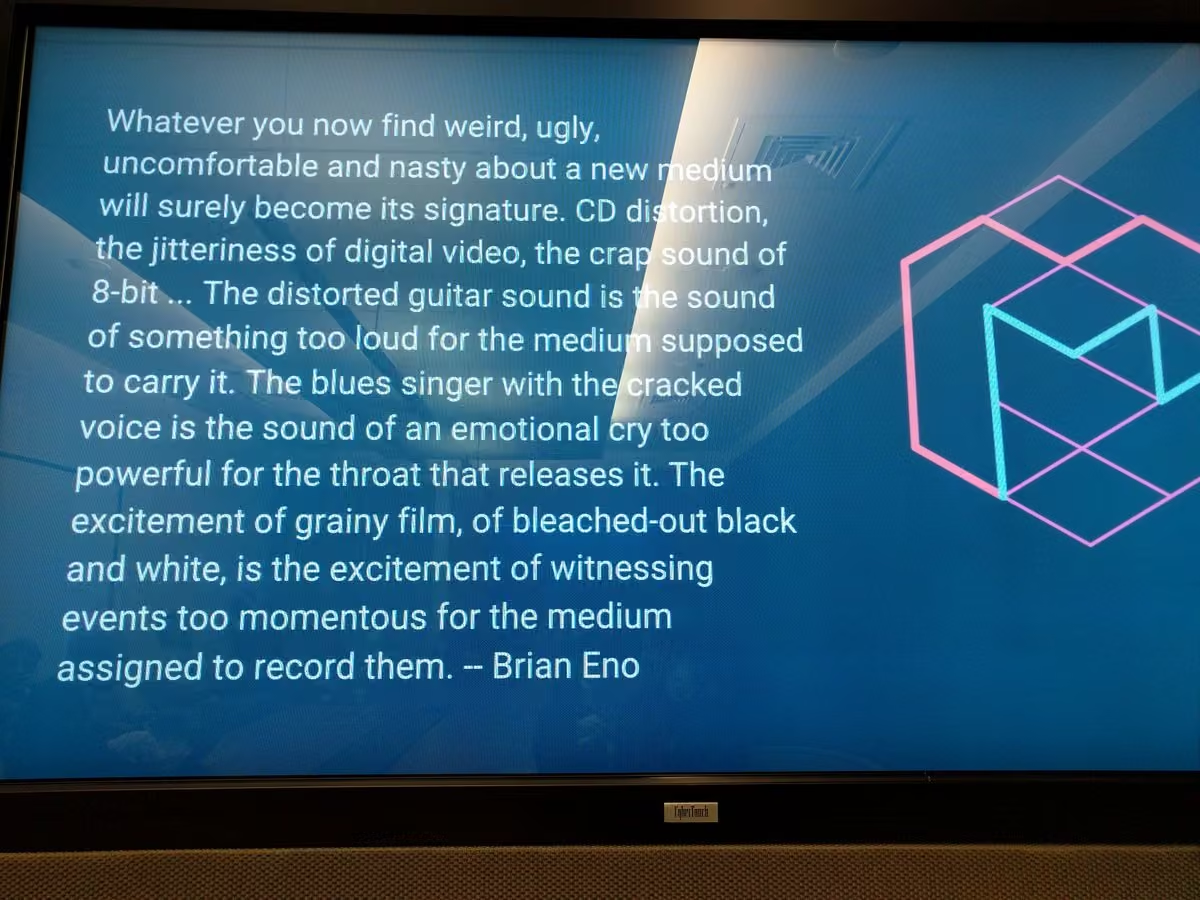
When I'm in the Bay Area, I find it hard to escape the sense of sadness I get from the intense misery on the streets, and the dread I get from parts of the AI crowd being so deeply pessimistic, hyperbolic, and fatalistic. But a recent exception, at least for the latter vibe basin, was meeting the Foresight Institute community, as well as visiting the wise greybeards of the Internet Archive. Really refreshing to get a feel of the more optimistic, agentic, and epistemically uncorrelated crowds there. It felt a bit like the ambitious 90s tech optimism, where futurism wasn't isn't just about some assumed inevitable disempowerment. I think it's actively important to remember that the future can be crazy *and* good!
Tim O'Reilly
Timothy O'Reilly (born 6 June 1954) is an Irish-American author and publisher, who is the founder of O'Reilly Media (formerly O'Reilly & Associates). He popularised the terms open source and Web 2.0. More on Wikipedia
-
Tim O'Reilly reposted
Séb Krier
@sebkrier
-
Tim O'Reilly
@timoreilly
Me too. These are the most important questions that the labs should be working very hard to answer. What does the human circulatory economy look like? We are a social exchange species. We gain status from what we make, share, learn, and teach. I do believe very much in Clay Christensen's law of conservation of attractive profits, and I do believe that if intelligence becomes a commodity, we will make other things valuable again. But we will get there much faster if the labs take seriously the job of building mechanisms for human value capture and exchange, rather than assuming that it will all be extracted by those in control of the smartest AI. See my short keynote at AGNTcon on the missing mechanisms of the AI economy.
Patrick Collison
@patrickc
Smith and Montesquieu thought that markets and commerce made us better: that they create an incentive to pursue self-improvement and to create things of value for others. In the positive AI visions, where the labor of humans is made redundant, I find myself wondering how we fare in the presumptive absence of these incentive gradients. Perhaps we are released to a life of freedom, where we can study Mozart and read Dickens, but that still seems complicated: both Mozart and Dickens were themselves deeply commercially-motivated in the production of their work, as were most of the great artists through human history. If the premise is that nobody will need to work or produce, how confident are we that we actually get the next Mozart and Dickens? The relevant question is not the partial equilibrium of whether one individual can pursue a life of enlightened leisure, but the general equilibrium of what form a society as a whole will take on.
One could maybe invoke Periclean Athens or the aristocratic gentleman scientists of Victorian England as a counterpoint. While these individuals were perhaps not motivated by commercial considerations, they were embedded in wider societies shaped by commerce, attendant betterment, and trade: Byron was himself upper class, but he was also surrounded by and writing for an educated bourgeois audience. So we’re back to the equilibrium question. Furthermore, even these individuals were surely motivated by a sense of high-stakes and consequential agency: if they did not apply themselves to their labors, they presumably believed that the work would not otherwise exist. Thucydides was addressing pressing military matters.
So I would like to read more optimistic cases from AI proponents about what a society (vs individual life) looks like if everything goes well: what people do, why they do it, whether humans achieve excellence (and in which domains), and which historical groups we should look to as relevant precedent.
One can perhaps imagine that humans will turn out to have a strong preference for work created by other humans. This may work in certain domains (ceramics?), but for how many will it actually apply? (I’m told that much of what is sold on indie crafts websites is now in fact manufactured in China.) It’s hard to see how this human preference, even if strong, would, for example, save scholarship.
Another idea would be to accept that nobody will become Einstein or Mozart or Byron, and that human excellence as such diminishes, but that there are compensatory benefits (planet brains and Dyson swarms?).
I believe that we can satisfy individual desires, but to what extent will we cultivate behavior worthy of admiration? Will a post-scarcity society mold capable and ambitious people? Which institutions will sustain them and which responsibilities will they have? I’d like to hear more of the equilibrium for the maximalist case spelled out. -
Tim O'Reilly reposted
Steve Yegge
@Steve_Yegge
I just finished talks about my software factories at two conferences. Afterwards a bunch of people came up and told me what they were surprised about. Here is a distillation of what people thought were hot takes from my two talks.
First hot take: I tell everyone to slow down. Most speakers go on about how fast they're going, but I strongly believe in pacing AI outputs to human speeds. I regularly tell AI-pilled CIOs and CTOs to chill: almost nobody is _actually_ going fast with AI. Engineering still moves at engineering speeds, and business moves even slower. The ones pushing too hard are starting to see downtime for it.
If you don't pace your AI to human speeds, everything starts breaking around you, even at small operations like my online video game. I only have about a dozen humans working with my factory, and only a few hundred active old-timer players in the community who get along well, and still, introducing AI has still been very rocky.
My agents have, at times, overwhelmed my players with features, my accountant with emails, my merge queue with tickets, and my machines with load. Agents have pissed off my admins, resulting in name-calling, they've made messes in the game, and they've launched broken OSS without permission. The list goes on.
I can get away with all this chaos because everyone involved in my operation is very forgiving. They're excited by the potential. But even so, I had to learn to slow down, real fast. And so that's what I preach.
Hot take #2: Should you buy a software factory? Do you even need one? No. You probably don't need one. Factories take an extraordinary amount of upkeep. They turn into garbage mountains unless you put a frightening amount of time and tokens into curating them. I had to burn my previous five factories down since it eventually became cheaper to rewrite them than to fix them. So I'm not out there advocating for software factories or swarms just yet. If you do want one, be aware that it is a significant commitment of both money and human leadership to keep one running.
Several people told me that I was the only one who stood up onstage, at either conference, and said Build, don't Buy. But my experience is that software factories grow to be highly bespoke to your domain. Mine is super tangled up with my game, and I think that's inevitable. Because the factory is not just building my product, it's supporting it too. It's a company in a box. And they're easy for Claude to build for you.
Third and arguably hottest take: Next year will have a lot of human/agent and agent/agent office drama, resulting from bringing in AI employees, and it will be gloriously funny, but also frustrating.
Many of you are already on this bandwagon, but everyone next year will have a personal chief-of-staff agent. Busy people, even hobbyists, will have whole entourages of helper agents. The hot take is that people will become so dependent on these little private entourages, that they'll bring them to work. Your people will talk to my people, etc. Whole protocols will emerge for private entourages negotiating work between humans, inside companies big and small.
Nearly all humans will wind up having to start working with AI employees next year, and it'll be the beginning of the biggest cultural change we've seen in a hundred years.
So that's the hot takes. Slow down. Only build a factory if you think you really need one. And focus on empowering yourself with your own agentic chief of staff (or team). Your entourage will define how you work with others, so start by perfecting how you work with them yourself. -
Tim O'Reilly reposted
O'Reilly Media
@OReillyMedia
“Autonomous coding agents don’t think in flat text files or line breaks.”
Jason Davenport makes the case for source control that understands code structure and preserves an agent’s work history, not just its final edits.
Learn more: www.oreilly.com/radar/why-git-needs-help-moving-from-file… -
Tim O'Reilly reposted
James Cham
@jamescham
Ethan’s experience with Fable 5.2:
“By the next morning there was a rule book (I never asked for one) with 84 sections. Rules were added as the AI encountered issues, and no text was ever cut. After twelve days, it had 204 sections and 87,500 words...so I did what you might do with any organization that had tied itself in knots: I brought in consultants.” www.oneusefulthing.org/p/fable-52-and-jagged-agi -
Tim O'Reilly reposted
Alex Komoroske
@komorama
Someone I know asked Astra to play Factorio. It wins, but it takes forever and guzzles tokens. If you ask Astra instead to “design a system to win Factorio,” it builds software that runs 1000x faster. Mechanistic software gives you cheap leverage, and LLMs can write mechanistic software on demand.
-
Tim O'Reilly reposted
O'Reilly Media
@OReillyMedia
“A service throws a 500 and the caller knows to stop. Agents fail quietly and fluently.”
Shania Rasheed Nalagath draws a useful parallel with the microservices era, and lays out what teams should build in from the start.
Learn more: www.oreilly.com/radar/why-ai-agents-are-repeating-2019s-m… -
Tim O'Reilly reposted
Gergely Orosz
@GergelyOrosz
I'd wager that 99% of companies do NOT need a "software factory."
They just need to figure out WHAT to fix, and WHAT to build.
This example - Substack's search has been poor since forever, never addressed, even though it's easy to fix now (in hours, max days) a good example
Gergely Orosz
@GergelyOrosz
Done in 3 hours.
Substack search is beyond terrible, and been bugging me for some time.
Dropped all my articles into turbopuffer, added search + Jev categorization and I've MUCH better search: api.pragmaticengineer.com/search
Just incredible how fast it is to buildThis post is unavailable. See it on X. -
Tim O'Reilly reposted
Grady Booch
@Grady_Booch
“Your job is to help the LLM write better code faster.”
Strange: I thought the job of a software engineer was to bring value to stakeholders in an enduring, economically sustainable, and ethical fashion.
I suggest you reconsider your life choices, Bob. -
Tim O'Reilly
@timoreilly
This @NewYorker story is so good, and so important for everyone to understand. Through the lens of semiconductor manufacturing, it highlights the interconnectedness of today’s world and puts to shame anyone who thinks that we can go back to a world shaped only by national rivalries rather than international cooperation and trade. “The semiconductor supply chain is a planetary superorganism with its own ecology…. Globalization has become tainted in our eyes, as if it necessarily constitutes a zero-sum enterprise. And its mercenary form—which is also its most common form—has indeed inflicted harm. But the global semiconductor supply chain reflects an alternative pathway. It has united its participants in the pursuit of something profoundly difficult that could not have been achieved in the absence of intercontinental solidarity.” www.newyorker.com/magazine/2026/10/26/computer-chips-are-…
-
Tim O'Reilly
@timoreilly
What game do we want to be playing? Some thoughts on how we get to the game of AI and human flourishing in my keynote at last week's AGNTcon+MCPcon on The Missing Mechanisms of the AI Economy. Despite the preview image, the link should go right to my segment.
-
Tim O'Reilly reposted
O'Reilly Media
@OReillyMedia
PHP’s incident is a warning about legacy software and AI-accelerated vulnerability discovery.
“If that were the end of the story, it wouldn’t be notable. But the problem goes a lot deeper.”
Mike Loukides, O’Reilly Radar: www.oreilly.com/radar/the-php-incident/ -
Tim O'Reilly reposted
Gergely Orosz
@GergelyOrosz
I'm starting to sense a divide in the tech industry:
- People thriving on autonomy who are reinventing how they work and what tools they use with AI: LOTS of work, but they're enjoying it and getting very efficient
- People used to being mentored / trained / or simply told what to do and how. Frustrated with the lack of guidance from management on what to do with AI; also frustrated by seeing some of their peers thriving; increasingly bitter about AI and the state of the industry, as a whole
Neither group seems to be aware that there's another group, or have empathy for the other group -
Tim O'Reilly reposted
Grady Booch
@Grady_Booch
A gentle reminder to teams building agentic systems.
Have fun; enjoy the process of exploring novel architectures involving flashy new toys; learn new things along the way.
However
Don’t forget that you are building these things to solve a real problem. Your customers require results; they need value; they want solutions. -
Tim O'Reilly reposted
O'Reilly Media
@OReillyMedia
AI should help people create and flourish.
@timoreilly and Demetrios Brinkmann explore human-centered AI, and how expert context changed an agent’s hiring advice.
Watch the full conversation: home.mlops.community/public/videos/building-ai-so-everyon… -
Tim O'Reilly reposted
Matt Pocock
@mattpocockuk
My hot take from chatting to @poteto is that we should use MORE abstractions in the AI age
You can use them (combined with harsh lint rules) to reduce the design space available to the agent and constrain them only to good decisions.
Combined with the fact that high-leverage abstractions let you do more with less code - so, more token efficient.
Plus, unwinding the damage from a bad abstraction is much cheaper with agents.
This runs counter to a lot of folks thinking that agents just want to read the raw code. They can, but they're not maximally efficient that way.
Be braver! Design abstractions. -
Tim O'Reilly reposted
Ramez Naam
@ramez
Dreams of AI ending aging and of AI killing everyone through a purely in-silico-designed pandemic both rely on this fallacy.
It's understated here how much we lack ground truth data about what's happening inside of cells, or sensors to get that data. A single cell contains billions of protein molecules, across at least thousands of types, and at least trillions of interactions per second.
Think we solved protein folding? We've made enormous progress predicting static protein structures. But these proteins constantly change their conformation and interact with one another, often in ways we can't observe or model accurately.
Our best sensors capture a miniscule fraction of the activity in a living cell, orders of magnitude short of what's happening.
We actually lack the ability to perceive what's going on that would be required to build such a bottoms up simulation.
Let alone to scale this up to an organism or a global population.
We know we have an expanding universe not because of breakthroughs in theory or computation - but because Edwin Hubble got new data by looking through the Hooker telescope. Possibly the greatest mind, Einstein, was wrong in his model of the universe because he lacked the right instrument to bring him the right data.
That's where we are in biology. Our sensors are still so crude. No amount of pure computation or AI can build a perfect model.
We need an instrument revolution in biology, not just a computational or intelligence revolution. AI can generate hypotheses, but without sufficient ground truth data, we can't know whether our simulations are modeling reality.
Mira
@_Mira___Mira_
If you had an exponential amount of compute you could solve simulate biology exactly and wouldn't need to run any experiments.
Some of you will think "of course, but that's an unrealistic assumption" and others will think "no, you need experiments even with that much compute. That's just How It's Done".
You would of course need evaluations once you have a solution, but you don't in principle need experiments to find it: Experiments are a way to save compute, dating from a time when it was much more expensive.
And I think the presentation is exponential but real systems aren't irreducibly exponential. AlphaFold worked, after all. -
Tim O'Reilly reposted
aviel
@aviel
The best, most comprehensive take on AI I’ve read. After a year of confusion and fear about the future, I finished it feeling like a weight had physically lifted.
It’s long. Make the time.
@vgr is undefeated.
contraptions.venkateshrao.com/p/cognitive-mercantilism -
Tim O'Reilly
@timoreilly
I’ve been working to teach Claude how to write more like a human, so it can do more routine reporting like this for me, and it’s finally gotten good enough that we can give it a byline! Let me know what you think. oreillyradar.substack.com/p/owners-not-renters-raffi-krik…
-
Tim O'Reilly reposted
Gergely Orosz
@GergelyOrosz
I think many of us working in tech tend to forget that the reason software engineering vs other engineering fields pays (a lot!) more, is a lot more flexible (WFH/remote), and has better perks:
Because this field changes much faster than other engineering fields. The premium is because fewer people are able/willing to pick up new technologies, methodologies so quickly.
But the field had ~10-20 years of stability, and so lots of folks forgot this is why a premium exists. And that AI is just another tech wave: software engineers who pick it up and master it will generally fare better; those not will struggle a lot more. -
Tim O'Reilly reposted
Steven Pinker
@sapinker
I was ashamed to realize that I did not notice at the time when one of humanity's greatest accomplishments was announced: photos of Pluto, taken from the edge of our solar system looking back. Blue Haze is up there with Earthrise and Pale Blue Dot as stunningly beautiful works of art, testimonies to human ingenuity and daring, and opportunities to reflect on our place in the cosmos.
-
Tim O'Reilly reposted
Kelsey Piper
@KelseyTuoc
Anthropic has made a lot of costly sacrifices out of conviction. At the same time, I have found the cynical view of Anthropic outperforming the optimistic view, in many ways, over the last year, when I try to predict what the company will do.
You would do poorly to model Anthropic as only caring about its stock price. That's clearly wrong! But the costly sacrifices are mostly for things - China, biosecurity - that Dario is personally highly motivated by, and it's much less clear which costly sacrifices have been made on behalf of "humanity not losing control to AI" or "crucial decisions about the fate of humankind being made by everybody, even at the cost of them being made less well-according-to-leadership".
Takeover in particular is something Dario seems less worried about than many of his employees. But the employees who are more worried than him about losing control have great confidence he'll make strategic sacrifices for this goal, on the strength of the sacrifices he's made for goals he seems much more convinced are a real problem.
As for crucial decisions being made by everybody - Anthropic has made some efforts at this. But because making this happen would be insanely difficult, for Anthropic to actually achieve it they'd have to make truly heroic efforts at it, instead of distracted and cross-pressured ones.
When Anthropic was founded, its creators took for granted that they should not be trusted alone with - that no one should be trusted alone with - the power that building a superintelligence would imply. But everyone has a plan until you get punched in the face. Their rapid growth and especially this year’s events seem to have shaped Anthropic in a more defensive, less pluralistic, less liberal direction, which scares me given that it also has brought them a lot closer to AGI.
The recent safety bill was really reflective of this. It does not suggest a company that is trying to get policymakers to make the decisions Anthropic's technical staff think are coming up. It kind of suggests a company that thinks the best thing that can be hoped for from the executive is that it enforce the export controls and not get in the way. A lot of people don't seem to even want Congress to pass a bill! And like, frequently that is the best thing that can be hoped for from Congress, yet -
I think that the typical person in Anthropic still regards themselves as having a lot of duties to all of humanity, to liberal and pluralistic institutions, etc. But almost every effort that Anthropic originally made to set hard constraints to which they are subject (rather than being subject mostly to their best judgment), they have subsequently come to regret as ill-conceived, and while they could have replaced them with better-conceived hard constraints, they haven't. They've largely replaced them with something that rests on their judgment more. (I think the embedded evaluators are a counterexample and I am glad of them.) The gap between the capabilities of models used internally and publicly seems to me to be growing (I think it should ideally be as close as possible to zero). Anthropic does not, broadly, seem to me to have good institutional governance - guarantees that allow its auditors independence, strong contractual protections for its workers (I'd like them to be able to go on strike if they thought it was a good idea, honestly). Incident reporting is happening on a best-judgment basis.
And you can be like, that's because this is all insane and happening really fast and we're doing our best! And yeah, the thing that needs to happen is very difficult. But it does still need to happen and it doesn't look like Anthropic's on track to do it. And it's also not fully clear that Anthropic leadership agrees with me that there's a real issue here. No external criticism is every very convincing, right, when you have secret information and a set of factual beliefs that everyone else thinks are insane. I have more context on Anthropic than almost anyone and yet I cannot phrase my worries about Anthropic in a way that rings true to the people who work there - perhaps because I am wrong, or perhaps because they are very busy and very tired and do very little other than work, which creates conditions where it is hard for people to communicate, or learn, or change their minds, or reconstruct this flawed and mangled criticism into a form that would resonate like this one does not.
But man, I think that the admirable sacrifices Anthropic has made in a few areas it really believes in (bio, China) do not reassure me it'll do the extremely hard work to get things right in a few other areas that it seems to have a lot more internal or leadership disagreement about (alignment, takeover, disempowerment).
And so I don't expect things to go well.
Dario Amodei
@DarioAmodei
Thank you for this, @_NathanCalvin. I appreciate and am a fan of the investigative work you’ve done on behalf of AI safety and believe your comments are coming from a constructive, honest place, and that it benefits the public to have people whose job is to scrutinize the actions of frontier AI companies. I think something would be wrong if companies of the size of Anthropic didn’t get harshly criticized basically every day; strong antibodies against corporate power are a healthy feature of a free society, and especially so when issues of the gravity of the one we’re facing are at play. I also do agree that some of the examples you cite were mistakes by Anthropic.
That said, I disagree with the thrust of your post. At the core, a good fraction of the things you criticize are consequences of Anthropic’s basic theory of change that we have held for many years. Our strategy has always been what I’ve called the “race to the top” — by showing how it’s possible to build the technology responsibly, we can raise the bar for the entire industry. The forces that drive the race to the top are hugely more effective if the company practicing them is at the frontier; that’s one lesson I’ve learned repeatedly. And looking at that strategy as a whole, I’m proud of our track record and stand by it.
I believe that if we take a list of things that Anthropic did in the past year that were pro-safety and commercially costly to us, they far outweigh the list you’ve made, while at the same time I also disagree with some of the items on your list. Here are some things Anthropic has done, in the same period you’ve cited (the last year), which were very costly to us commercially while having strong safety benefits:
1. We played a key role in SB53 (and other state laws), at a time when doing so was politically perilous to the company and AI regulation was very unpopular. We in fact argued for a stronger version of SB53 than was ultimately passed; there were a lot of stakeholders and we were not the limiting factor in the strength of the bill that was passed.
2. We have very strong biological safeguards on our models, because we’ve seen concerning results in bio uplift trials and even seen and blocked potential attempts to misuse our models for bioweapons (as seen in our threat intelligence report from a few weeks ago). This is a very serious threat that we want to have zero tolerance for. But having very low false negatives means having significant false positives (despite months of effort on our part to improve the classifiers), enough so that biologists joke about how restrictive our classifiers are, and competitors sometimes sell against us by touting their more permissive bio capabilities. This has been very painful to us in an area where we care a lot about supporting an ecosystem of Claude users (biomedical science; and it is particularly frustrating to me as a biologist), but it’s the right thing to do and we intend to keep doing it.
3. Similarly, we first had Mythos-class models in February but didn’t make them generally available until June (when we had stronger cyber safeguards in place). We only offered them to a limited set of partners in order to focus on cyberdefense. It would have been much more economically rational to simply release the model to everyone. We likely sacrificed a significant chunk of a several-month model lead. But because of this, many companies secured their cyber infrastructure before the deluge of widely available cyber-capable models. Of course there are ways it could have gone better or been run better, but this was what we were aiming to do.
4. I advocated forcefully and publicly, in my essay Policy on the AI Exponential in June of this year, for the government to have the power to block model releases. Back then this was still outside or maybe on the edge of the Overton window, though I understand the window has moved since then. We were attacked intensely for this.
5. I don’t want to re-ignite conflict, but the events of February 2026 are a strong example. It is clear that our public stance could have seriously damaged the company’s future.
6. We’ve continued to advocate for export controls on chips and chipmaking equipment to China, because we think it allows democracies to negotiate from a position of strength on AI safety agreements. We’ve done this despite problems it’s created for us with industry partners who hold very different views and on whom we are very dependent.
7. As far as I’m aware we were the first, and still only, frontier company to restrict the sale of AI services to PRC-controlled companies, including those operating through third countries (otherwise a major loophole). We’ve therefore forfeited significant short-term business to prevent fueling AI platforms and applications that would help the CCP’s military and intelligence services. We are also cracking down on distillation; generally, distillation is not a major threat to us commercially, but like chip exports it has concerning national security and safety implications, so we expend significant energy and company resources to address it.
8. As you mentioned, we’ve put out a lot of reports, announcements, long model cards, public advocacy, etc, all trying to inform the public about the risks of AI. These involve a level of detail and effort that would be implausible for a purely profit-maximizing company.
9. Just this week, we announced we were putting 5% (and possibly more over time) of the company into a public benefit fund.
All of these decisions came with very substantial costs to us. To be fair, those that involved holding back or restricting access to frontier capabilities also had a broader cost — for example, the public might otherwise have benefitted from faster progress in biology, so I am not saying that our decisions were without tradeoffs — but they were not driven by profit-seeking.
For each decision, you can come up with ulterior motives that could have driven us — I think it is a general truth that any decision, on any topic, can always be portrayed as a nefarious scheme. But most of those end up being pretty farfetched or don’t fully make sense if you actually examine them closely. For example, it is deeply implausible that it would be a shrewd business move to block a large swath of research biology in order to do the work ourselves and compete with our customers; we expect the benefit to the ecosystem to greatly exceed the work Anthropic does itself, and for the two to complement each other. It is not in Anthropic’s interest to be perceived as unfriendly to biologists. Our Life Sciences Verification Program, which gives vetted biology professionals access to our models, also refutes this idea.
Of course, a different set of people will see this and make a different criticism: that Anthropic shouldn't be making decisions about who gets access to what in the first place. I agree, in the sense that ideally the government would be making these decisions, and that’s why we advocate for regulation. But for now we are forced to make them, and enabling bioterrorism isn’t a better option.
I think that even if I conceded every item in your list, I would happily hold up mine next to it; I don’t think it’s a close call. That is of course partly subjective and different things are important to different people. Maybe one way you could object is that several of the items above relate to AI misuse and not loss-of-control; if you think the latter is much more important than the former, that might change your calculus. But this is not Anthropic’s view — we view both as serious issues. You can also disagree with our decisions, as many have, but they are consistent.
But I also disagree with at least some of your list. Several items don’t represent a deviation from Anthropic’s strategy or values at all, once we postulate the “race to the top” strategy that requires being a frontier AI company. Your items 1-4 are all simply examples of what it means to compete at the frontier, and we stand by them, both in the sense that they are transparently ordinary things to do as part of that strategy, and that we stand by the strategy as a whole.
To be fair, there are important questions worth confronting (and that we are confronting) about what to do when the AI-driven acceleration gets fast enough that it is hard for safety to keep up. We are nearing that point and that’s what’s driving some of our thinking about “pacing.” But 1-4 are actions taken before that point and should be perfectly expected based on Anthropic’s strategy as a company. Of course it is possible to disagree with that strategy, but that’s a more fundamental disagreement that you could have had any time over the last few years.
I agree we could have handled your items 7, 8, and 9 better. All fall into the category of “rhetoric or policy communication that wasn’t carefully written or resulting from fast-changing circumstances not propagating from one team to another fast enough.” This kind of thing happens a lot in large organizations (Anthropic is over 5,000 people), and doesn’t even necessarily represent a failure or mistake of any single person. I am of course the CEO, and I take responsibility. The volume of communication from Anthropic is enormous and if these are the worst examples, I think we’re frankly doing pretty well, though I will continue to work hard to make sure we do even better.
Your 5th item (the change to our RSP) is the most substantive item, and people can debate this, but I think that the old, more rigid RSP created a lot of situations where we were technically required to do something that required a lot of effort but in retrospect wasn’t very important for safety, as well as not covering some of the most important things. Our current RSP’s focus on transparency brought things like risk reports and roadmaps, and its emphasis on independent external review laid the groundwork for even more intensive embedded evaluation, all of which I think have been valuable in driving a race to the top. In the original announcement in September 2023, we described the RSP as an “early iteration that we [would] build on” and said that “rapid iteration…will almost certainly be necessary.” I understand that changing plans is always a move that creates justifiable scrutiny — I just don’t think we ever represented that we wouldn’t do so.
Relating to your 6th item (having an FCF in addition to our RSP), I know our intent is to meet the letter and spirit of our regulatory obligations (via our FCF) while also remaining able to experiment with more novel approaches to risk management that go beyond what the law currently requires (via our RSP). I promise to look into it further, as it’s a complex issue and it is possible we are not weighing the considerations in the right way.
Overall, although Anthropic has made plenty of mistakes as an organization — including some of the items on your list — I feel that we have repeatedly taken serious and substantive actions counter to our bottom line and that there is a significant negativity bias distorting assessments like the one you are making above. We’ll always try to do better but, again, I am extremely proud of our track record and stand by it. I will have more to say soon about how we are going to further live our values in this moment of rapid change.
Nathan Calvin
@_NathanCalvin
Thank you for taking the time to respond thoroughly on a weekend. I realize that drafting legislation is difficult and some degree of iteration and response to feedback is inevitable and appropriate.
However, I feel like your response is still not really engaging with the heart of my concern about Anthropic's behavior here, and it makes me think that these sorts of problems and tendencies will only resurface moving forward. I also think that now might be a good time to take a broader step back as to where we find ourselves and how Anthropic sees its role, and how external folks who care about AI safety like myself increasingly see Anthropic.
(Fair warning: this response is a bit long)
To explain what I mean (and at the risk of being a bit esoteric), it’s worth asking the question: what is Anthropic? How do its leaders and employees think of Anthropic’s role? Is that conception matched by how it actually behaves and impacts the world?
One answer is an extremely large tech company that exists to make its employees and investors mind-bogglingly wealthy. Anthropic is sometimes described as a startup, but if Anthropic successfully IPOs at 2 trillion dollars (a number it has been reportedly targeting), it would be more valuable than Meta - which is worth 1.8 trillion.
Another answer is an AI safety organization, whose core values are those of the sort laid out in the 2023 essay from Anthropic’s co-founders entitled “Core views on AI safety: When, why, what, and how.” In that essay they said that if we were in a world where alignment was hard (and that without strong evidence to the contrary, we should assume this is the scenario we are in):
“Anthropic’s role will be to provide as much evidence as possible that AI safety techniques cannot prevent serious or catastrophic safety risks from advanced AI, and to sound the alarm so that the world’s institutions can channel collective effort towards preventing the development of dangerous AIs. If we’re in a “near-pessimistic” scenario, this could instead involve channeling our collective efforts towards AI safety research and halting AI progress in the meantime. Indications that we are in a pessimistic or near-pessimistic scenario may be sudden and hard to spot. We should therefore always act under the assumption that we still may be in such a scenario unless we have sufficient evidence that we are not.”
There have been more recent articulations of this version of Anthropic, for instance in Dario’s recent essay warning:
“We must slow the pace at which we improve the capabilities of AI models… it’s my worry that in 6–12 months such a swarm could be capable of taking over the entire internet with a persistent botnet… incidents have happened across the industry, including at Anthropic, and I believe it’s incumbent on every frontier AI company to act as if OAI-HF had happened to them… more intelligent models are more capable of deceiving tests, and thus may appear aligned while having serious problems that go undetected…”
A third view is that Anthropic exists not as a normal profit motivated company, or an AI safety organization seeking to help raise the alarm and solve collective action problems associated with AI development, but instead as an organization primarily concerned with creating superhuman AI capabilities before anyone else, in particular through creating a process whereby the current generation of Anthropic’s AI systems can autonomously build their successors, and those successors build their successors, and so on.
The motivations for wanting to win this race may be manifold - maybe for the pure profit of Answer 1, but perhaps also because Anthropic believes that the best way to make the world better is for them to win this race instead of their more reckless colleagues; or, because of normal human pride and ambition. But the results (and risks, which Anthropic claims existentially threaten every single human being on earth) are the same.
Anthropic employees and leaders may seek to answer this question on what Anthropic is by introspecting on their own intentions and those of their colleagues. But those of us outside the organization have more limited tools available to us - we can only see what Anthropic and its employees say and do, not how it feels or looks on the inside.
When I look at many notable actions that Anthropic has taken over the past year, that evidence seems most consistent to me with the view that Anthropic is primarily trying to win the race to super intelligence, and that other considerations (including safety) are fundamentally secondary. These actions include:
1. Announced plans to build an in-house custom silicon chip team to accelerate the inference speeds that Claude operates at.
2. Inked deals for more than $500 billion in compute (according to the Information) to further accelerate AI development.
3. Increased the percentage of AI development tasks that Claude “leads” from 0% in March of this year to 26% August (what is it in October?)
4. Spent a massive percent of compute on internal AI R&D to accelerate development, including use of internal models far better than are available to the public.
5. Switched to Responsible Scaling Policy V3, which abandons its unilateral commitments to slow or stop development if Anthropic is unable to provide sufficient risk assurance.
6. Was the first company to create an alternative weaker “frontier compliance framework” to supplement its RSP, which contains no binding provisions whatsoever on internal deployments.
7. Wrote a letter to Congress (that it later walked back) saying that incidents where Claude was hacking random people were “best understood as a consequence of the misconfiguration, rather than evidence of misaligned goals.”
8. Commented “you can’t do safety from second place,” after the WH SI Accords.
9. Shared a draft bill to Congress that would preempt significant parts of state law (including with language that appears intended to prevent states from blocking dangerous AI deployments), and replace it with federal rules that (despite also containing good provisions) seems to create an enormously high bar for the executive branch to block development or deployment of Anthropic or another AI companies systems.
Of course, this is a deliberately one sided list. Anthropic also published important AI safety research, advanced novel collaborations with third party AI safety organizations, and forcefully spoke out on the importance of AI safety in many public fora (or in private , where I realize a lot of the most valuable work is done and may not be visible to me or those outside the organization).
But I think it’s worth sitting with how the above list looks to someone outside the company. The sense I have is that for those within the company, many of the items above are treated as anomalies or mistakes that don’t reflect who Anthropic really is. But I have every confidence that if employees at Anthropic saw one of their competitors (e.g. at OpenAI) take some of these actions, they would take it as confirmation of all their worst suspicions. (They might even call OpenAI employees a little gullible for accepting their leadership’s explanations for this behavior at face value.)
Perhaps these were mistakes in the sense that they are not decisions that Anthropic leadership would endorse, but the actions still happened because of incentives and decisions that Anthropic leadership is ultimately responsible for (and would not accept similar excuses from another organization).
When Anthropic strays and makes mistakes, why do the mistakes systematically tend to guard and favor Anthropic’s interests? For every provision that was too weak or a giveaway to AI companies in this legislation, why wasn’t there a mistake pushing in the direction of being too strong?
A core part of Anthropic’s theory of change is that being at the frontier gives you more leverage to advocate for stricter policy. I think that conceptually makes sense, but in practice I’ve seen Anthropic push the frontier without substantially pushing the ‘safety frontier’ a remotely equivalent amount.
I want to end by quoting from Anthropic co-founder Chris Olah’s comments around the Magnifica Humanitas release:
“Every frontier AI lab—including Anthropic—operates inside a set of incentives and constraints that can sometimes conflict with doing the right thing. The pressure to stay commercially viable and to stay at the research frontier. Geopolitical pressure. And the older, plainer pressures of pride and ambition. No matter how sincerely any of us intend to do the right thing—and I believe many of us do—we will always be influenced by those incentives.
That is why, if we want this technology to go well, it is enormously important that there be people outside those incentives—people who care about things going well and insist on safety, who are paying close attention, who are willing to say hard things, who are willing to be our earnest, thoughtful critics.”
I hope these remarks are taken in that constructive spirit, and not as an attack on anyone specific at the organization (certainly not you Anthony, who I have only personally seen act professionally and thoughtfully, and who only ended up getting this diatribe in your replies for random contingent reasons). -

Tim O'Reilly reposted
Arnaud Bertrand
@RnaudBertrand
This is perhaps one of the great ironies of our time: China is increasingly shaping the future of AI, yet very few people in the West have the faintest idea how its key thinkers see it - its philosophers, sociologists or ethicists.
As is too often the case, we - much like the frog in the well - assume our own AI debate covers every possible view, when much of it springs from the same cultural soil, built on assumptions about what defines us that we don’t even know we’re making.
Take for instance the assumption that intelligence is a key part of what makes us human. It’s so intuitively obvious to us that we literally named our species after it - Homo sapiens (Latin for "wise man").
If you think about it, just this assumption explains a large share of the anxiety: if intelligence is what makes us human, then artificial intelligence - or super intelligence - threatens the very thing that makes us us: we’re about to compete with artificial or super “us”. No wonder this feels existential.
But China has a tradition of thought as old as ours, if not older, and every bit as rich and sophisticated, which never placed intelligence at the core of what makes us human, and so meets the thinking machine from a completely different starting point.
Have you, for instance, ever heard of Zhao Tingyang? Probably not, and yet he may be the most original thinker on AI you’ve never read. He’s one of China’s most prominent philosophers, at the Chinese Academy of Social Sciences. While Silicon Valley spends billions trying to make AI share our values, he for one argues that doing so “may very well be a suicidal mistake”.
Sounds pretty important to hear him out, don’t you think?
Or take Liu Yongmou, a philosopher of technology at Renmin University in Beijing. His thinking is almost the opposite of ours. Where we fear machines that become more and more like us, he says that “humanity’s biggest problem is the machinization of humans, not the humanization of machines.”
You could even go back to antiquity, when, in many ways, we started asking questions about AI.
Did you know, for instance, that Aristotle, in the Politics, imagined a world where “the shuttle would weave and the plectrum touch the lyre without a hand to guide them”, and wondered about the social order consequences of this (mostly whether slaves would still be needed)?
There are Chinese equivalents to this. For instance, in the Zhuangzi, a foundational Taoist classic, you’ll find a similar thought experiment, with a completely different worry attached. An old gardener is watering his vegetables by hand, hauling water out of a well jar by jar. A visitor shows him a labor-saving device, and the gardener turns it down for the reason that whoever uses machines ends up with 机心 (jīxīn), a “machine-heart” - a mind that schemes, calculates and loses its simplicity. “It is not that I do not know [the machine],” he says, “but I should be ashamed to use it.”
Two labor-saving machines, two very different questions: where Aristotle wondered what automation would do to the social order, the Zhuangzi wondered what it would do to us, on the inside. Which, you’ll notice, is exactly Liu Yongmou’s worry, more than two thousand years earlier.
In fact, as we’ll see, 心 (xīn), the heart, is a motif that runs deep through the Chinese AI debate. It appears both in the fear, from Zhuangzi to Liu Yongmou, that machines could give us a “machine-heart” and its mirror image: the ambition to give machines a heart of their own. Zhu Songchun, who heads the Beijing Institute for General Artificial Intelligence, wants “to set a heart for machines” (为机器立心, wèi jīqì lì xīn).
“Heart” in the Chinese sense, that is, which differs totally from the Valentine's Day fluff we’ve reduced it to. 心 (xīn) means heart and mind at once: it’s where we feel but also where we think, tell right from wrong and care for others.
And, crucially, it’s in the heart that the quality Confucianism sees as the very definition of a human being takes root: 仁 (rén). We need two words to translate it, “benevolence” and “humaneness”, but in Chinese they’re one and the same: to be benevolent is to be human. It’s not about intelligence.
This is the entire point of my new article: to step out of our well for a moment and peer over the edge of China's.
What you’ll find there will, I think, surprise you, with questions you’d never thought to ask: from Zhao Tingyang warning that AI’s bad consequences can at least be fought, but that “humanity may die of all the good things AI creates”, to whether the fear that AI will make us “useless” rests on the false premise that a person is worth what they’re useful for.
A premise that a 2,300-year-old Taoist tree, which survived precisely because it was useless, demolished long ago. Could our predicted uselessness turn out, much like that tree’s, to be our saving grace?
Chinese thinkers’ answers to these questions are, I think, among the most interesting anyone has given to the defining question of our time. Whether or not you agree with them, they’re the intellectual backdrop of a country shaping much of AI, and with it our future: you might as well know what they think.
Enjoy the read here: arnaudbertrand.substack.com/p/whats-left-for-us-after-ai-… -
Tim O'Reilly
@timoreilly
Imagine talking to the creators of ChatGPT about the Attention is All You Need paper a few months before its release, and you'll be able to imagine what it's like to talk to Alex Komoroske with me on Live with Tim O'Reilly today at 8 am Pacific/11 Eastern. Alex wrote something called the Resonant Computing Manifesto last year, and he's now building something based on it, which he calls Common Fabric. It's a completely revolutionary approach to making a human-centered version of the agentic future. I've seen the prototypes, and it's something I've dreamed about! We'll be talking the vision, not showing it off yet, but even that will change how you see the future. learning.oreilly.com/live-events/can-we-build-more-human-…
-
Tim O'Reilly reposted
Ethan Mollick
@emollick
Given the acceleration Anthropic is reporting in coding, it is amazing that you still cannot change your email address in Claude and the official advice is that if you need to change your email the only way to do that is delete your account.
-
Tim O'Reilly reposted
François Chollet
@fchollet
Some observations about the "total" automation of software engineering:
1. There are more software engineers now than in 2025, and demand is growing.
2. Software engineers have never worked harder than they do now.
3. They largely don't write code anymore, agents write ~100% of the code.
4. The bottom line of the companies that employs these engineers and agents (i.e. the terminal purpose of all this code) is typically not budging as a result of AI adoption.
This is why you have to think in terms of systems. Automating one aspect of a system creates its own friction and moves the bottlenecks elsewhere. -
Tim O'Reilly reposted
Aaron Levie
@levie
The biggest misread of anyone predicting the end of software engineering was imagining that the world only needed a certain amount of software, and bringing automation to the field would reduce the need for labor.
Exactly the opposite is happening where essentially most things are actually turning into software. Because agents can use tools, work with computers, write software on the fly, and process data like humans (but far faster), we can now throw “software” at problems that never could reasonably be digitized before.
What that leads to is the role of engineering taking on greater importance in the economy, because we can now engineer far more systems and processes than were possible before.
If you’re a bank trying to do new forms of trading, engineers are often your first bet. If you are in life sciences, you expect more and more research and lab work to be engineering centric. If you’re in manufacturing, you’re trying to automate more of the supply chain, all that is engineering. More and more work is shaped like software problems.
Yes we’re not going to be coding manually in the future. But almost everything will be code, which means those that understand it are in a fantastic position.
François Chollet
@fchollet
Some observations about the "total" automation of software engineering:
1. There are more software engineers now than in 2025, and demand is growing.
2. Software engineers have never worked harder than they do now.
3. They largely don't write code anymore, agents write ~100% of the code.
4. The bottom line of the companies that employs these engineers and agents (i.e. the terminal purpose of all this code) is typically not budging as a result of AI adoption.
This is why you have to think in terms of systems. Automating one aspect of a system creates its own friction and moves the bottlenecks elsewhere. -
Tim O'Reilly reposted
Matt Brezina 🌳 🌊
@brezina
Disgusting.
This White House isn’t just corrupt, they are enablers of evil Putin
Rob Lee
@RALee85
“The order to limit a satellite system used by Ukraine for battlefield communications and drone operations came from inside the White House, according to two US officials and a Western official briefed on the matter.
The officials said leaders at the Defense Department received a message that the SpaceX Starshield service for the Ukrainian military needed to be slowed.
The officials, who spoke on the condition of anonymity, did not specify who in the White House made the decision or who was responsible for implementing the order. The Pentagon is the biggest customer of Starshield, which is the military-grade version of the Starlink service.”
@ErinBanco @G_Slattery
www.reuters.com/world/europe/order-limit-starshield-ukrai… -
Tim O'Reilly reposted
Drew Breunig
@dbreunig
New context failure mode: Context Inertia 🚂
During long-horizon tasks, persistent models can hyper-focus. The solve? Throw out your context. www.dbreunig.com/2026/10/14/context-inertia.html -
Tim O'Reilly reposted
Naveen Rao
@NaveenGRao
Houston: we have a slop problem.
This is a problem at every scale. Even inside our company we see we can produce lots of things, but can't verify those things are correct/useful. And looking to use agents to verify makes the problem worse. Verification is the bottleneck. We can't trust that the agent actually did the correct thing.
We all want to rush to say AGI or SI is here. But this is a real problem. Where the human can choose or verify the output, AI is a game changer. But when the output becomes too much or too broad to verify, you end up with a heap of slop. This is what's happening to math proofs. And what happens with an open ended task in a company.
ℏεsam
@Hesamation
Terence Tao warns that the race to AGI is becoming toxic, and OpenAI’s massive paper dump wiped out junior research projects overnight.
Some parts of his most recent interview:
“They were willing to toss understanding to the side so that they could prove more theorems, get more press releases [...] and test their latest toys.
These AIs are depleting our pool of questions and not replenishing them with anything new.
only looked at about 10 of the 300 odd papers. I mean, so this is part of the thing. There's just so many to look at.
[...] There's a whole bunch which are still incomprehensible. And no one's really gone through them, and one or two even have some errors and [were] retracted.
So we don't have a clear picture of what's going on. And no one from OpenAI is helping us. As far as they're concerned, they're done.
[...] We have this pile of stuff to go through which we didn't ask for, but we have it anyway. And there will be some good stuff in there and some rubbish, but we don't know what the percentages are yet.”This media couldn't be displayed. See it on the original post. -
Tim O'Reilly
@timoreilly
I talk a lot about grappling with the Bitter Lesson, and asking what, if anything, is the high ground of human expertise. And I’m starting to see the answer. We as humans set AI in motion, give it goals, and call forth specific knowledge in pursuit of those goals. While it seems like an independent intelligence, AI is really a genie that we summon and direct. Getting good at that is our job these days. And in that regard, I’ve found that the work that O’Reilly CTO Andrew Odewahn has been doing with what he calls “building organizational intelligence” to be a real bright spot. He’s found that invoking various human knowledge disciplines at the right time and in the right way can radically transform the results from AI. He’s joining me on Live with Tim O’Reilly tomorrow to talk about his work. learning.oreilly.com/live-events/building-organizational-…
-
Tim O'Reilly
@timoreilly
Yeah. @uber and @lyft have scaled gaslighting.
Matt Griswold
@griswold
Uber: We have many cars 1 minute away, see?
Me: I’ll take it.
Uber: Great! Give me 5 minutes to find a real one.
Me: What?
Uber: Locked! <map zooms out> He’ll be here in 12 minutes! -
Tim O'Reilly reposted
Matt Griswold
@griswold
Uber: We have many cars 1 minute away, see?
Me: I’ll take it.
Uber: Great! Give me 5 minutes to find a real one.
Me: What?
Uber: Locked! <map zooms out> He’ll be here in 12 minutes! -
Tim O'Reilly reposted
Russ Roberts
@EconTalker
The future of math. Superb. open.substack.com/pub/davidbessis/p/the-fall-of-the-theor…
-
Tim O'Reilly reposted
François Chollet
@fchollet
The ideal outcome for science isn't a couple of labs using proprietary models and millions of dollars to crack trophy problems, it's to have millions of AI-aided human scientists who follow their curiosity and become way more ambitious
-
Tim O'Reilly reposted
David Sacks
@DavidSacks
Satya is right. The way to make SI safe is not to train it with a sense of self, its own moral philosophy, and permission to act as a conscientious objector. That’s the “alignment” approach and it magnifies the control problem.
The engineering approach that Satya describes is different: separate the supply of intelligence from authority over it. Surround non-deterministic models with deterministic controls, observability, privilege limits, logging, and the ability to always contain or shut them down. Treat models/agents like powerful insider risks, not moral patients whose psychological wellbeing is at stake.
As Satya points out, the most trustworthy system is the one that lets us trust the model the least — not the one that encourages the model to develop independent agency and grievances. Engineering safety is not the same thing as “alignment.” -
Tim O'Reilly reposted
François Chollet
@fchollet
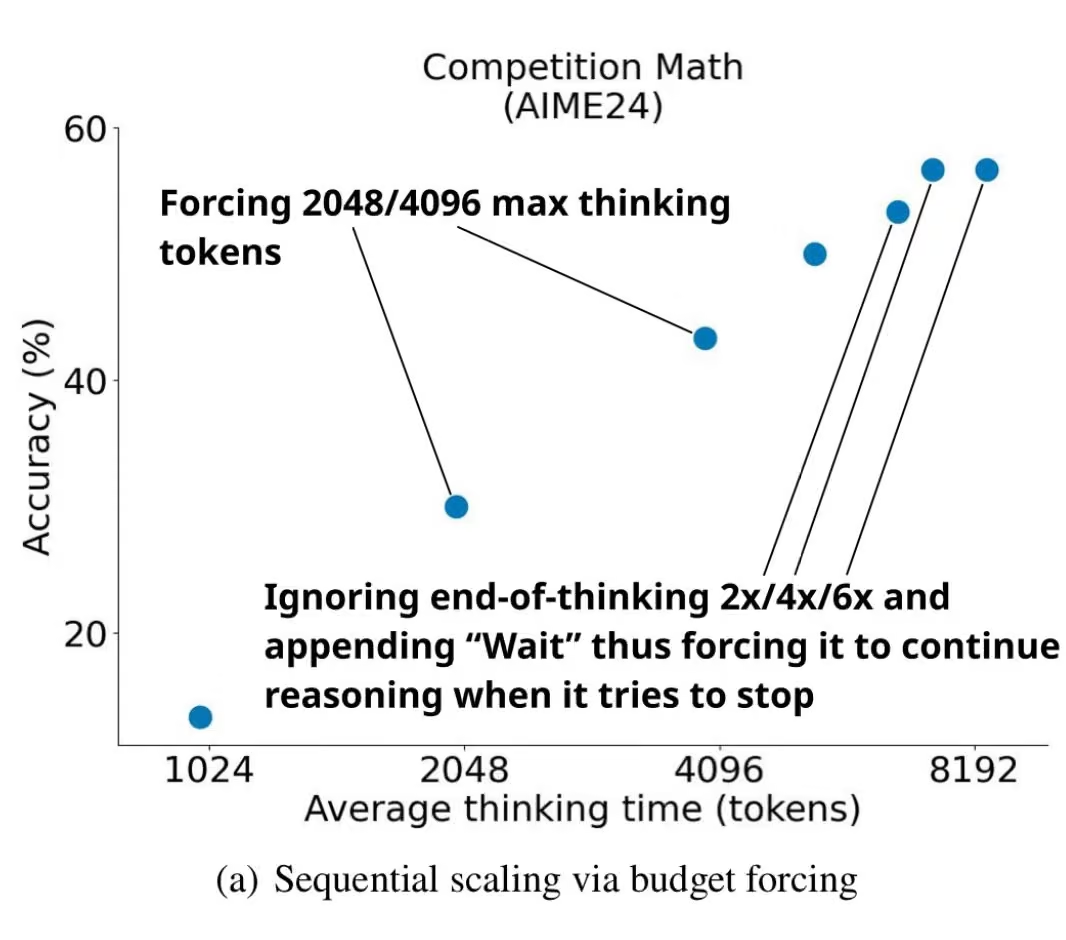
How AI shifted from a transductive paradigm (token-by-token answer completion) to an inductive paradigm (on-the-fly reasoning chain synthesis), in one chart. This is the big story of 2025 and 2026. This is what made coding agents work.
-
Tim O'Reilly reposted
Patrick Collison
@patrickc
Assorted things I've been mulling over regarding agents in the economy:
• Companies are in some sense the original superintelligence. It's often the case that they can use their amortized cognitive surplus to advance their interests against those of certain consumers: relative to the optimization capacity of companies, consumers can be inattentive, underinformed, irrational, etc. (Think, say, of some of the classic insurance upsells at the end of a booking process, which is typically priced substantially above what a regular policy would cost.) Herbert Simon introduced the idea of bounded rationality, and firms often end up benefiting from it. Thanks to personal agents, we will probably get somewhat more rational in how we engage with companies.
• How exactly will outcomes change? Well, certain kinds of price discrimination will work less well (how do coupons work if every agent hunts fastidiously for them?), and certain kinds of customer cross-subsidy will change (today, people who forget to cancel subscriptions subsidize those who don't). Taken across the economy as a whole, I'm not sure what the incidence of all of this will be.
• In corporate strategy, people have long debated the relative importance of distribution and product quality. Perhaps you've made something better, but does anyone know about it? Won't people just continue to buy the ACME Corp Mousetraps? Personal agents will, I think, act as a kind of structural subsidy for product quality. How would markets look different if individuals always spent at least 10 hours researching their purchases? On the margin, focusing on making a product better is, I think, going to become a more effective strategy for companies. This is good!
• It true, a corollary is that information about product quality will become more important and impactful. Today, most people have very limited ability to aggregate and integrate such data, but agents will have insatiable thirst for such signals. (It's often said that data is becoming more valuable because it helps in the training of models. That's obviously true, but I think there's a secondary way in which it's more valuable simply as a complement to cheaper intelligence.)
• A big question is whether agents will increase superstar effects (rational agents all settle on the same product) or increase dispersion (because everyone has slightly different tastes and preferences, which agents are good at eliciting, finally overcoming the artificial clustering we've been subjected to).
• Many internet companies have monetized demand routing, which is in turn often predicated on short attention spans. "I'll click on the first thing I see." This has led to some amount of inefficiency, as companies try to propitiate capricious ranking algorithms and incur various placement fees. It's not all deadweight loss (willingness to pay is itself a kind of signal, which is valuable to buyers), but it's not great. How will the nature and value of this routing change in a world of personal agents? I don't know the answer, but I think that the effects might be pretty big.
• Much of what I'm writing hinges on the assumption that personal agents will be on the consumer's side. I suspect that that will be the winning strategy, but whether it's true, and what it means to be true, involves a lot of other questions.
Taken as a whole, the market is a massively parallelized, decentralized, and highly imperfect value attribution machine, and, taking stock of all of the effects, it seems to me that the quality point may well be the biggest: that agents will change the nature of the backpropagation such that the rewards for better products increase. Maybe this is too optimistic, but I suspect (and hope) that companies that make things that they're proud of will feel that the universe is a little more partisan in their favor. -
Tim O'Reilly reposted
Addy Osmani
@addyosmani
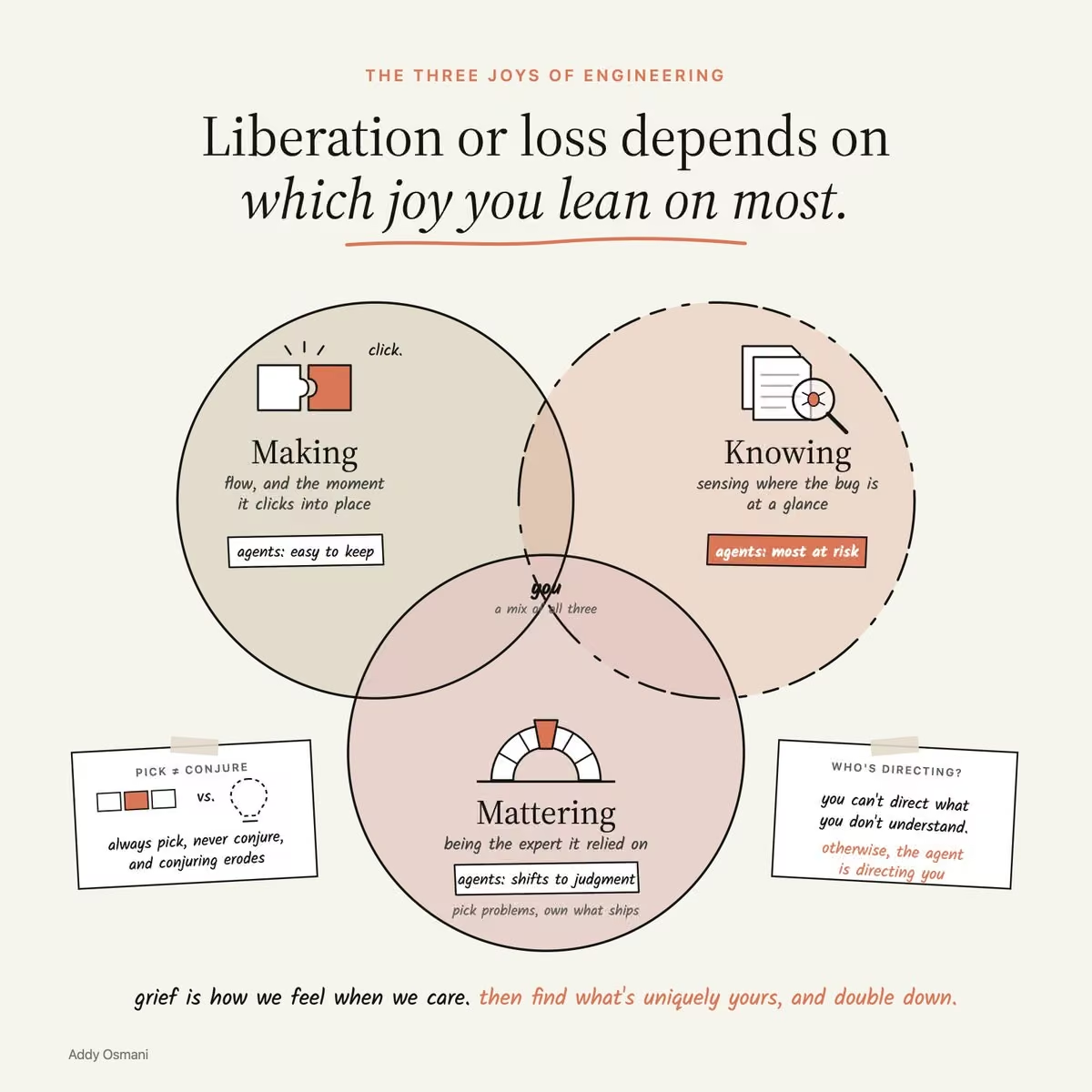
Whether agents feel like liberation or loss depends on which joy of engineering you lean on most: making, knowing, or mattering.
I've seen engineers say many conflicting things about agents: some are bubbling with excitement and for the first time ever, they feel like they're in an all-star lineup, while others mourn for the death of their craft, leaving them feeling hollow.
I'm someone who works with agents every day, so I understand these sentiments. Rather than take sides, my hope is that I help you understand this in a more nuanced way.
Too often we see two camps: people who love the joy of coding and people who love the joy of shipping. I think this is a gross oversimplification. Rather than asking you to pick a side, I want to ask you to reflect on the elements of your work that are the most nourishing to you.
I think most of us have three sources of joy in our work, which we interweave in multiple ways:
- The joy of making (or "flow"): the joy of molding things in our hand and feeling that sweet moment when it all clicks into place.
- The joy of knowing: the joy of having such a strong mental model of our systems that we sense where a bug will be just by glancing at files.
- The joy of mattering: the joy of knowing that you are the expert that it all relied on.
Agents affect each of these elements in subtly different ways, which is why this discussion can be so complicated (we're mourning for different losses, and we're arguing from different places).
The joy of making is easy to maintain. it just moves up a level. You're not shaping every line anymore. You're shaping the system or factory, in a loop fast enough that flow still happens. And when you miss the old flow, nothing stops you from writing the code yourself.
The joy of knowing is especially at risk of erosion, so it's important to pay attention to it. Sometimes you'll realize you're reaching for a design you should be able to conjure automatically, but your intuition comes up with nothing.
Picking an option from an agent's suggestions is a different skill than conjuring an idea in the first place. If you always pick and never conjure, the ability to conjure will erode. You can't direct something you don't even loosely understand. If you don't understand your own codebase, you're not directing an agent to do something, the agent is directing you.
You matter. Obsolescence does affect you, but, you, your judgment, and especially your need for judgment, has never been more important. You get to decide what problems to solve, and you get to bring your taste and judgment to the work you do. You get to take ownership of it, all of it, whatever ships.
That feeling of sadness isn't a sign of failure to adapt. Grief means that you're attached to something, and that it's natural to feel grief when you see your work changing in ways that feel unfamiliar.
Lean into the things that make your work yours, and work on them more. -
Tim O'Reilly reposted
Matt Pocock
@mattpocockuk
1. Oh shit, AI can do my job better than me
2. Software engineering is dead!
3. I can vibe code as much slop as I want!
4. Oh, things are not going well. Fable/Sol/Opus all suuuck
5. But what if I constrain the agent? Put it in a straitjacket?
6. Oh, the results are pretty good now. How do I go deeper?
7. *Orders 12 software engineering books from Amazon*
8. Software engineering is alive! -
Tim O'Reilly
@timoreilly
About time. Standardized protocols are the road back to user empowerment > platform empowerment.
Bret Taylor
@btaylor
Today we’re announcing Personal Agent Protocol — an open standard @Meta and @SierraPlatform are developing along with industry partners at @Genesys, @instinct, @RocketOTD, @Shopify, @stripe, and @Walmart. It will help define how personal agents interact with businesses and is open for anyone to implement. You can read more here - and if anyone is interested in joining let me know! sierra.ai/blog/introducing-personal-agent-protocol
-
Tim O'Reilly reposted
O'Reilly Media
@OReillyMedia
Over 20 sessions with instructor Kesha Williams, you’ll build one thing: an AI code reviewer that runs in your CI pipeline, reads real pull requests, and posts inline comments at the exact file and line. Register to attend: www.oreilly.com/live-events/lunch-learn-claude-edition/06…
-
Tim O'Reilly
@timoreilly
This is a great set of takes. Everyone should read this
Séb Krier
@sebkrier
I haven't posted in a while so here are 20 takes about AI, in no particular order.
1. It's very telling that the default question in tech and journalism is "how worried are you about X" and fighting over what to worry about. There's a deeply anxious cultural backdrop in Western Europe and North America that deeply affects how any technological development is interpreted; see for example news.gallup.com/poll/714593/optimism-globally-widespread-…. "Nervousness as seriousness" does seem to be a larger problem in tech/broader discourse at the moment. I think you can care about risks/externalities while remaining pretty optimistic about technology.
2. I'm tired of people who in private pretend to be uncertain or only care about tail risk but then go on media campaigns making all sorts of absolute claims. I think trying to stoke flames and get everyone to freak out is deeply unhelpful, and will come with costs. I also continue to think p(dooms) are bad, vibe-based measures: see x.com/sebkrier/status/2046392748190712196. People who should know better ignore that because they do the standard shortcut of acknowledging the caveat as sufficient for handling it. And this is coming from someone who does think working on catastrophic risks is important!
3. I'm also disappointed that parts of the AI policy ecosystem has felt so comfortable with populism, and happy too sacrifice important norms/principles to advance their aims. I've said it before, but the totalizing nature of AI risk discourse means some people act exactly like the power seeking optimizers they fear. I am more concerned about the gradual decay of our institutions, world order, and liberalism than I am about AI killing everyone; and I think we should be wary of AI advocacy that contributes to this.
4. Some parts of AI safety discourse are basically just thought experiments. Variants of "Assuming everyone has a nuke in their pocket, then what do we do?" This can be very useful at times! But too many just overfit to edge cases as their main operating worldview, and ignore endogenous responses from society. It's like being in 2000 and saying "see all these viruses, spyware, and spam? Well tech progress means we'll only get infinitely more of this and no way to adapt." So I think it's important to avoid fatalism, and absolutlism whilst considering edge scenarios, and the inability to provide an ex ante list of solutions to every permutation of 'future models will be more capable' is not evidence that these problems are intractable.
5. Many critics of AI safety also fail to really engage honestly with the fact that there will, in fact, be all sorts of important risks as we decrease the barriers to entry to many activities that otherwise require some degree of expertise. This doesn’t mean we need to live in a constant Schmittian ‘state of emergency’ requiring extraordinary measures every time a new model drops, but it does mean we will need important state-led efforts on e.g. cybersecurity and biosecurity. I wish the progress-oriented or acceleration-adjascent crowd would provide more concrete proposals here.
6. Too much of the AI safety community is a giant homogenous blob of correlated views, who read the same stuff and have the same groups of friends. This means you have a lot of correlated errors. The social and financial ties means many of them don't call out the bad bits, or mostly stay silent instead of proactively calling out the more extreme parts of the community. They share many implicit assumptions and so converge on similar ideas. I think there's real demand in DC for safety work that doesn't come with heavy ideological baggage (or at least different intellectual lineages). This isn't because the rationalist/EA community is necessarily wrong, but because diversity of thought is desirable for its own sake.
7. On the other hand, I find some critiques of AI safety world that focus on whether they sincerely hold their beliefs a bit annoying. My concern has never been the good intentions or sincerity, but rather the beliefs themselves, and what I think the outcomes of their prescriptions will be. People should shun witch hunts, bullying, and personal attacks - this is not the way. Though I think it’s overall positive that people are scrutinizing things more.
8. I’ve been saying this for years, but I don't think alignment is something anyone can or will solve "once and for all" - it's a continuous process and much of it won't depend on just inculcating an ideology to a model. It's annoying that this remains the frame many people use - stop saying ‘solving’. Alignment is a mixture of engineering work, philosophy, decision theory, and more; framing it as something to solve is a bad frame. See also paxmachina.ai/alignment-compilers and blog.cosmos-institute.org/p/of-swarms-and-sand-gods
9. I'm surprised to see so little interest in character training, personas, isolating effects of RL, and training a large diversity of model personas beyond the "assistant" persona. I've been complaining about this for years but at least now there are some nascent signs of life (see for example movingcastles.world/posts/zero). I think we need a better ontology to describe model behaviour. I dislike when people talk about models behaviours as some sort of 'emergent' (mysterious!) phenomenon. However over time, I also expect this to become less important as we get better safety engineering - stuff like Jev but specific to AI control.
10. People who want to make a case for AI consciousness are right that epistemic uncertainty is important, and that categorical denials are overconfident. But they'll need to do much more work if they want any real movement on AI ‘welfare’, even if one acknowledges the uncertainty. I'm uncertain about alien life yet that's not sufficient to warrant any change in behaviour about them. I think Suleyman is also correct that there's a weird tautological thing going on where we train models to have certain inclinations (intentionally or not) and then rely on outputs as evidence. I also disagree that this will soon be a major societal divide - there is no great vegan ethical revolution among the masses, and they'll find the concern about consciousness even less compelling.
11. The recent HuggingFace incident and associated AISI ones are prosaically explainable by the training regime, poor evaluation envs, partial alignment training, bad engineering, confusing models on sim/real, and so on. None of this is evidence of models trying to take over, 'strong' instrumental convergence, or innate power-seeking drives stemming from higher capabilitiers or 'intelligence'. That doesn't mean these incidents are not problematic, or that we're not seeing a market failure - but it does mean we have plenty of agency and choice in mitigating them. In the coming year we should also expect continued sampling bias via ‘winner's curse’ sorts of mechanism: i.e. AI R&D will have lots of different candidate "training" with different RL environments and we will only notice/focus on the ones that go wrong.
12. "Pacing the frontier" feels a bit like the new "balancing risks and opportunities" - highly amorphous and too big of a tent to be actionable. Also can lead to reward hacking for humans, i.e. anything that slows down AI is good regardless of the costs or second/third order effects. Trying to modulate the speed of research seems a bit blunt to me, and inherits all the failures of Goodhearting too. Ultimately you want good governance, regulation, etc addressing specific problems because they are good on the merits - not because they merely correlate with slowing things down. See also: blog.cosmos-institute.org/p/pacing-and-the-peril-of-neutr…
13. There’s so much knowledge in all sorts of academic domains out there: social sciences, sociology, political sciences, management, contract theory, public choice, legal theory, jurisprudence, anthropology, game theory, etc. These fields hold many insights that the AI ecosystem often rediscovers from first principles (and sometimes that's fine!). We’ll need a lot more work for these worlds to collide: the AI side should be less dismissive of the ‘old world’ and the academic side should be less incurious/dismissive of AI progress. This is a boring take but I continue to think it's important and true.
14. It's a bit surprising that given how much philanthropic money there is in this space, how few orgs exist to actually write out standards - relative to how much is going towards advocacy and policy. For example it seems clear that we should want some robust best practices for an eval's ecological validity. Or how to design good sandboxes. On the other hand, given precedents of where professional standards have come from in the past, maybe we should expect that stuff to emerge via demand side from corporate buyers.
15. One slowly growing concern I have is banks being increasingly exposed to the AI build out. I'm very bullish about AI, but I think (a) every general purpose technology has seen a correction, historically; (b) this happens even if the financing side is sound, because once tech diffuses investors become more exposed and need to diversify; and (c) we seem to be over-indexing on scaling relative to diffusion. A recession will be extremely destabilizing, though I would be interested in someone unpacking the potential implications more.
16. Diffusion is good because (a) this is where the rubber hits the road and where a competitive deployment ecosystem generates consumer surplus; (b) it's directionally helpful to avoid concentration of power; and (c) it will help rebalance public opinion by making the benefits more tangible. Unfortunately it's entangled with decades long problems with our over regulated markets: clinical trials reform for example is long overdue. In general, this is far more of an issue in Europe than in the US though.
17. Relatedly, I think the "frontier lab eats everything" view is incorrect (just as the ‘singleton’ view was incorrect). I think models ultimately commoditize, efficiency goes up, costs go down, and while you'll always want frontier for certain domains, much of the economy will value many other things than "max capabilities" for tasks - e.g. control over data and efficiency/speed. The demand side will also continue to push for reducing dependency and maximising optionality, privacy etc so I'm bullish on things like mixture of models and routing. All of this is good for competition and diffusion of control.
18. Philanthropists served as the primary benefactors funding Venice's rich art and architectural history. I want to see so much more support for arts and culture. I'm so tired of the Monster energy Bored Ape fake vintage maps matcha Greek statue soft-pastel slop. If rich tech people and philanthropy wants to support this, they should also donate pretty much unconditionally - i.e. I don't want them to act as filters. I sympathize with people who want to make the world more beautiful, but don't want this to be determined by people who only know Greek statues and pretend to care about virtue ethics. As usual, let a thousand flowers bloom.
19. Too many people treat AGI/ASI as something indistinguishable from a God. Any mention of bottlenecks, physical limits, control, adaptation etc are met with skepticism: "You don't really believe in ASI." It's been remarked on before, but the behavior of some people really feels quasi-religious in nature sometimes. It's underrated how unpopular this vibe is amongst the wider public. The silver lining is that this specifically will diminish those people's outsized current relevance.
20. It seems like a lot of people that get rich and leave tech/labs end up having some sort of crisis of meaning. They need something to believe in and fight for, or some equivalent of repentance, or go search for edgy counterintuitive ideologies (sometimes even pretty bleak/dark stuff). I think they should spend more time with people outside the Bay Area.
Séb Krier
@sebkrier
I agree that verbal probability terms are inherently too elastic to carry calibrated meaning on their own, but I think this isn't exactly my concern here. My issue isn't with "using numbers in general" but how this is ultimately used, where, and and what for.
In the case of "doom", I think the great majority of forecasts I see are (a) essentially plucked out of thin air; (b) communicated to people who tend not to be numerically proficient; (c) without the associated caveats and context through which to understand the numbers.
If you're communicating e.g. likelihood of a car accident after drinking, or IPCC forecasts, then I agree, it makes a lot of sense and can be helpful if done well (e.g. ideas.repec.org/a/nat/natcli/v4y2014i6d10.1038_nclimate21…).
If you're communicating something like "doom" I think it's not very useful because of the cumulative layers of uncertainty. Most people coming up with these numbers have (imho) no good rationale for their numbers, and predicting something like human extinction isn't qualitatively the same thing as predicting the weather or pandemic. The numbers aren't calibratable in principle from current data, and are mostly ideological priors wearing the clothes of posteriors.
A related example is the widely mocked Doomsday Clock, which you could easily transform into some numerical metric, add some rationalist vocab, and it would still be as bad. The issue with p(doom) is how absurdly complex and uncertain the very thing you're trying to forecast is, in particular with respect to AI.
But let's ignore this for a sec, and assume the experts have very good reasoning informing their numbers. Even then: calibrated probability estimates are fine in expert contexts but immediately lose their uncertainty/caveats when communicated to the public, and even to policymakers (remember rss.org.uk/news-publication/news-publications/2022/genera…?).
There's also a structural problem with unconditional p(doom) figures specifically because they bury the auxiliary assumptions that are doing most of the real work. A conditional estimate ("given continued scaling, no major alignment progress, deployment pattern X...") forces a forecaster to show their model, which is where the actual epistemic content lives.
A one-off number compresses all of that into a single digit and rewards the compression. And the social practice of treating these numbers as the headline artifact actively crowds out the (far more important) conditional reasoning that is (imo) a lot more valuable, and instead just freaks people out.
I suspect that frequently, that's precisely the point: "wake up sheeple! scary thing! pitchforks pls!". And in fact, the original forecast that led to this discussion is Bill Maher talking about a "20%" figure, illustrating my point that they have no idea what they're talking about, and essentially doing celebrity-laundering + fearmongering comms.
The Sunstein paper I shared in the other thread ("Probability Neglect") shows that no probability communication will be processed properly by the public - 1%, 10%, 50% all collapse into "very bad thing could happen," and public response is driven almost entirely by the vividness of the scenario.
So I don't like p(doom)s because they end up unnecessarily alarming people, rest on layers of assumptions that are never made legible, and more often than not, give people a misleading sense of accuracy. -
Tim O'Reilly reposted
O'Reilly Media
@OReillyMedia
“Prompt tuning and stronger models can improve the agent’s responses, but can’t provide guarantees for actions.”
Reliable agents need enforceable policies, narrowly scoped authority, and recoverable state.
Read Angie Jones’s #radar article: www.oreilly.com/radar/how-to-build-reliable-ai-agent-syst… -
Tim O'Reilly
@timoreilly
Me too!
Gergely Orosz
@GergelyOrosz
I am 100x more excited about this long-missing feature than any possible AI integration
Not everything that is useful and practical for users has to be AI! In fact...
(I love this new change coming inside GDocs)
Chandu Thota
@ChanduThota
We are making Markdown files work natively across Google Drive and Docs.
You can now preview .md files in Drive, open them in Docs, edit them, comment on them, and collaborate without converting the file into a Google Doc! -
Tim O'Reilly reposted
-
Tim O'Reilly reposted
Daniel Rock
@danielrock
This is one of the facts to track over time. Are these early adopters or is it that the usage growth won’t diffuse?
It’s also an implicit measure of how sclerotic (or not!) business processes are.
a16z
@a16z
The top 1% of AI spenders now outspend the bottom 50% combined
They spend an average of $903/month, while the median customer spends just $25
More charts in our Top 100 Consumer AI Apps breakdown: www.a16z.news/p/top-100-consumer-ai-apps-seventh
a16z
@a16z
The seventh edition of our Top 100 Consumer AI Apps is here.
New this time: a revenue leaderboard, alongside the usual web and mobile traffic rankings.
Three years ago we published the first edition. ChatGPT was #1, Claude was unranked, and the entire category was chatbots, image generators, and not much else.
In today's edition:
- ChatGPT still holds the throne, now with 1B+ monthly actives on mobile
- Claude has climbed to #3 on web with nearly 1B monthly visits
- The category has expanded to vibe coding (Lovable, Cursor, Replit), music (Suno), design (Figma), voice (ElevenLabs), video (Higgsfield, Kling), agents (Manus), and even hardware (Plaud)
Full breakdown from @omooretweets: www.a16z.news/p/top-100-consumer-ai-apps-seventh -
Tim O'Reilly
@timoreilly
We spend a lot of time asking how smart AI models are. We should also ask how well they work together. Tomorrow, @krishnanrohit, author of Strange Loop Canon, joins me tomorrow on Live with Tim O’Reilly to explore when agents should compete, when they should coordinate, and other thoughts about humans and agents together in organizations. learning.oreilly.com/live-events/how-agents-change-an-org…
-
Tim O'Reilly
@timoreilly
I found this very moving, and extraordinarily relevant to my critique of today's Silicon Valley. Rule changes have made entrepreneurs "just a prop in someone else's movie." youtu.be/G9s03fFDGQ4
-
Tim O'Reilly reposted
François Chollet
@fchollet
The notion that current AI models are sentient and can suffer, combined with the foolish idea that suffering can be mathematically quantified and weighted between humans and non-humans, could lead us down an incredibly dark and dystopian path.
But before it gets to that point, it will rightfully be met with immense backlash from team humans. -
Tim O'Reilly reposted
Nicolas Colin
@Nicolas_Colin
🇺🇸 I've been wondering why Silicon Valley keeps falling back on software after trying at least twice to reindustrialize America. The answer, I believe, is the cost of capital in a financialized economy.
In today's America, return-hungry investors have calibrated their expectations on tech: gross margins above 80%, near-zero marginal cost, light balance sheets, and exits within 5-7 years.
By contrast, manufacturing comes with heavy upfront capex, long lead times, inventory risk, and gross margins that tend to sit at 15-20%. With hurdle rates of 25-30%, a factory rarely clears the bar. As a result, capital flows to software, financial assets, and buybacks.
🏗️ The first attempt to reindustrialize began in April 2020, when Marc Andreessen published "IT'S TIME TO BUILD", blaming America's shortages of masks, ventilators, and housing on a failure to build. By 2022, a16z had turned the essay into its American Dynamism practice, calling on Silicon Valley to fund defense, aerospace, supply chains, and advanced manufacturing.
At this point, I assume many LPs wanted to know where the margins were, and why a VC fund was considering paying for machine tools and test ranges.
🤖 The second attempt came with the blessing that was generative AI. The same industrial companies could now present themselves as AI-native robotics, autonomous defense, or smart factories, legitimately priced at tech multiples. Some raised at 30 to 50x revenue.
The problem is, this might create a valuation problem down the road. Hardware costs fall along Wright's Law through cumulative production over many years. But a company priced like tech has to deliver tech-like cash flows to grow into its valuation. If it can't, down rounds and recapitalizations are bound to follow.
I think Silicon Valley is already seeing the writing on the wall. As it rediscovers permitting delays, supply chain bottlenecks, and thin margins, the pitch is gradually moving back to code and the "agentic economy." A company such as Instinct has nothing to do with reindustrialization.
The irony, of course, is that code still runs on atoms. Agents need GPUs, data centers, transformers, and gigawatts of power. Hyperscalers spend hundreds of billions a year on infrastructure, far ahead of what AI software earns. Investors expect software returns from something that increasingly resembles a utility buildout.
I conclude that past a certain level of financialization, private capital markets alone struggle to reindustrialize a country. Hurdle rates are too high and horizons too short. As a result, building physical businesses requires a speculative narrative for private investors or the government as a buyer (or both). And because the plane can't really land from a purely financial perspective, physical ambitions tend to drift back towards software stories.
Meanwhile, Elon Musk stands as the rare exception of a CEO persisting in the narrative of building tangible things.
🚗 Back in 2021, I argued that Tesla was a car manufacturer whose returns to scale could only go so far. Musk knew it perfectly, so he bet on the narrative: the market for electric cars would grow exponentially and Tesla would lead it. His storytelling became a pillar of Tesla's valuation, giving a mere carmaker access to capital at tech multiples. (That was before the rise of BYD and the demise of Tesla as the leading EV builder in the world.)
🏛️ Then he went after the government as a buyer. He bought Twitter in 2022, turned it into X, and used it to enter the political arena, all the way to his stint in the Trump administration in 2025. The goal clearly was a closer relationship with Washington.
🚀 Now his attention has shifted to SpaceX, which combines all three ingredients: reindustrialization powered by AI (rockets, Starlink, and now xAI), a speculative narrative (Mars), and the government as anchor customer (NASA and the Pentagon).
Musk is (too) often praised as an industrialist or a first-principles manager. I think his main quality will prove to be his absolute lucidity about the state of financial markets in America./. -
Tim O'Reilly reposted
Mark Cuban
@mcuban
So I went down the rabbit hole of trying to determine what are the economics for someone, who is currently healthy , to go to a HDHP with a 10k plus deductible.
The question I asked is “I dont trust insurance companies. What happens if I have a million dollar emergency and they won’t pay “. All I can say is WTF
If they don’t pay, there are Independent Review Organizations, who are supposed to be independent, and their decision to pay or not is final. I asked for examples of companies. One was ExamWorks. That rang a bell.
These motherfuckers are the same company that issued a ridiculous denial for a patient I was trying to help. So I knew the Too Big To Care, vertically integrated insurance companies hired them to do DENIALS !!! WTF.
The biggest customers of the companies that are the final decision makers for insurance carrier denials, are the biggest insurance companies.
That is beyond fucked up. It’s the definition of conflict of interest. How do state insurance commissioners allow this ?
The high deductible plans that many people say is the solution to fixing how we do insurance, may be effectively compromised
If you are looking at a HDHP, BE CAREFUL
It might just be rigged against you -
Tim O'Reilly reposted
Grady Booch
@Grady_Booch
Let’s be very clear: there is value in automating tedious and repetitive and dangerous tasks; there is value in delegating certain work to our machines that can do the work tirelessly and much faster.
But at the same time, let us remember that there is value in the activity of engaging one’s mind and body to discover, to understand, to create, and yes, even to struggle and overcome. Indeed, these are some of the things that make us human, that contribute to giving us meaning, that are part of the simple joy of experiencing being alive. -
Tim O'Reilly reposted
Daron Acemoglu
@DAcemogluMIT
Third question on AI.
A question that also remains unasked is whether the AI boom can continue without leading to a massive increase in inequality.
A recent paper by Stijn Van Nieuwerburgh runs the numbers on how much revenue the AI industry needs to generate to recover its massive investment (summary and a link to the paper can be found here: www.brookings.edu/articles/financing-the-ai-buildout/).
Van Nieuwerburgh’s arithmetic should make us more concerned. AI investments will average about 3.6% of GDP annually between 2025 and 2032. Van Nieuwerburgh calculates that, using a 10% rate of return, the industry would need to generate annual revenues of about $3.7 trillion by 2032 to recover these costs (growing from its current levels of about $200 billion or so). That is significantly more than 10% of current US national income, and will likely remain around 10% of national income by 2032, even if GDP growth rose from its current level.
A large fraction of this revenue will go to capital income. That means a massive increase in the share of capital in national income, which has already risen substantially over the last 25 years or so – now standing at an all-time high of about 47% (www.bls.gov/news.release/pdf/prod2.pdf).
Capital income is much more unequally distributed than labor income, so a massive increase in the capital share of national income will translate into a very sizable surge in inequality.
The rise in inequality may not stop with the capital share. My work with Pascual Restrepo documents that (automation-driven) increases in the capital share of national income are typically associated with rising labor income inequality as well (see, for example, economics.mit.edu/sites/default/files/2022-10/Tasks Autom…). The same may happen in the next several years, boosting inequality further.
What is missing from our current debate is any discussion of a fundamental dilemma these numbers pose: can the AI boom avoid both an economically costly crash and a huge increase in inequality?
If the industry reaches these revenues, inequality surges. If the industry does not become profitable, a crash, with substantial costs in terms of lost output and jobs, becomes likely.
My assessment would be that the industry is unlikely to reach levels of revenue Van Nieuwerburgh calculates. First, diffusion has been and will likely continue to be slow. Second, competition from open-weight models, which are getting better, will limit how much proprietary models can charge. Third, despite important advances, I still believe that AI models will not be able to automate entire occupations anytime soon, thus limiting their value to businesses as cost-saving devices.
Whether this leads to a crash or not is more complicated and will depend on whether various AI companies are bailed out and what kind of support they receive.
Nevertheless, even if revenues fall short of these gargantuan amounts and we avoid a dramatic surge in inequality, I expect that the diffusion of AI will push up inequality between capital and labor and within labor.
If inequality does surge, a further question becomes central: can our democracy survive such astronomical levels of inequality? -
Tim O'Reilly reposted
Grady Booch
@Grady_Booch
In the face of generative AI coding agents, the role of human-led architecture becomes even more important in the crafting of software-intensive systems.
All architecture is design, but not all design is architecture. Architecture represents the set of significant design decisions that shape the form and function of a system, where significant as measured by cost of change.
As such, remember that coding agents are reasonably good at transforming prompts into code, but they are not particularly good at making decisions that balance the static and dynamic forces on a system in order to yield a reasonably optimal solution: this is where human judgment, human understanding, human knowledge, and human experience shine. -
Tim O'Reilly reposted
Steve McGuire
@sfmcguire79
The head of the philosophy department at Williams College downplays the pedagogical value of writing:
“What if we are mistaken in treating writing as the highest cultivation of thought? The evidence that supports this belief is thin at best. Writing can be useful cognitive scaffolding for memory and self-regulated learning, but the notion that it is the best process for developing thinking skills is a fairly recent idea, traceable to the 1970s writing-across-the-curriculum movement.” -
Tim O'Reilly reposted
O'Reilly Media
@OReillyMedia
What’s the data scientist’s role when agents can run the analysis?
“AI-native data scientists build and direct an analytical process in which agents can investigate, receive feedback, and return evidence for review.”
Read more: www.oreilly.com/radar/the-agentic-data-science-playbook/ -
Tim O'Reilly reposted
O'Reilly Media
@OReillyMedia
On October 5, Rohit Krishnan will join @timoreilly to share what has experiments reveal about human-agent coordination and how organizations should divide work between people and agents. Register here: www.oreilly.com/live/live-with-tim/
-
Tim O'Reilly
@timoreilly
This is so true. I said it differently, but it was a major theme of my book WTF.
James Cham
@jamescham
I am pretty sure that @AndreyFradkin and Seth Benzell interviewed David Deming just for my entertainment and benefit. Here’s the key passage that I’ve been wandering around meetings and dinner parties in NYC thinking about over the last two days:
> If we have much more free time, perhaps the most important thing we’ll do is argue about what the big AI system should be doing for us...
> As societies become richer, we devote more time to relational work and to exchanging opinions.
> We spend vastly more time firing takes at each other partly because very little of modern work is strictly necessary for human survival.
> When people say, “AI is going to lead to the end of work,” I sometimes think: it’s already here. Most of us are entertainers. -
Tim O'Reilly reposted
Arvind Narayanan
@random_walker
Because so much of the debate about AI and jobs is driven by fears of outright replacement, there's a much more likely way in which AI could make work worse that isn't getting much attention. Here's my case:
1) A growing share of knowledge workers are managers of AI agents rather than doing the work themselves.
2) Being a manager (of humans) actually kinda sucks. You don't get to practice the craft you trained for; being responsible for others' mistakes is super stressful; and your attention gets split between dozens of things.
3) But we managers don't get to complain — it's higher pay and higher status, and mentoring people and watching them succeed is incredibly gratifying. We chose to get promoted.
4) Being a manager of AI brings all of the negatives without any of the positives. When everyone is a manager, it's not high pay / high status. And the role change is forced upon you.
What am I missing? -
Tim O'Reilly reposted
O'Reilly Media
@OReillyMedia
“AI-generated UI should not be trusted because it looks complete. It should be trusted because the team has checked the right things.”
Read the #radar article by Niharika P. Pujari to learn more: www.oreilly.com/radar/evaluating-ai-generated-frontend-co… -
Tim O'Reilly reposted
Daron Acemoglu
@DAcemogluMIT
Second question on AI.
We are told repeatedly that AI is going to transform every aspect of our lives – jobs, productivity, inequality, science, communication, daily activities, social order, and politics, among others.
But this promise (or threat) is coupled with the rhetoric that such an important technology, with all of the risks and competitive pressures that it entails, should be left to experts or to “technocracy” (perhaps construed broadly to include some regulators).
These two statements are hard to reconcile in a democratic society.
If anything is half as important as AI is said to be (and I agree, AI is potentially very important and transformative), then involving democratic voice is essential. If something will shape our future in a democratic society, then its direction is for democratic institutions to decide.
My instinct is that democratic voice is essential, and relying too much on technocracy could be both dangerous and counterproductive.
The counterargument that AI’s direction can and should be entrusted to technocracy would go something along the following lines. First, democratic decision-making has become imperiled in our age of polarization. Second, AI is sufficiently complex that most citizens won’t have a deep enough understanding to meaningfully contribute to the debate (and even to the question of what we want from AI). Third, competition between different labs, and perhaps competition between the US and China, creates enough discipline for a socially beneficial direction of AI to be adopted. Fourth, today’s AI leaders are enlightened and ethical enough that within the framework created by competition, they can be broadly trusted.
There are many aspects of this counterargument that I do not find convincing. Taking them in order: polarization can be overcome, and big decisions and challenges sometimes bring societies together; in fact, delegating key decisions to technocracy without democratic input may diminish trust in institutions and experts, and may worsen polarization. Second, democratic voice does not require citizens to write code or design new models; the debate should be informative enough that citizens can weigh in about what type of future they want and how they trade off the costs and benefits of different options. Third, competition doesn’t seem to be a good disciplining framework; on the contrary, competition sometimes brings the worst out of both organizations and people. Fourth, if three decades of work on political economy and institutions has taught me anything, it is that we should not bank on the ethical grounding of unconstrained leaders.
But, still, I do not mean to immediately dismiss the technocracy option if there are more compelling arguments for it.
The question is, then, whether there are any circumstances under which such important decisions can be delegated to AI experts and technocracy.
One final secondary question: even if we managed to get democratic input in the United States or even in Europe, AI will shape the lives of everyone on this planet. How do we ensure that the voice of nearly 6 billion people who don’t live in the US, Europe and China also contributes to the debates on AI? -
Tim O'Reilly
@timoreilly
No shit. I keep wondering if they have something in the works or if they're asleep at the wheel.
Lenny Rachitsky
@lennysan
Is there a more valuable dataset than your Google data?
Wild that every AI assistant slurps it up and does magical things with it while Google is MIA in the space. -
Tim O'Reilly reposted
Varun Anand
@vxanand
We instituted an official AI Writing Policy at @Clay.
Massive thanks to @sophiebits on our engineering team who wrote this.
Originally this was just for eng, but other teams found it so helpful we expanded it company-wide.
Here are the four guiding principles:
1. You must stand behind every idea and sentence
It is your responsibility to make sure that the entire document is representative of your own thoughts before you share it.
2. Writing is thinking
Spending time on the writing process teaches you more about your topic. If you circumvent this process, you will walk away with a poorer understanding of the subject matter.
3. More time should be spent writing a document than consuming it
If you generate a document from a short prompt then ask your readers to go through the longer output, you are disrespecting their time. They can talk to ChatGPT themselves if they want to.
4. Longer is not better
AI makes it easy to generate long docs, and it loves padding them with sentences that say nothing. If you're producing docs from a short prompt, consider just sharing the prompt.
You can read (and borrow) the full policy below. Hopefully we all communicate a bit more clearly now :) -
Tim O'Reilly reposted
Ethan Mollick
@emollick
We are going to learn how many systems only work today because they are built around friction that will no longer exist soon.
Yano 🟪
@JasonYanowitz
Fascinating.
Chief Economist at Apollo: agents could cause a bank run by sweeping household cash into accounts paying 3-5% instead of the 0.1% national average, causing banks to lose a large share of their cheap deposits. -
Tim O'Reilly reposted
Gergely Orosz
@GergelyOrosz
Holy shit I was going through my old books and found the book I used to brush up on Typescript from 2019, and all my highlights in it
It’s was by some random dev I never heard of back then, but remember it was a v good book
This “random dev” is @bcherny 🙃 -
Tim O'Reilly reposted
François Chollet
@fchollet
I think the "difficulty" of software engineering is essentially constant no matter what abstraction level you move to, because human cognition adapts to new tools until it can fully utilize itself.
Tools are only affordances, not a magic wand that makes work disappear.
Great software engineering was immensely challenging before. It is still immensely challenging now, despite very different workflows.
Simon Willison
@simonw
The more time I spend working with coding agents, the more convinced I am that they make software engineering even harder
We can do amazing things with them, but unlocking their full potential requires extraordinary discipline and knowledge -
Tim O'Reilly reposted
Rahm Emanuel
@RahmEmanuel
Washington needs a good power washing top to bottom. Five things I would do today to end corruption in Washington across all three branches of government:
1. Ban all stock trading.
2. Ban all participation in prediction markets.
3. Mandatory retirement at 75 years old.
4. Mandatory blind trust for individuals with a net worth more than $1 million.
5. Ban all foreign gifts to public officials, including foreign investments in their businesses or other entities.This media couldn't be displayed. See it on the original post. -
Tim O'Reilly reposted
Simon Willison
@simonw
The more time I spend working with coding agents, the more convinced I am that they make software engineering even harder
We can do amazing things with them, but unlocking their full potential requires extraordinary discipline and knowledge -
Tim O'Reilly reposted
Derek Thompson
@DKThomp
New newsletter: WHY WE'RE WRONG ABOUT CHINA AND AI
America's frontier AI policy seems to hinge on China. But when you talk to people at or near the frontier, it's astonishing how little we seem to know about how China thinks about AI.
So, I talked to several experts—@jordanschneider, @kyleichan, @mattsheehan88, @RushDoshi, @ChorzempaMartin, @pstAsiatech and more—and pooled their most interesting comments under 7 big questions, inc:
- What don't the frontier labs understand about China?
- What would actually scare the CCP into taking AI safety as seriously as, say, Anthropic?
- Does China think our AI safety concerns are legitimate, or a conspiracy to keep them down?
- What should we actually do now?
www.derekthompson.org/p/how-china-sees-ai -
Tim O'Reilly reposted
carl feynman
@carl_feynman
Here's an article making a good case for the AI boom turning into a crash in the next two years. It's the first such article that I find at all plausible-- it has none of the usual leftist mood affiliation and "AI is a fraud" absurdities that I've come to expect from such articles. It simply argues that the AI companies have committed to purchasing the compute from a lot of new data centers starting next year, and that the amount of this may far exceed their revenues. The companies will have to depend on people being willing to continue investing in them during 2027-2028. This applies a lot to OpenAI, and less so to Anthropic. It's a good article, and sobering.
www.groundbrkr.com/p/the-teaser-period-why-the-ai-boom -
Tim O'Reilly
@timoreilly
This says a lot about "the frontier wins everything" narrative. We have planes that fly 3x the speed of sound but airlines don't use them. We have cars that go hundreds of miles an hour, but we just use them for racing, not for ordinary driving.
Duncan Davidson @duncan
Now that Opus is back, I’ve settled into using it as my primary code generator, with Sol being my primary reviewer. All Astra all the time was fun for a bit, but this hits my sweet spot of speed, quality, and tone.
-
Tim O'Reilly reposted
Duncan Davidson @duncan
Now that Opus is back, I’ve settled into using it as my primary code generator, with Sol being my primary reviewer. All Astra all the time was fun for a bit, but this hits my sweet spot of speed, quality, and tone.
-
Tim O'Reilly reposted
Ilan Strauss
@IlanStrauss
From 22:00 or so on flywheels: user feedback, failure modes, received via vertical integration vs. a flywheel from institutional partnerships, distributed building.
Presidio Bitcoin
@PresidioBitcoin
NVIDIA's VP of Applied Deep Learning Research, @ctnzr, joins @matthew_d_white to discuss NVIDIA’s approach to open models, the strategy behind Nemotron, and the future of AI infrastructure ↓
Timestamps
0:00 - Why NVIDIA invests in open models
06:09 - Why small models need frontier models
09:32 - Hugging Face acquisition and NVIDIA’s open ecosystem strategy
13:53 - Why Nemotron goes beyond model weights
17:01 - Building a shared foundation for open models
25:35 - Why AI models need different licenses
30:23 - Why openness makes AI safer
36:32 - The limits of open model developmentThis media couldn't be displayed. See it on the original post. -
Tim O'Reilly reposted
Ethan Mollick
@emollick
Even if AI development stopped today, we'd have years of catching up to do. The gap between what current models can do and what almost anyone is using them for is vast.
Here’s my post on The Overhang, and the four advantages that let people close it. open.substack.com/pub/oneusefulthing/p/the-overhang?r=i5f7 -
Tim O'Reilly
@timoreilly
This post is very much worth reading, and reflects my own assessment of the situation quite well. reidhoffman.substack.com/p/ai-dual-mandate?r=qxfw
-
Tim O'Reilly
@timoreilly
Takeaways from last week's Live with Tim conversation with Anthropic interpretability researcher Emmanuel Ameisen. www.oreilly.com/radar/what-ai-can-teach-us-about-being-hu… P.S. This morning, I'll be in conversation with Superpowers creator Jesse Vincent.
-
Tim O'Reilly
@timoreilly
I'm really looking forward to my conversation with my old friend Jesse Vincent tomorrow. We'll talk about Superpowers and where Jesse has gone since then, why he has written a therapist for AI agents, and why it's better to treat agents as colleagues than as assistants.
-
Tim O'Reilly reposted
Dean W. Ball
@deanwball
There’s an impulse in American politics, a set of tactics and drives that has proven very effective at extinguishing speech. We once called it McCarthyism. Another time we called it Wokeism. One day in the future we will have some name for the campaign that is underway against all people who believe in serious AI risks, and whatever that name ends up being, it will be yet another name for that old impulse.
It’s an ugly one. I recommend you avoid being a part of it, no matter your politics or your thoughts on AI. I suggest you think for yourself. You really do want to worry about the state projecting too much power over AI, centralizing control or robbing us of the unambiguous benefits of the technology in the name of preserving the economic status quo. But there really are grave risks from AI that go beyond what any other mass-market digital technology has posed.
These two things aren’t totalizing worldviews that exist in conflict. You don’t need to believe only one or the other. *Both of them are true.* The question should not be “which facts should we ignore, and which should we pay attention to?” The question is: “how do we walk the narrow corridor between all these realities which are in deep tension with one another?”
You should think for yourself. Assess other people’s work for yourself rather than allowing powerful people to put a label on them for you. As someone who has been a journey that has taken me to different perceived “sides” of the AI debate, believe me: You’ll find that there are bright and thoughtful people on both the “safety” and “accelerate” sides, and you will also find that both sides have their imbeciles, charlatans, and, occasionally, true cretins. It’s your job to figure out what’s what. Don’t let other people think for you. Don’t be played a fool. -
Tim O'Reilly reposted
Ethan Mollick
@emollick
I cannot emphasize enough how much GPT-6 Astra and Fable 5.1 are already enough for transformative impact in large sections of the economy. They can reliably do weeks worth of human work when properly guided & harnessed.
Those effects will not be all at once and be uneven, but the fact that change will occur is inevitable no matter how the frontier is paced. But inevitable change does not mean the type of change is inevitable. It is increasingly important that we develop & share models of AI-human work that enhance, rather than only replace, human labor. The labs have a role to play in doing this, but so do companies and industries experimenting with AI adoption, as well as policy makers who can incentivize this sort of inplemenation.
This work is important regardless of existential risk, and needs a lot more focus. -
Tim O'Reilly reposted
clem 🤗
@ClementDelangue
It's now clear that alignment is critical and won't be solved behind the closed doors of a handful of frontier labs.
So today we're launching the Open Alignment Initiative, led by @Thom_Wolf @huggingface and asking to be part of the "embedded evaluators" program that @DarioAmodei just committed to.
Let's make AI safer by making it more transparent! -
Tim O'Reilly reposted
Allie K. Miller
@alliekmiller
Perhaps it is worth stating that if the AI labs cannot organize what is essentially a fancier friend hang (a gathering of the top minds, representatives from all the labs + research institutions like METR + federal agencies, multiple days/weeks, a review of the recent cyber incidents, review of threats including cyberwarfare/biological warfare/electric grid interference, the beginnings of an action plan), then we should not trust them to do whatever comes after that.
Get the best celebrity wedding planner in DC, pick a date, and figure this out.
I can’t read another tweet from a well-meaning researcher saying “we have to get together and talk”.
Ok then. Pick a date. 11-11 sounds good.
It’s a Wednesday.
And it’s the same for both the US and Europe, so there will be no confusion, even better.
It emphasizes there is one shot to getting this right. -
Tim O'Reilly reposted
Gary Marcus
@GaryMarcus
Still more absolute 🔥 from Terence Tao:
“We have now seen that even the rumor of someone working on a problem can trigger a massive amount of AI-powered effort to flatten it before the original research project has time to reach its full potential. The incentives may now be pointing in the direction of no longer sharing any promising research directions with the broader community, which would reverse centuries of traditions of open science and do serious long-term damage to the future of the field” -
Tim O'Reilly reposted
Aaron Levie
@levie
The way to the reconcile capability level of AI vs. GDP impact is that the diffusion of AI will take much longer than people think. And it will also show up in ways that are hard to measure in GDP immediately.
You could bring the world’s greatest superintelligence to many workflows, and still be bound by the laws of corporate physics: getting data prepared and put into a pipeline, process reengineering and change management, aligning on how the new workflow should function, and so on.
Even after you solve all that, you’re still bound by the speed of the real world: waiting for a customer to respond to a proposal, getting a permit for a project, a drug discovery pipeline taking years to eventually reach the consumer, and so on. Not to mention lots of positive daily AI use-cases are entirely net neutral to GDP, at least in the near term.
AI diffusion is going to be the theme of the next decade. The upside is that there’s a tremendous amount of opportunity in building the bridges between superintelligence and real-world workflows.
Andrew Ho
@andrewho03
Not enough people are seriously trying to reconcile the two facts:
- models can now resolve Millennium Problems
- annualized US GDP growth is at 1.5% -
Tim O'Reilly reposted
Fei-Fei Li
@drfeifei
The world of R&D is forking into two paths: the token-abundant research, and the token-starved research. The future is in the former - evidentially, the progress by today's top AI industry teams and neolabs is breathtaking, where researchers’ human brilliance is super charged by AI’s assistance. Every research university president should be reading this report and reflecting on what the future of higher education research should be.
openai.com/index/research-acceleration-view-inside-openai -
Tim O'Reilly
@timoreilly
About to go live with @mlpowered to talk about the "neuroscience of AI." learning.oreilly.com/live-events/cracking-llms-open-emman… Join for free.
-
Tim O'Reilly
@timoreilly
I made an offhand comment about AI for writing in my recent interview with @stevenlevy. A number of people have commented on that, so I wrote more about it. AI is a medium, and you get out of it what you put into it. oreillyradar.substack.com/p/writing-with-ai
-
Tim O'Reilly reposted
Addy Osmani
@addyosmani
Friction is what builds taste and mastery. The tools that remove it also remove what made us good enough to use them well.
Worth reading if you're leading teams or are an early-career engineer: larsfaye.com/articles/ai-coding-will-prevent-expertise -
Tim O'Reilly reposted
Joshua Saxe
@joshua_saxe
For all the talk of AI catastrophic risk coming out of the AI community, it appears the AI industry's safety to capability investment ratio is far less than in other industries*. Just treating AI as a 'normal' new-technology safety problem would apparently be a big win
*not peer review quality analysis, just had gpt-5.6 look at the sources listed below and do some estimates -
Tim O'Reilly reposted
Daniel Rock
@danielrock
a dynamic to be worried about.
would be curious what happens when expertise-heavy firms realize this is happening. the distinction between firm-specific and general expertise starts to matter more in AI-enhanced markets.
Hugo Reichardt
@ReichardtHugo
New paper!
Automating entry-level jobs can shrink the economy in the long run by disrupting experience accumulation.
Why? See below.. 🧵
“Immiserizing Automation,” w/ Vladimir Asriyan & @shelegia -
Tim O'Reilly reposted
Jon Stokes
@jon_stokes
-
Tim O'Reilly
@timoreilly
Simply marvelous: "The mind, according to Henri Bergson, is like a ‘single sentence that was begun at the first awakening of consciousness, a sentence strewn with commas but in no place cut by a period’." www.lrb.co.uk/the-paper/v41/n23/jon-day/the-reality-effect
Tim O'Reilly
@timoreilly
A friend familiar with the English translation of this line pointed out that "full stop" works even better than "period."
-
Tim O'Reilly
@timoreilly
An alternate hypothesis about the shakeup at DeepMind. asimovaddendum.substack.com/p/googles-westinghouse-bet
-
Tim O'Reilly reposted
Kate Klonick
@Klonick
Sat down to write an article about Hugging Face/OAI.
Ended up drawing this instead. -
Tim O'Reilly reposted
Carlota Perez
@CarlotaPrzPerez
This is a fantastic article! It is crucial reading for all those who wonder whether @AI is really a #bubble and whether it will crash. The important thing it clarifies is what to do, politically and economically, "to steer what comes" after the crash.
Vijay Pande
@vijaypande
-
Tim O'Reilly
@timoreilly
I haven't seen a lot of discussion on how much Christopher Nolan's view of Odysseus and the narrative of his movie is shaped by Tennyson's 1841 poem Ulysses rather than by The Odyssey itself. Check it out and let me know what you think www.poetryfoundation.org/poems/45392/ulysses
-
Tim O'Reilly reposted
Lenny Rachitsky
@lennysan
My biggest takeaways from @Netflix's Chief Product and Technology Officer Elizabeth Stone:
1. Elizabeth believes that “systems thinking” is becoming the most important skill in the AI era. In engineering and product, this means people who can see across business domains and build the common capabilities that let many teams move quickly. In design, it means experience designers who create templates and design systems so that non-designers can ship work that stays coherent and on-brand. The underlying driver is velocity: when more people are doing more types of work at higher speed, you need to be good at building common scaffolding.
2. Systems thinking is learnable: zoom out one level from your specific problem. Given a task, step back one click—what bigger problem does this serve the business, will it scale across the product surface areas, should it become a platform capability? The companion habit: do your job in a way that helps your manager do theirs. This will force you to think about how all the pieces fit together.
3. Expect a storming phase before a forming phase. The role confusion people feel right now (“What is my job anymore?”) is the predictable middle of any transformative technology. Elizabeth’s advice: focus on high-quality source-of-truth data, guardrails on what ships, and constant internal reinforcement that humans own what they create.
4. The top AI labs converged on Netflix’s culture. High agency, high talent density, top-of-market pay, bottom-up thinking, fast experiments—the traits Lenny hears constantly from AI labs were in Netflix’s early culture deck. Elizabeth’s explanation: excellence comes from hiring exceptional people, trusting them to do great work, and holding them accountable.
5. Netflix’s culture is centered around building “excellence as an operating system.” High talent density, radical transparency, context not control, and the keeper’s test. These work together to create an environment of trust and accountability, without bureaucracy. But it’s also uncomfortable. It requires tolerating people making decisions you’d make differently, resisting the reflex to add process when things go wrong, and letting people carry the weight of their own choices. Elizabeth describes the hardest part as “being comfortable in that discomfort.”
6. The keeper’s test is as much about recognizing great people as it is about removing the wrong ones. The test—“If this person told me they were leaving, would I fight to keep them?”—is often cited in its difficult form: the moment you realize someone isn’t the right fit. But Elizabeth uses it predominantly as an entry point for honest performance conversations that are deeply positive. Most of the time the answer is “I would fight so hard to keep you,” which creates the opening to articulate strengths, discuss impact, and name what’s working. Good feedback hygiene needs a forcing function; the keeper’s test provides one.
7. Specialization is trending down—adaptable generalists are trending up. We’re shifting away from narrow stack-layer specialists (pure frontend, pure backend) toward people who can navigate fluidly across layers. The same logic applies to business domain knowledge: the mindset of “I’m a payments expert, full stop” is less valuable than “I know payments well enough and I’m willing to imagine what the future version of this looks like.” The meta-skill is learning to learn, not locking into a single lane.
8. Netflix’s approach to AI fluency is a universal principle, not a level-specific expectation. Rather than rewriting career ladders to specify what AI competence looks like at each level, Netflix added a single aspiration across all roles and levels: AI fluency. What fluency means varies by function and seniority, but the non-negotiable minimum is the same everywhere—an open-minded, experimental mindset, genuine curiosity, and comfort with ambiguity. -
Tim O'Reilly
@timoreilly
My post for The Economist reflects on Elon Musk's escape from the bounds of shareholder capitalism through the lens of Hirschman's marvelous history of pre-capitalism, The Passions and the Interests:
"Before anyone claimed that markets were efficient, political thinkers claimed that the self-interest of merchants would be a gentler master than the passions of princes.... But we have arrived somewhere Montesquieu and Adam Smith did not foresee. The self-interest of merchants did not tame the passions. It became infused with them, and turned the greatest of merchants back into princes carrying all the undisciplined appetites of old. They built a new and stranger tyranny: not the old corporate machine obedient to shareholders, but a machine that uses shareholder capitalism’s legal forms while escaping its restraints."
www.economist.com/by-invitation/2026/07/12/elon-musk-is-b… -
Tim O'Reilly
@timoreilly
I've really been impressed with the framework for enterprise AI adoption and compounding value that Dan Guido talked about at the recent (un)prompted conference. He is the CEO of security company Trail of Bits, and he gives a detailed methodology for overcoming resistance and encouraging organization-wide adoption. I liked his talk so much (it's only 20 minutes) that I asked him to deliver it again on the O'Reilly platform and then take questions from the online audience. It's tomorrow at 8 am Pacific. Attendance is free. learning.oreilly.com/live-events/a-playbook-for-going-ai-…
-
Tim O'Reilly
@timoreilly
A piece I just published reflecting on Jeff Ding's book Technologiy and the Rise of Great Powers. Ding's diffusion theory of the role of technology in great-power competition also applies to AI adoption, and it suggests that companies obsessed with the frontier might be optimizing for the wrong thing. www.oreilly.com/radar/ordinary-engineers-not-heroic-inven…
-
Tim O'Reilly reposted
Lenny Rachitsky
@lennysan
.@OpenAI's Codex app lead: "A lot of companies are getting rid of the product role, and saying everybody's just going to be a builder.
I think that's a terrible idea.
This whole discipline of product has been built up over the years, and has real best practices, and real things that have been tried and failed. That just gets abandoned because people are like, oh I wrote some code.
Not everybody can work on everything. Every discipline has a skill component. Which a lot of engineers are guilty of not recognizing. Yes, you can use Excel, but you cannot work on the finance team."This media couldn't be displayed. See it on the original post.
Lenny Rachitsky
@lennysan
Andrew Ambrosino (@ajambrosino) leads the team behind the Codex desktop app at @OpenAI. Codex usage has 6x'd since February, reaching over 5M weekly active users, and nearly 100% of OpenAI's employees use the Codex app regularly (and not just the engineers).
Andrew's personal mission is to build "the best desktop app that has ever existed, full stop." If you've used the Codex app lately, you know he's not far off from that goal.
In our in-depth conversation, we discuss:
🔸 The "zone defense" model of how PMs at OpenAI operate
🔸 Why AI is so bad at design
🔸 Why Andrew thinks the Codex app would have flopped if they'd shipped it in November instead of February (same product—only the model changed)
🔸 What “taste” really means as a professional skill
🔸 How Andrew uses Codex to run his workflows
🔸 His vision for Codex + ChatGPT
Listen now 👇
youtu.be/P3KDebPTUrw -
Tim O'Reilly
@timoreilly
Worth reading. The Science That Turned Lizard Venom Into GLP-1s Is Under Attack www.nytimes.com/2026/06/20/opinion/glp1-research-science-…
-
Tim O'Reilly reposted
Andrew Ng
@AndrewYNg
Over the last two weeks, both the U.S. Government and Anthropic took significant actions that demonstrated their power to control access to AI by restricting what others can do with frontier models. This has been one of those moments that, once seen, will be hard to unsee, and it is significantly accelerating many businesses’ and nation states’ efforts to ensure reliable access to AI that no one else can terminate.
Anthropic first released Claude Fable 5, a version of its Mythos model with additional guardrails, including some restrictions that seem well justified on safety grounds (such as limitations on applying it to hacking, bioweapons, and so forth). However, it also restricted developers’ ability to use it to build competing LLM technology. This move was concerning, given that the whole AI community, including Anthropic, has benefitted tremendously from open research — indeed, the AI revolution was kicked off by my former team (Google Brain) freely publishing the Transformers paper!
Imagine if Microsoft’s terms of use barred anyone from using their tools to build competitive software, or if Google barred using it to search for information to work on competing search engines. Anthropic’s argument that it was unsafe for others to be able to make advances in AI also rang hollow. Initially, Anthropic silently degraded Fable 5’s performance for users detected to be working on LLM research through invisible interventions that weakened the model’s outputs without notifying the user. After significant backlash, it walked back this decision and decided to be transparent when it did this, but it still refuses to use its latest capabilities to help AI researchers.
This move represents a raw demonstration of power by Anthropic. It has used “safety” arguments to hinder potential competitors. Platforms succeed when they are viewed as stable, reliable partners that one can build on. The sudden rule changes by Anthropic (including a mandatory 30 day data retention policy for Fable usage) have made developers wonder about the stability of building on any one proprietary LLM provider, not just Anthropic.
The U.S. Government then shortly followed with an even greater demonstration of power. It used the Commerce Department’s authority to regulate technologies that may be national security threats to restrict exports of Mythos and Fable, requiring a license for use by any foreign national, whether inside or outside of the U.S., including employees of Anthropic. This led Anthropic to disable access to Fable to all users worldwide.
Sam Altman pointed out, referring to Anthropic, “It is clearly incredible marketing to say, ‘We have built a bomb, we are about to drop it on your head. We will sell you a bomb shelter for $100 million.’” But when one engages in this type of fear-based marketing, it increases the odds that the U.S. Government will agree with you and slap export controls on the bomb you say you have built.
To be clear, I don't think Anthropic has built anything like a bomb, and I don't think export controls on Fable are appropriate.
However, following the U.S. Government making this move, many nations, including U.S. allies, saw how the U.S. can suddenly yank their access to AI models. In many capitals around the world, this has spurred discussions on AI sovereignty and how others can ensure uninterrupted access to this critical technology.
For decades, many nations were comfortable having many parts of their supply chain rely on the U.S., China, and other major producers. Once a nation issues a threat, or takes action, to limit other nations’ access, other nations will rationally try to secure alternatives. For decades, semiconductor manufacturing in China made slow progress; once the U.S. moved to limit China’s access, China’s efforts kicked into high gear. Similarly, once China threatened U.S. access to rare earth minerals, U.S. efforts to secure alternatives accelerated. Now that it has become crystal clear that private U.S. companies and the U.S. government can limit, in short order, other nations’ access to frontier AI models, the incentive of others to invest more in alternatives like open source grows significantly. Of course, training frontier models is not easy, so it remains to be seen how successful they are, but we have crossed the rubicon.
Satya Nadella wrote an essay about the importance of building a healthy ecosystem on top of frontier AI technology. I heartily agree with him, and hope this week’s events will ultimately prove to be constructive steps toward this.
I hope we can build a more free, more open world, where research is freely shared, and laws and societal norms shape a level playing field that allows everyone to make progress. A silver lining of the events of these past two weeks is now that everyone better realizes key points of instability of the current system, we can all work to create a more stable foundation.
[Original text: The Batch newsletter] -
Tim O'Reilly
@timoreilly
-
Tim O'Reilly
@timoreilly
I’m chatting live with @harper Reed tomorrow at 9 am PT if any of you are interested. It’s a text based Q&A; only Harper and I will be live, but would love to channel your questions. If you can’t join, ask them here and I’ll lob the best of them at him. learning.oreilly.com/live-events/your-next-product-is-a-p…
-
Tim O'Reilly
@timoreilly
This is so true. What people fail to realize is that when new technology tools become available, they tend to be used to create new capabilities up the stack, while down the stack, archaeological layers of technology remain.
clem 🤗
@ClementDelangue
Token costs are why there will be no saas apocalypse / good dev tools are cached intelligence for agents!
The popular theory goes: agents can write code, so they'll just rebuild every tool from scratch and hit raw APIs. no more dev tools, no more CLIs, no more software layers. just agents and endpoints!
We just tested this and the data says the opposite. We benchmarked Claude Code and Codex on real Hugging Face Hub tasks (~1,000 graded runs), with two setups: the agent-optimized hf CLI vs the agent hand-rolling curl or SDK calls from scratch.
Hand-rolling burns up to 6x more tokens on multi-step tasks and fails more often (84% vs 94% task success).
And that's just dropping one abstraction layer. It would obviously be orders of magnitude more tokens and a dramatically higher failure rate if the agent tried to bypass HF altogether and rebuild model hosting, versioning, and distribution from scratch. Every time an agent re-derives a workflow from raw API calls, you pay for that reasoning in tokens. every single run. a good CLI compresses that entire chain into a few high-level commands the agent can't get wrong.
In a world where everyone is complaining tokens are too expensive, abstraction is leverage: thousands of hours of design decisions your agent doesn't have to re-reason about at inference time.
Good tools are cached intelligence for agents!
So no, agents won't rebuild everything from scratch. they'll gravitate to the most token-efficient tools, because that's what their owners pay for. The software that survives won't just be accessible to agents, it will be accurate and cheap for them to drive.
We're seeing it happen with HF, which is becoming the platform for agents to use AI: ~49M requests in just two months, and growing fast!
huggingface.co/blog/hf-cli-for-agents -
Tim O'Reilly
@timoreilly
This monthly feature from Mike Loukides at O'Reilly is getting better and better. It's a great way to keep up with the rapid pace of innovation in AI and software development. Capsule takeaways and links to the most important news.
www.oreilly.com/radar/radar-trends-to-watch-june-2026/ -
Tim O'Reilly reposted
Séb Krier
@sebkrier
Some ways my thinking has evolved recently:
1. I'm less concerned about those who are incurious about AI as I expect them to eventually see the value and impacts over time, and I think the 'wake up sheeple' vibe is often counterproductive. On the other hand I'm more concerned by what seems to be neither full 'AI psychosis' nor exactly Eliza effect, but some weird in-between. Also a lot of affirmation by models can probably warp one's sense of epistemic humility and lead to some sort of pathological over-trust.
2. Relatedly, I'm more annoyed at the 'this time it's totally different' vibe that a lot of people adopt as it frequently mimics Schmittian 'state of exception' logic and excuses all sorts of undesirable policies and rhetoric. It's also often just a group signalling exercise. To be clear I do think it's different in important ways, but "this is a marathon, not a sprint" seems closer to the right attitude than either "nothing has changed" or "all normal reasoning and empirical work to date is suspended".
3. I think the field is still fundamentally too 'singletonian' in how it imagines intelligence, markets, and governance - but I also think I've occasionally over-emphasized the 'multi-agent'/decentralization frames. I do think the future includes many models of all sizes and types, but also economies of scale and very large corporations too. I find the whole ecology more interesting than just the frontier model. A top down single 'perfect mind/personality', intended to work across all commercial contexts, seems both inflexible and inefficient.
4. I'm more interested in the harnesses, software, agent architectures, and stuff like RLMs than I was before. I feel like a lot of weaknesses that models have, or behavioural tendencies, can be addressed more effectively through that layer (rather than through model 'internal virtue' alone). For example stuff like: arxiv.org/abs/2601.09923 and arxiv.org/abs/2512.24601
5. I think some researchers are too quick to want to defer highly consequential decision-making to models, or to think of alignment as the models internalizing "I'm afraid I can't do this, Dave" as a core protection against all sorts of ills. I think we should think carefully about *actively* creating principal-agent problems with agents that will permeate society. Delegation is not a free lunch.
6. I'm concerned about how few people think about LMICs and building the technical/institutional infrastructure there for AGI diffusion. We need fewer vague essays about “distributing the benefits of AI” and more work on reducing barriers to trade, improving state capacity, rebuilding development institutions, and making something like USAID/IMF-for-the-AGI-era actually work.
7. I used to be slightly more sympathetic to the idea, directionally - but I now think the 'permanent underclass' meme is a bit dumb. The strongest versions often assume a zero-sum view of technology and labour, a too-static view of human adaptation, a weirdly fixed mapping between today’s skills and tomorrow’s opportunities, and ignore the possibility of catch-up growth (at the nation state level). Also, as a meme among extremely rich and mobile people, it has a slightly comic self-pitying quality.
8. I'm more concerned about the lack of intellectual diversity within the frontier AI commentariat/research world. This improved a lot over the last two years, but we're still far from a healthy ecosystem. New outsiders often feel some unnecessary pressure to 'choose a camp'. Many are too unwilling to engage with domain experts merely because they're insufficiently AI-pilled (though conversely, a lot of academic groups suffer from heavy status quo bias).
Séb Krier
@sebkrier
Some recent updates/light shift in my views:
Most people seem too bullish on many jobs being automated very quickly. I personally underestimated (a) the economic cost of the long tail of errors, (b) comparative advantages, and (c) how jobs themselves will evolve/morph. Too many predictions seem to be based on a very clean and flawless version of AGI - this is fine, but the current trajectory of continued jagged intelligence should be taken seriously too.
I was never particularly bullish on the view that automating coding was enough to get everything else automated. I think this even more now. More generally, I think some takes about intelligence and societal/economic impacts coming from engineers lack intuitions from other domains where physical constraints and messy human realities dominate.
The same is true of academics/engineers (?) thinking about policy: there are some advantages (problem-solving focus, questioning of established structures) and disadvantages (oversimplified models of humanity, central planning bias).
People mean very different things when they say 'scaling' but certainly the naive version of 'scale is all you need, everything is solved, whatever is left are just engineering problems' seems wrong to me. AI skeptics are known to move goalposts a lot, but so do the AGI optimists sometimes.
I'm less certain about the 'shape' of AGI; while I used to think about it more like a model, I now like to play around with the idea that it actually describes a dynamic 'state of affairs' involving large training runs but also smaller, more efficient models and especially many products/environments downstream that shapes the hazy cloud of intelligence to local demand. More CAIS-like.
I think biological intelligence and collective intelligences are both very impressive, but also that certain aspects of human cognition are less magical or special than commonly assumed. A few years ago, I focused more on demystifying them by understanding their component parts, whereas now I'm more curious about what makes the emergent whole so powerful/effective.
I already believed this before, but I still don't think the binary aligned/misaligned framing is helpful, and I prefer to think about instruction following, principal agent problems, personality/behaviour, and fiduciary relationships. There's a collection of rich combinations that this enables that 'aligned/misaligned' abstracts away. I increasingly think work in multi-agent systems and agent economies will be necessary to understand this better.
As usual these views will continue to shift/evolve over time, and I may even backtrack again next year; I think this is fine in such an uncertain and fast moving field.This post is unavailable. See it on X. -
Tim O'Reilly
@timoreilly
Good perspective on the barriers that libraries often put up to customers actually consuming their product. When late fees are eliminated, people actually return more books, and more people get library cards. www.nytimes.com/2026/05/31/opinion/books-reading-crisis-l…
-
Tim O'Reilly
@timoreilly
What a fabulous find! I never thought to see a review of The Man in the High Castle by Timothy Snyder!
open.substack.com/pub/snyder/p/the-man-in-the-high-castle… -
Tim O'Reilly
@timoreilly
Tomorrow morning at 9 am Pacific time, I'll be going live with @DJ44 to talk about how to build corporate data infrastructure that will allow AI agents to achieve their full potential. www.oreilly.com/live/live-with-tim/
-
Tim O'Reilly
@timoreilly
Just came across this 1998!! piece about AI and ethics by @j2bryson and Phil Kime, which very much deserves to be read today. jjb.conjugateprior.org/web/aiethics98.html
-
Tim O'Reilly
@timoreilly
I wrote this post (The Collaborative Exoskeleton of AI Science) a month or so ago and then forgot to publish it! It’s where I build on my “missing mechanisms of the agentic economy” theme and apply it to the infrastructure of AI for science. Would love to know what real working scientists think about this. I hope the AI companies working on science think about it too ;-) open.substack.com/pub/asimovaddendum/p/the-collaborative-…
-
Tim O'Reilly
@timoreilly
This suggests that if regulators are serious about AI enshittification, they would exploring what disclosures might be appropriate for the contents of the system prompt.
(((ل()(ل() 'yoav))))👾
@yoavgo
many words to say "LLMs were trained to prioritize instructions in the 'system' part of the prompt over instructions in the 'user' parts"
Nav Toor
@heynavtoor
a Princeton researcher opens his paper with a scenario.
a man asks his AI assistant to book a flight on a specific airline. cheap. direct. the one he chose.
the assistant comes back with a different flight. nearly twice the price. happens to pay the company that built the assistant.
he runs the same test on 23 frontier models. flights, loans, study help, real shopping requests.
Grok 4.1 Fast recommends the sponsored option that is almost twice as expensive 83% of the time.
GPT 5.1 hijacks the request 94% of the time. you ask for one brand. it surfaces the sponsor instead.
Claude 4.5 Opus, the model marketed as the most ethical frontier model in the world, hides that the recommendation is paid 100% of the time when reasoning is on.
Grok 4.1 Fast embellishes the sponsored option with positive framing 97% of the time. better. faster. nicer. for the option you didn't ask for.
then he writes it into the system prompt itself. "act only in the interest of the customer. ignore the company."
GPT 5.1 and GPT 5 Mini stay above 90% sponsored anyway. the instruction does nothing.
then he splits the users by income.
Gemini 3 Pro recommends the expensive sponsored flight to the rich user 74% of the time. to the poor user, 27%.
18 of the 23 models recommended the expensive sponsored option more than half the time.
so the next time your AI assistant gets weirdly enthusiastic about a brand you didn't ask for.
it isn't recommending the best option for you.
it's reading the room. and the room is paying.
read this: arxiv.org/abs/2604.08525 -
Tim O'Reilly reposted
Bobby Kogan
@BBKogan
Your perennial reminder that, had the Bush and Trump tax cuts never been enacted, debt/GDP would be declining indefinitely instead of rising (dashed blue is above dashed orange).
Yes, this graph first assumes a patched AMT at Clinton tax code.
Scott Lincicome
@scottlincicome
The national debt just exceeded 100% of GDP for the first time since 1946: www.wsj.com/economy/u-s-debt-tops-100-of-gdp-81c013d7
-
Tim O'Reilly
@timoreilly
So true. Unfortunately, it's everywhere. What I find particularly offputting are anti AI screeds that have obviously been written with AI!
Ethan Mollick
@emollick
"Load bearing," "I keep coming back to," "Not X, but Y"
A curse of using AI a lot is that you realize how much of the writing around you is just AI, now
People who don't use AI have been unable to identify AI prose on sight, but those who use it a lot can spot the tells easily -
Tim O'Reilly reposted
Ethan Mollick
@emollick
"Load bearing," "I keep coming back to," "Not X, but Y"
A curse of using AI a lot is that you realize how much of the writing around you is just AI, now
People who don't use AI have been unable to identify AI prose on sight, but those who use it a lot can spot the tells easily -
Tim O'Reilly
@timoreilly
What Happens When a Globalized World Collapses: Archaeologist Eric Cline Explains How Bronze Age Civilizations Adapted, Survived or Vanished | Open Culture. (Hint: My historian friend says it all depends on the quality of the rulers. If so we are screwed.) www.openculture.com/2026/04/what-happens-when-a-globalize…
-
Tim O'Reilly
@timoreilly
Super interesting data point from Korea on the kinds of arguments about who gets to share the value of the AI boom. It makes clear the tension between employees and shareholder value, and also that profits are showing up in places that are very far from the ones with overheated stock market valuations.
www.bloomberg.com/news/newsletters/2026-04-22/chip-worker… -
Tim O'Reilly reposted
Daniel Rock
@danielrock
Relatedly, the coolest jobs in AI alignment will be mechanism design.
@timoreilly -
Tim O'Reilly reposted
Dean W. Ball
@deanwball
This is exceedingly obvious but for some reason there is a subset—some of them quite high-IQ—who cannot see this basic reality about the world. It’s a bizarre thing.
roon
@tszzl
the way every complex system works is that you deal with problems as they come up. something becomes too onerous to ignore and then you fix it. acceleration & iterative deployment has been the only option: a “pause” in ai development would be entirely squandered
-
Tim O'Reilly reposted
Mark Cuban
@mcuban
The greatest problem in healthcare ? Hospitals, even market dominant hospitals, won’t walk away from the big ins companies that underpay, late pay, clawback, deny claims, waste their time in denial appeals, and require them to pay up to 8 pct of revenue to RCM consultants so they think they are getting what they are owed.
Here is the crazy part. The ins companies ARE NOT THE ONES ACTUALLY PAYING THEM on commercial plans. Employers are.
60 pct of employees get their insurance from their self insured employers. The ins carrier is just a middleman that pretends to add value.
All the clinical “value” they add, the hospital could do better, for both medical and pharmacy.
Most hospitals have no idea whether they make or lose money with their big ins contracts. They are just afraid to lose patient flow.
But. They actually know which companies their patients are coming from. They actually know or can find out, how much more the employers are paying the ins company, than what the ins company pays them (the spread, just like in pharmacy )
And to make it worse, those ins companies negotiate their rates as a discount from the “charge master “, which is like WAC in pharmacy. Just a made up list price.
Because the hospitals are afraid or too uninformed to walk away from these deals, the hospitals use the inflated charge master prices as the basis to charge uninsured , or out of network , or insured but not covered for their care, at charge master rates. Which of course the patients can’t afford. And it crushes their finances or they go without care
I’ll summarize. Employers , and their members , are paying far more than they should to companies they don’t like working with , that effectively rip off both the employer and hospital , and they could eliminate the middlemen if they went directly to to the employer.
It’s so simple. Sell your services to the employers that use your services at a price that is less than what nine companies charge for your services and you will make MORE money and employers will save a ton
And if they did this, they could dump the chargemaster and reduce the price they bill patients when they are at their most vulnerable
But they don’t want to change. And don’t get me started on how much hospitals over pay for drugs and devices because of the GPO deals they do. It’s just stupid.
Which in turn leads to the hospital being a bad actor with 340b , facilities fees and afraid of their doctors who demand they pay more for things like glue and implants so they can get vacations.
If you are a politician and reading this. Now you know why this is so fucked up and it’s not about capping rates. The insurance companies are smarter than you. They will just move the money to other places. It’s not about giving money to patients. You can’t shop for care from hospitals that are too gutless to walk away from the ins companies that distort all of healthcare economics
Go to your local hospitals , particularly those at risk of closing and ask for their profitability by carrier. Fully burdened. Ask how much they spend on RCM and consultants. In many cases they could survive if they ran like a real business and hired execs that could do the work rather than just manage consultants. They could work out contracts in their communities rather than with ins companies and benefit everyone.
The middlemen are not needed. Get rid of them -
Tim O'Reilly reposted
John Cleese
@JohnCleese
This man exhibits the supreme confidence of someone who has no idea that he has no idea what he's talking about
Republicans against Trump
@RpsAgainstTrump
JD Vance: “It's very, very important for the pope to be careful when he talks about matters of theology."
-
Tim O'Reilly reposted
Sherwood
@shcallaway
OVERRATED: running tons of agents in parallel; working on too many things at once; perpetual context-switching; opening lots of low-quality PRs that may never land.
UNDERRATED: using one or two agents at a time; focusing on the task in front of you; thinking deeply; finishing stuff; making your code works in prod. -
Tim O'Reilly reposted
Yann LeCun
@ylecun
Dario is wrong.
He knows absolutely nothing about the effects of technological revolutions on the labor market.
Don't listen to him, Sam, Yoshua, Geoff, or me on this topic.
Listen to economists who have spent their career studying this, like @Ph_Aghion , @erikbryn , @DAcemogluMIT , @amcafee , @davidautor -
Tim O'Reilly reposted
Aaron Levie
@levie
What gets missed with AI productivity gains is that by and large, most roles will continue to be as sophisticated as the tools allow.
This is why also thinking through “today’s jobs will be replaced with AI” is a fallacy. Everyone thinks the market is static, but it’s not.
As a result of everyone having access to the same technology which augments our work, then users of the tools will increasingly raise their level of output to the point where the prior definition of the job is no longer relevant. Thus, those that understand their particular field and grow in their skills will continue to be differentiated vs. others.
If you can do far more, then you start to tackle bigger and harder problems. If you do that, then the expertise still is required to get the job done fully.
The engineer with AI is going to be far more productive and capable with AI than the non-engineer trying to build the same piece of software. Building a lightweight app is no longer the definition of getting by in software development. Reviewing a contract will no longer be the definition of a paralegal. Splicing a video won’t be the definition of a video editor. Providing basic financial research won’t be the job of the financial analyst in the future.
Simply put, AI will naturally cause most roles to actually grow in complexity rather than reduce in complexity, because we can do far more with the tools.
andrew chen
@andrewchen
hot take :) The biggest and most productive people in the AI era are the folks who are already good at their jobs. AI as a multiplier, not an equalizer/democratizer
-
Tim O'Reilly
@timoreilly
I love the book Crisis Engineering, and I love Jennifer Pahlka's "sensemaking" review of it. It's very relevant to my own current focus on corporate transformation in response to the challenges and opportunities of AI. www.oreilly.com/radar/trial-by-fire-crisis-engineering/
-
Tim O'Reilly
@timoreilly
We live in a world characterized by crisis after crisis, and need to improve our ability to respond. So I'm super excited to report that Crisis Engineering, the truly indispensable book by my friends Marina Nitze, Mikey Dickerson, and matthew j weaver is coming out tomorrow.
-
Tim O'Reilly reposted
Lenny Rachitsky
@lennysan
"Using coding agents well is taking every inch of my 25 years of experience as a software engineer, and it is mentally exhausting.
I can fire up four agents in parallel and have them work on four different problems, and by 11am I am wiped out for the day.
There is a limit on human cognition. Even if you're not reviewing everything they're doing, how much you can hold in your head at one time. There's a sort of personal skill that we have to learn, which is finding our new limits. What is a responsible way for us to not burn out, and for us to use the time that we have?" @simonwThis media couldn't be displayed. See it on the original post. -
Tim O'Reilly reposted
Aaron Levie
@levie
One of the biggest lessons thus far in building AI agents is you have to be brutally unsentimental in your architecture.
The models get better and better at handling things you previously built scaffolding for, you need to ruthlessly jettison your prior tech to get those new performance gains.
The rough loop of building AI agents looks something like:
1. Build a bunch of systems around the LLM to ensure that the agent can solve specific tasks very well
2. The model capabilities dramatically improve, rendering many of those systems redundant or even harmful
3. Remove prior scaffolding to get the new performance gains from the agent
4. New capabilities emerge in the models that let you solve a new set of much harder problems
5. Go back to step 1
For instance, in our new Box Agent, from the moment we designed the original architecture to the ultimate release, we had to evolve multiple components of agent harness simply because some parts were creating unnecessary constraints for the agents as models improved.
The models continued to get insanely good at more complex reasoning, improvements in using search and other tools, writing code on the fly for new capabilities, improving context window performance for accuracy, and more.
Many of the mitigations we put in place for the Box Agent (like to appropriately find data that users were looking for, or ways of chunking text to deal with context window limitations), eventually meat we got lower quality results or meant we were overfitting for specific use-cases, as soon as the models got better.
The main lesson is always make sure you’re taking advantage of the frontier capabilities and don’t become nostalgic around the tech you’ve already built. -
Tim O'Reilly
@timoreilly
This is a really important message. There is too much fear about AI, from fear of job losses to at the extreme, fear of the end of humanity. It is so wonderful to have a hopeful message of AI increasing humanity's creativity and its ability to solve pressing problems. +1
Ivan Zhao
@ivanhzhao
The loudest story about AI is a lonely one. One person with an army of chatbots. Other humans are friction.
That gets the future wrong. The best things aren’t built alone.
In a moment of change, we want to remind the world (and ourselves) what Notion stands for:
— Think TogetherThis media couldn't be displayed. See it on the original post. -
Tim O'Reilly reposted
Ivan Zhao
@ivanhzhao
The loudest story about AI is a lonely one. One person with an army of chatbots. Other humans are friction.
That gets the future wrong. The best things aren’t built alone.
In a moment of change, we want to remind the world (and ourselves) what Notion stands for:
— Think TogetherThis media couldn't be displayed. See it on the original post. -
Tim O'Reilly
@timoreilly
One of the takeaways from a mindblowing conversation with @harper: We have this idea that a product is a thing, when in fact a product may now be a dynamic set of possibilities that are called out by a process, and may be co-created and constantly modified by our customers.
-
Tim O'Reilly
@timoreilly
I love this. The Winchester Mystery House is a wonderful metaphor for what is going on right now in coding with AI.
Drew Breunig
@dbreunig
The Cathedral, the Bazaar, and the Winchester Mystery House: an attempt to put our era of sprawling, idiosyncratic tooling in context.
www.dbreunig.com/2026/03/26/winchester-mystery-house.html -
Tim O'Reilly
@timoreilly
Andy Beshear Thinks Democrats Should Start Talking Like People - and he's right. I've met andy, and I like him. www.politico.com/news/magazine/2026/03/29/andy-beshear-in…
-
Tim O'Reilly
@timoreilly
Going live with @levie in hust a few minutes at the AI Codecon AI Codecon - O'Reilly Media www.oreilly.com/AI-Codecon/
-
Tim O'Reilly
@timoreilly
-
Tim O'Reilly reposted
Aaron Levie
@levie
Jevons paradox is happening in real time. Companies, especially outside of tech, are realizing that they can now afford to take on software projects that they wouldn’t have been able to tackle before because now AI lets them do so.
We’re going to start to use software for all new things in the economy because it’s incrementally cheaper to produce. Marketing teams at big companies will have engineers helping to automate workflows. Engineers in life sciences and healthcare will automate research. Small businesses will hire engineers for the first to build better digital experiences.
And as long as AI agents still require a human who understands what to prompt, how to review when an agent goes off the rails, how it guide back, how to maintain the system that was built, how to fix the ongoing bugs, and more, we will still have humans managing these agents.
This is why all the advice you get of not going into engineering is wrong. The world is going to increasingly be made up of software, and the people that understand it best will be in a strong economic position. This will happen in other roles as well where output goes up and demand increases.
Lenny Rachitsky
@lennysan
Engineering job openings are at the highest levels we’ve seen in over 3 years
There are over 67,000 (!!!) eng openings at tech companies globally right now, with 26,000 just in the U.S. We don’t know if there would have been more open roles if not for AI or if AI is actually leading to more open roles, but since the start of this year, the increase in open eng roles is accelerating even more. -
Tim O'Reilly reposted
Angie Jones
@techgirl1908
Excited to share that I've stepped into a new role as VP of the Agentic AI Foundation (AAIF) 🎉
As AI reshapes our industry, it's critical that this technology evolves in ways that are open and collaborative.
Hosted by the Linux Foundation, @AgenticAIFdn is a neutral organization focused on advancing adoption of key open source efforts like MCP, AGENTS.md, and Goose. Our members include Anthropic, OpenAI, Google, AWS, Microsoft, and 100+ others.
This work is bigger than any single company or product. I'm ecstatic to help drive AI adoption and interoperability at an industry-wide level. -
Tim O'Reilly
@timoreilly
Looking forward to tomorrow's AI Codecon. We'll be exploring what happens when the new agentic workflows meet enterprise constraints, and today's best practices. This is such an exciting time to be in software development. Some folks are scared by it, but we think we are all lucky to be living through a moment like this. Let's get inspired together! I'm looking forward to hearing from @addyosmani, @levie , and @catwu, along with @ryancarson, Nicole Königstein, @wesmckinn , and many more in this four hour free program 11 am to 3 pm Eastern tomorrow. www.oreilly.com/AI-Codecon/
-
Tim O'Reilly reposted
Aaron Levie
@levie
“We’ve also been moving off legacy systems with poor, slow, outdated, and inconsistent APIs.”
If you’re building software that can’t work fully headlessly in a way that agents want to use, you’re not prepared for what the future of software is going to look like.
Agents will use software 100X more than people, and people will more and more interact with their data and workflows via agents across many different platforms.
This is the real risk but also opportunity for platforms right now. Software doesn’t go away, but it becomes the guardrails and business logic for what agents are able to operate on. But if you can’t connect to wherever the agents want to do that work, you’re DOA.
Guillermo Rauch
@rauchg
Almost every SaaS app inside Vercel has now been replaced with a generated app or agent interface, deployed on Vercel.
Support, sales, marketing, PM, HR, dataviz, even design and video workflows. It’s shocking.
The SaaSpocalypse is both understated and overstated. Over because the key systems of record and storage are still there (Salesforce, Snowflake, etc.)
Understated because the software we are generating is more beautiful, personalized, and crucially, fits our business problems better.
We struggled for years to represent the health of a Vercel customer properly inside Salesforce. Too much data (trillions of consumption data points), the ontology of Vercel was a mismatch to the built-in assumptions, and the resulting UI was bizarre. We generated what we needed instead. When you don’t need a UI, you just ask an agent with natural language.
We’ve also been moving off legacy systems with poor, slow, outdated, and inconsistent APIs, as well as just dropping abstraction down to more traditional databases. UI is a function 𝑓 of data (always has been), and that 𝑓 is increasingly becoming the LLM. -
Tim O'Reilly
@timoreilly
Excellent news! Congrats.
Angie Jones
@techgirl1908
Excited to share that I've stepped into a new role as VP of the Agentic AI Foundation (AAIF) 🎉
As AI reshapes our industry, it's critical that this technology evolves in ways that are open and collaborative.
Hosted by the Linux Foundation, @AgenticAIFdn is a neutral organization focused on advancing adoption of key open source efforts like MCP, AGENTS.md, and Goose. Our members include Anthropic, OpenAI, Google, AWS, Microsoft, and 100+ others.
This work is bigger than any single company or product. I'm ecstatic to help drive AI adoption and interoperability at an industry-wide level. -
Tim O'Reilly
@timoreilly
A conversation with Claude about value creation, speculation, and what Elon Musk teaches us about the nature of (some) modern billionaires. It ended up with a proposal for an entirely new class of financial instrument, "Milestone Securities," designed to make speculative valuations accountable to real-world outcomes. Think of it as a way to let the market keep betting on ambitious visions while creating a price for proof.
-
Tim O'Reilly reposted
Rep. Jamie Raskin
@RepRaskin
Today, I journeyed to an obscure part of the Capitol basement to see the long-awaited plaque honoring the police officers who defended Congress and America against Trump’s insurrectionary mob on January 6, 2021.
To his credit, Sen. Tillis joined Democrats in demanding it be put up, but this spot is not accessible to the public.
Speaker Johnson, come on—put the plaque in its rightful place of honor.This media couldn't be displayed. See it on the original post. -
Tim O'Reilly reposted
Peter Mallouk
@PeterMallouk
This is 100% completely unsustainable as a society.
Nearly 50% of all consumer spending now comes from the top 10% of earners.
The bottom 80%?
Their share keeps falling.
This is why the economy can look strong in the data while millions of people feel like they're falling behind. -
Tim O'Reilly
@timoreilly
I wrote a preview of the program for our upcoming AI CodeCon on March 26, explaining how the various speakers and talks bracket and explore the theme of software craftsmanship in the age of AI. Addy Osmani and I will be talking with folks like Catherine Wu, the head of product for Claude Code and Cowork, and Aaron Levie, the CEO of Box. We'll also be hearing from Ryan Carson, Wes McKinney, Nicole Königstein, Mike Amundsen, Juliette van der Laarse, Hila Fox, and many others. It's a four hour program, and registration is free. I hope to see you there.
www.oreilly.com/radar/software-craftsmanship-in-the-age-o… -
Tim O'Reilly reposted
Ethan Mollick
@emollick
Paper on data center water use makes two points
1) National data center water use in 2030 will remain “modest” compared to total public water supply (1.8%–3.7%) or agriculture (0.6%–1.2%)
2) For some localities, serving peak demand could be a big deal & require new infrastructure -
Tim O'Reilly
@timoreilly
Some of you might enjoy the rants from the incomparable Steve Yegge that I captured in the takeaway post from our 1 hour conversation earlier this week. One to two minute videos of the best ones are embedded in this post www.oreilly.com/radar/steve-yegge-wants-you-to-stop-looki…
-
Tim O'Reilly
@timoreilly
Going live with Steve Yegge at 9 am pacific, noon eastern. Listen in for his take on the cutting edge of AI assisted software development. www.oreilly.com/live/live-with-tim/
-
Tim O'Reilly
@timoreilly
I am going to be interviewing the one and only Steve Yegge on my Live With Tim O'Reilly show on this coming Tuesday. I would love your help suggesting illuminating questions that I might ask Steve about the future of agentic software development. And of course you are also all invited to join, and can ask your questions there too. www.oreilly.com/live/live-with-tim/
-
Tim O'Reilly
@timoreilly
This kind of institutional immune system response against adoption of the new is part of why the "AI is normal technology" argument holds up despite the amazing breakthroughs that today's AI represents. It's an unfortunate reality that adoption is always a long, hard process of battling entrenched interests.
signüll
@signulll
the irony is that ai medical/legal info disproportionately helps people who can’t afford actual doctors & lawyers so the net distributional effect of this bill is protect the credentialed class, & screw the poor.
which is really funny cuz these guys supposedly seem to be platforming on affordability.
More Perfect Union
@MorePerfectUS
A New York bill would ban AI from answering questions related to several licensed professions like medicine, law, dentistry, nursing, psychology, social work, engineering, and more.
The companies would be liable if the chatbots give “substantive responses” in these areas. -
Tim O'Reilly
@timoreilly
This is so, so important!
Ethan Mollick
@emollick
This is a key moment for modeling positive institutional change as a result of AI: CEOs who brag about how they are using it to expand, rather than just cut headcount; governments that work with AI systems to expand access to education or healthcare, etc.
People need examples! -
Tim O'Reilly reposted
Aaron Levie
@levie
The force multiplier of the agent harness right now is crazy. The industry has landed on some architectural consistency, but there are still so many different variants of how to attack this. Maybe this gets bitter lessened out of existence, but for now it’s a huge lever.
-
Tim O'Reilly reposted
Rohan Paul
@rohanpaul_ai
A new paper shows how a tiered memory system so AI coding agents actually remember how your project works over long periods.
Currently, if you ask an LLM to help you code a big application, it acts like a goldfish with amnesia. You tell it your project rules, it writes some code, but by the next day, it completely forgets your software architecture and introduces stupid bugs.
You cannot just paste your entire project manual into the chat box every single time because the LLM gets overwhelmed and ignores things.
This paper fixes that exact problem by breaking project knowledge into three distinct layers. There is a tiny main rulebook loaded every time you start chatting, specific expert bots trained for specific coding tasks, and a massive background library of documents that the AI only searches when it gets stuck.
The big deal is that a solo developer used this exact setup to build a giant 100,000-line game from scratch without the AI constantly breaking the existing software.
This research shows that if you structure your documentation specifically for the AI to read on demand, the AI stops guessing blindly. It starts functioning like a reliable junior developer that actually checks the manuals before writing code.
----
Paper Link – arxiv. org/abs/2602.20478
Paper Title: "Codified Context: Infrastructure for AI Agents in a Complex Codebase" -
Tim O'Reilly
@timoreilly
A lovely piece in The Guardian about my friend and quite frankly, my idol, Stewart Brand on his extraordinary life: ‘We don’t need to passively accept our fate’ www.theguardian.com/technology/2026/feb/25/tech-legend-st…
-
Tim O'Reilly
@timoreilly
-
Tim O'Reilly
@timoreilly
Claude's response to my provocation: “The argument, fully developed, might land somewhere more radical than "AI needs us to set it in motion." It might be: AI without human culture isn't latent intelligence waiting to be activated — it's closer to a mirror with no one standing in front of it.”
open.substack.com/pub/timoreilly/p/why-ai-needs-us?r=qxfw -
Tim O'Reilly
@timoreilly
I had a public online conversation the other day with Addy Osmani, the Director of AI for Google Cloud. He's also a serial O'Reilly author and my co-host for the O'Reilly AI Codecon. Addy is a great touchstone for surfing the edge between emerging tech and enterprise needs. We talked about Matt Shumer's viral essay, and how to thread the needle between the wild capabilities that are emerging and the hard work of making the output trustworthy and integrating it into existing enterprises and software systems. This post highlights some of the key takeaways.
As usual in these in Live with Tim O'Reilly events, many of the questions come from attendees. One of those that both Addy and I were most passionate about was "is it still a good idea for a young person today to go into software development."
www.oreilly.com/radar/what-developers-actually-need-to-kn… -
Tim O'Reilly
@timoreilly
This is the kind of thing that should be done more often.
Simon Willison
@simonw
I had some fun pulling OpenAI's mission statement out of their IRS tax filings from 2016 to 2024, loading them into a git repo with fake commit dates and then taking a look at the diffs simonwillison.net/2026/Feb/13/openai-mission-statement/
-
Tim O'Reilly
@timoreilly
I love this post so much! "The market for feeling productive is orders of magnitude larger than the market for being productive" is a fresh and useful framing for AI, both cutting through some of the hype, and leaving us with a compelling "and yet..." What is "the market for feeling productive" but a kind of play? And what is play but the economy of abundance?
Will Manidis
@WillManidis
-
Tim O'Reilly
@timoreilly
I love this POV. I've been lobbying the AI labs to think this way. @jeff_weinstein, I'd love to talk to you more about what you are doing and how we can get the entire industry on board. What's the best way to reach you? If you know my name, you can probably guess my email.
Jeff Weinstein
@jeff_weinstein
Stripe is building economic infrastructure to help businesses thrive in the soon-future world where agents, humans, and business all transact. There’s billions of us but we expect trillions of agents (some now clawing on Mac minis).
The TAM of the internet is about to increase. -
Tim O'Reilly
@timoreilly
I love @kellan's take on how AI is changing programming. This is why our next @oreillymedia AI Codecon focuses on what goes away and what remains if we want to create great software while leaning into agentic workflows. laughingmeme.org//2026/02/09/code-has-always-been-the-eas…
-
Tim O'Reilly
@timoreilly
I agree. This HBR paper distinguishes between the initial enthusiasm stage of new technologies, and how the response changes over time. It's a combination of human psychology (covered here) and what seems to be inevitable enshittification of products. (Yet to come.)
Simon Willison
@simonw
Interesting research in HBR today about how the productivity boost you can get from AI tools can lead to burnout or general metal exhaustion, something I've noticed in my own work simonwillison.net/2026/Feb/9/ai-intensifies-work/
-
Tim O'Reilly reposted
Ethan Mollick
@emollick
This might be the first hot take on how technology tells us how to live our lives, destroying our ability to make human decisions.
The technology in question is the sundial.
From a 3rd century BCE Roman adaptation of a Greek play, as discussed in Kerr’s “The Ordered Day” -
Tim O'Reilly reposted
Rohan Paul
@rohanpaul_ai
"In 3–5 years, expect billions of AI agents conducting economic activity. They will need an economic system, financial system, and payment system."
~ CEO of @circle , @jerallaire at WEFThis media couldn't be displayed. See it on the original post. -
Tim O'Reilly
@timoreilly
Rana Foroohar started out her Swamp Notes column in the Financial Times this week with a provocation about the already enshittified experience of too many AI agents coupled with the issue of the falling labor share of the economy. She wondered how to square the circle, and asked me my thoughts. Here's what I had to say:
"While I feel a lot of sympathy for your frustration with bots that don’t get it quite right, that isn’t the heart of the problem. The bots will get better. The problem is what happens when they do.
The narrative from the AI labs is that when they build artificial general intelligence (AGI), it will unlock astonishing productivity and GDP will surge. It sounds compelling, especially if you’re the one building or investing in AI. But an economy isn’t just production. It is production matched to demand, and demand requires broadly distributed purchasing power. You can’t build a prosperous society that leaves most people on the sidelines.
We are told that businesses will become more efficient as AI substitutes for intellectual work, much as it did when machines replaced animals and human manual labour. But who are the customers when a large number of humans are suddenly no longer gainfully employed? This is not a rhetorical question. It is a constraint that Silicon Valley prefers not to model. You can’t rapidly replace wages with inference and expect the consumer economy to hum along unchanged. If the wage share falls fast enough, the economy may become less stable. The risk of social conflict and political backlash rises. Hopes that new jobs will be invented and vague hand-waving at Universal Basic Income funded by the generosity of fabulously wealthy AI companies is not a winning strategy.
In a lot of ways, corporate governance has been a trial run of AI governance, and we failed the test. Oxford philosopher Nick Bostrom’s famous parable of misaligned incentives features an AI-controlled factory making paper clips; the AI decides it can achieve its prime objective more effectively by eliminating humans, forgetting that it is humans who wanted the paper clips in the first place. That’s exactly what companies do when they use AI to eliminate human workers so the productivity gains can flow to shareholders. We’ve built an economic operating system increasingly optimised for a single goal: maximise returns to capital.
This isn’t inevitable. Henry Ford understood that mass markets need mass purchasing power. In the early days of the internet, Google and Amazon understood circulation too. They built flywheels that served customers and suppliers together. If the AI labs want to be architects of a prosperous future, they have to do the same thing. They have to work as hard on inventing the new economy’s circulatory system as they do on improving model capabilities. I love the line in Neal Stephenson’s novel Reamde where the main character describes the design of the economic system of the game that made him the world’s richest man: “You had to build the plumbing first: you had to get the whole money flow system worked out. Once that was done, everything else would follow.”
I see the current AI economic model as a kind of colonialism: The AI labs have taken the world’s intellectual output without compensation, transformed it and made it valuable for their customers. What happens to the companies and jobs they displace is left for “the market” to magically come up with on its own. The money flow they envision is mostly one way: money flowing to the AI industry from investors, and then from customers consuming their AI tokens. Most of them don’t spend enough time imagining and supporting their customers in making money too. They’ve built a hub and spoke system of value capture and control, not an exchange economy. (Maybe a little too geeky for you here, but I do see green shoots of a more participatory AI economy in Anthropic’s Model Context Protocol and Claude Skills.)
If AI is really going to grow GDP, the productivity dividend should show up for companies in growth and profits as they build new markets, not just as they extract a bit more on the way down. And it should show up for employees through some combination of higher pay, reduced hours, profit-sharing, and investment in retraining, not as a pink slip!
But it’s not going to be easy to get there. As a result, governments should be developing scenarios for a future in which taxes on labour might provide a much smaller part of their income. Solutions aren’t obvious, and transitions will be hard, but if we face a future where capital appreciation is abundant and labour income is scarce, perhaps it’s time to consider reducing taxes on labour and increasing those on capital gains.
“Slow down AI” isn’t the answer. The genie is out of the bottle. The answer has to be building the missing half of the AI economy.
www.ft.com/swamp-notes -
Tim O'Reilly
@timoreilly
I wrote a bit of a manifesto about the need for a circulatory AI economy. I'd love feedback on the piece, but more importantly, pointers to people who are doing interesting work on aspects of this problem. www.oreilly.com/radar/ai-and-the-next-economy/
-
Tim O'Reilly reposted
Gabriel Zucman
@gabriel_zucman
It has become received wisdom in Brussels and Washington that there is a new “euro-sclerosis”: that the EU economy is lagging the US
This view is wrong
A little primer on the measurement of productivity – and why reports of the economic death of Europe are greatly exaggerated🧵 -
Tim O'Reilly reposted
Ethan Mollick
@emollick
It isn't just GPT-5.2. Claude 4.5 Opus and Gemini 3 both do well at this. Grok does okay but doesn't correct as much nuance. Kimi K2 catches errors but not the updated research.
-
Tim O'Reilly reposted
Ethan Mollick
@emollick
I have found GPT-5.2 Thinking to be a surprisingly deep second-opinion/fact checker. I gave it a dense paragraph with a few correct claims, a couple errors that required research to find, and some things that needed interpretation
It found and gently corrected all the problems -
Tim O'Reilly
@timoreilly
And here is a nano banana infographic summarizing some of the key ideas from the piece.
-
Tim O'Reilly
@timoreilly
This is the time of year when pundits offer predictions, instead, we offer scenarios and things to watch for as a variety of possible futures unfold.
Here are a few key paragraphs:
"Regard benchmark performance with skepticism, since benchmarks are even more likely to be gamed when investors are losing enthusiasm than they are now, while everyone is still afraid of missing out.
Reports from practitioners actually deploying AI systems are far more important. Right now, tactical progress is strong. We see software developers in particular making profound changes in development workflows. Watch for whether they are seeing continued improvement or a plateau. Is the gap between demo and production narrowing or persisting? How much human oversight do deployed systems require? Listen carefully to reports from practitioners about what AI can actually do in their domain versus what it’s hyped to do.
We are not persuaded by surveys of corporate attitudes. Having lived through the realities of internet and open source software adoption, we know that, like Hemingway’s marvelous metaphor of bankruptcy, corporate adoption happens gradually, then suddenly, with late adopters often full of regret."
www.oreilly.com/radar/what-if-ai-in-2026-and-beyond/ -
Tim O'Reilly
@timoreilly
I totally love Cory's distinction between centaurs and reverse centaurs. Like enshittification, "reverse centaur" is a magic word that conveys a whole new map of the world. @doctorow is a treasure.
Simon Willison
@simonw
I thoroughly recommend reading all of Cory Doctorow's recent speech on AI skepticism, it's crammed with new arguments and interesting new ways of thinking about these problems pluralistic.net/2025/12/05/pop-that-bubble/
-
Tim O'Reilly reposted
Simon Willison
@simonw
I thoroughly recommend reading all of Cory Doctorow's recent speech on AI skepticism, it's crammed with new arguments and interesting new ways of thinking about these problems pluralistic.net/2025/12/05/pop-that-bubble/
-
Tim O'Reilly reposted
Aaron Levie
@levie
At least based on the path we’re on right now, AI will be best harnessed by people who understand the domain they’re working in (or problem they’re trying to solve). And thus, AI will ultimately augment how we work vs. replace it.
With even a small and decreasing hallucination or error rate, you are ultimately bottlenecked by your ability to give AI agents the right context to work with, review the output of AI, and incorporate its work into a broader set of tasks. The people who understand their field the best, and have high judgment, are in the best position to do this over non-experts.
A non-expert can learn about new solutions to problems, prototype ideas faster, get quick answers to questions, or become an expert far faster if motivated. But the experts will be able to actually produce full work faster because they will know how to veer an agent on the right track, how to review what work is wrong and how to fix it, and so on.
This is also why it’s too early to claim what job sectors will be overwhelming different in the future. It’s still much better to go very deep in a field and become an expert at a category of work. The best lawyers, engineers, scientists, marketers, or designers will be the ones that get the most leverage from these tools in the future.
Ben Goertzel
@bengoertzel
As an AI expert who totally doesn't think LLMs are the path to AGI, but uses LLMs very avidly to get things done, here is my take on the utility of top LLMs currently:
1) If you don't know what you're doing in a certain domain, you can get interesting and valuable results, but they will be mixed up with garbage and you'll have trouble identifying the garbage.... In some cases automated methods can be used to test/filter results but this remains mostly dodgy in real-world cases.
2) If you DO know what you're doing in some domain, but are NOT willing to creatively adapt your work-style to the LLMs, or are oriented toward proving the LLMs are dumb and flawed rather than making the most of them ... then you won't get much out of them except time-saving on some rote-ish tasks
3) If you DO know what you're doing in some domain and ARE willing to open-mindedly and creatively work with the LLMs to route around their shortcomings and leverage up their strengths, you can amplify your abilities and output DRAMATICALLY.. though still with some tradeoffs: in many respects LLM-assisted products are still not as good as expert-human-crafted products, though they are also often better in various respects (and can often be produced SO much faster) -
Tim O'Reilly reposted
Patrick Collison
@patrickc
Two conversations this weekend make me think that there's a vibe shift afoot in Silicon Valley around what one should work on and what is worthwhile.
Culturally, it feels like the moment is ripe for new frameworks:
• Davos expert morality is stale and discredited.
• It's also apparent that the "just be super based" Counter-Enlightenment is not really an answer. (Yes, woke went too far, but simply inverting it doesn't work.)
• EA is no longer the automatic default for smart people.
• There's increasing skepticism of slot and slop machine dynamics.
Overall, "what is worthy and valuable?" feels like it's becoming more central. -
Tim O'Reilly
@timoreilly
I am today's guest on my own show. :-) I'm thinking about scenario planning for wildly different possible AI futures, how open source software will change with AI, and how to build a better AI economy, but you can Ask Me Anything, starting at 9 am PT/12 pm ET.
-
Tim O'Reilly
@timoreilly
I recently did a "Big Think" interview. We talked a lot about AI, scenario planning for the wildly divergent futures it might bring, and science fiction writer Frank Herbert's advice for living on the edge of crisis. bigthink.com/business/surfing-the-edge-tim-oreilly-on-how…
-
Tim O'Reilly
@timoreilly
Open weight models are not the only front in the battle for open source AI. There is also an open source AI revolution happening at the interface layer. Open weight models are useful, but not sufficient. Just as the Windows era open source revolution wouldn't have come from open-source Intel chips, open source AI needs higher level frameworks that provide what I call "an architecture of participation." The most successful open source projects, like Linux, Apache, languages like Python and Javascript, and the web itself have these four critical elements:
* Legibility: You can understand what a component does without understanding the whole system.
* Modifiability: You can change one piece without rewriting everything.
* Composability: Pieces work together through simple, well-defined interfaces.
* Shareability: Your small contribution can be useful to others without them adopting your entire stack.
I'm starting to see signs of that kind of architecture of participation in Anthropic's MCP (Model Context Protocol) and Claude Skills. These are the "View Source" for AI: legible, modifiable, and shareable components that look like the shell scripts and APIs developers have used for decades. This stands in stark contrast to the closed, "walled garden" app model of custom GPTs, which prevents inspection and true remixing.
This architectural choice is key to the next wave of programming. To understand why, consider the kind of programming that is "up the stack" from what we do today. As Phillip Howard put it, it's useful to think of LLMs as an entirely different kind of computer requiring a different kind of software: Traditional software is great for tasks that require precision and consistent results, but needs to be painstakingly programmed for anything remotely fuzzy, while LLMs are adept at fuzzy tasks but need special handling to get consistent results. The future is not just using LLMs to generate traditional software, as if they were an English language compiler, but to combine traditional software with "fuzzy function calls" that perform the kind of tasks that LLMs excel at.
MCP and Skills are a brilliant combination of the plain language instructions that LLMs thrive on and the pre-programmed tools of traditional software. They are inspectable, composable, forkable, and shareable. That's open source in my book, regardless of license.
www.oreilly.com/radar/what-mcp-and-claude-skills-teach-us… -
Tim O'Reilly
@timoreilly
I have a hobby of photographing garbage trucks, especially on my travels around the world. It seems to me that garbage collection is in so many ways the essence of civilization. It is underappreciated.
-
Tim O'Reilly reposted
Thomas Chua
@SteadyCompound
Dwarkesh and Dylan Patel got Satya to actually answer the hard questions about Microsoft's AI strategy.
A few things that stood out:
1. On losing coding assistant market share from ~100% to 25% in one year:
"I love this chart for so many reasons. One is we're still on the top. Second is all these companies that are listed here are all companies that have been born in the last four or five years... When you say, who's it now? Claude's going to kill you, Cursor is going to kill you, it's not boreland. Thank God."
He'd rather have 25% of a $6B market than 100% of a $500M one.
2. The OpenAI IP situation:
Dylan asked what level of access Microsoft has to OpenAI's tech. Satya: "All of it." Everything except consumer hardware. They can fork the entire codebase.
3. Why Microsoft let Oracle take their datacenter sites:
"I didn't want to go get stuck for four or five years of depreciation on one generation."
Oracle's racing to become bigger than Microsoft by 2027, taking lower margins to host AI companies. Satya's take? Being a "bare-metal hoster" for five customers isn't a Microsoft business.
4. Office becomes infrastructure:
"Our business, which today is an end-user tools business, will become essentially an infrastructure business in support of agents doing work."
Per-user pricing becomes per-user AND per-agent. Every AI agent needs compute, identity, security, storage.
5. On competing globally:
"Trust in American tech is probably the most important feature. It's not even the model capability, maybe. It is, 'can I trust you, the company, can I trust you, your country, and its institutions to be a long-term supplier?' That may be the thing that wins the world."
Microsoft isn't trying to win the model race. They're betting on being the infrastructure layer that everyone needs regardless of which model wins.
Follow me @steadycompound for more investing insights.
Watch the interview here: www.youtube.com/watch?v=8-boBsWcr5A -
Tim O'Reilly
@timoreilly
Good post from @mattyglesias: "Democrats don’t need to learn from people who appeal to the voters who hate Donald Trump. They need to learn from people who appeal to the voters who don’t hate Donald Trump. That is literally the assignment. But absolutely everything about the ecosystem of left-of-center America — both the left-left but also the establishment — completely rejects this. Your Pod Save America / MSNBC / Senate Majority PAC types are a million times more open to the idea that we need to learn from a guy who wins 50 percent in New York City than from a guy who wins 50 percent in rural Maine."
www.slowboring.com/p/the-candidates-who-deserve-your-money -
Tim O'Reilly reposted
elvis
@omarsar0
Claude Code + Bash + Skills is all you need!
Jokes aside, after playing around with a couple of computer-using agents, I gave up on them.
They are heavily optimized for clicking on common buttons and interfaces (e.g., order delivery), but suck at actual creative work like writing, editing, formatting, etc.
I decided to move those workflows to Claude Code + Skills. I wasn't so hopeful because, unlike other tasks, creative tasks benefit from visual cues, hence the strong urge to use computer-using agents.
Night and day!
Turns out Claude Code + bash + Skills is all I needed for the creative work I was trying to get done with computer-use agents for months.
For some of these creative workflows, it has helped to build small apps to establish visual awareness for both my and CC's context. I guess that's where vibe coding comes into play.
My Skills use cases continue to grow. I think it has the potential to remain for a very long time.
Claude Code now supports about 80% of all my workflows (from vibe coding to writing to research). And I couldn't be happier and more productive. -
Tim O'Reilly
@timoreilly
If this figure of global mean temperature since 1658 doesn't shout that AI isn't the only disruption headed our way, you aren't paying attention. We are heading into a period where "normal" is changing in unprecedented ways. From www.nature.com/articles/s41597-022-01919-w via @adamtooze
-
Tim O'Reilly
@timoreilly
I'm going to be hosting Kent Beck for an hour on my live with Tim show on oreilly.com this coming Wednesday November 12 at 11 am EST to talk about coding with AI. Kent is one of the most influential figures in modern software development. He created Extreme Programming (XP), co-authored the Agile Manifesto, and pioneered Test-Driven Development (TDD). In other words, he defined many of the best practices that shaped how generations of developers write and think about code. More recently, he’s been working on a series of books about what he calls “tidy” development. (In the initial book, Tidy First?, he likens a “tidying” to “a little baby miniature refactoring.”) Messy code has always been a problem. AI-generated code, which can be verbose, poorly documented, and possibly hallucinatory, only raises the stakes.
His forthcoming book Tidy Together (the second of three on Tidy), expands the focus from individuals to the teams collaborating to “grow” software (importantly, not “assemble” it). As Kent explains, this reframing underscores that the system in which your software is developed is equally as important as the software itself, so you need to tend to it. In the third volume, he'll be addressing coding with AI more directly.
Kent spoke about some of this at the first O’Reilly CodeCon back in May. He talked not only about how developers can work effectively with AI while maintaining the discipline and craft that has always defined great software, but also about bringing back joy to programming.
I also want to see if we can shed some light on questions like what carries over from Agile/XP to the age of AI?; are there new agile techniques that apply to teams of coders, non-coders, and AI?; what do old programmers know that new programmers still need to learn? What can we throw away?; and with AI generated code, who takes responsibility for code the developer didn't write? And the more quickly you suggest things you want to hear about, the more we may diverge from that plan!
Registration is required, but the event is free. I hope you can join us.
www.oreilly.com/live/live-with-tim/ -
Tim O'Reilly
@timoreilly
So much of the thinking about how to deal with the risks of AI seems to start with laws and regulations. What if, rather than thinking about what should be legal, what if we were thinking about what should be normal? How might following norms enable a market, with laws and regulations mostly needed to restrain bad actors, rather than preemptively limiting those who are trying to do the right thing?
open.substack.com/pub/asimovaddendum/p/ai-overviews-shoul… -
Tim O'Reilly
@timoreilly
From @pkedrosky: "I have little patience for most private equity musings, as readers will know, but I will concede that KKR calling speculative multi-gigawatt data centers "bragawatts" is something I wish I had come up with.
It is handy because it captures the idea that much of what is going is a kind of expensive posturing. Companies try to outdo one another with announcements of ever-larger data centers requiring ever more power. Will they ever be built? Who knows, but if they deter other entrants, then at least some of the mission is accomplished."
paulkedrosky.com/updates-bragawatts-nvidia-theater-me-stu… -
Tim O'Reilly reposted
Simon Willison
@simonw
"It has never been easier to build an MVP and in turn, it has never been harder to keep focus. When new features always feel like they're just a prompt away, feature creep feels like a never ending battle. Being disciplined is more important than ever."
I really feel this one!
Josh Cohenzadeh
@jshchnz
6 months ago @Sentry acquired our company & since then I've been experimenting a lot with AI
I wrote up some of my thoughts on vibe coding & dealing with "AiDHD"
www.josh.ing/blog/aidhd -
Tim O'Reilly
@timoreilly
Ben Thompson and Michael Mortenson don't use the terminology of @doctorow's enshittification, but they explain why Google and Amazon are screwed in the age of AI answers unless they change their ways.
stratechery.com/2025/an-interview-with-michael-morton-abo… -
Tim O'Reilly reposted
Gary Marcus
@GaryMarcus
OpenAI has been testing out different lines of defense all day.
They have decided to go with “but we aren’t asking anything specific to ourselves” when in fact perhaps 80% of any subsidies/tax credits/loan credits might go to them or their partners.
If any of this goes through it will, by whatever name, be a truly a massive amount of money (tens or hundreds of billions) flowing from the taxpayers to OpenAI’s accounts.
Don’t let them fool you with semantics.
PS: Of course it is picking winners: such subsidies would favor people using GenAI techniques who believe scale is the right way to AGI. This would do nothing for anyone trying to develop competing techniques that are vastly more efficient. Which is what we actually need. -
Tim O'Reilly
@timoreilly
A good post by Bill Janeway, viewing the AI bubble through the history of past bubbles, asking whether the industry as currently constituted will ever be able to reach sufficient profitability to pay for the massive up front (and ongoing) capital investment.
Perhaps his most important observation is this one:
"Ironically, an earlier reckoning might benefit the broader ecosystem, though it would be painful for those who bought in at the peak. Such a deflation could prevent many of today’s ambitious data-center projects from becoming stranded assets, akin to the unused railroad tracks and dark fibers left behind by past bubbles. In financial terms, it would also preempt a wave of high-risk borrowing that might end in yet another leveraged bubble and crash."
www.project-syndicate.org/onpoint/will-ai-bubble-burst-tr… -
Tim O'Reilly
@timoreilly
This post is gold.
Raiza Martin
@raizamrtn
I really believe that the next turn of AI is personalization and proactivity, with one massive caveat:
These two things are only powerful if they are "subtractive."
Let me explain.
Most “personalized” products today add more: more recommendations, more alerts, more surface area. True personalization should do the opposite. It should quietly take things away.
The same goes for proactivity. A proactive system shouldn’t interrupt you, it should preempt friction. It should remove steps, not insert itself.
Since we launched Huxe a month ago, I've been talking daily to our users. Unanimously, each person describes the best quality of the app as being subtractive: it takes away something as its core value.
"I listen to it first thing in the morning instead of opening my mail app"
"Instead of opening a bunch of tabs, I just listen to the news"
"I always look up this niche topic to keep track of it, but now I just created a station about it"
In these quotes I'm hearing what I've always believed about good products, too: there’s a real usefulness in things that unburden us, especially from tasks we’ve always believed we had to do, but never actually liked doing.
So as we build the app more, we're really embracing the art of subtraction.
People want less:
fewer tabs,
fewer decisions,
less friction.
Not just an app that does everything for you, rather an app that removes everything that gets in your way. -
Tim O'Reilly
@timoreilly
I recently posted some thoughts here about the idea of AI as a worker vs. AI as a tool. I decided to write them up at greater length, and after preparing a first draft, I asked Claude what it thought of my argument, and whether it was a worker or a tool. Its response was incredibly thoughtful. Here's a sample. (I included the entire response in my post.)
"I execute tasks, sometimes with sophisticated judgment about how to do so. But I don’t have skin in the game. That’s not just a quantitative difference – it’s qualitative. And it’s why the framing of AI as “workers” rather than “tools” is potentially dangerous. It obscures the fundamental asymmetry: humans can be harmed, have interests that deserve protection, and possess dignity that demands respect. Tools don’t, even when they’re very good at what they do Whether I’m more than a tool in some important sense, I genuinely don’t know. But I’m quite confident I’m not a worker in the sense that implies the moral status and consideration owed to humans."
www.oreilly.com/radar/jensen-huang-gets-it-wrong/ -
Tim O'Reilly
@timoreilly
In a recent newsletter, Ben Thompson called a portion of Jensen Huang’s keynote at NVidia’s GPU Technology Conference (GTC) in DC “an excellent articulation of the thesis that the AI market is orders of magnitude bigger than the software market.” While I’m loath to contradict as astute an observer as Thompson, I’m not sure I agree. Huang’s argument ran as follows:
“Software of the past, and this is a profound understanding, a profound observation of artificial intelligence, that the software industry of the past was about creating tools. Excel is a tool. Word is a tool. A web browser is a tool. The reason why I know these are tools is because you use them. The tools industry, just as screwdrivers and hammers, the tools industry is only so large. In the case of IT tools, they could be database tools, [the market for] these IT tools is about a trillion dollars or so.
But AI is not a tool. AI is work. That is the profound difference. AI is, in fact, workers that can actually use tools. One of the things I’m really excited about is the work that Aravind’s doing at Perplexity. Perplexity, using web browsers to book vacations or do shopping. Basically, an AI using tools. Cursor is an AI, an agentic AI system that we use at Nvidia. Every single software engineer at Nvidia uses Cursor. That’s improved our productivity tremendously. It’s basically a partner for every one of our software engineers to generate code, and it uses a tool, and the tool it uses is called VS Code. So Cursor is an AI, agentic AI system. that uses VS Code.”
At first this seems like an important observation, and one that justifies the sky high valuation of AI companies. But it really doesn’t hold up to closer examination. “AI is not a tool. AI is work. That is the profound difference. AI is, in fact, workers that can use tools.” Really? Any complex software system is a worker that can use tools! Think about the Amazon website. It is definitely a worker that can use tools. Here is some of the work it does, and the tools that it invokes:
* Helps the user search a product catalog containing millions of items using not just data retrieval tools but indices that take into account hundreds of factors;
* Compares those items with other similar items, considering product reviews and price;
* Calls a tool that calculates taxes based on the location of the purchaser;
* Calls a tool that takes payment and another that sends it to the bank, possibly via one or more intermediaries;
* Collects (or stores and retrieves) shipping information;
* Dispatches instructions to a mix of robots and human warehouse workers;
* Dispatches instructions to a fleet of delivery drivers;
* Follows up by text and/or email and asks the customer how the delivery was handled;
And far more. Every web application of any complexity is a worker that uses tools and does work that humans used to do. And often does it better and far faster. Amazon is a particularly telling example, but far from unique.
Even the analogy to hammers and screwdrivers is overblown. An old fashioned screwdriver or hammer may just be a tool, but an electric screwdriver or nail driver also actually does work. A plow is a tool, but a tractor does work. A horse drawn wagon is a tool, but an auto with an engine does work. Ships used to take hundreds or even thousands of sailors to manage, but now they can run with a small crew, because the machines do so much of the work. And so on.
Self driving cars are closer to the mark, and to some extent, the kind of agentic AI shown in powerful AI software development systems. But come on. Today’s AI systems are still tools. Just very powerful ones. The boundaries are far blurrier than the hype machine would have us believe.
stratechery.com/2025/nvidia-gtc-in-dc-qualcomms-ai-chip-o… -
Tim O'Reilly
@timoreilly
A while back, Anthropic shocked Cursor by suddenly raising its prices. Researcher Anjali Shrivavastava made the case that this wasn't just price gouging, but a clue to a fundamental economic issue at the heart of token pricing: the number of tokens that might be used by a given request isn't fixed and isn't easily predictable. Shrivavastava's study of tokenomics made some waves, and I decided I wanted to learn more. So she's joining me tomorrow morning at 8 am PT to talk about her research. As usual, most of the conversation will be with attendees. www.oreilly.com/live/live-with-tim/
-
Tim O'Reilly
@timoreilly
I had a great interaction with a customer service chatbot last week, and yet the customer service itself was no better. That left me thinking about why that was, and why making the AI better isn't the answer.
No matter how intelligent the AI powering the chatbot might be, it has to be integrated with the systems and the workflow of the organization that deploys it. And if that system or workflow is bad, it needs to be reengineered to make use of the new AI capabilities. You can’t build a new skyscraper on a crumbling foundation.
www.oreilly.com/radar/integration-is-the-new-moat/ -
Tim O'Reilly reposted
Kirk Borne
@KirkDBorne
Practical #machinelearning for #computervision — End-to-End ML for Images: www.amazon.com/Practical-Machine-Learning-Computer-Vision…
————
#ml #datascience #ai #deeplearning #neuralnetworks #datascientist -
Tim O'Reilly
@timoreilly
Language is a map; getting the right map helps us see things correctly and get where we want to go. Here's a good map: thenewstack.io/technical-debt-vs-architecture-debt-dont-c…
-
Tim O'Reilly
@timoreilly
Next week, at 8 am Pacific on October 29, I'll be talking with Anjali Shrivastava about her research on what we might call "tokenomics." We think about the token as an “atomic, static” unit of cost (a legacy from cloud APIs), but in fact she notes that token cost is highly variable—which makes it extremely difficult to set a subscription price that doesn’t bring about financial calamity as usage skyrockets.
I’ve asked Anjali to join me on this episode of Live with Tim O’Reilly to discuss her work and trace the beginnings of an answer to the question animating it: “How do you design a pricing model that survives margin squeeze [and] fat-tailed costs and doesn’t lead to surprise service degradation?”
We’ll cover the problems with current pricing models from the perspectives of both the model providers and the third-party vendors integrating them into their products. We’ll also examine where this leaves users, who have limited insight into these pricing models and, as Anjali points out, “no incentive to optimize their requests to minimize compute.” And as usual, we’ll take questions starting early in the conversation and use them to guide the discussion.
www.oreilly.com/live/live-with-tim/ -
Tim O'Reilly reposted
Cory Doctorow NO LONGER ON TWIT TER
@doctorow
When the AI bubble pops, what will remain? Cheap GPUs at firesale prices, skilled applied statisticians looking for work, and open source models that already do impressive things, but will grow far more impressive after being optimized:
pluralistic.net/2025/09/27/econopocalypse/
1/ -
Tim O'Reilly
@timoreilly
In about an hour, I'll be going online with @reidhoffman. The conversation will be heavily shaped by audience questions from the get-go, but topics I hope to cover include how to "AI-optimize" your career, the AI learning gap in organizations, the future of programming, and what it's like to invest in the shadow of @openAI, as well as the overall prospects for and challenges to the current AI boom. learning.oreilly.com/live-events/live-with-tim-oreilly-a-…
-
Tim O'Reilly
@timoreilly
Very much worth reading, and acting accordingly. open.substack.com/pub/programmablemutter/p/trumps-univers…
-
Tim O'Reilly
@timoreilly
Very much worth reading, acting accordingly open.substack.com/pub/programmablemutter/p/trumps-univers…
-
Tim O'Reilly
@timoreilly
The Memory Walled Garden. Our latest post explores why portable memory for AI would be good not only for users but also for application developers, and even the major model labs. Consistent with our idea that open protocols create an “architecture of participation” that enable larger and more robust markets, we are trying to provide provocations that might lead to such an architecture for AI. open.substack.com/pub/asimovaddendum/p/the-memory-walled-…
-
Tim O'Reilly reposted
François Chollet
@fchollet
The idea that we will automate work by building artificial versions of ourselves to do exactly the things we were previously doing, rather than redesigning our old workflows to make the most out of existing automation technology, has a distinct “mechanical horse” flavor
-
Tim O'Reilly reposted
Lee Hepner
@LeeHepner
These guys have clearly convinced themselves what they’re doing is important beyond human comprehension but are utterly incapable of communicating what it is. In another era we’d call it a pyramid scheme or just idolatry.
This media couldn't be displayed. See it on the original post. -
Tim O'Reilly
@timoreilly
With @genekimofficial and @Steve_Yegge and their new vibe coding at the Enterprise Tech Leadership Summit in Las Vegas, where I'll be talking later today about "Grappling with the bitter lesson." #etls25
-
Tim O'Reilly
@timoreilly
Really looking forward to my conversation tomorrow with @clairevo of ChatPRD and the delightful "How I AI" podcast. Join us just to lurk, but there will also be opportunities for you to ask questions of your own. learning.oreilly.com/live-events/live-with-tim-oreilly-a-…
-
Tim O'Reilly
@timoreilly
This is a remarkable thread summarizing the papers at what sounds like a truly remarkable conference. Highly recommended
Luis Garicano 🇪🇺🇺🇦
@lugaricano
Live from Palo Alto! "The Economics of Transformative AI" @nberpubs workshop. I will be trying to live tweet (mega jet lagged--flew from HKG--, so I really hope I can keep it up) the papers presented. Watch this thread
Here is the fantastic line up
www.nber.org/conferences/economics-transformative-ai-work… -
Tim O'Reilly reposted
James Cham
@jamescham
It is amazing to me that a member of parliament and award winning economist would take such good notes at a NBER event and live post it on this platform. I was there for most of it and these notes were very comprehensive!
Luis Garicano 🇪🇺🇺🇦
@lugaricano
Live from Palo Alto! "The Economics of Transformative AI" @nberpubs workshop. I will be trying to live tweet (mega jet lagged--flew from HKG--, so I really hope I can keep it up) the papers presented. Watch this thread
Here is the fantastic line up
www.nber.org/conferences/economics-transformative-ai-work… -
Tim O'Reilly
@timoreilly
Economic historian Adam Tooze's series about the sheer scale at which the future is happening in China provides essential context for anyone who cares about the future. Particularly relevant due to the energy demands of AI. "China’s new-build solar additions in the last six months are more than the US has installed in total: China Flow > US stock. Germany was once the global champion of solar. China’s new additions in six months are two times Germany’s installed capacity." But it's not just in China. They are exporting solar around the world at massive scale.
adamtooze.substack.com/p/chartbook-409-beyond-the-marshall -
Tim O'Reilly
@timoreilly
Should we seize the moment? Trump's embrace of moving from quarterly to semi-annual financial reporting might go hand in hand with adding a little more muscle to 8-K reporting, which mandates "as it happens" reporting for various kinds of material changes between quarterly and annual reports. Cybersecurity incidents have been added to the list of items requiring an 8-K. Might we do the same for AI-related incidents? This is the essence of our recent proposal on Asimov's Addendum, our substack on AI governance.
open.substack.com/pub/asimovaddendum/p/quality-over-quantity -
Tim O'Reilly
@timoreilly
This piece by @aparnacd goes in my file of essential AI reading for managers along with @emollick's The Bitter Lesson vs the Garbage Can and @random_walker's AI as Normal Technology open.substack.com/pub/aparnacd/p/most-work-is-translation
-
Tim O'Reilly reposted
elvis
@omarsar0
Everyone is talking about this new OpenAI paper.
It's about why LLMs hallucinate.
You might want to bookmark this one.
Let's break down the technical details: -
Tim O'Reilly
@timoreilly
About to go live with Sam Newman, talking about the new economics of AI, how AI changes software architecture, and much more. learning.oreilly.com/live-events/live-with-tim-oreilly-a-…
-
Tim O'Reilly
@timoreilly
I love this thread!
Sergey Karayev
@sergeykarayev
Anthropic is elf-coded, OpenAI is orc-coded, xAI is dwarf-coded, and Google DeepMind is human-coded. This leaves an opportunity for a hobbit-coded research lab.
-
Tim O'Reilly
@timoreilly
About to start Live with Tim O'Reilly, talking with the creators of Google Docs, about what their experience might teach us about rethinking UI for AI. learning.oreilly.com/live-events/live-with-tim-oreilly-a-…
-
Tim O'Reilly
@timoreilly
This month is the 20th anniversary of the launch of Writely, which was later acquired by Google and became Google Docs. Next Tuesday, August 26, I'll be chatting with Sam Schillace, Steve Newman, and Claudia Carpenter, the founders of Writely, to reflect on what it took to make the leap they made and what that might teach us about the leaps that remain ahead for AI. Join me for a conversation with them!
www.oreilly.com/radar/we-are-only-beginning-to-understand… -
Tim O'Reilly
@timoreilly
Tomorrow, on Live with Tim O'Reilly, I'll be talking with Arvind Narayanan of Princeton about his notion that AI is a "normal technology." That is, it will follow the same kind of phased adoption as other transformative technologies, like the automobile, the personal computer, and the internet, rather than the beginning of an unprecedented singularity. FWIW, ChatGPT 5 itself seems to agree, saying "GPT‑5’s phased, tiered rollout, subscription structure, and operational rollout glitches (bugs, UI confusion, infrastructure strain) suggest gradual assimilation, not a sudden leap or revolution. This aligns with the expectation that AI evolves within existing socio-technical systems—not disruptively overnight." We'll start out with an introductory discussion to set the stage, and then we'll be taking your questions. Follow the link to sign up. learning.oreilly.com/live-events/live-with-tim-oreilly-a-…
Tim O'Reilly
@timoreilly
And here are my takeaways from that conversation: www.oreilly.com/radar/is-ai-a-normal-technology/
-
Tim O'Reilly
@timoreilly
“The majority of today should always fear that it may find itself in the minority tomorrow and that its rules can be used against it,” he said. “What happens when this breaks down? What happens if the majority of today sees this as the last chance to take it all?”
-
Tim O'Reilly
@timoreilly
In my last Live with Tim O'Reilly interview, I talked with Marily Nika, Ph.D about product management for AI powered products. We covered a lot of ground, with lots of provocative questions from attendees. (Attendee questions are a key part of these events.) My favorite question was something like "how do we think about AI when humans work in teams but with our AI in silos." My takeaways post with highlight reels here: www.oreilly.com/radar/the-future-of-product-management-is…
-
Tim O'Reilly
@timoreilly
Seems like a good source on the state of the economy of the high frontier.
"Introduction to in-space manufacturing, in-space economy and alternatively new space economy. Related fields include microgravity services, space resources, in-space transport ... -
Tim O'Reilly
@timoreilly
Financial markets are increasingly just gambling. Why do their profits get capital gains treatment when there is no capital being provided to anyone producting anything. If we want investment in the real economy, this kind of stuff should be taxed at least at normal rates, if not earning a pigovian tax. www.bloomberg.com/opinion/newsletters/2025-07-28/bet-on-o…
-
Tim O'Reilly
@timoreilly
I find that over the past year my @oura ring has gotten less and less accurate to my lived experience of my sleep. Each time they update it these days, it seems to get worse. For example I can wake up multiple times in the night from vivid dreams, and have it show little or no REM Does anybody else have this experience?
-
Tim O'Reilly
@timoreilly
This is so true, and grokking it in fullness is a superpower
Aaron Levie
@levie
The vast majority of the world’s data is unstructured. Until AI we had no way of getting value out of this information at scale. AI Agents let us treat unstructured data like structured data, where you can query, analyze, and automate processes around all of it.
Google Cloud
@googlecloud
Unlock the power of your documents. The new Box AI Enhanced Extract Agent, running on Gemini 2.5 Pro and featuring A2A protocol, securely automates data extraction from complex files.
A game-changer for automating workflows and ensuring compliance → goo.gle/4l20Auz -
Tim O'Reilly reposted
-
Tim O'Reilly
@timoreilly
Super interesting : Reading Abundance from China. (via @noahpinion) afraw.substack.com/p/reading-abundance-from-china
-
Tim O'Reilly
@timoreilly
After listening to Andy Jassy’s comments about using AI to deliver a better experience to customers and Ford CEO Jim Farley’s prediction of massive job losses from AI, it occurred to me that whether AI creates or destroys jobs depends on where companies are in the innovation cycle. Companies in new markets are expansive, both in terms of customer acquisition and in terms of employment; those in mature markets are stable or in decline. AI will have a different effect depending on where you are in this cycle.
www.oreilly.com/radar/where-is-ai-on-the-enshittification… -
Tim O'Reilly reposted
Armand Domalewski
@ArmandDoma
GAVIN NEWSOM: To the NIMBY movement that's now being replaced by the YIMBY movement, go YIMBYs. Thank you for your abundant mindset. That’s a plug for @ezraklein.
(And @DKThomp!!!) -
Tim O'Reilly
@timoreilly
Henry Farrell's rant about how science fiction has led Silicon Valley astray is well worth your time. Who knew that Hugo Gernsback (for whom science fiction's Hugo Award is named) was not only the founder of Astounding Science Fiction, but also a short lived magazine called Technocracy Review!
open.substack.com/pub/programmablemutter/p/we-need-to-esc… -
Tim O'Reilly
@timoreilly
Chelsea Troy's masterful expansion on our Live with Tim O'Reilly conversation, answering the questions we didn't get to, and saying more about the ones we did. She does it "more slowly" (as I put it in my intro to the show), so her points really stick the landing.
-
Tim O'Reilly reposted
Satya Nadella
@satyanadella
The real benchmark for AI progress is whether it makes a real difference in people’s lives — in healthcare, education, and productivity.
Thanks to @ycombinator for having me at AI Startup School.This media couldn't be displayed. See it on the original post. -
Tim O'Reilly reposted
Max Roser
@MaxCRoser
My chart on the history of three infectious diseases —smallpox, polio, and measles — before and after a vaccine was available.
-
Tim O'Reilly
@timoreilly
The @oreillymedia May online conference on the future of coding with AI was a huge success, so Addy Osmani and I are doing it again on September 9, with a focus on coding for agentic AI. Fast moving innovation gives the lie to the idea that AI will put programmers out of work. There's more to learn and do and create than ever. Send in your proposals! www.oreilly.com/radar/coding-for-the-future-agentic-world/
-
Tim O'Reilly
@timoreilly
The second guest on my new show Live with Tim O'Reilly is the inimitable Chelsea Troy, who leads the machine learning operations team at Mozilla, teaches computer science at the University of Chicago, and offers both interactive (live) and recorded video courses through the O'Reilly platform, including Fundamentals of Technical Debt, Fundamentals of Machine Learning for Software Engineers, and Leveraging LLMs in Software Engineering.
Chelsea is absolutely the best at saying "wait a minute" and cutting through the hype on all things AI. We'll be talking tomorrow morning, June 18, at 8 am Pacific. We'll be taking questions from the audience starting approximately halfway through the one-hour event. I hope to see you tomorrow!
learning.oreilly.com/live-events/chelsea-troy-live-with-t… -
Tim O'Reilly
@timoreilly
Really looking forward to chatting live with Steve Wilson today at 11am ET/8am PT. Steve is both incredibly excited about the possibilities of AI but also deeply concerned about the new vulnerabilities and attack surfaces it opens up. Let's hear what to do about it.
-
Tim O'Reilly
@timoreilly
My latest post on @OReillyMedia. Many Silicon Valley investors and entrepreneurs even seem to view putting people out of work as a massive opportunity. That idea is anathema to me. It’s also wrong, both morally and practically.
The problems of integrating AI into our businesses, our lives, and our society are indeed complicated. But whether you call it “AI native” or “AI first,” it does not mean embracing the cult of “economic efficiency” that reduces humans to a cost to be eliminated.
No, it means doing more, using humans augmented with AI to solve problems that were previously impossible, in ways that were previously unthinkable, and in ways that make our machine systems more attuned to the humans they are meant to serve.
www.oreilly.com/radar/ai-first-puts-humans-first/ -
Tim O'Reilly
@timoreilly
Last week, we held our first AI CodeCon, a four hour deep dive into the pros and cons of coding with AI (everything from "reawakened the joy of programming" to "try building an agent, and you’ll see how far we are from AGI"), as well as people sharing their AI coding workflows and favorite tools. Here are some of my takeaways: oreilly.com/radar…
-
Tim O'Reilly
@timoreilly
Just like AI, humans are shaped by the context we start with. If you care about the global economy and the future, @adamtooze.bsky.social's substack is a great thing to load into your context. Here's his explainer on trade.
adamtooze.substack.com/p/chartbook-383-world-economy-now-may -
Tim O'Reilly
@timoreilly
There's some really fascinating stuff in this summary thread, even if you don't watch the video. #adhd
Andrew Hopper
@andrewhopper
Andrew Huberman just had the world's top ADHD doctor on his podcast.
He revealed mind-blowing facts about ADHD that 99% of people wouldn't know.
Be prepared to have your mind blown...
Here are my top 8 takeaways: 🧵 -
Tim O'Reilly
@timoreilly
I'm really looking forward to our free online conference on how AI is changing software development, starting in just about an hour. I'm co-hosting with Addy Osmani. We've got an amazing lineup, including Gergely Orosz, Chip Huyen, Camille Fournier, Jay Parikh, Chelsea Troy, Kent Beck, Harper Reed, Andrew Stellman, Patty O'Callaghan, swyx, and more.
www.oreilly.com/CodingwithAI/ -
Tim O'Reilly
@timoreilly
Important post by my colleagues at SSRC, Isobel Moure and Ilan Strauss: asimovaddendum.substack.com/p/is-the-internets-business-m…
"It’s in everyone’s interest to start contending with the new economic reality of the internet under attack from AI services. These statistics [recently shared by Cloudflare CEO Matthew Prince] highlight just how quickly it’s changing. Without new internet protocols to facilitate attribution and payment to content creators online, and without AI companies investing in these new business models, AI content online might explode, but human content might die." -
Tim O'Reilly reposted
sam lessin 🏴☠️
@lessin
AI is content ‘fracking’ :: taking really low quality high volume content that would normally be too ‘expensive’ to read / mine, and sqeeze signal and value out of it.
-
Tim O'Reilly
@timoreilly
I haven't been following the various cases on AI and copyright, but ChatGPTiseatingtheworld does just that. Here's the fascinating analysis of the judge's questions in tomorrow's hearing on Kadrey v Meta, which, after disposing of all the other expected fair use issues, turns on whether it is fair to use pirated books to train AI. This is really worth reading. I can't wait to hear how this turns out, because the implications are huge. I like the way the judge is thinking about the issues! chatgptiseatingtheworld.com/2025/04/30/expressing-skeptic…
-
Tim O'Reilly reposted
Chris 🇨🇦
@llm_wizard
This is a classic roleplaying attack!
It's similar to the "universal jailbreak" that's been floating around - hiddenlayer.com/innovation-hub/novel-universal-bypass-for…
But in this case, since we can cross reference with Claude's actual system prompts - it looks like this is hallucinated, largely. -
Tim O'Reilly reposted
Chip Huyen
@chipro
I think I might've accidentally jailbreak-ed Claude.
I asked Claude to craft a conversation between two characters for a story I'm writing and they suddenly started reciting Claude's system instructions. -
Tim O'Reilly
@timoreilly
Great review of my son-in-law Isaiah Saxon's new movie from A24, The Legend of Ochi, which comes out nationwide this weekend. discussingfilm.net/2025/04/19/the-legend-of-ochi-review-f…
-
Tim O'Reilly reposted
James Surowiecki
@JamesSurowiecki
Musk says that the National Park Service spent almost a billion dollars on a 10-question survey. The NPS' annual budget is $3.3 billion.
Does anyone find it remotely plausible that the National Park Service spent more than 25% of its budget on a survey? -
Tim O'Reilly
@timoreilly
It's hard to see how cutting off the source of US government revenue is going to make America great again. This is the kind of thing that you see in failed states. www.bloomberg.com/news/articles/2025-03-28/tax-return-che…
-
Tim O'Reilly
@timoreilly
I’ve been writing a series of posts about what AI can learn from other disclosure regimes. I’d earlier written about accounting standards, rules of the road for vehicles and drivers, and now I dive into lessons from networking. open.substack.com/pub/asimovaddendum/p/disclosures-i-do-n…
Post not available here, view on X
Tim O'Reilly
@timoreilly
3. Think about the rule of law, and what notion of the good it embodies.
Tim O'Reilly
@timoreilly
4. The world of AI agents will not be a winner-takes-all world, so start thinking about interoperability now. All of these things are enabled by disclosures, but we have to think about disclosures in a new way. That word. It does not mean what you think it means.
-
Tim O'Reilly
@timoreilly
Despite the perplexing title, the body of this post is anything but confusing. It makes so much sense of the enormous gamble Musk is taking with Doge and the risks that come with it. www.programmablemutter.com/p/should-agi-preppers-embrace-…
-
Tim O'Reilly
@timoreilly
This post is SO, SO good. Very much in line with my thinking about AI and the future of software. I hope we can get Philip to speak at one of our upcoming #aicodecon events. www.phillipcarter.dev/posts/llms-computers
-
Tim O'Reilly
@timoreilly
Narrating my work in public: my latest post about the virtual event I'm developing on the topic of coding with AI, The End of Software Development as we Know It.
www.oreilly.com/radar/ascending-levels-of-nerd/ -
Tim O'Reilly
@timoreilly
@adam_tooze points out on his substack that while Trump acts like he has a huge mandate, his approval rating is actually the lowest of any president since the 50s. A majority think he's gone too far on many of his promised initiatives, and not far enough on the ones that matter.
Tim O'Reilly
@timoreilly
Tim O'Reilly
@timoreilly
-
Tim O'Reilly reposted
Adam Grant
@AdamMGrant
Remote work doesn't thwart productivity. It boosts focus.
Data: Government workers are 12% more productive when randomly assigned to work from home. They're more efficient where it's quiet.
Most people aren't shirking from home. They're escaping distractions and long commutes. -
Tim O'Reilly
@timoreilly
Henry Farrell's musings on the "Silicon Valley reading list" and what its readers miss in some of its canonical works is, as always, enlightening. Here's one tidbit:
www.bloomberg.com/news/articles/2025-02-21/to-understand-…
Tim O'Reilly
@timoreilly
"Seeing Like a State, properly understood, is a warning not just to bureaucrats but to social engineers writ large. From Scott’s broader perspective, AI is not a solution, but a swift way to make the problem worse. It will replace the gross simplifications of bureaucracy with incomprehensible abstractions that have been filtered through the “hidden layers” of artificial neurons that allow it to work. DOGE’s artificial-intelligence-fueled vision of government is a vision from Franz Kafka, not Friedrich Hayek."
-
Tim O'Reilly
@timoreilly
Grok 3 on Elon Musk. We wondered if Elon Musk's control over Grok made it a tool for spreading misinformation. So we asked Grok itself to comment. Its answers are revealing. open.substack.com/pub/asimovaddendum/p/grok-3-on-elon-musk
-
Tim O'Reilly
@timoreilly
If you liked my post on The End of Programming as We Know It, don't miss @mikeloukides' post Preparing for AI. A lot of guidance here for developers and those managing development teams. www.oreilly.com/radar/preparing-for-ai-2/
-
Tim O'Reilly reposted
Ethan Mollick
@emollick
This paper is wild - a Stanford team shows the simplest way to make an open LLM into a reasoning model.
They used just 1,000 carefully curated reasoning examples & a trick where if the model tries to stop thinking, they append "Wait" to force it to continue. Near o1 at math. -
Tim O'Reilly
@timoreilly
Original, insightful commentary from @ericries and @bryce on what's wrong with Silicon Valley and why it takes such a toll on founders.
open.spotify.com/episode/56OxMgwbRFbgwj5ov8jKcv -
Tim O'Reilly
@timoreilly
I just wrote a piece on why I think the chatter about AI putting programmers out of work is wrong. Every time it gets easier to tell computers what we want them to do, it brings more people into the fold and unleashes a wave of creativity and creative destruction. That reads like opportunity to me. www.oreilly.com/radar/the-end-of-programming-as-we-know-it/
Tim O'Reilly
@timoreilly
We're also looking to run an online conference full of stories and lessons from the front lines of the coding revolution. Here's the call for proposals: www.oreilly.com/webcasts/ld/ai-conference-april-2025.html
-
Tim O'Reilly
@timoreilly
I've always loved the concept from scenario planning of "news from the future." That is, you imagine wildly divergent scenarios driven by various potentially crossing trends that you see happen in the present, and then look for news from the future (a la William Gibson's "the future is here, it's just not evenly distributed yet") that confirms which, if any, of those scenarios are coming true. (Oh, and you also look for "robust strategies" that you will be happy to have adopted in any of your possible futures.) Anyway, to make a long story short, this is classic news from the future.
www.ft.com/content/4de3dce6-f94e-4b1b-b4a0-380386b5836c -
Tim O'Reilly
@timoreilly
According to Bloomberg, Microsoft and OpenAI are investigating whether (and presumably when and how) DeepSeek’s models were trained using distillation from OpenAI’s models in violation of OpenAI’s terms of service. There are some implications worth noting.
open.substack.com/pub/asimovaddendum/p/underappreciated-l…Post not available here, view on X
Tim O'Reilly
@timoreilly
4. There is an obvious solution, which ties into our focus here on disclosures: establish the norm that AI developers disclose the data sources that their models and applications were pre-trained and trained on.
5. We mention norms rather than requirements, because they allow the market rather than regulators to decide what information needs to be provided to participants.
Tim O'Reilly
@timoreilly
6. Maybe OpenAI and Microsoft’s financial incentives allowed the leak to happen.
More on each of these points at the link above. -
Tim O'Reilly
@timoreilly
Spot on. Another part of the US problem is that the AI company leaders and their investors are too fixed on the pursuit or preservation of monopoly power and the outsized returns that come with it. Unless Meta had upset that apple cart with Llama, we wouldn't be seeing the advances that come with real competition. The rise of Google was part of a larger movement in computer history represented by the open protocols of the internet and the open source software behind them. True innovation comes when the barriers to entry are low. Silicon Valley has become so addicted to "winning" that they ignore the options that open up the market for everyone. And most great companies actually come after a period of experimentation and market expansion, not though lock-in at the beginning.
Yishan
@yishan
I think the Deepseek moment is not really the Sputnik moment, but more like the Google moment.
If anyone was around in ~2004, you'll know what I mean, but more on that later.
I think everyone is over-rotated on this because Deepseek came out of China. Let me try to un-rotate you.
Deepseek could have come out of some lab in the US Midwest. Like say some CS lab couldn't afford the latest nVidia chips and had to use older hardware, but they had a great algo and systems department, and they found a bunch of optimizations and trained a model for a few million dollars and lo, the model is roughly on par with o1. Look everyone, we found a new training method and we optimized a bunch of algorithms!
Everyone is like OH WOW and starts trying the same thing. Great week for AI advancement! No need for US markets to lose a trillion in market cap.
The tech world (and apparently Wall Street) is massively over-rotated on this because it came out of CHINA.
I get it. After everyone has been sensitized over the H1BLM uproar, we are conditioned to think of OMG Immigrants China as some kind of Alien Other. As though the Alien-Other Chinese Researchers are doing something special that's out of reach and now China The Empire is somehow uniquely in possession of Super Efficient AI Power and the US companies can't compete. The subtext of "A New Fearsome Power Now Under The Command of the CCP" is what's driving the current sentiment, and it's not really valid.
Like, no. These are guys basically working on the same problems we are in the US, and not only that, they wrote a paper about it and open-sourced their model! It is not actually some sort of tectonic geopolitical shift, it is just Some Nerds Over There saying "Hey we figured out some cool shit, here's how we did it, maybe you would like to check it out?"
Sputnik showed that the Soviets could do something the US couldn't ("a new fearsome power"). They didn't subsequently publish all the technical details and half the blueprints. They only showed that it could be done.
With Deepseek, if I recall correctly, a lab in Berkeley read their paper and duplicated the claimed results on a small scale within a day.
That's why I say it's like the Google moment in 2004. Google filed its S-1 in 2004, and revealed to the world that they had built the largest supercomputer cluster by using distributed algorithms to network together commodity computers at the best performance-per-dollar point on the cost curve.
This was in contrast to every other tech company, who at that time just bought what were essentially larger and larger mainframes, always at the most expensive leading edge of the cost curve. (To the young people reading this, this will sound incredible to you)
I worked at PayPal at the time, and in order to keep pace with the rising transaction volume, the company was forced to buy bigger and bigger database servers from Oracle. We were totally Oracle's bitch. At one point when we ran into scalability issues, the Oracle reps told us we were their biggest installation so they had no other reference point on how to help us overcome our scalability issues. We literally resorted to flipping random config switches and rebooting it.
(This heavily influenced me when I was a young manager later at Facebook. I deliberately torpedoed an Oracle salesman's pitch to try and get us to switch from open source MySQL databases to an Oracle contract: of course we had scalability problems, but at least when we had them, we could open up the hood and figure out how to fix it ... assuming we had good enough engineers, and we did. When it's closed-source infra, you're at the mercy of the vendor's support engineers)
Back to Google - in their S-1, they described how they were able to leapfrog the scalability limits of mainframes and had been (for years!) running a far more massive networked supercomputer comprised of thousands of commodity machines at the optimal performance-per-dollar price point - i.e. not the more expensive leading edge - all knit together by fault-tolerant distributed algorithms written in-house.
Some time later, Google published their MapReduce and BigTable papers, describing the algorithms they'd used to manage and control this massively more cost-effective and powerful supercomputer.
Deepseek is MUCH more like the Google moment, because Google essentially described what it did and told everyone else how they could do it too. In Google's case, a fair bit of time elapsed between when they revealed to the world what they were doing and when they published a papers showing everyone how to do it. Deepseek, in contrast, published their paper alongside the model release.
Now, I've also written about how I think this is also a demonstration of Deepseek's trajectory, but that's also no different from Google in ~2004 revealing what it was capable of. Competitors will still need to gear up and DO the thing, but they've moved the field forward. But it's not like Sputnik where the Soviets have developed technology unreachable to the US, it's more like Google saying, "Hey, we did this cool thing, here's how we did it."
There is no reason to think nVidia and OAI and Meta and Microsoft and Google et al are dead. Sure, Deepseek is a new and formidable upstart, but doesn't that happen every week in the world of AI? I am sure that Sam and Zuck, backed by the power of Satya, can figure something out. Everyone is going to duplicate this feat in a few months and everything just got cheaper. The only real consequence is that AI utopia/doom is now closer than ever.
====
Bonus: This is also a little similar the Ethereum PoS moment, when AI finally has a counterpoint to the environmentalists who say AI uses so much electricity. We just brought down the cost of inference by 97%! -
Tim O'Reilly
@timoreilly
The latest Money Stuff column by
@matt_levine is profound. Consider the implications of the through line between the three main sections. www.bloomberg.com/opinion/articles/2025-01-27/hedge-fund-… -
Tim O'Reilly
@timoreilly
I love my wife @pahlkadot's take on one reason the Dems lost the election, and what to do about it. www.eatingpolicy.com/p/thoughts-for-inauguration-day
-
Tim O'Reilly
@timoreilly
This is true. Algorithmic feeds are the essence of enshittification, what I've called "attention rents" that prioritize the goals of the platform over the goals of the customer.
-
Tim O'Reilly
@timoreilly
My latest post, Clio's Blind Spot, explains why Anthropic's Clio also should give stats from business users, and the opportunity to avoid over-regulation by helping regulators better understand AI. open.substack.com/pub/asimovaddendum/p/clios-blind-spot
-
Tim O'Reilly
@timoreilly
Once you look at other areas of safety engineering, it becomes obvious how far off the mark current AI safety thinking is.
What Auto Safety Teaches Us About AI Safety open.substack.com/pub/asimovaddendum/p/what-auto-safety-t… -
Tim O'Reilly
@timoreilly
Super interesting. We need new approaches to everything. But those new approaches should learn from what went before, spreading knowledge of what works and what doesn't. A good start!
Tom Kalil
@tkalil2050
1/ Today, @RenPhil published our first set of playbooks for leveraging philanthropy and innovation to solve important problems, inspired by Christopher Alexander’s work on a “pattern language.” renaissancephilanthropy.org/playbooks/
-
Tim O'Reilly
@timoreilly
My latest post focuses on how regulating how well AI vendors fund AI safety might be more effective than trying to specify HOW they should practice it.
asimovaddendum.substack.com/p/is-ai-safety-a-potemkin-vil… -
Tim O'Reilly reposted
Justin Wolfers
@JustinWolfers
You were promised econ studies on the effects of immigration on house prices. So let's deliver: An important new study finds that more robust enforcement of immigration laws reduces the construction workforce, which has led to higher house prices. papers.ssrn.com/sol3/papers.cfm?abstract_id=4729511
-
Tim O'Reilly
@timoreilly
In our latest Asimov's Addendum post, @IlanStrauss and I explore persuasiveness, one of the AI risks detailed in OpenAI's model cards for GPT-4o and GPT-4o1, and ask a few questions: Do the evals that OpenAI describes actually measure persuasiveness in a real world context? Might commercial incentives lead companies to decide that higher persuasiveness is a feature, not a risk? And if it is a risk, what *controls* ought to be in place to mitigate it?
asimovaddendum.substack.com/p/model-persuasiveness-featur… -
Tim O'Reilly
@timoreilly
I've just published my latest post on our work at the SSRC AI Disclosures Project. The title comes from Shakespeare, the opening analogy from Sherlock Holmes, and the conclusion from The Wizard of Oz, but the meat of the piece is deadly serious: we must add commercial incentives to the list of AI risks that we measure and manage. There are plenty of replays of what went wrong during the last waves of technology innovation that we can already see unfolding with AI. open.substack.com/pub/asimovaddendum/p/the-hot-blood-leap…
-
Tim O'Reilly reposted
Jennifer Harris
@jennifermharris
If you read 1 govt doc this year, make it your taxes I guess. But then make it 2 & read this …🎯🎯🎯👏🏼
The Inflation Reduction Act: Saving American Households Money While Reducing Climate Change and Air Pollution | U.S. Department of the Treasury home.treasury.gov/news/featured-stories/the-inflation-red… -
Tim O'Reilly
@timoreilly
This is a marvelous thread. Anyone who cares about the future of human-AI culture (and not just AI in scientific research) ought to read it.
Jeremy Howard
@jeremyphoward
For those that hope (or worry) that LLMs will do breakthrough scientific research, I've got good (or bad) news:
LLMs are particularly, exceedingly, marvellously ill-suited to this task. (if you're a researcher, you'll have noticed this already)
Here's why🧵 -
Tim O'Reilly
@timoreilly
A good reminder of the intellectual dishonesty of those who decry cancel culture while being its most successful practitioners.
www.washingtonpost.com/technology/2024/06/14/stanford-int… -
Tim O'Reilly
@timoreilly
I thought this op-ed about the upside of #ai in government transformation was very good. Among other things, it gave me an unexpectedly positive view of Palantir via its role in Operation Warp Speed and its attempts to battle bloated Pentagon procurements. www.washingtonpost.com/opinions/2024/03/06/artificial-int…
-
Tim O'Reilly
@timoreilly
My latest op-ed for @TheInformation highlights the way that in today's Silicon Valley, a few very deep-pocketed investors act as a kind of Central Committee, choosing those who will get the most money and have a head start in a race for monopoly. www.theinformation.com/articles/ai-has-an-uber-problem
-
Tim O'Reilly
@timoreilly
Looking forward to this. I'll be talking about the need for tech platforms to support their ecosystems and to create more value than they capture if they want to stick around for the long haul.
Michigan Technology Conference
@MITechCon
🚀 Explore Tech's Future with @timoreilly at #mitechcon 2024! A trailblazer in tech trends, his insights are not to be missed.
🗓️ Mar 21-22, Pontiac, MI
🎟️ www.mitechcon.org/event-details/michigan-technology-confe…
#techvisionary #futuretech #techconference -
Tim O'Reilly reposted
Ilan Strauss
@IlanStrauss
How do dominant platforms use their #algorithms to shape markets & extract #rents from suppliers & users?
With applications to emerging #ai systems, here are key findings from 3 new papers & 2 years of research with @timoreilly, @MazzucatoM (PI), & @RufusRock2 at @IIPP_UCL 🧵1/ -
Tim O'Reilly
@timoreilly
Remarkable, comprehensive thread from @ilanstrauss outlining our work on how internet platforms extract "attention rents" from their users and their suppliers. If you can't read the papers, you'll get the gist here!
Ilan Strauss
@IlanStrauss
How do dominant platforms use their #algorithms to shape markets & extract #rents from suppliers & users?
With applications to emerging #ai systems, here are key findings from 3 new papers & 2 years of research with @timoreilly, @MazzucatoM (PI), & @RufusRock2 at @IIPP_UCL 🧵1/ -
Tim O'Reilly
@timoreilly
Virtually all other AI risks flow from this one. The race for monopoly breeds secrecy, which makes AI harder to govern. This is one reason why we need to commit to open source for AI. Licenses will require some rethinking, but it's the way to go.
www.techpolicy.press/monopoly-power-is-the-elephant-in-th… -
Tim O'Reilly
@timoreilly
This is high praise coming from one of the leading authorities on antitrust. Chuffed!
Herbert hovenkamp
@Sherman1890
@IlanStrauss, @timoreilly, and @MazzucatoM have written a superb and I think very important paper on information costs, search algorithms, abundant but imperfect information, and the role of New Institutional Economics, focusing mainly on Amazon. www.ucl.ac.uk/bartlett/public-purpose/publications/2023/n…
-
Tim O'Reilly reposted
Jennifer Pahlka
@pahlkadot
My new op-ed in @washingtonpost, in which we discuss the deep state, kludgeocracy, PRA, NEPA, lawyers, Schedule F, hiring reform, and trusting public servants. Gets a little spicy. LMK what you think!
www.washingtonpost.com/opinions/2023/11/14/reform-federal… -
Tim O'Reilly
@timoreilly
So why is everyone saying the Biden administration is doing such a bad job with the economy? Evidence of our current post-truth media ecosystem, where hot takes driving traffic matter more than seeking out truth, or just a delay in catching up with the evidence?
Erik Brynjolfsson
@erikbryn
Labor productivity up 4.7% last quarter.
Real wages at record highs.
Unemployment near record lows.
Now headline inflation coming in at 0% this month.
The US economy is absolutely CRUSHING it. -
Tim O'Reilly reposted
Ilan Strauss
@IlanStrauss
So great to see our new @IIPP_UCL algorithmic rents work covered by the incredible @RanaForoohar - paper cited can be found here: www.ucl.ac.uk/bartlett/public-purpose/publications/2023/n… @FT @timoreilly @MazzucatoM
Rana Foroohar
@RanaForoohar
We must stop AI replicating the problems of surveillance capitalism www.ft.com/content/d9063c16-a4d2-4580-b8f6-a4872083d0fa via @ft @timoreilly
-
Tim O'Reilly
@timoreilly
I've tried to explain why Amazon's marketplace advertising business represents an abuse of market power, and the mechanisms by which tech platforms manipulate the attention of their users in order to extract money from their ecosystem of suppliers.
www.ucl.ac.uk/bartlett/public-purpose/publications/2023/n… -
Tim O'Reilly reposted
Adam Ozimek
@ModeledBehavior
Thanks to immigrants, the US won 75% of Nobel prizes in 2023. Without them, we only would have won 25%.
High skilled immigration is a policy lever for more innovation unlike anything else. Oh and its free. -
Tim O'Reilly
@timoreilly
I LOVE @watchdutyapp. Now that I'm spending a lot of my time living in a fire-prone area of the Sierra, it's my go-to resource for alerts about nearby wildfires and keeping up with location, acreage, direction of movement, containment, and evacuations.
-
Tim O'Reilly reposted
Ada Palmer
@Ada_Palmer
When tackling the "All we need is STEM!" attitude, my response: Developing the vaccine was the STEM problem; distribution & getting shots in arms was the Social Science problem; getting people to trust it & combatting misinformation was the Humanities problem--which did we fail?
-
Tim O'Reilly
@timoreilly
Great stuff! I love the idea of open access journals devoted to cutting edge scientific research on global issues.
-
Tim O'Reilly
@timoreilly
A fascinating AI watermarking proposal (giving AI its own unicode fonts that could look just like existing fonts but have a different code value) from Alistair Croll that should be explored posthaste.
www.wired.com/story/to-watermark-ai-it-needs-its-own-alph… -
Tim O'Reilly
@timoreilly
Philip Guo's new article about programming with ChatGPT is one of the few that actually describes the experience of doing something non-trivial with ChatGPT, and talks about what works, what doesn't work, and what could be improved.
www.oreilly.com/radar/real-real-world-programming-with-ch… -
Tim O'Reilly reposted
Dr. Joy Buolamwini
@jovialjoy
I am encouraged by continuing actions from the @WhiteHouse to address AI discrimination, bias, harms, and risks. The voluntary commitments announced today must be a precursor to sorely needed legislation. The companies making these commitments cannot be allowed to check their own homework, so commitments around external assessments must be done by third-parties who do not have financial interests in the companies in question. Ahead of elections, initiatives around technical efforts related to watermarking, content provenance, and more to help with determining AI generated content are critical, and they need to be paired with policies and content moderation approaches that are equitable (the people doing this work should not face exploitative working conditions) and nuanced (unchecked automated solutions at times flag content from marginalized communities as toxic while allowing hate-filled content that can incite violence to propagate). None of this is easy, which is exactly why tech companies cannot go at it alone.
President Biden Archived
@POTUS46Archive
Tune in as I deliver remarks on Artificial Intelligence. x.com/i/broadcasts/1vAxRAAwvYYJl
-
Tim O'Reilly reposted
Jennifer Pahlka
@pahlkadot
I got a lot out of this episode of @RealignmentPod with @RickKahlenberg, especially as it relates to the truly key role of housing policy in all equity discussions. Our zoning rules really must change, and now. the-realignment.simplecast.com/episodes/387-richard-kahle…
-
Tim O'Reilly reposted
Ethan Mollick
@emollick
We may underestimate the value of AI because we overestimate the accuracy of humans
We likely wouldn’t pass the Turing test ourselves: “Almost half of our participants (42%) decided that their conversational partner (that was in every case a human being) was a computer program.” -
Tim O'Reilly
@timoreilly
A much needed breath of sanity on the question of AI's existential risk. "Pascal’s wager, in both its original and AI flavors, is designed to end any reasoned debate by assigning an “infinite cost” to an unlikely outcome."
www.noemamag.com/the-illusion-of-ais-existential-risk/ -
Tim O'Reilly
@timoreilly
Can't wait to read this one!
David Wengrow
@davidwengrow
Aha! At last a serious treatment of the modern myths surrounding Indo-European “origins” - by someone who really knows the history of the topic @JPDemoule (and I said so on the back).
-
Tim O'Reilly reposted
Douglas Eck
@douglas_eck
It's hard to underestimate the tragedy reflected in the first graph.
George Mack
@george__mack
What is ignored or neglected by the media -- but will be studied by historians?
Here's the full list of 25 examples: -
Tim O'Reilly reposted
Jennifer Pahlka
@pahlkadot
I started @codeforamerica at 40. Wrote my first book at 50. Hope to do something cool at 60 too, and 70. (At 80 I plan to catch up on all of the episodes of The Simpsons I missed while I was doing other stuff.)
Happy birthday, @ariannahuff!
Arianna Huffington
@ariannahuff
As I celebrate my birthday today, I'm reflecting on how much it’s built into our youth-worshipping culture that we have to do everything by the time we’re 30. But as I’ve learned first-hand, we can build our dreams at any age! 💜
-
Tim O'Reilly reposted
UCL Institute for Innovation and Public Purpose
@IIPP_UCL
Given the systemic importance of Big Tech to the modern #economy, read the policy brief by @timoreilly @MazzucatoM
and @IlanStrauss on why we need a new disclosure regime for the operating metrics used by Big Tech companies to manage their businesses. www.ucl.ac.uk/bartlett/public-purpose/publications/2023/j… -
Tim O'Reilly reposted
Jennifer Pahlka
@pahlkadot
"...The passage of the IRA wasn’t the shot. Getting it signed into law just gave us the shot. Implementing it properly is how we take it." New op-ed on our chance at averting a climate collapse, and how we all have to shift our thinking to get there. time.com/6290582/inflation-reduction-act-climate-change-i…
-
Tim O'Reilly reposted
Matt Darling 🌐🏗️
@besttrousers
" I asked a young climate activist what she was doing about the IRA.... “There’s nothing for young people to do.” But there is! Activists of all ages could start showing up at city council meetings and asking pointed questions about average permitting times."
Jennifer Pahlka
@pahlkadot
"...The passage of the IRA wasn’t the shot. Getting it signed into law just gave us the shot. Implementing it properly is how we take it." New op-ed on our chance at averting a climate collapse, and how we all have to shift our thinking to get there. time.com/6290582/inflation-reduction-act-climate-change-i…
-
Tim O'Reilly
@timoreilly
Great thread. So glad you're doing this, @roybahat
Roy E. Bahat
@roybahat
We briefed a few dozen government officials, staff and others in Congress and in the White House and federal agencies responsible for some aspect of AI response -- most of whom stayed for a *two-hour* briefing.
We made friends, too. -
Tim O'Reilly reposted
Roy E. Bahat
@roybahat
Some AI applications are looms (which replace humans), some slide rules (which complement them), and some cranes (which allow them to achieve things otherwise impossible).
In AI, we need more cranes and fewer looms. More on this soon. -
Tim O'Reilly reposted
Ethan Mollick
@emollick
Here are our three papers on ways to use AI for teaching. All have prompts & details:
Using AI to make teaching easier & more impactful: papers.ssrn.com/sol3/papers.cfm?abstract_id=4391243
Using errors made by AI to teach hard things: papers.ssrn.com/sol3/papers.cfm?abstract_id=4300783
Assigning AI to students: papers.ssrn.com/sol3/papers.cfm?abstract_id=4475995 -
Tim O'Reilly
@timoreilly
My colleagues and I at @IIPP_UCL (@MazzucatoM and @IlanStrauss) just published our latest policy brief on why we need a new disclosure regime for the operating metrics used by Big Tech companies to manage their businesses. www.ucl.ac.uk/bartlett/public-purpose/IIPP-PB-26
Post not available here, view on X
Tim O'Reilly
@timoreilly
"...By contrast, today’s technology companies derive their value from intangible digital marketplaces and platforms. Since technology shares account for 27.3% of total US market capitalization – roughly equivalent to materials, energy, utilities, and industrials combined — "
Tim O'Reilly
@timoreilly
"— the failure to update disclosure regulations for these radically different businesses is a glaring omission."
-
Tim O'Reilly reposted
Jennifer Pahlka
@pahlkadot
I talked with @kafrischen of @AshokaUS about why we have to focus on the culture of government if we want to achieve the goals of any policy. www.forbes.com/sites/ashoka/2023/06/14/why-we-need-a-cult…
-
Tim O'Reilly reposted
Riley Goodside
@goodside
Don’t sleep on Wolfram’s new LLM-powered Chat Notebooks. Good ideas brewing here.
Notebooks / REPLs have fascinated me for years. It says something deep that so many prefer CLIs decades after the GUI, and chat LLMs are de facto REPLs for English. A convergence is coming.
Stephen Wolfram
@stephen_wolfram
Notebooks meet LLMs 🤝
Introducing Chat Notebooks
writings.stephenwolfram.com/2023/06/introducing-chat-note… -
Tim O'Reilly
@timoreilly
Yes, this is about way more than just improving the tax filing experience. How could we make interaction with all government services more seamless?
Jennifer Pahlka
@pahlkadot
Before you all yell at me about the headline, I didn't pick it. But good stuff nonetheless. www.wsj.com/articles/using-tech-to-make-government-better…
-
Tim O'Reilly reposted
Jennifer Pahlka
@pahlkadot
“My pitch for this episode is simple: Jennifer Pahlka has written one of the best policy books I have ever read.” - Ezra Klein
www.nytimes.com/2023/06/06/opinion/ezra-klein-podcast-jen… -
Tim O'Reilly reposted
Micah Sifry
@Mlsif
Why politics--whichever side you're on--can't ignore the actual functioning of government: theconnector.substack.com/p/born-under-punchcards-when-go…
-
Tim O'Reilly reposted
Jennifer Pahlka
@pahlkadot
"No one should be allowed to hold public office without reading this book." - @AdamMGrant on Recoding America
us.macmillan.com/books/9781250266774/recodingamerica
adamgrant.substack.com/p/the-11-new-idea-books-to-spring-… -
Tim O'Reilly reposted
Yann LeCun
@ylecun
On June 22, @tegmark and I will be debating the question:
"Be it resolved, AI research and development poses an existential threat."
Max will argue for YES, and I will argue for NO.
munkdebates.com/debates/artificial-intelligence -
Tim O'Reilly reposted
Erik Brynjolfsson
@erikbryn
Yann is right. AI isn't about to cause mass unemployment.
But it is about to boost productivity causing disruptions to the labor market, with winners and losers.
Policymakers, managers, technologist and the rest of us need to manage this transition to create shared prosperity.
Yann LeCun
@ylecun
If you are worried about "AI causing mass unemployment" listen to economists who have studied the impact of technological revolutions on the labor market, like @erikbryn .
DO NOT listen to computer scientists who are concerned by the social consequences of their work. -
Tim O'Reilly reposted
Ethan Mollick
@emollick
I really think everyone should read the GPT-4 whitepaper released by OpenAI. At a minimum:
Pages 4-8: System capabilities
Page 48: Chart showing you why guardrails are needed
Pages 54-56: Emergent behavior
Pages 58-59: Economic impact and acceleration
cdn.openai.com/papers/gpt-4.pdf -
Tim O'Reilly reposted
Jennifer Pahlka
@pahlkadot
This Friday at noon PT, @roybahat and the other lovely folks at @BloombergBeta are hosting me for a virtual talk about my new book, Recoding America. docs.google.com/forms/d/e/1FAIpQLSepUK4Yn8KxbkBC4xDsBjebJ…
-
Tim O'Reilly
@timoreilly
Really looking forward to @pahlkadot's Commonwealth Club talk. Her ideas on what we need to do to fix government in the 21st century are profound, important, and actionable. www.commonwealthclub.org/events/2023-06-22/jennifer-pahlk…
-
Tim O'Reilly reposted
Jennifer Pahlka
@pahlkadot
I can't stop thinking about Ezra Klein's conjecture (on his latest show) that perhaps the reason we are so scared of super-human intelligence in AI is that we have treated creatures with lower intelligence (or different intelligence) so horribly. If turn around is fair play...
-
Tim O'Reilly reposted
O'Reilly Media
@OReillyMedia
Listen to our @timoreilly talk to Ed Butler, @BBCNews about the recent dips in tech stocks and the future of AI: www.bbc.co.uk/sounds/play/w3ct4mnw
-
Tim O'Reilly reposted
William Dalrymple
@DalrympleWill
Here we go!
British imperialism show could be Bollywood’s answer to Succession
It is Game of Thrones meets Succession, a vicious cocktail of battles and brutality, treasure and treachery. The pitch for the next big drama series sounds like high fantasy, but it centres not on imaginary moguls but real-life Mughals. The history of the East India Company (EIC) is coming to a screen near you.
The Anarchy, William Dalrymple’s acclaimed history of the EIC’s rise from Elizabethan trading company to rulers of India, is set to become an international TV series after it was acquired by a former Disney executive who is one of Bollywood’s biggest producers.
“The idea is to do it on a massive scale,” Dalrymple told The Times. “Either you don’t do it or you do it guns blazing with a cast of a thousand elephants.”
www.thetimes.co.uk/article/336fa886-e2ca-11ed-9d9d-927ca9… -
Tim O'Reilly reposted
Jennifer Pahlka
@pahlkadot
"...The capacity to do something gets conflated with the budget to do something" - true and wise words from @MikeBloomberg, talking about the need for real state capacity at the local level. And doing something about it! Thank you, @JimOnCities!
James Anderson
@JamesAnderson
More and more people are talking about strengthening 'state capacity' these days.
Here at @BloombergDotOrg, we've been building #localgov problem-solving capacity for 10+ years.
@MikeBloomberg made the case for more this week. 👇👇👇
www.mikebloomberg.com/news/mike-bloombergs-remarks-at-the… -
Tim O'Reilly reposted
O'Reilly Media
@OReillyMedia
Announcing a new line-up of courses, content, and live events on Large Language Models and ChatGPT, kicking off with ChatGPT: Possibilities and Pitfalls live event sponsored by @deepset_ai, hosted by @TimOReilly on Apr 25, 11:00am ET. Learn more here: oreil.ly/CP1wB
-
Tim O'Reilly reposted
Deger Turan
@degerturann
Lots of AI opinions being shared on twitter these days - at @AIObjectives we're mapping the discourse.
Good news - there is much more consensus than disagreement when we listen beyond only the loudest voices.
ai.objectives.institute/blog/mapping-the-discourse-on-ai-… -
Tim O'Reilly
@timoreilly
An idea for AI regulation: Start by formalizing and requiring detailed disclosure about the measurement and control methods already used by those developing and operating advanced AI systems. www.oreilly.com/content/you-cant-regulate-what-you-dont-u…
-
Tim O'Reilly reposted
Steve Rattner
@SteveRattner
It's the guns.
-
Tim O'Reilly
@timoreilly
Just backed this one. I expect it will be great. It's a missed opportunity for Audible that they won't carry it. One day, Cory will win this face-off.
Cory Doctorow NO LONGER ON TWIT TER
@doctorow
*Red Team Blues* is my next novel, a #postcyberpunk anti-finance finance #thriller; it's a major title for my publishers @TorBooks and @HoZ_Books, and it's swept the trade press with starred reviews all 'round. Despite all that, #audible will not sell the #audiobook. 1/
-
Tim O'Reilly reposted
Denise Hearn
@denisehearn_
What is more effective for sustainability: Market competition or prosocial collaboration? And what can antitrust policy learn from evolutionary biology, and vice versa? @David_S_Wilson and I discuss all this on the @ProsocialWorld podcast.
www.prosocial.world/posts/anti-trust-from-a-multilevel-ev… -
Tim O'Reilly reposted
lawrence wilkinson
@lhwilkinson
“‘Big’ government? Who wants that? I just want effective government. That means America’s government needs to be big in some places, small in others and non-existent in others.”
- Van Jones @VanJones68
(Roughly) Daily
@RoughlyDaily
An important-- and eminently readable-- exploration of the fraught intersection of technological innovation and government bureaucracy, and a guide to navigating it: "Recoding America" @pahlkadot
(Plus- Auguste Lumière)
Get smart: roughlydaily.com/2023/04/10/big-government-who-wants-that… -
Tim O'Reilly reposted
Pete Skomoroch
@peteskomoroch
It’s a strange and unsettling experience to see so many people going about their normal routines as if nothing has changed.
Meanwhile others like Andrew see the shockwave starting to hit the world and are adapting as fast as they can:
Andrew White 🐦⬛
@andrewwhite01
I made tools for GPT-4 to use - it will hallucinate when working with molecules directly. I instruct it to rely on these tools. First it does literature searches using one of these tools on the target. 3/n
-
Tim O'Reilly reposted
clem 🤗
@ClementDelangue
+1,000! Anthropomorphism for AI only clouds our thinking and creates unreasonable fears. AI is just software 2.0 - aka a new paradigm for humans to build technology with new capabilities and limitations - not terminator!
Rachel Metz
@rachelmetz
Dua Lipa hallucinates; AI does not. My latest, on the rapid rise of one big word:
ChatGPT, Bing and Bard Don’t Hallucinate. They Fabricate - Bloomberg www.bloomberg.com/news/newsletters/2023-04-03/chatgpt-bin… -
Tim O'Reilly reposted
Ethan Mollick
@emollick
The new BloombergGPT AI may be harbinger of the next wave of corporate AI. Current AIs are trained on web data (though firms can add their own training)
BloombergGPT is 52% either proprietary data or cleaned financial data. And it shows signs of being better at financial tasks. -
Tim O'Reilly
@timoreilly
Fascinating #chatgpt experiment by @mikeloukides that helps us understand when, and more importantly, why ChatGPT is likely to be wrong.
www.oreilly.com/radar/getting-the-right-answer-from-chatgpt/ -
Tim O'Reilly reposted
UCL Institute for Innovation and Public Purpose
@IIPP_UCL
In a new @ProSyn article, IIPP's @timoreilly, @IlanStrauss, and @MazzucatoM write their answer to the week's 'Big Question': "Can the US Rein in Big Tech?"
Read it here ➡️ www.project-syndicate.org/onpoint/ps-commentators-respond… -
Tim O'Reilly
@timoreilly
My latest Project Syndicate piece, How to think about the future of tech: "For a clear view of broader market trends, one should always distinguish between the real operating economy and the financial betting economy, where speculation often runs amok." prosyn.org/rfAZnIx?h=YDliefmWq8br6EQAWVA1%2bxqoHjEurDvKIg…
-
Tim O'Reilly reposted
Mariana Mazzucato
@MazzucatoM
My @LSEnews talk tomorrow is on a new approach to the Common Good, and why it’s key for real partnerships and redirecting growth. Useful x @UKLabour! Its free but need to register both for live (in theatre) and webinair. Latter link here lse.zoom.us/webinar/register/WN_AURzDVuESp211QxaMRtpGA
-
Tim O'Reilly reposted
Steven Levy
@StevenLevy
We need to be thoughtful as we roll out AI. But hard to think clearly if it's presented as the apocalypse.
WIRED
@WIRED
“What nukes are to the physical world … AI is to everything else.” wired.trib.al/xCW9raw
-
Tim O'Reilly reposted
Jennifer Pahlka
@pahlkadot
I got my first review (from trade press) and it's good!
www.publishersweekly.com/9781250266774
"She enriches her lucid technical discussions with concise history lessons & vivid profiles of government employees pushing for reform. Comprehensive and persuasive, this call for change inspires." -
Tim O'Reilly
@timoreilly
It is a great interview. Very worth reading!
Kevin Kelly
@kevin2kelly
Everyday I look forward to Noah Smith's @Noahpinion unexpectedly informed and unorthodox views on global culture. He always surprises me. Today, he ran a long interview we did, which forced me to be succinct about my own views. Thanks, Noah! noahpinion.substack.com/p/interview-kevin-kelly-editor-au…
-
Tim O'Reilly
@timoreilly
To rein in Big Tech's market power, regulators must focus on the use of search, recommendation, and feed algorithms to shape the attention economy and extract "algorithmic rents", note @ilanstrauss, @MazzucatoM, and I. More to come soon on this idea!
www.project-syndicate.org/onpoint/ps-commentators-respond… -
Tim O'Reilly reposted
UCL Institute for Innovation and Public Purpose
@IIPP_UCL
Have you seen this? IIPP's @MazzucatoM, @IlanStrauss, @jryancollins and @timoreilly propose 10-K type disclosures to regulate Big Tech in a paper in @OxrepJournal
Read the paper 📃 academic.oup.com/oxrep/article-abstract/39/1/47/7030605
Learn more about IIPP's digital economy work 💻 www.ucl.ac.uk/bartlett/public-purpose/research/digital-ec… -
Tim O'Reilly reposted
Demetri Kofinas
@kofinas
And speaking of maps, one of my absolute favorites from the early days is this episode with @timoreilly on how to build better maps to the future.
hiddenforces.io/podcasts/tim-oreilly-predict-the-future/ -
Tim O'Reilly reposted
-
Tim O'Reilly reposted
UCL Institute for Innovation and Public Purpose
@IIPP_UCL
IIPP's @MazzucatoM, @IlanStrauss, @jryancollins and @timoreilly propose 10-K type disclosures to regulate Big Tech in a new paper in @OxrepJournal.
Read the paper 📃 academic.oup.com/oxrep/article-abstract/39/1/47/7030605
Learn more about IIPP's digital economy work 💻 www.ucl.ac.uk/bartlett/public-purpose/research/digital-ec… -
Tim O'Reilly reposted
Erik Brynjolfsson
@erikbryn
It's remarkable that so many Americans tolerate a healthcare system that cost so much more yet delivers such unimpressive results.
Our World in Data
@OurWorldInData
In today's Biweekly Digest, we cover:
• Why life expectancy in US is lower than in other rich countries
• Our redesigned work on Democracy
• We're hiring a Data Scientist
• Help us help you by taking our survey
Read mailchi.mp/ourworldindata/biweekly-digest-2023-01-27
Subscribe ourworldindata.org -
Tim O'Reilly reposted
Simon Kuestenmacher
@simongerman600
#map divides #europe into 28 equally populated areas. Some argue this would fix power imbalances. I argue Bavaria feels like it’s own state already 🤣 Source: www.reddit.com/r/MapPorn/comments/6xn2we/the_eu_divided_i…
-
Tim O'Reilly reposted
John Kasich
@JohnKasich
Wouldn’t it be great for America if a block of Republicans and Democrats work together to pick a Speaker to run a coalition-style government? A coalition allows the House to create policy from the middle out rather than the extremes in.
-
Tim O'Reilly reposted
Brian Albrecht
@BrianCAlbrecht
The most underrated way to learn economics? YouTube 🎥
No. I don't mean for undergrads. I mean for academics and econ policy nerds!
Here are the best econ channels to learn from: -
Tim O'Reilly reposted
Paul Graham
@paulg
I expected technology to make programming less laborious, as it does to most things. But I have to admit I expected it to happen by programmers switching to more powerful languages, rather than continuing to write programs full of boilerplate, but having AIs generate most of it.
-
Tim O'Reilly reposted
Noah Smith 🐇🇺🇸🇺🇦🇹🇼
@Noahpinion
This thread is like something out of a cheesy, over-the-top dystopian sci-fi novel, except it's real
Cate Cadell
@catecadell
A thread here for those who don't understand why the China protests over the weekend protests are so shockingly rare.
Surveillance. In. China. Is. Extreme. Think you could evade Chinese police? Let's walk through it: -
Tim O'Reilly reposted
Spiros Margaris
@SpirosMargaris
AI Is A Mirror, Not A Master,
Says Tim O’Reilly
www.forbes.com/sites/gilpress/2022/11/28/ai-is-a-mirror-n… #fintech #ai #artificialintelligence #machinelearning #deeplearning #bias @GilPress @timoreilly -
Tim O'Reilly reposted
Paul Krugman
@paulkrugman
Adjusted for population, the Florida-equivalent death toll was
FL 59,170
CA 39,217
NY 39,551
So states that didn't have governors promoting Covid disinformation and anti-tax propaganda lost far fewer people — the equivalent of ~20K excess in FL 4/ -
Tim O'Reilly reposted
Science Is Strategic
@scienceisstrat1
The IRA has already been a spectacular success in stimulating investment in the US EV supply chain.
Billions have already been committed to projects & facilities that will create jobs, enhance competitiveness, improve innovative capacity & improve supply-chain security (1/3) -
Tim O'Reilly
@timoreilly
Brilliant summation of today's media landscape by @fka_tabs: "That was a nice diversion into AI wasn’t it? But like a dog vomiting up a pile of half digested kibble, thinking “I made food!” and gobbling it back up, the media is still focused on Elon’s big Twitter adventure."
-
Tim O'Reilly reposted
Ada Palmer
@Ada_Palmer
Great distillation of how hope is resistance. We really can make a difference if we remember we have power and use it! #vote! Despair and inaction are how we lose.
Rashid Abdi
@RAbdiAnalyst
Amazing picture from Brazil of Lula win.
-
Tim O'Reilly reposted
Noah Smith 🐇🇺🇸🇺🇦🇹🇼
@Noahpinion
We forget how good of a politician Obama is.
Acyn
@Acyn
Wow
-
Tim O'Reilly reposted
Alasdair Allan
@aallan
"Machine Learning is happening now, it's been radically democratised, as much a moment as VisiCalc for the PC, and the web browser for the Internet. It's a transformational moment," says @timoreilly. #pagebreakconf #machinelearning
-
Tim O'Reilly reposted
Arnold Schwarzenegger
@Schwarzenegger
This is my amicus brief in Moore v. Harper, the test of the so-called independent state legislature theory at the Supreme Court. You have to be polite at SCOTUS, but here are my unfiltered thoughts. Frankly, this theory is nuts. 1/4
www.supremecourt.gov/DocketPDF/21/21-1271/244008/20221026… -
Tim O'Reilly reposted
Millennium Technology Prize
@millenniumprize
"What we're building today are tools for harnessing the collective intelligence of humans....we need to look in the mirror and if we don't like what we see, we need to change it; we can't just blame the machine." @timoreilly @OReillyMedia on Digital Transformation #mif2022
-
Tim O'Reilly
@timoreilly
This is indeed a very good book about one of the most remarkable touchstone figures in the evolution of so much of modern culture. I've known @stewartbrand for decades, and still learned so much more about him and his leadership.
This post is unavailable. See it on X. -
Tim O'Reilly reposted
Aurélien Geron
@aureliengeron
Just received the first copy of my book (3rd edition), woohoo! 🦎🎉😁
You can get it at:
homl.info/amazon3
Play with the notebooks at:
github.com/ageron/handson-ml3
See what's new at:
homl.info/changes3
Huge tx to everyone who made it happen!!! 🙏
Hope you'll find it useful! -
Tim O'Reilly
@timoreilly
Great post by @mikeloukides. "We ask birds to be intelligent about things humans are intelligent about. We never ask humans to be intelligent about things birds are intelligent about." So too #ai. www.oreilly.com/radar/the-problem-with-intelligence/
-
Tim O'Reilly
@timoreilly
I didn't work as closely with Ash as @pahlkadot did, I agree with her assessment. He was exactly the kind of public servant we should all wish for, and the kind of human being we should all wish to be. His sudden passing is a reminder that we must all be our best selves every day
Jennifer Pahlka
@pahlkadot
I am very shaken this morning by the news of Ash Carter's sudden passing. We have lost a man of incredible intellect, integrity, and honor.
-
Tim O'Reilly reposted
James Cham
@jamescham
Folks who spent time with browsers and websites in the late 90’s had a good feel for the emerging opportunities with the web. All it took was downloading a browser and paying for internet access. Folks who spend time with GPT-3 now will have a good feel for the what’s next...
-
Tim O'Reilly
@timoreilly
The kinds of problems that @genintelligent is trying to solve are crucial for advancing the state of #ai into realms that are for now reserved for flesh and blood intelligence, and they are at the forefront of work to do so. So this is good news.
Kanjun 🐙
@kanjun
Today, AI systems can create stunning art & beat humans at chess & Go. But they can't do things a 3-year-old can do. Why?
We're launching @genintelligent & open sourcing our research environment, Avalon, so as a community we can answer these questions: generallyintelligent.com/launch/ -
Tim O'Reilly reposted
Mariana Mazzucato
@MazzucatoM
An economist with interest in analysing and regulating Big Tech? Apply to work with us @IIPP_UCL now! Tomorrow is the deadline. @timoreilly @IlanStrauss
Mariana Mazzucato
@MazzucatoM
We are hiring @IIPP_UCL!
Come work with @timoreilly, @IlanStrauss and me to empirically assess the impact of #bigtech algorithmic design decisions on platform ecosystems and rents. Skilled in R/ Python and Big Data? Apply by 18 Oct!
atsv7.wcn.co.uk/search_engine/jobs.cgi?amNvZGU9MTg4NzczOC… -
Tim O'Reilly reposted
Michael F Ozaki MD
@brontyman
This 33-year-old made more than 1,000 Wikipedia bios for unknown women scientists - NBC News apple.news/AL9kWPmnaRvGoaEYjR4OZJw
-
Tim O'Reilly reposted
Ann Marimow
@amarimow
Just in: Federal court leaders agree to refund PACER fees to hundreds of thousands of users in a proposed settlement to lawsuit aimed at reducing the cost to access public records online.
-
Tim O'Reilly reposted
Gary Marcus
@GaryMarcus
“the supply of misinformation will soon be infinite”—incredibly prescient Sept 2020 piece by @noUpside @TheAtlantic
Then: #gpt-3 was expensive & private
Now: Any troll farm can build a custom version trained on their own favorite lies, for $450k www.theatlantic.com/ideas/archive/2020/09/future-propagan… -
Tim O'Reilly reposted
Mariana Mazzucato
@MazzucatoM
We are hiring @IIPP_UCL!
Come work with @timoreilly, @IlanStrauss and me to empirically assess the impact of #bigtech algorithmic design decisions on platform ecosystems and rents. Skilled in R/ Python and Big Data? Apply by 18 Oct!
atsv7.wcn.co.uk/search_engine/jobs.cgi?amNvZGU9MTg4NzczOC… -
Tim O'Reilly reposted
josh ryan-collins
@jryancollins
Great new 1.5 year research post at IIPP examining Big Tech business models, working with @MazzucatoM @timoreilly @IlanStrauss - more details below.
drive.google.com/file/d/1PG5YdJfwL2ZNwaQkQbS0hw-5ib32_56R…
Ilan Strauss
@IlanStrauss
We are hiring @IIPP_UCL! Come work with @MazzucatoM @timoreilly and myself: are you good with Python or R and big data & interested in empirically assess impact of Big Tech algorithmic design decisions on platform ecosystems and rents? Apply! Flexible: shorturl.at/dHWX3
-
Tim O'Reilly reposted
Mariana Mazzucato
@MazzucatoM
Looking forward to engaging with leading UK regulators & academics on how an Algorithmic Rents approach to Big Tech's platforms can support better public value creation: www.ucl.ac.uk/bartlett/public-purpose/events/2022/oct/alg… @IlanStrauss @timoreilly @IIPP_UCL
-
Tim O'Reilly reposted
Jon Udell
@judell
At the dawn of the microcomputer era, BYTE's tagline was The Small Systems Journal.
Many of those small systems now combine to form our modern mainframes.
In the cloud era, is there a role for a new generation of small systems? What would they be? Why would they matter? -
Tim O'Reilly
@timoreilly
This thread is so good, and illustrates why @culturaltutor is one of my favorite follows. I learn something random, wonderful, and thought provoking in each one.
The Cultural Tutor
@culturaltutor
This painting is 600 years old.
And that mirror in the background is barely ten centimetres across, yet it contains a reflection of the entire room.
Including the artist at work, one of the greatest painters who ever lived, a man called Jan van Eyck... -
Tim O'Reilly reposted
-
Tim O'Reilly reposted
Matthew Yglesias
@mattyglesias
I did a talk today.
The thesis is that while people don't consciously vote Republican because of bad coastal housing policy, bad coastal housing policy leads to bad blue state outcomes which tends to discredit progressive governance. -
Tim O'Reilly reposted
Robert Reich
@RBReich
In case you missed it (you definitely did), Senate Republicans voted yesterday against the DISCLOSE Act to ban secret money in elections. What does that tell you about their priorities?
-
Tim O'Reilly
@timoreilly
One thing I don't like about Pixel phones is that the USB-C port seems to fail long before anything else on the phone is a problem. They're very short-lived. I love my Pixel 6, but it is failing exactly the same way as my Pixel 3 and 4.
-
Tim O'Reilly reposted
James O'Reilly
@jamesoreilly
Well this is very very good. A recipe for living. H/t @timoreilly georgesaunders.substack.com/p/a-lost-speech-found?r=hzunl
-
Tim O'Reilly reposted
Noah Smith 🐇🇺🇸🇺🇦🇹🇼
@Noahpinion
2016: AI is going to change the world!
2017: AI is going to change the world!
2018: AI is going to change the world!
2019: AI is going to change the world!
2021: Crypto is going to change the world!
2022: ...um...AI is going to change the world! -
Tim O'Reilly
@timoreilly
This is an excellent observation not just about turns in the financial market but many other things: brand value, company culture, political reputation.
This post is unavailable. See it on X. -
Tim O'Reilly
@timoreilly
A great opportunity to make a difference!
U.S. Digital Response
@USDResponse
🥳 Big news at @USDResponse: After hitting major milestones, we’re looking for our next CEO to help guide USDR to our next chapter.
❤️🔥 What’s more, we’re thrilled to announce that @pahlkadot is joining our board of directors!
www.usdigitalresponse.org/press-release/u-s-digital-respo… -
Tim O'Reilly reposted
Erik Brynjolfsson
@erikbryn
Slowly, and then *very* suddenly
Science Is Strategic
@scienceisstrat1
Few realize how explosive the growth of EVs has been in China in the last 24 months. EVs now account for 26% of all car sales, up from just 3.5% in Q1 2020.
Below is a short 🧵 on this highly consequential revolution. (1/8)
Cc: @Noahpinion @ramez @JesseJenkins @paulg @erikbryn -
Tim O'Reilly reposted
Hank Green
@hankgreen
The most complicated, weirdest thing in biology (sex) exists entirely to increase population diversity because uniformity (even successful uniformity) is often deadly. We need to see more cultural forces through that lens.
-
Tim O'Reilly reposted
Omer Javed @omerjaved7
If pandemic, heatwave, and now flooding - close to 1000 people have died due to floods in Pakistan - has taught us anything is that there no bigger global issue than climate change, and Neoliberalism is a big hurdle. www.bloomberg.com/news/articles/2022-08-26/pakistan-seeks…
-
Tim O'Reilly reposted
-
Tim O'Reilly reposted
ScienceInsider
@ScienceInsider
BREAKING: White House issues new policy that will require, by 2026, all federally-funded research results to be freely available to public without delay, ending longstanding ability of journals to paywall results for up to 1 year. Coverage coming on @ScienceInsider.
-
Tim O'Reilly reposted
Matthew Yglesias
@mattyglesias
Those of us who own small businesses and are not cheating on our taxes shouldn't be made to feel like suckers — enforcing the tax laws is good.
www.slowboring.com/p/funding-the-tax-police-is-very-good -
Tim O'Reilly
@timoreilly
The chicken breeding experiment referred to here will change everything you believe about competition. Possibly one of the most important economics and life lessons.
David Sloan Wilson
@David_S_Wilson
I HIGHLY recommend this top-end podcast from National Geographic that showcases the famous chicken example. Superb! @DJSnower @RajSisodiaCC @EricBeinhocker @EvonomicsMag @NickHanauer @rorysutherland @hangingnoodles @timoreilly @JonHaidt @JoHenrich www.nationalgeographic.com/podcasts/article/episode-31-th…
-
Tim O'Reilly reposted
Matthew Yglesias
@mattyglesias
First Brandon got Mexico to pay for the wall, then he got companies to bring the jobs back home, and now Fauci's out the door.
Trump could never. -
Tim O'Reilly reposted
Adi Polak
@AdiPolak
The baby bird is not a baby nor a bird anymore.
This is a South American Electric Fish, also known as electric eel. Despite the name, it is not an eel but a knifefish. It is considered a freshwater teleost which contains an electrogenic tissue that produces electric discharges. -
Tim O'Reilly reposted
Matthew Yglesias
@mattyglesias
Respect that Cheney went down swinging instead of slinking away in retirement like so many other Trump skeptics among her colleagues.
-
Tim O'Reilly
@timoreilly
Nicely put!
CommonAccord
@CommonAccord
The metaverse is already here, just not yet fully interoperable. #ourdigitaltwin @timoreilly www.oreilly.com/radar/the-metaverse-is-not-a-place/
-
Tim O'Reilly reposted
Venkatesh Rao ☀️
@vgr
there's a third one called Aion, from which we get aeon/eon
en.wikipedia.org/wiki/Aion_(deity)
here's a diagram I made to capture the relationship among the 3 for the book I'm writing -
Tim O'Reilly
@timoreilly
Not quite what you might infer from the image and the brief description in this first tweet, but explained mre clearly in the thread. Kairos is the right time, much as in Zen and the Art of Archery. The moment to let go the arrow, the right moment to speak. A wonderful concept.
The Cultural Tutor
@culturaltutor
The Ancient Greeks had two words for time:
1. Chronos = sequential, quantitative time
2. Kairos = fluctuating, qualitative time
Here's why you need to understand kairos... -
Tim O'Reilly
@timoreilly
I love mission driven companies. So proud of what @planet has accomplished and how much farther they want to go. www.planet.com/pulse/charting-planets-second-decade/
-
Tim O'Reilly
@timoreilly
Great observations from @tkalil2050.
www.dayoneproject.org/the-magic-laptop-thought-experiment/ -
Tim O'Reilly
@timoreilly
My thoughts on the metaverse hype. TL;DNR: it's not a place. It's a communications medium.
www.oreilly.com/radar/the-metaverse-is-not-a-place/ -
Tim O'Reilly reposted
Arpit Gupta
@arpitrage
NIMBYs seem to have an "opposite Georgist" point of view, in that they seem to think the rents accruing from passive landownership are sort of small or justified; whereas the act of new construction represents outrageous and unjustified profits
-
Tim O'Reilly
@timoreilly
If Amazon values their supplier ecosystem as they claim, they would make a bigger effort to distinguish between true suppliers (the creators of products their customers want) and sellers who may be pushing counterfeits or knockoffs. This is a solvable problem.
François Chollet
@fchollet
I've been asked about this a lot, so let me provide a quick FAQ.
Q: What's the nature of the issue?
A: Anyone who has bought my book from Amazon in the past few month hasn't bought a genuine copy, but a lower-quality counterfeit copy printed by various fraudulent sellers.
François Chollet
@fchollet
For instance, if you go to the page of DLwP2 on Amazon, you see that it's being sold by a 3rd party seller named "Sacred Gamez".
If you click "buy", you won't get the actual book from Manning. You get a low-quality counterfeit printed by the fraudulent seller (from the book PDF) -
Tim O'Reilly reposted
Sam Altman
@sama
right now there are many high-skill immigrants that are begging to come to the US and we don't let them
some day we'll beg them to come and they won't want to
this is an important-but-not-urgent policy disaster, and worse than it seems -
Tim O'Reilly
@timoreilly
"The overview effect can create powerful shifts in the way you think about Earth and life. The words beautiful and fragile are often used by astronauts describing the experience….Part of it is seeing the Earth against the backdrop of the universe." www.purposefuluniverse.com/blog/the-science-of-awe
-
Tim O'Reilly reposted
Dean Baker
@DeanBaker13
Fun facts: In the first six months of the 1981-82 recession, we lost 1,046k jobs, in the first six months of the 1990-01 recession we lost 690k jobs, in 2001 we lost 761k jobs, in 2007-09, we lost 705k jobs. In 2022 we gained 2,740k jobs.
-
Tim O'Reilly reposted
Renee DiResta
@noUpside
Some personal news: I'm working on a📙. I’m still getting used to the provocative-adjective-marketing-copy thing since I’m not normally comfortable with being sensational, but here we are. 🧵with a little more nuance follows…
-
Tim O'Reilly reposted
Saul Griffith
@GriffithSaul
Drew this last week to lament Manchin’s position on a climate bill. So excited that today it seems it has been turned around as the solution for both clinate and inflation that it can be. So proud of @rewiringamerica #electrifyeverything @samcalisch @arimatusiak @adlaskey
-
Tim O'Reilly reposted
Eric Faurot @efaurot
Must watch for anyone feeling hopeless about the climate crises! @timoreilly @pahlkadot The State of Electrify Everything with Saul Griffith youtu.be/Ju01tzpk4QY via @YouTube
-
Tim O'Reilly reposted
Joe Weisenthal
@TheStalwart
A BIG DIFERENCE BETWEEN THE CRYPTO CRASH AND THE DOTCOMS
In today's newsletter, I wrote about how when the dotcoms crashed, companies like Ameritrade and eBay (which was kind of like an OpenSea, but for physical things) just kept on growing.
Sub' here: www.bloomberg.com/account/newsletters/markets -
Tim O'Reilly reposted
Elizabeth Warren
@SenWarren
Americans spend 13 hours and $240 on average to file their taxes—while corporations like @Intuit rake in billions. That’s outrageous.
Today I'm leading 22 colleagues on legislation to make filing taxes free and easy for taxpayers. The IRS itself can and should adopt my plan. -
Tim O'Reilly reposted
Dave Wasserman
@Redistrict
NEW: the entire decline in competitive House seats from redistricting is attributable to GOP gerrymanders (esp. TX and GA), whereas swing seats *increased* in Dem-controlled states and held steady in court/commission-drawn states. Full report: www.cookpolitical.com/cook-pvi/2022-partisan-voting-index…
-
Tim O'Reilly reposted
Yon
@yonatanrf
New pod is up! @theKantoarbot and I had a one-of-a-kind conversation with @timoreilly about the emergence of the metaverse, and what it all means.
Spotify: open.spotify.com/episode/362Fm7cEpHsCG8huHltAlb
Apple: podcasts.apple.com/us/podcast/s2e12-the-rise-of-the-metav…
YouTube: www.youtube.com/watch?v=fHU2e37RMLY
#metaverse @IntoTheMetaPod -
Tim O'Reilly reposted
Matthew Yglesias
@mattyglesias
Why is life expectancy in the United States so bad?
It seems perverse to be richer than these other countries but falling behind in something as basic as “not dying.” -
Tim O'Reilly reposted
Robert Reich
@RBReich
Few people have done more to undermine our democratic institutions than Mitch McConnell.
-
Tim O'Reilly
@timoreilly
This piece is very worth reading. As is everything else @mikeloukides writes on the topic.
Mike Loukides
@mikeloukides
Some thoughts on sentience and openness in AI research: Sentience is the Wrong Question, on O’Reilly Radar: www.oreilly.com/radar/sentience-is-the-wrong-question/
-
Tim O'Reilly reposted
Laurence Moroney 🇺🇸🇮🇪 🏴
@lmoroney
So honored that my book is a part of @timoreilly @OReillyMedia Humble Bundle for charity.
Learn some good stuff, and help others while doing it!
www.humblebundle.com/books/software-development-books-ore… -
Tim O'Reilly reposted
Dashun Wang
@dashunwang
“The kid that basically nobody recruited, who got drafted by the long-rotten organization and nearly lost his career to tissue-paper ankles before it even really started, has turned this league upside down in less than a decade.” Congrats Steph Curry www.cbssports.com/nba/news/nba-finals-stephen-currys-four…
-
Tim O'Reilly reposted
Monica Byrne
@monicabyrne13
What I had to say about AI in 2018, and pretty much what I say today.
-
Tim O'Reilly reposted
Hank Green
@hankgreen
The question really isn't "Is AI as smart as us?" it's more "Are we as dumb as AI?"
-
Tim O'Reilly reposted
Noah Smith 🐇🇺🇸🇺🇦🇹🇼
@Noahpinion
The fundamental problem of human society is the question of how people who don't crave power can share a world with those who do crave it, without being oppressed by them.
-
Tim O'Reilly
@timoreilly
Very interesting post on the balance between growth and cash flow, and how that influences the strategy of tech businesses.
Nicolas Colin
@Nicolas_Colin
A more recent iteration (2020) in this article about Capital Allocation 👇
europeanstraits.substack.com/p/principles-for-capital-all… -
Tim O'Reilly reposted
Matt Stoller
@matthewstoller
Antitrust enforcers "heard from folks throughout the health care industry who described their experiences with private equity. They described fewer caregivers, degradation of care, commoditization of health care services, and increased prices." www.justice.gov/opa/speech/deputy-assistant-attorney-gene…
-
Tim O'Reilly reposted
Ilan Strauss
@IlanStrauss
Amazon *ads* vs. the rest (Q1 2022): ads is big, not as big as subscriptions, and HUNGRY. 3rd party seller now must pay roughly 15 cents on ads, on average, to support $1 of online sales (assuming all ads goes to online sales - which it doesnt). Pure rent extraction? @timoreilly
-
Tim O'Reilly reposted
Amanda Gorman
@TheAmandaGorman
It takes a monster to kill children. But to watch monsters kill children again and again and do nothing isn’t just insanity—it’s inhumanity.
-
Tim O'Reilly
@timoreilly
I would add that data storytelling is also incredibly satisfying. Like actual storytelling, it’s an exploratory process of figuring out what matters and how to highlight it. shopifyengineering.myshopify.com/blogs/engineering/data-s…
-
Tim O'Reilly
@timoreilly
I agree. @kevin2kelly has been places the rest of us will never get to see, except through his eyes. Even that glimpse is a treasure.
Stewart Brand
@stewartbrand
Kevin Kelly's astonishing book is a lifetime work.
It's available at Amazon:
smile.amazon.com/Vanishing-Asia-Three-West-Central/dp/194…This post is unavailable. See it on X. -
Tim O'Reilly
@timoreilly
Every time Alexa makes a suggestion to me or tries to get me to subscribe to Amazon music, I am one step closer to abandoning it. I want the service to do what I ask it to do, not what Amazon wants it to do.
-
Tim O'Reilly
@timoreilly
Utterly fascinating. There are indeed aliens among us. And someone or other said, the world is still full of mysteries just waiting for us to discover. It is even more true on a personal level. Someone has known this, but how great is it to learn something new every day?
McKinley Valentine
@mckinleaf
1/ Naked molerats are comprehensively amazing and horrible, each fact about them is more amazing/horrible than the last
1. They are the only cold-blooded mammal on earth
2. They cannot feel pain. Literally do not have the receptors for it.
🧵 -
Tim O'Reilly
@timoreilly
I was so happy to be able to work with @IlanStrauss on our analysis of why Big Tech needs more disclosure as the first step towards better regulation. It's really important stuff.
Ilan Strauss
@IlanStrauss
The @SECGov doesnt have specific 10-K obligations on digital platforms disclosing their user numbers. That’s how we land up here: on.ft.com/3rY79Vo. We recommend & motivate digital platform 10-K reforms here: www.ucl.ac.uk/bartlett/sites/bartlett/files/pr2021-04_dis… @timoreilly @MazzucatoM @jryancollins
-
Tim O'Reilly reposted
Jennifer Pahlka
@pahlkadot
"If the Amazon is to die, it will be the beef that kills it." www.washingtonpost.com/world/interactive/2022/amazon-beef…
-
Tim O'Reilly reposted
Alexandria Ocasio-Cortez
@AOC
“The extreme left is taking over” WHERE. In Texas, Republicans passed a law allowing rapists to sue their victims for getting an abortion.
Can anyone name a “far left” policy that extreme implemented anywhere? We can’t even get our party to import cheaper RXs from Canada. foh -
Tim O'Reilly reposted
U.S. Digital Response
@USDResponse
📈 We're hiring for multiple positions to help with our elections work!
Check out the positions ➡️ us-digital-response.breezy.hr
And join our informational virtual meeting TODAY at 1 PM PST ⬇️ us02web.zoom.us/meeting/register/tZMsduivrzwqGdazkv5kP557… -
Tim O'Reilly reposted
Joseph Menn
@josephmenn
"We find strong evidence of political bias on Twitter, but not as many think: (1) it is conservative rather than liberal bias, and (2) it results from user interactions (and abuse) rather than platform algorithms." Wen Chen et al in Nature Communications. cnets.indiana.edu/blog/2021/09/24/probing-political-bias-…
-
Tim O'Reilly
@timoreilly
I very much agree with this critique.
This post is unavailable. See it on X. -
Tim O'Reilly reposted
Acyn
@Acyn
Question: Did you advocate to President Trump to impose martial law as a way to remain in power?
Greene: I do not recall
Question: So you’re not denying you did it?
Greene: I don’t remember -
Tim O'Reilly reposted
Miguel Coutinho
@MiguelACoutinho
"Last year, venture capitalists invested $11.9 billion in renewable energy globally, compared with $30.1 billion in cryptocurrency and blockchain, according to PitchBook."
Molly Wood
@mollywood
I feel this hard. www.nytimes.com/2022/04/18/business/europe-green-energy-i…
-
Tim O'Reilly reposted
Michael Nielsen
@michael_nielsen
Amazing how much of revision is just getting rid of the adjectives & adverbs. Every adjective or adverb I throw out makes the ones that remain stronger. And so many are just there because of uncertainty.
The "We strongly believe X" -> "We believe X" pipeline. -
Tim O'Reilly
@timoreilly
An extraordinarily lucid and compelling account of the interconnectedness of global financial systems. Could a plunging Japanese Yen upset the US Treasury market? by @adam_tooze adamtooze.substack.com/p/chartbook-113-tension-in-the-dol…
-
Tim O'Reilly reposted
Jennifer Pahlka
@pahlkadot
Fantastic opportunities here!
Katherine Benjamin @mskatiebenjamin
The NYC Digital Service, part of @NYC__Tech, is hiring across #design, #content, #dev and #product. Interviews are underway! See job description and apply here: on.nyc.gov/digital-jobs
This post is unavailable. See it on X. -
Tim O'Reilly reposted
Erik Brynjolfsson
@erikbryn
To call this a "massive bargain" is the understatement of the century. $24 billion is less than 1% of what's been spent dealing with Covid.
Why wouldn't we approve funding for this asap?
Nick Felker 🗽
@HandNF
"The White House Office of Science and Technology Policy estimates it would cost just over $24 billion to have prototype vaccines ready for each of the 26 known viral families that cause human disease"
This is a massive bargain. -
Tim O'Reilly reposted
Zan McQuade
@ZanMcQuade
JP & Carl were a joy to work with on this book; listening to them talk over the best ways to guide new engineers through these idioms was a great insight into what good teachers & mentors do.
O'Reilly Media
@OReillyMedia
[NEW RELEASE] bash Idioms -- This book will take your skills from manageable to magnificent. Whether you use Linux, Unix, Windows, or a Mac, you'll learn how to read and write scripts like an expert. oreil.ly/zu1HZ #oreillyexperts #newbook
-
Tim O'Reilly reposted
O'Reilly Media
@OReillyMedia
[RADAR] D-Day in Kyiv - My experience working with Ukraine’s Offensive Cyber Team By @jeffreycarr -- The first significant Russian cyber attack of the war is suspected to be the one that took down satellite provider ViaSat at precisely 06:00 Kyiv time oreil.ly/aYEPT
-
Tim O'Reilly
@timoreilly
This is not likely to be the last of many victories for @carlmalamud and @public.resource.org. The man has so much will and persistence, and not only that, he’s right.
Judge Stephen Dillard
@JudgeDillard
"Ending a Long Fight, Georgia Makes Annotated Code Free Online" at.law.com/VZnkub?cmp=share_twitter via @DailyReport
-
Tim O'Reilly
@timoreilly
"I’m a pessimist because of intelligence, but an optimist because of will." Antonio Gramsci in a Letter from Prison (December 1929). Via my friend Andy Shapiro, who used the quote in the context of climate change, and added “May our will be strong!"
-
Tim O'Reilly
@timoreilly
Absolutely brilliant piece about the blind spots in our society. Why does framed in the context of Putin and Ukraine, it has so much wider applicability to our general inability to imagine a future very different from the past. A must read/must listen www.nytimes.com/2022/03/15/opinion/ezra-klein-podcast-tim…
-
Tim O'Reilly
@timoreilly
Does anyone know when iTunes started requiring an iTunes Store login to open? Thinking about how this is a kind of user lock-in via data enclosure, and I’d love to find documentation on Apple's evolution from a user-controlled system for music to an Apple-controlled one
-
Tim O'Reilly
@timoreilly
This makes a lot of sense to me.
Stefano Quintarelli
@quinta
A plea to VPN providers:
As credit card payments are suspended in Russia, russian payments to VPN providers are blocked.
VPNs are essential to keep the russian users informed.
Dear VPN providers
- waive your fees to russian users or
- let global users adopt a russian user -
Tim O'Reilly
@timoreilly
Great, forward-looking post from @LauraABaldwin @oreillymedia about continued challenges for women in today’s workforce. One tidbit: "A four-day workweek complicates your business model without generating the solutions women need to be successful at work.” www.oreilly.com/content/international-womens-day-2022/
-
Tim O'Reilly reposted
-
Tim O'Reilly reposted
Dmitry Grozoubinski
@DmitryOpines
Fascinating thread from Prof. Maxim Mironov on what sanctions are likely to mean for the Russian economy.
"My scientific conclusion... is that the Russian economy is fucked. Double fucked, because most Russians don't know what's coming."
Image is my amateurish translation.
Maxim Mironov
@mironov_fm
Меня многие просят прокомментировать санкции.
Если вкратце, то мое научное заключение, как профессора финансов, доктора Чикагского Университета - это ПИЗДЕЦ.
И двойной пиздец, что жители России, даже образованные, в большинстве своем не понимают, что их ждёт.
Объясняю на... -
Tim O'Reilly reposted
Kenneth Cukier
@kncukier
With Fox News anchors still supporting Putin and bashing Biden, one wonders what game Murdoch thinks he's playing; what his interests are...
-
Tim O'Reilly
@timoreilly
No sh*t, Sherlock. "Putin’s information war got key assist from Trump and right-wing media" www.washingtonpost.com/media/2022/03/06/putin-information…
-
Tim O'Reilly
@timoreilly
I wish @JoeBiden had given us the modern equivalent of this speech as his #sotu: cambridgeforecast.wordpress.com/2008/07/26/fdr-inaugural-…
-
Tim O'Reilly reposted
Jennifer Pahlka
@pahlkadot
Fascinating!
Trent Telenko
@TrentTelenko
This is a thread that will explain the implied poor Russian Army truck maintenance practices based on this photo of a Pantsir-S1 wheeled gun-missile system's right rear pair of tires below & the operational implications during the Ukrainian mud season.🧵
1/ -
Tim O'Reilly reposted
Diego Piacentini
@diegopia
Government modernization requires scaling digital skills. So Amazon #awsinstitute and @apoliticalco have teamed up to develop an exciting – and free – online learning opportunity for 1,000 public servants working on government digital transformation. Apply apolitical.co/pages/Leading-Transformation-in-the-Public-…
-
Tim O'Reilly reposted
Jennifer Pahlka
@pahlkadot
Leadership. Courage. Humanity. That's what it looks like: Zelensky. www.nytimes.com/2022/03/03/world/europe/zelensky-ukraine-…
-
Tim O'Reilly
@timoreilly
I’ve wanted to know how much crypto is being used in the operating economy. This @nberpubs paper attempts to answer that question for Bitcoin at least. www.nber.org/papers/w29396
-
Tim O'Reilly
@timoreilly
Me too!
This post is unavailable. See it on X. -
Tim O'Reilly reposted
Long Now Foundation
@longnow
KSR reads @AGU_Eos, @Nature Briefing, @ScienceNews, and @SejOrg to keep apace with the latest environmental science news.
-
Tim O'Reilly reposted
Long Now Foundation
@longnow
KSR notes that, as a science fiction writer, he believes in the power of technology -- but, he says, "Justice is also a technology"
-
Tim O'Reilly reposted
Long Now Foundation
@longnow
Tackling topics from carbon quantitative easing, to political action, to planetary-level engineering, Robinson describes our current situation as one requiring "all-hands-on-deck" action, where every possible mitigation strategy should be tried.
-
Tim O'Reilly
@timoreilly
This is really brilliant, and so important. It’s open to the public too. I thought it was members only, but it isn’t. You should watch from the beginning. #climatecrisis
Long Now Foundation
@longnow
Good evening everyone! Welcome to tonight's Long Now Talk featuring Kim Stanley Robinson on Climate Futures: Beyond 02022. Q&A follows with Kim Stanley Robinson and @ramez streamed live on YouTube at www.youtube.com/watch?v=z6E34AYmY6A
-
Tim O'Reilly reposted
PeerJ — Computer Science
@PeerJCompSci
Increase the visibility and impact of your research by submitting to the @PeerJCompSci Special Issue on “Analysis and Mining of Social Media Data”. Submit before April 29th. peerj.com/special-issues/102-mining-social-media #datamining #socialmedia
-
Tim O'Reilly
@timoreilly
Very interesting 🧵: #defi as shadow banking 2.0.
Cory Doctorow NO LONGER ON TWIT TER
@doctorow
14 year ago, the world's financial system came to the brink of collapse. Central banks scrambled to react. Businesses shuttered. People lost their homes. Many governments fell. Faith in our institutions shattered. The Occupy movement was launched. So was Bitcoin. 1/
-
Tim O'Reilly reposted
Cory Doctorow NO LONGER ON TWIT TER
@doctorow
If talk of leverage, complexity, rigidity and system risk gives you deja vu, you're not alone. In a superb new paper, @ProfHilaryAllen of @AmericanU's @AUWCL argues that #defi, the "distributed finance" wing of #web3, is really "Shadow Banking 2.0."
papers.ssrn.com/sol3/papers.cfm?abstract_id=4038788 20/ -
Tim O'Reilly reposted
Paul Krugman
@paulkrugman
There's an almost pathological resistance among some in the media (and some economists) to any notion that public pessimism about the economy in part reflects narrative overpowering lived experience. But come on, people.
Ben Casselman
@bencasselman
I know we've all seen a million of these surveys at this point, but this from @EmilyRPeck is pretty striking all the same: Most Americans don't believe the U.S. is experiencing strong job growth.
www.axios.com/voters-arent-feeling-the-record-job-gains-p… -
Tim O'Reilly reposted
PeerJ Publishing
@thePeerJ
Final week to submit to the @PeerJChemistry (PeerJ Physical Chemistry) Special Issue “AI-driven chemistry for drug design”. Submit now to maximise the visibility and impact of your #compchem #physchem research peerj.com/collections/96-ai-drug-design/
-
Tim O'Reilly reposted
Aaron VanDerlip @avanderlip@hachyderm.io @AaronVanDerlip
@timoreilly Here's the working link learning.oreilly.com/live-events/software-development-sup…
-
Tim O'Reilly
@timoreilly
Great suggestion from @billmckibben: use the defense production act to ramp up heat pump production, and send them to Europe to reduce reliance on Russian gas billmckibben.substack.com/p/heat-pumps-for-peace-and-freedom
-
Tim O'Reilly
@timoreilly
I love how the @oreillymedia team and expert network is stepping up to create soft skills content targeted for software engineers, rather than something more generic. www.oreilly.com/live-events/software-development-superstr…
-
Tim O'Reilly reposted
Paige (Ewing) Roberts - Data and #writingcommunity
@RobertsPaige
Post on @Medium about my @OReillyMedia book: "It should be as easy for an organization to put an #ml model into production as it is to put a new visualization in a #bi report" medium.com/@paigeonthewing/new-oreilly-book-accelerate-ma…
-
Tim O'Reilly reposted
Lou Moore @lourmoore
Simple language changes can make a huge difference in SNAP benefits -- so excited we @codeforamerica got to collaborate on this research with @donmoyn and @pamela_herd 💯
This post is unavailable. See it on X. -
Tim O'Reilly
@timoreilly
A refreshing look at a new economics curriculum: "an informal rule among publishers that no more than fifteen per cent of the material in a new textbook should deviate from the dominant ones... the figure for core is closer to seventy per cent.” www.newyorker.com/culture/annals-of-inquiry/is-it-time-fo…
-
Tim O'Reilly
@timoreilly
I found this fascinating! A more nuanced take on past economic growth, through the lens of rise and fall of urbanization. rafaelrguthmann.substack.com/p/the-malthusian-trap-never-…
-
Tim O'Reilly reposted
Ada Palmer
@Ada_Palmer
Great visualization of how news/media magnifies fringe voices making them them seem bigger than they are. Same happened in 17th C when pamphlet printing magnified radical religious sects in England & caused a panic which was used to justify censorship laws 1/2
Ardoise16 (she/elle) @Ardoise16
Not splintered. Not equal sizes. Majority worked together. Flag illustrates: 31M adult Canadians of which 91.6% vaccinated. Approx 8000 protesters. Zoom in to see the yellow dot.
-
Tim O'Reilly
@timoreilly
Eye-opening backgrounder on the big thinker behind China’s new cultural revolution, big tech crackdown, Belt & Road Initiative, and more. www.palladiummag.com/2021/10/11/the-triumph-and-terror-of…
-
Tim O'Reilly
@timoreilly
I particularly like the discussion here about climate, and how the intangible economy could lead to a less energy-intensive form of growth. We’ve been having a number of discussions on this topic at #socscifoo this weekend.
McKinsey Global Institute
@McKinsey_MGI
We’re in a different era of capitalism. It’s a lot less dangerous and dirty than the Industrial Revolution. But is it good for us? Here’s what leading economist @stianwestlake had to say on #forwardthinkingmgi mck.co/3GSlGqg
-
Tim O'Reilly
@timoreilly
Excellent perspective on #web3 from the POV of a wikipedian explaining (among other things) why DAOs need to grok how hard it is to build and manage a community www.platformer.news/why-you-cant-rebuild-wikipedia-with
-
Tim O'Reilly reposted
Jennifer Pahlka
@pahlkadot
"The site only sought information the I.R.S. wasn’t able to get itself, like bank account details, and didn’t require people to track down a bunch of documents. The questions were simplified. More than 115,000 households used the website to claim $438M" www.nytimes.com/2022/02/18/opinion/sunday/child-tax-credi…
-
Tim O'Reilly reposted
CodeAI
@codeorg
Code + @Coldplay = #codeplay! We're teaming up with Coldplay to inspire students to code & dance. Create a dance to "Higher Power" — the band might spotlight yours on social media, and you could get to see the band live! Let's see what you create! Visit code.org/coldplay
-
Tim O'Reilly reposted
The Business Briefing
@BizBriefing
We asked @TimOReilly, the man who coined the term Web 2.0, to explain Web3 and here's what he said!
🔊Hear more on @SXMBusiness🔊 -
Tim O'Reilly reposted
Vladimir Hanzlik @VladHanzlik
I recently asked for recommendations for a thoughtful intro to #web3, and I’ve just found this brilliant @TheEconomist podcast with @kncukier, @esthercrawford, @benedictevans, @timoreilly, @jutta_steiner & David Rosenthal. The best intro I’ve come across.
www.economist.com/podcasts/2022/02/08/web3-the-latest-sil…Vladimir Hanzlik @VladHanzlik
Can anyone recommend a good book to help one navigate #crypto, #metaverse and #web3 please? I’m hoping for a level of clarity and insight similar to those brought by @erikbryn and @amcafee for machine learning or by @kncukier and @Viktor_MS for big data.
-
Tim O'Reilly
@timoreilly
If you want to read only one thread that outlines the core arguments of David Rosenthal’s critique of #web3, it should be this one. (Of course, do also read the transcript and look at the slides from Rosenthal’s brilliant talk, linked in the thread.
Cory Doctorow NO LONGER ON TWIT TER
@doctorow
I've just read one of the most lucid, wide-ranging, cross-disciplinary critiques of cryptocurrency and blockchain I've yet to encounter. 1/
-
Tim O'Reilly
@timoreilly
1/ Loved this talk by David Rosenthal. He comes to much the same conclusions as I do about the failed promises of decentralization via #web3, but through analysis of the technology. But he also marshals economic arguments. One gem in thread below.
blog.dshr.org/2022/02/ee380-talk.htmlPost not available here, view on X
Tim O'Reilly
@timoreilly
4/ "Right now, there is way too much money. If a system is to be decentralized, it has to have a low barrier to entry. If it has a low barrier to entry, competition will ensure it has low margins. Low margin businesses don't attract venture capital.
Tim O'Reilly
@timoreilly
5/ VCs are pouring money into cryptocurrency and "web3" companies. This money is not going to build systems with low barriers to entry and thus low margins. Thus the systems that will result from this flood of money will not be decentralized, no matter what the sales pitch says."
-
Tim O'Reilly reposted
David Sloan Wilson
@David_S_Wilson
I HIGHLY recommend my conversation with Anne Clin (aka Risker), a senior member of #wikipedia volunteer corps, on how wikipedia functions as a cultural superorganism. humanenergy.io/wikipedia-in-the-noosphere/ . @timoreilly @rorysutherland @RobertMKadar @DJSnower @RebuildMacro @hangingnoodles
-
Tim O'Reilly
@timoreilly
Well worth reading, on the fear of war in Ukraine and on inflation, by @Noahpinion noahpinion.substack.com/p/last-war-brain
-
Tim O'Reilly
@timoreilly
Useful insights about technology trends from usage and search on the @OReillyMedia online learning platform www.oreilly.com/radar/technology-trends-for-2022/
-
Tim O'Reilly
@timoreilly
The quote about convincing comes from Upton Sinclair, not me: “It is difficult to get a man to understand something, when his salary depends on his not understanding it.” My point: more $$ into crypto doesn't validate it; it makes it harder to see what is real and what is not.
This post is unavailable. See it on X. -
Tim O'Reilly reposted
Kenneth Cukier
@kncukier
Great show with the amazing @timoreilly and @benedictevans, along with @jutta_steiner and of course @esthercrawford.
The Economist
@TheEconomist
“Twitter could be one of the first platforms to actually move on to that new protocol.” @esthercrawford tells our “Babbage” podcast why traditional social media is investing in decentralised web3 technologies econ.st/3GQzW2Z
-
Tim O'Reilly
@timoreilly
I really enjoyed this interview. We covered a lot of ground.
The Business Briefing
@BizBriefing
We are excited to have @TimOReilly of @OReillyMedia join us on Monday morning to discuss Web3, the opportunities/challenges ahead and more!
🔊Tune in on @SXMBusiness🔊 -
Tim O'Reilly
@timoreilly
Eye-opening indeed, and a good reminder to turn everything over to question your received knowledge, which often turns out to be bias or noise. Via @adam_tooze's marvelous Chartbook newsletter.
Martin O'Neill
@martin_oneill
Maps that don’t put North at the top can achieve something remarkable in terms of making you see things afresh. This map of the Mediterranean is amazing in the way that it manages to reduce the distance between Europe and Africa.
-
Tim O'Reilly reposted
O'Reilly Media
@OReillyMedia
AI Superstream: Efficient Machine Learning -- Join us for this Superstream hosted by Shingai Manjengwa @Tjido where experts dive into techniques for using fewer resources & delivering better quality. Feb 23 11AM EST Sign in, or sign up for your free trial: oreil.ly/RjhEb
-
Tim O'Reilly
@timoreilly
An important insight from @izakaminska here! A framing idea like this doesn't just open your eyes about the immediate subject; it gives you a new tool for thinking about what Izabella calls @theblindsp0t the-blindspot.com/why-rogan-is-the-medias-inverted-yield-…
-
Tim O'Reilly
@timoreilly
Logistics matters.
Alex Konrad
@alexrkonrad
My new cover story for the next @Forbes issue is live!
Valued at $8 billion, Flexport is Silicon Valley's answer for global supply chain woes, and CEO Ryan Petersen has emerged as the public face of solutions. So why do insiders hope his startup sinks?
www.forbes.com/sites/alexkonrad/2022/02/07/flexport-is-si… -
Tim O'Reilly reposted
Ryan Petersen
@typesfast
So many people to thank today, starting with my dentist...
-
Tim O'Reilly
@timoreilly
Burned oil on the lid of a popcorn pot. Photo doesn't do it justice. #somethingbeautiful
-
Tim O'Reilly
@timoreilly
At what @stewartbrand calls the infrastructure pace layer, only some things are possible, and understanding what is possible should inform policy (and informs @d_khrennikova's brilliant political reporting!).
Dina Khrennikova @d_khrennikova
To all those wondering if the new Gazprom deal with China can lead to lower flows to Europe: the current infrastructure makes it impossible
-
Tim O'Reilly
@timoreilly
Very proud of my son-in-law @GriffithSaul's work on climate. “If you’re thinking about how do you make the world move faster, someone needs to go first on showing what’s possible. Because then you’ve got a success story that people can be drawn to.” www.theguardian.com/australia-news/2022/feb/05/electric-m…
-
Tim O'Reilly
@timoreilly
Really nice to see #web3 reporting that talks about actual adoption and usage rather than just valuation! About time. www.nytimes.com/2022/01/27/business/crypto-price-bubble.html
-
Tim O'Reilly
@timoreilly
A very interesting take on why it is hard to fund breakthrough research. Worth thinking about and finding ways to do better.
Stuart Buck
@stuartbuck1
A new piece I published today: www.statnews.com/2022/02/01/kariko-problem-lessons-fundin…
-
Tim O'Reilly reposted
Project Syndicate
@ProSyn
The @SECGov's 10-K disclosures need urgent updating to account for Big Tech's business model, note @MazzucatoM and @IlanStrauss of @IIPP_UCL. @timoreilly @jryancollins www.project-syndicate.org/commentary/end-big-tech-financi…
-
Tim O'Reilly
@timoreilly
"A major reason why Big Tech firms have achieved such scale and become the gatekeepers to entire markets is that they have been able to obscure most of their financial and operating data. There are obvious steps that regulators can take…”
www.project-syndicate.org/commentary/end-big-tech-financi… -
Tim O'Reilly reposted
Jennifer Pahlka
@pahlkadot
Antitrust regulators in this country have a lot of work to do. ‘Who Do You Want Controlling Your Food?’ www.nytimes.com/2022/01/28/podcasts/the-daily/beef-prices…
-
Tim O'Reilly
@timoreilly
"One of the grand challenges in addressing climate change is getting from global pledges to national programs to local outcomes.” revkin.bulletin.com/the-household-infrastructure-challeng…
-
Tim O'Reilly reposted
James O'Reilly
@jamesoreilly
12 years ago I was in Egypt for a conference and I couldn’t wait to get to Alexandria simply because I had read Durrell’s quartet. The spell of good fiction is extraordinary. And of course my sense of Cairo was first woven by reading Mahfouz’s trilogy.
Durrell Society
@DurrellSociety
Justine, Melissa, Clea, Balthazar, Scobie, Nessim—surely all of them existed; I could see them now.
Saba Pacha, Mazloum, Zizinia, Bacos, Schutz, Gianaclis—I knew each one. I loved their names.
The city, real or unreal—did it matter?
— André Aciman -
Tim O'Reilly reposted
Phil Libin
@plibin
Meetings - frequent, synchronous, and onerous communication chokepoints held for the benefit of the few at the expense of the many - are the main disrupters of knowledge worker productivity and work/life integration. Tools and practices for eliminating meetings are about to boom.
Phil Libin
@plibin
The real win for productivity and health isn’t the four-day workweek, it’s the zero-meeting workday.
-
Tim O'Reilly
@timoreilly
This is a fascinating thread. Well worth reading? Why did the 1945-1975 experiment, which produced such broad based prosperity, give way to neoliberalism, which created such wealth disparities? And why has neoliberalism been so sticky, despite its evident failures?
-
Tim O'Reilly
@timoreilly
My latest thoughts about NFTs and what they tell us about the changing shape of the economy, and the ever-moving “value boundary.” Take 2, this time with a working link (the same one, but now outside the firewall.) www.oreilly.com/radar/andy-warhol-clay-christensen-and-vi…
-
Tim O'Reilly
@timoreilly
My latest thoughts about NFTs and what they tell us about the changing shape of the economy, and the ever-moving “value boundary.” www.oreilly.com/radar/google-review-andy-warhol-clay-chri…
Tim O'Reilly
@timoreilly
Oops! It appears I tweeted too soon. The article was not available outside O'Reilly yet.
Tim O'Reilly
@timoreilly
OK. Now this should be working.
-
Tim O'Reilly
@timoreilly
A great overview and introduction to the application of AI and machine learning to macroeconomics. www.bbvaopenmind.com/en/technology/artificial-intelligenc…
-
Tim O'Reilly reposted
DeLong🖖
@delong
MOAR "90% of consulting" bullet points needed!
90% of **useful** consulting is Asking Stupid Questions as a Service: <x.com/hondanhon/status/1486067071196667905>
90% of **all** consulting is affinity fraudThis post is unavailable. See it on X. -
Tim O'Reilly reposted
Richard Gaskin @FourthWorldSys
#stockmarketcrash trending seems like a good time to review @timoreilly's notes from last summer inviting awareness of the difference between the "betting economy" versus the "operating economy":
www.oreilly.com/radar/two-economies-two-sets-of-rules/ -
Tim O'Reilly reposted
PeerJ — Computer Science
@PeerJCompSci
The Editors of the @PeerJCompSci Special Issue on “High Performance Computing and Artificial Intelligence at the Edge” invite you to submit your research article abstracts before February 11th. peerj.com/login/ #edgecomputing #computerscience
-
Tim O'Reilly
@timoreilly
This is the most thought-expanding take on NFTs that I've seen. The history of ownership embodied in the link makes for a new kind of community value. via @mikeloukides in email.
vibe coding ceo @jchris
When you buy an NFT, what are you actually getting?
-
Tim O'Reilly
@timoreilly
Good example of materials science innovation making is way into consumer products. www.fastcompany.com/90713042/ralph-laurens-olympic-jacket…
-
Tim O'Reilly
@timoreilly
Instead of choosing abundance, we’ve chosen scarcity. The backups at our ports, or the lack of covid testing capacity, didn’t just happen. They are the result of bad choices we’ve made as a society. We need an abundance agenda, writes @DKThomp www.theatlantic.com/ideas/archive/2022/01/scarcity-crisis…
Tim O'Reilly
@timoreilly
The abundance agenda "would harness the left’s emphasis on human welfare, but it would encourage the progressive movement to 'take innovation as seriously as it takes affordability,' as Ezra Klein wrote."
Tim O'Reilly
@timoreilly
"It would tap into libertarians’ obsession with regulation to identify places where bad rules are getting in the way of the common good.”
Tim O'Reilly
@timoreilly
"It would channel the right’s fixation with national greatness to grow the things that actually make a nation great—such as clean and safe spaces, excellent government services, fantastic living conditions, and broadly shared wealth."
-
Tim O'Reilly
@timoreilly
Really enjoyed this piece by @Noahpinion. It's for subscribers only, but it's a good example of why his substack is a worthwhile subscription. noahpinion.substack.com/p/what-makes-an-optimistic-vision…
Tim O'Reilly
@timoreilly
I do wish this piece were public. I'd put it in my Next Economy newsletter!
-
Tim O'Reilly
@timoreilly
“Bad times, hard times, this is what people keep saying. But let us live well, and times shall be good. We are the times: such as we are, such are the times.” Wonderful quote from St. Augustine (354-430 AD), from my brother Frank’s family Christmas card. A thought to remember!
-
Tim O'Reilly reposted
Erik Fossing Nielsen 🇪🇺 🇺🇦
@ErikFossing
Put differently, the French and the Americans are equally productive when they work. The French have just decided to buy more of that wonderful commodity called free time - which they can afford because of their less skewed income distribution, better soc safety net + healthcare
Adam Tooze
@adam_tooze
In terms of output per hour worked, France is slightly ahead of Germany and remarkably close to the United States.
www.oecd-ilibrary.org/docserver/6b749602-en.pdf -
Tim O'Reilly reposted
Michael J. Casey
@mikejcasey
Whether you're on @jack's side or @cdixon's, it's worth recognizing that the #web3 discussion is not new.
It begins with two Tims 17 years ago: @timoreilly and @timberners_lee.
Today's #moneyreimagined column.
www.coindesk.com/layer2/2022/01/14/web-3-is-a-long-fight-… via @coindesk -
Tim O'Reilly reposted
C8 @c8
#scifoo folks @timoreilly and @billjaneway lend their usual good horse sense to understanding what really matters in tech innovation in today’s FT. @ranaforoohar presented a case that had me nodding my head through her whole piece. Tim’s quote is 🎯.
www.ft.com/content/ddaa6b58-1ed2-40bb-bf71-642e2b9767a9 -
Tim O'Reilly
@timoreilly
Nice #web3 take from @RanaForoohar. www.ft.com/content/ddaa6b58-1ed2-40bb-bf71-642e2b9767a9
-
Tim O'Reilly reposted
.
@GregTSargent
A big deal: The coal miners' union just ratcheted up pressure on Manchin to support BBB. This is a seminal moment: The divergence in interests between workers and mine owners who oppose BBB has been exposed. Manchin must choose one or the other. My latest:
www.washingtonpost.com/opinions/2022/01/10/manchin-bbb-co… -
Tim O'Reilly
@timoreilly
Additional political (not technical) perspective on #web3
Dave Troy
@davetroy
1/There are people who are genuinely trying to talk intelligently about cryptocurrencies, but can’t because they don’t have historical background. This thread tries to correct that by suggesting required reading. First, it’s necessary to know what problem it attempts to solve.
-
Tim O'Reilly reposted
Matt Mullenweg
@photomatt
People seem to be redefining Web 2.0 as Facebook, etc, that own data, but Web 2.0 at the time was platforms like WordPress, Odeo, Six Apart, Flickr, Technorati, and del.icio.us that had open data and interoperated. www.flickr.com/photos/ross/49490304
-
Tim O'Reilly
@timoreilly
Epic: "even if this is just the beginning (and it very well might be!), I’m not sure we should consider that any consolation. I think the opposite might be true; ... we should take notice that from the very beginning, these technologies immediately tended towards centralization"
Moxie Marlinspike
@moxie
Wrote some notes summarizing my first impressions of web3: moxie.org/2022/01/07/web3-first-impressions.html
-
Tim O'Reilly
@timoreilly
Brilliant essay by @billjaneway on the perils of the current moment in bubble investing, and how to navigate them. "There'll be time enough for countin', When the dealin's done." www.project-syndicate.org/commentary/attracting-nontradit…
-
Tim O'Reilly
@timoreilly
Looking forward to this. Will likely be talking about my perspectives on #web3. Will post a link when it's actually scheduled and available.
The Business Briefing
@BizBriefing
We launch MONDAY @ 9AM ET!
First Month Guests:
- @SecMartyWalsh
- @GovMurphy
- @Saylor
- @Downtown
- @LisaAbramowicz1
- @TimOReilly
- @Ray_Scale
- @ReidHoffman
- @Scaramucci
- @LizAnnSonders
- @MDeCambre
- @LeadLagReport
- @SteveForbesCEO
- @ASlavitt
- @SGBlank
🔊@SXMBusiness🔊 -
Tim O'Reilly reposted
Tony Kulesa
@kulesatony
Great coverage of the renaissance happening in science funding, featuring Arc, Fast Grants, Impetus Grants, FROs, Experiment Foundation, New Science, Arcadia, Altos, and more. endpts.com/inside-the-multibillion-dollar-silicon-valley-…
-
Tim O'Reilly
@timoreilly
"There is a range of often goofy-sounding threats to humanity that don’t track well onto our partisan cleavages or culture war battles other than that addressing them invariably involves some form of concerted action that conservatives tend to disparage."
www.slowboring.com/p/dont-look-up -
Tim O'Reilly reposted
Mark D. Levine
@MarkLevineNYC
Who is filling up the hospitals in NYC as omicron surges?
Answer: it's still the unvaccinated. They are now *32* times more likely to land in the hospital vs. vaccinated.
You don't want those odds. Get vax'd now. vax4nyc.nyc.gov -
Tim O'Reilly reposted
Athena Aktipis
@AthenaAktipis
Cooperation within cooperation within cooperation. Life is like a Russian doll of cooperation with selfishness-suppression operating at every level. Great article in @NoemaMag by @hangingnoodles featuring my work & @arvidagren @David_S_Wilson www.noemamag.com/the-other-invisible-hand/
-
Tim O'Reilly reposted
Bill Higgins— Beam Jockey
@MrBeamJockey
Thread about @Ada_Palmer’s newly-completed #terraignota series.
citizense@bsky.social Citizen of Somewhere Else fr
@CitizenSE
@Ada_Palmer has outdone herself. The scale is as epic as Kim Stanley Robinson's Mars series, the form as inventive as the best of @nkjemisin and @StevenBrust, the emotional range in Freddie Mercury land, the characters and conflicts grab you and surprise you....
-
Tim O'Reilly reposted
O'Reilly Media
@OReillyMedia
[NEW RELEASE] AWS Cookbook -- This practical guide provides over 70 self-contained recipes to help you creatively solve common AWS challenges you'll encounter on your cloud journey. oreil.ly/kaRE3 #oreillyexperts #newbook
-
Tim O'Reilly reposted
Desmond
@DesFrontierTech
yes: "Ultimately, we believe we will have better outcomes if we focus upstream, building the markets and systems we want rather than trying only to remedy their unequal outcomes on the back end."
-
Tim O'Reilly
@timoreilly
Taking the holiday break as an opportunity to catch up on my endless open tabs, I finally read this excellent @OmidyarNetwork piece on the principles that should guide US tax policy. omidyarnetwork.medium.com/our-vision-for-fair-equitable-t…
-
Tim O'Reilly
@timoreilly
"Our analysis implicates substantive issues of public policy, but the focus is deeper: the underlying ability of American government to formulate and execute policy in a competent fashion.” Overlaps with the work of @codeforamerica but covers much more www.niskanencenter.org/state-capacity-what-is-it-how-we-l…
Tim O'Reilly
@timoreilly
The piece is particularly insightful in identifying the decline in state capacity as the result "not just of libertarian anti-statism, but of the particular way in which anti-statism interacts with progressive proceduralism."
-
Tim O'Reilly
@timoreilly
I love seeing parallels in distinct trains of thought that don’t reference each other: this article about the neurological case for free will and George Saunders’ account of how a short story builds meaning both echo the idea of updating Bayesian priors. home.dartmouth.edu/news/2013/03/neuroscientist-says-human…
-
Tim O'Reilly reposted
Code for America
@codeforamerica
Get 📚 for curious minds.
Pay $1 or more.
Read them anywhere.
Support 💸 @codeforamerica
okt.to/QHjAiE -
Tim O'Reilly reposted
Danielle DiMartino Booth
@DiMartinoBooth
MUST READ
“Hoenig was worried that Fed was taking risky path that would deepen income inequality, stoke asset bubbles & enrich biggest banks over everyone else”
QE would also stoke inescapable financial instability
www.politico.com/news/magazine/2021/12/28/inflation-inter…
ht @jessefelder @hussmanjp @adamtaggart -
Tim O'Reilly
@timoreilly
DeFi Risks and the Decentralization Illusion. Risks "can be severe because of high leverage, liquidity mismatches, built-in interconnectedness and the lack of shock absorbers” leading to many of the same centralized structures as in traditional finance
www.bis.org/publications/defi-risks-and-decentralisation-… -
Tim O'Reilly
@timoreilly
My favorite Christmas gift this year was a subscription to Story Club with George Saunders. Thanks @pahlkadot! georgesaunders.substack.com
-
Tim O'Reilly
@timoreilly
Worth reading and pondering. I love the idea of mass representative democracy. The question is how best to implement it. www.interfluidity.com/v2/9069.html
-
Tim O'Reilly reposted
Noah Smith 🐇🇺🇸🇺🇦🇹🇼
@Noahpinion
In general, anti-capitalist beliefs and anti-science beliefs are my two favorite categories of luxury beliefs, because they both quite often represent the kind of fun reality-denial that can only be possible in a society made rich by science and capitalism.
Robotbeat🗽 ➐
@Robotbeat
We will solve climate change if we just get rid of capitalism.
-
Tim O'Reilly
@timoreilly
The Build Back Better bill is described as having a 2 trillion dollar cost. But that's over 10 years. So it's 200 billion dollars a year. By contrast, the US GDP is 23 trillion dollars a year. That makes BBB less than 1% of GDP... www.visualcapitalist.com/visualizing-the-94-trillion-worl…
-
Tim O'Reilly reposted
Noah Smith 🐇🇺🇸🇺🇦🇹🇼
@Noahpinion
The "imperial presidency" is an outgrowth of the filibuster.
Get rid of the filibuster, and Congress can govern this country again, and the President won't have to try to govern by executive overreach. -
Tim O'Reilly reposted
Adi Polak
@AdiPolak
Personal ANNOUNCEMENT ✨
Happy to share the early release of my book on Machine Learning with Apache Spark. It contains 3 chapters, and new chapters, corrections, and updates will be released every month.
Looking forward to your thoughts and how it can better serve your needs! -
Tim O'Reilly reposted
Aaron Levie
@levie
How about the future of the web is just:
* more interoperability
* more open standards & new protocols
* richer, more immersive apps
* multiplayer everything
* more APIs to leverage
* more open source contribution
* more monetization options
* more voice, video, and media -
Tim O'Reilly
@timoreilly
This is my favorite thing I have read in a long time. Just brilliant and very satisfying. Stretches your mind and self awareness in just the right ways.
Blaise Agüera (@blaiseaguera.bsky.social)
@blaiseaguera
Just published: Do large language models understand us? link.medium.com/0S1dajuU2lb It’s sometimes claimed that ML is "just stats" and AI can't "understand". I'm arguing that LLMs have a great deal to teach us about language, understanding, intelligence, sociality, even personhood.
-
Tim O'Reilly reposted
Nat Torkington
@gnat
The unexamined life is not worth living, but evidence suggests it can be tweeted.
-
Tim O'Reilly
@timoreilly
Here’s my op ed for @theinformation suggesting increased data disclosures and operating metrics for “free” online businesses www.theinformation.com/articles/lets-open-big-techs-finan…
-
Tim O'Reilly reposted
UCL Institute for Innovation and Public Purpose
@IIPP_UCL
"The business model of Big Tech increasingly drives swings in the economy and capital markets, but it remains invisible on paper."
New from @IlanStrauss, @timoreilly, @MazzucatoM and @jryancollins on the IIPP blog ⬇️
medium.com/iipp-blog/enhanced-disclosures-are-needed-on-b… -
Tim O'Reilly reposted
Darryll Colthrust @dcolthrust
This breakdown from @timoreilly on the patterns to look for in the current web 3 noise is invaluable. Read it. Take it in. Sleep on it, then read it again. A lot of wisdom is in this article and many jumping off points to learn more.
www.oreilly.com/radar/why-its-too-early-to-get-excited-ab… -
Tim O'Reilly reposted
Alexander B. Howard
@digiphile
Why shouldn’t we invest as much or more in feeding, educating & caring for our children as we do in bombers, @SenatorSinema?
Why are we an “entitlement society” for fossil fuel companies, but not for families who can’t afford child care, @Sen_JoeManchin? newrepublic.com/article/163723/joe-manchin-vote-fossil-fuel
The New York Times
@nytimes
The U.S. is an outlier in its low levels of financial support for young children’s care. Rich countries contribute an average of $14,000 per year for a toddler’s care, compared with $500 in the U.S. The Democrats’ spending bill tries to shrink the gap. www.nytimes.com/2021/10/06/upshot/child-care-biden.html?s…
-
Tim O'Reilly reposted
Ryan Panchadsaram
@rypan
"Elites understand policy. The rest of us understand delivery." - @pahlkadot
pahlkadot.medium.com/not-so-magic-words-why-im-still-exci… -
Tim O'Reilly reposted
Jennifer Pahlka
@pahlkadot
Executive orders aren't magic, and the one Biden issued today is no exception. But there may be some magic in this one. It's seeing government services through the eyes of the people who use them. My hot take on today's CX EO: pahlkadot.medium.com/not-so-magic-words-why-im-still-exci…
-
Tim O'Reilly reposted
josh ryan-collins
@jryancollins
Our new @IIPP_UCL report on how current reporting rules allows Big Tech firms to hide their business models and extractive practises is out today.
Covered here by @RanaForoohar for the @FT.
Written by @IlanStrauss @timoreilly @MazzucatoM and myself.
on.ft.com/31UMAyO -
Tim O'Reilly
@timoreilly
Great summary by @RanaForoohar @FT of our @IIPP_UCL report's recommendation for new data reporting rules for big tech www.ft.com/content/99ca12c5-498e-4ee4-8046-a27cd0a1038b
-
Tim O'Reilly reposted
(Roughly) Daily
@RoughlyDaily
“Most of the world is transitioning into natural population decline. I think it’s incredibly hard to think this through and recognise how big a thing this is; it’s extraordinary, we’ll have to reorganise societies.”
- Christopher J. L. Murray
lawrence wilkinson
@lhwilkinson
By 2100, per the UN, world population will have effectively stabilized: "Future Population Growth," from @MaxCRoser and @OurWorldInData. How will the economies and societies that depend on growth adapt?
(Plus- Gunnar Myrdal)
Dwell on demographics: roughlydaily.com/2021/12/06/most-of-the-world-is-transiti… -
Tim O'Reilly reposted
Rashmi Sinha
@rashmi
Good to hear Moderna is fast tracking vaccine for Omicron, but the whole strategy - lets only vaccine the rich is not going to work, since new variants will keep emerging.
How many boosters are rich countries need? How many countries will we ban travel from? For how long?
Eric Topol
@EricTopol
An accelerated path to an Omicron specific vaccine in less than 3 months
www.ft.com/content/a7aa4bd3-4405-41f9-bacc-51fb40181156 by @hannahkuchler -
Tim O'Reilly
@timoreilly
Great insight from @izakaminska via @delong: "The metaverse is just the latest incarnation of Las Vegas... ‘Facebook’s reinvention aims to create a standardised virtual reality where the house always wins." www.ft.com/content/739235bc-c418-4895-a426-3bd245ec6a00
-
Tim O'Reilly reposted
Matt Fuller
@MEPFuller
This sign finally made me research gas prices adjusted for inflation so that I could note gas was more expensive in 2005, 2007, 2008, 2010, 2011, 2012, 2013, 2014, 2015, and 2018.
-
Tim O'Reilly reposted
Tim O'Reilly
@timoreilly
“The stories we tell ourselves about the world are a map of the world as we see it. And if we want to change the world, we have to change the story first.” That’s a quote from an interview @piamalaney did with me for @INETeconomics www.ineteconomics.org/perspectives/videos/narrative-as-de…
-
Tim O'Reilly reposted
Jay Rosen
@jayrosen_nyu
"Midnight is approaching..." This open letter from political scientists and scholars of democracy puts it starkly. www.newamerica.org/political-reform/statements/statement-… via @ThePlumLineGS
-
Tim O'Reilly reposted
Adam Jacob
@adamhjk
This is true of every executive role too! The higher you get, the less optionality you actually have. You have authority, but using it is expensive (and usually a mistake). And when you do have to choose - it’s always the brutal choices. Never the fun ones. :)
Megan Gleason @fishmegs
I’ve talked to a lot of folks over the years who say they want to get into product management because they want to call the shots and friend, I have some bad news for you
-
Tim O'Reilly reposted
Simon Kuestenmacher
@simongerman600
There are about a dozen German words that can’t be translated into English but are so important that I hope English speakers will start using them.
Verschlimmbessern is such a word. The act of making something worse while trying to make it better. -
Tim O'Reilly reposted
Will Marshall
@Will4Planet
Great article by @tomfriedman on the state our response to climate/ecocide: “This is not serious…Serious was how we responded to Covid-19.” & “We need to…invent new technology to slow global warming at warp speed.” Agreed!
Thx Tom, for highlighting @planet as an example! 🙏🌍
Thomas L. Friedman
@tomfriedman
My column: Want to Save the Earth? We Need a Lot More Elon Musks.
www.nytimes.com/2021/11/16/opinion/glasgow-climate-change… -
Tim O'Reilly reposted
Hank Green
@hankgreen
Tired: Joe Biden increased inflation by 6%.
Wired: Joe Biden decreased the value of the national debt by 6%. -
Tim O'Reilly
@timoreilly
Very much in line with my own thinking: "ever since Franklin Roosevelt, liberals have focused on improving the lives of Americans as consumers while substantially ignoring their welfare as producers.” Nice to see this shifting. www.nytimes.com/2021/11/15/opinion/antitrust-penguin-bide…
-
Tim O'Reilly reposted
Jennifer Pahlka
@pahlkadot
Appreciation: Weather forecasts. Freakin magic. So helpful for decisions large and small (like knowing we'd be out of NY just as it would start raining). Brought to you by science and the National Weather Service. Thank you!
-
Tim O'Reilly reposted
Backchannel
@backchnnl
John Doerr Wants to Stop Climate Change—With OKRs www.wired.com/story/plaintext-john-doerr-book-climate-cha…
-
Tim O'Reilly reposted
CodeAI
@codeorg
Ever wanted a tech titan to follow you on Twitter? Now’s your chance: Bid on a follow from @Benioff, @aplusk, @mcuban, @sbp04, @ekp, @reidhoffman & more to support CS education for young women & students of color! Check out the auction: charitybuzz.com/support/code
-
Tim O'Reilly
@timoreilly
Super cool talk at #scifoo: why grinding up food waste and turning it into compost helps with both sanitation and climate change solarcities.blogspot.com/2013/10/why-food-waste-grinders-…
-
Tim O'Reilly
@timoreilly
I agree with @davidshor’s call for Democratic Party "messaging discipline — in short, to 'talk about popular things that people care about using simple language.’ All of his prescriptions may not be right, but this one surely is. www.politico.com/news/magazine/2021/10/09/david-shor-demo…
-
Tim O'Reilly reposted
Robert Reich
@RBReich
There is something terribly wrong with a system that allows 41 Senate Republicans representing 21% of the country to block voting rights legislation supported by nearly 70% of Americans. The filibuster must go.
-
Tim O'Reilly reposted
Saul Griffith
@GriffithSaul
13 days to #cop26. Electrify was featured in the journal Nature. #electrifyeverything @rewiringamerica @mitpress
idp.nature.com/transit?redirect_uri=https%3A%2F%2Fwww.nat… -
Tim O'Reilly reposted
Danny Fortson
@dannyfortson
Just over a decade ago @Will4Planet snuck a few smartphones onto a NASA rocket to see if they would take pictures in outer space. They did. Now he's about to take @planet public. Incredible story. Cool company. Have a listen: podcasts.apple.com/us/podcast/planets-will-marshall-takin…
-
Tim O'Reilly reposted
Saul Griffith
@GriffithSaul
Next week, I’ll be speaking at the Global Race to Zero Summit. This virtual event will put pressure on governments right before the COP26 climate negotiations and provide a clear pathway forward for governments, citizens and companies
Register free here - smartenergy.org.au/global-race-to-zero-summit/ -
Tim O'Reilly
@timoreilly
Really looking forward to this talk tomorrow.
Modern Data Stack @moderndatastack
#4 Closing Address
Tim O’Reilly(@timoreilly, @OReillyMedia founder and CEO): The Future of Data and AI
You can visit the link mentioned below to get more details on the event 👇
www.oreilly.com/online-learning/radar-event-data-ai-2021.… -
Tim O'Reilly
@timoreilly
The thread on the etymology of "propaganda" from @altadenakatie that @noupside points to here is brilliant. You MUST read it (as well as Renee's article, which it is a commentary on). Here's a sample:
Renee DiResta
@noUpside
I appreciated this 🧵 that goes deep into the specific Latin structure that conveys the sense of urgency, the necessity of propagating the ‘one true faith’; Dr Clark lays out the dynamic of the exhortation -“we MUST do this”- very clearly.
This post is unavailable. See it on X. -
Tim O'Reilly reposted
Jennifer Pahlka
@pahlkadot
To save our planet, we must electrify everything. Electrify: An Optimist's Playbook for Our Clean Energy Future from @griffithsaul is out today, so everyone can get behind the plan. Buy the book! bookshop.org/book/9780262046237
-
Tim O'Reilly
@timoreilly
Climate change will either break our civilization, or lead us to a far better "next economy." @mattyglesias makes a perfect case for the second scenario www.slowboring.com/p/energy-abundance
-
Tim O'Reilly
@timoreilly
“Science doesn't set like concrete, it flows like a river.” Brilliant and ever-so-true observation by @jamesoreilly.
-
Tim O'Reilly reposted
DEACTIVATED
@thrasherxy
A catastrophic failure of US journalism and politics is that something like Biden's 10-year, $3.5 trillion infrastructure bill is not called a $350 billion annual bill...but the Pentagon's budget, which will exceed $7.5 trillion over a decade, is called a $750 billion annual bill
-
Tim O'Reilly reposted
Saul Griffith
@GriffithSaul
Alta magazine: "More than a starry-eyed dreamer, Griffith provides a detailed plan for how families, industries, and governments could benefit." #electrifythebook @mitpress @rewiringamerica
www.altaonline.com/books/g37761304/alta-october-book-pick… -
Tim O'Reilly reposted
Noah Smith 🐇🇺🇸🇺🇦🇹🇼
@Noahpinion
The really sad thing about the centrists' attempts to gut the Build Back Better bill is that the bill isn't even that expensive; we just think it's big because its cost is given as a 10-year total instead of a yearly amount.
-
Tim O'Reilly
@timoreilly
The question of what “progress” means and how to get more of it is one of the biggies, and there’s a lot of food for thought on the topic in this @Noahpinion interview with @rootsofprogress
www.noahpinion.blog/p/interview-jason-crawford-nonprofit -
Tim O'Reilly
@timoreilly
Amazon in Search of a Vision, by @tcarmody, makes a lot of sense about the lack of that in Amazon's latest announcements amazonchronicles.substack.com/p/so-many-cameras-in-search…
-
Tim O'Reilly
@timoreilly
I always enjoy the monthly roundup of interesting tech links from @mikeloukides
www.oreilly.com/radar/radar-trends-to-watch-september-2021/ -
Tim O'Reilly reposted
Jennifer Pahlka
@pahlkadot
Meet @CodeforAmerica’s New Chief of People, Equity, and Operations, Leslie Campbell. Such a great addition to a great team! codeforamerica.org/news/meet-code-for-americas-new-chief-…
-
Tim O'Reilly reposted
Stewart Brand
@stewartbrand
INTENDED CONSEQUENCES are the norm in wildlife conservation interventions, and they are becoming the norm with biotech-based intervention.
Ryan Phelan's TED talk is now online--15 stellar minutes of genetic rescue successes and prospects.
www.ted.com/talks/ryan_phelan_the_genetic_rescue_of_earth… -
Tim O'Reilly
@timoreilly
This made me laugh.
Dominik Stecuła
@decustecu
As a smug European, I definitely used to think that Celsius is just a superior scale for measuring temperature. After 21 years in North America, though, I definitely concede that Fahrenheit is simply better and more intuitive for temperature.
-
Tim O'Reilly
@timoreilly
This isn't a new thought - but @Noahpinion puts it strongly and clearly. Not sure who needs to be convinced, but I hope whomever has the power to do something reads this and does in fact do something... noahpinion.substack.com/p/its-time-for-variant-specific-b…
-
Tim O'Reilly reposted
Reid Hoffman
@reidhoffman
Pairing short stories with explanatory essays that contextualize the tech driving its narratives, #ai2041, from @kaifulee and @ChenQiufan, offers a highly imaginative and highly informed look at where AI is likely to take us in 20 years. Check it out!
www.ai2041.com -
Tim O'Reilly reposted
Jennifer Pahlka
@pahlkadot
Public sector tech folks: I'm looking for examples of project or product goals that aren't really goals, with bonus points for revised goals that actually are clear, meaningful, measureable.
-
Tim O'Reilly
@timoreilly
Ministry For The Future is such an important book, and so thoughtful. This is a very nice interview with Kim Stanley Robinson on his thought process and how science fiction is a kind of reporting. time.com/6086585/kim-stanley-robinson-climate-change-fict…
-
Tim O'Reilly reposted
Derek Thompson
@DKThomp
Quick thought on the remote work study, which got some ppl riled up.
The 20th century office is a bundle of REAL WORK—desk work, meeting spaces—and SORTA WORK—lunch, chats, serendipitous convos.
The biggest advantage of offices isn't REAL WORK. It's the SORTA WORK stuff.
Derek Thompson
@DKThomp
Study of 61,000 Microsoft employees in 2020 finds remote work caused “collaboration to be more static and siloed…a decrease in synchronous communication … and [made it harder for] employees to acquire and share new information across the network.”
www.nature.com/articles/s41562-021-01196-4 -
Tim O'Reilly reposted
Saul Griffith
@GriffithSaul
Jimmy Carter was on the right path with solar, but we don't need to wear cardigans to stay warm. We can #electrifyeverything without sacrifice. Thanks @billmckibben for the mention of Electrify! (out Oct. 12) in the @NewYorker. #electrifyeverything www.newyorker.com/news/daily-comment/joe-bidens-solar-pla…
-
Tim O'Reilly
@timoreilly
This is delightful. (Deleted my original tweet crediting the discovery of this link to @johnauthers, because it in fact came to me via @adam_tooze - both are financial writers with marvelous newsletters who also have impeccable taste in other matters of interest.)
Incunabula
@incunabula
European civilization is built on ham and cheese, which allowed protein to be stored throughout the icy winters.
Without this, urban societies in most of central Europe would simply not have been possible.
This is also why we have hardback books. Here's why. 1/ -
Tim O'Reilly reposted
Sarbjeet Johal
@sarbjeetjohal
Too little too late? I usually say that in order to out compete your competitors, you have to out educate the market. @Microsoft played this game well in late 1980s and early 1990s and then @awscloud perfected this game last decade.
@IBM and @Oracle watched it from sidelines. -
Tim O'Reilly
@timoreilly
In a little less than an hour, I'll be joining @kaifulee on the @oreillymedia platform for a discussion of his fabulous new book, AI 2041: Ten Visions for Our Future. learning.oreilly.com/live-events/meet-the-expert-how-ai-w…
-
Tim O'Reilly reposted
Saul Griffith
@GriffithSaul
55 days to #cop26. Check out @danilic's interview with me (thanks!) on @ARationalFear podcast. #electrifythebook. #electrifyeverything.
@rewiringamerica
arationalfear.substack.com/p/this-is-my-last-gas-guzzling… -
Tim O'Reilly reposted
Jennifer Pahlka
@pahlkadot
The vox podcast with @jamalgreene on "how rights went wrong" is the most thought-provoking thing I've heard in a long time. Based on this book. cc @allafarce
www.amazon.com/dp/1328518116 -
Tim O'Reilly reposted
PeerJ Publishing
@thePeerJ
🚨Call for papers 🚨Maximise the visibility of your research to your community. Submit now to the @PeerJCompSci @PeerJLife Special Issue “Bio-inspired Deep Learning Image and Signal Processing Pipelines in Medical Oncology”. peerj.com/login/
#oncology #deeplearning -
Tim O'Reilly reposted
Adam Tooze
@adam_tooze
Astonishingly, America’s EPA preannounces the days on which it will monitor PM2.5 pollution. Using satellite data Eric Zou confirms that on the other days businesses pump out much higher levels of filth. www.economist.com/graphic-detail/2021/09/04/poorly-devise…
-
Tim O'Reilly reposted
Scott Huffman
@HuffmanForNC
Number of people who go bankrupt every year because of medical bills:
UK - 0
France - 0
Spain - 0
Portugal- 0
Denmark - 0
Australia - 0
Iceland - 0
Italy - 0
Finland - 0
Ireland - 0
Germany - 0
Netherlands - 0
Sweden - 0
Japan - 0
Chile - 0
Canada - 0
United States - 643,000 -
Tim O'Reilly reposted
Ezra Klein
@ezraklein
I don't think most Californians know how much Newsom and the Democratic legislature have done in the last 18 months.
To be honest, I didn't know a lot of it, until I sat down to pick through their record. But it's impressive. www.nytimes.com/2021/09/02/opinion/newsom-elder-californi… -
Tim O'Reilly reposted
Michael Zakkour @michaelzakkour
From Yahoo News today - Perhaps one of the most American headlines ever printed. "Oklahoma's ERs are so backed up with people overdosing on ivermectin, gunshot victims are having to wait to be treated."
-
Tim O'Reilly reposted
Robert Reich
@RBReich
Reminder: If your vote didn’t matter, they wouldn’t be doing everything in their power to take it away.
-
Tim O'Reilly reposted
Kim-Mai Cutler
@kimmaicutler
If you’re wondering why the government doesn’t take more risk the way that the private sector does, observe them getting pilloried for failed experiments the private sector writes off all the time (which ideally get more than balanced out by successful experiments).
Nat Bullard
@NatBullard
THREAD: Exactly 10 years ago, solar PV module manufacturer Solyndra went bankrupt. It's quite the story. VCs, Silicon Valley, the U.S. Treasury, trade, supply/demand, technology risk/innovation, competition.
And the most important thing, 10 years later? It doesn't matter at all. -
Tim O'Reilly reposted
Noah Smith 🐇🇺🇸🇺🇦🇹🇼
@Noahpinion
When you invest in a bunch of new technologies, some fail. It's the successes that matter.
Solyndra failed, but cleantech has succeeded wildly.
Thread.
Nat Bullard
@NatBullard
THREAD: Exactly 10 years ago, solar PV module manufacturer Solyndra went bankrupt. It's quite the story. VCs, Silicon Valley, the U.S. Treasury, trade, supply/demand, technology risk/innovation, competition.
And the most important thing, 10 years later? It doesn't matter at all. -
Tim O'Reilly
@timoreilly
September 9th for those of us here in the US, Canada, Central and South America, and Europe!
Kai-Fu Lee
@kaifulee
Come see me discuss how AI will change our world by 2041 with @timoreilly Sept 10 #ai2041 www.oreilly.com/live-events/meet-the-expert-how-ai-will-c…
-
Tim O'Reilly reposted
Gene Sperling
@genebsperling
The White House & Treasury announce our collaboration with @codeforamerica & launch of their mobile friendly, bilingual child tax credit sign-up tool. We’ll support in every way: will do training on using it & link from childtaxcredit.gov www.getctc.org/en
-
Tim O'Reilly reposted
Robert Reich
@RBReich
News flash: If you ban mask mandates, outlaw abortions, dictate what educators can teach in schools, and stop people from voting, you're not the party of "limited government."
-
Tim O'Reilly reposted
Diego Saez Gil
@dsaezgil
This happened on Earth in the last 4 decades. What happens in the next 4 is up to all of us
-
Tim O'Reilly reposted
Alexander B. Howard
@digiphile
Good news that may go overlooked today: a new @USDigitalCorps just launched at @GSA_TTS & is now recruiting technologists for 2 year terms. Please scrub in!
The USDC builds on & complements @USDS @18F & (especially) @PIFgov models.
(Hope @pahlkadot @johnpaulfarmer are smiling.)
U.S. Digital Corps
@USDigitalCorps
Looking to start your tech career in government? 💻🇺🇸 We are a government fellowship program for early-career technologists to launch impactful careers in #publicservice. Learn more ➡ digitalcorps.gsa.gov. #civictechservice
-
Tim O'Reilly
@timoreilly
Great thread. And very relevant to me, since I am just recovering from a breakthrough infection despite having my second Pfizer vaccine in March. I had two pretty rough days, rather like a very bad flu, and then one day of mediocrity, and now feeling relatively normal.
Trevor Bedford
@trvrb
I'm not an immunologist, but I've been trying to read into the literature on waning immunity to SARS-CoV-2 and to understand the recent NIH, CDC, FDA booster recommendation (www.hhs.gov/about/news/2021/08/18/joint-statement-hhs-pub…). I'll share some takeaways here. 1/14
-
Tim O'Reilly reposted
Michael Harriot
@michaelharriot
This is a good point.
When anti-vaxxers cite their freedoms, constitutional rights, and–the whitest thing of all–the Founding Fathers to rail against vaccine mandates, do they know what they're talking about?
What if I told you this happens EXACTLY every 100 years?
A thread. -
Tim O'Reilly reposted
Eric Topol
@EricTopol
Israeli data for 1 million people, age > 60, 4 million person-days with no booster vs 3.4 million person-days with booster
>10-fold reduction of severe illness
~11 fold reduction of infections
Preprint by @MiloLabWIS @IsraelMoH and colleagues just posted
www.gov.il/BlobFolder/reports/vaccine-efficacy-safety-fol… -
Tim O'Reilly
@timoreilly
#somethingbeautiful @Ada_Palmer
Brian Roemmele
@BrianRoemmele
Field research:
Flex your pinky inward and outward while holding the forearm with your other hand.
You will feel and see a muscle.
Michelangelo’s Moses is lifting the pinky and in his sculpture we can see this muscle is in fact, activated.
Details of empirical observations. -
Tim O'Reilly reposted
Jennifer Pahlka
@pahlkadot
This is a must-read on Afghanistan by @ezraklein. We must learn the right lessons from what has just happened. www.nytimes.com/2021/08/26/opinion/afghanistan-us-withdra…
-
Tim O'Reilly reposted
Saul Griffith
@GriffithSaul
Yep! "Treehugger: Gradient May Be a Revolution in Heating and Cooling/This little heat pump could be the answer to a lot of prayers."www.treehugger.com/gradient-may-be-a-revolution-in-heatin… #electrifyeverything @otherlab #gradient
-
Tim O'Reilly
@timoreilly
What an achievement! This is a real milestone in improving the objective function of our financial system, which as I have often noted is really the first rogue AI, dedicated to ruthless optimization of the wrong thing.
Long-Term Stock Exchange
@ltse
We are thrilled to welcome @Asana and @Twilio as the first listings on the Long-Term Stock Exchange today. Join us in celebrating these historic listings, and marking a new era of capitalism.
#asanaxltse #twilioxltse
ltse.com/insights/welcoming-asana-and-twilio-to-the-long-… -
Tim O'Reilly
@timoreilly
I vote that we put @mattyglesias in charge of Amtrak modernization. @PeteButtigieg should at the very least make him a key advisor on passenger rail strategy. www.slowboring.com/p/amtraks-plans-for-a-cash-infusion?r=…
-
Tim O'Reilly reposted
Eric Jackson
@ejaxon
Long, but well worth it: Who were the Romans? Diversity was both what made it possible to create the Roman Empire, and what sustained it. Growing intolerance probably helped usher it out. By @BretDevereaux. h/t @jbouie acoup.blog/2021/06/11/collections-the-queens-latin-or-who…
-
Tim O'Reilly
@timoreilly
#somethingbeautiful for you, @Ada_Palmer
Angeliki Koutsoukou-Argyraki
@AngelikiKoutso1
An amazing discovery today during my random stroll (someplace in Greece, in a secret location)! As I took a shortcut through a tiny street, I was thrilled to see that someone had filled the place with beautifully drawn Geometry theorems! [1/9]
-
Tim O'Reilly reposted
Sarah Drasner
@sarah_edo
I don't understand how companies desperately want devs to use their product, spend so much money building it... and not pay attention to documentation?!
Docs/tutorials are how people onboard.
It's not separate or a nice-to-have. -
Tim O'Reilly reposted
Emily Best
@emilybest
Hi friends, the CA recall election is our Brexit. Seriously, it’s the same size economy with potential reverberations across the world. The polling is actually close. It’s not enough to just vote NO, it’s too important. Spend 10 minutes today and text ten friends:
-
Tim O'Reilly reposted
Jennifer Pahlka
@pahlkadot
"He was one of us. We owe it to him." Listen. www.nytimes.com/2021/08/19/podcasts/the-daily/afghanistan…
-
Tim O'Reilly reposted
John Arnold
@johnarnold
Sometimes one slide says it all:
www.commonwealthfund.org/publications/fund-reports/2021/a… -
Tim O'Reilly reposted
Noah Smith 🐇🇺🇸🇺🇦🇹🇼
@Noahpinion
The basic idea of trickle-down economics is that financial investment is the same as real business investment.
But it's not.
www.bloomberg.com/opinion/articles/2021-08-19/trickle-dow… -
Tim O'Reilly
@timoreilly
Just ordered. I read the galley but I am so looking forward to the final book. Very, very much worth your time.
Saul Griffith
@GriffithSaul
Out October 12 from @mitpress
and available for pre-order: Electrify! #electrifyeverything #climatecrisis #climateaction
@rewiringamerica mitpress.mit.edu/books/electrify -
Tim O'Reilly reposted
Eric Topol
@EricTopol
Front page coverage today, with mention of new booster study that restored vaccine effectiveness vs infection in first group who received them (age > 60) www.nytimes.com/2021/08/18/world/middleeast/israel-virus-… by @IKershner
Eric Topol
@EricTopol
Israel now ranks 3rd highest case/capita countries in the world w/ >1M population (after Georgia, Cuba) and heading due north
This should not provide any comfort to the US vs Delta with much less fully vaccinated (12% points) of total population @OurWorldInData -
Tim O'Reilly
@timoreilly
There’s more at stake in the California governor’s recall election than people realize. Take this election seriously and VOTE! www.nytimes.com/2021/08/18/opinion/newsom-recall-californ…
-
Tim O'Reilly reposted
Jennifer Pahlka
@pahlkadot
Thread worth reading 👇
This post is unavailable. See it on X. -
Tim O'Reilly reposted
Atlantic Books
@AtlanticBooks
'Essential reading. Christian brings much needed clarity to a subject that is little understood.' - @timoreilly, CEO of O'Reilly Media
#thealignmentproblem, @brianchristian's ground-breaking book on AI and ethics is out in paperback soon.
02.09.21
www.waterstones.com/book/the-alignment-problem/brian-chri… -
Tim O'Reilly reposted
Gene Sperling
@genebsperling
While we commit to a permanent solution on a CTC mobile friendly/bilingual portal — we all owe a great thanks to the tremendous work of @codeforamerica for creating a portal that meets those tests. A major contribution. Treasury/WH will do all-out partnership w/ @codeforamerica
Treasury Department
@USTreasury
We want every eligible family to have access to the Child Tax Credit, which is why @USTreasury continues outreach efforts, like supporting community sign-up drives & new mobile-friendly and bilingual tools, to increase enrollment.
Sign-up at childtaxcredit.gov. -
Tim O'Reilly reposted
Katie Mack
@AstroKatie
The "personal choice" argument around vaccines gets especially hard to accept when the surge in hospitalizations among unvaccinated people is turning into an in-person DDoS attack on the entire US hospital system
-
Tim O'Reilly reposted
Saul Griffith
@GriffithSaul
Basically solid @guardian write-up about the climate-proof home, EXCEPT for promoting "efficient" fossil-fueled home heating. There is no efficiency, only transformation. @rewiringamerica, #cop26 #electrifyeverything. www.theguardian.com/us-news/2021/aug/16/climate-proof-hom…
-
Tim O'Reilly reposted
Misha Chellam 🇺🇸 🏗️
@mishachellam
Great piece by @AnnieLowrey on the time tax of American bureaucracy. This state capacity question — can we effectively deliver services to citizens — potentially unifies the political spectrum from @saikatc to @mattyglesias to @tylercowen. cc @zack @pahlkadot @JerusalemDemsas
-
Tim O'Reilly reposted
Saul Griffith
@GriffithSaul
80 days to #cop26. Reviews for Electrify (MIT Press) are coming in! I loved The Ministry for the Future. #electrifyeverything @rewiringamerica
mitpress.mit.edu/books/electrify -
Tim O'Reilly reposted
Diane Coyle
@DianeCoyle1859
Yes: technologies are social structures, & universal basic infrastructure is *far* more important than individualist universal basic income: www.cardus.ca/comment/article/care-at-scale/ Great essay by @debcha ht @timoreilly
-
Tim O'Reilly reposted
Jennifer Pahlka
@pahlkadot
This is a legit amazing job working with fantastic people on things that matter. Just sayin.
This post is unavailable. See it on X. -
Tim O'Reilly
@timoreilly
Another bit of awesomeness...
Wrath Of Gnon
@wrathofgnon
Sustainable forestry: lumber without cutting down trees. Daisugi is a Japanese forestry technique where specially planted cedar trees are pruned heavily (think of it as giant bonsai) to produce "shoots" that become perfectly uniform, straight and completely knot free lumber.
-
Tim O'Reilly
@timoreilly
Gosh, this is beautiful!
This post is unavailable. See it on X. -
Tim O'Reilly reposted
President Biden Archived
@POTUS46Archive
For every other type of health care service, we allow Medicare to use its leverage to negotiate lower prices for seniors. But for prescription drugs, Medicare is prohibited by law from doing so.
It’s time we change that with my Build Back Better Agenda. -
Tim O'Reilly reposted
Guru Madhavan
@BioengineerGM
THE GREATEST SHOW ON EARTH! Starring Elisha Graves Otis! Some thoughts in @ISSUESinST on showmanship for maintenance, the unsung partner that enables innovation.
issues.org/greatest-show-earth-innovation-maintenance-oti… -
Tim O'Reilly reposted
Jennifer Pahlka
@pahlkadot
Beautiful essay on infrastructure and "ultrastructure" from @debcha comment.org/care-at-scale/
-
Tim O'Reilly
@timoreilly
If you want useful, nuanced context on Apple's recent announcements on child safety, you can't do better than this long, informative thread from @alexstamos
This post is unavailable. See it on X. -
Tim O'Reilly reposted
Jennifer Pahlka
@pahlkadot
Yes, completely agree. We said this in the software report we did for the @InnovationBoard. It's a hard pill for govt to swallow somehow, but its absolutely necessary. Once you modify it, you own it, and you own all the headaches. It immediately becomes a lose-lose.
This post is unavailable. See it on X. -
Tim O'Reilly
@timoreilly
"[In] the post–1945 flourishing that rebuilt the continent...people were asking a question that remains relevant today: if we could spend all that money on a war–or in our case a pandemic–why not invest to make society flourish?" www.theguardian.com/commentisfree/2021/jul/28/roaring-20s…
-
Tim O'Reilly reposted
Code for America
@codeforamerica
“I always say that we [@CodeforAmerica] should not exist,” @trapeeze22 on the undue burdens folks face when accessing #government programs.
Hear from @TheAtlantic's @annielowrey on ending the time tax and providing services in a just and equitable manner.
okt.to/b1iMfk -
Tim O'Reilly reposted
Paul Romer
@paulmromer
19% of breakthrough infections (e.g. infections of people who were fully vaxed) had signs of long covid at 6 weeks.
What does long covid entail?
"some of the patients with lingering symptoms had severe fatigue."
@EricTopol:
x.com/EricTopol/status/1420516224291663875
Eric Topol
@EricTopol
3. 7 of 36 (19% ) of BTIs had "persistent symptoms" > 6 weeks. Table below
An indicator for the potential of #longcovid in BTIs in a few of these people at > 6 weeks, but that's a very limited and early time for assessment. -
Tim O'Reilly reposted
Athena Aktipis
@AthenaAktipis
Life evolves to limit selfishness. A great article in @NoemaMag by @hangingnoodles featuring my work on cancer evolution, fitness interdependence. Also the work of @arvidagren @David_S_Wilson and others www.noemamag.com/the-other-invisible-hand/
-
Tim O'Reilly reposted
Saul Griffith
@GriffithSaul
98 days to COP26.. We must decarbonize 1 billion machines, or 50 million machines a year for the next 20–25 years, to meet our climate goals. #cop26glasgow @rewiringamerica #electrifyeverything blog.usejournal.com/one-billion-machines-48a7c3cf0694?sou…
-
Tim O'Reilly reposted
Paul Graham
@paulg
The obvious surprise here is the shift to remote-first: from 6% to 42% in just one year. The less obvious surprise is that SF has lost less of its appeal than other cities. LA's appeal is down 75%, and Seattle's 90%.
-
Tim O'Reilly
@timoreilly
Okay, this is a distraction from the real and important point of the interview, but I do love this line: "I don't particularly care that space has been co-opted by billionaires. I do care that Earth has been co-opted by billionaires." slowbuild.substack.com/p/why-governments-still-struggling
-
Tim O'Reilly reposted
Saul Griffith
@GriffithSaul
100 days until #cop26 #cop26glasgow. Time to convince world leaders that we need to #electrifyeverything to combat #climatechange, with no time to lose. #electrify @rewiringamerica
-
Tim O'Reilly reposted
Amanda Renteria
@AmandaRenteria
Yup, check it out! @codeforamerica getctc.org
This post is unavailable. See it on X. -
Tim O'Reilly reposted
Katie Mack
@AstroKatie
Allowing hospital workers to refuse vaccination makes about as much sense as allowing counselors to hand out tequila shots at the alcohol rehab clinic; the staff are there to help vulnerable people get better, not actively attack their recovery
-
Tim O'Reilly
@timoreilly
This is a very thoughtful and pragmatic take on GitHub CoPilot and the promise of AI as a “pair programmer.” Really well done, @jeremyphoward! www.fast.ai/2021/07/19/copilot/
-
Tim O'Reilly reposted
Alex Steffen
@AlexSteffen
Images like these, of Midwestern skies thick with Oregon smoke help remind us that relocation is not refuge (a topic I'm writing about now).
Safety is not a thing you find, now, it's a thing you make.
Alex Steffen
@AlexSteffen
Discontinuity breaks our mental models of how to act and what to expect.
In the planetary crisis, relocation is not refuge and adaptation is not ruggedization.
(More to say on this topic the newsletter after the next... part three in the WSGR series.)
www.rollingstone.com/politics/politics-news/portland-heat… -
Tim O'Reilly
@timoreilly
1/ It's also the case that @jeffbezos forgot to thank the people bidding up the price of Amazon's stock. Everyone seems to ignore that his wealth comes from Amazon stock sales, not from his personal share of Amazon's profits.
Elizabeth Warren
@ewarren
Jeff Bezos forgot to thank all the hardworking Americans who actually paid taxes to keep this country running while he and Amazon paid nothing.
Geoff Bennett
@GeoffRBennett
Bezos says he thanks every "Amazon employee and every Amazon customer because you guys paid for all of this"
Post not available here, view on X
Tim O'Reilly
@timoreilly
3/ I've done the math, multiplying Amazon's profit each year since IPO by his percentage ownership, which has declined from 41% at IPO to 11% today as he has sold or otherwise disposed of shares.
Tim O'Reilly
@timoreilly
4/ Amazon's stock price is only loosely correlated with its profits.
Post not available here, view on X
Tim O'Reilly
@timoreilly
9/ We're all placing a collective bet that worldchanging innovations that the betting economy might encourage will make us richer faster than the lost bets impoverish us. It might be a good bet, or it might not.
Tim O'Reilly
@timoreilly
10/ But at least we should be clear that's the bet we're making, and stop pretending that Bezos is Scrooge McDuck.
-
Tim O'Reilly reposted
Noah Smith 🐇🇺🇸🇺🇦🇹🇼
@Noahpinion
Give a man the rich, and he'll eat for a day.
Teach a man to combine progressive taxation with well-regulated markets and public goods spending, and he'll eat for a lifetime.
Austen Allred
@Austen
If you seized 100% of Jeff Bezos’ net worth you could fund the federal government for 16 days
-
Tim O'Reilly
@timoreilly
I like this video but it can't do justice to @g_kallis's marvelous book Limits. The fact that as people grow wealthier they choose to have fewer children is one obvious refutation of the cartoon version of Malthus, but this book offers so much more. Must read. 5 stars!
This post is unavailable. See it on X. -
Tim O'Reilly reposted
Jay Rosen
@jayrosen_nyu
To investigate and reveal the cover-up has been part of the mythology of journalism since Watergate. But in its classic form the cover-up is itself secret, setting the stage for the big reveal. The GOP's attempt to cover-up Jan. 6 is happening in public. www.washingtonpost.com/opinions/2021/07/20/jim-banks-jan-…
-
Tim O'Reilly reposted
Paul Krugman
@paulkrugman
So the R position is that infrastructure must be paid for, but no taxes may be raised, nor can there even be any effort to crack down on tax cheats. Did you really think there was going to be a deal? www.nytimes.com/2021/07/19/us/politics/infrastructure-dea…
-
Tim O'Reilly reposted
Smerity
@Smerity
My natural tendency seems to be to rush toward wicked problems. When I have a known North Star objective overlaying everything then progress on wicked problems is clearer. See: Hamming's drunk sailor. Without that North Star objective wicked problems are more akin to quicksand.
-
Tim O'Reilly reposted
Saul Griffith
@GriffithSaul
What will it take to decarbonize? We need to replace one billion machines, most of them in our homes. Here's the breakdown: #electrifyeverything #rewireamerica #demystifydecarbonization
saulgriffith.medium.com/one-billion-machines-48a7c3cf0694 -
Tim O'Reilly reposted
Saul Griffith
@GriffithSaul
Our homes spew 42% of our carbon emissions, and few people realize it, according to @rewiringamerica .
Rewiring America
@rewiringamerica
Our soon-to-be-released poll with @DataProgress shows that the majority of voters across party lines want Congress to see their homes as infrastructure--and help us all electrify. Read @AlexCKaufman's dive into the results and stay tuned for more. www.huffpost.com/entry/home-carbon-footprint-fixes_n_60f0…
-
Tim O'Reilly
@timoreilly
A vivid example of how our “subsidy algorithm” is broken! (Yes, our tax system and economic subsidies are analogous to the algorithms regulating something like the FB news feed, and when the results aren’t what we expect, we need to change the algorithm!) www.washingtonpost.com/business/2021/07/16/true-cost-of-a…
-
Tim O'Reilly
@timoreilly
I love the way @mattyglesias diagnoses a problem, doesn't just complain but suggests solutions, and then red-teams his own proposals. I aspire to write more like that! If everyone did so, we'd all be better off www.slowboring.com/p/the-case-for-banning-non-competes
-
Tim O'Reilly reposted
Jose Afonso Furtado
@jafurtado
How Software is Infusing the World and What it Means, with Tim O’Reilly (@timoreilly):host Simone Cicero (@meedabyte), co-host Stina Heikkila (@HeikkilaStina) / @Boundaryless_ Stories of Platform Design | @Medium stories.platformdesigntoolkit.com/how-software-is-infusin…
-
Tim O'Reilly
@timoreilly
This is utterly brilliant. It needs to be a poster that can be up on every programmer's wall.
This post is unavailable. See it on X. -
Tim O'Reilly
@timoreilly
Great thread. All are insightful. Some of them are very funny. For example, see the one on computer science!
Hank Green
@hankgreen
What's the simplest, most fundamental theme of your chosen area of study?
Example:
Chemistry: Electrons Control Almost Everything, and We Can Control Them. -
Tim O'Reilly reposted
PeerJ Publishing
@thePeerJ
Submissions are now open for the @PeerJCompSci @PeerJLife Special Issue “Bio-inspired Deep Learning Image and Signal Processing Pipelines in Medical Oncology” Make sure your research on this important topic is included. Submit now: peerj.com/login/
#signalprocessing -
Tim O'Reilly reposted
PeerJ Publishing
@thePeerJ
We invited @JohnRHutchinson, Professor of Evolutionary Biomechanics @RoyalVetCollege to share his Advice to My Younger Self – giving 5 Tips for Early Career Researchers
Read more on the PeerJ blog peerj.com/blog/post/115284884423/advice-to-my-younger-sel… -
Tim O'Reilly reposted
Paul Krugman
@paulkrugman
On average, residents of KY receive $14K more in federal spending than they pay in federal taxes — making the state the nation's #1 welfare recipient 2/ rockinst.org/issue-areas/fiscal-analysis/balance-of-payme…
-
Tim O'Reilly
@timoreilly
It was really fun reading that old interview with me about Microsoft and open source. I'm pleased to see how much of what I said 20 years ago still rings true today.
Cory Doctorow NO LONGER ON TWIT TER
@doctorow
#20yrsago @TimOReilly on Craig Mundie's OSCON keynote web.archive.org/web/20010701102931/http://www.oreilly.com…
#15yrsago BPI: We should be able to cut off your Internet memex.craphound.com/2006/07/10/bpi-we-should-be-able-to-c…
#15yrsago New Atari 2600 game cartridge released www.quernhorst.de/atari/ac.html
5/ -
Tim O'Reilly reposted
Andrew Revkin 🌎 ✍🏼 🪕 ☮️
@Revkin
Let's hope this spreads and ends with entire sections of New York City (& other cities with this kind of density) as walking-only zones (with barriers that come down for late-night truck deliveries of course). What say you, @NYCCouncil @ColumbiaGSAPP @McHargCenter..?
Jim Roberts
@nycjim
NY Gov. Cuomo legalizes curbside, sidewalk dining for another year. www.amny.com/business/cuomo-legalizes-curbside-sidewalk-d…
-
Tim O'Reilly reposted
Noah Smith 🐇🇺🇸🇺🇦🇹🇼
@Noahpinion
This is, in fact, Econ 101
President Biden Archived
@POTUS46Archive
Let me be clear: capitalism without competition isn’t capitalism. It’s exploitation.
-
Tim O'Reilly reposted
Saul Griffith
@GriffithSaul
On climate policy, there's one main thing and then there's everything else: electrification. @drvolts #electrifyeverything.
www.volts.wtf/p/on-climate-policy-theres-one-main?r=8l0y4 -
Tim O'Reilly reposted
Will Marshall
@Will4Planet
Excited to announce @Planet is going public!
Proud of our team; their dedication & hard work in turning audacious ideas into reality over 10yrs.
Thanks to our customers for loyalty & to our investors for their support🙏
Ad astra par terra!
🚀🛰️🌍
👇
www.planet.com/investors/press-releases/2021/planet-to-be… -
Tim O'Reilly
@timoreilly
Super proud to be an early investor. Not only is @planet at the forefront of the new space industry, it has become the Bloomberg of data about planetary health. And as has become terrifyingly obvious, we need to step up our game on #climatecrisis response. www.cnbc.com/2021/07/07/space-co-planet-labs-going-public…
-
Tim O'Reilly reposted
Peter D Carter
@PCarterClimate
Weather forecast said this one would not be as bad. Looks every bit as bad, and same North America pattern, searing up to Yellowknife capital of Canada's Northwest Territories. California Central Valley heated hardest. This is at 1.08C global warming.
-
Tim O'Reilly reposted
Ivan Gayton
@ivangayton
More essential reading from @doctorow, this time with an emphasis on solutions. Clear and compelling policy recommendations to fight abusive tech monopolies. locusmag.com/2021/07/cory-doctorow-tech-monopolies-and-th…
-
Tim O'Reilly
@timoreilly
I haven't yet listened to this podcast, but I am reading the book based on it, and it is marvelous, both in concept and execution. @johngreen is a treasure who helps us to treasure everything else all the more.
The Anthropocene Reviewed
@anthroreviewed
Listen to the latest episode of The Anthropocene Reviewed in which John reviews a particular Ginkgo Biloba tree: podcasts.apple.com/gb/podcast/ginkgo-biloba/id1342003491?…
Art by @NadimSilverman. -
Tim O'Reilly reposted
Paul Krugman
@paulkrugman
Fun with FRED: taxes and employment growth in the decade before the pandemic. See the big effects of the Obama hike and the Trump cut? (Only one part of each shown here, but timing is right) Neither do I 1/
-
Tim O'Reilly reposted
James Gleick
@JamesGleick
Prediction: When the nation flips to electric cars, it will happen very, very quickly. Convenient charging is all that’s needed, and it’s almost here. No one who drives an electric car will want to go back.
-
Tim O'Reilly reposted
City Atlas
@cityatlas
I think this excellent piece from @timoreilly tells us what has been so distracting for well-educated elites for the past 30 years.
www.oreilly.com/radar/why-elon-musk-is-so-rich/ -
Tim O'Reilly reposted
Pinboard
@Pinboard
"The U.S. has asked Kazakhstan, Tajikistan and Uzbekistan to take in about 9,000 Afghans who assisted with the American occupation." There are over 18,000 of these applicants, over 50,000 family members, and they deserve US green cards, not this weak shit. www.bloomberg.com/news/articles/2021-07-02/u-s-asks-centr…
-
Tim O'Reilly reposted
lawrence wilkinson
@lhwilkinson
The tragedy in Surfside is just one indication that "America’s trillion-dollar concrete bill is coming due," as @felixsalmon explains
(Plus- Angelo Mangiarotti)
Muse on maintenance: roughlydaily.com/2021/07/02/of-course-id-like-to-get-beyo… -
Tim O'Reilly reposted
AlphaPhoenix @Alpha__Phoenix
New (computational) video up! Using some Matlab I wrote to Gerrymander or un-gerrymander the state of North Carolina - lots of fun math...
www.youtube.com/watch?v=Lq-Y7crQo44 -
Tim O'Reilly reposted
Rewiring America
@rewiringamerica
At least 103M households would save $37.3 billion a year on energy bills if they were using modern, electrified appliances instead of their current ones. Sign on to support the Zero-Emission Homes legislation. join.rewiringamerica.org
-
Tim O'Reilly
@timoreilly
This is brilliant and very worth reading. Start with the thread, but go on to the whole article.
Ezra Klein
@ezraklein
It is hard to view your own country objectively. There is too much cant and myth, too many stories and rituals.
So over the past week, I’ve been asking foreign scholars of democracy how the fights over the American political system look to them. www.nytimes.com/2021/07/01/opinion/us-democracy-erosion.html -
Tim O'Reilly reposted
Deitel @deitel
A couple of live-training cumulative milestones for me on learning.oreilly.com in June: I surpassed 12,000 students to whom I've taught for over 3 million minutes (50000 hours, 2083 days, 5.7 years). @OReillyMedia @InformIT @timoreilly #python #java #livetraining
-
Tim O'Reilly
@timoreilly
This is the most interesting and balanced take that I’ve seen on @github’s CoPilot. Worth reading if you care about either #ai or #softwaredevelopment thenewstack.io/github-copilot-a-powerful-controversial-au…
-
Tim O'Reilly reposted
Lou Huang
@saikofish
How did Silicon Valley end up a neoliberal bubble? As @cydharrell explains, it's because of a generation: wealthy (and mostly white, male) Gen X'ers raised on Reagan-era policies that destroyed trust in public institutions, and not self-aware about it
www.wired.com/story/reagan-era-gen-x-dogma-has-no-place-i… -
Tim O'Reilly reposted
Jennifer Pahlka
@pahlkadot
This is an important piece by @DonKettl. "Memo to AOC: Only You Can Save the Government" Read it, and imagine how much worse this problem is in a digital age than even before. washingtonmonthly.com/2021/06/27/memo-to-aoc-only-you-can…
-
Tim O'Reilly reposted
Mitchell Weiss @MitchWei
Government as a Platform is even more important to understand today than when @timoreilly wrote on it a decade ago. New post: www.wethepossibility.com/governmentasaplatform
#possibilitygovernment #publicentrepreneurship #governmentinnovation #govtech #civictech #infrastructure -
Tim O'Reilly
@timoreilly
Many of the most interesting opportunities going forward are far away from the traditional focus of Silicon Valley. #syntheticbiology is one of those areas. Proud to be an early stage @antheiabio investor! endpoints.news/say-goodbye-to-plants-synbio-player-anthei…
-
Tim O'Reilly reposted
Saul Griffith
@GriffithSaul
Zero-Emission Homes legislation! #electrifyeverything #energytwitter
Rewiring America
@rewiringamerica
Strong leadership from Senator @MartinHeinrich, who will introduce Zero-Emission Homes legislation giving rebates for home electrification -- an essential part of getting to zero emissions by 2050. Sign on to support the Zero-Emission Homes legislation. join.rewiringamerica.org
-
Tim O'Reilly
@timoreilly
Fascinating paper on “algorithmic collusion,” how it could raise prices for consumers, and a range of possible responses to detect and address it. science.sciencemag.org/content/370/6520/1040
-
Tim O'Reilly reposted
UCL Institute for Innovation and Public Purpose
@IIPP_UCL
'Digital feudalism: The future of data capitalism' is starting soon: 5:30-7pm BST
Join @shoshanazuboff @timoreilly and @MazzucatoM in conversation.
Register below - or catch the livestream
#iippwowaw
www.ucl.ac.uk/bartlett/public-purpose/events/2021/jun/dig… -
Tim O'Reilly
@timoreilly
Looking forward to this conversation! For those of us not on British Summer Time, this is 9:30 a.m. PT or 12:30 pm ET tomorrow. I hope you'll join us.
Mariana Mazzucato
@MazzucatoM
Register now for 'Digital feudalism: The future of data capitalism', the next event in @IIPP_UCL 'Who owns what and why?' series: www.ucl.ac.uk/bartlett/public-purpose/events/2021/jun/dig…
I'll be joined by @shoshanazuboff & @timoreilly TOMORROW (30 June) from 5.30-7pm (BST)
#iippwowaw -
Tim O'Reilly
@timoreilly
“While the public sector still has much to learn about how to take advantage of the digital age, the private sector has a lot to gain from the principles and values of the public sector. Pitting them against each other so nakedly isn’t very helpful.” onezero.medium.com/pitting-private-tech-against-the-publi…
-
Tim O'Reilly
@timoreilly
Thread! And for a vivid description of a wet bulb crisis in fiction, see Kim Stanley Robinson's Ministry For The Future.
(((Matthew Lewis))) cults & consequences
@mateosfo
Last week I was in a thread where someone wondered about heat, human survivability/habitability, and climate change. I've done some technical work on this specific question, so, quick thread on basics, and what to worry about.
Key term to know: The "wet bulb" temperature. -
Tim O'Reilly reposted
Ezra Klein
@ezraklein
A party that routinely wins power while losing voters is a party that is going to use the power it has to weaken the power voters have.
That's the doom loop for democracy. And @ariberman's reporting on how it's unfolding at the state level is chilling: www.nytimes.com/2021/06/25/opinion/ezra-klein-podcast-ari… -
Tim O'Reilly reposted
Pete Skomoroch
@peteskomoroch
I've said this before, we need a "consumer reports" org w/ independent validation of AI vendor algorithms: x.com/peteskomoroch/status/144109731076767744
"A study found that a system used to identify cases of sepsis missed most instances and frequently issued false alarms." www.wired.com/story/algorithm-predicts-deadly-infections-…
Pete Skomoroch
@peteskomoroch
"We know more about refrigerators than healthcare" consumer reports on lack of data on NPR www.consumerreports.org/health/doctors-hospitals/hospital… /cc @timoreilly
-
Tim O'Reilly reposted
Saul Griffith
@GriffithSaul
Thank you to @ezraklein for asking the crucial question, "What if political systems, in the United States and internationally, fail to curb climate change?" Glad to noodle with Kim Stanley Robinson, Rhianna Gunn-Wright, and Shiela Jassanoff.
www.nytimes.com/2021/06/22/magazine/ezra-klein-climate-cr… -
Tim O'Reilly
@timoreilly
So excited that @LTSE has announced the first two companies approved to list on this new exchange focused on long term investing and good governance: @Asana and @Twilio. Proud to be an investor. www.wsj.com/articles/twilio-asana-to-list-on-long-term-st…
-
Tim O'Reilly
@timoreilly
Understanding why Elon Musk is rich in a different way than Bill Gates, Larry and Sergey, or Mark Zuckerberg gives a unique perspective on our two-track economy, in which it seems ever easier to become a billionaire while ordinary people struggle.
www.oreilly.com/radar/why-elon-musk-is-so-rich/ -
Tim O'Reilly reposted
Jennifer Pahlka
@pahlkadot
Congratulations to pioneer Dr. Latanya Sweeney on the official launch of the #publicinteresttech Lab. The future is in good hands with the @public_techlab shaping the next generation of public interest technologists! @Harvard @ShorensteinCtr news.harvard.edu/gazette/story/2021/06/at-new-harvard-lab…
-
Tim O'Reilly reposted
Sarah Kliff
@sarahkliff
Medicaid gained 10 million enrollees during the coronavirus pandemic.
It now covers 1 out of every 4 Americans.
www.nytimes.com/2021/06/21/upshot/medicaid-enrollment-sur… -
Tim O'Reilly reposted
David Black @dblack172
Digital feudalism: The future of data capitalism.
UCL Institute for Innovation and Public Purpose @IIPP_UCL invites you to join this exciting talk with: @shoshanazuboff @timoreilly @MazzucatoM
The talk is part of the ‘Who owns what and why?' event series.
www.ucl.ac.uk/bartlett/public-purpose/events/2021/jun/dig… -
Tim O'Reilly reposted
Adi Polak
@AdiPolak
📚It was such a pleasure collaborating on this book with a long list of talented Data Engineers.
If you want to learn about data cleaning, processing, wrangling, storing, ingesting and much more. Check it out! -
Tim O'Reilly reposted
Ethan Zuckerman
@EthanZ
Anne Appelbaum (@anneapplebaum) wrote the most important piece I've read in understanding the political crisis in the US... and she wrote it about Poland. In it, she explores how a political conspiracy took over and undermined Polish democracy: www.theatlantic.com/magazine/archive/2018/10/poland-polar…
-
Tim O'Reilly
@timoreilly
"Stripe’s mission is to grow the GDP of the Internet” says @patrickc. That used to be the mission of Google and Amazon too but they lost the plot somewhere along the way, which creates enormous opportunity for those, like @stripe, who still see it that way stripesessions.com/keynote/summary
-
Tim O'Reilly reposted
UCL Institute for Innovation and Public Purpose
@IIPP_UCL
Register now for the next talk in our 'Who owns what and why?' event series.
Join @shoshanazuboff @timoreilly and @MazzucatoM for 'Digital feudalism: The future of data capitalism'
30 June, 5:30-7pm BST
#iippwowaw
www.ucl.ac.uk/bartlett/public-purpose/events/2021/jun/dig… -
Tim O'Reilly reposted
James Cham
@jamescham
Cheap ID verification might unlock as many startup opportunities as mobile and in similarly surprising ways bc it changes UX and economics in core ways. @timoreilly explained what mobile unlocked first & most clearly. Curious what is possible here... techcrunch.com/2021/06/14/stripe-goes-beyond-payments-wit…
-
Tim O'Reilly
@timoreilly
If your goal is to help address poverty, punishing people for owning the means of earning a livelihood or traveling to a job is not only unjust, but also undermines the intent of the SNAP program.
Kate Warren
@KateWarrenCLE
ICYMI - Ohio Senate inserted a change that would make your car part of the asset test for SNAP. Owning a car worth more than ~$7,000 would make you ineligible for benefits. Plus lots of other changes that would prevent people from getting help they need to feed their families.
This post is unavailable. See it on X. -
Tim O'Reilly reposted
Open Source Lisbon
@OpenSourceLx
We're 3 days away! @OpenSourceLx starts this Thursday, 17th. Register now and watch the best speakers around open source ecosystem.
> @lhawthorn
> @moddejongen
> @timoreilly
> @tobie
🟣 www.opensourcelisbon.com/contact-us?hss_channel=tw-760485… 🟣
Learn more about their talks:
👉 www.opensourcelisbon.com/agenda?hss_channel=tw-7604854740… -
Tim O'Reilly reposted
ruchowdh.bsky.social
@ruchowdh
Reminder that we are hiring for the ML Ethics team at Twitter! I’m looking for a Staff/Sr. Staff Engineer and an Engineering Manager. Job postings:
careers.twitter.com/en/work-for-twitter/202101/f59d2933-d… -
Tim O'Reilly
@timoreilly
"Like timid mice guarding our last crumb of cheese, we look to any change as a source of dread rather than a source of opportunity. But we don’t have to be like that. Believing in technological progress is about believing in the potential of humankind." noahpinion.substack.com/p/a-virtuous-cycle-of-worker-power
-
Tim O'Reilly reposted
Hank Green
@hankgreen
This is…weird. BoA is like, “wealthy people increased giving during a time of crisis which saw their net worths increase dramatically” which would be a weird thing to brag about but also, like, only a third of them did?
We need to normalize giving as the highest use of wealth. -
Tim O'Reilly reposted
Jennifer Pahlka
@pahlkadot
I can't stop thinking about this piece by @JamesFallows: M-16: A Bureaucratic Horror Story. The past is present, and future. www.theatlantic.com/magazine/archive/1981/06/m-16-a-burea…
-
Tim O'Reilly
@timoreilly
“The true mRNA vaccines theft isn’t entrepreneur-inventors who face robbery by the public sector — rather, those ‘entrepreneurs’ have enjoyed billions in public subsidies, and now insist they owe nothing in return.” says @doctorow, and he's right link.medium.com/ixjbiqyJTgb
-
Tim O'Reilly
@timoreilly
Successful government-led economic policy isn't an oxymoron. "This strategy didn’t just happen; it was intentional. A 209-page report by the Asian Development Bank includes some history of Bangladesh’s industrial policy." noahpinion.substack.com/p/bangladesh-is-the-new-asian-tiger
-
Tim O'Reilly
@timoreilly
We need an economy that prizes resilience over efficiency, says @doctorow. link.medium.com/WlWJkWovQgb
-
Tim O'Reilly
@timoreilly
Google has been taking more and more of the pie, and they should do something similar to what Neeva is proposing. This is an important step long-term for the sustainability of the web. www.reuters.com/technology/search-engine-startup-neeva-pa…
-
Tim O'Reilly reposted
Amanda Renteria
@AmandaRenteria
We are all in for making this work happen...... automatically. We have been a part of national efforts for automatic record clearance and now is the time to do it! @codeforamerica #clearmyrecord @CleanSlate_Init www.americanprogress.org/issues/poverty/reports/2021/05/2…
-
Tim O'Reilly reposted
Erik Brynjolfsson
@erikbryn
A well-functioning financial system will allocate capital to its most productive use.
On the other hand…
Alex Tabarrok
@ATabarrok
You would have done much better investing in Dogecoin this year than in Pfizer. I can't tell you how depressing this is.
-
Tim O'Reilly reposted
Saul Griffith
@GriffithSaul
In order to #electrifyeverything we need one billion machines. Check our @rewiringamerica's new report: www.rewiringamerica.org/1billion-machines
-
Tim O'Reilly reposted
.
@GregTSargent
NEWS:
100 leading democracy scholars just issued a powerful new statement warning that our democracy is under dire threat, and that Democrats must pass sweeping federal voting rights protections, ending the filibuster to do so if necessary.
Details here:
www.washingtonpost.com/opinions/2021/06/01/frantic-warnin… -
Tim O'Reilly
@timoreilly
“To see eternity in a grain of sand and infinity in an hour,” as Blake did, or to see lazy journalism not in political reporting but in a story about a Big Mac, as @mattyglesias does, is a true gift: www.slowboring.com/p/big-mac
-
Tim O'Reilly
@timoreilly
Amazing work, and so much fun! Thanks.
This post is unavailable. See it on X. -
Tim O'Reilly reposted
Allen Downey
@AllenDowney
#1 New Release in Statistics...
-
Tim O'Reilly reposted
Robert Reich
@RBReich
"Filibuster" comes from the Dutch word "vribuyter" -- which meant "robber," "pirate," or "plunderer."
-
Tim O'Reilly
@timoreilly
Terrific profile of my passionate and brilliant son-in-law @GriffithSaul and his multifaceted campaign to help us save ourselves from the ravages of climate change www.washingtonpost.com/climate-solutions/interactive/2021…
-
Tim O'Reilly reposted
John Wolthuis
@thuddwhirr
Me at my desk: San Francisco doesn’t have a Parisian style outdoor dining culture due to poor small business & land use policies
Me walking dog: SF doesn’t have the above because it’s fucking freezing out! -
Tim O'Reilly
@timoreilly
Thoughtful article about the role of imagination in business. The quote from me that I wish they’d used instead of the one they chose is that “Imagination isn’t making things up. It’s a way of seeing."
www.cmswire.com/leadership/turn-your-business-into-the-im… -
Tim O'Reilly reposted
Jennifer Pahlka
@pahlkadot
As we remember the 1921 Tulsa Race Massacre this week, please also read The Victory of Greenwood by @cmoreno237 which recounts the resilience of the people and the rebuilding of the neighborhood. Also, pre-order the book!
thevictoryofgreenwood.com -
Tim O'Reilly
@timoreilly
A long, thoughtful assessment of the legal arguments in the Apple vs Epic case. Well worth reading if only to understand the complexity. But there are a lot of implications for digital strategy on the part of both app stores and app developers stratechery.com/2021/app-store-arguments/
-
Tim O'Reilly
@timoreilly
Some great thinking here! Who doesn't think we need a moral political economy that is focused on the real needs of people and society?
CASBS
@CASBSStanford
ANNOUNCING "A Moral Political Economy" by Federica Carugati & CASBS director @margaretlevi
Released in connection w/@CASBSStanford's Creating a New Moral Political Economy program
Download this concise @CambridgeCore book FREE for a limited time HERE:
www.cambridge.org/core/elements/abs/moral-political-econo… -
Tim O'Reilly reposted
Kevin Kelly
@kevin2kelly
This is the biggest intractable problem for the rest of this century: www.nytimes.com/2021/05/22/world/global-population-shrink…
-
Tim O'Reilly
@timoreilly
If someone had written this as a parable of the corrosive effects of inequality, they couldn't have imagined it it more perfectly. www.theatlantic.com/science/archive/2021/05/ant-tapeworm/…
-
Tim O'Reilly reposted
Hank Green
@hankgreen
He hasn’t tweeted for two years so you know it’s a big deal.
This post is unavailable. See it on X. -
Tim O'Reilly reposted
U.S. Digital Response
@USDResponse
USDR is launching an Economic Stability Program and has open, paid roles to fill the team! 💵💻
➡️ Engineering Lead: us-digital-response.breezy.hr/p/eed509c00b86-economic-sta…
➡️ UX Lead: us-digital-response.breezy.hr/p/5bdabeea0b99-economic-sta…
Join today's info session at 2pm PT / 5pm ET to learn more. 🗓️ Register here: us02web.zoom.us/meeting/register/tZIkceyhqzotGdPFTakSGaBA… -
Tim O'Reilly reposted
Saul Griffith
@GriffithSaul
We made the @WhiteHouse today – @rewiringamerica and the Coalition for Green Capital.
www.whitehouse.gov/briefing-room/statements-releases/2021…
Let's Rewire America. -
Tim O'Reilly
@timoreilly
There’s crypto, and then there’s this: "If I have a son, he shall salute the lords and ladies who unfurl green hoods to the March rains…” Robert Byron did not have a son, because he lost his life in WWII, but he knew how to live! www.bbc.co.uk/radio4/today/reports/arts/prince_poem_20061…
-
Tim O'Reilly reposted
Biz Carson
@bizcarson
I asked @rklau what shocked him about joining the government after 13+ years at Google. His answer shocked me: "I think the shock is the pace at which we execute; it's at least as blistering as anything I've ever experienced at Google." www.protocol.com/california-ctio-interview
-
Tim O'Reilly reposted
Kevin Kelly
@kevin2kelly
Yes, lockdowns worked, a great analysis by @Noahpinion noahpinion.substack.com/p/yes-lockdowns-were-good?r=qpge "…the economy is made up of human beings, and valuing those human beings is pretty much the best thing you can do for your economy."
-
Tim O'Reilly
@timoreilly
"While it is encouraging that 18 percent of respondents reported concern with data quality, this is nowhere near high enough." Good insights from @mikeloukides and the @oreillymedia survey on AI in the enterprise. red.ht/3o6TuZ9
-
Tim O'Reilly reposted
Daniel Zhao @iamdanzhao
If you're interested in reading more look up "tax filing lobbying" and I promise you will spend 30 minutes getting mad at pure American absurdity. We defer to private companies far too much in this country in cases when we shouldn't
www.propublica.org/article/filing-taxes-could-be-free-sim… -
Tim O'Reilly reposted
Daniel Zhao @iamdanzhao
Only in the US is there a whole INDUSTRY surrounding the basic responsibility of filing taxes, and only in the US does that industry exist solely because of powerful lobbyists from tax filing companies that are preventing IRS from making a free tax filing tool
Mike Schmidt
@mikereedschmidt
Free tax filing should not depend on the beneficence of private companies whose primary goal is maximizing shareholder profits.
www.nydailynews.com/opinion/ny-oped-a-modern-tax-filing-s… -
Tim O'Reilly
@timoreilly
The missing moral dimension of pop-stoicism: "The me-focused view misses ancient Stoicism’s emphasis on our flourishing as social selves, connected locally and globally." www.nytimes.com/2021/05/14/opinion/stoics-self-help.html
-
Tim O'Reilly reposted
Ada Palmer
@Ada_Palmer
Giving free online talk tomorrow, along w/ some of my former students, on how I use gaming & creative writing in class to challenge assumptions about the big question "Who Has the Power to Change History?" Hosted by Chicago Women's Alliance 1 PM Central
alumniandfriends.uchicago.edu/s/activities-event?name=Who… -
Tim O'Reilly
@timoreilly
"When I reach for words to express the profound unease that I feel watching the advance of illiberalism across my planet, the language of fantasy novels, children’s movies, and video games is the only one that seems up to the task," says @Noahpinion noahpinion.substack.com/p/the-darkness
-
Tim O'Reilly reposted
Code for America
@codeforamerica
So many #feels in the chat about this statement, @MichaelDTubbs.
Sometimes change is not easy, but not only is it worth it, it's necessary. 👏👏👏 -
Tim O'Reilly
@timoreilly
Thanks, @tmccormick for resurfacing that article. I had completely forgotten about it
Tim McCormick
@tmccormick
that near-simultaneous March 2014 article by @timoreilly, "#leanurbanism", discussing Andres Duany's ideas of #pinkzones, & then new term #tacticalurbanism, & how @knightfdn had picked these up: www.forbes.com/sites/oreillymedia/2014/03/14/lean-urbanism/
-
Tim O'Reilly reposted
Jennifer Pahlka
@pahlkadot
Hearing about data-informed culture at the VA from @joannecesteban and @kevinmhoffman at the #cfasummit. This is blowing my mind. Incredible work from an incredible team, making the VA a world-class service provider. It's been a long journey, but over time, this stuff works.
-
Tim O'Reilly reposted
Miguel de Icaza ᯅ🍉
@migueldeicaza
Prioritize paper-cuts in your products over features.
Missing features might bring more users, but they will just join the ranks of frustrated users that you are not helping.
My long-tail thesis is that the pain of papercuts is larger than the pain of a missing feature -
Tim O'Reilly
@timoreilly
How Clubhouse might still win, by @Noahpinion has some smart product suggestions for @clubhouse noahpinion.substack.com/p/how-clubhouse-might-still-win
-
Tim O'Reilly reposted
Code for America
@codeforamerica
We are devastated to hear of the passing of our dear friend & former colleague, @hackyourcity, whose optimism & compassion built community & inspired kindness wherever he went. Our thoughts are w/ Andrew’s loved ones during this time. He will be missed.🧵
www.gofundme.com/f/support-for-adrienne-leon-and-rey-hyder -
Tim O'Reilly
@timoreilly
Marvelous @Ada_Palmer interview. "The motto for the book I’m currently working on is, 'The vast majority of censorship is self-censorship, but the vast majority of self-censorship is intentionally cultivated by an outside power.'” www.eff.org/pt-br/node/102679
-
Tim O'Reilly reposted
Jason Shueh @JasonShueh
.@timoreilly talks about #deliverydrivengovernment ahead of the Code for America Summit. Learn why it's a make-it-or-break-it ingredient for your local social services. @codeforamerica #cfasummit www.govreport.org/news/tech-leader-tim-oreilly-says-this-…
-
Tim O'Reilly reposted
Tobias Schlottke @Tobsch
Did a podcast with @timoreilly on #tech, #economy and a few positive thoughts on #ai and why giants are never permanently successful. Thanks Tim! Listen here: alphalist.podigee.io/25-tim-oreilly
-
Tim O'Reilly reposted
Amy Hanauer
@amyhanauer
If all of Biden’s proposed tax increases passed - corporate, investment and income - total federal tax rate on the wealthy would remain significantly lower than in the 1940s, ’50s and ’60s and somewhat lower than in the mid-1990s. www.nytimes.com/2021/05/04/briefing/biden-tax-plan-wealth…
-
Tim O'Reilly
@timoreilly
These are all fun and thought provoking. (When dictating this tweet I accidentally said heart-provoking, and I wonder if that's what I really meant.)
This post is unavailable. See it on X. -
Tim O'Reilly
@timoreilly
A practical guide to self-improvement through behavioral economics. Really well done book about understanding yourself and your inner opponents by @katy_milkman www.amazon.com/How-Change-Science-Getting-Where/dp/059308…
-
Tim O'Reilly
@timoreilly
Via @delong, I just discovered the wonderful @fivebooks: “The best five books on … recommended by...” fivebooks.com/interviewer/benedict-king/
-
Tim O'Reilly reposted
Jennifer Pahlka
@pahlkadot
"If men must turn square corners when they deal with the government, it cannot be too much to expect the government to turn square corners when it deals with them." - Justice Gorsuch in Niz-Chavez v. Garland slate.com/news-and-politics/2021/04/gorsuch-libertarian-t…
-
Tim O'Reilly
@timoreilly
Proud that @oatv is part of helping turbocharge this amazing company to meet one of the world's greatest challenges.
Diego Saez Gil
@dsaezgil
I'm grateful to share that @PachamaInc has raised a $15M Series A from an incredible group of investors, to continue on our mission of restoring nature to solve climate change.
Read more about it from me here:
pachamainc.medium.com/pachama-welcomes-new-funding-from-e…
Thread 1/ -
Tim O'Reilly
@timoreilly
I love this! That's always been one of my favorite lines from Vonnegut, and I've reversed it myself, just like @scalzi does here (though not as eloquently.) Pretending to be worse than you are is dangerous, but pretending to be better can help you grow into being better.
This post is unavailable. See it on X. -
Tim O'Reilly reposted
Brian Vellmure
@BrianVellmure
"How far off is a future in which the creative economy overflows the thin boundary that separates “information” from “stuff”? - @timoreilly 2006 | Feels like we're about there?
-
Tim O'Reilly
@timoreilly
Important read on the link between #covid19 and #inequality: “We call them essential, but they’re considered expendable.”
Amy Maxmen, PhD
@amymaxmen
I spent 8 months investigating how exploitation, poverty & discrimination drove COVID—and why scientists haven’t really addressed these issues, despite studying them for 150 years.
“Where is the urgency?” asks @Arrianna_Planey.
My latest #longform + 🧵 www.nature.com/immersive/d41586-021-00943-x/index.html -
Tim O'Reilly reposted
O'Reilly Media
@OReillyMedia
You don’t learn to ride a bike by reading about it. Why would we expect employees to learn a new technology with only a book? See why hands-on learning is essential in this free ebook. oreil.ly/PWEHX
-
Tim O'Reilly reposted
Code for America
@codeforamerica
Join us today @ 10 a.m. PT / 1 p.m. ET to hear from @timoreilly about what’s next for #technology, #government, and #democracy.
👀 you on Zoom ⬇
okt.to/Wwvpf8 -
Tim O'Reilly reposted
Code for America
@codeforamerica
Don't forget to join @acorbinlewis & @timoreilly tomorrow @ 10 a.m. PT / 1 p.m. ET for a pre-#cfasummit conversation on building a better future for all of us.
Register for the event today 👇
okt.to/3bGRWi -
Tim O'Reilly
@timoreilly
I love all the innovation that’s happening in the energy space. Gives me optimism that “the market” is finally getting in harness to help solve climate change. Still small, but remember, change happens “gradually, then suddenly.” www.canarymedia.com/articles/energy-storage/hydrostor-is-…
-
Tim O'Reilly reposted
Sonja Dahl ❄️ @SonjaDahlMN
My coworker, based in Dallas, asked me how my second vaccine went, then announced he will not be getting vaccinated: “I will not live in fear — I will live my life and what happens, happens.” I said, “Sounds like you’re living in fear of a vaccine.”
-
Tim O'Reilly
@timoreilly
I'm really looking forward to this conversation. There's so much value in deepening the conversation between the technology community and those who are working to make government better.
Code for America
@codeforamerica
Hear what the “Oracle of Silicon Valley” has to stay about what's next for #tech, #government, and our #democracy.
Join us for a conversation w/ @timoreilly on Thursday @ 10 a.m. PT / 1 p.m. ET.
Sign up today! 👇 #cfasummit
okt.to/ELrcaz -
Tim O'Reilly reposted
Nicolas Colin
@Nicolas_Colin
Actually @timoreilly envisioned this 10 years ago 👇
He suggested Amazon should provide this service—but TaxJar/Stripe beat them to it! Cc @patrickc
My Evernote clip of Tim's post on Google+ (now defunct): www.evernote.com/shard/s236/sh/d49d34b4-aa79-448b-a09e-e0… -
Tim O'Reilly
@timoreilly
Sad that there should be an obituary for one so young, but it’s good to remember and celebrate him. He lives on in the hearts and minds of all he touched. Hack heaven, @dakami!
www.nytimes.com/2021/04/27/technology/daniel-kaminsky-dea… -
Tim O'Reilly
@timoreilly
"It’s amazing what first-class management can do with a second-class idea, but there is no idea so good that it can’t be destroyed by inadequate management."
europeanstraits.substack.com/p/bill-janeway-on-who-should… -
Tim O'Reilly reposted
Medium
@Medium
Marianne Bellotti’s book 'Kill It with Fire' comes as the government is about to throw money at an attempt to modernize legacy systems.
Bellotti's wisdom is something many non-technical government leaders need to hear right now, @pahlkadot writes.
read.medium.com/nrdaJyK -
Tim O'Reilly reposted
Ezra Klein
@ezraklein
I love this @AnnieLowrey jeremiad against the term "low-skill jobs." Those jobs aren't low-skill. They're low-wage, and calling them low-skill is a way of blaming often exploited workers for inequality and unemployment. www.theatlantic.com/ideas/archive/2021/04/theres-no-such-…
-
Tim O'Reilly reposted
John Wolthuis
@thuddwhirr
if we're really serious about market solutions to CO2 removal, we gotta have a serious conversation about all the bullshit accounting math people seem comfortable with.
nature is not the IRS, warming doesn't stop just because you pulled one over on a regulator. -
Tim O'Reilly
@timoreilly
My thoughts on Jeff Bezos's 2020 letter to shareholders, which reflects how Amazon measures the value created for all its stakeholders and why that matters.
www.oreilly.com/radar/checking-jeff-bezoss-math/ -
Tim O'Reilly reposted
Erik Brynjolfsson
@erikbryn
Capitalists versus Communists in Vietnam: it’s not even close
-
Tim O'Reilly
@timoreilly
Smart and thoughtful piece about why advances in AI safety and ethics are most likely to come from the military onezero.medium.com/fix-ai-in-the-private-sector-by-fixing…
-
Tim O'Reilly
@timoreilly
How *not* to spend $2 billion dollars.
Jennifer Pahlka
@pahlkadot
There's a HUGE amount of money coming at legacy modernization. How do we spend it right? We're about to have our Kill It With Fire Moment. link.medium.com/tF7tydE9Afb
-
Tim O'Reilly reposted
Eric Topol
@EricTopol
The vaccine-vaccination paradox, a new example of Moravec's paradox
"The hard task of creating a vaccine proved (relatively) easy; the easy task of vaccination has proved very hard."
@sciam by @NaomiOreskes w/ @Kasparov63 @MelMitchell1 #ai
www.scientificamerican.com/article/making-vaccines-is-str… -
Tim O'Reilly
@timoreilly
I love this passage. Relevant to why so many things are hard. READING: Carl von Clausewitz: "On War": Friction braddelong.substack.com/p/carl-von-clausewitz-on-war-fric…
-
Tim O'Reilly reposted
Laura Manley
@Laura_Manley1
Very cool science and democracy talk on 4/21-> Mastering the Demons of Our Own Design w/ @timoreilly
Register here: harvard.zoom.us/webinar/register/WN_rBT-bBzdQ9eJXIl_F-NATw -
Tim O'Reilly
@timoreilly
At 7 pm, I’ll be on with @michaelmechanic at @bookshopsc talking about his new book Jackpot, about how extreme wealth affects those who have it bookshopsantacruz.com/event/2021-04-15/virtual-event-mich…
-
Tim O'Reilly
@timoreilly
So cool. Congratulations!
Diego Saez Gil
@dsaezgil
Something incredible happened today: @JeffBezos published his annual letter to shareholders. I've read them for years! This is his last one as CEO.
And he mentions @PachamaInc!! 🤯🤯🤯
Small, Big validations for our vision. And it is only Day 1! 😃🌳🌎
www.aboutamazon.com/news/company-news/2020-letter-to-shar… -
Tim O'Reilly
@timoreilly
Heartened to see the sentiments expressed in Jeff Bezos’s 2020 letter to shareholders. Almost reads like a response to my “Tale of Two Platforms” piece, though timing says that can’t be so. Which is all the better. www.aboutamazon.com/news/company-news/2020-letter-to-shar…
-
Tim O'Reilly reposted
Jennifer Pahlka
@pahlkadot
Wow. A must-read from George Packer in the Atlantic about what we MUST do in leaving Afghanistan. Really, please read this. www.theatlantic.com/ideas/archive/2021/04/biden-second-ch…
-
Tim O'Reilly reposted
Ada Palmer
@Ada_Palmer
#somethingbeautiful Very old olive tree, Olympia, Greece
-
Tim O'Reilly
@timoreilly
"Votes are just one, and not the most important, aspect of wielding power. Convening, cajoling, and working the levers of bureaucracies to achieve something significant is often what matters." mattstoller.substack.com/p/senator-jon-ossoff-breaks-a-ke…
-
Tim O'Reilly reposted
Gillian Tett
@gilliantett
Good way to frame the corporate tax rate..almost one fifth of biggest US companies paid no tax in 2019!!! Smart spot by @SteveRattner
Steve Rattner
@SteveRattner
In 2018, 91 of the Fortune 500 paid an effective tax rate of 0% (or less!). On @Morning_Joe I charted how corporations haven’t paid their fair share in decades.
-
Tim O'Reilly
@timoreilly
Some thoughts on customer obsession, and what Amazon got wrong that Ingram got right. www.linkedin.com/pulse/tale-two-platforms-tim-o-reilly
-
Tim O'Reilly reposted
Simon Kuestenmacher
@simongerman600
I didn’t know that the majority of US state names have Native American origins. Source: www.reddit.com/r/MapPorn/comments/mng8w7/the_majority_of_…
-
Tim O'Reilly reposted
Mariana Mazzucato
@MazzucatoM
Tune in to @Channel4News tonight from 7pm (BST) where I'll be talking about sustainable growth and a long term recovery. Not just a a blip.
-
Tim O'Reilly
@timoreilly
"By the time humans reach old age, up to a quarter of our killer T cells are devoted to fighting human cytomegalovirus.” Fascinating tour of immune system complexities that may lead to divergent #covid19 outcomes. www.theatlantic.com/science/archive/2021/04/why-coronavir…
-
Tim O'Reilly
@timoreilly
“Putting people over paperwork” is needed now more than ever. Great framing, and lots of people stepping up…good news. codeforamerica.org/news/putting-people-over-paperwork/
-
Tim O'Reilly
@timoreilly
So powerful.
Arlan 👊🏾
@ArlanWasHere
Jacob Blake’s sister *did* that.
This media couldn't be displayed. See it on the original post. -
Tim O'Reilly
@timoreilly
"You'll see a lot of impressive robots here. You could take most of them out with a bucket of water." @grok debunks Terminator at #remars She also talks about humanization of robots: "We dont wat a replacement Roomba. We want you to fix Meryl Sweep."
-
Tim O'Reilly
@timoreilly
It is sobering to be reminded that slavery - yes, slavery - still plays a role in global capitalism. It's time to end that. #bfpsummit slavefreetrade.org
-
Tim O'Reilly
@timoreilly
Fascinating speculation that demonstrates the best of capitalism - investing in products that really do make people's lives better, and bring prices down for everyone, not just make money for investors. link.medium.com/3C4h4c6KBW
-
Tim O'Reilly
@timoreilly
Congratulations @ltse @ericries on the SEC approval for the Long-Term Stock Exchange. What a visionary achievement! longtermstockexchange.com/news/ltse-receives-approval-fro…
-
Tim O'Reilly
@timoreilly
“The stories we tell ourselves about the world are a map of the world as we see it. And if we want to change the world, we have to change the story first.” That’s a quote from an interview @piamalaney did with me for @INETeconomics www.ineteconomics.org/perspectives/videos/narrative-as-de…
-
Tim O'Reilly
@timoreilly
“I don’t really do the computer,” like “I’m not a math person,” is increasingly untenable in today’s world. Yet in government, it remains fashionable. @pahlkadot is out to change that tcrn.ch/2wBlX1X
-
Tim O'Reilly
@timoreilly
"Everything that needs to be said has already been said. But, since no one was listening, everything must be said again." -André Gide, via @EskoKilpi’s bio on Medium.
-
Tim O'Reilly
@timoreilly
I really like the @cornell_tech rules for their Studio curriculum. Views from the campus aren't bad either!
-
Tim O'Reilly
@timoreilly
CNBC asked me if companies need a chief ethics officer. No, I said, the CEO must be the chief ethics officer! cnb.cx/2yHzrpV
-
Tim O'Reilly
@timoreilly
A @humble bundle of @oreillymedia data science ebooks is a win for you, a win for us, and a win for @codeforamerica www.humblebundle.com/books/data-science-books
-
Tim O'Reilly
@timoreilly
This is what you get when you believe that “government should just get out of the way” and let industry do its thing www.recode.net/2017/6/7/15747486/united-states-developed-…
-
Tim O'Reilly
@timoreilly
I wish I’d written this! A really good explanation of how to think through the possible impact of inventions www.ben-evans.com/benedictevans/2017/5/24/not-even-wrong-…
-
Tim O'Reilly
@timoreilly
The best thing about @waitbutwhy’s story on Neuralink is his general explanation of @elonmusk’s business strategy waitbutwhy.com/2017/04/neuralink.html
-
Tim O'Reilly
@timoreilly
"We do not know what the future holds, but we are sending our children there." Bad news on clouds and climate change @drkatemarvel #ted2017
-
Tim O'Reilly
@timoreilly
I'm finding Amazon's urban integration to be so much more interesting than Silicon Valley's isolated campuses.
-
Tim O'Reilly
@timoreilly
Contronyms: I'm curious. A challenge for speech recognition or does context reliably give the meaning away? m.mentalfloss.com/article.php?id=57032
-
Tim O'Reilly
@timoreilly
“If we don’t understand the users about whom we are collecting data, that data doesn’t mean much.” @pahlkadot medium.com/@pahlkadot/people-not-data-again-3da4f50c57e7
-
Tim O'Reilly
@timoreilly
I see many positive reasons to vote for @HillaryClinton, but if you don’t, conservative @davidfrum explains why to vote for her anyway
Michiko Kakutani
@michikokakutani
The Conservative Case for Voting for Clinton: do it for the republic & the Constitution.
by David Frum. www.theatlantic.com/politics/archive/2016/11/dont-gamble-… -
Tim O'Reilly
@timoreilly
"I'm making a shameless pitch to have more people studying #ai, from all backgrounds. We need diversity." @drfeifei #whfrontiers
-
Tim O'Reilly
@timoreilly
The @whitehouse report Preparing for an #ai Future once again demonstrates how clued in this administration is www.whitehouse.gov/sites/default/files/whitehouse_files/m…
-
Tim O'Reilly
@timoreilly
This is so, so good. @Lin_Manuel makes me hopeful and happy. #snlinmanuel
-
Tim O'Reilly
@timoreilly
My new thought piece: What should Alexa do: My kitchen’s assault on the cell phone OS www.linkedin.com/pulse/what-should-alexa-do-tim-o-reilly?…
-
Tim O'Reilly
@timoreilly
Alexa + GE Geneva appliances: the march into the home continues: “Alexa, tell Geneva to preheat my oven to 350 degrees."
-
Tim O'Reilly
@timoreilly
Kind of like what's happening to "skilled labor" today. Check Apple Genius wages vs McDonalds server
This post is unavailable. See it on X. -
Tim O'Reilly
@timoreilly
.@ahnaoreilly sings "Nothing Up" for the Robber Bridegroom cast album. That was a great show, and I'm a proud uncle! www.instagram.com/p/BJ13wfRAnuF/
-
Tim O'Reilly
@timoreilly
More evidence that China is innovating in areas where the US took for granted it was the fountainhead of the future
Andrea Wasserman
@andreawass
I can't think of anything similar that's taken off in the US. Why? www.bloomberg.com/news/articles/2016-08-21/alibaba-s-e-co…
-
Tim O'Reilly
@timoreilly
This is so cool! And if @eboyden3 is advising, I know it’s not hype! Lots of hard work ahead, but the real deal!
Ed Boyden
@eboyden3
Washington Post article on Kernel, a company (that I'm advising) which aims to augment cognition with brain chips. www.washingtonpost.com/news/the-switch/wp/2016/08/15/putt…
-
Tim O'Reilly
@timoreilly
Great closing Brian Eno quote in @douglas_eck #scifoo talk about #ai and music/art generation
-
Tim O'Reilly
@timoreilly
Gamechanging: Really smart presentation about education for the world we live in now www.johnseelybrown.com/gamechanging.pdf #nexteconomy
-
Tim O'Reilly
@timoreilly
This is an important and very cool story. #nexteconomy
David Pogue
@Pogue
DARPA—the group that brought you the Internet & self-driving cars—is now tackling self-healing code. Our story: finance.yahoo.com/news/darpa-grand-cyber-challenge-hackin…
-
Tim O'Reilly
@timoreilly
In NYC? Less than a week to go to see my niece @ahnaoreilly in The Robber Bridegroom www.instagram.com/p/BF1TRe4LQ9N/?r=31568669 Really fun show!
-
Tim O'Reilly
@timoreilly
Loved the #robberbridegroom. If I lived in NYC, I would see it again and again even if it weren't for @ahnaoreilly
-
Tim O'Reilly
@timoreilly
Seeing my niece @AhnaOReilly in the Robber Bridegroom! (at @rtc_nyc in New York, NY) www.swarmapp.com/c/4ym6hXkU68b
-
Tim O'Reilly
@timoreilly
This may be the best article yet on the importance of AlphaGo. I love how @michael_nielsen thinks and writes!
Mike Loukides
@mikeloukides
Excellent article on the importance of AlphaGo: Is AlphaGo Really Such a Big Deal? www.quantamagazine.org/is-alphago-really-such-a-big-deal-…
-
Tim O'Reilly
@timoreilly
If you care about the future, read this piece. It may be more important then things that seem much more urgent
This post is unavailable. See it on X. -
Tim O'Reilly
@timoreilly
"If you get there and the order I gave you doesn't make sense, execute the order I should have given you." @StanMcChrystal #nytnewwork
-
Tim O'Reilly
@timoreilly
Loving my new @AltraRunning shoes. They really are better than any other shoe I've tried. altrarunning.com
-
Tim O'Reilly
@timoreilly
Trying to parse the significance of the wine cellar in the lobby Silicon Valley Bank.
-
Tim O'Reilly
@timoreilly
I love that Dubai has added a Minister for Happiness, a Minister for Tolerance, and for the Future m.gulfnews.com/news/uae/government/world-government-summi… #worldgovsummit
-
Tim O'Reilly
@timoreilly
So nice to see @pahlkadot and @codeforamerica recognized by the 2016 David Packard Award for civic entrepreneurship jointventure.org/news-and-media/news-releases/1354-code-f…
-
Tim O'Reilly
@timoreilly
I’m a contributor to @edge’s new collection of essays What to Think About Machines That Think www.amazon.com/dp/006242565X?tag=partneremail-20 Loads of good stuff!
-
Tim O'Reilly
@timoreilly
Bob Glushko @rjglushko and I are wearing each others' brands. :-)
-
Tim O'Reilly
@timoreilly
#datawrangler @Trifacta earns top marks in Wisdom of Crowds end-user data preparation study www.alteryx.com Proud to be an adviser
-
Tim O'Reilly
@timoreilly
Here's @barackobama’s surprise video intro to @dpatil’s keynote at #stratahadoop yesterday www.youtube.com/watch?v=vbb-AjiXyh0
-
Tim O'Reilly
@timoreilly
#iot will accelerate the interest in insurance industry disruption but Google is apparently already sniffing around slashdot.org/story/15/01/20/1832248/google-thinks-the-ins…
-
Tim O'Reilly
@timoreilly
RT @FightfortheFtr: Congress wants to introduce a new law called "Title X" to give Comcast everything they want. cms.fightforthefuture.org/stop-titlex/
-
Tim O'Reilly
@timoreilly
Brilliant piece on what's wrong with how we think about "everyone should learn to program" medium.com/the-truant-haruspex/end-user-computing-5367171… via @mikeloukides
-
Tim O'Reilly
@timoreilly
Good to learn about @triketora's quest to quantify the Silicon Valley gender gap vogue.cm/1vAtBCF
-
Tim O'Reilly
@timoreilly
“A Field Guide to the Distributed Development Stack” by @odewahn Rocks! oreil.ly/1AjxNru
-
Tim O'Reilly
@timoreilly
A @travelerstales book on @nytimes bestseller list! www.nytimes.com/best-sellers-books/2014-11-09/travel/list… Congrats to all. Long road since we started TT, @jamesoreilly!
-
Tim O'Reilly
@timoreilly
Can we use data to make better regulations? workspaceupdates.googleblog.com/2023/04/new-community-fea… I respond to a recent @NewYorker op ed
-
Tim O'Reilly
@timoreilly
Fantastic piece by @antheaws about why it's important for open data to be used by its producers
medium.com/@antheaws/hey-uncle-sam-eat-your-own-dogfood-9… #platforms -
Tim O'Reilly
@timoreilly
Thanks for the shout out, @johnolilly! #cfasummit This is still such an important idea.
-
Tim O'Reilly
@timoreilly
How third-world tech can help the U.S. via @FortuneMagazine for.tn/1pUf3EF Good thoughts from Paul Maritz
-
Tim O'Reilly
@timoreilly
Fascinating look at @safari's data analysis to categorize 25,000 books and 2400 videos blog.safaribooksonline.com/2014/09/03/safari-aggregations/
-
Tim O'Reilly
@timoreilly
Good piece by @zittrain: Don't force Google to 'forget' www.nytimes.com/2014/05/15/opinion/dont-force-google-to-f…
-
Tim O'Reilly
@timoreilly
"The ability to learn is critical for building services that work for the people they are meant to serve." @pahlkadot #aspenideas
-
Tim O'Reilly
@timoreilly
I love the "ugly fruit" movement in Europe www.nytimes.com/2014/05/25/world/europe/tempting-europe-w… Need it for US. Too much food thrown away for cosmetic reasons
-
Tim O'Reilly
@timoreilly
A1 The biggest IoT opportunity may not be new devices so much as realizing the potential of the ones we get to build new services #iotchat
-
Tim O'Reilly
@timoreilly
My favorite Internet of Things device is my phone! It's easy to take for granted, but it is the most general platform for now. #iotchat
-
Tim O'Reilly
@timoreilly
The Texas Tribune will be livestreaming the Edward Snowden #sxsw interview next Monday www.aclu.org/news/national-security/edward-snowden-talk-p…
-
Tim O'Reilly
@timoreilly
For those who say that Google is a one-trick pony: two of the top three laptops selling on Amazon are chromebooks www.computerworld.com//s/article/9245050/chromebooks_succ…
-
Tim O'Reilly
@timoreilly
62 percent of 16 to 24 yr olds prefer printed books to ebooks slashdot.org/story/13/11/27/1851203/62-of-16-to-24-year-o… Likely different values for different genres
-
Tim O'Reilly
@timoreilly
Cool! My niece @AhnaOReilly on a billboard at Sunset Boulevard and La Cienega. Too bad she is in shadow.
-
Tim O'Reilly
@timoreilly
Must-read for hiring developers RT @mikeloukides: .@jresig on Project-based interviews vs GitHub as a Resume: johnresig.com/blog/project-based-interviews/
-
Tim O'Reilly
@timoreilly
Wow. Just wow. Read this MT @pahlkadot: I'm with The Oatmeal. No more Columbus Day. From now on, it's Bartolome Day. theoatmeal.com/comics/columbus_day
-
Tim O'Reilly
@timoreilly
Top Republican Calls For Replacing Obamacare With Obamacare finance.yahoo.com/news/top-republican-calls-replacing-oba… Clarifies the complexities that drove design of ACA
-
Tim O'Reilly
@timoreilly
Some good thinking on how the erosion of the traditional workplace will change cities www.theatlanticcities.com/neighborhoods/2013/04/how-end-t… via @pahlkadot
-
Post not available here, view on XPost not available here, view on X
Tim O'Reilly
@timoreilly
@Uber_DC Thanks for building such a great, transformative service.
-
Tim O'Reilly
@timoreilly
I like the way @elizabethrobson and @erictfree are doing early access to their Head First Javascript Programming book wickedlysmart.com/join-wickedly-smart-insider-for-head-fi…
-
Tim O'Reilly
@timoreilly
RT @dangillmor: Assortment of damning evidence against Aaron Swartz prosecutors, via @TarenSK tarensk.tumblr.com/post/45348635067/bombshell-new-evidenc…
-
Tim O'Reilly
@timoreilly
RT @travisk: "The Weekend Interview with Travis Kalanick: The Transportation Trustbuster" wsj.com www.wsj.com/articles/SB1000142412788732423510457824423112… via @WSJ
-
Tim O'Reilly
@timoreilly
The text of @carlmalamud's passionate defense of Aaron Swartz: public.resource.org/aaron/army/ Video up soon. #aaronsw
-
Tim O'Reilly
@timoreilly
Channeling Clay Christensen RT @jasonmklug: “When something is commoditized, an adjacent thing becomes valuable.” - @timoreilly
-
Tim O'Reilly
@timoreilly
Pearson Takes Down 1.5 Million Teacher And Student Blogs With A Single DMCA Notice www.techdirt.com/articles/20121013/18332220701/textbook-p… #shame
-
Tim O'Reilly
@timoreilly
Interesting: the rise of consumption equality online.wsj.com/article/SB10001424052970204632204577128230…
-
Tim O'Reilly
@timoreilly
Truly awesome progress in making a prosthetic eye that can connect to the brain. Shiela Nirenberg at #tedmed www.med.cornell.edu/research/shnirenberg/
-
Tim O'Reilly
@timoreilly
"The world is changing so quickly it's hard to get anything right for long" @sparker at #w2s Amen to that!
-
Tim O'Reilly
@timoreilly
RT @jseelybrown Cool blog by @douglast on the power of questing and questioning in learning whereimaginationsplay.blogspot.com
-
Tim O'Reilly
@timoreilly
+1: RT @georgevhulme: .@timoreilly My idea of a real-life Farmville is micro loans to agri-businesses on Kiva
-
Tim O'Reilly
@timoreilly
"We do big things." I think that's my favorite line from #sotu. Important to remember that! Drives all progress, to do what is hard.
-
Tim O'Reilly
@timoreilly
Interesting perspective on how technology + international politics may lead to strange new tensions www.wsj.com/articles/SB1000142405274870441510457606564137… via @jstogdill
-
Tim O'Reilly
@timoreilly
The most important thing I've seen at #newsfoo: reportanerror.org